A tale of two Kirzners
Henrik Berglund
Chalmers University of Technology
www.henrikberglund.com
twitter: khberglund
Presentation from AoM 2011 San Antonio
Based on paper forthcoming in Entrepreneurship Theory and Practice
http://henrikberglund.com/A%20Tale%20of%20Two%20Kirzners.pdf
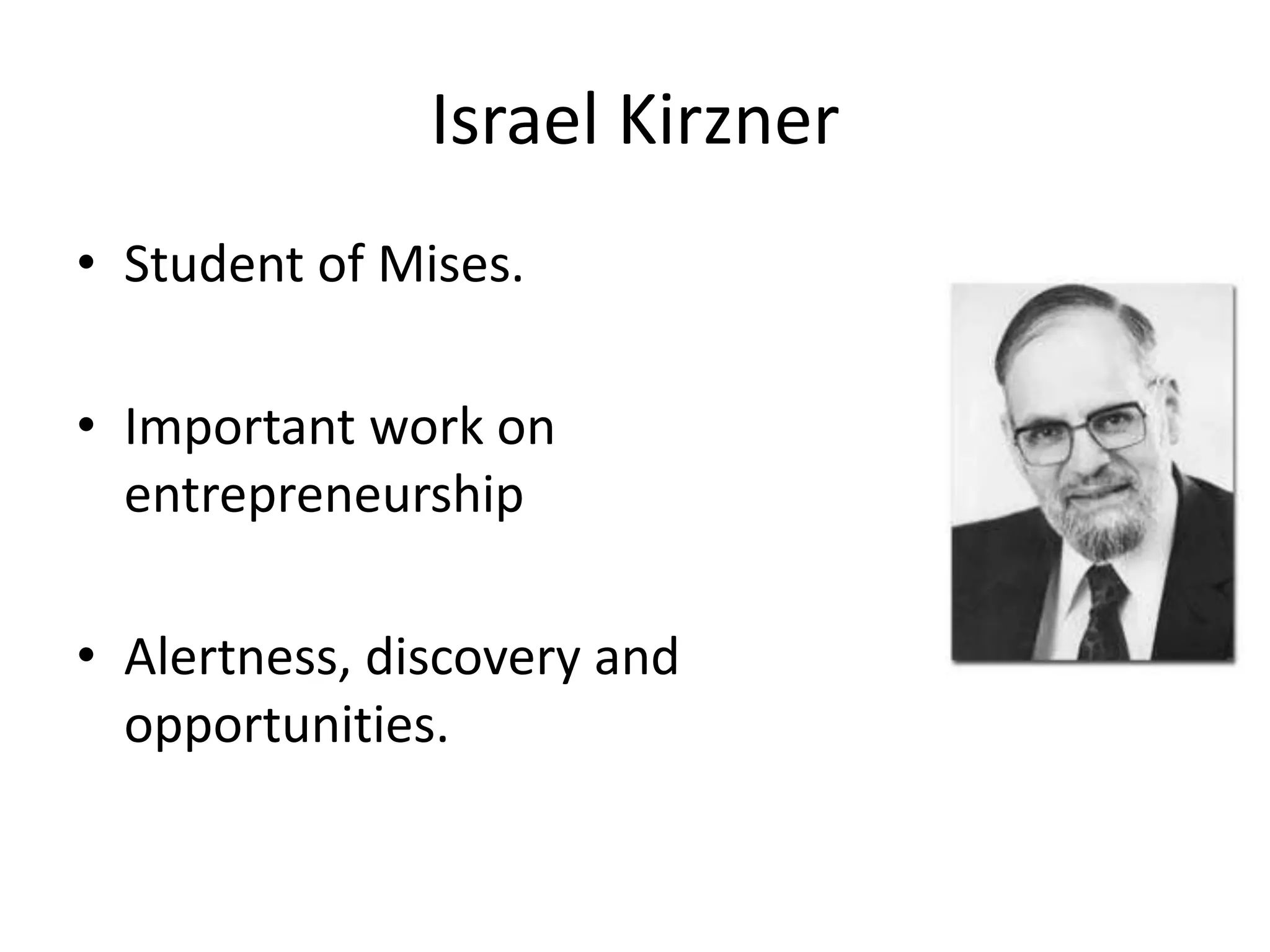
Israel Kirzner
• Student of Mises.
• Important work on
entrepreneurship
• Alertness, discovery and
opportunities.
Kirzner in context
• Part of the greater Austrian
tradition (subjectivism & market
process)
• Often speaking to ”neoclassical”
economists.
• Focusing on entrepreneurship as
an abstract economic function.
Why is Kirzner interesting?
• Well cited among
entrepreneurship scholars.
• Much recent influential
entrepreneurship research
draws on Kirzner (Shane and
Venkataraman, 2000, Gaglio
and Katz 2001) .
• But which Kirzner?
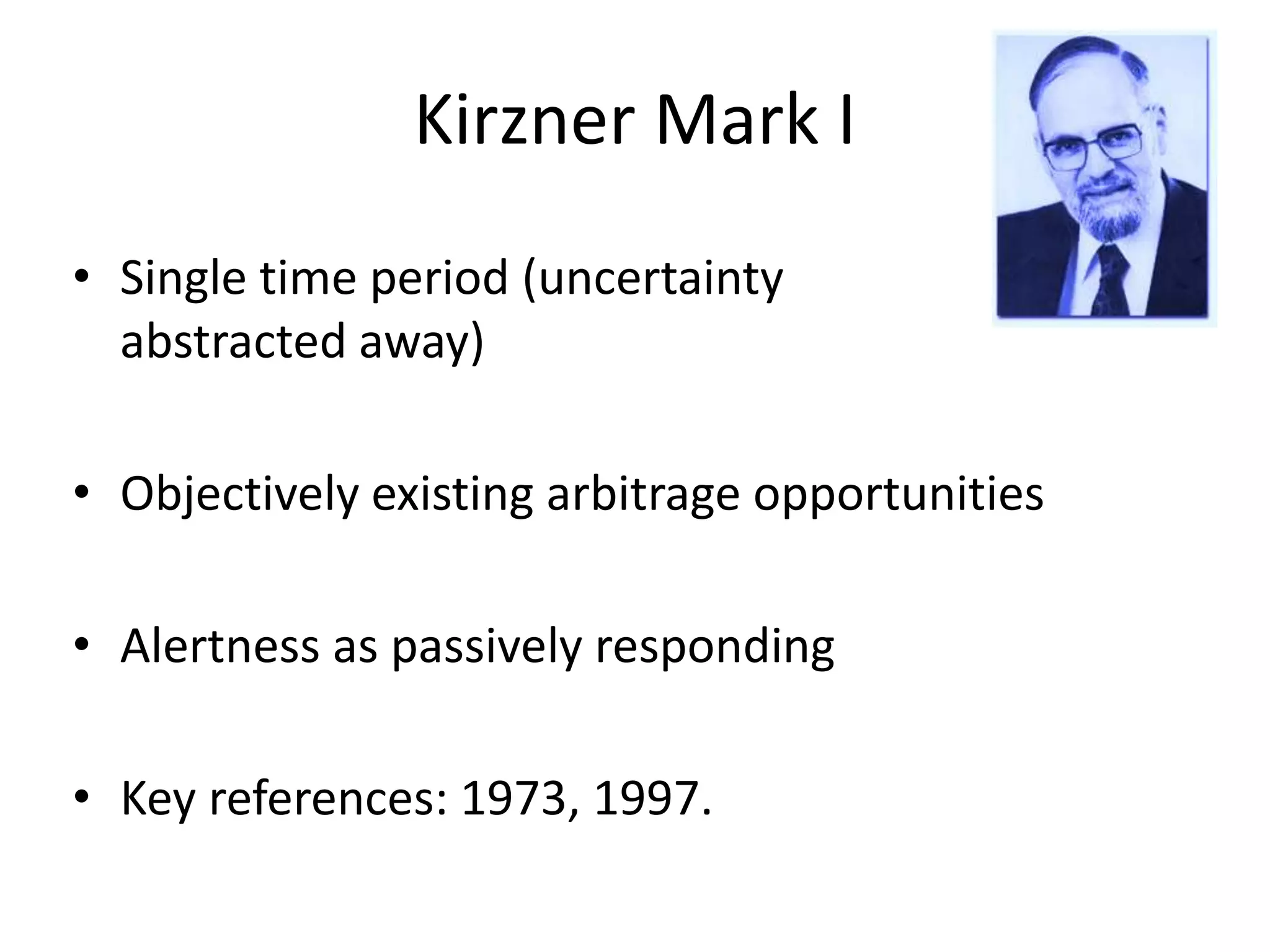
Kirzner Mark I
• Single time period (uncertainty
abstracted away)
• Objectively existing arbitrage opportunities
• Alertness as passively responding
• Key references: 1973, 1997.
Kirzner Mark I
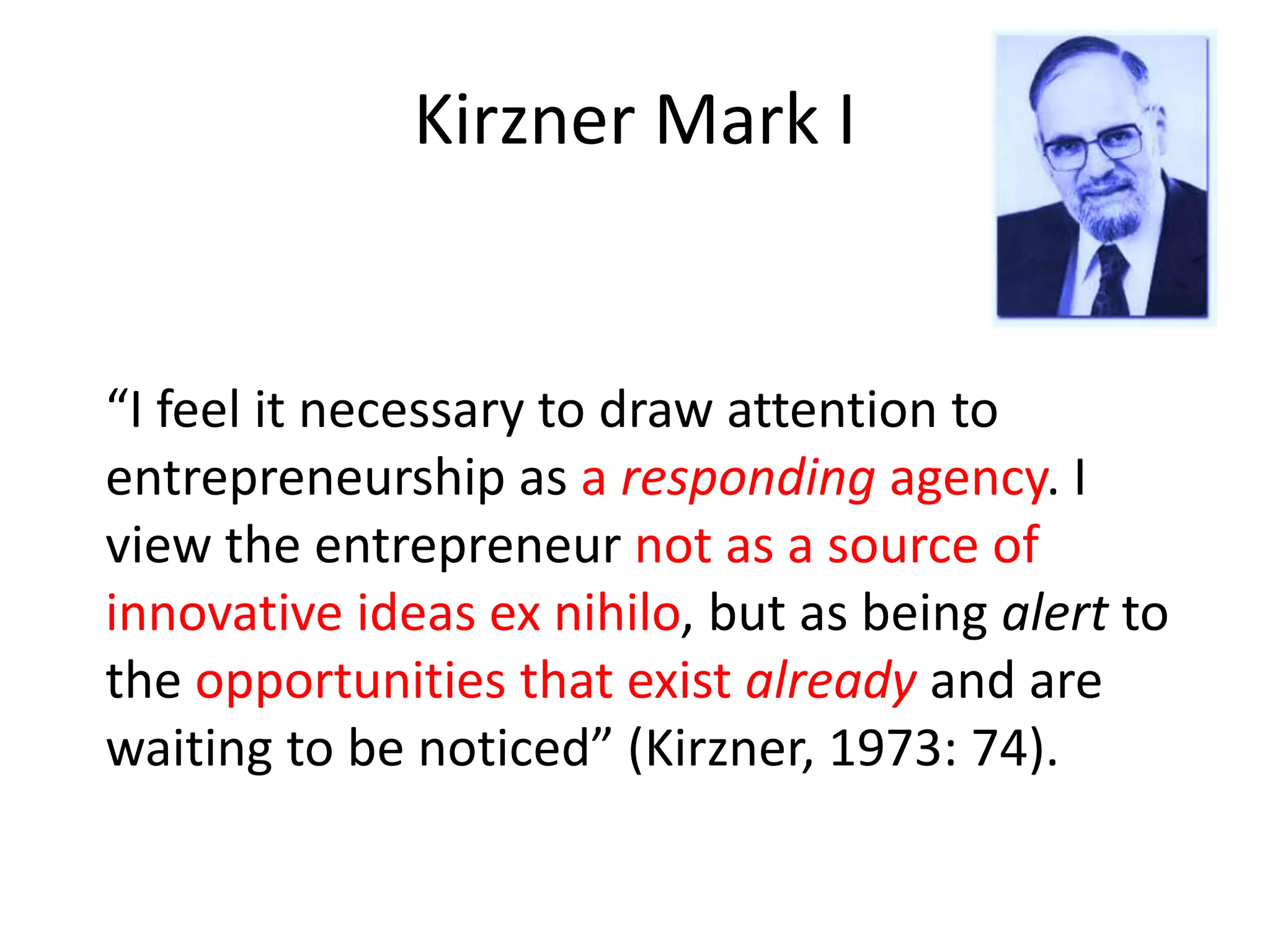
“I feel it necessary to draw attention to
entrepreneurship as a responding agency. I
view the entrepreneur not as a source of
innovative ideas ex nihilo, but as being alert to
the opportunities that exist already and are
waiting to be noticed” (Kirzner, 1973: 74).
Related ENT
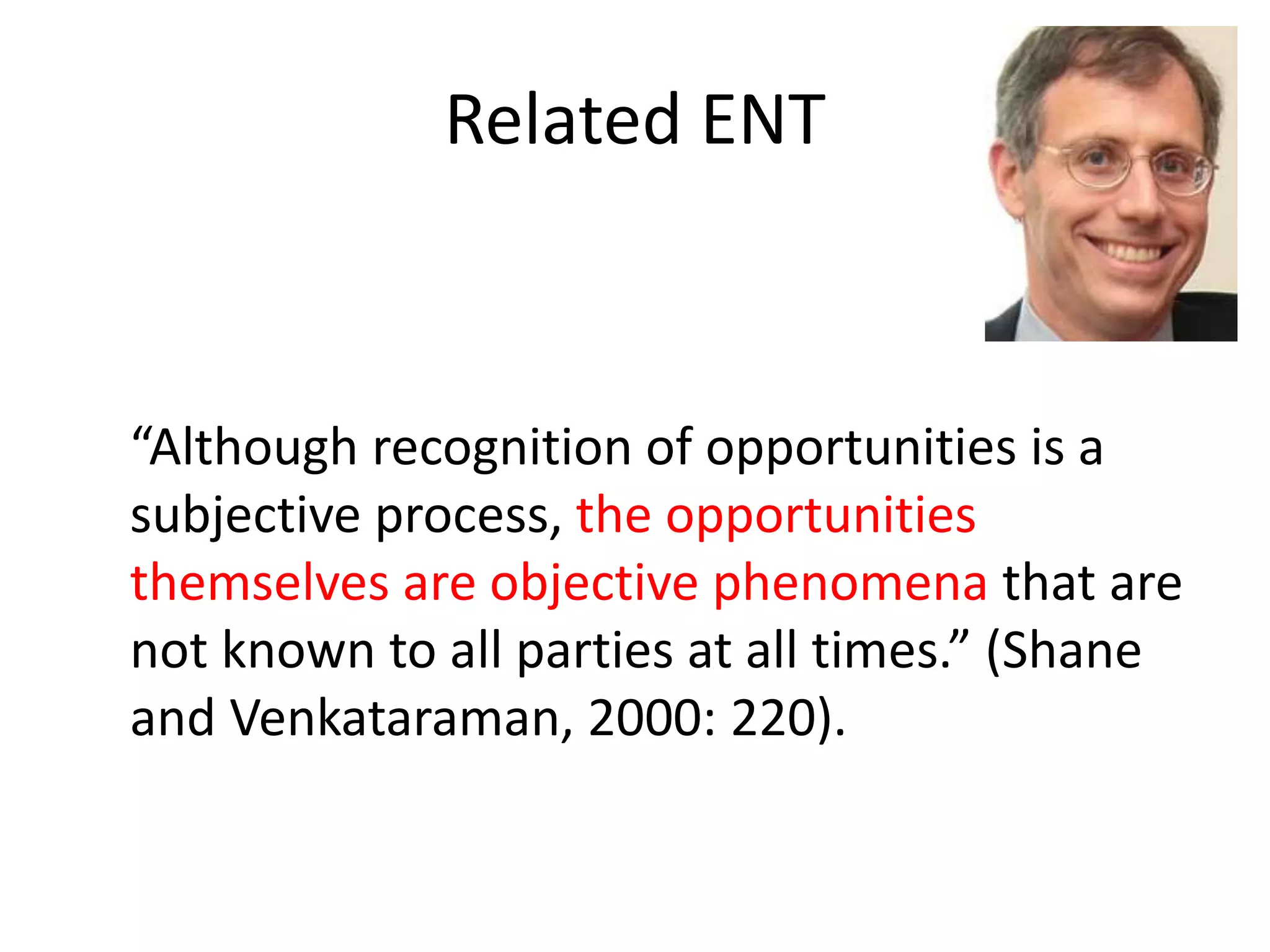
“Although recognition of opportunities is a
subjective process, the opportunities
themselves are objective phenomena that are
not known to all parties at all times.” (Shane
and Venkataraman, 2000: 220).
Related ENT
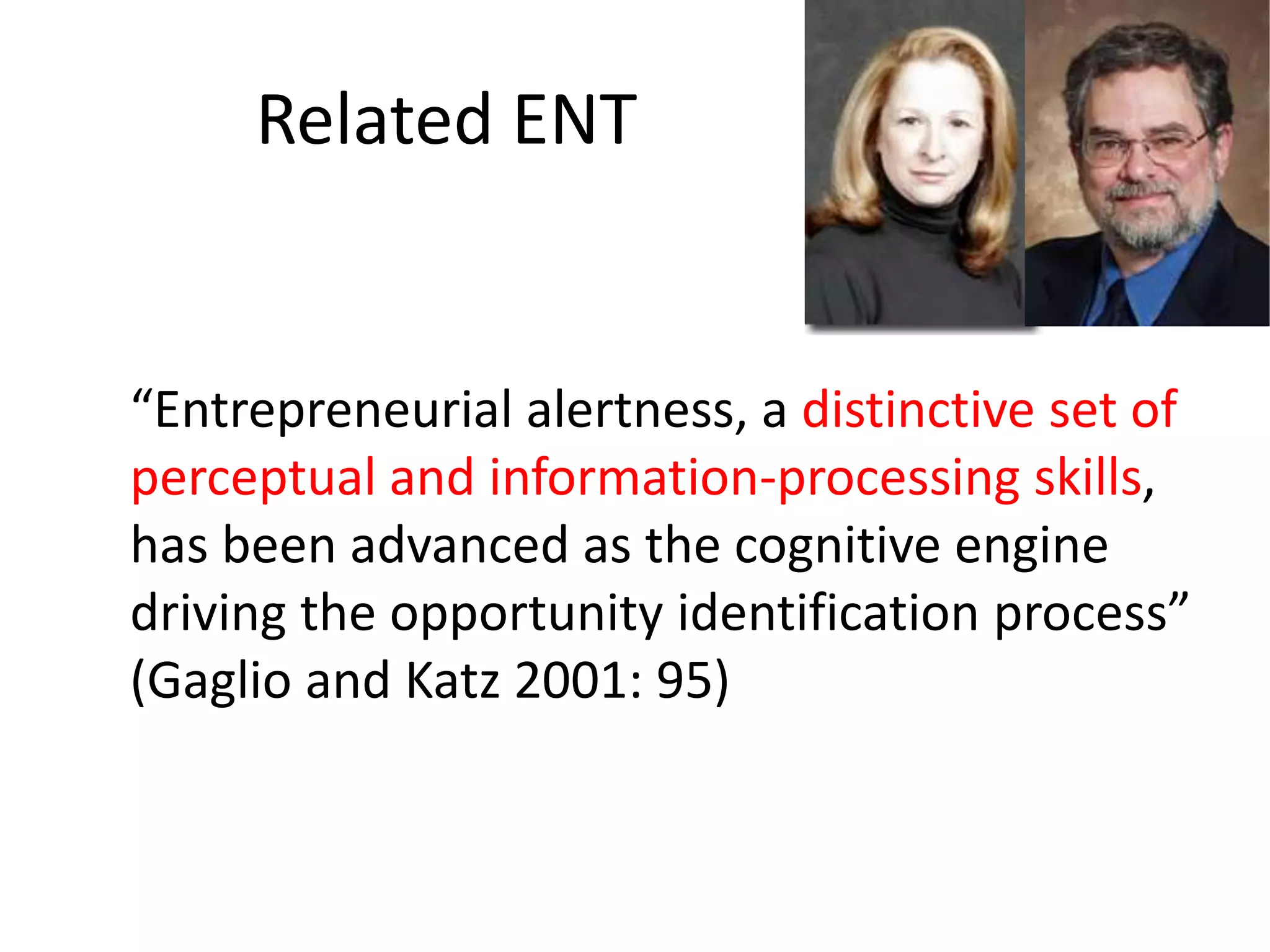
“Entrepreneurial alertness, a distinctive set of
perceptual and information-processing skills,
has been advanced as the cognitive engine
driving the opportunity identification process”
(Gaglio and Katz 2001: 95)
Kirzner Mark II
• Multiple time periods
• Uncertainty is essential
• Alertness: speculation and creativity
• Key references: Kirzner 1982/1985, Kirzner 1999
Kirzner Mark II
“My emphasis on alertness to hitherto unperceived
opportunities as the decisive element in the
entrepreneurial function stemmed from my pursuit of
a didactic purpose. This purpose was to distinguish
the analysis of the market process (a process in which
the entrepreneur plays the crucial role) as sharply as
possible from the analysis of equilibrium states (in
which all scope for entrepreneurial activity has been
assumed away).” (Kirzner, 1982: 140-141)
Kirzner Mark II
“This writer has often talked as if alertness is able
to identify existing opportunities for future profit.
Purists, in both linguistic usage and philosophical
consistency, may certainly be excused for
expressing unhappiness with such loose or
metaphorical use of language in regard to the
non-existent future” (Kirzner 1992: 26 note 4).
Kirzner Mark II
“It was certainly not the intention, in deploying
this analytical device, to deny that in the real
world of production and (consequently) of multi-
period decision making and radical uncertainty,
entrepreneurship is exercised only by calling upon
the entrepreneur’s qualities of boldness,
innovativeness and creativity” (Kirzner, 1999: 11)
Kirzner Mark II
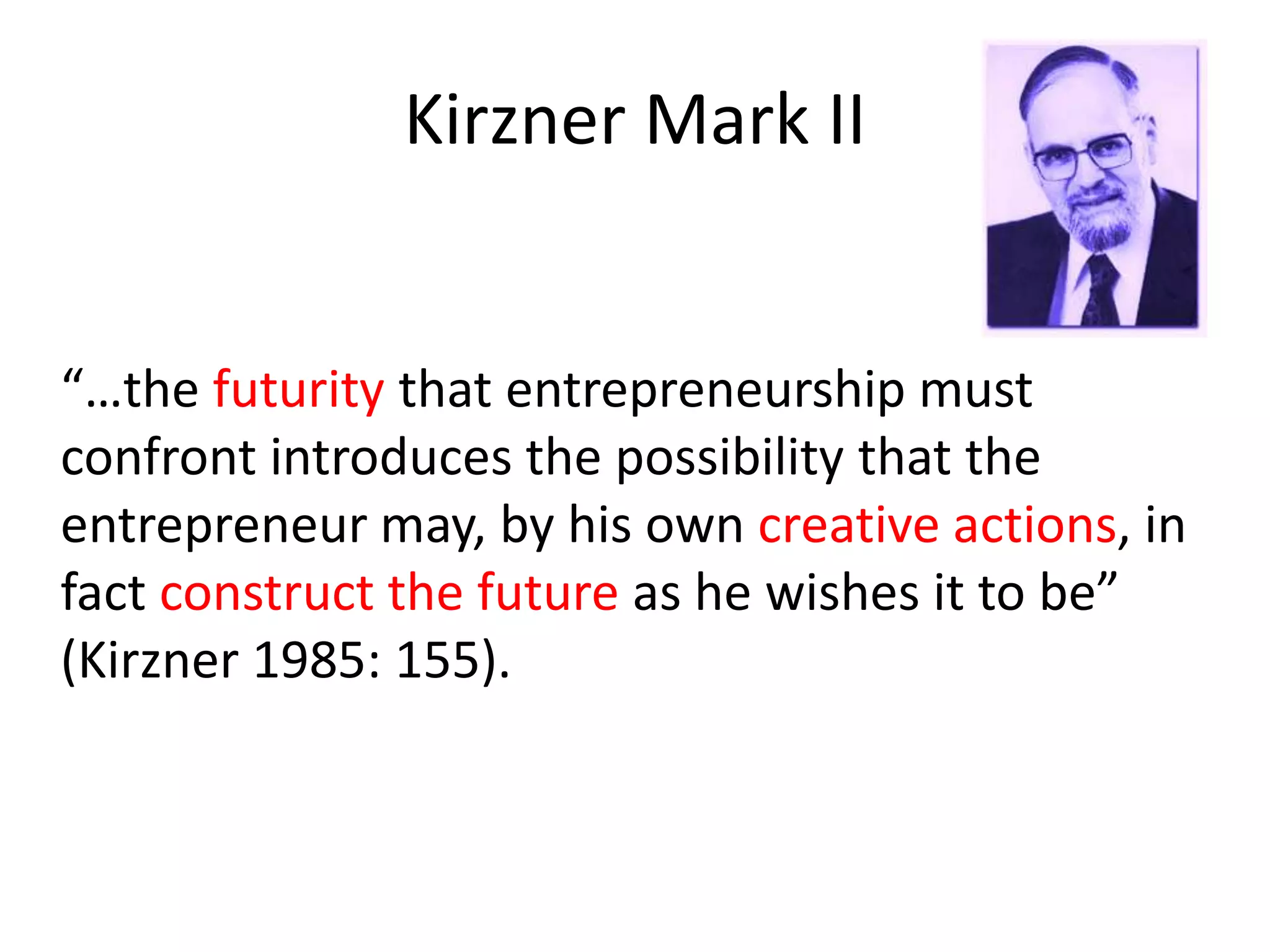
“…the futurity that entrepreneurship must
confront introduces the possibility that the
entrepreneur may, by his own creative actions, in
fact construct the future as he wishes it to be”
(Kirzner 1985: 155).
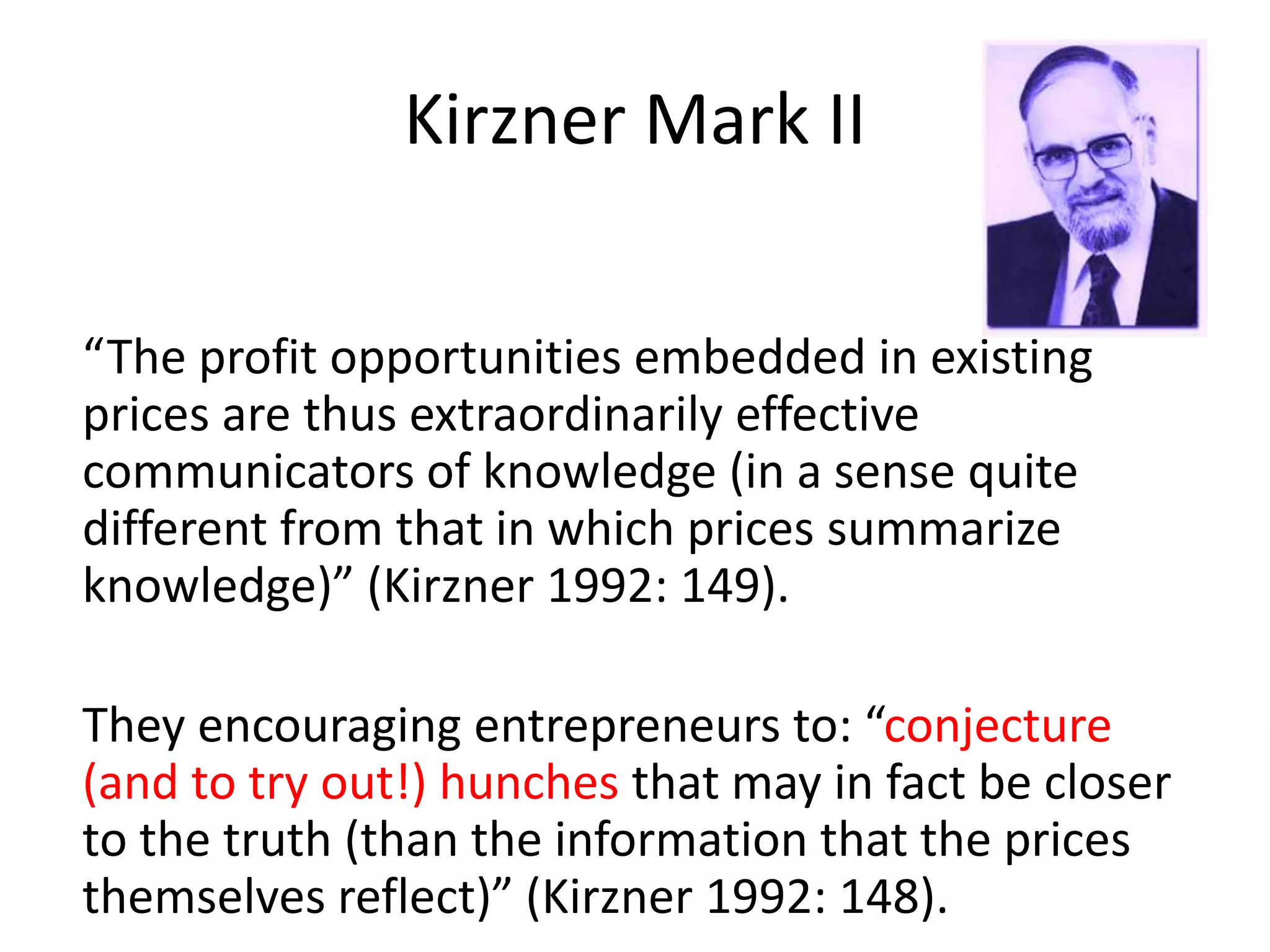
“The profit opportunities embedded in existing
prices are thus extraordinarily effective
communicators of knowledge (in a sense quite
different from that in which prices summarize
knowledge)” (Kirzner 1992: 149).
They encouraging entrepreneurs to: “conjecture
(and to try out!) hunches that may in fact be closer
to the truth (than the information that the prices
themselves reflect)” (Kirzner 1992: 148).
Kirzner Mark II
Related ENT
“profit opportunities do not exist, objectively,
when decisions are made, because the result of
action cannot be known with certainty.
Opportunities are essentially subjective
phenomena. As such, opportunities are neither
‘discovered’ nor ‘created’ but imagined [and
should be] treated as a latent concept underlying
the real phenomenon of interest, namely
entrepreneurial action” (Klein 2008: 176)
Related ENT
“entrepreneurial opportunities should be
thought of in relation to entrepreneurial action.
From this perspective, their ontological status,
i.e. whether they exist or not, is of lesser
importance as the opportunity perceptions
themselves provide cognitive and practical
drivers or ‘points of orientation’ that more or
less temporarily guide entrepreneurial actions.”
(Berglund 2007: 245).
Related ENT
“Opportunity exists out there, independently of
particular actors. However, opportunities do not
exist as complete, individual entities. Rather,
opportunity exists as an uncountable in the form of
technological possibilities, knowledge, and
unfulfilled human needs backed with purchasing
power. Venture ideas are the creations of
individuals’ minds. They are specific (but
changeable and more or less elaborate) entities
that are acted upon.” (Davidsson 2003: 338-339).
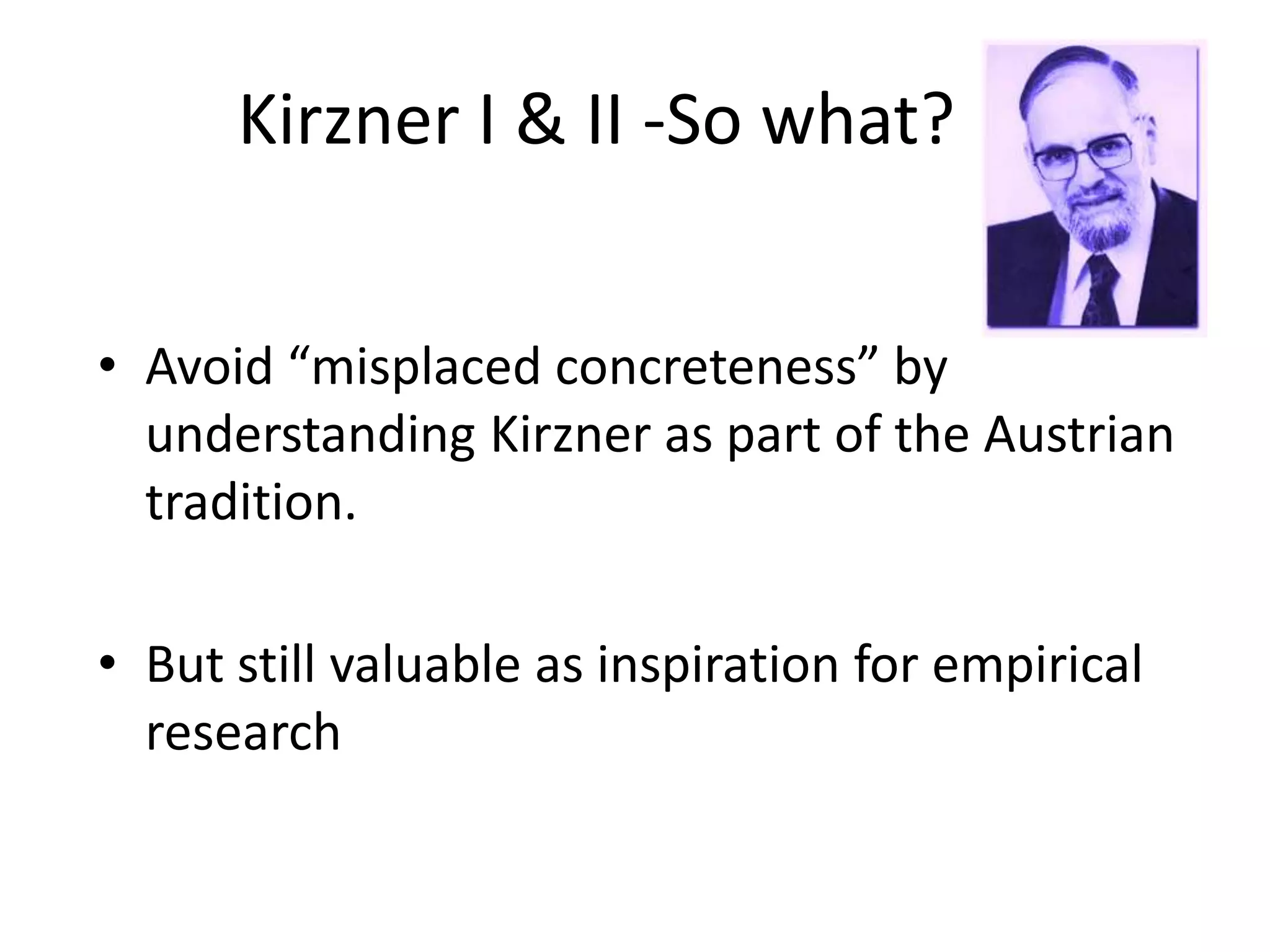
Kirzner I & II -So what?
• Avoid “misplaced concreteness” by
understanding Kirzner as part of the Austrian
tradition.
• But still valuable as inspiration for empirical
research
Backup
Assets ownership
“An important point, is that ownership and
entrepreneurship are to be viewed as
completely separate functions” (Kirzner 1978, p.
47)
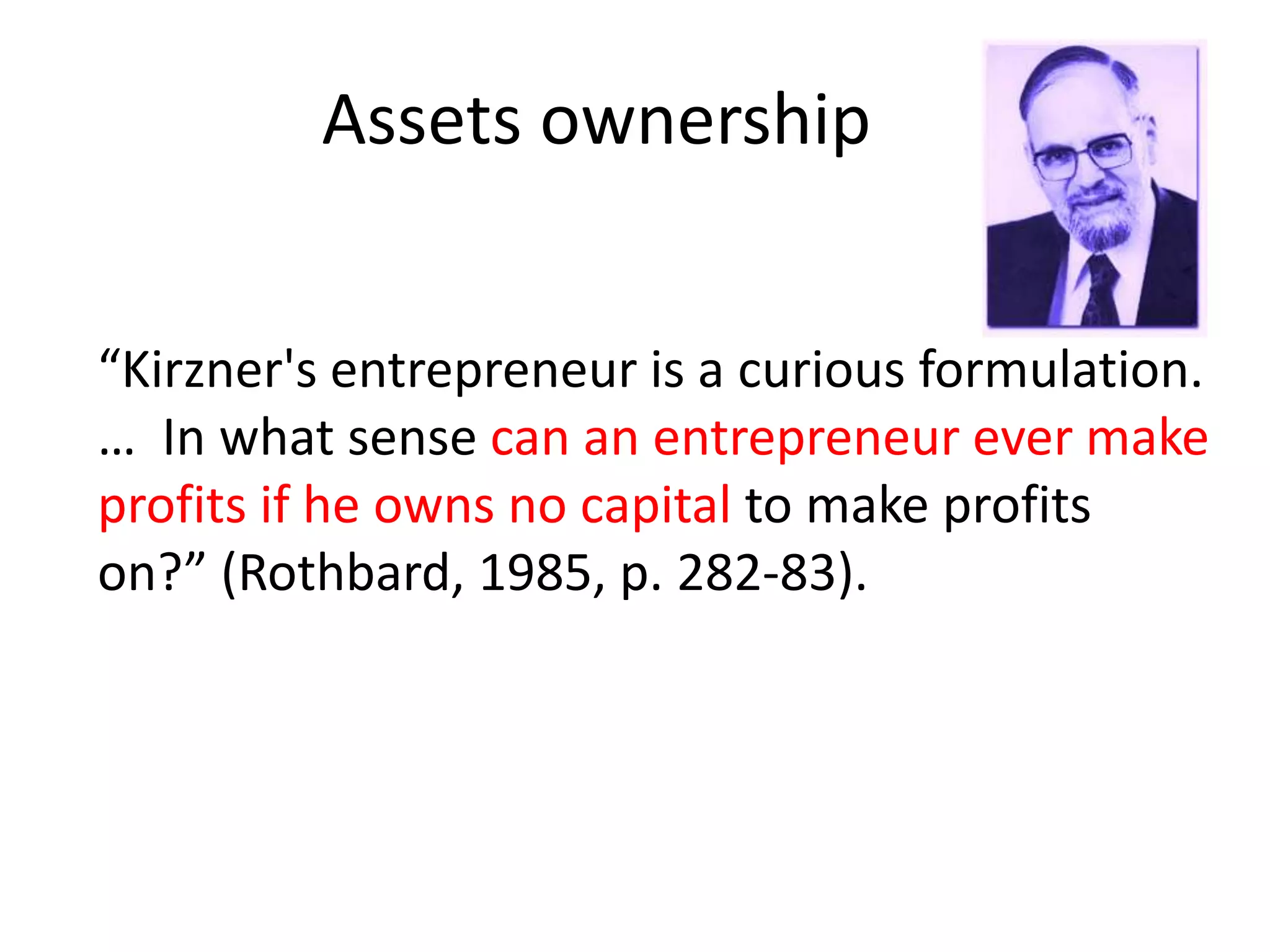
Assets ownership
“Kirzner's entrepreneur is a curious formulation.
… In what sense can an entrepreneur ever make
profits if he owns no capital to make profits
on?” (Rothbard, 1985, p. 282-83).

Henrik Berglund - A tale of two Kirzners

  • 1.
    A tale oftwo Kirzners Henrik Berglund Chalmers University of Technology www.henrikberglund.com twitter: khberglund Presentation from AoM 2011 San Antonio Based on paper forthcoming in Entrepreneurship Theory and Practice http://henrikberglund.com/A%20Tale%20of%20Two%20Kirzners.pdf
  • 2.
    Israel Kirzner • Studentof Mises. • Important work on entrepreneurship • Alertness, discovery and opportunities.
  • 3.
    Kirzner in context •Part of the greater Austrian tradition (subjectivism & market process) • Often speaking to ”neoclassical” economists. • Focusing on entrepreneurship as an abstract economic function.
  • 4.
    Why is Kirznerinteresting? • Well cited among entrepreneurship scholars. • Much recent influential entrepreneurship research draws on Kirzner (Shane and Venkataraman, 2000, Gaglio and Katz 2001) . • But which Kirzner?
  • 5.
    Kirzner Mark I •Single time period (uncertainty abstracted away) • Objectively existing arbitrage opportunities • Alertness as passively responding • Key references: 1973, 1997.
  • 6.
    Kirzner Mark I “Ifeel it necessary to draw attention to entrepreneurship as a responding agency. I view the entrepreneur not as a source of innovative ideas ex nihilo, but as being alert to the opportunities that exist already and are waiting to be noticed” (Kirzner, 1973: 74).
  • 7.
    Related ENT “Although recognitionof opportunities is a subjective process, the opportunities themselves are objective phenomena that are not known to all parties at all times.” (Shane and Venkataraman, 2000: 220).
  • 8.
    Related ENT “Entrepreneurial alertness,a distinctive set of perceptual and information-processing skills, has been advanced as the cognitive engine driving the opportunity identification process” (Gaglio and Katz 2001: 95)
  • 9.
    Kirzner Mark II •Multiple time periods • Uncertainty is essential • Alertness: speculation and creativity • Key references: Kirzner 1982/1985, Kirzner 1999
  • 10.
    Kirzner Mark II “Myemphasis on alertness to hitherto unperceived opportunities as the decisive element in the entrepreneurial function stemmed from my pursuit of a didactic purpose. This purpose was to distinguish the analysis of the market process (a process in which the entrepreneur plays the crucial role) as sharply as possible from the analysis of equilibrium states (in which all scope for entrepreneurial activity has been assumed away).” (Kirzner, 1982: 140-141)
  • 11.
    Kirzner Mark II “Thiswriter has often talked as if alertness is able to identify existing opportunities for future profit. Purists, in both linguistic usage and philosophical consistency, may certainly be excused for expressing unhappiness with such loose or metaphorical use of language in regard to the non-existent future” (Kirzner 1992: 26 note 4).
  • 12.
    Kirzner Mark II “Itwas certainly not the intention, in deploying this analytical device, to deny that in the real world of production and (consequently) of multi- period decision making and radical uncertainty, entrepreneurship is exercised only by calling upon the entrepreneur’s qualities of boldness, innovativeness and creativity” (Kirzner, 1999: 11)
  • 13.
    Kirzner Mark II “…thefuturity that entrepreneurship must confront introduces the possibility that the entrepreneur may, by his own creative actions, in fact construct the future as he wishes it to be” (Kirzner 1985: 155).
  • 14.
    “The profit opportunitiesembedded in existing prices are thus extraordinarily effective communicators of knowledge (in a sense quite different from that in which prices summarize knowledge)” (Kirzner 1992: 149). They encouraging entrepreneurs to: “conjecture (and to try out!) hunches that may in fact be closer to the truth (than the information that the prices themselves reflect)” (Kirzner 1992: 148). Kirzner Mark II
  • 15.
    Related ENT “profit opportunitiesdo not exist, objectively, when decisions are made, because the result of action cannot be known with certainty. Opportunities are essentially subjective phenomena. As such, opportunities are neither ‘discovered’ nor ‘created’ but imagined [and should be] treated as a latent concept underlying the real phenomenon of interest, namely entrepreneurial action” (Klein 2008: 176)
  • 16.
    Related ENT “entrepreneurial opportunitiesshould be thought of in relation to entrepreneurial action. From this perspective, their ontological status, i.e. whether they exist or not, is of lesser importance as the opportunity perceptions themselves provide cognitive and practical drivers or ‘points of orientation’ that more or less temporarily guide entrepreneurial actions.” (Berglund 2007: 245).
  • 17.
    Related ENT “Opportunity existsout there, independently of particular actors. However, opportunities do not exist as complete, individual entities. Rather, opportunity exists as an uncountable in the form of technological possibilities, knowledge, and unfulfilled human needs backed with purchasing power. Venture ideas are the creations of individuals’ minds. They are specific (but changeable and more or less elaborate) entities that are acted upon.” (Davidsson 2003: 338-339).
  • 18.
    Kirzner I &II -So what? • Avoid “misplaced concreteness” by understanding Kirzner as part of the Austrian tradition. • But still valuable as inspiration for empirical research
  • 19.
  • 20.
    Assets ownership “An importantpoint, is that ownership and entrepreneurship are to be viewed as completely separate functions” (Kirzner 1978, p. 47)
  • 21.
    Assets ownership “Kirzner's entrepreneuris a curious formulation. … In what sense can an entrepreneur ever make profits if he owns no capital to make profits on?” (Rothbard, 1985, p. 282-83).