A Simple Java GUI Application:
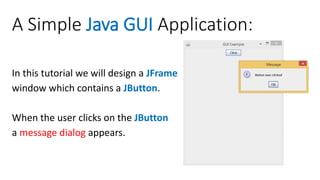
In this tutorial we will design a JFrame
window which contains a JButton.
When the user clicks on the JButton
a message dialog appears.
A Simple Java GUI Application:
Steps:
1. Start the Eclipse IDE.
2. Create a Java Project with any name, for example
GUIJavaProject.
3. Inside the GUIJavaProject, create a class with any name,
for example GUIJavaClass, with a main method inside
the class.
A Simple Java GUI Application:
4. Make the GUIJavaClass class extends the JFrame class.
5. Make the GUIJavaClass class implements the
ActionListener interface.
Additional import statements are required to define:
• JFrame class
• ActionListener interface.
public class GUIJavaClass extends JFrame implements ActionListener
A Simple Java GUI Application:
6. Inside the GUIJavaClass class add the followings:
• Definition for the JButton object (B1).
• Definition for an empty constructor method.
• Definition for the method actionPerformed method.
Additional import statements are required to define:
• JButton class
• ActionEvent class
public class GUIJavaClass extends JFrame implements ActionListener
{
private JButton B1 ;
public MyClass( )
{
}
public void actionPerformed ( ActionEvent e )
{
}
public static void main ( String [ ] args )
{
}
}
A Simple Java GUI Application:
7. Inside the empty constructor method add the following
code.
Additional import statement is required to define the
FlowLayout class.
public GUIJavaClass( )
{
//setLayout: sets the size and position of the JButton within the JFrame.
setLayout(new FlowLayout());
//Create the JButton (B1) with the statement "Click" written inside JButton.
B1 = new JButton ("Click");
/*
Add action listener to (B1) to listen to event from it.
event is triggered here if user click on (B1).
*/
B1.addActionListener(this);
//Add (B1) to the JFrame.
add (B1);
}
A Simple Java GUI Application:
8. Inside the actionPerformed method add the following
code.
Additional import statement is required to define the
JOptionPane class.
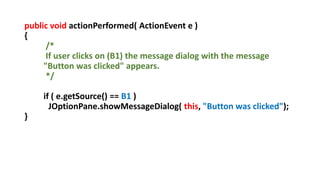
public void actionPerformed( ActionEvent e )
{
/*
If user clicks on (B1) the message dialog with the message
"Button was clicked" appears.
*/
if ( e.getSource() == B1 )
JOptionPane.showMessageDialog( this, "Button was clicked");
}
A Simple Java GUI Application:
9. Inside the main method add the following code.
public static void main( String [ ] args )
{
/* Define and create the GUIJavaClass object (frame),
this will call the empty constructor. */
GUIJavaClass frame = new GUIJavaClass();
//set the title for the JFrame window to "GUI Example".
frame.setTitle("GUI Example");
/* set the width for the JFrame window width to 400,
and height to 500. */
frame.setSize(400, 500);
/* set the location for the JFrame window to 400 on x-axis,
and to 100 to y-axis. */
frame.setLocation(400,100);
/* make the JFrame window close when the user click
on the X button inside the JFrame's title bar. */
frame.setDefaultCloseOperation(JFrame.EXIT_ON_CLOSE);
// make the JFrame window appear to user.
frame.setVisible(true);
}
A Simple Java GUI Application:
10. Execute the code.
Inside the JFrame window, when the button is clicked, a
message dialog will appear with the statement “Button
was clicked” inside.

A Simple Java GUI Application.pptx

  • 1.
    A Simple JavaGUI Application: In this tutorial we will design a JFrame window which contains a JButton. When the user clicks on the JButton a message dialog appears.
  • 2.
    A Simple JavaGUI Application: Steps: 1. Start the Eclipse IDE. 2. Create a Java Project with any name, for example GUIJavaProject. 3. Inside the GUIJavaProject, create a class with any name, for example GUIJavaClass, with a main method inside the class.
  • 3.
    A Simple JavaGUI Application: 4. Make the GUIJavaClass class extends the JFrame class. 5. Make the GUIJavaClass class implements the ActionListener interface. Additional import statements are required to define: • JFrame class • ActionListener interface.
  • 4.
    public class GUIJavaClassextends JFrame implements ActionListener
  • 5.
    A Simple JavaGUI Application: 6. Inside the GUIJavaClass class add the followings: • Definition for the JButton object (B1). • Definition for an empty constructor method. • Definition for the method actionPerformed method. Additional import statements are required to define: • JButton class • ActionEvent class
  • 6.
    public class GUIJavaClassextends JFrame implements ActionListener { private JButton B1 ; public MyClass( ) { } public void actionPerformed ( ActionEvent e ) { } public static void main ( String [ ] args ) { } }
  • 7.
    A Simple JavaGUI Application: 7. Inside the empty constructor method add the following code. Additional import statement is required to define the FlowLayout class.
  • 8.
    public GUIJavaClass( ) { //setLayout:sets the size and position of the JButton within the JFrame. setLayout(new FlowLayout()); //Create the JButton (B1) with the statement "Click" written inside JButton. B1 = new JButton ("Click"); /* Add action listener to (B1) to listen to event from it. event is triggered here if user click on (B1). */ B1.addActionListener(this); //Add (B1) to the JFrame. add (B1); }
  • 9.
    A Simple JavaGUI Application: 8. Inside the actionPerformed method add the following code. Additional import statement is required to define the JOptionPane class.
  • 10.
    public void actionPerformed(ActionEvent e ) { /* If user clicks on (B1) the message dialog with the message "Button was clicked" appears. */ if ( e.getSource() == B1 ) JOptionPane.showMessageDialog( this, "Button was clicked"); }
  • 11.
    A Simple JavaGUI Application: 9. Inside the main method add the following code.
  • 12.
    public static voidmain( String [ ] args ) { /* Define and create the GUIJavaClass object (frame), this will call the empty constructor. */ GUIJavaClass frame = new GUIJavaClass(); //set the title for the JFrame window to "GUI Example". frame.setTitle("GUI Example"); /* set the width for the JFrame window width to 400, and height to 500. */ frame.setSize(400, 500); /* set the location for the JFrame window to 400 on x-axis, and to 100 to y-axis. */ frame.setLocation(400,100); /* make the JFrame window close when the user click on the X button inside the JFrame's title bar. */ frame.setDefaultCloseOperation(JFrame.EXIT_ON_CLOSE); // make the JFrame window appear to user. frame.setVisible(true); }
  • 13.
    A Simple JavaGUI Application: 10. Execute the code. Inside the JFrame window, when the button is clicked, a message dialog will appear with the statement “Button was clicked” inside.