How taxes work
in Singapore
Tax rates, exemptions, and incentives
for Singapore companies
4. Exemptions: SUTE and PTE
Contents:
2. Key rates
3. Employee-related tax
5. Other tax incentives for business
1. Territorial basis
1. Tax territorial basis
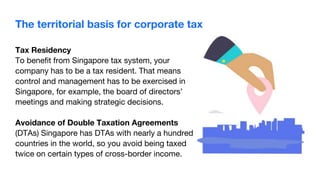
Tax Residency
To benefit from Singapore tax system, your
company has to be a tax resident. That means
control and management has to be exercised in
Singapore, for example, the board of directors’
meetings and making strategic decisions.
Avoidance of Double Taxation Agreements
(DTAs) Singapore has DTAs with nearly a hundred
countries in the world, so you avoid being taxed
twice on certain types of cross-border income.
The territorial basis for corporate tax
2. Key
rates
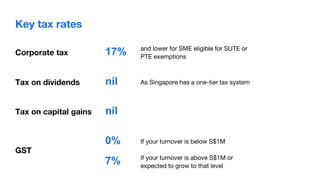
If your turnover is below S$1M
GST
Tax on dividends nil
Corporate tax
Key tax rates
17% and lower for SME eligible for SUTE or
PTE exemptions
As Singapore has a one-tier tax system
Tax on capital gains nil
0%
7% If your turnover is above S$1M or
expected to grow to that level
3. Employee-related
tax
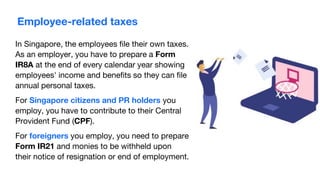
In Singapore, the employees file their own taxes.
As an employer, you have to prepare a Form
IR8A at the end of every calendar year showing
employees' income and benefits so they can file
annual personal taxes.
For Singapore citizens and PR holders you
employ, you have to contribute to their Central
Provident Fund (CPF).
For foreigners you employ, you need to prepare
Form IR21 and monies to be withheld upon
their notice of resignation or end of employment.
Employee-related taxes
4. Exemptions:
SUTE and PTE
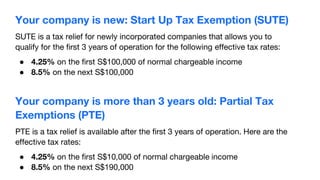
Your company is new: Start Up Tax Exemption (SUTE)
SUTE is a tax relief for newly incorporated companies that allows you to
qualify for the first 3 years of operation for the following effective tax rates:
● 4.25% on the first S$100,000 of normal chargeable income
● 8.5% on the next S$100,000
Your company is more than 3 years old: Partial Tax
Exemptions (PTE)
PTE is a tax relief is available after the first 3 years of operation. Here are the
effective tax rates:
● 4.25% on the first S$10,000 of normal chargeable income
● 8.5% on the next S$190,000
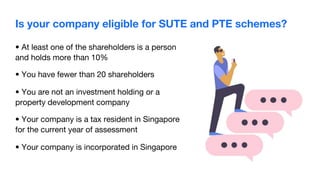
Is your company eligible for SUTE and PTE schemes?
• At least one of the shareholders is a person
and holds more than 10%
• You have fewer than 20 shareholders
• You are not an investment holding or a
property development company
• Your company is a tax resident in Singapore
for the current year of assessment
• Your company is incorporated in Singapore
5. Other tax incentives for business
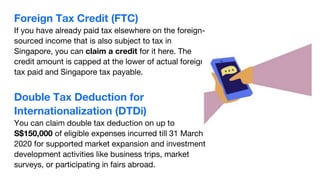
Foreign Tax Credit (FTC)
If you have already paid tax elsewhere on the foreign-
sourced income that is also subject to tax in
Singapore, you can claim a credit for it here. The
credit amount is capped at the lower of actual foreign
tax paid and Singapore tax payable.
Double Tax Deduction for
Internationalization (DTDi)
You can claim double tax deduction on up to
S$150,000 of eligible expenses incurred till 31 March
2020 for supported market expansion and investment
development activities like business trips, market
surveys, or participating in fairs abroad.
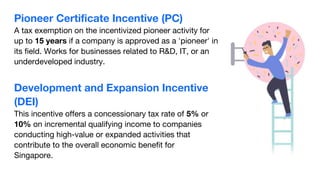
Development and Expansion Incentive
(DEI)
This incentive offers a concessionary tax rate of 5% or
10% on incremental qualifying income to companies
conducting high-value or expanded activities that
contribute to the overall economic benefit for
Singapore.
Pioneer Certificate Incentive (PC)
A tax exemption on the incentivized pioneer activity for
up to 15 years if a company is approved as a 'pioneer' in
its field. Works for businesses related to R&D, IT, or an
underdeveloped industry.
How tax exemptions work in
Singapore
Learn more on the topic
and use our free tools:
Osome Accounting and Taxation
with proactive tax advice
Singapore Corporate Tax: Rates,
System, Reliefs
Business Vocabulary
Osome helps entrepreneurs start and
run business in Singapore, Hong
Kong and the UK. We provide online
accounting, company registration, and
corporate secretarial services.
Learn more and ask questions for free
in our 24/7 chat.

A Quick Guide to Singapore Tax

  • 1.
    How taxes work inSingapore Tax rates, exemptions, and incentives for Singapore companies
  • 2.
    4. Exemptions: SUTEand PTE Contents: 2. Key rates 3. Employee-related tax 5. Other tax incentives for business 1. Territorial basis
  • 3.
  • 4.
    Tax Residency To benefitfrom Singapore tax system, your company has to be a tax resident. That means control and management has to be exercised in Singapore, for example, the board of directors’ meetings and making strategic decisions. Avoidance of Double Taxation Agreements (DTAs) Singapore has DTAs with nearly a hundred countries in the world, so you avoid being taxed twice on certain types of cross-border income. The territorial basis for corporate tax
  • 5.
  • 6.
    If your turnoveris below S$1M GST Tax on dividends nil Corporate tax Key tax rates 17% and lower for SME eligible for SUTE or PTE exemptions As Singapore has a one-tier tax system Tax on capital gains nil 0% 7% If your turnover is above S$1M or expected to grow to that level
  • 7.
  • 8.
    In Singapore, theemployees file their own taxes. As an employer, you have to prepare a Form IR8A at the end of every calendar year showing employees' income and benefits so they can file annual personal taxes. For Singapore citizens and PR holders you employ, you have to contribute to their Central Provident Fund (CPF). For foreigners you employ, you need to prepare Form IR21 and monies to be withheld upon their notice of resignation or end of employment. Employee-related taxes
  • 9.
  • 10.
    Your company isnew: Start Up Tax Exemption (SUTE) SUTE is a tax relief for newly incorporated companies that allows you to qualify for the first 3 years of operation for the following effective tax rates: ● 4.25% on the first S$100,000 of normal chargeable income ● 8.5% on the next S$100,000 Your company is more than 3 years old: Partial Tax Exemptions (PTE) PTE is a tax relief is available after the first 3 years of operation. Here are the effective tax rates: ● 4.25% on the first S$10,000 of normal chargeable income ● 8.5% on the next S$190,000
  • 11.
    Is your companyeligible for SUTE and PTE schemes? • At least one of the shareholders is a person and holds more than 10% • You have fewer than 20 shareholders • You are not an investment holding or a property development company • Your company is a tax resident in Singapore for the current year of assessment • Your company is incorporated in Singapore
  • 12.
    5. Other taxincentives for business
  • 13.
    Foreign Tax Credit(FTC) If you have already paid tax elsewhere on the foreign- sourced income that is also subject to tax in Singapore, you can claim a credit for it here. The credit amount is capped at the lower of actual foreign tax paid and Singapore tax payable. Double Tax Deduction for Internationalization (DTDi) You can claim double tax deduction on up to S$150,000 of eligible expenses incurred till 31 March 2020 for supported market expansion and investment development activities like business trips, market surveys, or participating in fairs abroad.
  • 14.
    Development and ExpansionIncentive (DEI) This incentive offers a concessionary tax rate of 5% or 10% on incremental qualifying income to companies conducting high-value or expanded activities that contribute to the overall economic benefit for Singapore. Pioneer Certificate Incentive (PC) A tax exemption on the incentivized pioneer activity for up to 15 years if a company is approved as a 'pioneer' in its field. Works for businesses related to R&D, IT, or an underdeveloped industry.
  • 15.
    How tax exemptionswork in Singapore Learn more on the topic and use our free tools: Osome Accounting and Taxation with proactive tax advice Singapore Corporate Tax: Rates, System, Reliefs Business Vocabulary Osome helps entrepreneurs start and run business in Singapore, Hong Kong and the UK. We provide online accounting, company registration, and corporate secretarial services. Learn more and ask questions for free in our 24/7 chat.