Dawn H.
Gouge
School IPM
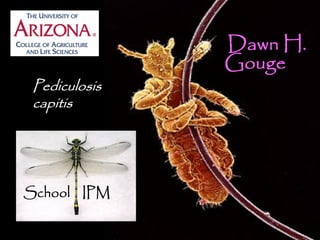
Pediculosis
capitis
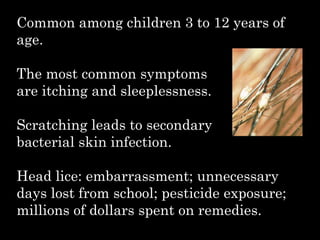
Common among children 3 to 12 years of
age.
The most common symptoms
are itching and sleeplessness.
Scratching leads to secondary
bacterial skin infection.
Head lice: embarrassment; unnecessary
days lost from school; pesticide exposure;
millions of dollars spent on remedies.
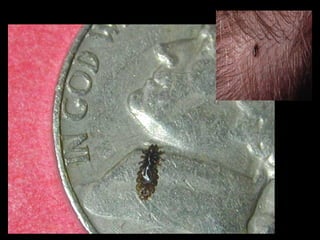
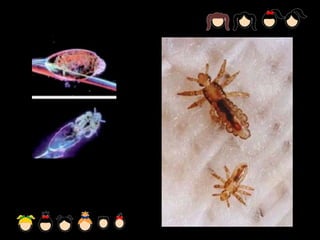
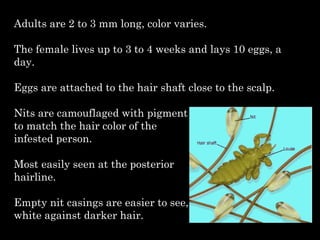
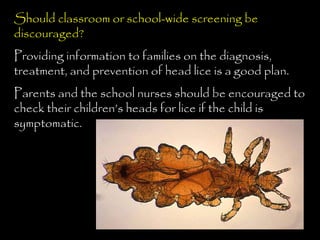
Adults are 2 to 3 mm long, color varies.
The female lives up to 3 to 4 weeks and lays 10 eggs, a
day.
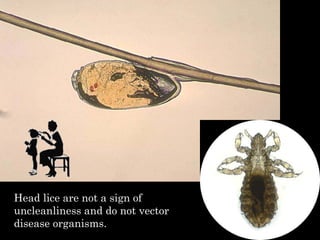
Eggs are attached to the hair shaft close to the scalp.
Nits are camouflaged with pigment
to match the hair color of the
infested person.
Most easily seen at the posterior
hairline.
Empty nit casings are easier to see, appearing
white against darker hair.
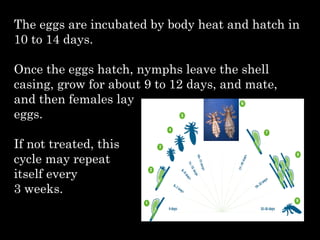
The eggs are incubated by body heat and hatch in
10 to 14 days.
Once the eggs hatch, nymphs leave the shell
casing, grow for about 9 to 12 days, and mate,
and then females lay
eggs.
If not treated, this
cycle may repeat
itself every
3 weeks.
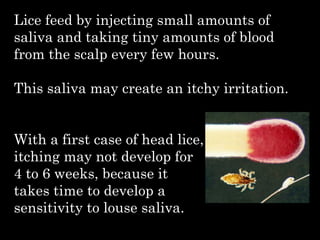
Lice feed by injecting small amounts of
saliva and taking tiny amounts of blood
from the scalp every few hours.
This saliva may create an itchy irritation.
With a first case of head lice,
itching may not develop for
4 to 6 weeks, because it
takes time to develop a
sensitivity to louse saliva.
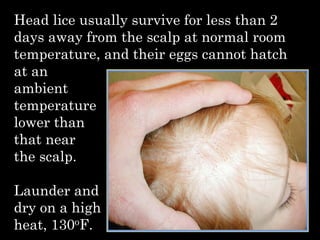
Head lice usually survive for less than 2
days away from the scalp at normal room
temperature, and their eggs cannot hatch
at an
ambient
temperature
lower than
that near
the scalp.
Launder and
dry on a high
heat, 130oF.
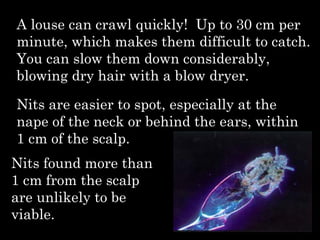
A louse can crawl quickly! Up to 30 cm per
minute, which makes them difficult to catch.
You can slow them down considerably,
blowing dry hair with a blow dryer.
Nits are easier to spot, especially at the
nape of the neck or behind the ears, within
1 cm of the scalp.
Nits found more than
1 cm from the scalp
are unlikely to be
viable.
Pediculicides
Pyrethrins Plus Piperonyl Butoxide
Natural extracts from the chrysanthemum, (e.g. RID).
Neurotoxic to lice.
Possible allergic reaction in patients who are sensitive to ragweed, or
chrysanthemums.
Mostly shampoos that are applied to dry hair and left on for 10 minutes
before rinsing out, over a sink rather than in the shower to limit exposure,
and with cool rather than hot water to minimize absorption.
Not ovicidal (newly laid eggs do not have a nervous system for several
days); 20% to 30% of the eggs remain viable after treatment. This
necessitates a second treatment after 7 to 10 days.
Resistance of adult lice to these products has been reported.
Permethrin (1%)
A synthetic pyrethroid, 1% permethrin (e.g. Nix) is currently the recommended
treatment of choice for head lice by pediatricians.
It has a lower mammalian toxicity than pyrethrins.
Does not cause allergic reactions in individuals with plant allergies.
The product is a cream rinse applied to hair that is first shampooed with a
non-conditioning shampoo and then towel dried. It is left on for 10 minutes and
then rinsed off, and it leaves a residue on the hair that is designed to kill
nymphs emerging.
20% to 30% of eggs not killed with the first application. It is suggested that the
application be repeated if live lice are seen 7 to 10 days later.
Resistance to 1% permethrin has been reported.
Lindane (1%)
Lindane (e.g. Kwell) is an organochloride that has
central nervous system toxicity in humans; several cases
of severe seizures in children using lindane have been
reported.
Prescription shampoo that should be left on for no more
than 10 minutes with repeated application in 7 to 10
days.
It has low ovicidal activity (30% to 50% of eggs are not
killed), and resistance has been reported worldwide for
many years.
Personally, I do not think it should ever be used.
Malathion (0.5%)
The organophosphate (cholinesterase inhibitor) 0.5%
malathion (e.g. Ovide).
Prescription lotion that is applied to the hair, left to air dry,
then washed off after 8 to 12 hours.
Malathion has a high ovicidal activity, but the product should
be reapplied if live lice are seen in 7 to 10 days.
The major concerns are the high alcohol content of the
product, making it highly flammable, and the risk of severe
respiratory depression.
Personally, I do not think this should be used.
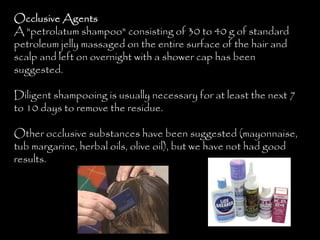
Occlusive Agents
A "petrolatum shampoo" consisting of 30 to 40 g of standard
petroleum jelly massaged on the entire surface of the hair and
scalp and left on overnight with a shower cap has been
suggested.
Diligent shampooing is usually necessary for at least the next 7
to 10 days to remove the residue.
Other occlusive substances have been suggested (mayonnaise,
tub margarine, herbal oils, olive oil), but we have not had good
results.
Manual Removal
None of the pediculicides are 100% ovicidal.
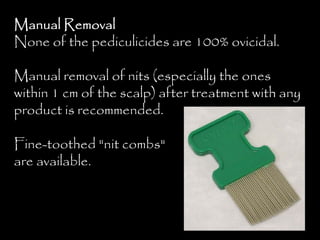
Manual removal of nits (especially the ones
within 1 cm of the scalp) after treatment with any
product is recommended.
Fine-toothed "nit combs"
are available.
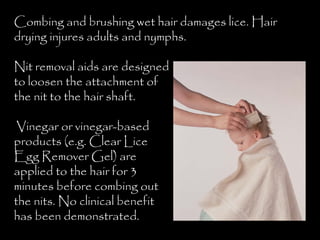
Combing and brushing wet hair damages lice. Hair
drying injures adults and nymphs.
Nit removal aids are designed
to loosen the attachment of
the nit to the hair shaft.
Vinegar or vinegar-based
products (e.g. Clear Lice
Egg Remover Gel) are
applied to the hair for 3
minutes before combing out
the nits. No clinical benefit
has been demonstrated.
Head lice are not a sign of
uncleanliness and do not vector
disease organisms.
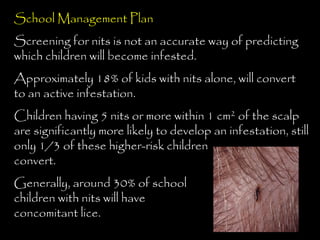
School Management Plan
Screening for nits is not an accurate way of predicting
which children will become infested.
Approximately 18% of kids with nits alone, will convert
to an active infestation.
Children having 5 nits or more within 1 cm2 of the scalp
are significantly more likely to develop an infestation, still
only 1/3 of these higher-risk children
convert.
Generally, around 30% of school
children with nits will have
concomitant lice.
Should classroom or school-wide screening be
discouraged?
Providing information to families on the diagnosis,
treatment, and prevention of head lice is a good plan.
Parents and the school nurses should be encouraged to
check their children’s heads for lice if the child is
symptomatic.
The American
Academy of
Pediatrics and the
National
Association of
School Nurses
(www.nasn.org/po
sitions/nitfree.htm)

A presentation on Pediculosis capitis (general)

  • 1.
  • 4.
    Common among children3 to 12 years of age. The most common symptoms are itching and sleeplessness. Scratching leads to secondary bacterial skin infection. Head lice: embarrassment; unnecessary days lost from school; pesticide exposure; millions of dollars spent on remedies.
  • 5.
    Adults are 2to 3 mm long, color varies. The female lives up to 3 to 4 weeks and lays 10 eggs, a day. Eggs are attached to the hair shaft close to the scalp. Nits are camouflaged with pigment to match the hair color of the infested person. Most easily seen at the posterior hairline. Empty nit casings are easier to see, appearing white against darker hair.
  • 6.
    The eggs areincubated by body heat and hatch in 10 to 14 days. Once the eggs hatch, nymphs leave the shell casing, grow for about 9 to 12 days, and mate, and then females lay eggs. If not treated, this cycle may repeat itself every 3 weeks.
  • 7.
    Lice feed byinjecting small amounts of saliva and taking tiny amounts of blood from the scalp every few hours. This saliva may create an itchy irritation. With a first case of head lice, itching may not develop for 4 to 6 weeks, because it takes time to develop a sensitivity to louse saliva.
  • 8.
    Head lice usuallysurvive for less than 2 days away from the scalp at normal room temperature, and their eggs cannot hatch at an ambient temperature lower than that near the scalp. Launder and dry on a high heat, 130oF.
  • 9.
    A louse cancrawl quickly! Up to 30 cm per minute, which makes them difficult to catch. You can slow them down considerably, blowing dry hair with a blow dryer. Nits are easier to spot, especially at the nape of the neck or behind the ears, within 1 cm of the scalp. Nits found more than 1 cm from the scalp are unlikely to be viable.
  • 10.
    Pediculicides Pyrethrins Plus PiperonylButoxide Natural extracts from the chrysanthemum, (e.g. RID). Neurotoxic to lice. Possible allergic reaction in patients who are sensitive to ragweed, or chrysanthemums. Mostly shampoos that are applied to dry hair and left on for 10 minutes before rinsing out, over a sink rather than in the shower to limit exposure, and with cool rather than hot water to minimize absorption. Not ovicidal (newly laid eggs do not have a nervous system for several days); 20% to 30% of the eggs remain viable after treatment. This necessitates a second treatment after 7 to 10 days. Resistance of adult lice to these products has been reported.
  • 11.
    Permethrin (1%) A syntheticpyrethroid, 1% permethrin (e.g. Nix) is currently the recommended treatment of choice for head lice by pediatricians. It has a lower mammalian toxicity than pyrethrins. Does not cause allergic reactions in individuals with plant allergies. The product is a cream rinse applied to hair that is first shampooed with a non-conditioning shampoo and then towel dried. It is left on for 10 minutes and then rinsed off, and it leaves a residue on the hair that is designed to kill nymphs emerging. 20% to 30% of eggs not killed with the first application. It is suggested that the application be repeated if live lice are seen 7 to 10 days later. Resistance to 1% permethrin has been reported.
  • 12.
    Lindane (1%) Lindane (e.g.Kwell) is an organochloride that has central nervous system toxicity in humans; several cases of severe seizures in children using lindane have been reported. Prescription shampoo that should be left on for no more than 10 minutes with repeated application in 7 to 10 days. It has low ovicidal activity (30% to 50% of eggs are not killed), and resistance has been reported worldwide for many years. Personally, I do not think it should ever be used.
  • 13.
    Malathion (0.5%) The organophosphate(cholinesterase inhibitor) 0.5% malathion (e.g. Ovide). Prescription lotion that is applied to the hair, left to air dry, then washed off after 8 to 12 hours. Malathion has a high ovicidal activity, but the product should be reapplied if live lice are seen in 7 to 10 days. The major concerns are the high alcohol content of the product, making it highly flammable, and the risk of severe respiratory depression. Personally, I do not think this should be used.
  • 14.
    Occlusive Agents A "petrolatumshampoo" consisting of 30 to 40 g of standard petroleum jelly massaged on the entire surface of the hair and scalp and left on overnight with a shower cap has been suggested. Diligent shampooing is usually necessary for at least the next 7 to 10 days to remove the residue. Other occlusive substances have been suggested (mayonnaise, tub margarine, herbal oils, olive oil), but we have not had good results.
  • 15.
    Manual Removal None ofthe pediculicides are 100% ovicidal. Manual removal of nits (especially the ones within 1 cm of the scalp) after treatment with any product is recommended. Fine-toothed "nit combs" are available.
  • 16.
    Combing and brushingwet hair damages lice. Hair drying injures adults and nymphs. Nit removal aids are designed to loosen the attachment of the nit to the hair shaft. Vinegar or vinegar-based products (e.g. Clear Lice Egg Remover Gel) are applied to the hair for 3 minutes before combing out the nits. No clinical benefit has been demonstrated.
  • 17.
    Head lice arenot a sign of uncleanliness and do not vector disease organisms.
  • 18.
    School Management Plan Screeningfor nits is not an accurate way of predicting which children will become infested. Approximately 18% of kids with nits alone, will convert to an active infestation. Children having 5 nits or more within 1 cm2 of the scalp are significantly more likely to develop an infestation, still only 1/3 of these higher-risk children convert. Generally, around 30% of school children with nits will have concomitant lice.
  • 19.
    Should classroom orschool-wide screening be discouraged? Providing information to families on the diagnosis, treatment, and prevention of head lice is a good plan. Parents and the school nurses should be encouraged to check their children’s heads for lice if the child is symptomatic.
  • 20.
    The American Academy of Pediatricsand the National Association of School Nurses (www.nasn.org/po sitions/nitfree.htm)