CS 188: ArtificialIntelligence
Constraint Satisfaction Problems
Instructor: Stuart Russell & Sergey Levine, University of California, Berkeley
[These slides were created by Dan Klein, Pieter Abbeel, Sergey Levine. http://ai.berkeley.edu.]
3.
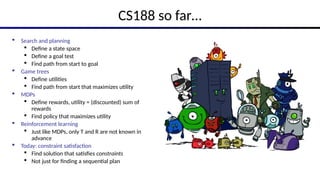
CS188 so far…
Search and planning
Define a state space
Define a goal test
Find path from start to goal
Game trees
Define utilities
Find path from start that maximizes utility
MDPs
Define rewards, utility = (discounted) sum of
rewards
Find policy that maximizes utility
Reinforcement learning
Just like MDPs, only T and R are not known in
advance
Today: constraint satisfaction
Find solution that satisfies constraints
Not just for finding a sequential plan
4.
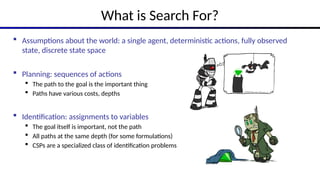
What is SearchFor?
Assumptions about the world: a single agent, deterministic actions, fully observed
state, discrete state space
Planning: sequences of actions
The path to the goal is the important thing
Paths have various costs, depths
Identification: assignments to variables
The goal itself is important, not the path
All paths at the same depth (for some formulations)
CSPs are a specialized class of identification problems
Constraint Satisfaction Problems
Standard search problems:
State is a “black box”: arbitrary data structure
Goal test can be any function over states
Successor function can also be anything
Constraint satisfaction problems (CSPs):
A special subset of search problems
State is defined by variables Xi with values from a
domain D (sometimes D depends on i)
Goal test is a set of constraints specifying allowable
combinations of values for subsets of variables
Simple example of a formal representation language
Allows useful general-purpose algorithms with more
power than standard search algorithms
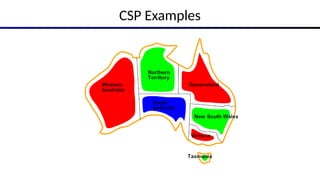
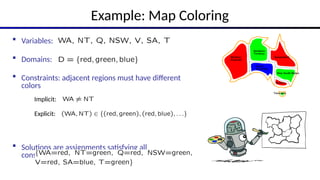
Example: Map Coloring
Variables:
Domains:
Constraints: adjacent regions must have different
colors
Solutions are assignments satisfying all
constraints, e.g.:
Implicit:
Explicit:
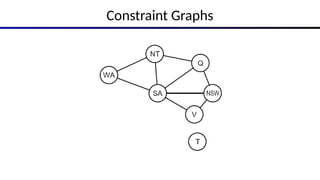
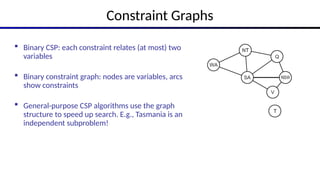
Constraint Graphs
BinaryCSP: each constraint relates (at most) two
variables
Binary constraint graph: nodes are variables, arcs
show constraints
General-purpose CSP algorithms use the graph
structure to speed up search. E.g., Tasmania is an
independent subproblem!
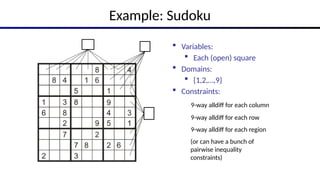
Example: Sudoku
Variables:
Each (open) square
Domains:
{1,2,…,9}
Constraints:
9-way alldiff for each row
9-way alldiff for each column
9-way alldiff for each region
(or can have a bunch of
pairwise inequality
constraints)
Varieties of CSPs
Discrete Variables
Finite domains
Size d means O(dn
) complete assignments
E.g., Boolean CSPs, including Boolean satisfiability (NP-
complete)
Infinite domains (integers, strings, etc.)
E.g., job scheduling, variables are start/end times for each job
Linear constraints solvable, nonlinear undecidable
Continuous variables
E.g., start/end times for Hubble Telescope observations
Linear constraints solvable in polynomial time by LP methods
(see cs170 for a bit of this theory)
17.
Varieties of Constraints
Varieties of Constraints
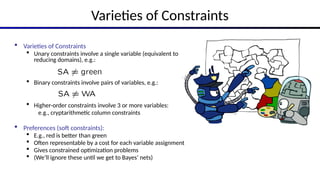
Unary constraints involve a single variable (equivalent to
reducing domains), e.g.:
Binary constraints involve pairs of variables, e.g.:
Higher-order constraints involve 3 or more variables:
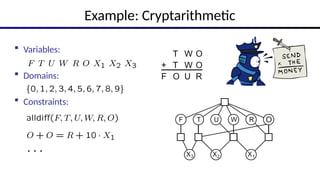
e.g., cryptarithmetic column constraints
Preferences (soft constraints):
E.g., red is better than green
Often representable by a cost for each variable assignment
Gives constrained optimization problems
(We’ll ignore these until we get to Bayes’ nets)
18.
Real-World CSPs
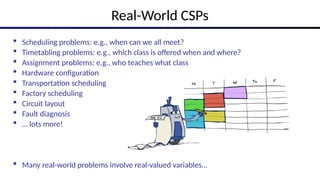
Schedulingproblems: e.g., when can we all meet?
Timetabling problems: e.g., which class is offered when and where?
Assignment problems: e.g., who teaches what class
Hardware configuration
Transportation scheduling
Factory scheduling
Circuit layout
Fault diagnosis
… lots more!
Many real-world problems involve real-valued variables…
Standard Search Formulation
Standard search formulation of CSPs
States defined by the values assigned
so far (partial assignments)
Initial state: the empty assignment, {}
Successor function: assign a value to an
unassigned variable
Goal test: the current assignment is
complete and satisfies all constraints
We’ll start with the straightforward,
naïve approach, then improve it
21.
Search Methods
Whatwould BFS do?
What would DFS do?
What problems does naïve search have?
[Demo: coloring -- dfs]
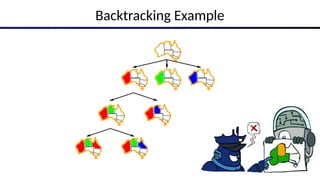
Backtracking Search
Backtrackingsearch is the basic uninformed algorithm for solving CSPs
Idea 1: One variable at a time
Variable assignments are commutative, so fix ordering
I.e., [WA = red then NT = green] same as [NT = green then WA = red]
Only need to consider assignments to a single variable at each step
Idea 2: Check constraints as you go
I.e. consider only values which do not conflict with previous assignments
Might have to do some computation to check the constraints
“Incremental goal test”
Depth-first search with these two improvements
is called backtracking search (not the best name)
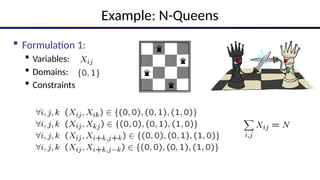
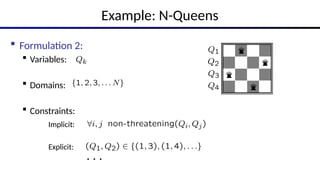
Can solve n-queens for n 25
Backtracking Search
Backtracking= DFS + variable-ordering + fail-on-violation
What are the choice points?
[Demo: coloring -- backtracking]
26.
Improving Backtracking
General-purposeideas give huge gains in speed
Ordering:
Which variable should be assigned next?
In what order should its values be tried?
Filtering: Can we detect inevitable failure early?
Structure: Can we exploit the problem structure?
Filtering: Keeptrack of domains for unassigned variables and cross off bad options
Forward checking: Cross off values that violate a constraint when added to the existing
assignment
Filtering: Forward Checking
WA
SA
NT Q
NSW
V
[Demo: coloring -- forward checking]
29.
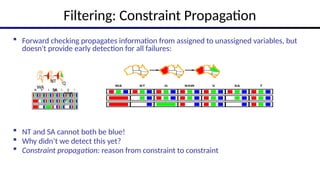
Filtering: Constraint Propagation
Forward checking propagates information from assigned to unassigned variables, but
doesn't provide early detection for all failures:
NT and SA cannot both be blue!
Why didn’t we detect this yet?
Constraint propagation: reason from constraint to constraint
WA
SA
NT Q
NSW
V
30.
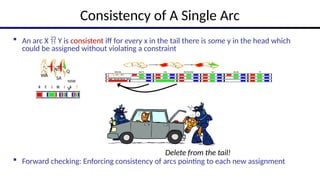
Consistency of ASingle Arc
An arc X Y is consistent iff for every x in the tail there is some y in the head which
could be assigned without violating a constraint
Forward checking: Enforcing consistency of arcs pointing to each new assignment
Delete from the tail!
WA
SA
NT Q
NSW
V
31.
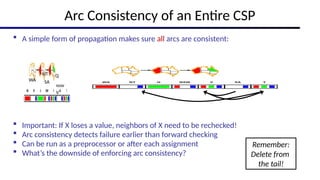
Arc Consistency ofan Entire CSP
A simple form of propagation makes sure all arcs are consistent:
Important: If X loses a value, neighbors of X need to be rechecked!
Arc consistency detects failure earlier than forward checking
Can be run as a preprocessor or after each assignment
What’s the downside of enforcing arc consistency?
Remember:
Delete from
the tail!
WA SA
NT Q
NSW
V
32.
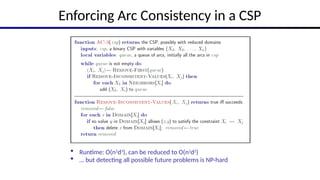
Enforcing Arc Consistencyin a CSP
Runtime: O(n2
d3
), can be reduced to O(n2
d2
)
… but detecting all possible future problems is NP-hard
33.
Limitations of ArcConsistency
After enforcing arc
consistency:
Can have one solution left
Can have multiple solutions left
Can have no solutions left (and
not know it)
Arc consistency still runs
inside a backtracking search!
What went
wrong here?
[Demo: coloring -- arc consistency]
[Demo: coloring -- forward checking]
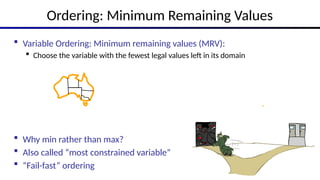
Ordering: Minimum RemainingValues
Variable Ordering: Minimum remaining values (MRV):
Choose the variable with the fewest legal values left in its domain
Why min rather than max?
Also called “most constrained variable”
“Fail-fast” ordering
36.
Ordering: Least ConstrainingValue
Value Ordering: Least Constraining Value
Given a choice of variable, choose the least
constraining value
I.e., the one that rules out the fewest values in
the remaining variables
Note that it may take some computation to
determine this! (E.g., rerunning filtering)
Why least rather than most?
Combining these ordering ideas makes
1000 queens feasible
[Demo: coloring – backtracking + AC + ordering]
37.
Limitations of ArcConsistency
After enforcing arc
consistency:
Can have one solution left
Can have multiple solutions left
Can have no solutions left (and
not know it)
Arc consistency still runs
inside a backtracking search!
What went
wrong here?
[Demo: coloring -- arc consistency]
[Demo: coloring -- forward checking]
K-Consistency
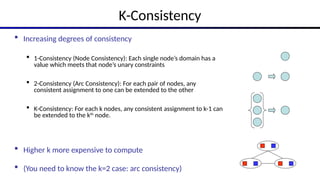
Increasing degreesof consistency
1-Consistency (Node Consistency): Each single node’s domain has a
value which meets that node’s unary constraints
2-Consistency (Arc Consistency): For each pair of nodes, any
consistent assignment to one can be extended to the other
K-Consistency: For each k nodes, any consistent assignment to k-1 can
be extended to the kth
node.
Higher k more expensive to compute
(You need to know the k=2 case: arc consistency)
40.
Strong K-Consistency
Strongk-consistency: also k-1, k-2, … 1 consistent
Claim: strong n-consistency means we can solve without backtracking!
Why?
Choose any assignment to any variable
Choose a new variable
By 2-consistency, there is a choice consistent with the first
Choose a new variable
By 3-consistency, there is a choice consistent with the first 2
…
Lots of middle ground between arc consistency and n-consistency! (e.g. k=3, called
path consistency)
Editor's Notes
#12 Demo:
Run constraint.jar or constraint.exe, load the 5 queens problem.
Demo is just showing the n-queens applet as illustration of constraint graph, but later in lecture we’ll interact with the applet.
aispace.org will have the latest version
#35 Auto-consistency (note initially nothing gets deleted/pruned since there are consistent options for all constraints for initial variable domains)
Flashes whenever something needs to be re-checked


![CS 188: Artificial Intelligence
Constraint Satisfaction Problems
Instructor: Stuart Russell & Sergey Levine, University of California, Berkeley
[These slides were created by Dan Klein, Pieter Abbeel, Sergey Levine. http://ai.berkeley.edu.]](https://image.slidesharecdn.com/lecture9-csp-250505042108-aeb13a7c/85/lecture9-constraint-problem-and-path-finding-2-320.jpg)

![Search Methods
What would BFS do?
What would DFS do?
What problems does naïve search have?
[Demo: coloring -- dfs]](https://image.slidesharecdn.com/lecture9-csp-250505042108-aeb13a7c/85/lecture9-constraint-problem-and-path-finding-21-320.jpg)
![Backtracking Search
Backtracking search is the basic uninformed algorithm for solving CSPs
Idea 1: One variable at a time
Variable assignments are commutative, so fix ordering
I.e., [WA = red then NT = green] same as [NT = green then WA = red]
Only need to consider assignments to a single variable at each step
Idea 2: Check constraints as you go
I.e. consider only values which do not conflict with previous assignments
Might have to do some computation to check the constraints
“Incremental goal test”
Depth-first search with these two improvements
is called backtracking search (not the best name)
Can solve n-queens for n 25](https://image.slidesharecdn.com/lecture9-csp-250505042108-aeb13a7c/85/lecture9-constraint-problem-and-path-finding-23-320.jpg)
![Backtracking Search
Backtracking = DFS + variable-ordering + fail-on-violation
What are the choice points?
[Demo: coloring -- backtracking]](https://image.slidesharecdn.com/lecture9-csp-250505042108-aeb13a7c/85/lecture9-constraint-problem-and-path-finding-25-320.jpg)

![ Filtering: Keep track of domains for unassigned variables and cross off bad options
Forward checking: Cross off values that violate a constraint when added to the existing
assignment
Filtering: Forward Checking
WA
SA
NT Q
NSW
V
[Demo: coloring -- forward checking]](https://image.slidesharecdn.com/lecture9-csp-250505042108-aeb13a7c/85/lecture9-constraint-problem-and-path-finding-28-320.jpg)
![Limitations of Arc Consistency
After enforcing arc
consistency:
Can have one solution left
Can have multiple solutions left
Can have no solutions left (and
not know it)
Arc consistency still runs
inside a backtracking search!
What went
wrong here?
[Demo: coloring -- arc consistency]
[Demo: coloring -- forward checking]](https://image.slidesharecdn.com/lecture9-csp-250505042108-aeb13a7c/85/lecture9-constraint-problem-and-path-finding-33-320.jpg)
![Ordering: Least Constraining Value
Value Ordering: Least Constraining Value
Given a choice of variable, choose the least
constraining value
I.e., the one that rules out the fewest values in
the remaining variables
Note that it may take some computation to
determine this! (E.g., rerunning filtering)
Why least rather than most?
Combining these ordering ideas makes
1000 queens feasible
[Demo: coloring – backtracking + AC + ordering]](https://image.slidesharecdn.com/lecture9-csp-250505042108-aeb13a7c/85/lecture9-constraint-problem-and-path-finding-36-320.jpg)
![Limitations of Arc Consistency
After enforcing arc
consistency:
Can have one solution left
Can have multiple solutions left
Can have no solutions left (and
not know it)
Arc consistency still runs
inside a backtracking search!
What went
wrong here?
[Demo: coloring -- arc consistency]
[Demo: coloring -- forward checking]](https://image.slidesharecdn.com/lecture9-csp-250505042108-aeb13a7c/85/lecture9-constraint-problem-and-path-finding-37-320.jpg)