A Multimodal End2end Approach To Accessible Computing 2nd Edition P Biswas
A Multimodal End2end Approach To Accessible Computing 2nd Edition P Biswas
A Multimodal End2end Approach To Accessible Computing 2nd Edition P Biswas
A Multimodal End2end Approach To Accessible Computing 2nd Edition P Biswas
A Multimodal End2end Approach To Accessible Computing 2nd Edition P Biswas
1.
A Multimodal End2endApproach To Accessible
Computing 2nd Edition P Biswas download
https://ebookbell.com/product/a-multimodal-end2end-approach-to-
accessible-computing-2nd-edition-p-biswas-5233842
Explore and download more ebooks at ebookbell.com
2.
Here are somerecommended products that we believe you will be
interested in. You can click the link to download.
A Multimodal End2end Approach To Accessible Computing 1st Edition
Linnea Frid
https://ebookbell.com/product/a-multimodal-end2end-approach-to-
accessible-computing-1st-edition-linnea-frid-4241928
A Multimodal And Ethnographic Approach To Textbook Discourse Germn
Canale
https://ebookbell.com/product/a-multimodal-and-ethnographic-approach-
to-textbook-discourse-germn-canale-46091766
A Multimodal Stylistic Approach To Screen Adaptations Of The Work Of
Alice Munro Sabrina Francesconi
https://ebookbell.com/product/a-multimodal-stylistic-approach-to-
screen-adaptations-of-the-work-of-alice-munro-sabrina-
francesconi-48754294
A Multimodal Approach To Video Games And The Player Experience 1st
Edition Weimin Toh
https://ebookbell.com/product/a-multimodal-approach-to-video-games-
and-the-player-experience-1st-edition-weimin-toh-49476810
3.
A Multimodal StudyOf Sarcasm In Interactional Humor Sabina Tabacaru
https://ebookbell.com/product/a-multimodal-study-of-sarcasm-in-
interactional-humor-sabina-tabacaru-50985090
A Multimodal Approach To Challenging Gender Stereotypes In Childrens
Picture Books 1st Edition A Jess Moyaguijarro
https://ebookbell.com/product/a-multimodal-approach-to-challenging-
gender-stereotypes-in-childrens-picture-books-1st-edition-a-jess-
moyaguijarro-38405648
A Multimodal Perspective On Applied Storytelling Performances
Narrativity In Context 1st Edition Soe Marlar Lwin
https://ebookbell.com/product/a-multimodal-perspective-on-applied-
storytelling-performances-narrativity-in-context-1st-edition-soe-
marlar-lwin-11342406
Building A Multimodal Future Connecting Real Estate Development And
Transportation Demand Management To Ease Gridlock Justin B Schor
Federico Tallis
https://ebookbell.com/product/building-a-multimodal-future-connecting-
real-estate-development-and-transportation-demand-management-to-ease-
gridlock-justin-b-schor-federico-tallis-51662066
Transportation Infrastructure Engineering A Multimodal Integration Si
Version 1st Edition Lester A Hoel
https://ebookbell.com/product/transportation-infrastructure-
engineering-a-multimodal-integration-si-version-1st-edition-lester-a-
hoel-2415952
5.
Human–Computer Interaction Series
PradiptaBiswas
Carlos Duarte
Patrick Langdon
Luis Almeida Editors
A Multimodal
End-2-End
Approach to
Accessible
Computing
SecondEdition
HCI is amultidisciplinary field focused on human aspects of the development of
computer technology. As computer-based technology becomes increasingly perva-
sive – not just in developed countries, but worldwide – the need to take a human-
centered approach in the design and development of this technology becomes
ever more important. For roughly 30 years now, researchers and practitioners in
computational and behavioral sciences have worked to identify theory and practice
that influences the direction of these technologies, and this diverse work makes up
the field of human-computer interaction. Broadly speaking it includes the study of
what technology might be able to do for people and how people might interact
with the technology. The HCI series publishes books that advance the science and
technology of developing systems which are both effective and satisfying for people
in a wide variety of contexts. Titles focus on theoretical perspectives (such as formal
approaches drawn from a variety of behavioral sciences), practical approaches (such
as the techniques for effectively integrating user needs in system development), and
social issues (such as the determinants of utility, usability and acceptability).
More information about this series at http://www.springer.com/series/6033
8.
Pradipta Biswas •Carlos Duarte • Patrick Langdon
Luis Almeida
Editors
A Multimodal End-2-End
Approach to Accessible
Computing
Second Edition
123
Foreword from theFirst Edition
An explosion in the widespread public use of computers
and the rapid deployment of digital delivery of enter-
tainment means that very few citizens can now avoid
having to use a variety of user interfaces in their every-
day lives. We might need to access official government
information which is only conveniently available via the
web or we may wish to select our TV viewing from a
myriad choice of programmes and channels and then
to choose those programmes which have subtitling or
audio description.
Historically, user interfaces (UIs) have typically been
designed for an individual product or range of prod-
ucts in apparent isolation. Rarely, it seems, has much
consideration been given to the complete system from
service design, application and delivery to user interaction and essential real-time
help functions including post-installation support. Designers have seldom taken a
broad view of “digital literacy” when considering the full range of capabilities of
their potential users. Thorough involvement of the entire user community at each
stage of product or service development has been the exception rather than the rule.
Where UI designers have paid any attention to the particular needs of elderly or
users with disabilities, all too often the result has been a bespoke solution specific to
one disability alone – an exclusive “ghetto” approach which has inevitably resulted
in small markets, high unit costs and very short lifecycles. Alternative simplistic
“one-size-fits-all” approaches have generally failed to offer a wholly satisfactory
solution for any one user.
One direct consequence is that service users are often faced with an uncoordi-
nated multiplicity of disparate UI styles and thus with a bewildering and dispiriting
inconsistency in user experience between different products (even where these
offer similar notional functionality). This would be a challenge for anyone but is
especially so for older people or those with some functional disability.
v
11.
vi Foreword fromthe First Edition
In addition to the moral imperative of inclusion and equal opportunity for all,
consistent ease of use clearly brings strong commercial benefits for any manufac-
turer or service provider in terms of wider markets, improved brand reputation
and brand loyalty plus a significantly reduced need for post-sales support. The
importance of a coherent end-to-end strategy for “accessibility” is now becoming
recognised by some individual manufacturers and service providers.
This book brings together research from a number of groups active in this field.
It outlines a coherent framework for the design, development and maintenance
of accessible interactive intelligent systems and in doing so makes a valuable
contribution to our understanding of the wider context of accessibility.
Dorking, UK Nick Tanton
2013 Head of Technology BBC Switchover Help Scheme 2007–2012
12.
Editorial
Pradipta Biswas, CarlosDuarte, Patrick Langdon, and Luis Almeida
The second edition of the book Multimodal End-to-End Approach to Accessible
Computing further broadens the scope of accessible computing with new chap-
ters from researchers at Nippon Hōsō Kyōkai (Japan Broadcasting Corporation),
Auckland University of Technology, New Zealand; Leuphana University, Germany;
and Indian Institute of Technology, Madras. The book does not confine accessible
computing only to computers and computer peripherals; rather, it presents a wide
array of chapters ranging from designing accessible interactive television in China,
Japan and Europe to mobile phone-based agriculture advisory system developed for
Indian farmers. Authors of this book belong from 13 different countries spread over
four different continents.
The new edition has the following 16 chapters divided into three sections:
1. Design: This section focuses on user-centred design process and discusses the
challenges of meeting requirements of users with a wide range of abilities and a
prospective solution through user modelling.
(a) Chapter 1 [What Technology Can and Cannot Offer an Ageing Popu-
lation: Current Situation and Future Approach] sets the scene up with a
case study of an elderly family, points out requirements of inclusive design
and advocates for adopting the ‘design for all’ approach.
(b) Chapter 2 [Survey on Inclusive Human Machine Interaction Issues in
India] takes forward the discussion of Chap. 1 in Indian context. It compares
and contrasts HCI issues for elderly users between developing and developed
countries.
P. Biswas • P. Langdon
Department of Engineering, University of Cambridge, Cambridge, UK
C. Duarte
Department of Informatics, University of Lisbon, Lisboa, Portugal
L. Almeida
Centre of Computer Graphics, University of Minho, Guimarães, Portugal
vii
13.
viii Editorial
Geographic coverageof authors’ countries
(c) Chapter 3 [Developing an Interactive TV for the Elderly and Impaired:
An Inclusive Design Strategy] examines a user-centred design approach for
inclusive populations, where capability ranges are wider and more variable
than found in conventional design.
(d) Chapter 4 [Designing TV Interaction for the Elderly – A Case Study
of the Design for All Approach] presents a case study of ‘design for all’
approach in the context of developing a multimodal inclusive digital TV
framework and lists a set of technical requirements.
(e) Chapter 5 [Inclusive User Modeling and Simulation] presents the concept
of user modelling, which formulates the user requirements into a statistical
model that can be used to improve interface design and adapt interaction in
run time.
2. Development: The development section looks at both research on multimodal
systems and accessibility solutions for different platforms like computers, ubiq-
uitous devices and digital televisions.
(a) Chapter 6 [Intelligent Interaction in Accessible Applications] presents
assistive devices and interaction systems developed at North Carolina State
University. It presents a tactile wearable system that aids people with vision
impairment in locating, identifying and acquiring objects and helps them to
explore maps and other forms of graphical information.
(b) Chapter 7 [Interaction Techniques for Users with Severe Motor Impair-
ment] extends the discussion at Chap. 5 to more novel interactive sys-
14.
Editorial ix
tems involvingeye gaze tracker, single-switch scanning system and brain-
computer interfaces.
(c) Chapter 8 [Embodied Virtual Agents as a Means to Foster E-Inclusion
of Older People] introduces virtual character (commonly known as Avatar)
as a means of showing empathy to elderly users and discusses the state of the
art of the Avatar technology.
(d) Chapter 9 [Building an Adaptive Multimodal Framework for Resource
Constrained Systems] binds the previously discussed interaction technolo-
gies together through presenting a system that fuses multiple modalities of
interaction and thus provides adaptation capability to nonadaptive systems.
(e) Chapter 10 [A New Agricultural Advisory System-Personalized Inter-
faces and Interactions] extends the principle of inclusive interfaces to
Indian farmers presenting a system for early detection and remedy of diseases
in crop.
(f) Chapter 11 [Audio Games: Investigation of the Potential Through Pro-
totype Development] discusses a few prototype games developed in New
Zealand for visually impaired users and analysed their acceptance for both
visually impaired users and their able-bodied counterpart.
3. Maintenance: Development should always be followed by evaluation and
deployment. The last section discusses case studies of evaluating accessible
systems and developing international standards to maintain accessible solutions.
(a) Chapter 12 [R&D for Accessible Broadcasting in Japan] discusses
various technologies to improve accessibility of broadcasting in Japan and
the vision of accessible broadcasting in the future.
(b) Chapter 13 [Evaluating the Accessibility of Adaptive TV Based Web
Applications] presents a system to evaluate dynamic web content.
(c) Chapter 14 [Television Accessibility in China] addresses the present status
and the strategic options for making television accessible in China.
(d) Chapter 15 [An Interoperable and Inclusive User Modeling Concept
for Simulation and Adaptation] extends the concept of user modelling
presented in Chap. 4 to develop an international standard on user modelling.
(e) Finally Chap. 16 [Standardization of Audiovisual Media Accessibility]
concludes by discussing existing issues in accessibility with respect to
different stakeholders and sets up a vision for the near future.
Editorial for the First Edition
Modern research in intelligent interactive systems can offer valuable assistance to
elderly and disabled population by helping them to engage more fully with the
world. However, many users find it difficult to use existing interaction devices either
for physical or ageing-related impairments, though researches on intelligent voice
recognition; adaptable pointing, browsing and navigation; and affect and gesture
15.
x Editorial
recognition canhugely benefit them. Additionally, systems and services developed
for elderly or disabled people often find useful applications for their able-bodied
counterparts. A few examples are mobile amplification control, which was originally
developed for people with hearing problem but helpful in noisy environment, audio
cassette version of books originally developed for blind people, the standard of
subtitling in television for deaf users and so on. Further many important technical
achievements could not yet be implemented at the industrial level, mostly due to the
lack of awareness among industrial developers and missing software and guideline
support during design and development. Existing research and development on
interactive systems often works for ‘average’ users and excludes a certain portion
of the population who finds it difficult to use existing systems and may benefit
from intelligent adaptation of the interface. There exists a gap between accessibility
practitioners and other computing professionals; they often fail to understand each
other and come up with wrong solutions. The lack of knowledge about the problems
of disabled and elderly users has often led designers to develop non-inclusive
systems. On the other hand, accessibility research often focuses on developing
tailor-made products for a certain type of disability and lacks portability across
different platforms and users. Existing literature on accessibility consists mainly
of guidelines like Web Content Accessibility Guidelines (WCAG) and conference
proceedings like ACM ASSETS proceedings, which are useful for a particular
audience, but lacks a coherent picture of the challenges and vision for accessibility.
This book takes an end-to-end approach to illustrate the state of the art of
technology and sketch a vision for accessibility in the near future by considering
challenges faced by accessibility practitioners at research institutes, industries and
legislative institutes like international standardization organizations in different
parts of the world. The book looks at different phases of delivering accessible prod-
ucts or service starting from design, development, deployment and maintenance. It
leverages the range of abilities of users through intelligent multimodal interfaces and
aims to be a handbook for practitioners. It does not go into the details of individual
research or work; rather, it provides a context for thoughts and vision for the future.
What This Book Is About
A Handbook for Researchers and Practitioners This book is different than
existing conference proceedings and LNCS books on accessibility in terms of a
coherent structure. It consists of only 11 chapters written by selected authors from
10 different countries spread over three continents who are working in the field
of accessibility for many years. Each section is on a particular theme like design,
development or maintenance. The chapters do not explore too much technical detail
and statistical results; instead, they provide an assimilation of individual authors’
work that can be accessible to people with a wide range of backgrounds.
16.
Editorial xi
Geographic coverageof authors’ countries
End-to-End Approach The book contains chapters from researchers, industrial
developers and representatives from international standardization institutes. It aims
to provide an end-to-end picture in terms of requirement analysis, accessible content
development, evaluation and maintenance through regulation and legislation.
Unique Multimodal Approach to Accessibility Existing research or development
on accessibility is often stigmatized as ‘special’ additional features for people with
disabilities. Instead, this book leverages the range of abilities of users in different
contexts through user modelling and multimodal interaction techniques like gesture-
based system, virtual character, brain-computer interfaces or eye gaze tracker-based
interaction techniques.
18.
Acknowledgement
We would liketo thank Miss Minh Chau Nguyen of Oxford Brookes University,
UK, for doing the fantastic illustrations for this book.
xiii
20.
Contents
Part I Design
1What Technology Can and Cannot Offer an Ageing
Population: Current Situation and Future Approach .................. 3
Linnea Frid, Alvaro García, Iker Laskibar, Aitziber Etxaniz,
and Mari Feli Gonzalez
2 Survey on Inclusive Human Machine Interaction Issues in India..... 23
Pradipta Biswas
3 Developing an Interactive TV for the Elderly
and Impaired: An Inclusive Design Strategy ............................ 43
Patrick Langdon
4 Designing TV Interaction for the Elderly – A Case Study
of the Design for All Approach ............................................ 69
José Coelho, Tiago Guerreiro, and Carlos Duarte
5 Inclusive User Modeling and Simulation ................................ 91
Pradipta Biswas and Patrick Langdon
Part II Development
6 Intelligent Interaction in Accessible Applications ...................... 113
Sina Bahram, Arpan Chakraborty, Srinath Ravindran,
and Robert St. Amant
7 Interaction Techniques for Users with Severe Motor-Impairment.... 137
Pradipta Biswas, Rohan Joshi, Subhagata Chattopadhyay,
U. Rajendra Acharya, and Teik-Cheng Lim
8 Embodied Virtual Agents as a Means to Foster
E-Inclusion of Older People ............................................... 153
Dominic Noy, Pedro Ribeiro, and Ido A. Iurgel
xv
21.
xvi Contents
9 Buildingan Adaptive Multimodal Framework for
Resource Constrained Systems............................................ 173
Carlos Duarte, Daniel Costa, Pedro Feiteira, and David Costa
10 A New Agriculture Advisory System with Personalised Interfaces ... 193
Jayalakshmi Umadikar, Pradipta Biswas, Patrick Langdon,
and Ashok Jhunjhunwala
11 Audio Games: Investigation of the Potential Through
Prototype Development .................................................... 211
Jarosław Beksa, Sonia Fizek, and Phil Carter
Part III Maintenance
12 R&D for Accessible Broadcasting in Japan ............................. 227
Takayuki Ito
13 Evaluating the Accessibility of Adaptive TV Based
Web Applications ........................................................... 243
Nádia Fernandes, Daniel Costa, Carlos Duarte,
and Luís Carriço
14 Television Accessibility in China .......................................... 261
Dongxiao Li and Peter Olaf Looms
15 An Interoperable and Inclusive User Modeling Concept
for Simulation and Adaptation............................................ 275
Pradipta Biswas, N. Kaklanis, Y. Mohamad, M. Peissner,
Patrick Langdon, D. Tzovaras, and Christophe Jung
16 Standardization of Audiovisual Media Accessibility.................... 317
Peter Olaf Looms
Index ............................................................................... 335
22.
Contributors
U. Rajendra AcharyaNgee Ann Polytechnic, Singapore, Singapore
Robert St. Amant Department of Computer Science, North Carolina State
University, Raleigh, NC, USA
Sina Bahram Department of Computer Science, North Carolina State University,
Raleigh, NC, USA
Jarosław Beksa School of Computer and Mathematical Sciences, Auckland
University of Technology, Auckland, New Zealand
Pradipta Biswas Department of Engineering, University of Cambridge,
Cambridge, UK
Luís Carriço Department of Informatics, LaSIGE/University of Lisbon, Lisboa,
Portugal
Phil Carter School of Computer and Mathematical Sciences, Auckland University
of Technology, Auckland, New Zealand
Arpan Chakraborty Udacity
Subhagata Chattopadhyay Camellia Institute of Engineering, Madhyamgram,
India
José Coelho Faculty of Sciences, University of Lisbon, Lisboa, Portugal
Daniel Costa Faculty of Sciences, University of Lisbon, Lisboa, Portugal
David Costa Faculty of Sciences, University of Lisbon, Lisboa, Portugal
Carlos Duarte Department of Informatics, University of Lisbon, Lisboa, Portugal
Aitziber Etxaniz INGEMA, San Sebastian, Spain
Pedro Feiteira Faculty of Sciences, University of Lisbon, Lisboa, Portugal
xvii
23.
xviii Contributors
Nádia FernandesDepartment of Informatics, LaSIGE/University of Lisbon,
Lisboa, Portugal
Sonia Fizek Gamification Lab, Centre for Digital Cultures, Leuphana University,
Lüneburg, Germany
Linnea Frid INGEMA, San Sebastian, Spain
Alvaro García INGEMA, San Sebastian, Spain
Mari Feli Gonzalez INGEMA, San Sebastian, Spain
Tiago Guerreiro Faculty of Sciences, University of Lisbon, Lisboa, Portugal
Takayuki Ito NHK Engineering System Inc., Setagaya-ku, Tokyo, Japan
Ido A. Iurgel EngageLab, Centro Algoritmi, University of Minho, Guimarães,
Portugal
Ashok Jhunjhunwala Department of Electrical Engineering, IIT Madras,
Chennai, TN, India
Rohan Joshi Department of Industrial Design, Designed Intelligence Group,
Eindhoven University of Technology, KU Leuven, Leuven, Belgium
Christophe Jung Fraunhofer IGD, Darmstadt, Germany
N. Kaklanis Information Technologies Institute, Centre for Research and
Technology Hellas, Thessaloniki, Greece
Patrick Langdon Department of Engineering, University of Cambridge,
Cambridge, UK
Iker Laskibar INGEMA, San Sebastian, Spain
Dongxiao Li College of Media and International Culture, Zhejiang University,
Hangzhou, China
Teik-Cheng Lim SIM University, Singapore, Singapore
Peter Olaf Looms ECOM-ICOM Programme, University of Hong Kong,
Hong Kong SAR, China
Y. Mohamad Fraunhofer FIT, Sankt Augustin, Germany
Dominic Noy Computer Graphics Center (CCG), University of Minho – Campus
de Azurém, Guimarães, Portugal
M. Peissner Fraunhofer-Institut für Arbeitswirtschaft und Organisation IAO,
Leiter Competence Center Human-Computer Interaction, Stuttgart, Germany
Srinath Ravindran Yahoo
24.
Contributors xix
Pedro RibeiroComputer Graphics Center (CCG), University of Minho – Campus
de Azurém, Guimarães, Portugal
D. Tzovaras Information Technologies Institute, Centre for Research and
Technology Hellas, Thessaloniki, Greece
Jayalakshmi Umadikar RTBI, IIT Madras, Chennai, TN, India
4 L. Fridet al.
his company. He never needed to use a computer to execute his job, something that
Al was happy about. From his point of view, all those devices are barriers impeding
personal contact with other people.
Whenever Al needs money, he goes to the bank office and always tries to avoid
the cash machine because he finds it cold and difficult to use. The font size is not
big enough and the contrast of the screen is not good, which results in difficulties to
see what’s showing on the screen. Al is also uncomfortable to use the cash machine
for safety reasons as he does not trust the electronic service. For example he worries
that the solicited amount of money will not be delivered, but be withdrawn from the
account. This is something that could be hard to prove afterwards.
Al also finds problems using his mobile phone. The font size is so small that he
has difficulties to write and read messages, handle contacts when making a call etc.
In addition it has too many options and he does not even know what half of them
stand for. The large amount of possible options makes Al lost whenever he tries to
perform an action. For this reason he only uses the mobile phone to receive calls, he
rarely calls someone himself.
Al is married with Peg, 79 years old. Peg is a writer by profession, which she
has dedicated more than 42 years to do. During this time Peg has gradually changed
her tools, following the technological development in the society. At the beginning
she wrote with a pen, then she started to use a typewriter and some years later she
bought a computer. Peg recognizes the computer as something that facilitates her
work.
Al is worried about Peg’s state of health. Some years ago Peg started to forget
things that she had never had problems to remember before. During the last
years this has become worse and worse. A couple of years ago, Al observed for
the first time that Peg spent plenty of time just looking at the computer screen
without typing anything. In the beginning he thought that she was in deep thoughts
finding new ideas for her new novel, but one day he saw her typing incoherent
phrases that did not make sense. The couple decided to consult a neurologist and a
neuropsychologist. After several examinations Peg was diagnosed with dementia.
She began to receive treatment immediately but since then nothing is the same
anymore. Two months ago, she went to a cash machine and took out a large amount
of money that just disappeared. Al is constantly worried that Peg one day will forget
to turn off the gas, the oven or that she will get out of the house and risk being
involved in an accident. Al has to watch over and care for Peg every minute of day
and night. He does not want Peg to move to a residence because he thinks that being
a husband implies to take care of her and that they have to stay together. Due to this
new situation, Al has not been able to do anything outside his home for a long time.
For example go for a walk in the forest with his friend Jefferson, as he used to do
every week.
Jefferson is 76 years old and visits Al every week in order to give him a hand
with different everyday tasks during this difficult period. Jefferson is a former
colleague to Al, who used to work in the same company. Jefferson had somewhat
different work tasks than Al and was introduced to work with a computer so he has
some experience with this type of technology. He has a positive attitude towards
28.
1 What TechnologyCan and Cannot Offer an Ageing Population: Current... 5
technological devices in general and has been using them, but now he feels that the
development is running away from him. New technological devices are created so
fast that he is not able catch up with the market.
Some years ago, Jefferson tried to teach Al how to use a computer and internet.
Al liked the idea to be able to search and look for medical advices online, and how to
purchase some food and get it home delivered as he is not able to leave the house for
longer periods. But even if Al’s intention was genuine, he was not able to succeed.
It was too complicated and Al is concerned about the privacy of the data he enters
on internet. He was very frustrated when wanting to use “such a bloody complex
device” and decided to stop trying.
Even Jefferson, who has a positive attitude towards technology, finds it hard to
learn how to use the new devices that are released. In addition to the learning aspect,
there are other difficulties, for example the size of the buttons of his mobile phone.
They are so small that he makes many mistakes when writing a SMS. Jefferson is
not as accurate as he used to be with his hands anymore. Another problem is that
Jefferson has some hearing difficulties, and the volume of his mobile phone is not
loud enough so he does not always realize that someone is calling him. He has
the same problem with the TV. He set the volume so loud when watching, that his
neighbors complain.
Marcy, Jefferson’s wife, is 73 and worked as a bus driver. She was diagnosed
with diabetes some months ago. Every day, several times a day she measures the
sugar level in the blood. Even if she is able to do so, she still does not know how
to interpret the values she gets from the measurement which makes her worried.
Jefferson and Marcy would like to be able to ask a doctor more frequently how to
proceed once they have taken an assessment. But since there is no existing, simple
enough option to do it online, they have to go to hospital every time.
1.2 Facts and Figures
Older adults are the fastest growing demographic group in many developed coun-
tries right now and the group is expected to increase in an even higher speed in
future. In both absolute and relative terms this means that there will be more and
more older people within our society. In 1995 the median age for the European
Union (27 countries included) was 36.5 years, thereafter the population started to
age in a relative rapid pace reaching 40.9 years in 2010. This number means that
in 2010, 50 % of the population in EU was over 40.9 years and the tendency is
predicted to follow the same pattern. The median age is predicted to establish at
around 47.6 years in 2060. The whole EU population was estimated to 501.1 million
persons in the beginning of 2010, of these, 87.1 million were aged 65 or over. This
is an increase of 3.7 % in 20 years reaching a total percentage of 17.4 of the total
population. Table 1.1 shows the age distribution in the European countries.
The increase of aging people varies between the member states but in general the
pattern is the same for the whole EU [1–3].
29.
6 L. Fridet al.
Table 1.1 Population on 1 January 2012
% of total population
Total Total population (1,000) Aged 50–64 Aged 65–79 Aged 80C
EU-27 501101:8 19.1 12:7 4.7
BE 10839:9 19.3 12:2 4.9
BG 7563:7 20.8 13:7 3.8
CZ 10506:8 20.8 11:7 3.6
DK 5529:4 19.7 12:2 4.1
DE 81802:3 19.3 15:6 5.1
EE 1340:1 18.8 13:0 4.1
IE 4467:9 16.0 8:5 2.8
EL 11305:1 18.9 14:3 4.6
ES 45989:0 17.4 12:0 4.9
FR 64716:3 19.2 11:4 5.2
IT 60340:3 19.0 14:5 5.8
CY 803:1 18.0 10;:1 2.9
LV 2248:4 18.5 13:4 3.9
LT 3329:0 17.7 12:4 3.6
LU 502:1 17.8 10:3 3.6
HU 10014:3 20.3 12:7 3.9
MT 414:4 21.3 11:5 3.3
NL 16575:0 20.1 11:4 3.9
AT 8375:3 18.4 12:8 4.8
PL 38167:3 20.8 10:2 3.3
PT 10637:7 18.6 13:4 4.5
RO 21462:2 18.8 11:9 3.1
SI 2047:0 20.3 12:6 3.9
SK 5424:9 19.5 9:5 2.7
FI 5351:4 21.7 12:4 4.6
SE 9340:7 19.1 12:8 5.3
UK 62008:0 18.1 11:8 4.6
IS 317:6 17.1 8:7 3.3
LI 35:9 20.5 10:3 3.2
NO 4858:2 18.6 10:3 4.5
CH 7785:8 19.1 12:0 4.8
ME 632:9 17,9 10:6 2.3
HR 4425:7 20.2 13:7 3.5
MK 2052:7 18.0 9:8 1.8
TR 72561:3 12.4 5:8 1.2
Source: Eurostat – Key figures on Europe 2012
The reason that European countries are undergoing a significant change in its
population structure is a consequence of many different factors. One of them being
the fact that we live longer than ever before, which is a result of improved standards
30.
1 What TechnologyCan and Cannot Offer an Ageing Population: Current... 7
of living such as healthier lifestyle (nutrition and physical activity), big advances
in health care and increased safety in general. People also suffer different kind of
diseases nowadays than earlier days. Before development of modern healthcare,
there were more acute and severe diseases which often led to a quick death. Diseases
are today not life threatening in the same way but chronic and slow developing
(further described in section “Older peoples benefits of ICTs” below [1]).
Another major cause of the significant change in the European population
structure is the trend of decreased birth-rate. People wait longer to bear their first
child and are sometimes not willing to, or considering themselves as unable to, raise
children. Having children later is also one natural explanation to the trend of having
fewer children per family. The fertility rate was 1.6 per family in 2008 which is
considered relatively low. This phenomenon is also clearly shown in the statistics.
There were 7.5 million new born children in the EU-27 in 1961, which fell briefly
to 5 million during 2002, recovering a bit to 5.4 million 2010 [1].
Further the EU’s population structure is also characterized by a particularly
high number of individuals born two decades after the Second World War. This
European baby-boom with high population cohorts born between 1940s and 1960s,
are now entering the age of retirement. This group has also given birth to few
children. Demographic changes take time to become apparent. Because of this, we
now witness the effects by the relative large cohorts of baby-boomers progressively
moving up the EU’s population pyramid towards older age, contributing to a top-
heavy population pyramid as show in Fig. 1.1 below.
80+
75
70
65
60
55
50
45
40
35
30
25
20
15
10
5
0
5 4
(1) Excluding French overseas departments in 1990.
3 2 1
Men
Age
Women
Solid colour: 2010
Bordered: 1990
0 1 2 3 4 5
Fig. 1.1 The changing European population pyramid (Source: Eurostat – Key figures on Europe
2012)
31.
8 L. Fridet al.
The different factors described above make the natural change growing, that is,
the difference between the number of births and the number of deaths is increasing.
The extension of life expectancy is considered both blessing and a problem. Blessing
because people in general want to live longer lives, and a problem as the rapidly
growing older population will have major impacts from the perspective of society
and their quality of life. This new demand will affect the society not only with new
structural changes in the system and organization, but also in the aspect of how to
finance the care and maintenance of the quality of life of the older [3]. One way to
address the new demands of an ageing population is the introduction of different
technological devices.
1.3 Older People and Technology – Digital Exclusion
During past years, technology development has expanded through all spaces of the
human life and we can assume that the modern society is a “technological society”.
However, technology is having great difficulties to penetrate the field of ageing; and
older people are far from taking advantage from the potential benefits of technology
in terms of quality of life. The digital exclusion is one of the most common findings
while studying the implementation of technology in society. It is a phenomenon that
separates people those have the level and knowledge enough to control technology,
from the ones who, for different reasons, do not. There are a lot of different reasons
for the existing digital exclusion that generates a lower knowledge and usage
of technology, for example: differences in the access to the infrastructure, lower
education level, economical motives, access to the technology in general, usability
of the devices, capacity to acquire new information, people who live in isolated
places, cultural factors; or for some other reason as impairment, being immigrant
or being excluded from the technological world [2]. Many of these factors come
together which makes it difficult to combat. Within each country there are significant
differences in technology use depending on the factors mentioned above. Even if
they are real or only psychological (attitude, fear, etc.) they are important barriers
when it comes to incorporate older people in the use of technology [2].
Nevertheless there are some technological devices that have been able to
overcome these barriers. Among young people in Europe (up to 54) there is an
almost 100 % usage of mobile phone, 80 % of the 55–64 years group, and 61 % for
the group between 65 and 74 years. In Fig. 1.2 the mobile usage among young and
older European users are shown in the different countries.
When it comes to internet usage and age, the difference becomes bigger than in
the case of mobile phone. Internet is mainly used at home, even though some have
access to it in public institutions or at work as well. The access to a computer at
home is then an important factor related to internet use. The access to a good quality
internet connection follows the same pattern as access in general. Scandinavian
countries and Netherlands are the ones with most frequent internet use and are the
ones with most developed internet infrastructure. The percentage of users between
65 and 74 those never used internet, is around 70 % with big variation among
32.
1 What TechnologyCan and Cannot Offer an Ageing Population: Current... 9
Fig. 1.2 Mobile phone usage in the different European countries. The whole population of the
country (blue or dark grey) and elderly (red or light grey) between 55 and 64 years old (Source:
http://epp.eurostat.ec.europa.eu/)
Fig. 1.3 Access to internet in the European homes (Source: http://epp.eurostat.ec.europa.eu/)
different European countries. Scandinavian countries, Netherlands and Luxemburg
all have usage percentages for older people reaching over 50 % while the rest
significant below [2] (Fig. 1.3).
1.4 The Aging Process Related to Technology
Ageing is commonly accompanied by different changes that can have an influence in
the interaction between older people and technology.In the following paragraphs the
most usual changes and pathologies related to ageing are described. In later sections,
how these disabilities and pathologies affect the interaction with technological
devices are explained.
33.
10 L. Fridet al.
1.4.1 Cognition
A significant number of older people start having mild symptoms of cognitive
decline, as part of the normal aging process.
The main cognitive problems that worsen with age are declined speed of
information processing, difficulties in storing and recalling new information such
as remembering names and words, and difficulties in reasoning capacity [4, 5]. The
most usual condition related to cognition among older people is the Age Associated
Memory Impairment (AAMI). AAMI appeared likely to be a phenomenon of
normal aging, and is attributed to normal biological changes. AAMI is considered
to be a diagnostic entity [6] which is defined as the presence of subjective memory
decline, objective evidence of memory loss, no intellectual function problems, and
the lack of dementia or other memory disorder in a person 50 years or older.
Lane and Snowdon reported that there is a prevalence rate of 35 % for AAMI
in subjects with 65 years and over. The prevalence increases with the age and some
studies find an incidence of 54/1000 habitants per year in people over 75 years-
old [7, 8]. However, it is important to distinguish AAMI from Mild Cognitive
Impairment (MCI), which is considered to be a continuum or a predictor from
normal aging to pathologic state as Alzheimer’s disease (AD) [9].
Some general recommendations to address the age-related cognitive declines
while developing technological devices are:
• General slowness should be taking into account and no fast actions should
be required, including the double-click action.
• Neither dual tasks nor contradictory tasks (e.g. pointing at an icon on the
screen and, at the same time, press a key in the remote control with the
other hand) are recommended.
• Simplicity of the buttons and icons should be prioritized to excessive
embellishment to help to focus the attention.
• Button labels, icons, text and graphics should be understandable enough
without required a lot of extra explanations.
• Respect limits of the human working memory and the echoic store (approx.
3 to 4 elements) when designing menus.
• The process of learning how to use a system is also closely related with
memory and attention capacities. In order to make easier and faster this
process, the interaction with technology should be as easier as possible and
the number of actions needed to carry out an operation should be reduced.
• It is advisable to reduce the memory load. For instance, for the elderly it
can be more difficult to remember the verbal or gesture commands needed
to carry out an action when speech or gesture recognition is used.
• In order to avoid memory load, allow the users to repeat some actions, for
instance, repeat a message given by the system.
(continued)
34.
1 What TechnologyCan and Cannot Offer an Ageing Population: Current... 11
• Visual and auditory feedback to confirm item selections should be pro-
vided.
• Provide both visual and auditory instructions simultaneously since it helps
to better memorize the information
• Messages should be short, factual and informative. Minimize the amount
of information by presenting only what is necessary.
It should be taken into account that the cognitive problems described in this
chapter are the ones associated with the ageing process but more serious problems
in the interaction with technologies can appear when pathologies like Alzheimer’s
disease is diagnosed.
1.4.2 Visual
At different stages in life, changes in external parts of the eye (cornea, lens and
muscles) affect the visual transmission and the visual ability. Changes in the retina
and in the nervous system begin to be significant between 55 and 65 years-old. Most
frequent vision problems that appear with age are:
• Deterioration in visual acuity: the inability to accurately discriminate between
two stimuli. For instance, an elderly person can have difficulties for discriminat-
ing between two similar traffic signs while driving.
• Presbyopia: Age-related condition affecting the ability to see close objects
accurately.
• Glare: blinding effect produced by direct light.
• The eye’s ability to adapt to changing light conditions is reduced.
• Reduced visual field capacity. This appears as the loss of peripheral vision, a
phenomenon known as tunnel vision.
The decrease in the sensibility to contrast starts around 25 years-old, being more
significant from 40 to 50 years-old on. Dazzle is a problem that might appear at any
age, but it becomes more serious around 40 years old.
– More or less at the age of 30 years-old some problems distinguishing colors,
specially green-blue, blue-violet, and pale colors appear.
The most usual pathologies related to vision that comes with age are:
• Cataracts. The amount of light reaching the cornea is diminishes because the
lens becomes yellow with age [10]. Therefore, older people need more light for
reading than the young.
• Glaucoma, which is the increase in intraocular pressure leading to optical nerve
atrophy and visual field abnormalities [11].
35.
12 L. Fridet al.
The above mentioned changes and pathologies affect the interaction with tech-
nological devices, and should be taken into account in the following cases:
• Contrast:
– Older people need more time to adapt their vision from a dark to a light
environment.
– Contrast should be adjustable by the user.
– It is recommendable to put dark characters on a light background.
• Brightness
– Due to the changes in the crystalline, a person who is 60 years-old needs
three times more light than a person who is 20 years-old. So brightness
should be reduced since it makes it difficult to perceive images and also
produce visual fatigue.
• Dazzle
– The screen should be free of glare and reflections.
• Color
– Light colors reflect more amount of light than dark colors. Dark colors
provoke more visual fatigue.
– Bold or semi-bold letters are preferred over normal ones.
• Distance between the icons
– The system should provide the zoom option to have the possibility to
increase the icons and buttons size
– Text lines should be separated enough.
1.4.3 Hearing
Most hearing loss in old age is mainly due to degenerative changes of the cochlea,
the main receptor for the hearing nerve. After 75 years, the hearing deficit occurs
to many people and it more frequently appears among men than women. In a
recent study, Hannula and colleagues [12] found that 37.1 % of older adults had
hearing difficulties and 43.3 % had difficulties following a conversation in a noisy
environment.
Another common hearing problem that appears with age is presbycusis. Presby-
cusis appears when sensitivity to tones of higher frequencies diminished [13]. At
higher frequencies, men generally have poorer hearing sensitivity than women, a
difference that increases with age. This increase has been related to different levels
of noise exposure [14].
36.
1 What TechnologyCan and Cannot Offer an Ageing Population: Current... 13
Older people with hearing problems can have normal low frequency hearing with
loss of mid and high frequencies. This leads to problems with understanding speech
especially in noisy or echoing environments [15]. Sometimes affected people are
unaware of the loss.
A general classification of the degree of the hearing loss [16] affirms that a
normal degree of hearing loss is the range from 10 to 15 dB HL hearing loss.
Age related hearing loss affects interaction with technological devices in follow-
ing cases:
• A user can listen to 150–160 words per minute comfortably. But in the
case of the older people it is advisable to reduce this speed since they have
a slower speed of processing [17]. Speech output should be intermediate,
not too fast but not too slow and the gap between items should be kept
fairly short (0.5–1.0 s).
• Avoid the use of homonyms (words which sound similar). Use single
words, or common (perhaps also jargon) word pairs.
• The language used should be simple, easy to understand and without using
technical terms. Unnecessary information should not be presented since
this can cause and overload the cognitive functions.
• Where possible provide a volume control so that users can adjust the
loudness of signals and tones. Abrupt changes of volume should be
avoided.
• Use a different sound than a real sound (e.g. telephone), to avoid confusion.
Take advantage of the associations between a concrete sound and a situa-
tion (e.g. emergency situation and the ambulance sound) learnt throughout
life. These associations are also found in older people and also people with
dementia.
• Users generally prefer natural recorded speech to synthetic speech
• Messages should be presented in a serial mode, not at the same time [18].
1.4.4 Mobility
Around 40 % of older people have some degree of activity limitation due to health
problems. It is found that around 20 % of those aged 76 years and older have a
walking speed around 0.4/s, which is considered to be a severe limitation in mobility
[19]. There findings suggest that 10 % of the non-institutionalised older population
have one or more limitations in activities of daily living while 17 % of them report
one or more limitations in instrumental activities of daily living. Besides that The
Survey of Health, Ageing and Retirement in Europe [20] reported approximately
17 % of the men and 23 % of the woman aged 65 and over have physical limitations
(e.g. Arthritis, Parkinson, etc : : : ) that also cause difficulties performing activities of
37.
14 L. Fridet al.
daily living (e.g. dressing, getting in/out bed, eating, preparing a meal, shopping).
National Center for Health Statistics (NCHS) reported that the presence of one or
more physical limitations increases with age. This lead to a higher probability in
adults aged 80 and over, who are 2.5 times more likely to have one or more physical
limitations compared to adults aged 50–59 (43 % and 17 %). Whereas only 8 % of
the adults in the range of age from 50 to 59 have three or more physical limitations,
27 % of the adults aged 80 and over have three or more physical limitations [21].
In this study, the presence of eight possible physical limitations were studied: walk
a quarter of a mile; walk up 10 steps without resting; stand or be on your feet for
about 2 h; sit for about 2 h; stoop, bend, or kneel; reach up over your head; use
your fingers to grasp or handle small objects; lift or carry something as heavy as 10
pounds.
Another finding from NCHS, postulated that women are more prone than men of
the same age to suffer one or more physical limitations.
One of the most usual pathologies related to mobility that comes with age
is arthritis. Arthritis is a painful condition that can strike the spine, neck, back,
shoulder, hands and wrists, hip, knee, ankle, and feet. It can be immobilizing, and it
comes in many forms.
Mobility problems per se, and the pain derived of the health condition that causes
the mobility problems, can complicate interaction with technologies. For example,
pointing devices need 0.3–0.6 N of force which may not be possible for older adults
due to the weakness. Another problem that can appear is tremor. In this case, the
action with pointing devices requiring the hand movements should be adequate to
this problem and the area for selecting, for instance, an icon, should be larger. These
problems should be taken into account when designing technological devices for
older people. For people with severe mobility problems alternative modalities of
interaction (e.g. speech) are recommended.
Chapter 5 on Inclusive User Model presents a rule based system, where we actu-
ally implemented these rules in a software framework to personalize applications.
1.5 Benefits of ICTs
Information and Communication Technological solutions in developed societies are
changing to adapt to new user needs. Technological solutions are vertiginously
evolving in TV, mobile phones, personal computers, cooking instruments, washing
machines and so on. Technology is getting more and more complex to offer better
services and more specific features to target users. However older people, especially
the ones having no experience with technology during their working lives are not
involved in this societal change. They often fail to develop necessary abilities to
interact with technological devices and several solutions have not been designed to
being used for this group.
As previously stated, the ageing process implies several biological, societal
and behavioral changes that could lead to impairment, illness, dependency, pain,
38.
1 What TechnologyCan and Cannot Offer an Ageing Population: Current... 15
social mistreatment, isolation and in worst of the cases, hospitalization and death.
Technology should not be a need by itself but a developing contribution to society,
and in this case be accessible to the requirements, desires and needs of the older
people. Accessibility can be defined as: “The Possibility that places, products
and services can be satisfactorily used by the greatest possible number of people,
independent of their personal limitations or those limitations that are derived from
their surroundings” [22]. To be able to implement accessibility, older people’s
special capacities and needs has to be taken into account which adds extra emphasis
on smart interface solutions.
Technology can benefit users in two main ways: fostering positive or minimizing
negative. In both cases there are several fields where technology can support older
people with their most frequent problems or just empowering them to improve their
quality of life, independency, autonomy, leisure time, and thus, improving their
lives. These fields, within a bio-psycho-social model, can be broadly separated in
three categories: cognitive, physical and societal benefits.
1.5.1 Cognitive Functions
At the cognitive level, technology can offer support through customized software of
self-management, exercise or stimulation to improve general cognitive functionali-
ties, such as memory, attention, monitoring capabilities, and so on.
1.5.1.1 Self-Management
Self-management applications are being broadly developed for different platforms.
These applications can include agendas, reminders, organization applications, task
checklists, etc. The idea is to translate pen and paper strategies for organization
in daily life into an automated, easy to use on-screen solutions with audio-visual
feedback.
1.5.1.2 Exercise and Rehabilitation
Even in severe impairment resulting from neurodegenerative diseases like trauma-
tisms or stroke, there is a chance to improve the cognitive status due to the effect of
neural plasticity [23–25]. This implies that new neural structures can be developed
with exercise through life. Older people could benefit exercising their cognitive
abilities, not only to make up for degeneration caused by ageing, but as a way to
engage with society or just to enjoy leisure time.
Technologies aim to bring accessible, usable and adapted training to older people
in order to make them cognitively active throughout the life course. Currently
the scientific community is researching the benefits of the Cognition supporting
39.
16 L. Fridet al.
Software. Although evidence is still unknown, studies point in the direction that
technological support offer moderate benefits in cognitive abilities or at least a
slower decline and maintenance [26, 27].
1.5.2 Physical Abilities
As we age, our perceptual, cognitive and motor performance levels tend to decline,
however the incidence and prevalence of chronic diseases increase. Chronic diseases
like cardiovascular disease, chronic obstructive pulmonary disease (COPD), and
diabetes are the leading cause of death in developing countries. Technology can
support medical treatments, pharmacological and psychological therapy for people
with disabilities or illness. These solutions are constantly being developed to cope
with the impairments associated with age.
1.5.2.1 Monitoring and Direct Interaction
The increasing economic burden of chronic disease on health care requires a
fundamental change in the model of care-giving. The approach taken by reference
entities and recommended by national and international policies is to provide care
directly at home. This ensures appropriate monitoring and treatment of patients
while reducing cost involved in the process. It is not envisaged as a substitute of
long term hospitalization or physician contact, but a more economic and usable
provision of care directly to the patient. To this end, ICTs are being pointed out as
the best option. Tele-health technologies, by means of smart home environments,
adapted structures and home and tele-monitoring is a way of responding to the care
of the ageing population.
Monitoring of chronic diseases could bring a more direct and efficient system
to support and control diseases like Diabetes Mellitus, COPD, Heart Failure,
Alzheimer’s disease and other similar chronic or degenerative illnesses. The aims
of this technology are:
• Monitoring changes in the vital constants: lung capacity, airflow limitation,
oxygen saturation, blood pressure, blood glucose levels, heart rate, retinal
imaging, etc.
• Measuring behavioral and psychological indicators: Number of medical visi-
tations, number of nurse calls, quality of life, emotional wellbeing, activities
performance, physical exercise, etc.
• Alarm: fast reaction to predefined risk values in the measurements allowing the
user to make a video call to a formal or informal caregivers, call an ambulance
or raise an automatic alarm at the professional health record.
• Stimulation and feedback: to react to the user comments, alarms or physiological
measurements giving the user information, guidelines of action, or providing the
40.
1 What TechnologyCan and Cannot Offer an Ageing Population: Current... 17
user with reminders to take medication, to visit the physician or to take the own
measurements.
• Patient information: as primary and secondary prevention, the system could pro-
vide the user with counseling, nutritional support, healthy activities, behavioral
and psychological coping strategies, etc.
Thus, monitoring could bring several advantages to the user such as more safety,
specific control of his medication and vital measurements, updated information
about his health status, less burden, risk situations quick management and informa-
tion, and on the other hand could bring several advantages to the healthcare system
as more efficiency and reduced costs.
1.5.2.2 Supporting Perception, Basic and Instrumental Activities of Daily
Living
One of the main objectives for supporting technologies is to keep the autonomy
and the independency as much and as long as possible. Older people in state of
dependency use to have cognitive, perceptive or motoric impairment which prevents
them to carry out on the one hand the basic activities of daily living (BADL)
such as: eating, brushing, washing up, going to the WC, walking, sitting down
or getting up, and on the other hand the more complex Instrumental Activities of
Daily Living (Calling, by phone, go shopping, cleaning the house, washing clothes,
taking medication, management of the own economic aspects, etc.). People with
no cognitive impairment nor motor or perceptive disability should not need direct
technological support with BADL, but people that do would benefit from, reminders,
stepwise activity definition, alarms, stimulation or direct physical robotic support.
Regarding perception supporting technology, several devices or functionalities
address a broad range of impairments: glasses, hearing aids are very frequent too,
accessibility visual customizable features for different devices (features such as
brightness, light, font shape and size, contrast etc.) or haptic.
ICT for IADL, however, have a broader field of support for older people. Several
solutions are being currently developed to improve the quality of life of the older
people by means of supporting the instrumental activities of daily living, activities
that make the person able to interact with the environment:
• Accessible phones with bigger screens, bigger keys, less options, easy to
customize, with amplified sound options and braille.
• Help for shopping. As the older users are a great part of the target users, and
they will be more with the ageing of the population, stores webpage are getting
more accessible adopting several standards for accessibility and making more
users able to interact and shop by internet. On the other hand, several solutions
to support shopping in place are being developed as intelligent trolleys, robots,
RFID accessible information, pervasive environments, virtual supermarkets, etc.
Both in site or at home solutions by means of more accessible systems would
support people with shopping and making them needing less cognitive and
41.
18 L. Fridet al.
perceptive resources (memorizing less, stop reading little labels, supporting with
searching for products for special needs), or physical resources (carrying the
bags, moving the trolleys, etc.).
• Housework (cooking, washing clothes, tidying the room : : : ): People with motor
impairment stated that they want support with this task [28] as they would do
with a vacuum cleaner, dishwasher, or kitchen robot. Electrical devices should be
designed more accessible to make all the users able to carry out the tasks. Several
projects are including supporting functionalities to cooking activities (recipes,
cooking suggestions, cooking step by step videos), intelligent fridges, robots to
help with grabbing and moving items, etc.
• Managing money: People with cognitive impairment associated to Alzheimer’s
disease have problems managing their own money. Technological aids with
a visual easy-to-understand representation of money organization could help,
shopping help and accessible websites to facilitate shopping too.
The basic and instrumental activities of daily living consist of several behavioral
and cognitive interactions with the environment to achieve basic goals relevant to
keep living actively, independently and autonomous. Technology should be adapted
in order to facilitate achieving these goals.
1.5.2.3 Rehabilitation and Training
Technology has an important part in rehabilitation for last 20 years. For example,
neuropsychological technologies has already lead to computer based prosthetics
and orthotics, cognitive probes with millisecond accurate links to functional imag-
ing, virtual reality managed ecological assessments, cognitive retraining, assistive
devices, and online, “real-time” database-driven evaluations [29], robotics, brain
computer interfaces or rehabilitation techniques based in biofeedback are some of
the procedures and instruments in which technology supports rehabilitation of motor
control (gait, balance, fine and broad motor control), and some other more specific
abilities.
1.5.3 Societal Benefits
Between others, one of the European Commission social aims is to foster social
inclusion. The information and communication technologies are involved in the
concept of e-inclusion. E-inclusion aims to achieve that “no one is left behind” in
enjoying the benefits of ICT [30].
In 2000 the Lisbon Council agreed to make a decisive impact on the eradication
of poverty and social exclusion by 2010. Concrete steps in the National Action Plans
against poverty and social exclusion and to improve access to the new ICTs and
opportunities new technologies can provide were encouraged. In 2006 The Riga
42.
1 What TechnologyCan and Cannot Offer an Ageing Population: Current... 19
Ministerial Declaration on e-Inclusion identified six themes which the European
Commission should use to foster e-Inclusion:
1. E-Accessibility – make ICT accessible to all, meeting a wide spectrum of
people’s needs, in particular any special needs.
2. Ageing – empower older people to fully participate in the economy and society,
continue independent lifestyles and enhance their quality of life.
3. E-Competences – equip citizens with the knowledge, skills and lifelong learning
approach needed to increase social inclusion, employability and enrich their
lives.
4. Socio-Cultural e – Inclusion – enables minorities, migrants and marginalized
young people to fully integrate into communities and participate in society by
using ICT.
5. Geographical e-Inclusion – increase the social and economic wellbeing of people
in rural, remote and economically disadvantaged areas with the help of ICT.
6. Inclusive e-Government – deliver better, more diverse public services for all
using ICT while encouraging increased public participation in democracy [30].
By means of the e-inclusion policy and other similar initiatives (Ambient
Assisted Living (AAL) Joint Program or e-Accessibility), to eliminate the techno-
logical gap and to include elderly people in the technological society is envisaged.
Solving this gap would have direct effect into the elderly people needs, making
them able to access to different ways of support the technology can bring.
Being able to use ICTs’ would guarantee access to information, support tools,
education and learning, skills development, illness management, medical support
and monitorization, increasing autonomy and independency, increasing social
network and avoiding isolation, increasing quality of life and social participation
and, summarizing, making elderly people able to live full life and with all the
opportunities to do it integrated in the society.
1.6 Looking Towards Future-Design for All
It turns evident now that the future points towards Design for All approach that
makes products and services accessible to everybody. The basic principles for
achieving Design for All are the following:
– Simplicity: superfluous elements and operations must be reduced to a minimum.
The devices are supposed to be as simple as possible for the user to interact
with them. The hardware should include the minimal amount of buttons to
avoid confusion and avoid the risk of erroneous choices. The same regarding
the software, there should be a trade-off between amounts of available choices
without losing complexity. For example having a well-organized interface where
users intuitively know what options are available and how to interact in the
best way.
43.
20 L. Fridet al.
– Flexibility: the design must adapt to the users’ abilities to interact with it. Its use
will therefore have to be flexible enough to adapt to its users’ characteristics.
All kind of users should be able to use the device, with no importance regarding
gender, age, culture background, previous knowledge or physical condition. The
interface has to be adjustable and customizable to users’ different capacities and
needs. For example if a user with lower vision is about to read a text, the font size
should be adjustable to fit the users preferences, as a zoom function or something
equal.
– Quick information: the system must enable users to perceive quickly and
unequivocally what it is and how they should start using it. The necessary
information should be available and precise.
– It must respond to a conceptual model of functioning that adapts to users’
previous experience and expectations. It is important that the users feel familiar
with the device even if it is new. Well known concepts and analogs should be used
constantly. For example if something is to be rotated the button should rotate at
the same direction as the clock which is a well-known standard. Other well-
known analogs as using a stylus pen as an input device on a tablet, is a good
choice for older users as it is a well-known analog for a normal pen a paper
situation [31].
– There must be a clear relationship between the activation systems at users’
disposal and the results that they generate. The latency should be as low as
possible, when the user makes a choice the system should react immediately.
Also if a button/icon indicates something, the reaction must be the expected.
– It must contain a feedback system that keeps users permanently informed about
the product condition and what it is doing. Receiving relevant feedback is very
important when interacting with a technological device. We need to know that
the device has received our command and the response the system is generating
should be clear. That way the dialog between the human being and the device is
fluid.
– Error prevention and handling: users may misunderstand or use the product for a
purpose other than the one for which it is intended, without this causing any
harmful consequences. The system must provide mechanisms for the user to
solve this situation. There should always be an option to “go back” or regret
ones input.
– Ensuring that the users take part in the product design and evaluation process.
This is the second main criteria when applying design for all, broadly accepted
in research and development projects as a methodological procedure named User
Centered Design. The approach is applied to ensure that for a representative
sample of potential users, the product or service will suit their anthropometric
and functional characteristics. This will also in its turn be compatible with their
habits and culture.
The starting point of the concept of Design for All is the principle that all
potential users can use the product or service correctly and that people find
the product easy to use. User participation in the design process provides direct
44.
1 What TechnologyCan and Cannot Offer an Ageing Population: Current... 21
information about how people use products. Nevertheless, direct contact between
users and designers can be risky if it is not properly structured. Designers can
use interviews to strengthen their own ideas or collect piles of unstructured data.
User participation should be structured and systematic, starting by formulating the
specific aims of involving the users in the design process. The information provided
by the user participation is often very profitable and necessary for constructing
objective arguments for the decisions that are made during the design process,
although the evidence may be costly. The next chapter elaborates the concept of
user centred design and Chap. 3 presents a case study of Design for all approach.
References
1. Eurostat. (2011). Active ageing and solidarity between generations. A statistical portrait
of the European Union 2012. Statistical books. Publications office of the European Union,
Luxembourg.
2. Los mayores ante las TIC (Fundación Vodafone España) – EN2011. http://www.scribd.com/
doc/47992310/Los-mayores-ante-lasTIC-Fundacion-Vodafone-Espana-EN2011. Accessed
13 July 2012.
3. European Commission. (2009). Emerging trends in socio-economic sciences and humanities
in Europe. http://ec.europa.eu/research/social-sciences/books05_en.html. Accessed 13 July
2012.
4. Willis, S. L., Tennstedt, S. L., Marsiske, M., et al. (2006). Long-term effects of cognitive
training on everyday functional outcomes in older adults. Journal of the American Medical
Association, 296(23), 2805–2814.
5. Juncos-Rabadán, O., Pereiro, A. X., Facal, D., Rodriguez, N., Lojo, C., Caamaño, J. A., Sueiro,
J., Boveda, J., Eiroa, P. (2012). Prevalence and correlates of cognitive impairment in adults
with subjective memory complaints in primary care centres. Dementia and Geriatric Cognitive
Disorders, 33(4), 226–232.
6. Crook, T., Bartus, R. T., Ferris, S. H., Whitehouse, P., Cohen, G. D., Gershon, S. (1986). Age-
associated memory impairment: proposed diagnostic criteria and measures of clinical change –
report of a national institute of mental health work group. Developmental Neuropsychology,
2(4), 261–276.
7. Morris, J. C., Cummings, J. (2005). Mild cognitive impairment (MCI) represents early-stage
Alzheimer’s disease. Journal of Alzheimer’s Disease, 7(3), 235–239; discussion 255–262.
8. Bischkopf, J., Busse, A., Angermeyer, M. C. (2002). Mild cognitive impairment– a review
of prevalence, incidence and outcome according to current approaches. Acta Psychiatrica
Scandinavica, 106(6), 403–414.
9. Petersen, R. C., Morris, J. C. (2003). Clinical features. In R. C. Petersen (Ed.), Mild cognitive
impairment: aging to Alzheimer’s disease (pp. 15–19). New York: Oxford University Press.
10. Weale, R. (1998). The eye within the framework of human senescence: biological decline and
morbidity. Ophthalmic Research, 30(2), 59–73.
11. Schaie, K. W., Willis, S. L. (2002). Adult development and aging. New York: Prentice Hall.
12. Hannula, S., Bloigu, R., Majamaa, K., Sorri, M., Mäki-Torkko, E. (2011). Self-reported
hearing problems among older adults: prevalence and comparison to measured hearing
impairment. Journal of the American Academy of Audiology, 22(8), 550–559.
13. Lethbridge-Cejku, M., Schiller, J.S., Bernadel, L. (2004). Summary health statistics for U.S.
adults: National Health Interview Survey, 2002. Vital and Health Statistics, 10(222), 1–151.
14. Cruickshanks, K. J., Wiley, T. L., Tweed, T. S., Klein, B. E., Klein, R., Mares-Perlman, J. A.,
Nondahl, D. M. (1998). Prevalence of hearing loss in older adults in Beaver Dam, Wisconsin.
The epidemiology of hearing loss study. American Journal of Epidemiology, 148(9), 879–886.
45.
22 L. Fridet al.
15. Birren, J. E., Schaie, K. W. (2001). Handbook of the psychology of aging. San Diego:
Academic.
16. Clark, J. G. (1981). Uses and abuses of hearing loss classification. ASHA, 23(7), 493–500.
17. Salthouse, T. A. (2010). Selective review of cognitive aging. Journal of International Neu-
ropsychological Society, 16(5), 754–760.
18. Pereiro, A. X., Juncos, O., Rodríguez, M. S. (2001). Memoria operativa, atencion selectiva
y velocidad de procesamiento. Una aportacion al debate sobre el deterioro del funcionamiento
cognitivo en la vejez Working memory, selective attention and speed processing. A contribution
to discuss cognitive decline in aging. Cognitiva, 13(2), 209–225.
19. Nicholas, S., Huppert, F. A., McWilliams, B., Melzer, D. (2003). Physical and cognitive
function. In M. Marmot, J. Banks, R. Blundell, C. Lessof, J. Nazroo (Eds.), Health, wealth
and lifestyles of the older population in England: the 2002 English Longitudinal Study of
Ageing (pp. 249–271). London: IFS.
20. Alcser, K. H., Avendano, M., Börsch-Supan, A., Brunner, J. K., Cornaz, S., Dewey, M., et al.
(2005). Health, ageing and retirement in Europe. First results from the Survey of Health, Ageing
and Retirement in Europe. Mannheim: Mannheim Research Institute for the Economics of
Aging (MEA).
21. Holmes, J., Powell-Griner, E., Lethbridge-cejku, M., Heyman, K. (2009). Aging differently:
physical limitations among adults aged 50 years and over: United States, 2001–2007. NCHS
Data Brief, 20, 1–8.
22. Ministerio de Industria, Turismo y Comercio. (2009). Digital terrestrial television (DTT)
accessibility recommendations. www.inteco.es/file/snb-6ZR2I2DaXKiMJlkT_g. Accessed 13
July 2012.
23. Greenwood, P. M. (2007). Functional plasticity in cognitive aging: review and hypothesis.
Neuropsychology, 21(6), 657–673.
24. Kleim, J. A. (2011). Neural plasticity and neurorehabilitation: teaching the new brain old tricks.
Journal of Communication Disorders, 44(5), 521–528.
25. Burke, S. N., Barnes, C. A. (2006). Neural plasticity in the ageing brain. Nature Review
Neuroscience, 7(1), 30–40.
26. Wenisch, E., Cantegreil-Kallen, I., De Rotrou, J., Garrigue, P., Moulin, F., Batouche, F.,
Richard, A., De Sant’Anna, M., Rigaud, A. S. (2007). Cognitive stimulation intervention
for elders with mild cognitive impairment compared with normal aged subjects: preliminary
results. Aging Clinical and Experimental Research, 19(4), 316–322.
27. González-Abraldes, I., Millán-Calenti, J. C., Balo-García, A., Tubío, J., Lorenzo, T.,
Maseda, A. (2010). [Accessibility and usability of computer-based cognitive stimulation:
telecognitio]. Revista Española de Geriatría y Gerontología, 45(1), 26–29.
28. García, A., Facal, D., Ansorena X. (2012). DELIVERABLE D1.4.1: Requirement specifi-
cation of future remotely control service robot for home care. Instituto Gerentologico Matia,
Spain: SRS “Multi–role Shadow Robotic System for Independent Living”.
29. Chute, D. L. (2002). Neuropsychological technologies in rehabilitation. The Journal of Head
Trauma Rehabilitation, 17(5), 369–377.
30. European Commission. (2012). Europe’s Information Society Thematic Portal. In: European
Commission. Europe’s Information Society Thematic Portal. e-Accessibility. http://ec.europa.
eu/information_society/activities/einclusion/index_en.htm. Accessed 18 July 2012.
31. Dewsbury, G., Rouncefield, M., Sommerville, I., Onditi, V., Bagnall, P. (2007). Designing
technology with older people. Universal Access in the Information Society, 6(2), 207–217.
24 P. Biswas
Ourstudy found that there is a significant effect of age on hand strength of
elderly users limiting their use of standard computer peripherals. It is also found
that European elderly users tend to score higher in cognitive tests than their
Indian counterpart and for Indian population and there is a significant correlation
between education level and cognitive abilities. We also found that elderly people
acknowledge the need of using new technologies though they prefer to use TV and
mobile phones than computers. The paper also points out the implication of the
findings for designers in Sect. 2.4.
2.2 Survey
We have conducted a survey to estimate users’ perceptual, cognitive and motor
capabilities and also their experience and attitude towards technology. Previous
surveys either concentrated on ergonomics or demographic details of users or
focused on a particular device like digital TV or mobile phones. We have initially
identified functional parameters [3, 4, 6] that can affect their interaction with
electronic devices and combined both objective metrics on functional parameters
and subjective attitude towards technology.
2.2.1 Place of Survey
The survey was conducted at Mandi, Himachal Pradesh, Kolkata, West Bengal and
Bangalore, Karnataka. The survey was conducted at old-age homes and participants
volunteered for the study. We also collected data from nine young people with
physical impairment at an Orthopedic Hospital in Kolkata.
For comparative analysis with European population, we used results from a
previous survey (presented in the previous chapter and [9]) conducted in UK, Spain
and Germany.
2.2.2 Participants
We collected data from 33 users. Figure 2.1 shows an age histogram while 10
users were female and 23 were male. Nine users were younger but had physical
impairment as listed in Table 2.1.
We have also used results from a previous survey conducted on approximately
30 people at Spain, UK and Germany. We used that data to compare performance
and attitude of Indian population to their European counterpart.
48.
2 Survey onInclusive Human Machine Interaction Issues in India 25
Age Histogram
0
2
4
6
8
10
12
10 20 30 40 50 60 70 80 90 100
Age (in years)
Fig. 2.1 Age histogram of Indian sample
Table 2.1 Description of
younger users
Age Sex Disability
26 F Polio
30 F Polio
25 F Polio
26 M Polio
27 F Birth defect
26 M Birth defect
27 M Lost one hand in accident
28 M Lost one hand in accident
2.2.3 Functional Parameters Measurement
We measured objective parameters about perceptual, cognitive and motor abilities
of users using standard test batteries. We have measured the following parameters
based on our previous studies which identified them as relevant for interaction with
electronic devices.
Minimum Font Size (FS) We measured it using a Snellen chart (Fig. 2.2)
calibrated for a 1024 768 display screen and recorded the last line users can read
correctly from 3 ft distance using identical screen for all users. Based on that we
can calculate the minimum visual angle required for different users and can convert
it into different units of specifying font size like point, pixel or em.
Colour Blindness (CB) We measured the presence and type of colour blindness
using the plates 16 and 17 of Ishihara Test [7] (Fig. 2.3). People with dichromatic
colour blindness can only read one digit – people with Protanopia can only read the
left hand side digit while with Deuteranopia can only read right hand side digit.
Grip Strength (GS) measures how much force a person can exert gripping with
the hand. We measured it using a mechanical dynamometer (Fig. 2.4).
49.
26 P. Biswas
Fig.2.2 Snellen chart used
in the study
Fig. 2.3 Plates 16 and 17 of Ishihara test
Active Range of Motion of Wrist (ROMW) is measured as the summation of
Radial and Ulnar deviation. Radial deviation is the motion that rotates the wrist away
from the midline of the body when the person is standing in the standard anatomical
position [10]. When the hand is placed over a table with palm facing down, this
motion rotates the hand about the wrist towards the thumb. Ulnar deviation is the
motion that rotates the wrist towards the midline of the body when the person is
standing in the standard anatomical position. When the hand is placed over a table
with palm facing down, this motion rotates the hand about the wrist towards the
little finger. We measured the deviations with the goniometer (Fig. 2.5).
50.
2 Survey onInclusive Human Machine Interaction Issues in India 27
Fig. 2.4 Measuring grip
strength
Measuring Radial Deviation
Measuring Ulnar Deviation
Range of Motion of wrist
(Palm facing down)
Radial
Deviation
Ulnar
Deviation
Fig. 2.5 Measuring active ROM of wrist
Trail Making Test (TMT) The Trail Making Test [2] is a neuropsychological test
of visual attention and task switching. It consists of two parts in which the subject
is instructed to connect a set of 25 dots as fast as possible while still maintaining
accuracy. It can provide information about visual search speed, scanning, speed of
processing, mental flexibility, as well as executive functioning. It is also sensitive to
detecting several cognitive impairments such as Alzheimer’s disease and dementia.
Digit Symbol Test (DST) It is a neuropsychological test [2] sensitive to brain
damage, dementia, age and depression. It consists of (e.g. nine) digit-symbol pairs
(e.g. 1/-,2/ : : : 7/ƒ,8/X,9/D) followed by a list of digits. Under each digit the
subject should write down the corresponding symbol as fast as possible. The number
of correct symbols within the allowed time (90 s) is measured.
51.
28 P. Biswas
Besidesthese objective measurements, we also recorded presence of any partic-
ular impairment that may affect users’ interaction with electronic interfaces.
2.2.4 Attitude and Experience Towards Technology
We conducted a semi structured interview and discussion with each user about their
experience of using technology and their attitudes toward new electronic devices
like Tablet Computers or Smartphone. We used the following set of questionnaire to
start discussion but also allowed users to speak freely about any particular issue or
problem they would like to highlight. We took help from local language experts to
communicate with users whenever needed.
1. I think that new technology devices are developed mainly to be used by young
users.
2. I think that I need to use new technology.
3. I consider it important to try to be open-minded towards new technology.
4. I consider myself having the necessary skills to manage to use new technology
tools.
5. I have problems to use these technologies properly even with practice.
6. The problems of technology devices are impossible to understand, so it is hard
to find a solution.
7. When there is a problem with a new technology tool, it is because there is
something wrong with that device.
8. I’m afraid to touch a new technology tool in case I’ll break it.
9. I don’t get advantage of using new technology tools.
10. I prefer to use an old fashion tool with fewer functions than a new one.
11. Do you use
(a) Computer
(b) Tablet
(c) Kiosks, at railway station, community centre
(d) TV
(e) Mobile phone
(f) Smartphone
12. Peripherals used with Computer/Tablet/TV
13. Problems with Computer/Laptop
14. Problem with mobile phone
15. Do you have experience with any ‘special’ device
16. Problem with any other electronic device
52.
2 Survey onInclusive Human Machine Interaction Issues in India 29
TMT Score vs Age (Indian Population)
0
50
100
150
200
250
300
350
0 10 20 30 40 50 60 70 80 90 100
Age (in years)
TMT
Score
(in
sec)
Fig. 2.6 Comparing TMT score with age
DST Score vs Age (Indian Population)
0
5
10
15
20
25
30
35
40
45
50
0 20 40 60 80 100
Age (in years)
DST
Score
Fig. 2.7 Comparing DST score with age
2.3 Results
2.3.1 Cognitive Data Analysis
We analyzed the effect of age and education on cognitive scores of participants. For
Indian population we found a moderate correlation between age and TMT score
( D 0.38) and DST Score ( D 0.46) (Figs. 2.6 and 2.7). However we did not find
age to be correlated with TMT and DST scores considering only elderly population,
instead education level significantly correlated with TMT ( D 0.68, p 0.01) and
DST scores ( D 0.79, p 0.01) (Figs. 2.8 and 2.9). The graphs used the following
coding scheme for Education level (Table 2.2)
We compared the cognitive scores of Indian population with their EU counter-
part. We found both TMT and DST scores are significantly different between EU
and India samples – European people took less time in completing the Trail Making
Task and scored more in the Digit Symbol Task than their Indian counterpart.
(Tables 2.3 and 2.4)
53.
30 P. Biswas
Effectof Education on TMT Score
0
50
100
150
200
250
300
0 1 2 3 4
Education Level
TMT
Score
(in
sec)
Fig. 2.8 Comparing TMT score with education level
Effect of Education on DST Score
0
5
10
15
20
25
30
35
40
45
0 1 2 3 4
Education Level
DST
Score
Fig. 2.9 Comparing DST score with education level
Table 2.2 Coding scheme
for education level
Education level Code
Illiterate 0
PreSchool 1
School 2
Graduate 3
PostGraduate 4
Table 2.3 T-test result on
TMT score
EU_TMT India_TMT
Mean 66.95 122.44
Variance 1,713.74 6,181.93
df 43
t Stat 3.65
P(T Dt) two-tail 0.001
t Critical two-tail 2.02
We also did not find any significant correlation between age, education level and
TMT, DST scores for European population (Figs. 2.10 and 2.11).
54.
2 Survey onInclusive Human Machine Interaction Issues in India 31
Table 2.4 T-test result on
DST score
EU_DST India_DST
Mean 39.84 23.22
Variance 249.23 215.99
df 70
t Stat 4.74
P(T Dt) two-tail 1.08E-05
t Critical two-tail 1.99
Effect of Education on TMT Score
0
50
100
150
200
250
300
0 1 2 3 4
Education Level
TMT
Score
(in
sec)
Indian Data
EU Data
Linear (Indian Data)
Linear (EU Data)
Fig. 2.10 Comparing effect of education level on TMT score between Indian and EU population
Effect of Education on DST Score
0
10
20
30
40
50
60
70
80
90
0 1 2 3 4
Education Level
DST
Score
Indian Data
EU Data
Linear (Indian Data)
Linear (EU Data)
Fig. 2.11 Comparing effect of education level on DST score between Indian and EU population
2.3.2 Hand Strength Data Analysis
We found that age (Fig. 2.12), gender and height have a significant effect on grip
strength for Indian population. Table 2.5 shows result from a linear regression to
predict Grip Strength from age, gender and height.
difficulty, after allthat has been written, in stating the extent of their
designs; but I think we may assume, that a wide-spreading and
formidable insurrection was for several months in agitation.[797] But
the difficulties and hazards of the enterprise had already caused
Lord Russell and Lord Essex to recede from the desperate counsels
of Shaftesbury; and but for the unhappy detection of the conspiracy
and the perfidy of Lord Howard, these two noble persons, whose
lives were untimely lost to their country, might have survived to join
the banner and support the throne of William. It is needless to
observe that the minor plot, if we may use that epithet in reference
to the relative dignity of the conspirators, for assassinating the king
and the Duke of York, had no immediate connection with the
schemes of Russell, Essex, and Sidney.[798]
But it is by no means a consequence from the admission we have
made, that the evidence adduced on Lord Russell's trial was
sufficient to justify his conviction.[799] It appears to me that Lord
Howard, and perhaps Rumsey, were unwilling witnesses; and that
the former, as is frequently the case with those who betray their
friends in order to save their own lives, divulged no more than was
extracted by his own danger. The testimony of neither witness,
especially Howard, was given with any degree of that precision
which is exacted in modern times; and, as we now read the trial, it is
not probable that a jury in later ages would have found a verdict of
guilty, or would have been advised to it by the court. But, on the
other hand, if Lord Howard were really able to prove more than he
did, which I much suspect, a better conducted examination would
probably have elicited facts unfavourable to the prisoner, which at
present do not appear. It may be doubtful whether any overt act of
treason is distinctly proved against Lord Russell, except his
concurrence in the project of a rising at Taunton, to which Rumsey
deposes. But this depending on the oath of a single witness, could
not be sufficient for a conviction.
57.
Pemberton, chief justiceof the common pleas, tried this illustrious
prisoner with more humanity than was usually displayed on the
bench; but, aware of his precarious tenure in office, he did not
venture to check the counsel for the Crown, Sawyer and Jefferies,
permitting them to give a great body of hearsay evidence, with only
the feeble and useless remark that it did not affect the prisoner.[800]
Yet he checked Lord Anglesea, when he offered similar evidence for
the defence. In his direction to the jury, it deserves to be remarked
that he by no means advanced the general proposition, which better
men have held, that a conspiracy to levy war is in itself an overt act
of compassing the king's death; limiting it to cases where the king's
person might be put in danger, in the immediate instance, by the
alleged scheme of seizing his guards.[801] His language indeed, as
recorded in the printed trial, was such as might have produced a
verdict of acquittal from a jury tolerably disposed towards the
prisoner; but the sheriffs, North and Rich, who had been illegally
thrust into office, being men wholly devoted to the prerogative, had
taken care to return a panel in whom they could confide.[802]
The trial of Algernon Sidney, at which Jefferies, now raised to the
post of chief justice of the king's bench, presided, is as familiar to all
my readers as that of Lord Russell.[803] Their names have been
always united in grateful veneration and sympathy. It is notorious
that Sidney's conviction was obtained by a most illegal distortion of
the evidence. Besides Lord Howard, no living witness could be
produced to the conspiracy for an insurrection; and though Jefferies
permitted two others to prepossess the jury by a second-hand story,
he was compelled to admit that their testimony could not directly
affect the prisoner.[804] The attorney-general therefore had recourse
to a paper found in his house, which was given in evidence, either as
an overt act of treason by its own nature, or as connected with the
alleged conspiracy; for though it was only in the latter sense that it
could be admissible at all, yet Jefferies took care to insinuate, in his
charge to the jury, that the doctrines it contained were treasonable
58.
in themselves, andwithout reference to other evidence. In regard to
truth, and to that justice which cannot be denied to the worst men
in their worst actions, I must observe that the common accusation
against the court in this trial, of having admitted insufficient proof by
the mere comparison of handwriting, though alleged, not only in
most of our historians, but in the act of parliament reversing
Sidney's attainder, does not appear to be well founded; the
testimony to that fact, unless the printed trial is falsified in an
extraordinary degree, being such as would be received at present.
[805] We may allow also that the passages from this paper, as laid in
the indictment, containing very strong assertions of the right of the
people to depose an unworthy king, might by possibility, if
connected by other evidence with the conspiracy itself, have been
admissible as presumptions for the jury to consider whether they
had been written in furtherance of that design. But when they came
to be read on the trial with their context, though only with such
parts of that as the attorney-general chose to produce out of a
voluminous manuscript, it was clear that they belonged to a
theoretical work on government, long since perhaps written, and
incapable of any bearing upon the other evidence.[806]
The manifest iniquity of this sentence upon Algernon Sidney, as well
as the high courage he displayed throughout these last scenes of his
life, have inspired a sort of enthusiasm for his name, which neither
what we know of his story, nor the opinion of his contemporaries
seem altogether to warrant. The crown of martyrdom should be
suffered perhaps to exalt every virtue, and efface every defect in
patriots, as it has often done in saints. In the faithful mirror of
history, Sidney may lose something of this lustre. He possessed no
doubt a powerful, active, and undaunted mind, stored with extensive
reading on the topics in which he delighted. But having proposed
one only object for his political conduct, the establishment of a
republic in England, his pride and inflexibility, though they gave a
dignity to his character, rendered his views narrow and his temper
unaccommodating. It was evident to every reasonable man that a
59.
republican government, beingadverse to the prepossessions of a
great majority of the people, could only be brought about and
maintained by the force of usurpation. Yet for this idol of his
speculative hours, he was content to sacrifice the liberties of Europe,
to plunge the country in civil war, and even to stand indebted to
France for protection. He may justly be suspected of having been
the chief promoter of the dangerous cabals with Barillon; nor could
any tool of Charles's court be more sedulous in representing the
aggressions of Louis XIV. in the Netherlands as indifferent to our
honour and safety.
Sir Thomas Armstrong, who had fled to Holland on the detection of
the plot, was given up by the States. A sentence of outlawry, which
had passed against him in his absence, is equivalent, in cases of
treason, to a conviction of the crime. But the law allows the space of
one year, during which the party may surrender himself to take his
trial. Armstrong, when brought before the court, insisted on this
right, and demanded a trial. Nothing could be more evident, in point
of law, than that he was entitled to it. But Jefferies, with inhuman
rudeness, treated his claim as wholly unfounded, and would not
even suffer counsel to be heard in his behalf. He was executed
accordingly without trial.[807] But it would be too prolix to
recapitulate all the instances of brutal injustice, or of cowardly
subserviency, which degraded the English lawyers of the Stuart
period, and never so infamously as in these last years of Charles II.
From this prostitution of the tribunals, from the intermission of
parliaments, and the steps taken to render them in future mere
puppets of the Crown, it was plain that all constitutional securities
were at least in abeyance; and those who felt themselves most
obnoxious, or whose spirit was too high to live in an enslaved
country, retired to Holland as an asylum in which they might wait the
occasion of better prospects, or, at the worst, breathe an air of
liberty.
Meanwhile the prejudice against the whig party, which had reached
so great a height in 1681, was still farther enhanced by the detection
60.
of the lateconspiracy. The atrocious scheme of assassination,
alleged against Walcot and some others who had suffered, was
blended by the arts of the court and clergy, and by the blundering
credulity of the gentry, with those less heinous projects ascribed to
Lord Russell and his associates.[808] These projects, if true in their
full extent, were indeed such as men honestly attached to the
government of their country could not fail to disapprove. For this
purpose, a declaration full of malicious insinuations was ordered to
be read in all churches.[809] It was generally commented upon, we
may make no question, in one of those loyal discourses, which,
trampling on all truth, charity, and moderation, had no other scope
than to inflame the hearers against nonconforming protestants, and
to throw obloquy on the constitutional privileges of the subject.
High tory principles of the clergy.—It is not my intention to censure,
in any strong sense of the word, the Anglican clergy at this time for
their assertion of absolute non-resistance, so far as it was done
without calumny and insolence towards those of another way of
thinking, and without self-interested adulation of the ruling power.
Their error was very dangerous, and had nearly proved destructive
of the whole constitution; but it was one which had come down with
high recommendation, and of which they could only perhaps be
undeceived, as men are best undeceived of most errors, by
experience that it might hurt themselves. It was the tenet of their
homilies, their canons, their most distinguished divines and casuists;
it had the apparent sanction of the legislature in a statute of the
present reign. Many excellent men, as was shown after the
revolution, who had never made use of this doctrine as an engine of
faction or private interest, could not disentangle their minds from the
arguments or the authority on which it rested. But by too great a
number it was eagerly brought forward to serve the purposes of
arbitrary power, or at best to fix the wavering protestantism of the
court by professions of unimpeachable loyalty. To this motive, in fact,
we may trace a good deal of the vehemence with which the non-
resisting principle had been originally advanced by the church of
61.
England under theTudors, and was continually urged under the
Stuarts. If we look at the tracts and sermons published by both
parties after the restoration, it will appear manifest that the Romish
and Anglican churches bade, as it were, against each other for the
favour of the two royal brothers. The one appealed to its
acknowledged principles, while it denounced the pretensions of the
holy see to release subjects from their allegiance, and the bold
theories of popular government which Mariana and some other
Jesuits had promulgated. The others retaliated on the first movers of
the reformation, and expatiated on the usurpation of Lady Jane
Grey, not to say Elizabeth, and the republicanism of Knox or Calvin.
Passive obedience.—From the æra of the exclusion bill especially, to
the death of Charles II., a number of books were published in favour
of an indefeasible hereditary right of the Crown, and of absolute
non-resistance. These were however of two very different classes.
The authors of the first, who were perhaps the more numerous, did
not deny the legal limitations of monarchy. They admitted that no
one was bound to concur in the execution of unlawful commands.
Hence the obedience they deemed indispensable was denominated
passive; an epithet which, in modern usage, is little more than
redundant, but at that time made a sensible distinction. If all men
should confine themselves to this line of duty, and merely refuse to
become the instruments of such unlawful commands, it was evident
that no tyranny could be carried into effect. If some should be
wicked enough to co-operate against the liberties of their country, it
would still be the bounden obligation of Christians to submit. Of this,
which may be reckoned the moderate party, the most eminent were
Hickes in a treatise called Jovian, and Sherlock in his case of
resistance to the supreme powers.[810] To this also must have
belonged Archbishop Sancroft, and the great body of non-juring
clergy who had refused to read the declaration of indulgence under
James II., and whose conduct in that respect would be utterly
absurd, except on the supposition that there existed some lawful
boundaries of the royal authority.
62.
Some contend forabsolute-power.—But besides these men, who
kept some measures with the constitution, even while, by their
slavish tenets, they laid it open to the assaults of more intrepid
enemies, another and a pretty considerable class of writers did not
hesitate to avow their abhorrence of all limitations upon arbitrary
power. Brady went back to the primary sources of our history, and
endeavoured to show that Magna Charta, as well as every other
constitutional law, were but rebellious encroachments on the ancient
uncontrollable imprescriptible prerogatives of the monarchy. His
writings, replete with learning and acuteness, and in some respects
with just remarks, though often unfair and always partial, naturally
produced an effect on those who had been accustomed to value the
constitution rather for its presumed antiquity, than its real
excellence. But the author most in vogue with the partisans of
despotism was Sir Robert Filmer. He had lived before the civil war,
but his posthumous writings came to light about this period. They
contain an elaborate vindication of what was called the patriarchal
scheme of government, which, rejecting with scorn that original
contract whence human society had been supposed to spring,
derives all legitimate authority from that of primogeniture, the next
heir being king by divine right, and as incapable of being restrained
in his sovereignty, as of being excluded from it. As kingly power, he
says, is by the law of God, so hath it no inferior power to limit it.
The father of a family governs by no other law than his own will, not
by the laws and wills of his sons and servants.[811] The direction of
the law is but like the advice and direction which the king's council
gives the king, which no man says is a law to the king.[812]
General laws, he observes, made in parliament, may, upon known
respects to the king, by his authority be mitigated or suspended
upon causes only known to him; and by the coronation oath, he is
only bound to observe good laws, of which he is the judge.[813] A
man is bound to obey the king's command against law, nay, in some
cases, against divine laws.[814] In another treatise, entitled The
Anarchy of a Mixed or Limited Monarchy, he inveighs, with no kind
of reserve or exception, against the regular constitution; setting off
63.
with an assumptionthat the parliament of England was originally but
an imitation of the States General of France, which had no further
power than to present requests to the king.[815]
These treatises of Filmer obtained a very favourable reception. We
find the patriarchal origin of government frequently mentioned in the
publications of this time as an undoubted truth. Considered with
respect to his celebrity rather than his talents, he was not, as some
might imagine, too ignoble an adversary for Locke to have
combated. Another person, far superior to Filmer in political
eminence, undertook at the same time an unequivocal defence of
absolute monarchy. This was Sir George Mackenzie, the famous lord
advocate of Scotland. In his Jus Regium, published in 1684, and
dedicated to the university of Oxford, he maintains, that monarchy
in its nature is absolute, and consequently these pretended
limitations are against the nature of monarchy.[816] Whatever
proves monarchy to be an excellent government, does by the same
reason prove absolute monarchy to be the best government; for if
monarchy be to be commended, because it prevents divisions, then
a limited monarchy, which allows the people a share, is not to be
commended, because it occasions them; if monarchy be
commended, because there is more expedition, secrecy, and other
excellent qualities to be found in it, then absolute monarchy is to be
commended above a limited one, because a limited monarch must
impart his secrets to the people, and must delay the noblest designs,
until malicious and factious spirits be either gained or overcome; and
the same analogy of reason will hold in reflecting upon all other
advantages of monarchy, the examination whereof I dare trust to
every man's own bosom.[817] We can hardly, after this, avoid being
astonished at the effrontery even of a Scots crown lawyer, when we
read in the preface to this very treatise of Mackenzie, Under whom
can we expect to be free from arbitrary government, when we were
and are afraid of it under King Charles I. and King Charles II.?
Decree of the university of Oxford.—It was at this time that the
university of Oxford published their celebrated decree against
64.
pernicious books anddamnable doctrines, enumerating as such
above twenty propositions which they anathematised as false,
seditious, and impious. The first of these is, that all civil authority is
derived originally from the people; the second, that there is a
compact, tacit or express, between the king and his subjects: and
others follow of the same description. They do not explicitly
condemn a limited monarchy, like Filmer, but evidently adopt his
scheme of primogenitary right, which is incompatible with it. Nor is
there the slightest intimation that the university extended their
censure to such praises of despotic power as have been quoted in
the last pages.[818] This decree was publicly burned by an order of
the House of Lords in 1709: nor does there seem to have been a
single dissent in that body to a step that cast such a stigma on the
university. But the disgrace of the offence was greater than that of
the punishment.
We can frame no adequate conception of the jeopardy in which our
liberties stood under the Stuarts, especially in this particular period,
without attending to this spirit of servility which had been so
sedulously excited. It seemed as if England was about to play the
scene which Denmark had not long since exhibited, by a
spontaneous surrender of its constitution. And although this loyalty
were much more on the tongue than in the heart, as the next reign
very amply disclosed, it served at least to deceive the court into a
belief that its future steps would be almost without difficulty. It is
uncertain whether Charles would have summoned another
parliament. He either had the intention, or professed it in order to
obtain money from France, of convoking one at Cambridge in the
autumn of 1681.[819] But after the scheme of new-modelling
corporations began to be tried, it was his policy to wait the effects of
this regeneration. It was better still, in his judgment, to dispense
with the Commons altogether. The period fixed by law had elapsed
nearly twelve months before his death; and we have no evidence
that a new parliament was in contemplation. But Louis, on the other
hand, having discontinued his annual subsidy to the king in 1684,
65.
after gaining Strasburgand Luxemburg by his connivance, or rather
co-operation,[820] it would not have been easy to avoid a recurrence
to the only lawful source of revenue. The King of France, it should
be observed, behaved towards Charles as men usually treat the low
tools by whose corruption they have obtained any end. During the
whole course of their long negotiations, Louis, though never the
dupe of our wretched monarch, was compelled to endure his
shuffling evasions, and pay dearly for his base compliances. But
when he saw himself no longer in need of them, it seems to have
been in revenge that he permitted the publication of the secret
treaty of 1670, and withdrew his pecuniary aid. Charles deeply
resented both these marks of desertion in his ally. In addition to
them he discovered the intrigues of the French ambassadors with his
malcontent Commons. He perceived also that by bringing home the
Duke of York from Scotland, and restoring him in defiance of the test
act to the privy council, he had made the presumptive heir of the
throne, possessed as he was of superior steadiness and attention,
too near a rival to himself. These reflections appear to have
depressed his mind in the latter months of his life, and to have
produced that remarkable private reconciliation with the Duke of
Monmouth, through the influence of Lord Halifax; which, had he
lived, would very probably have displayed one more revolution in the
uncertain policy of this reign.[821] But a death, so sudden and
inopportune as to excite suspicions of poison in some most nearly
connected with him, gave a more decisive character to the system of
government.[822]
THE TEMPLE PRESS, PRINTERS, LETCHWORTH
66.
FOOTNOTES:
[1] It hathso happened, he says, by the disobedient and seditious carriage of
those said ill-affected persons of the House of Commons, that we and our regal
authority and commandment have been so highly contemned as our kingly office
cannot bear, nor any former age can parallel. Rymer, xix. 30.
[2] Rymer, xix. 62.
[3] Whitelock's Memorials, p. 14. Whitelock's father was one of the judges of the
king's bench; his son takes pains to exculpate him from the charge of too much
compliance, and succeeded so well with the long parliament that when they voted
Chief-Justice Hyde and Justice Jones guilty of delay in not bailing these
gentlemen, they voted also that Croke and Whitelock were not guilty of it. The
proceedings, as we now read them, hardly warrant this favourable distinction.
Parl. Hist. ii. 869, 876.
[4] Strode's act is printed in Hatsell's Precedents, vol. i. p. 80, and in several other
books, as well as in the great edition of Statutes of the Realm. It is worded, like
many of our ancient laws, so confusedly, as to make its application uncertain; but
it rather appears to me not to have been intended as a public act.
[5] State Trials, vol. iii. from Rushworth.
[6] Hatsell, pp. 212, 242.
[7] Rushworth.
[8] Rushworth; State Trials, iii. 373; Whitelock, p. 12. Chambers applied several
times for redress to the long parliament on account of this and subsequent
injuries, but seems to have been cruelly neglected, while they were voting large
sums to those who had suffered much less, and died in poverty.
[9] I have remarked in former passages that the rack was much employed,
especially against Roman catholics, under Elizabeth. Those accused of the
gunpowder conspiracy were also severely tortured; and others in the reign of
James. Coke, in the Countess of Shrewsbury's case, 1612 (State Trials, ii. 773),
mentions it as a privilege of the nobility, that their bodies are not subject to
67.
torture in causâcriminis læsæ majestatis. Yet, in his third Institute, p. 35, he
says, the rack in the Tower was brought in by the Duke of Exeter, under Henry VI.,
and is, therefore, familiarly called the Duke of Exeter's daughter; and after quoting
Fortescue to prove the practice illegal, concludes—There is no law to warrant
tortures in this land, nor can they be justified by any prescription, being so lately
brought in. Bacon observes, in a tract written in 1603: In the highest cases of
treason, torture is used for discovery, and not for evidence.—i. 393. See also Miss
Aikin's Memoirs of James I. ii. 158.
[10] State Trials, iii. 359. This was a very important determination, and put an end
to such tyrannical persecution of Roman catholics for bare expressions of opinion
as had been used under Elizabeth and James.
[11] Rushworth (Abridged), ii. 253; Strafford's Letters, ii. 74.
[12] Whitelock, 16; Kennet, 63. We find in Rymer, xix. 279, a commission, dated
May 6, 1631, enabling the privy-council at all times to come, to hear and examine
all differences which shall arise betwixt any of our courts of justice, especially
between the civil and ecclesiastical jurisdictions, etc. This was in all probability
contrived by Laud, or some of those who did not favour the common law. But I do
not find that anything was done under this commission, which, I need hardly say,
was as illegal as most of the king's other proceedings.
[13] 2 Inst. 593. The regulations contained in the statute de militibus, 1 Ed. II.,
though apparently a temporary law, seem to have been considered by Coke as
permanently binding. Yet in this statute the estate requiring knighthood, or a
composition for it, is fixed at £20 per annum.
[14] According to a speech of Mr. Hyde in the long parliament, not only military
tenants, but all others, and even lessees and merchants, were summoned before
the council on this account. Parl. Hist. ii. 948. This was evidently illegal; especially
if the Statutum de militibus was in force, which by express words exempts them.
See Mr. Brodie's Hist. of British Empire, ii. 282. There is still some difficulty about
this, which I cannot clear up, nor comprehend why the title, if it could be had for
asking, was so continually declined; unless it were, as Mr. B. hints, that the fees of
knighthood greatly exceeded the composition. Perhaps none who could not prove
their gentility were admitted to the honour, though the fine was extorted from
them. It is said that the king got £100,000 by this resource. Macauley, ii. 107.
[15] Rushworth Abr. ii. 102.
[16] Strafford's Letters, i. 335.
[17] Id. pp. 463, 467.
68.
[18] Id. ii.117. It is well known that Charles made Richmond Park by means of
depriving many proprietors not only of common rights, but of their freehold lands.
Clarendon, i. 176. It is not clear that they were ever compensated; but I think this
probable, as the matter excited no great clamour in the long parliament. And
there is in Rymer, xx. 585, a commission to Cottington and others, directing them
to compound with the owners of lands within the intended enclosures. Dec. 12,
1634.
[19] Kennet, 64; Rushworth's Abridg. ii. 132; Strafford's Letters, i. 446; Rymer, xix.
323; Laud's Diary, 51.
[20] Rymer, xx. 340.
[21] Kennet, 74, 75. Strafford Letters, i. 358. Some petty sea-ports in Sussex
refused to pay ship-money; but finding that the sheriff had authority to distrain on
them, submitted. The deputy-lieutenants of Devonshire wrote to the council in
behalf of some towns a few miles distant from the sea, that they might be spared
from this tax, saying it was a novelty. But they were summoned to London for
this, and received a reprimand for their interference. Id. 372.
[22] Clarendon State Papers, i. 49, and ii. Append. p. xxvi.
[23] This curious intrigue, before unknown, I believe, to history, was brought to
light by Lord Hardwicke. State Papers, ii. 54.
[24] See Clarendon State Papers, i. 490, for a proof of the manner in which,
through the Hispano-popish party in the cabinet, the house of Austria hoped to
dupe and dishonour Charles.
[25] Clarendon State Papers, i. 109, et post. Five English ships out of twenty were
to be at the charge of the King of Spain. Besides this agreement, according to
which the English were only bound to protect the ships of Spain within their own
seas, or the limits claimed as such, there were certain secret articles, signed Dec.
16, 1634; by one of which Charles bound himself, in case the Dutch should not
make restitution of some Spanish vessels taken by them within the English seas,
to satisfy the court of Spain himself out of ships and goods belonging to the
Dutch; and by the second, to give secret instructions to the commanders of his
ships, that when those of Spain and Flanders should encounter their enemies at
open sea, far from his coasts and limits, they should assist them if over-matched,
and should give the like help to the prizes which they should meet, taken by the
Dutch, that they might be freed and set at liberty; taking some convenient pretext
to justify it, that the Hollanders might not hold it an act of hostility. But no part of
this treaty was to take effect till the Imperial ban upon the Elector Palatine should
be removed. Id. 215.
[26] Clarendon State Papers, i. 721, 761.
69.
[27] Strafford Papers,ii. 52, 53, 60, 66. Richlieu sent d'Estrades to London, in
1637, according to Père Orleans, to secure the neutrality of England in case of his
attacking the maritime towns of Flanders conjointly with the Dutch. But the
ambassador was received haughtily, and the neutrality refused; which put an end
to the scheme, and so irritated Richlieu, that he sent a priest named Chamberlain
to Edinburgh the same year, in order to foment troubles in Scotland. Revol.
d'Anglet. iii. 42. This is confirmed by d'Estrades himself. See note in Sidney
Papers, ii. 447, and Harris's Life of Charles, 189; also Lingard, x. 69. The
connection of the Scotch leaders with Richlieu in 1639 is matter of notorious
history. It has lately been confirmed and illustrated by an important note in
Mazure, Hist. de la Revolution en 1688, ii. 402. It appears by the above-
mentioned note of M. Mazure, that the celebrated letter of the Scots lords,
addressed Au Roy, was really sent, and is extant. There seems reason to think
that Henrietta joined the Austrian faction about 1639; her mother being then in
England, and very hostile to Richlieu. This is in some degree corroborated by a
passage in a letter of Lady Carlisle. Sidney Papers, ii. 614.
[28] Sidney Papers, ii. 613.
[29] Clarendon State Papers, ii. 16.
[30] See the instructions in Rushworth, ii. 214.
[31] Rushworth, 253. The same judge declared afterwards, in a charge to the
grand jury of York, that ship-money was an inseparable flower of the Crown,
glancing at Hutton and Croke for their opposition to it. Id. 267.
[32] As it is impossible to reconcile the trifling amount of this demand with
Hampden's known estate, the tax being probably not much less than sixpence in
the pound, it has been conjectured that his property was purposely rated low. But
it is hard to perceive any motive for this indulgence; and it seems more likely that
a nominal sum was fixed upon in order to try the question; or that it was only
assessed on a part of his estate.
[33] There seems to have been something unusual, if not irregular, in this part of
the proceeding. The barons of the exchequer called in the other judges, not only
by way of advice but direction, as the chief baron declares. State Trials, 1203. And
a proof of this is, that the court of exchequer being equally divided, no judgment
could have been given by the barons alone.
[34] State Trials, iii. 826-1252.
[35] Croke, whose conduct on the bench in other political questions was not
without blemish, had resolved to give judgment for the king, but was withheld by
his wife, who implored him not to sacrifice his conscience for fear of any danger
or prejudice to his family, being content to suffer any misery with him, rather than
70.
to be anoccasion for him to violate his integrity. Whitelock, p. 25. Of such high-
minded and inflexible women our British history produces many examples.
[36] Laud writes to Lord Wentworth, that Croke and Hutton had both gone against
the king very sourly. The accidents which have followed upon it already are
these: First, the faction are grown very bold. Secondly, the king's monies come in
a great deal more slowly than they did in former years, and that to a very
considerable sum. Thirdly, it puts thoughts into wise and moderate men's heads,
which were better out; for they think if the judges, which are behind, do not their
parts both exceeding well and thoroughly, it may much distemper this
extraordinary and great service. Strafford Letters, ii. 170.
[37] It is notoriously known that pressure was borne with much more
cheerfulness before the judgment for the king, than ever it was before. Clarendon,
p. 122.
[38] Rushworth Abr. ii. 341; Clarendon State Papers, i. 600. It is said by Heylin
that the clergy were much spared in the assessment of ship-money. Life of Laud,
302.
[39] Rymer, passim.
[40] Id. xix. 512. It may be curious to mention some of these. The best turkey
was to be sold at 4s. 6d.; the best goose at 2s. 4d.; the best pullet, 1s. 8d.; three
eggs for a penny; fresh butter at 5d. in summer, at 6d. in winter. This was in
1634.
[41] Id. xx. 113.
[42] Id. 157.
[43] Rymer, xviii. 33, et alibi. A commission was granted to the Earl of Arundel and
others, May 30, 1625, to enquire what houses, shops, etc., had been built for ten
years past, especially since the last proclamation, and to commit the offenders. It
recites the care of Elizabeth and James to have the city built in an uniform manner
with brick, and also to clear it from under-tenants and base people who live by
begging and stealing. Id. xviii. 97.
[44] Rymer, xix. 375.
[45] Rushworth Abr. ii. 232.
[46] Rushworth, ii. 79.
[47] Id. p. 313.
[48] Rushworth Abr. iii. 123; Whitelock, p. 35; Strafford Letters, i. 374, et alibi.
See what Clarendon says, p. 293 (ii. 151, edit. 1826). The second of these tells
71.
us, that thecity offered to build for the king a palace in St. James's park by way
of composition, which was refused. If this be true, it must allude to the palace
already projected by him, the magnificent designs for which by Inigo Jones are
well known. Had they been executed, the metropolis would have possessed a
splendid monument of Palladian architecture; and the reproach sometimes thrown
on England, of wanting a fit mansion for its monarchs, would have been
prevented. But the exchequer of Charles the First had never been in such a state
as to render it at all probable that he could undertake so costly a work.
[49] Strafford Letters, i. 340.
[50] Rymer, xix. 699.
[51] Id. 198.
[52] Roger Coke's Detection of the Court of England, i. 309. He was Sir Edward's
grandson.
[53] Rymer, xx. 190.
[54] Id. xix. 740. See also 82.
[55] Hudson's Treatise of the Court of Star-chamber, p. 51. This valuable work,
written about the end of James's reign, is published in Collectanea Juridica, vol. ii.
There is more than one manuscript of it in the British Museum.
In another treatise, written by a clerk of the council about 1590 (Hargrave MSS.
ccxvi. 195), the author says: There was a time when there grew a controversy
between the star-chamber and the King's Bench for their jurisdiction in a cause of
perjury concerning tithes, Sir Nicholas Bacon, that most grave and worthy
counsellor, then being lord-keeper of the great seal, and Sir Robert Catlyn, knight,
then lord chief justice of the bench. To the deciding thereof were called by the
plaintiff and defendant a great number of the learned counsellors of the law: they
were called into the inner star-chamber after dinner, where before the lords of the
council they argued the cause on both sides, but could not find the court of
greater antiquity by all their books than Henry VII. and Richard III. On this I fell in
cogitation how to find some further knowledge thereof. He proceeds to inform us,
that by search into records he traced its jurisdiction much higher. This shows,
however, the doubts entertained of its jurisdiction in the queen's time. This writer,
extolling the court highly, admits that some of late have deemed it to be new,
and put the same in print, to the blemish of its beautiful antiquity. He then
discusses the question (for such it seems it was), whether any peer, though not of
the council, might sit in the star-chamber; and decides in the negative. Ao. 5to. of
her majesty, he says, in the case of the Earl of Hertford, there were assembled a
great number of the noble barons of this realm, not being of the council, who
72.
offered there tosit; but at that time it was declared unto them by the lord-keeper
that they were to give place; and so they did, and divers of them tarried the
hearing of the cause at the bar.
This note ought to have been inserted in Chapter I., where the antiquity of the
star-chamber is mentioned, but was accidentally overlooked.
[56] P. 56.
[57] P. 62. Lord Bacon observes, that the council in his time did not meddle with
meum and tuum as formerly; and that such causes ought not to be entertained.
Vol. i. 720; vol. ii. 208. The king, he says, should be sometimes present, yet not
too often. James was too often present, and took one well-known criminal
proceeding, that against Sir Thomas Lake and his family, entirely into his own
hands.
[58] P. 82.
[59] P. 108.
[60] Pp. 100, 102.
[61] P. 107. The following case in the queen's reign goes a great way: An
information was preferred in the star-chamber against Griffin and another for
erecting a tenement in Hog-lane, which he divided into several rooms, wherein
were inhabiting two poor tenants, that only lived and were maintained by the
relief of their neighbours, etc. The attorney-general, and also the lord mayor and
aldermen, prayed some condign punishment on Griffin and the other, and that the
court would be pleased to set down and decree some general order in this and
other like cases of new building and division of tenements. Whereupon the court,
generally considering the great growing evils and inconveniences that continually
breed and happen by this new erected building and divisions made and divided
contrary to her majesty's said proclamation, commit the offenders to the Fleet,
and fine them £20 each; but considering that if the houses be pulled down, other
habitations must be found, did not, as requested, order this to be done for the
present, but that the tenants should continue for their lives without payment of
rent, and the landlord is directed not to molest them, and after the death or
departure of the tenants the houses to be pulled down. Harl. MSS. N. 299, fol. 7.
[62] Harl. MSS. p. 142, etc. It appears that the court of star-chamber could not
sentence to punishment on the deposition of an eye-witness (Rushw. Abr. ii. 114):
a rule which did not prevent their receiving the most imperfect and inconclusive
testimony.
[63] P. 36, 224. Instead of the slavish punishment of whipping, the printed book
has the slavish speech of whispering, which of course entirely alters the sense,
73.
or rather makesnonsense. I have followed a MS. in the Museum (Hargrave, N.
250), which agrees with the abstract of this treatise by Rushworth, ii. 348.
[64] Vallenger, author of seditious libels, was sentenced in the queen's reign to
stand twice in the pillory, and lose both his ears. Harl. MSS. 6265, fol. 373. So also
the conspirators who accused Archbishop Sandys of adultery. Id. 376. And Mr.
Pound, a Roman catholic gentleman, who had suffered much before for his
religion, was sentenced by that court, in 1603, to lose both his ears, to be fined
£1000, and imprisoned for life, unless he declared who instigated him to charge
Serjeant Philips with injustice in condemning a neighbour of his to death.
Winwood, ii. 36.
[65] The scarcity must have been very great this season (1631), for he refused £2
18s. for the quarter of rye. Rushworth, ii. 110.
[66] Rushworth, 340. Garrard, the correspondent of Wentworth, who sent him all
London news, writes about this: The attorney-general hath sent to all taverns to
prohibit them to dress meat; somewhat was required of them, a halfpenny a quart
for French wine, and a penny for sack and other richer wines, for the king: the
gentlemen vintners grew sullen, and would not give it, so they are all well enough
served. Strafford Letters, i. 507.
[67] Hacket's Life of Williams; Rushworth Abr. ii. 315, et post; Brodie ii. 363.
[68] Osbaldiston swore that he did not mean Laud; an undoubted perjury.
[69] Mr. Brodie (Hist. of Brit. Emp. vol. ii. p. 309) observes, that he cannot find in
Leighton's book (which I have never seen) the passage constantly brought
forward by Laud's apologists, wherein he is supposed to have recommended the
assassination of the bishops. He admits, indeed, as does Harris, that the book was
violent; but what can be said of the punishment?
[70] Rushworth; State Trials.
[71] Id. Whitelock, p. 18; Harris's Life of Charles, p. 262. The unfortunate words
in the index, Women actors notorious whores, cost Prynne half his ears; the
remainder he saved by the hangman's mercy for a second harvest. When he was
brought again before the star-chamber, some of the lords turned up his hair, and
expressed great indignation that his ears had not been better cropped. State
Trials, 717. The most brutal and servile of these courtiers seems to have been the
Earl of Dorset, though Clarendon speaks well of him. He was also impudently
corrupt, declaring that he thought it no crime for a courtier that lives at great
expense in his attendance, to receive a reward to get a business done by a great
man in favour. Rush. Abr. ii. 246. It is to be observed that the star-chamber
tribunal was almost as infamous for its partiality and corruption as its cruelty. See
proofs of this in the same work. P. 241.
74.
[72] The intimidationwas so great, that no counsel dared to sign Prynne's plea;
yet the court refused to receive it without such signature. Rushworth, ii. 277;
Strafford Letters, ii. 74.
[73] Id. 85; Rushw. 295; State Trials. Clarendon, who speaks in a very
unbecoming manner of this sentence, admits that it excited general
disapprobation. P. 73.
[74] Laud's character is justly and fairly drawn by May, neither in the coarse
caricature style of Prynne, nor with the absurdly flattering pencil of Clarendon.
The Archbishop of Canterbury was a main agent in this fatal work; a man vigilant
enough, of an active or rather of a restless mind; more ambitious to undertake
than politic to carry on; of a disposition too fierce and cruel for his coat; which
notwithstanding he was so far from concealing in a subtle way, that he increased
the envy of it by insolence. He had few vulgar and private vices, as being neither
taxed of covetousness, intemperance, or incontinence; and in a word a man not
altogether so bad in his personal character, as unfit for the state of England. Hist.
of Parliament, 19.
[75] The following entry appears in Laud's Diary (March 6, 1636): Sunday,
William Juxon, lord bishop of London, made lord high-treasurer of England: no
churchman had it since Hen. VII.'s time. I pray God bless him to carry it so that
the church may have honour, and the king and the state service and contentment
by it. And now, if the church will not hold themselves up under God, I can do no
more.
Those who were far from puritanism could not digest this strange elevation.
James Howell writes to Wentworth: The news that keeps greatest noise here at
this present, is that there is a new lord-treasurer; and it is news indeed, it being
now twice time out of mind since the white robe and the white staff marched
together; we begin to live here in the church triumphant; and there wants but one
more to keep the king's conscience, which is more proper for a churchman than
his coin, to make it triumvirate. Straff. Letters, i. 522. Garrard, another
correspondent expresses his surprise, and thinks Strafford himself, or Cottington,
would have done better. P. 523. And afterwards (vol. ii. p. 2), The clergy are so
high here since the joining of the white sleeves with the white staff, that there is
much talk of having as secretary a bishop, Dr. Wren, Bishop of Norwich, and as
chancellor of the exchequer, Dr. Bancroft, Bishop of Oxford; but this comes only
from the young fry of the clergy; little credit is given to it, but it is observed, they
swarm mightily about the court. The tone of these letters shows that the writer
suspected that Wentworth would not be well pleased at seeing a churchman set
over his head. But in several of his own letters he positively declares his aversion
to the office, and perhaps with sincerity. Ambition was less predominant in his
mind than pride, and impatience of opposition. He knew, that as lord-treasurer he
75.
would be perpetuallythwarted and undermined by Cottington and others of the
council. They, on the other hand, must have dreaded that such a colleague might
become their master. Laud himself, in his correspondence with Strafford, never
throws out the least hint of a wish that he should succeed Weston, which would
have interfered with his own views.
It must be added that Juxon redeemed the scandal of his appointment by an
unblemished probity, and gave so little offence in this invidious greatness, that the
long parliament never attacked him, and he remained in his palace at Fulham
without molestation till 1647.
[76] Strafford's Letters, i. 33, etc. The letters of Wentworth in this period of his life
show a good deal of ambition and resentment, but no great portion of public
spirit. This collection of the Strafford letters forms a very important portion of our
historical documents. Hume had looked at them very superficially, and quotes
them but twice. They furnished materials to Harris and Macaulay; but the first is
little read at present, and the second not at all. In a recent and deservedly
popular publication, Macdiarmid's Lives of British Statesmen, the work of a young
man of letters, who did not live to struggle through the distresses of that
profession, the character of Strafford is drawn from the best authorities, and with
abundant, perhaps excessive candour. Mr. Brodie has well pointed out that he has
obtained more credit for the early period of his parliamentary life than he
deserves, by being confounded with Mr. Wentworth, member for Oxford. Vol. ii. p.
249. Rushworth has even ascribed to Sir Thomas Wentworth the speeches of this
Mr. Wentworth in the second parliament of Charles, from which it is notorious that
the former had been excluded.
[77] Hacket tells us, in his elegant style, that Sir John Eliot of the west, and Sir
Thomas Wentworth of the north, both in the prime of their age and wits, both
conspicuous for able speakers, clashed so often in the house, and cudgelled one
another with such strong contradictions, that it grew from an emulation between
them to an enmity. The lord-treasurer Weston picked out the northern cock, Sir
Thomas, to make him the king's creature, and set him upon the first step of his
rising; which was wormwood in the taste of Eliot, who revenged himself upon the
king in the Bill of Tonnage, and then fell upon the treasurer, and declaimed
against him, that he was the author of all the evils under which the kingdom was
oppressed. He proceeds to inform us, that Bishop Williams offered to bring Eliot
over, for which Wentworth never forgave him. Life of Williams, p. 82. The
magnanimous fortitude of Eliot forbids us to give credit to any surmise
unfavourable to his glory, upon such indifferent authority; but several passages in
Wentworth's letters to Laud show his malice towards one who had perished in the
great cause which he had so basely forsaken.
76.
[78] Wentworth wasbrought over before the assassination of Buckingham. His
patent in Rymer bears date 22nd July 1628, a month previous to that event.
[79] Fourth Inst. c. 49. See also 13 Reports, 31.
[80] Rymer, xix. 9; Rushworth, ii. 127.
[81] Rushworth; Strafford's Trial, etc.; Brodie, ii. 319; Straff. Letters, i. 145. In a
letter to Lord Doncaster, pressing for a severe sentence on Foulis, who had been
guilty of some disrespect to himself as president of the North, Wentworth shows
his abhorrence of liberty with all the bitterness of a renegado; and urges the
seasonable correcting an humour and liberty I find reign in these parts, of
observing a superior command no farther than they like themselves, and of
questioning any profit of the Crown, called upon by his majesty's ministers, which
might enable it to subsist of itself, without being necessitated to accept of such
conditions, as others might easily think to impose upon it. Sept. 1632. Somers
Tracts, iv. 198.
[82] Rushworth Abr. iii. 85; Clarendon, i. 390 (1826). The original editors left out
some words which brought this home to Strafford. And if the case was as there
seems every reason to believe, I would ask those who talk of this man's
innocence, whether in any civilised country, a more outrageous piece of tyranny
has been committed by a governor than to compel a nobleman of the highest
station to change the disposition of his private estate, because that governor
carried on an adulterous intercourse with the daughter-in-law of the person whom
he treated thus imperiously?
[83] Clarendon Papers, i. 449, 543, 594; Rushworth Abridg. iii. 43; Clar. Hist. i.
386 (1826); Strafford Letters, i. 497, et post. This proceeding against Lord
Mountnorris excited much dissatisfaction in England; those of the council who
disliked Strafford making it a pretext to inveigh against his arrogance. But the
king, invariably on the severe and arbitrary side, justified the measure, which
silenced the courtiers. P. 512. Be it added, that the virtuous Charles took a bribe
of £6000 for bestowing Mountnorris's office on Sir Adam Loftus, not out of distress
through the parsimony of parliament, but to purchase an estate in Scotland. Id.
511.
Hume, in extenuating the conduct of Strafford as to Mountnorris's trial, says, that,
sensible of the iniquity of the sentence, he procured his majesty's free pardon to
Mountnorris. There is not the slightest evidence to warrant the words in italics;
on the contrary, he always justified the sentence, and had most manifestly
procured it. The king, in return to a moving petition of Lady Mountnorris,
permitted his release from confinement, on making such a submission as my
lord-deputy shall approve.
77.
[84] Strafford Letters,i. 111.
[85] P. 155.
[86] Strafford Letters, p. 329. In other letters they complain of what they call the
Lady Mora, which seems to be a cant word for the inefficient system of the rest of
the council, unless it is a personal nickname for Weston.
[87] The bishops, before the Reformation, issued process from their courts in their
own names. By the statute of 1 Edw. VI. c. 2, all ecclesiastical jurisdiction is
declared to be immediately from the Crown; and it is directed that persons
exercising it shall use the king's arms in their seal, and no other. This was
repealed under Mary; but her act is itself repealed by 1 Jac. I. c. 25, § 48. This
seems to revive the act of Edward. The spiritual courts, however, continued to
issue process in the bishop's name, and with his seal. On some difficulty being
made concerning this, it was referred by the star-chamber to the twelve judges,
who gave it under their hands that the statute of Edward was repealed, and that
the practice of the ecclesiastical courts in this respect was agreeable to law. Neal,
589; Kennet, 92; Rushw. Abr. iii. 340. Whitelock says (p. 22), that the bishops all
denied that they held their jurisdiction from the king, for which they were liable to
heavy penalties. This question is of little consequence; for it is still true that
ecclesiastical jurisdiction, according to the law, emanates from the Crown; nor
does anything turn on the issuing of process in the bishop's name, any more than
on the holding courts-baron in the name of the lord. In Ireland, unless I am
mistaken, the king's name is used in ecclesiastical proceedings. Laud, in his
famous speech in the star-chamber, 1637, and again on his trial, asserts episcopal
jurisdiction (except what is called in foro contentioso) to be of divine right; a
doctrine not easily reconcilable with the Crown's supremacy over all causes under
the statute of Elizabeth; since any spiritual censure may be annulled by a lay
tribunal, the commission of delegates; and how this can be compatible with a
divine authority in the bishop to pronounce it, seems not easy to prove. Laud, I
have no doubt, would have put an end to this badge of subordination to the
Crown. The judges in Cawdrey's Case (5 Reports) held a very different language;
nor would Elizabeth have borne this assumption of the prelates as tamely as
Charles, in his poor-spirited bigotry, seems to have done. Stillingfleet, though he
disputes at great length the doctrine of Lord Coke, in his fifth Report, as to the
extent of the royal supremacy before the first of Elizabeth, fully admits that since
the statute of that year, the authority for keeping courts, in whose name soever
they may be held, is derived from the king. Vol. iii. 768, 778.
This arrogant contempt of the lawyers manifested by Laud and his faction of
priests led to the ruin of the great churchmen and of the church itself—by the
hands, chiefly, of that powerful body they had insulted, as Clarendon has justly
remarked.
78.
[88] P. 111.
[89]P. 173.
[90] P. 129.
[91] P. 201. See also p. 223.
[92] Vol. ii. p. 100.
[93] Id. ii. 136.
[94] P. 138.
[95] P. 158.
[96] P. 178.
[97] P. 60.
[98] Vol. i. p. 420.
[99] P. 246; see also p. 370.
[100] The unfavourable physiognomy of Strafford is noticed by writers of that
time. Somers Tracts, iv. 231. It did not prevent him from being admired by the fair
sex, especially at his trial, where, May says, they were all on his side. The
portraits by Vandyke at Wentworth and Petworth are well known; the latter
appears eminently characteristic.
[101] See the cases of Workman, Peter Smart, etc., in the common histories:
Rushworth, Rapin, Neal, Macauley, Brodie, and even Hume, on one side; and for
what can be said on the other, Collier, and Laud's own defence on his trial. A
number of persons, doubtless inclining to the puritan side, had raised a sum of
money to buy up impropriations, which they vested in trustees for the purpose of
supporting lecturers; a class of ministers to whom Laud was very averse. He
caused the parties to be summoned before the star-chamber, where their
association was dissolved, and the impropriations already purchased were
confiscated to the Crown. Rushworth Abr. ii. 17; Neal, i. 556.
[102] This originated in an order made at the Somerset assizes by Chief Justice
Richardson, at the request of the justices of peace, for suppressing these feasts,
which had led to much disorder and profaneness. Laud made the privy council
reprove the judge, and direct him to revoke the order. Kennet, p. 71; Rushw. Abr.
ii. 166. Heylin says, the gentlemen of the county were against Richardson's order,
which is one of his habitual falsehoods. See Rushw. Abr. ii. 167. I must add,
however, that the proclamation was perfectly legal, and according to the spirit of
the late act (1 Car. I. c. 1) for the observance of the Lord's day. It has been rather
79.
misrepresented by thosewho have not attended to its limitations, as Neal and Mr.
Brodie. Dr. Lingard, ix. 422, has stated the matter rightly.
[103] Neal, 569; Rushworth Abr. ii. 166; Collier, 758; Heylin's Life of Laud, 241,
290. The last writer extenuates the persecution by Wren; but it is evident by his
own account that no suspension or censure was taken off till the party conformed
and read the declaration.
[104] Neal, p. 546. I do not know how he makes his computation.
[105] A proclamation, dated May 1, 1638, reciting that the king was informed that
many persons went yearly to New England in order to be out of the reach of
ecclesiastical authority, commands that no one shall pass without a licence, and a
testimonial of conformity from the minister of his parish. Rymer, xx. 223. Laud, in
a letter to Strafford (ii. 169), complains of men running to New England, when
there was a want of them in Ireland. And why did they so, but that any trackless
wilderness seemed better than his own or his friend's tyranny? In this letter he
laments that he is left alone in the envious and thorny part of the work, and has
no encouragement.
[106] In thirteen years, ending with 1640, but £4080 was levied on recusants by
process from the exchequer, according to Commons' Journals, 1 Dec. 1640. But it
cannot be denied that they paid considerable sums by way of composition, though
less probably than in former times. Lingard, ix. 424, etc., note G. Weston is said
by Clarendon to have offended the catholics by enforcing penalties to raise the
revenue. One priest only was executed for religion, before the meeting of the long
parliament. Butler, iv. 97. And though, for the sake of appearance, proclamations
for arresting priests and recusants sometimes came forth, they were always
discharged in a short time. The number pardoned in the first sixteen years of the
king is said to have amounted, in twenty-nine counties only, to 11,970. Neal, 604.
Clarendon, i. 261, confirms the systematic indulgence shown to catholics, which
Dr. Lingard seems, reluctantly and by silence, to admit.
[107] Strafford Letters, i. 505, 524; ii. 2, 57.
[108] Heylin, 286. The very day of Abbot's death, an offer of a cardinal's hat was
made to Laud, as he tell us in his Diary, by one that avowed ability to perform it.
This was repeated some days afterwards (Aug. 4th and 17th, 1633). It seems very
questionable whether this came from authority. The new primate made a strange
answer to the first application, which might well encourage a second; certainly not
what might have been expected from a steady protestant. If we did not read this
in his own Diary, we should not believe it. The offer at least proves that he was
supposed capable of acceding to it.
80.
[109] Clarendon StatePapers, ii. 44. It is always important to distinguish dates. By
the year 1639, the court of Rome had seen the fallacy of those hopes she had
previously been led to entertain, that the king and church of England would return
to her fold. This might exasperate her against him, as it certainly did against
Laud; besides which, I should suspect the influence of Spain in the conclave.
[110] Proofs of this abound in the first volume of the collection just quoted, as
well as in other books. The catholics were not indeed unanimous in the view they
took of the king's prerogative, which became of importance in the controversy as
to the oath of allegiance; one party maintaining that the king had a right to put
his own explanation on that oath, which was more to be regarded than the sense
of parliament; while another denied that they could conscientiously admit the
king's interpretation against what they knew to have been the intention of the
legislature who imposed it. A Mr. Courtney, who had written on the latter side, was
imprisoned in the Tower, on pretext of recusancy, but really for having
promulgated so obnoxious an opinion. P. 258, et alibi; Memoirs of Panzani, p. 140.
The jesuits were much against the oath, and, from whatever cause, threw all the
obstacles they could in the way of a good understanding between the king and
the pope. One reason was their apprehension that an article of the treaty would
be the appointment of a catholic bishop in England; a matter about which the
members of that church have been quarrelling ever since the reign of Elizabeth,
but too trifling for our notice in this place. More than half Panzani's Memoirs relate
to it.
[111] Id. p. 207. This is a statement by Father Leander; in another place (p. 140),
they are reckoned at 360. There were about 180 other regulars, and five or six
hundred secular priests.
[112] Kennet, 73; Harris's Life of Charles, 220; Collier, 772; Brodie, ii. 224 note;
Neal, p. 572, etc. Laud, in his defence at his trial, denies or extenuates some of
the charges. There is, however, full proof of all that I have said in my text. The
famous consecration of St. Catharine's Creed church in 1631 is mentioned by
Rushworth, Welwood, and others. Laud said in his defence, that he borrowed the
ceremonies from Andrews, who had found them in some old liturgy.
[113] In Bishop Andrews's answer to Bellarmine, he says: Præsentiam credimus
non minus quam vos veram; de modo præsentiæ nil temere definimus. And soon
afterwards: Nobis vobiscum de objecto convenit, de modo lis omnis est. De hoc
est, fide firmâ tenemus quod sit, de hoc modo est, ut sit Per, sive In, sive Cum,
sive Sub, sive Trans, nullum inibi verbum est. I quote from Casaubon's Epistles, p.
393. This is, reduced to plain terms: We fully agree with you that Christ's body is
actually present in the sacramental elements, in the same sense as you use the
word; but we see no cause for determining the precise mode, whether by
transubstantiation or otherwise.
81.
The doctrine ofthe church of England, as evidenced by its leading ecclesiastics,
underwent a change in the reign of James through Andrews, Casaubon, and
others, who deferred wholly to antiquity. In fact, as I have elsewhere observed,
there can be but two opinions, neglecting subordinate differences, on this famous
controversy. It is clear to those who have attended to the subject, that the
Anglican reformers did not hold a local presence of Christ's human body in the
consecrated bread itself, independent of the communicant, or, as the technical
phrase was, extra usum: and it is also clear, that the divines of the latter school
did so. This question is rendered intricate at first sight, partly by the strong
figurative language which the early reformers employed in order to avoid shocking
the prejudices of the people; and partly by the incautious and even absurd use of
the word real presence to mean real absence; which is common with modern
theologians.
[114] Heylin's Life of Laud, p. 212. He probably imbibed this, like many other of
his prejudices, from Bishop Andrews, whose epitaph in the church of St. Saviour's
in Southwark speaks of him as having received a superior reward in heaven on
account of his celibacy; cœlebs migravit ad aureolam cœlestem. Biog. Britannica.
Aureola, a word of no classical authority, means, in the style of popish divinity,
which the author of this epitaph thought fit to employ, the crown of virginity. See
Du Cange in voc.
[115] See Life of Hammond, in Wordsworth's Eccles. Biography, vol. v. 343. It
had been usual to study divinity in compendiums, chiefly drawn up in the
sixteenth century. King James was a great favourer of antiquity, and prescribed
the study of the fathers in his Instructions to the Universities in 1616.
[116] Andrews gave scandal in the queen's reign by preaching at court, that
contrition, without confession and absolution and deeds worthy of repentance,
was not sufficient; that the ministers had the two keys of power and knowledge
delivered unto them; that whose sins soever they remitted upon earth, should be
remitted in heaven.—The court is full of it, for such doctrine was not usually
taught there. Sidney Letters, ii. 185. Harrington also censures him for an attempt
to bring in auricular confession. Nugæ Antiquæ, ii. 192. In his own writings
against Perron, he throws away a great part of what have always been considered
the protestant doctrines.
[117] Hall, Bishop of Exeter, a very considerable person, wrote a treatise on the
Divine Institution of Episcopacy, which, according to an analysis given by Heylin
and others of its leading positions, is so much in the teeth of Hooker's
Ecclesiastical Polity, that it might pass for an answer to it. Yet it did not quite
come up to the primate's standard, who made him alter some passages which
looked too like concessions. Heylin's Life of Laud, 374; Collier, 789. One of his
82.
offences was theasserting the pope to be Antichrist, which displeased the king as
well as primate, though it had been orthodox under James.
[118] Collier, 764; Neal, 582; Heylin, 288.
[119] Collier, 753; Heylin, 260.
[120] Clarendon, iii. 366; State Papers, i. 338. Lord Scudamore, the English
ambassador, set up an altar, etc., in the Laudean style. His successor, Lord
Leicester, spoke to the archbishop about going to Charenton; and telling him Lord
Scudamore did never go thither, Laud answered, 'He is the wiser.' Leicester
requested his advice what he should do, in order to sift his disposition, being
himself resolved how to behave in that matter. But the other would only say that
he left it to his discretion. Leicester says, he had many reasons to think that for
his going to Charenton the archbishop did him all the ill offices he could to the
king, representing him as a puritan, and consequently in his method an enemy to
monarchical government, though he had not been very kind before. The said
archbishop, he adds, would not countenance Blondel's book against the usurped
power of the pope. Blencowe's Sydney Papers, 261.
To think well of the reformed religion, says Northumberland, in 1640, is enough
to make the archbishop an enemy; and though he cannot for shame do it in
public, yet in private he will do Leicester all the mischief he can. Collins's Sydney
Papers, ii. 623.
Such was the opinion entertained of Laud, by those who could not reasonably be
called puritans, except by such as made that word a synonym for protestant. It
would be easy to add other proofs. The prosecution in the star-chamber against
Sherfield, recorder of Salisbury, for destroying some superstitious pictures in a
church, led to a display of the aversion many of the council entertained for popery,
and their jealousy of the archbishop's bias. They were with difficulty brought to
condemn Sherfield, and passed a sentence at last very unlike those to which they
were accustomed. Rushworth; State Trials. Hume misrepresents the case.
[121] Heylin's Life of Laud, 390.
[122] Heylin's Life of Laud, 388. The passage is very remarkable, but too long to
be extracted in a work not directly ecclesiastical. It is rather ambiguous; but the
Memoirs of Panzani afford the key.
[123] The Spanish ambassador applies to Windebank, 1633, to have a case of
books restored, that had been carried from the custom-house to Archbishop
Abbot.—Now he is dead, I make this demand upon his effects and library, that
they may be restored to me; as his majesty's order at that time was ineffectual, as
well as its appearing that there was nothing contraband or prohibited. A list of
83.
these books follows,and is curious. They consisted of English popish tracts by
wholesale, intended, of course, for circulation. Clar. State Papers, 66.
[124] Id. 197, etc.
[125] Clarendon State Papers, 249. The Memoirs of Panzani, after furnishing some
materials to Dodd's Church History, were published by Mr. Berington, in 1794.
They are, however, become scarce, and have not been much quoted. It is plain
that they were not his own work, but written by some dependant, or person in his
confidence. Their truth, as well as authenticity, appears to me quite beyond
controversy; they coincide, in a remarkable manner, with all our other information;
the names and local details are particularly accurate for the work of a foreigner; in
short, they contain no one fact of any consequence which there is reason to
distrust. Some account of them may be found in Butler's Engl. Cath. vol. iv.
A small tract, entitled The Pope's Nuncio, printed in 1643, and said to be
founded on the information of the Venetian ambassador, is, as I conceive, derived
in some direct or indirect manner from these Memoirs. It is republished in the
Somers Tracts, vol. iv.
Mr. Butler has published, for the first time, a long and important extract from
Panzani's own reports to the pope concerning the state of the catholic religion in
England. Mem. of Catholics, iv. 55. He reckons them at 150,000; many of them,
however, continuing so outwardly to live as not to be known for such, among
whom are many of the first nobility. From them the neighbouring catholics have
no means of hearing mass or going to the sacraments. Others, more bold, give
opportunity, more or less, to their poorer neighbours to practise their duty.
Besides these, there are others, who, apprehensive of losing their property or
places, live in appearance as protestants, take the oaths of supremacy and
allegiance, frequent the churches, and speak occasionally against catholics; yet in
their hearts are such, and sometimes keep priests in their houses, that they may
not be without help, if necessary. Among them he includes some of the first
nobility, secular and ecclesiastical, and many of every rank. While he was in
London, almost all the nobility who died, though reputed protestants, died
catholics. The bishops are protestants, except four, Durham, Salisbury, Rochester,
and Oxford, who are puritans. The latter are most numerous among the people,
and are more hated by moderate protestants than are the catholics. A great
change is apparent in books and sermons, compared with former times; auricular
confession praised, images well spoken of, and altars. The pope is owned as
patriarch of the West; and wishes are expressed for re-union. The queen has a
public chapel besides her private one, where service is celebrated with much
pomp; also the ambassadors; and there are others in London. The laws against
recusants are much relaxed; though sometimes the king, being in want of money,
takes one-third of their incomes by way of composition. The catholics are yet
84.
molested by thepursuivants, who enter their houses in search of priests, or
sacred vessels; and though this evil was not much felt while he was in London,
they might be set at work at any time. He determined, therefore, to obtain, if
possible, a general order from the king to restrain the pursuivants; and the
business was put into the hands of some counsellors, but not settled at his
departure. The oath of allegiance divided the ecclesiastics, the major part refusing
to take it. After a good deal about the appointment of a catholic bishop in
England, he mentions Father Davenport or Sancta Clara's book, entitled Deus,
Natura, Gratia, with which the king, he says, had been pleased, and was therefore
disappointed at finding it put in the Index Expurgatorius at Rome.—This book,
which made much noise at the time, was an attempt to show the compatibility of
the Anglican doctrines with those of the catholic church; the usual trick of popish
intriguers. See an abstract of it in Stillingfleet's Works, vol. v. p. 176.
[126] If we may believe Heylin, the queen prevailed on Laud to use his influence
with the king that Panzani might come to London, promising to be his friend. Life
of Laud, 286.
[127] P. 246. It may seem extraordinary that he did not mention Williams; but I
presume he took that political bishop's zeal to be insincere. Williams had been,
while in power, a great favourer of the toleration of papists. If, indeed, a story told
of him, on Endymion Porter's authority, in a late work, be true, he was at that
time sufficiently inclined to have accepted a cardinal's hat, and made interest for
it. Blencowe's Sydney Papers, p. 262. One bishop, Goodman of Gloucester, was
undoubtedly a Roman catholic, and died in that communion. He refused, for a
long time, to subscribe the canons of 1640, on account of one that contained a
renunciation of popery; but yielded at length for fear of suspension, and charged
Montagu with having instigated his refusal, though he subscribed himself. Nalson,
i. 371; Rushw. Abr. iii. 168; Collier, 793; Laud's defence on his trial.
[128] Henrietta Maria, in her communication to Madame de Motteville, has the
following passage, which is not undeserving of notice, though she may have been
deceived: Le Roi Jacques ... composa deux livres pour la défense de la fausse
religion d'Angleterre, et fit réponse à ceux que le Cardinal du Perron écrivit contre
lui. En défendant le mensonge, il conçut de l'amour pour la vérité, et souhaita de
se retirer de l'erreur. Ce fut en voulant accorder les deux religions, la nôtre et la
sienne; mais il mourut avant que d'exécuter ce louable dessein. Le Roi Charles
Stuard, son fils, quand il vint à la couronne, se trouva presque dans les mêmes
sentimens. Il avoit auprès de lui l'archevêque de Cantorberi, qui, dans son cœur
étant très-bon catholique, inspira au roi son maître un grand désir de rétablir la
liturgie, croyant que s'il pouvoit arriver à ce point, il y auroit si peu de différence
de la foi orthodoxe à la leur, qu'il seroit aisé peu à peu d'y conduire le roi. Pour
travailler à ce grand ouvrage, que ne paroissoit au roi d'Angleterre que le
rétablissement parfait de la liturgie, et qui est le seul dessein qui ait été dans le
85.
cœur de ceprince, l'archevêque de Cantorberi lui conseilla de commencer par
l'Ecosse, comme plus éloignée du cœur du royaume; lui disant, que leur
remuement seroit moins à craindre. Le roi, avant que de partir, voulant envoyer
cette liturgie en Ecosse, l'apporta un soir dans la chambre de la reine, et la pria de
lire ce livre, lui disant, qu'il seroit bien aise qu'elle le vît, afin qu'elle sût combien
ils approchoient de créance. Mém. de Motteville, i. 242. A well-informed writer,
however, says Charles was a protestant, and never liked the catholic religion. P.
Orleans, Révolut. d'Anglet. iii. 35. He says the same of Laud, but refers to Vittorio
Siri for an opposite story.
[129] Cardinal Barberini wrote word to Panzani, that the proposal of Windebank,
that the church of Rome should sacrifice communion in one kind, the celibacy of
the clergy, etc., would never please; that the English ought to look back on the
breach they had made, and their motives for it, and that the whole world was
against them on the first-mentioned points. P. 173. This is exactly what any one
might predict, who knew the long discussions on the subject with Austria and
France at the time of the council of Trent.
[130] Begets more malice is obscure—perhaps it means irritates the puritans
more. Clar. Papers, ii. 44.
[131] Heylin, p. 338; Laud's Diary, Oct. 1637; Strafford Letters, i. 426. Garrard, a
dependent friend whom Strafford retained, as was usual with great men, to
communicate the news of the court, frequently descants on the excessive
boldness of the papists. Laud, he says (vol. ii. p. 74), does all he can to beat
down the general fear conceived of bringing on popery. So in p. 165 and many
other places.
It is manifest, by a letter of Laud to Strafford in 1638, that he was not satisfied
with the systematic connivance at recusancy. Id. 171. The explanation of the
archbishop's conduct with respect to the Roman catholics seems to be, that, with
a view of gaining them over to his own half-way protestantism, and also
ingratiating himself with the queen, he had for a time gone along with the tide, till
he found there was a real danger of being carried farther than he intended. This
accounts for the well-known story told by Evelyn, that the jesuits at Rome spoke
of him as their bitterest enemy. He is reported to have said, that they and the
puritans were the chief obstacles to a re-union of the churches. There is an
obscure story of a plot carried on by the pope's legate Con and the English jesuits
against Laud, and detected in 1640 by one Andrew Habernfield, which some have
treated as a mere fiction. Rushworth, iii. 232.
[132] Heylin, in his Life of Laud, p. 340, tells this story, as if Hales had recanted
his opinions, and owned Laud's superiority over him in argument. This is ludicrous,
considering the relative abilities of the two men. And Hales's letter to the
archbishop, which is full as bold as his treatise on schism, proves that Heylin's
86.
Welcome to ourwebsite – the perfect destination for book lovers and
knowledge seekers. We believe that every book holds a new world,
offering opportunities for learning, discovery, and personal growth.
That’s why we are dedicated to bringing you a diverse collection of
books, ranging from classic literature and specialized publications to
self-development guides and children's books.
More than just a book-buying platform, we strive to be a bridge
connecting you with timeless cultural and intellectual values. With an
elegant, user-friendly interface and a smart search system, you can
quickly find the books that best suit your interests. Additionally,
our special promotions and home delivery services help you save time
and fully enjoy the joy of reading.
Join us on a journey of knowledge exploration, passion nurturing, and
personal growth every day!
ebookbell.com




![Editorial
Pradipta Biswas, Carlos Duarte, Patrick Langdon, and Luis Almeida
The second edition of the book Multimodal End-to-End Approach to Accessible
Computing further broadens the scope of accessible computing with new chap-
ters from researchers at Nippon Hōsō Kyōkai (Japan Broadcasting Corporation),
Auckland University of Technology, New Zealand; Leuphana University, Germany;
and Indian Institute of Technology, Madras. The book does not confine accessible
computing only to computers and computer peripherals; rather, it presents a wide
array of chapters ranging from designing accessible interactive television in China,
Japan and Europe to mobile phone-based agriculture advisory system developed for
Indian farmers. Authors of this book belong from 13 different countries spread over
four different continents.
The new edition has the following 16 chapters divided into three sections:
1. Design: This section focuses on user-centred design process and discusses the
challenges of meeting requirements of users with a wide range of abilities and a
prospective solution through user modelling.
(a) Chapter 1 [What Technology Can and Cannot Offer an Ageing Popu-
lation: Current Situation and Future Approach] sets the scene up with a
case study of an elderly family, points out requirements of inclusive design
and advocates for adopting the ‘design for all’ approach.
(b) Chapter 2 [Survey on Inclusive Human Machine Interaction Issues in
India] takes forward the discussion of Chap. 1 in Indian context. It compares
and contrasts HCI issues for elderly users between developing and developed
countries.
P. Biswas • P. Langdon
Department of Engineering, University of Cambridge, Cambridge, UK
C. Duarte
Department of Informatics, University of Lisbon, Lisboa, Portugal
L. Almeida
Centre of Computer Graphics, University of Minho, Guimarães, Portugal
vii](https://image.slidesharecdn.com/2616921-250518125106-5903e9d7/85/A-Multimodal-End2end-Approach-To-Accessible-Computing-2nd-Edition-P-Biswas-12-320.jpg)
![viii Editorial
Geographic coverage of authors’ countries
(c) Chapter 3 [Developing an Interactive TV for the Elderly and Impaired:
An Inclusive Design Strategy] examines a user-centred design approach for
inclusive populations, where capability ranges are wider and more variable
than found in conventional design.
(d) Chapter 4 [Designing TV Interaction for the Elderly – A Case Study
of the Design for All Approach] presents a case study of ‘design for all’
approach in the context of developing a multimodal inclusive digital TV
framework and lists a set of technical requirements.
(e) Chapter 5 [Inclusive User Modeling and Simulation] presents the concept
of user modelling, which formulates the user requirements into a statistical
model that can be used to improve interface design and adapt interaction in
run time.
2. Development: The development section looks at both research on multimodal
systems and accessibility solutions for different platforms like computers, ubiq-
uitous devices and digital televisions.
(a) Chapter 6 [Intelligent Interaction in Accessible Applications] presents
assistive devices and interaction systems developed at North Carolina State
University. It presents a tactile wearable system that aids people with vision
impairment in locating, identifying and acquiring objects and helps them to
explore maps and other forms of graphical information.
(b) Chapter 7 [Interaction Techniques for Users with Severe Motor Impair-
ment] extends the discussion at Chap. 5 to more novel interactive sys-](https://image.slidesharecdn.com/2616921-250518125106-5903e9d7/85/A-Multimodal-End2end-Approach-To-Accessible-Computing-2nd-Edition-P-Biswas-13-320.jpg)
![Editorial ix
tems involving eye gaze tracker, single-switch scanning system and brain-
computer interfaces.
(c) Chapter 8 [Embodied Virtual Agents as a Means to Foster E-Inclusion
of Older People] introduces virtual character (commonly known as Avatar)
as a means of showing empathy to elderly users and discusses the state of the
art of the Avatar technology.
(d) Chapter 9 [Building an Adaptive Multimodal Framework for Resource
Constrained Systems] binds the previously discussed interaction technolo-
gies together through presenting a system that fuses multiple modalities of
interaction and thus provides adaptation capability to nonadaptive systems.
(e) Chapter 10 [A New Agricultural Advisory System-Personalized Inter-
faces and Interactions] extends the principle of inclusive interfaces to
Indian farmers presenting a system for early detection and remedy of diseases
in crop.
(f) Chapter 11 [Audio Games: Investigation of the Potential Through Pro-
totype Development] discusses a few prototype games developed in New
Zealand for visually impaired users and analysed their acceptance for both
visually impaired users and their able-bodied counterpart.
3. Maintenance: Development should always be followed by evaluation and
deployment. The last section discusses case studies of evaluating accessible
systems and developing international standards to maintain accessible solutions.
(a) Chapter 12 [R&D for Accessible Broadcasting in Japan] discusses
various technologies to improve accessibility of broadcasting in Japan and
the vision of accessible broadcasting in the future.
(b) Chapter 13 [Evaluating the Accessibility of Adaptive TV Based Web
Applications] presents a system to evaluate dynamic web content.
(c) Chapter 14 [Television Accessibility in China] addresses the present status
and the strategic options for making television accessible in China.
(d) Chapter 15 [An Interoperable and Inclusive User Modeling Concept
for Simulation and Adaptation] extends the concept of user modelling
presented in Chap. 4 to develop an international standard on user modelling.
(e) Finally Chap. 16 [Standardization of Audiovisual Media Accessibility]
concludes by discussing existing issues in accessibility with respect to
different stakeholders and sets up a vision for the near future.
Editorial for the First Edition
Modern research in intelligent interactive systems can offer valuable assistance to
elderly and disabled population by helping them to engage more fully with the
world. However, many users find it difficult to use existing interaction devices either
for physical or ageing-related impairments, though researches on intelligent voice
recognition; adaptable pointing, browsing and navigation; and affect and gesture](https://image.slidesharecdn.com/2616921-250518125106-5903e9d7/85/A-Multimodal-End2end-Approach-To-Accessible-Computing-2nd-Edition-P-Biswas-14-320.jpg)
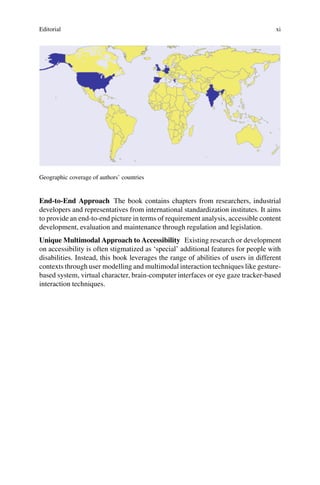



![1 What Technology Can and Cannot Offer an Ageing Population: Current... 5
technological devices in general and has been using them, but now he feels that the
development is running away from him. New technological devices are created so
fast that he is not able catch up with the market.
Some years ago, Jefferson tried to teach Al how to use a computer and internet.
Al liked the idea to be able to search and look for medical advices online, and how to
purchase some food and get it home delivered as he is not able to leave the house for
longer periods. But even if Al’s intention was genuine, he was not able to succeed.
It was too complicated and Al is concerned about the privacy of the data he enters
on internet. He was very frustrated when wanting to use “such a bloody complex
device” and decided to stop trying.
Even Jefferson, who has a positive attitude towards technology, finds it hard to
learn how to use the new devices that are released. In addition to the learning aspect,
there are other difficulties, for example the size of the buttons of his mobile phone.
They are so small that he makes many mistakes when writing a SMS. Jefferson is
not as accurate as he used to be with his hands anymore. Another problem is that
Jefferson has some hearing difficulties, and the volume of his mobile phone is not
loud enough so he does not always realize that someone is calling him. He has
the same problem with the TV. He set the volume so loud when watching, that his
neighbors complain.
Marcy, Jefferson’s wife, is 73 and worked as a bus driver. She was diagnosed
with diabetes some months ago. Every day, several times a day she measures the
sugar level in the blood. Even if she is able to do so, she still does not know how
to interpret the values she gets from the measurement which makes her worried.
Jefferson and Marcy would like to be able to ask a doctor more frequently how to
proceed once they have taken an assessment. But since there is no existing, simple
enough option to do it online, they have to go to hospital every time.
1.2 Facts and Figures
Older adults are the fastest growing demographic group in many developed coun-
tries right now and the group is expected to increase in an even higher speed in
future. In both absolute and relative terms this means that there will be more and
more older people within our society. In 1995 the median age for the European
Union (27 countries included) was 36.5 years, thereafter the population started to
age in a relative rapid pace reaching 40.9 years in 2010. This number means that
in 2010, 50 % of the population in EU was over 40.9 years and the tendency is
predicted to follow the same pattern. The median age is predicted to establish at
around 47.6 years in 2060. The whole EU population was estimated to 501.1 million
persons in the beginning of 2010, of these, 87.1 million were aged 65 or over. This
is an increase of 3.7 % in 20 years reaching a total percentage of 17.4 of the total
population. Table 1.1 shows the age distribution in the European countries.
The increase of aging people varies between the member states but in general the
pattern is the same for the whole EU [1–3].](https://image.slidesharecdn.com/2616921-250518125106-5903e9d7/85/A-Multimodal-End2end-Approach-To-Accessible-Computing-2nd-Edition-P-Biswas-28-320.jpg)
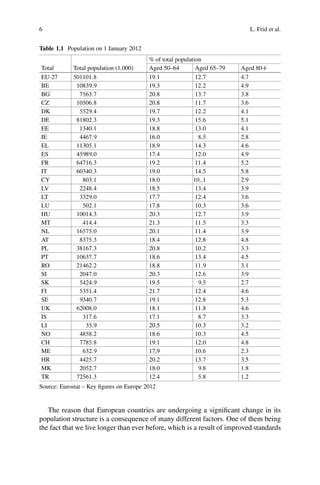
![1 What Technology Can and Cannot Offer an Ageing Population: Current... 7
of living such as healthier lifestyle (nutrition and physical activity), big advances
in health care and increased safety in general. People also suffer different kind of
diseases nowadays than earlier days. Before development of modern healthcare,
there were more acute and severe diseases which often led to a quick death. Diseases
are today not life threatening in the same way but chronic and slow developing
(further described in section “Older peoples benefits of ICTs” below [1]).
Another major cause of the significant change in the European population
structure is the trend of decreased birth-rate. People wait longer to bear their first
child and are sometimes not willing to, or considering themselves as unable to, raise
children. Having children later is also one natural explanation to the trend of having
fewer children per family. The fertility rate was 1.6 per family in 2008 which is
considered relatively low. This phenomenon is also clearly shown in the statistics.
There were 7.5 million new born children in the EU-27 in 1961, which fell briefly
to 5 million during 2002, recovering a bit to 5.4 million 2010 [1].
Further the EU’s population structure is also characterized by a particularly
high number of individuals born two decades after the Second World War. This
European baby-boom with high population cohorts born between 1940s and 1960s,
are now entering the age of retirement. This group has also given birth to few
children. Demographic changes take time to become apparent. Because of this, we
now witness the effects by the relative large cohorts of baby-boomers progressively
moving up the EU’s population pyramid towards older age, contributing to a top-
heavy population pyramid as show in Fig. 1.1 below.
80+
75
70
65
60
55
50
45
40
35
30
25
20
15
10
5
0
5 4
(1) Excluding French overseas departments in 1990.
3 2 1
Men
Age
Women
Solid colour: 2010
Bordered: 1990
0 1 2 3 4 5
Fig. 1.1 The changing European population pyramid (Source: Eurostat – Key figures on Europe
2012)](https://image.slidesharecdn.com/2616921-250518125106-5903e9d7/85/A-Multimodal-End2end-Approach-To-Accessible-Computing-2nd-Edition-P-Biswas-30-320.jpg)
![8 L. Frid et al.
The different factors described above make the natural change growing, that is,
the difference between the number of births and the number of deaths is increasing.
The extension of life expectancy is considered both blessing and a problem. Blessing
because people in general want to live longer lives, and a problem as the rapidly
growing older population will have major impacts from the perspective of society
and their quality of life. This new demand will affect the society not only with new
structural changes in the system and organization, but also in the aspect of how to
finance the care and maintenance of the quality of life of the older [3]. One way to
address the new demands of an ageing population is the introduction of different
technological devices.
1.3 Older People and Technology – Digital Exclusion
During past years, technology development has expanded through all spaces of the
human life and we can assume that the modern society is a “technological society”.
However, technology is having great difficulties to penetrate the field of ageing; and
older people are far from taking advantage from the potential benefits of technology
in terms of quality of life. The digital exclusion is one of the most common findings
while studying the implementation of technology in society. It is a phenomenon that
separates people those have the level and knowledge enough to control technology,
from the ones who, for different reasons, do not. There are a lot of different reasons
for the existing digital exclusion that generates a lower knowledge and usage
of technology, for example: differences in the access to the infrastructure, lower
education level, economical motives, access to the technology in general, usability
of the devices, capacity to acquire new information, people who live in isolated
places, cultural factors; or for some other reason as impairment, being immigrant
or being excluded from the technological world [2]. Many of these factors come
together which makes it difficult to combat. Within each country there are significant
differences in technology use depending on the factors mentioned above. Even if
they are real or only psychological (attitude, fear, etc.) they are important barriers
when it comes to incorporate older people in the use of technology [2].
Nevertheless there are some technological devices that have been able to
overcome these barriers. Among young people in Europe (up to 54) there is an
almost 100 % usage of mobile phone, 80 % of the 55–64 years group, and 61 % for
the group between 65 and 74 years. In Fig. 1.2 the mobile usage among young and
older European users are shown in the different countries.
When it comes to internet usage and age, the difference becomes bigger than in
the case of mobile phone. Internet is mainly used at home, even though some have
access to it in public institutions or at work as well. The access to a computer at
home is then an important factor related to internet use. The access to a good quality
internet connection follows the same pattern as access in general. Scandinavian
countries and Netherlands are the ones with most frequent internet use and are the
ones with most developed internet infrastructure. The percentage of users between
65 and 74 those never used internet, is around 70 % with big variation among](https://image.slidesharecdn.com/2616921-250518125106-5903e9d7/85/A-Multimodal-End2end-Approach-To-Accessible-Computing-2nd-Edition-P-Biswas-31-320.jpg)
![1 What Technology Can and Cannot Offer an Ageing Population: Current... 9
Fig. 1.2 Mobile phone usage in the different European countries. The whole population of the
country (blue or dark grey) and elderly (red or light grey) between 55 and 64 years old (Source:
http://epp.eurostat.ec.europa.eu/)
Fig. 1.3 Access to internet in the European homes (Source: http://epp.eurostat.ec.europa.eu/)
different European countries. Scandinavian countries, Netherlands and Luxemburg
all have usage percentages for older people reaching over 50 % while the rest
significant below [2] (Fig. 1.3).
1.4 The Aging Process Related to Technology
Ageing is commonly accompanied by different changes that can have an influence in
the interaction between older people and technology.In the following paragraphs the
most usual changes and pathologies related to ageing are described. In later sections,
how these disabilities and pathologies affect the interaction with technological
devices are explained.](https://image.slidesharecdn.com/2616921-250518125106-5903e9d7/85/A-Multimodal-End2end-Approach-To-Accessible-Computing-2nd-Edition-P-Biswas-32-320.jpg)
![10 L. Frid et al.
1.4.1 Cognition
A significant number of older people start having mild symptoms of cognitive
decline, as part of the normal aging process.
The main cognitive problems that worsen with age are declined speed of
information processing, difficulties in storing and recalling new information such
as remembering names and words, and difficulties in reasoning capacity [4, 5]. The
most usual condition related to cognition among older people is the Age Associated
Memory Impairment (AAMI). AAMI appeared likely to be a phenomenon of
normal aging, and is attributed to normal biological changes. AAMI is considered
to be a diagnostic entity [6] which is defined as the presence of subjective memory
decline, objective evidence of memory loss, no intellectual function problems, and
the lack of dementia or other memory disorder in a person 50 years or older.
Lane and Snowdon reported that there is a prevalence rate of 35 % for AAMI
in subjects with 65 years and over. The prevalence increases with the age and some
studies find an incidence of 54/1000 habitants per year in people over 75 years-
old [7, 8]. However, it is important to distinguish AAMI from Mild Cognitive
Impairment (MCI), which is considered to be a continuum or a predictor from
normal aging to pathologic state as Alzheimer’s disease (AD) [9].
Some general recommendations to address the age-related cognitive declines
while developing technological devices are:
• General slowness should be taking into account and no fast actions should
be required, including the double-click action.
• Neither dual tasks nor contradictory tasks (e.g. pointing at an icon on the
screen and, at the same time, press a key in the remote control with the
other hand) are recommended.
• Simplicity of the buttons and icons should be prioritized to excessive
embellishment to help to focus the attention.
• Button labels, icons, text and graphics should be understandable enough
without required a lot of extra explanations.
• Respect limits of the human working memory and the echoic store (approx.
3 to 4 elements) when designing menus.
• The process of learning how to use a system is also closely related with
memory and attention capacities. In order to make easier and faster this
process, the interaction with technology should be as easier as possible and
the number of actions needed to carry out an operation should be reduced.
• It is advisable to reduce the memory load. For instance, for the elderly it
can be more difficult to remember the verbal or gesture commands needed
to carry out an action when speech or gesture recognition is used.
• In order to avoid memory load, allow the users to repeat some actions, for
instance, repeat a message given by the system.
(continued)](https://image.slidesharecdn.com/2616921-250518125106-5903e9d7/85/A-Multimodal-End2end-Approach-To-Accessible-Computing-2nd-Edition-P-Biswas-33-320.jpg)
![1 What Technology Can and Cannot Offer an Ageing Population: Current... 11
• Visual and auditory feedback to confirm item selections should be pro-
vided.
• Provide both visual and auditory instructions simultaneously since it helps
to better memorize the information
• Messages should be short, factual and informative. Minimize the amount
of information by presenting only what is necessary.
It should be taken into account that the cognitive problems described in this
chapter are the ones associated with the ageing process but more serious problems
in the interaction with technologies can appear when pathologies like Alzheimer’s
disease is diagnosed.
1.4.2 Visual
At different stages in life, changes in external parts of the eye (cornea, lens and
muscles) affect the visual transmission and the visual ability. Changes in the retina
and in the nervous system begin to be significant between 55 and 65 years-old. Most
frequent vision problems that appear with age are:
• Deterioration in visual acuity: the inability to accurately discriminate between
two stimuli. For instance, an elderly person can have difficulties for discriminat-
ing between two similar traffic signs while driving.
• Presbyopia: Age-related condition affecting the ability to see close objects
accurately.
• Glare: blinding effect produced by direct light.
• The eye’s ability to adapt to changing light conditions is reduced.
• Reduced visual field capacity. This appears as the loss of peripheral vision, a
phenomenon known as tunnel vision.
The decrease in the sensibility to contrast starts around 25 years-old, being more
significant from 40 to 50 years-old on. Dazzle is a problem that might appear at any
age, but it becomes more serious around 40 years old.
– More or less at the age of 30 years-old some problems distinguishing colors,
specially green-blue, blue-violet, and pale colors appear.
The most usual pathologies related to vision that comes with age are:
• Cataracts. The amount of light reaching the cornea is diminishes because the
lens becomes yellow with age [10]. Therefore, older people need more light for
reading than the young.
• Glaucoma, which is the increase in intraocular pressure leading to optical nerve
atrophy and visual field abnormalities [11].](https://image.slidesharecdn.com/2616921-250518125106-5903e9d7/85/A-Multimodal-End2end-Approach-To-Accessible-Computing-2nd-Edition-P-Biswas-34-320.jpg)
![12 L. Frid et al.
The above mentioned changes and pathologies affect the interaction with tech-
nological devices, and should be taken into account in the following cases:
• Contrast:
– Older people need more time to adapt their vision from a dark to a light
environment.
– Contrast should be adjustable by the user.
– It is recommendable to put dark characters on a light background.
• Brightness
– Due to the changes in the crystalline, a person who is 60 years-old needs
three times more light than a person who is 20 years-old. So brightness
should be reduced since it makes it difficult to perceive images and also
produce visual fatigue.
• Dazzle
– The screen should be free of glare and reflections.
• Color
– Light colors reflect more amount of light than dark colors. Dark colors
provoke more visual fatigue.
– Bold or semi-bold letters are preferred over normal ones.
• Distance between the icons
– The system should provide the zoom option to have the possibility to
increase the icons and buttons size
– Text lines should be separated enough.
1.4.3 Hearing
Most hearing loss in old age is mainly due to degenerative changes of the cochlea,
the main receptor for the hearing nerve. After 75 years, the hearing deficit occurs
to many people and it more frequently appears among men than women. In a
recent study, Hannula and colleagues [12] found that 37.1 % of older adults had
hearing difficulties and 43.3 % had difficulties following a conversation in a noisy
environment.
Another common hearing problem that appears with age is presbycusis. Presby-
cusis appears when sensitivity to tones of higher frequencies diminished [13]. At
higher frequencies, men generally have poorer hearing sensitivity than women, a
difference that increases with age. This increase has been related to different levels
of noise exposure [14].](https://image.slidesharecdn.com/2616921-250518125106-5903e9d7/85/A-Multimodal-End2end-Approach-To-Accessible-Computing-2nd-Edition-P-Biswas-35-320.jpg)
![1 What Technology Can and Cannot Offer an Ageing Population: Current... 13
Older people with hearing problems can have normal low frequency hearing with
loss of mid and high frequencies. This leads to problems with understanding speech
especially in noisy or echoing environments [15]. Sometimes affected people are
unaware of the loss.
A general classification of the degree of the hearing loss [16] affirms that a
normal degree of hearing loss is the range from 10 to 15 dB HL hearing loss.
Age related hearing loss affects interaction with technological devices in follow-
ing cases:
• A user can listen to 150–160 words per minute comfortably. But in the
case of the older people it is advisable to reduce this speed since they have
a slower speed of processing [17]. Speech output should be intermediate,
not too fast but not too slow and the gap between items should be kept
fairly short (0.5–1.0 s).
• Avoid the use of homonyms (words which sound similar). Use single
words, or common (perhaps also jargon) word pairs.
• The language used should be simple, easy to understand and without using
technical terms. Unnecessary information should not be presented since
this can cause and overload the cognitive functions.
• Where possible provide a volume control so that users can adjust the
loudness of signals and tones. Abrupt changes of volume should be
avoided.
• Use a different sound than a real sound (e.g. telephone), to avoid confusion.
Take advantage of the associations between a concrete sound and a situa-
tion (e.g. emergency situation and the ambulance sound) learnt throughout
life. These associations are also found in older people and also people with
dementia.
• Users generally prefer natural recorded speech to synthetic speech
• Messages should be presented in a serial mode, not at the same time [18].
1.4.4 Mobility
Around 40 % of older people have some degree of activity limitation due to health
problems. It is found that around 20 % of those aged 76 years and older have a
walking speed around 0.4/s, which is considered to be a severe limitation in mobility
[19]. There findings suggest that 10 % of the non-institutionalised older population
have one or more limitations in activities of daily living while 17 % of them report
one or more limitations in instrumental activities of daily living. Besides that The
Survey of Health, Ageing and Retirement in Europe [20] reported approximately
17 % of the men and 23 % of the woman aged 65 and over have physical limitations
(e.g. Arthritis, Parkinson, etc : : : ) that also cause difficulties performing activities of](https://image.slidesharecdn.com/2616921-250518125106-5903e9d7/85/A-Multimodal-End2end-Approach-To-Accessible-Computing-2nd-Edition-P-Biswas-36-320.jpg)
![14 L. Frid et al.
daily living (e.g. dressing, getting in/out bed, eating, preparing a meal, shopping).
National Center for Health Statistics (NCHS) reported that the presence of one or
more physical limitations increases with age. This lead to a higher probability in
adults aged 80 and over, who are 2.5 times more likely to have one or more physical
limitations compared to adults aged 50–59 (43 % and 17 %). Whereas only 8 % of
the adults in the range of age from 50 to 59 have three or more physical limitations,
27 % of the adults aged 80 and over have three or more physical limitations [21].
In this study, the presence of eight possible physical limitations were studied: walk
a quarter of a mile; walk up 10 steps without resting; stand or be on your feet for
about 2 h; sit for about 2 h; stoop, bend, or kneel; reach up over your head; use
your fingers to grasp or handle small objects; lift or carry something as heavy as 10
pounds.
Another finding from NCHS, postulated that women are more prone than men of
the same age to suffer one or more physical limitations.
One of the most usual pathologies related to mobility that comes with age
is arthritis. Arthritis is a painful condition that can strike the spine, neck, back,
shoulder, hands and wrists, hip, knee, ankle, and feet. It can be immobilizing, and it
comes in many forms.
Mobility problems per se, and the pain derived of the health condition that causes
the mobility problems, can complicate interaction with technologies. For example,
pointing devices need 0.3–0.6 N of force which may not be possible for older adults
due to the weakness. Another problem that can appear is tremor. In this case, the
action with pointing devices requiring the hand movements should be adequate to
this problem and the area for selecting, for instance, an icon, should be larger. These
problems should be taken into account when designing technological devices for
older people. For people with severe mobility problems alternative modalities of
interaction (e.g. speech) are recommended.
Chapter 5 on Inclusive User Model presents a rule based system, where we actu-
ally implemented these rules in a software framework to personalize applications.
1.5 Benefits of ICTs
Information and Communication Technological solutions in developed societies are
changing to adapt to new user needs. Technological solutions are vertiginously
evolving in TV, mobile phones, personal computers, cooking instruments, washing
machines and so on. Technology is getting more and more complex to offer better
services and more specific features to target users. However older people, especially
the ones having no experience with technology during their working lives are not
involved in this societal change. They often fail to develop necessary abilities to
interact with technological devices and several solutions have not been designed to
being used for this group.
As previously stated, the ageing process implies several biological, societal
and behavioral changes that could lead to impairment, illness, dependency, pain,](https://image.slidesharecdn.com/2616921-250518125106-5903e9d7/85/A-Multimodal-End2end-Approach-To-Accessible-Computing-2nd-Edition-P-Biswas-37-320.jpg)
![1 What Technology Can and Cannot Offer an Ageing Population: Current... 15
social mistreatment, isolation and in worst of the cases, hospitalization and death.
Technology should not be a need by itself but a developing contribution to society,
and in this case be accessible to the requirements, desires and needs of the older
people. Accessibility can be defined as: “The Possibility that places, products
and services can be satisfactorily used by the greatest possible number of people,
independent of their personal limitations or those limitations that are derived from
their surroundings” [22]. To be able to implement accessibility, older people’s
special capacities and needs has to be taken into account which adds extra emphasis
on smart interface solutions.
Technology can benefit users in two main ways: fostering positive or minimizing
negative. In both cases there are several fields where technology can support older
people with their most frequent problems or just empowering them to improve their
quality of life, independency, autonomy, leisure time, and thus, improving their
lives. These fields, within a bio-psycho-social model, can be broadly separated in
three categories: cognitive, physical and societal benefits.
1.5.1 Cognitive Functions
At the cognitive level, technology can offer support through customized software of
self-management, exercise or stimulation to improve general cognitive functionali-
ties, such as memory, attention, monitoring capabilities, and so on.
1.5.1.1 Self-Management
Self-management applications are being broadly developed for different platforms.
These applications can include agendas, reminders, organization applications, task
checklists, etc. The idea is to translate pen and paper strategies for organization
in daily life into an automated, easy to use on-screen solutions with audio-visual
feedback.
1.5.1.2 Exercise and Rehabilitation
Even in severe impairment resulting from neurodegenerative diseases like trauma-
tisms or stroke, there is a chance to improve the cognitive status due to the effect of
neural plasticity [23–25]. This implies that new neural structures can be developed
with exercise through life. Older people could benefit exercising their cognitive
abilities, not only to make up for degeneration caused by ageing, but as a way to
engage with society or just to enjoy leisure time.
Technologies aim to bring accessible, usable and adapted training to older people
in order to make them cognitively active throughout the life course. Currently
the scientific community is researching the benefits of the Cognition supporting](https://image.slidesharecdn.com/2616921-250518125106-5903e9d7/85/A-Multimodal-End2end-Approach-To-Accessible-Computing-2nd-Edition-P-Biswas-38-320.jpg)
![16 L. Frid et al.
Software. Although evidence is still unknown, studies point in the direction that
technological support offer moderate benefits in cognitive abilities or at least a
slower decline and maintenance [26, 27].
1.5.2 Physical Abilities
As we age, our perceptual, cognitive and motor performance levels tend to decline,
however the incidence and prevalence of chronic diseases increase. Chronic diseases
like cardiovascular disease, chronic obstructive pulmonary disease (COPD), and
diabetes are the leading cause of death in developing countries. Technology can
support medical treatments, pharmacological and psychological therapy for people
with disabilities or illness. These solutions are constantly being developed to cope
with the impairments associated with age.
1.5.2.1 Monitoring and Direct Interaction
The increasing economic burden of chronic disease on health care requires a
fundamental change in the model of care-giving. The approach taken by reference
entities and recommended by national and international policies is to provide care
directly at home. This ensures appropriate monitoring and treatment of patients
while reducing cost involved in the process. It is not envisaged as a substitute of
long term hospitalization or physician contact, but a more economic and usable
provision of care directly to the patient. To this end, ICTs are being pointed out as
the best option. Tele-health technologies, by means of smart home environments,
adapted structures and home and tele-monitoring is a way of responding to the care
of the ageing population.
Monitoring of chronic diseases could bring a more direct and efficient system
to support and control diseases like Diabetes Mellitus, COPD, Heart Failure,
Alzheimer’s disease and other similar chronic or degenerative illnesses. The aims
of this technology are:
• Monitoring changes in the vital constants: lung capacity, airflow limitation,
oxygen saturation, blood pressure, blood glucose levels, heart rate, retinal
imaging, etc.
• Measuring behavioral and psychological indicators: Number of medical visi-
tations, number of nurse calls, quality of life, emotional wellbeing, activities
performance, physical exercise, etc.
• Alarm: fast reaction to predefined risk values in the measurements allowing the
user to make a video call to a formal or informal caregivers, call an ambulance
or raise an automatic alarm at the professional health record.
• Stimulation and feedback: to react to the user comments, alarms or physiological
measurements giving the user information, guidelines of action, or providing the](https://image.slidesharecdn.com/2616921-250518125106-5903e9d7/85/A-Multimodal-End2end-Approach-To-Accessible-Computing-2nd-Edition-P-Biswas-39-320.jpg)
![18 L. Frid et al.
perceptive resources (memorizing less, stop reading little labels, supporting with
searching for products for special needs), or physical resources (carrying the
bags, moving the trolleys, etc.).
• Housework (cooking, washing clothes, tidying the room : : : ): People with motor
impairment stated that they want support with this task [28] as they would do
with a vacuum cleaner, dishwasher, or kitchen robot. Electrical devices should be
designed more accessible to make all the users able to carry out the tasks. Several
projects are including supporting functionalities to cooking activities (recipes,
cooking suggestions, cooking step by step videos), intelligent fridges, robots to
help with grabbing and moving items, etc.
• Managing money: People with cognitive impairment associated to Alzheimer’s
disease have problems managing their own money. Technological aids with
a visual easy-to-understand representation of money organization could help,
shopping help and accessible websites to facilitate shopping too.
The basic and instrumental activities of daily living consist of several behavioral
and cognitive interactions with the environment to achieve basic goals relevant to
keep living actively, independently and autonomous. Technology should be adapted
in order to facilitate achieving these goals.
1.5.2.3 Rehabilitation and Training
Technology has an important part in rehabilitation for last 20 years. For example,
neuropsychological technologies has already lead to computer based prosthetics
and orthotics, cognitive probes with millisecond accurate links to functional imag-
ing, virtual reality managed ecological assessments, cognitive retraining, assistive
devices, and online, “real-time” database-driven evaluations [29], robotics, brain
computer interfaces or rehabilitation techniques based in biofeedback are some of
the procedures and instruments in which technology supports rehabilitation of motor
control (gait, balance, fine and broad motor control), and some other more specific
abilities.
1.5.3 Societal Benefits
Between others, one of the European Commission social aims is to foster social
inclusion. The information and communication technologies are involved in the
concept of e-inclusion. E-inclusion aims to achieve that “no one is left behind” in
enjoying the benefits of ICT [30].
In 2000 the Lisbon Council agreed to make a decisive impact on the eradication
of poverty and social exclusion by 2010. Concrete steps in the National Action Plans
against poverty and social exclusion and to improve access to the new ICTs and
opportunities new technologies can provide were encouraged. In 2006 The Riga](https://image.slidesharecdn.com/2616921-250518125106-5903e9d7/85/A-Multimodal-End2end-Approach-To-Accessible-Computing-2nd-Edition-P-Biswas-41-320.jpg)
![1 What Technology Can and Cannot Offer an Ageing Population: Current... 19
Ministerial Declaration on e-Inclusion identified six themes which the European
Commission should use to foster e-Inclusion:
1. E-Accessibility – make ICT accessible to all, meeting a wide spectrum of
people’s needs, in particular any special needs.
2. Ageing – empower older people to fully participate in the economy and society,
continue independent lifestyles and enhance their quality of life.
3. E-Competences – equip citizens with the knowledge, skills and lifelong learning
approach needed to increase social inclusion, employability and enrich their
lives.
4. Socio-Cultural e – Inclusion – enables minorities, migrants and marginalized
young people to fully integrate into communities and participate in society by
using ICT.
5. Geographical e-Inclusion – increase the social and economic wellbeing of people
in rural, remote and economically disadvantaged areas with the help of ICT.
6. Inclusive e-Government – deliver better, more diverse public services for all
using ICT while encouraging increased public participation in democracy [30].
By means of the e-inclusion policy and other similar initiatives (Ambient
Assisted Living (AAL) Joint Program or e-Accessibility), to eliminate the techno-
logical gap and to include elderly people in the technological society is envisaged.
Solving this gap would have direct effect into the elderly people needs, making
them able to access to different ways of support the technology can bring.
Being able to use ICTs’ would guarantee access to information, support tools,
education and learning, skills development, illness management, medical support
and monitorization, increasing autonomy and independency, increasing social
network and avoiding isolation, increasing quality of life and social participation
and, summarizing, making elderly people able to live full life and with all the
opportunities to do it integrated in the society.
1.6 Looking Towards Future-Design for All
It turns evident now that the future points towards Design for All approach that
makes products and services accessible to everybody. The basic principles for
achieving Design for All are the following:
– Simplicity: superfluous elements and operations must be reduced to a minimum.
The devices are supposed to be as simple as possible for the user to interact
with them. The hardware should include the minimal amount of buttons to
avoid confusion and avoid the risk of erroneous choices. The same regarding
the software, there should be a trade-off between amounts of available choices
without losing complexity. For example having a well-organized interface where
users intuitively know what options are available and how to interact in the
best way.](https://image.slidesharecdn.com/2616921-250518125106-5903e9d7/85/A-Multimodal-End2end-Approach-To-Accessible-Computing-2nd-Edition-P-Biswas-42-320.jpg)
![20 L. Frid et al.
– Flexibility: the design must adapt to the users’ abilities to interact with it. Its use
will therefore have to be flexible enough to adapt to its users’ characteristics.
All kind of users should be able to use the device, with no importance regarding
gender, age, culture background, previous knowledge or physical condition. The
interface has to be adjustable and customizable to users’ different capacities and
needs. For example if a user with lower vision is about to read a text, the font size
should be adjustable to fit the users preferences, as a zoom function or something
equal.
– Quick information: the system must enable users to perceive quickly and
unequivocally what it is and how they should start using it. The necessary
information should be available and precise.
– It must respond to a conceptual model of functioning that adapts to users’
previous experience and expectations. It is important that the users feel familiar
with the device even if it is new. Well known concepts and analogs should be used
constantly. For example if something is to be rotated the button should rotate at
the same direction as the clock which is a well-known standard. Other well-
known analogs as using a stylus pen as an input device on a tablet, is a good
choice for older users as it is a well-known analog for a normal pen a paper
situation [31].
– There must be a clear relationship between the activation systems at users’
disposal and the results that they generate. The latency should be as low as
possible, when the user makes a choice the system should react immediately.
Also if a button/icon indicates something, the reaction must be the expected.
– It must contain a feedback system that keeps users permanently informed about
the product condition and what it is doing. Receiving relevant feedback is very
important when interacting with a technological device. We need to know that
the device has received our command and the response the system is generating
should be clear. That way the dialog between the human being and the device is
fluid.
– Error prevention and handling: users may misunderstand or use the product for a
purpose other than the one for which it is intended, without this causing any
harmful consequences. The system must provide mechanisms for the user to
solve this situation. There should always be an option to “go back” or regret
ones input.
– Ensuring that the users take part in the product design and evaluation process.
This is the second main criteria when applying design for all, broadly accepted
in research and development projects as a methodological procedure named User
Centered Design. The approach is applied to ensure that for a representative
sample of potential users, the product or service will suit their anthropometric
and functional characteristics. This will also in its turn be compatible with their
habits and culture.
The starting point of the concept of Design for All is the principle that all
potential users can use the product or service correctly and that people find
the product easy to use. User participation in the design process provides direct](https://image.slidesharecdn.com/2616921-250518125106-5903e9d7/85/A-Multimodal-End2end-Approach-To-Accessible-Computing-2nd-Edition-P-Biswas-43-320.jpg)
![22 L. Frid et al.
15. Birren, J. E., Schaie, K. W. (2001). Handbook of the psychology of aging. San Diego:
Academic.
16. Clark, J. G. (1981). Uses and abuses of hearing loss classification. ASHA, 23(7), 493–500.
17. Salthouse, T. A. (2010). Selective review of cognitive aging. Journal of International Neu-
ropsychological Society, 16(5), 754–760.
18. Pereiro, A. X., Juncos, O., Rodríguez, M. S. (2001). Memoria operativa, atencion selectiva
y velocidad de procesamiento. Una aportacion al debate sobre el deterioro del funcionamiento
cognitivo en la vejez Working memory, selective attention and speed processing. A contribution
to discuss cognitive decline in aging. Cognitiva, 13(2), 209–225.
19. Nicholas, S., Huppert, F. A., McWilliams, B., Melzer, D. (2003). Physical and cognitive
function. In M. Marmot, J. Banks, R. Blundell, C. Lessof, J. Nazroo (Eds.), Health, wealth
and lifestyles of the older population in England: the 2002 English Longitudinal Study of
Ageing (pp. 249–271). London: IFS.
20. Alcser, K. H., Avendano, M., Börsch-Supan, A., Brunner, J. K., Cornaz, S., Dewey, M., et al.
(2005). Health, ageing and retirement in Europe. First results from the Survey of Health, Ageing
and Retirement in Europe. Mannheim: Mannheim Research Institute for the Economics of
Aging (MEA).
21. Holmes, J., Powell-Griner, E., Lethbridge-cejku, M., Heyman, K. (2009). Aging differently:
physical limitations among adults aged 50 years and over: United States, 2001–2007. NCHS
Data Brief, 20, 1–8.
22. Ministerio de Industria, Turismo y Comercio. (2009). Digital terrestrial television (DTT)
accessibility recommendations. www.inteco.es/file/snb-6ZR2I2DaXKiMJlkT_g. Accessed 13
July 2012.
23. Greenwood, P. M. (2007). Functional plasticity in cognitive aging: review and hypothesis.
Neuropsychology, 21(6), 657–673.
24. Kleim, J. A. (2011). Neural plasticity and neurorehabilitation: teaching the new brain old tricks.
Journal of Communication Disorders, 44(5), 521–528.
25. Burke, S. N., Barnes, C. A. (2006). Neural plasticity in the ageing brain. Nature Review
Neuroscience, 7(1), 30–40.
26. Wenisch, E., Cantegreil-Kallen, I., De Rotrou, J., Garrigue, P., Moulin, F., Batouche, F.,
Richard, A., De Sant’Anna, M., Rigaud, A. S. (2007). Cognitive stimulation intervention
for elders with mild cognitive impairment compared with normal aged subjects: preliminary
results. Aging Clinical and Experimental Research, 19(4), 316–322.
27. González-Abraldes, I., Millán-Calenti, J. C., Balo-García, A., Tubío, J., Lorenzo, T.,
Maseda, A. (2010). [Accessibility and usability of computer-based cognitive stimulation:
telecognitio]. Revista Española de Geriatría y Gerontología, 45(1), 26–29.
28. García, A., Facal, D., Ansorena X. (2012). DELIVERABLE D1.4.1: Requirement specifi-
cation of future remotely control service robot for home care. Instituto Gerentologico Matia,
Spain: SRS “Multi–role Shadow Robotic System for Independent Living”.
29. Chute, D. L. (2002). Neuropsychological technologies in rehabilitation. The Journal of Head
Trauma Rehabilitation, 17(5), 369–377.
30. European Commission. (2012). Europe’s Information Society Thematic Portal. In: European
Commission. Europe’s Information Society Thematic Portal. e-Accessibility. http://ec.europa.
eu/information_society/activities/einclusion/index_en.htm. Accessed 18 July 2012.
31. Dewsbury, G., Rouncefield, M., Sommerville, I., Onditi, V., Bagnall, P. (2007). Designing
technology with older people. Universal Access in the Information Society, 6(2), 207–217.](https://image.slidesharecdn.com/2616921-250518125106-5903e9d7/85/A-Multimodal-End2end-Approach-To-Accessible-Computing-2nd-Edition-P-Biswas-45-320.jpg)
![Chapter 2
Survey on Inclusive Human Machine Interaction
Issues in India
Pradipta Biswas
Abstract This chapter takes forward the discussion of the previous chapter in
Indian context. It compares and contrasts HCI issues for elderly users between
developing and developed countries. Our study found that there is a significant effect
of age on hand strength of elderly users limiting their use of standard computer
peripherals. It is also found that European elderly users tend to score higher in
cognitive tests than their Indian counterpart and for Indian population and there
is a significant correlation between education level and cognitive abilities. We also
pointed out a set of guidelines for interface designers to develop inclusive systems.
2.1 Introduction
The previous chapter presented a survey on users’ perceptual, cognitive and motor
capabilities and also their experience and attitude towards technology in three
different European countries. This chapter takes forward that survey in a developing
country by presenting a short survey on the human computer interaction (HCI)
issues of elderly and disabled users in India. It may be noted that by the term
HCI, we did not confine ourselves only to computers but also considered other
electronic interactive devices like mobile phones and Television sets. We have
initially identified functional parameters [3, 4] that can affect users’ interaction with
electronic devices and combined both objective metrics on functional parameters
and subjective attitude towards technology. Previous surveys either concentrated on
ergonomics or demographic details of users in European countries [8, 11, 12, 15]
or focused on a particular device like digital TV or mobile phones [13, 14]. There
is not much reported work on capabilities and attitude towards technology of older
Indian population, especially from a HCI point of view [8, 12, 15].
P. Biswas ()
Department of Engineering, University of Cambridge, Trumpington Street, Cambridge,
Cambridgeshire CB2 1PZ, UK
e-mail: pb400@hermes.cam.ac.uk
© Springer-Verlag London 2015
P. Biswas et al. (eds.), A Multimodal End-2-End Approach to Accessible Computing,
Human–Computer Interaction Series, DOI 10.1007/978-1-4471-6708-2_2
23](https://image.slidesharecdn.com/2616921-250518125106-5903e9d7/85/A-Multimodal-End2end-Approach-To-Accessible-Computing-2nd-Edition-P-Biswas-46-320.jpg)
![24 P. Biswas
Our study found that there is a significant effect of age on hand strength of
elderly users limiting their use of standard computer peripherals. It is also found
that European elderly users tend to score higher in cognitive tests than their
Indian counterpart and for Indian population and there is a significant correlation
between education level and cognitive abilities. We also found that elderly people
acknowledge the need of using new technologies though they prefer to use TV and
mobile phones than computers. The paper also points out the implication of the
findings for designers in Sect. 2.4.
2.2 Survey
We have conducted a survey to estimate users’ perceptual, cognitive and motor
capabilities and also their experience and attitude towards technology. Previous
surveys either concentrated on ergonomics or demographic details of users or
focused on a particular device like digital TV or mobile phones. We have initially
identified functional parameters [3, 4, 6] that can affect their interaction with
electronic devices and combined both objective metrics on functional parameters
and subjective attitude towards technology.
2.2.1 Place of Survey
The survey was conducted at Mandi, Himachal Pradesh, Kolkata, West Bengal and
Bangalore, Karnataka. The survey was conducted at old-age homes and participants
volunteered for the study. We also collected data from nine young people with
physical impairment at an Orthopedic Hospital in Kolkata.
For comparative analysis with European population, we used results from a
previous survey (presented in the previous chapter and [9]) conducted in UK, Spain
and Germany.
2.2.2 Participants
We collected data from 33 users. Figure 2.1 shows an age histogram while 10
users were female and 23 were male. Nine users were younger but had physical
impairment as listed in Table 2.1.
We have also used results from a previous survey conducted on approximately
30 people at Spain, UK and Germany. We used that data to compare performance
and attitude of Indian population to their European counterpart.](https://image.slidesharecdn.com/2616921-250518125106-5903e9d7/85/A-Multimodal-End2end-Approach-To-Accessible-Computing-2nd-Edition-P-Biswas-47-320.jpg)
![2 Survey on Inclusive Human Machine Interaction Issues in India 25
Age Histogram
0
2
4
6
8
10
12
10 20 30 40 50 60 70 80 90 100
Age (in years)
Fig. 2.1 Age histogram of Indian sample
Table 2.1 Description of
younger users
Age Sex Disability
26 F Polio
30 F Polio
25 F Polio
26 M Polio
27 F Birth defect
26 M Birth defect
27 M Lost one hand in accident
28 M Lost one hand in accident
2.2.3 Functional Parameters Measurement
We measured objective parameters about perceptual, cognitive and motor abilities
of users using standard test batteries. We have measured the following parameters
based on our previous studies which identified them as relevant for interaction with
electronic devices.
Minimum Font Size (FS) We measured it using a Snellen chart (Fig. 2.2)
calibrated for a 1024 768 display screen and recorded the last line users can read
correctly from 3 ft distance using identical screen for all users. Based on that we
can calculate the minimum visual angle required for different users and can convert
it into different units of specifying font size like point, pixel or em.
Colour Blindness (CB) We measured the presence and type of colour blindness
using the plates 16 and 17 of Ishihara Test [7] (Fig. 2.3). People with dichromatic
colour blindness can only read one digit – people with Protanopia can only read the
left hand side digit while with Deuteranopia can only read right hand side digit.
Grip Strength (GS) measures how much force a person can exert gripping with
the hand. We measured it using a mechanical dynamometer (Fig. 2.4).](https://image.slidesharecdn.com/2616921-250518125106-5903e9d7/85/A-Multimodal-End2end-Approach-To-Accessible-Computing-2nd-Edition-P-Biswas-48-320.jpg)
![26 P. Biswas
Fig. 2.2 Snellen chart used
in the study
Fig. 2.3 Plates 16 and 17 of Ishihara test
Active Range of Motion of Wrist (ROMW) is measured as the summation of
Radial and Ulnar deviation. Radial deviation is the motion that rotates the wrist away
from the midline of the body when the person is standing in the standard anatomical
position [10]. When the hand is placed over a table with palm facing down, this
motion rotates the hand about the wrist towards the thumb. Ulnar deviation is the
motion that rotates the wrist towards the midline of the body when the person is
standing in the standard anatomical position. When the hand is placed over a table
with palm facing down, this motion rotates the hand about the wrist towards the
little finger. We measured the deviations with the goniometer (Fig. 2.5).](https://image.slidesharecdn.com/2616921-250518125106-5903e9d7/85/A-Multimodal-End2end-Approach-To-Accessible-Computing-2nd-Edition-P-Biswas-49-320.jpg)
![2 Survey on Inclusive Human Machine Interaction Issues in India 27
Fig. 2.4 Measuring grip
strength
Measuring Radial Deviation
Measuring Ulnar Deviation
Range of Motion of wrist
(Palm facing down)
Radial
Deviation
Ulnar
Deviation
Fig. 2.5 Measuring active ROM of wrist
Trail Making Test (TMT) The Trail Making Test [2] is a neuropsychological test
of visual attention and task switching. It consists of two parts in which the subject
is instructed to connect a set of 25 dots as fast as possible while still maintaining
accuracy. It can provide information about visual search speed, scanning, speed of
processing, mental flexibility, as well as executive functioning. It is also sensitive to
detecting several cognitive impairments such as Alzheimer’s disease and dementia.
Digit Symbol Test (DST) It is a neuropsychological test [2] sensitive to brain
damage, dementia, age and depression. It consists of (e.g. nine) digit-symbol pairs
(e.g. 1/-,2/ : : : 7/ƒ,8/X,9/D) followed by a list of digits. Under each digit the
subject should write down the corresponding symbol as fast as possible. The number
of correct symbols within the allowed time (90 s) is measured.](https://image.slidesharecdn.com/2616921-250518125106-5903e9d7/85/A-Multimodal-End2end-Approach-To-Accessible-Computing-2nd-Edition-P-Biswas-50-320.jpg)
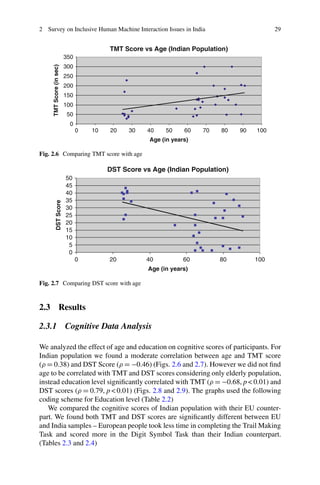
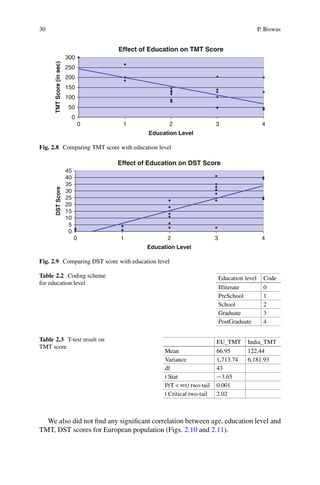
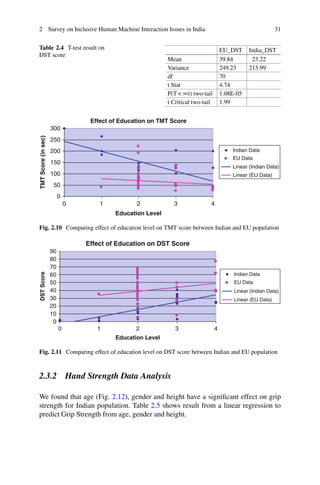

![difficulty, after all that has been written, in stating the extent of their
designs; but I think we may assume, that a wide-spreading and
formidable insurrection was for several months in agitation.[797] But
the difficulties and hazards of the enterprise had already caused
Lord Russell and Lord Essex to recede from the desperate counsels
of Shaftesbury; and but for the unhappy detection of the conspiracy
and the perfidy of Lord Howard, these two noble persons, whose
lives were untimely lost to their country, might have survived to join
the banner and support the throne of William. It is needless to
observe that the minor plot, if we may use that epithet in reference
to the relative dignity of the conspirators, for assassinating the king
and the Duke of York, had no immediate connection with the
schemes of Russell, Essex, and Sidney.[798]
But it is by no means a consequence from the admission we have
made, that the evidence adduced on Lord Russell's trial was
sufficient to justify his conviction.[799] It appears to me that Lord
Howard, and perhaps Rumsey, were unwilling witnesses; and that
the former, as is frequently the case with those who betray their
friends in order to save their own lives, divulged no more than was
extracted by his own danger. The testimony of neither witness,
especially Howard, was given with any degree of that precision
which is exacted in modern times; and, as we now read the trial, it is
not probable that a jury in later ages would have found a verdict of
guilty, or would have been advised to it by the court. But, on the
other hand, if Lord Howard were really able to prove more than he
did, which I much suspect, a better conducted examination would
probably have elicited facts unfavourable to the prisoner, which at
present do not appear. It may be doubtful whether any overt act of
treason is distinctly proved against Lord Russell, except his
concurrence in the project of a rising at Taunton, to which Rumsey
deposes. But this depending on the oath of a single witness, could
not be sufficient for a conviction.](https://image.slidesharecdn.com/2616921-250518125106-5903e9d7/85/A-Multimodal-End2end-Approach-To-Accessible-Computing-2nd-Edition-P-Biswas-56-320.jpg)
![Pemberton, chief justice of the common pleas, tried this illustrious
prisoner with more humanity than was usually displayed on the
bench; but, aware of his precarious tenure in office, he did not
venture to check the counsel for the Crown, Sawyer and Jefferies,
permitting them to give a great body of hearsay evidence, with only
the feeble and useless remark that it did not affect the prisoner.[800]
Yet he checked Lord Anglesea, when he offered similar evidence for
the defence. In his direction to the jury, it deserves to be remarked
that he by no means advanced the general proposition, which better
men have held, that a conspiracy to levy war is in itself an overt act
of compassing the king's death; limiting it to cases where the king's
person might be put in danger, in the immediate instance, by the
alleged scheme of seizing his guards.[801] His language indeed, as
recorded in the printed trial, was such as might have produced a
verdict of acquittal from a jury tolerably disposed towards the
prisoner; but the sheriffs, North and Rich, who had been illegally
thrust into office, being men wholly devoted to the prerogative, had
taken care to return a panel in whom they could confide.[802]
The trial of Algernon Sidney, at which Jefferies, now raised to the
post of chief justice of the king's bench, presided, is as familiar to all
my readers as that of Lord Russell.[803] Their names have been
always united in grateful veneration and sympathy. It is notorious
that Sidney's conviction was obtained by a most illegal distortion of
the evidence. Besides Lord Howard, no living witness could be
produced to the conspiracy for an insurrection; and though Jefferies
permitted two others to prepossess the jury by a second-hand story,
he was compelled to admit that their testimony could not directly
affect the prisoner.[804] The attorney-general therefore had recourse
to a paper found in his house, which was given in evidence, either as
an overt act of treason by its own nature, or as connected with the
alleged conspiracy; for though it was only in the latter sense that it
could be admissible at all, yet Jefferies took care to insinuate, in his
charge to the jury, that the doctrines it contained were treasonable](https://image.slidesharecdn.com/2616921-250518125106-5903e9d7/85/A-Multimodal-End2end-Approach-To-Accessible-Computing-2nd-Edition-P-Biswas-57-320.jpg)
![in themselves, and without reference to other evidence. In regard to
truth, and to that justice which cannot be denied to the worst men
in their worst actions, I must observe that the common accusation
against the court in this trial, of having admitted insufficient proof by
the mere comparison of handwriting, though alleged, not only in
most of our historians, but in the act of parliament reversing
Sidney's attainder, does not appear to be well founded; the
testimony to that fact, unless the printed trial is falsified in an
extraordinary degree, being such as would be received at present.
[805] We may allow also that the passages from this paper, as laid in
the indictment, containing very strong assertions of the right of the
people to depose an unworthy king, might by possibility, if
connected by other evidence with the conspiracy itself, have been
admissible as presumptions for the jury to consider whether they
had been written in furtherance of that design. But when they came
to be read on the trial with their context, though only with such
parts of that as the attorney-general chose to produce out of a
voluminous manuscript, it was clear that they belonged to a
theoretical work on government, long since perhaps written, and
incapable of any bearing upon the other evidence.[806]
The manifest iniquity of this sentence upon Algernon Sidney, as well
as the high courage he displayed throughout these last scenes of his
life, have inspired a sort of enthusiasm for his name, which neither
what we know of his story, nor the opinion of his contemporaries
seem altogether to warrant. The crown of martyrdom should be
suffered perhaps to exalt every virtue, and efface every defect in
patriots, as it has often done in saints. In the faithful mirror of
history, Sidney may lose something of this lustre. He possessed no
doubt a powerful, active, and undaunted mind, stored with extensive
reading on the topics in which he delighted. But having proposed
one only object for his political conduct, the establishment of a
republic in England, his pride and inflexibility, though they gave a
dignity to his character, rendered his views narrow and his temper
unaccommodating. It was evident to every reasonable man that a](https://image.slidesharecdn.com/2616921-250518125106-5903e9d7/85/A-Multimodal-End2end-Approach-To-Accessible-Computing-2nd-Edition-P-Biswas-58-320.jpg)
![republican government, being adverse to the prepossessions of a
great majority of the people, could only be brought about and
maintained by the force of usurpation. Yet for this idol of his
speculative hours, he was content to sacrifice the liberties of Europe,
to plunge the country in civil war, and even to stand indebted to
France for protection. He may justly be suspected of having been
the chief promoter of the dangerous cabals with Barillon; nor could
any tool of Charles's court be more sedulous in representing the
aggressions of Louis XIV. in the Netherlands as indifferent to our
honour and safety.
Sir Thomas Armstrong, who had fled to Holland on the detection of
the plot, was given up by the States. A sentence of outlawry, which
had passed against him in his absence, is equivalent, in cases of
treason, to a conviction of the crime. But the law allows the space of
one year, during which the party may surrender himself to take his
trial. Armstrong, when brought before the court, insisted on this
right, and demanded a trial. Nothing could be more evident, in point
of law, than that he was entitled to it. But Jefferies, with inhuman
rudeness, treated his claim as wholly unfounded, and would not
even suffer counsel to be heard in his behalf. He was executed
accordingly without trial.[807] But it would be too prolix to
recapitulate all the instances of brutal injustice, or of cowardly
subserviency, which degraded the English lawyers of the Stuart
period, and never so infamously as in these last years of Charles II.
From this prostitution of the tribunals, from the intermission of
parliaments, and the steps taken to render them in future mere
puppets of the Crown, it was plain that all constitutional securities
were at least in abeyance; and those who felt themselves most
obnoxious, or whose spirit was too high to live in an enslaved
country, retired to Holland as an asylum in which they might wait the
occasion of better prospects, or, at the worst, breathe an air of
liberty.
Meanwhile the prejudice against the whig party, which had reached
so great a height in 1681, was still farther enhanced by the detection](https://image.slidesharecdn.com/2616921-250518125106-5903e9d7/85/A-Multimodal-End2end-Approach-To-Accessible-Computing-2nd-Edition-P-Biswas-59-320.jpg)
![of the late conspiracy. The atrocious scheme of assassination,
alleged against Walcot and some others who had suffered, was
blended by the arts of the court and clergy, and by the blundering
credulity of the gentry, with those less heinous projects ascribed to
Lord Russell and his associates.[808] These projects, if true in their
full extent, were indeed such as men honestly attached to the
government of their country could not fail to disapprove. For this
purpose, a declaration full of malicious insinuations was ordered to
be read in all churches.[809] It was generally commented upon, we
may make no question, in one of those loyal discourses, which,
trampling on all truth, charity, and moderation, had no other scope
than to inflame the hearers against nonconforming protestants, and
to throw obloquy on the constitutional privileges of the subject.
High tory principles of the clergy.—It is not my intention to censure,
in any strong sense of the word, the Anglican clergy at this time for
their assertion of absolute non-resistance, so far as it was done
without calumny and insolence towards those of another way of
thinking, and without self-interested adulation of the ruling power.
Their error was very dangerous, and had nearly proved destructive
of the whole constitution; but it was one which had come down with
high recommendation, and of which they could only perhaps be
undeceived, as men are best undeceived of most errors, by
experience that it might hurt themselves. It was the tenet of their
homilies, their canons, their most distinguished divines and casuists;
it had the apparent sanction of the legislature in a statute of the
present reign. Many excellent men, as was shown after the
revolution, who had never made use of this doctrine as an engine of
faction or private interest, could not disentangle their minds from the
arguments or the authority on which it rested. But by too great a
number it was eagerly brought forward to serve the purposes of
arbitrary power, or at best to fix the wavering protestantism of the
court by professions of unimpeachable loyalty. To this motive, in fact,
we may trace a good deal of the vehemence with which the non-
resisting principle had been originally advanced by the church of](https://image.slidesharecdn.com/2616921-250518125106-5903e9d7/85/A-Multimodal-End2end-Approach-To-Accessible-Computing-2nd-Edition-P-Biswas-60-320.jpg)
![England under the Tudors, and was continually urged under the
Stuarts. If we look at the tracts and sermons published by both
parties after the restoration, it will appear manifest that the Romish
and Anglican churches bade, as it were, against each other for the
favour of the two royal brothers. The one appealed to its
acknowledged principles, while it denounced the pretensions of the
holy see to release subjects from their allegiance, and the bold
theories of popular government which Mariana and some other
Jesuits had promulgated. The others retaliated on the first movers of
the reformation, and expatiated on the usurpation of Lady Jane
Grey, not to say Elizabeth, and the republicanism of Knox or Calvin.
Passive obedience.—From the æra of the exclusion bill especially, to
the death of Charles II., a number of books were published in favour
of an indefeasible hereditary right of the Crown, and of absolute
non-resistance. These were however of two very different classes.
The authors of the first, who were perhaps the more numerous, did
not deny the legal limitations of monarchy. They admitted that no
one was bound to concur in the execution of unlawful commands.
Hence the obedience they deemed indispensable was denominated
passive; an epithet which, in modern usage, is little more than
redundant, but at that time made a sensible distinction. If all men
should confine themselves to this line of duty, and merely refuse to
become the instruments of such unlawful commands, it was evident
that no tyranny could be carried into effect. If some should be
wicked enough to co-operate against the liberties of their country, it
would still be the bounden obligation of Christians to submit. Of this,
which may be reckoned the moderate party, the most eminent were
Hickes in a treatise called Jovian, and Sherlock in his case of
resistance to the supreme powers.[810] To this also must have
belonged Archbishop Sancroft, and the great body of non-juring
clergy who had refused to read the declaration of indulgence under
James II., and whose conduct in that respect would be utterly
absurd, except on the supposition that there existed some lawful
boundaries of the royal authority.](https://image.slidesharecdn.com/2616921-250518125106-5903e9d7/85/A-Multimodal-End2end-Approach-To-Accessible-Computing-2nd-Edition-P-Biswas-61-320.jpg)
![Some contend for absolute-power.—But besides these men, who
kept some measures with the constitution, even while, by their
slavish tenets, they laid it open to the assaults of more intrepid
enemies, another and a pretty considerable class of writers did not
hesitate to avow their abhorrence of all limitations upon arbitrary
power. Brady went back to the primary sources of our history, and
endeavoured to show that Magna Charta, as well as every other
constitutional law, were but rebellious encroachments on the ancient
uncontrollable imprescriptible prerogatives of the monarchy. His
writings, replete with learning and acuteness, and in some respects
with just remarks, though often unfair and always partial, naturally
produced an effect on those who had been accustomed to value the
constitution rather for its presumed antiquity, than its real
excellence. But the author most in vogue with the partisans of
despotism was Sir Robert Filmer. He had lived before the civil war,
but his posthumous writings came to light about this period. They
contain an elaborate vindication of what was called the patriarchal
scheme of government, which, rejecting with scorn that original
contract whence human society had been supposed to spring,
derives all legitimate authority from that of primogeniture, the next
heir being king by divine right, and as incapable of being restrained
in his sovereignty, as of being excluded from it. As kingly power, he
says, is by the law of God, so hath it no inferior power to limit it.
The father of a family governs by no other law than his own will, not
by the laws and wills of his sons and servants.[811] The direction of
the law is but like the advice and direction which the king's council
gives the king, which no man says is a law to the king.[812]
General laws, he observes, made in parliament, may, upon known
respects to the king, by his authority be mitigated or suspended
upon causes only known to him; and by the coronation oath, he is
only bound to observe good laws, of which he is the judge.[813] A
man is bound to obey the king's command against law, nay, in some
cases, against divine laws.[814] In another treatise, entitled The
Anarchy of a Mixed or Limited Monarchy, he inveighs, with no kind
of reserve or exception, against the regular constitution; setting off](https://image.slidesharecdn.com/2616921-250518125106-5903e9d7/85/A-Multimodal-End2end-Approach-To-Accessible-Computing-2nd-Edition-P-Biswas-62-320.jpg)
![with an assumption that the parliament of England was originally but
an imitation of the States General of France, which had no further
power than to present requests to the king.[815]
These treatises of Filmer obtained a very favourable reception. We
find the patriarchal origin of government frequently mentioned in the
publications of this time as an undoubted truth. Considered with
respect to his celebrity rather than his talents, he was not, as some
might imagine, too ignoble an adversary for Locke to have
combated. Another person, far superior to Filmer in political
eminence, undertook at the same time an unequivocal defence of
absolute monarchy. This was Sir George Mackenzie, the famous lord
advocate of Scotland. In his Jus Regium, published in 1684, and
dedicated to the university of Oxford, he maintains, that monarchy
in its nature is absolute, and consequently these pretended
limitations are against the nature of monarchy.[816] Whatever
proves monarchy to be an excellent government, does by the same
reason prove absolute monarchy to be the best government; for if
monarchy be to be commended, because it prevents divisions, then
a limited monarchy, which allows the people a share, is not to be
commended, because it occasions them; if monarchy be
commended, because there is more expedition, secrecy, and other
excellent qualities to be found in it, then absolute monarchy is to be
commended above a limited one, because a limited monarch must
impart his secrets to the people, and must delay the noblest designs,
until malicious and factious spirits be either gained or overcome; and
the same analogy of reason will hold in reflecting upon all other
advantages of monarchy, the examination whereof I dare trust to
every man's own bosom.[817] We can hardly, after this, avoid being
astonished at the effrontery even of a Scots crown lawyer, when we
read in the preface to this very treatise of Mackenzie, Under whom
can we expect to be free from arbitrary government, when we were
and are afraid of it under King Charles I. and King Charles II.?
Decree of the university of Oxford.—It was at this time that the
university of Oxford published their celebrated decree against](https://image.slidesharecdn.com/2616921-250518125106-5903e9d7/85/A-Multimodal-End2end-Approach-To-Accessible-Computing-2nd-Edition-P-Biswas-63-320.jpg)
![pernicious books and damnable doctrines, enumerating as such
above twenty propositions which they anathematised as false,
seditious, and impious. The first of these is, that all civil authority is
derived originally from the people; the second, that there is a
compact, tacit or express, between the king and his subjects: and
others follow of the same description. They do not explicitly
condemn a limited monarchy, like Filmer, but evidently adopt his
scheme of primogenitary right, which is incompatible with it. Nor is
there the slightest intimation that the university extended their
censure to such praises of despotic power as have been quoted in
the last pages.[818] This decree was publicly burned by an order of
the House of Lords in 1709: nor does there seem to have been a
single dissent in that body to a step that cast such a stigma on the
university. But the disgrace of the offence was greater than that of
the punishment.
We can frame no adequate conception of the jeopardy in which our
liberties stood under the Stuarts, especially in this particular period,
without attending to this spirit of servility which had been so
sedulously excited. It seemed as if England was about to play the
scene which Denmark had not long since exhibited, by a
spontaneous surrender of its constitution. And although this loyalty
were much more on the tongue than in the heart, as the next reign
very amply disclosed, it served at least to deceive the court into a
belief that its future steps would be almost without difficulty. It is
uncertain whether Charles would have summoned another
parliament. He either had the intention, or professed it in order to
obtain money from France, of convoking one at Cambridge in the
autumn of 1681.[819] But after the scheme of new-modelling
corporations began to be tried, it was his policy to wait the effects of
this regeneration. It was better still, in his judgment, to dispense
with the Commons altogether. The period fixed by law had elapsed
nearly twelve months before his death; and we have no evidence
that a new parliament was in contemplation. But Louis, on the other
hand, having discontinued his annual subsidy to the king in 1684,](https://image.slidesharecdn.com/2616921-250518125106-5903e9d7/85/A-Multimodal-End2end-Approach-To-Accessible-Computing-2nd-Edition-P-Biswas-64-320.jpg)
![after gaining Strasburg and Luxemburg by his connivance, or rather
co-operation,[820] it would not have been easy to avoid a recurrence
to the only lawful source of revenue. The King of France, it should
be observed, behaved towards Charles as men usually treat the low
tools by whose corruption they have obtained any end. During the
whole course of their long negotiations, Louis, though never the
dupe of our wretched monarch, was compelled to endure his
shuffling evasions, and pay dearly for his base compliances. But
when he saw himself no longer in need of them, it seems to have
been in revenge that he permitted the publication of the secret
treaty of 1670, and withdrew his pecuniary aid. Charles deeply
resented both these marks of desertion in his ally. In addition to
them he discovered the intrigues of the French ambassadors with his
malcontent Commons. He perceived also that by bringing home the
Duke of York from Scotland, and restoring him in defiance of the test
act to the privy council, he had made the presumptive heir of the
throne, possessed as he was of superior steadiness and attention,
too near a rival to himself. These reflections appear to have
depressed his mind in the latter months of his life, and to have
produced that remarkable private reconciliation with the Duke of
Monmouth, through the influence of Lord Halifax; which, had he
lived, would very probably have displayed one more revolution in the
uncertain policy of this reign.[821] But a death, so sudden and
inopportune as to excite suspicions of poison in some most nearly
connected with him, gave a more decisive character to the system of
government.[822]
THE TEMPLE PRESS, PRINTERS, LETCHWORTH](https://image.slidesharecdn.com/2616921-250518125106-5903e9d7/85/A-Multimodal-End2end-Approach-To-Accessible-Computing-2nd-Edition-P-Biswas-65-320.jpg)
![FOOTNOTES:
[1] It hath so happened, he says, by the disobedient and seditious carriage of
those said ill-affected persons of the House of Commons, that we and our regal
authority and commandment have been so highly contemned as our kingly office
cannot bear, nor any former age can parallel. Rymer, xix. 30.
[2] Rymer, xix. 62.
[3] Whitelock's Memorials, p. 14. Whitelock's father was one of the judges of the
king's bench; his son takes pains to exculpate him from the charge of too much
compliance, and succeeded so well with the long parliament that when they voted
Chief-Justice Hyde and Justice Jones guilty of delay in not bailing these
gentlemen, they voted also that Croke and Whitelock were not guilty of it. The
proceedings, as we now read them, hardly warrant this favourable distinction.
Parl. Hist. ii. 869, 876.
[4] Strode's act is printed in Hatsell's Precedents, vol. i. p. 80, and in several other
books, as well as in the great edition of Statutes of the Realm. It is worded, like
many of our ancient laws, so confusedly, as to make its application uncertain; but
it rather appears to me not to have been intended as a public act.
[5] State Trials, vol. iii. from Rushworth.
[6] Hatsell, pp. 212, 242.
[7] Rushworth.
[8] Rushworth; State Trials, iii. 373; Whitelock, p. 12. Chambers applied several
times for redress to the long parliament on account of this and subsequent
injuries, but seems to have been cruelly neglected, while they were voting large
sums to those who had suffered much less, and died in poverty.
[9] I have remarked in former passages that the rack was much employed,
especially against Roman catholics, under Elizabeth. Those accused of the
gunpowder conspiracy were also severely tortured; and others in the reign of
James. Coke, in the Countess of Shrewsbury's case, 1612 (State Trials, ii. 773),
mentions it as a privilege of the nobility, that their bodies are not subject to](https://image.slidesharecdn.com/2616921-250518125106-5903e9d7/85/A-Multimodal-End2end-Approach-To-Accessible-Computing-2nd-Edition-P-Biswas-66-320.jpg)
![torture in causâ criminis læsæ majestatis. Yet, in his third Institute, p. 35, he
says, the rack in the Tower was brought in by the Duke of Exeter, under Henry VI.,
and is, therefore, familiarly called the Duke of Exeter's daughter; and after quoting
Fortescue to prove the practice illegal, concludes—There is no law to warrant
tortures in this land, nor can they be justified by any prescription, being so lately
brought in. Bacon observes, in a tract written in 1603: In the highest cases of
treason, torture is used for discovery, and not for evidence.—i. 393. See also Miss
Aikin's Memoirs of James I. ii. 158.
[10] State Trials, iii. 359. This was a very important determination, and put an end
to such tyrannical persecution of Roman catholics for bare expressions of opinion
as had been used under Elizabeth and James.
[11] Rushworth (Abridged), ii. 253; Strafford's Letters, ii. 74.
[12] Whitelock, 16; Kennet, 63. We find in Rymer, xix. 279, a commission, dated
May 6, 1631, enabling the privy-council at all times to come, to hear and examine
all differences which shall arise betwixt any of our courts of justice, especially
between the civil and ecclesiastical jurisdictions, etc. This was in all probability
contrived by Laud, or some of those who did not favour the common law. But I do
not find that anything was done under this commission, which, I need hardly say,
was as illegal as most of the king's other proceedings.
[13] 2 Inst. 593. The regulations contained in the statute de militibus, 1 Ed. II.,
though apparently a temporary law, seem to have been considered by Coke as
permanently binding. Yet in this statute the estate requiring knighthood, or a
composition for it, is fixed at £20 per annum.
[14] According to a speech of Mr. Hyde in the long parliament, not only military
tenants, but all others, and even lessees and merchants, were summoned before
the council on this account. Parl. Hist. ii. 948. This was evidently illegal; especially
if the Statutum de militibus was in force, which by express words exempts them.
See Mr. Brodie's Hist. of British Empire, ii. 282. There is still some difficulty about
this, which I cannot clear up, nor comprehend why the title, if it could be had for
asking, was so continually declined; unless it were, as Mr. B. hints, that the fees of
knighthood greatly exceeded the composition. Perhaps none who could not prove
their gentility were admitted to the honour, though the fine was extorted from
them. It is said that the king got £100,000 by this resource. Macauley, ii. 107.
[15] Rushworth Abr. ii. 102.
[16] Strafford's Letters, i. 335.
[17] Id. pp. 463, 467.](https://image.slidesharecdn.com/2616921-250518125106-5903e9d7/85/A-Multimodal-End2end-Approach-To-Accessible-Computing-2nd-Edition-P-Biswas-67-320.jpg)
![[18] Id. ii. 117. It is well known that Charles made Richmond Park by means of
depriving many proprietors not only of common rights, but of their freehold lands.
Clarendon, i. 176. It is not clear that they were ever compensated; but I think this
probable, as the matter excited no great clamour in the long parliament. And
there is in Rymer, xx. 585, a commission to Cottington and others, directing them
to compound with the owners of lands within the intended enclosures. Dec. 12,
1634.
[19] Kennet, 64; Rushworth's Abridg. ii. 132; Strafford's Letters, i. 446; Rymer, xix.
323; Laud's Diary, 51.
[20] Rymer, xx. 340.
[21] Kennet, 74, 75. Strafford Letters, i. 358. Some petty sea-ports in Sussex
refused to pay ship-money; but finding that the sheriff had authority to distrain on
them, submitted. The deputy-lieutenants of Devonshire wrote to the council in
behalf of some towns a few miles distant from the sea, that they might be spared
from this tax, saying it was a novelty. But they were summoned to London for
this, and received a reprimand for their interference. Id. 372.
[22] Clarendon State Papers, i. 49, and ii. Append. p. xxvi.
[23] This curious intrigue, before unknown, I believe, to history, was brought to
light by Lord Hardwicke. State Papers, ii. 54.
[24] See Clarendon State Papers, i. 490, for a proof of the manner in which,
through the Hispano-popish party in the cabinet, the house of Austria hoped to
dupe and dishonour Charles.
[25] Clarendon State Papers, i. 109, et post. Five English ships out of twenty were
to be at the charge of the King of Spain. Besides this agreement, according to
which the English were only bound to protect the ships of Spain within their own
seas, or the limits claimed as such, there were certain secret articles, signed Dec.
16, 1634; by one of which Charles bound himself, in case the Dutch should not
make restitution of some Spanish vessels taken by them within the English seas,
to satisfy the court of Spain himself out of ships and goods belonging to the
Dutch; and by the second, to give secret instructions to the commanders of his
ships, that when those of Spain and Flanders should encounter their enemies at
open sea, far from his coasts and limits, they should assist them if over-matched,
and should give the like help to the prizes which they should meet, taken by the
Dutch, that they might be freed and set at liberty; taking some convenient pretext
to justify it, that the Hollanders might not hold it an act of hostility. But no part of
this treaty was to take effect till the Imperial ban upon the Elector Palatine should
be removed. Id. 215.
[26] Clarendon State Papers, i. 721, 761.](https://image.slidesharecdn.com/2616921-250518125106-5903e9d7/85/A-Multimodal-End2end-Approach-To-Accessible-Computing-2nd-Edition-P-Biswas-68-320.jpg)
![[27] Strafford Papers, ii. 52, 53, 60, 66. Richlieu sent d'Estrades to London, in
1637, according to Père Orleans, to secure the neutrality of England in case of his
attacking the maritime towns of Flanders conjointly with the Dutch. But the
ambassador was received haughtily, and the neutrality refused; which put an end
to the scheme, and so irritated Richlieu, that he sent a priest named Chamberlain
to Edinburgh the same year, in order to foment troubles in Scotland. Revol.
d'Anglet. iii. 42. This is confirmed by d'Estrades himself. See note in Sidney
Papers, ii. 447, and Harris's Life of Charles, 189; also Lingard, x. 69. The
connection of the Scotch leaders with Richlieu in 1639 is matter of notorious
history. It has lately been confirmed and illustrated by an important note in
Mazure, Hist. de la Revolution en 1688, ii. 402. It appears by the above-
mentioned note of M. Mazure, that the celebrated letter of the Scots lords,
addressed Au Roy, was really sent, and is extant. There seems reason to think
that Henrietta joined the Austrian faction about 1639; her mother being then in
England, and very hostile to Richlieu. This is in some degree corroborated by a
passage in a letter of Lady Carlisle. Sidney Papers, ii. 614.
[28] Sidney Papers, ii. 613.
[29] Clarendon State Papers, ii. 16.
[30] See the instructions in Rushworth, ii. 214.
[31] Rushworth, 253. The same judge declared afterwards, in a charge to the
grand jury of York, that ship-money was an inseparable flower of the Crown,
glancing at Hutton and Croke for their opposition to it. Id. 267.
[32] As it is impossible to reconcile the trifling amount of this demand with
Hampden's known estate, the tax being probably not much less than sixpence in
the pound, it has been conjectured that his property was purposely rated low. But
it is hard to perceive any motive for this indulgence; and it seems more likely that
a nominal sum was fixed upon in order to try the question; or that it was only
assessed on a part of his estate.
[33] There seems to have been something unusual, if not irregular, in this part of
the proceeding. The barons of the exchequer called in the other judges, not only
by way of advice but direction, as the chief baron declares. State Trials, 1203. And
a proof of this is, that the court of exchequer being equally divided, no judgment
could have been given by the barons alone.
[34] State Trials, iii. 826-1252.
[35] Croke, whose conduct on the bench in other political questions was not
without blemish, had resolved to give judgment for the king, but was withheld by
his wife, who implored him not to sacrifice his conscience for fear of any danger
or prejudice to his family, being content to suffer any misery with him, rather than](https://image.slidesharecdn.com/2616921-250518125106-5903e9d7/85/A-Multimodal-End2end-Approach-To-Accessible-Computing-2nd-Edition-P-Biswas-69-320.jpg)
![to be an occasion for him to violate his integrity. Whitelock, p. 25. Of such high-
minded and inflexible women our British history produces many examples.
[36] Laud writes to Lord Wentworth, that Croke and Hutton had both gone against
the king very sourly. The accidents which have followed upon it already are
these: First, the faction are grown very bold. Secondly, the king's monies come in
a great deal more slowly than they did in former years, and that to a very
considerable sum. Thirdly, it puts thoughts into wise and moderate men's heads,
which were better out; for they think if the judges, which are behind, do not their
parts both exceeding well and thoroughly, it may much distemper this
extraordinary and great service. Strafford Letters, ii. 170.
[37] It is notoriously known that pressure was borne with much more
cheerfulness before the judgment for the king, than ever it was before. Clarendon,
p. 122.
[38] Rushworth Abr. ii. 341; Clarendon State Papers, i. 600. It is said by Heylin
that the clergy were much spared in the assessment of ship-money. Life of Laud,
302.
[39] Rymer, passim.
[40] Id. xix. 512. It may be curious to mention some of these. The best turkey
was to be sold at 4s. 6d.; the best goose at 2s. 4d.; the best pullet, 1s. 8d.; three
eggs for a penny; fresh butter at 5d. in summer, at 6d. in winter. This was in
1634.
[41] Id. xx. 113.
[42] Id. 157.
[43] Rymer, xviii. 33, et alibi. A commission was granted to the Earl of Arundel and
others, May 30, 1625, to enquire what houses, shops, etc., had been built for ten
years past, especially since the last proclamation, and to commit the offenders. It
recites the care of Elizabeth and James to have the city built in an uniform manner
with brick, and also to clear it from under-tenants and base people who live by
begging and stealing. Id. xviii. 97.
[44] Rymer, xix. 375.
[45] Rushworth Abr. ii. 232.
[46] Rushworth, ii. 79.
[47] Id. p. 313.
[48] Rushworth Abr. iii. 123; Whitelock, p. 35; Strafford Letters, i. 374, et alibi.
See what Clarendon says, p. 293 (ii. 151, edit. 1826). The second of these tells](https://image.slidesharecdn.com/2616921-250518125106-5903e9d7/85/A-Multimodal-End2end-Approach-To-Accessible-Computing-2nd-Edition-P-Biswas-70-320.jpg)
![us, that the city offered to build for the king a palace in St. James's park by way
of composition, which was refused. If this be true, it must allude to the palace
already projected by him, the magnificent designs for which by Inigo Jones are
well known. Had they been executed, the metropolis would have possessed a
splendid monument of Palladian architecture; and the reproach sometimes thrown
on England, of wanting a fit mansion for its monarchs, would have been
prevented. But the exchequer of Charles the First had never been in such a state
as to render it at all probable that he could undertake so costly a work.
[49] Strafford Letters, i. 340.
[50] Rymer, xix. 699.
[51] Id. 198.
[52] Roger Coke's Detection of the Court of England, i. 309. He was Sir Edward's
grandson.
[53] Rymer, xx. 190.
[54] Id. xix. 740. See also 82.
[55] Hudson's Treatise of the Court of Star-chamber, p. 51. This valuable work,
written about the end of James's reign, is published in Collectanea Juridica, vol. ii.
There is more than one manuscript of it in the British Museum.
In another treatise, written by a clerk of the council about 1590 (Hargrave MSS.
ccxvi. 195), the author says: There was a time when there grew a controversy
between the star-chamber and the King's Bench for their jurisdiction in a cause of
perjury concerning tithes, Sir Nicholas Bacon, that most grave and worthy
counsellor, then being lord-keeper of the great seal, and Sir Robert Catlyn, knight,
then lord chief justice of the bench. To the deciding thereof were called by the
plaintiff and defendant a great number of the learned counsellors of the law: they
were called into the inner star-chamber after dinner, where before the lords of the
council they argued the cause on both sides, but could not find the court of
greater antiquity by all their books than Henry VII. and Richard III. On this I fell in
cogitation how to find some further knowledge thereof. He proceeds to inform us,
that by search into records he traced its jurisdiction much higher. This shows,
however, the doubts entertained of its jurisdiction in the queen's time. This writer,
extolling the court highly, admits that some of late have deemed it to be new,
and put the same in print, to the blemish of its beautiful antiquity. He then
discusses the question (for such it seems it was), whether any peer, though not of
the council, might sit in the star-chamber; and decides in the negative. Ao. 5to. of
her majesty, he says, in the case of the Earl of Hertford, there were assembled a
great number of the noble barons of this realm, not being of the council, who](https://image.slidesharecdn.com/2616921-250518125106-5903e9d7/85/A-Multimodal-End2end-Approach-To-Accessible-Computing-2nd-Edition-P-Biswas-71-320.jpg)
![offered there to sit; but at that time it was declared unto them by the lord-keeper
that they were to give place; and so they did, and divers of them tarried the
hearing of the cause at the bar.
This note ought to have been inserted in Chapter I., where the antiquity of the
star-chamber is mentioned, but was accidentally overlooked.
[56] P. 56.
[57] P. 62. Lord Bacon observes, that the council in his time did not meddle with
meum and tuum as formerly; and that such causes ought not to be entertained.
Vol. i. 720; vol. ii. 208. The king, he says, should be sometimes present, yet not
too often. James was too often present, and took one well-known criminal
proceeding, that against Sir Thomas Lake and his family, entirely into his own
hands.
[58] P. 82.
[59] P. 108.
[60] Pp. 100, 102.
[61] P. 107. The following case in the queen's reign goes a great way: An
information was preferred in the star-chamber against Griffin and another for
erecting a tenement in Hog-lane, which he divided into several rooms, wherein
were inhabiting two poor tenants, that only lived and were maintained by the
relief of their neighbours, etc. The attorney-general, and also the lord mayor and
aldermen, prayed some condign punishment on Griffin and the other, and that the
court would be pleased to set down and decree some general order in this and
other like cases of new building and division of tenements. Whereupon the court,
generally considering the great growing evils and inconveniences that continually
breed and happen by this new erected building and divisions made and divided
contrary to her majesty's said proclamation, commit the offenders to the Fleet,
and fine them £20 each; but considering that if the houses be pulled down, other
habitations must be found, did not, as requested, order this to be done for the
present, but that the tenants should continue for their lives without payment of
rent, and the landlord is directed not to molest them, and after the death or
departure of the tenants the houses to be pulled down. Harl. MSS. N. 299, fol. 7.
[62] Harl. MSS. p. 142, etc. It appears that the court of star-chamber could not
sentence to punishment on the deposition of an eye-witness (Rushw. Abr. ii. 114):
a rule which did not prevent their receiving the most imperfect and inconclusive
testimony.
[63] P. 36, 224. Instead of the slavish punishment of whipping, the printed book
has the slavish speech of whispering, which of course entirely alters the sense,](https://image.slidesharecdn.com/2616921-250518125106-5903e9d7/85/A-Multimodal-End2end-Approach-To-Accessible-Computing-2nd-Edition-P-Biswas-72-320.jpg)
![or rather makes nonsense. I have followed a MS. in the Museum (Hargrave, N.
250), which agrees with the abstract of this treatise by Rushworth, ii. 348.
[64] Vallenger, author of seditious libels, was sentenced in the queen's reign to
stand twice in the pillory, and lose both his ears. Harl. MSS. 6265, fol. 373. So also
the conspirators who accused Archbishop Sandys of adultery. Id. 376. And Mr.
Pound, a Roman catholic gentleman, who had suffered much before for his
religion, was sentenced by that court, in 1603, to lose both his ears, to be fined
£1000, and imprisoned for life, unless he declared who instigated him to charge
Serjeant Philips with injustice in condemning a neighbour of his to death.
Winwood, ii. 36.
[65] The scarcity must have been very great this season (1631), for he refused £2
18s. for the quarter of rye. Rushworth, ii. 110.
[66] Rushworth, 340. Garrard, the correspondent of Wentworth, who sent him all
London news, writes about this: The attorney-general hath sent to all taverns to
prohibit them to dress meat; somewhat was required of them, a halfpenny a quart
for French wine, and a penny for sack and other richer wines, for the king: the
gentlemen vintners grew sullen, and would not give it, so they are all well enough
served. Strafford Letters, i. 507.
[67] Hacket's Life of Williams; Rushworth Abr. ii. 315, et post; Brodie ii. 363.
[68] Osbaldiston swore that he did not mean Laud; an undoubted perjury.
[69] Mr. Brodie (Hist. of Brit. Emp. vol. ii. p. 309) observes, that he cannot find in
Leighton's book (which I have never seen) the passage constantly brought
forward by Laud's apologists, wherein he is supposed to have recommended the
assassination of the bishops. He admits, indeed, as does Harris, that the book was
violent; but what can be said of the punishment?
[70] Rushworth; State Trials.
[71] Id. Whitelock, p. 18; Harris's Life of Charles, p. 262. The unfortunate words
in the index, Women actors notorious whores, cost Prynne half his ears; the
remainder he saved by the hangman's mercy for a second harvest. When he was
brought again before the star-chamber, some of the lords turned up his hair, and
expressed great indignation that his ears had not been better cropped. State
Trials, 717. The most brutal and servile of these courtiers seems to have been the
Earl of Dorset, though Clarendon speaks well of him. He was also impudently
corrupt, declaring that he thought it no crime for a courtier that lives at great
expense in his attendance, to receive a reward to get a business done by a great
man in favour. Rush. Abr. ii. 246. It is to be observed that the star-chamber
tribunal was almost as infamous for its partiality and corruption as its cruelty. See
proofs of this in the same work. P. 241.](https://image.slidesharecdn.com/2616921-250518125106-5903e9d7/85/A-Multimodal-End2end-Approach-To-Accessible-Computing-2nd-Edition-P-Biswas-73-320.jpg)
![[72] The intimidation was so great, that no counsel dared to sign Prynne's plea;
yet the court refused to receive it without such signature. Rushworth, ii. 277;
Strafford Letters, ii. 74.
[73] Id. 85; Rushw. 295; State Trials. Clarendon, who speaks in a very
unbecoming manner of this sentence, admits that it excited general
disapprobation. P. 73.
[74] Laud's character is justly and fairly drawn by May, neither in the coarse
caricature style of Prynne, nor with the absurdly flattering pencil of Clarendon.
The Archbishop of Canterbury was a main agent in this fatal work; a man vigilant
enough, of an active or rather of a restless mind; more ambitious to undertake
than politic to carry on; of a disposition too fierce and cruel for his coat; which
notwithstanding he was so far from concealing in a subtle way, that he increased
the envy of it by insolence. He had few vulgar and private vices, as being neither
taxed of covetousness, intemperance, or incontinence; and in a word a man not
altogether so bad in his personal character, as unfit for the state of England. Hist.
of Parliament, 19.
[75] The following entry appears in Laud's Diary (March 6, 1636): Sunday,
William Juxon, lord bishop of London, made lord high-treasurer of England: no
churchman had it since Hen. VII.'s time. I pray God bless him to carry it so that
the church may have honour, and the king and the state service and contentment
by it. And now, if the church will not hold themselves up under God, I can do no
more.
Those who were far from puritanism could not digest this strange elevation.
James Howell writes to Wentworth: The news that keeps greatest noise here at
this present, is that there is a new lord-treasurer; and it is news indeed, it being
now twice time out of mind since the white robe and the white staff marched
together; we begin to live here in the church triumphant; and there wants but one
more to keep the king's conscience, which is more proper for a churchman than
his coin, to make it triumvirate. Straff. Letters, i. 522. Garrard, another
correspondent expresses his surprise, and thinks Strafford himself, or Cottington,
would have done better. P. 523. And afterwards (vol. ii. p. 2), The clergy are so
high here since the joining of the white sleeves with the white staff, that there is
much talk of having as secretary a bishop, Dr. Wren, Bishop of Norwich, and as
chancellor of the exchequer, Dr. Bancroft, Bishop of Oxford; but this comes only
from the young fry of the clergy; little credit is given to it, but it is observed, they
swarm mightily about the court. The tone of these letters shows that the writer
suspected that Wentworth would not be well pleased at seeing a churchman set
over his head. But in several of his own letters he positively declares his aversion
to the office, and perhaps with sincerity. Ambition was less predominant in his
mind than pride, and impatience of opposition. He knew, that as lord-treasurer he](https://image.slidesharecdn.com/2616921-250518125106-5903e9d7/85/A-Multimodal-End2end-Approach-To-Accessible-Computing-2nd-Edition-P-Biswas-74-320.jpg)
![would be perpetually thwarted and undermined by Cottington and others of the
council. They, on the other hand, must have dreaded that such a colleague might
become their master. Laud himself, in his correspondence with Strafford, never
throws out the least hint of a wish that he should succeed Weston, which would
have interfered with his own views.
It must be added that Juxon redeemed the scandal of his appointment by an
unblemished probity, and gave so little offence in this invidious greatness, that the
long parliament never attacked him, and he remained in his palace at Fulham
without molestation till 1647.
[76] Strafford's Letters, i. 33, etc. The letters of Wentworth in this period of his life
show a good deal of ambition and resentment, but no great portion of public
spirit. This collection of the Strafford letters forms a very important portion of our
historical documents. Hume had looked at them very superficially, and quotes
them but twice. They furnished materials to Harris and Macaulay; but the first is
little read at present, and the second not at all. In a recent and deservedly
popular publication, Macdiarmid's Lives of British Statesmen, the work of a young
man of letters, who did not live to struggle through the distresses of that
profession, the character of Strafford is drawn from the best authorities, and with
abundant, perhaps excessive candour. Mr. Brodie has well pointed out that he has
obtained more credit for the early period of his parliamentary life than he
deserves, by being confounded with Mr. Wentworth, member for Oxford. Vol. ii. p.
249. Rushworth has even ascribed to Sir Thomas Wentworth the speeches of this
Mr. Wentworth in the second parliament of Charles, from which it is notorious that
the former had been excluded.
[77] Hacket tells us, in his elegant style, that Sir John Eliot of the west, and Sir
Thomas Wentworth of the north, both in the prime of their age and wits, both
conspicuous for able speakers, clashed so often in the house, and cudgelled one
another with such strong contradictions, that it grew from an emulation between
them to an enmity. The lord-treasurer Weston picked out the northern cock, Sir
Thomas, to make him the king's creature, and set him upon the first step of his
rising; which was wormwood in the taste of Eliot, who revenged himself upon the
king in the Bill of Tonnage, and then fell upon the treasurer, and declaimed
against him, that he was the author of all the evils under which the kingdom was
oppressed. He proceeds to inform us, that Bishop Williams offered to bring Eliot
over, for which Wentworth never forgave him. Life of Williams, p. 82. The
magnanimous fortitude of Eliot forbids us to give credit to any surmise
unfavourable to his glory, upon such indifferent authority; but several passages in
Wentworth's letters to Laud show his malice towards one who had perished in the
great cause which he had so basely forsaken.](https://image.slidesharecdn.com/2616921-250518125106-5903e9d7/85/A-Multimodal-End2end-Approach-To-Accessible-Computing-2nd-Edition-P-Biswas-75-320.jpg)
![[78] Wentworth was brought over before the assassination of Buckingham. His
patent in Rymer bears date 22nd July 1628, a month previous to that event.
[79] Fourth Inst. c. 49. See also 13 Reports, 31.
[80] Rymer, xix. 9; Rushworth, ii. 127.
[81] Rushworth; Strafford's Trial, etc.; Brodie, ii. 319; Straff. Letters, i. 145. In a
letter to Lord Doncaster, pressing for a severe sentence on Foulis, who had been
guilty of some disrespect to himself as president of the North, Wentworth shows
his abhorrence of liberty with all the bitterness of a renegado; and urges the
seasonable correcting an humour and liberty I find reign in these parts, of
observing a superior command no farther than they like themselves, and of
questioning any profit of the Crown, called upon by his majesty's ministers, which
might enable it to subsist of itself, without being necessitated to accept of such
conditions, as others might easily think to impose upon it. Sept. 1632. Somers
Tracts, iv. 198.
[82] Rushworth Abr. iii. 85; Clarendon, i. 390 (1826). The original editors left out
some words which brought this home to Strafford. And if the case was as there
seems every reason to believe, I would ask those who talk of this man's
innocence, whether in any civilised country, a more outrageous piece of tyranny
has been committed by a governor than to compel a nobleman of the highest
station to change the disposition of his private estate, because that governor
carried on an adulterous intercourse with the daughter-in-law of the person whom
he treated thus imperiously?
[83] Clarendon Papers, i. 449, 543, 594; Rushworth Abridg. iii. 43; Clar. Hist. i.
386 (1826); Strafford Letters, i. 497, et post. This proceeding against Lord
Mountnorris excited much dissatisfaction in England; those of the council who
disliked Strafford making it a pretext to inveigh against his arrogance. But the
king, invariably on the severe and arbitrary side, justified the measure, which
silenced the courtiers. P. 512. Be it added, that the virtuous Charles took a bribe
of £6000 for bestowing Mountnorris's office on Sir Adam Loftus, not out of distress
through the parsimony of parliament, but to purchase an estate in Scotland. Id.
511.
Hume, in extenuating the conduct of Strafford as to Mountnorris's trial, says, that,
sensible of the iniquity of the sentence, he procured his majesty's free pardon to
Mountnorris. There is not the slightest evidence to warrant the words in italics;
on the contrary, he always justified the sentence, and had most manifestly
procured it. The king, in return to a moving petition of Lady Mountnorris,
permitted his release from confinement, on making such a submission as my
lord-deputy shall approve.](https://image.slidesharecdn.com/2616921-250518125106-5903e9d7/85/A-Multimodal-End2end-Approach-To-Accessible-Computing-2nd-Edition-P-Biswas-76-320.jpg)
![[84] Strafford Letters, i. 111.
[85] P. 155.
[86] Strafford Letters, p. 329. In other letters they complain of what they call the
Lady Mora, which seems to be a cant word for the inefficient system of the rest of
the council, unless it is a personal nickname for Weston.
[87] The bishops, before the Reformation, issued process from their courts in their
own names. By the statute of 1 Edw. VI. c. 2, all ecclesiastical jurisdiction is
declared to be immediately from the Crown; and it is directed that persons
exercising it shall use the king's arms in their seal, and no other. This was
repealed under Mary; but her act is itself repealed by 1 Jac. I. c. 25, § 48. This
seems to revive the act of Edward. The spiritual courts, however, continued to
issue process in the bishop's name, and with his seal. On some difficulty being
made concerning this, it was referred by the star-chamber to the twelve judges,
who gave it under their hands that the statute of Edward was repealed, and that
the practice of the ecclesiastical courts in this respect was agreeable to law. Neal,
589; Kennet, 92; Rushw. Abr. iii. 340. Whitelock says (p. 22), that the bishops all
denied that they held their jurisdiction from the king, for which they were liable to
heavy penalties. This question is of little consequence; for it is still true that
ecclesiastical jurisdiction, according to the law, emanates from the Crown; nor
does anything turn on the issuing of process in the bishop's name, any more than
on the holding courts-baron in the name of the lord. In Ireland, unless I am
mistaken, the king's name is used in ecclesiastical proceedings. Laud, in his
famous speech in the star-chamber, 1637, and again on his trial, asserts episcopal
jurisdiction (except what is called in foro contentioso) to be of divine right; a
doctrine not easily reconcilable with the Crown's supremacy over all causes under
the statute of Elizabeth; since any spiritual censure may be annulled by a lay
tribunal, the commission of delegates; and how this can be compatible with a
divine authority in the bishop to pronounce it, seems not easy to prove. Laud, I
have no doubt, would have put an end to this badge of subordination to the
Crown. The judges in Cawdrey's Case (5 Reports) held a very different language;
nor would Elizabeth have borne this assumption of the prelates as tamely as
Charles, in his poor-spirited bigotry, seems to have done. Stillingfleet, though he
disputes at great length the doctrine of Lord Coke, in his fifth Report, as to the
extent of the royal supremacy before the first of Elizabeth, fully admits that since
the statute of that year, the authority for keeping courts, in whose name soever
they may be held, is derived from the king. Vol. iii. 768, 778.
This arrogant contempt of the lawyers manifested by Laud and his faction of
priests led to the ruin of the great churchmen and of the church itself—by the
hands, chiefly, of that powerful body they had insulted, as Clarendon has justly
remarked.](https://image.slidesharecdn.com/2616921-250518125106-5903e9d7/85/A-Multimodal-End2end-Approach-To-Accessible-Computing-2nd-Edition-P-Biswas-77-320.jpg)
![[88] P. 111.
[89] P. 173.
[90] P. 129.
[91] P. 201. See also p. 223.
[92] Vol. ii. p. 100.
[93] Id. ii. 136.
[94] P. 138.
[95] P. 158.
[96] P. 178.
[97] P. 60.
[98] Vol. i. p. 420.
[99] P. 246; see also p. 370.
[100] The unfavourable physiognomy of Strafford is noticed by writers of that
time. Somers Tracts, iv. 231. It did not prevent him from being admired by the fair
sex, especially at his trial, where, May says, they were all on his side. The
portraits by Vandyke at Wentworth and Petworth are well known; the latter
appears eminently characteristic.
[101] See the cases of Workman, Peter Smart, etc., in the common histories:
Rushworth, Rapin, Neal, Macauley, Brodie, and even Hume, on one side; and for
what can be said on the other, Collier, and Laud's own defence on his trial. A
number of persons, doubtless inclining to the puritan side, had raised a sum of
money to buy up impropriations, which they vested in trustees for the purpose of
supporting lecturers; a class of ministers to whom Laud was very averse. He
caused the parties to be summoned before the star-chamber, where their
association was dissolved, and the impropriations already purchased were
confiscated to the Crown. Rushworth Abr. ii. 17; Neal, i. 556.
[102] This originated in an order made at the Somerset assizes by Chief Justice
Richardson, at the request of the justices of peace, for suppressing these feasts,
which had led to much disorder and profaneness. Laud made the privy council
reprove the judge, and direct him to revoke the order. Kennet, p. 71; Rushw. Abr.
ii. 166. Heylin says, the gentlemen of the county were against Richardson's order,
which is one of his habitual falsehoods. See Rushw. Abr. ii. 167. I must add,
however, that the proclamation was perfectly legal, and according to the spirit of
the late act (1 Car. I. c. 1) for the observance of the Lord's day. It has been rather](https://image.slidesharecdn.com/2616921-250518125106-5903e9d7/85/A-Multimodal-End2end-Approach-To-Accessible-Computing-2nd-Edition-P-Biswas-78-320.jpg)
![misrepresented by those who have not attended to its limitations, as Neal and Mr.
Brodie. Dr. Lingard, ix. 422, has stated the matter rightly.
[103] Neal, 569; Rushworth Abr. ii. 166; Collier, 758; Heylin's Life of Laud, 241,
290. The last writer extenuates the persecution by Wren; but it is evident by his
own account that no suspension or censure was taken off till the party conformed
and read the declaration.
[104] Neal, p. 546. I do not know how he makes his computation.
[105] A proclamation, dated May 1, 1638, reciting that the king was informed that
many persons went yearly to New England in order to be out of the reach of
ecclesiastical authority, commands that no one shall pass without a licence, and a
testimonial of conformity from the minister of his parish. Rymer, xx. 223. Laud, in
a letter to Strafford (ii. 169), complains of men running to New England, when
there was a want of them in Ireland. And why did they so, but that any trackless
wilderness seemed better than his own or his friend's tyranny? In this letter he
laments that he is left alone in the envious and thorny part of the work, and has
no encouragement.
[106] In thirteen years, ending with 1640, but £4080 was levied on recusants by
process from the exchequer, according to Commons' Journals, 1 Dec. 1640. But it
cannot be denied that they paid considerable sums by way of composition, though
less probably than in former times. Lingard, ix. 424, etc., note G. Weston is said
by Clarendon to have offended the catholics by enforcing penalties to raise the
revenue. One priest only was executed for religion, before the meeting of the long
parliament. Butler, iv. 97. And though, for the sake of appearance, proclamations
for arresting priests and recusants sometimes came forth, they were always
discharged in a short time. The number pardoned in the first sixteen years of the
king is said to have amounted, in twenty-nine counties only, to 11,970. Neal, 604.
Clarendon, i. 261, confirms the systematic indulgence shown to catholics, which
Dr. Lingard seems, reluctantly and by silence, to admit.
[107] Strafford Letters, i. 505, 524; ii. 2, 57.
[108] Heylin, 286. The very day of Abbot's death, an offer of a cardinal's hat was
made to Laud, as he tell us in his Diary, by one that avowed ability to perform it.
This was repeated some days afterwards (Aug. 4th and 17th, 1633). It seems very
questionable whether this came from authority. The new primate made a strange
answer to the first application, which might well encourage a second; certainly not
what might have been expected from a steady protestant. If we did not read this
in his own Diary, we should not believe it. The offer at least proves that he was
supposed capable of acceding to it.](https://image.slidesharecdn.com/2616921-250518125106-5903e9d7/85/A-Multimodal-End2end-Approach-To-Accessible-Computing-2nd-Edition-P-Biswas-79-320.jpg)
![[109] Clarendon State Papers, ii. 44. It is always important to distinguish dates. By
the year 1639, the court of Rome had seen the fallacy of those hopes she had
previously been led to entertain, that the king and church of England would return
to her fold. This might exasperate her against him, as it certainly did against
Laud; besides which, I should suspect the influence of Spain in the conclave.
[110] Proofs of this abound in the first volume of the collection just quoted, as
well as in other books. The catholics were not indeed unanimous in the view they
took of the king's prerogative, which became of importance in the controversy as
to the oath of allegiance; one party maintaining that the king had a right to put
his own explanation on that oath, which was more to be regarded than the sense
of parliament; while another denied that they could conscientiously admit the
king's interpretation against what they knew to have been the intention of the
legislature who imposed it. A Mr. Courtney, who had written on the latter side, was
imprisoned in the Tower, on pretext of recusancy, but really for having
promulgated so obnoxious an opinion. P. 258, et alibi; Memoirs of Panzani, p. 140.
The jesuits were much against the oath, and, from whatever cause, threw all the
obstacles they could in the way of a good understanding between the king and
the pope. One reason was their apprehension that an article of the treaty would
be the appointment of a catholic bishop in England; a matter about which the
members of that church have been quarrelling ever since the reign of Elizabeth,
but too trifling for our notice in this place. More than half Panzani's Memoirs relate
to it.
[111] Id. p. 207. This is a statement by Father Leander; in another place (p. 140),
they are reckoned at 360. There were about 180 other regulars, and five or six
hundred secular priests.
[112] Kennet, 73; Harris's Life of Charles, 220; Collier, 772; Brodie, ii. 224 note;
Neal, p. 572, etc. Laud, in his defence at his trial, denies or extenuates some of
the charges. There is, however, full proof of all that I have said in my text. The
famous consecration of St. Catharine's Creed church in 1631 is mentioned by
Rushworth, Welwood, and others. Laud said in his defence, that he borrowed the
ceremonies from Andrews, who had found them in some old liturgy.
[113] In Bishop Andrews's answer to Bellarmine, he says: Præsentiam credimus
non minus quam vos veram; de modo præsentiæ nil temere definimus. And soon
afterwards: Nobis vobiscum de objecto convenit, de modo lis omnis est. De hoc
est, fide firmâ tenemus quod sit, de hoc modo est, ut sit Per, sive In, sive Cum,
sive Sub, sive Trans, nullum inibi verbum est. I quote from Casaubon's Epistles, p.
393. This is, reduced to plain terms: We fully agree with you that Christ's body is
actually present in the sacramental elements, in the same sense as you use the
word; but we see no cause for determining the precise mode, whether by
transubstantiation or otherwise.](https://image.slidesharecdn.com/2616921-250518125106-5903e9d7/85/A-Multimodal-End2end-Approach-To-Accessible-Computing-2nd-Edition-P-Biswas-80-320.jpg)
![The doctrine of the church of England, as evidenced by its leading ecclesiastics,
underwent a change in the reign of James through Andrews, Casaubon, and
others, who deferred wholly to antiquity. In fact, as I have elsewhere observed,
there can be but two opinions, neglecting subordinate differences, on this famous
controversy. It is clear to those who have attended to the subject, that the
Anglican reformers did not hold a local presence of Christ's human body in the
consecrated bread itself, independent of the communicant, or, as the technical
phrase was, extra usum: and it is also clear, that the divines of the latter school
did so. This question is rendered intricate at first sight, partly by the strong
figurative language which the early reformers employed in order to avoid shocking
the prejudices of the people; and partly by the incautious and even absurd use of
the word real presence to mean real absence; which is common with modern
theologians.
[114] Heylin's Life of Laud, p. 212. He probably imbibed this, like many other of
his prejudices, from Bishop Andrews, whose epitaph in the church of St. Saviour's
in Southwark speaks of him as having received a superior reward in heaven on
account of his celibacy; cœlebs migravit ad aureolam cœlestem. Biog. Britannica.
Aureola, a word of no classical authority, means, in the style of popish divinity,
which the author of this epitaph thought fit to employ, the crown of virginity. See
Du Cange in voc.
[115] See Life of Hammond, in Wordsworth's Eccles. Biography, vol. v. 343. It
had been usual to study divinity in compendiums, chiefly drawn up in the
sixteenth century. King James was a great favourer of antiquity, and prescribed
the study of the fathers in his Instructions to the Universities in 1616.
[116] Andrews gave scandal in the queen's reign by preaching at court, that
contrition, without confession and absolution and deeds worthy of repentance,
was not sufficient; that the ministers had the two keys of power and knowledge
delivered unto them; that whose sins soever they remitted upon earth, should be
remitted in heaven.—The court is full of it, for such doctrine was not usually
taught there. Sidney Letters, ii. 185. Harrington also censures him for an attempt
to bring in auricular confession. Nugæ Antiquæ, ii. 192. In his own writings
against Perron, he throws away a great part of what have always been considered
the protestant doctrines.
[117] Hall, Bishop of Exeter, a very considerable person, wrote a treatise on the
Divine Institution of Episcopacy, which, according to an analysis given by Heylin
and others of its leading positions, is so much in the teeth of Hooker's
Ecclesiastical Polity, that it might pass for an answer to it. Yet it did not quite
come up to the primate's standard, who made him alter some passages which
looked too like concessions. Heylin's Life of Laud, 374; Collier, 789. One of his](https://image.slidesharecdn.com/2616921-250518125106-5903e9d7/85/A-Multimodal-End2end-Approach-To-Accessible-Computing-2nd-Edition-P-Biswas-81-320.jpg)
![offences was the asserting the pope to be Antichrist, which displeased the king as
well as primate, though it had been orthodox under James.
[118] Collier, 764; Neal, 582; Heylin, 288.
[119] Collier, 753; Heylin, 260.
[120] Clarendon, iii. 366; State Papers, i. 338. Lord Scudamore, the English
ambassador, set up an altar, etc., in the Laudean style. His successor, Lord
Leicester, spoke to the archbishop about going to Charenton; and telling him Lord
Scudamore did never go thither, Laud answered, 'He is the wiser.' Leicester
requested his advice what he should do, in order to sift his disposition, being
himself resolved how to behave in that matter. But the other would only say that
he left it to his discretion. Leicester says, he had many reasons to think that for
his going to Charenton the archbishop did him all the ill offices he could to the
king, representing him as a puritan, and consequently in his method an enemy to
monarchical government, though he had not been very kind before. The said
archbishop, he adds, would not countenance Blondel's book against the usurped
power of the pope. Blencowe's Sydney Papers, 261.
To think well of the reformed religion, says Northumberland, in 1640, is enough
to make the archbishop an enemy; and though he cannot for shame do it in
public, yet in private he will do Leicester all the mischief he can. Collins's Sydney
Papers, ii. 623.
Such was the opinion entertained of Laud, by those who could not reasonably be
called puritans, except by such as made that word a synonym for protestant. It
would be easy to add other proofs. The prosecution in the star-chamber against
Sherfield, recorder of Salisbury, for destroying some superstitious pictures in a
church, led to a display of the aversion many of the council entertained for popery,
and their jealousy of the archbishop's bias. They were with difficulty brought to
condemn Sherfield, and passed a sentence at last very unlike those to which they
were accustomed. Rushworth; State Trials. Hume misrepresents the case.
[121] Heylin's Life of Laud, 390.
[122] Heylin's Life of Laud, 388. The passage is very remarkable, but too long to
be extracted in a work not directly ecclesiastical. It is rather ambiguous; but the
Memoirs of Panzani afford the key.
[123] The Spanish ambassador applies to Windebank, 1633, to have a case of
books restored, that had been carried from the custom-house to Archbishop
Abbot.—Now he is dead, I make this demand upon his effects and library, that
they may be restored to me; as his majesty's order at that time was ineffectual, as
well as its appearing that there was nothing contraband or prohibited. A list of](https://image.slidesharecdn.com/2616921-250518125106-5903e9d7/85/A-Multimodal-End2end-Approach-To-Accessible-Computing-2nd-Edition-P-Biswas-82-320.jpg)
![these books follows, and is curious. They consisted of English popish tracts by
wholesale, intended, of course, for circulation. Clar. State Papers, 66.
[124] Id. 197, etc.
[125] Clarendon State Papers, 249. The Memoirs of Panzani, after furnishing some
materials to Dodd's Church History, were published by Mr. Berington, in 1794.
They are, however, become scarce, and have not been much quoted. It is plain
that they were not his own work, but written by some dependant, or person in his
confidence. Their truth, as well as authenticity, appears to me quite beyond
controversy; they coincide, in a remarkable manner, with all our other information;
the names and local details are particularly accurate for the work of a foreigner; in
short, they contain no one fact of any consequence which there is reason to
distrust. Some account of them may be found in Butler's Engl. Cath. vol. iv.
A small tract, entitled The Pope's Nuncio, printed in 1643, and said to be
founded on the information of the Venetian ambassador, is, as I conceive, derived
in some direct or indirect manner from these Memoirs. It is republished in the
Somers Tracts, vol. iv.
Mr. Butler has published, for the first time, a long and important extract from
Panzani's own reports to the pope concerning the state of the catholic religion in
England. Mem. of Catholics, iv. 55. He reckons them at 150,000; many of them,
however, continuing so outwardly to live as not to be known for such, among
whom are many of the first nobility. From them the neighbouring catholics have
no means of hearing mass or going to the sacraments. Others, more bold, give
opportunity, more or less, to their poorer neighbours to practise their duty.
Besides these, there are others, who, apprehensive of losing their property or
places, live in appearance as protestants, take the oaths of supremacy and
allegiance, frequent the churches, and speak occasionally against catholics; yet in
their hearts are such, and sometimes keep priests in their houses, that they may
not be without help, if necessary. Among them he includes some of the first
nobility, secular and ecclesiastical, and many of every rank. While he was in
London, almost all the nobility who died, though reputed protestants, died
catholics. The bishops are protestants, except four, Durham, Salisbury, Rochester,
and Oxford, who are puritans. The latter are most numerous among the people,
and are more hated by moderate protestants than are the catholics. A great
change is apparent in books and sermons, compared with former times; auricular
confession praised, images well spoken of, and altars. The pope is owned as
patriarch of the West; and wishes are expressed for re-union. The queen has a
public chapel besides her private one, where service is celebrated with much
pomp; also the ambassadors; and there are others in London. The laws against
recusants are much relaxed; though sometimes the king, being in want of money,
takes one-third of their incomes by way of composition. The catholics are yet](https://image.slidesharecdn.com/2616921-250518125106-5903e9d7/85/A-Multimodal-End2end-Approach-To-Accessible-Computing-2nd-Edition-P-Biswas-83-320.jpg)
![molested by the pursuivants, who enter their houses in search of priests, or
sacred vessels; and though this evil was not much felt while he was in London,
they might be set at work at any time. He determined, therefore, to obtain, if
possible, a general order from the king to restrain the pursuivants; and the
business was put into the hands of some counsellors, but not settled at his
departure. The oath of allegiance divided the ecclesiastics, the major part refusing
to take it. After a good deal about the appointment of a catholic bishop in
England, he mentions Father Davenport or Sancta Clara's book, entitled Deus,
Natura, Gratia, with which the king, he says, had been pleased, and was therefore
disappointed at finding it put in the Index Expurgatorius at Rome.—This book,
which made much noise at the time, was an attempt to show the compatibility of
the Anglican doctrines with those of the catholic church; the usual trick of popish
intriguers. See an abstract of it in Stillingfleet's Works, vol. v. p. 176.
[126] If we may believe Heylin, the queen prevailed on Laud to use his influence
with the king that Panzani might come to London, promising to be his friend. Life
of Laud, 286.
[127] P. 246. It may seem extraordinary that he did not mention Williams; but I
presume he took that political bishop's zeal to be insincere. Williams had been,
while in power, a great favourer of the toleration of papists. If, indeed, a story told
of him, on Endymion Porter's authority, in a late work, be true, he was at that
time sufficiently inclined to have accepted a cardinal's hat, and made interest for
it. Blencowe's Sydney Papers, p. 262. One bishop, Goodman of Gloucester, was
undoubtedly a Roman catholic, and died in that communion. He refused, for a
long time, to subscribe the canons of 1640, on account of one that contained a
renunciation of popery; but yielded at length for fear of suspension, and charged
Montagu with having instigated his refusal, though he subscribed himself. Nalson,
i. 371; Rushw. Abr. iii. 168; Collier, 793; Laud's defence on his trial.
[128] Henrietta Maria, in her communication to Madame de Motteville, has the
following passage, which is not undeserving of notice, though she may have been
deceived: Le Roi Jacques ... composa deux livres pour la défense de la fausse
religion d'Angleterre, et fit réponse à ceux que le Cardinal du Perron écrivit contre
lui. En défendant le mensonge, il conçut de l'amour pour la vérité, et souhaita de
se retirer de l'erreur. Ce fut en voulant accorder les deux religions, la nôtre et la
sienne; mais il mourut avant que d'exécuter ce louable dessein. Le Roi Charles
Stuard, son fils, quand il vint à la couronne, se trouva presque dans les mêmes
sentimens. Il avoit auprès de lui l'archevêque de Cantorberi, qui, dans son cœur
étant très-bon catholique, inspira au roi son maître un grand désir de rétablir la
liturgie, croyant que s'il pouvoit arriver à ce point, il y auroit si peu de différence
de la foi orthodoxe à la leur, qu'il seroit aisé peu à peu d'y conduire le roi. Pour
travailler à ce grand ouvrage, que ne paroissoit au roi d'Angleterre que le
rétablissement parfait de la liturgie, et qui est le seul dessein qui ait été dans le](https://image.slidesharecdn.com/2616921-250518125106-5903e9d7/85/A-Multimodal-End2end-Approach-To-Accessible-Computing-2nd-Edition-P-Biswas-84-320.jpg)
![cœur de ce prince, l'archevêque de Cantorberi lui conseilla de commencer par
l'Ecosse, comme plus éloignée du cœur du royaume; lui disant, que leur
remuement seroit moins à craindre. Le roi, avant que de partir, voulant envoyer
cette liturgie en Ecosse, l'apporta un soir dans la chambre de la reine, et la pria de
lire ce livre, lui disant, qu'il seroit bien aise qu'elle le vît, afin qu'elle sût combien
ils approchoient de créance. Mém. de Motteville, i. 242. A well-informed writer,
however, says Charles was a protestant, and never liked the catholic religion. P.
Orleans, Révolut. d'Anglet. iii. 35. He says the same of Laud, but refers to Vittorio
Siri for an opposite story.
[129] Cardinal Barberini wrote word to Panzani, that the proposal of Windebank,
that the church of Rome should sacrifice communion in one kind, the celibacy of
the clergy, etc., would never please; that the English ought to look back on the
breach they had made, and their motives for it, and that the whole world was
against them on the first-mentioned points. P. 173. This is exactly what any one
might predict, who knew the long discussions on the subject with Austria and
France at the time of the council of Trent.
[130] Begets more malice is obscure—perhaps it means irritates the puritans
more. Clar. Papers, ii. 44.
[131] Heylin, p. 338; Laud's Diary, Oct. 1637; Strafford Letters, i. 426. Garrard, a
dependent friend whom Strafford retained, as was usual with great men, to
communicate the news of the court, frequently descants on the excessive
boldness of the papists. Laud, he says (vol. ii. p. 74), does all he can to beat
down the general fear conceived of bringing on popery. So in p. 165 and many
other places.
It is manifest, by a letter of Laud to Strafford in 1638, that he was not satisfied
with the systematic connivance at recusancy. Id. 171. The explanation of the
archbishop's conduct with respect to the Roman catholics seems to be, that, with
a view of gaining them over to his own half-way protestantism, and also
ingratiating himself with the queen, he had for a time gone along with the tide, till
he found there was a real danger of being carried farther than he intended. This
accounts for the well-known story told by Evelyn, that the jesuits at Rome spoke
of him as their bitterest enemy. He is reported to have said, that they and the
puritans were the chief obstacles to a re-union of the churches. There is an
obscure story of a plot carried on by the pope's legate Con and the English jesuits
against Laud, and detected in 1640 by one Andrew Habernfield, which some have
treated as a mere fiction. Rushworth, iii. 232.
[132] Heylin, in his Life of Laud, p. 340, tells this story, as if Hales had recanted
his opinions, and owned Laud's superiority over him in argument. This is ludicrous,
considering the relative abilities of the two men. And Hales's letter to the
archbishop, which is full as bold as his treatise on schism, proves that Heylin's](https://image.slidesharecdn.com/2616921-250518125106-5903e9d7/85/A-Multimodal-End2end-Approach-To-Accessible-Computing-2nd-Edition-P-Biswas-85-320.jpg)