A Library-Publisher
Partnership for Open Access
Building an innovative relationship between scholarly
publishers and academic libraries
Overview
1. Introduction
2. About Érudit and CRKN
3. Previous agreement
4. Description of the partnership
5. Challenges
6. Next steps
2/24
1. Introduction
Can a solution be found that meets the needs
of both the scholarly publishers and university
libraries?
The Érudit Consortium and the Canadian
Research Knowledge Network (CRKN) are
exploring one solution to this challenge through a
strategic partnership that supports the move
towards open access for Canadian francophone
scholarly journals.
3/24
As the importance of open access continues to grow, there remains no
clear consensus on the ideal model to sustain scholarly publishing
while making content openly accessible.
2. About Érudit
Érudit is the leading provider of Francophone
and Canadian peer reviewed journals in North
America.
 Consortium founded by three leading French-language
universities in Canada
 Non-profit society
 Established in 1998
 Disseminates 150 Canadian scholarly and cultural journals
 95% of content is open access
4/24
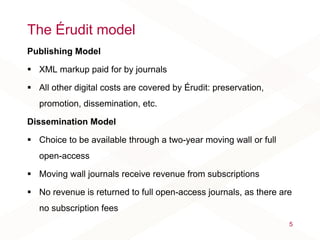
The Érudit model
Publishing Model
 XML markup paid for by journals
 All other digital costs are covered by Érudit: preservation,
promotion, dissemination, etc.
Dissemination Model
 Choice to be available through a two-year moving wall or full
open-access
 Moving wall journals receive revenue from subscriptions
 No revenue is returned to full open-access journals, as there are
no subscription fees
5
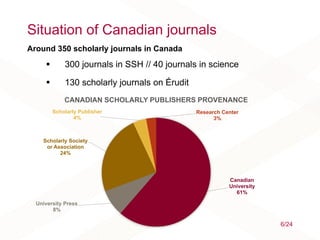
Situation of Canadian journals
Around 350 scholarly journals in Canada
 300 journals in SSH // 40 journals in science
 130 scholarly journals on Érudit
6/24
Canadian
University
61%
University Press
8%
Scholarly Society
or Association
24%
Scholarly Publisher
4%
Research Center
3%
CANADIAN SCHOLARLY PUBLISHERS PROVENANCE
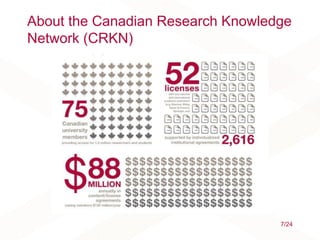
About the Canadian Research Knowledge
Network (CRKN)
7/24
Context: Challenges in the current
scholarly communications environment
• Budget
 Majority of university libraries in Canada are seeing flat, or reduced
budgets
 Declining value of the Canadian dollar impacting the cost of large
commercial journal packages priced primarily in USD, GBP or EUR
• Market
 Consolidation of control of journals in the commercial publishing
community leading to steadily increasing journal costs
 Faculty unwilling to give up access to journals and unaware of
dynamics of the “big deal”
• Canadian scholarly publishing
 Increasingly challenged to be sustainable in this environment
without being absorbed by the large commercial publishers
8/24
Context: Other open access models
Other explorations of new models for scholarly publishing
 Open Library of Humanities
 SCOAP3
 Knowledge Unlatched
 Open Edition - Freemium
9/24
3. Previous agreement
• 2008-2013: CRKN and Érudit had a license agreement
• Consortia subscription to content on Érudit platform
• Beneficial to both parties
 Libraries – access to a suite of content they might not otherwise
subscribe to individually
 Journals – readership and revenue from many institutions that
might not subscribe otherwise
• Limits of this agreement
 Comparison of Érudit against commercial publishers and platforms
 Libraries financing a system of closed-access to knowledge
10/24
4. The Partnership
Key aspects of the partnership
 Access to content
 Support for Canadian publishing
 Change in relationship
 Governance and participation
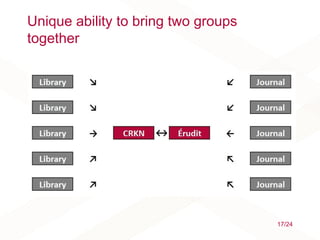
 Unique ability to bring large groups together
12/24
Access to content
• Access to all scholarly journals on the Érudit
platform
• Reduction in the embargo
 Érudit has always had a 2 year embargo period, after which content
becomes open access
 Partnership will see the embargo reduced to 1 year, with a long
term plan of complete open access with no embargo
• Access to data and meta data for research and
data mining
13/24
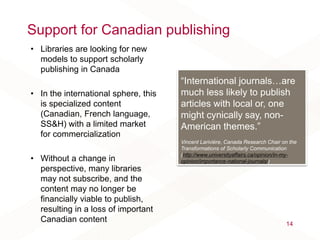
Support for Canadian publishing
• Libraries are looking for new
models to support scholarly
publishing in Canada
• In the international sphere, this
is specialized content
(Canadian, French language,
SS&H) with a limited market
for commercialization
• Without a change in
perspective, many libraries
may not subscribe, and the
content may no longer be
financially viable to publish,
resulting in a loss of important
Canadian content 14
“International journals…are
much less likely to publish
articles with local or, one
might cynically say, non-
American themes.”
Vincent Larivière, Canada Research Chair on the
Transformations of Scholarly Communication
(http://www.universityaffairs.ca/opinion/in-my-
opinion/importance-national-journals/)
Change in relationship
• From a customer/vendor relationship, to a partnership relationship
• Finding common goals and figuring out how you can achieve them
better together
• Emphasis on working together, with both parties being flexible and open
to changes
• Collaboration on the terms of the partnership
• Ongoing collaboration as well
15/24
Governance and participation
• A CRKN representative has been appointed to sit on the Érudit
Board of Directors as an observer
• CRKN members will be invited to participate in a User
Committee
16/24
Unique ability to bring two groups
together
17/24
5. Challenges
Shared Challenges
• Changing the relationship from customer/vendor to partner
Both libraries and publishers needed to look at the agreement from a
bigger, more long term strategic perspective
• Language
Although Canada is a bilingual country, many of our member
universities are predominantly English-speaking
• Accepting an imperfect model with some “unknowns”
Both libraries and publishers needed to trust one another for this
model to work
19/24
Challenges from the CRKN/library
perspective
• Budget
 Majority of university libraries in Canada are seeing flat, or reduced
budgets, in some cases the budget cuts are very severe
 Unfavourable exchange rate between the Canadian dollar and the
USD
• Multiple models and projects
 Limited funds and many commendable initiatives
 Which one is the “best”?
• Opt-in/opt out model
 CRKN agreements are all optional, which means a critical mass of
participation was needed in order for the agreement to be
financially viable 20/24
Challenges from the Érudit/publisher
perspective
• Moving journals to the model proposed by the partnership,
weakening the scholarly publishing environment
• Allocation of the funds collected
• Pro-active support
• Changing the relationship between Érudit and the journals
21/ 24
6. Next steps
Next steps
• Sharing our work with others
• Ensuring channels of communication are open between CRKN
and Érudit, and between CRKN libraries and Érudit publishers
• Exploring other ways to fund journals in a sustainable manner,
such as grants
• Working together on what the relationship/model will look like
post-2017, as our current partnership agreement ends at the end of
2017
• Potentially opening up the platform to more content
• Transform current agreements with other consortia and develop
new opportunities for partnerships
23 / 24
24
Monica Ward, Senior Content & Licensing Officer, CRKN mward@crkn.ca
Joanie Lavoie, Directrice des opérations, Érudit joanie.lavoie@umontreal.ca

A Library-Publisher Partnership for Open access

  • 1.
    A Library-Publisher Partnership forOpen Access Building an innovative relationship between scholarly publishers and academic libraries
  • 2.
    Overview 1. Introduction 2. AboutÉrudit and CRKN 3. Previous agreement 4. Description of the partnership 5. Challenges 6. Next steps 2/24
  • 3.
    1. Introduction Can asolution be found that meets the needs of both the scholarly publishers and university libraries? The Érudit Consortium and the Canadian Research Knowledge Network (CRKN) are exploring one solution to this challenge through a strategic partnership that supports the move towards open access for Canadian francophone scholarly journals. 3/24 As the importance of open access continues to grow, there remains no clear consensus on the ideal model to sustain scholarly publishing while making content openly accessible.
  • 4.
    2. About Érudit Éruditis the leading provider of Francophone and Canadian peer reviewed journals in North America.  Consortium founded by three leading French-language universities in Canada  Non-profit society  Established in 1998  Disseminates 150 Canadian scholarly and cultural journals  95% of content is open access 4/24
  • 5.
    The Érudit model PublishingModel  XML markup paid for by journals  All other digital costs are covered by Érudit: preservation, promotion, dissemination, etc. Dissemination Model  Choice to be available through a two-year moving wall or full open-access  Moving wall journals receive revenue from subscriptions  No revenue is returned to full open-access journals, as there are no subscription fees 5
  • 6.
    Situation of Canadianjournals Around 350 scholarly journals in Canada  300 journals in SSH // 40 journals in science  130 scholarly journals on Érudit 6/24 Canadian University 61% University Press 8% Scholarly Society or Association 24% Scholarly Publisher 4% Research Center 3% CANADIAN SCHOLARLY PUBLISHERS PROVENANCE
  • 7.
    About the CanadianResearch Knowledge Network (CRKN) 7/24
  • 8.
    Context: Challenges inthe current scholarly communications environment • Budget  Majority of university libraries in Canada are seeing flat, or reduced budgets  Declining value of the Canadian dollar impacting the cost of large commercial journal packages priced primarily in USD, GBP or EUR • Market  Consolidation of control of journals in the commercial publishing community leading to steadily increasing journal costs  Faculty unwilling to give up access to journals and unaware of dynamics of the “big deal” • Canadian scholarly publishing  Increasingly challenged to be sustainable in this environment without being absorbed by the large commercial publishers 8/24
  • 9.
    Context: Other openaccess models Other explorations of new models for scholarly publishing  Open Library of Humanities  SCOAP3  Knowledge Unlatched  Open Edition - Freemium 9/24
  • 10.
    3. Previous agreement •2008-2013: CRKN and Érudit had a license agreement • Consortia subscription to content on Érudit platform • Beneficial to both parties  Libraries – access to a suite of content they might not otherwise subscribe to individually  Journals – readership and revenue from many institutions that might not subscribe otherwise • Limits of this agreement  Comparison of Érudit against commercial publishers and platforms  Libraries financing a system of closed-access to knowledge 10/24
  • 11.
  • 12.
    Key aspects ofthe partnership  Access to content  Support for Canadian publishing  Change in relationship  Governance and participation  Unique ability to bring large groups together 12/24
  • 13.
    Access to content •Access to all scholarly journals on the Érudit platform • Reduction in the embargo  Érudit has always had a 2 year embargo period, after which content becomes open access  Partnership will see the embargo reduced to 1 year, with a long term plan of complete open access with no embargo • Access to data and meta data for research and data mining 13/24
  • 14.
    Support for Canadianpublishing • Libraries are looking for new models to support scholarly publishing in Canada • In the international sphere, this is specialized content (Canadian, French language, SS&H) with a limited market for commercialization • Without a change in perspective, many libraries may not subscribe, and the content may no longer be financially viable to publish, resulting in a loss of important Canadian content 14 “International journals…are much less likely to publish articles with local or, one might cynically say, non- American themes.” Vincent Larivière, Canada Research Chair on the Transformations of Scholarly Communication (http://www.universityaffairs.ca/opinion/in-my- opinion/importance-national-journals/)
  • 15.
    Change in relationship •From a customer/vendor relationship, to a partnership relationship • Finding common goals and figuring out how you can achieve them better together • Emphasis on working together, with both parties being flexible and open to changes • Collaboration on the terms of the partnership • Ongoing collaboration as well 15/24
  • 16.
    Governance and participation •A CRKN representative has been appointed to sit on the Érudit Board of Directors as an observer • CRKN members will be invited to participate in a User Committee 16/24
  • 17.
    Unique ability tobring two groups together 17/24
  • 18.
  • 19.
    Shared Challenges • Changingthe relationship from customer/vendor to partner Both libraries and publishers needed to look at the agreement from a bigger, more long term strategic perspective • Language Although Canada is a bilingual country, many of our member universities are predominantly English-speaking • Accepting an imperfect model with some “unknowns” Both libraries and publishers needed to trust one another for this model to work 19/24
  • 20.
    Challenges from theCRKN/library perspective • Budget  Majority of university libraries in Canada are seeing flat, or reduced budgets, in some cases the budget cuts are very severe  Unfavourable exchange rate between the Canadian dollar and the USD • Multiple models and projects  Limited funds and many commendable initiatives  Which one is the “best”? • Opt-in/opt out model  CRKN agreements are all optional, which means a critical mass of participation was needed in order for the agreement to be financially viable 20/24
  • 21.
    Challenges from theÉrudit/publisher perspective • Moving journals to the model proposed by the partnership, weakening the scholarly publishing environment • Allocation of the funds collected • Pro-active support • Changing the relationship between Érudit and the journals 21/ 24
  • 22.
  • 23.
    Next steps • Sharingour work with others • Ensuring channels of communication are open between CRKN and Érudit, and between CRKN libraries and Érudit publishers • Exploring other ways to fund journals in a sustainable manner, such as grants • Working together on what the relationship/model will look like post-2017, as our current partnership agreement ends at the end of 2017 • Potentially opening up the platform to more content • Transform current agreements with other consortia and develop new opportunities for partnerships 23 / 24
  • 24.
    24 Monica Ward, SeniorContent & Licensing Officer, CRKN mward@crkn.ca Joanie Lavoie, Directrice des opérations, Érudit joanie.lavoie@umontreal.ca