Virtue
Ethics
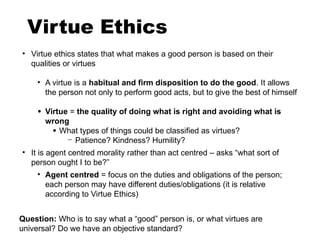
Virtue Ethics
• Virtue ethics states that what makes a good person is based on their
qualities or virtues
• A virtue is a habitual and firm disposition to do the good. It allows
the person not only to perform good acts, but to give the best of himself
• Virtue = the quality of doing what is right and avoiding what is
wrong
• What types of things could be classified as virtues?
− Patience? Kindness? Humility?
• It is agent centred morality rather than act centred – asks “what sort of
person ought I to be?”
• Agent centred = focus on the duties and obligations of the person;
each person may have different duties/obligations (it is relative
according to Virtue Ethics)
Question: Who is to say what a “good” person is, or what virtues are
universal? Do we have an objective standard?
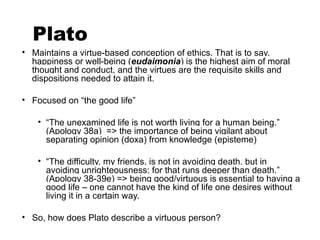
Plato
• Maintains a virtue-based conception of ethics. That is to say,
happiness or well-being (eudaimonia) is the highest aim of moral
thought and conduct, and the virtues are the requisite skills and
dispositions needed to attain it.
• Focused on “the good life”
• “The unexamined life is not worth living for a human being.”
(Apology 38a) => the importance of being vigilant about
separating opinion (doxa) from knowledge (episteme)
• “The difficulty, my friends, is not in avoiding death, but in
avoiding unrighteousness; for that runs deeper than death.”
(Apology 38-39e) => being good/virtuous is essential to having a
good life – one cannot have the kind of life one desires without
living it in a certain way.
• So, how does Plato describe a virtuous person?
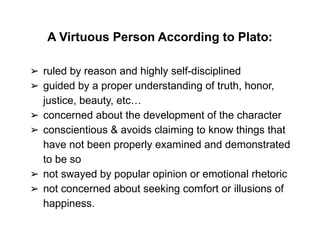
A Virtuous Person According to Plato:
➢ ruled by reason and highly self-disciplined
➢ guided by a proper understanding of truth, honor,
justice, beauty, etc…
➢ concerned about the development of the character
➢ conscientious & avoids claiming to know things that
have not been properly examined and demonstrated
to be so
➢ not swayed by popular opinion or emotional rhetoric
➢ not concerned about seeking comfort or illusions of
happiness.
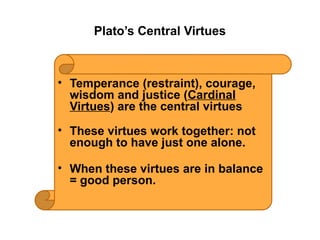
Plato’s Central Virtues
• Temperance (restraint), courage,
wisdom and justice (Cardinal
Virtues) are the central virtues
• These virtues work together: not
enough to have just one alone.
• When these virtues are in balance
= good person.
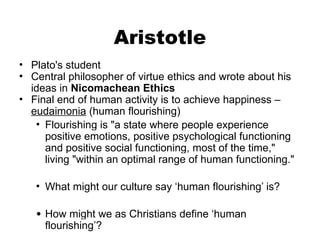
Aristotle
• Plato's student
• Central philosopher of virtue ethics and wrote about his
ideas in Nicomachean Ethics
• Final end of human activity is to achieve happiness –
eudaimonia (human flourishing)
• Flourishing is "a state where people experience
positive emotions, positive psychological functioning
and positive social functioning, most of the time,"
living "within an optimal range of human functioning."
• What might our culture say ‘human flourishing’ is?
• How might we as Christians define ‘human
flourishing’?
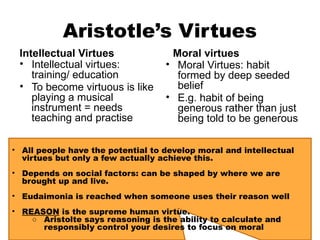
Aristotle’s Virtues
Intellectual Virtues
• Intellectual virtues:
training/ education
• To become virtuous is like
playing a musical
instrument = needs
teaching and practise
Moral virtues
• Moral Virtues: habit
formed by deep seeded
belief
• E.g. habit of being
generous rather than just
being told to be generous
• All people have the potential to develop moral and intellectual
virtues but only a few actually achieve this.
• Depends on social factors: can be shaped by where we are
brought up and live.
• Eudaimonia is reached when someone uses their reason well
• REASON is the supreme human virtue.
○ Aristolte says reasoning is the ability to calculate and
responsibly control your desires to focus on moral
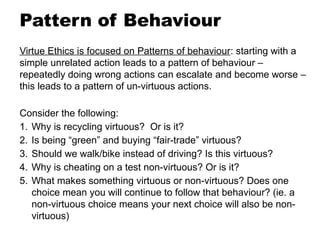
Pattern of Behaviour
Virtue Ethics is focused on Patterns of behaviour: starting with a
simple unrelated action leads to a pattern of behaviour –
repeatedly doing wrong actions can escalate and become worse –
this leads to a pattern of un-virtuous actions.
Consider the following:
1. Why is recycling virtuous? Or is it?
2. Is being “green” and buying “fair-trade” virtuous?
3. Should we walk/bike instead of driving? Is this virtuous?
4. Why is cheating on a test non-virtuous? Or is it?
5. What makes something virtuous or non-virtuous? Does one
choice mean you will continue to follow that behaviour? (ie. a
non-virtuous choice means your next choice will also be non-
virtuous)
So... Virtuous People?
• Virtue is acquired through doing.
• One way to learn how to be virtuous is to follow the
example of virtuous people.
• Watching others and imitating them = best way to learn.
• Can you think of an example in your life of a virtuous
person?
• Role models - they challenge us to go beyond the
minimum – to aspire to ‘moral heights’ to see what can be
achieved.
• Who has been a good role model for you?
Question: What constitutes a virtuous person? Who would
be a good example? Why?
Virtuous People?
What about the following people? Are they virtuous?
How would we measure this? Should we look to them
as examples to follow?
- Gandhi?
- Nelson Mandela?
- Justin Trudeau?
- Hillary Clinton?
- Martin Luther King?
- Abraham Lincoln?
- Donald Trump?
Strengths of Virtue Ethics
• Avoids use of a formula (e.g. hedonic calculus) = focuses
instead on what kind of person ought I be
• Distinguishes between people that are good and people that just
follow the law.
• Motivating people to be good
• Stresses importance of education in showing that good can be
taught/ learnt
• Involves our entire lives – whole life process
• Even mundane opportunities gives us chance to practise virtues
• Every aspect of our lives is involved e.g. family, friends,
community, emotions, responsibilities – so is more intune with
how people react in ethical dilemmas.
Weaknesses of Virtue Ethics
• Virtue ethics does not give us concrete answers (since it focuses
on the individual) so it is hard to apply to moral situations.
• Virtue ethics does not help people facing a crisis because there
are no clear set rules for action.
• Virtue ethics seems to praise some virtues that others might see
as immoral e.g. soldier fighting unjust wars may be courageous
but not morally good
• It is difficult to decide who is virtuous, as acts which appear
virtuous on the outside may not necessarily have good motives
• Virtue Ethics is focused on a universal moral code to make
everyone better, but what objective standard is it using if it is not
God?

A lesson on virtue ethics in philosophy.

  • 1.
  • 2.
    Virtue Ethics • Virtueethics states that what makes a good person is based on their qualities or virtues • A virtue is a habitual and firm disposition to do the good. It allows the person not only to perform good acts, but to give the best of himself • Virtue = the quality of doing what is right and avoiding what is wrong • What types of things could be classified as virtues? − Patience? Kindness? Humility? • It is agent centred morality rather than act centred – asks “what sort of person ought I to be?” • Agent centred = focus on the duties and obligations of the person; each person may have different duties/obligations (it is relative according to Virtue Ethics) Question: Who is to say what a “good” person is, or what virtues are universal? Do we have an objective standard?
  • 3.
    Plato • Maintains avirtue-based conception of ethics. That is to say, happiness or well-being (eudaimonia) is the highest aim of moral thought and conduct, and the virtues are the requisite skills and dispositions needed to attain it. • Focused on “the good life” • “The unexamined life is not worth living for a human being.” (Apology 38a) => the importance of being vigilant about separating opinion (doxa) from knowledge (episteme) • “The difficulty, my friends, is not in avoiding death, but in avoiding unrighteousness; for that runs deeper than death.” (Apology 38-39e) => being good/virtuous is essential to having a good life – one cannot have the kind of life one desires without living it in a certain way. • So, how does Plato describe a virtuous person?
  • 4.
    A Virtuous PersonAccording to Plato: ➢ ruled by reason and highly self-disciplined ➢ guided by a proper understanding of truth, honor, justice, beauty, etc… ➢ concerned about the development of the character ➢ conscientious & avoids claiming to know things that have not been properly examined and demonstrated to be so ➢ not swayed by popular opinion or emotional rhetoric ➢ not concerned about seeking comfort or illusions of happiness.
  • 5.
    Plato’s Central Virtues •Temperance (restraint), courage, wisdom and justice (Cardinal Virtues) are the central virtues • These virtues work together: not enough to have just one alone. • When these virtues are in balance = good person.
  • 6.
    Aristotle • Plato's student •Central philosopher of virtue ethics and wrote about his ideas in Nicomachean Ethics • Final end of human activity is to achieve happiness – eudaimonia (human flourishing) • Flourishing is "a state where people experience positive emotions, positive psychological functioning and positive social functioning, most of the time," living "within an optimal range of human functioning." • What might our culture say ‘human flourishing’ is? • How might we as Christians define ‘human flourishing’?
  • 7.
    Aristotle’s Virtues Intellectual Virtues •Intellectual virtues: training/ education • To become virtuous is like playing a musical instrument = needs teaching and practise Moral virtues • Moral Virtues: habit formed by deep seeded belief • E.g. habit of being generous rather than just being told to be generous • All people have the potential to develop moral and intellectual virtues but only a few actually achieve this. • Depends on social factors: can be shaped by where we are brought up and live. • Eudaimonia is reached when someone uses their reason well • REASON is the supreme human virtue. ○ Aristolte says reasoning is the ability to calculate and responsibly control your desires to focus on moral
  • 8.
    Pattern of Behaviour VirtueEthics is focused on Patterns of behaviour: starting with a simple unrelated action leads to a pattern of behaviour – repeatedly doing wrong actions can escalate and become worse – this leads to a pattern of un-virtuous actions. Consider the following: 1. Why is recycling virtuous? Or is it? 2. Is being “green” and buying “fair-trade” virtuous? 3. Should we walk/bike instead of driving? Is this virtuous? 4. Why is cheating on a test non-virtuous? Or is it? 5. What makes something virtuous or non-virtuous? Does one choice mean you will continue to follow that behaviour? (ie. a non-virtuous choice means your next choice will also be non- virtuous)
  • 9.
    So... Virtuous People? •Virtue is acquired through doing. • One way to learn how to be virtuous is to follow the example of virtuous people. • Watching others and imitating them = best way to learn. • Can you think of an example in your life of a virtuous person? • Role models - they challenge us to go beyond the minimum – to aspire to ‘moral heights’ to see what can be achieved. • Who has been a good role model for you? Question: What constitutes a virtuous person? Who would be a good example? Why?
  • 10.
    Virtuous People? What aboutthe following people? Are they virtuous? How would we measure this? Should we look to them as examples to follow? - Gandhi? - Nelson Mandela? - Justin Trudeau? - Hillary Clinton? - Martin Luther King? - Abraham Lincoln? - Donald Trump?
  • 11.
    Strengths of VirtueEthics • Avoids use of a formula (e.g. hedonic calculus) = focuses instead on what kind of person ought I be • Distinguishes between people that are good and people that just follow the law. • Motivating people to be good • Stresses importance of education in showing that good can be taught/ learnt • Involves our entire lives – whole life process • Even mundane opportunities gives us chance to practise virtues • Every aspect of our lives is involved e.g. family, friends, community, emotions, responsibilities – so is more intune with how people react in ethical dilemmas.
  • 12.
    Weaknesses of VirtueEthics • Virtue ethics does not give us concrete answers (since it focuses on the individual) so it is hard to apply to moral situations. • Virtue ethics does not help people facing a crisis because there are no clear set rules for action. • Virtue ethics seems to praise some virtues that others might see as immoral e.g. soldier fighting unjust wars may be courageous but not morally good • It is difficult to decide who is virtuous, as acts which appear virtuous on the outside may not necessarily have good motives • Virtue Ethics is focused on a universal moral code to make everyone better, but what objective standard is it using if it is not God?