‫البيطار‬ ‫حاتم‬ ‫د‬
‫الصحية‬ ‫الرعاية‬ ‫ادارة‬ ‫استشاري‬
01005684344
01202389028
The principal role of these barriers is to
protect hospital staff from infectious
agents that can be transmitted by
blood and body fluids, such as the
human immunodeficiency virus (HIV)
and hepatitis B and C viruses.
Protective Barriers
2
Rubber gloves were popularized in late nineteenth
century by William Halstead the first Chief of the
Surgery at Johns Hopkins Hospital, who covered
only his palms and three fingers with the gloves
because they were heavy and
impaired the sense of touch. Today, sterile rubber
gloves are the second skin of the operating
surgeon. In the ICU, sterile gloves are used
primarily for placing catheters in the bloodstream.
Gloves
3
In the 1980s (a century after the introduction of surgical
gloves), the use of nonsterile gloves was popularized by the
discovery that HIV is transmitted in blood and body fluids.
This discovery prompted a policy known as Universal
Precautions which considered all patients as possible sources
of HIV. An updated policy known as Standard Precautions
contains the current recommendations for nonsterile gloves,
Nonsterile gloves should be used for any contact with a moist
body substance, which includes blood, body fluids,
secretions, excretions, nonintact skin, and mucous
membranes.
Gloves
4
Note also in that nonsterile gloves
are considered safe for insertion of
peripheral venous catheters as long
as a “no touch” technique is used
(i.e., as long as the gloved hands are
not permitted to touch the catheter)
Gloves
5
As indicated in, hand washing is
recommended before donning gloves and
again after they are removed. This
recommendation is based on two concerns.
The first is the fear that gloves can leak or
tear and thereby allow microbial
transmission between the hands of the
healthcare worker and the patient.
Hand washing and Gloves
6
The second concern is the potential
for moisture buildup on the hands during prolonged glove use, which
would favor
microbial growth on the hands while the gloves are on. Both of these
are valid concerns
for invasive surgical procedures, where glove use is prolonged and
soiling of gloves is prominent. However, the significance of these
concerns in a nonsurgical setting like the ICU (where glove use is not
prolonged and soiling of gloves is usually not prominent) is less
certain. many results suggest that handwashing before and after
short-term glove use in a nonsurgical setting like the ICU may be
unnecessary.
Hand washing and Gloves
7
The dramatic increase in the use of rubber gloves over
the last two decades has created a problem with latex
hypersensitivity in hospital workers. Latex is a natural
rubber product that is used in over 40,000 household
and medical products, including gloves, face masks,
blood pressure cuffs, and catheters. Repeated
exposure to latex can promote hypersensitivity
reactions that can be evident clinically as either
contact dermatitis (urticaria or eczema), anaphylaxis,
rhino conjunctivitis, or asthma .
Latex Allergy
8
Latex hypersensitivity is reported in 10% to 20% of hospital workers,
compared to 1% of the general population .For unclear reasons,
patients with spina bifida have the highest risk of latex allergy, with as
many as 40% of the population having this condition
- The diagnosis of latex allergy can be elusive. One problem is the
nonspecific
Manifestations of disease. Another problem is the fact that symptoms
of latex allergy can appear without direct physical contact with latex.
This is often the case with the rhino conjunctivitis and asthma, which
are triggered by airborne latex particles. A history of symptoms
confined to the workplace should create suspicion for latex allergy.
Latex Allergy
9
The clinical manifestations of latex
allergy often coincide with exposure to
latex, so hospital workers with
symptomatic latex allergy often display
these symptoms while in the hospital
and are symptom-free at home.
Latex Allergy
10
There are two tests for latex hypersensitivity. One is a
skin test, and the other is an assay for latex-specific
immunoglobulin E levels in the bloodstream. Both have
shortcomings. There is no standardized extract for the
skin test (allergists have to make their own extract by
pulverizing latex gloves!), so results are operator-
dependent. The assay for latex-specific IgE in blood is
currently the favored test, but the sensitivity can be
low .
Latex Allergy
11
If confronted with a case of possible latex allergy, you should
contact the clinical laboratory in your hospital and ask about
the availability and reliability of these tests in your region.
- The treatment of latex allergy is symptom-driven and
nonspecific. Removing latex from the patient's immediate
environment is the best strategy, but this may not be
possible because latex is ubiquitous in the hospital
environment (it is even found on tongue depressors!). The
hospital should provide substitutes for latex products (e.g.,
vinyl gloves) when necessary.
Latex Allergy
12
As was the case with nonsterile gloves, the use of other barriers
like masks, eye shields, face shields, and gowns increased
markedly after the discovery that HIV is transmitted in blood
and body fluids. These barriers are currently recommended for
all procedures or patient care activities that are likely to
generate splashes of blood, body fluids, secretions, or
excretions . Nonsterile gowns are adequate, and gowns coated
with a plastic covering are the least impervious to blood and
body fluids .Soiled gowns and other barriers should be removed
and discarded as soon as possible, and before going to
another patient .
Masks and Other Barriers
13
Types of Masks
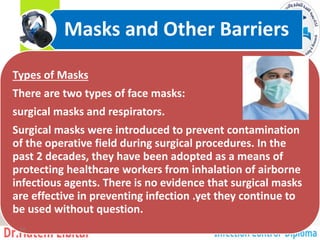
There are two types of face masks:
surgical masks and respirators.
Surgical masks were introduced to prevent contamination
of the operative field during surgical procedures. In the
past 2 decades, they have been adopted as a means of
protecting healthcare workers from inhalation of airborne
infectious agents. There is no evidence that surgical masks
are effective in preventing infection .yet they continue to
be used without question.
Masks and Other Barriers
14
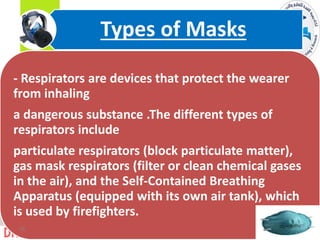
- Respirators are devices that protect the wearer
from inhaling
a dangerous substance .The different types of
respirators include
particulate respirators (block particulate matter),
gas mask respirators (filter or clean chemical gases
in the air), and the Self-Contained Breathing
Apparatus (equipped with its own air tank), which
is used by firefighters.
Types of Masks
15
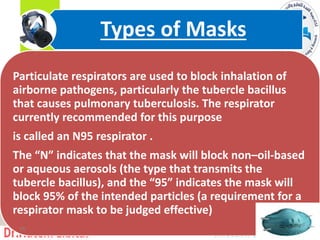
Particulate respirators are used to block inhalation of
airborne pathogens, particularly the tubercle bacillus
that causes pulmonary tuberculosis. The respirator
currently recommended for this purpose
is called an N95 respirator .
The “N” indicates that the mask will block non–oil-based
or aqueous aerosols (the type that transmits the
tubercle bacillus), and the “95” indicates the mask will
block 95% of the intended particles (a requirement for a
respirator mask to be judged effective)
Types of Masks
16
-Types of Airborne Illness
-Blood-Borne Pathogens
-Needle stick Injuries
Types of infections in the icu
17
Infectious organisms that are capable of airborne
transmission are divided into two categories: those
greater than 5 microns (>;5m) in diameter, and
those
that are 5 microns or less (=5μ) in diameter. In each
of these illnesses, airborne infectious particles are
produced by coughing or sneezing (one cough or
sneeze can produce 3,000 airborne particles) or
procedures such as airways suctioning and
bronchoscopy.
-Types of Airborne Illness
18
The airborne particles can be inhaled or can impact on
nonintact skin, or on the mucosa in the nose or
mouth. and to block transmission of these particles, a
surgical mask is recommended when hospital staff or
visitors are within 3 feet of the patient , The smaller
(=5m in diameter) infectious particles can travel long
distances in the air, and to prevent transmission of
these particles, patients should be isolated in private
rooms that are maintained at a negative pressure
relative to the surrounding areas. For patients with
infectious tuberculosis (pulmonary or laryngeal),
-Types of Airborne Illness
19
all hospital staff and visitors should wear an N95
respirator mask while in the room .For patients in
the infectious stages of measles and varicella
(chickenpox or herpes zoster), individuals with no
prior history of these infections who are also
pregnant, immunocompromised, or otherwise
debilitated by disease should not be allowed in
the patient's room. For other susceptible
individuals who must enter the room (i.e.,
hospital workers), an N95 respirator mask should
be worn at all times while in the room.
-Types of Airborne Illness
20
The airborne particles can be inhaled or can impact
on nonintact skin, or on the mucosa in the nose or
mouth. and to block transmission of these particles, a
surgical mask is recommended when hospital staff or
visitors are within 3 feet of the patient , The smaller
(=5m in diameter) infectious particles can travel long
distances in the air, and to prevent transmission of
these particles, patients should be isolated in private
rooms that are maintained at a negative pressure
relative to the surrounding areas. For patients with
infectious tuberculosis (pulmonary or laryngeal),
-Types of Airborne Illness
21
The airborne particles can be inhaled or can impact on
nonintact skin, or on the mucosa in the nose or mouth.
and to block transmission of these particles, a surgical
mask is recommended when hospital staff or visitors are
within 3 feet of the patient , The smaller (=5m in diameter)
infectious particles can travel long distances in the air, and
to prevent transmission of these particles, patients should
be isolated in private
rooms that are maintained at a negative pressure relative
to the surrounding areas. For patients with infectious
tuberculosis (pulmonary or laryngeal),
-Types of Airborne Illness
22
The airborne particles can be inhaled or can impact on
nonintact skin, or on the mucosa in the nose or mouth.
and to block transmission of these particles, a surgical
mask is recommended when hospital staff or visitors are
within 3 feet of the patient , The smaller (=5m in diameter)
infectious particles can travel long distances in the air, and
to prevent transmission of these particles, patients should
be isolated in private
rooms that are maintained at a negative pressure relative
to the surrounding areas. For patients with infectious
tuberculosis (pulmonary or laryngeal),
-Types of Airborne Illness
23
all hospital staff and visitors should wear an N95 respirator
mask while in the room .For patients in the infectious
stages of rubeola (measles) and varicella (chickenpox or
herpes zoster), individuals with no prior history of these
infections who are also pregnant, immunocompromised, or
otherwise debilitated by disease should not be allowed in
the patient's room. For other susceptible individuals who
must enter the room (i.e., hospital workers), an N95
respirator mask should be worn at all times while in the
room.
-Types of Airborne Illness
24
Atypical Pulmonary TB
-
It is important to distinguish infections caused by
Mycobacterium tuberculosis from those caused
by
atypical mycobacteria
(e.g., Mycobacterium avium complex) when
determining the need for respiratory protection.
-Types of Airborne Illness
25
The greatest infectious risk you face in
the ICU is exposure to blood-borne
pathogens like HIV, hepatitis B virus
(HBV), and hepatitis C virus (HCV). This
section will describe the occupational
risks associated with each of these
pathogens and the preventive measures
used to minimize these risks.
Borne Pathogens
-
Blood
-
26
The transmission of blood-borne infections to
hospital workers occurs primarily via needle
stick injuries (i.e., accidental puncture wounds
of the skin caused by hollow needles and
suture needles). Each year, an estimated 10%
of hospital workers sustain a needle stick
injury. Most of these injuries occur in nurses,
but the risk is also high in all staff surgeons.
Needle stick Injuries
-
27
The transmission of blood-borne infections to
hospital workers occurs primarily via needle
stick injuries (i.e., accidental puncture wounds
of the skin caused by hollow needles and
suture needles). Each year, an estimated 10%
of hospital workers sustain a needle stick
injury. Most of these injuries occur in nurses,
but the risk is also high in all staff surgeons.
Needle stick Injuries
-
28
As many as 70% of residents and medical
students report a needle stick injury during
their training (the incidence is highest in
surgical residents) and a survey in one hospital
revealed that 60% of the staff surgeons
experienced a needle stick injury at some time
in their careers ,The activities most often
associated with needle stick injuries outside the
operating room involve recapping and disposal
of used needles.
Needle stick Injuries
-
29
The transmission of blood-borne infections to
hospital workers occurs primarily via needle
stick injuries (i.e., accidental puncture wounds
of the skin caused by hollow needles and
suture needles). Each year, an estimated 10%
of hospital workers sustain a needle stick
injury. Most of these injuries occur in nurses,
but the risk is also high in all staff surgeons.
Needle stick Injuries
-
30
The problem of needle stick injuries came to the
attention of the United States Congress in the year
2000, and as a result, Congress passed the Needle
stick Safety and Prevention Act that mandates the
use of “safety-engineered” needles in all American
health care facilities. The needle is equipped with a
rigid, plastic housing that is attached by a hinge
joint to the hub of the needle. The protective
housing is normally positioned away from the
needle so it does not interfere with needle use.
Safety Devices
31
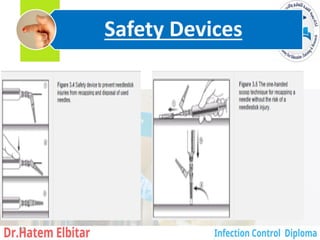
. When the needle is no longer needed, it is locked
into the protective housing by holding the housing
against a rigid structure and moving the needle
about the hinge joint (like closing a door) until it
snaps in place in the housing. The needle stays
attached to the syringe during this procedure, and
the hands never touch the needle. The protected
needle and attached syringe are then placed in a
puncture-proof “sharps container” for eventual
disposal.
Safety Devices
32
Handed Recapping Technique
-
One
Once the needle is locked in its protective housing,
it is not possible to remove it for further use.
In situations where a needle has multiple uses (e.g., filling a syringe with
a
drug preparation and later injecting the drug in several increments), the
needle can be rendered harmless between uses by recapping it with the
one-handed “scoop technique” shown in Figure.
With the needle cap resting on a horizontal
surface, the needle is advanced into the
needle cap.
Safety Devices
33
Using the tip of the needle cap
as a fulcrum, the needle and cap are then
lifted vertically until they are perpendicular
to the horizontal surface. The needle is then
pushed into the cap until it locks in place.
The hands are never in a position to permit
an accidental needle puncture
Safety Devices
34
Safety Devices
35
When a member of the ICU staff experiences a
possible exposure to HIV from a needle stick injury or
blood splash to the face, the appropriate steps to take
are determined by the presence or absence of HIV
anti-bodies in the blood of the source patient. If the
HIV antibody status of the source patient is unknown,
you should perform a rapid HIV-antibody test on a
blood sample from the source patient. This is done at
the bedside (by an appropriately trained member of
the staff), and the results are available in 10 to 15
minutes.
Post exposure Management
36
The results of this test can be used to guide initial
management decisions, but a positive result must
be confirmed by another test such as a Western
blot or immuno fluorescent antibody assay. The
recommendations for possible HIV exposure based
on the HIV status of the source patient .The major
decision following possible HIV transmission is
whether or not to begin prophylactic therapy with
antiretroviral agents in the exposed individual.
Post exposure Management
37
If HIV infection is proven or suspected in the
source patient, prophylactic therapy with at least 2
antiretroviral agents is started and continued for 4
weeks (or until there is convincing evidence for the
absence of HIV infection in the source patient). A
popular two-drug regimen is the combination of
zidovudine (200 mg ) and lamovudine (150 mg daily).
These two drugs are available in a combination tablet
(COMBIVIR, GlaxoSmithKline), each containing 150 mg
lamovudine and 300 mg zidovudine.
Post exposure Management
38
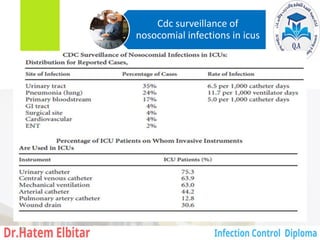
Cdc surveillance of
nosocomial infections in icus
39
40
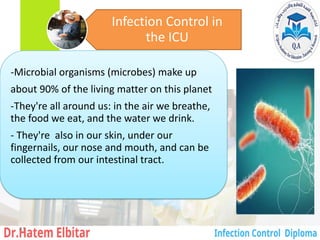
-Microbial organisms (microbes) make up
about 90% of the living matter on this planet
-They're all around us: in the air we breathe,
the food we eat, and the water we drink.
- They're also in our skin, under our
fingernails, our nose and mouth, and can be
collected from our intestinal tract.
Infection Control in
the ICU
41
Some of these organisms
called “germs” that are eager to invade
and destroy the human body, Most
microbes have nothing to gain by
invading the human body (excluding
viruses here), but they have much to
lose because they can be killed by the
inflammatory response.
Infection Control in the
ICU
42
It seems then that survival would
dictate that microorganisms avoid the
interior of the human body, not invade
it.
For more than a century, medicine has
viewed the microbial world as an
enemy that should be destroyed, and
the practices described in this chapter
are an expression of that belief.
Infection Control in the ICU
43
44
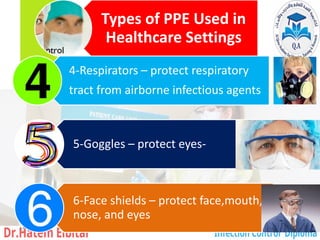
Types of PPE Used in
Healthcare Settings
4-Respirators – protect respiratory
tract from airborne infectious agents
5-Goggles – protect eyes-
6-Face shields – protect face,mouth,
nose, and eyes
45
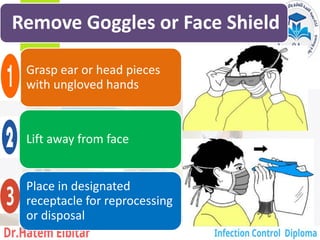
Remove Goggles or Face Shield
Grasp ear or head pieces
with ungloved hands
Lift away from face
Place in designated
receptacle for reprocessing
or disposal
46
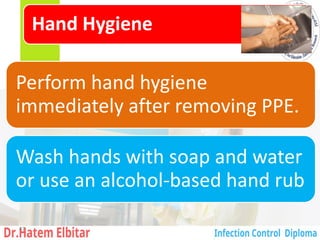
Hand Hygiene
Perform hand hygiene
immediately after removing PPE.
Wash hands with soap and water
or use an alcohol-based hand rub
47
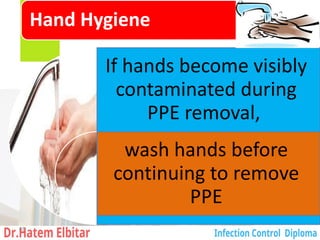
Hand Hygiene
If hands become visibly
contaminated during
PPE removal,
wash hands before
continuing to remove
PPE
48
By
Dr Hatem El Bitar
Egyptian fellowship
49
Occupational
Safety and
Health
Administration
50
lecture Overview
51
Purpose:
To provide employees with introductory information about OSHA
Topics:
Why is OSHA important to you?
What rights do you have under OSHA?
What responsibilities does your employer have under OSHA?
What do the OSHA standards say?
How are OSHA inspections conducted?
Where can you go for help?
51
What is OSHA?
Occupational Safety and Health Administration
Simply: Responsible for worker
safety and health protection
52
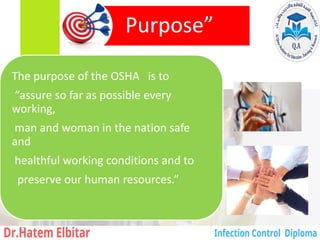
Purpose”
The purpose of the OSHA is to
“assure so far as possible every
working,
man and woman in the nation safe
and
healthful working conditions and to
preserve our human resources.”
53
Questions to consider.......
What is the fist thing you think
about when you hear OSHA?
Do you feel protected knowing
there are standards in place?
Do you think these standards
work in the healthcare industry?
54
About OSHA
It is part of the United States Department of Labor
OSHA's administrator answers to the Secretary of
Labor who is part of the US President's cabinet
Congress passed the Occupational and Safety Act
of 1970 creating OSHA
55
About OSHA
On December 29, 1970, President Nixon
signed the OSHA Act On December 29,
1970, President Nixon signed the OSH Act
This Act created OSHA, the agency, which
formally came into being on April 28, 1971
This Act created OSHA, the agency, which
formally came into being on April 28, 1971
56
OSHA began because, until 1970, there were
no national laws for safety and health hazards.
On average, 15 workers die every day from job
injuries
Over 5,600 Americans die from workplace
injuries annually
57
Why is OSHA
Important to You?
57
Why was OSHA created?
Nearly 2.5 million employees were
disabled
300,000 new cases of occupational
disease
Over 4 million non-fatal workplace
injuries and illnesses are reported
58
Is there a need for OSHA?
OSHA is the leading force in employee
protection
OSHA is concerned with any workplace
hazard that may impact the safety of an
employee
Ensures safety and healthful conditions for
the workplace doing so by:
Setting and Enforcing standards
Providing training
Education
Assistance
59
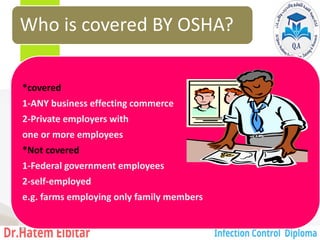
Who is covered BY OSHA?
*covered
1-ANY business effecting commerce
2-Private employers with
one or more employees
*Not covered
1-Federal government employees
2-self-employed
e.g. farms employing only family members
60
OSHA’s
Mission
61
61
OSHA’s Mission
The mission of OSHA
is to save lives,
prevent injuries and
protect the health of
workers.
62
OSHA’s Mission
developing job safety
and health standards
and enforcing them
through worksite
inspections
63
63
OSHA’s Mission
maintaining a reporting
and recordkeeping
system to keep track of
job-related injuries and
illnesses
64
64
OSHA’s Mission
providing training
programs to increase
knowledge about
occupational safety and
health.
65
65
What are standards?
Mandated rules and laws
This section applies to all occupational exposure
to blood or other potentially infectious
materials
Standards
66
OSHA Standards
OSHA develops and enforces
standards that employers must
follow.
employers are responsible for
following the OSHaA Act's
General standards.
67
Blood borne Pathogen
Standard
This standard went into effect in 1992
Applies to:
All employees who may be
exposed to blood
Designed to:
Eliminate/minimize employees' exposure to blood at work
68
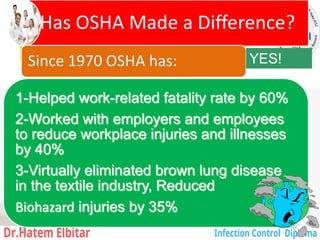
Has OSHA Made a Difference?
1-Helped work-related fatality rate by 60%
2-Worked with employers and employees
to reduce workplace injuries and illnesses
by 40%
3-Virtually eliminated brown lung disease
in the textile industry, Reduced
Biohazard injuries by 35%
Since 1970 OSHA has: YES!
69
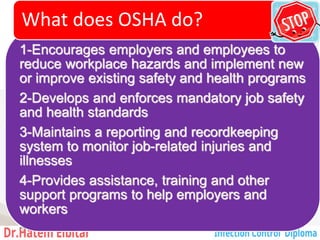
1-Encourages employers and employees to
reduce workplace hazards and implement new
or improve existing safety and health programs
2-Develops and enforces mandatory job safety
and health standards
3-Maintains a reporting and recordkeeping
system to monitor job-related injuries and
illnesses
4-Provides assistance, training and other
support programs to help employers and
workers
What does OSHA do?
70
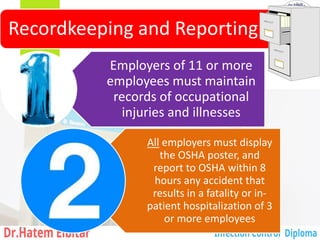
Recordkeeping and Reporting
Employers of 11 or more
employees must maintain
records of occupational
injuries and illnesses
All employers must display
the OSHA poster, and
report to OSHA within 8
hours any accident that
results in a fatality or in-
patient hospitalization of 3
or more employees
71
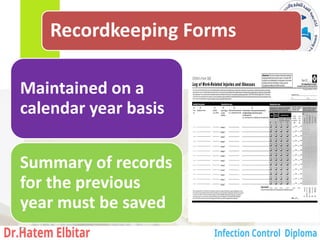
Recordkeeping Forms
Maintained on a
calendar year basis
Summary of records
for the previous
year must be saved
72
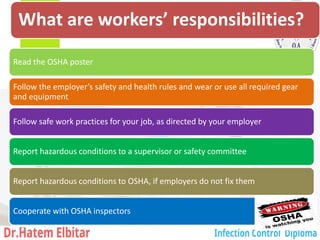
What are workers’ responsibilities?
Read the OSHA poster
Follow the employer’s safety and health rules and wear or use all required gear
and equipment
Follow safe work practices for your job, as directed by your employer
Report hazardous conditions to a supervisor or safety committee
Report hazardous conditions to OSHA, if employers do not fix them
Cooperate with OSHA inspectors
73
What are workers’
rights?
Identify and correct
problems in their
workplaces, working with
their employers whenever
possible
74
What are workers’
rights?
Complain to OSHA about
workplace conditions
threatening their health or
safety in person, by telephone,
by fax, by mail or electronically
through OSHA’s web site
75
What are employers’ rights &
responsibilities?
Employers must provide a safe and
healthful workplace free of recognized
hazards and follow the OSHA standards
The OSH Act grants employers important
rights, particularly during and after an
OSHA inspection
Employers must provide training, medical
examinations and recordkeeping
76
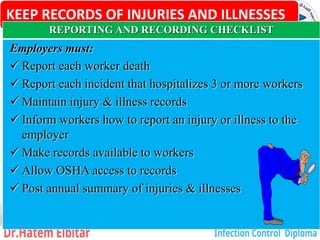
KEEP RECORDS OF INJURIES AND ILLNESSES
REPORTING AND RECORDING CHECKLIST
Employers must:
 Report each worker death
 Report each incident that hospitalizes 3 or more workers
 Maintain injury & illness records
 Inform workers how to report an injury or illness to the
employer
 Make records available to workers
 Allow OSHA access to records
 Post annual summary of injuries & illnesses
77
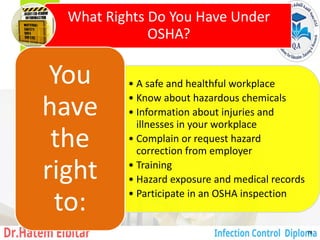
What Rights Do You Have Under
OSHA?
• A safe and healthful workplace
• Know about hazardous chemicals
• Information about injuries and
illnesses in your workplace
• Complain or request hazard
correction from employer
• Training
• Hazard exposure and medical records
• Participate in an OSHA inspection
You
have
the
right
to:
78
78
OSHA
Strategies to
Reduce
Exposure
79
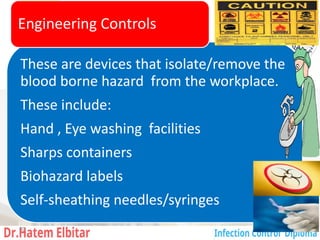
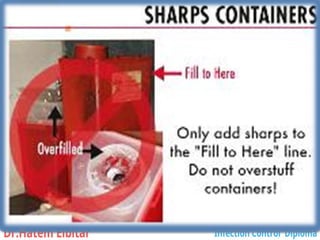
These are devices that isolate/remove the
blood borne hazard from the workplace.
These include:
Hand , Eye washing facilities
Sharps containers
Biohazard labels
Self-sheathing needles/syringes
Engineering Controls
80
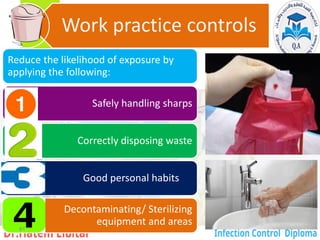
Work practice controls
Reduce the likelihood of exposure by
applying the following:
Safely handling sharps
Correctly disposing waste
Good personal habits
Decontaminating/ Sterilizing
equipment and areas
81
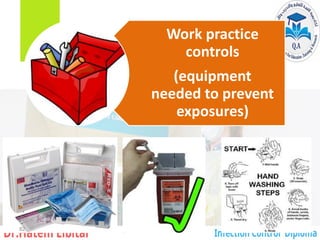
Work practice
controls
(equipment
needed to prevent
exposures)
82
83
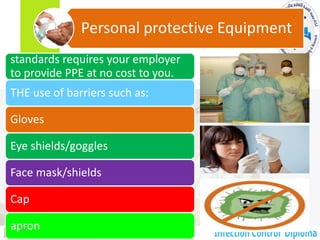
Personal protective Equipment
standards requires your employer
to provide PPE at no cost to you.
THE use of barriers such as:
Gloves
Eye shields/goggles
Face mask/shields
Cap
apron
84
Osha Guidance
for the Selection
and Use of
Personal
Protective
Equipment (PPE)
85
Goal of PPE Use
Improve personnel
safety in the healthcare
environment through
appropriate use of PPE.
86
Objectives OF PPE Use
-Provide information on
the selection and use of
PPE in healthcare
settings
87
how to safely
USE and remove
PPE
Objectives OF PPE Use
88
Personal Protective
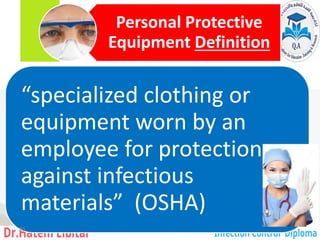
Definition
Equipment
“specialized clothing or
equipment worn by an
employee for protection
against infectious
materials” (OSHA)
89
Regulations and
Recommendations for PPE
Regarding osha , employers must:
-Provide appropriate PPE for
employees
-Ensure that PPE is disposed or
reusable PPE is cleaned, laundered,
repaired and stored after use
90
Regulations and
Recommendations for PPE
-OSHA specifies
circumstances for which
PPE is indicated for
protection against
infectious materials”
91
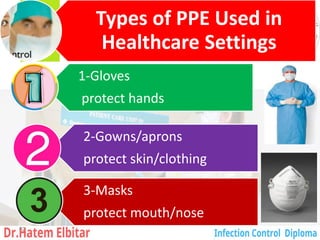
Types of PPE Used in
Healthcare Settings
1-Gloves
protect hands
2-Gowns/aprons
protect skin/clothing
3-Masks
protect mouth/nose
92
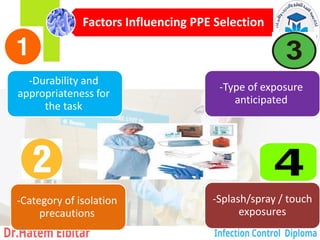
Factors Influencing PPE Selection
-Type of exposure
anticipated
-Durability and
appropriateness for
the task
-Splash/spray / touch
exposures
-Category of isolation
precautions
93
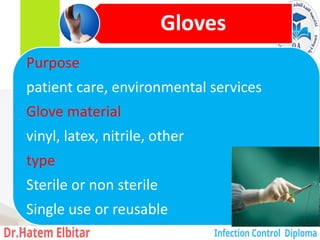
Gloves
Purpose
patient care, environmental services
Glove material
vinyl, latex, nitrile, other
type
Sterile or non sterile
Single use or reusable
94
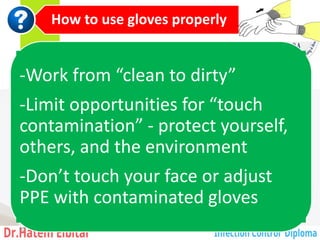
How to use gloves properly
-Work from “clean to dirty”
-Limit opportunities for “touch
contamination” - protect yourself,
others, and the environment
-Don’t touch your face or adjust
PPE with contaminated gloves
95
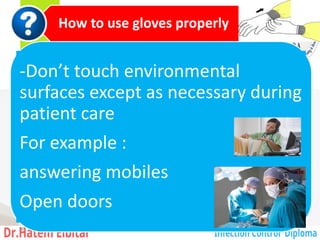
How to use gloves properly
-Don’t touch environmental
surfaces except as necessary during
patient care
For example :
answering mobiles
Open doors
96
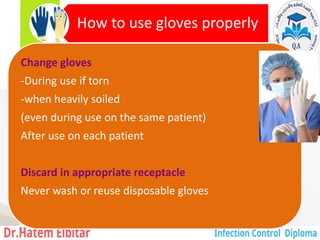
Change gloves
-During use if torn
-when heavily soiled
(even during use on the same patient)
After use on each patient
Discard in appropriate receptacle
Never wash or reuse disposable gloves
How to use gloves properly
97
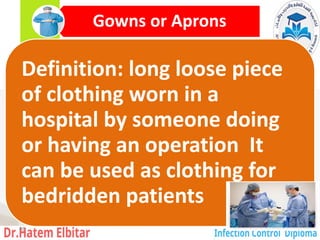
Gowns or Aprons
Definition: long loose piece
of clothing worn in a
hospital by someone doing
or having an operation It
can be used as clothing for
bedridden patients
98
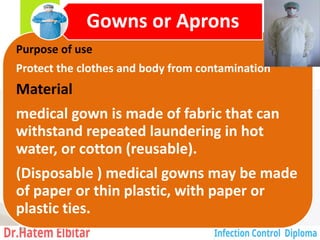
Purpose of use
Protect the clothes and body from contamination
Material
medical gown is made of fabric that can
withstand repeated laundering in hot
water, or cotton (reusable).
(Disposable ) medical gowns may be made
of paper or thin plastic, with paper or
plastic ties.
Gowns or Aprons
99
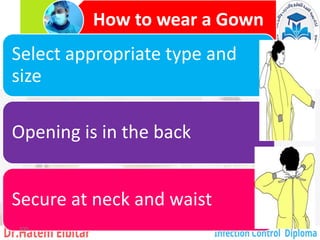
How to wear a Gown
Select appropriate type and
size
Opening is in the back
Secure at neck and waist
100
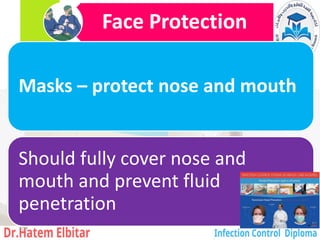
Face Protection
Masks – protect nose and mouth
Should fully cover nose and
mouth and prevent fluid
penetration
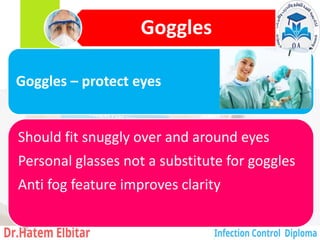
101
Goggles
Goggles – protect eyes
Should fit snuggly over and around eyes
Personal glasses not a substitute for goggles
Anti fog feature improves clarity
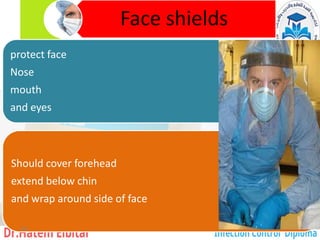
102
Face shields
protect face
Nose
mouth
and eyes
Should cover forehead
extend below chin
and wrap around side of face
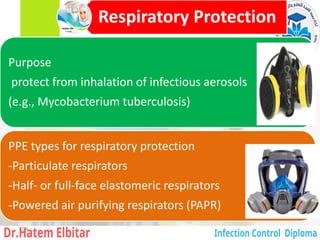
103
Respiratory Protection
Purpose
protect from inhalation of infectious aerosols
(e.g., Mycobacterium tuberculosis)
PPE types for respiratory protection
-Particulate respirators
-Half- or full-face elastomeric respirators
-Powered air purifying respirators (PAPR)
104
PPE Use in
Healthcare
Settings:
How to Safely
Use, and
Remove PPE
105
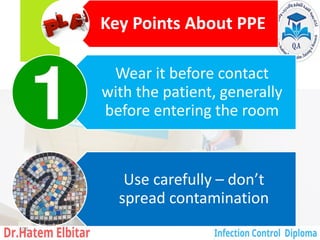
Key Points About PPE
Wear it before contact
with the patient, generally
before entering the room
Use carefully – don’t
spread contamination
106
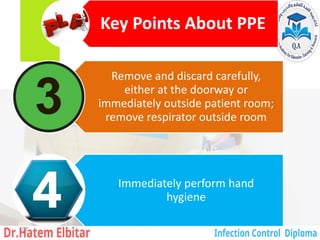
Key Points About PPE
Remove and discard carefully,
either at the doorway or
immediately outside patient room;
remove respirator outside room
Immediately perform hand
hygiene
107
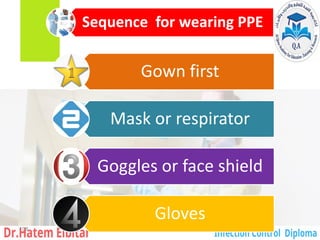
Sequence for wearing PPE
Gown first
Mask or respirator
Goggles or face shield
Gloves
108
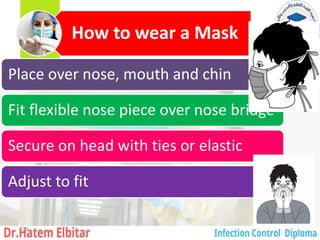
How to wear a Mask
Place over nose, mouth and chin
Fit flexible nose piece over nose bridge
Secure on head with ties or elastic
Adjust to fit
109
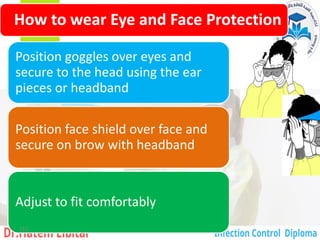
How to wear Eye and Face Protection
Position goggles over eyes and
secure to the head using the ear
pieces or headband
Position face shield over face and
secure on brow with headband
Adjust to fit comfortably
110
PPE Use in
Healthcare
Settings:
How to Safely
Remove PPE
111
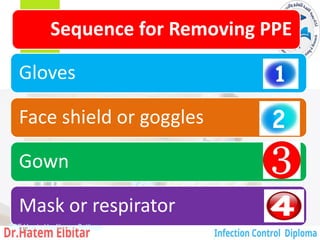
Sequence for Removing PPE
Gloves
Face shield or goggles
Gown
Mask or respirator
PPE Use in Healthcare Settings
112
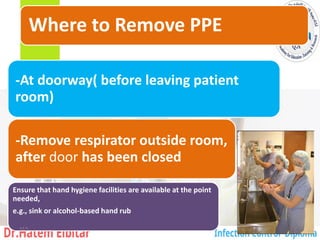
Where to Remove PPE
-At doorway( before leaving patient
room)
-Remove respirator outside room,
after door has been closed
Ensure that hand hygiene facilities are available at the point
needed,
e.g., sink or alcohol-based hand rub
113
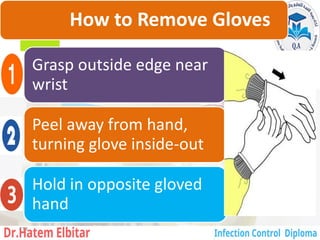
How to Remove Gloves
Grasp outside edge near
wrist
Peel away from hand,
turning glove inside-out
Hold in opposite gloved
hand
114
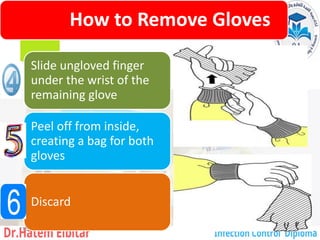
How to Remove Gloves
Slide ungloved finger
under the wrist of the
remaining glove
Peel off from inside,
creating a bag for both
gloves
Discard
115
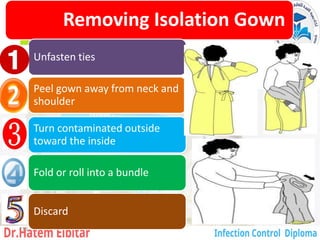
Removing Isolation Gown
Unfasten ties
Peel gown away from neck and
shoulder
Turn contaminated outside
toward the inside
Fold or roll into a bundle
Discard
116
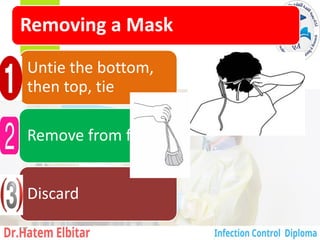
Removing a Mask
Untie the bottom,
then top, tie
Remove from face
Discard
117
PPE Use in
Healthcare
Settings:
When to
Use PPE
118
-Assumes blood and body fluid of ANY patient could
be infectious
-Recommends PPE and other infection control
practices to prevent transmission in any healthcare
setting
-Decisions about PPE use determined by type of
clinical interaction with patient
Osha Standard Precautions
For blood borne infections
119
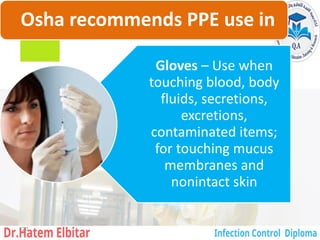
Osha recommends PPE use in
Gloves – Use when
touching blood, body
fluids, secretions,
excretions,
contaminated items;
for touching mucus
membranes and
nonintact skin
120
Osha recommends PPE use in
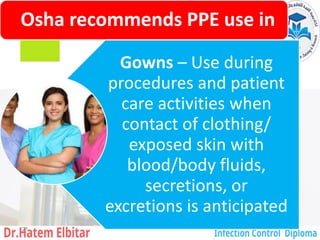
Gowns – Use during
procedures and patient
care activities when
contact of clothing/
exposed skin with
blood/body fluids,
secretions, or
excretions is anticipated
121
Osha recommends PPE use in
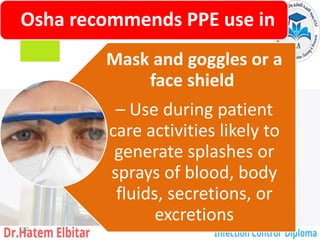
Mask and goggles or a
face shield
– Use during patient
care activities likely to
generate splashes or
sprays of blood, body
fluids, secretions, or
excretions
122
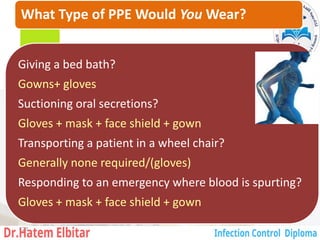
What Type of PPE Would You Wear?
Giving a bed bath?
Gowns+ gloves
Suctioning oral secretions?
Gloves + mask + face shield + gown
Transporting a patient in a wheel chair?
Generally none required/(gloves)
Responding to an emergency where blood is spurting?
Gloves + mask + face shield + gown
123
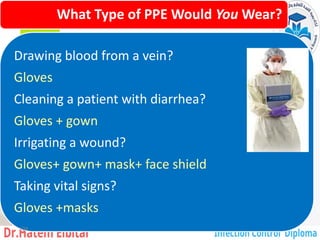
What Type of PPE Would You Wear?
Drawing blood from a vein?
Gloves
Cleaning a patient with diarrhea?
Gloves + gown
Irrigating a wound?
Gloves+ gown+ mask+ face shield
Taking vital signs?
Gloves +masks
124
PPE Final Thoughts
PPE is available to protect you
from exposure to infectious agents
in the healthcare workplace
Know what type of PPE is
necessary for the duties you
perform and use it correctly
125
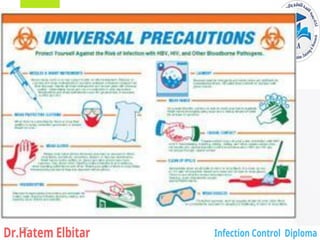
OSHA states that
universal precautions should
apply to all bodily fluids
because its impossible to know
if the fluid may contain blood.
Assume all bodily fluids to be
infectious!
126
127
OSHA requires the employer to have such
plan that should do the following:
-Establish engineering/ work practice controls
-Specify PPE to be used
-Identify Job positions and training necessary
-Requirement of Universal precautions
-Opportunity for the Hepatitis B vaccine
-Other measures appropriate to specific work
Exposure Control Plan
128
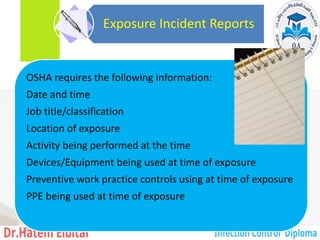
Exposure Incident Reports
OSHA requires the following information:
Date and time
Job title/classification
Location of exposure
Activity being performed at the time
Devices/Equipment being used at time of exposure
Preventive work practice controls using at time of exposure
PPE being used at time of exposure
129
-Workers may file a complaint with OSHA if they
believe a violation of a safety or health standard,
or an imminent danger situation, exists in the
workplace.
-Workers may request that their name not be
revealed to the employer.
-If a worker files a complaint, they have the right
to find out OSHA’s action on the complaint and
request a review if an inspection is not made.
File a complaint with osha
130
-Employee representative can accompany OSHA
inspector
-Workers can talk to the inspector privately.
-Workers may point out hazards, describe injuries,
illnesses or near misses that resulted from those
hazards and describe any concern you have about a
safety or health issue.
-Workers can find out about inspection results, may
object to dates set for violation to be corrected.
Participate in an osha inspection
131
-Workers have a right to seek safety
and health on the job without fear of
punishment.
-Workers have 30 days to contact
OSHA if they feel they have been
punished for exercising their safety
and health rights.
Participate in an osha inspection
132
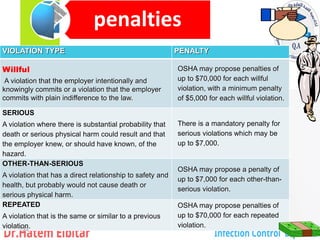
penalties
VIOLATION TYPE PENALTY
Willful
A violation that the employer intentionally and
knowingly commits or a violation that the employer
commits with plain indifference to the law.
OSHA may propose penalties of
up to $70,000 for each willful
violation, with a minimum penalty
of $5,000 for each willful violation.
SERIOUS
A violation where there is substantial probability that
death or serious physical harm could result and that
the employer knew, or should have known, of the
hazard.
There is a mandatory penalty for
serious violations which may be
up to $7,000.
OTHER-THAN-SERIOUS
A violation that has a direct relationship to safety and
health, but probably would not cause death or
serious physical harm.
OSHA may propose a penalty of
up to $7,000 for each other-than-
serious violation.
REPEATED
A violation that is the same or similar to a previous
violation.
OSHA may propose penalties of
up to $70,000 for each repeated
violation. 13
3
133
Summary
OSHA helps save lives and prevent
injuries
OSHA standards are the enforceable
requirements for worker safety and
health
134
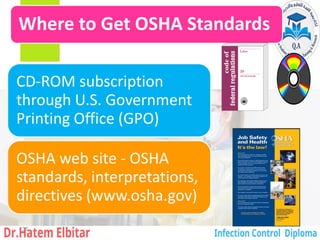
Where to Get OSHA Standards
CD-ROM subscription
through U.S. Government
Printing Office (GPO)
OSHA web site - OSHA
standards, interpretations,
directives (www.osha.gov)
135
Thank You
See you next lecture!
136
Some
important
safety tips
In health care
137
Creating a Culture
of Safety
1. Create a health
care culture of
safety is creating an
environment that
supports teamwork
and good
communication.
138
Creating a
Culture of Safety
2. Effective
teamwork and
communication
are associated
with better
patient
outcomes, higher
patient
satisfaction,
139
Cultural barriers :
Behavioral
Physicians were taught
to be independent and
have been resistant to
guidelines and systems
140
Cultural barriers :
Behavioral
Physicians view
teamwork as golf
teams not volleyball
teams
141
Cultural barriers :
Behavioral
un responsible behavior
has been tolerated and in
some respects rewarded
among physicians
142
Cultural barriers :
shame of
personal failure
- Current system of
quality
“Name,Blame and
Shame”
143
Cultural barriers :
shame of
personal failure
- Incidents are viewed
as personal failures
not system failures
144
Cultural barriers :
shame of
personal failure
- No current mechanism
for using individual data
and analyze data to
change the system
145
Cultural barriers :
sense of urgency
- Everyone is pushed
to be as efficient as
possible.
“No time for safety”
146
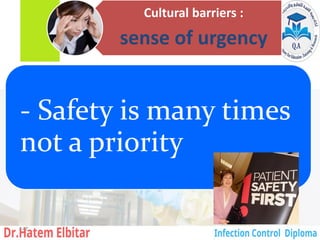
Cultural barriers :
sense of urgency
- Safety is many times
not a priority
147
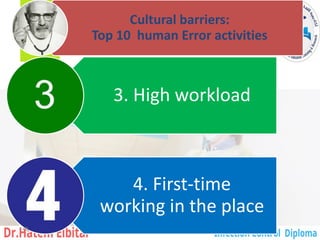
Cultural barriers:
Top 10 human Error activities
1. Time
pressure
2. Distracted
environment
148
Cultural barriers:
Top 10 human Error activities
3. High workload
4. First-time
working in the place
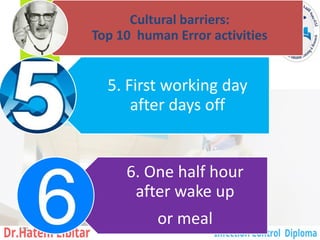
149
Cultural barriers:
Top 10 human Error activities
6. One half hour
after wake up
or meal
5. First working day
after days off
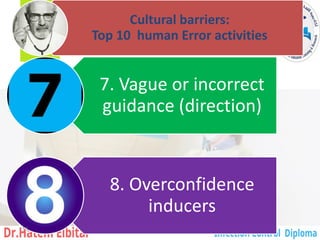
150
Cultural barriers:
Top 10 human Error activities
7. Vague or incorrect
guidance (direction)
8. Overconfidence
inducers
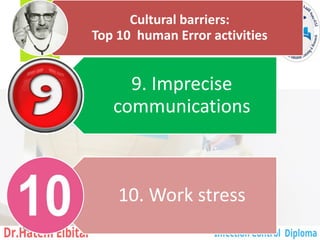
151
Cultural barriers:
Top 10 human Error activities
9. Imprecise
communications
10. Work stress
152
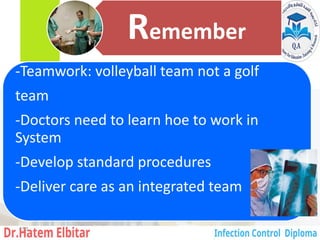
Remember
-Teamwork: volleyball team not a golf
team
-Doctors need to learn hoe to work in
System
-Develop standard procedures
-Deliver care as an integrated team
153
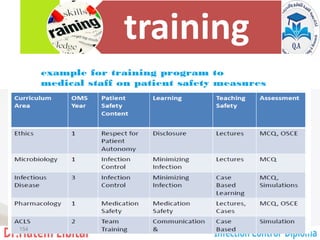
training
154
Other special
considerations
Hand Hygiene
One of the most important things you can do to
protect patients is also one of the easiest wash your
hands. Hand
hygiene compliance is important in helping to prevent
the spread of germs and infections.
Consider corner stone of any safety program taken by
the system
155
Other special
considerations
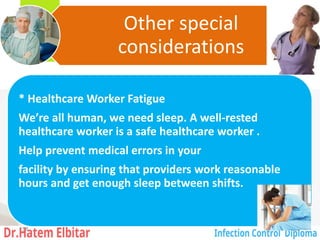
Healthcare Worker Fatigue
We’re all human, we need sleep.
A well-rested healthcare worker is a safe healthcare worker .
Help prevent medical errors in your
facility by ensuring that providers work reasonable hours and
get enough sleep between shifts.
156
Other special
considerations
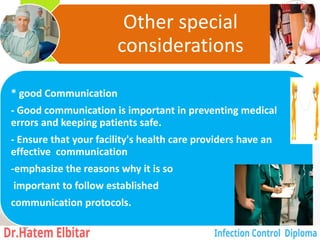
* good Communication
- Good communication is important in preventing medical
errors and keeping patients safe.
- Ensure that your facility's health care providers have an
effective communication
-emphasize the reasons why it is so
important to follow established
communication protocols.
157
Other special
considerations
* Healthcare Worker Fatigue
We’re all human, we need sleep. A well-rested
healthcare worker is a safe healthcare worker .
Help prevent medical errors in your
facility by ensuring that providers work reasonable
hours and get enough sleep between shifts.
158
Other special
considerations
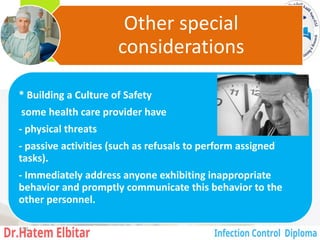
* Building a Culture of Safety
some health care provider have
- physical threats
- passive activities (such as refusals to perform assigned
tasks).
- Immediately address anyone exhibiting inappropriate
behavior and promptly communicate this behavior to the
other personnel.
159
Other special
considerations
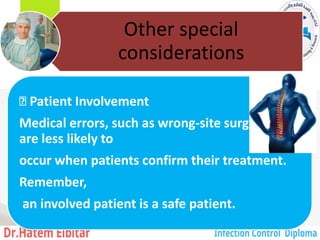
Patient Involvement
Medical errors, such as wrong-site surgeries,
are less likely to
occur when patients confirm their treatment.
Remember,
an involved patient is a safe patient.
160
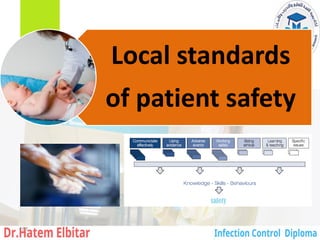
Local standards
of patient safety
161
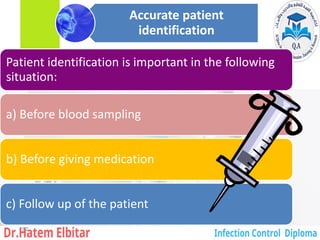
Accurate patient
identification
Patient identification is important in the following
situation:
a) Before blood sampling
b) Before giving medication
c) Follow up of the patient
162
Accurate patient
identification
Solution:
a unified medical number
a unified medical file
163
Communication with patient
it is common sense
colleagues present a
challenge to all who are
responsible for patient care
,in a single word:
“Respect ” “also we all serve
the patient”
164
Communication with patient
it is common sense
Patients treated with
respect are more
satisfied with their
physicians and other
care providers
165
physicians’ relationships with
patients
Respect is not just about addressing a
patient by a title such as “Ms.” or “Sir”;
It also involves understanding patients’
hopes , dreams, wants, needs, emotions
and making an effort to specifically
address those issues .
And as patients, we would expect
nothing less.
166
physicians’ relationships with
patients
satisfied patients are
less likely to seek legal
recourse following an
adverse event.
167
Communication
of patient information through
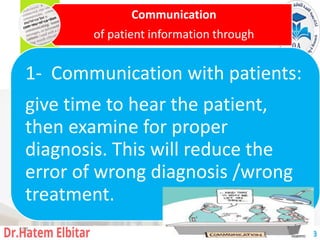
1- Communication with patients:
give time to hear the patient,
then examine for proper
diagnosis. This will reduce the
error of wrong diagnosis /wrong
treatment.
168
Communication
of patient information through
2-Accurate documentation in medical file :
- will help in follow up of patients case
accurately
- During follow up by the doctor
when the patient is referred to other
specialty
- When the patient is admitted
169
Avoid stressful environment for
Staff
Medical staff always subjected to errors in
diagnosis and management of patients
due to stress . This occurs with big
numbers of patients booked for the clinic
Solution
Adjust the number of patients to be seen
by the doctor/hour
170
171
The basic
principles of
patient safety in
health care
system
172
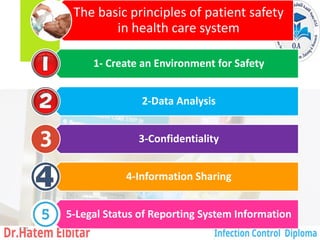
The basic principles of patient safety
in health care system
1- Create an Environment for Safety
2-Data Analysis
3-Confidentiality
4-Information Sharing
5-Legal Status of Reporting System Information
173
1- Create an
Environment for Safety
There should be a suitable culture for
reporting healthcare errors
that focuses on preventing and
correcting systems failures and not
on individual or organization
blaming.
174
2-Data Analysis
Information collected to
reporting systems must be
well analyzed to identify
actions that would minimize
the risk to prevent recurrence.
175
3-Confidentiality
There must be Confidentiality protections
for patients,
all healthcare system to have ability of
any reporting system to learn about errors
and effect their reduction.
(make self correction)
176
4-Information Sharing
Reporting systems should facilitate the
sharing of patient safety information
among healthcare organizations and adopt
confidential cooperation with other
healthcare reporting systems.
That will guarantee the patient rights
and punishment system to the neglected
ones
177
5-Legal Status of Reporting
System Information
The absence of legal protection for
information submitted to patient
safety reporting systems
discourages the use of such
systems, which will decrease from
its power to punish the neglected
178
In many countries
(developing)
- the practice of reusing
injection equipment in the
absence of sterilization is still
occur, and such practices have
been associated with infections
179
In many countries
(developing)
- Use of a new, single-use syringe
and needle provides the highest
level of safety to the recipient.
However, unreliable and
insufficient supplies might lead to
the equipment being reused
180
In many countries
(developing)
-Even though boiling
injection equipment for
20 min does not
sterilize it
181
In many countries
(developing)
- Although the use of injection equipment
taken from damaged packages has not
been associated with infection,
it is necessary to use injection
equipment that has been inspected for
cracks in barrier integrity and to discard it
if it is punctured, torn, or damaged.
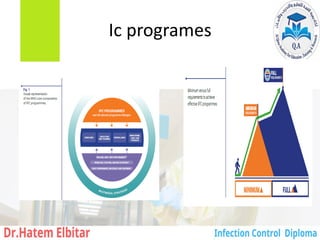
182
For any international
icprogrames we must provide
•
‐ standard precautions:
•
· hand hygiene
•
· use of PPE
•
· sterilization and medical device decontamination
•
· safe handling of linen and laundry
•
· health care waste management
•
· patient placement
•
· respiratory hygiene and cough etiquette
•
· environmental cleaning
•
· injection safety
•
· HCW protection, safety and post-exposure prophylaxis.
•
‐ transmission-based precautions;
•
‐ aseptic technique and device management for clinical
•
procedures;
•
‐ specific guidelines to prevent the most prevalent HAIs (for
•
example, catheter-associated urinary tract infection, surgical
•
site infection, central line-associated bloodstream infection,
•
ventilator-associated pneumonia), depending on the context
•
and complexity of care.
Ic programes
Ic programes
•
It is important to note that the gold standard
in any country
•
is to achieve the full implementation of all
requirements of
•
the WHO core components of IPC
programmes
•
The who decide to apply those programmes
we should do it in steps to run the full
capacity
step1
PRIMARY CARE:
IPC trained health care officer
•
• Trained IPC link person, with dedicated
•
(part-) time in each primary health care
•
facility.
•
• One IPC-trained health care officer
•
at the next administrative level (for
•
example, district) to supervise the IPC
•
link professionals in primary health care
•
facilities.
SECONDARY CARE:
functional IPC programme
•
• Trained IPC focal point (one full-time trained
•
IPC Officer [nurse or doctor]) as per the
•
recommended ratio of 1:250 beds with
•
dedicated time to carry out IPC activities
•
in all facilities (for example, if the facility
•
has 120 beds, one 50% full-time equivalent
•
dedicated officer).
•
• Dedicated budget for IPC implementation
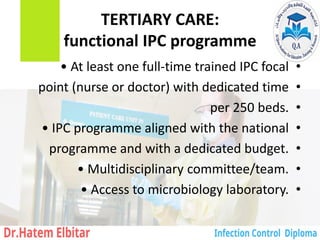
TERTIARY CARE:
functional IPC programme
•
• At least one full-time trained IPC focal
•
point (nurse or doctor) with dedicated time
•
per 250 beds.
•
• IPC programme aligned with the national
•
programme and with a dedicated budget.
•
• Multidisciplinary committee/team.
•
• Access to microbiology laboratory.
step2
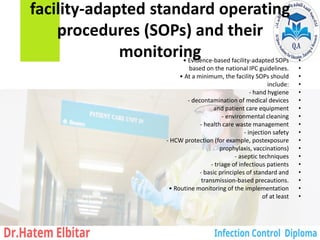
facility-adapted standard operating
procedures (SOPs) and their
monitoring •
• Evidence-based facility-adapted SOPs
•
based on the national IPC guidelines.
•
• At a minimum, the facility SOPs should
•
include:
•
‐ hand hygiene
•
‐ decontamination of medical devices
•
and patient care equipment
•
‐ environmental cleaning
•
‐ health care waste management
•
‐ injection safety
•
‐ HCW protection (for example, postexposure
•
prophylaxis, vaccinations)
•
‐ aseptic techniques
•
‐ triage of infectious patients
•
‐ basic principles of standard and
•
transmission-based precautions.
•
• Routine monitoring of the implementation
•
of at least
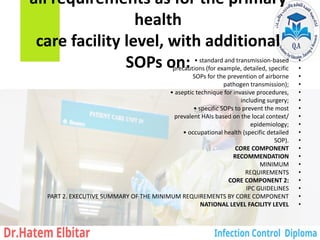
all requirements as for the primary
health
care facility level, with additional
SOPs on: •
• standard and transmission-based
•
precautions (for example, detailed, specific
•
SOPs for the prevention of airborne
•
pathogen transmission);
•
• aseptic technique for invasive procedures,
•
including surgery;
•
• specific SOPs to prevent the most
•
prevalent HAIs based on the local context/
•
epidemiology;
•
• occupational health (specific detailed
•
SOP).
•
CORE COMPONENT
•
RECOMMENDATION
•
MINIMUM
•
REQUIREMENTS
•
CORE COMPONENT 2:
•
IPC GUIDELINES
•
PART 2. EXECUTIVE SUMMARY OF THE MINIMUM REQUIREMENTS BY CORE COMPONENT
•
NATIONAL LEVEL FACILITY LEVEL
step3
facility-adapted standard operating
procedures (SOPs) and their
monitoring •
• Evidence-based facility-adapted SOPs
•
based on the national IPC guidelines.
•
• At a minimum, the facility SOPs should
•
include:
•
‐ hand hygiene
•
‐ decontamination of medical devices
•
and patient care equipment
•
‐ environmental cleaning
•
‐ health care waste management
•
‐ injection safety
•
‐ HCW protection (for example, postexposure
•
prophylaxis, vaccinations)
•
‐ aseptic techniques
•
‐ triage of infectious patients
•
‐ basic principles of standard and
•
transmission-based precautions.
•
• Routine monitoring of the implementation
•
of at least some of the IPC guidelines/
•
SOPs
all requirements as for the primary
health
care facility level, with additional
SOPs on: •
• standard and transmission-based
•
precautions (for example, detailed, specific
•
SOPs for the prevention of airborne
•
pathogen transmission);
•
• aseptic technique for invasive procedures,
•
including surgery;
•
• specific SOPs to prevent the most
•
prevalent HAIs based on the local context/
•
epidemiology;
•
• occupational health (specific detailed
•
SOP).
Step 4
•
PRIMARY CARE:
•
IPC training for all front-line clinical staff
•
and cleaners upon hiring
•
• All front-line clinical staff and cleaners
•
must receive education and training on
•
the facility IPC guidelines/SOPs upon
•
employment.
•
• All IPC link persons in primary care
•
facilities and IPC officers at the district
•
level (or other administrative level) need to
•
receive specific IPC training.
•
SECONDARY CARE:
•
IPC training for all front-line clinical staff
•
and cleaners upon hire
•
• All front-line clinical staff and cleaners
•
must receive education and training on
•
the facility IPC guidelines/SOPs upon
•
employment.
•
• All IPC staff need to receive specific IPC
•
training.
•
TERTIARY CARE:
•
IPC training for all front-line clinical staff
•
and cleaners upon hire and annually
•
• All front-line clinical staff and cleaners
•
must receive education and training on
•
the facility IPC guidelines/SOPs upon
•
employment and annually.
•
• All IPC staff need to receive specific IPC
•
training.
Step 5
•
survellience
•
IPC surveillance and a monitoring technical
•
group
•
• Establishment by the national IPC focal point
•
of a technical group for HAI surveillance and
•
IPC monitoring that:
•
‐ is multidisciplinary;
•
‐ develops a national strategic plan for
•
HAI surveillance (with a focus on priority
•
infections based on the local context)
•
and IPC monitoring.
•
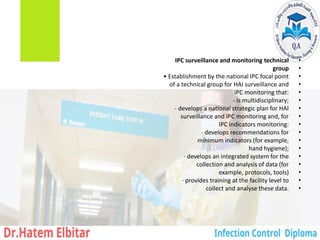
PRIMARY CARE
•
• HAI surveillance is not required as a
•
minimum requirement at the primary
•
facility level, but should follow national
•
or sub-national plans, if available (for
•
example, detection and reporting of
•
outbreaks affecting the community is
•
usually included in national plans).
•
SECONDARY CARE
•
• HAI surveillance should follow national or
•
sub-national plans.
•
TERTIARY CARE:
•
functional HAI surveillance
•
• Active HAI surveillance should be
•
conducted and include information on
•
AMR:
•
‐ enabling structures and supporting
•
resources need to be in place (for
•
example, dependable laboratories,
•
medical records, trained staff),
•
directed by an appropriate method of
•
surveillance;
•
‐ the method of surveillance should be
•
directed by the priorities/plans of the
•
facility and/or country.
•
• Timely and regular feedback needs to be
•
provided to key stakeholders in order to
•
lead to appropriate action, in particular to
•
the hospital administration.
•
NATIONAL LEVEL FACILITY LEVEL
•
CORE COMPONENT
•
RECOMMENDATION
step7
•
MONITORING, AUDITING AND FEEDBACK
•
IPC surveillance and monitoring technical
•
group
•
• Establishment by the national IPC focal point
•
of a technical group for HAI surveillance and
•
IPC monitoring that:
•
‐ is multidisciplinary;
•
‐ develops a national strategic plan for HAI
•
surveillance and IPC monitoring and, for
•
IPC indicators monitoring:
•
· develops recommendations for
•
minimum indicators (for example,
•
hand hygiene);
•
· develops an integrated system for the
•
collection and analysis of data (for
•
example, protocols, tools)
•
· provides training at the facility level to
•
collect and analyse these data.
•
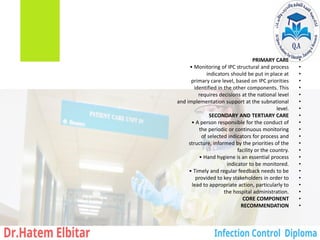
PRIMARY CARE
•
• Monitoring of IPC structural and process
•
indicators should be put in place at
•
primary care level, based on IPC priorities
•
identified in the other components. This
•
requires decisions at the national level
•
and implementation support at the subnational
•
level.
•
SECONDARY AND TERTIARY CARE
•
• A person responsible for the conduct of
•
the periodic or continuous monitoring
•
of selected indicators for process and
•
structure, informed by the priorities of the
•
facility or the country.
•
• Hand hygiene is an essential process
•
indicator to be monitored.
•
• Timely and regular feedback needs to be
•
provided to key stakeholders in order to
•
lead to appropriate action, particularly to
•
the hospital administration.
•
CORE COMPONENT
•
RECOMMENDATION
step8
•
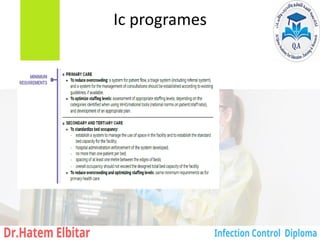
WORKLOAD, STAFFING AND BED OCCUPANCY
(FACILITY LEVEL ONLY*)
•
PRIMARY CARE
•
• To reduce overcrowding: a system for patient flow, a triage system (including referral system)
•
and a system for the management of consultations should be established according to existing
•
guidelines, if available.
•
• To optimize staffing levels: assessment of appropriate staffing levels, depending on the
•
categories identified when using WHO/national tools (national norms on patient/staff ratio),
•
and development of an appropriate plan.
•
SECONDARY AND TERTIARY CARE
•
• To standardize bed occupancy:
•
‐ establish a system to manage the use of space in the facility and to establish the standard
•
bed capacity for the facility;
•
‐ hospital administration enforcement of the system developed;
•
‐ no more than one patient per bed;
•
‐ spacing of at least one metre between the edges of beds;
•
‐ overall occupancy should not exceed the designed total bed capacity of the facility.
•
• To reduce overcrowding and optimizing staffing levels: same minimum requirements as for
•
primary health care.
•
MINIMUM
•
REQUIREMENTS
•
CORE COMPONENT 7:
•
WORKLOAD, STAFFING AND BED OCCUPANCY (FACILITY LEVEL ONLY*)
•
*
step9
•
BUILT ENVIRONMENT, MATERIALS
•
AND EQUIPMENT FOR IPC (FACILITY LEVEL
ONLY*)
•
Patient care activities should be undertaken in
a clean and hygienic environment that
facilitates
•
practices related to the prevention and control
of HAI, as well as AMR, including all elements
around
•
WASH infrastructure and services and the
availability of appropriate IPC materials and
equipment.
•
The panel recommends that materials and
equipment to perform appropriate hand
•
PRIMARY CARE:
•
• Water should always be available from a source on the premises (such as a a deep borehole or
•
a treated, safely managed piped water supply) to perform basic IPC measures, including hand
•
hygiene, environmental cleaning, laundry, decontamination of medical devices and health care
•
waste management according to national guidelines.
•
• A minimum of two functional, improved sanitation facilities should be available on-site, one for
•
patients and the other for staff; both should be equipped with menstrual hygiene facilities.
•
• Functional hand hygiene facilities should always be available at points of care/toilets and include
•
soap, water and single-use towels (or if unavailable, clean reusable towels) or alcohol-based
•
handrub (ABHR) at points of care and soap, water and single-use towels (or if unavailable, clean
•
reusable towels) within 5 metres of toilets.
•
• Sufficient and appropriately labelled bins to allow for health care waste segregation should
•
be available and used (less than 5 metres from point of generation); waste should be treated
•
and disposed of safely via autoclaving, high temperature incineration, and/or buried in a lined,
•
protected pit.
•
• The facility layout should allow adequate natural ventilation, decontamination of reusable
•
medical devices, triage and space for temporary cohorting/isolation/physical separation if
•
necessary.
•
• Sufficient and appropriate IPC supplies and equipment (for example, mops, detergent,
•
disinfectant, personal protective equipment (PPE) and sterilization) and power/energy (for
•
example, fuel) should be available for performing all basic IPC measures according to minimum
•
requirements/SOPs, including all standard precautions, as applicable; lighting should be available
•
during working hours for providing care
•
SECONDARY AND TERTIARY CARE:
•
• A safe and sufficient quantity of water should be available for all required IPC
measures and
•
specific medical activities, including for drinking, and piped inside the facility at all
times - at a
•
minimum to high-risk wards (for example, maternity ward, operating room/s,
intensive care unit).
•
• A minimum of two functional, improved sanitation facilities that safely contain
waste available
•
for outpatient wards should be available and one per 20 beds for inpatient wards;
all should be
•
equipped with menstrual hygiene facilities.
•
• Functional hand hygiene facilities should always be available at points of care,
toilets and
•
service areas (for example, the decontamination unit), which include ABHR and
soap, water and
•
single-use towels (or if unavailable, clean reusable towels) at points of care and
service areas,
•
and soap, water and single-use towels (or if unavailable, clean reusable towels)
within 5 metres
•
of toilets.
•
The facility should be designed to allow adequate ventilation (natural or
mechanical, as
•
needed) to prevent transmission of pathogens.
•
• Sufficient and appropriate supplies and equipment and reliable
power/energy should be
•
available for performing all IPC practices, including standard and
transmission-based
•
precautions, according to minimum requirements/SOPs; reliable electricity
should be available
•
to provide lighting to clinical areas for providing continuous and safe care,
at a minimum to
•
high-risk wards (for example, maternity ward, operating room/s, intensive
care unit).
•
• The facility should have a dedicated space/area for performing the
decontamination and
•
reprocessing of medical devices (that is, a decontamination unit)
according to minimum
•
requirements/SOPs.
•
• The facility should have adequate single isolation rooms or at least one
Primary care is always more important
in any ipc programes >>>why?
•
PRIMARY CARE
•
• The primary health care level is the first main point of entry of
•
infectious pathogens to the health system and it is where IPC is
•
usually weakest.
•
• It is critical to establish at least a basic level of IPC and triage in
•
primary care (that is, the minimum requirements) to avoid infection
•
and AMR spread through the health system, including health careassociated
•
outbreaks caused by human-to-human transmission of
•
emerging or re-remerging pathogens.
•
• It is important to have professionals in charge of IPC at different
•
levels (facility and at the next administrative level) to support a
•
programmatic approach based on coordination, supervision and
•
accountability through monitoring and evaluation.
•
• The existence of an IPC programme and practices at the primary
•
care level will contribute to patient safety and quality of care and
•
facilitate linkages to the community and dissemination of basic
•
prevention principles among families, as well as patient and family
•
engagement.
•
• The link person should be a staff member at the primary health
•
care facility level, trained in IPC and with dedicated time (part-time).
•
• In facilities with more than 10 HCWs, the IPC link person should be
•
in charge of the following functions: advising on procurement and
•
maintenance of equipment and consumables for IPC; monitoring
•
and supervising IPC activities; liaising with the relevant next
•
administrative level IPC coordinators on the implementation of IPC
•
activities; liaising with the regular disease notification system for
•
the reporting of unusual events.
•
• In facilities with less than 10 HCWs, the link person could have
•
some of the above-mentioned functions but, overall, more support
•
from the district officer will be needed, especially for monitoring
•
activities.
د حاتم_البيطار دبلومة مكافحة العدوي 01005684344.pdf

د حاتم_البيطار دبلومة مكافحة العدوي 01005684344.pdf

  • 1.
    ‫البيطار‬ ‫حاتم‬ ‫د‬ ‫الصحية‬‫الرعاية‬ ‫ادارة‬ ‫استشاري‬ 01005684344 01202389028
  • 2.
    The principal roleof these barriers is to protect hospital staff from infectious agents that can be transmitted by blood and body fluids, such as the human immunodeficiency virus (HIV) and hepatitis B and C viruses. Protective Barriers 2
  • 3.
    Rubber gloves werepopularized in late nineteenth century by William Halstead the first Chief of the Surgery at Johns Hopkins Hospital, who covered only his palms and three fingers with the gloves because they were heavy and impaired the sense of touch. Today, sterile rubber gloves are the second skin of the operating surgeon. In the ICU, sterile gloves are used primarily for placing catheters in the bloodstream. Gloves 3
  • 4.
    In the 1980s(a century after the introduction of surgical gloves), the use of nonsterile gloves was popularized by the discovery that HIV is transmitted in blood and body fluids. This discovery prompted a policy known as Universal Precautions which considered all patients as possible sources of HIV. An updated policy known as Standard Precautions contains the current recommendations for nonsterile gloves, Nonsterile gloves should be used for any contact with a moist body substance, which includes blood, body fluids, secretions, excretions, nonintact skin, and mucous membranes. Gloves 4
  • 5.
    Note also inthat nonsterile gloves are considered safe for insertion of peripheral venous catheters as long as a “no touch” technique is used (i.e., as long as the gloved hands are not permitted to touch the catheter) Gloves 5
  • 6.
    As indicated in,hand washing is recommended before donning gloves and again after they are removed. This recommendation is based on two concerns. The first is the fear that gloves can leak or tear and thereby allow microbial transmission between the hands of the healthcare worker and the patient. Hand washing and Gloves 6
  • 7.
    The second concernis the potential for moisture buildup on the hands during prolonged glove use, which would favor microbial growth on the hands while the gloves are on. Both of these are valid concerns for invasive surgical procedures, where glove use is prolonged and soiling of gloves is prominent. However, the significance of these concerns in a nonsurgical setting like the ICU (where glove use is not prolonged and soiling of gloves is usually not prominent) is less certain. many results suggest that handwashing before and after short-term glove use in a nonsurgical setting like the ICU may be unnecessary. Hand washing and Gloves 7
  • 8.
    The dramatic increasein the use of rubber gloves over the last two decades has created a problem with latex hypersensitivity in hospital workers. Latex is a natural rubber product that is used in over 40,000 household and medical products, including gloves, face masks, blood pressure cuffs, and catheters. Repeated exposure to latex can promote hypersensitivity reactions that can be evident clinically as either contact dermatitis (urticaria or eczema), anaphylaxis, rhino conjunctivitis, or asthma . Latex Allergy 8
  • 9.
    Latex hypersensitivity isreported in 10% to 20% of hospital workers, compared to 1% of the general population .For unclear reasons, patients with spina bifida have the highest risk of latex allergy, with as many as 40% of the population having this condition - The diagnosis of latex allergy can be elusive. One problem is the nonspecific Manifestations of disease. Another problem is the fact that symptoms of latex allergy can appear without direct physical contact with latex. This is often the case with the rhino conjunctivitis and asthma, which are triggered by airborne latex particles. A history of symptoms confined to the workplace should create suspicion for latex allergy. Latex Allergy 9
  • 10.
    The clinical manifestationsof latex allergy often coincide with exposure to latex, so hospital workers with symptomatic latex allergy often display these symptoms while in the hospital and are symptom-free at home. Latex Allergy 10
  • 11.
    There are twotests for latex hypersensitivity. One is a skin test, and the other is an assay for latex-specific immunoglobulin E levels in the bloodstream. Both have shortcomings. There is no standardized extract for the skin test (allergists have to make their own extract by pulverizing latex gloves!), so results are operator- dependent. The assay for latex-specific IgE in blood is currently the favored test, but the sensitivity can be low . Latex Allergy 11
  • 12.
    If confronted witha case of possible latex allergy, you should contact the clinical laboratory in your hospital and ask about the availability and reliability of these tests in your region. - The treatment of latex allergy is symptom-driven and nonspecific. Removing latex from the patient's immediate environment is the best strategy, but this may not be possible because latex is ubiquitous in the hospital environment (it is even found on tongue depressors!). The hospital should provide substitutes for latex products (e.g., vinyl gloves) when necessary. Latex Allergy 12
  • 13.
    As was thecase with nonsterile gloves, the use of other barriers like masks, eye shields, face shields, and gowns increased markedly after the discovery that HIV is transmitted in blood and body fluids. These barriers are currently recommended for all procedures or patient care activities that are likely to generate splashes of blood, body fluids, secretions, or excretions . Nonsterile gowns are adequate, and gowns coated with a plastic covering are the least impervious to blood and body fluids .Soiled gowns and other barriers should be removed and discarded as soon as possible, and before going to another patient . Masks and Other Barriers 13
  • 14.
    Types of Masks Thereare two types of face masks: surgical masks and respirators. Surgical masks were introduced to prevent contamination of the operative field during surgical procedures. In the past 2 decades, they have been adopted as a means of protecting healthcare workers from inhalation of airborne infectious agents. There is no evidence that surgical masks are effective in preventing infection .yet they continue to be used without question. Masks and Other Barriers 14
  • 15.
    - Respirators aredevices that protect the wearer from inhaling a dangerous substance .The different types of respirators include particulate respirators (block particulate matter), gas mask respirators (filter or clean chemical gases in the air), and the Self-Contained Breathing Apparatus (equipped with its own air tank), which is used by firefighters. Types of Masks 15
  • 16.
    Particulate respirators areused to block inhalation of airborne pathogens, particularly the tubercle bacillus that causes pulmonary tuberculosis. The respirator currently recommended for this purpose is called an N95 respirator . The “N” indicates that the mask will block non–oil-based or aqueous aerosols (the type that transmits the tubercle bacillus), and the “95” indicates the mask will block 95% of the intended particles (a requirement for a respirator mask to be judged effective) Types of Masks 16
  • 17.
    -Types of AirborneIllness -Blood-Borne Pathogens -Needle stick Injuries Types of infections in the icu 17
  • 18.
    Infectious organisms thatare capable of airborne transmission are divided into two categories: those greater than 5 microns (>;5m) in diameter, and those that are 5 microns or less (=5μ) in diameter. In each of these illnesses, airborne infectious particles are produced by coughing or sneezing (one cough or sneeze can produce 3,000 airborne particles) or procedures such as airways suctioning and bronchoscopy. -Types of Airborne Illness 18
  • 19.
    The airborne particlescan be inhaled or can impact on nonintact skin, or on the mucosa in the nose or mouth. and to block transmission of these particles, a surgical mask is recommended when hospital staff or visitors are within 3 feet of the patient , The smaller (=5m in diameter) infectious particles can travel long distances in the air, and to prevent transmission of these particles, patients should be isolated in private rooms that are maintained at a negative pressure relative to the surrounding areas. For patients with infectious tuberculosis (pulmonary or laryngeal), -Types of Airborne Illness 19
  • 20.
    all hospital staffand visitors should wear an N95 respirator mask while in the room .For patients in the infectious stages of measles and varicella (chickenpox or herpes zoster), individuals with no prior history of these infections who are also pregnant, immunocompromised, or otherwise debilitated by disease should not be allowed in the patient's room. For other susceptible individuals who must enter the room (i.e., hospital workers), an N95 respirator mask should be worn at all times while in the room. -Types of Airborne Illness 20
  • 21.
    The airborne particlescan be inhaled or can impact on nonintact skin, or on the mucosa in the nose or mouth. and to block transmission of these particles, a surgical mask is recommended when hospital staff or visitors are within 3 feet of the patient , The smaller (=5m in diameter) infectious particles can travel long distances in the air, and to prevent transmission of these particles, patients should be isolated in private rooms that are maintained at a negative pressure relative to the surrounding areas. For patients with infectious tuberculosis (pulmonary or laryngeal), -Types of Airborne Illness 21
  • 22.
    The airborne particlescan be inhaled or can impact on nonintact skin, or on the mucosa in the nose or mouth. and to block transmission of these particles, a surgical mask is recommended when hospital staff or visitors are within 3 feet of the patient , The smaller (=5m in diameter) infectious particles can travel long distances in the air, and to prevent transmission of these particles, patients should be isolated in private rooms that are maintained at a negative pressure relative to the surrounding areas. For patients with infectious tuberculosis (pulmonary or laryngeal), -Types of Airborne Illness 22
  • 23.
    The airborne particlescan be inhaled or can impact on nonintact skin, or on the mucosa in the nose or mouth. and to block transmission of these particles, a surgical mask is recommended when hospital staff or visitors are within 3 feet of the patient , The smaller (=5m in diameter) infectious particles can travel long distances in the air, and to prevent transmission of these particles, patients should be isolated in private rooms that are maintained at a negative pressure relative to the surrounding areas. For patients with infectious tuberculosis (pulmonary or laryngeal), -Types of Airborne Illness 23
  • 24.
    all hospital staffand visitors should wear an N95 respirator mask while in the room .For patients in the infectious stages of rubeola (measles) and varicella (chickenpox or herpes zoster), individuals with no prior history of these infections who are also pregnant, immunocompromised, or otherwise debilitated by disease should not be allowed in the patient's room. For other susceptible individuals who must enter the room (i.e., hospital workers), an N95 respirator mask should be worn at all times while in the room. -Types of Airborne Illness 24
  • 25.
    Atypical Pulmonary TB - Itis important to distinguish infections caused by Mycobacterium tuberculosis from those caused by atypical mycobacteria (e.g., Mycobacterium avium complex) when determining the need for respiratory protection. -Types of Airborne Illness 25
  • 26.
    The greatest infectiousrisk you face in the ICU is exposure to blood-borne pathogens like HIV, hepatitis B virus (HBV), and hepatitis C virus (HCV). This section will describe the occupational risks associated with each of these pathogens and the preventive measures used to minimize these risks. Borne Pathogens - Blood - 26
  • 27.
    The transmission ofblood-borne infections to hospital workers occurs primarily via needle stick injuries (i.e., accidental puncture wounds of the skin caused by hollow needles and suture needles). Each year, an estimated 10% of hospital workers sustain a needle stick injury. Most of these injuries occur in nurses, but the risk is also high in all staff surgeons. Needle stick Injuries - 27
  • 28.
    The transmission ofblood-borne infections to hospital workers occurs primarily via needle stick injuries (i.e., accidental puncture wounds of the skin caused by hollow needles and suture needles). Each year, an estimated 10% of hospital workers sustain a needle stick injury. Most of these injuries occur in nurses, but the risk is also high in all staff surgeons. Needle stick Injuries - 28
  • 29.
    As many as70% of residents and medical students report a needle stick injury during their training (the incidence is highest in surgical residents) and a survey in one hospital revealed that 60% of the staff surgeons experienced a needle stick injury at some time in their careers ,The activities most often associated with needle stick injuries outside the operating room involve recapping and disposal of used needles. Needle stick Injuries - 29
  • 30.
    The transmission ofblood-borne infections to hospital workers occurs primarily via needle stick injuries (i.e., accidental puncture wounds of the skin caused by hollow needles and suture needles). Each year, an estimated 10% of hospital workers sustain a needle stick injury. Most of these injuries occur in nurses, but the risk is also high in all staff surgeons. Needle stick Injuries - 30
  • 31.
    The problem ofneedle stick injuries came to the attention of the United States Congress in the year 2000, and as a result, Congress passed the Needle stick Safety and Prevention Act that mandates the use of “safety-engineered” needles in all American health care facilities. The needle is equipped with a rigid, plastic housing that is attached by a hinge joint to the hub of the needle. The protective housing is normally positioned away from the needle so it does not interfere with needle use. Safety Devices 31
  • 32.
    . When theneedle is no longer needed, it is locked into the protective housing by holding the housing against a rigid structure and moving the needle about the hinge joint (like closing a door) until it snaps in place in the housing. The needle stays attached to the syringe during this procedure, and the hands never touch the needle. The protected needle and attached syringe are then placed in a puncture-proof “sharps container” for eventual disposal. Safety Devices 32
  • 33.
    Handed Recapping Technique - One Oncethe needle is locked in its protective housing, it is not possible to remove it for further use. In situations where a needle has multiple uses (e.g., filling a syringe with a drug preparation and later injecting the drug in several increments), the needle can be rendered harmless between uses by recapping it with the one-handed “scoop technique” shown in Figure. With the needle cap resting on a horizontal surface, the needle is advanced into the needle cap. Safety Devices 33
  • 34.
    Using the tipof the needle cap as a fulcrum, the needle and cap are then lifted vertically until they are perpendicular to the horizontal surface. The needle is then pushed into the cap until it locks in place. The hands are never in a position to permit an accidental needle puncture Safety Devices 34
  • 35.
  • 36.
    When a memberof the ICU staff experiences a possible exposure to HIV from a needle stick injury or blood splash to the face, the appropriate steps to take are determined by the presence or absence of HIV anti-bodies in the blood of the source patient. If the HIV antibody status of the source patient is unknown, you should perform a rapid HIV-antibody test on a blood sample from the source patient. This is done at the bedside (by an appropriately trained member of the staff), and the results are available in 10 to 15 minutes. Post exposure Management 36
  • 37.
    The results ofthis test can be used to guide initial management decisions, but a positive result must be confirmed by another test such as a Western blot or immuno fluorescent antibody assay. The recommendations for possible HIV exposure based on the HIV status of the source patient .The major decision following possible HIV transmission is whether or not to begin prophylactic therapy with antiretroviral agents in the exposed individual. Post exposure Management 37
  • 38.
    If HIV infectionis proven or suspected in the source patient, prophylactic therapy with at least 2 antiretroviral agents is started and continued for 4 weeks (or until there is convincing evidence for the absence of HIV infection in the source patient). A popular two-drug regimen is the combination of zidovudine (200 mg ) and lamovudine (150 mg daily). These two drugs are available in a combination tablet (COMBIVIR, GlaxoSmithKline), each containing 150 mg lamovudine and 300 mg zidovudine. Post exposure Management 38
  • 39.
    Cdc surveillance of nosocomialinfections in icus 39
  • 40.
  • 41.
    -Microbial organisms (microbes)make up about 90% of the living matter on this planet -They're all around us: in the air we breathe, the food we eat, and the water we drink. - They're also in our skin, under our fingernails, our nose and mouth, and can be collected from our intestinal tract. Infection Control in the ICU 41
  • 42.
    Some of theseorganisms called “germs” that are eager to invade and destroy the human body, Most microbes have nothing to gain by invading the human body (excluding viruses here), but they have much to lose because they can be killed by the inflammatory response. Infection Control in the ICU 42
  • 43.
    It seems thenthat survival would dictate that microorganisms avoid the interior of the human body, not invade it. For more than a century, medicine has viewed the microbial world as an enemy that should be destroyed, and the practices described in this chapter are an expression of that belief. Infection Control in the ICU 43
  • 44.
  • 45.
    Types of PPEUsed in Healthcare Settings 4-Respirators – protect respiratory tract from airborne infectious agents 5-Goggles – protect eyes- 6-Face shields – protect face,mouth, nose, and eyes 45
  • 46.
    Remove Goggles orFace Shield Grasp ear or head pieces with ungloved hands Lift away from face Place in designated receptacle for reprocessing or disposal 46
  • 47.
    Hand Hygiene Perform handhygiene immediately after removing PPE. Wash hands with soap and water or use an alcohol-based hand rub 47
  • 48.
    Hand Hygiene If handsbecome visibly contaminated during PPE removal, wash hands before continuing to remove PPE 48
  • 49.
    By Dr Hatem ElBitar Egyptian fellowship 49
  • 50.
  • 51.
    lecture Overview 51 Purpose: To provideemployees with introductory information about OSHA Topics: Why is OSHA important to you? What rights do you have under OSHA? What responsibilities does your employer have under OSHA? What do the OSHA standards say? How are OSHA inspections conducted? Where can you go for help? 51
  • 52.
    What is OSHA? OccupationalSafety and Health Administration Simply: Responsible for worker safety and health protection 52
  • 53.
    Purpose” The purpose ofthe OSHA is to “assure so far as possible every working, man and woman in the nation safe and healthful working conditions and to preserve our human resources.” 53
  • 54.
    Questions to consider....... Whatis the fist thing you think about when you hear OSHA? Do you feel protected knowing there are standards in place? Do you think these standards work in the healthcare industry? 54
  • 55.
    About OSHA It ispart of the United States Department of Labor OSHA's administrator answers to the Secretary of Labor who is part of the US President's cabinet Congress passed the Occupational and Safety Act of 1970 creating OSHA 55
  • 56.
    About OSHA On December29, 1970, President Nixon signed the OSHA Act On December 29, 1970, President Nixon signed the OSH Act This Act created OSHA, the agency, which formally came into being on April 28, 1971 This Act created OSHA, the agency, which formally came into being on April 28, 1971 56
  • 57.
    OSHA began because,until 1970, there were no national laws for safety and health hazards. On average, 15 workers die every day from job injuries Over 5,600 Americans die from workplace injuries annually 57 Why is OSHA Important to You? 57
  • 58.
    Why was OSHAcreated? Nearly 2.5 million employees were disabled 300,000 new cases of occupational disease Over 4 million non-fatal workplace injuries and illnesses are reported 58
  • 59.
    Is there aneed for OSHA? OSHA is the leading force in employee protection OSHA is concerned with any workplace hazard that may impact the safety of an employee Ensures safety and healthful conditions for the workplace doing so by: Setting and Enforcing standards Providing training Education Assistance 59
  • 60.
    Who is coveredBY OSHA? *covered 1-ANY business effecting commerce 2-Private employers with one or more employees *Not covered 1-Federal government employees 2-self-employed e.g. farms employing only family members 60
  • 61.
  • 62.
    OSHA’s Mission The missionof OSHA is to save lives, prevent injuries and protect the health of workers. 62
  • 63.
    OSHA’s Mission developing jobsafety and health standards and enforcing them through worksite inspections 63 63
  • 64.
    OSHA’s Mission maintaining areporting and recordkeeping system to keep track of job-related injuries and illnesses 64 64
  • 65.
    OSHA’s Mission providing training programsto increase knowledge about occupational safety and health. 65 65
  • 66.
    What are standards? Mandatedrules and laws This section applies to all occupational exposure to blood or other potentially infectious materials Standards 66
  • 67.
    OSHA Standards OSHA developsand enforces standards that employers must follow. employers are responsible for following the OSHaA Act's General standards. 67
  • 68.
    Blood borne Pathogen Standard Thisstandard went into effect in 1992 Applies to: All employees who may be exposed to blood Designed to: Eliminate/minimize employees' exposure to blood at work 68
  • 69.
    Has OSHA Madea Difference? 1-Helped work-related fatality rate by 60% 2-Worked with employers and employees to reduce workplace injuries and illnesses by 40% 3-Virtually eliminated brown lung disease in the textile industry, Reduced Biohazard injuries by 35% Since 1970 OSHA has: YES! 69
  • 70.
    1-Encourages employers andemployees to reduce workplace hazards and implement new or improve existing safety and health programs 2-Develops and enforces mandatory job safety and health standards 3-Maintains a reporting and recordkeeping system to monitor job-related injuries and illnesses 4-Provides assistance, training and other support programs to help employers and workers What does OSHA do? 70
  • 71.
    Recordkeeping and Reporting Employersof 11 or more employees must maintain records of occupational injuries and illnesses All employers must display the OSHA poster, and report to OSHA within 8 hours any accident that results in a fatality or in- patient hospitalization of 3 or more employees 71
  • 72.
    Recordkeeping Forms Maintained ona calendar year basis Summary of records for the previous year must be saved 72
  • 73.
    What are workers’responsibilities? Read the OSHA poster Follow the employer’s safety and health rules and wear or use all required gear and equipment Follow safe work practices for your job, as directed by your employer Report hazardous conditions to a supervisor or safety committee Report hazardous conditions to OSHA, if employers do not fix them Cooperate with OSHA inspectors 73
  • 74.
    What are workers’ rights? Identifyand correct problems in their workplaces, working with their employers whenever possible 74
  • 75.
    What are workers’ rights? Complainto OSHA about workplace conditions threatening their health or safety in person, by telephone, by fax, by mail or electronically through OSHA’s web site 75
  • 76.
    What are employers’rights & responsibilities? Employers must provide a safe and healthful workplace free of recognized hazards and follow the OSHA standards The OSH Act grants employers important rights, particularly during and after an OSHA inspection Employers must provide training, medical examinations and recordkeeping 76
  • 77.
    KEEP RECORDS OFINJURIES AND ILLNESSES REPORTING AND RECORDING CHECKLIST Employers must:  Report each worker death  Report each incident that hospitalizes 3 or more workers  Maintain injury & illness records  Inform workers how to report an injury or illness to the employer  Make records available to workers  Allow OSHA access to records  Post annual summary of injuries & illnesses 77
  • 78.
    What Rights DoYou Have Under OSHA? • A safe and healthful workplace • Know about hazardous chemicals • Information about injuries and illnesses in your workplace • Complain or request hazard correction from employer • Training • Hazard exposure and medical records • Participate in an OSHA inspection You have the right to: 78 78
  • 79.
  • 80.
    These are devicesthat isolate/remove the blood borne hazard from the workplace. These include: Hand , Eye washing facilities Sharps containers Biohazard labels Self-sheathing needles/syringes Engineering Controls 80
  • 81.
    Work practice controls Reducethe likelihood of exposure by applying the following: Safely handling sharps Correctly disposing waste Good personal habits Decontaminating/ Sterilizing equipment and areas 81
  • 82.
  • 83.
  • 84.
    Personal protective Equipment standardsrequires your employer to provide PPE at no cost to you. THE use of barriers such as: Gloves Eye shields/goggles Face mask/shields Cap apron 84
  • 85.
    Osha Guidance for theSelection and Use of Personal Protective Equipment (PPE) 85
  • 86.
    Goal of PPEUse Improve personnel safety in the healthcare environment through appropriate use of PPE. 86
  • 87.
    Objectives OF PPEUse -Provide information on the selection and use of PPE in healthcare settings 87
  • 88.
    how to safely USEand remove PPE Objectives OF PPE Use 88
  • 89.
    Personal Protective Definition Equipment “specialized clothingor equipment worn by an employee for protection against infectious materials” (OSHA) 89
  • 90.
    Regulations and Recommendations forPPE Regarding osha , employers must: -Provide appropriate PPE for employees -Ensure that PPE is disposed or reusable PPE is cleaned, laundered, repaired and stored after use 90
  • 91.
    Regulations and Recommendations forPPE -OSHA specifies circumstances for which PPE is indicated for protection against infectious materials” 91
  • 92.
    Types of PPEUsed in Healthcare Settings 1-Gloves protect hands 2-Gowns/aprons protect skin/clothing 3-Masks protect mouth/nose 92
  • 93.
    Factors Influencing PPESelection -Type of exposure anticipated -Durability and appropriateness for the task -Splash/spray / touch exposures -Category of isolation precautions 93
  • 94.
    Gloves Purpose patient care, environmentalservices Glove material vinyl, latex, nitrile, other type Sterile or non sterile Single use or reusable 94
  • 95.
    How to usegloves properly -Work from “clean to dirty” -Limit opportunities for “touch contamination” - protect yourself, others, and the environment -Don’t touch your face or adjust PPE with contaminated gloves 95
  • 96.
    How to usegloves properly -Don’t touch environmental surfaces except as necessary during patient care For example : answering mobiles Open doors 96
  • 97.
    Change gloves -During useif torn -when heavily soiled (even during use on the same patient) After use on each patient Discard in appropriate receptacle Never wash or reuse disposable gloves How to use gloves properly 97
  • 98.
    Gowns or Aprons Definition:long loose piece of clothing worn in a hospital by someone doing or having an operation It can be used as clothing for bedridden patients 98
  • 99.
    Purpose of use Protectthe clothes and body from contamination Material medical gown is made of fabric that can withstand repeated laundering in hot water, or cotton (reusable). (Disposable ) medical gowns may be made of paper or thin plastic, with paper or plastic ties. Gowns or Aprons 99
  • 100.
    How to weara Gown Select appropriate type and size Opening is in the back Secure at neck and waist 100
  • 101.
    Face Protection Masks –protect nose and mouth Should fully cover nose and mouth and prevent fluid penetration 101
  • 102.
    Goggles Goggles – protecteyes Should fit snuggly over and around eyes Personal glasses not a substitute for goggles Anti fog feature improves clarity 102
  • 103.
    Face shields protect face Nose mouth andeyes Should cover forehead extend below chin and wrap around side of face 103
  • 104.
    Respiratory Protection Purpose protect frominhalation of infectious aerosols (e.g., Mycobacterium tuberculosis) PPE types for respiratory protection -Particulate respirators -Half- or full-face elastomeric respirators -Powered air purifying respirators (PAPR) 104
  • 105.
    PPE Use in Healthcare Settings: Howto Safely Use, and Remove PPE 105
  • 106.
    Key Points AboutPPE Wear it before contact with the patient, generally before entering the room Use carefully – don’t spread contamination 106
  • 107.
    Key Points AboutPPE Remove and discard carefully, either at the doorway or immediately outside patient room; remove respirator outside room Immediately perform hand hygiene 107
  • 108.
    Sequence for wearingPPE Gown first Mask or respirator Goggles or face shield Gloves 108
  • 109.
    How to weara Mask Place over nose, mouth and chin Fit flexible nose piece over nose bridge Secure on head with ties or elastic Adjust to fit 109
  • 110.
    How to wearEye and Face Protection Position goggles over eyes and secure to the head using the ear pieces or headband Position face shield over face and secure on brow with headband Adjust to fit comfortably 110
  • 111.
    PPE Use in Healthcare Settings: Howto Safely Remove PPE 111
  • 112.
    Sequence for RemovingPPE Gloves Face shield or goggles Gown Mask or respirator PPE Use in Healthcare Settings 112
  • 113.
    Where to RemovePPE -At doorway( before leaving patient room) -Remove respirator outside room, after door has been closed Ensure that hand hygiene facilities are available at the point needed, e.g., sink or alcohol-based hand rub 113
  • 114.
    How to RemoveGloves Grasp outside edge near wrist Peel away from hand, turning glove inside-out Hold in opposite gloved hand 114
  • 115.
    How to RemoveGloves Slide ungloved finger under the wrist of the remaining glove Peel off from inside, creating a bag for both gloves Discard 115
  • 116.
    Removing Isolation Gown Unfastenties Peel gown away from neck and shoulder Turn contaminated outside toward the inside Fold or roll into a bundle Discard 116
  • 117.
    Removing a Mask Untiethe bottom, then top, tie Remove from face Discard 117
  • 118.
  • 119.
    -Assumes blood andbody fluid of ANY patient could be infectious -Recommends PPE and other infection control practices to prevent transmission in any healthcare setting -Decisions about PPE use determined by type of clinical interaction with patient Osha Standard Precautions For blood borne infections 119
  • 120.
    Osha recommends PPEuse in Gloves – Use when touching blood, body fluids, secretions, excretions, contaminated items; for touching mucus membranes and nonintact skin 120
  • 121.
    Osha recommends PPEuse in Gowns – Use during procedures and patient care activities when contact of clothing/ exposed skin with blood/body fluids, secretions, or excretions is anticipated 121
  • 122.
    Osha recommends PPEuse in Mask and goggles or a face shield – Use during patient care activities likely to generate splashes or sprays of blood, body fluids, secretions, or excretions 122
  • 123.
    What Type ofPPE Would You Wear? Giving a bed bath? Gowns+ gloves Suctioning oral secretions? Gloves + mask + face shield + gown Transporting a patient in a wheel chair? Generally none required/(gloves) Responding to an emergency where blood is spurting? Gloves + mask + face shield + gown 123
  • 124.
    What Type ofPPE Would You Wear? Drawing blood from a vein? Gloves Cleaning a patient with diarrhea? Gloves + gown Irrigating a wound? Gloves+ gown+ mask+ face shield Taking vital signs? Gloves +masks 124
  • 125.
    PPE Final Thoughts PPEis available to protect you from exposure to infectious agents in the healthcare workplace Know what type of PPE is necessary for the duties you perform and use it correctly 125
  • 126.
    OSHA states that universalprecautions should apply to all bodily fluids because its impossible to know if the fluid may contain blood. Assume all bodily fluids to be infectious! 126
  • 127.
  • 128.
    OSHA requires theemployer to have such plan that should do the following: -Establish engineering/ work practice controls -Specify PPE to be used -Identify Job positions and training necessary -Requirement of Universal precautions -Opportunity for the Hepatitis B vaccine -Other measures appropriate to specific work Exposure Control Plan 128
  • 129.
    Exposure Incident Reports OSHArequires the following information: Date and time Job title/classification Location of exposure Activity being performed at the time Devices/Equipment being used at time of exposure Preventive work practice controls using at time of exposure PPE being used at time of exposure 129
  • 130.
    -Workers may filea complaint with OSHA if they believe a violation of a safety or health standard, or an imminent danger situation, exists in the workplace. -Workers may request that their name not be revealed to the employer. -If a worker files a complaint, they have the right to find out OSHA’s action on the complaint and request a review if an inspection is not made. File a complaint with osha 130
  • 131.
    -Employee representative canaccompany OSHA inspector -Workers can talk to the inspector privately. -Workers may point out hazards, describe injuries, illnesses or near misses that resulted from those hazards and describe any concern you have about a safety or health issue. -Workers can find out about inspection results, may object to dates set for violation to be corrected. Participate in an osha inspection 131
  • 132.
    -Workers have aright to seek safety and health on the job without fear of punishment. -Workers have 30 days to contact OSHA if they feel they have been punished for exercising their safety and health rights. Participate in an osha inspection 132
  • 133.
    penalties VIOLATION TYPE PENALTY Willful Aviolation that the employer intentionally and knowingly commits or a violation that the employer commits with plain indifference to the law. OSHA may propose penalties of up to $70,000 for each willful violation, with a minimum penalty of $5,000 for each willful violation. SERIOUS A violation where there is substantial probability that death or serious physical harm could result and that the employer knew, or should have known, of the hazard. There is a mandatory penalty for serious violations which may be up to $7,000. OTHER-THAN-SERIOUS A violation that has a direct relationship to safety and health, but probably would not cause death or serious physical harm. OSHA may propose a penalty of up to $7,000 for each other-than- serious violation. REPEATED A violation that is the same or similar to a previous violation. OSHA may propose penalties of up to $70,000 for each repeated violation. 13 3 133
  • 134.
    Summary OSHA helps savelives and prevent injuries OSHA standards are the enforceable requirements for worker safety and health 134
  • 135.
    Where to GetOSHA Standards CD-ROM subscription through U.S. Government Printing Office (GPO) OSHA web site - OSHA standards, interpretations, directives (www.osha.gov) 135
  • 136.
    Thank You See younext lecture! 136
  • 137.
  • 138.
    Creating a Culture ofSafety 1. Create a health care culture of safety is creating an environment that supports teamwork and good communication. 138
  • 139.
    Creating a Culture ofSafety 2. Effective teamwork and communication are associated with better patient outcomes, higher patient satisfaction, 139
  • 140.
    Cultural barriers : Behavioral Physicianswere taught to be independent and have been resistant to guidelines and systems 140
  • 141.
    Cultural barriers : Behavioral Physiciansview teamwork as golf teams not volleyball teams 141
  • 142.
    Cultural barriers : Behavioral unresponsible behavior has been tolerated and in some respects rewarded among physicians 142
  • 143.
    Cultural barriers : shameof personal failure - Current system of quality “Name,Blame and Shame” 143
  • 144.
    Cultural barriers : shameof personal failure - Incidents are viewed as personal failures not system failures 144
  • 145.
    Cultural barriers : shameof personal failure - No current mechanism for using individual data and analyze data to change the system 145
  • 146.
    Cultural barriers : senseof urgency - Everyone is pushed to be as efficient as possible. “No time for safety” 146
  • 147.
    Cultural barriers : senseof urgency - Safety is many times not a priority 147
  • 148.
    Cultural barriers: Top 10human Error activities 1. Time pressure 2. Distracted environment 148
  • 149.
    Cultural barriers: Top 10human Error activities 3. High workload 4. First-time working in the place 149
  • 150.
    Cultural barriers: Top 10human Error activities 6. One half hour after wake up or meal 5. First working day after days off 150
  • 151.
    Cultural barriers: Top 10human Error activities 7. Vague or incorrect guidance (direction) 8. Overconfidence inducers 151
  • 152.
    Cultural barriers: Top 10human Error activities 9. Imprecise communications 10. Work stress 152
  • 153.
    Remember -Teamwork: volleyball teamnot a golf team -Doctors need to learn hoe to work in System -Develop standard procedures -Deliver care as an integrated team 153
  • 154.
  • 155.
    Other special considerations Hand Hygiene Oneof the most important things you can do to protect patients is also one of the easiest wash your hands. Hand hygiene compliance is important in helping to prevent the spread of germs and infections. Consider corner stone of any safety program taken by the system 155
  • 156.
    Other special considerations Healthcare WorkerFatigue We’re all human, we need sleep. A well-rested healthcare worker is a safe healthcare worker . Help prevent medical errors in your facility by ensuring that providers work reasonable hours and get enough sleep between shifts. 156
  • 157.
    Other special considerations * goodCommunication - Good communication is important in preventing medical errors and keeping patients safe. - Ensure that your facility's health care providers have an effective communication -emphasize the reasons why it is so important to follow established communication protocols. 157
  • 158.
    Other special considerations * HealthcareWorker Fatigue We’re all human, we need sleep. A well-rested healthcare worker is a safe healthcare worker . Help prevent medical errors in your facility by ensuring that providers work reasonable hours and get enough sleep between shifts. 158
  • 159.
    Other special considerations * Buildinga Culture of Safety some health care provider have - physical threats - passive activities (such as refusals to perform assigned tasks). - Immediately address anyone exhibiting inappropriate behavior and promptly communicate this behavior to the other personnel. 159
  • 160.
    Other special considerations Patient Involvement Medicalerrors, such as wrong-site surgeries, are less likely to occur when patients confirm their treatment. Remember, an involved patient is a safe patient. 160
  • 161.
  • 162.
    Accurate patient identification Patient identificationis important in the following situation: a) Before blood sampling b) Before giving medication c) Follow up of the patient 162
  • 163.
    Accurate patient identification Solution: a unifiedmedical number a unified medical file 163
  • 164.
    Communication with patient itis common sense colleagues present a challenge to all who are responsible for patient care ,in a single word: “Respect ” “also we all serve the patient” 164
  • 165.
    Communication with patient itis common sense Patients treated with respect are more satisfied with their physicians and other care providers 165
  • 166.
    physicians’ relationships with patients Respectis not just about addressing a patient by a title such as “Ms.” or “Sir”; It also involves understanding patients’ hopes , dreams, wants, needs, emotions and making an effort to specifically address those issues . And as patients, we would expect nothing less. 166
  • 167.
    physicians’ relationships with patients satisfiedpatients are less likely to seek legal recourse following an adverse event. 167
  • 168.
    Communication of patient informationthrough 1- Communication with patients: give time to hear the patient, then examine for proper diagnosis. This will reduce the error of wrong diagnosis /wrong treatment. 168
  • 169.
    Communication of patient informationthrough 2-Accurate documentation in medical file : - will help in follow up of patients case accurately - During follow up by the doctor when the patient is referred to other specialty - When the patient is admitted 169
  • 170.
    Avoid stressful environmentfor Staff Medical staff always subjected to errors in diagnosis and management of patients due to stress . This occurs with big numbers of patients booked for the clinic Solution Adjust the number of patients to be seen by the doctor/hour 170
  • 171.
  • 172.
    The basic principles of patientsafety in health care system 172
  • 173.
    The basic principlesof patient safety in health care system 1- Create an Environment for Safety 2-Data Analysis 3-Confidentiality 4-Information Sharing 5-Legal Status of Reporting System Information 173
  • 174.
    1- Create an Environmentfor Safety There should be a suitable culture for reporting healthcare errors that focuses on preventing and correcting systems failures and not on individual or organization blaming. 174
  • 175.
    2-Data Analysis Information collectedto reporting systems must be well analyzed to identify actions that would minimize the risk to prevent recurrence. 175
  • 176.
    3-Confidentiality There must beConfidentiality protections for patients, all healthcare system to have ability of any reporting system to learn about errors and effect their reduction. (make self correction) 176
  • 177.
    4-Information Sharing Reporting systemsshould facilitate the sharing of patient safety information among healthcare organizations and adopt confidential cooperation with other healthcare reporting systems. That will guarantee the patient rights and punishment system to the neglected ones 177
  • 178.
    5-Legal Status ofReporting System Information The absence of legal protection for information submitted to patient safety reporting systems discourages the use of such systems, which will decrease from its power to punish the neglected 178
  • 179.
    In many countries (developing) -the practice of reusing injection equipment in the absence of sterilization is still occur, and such practices have been associated with infections 179
  • 180.
    In many countries (developing) -Use of a new, single-use syringe and needle provides the highest level of safety to the recipient. However, unreliable and insufficient supplies might lead to the equipment being reused 180
  • 181.
    In many countries (developing) -Eventhough boiling injection equipment for 20 min does not sterilize it 181
  • 182.
    In many countries (developing) -Although the use of injection equipment taken from damaged packages has not been associated with infection, it is necessary to use injection equipment that has been inspected for cracks in barrier integrity and to discard it if it is punctured, torn, or damaged. 182
  • 183.
    For any international icprogrameswe must provide • ‐ standard precautions: • · hand hygiene • · use of PPE • · sterilization and medical device decontamination • · safe handling of linen and laundry • · health care waste management • · patient placement • · respiratory hygiene and cough etiquette • · environmental cleaning • · injection safety • · HCW protection, safety and post-exposure prophylaxis. • ‐ transmission-based precautions; • ‐ aseptic technique and device management for clinical • procedures; • ‐ specific guidelines to prevent the most prevalent HAIs (for • example, catheter-associated urinary tract infection, surgical • site infection, central line-associated bloodstream infection, • ventilator-associated pneumonia), depending on the context • and complexity of care.
  • 184.
  • 185.
  • 186.
    • It is importantto note that the gold standard in any country • is to achieve the full implementation of all requirements of • the WHO core components of IPC programmes • The who decide to apply those programmes we should do it in steps to run the full capacity
  • 187.
  • 188.
    PRIMARY CARE: IPC trainedhealth care officer • • Trained IPC link person, with dedicated • (part-) time in each primary health care • facility. • • One IPC-trained health care officer • at the next administrative level (for • example, district) to supervise the IPC • link professionals in primary health care • facilities.
  • 189.
    SECONDARY CARE: functional IPCprogramme • • Trained IPC focal point (one full-time trained • IPC Officer [nurse or doctor]) as per the • recommended ratio of 1:250 beds with • dedicated time to carry out IPC activities • in all facilities (for example, if the facility • has 120 beds, one 50% full-time equivalent • dedicated officer). • • Dedicated budget for IPC implementation
  • 190.
    TERTIARY CARE: functional IPCprogramme • • At least one full-time trained IPC focal • point (nurse or doctor) with dedicated time • per 250 beds. • • IPC programme aligned with the national • programme and with a dedicated budget. • • Multidisciplinary committee/team. • • Access to microbiology laboratory.
  • 191.
  • 192.
    facility-adapted standard operating procedures(SOPs) and their monitoring • • Evidence-based facility-adapted SOPs • based on the national IPC guidelines. • • At a minimum, the facility SOPs should • include: • ‐ hand hygiene • ‐ decontamination of medical devices • and patient care equipment • ‐ environmental cleaning • ‐ health care waste management • ‐ injection safety • ‐ HCW protection (for example, postexposure • prophylaxis, vaccinations) • ‐ aseptic techniques • ‐ triage of infectious patients • ‐ basic principles of standard and • transmission-based precautions. • • Routine monitoring of the implementation • of at least
  • 193.
    all requirements asfor the primary health care facility level, with additional SOPs on: • • standard and transmission-based • precautions (for example, detailed, specific • SOPs for the prevention of airborne • pathogen transmission); • • aseptic technique for invasive procedures, • including surgery; • • specific SOPs to prevent the most • prevalent HAIs based on the local context/ • epidemiology; • • occupational health (specific detailed • SOP). • CORE COMPONENT • RECOMMENDATION • MINIMUM • REQUIREMENTS • CORE COMPONENT 2: • IPC GUIDELINES • PART 2. EXECUTIVE SUMMARY OF THE MINIMUM REQUIREMENTS BY CORE COMPONENT • NATIONAL LEVEL FACILITY LEVEL
  • 194.
  • 195.
    facility-adapted standard operating procedures(SOPs) and their monitoring • • Evidence-based facility-adapted SOPs • based on the national IPC guidelines. • • At a minimum, the facility SOPs should • include: • ‐ hand hygiene • ‐ decontamination of medical devices • and patient care equipment • ‐ environmental cleaning • ‐ health care waste management • ‐ injection safety • ‐ HCW protection (for example, postexposure • prophylaxis, vaccinations) • ‐ aseptic techniques • ‐ triage of infectious patients • ‐ basic principles of standard and • transmission-based precautions. • • Routine monitoring of the implementation • of at least some of the IPC guidelines/ • SOPs
  • 196.
    all requirements asfor the primary health care facility level, with additional SOPs on: • • standard and transmission-based • precautions (for example, detailed, specific • SOPs for the prevention of airborne • pathogen transmission); • • aseptic technique for invasive procedures, • including surgery; • • specific SOPs to prevent the most • prevalent HAIs based on the local context/ • epidemiology; • • occupational health (specific detailed • SOP).
  • 197.
    Step 4 • PRIMARY CARE: • IPCtraining for all front-line clinical staff • and cleaners upon hiring • • All front-line clinical staff and cleaners • must receive education and training on • the facility IPC guidelines/SOPs upon • employment. • • All IPC link persons in primary care • facilities and IPC officers at the district • level (or other administrative level) need to • receive specific IPC training. • SECONDARY CARE: • IPC training for all front-line clinical staff • and cleaners upon hire • • All front-line clinical staff and cleaners • must receive education and training on • the facility IPC guidelines/SOPs upon • employment. • • All IPC staff need to receive specific IPC • training. • TERTIARY CARE: • IPC training for all front-line clinical staff • and cleaners upon hire and annually • • All front-line clinical staff and cleaners • must receive education and training on • the facility IPC guidelines/SOPs upon • employment and annually. • • All IPC staff need to receive specific IPC • training.
  • 198.
  • 199.
    • IPC surveillance anda monitoring technical • group • • Establishment by the national IPC focal point • of a technical group for HAI surveillance and • IPC monitoring that: • ‐ is multidisciplinary; • ‐ develops a national strategic plan for • HAI surveillance (with a focus on priority • infections based on the local context) • and IPC monitoring.
  • 200.
    • PRIMARY CARE • • HAIsurveillance is not required as a • minimum requirement at the primary • facility level, but should follow national • or sub-national plans, if available (for • example, detection and reporting of • outbreaks affecting the community is • usually included in national plans). • SECONDARY CARE • • HAI surveillance should follow national or • sub-national plans. • TERTIARY CARE: • functional HAI surveillance • • Active HAI surveillance should be • conducted and include information on • AMR: • ‐ enabling structures and supporting • resources need to be in place (for • example, dependable laboratories, • medical records, trained staff), • directed by an appropriate method of • surveillance; • ‐ the method of surveillance should be • directed by the priorities/plans of the • facility and/or country. • • Timely and regular feedback needs to be • provided to key stakeholders in order to • lead to appropriate action, in particular to • the hospital administration. • NATIONAL LEVEL FACILITY LEVEL • CORE COMPONENT • RECOMMENDATION
  • 201.
  • 202.
    • IPC surveillance andmonitoring technical • group • • Establishment by the national IPC focal point • of a technical group for HAI surveillance and • IPC monitoring that: • ‐ is multidisciplinary; • ‐ develops a national strategic plan for HAI • surveillance and IPC monitoring and, for • IPC indicators monitoring: • · develops recommendations for • minimum indicators (for example, • hand hygiene); • · develops an integrated system for the • collection and analysis of data (for • example, protocols, tools) • · provides training at the facility level to • collect and analyse these data.
  • 203.
    • PRIMARY CARE • • Monitoringof IPC structural and process • indicators should be put in place at • primary care level, based on IPC priorities • identified in the other components. This • requires decisions at the national level • and implementation support at the subnational • level. • SECONDARY AND TERTIARY CARE • • A person responsible for the conduct of • the periodic or continuous monitoring • of selected indicators for process and • structure, informed by the priorities of the • facility or the country. • • Hand hygiene is an essential process • indicator to be monitored. • • Timely and regular feedback needs to be • provided to key stakeholders in order to • lead to appropriate action, particularly to • the hospital administration. • CORE COMPONENT • RECOMMENDATION
  • 204.
    step8 • WORKLOAD, STAFFING ANDBED OCCUPANCY (FACILITY LEVEL ONLY*)
  • 205.
    • PRIMARY CARE • • Toreduce overcrowding: a system for patient flow, a triage system (including referral system) • and a system for the management of consultations should be established according to existing • guidelines, if available. • • To optimize staffing levels: assessment of appropriate staffing levels, depending on the • categories identified when using WHO/national tools (national norms on patient/staff ratio), • and development of an appropriate plan. • SECONDARY AND TERTIARY CARE • • To standardize bed occupancy: • ‐ establish a system to manage the use of space in the facility and to establish the standard • bed capacity for the facility; • ‐ hospital administration enforcement of the system developed; • ‐ no more than one patient per bed; • ‐ spacing of at least one metre between the edges of beds; • ‐ overall occupancy should not exceed the designed total bed capacity of the facility. • • To reduce overcrowding and optimizing staffing levels: same minimum requirements as for • primary health care. • MINIMUM • REQUIREMENTS • CORE COMPONENT 7: • WORKLOAD, STAFFING AND BED OCCUPANCY (FACILITY LEVEL ONLY*) • *
  • 206.
    step9 • BUILT ENVIRONMENT, MATERIALS • ANDEQUIPMENT FOR IPC (FACILITY LEVEL ONLY*)
  • 207.
    • Patient care activitiesshould be undertaken in a clean and hygienic environment that facilitates • practices related to the prevention and control of HAI, as well as AMR, including all elements around • WASH infrastructure and services and the availability of appropriate IPC materials and equipment. • The panel recommends that materials and equipment to perform appropriate hand
  • 208.
    • PRIMARY CARE: • • Watershould always be available from a source on the premises (such as a a deep borehole or • a treated, safely managed piped water supply) to perform basic IPC measures, including hand • hygiene, environmental cleaning, laundry, decontamination of medical devices and health care • waste management according to national guidelines. • • A minimum of two functional, improved sanitation facilities should be available on-site, one for • patients and the other for staff; both should be equipped with menstrual hygiene facilities. • • Functional hand hygiene facilities should always be available at points of care/toilets and include • soap, water and single-use towels (or if unavailable, clean reusable towels) or alcohol-based • handrub (ABHR) at points of care and soap, water and single-use towels (or if unavailable, clean • reusable towels) within 5 metres of toilets. • • Sufficient and appropriately labelled bins to allow for health care waste segregation should • be available and used (less than 5 metres from point of generation); waste should be treated • and disposed of safely via autoclaving, high temperature incineration, and/or buried in a lined, • protected pit. • • The facility layout should allow adequate natural ventilation, decontamination of reusable • medical devices, triage and space for temporary cohorting/isolation/physical separation if • necessary. • • Sufficient and appropriate IPC supplies and equipment (for example, mops, detergent, • disinfectant, personal protective equipment (PPE) and sterilization) and power/energy (for • example, fuel) should be available for performing all basic IPC measures according to minimum • requirements/SOPs, including all standard precautions, as applicable; lighting should be available • during working hours for providing care
  • 209.
    • SECONDARY AND TERTIARYCARE: • • A safe and sufficient quantity of water should be available for all required IPC measures and • specific medical activities, including for drinking, and piped inside the facility at all times - at a • minimum to high-risk wards (for example, maternity ward, operating room/s, intensive care unit). • • A minimum of two functional, improved sanitation facilities that safely contain waste available • for outpatient wards should be available and one per 20 beds for inpatient wards; all should be • equipped with menstrual hygiene facilities. • • Functional hand hygiene facilities should always be available at points of care, toilets and • service areas (for example, the decontamination unit), which include ABHR and soap, water and • single-use towels (or if unavailable, clean reusable towels) at points of care and service areas, • and soap, water and single-use towels (or if unavailable, clean reusable towels) within 5 metres • of toilets.
  • 210.
    • The facility shouldbe designed to allow adequate ventilation (natural or mechanical, as • needed) to prevent transmission of pathogens. • • Sufficient and appropriate supplies and equipment and reliable power/energy should be • available for performing all IPC practices, including standard and transmission-based • precautions, according to minimum requirements/SOPs; reliable electricity should be available • to provide lighting to clinical areas for providing continuous and safe care, at a minimum to • high-risk wards (for example, maternity ward, operating room/s, intensive care unit). • • The facility should have a dedicated space/area for performing the decontamination and • reprocessing of medical devices (that is, a decontamination unit) according to minimum • requirements/SOPs. • • The facility should have adequate single isolation rooms or at least one
  • 211.
    Primary care isalways more important in any ipc programes >>>why? • PRIMARY CARE • • The primary health care level is the first main point of entry of • infectious pathogens to the health system and it is where IPC is • usually weakest. • • It is critical to establish at least a basic level of IPC and triage in • primary care (that is, the minimum requirements) to avoid infection • and AMR spread through the health system, including health careassociated • outbreaks caused by human-to-human transmission of • emerging or re-remerging pathogens. • • It is important to have professionals in charge of IPC at different • levels (facility and at the next administrative level) to support a • programmatic approach based on coordination, supervision and • accountability through monitoring and evaluation. • • The existence of an IPC programme and practices at the primary • care level will contribute to patient safety and quality of care and • facilitate linkages to the community and dissemination of basic • prevention principles among families, as well as patient and family • engagement. • • The link person should be a staff member at the primary health • care facility level, trained in IPC and with dedicated time (part-time). • • In facilities with more than 10 HCWs, the IPC link person should be • in charge of the following functions: advising on procurement and • maintenance of equipment and consumables for IPC; monitoring • and supervising IPC activities; liaising with the relevant next • administrative level IPC coordinators on the implementation of IPC • activities; liaising with the regular disease notification system for • the reporting of unusual events. • • In facilities with less than 10 HCWs, the link person could have • some of the above-mentioned functions but, overall, more support • from the district officer will be needed, especially for monitoring • activities.