FOR PUBLICATION
UNITED STATES COURT OF APPEALS
FOR THE NINTH CIRCUIT
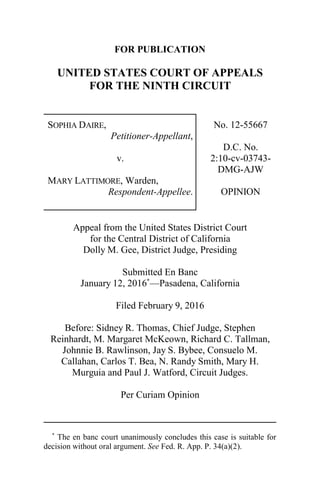
SOPHIA DAIRE,
Petitioner-Appellant,
v.
MARY LATTIMORE, Warden,
Respondent-Appellee.
No. 12-55667
D.C. No.
2:10-cv-03743-
DMG-AJW
OPINION
Appeal from the United States District Court
for the Central District of California
Dolly M. Gee, District Judge, Presiding
Submitted En Banc
January 12, 2016*
—Pasadena, California
Filed February 9, 2016
Before: Sidney R. Thomas, Chief Judge, Stephen
Reinhardt, M. Margaret McKeown, Richard C. Tallman,
Johnnie B. Rawlinson, Jay S. Bybee, Consuelo M.
Callahan, Carlos T. Bea, N. Randy Smith, Mary H.
Murguia and Paul J. Watford, Circuit Judges.
Per Curiam Opinion
*
The en banc court unanimously concludes this case is suitable for
decision without oral argument. See Fed. R. App. P. 34(a)(2).
DAIRE V. LATTIMORE2
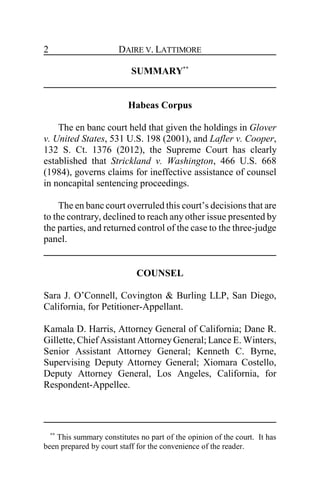
SUMMARY**
Habeas Corpus
The en banc court held that given the holdings in Glover
v. United States, 531 U.S. 198 (2001), and Lafler v. Cooper,
132 S. Ct. 1376 (2012), the Supreme Court has clearly
established that Strickland v. Washington, 466 U.S. 668
(1984), governs claims for ineffective assistance of counsel
in noncapital sentencing proceedings.
The en banc court overruled this court’s decisions that are
to the contrary, declined to reach any other issue presented by
the parties, and returned control of the case to the three-judge
panel.
COUNSEL
Sara J. O’Connell, Covington & Burling LLP, San Diego,
California, for Petitioner-Appellant.
Kamala D. Harris, Attorney General of California; Dane R.
Gillette, Chief Assistant AttorneyGeneral; Lance E. Winters,
Senior Assistant Attorney General; Kenneth C. Byrne,
Supervising Deputy Attorney General; Xiomara Costello,
Deputy Attorney General, Los Angeles, California, for
Respondent-Appellee.
**
This summary constitutes no part of the opinion of the court. It has
been prepared by court staff for the convenience of the reader.
DAIRE V. LATTIMORE 3
OPINION
PER CURIAM:
We voted to rehear this case en banc to reconsider our
circuit precedent holding that there was no “clearly
established”federallawonthequestion ofwhetherStrickland
v. Washington, 466 U.S. 668, 694 (1984), governs claims for
ineffective assistance of counsel in noncapital sentencing
proceedings. See Cooper-Smith v. Palmateer, 397 F.3d 1236,
1244 (9th Cir. 2005) and Davis v. Grigas, 443 F.3d 1155,
1158 (9th Cir. 2006).
In this case, a California jury convicted Daire of first-
degree burglary. Daire claimed that, during sentencing, her
attorney provided ineffective assistance of counsel under the
standard articulated in Strickland, 466 U.S. at 687. On
federalhabeasreview,applyingourbindingcircuit precedent,
the district court held that the application of the Strickland
standard to noncapital sentencing proceedings was not
“clearly established Federal law” for purposes of 28 U.S.C.
§ 2254(d)(1).
In Glover v. United States, 531 U.S. 198, 202–04 (2001),
the United States Supreme Court applied Strickland to a
noncapital sentencing proceeding. Glover presented the
question whether “a showing of prejudice, in the context of
a claim for ineffective assistance of counsel, requires a
significant increase in a term of imprisonment.” Id. at 204.
The claim in Glover arose from noncapital sentencing
proceedings governed by federal guidelines. Id. at 200. The
Supreme Court reversed the Seventh Circuit for
“supplant[ing] the Strickland analysis” in such a context. Id.
at 203. In closing, Glover noted that “the ultimate merits of
DAIRE V. LATTIMORE4
[petitioner’s] claim” would turn on Strickland’s elements:
“the question of deficient performance” and “prejudice
flow[ing] from the asserted error in sentencing.” Id. at 204.
To the extent that there was any doubt that Glover
“clearly established” that Strickland applied to noncapital
sentencing proceedings, that doubt was erased in Lafler v.
Cooper, 132 S. Ct. 1376 (2012). In Lafler, the Supreme
Court stated that Glover:
establish[ed] that there exists a right to
counsel during sentencing in . . . noncapital
. . . cases. Even though sentencing does not
concern the defendant’s guilt or innocence,
ineffective assistance of counsel during a
sentencing hearing can result in Strickland
prejudicebecause“anyamount of [additional]
jail time has Sixth Amendment significance.”
Lafler, 132 S. Ct. at 1385–86 (second alteration in original)
(citations omitted) (quoting Glover, 531 U.S. at 203).
Given Glover and Lafler, the Supreme Court has clearly
established that Strickland governs claims for ineffective
assistance of counsel in noncapital sentencing proceedings.1
1
Indeed, we implicitly recognized as much in a pair of decisions issued
after the Supreme Court decided Glover in 2001 but before the California
Supreme Court rejected Daire’s ineffective assistance claim on the merits
in 2011. See Tilcock v. Budge, 538 F.3d 1138, 1146 (9th Cir. 2008)
(applying Strickland to a noncapital sentencing ineffective assistance
claim and granting petitioner an evidentiary hearing); see also Gonzalez
v. Knowles, 515 F.3d 1006, 1015 (9th Cir. 2008) (applying Strickland to
a noncapital sentencing ineffective assistance claim where petitioner
argued that his attorney failed to investigate potentially mitigating
DAIRE V. LATTIMORE 5
See also Premo v. Moore, 562 U.S. 115, 126 (2011)
(“Whether before, during, or after trial, when the Sixth
Amendment applies, the formulation of the standard [for
deficient performance,as an element of ineffective assistance
of counsel] is the same: reasonable competence in
representing the accused.”) (quoting Strickland, 466 U.S. at
688). Therefore,we overrule our contrarydecisions on which
the district court relied—namely, Cooper-Smith, Davis, and
all of our other decisions that are similarly to the contrary.
We voted to rehear this case en banc in order to
reconsider our circuit precedent. We decline as an en banc
court to reach any other issue presented by the parties. While
the three-judge panel that heard the appeal was bound by
Cooper-Smith and Davis and issued its opinion based on that
assumption, it nonetheless applied Strickland in the
alternative. In issuing our order granting rehearing en banc,
we instructed that the three-judge panel opinion should not be
cited as precedent by or to any court of the Ninth Circuit.
Daire v. Lattimore, 803 F.3d 381 (9th Cir. 2015). With this
correction in the law, we return control of the case to the
three-judge panel. The panel, at its election, may reinstate its
prior opinion or issue an amended opinion. The three-judge
panel will also resolve the petition for panel rehearing on the
merits. En banc proceedings with respect to this case are
terminated.
REMANDED.
evidence of mental illness and did not call his family members to testify
on his behalf).

12-55667

  • 1.
    FOR PUBLICATION UNITED STATESCOURT OF APPEALS FOR THE NINTH CIRCUIT SOPHIA DAIRE, Petitioner-Appellant, v. MARY LATTIMORE, Warden, Respondent-Appellee. No. 12-55667 D.C. No. 2:10-cv-03743- DMG-AJW OPINION Appeal from the United States District Court for the Central District of California Dolly M. Gee, District Judge, Presiding Submitted En Banc January 12, 2016* —Pasadena, California Filed February 9, 2016 Before: Sidney R. Thomas, Chief Judge, Stephen Reinhardt, M. Margaret McKeown, Richard C. Tallman, Johnnie B. Rawlinson, Jay S. Bybee, Consuelo M. Callahan, Carlos T. Bea, N. Randy Smith, Mary H. Murguia and Paul J. Watford, Circuit Judges. Per Curiam Opinion * The en banc court unanimously concludes this case is suitable for decision without oral argument. See Fed. R. App. P. 34(a)(2).
  • 2.
    DAIRE V. LATTIMORE2 SUMMARY** HabeasCorpus The en banc court held that given the holdings in Glover v. United States, 531 U.S. 198 (2001), and Lafler v. Cooper, 132 S. Ct. 1376 (2012), the Supreme Court has clearly established that Strickland v. Washington, 466 U.S. 668 (1984), governs claims for ineffective assistance of counsel in noncapital sentencing proceedings. The en banc court overruled this court’s decisions that are to the contrary, declined to reach any other issue presented by the parties, and returned control of the case to the three-judge panel. COUNSEL Sara J. O’Connell, Covington & Burling LLP, San Diego, California, for Petitioner-Appellant. Kamala D. Harris, Attorney General of California; Dane R. Gillette, Chief Assistant AttorneyGeneral; Lance E. Winters, Senior Assistant Attorney General; Kenneth C. Byrne, Supervising Deputy Attorney General; Xiomara Costello, Deputy Attorney General, Los Angeles, California, for Respondent-Appellee. ** This summary constitutes no part of the opinion of the court. It has been prepared by court staff for the convenience of the reader.
  • 3.
    DAIRE V. LATTIMORE3 OPINION PER CURIAM: We voted to rehear this case en banc to reconsider our circuit precedent holding that there was no “clearly established”federallawonthequestion ofwhetherStrickland v. Washington, 466 U.S. 668, 694 (1984), governs claims for ineffective assistance of counsel in noncapital sentencing proceedings. See Cooper-Smith v. Palmateer, 397 F.3d 1236, 1244 (9th Cir. 2005) and Davis v. Grigas, 443 F.3d 1155, 1158 (9th Cir. 2006). In this case, a California jury convicted Daire of first- degree burglary. Daire claimed that, during sentencing, her attorney provided ineffective assistance of counsel under the standard articulated in Strickland, 466 U.S. at 687. On federalhabeasreview,applyingourbindingcircuit precedent, the district court held that the application of the Strickland standard to noncapital sentencing proceedings was not “clearly established Federal law” for purposes of 28 U.S.C. § 2254(d)(1). In Glover v. United States, 531 U.S. 198, 202–04 (2001), the United States Supreme Court applied Strickland to a noncapital sentencing proceeding. Glover presented the question whether “a showing of prejudice, in the context of a claim for ineffective assistance of counsel, requires a significant increase in a term of imprisonment.” Id. at 204. The claim in Glover arose from noncapital sentencing proceedings governed by federal guidelines. Id. at 200. The Supreme Court reversed the Seventh Circuit for “supplant[ing] the Strickland analysis” in such a context. Id. at 203. In closing, Glover noted that “the ultimate merits of
  • 4.
    DAIRE V. LATTIMORE4 [petitioner’s]claim” would turn on Strickland’s elements: “the question of deficient performance” and “prejudice flow[ing] from the asserted error in sentencing.” Id. at 204. To the extent that there was any doubt that Glover “clearly established” that Strickland applied to noncapital sentencing proceedings, that doubt was erased in Lafler v. Cooper, 132 S. Ct. 1376 (2012). In Lafler, the Supreme Court stated that Glover: establish[ed] that there exists a right to counsel during sentencing in . . . noncapital . . . cases. Even though sentencing does not concern the defendant’s guilt or innocence, ineffective assistance of counsel during a sentencing hearing can result in Strickland prejudicebecause“anyamount of [additional] jail time has Sixth Amendment significance.” Lafler, 132 S. Ct. at 1385–86 (second alteration in original) (citations omitted) (quoting Glover, 531 U.S. at 203). Given Glover and Lafler, the Supreme Court has clearly established that Strickland governs claims for ineffective assistance of counsel in noncapital sentencing proceedings.1 1 Indeed, we implicitly recognized as much in a pair of decisions issued after the Supreme Court decided Glover in 2001 but before the California Supreme Court rejected Daire’s ineffective assistance claim on the merits in 2011. See Tilcock v. Budge, 538 F.3d 1138, 1146 (9th Cir. 2008) (applying Strickland to a noncapital sentencing ineffective assistance claim and granting petitioner an evidentiary hearing); see also Gonzalez v. Knowles, 515 F.3d 1006, 1015 (9th Cir. 2008) (applying Strickland to a noncapital sentencing ineffective assistance claim where petitioner argued that his attorney failed to investigate potentially mitigating
  • 5.
    DAIRE V. LATTIMORE5 See also Premo v. Moore, 562 U.S. 115, 126 (2011) (“Whether before, during, or after trial, when the Sixth Amendment applies, the formulation of the standard [for deficient performance,as an element of ineffective assistance of counsel] is the same: reasonable competence in representing the accused.”) (quoting Strickland, 466 U.S. at 688). Therefore,we overrule our contrarydecisions on which the district court relied—namely, Cooper-Smith, Davis, and all of our other decisions that are similarly to the contrary. We voted to rehear this case en banc in order to reconsider our circuit precedent. We decline as an en banc court to reach any other issue presented by the parties. While the three-judge panel that heard the appeal was bound by Cooper-Smith and Davis and issued its opinion based on that assumption, it nonetheless applied Strickland in the alternative. In issuing our order granting rehearing en banc, we instructed that the three-judge panel opinion should not be cited as precedent by or to any court of the Ninth Circuit. Daire v. Lattimore, 803 F.3d 381 (9th Cir. 2015). With this correction in the law, we return control of the case to the three-judge panel. The panel, at its election, may reinstate its prior opinion or issue an amended opinion. The three-judge panel will also resolve the petition for panel rehearing on the merits. En banc proceedings with respect to this case are terminated. REMANDED. evidence of mental illness and did not call his family members to testify on his behalf).