MEDICAL EXAMS
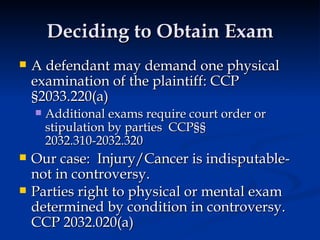
Deciding to Obtain Exam A defendant may demand one physical examination of the plaintiff: CCP §2033.220(a) Additional exams require court order or stipulation by parties  CCP§§ 2032.310-2032.320 Our case:  Injury/Cancer is indisputable- not in controversy.  Parties right to physical or mental exam determined by condition in controversy. CCP 2032.020(a)
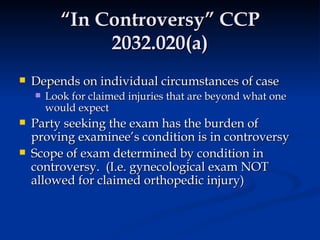
“In Controversy” CCP 2032.020(a) Depends on individual circumstances of case Look for claimed injuries that are beyond what one would expect Party seeking the exam has the burden of proving examinee’s condition is in controversy Scope of exam determined by condition in controversy.  (I.e. gynecological exam NOT allowed for claimed orthopedic injury)
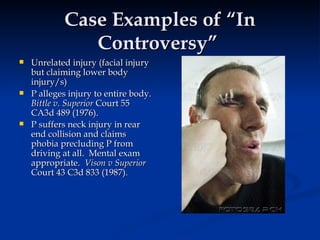
Case Examples of “In Controversy”  Unrelated injury (facial injury but claiming lower body injury/s) P alleges injury to entire body.  Bittle v. Superior  Court 55 CA3d 489 (1976). P suffers neck injury in rear end collision and claims phobia precluding P from driving at all.  Mental exam appropriate.  Vison v Superior  Court 43 C3d 833 (1987).
Advantages/Disadvantages For Plaintiff Advantages (1)  Additional info  : verification of P’s injuries by D’s expert; discovery of D expert name, and receipt of expert’s report and conclusions  (2)  Basis for cross-examining expert :  If report contains errors or omissions, can be basis of effective cross-exam of expert.  Disadvantages (1) Minimizing injury and possible impeachment:  D expert testimony may dispute or minimize injury.  Also, P may make misstatements, or identify new or different sx’s during exam leading to impeachment at trial.  (2) If demand report, waive work product privilege:  P has right to examiners report; however, if demands report then waives any privilege and protection for work product under CCP §§2018.010-2018.080 for any other reports or expert testimony about the same physical or mental condition.
Advantages/Disadvantages for the Defendant  Advantages (1)  Additional Information:   D able to select MD to do exam and evaluate claimed injuries; obtain info about relevant prior and subsequent injuries. (2)  Improved credibility of D expert :  Exam can improve credibility of D expert if he/she is the person who conducted the exam.  Disadvantages  (1)  High Cost :  May not be justified in minor case; where exam unnecessary and expert testimony of medical record review sufficient  (2)  Disclosure of information:   Potential damage to D’s case if examining MD discovers more injuries than the P’s own MD discovers.
PROCEDURES FOR OBTAINING A PHYSICAL OR MENTAL EXAM Three methods under CCP  §  2032.010-2032.650: Written demand Written stipulation Court order, on showing of good cause
BY WRITTEN DEMAND IN  PERSONAL INJURY CASES : 2032.220
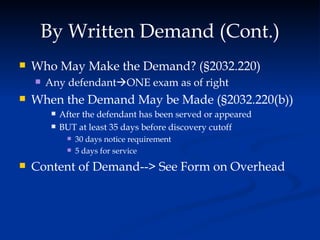
By Written Demand (Cont.) Who May Make the Demand? (§2032.220) Any defendant  ONE exam as of right When the Demand May be Made ( § 2032.220(b)) After the defendant has been served or appeared BUT at least 35 days before discovery cutoff 30 days notice requirement 5 days for service Content of Demand--> See Form on Overhead
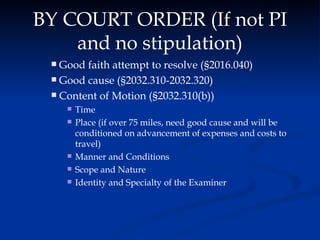
BY COURT ORDER (If not PI and no stipulation) Good faith attempt to resolve ( § 2016.040) Good cause ( § 2032.310-2032.320) Content of Motion ( § 2032.310(b)) Time Place (if over 75 miles, need good cause and will be conditioned on advancement of expenses and costs to travel) Manner and Conditions Scope and Nature Identity and Specialty of the Examiner
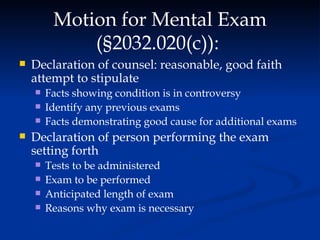
Motion for Mental Exam ( § 2032.020(c)):  Declaration of counsel: reasonable, good faith attempt to stipulate Facts showing condition is in controversy Identify any previous exams Facts demonstrating good cause for additional exams Declaration of person performing the exam setting forth Tests to be administered Exam to be performed Anticipated length of exam Reasons why exam is necessary
Motion for Mental Exam (Cont.) Service of Motion-->person being examined and parties to action Response  Can oppose entirely or seek to limit Condition not in controversy Exam will not provide necessary info Scope is unreasonable Too time-consuming Court Order:  must specify ( § 2032.320(d)) Name of examiner Time and place Nature and Manner Diagnostic tests and procedures Conditions and scope How costs are handled
Conduct of Exam Get history § 10.51 Examinee’s Participation § 10.52 Examiner’s Duty of Care § 10.53 Protective Orders (for conduct of examiner) § 10.54 Protective Orders (for conduct of observer) § 10.55 Sanctions § 10.56 Remedies for Party’s Failure to Appear § 10.57 Remedies for Nonparty’s Failure to Appear
Get History Purpose   Third party to create a chronology of events relevant to the injury Examiner may not:  Cross examine plaintiff regarding liability issues Inquire into areas outside of examination Ask questions already answered
§ 10.51 Examinee’s Participation Examinee should be prepared Meet with counsel prior Organize complaints and injuries Know that statements and behaviors are admissible  Expect to be asked  How accident/ injury occurred Chronological history of treatment to date Description of injuries Description of prior injuries to the same area  Complete statement of present complaints
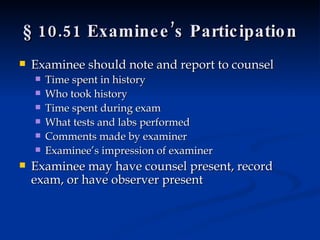
§ 10.51 Examinee’s Participation Examinee should note and report to counsel Time spent in history Who took history Time spent during exam What tests and labs performed Comments made by examiner Examinee’s impression of examiner Examinee may have counsel present, record exam, or have observer present
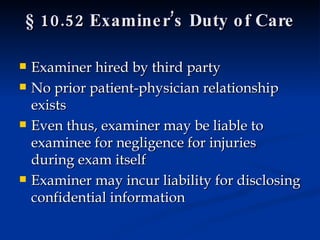
§ 10.52 Examiner’s Duty of Care Examiner hired by third party No prior patient-physician relationship exists Even thus, examiner may be liable to examinee for negligence for injuries during exam itself Examiner may incur liability for disclosing confidential information
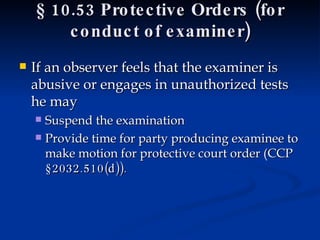
§ 10.53 Protective Orders (for conduct of examiner) If an observer feels that the examiner is abusive or engages in unauthorized tests he may Suspend the examination Provide time for party producing examinee to make motion for protective court order (CCP  §2032.510(d)).
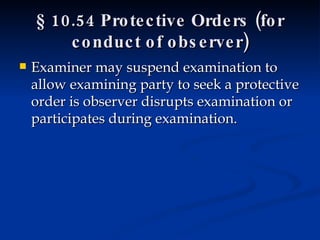
§ 10.54 Protective Orders (for conduct of observer) Examiner may suspend examination to allow examining party to seek a protective order is observer disrupts examination or participates during examination.
§ 10.55 Sanctions The court will impose monetary sanctions against a party, person, or attorney who unsuccessfully makes or opposes a motion for a protective order.
§ 10.56 Remedies for Party’s Failure to Appear If examinee does not appear (on court order to do so) CCP  §2023.410 provides the court (on motion of examining party) may: Issue sanctions Evidence sanctions A terminating sanction order Monetary sanctions This only applies after refusal of examinee to appear for examination after compelling by court order to appear for such.
§ 10.57 Remedies for Nonparty’s Failure to Appear A nonparty (not defendant, not plaintiff) may be compelled by court order to appear for medical examination. The same remedies apply as for party’s failure to appear.
Exchange of Examination Reports
Examinee entitled to demand examination report The party who submits to or produces another for an exam has the option of demanding from that party The  examiners’ detailed written report  setting out the history, exam findings, diagnoses, prognoses, and conclusions.  Also  written report of all earlier exams  of the same condition of the examinee made by that or any other examiner.
Privileges waived with demand of examination report The examinee who receives a report or takes the depo of the examiner waives any privilege that the party has regarding reports and testimony of every other physician, psychologist, or licensed healthcare practitioner who has or may examine the examinee regarding the same condition.  The  examining party has no work product protection  for the examiner’s writing and reports or for the examiner’s testimony
Response to demand The examining party must deliver a copy of the examination report either: Within  30 days after service of the demand   Or  within 15 days of trial .  Whichever is earlier
Response to demand, cont. The examining party is only required to produce reports of healthcare professionals who have actually examined the examinee.  Reports by consultants who have not performed an exam are not discoverable  unless consultants are disclosed as experts
Response to demand, cont. If the examining party fails to timely deliver the examination report, the demanding party may move for an  order to compel delivery . If the report is not complete, counsel should move to compel since an incomplete report is equivalent to failing to produce a report.  This motion  must  be accompanied by a declaration showing a reasonable and good faith attempt to resolve the dispute informally.  Court  must  impose a monetary sanction against any party, person, or attorney who unsuccessfully makes or opposes a motion to compel discovery.  Court  must  exclude at trial the testimony of any examiner whose report was demanded but not provided.  This exclusion may leave the examining party without a qualified expert to testify.
Examinee’s reciprocal duties to exchange report The party who submits to or produces another for exam and makes a demand for an exam report must exchange a copy Any existing written report  of any exam by any other physician, psychologist, or licensed healthcare practitioner of the same condition.  Any later report of a previous or subsequent exam  of the same condition by another physician, psychologist, or licensed healthcare practitioner.
Reciprocal duties, cont. This  reciprocal duty is limited to written reports There is no duty to disclose writings or names or healthcare providers unless there is a written report.  TIP: Before requesting a report, a pl counsel should meet with the healthcare provider to ascertain his or her opinion then decided whether to request a written report.
Reciprocal duties, cont. The party demanding the report must provide these other written reports at the time the other party complies with their demand If the party demanding the exam report fails to deliver the report required by reciprocal exchange the examining party may move for an order to compel.  Examining party must include with the motion a “meet and confer” declaration
THANKS!

Medical Exams Final

  • 1.
  • 2.
    Deciding to ObtainExam A defendant may demand one physical examination of the plaintiff: CCP §2033.220(a) Additional exams require court order or stipulation by parties CCP§§ 2032.310-2032.320 Our case: Injury/Cancer is indisputable- not in controversy. Parties right to physical or mental exam determined by condition in controversy. CCP 2032.020(a)
  • 3.
    “In Controversy” CCP2032.020(a) Depends on individual circumstances of case Look for claimed injuries that are beyond what one would expect Party seeking the exam has the burden of proving examinee’s condition is in controversy Scope of exam determined by condition in controversy. (I.e. gynecological exam NOT allowed for claimed orthopedic injury)
  • 4.
    Case Examples of“In Controversy” Unrelated injury (facial injury but claiming lower body injury/s) P alleges injury to entire body. Bittle v. Superior Court 55 CA3d 489 (1976). P suffers neck injury in rear end collision and claims phobia precluding P from driving at all. Mental exam appropriate. Vison v Superior Court 43 C3d 833 (1987).
  • 5.
    Advantages/Disadvantages For PlaintiffAdvantages (1) Additional info : verification of P’s injuries by D’s expert; discovery of D expert name, and receipt of expert’s report and conclusions (2) Basis for cross-examining expert : If report contains errors or omissions, can be basis of effective cross-exam of expert. Disadvantages (1) Minimizing injury and possible impeachment: D expert testimony may dispute or minimize injury. Also, P may make misstatements, or identify new or different sx’s during exam leading to impeachment at trial. (2) If demand report, waive work product privilege: P has right to examiners report; however, if demands report then waives any privilege and protection for work product under CCP §§2018.010-2018.080 for any other reports or expert testimony about the same physical or mental condition.
  • 6.
    Advantages/Disadvantages for theDefendant Advantages (1) Additional Information: D able to select MD to do exam and evaluate claimed injuries; obtain info about relevant prior and subsequent injuries. (2) Improved credibility of D expert : Exam can improve credibility of D expert if he/she is the person who conducted the exam. Disadvantages (1) High Cost : May not be justified in minor case; where exam unnecessary and expert testimony of medical record review sufficient (2) Disclosure of information: Potential damage to D’s case if examining MD discovers more injuries than the P’s own MD discovers.
  • 7.
    PROCEDURES FOR OBTAININGA PHYSICAL OR MENTAL EXAM Three methods under CCP § 2032.010-2032.650: Written demand Written stipulation Court order, on showing of good cause
  • 8.
    BY WRITTEN DEMANDIN PERSONAL INJURY CASES : 2032.220
  • 9.
    By Written Demand(Cont.) Who May Make the Demand? (§2032.220) Any defendant  ONE exam as of right When the Demand May be Made ( § 2032.220(b)) After the defendant has been served or appeared BUT at least 35 days before discovery cutoff 30 days notice requirement 5 days for service Content of Demand--> See Form on Overhead
  • 10.
    BY COURT ORDER(If not PI and no stipulation) Good faith attempt to resolve ( § 2016.040) Good cause ( § 2032.310-2032.320) Content of Motion ( § 2032.310(b)) Time Place (if over 75 miles, need good cause and will be conditioned on advancement of expenses and costs to travel) Manner and Conditions Scope and Nature Identity and Specialty of the Examiner
  • 11.
    Motion for MentalExam ( § 2032.020(c)): Declaration of counsel: reasonable, good faith attempt to stipulate Facts showing condition is in controversy Identify any previous exams Facts demonstrating good cause for additional exams Declaration of person performing the exam setting forth Tests to be administered Exam to be performed Anticipated length of exam Reasons why exam is necessary
  • 12.
    Motion for MentalExam (Cont.) Service of Motion-->person being examined and parties to action Response  Can oppose entirely or seek to limit Condition not in controversy Exam will not provide necessary info Scope is unreasonable Too time-consuming Court Order: must specify ( § 2032.320(d)) Name of examiner Time and place Nature and Manner Diagnostic tests and procedures Conditions and scope How costs are handled
  • 13.
    Conduct of ExamGet history § 10.51 Examinee’s Participation § 10.52 Examiner’s Duty of Care § 10.53 Protective Orders (for conduct of examiner) § 10.54 Protective Orders (for conduct of observer) § 10.55 Sanctions § 10.56 Remedies for Party’s Failure to Appear § 10.57 Remedies for Nonparty’s Failure to Appear
  • 14.
    Get History Purpose Third party to create a chronology of events relevant to the injury Examiner may not: Cross examine plaintiff regarding liability issues Inquire into areas outside of examination Ask questions already answered
  • 15.
    § 10.51 Examinee’sParticipation Examinee should be prepared Meet with counsel prior Organize complaints and injuries Know that statements and behaviors are admissible Expect to be asked How accident/ injury occurred Chronological history of treatment to date Description of injuries Description of prior injuries to the same area Complete statement of present complaints
  • 16.
    § 10.51 Examinee’sParticipation Examinee should note and report to counsel Time spent in history Who took history Time spent during exam What tests and labs performed Comments made by examiner Examinee’s impression of examiner Examinee may have counsel present, record exam, or have observer present
  • 17.
    § 10.52 Examiner’sDuty of Care Examiner hired by third party No prior patient-physician relationship exists Even thus, examiner may be liable to examinee for negligence for injuries during exam itself Examiner may incur liability for disclosing confidential information
  • 18.
    § 10.53 ProtectiveOrders (for conduct of examiner) If an observer feels that the examiner is abusive or engages in unauthorized tests he may Suspend the examination Provide time for party producing examinee to make motion for protective court order (CCP §2032.510(d)).
  • 19.
    § 10.54 ProtectiveOrders (for conduct of observer) Examiner may suspend examination to allow examining party to seek a protective order is observer disrupts examination or participates during examination.
  • 20.
    § 10.55 SanctionsThe court will impose monetary sanctions against a party, person, or attorney who unsuccessfully makes or opposes a motion for a protective order.
  • 21.
    § 10.56 Remediesfor Party’s Failure to Appear If examinee does not appear (on court order to do so) CCP §2023.410 provides the court (on motion of examining party) may: Issue sanctions Evidence sanctions A terminating sanction order Monetary sanctions This only applies after refusal of examinee to appear for examination after compelling by court order to appear for such.
  • 22.
    § 10.57 Remediesfor Nonparty’s Failure to Appear A nonparty (not defendant, not plaintiff) may be compelled by court order to appear for medical examination. The same remedies apply as for party’s failure to appear.
  • 23.
  • 24.
    Examinee entitled todemand examination report The party who submits to or produces another for an exam has the option of demanding from that party The examiners’ detailed written report setting out the history, exam findings, diagnoses, prognoses, and conclusions. Also written report of all earlier exams of the same condition of the examinee made by that or any other examiner.
  • 25.
    Privileges waived withdemand of examination report The examinee who receives a report or takes the depo of the examiner waives any privilege that the party has regarding reports and testimony of every other physician, psychologist, or licensed healthcare practitioner who has or may examine the examinee regarding the same condition. The examining party has no work product protection for the examiner’s writing and reports or for the examiner’s testimony
  • 26.
    Response to demandThe examining party must deliver a copy of the examination report either: Within 30 days after service of the demand Or within 15 days of trial . Whichever is earlier
  • 27.
    Response to demand,cont. The examining party is only required to produce reports of healthcare professionals who have actually examined the examinee. Reports by consultants who have not performed an exam are not discoverable unless consultants are disclosed as experts
  • 28.
    Response to demand,cont. If the examining party fails to timely deliver the examination report, the demanding party may move for an order to compel delivery . If the report is not complete, counsel should move to compel since an incomplete report is equivalent to failing to produce a report. This motion must be accompanied by a declaration showing a reasonable and good faith attempt to resolve the dispute informally. Court must impose a monetary sanction against any party, person, or attorney who unsuccessfully makes or opposes a motion to compel discovery. Court must exclude at trial the testimony of any examiner whose report was demanded but not provided. This exclusion may leave the examining party without a qualified expert to testify.
  • 29.
    Examinee’s reciprocal dutiesto exchange report The party who submits to or produces another for exam and makes a demand for an exam report must exchange a copy Any existing written report of any exam by any other physician, psychologist, or licensed healthcare practitioner of the same condition. Any later report of a previous or subsequent exam of the same condition by another physician, psychologist, or licensed healthcare practitioner.
  • 30.
    Reciprocal duties, cont.This reciprocal duty is limited to written reports There is no duty to disclose writings or names or healthcare providers unless there is a written report. TIP: Before requesting a report, a pl counsel should meet with the healthcare provider to ascertain his or her opinion then decided whether to request a written report.
  • 31.
    Reciprocal duties, cont.The party demanding the report must provide these other written reports at the time the other party complies with their demand If the party demanding the exam report fails to deliver the report required by reciprocal exchange the examining party may move for an order to compel. Examining party must include with the motion a “meet and confer” declaration
  • 32.