Get Chartered &
Mentoring Presentation
Lisa Duffy
Membership Development
1: Getting Chartered Process
2: Introduction to Mentoring
3: Break
4: Interviewing Overview
Session Breakdown
1: Why Get Chartered?
2: Requirements
3: Making your application
4: Assessing your application
Get Chartered
Presentation
1: Why Get Chartered?
2: Requirements
3: Making your application
4: Assessing your application
Get Chartered
Presentation
Why Get Chartered?
• Demonstrate your competence
• Aid promotion
• Gain higher salary
• Pride in your profession
• Qualifications
Qualifications we offer
Chartered Engineer (CEng)
Chartered Scientist (CSci)
Chartered Environmentalist (CEnv)
European Engineer (Eur Ing)
1: Why Get Chartered?
2: Requirements
3: Making your application
4: Assessing your application
Get Chartered
Presentation
Overview:
Requirements & Application Process
Requirements
1 Education
2 Experience
3 Responsibility
Requirements
1 Education
2 Experience
3 Responsibility
Route1: Standard Application
Fully
accredited
qualification
Training &
experience
Standard
application:
Form A
C&C report
CV
Education Experience Application
Route 2: Standard Application
+ Further Learning to Masters
BEng
accredited
qualification
Standard
application:
Form A
C&C report
CV
Education Experience Application
Formally
bridge gap
to MEng*
Training &
experience
Route 3: Standard Application
+ Design
Approved
qual via
agreement
Training &
experience
Standard app:
Form A
C&C report
CV
Education Experience Application
2000 word
Design
Technical
Report
Route 4: Standard Application
+ Technical work
Non
accredited
qualification
Standard app:
Form A
C&C report
CV
Education Experience Application
Training &
experience
Form E:
individual
assessment
5000 word
Technical
Report
Requirements
1 Education
2 Experience
3 Responsibility
Experience
Applying chemical engineering principles
across a range of technical areas
Chemical engineering principles
Process technologies Safety systems
Laws of conversion Mathematical modeling
Underlying chemistry Systems analysis
Chemical thermodynamics Economic evaluation
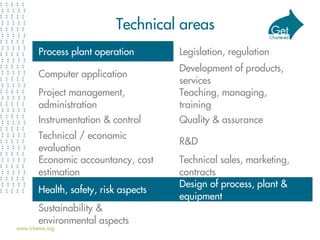
Technical areas
Process plant operation Legislation, regulation
Computer application
Development of products,
services
Project management,
administration
Teaching, managing,
training
Instrumentation & control Quality & assurance
Technical / economic
evaluation
R&D
Economic accountancy, cost
estimation
Technical sales, marketing,
contracts
Health, safety, risk aspects
Design of process, plant &
equipment
Sustainability &
environmental aspects
Technical areas
Process plant operation Legislation, regulation
Computer application
Development of products,
services
Project management,
administration
Teaching, managing,
training
Instrumentation & control Quality & assurance
Technical / economic
evaluation
R&D
Economic accountancy, cost
estimation
Technical sales, marketing,
contracts
Health, safety, risk aspects
Design of process, plant &
equipment
Sustainability &
environmental aspects
Technical areas
Process plant operation Legislation, regulation
Computer application
Development of products,
services
Project management,
administration
Teaching, managing,
training
Instrumentation & control Quality & assurance
Technical / economic
evaluation
R&D
Economic accountancy, cost
estimation
Technical sales, marketing,
contracts
Health, safety, risk aspects
Design of process, plant &
equipment
Sustainability &
environmental aspects
Experience
• Principles: aware of all, applying some
• Technical areas: 4 – 6 in depth
• Experience tells us it takes min 4 years post
grad experience before candidate should
apply [Focus on skills not time]
Experience
• Gained anywhere in world
• Industrial or academic
• Postgraduate experience
• e.g: PhD / Eng Doc study (Practical aspects rather than
academic aspects)
• Pre-graduation experience:
• 1yr Industrial placement (only worthwhile projects)
• Pre-graduation experience: long distance learners or
mature students
Requirements
1 Education
2 Experience
3 Responsibility
Responsibility
Do others rely on your technical
competence & professional judgement
in the area of chemical engineering?
Responsibility
Examples:
Working under own supervision
 Delegating / leading team
 Training others
 Managing own budget
1: Why Get Chartered?
2: Requirements
3: Making your application
4: Assessing your application
Get Chartered
Presentation
Form AForm C CV
Application requirements
• Form A x 1
• Form C x 4
• CV x 4
• Copy degree cert(s) x 1
• Application fee approx £100
(use fee calculator on www.get chartered.org)
• Evidence based report
• Demonstrating experience
• Against requirements (ECUK)
• 2500 - 3000 words
• 200 – 300 words per subheading
• Bullet points (wealth of experience)
• 2 examples (range of experience)
• 1 detailed e.g. (limited experience)
Competence and Commitment
Report
Preparing report
• www.getchartered.org – FAQs
page!
• Log experience via form C
• Find Chartered Chemical Engineer
to mentor you
Report writing tips
 Write report in first person:
I did…
I researched…
I calculated…
I estimated…
 Not: I was involved in…
Report writing tips
 Provide adequate technical detail:
I optimized a process…
How? whose did you enrol to help?
What did you modify?
 Be concise: 2500 words
 Refer to same project more than once
 Use bullet points to list examples
Competence and Commitment
format
A Application of knowledge
B Wider implications
C Transferable skills
---------------------------------------------
D Commitment to profession
E CPD
A Application of Knowledge
CEng
• Application of chemical engineering
knowledge to practical situations
CSci
• Application of scientific knowledge to
• practical situations within chemeng
context
i Identifying problems, opportunities &
projects
ii Combining ideas & contributions of
different people & disciplines
iii Developing new solutions & designs
iv Scientific / technical evaluation and
optimisation
v Planning & execution of projects
A Application of Knowledge
Ai Identify or define a problem,
opportunity or project
Ai Identify a problem, opportunity or project
A china clay slurry-thickening tank was troubled with
immovable sediments and poor clarity.
The tank had no instrumentation.
I identified and carried out laboratory test work, using Kynch
theory
and sedimentation analysis to determine if flocculants
would help alleviate the problems.
Then, working with the polymer supplier's engineering
department, I developed and commissioned a dosing plant
with novel mass flow control…
Product discharge and water clarity were greatly improved
and clay production quantities could now be determined
accurately for the first time.
i Health, hazard and safety aspects
ii Sustainability aspects
iii Commercial and economic aspects
B Wider Implications
• Risk & safety management / HAZOP study
• Writing documentation
• Reviewing hazardous areas
• Design of safety systems
• Compliance with legislation
• General good practice
Bi Handling health, hazard
and safety aspects
• Led programme to reduce solvent emissions and
solution waste through better operating practices
and minor modifications to equipment…
• Organised impact assessment before commencing
dig to lay gas pipes…
• Worked to company sustainability
regulations when designing piece of
equipment …
Bii Handling sustainability
aspects
i Managing relationships
ii Leadership in a professional role
iii Communicating ideas
C Transferable Skills
• Working effectively with diverse teams
• Developing staff, organisations
• Securing resources / negotiating contracts
• Technical report writing
• Significant oral presentations
C Transferable Skills
Evidence showing you are committed
to high standards of professional
conduct
D Commitment to profession
• Keeping knowledge up to date
• Training others
• Attending lectures / events
• Committing to Chartered status
• Active in professional body
• Voluntary activities
- e.g.whynotchemeng
D Commitment to profession
E Continuing Professional
Development
 Past 12 mths: summary of activity
 Future 12 mths: projection of plans
 Don’t just list courses attended
 Narrative of aims and goals
• Examples of....
• On-the-job learning
• Secondments / shadowing
• Moving departments
• Moving sectors – water to Oil & Gas
• Research / publishing
• In-house / external Courses
E Continuing Professional
Development
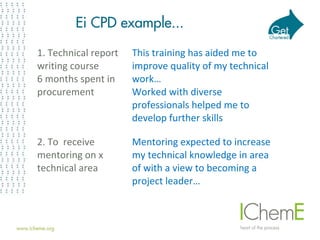
Ei CPD example...
1. Technical report
writing course
6 months spent in
procurement
This training has aided me to
improve quality of my technical
work…
Worked with diverse
professionals helped me to
develop further skills
2. To receive
mentoring on x
technical area
Mentoring expected to increase
my technical knowledge in area
of with a view to becoming a
project leader…
Form A: Verifying report your
C&C Report
Your verifier
• Familiar with your work
• In a responsible position
• Need not be Corporate Members
• Need not be Chemical Engineers
• Two Corporate IChemE Members:
Member or Fellow
• Line manager, colleagues, lecturers
• Check referees will recommend you
Form A: Your Referees
Referees / Verifiers
Criteria Verifiers Referees
Chartered
through IChemE?
No Yes
Chemical
Engineers
No Yes
Knowledge of
daily tasks
Yes No
Read / signed
report?
Yes No
 Provides general background
info
 No set format
 2 page CV
 Post, duties: brief description
 Condensed list of publications
CV
1: Why Get Chartered?
2: Requirements
3: Making your application
4: Assessing your application
Get Chartered
Presentation
Application Process
• Report
• Assessed in confidence by one member of Membership Committee
• May require amplification
• Referees
• Contacted in writing
• Similar to job reference
• Interview
• Conducted in confidence by two Corporate IChemE Members
• Based on your report
• You organise the date
• 45 min - 1 hour
You will be successful
If all of these meet the Requirements for
chartered Status:
• C&C report
• Interview
• referees’ reports
(Committee meet every 2 months - November 08 next meeting)
“We will be as flexible as possible in
helping you gain Corporate
Membership.”
Bill Harper, Membership Committee
Membership Committee
Get Chartered!
“It’s easier than you think to write the
report:
If you’ve got the experience and
competence – get the professional status
and recognition to go with it.”
Mentoring Induction
Mentoring Induction session
• Completed Chartered status update
• IChemE Mentoring
• Mentoring Process for chartership
Mentoring Process
Assess
Plan
Review
Action
IChemE Mentoring
Vision:
• Mentor does not have formal role in application process
but sets the benchmark for future Corporate members
• Mentors are compulsory for ACTS
Mentoring Process
Plan & Action:
 Candidate is ultimately responsible
 Your job: coach, coax answers,
reassure validity of candidate’s
experience
Mentoring tips
 Use sample copy
 Refer to Questions sheet
 www.getchartered.org
 Contact IChemE
IChemE Mentoring
The mentee:
 Overall responsibility for progress
 must prepare for meetings
 Ensure correct route
IChemE Mentoring
Meetings:
 2-3 per yr
 Email & phone mentoring
 Actions for interim
IChemE Mentoring
Meetings:
 Schedule an hour
 Quiet environment
 Background information
e.g. CV, draft report
IChemE Mentoring
Meetings:
 Candidate to complete
Prior to meeting
 Mentor to make additions
 Mentor to comment on skill level
Mentoring Process
Review:
Training & experience to date
Mentoring Process
Assess:
 Candidate’s experience against
requirements for chartership
 In context of C&C report
Mentoring Process
Assessment ratings:
4 Meets requirements
3 Largely covered
2 Limited experience
1 Needs considerable development
Mentoring Process
Assessment ratings:
 Show priority areas
 Not part of chartership assessment
 Making mentor accountable
Following feasibility study I
found x system could be
made more efficient by …
Working with mechanical
and electrical engineers to
install new mixing
equipment…
N/A
Mentoring Process
Assess:
 Investigate gaps
 Ask right questions - get right answers
(example questions in your pack)
Following feasibility study I
found x system could be
made more efficient by …
Working with mechanical &
electrical engineers to install
new mixing equipment…
N/A
Candidate has
made
modifications to
existing design
to suit new
client.
Also identified
opp to use
obsolete
equipment
elsewhere on
site
Following feasibility study I
found x system could be
made more efficient by …
Working with mechanical &
electrical engineers to install
new mixing equipment…
N/A
Candidate has
made
modifications to
existing design
to suit new
client.
Also identified
opp to use
obsolete
equipment
elsewhere on
site
1
2
Mentoring Process
Plan:
 Plan together what future development
would benefit candidate
 Assessment ratings will identify skills
gaps
Mentoring Process
Action:
How do you implement plans?
 Candidate request training from HR
 Can you speak to line manager?
 Secondment to another department
Health &
Safety
Lead risk assessment
Recommend necessary
changes
Take ownership of
implementation
Document changes
Candidate to go to
line manager to
request secondment
for 3 months
Requirements for chartership
Resources:
 www.getchartered.org
 Get Chartered guidelines
 Get Chartered Newsletter
1: Overview
2: Before, During & After
3: ACTS Assessors
The Professional Review
Interview
1: Overview
2: Before, During & After
3 Assessment
The Professional Review
Interview
1: Overview
• Why conduct interview?
• Where does it take place?
• How do you conduct it?
The Professional Review
Interview
Why Conduct Interviews?
To verify:
• Experience
• Responsibility
Why Conduct Interviews?
• Not…
• To check academic qualifications
• To assess report
• To assess eligibility to work for you
• To meet your criteria (try remember the
standard you were at compared to what
you know now)
Remember...
• Chartership is qualification aimed at
engineers with 4 – 6 yrs experience
• They should adequately meet the
requirements
Where does it take place?
• Usually lead / 2nd interviewer’s work
• Can be other location, hotel, pub etc
• Can be at interviewer’s work
• No travel expenses are paid
• Candidate has expectation to travel
• However, location must be suitable
How do you conduct it?
• Lead interviewer: trained, more experienced
• Second interviewer: not necessarily trained
How do you conduct it?
• Base it on C&C report
• With Lead & Second interviewer
• Using standard assessment sheet
• Fairly informally
• Within 1 hour
1: Overview
2: Before, During & After
3: ACTS Assessors
The Professional Review
Interview
Interview dos
• Explain purpose & structure of interview
• Use candidate’s answers to help frame
further information
• Stay focused on C&C report – that is point of
interview
• Watch body language
• Build candidate’s confidence
• Maintain eye contact
• Be friendly, relaxed but detached
Interview Don’ts
• Don’t dwell on any one aspect
• Let personal prejudice affect outcome
• Give feedback or make judgemental comments
• Question academic qualifications
• Query reasons for career choices
• Interview as though prospective employee
• Expect candidate to want to work or get on with
you
Confidentiality
• All information submitted to IChemE in support
of an application and collected at interview is
confidential and must NOT be divulged to
anyone other than those engaged in IChemE
membership process
• All material must be destroyed post interview or
returned to IChemE Office
Confidentiality
• Individuals can request access to documents
about them including Interview Report
• Any serious concerns about candidate’s activity
or that of their employer following interview
should be made known to IChemE Membership
Committee
Before the Interview
Paperwork
• IChemE identifies 1st
& 2nd
interviewers
• You’ll be sent candidate's C&C report, front page
of Form A, CV and interviewers guidance pack
with sample questions
• Consider conflict of interest
Before the Interview
Introductions
• Candidate contacts lead Interviewer
• Introduce yourself to 2nd interviewer
Before the Interview
Location
• Access, parking etc
• Professional environment?
• Refreshment facilities
available?
Before the Interview
Planning
• Plan interview together - work as a team
• Decide areas to cover with candidate
• Who to cover which areas?
• Consider type of questioning (open is best)
Before the Interview
Keeping notes
• What is your note keeping system?
• How to keep to allocated time?
• How to terminate interview?
During the Interview
• Start: candidate outline career to date, justify
basis for application.
• Middle: cover C&C report – discuss issues
raised during interview
• Finish: explain election process, ask candidate
if there is any more information they wish to
add.
During the Interview
Questions should establish:
• Context of chem eng problem/project
• Specific Action taken by candidate
• Result (s) of their work to establish competence
level
During the Interview
• You have a list of generic question examples
but...
Useful questions include:
• could you provide more detail on…?
• does x always apply?
• what problems did you encounter?
• can you give me an example?
NB: Claiming ignorance can be used to gain
further detail
During the Interview
Finishing the interview
• Give opportunity to add anything they wish
• You should not provide feedback
• Refer candidate to IChemE
Assessing the candidate
• What are you assessing?
• How do you assess?
The Professional Review
Interview
What are you Assessing?
A Application of knowledge
B Wider implications
C Transferable skills
---------------------------------------------
D Commitment to profession
E CPD
E
C&C
Verbal
Additional
material
A C&C
Example of paperwork during interview
How do you Assess?
4 Assessment criteria:
• Excellent E
• Good G
• Adequate A
• Inadequate I
How do you Assess?
• E: Excellent
• Highest level of competence in diverse
complex & non routine contexts
• Substantial personal autonomy and
responsibility
• Can develop others in the activity
How do you Assess?
G: Good
• Normal level of competence in some
complex & non routine contexts
• Significant responsibility and autonomy
• Can oversee work of others
How do you Assess?
A: Adequate
• Minimum competence
• Supervision required in complex
circumstances
• Some responsibility & autonomy in areas
relevant to field of practice
How do you Assess?
I: Inadequate
• Requires significant supervision on
basic predictable tasks
• Little or no responsibility
• Not sufficient for chartership
Assessment Guidance
Take notes:
• Capture key points
• Help you with documentary analysis
• You must note evidence in support of their
conclusions
Assessment Guidance
• One inadequate rating in any C&C area means
candidate must attend subsequent panel interview
• Please tell us reason why
• Please don’t use Inadequate rating without careful
thought
• You must complete every aspect of assessment form:
otherwise it is invalid
• So both signatures on the form etc...
After the Interview
• Come to a consensus view
• Finish report immediately after interview
• Post report to IChemE ASAP
Application process
Standard Application
Form A, Form C, CV
Peer Review
Interview
Peer Review of
C & C report
Decision
(Deferment /Election)
Registration
(CEng, CSci)
Professional
Formation
Academic
Formation
1: Overview
2: Before, During & After
The Professional Review
Interview
3: ACTS Assessors
ACTS Assessors...if you’re interested...
• Assess graduate schemes
• All expenses paid
• 1 ½ days
• Once or twice a year
• Shadow 2 other assessors

I Chem E Presentation

  • 1.
    Get Chartered & MentoringPresentation Lisa Duffy Membership Development
  • 2.
    1: Getting CharteredProcess 2: Introduction to Mentoring 3: Break 4: Interviewing Overview Session Breakdown
  • 3.
    1: Why GetChartered? 2: Requirements 3: Making your application 4: Assessing your application Get Chartered Presentation
  • 4.
    1: Why GetChartered? 2: Requirements 3: Making your application 4: Assessing your application Get Chartered Presentation
  • 5.
    Why Get Chartered? •Demonstrate your competence • Aid promotion • Gain higher salary • Pride in your profession • Qualifications
  • 6.
    Qualifications we offer CharteredEngineer (CEng) Chartered Scientist (CSci) Chartered Environmentalist (CEnv) European Engineer (Eur Ing)
  • 7.
    1: Why GetChartered? 2: Requirements 3: Making your application 4: Assessing your application Get Chartered Presentation
  • 8.
  • 9.
  • 10.
  • 11.
    Route1: Standard Application Fully accredited qualification Training& experience Standard application: Form A C&C report CV Education Experience Application
  • 12.
    Route 2: StandardApplication + Further Learning to Masters BEng accredited qualification Standard application: Form A C&C report CV Education Experience Application Formally bridge gap to MEng* Training & experience
  • 13.
    Route 3: StandardApplication + Design Approved qual via agreement Training & experience Standard app: Form A C&C report CV Education Experience Application 2000 word Design Technical Report
  • 14.
    Route 4: StandardApplication + Technical work Non accredited qualification Standard app: Form A C&C report CV Education Experience Application Training & experience Form E: individual assessment 5000 word Technical Report
  • 15.
  • 16.
    Experience Applying chemical engineeringprinciples across a range of technical areas
  • 17.
    Chemical engineering principles Processtechnologies Safety systems Laws of conversion Mathematical modeling Underlying chemistry Systems analysis Chemical thermodynamics Economic evaluation
  • 18.
    Technical areas Process plantoperation Legislation, regulation Computer application Development of products, services Project management, administration Teaching, managing, training Instrumentation & control Quality & assurance Technical / economic evaluation R&D Economic accountancy, cost estimation Technical sales, marketing, contracts Health, safety, risk aspects Design of process, plant & equipment Sustainability & environmental aspects
  • 19.
    Technical areas Process plantoperation Legislation, regulation Computer application Development of products, services Project management, administration Teaching, managing, training Instrumentation & control Quality & assurance Technical / economic evaluation R&D Economic accountancy, cost estimation Technical sales, marketing, contracts Health, safety, risk aspects Design of process, plant & equipment Sustainability & environmental aspects
  • 20.
    Technical areas Process plantoperation Legislation, regulation Computer application Development of products, services Project management, administration Teaching, managing, training Instrumentation & control Quality & assurance Technical / economic evaluation R&D Economic accountancy, cost estimation Technical sales, marketing, contracts Health, safety, risk aspects Design of process, plant & equipment Sustainability & environmental aspects
  • 21.
    Experience • Principles: awareof all, applying some • Technical areas: 4 – 6 in depth • Experience tells us it takes min 4 years post grad experience before candidate should apply [Focus on skills not time]
  • 22.
    Experience • Gained anywherein world • Industrial or academic • Postgraduate experience • e.g: PhD / Eng Doc study (Practical aspects rather than academic aspects) • Pre-graduation experience: • 1yr Industrial placement (only worthwhile projects) • Pre-graduation experience: long distance learners or mature students
  • 23.
  • 24.
    Responsibility Do others relyon your technical competence & professional judgement in the area of chemical engineering?
  • 25.
    Responsibility Examples: Working under ownsupervision  Delegating / leading team  Training others  Managing own budget
  • 26.
    1: Why GetChartered? 2: Requirements 3: Making your application 4: Assessing your application Get Chartered Presentation
  • 27.
  • 28.
    Application requirements • FormA x 1 • Form C x 4 • CV x 4 • Copy degree cert(s) x 1 • Application fee approx £100 (use fee calculator on www.get chartered.org)
  • 29.
    • Evidence basedreport • Demonstrating experience • Against requirements (ECUK) • 2500 - 3000 words • 200 – 300 words per subheading • Bullet points (wealth of experience) • 2 examples (range of experience) • 1 detailed e.g. (limited experience) Competence and Commitment Report
  • 30.
    Preparing report • www.getchartered.org– FAQs page! • Log experience via form C • Find Chartered Chemical Engineer to mentor you
  • 31.
    Report writing tips Write report in first person: I did… I researched… I calculated… I estimated…  Not: I was involved in…
  • 32.
    Report writing tips Provide adequate technical detail: I optimized a process… How? whose did you enrol to help? What did you modify?  Be concise: 2500 words  Refer to same project more than once  Use bullet points to list examples
  • 33.
    Competence and Commitment format AApplication of knowledge B Wider implications C Transferable skills --------------------------------------------- D Commitment to profession E CPD
  • 34.
    A Application ofKnowledge CEng • Application of chemical engineering knowledge to practical situations CSci • Application of scientific knowledge to • practical situations within chemeng context
  • 35.
    i Identifying problems,opportunities & projects ii Combining ideas & contributions of different people & disciplines iii Developing new solutions & designs iv Scientific / technical evaluation and optimisation v Planning & execution of projects A Application of Knowledge
  • 36.
    Ai Identify ordefine a problem, opportunity or project
  • 37.
    Ai Identify aproblem, opportunity or project A china clay slurry-thickening tank was troubled with immovable sediments and poor clarity. The tank had no instrumentation. I identified and carried out laboratory test work, using Kynch theory and sedimentation analysis to determine if flocculants would help alleviate the problems. Then, working with the polymer supplier's engineering department, I developed and commissioned a dosing plant with novel mass flow control… Product discharge and water clarity were greatly improved and clay production quantities could now be determined accurately for the first time.
  • 38.
    i Health, hazardand safety aspects ii Sustainability aspects iii Commercial and economic aspects B Wider Implications
  • 39.
    • Risk &safety management / HAZOP study • Writing documentation • Reviewing hazardous areas • Design of safety systems • Compliance with legislation • General good practice Bi Handling health, hazard and safety aspects
  • 40.
    • Led programmeto reduce solvent emissions and solution waste through better operating practices and minor modifications to equipment… • Organised impact assessment before commencing dig to lay gas pipes… • Worked to company sustainability regulations when designing piece of equipment … Bii Handling sustainability aspects
  • 41.
    i Managing relationships iiLeadership in a professional role iii Communicating ideas C Transferable Skills
  • 42.
    • Working effectivelywith diverse teams • Developing staff, organisations • Securing resources / negotiating contracts • Technical report writing • Significant oral presentations C Transferable Skills
  • 43.
    Evidence showing youare committed to high standards of professional conduct D Commitment to profession
  • 44.
    • Keeping knowledgeup to date • Training others • Attending lectures / events • Committing to Chartered status • Active in professional body • Voluntary activities - e.g.whynotchemeng D Commitment to profession
  • 45.
    E Continuing Professional Development Past 12 mths: summary of activity  Future 12 mths: projection of plans  Don’t just list courses attended  Narrative of aims and goals
  • 46.
    • Examples of.... •On-the-job learning • Secondments / shadowing • Moving departments • Moving sectors – water to Oil & Gas • Research / publishing • In-house / external Courses E Continuing Professional Development
  • 47.
    Ei CPD example... 1.Technical report writing course 6 months spent in procurement This training has aided me to improve quality of my technical work… Worked with diverse professionals helped me to develop further skills 2. To receive mentoring on x technical area Mentoring expected to increase my technical knowledge in area of with a view to becoming a project leader…
  • 48.
    Form A: Verifyingreport your C&C Report Your verifier • Familiar with your work • In a responsible position • Need not be Corporate Members • Need not be Chemical Engineers
  • 49.
    • Two CorporateIChemE Members: Member or Fellow • Line manager, colleagues, lecturers • Check referees will recommend you Form A: Your Referees
  • 50.
    Referees / Verifiers CriteriaVerifiers Referees Chartered through IChemE? No Yes Chemical Engineers No Yes Knowledge of daily tasks Yes No Read / signed report? Yes No
  • 51.
     Provides generalbackground info  No set format  2 page CV  Post, duties: brief description  Condensed list of publications CV
  • 52.
    1: Why GetChartered? 2: Requirements 3: Making your application 4: Assessing your application Get Chartered Presentation
  • 53.
    Application Process • Report •Assessed in confidence by one member of Membership Committee • May require amplification • Referees • Contacted in writing • Similar to job reference • Interview • Conducted in confidence by two Corporate IChemE Members • Based on your report • You organise the date • 45 min - 1 hour
  • 54.
    You will besuccessful If all of these meet the Requirements for chartered Status: • C&C report • Interview • referees’ reports (Committee meet every 2 months - November 08 next meeting)
  • 55.
    “We will beas flexible as possible in helping you gain Corporate Membership.” Bill Harper, Membership Committee Membership Committee
  • 56.
    Get Chartered! “It’s easierthan you think to write the report: If you’ve got the experience and competence – get the professional status and recognition to go with it.”
  • 57.
  • 58.
    Mentoring Induction session •Completed Chartered status update • IChemE Mentoring • Mentoring Process for chartership
  • 59.
  • 60.
    IChemE Mentoring Vision: • Mentordoes not have formal role in application process but sets the benchmark for future Corporate members • Mentors are compulsory for ACTS
  • 61.
    Mentoring Process Plan &Action:  Candidate is ultimately responsible  Your job: coach, coax answers, reassure validity of candidate’s experience
  • 62.
    Mentoring tips  Usesample copy  Refer to Questions sheet  www.getchartered.org  Contact IChemE
  • 63.
    IChemE Mentoring The mentee: Overall responsibility for progress  must prepare for meetings  Ensure correct route
  • 64.
    IChemE Mentoring Meetings:  2-3per yr  Email & phone mentoring  Actions for interim
  • 65.
    IChemE Mentoring Meetings:  Schedulean hour  Quiet environment  Background information e.g. CV, draft report
  • 66.
    IChemE Mentoring Meetings:  Candidateto complete Prior to meeting  Mentor to make additions  Mentor to comment on skill level
  • 67.
  • 68.
    Mentoring Process Assess:  Candidate’sexperience against requirements for chartership  In context of C&C report
  • 69.
    Mentoring Process Assessment ratings: 4Meets requirements 3 Largely covered 2 Limited experience 1 Needs considerable development
  • 70.
    Mentoring Process Assessment ratings: Show priority areas  Not part of chartership assessment  Making mentor accountable
  • 71.
    Following feasibility studyI found x system could be made more efficient by … Working with mechanical and electrical engineers to install new mixing equipment… N/A
  • 72.
    Mentoring Process Assess:  Investigategaps  Ask right questions - get right answers (example questions in your pack)
  • 73.
    Following feasibility studyI found x system could be made more efficient by … Working with mechanical & electrical engineers to install new mixing equipment… N/A Candidate has made modifications to existing design to suit new client. Also identified opp to use obsolete equipment elsewhere on site
  • 74.
    Following feasibility studyI found x system could be made more efficient by … Working with mechanical & electrical engineers to install new mixing equipment… N/A Candidate has made modifications to existing design to suit new client. Also identified opp to use obsolete equipment elsewhere on site 1 2
  • 75.
    Mentoring Process Plan:  Plantogether what future development would benefit candidate  Assessment ratings will identify skills gaps
  • 76.
    Mentoring Process Action: How doyou implement plans?  Candidate request training from HR  Can you speak to line manager?  Secondment to another department
  • 77.
    Health & Safety Lead riskassessment Recommend necessary changes Take ownership of implementation Document changes Candidate to go to line manager to request secondment for 3 months
  • 78.
    Requirements for chartership Resources: www.getchartered.org  Get Chartered guidelines  Get Chartered Newsletter
  • 79.
    1: Overview 2: Before,During & After 3: ACTS Assessors The Professional Review Interview
  • 80.
    1: Overview 2: Before,During & After 3 Assessment The Professional Review Interview
  • 81.
    1: Overview • Whyconduct interview? • Where does it take place? • How do you conduct it? The Professional Review Interview
  • 82.
    Why Conduct Interviews? Toverify: • Experience • Responsibility
  • 83.
    Why Conduct Interviews? •Not… • To check academic qualifications • To assess report • To assess eligibility to work for you • To meet your criteria (try remember the standard you were at compared to what you know now)
  • 84.
    Remember... • Chartership isqualification aimed at engineers with 4 – 6 yrs experience • They should adequately meet the requirements
  • 85.
    Where does ittake place? • Usually lead / 2nd interviewer’s work • Can be other location, hotel, pub etc • Can be at interviewer’s work • No travel expenses are paid • Candidate has expectation to travel • However, location must be suitable
  • 86.
    How do youconduct it? • Lead interviewer: trained, more experienced • Second interviewer: not necessarily trained
  • 87.
    How do youconduct it? • Base it on C&C report • With Lead & Second interviewer • Using standard assessment sheet • Fairly informally • Within 1 hour
  • 88.
    1: Overview 2: Before,During & After 3: ACTS Assessors The Professional Review Interview
  • 89.
    Interview dos • Explainpurpose & structure of interview • Use candidate’s answers to help frame further information • Stay focused on C&C report – that is point of interview • Watch body language • Build candidate’s confidence • Maintain eye contact • Be friendly, relaxed but detached
  • 90.
    Interview Don’ts • Don’tdwell on any one aspect • Let personal prejudice affect outcome • Give feedback or make judgemental comments • Question academic qualifications • Query reasons for career choices • Interview as though prospective employee • Expect candidate to want to work or get on with you
  • 91.
    Confidentiality • All informationsubmitted to IChemE in support of an application and collected at interview is confidential and must NOT be divulged to anyone other than those engaged in IChemE membership process • All material must be destroyed post interview or returned to IChemE Office
  • 92.
    Confidentiality • Individuals canrequest access to documents about them including Interview Report • Any serious concerns about candidate’s activity or that of their employer following interview should be made known to IChemE Membership Committee
  • 93.
    Before the Interview Paperwork •IChemE identifies 1st & 2nd interviewers • You’ll be sent candidate's C&C report, front page of Form A, CV and interviewers guidance pack with sample questions • Consider conflict of interest
  • 94.
    Before the Interview Introductions •Candidate contacts lead Interviewer • Introduce yourself to 2nd interviewer
  • 95.
    Before the Interview Location •Access, parking etc • Professional environment? • Refreshment facilities available?
  • 96.
    Before the Interview Planning •Plan interview together - work as a team • Decide areas to cover with candidate • Who to cover which areas? • Consider type of questioning (open is best)
  • 97.
    Before the Interview Keepingnotes • What is your note keeping system? • How to keep to allocated time? • How to terminate interview?
  • 98.
    During the Interview •Start: candidate outline career to date, justify basis for application. • Middle: cover C&C report – discuss issues raised during interview • Finish: explain election process, ask candidate if there is any more information they wish to add.
  • 99.
    During the Interview Questionsshould establish: • Context of chem eng problem/project • Specific Action taken by candidate • Result (s) of their work to establish competence level
  • 100.
    During the Interview •You have a list of generic question examples but... Useful questions include: • could you provide more detail on…? • does x always apply? • what problems did you encounter? • can you give me an example? NB: Claiming ignorance can be used to gain further detail
  • 101.
    During the Interview Finishingthe interview • Give opportunity to add anything they wish • You should not provide feedback • Refer candidate to IChemE
  • 102.
    Assessing the candidate •What are you assessing? • How do you assess? The Professional Review Interview
  • 103.
    What are youAssessing? A Application of knowledge B Wider implications C Transferable skills --------------------------------------------- D Commitment to profession E CPD
  • 104.
  • 105.
    How do youAssess? 4 Assessment criteria: • Excellent E • Good G • Adequate A • Inadequate I
  • 106.
    How do youAssess? • E: Excellent • Highest level of competence in diverse complex & non routine contexts • Substantial personal autonomy and responsibility • Can develop others in the activity
  • 107.
    How do youAssess? G: Good • Normal level of competence in some complex & non routine contexts • Significant responsibility and autonomy • Can oversee work of others
  • 108.
    How do youAssess? A: Adequate • Minimum competence • Supervision required in complex circumstances • Some responsibility & autonomy in areas relevant to field of practice
  • 109.
    How do youAssess? I: Inadequate • Requires significant supervision on basic predictable tasks • Little or no responsibility • Not sufficient for chartership
  • 110.
    Assessment Guidance Take notes: •Capture key points • Help you with documentary analysis • You must note evidence in support of their conclusions
  • 111.
    Assessment Guidance • Oneinadequate rating in any C&C area means candidate must attend subsequent panel interview • Please tell us reason why • Please don’t use Inadequate rating without careful thought • You must complete every aspect of assessment form: otherwise it is invalid • So both signatures on the form etc...
  • 112.
    After the Interview •Come to a consensus view • Finish report immediately after interview • Post report to IChemE ASAP
  • 113.
    Application process Standard Application FormA, Form C, CV Peer Review Interview Peer Review of C & C report Decision (Deferment /Election) Registration (CEng, CSci) Professional Formation Academic Formation
  • 114.
    1: Overview 2: Before,During & After The Professional Review Interview 3: ACTS Assessors
  • 115.
    ACTS Assessors...if you’reinterested... • Assess graduate schemes • All expenses paid • 1 ½ days • Once or twice a year • Shadow 2 other assessors