Green Venues  U.S. Environmental Protection Agency Pacific Southwest Contact: Marc Mowrey, (415) 972-3324,  [email_address]
Overview of presentation I. Why Green Venues? II. Success Stories III. Green Venues Criteria  IV. Partnership Programs
Trick Question: What’s the difference between behaviors that make good environmental sense, and those that make good business sense?
II: Why Green Venues? Big Numbers   Culture Change
The Opportunity: Big Numbers! Every year, the 6 largest convention centers in California: Receive about 10 million visitors Generate 50 million pounds of trash Consume 14 million kilowatts of energy Use 180 million gallons of water
Culture Change Conventions, concerts and sporting events provide  unique opportunities to send a powerful environmental message home with venue attendees.  Announce your good work on signs Host “Best Environmentalist” games, with take-home prizes Involve local clubs
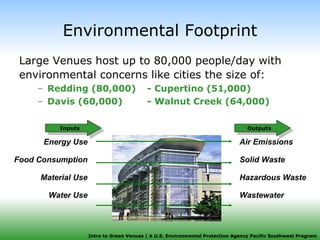
Environmental Footprint Large Venues host up to 80,000 people/day with environmental concerns like cities the size of: Redding (80,000) - Cupertino (51,000) Davis (60,000) - Walnut Creek (64,000) Energy Use Food Consumption Material Use Water Use Inputs Air Emissions Solid Waste Hazardous Waste Wastewater Outputs
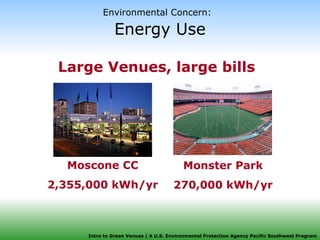
Environmental Concern:   Energy Use Large Venues, large bills Moscone CC 2,355,000 kWh/yr Monster Park 270,000 kWh/yr
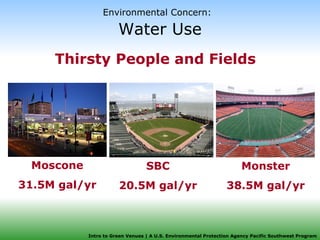
Environmental Concern:   Water Use Thirsty People and Fields Moscone 31.5M gal/yr Monster 38.5M gal/yr SBC 20.5M gal/yr
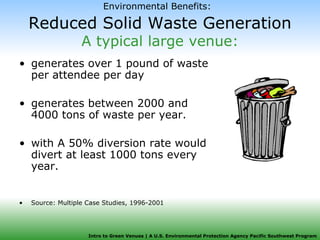
Environmental Benefits:   Reduced Solid Waste Generation A typical large venue: generates over 1 pound of waste per attendee per day  generates between 2000 and 4000 tons of waste per year.  with A 50% diversion rate would divert at least 1000 tons every year. Source: Multiple Case Studies, 1996-2001
Save Money! SBC Park did. The recycling program at SBC Park has garnered some impressive statistics: In 2004, it  recycled 1,760 tons  of materials -- that’s a 56 percent diversion rate -- and  saved $100,000  on garbage disposal costs. Source: Biocycle, Feb 2005
What do recycling rates mean for global warming? Bottom line is, every ton of cardboard recycled equals two tons of CO2 not released into the environment.  Thus, when a venue recycles 500 tons of cardboard in a year – not an unrealistic goal – it prevents about 1000 tons of CO2 emissions.
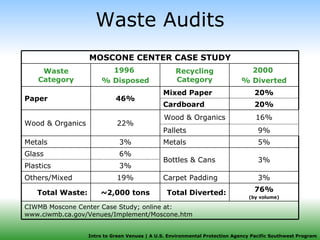
Waste Audits 9% Pallets 20% Cardboard Total Diverted: Carpet Padding Bottles & Cans Metals Wood & Organics Mixed Paper Recycling Category CIWMB Moscone Center Case Study; online at:  www.ciwmb.ca.gov/Venues/Implement/Moscone.htm 76% (by volume) ~2,000 tons Total Waste: 3% 19% Others/Mixed 3% Plastics 3% 6% Glass 5% 3% Metals 16% 22% Wood & Organics 20% 46% Paper 2000  % Diverted 1996  % Disposed Waste Category MOSCONE CENTER CASE STUDY
Upstream Emissions Upstream emissions dominate (production related GHG emissions 10x higher than landfill) Waste prevention is very important Recycling and composting are beneficial Collection-related emissions are surprisingly insignificant So are long-haul transportation emissions
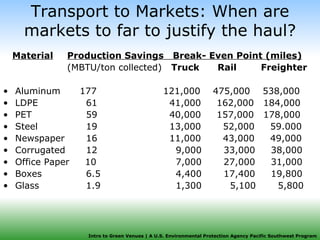
Transport to Markets: When are markets to far to justify the haul? Material Production Savings  Break- Even Point (miles) (MBTU/ton collected)  Truck  Rail  Freighter Aluminum   177 121,000  475,000  538,000 LDPE   61   41,000  162,000  184,000 PET   59   40,000  157,000  178,000  Steel   19   13,000  52,000  59.000 Newspaper   16   11,000  43,000  49,000 Corrugated   12   9,000  33,000  38,000 Office Paper  10     7,000  27,000  31,000 Boxes   6.5   4,400  17,400  19,800 Glass    1.9   1,300  5,100  5,800
III: Success Stories - You Can Do It Too! HP Pavilion (The Shark Tank) Pro Bowl 2006, 2007 (Aloha Stadium) Anaheim Convention Center/ARAMARK San Diego Convention Center R5 and Democratic National Convention Wilkes University and R3 City of Houston, Reliant Stadium and R6 Pepsi Center and R8 PETCO Park
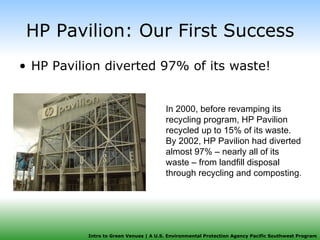
HP Pavilion: Our First Success HP Pavilion diverted 97% of its waste! In 2000, before revamping its  recycling program, HP Pavilion  recycled up to 15% of its waste.  By 2002, HP Pavilion had diverted  almost 97% – nearly all of its  waste – from landfill disposal  through recycling and composting .
Anaheim Convention Center In September 2005, Aramark at Anaheim Convention Center agreed to pilot EPA Region 9’s Green Venues initiative; ACC agreed to collect and share numbers during the next year for several of the criteria, including sustainable food and beverage service and energy use.  The Orange County Register ran a story about this on September 8; EPA issued its own press release in early October
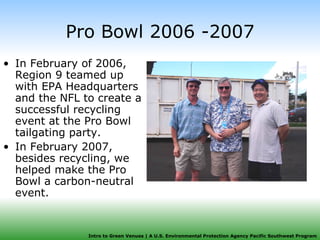
Pro Bowl 2006 -2007 In February of 2006, Region 9 teamed up  with EPA Headquarters and the NFL to create a successful recycling event at the Pro Bowl tailgating party. In February 2007, besides recycling, we helped make the Pro Bowl a carbon-neutral event.
Petco Park: Home of the Padres In January 2008, Petco Park joined EPA’s Waste Wise program; Petco Park had already been composting most of its food waste;  Petco Park the San Diego Convention Center learn the ropes of composting.
Other Examples of Success San Diego Convention Center, 2007  Recycled 1050 tons, composted 240 tons -  a 43% diversion rate and $58,000 savings Energy upgrades save 3.6 million kWh annually Low-flow appliances and drip irrigation save 90,000 gals/yr  LA Convention Center, 2007  Recycled and composted over 1500 tons of material – a 55%  diversion rate.  And all over the country … Wilkes University in Pennsylvania Pepsi Center/DNC in Denver, CO City of Chicago & 2016 Olympics
Part III: Green Venues Criteria The nuts and bolts of EPA’s clearly defined criteria for becoming an environmental leader.
Green Venues Program Criteria Energy Conservation Water Conservation Renewable Energy Solid Waste Sustainable Food & Beverage Service Green Procurement Reduced Use of Toxics Environmental Messages Community Education Professional Recognition Climate Change Sustainable Construction Green  Venue  Criteria
1. Energy Conservation HVAC systems, lighting, and commercial food service appliances are EPA EnergyStar-rated.  www.energystar.gov   Find guidelines for energy management, links to service vendors, and more information on conserving energy in commercial facilities.  Green  Venue  Criteria
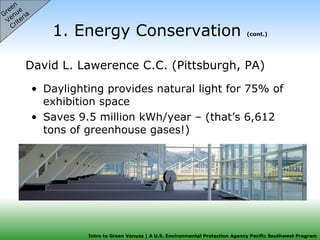
1. Energy Conservation  (cont.) David L. Lawerence C.C. (Pittsburgh, PA) Green  Venue  Criteria Daylighting provides natural light for 75% of exhibition space  Saves 9.5 million kWh/year – (that’s 6,612 tons of greenhouse gases!)
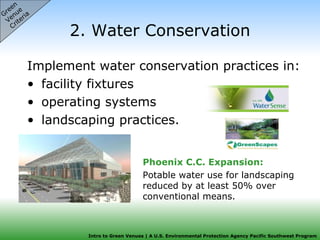
2. Water Conservation Implement water conservation practices in: facility fixtures operating systems landscaping practices.  Green  Venue  Criteria Phoenix C.C. Expansion:   Potable water use for landscaping reduced by at least 50% over conventional means.
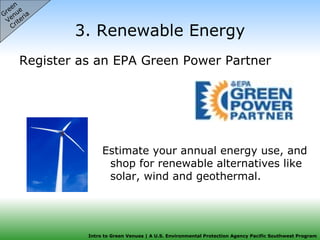
3. Renewable Energy Register as an EPA Green Power Partner  Green  Venue  Criteria Estimate your annual energy use, and shop for renewable alternatives like solar, wind and geothermal.
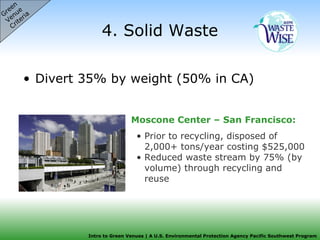
4. Solid Waste Divert 35% by weight (50% in CA) Green  Venue  Criteria Moscone Center – San Francisco: Prior to recycling, disposed of 2,000+ tons/year costing $525,000 Reduced waste stream by 75% (by volume) through recycling and reuse
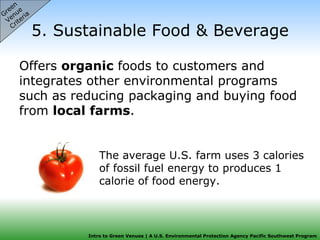
5. Sustainable Food & Beverage Offers  organic  foods to customers and integrates other environmental programs such as reducing packaging and buying food from  local farms .  Green  Venue  Criteria The average U.S. farm uses 3 calories of fossil fuel energy to produces 1 calorie of food energy.
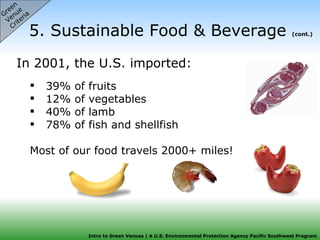
5. Sustainable Food & Beverage  (cont.) 39% of fruits 12% of vegetables 40% of lamb 78% of fish and shellfish Most of our food travels 2000+ miles! Green  Venue  Criteria In 2001, the U.S. imported:
Recent News: Aug 28, 2008 The California Assembly approved a bill to limit the amount of a chemical that has been linked to cancer and is used in food packaging. The measure would allow no more than 10 parts per billion of a compound known as PFOA in fast-food wrappers, pizza boxes, beverage containers and other food packaging. The Environmental Protection Agency considers PFOA potentially carcinogenic and says businesses should voluntarily stop using it by 2015.
6. Green Procurement Does your operating budget focus on environmentally preferred products? To do: Have a clear green procurement policy! Green  Venue  Criteria Green products may occasionally have a higher up-front purchase price, but generally cost less over their lifetime
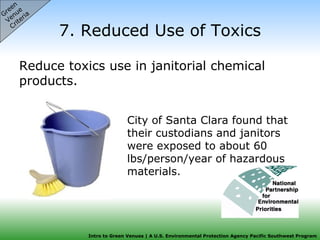
7. Reduced Use of Toxics Reduce toxics use in janitorial chemical products.  Green  Venue  Criteria City of Santa Clara found that their custodians and janitors were exposed to about 60 lbs/person/year of hazardous materials.
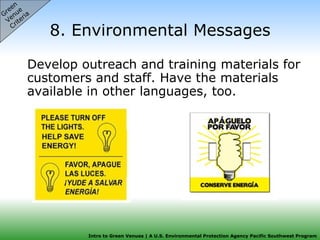
8. Environmental Messages Develop outreach and training materials for customers and staff. Have the materials available in other languages, too. Green  Venue  Criteria
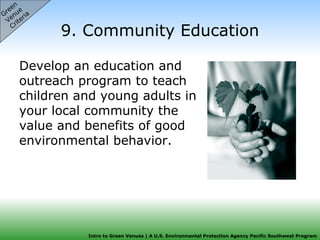
9. Community Education Develop an education and outreach program to teach children and young adults in your local community the value and benefits of good environmental behavior.  Green  Venue  Criteria
10. Professional Recognition A member of an existing EPA program, such as WasteWise or Performance Track, or have well-recognized external certification such as ISO 14001 or EMS.  Green  Venue  Criteria ISO 14001
11. Climate Change Hold at least one carbon-neutral event each calendar year.  www.chicagoclimatex.com   The Chicago Climate Exchange (CCX) is the world’s first and North America’s only voluntary, legally binding rules-based greenhouse gas emissions reduction and trading system.  Green  Venue  Criteria
12. Sustainable Construction Use recycled materials in construction  Green  Venue  Criteria LEED credit  granted for construction waste management diversion The Building for Environmental and Economic Sustainability (BEES)  program was developed by the NIST (National Institute of Standards and Technology) with support from EPA
Part IV: EPA Partnership Programs for Success
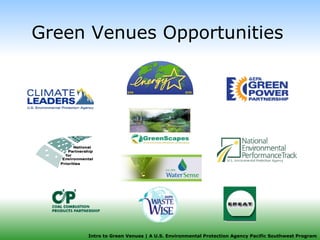
Green Venues Opportunities
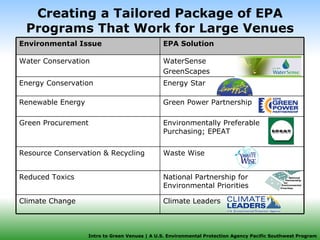
Creating a Tailored Package of EPA Programs That Work for Large Venues Green Power Partnership  Renewable Energy Climate Leaders Climate Change National Partnership for Environmental Priorities Reduced Toxics Waste Wise Resource Conservation & Recycling Environmentally Preferable Purchasing; EPEAT Green Procurement  Energy Star Energy Conservation WaterSense  GreenScapes Water Conservation EPA Solution Environmental Issue
Keys to Success The Venue Provides: Internal champion and Green Team Clear environmental goals  Measured results, shared with EPA  EPA Provides:  One-stop shopping Assistance to determine best options Recognition  Results:  Sustained change in business practices Positive green message to millions
Questions?  A U.S. Environmental Protection Agency Pacific Southwest Program Contact: Marc Mowrey, (415) 972-3324,  [email_address]

Gv Laguna Beach Ii

  • 1.
    Green Venues U.S. Environmental Protection Agency Pacific Southwest Contact: Marc Mowrey, (415) 972-3324, [email_address]
  • 2.
    Overview of presentationI. Why Green Venues? II. Success Stories III. Green Venues Criteria IV. Partnership Programs
  • 3.
    Trick Question: What’sthe difference between behaviors that make good environmental sense, and those that make good business sense?
  • 4.
    II: Why GreenVenues? Big Numbers Culture Change
  • 5.
    The Opportunity: BigNumbers! Every year, the 6 largest convention centers in California: Receive about 10 million visitors Generate 50 million pounds of trash Consume 14 million kilowatts of energy Use 180 million gallons of water
  • 6.
    Culture Change Conventions,concerts and sporting events provide unique opportunities to send a powerful environmental message home with venue attendees. Announce your good work on signs Host “Best Environmentalist” games, with take-home prizes Involve local clubs
  • 7.
    Environmental Footprint LargeVenues host up to 80,000 people/day with environmental concerns like cities the size of: Redding (80,000) - Cupertino (51,000) Davis (60,000) - Walnut Creek (64,000) Energy Use Food Consumption Material Use Water Use Inputs Air Emissions Solid Waste Hazardous Waste Wastewater Outputs
  • 8.
    Environmental Concern: Energy Use Large Venues, large bills Moscone CC 2,355,000 kWh/yr Monster Park 270,000 kWh/yr
  • 9.
    Environmental Concern: Water Use Thirsty People and Fields Moscone 31.5M gal/yr Monster 38.5M gal/yr SBC 20.5M gal/yr
  • 10.
    Environmental Benefits: Reduced Solid Waste Generation A typical large venue: generates over 1 pound of waste per attendee per day generates between 2000 and 4000 tons of waste per year. with A 50% diversion rate would divert at least 1000 tons every year. Source: Multiple Case Studies, 1996-2001
  • 11.
    Save Money! SBCPark did. The recycling program at SBC Park has garnered some impressive statistics: In 2004, it recycled 1,760 tons of materials -- that’s a 56 percent diversion rate -- and saved $100,000 on garbage disposal costs. Source: Biocycle, Feb 2005
  • 12.
    What do recyclingrates mean for global warming? Bottom line is, every ton of cardboard recycled equals two tons of CO2 not released into the environment. Thus, when a venue recycles 500 tons of cardboard in a year – not an unrealistic goal – it prevents about 1000 tons of CO2 emissions.
  • 13.
    Waste Audits 9%Pallets 20% Cardboard Total Diverted: Carpet Padding Bottles & Cans Metals Wood & Organics Mixed Paper Recycling Category CIWMB Moscone Center Case Study; online at: www.ciwmb.ca.gov/Venues/Implement/Moscone.htm 76% (by volume) ~2,000 tons Total Waste: 3% 19% Others/Mixed 3% Plastics 3% 6% Glass 5% 3% Metals 16% 22% Wood & Organics 20% 46% Paper 2000 % Diverted 1996 % Disposed Waste Category MOSCONE CENTER CASE STUDY
  • 14.
    Upstream Emissions Upstreamemissions dominate (production related GHG emissions 10x higher than landfill) Waste prevention is very important Recycling and composting are beneficial Collection-related emissions are surprisingly insignificant So are long-haul transportation emissions
  • 15.
    Transport to Markets:When are markets to far to justify the haul? Material Production Savings Break- Even Point (miles) (MBTU/ton collected) Truck Rail Freighter Aluminum 177 121,000 475,000 538,000 LDPE 61 41,000 162,000 184,000 PET 59 40,000 157,000 178,000 Steel 19 13,000 52,000 59.000 Newspaper 16 11,000 43,000 49,000 Corrugated 12 9,000 33,000 38,000 Office Paper 10 7,000 27,000 31,000 Boxes 6.5 4,400 17,400 19,800 Glass 1.9 1,300 5,100 5,800
  • 16.
    III: Success Stories- You Can Do It Too! HP Pavilion (The Shark Tank) Pro Bowl 2006, 2007 (Aloha Stadium) Anaheim Convention Center/ARAMARK San Diego Convention Center R5 and Democratic National Convention Wilkes University and R3 City of Houston, Reliant Stadium and R6 Pepsi Center and R8 PETCO Park
  • 17.
    HP Pavilion: OurFirst Success HP Pavilion diverted 97% of its waste! In 2000, before revamping its recycling program, HP Pavilion recycled up to 15% of its waste. By 2002, HP Pavilion had diverted almost 97% – nearly all of its waste – from landfill disposal through recycling and composting .
  • 18.
    Anaheim Convention CenterIn September 2005, Aramark at Anaheim Convention Center agreed to pilot EPA Region 9’s Green Venues initiative; ACC agreed to collect and share numbers during the next year for several of the criteria, including sustainable food and beverage service and energy use. The Orange County Register ran a story about this on September 8; EPA issued its own press release in early October
  • 19.
    Pro Bowl 2006-2007 In February of 2006, Region 9 teamed up with EPA Headquarters and the NFL to create a successful recycling event at the Pro Bowl tailgating party. In February 2007, besides recycling, we helped make the Pro Bowl a carbon-neutral event.
  • 20.
    Petco Park: Homeof the Padres In January 2008, Petco Park joined EPA’s Waste Wise program; Petco Park had already been composting most of its food waste; Petco Park the San Diego Convention Center learn the ropes of composting.
  • 21.
    Other Examples ofSuccess San Diego Convention Center, 2007 Recycled 1050 tons, composted 240 tons - a 43% diversion rate and $58,000 savings Energy upgrades save 3.6 million kWh annually Low-flow appliances and drip irrigation save 90,000 gals/yr LA Convention Center, 2007 Recycled and composted over 1500 tons of material – a 55% diversion rate. And all over the country … Wilkes University in Pennsylvania Pepsi Center/DNC in Denver, CO City of Chicago & 2016 Olympics
  • 22.
    Part III: GreenVenues Criteria The nuts and bolts of EPA’s clearly defined criteria for becoming an environmental leader.
  • 23.
    Green Venues ProgramCriteria Energy Conservation Water Conservation Renewable Energy Solid Waste Sustainable Food & Beverage Service Green Procurement Reduced Use of Toxics Environmental Messages Community Education Professional Recognition Climate Change Sustainable Construction Green Venue Criteria
  • 24.
    1. Energy ConservationHVAC systems, lighting, and commercial food service appliances are EPA EnergyStar-rated. www.energystar.gov Find guidelines for energy management, links to service vendors, and more information on conserving energy in commercial facilities. Green Venue Criteria
  • 25.
    1. Energy Conservation (cont.) David L. Lawerence C.C. (Pittsburgh, PA) Green Venue Criteria Daylighting provides natural light for 75% of exhibition space Saves 9.5 million kWh/year – (that’s 6,612 tons of greenhouse gases!)
  • 26.
    2. Water ConservationImplement water conservation practices in: facility fixtures operating systems landscaping practices. Green Venue Criteria Phoenix C.C. Expansion: Potable water use for landscaping reduced by at least 50% over conventional means.
  • 27.
    3. Renewable EnergyRegister as an EPA Green Power Partner Green Venue Criteria Estimate your annual energy use, and shop for renewable alternatives like solar, wind and geothermal.
  • 28.
    4. Solid WasteDivert 35% by weight (50% in CA) Green Venue Criteria Moscone Center – San Francisco: Prior to recycling, disposed of 2,000+ tons/year costing $525,000 Reduced waste stream by 75% (by volume) through recycling and reuse
  • 29.
    5. Sustainable Food& Beverage Offers organic foods to customers and integrates other environmental programs such as reducing packaging and buying food from local farms . Green Venue Criteria The average U.S. farm uses 3 calories of fossil fuel energy to produces 1 calorie of food energy.
  • 30.
    5. Sustainable Food& Beverage (cont.) 39% of fruits 12% of vegetables 40% of lamb 78% of fish and shellfish Most of our food travels 2000+ miles! Green Venue Criteria In 2001, the U.S. imported:
  • 31.
    Recent News: Aug28, 2008 The California Assembly approved a bill to limit the amount of a chemical that has been linked to cancer and is used in food packaging. The measure would allow no more than 10 parts per billion of a compound known as PFOA in fast-food wrappers, pizza boxes, beverage containers and other food packaging. The Environmental Protection Agency considers PFOA potentially carcinogenic and says businesses should voluntarily stop using it by 2015.
  • 32.
    6. Green ProcurementDoes your operating budget focus on environmentally preferred products? To do: Have a clear green procurement policy! Green Venue Criteria Green products may occasionally have a higher up-front purchase price, but generally cost less over their lifetime
  • 33.
    7. Reduced Useof Toxics Reduce toxics use in janitorial chemical products. Green Venue Criteria City of Santa Clara found that their custodians and janitors were exposed to about 60 lbs/person/year of hazardous materials.
  • 34.
    8. Environmental MessagesDevelop outreach and training materials for customers and staff. Have the materials available in other languages, too. Green Venue Criteria
  • 35.
    9. Community EducationDevelop an education and outreach program to teach children and young adults in your local community the value and benefits of good environmental behavior. Green Venue Criteria
  • 36.
    10. Professional RecognitionA member of an existing EPA program, such as WasteWise or Performance Track, or have well-recognized external certification such as ISO 14001 or EMS. Green Venue Criteria ISO 14001
  • 37.
    11. Climate ChangeHold at least one carbon-neutral event each calendar year. www.chicagoclimatex.com The Chicago Climate Exchange (CCX) is the world’s first and North America’s only voluntary, legally binding rules-based greenhouse gas emissions reduction and trading system. Green Venue Criteria
  • 38.
    12. Sustainable ConstructionUse recycled materials in construction Green Venue Criteria LEED credit granted for construction waste management diversion The Building for Environmental and Economic Sustainability (BEES) program was developed by the NIST (National Institute of Standards and Technology) with support from EPA
  • 39.
    Part IV: EPAPartnership Programs for Success
  • 40.
  • 41.
    Creating a TailoredPackage of EPA Programs That Work for Large Venues Green Power Partnership Renewable Energy Climate Leaders Climate Change National Partnership for Environmental Priorities Reduced Toxics Waste Wise Resource Conservation & Recycling Environmentally Preferable Purchasing; EPEAT Green Procurement Energy Star Energy Conservation WaterSense GreenScapes Water Conservation EPA Solution Environmental Issue
  • 42.
    Keys to SuccessThe Venue Provides: Internal champion and Green Team Clear environmental goals Measured results, shared with EPA EPA Provides: One-stop shopping Assistance to determine best options Recognition Results: Sustained change in business practices Positive green message to millions
  • 43.
    Questions? AU.S. Environmental Protection Agency Pacific Southwest Program Contact: Marc Mowrey, (415) 972-3324, [email_address]