Gerry Purcell Managing Director, Value Improvement Associates (gpurcell@valueimprovement.com) January 5, 2009 Business as a Living System – Fluid, dynamic and simple
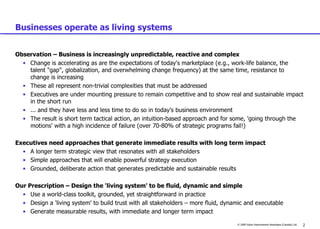
Businesses operate as living systems Observation – Business is increasingly unpredictable, reactive and complex  Change is accelerating as are the expectations of today's marketplace (e.g., work-life balance, the talent "gap", globalization, and overwhelming change frequency) at the same time, resistance to change is increasing These all represent non-trivial complexities that must be addressed Executives are under mounting pressure to remain competitive and to show real and sustainable impact in the short run ... and they have less and less time to do so in today's business environment The result is short term tactical action, an intuition-based approach and for some, 'going through the motions' with a high incidence of failure (over 70-80% of strategic programs fail!) Executives need approaches that generate immediate results with long term impact A longer term strategic view that resonates with all stakeholders Simple approaches that will enable powerful strategy execution Grounded, deliberate action that generates predictable and sustainable results Our Prescription – Design the 'living system' to be fluid, dynamic and simple Use a world-class toolkit, grounded, yet straightforward in practice Design a 'living system' to build trust with all stakeholders – more fluid, dynamic and executable Generate measurable results, with immediate and longer term impact
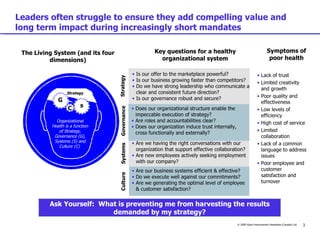
Leaders often struggle to ensure they add compelling value and long term impact during increasingly short mandates Does our organizational structure enable the impeccable execution of strategy?  Are roles and accountabilities clear? Does our organization induce trust internally, cross functionally and externally? Is our offer to the marketplace powerful? Is our business growing faster than competitors? Do we have strong leadership who communicate a clear and consistent future direction? Is our governance robust and secure? Key questions for a healthy organizational system The Living System (and its four dimensions) Symptoms of poor health Lack of trust Limited creativity and growth Poor quality and effectiveness  Low levels of efficiency  High cost of service Limited collaboration Lack of a common language to address issues  Poor employee and customer satisfaction and turnover Ask Yourself:  What is preventing me from harvesting the results demanded by my strategy? Organizational Health is a function of Strategy, Governance (G), Systems (S) and Culture (C)  G s C Strategy Are we having the right conversations with our organization that support effective collaboration? Are new employees actively seeking employment with our company? Are our business systems efficient & effective? Do we execute well against our commitments? Are we generating the optimal level of employee & customer satisfaction? Strategy Governance Systems Culture
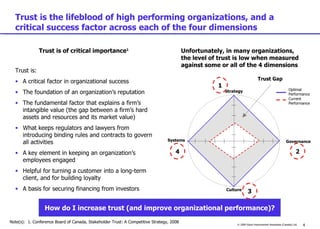
Trust is the lifeblood of high performing organizations, and a critical success factor across each of the four dimensions Trust is: A critical factor in organizational success The foundation of an organization’s reputation The fundamental factor that explains a firm’s intangible value (the gap between a firm’s hard assets and resources and its market value) What keeps regulators and lawyers from introducing binding rules and contracts to govern all activities A key element in keeping an organization’s employees engaged Helpful for turning a customer into a long-term client, and for building loyalty A basis for securing financing from investors Trust is of critical importance 1 Unfortunately, in many organizations, the level of trust is low when measured against some or all of the 4 dimensions How do I increase trust (and improve organizational performance)? Note(s):  1. Conference Board of Canada, Stakeholder Trust: A Competitive Strategy, 2008 Trust Gap 1 2 3 4 Optimal Performance Current Performance
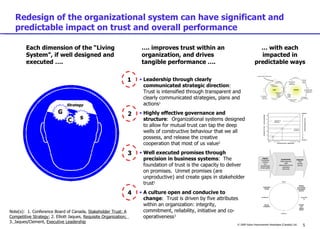
Redesign of the organizational system can have significant and predictable impact on trust and overall performance G s C Strategy Leadership through clearly communicated strategic direction :  Trust is intensified through transparent and clearly communicated strategies, plans and actions 1 Highly effective governance and structure :  Organizational systems designed to allow for mutual trust can tap the deep wells of constructive behaviour that we all possess, and release the creative cooperation that most of us value 2 Well executed promises through precision in business systems :  The foundation of trust is the capacity to deliver on promises.  Unmet promises (are unproductive) and create gaps in stakeholder trust 1 A culture open and conducive to change :  Trust is driven by five attributes within an organization: integrity, commitment, reliability, initiative and co-operativeness 3 Note(s):  1. Conference Board of Canada,  Stakeholder Trust: A Competitive Strategy ; 2. Elliott Jaques,  Requisite Organization;  3.   Jaques/Clement,  Executive Leadership Each dimension of the “Living System”, if well designed and executed …. …  with each impacted in predictable ways … . improves trust within an organization, and drives tangible performance …. 1 2 3 4
Significant, tangible results can be delivered.  In many cases measurable impact is almost immediate Example:  Typical client diagnosis of the situation …  and generates tangible results Diagnosis uncovers root causes and primary improvement opportunities … Poor performance due to poorly defined strategy and its execution (e.g., breakdowns in controls and misaligned incentives) Conflict between lateral organizations around errors in end-to-end processing leading to unacceptably long wait times Ineffective management team unable to move organization forward High cost of internal business systems Improve alignment and predictability of performance leading to improved ROI (e.g., 20%) Reduce cost by  reduction in rework (e.g., 50 to 75%) Improve customer and employee satisfaction, and financial performance (e.g., 20%) Improve productivity scalability and performance management capability (e.g., 20 to 40%) Strategy not well communicated nor understood Organizational structure misaligned and accountabilities unclear or overlapping [ Action :  Clarify strategic intent and communicate; realign organization and accountabilities ] Lack of clarity around overall business ownership Excessive controls, misunderstood needs, poorly defined artifacts and the lack of oversight from an end-to-end manager [ Action :  Redefine end-to-end business processes and accountabilities ] Lack of clarity of accountability and direction Management team having the wrong conversations Excessive micro-management [ Action :  Clarify role of management and roles of each team member.  Introduce collaborative management and coaching techniques ] Poor overall governance model Lack of production management capability (e.g., forecasting, continuous improvement) [ Action :  Refine business systems including clarity around needs and required artifacts.  Introduce rigorous production management capability ]
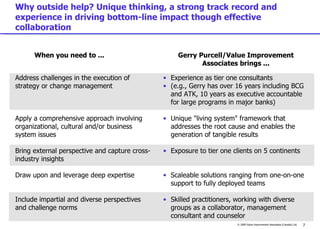
Why outside help? Unique thinking, a strong track record and experience in driving bottom-line impact though effective collaboration Address challenges in the execution of  strategy or change management Apply a comprehensive approach involving organizational, cultural and/or business system issues Bring external perspective and capture cross-industry insights Draw upon and leverage deep expertise  Include impartial and diverse perspectives and challenge norms Experience as tier one consultants (e.g., Gerry has over 16 years including BCG and ATK, 10 years as executive accountable for large programs in major banks) Unique "living system" framework that addresses the root cause and enables the generation of tangible results Exposure to tier one clients on 5 continents Scaleable solutions ranging from one-on-one support to fully deployed teams Skilled practitioners, working with diverse groups as a collaborator, management consultant and counselor When you need to ... Gerry Purcell/Value Improvement Associates brings ...
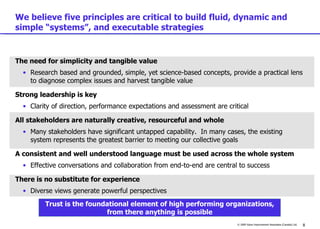
We believe five principles are critical to build fluid, dynamic and simple “systems”, and executable strategies The need for simplicity and tangible value Research based and grounded, simple, yet science-based concepts, provide a practical lens to diagnose complex issues and harvest tangible value Strong leadership is key Clarity of direction, performance expectations and assessment are critical All stakeholders are naturally creative, resourceful and whole Many stakeholders have significant untapped capability.  In many cases, the existing system represents the greatest barrier to meeting our collective goals A consistent and well understood language must be used across the whole system Effective conversations and collaboration from end-to-end are central to success There is no substitute for experience Diverse views generate powerful perspectives Trust is the foundational element of high performing organizations, from there anything is possible
About Gerry Purcell Gerry Purcell is a seasoned management consultant who has advised organizations, both large and small, all over the world.  His practice focuses on assisting clients to increase the impact of strategy execution.  With over 16 years of global experience as a consultant, including as a Principal at both the Boston Consulting Group and A.T. Kearney, Gerry brings powerful thinking and expertise to remove execution barriers.    Over the years, Gerry has been engaged by organizations in North and South America, Europe, Asia and the Middle East to address strategic issues.  He gets results.  Gerry's consulting skills are complimented by a decade as an operations executive and completion of the formal curriculum of the Coaches Training Institute.  His ‘real world’ experience and the ‘Coactive Coaching’ model enable him to assist his clients to identify dysfunction (i.e., organizational, cultural and systems), to develop a roadmap for change, and use a number of unique tools and techniques to implement it.  He uses out-of-the box thinking, an action-learning approach, and a collaborative leadership and counseling style, to help management teams to get to the bottom of issues and to ensure tangible results are obtained.   For more information, contact Gerry Purcell at +1 (416) 200-2338

Business As A Living System

  • 1.
    Gerry Purcell ManagingDirector, Value Improvement Associates (gpurcell@valueimprovement.com) January 5, 2009 Business as a Living System – Fluid, dynamic and simple
  • 2.
    Businesses operate asliving systems Observation – Business is increasingly unpredictable, reactive and complex Change is accelerating as are the expectations of today's marketplace (e.g., work-life balance, the talent "gap", globalization, and overwhelming change frequency) at the same time, resistance to change is increasing These all represent non-trivial complexities that must be addressed Executives are under mounting pressure to remain competitive and to show real and sustainable impact in the short run ... and they have less and less time to do so in today's business environment The result is short term tactical action, an intuition-based approach and for some, 'going through the motions' with a high incidence of failure (over 70-80% of strategic programs fail!) Executives need approaches that generate immediate results with long term impact A longer term strategic view that resonates with all stakeholders Simple approaches that will enable powerful strategy execution Grounded, deliberate action that generates predictable and sustainable results Our Prescription – Design the 'living system' to be fluid, dynamic and simple Use a world-class toolkit, grounded, yet straightforward in practice Design a 'living system' to build trust with all stakeholders – more fluid, dynamic and executable Generate measurable results, with immediate and longer term impact
  • 3.
    Leaders often struggleto ensure they add compelling value and long term impact during increasingly short mandates Does our organizational structure enable the impeccable execution of strategy? Are roles and accountabilities clear? Does our organization induce trust internally, cross functionally and externally? Is our offer to the marketplace powerful? Is our business growing faster than competitors? Do we have strong leadership who communicate a clear and consistent future direction? Is our governance robust and secure? Key questions for a healthy organizational system The Living System (and its four dimensions) Symptoms of poor health Lack of trust Limited creativity and growth Poor quality and effectiveness Low levels of efficiency High cost of service Limited collaboration Lack of a common language to address issues Poor employee and customer satisfaction and turnover Ask Yourself: What is preventing me from harvesting the results demanded by my strategy? Organizational Health is a function of Strategy, Governance (G), Systems (S) and Culture (C) G s C Strategy Are we having the right conversations with our organization that support effective collaboration? Are new employees actively seeking employment with our company? Are our business systems efficient & effective? Do we execute well against our commitments? Are we generating the optimal level of employee & customer satisfaction? Strategy Governance Systems Culture
  • 4.
    Trust is thelifeblood of high performing organizations, and a critical success factor across each of the four dimensions Trust is: A critical factor in organizational success The foundation of an organization’s reputation The fundamental factor that explains a firm’s intangible value (the gap between a firm’s hard assets and resources and its market value) What keeps regulators and lawyers from introducing binding rules and contracts to govern all activities A key element in keeping an organization’s employees engaged Helpful for turning a customer into a long-term client, and for building loyalty A basis for securing financing from investors Trust is of critical importance 1 Unfortunately, in many organizations, the level of trust is low when measured against some or all of the 4 dimensions How do I increase trust (and improve organizational performance)? Note(s): 1. Conference Board of Canada, Stakeholder Trust: A Competitive Strategy, 2008 Trust Gap 1 2 3 4 Optimal Performance Current Performance
  • 5.
    Redesign of theorganizational system can have significant and predictable impact on trust and overall performance G s C Strategy Leadership through clearly communicated strategic direction : Trust is intensified through transparent and clearly communicated strategies, plans and actions 1 Highly effective governance and structure : Organizational systems designed to allow for mutual trust can tap the deep wells of constructive behaviour that we all possess, and release the creative cooperation that most of us value 2 Well executed promises through precision in business systems : The foundation of trust is the capacity to deliver on promises. Unmet promises (are unproductive) and create gaps in stakeholder trust 1 A culture open and conducive to change : Trust is driven by five attributes within an organization: integrity, commitment, reliability, initiative and co-operativeness 3 Note(s): 1. Conference Board of Canada, Stakeholder Trust: A Competitive Strategy ; 2. Elliott Jaques, Requisite Organization; 3. Jaques/Clement, Executive Leadership Each dimension of the “Living System”, if well designed and executed …. … with each impacted in predictable ways … . improves trust within an organization, and drives tangible performance …. 1 2 3 4
  • 6.
    Significant, tangible resultscan be delivered. In many cases measurable impact is almost immediate Example: Typical client diagnosis of the situation … and generates tangible results Diagnosis uncovers root causes and primary improvement opportunities … Poor performance due to poorly defined strategy and its execution (e.g., breakdowns in controls and misaligned incentives) Conflict between lateral organizations around errors in end-to-end processing leading to unacceptably long wait times Ineffective management team unable to move organization forward High cost of internal business systems Improve alignment and predictability of performance leading to improved ROI (e.g., 20%) Reduce cost by reduction in rework (e.g., 50 to 75%) Improve customer and employee satisfaction, and financial performance (e.g., 20%) Improve productivity scalability and performance management capability (e.g., 20 to 40%) Strategy not well communicated nor understood Organizational structure misaligned and accountabilities unclear or overlapping [ Action : Clarify strategic intent and communicate; realign organization and accountabilities ] Lack of clarity around overall business ownership Excessive controls, misunderstood needs, poorly defined artifacts and the lack of oversight from an end-to-end manager [ Action : Redefine end-to-end business processes and accountabilities ] Lack of clarity of accountability and direction Management team having the wrong conversations Excessive micro-management [ Action : Clarify role of management and roles of each team member. Introduce collaborative management and coaching techniques ] Poor overall governance model Lack of production management capability (e.g., forecasting, continuous improvement) [ Action : Refine business systems including clarity around needs and required artifacts. Introduce rigorous production management capability ]
  • 7.
    Why outside help?Unique thinking, a strong track record and experience in driving bottom-line impact though effective collaboration Address challenges in the execution of strategy or change management Apply a comprehensive approach involving organizational, cultural and/or business system issues Bring external perspective and capture cross-industry insights Draw upon and leverage deep expertise Include impartial and diverse perspectives and challenge norms Experience as tier one consultants (e.g., Gerry has over 16 years including BCG and ATK, 10 years as executive accountable for large programs in major banks) Unique "living system" framework that addresses the root cause and enables the generation of tangible results Exposure to tier one clients on 5 continents Scaleable solutions ranging from one-on-one support to fully deployed teams Skilled practitioners, working with diverse groups as a collaborator, management consultant and counselor When you need to ... Gerry Purcell/Value Improvement Associates brings ...
  • 8.
    We believe fiveprinciples are critical to build fluid, dynamic and simple “systems”, and executable strategies The need for simplicity and tangible value Research based and grounded, simple, yet science-based concepts, provide a practical lens to diagnose complex issues and harvest tangible value Strong leadership is key Clarity of direction, performance expectations and assessment are critical All stakeholders are naturally creative, resourceful and whole Many stakeholders have significant untapped capability. In many cases, the existing system represents the greatest barrier to meeting our collective goals A consistent and well understood language must be used across the whole system Effective conversations and collaboration from end-to-end are central to success There is no substitute for experience Diverse views generate powerful perspectives Trust is the foundational element of high performing organizations, from there anything is possible
  • 9.
    About Gerry PurcellGerry Purcell is a seasoned management consultant who has advised organizations, both large and small, all over the world. His practice focuses on assisting clients to increase the impact of strategy execution. With over 16 years of global experience as a consultant, including as a Principal at both the Boston Consulting Group and A.T. Kearney, Gerry brings powerful thinking and expertise to remove execution barriers.   Over the years, Gerry has been engaged by organizations in North and South America, Europe, Asia and the Middle East to address strategic issues. He gets results. Gerry's consulting skills are complimented by a decade as an operations executive and completion of the formal curriculum of the Coaches Training Institute.  His ‘real world’ experience and the ‘Coactive Coaching’ model enable him to assist his clients to identify dysfunction (i.e., organizational, cultural and systems), to develop a roadmap for change, and use a number of unique tools and techniques to implement it. He uses out-of-the box thinking, an action-learning approach, and a collaborative leadership and counseling style, to help management teams to get to the bottom of issues and to ensure tangible results are obtained.  For more information, contact Gerry Purcell at +1 (416) 200-2338