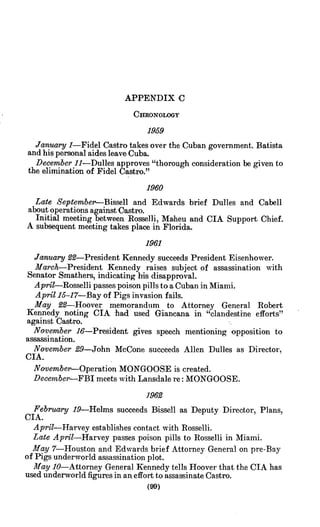
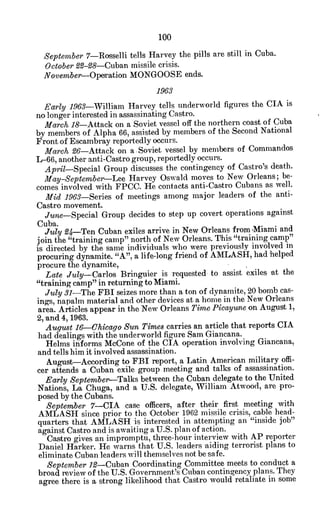
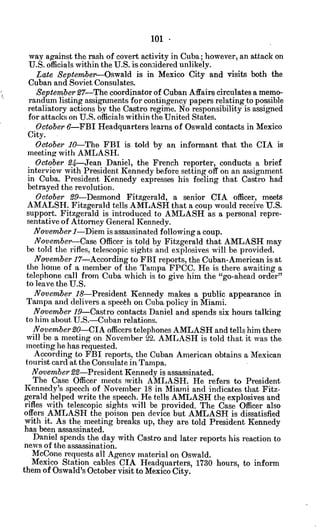
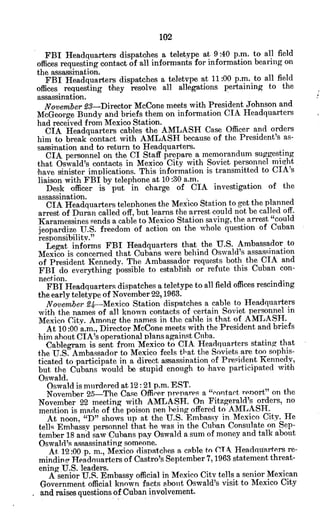
94TH CONGRESS SENATE REPORT
2d Se8sion No. 94-755
THE INVESTIGATION OF THE
ASSASSINATION OF PRESIDENT
JOHN F. KENNEDY: PERFORMANCE
OF THE INTELLIGENCE AGENCIES
BOOK V
FINAL REPORT
OF THE
SELECT COMMITTEE
TO STUDY GOVERNMENTAL OPERATIONS
WITH RESPECT TO
INTELLIGENCE ACTIVITIES
UNITED STATES SENATE
APRIL 23 (under authority of the order of APRIL 14), 1976
U.S. GOVEP.NMENT PRINTING OFFICE -
WASHINGTON : 1976
For sale by the Superintendent of Documents, U.S. Government Printing Office
Washington, D.C. 20402 - Price $1.40
Stock Number 052-071-00487-4
72-059
SENATE SELECT COMMITTEE TO STUDY GOVERNMENTAL OPERATIONS
WITH RESPECT TO INTELLIGENCE ACTIVITIES
FRANK CHURCH, Idaho, Chairman
JOHN G. TOWER, Texas, Vice Chairman
PHILIP A. HART, Michigan
WALTER F. MONDALE, Minnesota
WALTER D. HUDDLESTON, Kentucky
ROBERT MORGAN, North Carolina
GARY HART, Colorado
HOWARD H. BAKER, Jn., Tennessee
BARRY GOLDWATER, Arizona
CHARLES McC. MATHIAS, Ja., Maryland
RICHARD SCHWEIKER, Pennsylvania
WILuAM G. MILLER, Staff Director
FREDERICK A. 0. ScHwARz, Jr., Chief Counsel
CURTIs R. SMOTHERS, Counselto the Minority
AUDREY HATRY, Clerk of the Committee
LETTER OF TRANSMITTAL
On behalf of the Senate Select Committee to Study Governmental
Operations with Respect to Intelligence Activities, and pursuant to
the mandate of Senate Resolution 21, I am transmitting herewith to
the Senate the volume of the Committee's Final Report entitled, "The
Investigation of the Assassination of President John F. Kennedy:
Performance of the Intelligence Agencies."
I want to express the deep appreciation of the Committee to Senator
Richard S. Schweiker and Senator Gary Hart for their excellent work
on this phase of the Select Committee's investigation.
FRANK CHURCH,
Chairman.
(III)
NOTE
On May 26, 1976, the Select Committee voted to release the section
of its final Report entitled. "The Investigation of the Assassination
of President John F. Kennedy: Performance of the Intelligence
Agencies." Senators Church, Baker, Philip Hart, Mondale, Huddle-
ston, Morgan, Gary Hart, Mathias, and Schweiker voted to release
this Report. Senators Tower, and Goldwater voted against the release
of this report.
This Report has been reviewed and declassified by the appropriate
executive agencies. After the Committee's original draft of this report
was completed, copies of it were made available to the executive
agencies. These agencies submitted comments to the Comihittee on
security and factual aspects of the draft report. On the basis of these
comments, the Committee and staff conferred with representatives of
the agencies to determine which sections of the Report should be re-
drafted to protect sensitive intelligence sources and methods. These
sections of the original draft were then revised to reflect the agencies
concerns while retaining the original thrust of the Report.
Names of individuals were deleted when, in the Committee's judge-
ment, disclosure of their identities would either endanger their safety
or constitute an unwarranted invasion of privacy. Consequently, foot-
note citations to testimony and documents occasionally contain only
descriptions of an individual's position.
CONTENTS
Page
Letter of Transmittal------- ------------------------------------- in
I. SUMMARY AND FINDINGS_---------------------------------- 1
A. The Scope of the Committee's Investigation----------------- 1
B. Summary ------------------------------------------------ 2
C. Findings ------------------------------------------------- 6
II. BACKGROUND FOR THE WARREN COMMIS1SION INVESTIGA-
TION: CUBA AND THE INTELLIGENCE AGENCIES---------- 9
III. THE UNITED STATES GOVERNMENT RESPONSE TO THE
ASSASSINATION: NOVEMBER 22, 1963 TO JANUARY 1, 1964-- 23
A. The CIA Response -------------------------------------- 23
B. The FBI Response ---------------------------------------- 32
IV. THE INTELLIGENCE AGENCIES AND THE WARREN COMMIS-
SION: JANUARY TO SEPTEMBER 1964----------------------- 45
A. The Relationship between the FBI and the Warren Commis-
. sion -------------------------------------------------- 46
B. The Relationship between the CIA and the Warren Commis-
sion -------------------------------------------------- 57
C. Unpursued Leads ---------------------------------------
D. Knowledge of Plots to Assassinate Castro------------------ 67
V. DEVELOPMENTS AFTER THE WARREN COMMISSION--------- 77
A. 1965: Termination of the AHLASH Operation -------------- 77
B. 1967: Allegations of Cuban Involvement in the Assassination- so
APPENDIX A: The FBI and the Oswald Security Case----------------- 87
APPENDIX B: The FBI and the Destruction of the Oswald Note-------- 95
APPENDIX C: Ohronology ----------------------------------------
(v)
I. SUMMARY AND FINDINGS
The Select Committee's investigation of alleged assassination at-
tempts against foreign leaders raised questions of possible connections
between these plots and the assassination of President John Fitzgerald
Kennedy. Questions were later raised about whether the agencies ade-
quately investigated these possible connections and whether inform a-
tion about these plots was provided the President's Commission on the
Assassination of President Kennedy (the Warren Commission). As a
result, pursuant to its general mandate to review the performance of
the intelligence agencies, the Select Committee reviewed their specific
performance with respect to their investigation of the assassination of
the President.
A. The Scope of the Coinmittee's Investigation
The Committee did not attempt to duplicate the work of the Warren
Commission. It did not review the findings and conclusions of the
Warren Commission. It did not re-exaine the physical evidence
which the Warren Commission had. It did not review one of the prin-
cipal questions facing the Commission: whether Lee Harvey Oswald
was in fact the assassin of President Kennedy.
Instead, building upon the Select Committee's earlier work, and
utilizing its access to the agencies and its expertise in their functions,
the Committee examined the performance of the intelligence agencies
in conducting their investigation of the assassination and their rela-
tionships to the Warren Commission.
In the course of this investigation, more than 50 witnesses were
either interviewed or deposed. Literally tens of thousands of pages of
documentary evidence were reviewed at the agencies and more than
5,000 pages were acquired. In addition, the Committee relied a great
deal on testimony taken during the course -of its investigation of
alleged plots to assassinate foreign leaders, especially testimony
relating to knowledge of those plots.
The Committee has been impressed with the ability and dedication
of most of those in the intelligence community. Most officials of the
FBI, the CIA, and other agencies performed their assigned tasks
thoroughly, conipetently, and professionally. Supervisors at 'agency
headquarters similarly met their responsibilities and are deserving
of the highest praise. Yet, as this Report documents, these indi-
viduals did not have access to -all of the information held by the
most senior officials in their own agencies. Nor did they control, or
even influence, many of the decisions made by those senior officials,
decisions which shaped the investigation and the process by which
information was provided to the Warren Commission. Thus, it can-
not be too strongly emphasized that this Report examines the per-
formance of the senior agency officials in light of the information
available to them.
Many potential witnesses could not be called because of limitations
of time and resources. For this reason the Committee has relied a great
deal on the documentary record of events. The Comnittee's Report
distinguishes information obtained from documents from information
it obtained through sworn testimony through citations, since the docu-
mentary records may not accurately reflect the true events. On the
other hand, the Committee has on many occasions noted that witnesses
may have no recollection of the events described in documents which
they either prepared or in which they were mentioned.
The following Report details the evidence developed to date. The
Report is intended to be descriptive of the facts the Committee has de-
veloped. The Committee believes the investigation should continue,
in certain areas, and for that reason does not reach any final conclu-
sions. Instead, the Select Committee has recommended that the Senate
Committee on Intelligence continue this investigation in those areas
where the Select Committee's investigation could not be completed.
B. Summary
In the days following the assassination of President Kennedy,
nothing was more important to this country than to determine the
facts of his death; no one single event has shaken the country more.
Yet the evidence the Committee has developed suggests that, for dif-
ferent reasons, both the CIA and the FBI failed in, or avoided carry-
ing out, certain of their responsibilities in this matter.
The Committee emphasizes that this Report's discussion of investi-
gative deficiencies and the failure of American intelligence agencies
to inform the Warren Commission of certain information does not
lead to the conclusion that there was a conspiracy to assassinate Pres-
ident Kennedy.
Instead, this Report details the evidence the Committee developed
concerning the investigation those agencies conducted into the Pres-
ident's assassination, their relationship with each other and with the
Warren Commission, and the effect their own operations may have had
on the course of the investigation. It places particular emphasis on
the effect their Cuban operations seemed to have on the investigation.
However, the Committee cautions that it has seen no evidence -that
Fidel Castro or others in the Cuban government plotted President
Kennedv's assassination in retaliation for U.S. operations against
Cuba. The Report details these operations to illustrate why they were
relevant to the investigation. Thus, the CIA operation involving a
high level Cuban official, code-named AMLASH, is described in order
to illustrate why that operation, and its possible ramifications, should
have been examined as part of the assassination investigation. Simi-
larly, although Cuban exile groups opposed to Castro may have been
upset with Kennedy administration actions which restricted their
activities, the Committee has no evidence that such groups plotted the
assassination.
Almost from the day Castro took power in Cuba, the United States
became the center of attempts to depose him. Cuban exiles, anti-
communists, business interests, underworld figures, and the United
States Governmeit all had their own reasons for seeking to over-
throw the Castro government. These interests generally operated
independently of the others; but on occasion, a few from each group
would join forces in a combined effort.
In April 1961, a force of Cuban exiles and soldiers of fortune backed
by the CIA, attempted an invasion of Cuba at the Bay of Pigs. In
November of that year, the United States Government decided that
further such overt paramilitary operations were no longer feasible,
and embarked on Operation MONGOOSE. This operation attempted
to use Cuban exiles and dissidents inside Cuba. to overthrow Castro.
When the United States faced a major confrontation with the Soviet
Union during the October 1962 Cuban missile crisis, it terminated
MONGOOSE; the CIA's covert operations against Cuba were re-
duced; and the FBI and other agencies of government began to re-
strict the paramilitary operations of exile groups. This rather sudden
shift against paramilitary activity of Cuban exile groups generated
hostility. Supporters.of some of these groups were angered by the
change in government policy. They viewed this as a weakening of the
U.S. will to oppose Castro.
Throughout this period, the CIA had been plotting the assassination
of Castro -asanother method of achieving a change in the Cuban gov-
ernment. Between 1960 -andearly 1963 the CIA attempted to use under-
world figures for this assasination. By May 1962, the FBI knew of
such plots, and in June 1963 learned of their termination.
Following a June 1963 decision by a "Special Group" of the Na-
tional Security Council to increase covert operations against Cuba,
the CIA renewed contact with a high-level Cuban government official,
code-named AMLASH. At his first meeting with the CIA in over a
year, AMLASH proposed Castro's overthrow through an "inside
job," with U.S. support. AMLASH considered the assassination of
Castro a necessary part of this "inside job." Shortly after this meeting
with AMLASH, Castro issued a public warning reported prominently
in the U.S. press about the United States' meeting with terrorists who
wished to eliminate Cuban leaders. He threatened that Cuba would
answer in kind.
Five days after Castro issued this threat, the Coordinating Com-
mittee for Cuban affairs, an interagency planning committee sub-
ordinate to the National Security Council's Special Group, met to
endorse or modify then existing contingency plans for possible re-
taliation by the Cuban Government. Representatives of the CIA, and
of the State, Defense and Justice Departments were on this Com-
mittee. The CIA representatives on this Committee were from its
Special Affairs Staff (SAS), the staff responsible for Cuban mat-
ters generally and the AMLASH operation. Those attending the meet-
ing on September 12 agreed unanimously that there was a strong
likelihood Castro would retaliate in some way against the rash of
covert activity in Cuba.
At this September 12 meeting this Committee concluded Castro
would not risk major confrontation with the United States. It there-
fore rejected the possibility that Cuba would retaliate 'by attacking
American officials within the United States; it assigned no agency the
responsibility for consideration of this contingency.
Within weeks of this meeting the CIA escalated the level of its
covert operations, informing AMLASH the United States supported
his coup. Despite warnings from certain CIA staffers that the opera-
tion was poorly conceived and insecure, the head of SAS, Desmond
Fitzgerald, met AMLA:SH on October 29, 1963, told him he was the
"personal representative" of Attorney General Robert Kennedy, and
stated the United States would support a coup. On November 22, at
a pre-arranged meeting, a CIA Case Officer told AMLASH he would
be provided rifles with telescopic sights, and explosives with which
to carry out his plan. He was also offered a poison pen device.
Following the President's death, searches of FBI and CIA files
revealed that Lee Harvey Oswald was not unknown to the intelligence
agencies. In late 1959, the FBI opened a "security file" on Oswald
after his defection to the Soviet Union. After Oswald's return to this
country in June 1962, he was interviewed twice by FBI agents; on
each occasion he repeatedly lied. He also refused to be polygraphed
about his negative answers to questions of ties with Soviet intelligence.
Yet the FBI closed the Oswald security case immediately after the
second interview. The case was reopened in March 1963, but Oswald
was not interviewed by the FBI until August 10, 1963, when he re-
quested an interview after his arrest in New Orleans for disturbing
the peace. On the occasion of this third interview, he again repeatedly
lied to FBI agents. A month later Oswald visited Mexico City, where
he visited both the Cuban and Soviet diplomatic establishments, and
contacted a vice consul at the latter who was in fact a KGB agent.
Despite receiving this information on Oswald's Mexico City activity,
the FBI failed to intensify its investigative efforts. It failed to inter-
view him before the assassination despite receiving a note from him
warning the FBI to leave his wife alone.
Immediately after the assassination, FBI Director J. Edgar Hoover
ordered a complete review of the FBI's handling of the Oswald se-
curity case. Within six days he was given a report which detailed
serious investigative deficiencies. As a result of these deficiencies
seventeen FBI personnel, including one Assistant Director, were dis-
ciplined. The fact that the FBI felt there were investigative deficien-
cies and the disciplinary actions it took were never publicly disclosed
by the Bureau or communicated to the Warren Commission.
The evidence suggests that during the Warren Commission investi-
gation top FBI officials were continually concerned with protecting
the Bureau's reputation and avoiding any criticism for not fulfilling
investigative responsibilities. Within weeks after the assassination, the
FBI, at the urging of senior Government officials, issued a report con-
cluding that Oswald was the assassin and that he had acted alone.
The Bureau issued its report on the basis of a narrow investigation
focused on Oswald, without conducting a broad investigation of the
assassination which would have revealed any conspiracy, foreign or
domestic.
Despite knowledge of Oswald's apparent interest in pro-Castro and
anti-Castro activities and top level awareness of certain CIA assassi-
nation plots, the FBI, according to all agents and supervisory per-
sonnel. who testified before the Committee, made no special investiga-
tive effort into questions of possible Cuban government or Cuban exile
involvement in the assassination independent of the Oswald investi-
gation. There is no indication that the FBI or the CIA directed the
interviewing of Cuban sources or of sources within the Cuban exile
community. The division of the FBI responsible for investigating
criminal aspects of the assassination, and not the division responsible
for investigating subversive activities (including those of Cuban
groups), was primarily responsible for the investigation and served
as liaison to the Warren Commission.
Director Hoover himself perceived the Warren Commission as an
adversary. He repeatedly remarked that the Commission, particu-
larly the Chief Justice, was "seeking to criticize" the FBI and
merely attempting to "find gaps" in the FBFs investigation. On two
separate occasions, the latter immediately upon release of the Com-
mission's Report, Director Hoover asked for all derogatory material
on Warren Commission members and staff contained in the FBI files.
Neither the CIA nor the FBI told the Warren Commission about
the CIA attempts to assassinate Fidel Castro. Allen Dulles, former
Director of Central Intelligence, was a member of the Warren Com-
mission and presumably knew about CIA plots during his tenure with
the Agency, although he probably was unaware of the AMLASH
operation. FBI Director Hoover and senior FBI officials also knew
about these earlier plots. In July 1964, two months before the Warren
Commission issued its 26-volume report of its investigation and find-
ings, FBI officials learned that a Cuban official (not known to the
Bureau as "AMLASH") was plotting with the CIA to assassinate
Castro. However, there is no evidence this knowledge affected the FBI
investigation of the President's assassination in any way. The Attor-
ney General and other government officials knew there had been pre-
vious assassination plots with the underworld. None of the testimony
or documents received by the Warren Commission mentioned the CIA
assassination plots. The subordinate officers at the FBI and the CIA
who acted as liaisons with the Warren Commission did not know of
the CIA assassination attempts.
The AMLASH plot was more relevant to the Warren Commis-
sion's work than the early CIA assassination plots with the under-
world. Unlike those earlier plots, the AMLASH operation was in
progress at the time of the assassination; unlike -the earlier plots, the
AMLASH operation could clearly be traced to the CIA; and unlike
the earlier plots, the CIA had endorsed AMLASH's proposal for a
coup, the first step to him being Castro's assassination, despite
Castro's threat to retaliate for such plotting. No one directly involved
in either agency's investigation was told of the AMLASH operation.
No one investigated a connection between the AMLASH operation
and President Kennedy's assassination. Although Oswald had been
in contact with pro-Castro and anti-Castro groups for many months
before the assassination, the CIA did not conduct a thorough investiga-
tion of questions of Cuban Government or Cuban exile involvement
in the assassination.
CIA officials knowledgeable of the AMLASH plot testified they
did not relate it to the President's assassination; however, those at CIA
and FBI responsible for their agency's investigation testified that, had
they been aware of the plot, they would have considered it relevant to
their investigation. The individual who directed the CIA investigation
for the first month after the assassination, testified that he felt knowl-
edge of the AMLASH operation would have been a "vital factor" in
shaping his investigation. His successor at the CIA also stated that
knowledge of the AMLASH plot would have made a difference in his
investigation. Individuals on the Warren Commission staff have ex-
pressed similar opinions as to all plots against Castro. There is also
evidence that CIA investigators requested name traces which should
have made them aware of the AMLASH operation, but for some 'rea-
son, they did not learn of that operation.
Although the Warren Commission concluded its work in September
1964, the investigation of the assassination was not to end. Both FBI
Director Hoover and CIA Deputy Director for Plans Richard Helms
pledged to keep the matter as an open case.
In 1965, the FBI and the CIA received information 'about the AM-
LASH operation, which indicated the entire operation was insecure,
and caused the CIA to terminate it. Despite the fact that the informa-
tion then received might have raised doubts about the investigation of
the President's assassination, neither agency re-examined the assassi-
nation.
The assassination of President Kennedy again came to the attention
of the intelligence agencies in 1967. President Johnson took a personal
interest in allegations that Castro had retaliated. Although the FBI
received such allegations, no investigation was conducted.
On the very day President Johnson received the FBI reports of
these allegations, he met with CIA Director Richard Helms. The next
day, Helms ordered the CIA Inspector General to prepare a report
on Agency sponsored assassination plots. Although this report raised
the question of a possible connection between the CIA plots against
Castro and the assassinaton of President Kennedy, it was not fur-
nished to CIA investigators who were to review the Kennedy assassi-
nation investigation. Once again, although these CIA investigators
requested information that should have led them to discover the
AMLASH operation, they apparently did not receive that information.
C. Findings
The Committee emphasizes that it has not uncovered any evidence
sufficient to justify a conclusion that there was a conspiracy to assas-
sinate President Kennedy.
The Committee has, however, developed evidence which impeaches
the process by which the intelligence agencies arrived at their own
conclusions about the assassination, and by which they provided in-
formation to the Warren Commission. This evidence indicates that
the investigation of the assassination was deficient and that facts
which might have substantially affected the course of the investiga-
tion were not provided the Warren Commission or those individuals
within the FBI and the CIA, as well as other agencies of Government,
who were charged with investigating the assassination.
The Committee has found that the FBI, the agency with primary
responsibility in the matter, was ordered by Director Hoover and
pressured by higher government officials, to conclude its investigation
quickly. The FBI conducted its investigation in an atmosphere of con-
cern among senior Bureau officials that it would be criticized and its
reputation tarnished. Rather than addressing its investigation to all
significant circumstances, including all possibilities of conspiracy, the
FBI investigation focused narrowly on I Harvey Oswald.
The Committee has found that even with this narrow focus, the FBI
investigation, as well as the CIA inquiry, was deficient on the specific
question of the significance of Oswald's contacts with pro-Castro and
anti-Castro groups for the many months before the assassination.
Those individuals directly responsible for the investigations were not
fully conversant with the fluctuations in American policy toward
those who opposed Castro, and they lacked a working knowledge of
pro-Castro and anti-Castro activity. They did not know the full extent
of U.S. operations against Cuba including the CIA efforts to assas-
sinate Castro. The Committee further found that these investigative
deficiencies are probably the reason that significant leads received by
intelligence agencies were not pursued.
Senior Bureau officials should have realized the FBI efforts were
focused too narrowly to allow for a full investigation. They should
have realized the significance of Oswald's Cuban contacts could not be
fully analyzed without the direct involvement of FBI personnel who
had expertise in such matters. Yet these senior officials permitted the
investigation to take this course and viewed the Warren Commission
investigation in an adversarial light.
Senior CIA officials also should have realized that their agency was
not utilizing its full capability to investigate Oswald's pro-Castro and
anti-Castro connections. They should 'have realized that CIA opera-
tions against Cuba, particularly operations involving the assassination
of Castro, needed to be considered in the investigation. Yet, they
directed their subordinates to conduct an investigation without telling
them of these vital facts. These officials, whom the Warren Com-
mission relied upon for expertise, advised the Warren Commission
that the CIA had no evidence of foreign conspiracy.
Why senior officials of the FBI and the CIA permitted the investi-
gation to g6 forward, in light of these deficiencies, and why they per-
mitted the Warren Commission to reach its conclusion without all
relevant information is still unclear. Certainly, concern with public
reputation, problems of coordination between agencies, possible
bureaucratic failure and embarrassment, and the extreme compart-
mentation of knowledge of sensitive operations may have contributed
to these shortcomings. But the possibility exists that senior officials in
both agencies made conscious decisions not to disclose potentially
important information.
Because the Select Committee to Study Governmental Operations
With Respect to Intelligence Activities ended on May 31, 1976, a
final resolution of these questions was impossible. Nevertheless, the
Commimittee decided to ma.ke its findings public, because the people have
a right to know how these special agencies of the Government fulfill
their responsibilities.
The Committee recommends that its successor, the Senate Select
Committee on Intelligence, the permanent Senate Committee oversee-
ing intelligence operations, continue the investigation in an attempt to
resolve these questions. To assist its successor, this Committee has for-
warded all files pertaining to this investigation.
This phase of the Committee's work will undoubtedly stir contro-
versy. Few events -in recent memory have so aroused the emotions of
this Nation and the world, as those in Dallas, in November 1963.
Conspiracy theories and theorists abound, and the public remains un-
satisfied. Regrettably, this Report will not put the matter to rest. Even
after additional investigative work, no additional evidence may come
to light on the ultimate question of why President Kennedy was
assassinated.
II. BACKGROUND FOR THE WARREN COMMISSION IN-
VESTIGATION: CUBA AND THE INTELLIGENCE AGEN-
CIES
In assessing the performance of the intelligence agencies in investi-
gating President John F. Kennedy's assassination, one of the focuses
of the Select Committee's investigation was whether the Warren Coin-
mission was supplied a.ll the information necessary to conduct the
"thorough and independent investigation of the circumstances sur-
rounding the assassination" which President Johnson had ordered. At
the outset of its investigation, the Select Committee had evidence that
the Warren Commission was not given information about CIA at-
tempts to assassinate foreign leaders. As the Select Committee later
discovered, the Warren Commission was also unaware of the full ex-
tent of the agencies' involvement in operations directed against Cuba.
This section of the report summarizes aspects of those operations
relevant to the Warren Commission's investigation.
On New Year's Day, 1959, Fidel fCastro's forces overthrew the
Batista regime and assumed control of the government of Cuba after
a long revolutionary struggle which had received support from many
within the United States. The subsequent actions of the Cuban Gov-
ernment, particularly its move toward Communism and alignment
with the Soviet Union, gradually produced forces strongly opposed to
Castro-forces which wanted ihis government out of Cuba..
Reports which the Select Committee has obtained from the intel-
ligence agencies document the varying interests outside Cuba which
opposed Castro. Perhaps foremost in the opposition to Castro were
the thousands of 'Cubans who had fled Cuba after his takeover. The
Cuban exiles in the United States formed a variety of organizations
to voice their opposition to Castro. Some of these organizations not
only voiced opposition, but also planned and executed paramilitary
operations to harass the Castro government.
Many Americans outside the Cuban exile community opposed the
Castro regime. To them, the Castro government represented a major
move by the Soviet Union to spread Communism into the Western
Hemisphere. To these people, halting Castro meant halting
Communism.
Other less idealistic interests were also opposed to Castro. His com-
munist government had expropriated the property of foreign busi-
nesses and Cubans who had fled Cuba. Removal of the Castro govern-
ment was one way to regain their lost businesses and property. Other
business interests opposed Castro because his control over the Cuban
economy had a major effect on their own operations.
Finally, certain underworld interests were opposed to Castro. Be-
fore his take over, Cuba had been very important to these interests,
but Castro had forced the underworld out. Removal of Castro likely
meant these interests could return to Cuba.'
In addition to this strong anti-Castro sentiment in the private sector,
the United States Government was pursuing a policy of opposition to
the Castro regime. The precise government policy varied during the
early 1960s as did the specific government action implementing that
policy. Both planning and implementation of the policy involved
almost all major departments of the Federal government, including
the intelligence agencies.
The intelligence agencies had two primary responsibilities. All the
intelligence agencies collected information on Cuban, pro-Castro, and
anti-Castro activity. Their combined efforts resulted in an extensive
intelligence network in Cuba, in other Caribbean countries, and in the
United States, a network which reported on a wide range of matters.
Second, the intelligence agencies, primarily the CIA, undertook covert
operations against Cuba. The techniques utilized in these covert opera-
tions ranged from. propaganda, to paramilitary action, and included
the outright invasion at the Bay of Pigs. These operations were con-
ducted not only through individuals directly employed by the agencies,
but also through certain of the anti-Castro groups ostensibly inde-
pendent of the intelligence agencies.
Obviously, it is difficult to discover the details of any intelligence
operation, since intelligence operations were designed to prevent such
discovery. Except in a few instances, the Select Committee has not
attempted to unravel these operations, but has instead focused on the
general nature of the operations.
In 1961 the President was forced to admit publicly that the Bay of
Pigs invasion was an operation sponsored by the CIA. In November
1961, after a period of reappraisal following the failure of the Bay of
Pigs invasion, another approach to the Cuba problem, Operation
MONGOOSE, was conceived. As described in more detail in the Select
Committee's Report, "Alleged Assassination Plots Involving Foreign
'Indeed, during the missile crisis, an FBI informant reported that "he believes
he could arrange to have Fidel Castro assassinated . . . Underworld figures still
have channels inside Cuba through which the assassination of Castro could be
successfully arranged."
"He said that in the event the United States Government is interested
in having the attempt made, he would raise the necessary money and
would want nothing from the Government except the assurance that such
an undertaking would in no way adversely affect the national security.
He expressed confidence in his ability to accomplish this mission without
any additional contact with Government representatives and with a
minimum of contacts with private individuals."
The Bureau reported this contact to the Attorney General and concluded:
The informant was told that his offer is outside our jurisdiction, which
he acknowledged. No commitments were made to him. At this time, we do
not plan to further pursue the matter. Our relationship with him has
been most carefully guarded and we would feel obligated to handle any
recontact of him concerning this matter if such is desired. (Memorandum
from Hoover to the Attorney General, 10/29/62.)
Leaders," MONGOOSE was to use Cuban exiles in operations designed
to foment an internal revolution in Cuba.2
The Soviet-U.S. confrontation during the Cuban missile crisis in
October 1962, was a factor leading to another reappraisal of American
policy toward Cuba. This resulted in Operation MONGOOSE being
phased out and the Special Group (Augmented) ordering a halt to
all sabotage operations.3
As the Assassination Report has detailed, from 1960 until 1962 the
Central Intelligence Agency met regularly with underworld figures
plotting the assassination of Fidel Castro. In early 1963, William
Harvey, the CIA's contact to these underworld figures, told them the
CIA was no longer interested in assassinating Castro.
After the missile crisis, CIA operations against Cuba apparently
decreased, while operations by Cuban exile groups on their own con-
tinued. On March 18, 1963, there was a reported attack on a Soviet
vessel off the northern coast of Cuba by members of two exile groups,
Alpha 66, and the Second National Front of Escambray.5
There was
another reported attack on a Soviet vessel off the northern coast of
Cuba on the evening of March 26-27, 1963, by members of another
anti-Castro group, Commandos L-66.
This apparently caused considerable concern within the U.S. Gov-
ernment that such activity by Cuban exile groups could produce a
confrontation with the Soviets.7 One witness stated, "the whole appa-
ratus of government, Coast Guard, Customs, Immigration and Natu-
ralization, FBI, CIA, were working together to try to keep these
operations from going to Cuba." 8
These moves to restrict exile activities had an impact on New
Orleans at the time Lee Harvey Oswald was living there. As reported
"Alleged Assassinhtion Plots Involving Foreign Leaders," 11/20/75, pp. 139-
148, referred to hereinafter as the Assassination Report.
The Committee has discovered since the issuance of its Assassination Report.
that, in addition to the CIA and Department of Defense, the FBI was also con-
sulted in MONGOOSE planning. In November 1961, the Bureau submitted its
own five-point program of action against Castro, advocating strong support of
rebel activity within Cuba. (Memorandum from Belmont to Tolson, 11/9/61.)
Memorandum for the record from General Lansdale, 10/30/62.
4 The Assassination Report discussed at length who knew of the CIA's assas-
sination plots against Castro. So far as has been determined, knowledge of plots
involving the underworld were known by a number of government officials out-
side the CIA. For example, FBI Director Hoover prepared a memorandum dated
May 10, 1962, in which he recounted a private meeting he had with the Attorney
General that day. Hoover noted:
Maheu had been hired by CIA to approach Giancana with a proposition
of paying $150,000 to hire some gunman to go into Cuba and kill Castro.
He further stated that CIA admitted having assisted Maheu in making
the bugging of Las Vegas.
A copy of this memorandum was disseminated to Messrs. Tolson, Belmont,
Sullivan, and DeLoach.
*Memorandum from Miami Field Office to FBI Headquarters, 3/29/63.
oMemorandum from J. Edgar Hoover to Director of Bureau of Intelligence
and Research, Department of State, dated April 1, 1963. Subject: Anti-Castro
Activities in the United States-Internal Security-Cuba-Neutrality Matters.
'Section Chief testimony, 5/11/76, pp. 19-22.
'Chief, JMWAVE testimony, 5/16/76, pp. 21, 22.
72-059 0 - 76 - 2
on page one of the New Orleans Times-Picayune on August 1, 1963,
the FBI seized more than a ton of dynamite, 20 bomb casings, napalm
material and other devices at a home in the New Orleans area on
July 31. Newspaper interest in the seizure continued with.prominent
articles in the Times-Picayune on August 2 and August 4. The War-
ren Commission learned that, on August 5, Oswald contacted a Cuban
exile in New Orleans, Carlos Bringuier, offering to help in training
anti-Castro forces. Then on August 7, Oswald returned and left his
Marine Corps training manual for Bringuier. Two days later, Brin-
guier saw Oswald handing out pro-Castro literature, which resulted
in fighting and their arrest. Oswald subsequently appeared on a radio
debate with Bringuier, again taking a pro-Castro position.9
Additional FBI reports provided to the Warren Commission de-
tailed other facts connected to this anti-Castro activity in New Orleans
at the time of Oswald's contact with Bringuier. On July 24, accord-
ing to FBI reports, ten Cuban exiles arrived in New Orleans from
Miami. These ten joined an existing group of exiles at a "training
camp" north of New Orleans, which was directed by the same in-
dividuals who were involved in procuring the dynamite the FBI
seized. By late July, some 28 Cuban exiles were at the training camp,
allegedly awaiting transportation to Guatemala where they would
work for a lumber company.
Some of those who owned the land on which the Cuban exiles were
staying became concerned about the FBI interest in the anti-Castro
activities and ordered them to leave. Carlos Bringuier was called upon
to assist in getting this group back to Miami.'0
Although this was the extent of the Warren Commission investiga-
tion of this incident, at least one FBI report, on the seizure of mate-
rials which was not provided the Warren Commission, raises
additional questions about the purpose of Oswald's contact with
Bringuier. Indeed, Bringuier himself believed Oswald was attempt-
ing to infiltrate the anti-Castro movement in order to report its
activities to pro-Castro forces."
A report of the Miami Office of the FBI revealed some of the in-
formation the FBI had on this incident:
On June 14, 1963, information 'was received that a group
of Cuban exiles had a plan to bomb the Shell refinery in Cuba.
On June 15, 1963, United States Customs Agents seized a
twin Beecheraft airplane on the outskirts of Miami, Florida,
along with a quantity of explosives.
[............ ., "A" and . . . ., along with American
. .] were involved and detained, but not arrested, by the
United States Customs Agents. It was ascertained that
f. . . .] supplied the money and explosives for this operation.
[Hel is well known as a former gambling concession operator
in Havana. . . .
On July 19, 1963, [. . . J advised there was another plan to
bomb Cuba, using bomb casings and dynamite located on the
outskirts of New Orleans, Louisiana.
Warren Report, pp. 407, 408.
'0
Memorandum from New Orleans Field Office to FBI Headquarters, 5/15/64.
n Warren Report, Vol. X, pp. 43-45.
On July 31, 1963, the Federal Bureau of Investigation
(FBI) at New Orleans, Louisiana, obtained a search warrant
and seized 2,400 pounds of dynamite and 20 bomb casings
near Lacombe, Louisiana. This material was located on the
property of [. . . .] brother of [. . . .], [of] Miami Beach
.... and former operator of a casino in the Nacional Hotel,
Havana, Cuba.
Investigation determined that this dynamite was purchased
at Collinsville, Illinois, by ["B"] for "A",who was involved in
the June 14, 1963, seizures at Miami. "A" transported the
dynamite to New Orleans in a rented trailer. Also involved in
this bomb plot were ....
[. . . .] advised on June 14, 1963, "B" of Collinsville, Illi-
nois, recently arrived in Miami, Florida, in a Ford station
wagon with a load of arms for sale. American adventurers
and mercenaries, [... . .] and [. . . .] took "B" around to
meet the different Cuban exile leaders in Miami. . . ."12
On another occasion, an intelligence agency conducted a sensitive
operation which developed information on the location of arms caches
and training camps in another country. That information was given
to the other country, which then raided the camps and seized the ma-
terials. Raids and seizures such as these apparently were commonplace
-throughout the summer and fall of 1963.13 Those individuals appar-
ently sponsoring this activity were angered by these raids and seizures.
Reports in the files of the intelligence agencies in mid-1963, docu-
ment a series of meetings among major leaders of the anti-Castro
movement." These reports indicate that some of these leaders claimed
the support ofthe United States Government.
Whether these were in fact related.to decisions by the U.S. Govern-
ment is not known, but such meetings followed the June 1963 decision
of the Special Group to step up various covert operations designed
to encourage dissident groups inside Cuba, to worsen economic con-
ditions in the country, and to cause Cubans to doubt the ability of the
Castro regime to defend the country.5
Contemporaneously, the CIA took steps to renew its contact with a
high-level Cuban official code named AMLASH. The CIA's previous
contact with him had been sporadic; he had not been in direct con-
tact with the CIA since before the missile crisis of October 1962.
The exact purpose the CIA had for renewing contact is unknown,
but there is no evidence the CIA intended atthis time to use AMLASH
in an assassination operation.
On August 16, 1963, the Chicago Sun Times carried an article claim-
ing that the CIA had dealings with an underworld figure, -Sam
Giancana. This prompted Director McCone to ask the Deputy Director
for Plans, Richard Helms, for a report about the article. McCone
testified that Helms gave him a memorandum on the CIA operation
"Memorandum from Miami Field Office to FBI Headquarters, 10/3/63.
Intelligence officer's testimony, 5/10/64, pp. 21-24, 26.
"For example, memorandum from Miami Field Office to FBI Headquarters,
10/18/63, pp. 5-10.
wMemorandum for the Special Group, 6/19/63.
involving Giancana and orally informed him that it involved assas-
sination on August 16.16
Within weeks of Helms' report to the DCI, CIA case officers held
their first 1963 meeting with AMLASH. Although before this meeting
CIA's interest in AMLASH may have been to gain intelligence and
to cultivate him as an asset for covert operations, the case officers
learned that AMLASH was interested primarily in getting the United
States to invade Cuba, or in attempting an "inside job" against Castro,
and that he was awaiting a U.S. plan of action.1 This was communi-
cated to CIA Headquarters on September 7.
Late in the evening of September 7, Premier Castro held an im-
promptu, three-hour interview with Associated Press reporter Daniel
Harker and in that interview warned against the United States "aid-
ing terrorist plans to eliminate Cuban leaders." He stated, according
to Harker, United States leaders would be in danser if they helped in
any attempt to do away with leaders of Cuba. "We are prepared to
fight them and answer in kind. United States leaders should think that
if they are aiding terrorist plans to eliminate Cuban leaders, they
themselves will not be safe." He added: "Yet the CIA and other
dreamers believe their hopes of an insurrection or a successful guerrilla
war. They can go on dreaming forever." "
Of course, discussions among Cuban exiles regarding the assassina-
tion of Castro were common among the more militant Cuban exiles.
... "assassination" was part of the ambience of that time ...
nobody could be involved in Cuban operations without hav-
ing had some sort of a discussion at some time with some
Cuban who said . . . the way to create a revolution is to
shoot Fidel and Raul . . . so the fact that somebody would
talk about assassination just wasn't anything really out of
the ordinary at that time.19
One FBI report on a Cuban exile organization reported an exile group
'meeting in August 1963. A military officer from a Latin American
country was there:
[Hel acted tough, talking about assassinations and left no
doubt he is a military man. He offered training camps, mili-
tary equipment, and military bases from which Cuba could be
attacked. He spoke very derogatorily of the Central Intelli-
gence Agency (CIA) and explained that his proposed opera-
tions had the sanction and support of top United States
military officials.2o
1 Assassination Report, p. 107.
" Characterization of this phase of the AMLASH operation is disputed. The
Assassination Report concluded this was an assassination operation, but several
CTA officials involved do not agree with this conclusion. However, the CIA case
officer for this operation agreed that AMLASH himself believed assassination
was the first step of any coup in Cuba and the CIA met with him on that basis.
' This account of the interview appeared in the Miami Herald, p. 1A. Septem-
ber 9, 1963. While other major newspapers carried the story, some did not in-
clude Premier Castro's warning.
' Chief, JMWAVE testimony, 5/6/76, p. 35.
'Memorandum from Miami Field Office to FBI Headquarters. 8/19/63.
The Committee found no evidence to support such a claim of support by Ameri-
can military officers.
Castro's September 7 statement could have been referring to infor-
mation he had received relating to such assassination plots hatched by
exile leaders. In addition there were paramilitary raids on Cuba by
exile groups shortly before Castro's interview. However, Castro's
warning about the safety of "U.S. leaders . . . aiding terrorist plans
to eliminate Cuban leaders" suggests he was aware of some activity
attributable to the U.S. Government."
At this time review and approval of covert operations against Cuba
were the responsibility of the National Security Council's Special
Group, chaired by McGeorge Bundy. Responsibility for developing
covert action proposals was delegated to an Interagency Cuban Co-
ordinating Committee chaired by a Coordinator from the State
Department.22
On 'September 12, only three days after the Associated Press story
about Castro's September 7 warning to U.S. leaders was carried in
American newspapers, the Cuban Coordinating Committee met. The
purpose of this meeting, was to conduct a broad review of the U.S.
Government's Cuban contingency plans and to come up with an en-
dorsement or modification of the existing plans. Specifically the Com-
mittee, according to this memorandum, unanimously agreed:
that there was a strong likelihood that Castro would retaliate
in some way against the rash of covert activity in Cuba. At the
same time, the Coordinator emphasized that it was his view
that any Castro retaliation will be at a low level and not along
a track which would precipitate a direct confrontation with
the United States.1
The Coordinator, again according to this memorandum, referred to
the meeting as a "brainstorming" session. This memorandum listed
the possible retaliatory actions Cuba might undertake.
4. Actions against U.S. targets in Latin America employing
Castro allied forces.
(c) Increased attempts at kidnaping or attempts at assassi-
nation of American officials or citizens. (Likely)
5. Actions against targets in the U.S.
(a) Sabotage or terrorist bombings. (Unlikely)
(b) Attacks against U.8. officials. (Unlikely)
(c) Cuban controlled raids by unmarked boats or aircraft
in the Keys. (Unlikely)
(d) Jammings of U.S. radio stations. (Likely) 4
* The individual who was the CIA "point of record" for working with the
Warren Commission wrote in 1975:
There can be no question from the facts surrounding the Castro appear-
ance, which had not been expected, and his agreement to the interview,
that this event represented a more-than-ordinary attempt to get a mes-
sage on the record in the United States. (CIA memorandum, 5/23/75.)
A CIA analyst on Cuban affairs reached a similar conclusion. (Briefing
of Select Committee staff. 1/7/76.)
"Assassination Report, p. 170.
2
'Memorandum for the Record, by DOD representative, 9/13/63. Subject:
Minutes of Cuban Coordinating Committee meeting held at Department of State,
1430 hours, 12 September 1963.
The memorandum concluded by noting the Coordinator had stated
that the State Department would provide a list of the most significant
Castro actions on Friday, September 13, and expect comment by Sep-
tember 17 from the members. The next meeting was scheduled for
September 18.
On September 13, 1963, the Coordinator circulated a list of "those
possible retaliatory actions by the Cuban Government which we agreed
at our meeting of September 12 represent situations which have
priority in a review of our contingency planning." 22 The list of pos-
sible actions included: "Actions against U.S. Targets in Latin America
Through Castro-Allied Forces . . . Increased Attempts at Kid-
napping or Attempts at Assassination of American Officials or
Cit zens." It also included a category "Actions Against Targets in the
U.S." While the Committee decided at its September 12 meeting that
sabotage or terrorist bombing was an unlikely action, that possibil-
ity was included in the September 13 list. The possibility of "Attacks
Against U.S. Official" was not included in the September 13 list.
On September 27, 1963, the Coordinator of Cuban Affairs prepared
a memorandum listing assignments for contingency papers relating to
possible retaliatory actions by the Castro regime.2 6
The Subcommittee
on Cuban Subversion was directed to submit papers on the possible
increased attempts at kidnapping or attempts at assassination of
American officials or citizens by October 4. The memorandum noted:
"This exercise will be part of the Subcommittee's study of measures to
meet general intensification by Castro regime of subversive efforts in
Latin America." 27
Possible attacks against U.S. officials in the United States was not
considered a likely contingency at the September 12 meeting and so
the September 27 memorandum gave no agency responsibility for that
contingency. With regard to "sabotage or terroristic bombings against
U.S. territory," the assignment was given to the Justice representative
to "bring Coordinating Committee's views to the attention of the
FBI." 28
The available information indicates that the CIA Special Affairs
Staff which was responsible for Cuban operations, was, as an organiza-
tional entity both plotting with AMLASH and at the very same time
participating in this interagency review of contingency plans for pos-
sible Cuban retaliation.29 Moreover, SAS as an organizational entity,
'4
Ibid. (Emphasis added)
' Memorandum to the Interdepartmental Coordinating Committee of Cuban
Affairs, from Coordinator of Cuban Affairs, 9/13/63, re: Possible Retaliatory
Actions by Castro Government.
" Memorandum to the Indepartmental Coordinating Committee of Cuban Af-
fairs, from Coordinator of Cuban Affairs, 9/27/63. Subject: Contingency Paper
Assignments re Possible Retaliatory Actions by Castro Government.
2
'Ibid.
2 Ibid.
2 Because the Select Committee staff only recently discovered the documents
discussed above, it has had no opportunity to question the persons who prepared
them or who attended these meetings. The Select Committee staff has requested
a number of agencies to provide photo copies of all documents on the Cuban
Coordinating Committee, including documents on the possibility of retaliation
and is awaiting a response from these agencies. The Committee staff has been
told informally that the CIA representatives on this Committee were from its
Special Affairs Staff.
had knowledge that the interagency committee had concluded "Cuban
attack against U.S. officials within the United States" was an unlikely
response to the rash of covert activity in Cuba. Nevertheless, either
during or shortly after completion of the review of possible retaliatory
actions, SAS made the decision to escalate the level of CIA covert
activity directed against Ouba.
Meetings between CIA case officers and AMLASH continued after
this review." At one such meeting, AMILASH was told his proposal
(a coup, the first step of which was the assassination of Fidel Castro)
was under consideration at the "highest levels". The case officer who
made this representation testified he only intended to refer to the
highest levels of the CIA.3
'
In response to this representation, AMLASH requested a personal
meeting with Robert Kennedy to obtain his assurance of U.S. sup-
port. Instead, the CIA sent Desmond Fitzgerald, the senior CIA offi-
cer who headed the Special Affairs Staff, which was the CIA section
charged with responsibility for Cuban affairs, to meet AMLASH on
October 29, 1963.'3
30 The security of the AMLASH operation as of October 1963 was very dubious.
CIA files contain several reports in this time period which raise questions about
the security of the operation. The Chief of SAS Counterintelligence testified he
always doubted the security of the operation.
Moreover, although the CIA did not inform the FBI about the AMLASH op-
eration, and in fact the code-name, AMLASH, was unknown to the FBI, the FBI
on October 10, 1963, received a report from an informant that a certain Cuban
official was meeting with the CIA. The Cuban official identified by his true name in
that report is in fact AMLASH. This report was not passed to the CIA, although
the fact the FBI had learned the CIA was meeting with AMLASH might have
prompted the CIA to scrutinize the security of the AMLASH operation.
n AMLASH Case Officer, 2/11/76, p. 18.
a Two CIA officials have testified they advised Fitzgerald not to meet per-
sonally with AMLASH. The Chief of JMWAVE Station testified:
My advice to [Fitzgerald] was that it would probably not be a good
idea for [Fitzgerald] to meet with [AMLASH] . . . the only thing I
could see coming out of the contact would be that . . . Fitzgerald would
get a feel for what makes some of these people tick . . . and that prob-
ably was too high a price to pay for the prospect if anything went wrong,
an individual as prominent in Washington, both within the Agency and
in the social world in Washington [as Fitzgerald] would be exposed in
the press. That would create a flap that I thought was not worth what
would be gained from the meeting.
(Chief, JMWAVE testimony, 8/19/75, p. 80; see also his testimony,
5/6/76, pp. 45-46.)
The Chief of Counterintelligence for the SAS testified he thought the operation
was "nonsense" and "counterproductive" and that AMLASH's "bona fides were
subject to question."
I disagreed basically with whole thrust of the AMLASH operation. My
disapproval of it was very strong. Des Fitzgerald knew it . . . and pre-
ferred not to discuss it anymore with me.
(Chief, SAS/CI testimony, 5/10/76, pp.21-23.)
However, the Executive Officer for Desmond Fitzgerald dismissed the possi-
bility that Fitzgerald's meeting with AMLASH exposed the CIA to possible
embarrassment because Fitzgerald had not used his real name and, therefore,
AMLASH would have been unable to identify Fitzgerald as a CIA officer. (Ex-
ecutive officer testimony, 4/22/76, p. 55.)
Fitzgerald used an alias and was introduced to AMLASH as a "per-
sonal representative" of Attorney General Kennedy.3 3
According to the case officer's report on the October 29 meeting,
Fitzgerald told AMLASH that the United States was not prepared
to support an isolated uprising. According to this report, Fitzgerald
told AMLASH that the United States was prepared to provide sup-
port only after a real coup had been effected, and the group involved
was in a position to request U.S. recognition and support. The memo-
randum goes on to say:
Nothing of an operational nature was discussed at the Fitz-
gerald meeting. After the meeting [AMLASH] stated that
he was satisfied with the policy discussion but now desired to
know what technical support we could provide him.3
4
Whether AMLASH interpreted this.meeting as CIA endorsement
of his proposal to initiate the coup by assassination is not clear. When
interviewed by the CIA Inspector General staff in 1967, Fitzgerald,
who is now dead, said that AMLASH spoke of the need for an assas-
sination weapon, specifically, a high-powered rifle with telescopic
sights or some other weapon which could be used to assassinate Castro
from a distance. Fitzgerald said he rejected this request and ordered
the case officer, who served as interpreter, to tell AMLASH the United
States simply did not do such things.33
Fitzgerald's executive officer,
who was not at the meeting but was fully briefed on the AMLASH
operation, also told the Inspector General staff that Fitzgerald had
rejected AMLASH's request.3 6
Fitzgerald's recollection of this meeting is supported by a CIA
memorandum of a conversation with AMWHIP, a Cuban exile who
had talked to AMLASH after this October 29 meeting. According
to that memorandum, the meeting satisfied AMLASH as far as policy
was concerned:
but he was not at all happy with the fact that he still was
not given the technical assistance for the operational plan as
he saw it. He could not understand why he was denied certain
small pieces of equipment which permitted a final solution to
the problem, while, on the other hand, the U.S. Government
gave much equipment and money to exile groups for their
ineffective excursions."
Fitzgerald's recollection of the October 29 meeting conflicts with the
case officer's sworn testimony before the Select Committee in 1975 and
1976. The case officer, who was also the interpreter for Fitzgerald,
"The Committee found no evidence that the Attorney General authorized, or
was aware of this representation. Helms testified he did not seek the Attorney
General's approval because he thought it was "unnecessary." (Helms, 6/13/75,
pp. 117-118.).
31Case officer's Memorandum for Record, 11/13/63.
" 1967 Inspector General Report, p. 90.
* Ibid: ,
a7
CIA Memorandum for the Record, 11/14/63.
testified that Fitzgerald gave assurances that the United States not
only would support the government which emerged after a successful
coup, but also gave general assurances that the United States would
help in bringing about that coup.3
aa The case officer testified that he
recalled no discussion of what specific support the CIA would give
and he did not recall Fitzgerald saying the U.S. would have no part
of assassination.
Q. Was it also clear that in some way or other Fitzgerald
was promising that support would be given for the planning
of a coup operation as you have said, which was not con-
tingent on whether the operation was successful or not?
A. That was implied, definitely, that support would be
given, and again, I repeat, AMLASH did interpret it that
way. 3
7b
The case officer returned to Headquarters sometime in November.
By November 19, Fitzgerald had told the case officer that he was
authorized to tell AMLASH that the rifles, telescopic sights, and ex-
plosives would be provided. The case officer also waited at Head-
quarters while a ballpoint pen was fashioned with a needle on it which
could be used to inject a lethal dose of poison. The pen proved difficult
to fashion and it was not ready until a few days before the Novem-
ber 22 meeting. The exact purpose the CIA had for offering AMLASH
the pen is discussed in detail in the Assassination Report.8
On November 19, AMLASH told a CIA officer that he planned to
return to Cuba immediately.a3a On November 20, 1963, a CIA officer
telephoned AMLASH and asked him to postpone his return to Cuba
in order to attend a meeting on November 22. AMLASH asked if the
meeting would be interesting, and the CIA officer responded he did
not know whether it would be interesting but it was the meeting
AMLASH had requested.38b
At earlier meetings with the CIA, AMLASH had only received gen-
eral assurances of U.S. support for a coup plan and thus the Novem-
ber 20 telephone call was the first indication that he might receive the
specific support he requested. Of course, AMLASH could not have
known with certainty what support, i.e., weapons, he would receive
until November 22.
The case officer met with AMLASH on November 22, 1963. At that
meeting, the case officer referred to the President's November 18
speech in Miami as an indication that the President supported a coup,
That speech described the Castro government as a "small band of
conspirators" which formed a "barrier" which "once removed" would
" Case officer's testimony, 7/29/75, pp. 77-80.
37b Case officer testimony, 7/29/75. pp. 79-80.
Assassination Report, pp. 88-89.
"s*CTA cable to Headquarters, 11/19/63.
8b CIA cable to Heladquarters, 11/20/63.
ensure United States support for progressive goals in Cuba. 9
The case
officer told AMLASH that Fitzgerald had helped write the speech."
The case officer also told AMLASH that explosives and rifles with
telescopic sights 4 would be provided. The case officer showed AM-
LASH the poison pen and suggested he could use the commercial
poison, Black Leaf-40 in it.42 The case officer cannot recall specifically
what happened to the poison pen; he does not believe AMLASH car-
ried it with him when he left the meeting. He does recall that AM-
LASH was dissatisfied with the device. As AMLASH and the case
officer broke up their meeting, they were told the President had been
assassinated.
Two other events which occurred in the October-November 1963
time period should be noted in this discussion of U.S.-Cuban relations.
The first is that talks between the Cuban delegate to the UN, La
Chuga, and a U.S. delegate, William Atwood, were proposed by the
Cubans on September 5. Although there were discussions about the
location for such talks and Atwood's expressed U.S. interest, no con-
crete plans for meetings were made. On November 29, La Chuga in-
quired again of Atwood about U.S. interest in talks.
4 3
" Washington Post, 11/19/63, p. A-15.
* Case Officer testimony, 2/11/76.
The fact that the CIA intended President Kennedy's speech to serve as a
signal to dissident elements In Cuba that the U.S. would support a coup is con-
firmed by a CIA paper, completed less than two weeks after Kennedy's assas-
sination, which suggested statements the Johnson administration could make
which would "stimulate anti-Castro action on the part of dissident elements in
the Cuban armed forces." The paper states that Cuban dissidents
must have solemn assurances from high level U.S. spokesmen, especially
the President, that the United States will exert its decisive influence
during and immediately after the coup....
Citing Kennedy's speech of November 18, 1963, the CIA paper concluded ". . . it
remains for President [Johnson] and other administration spokesmen to instill
a genuine sense of U.S. commitment to our efforts." (Memorandum for the DCI,
"Considerations for U.S. Policy Toward Cuba and Latin America," 12/9/63.)
" The Chief of JMWAVE testified that although this operation often was
tasked to get weapons into Cuba, he could not recall being tasked to get rifles
and telescopic sights into Cuba. The documentary record reveals, however, that
the JMWAVE station was tasked to supply the explosives, rifles, and telescopic
sights to AMLASH. The Chief of the JMWAVE station testified he did not recall
seeing the cable containing these instructions.
Q. Was it common to drop caches of rifles or telescopic sights for
agents?
A. I would not necessarily have known what was in each cache.
Q. Well, was it common ...
, to your knowledge, to drop rifles with
telescopic sights?
A. Well, I think the thing that would be uncommon would be tele-
scopic sights. Many of our caches were weapons caches. . . . I think if
I were looking at a cache list and I saw a telescope on it matched up
with a Springfield 'OS rifle, that probably would have struck me as being
unusual. but I did not see the inventories of all the caches.
(Chief, JMWAVE testimony, 5/6/76, pp. 47-48.)
4 Assassination Report, p. 89; Case Officer testimony, 2/11/76, p. 46.
'3Assassination Report, pp. 173-174; William Atwood testimony, 7/10/75, p. 9.
21
Second, the French reporter, Jean Daniel, had a brief interview
with President Kennedy on October 24, before setting off on an as-
signment in Cuba. At that meeting the President expressed his feeling
that Castro had betrayed the revolution."
Daniel travelled to Cuba but got no hint of a similar meeting with
Castro. Then on November 19, the day after the President's speech in
Miami, Castro contacted Daniel and spent six hours talking to him
about U.S.-Cuban relations. Daniel again met Castro on November 22,
spending most of the day with him. Daniel's report of this meeting,
"When Castro Heard the News," describes Castro's reaction -toword
of the assassination. After word that President Johnson had been
sworn in reached Castro, he asked: "What authority does he exercise
over the CIA?" 45
" Daniel, "Unofficial Envoy: A Historic Report from Two Capitals," New Re-
public, 12/14/63.
* Daniel, "When Castro Heard the News," New Republic, 12/7/63.
III. THE UNITED STATES GOVERNMENT RESPONSE TO
THE ASSASSINATION: NOVEMBER 22, 1963 TO JAN-
UARY 1, 1964
This section of the Report discusses the performance of the FBI
and the CIA during the weeks immediately following the assassina-
tion of President John F. Kennedy.
The performance of these agencies should not be evaluated in isola-
tion. Senior government officials, both within the agencies and out-
side them, wanted the investigation completed promptly and all
conspiracy rumors dispelled. For example, only three days after the
assassination, Deputy Attorney General Nicholas Katzenbach wrote
Presidential Assistant Bill Moyers:
It is important that all of the facts surrounding President
Kennedy's assassination be made public in a way which will
satisfy people in the United States and abroad that all the
facts have been told and that a statement to this effect be
made now.
1. The public must be satisfied that Oswald was the
assassin; that he did not have confederates who are still at
large; and that the evidence was such that he would have
been convicted -attrial.
2. Speculation about Oswald's motivation ought to be cut
off, and we should have some basis for rebutting thought that
this was a Communist conspiracy or (,as the Iron Curtain
press is saying) a right-wing conspiracy to blame it on the
Communists.,
On November 29, 1963, President Johnson told Director Hoover
that, although he wanted to "get by" on just the FBI report, the only
way to stop the "rash of investigations" was to appoiht a high-level
committee to evaluate that report.2
On December 9, 1963, Deputy At-
torney General Katzenbach wrote each member of the Warren Com-
mission recommending that the Commission immediately issue a press
release stating that the FBI report clearly showed there was no
international conspiracy, and that Oswald was a loner.3
A. The CIA Response
This section deals with the CIA's immediate response in investigat-
ing the assassination. It discusses what information the CIA received
alleging Cuban involvement in the assassination, and the steps taken
by the Agency to investigate those allegations.
'Memorandum from Nicholas deB. Katzenbach to Bill Moyers, 11/26/63.
' Memorandum from Hoover to Messrs. Tolson, Belmont, Mohr, Sullivan, De-
Loach, and Rosen, 11/29/63.
'Memorandum from DeLoach to Tolson, 12/12/63. No such release was issued.
Since Oswald had come to the attention of the CIA in October and
November 1963, the Agency needed no orders to begin an investigation
of the assassination. On November 8, the CIA received an FBI report
dated October 31, 1963, discussing the Bureau's investigation of
Oswald's activities in New Orleans. On November 15, that report was
forwarded to SAS Counterintelligence, the CIA section specializing
in Cuban affairs. The routing slip on the report indicates it was sent
to the Counterintelligence Division of the CIA on November 22.4 The
Chief of SAS Counterintelligence recalled that immediately after the
assassination, Director McCone requested all Agency material on
Oswald. The Chief testified that he probably reported seeing a recent
FBI report on Oswald, but he could not remember whether SAS
had routed the report to the Counterintelligence Division before or
after the assassination.5
The CIA Mexico Station also realized that Lee Harvey Oswald had
come to its attention in early October and cabled CIA Headquarters
at 5:00 p.m. on the afternoon of the assassination.6 Other CIA stations
and overseas elements of the State Department and Defense Depart-
ment soon began reporting any information they received which might
be relevant to the assassination.
For the first twenty-four hours after the assassination, the CIA's
attention focused primarily on Oswald's September 27, 1963, visit
to Mexico City. CIA Headquarters wanted all relevant information
developed by its Mexico Station in order to begin its analysis of the
information. On the morning of November 23, Director McCone met
with President Johnson and his national security advisor, McGeorge
Bundy, to brief them on the information CIA Headquarters had
received from its Mexico Station. McCone's memorandum for the
record of that meeting contains the essential information extracted
from the Mexico Station's cable which had been received by that
time.7
According to the 1967 Inspector General Report, CIA Headquar-
ters cabled the AMLASH case officer on the morning of November 23,
and ordered him to break contact with AMLASH due to the Presi-
dent's 'assassination and to return to Headquarters., Neither those
who prepared the I.G. Report, nor current CIA officials could locate
a copy of that cable. The case officer testified he recalled receiving such
a cable, but could not recall whether it made specific mention of the
President's assassination -as the reason for breaking contact with
AMLASH and returning.9 He did connect that cable's instructions
with the assassination.1o
' Moreover, on September 16, 1963, the CIA had asked the FBI to obtain infor-
mation on the Fair Play for Cuba Committee which the Agency could use in a
propaganda camnaign. In acquiring the information, the FBI obtained a copy
of one of Oswald's letters to FPCC headquarters.
'Chief, SAS/CI, 5/10/76, pp. 6-7.
*All times have been converted to Eastern Standard Time. The assassination
occurred at 1:30 E.S.T.
' On March 8, 1976, Walter Elder, DCI McCone's executive officer gave the
Committee staff access to Mr. McCone's calendar and memoranda from this time
period. The following discussion is based, in part, on these records.
8 I.G. Report, p.94.
'Case Officer, 2/11/76, p. 53.
'oIbid.
That same morning, CIA personnel on the Counterintelligence staff
who were responsible for Soviet intelligence prepared a memorandum
suggesting the possibility that Oswald's contacts in Mexico City with
Soviet personnel might have sinister implications." The memorandum
also stated that the essential information was transmitted to the agen-
cy's FBI liaison by telephone at 10:30 a.m. that morning.
Sometime on November 23, Deputy Director for Plans Richard
Helms called a meeting to outline responsibility for the CIA investi-
gation of the assassination. At that meeting Helms informed his
Deputy, Thomas Karamessines, and Chief of Counterintelligence
James Angleton, that a desk officer in the Western Hemisphere Divi-
sion would be in charge of the CIA investigation. This desk officer
had professional expertise in conducting counterintelligence investiga-
tions for the Agency. Helms instructed Karamessines and Angleton
to provide the desk officer full cooperation and access to all informa-
tion he requested.12
Karamessines testified he could not recall the desk
officer being assigned responsibility for the investigation.13
At -5:00p.m. CIA Headquarters received a cable from the Mexico
Station stating that the Mexican police were going to arrest Sylvia
Duran, a Mexican national employed by the Cuban consulate who was
believed to have talked to Oswald when he visited the consulate in
September.1 Headquarters personnel telephoned the Mexico Station
and asked them to stop the planned arrest.'5
The Mexico Station said
that the arrest could not be stopped. 6
After learning the arrest could not be prevented, Karamessines
cabled the Mexico Station that the arrest "could jeopardize U.S. free-
dom of action on the whole question of Cuban responsibility." 17 The
desk officer could not recall that cable or explain the reasons for trans-
mitting such a message.' Karamessines could not recall preparing the
cable or his reasons for issuing such a message. He speculated that
the CIA feared the Cubans were responsible, and that Duran might
reveal this during an interrogation. He further speculated that if
Duran did possess such information, the CIA and the U.S. Govern-
ment would need time to react before it came to the attention of the
public.19
Later that evening, the AMLASH case officer arrived in Washing-
ton. The case officer cannot recall whether he reported to Headquarters
that evening but he was in his office the next morning, Sunday, Novem -
"Memorandum from CI staff to the Director, 11/23/63. The thesis of the
memorandum was disproved by later investigation; however, it reflects the fact
that at least some officials in the CIA were concerned with the possibility of a
conspiracy.
"Western Hemisphere Division Desk Officer, 5/7/76, p. 7. (Referred to here-
inafter as the Desk Officer.)
Karamessines, 4/18/76, p. 10.
' Memorandum for the Record by Desk Officer, 11/23/63.
"Administrative Sheet, Mexico Station Cable, 11/23/63.
* Memorandum for the Record by Desk Officer, 11/23/63.
"CIA Cable from CIA Headquarters to Mexico Station, 11/23/63.
18
Desk Officer, 5/7/76, p. 52.
Karamessines, 4/18/76, pp. 26-27.
ber 24.20 Early that morning, the 24th the Mexico Station cabled its re-
sponse to a Headquarters request for the names of all known contacts
of certain Soviet personnel in Mexico City. The purpose of obtaining
these names was to determine the significance of Oswald's contact
with the Soviets and to assess their activities. AMLASH's real name
was included in the list of names on the Mexico Station cable.2
1
Karamessines was asked what would have been done with this cable.
Q. The message reporting back on this gave all contacts,
known contacts that these individuals had in Mexico City.
And what is the next step in your process?
A. You check these names out to see whether your files give
any evidence of suspicious activity. And if they don't, if they
simply don't indicate any suspicious activity, that would be
the end of it. If it does indicate suspicious activity, then you
would follow from there, and you would pass this informa-
tion on to other interested parties within the Agency or within
the Government, and you would carry on from there and in-
vestigate further.
Q. That is the point I am getting to . . . Is it routine
standard operating procedure to check the CI [counterintelli-
gence] file on that named individual?
A. Yes, unless the desk officer that receives it happens to
know who that fellow is and doesn't have to check. And that
happens quite frequently.2
"
The Executive Officer in the Special Affairs Section was asked what
would happen if those at the CIA investigating the assassination had
requested a name trace on AMLASH.
A. The name trace would have given whatever we knew
about the individual except our operational contacts with him.
It would be biographic information.
Q. Well, if the Counterintelligence Division asked for
information on AMLASH, even if they were furnished bio-
graphical information, it would not contain the fact that he
was involved in some assassination plot.
A. That's correct. That would normally go to the case offi-
cer concerned, who would be alerted by the name tracers that
somebody had asked for AMLASH.
Q. And what would the case officer have done in that case?
A. Well, in this case I'm sure he would have gone and talked
to Mr. Fitzgerald about it.
Q. Do you know whether the case officer did?
A. I don't know, no.
Q. So in other words, the fact that the CIA was involved
with AMLASH . . . would normally have been kept from
the CI, counterintelligence investigators.
A. It would have been held back from the ordinary case
officer, yes. Wlhether it would have been held back from the
2 AMLASH Case Officer, 2/11/76, pp. 54-55. (Referred to hereinafter as the
Case Officer.)
n Cable from Mexico Station to CIA Headquarters, 11/24/63.
"Karamessines, 4/18/76, pp. 24-25.
men in charge, I don't know. That would have been up to the
Chief of SAS, in this case, Fitzgerald and the DDP.-"
Thus, early in the morning of November 24, the CIA officials
-investigating the assassination had come across AMLASH's name.
Had routine procedure been followed, that name would have been
checked in Agency files.2
4 Operational information, i.e., details of
CIA plots with AMLASH to assassinate Castro, would not have been
routinely provided. The decision to provide such information would
have been made by Fitzgerald or Helms. The AMLASH Case Officer
can recall no discussion about connections between AMLASH and the
assassination of President Kennedy.2 5
CIA files on its investigation of the President's assassination con-
tain no evidence that such information was provided. The Desk Officer
who coordinated the CIA investigation of the assassination testified
he was not then aware of any assassination plots and certainly was
not then aware of the AMLASH plot.
Q. Did you know that on November 22, 1963, about the
time Kennedy was assassinated, a CIA case officer was pass-
ing a poison pen, offering a poison pen to a high-level Cuban
to use to assassinate Oastro?
A. No, I did not.
Q. Would you have drawn a link in your mind between
that and the Kennedy assassination?
A. I certainly think that that would have become an ab-
solutely vital factor in analyzing the events surrounding
the Kennedy assassination. 2
6
On November 24, at 10 a.m., Director McCone met with the Presi-
dent and briefed him about CIA operational plans against Cuba. That
briefing could not have included a discussion of AMLASH since
McCone testified that he was not aware of the AMLASH assassination
effort.12
On November 25 at 12:00 p.m., the Mexico Station dispatched a
cable reminding Headquarters of Castro's September 7, 1963, state-
ment threatening U.S. leaders.28
The Case Officer's "contact report" on the November 22 meeting
with AMLASH bears the dat November 25. He testified it was prob-
ably prepared on either November 24 or 25.29 The report does not note
that the poison pen was offered to AMLASH although it does state
that AMLASH was told he would receive explosives and rifles with
telescopic sights. The Case Officer testified the contact report does
not discuss the poison pen because Fitzgerald ordered him to omit
that matter.3o He probably showed the report to Fitzgerald on the
Executive Officer, 5/10/76, pp.36-37.
a No document in the AMLASH file mentioned the poison pen, so even access
to his file would not have given a person knowledge of this key fact.
2 Case Officer, 2/11/76, pp. 59, 60.
'Desk Officer, 5/7/76, pp. 31, 32.
2 McCone testimony, 6/6/76, p. 59.
" Cable from Mexico Station to CIA Headquarters, 11/25/63.
" Case Officer, 2/11/76, p. 61.
1 Ibid., p. 65.
72-059 0 - 76 - 3
same day, but recalls no discussion with Fitzgerald about a possible
connection between the AMLASH operation and President Kennedy's
assassination.31 The Case Officer also stated that there was no reason to
make such a connection and he certainly made no such connection in
his mind.3- When asked why he did not associate President Kennedy's
assassination by a pro-Castro activist with his own involvement in the
AMLASH operation, the Case Officer stated he does not know to this
day that Oswald had any pro-Castro leanings.33
The case officer said he was reassigned shortly after returning to
Headquarters. He testified that -he was never involved in discussions
at the CIA about possible connections between his November 22 meet-
ing with AMLASH and President Kennedy's assassination.34
At noon on November 25, "D," a Latin American, appeared at the
American Embassy in Mexico City.35
He told Embassy personnel that
he was in the Cuban consulate on September 17 and saw Cubans
who discussed assassination pay Oswald a sum of money. He later
repeated his story to the CIA Mexico Station Chief. The CIA and
the Warren Commission later concluded that the story was a fabri-
cation, but the Agency was clearly concerned with "D's" story at the
time.36
On the evening of November 25, a senior American Embassy official
in Mexico City informed a senior Mexican government official of the
known facts about Oswald's visit to Mexico City.:" This memorandum
concludes by posing questions designed to determine whether Oswald's
visit to Mexico City was part of a pre-conceived plan to assassinate
the President and whether the Cubans were involved in such a plan.
On November 26, Director McCone again met with President
Johnson, who told him that the FBI had responsibility for investi-
gating the President's death and directed him to make CIA resources
available to assist the Bureau. The Desk Officer testified that there
was a feeling in the CIA that the Bureau may have been derelict in
its handling of Oswald before the assassination, and that the CIA
investigative efforts should be as independent as possible of the
FBI's."
Later in that day, the Mexico Station cabled Headquarters on the
details of its interrogation of "D".3
" It also reported other information
from a sensitive and reliable source which tended to confirm "D's"
story that Oswald may have been paid by the Cubans to assassinate
President Kennedy. This report 'has never been satisfactorily ex-
plained, although it was made available to the Warren Commission
' Case Officer, 7/29/75, pp. 115-116; Case Officer, 2/11/76, pp. 59-60.
* Case Officer, 7/29/75, pp. 115-116.
' Case Officer, 2/11/76. p. 91.
* Case Officer, 7/29/75, p. 115; Case Officer, 2/11/76, p. 76.
"This incident is discussed in the Warren Report, pp. 308, 309; Cable from
Mexico Station to CIA Headquarters, 11/25/63.
3 "D" later admitted that the story about Oswald had been fabricated. (Cable
from Mexico City to CIA Headquarters, 11/30/63.) It had also been determined
by the FBI that Oswald probably was in New Orleans on September 17. (Cable
from CIA Headquarters to Mexico Station, 11/28/63.)
"Memorandum, 11/25/63.
*Desk officer. 5/7/76. pp. 62, 63.
" Cable from Mexico Station to CIA Headquarters, 11/26/63.
staff. In any event, these reports certainly must have fueled suspicions
of Cuban involvement in the assassination. Based on the evidence it
reviewed, the Warren Commission later determined that "D's" story
was a fabrication.
The American Ambassador in Mexico later sent a cable to the State
Department through CIA channels. In that cable he gave his opinion
that the Cubans were involved in the assassination, and recommended
certain investigative steps which should be taken in Mexico.40
On the same day, a cable listing DDP Helms as the releasing officer
was dispatched to CIA stations in Europe and Canada. This cable
stated that stations should carefully examine material obtained from
a specified sensitive and reliable source, "because of obvious signifi-
cance of any scrap information which bears on [the] assassination
issue."*4 The Desk Officer in charge of the CIA investigation was
unaware that such a message ihad been sent out and was at the time
unaware of the sensitive and reliable source mentioned."
On November 27, a European Station cabled information to Head-
quarters which had been obtained through the use of this sensitive and
reliable source. That information indicated that AMLASH was in-
discreet in his conversations.4 This cable does not reference any Head-
quarters' cable, as station cables often do, but, since it reports infor-
mation obtained through the use of the sensitive and reliable source
which had been specified in the November 26 cable which Helms re-
leased, it appears likely that it was indeed a response to the Helms
request. The cable from the European Station was placed in the
AMLASH file but was not disseminated to those investigating the
assassination.
By November 27, the Mexico Station and CIA Headquarters were
also beginning to question the accuracy of "D's" story. The cables
between the Mexico Station and Headquarters indicate the possibility
that the story was a fabrication. Nevertheless, on November 28, Head-
quarters cabled a reminder to the Mexico Station to "follow all leads."
The Station was instructed to continue investigating the possibility
of Cuban or Soviet involvement, because Headquarters had not ex-
cluded the possibility that other persons were involved with Oswald."
Later that day Headquarters learned that Mexican authorities
planned to arrest Sylvia Duran again and warned the station that
the Mexicans must take responsibility for the arrest. After learning
that the U.S. Ambassador was continuing to press for % vigorous
investigation into Cuban involvement, Headquarters also warned
the Station Chief that the Ambassador was pushing the case too hard
and his proposals could lead to a "flap" with the Cubans." Finally,
the Agency concluded that "D's" story was a fabrication 'and termi-
nated its interest in him.4 7
' Cable from Mexico Station to CIA Headquarters, 11/26/63.
"Cable from CIA Headquarters to various European and Canadian stations,
11/26/63. Precise text of this cable paraphrased to protect sensitive intelligence
sources and methods.
'2
Desk Officer, 5/7/76, pp. 27-28.
* Cable from European station to CIA Headquarters, 11/27/63.
"A cable from CIA Headquarters to Mexico Station, 11/28/63.
"Ibid.,11/28/63.
0
Ibid.
On November 30, Director McCone met with the President at 11 a.m.
The meeting lasted for an hour and a. half. McCone's memorandum
for record states that the President "again" raised the question of
Cuba and that McCone pointed out speeches made by President Ken-
nedy on September 5, September 13, and November 20, 1962.48 The
memorandum also refers to a discussion of a Cuban arms cache which
had been discovered in Venezuela. While there was a discussion of the
allegations made by "D" the memorandum records no action was
required on the "Oswald situation."49
On December 1, McCone met with the President and Bundy. Mc-
Cone's memorandum of the meeting indicates they again discussed
"D's" story. Later that day, Headquarters cabled the Mexico Station
and stated that -the White House had been told the story was a
fabrication.
Headquarters also informed the Station that it had received infor-
mation from a sensitive source that a Cubana airlines flight to Havana
had been delayed in Mexico City from 6 p.m. until 11 p.m. E.S.T. on
the day of the assassination, to await -anunidentified passenger who
arrived in a twin-engine aircraft and boarded the Cubana aircraft
without going through customs.5 0
According to the CIA information,
the unidentified passenger rode in the cockpit on the flight to Havana.
This cable was found in the Mexico Station file, but the Agency has no
record of any follow-up action on the report.8
' The FAA was contacted
by the Select Committee staff in order to determine the origins of the
twin-engine aircraft, but indicated it would have no records, such as
flight plans, from that time period.
On December 2, McCone met with the President and Bundy at
10 a.m. Later that day, the Mexico Station reported it had reason to
doubt its earlier conclusion that "D" was fabricating. At 3 p.m.
that afternoon, Director McCone's calendar reveals he attended a
meeting on Cuba in the CIA conference room.
On December 3, CIA Headquarters first received information from
the Mexico Station on a Cuban-American. According to Passport
Office records, his file there was checked on December 4 by a repre-
sentative of the CIA. This CIA representative testified that he could
not recall such a check or the report.
5 2
The CIA received its first report from a Cuban agent on Decem-
ber 4. This agent reported that he believed he had met Oswald in
Cuba, Mexico or the United States, since his face seemed familiar.
He also reiterated his belief that the Cuban government employed
assassins and had carried out at least one assassination in Mexico.5 3
On December 5, the Mexico Station cabled that a source saw the
Cuban-American board a flight from Mexico City to Havana re-
ported that he "looked suspicious." It also reported what was then
known about his itinerary."4 On December 8, CIA Headquarters cabled
a Memorandum for the Record by Director MeCone, 12/2/63.
*Ibid.
a Cable from CIA Headquarters to Mexico Station, 12/1/63.
n'Totter from CIA to Senate Select Committee, 2/4/76.
* CIA Liaison Officer testimony, 5/7/76, p. 9.
* Cable from Mexico Station to CIA Headquarters, 12/4/63.
* CIA Cable from Mexico to Headquarters, 12/5763.
its Florida Station ordering it to halt two planned operations against
Cuba pending a high-level policy review.55 One of these operations
was the delivery of rifles, telescopic sights, and explosives to
AMLASH.
A December 9 memorandum to Director McCone discusses U.S.
operations against Cuba. Although the memorandum did mention a
plot for a coup in Cuba, it does not refer to the AMLASH operation.
It noted that:
. . . These non-Communist anti-Castro dissident Cubans
. . . assert that they must have solemn assurances from high
level U.S. spokesman, especially the President, that the
United States will exert its -decisive influence during and
immediately after the coup to prevent their personal liquida-
tion and a political regression.
2. CIA has attempted in a general and very limited man-
ner to provide these assurances, but it remains for the Presi-
dent and other Administration spokesman to instill a.genuine
sense of U.S. commitment to our efforts.5
6
On December 10, Director McCone met with CIA staff in the
Agency conference room at noon to discuss Cuba. On December 12
the Mexico Station reported that the FBI was attempting to com-
plete the Mexico aspects of the case.5 7
The desk officer in charge of the investigation recalled sometime
in the latter part of December -he completed and submitted a brief
report on his investigation which was then taken to the President.8
After he prepared the report, he was given an opportunity to review
the FBI report on its part of the investigation. The desk officer testi-
fied that in reviewing the Bureau's report he learned many new facts
which he felt were significant but which had not been known to him
during his investigation.59 As an example, he testified that until read-
ing the FBI report, he had not known that Oswald allegedly shot at
General Walker in April 1963.60
The desk officer recalled a meeting in late December 1963 with
Helms, Karamessines, Angleton and others where the CIA report was
discussed. According to the desk officer, Angleton suggested that his
own Counterintelligence Division take over the investigation and
Helms acceded to this suggestion.61 According to one of Angleton's sub-
ordinates, he did not become involved with the investigation until
January 23, 1964, when the Warren Commission began requesting in-
formation from the CIA, at which time Angleton designated him the
"point of record" for all matters related to the assassination and the
Warren Commission.6 2
0 Cable from CIA Headquarters to JMWAVE 'Station, 12/8/63.
GMemorandum for the DCI, "Policy Considerations for Cuba and Latin
America," 12/9/63.
" Cable from Mexico Station to CIA Headquarters, 12/12/63.
' Desk Officer, 5/7/76, pp. 6-9.
6 Ibid.
OIbid.
a Desk Officer, 5/7/76, pp. 60, 61.
Mr. Karamessines could recall no meetings on the structure of the CIA's
investigation. (Karamessines, 4/18/76, p. 41.)
a Staff summary of interview of CIA analyst, 3/15/76.
32
B. The FBI Response
The FBI investigation of the assassination of President Kennedy
was a massive effort. Literally thousands of leads were followed in the
field by hundreds of agents, many of whom worked around the clock
during the days immediately following the assassination. The FBI
files produced by this investigation are in excess of five hundred and
ninety volumes.
Two divisions at FBI headquarters supervised the assassination
investigation. Because the Bureau's jurisdiction was originally predi-
cated upon statutes which made it a crime to assault a Federal officer,
primary responsibility for the investigation was assumed by the Gen-
eral Investigative Division, which regularly supervised those kinds
of criminal investigations. Certain responsibilities for the investiga-
tion were assumed by the Domestic Intelligence Division which had
conducted a security investigation of Oswald in connection with his
trip to the Soviet Union and activities on behalf of the Fair Play for
Cuba Committee.
Although the Domestic Intelligence Division did participate in the
Bureau's inquiry, the case was handled primarily as a, traditional
criminal investigation. Lee Harvey Oswald was charged with the
murder of the President and, as the identified subject of a criminal
case, became the focus of the Bureau's investigation. The investiga-
tion collected evidence on Oswald's background, activities, and con-
tacts, and specific data relative to the act of the assassination itself.
The investigation thus relied heavily upon interviews of eyewitnesses,
analyses of physical evidence, and ballistic tests. The Committee has
found no evidence that the Bureau ever conducted a wide-ranging
investigation which explored larger questions, such as possible foreign
involvement in the assassination.
1. The Investigative Attitude of Senior FBI Offlials
Almost immediately after the assassination, Director Hoover, the
Justice Department and the White House "exerted pressure" on
senior Bureau officials to complete their investigation and issue a
factual report supporting the conclusion that Oswald was the lone
assassin. Thus, it is not suprising that, from its inception, the assassi-
nation investigation focused almost exclusively on Lee Harvey
Oswald.
On November 23, 1963, J. Edgar Hoover forwarded an FBI memo-
randum to President Johnson which detailed the results of the Bu-
reau's preliminary "inquiry into the 'assassination" and "background
information relative to Lee Harvey Oswald." 63 The memorandum
stated that "state complaints were filed on November 22, 1963, charg-
ing Oswald with the murder of President Kennedy" and detailed
evidence which indicated that Oswald had indeed assassinated the
President. Although the memorandum did not inform President
Johnson that the FBI had an open security case on Oswald at the
time of the assassination, it did provide a limited description of
Oswald's background. including -his visit to the Soviet Union and
activities for the Fair Play for Cuba Committee."
" Letter from Hoover to President Johnson, 11/23/63, with attachment.
" Ibid.
In a telephone conversation with White House Aide Walter Jenkins
immediately following Oswald's murder, Director Hoover stated:
The thing I am most concerned about, and so is Mr. Katzen-
bach, is having something issued so we can convince the
public that Oswald is the real assassin. 65
The pressure to issue a report that would establish Oswald as the lone
assassin is reflected in internal Bureau memoranda. On November 24,
1963, Assistant FBI Director Alan Belmont informed Associate FBI
Director Clyde Tolson that he was sending two Headquarters super-
visors to Dallas to review
the written interview and investigative findings of our agents
on the Oswald matter, so that we can prepare a memorandum
to the Attorney General . . . [setting] out the evidence
showing that Oswald is responsible for the shooting that
killed the President.66
On November 26, 1963, J. Edgar Hoover spoke with Deputy At-
torney General Katzenbach. According to Alan Belmont, Hoover
relayed:
Katzenbach's feeling that this [FBI] report should include
everything which may raise a question in the mind of the
public or press regarding this matter.
In other words, this report is to settle the dust, insofar as
Oswald and his activities are concerned, both from the stand-
point that he is the man who assassinated the President, and
relative to Oswald himself and his -activities and back-
ground.6 7
[Emphasis 'added.]
The next day, Belmont responded.
Relative to the Director's question as to how long we esti-
mate the investigation in this matter will take, we plan to
have the report on this matter, and on the Jack Ruby matter,
this Friday, 11/29/63.
The investigation in both cases will, however, continue,
because we are receiving literally hundreds of allegations
regardiangthe activities of Oswald and Ruby, and these, of
course, are being run out as received. I think this will continue
and in the absence of being able to prove Oswald's motive
and complete activities, we must check out and continue to in-
vestigate to resolve as far as possible any allegations or possi-
bility that he was associated with others in this assassination.
Likewise, we have to continue to prove [sic] the possibility
that Jack Ruby was associated with someone else in connec-
tion with his killing of Oswald. 8
[Emphasis added.]
M
Memorandum to the Files, by Walter Jenkins, 11/24/63, (4 p.m.).
By November 23 the State Department had concluded there was no foreign
conspiracy involved in the President's assassination. (Dean Rusk testimony,
6/10/64, Warren Commission, Vol. V, pp. 367-368.)
* Memorandum from Belmont to Tolson, 11/24/63.
* Memorandum from Belmont to Sullivan, 11/26/63.
*Memorandum from Belmont to Tolson, 11/27/63.
The following notation appears at the bottom of this memorandum
in Director Hoover's handwriting:
The Presidential Report on both matters should not be pre-
pared until all allegations and angles have been completed."
The FBI delivered these reports to the White House and the Attor-
ney General on December 5, 1963.
In a November 29, 1963, memorandum, Hoover recounted a tele-
phone conversation he had that day with President Johnson:
The President called and asked if I am familiar with the
proposed group they are trying to get to study my report-
two from the House, two from the Senate, two from thecourts,
and a couple of outsiders. I replied that I had not heard of
that but had seen reports from the Senate Investigating
Committee.
The President stated he wanted to get by just with my file
and my report. I told him I thought it would be very bad to
have a rash of investigations. He then indicated the only way
to stop it is to appoint a high-level committee to evaluate my
report and tell the House and Senate not to go ahead with the
investigation. I stated that would be a three-ring circus.
I advised the President that we hope to have the investi-
gation wrapped up today, but probably won't have it before
the first of the week as an angle in Mexico is giving trouble-
the matter of Oswald's getting $6,500 from the Cuban Em-
bassy and coming back to this country with it; that we are not
able to prove that fact; that we have information he was there
on September 18 and we are able to prove he was in New
Orleans on that date; that a story came in changing the date
to September 28 and.he was in Mexico on the 28th.7 0
On December 3, 1963, the UPI wire carried. a story reported in
various newspapers under the following lead
An exhaustive FBI report now nearly ready for the White
House will indicate that Lee Harvey Oswald was the lone
and unaided assassin of President Kennedy, Government
sources said today.7
'
When he was informed of these news articles, Director Hoover wrote,
"I thought no one knew this outside the FBI." 7 According to William
Sullivan, Hoover himself ordered the report "leaked" to the press, in
* Ibid.
" Memorandum from Hoover to Tolson, Belmont, DeLoach, Mohr, Sullivan and
Rosen, 11/29/63.
William C. Sullivan, former Assistant Director in charge of the Domestic Intel-
ligence Division. stated that "on November 29, 1963, the FBI had no data to sup-
port the conclusion that there was no foreign conspiracy." (Staff interview of
William C. Sullivan, 4/21/76.)
" Washington Evening Star, 12/3/63.
7 Hoover handwritten note on UPI ticker of 12/3/63.
an attempt to "blunt the drive for an independent investigation of the
assassination." 7
In a December 1963 memorandum prepared to aid the Director in
briefing the President, W. C. Sullivan wrote:
No evidence has been developed which would indicate
Oswald's assassination of the President was inspired or di-
rected by these [pro-Castro] organizations or by any foreign
country.74
2. Investigationby the GeneralInvestigativeDivision
The evidence developed by the Committee reveals that certain senior
FBI offiials in May 1962 learned of the 1960-1962 CIA-underworld
plots to assassinate Fidel Castro, and learned from an informant in
July 1964 that meetings between the CIA and a Cuban official dealt
with the assassination of Castro.7 5
Information concerning these plots
was not general knowledge within the Bureau. For example, Alex
Rosen the Assistant Director in charge of the General Investigative
Division during the assassination investigation, testified that he had
been unaware of CIA efforts to kill Castro and of Castro's retaliation
threat.76
Rosen was also unaware of any discussion of possible Cuban
involvement in the assassination. For example, he testified:
I don't remember the Castro name coming up. Obviously it
did, but I do not recall it. It is not fixed in my memory at all
as being pertinent to the investigation."
The Committee heard similar testimony from the Headquarters
officials who were actually responsible for the Division's day-to-day
supervision of the assassination case.78
One of these supervisors testi-
fied that he had "no knowledge whatsoever" of any Federal investi-
gation of possible Cuban government involvement in the assassination
of President Kennedy.7 9
Another supervisor testified that he never
'3Staff interview of William C. Sullivan, 4/21/76.
The Bureau, in response to a Committee request for documents in a letter
dated 4/28/76, stated that it had no documents pertaining to any FBI release of
the referenced preliminary report. Other persons, possibly knowledgeable of the
alleged "leak," have not been questioned.
" Memorandum for the record from J. Edgar Hoover, 5/10/62; memorandum
from Sullivan to Belmont, 12/4/63.
Sullivan told the Committee staff that "his initial view of his responsibility
in the investigation [as head of the Intelligence Division] was to resolve ques-
tions of international involvement in the conspiracy." (Staff interview of William
C. Sullivan, 4/21/76.)
'r Memorandum from Miami Field Office to FBI Headquarters, 7/29/64.
This Cuban official is referred to as AMLASH in this report and in the Com-
mittee's Assassination Report.
The FBI could not have characterized these meetings involving the Cuban
official as the AMLASH operation because they did not know the Cuban had
been code-named AMLASH by the CIA.
6Rosen, 4/30/76, pp. 14, 21. For further discussion of the retaliaton threat.
" Ibid., p. 23.
' Testimony of Supervisor 1, 4/27/76. p. 19: testimony of Supervisor II, 4/
27/76, p. 25; testimony of Supervisor III, 4/29/76, p. 9.
" Testimony of Supervisor I, 4/27/76, p. 13.
attended any conference or meetings where there was discussion of
whether Castro or the Cuban government were responsible for the
assassination.o According to one of these supervisors, the General In-
vestigative Division's responsibility was "primarily dealing with the
physical aspects of the case, the weapons, the bullets, the scientific ap-
proach to it, circumstances of [Oswald'sl apprehension and subse-
quent killing, and that would be about it." "I [Emphasis added]
3. The Domestic Intelligence Division
In November 1963, William Sullivan was the head of the Domestic
Intelligence Division, which was responsible for the "subversive
aspects of the assassination case." Sullivan told the Committee staff
that he had never been informed of any assassination plots after 1962,
including the AMLASH operation.8
2 Although he had been apprised
of earlier Agency efforts to use underworld figures to assassinate
Castro, by a memorandum detailing Director Hoover's May 10, 1962
conversation with Attorney General Kennedy, Sullivan's impression
was that these plans had only been in the "discussion stage." 8 Ac-
cording to Sullivan, the Bureau made an "all-out effort" to investi-
gate "possible foreign conspiracy" in the President's assassination.
Sullivan could not recall specific measures the Bureau had taken and
stated that he believed there were certain "gaps" in the FBI
investigation."
4
Within the Domestic Intelligence Division, the assassination in-
vestigation was supervised by a squad of several Headquarters agents
in the Soviet Section.'" One of the Soviet Section supervisors who con-
ducted the investigation described it as follows:
. . . our investigation was primarily concentrated on Lee
Harvey Oswald, was he the assassin and to get the complete
background investigation of him . . . it was an investigation
of Lee Harvey Oswald, the man.
Question: But it didn't include Cuba?
Supervisor: Well, it included Oswald's contacts within the
Cuban area.86
This Soviet Section supervisor could not recall whether he had known
of the CIA plots against Castro or Castro's warning of September 7,
1963.87 Although in late 1963 he had been assigned the "responsibility
of going through every file in the FBI to see whether any lead had
' Supervisor testimony, 3/31/76, p. 24. The third case supervisor within
the General Investigative Division is deceased.
Supervisor testimony, 4/27/76, p. 12.
" Staff interview of William C. Sullivan, 4/21/76.
aIbid.
a Ibid.
" The Domestic Intelligence Division had supervised the FBI security case on
Lee Harvey Oswald before the assassination. Within that Division, the Espio-
nage Section (which handled Soviet matters) and the Nationalities Intelli-
gence Section (which handled Cuban matters), had specific responsibilities in
this case.
a Soviet Section Supervisor testimony, 4/23/76, pp. 5, 22.
a Ibid, p. 25.
been overlooked in the case," to his knowledge, the Bureau never
conducted an investigation to determine whether the Cuban govern-
ment was responsible for the assassination of President Kennedy. The
Supervisor noted that if such an investigation had been conducted,
it would have been the responsibility of the Nationalities Intelli-
gence Section of the Domestic Intelligence Division.8
The Select Committee also examined former FBI officials who had
been in the Nationalities Intelligence Section in the early 1960s. These
officials were the Bureau personnel most familiar with Cuban mat-
ters 'and the activities of anti-Castro groups at the time of the assas-
sination. The Chief of the Nationalities Intelligence Section testified
the investigation of the assassination was not in the division
and I -wasn'tprivy to any of the discussions, . . . even the
phases that spilled over to the division were handled in the
[Soviet] Section."
Another official in the Nationalities Intelligence Section, reputed
to be the leading Cuba expert within the Bureau, testified that he was
never informed of any CIA assassination attempts against Fidel
Castro9o This supervisor had no recollection of any Bureau investiga-
tion of Cuban involvement in the assassination.
Q. Were there ever any meetings that you recall where
there were discussions as to whether or not the Cubans were
involved in the assassination of President Kennedy?
A. No. I don't recall. I would say no.
Q. Do you know if that possibility was investigated?
A. Well, I can't even say that for sure, no, I can't.
Q. Do you recall at any time ever seeing any memoranda
or instructions that Cuban sources be contacted to see if there
was any Cuban involvement in the assassination of President
Kennedy?
A. There were no such communications, to my knowledge,
ever sent out from Headquarters.
Q. If they were sent out, in 'all likelihood you would have
known about it?
A. Yes, I think I would have. It's-that would have been a
normal way of handling this kind of thing.9
This supervisor does not recall ever being informed of Castro's warn-
ing of retaliation. He did testify that had he been informed, he would
have conducted the investigation differently.
Q. We -havehere a copy of an article from the New Orleans
Times-Picayune on September 9, 1963, which I think has re-
cently been in the press again. I will read a portion of it toyou.
It says "Prime Minister Fidel Castro turned up today at a
reception at the Brazilian Embassy in Havana and submitted
to an impromptu interview by Associated Press Correspond-
ent Daniel Harker."
" Ibid, p. 19.
a Former Section Chief, testimony, 5/11/76, p. 36.
Supervisor testimony, 5/5/76, p.33.
a Ibid., p. 34.
Now, we have been told by CIA experts that Castro giving
an interview at that time was somewhat unusual.
Would you agree with that?
A. Yes.
Q. And it was also unusual that he would go to a reception
at the Brazilian Embassy?
A. Uh huh.
Q. And the first paragraph of the article says, "Prime
Minister Castro said Saturday night U.S. leaders would be
in danger if they helped in any attempt to do away with lead-
ers of Cuba." Then it goes on from there.
Do you recall ever seeing that article or hearing that state-
ment from Castro?
A. No, I don't. In retrospect that certainly looks like a
pointed signal, . . . If it had come to our attention-you
know, if this article had been routed to us, it would have been
a typical reaction by headquarters, to instruct the key field
offices handling Cuban matters to alert their sources and be
aware, you know, be particularly aware of anything that
might indicate an assassination attempt but there was no such
communication, to my knowledge, ever sent out from head-
quarters.9 2
The Committee also took testimony from the Nationalities Intelli-
gence Section expert on anti-Castro exiles in the United States. This
supervisor testified that he was never asked to conduct an investigation
of whether any Cuban exile group was involved in the assassination,3
and stressed that he was "not part of the assassination team." He
noted,
If there would be anything of interest to me, they may have
given it to me. I don't recall any specific incident about that,
but they were handling the assassination; I was handling the
exiles. We were pretty much apart. I had little contact with
them on the assassination, perse."
The Documentary Record.-The Committee's review of FBI in-
structions to its field offices in the United States, and to legal attach6
offices around the world, confirms that FBI Headauarters did not
inform field agents involved in the investigation of the CIA plots
or Castro's warning."1 Additionally, no instructions were ever issued
by FBI Headquarters authrorizing an intelligence investigation to
determine whether there had been foreign involvement in the assas-
sination.
For examele, the FBI had sources in the field who might have been
able to provide relevant information on possible Cuban involvement in
Ibid., pp. 32-34.
* Supervisor I, 4/27/76, p. 16.
9
Ibid., p. 6.
This supervisor also testified that he could not recall any occasion where the
issue of possible foreign Involvement in the assassination was raised. (Ibid, p.
25.)
* Each of the field agents involved in the assassination investigation who tes-
tified before the Committee confirmed this fact.
the assassination, but those sources were never utilized.96
The instruc-
tions from FBI Headquarters were very general in nature and did not
focus on such a possibility. The only Bureau communication which
could have been construed as an instruction to interview security in-
formants was rescinded by an instruction issued on the following day.
Those security informants would have included individuals familiar
with Cuba and Cuban exile matters.
At 9:40 p.m. on November 22, 1963, the Bureau dispatched a tele-
type to all of its field offices which read:
All offices immediately contact all informants, security, racial
and criminal, as well as other sources, for information bear-
ing on assassination of President Kennedy. All offices im-
mediately establish whereabouts of bombing suspects, all
known Klan and hate group members, known racial ex-
tremists, and any other individuals who on the basis of infor-
mation available in your files may possibly have been
involved. 7
At about 11 p.m. on November 22, 1963, the Bureau sent another
teletype to its field offices:
The Bureau is conducting an investigation to determine who
is responsible for the assassination. You are therefore in-
structedto follow andresolve all allegationspertainingto the
assassination.
This matter is of utmost urgency and should be
handled accordingly keeping the Bureau and Dallas, the office
of origin, apprised fully of all developments.98
[Emphasis
added.]
However, at 11: 20 a.m. on November 23, 1963, the Bureau dis-
patched the following teletype to all of its field offices:
Lee Harvey Oswald has been developed as the principal sus-
pect in the assassination of President Kennedy. He has been
formally charged with the President's murder along with the
murder of Dallas Texas patrolman J. D. Tippett by Texas
state authorities. In view of developments all offices should
resume nornwl contacts with, informants and other sources
with respect to bombing suspects, hate group members and
known racial extremists. Daily teletype summaries may be
discontinued. All investigation bearing directly on the Presi-
dent's assassination should be afforded most expeditious han-
dling and Bureau and Dallas advised.99
[Emphasis added.]
" It is also instructive to note that CIA Director John McCone telephoned FBI
Director Hoover on the morning of November 26, 1963, and after noting that the
President wanted to make sure the CIA was giving the FBI full support, specif-
ically offered to make "CIA's operational resources in Mexico" available to the
Bureau.
The Committee has seen no evidence that the FBI asked the CIA to conduct an
investigation or gather information on the assassination case, but middle-level
CIA personnel did routinely provide the Bureau with information that came to
their attention in the assassination case.
* Memorandum from FBI Headquarters to all Field Offices, 11/22/63.
*Ibid.
" Memorandum from FBI Headquartersto all Field Offices, 11/23/63.
Thus, the Committee found that FBI Headquarters never in-
structed field agents to contact informants or sources familiar with
Cuban matters to determine whether they had any information con-
cerning Cuban involvement in the assassination. Those Cuban issues
which were explored related solely to Oswald and Oswald's contacts,
rather than the larger issue of determining whether subversive activi-
ties of the Cuban government or Cuban exile community were relevant
to the assassination. No counterintelligence program, operation, or
investigation, was ever initiated or discussed. to pursue this question.
The FBI Investigationin Mexico City.-The FBI Legal Attach6
(Legat) in Mexico is the highest ranking Bureau official in that coun-
try, thus, the Bureau's assassination investigation there was under his
direction. The Legat stated that while conducting the investigation,
he proceeded under the "impression" conveyed to him by Bureau Head-
quarters, that Oswald was the lone assassin.0oo He further stated:
Our investigation was dedicated or directed toward estab-
lishing Oswald's activities in Mexico and looking toward try-
ing to establish whether he had been accompanied by anyone
while he was in Mexico.
We were able to get him in, get him out, where Gze stayed. I
don't recall that we were able to establish where he was every
day in Mexico.o1 [Emphasis added.]
Bureau documents and testimony of knowledgeable officials revealed
that the investigation was as circumscribed as the Legat testified.10 2
On November 23, 1963, the Mexico Legat informed Headquarters:
[The] Ambassador . . . is greatly concerned that Cubans
behind subject's assassination of President. He feels that
both we and CIA doing everything possible there to estab-
lish or refute Cuban connection.10
3
On November 24, 1963, the Legat cabled FBI Headquarters:
Ambassador here feels Soviets much too sophisticated to par-
ticipate in direction of assassination of President by subject,
but thinks Cubans stupid enough to have participated in such
direction even to extent of hiring subject. If this should be
case, it would appear likely that the contract would have been
made with subject in U.S. and purpose of his trip to Mexico
was to set up get away route. Bureau may desire to give
consideration to polling all Cuban sources in U.S. in effort
to confirm or refute this theory.1o4
's Legat testimony, 2/4/76, p. 23.
am Ibid, pp. 22, 24.
' The evidence also establishes that there was confusion as to which U.S.
agency was conducting the investigation in Mexico. Although the Ambassador
and high-level government officials in Washington believed that the FBI was
conducting the investigation in Mexico, the FBI's position was that, although the
FBI would cooperate, only the "State Department and CIA have jurisdiction in
getting investigative results abroad." (Memorandum to A. Belmont, 11/27/63.)
Ironically, neither the Legat nor the Bureau supervisor sent down to "direct
and coordinate the investigation" knew whether the State Department or the
CIA was in fact investigating in Mexico.
za FBI cable, Mexico Legat to Headquarters, 11/23/63.
as FBI cable, Mexico Legat to Headquarters, 11/24/63.
The Committee found no indication that the Bureau ever attempted
to confirm or refute this theory. Indeed, a FBI Headquarters super-
visor's handwritten notation on the cablegram states: "Not desirable.
Would serve to promote rumors."
Richard Helms' sentiments coincided with this Bureau supervisor's.
In his November 28, 1963, cable to the CIA's Mexico Station chief,
Helms stated:
For your private information, there distinct feeling here in
all three agencies [CIA, FBI, State] that Ambassador is
pushing this case too hard . . . and that we could well create
flap with Cubans which could have serious repercussions.15
On November 27, 1963, the Legat sent an urgent cablegram inform-
ing Bureau Headquarters that a press release had been made by a
former Cuban diplomat and noting:
At one point in the lengthy release he was quoted as saying
that they do not have the slightest doubt that assassination of
President Kennedy and subsequent elimination of his assassin
is work of Communist direction. To back up this statement he
alleged that Fidel Castro in his speech made at the Brazilian
Embassy in Havana on September 7, 1963, accused CIA and
President Kennedy of planning attempt against Castro and
that Castro stated "Let Kennedy and his brother Robert take
care of themselves since they too can be the victims of an at-
tempt which will cause their death." 106
One of the major areas of investigation soon after Kennedy's
assassination involved an allegation made by a Latin American, "D".1
0
"D" walked into the American Embassy in Mexico City on November
25, 1963, and alleged that on September 18, 1963, he had observed
Oswald receive $6,500 from a Cuban consulate employee. "D" eventu-
ally admitted that he fabricated the allegation.'0
8
The Warren Com-
mission reviewed "D's" original claim and concluded it was false, since
overwhelming evidence indicated Oswald was in New Orleans on Sep-
tember 18, 1963.109
Cable traffic discussing investigative responses to "D's" allegation
indicates problems of coordination, especially in the area of possible
Cuban involvement. When the American Embassy learned of "D's"
allegation, the Ambassador requested that a Bureau representative
"come down from Washington to Mexico City."-, CIA cables reflect
the Ambassador's belief that he was not being fully informed on all
'0 CIA cable, Headquarters to Mexico Station, 11/28/63.
10FBI cable, Mexico Legat to Headquarters, 11/27/63.
The Committee has seen no indication that any action was taken upon receipt of
this cable.
'" Memorandum from Hoover to Messrs. Tolson, DeLoach, Sullivan, Belmont,
Mohr and Rosen, 11/29/63. According to this memorandum, the Director advised
the president that the FBI hoped "to have the investigation wrapped up today
but probably won't have it before the first of the week as an angle in Mexico is
giving trouble-the matter of Oswald's getting $6,500 from the Cuban Embassy."
'. Cable from Legat. Mexico City, to FBI Headquarters, 11/30/63.
" Warren Commission Report, pp. 307-309.
no CIA cable from Mexico Station to Headquarters, 11/26/63.
developments in the FBI investigation in the United States. The
Ambassador was also concerned about the gravity of "D's" allegation
and requested that the investigation of "D's" claim be given the high-
est priority.'," J. Edgar Hoover shared the Ambassador's concern over
the allegation, noting:
Ambassador . . . may be one of the psuedo-investigators, a
Sherlock Holmes, but he has made a lot of statements which,
if true, throw an entirely different light on the whole
picture.112
The supervisor's presence in Mexico City was short-lived. He ar-
rived on November 27, and returned to FBI Headquarters on Decem-
ber 1, 1963. The supervisor testified that on the morning after 'his
arrival in Mexico City that he, the Legat and the CIA Station Chief
met with the Ambassador. At this meeting, the Ambassador
expressed his opinion that he felt that this was definitely a
conspiracy and that we must turn over the last stone to find
out if there is any overt conspiracy on the part of the Cubans.
He also made reference, I believe, to previous boasts by
Castro that he would endeavor to get back at attempts by
American forces to assassinate him.
At that time we tried to stress to Ambassador that every bit
of information that we had developed in Washington, at
Dallas, and elsewhere, indicated that this was a lone job."'
The supervisor also testified that he "knows of no investigation in
Mexico to determine.if there was Cuban involvement in the assassina-
tion of President Kennedy," other than disproving the "D" allega-
tion."1 Once "D" admitted he had fabricated his story, the Ambassa-
dor "advised that it was no longer necessary for [the supervisor]
to stay." 115 Sullivan's previous statement that the supervisor was
"selected to go to Mexico to direct and coordinate the entire investiga-
tion there and pursue it vigorously until the desired results are ob-
tained," 110 cannot be reconciled unless the thorough investigation and
desired results were to discredit "D's"allegations."1
7
Q. What I am trying to understand is what was
done other than what ended up being the disproving of the
"D" allegation. It looks like a negative investigation . . .
well, let's get down there and wash it out and get this am-
bassador off our backs and we will all be happy and gay.
m Ibid.
mMemorandum from Sullivan to Belmont, 11/27/63.
One former FBI official told the Committee that Hoover's labeling the Ambas-
sador a "Sherlock Holmes" had the effect within the Bureau, of causing FBI
personnel "to disregard what the Ambassador was saying."
mFBI supervisor testimony, 4/8/76, p. 10.
The supervisor subsequently testified that he had no knowledge of American
attempts to assassinate Fidel Castro.
n
4
Ibid, p. 38.
mMemorandum from Belmont to Sullivan, 12/3/63.
a William 0. Sullivan, while admitting that this was a "poor choice of words,"
denied that he sent the supervisor to Mexico specifically to placate the Ambas-
sador and "disprove "D."
" Select Committee staff interview of W. C. Sullivan, 4/21/76.
Supervisor: Well, possibly on one hand you could say yes,
we wanted definitively to protect the Bureau from any future
allegations that the investigation was shoddy.
I believe there was a feeling that we had an outsider here
possibly a Sherlock Holms, who wanted to insert himself
on this . . . so we went down there certainly to cover our-
selves, to pacify the Ambassador, but in no way were we
going to try to water it down.""
The supervisor also testified that he never had the opportunity to
question "D." On the.morning he arrived in Mexico City, the CIA
turned "D" over to the Mexican police and denied the supervisor's
repeated requests to interrogate "D".119 He learned that the Mexican
police had exhaustively interrogated "D" and that he had recanted
his allegations. The supervisor testified:
Q. There could have been a feeling of gratitude to the
Mexican police's interrogation that resulted in this guy's
recanting his story, that you wouldn't have the change to get
it out of him.
A. That could be very definitely, I know the pressure was
off when theMexican police came and told us this was a
complete fabrication.120
Supervisor, 4/8/76, p. 43.
mIbid., p. 57.
' Ibid., p. 58.
However, the FBI Mexico City Legat later had access to "D" and interrogated
him.
72-059 0 - 76 - 4
IV. THE INTELLIGENCE AGENCIES AND THE WARREN
COMMISSION: JANUARY TO SEPTEMBER 1964
Legally, the assassination of President Kennedy and the subsequent
murder of Lee Harvey Oswald were within the jurisdiction of Texas
state authorities. However, in the days immediately following the
assassination, many Americans questioned how a President could be
assassinated despite the vast U.S. intelligence apparatus. Many were
also openly skeptical of the FBI findings that Oswald was the lone
assassin.
Congress and the President felt that public concern could only be
assuaged by a thorough and independent investigation of the assas-
sination. Two resolutions were submitted in Congress calling for
congressional investigations into the circumstances surrounding the
assassination. The State of Texas established a Commission for the
same purpose. The Warren Commission, established by President
Johnson's Executive Order on November 29, 1963, preempted the field.
The President stated that he established the Commission to ensure
a thorough and independent investigation of the circumstances sur-
rounding the assassination.' Because the only previous investigations
of the assassination were those conducted by the Dallas Police Depart-
ment and the Federal Bureau of Investigation, and recognizing public
criticism and skepticism directed toward these agencies, it would ap-
pear that the Commission's investigation was to be independent from
the Bureau's. As the Warren Commission's report noted: "Because of
the numerous rumors and theories, the Commission concluded that the
public interest in insuring that the truth was ascertained could not be
met by merely by accepting the reports or the analyses of Federal or
State agencies.2
When it began its substantive work in mid-December, the Commis-
sion received a tremendous number of reports from various Federal
and State agencies. By far the largest number of reports were supplied
the Commission by the FBI. The FBI forwarded a five-volume Decem-
ber 9, 1963 report summarizing the Bureau's investigation immediately
after the assassination. Subsequently, the Commission requested and
received the report of the field investigation from which the Decem-
ber 9, 1963, report had been derived. The Warren Commission noted
in its report:
As these investigative reports were received, the staff began
analyzing and summarizing them. The members of the legal
staff, divided into teams, proceeded to organize the facts
revealed by these investigations, determine the issues, sort out
the unresolved problems, and recommend additional investi-
gation by the Commission. . . .
' Warren Commission Report, p.ix.
2Warren Commission Report. p.x.
(45)
After reviewing the accumulating materials, the Commis-
sion directed numerous additional requests to Federal and
iState agencies.
Because of the diligence, cooperation, and facilities of Fed-
eral investigative agencies, it was unnecessary for the Com-
mission to employ investigators, other than the members of
the Commission's legal staff.3
With only minor isolated exceptions, the entire body of factual
material from which the Commission derived its findings was supplied
by the intelligence community, primarily, the FBI. Even when mate-
rial was provided by an agency other than the FBI, that agency
usually checked with the Bureau before supplying information to the
Commission. Moreover, CIA and Secret Service personnel reviewed
Director Hoover's testimony before the Commission prior to the ap-
peaarance of CIA Director McCone and DDP Helms and Secret Serv-
ice Director Rowley to ensure that there were no conflicts in testimony.
Thus, the Commission was dependent upon the intelligence agencies
for the facts and preliminary analysis. The Commission and its staff
did 'analyze the material and frequently requested follow-up agency
investigations; but if evidence on a particular point was not supplied
to the Commission, this second step would obviously not be reached,
and the Commission's findings would be formulated without the benefit
of any information on the omitted point.
On the crucial question of whether Oswald was involved in a con-
spiracy to assassinate the President, the Warren Commission noted
that the Secret Service, CIA and FBI and Treasury, Justice, State
and Defense Departments independently arrived at the same conclu-
sion, that there was no evidence of a conspiracy.5
It must be remembered that the purpose of the Committee's in-
quiry was to allow for an evaluation of the intelligence agencies (both
prior and subsequent to the assassination) and the process by which
information was provided to the Warren Commission. The following
section discusses the FBI's and the CIA's relationship to the Warren
Commission.
A. The Relationship Between the FBI and the Warren Commission
Director Hoover initially opposed President Johnson's decision to
create the Warren Commission; 6 but once the Commission was estab-
lished by Executive Order, he had to accept that decision and re-
spond to the Commission's requests.7
Nevertheless, he repeatedly told
others in the Bureau that the Warren Commission was "looking for
gaps in the FBI's investigation" and was "seeking to criticize the
FBI." 8 The memoranda of other senior Bureau officials also reveal a.
*Warren Commission Report, pp. xii, xiii.
'Warren Commission Report. p. 374.
'Memorandum from Hoover to Messrs. Tolson, Belmont, Mohr, DeLoach,
Rosen and Sullivan, 11/29/63.
'Cover Sheet, 11/29/63, with attached memorandum from Hoover to Messrs.
Tolson, Belmont, Mohr, DeLoach, Rosen and Sullivan, 11/29/63.
' Memorandum from Hoover to Tolson, Belmont, Mohr, Sullivan, Rosen, FBI
Inspector and DeLoach, 1/31/64; Hoover handwritten note on memorandum from
Rosen to Belmont, 4/4/64.
deep concern that the FBI might be charged with some dereliction in
connection with the President's death.9
Thus, although the Commis-
sion had to rely on the FBI to conduct the primary investigation of
the President's death, their relationship was at times almost adver-
sarial.1o Such a relationship was not conducive to the cooperation
necessary for a thorough and exhaustive investigation.
1. The FBI's Perception of the Warren Comnmi8ion as an
Adversary
In the days immediately following the assassination of President
Kennedy, the Bureau was subjected to its first major public criticism
in years for its handling of the Lee Harvey Oswald security case be-
fore the assassination. Many Americans were skeptical of the Bureau's
investigative findings that Oswald was the assassin and that he acted
alone. If the Warren Commission reported that the Bureau's han-
dling of the assassination investigation or the Oswald security case
was deficient in some manner, the FBI would have been open to em-
barrassment and criticism. Given this possibility, and FBI Director
Hoover's known hostility to criticism or embarrassment of the Bureau,
it is not at all surprising that from its inception, the Commission was
perceived as an adversary by both Hoover and senior FBI officials.
After the Warren Commission had been established, each time
Hoover received word that a particular person was being considered
for the Commission staff, he asked "what the Bureau had" on the
individual. Although derogatory information pertaining to both
Commission members and staff was brought to Mr. Hoover's attention,
the Bureau has informed the Committee staff that there is no docu-
mentary evidence which indicates that such information was dis-
seminated while the Warren Commission was in session.12
On December 10, 1963, Hoover informed Assistant Director Alan
Belmont that he would be "personally responsible for reviewing every
piece of paper that -went to the Warren Commission." Hoover also
designated the FBI Headquarters inspector who had previously been
assigned to supervise the Dallas field investigation as the Bureau
liaison with the Warren Commission. In a memorandum recounting
the December 10th meeting, where this inspector was briefed on his
new assignment, the Director wrote:
I told [the inspector] that I wanted him to establish the
closest and most amiable working relationship with Mr. Ran-
*Memorandum from Section Chief to Sullivan, 2/18/64; memorandum from
Section Chief to Sullivan, 4/3/64.
' Memorandum from Hoover to Tolson, Belmont, Mohr, DeLoach, Rosen, FBI
Inspector and Sullivan, 1/31/64, p. 4; Hoover handwritten note on memorandum
from Rosen to Belmont, 4/4/64.
" The Committee and the Bureau defined their terms, such that "dissemina-
tion" includes informing the person himself of the derogatory information. Addi-
tionally, in order to ensure the protection of individual privacy, the Committee
did not request access to any derogatory information.
kin. I told him that I had personally known Mr. Rankin quite
well since he had served as Solicitor General under Attorneys
General Brownell and Rogers.
I also alerted [the inspector] that there were indications
that the Chief Justice, who headed the Presidential Commis-
sion, was endeavoring to find fault with the FBI and certain
information had been leaked by the Chief Justice to [a news-
paperman] which was critical of the FBI's functioning in
Dallas prior to the assassination.
I told [the inspector] and Mr. Belmont that the Chief Jus-
tice had now demanded all of the so-called "raw" reports
upon which the FBI report of the assassination was predi-
cated, and in doing so that Chief Justice had oharacterized
the FBI report as being in "skeleton form." I stated the Chief
Justice had further added in his statement to the press: "In
order to evaluate it we have to see the materials on which the
report was prepared."
I stated that this statement by the Chief Justice I felt was
entirely unwarranted and could certainly have been phrased
better so as not to leave the impression, at least by innuendo,
that the FBI had not done a thorough job.1
3
On January 28, 1964, Lee Rankin met with Hoover at the Commis-
sion's direction to discuss the allegation that Oswald was an FBI in-
formant. According to a Hoover memorandum of January 31, 1964:
Rankin stated that the Commission was concerned as to
how this matter could be resolved, and it was for this reason
that they asked him to see me. He stated that the Commis-
sion did not desire to initiate an investigation on the out-
side .. . . as it might appear the Commission was investigat-
ing the FBI.
I told Mr. Rankin that Lee Harvey Oswald was never at
any time a confidential informant, undercover agent, or even
a source of information for the FBI, and I would like to see
that clearly stated on the record of the Commission and I
would be willing to so state under oath.
I commented to him that I had not appreciated what I in-
terpreted as carping criticism by the Chief Justice when he
referred to the Bureau's report originally furnished to the
Commission as being a "skeleton report." 4
Throughout the Warren Commission's existence, Alan Belmont
kept Hoover informed daily on:
1. the internal Commission meetings and decisions;
2. the areas in which the Commission was requesting in-
formation, or further FBI investigation; and
" Memorandum from Hoover to Tolson, 12/26/63.
" Memorandum from Hoover to Messrs. Tolson, Belmont, Mohr, Sullivan,
Rosen, FBI Inspector and DeLoach, 1/31/64.
3. the materials which the Bureau intended to provide to
the Commission.-
On various occasions, Hoover learned that the Commission members
or staff had stated that they were impressed with the testimony :of
Bureau personnel and the investigation conducted for the Bureau.'
His handwritten notation on an April 4, 1964, memorandum succinctly
states his usual response to such complimentary remarks:
I place no credence in any complimentary remarks made by
Warren nor the Commission. They were looking for FBI
"gaps" and having found none yet they try to get sympathy. 7
In an April 3, 1964 memorandum to William Sullivan, a Bureau
Supervisor wrote:
While complimenting the Bureau for its cooperation, the
President's Commission, by letter dated 3/26/64, forwarded
what purports to be 30 questions (by actual count there are
52 as some of the enumerated questions have more than one
part) to which they request a reasoned -response in reason-
able detail and with such substantiating materials as seem
appropriate.
The questions 'are those of a cross-examining attorney and
it is evident that this is a cross-examination of the FBI or a
part of it in the case of the assassination of President
Kennedy."
Mr. Hoover noted on the memorandum, "Their so-called compli-
ments of the Bureau's work are empty and have no sincerity.":"
Similarly, when he was informed that the Commission intended to
send two of its staff members to Mexico City, the Director "expressed
concern as to how lawyers on the Commission could spot gaps in our
investigation." so
15For example, memorandum from C. D. DeLoach to J. Mohr, 12/12/63; memo-
randum from A. Rosen to A. Belmont, 4/4/64.
FBI documents also reveal that James Angleton -of the CIA passed informa-
tion he received about the Warren Commission investigation to the FBI. On
May 13, 1964, he contacted William Sullivan, stating "that it would be well for
both McCone and Hoover to be aware that the Commission might ask the same
questions, wondering whether they would get different replies from the heads of
the two agencies." Angleton then informed Sullivan as to the questions he believed
McCone would be asked, and the "replies that will be given," two of which
series are set forth below:
(1) Q: Was Oswald ever an agent of the CIA?
A: No.
(2) Q: Does the CIA have any evidence showing that a conspiracy ex-
isted to assassinate President Kennedy?
A: No.
(Memorandum, W. C. Sullivan to A. H. Belmont, 5/13/64.)
" Memorandum from A. Rosen to A. Belmont, 4/4/64.
"Hoover's handwritten note on memorandum from Rosen to Belmont, 4/4/64.
' Memorandum from Section Chief to Sullivan, 4/3/64.
" Hoover's handwritten note on memorandum from Section Chief to Sullivan.
4/3/64.
2 Memorandum from Section Chief to Sullivan, 2/18/64.
9. The FBI's Handling of the Oswald Security Case
Immediately after the assassination, J. Edgar Hoover ordered a
complete analysis of "any investigative deficiencies in the Oswald
case." 21 On December 10, 1963, Assistant Director J. H. Gale of the
Inspection Division reported that there were a number of investigative
and reporting delinquencies in the handling of the Oswald security
case. Gale wrote:
Oswald should have been on the Security Index; his wife
should have been interviewed before the assassination, and
investigation intensified-not held in abeyance-after Os-
wald contacted Soviet Embassy in Mexico.22
In the paragraph immediately preceding Gale's recommendations for
disciplinary actions, he observes:
Concerning the administrative action recommended herein-
after, there is the possibility that the Presidential Commission
investigating instant matter will subpoena the investigating
Agents. If this occurs, the possibility then exists that the
Agents may be questioned concerning whether administrative
action had been taken against them. However, it is felt these
possibilities are sufficiently remote that the recommended
action should go forward at this time. It appears unlikely at
this time that the Commission's subpoenas would go down to
the Agent level.2
3
Director Hoover responded, "In any event such gross incompetency
cannot be overlooked nor administrative action postponed."2 4
Assistant Director Cartha DeLoach responded to Gale's report as
follows:
I recommended that the suggested disciplinary action be held
in abeyance until the findings of the Presidential Commission
have been made public. This action is recommended inasmuch
as any "leak" to the general public, or particularly to the
communications media, concerning the FBI taking discipli-
nary action against its personnel with respect to captioned
matter would be assumed as a direct admission that we are
responsible for negligence which might have resulted in the
assassination of the President. At the present time there are
so many wild rumors, gossip, and speculation that even the
slightest hint to outsiders concerning disciplinary action of
this nature would result in considerable adverse reaction
against the FBI. I do not believe that any of our personnel
will be subpoenaed. Chief Justice Warren has indicated he
plans to issue no subpoenas. There is, however, the possibil-
ity that the public will learn of disciplinary action being
2 The Bureau's handling of the pre-assassination Oswald case is discussed in
Appendix A.
' Memorandum from Gale to Tolson, 12/10/63.
2 Ibid.
' Hoover's handwritten note on memorandum from Gale to Tolson, 12/10/68.
taken against our personnel and, therefore, start a bad, un-
justifiable reaction.25
Director Hoover, -however, responded to DeLoach's recommenda-
tion, "I do not concur." 2
On December 10, 1963, 17 Bureau employees (five field investigative
agents, one field supervisor, three special agents in charge, four head-
quarters supervisors, two headquarters section chiefs, one inspector,
and one assistant director) were censured or placed on probation for
"shortcomings in connection with the investigation of Oswald prior
to the assassination." 27 Although the transfers of some of these agents
were discussed at that time, certain transfers were held in abeyance
until the issuance of the Warren Commission's report on September 24,
1964.28
One of the specific shortcomings identified by Assistant Director
Gale was the failure to include Oswald's name on the Security Index.2 9
Indeed, of the seventeen agents, supervisors, and senior officials who
were disciplined, not a single one believed that Oswald met the criteria
for the Security Index. In this regard, Assistant to the Director Alan
Belmont noted in an addendum to Mr. Gale's December 10, 1963
memorandum:
It is significant to note that all of the supervisors and officials
who came into contact with this case at the seat of govern-
ment, as well -as -agents in the field, are unanimous in the
opinion that Oswald did not meet the criteria for the Secu-
rity Index. If this is so, it would appear that the criteria are
not sufficiently specific to include a case such as Oswald's
and, rather than take the position that all of these employees
were mistaken in their judgment, the criteria should be
changed. This has now been recommended by Assistant
Director Gale.3o
Mr. Hoover made the following handwritten notations next to Mr.
Belmont's addendum: "They were worse than mistaken. Certainly no
one in full possession of all his faculties can claim Oswald didn't
fall within this criteria." -
On September 24, 1964, the same day the Warren Commission's
report was officially released, Assistant Director William C. Sullivan
wrote:
In answer to the question as to why Lee Harvey Oswald was
not on the Security Index, based on the facts concerning
* Memorandum from Gale to Tolson, 12/10/63.
* Hoover's handwritten note on memorandum from Gale to Tolson, 12/10/63.
* Memorandum from Gale to Tolson, 12/10/63.
" Memorandum from Gale to Tolson, 9/30/64.
2'Memorandum from Gale to Tolson, 12/10/63.
See Book II, "Intelligence Activities and the Rights of Americans," pp. 91-93
for a discussion of the Security Index. It is important to note, however, that
under the procedures then in effect, the inclusion of Oswald on Security Index
would not have resulted in the dissemination of Oswald's name to the Secret
Service.
*Ibid.
n Hoover's handwritten note on*memorandum from Gale to Tolson, 12/10/63.
Oswald which were available prior to his assassination of the
President, it was the judgment of the agents handling the
case in Dallas and New Orleans, the field supervisor, and the
SAC in New Orleans, as well as supervisors at the Seat of
Government, that such facts did not warrant the inclusion of
Oswald in the Security Index. The matter has, of course, been
re-examined in the Bureau and Mr. Gale by memorandum
12/10/63 expressed the opinion that Oswald should have been
placed on the Security Index prior to 11/22/63. The Director
concurred with Mr. Gale's opinion and administrative action
has been taken."
Hoover wrote on this Sullivan memorandum that the Bureau per-
sonnel who failed to include Oswald on the Security Index, "could
not have been more stupid . . . and now that the Bureau has been
debunked publicly I intend to take additional administrative
action." 3
Certain FBI agents testified before the Warren Commission on
May 5, 1964. One of the agents had previously requested to talk to
Hoover, and he learned from Alan Belmont on the morning of May 6,
1964, that he would be allowed to see the Director later that day.3 4
Ac-
cording to the agent, the Director could not have been more pleasant;
he quoted Hoover as saying that "Everything was in order" and that
he had "nothing to worry about." 35 Indeed, this is exactly what the
agent recounted to his special agent in charge upon his return to
Dallas.3 6
Mr. Hoover's version of the meeting differs considerably
from the agents. According to the Director:
I discussed with him the situation which had developed in
Dallas . . . and of embarrassment which had been caused. 7
On September 28, 1964, four days after the Commission's report had
been issued, eight of the Bureau employees against whom disciplinary
action had been taken in December 1963 were again censured, or put
on probation, for reasons identical to those that led to action being
taken against them in December 1963. Some of the eight were also
transferred on this occasion.38
In addition to the above eight, three
other employees who had not been disciplined in December 1963 were
disciplined as follows:
1. A Special Agent in Dallas was censured and placed on
probation for failing to properly handle and supervise this
matter;
2. An inspector at FBI Headquarters was censured for not
exercising sufficient imagination and foresight to initiate
action to have Security Index material disseminated to 'Secret
Service;
" Memorandum from W. C. Sullivan to A. H. Belmont, 9/24/64.
' Hoover's handwritten note on memorandum from Sullivan to Belmont,
9/24/64.
* FBI Special Agent, 12/5/76, p. 71.
3 3
Ibid.
* SAC testimony, 12/20175, p. 19.
m
Memorandum from Hoover to Tolson, 5/6/64.
* Memorandum from Gale to Tolson, 9/30/64.
3. An Assistant to the Director at FBI Headquarters was
censured for his overall responsibility in this entire matter.3
1
In a memorandum disseminated to senior bureau officials on October 12,
1964, Hoover noted:
There is no question in my mind but that we failed in carrying
through some of the most salient aspects of the Oswald in-
vestigation. It ought to be a lesson to all, but I doubt if some
even realize it now.4 0
J. Edgar Hoover did not believe that these disciplinary actions
would ever become known outside the Bureau, and they did not until
October 1975. Although none of the information made available to the
Commission by the FBI suggests the slightest investigative deficiency
in the Oswald security case, Bureau officials were continually con-
cerned with the possibility that the FBI might be regarded as "re-
sponsible for negligence that resulted in the assassination of President
Kennedy because of pre-assassination investigative deficiencies in the
Oswald case." 41
3. The Bureau's Reaction to the Warren Commission Report
On September 25, 1964, when the FBI received a copy of the War-
ren Commission's Report, the Director noted: "I want this carefully
reviewed as it pertains to FBI shortcomings by Gale. Chapter 8 tears
us to pieces." 4 On September 29, 1964, Mr. Hoover, after reading a
Washington Post article captioned "Praise is Voiced for Staff En-
gaged in Warren Report," directed that the Bureau's files on the 84
staff members listed in the article "be checked." 4 On October 2, 1964,
the Director was informed that "Bureau files contain derogatory in-
formation concerning the following individuals and their relatives." "
On September 30, 1964, Assistant Director Gale presented Associate
Director Clyde Tolson with a memorandum captioned "Shortcomings
in handling of Lee Harvey Oswald matter by FBI personnel." Gale
wrote:
The Commission has now set forth in a very damning manner
.some of the same glaring weaknesses for which we previously
disciplined our personnel such as lack of vigorous investiga-
aIbid.
Administrative Cover Sheet to memorandum from FBI Supervisor to Gale,
10/12/64.
Memorandum from A. Belmont to C. Tolson, 10/1/64.
a Hoover's handwritten note on memorandum from DeLoach to Mohr, 9/25/64.
Hoover's handwritten note on a 9/29/64 Washington Post article, "The Fed-
eral Diary."
" Memorandum from Rosen to Belmont, 10/2/64.
On November 8, 1966, memoranda were furnished to Presidential Assistant
Marvin Watson, setting forth background information, including derogatory ma-
terials on seven private citizens who wrote unfavorable articles concerning the
Warren Commission findings. A February 3, 1975, FBI memorandum which dis-
cusses these memoranda and their dissemination in 1966 to the White House
recounts:
No information was developed or furnished to the White House concern-
ing immoral conduct on the part of the seven above listed critics of the
Warren Commission with the exception of the information furnished
regarding [identity of individual deleted for reasons of privacy].
tion after we had established that Oswald visited the Soviet
Embassy in Mexico."
Gale notes several instances where the testimony of FBI agents makes
the Bureau "look ridiculous and taints its public image." These in-
stances include:
One agent testified that conditions in the Dallas police station
at the time of detention and interrogation of Oswald were not
"too much unlike Grand Central Station at rush hour, maybe
like Yankee Stadium during the World Series games." It is
questionable whether the agent should have described condi-
tions in such an editorializing and flamboyant manner but
rather should have indicated conditions were crowded.4 6
More importantly, Gale's memorandum reveals a dichotomy between
the Bureau's "public position" and what Bureau officials regarded as
the truth:
The Commission report indicates that we did not have a stop
on Oswald's passport with the Department of State and did
not know Oswald applied for a passport in June 1963, to
travel to Western European countries, Soviet Union, Fihland
and Poland. This is another specific example of how this case
was improperly investigated. The same personnel are respon-
sible for this example as were previously criticized for not
using appropriate techniques and making a more vigorous
and thorough investigation, to determine with whom Oswald
in contact or whether he had intelligence assignment. The
Bureau by letter to the Commission indicated that the facts
did not warrant placinga stop on the passportas our investi-
gation disclosed no evidence that Oswald was acting under
the instructions or on behalf of any foreign Government or
or instrumentality thereof. Inspector feels it -wasproper at
that time to take this "public" position. However, it is felt
that with Oswald's background we should have had a stop
on his passport, particularly since we didnot know definitely.
whether or not he had any intelligence assignments at that
time. [Emphasis added.]4 7
Not surprisingly, Gale states in the "observations" section of this
memorandum:
We previously took administrative action against those re-
sponsible for the investigative shortcomings in this case some
of which were brought out by the Commission. It is felt that
it is appropriate at this time to consider further administra-
tive action against those primarily culpable for the derelic-
tions in this case which have now had the effect of
publicly embarrassingthe Bureau. [Emphasis added.] 48
a Memorandum from Gale to Tolson, 9/30/64.
Ibid.
"Ibid.
4Ibid.
After reviewing the Gale memorandum, Alan Belmont forwarded
a one-page memorandum to Clyde Tolson on October 1, 1964. Belmont
argued that:
I think we are making a tactical error by taking this dis-
ciplinary action in this case at this time. The Warren Com-
mission report has just been released. It contains criticism of
the FBI. We are currently taking aggressive steps to chal-
lenge the findings of the Warren Commission insofar as they
pertain to the FBI. It is most important, therefore, that we
do not provide a foothold for our critics or the general public
to serve upon to say in effect, 'See, the Commission is right,
Mr. Hoover has taken strong action against personnel in-
volved in this case and thus admits that the Bureau was in
error.' 49
Mr. Hoover disagreed with Belmont's observations, writing:
We were wrong. The administrative action approved by me
will stand. I do not intend to palliate actions which 'have
resulted in forever destroying the Bureau as the top level in-
vestigative organization.5
o
By letter dated September 30, 1964, the Bureau informed the White
House and Acting Attorney General Katzenbach that "the Commis-
sion's report is seriously inaccurate insofar as its treatment of the FBI
is concerned." 51 In an October 1, 1964 memorandum to Clyde Tolson,
Alan Belmont considered whether a copy of this letter should be sent
to the Warren Commission. Belmont wrote:
It is noted that this letter is an indictment of the Commis-
sion in that we charge that in the Commission's approach,
instead of adopting a realistic and objective attitude, the
Commission was more interested in avoiding possible criti-
cism. Bearing this in mind, if we send a copy of this letter to
the Commission now, it will probably make the letter public
together with a definite answer.
I suggest we may want to wait a few days before we con-
sider sending a copy of this letter to the Commission. Cer-
tainly we owe no courtesy to the Commission."'
After reviewing the October 1, 1964 Belmont memorandum, Hoover
wrote:
We might as well lay down and let anybody and everybody
kick us around and not defend nor retaliate.5"
a Memorandum from Belmont to Tolson, 10/1/64.
6 Hoover's handwritten note on memorandum from Belmont to Tolson. 10/1/64.
Mr. Tolson also disagreed with Mr. Belmont. In an addendum to the Gale
memorandum Tolson wrote: "Most of the administrative directions with respect
to the Security Index, the prompt submission of reports. etc., and not the Oswald
case per se." (Memorandum from Gale to Tolson, 9/30/64.)
51 Letter from Hoover to Jenkins, 9/30/64.
Memorandum from Belmont to Tolson, 10/1/69.
a Hoover's handwritten note on the memorandum from Belmont to Tolson,
10/1/64.
On October 1, 1964, a senior Bureau official instructed the FBI In-
spector, who had handled the Bureau's liaison with the Warren Com-
mission, to telephonically contact Commission General Counsel J. Lee
Rankin and inform him that "he did the Bureau a great disservice and
had out-McCarthyed McCarthy." 5 A memorandum dated October 2,
1964, reflects that this request was carried out.
On October 6, 1964, Cartha D. DeLoach forwarded to Assistant
Director John Mohr a memorandum captioned "Criticism of the FBI
Following the Assassination of the President," in which he wrote:
The criticism concerning the FBI and its role in events sur-
rounding the assassination of President Kennedy raises three
questions which merit consideration at this time.
(1) What is the public image of the FBI at the present
time?
Certainly, it cannot be denied that the public image of the
FBI has been affected in certain areas by the criticism made of
the Bureau and its role in the events taking place prior to the
assassination of the President. It is believed this situation
reached one stage during the days immediately following this
event and was climaxed by Dallas Chief of Police Curry's
statements which left the implication this Bureau was serious-
ly derelict in discharging its responsibilities as an intelligence
agency.
The second stage, the most acute, followed the issuance of
the Warren Report.
While there is admittedly no absolute way to assess a public
image, it is believed the image of the FBI improved steadily
since the week following the assassination, and it improved
immeasurably up until the release of the Warren Report. At
the time we suffered a rough setback. Following the release
of the Director's testimony, we have been well on the road
back to good prestige. There is every indication this improve-
ment will continue if we follow our current program regard-
ing this situation.
(2) What has been done to counteract this criticism of
the FBI?
Immediately following the assassination, we undertook a
program designed to eliminate the misunderstanding as to
the statutory responsibilities of the Secret Service and the
FBI which existed among the uninformed . . . Every ap-
propriate medium such as the news media, radio scripts,
FBI tours, correspondence, speeches and police training was
used to clear the air concerning our responsibility.
For the more educated group, those who were not neces-
sarily biased, and who were aware of the statutory authority
of the FBI we furnished full explanations for our actions
prior to the assassination with respect to Lee Harvey Oswald.
* Memorandum from Rosen to Belmont, 10/2/64.
The FBI Inspector could not recall the identity of the Bureau official who in-
structed him to make the phone call. (Staff Interview of FBI Inspector, 3/20/
76.)
This was designed to convince them that this Bureau did not
fail to properly evaluate the information available on Oswald
prior to November 22, 1963, and that, in light of the facts
available and the authority granted within which to act, we
were not derelict in disseminating pertinent information to
proper authorities.
(3) What should be our future course in this matter?
The liberal press, with the exception of the "New York
Times," and its friends will continue to make a determined
effort to place the FBI on the defensive; however, it is not
felt we should engage in any prolonged debate with them.
By keeping the argument going, we are diverting public
attention from Secret Service and the State Department and
their culpability.
The Director has said that "nothing is more devastating
to a smear than an offensive of real outstanding accomplish-
ments." Our attention and energies should be directed to-
ward this end in the coming months.5
At the bottom of the last page of this DeLoach memorandum, Mr.
Hoover made the following handwritten notation:
The FBI will never live down this smear which could have
been so easily avoided if there had been proper supervision
and initiative.56
B. RelationshipBetween the CIA and the WarrenCommission
After the CIA's initial review of the assassination was completed by
the Western Hemisphere desk officer in December 1963, Helms assigned
responsibility for investigative matters related to the President's
assassination to the Counterintelligence Division headed by James
Angleton..7
When the Warren Commission began to request information from
CIA, Angleton directed one of his subordinates to become the "point
of record" for coordinating research undertaken for the Commission.
This CIA analyst said it was his responsibility to know what materials
the CIA had on the assassination and to know what research was being
conducted.5
8
This analyst chose three others from the Counterintelligence Staff
to work with him. They were experts in the KGB and Soviet matters,
and were not affiliated with the CIA Cuban affairs staff. Cuban opera-
tions were uniquely compartmented within CIA. As one witness
described the Special Affairs Staff, it was "sort of a microcosm of the
Agency with emphasis on Cuban matters." 9
SAS had its own counter-
intelligence staff which coordinated with Angleton's, but was not
subordinate to it.
* Memorandum from DeLoach to Mohr, 10/6/64.
' Hoover's handwritten note on memorandum from DeLoach to Mohr, 10/6/64.
' See Chapter III, p. 31.
* Staff summary of interview of CIA analyst, 3/15/76.
a Chief SAS/CI testimnony,.5/10/76, p. 6.
Files on this phase of the CIA investigation reflect the Soviet
orientation of the investigation. The CIA staff exhaustively analyzed
the significance of Oswald's activities in the Soviet Union, but there
is no corresponding CIA analysis of the significance of Oswald's con-
tacts with pro-Castro and anti-Castro groups in the United States.
During the Warren Commission investigation, the Commission
worked directly with designated CIA officials. The Commission staff
was given access to CIA files on the assassination, including material
obtained from sensitive sources and methods.
However, the Warren Commission staff did not work directly with
anyone from SAS. Although the CIA centered its work on the assas-
sination in its Counterintelligence Division, the Chief of SAS
Counterintelligence testified that the SAS had no "direct" role in the
investigation of the assassination.6 0
SAS was not completely removed from investigative work on the
assassination. The Counterintelligence Staff occasionally requested a
name check or similar information from SAS, but there is no evidence
whatsoever that SAS was asked or ever volunteered to analyze
Oswald's contacts with Cuban groups. The Chief of SAS/CI testified
he could recall no such analyses.6
'
Moreover, SAS capabilities to obtain information from Cuba, and
from Cuban exiles, were not fully utilized. The CIA JMWAVE Chief
of Station in Florida was asked what his station's capability in this
regard was:
Well, in relationship to Cubans living in the United States,
I would say that our capability was quite good. Now if you
are referring to our capability to conduct an investigation in
Cuba, I would have to say it was limited.62
He summarized his station's participation in the investigation in the
following testimony:
We felt that the nature of our capability was to simply re-
spond to what we were able to obtain in the Miami area, and
from our sources in a passive way, because this was an inves-
tigation that was being conducted in the United States with
the primary responsibility with agencies other than CIA.
We had no reason at the particular time to feel that there
was any kind of a case, hard information, that the Cubans
were behind the assassination.. . . But we had no persuasion
that this was being mounted by the Cubans at that particular
time. 3
Indeed all the evidence suggests that the CIA investigation into any
Cuban connection, whether pro-Castro or anti-Castro, was passive in
nature. The Special Affairs Staff did conduct name traces on the
request of the CIA investigators. The JMWAVE station passed along
any information its intelligence network collected on the assassination.
SAS did interrogate one defector from Cuban intelligence about his
*Chief, SAS/CI testimony, 5/10/76, p. 9.
a Chief, SAS/CI testimony, 5/10/76, pp. 9-12.
oChief, J1WWAVE testimony, 5/6/76, p. 13.
bid, p. 14.
knowledge of Cuban involvement, but there is no evidence that the
CIA made any affirmative effort to collect such information. Indeed,
AMLASH himself had access to high government officials in Cuba. He
was never asked about the assassination of President Kennedy in meet-
ings with the CIA in 1964 and 1965.
Some CIA witnesses before the Select Committee have argued that
an intensive investigation into Cuban involvement was not warranted
by the facts known at the time, and in any event the FBI had primary
responsibility for the investigation. Yet in view of Oswald's preoccu-
pation with Cuba, and his visit to Mexico City ostensibly to obtain
visas to Cuba and the Soviet Union, it would appear that potential
involvement with pro-Castro or anti-Castro groups should have been
investigated.
Even if CIA investigators did not know that the CIA was plotting
to kill Castro, they certainly did know that the Agency had been op-
erating a massive covert operation against Cuba since 1960. The con-
spiratorial atmosphere of violence which developed over the course of
three years of CIA and exile group operations, should have led CIA
investigators to ask whether Lee Harvey Oswald and Jack Ruby,
who were known to have at least touched the fringes of the Cuban
community were influenced by that atmosphere. Similarly that argu-
ments that the CIA domestic jurisdiction was limited belie the fact
CIA Cuban operations had created an enormous domestic apparatus,
which the Agency used both to gather intelligence domestically and to
run operations against Cuba.
CIA records relating to its investigation of President Kennedy's
assassination, including documents acquired after issuance of the
Warren Commission Report, are contained in approximately 57 file
folders. The Select Committee staff has reviewed those records and
taken testimony from key figures in the CIA investigation. All of the
evidence reviewed by the Committee suggests that these investigators
conducted a thorough, professional investigation and analysis of the
information they had. So far as can be determined, the CIA furnished
the Warren Commission directly, or through the FBI, all significant
information CIA investigators had, except as otherwise noted in this
report.
For example. one of the CIA mail surveillance operations did ac-
quire at least some of Oswald's correspondence from the Soviet Union.
Despite the fact that this operation was of the highest sensitivity at
that time, the CIA did furnish the FBI with the information the
Agency had acquired.6
5 Similarly, the CIA interrogated a former
KGB officer who had access to Oswald's KGB dossier. Despite the
extraordinary sensitivity of this defector, the CIA furnished the War-
ren Commission the details of his knowledge and an assessment of his
reliability.
The CIA investigation of Cuban matters for the Warren Commis-
sion was not comparable to its effort in the Soviet area. The CIA staff
for Cuban affairs was not in direct contact with the Warren Commis-
* CIA Letter to Rockefeller Commission. 5/7/75.
The Agency regularly supplied information gathered by this mail surveillance
program to the Bureau.. See the Select Committee staff report, "Domestic CIA
and FBI Mail Opening."
72-059 0 - 76 - 5
sion, and the counterintelligence chief of that staff never met with the
Commission or its staff.6 6
Apparently, neither the Warren Commission as a body nor its staff
was given details of CIA Cuban operations. Although CIA manpower
in Florida far surpassed the FBI, the Warren Commission and its
staff relied completely on the FBI for reports about the Cuban exile
community in Florida. Apparently, unaware of the fact that the CIA
maintained a sizeable book on all Cuban exile organizations, their
leadership, and activities, the Warren Commission asked the FBI to
provide information on all such organizations. The Commission was
informed by the FBI that the CIA could provide "pertinent informa-
tion" on certain exile organizations, but there is no evidence that the
Warren Commission either asked the CIA about that interest or
pursued the matter in any way with the CIA. 7
There would seem to
have been some obligation for the CIA to disclose the general nature
of its operations which might affect the Commission's investigation.
In any event, the Warren Commission did not pursue with the CIA
the questions of Oswald's pro-Castro and anti-Castro contacts. Of the
thirty-four requests to the CIA from the Warren Commission on file
at the Archives of the United States, fifteen deal with the Soviet Union
or with Oswald's stay in the Soviet Union, but only one requests in-
formation on a Cuban matter. That is a request for the CIA to furnish
information about Jack Ruby's alleged visit to Cuba in 1959.
C. UnpursuedLeads
In the course of its investigation, the Select Committee noted sev-
eral instances where detailed knowledge of the intelligence agencies'
operations with respect to Cuban matters would have been of assist-
ance to the Warren Commission in its investigation. It is possible that
the Warren Commission and its staff either received briefings on
Cuban operations or were told informally about these operations.
However, the Committee has necessarily relied on the documentary
record to determine whether the Warren Commission, or its staff was
aware of specific details. The following discussion is based on a com-
parison of the documents located in CIA files with those in Warren
Commission files.
Given the thorough investigation the CIA and the FBI conducted
of most of the leads they received, their failure to follow significant
leads in the Cuban area is surprising. These leads raise significant
questions, and there is no evidence the Warren Commission staff was
ever provided information which would have allowed it to pursue the
leads.
On December 1, 1963, CIA received information that a November 22
Cubana airlines flight from Mexico City to Cuba was delayed some
five hours, from 6:00 p.m. to 11:00 p.m. E.S.T., awaiting an un-
identified passenger.68
This unidentified passenger arrived at the air-
Ohief, SAS/CI, 5/10/76, pp. 7, 8.
* The index of Warren Commission documents contain no such request.
0Oable from CIA Headquarters to Mexico Station. 12/1/63.
The CIA also received highly reliable information that many of the Cuban
diplomatic personnel in Mexico City had gone to the airport at about this time
on November 22. Again, there is no evidence CIA checked on this information.
port in a twin-engined aircraft at 10:30 p.m. and boarded the Cubana
airlines plane without passing through customs, where he would have
needed to identify himself by displaying a passport. The individual
travelled to Cuba in the cockpit of the Cubana airlines plane, thus
again avoiding identification by the passengers."
In response to a Select Committee request of January 9, 1976, the
CIA wrote it had no information indicating that a follow-up investi-
gation was conducted to determine the identity of the passenger and
had no further information on the passenger, and no explanation for
why a follow-up investigation was not conducted.7 0
In early December 1963, even more intriguing information was re-
ceived by the CIA, and passed almost immediately to FBI. In the case
of the Cuban-American, a follow-up investigation was conducted.
Although the information appeared to relate to the President's assas-
sination and one source alleged the Cuban-American was "involved"
in the assassination, tche follow-up investigation was not conducted as
part of the FBI's work for the Warren Commission.
The CIA learned that this Cuban-American crossed the border from
Texas into Mexico on November 23,' and that the border had been
closed by Mexican authorities immediately after the assassination and
reopened on November 23. The Cuban-American arrived in Mexico
City on November 25. He stayed in a hotel until the evening of No-
vember 27, when he departed on a late evening regularly scheduled
Cubana airlines flight to Havana, using a Cuban "courtesy visa" and
an expired U.S. passport. He was the only passenger on that flight,
which had a crew of nine.73
In March 1964, the CIA received a report from a source which
alleged the Cuban-American had received his permit to enter Mexico
on November 20 in Tampa, Florida.7
4 The same source also said the
Cuban-American was somehow "involved in the assassination." 7
There is no indication that CIA followed-up on this report, except
to ask a Cuban defector about his knowledge of the Cuban-American's
activities.76
The FBI did investigate this individual after receiving the CIA
report of his unusual travel. However, by the time the Warren Report
was published, the Cuban-American was still residing in Cuba and
therefore outside FBI's jurisdiction. Before the FBI terminated the
case, it had developed the following confusing and incomplete
information.
The Cuban-American applied for a U.S. passport at the U.S. Con-
sul Office in Havana in June 1960.77 In July 1960, he was issued ia pass-
port, but it was only valid until January 1963, when he would become
23 years old.
7 5
" CIA cable from Headquarters to Mexico Station, 12/1/63.
7'Letter from CIA to Select Committee, 2/4/76.
* CIA cable from Mexico Station to Headquarters, 12/3/63.
" CIA cable from Mexico Station to Headquarters, 12/3/63.
* CIA cable from Mexico Station to Headquarters, 12/5/63.
7' CIA cable from Mexico Station to Headquarters, 3/19/04.
7
Ibid.
7
Memorandum from CIA analyst to Helms, 5/11/64, attachment.
' 1
Memorandum from Washington Field Office to FBI Headquarters, 12/9/63.
" Memorandum from Washington Field Office to FBI Headquarters, 12/9/63.
In May 1962 the Cuban-American requested that Cuban authorities
permit him to return to Cuba. 0
The Cuban-American's cousin said the
Cuban-American apparently did travel to Cuba sometime after May
1962, and spent several weeks there.8 1
In August 1962, the Cuban-
American married an American woman. They lived in Key West until
June 1963, when they moved to Tampa. In August 1963, his wife
moved back to Key West because of marital problems. His wife and
others characterized the Cuban-American as pro-Castro.82
The Cuban-American allegedly told FBI sources that he had
originally left Cuba to evade Cuban military service. Nevertheless,
some sources told the FBI that the Cuban-American had .returned to
Cuba in 1963 because he feared being drafted in the United States,
while others attributed his return to his worry about his parents or
about his own health.83
It was also reported to the FBI that the Cuban-American had a
brother in the Cuban military who was studying in the Soviet Union.8 4
On November 17, 1963, according to several sources, the Cuban-
American was at a get-together at the home of a member of the Tampa
Chapter of the Fair Play for Cuba Committee, where color slides of
Cuba.were shown.
There was some talk about the Cuban-American having been
at the residence for some time waiting for a telephone call
from Cuba which was very important. It was understood that
it all depended on his getting the "go ahead order" for him to
leave the United States. He indicated he had been refused
travel back to his native Cuba . 8
On November 20, 1963, the Cuban-American obtained a Mexican
tourist card at the Honorary Consulate of Mexico in Tampa and on
November 23 crossed the border into Mexico at Nuevo Laredo.8 6
Since
the Cuban-American was apparently not listed as the driver of any
vehicle crossing the border that day, the FBI concluded he crossed in
a privately owned automobile owned by another person."
At a regular monthly meeting of the Tampa FPCC in December
1963, a woman told the group that she had telephoned Cuba at 5: 00
a.m. and was informed that the Cuban-American had arrived there
safely via Texas and Mexico.- Another source reported that as of
September 1964, the Cuban-American was not working in Cuba but
spent a great deal of time playing dominoes. 89
The preceding was the extent of the FBI and the CIA investiga-
tion.90 So far as can be determined, neither the FBI nor the CIA told
" Memorandum from FBI Headquarters to Miami Field Office, 6/7/62.
mMemorandum from Tampa Field Office to FBI Headquarters, 8/26/64.
a Memorandum from Tampa Field Office to FBI Headquarters, 6/8/64.
* Memorandum from Tampa Field Office to FBI Headquarters, 6/3/64.
*Memorandum from Tampa Field Office to FBI Headquarters, 3/31/64.
* Memorandum from Tampa Field Office to FBI Headquarters, 3/31/64. Presi-
dent Kennedy made several public appearances in Tampa on November 18.
" Memorandum from Mexico Field Office to FBI Headquarters, 12/5/63.
8 Memorandum from FBI Headquarters to Mexico Field Office, 11/31/64.
* Memorandum from Tampa Field Office to FBI Headquarters, 3/31/64.
8' Memorandum from Tampa Field Office to FBI Headquarters, 10/26/64.
9 A CIA employee did check the U.S. Passport Office's file on this individual in
early December 1963, after the Mexico Station cabled a request for a check. In
May 1964, a defector from Cuban intelligence was asked if he knew anything
about this individual and he responded in the negative.
the Warren Commission about the Cuban-American's strange travel.
Warren Commission files contain an excerpt of the FBI check on the
Cuban-American at the Passport Office. but nothing else. In respond-
ing to the Commission's request for information on the Miami chapter
of the FPCC, FBI reported that the Tampa chapter had 16 members
in 1961 and was active in May 1963. The FBI response did not discuss
the Cuban-American or the November and December 1963 meetings."
Moreover, a possible connection between Oswald and the Tampa
chapter of FPCC had already been indicated. Oswald appli-ed to V. T.
Lee, national president of the FPCC, for a charter for a New Orleans
chapter. Lee wrote Oswald on May 29, 1963, suggesting Oswald get in
touch with the Tampa chapter, which Lee had personally organized 92
Thus, the suspicious travel of this individual coupled with the possi-
bility that Oswald had contacted the Tampa chapter certainly should
have prompted a far more thorough and timely investigation than the
FBI conducted and the results should have been volunteered to the
Warren Commission, regardless of its failure to request such informa-
tion.
In the two preceding cases the Warren Commission staff was ap-
parently not furnished with what now seems to be significant informa-
tion relating to possible Cuban involvement. In other instances, the
Warren Commission staff levied requirements on the FBI for infor-
mation on pro-Castro and anti-Castro groups, apparently unaware
that other agencies could make a significant contribution to the Com-
mission's work.
On March 26, 1964, J. Lee Rankin, the General Counsel of the
Warren Commission, wrote Director Hoover requesting the FBI to
furnish the Commission with information on certain pro-Castro and
anti-Castro organizations which were then active in the United
States." In a letter of May 20, 1964, Rankin again wrote Hoover:
As a result of my letter of March 26, 1964, with respect to
background materials on the Fair Play for Cuba Committee
and certain other subversive groups, it was agreed that your
Agency would await further instructions from this
Commission.
The Commission would now appreciate your providing the
following information on the Fair Play for Cuba Committee,
"JURE," "DRE," Alpha 66, and 30th of November
Movement.9
4
Rankin's letter went on to detail the nature of the requested
information:
1. all reports from Dallas and Fort Worth in 1963 on active mem-
bers of the groups;
2. summaries of the groups' activities in Texas in 1963; and
3. a general summary of the activities of such groups outside Texas
in 1963 with particular reference to activities in certain parts of the
country.95
0 Memorandum from Hoover to Rankin, 6/11/64.
* Warren Commission Report, Vol. XX, pp. 514-516.
M
Memorandum from Rankin to Hoover, 3/26/64.
" Memorandum from Rankin to Hoover, 5/20/64.
9 Ibid.
FBI Director Hoover responded to this request on June 11, 1964.
Enclosed with this letter were 15 reports on named individuals and 46
memoranda on the identified organizations.96 All 46 memoranda were
prepared by FBI field offices in various cities and all were dated after
May 20, 1964.97 In other words, it appears that FBI Headquarters
simply directed its field offices in identified cities to prepare the
responses. The individual responsible for preparing this response at
FBI Headquarters has not been questioned by the Select Committee
on this matter. However his superior was asked whether he thought
the FBI response provided a fair and accurate picture of the infor-
mation FBI held on these groups.
Q. Would you have received that correspondence [of June
11, 1964] and be asked whether it was an accurate or fair por-
trayal of these [Cuban] groups?
A. No, because this correspondence would have been the re-
sults of investigations we had conducted, regularly submitted
by investigative reports or by letterhead memos, and there
would be no need for me to review that and say this was a fair
portrayal of the investigation. 8
In addition, Hoover's letter directed the Commission's attention to
the fact that the CIA and the Department of the Army "may have
pertinent information concerning these organizations." " On the copy
of the letter not provided the Warren Commission, but kept in FBI
files, there is a note which states that the CIA and the Department of
the Army in fact had "operational interests" in identified organiza-
tions and certain individuals involved with these groups.100
This FBI
letter alerted the Warren Commission to the fact that the Army and
CIA might provide "pertinent information" on these groups and indi-
viduals, but it did not disclose the fact that those other two agencies
actually had an "operational interest," e.g., that those agencies might
be using the groups or individuals for intelligence collection or in
covert operations. The Select Committee was unable to locate any docu-
mentary evidence that the Commission pursued this matter with either
the CIA or the Army.
At this time the CIA was in fact funding and sponsoring the activi-
ties of several anti-Castro groups. 01
Although most CIA contacts with
these groups in the Fall of 1963 were for gathering intelligence and
issuing propaganda, paramilitary operations of these groups may
have received Agency support.
The Department of the Army was in contact with the members and
leadership on one group. Apparently, the Army attempted to use in-
dividuals associated with the group to collect intelligence on Cuba. 0 2
Whether pursuing these connections to the CIA and the Army would
have affected the Warren Commission's investigation is difficult to
"Memorandum from Hoover to Rankin, 6/11/64, with attachment.
9 Ibid.
" Section Chief, 5/11/76, p. 45.
"Memorandum from Hoover to Rankin, 6/11/64, with attachment.
* Memorandum from Hoover to Rankin, 6/11/64.
Memorandum from Hoover to Rankin, 6/11/64.
Letter from Department of Defense to Select Committee, 4/30/76.
determine. The Warren Commission might have asked the Army and
the CIA to use their sources in these groups to obtain additional in-
formation on the groups' activities. More importantly, such informa-
tion might have given the Warren Commission a better understand-
ing of the background of the individuals it was investigating. For
example, one Cuban in the Dallas area was investigated by the FBI
,at the request of the Warren Commission, because he was alleged to
be an -agent of the Cuban government.
103
The FBI agent who inter-
viewed the individual was apparently unaware that this Cuban exile
was an approved, though unused, source of Army intelligence in 1963
in an operation centered in the Miami area and that he had been used
as a source in 1962 in Miami.1 0
4
The FBI reports on Alpha 66 furnished the Commission did note
that Alpha 66 was responsible for an attack on a. Soviet vessel in
March 1963,105 but did not detail the fact that it 'had continued
planning paramilitary operations against Cuba. 00
These reports did
not include information, scattered through several other FBI reports,
that Alpha 66 had held discussions with other anti-Castro groups in
an attempt to unite their ellforts. 07
The FBI reports did not include
the fact that the Alpha 66's leaders in September 1963 had been nego-
tiating for the use of aircraft with which to conduct raids against
Cuba, with those involved in a New Orleans anti-Castro training
camp. 08
Although the FBI inforned the Warren Commission that the CIA
and the Army had "pertinent information" on some of these groups,
the Select Committee 'has been unable to find any evidence to indicate
that the FBI itself contacted these other agencies. The Select Com-
mittee has been unable to find evidence that either the CIA or the
Army independently contacted their sources in these groups to deter-
mine what they might be able to contribute to the investigation.
The CIA also took an interest in the Fair Play for Cuba Committee
with which Oswald was -associated. According to the FBI documents,
on September 16, 1963, the CIA advised the FBI that the "Agency is
giving some consideration to countering the activities of [the FPCC]
in foreign countries." 100 The memorandum continued:
CIA is also giving some thought to planting deceptive in-
formation which might embarrass the Committee in areas
where it does have some support.
Pursuant to a discussion with the Liaison Agent, [a. middle
level CIA official working on anti-Castro propaganda] ad-
vised that his Agency will not take action without first con-
sulting with the Bureau, bearing in mind that we wish to
make certain the CIA activity will not jeopardize any Bureau
investigation.1
' 0
" Memorandum from Dallas Field Office to FBI Headquarters, 6/14/63.
x"Army Intelligence Dossier.
* Memorandum from Miami Field Office to FBI Headquarters, 6/3/64.
'zoIbid.
1"Ibid.
"'Ibid.
' Memorandum from FBI liaison to Liaison Section Chief, 9/18/63.
"Memorandum from'FBI liaison to Liaison Section Chief, 9/18/63.
The CIA specifically wanted the FPCC's foreign mailing list and
other documents."' On September 26, 1963, FBI Headquarters wrote
its New York office about the proposed CIA operation, concluding:
New York should promptly advise whether the material re-
quested by CIA is available or obtainable, bearing in mind the
confidential nature and purpose of CIA's request. If available,
it should be furnished by cover letter with enclosures suitable
for dissemination to CIA by liaison.112
At the bottom of the Headquarters copy of this directive is the note:
We have in the past utilized techniques with respect to
countering activities of mentioned organization in the U.S.
During December 1961, New York prepared an anonymous
leaflet which was mailed to selected FPCC members through-
out the country for purpose of disrupting FPCC and causing
split between FPCC and its Socialist Workers Party (SWP)
supporters, which technique was very effective. Also during
May 1961, a field survey was completed wherein available
public source data of adverse nature reagrding officers and
leaders of FPCC was compiled and furnished Mr. DeLoach
for use in contacting his sources.
It is noted, with respect to present status of FPCC during
July and August, 1963, several New York sources reported
FPCC was "on the ropes for lack of funds" and in danger of
being taken over by Progressive Labor members."1
3
By Airtel of October 4, 1963, the New York office responded to the
Headquarters directive saying: "The NYO plans to contact an (in-
formant) on about 10/27/63 and it is believed possible that this source
will be able to furnish both of the above mentioned items." "14
By Airtel of October 28, 1963, the New York Office reported to
Headquarters:
"'On 10/27/63, [the informant] was contacted by agents of
the New York office. This source furnished approximately 100
photographs of data pertaining to the current finances and
general activities of the FPCC. In addition, the source fur-
nished other documents and information regarding the
FPCC mailing list. After processing the photographs,
prompt dissemination will be affected and the material of
interest to CIA per referenced Bureau letter will be immedi-
ately forwarded to the Bureau."
The FBI documents indicate processing of the 100 photo-
graphs was not completed before the assassination. The New
York office began an expedited review of the material so ob-
tained on the afternoon of the assassination to determine
whether it contained anything about Oswald. This was men-
tioned in a November 23 memorandum to William Sullivan.
nxIbid.
m Memorandum from FBI Headquarters to New York Field Office, 9/26/63.
Ibid.
n' Memorandum from New York Field Office to FBI Headquarters,10/4/63.
That memorandum also reported the New York office's expe-
dited review uncovered a letter Oswald had written Ted Lee
about Oswald's FPCC activities in New Orleans."'
By letter of November 27, the New York office wrote Head-
quarters:
On 10/27/63, [the informant] furnished the -abovematerial
to agents of the NYO. Enclosed for Bureau are suitable for
dissemination, dated and captioned as above, containing in-
formation furnished by [informant].xxe
Enclosed with this letter was a copy of "the foreign mailing list of
FPCC as of October 1963." "
It should be noted that there is no reason to believe that any of this
FBI or CIA activity had any direct connection with Oswald. The
CIA could not have received the information it requested the FBI to
obtain until after the assassination, so there is no reason to think the
CIA propaganda program was underway before the assassination.
Although the FBI liaison was told by the CIA that any action the
CIA took against the FPOC would be cleared first with FBI,18
Bu-
reau documents do not indicate any request for such clearance.
D. Knowledge of Plots to Assassinate Castro
The Warren Commission was concerned with the general subject
of political assassination. For example, the Commission requested in-
formation from the State Department "I on alleged attempts at politi-
cal assassination in other countries. However, none of these requests
involved the plots conceived by the CIA; and the Warren Commission
did not ask if the United States government had sponsored assassina-
tion attempts.
With the exception of Allen Dulles, it is unlikely that anyone on
the Warren Commission knew of CIA assassination efforts. Former
Senator John Sherman Cooper, a member of the Commission, advised
the Select Committee that the subject never came up in the Com-
mission's deliberations.x1o Lee Rankin, Chief Counsel for the Warren
a Memorandum from New York Field Office to FBI Headquarters, 10/28/63.
A copy of what probably is the same letter was turned over to the Warren Com-
mission by Ted Lee. Warren Commission files at the Archives contained infor-
mation that may have come from these photographs of documents. However,
Warren Commission files contain no reference to any CIA interest in FPCC or
to the FBI operation which yielded the mailing list.
" Memorandum from New York Field Office to FBI Headquarters, 11/27/63,
w/attachment.
U? Ibid.
m Memorandum from FBI liaison to Liaison Section Chief, 9/18/63.
"5State Department Information Report 2/1/55, re: Assassination of Presi-
dent Remon of Panama, Commission Document #279; State Department In-
formation Report, 5/10/57, re: Attempted Assassination of Vice President Chang
Myon, Republic of Korea, Commission Document #280; State Department In-
formation Report, 5/24/62, re: Attempted Assassination of President Sukarno,
Indonesia, Commission Document #283; State Department Information Report.
6/14/62, re: Attempted Assassination of President Sukarno, Indonesia. Commis-
sion Document #284; State Department Information Report, 9/27/62, re: At-
tempted Assassination of President deGaulle. Commission Document #285;
State Department Information Report, 1/25/63, re: President Olympio, Togo,
Commission Document #286.
1 Staff discussion with Ambassador John Sherman Cooper, 5/24/76.
Commission, and Burt Griffin, Howard Willens, and David Belin of
the Commission staff have all stated they were not a;wa.re of the CIA
plots.1
21
Many government officials, however, were aware that the CIA used
the underworld in attempts to assassinate Castro. Attorney General
Kennedy had been informed of these plots,'" and FBI Director Hoover
knew there had been such operations,'" Allen Dulles, who had been
Director of Central Intelligence until November 1961, was a member
of the Warren Commission, and knew of the CIA plots with under-
world figures which had taken place during his tenure at the Agency."'
Since CIA, FBI, and Justice Department files all contained informa-
tion about these plots with the underworld, any number of government
officials may have known that the CIA had attempted to assassinate
Castro.
Nevertheless, it might have appeared to these government officials
that there was no clear reason to connect these underworld plots to
the President's assassination. Most government officials who were
aware of them probably assumed they had ended in 1962. Since that
time, the Cuban missile crisis had occurred and U.S.-Cuban hostility
had cooled. Officials at both the CIA and the FBI were aware that
William Harvey had told his underworld contacts in early 1963 that
the CIA was no longer interested in Castro's assassination.' So these
unsuccessful plots were officially terminated well before President
Kennedy's assassination.
Moreover, Fidel Castro probably would not have been certain that
the CIA was behind the underworld attempts. Elements of the under-
world and of the Cuban exile community which were not affiliated in
any way with CIA were also interested'in assassinating Castro. It is
unlikely that Castro could have distinguished the CIA plots with the
underworld from those plots not backed by the CIA. In fact, the
methods the CIA used in these attempts were designed to prevent the
Cuban government from attributing them to the CIA.1
26
The AMLASH operation was clearly different. CIA case officers,
not underworld figures, were in direct contact with AMLASH
and told him they were with the CIA. Upon meeting AMLASH, Mr.
Fitzgerald, a senior CIA official, told him that he was the personal
representative of Attorney General Robert Kennedy.1 2 7
Fitzgerald
and the case officer assured AMLASH that his proposed coup had the
support of the United States government.128
Thus, if anyone learned
of the operation, he would have known that the CIA was clearly
responsible for it.
In addition, the AMLASH operation was underway at the time of
the President's assassination. While the assassination plots against
Castro, which involved the underworld, may not have been considered
mLetter from Burt Griffin to David Belin, 4/7/75. p. 3: staff interview with
Howard Willins, 5/12/76; memorandum from Belin to the Rockefeller Commis-
sion 5/20/75, p. 1. /
'22 Assassination Report, pp. 130-131.
'Ibid.
"'Assassination Report, pp. 91-92.
mMemorandum of FBI liaison to CIA, 6/20/63.
a 1967 I.G. Report, p. 55.
7 1967 I.G. Report, pp. 88-91.
"'Ibid.
relevant to the President's assassination, the AMLASH operation had
particular significance.
Very few individuals in the United States government knew of the
AMLASH plot. Mr. McCone, who was then Director of Central In-
telligence, testified he did not know of the AMLASH operation.
Q. Were you aware of any effort to assassinate Mr. Castro
through an agent known as AMLASH?
A. No.
Q. I would like to draw your attention to [the fact that]
at the very moment President Kennedy was shot, a CIA of-
ficer was meeting with a Cuban agent ... and offering him
an assassination device for use against Castro.
I take it you didn't hear anything about that operation?
A. [Indicates "No"] .129
Mr. Helms, who was Deputy Director for Plans, knew of the op-
eration, although he would not characterize the operation as an as-
sassination plot.8 0
The case officer, who met with AMLASH on No-
vember 22, similarly rejected such a characterization."'
Several individuals on the CIA Special Affairs Staff knew of the
operation, but they were not in direct contact with the Warren Com-
mission. Desmond Fitzgerald, Chief of SAS, knew of the operation,
as did his executive officer who has testified that he regarded it as an
assassination plot.' The Chief of SAS Counterintelligence also knew
of the operation, and testified that he regarded it as an assassination
plot."'3 Others within the SAS who had access to the AMLASH file
obviously knew about the operation but, since there is no record of the
poison pen in that file, they may not have known that key fact. Those
CIA technicians who fabricated the pen would have been aware of its
existence, but probably would not have known anything else about the
operation.
James Angleton, whose Counterintelligence Division conducted
CIA research for the Warren Commission, has testified that he was
not aware of the AMLASH operation, although he did suggest that
he had reason to suspect there was something to Harvey's meetings
with "underworld figures." 13 His assistant, who was made "point of
record" for the Warren Commission, has stated he did not know of any
assassination plots against Castro.35 In 1975, after being questioned
' John McCone testimony, 6/6/75, p. 59; Assassination Report, pp. 99-100.
"*Helms' testimony, 6/13/75, pp. 133, 135; See Assassination Report, pp.
174-176, for further discussion.
mCase Officer testimony, 2/11/76, p. 22.
Executive Officer testimony, 4/22/76, p. 15.
' Chief, SAS/CI testimony, 5/10/76, p.24.
MAngleton testimony, 2/6/76, pp. 31-34. It is important to note that Mr.
Angleton testified he was often in contact with Dulles after the latter had left
the Agency. Angleton testified that Dulles consulted with him before agreeing to
President Johnson's request that he be on the Commission and that he was in
frequent contact with Dulles. Angleton has also indicated that he and Dulles
informally discussed the progress of the Commission's investigation and that
Dulles consulted with him about what further investigation the CIA could do.
So if Dulles relied solely on Angleton to discretely check matters, which Dulles
did not feel the entire Commission should know about, he would not have learned
of the AMLASH operation.
' Staff interview ofCIA analyst, 3/15/76.
by the Rockefeller Commission on this point, he noted knowledge of
an ongoing assassination plot might have changed his thinking about
Oswald's Mexican trip.130
Thomas Karamessines, who had some contact with the Commission,
has testified that he was unaware of the CIA assassination plots.'3 7
Thus, according to the testimony, Mr. Helms was the only CIA
official who was both in contact with the Warren Commission and
knowledgeable of the AMLASH operation. 'On several occasions Mr.
Helms has been questioned about whether he informed the Warren
Commission of theCIA assassination plots.
CHAIRMAN CHURCH: Since you had knowledge of the CIA
involvement in these assassination plots 'against Castro
[from the context the question is not specifically focused on
the AMLASH plot], and knew it at the time . . . I would
have thought . . . that ought to have been related to the
Commission, because it does bear on the motives whatever
else.
Mn. HELMS: . . . Mr. Allen Dulles was a member of the
Warren Commission. And the first assassination plot hap-
pened during his time as director. What he said to the War-
ren Commission about this . . . I don't know. But at least he
was sitting right there in [the Commission's] deliberations
and knew about this, and I am sure that the same thought
that occurred to you must have occured to him." 8
SENATOR MORGAN: . . . [in 1963] you were not . . . just
an employee of the CIA. You were in the top echelon, the
management level, were you not?
M. HELMS: Yes, I was Senator Morgan.
SENATOR MORGAN: . . . you had been part of an assassina-
tion plot against Castro?
MR. HELMS: I was aware that there had been efforts made
to get rid of him by these means.
SENATOR MORGAN: . . . you were charged with furnishing
the Warren Commission information from the CIA, informa-
tion that you thought was relevant?
MR. HELM: No sir, I was instructed to reply to inquiries
from the Warren Commission for information from the
Agency. I was not asked to initiate any particular thing.
SENATOR MORGAN: . . . in other words if you weren't
asked for it, you didn't give it.
MR. HELMs: That's right, sir.'1
3
Mr. Helms also stated that he thought the Warren Commission
could have relied on public knowledge that the United States wanted
"to get rid of Castro."
I don't recall that I was either instructed or it occurred to me
to cover with the Warren Commission the precise details of
the Agency's operations not because I made a significant
Miemorandum from CIA analyst, 4/2/75.
Karamessines, 4/18/76, p. 32.
m Helms testimony, 7/18/75, pp. 36-37.
a Helms testimony, 7/17/75, pp. 118-119.
judgment not to do this, but . . . my recollection at the time
was that it was public knowledge that the United States was
trying to get rid of Castro."'
In testimony before the Rockefeller Commission, Mr. Helms was
directly asked whether he linked Oswald's pro-Cuban activity with
the possibility that Castro had retaliated for CIA attempts against
him.
Q. Now, after President Kennedy was assassinated iii
November 1963, and after it became known to you that the
individual, Lee Harvey Oswald, was believed very broadly
to have done the shooting, that Oswald had had some activity
in the Fair Play for Cuba Committee . .. did you hold any
conversations with anybody about the possibility that the
assassination of President Kennedy was a retailiation by
Oswald against the activity, the talks and plans to assassinate
Castro?
A. No. I don't recall discussing that with anybody. I don't
recall the thought ever having occurred to me at the time.
The first time I ever heard such a theory as that enuniciated
was in a very peculiar way by President Johnson. . . .
Q. I am not asking you about a story, Ambassador, I am
asking you whether or not there was a relationship between
Oswald's contacts with the Cuban's, and his support for the
Castro government, his attempts in September 1963 to get a
passport to Cuba, to travel to Cuba, his attempts to penetrate
anti-Castro groups. Did this connection ever enter your mind?
A. I don't recall its having done so.14 1
Mr. Helms also testified he did not believe the AMLASH operation
was relevant to the investigation of President Kennedy's
assassination.142
The testimony of the AMLASH Case -Officer is similar. He stated,
"I find it very difficult to link the AMLASH operation to the assas-
sination. I find no way to link it. I did not know of any other CIA
assassination attempts against Fidel Castro, so I have nothing to
link." 1?
Director Hoover knew of CIA effort to assassinate Castro using
underworld contacts. While Hoover may have assumed that those
plots terminated in 1962, in June 1963, the FBI learned that William
Harvey had told his underworld contacts that the CIA was no longer
interested in assassinating Castro. In October 1963, an informant re-
ported to the FBI that the CIA had recently been meeting with a
Cuban official (AMLASH), but there is no evidence the FBI then
had actual knowledge of the assassination aspect of the operation in-
volving the Cuban.'14
After receiving a report of an assassination plot against Castro in
January 1964, the FBI liaison to the CIA checked to see if the CIA
was involved in the plot.1
" According to a memorandum prepared by
140Helms testimony, 6/13/75, p. 82.
" Richard Helms testimony, Rockefeller Commission, 4/24/75, pp. 389-391.
14 Helms testimony, Rockefeller Commission, 4/24/75, 'pp. 389--391-2.
' Case Officer testimony, 7/29/75, p. 116.
'" Memorandum from Miami Field Office to FBI Headquarters, 10/10/63.
The FBI knew the true name of the Cuban official, but was unaware that he
had been code-named.
'-Meiorndiimi from FBI liaison, 1/24/64.
the FBI liaison: "The Agency currently is not involved in any activ-
ity whioh includes plans to assassinate Castro." 146 This memorandum
was distributed to two Section Chiefs, and to the Bureau supervisor
responsible for anti-Castro activities. In February, this information
was passed to at least one field office.
In late July 1964, an FBI informant again reported that the CIA
had meetings with the Cuban official (AMLASH). This report indi-
cates that the purpose of those meetings had been to plan the assassi-
nation of Castro.
14 7
The informant reported that the Cuban official had
been unhappy with the CIA response and that Attorney General Ken-
nedy had refused to support the plan.1 4 8
He also reported that the
plan had not been completely put to rest.149
Because the informant re-
quested that the Bureau not inform the CIA or the White House about
this report, it was not disseminated outside the FBI. Headquarters
advised the field office in contact with the informant, to keep them ad-
vised.o
50
The FBI supervisor involved noted on his copy of the com-
munication to the field office, that the Bureau, acting on orders from
the Attorney General, was investigating a reported underworld plot
against Castro, and that this might be the same as the alleged plot
involving the Cuban (AMLASH).
In hindsight, the AMLASH operation seems very relevant to the
investigation of President Kennedy's assassination. It is difficult to
understand why those aware of the operation did not think it relevant,
and did not inform those investigating President Kennedy's assassina-
tion of possible connections between that operation and the
assassination.
The Desk Officer who was in charge of the initial CIA investigation
of President Kennedy's assassination, first learned of the AMLASH
operation when he testified before the Select Committee:
Q. Did you know that on November 22, 1963, about the
time Kennedy was assassinated, a CIA case officer waspassing
a poison pen, offering a poison pen to a high level Cuban to
use to assassinate Castro?
A. No, I did not.
Q. Would you have drawn a link in your mind between
that and the Kennedy assassination?
A. I certainly think that that would have been-become an
absolutely vital factor in analyzing the events surrounding
the Kennedy assassination.15
'
Several Warren Commission staff members have also stated that a
connection between CIA assassination operations and President
Kennedy's assassination.should have been investigated. For example,
'aIbid.
u' Memorandum from Miami Field Office to FBI Headquarter, 7/29/64.
"Ibid.
Ibid.
mMemorandum from FBI Headquarters to Miami Field Office, 8/8/63.
mDesk Officer, 5/7/76, pp. 31, 32.
Mr. Belin, Executive Director of the Rockefeller Commission and
Counsel to the Warren Commission wrote:
At no time did the CIA disclose to the Warren Commission
any facts which pertained to -alleged assassination plans to
kill Fidel Castro ....
The CIA withheld from the Warren Commission infor-
mation which might have been relevant . . . in light of the
allegations of conspiratorial contact between Oswald and
agents of the Cuban government.152
Another former Warren Commission staff counsel, Judge Burt
Griffin, expressed his views on the matter. Judge Griffin wrote Belin
expressing his opinion that assassination plots against Castro might
have a significant effect on the Warren Commission findings:
As you can see, my questions are prompted by two underlying
theories: First, if Castro or Castro sympathizers, feared a
U.S. fostered effort on his life, it is likely that they might
have tried to assassinate Kennedy first. Second, if the CIA
suspected that pro-Castro individuals, in addition to Oswald,
were behind the assassination of John F. Kennedy, they
would have considered retaliation against Castro. Those
theories lead not only to the issue of possible conspirators
with Oswald, but also his motive.'*3
The Chief of SAS Counterintelligence was asked whether it was
reasonable to make a connection between AMLASH and President
Kennedy's assassination:
Q. Would you quarrel with individuals who had the same
knowledge you did-and who have testified that they did not
draw such a connection ?
A. That they did not draw a connection?
Q. Yes.
A. I couldn't quarrel with them, no.
Q. In other words, you think knowledgeable officials,
knowledgeable of both the Kennedy assassination investiga-
tion and of the AMLASH operation. . . .
A. I think it would have been logical for them to consider
that there could be a connection and to have explored it on
their own. 54
The CIA Inspector General seemed to make a connection. Desmond
Fitzgerald's Executive Officer testified about being interviewed in 1967
by the Inspector General:
Q. Did [member of Inspector General's staff] ask you
about any connections between the Kennedy assassination and
CIA plots against Castro?
A. No. The only comment I think he made was something
to the effect that it was strange and ironic that the day
Memorandum from David Belin to the Rockefeller Commission, May 20,
1975, p. 1.
mLetter from Burt Griffin to David Belin, 4/7/75, p. 3.
Chief SAS/CI.testimony, 5/10/76, p. 21.
Kennedy died the case officer was trying to give AMLASH
a poison.pen. That is the only connection that I remember."
Finally, the CIA analyst, who was the "point of record" coordinat-
ing the CIA research for the Warren Commission, prepared a memo-
randumn stating he was unaware of the plots until 1975, and expressing
concern about the Warren Commission's findings in light of this new
infonnation."5
The conduct of the AMLASH operation during the fall of 1963,
should have raised major concerns within the CIA about its possible
connection with the Kennedy assassination. The Chief of SAS Coun-
terintelligence has testified he was always concerned about the opera-
tion's security."' Indeed, various reports received by the CIA during
the fall of 1963 contained information which should have raised ques-
tions about the operation's security. In 1965, when CIA ties to the
Cubans involved in the AMLASH operation were severed, the Chief
of SAS Counterintelligence pointed out the security problems in the
operation.'
Among other things noted in that memorandum is the possibility
that AMLASH had been a provocation, i.e., an 'agent sent by Cuban
intelligence to provoke a certain reaction from the CIA.5
9
Until Select Committee staff informed officials at the CIA, the
Agency was unaware that in October 1963 the FBI had received a
report that the CIA was meeting with AMLASH.16 0
That report con-
tained information which indicates that the FBI informant knew the
date and location of one of the meetings.'6
' In July 1964, the inform-
ant gave the FBI additional details about the AMLASH operation,
including the fact that the operation had involved assassination
plotting.6 2
Thus, an operation the CIA felt to be extraordinarily
sensitive, perhaps so sensitive that its existence could not be disclosed
to the Warren Commission, was known to at least one FBI informant
in the United States.
Finally, the operation should have been of concern because Desmond
Fitzgerald had personally met with AMLASH. The Chief of the CIA
JMWAVE station testified that Fitzgerald had asked him if he should
meet with AMLASH. The Chief told Fitzgerald that he should not
meet AMLASH because such a meeting could prove very embarrassing
for the CIA, if AMLASH was working for Cuban intelligence.
My recollection of this AMLASH case is as follows. At
some point in time, I had a conversation with Desmond Fitz-
gerald in Washington during one of my periodic visits to
2a Executive Officer, 4/22/76, p. 44.
SMemorandumfor the record from CIA analyst, 4/1/75.
mChief, SAS/CI testimony, 5/10/76, pp.23-24.
* Undated memorandum from Chief, SAS/CI to Chief, WHD Cuba.
mUndated memorandum from Chief, SAS/CI to Chief, WHD Cuba.
m
In 1965 the FBI did pass to CIA information that they received from "A"
that he was aware of the AMLASH operation. They offered the 'CIA the opportu-
nity to interrogate "A", but the FBI did not pass to the CIA information re-
viewed in October 1963.
Memorandum from Miami Field Office to FBI Headquarters, 10/10/63.
M iemorandum from Miami Field Office to FBI Headquarters, 7/29/64.
Washington from Miami. We discussed at that meeting the
nature of our approach to the military establishment in Cuba.
In the context of that conversation, Mr. Fitzgerald asked
me if whether I thought it would be a good idea for him to
meet one of these Cuban military personalities, and he sub-
sequently identified to me the personality he was talking
about was AMLASH. My advice to him was that it would
probably not be a good idea for him to meet him, and the only
thing that I could see coming out of that kind of contact
would be . . . a personal feel for what makes some of these
people tick, in human terms, and that that was too high a
price to pay for the prospect if anything went wrong. . . .163
The Chief SAS/Counterintelligence had similar reservations. When
questioned about the security of the AMILASH operation, he testified:
Q. Did you know back in November 1963 that the CIA was
meeting with AMLASH?
A. Yes, and I had expressed my reservations about such a
meeting. Ididn't consider him to be responsible.
Q. Did you know that Mr. Fitzgerald met with AMLASH
in late October of 1963 ?
A. I believe I did. I have vague recollections of that now,
yes.
Q. What was the purpose of that meeting?
A. I believe this was related to the assassination, an assassi-
nation plot against Castro, and as to this I had reference
before. I couldn't recall the exact time frame, but I thought
it was nonsense. I thought it would be counterproductive
if it had been successful, so I opposed it.
Q. Did you know that Mr. Fitzgerald went ahead with it?
A. Yes. Mr. Fitzgerald and I did not always agree.
Q. But he told you he was going ahead with the operation?
A. I expressed my reservations about it. He went ahead.
He didn't ask my permission. He was my boss.164
Thus, information on the AMLASH operation, an operation which
those who investigated the assassination of President Kennedy now
believe would have been relevant to their inquiries, was not supplied
to either the Warren Commission or the FBI. Even the CIA personnel
responsible for investigating the assassination were not informed of
the operation.
'Chief, JMWAVE, testimony 8/19/75, pp. 79-80.
'" Chief, SAS/CI, 5/10/76, pp. 20, 21.
72-059 0 - 76 - 6
V. DEVELOPMENTS AFTER THE WARREN COMMISSION
Before the Warren Commission issued its report on the assassination
of President Kennedy on September 24, 1964, both the CIA and the
FBI had assured the Commission that they would never close the
case. When appearing before the Warren Commission, CIA Deputy
Director for Plans Richard Helms stated:
Q. . . . after the Commission completed its report you
would keep the matter open if there was anything new that
developed in the future that could be properly presented to
the authorities?
A. Yes. I would assume the case will never be closed.'
FBI Director Hoover made a similar statement before the Warren
Commission:
... so far as the FBI is concerned, the case will be con-
tinued in an open classification for all time.2
A. 1965: Tenmbination of the AMLASH Operation
Although 1965 developments in the AMLASH operation should
have raised questions about the possibility of a connection between
that operation and the President's assassination, there is no evidence
that either the FBI or the CIA investigated such a possibility.
As the Select Committee's Assassination Report noted:
Toward the latter part of 1964, AMLASH became more in-
sistent that the assassination of the Cuban leadership was a
necessary initial step in a successful coup.3
A fall 1964 memorandum states:
AMLASH was told and fully understands that the United
,States Government cannot become involved to any degree in
the "first step" of his plan. If he needs support, he realizes
he will have to get it elsewhere.
FYI: This is where B-1 could fit in nicely in giving any
support he would request.4
AMLASH and B-1 were then put in contact with one another, and B-1
kept the CIA informed of their plotting.5
In early 1965, the Agency began receiving indications that the
AMLASH operation was not secure. By that time a number of other
' Helms testimony, 5/14/64, Vol. V, Warren Commission Hearings, p. 124.
2 Hoover testimony, 5/14/64, Vol. V, Warren Commission Hearings, p. 100.
3
Assassination Report, p.89.
Ibid.
'.Ibid., pp. 89-90.
individuals outside the CIA had been brought into the operation,
and the Agency learned that one of these individuals was in clan-
destine contact with Cuban intelligence.6
Several months later, "A," a Cuban exile who had been involved
in transporting explosives to New Orleans in 1963, contacted the
Immigration and Naturalization Service with information about the
AMLASH operation. This information was turned over to the FBI
which informed the CIA. Representatives from both agencies inter-
rogated "A" jointly in June 1965.' The interrogation established that
the Cuban exile knew that (1) AMLASH and others were planning
a coup which involved the assassination of Castro, and (2) the CIA
had been involved with AMLASH and others in the plotting.
Although "A" claimed that he and AMLASH were lifelong friends,8
the reports of the interrogation do not indicate that he knew of the
fall 1963 AMLASH-CIA meetings.9 The 1967 .G. Report noted that
information given by "A" suggested a link between the AMLASH
operation and the 1960-1962 CIA plots to assassinate Castro using
underworld contacts. In other words, the information "A" provided
raised the possibility that underworld figures who were aware of the
assassination plots in which William Harvey participated, may have
also been aware of the AMLASH operation.1
0
'On July 2, 1965, the FBI sent some of the details obtained from the
interrogation to the White House, the Attorney General, and then DCI,
Admiral Raborn.? The CIA reaction to the information was to
terminate the entire AMLASH operation. It cabled its stations:
Convincing proof that entire AMLASH group insecure and
that further contact with key members of group constitutes a
menace to CIA operations. . . . Under no circumtances are
newly assigned staff personnel or newly recruited agents to
be exposed to the operation.12
In an undated memorandum, the Chief of SAS Counterintelligence
wrote:
The AMLASH circle is wide and each new friend of whom
we learn seems to have knoweldge of plan. I believe the prob-
lem is a more serious and basic one. Fidel reportedly knew
that this group was plotting against him and once enlisted
its support. Hence, we cannot rule out the possibility of
provocation.'3
In mid-1965, the CIA interrogated AMWHIP one of the Cuban
exiles who had been involved with the AMLASH operation from the
"Cable from European station to CIA Headquarters. 3/18/65.
'Memorandum from New York Field Office to FBI Headquarters, 7/2/65.
Memorandum from New York Field Office to FBI Headquarters, 6/2/65.
*Ibid.
1 I.G. Report, p. 103.
nMemorandum from FBI Headquarters to New York Field Office, 7/2/65.
12Cable from CIA Headquarters to various European Stations and JMWAVE
Station. 6/23/65 in AMWHIP file.
" Undated memorandum from Chief, SAS/CI to Chief WHD.
"Provocation" in this context is the use of an agent by an intelligence agency
to induce a response from another intelligence agency.
beginning; a person who knew about the meetings between AMLASH
and the CIA case officers in the fall of 1963. The report of the interro-
gation cautioned that analysis of the results was difficult since the
examination was conducted in English and the subject had difficulty
understanding the questions. The report recommended a second exam-
ination be conducted in Spanish. Nevertheless, the report tentatively
concluded that the subject was deceptive during the interrogation and
withheld pertinent information in one or more relevant areas. 4
The report noted that the subject apparently lied in response to
certain questions dealing with AMLASH and with both the subject's
and AMLASH's ties to Cuban intelligence." During the examination,
the subject told the interrogator that AMLASH had no plan to over-
throw Castro and that the subject had never considered AMLASH's
various activities as constituting a plan for such an objective. 6
The
subject said AMLASH never controlled a viable group inside Cuba
which could attempt a coup against Castro.17 The subject said
AMLASH had strong connections with Cuban intelligence and was
probably cooperating with it in various ways. Although AMLASH
had not mentioned these connections to his CIA case officers, the sub-
ject stated that AMLASH had mentioned them to him, and almost
everyone else AMLASH met.'8
There is no record of a second interro-
gation. The last documents in the file on this individual are dated only
months after this interrogation, indicating that the CIA terminated
all contact with him.
Although the CIA had received information that the AMLASH
operation was insecure and the possibility that AMLASH was a "prov-
ocation," there is no evidence that the CIA investigated the possibility
of a connection between its fall 1963 meetings with AMLASH, and
the assassination of President Kennedy. Moreover, CIA files contained
at least some FBI reports on "A" the Cuban exile who was involved
in transporting explosives to New Orleans in 1963. These reports detail
his involvement with anti-Castro exiles and underworld figures who
were operating the guerrilla training camp in New Orleans in July
1963.
The FBI clearly made the connection between "A's" 1963 activi-
ties and the fact that in 1965 he was knowledgeable of CIA
involvement in plans to assassinate Castro. 9
But there is no evidence
that either the FBI or the CIA made any investigation of this con-
nection. It was not until 1967 that both the AMLASH operation
and the President's assassination, including the facts developed in
1965, were reviewed by either agency.19a
" Report of Interrogation.
Report of Interrogation.
"Ibid.
"Ibid.
'Ibid.
' Unaddressed memorandum from FBI Headquarters, 6/4/65.
'" It should be noted that the committee found no conclusive evidence that
Castro was aware of AMLASH's 1963 dealings with the CIA.
During Senator McGovern's recent trip to Cuba, he was provided with a
notebook containing details of numerous assassination plots against Castro
which Castro believed were CIA inspired. AMLASH's 1963 meetings with the
CIA were not mentioned within this notebook.
B. 1967: Allegations of CubanInvolvenwat in the Assa8ination
In late January 1967, Washington Post columnist Drew Pearson
met with Chief Justice Earl Warren. Pearson told the Chief Justice
that a Washington lawyer had told him that one of his clients said the
United States had attempted to assassinate Fidel Castro in the early
1960's, 2 0
and Castro had decided to retaliate.21 Pearson asked the
Chief Justice to see the lawyer; however, he declined. The Chief
Justice told Pearson that it would be necessary to inform Federal
investigative authorities, and Pearson responded that he preferred
that the Secret 'Service rather than the FBI be notified.2 2
On January 31, 1967, the Chief Justice informed Secret Service
Director James J. Rowley of the allegations. Rowley testified:
The way he [the Chief Justice] approached it, was that he
said he thought this was serious enough and so forth, but he
wanted to get it off his hands. He felt that he had to-that it
had to be told to somebody, and that the Warren Commission
was finished, and he wanted the thing pursued, I suppose, by
ourselves or the FBI.2 3
According to Rowley, Warren and Pearson arranged for the lawyer
to see him on February 8, 1967.24 On February 10, 1967, Rowley told
the Chief Justice that neither Pearson nor the lawyer had called, and
that he would forward the information to the Bureau.21
On February 13, 1967, Rowley wrote Hoover informing him of the
allegations. Hoover immediately sent the Rowley letter to six senior
Bureau officials on an "eyes only" basis.26 FBI files contain no record
of internal meetings or discussions concerning the allegations. Super-
2 The Select Committee found concrete evidence of at least eight plots involv-
ing the CIA to assassinate Fidel Castro from 1960 to 1965. Each of these plots is
described in detail in the Committee's Assassination Report.
n Memorandum from Rowley to Hoover, 2/13/67.
Secret Service Director James J. Rowley confirmed the allegations detailed
in that memorandum in his testimony before the Committee on February 13,
1976. The Secret Service has informed the Committee that they do not have
copies of either the 2/13/67 Rowley memo or the 2/15/67 FBI response, or any
other materials pertaining to the Rowley-Warren meeting or the retaliation
allegation.
2 Memorandum from Rowley to Hoover, 2/13/67.
" James J.Rowley testimony, 2/13/76, p. 17.
Rowley also testified that the Chief Justice did not state whether this was the
first time he had heard that the United States Government had plotted to as-
sassinate Castro. (Rowley, 2/13/76, p. 16.)
2 The lawyer testified that no such meeting was ever arranged or even dis-
cussed with him.
SMemorandum from Rowley to Hoover, 2/13/67; memorandum from Rosen to
DeLoach, 2/14/67.
It was Rowley's understanding that either Pearson or the lawyer was to meet
with him on February 8, 1967, or else contact him to arrange a meeting on
another date. Rowley still had not heard from either by February 10, 1967, and
he decided to forward the information to the FBI. (Rowley, 2/13/76, p. 20.)
Assistant FBI Director Cartha DeLoach later informed Marvin Watson
that Rowley had "made several attempts to contact" the lawyer, but the lawyer
refused to keep the appointments. (Memorandum from DeLoach to Tolson,
3/17/67. Neither Rowley nor the lawyer recalled any such attempts.)
" Bureau personnel have testified that use of the "eyes only" classification on
internally disseminated material was extremely rare. This classification was
employed only when material was extremely sensitive.
visory personnel assigned to the assassination investigation have uni-
formly testified that they do not recall ever discussing or reviewing
memoranda which touch upon Cuban involvement in the assassination,
or the possibility of Cuban retaliation for CIA assassination attempts.
The supervisor in the General Investigative Division who was
assigned responsibility for the assassination case in March 1964 drafted
the FBI response to the Rowley letter. Although senior Bureau offi-
cials had been told of CIA assassination attempts against Fidel
Castro in 1962 this supervisor had never before heard even allega-
tions of such attempts. 7
The supervisor testified that when the Rowley
letter came to his attention, he asked the Domestic Intelligence Divi-
sion whether there was any Cuban involvement in the assassination.21
He summarized its response as follows:
In connection with the allegation regarding the alleged Castro
conspiracy, the Domestic Intelligence Division advised that
during the investigation of Lee Harvey Oswald no evidence
was uncovered indicating the Cuban Government had any
involvement in the assassination. Sensitive and reliable
sources of the Bureau and CIA reported Oswald was un-
known to Cuban Government officials when he visited the
Cuban Consulate in Mexico City on 9/27/63, and attempted,.
without success, to get a visa for travel to Cuba. Secretary
of State Dean Rusk testified before the Commission on
6/10/64, and stated there was "very considerable concern" in
,Cuba imiuiediately following the assassination as to whether
Cuba would be held responsible for the assassination and what
effect the assassination might have on Cuba's position and
security.
29
The supervisor testified that, on the basis of this response, he believed
the possibility of Cuban involvement in the assassination had been
thoroughly investigated, and that there was no substance to the allega-
tions Rowley had received.3 0
On February 15, 1967, Cartha DeLoach received a memorandum
with a proposed FBI reply to Rowley's letter. The memorandum stated
that "no investigation will be conducted regarding the allegations
made . . to Chief Justice Warren." n Both the memorandum and
letter were drafted by the General Investigative Division supervisor.
The letter thanked Rowley for the information furnished, and noted:
In connection with the allegation that a Castro Conspiracy
was involved in the assassination of President Kennedy, our
investigation uncovered no evidence indicating Fidel Castro
" General Investigative Division Supervisor testimony, 3/31/76, p. 8.
2 Ibid., p. 18.
" Memorandum from Rosen to DeLoach, 2/15/67.
General Investigative Division Supervisor, 3/31/76, pp. 19-20.
' Memorandum from Rosen to DeLoach. 2/15/67.
Alex Rosen, then Assistant Director in charge of the General Investigative
Division testified before the Committee on April 30. 1976. It should be noted that
AMr. Rosen informed the Committee that he was hospitalized in the Spring of
1967 and therefore had no knowledge of the sequence of events described in this
section of the Report. In this regard Air. Rosen testified that this memorandum
would have been written over his name by one ofhis subordinates.
or officials of the Cuban Government were involved with Lee
Harvey Oswald in the assassination of President Kennedy.
This Bureau is not conducting any investigation regarding
this matter. However, should Mr. Pearson, [the lawyer],
or [his] source of information care to volunteer any informa-
tion to this Bureau, it would be accepted. Thereafter, con-
sideration would be given as to whether any additional
investigation is warranted.32
The supervisor testified:
Everyone in the higher echelons read this and there was a
decision made apparently some place along that line as to
whether there was any basis in fact for [these allegations]
or not. And to this day I don't recall how or what decision
was made or who was involved in it but I had the responsi-
bility then [upon orders from superiors] of concluding it by
preparing this and stating that no further investigation was
going to be conducted. 3
When asked why the FBI did not investigate such a serious allega-
tion, particularly in light of Director Hoover's testimony before
the Warren Commission that the assassination case would always
remain open,3 4
the supervisor responded:
I understand your thinking and I can't truthfully and
logically answer your question because I don't know."
The letter was approved and sent to Rowley on February 15, 1967.
A copy was also sent to the Acting Attorney General and the Deputy
Attorney General, but the internal FBI memorandum from Rosen
to DeLoach stated:
Consideration was given to furnishing this information to the
White House, but since this matter does not concern, nor is it
pertinent to the present Administration, no letter was being
sent.36
Although the General Investigative Division supervisor testified
that he was instructed to put this language in the memorandum, he
cannot recall who issued these instructions, or their basis.
3 7
President Johnson subsequently learned of the allegations and the
Bureau's decision not to investigate. On March 17, 1967, Cartha
DeLoach received a telephone call from Presidential Assistant Marvin
Watson, who informed him that, "The President had instructed that
* Letter from Hoover to Rowley, 2/15/67.
General Investigative Division Supervisor, 3/31/76, pp. 11-12.
* Hoover testified before the Warren Commission:
Well, I can assure you so far as the FBI is concerned the case will be
continued in an open classification for all time. That is, any information
coming to us or any report coming to us from any source will be thor-
oughly investigated, so that we will be able to either prove or disprove
the allegation. (J. Edgar Hoover testimony, 5/6/64, Warren Commission,
Vol. I, p. 100.)
'General Investigative Division Supervisor, 3/31/76, p. 16.
" Memorandum from Rosen to DeLoach, 2/15/67.
-7General Investigative Division Supervisory, 3/31/76, pp. 46-47.
the FBI interview [the lawyer] concerning any knowledge. he might
have regarding the assassination of President Kennedy." 3 Watson
stated that, "This request stemmed from a communication which the
FBI had sent to the White House some weeks ago. o40
DeLoach ex-
plained that he believed this communication was actually supplied by
Secret Service. According to DeLoach, he briefed Watson on Drew
Pearson's discussion with Chief Justice Warren and then,
told Watson that, under the circumstances, it appeared that
[the lawyer] did not want to be interviewed, and even if he
was interviewed he would probably not divulge the identity
of his sources who apparently were clients. Watson stated that
the President still desired that the FBI conduct the interview
in question. I told Watson that, under the circumstances, we
had no alternative but to make this attempt; however, I hoped
he and the President realized that this might be putting the
FBI into a situation with District Attorney Garrison, who
was nothing more than a publicity seeker.4
1
DeLoach concluded:
Under the circumstances it appears that we have no alter-
native but to interview [the lawyer] and then furnish the
results to Watson in blind memorandum form.41
The responsibility for interviewing the Washington lawyer was
assigned to the General Investigative Division. This assignment is
itself somewhat puzzling, because the Domestic Intelligence Division
had been assigned responsibility for possible foreign involvement in
the assassination.43
The lawyer was interviewed by two agents from the FBI's Wash-
ington Field Office, both of whom had had supervisory responsibility
on the assassination case within their office. These agents testified
that they were briefed at FBI Headquarters prior to the interview,
but neither could recall the details of that briefing or who was pres-
ent." Both agents testified that they were "surprised" during the
interview when the lawyer recounted United States' assassination
efforts targeted at Fidel Castro.4 These 'agents stated that they could
not evaluate the lawyer's allegations or question him in detail on
them, since they had not been briefed on the CIA assassination efforts.4
1
" Memorandum from DeLoach to Tolson, 3/17/67.
* Ibid.
'"Ibid.
albid.
'
3
The FBI Headquarters supervisor in the General Investigative Division, who
was responsible for the interview with the lawyer, could not explain why it was
assigned to his division, stating "I've often wondered about that myself." (Gen-
eral Investigative Division Supervisor, 3/31/76, p. 30.)
" FBI Agent I testimony, 5/3/76, p. 8; FBI Agent II testimony, 4/13/76,
p. 10.
The Bureau's response to the Committee's March 18, 1976 request for documents
reflects that there are no memoranda in Bureau files relating to said briefing.
" FBI Agent I testimony, 5/3/76, p. 24; FBI Agent II testimony, 4/13/76,
p. 18.
The lawyer testified he had no recollection of having been interviewed by any
FBI agent about the information he gave to Drew Pearson. (Washington Lawyer
testimony, 3/17/76, p. 53.)
" FBI Agent I testimony, 5/3/76, p. 25; FBI Agent II testimony, 4/13/76, p. 16.
Neither the agents, nor FBI Headquarters personnel could explain
why they were dispatched to conduct an interview without the benefit
of all relevant background material in FBI files.
On March 21, 1967, the Washington Field Office sent FBI Head-
quarters ten copies of a blind memorandum reporting on the interview.
This memorandum can be summarized as follows:
1. The lawyer had information pertaining to the assassi-
nation, but that it was necessary for him in his capacity as an
attorney to invoke the attorney-client privilege since the in-
formation in his possession was derived as a result of that
relationship.
2. His clients, who were on the fringe of the underworld
were neither directly nor indirectly involved in the death of
President Kennedy, but they faced possible prosecution in a
crime not related to the assassination and through participa-
tion in such crime they learned of information pertaining to
the President's assassination.
3. His clients were called upon by a governmental agency to
assist in a project which was said to have the highest govern-
mental approval. The project had as its purpose the assassina-
tion of Fidel Castro. Elaborate plans were made; including
the infiltration of the Cuban government and the placing of
informants within key posts in Cuba.
4. The project almost reached fruition when Castro became
aware of it; by pressuring captured subjects he was able to
learn the full details of the plot against him and decided "if
that was the way President Kennedy wanted it, he too could
engage in the same tactics."
5. Castro thereafter employed teams of individuals who
were dispatched to the United States for the purpose of
assassinating President Kennedy. The lawyer stated that
his clients obtained this information "from 'feedback' fur-
nished by sources close to Castro," who had been initially
placed there to carry out the original project.
6. His clients were aware of the identity of some of the
individuals who came to the United States for this purpose
and he understood that two such individuals were now in the
State of New Jersey.
7. One client, upon hearing the statement that Lee Harvey
Oswald was the sole assassin of President Kennedy "laughs
with tears in his eyes and shakes his head in apparent
disagreement."
8. The lawyer stated if he were free of the attorney-client
privilege, the information that he would be able to supply
would not directly identify the alleged conspirators to kill
President Kennedy. However, because of the project to kill
Fidel Castro, those participating in the project, whom he
represents, developed through feedback information that
would identify Fidel Castro's counterassassins in this country
who could very well be considered suspects in such a
conspiracy.
47
Memorandum from Washington Field Office to FBI Headquarters, 3/21/67.
The transmittal slip accompanying this memorandum noted, "No
further investigation is being conducted by the Washington Field
Office unless it is advised to the contrary by the Bureau." 4 Had the
interviewing agents known of the CIA-underworld plots against
Castro, they would have been awaire that the lawyer had clients who
had been active in the assassination plots.
The Washington Field Office memorandum of the interview was
rewritten at FBI Headquarters before it was sent to the White House,
the Attorney General, and the Secret Service.5
0
The cover letter sent
with this memorandum did not recommend any FBI investigation of
the lawyer's allegations. As rewritten, this memorandum varies from
the original field version in two significant respects. Three new para-
graphs were added summarizing FBI file materials about CIA-under-
world plots to assassinate Castro.P In addition the rewritten version
of the memorandum twice deletes the words "in place" from the
phrase "sources in place close to Castro." 52 The supervisor who re-
wrote the memorandum could provide no explanation of the omission.53
Neither the Field agents who interviewed the lawyer nor the Head-
quarters supervisory agents assigned to the assassination case, could
provide any explanation for the Bureau's failure to conduct any fol-
lowup investigation.54 When they were informed of the details of CIA
assassination efforts against Castro, each of these agents stated that
the allegations and specific leads provided should have been investi-
gated to their logical conclusions.55
Although the Select Committee has not been able to establish
through direct evidence that President Johnson asked CIA officials
about the lawyer's allegations, CIA Director Helms met with the Presi-
dent at the White House on the evening of March 22, 1967. Earlier
that day, the President had been furnished the FBI memorandum
which summarized CIA use of underworld figures in plots against
Castro and the lawyer's interview. On March 23, Director Helms
a Memorandum from Washington Field Office to FBI Headquarters, 3/21/67.
a There was no dissemination to the CIA.
"According to the FBI Headquarters agent who wrote the memorandum, this
information was given directly to him by the Domestic Intelligence Division.
General Investigative Division SuperviFor, 3/31/76, p. 20.
a Supervisor testimony, 3/31/76, p. 20. It is unclear whether the identity of
"the sources in place close to Castro" was known to the FBI or whether the
Bureau attempted to develop information concerning them in either 1963 or 1967.
6'It should be noted that neither the President, nor the Attorney General
ordered a follow-up investigation after receiving this memorandum.
It was during this time period that New Orleans District Attorney James
Garrison was conducting his own probe of the Kennedy assassination. Although
there is no evidence that the Bureau's avoidance of any activity in support of,
or interference with Garrison's investigation was the reason for its refusal to
follow up on the lawyer's allegations, certain documents suggest that this might
have been at least one of the factors that influenced the determination. For
example, DeLoach cautioned:
The agents interviewing [the lawyerl should make it quite clear that the
FBI is not interfering with any current investigation being conducted
by local authorities in New Orleans. (Memorandum from DeLoach to
Tolson, 3,15/67.)
"The Select Committee questioned the lawyer and the clients who were the
sources of the allegations. The "clients" told the Committee they had no recol-
lection of either receiving information that Castro retaliated or discussing it
with the lawyer. (Client No. 1, 4/23/76, pp. 12, 13; client No. 2, 4/28/76, p. 4.)
ordered the CIA Inspector General to prepare a report on the CIA
assassination plots.
On April 24, 1967, the I.G. began submitting portions of his report
to Director Helms. The May 23 draft report which was the only draft
retained by the CIA, refers to the Drew Pearson columns and the
lawyer's contacts with Chief Justice Warren, Rowley and the FBI,
but does not analyze the retaliation allegations.
Sometime between April 24 and May 22. the Director met and orally
briefed President Johnson on the I.G.'s findings.58
When questioned
during the course of the Committee's investigation into CIA assassina-
tion plots, Helms was not asked specifically whether he briefed the
President about the fall 1963 AMLASH operations. Helms did testify
that he did not brief President Johnson about the 1964 and 1965 phases
because he did not regard AMLASH as an assassination agent.57
Although a note in Director Helms' handwriting, which apparently
was prepared for use in briefing the President58
only refers to covert
actions against Cuba through mid-1963, the I.G. Report treated the
AMLASH project from 1963 through 1965 as an assassination
operation.
Even before work began on the 1967 I.G. Report, the CIA analyst
on the counterintelligence staff who had been the "point of record" for
the CIA work for the Warren Commission was asked to analyze
public allegations of conspiracy. This analyst was not furnished a
copy of the 1967 I.G. Report and was not asked to determine whether
there were any connections between CIA assassination operations and
the assassination of President Kennedy. CIA records disclose that
he did request a name check on "A," the individual who had been tan-
gentially connected with an anti-Castro training camp in New
Orleans. Although "A's" file at the CIA notes that he was aware of the
AMLASH operation in 1965, the response to the name check did not
disclose that fact. Indeed, it was not until 1975, during the Rockefeller
Commission's study, that this analyst learned of the CIA assassination
plots."
9
Assassination Report, p. 179.
a'Richard Helms testimony, 6/13/75, p. 135.
6 Assassination Report, p. 179.
" Staff summary of interview of CIA Analyst, 3/15/76.
APPENDIX A
THE FBI AND Tim OSWALD SECURITY CASE
A. Oswald's Defection
'On October 31, 1959, after learning that Lee Harvey Oswald had
defected to the Soviet Union and informed officials at the American
Embassy in Moscow that he intended to provide "radar secrets" to the
Soviet Union, the FBI opened a "security case" with Oswald as the
subject.' As part of the investigation, the Bureau made inquiries of the
Navy and discovered that Oswald did not have knowledge of strategic
information that would benefit the Soviets. The FBI concluded that a
stop should be placed against Oswald's fingerprints to prevent him
from obtaining a passport and entering the United States under any
name.2
About six months later, the Bureau interviewed Oswald's mother
who believed that he had taken his birth certificate with him to the
Soviet Union.3
In a memorandum subsequently sent to the State De-
partment, the FBI raised the possibility that an imposter might
attempt to return to the United States using Oswald's identity.4
B. Oswald's Return to the United States
Despite this concern that an imposter might attempt to enter the
United States using Oswald's identity, the FBI did not interview
Oswald until almost three weeks after his return on June 13, 1962.6
There is no indication that any of the FBI agents assigned to the
Oswald case were ever warned that an imposter might attempt to
assume Oswald's identity. In particular, Special Agent James Hosty,
the FBI agent responsible for the Oswald case at the Dallas Field
Office, testified that he had neither seen a copy of the June 3, 1960
memorandum, nor attempted to determine whether someone had as-
sumed Oswald's identity.6
On June 26, 1962, Special Agents John W. Fain and B. Tom Carter
interviewed Oswald in Fort Worth, Texas. According to SA Fain's
report, Oswald was cold, arrogant, and difficult to interview. Oswald
denied that he told State Department officials at the American Em-
bassy in Moscow that he was going:
(1) was going to renounce his American citizenship;
(2) apply for Soviet citizenship; and
(3) reveal radar secrets to the Soviets.7
'Memorandum from Belmont to Soviet Section Supervisor, 11/4/59.
'Ibid.
3Report from Dallas Field Office to FBI Headquarters, 5/12/00.
' Memorandum from FBI Headquarters to Department of State, 6/3/60.
'Memorandum from New York Field Office to FBI Headquarters, 6/26/62.
Oswald was interviewed at the dock by an Immigration and Naturalization
Service Inspector on his return to the United States.
oHosty, 12/12/75, p. 119.
The Committee has found no evidence that an imposter entered the United
States in Oswald's stead.
'John W. Fain testimony, Warren Report, Vol. IV, p. 418.
When Fain asked Oswald to take a polygraph test, Oswald refused to
even be polygraphed on whether he had dealings with Soviet in-
telligence.8
Oswald also denied he had traveled to the Soviet Union because "of
a lack of sympathy for the institutions of the United States." 9 A
second interview on August 16, 1962, yielded similar denials. Despite
Oswald's attitude and demonstrable lies, the Bureau closed the Os-
wald security case on August 20, 1962. It was not to be reopened until
March 26, 1963.10
The only additional action taken by the Bureau before March 26,
1963, consisted of: reviews of the Oswald file at the Department of
State, inquiries of two low-level Dallas Communist Party informants
as to whether they knew of Oswald (with negative responses), and
interviews with three of Oswald's relatives." Although wide-ranging
interviews were a basic investigrative technique commonly used by the
Bureau to develop background information on subjects of security
investigations, no neighborhood or employment sources were checked
in Oswald's case, nor was his wife interviewed.12
The FBI did not interview Marina Oswald prior to the assassina-
tion. Although Marina Oswald was considered in June 1962 for a
Bureau program which monitored the activities of Soviet immigrants
and repatriates to detect possible foreign intelligence ties, the Dallas
Field Office supervisor postponed consideration of her for the pro-
gram on July 25, 1962, noting that "her activities could be sufficiently
monitored in connection with the security case on Lee Harvey Os-
wald." 13 Hoover as noted above, the FBI security case on Lee Harvey
Oswald was closed less than a month later.
With respect to Oswald's marriage to Marina, and her return to
the United States, the Warren Commission stated:
Oswald's marriage to Marina Prusakova on April 30, 1961,
is itself a fact meriting consideration. A foreigner living in
Russia cannot marry without the permission of the 'Soviet
Government. It seems unlikely that the Soviet authorities
would have permitted Oswald to marry and to take his wife
with him to the United States if they were contemplating
using him alone as an agent. The fact that he had a Russian
'Memorandum from Dallas Field Office to FBI Headquarters, 7/10/62. The
Warren Commission apparently was not provided with the administrative cover
pages of SA Fain's report which discussed Oswald's refusal to be polygraphed.
Nor did Fain report Oswald's refusal to be polygraphed when he testified before
the Warren Commission on May 6, 1964, despite detailed questioning by Commis-
sion members Ford and Dulles as to the discrepancies in Oswald's statements and
Fain's reaction to them. (Fain testimony, Warren Report, Vol. IV, p. 418.)
9Memorandum from Dallas Field Office to FBI Headquarters, 7/10/62.
'o Memorandum from Gale to Tolson, 12/10/63.
n Memorandum from Gale to Tolson, 12/10/63.
" Assistant Director Gale commented upon this failure in his memorandum of
December 10, 1963, where he wrote: "No neighborhood or employment sources
developed, wife not interviewed, no mail covers or other techniques were used
to determine whom Oswald in contact with or whether he had an intelligence
assignment. Inspector feels this limited investigation inadequate. Dallas agent
responsible for delinquencies now retired and no explanations obtained from
him."
' Memorandum from Dallas Field Office to FBI Headquarters, 7/25/62.
wife would be likely, in their view, to increase any surveil-
ance under which he would be kept by American security
agencies, would make him even more conspicuous to his
neighbors as "an ex-Russian", and would decrease his mo-
bility. A wife's presence in the United States would also
constitute a continuing risk of disclosure. On the other hand,
Marina Oswald's lack of English training and her complete
ignorance of the United States and its customs would
scarcely recommend her to the Soviet authorities as one mem-
ber of an "agent team" to be sent to the United States on
a difficult 'anddangerous foreign enterprise.14
In contrast, a retired Bureau Soviet 'Section Supervisor told the
Committee that of greatest concern to him in the Oswald case was the
fact that the Soviets had allowed Marina to return to the United
States vith Oswald. He felt that if they desired to "tap Oswald on the
shoulder and make use of him at some future date, Marina's presence
would give them a great deal of leverage." The supervisor explained,
"The Russians might try to exert leverage, possibly through her rela-
tives or threats to her relatives in Russia and that sort of thing."
However, it should be emphasized that the Supervisor testified that
he is not aware of any evidence which establishes that the Soviets in
fact used or attempted to contact Oswald.1 6
C. The Continued Investigation: Dalla8
On September 28, 1962, the New York Field Office learned that
Oswald subscribed to The Worker, which the Bureau characterized as
"an east coast Communist Newspaper," and subsequently informed
the Dallas Field Office. From the FBI's perspective, Oswald's sub-
scription to this newspaper contradicted his interview statements that
he was "disenchanted with the Soviet Union." 1 Oswald's subscription
was noted in his field office security file but FBI Headquarters was
not informed of the subscription until September 10, 1963, and then
only after it had requested information. on Oswald from the Dallas
office."" Assistant Director Gale critically commented on this aspect
of the Bureau's handling of the Oswald case: "In light of Oswald's
defection, the case should have been reopened at the first indication of
Communist sympathy or activity (i.e., 'September 1962)." 29
"' Warren Commission Report, p. 274.
15Staff summary of interview with former FBI Headquarters Supervisor,
1/16/76; FBI Headquarters Supervisor testimony, 3/15/76, p. 21.
" The Committee has discovered no such evidenee.
"Memorandum from Dallas Field Office to FBI Headquarters, 9/10/63.
See, e.g., testimony of SA James P. Hosty, Jr., 12/13/75, p. 111, who previously
recommended on March 25, 1963, that the Oswald case be reopened on the basis
of this contradiction.
* Memorandum from Dallas Field Office to FBI Headquarters, 9/10/63.
Memorandum from Gale to Tolson, 12/1Q/63.
Director Hoover noted on November 29, 1963, that, "In Oswald's case there
was no indication of repentance but only one of openly avowed hostility, and
contacts with subversive elements." (Memorandum from W. C. Sullivan to A. H.
Belmont, 11/29/63.)
None of the Bureau's internal criticism of its own handling of the Oswald
security case, or even the fact that there was such criticism, was ever made
known to the Warren Commission.
In October 1962, SA Hosty was assigned the Marina Oswald security
case, which was then in a "pending inactive" status. The file was re-
viewed by Hosty in March 1963, when he also located Marina Oswald,
but he did not interview her because of her alleged marital difficulties.2 0
Hosty reviewed the Dallas security file on Oswald and, on the basis
of Oswald's subscription to The Worker, requested approval to
reopen the case.2
1 On March 26, 1963, Hosty received approval. Hosty
stated that he did not interview Marina Oswald because he had de-
veloped information that Oswald had been drinking to excess and
beating his wife, and the relevant FBI manual provision required that
he allow a "cooling off" period.2 2
FBI Director Hoover later com-
mented on the December 10, 1963, Gale memorandum that "this was
certainly an asinine excuse" and "I just don't understand such solici-
tude." Inspector Gale had written that:
this entire facet of the investigation was mishandled. Mrs.
Oswald definitely should have been interviewed and the best
time to get information from her would be after she was
beaten up by her husband.
The Director added the following notation next to Gale's conclusion:
"This certainly makes sense." 2 3
On April 21, 1963, the New York Field Office learned that Oswald
had written a letter to the Fair Play for Cuban Committee. This was
the first indication in Bureau files that Oswald had a relationship.
with this pro-Castro organization. 2
3a Oswald's letter stated that he
had passed out FPCC literature in Dallas with a placard around
his neck reading "Hands Off Cuba-Viva Fidel." This information was
not reported to Dallas until June 27, 1963,24 and not reported to Head-
quarters until September 10, 1963.25 Once again, Oswald's activities
contradicted his interview statements.
On May 27, 1963, Hosty returned to the Oswalds' Neely Street
residence to interview Marina and was informed that the Oswalds
had moved from the Dallas area without leaving a forwarding ad-
dress. In response to an SAC memorandum issued by the Dallas
office seeking information on the Oswalds' whereabouts, the New
Orleans office informed Dallas on July 17, 1963, that the Oswalds were
living in that city.2 6
The Bureau apparently learned of Oswald's
presence in New Orleans from a letter he had written to The Worker
on June 26, 1963. Oswald claimed in the letter to be a long-time
subscriber and stated that he was forming an FPCC chapter in
New Orleans. He enclosed honorary membership cards for "those
Hosty, 12/12/75, p. 119.
n Hosty, 12/13/75, p. 111.
22Hosty, 12/12/75, p. 119.
The Committee has verified that since such a manual provision was in effect,
it appears that Hosty's decision to allow "a cooling off" period prior to inter-
viewing Marina was entirely in accordance with FBI regulations. Neither the
documents nor the testimony of knowledgeable FBI Officers provides any ex-
planation for either Hoover or Gale's critical comments.
Memorandum from Gale to Tolson, 12/10/63.
Memorandum from Dallas Field Office to FBI Headquarters, 9/10/63.
"Memorandum from Gale to Tolson, 12/10/63.
Memorandum from Dallas Field Office to FBI Headquarters, 9/10/63.
* Memorandum from Dallas Field Office to FBI Headquarters and New Orleans
Field Office, 8/23/63.
fighters for peace," Mr. Gus Hall (Secretary General of the Com-
munist Party, USA) and Benjamin Davis (National Secretary of
the Communist Party, USA).2 On September 10, 1963 New Orleans
became the office for the Oswald case.1
8
D. The Continued Investigation: New Orleans
Oswald was arrested on August 9, 1963, in New Orleans in connec-
tion with his FPCC activities and charged with "disturbing the peace
by creating a scene." 29 On the morning of August 10, Oswald asked to
see a Bureau agent, and he was interviewed at length by SA John L.
Quigley. Oswald also repeatedly lied to this FBI agent. For example,
he told Quigley that he had met and married his wife in Fort Worth,
Texas.'
The New Orleans office learned on August 22, 1963, that Oswald
participated in a radio program where he stated that he was a Marxist
and that "Cuba is the only real revolutionary country in the world
today." 1 On August 23, 1963, the New Orleans office was instructed
by Headquarters to "submit results of their Oswald investigation to
the Bureau." 32 On September 24, 1963, the New Orleans office advised
the Bureau that the investigation was continuing and that a report
detailing the investigative findings would be furnished.33 An investi-
gative report was subsequently sent to the Bureau on October 31, 1963,
but it did not contain any significant information that was not already
in Oswald's Headquarters file. The report reveals that only two in-
formants in the New Orleans area were asked about Oswald and that
neither had heard of him.4
On October 2, 1963, agents of the New Orleans office attempted to
ascertain Oswald's residence and place of employment. They learned
that the Oswalds had left New Orleans. Leads to locate Oswald were
sent to Dallas, Fort Worth, and Malvern, Arkansas. 5
'7 Memorandum from New Orleans Field Office to FBI Headquarters, 10/31/63.
' Memorandum from Dallas Field Office to FBI Headquarters, 9/10/63.
* There is no indication in FBI documents or the Warren Commission's record
that Oswald was in New Orleans on any occasion between October 1959 and
April 24, 1963. However, an Immigration and Naturalization Service Inspector
testified before the Committee that he is absolutely certain that he interviewed
Lee Harvey Oswald in a New Orleans jail cell sometime shortly before his April
1, 1963, transfer out of New Orleans. Although the Inspector is not now certain
whether Oswald was using that particular name at that time, he is certain
that Oswald was "claiming to be a Cuban alien" and that he "interviewed Os-
wald to verify or disprove this status." The Inspector neither recalls what Os-
wald said nor what language or languages he conversed in. He does not recall
anything unusual about Oswald's dress or demeanor, and believes that he quickly
ascertained that Oswald was not a Cuban alien, at which time he would have
left Oswald in his jail cell. (I&NS Inspector testimony, 12/11/75.)
On January 6, 1976, the Committee staff telephonically contacted the New
Orleans Police Department and requested that they review their Oswald arrest
records to see if he had been arrested other than on August 9, 1963. On January 7,
the staff was informed that there was no record of another Oswald arrest, and
that the New Orleans Police Department, in fact, had no information on Oswald
prior to August 9, 1963.
" Memorandum from New Orleans Field Office to FBI Headquarters, 8/15/63.
n Memorandum from New Orleans Field Office to FBI Headquarters, 10/31/63,
p. 11.
' Memorandum from FBI Headquarters to New Orleans Field Office, 8/23/63.
' Memorandum from New Orleans Field Office to FBI Headquarters, 9/24/63.
" Memorandum from New Orleans Field Office to FBI Headquarters, 10/31/63.
a',Ibid.
72-059 0 - 76 - 7
The evidence indicates that Lee Harvey Oswald was in Mexico
City from September 27, 1963, through October 2, 1963. On October 10,
1963, Bureau Headquarters was provided with a copy of a CIA cable
which stated that "Lee Henry Oswald" (sic) had been in contact
with the Soviet Embassy in Mexico City on September 28, 1963."
It was not until October 22, 1963, that information pertaining to
Oswald's Mexico City trip was provided to the New Orleans office.31
SA Hosty in Dallas had by chance ascertained similar information
from the local I&NS office and coincidentally, his report detailing
this information was received in New Orleans on October 22, 1963.38
Thus, despite the fact that both the Dallas and New 'Orleans field
offices were aware that Oswald had been in contact with the Soviet
Embassy in Mexico City, there is no evidence that either of these
field offices intensified their "efforts" to locate 'and interview Oswald.
Most surprising, however, is that the "Soviet experts" at FBI Head-
quarters did not intensify their efforts in the Oswald case after being
informed that Oswald had met with Vice Consul Kostikov at the
Soviet Embassy in Mexico City.39
Not only were these experts familiar
with Soviet activities in general, but they knew that Kostikov was a
member of the KGB. Further, the Bureau's Soviet experts had reason
to believe he was an agent within the KGB's Department which car-
ries out -assassination and sabotage. 40
They were also aware that
American citizen contacts with the Soviet Embassy in Mexico City
were extremely rare.4 1
Ironically, the teletype which informed the
Bureau of Oswald's Mexico City activities was sitting on a pile of
documents on a Headquarters supervisor's desk awaiting initial ac-
tion on November 22, 1963. That portion of the Gale memorandum
which discusses Oswald's Mexico City trip reads as follows:
The SOG [Seat of Government] supervisor failed to take any
action on the teletypes, stating it did not appear to him any
action was warranted. Inspector (i.e., Gale) feels . . . the
field should have been instructed to intensify investiga-
tion . . . and Oswald placed on Security Index.4 2
E. ContinuedInvestigation:Dallas
On October 26, 1963, the New Orleans Field Office advised the
Dallas office that the Oswalds had left a forwarding address in Irving,
" CIA Cable from Mexico Station to FBI Headquarters 10/10/63; memorandum
from LEGAT, Mexico City to FBI Headquarters, 10/18/63.
All the information that the FBI had Prior to November 22, 1963, on Oswald's
activities in Mexico City came from the CIA. On October 3, 1963, the CIA Mexico
Station reported to Headquarters that Oswald had been in contact with the
Soviet Embassy. On October 10, 1963, CIA Headquarters passed this information
with some background material to the Navy, the State Department, and the
FBI. The Mexico Station made a similar distribution to FBI and State Depart-
ment officials in Mexico. Since Oswald was an American citizen, and since FBI
was the responsible agency, disseminating this information ended CIA's re-
sponsibility in this matter.
' Memorandum from FBI Headquarters to LEGAT, Mexico City, 10/22/63,
copy to New Orleans Field Office.
I Memorandum from Dallas Field Office to FBI Headquarters, 10/22/63, copy
to'New Orleans Field Office.
I Memorandum from LEGAT, Mexico City to FBI Headquarters, 10/18/63.
'0
Information regarding Vice Consul Kostikov was made available to the
Warren Commission. (Letter from CIA to the Warren Commission, 1/22/64.)
a Pormer FBI Mexico City Legal Attache testimony, 2/4/76, p. 17.
2 Memorandum from Gale to Tolson, 12/10/63.
Texas. Dallas was asked to verify the new residence' 3
and on October
30, 1963, SA Hosty reported that although Oswald's family was living
with the Paine family in Irving, Oswald was not living there. On
November 1, 1963, Hosty went to the Paine residence to "find out where
Oswald was residing." " Ruth Paine informed Hosty that she did not
know where Oswald lived; however, she did state that Oswald was
employed at the Texas Book Depository. Toward the end of the inter-
view, Marina Oswald came into the room. According to Hosty, she
expressed fear of the Bureau and their brief conversation, with Ruth
Paine translating, was an attempt to re-assure her.4 5
After the assassination, the Dallas office explained to FBI Head-
quarters that the investigation had been delayed to "be sure that it
was in possession of all information from New Orleans." Inspector
Gale commented on this explanation in his December 10, 1963,
memorandum:
Inspector definitely does not agree, New Orleans submitted
sixteen-page report, 10/31/63, and only leads outstanding in
New Orleans were to ascertain Oswald's whereabouts. No
indication New Orleans had any further data. . . . Even if
New Orleans had not reported all information in their pos-
session, Dallas should have intensified investigation in light of
Oswald's contact with Soviet Embassy in Mexico City and not
held investigation in abeyance.46
Finally, it should be noted that facts publicly disclosed by the Bureau
in October 1975,11 establish that some two weeks prior to the assassl-
nation Lee Harvey Oswald visited the FBI's Dallas Field Office and
left a note for Special Agent James P. Hosty, Jr., and that the note
was subsequently destroyed. The circumstances surrounding the receipt
and destruction of the Oswald note are discussed in Appendix B.
'3 Memorandum from New Orleans Field Office to FBI Headquarters, 10/25/63,
copy to Dallas Field Office.
" It should be noted that under the relevant FBI manual provisions then in
effect, any contact such as Oswald's with the Soviet Embassy in Mexico City
required that immediate investigative action at the appropriate field office be
undertaken. However, it should be further noted that other provisions precluded
the field office's interviewing Oswald without the express written approval or
direction of Headquarters.
" Hosty, 12/13/75, p. 54.
* Memorandum from Gale to Tolson, 12/10/63.
7 Deputy Associate FBI Director James B. Adams testimony, before the House
Judiciary Subcommittee on Civil and Constitutional Rights, 10/21/75.
APPENDIX B
THE FBI AND THE DESTRUCTION OF THE OSWALD NOTE
In early July 1975, a Dallas newsman met with former FBI Special
Agent-in-Charge for Dallas, J. Gordon Shanklin. The newsman in-
formed Shanklin that an unidentified source had told him that Lee
Harvey Oswald had visited the FBI office in Dallas sometime prior to
the assassination and had left a threatening note for Special Agent
James Hosty, who had been conducting the FBI investigation of
Oswald. The newsman stated that neither Oswald's visit, nor the note,
were reported to FBI Headquarters officials. Shanklin suggested that
the newsman contact Deputy Associate Director James Adams 'at FBI
Headquarters.'
On July 7, 1975, the newsman met in Washington, D.C., with Adams
and Director Kelley and informed them of these allegations. The At-
torney General was advised on July 8, 1975, that the Bureau intended
to conduct an inquiry regarding these allegations.2 Later that day,
Director Kelley held a conference with Adams, Shanklin, the Head-
quarters agent assigned to the dssassination case, the Assistant Direc-
tor in charge of the Inspection Division, and the Dallas SAC. The
Assistant Director in charge of the Inspection Division was assigned
personal responsibility for directing the FBI inquiry of the cir-
cumstances surrounding the delivery and duplication of the note.'
The Bureau's initial file review failed to develop any information
indicating that Oswald had ever visited the FBI field office in Dallas
or that he had left a note.4
FBI interviews with personnel assigned to
the Dallas field office in 1963 established that:
(1) Lee Harvey Oswald did visit the office some two or
three weeks prior to the assassination;
(2) Oswald asked to see SA James Hosty, and upon being
informed that he was not in, left a note for Hosty; and
(3) the note was destroyed after the assassination.5
The evidence developed by the Bureau contained sharp conflicts.
The investigation failed to establish:
(1) whether the note was threatening in nature; and
(2) at whose instruction the note was destroyed.
Rather than attempting to draw conclusions from an evidentiary
record replete with factual discrepancies, the Committee has decided
to set forth in summary fashion the evidence developed by the Bureau
and the committee, highlighting those areas where discrepancies
exist.
.T.Gordon Shanklin testimony, 12/19/75, p. 10.
'Memorandum from the Director, FBI, to the Attorney General 7/29/75.
Ibd.
'Memorandum from the Director, FBI to the Attorney General, 7/29/75.
aIbid.
The Wording of the Note
Approximately one week or ten days prior to November 22, 1963,
Lee Harvey Oswald appeared at the reception desk in the Dallas
field office and asked to see Special Agent James Hosty. After being
informed that he was not available, Oswald left an envelope with
a note inside for Hosty. The envelope was unsealed and the note was
partly visible. According to the receptionists, the note read as follows:
Let this be a warning. I will blow up the FBI and the Dallas
Police Department if you don't stop bothering my wife.
Signed-Lee Harvey Oswald.
Sometime later in the day the receptionists personally gave the note
to Hosty.6
Hosty recalled the note's wording as:
If you have anything you want to learn about me, come
talk to me directly. If you don't cease bothering my wife,
I will take appropriate action and report this to proper
authorities.7
Hosty's supervisor said he recalled that the note contained some
kind of threat, but could not remember specifics."
Aside from the receptionist, Agent Hosty, and the supervisor, no
one else interviewed by the FBI recalled having seen the note. Some
other individuals indicated that from conversations they had had
with the receptionist after the assassination, they understood that the
note contained a threat.
CircumstancesSurroundingthe Destructionof the Note
After reading the note, Hosty placed it in his workbox, where it
remained until the day of the assassination. On the day of the assassi-
nation, Hosty participated in an interview of Oswald at the Dallas
Police Department. When he returned to the field office about an hour
later, Hosty was called into Shanklin's office where he met with his
supervisor and Shanklin. One of them displayed the note and asked
Hosty to explain its contents." Hosty told them he had interviewed
Marina Oswald at the residence of Ruth Paine on November 1, 1963.
According to Hosty, during the post-assassination interview at the
Dallas Police Department, Oswald commented that Hosty was the
FBI agent who had bothered his wife, and that if the agent wanted
to know something about Oswald, he should have come and talked to
Oswald himself.
1 0
According to Hosty, Shanklin ordered him to prepare a memoran-
dum detailing facts pertaining to the note and his interview with
Marina Oswald and Ruth Paine. Hosty testified that he did prepare
such a memorandum and delivered it to Shanklin on the evening of
November 22, 1963.11
Affidavit of receptionist, 7/15/75.
"Affidavit of James P. Hosty, Jr., 7/17/75.
Affidavit of supervisor, 9/8/75.
The supervisor stated that the note was on plain paper, was either hand-
written or handprinted, and was threatening in nature.
*Hosty affidavit, 7/17/75; Hosty, 12/13/75, p. 147.
1
oHosty affidavit, 9/22/75; Hosty, 12/13/75, p. 148.
Hosty, 12/13/75, p. 153.
Hosty's supervisor said that he had found the note in Hosty's work-
box very soon after the assassination of President Kennedy. He stated
that he took the note to Shanklin's office, but had no recollection of
what happened to the note or who may have had it thereafter."
According to Hosty, approximately two hours after Oswald had
been pronounced dead on November 24, his supervisor told him that
Shanklin wanted to see him. Hosty testified that he was instructed
by Shanklin to destroy both the note and the November 22 memo-
randum regarding it, and that he complied with these instructions."
Shanklin denied any knowledge of Oswald's visit to the Dallas Office
and the note. He also maintained that he did not issue any orders to
destroy the note. In fact, Shanklin claimed that he had no knowledge
of this entire matter until July 1975.14
The personnel assigned to the Dallas Office in November 1963, do
not know whether anyone at FBI Headquarters was ever informed of
the Oswald visit, note, or subsequent events. However, William Sulli-
van, who was an Assistant Director of the Bureau at the time of the as-
sassination, has stated that he discussed the Oswald case many times
with Shanklin; and that Shanklin stated "he had an internal prob-
lem involving one of his Agents who had received a threatening mes-
sage from Oswald because the Agent was investigating Oswald." Sul-
livan recalls that Shanklin seemed disinclined to discuss the matter
other than to say he was handling it as a personnel problem with As-
sistant to the Director, John P. Mohr.16 Mohr has denied under oath
any knowledge of the note or its destruction.16 Similarly, each of the
other living Bureau officials in the chain of command of the two in-
vestigative divisions which supervised the Kennedy assassination case
furnished the Bureau with a sworn statement denying any knowledge
of this matter.
" Affidavit of Supervisor, 9/15/75.
' Hosty affidavit, 9/22/75; Hosty, 12/13/75, p. 183.
Deputy Associate FBI Director James B. Adams testified before the Sub-
committee on Civil and Constitutional Rights of the House Committee on the
Judiciary, 10/21/75, that the agent who destroyed the note did so to "avoid
embarrassment to the Bureau."
" Shanklin affidavit, 9/24/75; Shanklin, 12/19/75, p. 10.
However, a recently retired Special Agent, in an affidavit submitted to the
Bureau, stated that he mentioned the note and the destruction to Shanklin while
driving with him in a car in August 1974. (Snecial Agent affidavit, 7/23/75.)
1 Affidavit of William C. Sullivan, 9/16/75; Staff interview of Sullivan,
4/21/75.
Sullivan added that he did not know whether other Headquarters officials were
aware of the note, or that the note had been destroyed.
" Affidavit of John P. Mohr, 9/12/75.
APPENDIX C
CHRONOLOGY
1959
January1-Fidel Castro takes over the Cuban government. Batista
and his personal aides leave Cuba.
December11-Dulles approves "thorough consideration be given to
the elimination of Fidel Castro."
1960
Late September-Bissell and Edwards brief Dulles and Cabell
about operations against Castro.
Initial meeting between Rosselli, Maheu and CIA Support Chief.
A subsequent meeting takes place in Florida.
1961
January22-President Kennedy succeeds President Eisenhower.
March-President Kennedy raises subject of assassination with
Senator Smathers, indicating his disapproval.
April-Rosselli passes poison pills to a Cuban in Miami.
April 15-17-Bay of Pigs invasion fails.
May 9--Hoover memorandum to Attorney General Robert
Kennedy noting CIA had used Giancana in "clandestine efforts"
against Castro.
November 16-President gives speech mentioning opposition to
assassination.
November 29-John McCone succeeds Allen Dulles as Director,
CIA.
November-Operation MONGOOSE is created.
December-FBI meets with Lansdale re: MONGOOSE.
1962
February 19-Helms succeeds Bissell as Deputy Director, Plans,
CIA.
April-Harvey establishes contact with Rosselli.
Late April-Harvey passes poison pills to Rosselli in Miami.
May 7-Houston and Edwards brief Attorney General on pre-Bay
of Pigs underworld assassination plot.
May 10-Attorney General Kennedy tells Hoover that the CIA has
used underworld figures in an effort to assassinate Castro.
(99)
September 7-Rosselli tells Harvey the pills are still in Cuba.
October09-28-Cuban missile crisis.
November-OperationMONGOOSE ends.
1963
Early 1963-William Harvey tells underworld figures the CIA is
no longer interested in assassinating Castro.
March 18-Attack on a Soviet vessel off the northern coast of Cuba
by members of Alpha 66, assisted by members of the Second National
Front of Escambray reportedly occurs.
March 96-Attack on a. Soviet vessel by members of Commandos
L-66, another anti-Castro group, reportedly occurs.
April-Special Group discusses the contingency of Castro's death.
May-September-Lee Harvey Oswald moves to New Orleans; be-
comes involved with FPCC. He contacts anti-Castro Cubans as well.
Mid 1963-Series of meetings among major leaders of the anti-
Castro movement.
June-Special Group decides to step up covert operations against
Cuba..
July 24-Ten Cuban exiles arrive in New Orleans from -Miami and
join the "training camp" north of New Orleans. This "training camp"
is directed by the same individuals who were previously involved in
procuring dynamite. "A", a life-long friend of AMLASH, had helped
procure the dynamite,
Late July-Carlos Bringuier is requested to assist exiles at the
"training camp" in returning to Miami.
July 31-The FBI seizes more than a ton of dynamite, 20 bomb cas-
ings, napalm material and other devices at a home in the New Orleans
area. Articles appear in the New Orleans Time Picayuneon August 1,
2, and 4, 1963.
August 16-ChicagoSun Times carries an article that reports CIA
had dealings with the underworld figure Sam Giancana.
Helms informs McCone of the CIA operation involving Giancana,
and tells him it involved assassination.
August-According to FBI report, a Latin American military offi-
cer attends a Cuban exile group meeting and talks of assassination.
Early September-Talks between the Cuban delegate to the United
Nations, La Chuga, and a U.S. delegate, William Atwood, are pro-
posed by the Cubans.
September 7-CIA case officers, after their first meeting with
AMLASH since prior to the October 1962 missile crisis, cable head-
quarters that AMLASH is interested in attempting an "inside job"
against Castro and is awaiting a U.S. plan of action.
Castro gives an impromptu, three-hour interview with AP reporter
Daniel Harker. He warns that U.S. leaders aiding terrorist plans to
eliminate Cuban leaders will themselves not be safe.
September 12-Cuban Coordinating Committee meets to conduct a
broad review of the U.S. Government's Cuban contingency plans. They
agree there is a strong likelihood that Castro would retaliate in some
101 -
way against the rash of covert activity in Cuba; however, an attack on
U.S. officials within the U.S. is considered unlikely.
Late September-Oswald is in Mexico City and visits both the
Cuban and Soviet Consulates.
September27-The coordinator of Cuban Affairs circulates a memo-
randum listing assignments for contingency papers relating to possible
retaliatory actions by the Castro regime. No responsibility is assigned
for attacks on U.S. officials within the United States.
October 6-FBI Headquarters learns of Oswald contacts in Mexico
City.
October 10-The FBI is told by an informant that the CIA is
meeting with AMLASH.
October 94-Jean Daniel, the French reporter, conducts a brief
interview with President Kennedy before setting off on an assignment
in Cuba. President Kennedy expresses his feeling that Castro had
betrayed the revolution.
October 29-Desmond Fitzgerald, a senior CIA officer, meets
AMALSH. Fitzgerald tells AMLASH that a coup would receive U.S.
support. Fitzgerald is introduced to AMLASH as a personal repre-
sentative of Attorney General Kennedy.
November 1-Diem is assassinated following a coup.
November-Case Officer is told by Fitzgerald that AMLASH may
be told the rifles, telescopic sights and explosives will be provided.
November 17-According to FBI reports, the Cuban-American is at
the home of a member of the Tampa FPCC. He is there awaiting a
telephone call from Cuba which is to give him the "go-ahead order"
to leave the U.S.
November. 18-President Kennedy makes a public appearance in
Tampa and delivers a speekh on Cuba policy in Miami.
November 19-Castro contacts Daniel and spends six hours talking
to him about U.S.-Cuban relations.
November 20-CIA officers telephones AMLASH and tells him there
will be a meeting on November 22. AMLASH is told that it was the
meeting he has requested.
According to FBI reports, the Cuban American obtains a Mexican
tourist card at the Consulate in Tampa.
November 22-President Kennedy is assassinated.
The Case Officer meets with AMLASH. He refers to President
Kennedy's speech of November 18 in Miami and indicates that Fitz-
gerald helped write the speech. He tells AMLASH the explosives and
rifles with telescopic sights will be provided. The Case Officer also
offers AMLASH the poison pen device but AMLASH is dissatisfied
with it. As the meeting breaks up, they are told President Kennedy
has been assassinated.
Daniel spends the day with Castro and later reports his reaction to
news of the assassination.
McCone requests all Agency material on Oswald.
Mexico Station cables CIA Headquarters, 1730 hours, to inform
them of Oswald's October visit to Mexico City.
FBI Headquarters dispatches a teletype at 9:40 p.m. to all field
offices requesting contact of all informants for information bearing on
the assassination.
FBI Headquarters dispatches a teletvpe at 11:00 p.m. to all field
offices requesting they resolve all allegations pertaining to the
assassination.
November £3-Director McCone meets with President Johnson and
McGeorge Bundy and briefs them on information CIA Headquarters
had received from Mexico Station.
CIA Headquarters cables the AMLASH Case Officer and orders
him to break contact with AMLASH because of the President's as-
sassination and to return to Headquarters.
CIA personnel on the CI Staff prepare a memorandum suggesting
that Oswald's contacts in Mexico City with Soviet personnel miYht
'have sinister implications. This information is transmitted to CIA's
liaison with FBI by telephone at 10:30 a.m.
Desk officer is put in charge of CIA investigation of the
assassination.
CIA Headquarters telephones the Mexico Station to get the planned
arrest of Duran called off, but learns the arrest could not be called off.
Karamessines sends a cable to Mexico Station saving, the arrest "could
jeopardize U.S. freedom of action on the whole question of Cuban
responsibility."
Legat informs FBI Headquarters that the U.S. Ambassador to
Mexico is concerned that Cubans were behind Oswald's assassination
of President Kennedy. The Ambassador requests both the CIA and
FBI do everything possible to establish or refute this Cuban con-
nection.
FBI Headquarters dispatches a teletype to all field offices rescinding
the early teletype of November 22,1963.
November 94-Mexico Station dispatches a cable to Headquarters
with the names of all known contacts of 'certain Soviet personnel in
Mexico City. Among the names in the cable is that of AMLASH.
At 10:00 a.m., Director McCone meets with the President and briefs
him about CIA's operational plans against Cuba.
Cablegram is sent from Mexico to CIA Headquarters stating that
the U.S. Ambassador to Mexico feels that the Soviets are too sophis-
ticated to participate in a direct assassination of Prevident Kennedy,
but the Cubans would be stupid enough to have participated with
Oswald.
Oswald is murdered at 12: 21 p.m. EST.
November 25-The Case Officer prepares a "vontact report" on the
November 22 meeting with AMLASH. On Fitzgerald's orders, no
mention is made of the poison pen being offered to AMLASH.
At noon. "D" shows up at the U.S. Embassy in. Mexico City. He
tells Embassy personnel that he was in the Cuban Consulate on Sep-
tember 18 and saw Cubans pay Oswald a sum of money and talk about
Oswald's assassinating someone.
At 12:00 p. in., Mexico dispatches a cable to CT A Headquarters re-
minding Headouarters of Castro's September 7,1963 statement threat-
ening U.S. leaders.
A senior U.S. Embassy official in Mexico City tells a senior Mexican
Government official known facts about Oswald's visit to Mexico City
and raises questions of Cuban involvement.
November 96-McCone again meets with President Johnson. The
President tells him the FBI has responsibility for the investigation of
the President's death and directs him to make CIA resources avail-
able to assist the FBI's investigation.
The American Ambassador in Mexico sends a cable to the State
Department through CIA channels. He gives his opinion that the
Cubans were involved in the assassination.
CIA Headquarters cables CIA stations in Europe and Canada for
all information on the assassination issue, noting they should care-
fully examine material obtained from a specified resource.
Deputy Attorney General Katzenbach writes Presidential Assistant
Bill Moyers, stating "that the facts should be made public in such
a way -as to satisfy the people of the U.S. and abroad, that the facts
have been told and a statement to this effect be made now." The
public should be satisfied that Oswald was the assassin and specula-
tion about his motive ought to be cut off.
November 97-Legat cables FBI Headquarters and notes a press
release referencing to Castro's speech of September 7, 1963.
One CIA Station cables information received from the specified
resources that AMLASH had been indiscreet in his conversations.
FBI sends a supervisor to Mexico City to coordinate the investi-
gation and to pursue it vigorously until the desired results are
obtained.
November 28-CIA Headquarters cables a reminder to the Mexico
Station to "follow all leads" and to continue to investigate the possi-
bility of Cuban or Soviet involvement.
CIA Headquarters warns the Station Chief in Mexico that the Am-
bassador was pushing the case too hard and his proposals could lead
to a "flap" with the Cubans.
November 29-President Johnson announces formation of the
Warren Commission after discussing other possibilities with Direc-
tor Hoover.
November 30-Director McCone meets with President Johnson at
11 -00 a.m. and they discuss the Cuba question. "D" is mentioned.
December 1-McCone meets with both Bundy and President John-
son. McCone's memorandum indicates they discussed "D's" story.
CIA Headquarters cables Mexico Station indicating it has received
information from a sensitive source that a Cubana Airlines flight to
Havana had been delayed in Mexico City from 6:00 p.m. until 11:00
p.m. on the day of the assassination. It was awaiting an unidentified
passenger who arrived in the twin engine aircraft and failed to go
through customs. The passenger rode in the cockpit on the flight to
Havana.
December 2-At 10:00 a.m., McCone meets with the President and
Bundy.
At 3: 00 a.m., McCone's calendar reveals he attended a meeting at the
CIA with the subject being Cuba.
December 3-CIA Headquarters receives information from Mexico
that the Cuban-American left the U.S. on November 23 and flew from
Mexico City to Havana on November 27.
December 4-CIA receives a report from one of its Cuban agents
that he thought he had met Oswald in Cuba, Mexico City or the United
States. This agent believes that the Cuban government employed
assassins and had'carried out at least one assassination in Mexico.
FBI memorandum from Sullivan to Belmont indicates there is no
evidence that Oswald's assassination of the President was inspired
or directed by [pro-Castro] organizations or by any foreign country.
December 5-Mexico Station cables that someone who saw the
Cuban-American board the aircraft to Havana on November 27 re-
ported that he "looked suspicious."
December 6-Warren Commission holds its first meeting, as the
FBI and CIA are completing their own investigations.
December 8-CIA Headquarters cables its Miami Station ordering
a halt to an operation to supply weapons to AMLASH, pending a high-
level policy review.
December 9-A memorandum to Director McCone discusses U.S.
operations against Cuba, but does not mention the AMLASH opera-
tion, or any other specific operation.
FBI's 5-volume report on the assassination is completed.
Deputy Attorney General Katzenbach writes the Warren Commis-
sion and recommends that the Commission immediately state that the
FBI report clearly shows Oswald was a loner.
December 10-Hoover receives report on the investigative deficien-
cies in the handling of the pre-assassination Oswald case. Results in
disciplinary action against 17 Bureau officials.
Director McCone meets with CIA staff and the subject of the meet-
ing is Cuba.
December 12-CIA Mexico Station reports the FBI is pushing to
wind up the Mexican aspects of the case.
Late December-CIA desk officer completes a brief report on his
investigation, which is submitted to the President.
The CIA decides to have the Counterintelligence Division continue
the investigation.
1964
January23-A subordinate to the Chief of Counterintelligence is
designated the "point of record" for all matters relating to the assas-
sination and the Warren Commission.
January24-FBI liaison is told by CIA official that there are no
active plots against Castro.
January28-Rankin meets with Hoover and they discuss the alle-
gation that Oswald was an FBI informant.
January 31-Hoover indicates in his memorandum of the Janu-
ary 28, 1964 meeting, that he did not appreciate the statement by
Chief Justice Warren that the Bureau's report was a "skeleton report."
March 26-The President's Commission requests the FBI to re-
spond to 52 questions. In a subsequent memorandum (4/3/64) by
a Bureau Supervisor to William Sullivan, he states the Commission is
cross-examining the Bureau in regard to its investigation of the Presi-
dent's assassination.
Rankin requests that the FBI furnish the Commission with infor-
mation on certain pro-4astro and anti-Castro organizations.
May 14-Both Hoover and Helms testify the case will always be
open.
May 20-Rankin requests additional information on certain pro-
Castro -andanti-Castro groups.
June 11-Warren Commission receives a summary of the organiza-
tions from the field offices but not from FBI Headquarters. Hoover's
letter informs the Commission that the CIA and Department
of the Army "may have pertinent information concerning these
organizations."
July-The FBI learns some details of the CIA's AMLASH opera-
tion from one of the FBI's informants.
September 9-The Bureau informs the White House and the Act-
ing Attorney General that "the Commission's report is seriously in-
accurate insofar as its treatment of the FBI is concerned."
September 25-Bureau receives a copy of the Warren Commission's
Report.
September 30-Assistant Director Gale presents a memorandum
that reviewed the Commission Report "as it pertained to FBI
shortcomings." Bureau again disciplines agents.
October 1-An FBI inspector telephonically contacts Rankin and
informs him that "he did the Bureau a great disservice and he'd out-
McCarthy'd McCarthy."
Late 1964-AMLASH becomes more insistent that the assassina-
tion of Cuban leadership is a necessity. He is told that the U.S.
Government cannot become involved in the "first step." He is put in
contact with B-1 and the CIA through B-1 is kept informed of the
plotting.
1965
May-"A" contacts I&NS with information about the AMLASH
operation. He is turned over to the FBI for handling. The FBI in-
forms the CIA about "A".
June-Both agencies interrogate "A" and establish that he knew
who was involved in the AMLASH operation, including the CIA.
June 23-CIA Headquarters cables its Stations stating the entire
AMLASH group is insecure and further contact constitutes a menace
to CIA operations.
July 2-FBI writes that the details of the meeting with "A" and
the CIA were sent to the White House, the Attorney General and the
DCI.
1967
Late January-DrewPearson meets with Chief Justice Warren and
informs Warren that a lawyer was told by an underworld contact
that Castro planned Kennedy's assassination.
January31-Rowley meets with Warren, Rowley is informed of the
lawyer's story.
February 2-Warren calls Rowley and informs Rowley that he
spoke with Pearson who said the lawyer wanter to see Warren.
February 8-Tentative date set by Pearson with Warren for the
lawyer to meet with Secret Service. Neither Pearson nor the lawyer
contacted Secret Service.
February 10-Rowley advises Warren that neither Pearson nor
Warren have contacted Secret Service. Rowley tells Warren the in-
formation would be passed to the FBI.
February 13-FBI is informed by James J. Rowley that Chief
Justice Warren had recently been informed of U.S. attempts to as-
sassinate Castro in 1962 and 1963, that Castro had decided to utilize
the same procedure and that Warren wants these allegations looked
into.
February15-Hoover informs Rowley that the Bureau "is not con-
ducting any investigation" but would accept volunteered information.
March 4-Robert Kennedy's secretary calls Hoover and requests a
copy of Edward's memo of May 7, 1962 at which time Robert Kennedy
was briefed on assassination plots.
March 7-Drew Pearson's column is published.
March 17-Presidential Assistant Marvin Watson advises DeLoach
that President Johnson has instructed the FBI to interview the lawyer
concerning any knowledge he had in the assassination of Kennedy.
Watson says request "stemmed from a communication the FBI had
sent the White House some weeks ago."
March90-The lawyer interviewed by the Washington Field Office
would not identify his source of the information that Castro plotted
to kill Kennedy. Agents interviewing the lawyer were instructed to
make it clear the FBI was "not interfering with any current investiga-
tion in New Orleans.
March £2-The FBI forwards results of the interview with the
lawyer to the White House. The information indicates that the lawyer's
sources allegedly were used by the CIA in attempts against Castro.
The White House also receives information originally from CIA re-
lating to CIA's use of Maheu and Giancana in a plot against Castro.
Material also includes information that Robert Kennedy advised on
May 9, 1962 that CIA should never take such steps without first check-
ing with the Department of Justice. Helms meets the President at the
White House in early evening.
March 23-Helms assigns the Inspector General the task of report-
ing on CIA assassination attempts against Castro.
April 4-Watson calls DeLoach and advises that the President is
convinced there was a plot in connection with Kennedy's assassination.
April 24-I.G. Report is delivered to Helms in installments.
May 22-Helms returns copy of report to I.G. .
May 23-All notes and other derived source material of the I.G.
Report are destroyed.

94755_V (2).pdf

  • 1.
    94TH CONGRESS SENATEREPORT 2d Se8sion No. 94-755 THE INVESTIGATION OF THE ASSASSINATION OF PRESIDENT JOHN F. KENNEDY: PERFORMANCE OF THE INTELLIGENCE AGENCIES BOOK V FINAL REPORT OF THE SELECT COMMITTEE TO STUDY GOVERNMENTAL OPERATIONS WITH RESPECT TO INTELLIGENCE ACTIVITIES UNITED STATES SENATE APRIL 23 (under authority of the order of APRIL 14), 1976 U.S. GOVEP.NMENT PRINTING OFFICE - WASHINGTON : 1976 For sale by the Superintendent of Documents, U.S. Government Printing Office Washington, D.C. 20402 - Price $1.40 Stock Number 052-071-00487-4 72-059
  • 2.
    SENATE SELECT COMMITTEETO STUDY GOVERNMENTAL OPERATIONS WITH RESPECT TO INTELLIGENCE ACTIVITIES FRANK CHURCH, Idaho, Chairman JOHN G. TOWER, Texas, Vice Chairman PHILIP A. HART, Michigan WALTER F. MONDALE, Minnesota WALTER D. HUDDLESTON, Kentucky ROBERT MORGAN, North Carolina GARY HART, Colorado HOWARD H. BAKER, Jn., Tennessee BARRY GOLDWATER, Arizona CHARLES McC. MATHIAS, Ja., Maryland RICHARD SCHWEIKER, Pennsylvania WILuAM G. MILLER, Staff Director FREDERICK A. 0. ScHwARz, Jr., Chief Counsel CURTIs R. SMOTHERS, Counselto the Minority AUDREY HATRY, Clerk of the Committee
  • 3.
    LETTER OF TRANSMITTAL Onbehalf of the Senate Select Committee to Study Governmental Operations with Respect to Intelligence Activities, and pursuant to the mandate of Senate Resolution 21, I am transmitting herewith to the Senate the volume of the Committee's Final Report entitled, "The Investigation of the Assassination of President John F. Kennedy: Performance of the Intelligence Agencies." I want to express the deep appreciation of the Committee to Senator Richard S. Schweiker and Senator Gary Hart for their excellent work on this phase of the Select Committee's investigation. FRANK CHURCH, Chairman. (III)
  • 4.
    NOTE On May 26,1976, the Select Committee voted to release the section of its final Report entitled. "The Investigation of the Assassination of President John F. Kennedy: Performance of the Intelligence Agencies." Senators Church, Baker, Philip Hart, Mondale, Huddle- ston, Morgan, Gary Hart, Mathias, and Schweiker voted to release this Report. Senators Tower, and Goldwater voted against the release of this report. This Report has been reviewed and declassified by the appropriate executive agencies. After the Committee's original draft of this report was completed, copies of it were made available to the executive agencies. These agencies submitted comments to the Comihittee on security and factual aspects of the draft report. On the basis of these comments, the Committee and staff conferred with representatives of the agencies to determine which sections of the Report should be re- drafted to protect sensitive intelligence sources and methods. These sections of the original draft were then revised to reflect the agencies concerns while retaining the original thrust of the Report. Names of individuals were deleted when, in the Committee's judge- ment, disclosure of their identities would either endanger their safety or constitute an unwarranted invasion of privacy. Consequently, foot- note citations to testimony and documents occasionally contain only descriptions of an individual's position.
  • 5.
    CONTENTS Page Letter of Transmittal-------------------------------------------- in I. SUMMARY AND FINDINGS_---------------------------------- 1 A. The Scope of the Committee's Investigation----------------- 1 B. Summary ------------------------------------------------ 2 C. Findings ------------------------------------------------- 6 II. BACKGROUND FOR THE WARREN COMMIS1SION INVESTIGA- TION: CUBA AND THE INTELLIGENCE AGENCIES---------- 9 III. THE UNITED STATES GOVERNMENT RESPONSE TO THE ASSASSINATION: NOVEMBER 22, 1963 TO JANUARY 1, 1964-- 23 A. The CIA Response -------------------------------------- 23 B. The FBI Response ---------------------------------------- 32 IV. THE INTELLIGENCE AGENCIES AND THE WARREN COMMIS- SION: JANUARY TO SEPTEMBER 1964----------------------- 45 A. The Relationship between the FBI and the Warren Commis- . sion -------------------------------------------------- 46 B. The Relationship between the CIA and the Warren Commis- sion -------------------------------------------------- 57 C. Unpursued Leads --------------------------------------- D. Knowledge of Plots to Assassinate Castro------------------ 67 V. DEVELOPMENTS AFTER THE WARREN COMMISSION--------- 77 A. 1965: Termination of the AHLASH Operation -------------- 77 B. 1967: Allegations of Cuban Involvement in the Assassination- so APPENDIX A: The FBI and the Oswald Security Case----------------- 87 APPENDIX B: The FBI and the Destruction of the Oswald Note-------- 95 APPENDIX C: Ohronology ---------------------------------------- (v)
  • 6.
    I. SUMMARY ANDFINDINGS The Select Committee's investigation of alleged assassination at- tempts against foreign leaders raised questions of possible connections between these plots and the assassination of President John Fitzgerald Kennedy. Questions were later raised about whether the agencies ade- quately investigated these possible connections and whether inform a- tion about these plots was provided the President's Commission on the Assassination of President Kennedy (the Warren Commission). As a result, pursuant to its general mandate to review the performance of the intelligence agencies, the Select Committee reviewed their specific performance with respect to their investigation of the assassination of the President. A. The Scope of the Coinmittee's Investigation The Committee did not attempt to duplicate the work of the Warren Commission. It did not review the findings and conclusions of the Warren Commission. It did not re-exaine the physical evidence which the Warren Commission had. It did not review one of the prin- cipal questions facing the Commission: whether Lee Harvey Oswald was in fact the assassin of President Kennedy. Instead, building upon the Select Committee's earlier work, and utilizing its access to the agencies and its expertise in their functions, the Committee examined the performance of the intelligence agencies in conducting their investigation of the assassination and their rela- tionships to the Warren Commission. In the course of this investigation, more than 50 witnesses were either interviewed or deposed. Literally tens of thousands of pages of documentary evidence were reviewed at the agencies and more than 5,000 pages were acquired. In addition, the Committee relied a great deal on testimony taken during the course -of its investigation of alleged plots to assassinate foreign leaders, especially testimony relating to knowledge of those plots. The Committee has been impressed with the ability and dedication of most of those in the intelligence community. Most officials of the FBI, the CIA, and other agencies performed their assigned tasks thoroughly, conipetently, and professionally. Supervisors at 'agency headquarters similarly met their responsibilities and are deserving of the highest praise. Yet, as this Report documents, these indi- viduals did not have access to -all of the information held by the most senior officials in their own agencies. Nor did they control, or even influence, many of the decisions made by those senior officials, decisions which shaped the investigation and the process by which information was provided to the Warren Commission. Thus, it can- not be too strongly emphasized that this Report examines the per- formance of the senior agency officials in light of the information available to them.
  • 7.
    Many potential witnessescould not be called because of limitations of time and resources. For this reason the Committee has relied a great deal on the documentary record of events. The Comnittee's Report distinguishes information obtained from documents from information it obtained through sworn testimony through citations, since the docu- mentary records may not accurately reflect the true events. On the other hand, the Committee has on many occasions noted that witnesses may have no recollection of the events described in documents which they either prepared or in which they were mentioned. The following Report details the evidence developed to date. The Report is intended to be descriptive of the facts the Committee has de- veloped. The Committee believes the investigation should continue, in certain areas, and for that reason does not reach any final conclu- sions. Instead, the Select Committee has recommended that the Senate Committee on Intelligence continue this investigation in those areas where the Select Committee's investigation could not be completed. B. Summary In the days following the assassination of President Kennedy, nothing was more important to this country than to determine the facts of his death; no one single event has shaken the country more. Yet the evidence the Committee has developed suggests that, for dif- ferent reasons, both the CIA and the FBI failed in, or avoided carry- ing out, certain of their responsibilities in this matter. The Committee emphasizes that this Report's discussion of investi- gative deficiencies and the failure of American intelligence agencies to inform the Warren Commission of certain information does not lead to the conclusion that there was a conspiracy to assassinate Pres- ident Kennedy. Instead, this Report details the evidence the Committee developed concerning the investigation those agencies conducted into the Pres- ident's assassination, their relationship with each other and with the Warren Commission, and the effect their own operations may have had on the course of the investigation. It places particular emphasis on the effect their Cuban operations seemed to have on the investigation. However, the Committee cautions that it has seen no evidence -that Fidel Castro or others in the Cuban government plotted President Kennedv's assassination in retaliation for U.S. operations against Cuba. The Report details these operations to illustrate why they were relevant to the investigation. Thus, the CIA operation involving a high level Cuban official, code-named AMLASH, is described in order to illustrate why that operation, and its possible ramifications, should have been examined as part of the assassination investigation. Simi- larly, although Cuban exile groups opposed to Castro may have been upset with Kennedy administration actions which restricted their activities, the Committee has no evidence that such groups plotted the assassination. Almost from the day Castro took power in Cuba, the United States became the center of attempts to depose him. Cuban exiles, anti- communists, business interests, underworld figures, and the United States Governmeit all had their own reasons for seeking to over- throw the Castro government. These interests generally operated independently of the others; but on occasion, a few from each group would join forces in a combined effort.
  • 8.
    In April 1961,a force of Cuban exiles and soldiers of fortune backed by the CIA, attempted an invasion of Cuba at the Bay of Pigs. In November of that year, the United States Government decided that further such overt paramilitary operations were no longer feasible, and embarked on Operation MONGOOSE. This operation attempted to use Cuban exiles and dissidents inside Cuba. to overthrow Castro. When the United States faced a major confrontation with the Soviet Union during the October 1962 Cuban missile crisis, it terminated MONGOOSE; the CIA's covert operations against Cuba were re- duced; and the FBI and other agencies of government began to re- strict the paramilitary operations of exile groups. This rather sudden shift against paramilitary activity of Cuban exile groups generated hostility. Supporters.of some of these groups were angered by the change in government policy. They viewed this as a weakening of the U.S. will to oppose Castro. Throughout this period, the CIA had been plotting the assassination of Castro -asanother method of achieving a change in the Cuban gov- ernment. Between 1960 -andearly 1963 the CIA attempted to use under- world figures for this assasination. By May 1962, the FBI knew of such plots, and in June 1963 learned of their termination. Following a June 1963 decision by a "Special Group" of the Na- tional Security Council to increase covert operations against Cuba, the CIA renewed contact with a high-level Cuban government official, code-named AMLASH. At his first meeting with the CIA in over a year, AMLASH proposed Castro's overthrow through an "inside job," with U.S. support. AMLASH considered the assassination of Castro a necessary part of this "inside job." Shortly after this meeting with AMLASH, Castro issued a public warning reported prominently in the U.S. press about the United States' meeting with terrorists who wished to eliminate Cuban leaders. He threatened that Cuba would answer in kind. Five days after Castro issued this threat, the Coordinating Com- mittee for Cuban affairs, an interagency planning committee sub- ordinate to the National Security Council's Special Group, met to endorse or modify then existing contingency plans for possible re- taliation by the Cuban Government. Representatives of the CIA, and of the State, Defense and Justice Departments were on this Com- mittee. The CIA representatives on this Committee were from its Special Affairs Staff (SAS), the staff responsible for Cuban mat- ters generally and the AMLASH operation. Those attending the meet- ing on September 12 agreed unanimously that there was a strong likelihood Castro would retaliate in some way against the rash of covert activity in Cuba. At this September 12 meeting this Committee concluded Castro would not risk major confrontation with the United States. It there- fore rejected the possibility that Cuba would retaliate 'by attacking American officials within the United States; it assigned no agency the responsibility for consideration of this contingency. Within weeks of this meeting the CIA escalated the level of its covert operations, informing AMLASH the United States supported his coup. Despite warnings from certain CIA staffers that the opera- tion was poorly conceived and insecure, the head of SAS, Desmond Fitzgerald, met AMLA:SH on October 29, 1963, told him he was the
  • 9.
    "personal representative" ofAttorney General Robert Kennedy, and stated the United States would support a coup. On November 22, at a pre-arranged meeting, a CIA Case Officer told AMLASH he would be provided rifles with telescopic sights, and explosives with which to carry out his plan. He was also offered a poison pen device. Following the President's death, searches of FBI and CIA files revealed that Lee Harvey Oswald was not unknown to the intelligence agencies. In late 1959, the FBI opened a "security file" on Oswald after his defection to the Soviet Union. After Oswald's return to this country in June 1962, he was interviewed twice by FBI agents; on each occasion he repeatedly lied. He also refused to be polygraphed about his negative answers to questions of ties with Soviet intelligence. Yet the FBI closed the Oswald security case immediately after the second interview. The case was reopened in March 1963, but Oswald was not interviewed by the FBI until August 10, 1963, when he re- quested an interview after his arrest in New Orleans for disturbing the peace. On the occasion of this third interview, he again repeatedly lied to FBI agents. A month later Oswald visited Mexico City, where he visited both the Cuban and Soviet diplomatic establishments, and contacted a vice consul at the latter who was in fact a KGB agent. Despite receiving this information on Oswald's Mexico City activity, the FBI failed to intensify its investigative efforts. It failed to inter- view him before the assassination despite receiving a note from him warning the FBI to leave his wife alone. Immediately after the assassination, FBI Director J. Edgar Hoover ordered a complete review of the FBI's handling of the Oswald se- curity case. Within six days he was given a report which detailed serious investigative deficiencies. As a result of these deficiencies seventeen FBI personnel, including one Assistant Director, were dis- ciplined. The fact that the FBI felt there were investigative deficien- cies and the disciplinary actions it took were never publicly disclosed by the Bureau or communicated to the Warren Commission. The evidence suggests that during the Warren Commission investi- gation top FBI officials were continually concerned with protecting the Bureau's reputation and avoiding any criticism for not fulfilling investigative responsibilities. Within weeks after the assassination, the FBI, at the urging of senior Government officials, issued a report con- cluding that Oswald was the assassin and that he had acted alone. The Bureau issued its report on the basis of a narrow investigation focused on Oswald, without conducting a broad investigation of the assassination which would have revealed any conspiracy, foreign or domestic. Despite knowledge of Oswald's apparent interest in pro-Castro and anti-Castro activities and top level awareness of certain CIA assassi- nation plots, the FBI, according to all agents and supervisory per- sonnel. who testified before the Committee, made no special investiga- tive effort into questions of possible Cuban government or Cuban exile involvement in the assassination independent of the Oswald investi- gation. There is no indication that the FBI or the CIA directed the interviewing of Cuban sources or of sources within the Cuban exile community. The division of the FBI responsible for investigating criminal aspects of the assassination, and not the division responsible for investigating subversive activities (including those of Cuban
  • 10.
    groups), was primarilyresponsible for the investigation and served as liaison to the Warren Commission. Director Hoover himself perceived the Warren Commission as an adversary. He repeatedly remarked that the Commission, particu- larly the Chief Justice, was "seeking to criticize" the FBI and merely attempting to "find gaps" in the FBFs investigation. On two separate occasions, the latter immediately upon release of the Com- mission's Report, Director Hoover asked for all derogatory material on Warren Commission members and staff contained in the FBI files. Neither the CIA nor the FBI told the Warren Commission about the CIA attempts to assassinate Fidel Castro. Allen Dulles, former Director of Central Intelligence, was a member of the Warren Com- mission and presumably knew about CIA plots during his tenure with the Agency, although he probably was unaware of the AMLASH operation. FBI Director Hoover and senior FBI officials also knew about these earlier plots. In July 1964, two months before the Warren Commission issued its 26-volume report of its investigation and find- ings, FBI officials learned that a Cuban official (not known to the Bureau as "AMLASH") was plotting with the CIA to assassinate Castro. However, there is no evidence this knowledge affected the FBI investigation of the President's assassination in any way. The Attor- ney General and other government officials knew there had been pre- vious assassination plots with the underworld. None of the testimony or documents received by the Warren Commission mentioned the CIA assassination plots. The subordinate officers at the FBI and the CIA who acted as liaisons with the Warren Commission did not know of the CIA assassination attempts. The AMLASH plot was more relevant to the Warren Commis- sion's work than the early CIA assassination plots with the under- world. Unlike those earlier plots, the AMLASH operation was in progress at the time of the assassination; unlike -the earlier plots, the AMLASH operation could clearly be traced to the CIA; and unlike the earlier plots, the CIA had endorsed AMLASH's proposal for a coup, the first step to him being Castro's assassination, despite Castro's threat to retaliate for such plotting. No one directly involved in either agency's investigation was told of the AMLASH operation. No one investigated a connection between the AMLASH operation and President Kennedy's assassination. Although Oswald had been in contact with pro-Castro and anti-Castro groups for many months before the assassination, the CIA did not conduct a thorough investiga- tion of questions of Cuban Government or Cuban exile involvement in the assassination. CIA officials knowledgeable of the AMLASH plot testified they did not relate it to the President's assassination; however, those at CIA and FBI responsible for their agency's investigation testified that, had they been aware of the plot, they would have considered it relevant to their investigation. The individual who directed the CIA investigation for the first month after the assassination, testified that he felt knowl- edge of the AMLASH operation would have been a "vital factor" in shaping his investigation. His successor at the CIA also stated that knowledge of the AMLASH plot would have made a difference in his investigation. Individuals on the Warren Commission staff have ex- pressed similar opinions as to all plots against Castro. There is also
  • 11.
    evidence that CIAinvestigators requested name traces which should have made them aware of the AMLASH operation, but for some 'rea- son, they did not learn of that operation. Although the Warren Commission concluded its work in September 1964, the investigation of the assassination was not to end. Both FBI Director Hoover and CIA Deputy Director for Plans Richard Helms pledged to keep the matter as an open case. In 1965, the FBI and the CIA received information 'about the AM- LASH operation, which indicated the entire operation was insecure, and caused the CIA to terminate it. Despite the fact that the informa- tion then received might have raised doubts about the investigation of the President's assassination, neither agency re-examined the assassi- nation. The assassination of President Kennedy again came to the attention of the intelligence agencies in 1967. President Johnson took a personal interest in allegations that Castro had retaliated. Although the FBI received such allegations, no investigation was conducted. On the very day President Johnson received the FBI reports of these allegations, he met with CIA Director Richard Helms. The next day, Helms ordered the CIA Inspector General to prepare a report on Agency sponsored assassination plots. Although this report raised the question of a possible connection between the CIA plots against Castro and the assassinaton of President Kennedy, it was not fur- nished to CIA investigators who were to review the Kennedy assassi- nation investigation. Once again, although these CIA investigators requested information that should have led them to discover the AMLASH operation, they apparently did not receive that information. C. Findings The Committee emphasizes that it has not uncovered any evidence sufficient to justify a conclusion that there was a conspiracy to assas- sinate President Kennedy. The Committee has, however, developed evidence which impeaches the process by which the intelligence agencies arrived at their own conclusions about the assassination, and by which they provided in- formation to the Warren Commission. This evidence indicates that the investigation of the assassination was deficient and that facts which might have substantially affected the course of the investiga- tion were not provided the Warren Commission or those individuals within the FBI and the CIA, as well as other agencies of Government, who were charged with investigating the assassination. The Committee has found that the FBI, the agency with primary responsibility in the matter, was ordered by Director Hoover and pressured by higher government officials, to conclude its investigation quickly. The FBI conducted its investigation in an atmosphere of con- cern among senior Bureau officials that it would be criticized and its reputation tarnished. Rather than addressing its investigation to all significant circumstances, including all possibilities of conspiracy, the FBI investigation focused narrowly on I Harvey Oswald. The Committee has found that even with this narrow focus, the FBI investigation, as well as the CIA inquiry, was deficient on the specific question of the significance of Oswald's contacts with pro-Castro and anti-Castro groups for the many months before the assassination.
  • 12.
    Those individuals directlyresponsible for the investigations were not fully conversant with the fluctuations in American policy toward those who opposed Castro, and they lacked a working knowledge of pro-Castro and anti-Castro activity. They did not know the full extent of U.S. operations against Cuba including the CIA efforts to assas- sinate Castro. The Committee further found that these investigative deficiencies are probably the reason that significant leads received by intelligence agencies were not pursued. Senior Bureau officials should have realized the FBI efforts were focused too narrowly to allow for a full investigation. They should have realized the significance of Oswald's Cuban contacts could not be fully analyzed without the direct involvement of FBI personnel who had expertise in such matters. Yet these senior officials permitted the investigation to take this course and viewed the Warren Commission investigation in an adversarial light. Senior CIA officials also should have realized that their agency was not utilizing its full capability to investigate Oswald's pro-Castro and anti-Castro connections. They should 'have realized that CIA opera- tions against Cuba, particularly operations involving the assassination of Castro, needed to be considered in the investigation. Yet, they directed their subordinates to conduct an investigation without telling them of these vital facts. These officials, whom the Warren Com- mission relied upon for expertise, advised the Warren Commission that the CIA had no evidence of foreign conspiracy. Why senior officials of the FBI and the CIA permitted the investi- gation to g6 forward, in light of these deficiencies, and why they per- mitted the Warren Commission to reach its conclusion without all relevant information is still unclear. Certainly, concern with public reputation, problems of coordination between agencies, possible bureaucratic failure and embarrassment, and the extreme compart- mentation of knowledge of sensitive operations may have contributed to these shortcomings. But the possibility exists that senior officials in both agencies made conscious decisions not to disclose potentially important information. Because the Select Committee to Study Governmental Operations With Respect to Intelligence Activities ended on May 31, 1976, a final resolution of these questions was impossible. Nevertheless, the Commimittee decided to ma.ke its findings public, because the people have a right to know how these special agencies of the Government fulfill their responsibilities. The Committee recommends that its successor, the Senate Select Committee on Intelligence, the permanent Senate Committee oversee- ing intelligence operations, continue the investigation in an attempt to resolve these questions. To assist its successor, this Committee has for- warded all files pertaining to this investigation. This phase of the Committee's work will undoubtedly stir contro- versy. Few events -in recent memory have so aroused the emotions of this Nation and the world, as those in Dallas, in November 1963. Conspiracy theories and theorists abound, and the public remains un- satisfied. Regrettably, this Report will not put the matter to rest. Even after additional investigative work, no additional evidence may come to light on the ultimate question of why President Kennedy was assassinated.
  • 13.
    II. BACKGROUND FORTHE WARREN COMMISSION IN- VESTIGATION: CUBA AND THE INTELLIGENCE AGEN- CIES In assessing the performance of the intelligence agencies in investi- gating President John F. Kennedy's assassination, one of the focuses of the Select Committee's investigation was whether the Warren Coin- mission was supplied a.ll the information necessary to conduct the "thorough and independent investigation of the circumstances sur- rounding the assassination" which President Johnson had ordered. At the outset of its investigation, the Select Committee had evidence that the Warren Commission was not given information about CIA at- tempts to assassinate foreign leaders. As the Select Committee later discovered, the Warren Commission was also unaware of the full ex- tent of the agencies' involvement in operations directed against Cuba. This section of the report summarizes aspects of those operations relevant to the Warren Commission's investigation. On New Year's Day, 1959, Fidel fCastro's forces overthrew the Batista regime and assumed control of the government of Cuba after a long revolutionary struggle which had received support from many within the United States. The subsequent actions of the Cuban Gov- ernment, particularly its move toward Communism and alignment with the Soviet Union, gradually produced forces strongly opposed to Castro-forces which wanted ihis government out of Cuba.. Reports which the Select Committee has obtained from the intel- ligence agencies document the varying interests outside Cuba which opposed Castro. Perhaps foremost in the opposition to Castro were the thousands of 'Cubans who had fled Cuba after his takeover. The Cuban exiles in the United States formed a variety of organizations to voice their opposition to Castro. Some of these organizations not only voiced opposition, but also planned and executed paramilitary operations to harass the Castro government. Many Americans outside the Cuban exile community opposed the Castro regime. To them, the Castro government represented a major move by the Soviet Union to spread Communism into the Western Hemisphere. To these people, halting Castro meant halting Communism. Other less idealistic interests were also opposed to Castro. His com- munist government had expropriated the property of foreign busi- nesses and Cubans who had fled Cuba. Removal of the Castro govern- ment was one way to regain their lost businesses and property. Other business interests opposed Castro because his control over the Cuban economy had a major effect on their own operations.
  • 14.
    Finally, certain underworldinterests were opposed to Castro. Be- fore his take over, Cuba had been very important to these interests, but Castro had forced the underworld out. Removal of Castro likely meant these interests could return to Cuba.' In addition to this strong anti-Castro sentiment in the private sector, the United States Government was pursuing a policy of opposition to the Castro regime. The precise government policy varied during the early 1960s as did the specific government action implementing that policy. Both planning and implementation of the policy involved almost all major departments of the Federal government, including the intelligence agencies. The intelligence agencies had two primary responsibilities. All the intelligence agencies collected information on Cuban, pro-Castro, and anti-Castro activity. Their combined efforts resulted in an extensive intelligence network in Cuba, in other Caribbean countries, and in the United States, a network which reported on a wide range of matters. Second, the intelligence agencies, primarily the CIA, undertook covert operations against Cuba. The techniques utilized in these covert opera- tions ranged from. propaganda, to paramilitary action, and included the outright invasion at the Bay of Pigs. These operations were con- ducted not only through individuals directly employed by the agencies, but also through certain of the anti-Castro groups ostensibly inde- pendent of the intelligence agencies. Obviously, it is difficult to discover the details of any intelligence operation, since intelligence operations were designed to prevent such discovery. Except in a few instances, the Select Committee has not attempted to unravel these operations, but has instead focused on the general nature of the operations. In 1961 the President was forced to admit publicly that the Bay of Pigs invasion was an operation sponsored by the CIA. In November 1961, after a period of reappraisal following the failure of the Bay of Pigs invasion, another approach to the Cuba problem, Operation MONGOOSE, was conceived. As described in more detail in the Select Committee's Report, "Alleged Assassination Plots Involving Foreign 'Indeed, during the missile crisis, an FBI informant reported that "he believes he could arrange to have Fidel Castro assassinated . . . Underworld figures still have channels inside Cuba through which the assassination of Castro could be successfully arranged." "He said that in the event the United States Government is interested in having the attempt made, he would raise the necessary money and would want nothing from the Government except the assurance that such an undertaking would in no way adversely affect the national security. He expressed confidence in his ability to accomplish this mission without any additional contact with Government representatives and with a minimum of contacts with private individuals." The Bureau reported this contact to the Attorney General and concluded: The informant was told that his offer is outside our jurisdiction, which he acknowledged. No commitments were made to him. At this time, we do not plan to further pursue the matter. Our relationship with him has been most carefully guarded and we would feel obligated to handle any recontact of him concerning this matter if such is desired. (Memorandum from Hoover to the Attorney General, 10/29/62.)
  • 15.
    Leaders," MONGOOSE wasto use Cuban exiles in operations designed to foment an internal revolution in Cuba.2 The Soviet-U.S. confrontation during the Cuban missile crisis in October 1962, was a factor leading to another reappraisal of American policy toward Cuba. This resulted in Operation MONGOOSE being phased out and the Special Group (Augmented) ordering a halt to all sabotage operations.3 As the Assassination Report has detailed, from 1960 until 1962 the Central Intelligence Agency met regularly with underworld figures plotting the assassination of Fidel Castro. In early 1963, William Harvey, the CIA's contact to these underworld figures, told them the CIA was no longer interested in assassinating Castro. After the missile crisis, CIA operations against Cuba apparently decreased, while operations by Cuban exile groups on their own con- tinued. On March 18, 1963, there was a reported attack on a Soviet vessel off the northern coast of Cuba by members of two exile groups, Alpha 66, and the Second National Front of Escambray.5 There was another reported attack on a Soviet vessel off the northern coast of Cuba on the evening of March 26-27, 1963, by members of another anti-Castro group, Commandos L-66. This apparently caused considerable concern within the U.S. Gov- ernment that such activity by Cuban exile groups could produce a confrontation with the Soviets.7 One witness stated, "the whole appa- ratus of government, Coast Guard, Customs, Immigration and Natu- ralization, FBI, CIA, were working together to try to keep these operations from going to Cuba." 8 These moves to restrict exile activities had an impact on New Orleans at the time Lee Harvey Oswald was living there. As reported "Alleged Assassinhtion Plots Involving Foreign Leaders," 11/20/75, pp. 139- 148, referred to hereinafter as the Assassination Report. The Committee has discovered since the issuance of its Assassination Report. that, in addition to the CIA and Department of Defense, the FBI was also con- sulted in MONGOOSE planning. In November 1961, the Bureau submitted its own five-point program of action against Castro, advocating strong support of rebel activity within Cuba. (Memorandum from Belmont to Tolson, 11/9/61.) Memorandum for the record from General Lansdale, 10/30/62. 4 The Assassination Report discussed at length who knew of the CIA's assas- sination plots against Castro. So far as has been determined, knowledge of plots involving the underworld were known by a number of government officials out- side the CIA. For example, FBI Director Hoover prepared a memorandum dated May 10, 1962, in which he recounted a private meeting he had with the Attorney General that day. Hoover noted: Maheu had been hired by CIA to approach Giancana with a proposition of paying $150,000 to hire some gunman to go into Cuba and kill Castro. He further stated that CIA admitted having assisted Maheu in making the bugging of Las Vegas. A copy of this memorandum was disseminated to Messrs. Tolson, Belmont, Sullivan, and DeLoach. *Memorandum from Miami Field Office to FBI Headquarters, 3/29/63. oMemorandum from J. Edgar Hoover to Director of Bureau of Intelligence and Research, Department of State, dated April 1, 1963. Subject: Anti-Castro Activities in the United States-Internal Security-Cuba-Neutrality Matters. 'Section Chief testimony, 5/11/76, pp. 19-22. 'Chief, JMWAVE testimony, 5/16/76, pp. 21, 22. 72-059 0 - 76 - 2
  • 16.
    on page oneof the New Orleans Times-Picayune on August 1, 1963, the FBI seized more than a ton of dynamite, 20 bomb casings, napalm material and other devices at a home in the New Orleans area on July 31. Newspaper interest in the seizure continued with.prominent articles in the Times-Picayune on August 2 and August 4. The War- ren Commission learned that, on August 5, Oswald contacted a Cuban exile in New Orleans, Carlos Bringuier, offering to help in training anti-Castro forces. Then on August 7, Oswald returned and left his Marine Corps training manual for Bringuier. Two days later, Brin- guier saw Oswald handing out pro-Castro literature, which resulted in fighting and their arrest. Oswald subsequently appeared on a radio debate with Bringuier, again taking a pro-Castro position.9 Additional FBI reports provided to the Warren Commission de- tailed other facts connected to this anti-Castro activity in New Orleans at the time of Oswald's contact with Bringuier. On July 24, accord- ing to FBI reports, ten Cuban exiles arrived in New Orleans from Miami. These ten joined an existing group of exiles at a "training camp" north of New Orleans, which was directed by the same in- dividuals who were involved in procuring the dynamite the FBI seized. By late July, some 28 Cuban exiles were at the training camp, allegedly awaiting transportation to Guatemala where they would work for a lumber company. Some of those who owned the land on which the Cuban exiles were staying became concerned about the FBI interest in the anti-Castro activities and ordered them to leave. Carlos Bringuier was called upon to assist in getting this group back to Miami.'0 Although this was the extent of the Warren Commission investiga- tion of this incident, at least one FBI report, on the seizure of mate- rials which was not provided the Warren Commission, raises additional questions about the purpose of Oswald's contact with Bringuier. Indeed, Bringuier himself believed Oswald was attempt- ing to infiltrate the anti-Castro movement in order to report its activities to pro-Castro forces." A report of the Miami Office of the FBI revealed some of the in- formation the FBI had on this incident: On June 14, 1963, information 'was received that a group of Cuban exiles had a plan to bomb the Shell refinery in Cuba. On June 15, 1963, United States Customs Agents seized a twin Beecheraft airplane on the outskirts of Miami, Florida, along with a quantity of explosives. [............ ., "A" and . . . ., along with American . .] were involved and detained, but not arrested, by the United States Customs Agents. It was ascertained that f. . . .] supplied the money and explosives for this operation. [Hel is well known as a former gambling concession operator in Havana. . . . On July 19, 1963, [. . . J advised there was another plan to bomb Cuba, using bomb casings and dynamite located on the outskirts of New Orleans, Louisiana. Warren Report, pp. 407, 408. '0 Memorandum from New Orleans Field Office to FBI Headquarters, 5/15/64. n Warren Report, Vol. X, pp. 43-45.
  • 17.
    On July 31,1963, the Federal Bureau of Investigation (FBI) at New Orleans, Louisiana, obtained a search warrant and seized 2,400 pounds of dynamite and 20 bomb casings near Lacombe, Louisiana. This material was located on the property of [. . . .] brother of [. . . .], [of] Miami Beach .... and former operator of a casino in the Nacional Hotel, Havana, Cuba. Investigation determined that this dynamite was purchased at Collinsville, Illinois, by ["B"] for "A",who was involved in the June 14, 1963, seizures at Miami. "A" transported the dynamite to New Orleans in a rented trailer. Also involved in this bomb plot were .... [. . . .] advised on June 14, 1963, "B" of Collinsville, Illi- nois, recently arrived in Miami, Florida, in a Ford station wagon with a load of arms for sale. American adventurers and mercenaries, [... . .] and [. . . .] took "B" around to meet the different Cuban exile leaders in Miami. . . ."12 On another occasion, an intelligence agency conducted a sensitive operation which developed information on the location of arms caches and training camps in another country. That information was given to the other country, which then raided the camps and seized the ma- terials. Raids and seizures such as these apparently were commonplace -throughout the summer and fall of 1963.13 Those individuals appar- ently sponsoring this activity were angered by these raids and seizures. Reports in the files of the intelligence agencies in mid-1963, docu- ment a series of meetings among major leaders of the anti-Castro movement." These reports indicate that some of these leaders claimed the support ofthe United States Government. Whether these were in fact related.to decisions by the U.S. Govern- ment is not known, but such meetings followed the June 1963 decision of the Special Group to step up various covert operations designed to encourage dissident groups inside Cuba, to worsen economic con- ditions in the country, and to cause Cubans to doubt the ability of the Castro regime to defend the country.5 Contemporaneously, the CIA took steps to renew its contact with a high-level Cuban official code named AMLASH. The CIA's previous contact with him had been sporadic; he had not been in direct con- tact with the CIA since before the missile crisis of October 1962. The exact purpose the CIA had for renewing contact is unknown, but there is no evidence the CIA intended atthis time to use AMLASH in an assassination operation. On August 16, 1963, the Chicago Sun Times carried an article claim- ing that the CIA had dealings with an underworld figure, -Sam Giancana. This prompted Director McCone to ask the Deputy Director for Plans, Richard Helms, for a report about the article. McCone testified that Helms gave him a memorandum on the CIA operation "Memorandum from Miami Field Office to FBI Headquarters, 10/3/63. Intelligence officer's testimony, 5/10/64, pp. 21-24, 26. "For example, memorandum from Miami Field Office to FBI Headquarters, 10/18/63, pp. 5-10. wMemorandum for the Special Group, 6/19/63.
  • 18.
    involving Giancana andorally informed him that it involved assas- sination on August 16.16 Within weeks of Helms' report to the DCI, CIA case officers held their first 1963 meeting with AMLASH. Although before this meeting CIA's interest in AMLASH may have been to gain intelligence and to cultivate him as an asset for covert operations, the case officers learned that AMLASH was interested primarily in getting the United States to invade Cuba, or in attempting an "inside job" against Castro, and that he was awaiting a U.S. plan of action.1 This was communi- cated to CIA Headquarters on September 7. Late in the evening of September 7, Premier Castro held an im- promptu, three-hour interview with Associated Press reporter Daniel Harker and in that interview warned against the United States "aid- ing terrorist plans to eliminate Cuban leaders." He stated, according to Harker, United States leaders would be in danser if they helped in any attempt to do away with leaders of Cuba. "We are prepared to fight them and answer in kind. United States leaders should think that if they are aiding terrorist plans to eliminate Cuban leaders, they themselves will not be safe." He added: "Yet the CIA and other dreamers believe their hopes of an insurrection or a successful guerrilla war. They can go on dreaming forever." " Of course, discussions among Cuban exiles regarding the assassina- tion of Castro were common among the more militant Cuban exiles. ... "assassination" was part of the ambience of that time ... nobody could be involved in Cuban operations without hav- ing had some sort of a discussion at some time with some Cuban who said . . . the way to create a revolution is to shoot Fidel and Raul . . . so the fact that somebody would talk about assassination just wasn't anything really out of the ordinary at that time.19 One FBI report on a Cuban exile organization reported an exile group 'meeting in August 1963. A military officer from a Latin American country was there: [Hel acted tough, talking about assassinations and left no doubt he is a military man. He offered training camps, mili- tary equipment, and military bases from which Cuba could be attacked. He spoke very derogatorily of the Central Intelli- gence Agency (CIA) and explained that his proposed opera- tions had the sanction and support of top United States military officials.2o 1 Assassination Report, p. 107. " Characterization of this phase of the AMLASH operation is disputed. The Assassination Report concluded this was an assassination operation, but several CTA officials involved do not agree with this conclusion. However, the CIA case officer for this operation agreed that AMLASH himself believed assassination was the first step of any coup in Cuba and the CIA met with him on that basis. ' This account of the interview appeared in the Miami Herald, p. 1A. Septem- ber 9, 1963. While other major newspapers carried the story, some did not in- clude Premier Castro's warning. ' Chief, JMWAVE testimony, 5/6/76, p. 35. 'Memorandum from Miami Field Office to FBI Headquarters. 8/19/63. The Committee found no evidence to support such a claim of support by Ameri- can military officers.
  • 19.
    Castro's September 7statement could have been referring to infor- mation he had received relating to such assassination plots hatched by exile leaders. In addition there were paramilitary raids on Cuba by exile groups shortly before Castro's interview. However, Castro's warning about the safety of "U.S. leaders . . . aiding terrorist plans to eliminate Cuban leaders" suggests he was aware of some activity attributable to the U.S. Government." At this time review and approval of covert operations against Cuba were the responsibility of the National Security Council's Special Group, chaired by McGeorge Bundy. Responsibility for developing covert action proposals was delegated to an Interagency Cuban Co- ordinating Committee chaired by a Coordinator from the State Department.22 On 'September 12, only three days after the Associated Press story about Castro's September 7 warning to U.S. leaders was carried in American newspapers, the Cuban Coordinating Committee met. The purpose of this meeting, was to conduct a broad review of the U.S. Government's Cuban contingency plans and to come up with an en- dorsement or modification of the existing plans. Specifically the Com- mittee, according to this memorandum, unanimously agreed: that there was a strong likelihood that Castro would retaliate in some way against the rash of covert activity in Cuba. At the same time, the Coordinator emphasized that it was his view that any Castro retaliation will be at a low level and not along a track which would precipitate a direct confrontation with the United States.1 The Coordinator, again according to this memorandum, referred to the meeting as a "brainstorming" session. This memorandum listed the possible retaliatory actions Cuba might undertake. 4. Actions against U.S. targets in Latin America employing Castro allied forces. (c) Increased attempts at kidnaping or attempts at assassi- nation of American officials or citizens. (Likely) 5. Actions against targets in the U.S. (a) Sabotage or terrorist bombings. (Unlikely) (b) Attacks against U.8. officials. (Unlikely) (c) Cuban controlled raids by unmarked boats or aircraft in the Keys. (Unlikely) (d) Jammings of U.S. radio stations. (Likely) 4 * The individual who was the CIA "point of record" for working with the Warren Commission wrote in 1975: There can be no question from the facts surrounding the Castro appear- ance, which had not been expected, and his agreement to the interview, that this event represented a more-than-ordinary attempt to get a mes- sage on the record in the United States. (CIA memorandum, 5/23/75.) A CIA analyst on Cuban affairs reached a similar conclusion. (Briefing of Select Committee staff. 1/7/76.) "Assassination Report, p. 170. 2 'Memorandum for the Record, by DOD representative, 9/13/63. Subject: Minutes of Cuban Coordinating Committee meeting held at Department of State, 1430 hours, 12 September 1963.
  • 20.
    The memorandum concludedby noting the Coordinator had stated that the State Department would provide a list of the most significant Castro actions on Friday, September 13, and expect comment by Sep- tember 17 from the members. The next meeting was scheduled for September 18. On September 13, 1963, the Coordinator circulated a list of "those possible retaliatory actions by the Cuban Government which we agreed at our meeting of September 12 represent situations which have priority in a review of our contingency planning." 22 The list of pos- sible actions included: "Actions against U.S. Targets in Latin America Through Castro-Allied Forces . . . Increased Attempts at Kid- napping or Attempts at Assassination of American Officials or Cit zens." It also included a category "Actions Against Targets in the U.S." While the Committee decided at its September 12 meeting that sabotage or terrorist bombing was an unlikely action, that possibil- ity was included in the September 13 list. The possibility of "Attacks Against U.S. Official" was not included in the September 13 list. On September 27, 1963, the Coordinator of Cuban Affairs prepared a memorandum listing assignments for contingency papers relating to possible retaliatory actions by the Castro regime.2 6 The Subcommittee on Cuban Subversion was directed to submit papers on the possible increased attempts at kidnapping or attempts at assassination of American officials or citizens by October 4. The memorandum noted: "This exercise will be part of the Subcommittee's study of measures to meet general intensification by Castro regime of subversive efforts in Latin America." 27 Possible attacks against U.S. officials in the United States was not considered a likely contingency at the September 12 meeting and so the September 27 memorandum gave no agency responsibility for that contingency. With regard to "sabotage or terroristic bombings against U.S. territory," the assignment was given to the Justice representative to "bring Coordinating Committee's views to the attention of the FBI." 28 The available information indicates that the CIA Special Affairs Staff which was responsible for Cuban operations, was, as an organiza- tional entity both plotting with AMLASH and at the very same time participating in this interagency review of contingency plans for pos- sible Cuban retaliation.29 Moreover, SAS as an organizational entity, '4 Ibid. (Emphasis added) ' Memorandum to the Interdepartmental Coordinating Committee of Cuban Affairs, from Coordinator of Cuban Affairs, 9/13/63, re: Possible Retaliatory Actions by Castro Government. " Memorandum to the Indepartmental Coordinating Committee of Cuban Af- fairs, from Coordinator of Cuban Affairs, 9/27/63. Subject: Contingency Paper Assignments re Possible Retaliatory Actions by Castro Government. 2 'Ibid. 2 Ibid. 2 Because the Select Committee staff only recently discovered the documents discussed above, it has had no opportunity to question the persons who prepared them or who attended these meetings. The Select Committee staff has requested a number of agencies to provide photo copies of all documents on the Cuban Coordinating Committee, including documents on the possibility of retaliation and is awaiting a response from these agencies. The Committee staff has been told informally that the CIA representatives on this Committee were from its Special Affairs Staff.
  • 21.
    had knowledge thatthe interagency committee had concluded "Cuban attack against U.S. officials within the United States" was an unlikely response to the rash of covert activity in Cuba. Nevertheless, either during or shortly after completion of the review of possible retaliatory actions, SAS made the decision to escalate the level of CIA covert activity directed against Ouba. Meetings between CIA case officers and AMLASH continued after this review." At one such meeting, AMILASH was told his proposal (a coup, the first step of which was the assassination of Fidel Castro) was under consideration at the "highest levels". The case officer who made this representation testified he only intended to refer to the highest levels of the CIA.3 ' In response to this representation, AMLASH requested a personal meeting with Robert Kennedy to obtain his assurance of U.S. sup- port. Instead, the CIA sent Desmond Fitzgerald, the senior CIA offi- cer who headed the Special Affairs Staff, which was the CIA section charged with responsibility for Cuban affairs, to meet AMLASH on October 29, 1963.'3 30 The security of the AMLASH operation as of October 1963 was very dubious. CIA files contain several reports in this time period which raise questions about the security of the operation. The Chief of SAS Counterintelligence testified he always doubted the security of the operation. Moreover, although the CIA did not inform the FBI about the AMLASH op- eration, and in fact the code-name, AMLASH, was unknown to the FBI, the FBI on October 10, 1963, received a report from an informant that a certain Cuban official was meeting with the CIA. The Cuban official identified by his true name in that report is in fact AMLASH. This report was not passed to the CIA, although the fact the FBI had learned the CIA was meeting with AMLASH might have prompted the CIA to scrutinize the security of the AMLASH operation. n AMLASH Case Officer, 2/11/76, p. 18. a Two CIA officials have testified they advised Fitzgerald not to meet per- sonally with AMLASH. The Chief of JMWAVE Station testified: My advice to [Fitzgerald] was that it would probably not be a good idea for [Fitzgerald] to meet with [AMLASH] . . . the only thing I could see coming out of the contact would be that . . . Fitzgerald would get a feel for what makes some of these people tick . . . and that prob- ably was too high a price to pay for the prospect if anything went wrong, an individual as prominent in Washington, both within the Agency and in the social world in Washington [as Fitzgerald] would be exposed in the press. That would create a flap that I thought was not worth what would be gained from the meeting. (Chief, JMWAVE testimony, 8/19/75, p. 80; see also his testimony, 5/6/76, pp. 45-46.) The Chief of Counterintelligence for the SAS testified he thought the operation was "nonsense" and "counterproductive" and that AMLASH's "bona fides were subject to question." I disagreed basically with whole thrust of the AMLASH operation. My disapproval of it was very strong. Des Fitzgerald knew it . . . and pre- ferred not to discuss it anymore with me. (Chief, SAS/CI testimony, 5/10/76, pp.21-23.) However, the Executive Officer for Desmond Fitzgerald dismissed the possi- bility that Fitzgerald's meeting with AMLASH exposed the CIA to possible embarrassment because Fitzgerald had not used his real name and, therefore, AMLASH would have been unable to identify Fitzgerald as a CIA officer. (Ex- ecutive officer testimony, 4/22/76, p. 55.)
  • 22.
    Fitzgerald used analias and was introduced to AMLASH as a "per- sonal representative" of Attorney General Kennedy.3 3 According to the case officer's report on the October 29 meeting, Fitzgerald told AMLASH that the United States was not prepared to support an isolated uprising. According to this report, Fitzgerald told AMLASH that the United States was prepared to provide sup- port only after a real coup had been effected, and the group involved was in a position to request U.S. recognition and support. The memo- randum goes on to say: Nothing of an operational nature was discussed at the Fitz- gerald meeting. After the meeting [AMLASH] stated that he was satisfied with the policy discussion but now desired to know what technical support we could provide him.3 4 Whether AMLASH interpreted this.meeting as CIA endorsement of his proposal to initiate the coup by assassination is not clear. When interviewed by the CIA Inspector General staff in 1967, Fitzgerald, who is now dead, said that AMLASH spoke of the need for an assas- sination weapon, specifically, a high-powered rifle with telescopic sights or some other weapon which could be used to assassinate Castro from a distance. Fitzgerald said he rejected this request and ordered the case officer, who served as interpreter, to tell AMLASH the United States simply did not do such things.33 Fitzgerald's executive officer, who was not at the meeting but was fully briefed on the AMLASH operation, also told the Inspector General staff that Fitzgerald had rejected AMLASH's request.3 6 Fitzgerald's recollection of this meeting is supported by a CIA memorandum of a conversation with AMWHIP, a Cuban exile who had talked to AMLASH after this October 29 meeting. According to that memorandum, the meeting satisfied AMLASH as far as policy was concerned: but he was not at all happy with the fact that he still was not given the technical assistance for the operational plan as he saw it. He could not understand why he was denied certain small pieces of equipment which permitted a final solution to the problem, while, on the other hand, the U.S. Government gave much equipment and money to exile groups for their ineffective excursions." Fitzgerald's recollection of the October 29 meeting conflicts with the case officer's sworn testimony before the Select Committee in 1975 and 1976. The case officer, who was also the interpreter for Fitzgerald, "The Committee found no evidence that the Attorney General authorized, or was aware of this representation. Helms testified he did not seek the Attorney General's approval because he thought it was "unnecessary." (Helms, 6/13/75, pp. 117-118.). 31Case officer's Memorandum for Record, 11/13/63. " 1967 Inspector General Report, p. 90. * Ibid: , a7 CIA Memorandum for the Record, 11/14/63.
  • 23.
    testified that Fitzgeraldgave assurances that the United States not only would support the government which emerged after a successful coup, but also gave general assurances that the United States would help in bringing about that coup.3 aa The case officer testified that he recalled no discussion of what specific support the CIA would give and he did not recall Fitzgerald saying the U.S. would have no part of assassination. Q. Was it also clear that in some way or other Fitzgerald was promising that support would be given for the planning of a coup operation as you have said, which was not con- tingent on whether the operation was successful or not? A. That was implied, definitely, that support would be given, and again, I repeat, AMLASH did interpret it that way. 3 7b The case officer returned to Headquarters sometime in November. By November 19, Fitzgerald had told the case officer that he was authorized to tell AMLASH that the rifles, telescopic sights, and ex- plosives would be provided. The case officer also waited at Head- quarters while a ballpoint pen was fashioned with a needle on it which could be used to inject a lethal dose of poison. The pen proved difficult to fashion and it was not ready until a few days before the Novem- ber 22 meeting. The exact purpose the CIA had for offering AMLASH the pen is discussed in detail in the Assassination Report.8 On November 19, AMLASH told a CIA officer that he planned to return to Cuba immediately.a3a On November 20, 1963, a CIA officer telephoned AMLASH and asked him to postpone his return to Cuba in order to attend a meeting on November 22. AMLASH asked if the meeting would be interesting, and the CIA officer responded he did not know whether it would be interesting but it was the meeting AMLASH had requested.38b At earlier meetings with the CIA, AMLASH had only received gen- eral assurances of U.S. support for a coup plan and thus the Novem- ber 20 telephone call was the first indication that he might receive the specific support he requested. Of course, AMLASH could not have known with certainty what support, i.e., weapons, he would receive until November 22. The case officer met with AMLASH on November 22, 1963. At that meeting, the case officer referred to the President's November 18 speech in Miami as an indication that the President supported a coup, That speech described the Castro government as a "small band of conspirators" which formed a "barrier" which "once removed" would " Case officer's testimony, 7/29/75, pp. 77-80. 37b Case officer testimony, 7/29/75. pp. 79-80. Assassination Report, pp. 88-89. "s*CTA cable to Headquarters, 11/19/63. 8b CIA cable to Heladquarters, 11/20/63.
  • 24.
    ensure United Statessupport for progressive goals in Cuba. 9 The case officer told AMLASH that Fitzgerald had helped write the speech." The case officer also told AMLASH that explosives and rifles with telescopic sights 4 would be provided. The case officer showed AM- LASH the poison pen and suggested he could use the commercial poison, Black Leaf-40 in it.42 The case officer cannot recall specifically what happened to the poison pen; he does not believe AMLASH car- ried it with him when he left the meeting. He does recall that AM- LASH was dissatisfied with the device. As AMLASH and the case officer broke up their meeting, they were told the President had been assassinated. Two other events which occurred in the October-November 1963 time period should be noted in this discussion of U.S.-Cuban relations. The first is that talks between the Cuban delegate to the UN, La Chuga, and a U.S. delegate, William Atwood, were proposed by the Cubans on September 5. Although there were discussions about the location for such talks and Atwood's expressed U.S. interest, no con- crete plans for meetings were made. On November 29, La Chuga in- quired again of Atwood about U.S. interest in talks. 4 3 " Washington Post, 11/19/63, p. A-15. * Case Officer testimony, 2/11/76. The fact that the CIA intended President Kennedy's speech to serve as a signal to dissident elements In Cuba that the U.S. would support a coup is con- firmed by a CIA paper, completed less than two weeks after Kennedy's assas- sination, which suggested statements the Johnson administration could make which would "stimulate anti-Castro action on the part of dissident elements in the Cuban armed forces." The paper states that Cuban dissidents must have solemn assurances from high level U.S. spokesmen, especially the President, that the United States will exert its decisive influence during and immediately after the coup.... Citing Kennedy's speech of November 18, 1963, the CIA paper concluded ". . . it remains for President [Johnson] and other administration spokesmen to instill a genuine sense of U.S. commitment to our efforts." (Memorandum for the DCI, "Considerations for U.S. Policy Toward Cuba and Latin America," 12/9/63.) " The Chief of JMWAVE testified that although this operation often was tasked to get weapons into Cuba, he could not recall being tasked to get rifles and telescopic sights into Cuba. The documentary record reveals, however, that the JMWAVE station was tasked to supply the explosives, rifles, and telescopic sights to AMLASH. The Chief of the JMWAVE station testified he did not recall seeing the cable containing these instructions. Q. Was it common to drop caches of rifles or telescopic sights for agents? A. I would not necessarily have known what was in each cache. Q. Well, was it common ... , to your knowledge, to drop rifles with telescopic sights? A. Well, I think the thing that would be uncommon would be tele- scopic sights. Many of our caches were weapons caches. . . . I think if I were looking at a cache list and I saw a telescope on it matched up with a Springfield 'OS rifle, that probably would have struck me as being unusual. but I did not see the inventories of all the caches. (Chief, JMWAVE testimony, 5/6/76, pp. 47-48.) 4 Assassination Report, p. 89; Case Officer testimony, 2/11/76, p. 46. '3Assassination Report, pp. 173-174; William Atwood testimony, 7/10/75, p. 9.
  • 25.
    21 Second, the Frenchreporter, Jean Daniel, had a brief interview with President Kennedy on October 24, before setting off on an as- signment in Cuba. At that meeting the President expressed his feeling that Castro had betrayed the revolution." Daniel travelled to Cuba but got no hint of a similar meeting with Castro. Then on November 19, the day after the President's speech in Miami, Castro contacted Daniel and spent six hours talking to him about U.S.-Cuban relations. Daniel again met Castro on November 22, spending most of the day with him. Daniel's report of this meeting, "When Castro Heard the News," describes Castro's reaction -toword of the assassination. After word that President Johnson had been sworn in reached Castro, he asked: "What authority does he exercise over the CIA?" 45 " Daniel, "Unofficial Envoy: A Historic Report from Two Capitals," New Re- public, 12/14/63. * Daniel, "When Castro Heard the News," New Republic, 12/7/63.
  • 26.
    III. THE UNITEDSTATES GOVERNMENT RESPONSE TO THE ASSASSINATION: NOVEMBER 22, 1963 TO JAN- UARY 1, 1964 This section of the Report discusses the performance of the FBI and the CIA during the weeks immediately following the assassina- tion of President John F. Kennedy. The performance of these agencies should not be evaluated in isola- tion. Senior government officials, both within the agencies and out- side them, wanted the investigation completed promptly and all conspiracy rumors dispelled. For example, only three days after the assassination, Deputy Attorney General Nicholas Katzenbach wrote Presidential Assistant Bill Moyers: It is important that all of the facts surrounding President Kennedy's assassination be made public in a way which will satisfy people in the United States and abroad that all the facts have been told and that a statement to this effect be made now. 1. The public must be satisfied that Oswald was the assassin; that he did not have confederates who are still at large; and that the evidence was such that he would have been convicted -attrial. 2. Speculation about Oswald's motivation ought to be cut off, and we should have some basis for rebutting thought that this was a Communist conspiracy or (,as the Iron Curtain press is saying) a right-wing conspiracy to blame it on the Communists., On November 29, 1963, President Johnson told Director Hoover that, although he wanted to "get by" on just the FBI report, the only way to stop the "rash of investigations" was to appoiht a high-level committee to evaluate that report.2 On December 9, 1963, Deputy At- torney General Katzenbach wrote each member of the Warren Com- mission recommending that the Commission immediately issue a press release stating that the FBI report clearly showed there was no international conspiracy, and that Oswald was a loner.3 A. The CIA Response This section deals with the CIA's immediate response in investigat- ing the assassination. It discusses what information the CIA received alleging Cuban involvement in the assassination, and the steps taken by the Agency to investigate those allegations. 'Memorandum from Nicholas deB. Katzenbach to Bill Moyers, 11/26/63. ' Memorandum from Hoover to Messrs. Tolson, Belmont, Mohr, Sullivan, De- Loach, and Rosen, 11/29/63. 'Memorandum from DeLoach to Tolson, 12/12/63. No such release was issued.
  • 27.
    Since Oswald hadcome to the attention of the CIA in October and November 1963, the Agency needed no orders to begin an investigation of the assassination. On November 8, the CIA received an FBI report dated October 31, 1963, discussing the Bureau's investigation of Oswald's activities in New Orleans. On November 15, that report was forwarded to SAS Counterintelligence, the CIA section specializing in Cuban affairs. The routing slip on the report indicates it was sent to the Counterintelligence Division of the CIA on November 22.4 The Chief of SAS Counterintelligence recalled that immediately after the assassination, Director McCone requested all Agency material on Oswald. The Chief testified that he probably reported seeing a recent FBI report on Oswald, but he could not remember whether SAS had routed the report to the Counterintelligence Division before or after the assassination.5 The CIA Mexico Station also realized that Lee Harvey Oswald had come to its attention in early October and cabled CIA Headquarters at 5:00 p.m. on the afternoon of the assassination.6 Other CIA stations and overseas elements of the State Department and Defense Depart- ment soon began reporting any information they received which might be relevant to the assassination. For the first twenty-four hours after the assassination, the CIA's attention focused primarily on Oswald's September 27, 1963, visit to Mexico City. CIA Headquarters wanted all relevant information developed by its Mexico Station in order to begin its analysis of the information. On the morning of November 23, Director McCone met with President Johnson and his national security advisor, McGeorge Bundy, to brief them on the information CIA Headquarters had received from its Mexico Station. McCone's memorandum for the record of that meeting contains the essential information extracted from the Mexico Station's cable which had been received by that time.7 According to the 1967 Inspector General Report, CIA Headquar- ters cabled the AMLASH case officer on the morning of November 23, and ordered him to break contact with AMLASH due to the Presi- dent's 'assassination and to return to Headquarters., Neither those who prepared the I.G. Report, nor current CIA officials could locate a copy of that cable. The case officer testified he recalled receiving such a cable, but could not recall whether it made specific mention of the President's assassination -as the reason for breaking contact with AMLASH and returning.9 He did connect that cable's instructions with the assassination.1o ' Moreover, on September 16, 1963, the CIA had asked the FBI to obtain infor- mation on the Fair Play for Cuba Committee which the Agency could use in a propaganda camnaign. In acquiring the information, the FBI obtained a copy of one of Oswald's letters to FPCC headquarters. 'Chief, SAS/CI, 5/10/76, pp. 6-7. *All times have been converted to Eastern Standard Time. The assassination occurred at 1:30 E.S.T. ' On March 8, 1976, Walter Elder, DCI McCone's executive officer gave the Committee staff access to Mr. McCone's calendar and memoranda from this time period. The following discussion is based, in part, on these records. 8 I.G. Report, p.94. 'Case Officer, 2/11/76, p. 53. 'oIbid.
  • 28.
    That same morning,CIA personnel on the Counterintelligence staff who were responsible for Soviet intelligence prepared a memorandum suggesting the possibility that Oswald's contacts in Mexico City with Soviet personnel might have sinister implications." The memorandum also stated that the essential information was transmitted to the agen- cy's FBI liaison by telephone at 10:30 a.m. that morning. Sometime on November 23, Deputy Director for Plans Richard Helms called a meeting to outline responsibility for the CIA investi- gation of the assassination. At that meeting Helms informed his Deputy, Thomas Karamessines, and Chief of Counterintelligence James Angleton, that a desk officer in the Western Hemisphere Divi- sion would be in charge of the CIA investigation. This desk officer had professional expertise in conducting counterintelligence investiga- tions for the Agency. Helms instructed Karamessines and Angleton to provide the desk officer full cooperation and access to all informa- tion he requested.12 Karamessines testified he could not recall the desk officer being assigned responsibility for the investigation.13 At -5:00p.m. CIA Headquarters received a cable from the Mexico Station stating that the Mexican police were going to arrest Sylvia Duran, a Mexican national employed by the Cuban consulate who was believed to have talked to Oswald when he visited the consulate in September.1 Headquarters personnel telephoned the Mexico Station and asked them to stop the planned arrest.'5 The Mexico Station said that the arrest could not be stopped. 6 After learning the arrest could not be prevented, Karamessines cabled the Mexico Station that the arrest "could jeopardize U.S. free- dom of action on the whole question of Cuban responsibility." 17 The desk officer could not recall that cable or explain the reasons for trans- mitting such a message.' Karamessines could not recall preparing the cable or his reasons for issuing such a message. He speculated that the CIA feared the Cubans were responsible, and that Duran might reveal this during an interrogation. He further speculated that if Duran did possess such information, the CIA and the U.S. Govern- ment would need time to react before it came to the attention of the public.19 Later that evening, the AMLASH case officer arrived in Washing- ton. The case officer cannot recall whether he reported to Headquarters that evening but he was in his office the next morning, Sunday, Novem - "Memorandum from CI staff to the Director, 11/23/63. The thesis of the memorandum was disproved by later investigation; however, it reflects the fact that at least some officials in the CIA were concerned with the possibility of a conspiracy. "Western Hemisphere Division Desk Officer, 5/7/76, p. 7. (Referred to here- inafter as the Desk Officer.) Karamessines, 4/18/76, p. 10. ' Memorandum for the Record by Desk Officer, 11/23/63. "Administrative Sheet, Mexico Station Cable, 11/23/63. * Memorandum for the Record by Desk Officer, 11/23/63. "CIA Cable from CIA Headquarters to Mexico Station, 11/23/63. 18 Desk Officer, 5/7/76, p. 52. Karamessines, 4/18/76, pp. 26-27.
  • 29.
    ber 24.20 Earlythat morning, the 24th the Mexico Station cabled its re- sponse to a Headquarters request for the names of all known contacts of certain Soviet personnel in Mexico City. The purpose of obtaining these names was to determine the significance of Oswald's contact with the Soviets and to assess their activities. AMLASH's real name was included in the list of names on the Mexico Station cable.2 1 Karamessines was asked what would have been done with this cable. Q. The message reporting back on this gave all contacts, known contacts that these individuals had in Mexico City. And what is the next step in your process? A. You check these names out to see whether your files give any evidence of suspicious activity. And if they don't, if they simply don't indicate any suspicious activity, that would be the end of it. If it does indicate suspicious activity, then you would follow from there, and you would pass this informa- tion on to other interested parties within the Agency or within the Government, and you would carry on from there and in- vestigate further. Q. That is the point I am getting to . . . Is it routine standard operating procedure to check the CI [counterintelli- gence] file on that named individual? A. Yes, unless the desk officer that receives it happens to know who that fellow is and doesn't have to check. And that happens quite frequently.2 " The Executive Officer in the Special Affairs Section was asked what would happen if those at the CIA investigating the assassination had requested a name trace on AMLASH. A. The name trace would have given whatever we knew about the individual except our operational contacts with him. It would be biographic information. Q. Well, if the Counterintelligence Division asked for information on AMLASH, even if they were furnished bio- graphical information, it would not contain the fact that he was involved in some assassination plot. A. That's correct. That would normally go to the case offi- cer concerned, who would be alerted by the name tracers that somebody had asked for AMLASH. Q. And what would the case officer have done in that case? A. Well, in this case I'm sure he would have gone and talked to Mr. Fitzgerald about it. Q. Do you know whether the case officer did? A. I don't know, no. Q. So in other words, the fact that the CIA was involved with AMLASH . . . would normally have been kept from the CI, counterintelligence investigators. A. It would have been held back from the ordinary case officer, yes. Wlhether it would have been held back from the 2 AMLASH Case Officer, 2/11/76, pp. 54-55. (Referred to hereinafter as the Case Officer.) n Cable from Mexico Station to CIA Headquarters, 11/24/63. "Karamessines, 4/18/76, pp. 24-25.
  • 30.
    men in charge,I don't know. That would have been up to the Chief of SAS, in this case, Fitzgerald and the DDP.-" Thus, early in the morning of November 24, the CIA officials -investigating the assassination had come across AMLASH's name. Had routine procedure been followed, that name would have been checked in Agency files.2 4 Operational information, i.e., details of CIA plots with AMLASH to assassinate Castro, would not have been routinely provided. The decision to provide such information would have been made by Fitzgerald or Helms. The AMLASH Case Officer can recall no discussion about connections between AMLASH and the assassination of President Kennedy.2 5 CIA files on its investigation of the President's assassination con- tain no evidence that such information was provided. The Desk Officer who coordinated the CIA investigation of the assassination testified he was not then aware of any assassination plots and certainly was not then aware of the AMLASH plot. Q. Did you know that on November 22, 1963, about the time Kennedy was assassinated, a CIA case officer was pass- ing a poison pen, offering a poison pen to a high-level Cuban to use to assassinate Oastro? A. No, I did not. Q. Would you have drawn a link in your mind between that and the Kennedy assassination? A. I certainly think that that would have become an ab- solutely vital factor in analyzing the events surrounding the Kennedy assassination. 2 6 On November 24, at 10 a.m., Director McCone met with the Presi- dent and briefed him about CIA operational plans against Cuba. That briefing could not have included a discussion of AMLASH since McCone testified that he was not aware of the AMLASH assassination effort.12 On November 25 at 12:00 p.m., the Mexico Station dispatched a cable reminding Headquarters of Castro's September 7, 1963, state- ment threatening U.S. leaders.28 The Case Officer's "contact report" on the November 22 meeting with AMLASH bears the dat November 25. He testified it was prob- ably prepared on either November 24 or 25.29 The report does not note that the poison pen was offered to AMLASH although it does state that AMLASH was told he would receive explosives and rifles with telescopic sights. The Case Officer testified the contact report does not discuss the poison pen because Fitzgerald ordered him to omit that matter.3o He probably showed the report to Fitzgerald on the Executive Officer, 5/10/76, pp.36-37. a No document in the AMLASH file mentioned the poison pen, so even access to his file would not have given a person knowledge of this key fact. 2 Case Officer, 2/11/76, pp. 59, 60. 'Desk Officer, 5/7/76, pp. 31, 32. 2 McCone testimony, 6/6/76, p. 59. " Cable from Mexico Station to CIA Headquarters, 11/25/63. " Case Officer, 2/11/76, p. 61. 1 Ibid., p. 65. 72-059 0 - 76 - 3
  • 31.
    same day, butrecalls no discussion with Fitzgerald about a possible connection between the AMLASH operation and President Kennedy's assassination.31 The Case Officer also stated that there was no reason to make such a connection and he certainly made no such connection in his mind.3- When asked why he did not associate President Kennedy's assassination by a pro-Castro activist with his own involvement in the AMLASH operation, the Case Officer stated he does not know to this day that Oswald had any pro-Castro leanings.33 The case officer said he was reassigned shortly after returning to Headquarters. He testified that -he was never involved in discussions at the CIA about possible connections between his November 22 meet- ing with AMLASH and President Kennedy's assassination.34 At noon on November 25, "D," a Latin American, appeared at the American Embassy in Mexico City.35 He told Embassy personnel that he was in the Cuban consulate on September 17 and saw Cubans who discussed assassination pay Oswald a sum of money. He later repeated his story to the CIA Mexico Station Chief. The CIA and the Warren Commission later concluded that the story was a fabri- cation, but the Agency was clearly concerned with "D's" story at the time.36 On the evening of November 25, a senior American Embassy official in Mexico City informed a senior Mexican government official of the known facts about Oswald's visit to Mexico City.:" This memorandum concludes by posing questions designed to determine whether Oswald's visit to Mexico City was part of a pre-conceived plan to assassinate the President and whether the Cubans were involved in such a plan. On November 26, Director McCone again met with President Johnson, who told him that the FBI had responsibility for investi- gating the President's death and directed him to make CIA resources available to assist the Bureau. The Desk Officer testified that there was a feeling in the CIA that the Bureau may have been derelict in its handling of Oswald before the assassination, and that the CIA investigative efforts should be as independent as possible of the FBI's." Later in that day, the Mexico Station cabled Headquarters on the details of its interrogation of "D".3 " It also reported other information from a sensitive and reliable source which tended to confirm "D's" story that Oswald may have been paid by the Cubans to assassinate President Kennedy. This report 'has never been satisfactorily ex- plained, although it was made available to the Warren Commission ' Case Officer, 7/29/75, pp. 115-116; Case Officer, 2/11/76, pp. 59-60. * Case Officer, 7/29/75, pp. 115-116. ' Case Officer, 2/11/76. p. 91. * Case Officer, 7/29/75, p. 115; Case Officer, 2/11/76, p. 76. "This incident is discussed in the Warren Report, pp. 308, 309; Cable from Mexico Station to CIA Headquarters, 11/25/63. 3 "D" later admitted that the story about Oswald had been fabricated. (Cable from Mexico City to CIA Headquarters, 11/30/63.) It had also been determined by the FBI that Oswald probably was in New Orleans on September 17. (Cable from CIA Headquarters to Mexico Station, 11/28/63.) "Memorandum, 11/25/63. *Desk officer. 5/7/76. pp. 62, 63. " Cable from Mexico Station to CIA Headquarters, 11/26/63.
  • 32.
    staff. In anyevent, these reports certainly must have fueled suspicions of Cuban involvement in the assassination. Based on the evidence it reviewed, the Warren Commission later determined that "D's" story was a fabrication. The American Ambassador in Mexico later sent a cable to the State Department through CIA channels. In that cable he gave his opinion that the Cubans were involved in the assassination, and recommended certain investigative steps which should be taken in Mexico.40 On the same day, a cable listing DDP Helms as the releasing officer was dispatched to CIA stations in Europe and Canada. This cable stated that stations should carefully examine material obtained from a specified sensitive and reliable source, "because of obvious signifi- cance of any scrap information which bears on [the] assassination issue."*4 The Desk Officer in charge of the CIA investigation was unaware that such a message ihad been sent out and was at the time unaware of the sensitive and reliable source mentioned." On November 27, a European Station cabled information to Head- quarters which had been obtained through the use of this sensitive and reliable source. That information indicated that AMLASH was in- discreet in his conversations.4 This cable does not reference any Head- quarters' cable, as station cables often do, but, since it reports infor- mation obtained through the use of the sensitive and reliable source which had been specified in the November 26 cable which Helms re- leased, it appears likely that it was indeed a response to the Helms request. The cable from the European Station was placed in the AMLASH file but was not disseminated to those investigating the assassination. By November 27, the Mexico Station and CIA Headquarters were also beginning to question the accuracy of "D's" story. The cables between the Mexico Station and Headquarters indicate the possibility that the story was a fabrication. Nevertheless, on November 28, Head- quarters cabled a reminder to the Mexico Station to "follow all leads." The Station was instructed to continue investigating the possibility of Cuban or Soviet involvement, because Headquarters had not ex- cluded the possibility that other persons were involved with Oswald." Later that day Headquarters learned that Mexican authorities planned to arrest Sylvia Duran again and warned the station that the Mexicans must take responsibility for the arrest. After learning that the U.S. Ambassador was continuing to press for % vigorous investigation into Cuban involvement, Headquarters also warned the Station Chief that the Ambassador was pushing the case too hard and his proposals could lead to a "flap" with the Cubans." Finally, the Agency concluded that "D's" story was a fabrication 'and termi- nated its interest in him.4 7 ' Cable from Mexico Station to CIA Headquarters, 11/26/63. "Cable from CIA Headquarters to various European and Canadian stations, 11/26/63. Precise text of this cable paraphrased to protect sensitive intelligence sources and methods. '2 Desk Officer, 5/7/76, pp. 27-28. * Cable from European station to CIA Headquarters, 11/27/63. "A cable from CIA Headquarters to Mexico Station, 11/28/63. "Ibid.,11/28/63. 0 Ibid.
  • 33.
    On November 30,Director McCone met with the President at 11 a.m. The meeting lasted for an hour and a. half. McCone's memorandum for record states that the President "again" raised the question of Cuba and that McCone pointed out speeches made by President Ken- nedy on September 5, September 13, and November 20, 1962.48 The memorandum also refers to a discussion of a Cuban arms cache which had been discovered in Venezuela. While there was a discussion of the allegations made by "D" the memorandum records no action was required on the "Oswald situation."49 On December 1, McCone met with the President and Bundy. Mc- Cone's memorandum of the meeting indicates they again discussed "D's" story. Later that day, Headquarters cabled the Mexico Station and stated that -the White House had been told the story was a fabrication. Headquarters also informed the Station that it had received infor- mation from a sensitive source that a Cubana airlines flight to Havana had been delayed in Mexico City from 6 p.m. until 11 p.m. E.S.T. on the day of the assassination, to await -anunidentified passenger who arrived in a twin-engine aircraft and boarded the Cubana aircraft without going through customs.5 0 According to the CIA information, the unidentified passenger rode in the cockpit on the flight to Havana. This cable was found in the Mexico Station file, but the Agency has no record of any follow-up action on the report.8 ' The FAA was contacted by the Select Committee staff in order to determine the origins of the twin-engine aircraft, but indicated it would have no records, such as flight plans, from that time period. On December 2, McCone met with the President and Bundy at 10 a.m. Later that day, the Mexico Station reported it had reason to doubt its earlier conclusion that "D" was fabricating. At 3 p.m. that afternoon, Director McCone's calendar reveals he attended a meeting on Cuba in the CIA conference room. On December 3, CIA Headquarters first received information from the Mexico Station on a Cuban-American. According to Passport Office records, his file there was checked on December 4 by a repre- sentative of the CIA. This CIA representative testified that he could not recall such a check or the report. 5 2 The CIA received its first report from a Cuban agent on Decem- ber 4. This agent reported that he believed he had met Oswald in Cuba, Mexico or the United States, since his face seemed familiar. He also reiterated his belief that the Cuban government employed assassins and had carried out at least one assassination in Mexico.5 3 On December 5, the Mexico Station cabled that a source saw the Cuban-American board a flight from Mexico City to Havana re- ported that he "looked suspicious." It also reported what was then known about his itinerary."4 On December 8, CIA Headquarters cabled a Memorandum for the Record by Director MeCone, 12/2/63. *Ibid. a Cable from CIA Headquarters to Mexico Station, 12/1/63. n'Totter from CIA to Senate Select Committee, 2/4/76. * CIA Liaison Officer testimony, 5/7/76, p. 9. * Cable from Mexico Station to CIA Headquarters, 12/4/63. * CIA Cable from Mexico to Headquarters, 12/5763.
  • 34.
    its Florida Stationordering it to halt two planned operations against Cuba pending a high-level policy review.55 One of these operations was the delivery of rifles, telescopic sights, and explosives to AMLASH. A December 9 memorandum to Director McCone discusses U.S. operations against Cuba. Although the memorandum did mention a plot for a coup in Cuba, it does not refer to the AMLASH operation. It noted that: . . . These non-Communist anti-Castro dissident Cubans . . . assert that they must have solemn assurances from high level U.S. spokesman, especially the President, that the United States will exert its -decisive influence during and immediately after the coup to prevent their personal liquida- tion and a political regression. 2. CIA has attempted in a general and very limited man- ner to provide these assurances, but it remains for the Presi- dent and other Administration spokesman to instill a.genuine sense of U.S. commitment to our efforts.5 6 On December 10, Director McCone met with CIA staff in the Agency conference room at noon to discuss Cuba. On December 12 the Mexico Station reported that the FBI was attempting to com- plete the Mexico aspects of the case.5 7 The desk officer in charge of the investigation recalled sometime in the latter part of December -he completed and submitted a brief report on his investigation which was then taken to the President.8 After he prepared the report, he was given an opportunity to review the FBI report on its part of the investigation. The desk officer testi- fied that in reviewing the Bureau's report he learned many new facts which he felt were significant but which had not been known to him during his investigation.59 As an example, he testified that until read- ing the FBI report, he had not known that Oswald allegedly shot at General Walker in April 1963.60 The desk officer recalled a meeting in late December 1963 with Helms, Karamessines, Angleton and others where the CIA report was discussed. According to the desk officer, Angleton suggested that his own Counterintelligence Division take over the investigation and Helms acceded to this suggestion.61 According to one of Angleton's sub- ordinates, he did not become involved with the investigation until January 23, 1964, when the Warren Commission began requesting in- formation from the CIA, at which time Angleton designated him the "point of record" for all matters related to the assassination and the Warren Commission.6 2 0 Cable from CIA Headquarters to JMWAVE 'Station, 12/8/63. GMemorandum for the DCI, "Policy Considerations for Cuba and Latin America," 12/9/63. " Cable from Mexico Station to CIA Headquarters, 12/12/63. ' Desk Officer, 5/7/76, pp. 6-9. 6 Ibid. OIbid. a Desk Officer, 5/7/76, pp. 60, 61. Mr. Karamessines could recall no meetings on the structure of the CIA's investigation. (Karamessines, 4/18/76, p. 41.) a Staff summary of interview of CIA analyst, 3/15/76.
  • 35.
    32 B. The FBIResponse The FBI investigation of the assassination of President Kennedy was a massive effort. Literally thousands of leads were followed in the field by hundreds of agents, many of whom worked around the clock during the days immediately following the assassination. The FBI files produced by this investigation are in excess of five hundred and ninety volumes. Two divisions at FBI headquarters supervised the assassination investigation. Because the Bureau's jurisdiction was originally predi- cated upon statutes which made it a crime to assault a Federal officer, primary responsibility for the investigation was assumed by the Gen- eral Investigative Division, which regularly supervised those kinds of criminal investigations. Certain responsibilities for the investiga- tion were assumed by the Domestic Intelligence Division which had conducted a security investigation of Oswald in connection with his trip to the Soviet Union and activities on behalf of the Fair Play for Cuba Committee. Although the Domestic Intelligence Division did participate in the Bureau's inquiry, the case was handled primarily as a, traditional criminal investigation. Lee Harvey Oswald was charged with the murder of the President and, as the identified subject of a criminal case, became the focus of the Bureau's investigation. The investiga- tion collected evidence on Oswald's background, activities, and con- tacts, and specific data relative to the act of the assassination itself. The investigation thus relied heavily upon interviews of eyewitnesses, analyses of physical evidence, and ballistic tests. The Committee has found no evidence that the Bureau ever conducted a wide-ranging investigation which explored larger questions, such as possible foreign involvement in the assassination. 1. The Investigative Attitude of Senior FBI Offlials Almost immediately after the assassination, Director Hoover, the Justice Department and the White House "exerted pressure" on senior Bureau officials to complete their investigation and issue a factual report supporting the conclusion that Oswald was the lone assassin. Thus, it is not suprising that, from its inception, the assassi- nation investigation focused almost exclusively on Lee Harvey Oswald. On November 23, 1963, J. Edgar Hoover forwarded an FBI memo- randum to President Johnson which detailed the results of the Bu- reau's preliminary "inquiry into the 'assassination" and "background information relative to Lee Harvey Oswald." 63 The memorandum stated that "state complaints were filed on November 22, 1963, charg- ing Oswald with the murder of President Kennedy" and detailed evidence which indicated that Oswald had indeed assassinated the President. Although the memorandum did not inform President Johnson that the FBI had an open security case on Oswald at the time of the assassination, it did provide a limited description of Oswald's background. including -his visit to the Soviet Union and activities for the Fair Play for Cuba Committee." " Letter from Hoover to President Johnson, 11/23/63, with attachment. " Ibid.
  • 36.
    In a telephoneconversation with White House Aide Walter Jenkins immediately following Oswald's murder, Director Hoover stated: The thing I am most concerned about, and so is Mr. Katzen- bach, is having something issued so we can convince the public that Oswald is the real assassin. 65 The pressure to issue a report that would establish Oswald as the lone assassin is reflected in internal Bureau memoranda. On November 24, 1963, Assistant FBI Director Alan Belmont informed Associate FBI Director Clyde Tolson that he was sending two Headquarters super- visors to Dallas to review the written interview and investigative findings of our agents on the Oswald matter, so that we can prepare a memorandum to the Attorney General . . . [setting] out the evidence showing that Oswald is responsible for the shooting that killed the President.66 On November 26, 1963, J. Edgar Hoover spoke with Deputy At- torney General Katzenbach. According to Alan Belmont, Hoover relayed: Katzenbach's feeling that this [FBI] report should include everything which may raise a question in the mind of the public or press regarding this matter. In other words, this report is to settle the dust, insofar as Oswald and his activities are concerned, both from the stand- point that he is the man who assassinated the President, and relative to Oswald himself and his -activities and back- ground.6 7 [Emphasis 'added.] The next day, Belmont responded. Relative to the Director's question as to how long we esti- mate the investigation in this matter will take, we plan to have the report on this matter, and on the Jack Ruby matter, this Friday, 11/29/63. The investigation in both cases will, however, continue, because we are receiving literally hundreds of allegations regardiangthe activities of Oswald and Ruby, and these, of course, are being run out as received. I think this will continue and in the absence of being able to prove Oswald's motive and complete activities, we must check out and continue to in- vestigate to resolve as far as possible any allegations or possi- bility that he was associated with others in this assassination. Likewise, we have to continue to prove [sic] the possibility that Jack Ruby was associated with someone else in connec- tion with his killing of Oswald. 8 [Emphasis added.] M Memorandum to the Files, by Walter Jenkins, 11/24/63, (4 p.m.). By November 23 the State Department had concluded there was no foreign conspiracy involved in the President's assassination. (Dean Rusk testimony, 6/10/64, Warren Commission, Vol. V, pp. 367-368.) * Memorandum from Belmont to Tolson, 11/24/63. * Memorandum from Belmont to Sullivan, 11/26/63. *Memorandum from Belmont to Tolson, 11/27/63.
  • 37.
    The following notationappears at the bottom of this memorandum in Director Hoover's handwriting: The Presidential Report on both matters should not be pre- pared until all allegations and angles have been completed." The FBI delivered these reports to the White House and the Attor- ney General on December 5, 1963. In a November 29, 1963, memorandum, Hoover recounted a tele- phone conversation he had that day with President Johnson: The President called and asked if I am familiar with the proposed group they are trying to get to study my report- two from the House, two from the Senate, two from thecourts, and a couple of outsiders. I replied that I had not heard of that but had seen reports from the Senate Investigating Committee. The President stated he wanted to get by just with my file and my report. I told him I thought it would be very bad to have a rash of investigations. He then indicated the only way to stop it is to appoint a high-level committee to evaluate my report and tell the House and Senate not to go ahead with the investigation. I stated that would be a three-ring circus. I advised the President that we hope to have the investi- gation wrapped up today, but probably won't have it before the first of the week as an angle in Mexico is giving trouble- the matter of Oswald's getting $6,500 from the Cuban Em- bassy and coming back to this country with it; that we are not able to prove that fact; that we have information he was there on September 18 and we are able to prove he was in New Orleans on that date; that a story came in changing the date to September 28 and.he was in Mexico on the 28th.7 0 On December 3, 1963, the UPI wire carried. a story reported in various newspapers under the following lead An exhaustive FBI report now nearly ready for the White House will indicate that Lee Harvey Oswald was the lone and unaided assassin of President Kennedy, Government sources said today.7 ' When he was informed of these news articles, Director Hoover wrote, "I thought no one knew this outside the FBI." 7 According to William Sullivan, Hoover himself ordered the report "leaked" to the press, in * Ibid. " Memorandum from Hoover to Tolson, Belmont, DeLoach, Mohr, Sullivan and Rosen, 11/29/63. William C. Sullivan, former Assistant Director in charge of the Domestic Intel- ligence Division. stated that "on November 29, 1963, the FBI had no data to sup- port the conclusion that there was no foreign conspiracy." (Staff interview of William C. Sullivan, 4/21/76.) " Washington Evening Star, 12/3/63. 7 Hoover handwritten note on UPI ticker of 12/3/63.
  • 38.
    an attempt to"blunt the drive for an independent investigation of the assassination." 7 In a December 1963 memorandum prepared to aid the Director in briefing the President, W. C. Sullivan wrote: No evidence has been developed which would indicate Oswald's assassination of the President was inspired or di- rected by these [pro-Castro] organizations or by any foreign country.74 2. Investigationby the GeneralInvestigativeDivision The evidence developed by the Committee reveals that certain senior FBI offiials in May 1962 learned of the 1960-1962 CIA-underworld plots to assassinate Fidel Castro, and learned from an informant in July 1964 that meetings between the CIA and a Cuban official dealt with the assassination of Castro.7 5 Information concerning these plots was not general knowledge within the Bureau. For example, Alex Rosen the Assistant Director in charge of the General Investigative Division during the assassination investigation, testified that he had been unaware of CIA efforts to kill Castro and of Castro's retaliation threat.76 Rosen was also unaware of any discussion of possible Cuban involvement in the assassination. For example, he testified: I don't remember the Castro name coming up. Obviously it did, but I do not recall it. It is not fixed in my memory at all as being pertinent to the investigation." The Committee heard similar testimony from the Headquarters officials who were actually responsible for the Division's day-to-day supervision of the assassination case.78 One of these supervisors testi- fied that he had "no knowledge whatsoever" of any Federal investi- gation of possible Cuban government involvement in the assassination of President Kennedy.7 9 Another supervisor testified that he never '3Staff interview of William C. Sullivan, 4/21/76. The Bureau, in response to a Committee request for documents in a letter dated 4/28/76, stated that it had no documents pertaining to any FBI release of the referenced preliminary report. Other persons, possibly knowledgeable of the alleged "leak," have not been questioned. " Memorandum for the record from J. Edgar Hoover, 5/10/62; memorandum from Sullivan to Belmont, 12/4/63. Sullivan told the Committee staff that "his initial view of his responsibility in the investigation [as head of the Intelligence Division] was to resolve ques- tions of international involvement in the conspiracy." (Staff interview of William C. Sullivan, 4/21/76.) 'r Memorandum from Miami Field Office to FBI Headquarters, 7/29/64. This Cuban official is referred to as AMLASH in this report and in the Com- mittee's Assassination Report. The FBI could not have characterized these meetings involving the Cuban official as the AMLASH operation because they did not know the Cuban had been code-named AMLASH by the CIA. 6Rosen, 4/30/76, pp. 14, 21. For further discussion of the retaliaton threat. " Ibid., p. 23. ' Testimony of Supervisor 1, 4/27/76. p. 19: testimony of Supervisor II, 4/ 27/76, p. 25; testimony of Supervisor III, 4/29/76, p. 9. " Testimony of Supervisor I, 4/27/76, p. 13.
  • 39.
    attended any conferenceor meetings where there was discussion of whether Castro or the Cuban government were responsible for the assassination.o According to one of these supervisors, the General In- vestigative Division's responsibility was "primarily dealing with the physical aspects of the case, the weapons, the bullets, the scientific ap- proach to it, circumstances of [Oswald'sl apprehension and subse- quent killing, and that would be about it." "I [Emphasis added] 3. The Domestic Intelligence Division In November 1963, William Sullivan was the head of the Domestic Intelligence Division, which was responsible for the "subversive aspects of the assassination case." Sullivan told the Committee staff that he had never been informed of any assassination plots after 1962, including the AMLASH operation.8 2 Although he had been apprised of earlier Agency efforts to use underworld figures to assassinate Castro, by a memorandum detailing Director Hoover's May 10, 1962 conversation with Attorney General Kennedy, Sullivan's impression was that these plans had only been in the "discussion stage." 8 Ac- cording to Sullivan, the Bureau made an "all-out effort" to investi- gate "possible foreign conspiracy" in the President's assassination. Sullivan could not recall specific measures the Bureau had taken and stated that he believed there were certain "gaps" in the FBI investigation." 4 Within the Domestic Intelligence Division, the assassination in- vestigation was supervised by a squad of several Headquarters agents in the Soviet Section.'" One of the Soviet Section supervisors who con- ducted the investigation described it as follows: . . . our investigation was primarily concentrated on Lee Harvey Oswald, was he the assassin and to get the complete background investigation of him . . . it was an investigation of Lee Harvey Oswald, the man. Question: But it didn't include Cuba? Supervisor: Well, it included Oswald's contacts within the Cuban area.86 This Soviet Section supervisor could not recall whether he had known of the CIA plots against Castro or Castro's warning of September 7, 1963.87 Although in late 1963 he had been assigned the "responsibility of going through every file in the FBI to see whether any lead had ' Supervisor testimony, 3/31/76, p. 24. The third case supervisor within the General Investigative Division is deceased. Supervisor testimony, 4/27/76, p. 12. " Staff interview of William C. Sullivan, 4/21/76. aIbid. a Ibid. " The Domestic Intelligence Division had supervised the FBI security case on Lee Harvey Oswald before the assassination. Within that Division, the Espio- nage Section (which handled Soviet matters) and the Nationalities Intelli- gence Section (which handled Cuban matters), had specific responsibilities in this case. a Soviet Section Supervisor testimony, 4/23/76, pp. 5, 22. a Ibid, p. 25.
  • 40.
    been overlooked inthe case," to his knowledge, the Bureau never conducted an investigation to determine whether the Cuban govern- ment was responsible for the assassination of President Kennedy. The Supervisor noted that if such an investigation had been conducted, it would have been the responsibility of the Nationalities Intelli- gence Section of the Domestic Intelligence Division.8 The Select Committee also examined former FBI officials who had been in the Nationalities Intelligence Section in the early 1960s. These officials were the Bureau personnel most familiar with Cuban mat- ters 'and the activities of anti-Castro groups at the time of the assas- sination. The Chief of the Nationalities Intelligence Section testified the investigation of the assassination was not in the division and I -wasn'tprivy to any of the discussions, . . . even the phases that spilled over to the division were handled in the [Soviet] Section." Another official in the Nationalities Intelligence Section, reputed to be the leading Cuba expert within the Bureau, testified that he was never informed of any CIA assassination attempts against Fidel Castro9o This supervisor had no recollection of any Bureau investiga- tion of Cuban involvement in the assassination. Q. Were there ever any meetings that you recall where there were discussions as to whether or not the Cubans were involved in the assassination of President Kennedy? A. No. I don't recall. I would say no. Q. Do you know if that possibility was investigated? A. Well, I can't even say that for sure, no, I can't. Q. Do you recall at any time ever seeing any memoranda or instructions that Cuban sources be contacted to see if there was any Cuban involvement in the assassination of President Kennedy? A. There were no such communications, to my knowledge, ever sent out from Headquarters. Q. If they were sent out, in 'all likelihood you would have known about it? A. Yes, I think I would have. It's-that would have been a normal way of handling this kind of thing.9 This supervisor does not recall ever being informed of Castro's warn- ing of retaliation. He did testify that had he been informed, he would have conducted the investigation differently. Q. We -havehere a copy of an article from the New Orleans Times-Picayune on September 9, 1963, which I think has re- cently been in the press again. I will read a portion of it toyou. It says "Prime Minister Fidel Castro turned up today at a reception at the Brazilian Embassy in Havana and submitted to an impromptu interview by Associated Press Correspond- ent Daniel Harker." " Ibid, p. 19. a Former Section Chief, testimony, 5/11/76, p. 36. Supervisor testimony, 5/5/76, p.33. a Ibid., p. 34.
  • 41.
    Now, we havebeen told by CIA experts that Castro giving an interview at that time was somewhat unusual. Would you agree with that? A. Yes. Q. And it was also unusual that he would go to a reception at the Brazilian Embassy? A. Uh huh. Q. And the first paragraph of the article says, "Prime Minister Castro said Saturday night U.S. leaders would be in danger if they helped in any attempt to do away with lead- ers of Cuba." Then it goes on from there. Do you recall ever seeing that article or hearing that state- ment from Castro? A. No, I don't. In retrospect that certainly looks like a pointed signal, . . . If it had come to our attention-you know, if this article had been routed to us, it would have been a typical reaction by headquarters, to instruct the key field offices handling Cuban matters to alert their sources and be aware, you know, be particularly aware of anything that might indicate an assassination attempt but there was no such communication, to my knowledge, ever sent out from head- quarters.9 2 The Committee also took testimony from the Nationalities Intelli- gence Section expert on anti-Castro exiles in the United States. This supervisor testified that he was never asked to conduct an investigation of whether any Cuban exile group was involved in the assassination,3 and stressed that he was "not part of the assassination team." He noted, If there would be anything of interest to me, they may have given it to me. I don't recall any specific incident about that, but they were handling the assassination; I was handling the exiles. We were pretty much apart. I had little contact with them on the assassination, perse." The Documentary Record.-The Committee's review of FBI in- structions to its field offices in the United States, and to legal attach6 offices around the world, confirms that FBI Headauarters did not inform field agents involved in the investigation of the CIA plots or Castro's warning."1 Additionally, no instructions were ever issued by FBI Headquarters authrorizing an intelligence investigation to determine whether there had been foreign involvement in the assas- sination. For examele, the FBI had sources in the field who might have been able to provide relevant information on possible Cuban involvement in Ibid., pp. 32-34. * Supervisor I, 4/27/76, p. 16. 9 Ibid., p. 6. This supervisor also testified that he could not recall any occasion where the issue of possible foreign Involvement in the assassination was raised. (Ibid, p. 25.) * Each of the field agents involved in the assassination investigation who tes- tified before the Committee confirmed this fact.
  • 42.
    the assassination, butthose sources were never utilized.96 The instruc- tions from FBI Headquarters were very general in nature and did not focus on such a possibility. The only Bureau communication which could have been construed as an instruction to interview security in- formants was rescinded by an instruction issued on the following day. Those security informants would have included individuals familiar with Cuba and Cuban exile matters. At 9:40 p.m. on November 22, 1963, the Bureau dispatched a tele- type to all of its field offices which read: All offices immediately contact all informants, security, racial and criminal, as well as other sources, for information bear- ing on assassination of President Kennedy. All offices im- mediately establish whereabouts of bombing suspects, all known Klan and hate group members, known racial ex- tremists, and any other individuals who on the basis of infor- mation available in your files may possibly have been involved. 7 At about 11 p.m. on November 22, 1963, the Bureau sent another teletype to its field offices: The Bureau is conducting an investigation to determine who is responsible for the assassination. You are therefore in- structedto follow andresolve all allegationspertainingto the assassination. This matter is of utmost urgency and should be handled accordingly keeping the Bureau and Dallas, the office of origin, apprised fully of all developments.98 [Emphasis added.] However, at 11: 20 a.m. on November 23, 1963, the Bureau dis- patched the following teletype to all of its field offices: Lee Harvey Oswald has been developed as the principal sus- pect in the assassination of President Kennedy. He has been formally charged with the President's murder along with the murder of Dallas Texas patrolman J. D. Tippett by Texas state authorities. In view of developments all offices should resume nornwl contacts with, informants and other sources with respect to bombing suspects, hate group members and known racial extremists. Daily teletype summaries may be discontinued. All investigation bearing directly on the Presi- dent's assassination should be afforded most expeditious han- dling and Bureau and Dallas advised.99 [Emphasis added.] " It is also instructive to note that CIA Director John McCone telephoned FBI Director Hoover on the morning of November 26, 1963, and after noting that the President wanted to make sure the CIA was giving the FBI full support, specif- ically offered to make "CIA's operational resources in Mexico" available to the Bureau. The Committee has seen no evidence that the FBI asked the CIA to conduct an investigation or gather information on the assassination case, but middle-level CIA personnel did routinely provide the Bureau with information that came to their attention in the assassination case. * Memorandum from FBI Headquarters to all Field Offices, 11/22/63. *Ibid. " Memorandum from FBI Headquartersto all Field Offices, 11/23/63.
  • 43.
    Thus, the Committeefound that FBI Headquarters never in- structed field agents to contact informants or sources familiar with Cuban matters to determine whether they had any information con- cerning Cuban involvement in the assassination. Those Cuban issues which were explored related solely to Oswald and Oswald's contacts, rather than the larger issue of determining whether subversive activi- ties of the Cuban government or Cuban exile community were relevant to the assassination. No counterintelligence program, operation, or investigation, was ever initiated or discussed. to pursue this question. The FBI Investigationin Mexico City.-The FBI Legal Attach6 (Legat) in Mexico is the highest ranking Bureau official in that coun- try, thus, the Bureau's assassination investigation there was under his direction. The Legat stated that while conducting the investigation, he proceeded under the "impression" conveyed to him by Bureau Head- quarters, that Oswald was the lone assassin.0oo He further stated: Our investigation was dedicated or directed toward estab- lishing Oswald's activities in Mexico and looking toward try- ing to establish whether he had been accompanied by anyone while he was in Mexico. We were able to get him in, get him out, where Gze stayed. I don't recall that we were able to establish where he was every day in Mexico.o1 [Emphasis added.] Bureau documents and testimony of knowledgeable officials revealed that the investigation was as circumscribed as the Legat testified.10 2 On November 23, 1963, the Mexico Legat informed Headquarters: [The] Ambassador . . . is greatly concerned that Cubans behind subject's assassination of President. He feels that both we and CIA doing everything possible there to estab- lish or refute Cuban connection.10 3 On November 24, 1963, the Legat cabled FBI Headquarters: Ambassador here feels Soviets much too sophisticated to par- ticipate in direction of assassination of President by subject, but thinks Cubans stupid enough to have participated in such direction even to extent of hiring subject. If this should be case, it would appear likely that the contract would have been made with subject in U.S. and purpose of his trip to Mexico was to set up get away route. Bureau may desire to give consideration to polling all Cuban sources in U.S. in effort to confirm or refute this theory.1o4 's Legat testimony, 2/4/76, p. 23. am Ibid, pp. 22, 24. ' The evidence also establishes that there was confusion as to which U.S. agency was conducting the investigation in Mexico. Although the Ambassador and high-level government officials in Washington believed that the FBI was conducting the investigation in Mexico, the FBI's position was that, although the FBI would cooperate, only the "State Department and CIA have jurisdiction in getting investigative results abroad." (Memorandum to A. Belmont, 11/27/63.) Ironically, neither the Legat nor the Bureau supervisor sent down to "direct and coordinate the investigation" knew whether the State Department or the CIA was in fact investigating in Mexico. za FBI cable, Mexico Legat to Headquarters, 11/23/63. as FBI cable, Mexico Legat to Headquarters, 11/24/63.
  • 44.
    The Committee foundno indication that the Bureau ever attempted to confirm or refute this theory. Indeed, a FBI Headquarters super- visor's handwritten notation on the cablegram states: "Not desirable. Would serve to promote rumors." Richard Helms' sentiments coincided with this Bureau supervisor's. In his November 28, 1963, cable to the CIA's Mexico Station chief, Helms stated: For your private information, there distinct feeling here in all three agencies [CIA, FBI, State] that Ambassador is pushing this case too hard . . . and that we could well create flap with Cubans which could have serious repercussions.15 On November 27, 1963, the Legat sent an urgent cablegram inform- ing Bureau Headquarters that a press release had been made by a former Cuban diplomat and noting: At one point in the lengthy release he was quoted as saying that they do not have the slightest doubt that assassination of President Kennedy and subsequent elimination of his assassin is work of Communist direction. To back up this statement he alleged that Fidel Castro in his speech made at the Brazilian Embassy in Havana on September 7, 1963, accused CIA and President Kennedy of planning attempt against Castro and that Castro stated "Let Kennedy and his brother Robert take care of themselves since they too can be the victims of an at- tempt which will cause their death." 106 One of the major areas of investigation soon after Kennedy's assassination involved an allegation made by a Latin American, "D".1 0 "D" walked into the American Embassy in Mexico City on November 25, 1963, and alleged that on September 18, 1963, he had observed Oswald receive $6,500 from a Cuban consulate employee. "D" eventu- ally admitted that he fabricated the allegation.'0 8 The Warren Com- mission reviewed "D's" original claim and concluded it was false, since overwhelming evidence indicated Oswald was in New Orleans on Sep- tember 18, 1963.109 Cable traffic discussing investigative responses to "D's" allegation indicates problems of coordination, especially in the area of possible Cuban involvement. When the American Embassy learned of "D's" allegation, the Ambassador requested that a Bureau representative "come down from Washington to Mexico City."-, CIA cables reflect the Ambassador's belief that he was not being fully informed on all '0 CIA cable, Headquarters to Mexico Station, 11/28/63. 10FBI cable, Mexico Legat to Headquarters, 11/27/63. The Committee has seen no indication that any action was taken upon receipt of this cable. '" Memorandum from Hoover to Messrs. Tolson, DeLoach, Sullivan, Belmont, Mohr and Rosen, 11/29/63. According to this memorandum, the Director advised the president that the FBI hoped "to have the investigation wrapped up today but probably won't have it before the first of the week as an angle in Mexico is giving trouble-the matter of Oswald's getting $6,500 from the Cuban Embassy." '. Cable from Legat. Mexico City, to FBI Headquarters, 11/30/63. " Warren Commission Report, pp. 307-309. no CIA cable from Mexico Station to Headquarters, 11/26/63.
  • 45.
    developments in theFBI investigation in the United States. The Ambassador was also concerned about the gravity of "D's" allegation and requested that the investigation of "D's" claim be given the high- est priority.'," J. Edgar Hoover shared the Ambassador's concern over the allegation, noting: Ambassador . . . may be one of the psuedo-investigators, a Sherlock Holmes, but he has made a lot of statements which, if true, throw an entirely different light on the whole picture.112 The supervisor's presence in Mexico City was short-lived. He ar- rived on November 27, and returned to FBI Headquarters on Decem- ber 1, 1963. The supervisor testified that on the morning after 'his arrival in Mexico City that he, the Legat and the CIA Station Chief met with the Ambassador. At this meeting, the Ambassador expressed his opinion that he felt that this was definitely a conspiracy and that we must turn over the last stone to find out if there is any overt conspiracy on the part of the Cubans. He also made reference, I believe, to previous boasts by Castro that he would endeavor to get back at attempts by American forces to assassinate him. At that time we tried to stress to Ambassador that every bit of information that we had developed in Washington, at Dallas, and elsewhere, indicated that this was a lone job."' The supervisor also testified that he "knows of no investigation in Mexico to determine.if there was Cuban involvement in the assassina- tion of President Kennedy," other than disproving the "D" allega- tion."1 Once "D" admitted he had fabricated his story, the Ambassa- dor "advised that it was no longer necessary for [the supervisor] to stay." 115 Sullivan's previous statement that the supervisor was "selected to go to Mexico to direct and coordinate the entire investiga- tion there and pursue it vigorously until the desired results are ob- tained," 110 cannot be reconciled unless the thorough investigation and desired results were to discredit "D's"allegations."1 7 Q. What I am trying to understand is what was done other than what ended up being the disproving of the "D" allegation. It looks like a negative investigation . . . well, let's get down there and wash it out and get this am- bassador off our backs and we will all be happy and gay. m Ibid. mMemorandum from Sullivan to Belmont, 11/27/63. One former FBI official told the Committee that Hoover's labeling the Ambas- sador a "Sherlock Holmes" had the effect within the Bureau, of causing FBI personnel "to disregard what the Ambassador was saying." mFBI supervisor testimony, 4/8/76, p. 10. The supervisor subsequently testified that he had no knowledge of American attempts to assassinate Fidel Castro. n 4 Ibid, p. 38. mMemorandum from Belmont to Sullivan, 12/3/63. a William 0. Sullivan, while admitting that this was a "poor choice of words," denied that he sent the supervisor to Mexico specifically to placate the Ambas- sador and "disprove "D." " Select Committee staff interview of W. C. Sullivan, 4/21/76.
  • 46.
    Supervisor: Well, possiblyon one hand you could say yes, we wanted definitively to protect the Bureau from any future allegations that the investigation was shoddy. I believe there was a feeling that we had an outsider here possibly a Sherlock Holms, who wanted to insert himself on this . . . so we went down there certainly to cover our- selves, to pacify the Ambassador, but in no way were we going to try to water it down."" The supervisor also testified that he never had the opportunity to question "D." On the.morning he arrived in Mexico City, the CIA turned "D" over to the Mexican police and denied the supervisor's repeated requests to interrogate "D".119 He learned that the Mexican police had exhaustively interrogated "D" and that he had recanted his allegations. The supervisor testified: Q. There could have been a feeling of gratitude to the Mexican police's interrogation that resulted in this guy's recanting his story, that you wouldn't have the change to get it out of him. A. That could be very definitely, I know the pressure was off when theMexican police came and told us this was a complete fabrication.120 Supervisor, 4/8/76, p. 43. mIbid., p. 57. ' Ibid., p. 58. However, the FBI Mexico City Legat later had access to "D" and interrogated him. 72-059 0 - 76 - 4
  • 47.
    IV. THE INTELLIGENCEAGENCIES AND THE WARREN COMMISSION: JANUARY TO SEPTEMBER 1964 Legally, the assassination of President Kennedy and the subsequent murder of Lee Harvey Oswald were within the jurisdiction of Texas state authorities. However, in the days immediately following the assassination, many Americans questioned how a President could be assassinated despite the vast U.S. intelligence apparatus. Many were also openly skeptical of the FBI findings that Oswald was the lone assassin. Congress and the President felt that public concern could only be assuaged by a thorough and independent investigation of the assas- sination. Two resolutions were submitted in Congress calling for congressional investigations into the circumstances surrounding the assassination. The State of Texas established a Commission for the same purpose. The Warren Commission, established by President Johnson's Executive Order on November 29, 1963, preempted the field. The President stated that he established the Commission to ensure a thorough and independent investigation of the circumstances sur- rounding the assassination.' Because the only previous investigations of the assassination were those conducted by the Dallas Police Depart- ment and the Federal Bureau of Investigation, and recognizing public criticism and skepticism directed toward these agencies, it would ap- pear that the Commission's investigation was to be independent from the Bureau's. As the Warren Commission's report noted: "Because of the numerous rumors and theories, the Commission concluded that the public interest in insuring that the truth was ascertained could not be met by merely by accepting the reports or the analyses of Federal or State agencies.2 When it began its substantive work in mid-December, the Commis- sion received a tremendous number of reports from various Federal and State agencies. By far the largest number of reports were supplied the Commission by the FBI. The FBI forwarded a five-volume Decem- ber 9, 1963 report summarizing the Bureau's investigation immediately after the assassination. Subsequently, the Commission requested and received the report of the field investigation from which the Decem- ber 9, 1963, report had been derived. The Warren Commission noted in its report: As these investigative reports were received, the staff began analyzing and summarizing them. The members of the legal staff, divided into teams, proceeded to organize the facts revealed by these investigations, determine the issues, sort out the unresolved problems, and recommend additional investi- gation by the Commission. . . . ' Warren Commission Report, p.ix. 2Warren Commission Report. p.x. (45)
  • 48.
    After reviewing theaccumulating materials, the Commis- sion directed numerous additional requests to Federal and iState agencies. Because of the diligence, cooperation, and facilities of Fed- eral investigative agencies, it was unnecessary for the Com- mission to employ investigators, other than the members of the Commission's legal staff.3 With only minor isolated exceptions, the entire body of factual material from which the Commission derived its findings was supplied by the intelligence community, primarily, the FBI. Even when mate- rial was provided by an agency other than the FBI, that agency usually checked with the Bureau before supplying information to the Commission. Moreover, CIA and Secret Service personnel reviewed Director Hoover's testimony before the Commission prior to the ap- peaarance of CIA Director McCone and DDP Helms and Secret Serv- ice Director Rowley to ensure that there were no conflicts in testimony. Thus, the Commission was dependent upon the intelligence agencies for the facts and preliminary analysis. The Commission and its staff did 'analyze the material and frequently requested follow-up agency investigations; but if evidence on a particular point was not supplied to the Commission, this second step would obviously not be reached, and the Commission's findings would be formulated without the benefit of any information on the omitted point. On the crucial question of whether Oswald was involved in a con- spiracy to assassinate the President, the Warren Commission noted that the Secret Service, CIA and FBI and Treasury, Justice, State and Defense Departments independently arrived at the same conclu- sion, that there was no evidence of a conspiracy.5 It must be remembered that the purpose of the Committee's in- quiry was to allow for an evaluation of the intelligence agencies (both prior and subsequent to the assassination) and the process by which information was provided to the Warren Commission. The following section discusses the FBI's and the CIA's relationship to the Warren Commission. A. The Relationship Between the FBI and the Warren Commission Director Hoover initially opposed President Johnson's decision to create the Warren Commission; 6 but once the Commission was estab- lished by Executive Order, he had to accept that decision and re- spond to the Commission's requests.7 Nevertheless, he repeatedly told others in the Bureau that the Warren Commission was "looking for gaps in the FBI's investigation" and was "seeking to criticize the FBI." 8 The memoranda of other senior Bureau officials also reveal a. *Warren Commission Report, pp. xii, xiii. 'Warren Commission Report. p. 374. 'Memorandum from Hoover to Messrs. Tolson, Belmont, Mohr, DeLoach, Rosen and Sullivan, 11/29/63. 'Cover Sheet, 11/29/63, with attached memorandum from Hoover to Messrs. Tolson, Belmont, Mohr, DeLoach, Rosen and Sullivan, 11/29/63. ' Memorandum from Hoover to Tolson, Belmont, Mohr, Sullivan, Rosen, FBI Inspector and DeLoach, 1/31/64; Hoover handwritten note on memorandum from Rosen to Belmont, 4/4/64.
  • 49.
    deep concern thatthe FBI might be charged with some dereliction in connection with the President's death.9 Thus, although the Commis- sion had to rely on the FBI to conduct the primary investigation of the President's death, their relationship was at times almost adver- sarial.1o Such a relationship was not conducive to the cooperation necessary for a thorough and exhaustive investigation. 1. The FBI's Perception of the Warren Comnmi8ion as an Adversary In the days immediately following the assassination of President Kennedy, the Bureau was subjected to its first major public criticism in years for its handling of the Lee Harvey Oswald security case be- fore the assassination. Many Americans were skeptical of the Bureau's investigative findings that Oswald was the assassin and that he acted alone. If the Warren Commission reported that the Bureau's han- dling of the assassination investigation or the Oswald security case was deficient in some manner, the FBI would have been open to em- barrassment and criticism. Given this possibility, and FBI Director Hoover's known hostility to criticism or embarrassment of the Bureau, it is not at all surprising that from its inception, the Commission was perceived as an adversary by both Hoover and senior FBI officials. After the Warren Commission had been established, each time Hoover received word that a particular person was being considered for the Commission staff, he asked "what the Bureau had" on the individual. Although derogatory information pertaining to both Commission members and staff was brought to Mr. Hoover's attention, the Bureau has informed the Committee staff that there is no docu- mentary evidence which indicates that such information was dis- seminated while the Warren Commission was in session.12 On December 10, 1963, Hoover informed Assistant Director Alan Belmont that he would be "personally responsible for reviewing every piece of paper that -went to the Warren Commission." Hoover also designated the FBI Headquarters inspector who had previously been assigned to supervise the Dallas field investigation as the Bureau liaison with the Warren Commission. In a memorandum recounting the December 10th meeting, where this inspector was briefed on his new assignment, the Director wrote: I told [the inspector] that I wanted him to establish the closest and most amiable working relationship with Mr. Ran- *Memorandum from Section Chief to Sullivan, 2/18/64; memorandum from Section Chief to Sullivan, 4/3/64. ' Memorandum from Hoover to Tolson, Belmont, Mohr, DeLoach, Rosen, FBI Inspector and Sullivan, 1/31/64, p. 4; Hoover handwritten note on memorandum from Rosen to Belmont, 4/4/64. " The Committee and the Bureau defined their terms, such that "dissemina- tion" includes informing the person himself of the derogatory information. Addi- tionally, in order to ensure the protection of individual privacy, the Committee did not request access to any derogatory information.
  • 50.
    kin. I toldhim that I had personally known Mr. Rankin quite well since he had served as Solicitor General under Attorneys General Brownell and Rogers. I also alerted [the inspector] that there were indications that the Chief Justice, who headed the Presidential Commis- sion, was endeavoring to find fault with the FBI and certain information had been leaked by the Chief Justice to [a news- paperman] which was critical of the FBI's functioning in Dallas prior to the assassination. I told [the inspector] and Mr. Belmont that the Chief Jus- tice had now demanded all of the so-called "raw" reports upon which the FBI report of the assassination was predi- cated, and in doing so that Chief Justice had oharacterized the FBI report as being in "skeleton form." I stated the Chief Justice had further added in his statement to the press: "In order to evaluate it we have to see the materials on which the report was prepared." I stated that this statement by the Chief Justice I felt was entirely unwarranted and could certainly have been phrased better so as not to leave the impression, at least by innuendo, that the FBI had not done a thorough job.1 3 On January 28, 1964, Lee Rankin met with Hoover at the Commis- sion's direction to discuss the allegation that Oswald was an FBI in- formant. According to a Hoover memorandum of January 31, 1964: Rankin stated that the Commission was concerned as to how this matter could be resolved, and it was for this reason that they asked him to see me. He stated that the Commis- sion did not desire to initiate an investigation on the out- side .. . . as it might appear the Commission was investigat- ing the FBI. I told Mr. Rankin that Lee Harvey Oswald was never at any time a confidential informant, undercover agent, or even a source of information for the FBI, and I would like to see that clearly stated on the record of the Commission and I would be willing to so state under oath. I commented to him that I had not appreciated what I in- terpreted as carping criticism by the Chief Justice when he referred to the Bureau's report originally furnished to the Commission as being a "skeleton report." 4 Throughout the Warren Commission's existence, Alan Belmont kept Hoover informed daily on: 1. the internal Commission meetings and decisions; 2. the areas in which the Commission was requesting in- formation, or further FBI investigation; and " Memorandum from Hoover to Tolson, 12/26/63. " Memorandum from Hoover to Messrs. Tolson, Belmont, Mohr, Sullivan, Rosen, FBI Inspector and DeLoach, 1/31/64.
  • 51.
    3. the materialswhich the Bureau intended to provide to the Commission.- On various occasions, Hoover learned that the Commission members or staff had stated that they were impressed with the testimony :of Bureau personnel and the investigation conducted for the Bureau.' His handwritten notation on an April 4, 1964, memorandum succinctly states his usual response to such complimentary remarks: I place no credence in any complimentary remarks made by Warren nor the Commission. They were looking for FBI "gaps" and having found none yet they try to get sympathy. 7 In an April 3, 1964 memorandum to William Sullivan, a Bureau Supervisor wrote: While complimenting the Bureau for its cooperation, the President's Commission, by letter dated 3/26/64, forwarded what purports to be 30 questions (by actual count there are 52 as some of the enumerated questions have more than one part) to which they request a reasoned -response in reason- able detail and with such substantiating materials as seem appropriate. The questions 'are those of a cross-examining attorney and it is evident that this is a cross-examination of the FBI or a part of it in the case of the assassination of President Kennedy." Mr. Hoover noted on the memorandum, "Their so-called compli- ments of the Bureau's work are empty and have no sincerity.":" Similarly, when he was informed that the Commission intended to send two of its staff members to Mexico City, the Director "expressed concern as to how lawyers on the Commission could spot gaps in our investigation." so 15For example, memorandum from C. D. DeLoach to J. Mohr, 12/12/63; memo- randum from A. Rosen to A. Belmont, 4/4/64. FBI documents also reveal that James Angleton -of the CIA passed informa- tion he received about the Warren Commission investigation to the FBI. On May 13, 1964, he contacted William Sullivan, stating "that it would be well for both McCone and Hoover to be aware that the Commission might ask the same questions, wondering whether they would get different replies from the heads of the two agencies." Angleton then informed Sullivan as to the questions he believed McCone would be asked, and the "replies that will be given," two of which series are set forth below: (1) Q: Was Oswald ever an agent of the CIA? A: No. (2) Q: Does the CIA have any evidence showing that a conspiracy ex- isted to assassinate President Kennedy? A: No. (Memorandum, W. C. Sullivan to A. H. Belmont, 5/13/64.) " Memorandum from A. Rosen to A. Belmont, 4/4/64. "Hoover's handwritten note on memorandum from Rosen to Belmont, 4/4/64. ' Memorandum from Section Chief to Sullivan, 4/3/64. " Hoover's handwritten note on memorandum from Section Chief to Sullivan. 4/3/64. 2 Memorandum from Section Chief to Sullivan, 2/18/64.
  • 52.
    9. The FBI'sHandling of the Oswald Security Case Immediately after the assassination, J. Edgar Hoover ordered a complete analysis of "any investigative deficiencies in the Oswald case." 21 On December 10, 1963, Assistant Director J. H. Gale of the Inspection Division reported that there were a number of investigative and reporting delinquencies in the handling of the Oswald security case. Gale wrote: Oswald should have been on the Security Index; his wife should have been interviewed before the assassination, and investigation intensified-not held in abeyance-after Os- wald contacted Soviet Embassy in Mexico.22 In the paragraph immediately preceding Gale's recommendations for disciplinary actions, he observes: Concerning the administrative action recommended herein- after, there is the possibility that the Presidential Commission investigating instant matter will subpoena the investigating Agents. If this occurs, the possibility then exists that the Agents may be questioned concerning whether administrative action had been taken against them. However, it is felt these possibilities are sufficiently remote that the recommended action should go forward at this time. It appears unlikely at this time that the Commission's subpoenas would go down to the Agent level.2 3 Director Hoover responded, "In any event such gross incompetency cannot be overlooked nor administrative action postponed."2 4 Assistant Director Cartha DeLoach responded to Gale's report as follows: I recommended that the suggested disciplinary action be held in abeyance until the findings of the Presidential Commission have been made public. This action is recommended inasmuch as any "leak" to the general public, or particularly to the communications media, concerning the FBI taking discipli- nary action against its personnel with respect to captioned matter would be assumed as a direct admission that we are responsible for negligence which might have resulted in the assassination of the President. At the present time there are so many wild rumors, gossip, and speculation that even the slightest hint to outsiders concerning disciplinary action of this nature would result in considerable adverse reaction against the FBI. I do not believe that any of our personnel will be subpoenaed. Chief Justice Warren has indicated he plans to issue no subpoenas. There is, however, the possibil- ity that the public will learn of disciplinary action being 2 The Bureau's handling of the pre-assassination Oswald case is discussed in Appendix A. ' Memorandum from Gale to Tolson, 12/10/63. 2 Ibid. ' Hoover's handwritten note on memorandum from Gale to Tolson, 12/10/68.
  • 53.
    taken against ourpersonnel and, therefore, start a bad, un- justifiable reaction.25 Director Hoover, -however, responded to DeLoach's recommenda- tion, "I do not concur." 2 On December 10, 1963, 17 Bureau employees (five field investigative agents, one field supervisor, three special agents in charge, four head- quarters supervisors, two headquarters section chiefs, one inspector, and one assistant director) were censured or placed on probation for "shortcomings in connection with the investigation of Oswald prior to the assassination." 27 Although the transfers of some of these agents were discussed at that time, certain transfers were held in abeyance until the issuance of the Warren Commission's report on September 24, 1964.28 One of the specific shortcomings identified by Assistant Director Gale was the failure to include Oswald's name on the Security Index.2 9 Indeed, of the seventeen agents, supervisors, and senior officials who were disciplined, not a single one believed that Oswald met the criteria for the Security Index. In this regard, Assistant to the Director Alan Belmont noted in an addendum to Mr. Gale's December 10, 1963 memorandum: It is significant to note that all of the supervisors and officials who came into contact with this case at the seat of govern- ment, as well -as -agents in the field, are unanimous in the opinion that Oswald did not meet the criteria for the Secu- rity Index. If this is so, it would appear that the criteria are not sufficiently specific to include a case such as Oswald's and, rather than take the position that all of these employees were mistaken in their judgment, the criteria should be changed. This has now been recommended by Assistant Director Gale.3o Mr. Hoover made the following handwritten notations next to Mr. Belmont's addendum: "They were worse than mistaken. Certainly no one in full possession of all his faculties can claim Oswald didn't fall within this criteria." - On September 24, 1964, the same day the Warren Commission's report was officially released, Assistant Director William C. Sullivan wrote: In answer to the question as to why Lee Harvey Oswald was not on the Security Index, based on the facts concerning * Memorandum from Gale to Tolson, 12/10/63. * Hoover's handwritten note on memorandum from Gale to Tolson, 12/10/63. * Memorandum from Gale to Tolson, 12/10/63. " Memorandum from Gale to Tolson, 9/30/64. 2'Memorandum from Gale to Tolson, 12/10/63. See Book II, "Intelligence Activities and the Rights of Americans," pp. 91-93 for a discussion of the Security Index. It is important to note, however, that under the procedures then in effect, the inclusion of Oswald on Security Index would not have resulted in the dissemination of Oswald's name to the Secret Service. *Ibid. n Hoover's handwritten note on*memorandum from Gale to Tolson, 12/10/63.
  • 54.
    Oswald which wereavailable prior to his assassination of the President, it was the judgment of the agents handling the case in Dallas and New Orleans, the field supervisor, and the SAC in New Orleans, as well as supervisors at the Seat of Government, that such facts did not warrant the inclusion of Oswald in the Security Index. The matter has, of course, been re-examined in the Bureau and Mr. Gale by memorandum 12/10/63 expressed the opinion that Oswald should have been placed on the Security Index prior to 11/22/63. The Director concurred with Mr. Gale's opinion and administrative action has been taken." Hoover wrote on this Sullivan memorandum that the Bureau per- sonnel who failed to include Oswald on the Security Index, "could not have been more stupid . . . and now that the Bureau has been debunked publicly I intend to take additional administrative action." 3 Certain FBI agents testified before the Warren Commission on May 5, 1964. One of the agents had previously requested to talk to Hoover, and he learned from Alan Belmont on the morning of May 6, 1964, that he would be allowed to see the Director later that day.3 4 Ac- cording to the agent, the Director could not have been more pleasant; he quoted Hoover as saying that "Everything was in order" and that he had "nothing to worry about." 35 Indeed, this is exactly what the agent recounted to his special agent in charge upon his return to Dallas.3 6 Mr. Hoover's version of the meeting differs considerably from the agents. According to the Director: I discussed with him the situation which had developed in Dallas . . . and of embarrassment which had been caused. 7 On September 28, 1964, four days after the Commission's report had been issued, eight of the Bureau employees against whom disciplinary action had been taken in December 1963 were again censured, or put on probation, for reasons identical to those that led to action being taken against them in December 1963. Some of the eight were also transferred on this occasion.38 In addition to the above eight, three other employees who had not been disciplined in December 1963 were disciplined as follows: 1. A Special Agent in Dallas was censured and placed on probation for failing to properly handle and supervise this matter; 2. An inspector at FBI Headquarters was censured for not exercising sufficient imagination and foresight to initiate action to have Security Index material disseminated to 'Secret Service; " Memorandum from W. C. Sullivan to A. H. Belmont, 9/24/64. ' Hoover's handwritten note on memorandum from Sullivan to Belmont, 9/24/64. * FBI Special Agent, 12/5/76, p. 71. 3 3 Ibid. * SAC testimony, 12/20175, p. 19. m Memorandum from Hoover to Tolson, 5/6/64. * Memorandum from Gale to Tolson, 9/30/64.
  • 55.
    3. An Assistantto the Director at FBI Headquarters was censured for his overall responsibility in this entire matter.3 1 In a memorandum disseminated to senior bureau officials on October 12, 1964, Hoover noted: There is no question in my mind but that we failed in carrying through some of the most salient aspects of the Oswald in- vestigation. It ought to be a lesson to all, but I doubt if some even realize it now.4 0 J. Edgar Hoover did not believe that these disciplinary actions would ever become known outside the Bureau, and they did not until October 1975. Although none of the information made available to the Commission by the FBI suggests the slightest investigative deficiency in the Oswald security case, Bureau officials were continually con- cerned with the possibility that the FBI might be regarded as "re- sponsible for negligence that resulted in the assassination of President Kennedy because of pre-assassination investigative deficiencies in the Oswald case." 41 3. The Bureau's Reaction to the Warren Commission Report On September 25, 1964, when the FBI received a copy of the War- ren Commission's Report, the Director noted: "I want this carefully reviewed as it pertains to FBI shortcomings by Gale. Chapter 8 tears us to pieces." 4 On September 29, 1964, Mr. Hoover, after reading a Washington Post article captioned "Praise is Voiced for Staff En- gaged in Warren Report," directed that the Bureau's files on the 84 staff members listed in the article "be checked." 4 On October 2, 1964, the Director was informed that "Bureau files contain derogatory in- formation concerning the following individuals and their relatives." " On September 30, 1964, Assistant Director Gale presented Associate Director Clyde Tolson with a memorandum captioned "Shortcomings in handling of Lee Harvey Oswald matter by FBI personnel." Gale wrote: The Commission has now set forth in a very damning manner .some of the same glaring weaknesses for which we previously disciplined our personnel such as lack of vigorous investiga- aIbid. Administrative Cover Sheet to memorandum from FBI Supervisor to Gale, 10/12/64. Memorandum from A. Belmont to C. Tolson, 10/1/64. a Hoover's handwritten note on memorandum from DeLoach to Mohr, 9/25/64. Hoover's handwritten note on a 9/29/64 Washington Post article, "The Fed- eral Diary." " Memorandum from Rosen to Belmont, 10/2/64. On November 8, 1966, memoranda were furnished to Presidential Assistant Marvin Watson, setting forth background information, including derogatory ma- terials on seven private citizens who wrote unfavorable articles concerning the Warren Commission findings. A February 3, 1975, FBI memorandum which dis- cusses these memoranda and their dissemination in 1966 to the White House recounts: No information was developed or furnished to the White House concern- ing immoral conduct on the part of the seven above listed critics of the Warren Commission with the exception of the information furnished regarding [identity of individual deleted for reasons of privacy].
  • 56.
    tion after wehad established that Oswald visited the Soviet Embassy in Mexico." Gale notes several instances where the testimony of FBI agents makes the Bureau "look ridiculous and taints its public image." These in- stances include: One agent testified that conditions in the Dallas police station at the time of detention and interrogation of Oswald were not "too much unlike Grand Central Station at rush hour, maybe like Yankee Stadium during the World Series games." It is questionable whether the agent should have described condi- tions in such an editorializing and flamboyant manner but rather should have indicated conditions were crowded.4 6 More importantly, Gale's memorandum reveals a dichotomy between the Bureau's "public position" and what Bureau officials regarded as the truth: The Commission report indicates that we did not have a stop on Oswald's passport with the Department of State and did not know Oswald applied for a passport in June 1963, to travel to Western European countries, Soviet Union, Fihland and Poland. This is another specific example of how this case was improperly investigated. The same personnel are respon- sible for this example as were previously criticized for not using appropriate techniques and making a more vigorous and thorough investigation, to determine with whom Oswald in contact or whether he had intelligence assignment. The Bureau by letter to the Commission indicated that the facts did not warrant placinga stop on the passportas our investi- gation disclosed no evidence that Oswald was acting under the instructions or on behalf of any foreign Government or or instrumentality thereof. Inspector feels it -wasproper at that time to take this "public" position. However, it is felt that with Oswald's background we should have had a stop on his passport, particularly since we didnot know definitely. whether or not he had any intelligence assignments at that time. [Emphasis added.]4 7 Not surprisingly, Gale states in the "observations" section of this memorandum: We previously took administrative action against those re- sponsible for the investigative shortcomings in this case some of which were brought out by the Commission. It is felt that it is appropriate at this time to consider further administra- tive action against those primarily culpable for the derelic- tions in this case which have now had the effect of publicly embarrassingthe Bureau. [Emphasis added.] 48 a Memorandum from Gale to Tolson, 9/30/64. Ibid. "Ibid. 4Ibid.
  • 57.
    After reviewing theGale memorandum, Alan Belmont forwarded a one-page memorandum to Clyde Tolson on October 1, 1964. Belmont argued that: I think we are making a tactical error by taking this dis- ciplinary action in this case at this time. The Warren Com- mission report has just been released. It contains criticism of the FBI. We are currently taking aggressive steps to chal- lenge the findings of the Warren Commission insofar as they pertain to the FBI. It is most important, therefore, that we do not provide a foothold for our critics or the general public to serve upon to say in effect, 'See, the Commission is right, Mr. Hoover has taken strong action against personnel in- volved in this case and thus admits that the Bureau was in error.' 49 Mr. Hoover disagreed with Belmont's observations, writing: We were wrong. The administrative action approved by me will stand. I do not intend to palliate actions which 'have resulted in forever destroying the Bureau as the top level in- vestigative organization.5 o By letter dated September 30, 1964, the Bureau informed the White House and Acting Attorney General Katzenbach that "the Commis- sion's report is seriously inaccurate insofar as its treatment of the FBI is concerned." 51 In an October 1, 1964 memorandum to Clyde Tolson, Alan Belmont considered whether a copy of this letter should be sent to the Warren Commission. Belmont wrote: It is noted that this letter is an indictment of the Commis- sion in that we charge that in the Commission's approach, instead of adopting a realistic and objective attitude, the Commission was more interested in avoiding possible criti- cism. Bearing this in mind, if we send a copy of this letter to the Commission now, it will probably make the letter public together with a definite answer. I suggest we may want to wait a few days before we con- sider sending a copy of this letter to the Commission. Cer- tainly we owe no courtesy to the Commission."' After reviewing the October 1, 1964 Belmont memorandum, Hoover wrote: We might as well lay down and let anybody and everybody kick us around and not defend nor retaliate.5" a Memorandum from Belmont to Tolson, 10/1/64. 6 Hoover's handwritten note on memorandum from Belmont to Tolson. 10/1/64. Mr. Tolson also disagreed with Mr. Belmont. In an addendum to the Gale memorandum Tolson wrote: "Most of the administrative directions with respect to the Security Index, the prompt submission of reports. etc., and not the Oswald case per se." (Memorandum from Gale to Tolson, 9/30/64.) 51 Letter from Hoover to Jenkins, 9/30/64. Memorandum from Belmont to Tolson, 10/1/69. a Hoover's handwritten note on the memorandum from Belmont to Tolson, 10/1/64.
  • 58.
    On October 1,1964, a senior Bureau official instructed the FBI In- spector, who had handled the Bureau's liaison with the Warren Com- mission, to telephonically contact Commission General Counsel J. Lee Rankin and inform him that "he did the Bureau a great disservice and had out-McCarthyed McCarthy." 5 A memorandum dated October 2, 1964, reflects that this request was carried out. On October 6, 1964, Cartha D. DeLoach forwarded to Assistant Director John Mohr a memorandum captioned "Criticism of the FBI Following the Assassination of the President," in which he wrote: The criticism concerning the FBI and its role in events sur- rounding the assassination of President Kennedy raises three questions which merit consideration at this time. (1) What is the public image of the FBI at the present time? Certainly, it cannot be denied that the public image of the FBI has been affected in certain areas by the criticism made of the Bureau and its role in the events taking place prior to the assassination of the President. It is believed this situation reached one stage during the days immediately following this event and was climaxed by Dallas Chief of Police Curry's statements which left the implication this Bureau was serious- ly derelict in discharging its responsibilities as an intelligence agency. The second stage, the most acute, followed the issuance of the Warren Report. While there is admittedly no absolute way to assess a public image, it is believed the image of the FBI improved steadily since the week following the assassination, and it improved immeasurably up until the release of the Warren Report. At the time we suffered a rough setback. Following the release of the Director's testimony, we have been well on the road back to good prestige. There is every indication this improve- ment will continue if we follow our current program regard- ing this situation. (2) What has been done to counteract this criticism of the FBI? Immediately following the assassination, we undertook a program designed to eliminate the misunderstanding as to the statutory responsibilities of the Secret Service and the FBI which existed among the uninformed . . . Every ap- propriate medium such as the news media, radio scripts, FBI tours, correspondence, speeches and police training was used to clear the air concerning our responsibility. For the more educated group, those who were not neces- sarily biased, and who were aware of the statutory authority of the FBI we furnished full explanations for our actions prior to the assassination with respect to Lee Harvey Oswald. * Memorandum from Rosen to Belmont, 10/2/64. The FBI Inspector could not recall the identity of the Bureau official who in- structed him to make the phone call. (Staff Interview of FBI Inspector, 3/20/ 76.)
  • 59.
    This was designedto convince them that this Bureau did not fail to properly evaluate the information available on Oswald prior to November 22, 1963, and that, in light of the facts available and the authority granted within which to act, we were not derelict in disseminating pertinent information to proper authorities. (3) What should be our future course in this matter? The liberal press, with the exception of the "New York Times," and its friends will continue to make a determined effort to place the FBI on the defensive; however, it is not felt we should engage in any prolonged debate with them. By keeping the argument going, we are diverting public attention from Secret Service and the State Department and their culpability. The Director has said that "nothing is more devastating to a smear than an offensive of real outstanding accomplish- ments." Our attention and energies should be directed to- ward this end in the coming months.5 At the bottom of the last page of this DeLoach memorandum, Mr. Hoover made the following handwritten notation: The FBI will never live down this smear which could have been so easily avoided if there had been proper supervision and initiative.56 B. RelationshipBetween the CIA and the WarrenCommission After the CIA's initial review of the assassination was completed by the Western Hemisphere desk officer in December 1963, Helms assigned responsibility for investigative matters related to the President's assassination to the Counterintelligence Division headed by James Angleton..7 When the Warren Commission began to request information from CIA, Angleton directed one of his subordinates to become the "point of record" for coordinating research undertaken for the Commission. This CIA analyst said it was his responsibility to know what materials the CIA had on the assassination and to know what research was being conducted.5 8 This analyst chose three others from the Counterintelligence Staff to work with him. They were experts in the KGB and Soviet matters, and were not affiliated with the CIA Cuban affairs staff. Cuban opera- tions were uniquely compartmented within CIA. As one witness described the Special Affairs Staff, it was "sort of a microcosm of the Agency with emphasis on Cuban matters." 9 SAS had its own counter- intelligence staff which coordinated with Angleton's, but was not subordinate to it. * Memorandum from DeLoach to Mohr, 10/6/64. ' Hoover's handwritten note on memorandum from DeLoach to Mohr, 10/6/64. ' See Chapter III, p. 31. * Staff summary of interview of CIA analyst, 3/15/76. a Chief SAS/CI testimnony,.5/10/76, p. 6.
  • 60.
    Files on thisphase of the CIA investigation reflect the Soviet orientation of the investigation. The CIA staff exhaustively analyzed the significance of Oswald's activities in the Soviet Union, but there is no corresponding CIA analysis of the significance of Oswald's con- tacts with pro-Castro and anti-Castro groups in the United States. During the Warren Commission investigation, the Commission worked directly with designated CIA officials. The Commission staff was given access to CIA files on the assassination, including material obtained from sensitive sources and methods. However, the Warren Commission staff did not work directly with anyone from SAS. Although the CIA centered its work on the assas- sination in its Counterintelligence Division, the Chief of SAS Counterintelligence testified that the SAS had no "direct" role in the investigation of the assassination.6 0 SAS was not completely removed from investigative work on the assassination. The Counterintelligence Staff occasionally requested a name check or similar information from SAS, but there is no evidence whatsoever that SAS was asked or ever volunteered to analyze Oswald's contacts with Cuban groups. The Chief of SAS/CI testified he could recall no such analyses.6 ' Moreover, SAS capabilities to obtain information from Cuba, and from Cuban exiles, were not fully utilized. The CIA JMWAVE Chief of Station in Florida was asked what his station's capability in this regard was: Well, in relationship to Cubans living in the United States, I would say that our capability was quite good. Now if you are referring to our capability to conduct an investigation in Cuba, I would have to say it was limited.62 He summarized his station's participation in the investigation in the following testimony: We felt that the nature of our capability was to simply re- spond to what we were able to obtain in the Miami area, and from our sources in a passive way, because this was an inves- tigation that was being conducted in the United States with the primary responsibility with agencies other than CIA. We had no reason at the particular time to feel that there was any kind of a case, hard information, that the Cubans were behind the assassination.. . . But we had no persuasion that this was being mounted by the Cubans at that particular time. 3 Indeed all the evidence suggests that the CIA investigation into any Cuban connection, whether pro-Castro or anti-Castro, was passive in nature. The Special Affairs Staff did conduct name traces on the request of the CIA investigators. The JMWAVE station passed along any information its intelligence network collected on the assassination. SAS did interrogate one defector from Cuban intelligence about his *Chief, SAS/CI testimony, 5/10/76, p. 9. a Chief, SAS/CI testimony, 5/10/76, pp. 9-12. oChief, J1WWAVE testimony, 5/6/76, p. 13. bid, p. 14.
  • 61.
    knowledge of Cubaninvolvement, but there is no evidence that the CIA made any affirmative effort to collect such information. Indeed, AMLASH himself had access to high government officials in Cuba. He was never asked about the assassination of President Kennedy in meet- ings with the CIA in 1964 and 1965. Some CIA witnesses before the Select Committee have argued that an intensive investigation into Cuban involvement was not warranted by the facts known at the time, and in any event the FBI had primary responsibility for the investigation. Yet in view of Oswald's preoccu- pation with Cuba, and his visit to Mexico City ostensibly to obtain visas to Cuba and the Soviet Union, it would appear that potential involvement with pro-Castro or anti-Castro groups should have been investigated. Even if CIA investigators did not know that the CIA was plotting to kill Castro, they certainly did know that the Agency had been op- erating a massive covert operation against Cuba since 1960. The con- spiratorial atmosphere of violence which developed over the course of three years of CIA and exile group operations, should have led CIA investigators to ask whether Lee Harvey Oswald and Jack Ruby, who were known to have at least touched the fringes of the Cuban community were influenced by that atmosphere. Similarly that argu- ments that the CIA domestic jurisdiction was limited belie the fact CIA Cuban operations had created an enormous domestic apparatus, which the Agency used both to gather intelligence domestically and to run operations against Cuba. CIA records relating to its investigation of President Kennedy's assassination, including documents acquired after issuance of the Warren Commission Report, are contained in approximately 57 file folders. The Select Committee staff has reviewed those records and taken testimony from key figures in the CIA investigation. All of the evidence reviewed by the Committee suggests that these investigators conducted a thorough, professional investigation and analysis of the information they had. So far as can be determined, the CIA furnished the Warren Commission directly, or through the FBI, all significant information CIA investigators had, except as otherwise noted in this report. For example. one of the CIA mail surveillance operations did ac- quire at least some of Oswald's correspondence from the Soviet Union. Despite the fact that this operation was of the highest sensitivity at that time, the CIA did furnish the FBI with the information the Agency had acquired.6 5 Similarly, the CIA interrogated a former KGB officer who had access to Oswald's KGB dossier. Despite the extraordinary sensitivity of this defector, the CIA furnished the War- ren Commission the details of his knowledge and an assessment of his reliability. The CIA investigation of Cuban matters for the Warren Commis- sion was not comparable to its effort in the Soviet area. The CIA staff for Cuban affairs was not in direct contact with the Warren Commis- * CIA Letter to Rockefeller Commission. 5/7/75. The Agency regularly supplied information gathered by this mail surveillance program to the Bureau.. See the Select Committee staff report, "Domestic CIA and FBI Mail Opening." 72-059 0 - 76 - 5
  • 62.
    sion, and thecounterintelligence chief of that staff never met with the Commission or its staff.6 6 Apparently, neither the Warren Commission as a body nor its staff was given details of CIA Cuban operations. Although CIA manpower in Florida far surpassed the FBI, the Warren Commission and its staff relied completely on the FBI for reports about the Cuban exile community in Florida. Apparently, unaware of the fact that the CIA maintained a sizeable book on all Cuban exile organizations, their leadership, and activities, the Warren Commission asked the FBI to provide information on all such organizations. The Commission was informed by the FBI that the CIA could provide "pertinent informa- tion" on certain exile organizations, but there is no evidence that the Warren Commission either asked the CIA about that interest or pursued the matter in any way with the CIA. 7 There would seem to have been some obligation for the CIA to disclose the general nature of its operations which might affect the Commission's investigation. In any event, the Warren Commission did not pursue with the CIA the questions of Oswald's pro-Castro and anti-Castro contacts. Of the thirty-four requests to the CIA from the Warren Commission on file at the Archives of the United States, fifteen deal with the Soviet Union or with Oswald's stay in the Soviet Union, but only one requests in- formation on a Cuban matter. That is a request for the CIA to furnish information about Jack Ruby's alleged visit to Cuba in 1959. C. UnpursuedLeads In the course of its investigation, the Select Committee noted sev- eral instances where detailed knowledge of the intelligence agencies' operations with respect to Cuban matters would have been of assist- ance to the Warren Commission in its investigation. It is possible that the Warren Commission and its staff either received briefings on Cuban operations or were told informally about these operations. However, the Committee has necessarily relied on the documentary record to determine whether the Warren Commission, or its staff was aware of specific details. The following discussion is based on a com- parison of the documents located in CIA files with those in Warren Commission files. Given the thorough investigation the CIA and the FBI conducted of most of the leads they received, their failure to follow significant leads in the Cuban area is surprising. These leads raise significant questions, and there is no evidence the Warren Commission staff was ever provided information which would have allowed it to pursue the leads. On December 1, 1963, CIA received information that a November 22 Cubana airlines flight from Mexico City to Cuba was delayed some five hours, from 6:00 p.m. to 11:00 p.m. E.S.T., awaiting an un- identified passenger.68 This unidentified passenger arrived at the air- Ohief, SAS/CI, 5/10/76, pp. 7, 8. * The index of Warren Commission documents contain no such request. 0Oable from CIA Headquarters to Mexico Station. 12/1/63. The CIA also received highly reliable information that many of the Cuban diplomatic personnel in Mexico City had gone to the airport at about this time on November 22. Again, there is no evidence CIA checked on this information.
  • 63.
    port in atwin-engined aircraft at 10:30 p.m. and boarded the Cubana airlines plane without passing through customs, where he would have needed to identify himself by displaying a passport. The individual travelled to Cuba in the cockpit of the Cubana airlines plane, thus again avoiding identification by the passengers." In response to a Select Committee request of January 9, 1976, the CIA wrote it had no information indicating that a follow-up investi- gation was conducted to determine the identity of the passenger and had no further information on the passenger, and no explanation for why a follow-up investigation was not conducted.7 0 In early December 1963, even more intriguing information was re- ceived by the CIA, and passed almost immediately to FBI. In the case of the Cuban-American, a follow-up investigation was conducted. Although the information appeared to relate to the President's assas- sination and one source alleged the Cuban-American was "involved" in the assassination, tche follow-up investigation was not conducted as part of the FBI's work for the Warren Commission. The CIA learned that this Cuban-American crossed the border from Texas into Mexico on November 23,' and that the border had been closed by Mexican authorities immediately after the assassination and reopened on November 23. The Cuban-American arrived in Mexico City on November 25. He stayed in a hotel until the evening of No- vember 27, when he departed on a late evening regularly scheduled Cubana airlines flight to Havana, using a Cuban "courtesy visa" and an expired U.S. passport. He was the only passenger on that flight, which had a crew of nine.73 In March 1964, the CIA received a report from a source which alleged the Cuban-American had received his permit to enter Mexico on November 20 in Tampa, Florida.7 4 The same source also said the Cuban-American was somehow "involved in the assassination." 7 There is no indication that CIA followed-up on this report, except to ask a Cuban defector about his knowledge of the Cuban-American's activities.76 The FBI did investigate this individual after receiving the CIA report of his unusual travel. However, by the time the Warren Report was published, the Cuban-American was still residing in Cuba and therefore outside FBI's jurisdiction. Before the FBI terminated the case, it had developed the following confusing and incomplete information. The Cuban-American applied for a U.S. passport at the U.S. Con- sul Office in Havana in June 1960.77 In July 1960, he was issued ia pass- port, but it was only valid until January 1963, when he would become 23 years old. 7 5 " CIA cable from Headquarters to Mexico Station, 12/1/63. 7'Letter from CIA to Select Committee, 2/4/76. * CIA cable from Mexico Station to Headquarters, 12/3/63. " CIA cable from Mexico Station to Headquarters, 12/3/63. * CIA cable from Mexico Station to Headquarters, 12/5/63. 7' CIA cable from Mexico Station to Headquarters, 3/19/04. 7 Ibid. 7 Memorandum from CIA analyst to Helms, 5/11/64, attachment. ' 1 Memorandum from Washington Field Office to FBI Headquarters, 12/9/63. " Memorandum from Washington Field Office to FBI Headquarters, 12/9/63.
  • 64.
    In May 1962the Cuban-American requested that Cuban authorities permit him to return to Cuba. 0 The Cuban-American's cousin said the Cuban-American apparently did travel to Cuba sometime after May 1962, and spent several weeks there.8 1 In August 1962, the Cuban- American married an American woman. They lived in Key West until June 1963, when they moved to Tampa. In August 1963, his wife moved back to Key West because of marital problems. His wife and others characterized the Cuban-American as pro-Castro.82 The Cuban-American allegedly told FBI sources that he had originally left Cuba to evade Cuban military service. Nevertheless, some sources told the FBI that the Cuban-American had .returned to Cuba in 1963 because he feared being drafted in the United States, while others attributed his return to his worry about his parents or about his own health.83 It was also reported to the FBI that the Cuban-American had a brother in the Cuban military who was studying in the Soviet Union.8 4 On November 17, 1963, according to several sources, the Cuban- American was at a get-together at the home of a member of the Tampa Chapter of the Fair Play for Cuba Committee, where color slides of Cuba.were shown. There was some talk about the Cuban-American having been at the residence for some time waiting for a telephone call from Cuba which was very important. It was understood that it all depended on his getting the "go ahead order" for him to leave the United States. He indicated he had been refused travel back to his native Cuba . 8 On November 20, 1963, the Cuban-American obtained a Mexican tourist card at the Honorary Consulate of Mexico in Tampa and on November 23 crossed the border into Mexico at Nuevo Laredo.8 6 Since the Cuban-American was apparently not listed as the driver of any vehicle crossing the border that day, the FBI concluded he crossed in a privately owned automobile owned by another person." At a regular monthly meeting of the Tampa FPCC in December 1963, a woman told the group that she had telephoned Cuba at 5: 00 a.m. and was informed that the Cuban-American had arrived there safely via Texas and Mexico.- Another source reported that as of September 1964, the Cuban-American was not working in Cuba but spent a great deal of time playing dominoes. 89 The preceding was the extent of the FBI and the CIA investiga- tion.90 So far as can be determined, neither the FBI nor the CIA told " Memorandum from FBI Headquarters to Miami Field Office, 6/7/62. mMemorandum from Tampa Field Office to FBI Headquarters, 8/26/64. a Memorandum from Tampa Field Office to FBI Headquarters, 6/8/64. * Memorandum from Tampa Field Office to FBI Headquarters, 6/3/64. *Memorandum from Tampa Field Office to FBI Headquarters, 3/31/64. * Memorandum from Tampa Field Office to FBI Headquarters, 3/31/64. Presi- dent Kennedy made several public appearances in Tampa on November 18. " Memorandum from Mexico Field Office to FBI Headquarters, 12/5/63. 8 Memorandum from FBI Headquarters to Mexico Field Office, 11/31/64. * Memorandum from Tampa Field Office to FBI Headquarters, 3/31/64. 8' Memorandum from Tampa Field Office to FBI Headquarters, 10/26/64. 9 A CIA employee did check the U.S. Passport Office's file on this individual in early December 1963, after the Mexico Station cabled a request for a check. In May 1964, a defector from Cuban intelligence was asked if he knew anything about this individual and he responded in the negative.
  • 65.
    the Warren Commissionabout the Cuban-American's strange travel. Warren Commission files contain an excerpt of the FBI check on the Cuban-American at the Passport Office. but nothing else. In respond- ing to the Commission's request for information on the Miami chapter of the FPCC, FBI reported that the Tampa chapter had 16 members in 1961 and was active in May 1963. The FBI response did not discuss the Cuban-American or the November and December 1963 meetings." Moreover, a possible connection between Oswald and the Tampa chapter of FPCC had already been indicated. Oswald appli-ed to V. T. Lee, national president of the FPCC, for a charter for a New Orleans chapter. Lee wrote Oswald on May 29, 1963, suggesting Oswald get in touch with the Tampa chapter, which Lee had personally organized 92 Thus, the suspicious travel of this individual coupled with the possi- bility that Oswald had contacted the Tampa chapter certainly should have prompted a far more thorough and timely investigation than the FBI conducted and the results should have been volunteered to the Warren Commission, regardless of its failure to request such informa- tion. In the two preceding cases the Warren Commission staff was ap- parently not furnished with what now seems to be significant informa- tion relating to possible Cuban involvement. In other instances, the Warren Commission staff levied requirements on the FBI for infor- mation on pro-Castro and anti-Castro groups, apparently unaware that other agencies could make a significant contribution to the Com- mission's work. On March 26, 1964, J. Lee Rankin, the General Counsel of the Warren Commission, wrote Director Hoover requesting the FBI to furnish the Commission with information on certain pro-Castro and anti-Castro organizations which were then active in the United States." In a letter of May 20, 1964, Rankin again wrote Hoover: As a result of my letter of March 26, 1964, with respect to background materials on the Fair Play for Cuba Committee and certain other subversive groups, it was agreed that your Agency would await further instructions from this Commission. The Commission would now appreciate your providing the following information on the Fair Play for Cuba Committee, "JURE," "DRE," Alpha 66, and 30th of November Movement.9 4 Rankin's letter went on to detail the nature of the requested information: 1. all reports from Dallas and Fort Worth in 1963 on active mem- bers of the groups; 2. summaries of the groups' activities in Texas in 1963; and 3. a general summary of the activities of such groups outside Texas in 1963 with particular reference to activities in certain parts of the country.95 0 Memorandum from Hoover to Rankin, 6/11/64. * Warren Commission Report, Vol. XX, pp. 514-516. M Memorandum from Rankin to Hoover, 3/26/64. " Memorandum from Rankin to Hoover, 5/20/64. 9 Ibid.
  • 66.
    FBI Director Hooverresponded to this request on June 11, 1964. Enclosed with this letter were 15 reports on named individuals and 46 memoranda on the identified organizations.96 All 46 memoranda were prepared by FBI field offices in various cities and all were dated after May 20, 1964.97 In other words, it appears that FBI Headquarters simply directed its field offices in identified cities to prepare the responses. The individual responsible for preparing this response at FBI Headquarters has not been questioned by the Select Committee on this matter. However his superior was asked whether he thought the FBI response provided a fair and accurate picture of the infor- mation FBI held on these groups. Q. Would you have received that correspondence [of June 11, 1964] and be asked whether it was an accurate or fair por- trayal of these [Cuban] groups? A. No, because this correspondence would have been the re- sults of investigations we had conducted, regularly submitted by investigative reports or by letterhead memos, and there would be no need for me to review that and say this was a fair portrayal of the investigation. 8 In addition, Hoover's letter directed the Commission's attention to the fact that the CIA and the Department of the Army "may have pertinent information concerning these organizations." " On the copy of the letter not provided the Warren Commission, but kept in FBI files, there is a note which states that the CIA and the Department of the Army in fact had "operational interests" in identified organiza- tions and certain individuals involved with these groups.100 This FBI letter alerted the Warren Commission to the fact that the Army and CIA might provide "pertinent information" on these groups and indi- viduals, but it did not disclose the fact that those other two agencies actually had an "operational interest," e.g., that those agencies might be using the groups or individuals for intelligence collection or in covert operations. The Select Committee was unable to locate any docu- mentary evidence that the Commission pursued this matter with either the CIA or the Army. At this time the CIA was in fact funding and sponsoring the activi- ties of several anti-Castro groups. 01 Although most CIA contacts with these groups in the Fall of 1963 were for gathering intelligence and issuing propaganda, paramilitary operations of these groups may have received Agency support. The Department of the Army was in contact with the members and leadership on one group. Apparently, the Army attempted to use in- dividuals associated with the group to collect intelligence on Cuba. 0 2 Whether pursuing these connections to the CIA and the Army would have affected the Warren Commission's investigation is difficult to "Memorandum from Hoover to Rankin, 6/11/64, with attachment. 9 Ibid. " Section Chief, 5/11/76, p. 45. "Memorandum from Hoover to Rankin, 6/11/64, with attachment. * Memorandum from Hoover to Rankin, 6/11/64. Memorandum from Hoover to Rankin, 6/11/64. Letter from Department of Defense to Select Committee, 4/30/76.
  • 67.
    determine. The WarrenCommission might have asked the Army and the CIA to use their sources in these groups to obtain additional in- formation on the groups' activities. More importantly, such informa- tion might have given the Warren Commission a better understand- ing of the background of the individuals it was investigating. For example, one Cuban in the Dallas area was investigated by the FBI ,at the request of the Warren Commission, because he was alleged to be an -agent of the Cuban government. 103 The FBI agent who inter- viewed the individual was apparently unaware that this Cuban exile was an approved, though unused, source of Army intelligence in 1963 in an operation centered in the Miami area and that he had been used as a source in 1962 in Miami.1 0 4 The FBI reports on Alpha 66 furnished the Commission did note that Alpha 66 was responsible for an attack on a. Soviet vessel in March 1963,105 but did not detail the fact that it 'had continued planning paramilitary operations against Cuba. 00 These reports did not include information, scattered through several other FBI reports, that Alpha 66 had held discussions with other anti-Castro groups in an attempt to unite their ellforts. 07 The FBI reports did not include the fact that the Alpha 66's leaders in September 1963 had been nego- tiating for the use of aircraft with which to conduct raids against Cuba, with those involved in a New Orleans anti-Castro training camp. 08 Although the FBI inforned the Warren Commission that the CIA and the Army had "pertinent information" on some of these groups, the Select Committee 'has been unable to find any evidence to indicate that the FBI itself contacted these other agencies. The Select Com- mittee has been unable to find evidence that either the CIA or the Army independently contacted their sources in these groups to deter- mine what they might be able to contribute to the investigation. The CIA also took an interest in the Fair Play for Cuba Committee with which Oswald was -associated. According to the FBI documents, on September 16, 1963, the CIA advised the FBI that the "Agency is giving some consideration to countering the activities of [the FPCC] in foreign countries." 100 The memorandum continued: CIA is also giving some thought to planting deceptive in- formation which might embarrass the Committee in areas where it does have some support. Pursuant to a discussion with the Liaison Agent, [a. middle level CIA official working on anti-Castro propaganda] ad- vised that his Agency will not take action without first con- sulting with the Bureau, bearing in mind that we wish to make certain the CIA activity will not jeopardize any Bureau investigation.1 ' 0 " Memorandum from Dallas Field Office to FBI Headquarters, 6/14/63. x"Army Intelligence Dossier. * Memorandum from Miami Field Office to FBI Headquarters, 6/3/64. 'zoIbid. 1"Ibid. "'Ibid. ' Memorandum from FBI liaison to Liaison Section Chief, 9/18/63. "Memorandum from'FBI liaison to Liaison Section Chief, 9/18/63.
  • 68.
    The CIA specificallywanted the FPCC's foreign mailing list and other documents."' On September 26, 1963, FBI Headquarters wrote its New York office about the proposed CIA operation, concluding: New York should promptly advise whether the material re- quested by CIA is available or obtainable, bearing in mind the confidential nature and purpose of CIA's request. If available, it should be furnished by cover letter with enclosures suitable for dissemination to CIA by liaison.112 At the bottom of the Headquarters copy of this directive is the note: We have in the past utilized techniques with respect to countering activities of mentioned organization in the U.S. During December 1961, New York prepared an anonymous leaflet which was mailed to selected FPCC members through- out the country for purpose of disrupting FPCC and causing split between FPCC and its Socialist Workers Party (SWP) supporters, which technique was very effective. Also during May 1961, a field survey was completed wherein available public source data of adverse nature reagrding officers and leaders of FPCC was compiled and furnished Mr. DeLoach for use in contacting his sources. It is noted, with respect to present status of FPCC during July and August, 1963, several New York sources reported FPCC was "on the ropes for lack of funds" and in danger of being taken over by Progressive Labor members."1 3 By Airtel of October 4, 1963, the New York office responded to the Headquarters directive saying: "The NYO plans to contact an (in- formant) on about 10/27/63 and it is believed possible that this source will be able to furnish both of the above mentioned items." "14 By Airtel of October 28, 1963, the New York Office reported to Headquarters: "'On 10/27/63, [the informant] was contacted by agents of the New York office. This source furnished approximately 100 photographs of data pertaining to the current finances and general activities of the FPCC. In addition, the source fur- nished other documents and information regarding the FPCC mailing list. After processing the photographs, prompt dissemination will be affected and the material of interest to CIA per referenced Bureau letter will be immedi- ately forwarded to the Bureau." The FBI documents indicate processing of the 100 photo- graphs was not completed before the assassination. The New York office began an expedited review of the material so ob- tained on the afternoon of the assassination to determine whether it contained anything about Oswald. This was men- tioned in a November 23 memorandum to William Sullivan. nxIbid. m Memorandum from FBI Headquarters to New York Field Office, 9/26/63. Ibid. n' Memorandum from New York Field Office to FBI Headquarters,10/4/63.
  • 69.
    That memorandum alsoreported the New York office's expe- dited review uncovered a letter Oswald had written Ted Lee about Oswald's FPCC activities in New Orleans."' By letter of November 27, the New York office wrote Head- quarters: On 10/27/63, [the informant] furnished the -abovematerial to agents of the NYO. Enclosed for Bureau are suitable for dissemination, dated and captioned as above, containing in- formation furnished by [informant].xxe Enclosed with this letter was a copy of "the foreign mailing list of FPCC as of October 1963." " It should be noted that there is no reason to believe that any of this FBI or CIA activity had any direct connection with Oswald. The CIA could not have received the information it requested the FBI to obtain until after the assassination, so there is no reason to think the CIA propaganda program was underway before the assassination. Although the FBI liaison was told by the CIA that any action the CIA took against the FPOC would be cleared first with FBI,18 Bu- reau documents do not indicate any request for such clearance. D. Knowledge of Plots to Assassinate Castro The Warren Commission was concerned with the general subject of political assassination. For example, the Commission requested in- formation from the State Department "I on alleged attempts at politi- cal assassination in other countries. However, none of these requests involved the plots conceived by the CIA; and the Warren Commission did not ask if the United States government had sponsored assassina- tion attempts. With the exception of Allen Dulles, it is unlikely that anyone on the Warren Commission knew of CIA assassination efforts. Former Senator John Sherman Cooper, a member of the Commission, advised the Select Committee that the subject never came up in the Com- mission's deliberations.x1o Lee Rankin, Chief Counsel for the Warren a Memorandum from New York Field Office to FBI Headquarters, 10/28/63. A copy of what probably is the same letter was turned over to the Warren Com- mission by Ted Lee. Warren Commission files at the Archives contained infor- mation that may have come from these photographs of documents. However, Warren Commission files contain no reference to any CIA interest in FPCC or to the FBI operation which yielded the mailing list. " Memorandum from New York Field Office to FBI Headquarters, 11/27/63, w/attachment. U? Ibid. m Memorandum from FBI liaison to Liaison Section Chief, 9/18/63. "5State Department Information Report 2/1/55, re: Assassination of Presi- dent Remon of Panama, Commission Document #279; State Department In- formation Report, 5/10/57, re: Attempted Assassination of Vice President Chang Myon, Republic of Korea, Commission Document #280; State Department In- formation Report, 5/24/62, re: Attempted Assassination of President Sukarno, Indonesia, Commission Document #283; State Department Information Report. 6/14/62, re: Attempted Assassination of President Sukarno, Indonesia. Commis- sion Document #284; State Department Information Report, 9/27/62, re: At- tempted Assassination of President deGaulle. Commission Document #285; State Department Information Report, 1/25/63, re: President Olympio, Togo, Commission Document #286. 1 Staff discussion with Ambassador John Sherman Cooper, 5/24/76.
  • 70.
    Commission, and BurtGriffin, Howard Willens, and David Belin of the Commission staff have all stated they were not a;wa.re of the CIA plots.1 21 Many government officials, however, were aware that the CIA used the underworld in attempts to assassinate Castro. Attorney General Kennedy had been informed of these plots,'" and FBI Director Hoover knew there had been such operations,'" Allen Dulles, who had been Director of Central Intelligence until November 1961, was a member of the Warren Commission, and knew of the CIA plots with under- world figures which had taken place during his tenure at the Agency."' Since CIA, FBI, and Justice Department files all contained informa- tion about these plots with the underworld, any number of government officials may have known that the CIA had attempted to assassinate Castro. Nevertheless, it might have appeared to these government officials that there was no clear reason to connect these underworld plots to the President's assassination. Most government officials who were aware of them probably assumed they had ended in 1962. Since that time, the Cuban missile crisis had occurred and U.S.-Cuban hostility had cooled. Officials at both the CIA and the FBI were aware that William Harvey had told his underworld contacts in early 1963 that the CIA was no longer interested in Castro's assassination.' So these unsuccessful plots were officially terminated well before President Kennedy's assassination. Moreover, Fidel Castro probably would not have been certain that the CIA was behind the underworld attempts. Elements of the under- world and of the Cuban exile community which were not affiliated in any way with CIA were also interested'in assassinating Castro. It is unlikely that Castro could have distinguished the CIA plots with the underworld from those plots not backed by the CIA. In fact, the methods the CIA used in these attempts were designed to prevent the Cuban government from attributing them to the CIA.1 26 The AMLASH operation was clearly different. CIA case officers, not underworld figures, were in direct contact with AMLASH and told him they were with the CIA. Upon meeting AMLASH, Mr. Fitzgerald, a senior CIA official, told him that he was the personal representative of Attorney General Robert Kennedy.1 2 7 Fitzgerald and the case officer assured AMLASH that his proposed coup had the support of the United States government.128 Thus, if anyone learned of the operation, he would have known that the CIA was clearly responsible for it. In addition, the AMLASH operation was underway at the time of the President's assassination. While the assassination plots against Castro, which involved the underworld, may not have been considered mLetter from Burt Griffin to David Belin, 4/7/75. p. 3: staff interview with Howard Willins, 5/12/76; memorandum from Belin to the Rockefeller Commis- sion 5/20/75, p. 1. / '22 Assassination Report, pp. 130-131. 'Ibid. "'Assassination Report, pp. 91-92. mMemorandum of FBI liaison to CIA, 6/20/63. a 1967 I.G. Report, p. 55. 7 1967 I.G. Report, pp. 88-91. "'Ibid.
  • 71.
    relevant to thePresident's assassination, the AMLASH operation had particular significance. Very few individuals in the United States government knew of the AMLASH plot. Mr. McCone, who was then Director of Central In- telligence, testified he did not know of the AMLASH operation. Q. Were you aware of any effort to assassinate Mr. Castro through an agent known as AMLASH? A. No. Q. I would like to draw your attention to [the fact that] at the very moment President Kennedy was shot, a CIA of- ficer was meeting with a Cuban agent ... and offering him an assassination device for use against Castro. I take it you didn't hear anything about that operation? A. [Indicates "No"] .129 Mr. Helms, who was Deputy Director for Plans, knew of the op- eration, although he would not characterize the operation as an as- sassination plot.8 0 The case officer, who met with AMLASH on No- vember 22, similarly rejected such a characterization."' Several individuals on the CIA Special Affairs Staff knew of the operation, but they were not in direct contact with the Warren Com- mission. Desmond Fitzgerald, Chief of SAS, knew of the operation, as did his executive officer who has testified that he regarded it as an assassination plot.' The Chief of SAS Counterintelligence also knew of the operation, and testified that he regarded it as an assassination plot."'3 Others within the SAS who had access to the AMLASH file obviously knew about the operation but, since there is no record of the poison pen in that file, they may not have known that key fact. Those CIA technicians who fabricated the pen would have been aware of its existence, but probably would not have known anything else about the operation. James Angleton, whose Counterintelligence Division conducted CIA research for the Warren Commission, has testified that he was not aware of the AMLASH operation, although he did suggest that he had reason to suspect there was something to Harvey's meetings with "underworld figures." 13 His assistant, who was made "point of record" for the Warren Commission, has stated he did not know of any assassination plots against Castro.35 In 1975, after being questioned ' John McCone testimony, 6/6/75, p. 59; Assassination Report, pp. 99-100. "*Helms' testimony, 6/13/75, pp. 133, 135; See Assassination Report, pp. 174-176, for further discussion. mCase Officer testimony, 2/11/76, p. 22. Executive Officer testimony, 4/22/76, p. 15. ' Chief, SAS/CI testimony, 5/10/76, p.24. MAngleton testimony, 2/6/76, pp. 31-34. It is important to note that Mr. Angleton testified he was often in contact with Dulles after the latter had left the Agency. Angleton testified that Dulles consulted with him before agreeing to President Johnson's request that he be on the Commission and that he was in frequent contact with Dulles. Angleton has also indicated that he and Dulles informally discussed the progress of the Commission's investigation and that Dulles consulted with him about what further investigation the CIA could do. So if Dulles relied solely on Angleton to discretely check matters, which Dulles did not feel the entire Commission should know about, he would not have learned of the AMLASH operation. ' Staff interview ofCIA analyst, 3/15/76.
  • 72.
    by the RockefellerCommission on this point, he noted knowledge of an ongoing assassination plot might have changed his thinking about Oswald's Mexican trip.130 Thomas Karamessines, who had some contact with the Commission, has testified that he was unaware of the CIA assassination plots.'3 7 Thus, according to the testimony, Mr. Helms was the only CIA official who was both in contact with the Warren Commission and knowledgeable of the AMLASH operation. 'On several occasions Mr. Helms has been questioned about whether he informed the Warren Commission of theCIA assassination plots. CHAIRMAN CHURCH: Since you had knowledge of the CIA involvement in these assassination plots 'against Castro [from the context the question is not specifically focused on the AMLASH plot], and knew it at the time . . . I would have thought . . . that ought to have been related to the Commission, because it does bear on the motives whatever else. Mn. HELMS: . . . Mr. Allen Dulles was a member of the Warren Commission. And the first assassination plot hap- pened during his time as director. What he said to the War- ren Commission about this . . . I don't know. But at least he was sitting right there in [the Commission's] deliberations and knew about this, and I am sure that the same thought that occurred to you must have occured to him." 8 SENATOR MORGAN: . . . [in 1963] you were not . . . just an employee of the CIA. You were in the top echelon, the management level, were you not? M. HELMS: Yes, I was Senator Morgan. SENATOR MORGAN: . . . you had been part of an assassina- tion plot against Castro? MR. HELMS: I was aware that there had been efforts made to get rid of him by these means. SENATOR MORGAN: . . . you were charged with furnishing the Warren Commission information from the CIA, informa- tion that you thought was relevant? MR. HELM: No sir, I was instructed to reply to inquiries from the Warren Commission for information from the Agency. I was not asked to initiate any particular thing. SENATOR MORGAN: . . . in other words if you weren't asked for it, you didn't give it. MR. HELMs: That's right, sir.'1 3 Mr. Helms also stated that he thought the Warren Commission could have relied on public knowledge that the United States wanted "to get rid of Castro." I don't recall that I was either instructed or it occurred to me to cover with the Warren Commission the precise details of the Agency's operations not because I made a significant Miemorandum from CIA analyst, 4/2/75. Karamessines, 4/18/76, p. 32. m Helms testimony, 7/18/75, pp. 36-37. a Helms testimony, 7/17/75, pp. 118-119.
  • 73.
    judgment not todo this, but . . . my recollection at the time was that it was public knowledge that the United States was trying to get rid of Castro."' In testimony before the Rockefeller Commission, Mr. Helms was directly asked whether he linked Oswald's pro-Cuban activity with the possibility that Castro had retaliated for CIA attempts against him. Q. Now, after President Kennedy was assassinated iii November 1963, and after it became known to you that the individual, Lee Harvey Oswald, was believed very broadly to have done the shooting, that Oswald had had some activity in the Fair Play for Cuba Committee . .. did you hold any conversations with anybody about the possibility that the assassination of President Kennedy was a retailiation by Oswald against the activity, the talks and plans to assassinate Castro? A. No. I don't recall discussing that with anybody. I don't recall the thought ever having occurred to me at the time. The first time I ever heard such a theory as that enuniciated was in a very peculiar way by President Johnson. . . . Q. I am not asking you about a story, Ambassador, I am asking you whether or not there was a relationship between Oswald's contacts with the Cuban's, and his support for the Castro government, his attempts in September 1963 to get a passport to Cuba, to travel to Cuba, his attempts to penetrate anti-Castro groups. Did this connection ever enter your mind? A. I don't recall its having done so.14 1 Mr. Helms also testified he did not believe the AMLASH operation was relevant to the investigation of President Kennedy's assassination.142 The testimony of the AMLASH Case -Officer is similar. He stated, "I find it very difficult to link the AMLASH operation to the assas- sination. I find no way to link it. I did not know of any other CIA assassination attempts against Fidel Castro, so I have nothing to link." 1? Director Hoover knew of CIA effort to assassinate Castro using underworld contacts. While Hoover may have assumed that those plots terminated in 1962, in June 1963, the FBI learned that William Harvey had told his underworld contacts that the CIA was no longer interested in assassinating Castro. In October 1963, an informant re- ported to the FBI that the CIA had recently been meeting with a Cuban official (AMLASH), but there is no evidence the FBI then had actual knowledge of the assassination aspect of the operation in- volving the Cuban.'14 After receiving a report of an assassination plot against Castro in January 1964, the FBI liaison to the CIA checked to see if the CIA was involved in the plot.1 " According to a memorandum prepared by 140Helms testimony, 6/13/75, p. 82. " Richard Helms testimony, Rockefeller Commission, 4/24/75, pp. 389-391. 14 Helms testimony, Rockefeller Commission, 4/24/75, 'pp. 389--391-2. ' Case Officer testimony, 7/29/75, p. 116. '" Memorandum from Miami Field Office to FBI Headquarters, 10/10/63. The FBI knew the true name of the Cuban official, but was unaware that he had been code-named. '-Meiorndiimi from FBI liaison, 1/24/64.
  • 74.
    the FBI liaison:"The Agency currently is not involved in any activ- ity whioh includes plans to assassinate Castro." 146 This memorandum was distributed to two Section Chiefs, and to the Bureau supervisor responsible for anti-Castro activities. In February, this information was passed to at least one field office. In late July 1964, an FBI informant again reported that the CIA had meetings with the Cuban official (AMLASH). This report indi- cates that the purpose of those meetings had been to plan the assassi- nation of Castro. 14 7 The informant reported that the Cuban official had been unhappy with the CIA response and that Attorney General Ken- nedy had refused to support the plan.1 4 8 He also reported that the plan had not been completely put to rest.149 Because the informant re- quested that the Bureau not inform the CIA or the White House about this report, it was not disseminated outside the FBI. Headquarters advised the field office in contact with the informant, to keep them ad- vised.o 50 The FBI supervisor involved noted on his copy of the com- munication to the field office, that the Bureau, acting on orders from the Attorney General, was investigating a reported underworld plot against Castro, and that this might be the same as the alleged plot involving the Cuban (AMLASH). In hindsight, the AMLASH operation seems very relevant to the investigation of President Kennedy's assassination. It is difficult to understand why those aware of the operation did not think it relevant, and did not inform those investigating President Kennedy's assassina- tion of possible connections between that operation and the assassination. The Desk Officer who was in charge of the initial CIA investigation of President Kennedy's assassination, first learned of the AMLASH operation when he testified before the Select Committee: Q. Did you know that on November 22, 1963, about the time Kennedy was assassinated, a CIA case officer waspassing a poison pen, offering a poison pen to a high level Cuban to use to assassinate Castro? A. No, I did not. Q. Would you have drawn a link in your mind between that and the Kennedy assassination? A. I certainly think that that would have been-become an absolutely vital factor in analyzing the events surrounding the Kennedy assassination.15 ' Several Warren Commission staff members have also stated that a connection between CIA assassination operations and President Kennedy's assassination.should have been investigated. For example, 'aIbid. u' Memorandum from Miami Field Office to FBI Headquarter, 7/29/64. "Ibid. Ibid. mMemorandum from FBI Headquarters to Miami Field Office, 8/8/63. mDesk Officer, 5/7/76, pp. 31, 32.
  • 75.
    Mr. Belin, ExecutiveDirector of the Rockefeller Commission and Counsel to the Warren Commission wrote: At no time did the CIA disclose to the Warren Commission any facts which pertained to -alleged assassination plans to kill Fidel Castro .... The CIA withheld from the Warren Commission infor- mation which might have been relevant . . . in light of the allegations of conspiratorial contact between Oswald and agents of the Cuban government.152 Another former Warren Commission staff counsel, Judge Burt Griffin, expressed his views on the matter. Judge Griffin wrote Belin expressing his opinion that assassination plots against Castro might have a significant effect on the Warren Commission findings: As you can see, my questions are prompted by two underlying theories: First, if Castro or Castro sympathizers, feared a U.S. fostered effort on his life, it is likely that they might have tried to assassinate Kennedy first. Second, if the CIA suspected that pro-Castro individuals, in addition to Oswald, were behind the assassination of John F. Kennedy, they would have considered retaliation against Castro. Those theories lead not only to the issue of possible conspirators with Oswald, but also his motive.'*3 The Chief of SAS Counterintelligence was asked whether it was reasonable to make a connection between AMLASH and President Kennedy's assassination: Q. Would you quarrel with individuals who had the same knowledge you did-and who have testified that they did not draw such a connection ? A. That they did not draw a connection? Q. Yes. A. I couldn't quarrel with them, no. Q. In other words, you think knowledgeable officials, knowledgeable of both the Kennedy assassination investiga- tion and of the AMLASH operation. . . . A. I think it would have been logical for them to consider that there could be a connection and to have explored it on their own. 54 The CIA Inspector General seemed to make a connection. Desmond Fitzgerald's Executive Officer testified about being interviewed in 1967 by the Inspector General: Q. Did [member of Inspector General's staff] ask you about any connections between the Kennedy assassination and CIA plots against Castro? A. No. The only comment I think he made was something to the effect that it was strange and ironic that the day Memorandum from David Belin to the Rockefeller Commission, May 20, 1975, p. 1. mLetter from Burt Griffin to David Belin, 4/7/75, p. 3. Chief SAS/CI.testimony, 5/10/76, p. 21.
  • 76.
    Kennedy died thecase officer was trying to give AMLASH a poison.pen. That is the only connection that I remember." Finally, the CIA analyst, who was the "point of record" coordinat- ing the CIA research for the Warren Commission, prepared a memo- randumn stating he was unaware of the plots until 1975, and expressing concern about the Warren Commission's findings in light of this new infonnation."5 The conduct of the AMLASH operation during the fall of 1963, should have raised major concerns within the CIA about its possible connection with the Kennedy assassination. The Chief of SAS Coun- terintelligence has testified he was always concerned about the opera- tion's security."' Indeed, various reports received by the CIA during the fall of 1963 contained information which should have raised ques- tions about the operation's security. In 1965, when CIA ties to the Cubans involved in the AMLASH operation were severed, the Chief of SAS Counterintelligence pointed out the security problems in the operation.' Among other things noted in that memorandum is the possibility that AMLASH had been a provocation, i.e., an 'agent sent by Cuban intelligence to provoke a certain reaction from the CIA.5 9 Until Select Committee staff informed officials at the CIA, the Agency was unaware that in October 1963 the FBI had received a report that the CIA was meeting with AMLASH.16 0 That report con- tained information which indicates that the FBI informant knew the date and location of one of the meetings.'6 ' In July 1964, the inform- ant gave the FBI additional details about the AMLASH operation, including the fact that the operation had involved assassination plotting.6 2 Thus, an operation the CIA felt to be extraordinarily sensitive, perhaps so sensitive that its existence could not be disclosed to the Warren Commission, was known to at least one FBI informant in the United States. Finally, the operation should have been of concern because Desmond Fitzgerald had personally met with AMLASH. The Chief of the CIA JMWAVE station testified that Fitzgerald had asked him if he should meet with AMLASH. The Chief told Fitzgerald that he should not meet AMLASH because such a meeting could prove very embarrassing for the CIA, if AMLASH was working for Cuban intelligence. My recollection of this AMLASH case is as follows. At some point in time, I had a conversation with Desmond Fitz- gerald in Washington during one of my periodic visits to 2a Executive Officer, 4/22/76, p. 44. SMemorandumfor the record from CIA analyst, 4/1/75. mChief, SAS/CI testimony, 5/10/76, pp.23-24. * Undated memorandum from Chief, SAS/CI to Chief, WHD Cuba. mUndated memorandum from Chief, SAS/CI to Chief, WHD Cuba. m In 1965 the FBI did pass to CIA information that they received from "A" that he was aware of the AMLASH operation. They offered the 'CIA the opportu- nity to interrogate "A", but the FBI did not pass to the CIA information re- viewed in October 1963. Memorandum from Miami Field Office to FBI Headquarters, 10/10/63. M iemorandum from Miami Field Office to FBI Headquarters, 7/29/64.
  • 77.
    Washington from Miami.We discussed at that meeting the nature of our approach to the military establishment in Cuba. In the context of that conversation, Mr. Fitzgerald asked me if whether I thought it would be a good idea for him to meet one of these Cuban military personalities, and he sub- sequently identified to me the personality he was talking about was AMLASH. My advice to him was that it would probably not be a good idea for him to meet him, and the only thing that I could see coming out of that kind of contact would be . . . a personal feel for what makes some of these people tick, in human terms, and that that was too high a price to pay for the prospect if anything went wrong. . . .163 The Chief SAS/Counterintelligence had similar reservations. When questioned about the security of the AMILASH operation, he testified: Q. Did you know back in November 1963 that the CIA was meeting with AMLASH? A. Yes, and I had expressed my reservations about such a meeting. Ididn't consider him to be responsible. Q. Did you know that Mr. Fitzgerald met with AMLASH in late October of 1963 ? A. I believe I did. I have vague recollections of that now, yes. Q. What was the purpose of that meeting? A. I believe this was related to the assassination, an assassi- nation plot against Castro, and as to this I had reference before. I couldn't recall the exact time frame, but I thought it was nonsense. I thought it would be counterproductive if it had been successful, so I opposed it. Q. Did you know that Mr. Fitzgerald went ahead with it? A. Yes. Mr. Fitzgerald and I did not always agree. Q. But he told you he was going ahead with the operation? A. I expressed my reservations about it. He went ahead. He didn't ask my permission. He was my boss.164 Thus, information on the AMLASH operation, an operation which those who investigated the assassination of President Kennedy now believe would have been relevant to their inquiries, was not supplied to either the Warren Commission or the FBI. Even the CIA personnel responsible for investigating the assassination were not informed of the operation. 'Chief, JMWAVE, testimony 8/19/75, pp. 79-80. '" Chief, SAS/CI, 5/10/76, pp. 20, 21. 72-059 0 - 76 - 6
  • 78.
    V. DEVELOPMENTS AFTERTHE WARREN COMMISSION Before the Warren Commission issued its report on the assassination of President Kennedy on September 24, 1964, both the CIA and the FBI had assured the Commission that they would never close the case. When appearing before the Warren Commission, CIA Deputy Director for Plans Richard Helms stated: Q. . . . after the Commission completed its report you would keep the matter open if there was anything new that developed in the future that could be properly presented to the authorities? A. Yes. I would assume the case will never be closed.' FBI Director Hoover made a similar statement before the Warren Commission: ... so far as the FBI is concerned, the case will be con- tinued in an open classification for all time.2 A. 1965: Tenmbination of the AMLASH Operation Although 1965 developments in the AMLASH operation should have raised questions about the possibility of a connection between that operation and the President's assassination, there is no evidence that either the FBI or the CIA investigated such a possibility. As the Select Committee's Assassination Report noted: Toward the latter part of 1964, AMLASH became more in- sistent that the assassination of the Cuban leadership was a necessary initial step in a successful coup.3 A fall 1964 memorandum states: AMLASH was told and fully understands that the United ,States Government cannot become involved to any degree in the "first step" of his plan. If he needs support, he realizes he will have to get it elsewhere. FYI: This is where B-1 could fit in nicely in giving any support he would request.4 AMLASH and B-1 were then put in contact with one another, and B-1 kept the CIA informed of their plotting.5 In early 1965, the Agency began receiving indications that the AMLASH operation was not secure. By that time a number of other ' Helms testimony, 5/14/64, Vol. V, Warren Commission Hearings, p. 124. 2 Hoover testimony, 5/14/64, Vol. V, Warren Commission Hearings, p. 100. 3 Assassination Report, p.89. Ibid. '.Ibid., pp. 89-90.
  • 79.
    individuals outside theCIA had been brought into the operation, and the Agency learned that one of these individuals was in clan- destine contact with Cuban intelligence.6 Several months later, "A," a Cuban exile who had been involved in transporting explosives to New Orleans in 1963, contacted the Immigration and Naturalization Service with information about the AMLASH operation. This information was turned over to the FBI which informed the CIA. Representatives from both agencies inter- rogated "A" jointly in June 1965.' The interrogation established that the Cuban exile knew that (1) AMLASH and others were planning a coup which involved the assassination of Castro, and (2) the CIA had been involved with AMLASH and others in the plotting. Although "A" claimed that he and AMLASH were lifelong friends,8 the reports of the interrogation do not indicate that he knew of the fall 1963 AMLASH-CIA meetings.9 The 1967 .G. Report noted that information given by "A" suggested a link between the AMLASH operation and the 1960-1962 CIA plots to assassinate Castro using underworld contacts. In other words, the information "A" provided raised the possibility that underworld figures who were aware of the assassination plots in which William Harvey participated, may have also been aware of the AMLASH operation.1 0 'On July 2, 1965, the FBI sent some of the details obtained from the interrogation to the White House, the Attorney General, and then DCI, Admiral Raborn.? The CIA reaction to the information was to terminate the entire AMLASH operation. It cabled its stations: Convincing proof that entire AMLASH group insecure and that further contact with key members of group constitutes a menace to CIA operations. . . . Under no circumtances are newly assigned staff personnel or newly recruited agents to be exposed to the operation.12 In an undated memorandum, the Chief of SAS Counterintelligence wrote: The AMLASH circle is wide and each new friend of whom we learn seems to have knoweldge of plan. I believe the prob- lem is a more serious and basic one. Fidel reportedly knew that this group was plotting against him and once enlisted its support. Hence, we cannot rule out the possibility of provocation.'3 In mid-1965, the CIA interrogated AMWHIP one of the Cuban exiles who had been involved with the AMLASH operation from the "Cable from European station to CIA Headquarters. 3/18/65. 'Memorandum from New York Field Office to FBI Headquarters, 7/2/65. Memorandum from New York Field Office to FBI Headquarters, 6/2/65. *Ibid. 1 I.G. Report, p. 103. nMemorandum from FBI Headquarters to New York Field Office, 7/2/65. 12Cable from CIA Headquarters to various European Stations and JMWAVE Station. 6/23/65 in AMWHIP file. " Undated memorandum from Chief, SAS/CI to Chief WHD. "Provocation" in this context is the use of an agent by an intelligence agency to induce a response from another intelligence agency.
  • 80.
    beginning; a personwho knew about the meetings between AMLASH and the CIA case officers in the fall of 1963. The report of the interro- gation cautioned that analysis of the results was difficult since the examination was conducted in English and the subject had difficulty understanding the questions. The report recommended a second exam- ination be conducted in Spanish. Nevertheless, the report tentatively concluded that the subject was deceptive during the interrogation and withheld pertinent information in one or more relevant areas. 4 The report noted that the subject apparently lied in response to certain questions dealing with AMLASH and with both the subject's and AMLASH's ties to Cuban intelligence." During the examination, the subject told the interrogator that AMLASH had no plan to over- throw Castro and that the subject had never considered AMLASH's various activities as constituting a plan for such an objective. 6 The subject said AMLASH never controlled a viable group inside Cuba which could attempt a coup against Castro.17 The subject said AMLASH had strong connections with Cuban intelligence and was probably cooperating with it in various ways. Although AMLASH had not mentioned these connections to his CIA case officers, the sub- ject stated that AMLASH had mentioned them to him, and almost everyone else AMLASH met.'8 There is no record of a second interro- gation. The last documents in the file on this individual are dated only months after this interrogation, indicating that the CIA terminated all contact with him. Although the CIA had received information that the AMLASH operation was insecure and the possibility that AMLASH was a "prov- ocation," there is no evidence that the CIA investigated the possibility of a connection between its fall 1963 meetings with AMLASH, and the assassination of President Kennedy. Moreover, CIA files contained at least some FBI reports on "A" the Cuban exile who was involved in transporting explosives to New Orleans in 1963. These reports detail his involvement with anti-Castro exiles and underworld figures who were operating the guerrilla training camp in New Orleans in July 1963. The FBI clearly made the connection between "A's" 1963 activi- ties and the fact that in 1965 he was knowledgeable of CIA involvement in plans to assassinate Castro. 9 But there is no evidence that either the FBI or the CIA made any investigation of this con- nection. It was not until 1967 that both the AMLASH operation and the President's assassination, including the facts developed in 1965, were reviewed by either agency.19a " Report of Interrogation. Report of Interrogation. "Ibid. "Ibid. 'Ibid. ' Unaddressed memorandum from FBI Headquarters, 6/4/65. '" It should be noted that the committee found no conclusive evidence that Castro was aware of AMLASH's 1963 dealings with the CIA. During Senator McGovern's recent trip to Cuba, he was provided with a notebook containing details of numerous assassination plots against Castro which Castro believed were CIA inspired. AMLASH's 1963 meetings with the CIA were not mentioned within this notebook.
  • 81.
    B. 1967: Allegationsof CubanInvolvenwat in the Assa8ination In late January 1967, Washington Post columnist Drew Pearson met with Chief Justice Earl Warren. Pearson told the Chief Justice that a Washington lawyer had told him that one of his clients said the United States had attempted to assassinate Fidel Castro in the early 1960's, 2 0 and Castro had decided to retaliate.21 Pearson asked the Chief Justice to see the lawyer; however, he declined. The Chief Justice told Pearson that it would be necessary to inform Federal investigative authorities, and Pearson responded that he preferred that the Secret 'Service rather than the FBI be notified.2 2 On January 31, 1967, the Chief Justice informed Secret Service Director James J. Rowley of the allegations. Rowley testified: The way he [the Chief Justice] approached it, was that he said he thought this was serious enough and so forth, but he wanted to get it off his hands. He felt that he had to-that it had to be told to somebody, and that the Warren Commission was finished, and he wanted the thing pursued, I suppose, by ourselves or the FBI.2 3 According to Rowley, Warren and Pearson arranged for the lawyer to see him on February 8, 1967.24 On February 10, 1967, Rowley told the Chief Justice that neither Pearson nor the lawyer had called, and that he would forward the information to the Bureau.21 On February 13, 1967, Rowley wrote Hoover informing him of the allegations. Hoover immediately sent the Rowley letter to six senior Bureau officials on an "eyes only" basis.26 FBI files contain no record of internal meetings or discussions concerning the allegations. Super- 2 The Select Committee found concrete evidence of at least eight plots involv- ing the CIA to assassinate Fidel Castro from 1960 to 1965. Each of these plots is described in detail in the Committee's Assassination Report. n Memorandum from Rowley to Hoover, 2/13/67. Secret Service Director James J. Rowley confirmed the allegations detailed in that memorandum in his testimony before the Committee on February 13, 1976. The Secret Service has informed the Committee that they do not have copies of either the 2/13/67 Rowley memo or the 2/15/67 FBI response, or any other materials pertaining to the Rowley-Warren meeting or the retaliation allegation. 2 Memorandum from Rowley to Hoover, 2/13/67. " James J.Rowley testimony, 2/13/76, p. 17. Rowley also testified that the Chief Justice did not state whether this was the first time he had heard that the United States Government had plotted to as- sassinate Castro. (Rowley, 2/13/76, p. 16.) 2 The lawyer testified that no such meeting was ever arranged or even dis- cussed with him. SMemorandum from Rowley to Hoover, 2/13/67; memorandum from Rosen to DeLoach, 2/14/67. It was Rowley's understanding that either Pearson or the lawyer was to meet with him on February 8, 1967, or else contact him to arrange a meeting on another date. Rowley still had not heard from either by February 10, 1967, and he decided to forward the information to the FBI. (Rowley, 2/13/76, p. 20.) Assistant FBI Director Cartha DeLoach later informed Marvin Watson that Rowley had "made several attempts to contact" the lawyer, but the lawyer refused to keep the appointments. (Memorandum from DeLoach to Tolson, 3/17/67. Neither Rowley nor the lawyer recalled any such attempts.) " Bureau personnel have testified that use of the "eyes only" classification on internally disseminated material was extremely rare. This classification was employed only when material was extremely sensitive.
  • 82.
    visory personnel assignedto the assassination investigation have uni- formly testified that they do not recall ever discussing or reviewing memoranda which touch upon Cuban involvement in the assassination, or the possibility of Cuban retaliation for CIA assassination attempts. The supervisor in the General Investigative Division who was assigned responsibility for the assassination case in March 1964 drafted the FBI response to the Rowley letter. Although senior Bureau offi- cials had been told of CIA assassination attempts against Fidel Castro in 1962 this supervisor had never before heard even allega- tions of such attempts. 7 The supervisor testified that when the Rowley letter came to his attention, he asked the Domestic Intelligence Divi- sion whether there was any Cuban involvement in the assassination.21 He summarized its response as follows: In connection with the allegation regarding the alleged Castro conspiracy, the Domestic Intelligence Division advised that during the investigation of Lee Harvey Oswald no evidence was uncovered indicating the Cuban Government had any involvement in the assassination. Sensitive and reliable sources of the Bureau and CIA reported Oswald was un- known to Cuban Government officials when he visited the Cuban Consulate in Mexico City on 9/27/63, and attempted,. without success, to get a visa for travel to Cuba. Secretary of State Dean Rusk testified before the Commission on 6/10/64, and stated there was "very considerable concern" in ,Cuba imiuiediately following the assassination as to whether Cuba would be held responsible for the assassination and what effect the assassination might have on Cuba's position and security. 29 The supervisor testified that, on the basis of this response, he believed the possibility of Cuban involvement in the assassination had been thoroughly investigated, and that there was no substance to the allega- tions Rowley had received.3 0 On February 15, 1967, Cartha DeLoach received a memorandum with a proposed FBI reply to Rowley's letter. The memorandum stated that "no investigation will be conducted regarding the allegations made . . to Chief Justice Warren." n Both the memorandum and letter were drafted by the General Investigative Division supervisor. The letter thanked Rowley for the information furnished, and noted: In connection with the allegation that a Castro Conspiracy was involved in the assassination of President Kennedy, our investigation uncovered no evidence indicating Fidel Castro " General Investigative Division Supervisor testimony, 3/31/76, p. 8. 2 Ibid., p. 18. " Memorandum from Rosen to DeLoach, 2/15/67. General Investigative Division Supervisor, 3/31/76, pp. 19-20. ' Memorandum from Rosen to DeLoach. 2/15/67. Alex Rosen, then Assistant Director in charge of the General Investigative Division testified before the Committee on April 30. 1976. It should be noted that AMr. Rosen informed the Committee that he was hospitalized in the Spring of 1967 and therefore had no knowledge of the sequence of events described in this section of the Report. In this regard Air. Rosen testified that this memorandum would have been written over his name by one ofhis subordinates.
  • 83.
    or officials ofthe Cuban Government were involved with Lee Harvey Oswald in the assassination of President Kennedy. This Bureau is not conducting any investigation regarding this matter. However, should Mr. Pearson, [the lawyer], or [his] source of information care to volunteer any informa- tion to this Bureau, it would be accepted. Thereafter, con- sideration would be given as to whether any additional investigation is warranted.32 The supervisor testified: Everyone in the higher echelons read this and there was a decision made apparently some place along that line as to whether there was any basis in fact for [these allegations] or not. And to this day I don't recall how or what decision was made or who was involved in it but I had the responsi- bility then [upon orders from superiors] of concluding it by preparing this and stating that no further investigation was going to be conducted. 3 When asked why the FBI did not investigate such a serious allega- tion, particularly in light of Director Hoover's testimony before the Warren Commission that the assassination case would always remain open,3 4 the supervisor responded: I understand your thinking and I can't truthfully and logically answer your question because I don't know." The letter was approved and sent to Rowley on February 15, 1967. A copy was also sent to the Acting Attorney General and the Deputy Attorney General, but the internal FBI memorandum from Rosen to DeLoach stated: Consideration was given to furnishing this information to the White House, but since this matter does not concern, nor is it pertinent to the present Administration, no letter was being sent.36 Although the General Investigative Division supervisor testified that he was instructed to put this language in the memorandum, he cannot recall who issued these instructions, or their basis. 3 7 President Johnson subsequently learned of the allegations and the Bureau's decision not to investigate. On March 17, 1967, Cartha DeLoach received a telephone call from Presidential Assistant Marvin Watson, who informed him that, "The President had instructed that * Letter from Hoover to Rowley, 2/15/67. General Investigative Division Supervisor, 3/31/76, pp. 11-12. * Hoover testified before the Warren Commission: Well, I can assure you so far as the FBI is concerned the case will be continued in an open classification for all time. That is, any information coming to us or any report coming to us from any source will be thor- oughly investigated, so that we will be able to either prove or disprove the allegation. (J. Edgar Hoover testimony, 5/6/64, Warren Commission, Vol. I, p. 100.) 'General Investigative Division Supervisor, 3/31/76, p. 16. " Memorandum from Rosen to DeLoach, 2/15/67. -7General Investigative Division Supervisory, 3/31/76, pp. 46-47.
  • 84.
    the FBI interview[the lawyer] concerning any knowledge. he might have regarding the assassination of President Kennedy." 3 Watson stated that, "This request stemmed from a communication which the FBI had sent to the White House some weeks ago. o40 DeLoach ex- plained that he believed this communication was actually supplied by Secret Service. According to DeLoach, he briefed Watson on Drew Pearson's discussion with Chief Justice Warren and then, told Watson that, under the circumstances, it appeared that [the lawyer] did not want to be interviewed, and even if he was interviewed he would probably not divulge the identity of his sources who apparently were clients. Watson stated that the President still desired that the FBI conduct the interview in question. I told Watson that, under the circumstances, we had no alternative but to make this attempt; however, I hoped he and the President realized that this might be putting the FBI into a situation with District Attorney Garrison, who was nothing more than a publicity seeker.4 1 DeLoach concluded: Under the circumstances it appears that we have no alter- native but to interview [the lawyer] and then furnish the results to Watson in blind memorandum form.41 The responsibility for interviewing the Washington lawyer was assigned to the General Investigative Division. This assignment is itself somewhat puzzling, because the Domestic Intelligence Division had been assigned responsibility for possible foreign involvement in the assassination.43 The lawyer was interviewed by two agents from the FBI's Wash- ington Field Office, both of whom had had supervisory responsibility on the assassination case within their office. These agents testified that they were briefed at FBI Headquarters prior to the interview, but neither could recall the details of that briefing or who was pres- ent." Both agents testified that they were "surprised" during the interview when the lawyer recounted United States' assassination efforts targeted at Fidel Castro.4 These 'agents stated that they could not evaluate the lawyer's allegations or question him in detail on them, since they had not been briefed on the CIA assassination efforts.4 1 " Memorandum from DeLoach to Tolson, 3/17/67. * Ibid. '"Ibid. albid. ' 3 The FBI Headquarters supervisor in the General Investigative Division, who was responsible for the interview with the lawyer, could not explain why it was assigned to his division, stating "I've often wondered about that myself." (Gen- eral Investigative Division Supervisor, 3/31/76, p. 30.) " FBI Agent I testimony, 5/3/76, p. 8; FBI Agent II testimony, 4/13/76, p. 10. The Bureau's response to the Committee's March 18, 1976 request for documents reflects that there are no memoranda in Bureau files relating to said briefing. " FBI Agent I testimony, 5/3/76, p. 24; FBI Agent II testimony, 4/13/76, p. 18. The lawyer testified he had no recollection of having been interviewed by any FBI agent about the information he gave to Drew Pearson. (Washington Lawyer testimony, 3/17/76, p. 53.) " FBI Agent I testimony, 5/3/76, p. 25; FBI Agent II testimony, 4/13/76, p. 16.
  • 85.
    Neither the agents,nor FBI Headquarters personnel could explain why they were dispatched to conduct an interview without the benefit of all relevant background material in FBI files. On March 21, 1967, the Washington Field Office sent FBI Head- quarters ten copies of a blind memorandum reporting on the interview. This memorandum can be summarized as follows: 1. The lawyer had information pertaining to the assassi- nation, but that it was necessary for him in his capacity as an attorney to invoke the attorney-client privilege since the in- formation in his possession was derived as a result of that relationship. 2. His clients, who were on the fringe of the underworld were neither directly nor indirectly involved in the death of President Kennedy, but they faced possible prosecution in a crime not related to the assassination and through participa- tion in such crime they learned of information pertaining to the President's assassination. 3. His clients were called upon by a governmental agency to assist in a project which was said to have the highest govern- mental approval. The project had as its purpose the assassina- tion of Fidel Castro. Elaborate plans were made; including the infiltration of the Cuban government and the placing of informants within key posts in Cuba. 4. The project almost reached fruition when Castro became aware of it; by pressuring captured subjects he was able to learn the full details of the plot against him and decided "if that was the way President Kennedy wanted it, he too could engage in the same tactics." 5. Castro thereafter employed teams of individuals who were dispatched to the United States for the purpose of assassinating President Kennedy. The lawyer stated that his clients obtained this information "from 'feedback' fur- nished by sources close to Castro," who had been initially placed there to carry out the original project. 6. His clients were aware of the identity of some of the individuals who came to the United States for this purpose and he understood that two such individuals were now in the State of New Jersey. 7. One client, upon hearing the statement that Lee Harvey Oswald was the sole assassin of President Kennedy "laughs with tears in his eyes and shakes his head in apparent disagreement." 8. The lawyer stated if he were free of the attorney-client privilege, the information that he would be able to supply would not directly identify the alleged conspirators to kill President Kennedy. However, because of the project to kill Fidel Castro, those participating in the project, whom he represents, developed through feedback information that would identify Fidel Castro's counterassassins in this country who could very well be considered suspects in such a conspiracy. 47 Memorandum from Washington Field Office to FBI Headquarters, 3/21/67.
  • 86.
    The transmittal slipaccompanying this memorandum noted, "No further investigation is being conducted by the Washington Field Office unless it is advised to the contrary by the Bureau." 4 Had the interviewing agents known of the CIA-underworld plots against Castro, they would have been awaire that the lawyer had clients who had been active in the assassination plots. The Washington Field Office memorandum of the interview was rewritten at FBI Headquarters before it was sent to the White House, the Attorney General, and the Secret Service.5 0 The cover letter sent with this memorandum did not recommend any FBI investigation of the lawyer's allegations. As rewritten, this memorandum varies from the original field version in two significant respects. Three new para- graphs were added summarizing FBI file materials about CIA-under- world plots to assassinate Castro.P In addition the rewritten version of the memorandum twice deletes the words "in place" from the phrase "sources in place close to Castro." 52 The supervisor who re- wrote the memorandum could provide no explanation of the omission.53 Neither the Field agents who interviewed the lawyer nor the Head- quarters supervisory agents assigned to the assassination case, could provide any explanation for the Bureau's failure to conduct any fol- lowup investigation.54 When they were informed of the details of CIA assassination efforts against Castro, each of these agents stated that the allegations and specific leads provided should have been investi- gated to their logical conclusions.55 Although the Select Committee has not been able to establish through direct evidence that President Johnson asked CIA officials about the lawyer's allegations, CIA Director Helms met with the Presi- dent at the White House on the evening of March 22, 1967. Earlier that day, the President had been furnished the FBI memorandum which summarized CIA use of underworld figures in plots against Castro and the lawyer's interview. On March 23, Director Helms a Memorandum from Washington Field Office to FBI Headquarters, 3/21/67. a There was no dissemination to the CIA. "According to the FBI Headquarters agent who wrote the memorandum, this information was given directly to him by the Domestic Intelligence Division. General Investigative Division SuperviFor, 3/31/76, p. 20. a Supervisor testimony, 3/31/76, p. 20. It is unclear whether the identity of "the sources in place close to Castro" was known to the FBI or whether the Bureau attempted to develop information concerning them in either 1963 or 1967. 6'It should be noted that neither the President, nor the Attorney General ordered a follow-up investigation after receiving this memorandum. It was during this time period that New Orleans District Attorney James Garrison was conducting his own probe of the Kennedy assassination. Although there is no evidence that the Bureau's avoidance of any activity in support of, or interference with Garrison's investigation was the reason for its refusal to follow up on the lawyer's allegations, certain documents suggest that this might have been at least one of the factors that influenced the determination. For example, DeLoach cautioned: The agents interviewing [the lawyerl should make it quite clear that the FBI is not interfering with any current investigation being conducted by local authorities in New Orleans. (Memorandum from DeLoach to Tolson, 3,15/67.) "The Select Committee questioned the lawyer and the clients who were the sources of the allegations. The "clients" told the Committee they had no recol- lection of either receiving information that Castro retaliated or discussing it with the lawyer. (Client No. 1, 4/23/76, pp. 12, 13; client No. 2, 4/28/76, p. 4.)
  • 87.
    ordered the CIAInspector General to prepare a report on the CIA assassination plots. On April 24, 1967, the I.G. began submitting portions of his report to Director Helms. The May 23 draft report which was the only draft retained by the CIA, refers to the Drew Pearson columns and the lawyer's contacts with Chief Justice Warren, Rowley and the FBI, but does not analyze the retaliation allegations. Sometime between April 24 and May 22. the Director met and orally briefed President Johnson on the I.G.'s findings.58 When questioned during the course of the Committee's investigation into CIA assassina- tion plots, Helms was not asked specifically whether he briefed the President about the fall 1963 AMLASH operations. Helms did testify that he did not brief President Johnson about the 1964 and 1965 phases because he did not regard AMLASH as an assassination agent.57 Although a note in Director Helms' handwriting, which apparently was prepared for use in briefing the President58 only refers to covert actions against Cuba through mid-1963, the I.G. Report treated the AMLASH project from 1963 through 1965 as an assassination operation. Even before work began on the 1967 I.G. Report, the CIA analyst on the counterintelligence staff who had been the "point of record" for the CIA work for the Warren Commission was asked to analyze public allegations of conspiracy. This analyst was not furnished a copy of the 1967 I.G. Report and was not asked to determine whether there were any connections between CIA assassination operations and the assassination of President Kennedy. CIA records disclose that he did request a name check on "A," the individual who had been tan- gentially connected with an anti-Castro training camp in New Orleans. Although "A's" file at the CIA notes that he was aware of the AMLASH operation in 1965, the response to the name check did not disclose that fact. Indeed, it was not until 1975, during the Rockefeller Commission's study, that this analyst learned of the CIA assassination plots." 9 Assassination Report, p. 179. a'Richard Helms testimony, 6/13/75, p. 135. 6 Assassination Report, p. 179. " Staff summary of interview of CIA Analyst, 3/15/76.
  • 88.
    APPENDIX A THE FBIAND Tim OSWALD SECURITY CASE A. Oswald's Defection 'On October 31, 1959, after learning that Lee Harvey Oswald had defected to the Soviet Union and informed officials at the American Embassy in Moscow that he intended to provide "radar secrets" to the Soviet Union, the FBI opened a "security case" with Oswald as the subject.' As part of the investigation, the Bureau made inquiries of the Navy and discovered that Oswald did not have knowledge of strategic information that would benefit the Soviets. The FBI concluded that a stop should be placed against Oswald's fingerprints to prevent him from obtaining a passport and entering the United States under any name.2 About six months later, the Bureau interviewed Oswald's mother who believed that he had taken his birth certificate with him to the Soviet Union.3 In a memorandum subsequently sent to the State De- partment, the FBI raised the possibility that an imposter might attempt to return to the United States using Oswald's identity.4 B. Oswald's Return to the United States Despite this concern that an imposter might attempt to enter the United States using Oswald's identity, the FBI did not interview Oswald until almost three weeks after his return on June 13, 1962.6 There is no indication that any of the FBI agents assigned to the Oswald case were ever warned that an imposter might attempt to assume Oswald's identity. In particular, Special Agent James Hosty, the FBI agent responsible for the Oswald case at the Dallas Field Office, testified that he had neither seen a copy of the June 3, 1960 memorandum, nor attempted to determine whether someone had as- sumed Oswald's identity.6 On June 26, 1962, Special Agents John W. Fain and B. Tom Carter interviewed Oswald in Fort Worth, Texas. According to SA Fain's report, Oswald was cold, arrogant, and difficult to interview. Oswald denied that he told State Department officials at the American Em- bassy in Moscow that he was going: (1) was going to renounce his American citizenship; (2) apply for Soviet citizenship; and (3) reveal radar secrets to the Soviets.7 'Memorandum from Belmont to Soviet Section Supervisor, 11/4/59. 'Ibid. 3Report from Dallas Field Office to FBI Headquarters, 5/12/00. ' Memorandum from FBI Headquarters to Department of State, 6/3/60. 'Memorandum from New York Field Office to FBI Headquarters, 6/26/62. Oswald was interviewed at the dock by an Immigration and Naturalization Service Inspector on his return to the United States. oHosty, 12/12/75, p. 119. The Committee has found no evidence that an imposter entered the United States in Oswald's stead. 'John W. Fain testimony, Warren Report, Vol. IV, p. 418.
  • 89.
    When Fain askedOswald to take a polygraph test, Oswald refused to even be polygraphed on whether he had dealings with Soviet in- telligence.8 Oswald also denied he had traveled to the Soviet Union because "of a lack of sympathy for the institutions of the United States." 9 A second interview on August 16, 1962, yielded similar denials. Despite Oswald's attitude and demonstrable lies, the Bureau closed the Os- wald security case on August 20, 1962. It was not to be reopened until March 26, 1963.10 The only additional action taken by the Bureau before March 26, 1963, consisted of: reviews of the Oswald file at the Department of State, inquiries of two low-level Dallas Communist Party informants as to whether they knew of Oswald (with negative responses), and interviews with three of Oswald's relatives." Although wide-ranging interviews were a basic investigrative technique commonly used by the Bureau to develop background information on subjects of security investigations, no neighborhood or employment sources were checked in Oswald's case, nor was his wife interviewed.12 The FBI did not interview Marina Oswald prior to the assassina- tion. Although Marina Oswald was considered in June 1962 for a Bureau program which monitored the activities of Soviet immigrants and repatriates to detect possible foreign intelligence ties, the Dallas Field Office supervisor postponed consideration of her for the pro- gram on July 25, 1962, noting that "her activities could be sufficiently monitored in connection with the security case on Lee Harvey Os- wald." 13 Hoover as noted above, the FBI security case on Lee Harvey Oswald was closed less than a month later. With respect to Oswald's marriage to Marina, and her return to the United States, the Warren Commission stated: Oswald's marriage to Marina Prusakova on April 30, 1961, is itself a fact meriting consideration. A foreigner living in Russia cannot marry without the permission of the 'Soviet Government. It seems unlikely that the Soviet authorities would have permitted Oswald to marry and to take his wife with him to the United States if they were contemplating using him alone as an agent. The fact that he had a Russian 'Memorandum from Dallas Field Office to FBI Headquarters, 7/10/62. The Warren Commission apparently was not provided with the administrative cover pages of SA Fain's report which discussed Oswald's refusal to be polygraphed. Nor did Fain report Oswald's refusal to be polygraphed when he testified before the Warren Commission on May 6, 1964, despite detailed questioning by Commis- sion members Ford and Dulles as to the discrepancies in Oswald's statements and Fain's reaction to them. (Fain testimony, Warren Report, Vol. IV, p. 418.) 9Memorandum from Dallas Field Office to FBI Headquarters, 7/10/62. 'o Memorandum from Gale to Tolson, 12/10/63. n Memorandum from Gale to Tolson, 12/10/63. " Assistant Director Gale commented upon this failure in his memorandum of December 10, 1963, where he wrote: "No neighborhood or employment sources developed, wife not interviewed, no mail covers or other techniques were used to determine whom Oswald in contact with or whether he had an intelligence assignment. Inspector feels this limited investigation inadequate. Dallas agent responsible for delinquencies now retired and no explanations obtained from him." ' Memorandum from Dallas Field Office to FBI Headquarters, 7/25/62.
  • 90.
    wife would belikely, in their view, to increase any surveil- ance under which he would be kept by American security agencies, would make him even more conspicuous to his neighbors as "an ex-Russian", and would decrease his mo- bility. A wife's presence in the United States would also constitute a continuing risk of disclosure. On the other hand, Marina Oswald's lack of English training and her complete ignorance of the United States and its customs would scarcely recommend her to the Soviet authorities as one mem- ber of an "agent team" to be sent to the United States on a difficult 'anddangerous foreign enterprise.14 In contrast, a retired Bureau Soviet 'Section Supervisor told the Committee that of greatest concern to him in the Oswald case was the fact that the Soviets had allowed Marina to return to the United States vith Oswald. He felt that if they desired to "tap Oswald on the shoulder and make use of him at some future date, Marina's presence would give them a great deal of leverage." The supervisor explained, "The Russians might try to exert leverage, possibly through her rela- tives or threats to her relatives in Russia and that sort of thing." However, it should be emphasized that the Supervisor testified that he is not aware of any evidence which establishes that the Soviets in fact used or attempted to contact Oswald.1 6 C. The Continued Investigation: Dalla8 On September 28, 1962, the New York Field Office learned that Oswald subscribed to The Worker, which the Bureau characterized as "an east coast Communist Newspaper," and subsequently informed the Dallas Field Office. From the FBI's perspective, Oswald's sub- scription to this newspaper contradicted his interview statements that he was "disenchanted with the Soviet Union." 1 Oswald's subscription was noted in his field office security file but FBI Headquarters was not informed of the subscription until September 10, 1963, and then only after it had requested information. on Oswald from the Dallas office."" Assistant Director Gale critically commented on this aspect of the Bureau's handling of the Oswald case: "In light of Oswald's defection, the case should have been reopened at the first indication of Communist sympathy or activity (i.e., 'September 1962)." 29 "' Warren Commission Report, p. 274. 15Staff summary of interview with former FBI Headquarters Supervisor, 1/16/76; FBI Headquarters Supervisor testimony, 3/15/76, p. 21. " The Committee has discovered no such evidenee. "Memorandum from Dallas Field Office to FBI Headquarters, 9/10/63. See, e.g., testimony of SA James P. Hosty, Jr., 12/13/75, p. 111, who previously recommended on March 25, 1963, that the Oswald case be reopened on the basis of this contradiction. * Memorandum from Dallas Field Office to FBI Headquarters, 9/10/63. Memorandum from Gale to Tolson, 12/1Q/63. Director Hoover noted on November 29, 1963, that, "In Oswald's case there was no indication of repentance but only one of openly avowed hostility, and contacts with subversive elements." (Memorandum from W. C. Sullivan to A. H. Belmont, 11/29/63.) None of the Bureau's internal criticism of its own handling of the Oswald security case, or even the fact that there was such criticism, was ever made known to the Warren Commission.
  • 91.
    In October 1962,SA Hosty was assigned the Marina Oswald security case, which was then in a "pending inactive" status. The file was re- viewed by Hosty in March 1963, when he also located Marina Oswald, but he did not interview her because of her alleged marital difficulties.2 0 Hosty reviewed the Dallas security file on Oswald and, on the basis of Oswald's subscription to The Worker, requested approval to reopen the case.2 1 On March 26, 1963, Hosty received approval. Hosty stated that he did not interview Marina Oswald because he had de- veloped information that Oswald had been drinking to excess and beating his wife, and the relevant FBI manual provision required that he allow a "cooling off" period.2 2 FBI Director Hoover later com- mented on the December 10, 1963, Gale memorandum that "this was certainly an asinine excuse" and "I just don't understand such solici- tude." Inspector Gale had written that: this entire facet of the investigation was mishandled. Mrs. Oswald definitely should have been interviewed and the best time to get information from her would be after she was beaten up by her husband. The Director added the following notation next to Gale's conclusion: "This certainly makes sense." 2 3 On April 21, 1963, the New York Field Office learned that Oswald had written a letter to the Fair Play for Cuban Committee. This was the first indication in Bureau files that Oswald had a relationship. with this pro-Castro organization. 2 3a Oswald's letter stated that he had passed out FPCC literature in Dallas with a placard around his neck reading "Hands Off Cuba-Viva Fidel." This information was not reported to Dallas until June 27, 1963,24 and not reported to Head- quarters until September 10, 1963.25 Once again, Oswald's activities contradicted his interview statements. On May 27, 1963, Hosty returned to the Oswalds' Neely Street residence to interview Marina and was informed that the Oswalds had moved from the Dallas area without leaving a forwarding ad- dress. In response to an SAC memorandum issued by the Dallas office seeking information on the Oswalds' whereabouts, the New Orleans office informed Dallas on July 17, 1963, that the Oswalds were living in that city.2 6 The Bureau apparently learned of Oswald's presence in New Orleans from a letter he had written to The Worker on June 26, 1963. Oswald claimed in the letter to be a long-time subscriber and stated that he was forming an FPCC chapter in New Orleans. He enclosed honorary membership cards for "those Hosty, 12/12/75, p. 119. n Hosty, 12/13/75, p. 111. 22Hosty, 12/12/75, p. 119. The Committee has verified that since such a manual provision was in effect, it appears that Hosty's decision to allow "a cooling off" period prior to inter- viewing Marina was entirely in accordance with FBI regulations. Neither the documents nor the testimony of knowledgeable FBI Officers provides any ex- planation for either Hoover or Gale's critical comments. Memorandum from Gale to Tolson, 12/10/63. Memorandum from Dallas Field Office to FBI Headquarters, 9/10/63. "Memorandum from Gale to Tolson, 12/10/63. Memorandum from Dallas Field Office to FBI Headquarters, 9/10/63. * Memorandum from Dallas Field Office to FBI Headquarters and New Orleans Field Office, 8/23/63.
  • 92.
    fighters for peace,"Mr. Gus Hall (Secretary General of the Com- munist Party, USA) and Benjamin Davis (National Secretary of the Communist Party, USA).2 On September 10, 1963 New Orleans became the office for the Oswald case.1 8 D. The Continued Investigation: New Orleans Oswald was arrested on August 9, 1963, in New Orleans in connec- tion with his FPCC activities and charged with "disturbing the peace by creating a scene." 29 On the morning of August 10, Oswald asked to see a Bureau agent, and he was interviewed at length by SA John L. Quigley. Oswald also repeatedly lied to this FBI agent. For example, he told Quigley that he had met and married his wife in Fort Worth, Texas.' The New Orleans office learned on August 22, 1963, that Oswald participated in a radio program where he stated that he was a Marxist and that "Cuba is the only real revolutionary country in the world today." 1 On August 23, 1963, the New Orleans office was instructed by Headquarters to "submit results of their Oswald investigation to the Bureau." 32 On September 24, 1963, the New Orleans office advised the Bureau that the investigation was continuing and that a report detailing the investigative findings would be furnished.33 An investi- gative report was subsequently sent to the Bureau on October 31, 1963, but it did not contain any significant information that was not already in Oswald's Headquarters file. The report reveals that only two in- formants in the New Orleans area were asked about Oswald and that neither had heard of him.4 On October 2, 1963, agents of the New Orleans office attempted to ascertain Oswald's residence and place of employment. They learned that the Oswalds had left New Orleans. Leads to locate Oswald were sent to Dallas, Fort Worth, and Malvern, Arkansas. 5 '7 Memorandum from New Orleans Field Office to FBI Headquarters, 10/31/63. ' Memorandum from Dallas Field Office to FBI Headquarters, 9/10/63. * There is no indication in FBI documents or the Warren Commission's record that Oswald was in New Orleans on any occasion between October 1959 and April 24, 1963. However, an Immigration and Naturalization Service Inspector testified before the Committee that he is absolutely certain that he interviewed Lee Harvey Oswald in a New Orleans jail cell sometime shortly before his April 1, 1963, transfer out of New Orleans. Although the Inspector is not now certain whether Oswald was using that particular name at that time, he is certain that Oswald was "claiming to be a Cuban alien" and that he "interviewed Os- wald to verify or disprove this status." The Inspector neither recalls what Os- wald said nor what language or languages he conversed in. He does not recall anything unusual about Oswald's dress or demeanor, and believes that he quickly ascertained that Oswald was not a Cuban alien, at which time he would have left Oswald in his jail cell. (I&NS Inspector testimony, 12/11/75.) On January 6, 1976, the Committee staff telephonically contacted the New Orleans Police Department and requested that they review their Oswald arrest records to see if he had been arrested other than on August 9, 1963. On January 7, the staff was informed that there was no record of another Oswald arrest, and that the New Orleans Police Department, in fact, had no information on Oswald prior to August 9, 1963. " Memorandum from New Orleans Field Office to FBI Headquarters, 8/15/63. n Memorandum from New Orleans Field Office to FBI Headquarters, 10/31/63, p. 11. ' Memorandum from FBI Headquarters to New Orleans Field Office, 8/23/63. ' Memorandum from New Orleans Field Office to FBI Headquarters, 9/24/63. " Memorandum from New Orleans Field Office to FBI Headquarters, 10/31/63. a',Ibid. 72-059 0 - 76 - 7
  • 93.
    The evidence indicatesthat Lee Harvey Oswald was in Mexico City from September 27, 1963, through October 2, 1963. On October 10, 1963, Bureau Headquarters was provided with a copy of a CIA cable which stated that "Lee Henry Oswald" (sic) had been in contact with the Soviet Embassy in Mexico City on September 28, 1963." It was not until October 22, 1963, that information pertaining to Oswald's Mexico City trip was provided to the New Orleans office.31 SA Hosty in Dallas had by chance ascertained similar information from the local I&NS office and coincidentally, his report detailing this information was received in New Orleans on October 22, 1963.38 Thus, despite the fact that both the Dallas and New 'Orleans field offices were aware that Oswald had been in contact with the Soviet Embassy in Mexico City, there is no evidence that either of these field offices intensified their "efforts" to locate 'and interview Oswald. Most surprising, however, is that the "Soviet experts" at FBI Head- quarters did not intensify their efforts in the Oswald case after being informed that Oswald had met with Vice Consul Kostikov at the Soviet Embassy in Mexico City.39 Not only were these experts familiar with Soviet activities in general, but they knew that Kostikov was a member of the KGB. Further, the Bureau's Soviet experts had reason to believe he was an agent within the KGB's Department which car- ries out -assassination and sabotage. 40 They were also aware that American citizen contacts with the Soviet Embassy in Mexico City were extremely rare.4 1 Ironically, the teletype which informed the Bureau of Oswald's Mexico City activities was sitting on a pile of documents on a Headquarters supervisor's desk awaiting initial ac- tion on November 22, 1963. That portion of the Gale memorandum which discusses Oswald's Mexico City trip reads as follows: The SOG [Seat of Government] supervisor failed to take any action on the teletypes, stating it did not appear to him any action was warranted. Inspector (i.e., Gale) feels . . . the field should have been instructed to intensify investiga- tion . . . and Oswald placed on Security Index.4 2 E. ContinuedInvestigation:Dallas On October 26, 1963, the New Orleans Field Office advised the Dallas office that the Oswalds had left a forwarding address in Irving, " CIA Cable from Mexico Station to FBI Headquarters 10/10/63; memorandum from LEGAT, Mexico City to FBI Headquarters, 10/18/63. All the information that the FBI had Prior to November 22, 1963, on Oswald's activities in Mexico City came from the CIA. On October 3, 1963, the CIA Mexico Station reported to Headquarters that Oswald had been in contact with the Soviet Embassy. On October 10, 1963, CIA Headquarters passed this information with some background material to the Navy, the State Department, and the FBI. The Mexico Station made a similar distribution to FBI and State Depart- ment officials in Mexico. Since Oswald was an American citizen, and since FBI was the responsible agency, disseminating this information ended CIA's re- sponsibility in this matter. ' Memorandum from FBI Headquarters to LEGAT, Mexico City, 10/22/63, copy to New Orleans Field Office. I Memorandum from Dallas Field Office to FBI Headquarters, 10/22/63, copy to'New Orleans Field Office. I Memorandum from LEGAT, Mexico City to FBI Headquarters, 10/18/63. '0 Information regarding Vice Consul Kostikov was made available to the Warren Commission. (Letter from CIA to the Warren Commission, 1/22/64.) a Pormer FBI Mexico City Legal Attache testimony, 2/4/76, p. 17. 2 Memorandum from Gale to Tolson, 12/10/63.
  • 94.
    Texas. Dallas wasasked to verify the new residence' 3 and on October 30, 1963, SA Hosty reported that although Oswald's family was living with the Paine family in Irving, Oswald was not living there. On November 1, 1963, Hosty went to the Paine residence to "find out where Oswald was residing." " Ruth Paine informed Hosty that she did not know where Oswald lived; however, she did state that Oswald was employed at the Texas Book Depository. Toward the end of the inter- view, Marina Oswald came into the room. According to Hosty, she expressed fear of the Bureau and their brief conversation, with Ruth Paine translating, was an attempt to re-assure her.4 5 After the assassination, the Dallas office explained to FBI Head- quarters that the investigation had been delayed to "be sure that it was in possession of all information from New Orleans." Inspector Gale commented on this explanation in his December 10, 1963, memorandum: Inspector definitely does not agree, New Orleans submitted sixteen-page report, 10/31/63, and only leads outstanding in New Orleans were to ascertain Oswald's whereabouts. No indication New Orleans had any further data. . . . Even if New Orleans had not reported all information in their pos- session, Dallas should have intensified investigation in light of Oswald's contact with Soviet Embassy in Mexico City and not held investigation in abeyance.46 Finally, it should be noted that facts publicly disclosed by the Bureau in October 1975,11 establish that some two weeks prior to the assassl- nation Lee Harvey Oswald visited the FBI's Dallas Field Office and left a note for Special Agent James P. Hosty, Jr., and that the note was subsequently destroyed. The circumstances surrounding the receipt and destruction of the Oswald note are discussed in Appendix B. '3 Memorandum from New Orleans Field Office to FBI Headquarters, 10/25/63, copy to Dallas Field Office. " It should be noted that under the relevant FBI manual provisions then in effect, any contact such as Oswald's with the Soviet Embassy in Mexico City required that immediate investigative action at the appropriate field office be undertaken. However, it should be further noted that other provisions precluded the field office's interviewing Oswald without the express written approval or direction of Headquarters. " Hosty, 12/13/75, p. 54. * Memorandum from Gale to Tolson, 12/10/63. 7 Deputy Associate FBI Director James B. Adams testimony, before the House Judiciary Subcommittee on Civil and Constitutional Rights, 10/21/75.
  • 95.
    APPENDIX B THE FBIAND THE DESTRUCTION OF THE OSWALD NOTE In early July 1975, a Dallas newsman met with former FBI Special Agent-in-Charge for Dallas, J. Gordon Shanklin. The newsman in- formed Shanklin that an unidentified source had told him that Lee Harvey Oswald had visited the FBI office in Dallas sometime prior to the assassination and had left a threatening note for Special Agent James Hosty, who had been conducting the FBI investigation of Oswald. The newsman stated that neither Oswald's visit, nor the note, were reported to FBI Headquarters officials. Shanklin suggested that the newsman contact Deputy Associate Director James Adams 'at FBI Headquarters.' On July 7, 1975, the newsman met in Washington, D.C., with Adams and Director Kelley and informed them of these allegations. The At- torney General was advised on July 8, 1975, that the Bureau intended to conduct an inquiry regarding these allegations.2 Later that day, Director Kelley held a conference with Adams, Shanklin, the Head- quarters agent assigned to the dssassination case, the Assistant Direc- tor in charge of the Inspection Division, and the Dallas SAC. The Assistant Director in charge of the Inspection Division was assigned personal responsibility for directing the FBI inquiry of the cir- cumstances surrounding the delivery and duplication of the note.' The Bureau's initial file review failed to develop any information indicating that Oswald had ever visited the FBI field office in Dallas or that he had left a note.4 FBI interviews with personnel assigned to the Dallas field office in 1963 established that: (1) Lee Harvey Oswald did visit the office some two or three weeks prior to the assassination; (2) Oswald asked to see SA James Hosty, and upon being informed that he was not in, left a note for Hosty; and (3) the note was destroyed after the assassination.5 The evidence developed by the Bureau contained sharp conflicts. The investigation failed to establish: (1) whether the note was threatening in nature; and (2) at whose instruction the note was destroyed. Rather than attempting to draw conclusions from an evidentiary record replete with factual discrepancies, the Committee has decided to set forth in summary fashion the evidence developed by the Bureau and the committee, highlighting those areas where discrepancies exist. .T.Gordon Shanklin testimony, 12/19/75, p. 10. 'Memorandum from the Director, FBI, to the Attorney General 7/29/75. Ibd. 'Memorandum from the Director, FBI to the Attorney General, 7/29/75. aIbid.
  • 96.
    The Wording ofthe Note Approximately one week or ten days prior to November 22, 1963, Lee Harvey Oswald appeared at the reception desk in the Dallas field office and asked to see Special Agent James Hosty. After being informed that he was not available, Oswald left an envelope with a note inside for Hosty. The envelope was unsealed and the note was partly visible. According to the receptionists, the note read as follows: Let this be a warning. I will blow up the FBI and the Dallas Police Department if you don't stop bothering my wife. Signed-Lee Harvey Oswald. Sometime later in the day the receptionists personally gave the note to Hosty.6 Hosty recalled the note's wording as: If you have anything you want to learn about me, come talk to me directly. If you don't cease bothering my wife, I will take appropriate action and report this to proper authorities.7 Hosty's supervisor said he recalled that the note contained some kind of threat, but could not remember specifics." Aside from the receptionist, Agent Hosty, and the supervisor, no one else interviewed by the FBI recalled having seen the note. Some other individuals indicated that from conversations they had had with the receptionist after the assassination, they understood that the note contained a threat. CircumstancesSurroundingthe Destructionof the Note After reading the note, Hosty placed it in his workbox, where it remained until the day of the assassination. On the day of the assassi- nation, Hosty participated in an interview of Oswald at the Dallas Police Department. When he returned to the field office about an hour later, Hosty was called into Shanklin's office where he met with his supervisor and Shanklin. One of them displayed the note and asked Hosty to explain its contents." Hosty told them he had interviewed Marina Oswald at the residence of Ruth Paine on November 1, 1963. According to Hosty, during the post-assassination interview at the Dallas Police Department, Oswald commented that Hosty was the FBI agent who had bothered his wife, and that if the agent wanted to know something about Oswald, he should have come and talked to Oswald himself. 1 0 According to Hosty, Shanklin ordered him to prepare a memoran- dum detailing facts pertaining to the note and his interview with Marina Oswald and Ruth Paine. Hosty testified that he did prepare such a memorandum and delivered it to Shanklin on the evening of November 22, 1963.11 Affidavit of receptionist, 7/15/75. "Affidavit of James P. Hosty, Jr., 7/17/75. Affidavit of supervisor, 9/8/75. The supervisor stated that the note was on plain paper, was either hand- written or handprinted, and was threatening in nature. *Hosty affidavit, 7/17/75; Hosty, 12/13/75, p. 147. 1 oHosty affidavit, 9/22/75; Hosty, 12/13/75, p. 148. Hosty, 12/13/75, p. 153.
  • 97.
    Hosty's supervisor saidthat he had found the note in Hosty's work- box very soon after the assassination of President Kennedy. He stated that he took the note to Shanklin's office, but had no recollection of what happened to the note or who may have had it thereafter." According to Hosty, approximately two hours after Oswald had been pronounced dead on November 24, his supervisor told him that Shanklin wanted to see him. Hosty testified that he was instructed by Shanklin to destroy both the note and the November 22 memo- randum regarding it, and that he complied with these instructions." Shanklin denied any knowledge of Oswald's visit to the Dallas Office and the note. He also maintained that he did not issue any orders to destroy the note. In fact, Shanklin claimed that he had no knowledge of this entire matter until July 1975.14 The personnel assigned to the Dallas Office in November 1963, do not know whether anyone at FBI Headquarters was ever informed of the Oswald visit, note, or subsequent events. However, William Sulli- van, who was an Assistant Director of the Bureau at the time of the as- sassination, has stated that he discussed the Oswald case many times with Shanklin; and that Shanklin stated "he had an internal prob- lem involving one of his Agents who had received a threatening mes- sage from Oswald because the Agent was investigating Oswald." Sul- livan recalls that Shanklin seemed disinclined to discuss the matter other than to say he was handling it as a personnel problem with As- sistant to the Director, John P. Mohr.16 Mohr has denied under oath any knowledge of the note or its destruction.16 Similarly, each of the other living Bureau officials in the chain of command of the two in- vestigative divisions which supervised the Kennedy assassination case furnished the Bureau with a sworn statement denying any knowledge of this matter. " Affidavit of Supervisor, 9/15/75. ' Hosty affidavit, 9/22/75; Hosty, 12/13/75, p. 183. Deputy Associate FBI Director James B. Adams testified before the Sub- committee on Civil and Constitutional Rights of the House Committee on the Judiciary, 10/21/75, that the agent who destroyed the note did so to "avoid embarrassment to the Bureau." " Shanklin affidavit, 9/24/75; Shanklin, 12/19/75, p. 10. However, a recently retired Special Agent, in an affidavit submitted to the Bureau, stated that he mentioned the note and the destruction to Shanklin while driving with him in a car in August 1974. (Snecial Agent affidavit, 7/23/75.) 1 Affidavit of William C. Sullivan, 9/16/75; Staff interview of Sullivan, 4/21/75. Sullivan added that he did not know whether other Headquarters officials were aware of the note, or that the note had been destroyed. " Affidavit of John P. Mohr, 9/12/75.
  • 98.
    APPENDIX C CHRONOLOGY 1959 January1-Fidel Castrotakes over the Cuban government. Batista and his personal aides leave Cuba. December11-Dulles approves "thorough consideration be given to the elimination of Fidel Castro." 1960 Late September-Bissell and Edwards brief Dulles and Cabell about operations against Castro. Initial meeting between Rosselli, Maheu and CIA Support Chief. A subsequent meeting takes place in Florida. 1961 January22-President Kennedy succeeds President Eisenhower. March-President Kennedy raises subject of assassination with Senator Smathers, indicating his disapproval. April-Rosselli passes poison pills to a Cuban in Miami. April 15-17-Bay of Pigs invasion fails. May 9--Hoover memorandum to Attorney General Robert Kennedy noting CIA had used Giancana in "clandestine efforts" against Castro. November 16-President gives speech mentioning opposition to assassination. November 29-John McCone succeeds Allen Dulles as Director, CIA. November-Operation MONGOOSE is created. December-FBI meets with Lansdale re: MONGOOSE. 1962 February 19-Helms succeeds Bissell as Deputy Director, Plans, CIA. April-Harvey establishes contact with Rosselli. Late April-Harvey passes poison pills to Rosselli in Miami. May 7-Houston and Edwards brief Attorney General on pre-Bay of Pigs underworld assassination plot. May 10-Attorney General Kennedy tells Hoover that the CIA has used underworld figures in an effort to assassinate Castro. (99)
  • 99.
    September 7-Rosselli tellsHarvey the pills are still in Cuba. October09-28-Cuban missile crisis. November-OperationMONGOOSE ends. 1963 Early 1963-William Harvey tells underworld figures the CIA is no longer interested in assassinating Castro. March 18-Attack on a Soviet vessel off the northern coast of Cuba by members of Alpha 66, assisted by members of the Second National Front of Escambray reportedly occurs. March 96-Attack on a. Soviet vessel by members of Commandos L-66, another anti-Castro group, reportedly occurs. April-Special Group discusses the contingency of Castro's death. May-September-Lee Harvey Oswald moves to New Orleans; be- comes involved with FPCC. He contacts anti-Castro Cubans as well. Mid 1963-Series of meetings among major leaders of the anti- Castro movement. June-Special Group decides to step up covert operations against Cuba.. July 24-Ten Cuban exiles arrive in New Orleans from -Miami and join the "training camp" north of New Orleans. This "training camp" is directed by the same individuals who were previously involved in procuring dynamite. "A", a life-long friend of AMLASH, had helped procure the dynamite, Late July-Carlos Bringuier is requested to assist exiles at the "training camp" in returning to Miami. July 31-The FBI seizes more than a ton of dynamite, 20 bomb cas- ings, napalm material and other devices at a home in the New Orleans area. Articles appear in the New Orleans Time Picayuneon August 1, 2, and 4, 1963. August 16-ChicagoSun Times carries an article that reports CIA had dealings with the underworld figure Sam Giancana. Helms informs McCone of the CIA operation involving Giancana, and tells him it involved assassination. August-According to FBI report, a Latin American military offi- cer attends a Cuban exile group meeting and talks of assassination. Early September-Talks between the Cuban delegate to the United Nations, La Chuga, and a U.S. delegate, William Atwood, are pro- posed by the Cubans. September 7-CIA case officers, after their first meeting with AMLASH since prior to the October 1962 missile crisis, cable head- quarters that AMLASH is interested in attempting an "inside job" against Castro and is awaiting a U.S. plan of action. Castro gives an impromptu, three-hour interview with AP reporter Daniel Harker. He warns that U.S. leaders aiding terrorist plans to eliminate Cuban leaders will themselves not be safe. September 12-Cuban Coordinating Committee meets to conduct a broad review of the U.S. Government's Cuban contingency plans. They agree there is a strong likelihood that Castro would retaliate in some
  • 100.
    101 - way againstthe rash of covert activity in Cuba; however, an attack on U.S. officials within the U.S. is considered unlikely. Late September-Oswald is in Mexico City and visits both the Cuban and Soviet Consulates. September27-The coordinator of Cuban Affairs circulates a memo- randum listing assignments for contingency papers relating to possible retaliatory actions by the Castro regime. No responsibility is assigned for attacks on U.S. officials within the United States. October 6-FBI Headquarters learns of Oswald contacts in Mexico City. October 10-The FBI is told by an informant that the CIA is meeting with AMLASH. October 94-Jean Daniel, the French reporter, conducts a brief interview with President Kennedy before setting off on an assignment in Cuba. President Kennedy expresses his feeling that Castro had betrayed the revolution. October 29-Desmond Fitzgerald, a senior CIA officer, meets AMALSH. Fitzgerald tells AMLASH that a coup would receive U.S. support. Fitzgerald is introduced to AMLASH as a personal repre- sentative of Attorney General Kennedy. November 1-Diem is assassinated following a coup. November-Case Officer is told by Fitzgerald that AMLASH may be told the rifles, telescopic sights and explosives will be provided. November 17-According to FBI reports, the Cuban-American is at the home of a member of the Tampa FPCC. He is there awaiting a telephone call from Cuba which is to give him the "go-ahead order" to leave the U.S. November. 18-President Kennedy makes a public appearance in Tampa and delivers a speekh on Cuba policy in Miami. November 19-Castro contacts Daniel and spends six hours talking to him about U.S.-Cuban relations. November 20-CIA officers telephones AMLASH and tells him there will be a meeting on November 22. AMLASH is told that it was the meeting he has requested. According to FBI reports, the Cuban American obtains a Mexican tourist card at the Consulate in Tampa. November 22-President Kennedy is assassinated. The Case Officer meets with AMLASH. He refers to President Kennedy's speech of November 18 in Miami and indicates that Fitz- gerald helped write the speech. He tells AMLASH the explosives and rifles with telescopic sights will be provided. The Case Officer also offers AMLASH the poison pen device but AMLASH is dissatisfied with it. As the meeting breaks up, they are told President Kennedy has been assassinated. Daniel spends the day with Castro and later reports his reaction to news of the assassination. McCone requests all Agency material on Oswald. Mexico Station cables CIA Headquarters, 1730 hours, to inform them of Oswald's October visit to Mexico City.
  • 101.
    FBI Headquarters dispatchesa teletype at 9:40 p.m. to all field offices requesting contact of all informants for information bearing on the assassination. FBI Headquarters dispatches a teletvpe at 11:00 p.m. to all field offices requesting they resolve all allegations pertaining to the assassination. November £3-Director McCone meets with President Johnson and McGeorge Bundy and briefs them on information CIA Headquarters had received from Mexico Station. CIA Headquarters cables the AMLASH Case Officer and orders him to break contact with AMLASH because of the President's as- sassination and to return to Headquarters. CIA personnel on the CI Staff prepare a memorandum suggesting that Oswald's contacts in Mexico City with Soviet personnel miYht 'have sinister implications. This information is transmitted to CIA's liaison with FBI by telephone at 10:30 a.m. Desk officer is put in charge of CIA investigation of the assassination. CIA Headquarters telephones the Mexico Station to get the planned arrest of Duran called off, but learns the arrest could not be called off. Karamessines sends a cable to Mexico Station saving, the arrest "could jeopardize U.S. freedom of action on the whole question of Cuban responsibility." Legat informs FBI Headquarters that the U.S. Ambassador to Mexico is concerned that Cubans were behind Oswald's assassination of President Kennedy. The Ambassador requests both the CIA and FBI do everything possible to establish or refute this Cuban con- nection. FBI Headquarters dispatches a teletype to all field offices rescinding the early teletype of November 22,1963. November 94-Mexico Station dispatches a cable to Headquarters with the names of all known contacts of 'certain Soviet personnel in Mexico City. Among the names in the cable is that of AMLASH. At 10:00 a.m., Director McCone meets with the President and briefs him about CIA's operational plans against Cuba. Cablegram is sent from Mexico to CIA Headquarters stating that the U.S. Ambassador to Mexico feels that the Soviets are too sophis- ticated to participate in a direct assassination of Prevident Kennedy, but the Cubans would be stupid enough to have participated with Oswald. Oswald is murdered at 12: 21 p.m. EST. November 25-The Case Officer prepares a "vontact report" on the November 22 meeting with AMLASH. On Fitzgerald's orders, no mention is made of the poison pen being offered to AMLASH. At noon. "D" shows up at the U.S. Embassy in. Mexico City. He tells Embassy personnel that he was in the Cuban Consulate on Sep- tember 18 and saw Cubans pay Oswald a sum of money and talk about Oswald's assassinating someone. At 12:00 p. in., Mexico dispatches a cable to CT A Headquarters re- minding Headouarters of Castro's September 7,1963 statement threat- ening U.S. leaders. A senior U.S. Embassy official in Mexico City tells a senior Mexican Government official known facts about Oswald's visit to Mexico City and raises questions of Cuban involvement.
  • 102.
    November 96-McCone againmeets with President Johnson. The President tells him the FBI has responsibility for the investigation of the President's death and directs him to make CIA resources avail- able to assist the FBI's investigation. The American Ambassador in Mexico sends a cable to the State Department through CIA channels. He gives his opinion that the Cubans were involved in the assassination. CIA Headquarters cables CIA stations in Europe and Canada for all information on the assassination issue, noting they should care- fully examine material obtained from a specified resource. Deputy Attorney General Katzenbach writes Presidential Assistant Bill Moyers, stating "that the facts should be made public in such a way -as to satisfy the people of the U.S. and abroad, that the facts have been told and a statement to this effect be made now." The public should be satisfied that Oswald was the assassin and specula- tion about his motive ought to be cut off. November 97-Legat cables FBI Headquarters and notes a press release referencing to Castro's speech of September 7, 1963. One CIA Station cables information received from the specified resources that AMLASH had been indiscreet in his conversations. FBI sends a supervisor to Mexico City to coordinate the investi- gation and to pursue it vigorously until the desired results are obtained. November 28-CIA Headquarters cables a reminder to the Mexico Station to "follow all leads" and to continue to investigate the possi- bility of Cuban or Soviet involvement. CIA Headquarters warns the Station Chief in Mexico that the Am- bassador was pushing the case too hard and his proposals could lead to a "flap" with the Cubans. November 29-President Johnson announces formation of the Warren Commission after discussing other possibilities with Direc- tor Hoover. November 30-Director McCone meets with President Johnson at 11 -00 a.m. and they discuss the Cuba question. "D" is mentioned. December 1-McCone meets with both Bundy and President John- son. McCone's memorandum indicates they discussed "D's" story. CIA Headquarters cables Mexico Station indicating it has received information from a sensitive source that a Cubana Airlines flight to Havana had been delayed in Mexico City from 6:00 p.m. until 11:00 p.m. on the day of the assassination. It was awaiting an unidentified passenger who arrived in the twin engine aircraft and failed to go through customs. The passenger rode in the cockpit on the flight to Havana. December 2-At 10:00 a.m., McCone meets with the President and Bundy. At 3: 00 a.m., McCone's calendar reveals he attended a meeting at the CIA with the subject being Cuba. December 3-CIA Headquarters receives information from Mexico that the Cuban-American left the U.S. on November 23 and flew from Mexico City to Havana on November 27.
  • 103.
    December 4-CIA receivesa report from one of its Cuban agents that he thought he had met Oswald in Cuba, Mexico City or the United States. This agent believes that the Cuban government employed assassins and had'carried out at least one assassination in Mexico. FBI memorandum from Sullivan to Belmont indicates there is no evidence that Oswald's assassination of the President was inspired or directed by [pro-Castro] organizations or by any foreign country. December 5-Mexico Station cables that someone who saw the Cuban-American board the aircraft to Havana on November 27 re- ported that he "looked suspicious." December 6-Warren Commission holds its first meeting, as the FBI and CIA are completing their own investigations. December 8-CIA Headquarters cables its Miami Station ordering a halt to an operation to supply weapons to AMLASH, pending a high- level policy review. December 9-A memorandum to Director McCone discusses U.S. operations against Cuba, but does not mention the AMLASH opera- tion, or any other specific operation. FBI's 5-volume report on the assassination is completed. Deputy Attorney General Katzenbach writes the Warren Commis- sion and recommends that the Commission immediately state that the FBI report clearly shows Oswald was a loner. December 10-Hoover receives report on the investigative deficien- cies in the handling of the pre-assassination Oswald case. Results in disciplinary action against 17 Bureau officials. Director McCone meets with CIA staff and the subject of the meet- ing is Cuba. December 12-CIA Mexico Station reports the FBI is pushing to wind up the Mexican aspects of the case. Late December-CIA desk officer completes a brief report on his investigation, which is submitted to the President. The CIA decides to have the Counterintelligence Division continue the investigation. 1964 January23-A subordinate to the Chief of Counterintelligence is designated the "point of record" for all matters relating to the assas- sination and the Warren Commission. January24-FBI liaison is told by CIA official that there are no active plots against Castro. January28-Rankin meets with Hoover and they discuss the alle- gation that Oswald was an FBI informant. January 31-Hoover indicates in his memorandum of the Janu- ary 28, 1964 meeting, that he did not appreciate the statement by Chief Justice Warren that the Bureau's report was a "skeleton report." March 26-The President's Commission requests the FBI to re- spond to 52 questions. In a subsequent memorandum (4/3/64) by a Bureau Supervisor to William Sullivan, he states the Commission is cross-examining the Bureau in regard to its investigation of the Presi- dent's assassination.
  • 104.
    Rankin requests thatthe FBI furnish the Commission with infor- mation on certain pro-4astro and anti-Castro organizations. May 14-Both Hoover and Helms testify the case will always be open. May 20-Rankin requests additional information on certain pro- Castro -andanti-Castro groups. June 11-Warren Commission receives a summary of the organiza- tions from the field offices but not from FBI Headquarters. Hoover's letter informs the Commission that the CIA and Department of the Army "may have pertinent information concerning these organizations." July-The FBI learns some details of the CIA's AMLASH opera- tion from one of the FBI's informants. September 9-The Bureau informs the White House and the Act- ing Attorney General that "the Commission's report is seriously in- accurate insofar as its treatment of the FBI is concerned." September 25-Bureau receives a copy of the Warren Commission's Report. September 30-Assistant Director Gale presents a memorandum that reviewed the Commission Report "as it pertained to FBI shortcomings." Bureau again disciplines agents. October 1-An FBI inspector telephonically contacts Rankin and informs him that "he did the Bureau a great disservice and he'd out- McCarthy'd McCarthy." Late 1964-AMLASH becomes more insistent that the assassina- tion of Cuban leadership is a necessity. He is told that the U.S. Government cannot become involved in the "first step." He is put in contact with B-1 and the CIA through B-1 is kept informed of the plotting. 1965 May-"A" contacts I&NS with information about the AMLASH operation. He is turned over to the FBI for handling. The FBI in- forms the CIA about "A". June-Both agencies interrogate "A" and establish that he knew who was involved in the AMLASH operation, including the CIA. June 23-CIA Headquarters cables its Stations stating the entire AMLASH group is insecure and further contact constitutes a menace to CIA operations. July 2-FBI writes that the details of the meeting with "A" and the CIA were sent to the White House, the Attorney General and the DCI. 1967 Late January-DrewPearson meets with Chief Justice Warren and informs Warren that a lawyer was told by an underworld contact that Castro planned Kennedy's assassination. January31-Rowley meets with Warren, Rowley is informed of the lawyer's story.
  • 105.
    February 2-Warren callsRowley and informs Rowley that he spoke with Pearson who said the lawyer wanter to see Warren. February 8-Tentative date set by Pearson with Warren for the lawyer to meet with Secret Service. Neither Pearson nor the lawyer contacted Secret Service. February 10-Rowley advises Warren that neither Pearson nor Warren have contacted Secret Service. Rowley tells Warren the in- formation would be passed to the FBI. February 13-FBI is informed by James J. Rowley that Chief Justice Warren had recently been informed of U.S. attempts to as- sassinate Castro in 1962 and 1963, that Castro had decided to utilize the same procedure and that Warren wants these allegations looked into. February15-Hoover informs Rowley that the Bureau "is not con- ducting any investigation" but would accept volunteered information. March 4-Robert Kennedy's secretary calls Hoover and requests a copy of Edward's memo of May 7, 1962 at which time Robert Kennedy was briefed on assassination plots. March 7-Drew Pearson's column is published. March 17-Presidential Assistant Marvin Watson advises DeLoach that President Johnson has instructed the FBI to interview the lawyer concerning any knowledge he had in the assassination of Kennedy. Watson says request "stemmed from a communication the FBI had sent the White House some weeks ago." March90-The lawyer interviewed by the Washington Field Office would not identify his source of the information that Castro plotted to kill Kennedy. Agents interviewing the lawyer were instructed to make it clear the FBI was "not interfering with any current investiga- tion in New Orleans. March £2-The FBI forwards results of the interview with the lawyer to the White House. The information indicates that the lawyer's sources allegedly were used by the CIA in attempts against Castro. The White House also receives information originally from CIA re- lating to CIA's use of Maheu and Giancana in a plot against Castro. Material also includes information that Robert Kennedy advised on May 9, 1962 that CIA should never take such steps without first check- ing with the Department of Justice. Helms meets the President at the White House in early evening. March 23-Helms assigns the Inspector General the task of report- ing on CIA assassination attempts against Castro. April 4-Watson calls DeLoach and advises that the President is convinced there was a plot in connection with Kennedy's assassination. April 24-I.G. Report is delivered to Helms in installments. May 22-Helms returns copy of report to I.G. . May 23-All notes and other derived source material of the I.G. Report are destroyed.