Know how. Know now.
Know how. Know now.
Alice Henneman, MS, RD
Extension Educator
University of Nebraska–Lincoln
Extension
in Lancaster County
Download this PowerPoint and a
related handout at:
http://lancaster.unl.edu/food/spiceherb.shtml
2003, updated May 2008, PowerPoint 2003
3 3
3
“An herb is the friend of
physicians and the
praise of cooks.”
- Charlemagne
4 4
4
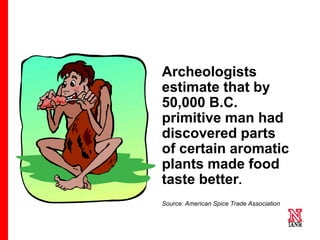
Archeologists
estimate that by
50,000 B.C.
primitive man had
discovered parts
of certain aromatic
plants made food
taste better.
Source: American Spice Trade Association
5 5
5
“Spice” vs. “Herb”
Spices come from the bark (cinnamon), root (ginger,
onion, garlic), buds (cloves, saffron), seeds (yellow
mustard, poppy, sesame), berry (black pepper), or the
fruit (allspice, paprika) of tropical plants and trees.
Herbs are leaves of low-growing shrubs. Examples
are parsley, chives, marjoram, thyme, basil, caraway,
dill, oregano, rosemary, savory, sage and celery leaves.
These can be used fresh or dried. Dried forms may be
whole, crushed, or ground.
Many dehydrated vegetable seasonings are available.
These include onion, garlic … and shallots.
Seasoning blends are mixtures of spices/herbs.
Source: Ann A. Hertzler, PhD, RD, Herbs and Spices, Virginia Cooperative Extension
6 6
6
Contents
1.Fat, Sugar and Salt Reduction Tips
2.Flavor and Food Combinations
3.Common Substitutions
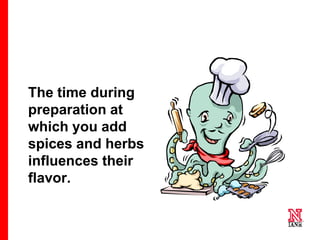
4.General Rules for Amounts
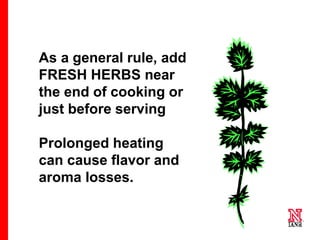
5.When to Add Spices and Herbs
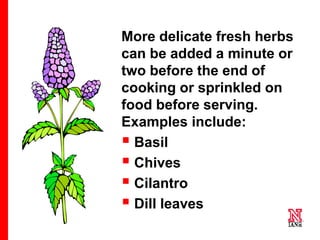
6.Storing Spices and Herbs
7.How Long to Keep
7 7
7
Contents
1.Fat, Sugar and Salt Reduction Tips
2.Flavor and Food Combinations
3.Common Substitutions
4.General Rules for Amounts
5.When to Add Spices and Herbs
6.Storing Spices and Herbs
7.How Long to Keep
8 8
8
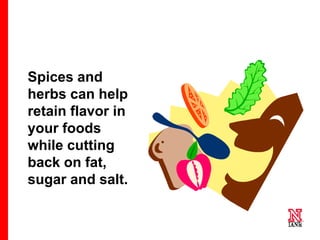
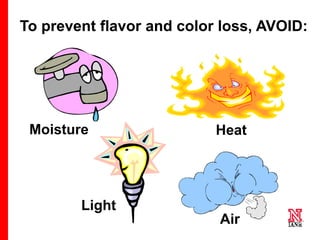
Spices and
herbs can help
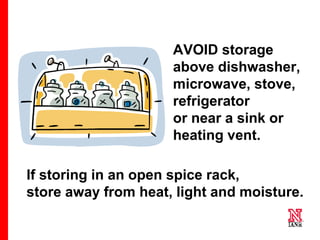
retain flavor in
your foods
while cutting
back on fat,
sugar and salt.
9 9
9
“ … removing a tablespoon of fat
removes about 10 grams of fat and
100 calories — an amount which
could represent a 10 pound weight
loss in a year.
The calories in herbs and spices are
far less than in breadings, batters,
gravies, sauces and fried foods.”
Source: Ann A. Hertzler, PhD, RD, Herbs and Spices,
Virginia Cooperative Extension
10 10
10
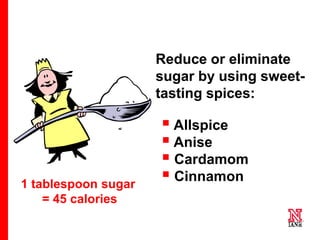
1 tablespoon sugar
= 45 calories
Reduce or eliminate
sugar by using sweet-
tasting spices:
 Allspice
 Anise
 Cardamom
 Cinnamon
• Cloves
• Ginger
• Mace
• Nutmeg
11 11
11
Source: American Spice
Trade Association
 Black pepper
 Garlic powder
 Curry powder
 Cumin
 Dill seeds
 Basil
 Ginger
 Coriander
 Onion powder
Savory flavors and flavors with “bite,”
are the most effective in replacing the
taste of salt. Examples include:
12 12
12
Omit the salt when
cooking pasta and
flavor with basil,
oregano, parsley
and pepper or use
an Italian
seasoning blend.
13 13
13
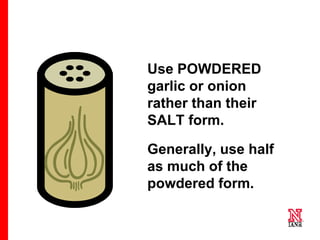
Use POWDERED
garlic or onion
rather than their
SALT form.
Generally, use half
as much of the
powdered form.
14 14
14
Check
seasoning
labels to see if
“salt” or
“sodium” are
listed among
the ingredients.
15 15
15
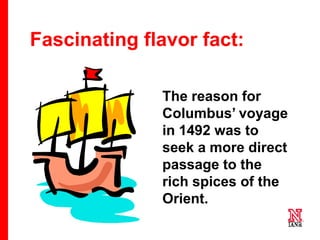
Fascinating flavor fact:
The reason for
Columbus’ voyage
in 1492 was to
seek a more direct
passage to the
rich spices of the
Orient.
16 16
16
Contents
1.Fat, Sugar and Salt Reduction Tips
2.Flavor and Food Combinations
3.Common Substitutions
4.General Rules for Amounts
5.When to Add Spices and Herbs
6.Storing Spices and Herbs
7.How Long to Keep
17 17
17
Experiment with
the following
flavor and food
combinations to
add pizzazz to
your meals.
Source: Flavor and Food Combinations adapted from information provided by the
National Heart, Lung and Blood Institute
18 18
18
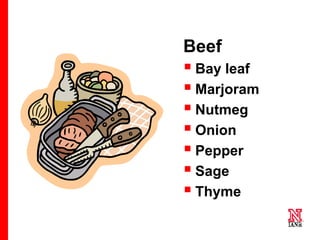
Beef
 Bay leaf
 Marjoram
 Nutmeg
 Onion
 Pepper
 Sage
 Thyme
19 19
19
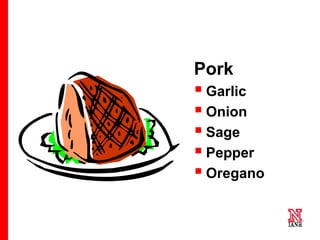
Pork
 Garlic
 Onion
 Sage
 Pepper
 Oregano
20 20
20
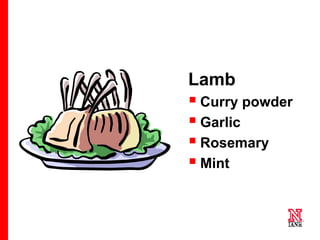
Lamb
 Curry powder
 Garlic
 Rosemary
 Mint
21 21
21
Poultry
 Ginger
 Marjoram
 Oregano
 Paprika
 Poultry
seasoning
 Rosemary
 Sage
 Tarragon
 Thyme
22 22
22
Fish
 Curry powder
 Dill
 Dry mustard
 Marjoram
 Paprika
 Pepper
23 23
23
Carrots
 Cinnamon
 Cloves
 Dill
 Ginger
 Marjoram
 Nutmeg
 Rosemary
 Sage
24 24
24
Corn
 Cumin
 Curry powder
 Onion
 Paprika
 Parsley
25 25
25
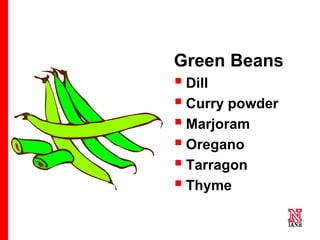
Green Beans
 Dill
 Curry powder
 Marjoram
 Oregano
 Tarragon
 Thyme
26 26
26
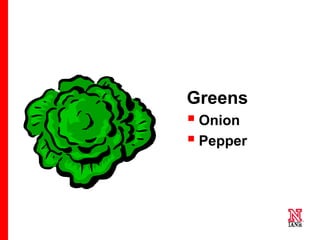
Greens
 Onion
 Pepper
27 27
27
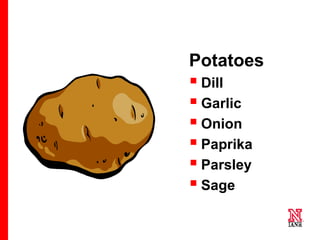
Potatoes
 Dill
 Garlic
 Onion
 Paprika
 Parsley
 Sage
28 28
28
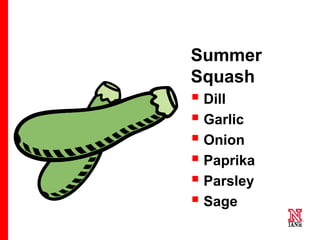
Summer
Squash
 Dill
 Garlic
 Onion
 Paprika
 Parsley
 Sage
29 29
29
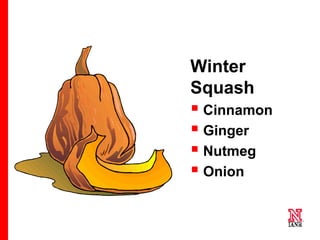
Winter
Squash
 Cinnamon
 Ginger
 Nutmeg
 Onion
30 30
30
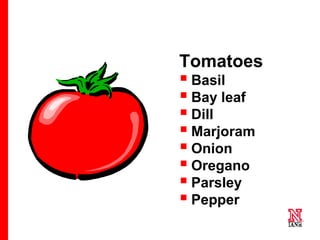
Tomatoes
 Basil
 Bay leaf
 Dill
 Marjoram
 Onion
 Oregano
 Parsley
 Pepper
31 31
31
Fascinating flavor fact:
In early Rome,
young suitors
wore a sprig of
basil to signal their
marital intentions.
Source: American Spice Trade Association
32 32
32
Contents
1.Fat, Sugar and Salt Reduction Tips
2.Flavor and Food Combinations
3.Common Substitutions
4.General Rules for Amounts
5.When to Add Spices and Herbs
6.Storing Spices and Herbs
7.How Long to Keep
33 33
33
When you don’t
have a spice or
herb blend called
for in a recipe, try
the following
combinations as a
substitution.
34 34
34
For each 1 teaspoon of
apple pie spice,
substitute a
COMBINATION of:
1 teaspoon cinnamon
1/8 teaspoon nutmeg
35 35
35
For each 1 teaspoon of
pumpkin pie spice,
substitute a
COMBINATION of
these ground spices:
1 teaspoon cinnamon
1/4 teaspoon ginger
1/8 teaspoon nutmeg
1/8 teaspoon allspice
36 36
36
For each 1-1/2 teaspoon
of Italian seasoning, substitute a
COMBINATION of:
 1/4 teaspoon EACH of
crumbled, dried
oregano leaves
marjoram leaves
basil leaves
 1/8 teaspoon rubbed sage
37 37
37
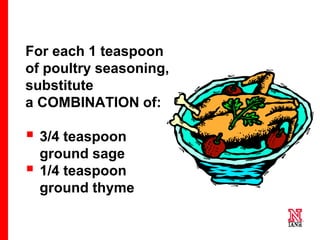
For each 1 teaspoon
of poultry seasoning,
substitute
a COMBINATION of:
 3/4 teaspoon
ground sage
 1/4 teaspoon
ground thyme
38 38
38
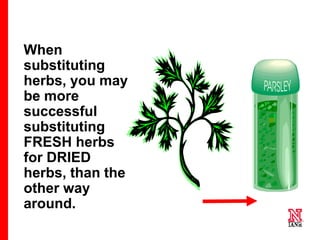
When
substituting
herbs, you may
be more
successful
substituting
FRESH herbs
for DRIED
herbs, than the
other way
around.
39 39
39
Fascinating flavor fact:
“Cilantro” refers to
the leaf of the
coriander plant while
“coriander” refers to
a spice made from the
seed of the same
plant. “Cilantro” and
“coriander” are not
interchangeable
in recipes.
40 40
40
Contents
1.Fat, Sugar and Salt Reduction Tips
2.Flavor and Food Combinations
3.Common Substitutions
4.General Rules for Amounts
5.When to Add Spices and Herbs
6.Storing Spices and Herbs
7.How Long to Keep
41 41
41
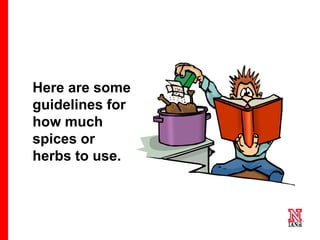
Here are some
guidelines for
how much
spices or
herbs to use.
42 42
42
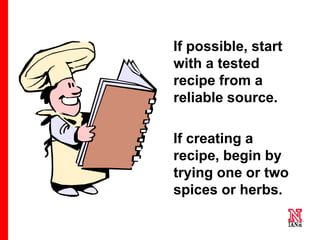
If possible, start
with a tested
recipe from a
reliable source.
If creating a
recipe, begin by
trying one or two
spices or herbs.
43 43
43
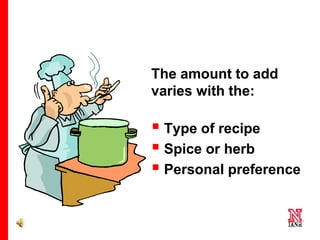
The amount to add
varies with the:
 Type of recipe
 Spice or herb
 Personal preference
44 44
44
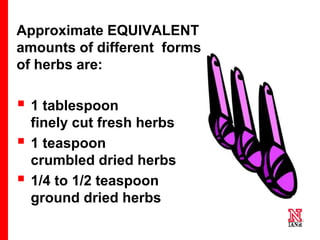
Approximate EQUIVALENT
amounts of different forms
of herbs are:
 1 tablespoon
finely cut fresh herbs
 1 teaspoon
crumbled dried herbs
 1/4 to 1/2 teaspoon
ground dried herbs
45 45
45
Begin with 1/4 teaspoon of most
ground spices or ground dried herbs
for these amounts; adjust as needed:*
 4 servings
 1 pound of meat
 1 pint (2 cups of soup or sauce)
*Remember: Use more herbs if using
a crumbled dried or a fresh form.
Source: www.spiceadvice.com
46 46
46
 Start with 1/8
teaspoon for cayenne
pepper and garlic
powder; adjust as
needed.
 Red pepper
intensifies in flavor
during cooking; add
in small increments.
47 47
47
When doubling a
recipe:
 DO NOT double
spices and herbs.
 Increase amounts
by 1-1/2 times.
 Taste, add more if
needed.
48 48
48
During the Middle
Ages, ladies
embroidered a
sprig of thyme into
scarves they gave
to their wandering
knights.
Fascinating flavor fact:
49 49
49
Contents
1.Fat, Sugar and Salt Reduction Tips
2.Flavor and Food Combinations
3.Common Substitutions
4.General Rules for Amounts
5.When to Add Spices and Herbs
6.Storing Spices and Herbs
7.How Long to Keep
50 50
50
The time during
preparation at
which you add
spices and herbs
influences their
flavor.
51 51
51
As a general rule, add
FRESH HERBS near
the end of cooking or
just before serving
Prolonged heating
can cause flavor and
aroma losses.
52 52
52
More delicate fresh herbs
can be added a minute or
two before the end of
cooking or sprinkled on
food before serving.
Examples include:
 Basil
 Chives
 Cilantro
 Dill leaves
• Parsley
• Marjoram
• Mint
53 53
53
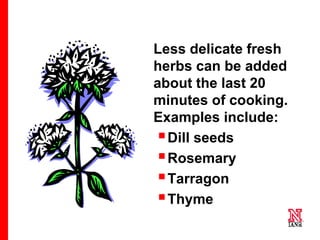
Less delicate fresh
herbs can be added
about the last 20
minutes of cooking.
Examples include:
Dill seeds
Rosemary
Tarragon
Thyme
54 54
54
For some foods
such as breads,
batters, etc., you
may have to add
fresh herbs at the
beginning of the
cooking process.
55 55
55
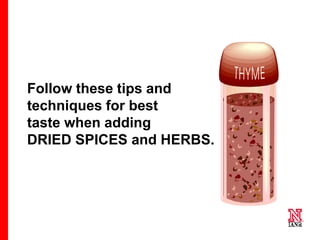
Follow these tips and
techniques for best
taste when adding
DRIED SPICES and HERBS.
56 56
56
WHOLE dried spices and
herbs (such as whole
allspice and bay leaves):
 Release flavors slower
than crumbled or
ground ones.
 Are ideal for dishes
cooking an hour or
more, such as soups
and stews.
57 57
57
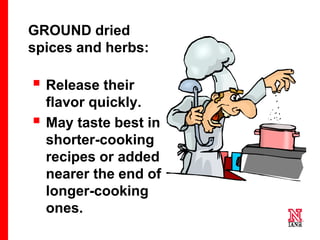
GROUND dried
spices and herbs:
 Release their
flavor quickly.
 May taste best in
shorter-cooking
recipes or added
nearer the end of
longer-cooking
ones.
58 58
58
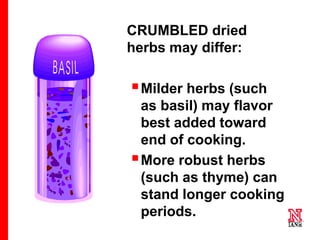
CRUMBLED dried
herbs may differ:
Milder herbs (such
as basil) may flavor
best added toward
end of cooking.
More robust herbs
(such as thyme) can
stand longer cooking
periods.
59 59
59
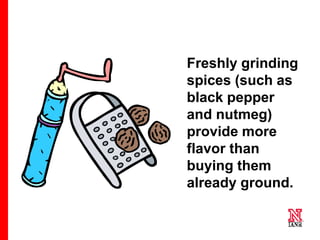
Freshly grinding
spices (such as
black pepper
and nutmeg)
provide more
flavor than
buying them
already ground.
60 60
60
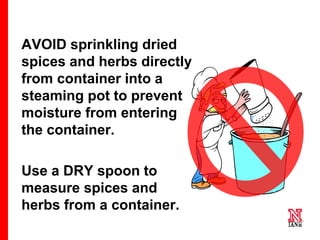
AVOID sprinkling dried
spices and herbs directly
from container into a
steaming pot to prevent
moisture from entering
the container.
Use a DRY spoon to
measure spices and
herbs from a container.
61 61
61
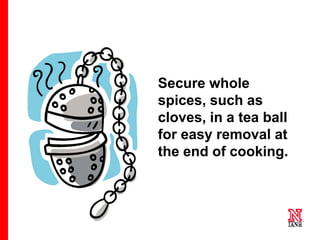
Secure whole
spices, such as
cloves, in a tea ball
for easy removal at
the end of cooking.
62 62
62
Warning: Remove
bay leaves at the
end of cooking.
They can be a
choking hazard if
left in foods and can
cause harmful cuts
and scratches in
your throat and
esophagus.
63 63
63
For UNCOOKED
foods, add both
FRESH and DRIED
spices and herbs
several hours
before serving to
allow flavors to
blend.
64 64
64
Contents
1.Fat, Sugar and Salt Reduction Tips
2.Flavor and Food Combinations
3.Common Substitutions
4.General Rules for Amounts
5.When to Add Spices and Herbs
6.Storing Spices and Herbs
7.How Long to Keep
65 65
65
Use the
following
guidelines for
storing your
spices and herbs
to maintain
maximum
quality.
66 66
66
To prevent flavor and color loss, AVOID:
Moisture
Light
Heat
Air
67 67
67
Store in tightly
covered
containers.
Store in a dark
place away from
sunlight, such as
inside a cupboard
or drawer.
68 68
68
AVOID storage
above dishwasher,
microwave, stove,
refrigerator
or near a sink or
heating vent.
If storing in an open spice rack,
store away from heat, light and moisture.
69 69
69
Refrigerator/freezer storage?
 Refrigerate paprika, chili
powder and red pepper
for best color retention,
especially in summer or
hotter climates.
 Spices and herbs can
get wet if condensation
forms when a container
from a refrigerator or
freezer is left open in a
humid kitchen.
70 70
70
Contents
1.Fat, Sugar and Salt Reduction Tips
2.Flavor and Food Combinations
3.Common Substitutions
4.General Rules for Amounts
5.When to Add Spices and Herbs
6.Storing Spices and Herbs
7.How Long to Keep
71 71
71
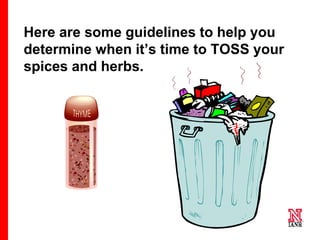
Here are some guidelines to help you
determine when it’s time to TOSS your
spices and herbs.
72 72
72
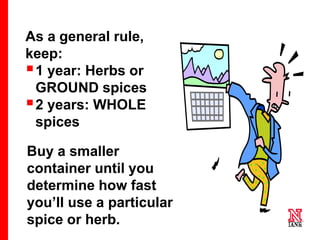
As a general rule,
keep:
1 year: Herbs or
GROUND spices
2 years: WHOLE
spices
Buy a smaller
container until you
determine how fast
you’ll use a particular
spice or herb.
73 73
73
If a spice or herb
smells strong and
flavorful, it’s
probably still
potent.
74 74
74
 Check a whole spice ― such as a clove
or cinnamon stick ― by breaking,
crushing or scraping it before smelling it.
 Check an herb or a ground spice by
rubbing a small amount in your
hand. If the aroma is fresh, rich and
immediate, it can still flavor foods
75 75
75
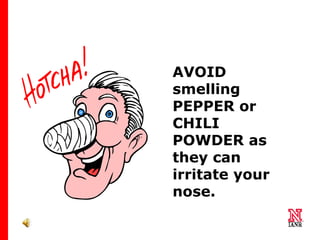
AVOID
smelling
PEPPER or
CHILI
POWDER as
they can
irritate your
nose.
76 76
76
“Pepper is small
in quantity and
great in virtue.”
- Plato
77 77
77
Initial quality influences
shelf life.
Label date of purchase
on container with a
permanent marking pen.
78 78
78
In conclusion ...
“Spice a dish with
love and it pleases
every palate.”
- Plautus
Know how. Know now.
Extension is a Division of the Institute of Agriculture
and Natural Resources at the University of
Nebraska–Lincoln cooperating with the Counties
and the United States Department of Agriculture.
University of Nebraska–Lincoln Extension
educational programs abide with the
nondiscrimination policies of the University of
Nebraska–Lincoln and the United States
Department of Agriculture.

91-Herbs-Spice-Lesson-Supplement.ppt for

  • 1.
  • 2.
    Know how. Knownow. Alice Henneman, MS, RD Extension Educator University of Nebraska–Lincoln Extension in Lancaster County Download this PowerPoint and a related handout at: http://lancaster.unl.edu/food/spiceherb.shtml 2003, updated May 2008, PowerPoint 2003
  • 3.
    3 3 3 “An herbis the friend of physicians and the praise of cooks.” - Charlemagne
  • 4.
    4 4 4 Archeologists estimate thatby 50,000 B.C. primitive man had discovered parts of certain aromatic plants made food taste better. Source: American Spice Trade Association
  • 5.
    5 5 5 “Spice” vs.“Herb” Spices come from the bark (cinnamon), root (ginger, onion, garlic), buds (cloves, saffron), seeds (yellow mustard, poppy, sesame), berry (black pepper), or the fruit (allspice, paprika) of tropical plants and trees. Herbs are leaves of low-growing shrubs. Examples are parsley, chives, marjoram, thyme, basil, caraway, dill, oregano, rosemary, savory, sage and celery leaves. These can be used fresh or dried. Dried forms may be whole, crushed, or ground. Many dehydrated vegetable seasonings are available. These include onion, garlic … and shallots. Seasoning blends are mixtures of spices/herbs. Source: Ann A. Hertzler, PhD, RD, Herbs and Spices, Virginia Cooperative Extension
  • 6.
    6 6 6 Contents 1.Fat, Sugarand Salt Reduction Tips 2.Flavor and Food Combinations 3.Common Substitutions 4.General Rules for Amounts 5.When to Add Spices and Herbs 6.Storing Spices and Herbs 7.How Long to Keep
  • 7.
    7 7 7 Contents 1.Fat, Sugarand Salt Reduction Tips 2.Flavor and Food Combinations 3.Common Substitutions 4.General Rules for Amounts 5.When to Add Spices and Herbs 6.Storing Spices and Herbs 7.How Long to Keep
  • 8.
    8 8 8 Spices and herbscan help retain flavor in your foods while cutting back on fat, sugar and salt.
  • 9.
    9 9 9 “ …removing a tablespoon of fat removes about 10 grams of fat and 100 calories — an amount which could represent a 10 pound weight loss in a year. The calories in herbs and spices are far less than in breadings, batters, gravies, sauces and fried foods.” Source: Ann A. Hertzler, PhD, RD, Herbs and Spices, Virginia Cooperative Extension
  • 10.
    10 10 10 1 tablespoonsugar = 45 calories Reduce or eliminate sugar by using sweet- tasting spices:  Allspice  Anise  Cardamom  Cinnamon • Cloves • Ginger • Mace • Nutmeg
  • 11.
    11 11 11 Source: AmericanSpice Trade Association  Black pepper  Garlic powder  Curry powder  Cumin  Dill seeds  Basil  Ginger  Coriander  Onion powder Savory flavors and flavors with “bite,” are the most effective in replacing the taste of salt. Examples include:
  • 12.
    12 12 12 Omit thesalt when cooking pasta and flavor with basil, oregano, parsley and pepper or use an Italian seasoning blend.
  • 13.
    13 13 13 Use POWDERED garlicor onion rather than their SALT form. Generally, use half as much of the powdered form.
  • 14.
    14 14 14 Check seasoning labels tosee if “salt” or “sodium” are listed among the ingredients.
  • 15.
    15 15 15 Fascinating flavorfact: The reason for Columbus’ voyage in 1492 was to seek a more direct passage to the rich spices of the Orient.
  • 16.
    16 16 16 Contents 1.Fat, Sugarand Salt Reduction Tips 2.Flavor and Food Combinations 3.Common Substitutions 4.General Rules for Amounts 5.When to Add Spices and Herbs 6.Storing Spices and Herbs 7.How Long to Keep
  • 17.
    17 17 17 Experiment with thefollowing flavor and food combinations to add pizzazz to your meals. Source: Flavor and Food Combinations adapted from information provided by the National Heart, Lung and Blood Institute
  • 18.
    18 18 18 Beef  Bayleaf  Marjoram  Nutmeg  Onion  Pepper  Sage  Thyme
  • 19.
    19 19 19 Pork  Garlic Onion  Sage  Pepper  Oregano
  • 20.
    20 20 20 Lamb  Currypowder  Garlic  Rosemary  Mint
  • 21.
    21 21 21 Poultry  Ginger Marjoram  Oregano  Paprika  Poultry seasoning  Rosemary  Sage  Tarragon  Thyme
  • 22.
    22 22 22 Fish  Currypowder  Dill  Dry mustard  Marjoram  Paprika  Pepper
  • 23.
    23 23 23 Carrots  Cinnamon Cloves  Dill  Ginger  Marjoram  Nutmeg  Rosemary  Sage
  • 24.
    24 24 24 Corn  Cumin Curry powder  Onion  Paprika  Parsley
  • 25.
    25 25 25 Green Beans Dill  Curry powder  Marjoram  Oregano  Tarragon  Thyme
  • 26.
  • 27.
    27 27 27 Potatoes  Dill Garlic  Onion  Paprika  Parsley  Sage
  • 28.
    28 28 28 Summer Squash  Dill Garlic  Onion  Paprika  Parsley  Sage
  • 29.
    29 29 29 Winter Squash  Cinnamon Ginger  Nutmeg  Onion
  • 30.
    30 30 30 Tomatoes  Basil Bay leaf  Dill  Marjoram  Onion  Oregano  Parsley  Pepper
  • 31.
    31 31 31 Fascinating flavorfact: In early Rome, young suitors wore a sprig of basil to signal their marital intentions. Source: American Spice Trade Association
  • 32.
    32 32 32 Contents 1.Fat, Sugarand Salt Reduction Tips 2.Flavor and Food Combinations 3.Common Substitutions 4.General Rules for Amounts 5.When to Add Spices and Herbs 6.Storing Spices and Herbs 7.How Long to Keep
  • 33.
    33 33 33 When youdon’t have a spice or herb blend called for in a recipe, try the following combinations as a substitution.
  • 34.
    34 34 34 For each1 teaspoon of apple pie spice, substitute a COMBINATION of: 1 teaspoon cinnamon 1/8 teaspoon nutmeg
  • 35.
    35 35 35 For each1 teaspoon of pumpkin pie spice, substitute a COMBINATION of these ground spices: 1 teaspoon cinnamon 1/4 teaspoon ginger 1/8 teaspoon nutmeg 1/8 teaspoon allspice
  • 36.
    36 36 36 For each1-1/2 teaspoon of Italian seasoning, substitute a COMBINATION of:  1/4 teaspoon EACH of crumbled, dried oregano leaves marjoram leaves basil leaves  1/8 teaspoon rubbed sage
  • 37.
    37 37 37 For each1 teaspoon of poultry seasoning, substitute a COMBINATION of:  3/4 teaspoon ground sage  1/4 teaspoon ground thyme
  • 38.
    38 38 38 When substituting herbs, youmay be more successful substituting FRESH herbs for DRIED herbs, than the other way around.
  • 39.
    39 39 39 Fascinating flavorfact: “Cilantro” refers to the leaf of the coriander plant while “coriander” refers to a spice made from the seed of the same plant. “Cilantro” and “coriander” are not interchangeable in recipes.
  • 40.
    40 40 40 Contents 1.Fat, Sugarand Salt Reduction Tips 2.Flavor and Food Combinations 3.Common Substitutions 4.General Rules for Amounts 5.When to Add Spices and Herbs 6.Storing Spices and Herbs 7.How Long to Keep
  • 41.
    41 41 41 Here aresome guidelines for how much spices or herbs to use.
  • 42.
    42 42 42 If possible,start with a tested recipe from a reliable source. If creating a recipe, begin by trying one or two spices or herbs.
  • 43.
    43 43 43 The amountto add varies with the:  Type of recipe  Spice or herb  Personal preference
  • 44.
    44 44 44 Approximate EQUIVALENT amountsof different forms of herbs are:  1 tablespoon finely cut fresh herbs  1 teaspoon crumbled dried herbs  1/4 to 1/2 teaspoon ground dried herbs
  • 45.
    45 45 45 Begin with1/4 teaspoon of most ground spices or ground dried herbs for these amounts; adjust as needed:*  4 servings  1 pound of meat  1 pint (2 cups of soup or sauce) *Remember: Use more herbs if using a crumbled dried or a fresh form. Source: www.spiceadvice.com
  • 46.
    46 46 46  Startwith 1/8 teaspoon for cayenne pepper and garlic powder; adjust as needed.  Red pepper intensifies in flavor during cooking; add in small increments.
  • 47.
    47 47 47 When doublinga recipe:  DO NOT double spices and herbs.  Increase amounts by 1-1/2 times.  Taste, add more if needed.
  • 48.
    48 48 48 During theMiddle Ages, ladies embroidered a sprig of thyme into scarves they gave to their wandering knights. Fascinating flavor fact:
  • 49.
    49 49 49 Contents 1.Fat, Sugarand Salt Reduction Tips 2.Flavor and Food Combinations 3.Common Substitutions 4.General Rules for Amounts 5.When to Add Spices and Herbs 6.Storing Spices and Herbs 7.How Long to Keep
  • 50.
    50 50 50 The timeduring preparation at which you add spices and herbs influences their flavor.
  • 51.
    51 51 51 As ageneral rule, add FRESH HERBS near the end of cooking or just before serving Prolonged heating can cause flavor and aroma losses.
  • 52.
    52 52 52 More delicatefresh herbs can be added a minute or two before the end of cooking or sprinkled on food before serving. Examples include:  Basil  Chives  Cilantro  Dill leaves • Parsley • Marjoram • Mint
  • 53.
    53 53 53 Less delicatefresh herbs can be added about the last 20 minutes of cooking. Examples include: Dill seeds Rosemary Tarragon Thyme
  • 54.
    54 54 54 For somefoods such as breads, batters, etc., you may have to add fresh herbs at the beginning of the cooking process.
  • 55.
    55 55 55 Follow thesetips and techniques for best taste when adding DRIED SPICES and HERBS.
  • 56.
    56 56 56 WHOLE driedspices and herbs (such as whole allspice and bay leaves):  Release flavors slower than crumbled or ground ones.  Are ideal for dishes cooking an hour or more, such as soups and stews.
  • 57.
    57 57 57 GROUND dried spicesand herbs:  Release their flavor quickly.  May taste best in shorter-cooking recipes or added nearer the end of longer-cooking ones.
  • 58.
    58 58 58 CRUMBLED dried herbsmay differ: Milder herbs (such as basil) may flavor best added toward end of cooking. More robust herbs (such as thyme) can stand longer cooking periods.
  • 59.
    59 59 59 Freshly grinding spices(such as black pepper and nutmeg) provide more flavor than buying them already ground.
  • 60.
    60 60 60 AVOID sprinklingdried spices and herbs directly from container into a steaming pot to prevent moisture from entering the container. Use a DRY spoon to measure spices and herbs from a container.
  • 61.
    61 61 61 Secure whole spices,such as cloves, in a tea ball for easy removal at the end of cooking.
  • 62.
    62 62 62 Warning: Remove bayleaves at the end of cooking. They can be a choking hazard if left in foods and can cause harmful cuts and scratches in your throat and esophagus.
  • 63.
    63 63 63 For UNCOOKED foods,add both FRESH and DRIED spices and herbs several hours before serving to allow flavors to blend.
  • 64.
    64 64 64 Contents 1.Fat, Sugarand Salt Reduction Tips 2.Flavor and Food Combinations 3.Common Substitutions 4.General Rules for Amounts 5.When to Add Spices and Herbs 6.Storing Spices and Herbs 7.How Long to Keep
  • 65.
    65 65 65 Use the following guidelinesfor storing your spices and herbs to maintain maximum quality.
  • 66.
    66 66 66 To preventflavor and color loss, AVOID: Moisture Light Heat Air
  • 67.
    67 67 67 Store intightly covered containers. Store in a dark place away from sunlight, such as inside a cupboard or drawer.
  • 68.
    68 68 68 AVOID storage abovedishwasher, microwave, stove, refrigerator or near a sink or heating vent. If storing in an open spice rack, store away from heat, light and moisture.
  • 69.
    69 69 69 Refrigerator/freezer storage? Refrigerate paprika, chili powder and red pepper for best color retention, especially in summer or hotter climates.  Spices and herbs can get wet if condensation forms when a container from a refrigerator or freezer is left open in a humid kitchen.
  • 70.
    70 70 70 Contents 1.Fat, Sugarand Salt Reduction Tips 2.Flavor and Food Combinations 3.Common Substitutions 4.General Rules for Amounts 5.When to Add Spices and Herbs 6.Storing Spices and Herbs 7.How Long to Keep
  • 71.
    71 71 71 Here aresome guidelines to help you determine when it’s time to TOSS your spices and herbs.
  • 72.
    72 72 72 As ageneral rule, keep: 1 year: Herbs or GROUND spices 2 years: WHOLE spices Buy a smaller container until you determine how fast you’ll use a particular spice or herb.
  • 73.
    73 73 73 If aspice or herb smells strong and flavorful, it’s probably still potent.
  • 74.
    74 74 74  Checka whole spice ― such as a clove or cinnamon stick ― by breaking, crushing or scraping it before smelling it.  Check an herb or a ground spice by rubbing a small amount in your hand. If the aroma is fresh, rich and immediate, it can still flavor foods
  • 75.
    75 75 75 AVOID smelling PEPPER or CHILI POWDERas they can irritate your nose.
  • 76.
    76 76 76 “Pepper issmall in quantity and great in virtue.” - Plato
  • 77.
    77 77 77 Initial qualityinfluences shelf life. Label date of purchase on container with a permanent marking pen.
  • 78.
    78 78 78 In conclusion... “Spice a dish with love and it pleases every palate.” - Plautus
  • 79.
    Know how. Knownow. Extension is a Division of the Institute of Agriculture and Natural Resources at the University of Nebraska–Lincoln cooperating with the Counties and the United States Department of Agriculture. University of Nebraska–Lincoln Extension educational programs abide with the nondiscrimination policies of the University of Nebraska–Lincoln and the United States Department of Agriculture.