TPN1333 Food Packaging and Storage Technology
Food Science and Technology Department
Faculty of Agricultural Engineering and Technology, IPB
Internationally Approved Food Technology Program by IFT and IUFoST
Food Shelf-life Evaluation –
Accelerated Shelf-life Test
Internationally Recognized Undergraduate Program by IFT & IUFoST
2
Learning Outcome
Upon successful completion of this topic,
students will be able to:
 determine the shelf life of food by using
accelerated shelf life test (Arrhenius and
Labuza Equation).
Internationally Recognized Undergraduate Program by IFT & IUFoST
3
11.1 ASLT Method with
Arrhenius
11.2 ASLT with Critical
Moisture Content
Sub Topic
Internationally Recognized Undergraduate Program by IFT & IUFoST
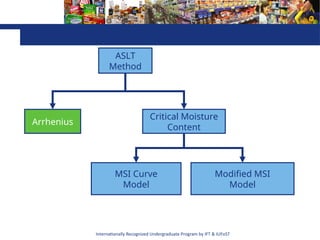
Shelf-life Prediction Model (ASLT Method)
ASLT
Method
Arrhenius
Critical Moisture
Content
MSI Curve
Model
Modified MSI
Model
Internationally Recognized Undergraduate Program by IFT & IUFoST
Data Extrapolation Method by ASLT
Storage Condition
Data
Extrapolation
Laju
kerusakan
Accelerating Factors
Internationally Recognized Undergraduate Program by IFT & IUFoST
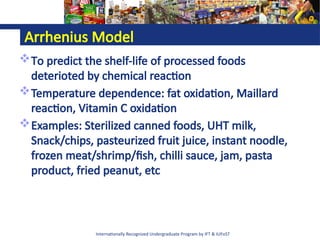
Arrhenius Model
To predict the shelf-life of processed foods
deterioted by chemical reaction
Temperature dependence: fat oxidation, Maillard
reaction, Vitamin C oxidation
Examples: Sterilized canned foods, UHT milk,
Snack/chips, pasteurized fruit juice, instant noodle,
frozen meat/shrimp/fish, chilli sauce, jam, pasta
product, fried peanut, etc
Internationally Recognized Undergraduate Program by IFT & IUFoST
Experiment: Arrhenius Model
Internationally Recognized Undergraduate Program by IFT & IUFoST
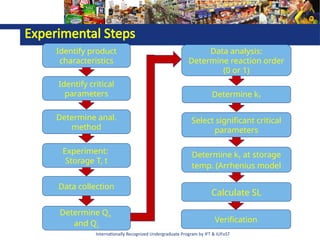
Experimental Steps
Identify product
characteristics
Identify critical
parameters
Determine anal.
method
Experiment:
Storage T, t
Data collection
Determine Qo
and Qc
Data analysis:
Determine reaction order
(0 or 1)
Determine kT
Determine kT at storage
temp. (Arrhenius model
Calculate SL
Select significant critical
parameters
Verification
Internationally Recognized Undergraduate Program by IFT & IUFoST
Step 1: Identify product characteristics
Identify ingredients in products.
 What are the critical ingredients?
 Is there any potential component reactions or
interactions during storage?
Identify storage temperature: markets, displays, or
consumers levels
Internationally Recognized Undergraduate Program by IFT & IUFoST
Step 2: Identify Critical Parameters Causing Product
Deterioration
 Based on experience, what are the major quality attributes
cause product rejection?
 Rancidity (fat oxidation): FFA, TBA value.
 Colour change (Maillard reaction): color measurement
 If unknown well, select several potential critical parameters.
 If any product claim, select as a critical parameters
 Exp. rich in DHA/EPA.
 Commercially sterilized canned foods: product deterioration is
not caused by microbiological factors
Internationally Recognized Undergraduate Program by IFT & IUFoST
Step 3: Determine Analytical Methods
Analysis:
 Fat oxidation: TBA value, peroxide value
 Maillard reaction: Color measurement by
colorimeter
 Sensory evaluation: Rancid odor, color
Consider cost for analysis
Internationally Recognized Undergraduate Program by IFT & IUFoST
Step 4:
Experiment at Accelerated Storage Temperature
Condition
Consider real storage temperature. Select min. 3
accelarated temp above real storage temperature
 Exp: Room temperature (28o
C) : 35, 45, 55
 Frozen temperature (-25o
C): -15, -10, -5o
C
Make sure that the storage temperature does not
cause change of deterioration mechanism
 Exp: microbiological growth
Internationally Recognized Undergraduate Program by IFT & IUFoST
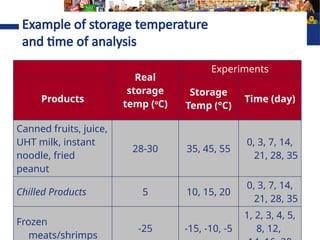
Example of storage temperature
and time of analysis
Real
storage
temp (o
C)
Experiments
Products
Storage
Temp (°C)
Time (day)
Canned fruits, juice,
UHT milk, instant
noodle, fried
peanut
28-30 35, 45, 55
0, 3, 7, 14,
21, 28, 35
Chilled Products 5 10, 15, 20
0, 3, 7, 14,
21, 28, 35
Frozen
meats/shrimps
-25 -15, -10, -5
1, 2, 3, 4, 5,
8, 12,
Internationally Recognized Undergraduate Program by IFT & IUFoST
Step 5: Data Collection
 Number of samples: considered storage temp/time, types of
analysis, and replication.
Sample = T* t* rep*sample per period
of anal
 Use primary packaging
 Use calibrated incubators (at least 3)
 Control: normal storage temperature
 Collect samples per periodic and analyze
Internationally Recognized Undergraduate Program by IFT & IUFoST
Incubator for Sample Storage
Internationally Recognized Undergraduate Program by IFT & IUFoST
Step 5: Data Collection
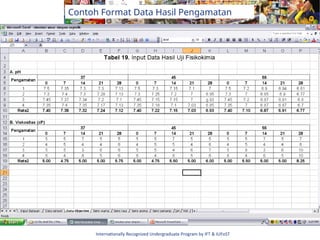
Tabulate analytical data in table formats.
Use separate table for each quality parameters (Excel)
Calculate average for each data.
Internationally Recognized Undergraduate Program by IFT & IUFoST
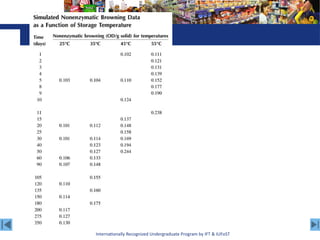
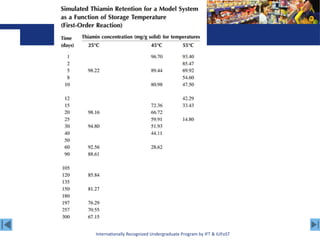
Contoh Format Data Hasil Pengamatan
Internationally Recognized Undergraduate Program by IFT & IUFoST
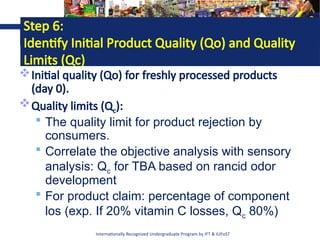
Step 6:
Identify Initial Product Quality (Qo) and Quality
Limits (Qc)
Initial quality (Qo) for freshly processed products
(day 0).
Quality limits (Qc):
 The quality limit for product rejection by
consumers.
 Correlate the objective analysis with sensory
analysis: Qc for TBA based on rancid odor
development
 For product claim: percentage of component
los (exp. If 20% vitamin C losses, Qc 80%)
Internationally Recognized Undergraduate Program by IFT & IUFoST
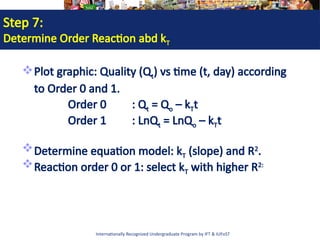
Step 7:
Determine Order Reaction abd kT
Plot graphic: Quality (Qt) vs time (t, day) according
to Order 0 and 1.
Order 0 : Qt = Qo – kTt
Order 1 : LnQt = LnQo – kTt
Determine equation model: kT (slope) and R2
.
Reaction order 0 or 1: select kT with higher R2:
Internationally Recognized Undergraduate Program by IFT & IUFoST
Step 7:
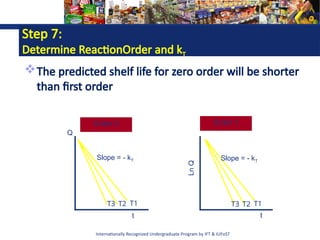
Determine ReactionOrder and kT
The predicted shelf life for zero order will be shorter
than first order
t
Ln
Q
Slope = - kT
Order 1
T1
T2
T3
t
Q
Slope = - kT
Order 0
T1
T2
T3
Internationally Recognized Undergraduate Program by IFT & IUFoST
Step 8:
Select Significant Critical Parameters
Consider :
 R2
of reaction rate constants (kT) :
Usually >
0.75
 kT increase consistently by temperature
Internationally Recognized Undergraduate Program by IFT & IUFoST
Step 9:
Calculate kT at Real Storage Temperature (Using Arrhenius
Model)
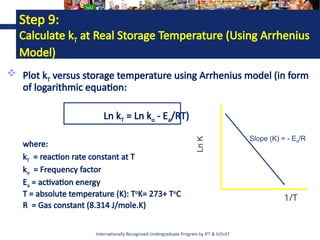
 Plot kT versus storage temperature using Arrhenius model (in form
of logarithmic equation:
Ln kT = Ln ko - Ea/RT)
where:
kT = reaction rate constant at T
ko = Frequency factor
Ea = activation energy
T = absolute temperature (K): To
K= 273+ To
C
R = Gas constant (8.314 J/mole.K)
Ln
K
Slope (K) = - Ea/R
1/T
Internationally Recognized Undergraduate Program by IFT & IUFoST
Step 9:
Calculate kT at Real Storage Temperature
(Using Arrhenius Model)
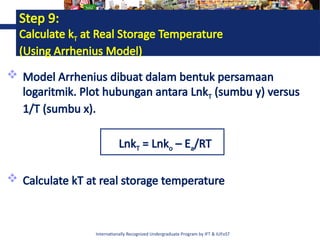
 Model Arrhenius dibuat dalam bentuk persamaan
logaritmik. Plot hubungan antara LnkT (sumbu y) versus
1/T (sumbu x).
LnkT = Lnko – Ea/RT
 Calculate kT at real storage temperature
Internationally Recognized Undergraduate Program by IFT & IUFoST
Tahap 10:
Calculate Predicted Shelf-life
 Shelf-life (ts) at a storage temperature:
Order 0 : ts = (Qo-Qs)/kT
Order 1 : ts = [ln(Qo/Qs)]/kT
 kT comes from Arrhenius equation
 Plot graphics storage temp vs shelf-life
Shelf-life
(day)
Storage Temp (o
C)
Internationally Recognized Undergraduate Program by IFT & IUFoST
Step 9:
Predicted Shelf-life
 The predicted shelf-life:
 Can be simulated at several storage
temperature
 May differ among quality parameters
 Management decision:
 Select the shortest shelf-life
 Consider storage temperature
 Consider length of product sale
Internationally Recognized Undergraduate Program by IFT & IUFoST
Case Study
Shelf-life Determination of Instant Noodles
Product characteristics:
 Fried instant noodles
 Mushroom flavor
Quality loss factors
 Rancid odour: fat oxidation
 Color changes: Maillard reaction
 Loss of mushroom/cheese flavor
Internationally Recognized Undergraduate Program by IFT & IUFoST
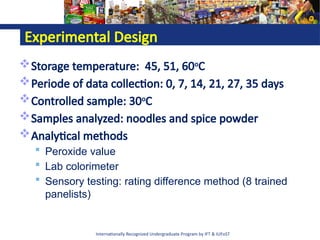
Experimental Design
Storage temperature: 45, 51, 60o
C
Periode of data collection: 0, 7, 14, 21, 27, 35 days
Controlled sample: 30o
C
Samples analyzed: noodles and spice powder
Analytical methods
 Peroxide value
 Lab colorimeter
 Sensory testing: rating difference method (8 trained
panelists)
Internationally Recognized Undergraduate Program by IFT & IUFoST
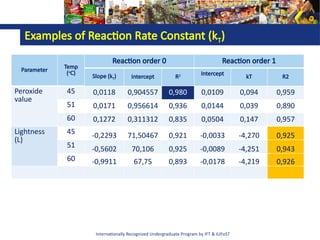
Examples of Reaction Rate Constant (kT)
Parameter
Temp
(o
C)
Reaction order 0 Reaction order 1
Slope (kT) Intercept R2 Intercept
kT R2
Peroxide
value
45 0,0118 0,904557 0,980 0,0109 0,094 0,959
51 0,0171 0,956614 0,936 0,0144 0,039 0,890
60 0,1272 0,311312 0,835 0,0504 0,147 0,957
Lightness
(L)
45 -0,2293 71,50467 0,921 -0,0033 -4,270 0,925
51 -0,5602 70,106 0,925 -0,0089 -4,251 0,943
60 -0,9911 67,75 0,893 -0,0178 -4,219 0,926
Internationally Recognized Undergraduate Program by IFT & IUFoST
Step 9:
Verification and Monitoring
To verify between predicted and actual shelf-life
Store and observe products at actual storage
temperature
Internationally Recognized Undergraduate Program by IFT & IUFoST
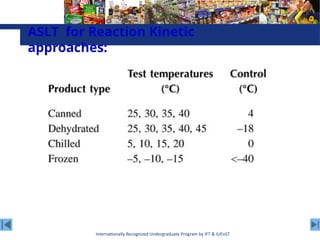
ASLT for Reaction Kinetic
approaches:
Internationally Recognized Undergraduate Program by IFT & IUFoST
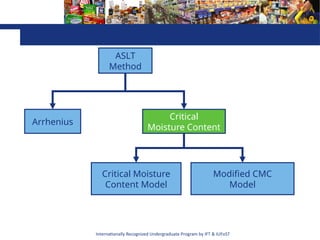
Shelf-life Prediction Model (ASLT Method)
ASLT
Method
Arrhenius
Critical
Moisture Content
Critical Moisture
Content Model
Modified CMC
Model
Courtesy of Feri Kusnandar/ITP/Fateta/IPB November 28, 2025
Critical Moisture Content/ MSI
Method
Internationally Recognized Undergraduate Program by IFT & IUFoST
ASLT:
Critical Moisture Content Method
Product deterioration due to water absorption. Exp:
biscuits, chips, flour
Loss of quality: agglomeration, loss of crispiness,
incresed stickiness
No chemical reaction effect is considered
Critical moisture content (Mc): level of moisture when
product is rejected sensorically
Time to reach critical moisture content (Mo-Mc):
product shelf-life
Internationally Recognized Undergraduate Program by IFT & IUFoST
Method 1:
Critical Moisture Content Method
Factors influencing shelf life
 The difference between initial moisture content
(Mo) and critical moisture content (Mc).
 Water vapor permeability of packaging (k/x). The
lower k/x, the lower water vapor migrate into
product.
 Packaging dimension (A, m2
)
Internationally Recognized Undergraduate Program by IFT & IUFoST
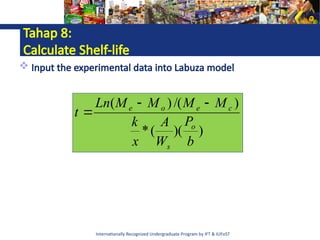
Labuza Model
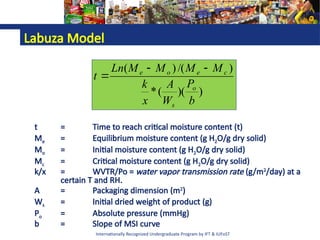
t = Time to reach critical moisture content (t)
Me = Equilibrium moisture content (g H2O/g dry solid)
Mo = Initial moisture content (g H2O/g dry solid)
Mc = Critical moisture content (g H2O/g dry solid)
k/x = WVTR/Po = water vapor transmission rate (g/m2
/day) at a
certain T and RH.
A = Packaging dimension (m2
)
Ws = Initial dried weight of product (g)
Po = Absolute pressure (mmHg)
b = Slope of MSI curve
)
)(
(
*
)
/(
)
(
b
P
W
A
x
k
M
M
M
M
Ln
t
o
s
c
e
o
e 


Internationally Recognized Undergraduate Program by IFT & IUFoST
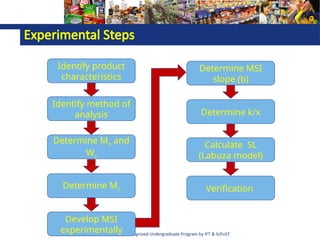
Experimental Steps
Identify product
characteristics
Identify method of
analysis
Determine Mo and
Ws
Determine Mc
Develop MSI
experimentally
Determine MSI
slope (b)
Determine k/x
Calculate SL
(Labuza model)
Verification
Internationally Recognized Undergraduate Program by IFT & IUFoST
Step 1:
Identify Product Characteristics
Identify product characteristics: usually dried
products
Identify product deterioration
 Exp: loss of crispiness, agglomeration, sticky
Internationally Recognized Undergraduate Program by IFT & IUFoST
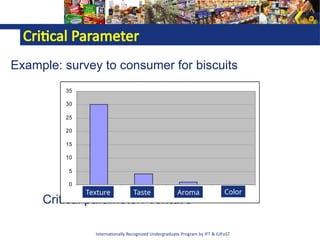
Critical Parameter
Example: survey to consumer for biscuits
Critical parameter: Texture
0
5
10
15
20
25
30
35
Tekstur Rasa Aroma Warna
Texture Taste Aroma Color
Internationally Recognized Undergraduate Program by IFT & IUFoST
Step 2
Select Analytical Method: Moisture Content
Consider product characteristics
Methods
 Oven (105o
C, 3 hours): heat stable foods
 Vaccum Oven (60-70o
C, 3 hours): heat sensitive
foods
 Karl Fischer: low moisture foods (exp: hard
candy)
Internationally Recognized Undergraduate Program by IFT & IUFoST
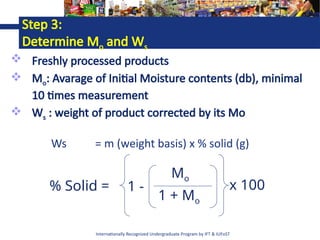
Step 3:
Determine Mo and Ws
 Freshly processed products
 Mo: Avarage of Initial Moisture contents (db), minimal
10 times measurement
 Ws : weight of product corrected by its Mo
1 -
Mo
1 + Mo
x 100
% Solid =
Ws = m (weight basis) x % solid (g)
Internationally Recognized Undergraduate Program by IFT & IUFoST
Step 4:
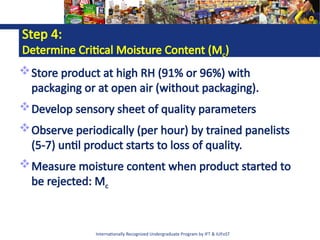
Determine Critical Moisture Content (Mc)
Store product at high RH (91% or 96%) with
packaging or at open air (without packaging).
Develop sensory sheet of quality parameters
Observe periodically (per hour) by trained panelists
(5-7) until product starts to loss of quality.
Measure moisture content when product started to
be rejected: Mc
Internationally Recognized Undergraduate Program by IFT & IUFoST
Step 5:
Develop MSI Curve Experimentally
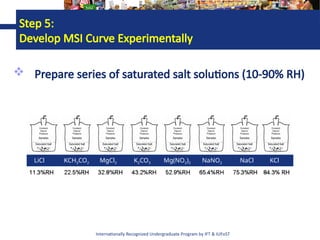
 Prepare series of saturated salt solutions (10-90% RH)
LiCl KCH3CO2 MgCl2 K2CO3 Mg(NO2)2 NaNO2 NaCl KCl
Internationally Recognized Undergraduate Program by IFT & IUFoST
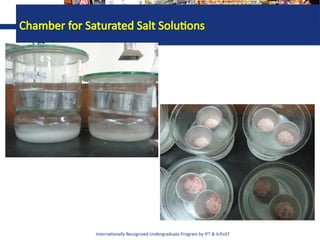
Chamber for Saturated Salt Solutions
Internationally Recognized Undergraduate Program by IFT & IUFoST
Step 5:
Develop MSI Curve Experimentally
 Place samples (known initial weight and initial moisture (Mo))
into chambers containing different saturated salt solutions (10-
96% RH)
 Store chamber in incubator (usually set at 30o
C).
 Weigh samples periodically (exp. every 5 hr) until constant
weight is reached (the increase of sample weight < 2%).
 Measure moisture content: Equilibrium moisture content (Me)
at different RHs
 Develop plot of RH (x axis) vs Me (y axis).
 Determine slope (b) of the liniear MSI curve: passing Mo, Mc
and MeRH.
 Mo < Mc < MeRH
Internationally Recognized Undergraduate Program by IFT & IUFoST
Step 5:
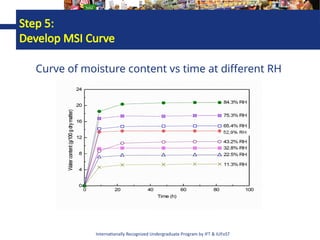
Develop MSI Curve
Curve of moisture content vs time at different RH
Internationally Recognized Undergraduate Program by IFT & IUFoST
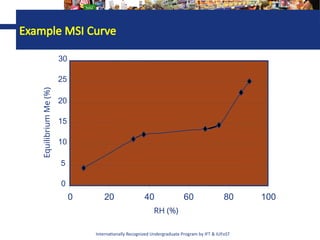
Example MSI Curve
0
5
10
15
20
25
30
0 20 40 60 80 100
Equilibrium
Me
(%)
RH (%)
Internationally Recognized Undergraduate Program by IFT & IUFoST
Step 6:
Determine Me at Storage RH
 Determine Me from the liniear equation of MSI
curve.
 Various storage RHs can be simulated
Internationally Recognized Undergraduate Program by IFT & IUFoST
Step 7:
Water Vapor Permability and
Surface Area of Packaging
k/x : check packaging specification/certificate of
analysis
When WVTR at RH at T known:
 k/x = WVTR/Po; Po at T
A is two side surface area of primary packaging
Internationally Recognized Undergraduate Program by IFT & IUFoST
Tahap 8:
Calculate Shelf-life
 Input the experimental data into Labuza model
)
)(
(
*
)
/(
)
(
b
P
W
A
x
k
M
M
M
M
Ln
t
o
s
c
e
o
e 


Internationally Recognized Undergraduate Program by IFT & IUFoST
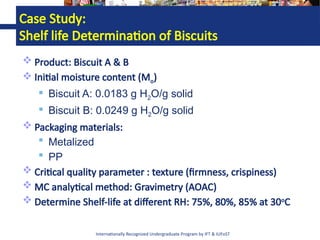
Case Study:
Shelf life Determination of Biscuits
 Product: Biscuit A & B
 Initial moisture content (Mo)
 Biscuit A: 0.0183 g H2O/g solid
 Biscuit B: 0.0249 g H2O/g solid
 Packaging materials:
 Metalized
 PP
 Critical quality parameter : texture (firmness, crispiness)
 MC analytical method: Gravimetry (AOAC)
 Determine Shelf-life at different RH: 75%, 80%, 85% at 30o
C
Internationally Recognized Undergraduate Program by IFT & IUFoST
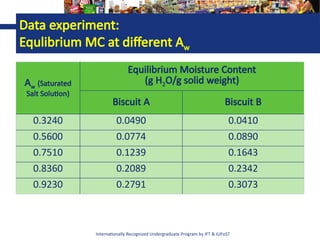
Data experiment:
Equlibrium MC at different Aw
Aw (Saturated
Salt Solution)
Equilibrium Moisture Content
(g H2O/g solid weight)
Biscuit A Biscuit B
0.3240 0.0490 0.0410
0.5600 0.0774 0.0890
0.7510 0.1239 0.1643
0.8360 0.2089 0.2342
0.9230 0.2791 0.3073
Internationally Recognized Undergraduate Program by IFT & IUFoST
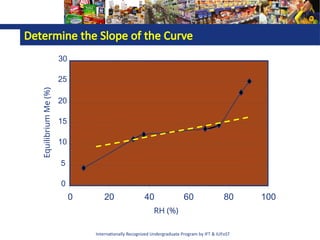
Determine the Slope of the Curve
0
5
10
15
20
25
30
0 20 40 60 80 100
Equilibrium
Me
(%)
RH (%)
Internationally Recognized Undergraduate Program by IFT & IUFoST
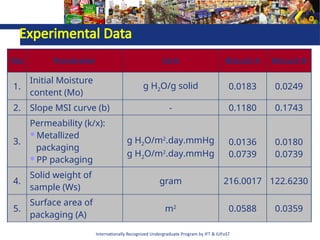
Experimental Data
No Parameter Unit Biscuit A Biscuit B
1.
Initial Moisture
content (Mo)
g H2O/g solid 0.0183 0.0249
2. Slope MSI curve (b) - 0.1180 0.1743
3.
Permeability (k/x):
Metallized
packaging
PP packaging
g H2O/m2
.day.mmHg
g H2O/m2
.day.mmHg
0.0136
0.0739
0.0180
0.0739
4.
Solid weight of
sample (Ws)
gram 216.0017 122.6230
5.
Surface area of
packaging (A)
m2
0.0588 0.0359
Internationally Recognized Undergraduate Program by IFT & IUFoST
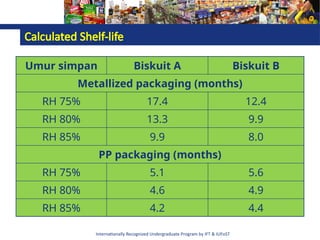
Calculated Shelf-life
Umur simpan Biskuit A Biskuit B
Metallized packaging (months)
RH 75% 17.4 12.4
RH 80% 13.3 9.9
RH 85% 9.9 8.0
PP packaging (months)
RH 75% 5.1 5.6
RH 80% 4.6 4.9
RH 85% 4.2 4.4
Courtesy of Feri Kusnandar/ITP/Fateta/IPB November 28, 2025
Modified Critical Moisture Content
Method
Internationally Recognized Undergraduate Program by IFT & IUFoST
Method 2:
Modified Critical Moisture Content Method
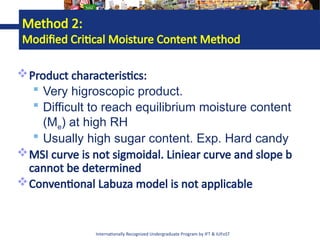
Product characteristics:
 Very higroscopic product.
 Difficult to reach equilibrium moisture content
(Me) at high RH
 Usually high sugar content. Exp. Hard candy
MSI curve is not sigmoidal. Liniear curve and slope b
cannot be determined
Conventional Labuza model is not applicable
Internationally Recognized Undergraduate Program by IFT & IUFoST
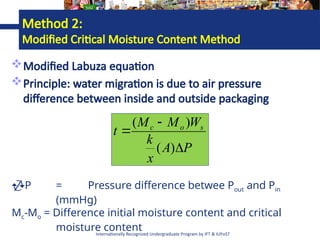
Modified Labuza equation
Principle: water migration is due to air pressure
difference between inside and outside packaging
P
A
x
k
W
M
M
t s
o
c



)
(
)
(
P = Pressure difference betwee Pout and Pin
(mmHg)
Mc-Mo = Difference initial moisture content and critical
moisture content
Method 2:
Modified Critical Moisture Content Method
Internationally Recognized Undergraduate Program by IFT & IUFoST
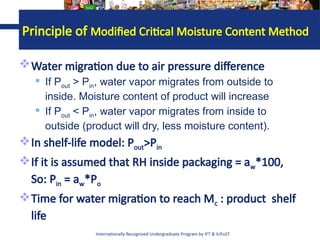
Water migration due to air pressure difference
 If Pout > Pin, water vapor migrates from outside to
inside. Moisture content of product will increase
 If Pout < Pin, water vapor migrates from inside to
outside (product will dry, less moisture content).
In shelf-life model: Pout>Pin
If it is assumed that RH inside packaging = aw*100,
So: Pin = aw*Po
Time for water migration to reach Mc : product shelf
life
Principle of Modified Critical Moisture Content Method
Internationally Recognized Undergraduate Program by IFT & IUFoST
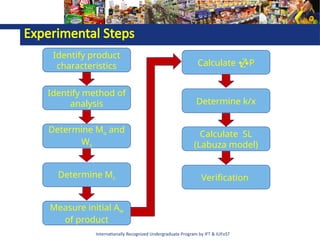
Experimental Steps
Identify product
characteristics
Identify method of
analysis
Determine Mo and
Ws
Determine Mc
Measure initial Aw
of product
Calculate P
Determine k/x
Calculate SL
(Labuza model)
Verification
Internationally Recognized Undergraduate Program by IFT & IUFoST
Step 6:
Determine Air Pressure Difference (P)
Pout = Po* RH
Pin = Po* Aw
Po : water pressure at certain temperature (water
vapor table; Labuza, 1982).
Internationally Recognized Undergraduate Program by IFT & IUFoST
Step 7:
Predict Shelf-life at certain RH
Predicted shelf-life: at different RH and temperature.
Use water vapor table to determine Po at different
storage temperature (at a limited range)
Calculated shelf-life: The higher storage temperature,
the shorter shelf-life.
Internationally Recognized Undergraduate Program by IFT & IUFoST
Tahap 7:
Predict Shelf-life at Certain RH
The determinant of product shelf-life:
Type of packaging
Storage temperature and RH
Initial moisture content
Initial aw
Internationally Recognized Undergraduate Program by IFT & IUFoST
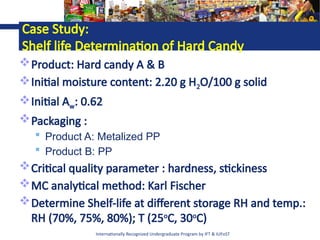
Case Study:
Shelf life Determination of Hard Candy
Product: Hard candy A & B
Initial moisture content: 2.20 g H2O/100 g solid
Initial Aw: 0.62
Packaging :
 Product A: Metalized PP
 Product B: PP
Critical quality parameter : hardness, stickiness
MC analytical method: Karl Fischer
Determine Shelf-life at different storage RH and temp.:
RH (70%, 75%, 80%); T (25o
C, 30o
C)
Internationally Recognized Undergraduate Program by IFT & IUFoST
Sensory Parameter to determine Critical MC (Factory Standar)
 Sensory attributes
 Contact clarity
 Wrapper sticking
 Deformity
 Surface appearance (dullness)
 Colour
 Hand stickiness
 Grain (depth
 Total flavour intensity
 Flavour change (off notes)
 Mouthfeel roughness
 Tooth stickiness.
 Score scale: 1 (best) dan 5 (worst)
 Employ 7 trained panelists
Internationally Recognized Undergraduate Program by IFT & IUFoST
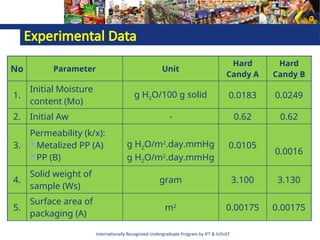
Experimental Data
No Parameter Unit
Hard
Candy A
Hard
Candy B
1.
Initial Moisture
content (Mo)
g H2O/100 g solid 0.0183 0.0249
2. Initial Aw - 0.62 0.62
3.
Permeability (k/x):
Metalized PP (A)
PP (B)
g H2O/m2
.day.mmHg
g H2O/m2
.day.mmHg
0.0105
0.0016
4.
Solid weight of
sample (Ws)
gram 3.100 3.130
5.
Surface area of
packaging (A)
m2
0.00175 0.00175
Internationally Recognized Undergraduate Program by IFT & IUFoST
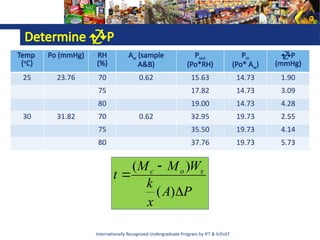
Determine P
Temp
(o
C)
Po (mmHg) RH
(%)
Aw (sample
A&B)
Pout
(Po*RH)
Pin
(Po* Aw)
P
(mmHg)
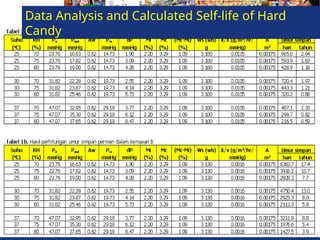
25 23.76 70 0.62 15.63 14.73 1.90
75 17.82 14.73 3.09
80 19.00 14.73 4.28
30 31.82 70 0.62 32.95 19.73 2.55
75 35.50 19.73 4.14
80 37.76 19.73 5.73
P
A
x
k
W
M
M
t s
o
c



)
(
)
(
Internationally Recognized Undergraduate Program by IFT & IUFoST
Data Analysis and Calculated Self-life of Hard
Candy
Internationally Recognized Undergraduate Program by IFT & IUFoST
70
ありがとうございました
谢谢
ขอขอบคุณ
‫شكرا‬ ‫شكرا‬
‫شكرا‬

9 - 10_ shelf-life evaluation using ALST.pptx

  • 1.
    TPN1333 Food Packagingand Storage Technology Food Science and Technology Department Faculty of Agricultural Engineering and Technology, IPB Internationally Approved Food Technology Program by IFT and IUFoST Food Shelf-life Evaluation – Accelerated Shelf-life Test
  • 2.
    Internationally Recognized UndergraduateProgram by IFT & IUFoST 2 Learning Outcome Upon successful completion of this topic, students will be able to:  determine the shelf life of food by using accelerated shelf life test (Arrhenius and Labuza Equation).
  • 3.
    Internationally Recognized UndergraduateProgram by IFT & IUFoST 3 11.1 ASLT Method with Arrhenius 11.2 ASLT with Critical Moisture Content Sub Topic
  • 4.
    Internationally Recognized UndergraduateProgram by IFT & IUFoST Shelf-life Prediction Model (ASLT Method) ASLT Method Arrhenius Critical Moisture Content MSI Curve Model Modified MSI Model
  • 5.
    Internationally Recognized UndergraduateProgram by IFT & IUFoST Data Extrapolation Method by ASLT Storage Condition Data Extrapolation Laju kerusakan Accelerating Factors
  • 6.
    Internationally Recognized UndergraduateProgram by IFT & IUFoST Arrhenius Model To predict the shelf-life of processed foods deterioted by chemical reaction Temperature dependence: fat oxidation, Maillard reaction, Vitamin C oxidation Examples: Sterilized canned foods, UHT milk, Snack/chips, pasteurized fruit juice, instant noodle, frozen meat/shrimp/fish, chilli sauce, jam, pasta product, fried peanut, etc
  • 7.
    Internationally Recognized UndergraduateProgram by IFT & IUFoST Experiment: Arrhenius Model
  • 8.
    Internationally Recognized UndergraduateProgram by IFT & IUFoST Experimental Steps Identify product characteristics Identify critical parameters Determine anal. method Experiment: Storage T, t Data collection Determine Qo and Qc Data analysis: Determine reaction order (0 or 1) Determine kT Determine kT at storage temp. (Arrhenius model Calculate SL Select significant critical parameters Verification
  • 9.
    Internationally Recognized UndergraduateProgram by IFT & IUFoST Step 1: Identify product characteristics Identify ingredients in products.  What are the critical ingredients?  Is there any potential component reactions or interactions during storage? Identify storage temperature: markets, displays, or consumers levels
  • 10.
    Internationally Recognized UndergraduateProgram by IFT & IUFoST Step 2: Identify Critical Parameters Causing Product Deterioration  Based on experience, what are the major quality attributes cause product rejection?  Rancidity (fat oxidation): FFA, TBA value.  Colour change (Maillard reaction): color measurement  If unknown well, select several potential critical parameters.  If any product claim, select as a critical parameters  Exp. rich in DHA/EPA.  Commercially sterilized canned foods: product deterioration is not caused by microbiological factors
  • 11.
    Internationally Recognized UndergraduateProgram by IFT & IUFoST Step 3: Determine Analytical Methods Analysis:  Fat oxidation: TBA value, peroxide value  Maillard reaction: Color measurement by colorimeter  Sensory evaluation: Rancid odor, color Consider cost for analysis
  • 12.
    Internationally Recognized UndergraduateProgram by IFT & IUFoST Step 4: Experiment at Accelerated Storage Temperature Condition Consider real storage temperature. Select min. 3 accelarated temp above real storage temperature  Exp: Room temperature (28o C) : 35, 45, 55  Frozen temperature (-25o C): -15, -10, -5o C Make sure that the storage temperature does not cause change of deterioration mechanism  Exp: microbiological growth
  • 13.
    Internationally Recognized UndergraduateProgram by IFT & IUFoST Example of storage temperature and time of analysis Real storage temp (o C) Experiments Products Storage Temp (°C) Time (day) Canned fruits, juice, UHT milk, instant noodle, fried peanut 28-30 35, 45, 55 0, 3, 7, 14, 21, 28, 35 Chilled Products 5 10, 15, 20 0, 3, 7, 14, 21, 28, 35 Frozen meats/shrimps -25 -15, -10, -5 1, 2, 3, 4, 5, 8, 12,
  • 14.
    Internationally Recognized UndergraduateProgram by IFT & IUFoST Step 5: Data Collection  Number of samples: considered storage temp/time, types of analysis, and replication. Sample = T* t* rep*sample per period of anal  Use primary packaging  Use calibrated incubators (at least 3)  Control: normal storage temperature  Collect samples per periodic and analyze
  • 15.
    Internationally Recognized UndergraduateProgram by IFT & IUFoST Incubator for Sample Storage
  • 16.
    Internationally Recognized UndergraduateProgram by IFT & IUFoST Step 5: Data Collection Tabulate analytical data in table formats. Use separate table for each quality parameters (Excel) Calculate average for each data.
  • 17.
    Internationally Recognized UndergraduateProgram by IFT & IUFoST Contoh Format Data Hasil Pengamatan
  • 18.
    Internationally Recognized UndergraduateProgram by IFT & IUFoST Step 6: Identify Initial Product Quality (Qo) and Quality Limits (Qc) Initial quality (Qo) for freshly processed products (day 0). Quality limits (Qc):  The quality limit for product rejection by consumers.  Correlate the objective analysis with sensory analysis: Qc for TBA based on rancid odor development  For product claim: percentage of component los (exp. If 20% vitamin C losses, Qc 80%)
  • 19.
    Internationally Recognized UndergraduateProgram by IFT & IUFoST Step 7: Determine Order Reaction abd kT Plot graphic: Quality (Qt) vs time (t, day) according to Order 0 and 1. Order 0 : Qt = Qo – kTt Order 1 : LnQt = LnQo – kTt Determine equation model: kT (slope) and R2 . Reaction order 0 or 1: select kT with higher R2:
  • 20.
    Internationally Recognized UndergraduateProgram by IFT & IUFoST Step 7: Determine ReactionOrder and kT The predicted shelf life for zero order will be shorter than first order t Ln Q Slope = - kT Order 1 T1 T2 T3 t Q Slope = - kT Order 0 T1 T2 T3
  • 21.
    Internationally Recognized UndergraduateProgram by IFT & IUFoST Step 8: Select Significant Critical Parameters Consider :  R2 of reaction rate constants (kT) : Usually > 0.75  kT increase consistently by temperature
  • 22.
    Internationally Recognized UndergraduateProgram by IFT & IUFoST Step 9: Calculate kT at Real Storage Temperature (Using Arrhenius Model)  Plot kT versus storage temperature using Arrhenius model (in form of logarithmic equation: Ln kT = Ln ko - Ea/RT) where: kT = reaction rate constant at T ko = Frequency factor Ea = activation energy T = absolute temperature (K): To K= 273+ To C R = Gas constant (8.314 J/mole.K) Ln K Slope (K) = - Ea/R 1/T
  • 23.
    Internationally Recognized UndergraduateProgram by IFT & IUFoST Step 9: Calculate kT at Real Storage Temperature (Using Arrhenius Model)  Model Arrhenius dibuat dalam bentuk persamaan logaritmik. Plot hubungan antara LnkT (sumbu y) versus 1/T (sumbu x). LnkT = Lnko – Ea/RT  Calculate kT at real storage temperature
  • 24.
    Internationally Recognized UndergraduateProgram by IFT & IUFoST Tahap 10: Calculate Predicted Shelf-life  Shelf-life (ts) at a storage temperature: Order 0 : ts = (Qo-Qs)/kT Order 1 : ts = [ln(Qo/Qs)]/kT  kT comes from Arrhenius equation  Plot graphics storage temp vs shelf-life Shelf-life (day) Storage Temp (o C)
  • 25.
    Internationally Recognized UndergraduateProgram by IFT & IUFoST Step 9: Predicted Shelf-life  The predicted shelf-life:  Can be simulated at several storage temperature  May differ among quality parameters  Management decision:  Select the shortest shelf-life  Consider storage temperature  Consider length of product sale
  • 26.
    Internationally Recognized UndergraduateProgram by IFT & IUFoST Case Study Shelf-life Determination of Instant Noodles Product characteristics:  Fried instant noodles  Mushroom flavor Quality loss factors  Rancid odour: fat oxidation  Color changes: Maillard reaction  Loss of mushroom/cheese flavor
  • 27.
    Internationally Recognized UndergraduateProgram by IFT & IUFoST Experimental Design Storage temperature: 45, 51, 60o C Periode of data collection: 0, 7, 14, 21, 27, 35 days Controlled sample: 30o C Samples analyzed: noodles and spice powder Analytical methods  Peroxide value  Lab colorimeter  Sensory testing: rating difference method (8 trained panelists)
  • 28.
    Internationally Recognized UndergraduateProgram by IFT & IUFoST Examples of Reaction Rate Constant (kT) Parameter Temp (o C) Reaction order 0 Reaction order 1 Slope (kT) Intercept R2 Intercept kT R2 Peroxide value 45 0,0118 0,904557 0,980 0,0109 0,094 0,959 51 0,0171 0,956614 0,936 0,0144 0,039 0,890 60 0,1272 0,311312 0,835 0,0504 0,147 0,957 Lightness (L) 45 -0,2293 71,50467 0,921 -0,0033 -4,270 0,925 51 -0,5602 70,106 0,925 -0,0089 -4,251 0,943 60 -0,9911 67,75 0,893 -0,0178 -4,219 0,926
  • 29.
    Internationally Recognized UndergraduateProgram by IFT & IUFoST Step 9: Verification and Monitoring To verify between predicted and actual shelf-life Store and observe products at actual storage temperature
  • 30.
    Internationally Recognized UndergraduateProgram by IFT & IUFoST ASLT for Reaction Kinetic approaches:
  • 31.
  • 32.
  • 33.
    Internationally Recognized UndergraduateProgram by IFT & IUFoST Shelf-life Prediction Model (ASLT Method) ASLT Method Arrhenius Critical Moisture Content Critical Moisture Content Model Modified CMC Model
  • 34.
    Courtesy of FeriKusnandar/ITP/Fateta/IPB November 28, 2025 Critical Moisture Content/ MSI Method
  • 35.
    Internationally Recognized UndergraduateProgram by IFT & IUFoST ASLT: Critical Moisture Content Method Product deterioration due to water absorption. Exp: biscuits, chips, flour Loss of quality: agglomeration, loss of crispiness, incresed stickiness No chemical reaction effect is considered Critical moisture content (Mc): level of moisture when product is rejected sensorically Time to reach critical moisture content (Mo-Mc): product shelf-life
  • 36.
    Internationally Recognized UndergraduateProgram by IFT & IUFoST Method 1: Critical Moisture Content Method Factors influencing shelf life  The difference between initial moisture content (Mo) and critical moisture content (Mc).  Water vapor permeability of packaging (k/x). The lower k/x, the lower water vapor migrate into product.  Packaging dimension (A, m2 )
  • 37.
    Internationally Recognized UndergraduateProgram by IFT & IUFoST Labuza Model t = Time to reach critical moisture content (t) Me = Equilibrium moisture content (g H2O/g dry solid) Mo = Initial moisture content (g H2O/g dry solid) Mc = Critical moisture content (g H2O/g dry solid) k/x = WVTR/Po = water vapor transmission rate (g/m2 /day) at a certain T and RH. A = Packaging dimension (m2 ) Ws = Initial dried weight of product (g) Po = Absolute pressure (mmHg) b = Slope of MSI curve ) )( ( * ) /( ) ( b P W A x k M M M M Ln t o s c e o e   
  • 38.
    Internationally Recognized UndergraduateProgram by IFT & IUFoST Experimental Steps Identify product characteristics Identify method of analysis Determine Mo and Ws Determine Mc Develop MSI experimentally Determine MSI slope (b) Determine k/x Calculate SL (Labuza model) Verification
  • 39.
    Internationally Recognized UndergraduateProgram by IFT & IUFoST Step 1: Identify Product Characteristics Identify product characteristics: usually dried products Identify product deterioration  Exp: loss of crispiness, agglomeration, sticky
  • 40.
    Internationally Recognized UndergraduateProgram by IFT & IUFoST Critical Parameter Example: survey to consumer for biscuits Critical parameter: Texture 0 5 10 15 20 25 30 35 Tekstur Rasa Aroma Warna Texture Taste Aroma Color
  • 41.
    Internationally Recognized UndergraduateProgram by IFT & IUFoST Step 2 Select Analytical Method: Moisture Content Consider product characteristics Methods  Oven (105o C, 3 hours): heat stable foods  Vaccum Oven (60-70o C, 3 hours): heat sensitive foods  Karl Fischer: low moisture foods (exp: hard candy)
  • 42.
    Internationally Recognized UndergraduateProgram by IFT & IUFoST Step 3: Determine Mo and Ws  Freshly processed products  Mo: Avarage of Initial Moisture contents (db), minimal 10 times measurement  Ws : weight of product corrected by its Mo 1 - Mo 1 + Mo x 100 % Solid = Ws = m (weight basis) x % solid (g)
  • 43.
    Internationally Recognized UndergraduateProgram by IFT & IUFoST Step 4: Determine Critical Moisture Content (Mc) Store product at high RH (91% or 96%) with packaging or at open air (without packaging). Develop sensory sheet of quality parameters Observe periodically (per hour) by trained panelists (5-7) until product starts to loss of quality. Measure moisture content when product started to be rejected: Mc
  • 44.
    Internationally Recognized UndergraduateProgram by IFT & IUFoST Step 5: Develop MSI Curve Experimentally  Prepare series of saturated salt solutions (10-90% RH) LiCl KCH3CO2 MgCl2 K2CO3 Mg(NO2)2 NaNO2 NaCl KCl
  • 45.
    Internationally Recognized UndergraduateProgram by IFT & IUFoST Chamber for Saturated Salt Solutions
  • 46.
    Internationally Recognized UndergraduateProgram by IFT & IUFoST Step 5: Develop MSI Curve Experimentally  Place samples (known initial weight and initial moisture (Mo)) into chambers containing different saturated salt solutions (10- 96% RH)  Store chamber in incubator (usually set at 30o C).  Weigh samples periodically (exp. every 5 hr) until constant weight is reached (the increase of sample weight < 2%).  Measure moisture content: Equilibrium moisture content (Me) at different RHs  Develop plot of RH (x axis) vs Me (y axis).  Determine slope (b) of the liniear MSI curve: passing Mo, Mc and MeRH.  Mo < Mc < MeRH
  • 47.
    Internationally Recognized UndergraduateProgram by IFT & IUFoST Step 5: Develop MSI Curve Curve of moisture content vs time at different RH
  • 48.
    Internationally Recognized UndergraduateProgram by IFT & IUFoST Example MSI Curve 0 5 10 15 20 25 30 0 20 40 60 80 100 Equilibrium Me (%) RH (%)
  • 49.
    Internationally Recognized UndergraduateProgram by IFT & IUFoST Step 6: Determine Me at Storage RH  Determine Me from the liniear equation of MSI curve.  Various storage RHs can be simulated
  • 50.
    Internationally Recognized UndergraduateProgram by IFT & IUFoST Step 7: Water Vapor Permability and Surface Area of Packaging k/x : check packaging specification/certificate of analysis When WVTR at RH at T known:  k/x = WVTR/Po; Po at T A is two side surface area of primary packaging
  • 51.
    Internationally Recognized UndergraduateProgram by IFT & IUFoST Tahap 8: Calculate Shelf-life  Input the experimental data into Labuza model ) )( ( * ) /( ) ( b P W A x k M M M M Ln t o s c e o e   
  • 52.
    Internationally Recognized UndergraduateProgram by IFT & IUFoST Case Study: Shelf life Determination of Biscuits  Product: Biscuit A & B  Initial moisture content (Mo)  Biscuit A: 0.0183 g H2O/g solid  Biscuit B: 0.0249 g H2O/g solid  Packaging materials:  Metalized  PP  Critical quality parameter : texture (firmness, crispiness)  MC analytical method: Gravimetry (AOAC)  Determine Shelf-life at different RH: 75%, 80%, 85% at 30o C
  • 53.
    Internationally Recognized UndergraduateProgram by IFT & IUFoST Data experiment: Equlibrium MC at different Aw Aw (Saturated Salt Solution) Equilibrium Moisture Content (g H2O/g solid weight) Biscuit A Biscuit B 0.3240 0.0490 0.0410 0.5600 0.0774 0.0890 0.7510 0.1239 0.1643 0.8360 0.2089 0.2342 0.9230 0.2791 0.3073
  • 54.
    Internationally Recognized UndergraduateProgram by IFT & IUFoST Determine the Slope of the Curve 0 5 10 15 20 25 30 0 20 40 60 80 100 Equilibrium Me (%) RH (%)
  • 55.
    Internationally Recognized UndergraduateProgram by IFT & IUFoST Experimental Data No Parameter Unit Biscuit A Biscuit B 1. Initial Moisture content (Mo) g H2O/g solid 0.0183 0.0249 2. Slope MSI curve (b) - 0.1180 0.1743 3. Permeability (k/x): Metallized packaging PP packaging g H2O/m2 .day.mmHg g H2O/m2 .day.mmHg 0.0136 0.0739 0.0180 0.0739 4. Solid weight of sample (Ws) gram 216.0017 122.6230 5. Surface area of packaging (A) m2 0.0588 0.0359
  • 56.
    Internationally Recognized UndergraduateProgram by IFT & IUFoST Calculated Shelf-life Umur simpan Biskuit A Biskuit B Metallized packaging (months) RH 75% 17.4 12.4 RH 80% 13.3 9.9 RH 85% 9.9 8.0 PP packaging (months) RH 75% 5.1 5.6 RH 80% 4.6 4.9 RH 85% 4.2 4.4
  • 57.
    Courtesy of FeriKusnandar/ITP/Fateta/IPB November 28, 2025 Modified Critical Moisture Content Method
  • 58.
    Internationally Recognized UndergraduateProgram by IFT & IUFoST Method 2: Modified Critical Moisture Content Method Product characteristics:  Very higroscopic product.  Difficult to reach equilibrium moisture content (Me) at high RH  Usually high sugar content. Exp. Hard candy MSI curve is not sigmoidal. Liniear curve and slope b cannot be determined Conventional Labuza model is not applicable
  • 59.
    Internationally Recognized UndergraduateProgram by IFT & IUFoST Modified Labuza equation Principle: water migration is due to air pressure difference between inside and outside packaging P A x k W M M t s o c    ) ( ) ( P = Pressure difference betwee Pout and Pin (mmHg) Mc-Mo = Difference initial moisture content and critical moisture content Method 2: Modified Critical Moisture Content Method
  • 60.
    Internationally Recognized UndergraduateProgram by IFT & IUFoST Water migration due to air pressure difference  If Pout > Pin, water vapor migrates from outside to inside. Moisture content of product will increase  If Pout < Pin, water vapor migrates from inside to outside (product will dry, less moisture content). In shelf-life model: Pout>Pin If it is assumed that RH inside packaging = aw*100, So: Pin = aw*Po Time for water migration to reach Mc : product shelf life Principle of Modified Critical Moisture Content Method
  • 61.
    Internationally Recognized UndergraduateProgram by IFT & IUFoST Experimental Steps Identify product characteristics Identify method of analysis Determine Mo and Ws Determine Mc Measure initial Aw of product Calculate P Determine k/x Calculate SL (Labuza model) Verification
  • 62.
    Internationally Recognized UndergraduateProgram by IFT & IUFoST Step 6: Determine Air Pressure Difference (P) Pout = Po* RH Pin = Po* Aw Po : water pressure at certain temperature (water vapor table; Labuza, 1982).
  • 63.
    Internationally Recognized UndergraduateProgram by IFT & IUFoST Step 7: Predict Shelf-life at certain RH Predicted shelf-life: at different RH and temperature. Use water vapor table to determine Po at different storage temperature (at a limited range) Calculated shelf-life: The higher storage temperature, the shorter shelf-life.
  • 64.
    Internationally Recognized UndergraduateProgram by IFT & IUFoST Tahap 7: Predict Shelf-life at Certain RH The determinant of product shelf-life: Type of packaging Storage temperature and RH Initial moisture content Initial aw
  • 65.
    Internationally Recognized UndergraduateProgram by IFT & IUFoST Case Study: Shelf life Determination of Hard Candy Product: Hard candy A & B Initial moisture content: 2.20 g H2O/100 g solid Initial Aw: 0.62 Packaging :  Product A: Metalized PP  Product B: PP Critical quality parameter : hardness, stickiness MC analytical method: Karl Fischer Determine Shelf-life at different storage RH and temp.: RH (70%, 75%, 80%); T (25o C, 30o C)
  • 66.
    Internationally Recognized UndergraduateProgram by IFT & IUFoST Sensory Parameter to determine Critical MC (Factory Standar)  Sensory attributes  Contact clarity  Wrapper sticking  Deformity  Surface appearance (dullness)  Colour  Hand stickiness  Grain (depth  Total flavour intensity  Flavour change (off notes)  Mouthfeel roughness  Tooth stickiness.  Score scale: 1 (best) dan 5 (worst)  Employ 7 trained panelists
  • 67.
    Internationally Recognized UndergraduateProgram by IFT & IUFoST Experimental Data No Parameter Unit Hard Candy A Hard Candy B 1. Initial Moisture content (Mo) g H2O/100 g solid 0.0183 0.0249 2. Initial Aw - 0.62 0.62 3. Permeability (k/x): Metalized PP (A) PP (B) g H2O/m2 .day.mmHg g H2O/m2 .day.mmHg 0.0105 0.0016 4. Solid weight of sample (Ws) gram 3.100 3.130 5. Surface area of packaging (A) m2 0.00175 0.00175
  • 68.
    Internationally Recognized UndergraduateProgram by IFT & IUFoST Determine P Temp (o C) Po (mmHg) RH (%) Aw (sample A&B) Pout (Po*RH) Pin (Po* Aw) P (mmHg) 25 23.76 70 0.62 15.63 14.73 1.90 75 17.82 14.73 3.09 80 19.00 14.73 4.28 30 31.82 70 0.62 32.95 19.73 2.55 75 35.50 19.73 4.14 80 37.76 19.73 5.73 P A x k W M M t s o c    ) ( ) (
  • 69.
    Internationally Recognized UndergraduateProgram by IFT & IUFoST Data Analysis and Calculated Self-life of Hard Candy
  • 70.
    Internationally Recognized UndergraduateProgram by IFT & IUFoST 70 ありがとうございました 谢谢 ขอขอบคุณ ‫شكرا‬ ‫شكرا‬ ‫شكرا‬