CONCLUSION
Customer validation and satisfaction are necessary for all enterprises. Therefore to ensure that the product
developed is useful, reliable, and acceptable by end-users, businesses conduct user acceptance tests before
releasing the product in the real environment. However, to ensure that the test is successful it is very important to
follow the right steps and tips as mentioned in this article. Leverage UAT from a next-gen QA and software testing
services provider to achieve a quality, bug-free software product.
To know more about our services
please email us at
info@testingxperts.com
www.TestingXperts.com
USA | CANADA | UK | NETHERLANDS |
SOUTH AFRICA | INDIA | SINGAPORE
© 2022 TestingXperts, All Rights Reserved
© www.testingxperts.com
Software testing is an integral part of the software development process, as without properly testing the software
product cannot be released in the market for end-users. Various types of tests are conducted on software to ensure
that the product works as expected well and is also free from all bugs and errors. But, there is one test, which is
conducted at the last stage of the software testing process to determine whether the software is acceptable by the
end-user and ready for release or not. That software testing method is user acceptance testing. Let’s now try to
understand this testing type in more detail.
What is UAT?
7 Tips
to Manage
UAT Testing
Process
It is a black box kind of software testing process where the end-user/client/business owner checks the functionality
of the product to ensure that the product works as expected and is ready for release. Once the product is checked
and accepted by the user, it is released in the market for end-users.
1. Carefully select test participants: Before starting the test, it is essential to identify the right test participants. The
participants of this test are business analyst, QA lead or test manager, requirements specialist (if any), and the
business or product owner
2. Select the type of test: The type of test depends on the location of your test participants. If your team is located
at one location you can opt for an in-person test and if your test participants are located at different geographies
across the world and have different time zones and shifts, it will be feasible for you to opt for self-paced testing done
by users at their location as per their time zone
3. Create a schedule and establish a process: Another important tip is to create a test schedule. Check the
availability of testers, availability of place/venue of tests and schedule the test and determine the time frames. With
the teams working in different time zones, it is essential to prepare a process and determine time frames well in
advance to keep the testing process consistent and smooth
4. Ensure proper communication: It is very important to ensure that there is proper communication among
stakeholders of the tests. To ensure everything is being properly communicated to testers, prepare a standardized
release note with a structured testing agenda and document the required actions for each testing event.
5. Keep your focus on end-users: This test is conducted to receive feedback and suggestions from end-users about
the functionality, usability, security, reliability of the product thus, it is very essential to keep the focus on end-users
by keeping the end-goal in mind and by keeping the communication channels open
6. Keep tracking the progress: Document everything from start to end, keep track on the progress, modules that
have been passed or failed should be documented clearly and suggestion received from the users should also be
documented in a way that it provides value to all stakeholders
7. Receive a sign-off document: Once the product is passed or accepted by the user, receive a sign-off
mail/document from the user clearly stating the status (pass) of the product and permission for product release
Why should businesses leverage UAT?
Below mentioned reasons will help you understand the importance of this for businesses:
1. This testing process helps to validate whether the business requirements have been met or not as defined in the
user stories
2. This test helps to identify the bugs that were left unidentified during the integration testing process
3. It reduces the chances of product failure post-production
4. This test helps to validate the product from the end-users perspective who will use the product
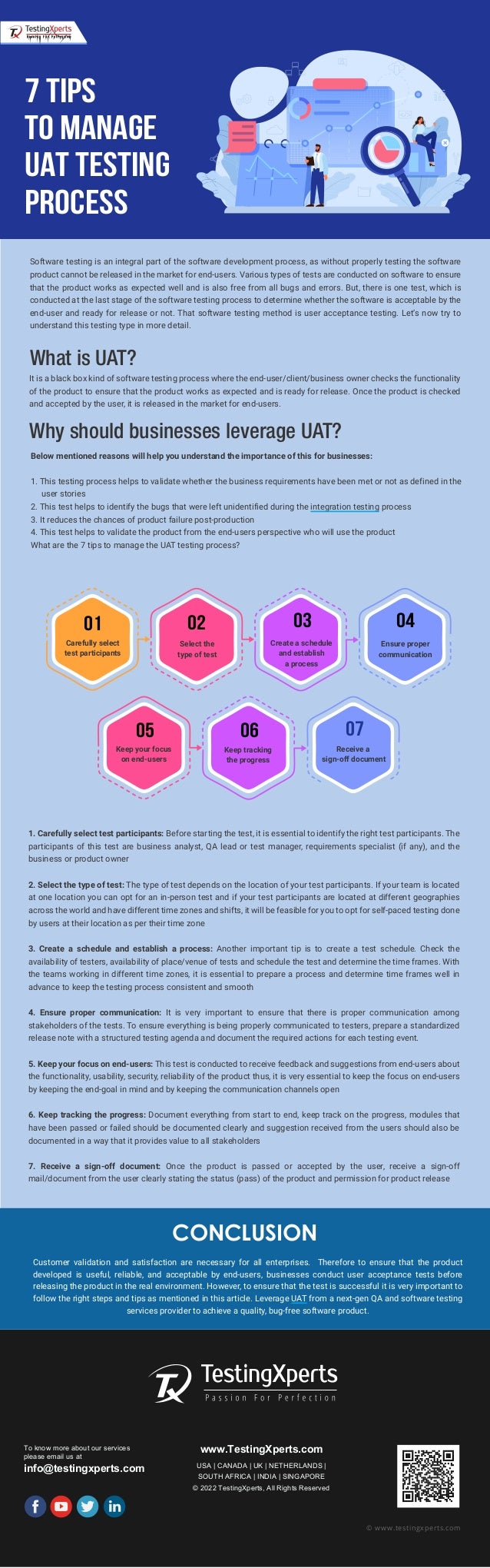
What are the 7 tips to manage the UAT testing process?
01 02 03 04
05 06 07
Carefully select
test participants
Select the
type of test
Create a schedule
and establish
a process
Ensure proper
communication
Keep your focus
on end-users
Keep tracking
the progress
Receive a
sign-off document

7 Tips to Manage UAT Testing Process.pdf

  • 1.
    CONCLUSION Customer validation andsatisfaction are necessary for all enterprises. Therefore to ensure that the product developed is useful, reliable, and acceptable by end-users, businesses conduct user acceptance tests before releasing the product in the real environment. However, to ensure that the test is successful it is very important to follow the right steps and tips as mentioned in this article. Leverage UAT from a next-gen QA and software testing services provider to achieve a quality, bug-free software product. To know more about our services please email us at info@testingxperts.com www.TestingXperts.com USA | CANADA | UK | NETHERLANDS | SOUTH AFRICA | INDIA | SINGAPORE © 2022 TestingXperts, All Rights Reserved © www.testingxperts.com Software testing is an integral part of the software development process, as without properly testing the software product cannot be released in the market for end-users. Various types of tests are conducted on software to ensure that the product works as expected well and is also free from all bugs and errors. But, there is one test, which is conducted at the last stage of the software testing process to determine whether the software is acceptable by the end-user and ready for release or not. That software testing method is user acceptance testing. Let’s now try to understand this testing type in more detail. What is UAT? 7 Tips to Manage UAT Testing Process It is a black box kind of software testing process where the end-user/client/business owner checks the functionality of the product to ensure that the product works as expected and is ready for release. Once the product is checked and accepted by the user, it is released in the market for end-users. 1. Carefully select test participants: Before starting the test, it is essential to identify the right test participants. The participants of this test are business analyst, QA lead or test manager, requirements specialist (if any), and the business or product owner 2. Select the type of test: The type of test depends on the location of your test participants. If your team is located at one location you can opt for an in-person test and if your test participants are located at different geographies across the world and have different time zones and shifts, it will be feasible for you to opt for self-paced testing done by users at their location as per their time zone 3. Create a schedule and establish a process: Another important tip is to create a test schedule. Check the availability of testers, availability of place/venue of tests and schedule the test and determine the time frames. With the teams working in different time zones, it is essential to prepare a process and determine time frames well in advance to keep the testing process consistent and smooth 4. Ensure proper communication: It is very important to ensure that there is proper communication among stakeholders of the tests. To ensure everything is being properly communicated to testers, prepare a standardized release note with a structured testing agenda and document the required actions for each testing event. 5. Keep your focus on end-users: This test is conducted to receive feedback and suggestions from end-users about the functionality, usability, security, reliability of the product thus, it is very essential to keep the focus on end-users by keeping the end-goal in mind and by keeping the communication channels open 6. Keep tracking the progress: Document everything from start to end, keep track on the progress, modules that have been passed or failed should be documented clearly and suggestion received from the users should also be documented in a way that it provides value to all stakeholders 7. Receive a sign-off document: Once the product is passed or accepted by the user, receive a sign-off mail/document from the user clearly stating the status (pass) of the product and permission for product release Why should businesses leverage UAT? Below mentioned reasons will help you understand the importance of this for businesses: 1. This testing process helps to validate whether the business requirements have been met or not as defined in the user stories 2. This test helps to identify the bugs that were left unidentified during the integration testing process 3. It reduces the chances of product failure post-production 4. This test helps to validate the product from the end-users perspective who will use the product What are the 7 tips to manage the UAT testing process? 01 02 03 04 05 06 07 Carefully select test participants Select the type of test Create a schedule and establish a process Ensure proper communication Keep your focus on end-users Keep tracking the progress Receive a sign-off document