INTRODUCING
THE6RS
Did you know?
Only 1 in every 10,000
products are designed with the
environment in mind.
Edwin Datschefski
1
What’s the
specification?
Working in small groups, look
at the two products that you’ve
been given in class (or the two
product seen here).
Make a list on your worksheet
of the design specifications
that you think the designer
followed to design the two
products.
2
What do you think is the role of designers?
3
Designers should define their role as agents of good in
the world and limit their work to products that are
needed and can be made without damage to nature or
people.
Phillip Starck
What are the big sustainability issues for designers?
1. Resource use
We use so much and so many materials. Many of the products we use daily use
materials that are in scarce supply and are non-renewable.
If everyone in the world used as many resources as we do in the UK, we’d need 3
planets the size earth to sustain us.
4
2. Climate change
The energy used throughout the product ‘lifecycle’ releases carbon dioxide, which
contributes towards climate change.
Many products use a lot of energy to;
- Process materials and produce
- Transport
- Use and dispose.
5
3. Impact on people
People are involved at each stage of the development of a new product.
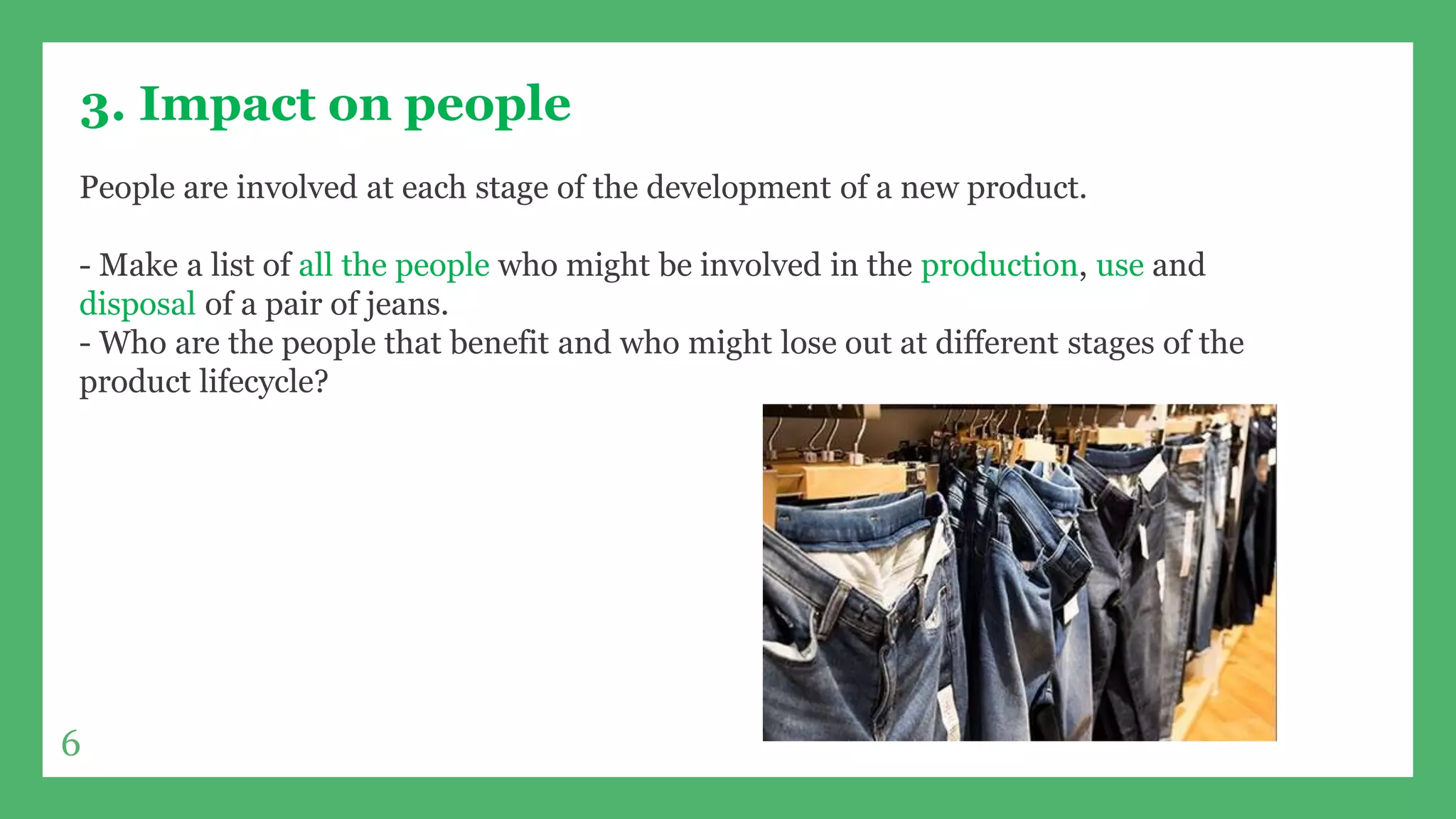
- Make a list of all the people who might be involved in the production, use and
disposal of a pair of jeans.
- Who are the people that benefit and who might lose out at different stages of the
product lifecycle?
6
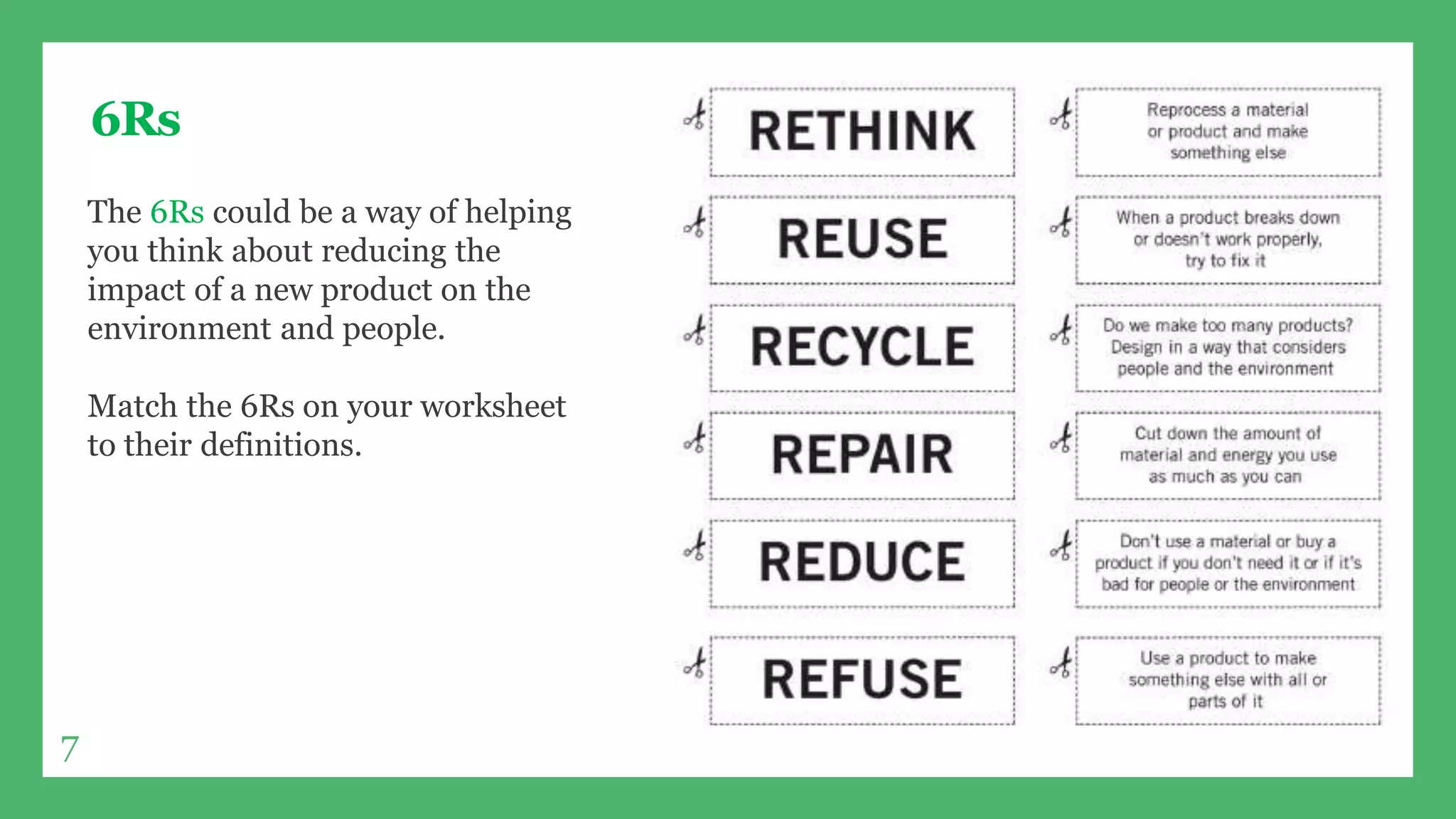
6Rs
The 6Rs could be a way of helping
you think about reducing the
impact of a new product on the
environment and people.
Match the 6Rs on your worksheet
to their definitions.
7
Check you’ve got them right
Rethink: Do we make too many products? Design in a way that considers people and
the environment.
Refuse: Don’t use a material or buy a product if you don’t need it or if it’s bad for
people or the environment.
Reduce: Cut down the amount of material and energy you use as much as you can.
Reuse: Use a product to make something else with all or parts of it.
Recycle: Reprocess a material or product and make something else.
Repair: When a product breaks down or doesn’t work properly, fix it.
8
Plenary activity: Using 6Rs
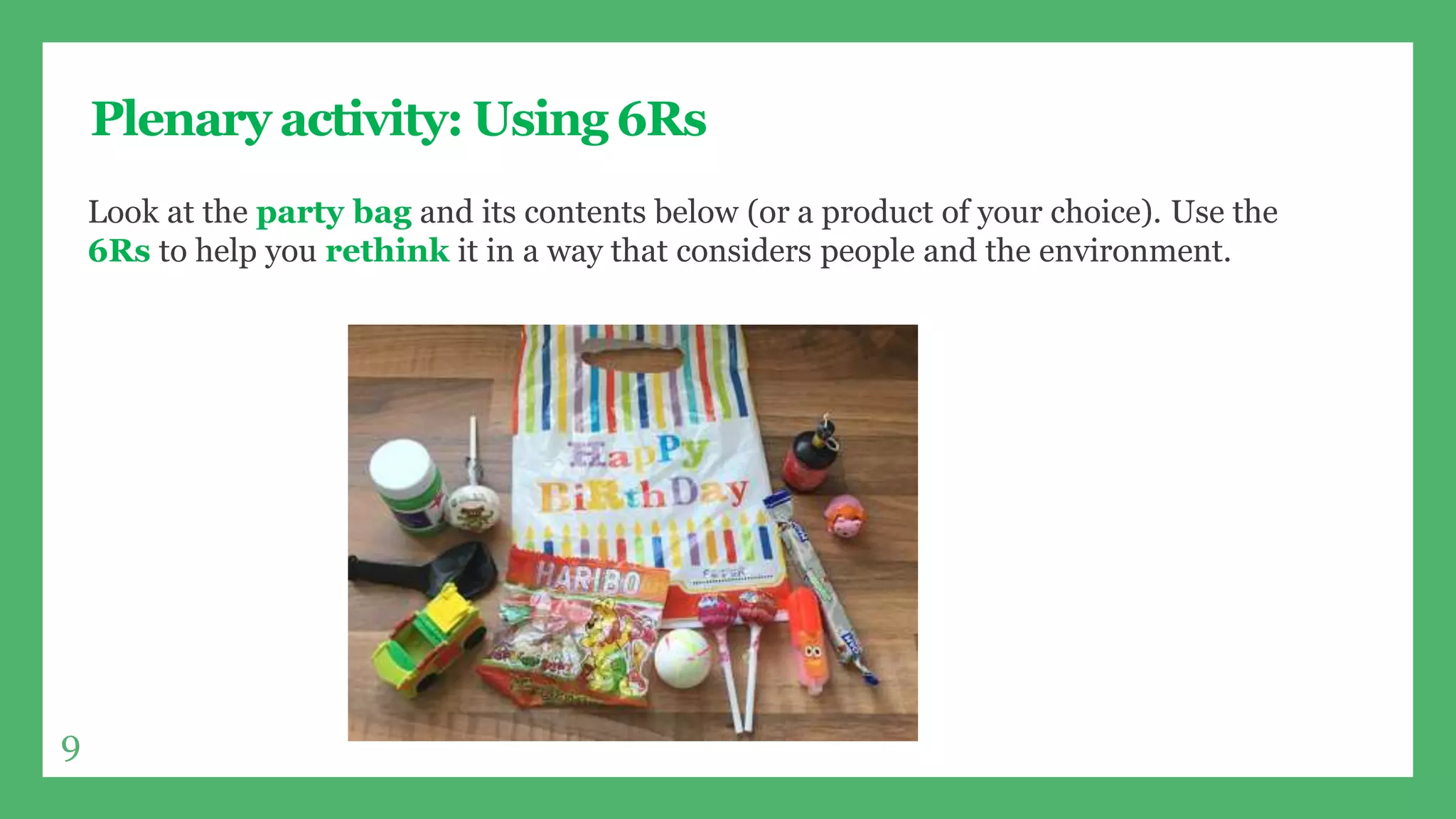
Look at the party bag and its contents below (or a product of your choice). Use the
6Rs to help you rethink it in a way that considers people and the environment.
9
6Rs and party bags
10
Rethink: What could you do differently? Do we need party bags at all?
Refuse: Are there any materials you would choose not to use?
Reduce: Can you reduce the packaging/transportation/use of energy?
Reuse: Can the bag or its contents be used again for another purpose?
Recycle: Have you used material that are easy to recycle when finished with?
Repair: It is possible to mend any of it or will it go to landfill if broken?
Thank
YOU
If you have enjoyed using this
PPT and linked activities, visit
www.practicalaction.org/schools
for more activities on
sustainability

6R's - PPT.pptx

  • 1.
  • 2.
    Did you know? Only1 in every 10,000 products are designed with the environment in mind. Edwin Datschefski 1
  • 3.
    What’s the specification? Working insmall groups, look at the two products that you’ve been given in class (or the two product seen here). Make a list on your worksheet of the design specifications that you think the designer followed to design the two products. 2
  • 4.
    What do youthink is the role of designers? 3 Designers should define their role as agents of good in the world and limit their work to products that are needed and can be made without damage to nature or people. Phillip Starck
  • 5.
    What are thebig sustainability issues for designers? 1. Resource use We use so much and so many materials. Many of the products we use daily use materials that are in scarce supply and are non-renewable. If everyone in the world used as many resources as we do in the UK, we’d need 3 planets the size earth to sustain us. 4
  • 6.
    2. Climate change Theenergy used throughout the product ‘lifecycle’ releases carbon dioxide, which contributes towards climate change. Many products use a lot of energy to; - Process materials and produce - Transport - Use and dispose. 5
  • 7.
    3. Impact onpeople People are involved at each stage of the development of a new product. - Make a list of all the people who might be involved in the production, use and disposal of a pair of jeans. - Who are the people that benefit and who might lose out at different stages of the product lifecycle? 6
  • 8.
    6Rs The 6Rs couldbe a way of helping you think about reducing the impact of a new product on the environment and people. Match the 6Rs on your worksheet to their definitions. 7
  • 9.
    Check you’ve gotthem right Rethink: Do we make too many products? Design in a way that considers people and the environment. Refuse: Don’t use a material or buy a product if you don’t need it or if it’s bad for people or the environment. Reduce: Cut down the amount of material and energy you use as much as you can. Reuse: Use a product to make something else with all or parts of it. Recycle: Reprocess a material or product and make something else. Repair: When a product breaks down or doesn’t work properly, fix it. 8
  • 10.
    Plenary activity: Using6Rs Look at the party bag and its contents below (or a product of your choice). Use the 6Rs to help you rethink it in a way that considers people and the environment. 9
  • 11.
    6Rs and partybags 10 Rethink: What could you do differently? Do we need party bags at all? Refuse: Are there any materials you would choose not to use? Reduce: Can you reduce the packaging/transportation/use of energy? Reuse: Can the bag or its contents be used again for another purpose? Recycle: Have you used material that are easy to recycle when finished with? Repair: It is possible to mend any of it or will it go to landfill if broken?
  • 12.
    Thank YOU If you haveenjoyed using this PPT and linked activities, visit www.practicalaction.org/schools for more activities on sustainability

Editor's Notes

  • #2 This PPT is accompanied by a range of pupil activity sheets found here www.practicalaction.org/schools/6Rs
  • #3 For more quotes on sustainability and design. Go to www.practicalaction.org/schools/sustainability-quotes
  • #4 For ideas of suitable product pairs – look at the Product pairs activity at Practicalaction.org/schools/product-pairs
  • #5 The Belief Circles activity is great to do here as it gives you a range of statements that prompt discussions about the values behand design.