Biodiversity Now!
Problem
• Biodiversity is destroyed in small steps, piece by piece;
– Land use change and fragmentation are globally the most
important drivers of loss of biodiversity and ecosystem services
• Any particular agent causes a negligible change but the sum
of all small changes is considerable over time
• In most cases agents need not to worry about their impacts
on biodiversity
The damager does not pay (unlike the polluter)!
©Terhi Ryttäri
©Markus Sirkka
Challenge
Risk
Loss of biodiversity and ecosystem services threaten
our wellbeing and ability to adapt to climate change
Challenge
How to stop the loss of biodiversity and related
ecosystem services?
Solution
We develop new efficient mechanisms to:
• Neutralize negative impacts on biodiversity
• Turn biodiversity loss to biodiversity improvement
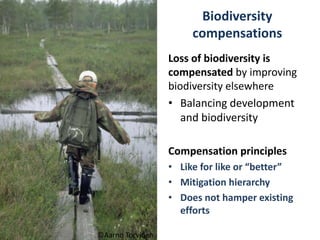
Biodiversity
compensations
Loss of biodiversity is
compensated by improving
biodiversity elsewhere
• Balancing development
and biodiversity
Compensation principles
• Like for like or “better”
• Mitigation hierarchy
• Does not hamper existing
efforts
©Aarno Torvinen
Compensations via offsets
Market based solutions
• Demand for offset: agents causing biodiversity loss
• Supply of offsets: landowners and firms (new business
opportunities)
• Price of offsets: implements the spoiler pays –principle
Universal solution for all developed countries
What is new?
• Compensation via offsetting
– Modern instrument with price
incentives
– Invites firms and landowners to
stop biodiversity loss
– Allows citizens’ participation
• Creative combination - business,
science and policy
– Participatory and experimental
science work
– Improvement in biodiversity
policies
©Raili Malinen
Call for action
• Citizens and NGOs:
– Biodiversity offsetting is
also a contested concept,
– Open discourse needed;
first contacts made
• Firms, urban planners
– The use of compensation
offsets in business and
community planning
• Policy makers
– How to incorporate
compensations to the
Finnish legislation
©Terhi Ryttäri
Team & Skills
• Markku Ollikainen, prof. – economics
• Janne Kotiaho, prof. – ecology, ecosystem restoration
• Olli Ojala, senior researcher – nature conservation, policy
• Eeva Primmer, group leader – environmental governance
• Heli Saarikoski, senior researcher – environmental participation
• Tiina Jääskeläinen, researcher – corporate responsibility
• Jussi Kauppila, senior researcher – law
• Minna Pekkonen, researcher – ecology, nature conservation
Contact us!
Markku Ollikainen tel. 0294158065
Olli Ojala tel. 0295251476

Biodiversity Now!

  • 1.
  • 2.
    Problem • Biodiversity isdestroyed in small steps, piece by piece; – Land use change and fragmentation are globally the most important drivers of loss of biodiversity and ecosystem services • Any particular agent causes a negligible change but the sum of all small changes is considerable over time • In most cases agents need not to worry about their impacts on biodiversity The damager does not pay (unlike the polluter)!
  • 3.
  • 4.
  • 5.
    Challenge Risk Loss of biodiversityand ecosystem services threaten our wellbeing and ability to adapt to climate change Challenge How to stop the loss of biodiversity and related ecosystem services? Solution We develop new efficient mechanisms to: • Neutralize negative impacts on biodiversity • Turn biodiversity loss to biodiversity improvement
  • 6.
    Biodiversity compensations Loss of biodiversityis compensated by improving biodiversity elsewhere • Balancing development and biodiversity Compensation principles • Like for like or “better” • Mitigation hierarchy • Does not hamper existing efforts ©Aarno Torvinen
  • 7.
    Compensations via offsets Marketbased solutions • Demand for offset: agents causing biodiversity loss • Supply of offsets: landowners and firms (new business opportunities) • Price of offsets: implements the spoiler pays –principle Universal solution for all developed countries
  • 8.
    What is new? •Compensation via offsetting – Modern instrument with price incentives – Invites firms and landowners to stop biodiversity loss – Allows citizens’ participation • Creative combination - business, science and policy – Participatory and experimental science work – Improvement in biodiversity policies ©Raili Malinen
  • 9.
    Call for action •Citizens and NGOs: – Biodiversity offsetting is also a contested concept, – Open discourse needed; first contacts made • Firms, urban planners – The use of compensation offsets in business and community planning • Policy makers – How to incorporate compensations to the Finnish legislation ©Terhi Ryttäri
  • 10.
    Team & Skills •Markku Ollikainen, prof. – economics • Janne Kotiaho, prof. – ecology, ecosystem restoration • Olli Ojala, senior researcher – nature conservation, policy • Eeva Primmer, group leader – environmental governance • Heli Saarikoski, senior researcher – environmental participation • Tiina Jääskeläinen, researcher – corporate responsibility • Jussi Kauppila, senior researcher – law • Minna Pekkonen, researcher – ecology, nature conservation Contact us! Markku Ollikainen tel. 0294158065 Olli Ojala tel. 0295251476

Editor's Notes

  • #3 Economic development cannot be stopped but the main beneficiaries of development should participate in bearing the consequences of development. Public goods are enjoyed by everyone but the costs and benefits of their loss is unevenly distributed.
  • #6 Place the responsibility of biodiversity loss on those actors who cause it
  • #7 Avoidance Mitigation Restoration
  • #8 Rare and difficult-to-restore nature costs more on the market than abundant and easy-to-restore nature