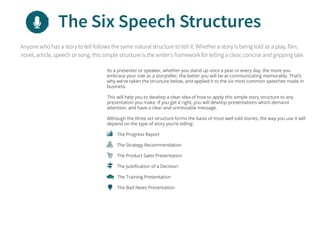
The Six SpeechStructures
Anyone who has a story to tell follows the same natural structure to tell it. Whether a story is being told as a play, film,
novel, article, speech or song, this simple structure is the writer’s framework for telling a clear, concise and gripping tale.
As a presenter or speaker, whether you stand up once a year or every day, the more you
embrace your role as a storyteller, the better you will be at communicating memorably. That’s
why we’ve taken the structure below, and applied it to the six most common speeches made in
business.
This will help you to develop a clear idea of how to apply this simple story structure to any
presentation you make. If you get it right, you will develop presentations which demand
attention, and have a clear and unmissable message.
Although the three act structure forms the basis of most well told stories, the way you use it will
depend on the type of story you’re telling:
The Progress Report
The Strategy Recommendation
The Product Sales Presentation
The Justification of a Decision
The Training Presentation
The Bad News Presentation
3.
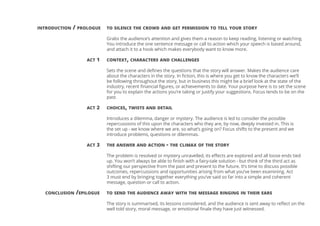
to silence thecrowd and get permission to tell your story
Grabs the audience’s attention and gives them a reason to keep reading, listening or watching.
You introduce the one sentence message or call to action which your speech is based around,
and attach it to a hook which makes everybody want to know more.
context, characters and challenges
Sets the scene and defines the questions that the story will answer. Makes the audience care
about the characters in the story. In fiction, this is where you get to know the characters we’ll
be following throughout the story, but in business this might be a brief look at the state of the
industry, recent financial figures, or achievements to date. Your purpose here is to set the scene
for you to explain the actions you’re taking or justify your suggestions. Focus tends to be on the
past.
choices, twists and detail
Introduces a dilemma, danger or mystery. The audience is led to consider the possible
repercussions of this upon the characters who they are, by now, deeply invested in. This is
the set up - we know where we are, so what’s going on? Focus shifts to the present and we
introduce problems, questions or dilemmas.
the answer and action - the climax of the story
The problem is resolved or mystery unravelled, its effects are explored and all loose ends tied
up. You won’t always be able to finish with a fairy-tale solution - but think of the third act as
shifting our perspective from the past and present to the future. It’s time to discuss possible
outcomes, repercussions and opportunities arising from what you’ve been examining. Act
3 must end by bringing together everything you’ve said so far into a simple and coherent
message, question or call to action.
to send the audience away with the message ringing in their ears
The story is summarised, its lessons considered, and the audience is sent away to reflect on the
well told story, moral message, or emotional finale they have just witnessed.
introduction / prologue
act 1
act 2
act 3
conclusion /epilogue
4.
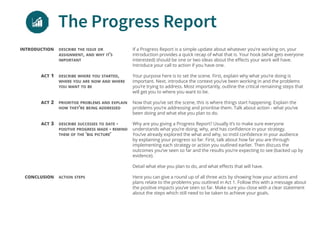
If a ProgressReport is a simple update about whatever you’re working on, your
introduction provides a quick recap of what that is. Your hook (what gets everyone
interested) should be one or two ideas about the effects your work will have.
Introduce your call to action if you have one.
Your purpose here is to set the scene. First, explain why what you’re doing is
important. Next, introduce the context you’ve been working in and the problems
you’re trying to address. Most importantly, outline the critical remaining steps that
will get you to where you want to be.
Now that you’ve set the scene, this is where things start happening. Explain the
problems you’re addressing and prioritise them. Talk about action - what you’ve
been doing and what else you plan to do.
Why are you giving a Progress Report? Usually it’s to make sure everyone
understands what you’re doing, why, and has confidence in your strategy.
You’ve already explored the what and why, so instil confidence in your audience
by explaining your progress so far. First, talk about how far you are through
implementing each strategy or action you outlined earlier. Then discuss the
outcomes you’ve seen so far and the results you’re expecting to see (backed up by
evidence).
Detail what else you plan to do, and what effects that will have.
Here you can give a round up of all three acts by showing how your actions and
plans relate to the problems you outlined in Act 1. Follow this with a message about
the positive impacts you’ve seen so far. Make sure you close with a clear statement
about the steps which still need to be taken to achieve your goals.
describe the issue or
assignment, and why it’s
important
introduction
describe where you started,
where you are now and where
you want to be
act 1
prioritise problems and explain
how they’re being addressed
act 2
describe successes to date -
positive progress made - remind
them of the ‘big picture’
act 3
action steps
conclusion
The Progress Report
5.
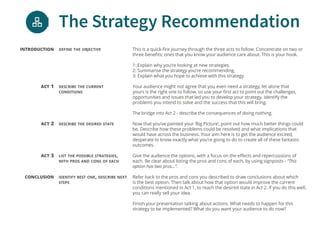
This is aquick-fire journey through the three acts to follow. Concentrate on two or
three benefits; ones that you know your audience care about. This is your hook.
1: Explain why you’re looking at new strategies.
2: Summarise the strategy you’re recommending.
3: Explain what you hope to achieve with this strategy.
Your audience might not agree that you even need a strategy, let alone that
yours is the right one to follow, so use your first act to point out the challenges,
opportunities and issues that led you to develop your strategy. Identify the
problems you intend to solve and the success that this will bring.
The bridge into Act 2 - describe the consequences of doing nothing.
Now that you’ve painted your ‘Big Picture’, point out how much better things could
be. Describe how these problems could be resolved and what implications that
would have across the business. Your aim here is to get the audience excited,
desperate to know exactly what you’re going to do to create all of these fantastic
outcomes.
Give the audience the options, with a focus on the effects and repercussions of
each. Be clear about listing the pros and cons of each, by using signposts - “This
option has two pros...”.
Refer back to the pros and cons you described to draw conclusions about which
is the best option. Then talk about how that option would improve the current
conditions mentioned in Act 1, to reach the desired state in Act 2. If you do this well,
you can really sell your idea.
Finish your presentation talking about actions. What needs to happen for this
strategy to be implemented? What do you want your audience to do now?
define the objective
introduction
describe the current
conditions
act 1
describe the desired state
act 2
list the possible strategies,
with pros and cons of each
act 3
identify best one, describe next
steps
conclusion
The Strategy Recommendation
6.
If you’ve beencharged with giving a sales presentation, chances are you already
know what to do here. Your introduction needs to create a gap for your product
to fill. Show your audience that they need the product - that’s your hook. Then
promise to solve the problem you’ve described with your product, idea or service.
Set the scene by talking in more detail about the need you’re addressing. How is
the problem you’re solving affecting people or business now? Identify the problems
your audience cares about, highlight those - then promise (if you can!) that your
product solves that problem.
Introduce your product and talk about it in terms of the issues you’ve set out. Link
each feature (and only choose those features that are most relevant to today’s
audience) to a problem you have identified, and a benefit, like so:
“The wheelmax 2000 wheels are four times thicker than industry average [feature], so
punctures are reduced by 45% [problem]. Now off-road mountain bikers can have more
of the fun, and none of the hassle [benefit] of punctures in the middle of their best-ever
journey.”
It’s time for evidence. Use facts, stats and case studies your audience can relate to,
and that support the points you made in Act 1.
Summarise your argument, and spell out exactly what you want to happen next.
Open up for conversation, so that you can come to an agreement.
introduction frame the customer’s ‘need’
that the product, service, or
idea addresses
describe the need in more
detail
act 1
describe how your solution
addresses the need
act 2
prove the benefits of buying in
to your solution
act 3
get agreement on a next step
conclusion
The Product Sales Presentation
7.
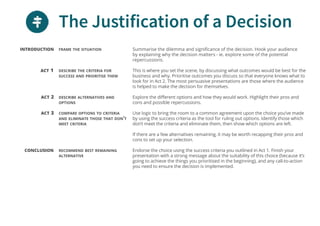
Summarise the dilemmaand significance of the decision. Hook your audience
by explaining why the decision matters - ie. explore some of the potential
repercussions.
This is where you set the scene, by discussing what outcomes would be best for the
business and why. Prioritise outcomes you discuss so that everyone knows what to
look for in Act 2. The most persuasive presentations are those where the audience
is helped to make the decision for themselves.
Explore the different options and how they would work. Highlight their pros and
cons and possible repercussions.
Use logic to bring the room to a common agreement upon the choice you’ve made
by using the success criteria as the tool for ruling out options. Identify those which
don’t meet the criteria and eliminate them, then show which options are left.
If there are a few alternatives remaining, it may be worth recapping their pros and
cons to set up your selection.
Endorse the choice using the success criteria you outlined in Act 1. Finish your
presentation with a strong message about the suitability of this choice (because it’s
going to achieve the things you prioritised in the beginning), and any call-to-action
you need to ensure the decision is implemented.
frame the situation
introduction
describe the criteria for
success and prioritise them
act 1
describe alternatives and
options
act 2
compare options to criteria
and eliminate those that don’t
meet criteria
act 3
recommend best remaining
alternative
conclusion
The Justification of a Decision
8.
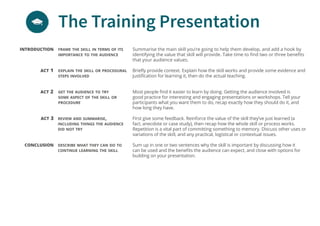
Summarise the mainskill you’re going to help them develop, and add a hook by
identifying the value that skill will provide. Take time to find two or three benefits
that your audience values.
Briefly provide context. Explain how the skill works and provide some evidence and
justification for learning it, then do the actual teaching.
Most people find it easier to learn by doing. Getting the audience involved is
good practice for interesting and engaging presentations or workshops. Tell your
participants what you want them to do, recap exactly how they should do it, and
how long they have.
First give some feedback. Reinforce the value of the skill they’ve just learned (a
fact, anecdote or case study), then recap how the whole skill or process works.
Repetition is a vital part of committing something to memory. Discuss other uses or
variations of the skill, and any practical, logistical or contextual issues.
Sum up in one or two sentences why the skill is important by discussing how it
can be used and the benefits the audience can expect, and close with options for
building on your presentation.
frame the skill in terms of its
importance to the audience
introduction
explain the skill or procedural
steps involved
act 1
get the audience to try
some aspect of the skill or
procedure
act 2
review and summarise,
including things the audience
did not try
act 3
describe what they can do to
continue learning the skill
conclusion
The Training Presentation
9.
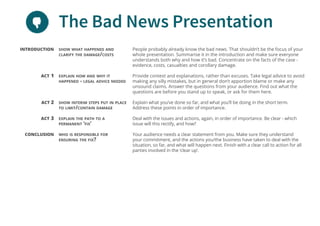
People probably alreadyknow the bad news. That shouldn’t be the focus of your
whole presentation. Summarise it in the introduction and make sure everyone
understands both why and how it’s bad. Concentrate on the facts of the case -
evidence, costs, casualties and corollary damage.
Provide context and explanations, rather than excuses. Take legal advice to avoid
making any silly mistakes, but in general don’t apportion blame or make any
unsound claims. Answer the questions from your audience. Find out what the
questions are before you stand up to speak, or ask for them here.
Explain what you’ve done so far, and what you’ll be doing in the short term.
Address these points in order of importance.
Deal with the issues and actions, again, in order of importance. Be clear - which
issue will this rectify, and how?
Your audience needs a clear statement from you. Make sure they understand
your commitment, and the actions you/the business have taken to deal with the
situation, so far, and what will happen next. Finish with a clear call to action for all
parties involved in the ‘clear up’.
show what happened and
clarify the damage/costs
introduction
explain how and why it
happened - legal advice needed
act 1
show interim steps put in place
to limit/contain damage
act 2
explain the path to a
permanent ‘fix’
act 3
who is responsible for
ensuring the fix?
conclusion
The Bad News Presentation

![If you’ve been charged with giving a sales presentation, chances are you already
know what to do here. Your introduction needs to create a gap for your product
to fill. Show your audience that they need the product - that’s your hook. Then
promise to solve the problem you’ve described with your product, idea or service.
Set the scene by talking in more detail about the need you’re addressing. How is
the problem you’re solving affecting people or business now? Identify the problems
your audience cares about, highlight those - then promise (if you can!) that your
product solves that problem.
Introduce your product and talk about it in terms of the issues you’ve set out. Link
each feature (and only choose those features that are most relevant to today’s
audience) to a problem you have identified, and a benefit, like so:
“The wheelmax 2000 wheels are four times thicker than industry average [feature], so
punctures are reduced by 45% [problem]. Now off-road mountain bikers can have more
of the fun, and none of the hassle [benefit] of punctures in the middle of their best-ever
journey.”
It’s time for evidence. Use facts, stats and case studies your audience can relate to,
and that support the points you made in Act 1.
Summarise your argument, and spell out exactly what you want to happen next.
Open up for conversation, so that you can come to an agreement.
introduction frame the customer’s ‘need’
that the product, service, or
idea addresses
describe the need in more
detail
act 1
describe how your solution
addresses the need
act 2
prove the benefits of buying in
to your solution
act 3
get agreement on a next step
conclusion
The Product Sales Presentation](https://image.slidesharecdn.com/6-speech-structures-final-250921020831-397c5354/85/6-Speech-Structures-is-a-boon-to-everyone-6-320.jpg)



![Senior academic prof[1]](https://cdn.slidesharecdn.com/ss_thumbnails/senioracademicprof1-160330102347-thumbnail.jpg?width=640&height=640&fit=bounds)


