2-1
Process Selection &
Facility Layout
PROCESS SELECTIONPROCESS SELECTION
◦ Processes convert inputs into outputs
◦ Process selection refers to deciding on the way production of
goods or services will be organized
◦ It affects the entire organization and its ability to achieve its
mission and effective supply chain system
PROCESS SELECTION (CONTD.)PROCESS SELECTION (CONTD.)
◦ Key aspects help in process selection are –
◦ Capital Intensity – The mix of equipment and labor that will be
used by the organization
◦ Process Flexibility – The degree to which the system can be
adjusted to changes in processing requirements due to such
factors as changes in product or service design, changes in
volume processed and changes in technology
How much variety
in products or
services will the
system need to
handle
What degree of
equipment
flexibility will be
needed
What is the
expected volume
of output
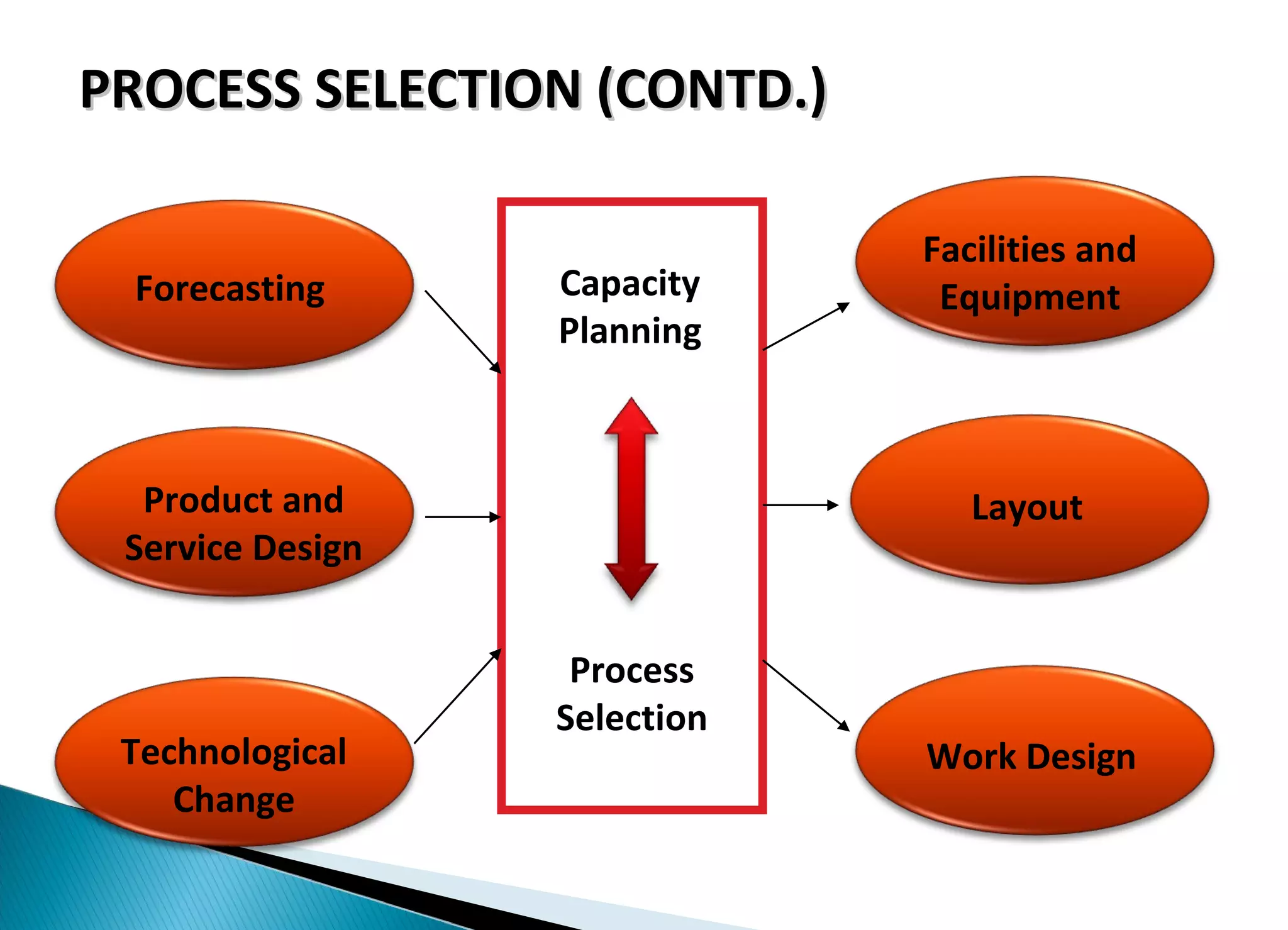
Forecasting
Product and
Service Design
Technological
Change
Capacity
Planning
Process
Selection
Facilities and
Equipment
Layout
Work Design
PROCESS SELECTION (CONTD.)PROCESS SELECTION (CONTD.)
PROCESS TYPESPROCESS TYPES
JOB SHOP
◦ A job shop usually operates on a relatively small scale. It is
used when a low volume of high variety goods or service will
be needed.
◦ Here processing is intermittent – work includes small jobs,
each with different processing requirements
◦ High flexibility using general purpose equipment and skilled
workers are important characteristics of a job shop
Organization producing state of the art tools
Hospital medical service
PROCESS TYPES (CONTD.)PROCESS TYPES (CONTD.)
BATCH
◦ Batch processing is used when a moderate volume of goods or
services is desired. Also it can handle a moderate variety in
products or services
◦ The equipment need not be as flexible as in a job shop but
processing is still intermittent
◦ The skill level of workers does not need to be as high as in a
job shop because there is less variety in the jobs
Bakeries which make bread, cakes, cookies in batches
Plane carrying batches of people from airport to airport
Class room lecture, Concerts, Television programs
PROCESS TYPES (CONTD.)PROCESS TYPES (CONTD.)
REPETITIVE
◦ When higher volumes of more standardized goods or services
are needed, repetitive processing is used. Standardized output
means only slight flexibility of equipment is needed
◦ The requirement of skilled workers is generally low
Manufacturing plants producing pencils, television sets etc.
Automatic carwash, cafeteria lines etc.
PROCESS TYPES (CONTD.)PROCESS TYPES (CONTD.)
CONTINUOUS FLOW
◦ When a very high volume of nondiscrete, highly standardized
output is desired, a continuous system is used
◦ These systems have almost no variety in output and hence no
need for equipment flexibility
◦ Highly specialized equipment can turn down the requirement
of expert worker
Factory producing sugar, flour, steel, salt
Internet service
PROCESS TYPES (CONTD.)PROCESS TYPES (CONTD.)
PROJECT
◦ A nonrepetitive set of activities directed toward a unique goal
within limited time frame
◦ A project is used for work that is nonroutine, with a unique set
of objectives to be accomplished in a limited time frame
◦ Equipment flexibility and worker skill can range from low to
high
Building a dam, making a motion picture,
Launching a new product or service
AUTOMATIONAUTOMATION
◦ Automation is machinery that has sensing and control devices
that enable it to operate automatically
◦ Automation can range from factories that are completely
automated to a single automated operation. Now a days
service is also enjoying automation. For example, Bank ATM
system
◦ Automation offers a number of advantages over human labor
◦ It has low variability whereas it is difficult for a human to
perform a task in exactly the same way, in the same
amount of time
◦ Machines do not get bored or distracted, nor they go out
on strike, ask for higher wages or for labor grievances
AUTOMATION (CONTD.)AUTOMATION (CONTD.)
◦ Automation is frequently pushed as a strategy necessary for
cost competitiveness
◦ Automation also offers a number of disadvantages over
human labor
◦ Technology is very expensive, usually it requires high
volumes of output to offset high costs
◦ Automation is much less flexible. Once the process has
been automated, there is substantial reason for not
changing it
Careful planning is necessary to successfully integrate automation into
a production system
Manufacturing cell, N/C machine, FMS
TYPES OF AUTOMATIONTYPES OF AUTOMATION
FIXED AUTOMATION
◦ It is the most rigid type automation. Sometimes referred as
Detroit type automation
◦ It uses low cost, specialized equipment for a fixed sequence of
operations. Low cost and high volume production are its
primary advantages
◦ Minimal variety and the cost of making major changes in
either product or process are its primary limitations
TYPES OF AUTOMATION (CONTD.)TYPES OF AUTOMATION (CONTD.)
PROGRAMMABLE AUTOMATION
◦ Programmable automation involves use of high cost, general
purpose equipment controlled by a computer program. The
computer provides both the sequence of operations and
specific details about each operation
◦ It has the capability of economically producing a fairly wide
variety of low volume products in small batches
Robot is a machine consisting of a mechanical arm, a
power supply and a controller. Robots can handle a wide
variety of tasks including welding, assembly, loading and
unloading of machines, painting and testing.
TYPES OF AUTOMATION (CONTD.)TYPES OF AUTOMATION (CONTD.)
FLEXIBLE AUTOMATION
◦ Flexible Manufacturing System (FMS): A FMS is a group of
machines that include supervisory computer control,
automatic material handling and robots. This system can
produce a variety of similar products. Systems can range from
three or four machines to more than a dozen
◦ It has the capability of reducing labor cost and maintain the
quality constantly
◦ It requires less capital investment and offers high flexibility
than fixed automation
◦ FMS helps to achieve both the flexibility of job shop
processing and productivity of repetitive process systems
FACILITIES LAYOUTFACILITIES LAYOUT
◦ The configuration of departments, work centers, and
equipment, with particular emphasis on movement of work
(customers or materials) through the system
◦ Product layouts
◦ Process layouts
◦ Fixed-Position layout
◦ Combination layouts Layout decisions
involve long
term
commitment
OBJECTIVE OF LAYOUT DESIGNOBJECTIVE OF LAYOUT DESIGN
◦ Facilitate attainment of product or service quality
◦ Use workers and space efficiently
◦ Avoid bottlenecks
◦ Minimize unnecessary material handling costs
◦ Eliminate unnecessary movement of workers or materials
◦ Minimize production time or customer service time
◦ Design for safety
PRODUCT LAYOUTPRODUCT LAYOUT
◦ Layout that uses standardized processing operations to
achieve smooth, rapid, high-volume output
PROCESS LAYOUTPROCESS LAYOUT
◦ Layout that can handle varied processing requirements
Good for
repetitive &
continuous
process
Good for job
shop & batch
process
FIXED POSITION LAYOUTFIXED POSITION LAYOUT
◦ Layout in which the product or project remains stationary, and
workers, materials, and equipment are moved as needed
◦ Line Balancing is the process of assigning tasks to
workstations in such a way that the workstations have
approximately equal time requirements.
◦ Precedence diagram Tool used in line balancing to display
elemental tasks and sequence requirements.
◦ Cycle time is the maximum time allowed at each workstation
to complete its set of tasks on a unit.
◦ Layout in which machines are grouped into a cell that can
process items that have similar processing requirements is
cellular layout.
6. process selection and facility layout

6. process selection and facility layout

  • 1.
  • 2.
    PROCESS SELECTIONPROCESS SELECTION ◦Processes convert inputs into outputs ◦ Process selection refers to deciding on the way production of goods or services will be organized ◦ It affects the entire organization and its ability to achieve its mission and effective supply chain system
  • 3.
    PROCESS SELECTION (CONTD.)PROCESSSELECTION (CONTD.) ◦ Key aspects help in process selection are – ◦ Capital Intensity – The mix of equipment and labor that will be used by the organization ◦ Process Flexibility – The degree to which the system can be adjusted to changes in processing requirements due to such factors as changes in product or service design, changes in volume processed and changes in technology How much variety in products or services will the system need to handle What degree of equipment flexibility will be needed What is the expected volume of output
  • 4.
    Forecasting Product and Service Design Technological Change Capacity Planning Process Selection Facilitiesand Equipment Layout Work Design PROCESS SELECTION (CONTD.)PROCESS SELECTION (CONTD.)
  • 5.
    PROCESS TYPESPROCESS TYPES JOBSHOP ◦ A job shop usually operates on a relatively small scale. It is used when a low volume of high variety goods or service will be needed. ◦ Here processing is intermittent – work includes small jobs, each with different processing requirements ◦ High flexibility using general purpose equipment and skilled workers are important characteristics of a job shop Organization producing state of the art tools Hospital medical service
  • 6.
    PROCESS TYPES (CONTD.)PROCESSTYPES (CONTD.) BATCH ◦ Batch processing is used when a moderate volume of goods or services is desired. Also it can handle a moderate variety in products or services ◦ The equipment need not be as flexible as in a job shop but processing is still intermittent ◦ The skill level of workers does not need to be as high as in a job shop because there is less variety in the jobs Bakeries which make bread, cakes, cookies in batches Plane carrying batches of people from airport to airport Class room lecture, Concerts, Television programs
  • 7.
    PROCESS TYPES (CONTD.)PROCESSTYPES (CONTD.) REPETITIVE ◦ When higher volumes of more standardized goods or services are needed, repetitive processing is used. Standardized output means only slight flexibility of equipment is needed ◦ The requirement of skilled workers is generally low Manufacturing plants producing pencils, television sets etc. Automatic carwash, cafeteria lines etc.
  • 8.
    PROCESS TYPES (CONTD.)PROCESSTYPES (CONTD.) CONTINUOUS FLOW ◦ When a very high volume of nondiscrete, highly standardized output is desired, a continuous system is used ◦ These systems have almost no variety in output and hence no need for equipment flexibility ◦ Highly specialized equipment can turn down the requirement of expert worker Factory producing sugar, flour, steel, salt Internet service
  • 9.
    PROCESS TYPES (CONTD.)PROCESSTYPES (CONTD.) PROJECT ◦ A nonrepetitive set of activities directed toward a unique goal within limited time frame ◦ A project is used for work that is nonroutine, with a unique set of objectives to be accomplished in a limited time frame ◦ Equipment flexibility and worker skill can range from low to high Building a dam, making a motion picture, Launching a new product or service
  • 10.
    AUTOMATIONAUTOMATION ◦ Automation ismachinery that has sensing and control devices that enable it to operate automatically ◦ Automation can range from factories that are completely automated to a single automated operation. Now a days service is also enjoying automation. For example, Bank ATM system ◦ Automation offers a number of advantages over human labor ◦ It has low variability whereas it is difficult for a human to perform a task in exactly the same way, in the same amount of time ◦ Machines do not get bored or distracted, nor they go out on strike, ask for higher wages or for labor grievances
  • 11.
    AUTOMATION (CONTD.)AUTOMATION (CONTD.) ◦Automation is frequently pushed as a strategy necessary for cost competitiveness ◦ Automation also offers a number of disadvantages over human labor ◦ Technology is very expensive, usually it requires high volumes of output to offset high costs ◦ Automation is much less flexible. Once the process has been automated, there is substantial reason for not changing it Careful planning is necessary to successfully integrate automation into a production system Manufacturing cell, N/C machine, FMS
  • 12.
    TYPES OF AUTOMATIONTYPESOF AUTOMATION FIXED AUTOMATION ◦ It is the most rigid type automation. Sometimes referred as Detroit type automation ◦ It uses low cost, specialized equipment for a fixed sequence of operations. Low cost and high volume production are its primary advantages ◦ Minimal variety and the cost of making major changes in either product or process are its primary limitations
  • 13.
    TYPES OF AUTOMATION(CONTD.)TYPES OF AUTOMATION (CONTD.) PROGRAMMABLE AUTOMATION ◦ Programmable automation involves use of high cost, general purpose equipment controlled by a computer program. The computer provides both the sequence of operations and specific details about each operation ◦ It has the capability of economically producing a fairly wide variety of low volume products in small batches Robot is a machine consisting of a mechanical arm, a power supply and a controller. Robots can handle a wide variety of tasks including welding, assembly, loading and unloading of machines, painting and testing.
  • 14.
    TYPES OF AUTOMATION(CONTD.)TYPES OF AUTOMATION (CONTD.) FLEXIBLE AUTOMATION ◦ Flexible Manufacturing System (FMS): A FMS is a group of machines that include supervisory computer control, automatic material handling and robots. This system can produce a variety of similar products. Systems can range from three or four machines to more than a dozen ◦ It has the capability of reducing labor cost and maintain the quality constantly ◦ It requires less capital investment and offers high flexibility than fixed automation ◦ FMS helps to achieve both the flexibility of job shop processing and productivity of repetitive process systems
  • 15.
    FACILITIES LAYOUTFACILITIES LAYOUT ◦The configuration of departments, work centers, and equipment, with particular emphasis on movement of work (customers or materials) through the system ◦ Product layouts ◦ Process layouts ◦ Fixed-Position layout ◦ Combination layouts Layout decisions involve long term commitment
  • 16.
    OBJECTIVE OF LAYOUTDESIGNOBJECTIVE OF LAYOUT DESIGN ◦ Facilitate attainment of product or service quality ◦ Use workers and space efficiently ◦ Avoid bottlenecks ◦ Minimize unnecessary material handling costs ◦ Eliminate unnecessary movement of workers or materials ◦ Minimize production time or customer service time ◦ Design for safety
  • 17.
    PRODUCT LAYOUTPRODUCT LAYOUT ◦Layout that uses standardized processing operations to achieve smooth, rapid, high-volume output PROCESS LAYOUTPROCESS LAYOUT ◦ Layout that can handle varied processing requirements Good for repetitive & continuous process Good for job shop & batch process
  • 18.
    FIXED POSITION LAYOUTFIXEDPOSITION LAYOUT ◦ Layout in which the product or project remains stationary, and workers, materials, and equipment are moved as needed ◦ Line Balancing is the process of assigning tasks to workstations in such a way that the workstations have approximately equal time requirements. ◦ Precedence diagram Tool used in line balancing to display elemental tasks and sequence requirements. ◦ Cycle time is the maximum time allowed at each workstation to complete its set of tasks on a unit. ◦ Layout in which machines are grouped into a cell that can process items that have similar processing requirements is cellular layout.