The document discusses process selection and facility layout. It defines process selection as how an organization chooses to produce goods or services, considering factors like capacity, flexibility, and volume. The main process types described are continuous, repetitive/assembly line, batch, job shop, and automation. Facility layout refers to the configuration of departments and equipment to facilitate material flow. The summary discusses that layout decisions are important because they require substantial investments and long-term commitments that impact costs, efficiency, and operations. Layout decisions also help address issues like bottlenecks, changes to products/services, safety hazards, and strategic priorities.
Process Selection And
FacilityLayout
Group 01
142111 R.M.S.Kumara
142126 C.M.Akurana
142127 D.S.K.Arachchi
142140 L.A.S.Gunawardana
142142 H.M.P.E.Herath
2.
Outline
1. Process Selection
1.1Introduction
1.2 Process Strategies
1.3 Process Types
2. Facility Layout
2.1 Introduction
2.2 Importance Of Layout
Decision
2.3 Need For Layout Decision
Introduction
•Major implications
–Capacity planning
–Layoutof facilities
–Equipment
–Design of work systems
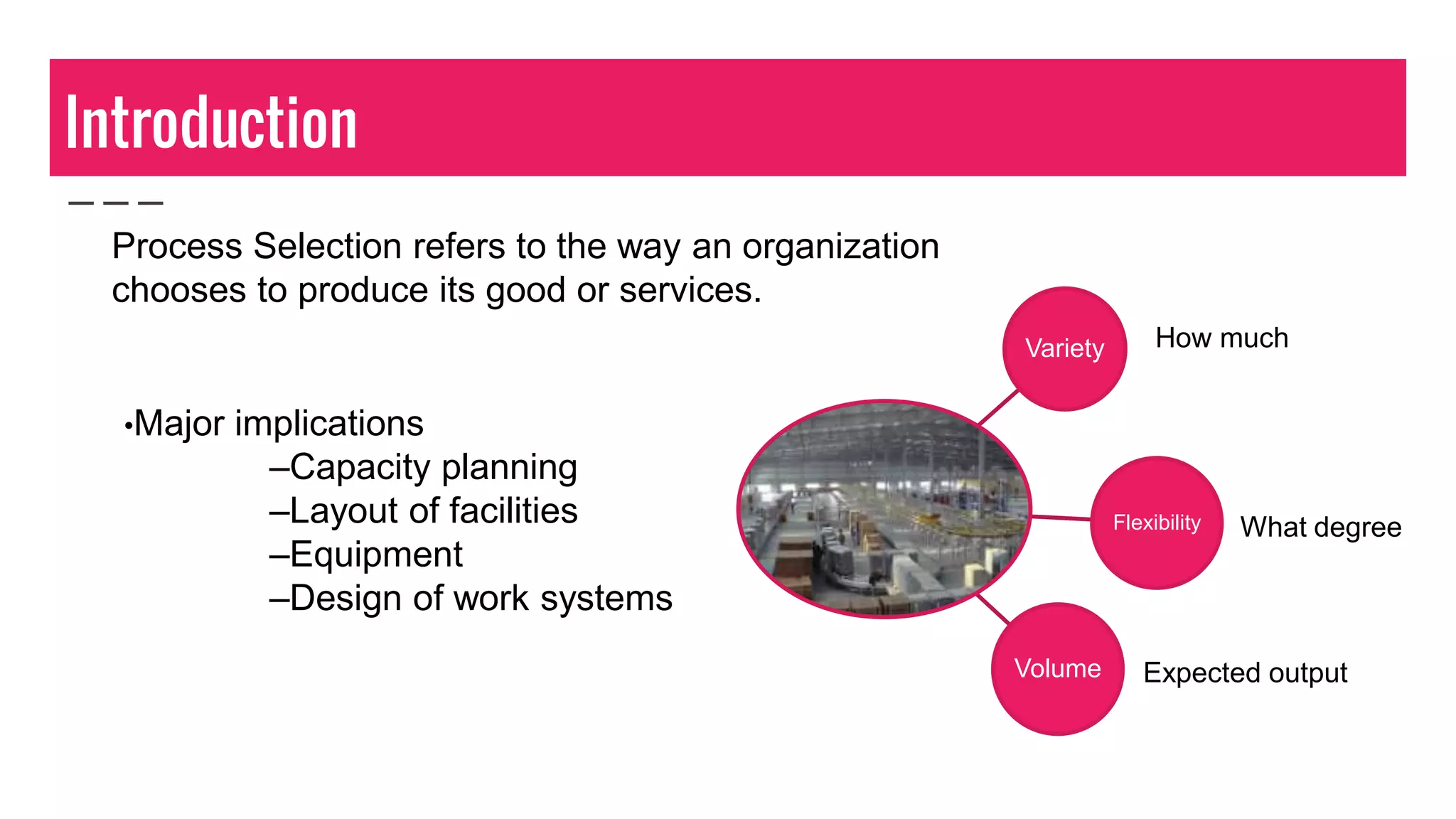
Variety
Flexibility
Volume
Process Selection refers to the way an organization
chooses to produce its good or services.
How much
What degree
Expected output
5.
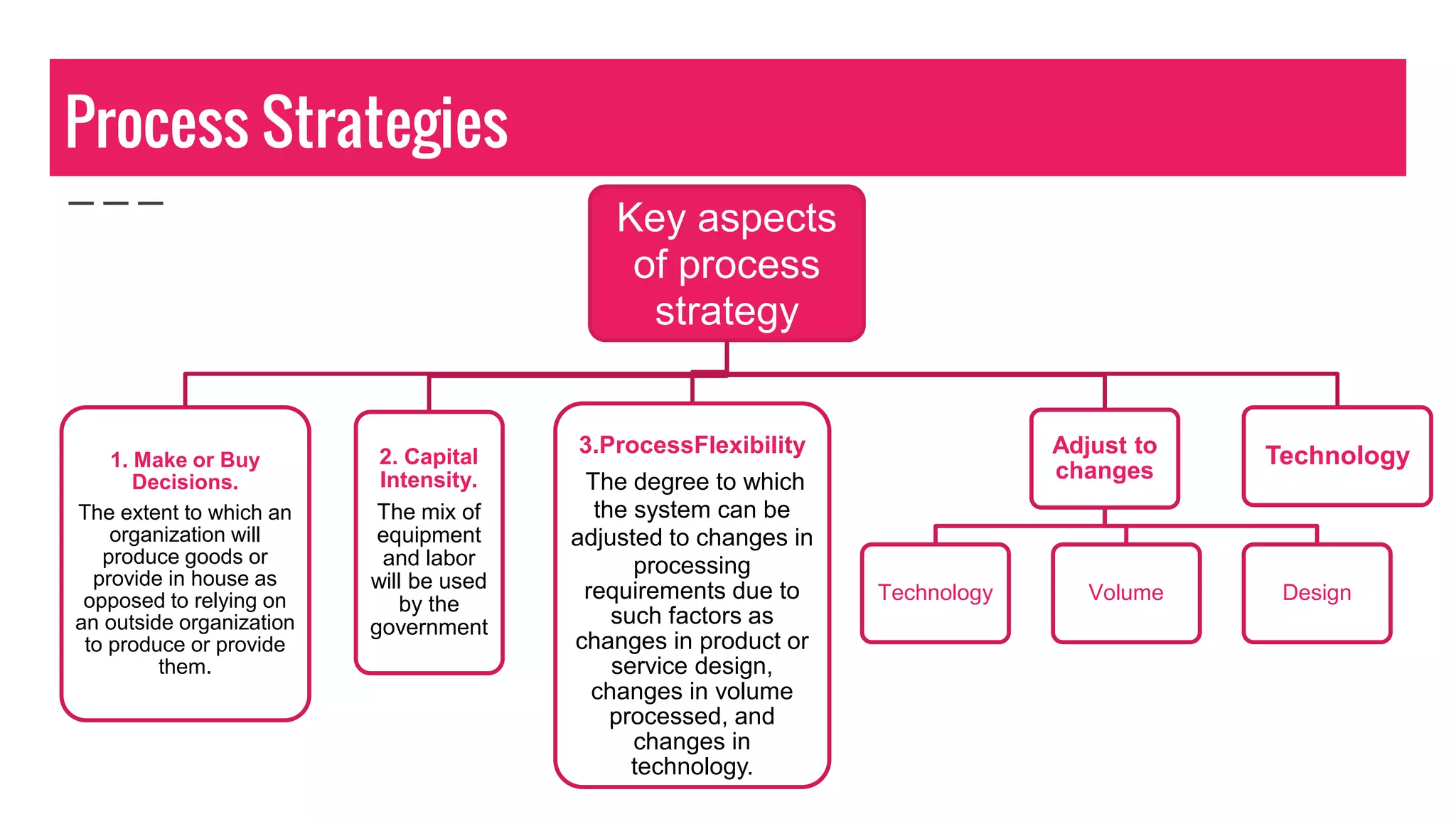
Process Strategies
Key aspects
ofprocess
strategy
1. Make or Buy
Decisions.
The extent to which an
organization will
produce goods or
provide in house as
opposed to relying on
an outside organization
to produce or provide
them.
2. Capital
Intensity.
The mix of
equipment
and labor
will be used
by the
government
3.ProcessFlexibility
The degree to which
the system can be
adjusted to changes in
processing
requirements due to
such factors as
changes in product or
service design,
changes in volume
processed, and
changes in
technology.
Adjust to
changes
Technology Volume Design
Technology
Continuous
• Veryhigh volumes of non-discrete goods
•Advantages
– Lower variable cost per unit
– Lower but more specialized labor skills
– Easier production planning and control
– Higher equipment utilization (70% to 90%)
• Disadvantages
– Lower product flexibility
– More specialized equipment
– Usually higher capital investment
Examples:- A continuous process. An oil refinery
performs a continuous process, breaking down crude
oil into petroleum, chemicals, and many other products
,Processing of chemicals, photographic film,
newsprint.
8.
Repetitive/assembly line
•High volumes of standardized goods or services
Examples:-A repetitive process: Binney& Smith, maker
of Crayola products, produces nearly 3 billion crayons
each year in its Easton, PA, manufacturing facility,
Automobiles, televisions, computers ,calculators,
cameras and video equipments
• More structured than process-focused, less structured
than product focused
• Enables quasi-customization
• Using modules, it enjoys economic advantage of
continuous process, and custom advantage of low
volume, high-variety model
9.
Batch
Moderate volume
Asystem used to produce moderate volumes of
similar items.
Examples
1. A batch process: Food is prepared, one menu item at
a time, in the kitchen of the Spago Restaurant in the
Forum at Caesar’s Palace, Las Vegas, Nevada.
2. Paint, ice cream, canned vegetables
3. Magazines, newspapers, textbooks and user
manuals.
10.
Job shop
•Smallscale Example:- A job shop process: A mid western hospital medical
team performs a diagnostic procedure involving a cardiac
catheterization. Paint, ice cream, canned vegetables,
Magazines, newspapers, textbooks and user manuals.
•Advantages
– Greater product flexibility
– More general purpose equipment
– Lower initial capital investment
• Disadvantages
– High variable costs
– More highly trained personnel
– More difficult production planning & control
– Low equipment utilization (5% to 25%)
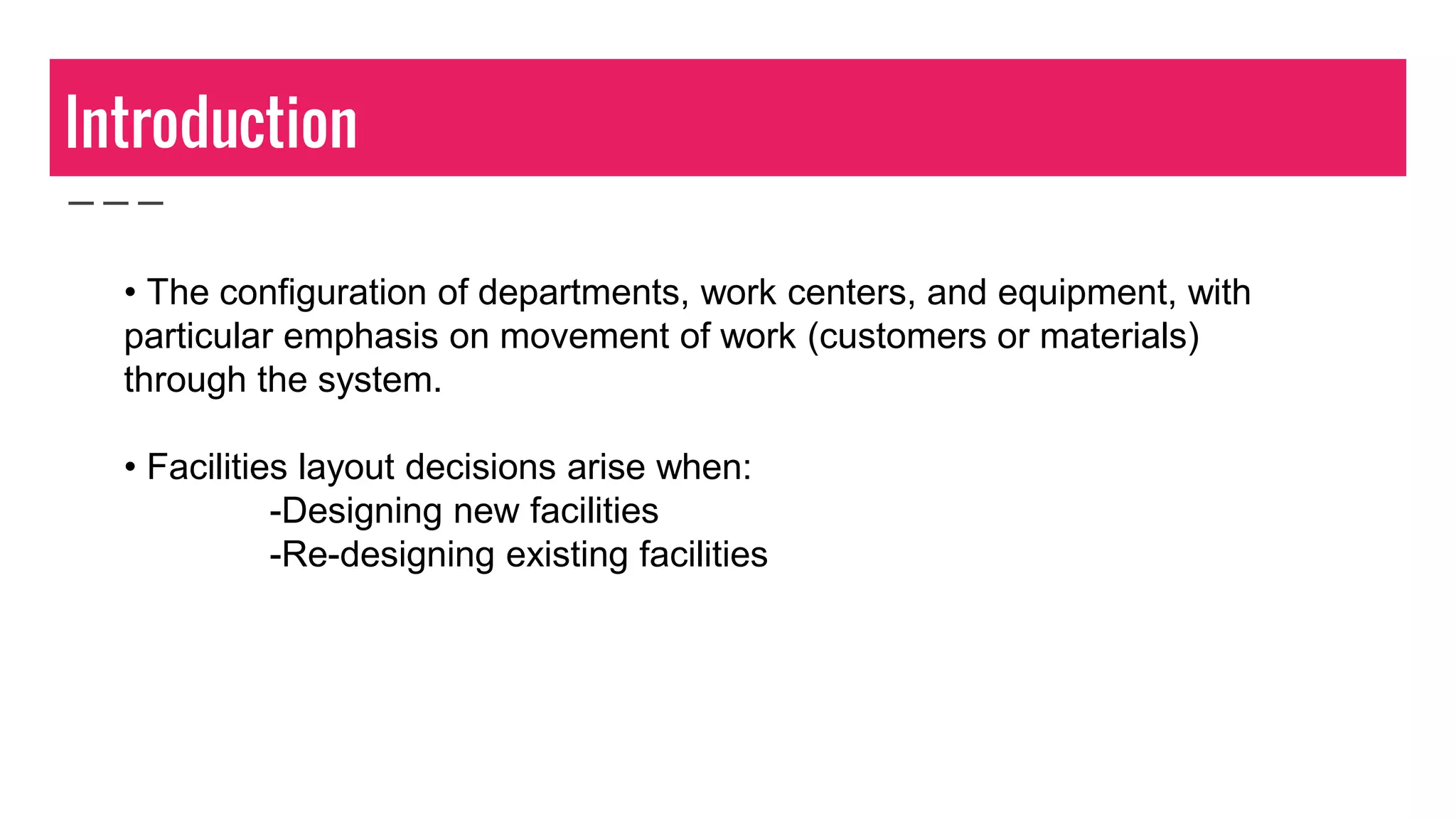
Introduction
• The configurationof departments, work centers, and equipment, with
particular emphasis on movement of work (customers or materials)
through the system.
• Facilities layout decisions arise when:
-Designing new facilities
-Re-designing existing facilities
15.
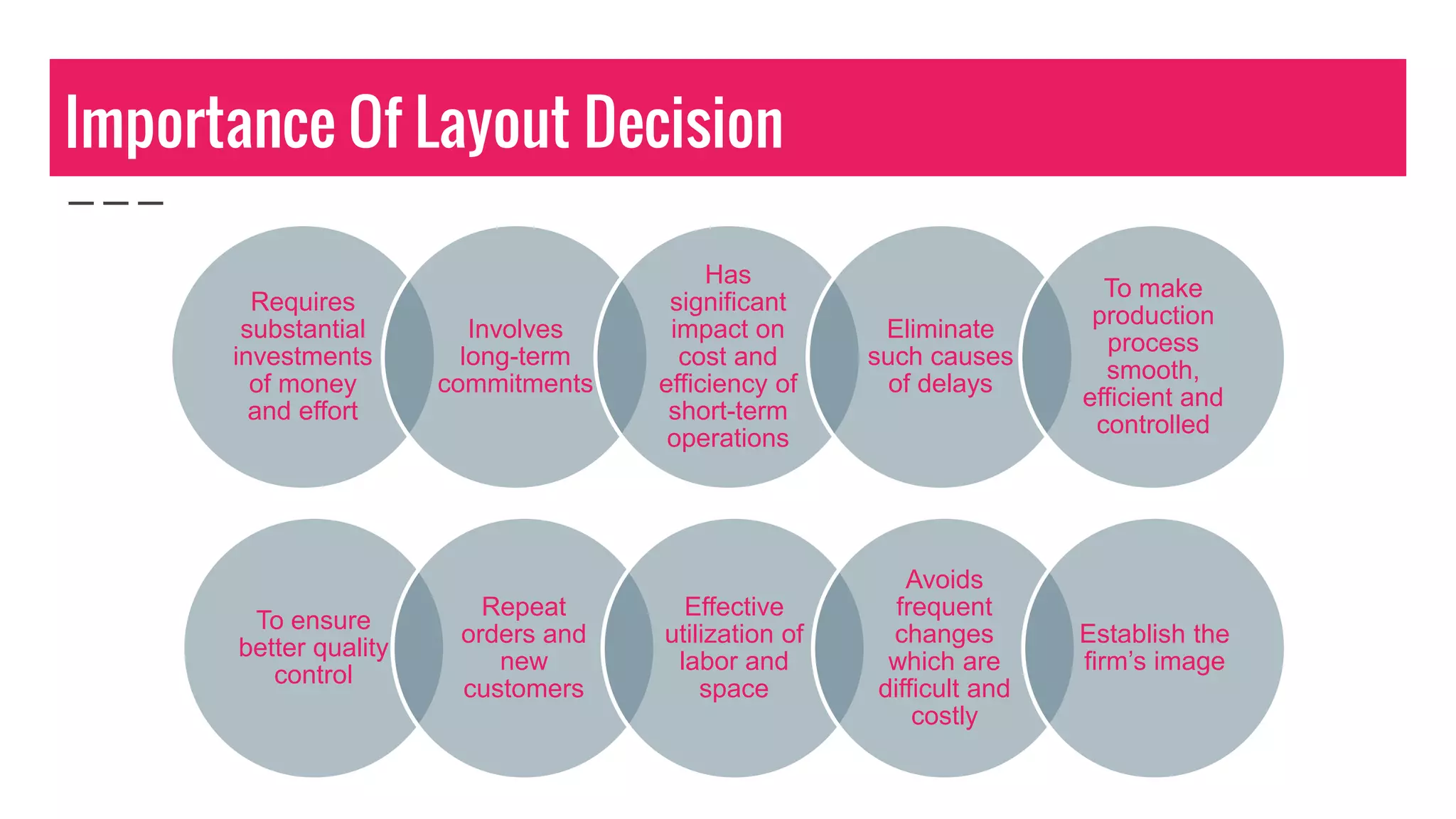
Importance Of LayoutDecision
Requires
substantial
investments
of money
and effort
Involves
long-term
commitments
Has
significant
impact on
cost and
efficiency of
short-term
operations
Eliminate
such causes
of delays
To make
production
process
smooth,
efficient and
controlled
To ensure
better quality
control
Repeat
orders and
new
customers
Effective
utilization of
labor and
space
Avoids
frequent
changes
which are
difficult and
costly
Establish the
firm’s image
16.
Need For LayoutDecision
Inefficient operations For Example: High Cost Bottlenecks
Changes in the design of products or services
The introduction of new products or services
Accidents-Safety hazards
It helps to determine long term efficiency.
It establishes company’s competitive priorities in regards to capacity, process
flexibility
It helps organization to achieve strategic advantage that support differentiation,
low cost and fast repose