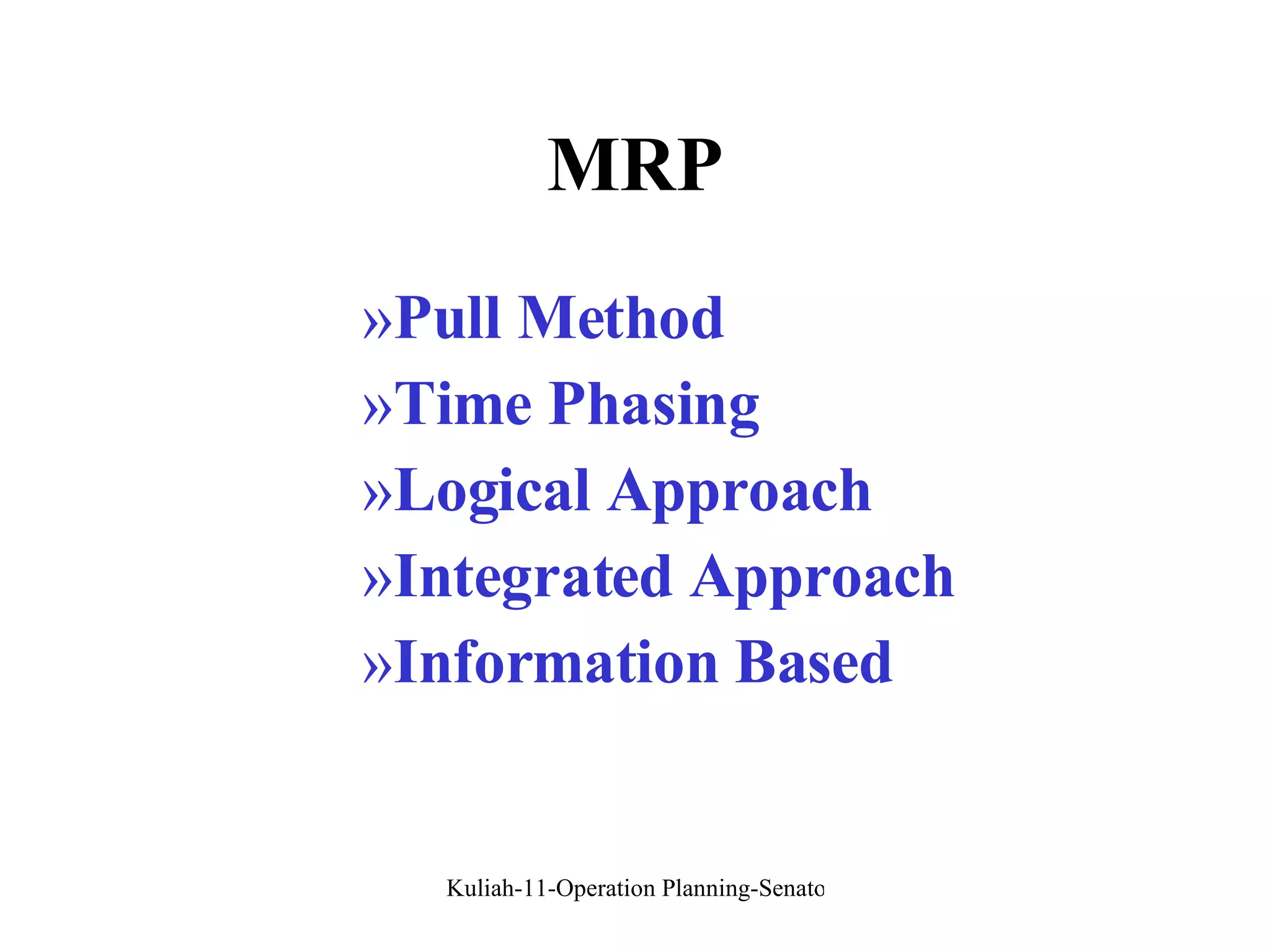
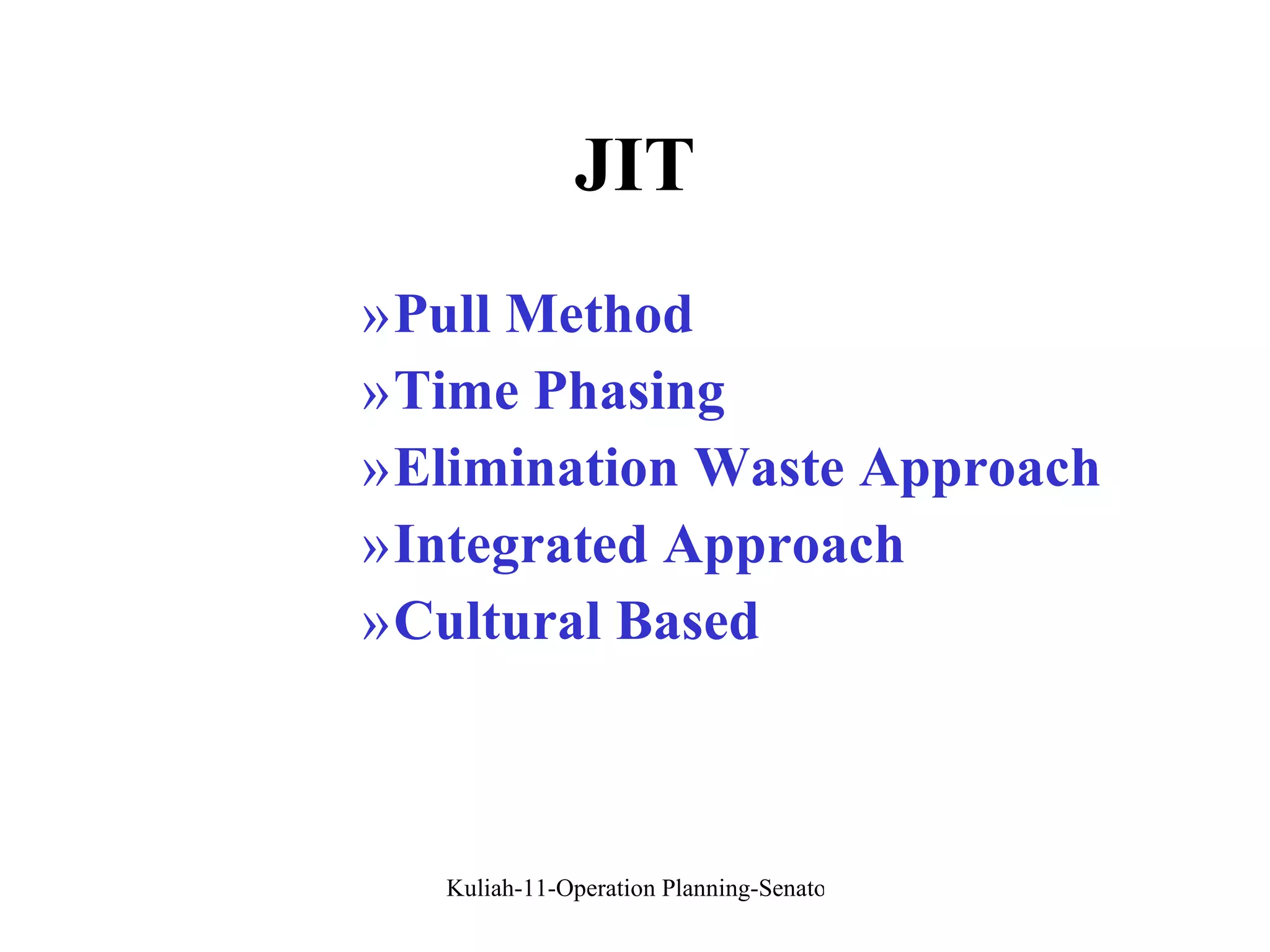
The document discusses operation system design and planning. It covers key aspects like the life cycle of an operation system, product/service and process technology diffusion, major classifications of manufacturing and service processes, equipment selection considerations, types of facility layouts, and operation planning methods. The goal of operation system design is to permit production of goods and services at desired quality, volumes, and cost over the life cycle through integration of product/service delivery with facilities and process technologies.
Operation System Design The Integration of Product and Service Delivery With the Facilities and Process Technologies Over the Life Cycle of the Operations System , Which Permits Production of Goods and Service at Desired Quality, Volumes, and Cost
3.
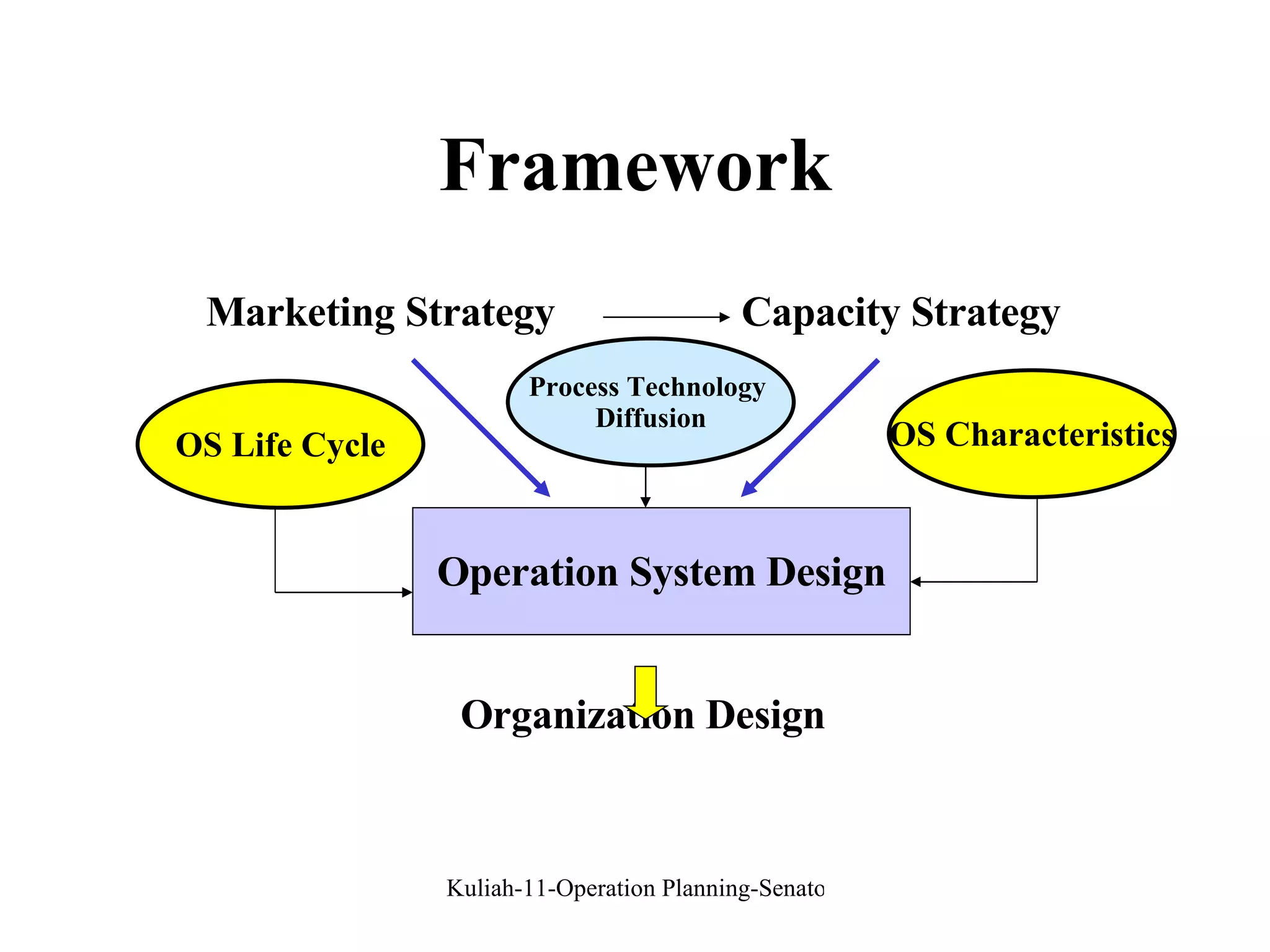
Framework Marketing Strategy Capacity Strategy Organization Design Operation System Design OS Life Cycle OS Characteristics Process Technology Diffusion
4.
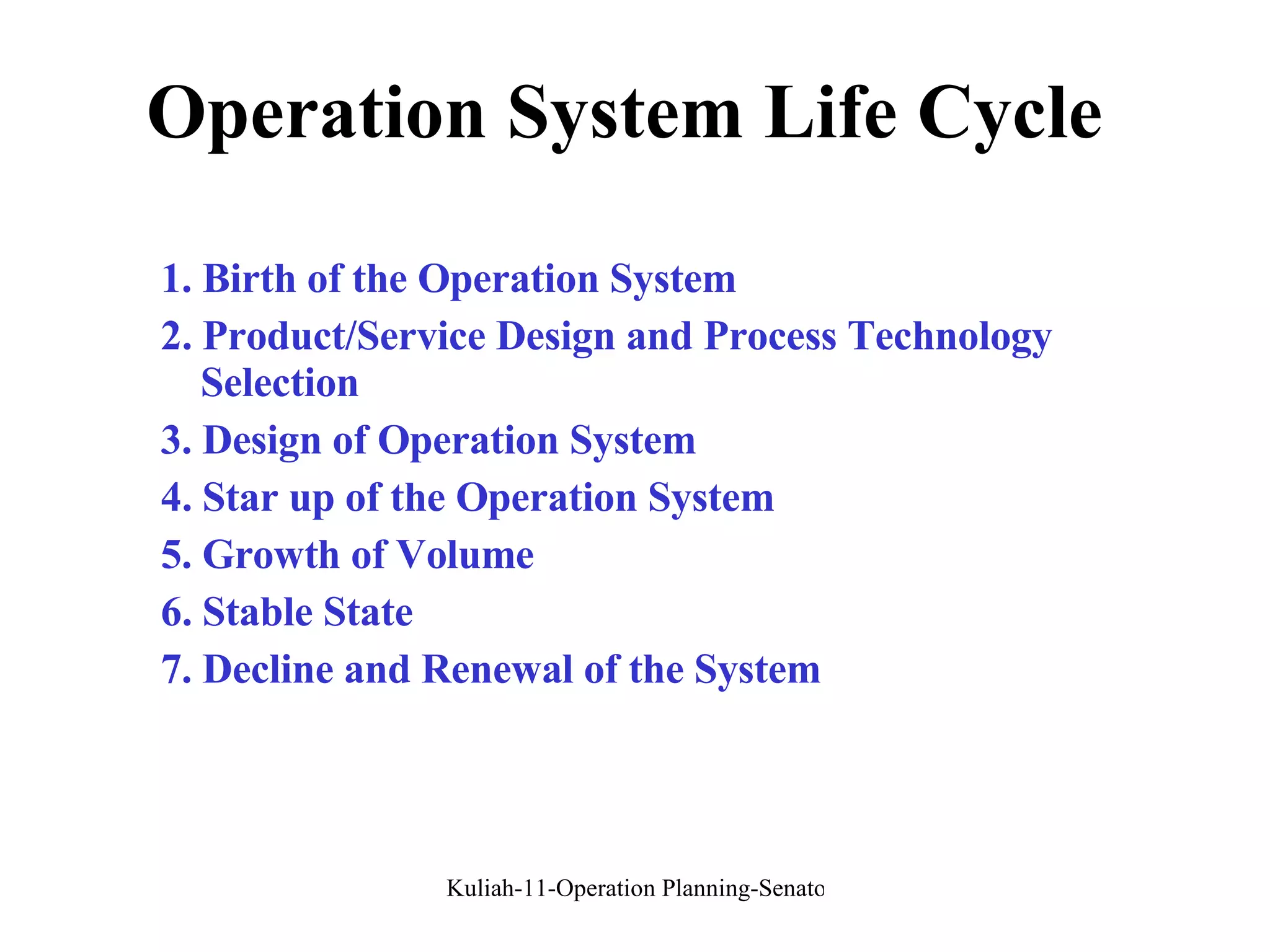
Operation System LifeCycle 1. Birth of the Operation System 2. Product/Service Design and Process Technology Selection 3. Design of Operation System 4. Star up of the Operation System 5. Growth of Volume 6. Stable State 7. Decline and Renewal of the System
5.
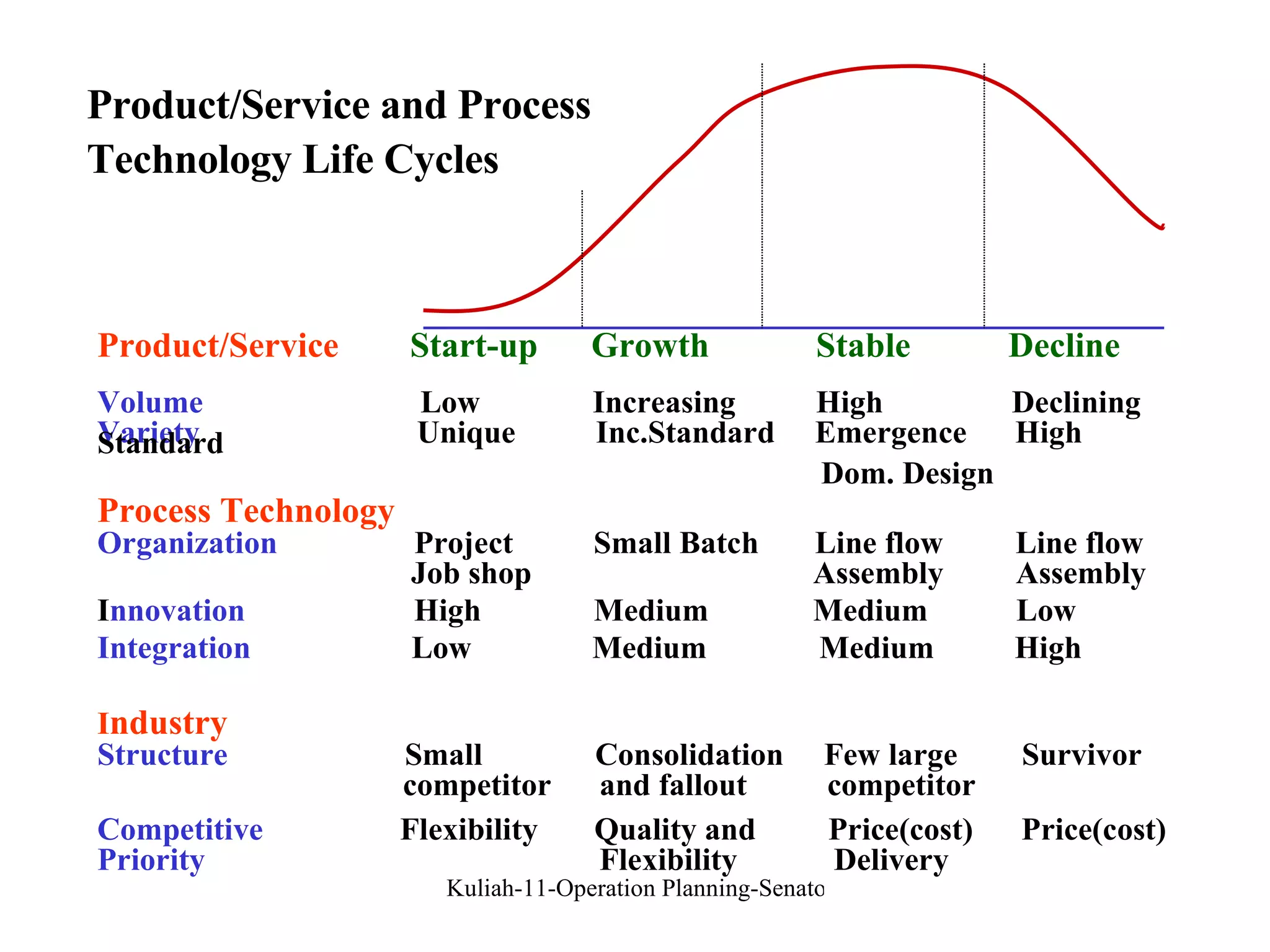
Product/Service Start-up Growth Stable Decline Volume Low Increasing High Declining Variety Unique Inc.Standard Emergence High Standard Dom. Design Process Technology Organization Project Small Batch Line flow Line flow Job shop Assembly Assembly I nnovation High Medium Medium Low Integration Low Medium Medium High I ndustry Structure Small Consolidation Few large Survivor competitor and fallout competitor Competitive Flexibility Quality and Price(cost) Price(cost) Priority Flexibility Delivery Product/Service and Process Technology Life Cycles
6.
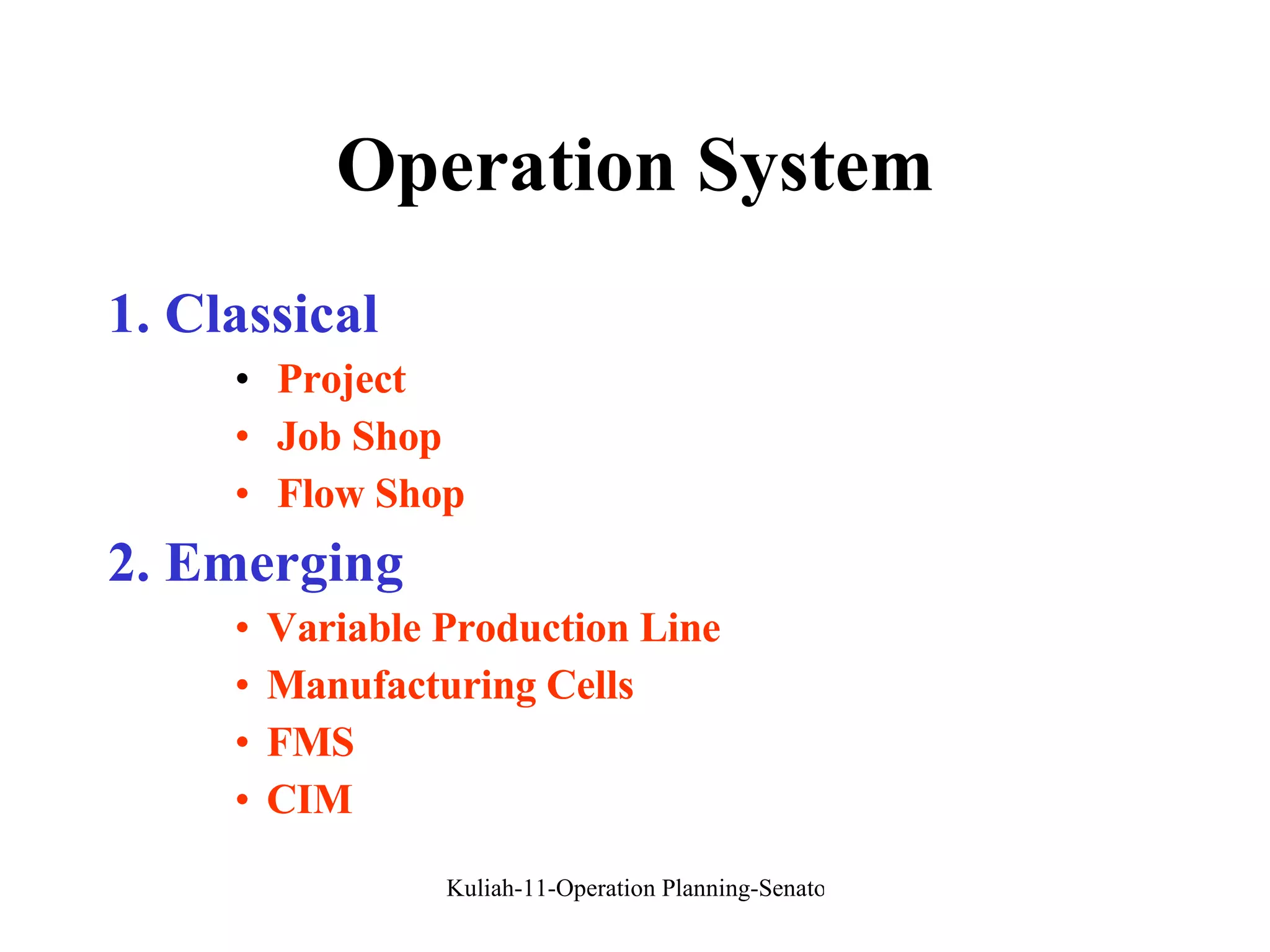
Operation System 1.Classical Project Job Shop Flow Shop 2. Emerging Variable Production Line Manufacturing Cells FMS CIM
7.
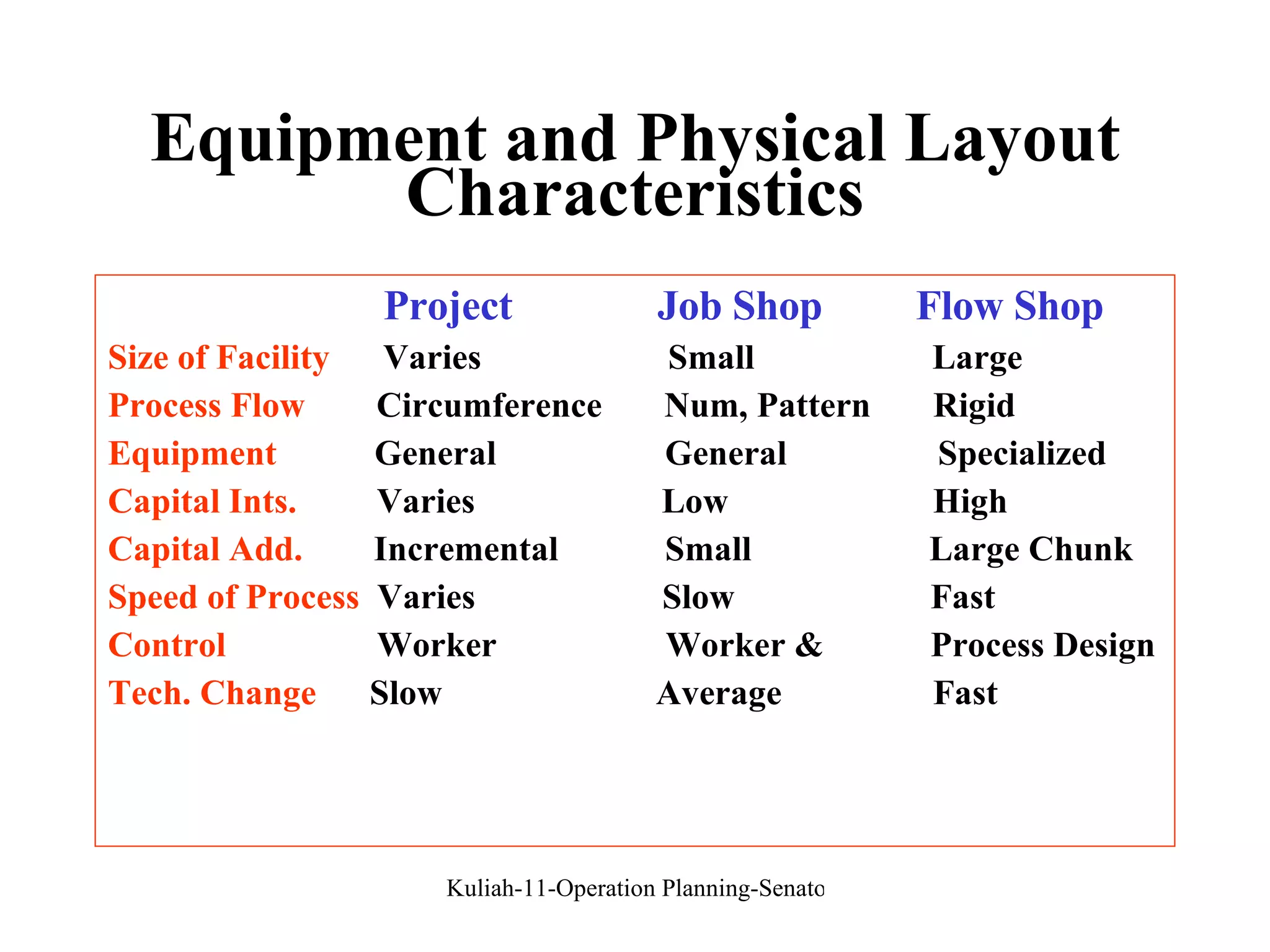
Equipment and PhysicalLayout Characteristics Project Job Shop Flow Shop Size of Facility Varies Small Large Process Flow Circumference Num, Pattern Rigid Equipment General General Specialized Capital Ints. Varies Low High Capital Add. Incremental Small Large Chunk Speed of Process Varies Slow Fast Control Worker Worker & Process Design Tech. Change Slow Average Fast
8.
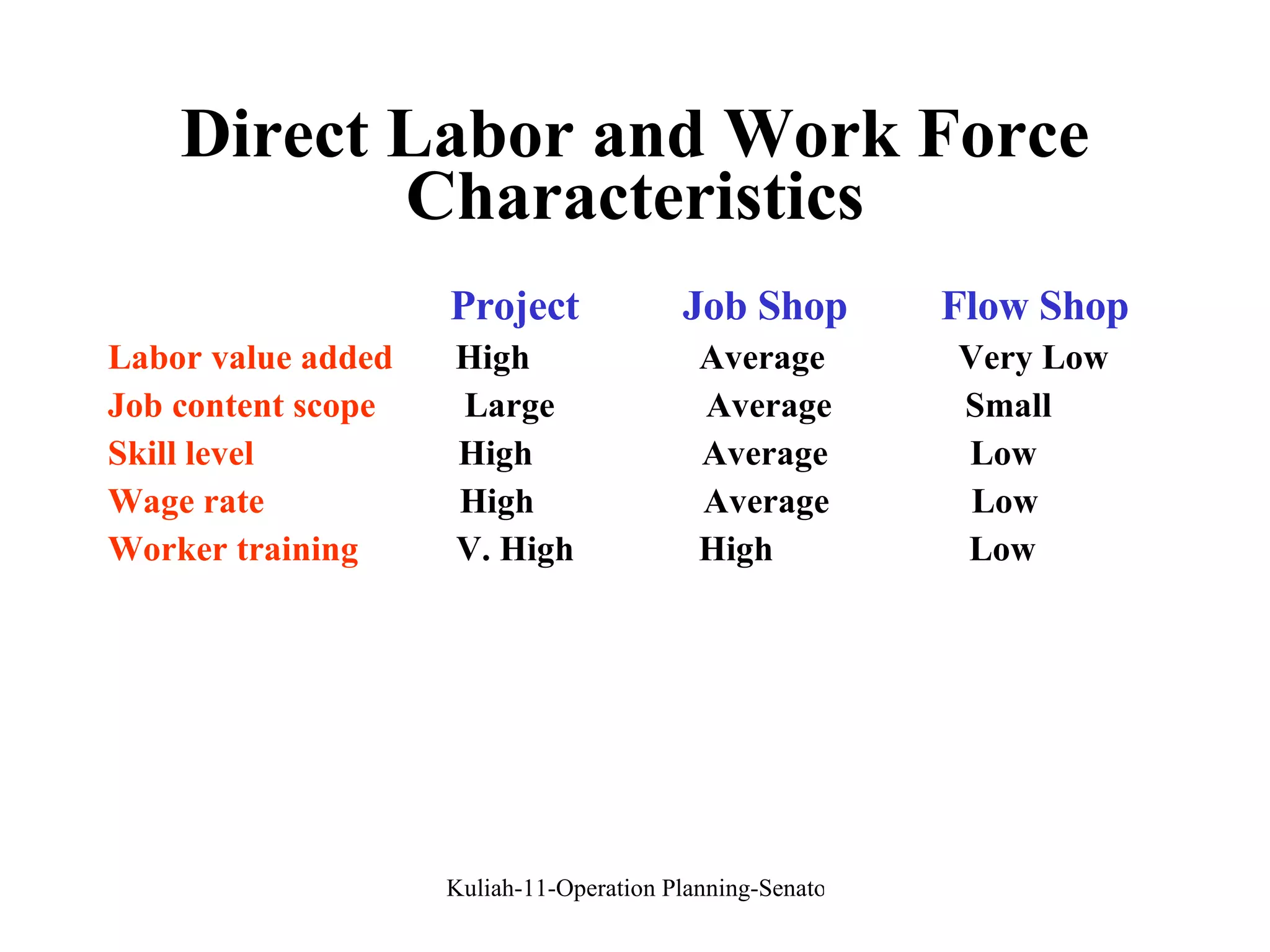
Direct Labor andWork Force Characteristics Project Job Shop Flow Shop Labor value added High Average Very Low Job content scope Large Average Small Skill level High Average Low Wage rate High Average Low Worker training V. High High Low
9.
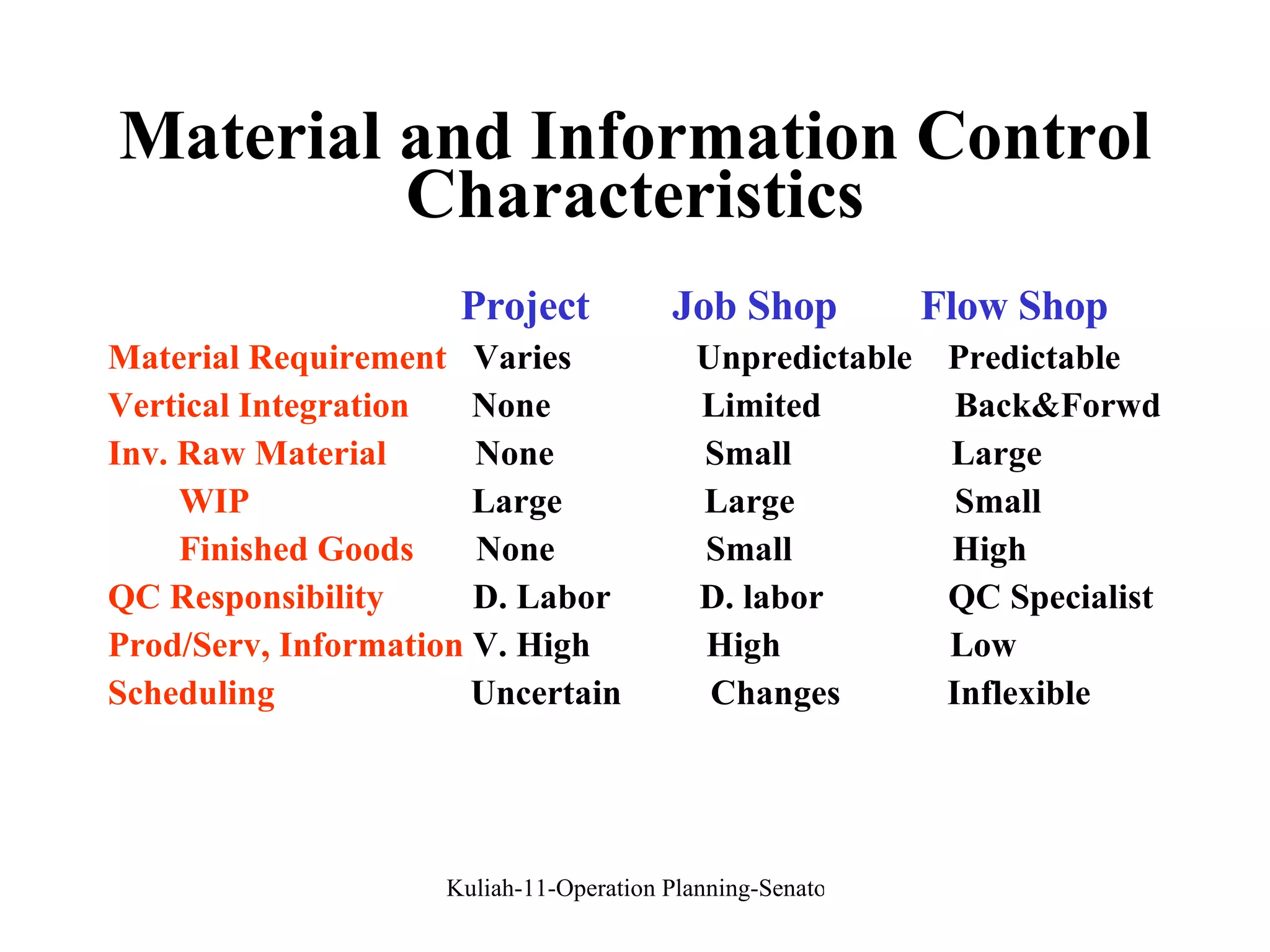
Material and InformationControl Characteristics Project Job Shop Flow Shop Material Requirement Varies Unpredictable Predictable Vertical Integration None Limited Back&Forwd Inv. Raw Material None Small Large WIP Large Large Small Finished Goods None Small High QC Responsibility D. Labor D. labor QC Specialist Prod/Serv, Information V. High High Low Scheduling Uncertain Changes Inflexible
10.
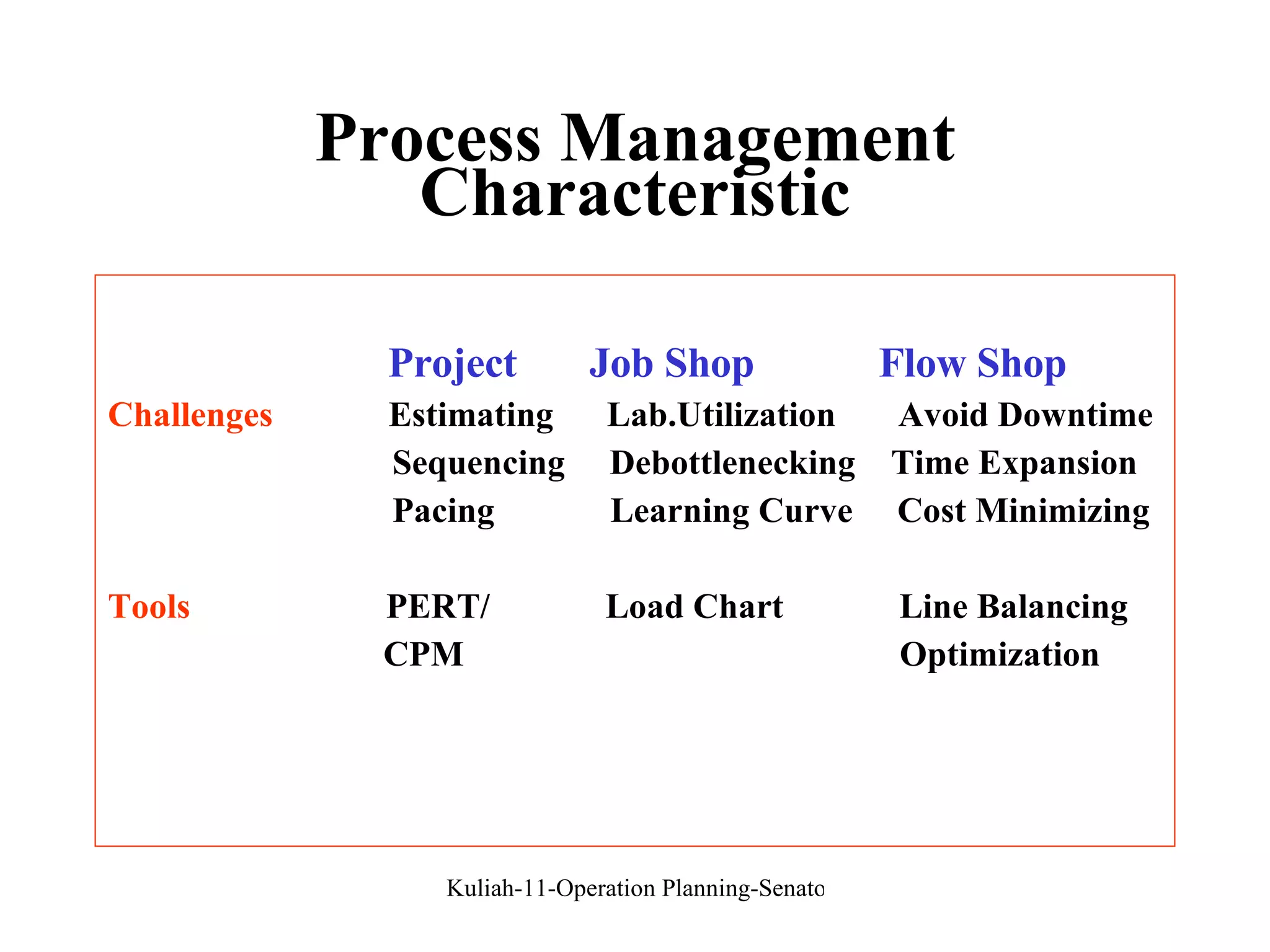
Process Management CharacteristicProject Job Shop Flow Shop Challenges Estimating Lab.Utilization Avoid Downtime Sequencing Debottlenecking Time Expansion Pacing Learning Curve Cost Minimizing Tools PERT/ Load Chart Line Balancing CPM Optimization
11.
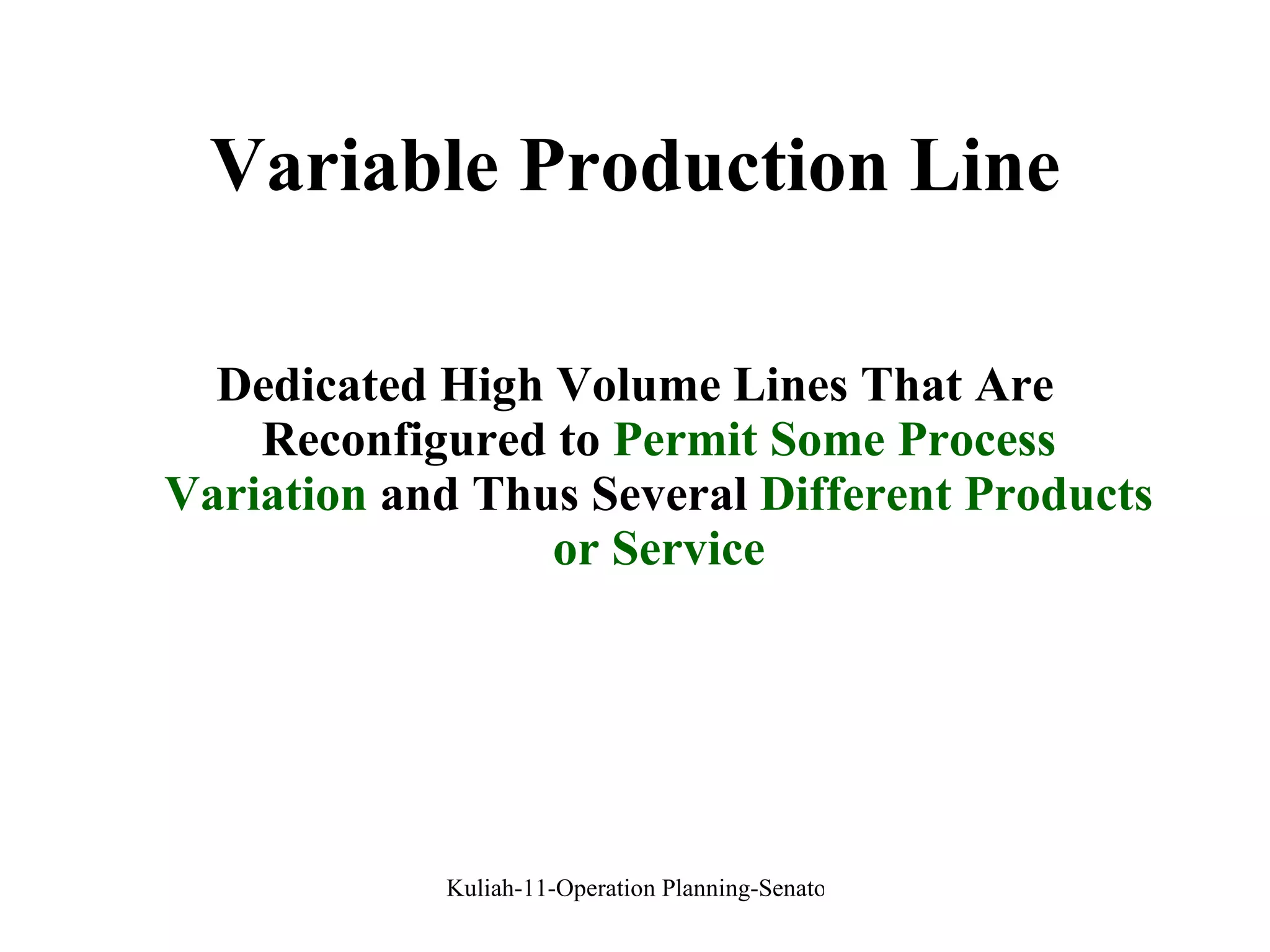
Variable Production LineDedicated High Volume Lines That Are Reconfigured to Permit Some Process Variation and Thus Several Different Products or Service
12.
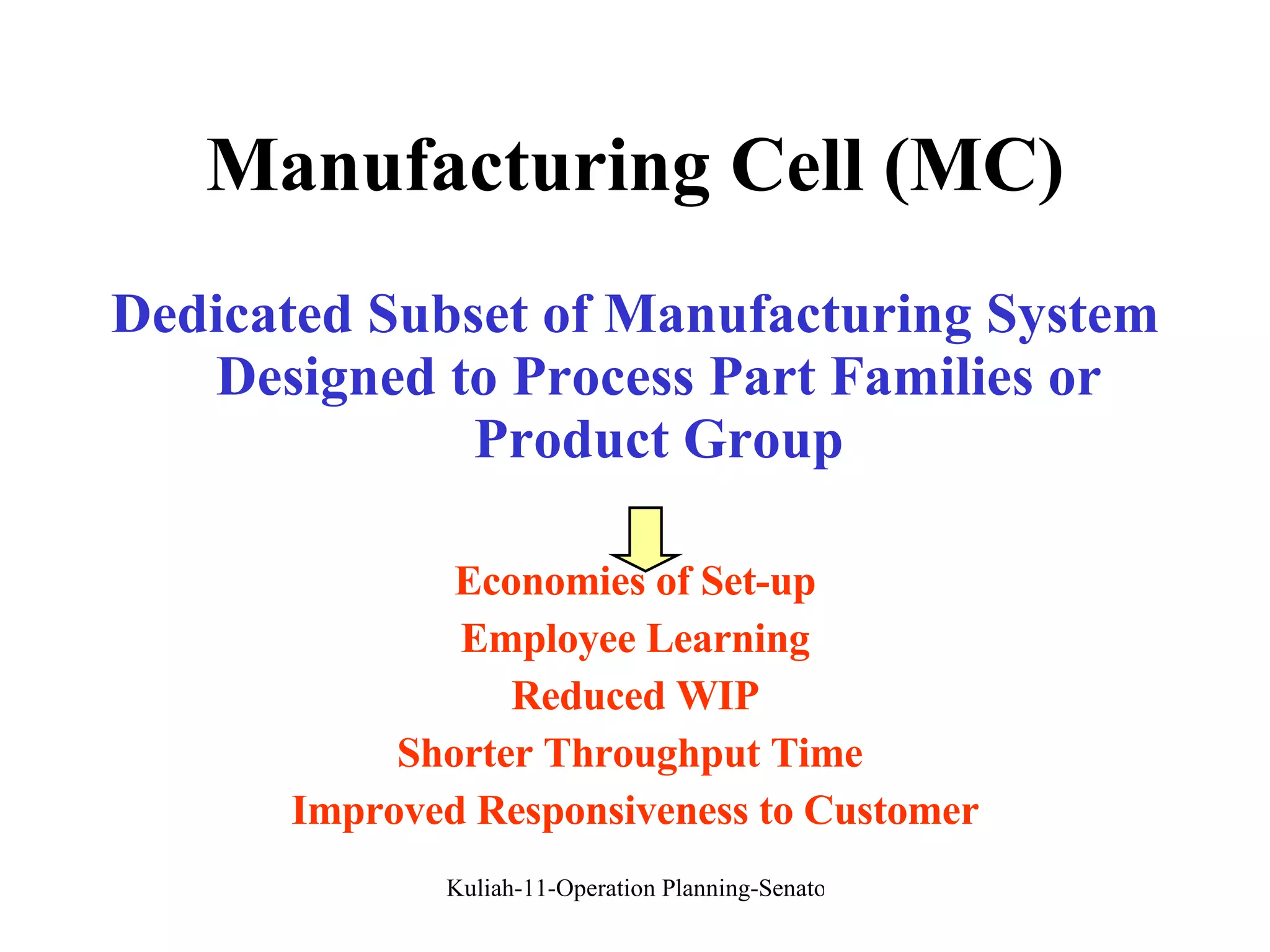
Manufacturing Cell (MC)Dedicated Subset of Manufacturing System Designed to Process Part Families or Product Group Economies of Set-up Employee Learning Reduced WIP Shorter Throughput Time Improved Responsiveness to Customer
13.
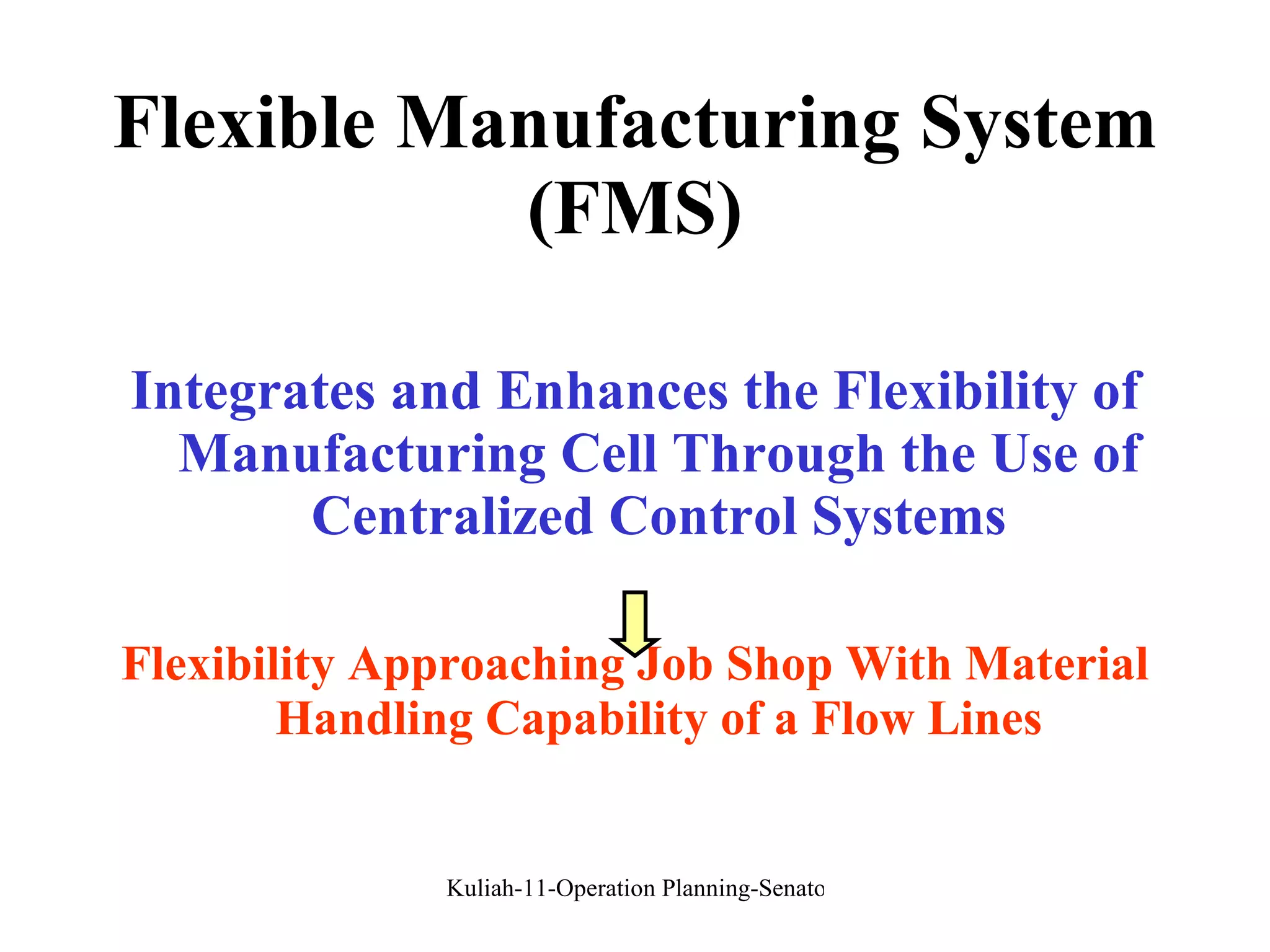
Flexible Manufacturing System(FMS) Integrates and Enhances the Flexibility of Manufacturing Cell Through the Use of Centralized Control Systems Flexibility Approaching Job Shop With Material Handling Capability of a Flow Lines
14.
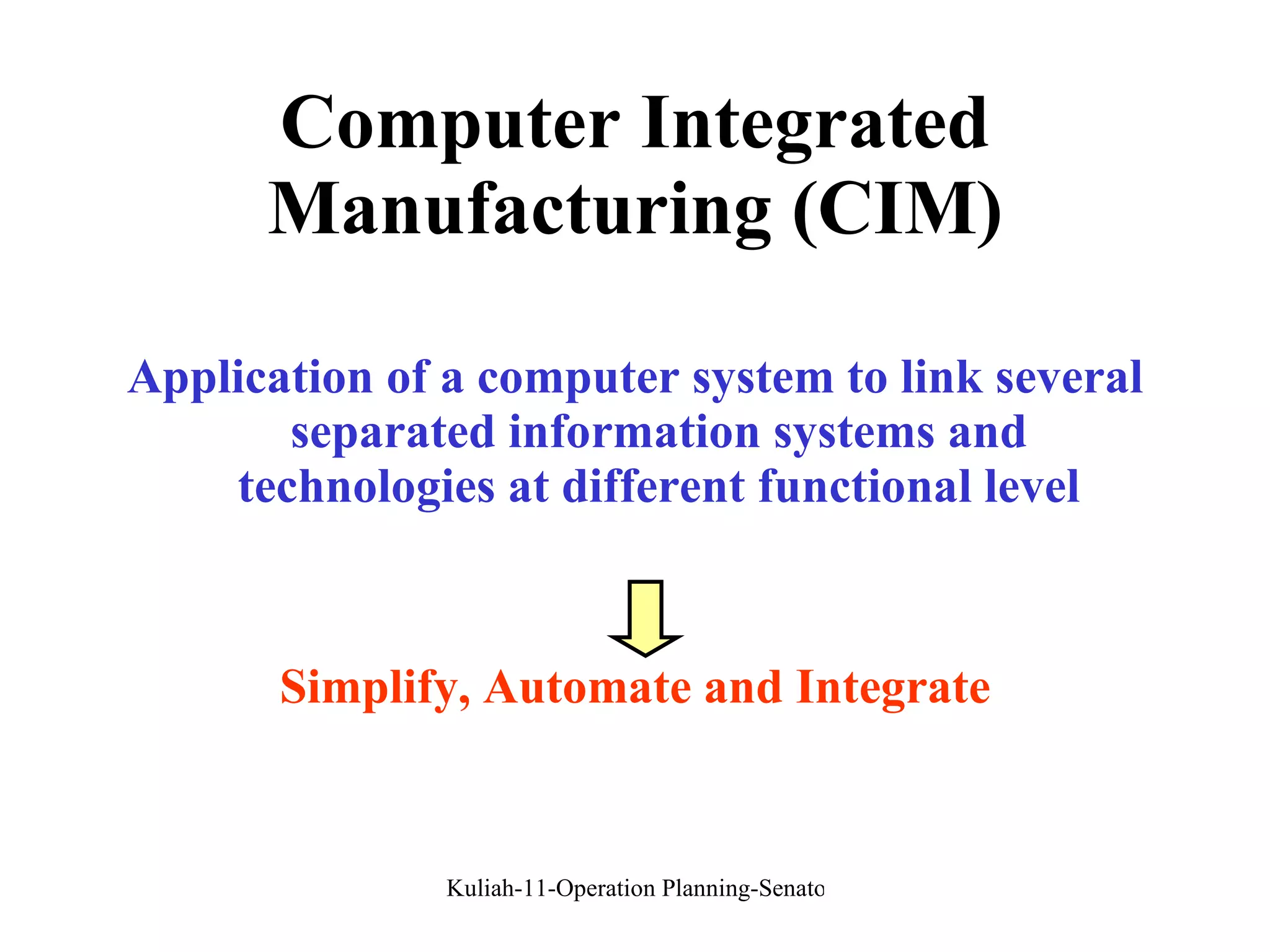
Computer Integrated Manufacturing(CIM) Application of a computer system to link several separated information systems and technologies at different functional level Simplify, Automate and Integrate
15.
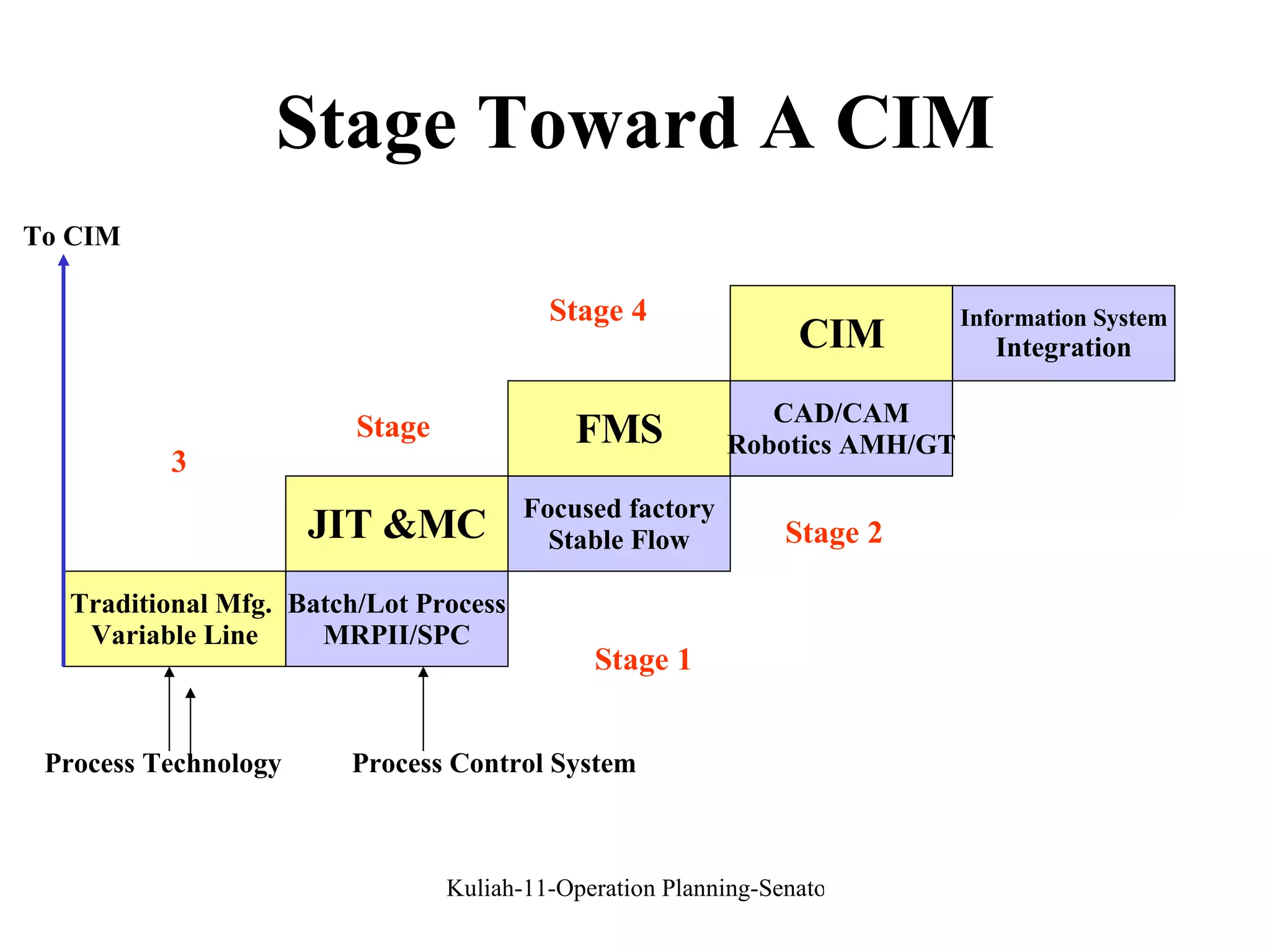
Stage Toward ACIM Batch/Lot Process MRPII/SPC JIT &MC Focused factory Stable Flow FMS CAD/CAM Robotics AMH/GT CIM Information System Integration Traditional Mfg. Variable Line Stage 3 Stage 1 Stage 2 Stage 4 To CIM Process Technology Process Control System
16.
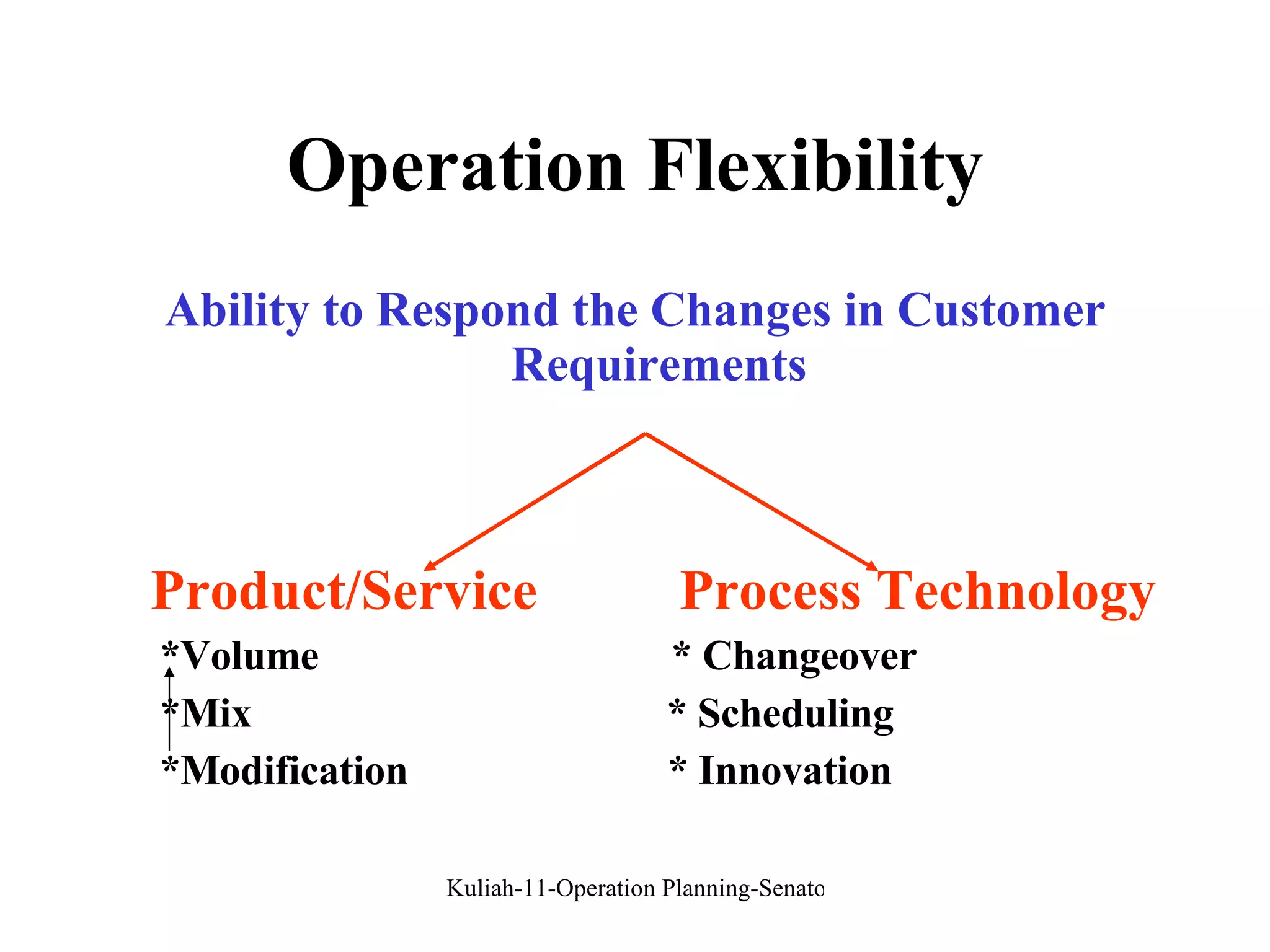
Operation Flexibility Abilityto Respond the Changes in Customer Requirements Product/Service Process Technology *Volume * Changeover *Mix * Scheduling *Modification * Innovation
17.
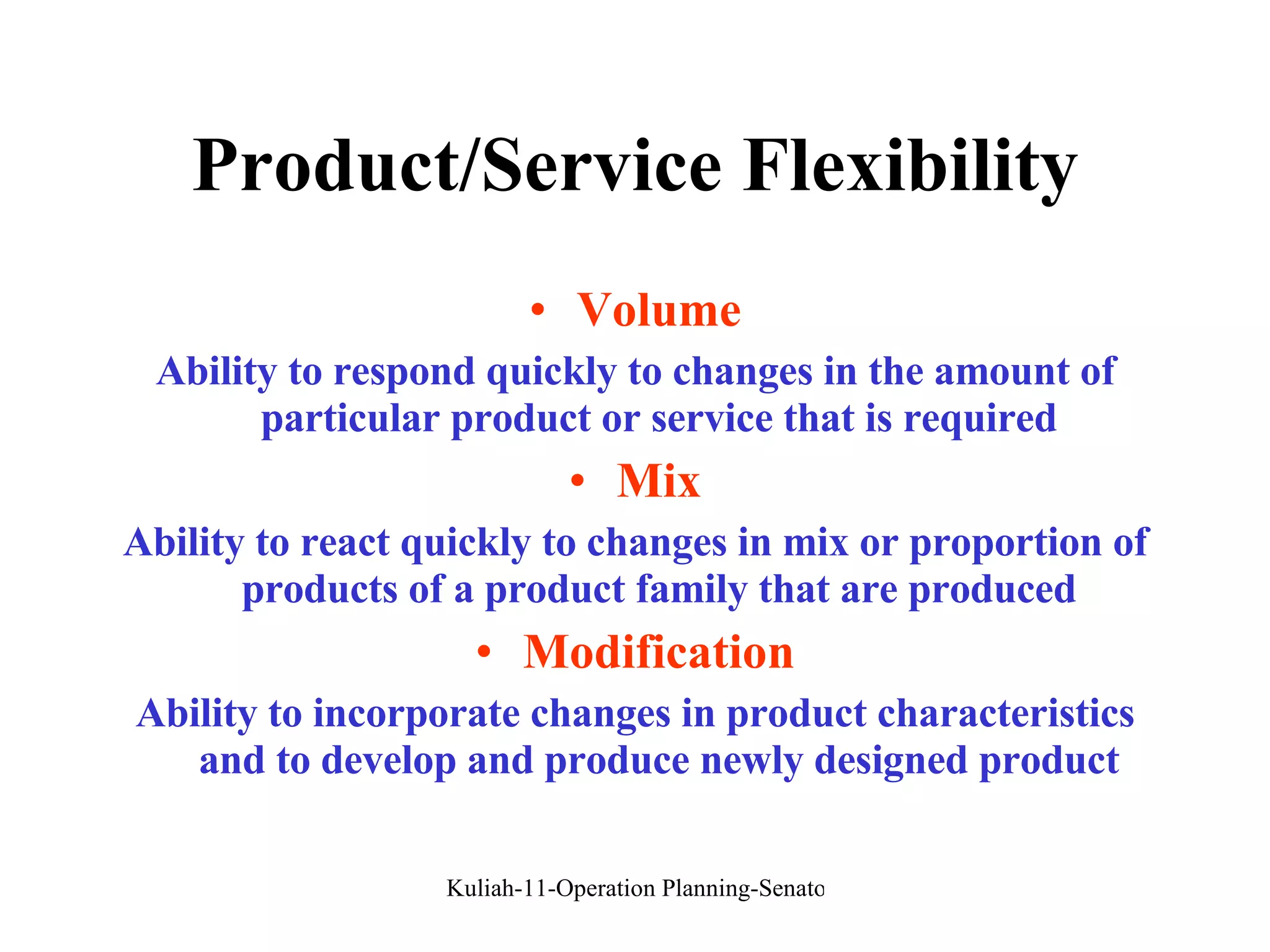
Product/Service Flexibility VolumeAbility to respond quickly to changes in the amount of particular product or service that is required Mix Ability to react quickly to changes in mix or proportion of products of a product family that are produced Modification Ability to incorporate changes in product characteristics and to develop and produce newly designed product
18.
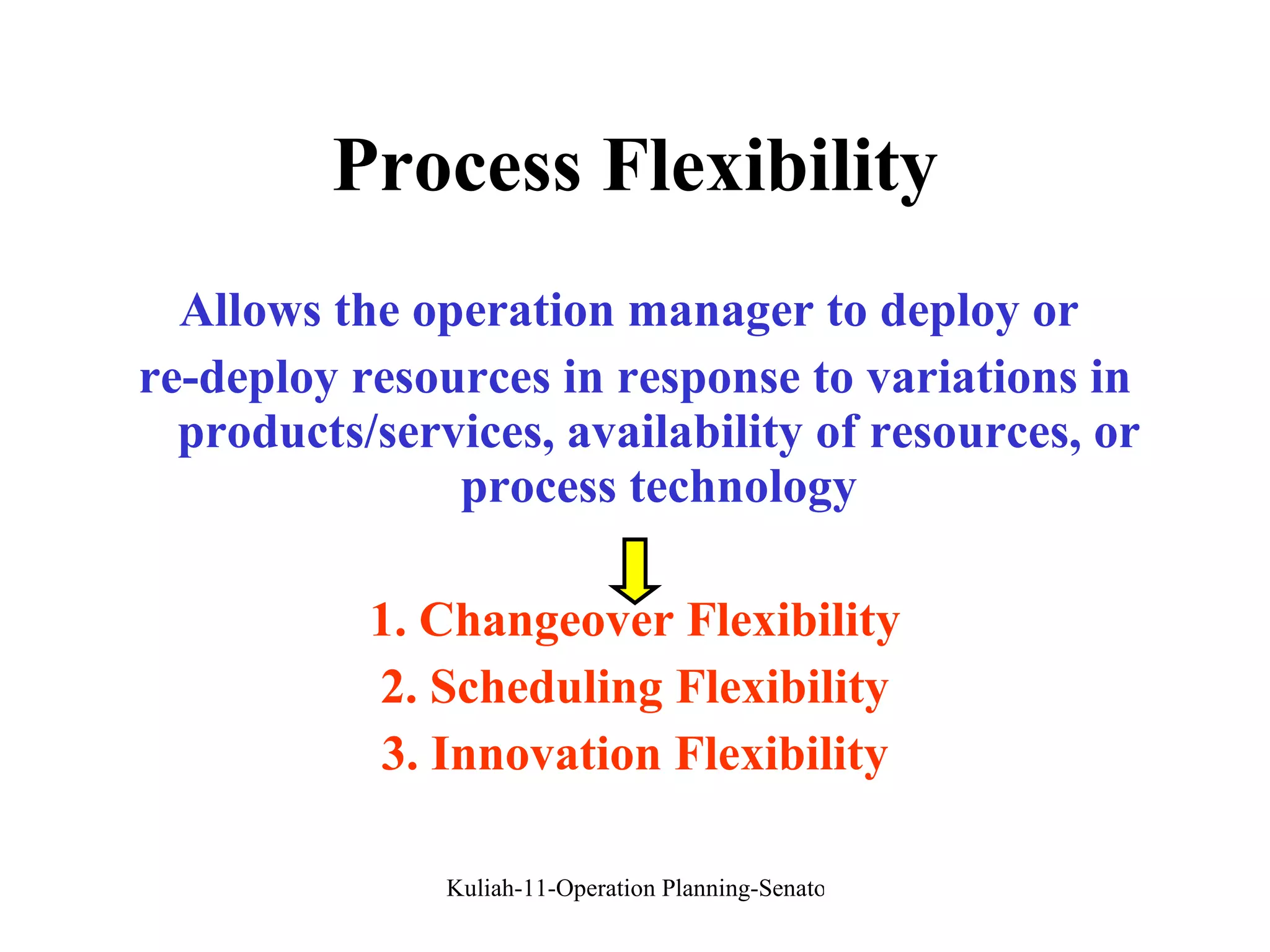
Process Flexibility Allowsthe operation manager to deploy or re-deploy resources in response to variations in products/services, availability of resources, or process technology 1. Changeover Flexibility 2. Scheduling Flexibility 3. Innovation Flexibility
19.
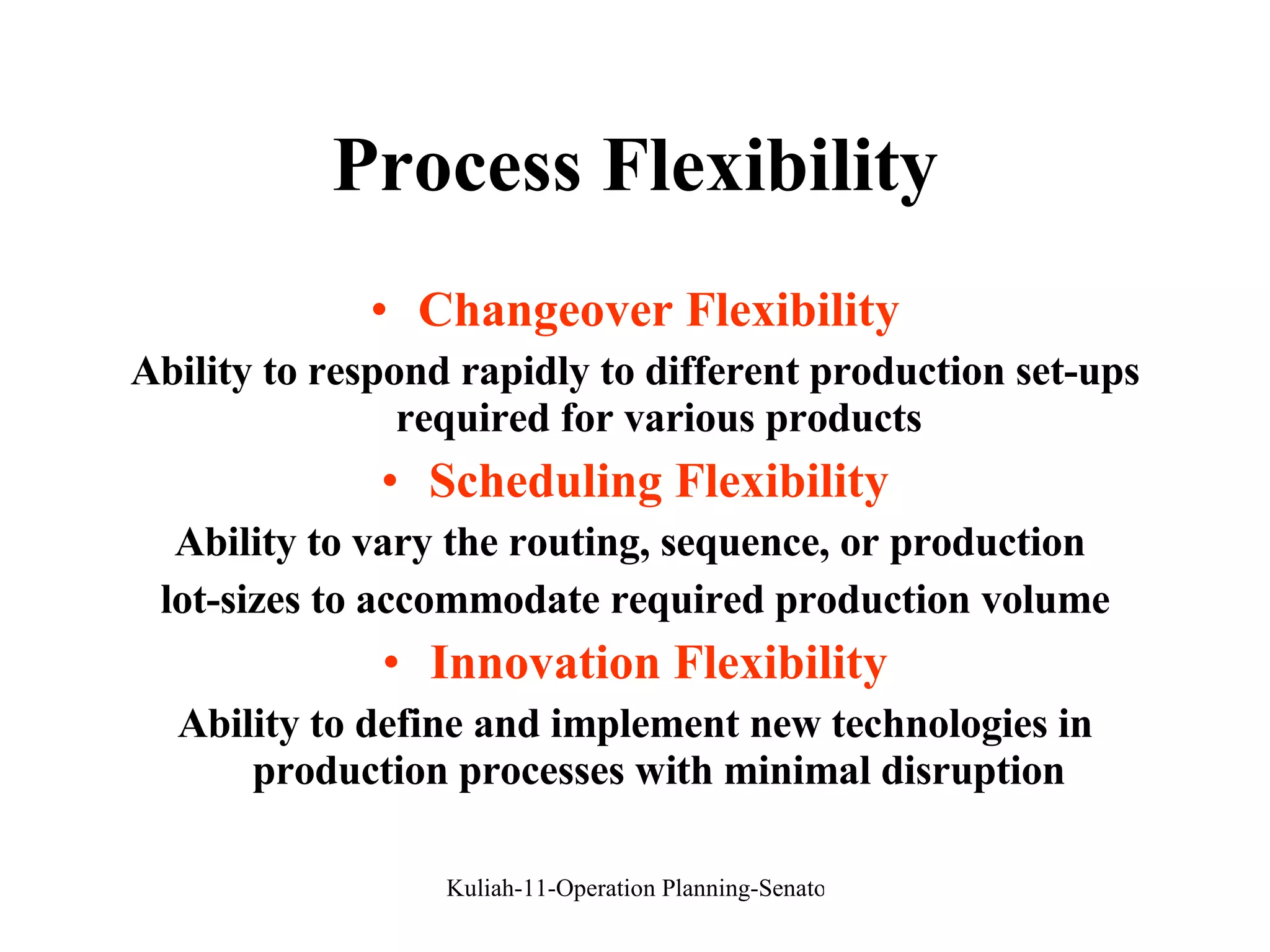
Process Flexibility ChangeoverFlexibility Ability to respond rapidly to different production set-ups required for various products Scheduling Flexibility Ability to vary the routing, sequence, or production lot-sizes to accommodate required production volume Innovation Flexibility Ability to define and implement new technologies in production processes with minimal disruption
20.
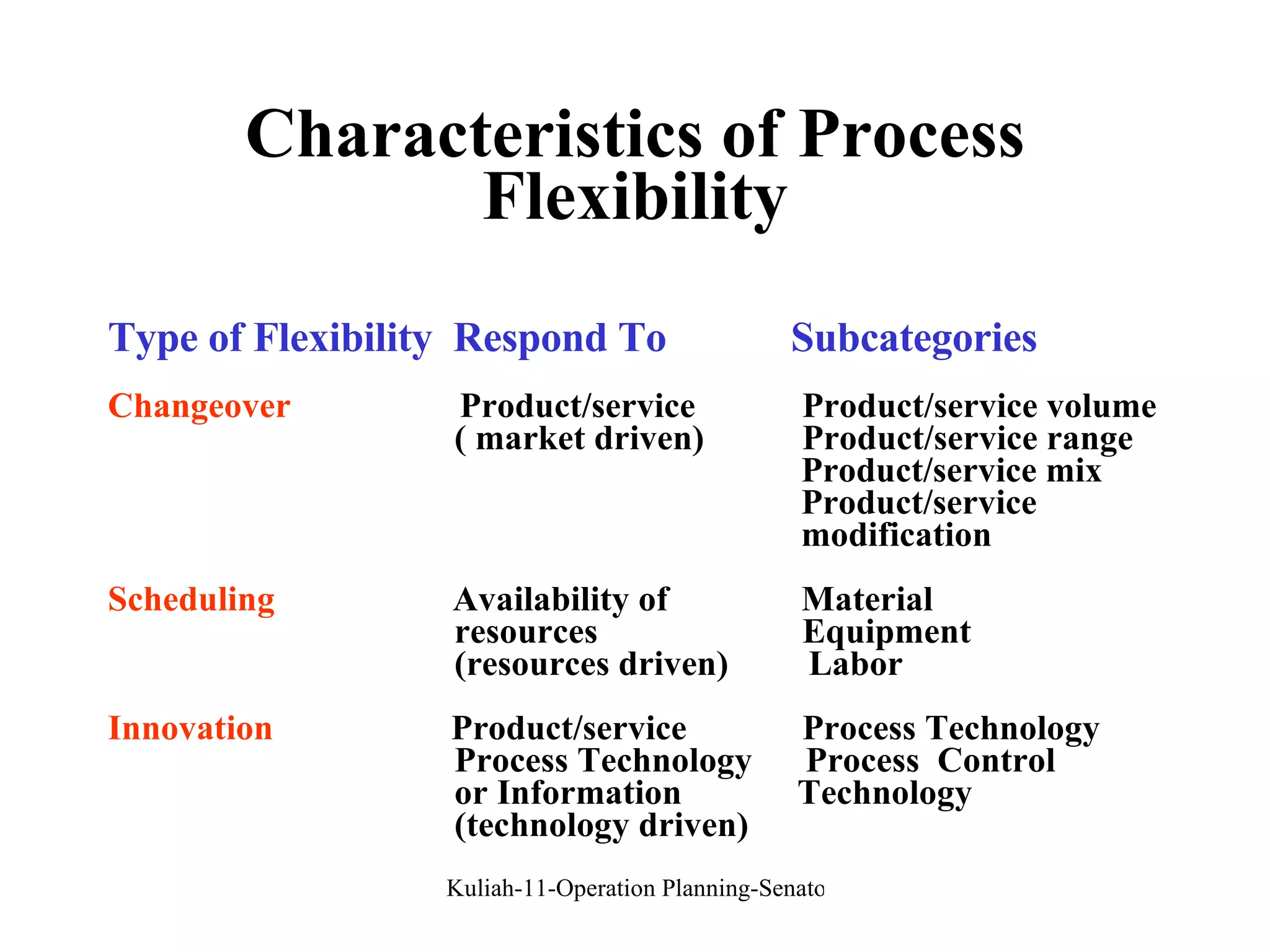
Characteristics of ProcessFlexibility Type of Flexibility Respond To Subcategories Changeover Product/service Product/service volume ( market driven) Product/service range Product/service mix Product/service modification Scheduling Availability of Material resources Equipment (resources driven) Labor Innovation Product/service Process Technology Process Technology Process Control or Information Technology (technology driven)
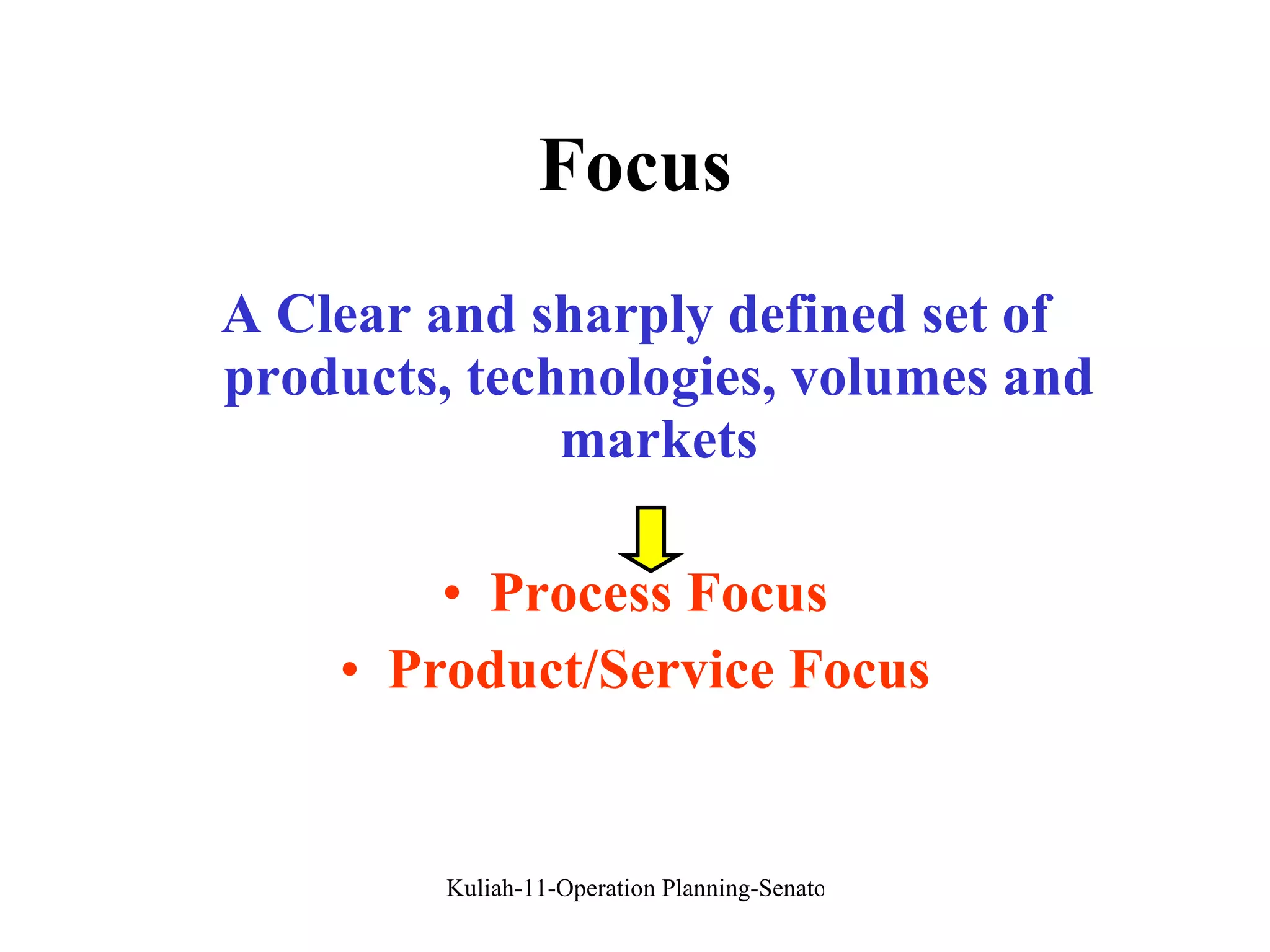
Focus A Clearand sharply defined set of products, technologies, volumes and markets Process Focus Product/Service Focus
23.
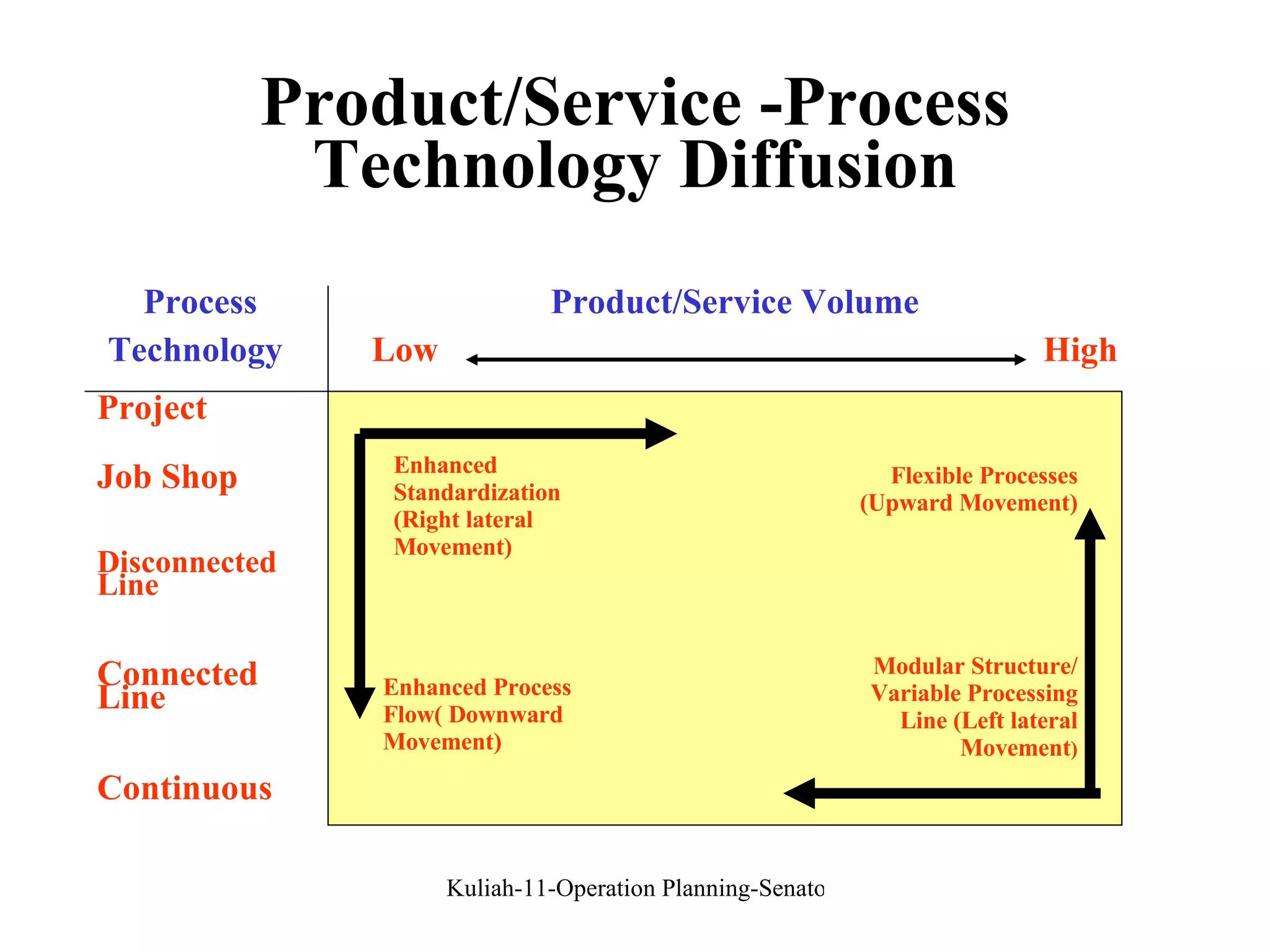
Product/Service -Process TechnologyDiffusion Process Product/Service Volume Technology Low High Project Job Shop Disconnected Line Connected Line Continuous Enhanced Standardization (Right lateral Movement) Flexible Processes (Upward Movement) Enhanced Process Flow( Downward Movement) Modular Structure/ Variable Processing Line (Left lateral Movement )
24.
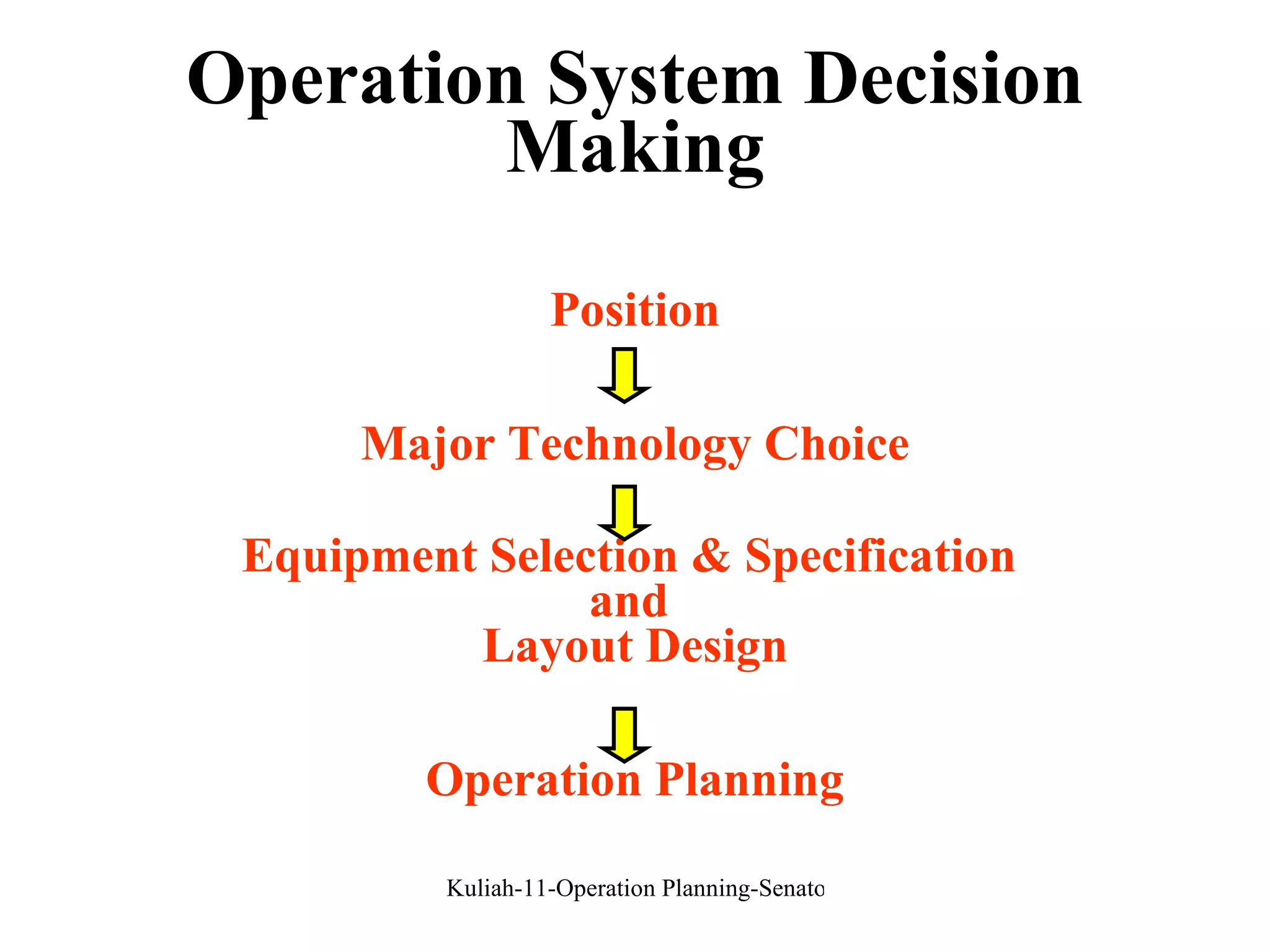
Operation System DecisionMaking Position Major Technology Choice Equipment Selection & Specification and Layout Design Operation Planning
25.
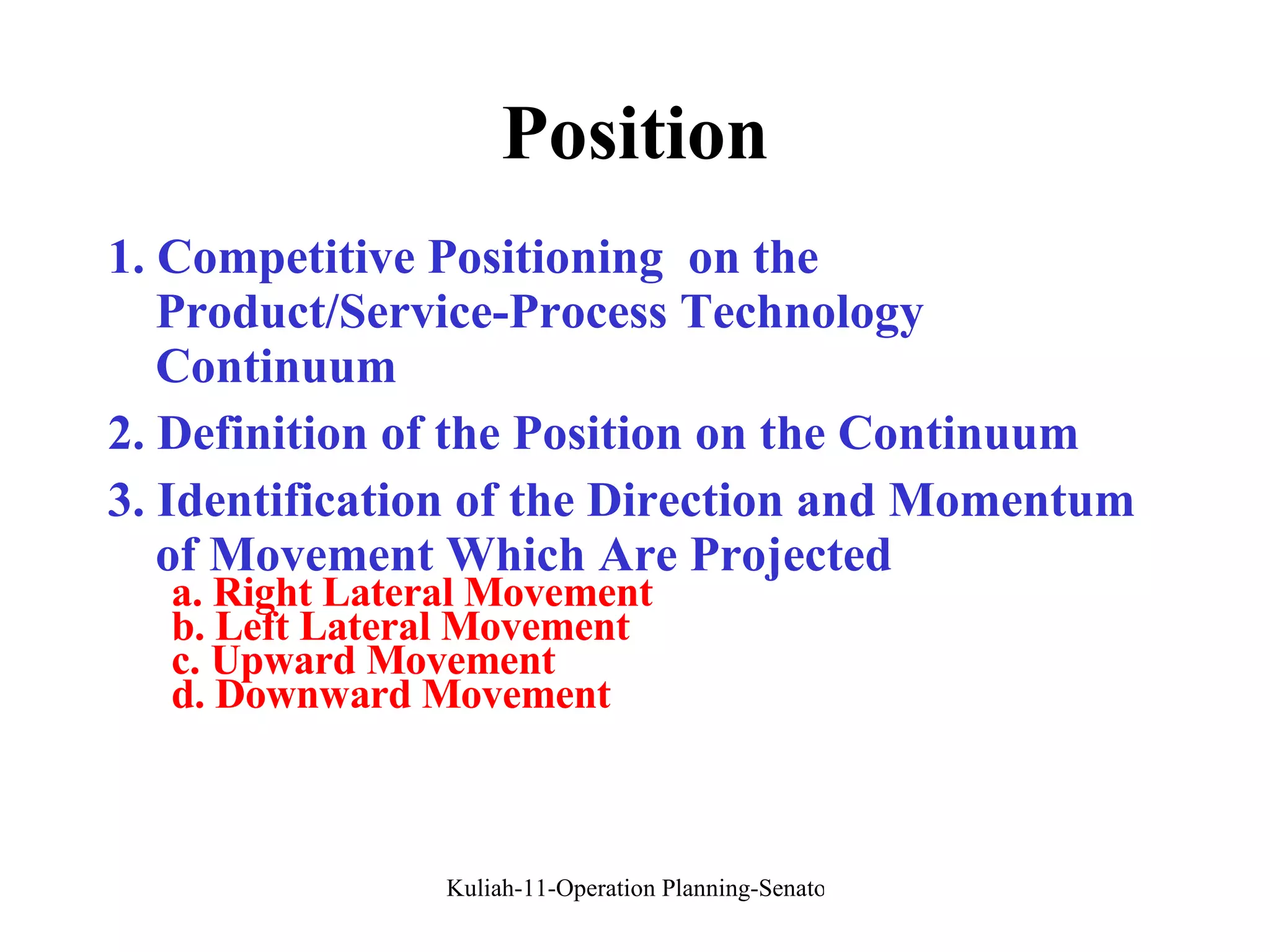
Position 1. CompetitivePositioning on the Product/Service-Process Technology Continuum 2. Definition of the Position on the Continuum 3. Identification of the Direction and Momentum of Movement Which Are Projected a. Right Lateral Movement b. Left Lateral Movement c. Upward Movement d. Downward Movement
26.
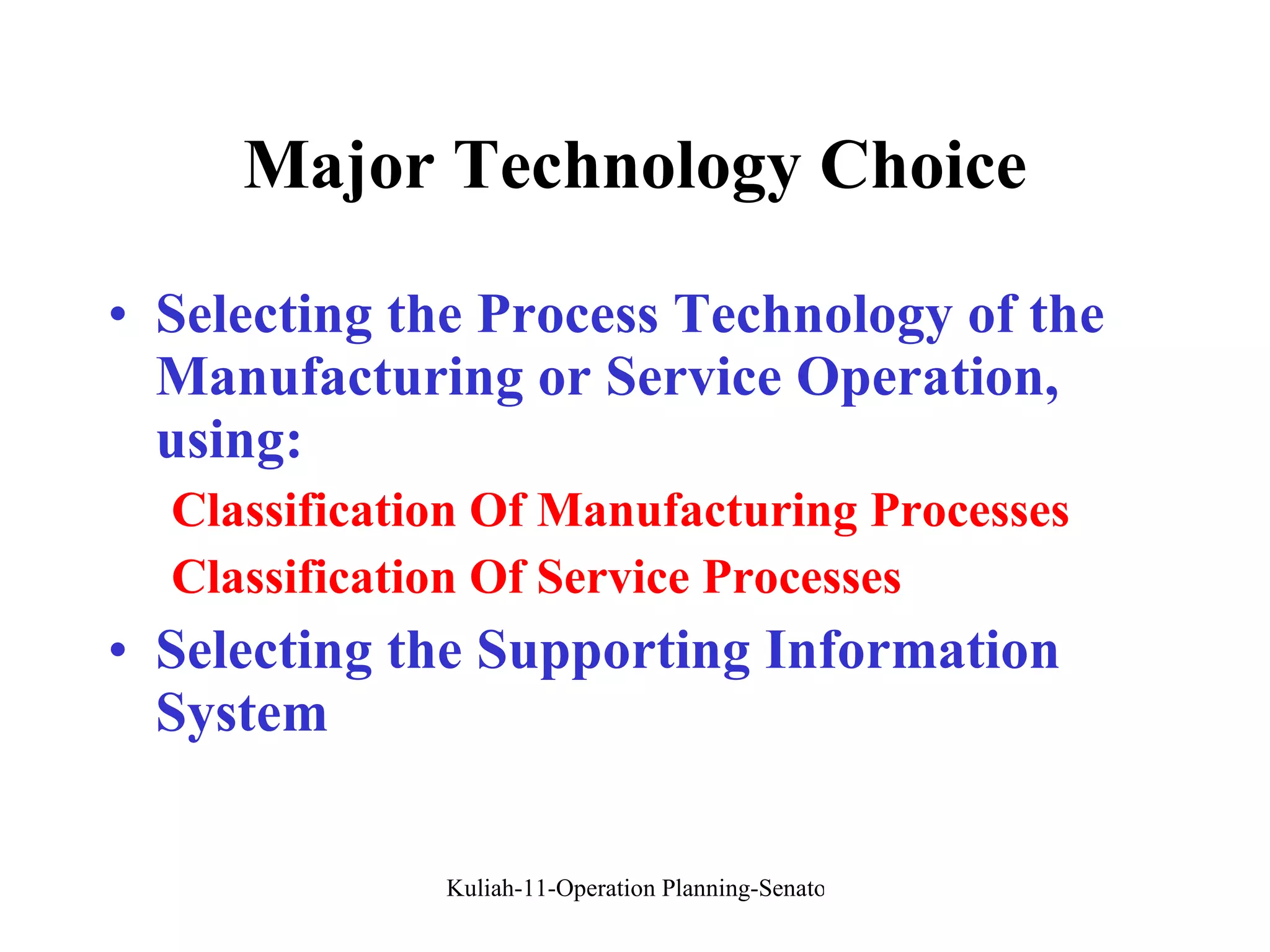
Major Technology ChoiceSelecting the Process Technology of the Manufacturing or Service Operation, using: Classification Of Manufacturing Processes Classification Of Service Processes Selecting the Supporting Information System
27.
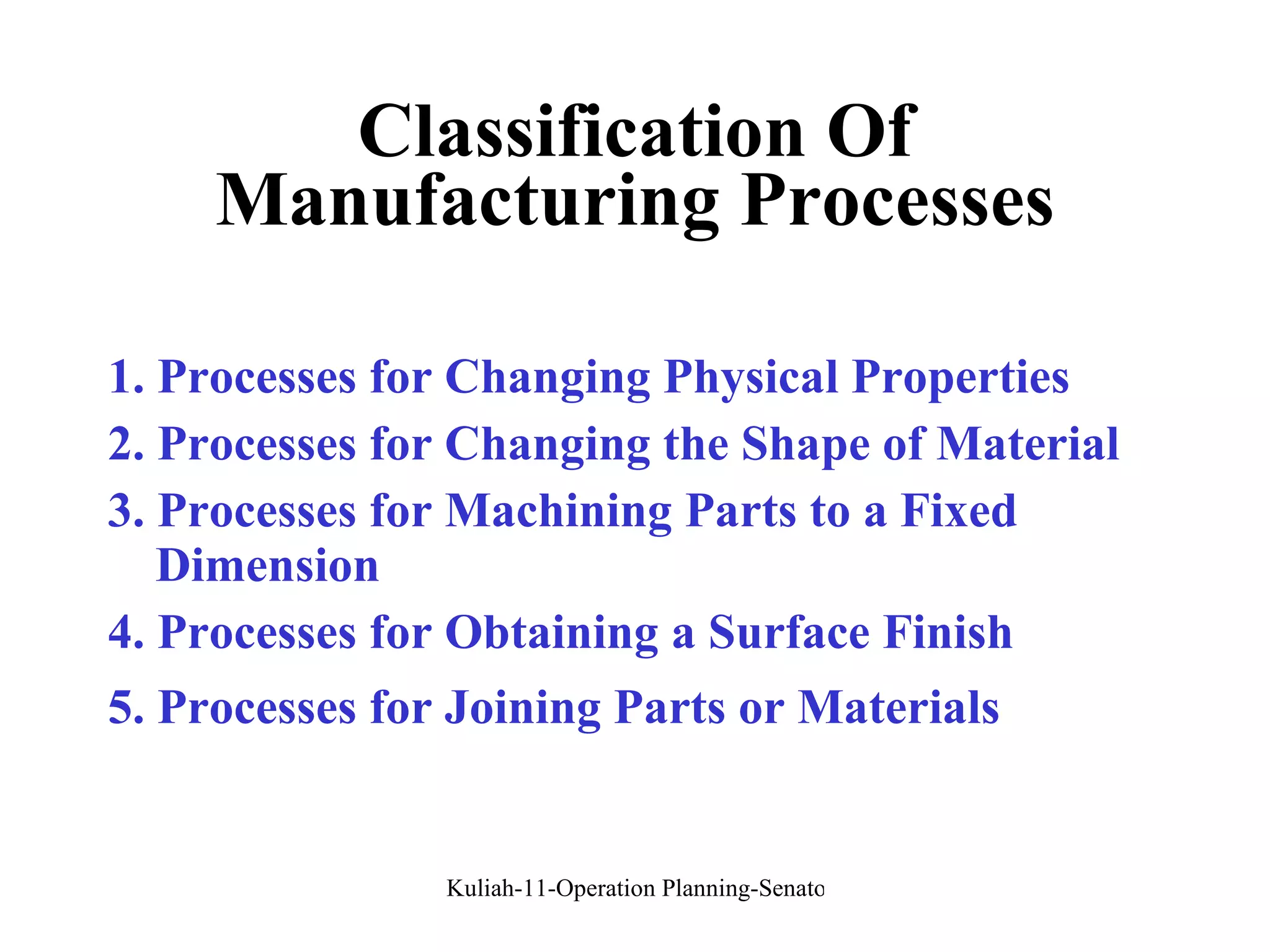
Classification Of ManufacturingProcesses 1. Processes for Changing Physical Properties 2. Processes for Changing the Shape of Material 3. Processes for Machining Parts to a Fixed Dimension 4. Processes for Obtaining a Surface Finish 5. Processes for Joining Parts or Materials
28.
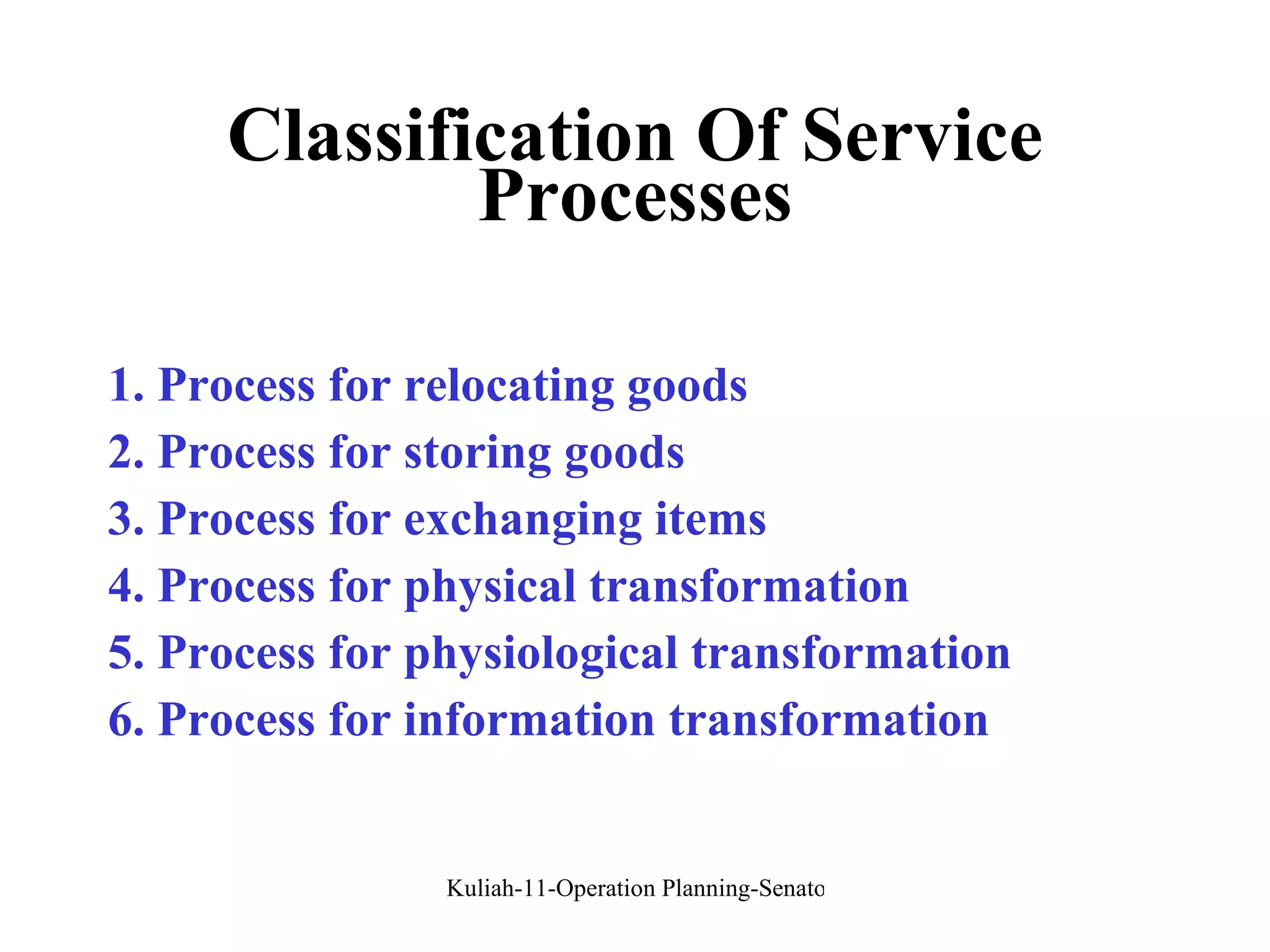
Classification Of ServiceProcesses 1. Process for relocating goods 2. Process for storing goods 3. Process for exchanging items 4. Process for physical transformation 5. Process for physiological transformation 6. Process for information transformation
29.
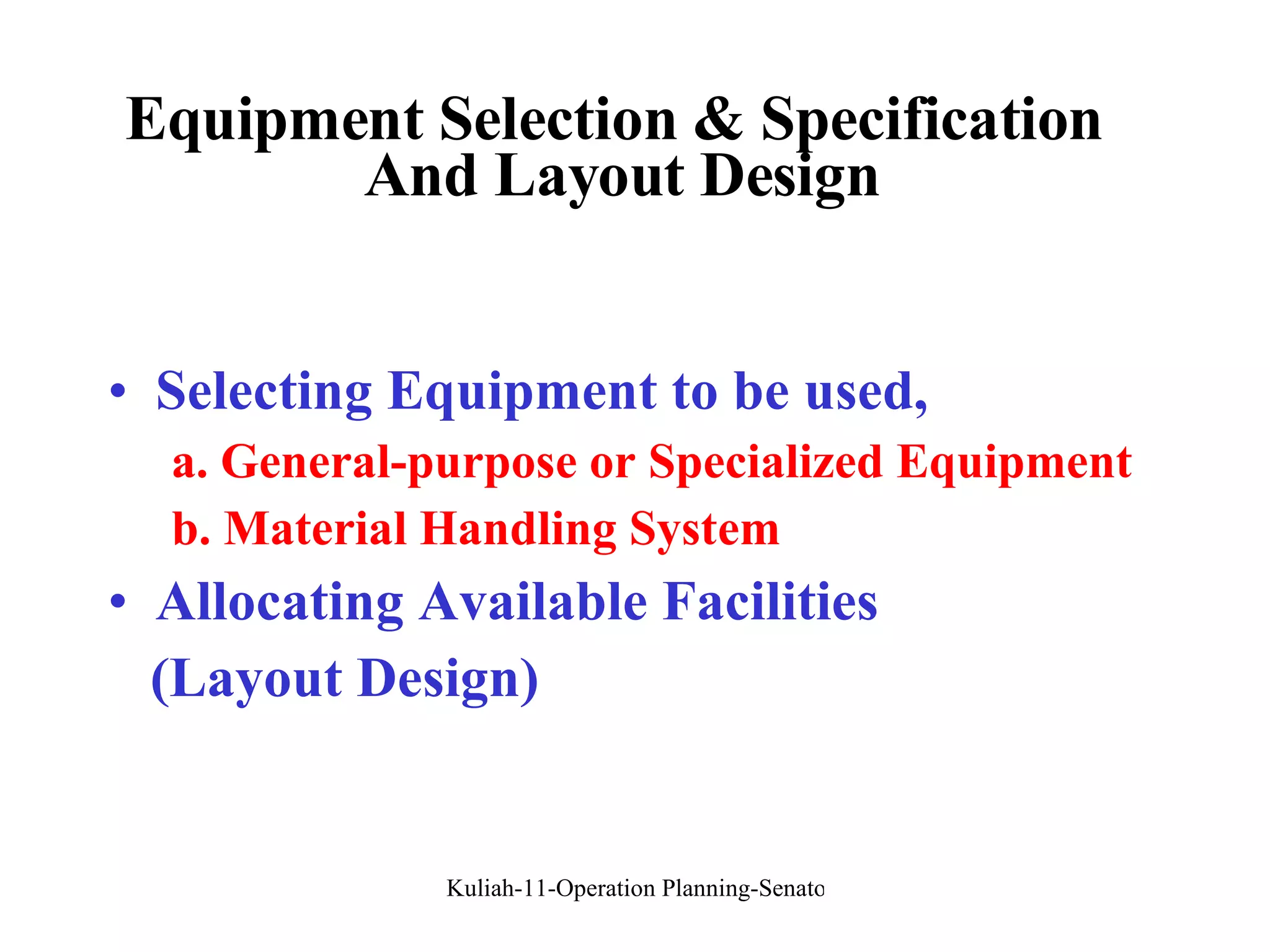
Equipment Selection &Specification And Layout Design Selecting Equipment to be used, a. General-purpose or Specialized Equipment b. Material Handling System Allocating Available Facilities (Layout Design)
30.
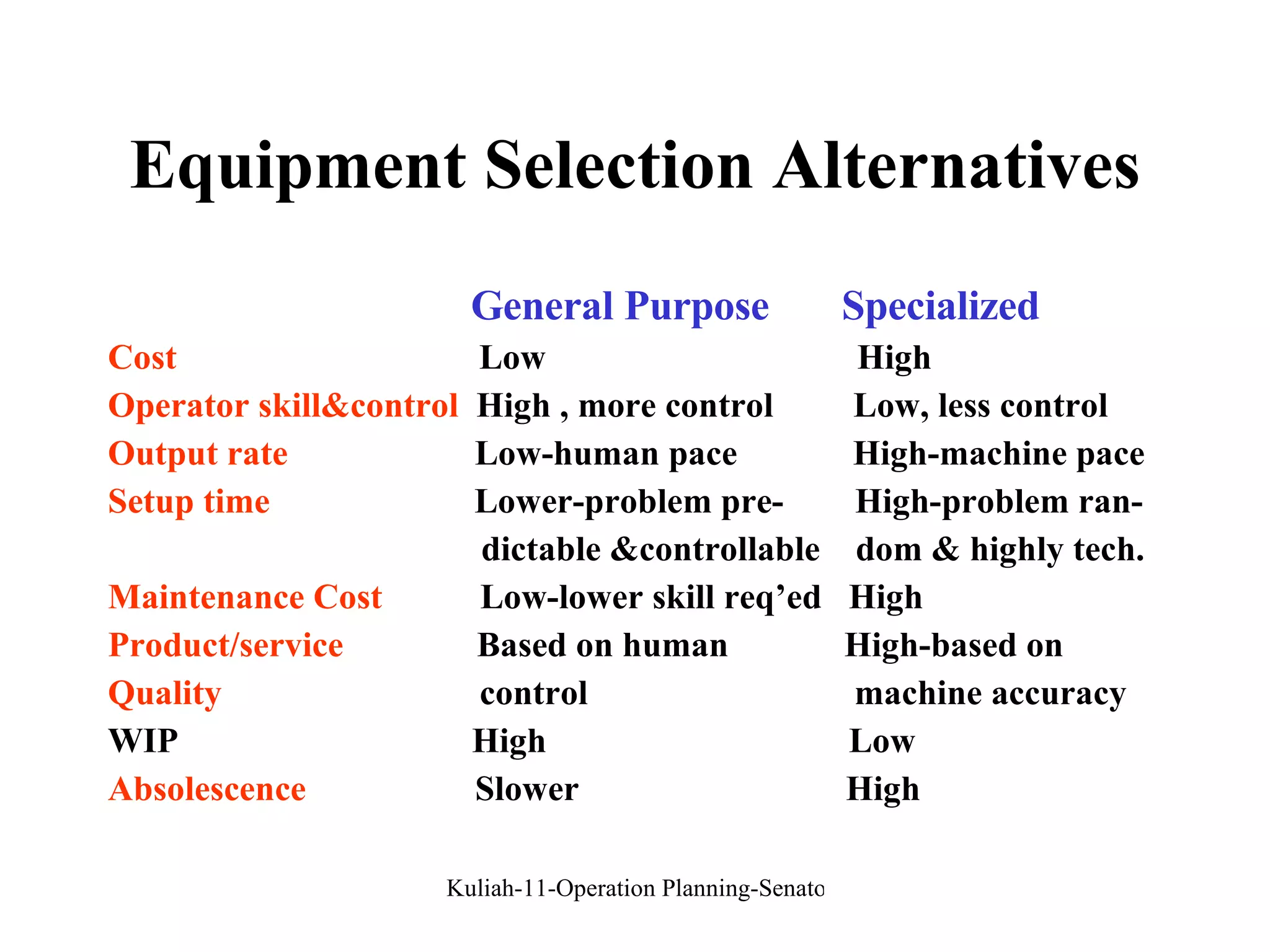
Equipment Selection AlternativesGeneral Purpose Specialized Cost Low High Operator skill&control High , more control Low, less control Output rate Low-human pace High-machine pace Setup time Lower-problem pre- High-problem ran- dictable &controllable dom & highly tech. Maintenance Cost Low-lower skill req’ed High Product/service Based on human High-based on Quality control machine accuracy WIP High Low Absolescence Slower High
31.
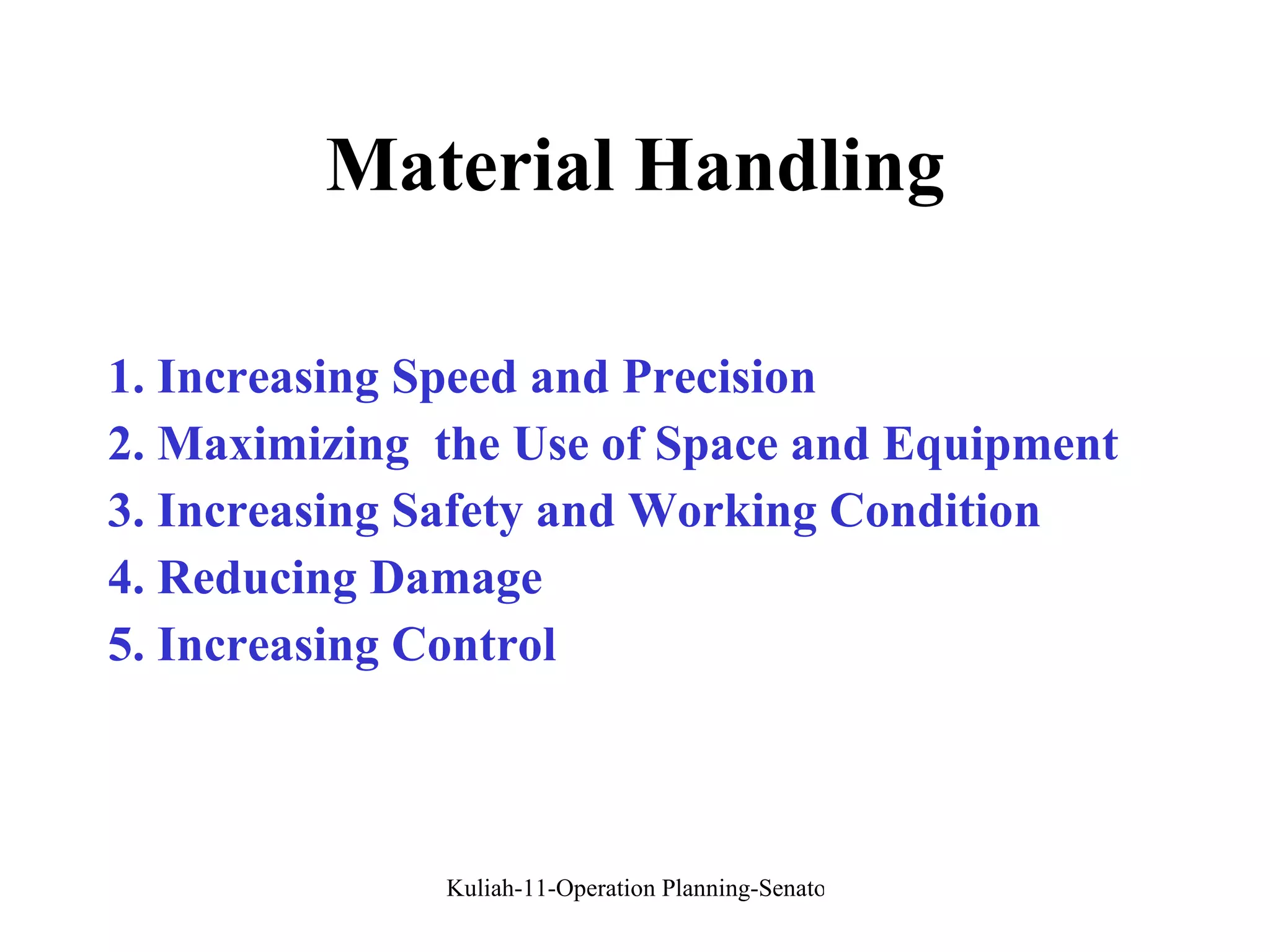
Material Handling 1.Increasing Speed and Precision 2. Maximizing the Use of Space and Equipment 3. Increasing Safety and Working Condition 4. Reducing Damage 5. Increasing Control
32.
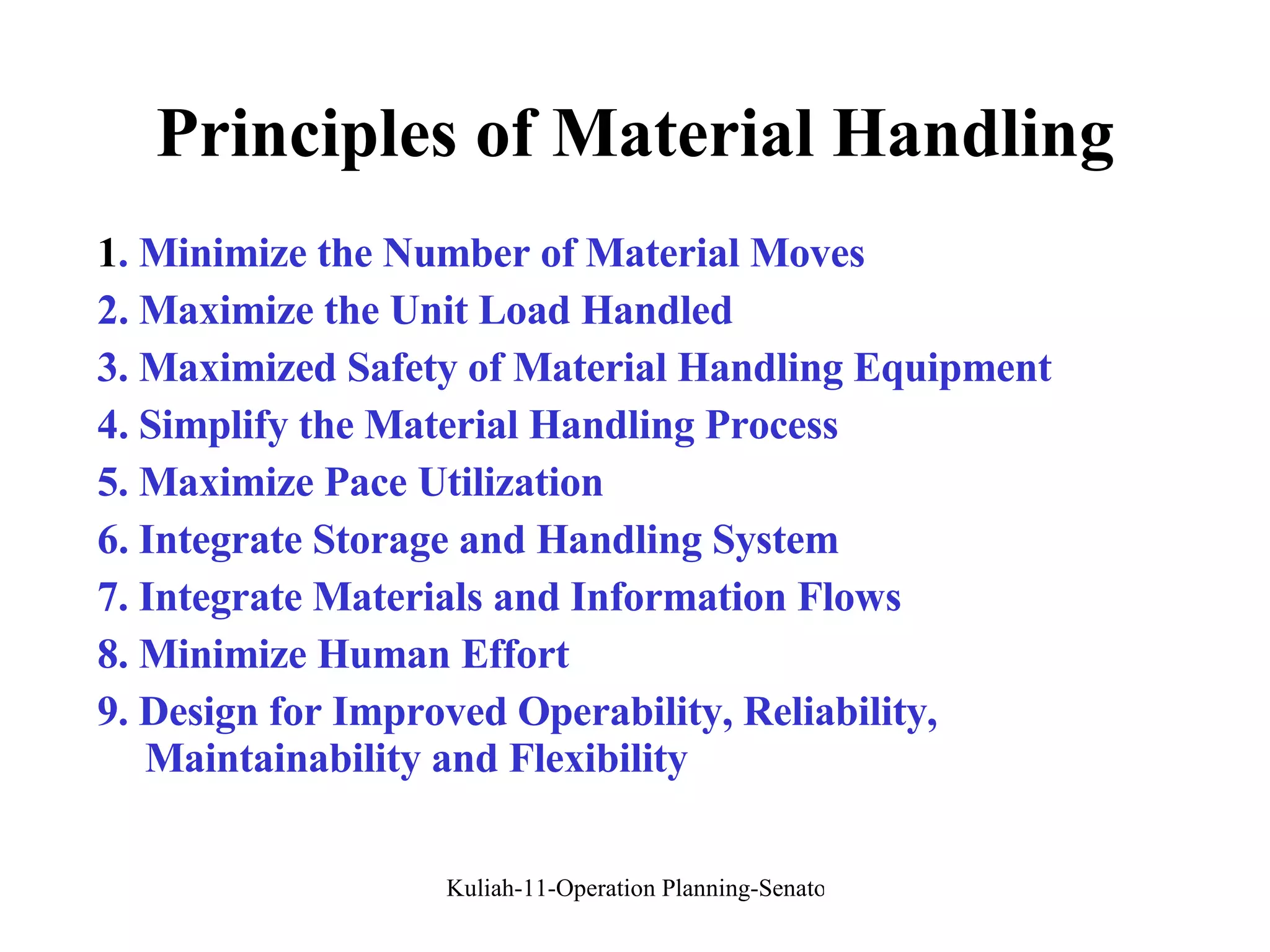
Principles of MaterialHandling 1 . Minimize the Number of Material Moves 2. Maximize the Unit Load Handled 3. Maximized Safety of Material Handling Equipment 4. Simplify the Material Handling Process 5. Maximize Pace Utilization 6. Integrate Storage and Handling System 7. Integrate Materials and Information Flows 8. Minimize Human Effort 9. Design for Improved Operability, Reliability, Maintainability and Flexibility
33.
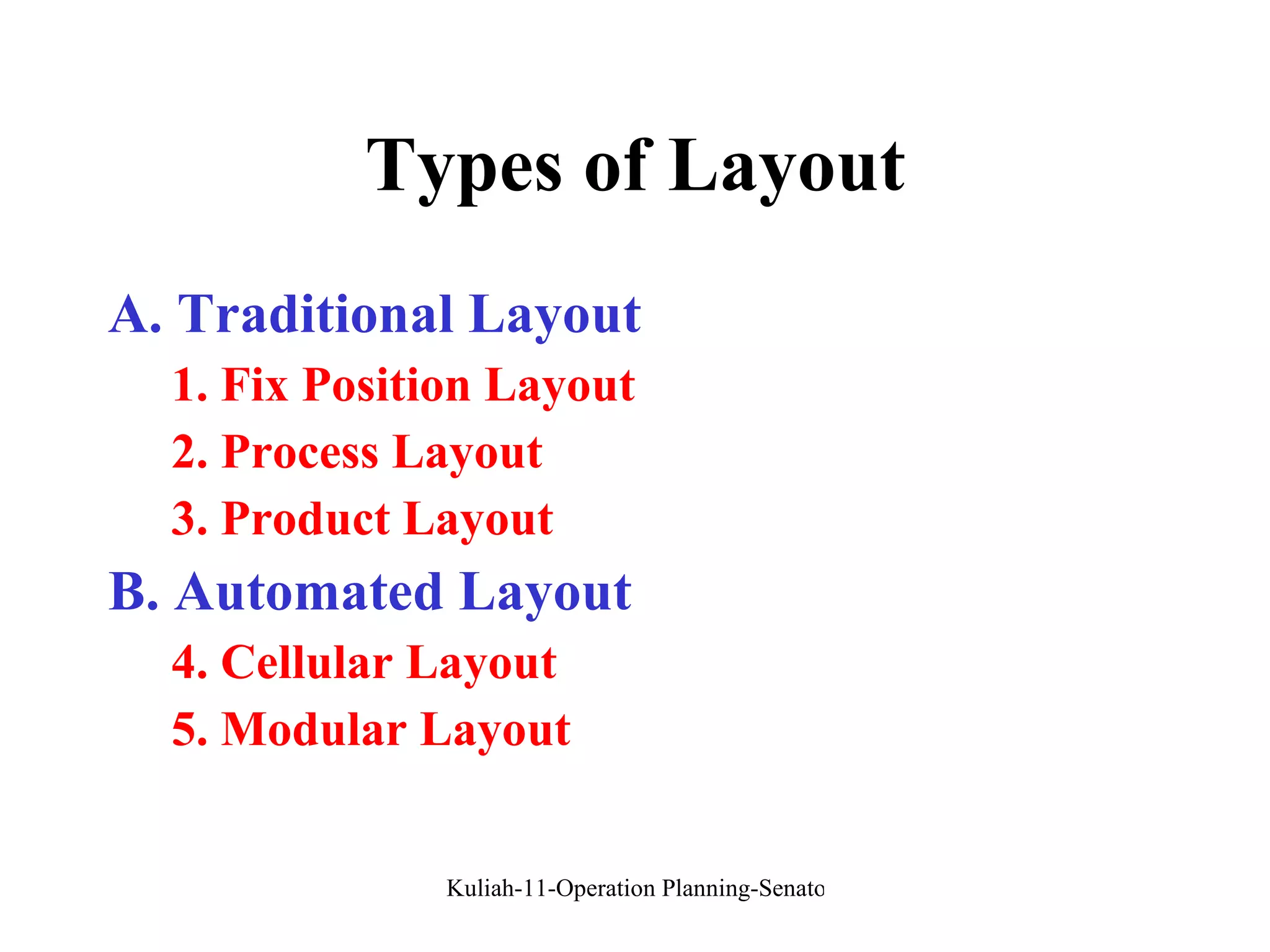
Types of LayoutA. Traditional Layout 1. Fix Position Layout 2. Process Layout 3. Product Layout B. Automated Layout 4. Cellular Layout 5. Modular Layout
34.
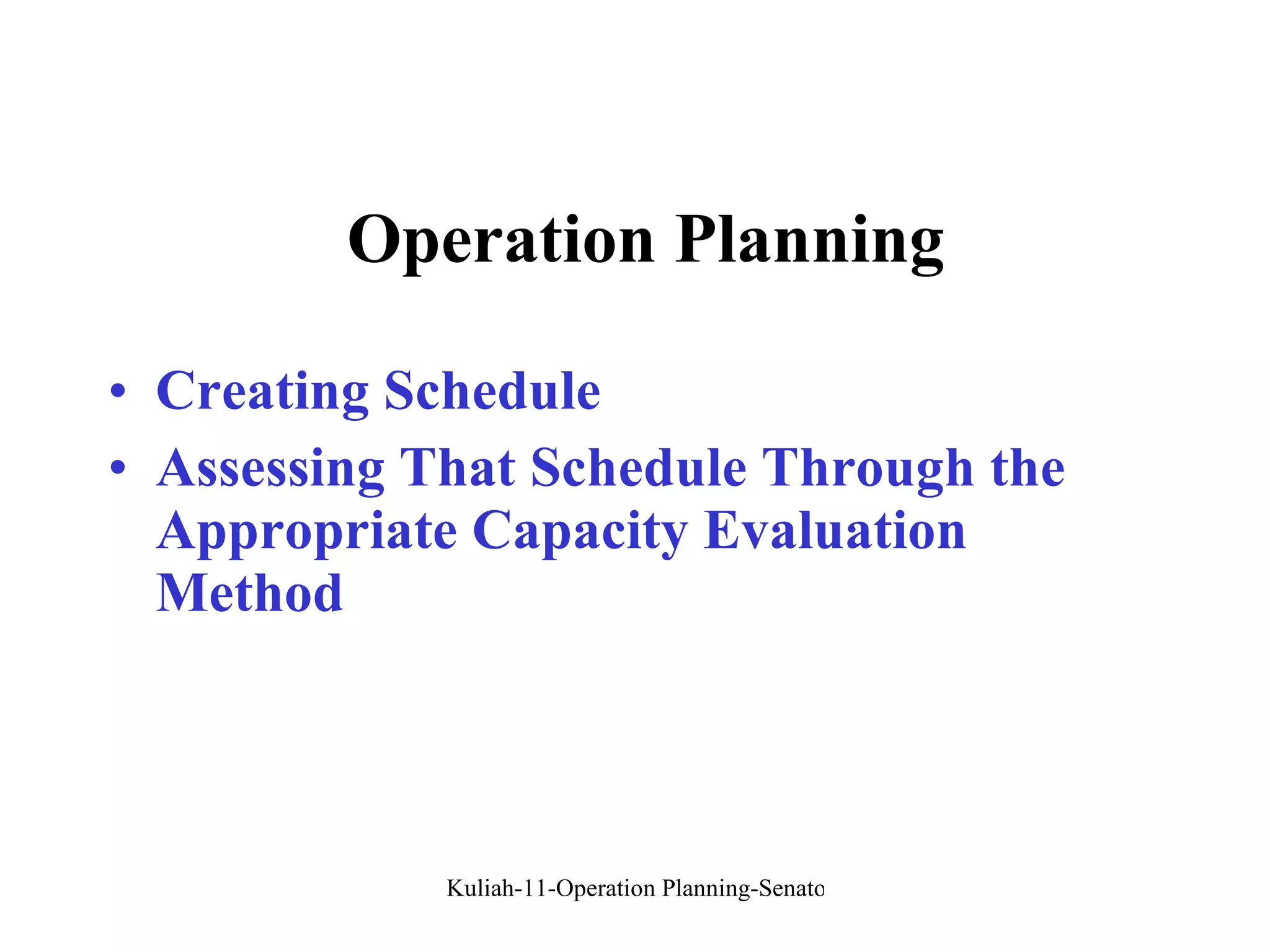
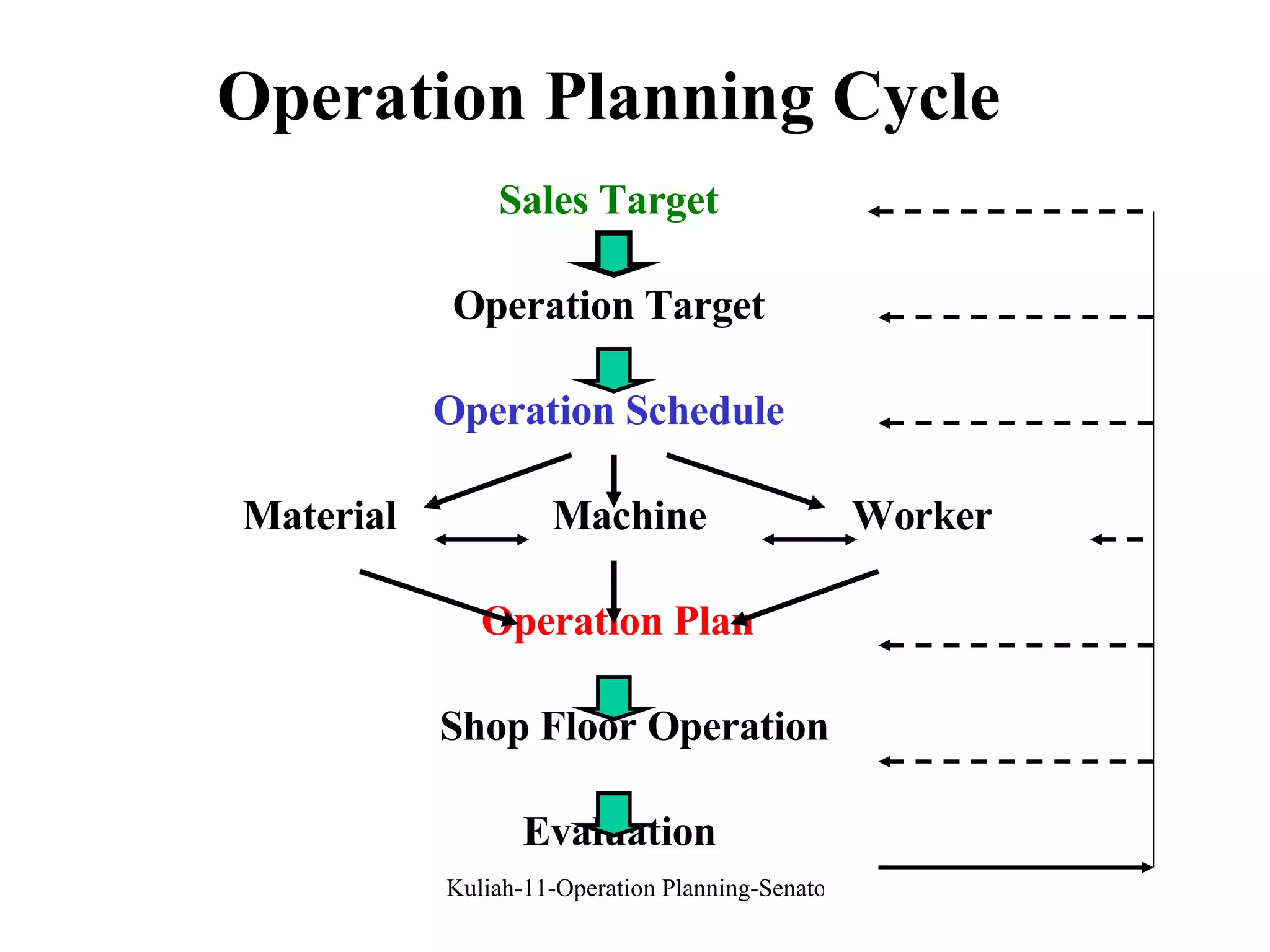
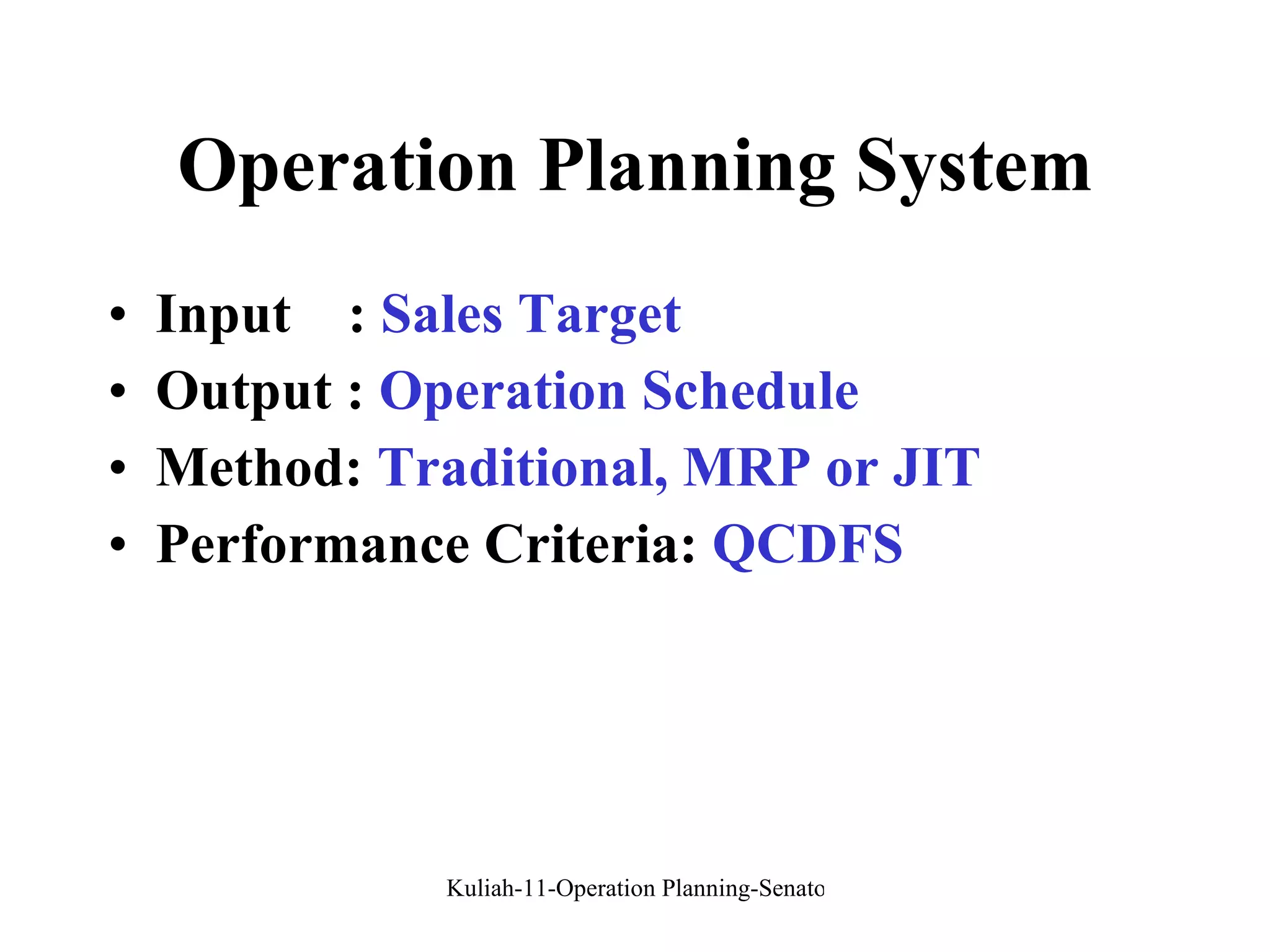
Operation Planning CreatingSchedule Assessing That Schedule Through the Appropriate Capacity Evaluation Method
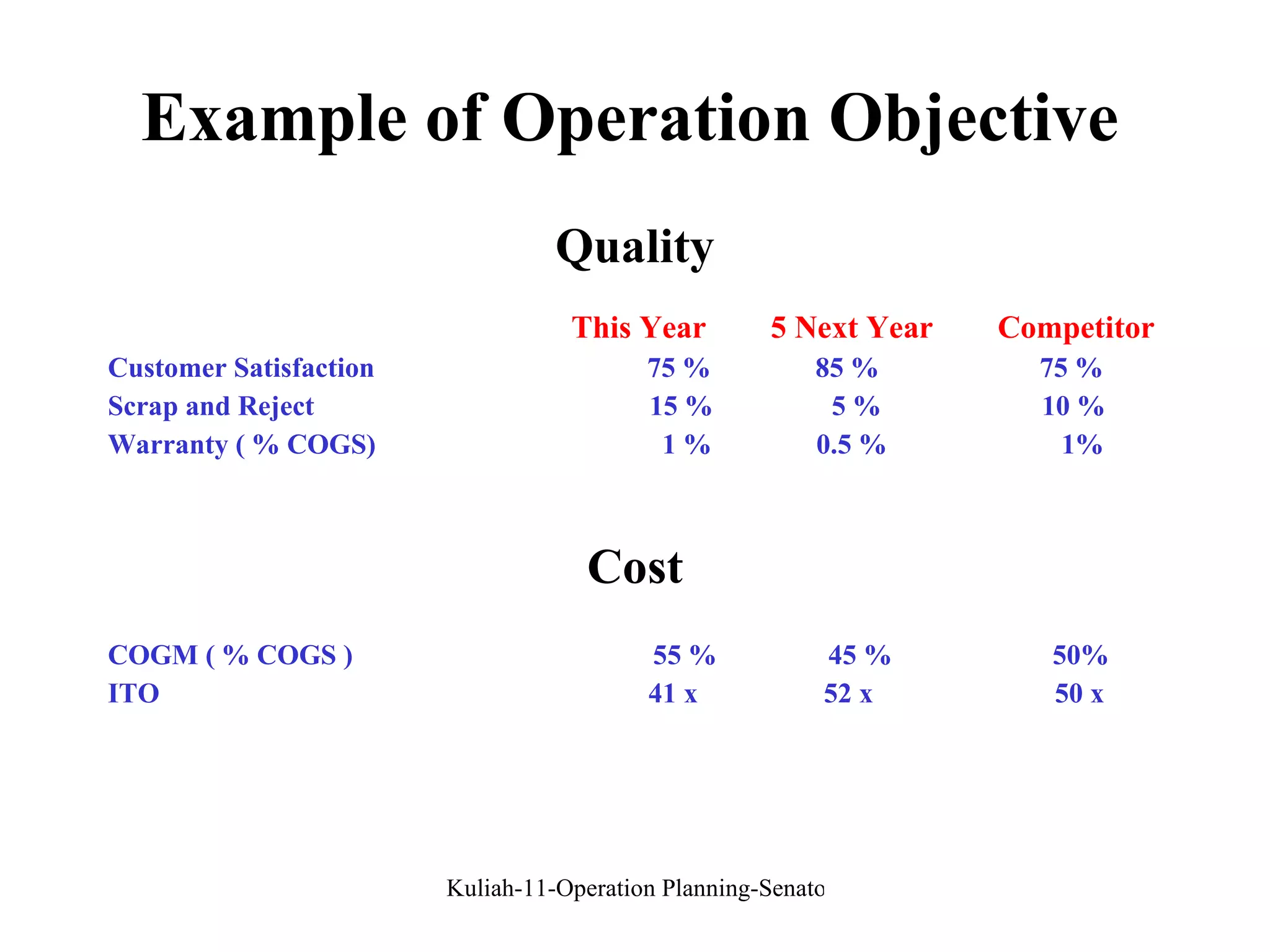
Example of OperationObjective Quality This Year 5 Next Year Competitor Customer Satisfaction 75 % 85 % 75 % Scrap and Reject 15 % 5 % 10 % Warranty ( % COGS) 1 % 0.5 % 1% Cost COGM ( % COGS ) 55 % 45 % 50% ITO 41 x 52 x 50 x
41.
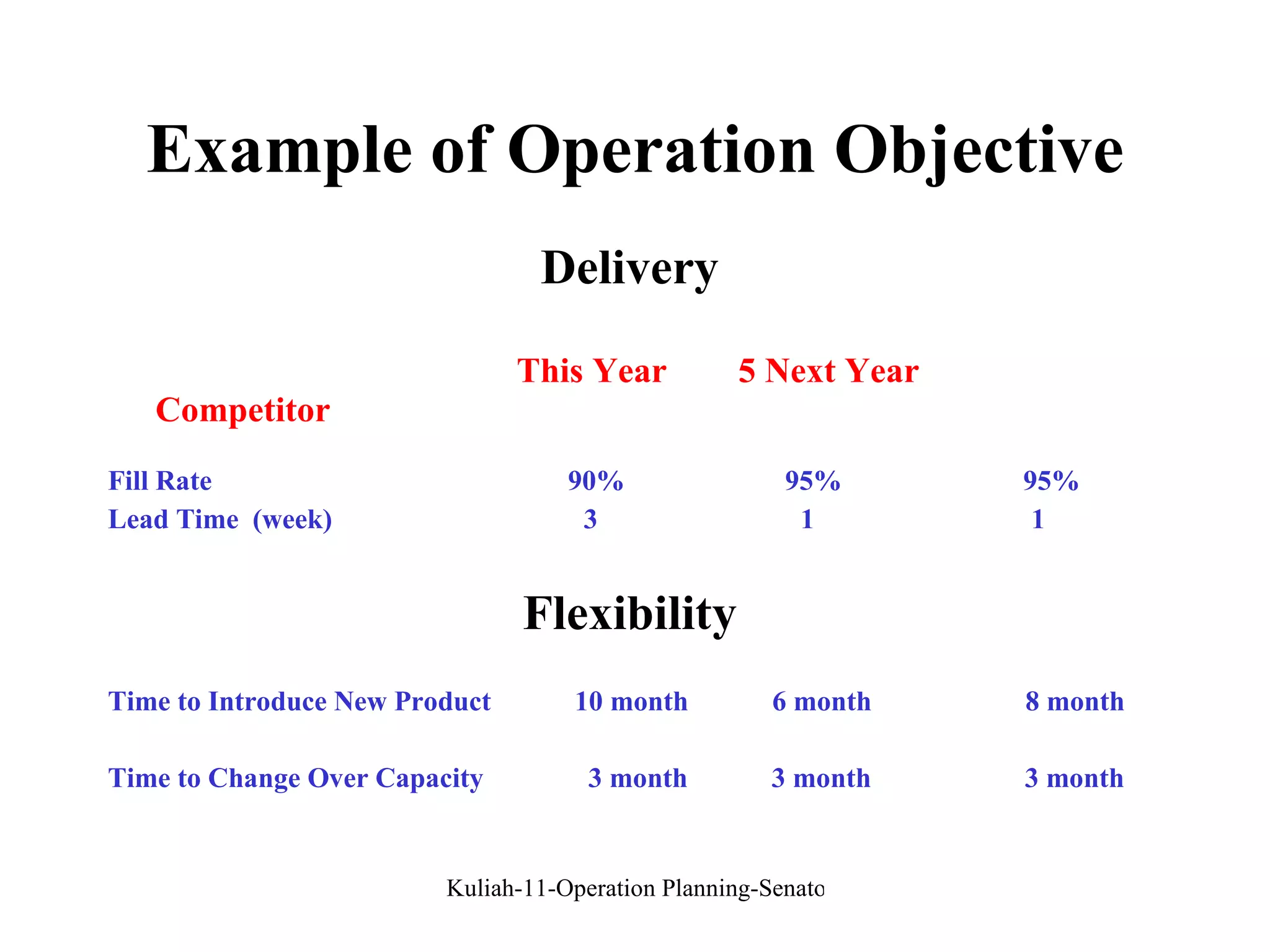
Example of OperationObjective Delivery This Year 5 Next Year Competitor Fill Rate 90% 95% 95% Lead Time (week) 3 1 1 Flexibility Time to Introduce New Product 10 month 6 month 8 month Time to Change Over Capacity 3 month 3 month 3 month