6 LESSONS
FROM
CANNES LIONS 2016
3 LESSONS FOR BRANDS
TECHNOLOGY KILLED CHEATING.
In a transparent world, the product or service is the message.
You don’t need to make it up, you just need to amplify it.
Making users happy with better products and services is the
advertising of the future.
An example of transparency: 
http://www.patagonia.com/us/footprint
Inspired by the Will Smith talk at Cannes Lions 2016.
TECHNOLOGY KILLED CHEATING
3 L E S S O N S F O R B R A N D S
You can't hide anything anymore, there's too many people with
phones and social media.
Transparency is no longer a choice, but how brands deal with it
is. Be honest. Don’t edit the truth, tell the consumer the whole
story upfront. They’ll discover it anyway, whether by you or
other source. Users are not stupid. They have a brain and they
know they’re being marketed to.
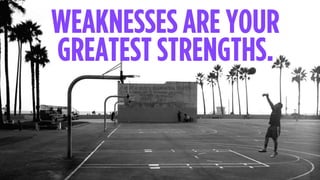
WEAKNESSES ARE YOUR
GREATEST STRENGTHS.
Users will become more favorably disposed to a product when
negative information is added to an otherwise only positive
description.
When developing ideas start from your weakest point.
Embrace your flaws, be vulnerable and let users empathize
with you. Don’t hide your weaknesses, amplify them!
Celebrate your imperfections.
Inspired by the Cummin&Partners talk at Cannes Lions 2016:
“If Batman was an Adman: Why your weaknesses are your greatest strength”
WEAKNESSES ARE YOUR GREATEST STRENGTHS
3 L E S S O N S F O R B R A N D S
In marketing, our strengths are generic; it’s our weaknesses
that define our character, differentiating us from others.
Too often, we try and focus on our strengths to build brands,
yet these strengths are well known, category table-stakes (all
beer is refreshing). In a world yearning for authenticity, why do
brands consistently portray superficial and positive images?
Let’s learn a life lesson from Batman who found his strengths
by embracing his vulnerabilities. Vulnerability is key to human
connection. All humans are attracted to weakness. If brands
show vulnerability, it will be easier for users to trust them,
precisely because they’re putting themselves at risk.
Vulnerability makes brands more relatable.
PURPOSE
IS A LOT
LIKE LOVE.
But purpose does not necessarily refer to social responsibility.
Most of the times it just means something bigger than your
product functionality but smaller than solving world hunger.
Use creativity to help a cultural change that makes a
difference for the future:
- Right the wrongs (Skins “Official Non-Sponsor of FIFA”)
- Fight the injustices (Always #LikeAGirl, Ariel #sharetheload)
- Show a different norm (AXE “Find Your Magic”).

PURPOSE IS A LOT LIKE LOVE
3 L E S S O N S F O R B R A N D S
Some brands are already doing beautiful love letters (ads,
manifestos, etc) that can touch people's emotions. But
afterwards people want you to show your love, to put your
money where your mouth is. Purpose, like love, should be
about showing, not just talking about it.
Companies that not only articulate a higher or broader
purpose but who also walk-the-walk by behaving in ways that
demonstrate their true commitment. Discover the important
human truths, set your purpose and then act on it. Be the
change, walk the talk.
3 LESSONS FOR AGENCIES
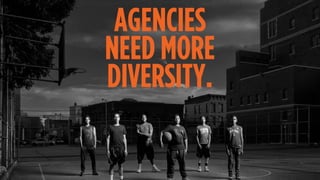
AGENCIES
NEED MORE
DIVERSITY.
Your team should be as diverse as the users you’re trying to
reach. Look outside of the ad world, find cultural experts. Bring
unusual perspectives and diverse talents to work with you. Be
open to the ideas of those who know much less than you (they
may really know much more).
Inspired by the DigitasLBi, DDB North America
and M&C Saatchi talks at Cannes Lions 2016.
AGENCIES NEED MORE DIVERSITY
3 L E S S O N S F O R A G E N C I E S
How many of you are the bearded white guy in sneakers?
Sitting in a room with like-minded people is the worst thing in
the world for creativity, but that is generally how advertising
agencies like to operate. Great work is increasingly dependent
on diversity. Diversity of cultures, diversity of interests,
diversity of age, and so on. Diversity is not a moral issue, nor
something that looks good on the photo, it is a creative
advantage.
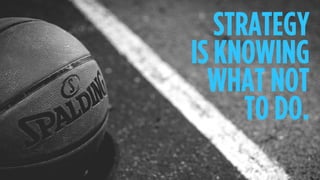
STRATEGY
IS KNOWING
WHAT NOT
TO DO.
KEY STRATEGY QUESTIONS
1. What trends from the past motivate action?
2. What are your winning aspirations?
3. Where will you play? (Market, Customers, Region Products,
Platforms, Business Model)
4. How will you win?
5. What capabilities are needed?
6. How will you measure success?
STRATEGY IS KNOWING WHAT NOT TO DO
3 L E S S O N S F O R A G E N C I E S
“The average US consumer is exposed to 6,000 brand messages
daily. Brands invite themselves to conversations where they don’t
belong, where they are not relevant, not useful, not interesting,
adding no value. …it’s just noise.” - Wendy Clark
We’re pursuing a goal of just more channels and more content.
A quantity game. But more cannot be a strategy. With so many
touchpoints today we have to find the critical ones and put our
money there.
Start with a big idea that holds everything together and
choose the right medium. An idea can’t be media neutral, it has
to first appear somewhere. A book, a painting, a building…
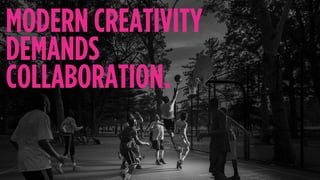
MODERN CREATIVITY
DEMANDS
COLLABORATION.
Great work will always be a result of great creative
partnerships. And partnership means going on a journey
together, working side by side, sharing a mutual ambition,
creating briefs and coming up with solutions together and
empowering everyone to participate.
A new way of working together.
BRANDS WITH PURPOSE DO BETTER
3 L E S S O N S F O R A G E N C I E S
Kill the rockstars!
It's not about the lonely ad man working at night anymore.
Technology and the world are too complex today. You won’t be
able to solve big problems without collaboration. Don’t be
afraid to admit you have no idea what you’re doing and need
help from someone who does.
Evolve the agency-client relationship into a unified creative
team, a creative partnership.
BONUS LESSON
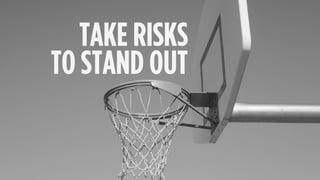
TAKE RISKS
TO STAND OUT
Clients are often afraid, like a small kid in class. Scared of
losing their jobs, scared of not getting that promotion. It’s the
agency’s job to educate the client. To keep pushing and
teaching until they’re not afraid anymore. Great creativity is
within reach of any brand or agency, but it does require an
investment of time, bravery and trust.
If you take risks, it could create controversy, people can
ridicule you…but what’s the alternative? The alternative is that
you do stuff and no one even cares, and you’re totally
irrelevant.
The safest thing you can do is be brave and take chances.
That’s the way you grow brands.
TAKE RISKS TO STAND OUT.
B O N U S L E S S O N
“It takes the same amount of energy to do great as it does to justify
average.” - David Droga
We’re an industry that spends much time justifying average.
Often the biggest budgets generate greater fear of mistake
and a smaller share of audacity.
Telling our users what they already know, is nice and
inoffensive, but also extremely dangerous, because it's not
breaking through and it’s not really doing anything for your
brand. It’s the kind of stuff that might not get you fired, but it’s
also the sort of stuff that burns a lot of money.
© Copyright comOn Group (comOn, SA) 2015© Copyright comOn Group (comOn, SA) 2016
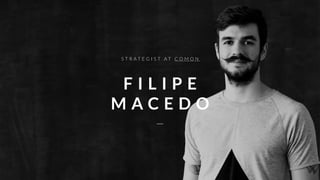
S T R A T E G I S T A T C O M O N
F I L I P E
M A C E D O

6 Lessons from Cannes Lions 2016

  • 1.
  • 2.
  • 3.
  • 4.
    In a transparentworld, the product or service is the message. You don’t need to make it up, you just need to amplify it. Making users happy with better products and services is the advertising of the future. An example of transparency:  http://www.patagonia.com/us/footprint Inspired by the Will Smith talk at Cannes Lions 2016. TECHNOLOGY KILLED CHEATING 3 L E S S O N S F O R B R A N D S You can't hide anything anymore, there's too many people with phones and social media. Transparency is no longer a choice, but how brands deal with it is. Be honest. Don’t edit the truth, tell the consumer the whole story upfront. They’ll discover it anyway, whether by you or other source. Users are not stupid. They have a brain and they know they’re being marketed to.
  • 5.
  • 6.
    Users will becomemore favorably disposed to a product when negative information is added to an otherwise only positive description. When developing ideas start from your weakest point. Embrace your flaws, be vulnerable and let users empathize with you. Don’t hide your weaknesses, amplify them! Celebrate your imperfections. Inspired by the Cummin&Partners talk at Cannes Lions 2016: “If Batman was an Adman: Why your weaknesses are your greatest strength” WEAKNESSES ARE YOUR GREATEST STRENGTHS 3 L E S S O N S F O R B R A N D S In marketing, our strengths are generic; it’s our weaknesses that define our character, differentiating us from others. Too often, we try and focus on our strengths to build brands, yet these strengths are well known, category table-stakes (all beer is refreshing). In a world yearning for authenticity, why do brands consistently portray superficial and positive images? Let’s learn a life lesson from Batman who found his strengths by embracing his vulnerabilities. Vulnerability is key to human connection. All humans are attracted to weakness. If brands show vulnerability, it will be easier for users to trust them, precisely because they’re putting themselves at risk. Vulnerability makes brands more relatable.
  • 7.
  • 8.
    But purpose doesnot necessarily refer to social responsibility. Most of the times it just means something bigger than your product functionality but smaller than solving world hunger. Use creativity to help a cultural change that makes a difference for the future: - Right the wrongs (Skins “Official Non-Sponsor of FIFA”) - Fight the injustices (Always #LikeAGirl, Ariel #sharetheload) - Show a different norm (AXE “Find Your Magic”). PURPOSE IS A LOT LIKE LOVE 3 L E S S O N S F O R B R A N D S Some brands are already doing beautiful love letters (ads, manifestos, etc) that can touch people's emotions. But afterwards people want you to show your love, to put your money where your mouth is. Purpose, like love, should be about showing, not just talking about it. Companies that not only articulate a higher or broader purpose but who also walk-the-walk by behaving in ways that demonstrate their true commitment. Discover the important human truths, set your purpose and then act on it. Be the change, walk the talk.
  • 9.
    3 LESSONS FORAGENCIES
  • 10.
  • 11.
    Your team shouldbe as diverse as the users you’re trying to reach. Look outside of the ad world, find cultural experts. Bring unusual perspectives and diverse talents to work with you. Be open to the ideas of those who know much less than you (they may really know much more). Inspired by the DigitasLBi, DDB North America and M&C Saatchi talks at Cannes Lions 2016. AGENCIES NEED MORE DIVERSITY 3 L E S S O N S F O R A G E N C I E S How many of you are the bearded white guy in sneakers? Sitting in a room with like-minded people is the worst thing in the world for creativity, but that is generally how advertising agencies like to operate. Great work is increasingly dependent on diversity. Diversity of cultures, diversity of interests, diversity of age, and so on. Diversity is not a moral issue, nor something that looks good on the photo, it is a creative advantage.
  • 12.
  • 13.
    KEY STRATEGY QUESTIONS 1.What trends from the past motivate action? 2. What are your winning aspirations? 3. Where will you play? (Market, Customers, Region Products, Platforms, Business Model) 4. How will you win? 5. What capabilities are needed? 6. How will you measure success? STRATEGY IS KNOWING WHAT NOT TO DO 3 L E S S O N S F O R A G E N C I E S “The average US consumer is exposed to 6,000 brand messages daily. Brands invite themselves to conversations where they don’t belong, where they are not relevant, not useful, not interesting, adding no value. …it’s just noise.” - Wendy Clark We’re pursuing a goal of just more channels and more content. A quantity game. But more cannot be a strategy. With so many touchpoints today we have to find the critical ones and put our money there. Start with a big idea that holds everything together and choose the right medium. An idea can’t be media neutral, it has to first appear somewhere. A book, a painting, a building…
  • 14.
  • 15.
    Great work willalways be a result of great creative partnerships. And partnership means going on a journey together, working side by side, sharing a mutual ambition, creating briefs and coming up with solutions together and empowering everyone to participate. A new way of working together. BRANDS WITH PURPOSE DO BETTER 3 L E S S O N S F O R A G E N C I E S Kill the rockstars! It's not about the lonely ad man working at night anymore. Technology and the world are too complex today. You won’t be able to solve big problems without collaboration. Don’t be afraid to admit you have no idea what you’re doing and need help from someone who does. Evolve the agency-client relationship into a unified creative team, a creative partnership.
  • 16.
  • 17.
  • 18.
    Clients are oftenafraid, like a small kid in class. Scared of losing their jobs, scared of not getting that promotion. It’s the agency’s job to educate the client. To keep pushing and teaching until they’re not afraid anymore. Great creativity is within reach of any brand or agency, but it does require an investment of time, bravery and trust. If you take risks, it could create controversy, people can ridicule you…but what’s the alternative? The alternative is that you do stuff and no one even cares, and you’re totally irrelevant. The safest thing you can do is be brave and take chances. That’s the way you grow brands. TAKE RISKS TO STAND OUT. B O N U S L E S S O N “It takes the same amount of energy to do great as it does to justify average.” - David Droga We’re an industry that spends much time justifying average. Often the biggest budgets generate greater fear of mistake and a smaller share of audacity. Telling our users what they already know, is nice and inoffensive, but also extremely dangerous, because it's not breaking through and it’s not really doing anything for your brand. It’s the kind of stuff that might not get you fired, but it’s also the sort of stuff that burns a lot of money.
  • 19.
    © Copyright comOnGroup (comOn, SA) 2015© Copyright comOn Group (comOn, SA) 2016 S T R A T E G I S T A T C O M O N F I L I P E M A C E D O