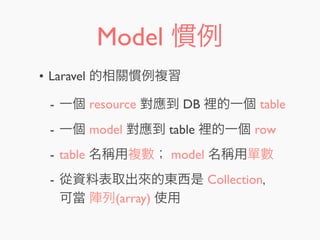
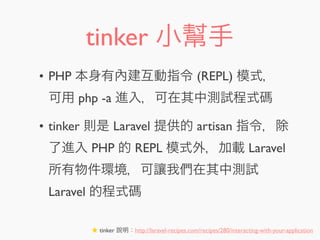
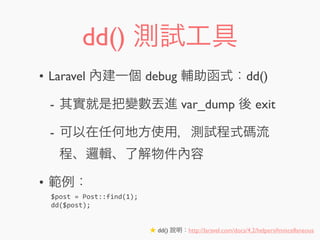
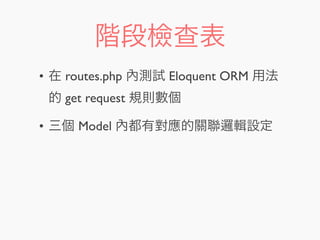
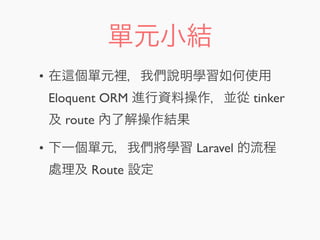
本文件介绍了如何使用 Laravel 的 Eloquent ORM 进行数据库操作,包括数据的创建、读取、更新和删除(CRUD)及其相关工具,如 Artisan Tinker 和 dd()。文中还说明了 ORM 的定义、模型的约定、数据表间的关系,以及如何通过模型定义和使用这些关系。最后,提供了学习过程中的建议和注意事项,帮助掌握 Eloquent ORM 的基本操作。

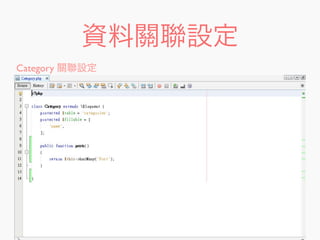
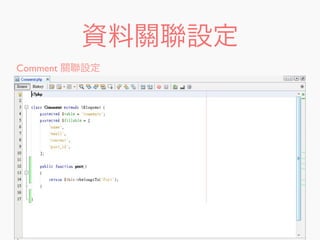
![artisan tinker
• 進入 PHP 互動模式,並載入 Laravel 環境
- 可以直接在指令模式下操作 Laravel 各元
件,測試程式寫法
- 要結束請用 exit; 指令
• 範例:
$
php
artisan
tinker
[1]
>
exit;
★ 由於 tinker 相依的 extension pcntl 在 Windows 上沒有實作,因此無
法全功能支援 tinker 功能:http://php.net/manual/en/pcntl.installation.php](https://image.slidesharecdn.com/6-eloquentorm-150113000515-conversion-gate01/85/Eloquent-ORM-8-320.jpg)
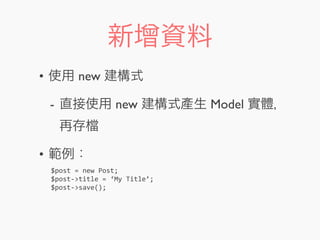
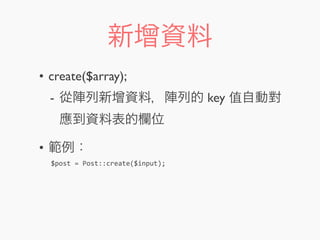
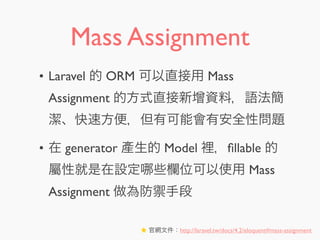
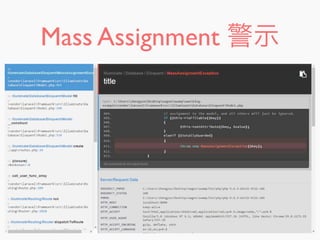
![設定 fillable、guarded
• 在 Model 內設定 fillable 屬性,指定 些欄
位可以透過 Mass Assignment 來寫入/更新
資料
• guarded 則是相反的屬性,設定後可以保
護特定欄位不使用 Mass Assignment
• 範例:
protected
$fillable
=
[‘title’,
‘content’,
‘category_id’];
protected
$guarded
=
[‘id’,
‘password’];](https://image.slidesharecdn.com/6-eloquentorm-150113000515-conversion-gate01/85/Eloquent-ORM-14-320.jpg)
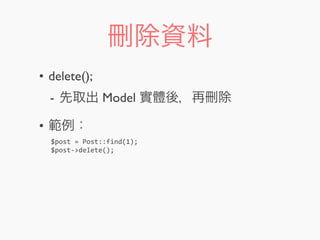
![刪除資料
• destroy($id);
- 刪除一筆資料,使用 primary key
• destroy([1, 2, 3]);
- 刪除多筆資料,使用 array 傳值
• destroy(1, 2, 3);
- 刪除多筆資料,使用多參數傳值](https://image.slidesharecdn.com/6-eloquentorm-150113000515-conversion-gate01/85/Eloquent-ORM-16-320.jpg)




![[JCConf 2024] Kotlin/Wasm:為 Kotlin 多平台帶來更多可能性](https://cdn.slidesharecdn.com/ss_thumbnails/kotlin-wasm-the-new-target-in-kmp-241004034547-e11ec4a4-thumbnail.jpg?width=640&height=640&fit=bounds)
![[GDG Kaohsiung DevFest 2023] 以 Compose 及 Kotlin Multiplatform 打造多平台應用程式](https://cdn.slidesharecdn.com/ss_thumbnails/building-multiplaftorm-application-using-kotlin-and-compose-multiplatform-231127165717-6bee7d0b-thumbnail.jpg?width=640&height=640&fit=bounds)
![[JCConf 2023] 從 Kotlin Multiplatform 到 Compose Multiplatform:在多平台間輕鬆共用業務邏輯與 U...](https://cdn.slidesharecdn.com/ss_thumbnails/kotlin-multiplatform-with-compose-231011174559-d4d22a45-thumbnail.jpg?width=640&height=640&fit=bounds)
![[Kotlin 讀書會第五梯次] 深入淺出 Kotlin 第一章導讀](https://cdn.slidesharecdn.com/ss_thumbnails/guided-reading-on-head-first-kotlin-chapter-one-230816095202-c328f541-thumbnail.jpg?width=640&height=640&fit=bounds)
![[WebConf Taiwan 2023] 一份 Zend Engine 外帶!透過 Micro 讓一次打包、多處運行變得可能](https://cdn.slidesharecdn.com/ss_thumbnails/building-app-with-zend-engine-using-micro-230816092930-84eda384-thumbnail.jpg?width=640&height=640&fit=bounds)

![[Effective Kotlin 讀書會] 第八章 Efficient collection processing 導讀](https://cdn.slidesharecdn.com/ss_thumbnails/effective-kotlin-chapter8-221208155318-f914a841-thumbnail.jpg?width=640&height=640&fit=bounds)
![[MOPCON 2022] 以 Kotlin Multiplatform 制霸全平台](https://cdn.slidesharecdn.com/ss_thumbnails/kotlin-multiplatform-221017125206-52db0fac-thumbnail.jpg?width=640&height=640&fit=bounds)
![[JCConf 2022] Compose for Desktop - 開發桌面軟體的新選擇](https://cdn.slidesharecdn.com/ss_thumbnails/compose-for-desktop-221008111948-4f59ebda-thumbnail.jpg?width=640&height=640&fit=bounds)

![[COSCUP 2022] 讓黑畫面再次偉大 - 用 PHP 寫 CLI 工具](https://cdn.slidesharecdn.com/ss_thumbnails/make-cli-great-again-by-using-php-220803083302-2be4b800-thumbnail.jpg?width=640&height=640&fit=bounds)
![[COSCUP 2022] Kotlin Collection 遊樂園](https://cdn.slidesharecdn.com/ss_thumbnails/kotlin-collection-playground-220803082529-17e4a226-thumbnail.jpg?width=640&height=640&fit=bounds)


![[PHP 也有 Day #64] PHP 升級指南](https://cdn.slidesharecdn.com/ss_thumbnails/php-upgrade-guide-220301051052-thumbnail.jpg?width=640&height=640&fit=bounds)


![[Kotlin Serverless 工作坊] 單元 4 - 實作 RSS Aggregator](https://cdn.slidesharecdn.com/ss_thumbnails/kotlin-serverless-ep4-rss-aggregator-210423105251-thumbnail.jpg?width=640&height=640&fit=bounds)