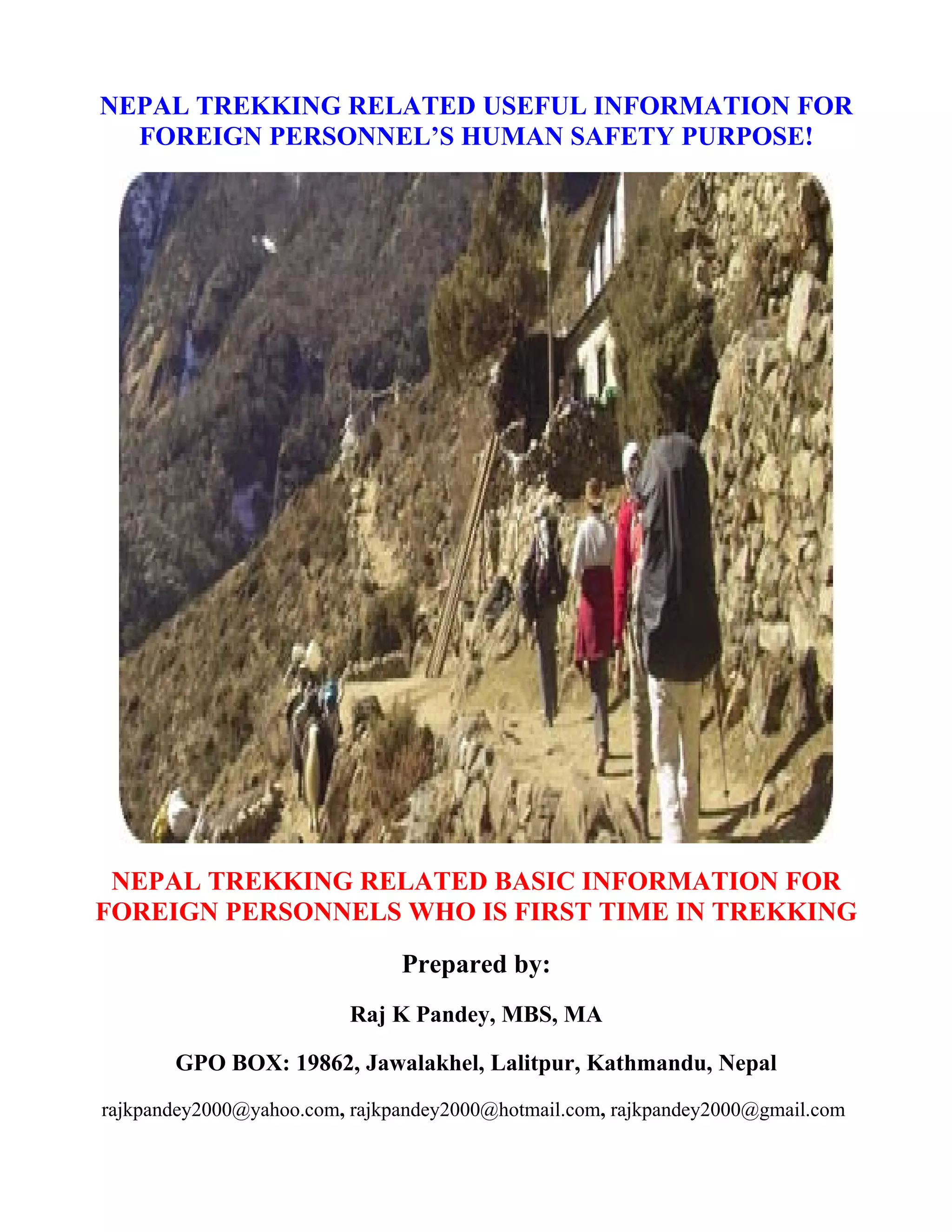
NEPAL TREKKING RELATED USEFUL INFORMATION FOR
  FOREIGN PERSONNEL’S HUMAN SAFETY PURPOSE!


 NEPAL TREKKING RELATED BASIC INFORMATION FOR
FOREIGN PERSONNELS WHO IS FIRST TIME IN TREKKING
                               Prepared by:
                          Raj K Pandey, MBS, MA

       GPO BOX: 19862, Jawalakhel, Lalitpur, Kathmandu, Nepal
rajkpandey2000@yahoo.com, rajkpandey2000@hotmail.com, rajkpandey2000@gmail.com
ABC FOR NEW TREKKERS

Present Security Situation in Trekking Circuits: The tourists are safe in the government approved
trekking circuits since no serious complains has been lodged by any tourist so far. The government is
seriously concerned for the tourists’ security and safety purpose. A special Tourist Police has been
established who will directly support them in case of need. No donation drive has been in practiced in
these days by any political parties and group in the approved trekking circuits. Albeit, villagers may
request some voluntary contributions with the tourist for their local developmental activities as a fund
rising purpose. However, it is suggested to practice the flowing security guidelines while in trek:

      Never track along but hire trusted guide if you can not find your companion;
      Choose authorized trekking companies/guides who are reliable as well as capable;
      Become informed about the high altitude sickness and your physical weakness;
      Carry necessary medicine kits and sufficient stuffs as per your needs;
      Do not step backward blindly while taking photos;
      Time your trek generously taking rest while trekking is not a sing of weakness;
      Take with you copy of passport, travel insurance policy copy, credit card, etc.
      Ask permission before taking someone’s photos;
      Do not purchase illegal animal and plant products;
      Ask about the price deal before you use any products and service;
      Do not fight and argue with the locals;
      Respect local culture and religious sites;
      If you feel headache, difficulty in sleeping, breathlessness, loss of appetite and general fatigue
       stop ascending immediately since it is symptoms of high altitude sickness.

Altitude: Acclimatization is important for the trekking above 3500m. These symptoms are commonly
headache, nausea, lethargy and sometime breathlessness. If you or any of the members display any of
these symptoms, get back for your treatment.

List of Altitude Level and Oxygen Rate

      8,848m/ 29,028 feet : 33%
      8,000m/ 26,247 feet : 36%
      7,000m/ 22,966 feet : 41%
      6,000m/ 19,865 feet : 47%
      5,500m/ 18,045 feet : 50%
      5,200m/ 17,061 feet : 52%
      5,000m/ 16,404 feet : 53%
      4,500m/ 14,764 feet : 57%
      4,000m/ 13,123 feet : 60%
      3,500m/ 11,483 feet : 64%
      3,000m/ 9,843 feet : 68%
      2,500m/ 8,202 feet : 73%
      1,000m/ 3,281 feet : 88%
      760mmHg (Sea Level) : 100%
The above given oxygen varied percentage rates of different altitude level provide you least of an idea
to know yourself for your trekking/climbing journey. Which is listed from the highest point of world
Mt Everest (8,848m/ 29,028 feet) top and 760mmHg sea level.

Insurance: Your medical insurance policy should cover for helicopter evacuation, many policies leave
this out so be sure to check yours.

First aid kit: It is suggested you bring the following supplementary items with you: Anti-diarrhea
tablets, blister pads, sterile plain and crepe bandages, tube of antiseptic cream, decongestants,
antihistamines, throat lozenges, paracetamol or aspirin and medicines as prescribed by physician.

Trekking permit: A valid permit is required for certain areas, which you can obtain upon your arrival.
Permits are not required for the Annapurna, Everest and Langtang treks. However, conservation fees
are required for these national parks.

Disposal of Rubbish: It is recommend that each trekker have keep a small bag during the course of the
trip. Any non-burnable or non-biodegradable rubbish should be carried back to Kathmandu and
disposed appropriately.

Money and Valuable Securities: Always carry Nepalese rupees in small bills. The amount to be cared
depends on the area and the duration of the trek. Do not show your valuables

NEPAL IN GENERAL FACT

Geography: Nepal covers an area of 147,181 square kilometers, and stretches 145-241 kilometers
north to south and 850 kilometers west to east. The country is located between India in the south and
China in the north. At latitudes 26 and 30 degrees north and longitudes 80 and 88 degrees east, Nepal
is topographically divided into three regions: the Himalaya to the north, the hills consisting of the
Mahabharat range and the Churia Hills, and Terai to the south. Elevations are varied in the kingdom.

The highest point is Mt. Everest (8848 m) in the north and the lowest point (70 meters above sea level)
is located at Kechana Kalan of Jhapa District. Altitude increases as you travel south to north. To the
north temperatures are below - 40 degrees Celsius and in the Terai, temperatures rise to 40 degrees
Celsius in the summer. During June, July and August, Nepal is influenced by monsoon clouds.

Alcohol: Home distillation is an ancient practice, still managing to hold its own against modern
distilleries. The Nepali brand-name hard liquors are best avoided. Often adulterated with chemicals
they can give a quick headache. Imported brands are expensive. The Nepali beer market is booming,
with at least four local brands and two local licensees on the market.

The finest alcohol is homemade stuff. Raksi is potent, exhilarating and smooth as velvet. To test for
good raksi, toss a small amount on a fire and see if it burns. Different grains produce different flavors:
rice raksi is rich and smooth, kodo (millet) is stronger and more fiery. Less potent is home-brewed
beer, land (Nepali) or chang (Tibetan), a whitish, thin drink made from rice or millet with a refreshing
sweet-sour taste. A variation served in mountain regions is tongba, fermented mash which is placed in
a wooden container and mixed with hot water. You drink from a bamboo straw, sipping the liquid and
avoiding the bits of millet; the hot water is refilled several times, and nursing a flask of tongba is a nice
sport for a cold evening.
Language: Nepali is the national language of Nepal. Though many languages are used throughout the
country, most people understand and speak Nepali. Educated people, and those involved in the tourist
industry also speak English and many other foreign languages.

Climate: Probably half of all tourists visit Nepal in the autumn (October-November), and for good
reasons. The weather is clear and dry, and temperatures will not too cold in the high country nor too
hot in Tarai. with the air washed clean by the monsoon rains, the mountains are at their most visible,
making this most popular time for trekking. Two major festivals also fall during this season.

In winter (December and January), most travelers head down into India, leaving the trekking routes
and guest houses fairly quiet, sometimes, as many restaurants pare down their menus for the season.

Spring (February-Mid-April) brings warmer temperatures, longer days, weddings and more festivals.
The rhododendrons are in bloom in the hills towards the end of this period, and in the Tarai the thatch
has been cut, making this the best time for wildlife. Nepal welcomes monsoon (June-September),
which breaks the enervating monotony of previous months, and makes fields come alive with rushing
water and green shoots.

Trekking Permit: No trekking permit will be required to trek in common areas such as Sagarmatha,
Annapurna and Langtang. A Trekking permit is required to visit Nepal's interior, i.e. areas determined
for trekking by the government. If you plan to trek in two different areas, two trekking permits are
required. The Department of Immigration issues trekking permit for the tourists who intend to trek any
part of the country. Trekking permit fee for different trekking areas are fixed as follows:

      Kanchanjunga And Lower Dolpa: First 4 weeks: US$10.00/week; After 4 week:US$ 20.00/week
      Upper Mustang And Upper Dolpa: First 10 days : US$700.00; After 1st 10 days: US$ 70.00 per day
      Manaslu: From Sept. to Nov : US$ 90.00 per week; From Dec. to Aug : US$ 75.00 per week
      Humla (Simikot-Yari): First 7 days : US$ 90.00; After 1st 7 days : US$ 15.00 per day

   Trekking in following areas require prior approval from Ministry of Home Affairs:

Olangchunggola, Lelep and Papung in Taplejung
Kimathanka, Chepua, Hatia and Phawakhola in Sankhuwasabha
North-West route to Nangpala of the Namche VDC in Solokhumbu
Thuman and Timure in Rasua
Chrkampar and Chuchet in Gorkha
Nar, Phu and area on the North from Tiliche of Thoche VDC in Manang
Mugu, Dolpung, Phulu and Magare in Mugu.
Limi and the route to Tibet through Tangekhola of Darma VDC in Humla
Byas in Darchula and Kanda in Bajhang

Important Note: For the trekking permit, please attach two copies of photograph with the application
form. Trekking permit will not be issued; to individual trekkers in the following areas: Kanchanjunga
Upper Mustang and Upper Dolpa
Manaslu
Humla (Simikot-Yari)
Trekking permit will not be issued for more than the date of validity of visa.
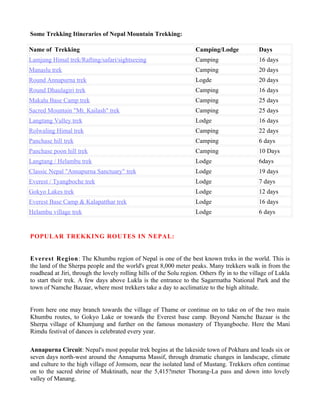
Some Trekking Itineraries of Nepal Mountain Trekking:

Name of Trekking                                                    Camping/Lodge              Days
Lamjung Himal trek/Rafting/safari/sightseeing                       Camping                    16 days
Manaslu trek                                                        Camping                    20 days
Round Annapurna trek                                                Logde                      20 days
Round Dhaulagiri trek                                               Camping                    16 days
Makalu Base Camp trek                                               Camping                    25 days
Sacred Mountain "Mt. Kailash" trek                                  Camping                    25 days
Langtang Valley trek                                                Lodge                      16 days
Rolwaling Himal trek                                                Camping                    22 days
Panchase hill trek                                                  Camping                    6 days
Panchase poon hill trek                                             Camping                    10 Days
Langtang / Helambu trek                                             Lodge                      6days
Classic Nepal "Annapurna Sanctuary" trek                            Lodge                      19 days
Everest / Tyangboche trek                                           Lodge                      7 days
Gokyo Lakes trek                                                    Lodge                      12 days
Everest Base Camp & Kalapatthar trek                                Lodge                      16 days
Helambu village trek                                                Lodge                      6 days


POPULAR TREKKING ROUTES IN NEPAL:


Everest Region: The Khumbu region of Nepal is one of the best known treks in the world. This is
the land of the Sherpa people and the world's great 8,000 meter peaks. Many trekkers walk in from the
roadhead at Jiri, through the lovely rolling hills of the Solu region. Others fly in to the village of Lukla
to start their trek. A few days above Lukla is the entrance to the Sagarmatha National Park and the
town of Namche Bazaar, where most trekkers take a day to acclimatize to the high altitude.


From here one may branch towards the village of Thame or continue on to take on of the two main
Khumbu routes, to Gokyo Lake or towards the Everest base camp. Beyond Namche Bazaar is the
Sherpa village of Khumjung and further on the famous monastery of Thyangboche. Here the Mani
Rimdu festival of dances is celebrated every year.

Annapurna Circuit: Nepal's most popular trek begins at the lakeside town of Pokhara and leads six or
seven days north-west around the Annapurna Massif, through dramatic changes in landscape, climate
and culture to the high village of Jomsom, near the isolated land of Mustang. Trekkers often continue
on to the sacred shrine of Muktinath, near the 5,415?meter Thorang-La pass and down into lovely
valley of Manang.
The route through Manang circles the Annapurna back to the Kathmandu-Pokhara highway. The
Annapurna circuit takes one through terraced hills, forests and alpine pastures and through the villages
of different cultures. The Sanctuary is an easy trek from Pokhara and takes one through some of
Nepal's most lovely rhododendron forests to the Annapurna base camp. There are also numerous one
or two day treks out of Pokhara town, where one can have views of Dhaulagiri, the Annapurna range,
Manaslu and Ganesh Himal.


Lantang Region: Just north of Kathmandu are two lovely where one may experience Tamang and
Sherpa life, temperate forest and alpine pastures, glaciers, lakes and snowy peaks. Helambu valley
noted for its scenic grandeur and pleasant climate, is just north of the Kathmandu. One can stay in
highland monastery villages and small settlements in pristine forests. Above Helambu is a mountain
pass the lakes of Gosainkunda to the valley of Langtang. Gosaikunda lake itself is situated at 4,380
meters. It is sacred to Lord Shiva and every summer is the scene of an important pilgrimage. Nearby
are other lakes including Nagkunda, Bhairavkunda, Saraswatikunda and Suryakunda.


The trek passes through a varied landscape ranging from evergreen forests, cascading waterfalls and
turbulent streams to sub alpine grasslands and stark, beautiful mountainsides. Langtang valley stretches
north of Gosainkunda. One travels through pristine forests to the village of Ghoda Tabela, then the
valley opens out into a high, Himalayan river plain full of beautiful camping sites, spectacular peaks
and wide glaciers. One can hike to the back of the valley or take numerous optional trips to explore
glacier-filled side canyons.


Manaslu Trekking: Manaslu Trekking is a well-loved trekking routes, providing with pristine
mountain views, rich culture and genuine adventure sum up the trek experience around the 8156m
Manaslu. Opened in 1992, this area offers a combination of rich culture heritage.


Mustang Trekking: Mustang trekking is one of Nepal's most mysterious and least known kingdoms.
The landscape of Mustang is a barren moonscape of eroded sandstone pillars and discontinuous
moraine terraces, which together present a colourful mosaic made up principally.


Kanchanjunga Trekking: On the far eastern border lies Mt. Kangchanjunga. The valleys
approaching the mountain base camp have been opened to trekking, specifically for organized treks.
The long trek to the lap of Kangchanjunga takes one through some of the country's richest and most
pristine forests. The region is uninhabited, so the visitor must bring all food and camping equipment.


Makalu Trekking: Makalu trekking in eastern Nepal is protected by the Makalu Barun National
Park and Conservation Project. Established in 1992, it covers 2330 sq km. Among the 16 mountains
in the park, it is home to Makalu, the fifth highest mountain in the world (8463m/ 27,766ft).
Ganesh Himal Trekking: Not frequented by many tourists and it situated in central Nepal,
northwest of Kathmandu.The terraced hillsides seem to climb to the sky. Many interesting ethnic
groups a mixed of lifestyle offer you a glimpse into real Nepali life and this gives an opportunity


Dolpo Trekking: One of the newest areas of Nepal open to trekkers is the southern part of Shey
Phoksundo National Park. Reached in about a week from Jumla, the center of attraction is lovely
Lake Phoksundo, famous for the ever changing colors of its waters. Here one steps on to the edge


Rolwaling Trekking: Rolwaling trekking is one of Nepal's finest high mountain valleys West of the
Khumhu, directly on the Tibetan frontier there is a wild, lonely high valley the "Rolwaling" which is
called simply "the grave" by the Sherpa's on account of its location - buried


Rara Lake Trekking: The trek to Rara Lake begins at Jumla, a village in a trans-Himalayan valley
with high rides covered with forests and alpine pastures. The flight from Kathmandu to Jumla passes
south along the Dhaulagiri


The Recommended/Approval Trekking Routes:


From the safety and security, existing infrastructures, accessibility, basic tour related facilities and
human security prospective, flowing trekking circuits are considered to be the suitable one:
       Marpha, the village of apple orchards;
       Ghasa, a bird watchers’ paradise
       Tukuche, center of the historic salt trade;
       Annapurna Circuits, for the view of fish tail;
       Jomsom Trekking Circuite
       Langtang Gosaikunda Trekking Circuit
       Mt .Everest Base Camp Circuit


Recommendations


   1.   Avoid movement in late night and do not venture after dark due to risk from criminal elements;
   2.   Travel should be made between 0700 hrs-1700hrs in winter and 1800 in summer;
   3.   It is advised to carry ID card at all the times which traveling;
   4.   Do not directly deal the unexpected situation and let the guide face the strangers;
   5.   Contact your supervisor once a week via phone and let know your location;
   6.   Choose reliable tour operator and guide and understand their strength;
   7.   Consult local about the security situation where you are willing to stay for night;

6 basic trekking information

  • 1.
    NEPAL TREKKING RELATEDUSEFUL INFORMATION FOR FOREIGN PERSONNEL’S HUMAN SAFETY PURPOSE! NEPAL TREKKING RELATED BASIC INFORMATION FOR FOREIGN PERSONNELS WHO IS FIRST TIME IN TREKKING Prepared by: Raj K Pandey, MBS, MA GPO BOX: 19862, Jawalakhel, Lalitpur, Kathmandu, Nepal rajkpandey2000@yahoo.com, rajkpandey2000@hotmail.com, rajkpandey2000@gmail.com
  • 2.
    ABC FOR NEWTREKKERS Present Security Situation in Trekking Circuits: The tourists are safe in the government approved trekking circuits since no serious complains has been lodged by any tourist so far. The government is seriously concerned for the tourists’ security and safety purpose. A special Tourist Police has been established who will directly support them in case of need. No donation drive has been in practiced in these days by any political parties and group in the approved trekking circuits. Albeit, villagers may request some voluntary contributions with the tourist for their local developmental activities as a fund rising purpose. However, it is suggested to practice the flowing security guidelines while in trek:  Never track along but hire trusted guide if you can not find your companion;  Choose authorized trekking companies/guides who are reliable as well as capable;  Become informed about the high altitude sickness and your physical weakness;  Carry necessary medicine kits and sufficient stuffs as per your needs;  Do not step backward blindly while taking photos;  Time your trek generously taking rest while trekking is not a sing of weakness;  Take with you copy of passport, travel insurance policy copy, credit card, etc.  Ask permission before taking someone’s photos;  Do not purchase illegal animal and plant products;  Ask about the price deal before you use any products and service;  Do not fight and argue with the locals;  Respect local culture and religious sites;  If you feel headache, difficulty in sleeping, breathlessness, loss of appetite and general fatigue stop ascending immediately since it is symptoms of high altitude sickness. Altitude: Acclimatization is important for the trekking above 3500m. These symptoms are commonly headache, nausea, lethargy and sometime breathlessness. If you or any of the members display any of these symptoms, get back for your treatment. List of Altitude Level and Oxygen Rate  8,848m/ 29,028 feet : 33%  8,000m/ 26,247 feet : 36%  7,000m/ 22,966 feet : 41%  6,000m/ 19,865 feet : 47%  5,500m/ 18,045 feet : 50%  5,200m/ 17,061 feet : 52%  5,000m/ 16,404 feet : 53%  4,500m/ 14,764 feet : 57%  4,000m/ 13,123 feet : 60%  3,500m/ 11,483 feet : 64%  3,000m/ 9,843 feet : 68%  2,500m/ 8,202 feet : 73%  1,000m/ 3,281 feet : 88%  760mmHg (Sea Level) : 100%
  • 3.
    The above givenoxygen varied percentage rates of different altitude level provide you least of an idea to know yourself for your trekking/climbing journey. Which is listed from the highest point of world Mt Everest (8,848m/ 29,028 feet) top and 760mmHg sea level. Insurance: Your medical insurance policy should cover for helicopter evacuation, many policies leave this out so be sure to check yours. First aid kit: It is suggested you bring the following supplementary items with you: Anti-diarrhea tablets, blister pads, sterile plain and crepe bandages, tube of antiseptic cream, decongestants, antihistamines, throat lozenges, paracetamol or aspirin and medicines as prescribed by physician. Trekking permit: A valid permit is required for certain areas, which you can obtain upon your arrival. Permits are not required for the Annapurna, Everest and Langtang treks. However, conservation fees are required for these national parks. Disposal of Rubbish: It is recommend that each trekker have keep a small bag during the course of the trip. Any non-burnable or non-biodegradable rubbish should be carried back to Kathmandu and disposed appropriately. Money and Valuable Securities: Always carry Nepalese rupees in small bills. The amount to be cared depends on the area and the duration of the trek. Do not show your valuables NEPAL IN GENERAL FACT Geography: Nepal covers an area of 147,181 square kilometers, and stretches 145-241 kilometers north to south and 850 kilometers west to east. The country is located between India in the south and China in the north. At latitudes 26 and 30 degrees north and longitudes 80 and 88 degrees east, Nepal is topographically divided into three regions: the Himalaya to the north, the hills consisting of the Mahabharat range and the Churia Hills, and Terai to the south. Elevations are varied in the kingdom. The highest point is Mt. Everest (8848 m) in the north and the lowest point (70 meters above sea level) is located at Kechana Kalan of Jhapa District. Altitude increases as you travel south to north. To the north temperatures are below - 40 degrees Celsius and in the Terai, temperatures rise to 40 degrees Celsius in the summer. During June, July and August, Nepal is influenced by monsoon clouds. Alcohol: Home distillation is an ancient practice, still managing to hold its own against modern distilleries. The Nepali brand-name hard liquors are best avoided. Often adulterated with chemicals they can give a quick headache. Imported brands are expensive. The Nepali beer market is booming, with at least four local brands and two local licensees on the market. The finest alcohol is homemade stuff. Raksi is potent, exhilarating and smooth as velvet. To test for good raksi, toss a small amount on a fire and see if it burns. Different grains produce different flavors: rice raksi is rich and smooth, kodo (millet) is stronger and more fiery. Less potent is home-brewed beer, land (Nepali) or chang (Tibetan), a whitish, thin drink made from rice or millet with a refreshing sweet-sour taste. A variation served in mountain regions is tongba, fermented mash which is placed in a wooden container and mixed with hot water. You drink from a bamboo straw, sipping the liquid and avoiding the bits of millet; the hot water is refilled several times, and nursing a flask of tongba is a nice sport for a cold evening.
  • 4.
    Language: Nepali isthe national language of Nepal. Though many languages are used throughout the country, most people understand and speak Nepali. Educated people, and those involved in the tourist industry also speak English and many other foreign languages. Climate: Probably half of all tourists visit Nepal in the autumn (October-November), and for good reasons. The weather is clear and dry, and temperatures will not too cold in the high country nor too hot in Tarai. with the air washed clean by the monsoon rains, the mountains are at their most visible, making this most popular time for trekking. Two major festivals also fall during this season. In winter (December and January), most travelers head down into India, leaving the trekking routes and guest houses fairly quiet, sometimes, as many restaurants pare down their menus for the season. Spring (February-Mid-April) brings warmer temperatures, longer days, weddings and more festivals. The rhododendrons are in bloom in the hills towards the end of this period, and in the Tarai the thatch has been cut, making this the best time for wildlife. Nepal welcomes monsoon (June-September), which breaks the enervating monotony of previous months, and makes fields come alive with rushing water and green shoots. Trekking Permit: No trekking permit will be required to trek in common areas such as Sagarmatha, Annapurna and Langtang. A Trekking permit is required to visit Nepal's interior, i.e. areas determined for trekking by the government. If you plan to trek in two different areas, two trekking permits are required. The Department of Immigration issues trekking permit for the tourists who intend to trek any part of the country. Trekking permit fee for different trekking areas are fixed as follows:  Kanchanjunga And Lower Dolpa: First 4 weeks: US$10.00/week; After 4 week:US$ 20.00/week  Upper Mustang And Upper Dolpa: First 10 days : US$700.00; After 1st 10 days: US$ 70.00 per day  Manaslu: From Sept. to Nov : US$ 90.00 per week; From Dec. to Aug : US$ 75.00 per week  Humla (Simikot-Yari): First 7 days : US$ 90.00; After 1st 7 days : US$ 15.00 per day Trekking in following areas require prior approval from Ministry of Home Affairs: Olangchunggola, Lelep and Papung in Taplejung Kimathanka, Chepua, Hatia and Phawakhola in Sankhuwasabha North-West route to Nangpala of the Namche VDC in Solokhumbu Thuman and Timure in Rasua Chrkampar and Chuchet in Gorkha Nar, Phu and area on the North from Tiliche of Thoche VDC in Manang Mugu, Dolpung, Phulu and Magare in Mugu. Limi and the route to Tibet through Tangekhola of Darma VDC in Humla Byas in Darchula and Kanda in Bajhang Important Note: For the trekking permit, please attach two copies of photograph with the application form. Trekking permit will not be issued; to individual trekkers in the following areas: Kanchanjunga Upper Mustang and Upper Dolpa Manaslu Humla (Simikot-Yari) Trekking permit will not be issued for more than the date of validity of visa.
  • 5.
    Some Trekking Itinerariesof Nepal Mountain Trekking: Name of Trekking Camping/Lodge Days Lamjung Himal trek/Rafting/safari/sightseeing Camping 16 days Manaslu trek Camping 20 days Round Annapurna trek Logde 20 days Round Dhaulagiri trek Camping 16 days Makalu Base Camp trek Camping 25 days Sacred Mountain "Mt. Kailash" trek Camping 25 days Langtang Valley trek Lodge 16 days Rolwaling Himal trek Camping 22 days Panchase hill trek Camping 6 days Panchase poon hill trek Camping 10 Days Langtang / Helambu trek Lodge 6days Classic Nepal "Annapurna Sanctuary" trek Lodge 19 days Everest / Tyangboche trek Lodge 7 days Gokyo Lakes trek Lodge 12 days Everest Base Camp & Kalapatthar trek Lodge 16 days Helambu village trek Lodge 6 days POPULAR TREKKING ROUTES IN NEPAL: Everest Region: The Khumbu region of Nepal is one of the best known treks in the world. This is the land of the Sherpa people and the world's great 8,000 meter peaks. Many trekkers walk in from the roadhead at Jiri, through the lovely rolling hills of the Solu region. Others fly in to the village of Lukla to start their trek. A few days above Lukla is the entrance to the Sagarmatha National Park and the town of Namche Bazaar, where most trekkers take a day to acclimatize to the high altitude. From here one may branch towards the village of Thame or continue on to take on of the two main Khumbu routes, to Gokyo Lake or towards the Everest base camp. Beyond Namche Bazaar is the Sherpa village of Khumjung and further on the famous monastery of Thyangboche. Here the Mani Rimdu festival of dances is celebrated every year. Annapurna Circuit: Nepal's most popular trek begins at the lakeside town of Pokhara and leads six or seven days north-west around the Annapurna Massif, through dramatic changes in landscape, climate and culture to the high village of Jomsom, near the isolated land of Mustang. Trekkers often continue on to the sacred shrine of Muktinath, near the 5,415?meter Thorang-La pass and down into lovely valley of Manang.
  • 6.
    The route throughManang circles the Annapurna back to the Kathmandu-Pokhara highway. The Annapurna circuit takes one through terraced hills, forests and alpine pastures and through the villages of different cultures. The Sanctuary is an easy trek from Pokhara and takes one through some of Nepal's most lovely rhododendron forests to the Annapurna base camp. There are also numerous one or two day treks out of Pokhara town, where one can have views of Dhaulagiri, the Annapurna range, Manaslu and Ganesh Himal. Lantang Region: Just north of Kathmandu are two lovely where one may experience Tamang and Sherpa life, temperate forest and alpine pastures, glaciers, lakes and snowy peaks. Helambu valley noted for its scenic grandeur and pleasant climate, is just north of the Kathmandu. One can stay in highland monastery villages and small settlements in pristine forests. Above Helambu is a mountain pass the lakes of Gosainkunda to the valley of Langtang. Gosaikunda lake itself is situated at 4,380 meters. It is sacred to Lord Shiva and every summer is the scene of an important pilgrimage. Nearby are other lakes including Nagkunda, Bhairavkunda, Saraswatikunda and Suryakunda. The trek passes through a varied landscape ranging from evergreen forests, cascading waterfalls and turbulent streams to sub alpine grasslands and stark, beautiful mountainsides. Langtang valley stretches north of Gosainkunda. One travels through pristine forests to the village of Ghoda Tabela, then the valley opens out into a high, Himalayan river plain full of beautiful camping sites, spectacular peaks and wide glaciers. One can hike to the back of the valley or take numerous optional trips to explore glacier-filled side canyons. Manaslu Trekking: Manaslu Trekking is a well-loved trekking routes, providing with pristine mountain views, rich culture and genuine adventure sum up the trek experience around the 8156m Manaslu. Opened in 1992, this area offers a combination of rich culture heritage. Mustang Trekking: Mustang trekking is one of Nepal's most mysterious and least known kingdoms. The landscape of Mustang is a barren moonscape of eroded sandstone pillars and discontinuous moraine terraces, which together present a colourful mosaic made up principally. Kanchanjunga Trekking: On the far eastern border lies Mt. Kangchanjunga. The valleys approaching the mountain base camp have been opened to trekking, specifically for organized treks. The long trek to the lap of Kangchanjunga takes one through some of the country's richest and most pristine forests. The region is uninhabited, so the visitor must bring all food and camping equipment. Makalu Trekking: Makalu trekking in eastern Nepal is protected by the Makalu Barun National Park and Conservation Project. Established in 1992, it covers 2330 sq km. Among the 16 mountains in the park, it is home to Makalu, the fifth highest mountain in the world (8463m/ 27,766ft).
  • 7.
    Ganesh Himal Trekking:Not frequented by many tourists and it situated in central Nepal, northwest of Kathmandu.The terraced hillsides seem to climb to the sky. Many interesting ethnic groups a mixed of lifestyle offer you a glimpse into real Nepali life and this gives an opportunity Dolpo Trekking: One of the newest areas of Nepal open to trekkers is the southern part of Shey Phoksundo National Park. Reached in about a week from Jumla, the center of attraction is lovely Lake Phoksundo, famous for the ever changing colors of its waters. Here one steps on to the edge Rolwaling Trekking: Rolwaling trekking is one of Nepal's finest high mountain valleys West of the Khumhu, directly on the Tibetan frontier there is a wild, lonely high valley the "Rolwaling" which is called simply "the grave" by the Sherpa's on account of its location - buried Rara Lake Trekking: The trek to Rara Lake begins at Jumla, a village in a trans-Himalayan valley with high rides covered with forests and alpine pastures. The flight from Kathmandu to Jumla passes south along the Dhaulagiri The Recommended/Approval Trekking Routes: From the safety and security, existing infrastructures, accessibility, basic tour related facilities and human security prospective, flowing trekking circuits are considered to be the suitable one:  Marpha, the village of apple orchards;  Ghasa, a bird watchers’ paradise  Tukuche, center of the historic salt trade;  Annapurna Circuits, for the view of fish tail;  Jomsom Trekking Circuite  Langtang Gosaikunda Trekking Circuit  Mt .Everest Base Camp Circuit Recommendations 1. Avoid movement in late night and do not venture after dark due to risk from criminal elements; 2. Travel should be made between 0700 hrs-1700hrs in winter and 1800 in summer; 3. It is advised to carry ID card at all the times which traveling; 4. Do not directly deal the unexpected situation and let the guide face the strangers; 5. Contact your supervisor once a week via phone and let know your location; 6. Choose reliable tour operator and guide and understand their strength; 7. Consult local about the security situation where you are willing to stay for night;