The Entity Relationship Model
 ER model was introduced by peter Chenn in 1976.
 The ER model defines the conceptual (or logical) view of a database.
 It is used for designing
 It works around real world entities and the relationships among them.
 A database schema in the ER model can be represented pictorially as ER diagram.
 An ER diagram maps well into a relational schema.
Why ER model is useful
 An ER Model maps well to the relational model i.e the constructs used in ER Model
can be easily transformed into relational tables.
 An ER Model can be used by the database designer communicate the database design
to the user.
 An ER Model can be used as a design plan by the database developer to implement
data model in specific DBMS software.
ER Modeling constructs
 Entity
 Attributes
 Relationships
1. Entities
 An Entity is a “thing” or “object” in the real world that is distinguishable from other objects.
 Entity can be any thing that has independent existence and about which we collect data. It is also
called entity type.
Example: in a school database, the students, teacher , classes, courses or projects can be taken as
an entity.
 Entities are represented by means of rectangles.
 Entities have attributes that give them their identity.
Example: students have rollno, name, and address
 Entities become table in relational model.
Student Teacher Course
Entity set
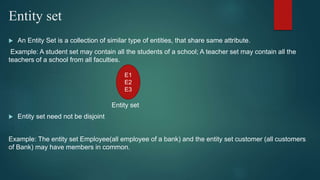
 An Entity Set is a collection of similar type of entities, that share same attribute.
Example: A student set may contain all the students of a school; A teacher set may contain all the
teachers of a school from all faculties.
Entity set
 Entity set need not be disjoint
Example: The entity set Employee(all employee of a bank) and the entity set customer (all customers
of Bank) may have members in common.
E1
E2
E3
2. Attribute
 An entity is represented by a set of attribute.
 Attribute are used to describe the property of an entity
Example: a student entity may have roll_no, Name, DOB, Age, Address, Mobile_no as
attribute.
 For each attribute there is a set of permitted values, called domain (or range) of that
attribute.
Example: A student name cannot be a numeric value. It has to be alphabetic. A student’s age
cannot be negative, etc. A student roll_no can be numeric between some range like(0-10000)
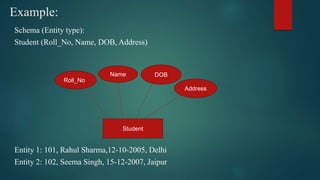
 Attribute are represented by Ellipse
Attribute
Example:
Schema (Entity type):
Student (Roll_No, Name, DOB, Address)
Entity 1: 101, Rahul Sharma,12-10-2005, Delhi
Entity 2: 102, Seema Singh, 15-12-2007, Jaipur
Student
Roll_No
Name DOB
Address
Attribute Types
 composite attribute
 multi valued attribute
 derived attribute
 Key attribute
3. Relationship
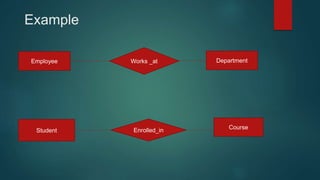
 A relationship is an association among entities.
 For example :
 An employee works_at a department
 A student enrolls in a course
Here, works_at and enrolls are called relationship
 Relationship are represented by diamond-shaped box.
Relationship
Example
Employee Department
Works _at
Student
Course
Enrolled_in
Degree of Relationship
 The number of different entity sets participating in a relationship set is called a degree
of a relationship set
1. Unary
2. Binary
3. Ternary
4. N-ary
Degree of Relationship……
1. Unary relationship: (degree =1)
A unary relationship is only one entity participate in a relationship, the relationship is called as a unary
relationship.
For example, one person is married to only one person.
2. Binary relationship: (degree=2)
A binary relationship is when two entities participate in a relationship, and is the most common relationship
degree.
For example: student is enrolled in course.
Person Married_to
Course
Enrolled
Degree of Relationship……..
3. Ternary Relationship: (degree=3)
A ternary relationship is when three entities participate in the relationship.
example, the university might need to record which teachers taught which courses.
4. n-ary relationship: (degree=n)
When there are n entities set participating in a relation, the relationship is called n-ary
relationship.
Course Subject
CST
Teacher
Relationship Constraints:
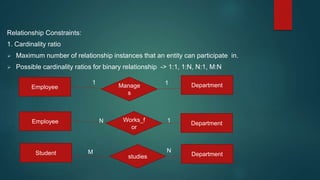
1. Cardinality ratio
 Maximum number of relationship instances that an entity can participate in.
 Possible cardinality ratios for binary relationship -> 1:1, 1:N, N:1, M:N
Employee Department
Manage
s
1 1
Employee Works_f
or
Department
N 1
Student Department
studies
M N
Relationship Constraints:
2. Participation Constraints
 Specifies whether existence of an entity depends on its being related to another entity.
 2 types : total participation and partial participation
Employee Manages Employee
Partial Total
Employee Manages Department
E1
E2
E3
E4
E5
D1
D2
D3
d4

5e7ry754.pptx

  • 1.
    The Entity RelationshipModel  ER model was introduced by peter Chenn in 1976.  The ER model defines the conceptual (or logical) view of a database.  It is used for designing  It works around real world entities and the relationships among them.  A database schema in the ER model can be represented pictorially as ER diagram.  An ER diagram maps well into a relational schema.
  • 2.
    Why ER modelis useful  An ER Model maps well to the relational model i.e the constructs used in ER Model can be easily transformed into relational tables.  An ER Model can be used by the database designer communicate the database design to the user.  An ER Model can be used as a design plan by the database developer to implement data model in specific DBMS software.
  • 3.
    ER Modeling constructs Entity  Attributes  Relationships
  • 4.
    1. Entities  AnEntity is a “thing” or “object” in the real world that is distinguishable from other objects.  Entity can be any thing that has independent existence and about which we collect data. It is also called entity type. Example: in a school database, the students, teacher , classes, courses or projects can be taken as an entity.  Entities are represented by means of rectangles.  Entities have attributes that give them their identity. Example: students have rollno, name, and address  Entities become table in relational model. Student Teacher Course
  • 5.
    Entity set  AnEntity Set is a collection of similar type of entities, that share same attribute. Example: A student set may contain all the students of a school; A teacher set may contain all the teachers of a school from all faculties. Entity set  Entity set need not be disjoint Example: The entity set Employee(all employee of a bank) and the entity set customer (all customers of Bank) may have members in common. E1 E2 E3
  • 6.
    2. Attribute  Anentity is represented by a set of attribute.  Attribute are used to describe the property of an entity Example: a student entity may have roll_no, Name, DOB, Age, Address, Mobile_no as attribute.  For each attribute there is a set of permitted values, called domain (or range) of that attribute. Example: A student name cannot be a numeric value. It has to be alphabetic. A student’s age cannot be negative, etc. A student roll_no can be numeric between some range like(0-10000)  Attribute are represented by Ellipse Attribute
  • 7.
    Example: Schema (Entity type): Student(Roll_No, Name, DOB, Address) Entity 1: 101, Rahul Sharma,12-10-2005, Delhi Entity 2: 102, Seema Singh, 15-12-2007, Jaipur Student Roll_No Name DOB Address
  • 8.
    Attribute Types  compositeattribute  multi valued attribute  derived attribute  Key attribute
  • 9.
    3. Relationship  Arelationship is an association among entities.  For example :  An employee works_at a department  A student enrolls in a course Here, works_at and enrolls are called relationship  Relationship are represented by diamond-shaped box. Relationship
  • 10.
  • 11.
    Degree of Relationship The number of different entity sets participating in a relationship set is called a degree of a relationship set 1. Unary 2. Binary 3. Ternary 4. N-ary
  • 12.
    Degree of Relationship…… 1.Unary relationship: (degree =1) A unary relationship is only one entity participate in a relationship, the relationship is called as a unary relationship. For example, one person is married to only one person. 2. Binary relationship: (degree=2) A binary relationship is when two entities participate in a relationship, and is the most common relationship degree. For example: student is enrolled in course. Person Married_to Course Enrolled
  • 13.
    Degree of Relationship…….. 3.Ternary Relationship: (degree=3) A ternary relationship is when three entities participate in the relationship. example, the university might need to record which teachers taught which courses. 4. n-ary relationship: (degree=n) When there are n entities set participating in a relation, the relationship is called n-ary relationship. Course Subject CST Teacher
  • 14.
    Relationship Constraints: 1. Cardinalityratio  Maximum number of relationship instances that an entity can participate in.  Possible cardinality ratios for binary relationship -> 1:1, 1:N, N:1, M:N Employee Department Manage s 1 1 Employee Works_f or Department N 1 Student Department studies M N
  • 15.
    Relationship Constraints: 2. ParticipationConstraints  Specifies whether existence of an entity depends on its being related to another entity.  2 types : total participation and partial participation Employee Manages Employee Partial Total Employee Manages Department E1 E2 E3 E4 E5 D1 D2 D3 d4