UNECE
Types of censuses, enumeration methods
and selected operational aspects: results
of the ECE questionnaire
Paolo Valente
Social and Demographic Statistics Section
UN Economic Commission for Europe - Statistical Division
ECE Work Session on Population Censuses
Geneva, 23-25 November 2004
UNECE
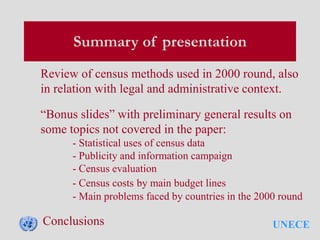
Summary of presentation
Review of census methods used in 2000 round, also
in relation with legal and administrative context.
“Bonus slides” with preliminary general results on
some topics not covered in the paper:
- Statistical uses of census data
- Publicity and information campaign
- Census evaluation
- Census costs by main budget lines
- Main problems faced by countries in the 2000 round
Conclusions
UNECE
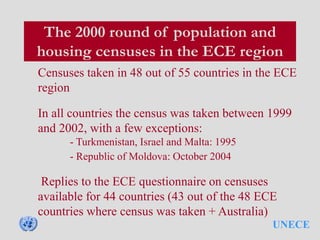
The 2000 round of population and
housing censuses in the ECE region
Censuses taken in 48 out of 55 countries in the ECE
region
In all countries the census was taken between 1999
and 2002, with a few exceptions:
- Turkmenistan, Israel and Malta: 1995
- Republic of Moldova: October 2004
Replies to the ECE questionnaire on censuses
available for 44 countries (43 out of the 48 ECE
countries where census was taken + Australia)
UNECE
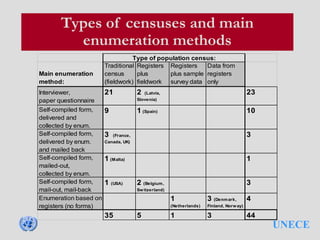
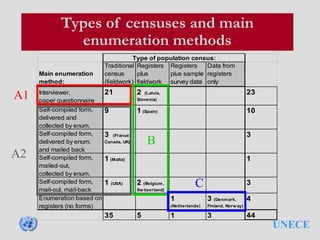
Types of censuses and main
enumeration methods
Main enumeration
method:
Traditional
census
(fieldwork)
Registers
plus
fieldwork
Registers
plus sample
survey data
Data from
registers
only
Interviewer,
paper questionnaire
21 2 (Latvia,
Slovenia)
23
Self-compiled form,
delivered and
collected by enum.
9 1 (Spain) 10
Self-compiled form,
delivered by enum.
and mailed back
3 (France,
Canada, UK)
3
Self-compiled form,
mailed-out,
collected by enum.
1 (Malta) 1
Self-compiled form,
mail-out, mail-back
1 (USA) 2 (Belgium,
Switzerland)
3
Enumeration based on
registers (no forms)
1
(Netherlands)
3 (Denmark,
Finland, Norway)
4
35 5 1 3 44
Type of population census:
UNECE
Types of censuses and main
enumeration methods
Main enumeration
method:
Traditional
census
(fieldwork)
Registers
plus
fieldwork
Registers
plus sample
survey data
Data from
registers
only
Interviewer,
paper questionnaire
21 2 (Latvia,
Slovenia)
23
Self-compiled form,
delivered and
collected by enum.
9 1 (Spain) 10
Self-compiled form,
delivered by enum.
and mailed back
3 (France,
Canada, UK)
3
Self-compiled form,
mailed-out,
collected by enum.
1 (Malta) 1
Self-compiled form,
mail-out, mail-back
1 (USA) 2 (Belgium,
Switzerland)
3
Enumeration based on
registers (no forms)
1
(Netherlands)
3 (Denmark,
Finland, Norway)
4
35 5 1 3 44
Type of population census:
A1
A2
B
C
UNECE
Legal context for the 2000 censuses:
Existence of statistical legislation
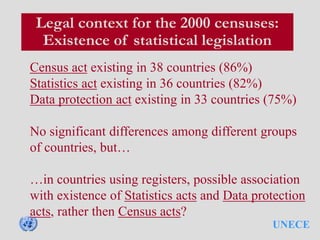
Census act existing in 38 countries (86%)
Statistics act existing in 36 countries (82%)
Data protection act existing in 33 countries (75%)
No significant differences among different groups
of countries, but…
…in countries using registers, possible association
with existence of Statistics acts and Data protection
acts, rather then Census acts?
UNECE
Administrative context:
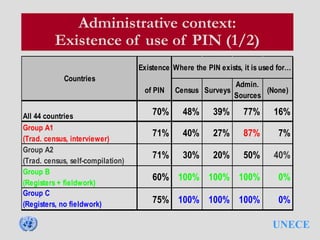
Existence of use of PIN (1/2)
Existence
of PIN Census Surveys
Admin.
Sources
(None)
All 44 countries 70% 48% 39% 77% 16%
Group A1
(Trad. census, interviewer)
71% 40% 27% 87% 7%
Group A2
(Trad. census, self-compilation)
71% 30% 20% 50% 40%
Group B
(Registers + fieldwork)
60% 100% 100% 100% 0%
Group C
(Registers, no fieldwork) 75% 100% 100% 100% 0%
Where the PIN exists, it is used for…
Countries
UNECE
Administrative context:
Existence of use of PIN (2/2)
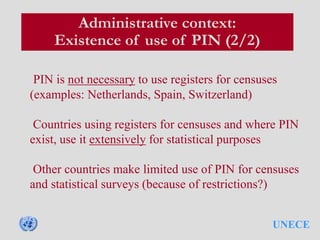
PIN is not necessary to use registers for censuses
(examples: Netherlands, Spain, Switzerland)
Countries using registers for censuses and where PIN
exist, use it extensively for statistical purposes
Other countries make limited use of PIN for censuses
and statistical surveys (because of restrictions?)
UNECE
Administrative context:
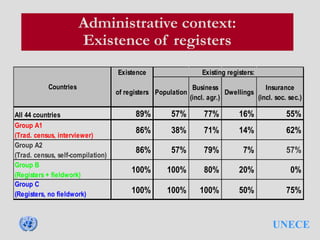
Existence of registers
Existence
of registers Population
Business
(incl. agr.)
Dwellings
Insurance
(incl. soc. sec.)
All 44 countries 89% 57% 77% 16% 55%
Group A1
(Trad. census, interviewer)
86% 38% 71% 14% 62%
Group A2
(Trad. census, self-compilation)
86% 57% 79% 7% 57%
Group B
(Registers + fieldwork)
100% 100% 80% 20% 0%
Group C
(Registers, no fieldwork) 100% 100% 100% 50% 75%
Countries
Existing registers:
UNECE
Administrative context:
Existence of registers
Existence
of registers Population
Business
(incl. agr.)
Dwellings
Insurance
(incl. soc. sec.)
All 44 countries 89% 57% 77% 16% 55%
Group A1
(Trad. census, interviewer)
86% 38% 71% 14% 62%
Group A2
(Trad. census, self-compilation)
86% 57% 79% 7% 57%
Group B
(Registers + fieldwork)
100% 100% 80% 20% 0%
Group C
(Registers, no fieldwork) 100% 100% 100% 50% 75%
Countries
Existing registers:
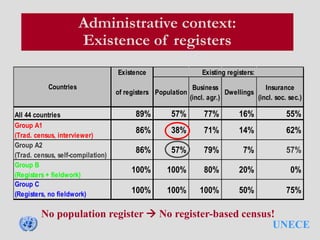
No population register  No register-based census!
UNECE
Administrative context:
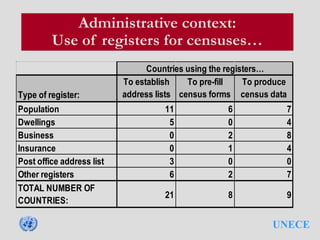
Use of registers for censuses…
Type of register:
To establish
address lists
To pre-fill
census forms
To produce
census data
Population 11 6 7
Dwellings 5 0 4
Business 0 2 8
Insurance 0 1 4
Post office address list 3 0 0
Other registers 6 2 7
TOTAL NUMBER OF
COUNTRIES:
21 8 9
Countries using the registers…
UNECE
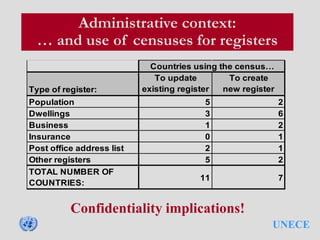
Administrative context:
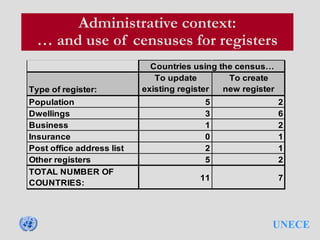
… and use of censuses for registers
Type of register:
To update
existing register
To create
new register
Population 5 2
Dwellings 3 6
Business 1 2
Insurance 0 1
Post office address list 2 1
Other registers 5 2
TOTAL NUMBER OF
COUNTRIES:
11 7
Countries using the census…
UNECE
Administrative context:
… and use of censuses for registers
Type of register:
To update
existing register
To create
new register
Population 5 2
Dwellings 3 6
Business 1 2
Insurance 0 1
Post office address list 2 1
Other registers 5 2
TOTAL NUMBER OF
COUNTRIES:
11 7
Countries using the census…
Confidentiality implications!
UNECE
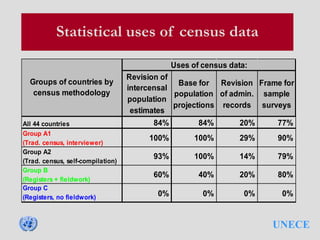
Statistical uses of census data
Revision of
intercensal
population
estimates
Base for
population
projections
Revision
of admin.
records
Frame for
sample
surveys
All 44 countries 84% 84% 20% 77%
Group A1
(Trad. census, interviewer)
100% 100% 29% 90%
Group A2
(Trad. census, self-compilation)
93% 100% 14% 79%
Group B
(Registers + fieldwork)
60% 40% 20% 80%
Group C
(Registers, no fieldwork) 0% 0% 0% 0%
Groups of countries by
census methodology
Uses of census data:
UNECE
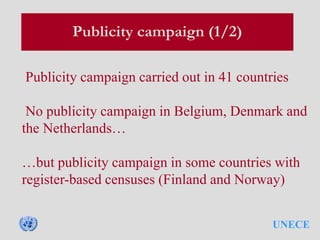
Publicity campaign (1/2)
Publicity campaign carried out in 41 countries
No publicity campaign in Belgium, Denmark and
the Netherlands…
…but publicity campaign in some countries with
register-based censuses (Finland and Norway)
UNECE
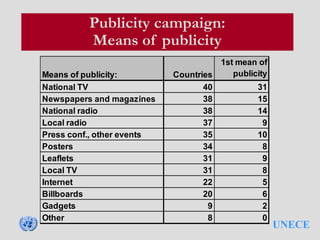
Publicity campaign:
Means of publicity
Means of publicity: Countries
1st mean of
publicity
National TV 40 31
Newspapers and magazines 38 15
National radio 38 14
Local radio 37 9
Press conf., other events 35 10
Posters 34 8
Leaflets 31 9
Local TV 31 8
Internet 22 5
Billboards 20 6
Gadgets 9 2
Other 8 0
UNECE
Publicity campaign:
“Innovative approaches…”
• In Canada, no national TV, but:
- free ads/inserts
- sugar bags
- milk cartoon
- rail cars
- calendar and agenda companies
- mail inserts
- plastic bags
- ATMs, etc.
• And in Italy: SMS!!!
UNECE
Publicity campaign (cont.)
Main locations for posters and leaflets Selected targets of the campaign:
Locations: Countries Locations: Countries
Public institutions 36 Young and students 28
Schools 30 People in ruralareas 19
Stations,airports 25 Foreigners 16
Post offices,pharmacies 25 Ethnic minorities 15
Libraries 19
UNECE
Information campaign
Means of information: Countries
1st mean of
information
TV programs 39 21
Newspapers, magazines 39 13
Radio programs 37 11
Call center 29 12
Internet 28 4
Booklets 26 7
Events 17 2
CD-ROM 6 1
Other 6 1
UNECE
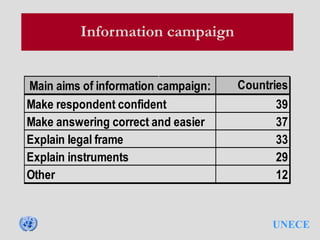
Information campaign
Countries
39
37
33
29
12
Other
Main aims of information campaign:
Make respondent confident
Make answering correct and easier
Explain legal frame
Explain instruments
UNECE
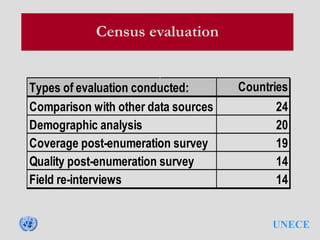
Census evaluation
Countries
24
20
19
14
14
Types of evaluation conducted:
Comparison with other data sources
Demographic analysis
Coverage post-enumeration survey
Quality post-enumeration survey
Field re-interviews
UNECE
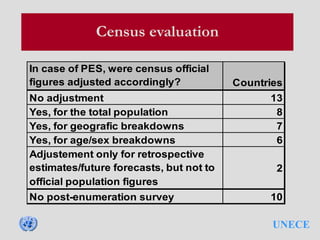
Census evaluation
In case of PES, were census official
figures adjusted accordingly? Countries
No adjustment 13
Yes, for the total population 8
Yes, for geografic breakdowns 7
Yes, for age/sex breakdowns 6
Adjustement only for retrospective
estimates/future forecasts, but not to
official population figures
2
No post-enumeration survey 10
UNECE
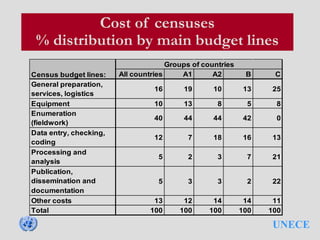
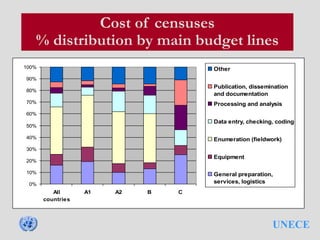
Cost of censuses
% distribution by main budget lines
All countries A1 A2 B C
General preparation,
services, logistics
16 19 10 13 25
Equipment 10 13 8 5 8
Enumeration
(fieldwork)
40 44 44 42 0
Data entry, checking,
coding
12 7 18 16 13
Processing and
analysis
5 2 3 7 21
Publication,
dissemination and
documentation
5 3 3 2 22
Other costs 13 12 14 14 11
Total 100 100 100 100 100
Groups of countries
Census budget lines:
UNECE
Cost of censuses
% distribution by main budget lines
0%
10%
20%
30%
40%
50%
60%
70%
80%
90%
100%
All
countries
A1 A2 B C
Other
Publication, dissemination
and documentation
Processing and analysis
Data entry, checking, coding
Enumeration (fieldwork)
Equipment
General preparation,
services, logistics
UNECE
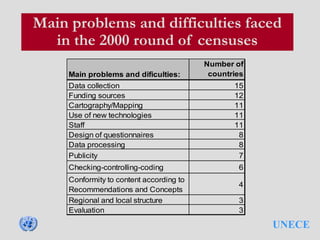
Main problems and difficulties faced
in the 2000 round of censuses
Main problems and dificulties:
Number of
countries
Data collection 15
Funding sources 12
Cartography/Mapping 11
Use of new technologies 11
Staff 11
Design of questionnaires 8
Data processing 8
Publicity 7
Checking-controlling-coding 6
Conformity to content according to
Recommendations and Concepts
4
Regional and local structure 3
Evaluation 3
UNECE
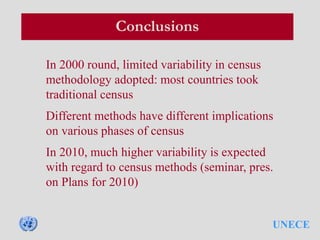
Conclusions
In 2000 round, limited variability in census
methodology adopted: most countries took
traditional census
Different methods have different implications
on various phases of census
In 2010, much higher variability is expected
with regard to census methods (seminar, pres.
on Plans for 2010)
UNECE
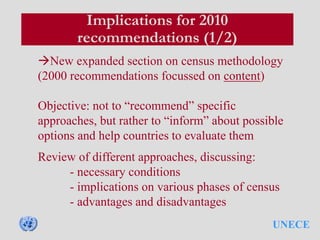
Implications for 2010
recommendations (1/2)
New expanded section on census methodology
(2000 recommendations focussed on content)
Objective: not to “recommend” specific
approaches, but rather to “inform” about possible
options and help countries to evaluate them
Review of different approaches, discussing:
- necessary conditions
- implications on various phases of census
- advantages and disadvantages
UNECE
Implications for 2010
recommendations (2/2)
Possible areas to be covered:
- Possible uses of registers
- Possible uses of sample surveys
- Other approaches (“rolling census”?)
- Census evaluation (coverage and quality)
- Publicity and information campaign
- …

5796403.ppt

  • 1.
    UNECE Types of censuses,enumeration methods and selected operational aspects: results of the ECE questionnaire Paolo Valente Social and Demographic Statistics Section UN Economic Commission for Europe - Statistical Division ECE Work Session on Population Censuses Geneva, 23-25 November 2004
  • 2.
    UNECE Summary of presentation Reviewof census methods used in 2000 round, also in relation with legal and administrative context. “Bonus slides” with preliminary general results on some topics not covered in the paper: - Statistical uses of census data - Publicity and information campaign - Census evaluation - Census costs by main budget lines - Main problems faced by countries in the 2000 round Conclusions
  • 3.
    UNECE The 2000 roundof population and housing censuses in the ECE region Censuses taken in 48 out of 55 countries in the ECE region In all countries the census was taken between 1999 and 2002, with a few exceptions: - Turkmenistan, Israel and Malta: 1995 - Republic of Moldova: October 2004 Replies to the ECE questionnaire on censuses available for 44 countries (43 out of the 48 ECE countries where census was taken + Australia)
  • 4.
    UNECE Types of censusesand main enumeration methods Main enumeration method: Traditional census (fieldwork) Registers plus fieldwork Registers plus sample survey data Data from registers only Interviewer, paper questionnaire 21 2 (Latvia, Slovenia) 23 Self-compiled form, delivered and collected by enum. 9 1 (Spain) 10 Self-compiled form, delivered by enum. and mailed back 3 (France, Canada, UK) 3 Self-compiled form, mailed-out, collected by enum. 1 (Malta) 1 Self-compiled form, mail-out, mail-back 1 (USA) 2 (Belgium, Switzerland) 3 Enumeration based on registers (no forms) 1 (Netherlands) 3 (Denmark, Finland, Norway) 4 35 5 1 3 44 Type of population census:
  • 5.
    UNECE Types of censusesand main enumeration methods Main enumeration method: Traditional census (fieldwork) Registers plus fieldwork Registers plus sample survey data Data from registers only Interviewer, paper questionnaire 21 2 (Latvia, Slovenia) 23 Self-compiled form, delivered and collected by enum. 9 1 (Spain) 10 Self-compiled form, delivered by enum. and mailed back 3 (France, Canada, UK) 3 Self-compiled form, mailed-out, collected by enum. 1 (Malta) 1 Self-compiled form, mail-out, mail-back 1 (USA) 2 (Belgium, Switzerland) 3 Enumeration based on registers (no forms) 1 (Netherlands) 3 (Denmark, Finland, Norway) 4 35 5 1 3 44 Type of population census: A1 A2 B C
  • 6.
    UNECE Legal context forthe 2000 censuses: Existence of statistical legislation Census act existing in 38 countries (86%) Statistics act existing in 36 countries (82%) Data protection act existing in 33 countries (75%) No significant differences among different groups of countries, but… …in countries using registers, possible association with existence of Statistics acts and Data protection acts, rather then Census acts?
  • 7.
    UNECE Administrative context: Existence ofuse of PIN (1/2) Existence of PIN Census Surveys Admin. Sources (None) All 44 countries 70% 48% 39% 77% 16% Group A1 (Trad. census, interviewer) 71% 40% 27% 87% 7% Group A2 (Trad. census, self-compilation) 71% 30% 20% 50% 40% Group B (Registers + fieldwork) 60% 100% 100% 100% 0% Group C (Registers, no fieldwork) 75% 100% 100% 100% 0% Where the PIN exists, it is used for… Countries
  • 8.
    UNECE Administrative context: Existence ofuse of PIN (2/2) PIN is not necessary to use registers for censuses (examples: Netherlands, Spain, Switzerland) Countries using registers for censuses and where PIN exist, use it extensively for statistical purposes Other countries make limited use of PIN for censuses and statistical surveys (because of restrictions?)
  • 9.
    UNECE Administrative context: Existence ofregisters Existence of registers Population Business (incl. agr.) Dwellings Insurance (incl. soc. sec.) All 44 countries 89% 57% 77% 16% 55% Group A1 (Trad. census, interviewer) 86% 38% 71% 14% 62% Group A2 (Trad. census, self-compilation) 86% 57% 79% 7% 57% Group B (Registers + fieldwork) 100% 100% 80% 20% 0% Group C (Registers, no fieldwork) 100% 100% 100% 50% 75% Countries Existing registers:
  • 10.
    UNECE Administrative context: Existence ofregisters Existence of registers Population Business (incl. agr.) Dwellings Insurance (incl. soc. sec.) All 44 countries 89% 57% 77% 16% 55% Group A1 (Trad. census, interviewer) 86% 38% 71% 14% 62% Group A2 (Trad. census, self-compilation) 86% 57% 79% 7% 57% Group B (Registers + fieldwork) 100% 100% 80% 20% 0% Group C (Registers, no fieldwork) 100% 100% 100% 50% 75% Countries Existing registers: No population register  No register-based census!
  • 11.
    UNECE Administrative context: Use ofregisters for censuses… Type of register: To establish address lists To pre-fill census forms To produce census data Population 11 6 7 Dwellings 5 0 4 Business 0 2 8 Insurance 0 1 4 Post office address list 3 0 0 Other registers 6 2 7 TOTAL NUMBER OF COUNTRIES: 21 8 9 Countries using the registers…
  • 12.
    UNECE Administrative context: … anduse of censuses for registers Type of register: To update existing register To create new register Population 5 2 Dwellings 3 6 Business 1 2 Insurance 0 1 Post office address list 2 1 Other registers 5 2 TOTAL NUMBER OF COUNTRIES: 11 7 Countries using the census…
  • 13.
    UNECE Administrative context: … anduse of censuses for registers Type of register: To update existing register To create new register Population 5 2 Dwellings 3 6 Business 1 2 Insurance 0 1 Post office address list 2 1 Other registers 5 2 TOTAL NUMBER OF COUNTRIES: 11 7 Countries using the census… Confidentiality implications!
  • 14.
    UNECE Statistical uses ofcensus data Revision of intercensal population estimates Base for population projections Revision of admin. records Frame for sample surveys All 44 countries 84% 84% 20% 77% Group A1 (Trad. census, interviewer) 100% 100% 29% 90% Group A2 (Trad. census, self-compilation) 93% 100% 14% 79% Group B (Registers + fieldwork) 60% 40% 20% 80% Group C (Registers, no fieldwork) 0% 0% 0% 0% Groups of countries by census methodology Uses of census data:
  • 15.
    UNECE Publicity campaign (1/2) Publicitycampaign carried out in 41 countries No publicity campaign in Belgium, Denmark and the Netherlands… …but publicity campaign in some countries with register-based censuses (Finland and Norway)
  • 16.
    UNECE Publicity campaign: Means ofpublicity Means of publicity: Countries 1st mean of publicity National TV 40 31 Newspapers and magazines 38 15 National radio 38 14 Local radio 37 9 Press conf., other events 35 10 Posters 34 8 Leaflets 31 9 Local TV 31 8 Internet 22 5 Billboards 20 6 Gadgets 9 2 Other 8 0
  • 17.
    UNECE Publicity campaign: “Innovative approaches…” •In Canada, no national TV, but: - free ads/inserts - sugar bags - milk cartoon - rail cars - calendar and agenda companies - mail inserts - plastic bags - ATMs, etc. • And in Italy: SMS!!!
  • 18.
    UNECE Publicity campaign (cont.) Mainlocations for posters and leaflets Selected targets of the campaign: Locations: Countries Locations: Countries Public institutions 36 Young and students 28 Schools 30 People in ruralareas 19 Stations,airports 25 Foreigners 16 Post offices,pharmacies 25 Ethnic minorities 15 Libraries 19
  • 19.
    UNECE Information campaign Means ofinformation: Countries 1st mean of information TV programs 39 21 Newspapers, magazines 39 13 Radio programs 37 11 Call center 29 12 Internet 28 4 Booklets 26 7 Events 17 2 CD-ROM 6 1 Other 6 1
  • 20.
    UNECE Information campaign Countries 39 37 33 29 12 Other Main aimsof information campaign: Make respondent confident Make answering correct and easier Explain legal frame Explain instruments
  • 21.
    UNECE Census evaluation Countries 24 20 19 14 14 Types ofevaluation conducted: Comparison with other data sources Demographic analysis Coverage post-enumeration survey Quality post-enumeration survey Field re-interviews
  • 22.
    UNECE Census evaluation In caseof PES, were census official figures adjusted accordingly? Countries No adjustment 13 Yes, for the total population 8 Yes, for geografic breakdowns 7 Yes, for age/sex breakdowns 6 Adjustement only for retrospective estimates/future forecasts, but not to official population figures 2 No post-enumeration survey 10
  • 23.
    UNECE Cost of censuses %distribution by main budget lines All countries A1 A2 B C General preparation, services, logistics 16 19 10 13 25 Equipment 10 13 8 5 8 Enumeration (fieldwork) 40 44 44 42 0 Data entry, checking, coding 12 7 18 16 13 Processing and analysis 5 2 3 7 21 Publication, dissemination and documentation 5 3 3 2 22 Other costs 13 12 14 14 11 Total 100 100 100 100 100 Groups of countries Census budget lines:
  • 24.
    UNECE Cost of censuses %distribution by main budget lines 0% 10% 20% 30% 40% 50% 60% 70% 80% 90% 100% All countries A1 A2 B C Other Publication, dissemination and documentation Processing and analysis Data entry, checking, coding Enumeration (fieldwork) Equipment General preparation, services, logistics
  • 25.
    UNECE Main problems anddifficulties faced in the 2000 round of censuses Main problems and dificulties: Number of countries Data collection 15 Funding sources 12 Cartography/Mapping 11 Use of new technologies 11 Staff 11 Design of questionnaires 8 Data processing 8 Publicity 7 Checking-controlling-coding 6 Conformity to content according to Recommendations and Concepts 4 Regional and local structure 3 Evaluation 3
  • 26.
    UNECE Conclusions In 2000 round,limited variability in census methodology adopted: most countries took traditional census Different methods have different implications on various phases of census In 2010, much higher variability is expected with regard to census methods (seminar, pres. on Plans for 2010)
  • 27.
    UNECE Implications for 2010 recommendations(1/2) New expanded section on census methodology (2000 recommendations focussed on content) Objective: not to “recommend” specific approaches, but rather to “inform” about possible options and help countries to evaluate them Review of different approaches, discussing: - necessary conditions - implications on various phases of census - advantages and disadvantages
  • 28.
    UNECE Implications for 2010 recommendations(2/2) Possible areas to be covered: - Possible uses of registers - Possible uses of sample surveys - Other approaches (“rolling census”?) - Census evaluation (coverage and quality) - Publicity and information campaign - …