Sizing, Selection, and Installation
of Pressure-RelievingDevices in
Refineries
Part I-Sizing and Selection
API RECOMMENDED PRACTICE 520
SEVENTH EDITION, JANUARY 2000
Environmental Partnership
American
Petroleum
Institute
Helping You
Get The Job
Done Right.""
Copyright by the American Petroleum Institute
Thu May 11 15:56:43 2006
n ~ ~ '
Strategiesfor Today's
Environmental Partnership
API ENVIRONMENTAL, HEALTH AND SAFETY MISSION
AND GUIDING PRINCIPLES
The members of the American Petroleum Institute are dedicated to continuous efforts to
improve the compatibility of our operations with the environment while economically
developing energy resources and supplying high quality products and services to consum-
ers. We recognize our responsibility to work with the public, the government, and others to
develop and to use natural resources in an environmentally sound manner while protecting
the health and safety of our employees and the public. To meet these responsibilities, API
members pledge to manage our businesses according to the following principles using
sound science to prioritize risks and to implement cost-effective management practices:
To recognize and to respond to community concerns about our raw materials, prod-
ucts and operations.
To operate our plants and facilities, and to handle our raw materials and products in a
manncr that protccts thc cnvironmcnt, and thc safcty and hcalth of our cmployccs
and the public.
To make safety, health and environmental considerations a priority in our planning,
and our development of new products and processes.
To advise promptly, appropriate officials, employees, customers and the public of
information on significant industry-related safety, health and environmental hazards,
and to recommend protective measures.
To counsel customers, transporters and others in the safe use, transportation and dis-
posal of our raw materials, products and waste materials.
To economically develop and produce natural resources and to conserve those
resources by using energy efficiently.
To extend knowledge by conducting or supporting research on the safety, health and
environmental effects of our ranTmaterials, products, processes and waste materials.
To commit to reduce overall emissions and waste generation.
To work with others to resolve problems created by handling and disposal of hazard-
ous substances from our operations.
To participate with government and others in creating responsible laws, regulations
and standards to safeguard the community, workplace and environment.
To promote these principles and practices by sharing experiences and offering assis-
tance to others who produce, handle, use, transport or dispose of similar ranTmateri-
als, petroleum products and wastes.
Copyright by the American Petroleum Institute
Thu May 11 15:57:00 2006
Sizing, Selection, and Installation of
Pressure-Relieving Devices in
Refineries
Part I-Sizing and Selection
Downstream Segment
API RECOMMENDED PRACTICE 520
SEVENTH EDITION, JANUARY 2000
American
Petroleum
Institute
HelpingYou
Get The Job
Done Right.""
Copyright by the American Petroleum Institute
Thu May 11 15:57:00 2006
SPECIAL NOTES
API publications necessarily address problems of a general nature.With respectto partic-
ular circumstances, local, state, and federal laws and regulations should be reviewed.
API is not undertaking to meet the duties of employers, manufacturers, or suppliers to
warn and properly train and equip their employees, and others exposed, concerning health
and safety risksand precautions, nor undertaking their obligationsunder local, state, or fed-
eral laws.
Information concerning safety and health risksand proper precautions with respect to par-
ticular materials and conditions should be obtained from the employer, the manufacturer or
supplier of that material, or the material safety data sheet.
Nothing conlairled in any API publication is to be conslrued as granting any right, by
implicationor otherwise, for the manufacture,sale, or use of any method,apparatus, or prod-
uct covered by letters patent. Neither should anything contained in the publication be con-
strued as insuring anyoneagainstliability for infringement of letters patent.
Generally,API standards are reviewed and revised,reaffirmed,or withdrawn at leastevery
fivc ycars. Somctimcs a onc-timc cxtcnsion of up to two ycars will bc addcd to this rcvicw
cycle. This publication will no longer be in effect five years after its publication date as an
operative API standard or, where an extension has been granted, upon republication. Status
of the publication can be ascertained from the API Downstream Segment [telephone (202)
682-8000]. A catalog of API publications and materials is published annually and updated
quarterly by API, 1220 L Street, N.W., Washington,D.C. 20005.
This document was produced under API standardization procedures that ensureappropri-
ate notification and participation in the developmental process and is designated as an API
standard. Questions concerning the interpretation of the content of this standard or com-
ments and questions concerning the procedures under which this standard was developed
shouldbe directed in writing to the general managerof the Downstream Segment, American
PelroleurnInstitute,1220 L Slreel,N.W.,Washington,D.C. 20005. Requestsfor permission
to reproduce or translate all or any part of the material published herein should also be
addressed to the general manager.
API standards are published to facilitate the broad availability of proven, sound engineer-
ing and operating practices. These standards are not intended to obviate the need for apply-
ing sound cnginccring judgmcnt regarding whcn and whcrc thcsc standards should bc
utilized. The formulation and publication of API standards is not intended in any way to
inhibit anyone from using any other practices.
Any manufacturer marking equipment or materials in conformance with the marking
requirements of an API standard is solely responsible for complying with all the applicable
requirements of that standard.API does not represent, warrant, or guarantee that such prod-
ucts do in fact conform to the applicableAPI standard.
All rights resewed. No part of this work may be reproduced, stored in a retrieval system, or
transmitted by any means, electronic, mechanical, photocopying, recording, or otherwise,
without prior written permission,from the publisher.Contact the Publishel;
API Publishing Sewices, 1220 L Street, N.W, Washiagton, D.C. 20005.
Copyright O 2000 American PetroleumInstitute
Copyright by the American Petroleum Institute
Thu May 11 15:57:00 2006
FOREWORD
API RecommendedPractice520, Sizing, Selection, und Installation of Pressure-Relieving
Devices in Rejneries, is the result of several years' work by engineers in the petroleum
industry.
The information in this recommended practiceis intended to supplement the information
containedin Section VIII,"PressureVessels,"of theASME Boiler and PressureVessel Code.
The recommendations presented in this publication are not intended to supersede applicable
laws and regulations.
Users of this recommended practiceare reminded that no publication of this type can be
complete, nor can any written document be substihitedfor qualifiedengineering analysis.
The current edition of this recornmerided practice, published in two parts, has been
updated with respect to the practices generally used in the installation of all devices covered
in the previous editions; the current edition also contains additional information based on
revisions suggestedby many individuals and severalorganizations.
Thefirst edition of this recommendedpracticewas issued in 1955.Thesecond edition was
publishcdin two parts: Part I, "Dcsign," in 1960 and Part 11,"Installation," in 1963. Thc third
edition of Part I was issued in November 1967 and reaffirmed in 1973. The fourth edition
was issued in December 1976, the fifth edition was issued in July 1990,and the sixth edition
was issued in March 1993.
API publications may be used by anyone desiring to do so. Every effort has been made by
theInstituteto assure the accuracyand reliability of the data contained in them; however,the
Institutemakes no representation, warranty, or guarantee in connection with this publication
and hereby expressly disclaims any liability or responsibility for loss or damage resulting
from its use or for the violation of any federal, state, or municipal regulation with which this
publication may conflict.
Suggested revisions are invited and should be submitted to the general manager of the
Dowrislrearn Seg~nent,
Arnericari Pelroleurn Insti~u~e,
1220 L Skeet, N.W., Washing~on,
D.C. 20005.
Copyright by the American Petroleum Institute
Thu May 11 15:57:01 2006
Copyright by the American Petroleum Institute
Thu May 11 15:57:01 2006
CONTENTS
Page
......................................................
1 INTRODUCTION 1
...........................................................
1.1 Scope 1
................................................
1.2 Definition of Terms 1
............................................
1.3 ReferencedPublications 4
...........................................
2 PRESSURERELIEFDEVICES 5
. . . . . . . . . . . . . . . . . . . . . . . . . . . . . . . . . . . . . . . . . . . . . . . . . . . . . . . . . .
2.1 General 5
..............................................
2.2 PressureReliefValves 5
.............................................
2.3 RuptureDisk Devices 16
.............................................
2.4 Pin-ActuatedDevices 28
............................................
2.5 Other Typesof Devices 30
...........................................
3 PROCEDURES FOR SIZING 30
................................
3.1 Determinationof Relief Requirements 30
................
3.2 API EffectiveArea and Effective Coefficient of Discharge 32
3.3 Back Pressure. . . . . . . . . . . . . . . . . . . . . . . . . . . . . . . . . . . . . . . . . . . . . . . . . . . . 34
...............................
3.4 Cold DifferentialTestPressure (CDTP) 38
................................................
3.5 RelievingPressure 39
.......................................
3.6 Sizingfor Gas or Vapor Relief 41
............................................
3.7 Sizingfor SteamRelief 50
3.8 Sizingfor Liquid Relief:PressureRelief Valves Requiring
.............................................
Capacity Certification 52
3.9 Sizingfor 1
.iquidRelief PressureRelief Valves Not Requiring
.............................................
Capacity Certilicalion 53
.............................
3.10 Sizingfor Two-Phase LiquicWapor Relief 55
.....................................
3.11 Sizingfor Rupture Disk Devices 55
4 REFERENCES .......................................................
56
APPENDIX A RUPTUREDISK DEVICE SPECIFlCATIONSHEET.............57
APPENDIXB REVIEW OF FLOW EQUATIONS USED IN SIZINGPRESSURE
......................
RELIEF VALVESFOR GAS OR VAPOR 61
.........
APPENDIX C PRESSURERELIEF VALVESPECIFICATION SHEETS 63
............
APPENDIX D SIZINGFOR TWO-PHASELIQUIDNAPOR RELIEF 69
APPENDIXE CAPACITY EVALUATION OF RUPTUREDISK AND
PIPINGSYSTEM 100%VAPOR FLOW AND CONSTANT
PIPE DIAMETER ..........................................
83
Figures
.....................
1 Pressure-LevelRelationshipsfor PressureRelief Valves 3
2 Conventional PressureRelief Valve with a Single Adjusting Ring for
..................................................
BlowdownControl 6
.................................
3 Balanccd-BcllowsPrcssurc Rclicf Valvc 7
.....
4 Balanced-BellowsPressure Relief Valve with an Auxiliary BalancedPiston 9
.............
5 Conventional PressureRelief Valve with ThreadedConnections 10
. . . . . . . . . . . . . . . . . . . . . . . . .
6 Pop-ActionPilot-OperatedValve @lowing-Type) 11
......................
7 Pop-ActionPilot-OperatedValve monflowing-Type) 12
Copyright by the American Petroleum Institute
Thu May 11 15:57:01 2006
Page
.........................
8 Modulating Pilot-Operated Valve (Flowing-Type) 13
.......
9 Pilot-Operated Relief Valve with a Nonflowing ModulatingPilot Valve 14
. . . . . . . . . . . . . . . . . . . .
10 Low-Pressure Pilot-Operated Valve (Diaphragm-Type) 15
..............................
11 Forward-Acting Solid Metal Rupture Disk 17
..................................
12 Forward-Acting Scored Rupture Disk 19
...............................
13 Forward-Acting Composite Rupture Disk 20
..........................
14 Reverse-Acting Rupture Disk with Knife Blades 22
...................................
15 Reverse-Acting Scored Rupture Disk 23
..............................................
16 Graphite RuptureDisk 24
. . . . . . . . . . .
17 RuphireDiskDevice in Combination with aPressure Relief Valve 25
.................................................
18 Buckling Pin Valve 26
......................
19 PressureRelief Valve Operation-VaporIGas Service 27
20 Typical Relationship Between Lift of Disk in a Pressure Relief Valve
.................................................
and Vessel Pressure 28
.........................
21 PressureRelief Valve Operation-Liquid Service 28
22 Typical Effccts of SupcrimposcdBack Prcssurcon thc OpcningPrcssurc
.................................
of ConventionalPressureRelief Valves 29
23 Typical Effects of Back Pressure on the Set Pressure of Balanced Pressure
. . . . . . . . . . . . . . . . . . . . . . . . . . . . . . . . . . . . . . . . . . . . . . . . . . . . . .
Relief Valves 29
24 Typical Relationship Between Lift of Disk or Piston and Vessel Pressure in
........................
a Pop-Action Pilot-Operated PressureRelief Valve 30
25 Typical Relationship Between Lift of Disk or Piston and Vessel Pressure in
.................
a Modulating-Action Pilot-Operated PressureRelief Valve 30
....................
26 Pressure-Level Relationships for Rupture Disk Devices 31
27 Common Typesof ManufacturingRanges and CorrespondingBurst
. . . . . . . . . . . . . . . . . . . . . . . . . . . . . . . . . . . . . . . . . . . . . . . . . . .
PressureMarking 32
...................................
28 Rupture DiskApplication Paramelers 33
...................................
29 Rupture Disk ApplicationParameters 35
30 BackPressureCorrection Factor, Kb, for Balanced-BellowsPressure
Relief Valve (Vaporsand Gases).......................................
37
31 Capacity Correction Factor. K,, Due to Back Pressure on Balanced-Bellows
................................
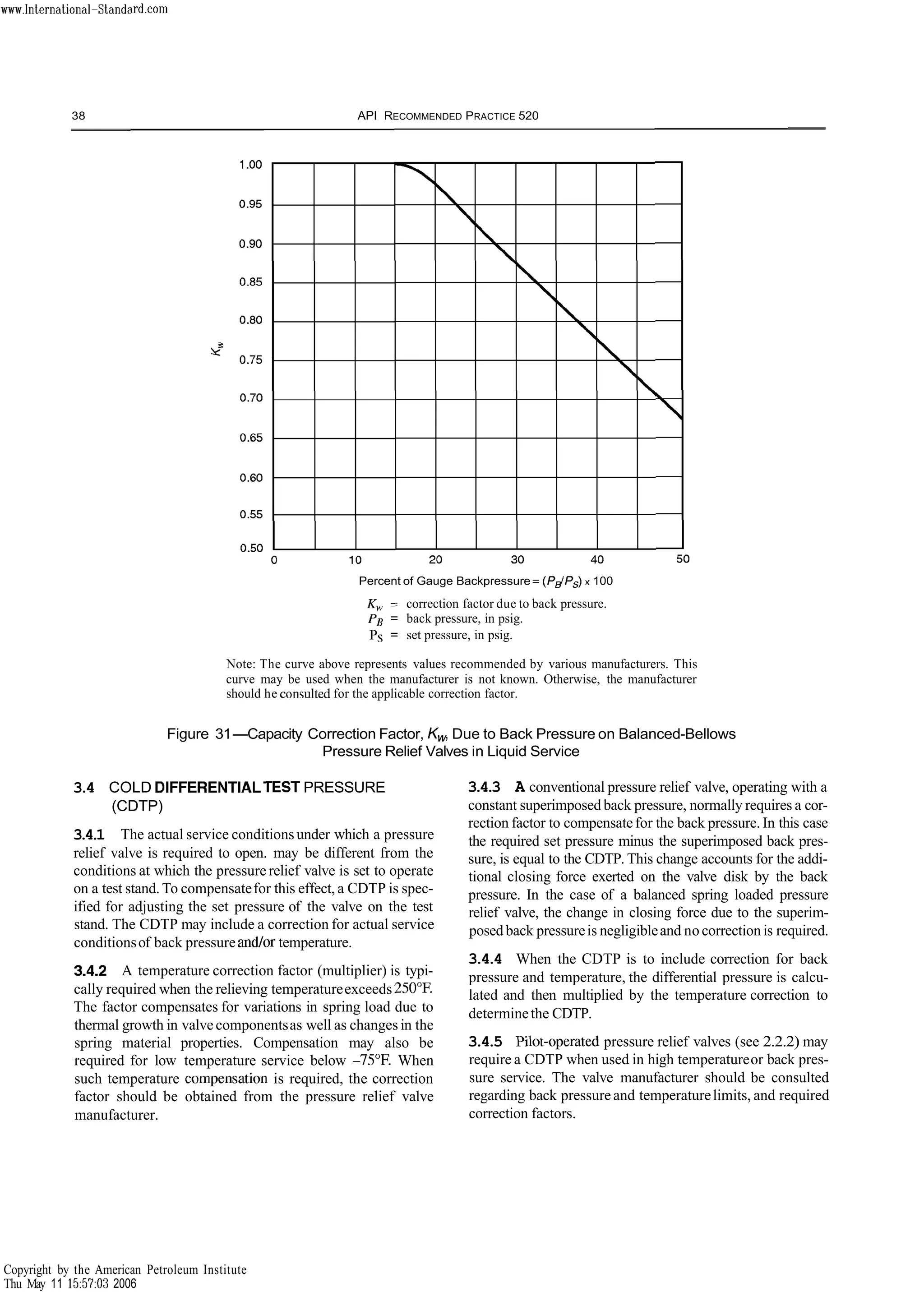
PrcssurcRclicf Valvcsin Liquid Scrvicc 38
32 Curvefor EvaluatingCoefficient Cin the Flow Equation from the Specific
...............................
Heat RatioAssuming Ideal Gas Behavior 44
. . . . . . . . . . . . .
33 Sample of CompletedPressureRelief ValveSpecificationSheet 46
......................................
34 Values of F2 for SubcriticalFlow 48
35 Constant Back PressureCorrection Factor. Kb. for ConventionalPressure
.................................
Relief Valves (Vaporsand Gases Only) 49
..........................
36 Capacity CorrectionFactor. K, Due toViscosity 54
37 Capacity Correction Factors Due to Overpressurefor NoncertifiedPressure
........................................
Relief Valves in Liquid Service 55
. . . . . . . . . . . . . . . . . . . . . . . . . . . . . . . .
A-1 RnphireDisk Device SpecificationSheet 60
...................
C-1 Spring-Loaded Pressure Relief Valve SpecificationSheet 65
...................
C-2 Pilot-Operated PressureRelief Valve SpecificationSheet 68
D-1 Correlation for NozzleCriticalFlow of Flashing and NonflashingSystems .... 78
D-2 Back PressureCorrection Factor. Kb. for Balanced-BellowsPressureRelief
Valves (Vaporsand Gases) ...........................................
79
.............
D-3 Corrclationfor Nozzlc CriticalFlow of Inlct SubcoolcdLiquids 80
D-4 Back PressureCorrection Factor. Kb. for Balanced-BellowsPressureRelief
...................................................
Valves (Liquids) 81
E-1 PressureRelief System for Example Problem . . . . . . . . . . . . . . . . . . . . . . . . . . . . 84
...........................
E-2 CurveFit for CJC, = 1.4 (CraneFigureA-22) 85
Copyright by the American Petroleum Institute
Thu May 11 15:57:01 2006
Page
Tables
1 Set Pressureand Accumulation Limits for Pressure Relief Valves ............39
2 ExampleDeterminationof RelievingPressurefor a Single-ValveInstallation
(Operating Contingencies) ...........................................
40
3 ExampleDeterminationof RelievingPressurefor a Multiple-ValveInstallation
(Operating Contingencies) ...........................................
40
4 ExampleDeterminationof RelievingPressurefor a Single-ValveInstallation
Firecontingencies) ................................................
41
5 ExampleDeterminationof RelievingPressurefor a Multiple-Valve
Installation (Fire Contingencies). . . . . . . . . . . . . . . . . . . . . . . . . . . . . . . . . . . . . . . 41
6 ExampleDeter~ninalion
of RelievingPressurefor a Supplemailal-Valve
Installation(Fire Contingencies). ......................................
41
7 Propertiesof Gases .................................................
43
8 Values of Coefficient C ..............................................
50
9 SuperheatCorrection Factors, K S H ....................................
51
D-1 Two-PhascLiquicWaporRclicf Scenariosfor PrcssurcRclicf Valvcs .........69
vii
Copyright by the American Petroleum Institute
Thu May 11 15:57:01 2006
Copyright by the American Petroleum Institute
Thu May 11 15:57:01 2006
Sizing, Selection, and Installation of
Pressure-Relieving Devices in Refineries
Part I-Sizing and Selection
1 Introduction 1.2.1-2 pressure relief valve: A pressure relief device
1.1 SCOPE
designed to open and relieve excess pressure and to reclose
and prevent the further flow of fluid after normal conditions
This recommended practice applies to the sizing and have been restored.
selection of pressure relief devices used in refineries and
related industries for equipment that has a maximlim allow-
able working pressure of 15 psig [I03 Wag] or greater. The
pressure relief devices covered in this recommended prac-
tice are intended to protect unfired pressure vessels and
related equipment against overpressure from operating and
fire contingencies.
This recommended practice includes basic definitions and
information about the operational characteristicsand applica-
lionsof variouspressure relief devices.It also includes sising
proceduresand methods based on steady stateflow of Newto-
nian fluids.
Pressure relief devices protect a vesselagainst overpressure
only; they do not protect against structural failure when the
vessel is exposed to extremely high temperaturessuch as dur-
ing a fire. See API Recommended Practice 521 for informa-
tion about appropriate ways of reducing pressure and
restricting heat input.
Atmospheric and low pressure storage tanks covered in
API Standard 2000 and pressure vessels used for the trans-
portation of products in bulk or shipping containers are not
within the scope of this recommendedpractice.
The rules for overpressure protection of fired vessels are
providedin Section I of theASME Boiler and PressureVessel
Code and ASME B31.1, and are not within the scope of this
recommendedpractice.
1.2 DEFINITION OFTERMS
Terms used in this recommended practice relating to pres-
sure relief devices and their dimensional and operational
characteristics are defined in 1.2.1 through 1.2.3. The terms
are covered more specifically in the applicable sections of
text and accompanying illustrations.
1.2.1 Pressure Relief Devices
1.2.1.1 pressure relief device: Actuated by inlet static
pressureand designed to open during emergencyor abnormal
conditions to preventa rise of internal fluid pressure in excess
of a specified design value. The device also may be designed
to prevent excessive internal vacuum. The device may be a
pressure relief valve, a non-reclosing pressure relief device,
or a vacuum relief valve.
a. A relief valve is a spring loaded pressure relief valve actu-
ated by the static pressure upstream of the valve. The valve
opens normally in proportion to the pressure increaseover the
opening pressure.A relief valveis used primarily with incom-
prcssiblc fluids.
b. A safety valve is a spring loaded pressure relief valve achl-
aled by the slatic pressure upstream of the valve arid
characterized by rapid opening or pop action. A safety valve
is normally used with compressible fluids.
c. A safety relief valve is a spring loaded pressure relief valve
that may be used as either a safety or relief valve depending
on the application.
d. A conventional pressure relief valve is a spring loaded
pressure relief valve whose operational characteristics are
directly affected by changes in the back pressure.
e. A balanced pressure relief valve is a spring loaded pres-
sure relief valve that incorporates a bellows or other means
for minimizing the effect of back pressure on the operational
characteristics of the valve
f. A pilot operated pressure relief valve is a pressure relief
valve in which the major relieving device or main valve is
combined with and controlled by a self actuated auxiliary
pressure relief valve (pilot).
1.2.1.3 non-reclosing pressure relief device: A
pressure relief device which remains open after operation.A
manualrcscttingmcans may bc providcd.
1.2.1.4 rupture disk device: A non-reclosing pressure
rclicf dcvicc actuatcd by static diffcrcntial prcssurc bctwccn
the inlet and outlet of the device and designed to function by
theburstingof a rupturedisk.A rupture disk deviceincludes a
rupturedisk and a rupturedisk holder.
a. A rupture disk is a pressure containing, pressureand tem-
perature sensitive element of a rupture disk device.
b. A rupture disk holder is the structure which encloses and
clamps the rupturedisk in position.(Some disks are designed
to be installed betweenstandard flanges without holders.)
c. A nonfragmenting ruptz~re
disk is a rupture disk designed
and manufactured to be installed upstream of other piping
components, such as pressure relief valves, and will not
impair the function of those components when the disk
ruptures.
1
Copyright by the American Petroleum Institute
Thu May 11 15:57:01 2006
2 API RECOMMEN~
1.2.1.5 pin-actuated device: A nun-reclosing pressure
relief device actuated by static pressure and designed to func-
tion by buckling or breaking a pin which holds a piston or a
plug in place. Upon buckling or breaking of the pin, the pis-
ton or plug instantly moves to the full open position.
1.2.2 Dimensional Characteristics of Pressure
Relief Devices
1.2.2.1 actual discharge area: The minimum net area
lhal determines the flow lhrough a valve.
1.2.2.2 curtain area:The area of the cylindricalor coni-
cal dischargeopening between the seating surfacesabove the
nozzle seat created by the lift of the disc.
1.2.2.3 effective discharge area: A nominal or com-
puted area used with an effective dischargecoefficient to cal-
culate the minimumrequiredrelievingcapacityfor a pressure
relief valve per the preliminary sizing equations contained in
this practice. API Standard 526 provides effective discharge
areas for a range of sizes in terms of letter designations, 'D"
through "T".
1.2.2.4 bore area: The minimum cross-sectional flow
area of a nozzle. Also referred to as nozzle area, nozzle throat
arca and throat arca.
1.2.2.5 huddling chamber:An annular chamber located
downstream of the seat of a pressure relief valve for the pur-
pose of assistingthe valve to achievelift.
1.2.2.6 inlet size: The nominal pipe size (NPS) of the
valve at the inlet connection,unless otherwisedesignated.
1.2.2.7 outlet size: The nominal pipe size (NPS) of the
valve at the discharge connection, unless otherwise desig-
nated.
1.2.2.8 lift: The actual travel of the disc from the closed
position whcn a valvcis rclicving.
1.2.2.9 minimum net flow area: The calculatednet area
after a complete burst of a rupture disc with appropriate
allowance for any structural members which may reduce the
net flow area through the rupture disk device. The net flow
area for sizing purposes shall not exceed the nominal pipe
size area of the rupture disk device.
1.2.3 Operational Characteristics
1.2.3.1 coefficient of discharge: The ratio of the mass
flow rate in a valveto thatof an idealnozzle.It is used for cal-
culatingflow through a pressurerelief device.
a. The effective coeficient of discharge is a nominal value
used with an effective discharge area to calculate the mini-
mum required relieving capacity of a pressure relief valve
This capacity is determinedin accordancewith the applicable
per the preliminary sizing equations given in this Recom-
mendedPractice.
b. The rated coeficient o f discharge is determined in accor-
dance with the applicablecode or regulation and is used with
the actual discharge area to calculate the rated flow capacity
of a pressure relief valve.
1.2.3.2 System Pressures and Temperatures (See
Figures 1 and 26 for further clarification of these pressure
related terms.)
a. The inaximum operating pressure is the maximum pres-
sure expected during normal systemoperation.
b. The maximum allowable working pressure (MAWP)is the
maximum gauge pressure permissible at the top of a com-
pleted vessel in its normal operating position at the
designated coincidenttemperaturespecified for that pressure.
The pressureis the least of the values for the internalor exter-
nal pressure as determinedby the vessel design rules for each
element of the vessel using actual nominal thickness, exclu-
sive of additional metal thickness allowed for corrosion and
loadings other than pressure. The maximum allowable work-
ing pressure is the basis for the pressure setting of the
pressure relief devices that protect the vessel. The MAWP is
normally greater than the designpressurebut must be equal to
the design pressure when the design rules are used only to
calculate the minimum thickness for each element and calcu-
lationsare not made to determine the value of theMAW.
c. The design pressure of the vessel along with the design
temperature is used to determine the minimum permissible
thicknessor physicalcharacteristicof each vessel component
as determinedby the vessel design rules. The design pressure
is selected by the user to provide a suitable margin above the
most severe pressure expected during normal opsration at a
coincidenttemperature.It is the pressure specifiedon the pur-
chase order. This pressure may be used in place of the
maximum allowable working pressure in all cases where the
M A W has not been established.The design pressureis equal
to or less than the MAW.
d. Accurnztlation is the pressure increase over the maximum
allowable working pressureof the vessel allowed during dis-
charge through the pressure relief device, expressed in
pressure units or as a percentage of M A W or design pres-
sure. Maximum allowable accumulations are established by
applicable codes for emergency operating and fire
contingencies.
e. Overpressureis the pressureincrease over the set pressure
of the relieving device allowed to achieve rated flow. Over-
pressure is expressed in pressure units or as a percentage of
set pressure. It is the same as accumulation only when the
relieving device is set to open at the maximum allowable
working pressure of the vessel.
f. The rated relieving capacity is the relievingcapacity used
as the basis for the application of a pressure relief device.
code or regulation and is provided by the manufacturer.
Copyright by the American Petroleum Institute
Thu May 11 15:57:01 2006
SIZING, ~ELEGTION,
AND ~NSTALLAT~ON
OF PRESSURE-RELIEVING DEVICES IN REFINERIES; PART I-SIZING
AND SELECTION 3
Notes:
1. This figure conforms with the requirements of Section VIII of the ASME Boiler and Pressure Vessel Code for MAWPs
greater than 30 psi.
2. The pressure conditions shown are for pressure relief valves installed on a pressure vessel.
3. Allowableset-pressure tolerances will be in accordance with the applicable codes.
4. The maximum allowableworking pressure is equal to or gseater than the design pressure for a coincidentdesign temperature.
5. The operating pressure may be higher or lower than 90.
6. Section VIII, Division 1, Appendix M of the ASME Code should be referred to for guidance on blowdown and pressure
differentials.
Pressure Vessel Requirements
Maximum allowable
accumulated pressure
(fire exposure only)
Maximum allowable
accumulated pressure for
multiple-valve installation
(other than fire exposure)
Maximum allowable
accumulated pressure for
single-valve installation
(other than fire exposure)
Maximum allowable
working pressure or
design pressure (see
Note4)
Maximum expected
operating pressure
(see Notes 5 and 6)
Figure 1
-Pressure-Level Relationshipsfor Pressure Relief Valves
Copyright by the American Petroleum Institute
Thu May 11 15:57:01 2006
Vessel
Pressure
121
- 120 -
- -
- -
- -
116
- 115-
- -
- -
_ h -
- ? -
U)
-110
e
- -
U)
- e -
a
U)
s -
- B
-
- ID 105
-
n
- 2
-
-
- -
m -
I z -
.- -
1
E 100
+
- +
Typical Characteristics of
Pressure Relief Valves
Maximum relieving pressure
for fire sizing
Multiple valves
Maximum relieving pressure
for process sizing
Single-valve
-
Maximum relieving pressure
for process sizing
Maximum allowable set pressure
A
v
s (typical)
- :
- 2 -
- -
- 95 -
- -
- -
for supplemental valves
(fire exposure)
4
- Overpressure (maximum)
Maximum allowable set pressure
for additional valves (process)
Maximum allowable set
- Blowdown(typical)
(see Note 6)
v Closing pressure for
Simmer
- -
- -
90
- -
- -
- -
- -
- 85 -
A pressure for single valve
a single valve
Leak test pressure (typical)
4 API RECOMMEN~
Note: The capacity marked on the device is the rated capacity on
steam, air, gas or water as required by the applicablecode.
1
.
2
.
3
.
3 Device Pressures (See Figures 1, 26, 27, 28,
and 29 for further clarification of these pressure related
terms.)
a. The set pressure is the inlet gauge pressure at which the
pressure relief device is set to open under serviceconditions.
b. The cold dzferential test pressure (CDTP) is the pressure
at which a pressurerelief valve is adjusted to open on the test
stand. The cold differential test pressure includes corrections
for the service conditions of back pressure or temperatureor
both.
c. The burst pressure of a rupture disk at the specified tem-
peratureis the value of the upstreamstatic pressure minus the
value of the downstream static pressure just prior to when the
disk bursts. When the downstream pressure is atmospheric,
the burst pressureis the upstreamstatic gauge pressure.
d. The marked burs1 pressure, or rated burst pressure of a
rupture disk, is the burst pressure established by tests for the
specified temperatureand marked on the disk tag by the man-
ufacturer. The marked burst pressure may be any pressure
within the manufacturing range unlessotherwise specified by
the customer. The marked burst pressure is applied to all of
the rupturedisks of the same lot.
e. The specijed burs1 pressure is the burst pressurespecified
by the user.The marked burst pressuremay be greater than or
less than the specified burst pressure but shall be within the
manufacturing range.The user is cautionedto considermanu-
facturing range, superimposed back pressure and specified
temperaturewhen determininga specified burst pressure.
f. Burst-pressure tolerance is the variation around the
marked burst pressure at the specified disk temperature in
which a rupturedisk shall burst.
g. A lot of rupture disks is those disks manufactured at the
same time and of the same size, material,thickness, type, heat
and manufacturing process, including heat treatment.
h. The rrnnufacturing range is the pressurerange in which the
rupturedisk shall be marked.Manufacturingrangesare usually
catalogued by the manufacturer as a percentage of the speci-
fied burst pressure. Catalogued manufacturingranges may be
modifiedby agreementbetweenthe user and the manufacturer.
i. Back pressure is the pressure that exists at the outlet of a
pressure relief device as a result of the pressure in the dis-
chargesystem.It is the sum of the superimposedand built-up
back pressures.
j. Built-up back pressure is the increase in pressure at the
outlet of a pressure relief device that develops as a result of
flow after the pressurerelief device opens.
k. Superimposed back pressure is the static pressure that
exists at the outlet of a pressure relief device at the time the
device is required to operate.It is the result of pressure in the
dischargesystemcomingfrom othersourcesand may be con-
stant or variable.
1. Blowdown is the difference between the set pressure and
the closing pressure of a pressure relief valve, expressed as a
percentage of the set pressure or in pressure units.
m. Opening pressure is the value of increasing inlet static
pressure at which there is a measurable lift of the disc or at
which discharge of the fluid becomes continuous, as deter-
mined by seeing, feeling or hearing.
n. Closing Pressure is the value of decreasing inlet static
pressureat which the valve disc reestablishescontact with the
seat or at which lift becomes zero as determined by seeing,
feeling or hearing.
o. Simmer is the audible or visible escape of compressible
fluid between the seat and disc which may occur at an inlet
static pressurebelow the set pressure prior to opening.
p. The operating ratio of a pressurerelief valve is the ratio of
maximum systemoperatingpressureto the set pressure.
q. The operating ratio of a rupture disk is the ratio of the
maximum system operating pressure to a pressure associated
with a rupturedisk as follows (see Figures 28 and 29):
1. For marked burst pressures above40 psi: The operating
ratio is the ratio of maximum system operatingpressureto
the disk marked burst pressure.
2. For marked burst pressures of 40 psi and below: The
operating ratio is the ratio of maximum system operating
pressure to the marked burst pressure minus 2 psi.
r. Leak-test pressure is the specified inlet static pressure at
which a seat leak test is performed.
s. The term relieving conditions is used to indicate the inlet
pressureand temperatureon a pressurerelief deviceduring an
overpressurecondition.The relievingpressure is equal to the
valvc sct prcssurc (or rupturc disk burst prcssurc) plus thc
overpressure. (The temperatureof the flowing fluid at reliev-
ing conditions may be higher or lower than the operating
temperature.)
t. The spec$ed disk temperature of a rupture disk shall be
the temperatureof the disk when the disk is expected to burst.
It is the temperature the manufacturer uses to establish the
marked burst pressure. The specified disk temperature is
rarely ever the design temperatureof the vessel and may not
even be the operating temperature or relief temperature,
dependingon the relief system configuration.
1.3 REFERENCED PUBLICATIONS
The current editions of the following standards,codes, and
specifications are cited in this recommended practice:
API
RP 520 Sizing, Selection, and Installation ofPressure-
Relieving Devices in Rejneiies, Part 11,
"Installation"
Std 526 Flanged Steel Pressure ReliefValves
Copyright by the American Petroleum Institute
Thu May 11 15:57:01 2006
SIZING, ~ELEGTION,
AND ~NSTALLAT~ON
O F PRESSURE-RELIE,'ING DEVICES IN REFINERIES; PART I-SIZING
AND SELECTION 5
Std 510 Pressure Vessel Inspection Code-Mainte-
nance Inspection, Rating, Repair; and
Alteration
RP521 Guide ,for Pressure-Relieving and Depressur-
ing Systems
Std 527 Seat Tightness of Pressure Relief Valves
RP576 Inspection of Pressure-Relieving Devices
Std 2000 Venting Atinospheiic and Low-Pressure Stor-
age Tanks (Nonrefrigeratedand Refrigerated).
Boiler and Pressure Vessel Code, Section I, "Power Boil-
ers," 1998
Boiler and Pressure Vessel Code, Section VIII, "Pressure
Vessels,"Division 1, 1998
B31.1 Power Piping, 1995, latest addenda
B31.3 Process Piping, 1996, latcst addcnda
2 Pressure Relief Devices
2.1 GENERAL
This scction dcscribcs thc basic principles, opcrational
characteristics, applications, and selection of pressure relief
devices used independentlyor in combination.Thesedevices
include spring loaded and pilot operated pressure relief
valves, rupture disk devices, and other pressure relief
devices. These devices are described in the text and illus-
trated in Figures 2-18.
2.2 PRESSURE RELIEFVALVES
2.2.1 Spring-LoadedPressure Relief Valves
2.2.1.1 ConventionalPressure Relief Valves
2.2.1.1.1 A conventionalpressure relief valve (seeFigures
2 and 5) is a self-actuated spring-loaded pressure relief valve
which is designed to open at a predetermined pressure and
protect a vessel or system from excess pressure by removing
or relievingfluid from that vesselor system.The valve shown
in Figure 5 is available in small sizes commonly used for
thermal relief valve applications. The basic elements of a
spring-loaded pressure relief valve include an inlet nozzle
connected to the vessel or system to be protected, a movable
disc which controls flow through the nozzle, and a spring
which controls the position of the disc. Under normal system
operating conditions, the pressure at the inlet is below the set
pressure and the disc is seated on the nozzle preventing flow
through the nozzle.
l~merican
Society of Mechanical Engineers, 345 East 47th Street;
NewYork, New York 10017.
2.2.1.1.2 Spring-loaded pressure relief valves are referred
to by a variety of terms, such as safety valves, relief valves
and safety relief valves. These terms have been traditionally
applied to valves for gaslvapor service, liquid service, or
multi-service applications, respectively. The more generic
term, pressure relief valve, is used in the text and is applica-
ble to all three.
2.2.1.1.3 The operation of a conventional spring-loaded
pressure relief valve is based on a force balance (see Figure
19).The spring-load is preset to equal the force exerted on the
closed disc by the inlet fluid when the system pressure is at
the set pressureof the valve. When the inlet pressure is below
the set pressure, the disc remains seated on the nozzle in the
closed position.When the inlet pressure exceeds set pressure,
the pressureforce on the disc overcomes the spring force and
the valve opens.When the inlet pressureis reduced to a level
below h e set pressure, the valve re-closes.
2.2.1-1-4 When the valve is closed during normal opera-
tion, see Figure 19A, the system or vessel pressure acting
against the disc surface (area "A") is resisted by the spring
force. As the system pressure approaches the set pressure of
thc valvc, thc scating forcc bctwccn thc disc and thc nozzlc
approaches zero.
2.2.1.1.5 In vapor or gas service, the valve may "simmer"
before it will "pop." When the vessel pressure closely
approaches the set pressure, fluid will audibly move past the
seating surfaces into the huddlingchamber"B." As a result of
the restriction of flow between the disc holder and the adjust-
ing ring, pressure builds up in the huddling chamber B (see
Figure 19B). Since pressure now acts over a larger area, an
additional force, commonly referred to as the expansive
force, is available to overcome the spring force. Ry adjusting
the adjuslirig ring, the opening in the aririular orifice car1 be
altered, thus controlling the pressure build-up in the huddling
chamber "B." This controlled pressure build-up in the hud-
dling chamber will overcome the spring force causing the
&sc to move away from the nozzle seat, and the valve will
pop opcn.
2.2.1.1.6 Once the valve has opened, an additional pres-
sure build-up at C occurs (see Figure 19C).This is due to the
sudden flow increase and the restriction to flow through
another annular orifice formed between the inner edge of the
disc holder skirt and the outside diameter of the adjusting
ring. Theseadditional forcesat "C" cause the disc to lift sub-
stantially at pop.
2.2.1.1.7 Mow is restricted by the opening between the
nozzle and the disc until the disc has been lifted from thenoz-
zle seat approximately one quarter of the nozzle diameter.
After the disc has attained this degree of lift, flow is then con-
trolled by the bore area rather than by the area between the
seating surfaces.
Copyright by the American Petroleum Institute
Thu May 11 15:57:01 2006
6 API RECOMMENDED PRACTICE 520
Cap
Stem (spindle)
Adjusting screw
Bonnet
Spring
Disc
Seating surface
Adjusting ring
Body
Nozzle
Figure 2-Conventional Pressure Relief Valve with a Single Adjusting Ring for BlowdownControl
Copyright by the American Petroleum Institute
Thu May 11 15:57:01 2006
SIZING, SELECTION, AND ~NSTALLAT~ON
OF PRESSURE-RELIEVING DEVICES IN REFINERIES; PART I-SIZING
AND SELECTION 7
Cap
Stem (spindle)
Adjusting screw
Bonnet
Spring
Bellows
Disk
Seating surface
Adjusting ring
Body
Nozzle
Figure 3-Balanced-Bellows Pressure Relief Valve
Copyright by the American Petroleum Institute
Thu May 11 15:57:01 2006
8 API RECOMMENI
JED PRACTICE 520
2.2.1.1.8 The valve closes when the inlet pressure has
dropped sufficientlybelow the set pressure to allow the spring
force to overcome the summation of forces at A, B, and C.
The pressure at which the valve re-seats is the closing pres-
sure. The difference between the set pressure and the closing
pressure is blowdown.
2.2.1.1.9 Figure 20 shows the disc travel from the set pres-
sure, A, to the maximum relieving pressure, B, during the
overpresslire incident and to the closing pressiire, C, during
the blowdown.
2.2.1.2 Spring-Loaded Pressure Relief Valves
Designed for Liquid Service Applications
2.2.1.2.1 Liquid service valves do not pop in the same
manner as vapor service valves (see Figure 21), since the
expansive forces produced by vapor are not present in liquid
flow. Liquid service valves must necessarily rely on reactive
forces to achieve lift.
2.2.1.2.2 Whai lhe valve is closed, the forces acting on the
valve disc are the same as those applied by vapor until a force
balance is reached and the net force holding the seat closed
approaches zero. From this point on, the force relationship is
totally different.
2.2.1.2.3 At initial opening, the escaping liquid forms a
very thin sheet of fluid, as seen in Figure 21A, expanding
radially between the seating surfaces. The liquid strikes the
reaction siirfaceof the disc holder and is deflected downward,
creating a reactive (turbine) force tending to move the disc
and holder upward. These forces typically build very slowly
during the first 2% - 4%of overpressure.
2.2.1-2.4 As the flow gradually increases, the velocity head
of the liquid moving through the nozzle also increases. These
momentum forces, combined with the reactive forces of the
radially discharging liquid as it is denected downward from
the reaction surface (see Figure 21B), are substantial enough
to cause the valve to go into lift. Typically the valve will sud-
denly surge to 50% - 100% lift at 2% - 6% overpressure. As
the overpressure increases, these forces continue to grow,
driving the valve into full lift. Liquid service valves, capacity
certified by ASME, are required to reach full rated capacity at
10% or less overpressure.
2.2.1.2.5 In the closing cycle, as the overpressure
decreases, momentum and reactive forces decrease, allowing
thc spring forcc to movc thc disc back into contact with thc
seat.
2.2.1.2.6 Historically, many pressure relief valves used in
liquid applications were safety relief or relief valvesdesigned
for compressible (vapor) service. Many of these valves, when
used in liquid service, required high overpressure (25%) to
achieve full lift and stable operation, since liquids do not pro-
vide the expansive forces that vapors do. Where liquid pres-
sure relief valves were required to operate within the
accumulation limit of lo%, a conservative factor of 0.6 was
applied to the valve capacity when sizing the valves. Conse-
quently, many installations were oversized and instability
often resulted. The criteria used for sizing this type of valve
may be found in 3.9.
2.2.1.2.7 Rulcs havc bccn incorporatcd into thc ASME
Boiler and Pressure Vessel Code, Section VIII, as well as
other international standards which address performance of
liquid service valvesat 10% overpressure and which require a
capacity certification. Pressure relief valves designed for liq-
uid service have been developed which achieve full lift, stable
operation, and rated capacity at 10% overpressure in compli-
ance with the requirements. Blowdown is adjustable in some
designs. Some valves are designed so that they operate on liq-
uid and gas. Such valves, may however, exhibit different
operational characteristics, depending on whether the flow
swearnis liquid, gas, or a cornbiriatioriof the two. Marly pres-
sure relief valves designed for liquid service, for example,
will have a much longer blowdown (typically 20%) on gas
than on liquid service. Additionally, some variation in set
pressure may occur if the valve is set on liquid and required to
opcratc on gas or vicc vcrsa.
2.2.1.2.8 The rules for sizing pressure relief valves
designed for liquid service are given in 3.8. If a capacity on
gas service is required, 3.6.2 or 3.6.3 should be used for the
preliminary sizing calculation. Capacity certification data
for sizing on liquid and gas service should be obtained from
the manufacturer for use in final sizing and application of
the valve.
2.2.1.2.9 Spring-loaded pressure relief valves designed for
liquid (or liquid and gas) applications and which are balanced
to minimize the effects of back pressure are recommended for
two phase applications when the fluid being relieved may be
liquid, gas, or a multi-phase mixture. Many manufacturers
rccommcnd that valvcs dcsigncd for liquid or liquid-and-gas
service be used if the mass percentage of the two phase mix-
ture at the valve inlet is 50% vapor or less. In addition, if the
ratio of liquid to gas in the flow stream is not certain, a valve
specificallydesigned for liquid service or for service on liquid
and gas should be used.
2.2.1.2.10 Pressure relief valves designed for liquid and
gas service should be specified for the fluid the valve is nor-
mally exposed to. For example, if a liquid and gas service
valve is located in the vapor region of a vessel containing a
liquid level, the valve should be specified for gas service. The
valve capacity stamped on the nameplate will be in SCFM of
air. If a liquid and gas service valve is located on the water
side of a heat exchanger, then the valve should be specified in
liquid service. This valve will have a capacity stamped in
GPM of water.
Copyright by the American Petroleum Institute
Thu May 11 15:57:01 2006
SIZING, ~ELEGTION,
AND ~NSTALLAT~ON
O F PRESSURE-RELIEVING DEVICES IN REFINERIES; PART I-SIZING
AND SELECTION 9
Figure 4-Balanced-BellowsPressure Relief Valve with an Auxiliary Balanced Piston
Copyright by the American Petroleum Institute
Thu May 11 15:57:02 2006
10 API RECOMMENDED PRACTICE 520
Cap
Stem (spindle)
Adjusting screw
Bonnet
Spring
Disk
Seating surface
Base (body)
Figure 5-Conventional Pressure Relief Valve withThreaded Connections
Copyright by the American Petroleum Institute
Thu May 11 15:57:02 2006
SIZING, ~ELEGTION,
AND ~NSTALLAT~ON
OF PRESSURE-RELIEVING DEVICES IN REFINERIES; PART I-SIZING
AND SELECTION 11
Outlet
Set pressure
adjustment screw
External blowdown
Internal pressure
I pilot
Inlet -Main valve
Figure 6-Pop-Action Pilot-OperatedValve (Flowing-Type)
2.2.1 -2.11 In some applications, the valve may be required force is applied to the valve disc which is additive to the
to relieve a liquid or a gas depending on the condition causing spring force. This added force increases the pressure at which
the overpressure (heat exchanger tube rupture, for example). an unbalanced pressure relief valve will open. If the superim-
In this application, a valve designed for liquid service or one posed back pressure is variable then the pressure at which the
designed for liquid and gas service is recommended. valve will open will vary (see Figure 22). In a balanced-bel-
lows pressure relief valve, a bellows is attached to the disc
2.2.1.3 BalancedPressure Relief Valves holder with a pressure area, AB,approximately equal to the
2.2.1.3.1 A balanced pressure relief valve is a spring-
loaded pressure relief valve which incorporates a bellows or
othcr mcans of balancing thc valvc disc to minimizc thc
effects of back pressure on the performance characteristics of
the valve (see Figures 3 and 4).
scating arca of thc disc, AN (scc Figurc 23). This isolatcs an
area on the disc, approximately equal to the disc seat area,
from the back pressure. With the addition of a bellows, there-
fore, the set pressure of the pressure relief valve will remain
constant in spite of variations in back pressure. Note that the
internal area of the bellows in a balanced-bellows spring-
2.2.1 -3.2 When a superimposed back pressure is applied to loaded pressure relief valve is referenced to atmospheric pres-
the outlet of a spring-loaded pressure relief valve, a pressure sure in the valve bonnet. It is important to remember that the
Copyright by the American Petroleum Institute
Thu May 11 15:57:02 2006
12 API RECOMMENDED PRACTICE 520
Figure 7-Pop-Action Pilot-OperatedValve (Nonflowing-Type)
bonnet of a balanced pressure relief valve must be vented to pressure is not always constant and such cases must be eval-
the atmosphere at all times for the bellows to perform prop- uated carefully.
. .
erly. If the valve is located where atmospheric venting would
present a hazard or is not permitted by environmental regula-
2.2.1-3.5 Balanced pressure relief valves should be consid-
tions, the vent should be piped to a safe location that is freeof ered where the built-up back pressure (back pressure caused
back pressure that may affect the pressure relief valve set by through the downstream piping after the valve
pressure. lifts) is too high for a conventional pressure relief (see
3.3.3.1). A detailed discussion of back pressure and its effects
2m2.1
.3.3 Other means of balancing a s~nng-lOadedpres- on
relief valve performanceand flow capacity can be
sure relief valve such as a sealed piston are used in some
valve designs. These designs perform in a manner similar to
found in 3.3.
the balanced bellows design. 2.2.1.3.6 Balanced pressure relief valves may also be used
2.2.13.4 When the superimposed back pressme is con- as a means to isolate the guide, spring, bonnet and other top
stant, the spring-load can be reduced to compensate for the works parts within the valve from the relieving fluid. This
effect of back pressure on set pressure, and a balanced valve may be important if there is concern that the fluid will cause
is not required. There are cases where superimposed back corrosive damage to these parts.
Copyright by the American Petroleum Institute
Thu May 11 15:57:02 2006
SIZING, ~ELEGTION,
A
N
D ~NSTALLAT~ON
O
F PRESSURE-RELIEVING DEVICES I
N REFINERIES; PART I-SIZING
A
N
D SELECTION 13
Outlet
Figure 8-Modulating Pilot-OperatedValve (Flowing-Type)
Copyright by the American Petroleum Institute
Thu May 11 15:57:02 2006
14 API RECOMMENDED PRACTICE 520
Sense diaphragm
Figure 9-Pilot-Operated Relief Valve with a NonflowingModulating Pilot Valve
2.2.2 Pilot-OperatedPressure Relief Valves
2.2.2.1 A pilot-operated pressure relief valve consists of
the main valve, which normally encloses a floating unbal-
anccd piston asscmbly, and an cxtcrnal pilot (scc Figurcs 6
through 10).The piston is designed to have a larger area on
the top than on the bottom. Up to the set pressure, the top and
bottomareasare exposed to the sameinlet operatingpressure.
Because of the larger area on the top of the piston, the net
force holds the piston tightly against the main valve nozzle.
As the operating pressure increases, the net seating force
increases and tends to make the valve tighter. This feahire
allows most pilot-operatedvalves to be used where the maxi-
mum expected operating pressure is higher than the percent-
age shown in Figure 1. At the set pressure, the pilot vents the
pressure from the top of the piston; the resulting net force is
now upward causing the piston to lift, and process flow is
established through the main valve. After the overpressure
incident, the pilot will close the vent from the top of the pis-
ton, thereby re-establishing pressure, and the net force will
cause the piston to reseat.
2.2.2.2 The main valve of the pilot-operated pressure
rclicf valvc can usc a diaphragm in licu of a piston to pro-
vide the unbalanced moving component of the valve. A disc,
which norrnally closes the main valve inlet, is integral with
a flexible diaphragm (see Figure 10). The external pilot
serves the same function to sense process pressure, vent the
top of the diaphragm at set pressure, and reload the dia-
phragm once the process pressure is reduced. As with the
piston valve, the seating force increases proportionally with
the operating pressure because of the differential exposed
area of the diaphragm.
Copyright by the American Petroleum Institute
Thu May 11 15:57:02 2006
Sense
Boost
Sense diaphragm
Boost diaphragm
cavity
cavity
Pilot Valve
Figure 10-Low-Pressure Pilot-OperatedValve (Diaphragm-Type)
2.2.2.3 The lift of the main valve piston or diaphragm, Slight variations in back pressure may be acceptable
unlike a conventionalor balanced spring loaded valve, is not unbalanced pilots (see 3.3.3.1).
for
affected by built-up back pressure. This allows for even
higher pressuresin the relief discharge manifolds. 2.2.2.5 A bacldow preventer is required when the possibil-
ity existsof developinga pressureon the dischargeside of the
- - -
2.2.2.4 The pilot vent can be either directly exhausted to valve that exceeds the inlet pressure of the valve. The higher
atmosphere or to the main valve outlet depending upon the discharge pressure can cause sufficient upward force on the
pilot's design and user's requirement. Only a balanced-type diaphragm or piston to open the valve and cause flow rever-
of pilot, where set pressure in unaffected by back pressure, sal. The backflow preventer allows the discharge pressure to
should be installed with its exhaust connected to a location provide a net downward force on the diaphragm or piston to
with varying pressure (such as to the main valve outlet). keep the valve closed (see Figure 7). The proper operation of
Copyright by the American Petroleum Institute
Thu May 11 15:57:02 2006
16 API RECOMMEN~
the backflow preventer is critical to further insuring no flow
reversal occursin the valve.The selection of the materialand
seals in the backflow preventer should be consistent with the
pilot-operatedrelief valve.
2.2.2.6 The pilot that operates the main valve can be either
a pop-actionor modulating-action pilot. The pop-action pilot,
as shown in Figure24, causes the main valveto lift fully at set
pressure without overpressure. The modulating pilot, as
shown in Figure 25, opens the main valve only enough to sat-
isfy the requiredrelieving capacity.
2.2.2.7 The pilots may be either a flowing or nonflowing
type. The flowing type allows process fluid to continuously
flow through the pilot when the main valve is open; the non-
flowing typedoes not. The nonflowing pilot-type is generally
recommended for most services to reduce the possibility of
hydrate formation (icing) or solids in the lading fluid affect-
ing the pilot's performance.
2.2.2.8 Pilot-operated pressure relief valves art: available
for use in liquid and vapor services.Operatingcharacteristics
of some pilot-operated pressure relief valves are unaffected
by the state of fluid (liquidor gas) and these types are recom-
mended for two-phaseflow applications.
2.2.2.9 Similar to soft seated spring-loaded valves, most
main valves and their pilots contain nonmetalliccomponents
and process temperature and fluid compatibility can limit
their use. In addition,as with all pressure relief devices, fluid
characteristics such as susceptibility to polymerization or
fouling, viscosity, the presence of solids, and corrosiveness
should be considered. The manufacturershould be corisulled
to ensure that the proposed application is compatible with
availablevalves.
2.3 RUPTURE DISKDEVICES
2.3.1 General
2.3.1.1 Rupture disk devices are nun-reclosing pressure
relief devices used to protect vessels, piping and other pres-
sure containing components from excessive pressure andlor
vacuum. Rupture disks are used in single and multiple relief
device installations. They are also used as redundantpressure
relief devices.
2.3.1.2 With no moving parts, rupture disks are simple,
reliable and faster acting than other pressure relief devices.
Rupture disks react quickly enough to relieve some types of
pressure spikes. Because of their light weight, rupture disks
can be made from high alloy and corrosion-resistantmaterials
that art:not practicalin pressurerelief valves.
2.3.1.3 Rupture disks can be specified for systems with
vapor (gas) or liquid pressure relief requirements. Also,
rupture disk designs are available for highly viscous fluids.
The use of rupture disk devices in liquid service should be
carefully evaluated to ensure that the design of the disk is
suitable for liquid service. The user should consult the
manufacturer for information regarding liquid service
applications.
2.3.1.4 The rupture disk is also a temperature sensitive
device. Burst pressures can vary significantly with the tem-
perature of the rupture disk device. This temperaturemay be
different from the normal fluid operating temperature. As the
temperature at the disk increases, the burst pressure usually
decreases.Since the effectof temperaturedependson the rup-
ture disk design and material, the manufacturer should be
consultedfor specific applications. For thesereasons, the rup-
ture disk must be specified at the pressure and temperature
the disk is expected to burst.
2.3.1.5 Care must be taken during installation to avoid
damaging the disk and to ensure that the disk and holder are
properly oriented relative to the flow. A damaged or improp-
erly oriented disk may burst considerably higher than its
marked burst pressure, depending on the style of the disk.
Contact the manufacturer for informationabout the effects of
damage or improperorientationfor a specific style of disk.
2.3.1.6 Care must also be taken to follow the manufac-
turcr's bolt torquc and tightcning proccdurcs during installa-
tion.Impropertorquecan alsoaffectthedisk's burst pressure.
2.3.2 Applicationof Rupture Disks
2.3.2.1 Single,Multiple, and Fire Applications
Kupture disks can be used in any application requiring
overpressureprotection where a non-reclosingdevice is suit-
able. This includes single, multiple, and fire applications as
specified in UG-134 of the ASME Code. Figure 26 provides
the pressurelevel relationshipsbetween rupture disks and the
protectedequipmentper the ASMECode, SectionVIII.
2.3.2.2 Rupture Disk Device at the Inletof a
Pressure Relief Valve
2.3.2.2.1 The ASME Code, Section VIII, Division 1 also
allows for the use of rupture disks in combination with pres-
sure relief valves (see Figure 17). Kupture disks are used
upstream of pressure relief valves to seal the system to meet
emissions standards, to provide corrosion protection for the
valve, and to reduce valve maintenance.
2.3.2.2.2 When a rupture disk device is installed at the
inlet of a pressure relief valve, the devices are considered to
be close coupled, and the specified burst pressure and set
pressureshould be the same nominal value. When installedin
liquid service it is especially importantfor the disk and valve
to be close coupled to reduce shock loadingon the valve.
2.3.2.2.3 The space between the rupture disk and the
pressure relief valve shall have a free vent, pressure gauge,
Copyright by the American Petroleum Institute
Thu May 11 15:57:02 2006
SIZING, ~ELEGTION,
AND ~NSTALLAT~ON
OF PRESSURE-RELIEVING DEVICES IN REFINERIES; PART I-SIZING
AND SELECTION 17
CORRECT INSTALLATION
I
Standard studs
Rupture disk
rupture disk holder
Pre-assembly side clips (inlet and outlet shown)
or pre-assembly screws
Flow
Figure 11-Forward-ActingSolid Metal Rupture Disk
Copyright by the American Petroleum Institute
Thu May 11 15:57:02 2006
18 API RECOMMENDED PRACTICE 520
trycock, or suitable telltale indicator as required in UG-127
of Section VIII, DivisionI, of the ASME Code. A nonvented
space with a pressure gauge without alarms or other
devices, is not recommended as a suitable telltale indicator.
Users are warned that a rupture disk will not burst in toler-
ance if back pressure builds up in a nonvented space
between the disk and the pressure relief valve, which will
occur should leakage develop in the rupture disk due to cor-
rosion or other cause.
2.3.2.3 Rupture Disk Device at the Outlet of a
Pressure Relief Valve
A rupture disk device may be installed on the outlet of a
pressure relief valve to protect the valve from atmospheric or
downstream fluids. Consideration shall be given to the valve
design so that it will open at its proper pressure setting
regardless of any back pressure that may accumulate between
the valve and rupture disk. See UG-127 of the ASME Code
for other requirementsand considerations.
2.3.2.4 Highly Corrosive Applications
In highly corrosive applications, two rupture disks are
often used together. A double disk assembly consists of two
rupture disks mounted in a special holder with a vapor space
between them. If the first disk develops a leak due to corro-
sion the second disk will contain the fluid. The vapor space
between the disks should have a free vent, pressure gauge,
trycock or suitable telltale indicator for monitoring of pres-
sure build-up. This gives the user an indication that replace-
ment of the rupturedisk is required.
2.3.2.5 Highly Viscous Applications
Rupture disk designs are available for processes with high
viscosity fluid, including nonabrasive slurries, where fluid
flow is directed across the rupture disk inlet to prevent prod-
uct build-up which may otherwise adversely affect rupture
disk performance.The disk manufacturershould be consulted
for detailsin these applications.
2.3.3 Types of RuptureDisks
There are 3 major rupture disk types:
a. Forward-acting, tension loaded.
b. Reverse-acting, cornpressio~i
loaded.
c. Graphite, shear loaded.
2.3.3.1 Forward-Acting Solid Metal Rupture Disks
A forward-acting rupture disk is a formed (domed),solid
metal disk designed to burst at a rated pressure applied to
the concave side (see Figure 11).This rupture disk typically
has an angular seat design and provides a satisfactory ser-
vice life when operating pressures are up to 70% of the
marked burst pressure of the disk (70% operating ratio).
Consult the manufacturerfor the actual recommendedoper-
ating ratio for the specific disk under consideration. If vac-
uum or back pressure conditions are present, the disk can be
furnished with a support to prevent reverse flexing. These
disks have a random opening pattern and are considered
fragmenting designs that are not suitable for installation
upstream of a pressure relief valve.
2.3.3.2 Forward-Acting Scored Rupture Disks
The scored forward-acting niptnre disk is a formed
(domed) disk designed to burst along scored lines at a rated
pressure applied to the concave side (see Figure 12). Some
designs provide satisfactory servicelife when operating pres-
surcs arc up to85%- 90% of thc markcd burst prcssurcof thc
disk (85%- 90% operating ratio). Consult the manufacturer
for the actual recornrnended operating ratio for the specific
disk under consideration. Most designs withstand vacuum
conditions without a vacuum support. If back pressure condi-
tions are present, the disk can be furnished with a support to
prevent reverse flexing. Because the score lines control the
opening pattern, this type of disk can be manufactured to be
nonfragmenting and acceptablefor installation upstream of a
pressure relief valve. The scored, forward-actingrupture disk
is manufacturedfrom thicker materialthan nonscoreddesigns
with the same burst pressure, and provides additional resis-
tance to mechanicaldamage.
2.3.3.3 Forward-Acting Composite Rupture Disks
2.3.3.3.1 A forward-acting composite rupturedisk is a flat
or domed multipiece construction disk (see Figure 13). The
domed composite rupture disk is designed to burst at a rated
pressure applied to the concave side. The flat composite rup-
ture disk may be designed to burst at a rated pressure in either
or both directions. Some designs are nonfragmenting and
acceptable for use upstream of a pressure relief valve.
2.3.3.3.2 The domed composite rupture disk is available in
flat seat or angular seat design. The burst pressure is con-
trolled by the combination of slits and tabs in the top section
and a metallic or nonmetallic seal member under the top sec-
tion. Composite rupturedisks are generally available in burst
pressures lower than those of forward acting, nonscored rup-
ture disks. Composite rupture disks may offer a longer ser-
vice life as a result of the corrosion resistant properties of the
seal material selected.
2.3.3.3.3 The slits and tabs in the top section provide a
predeterminedopening pattem for therupturedisk.If vacuum
or back pressure conditions are present, composite disks can
be furnished with a support to prevent reverse flexing (see
Figure 13). A domed, composite rupture disk generally
Copyright by the American Petroleum Institute
Thu May 11 15:57:02 2006
SIZING, ~ELEGTION,
AND ~NSTALLAT~ON
OF PRESSURE-RELIEVING DEVICES IN REFINERIES; PART I-SIZING
AND SELECTION 19
CORRECT INSTALLATION
I
Standard studs
Rupture disk
rupture disk holder
Pre-assembly side clips (inlet and outlet shown)
or pre-assembly screws
Flow
Figure 12-Forward-ActingScored Rupture Disk
Copyright by the American Petroleum Institute
Thu May 11 15:57:02 2006
20 API RECOMMENDED PRACTICE 520
Semicircular-Slit Design Radial-Slit Design
Seal member
seal member vacuum support L~acuum support
CORRECTINSTALLATION
Rupture disk Outlet
Pre-assembly side clips
or pre-assembly screws
Standard studs
and nuts
Insert-type
- rupture disk holder
(inlet and outlet shown)
I Standard flange
I
I
I
Inlet
Pressure
Figure 13-Forward-Acting Composite Rupture Disk
Copyright by the American Petroleum Institute
Thu May 11 15:57:02 2006
SIZING, ~ELEGTION,
AND ~NSTALLAT~ON
O F PRESSURE-RELIE,'ING DEVICES IN REFINERIES; PART I-SIZING
AND SELECTION 21
provides satisfactory service life when the operdting pressure
is 80% or less of the marked burst pressure (80% operating
ratio). Consult the manufacturer for the actual recommended
operatingratio for the specific disk under consideration.
2
.
3
.
3
.
3
.
4 A flat composite rupture disk is available for the
protection of low pressure vessels or the isolation of equip-
ment such as exhaust headers or the outlet side of a pressure
relief valve. This disk usually comes complete with gaskets
and is designed to be installed between companion flanges
rather than within a specific rupture disk holder.Flat compos-
ite rupture disks generally provide satisfactory service life
when operatingpressuresare 50% or less of the marked burst
pressure (50% operating ratio). Consult the manufacturer for
the actual recommended operating ratio for the specific disk
under consideration.
2
.
3
.
3
.
4 Reverse-ActingRupture Disks
2
.
3
.
3
.
4
.
1 A reverse-acting rupture disk typically is a
formed (domed) solid metal disk designed to "reverse" and
burst at a rated pressureapplied on the convex side. Reverse-
acting rupture disks are designed to open by such methodsas
shear, knife blades, knife rings, or scored lines (see Figures
14 and 15).
2
.
3
.
3
.
4
.
2 Reverse-acting rupture disks may be manufac-
tured as nonfragmenting and suitable for installation
upstream of pressure relief valves. These disks provide sat-
isfactory service life when operating pressnres are 90% or
less of marked burst pressure (90% operating ratio). Consult
the manufacturer for the actual recommended operating
ratio for the specific disk under consideration. Because a
reverse-acting rupture disk is operated with pressure applied
on the convex side, thicker disk materials may be used,
thereby lessening the effects of corrosion, eliminating the
need for vacuum support, and providing longer service life
under pressure/vacuum cycling conditions and pressure
fluctuations.
2
.
3
.
3
.
4
.
3 Knife blades installed in holders should be con-
structed of corrosion-resistant material and should be
inspected periodically to insure sufficient sharpness to open
the disk. Dull or damaged knife blades may prevent proper
openingof the disk.
2
.
3
.
3
.
5 Graphite Rupture Disks
2
.
3
.
3
.
5
.
1 Graphite rupture disks are typically machined
from a bar of fine graphite that has been impregnated with a
binding compound (see Figure 16). The disk operates on a
pressure differential across the center diaphragm or web por-
tion of the disk. Graphite rupture disks provide a satisfactory
service life when operating pressures are up to 80% of the
marked burst pressure (80% operating ratio) and can be used
in both liquidand vapor service. Consultthe manufacturerfor
the actual recommended operating ratio for the specific disk
under consideration.
2
.
3
.
3
.
5
.
2 If vacuum or back pressure conditions are
present, the disk can be furnished with a support to prevent
reverse flexing. These disks have a random opening pattern
and are considered fragmenting designs that are not suitable
for installationupstrcam of a prcssurc rclicf valvc.A mctallic
ring called armoring is often added to the outside diameter of
the disk to helpsupportuneven piping loadsand minimizethe
potentialfor cracking of the outer graphitering and blow-out
of process fluid.
2
.
3
.
4 Rupture Disk Holders
Rupture disk holders are used to clamp the rupture disk in
place and effect a leak-tight, metal-to-metal seal.The seating
area of the holders is typically unique to specific manufactur-
ers and stylesof rupturedisks. Rupturedisk holders are avail-
able in a varicty of configurations including full bolting,
weldneck, threaded, etc. The most common configuration is
the insert type which fits between standard pipe flanges, and
the outside diameter of the holder fits inside the flange studs.
Rupture disk holders are available in a variety of materials
and coatings.
2
.
3
.
5 Rupture Disk Accessories
A variety of accessories are available for use with rup-
ture disks in various applications. The following provides a
brief description of some of these components and their
application.
a. Rupture Indicators and Sensors-These devices typically
provide an electrical or mechanical signal which can indicate
the opening and/or leakageof a rupturedisk or pressure relief
valvc.
b. Alarm Monitors-Alarm monitors are available to moni-
tor rupture disk indicators or sensors. Alarm monitors are
availablewith intrinsically safe circuits.
c. Heat Shields-Heat shields are generally installed
upstreamof the rupture disk in high temperatureprocesses to
reduce the temperatureat the rupturedisk.
d. Baffle Plates-When venting to atmosphere, baffle plates
can be used to deflect process dischargeaway from personnel
and equipment.
2
.
3
.
6 Rupture Disk Selection and Specification
Rupturedisk selectionis basedon the operatingparameters
of the systemin which it is installed.These parametersshould
be specified by the Purchaser when purchasing rupture disks.
These parametersinclude, but are not limited to:
a. MAWP of vessel or piping.
b. Fluid state (vapor, liquid, or multiphase).
Copyright by the American Petroleum Institute
Thu May 11 15:57:02 2006
22 API RECOMMENDED PRACTICE 520
CORRECT INSTALLATION
,-Rupture disk
/ ,
- Standard studs
I
Knife-blade or
and nuts
Outlet
knife-ring assembly
I Insert-type
I standard flange I
I
I
Inlet
I
Pressure
Figure 14--Reverse-ActingRupture Disk with Knife Blades
c. Range of operatingpressures and operating temperature.
d. Cyclic or pulsatingservice.
e. Requiredrelieving capacity.
f. Corrosiveness of upstream and downstream environment.
g. Vacuum or back pressureconditions.
h. Location upstream or downstream of a pressure relief
valve.
i. Single or multipledevices.
The following rupture disk parameters are selected or
determinedbased on the above systemoperatingparameters:
a. Burst pressureand temperahire(see Figure 26).
b. Operating ratio, manufacturing range and burst tolerance
(see Figures 28A, 28B, and 28C).
c. Disk type, materialand construction.
d. Disk and holder size (basedon required flow per 3.11).
2.3.6.1 Rupture Disk Selection
2.3.6.1.1 Rupture disk types and basic performance char-
acteristics are described in 2.3.3 and may be used as a basis
for selection.The relationship between system pressures and
the operating characteristics of a rupture disk device are
shown in Figure 26. Since the marked burst pressureof a rup-
ture disk can be anywhere within its manufacturing range, the
user is cautionedto make sure that the upper limitof the man-
ufacturing range does not exceed the MAWP of the equip-
mcnt bcing protcctcd. As shown in Figurc 27, whcn thc disk
has a positive manufachiringrange, the marked burst pressure
of the disk can actually be greater than the specified pressure.
2.3.6.1.2 The maximum pressure at which a rupture disk
may be marked to burst is the upper limitof its manufacturing
range. The minimum pressureat which a rupturedisk may be
marked to burst is the lower limit of its manufacturing range.
Figures 28A, 28B, and 28C provide graphical examples of
Copyright by the American Petroleum Institute
Thu May 11 15:57:02 2006
SIZING, ~ELEGTION,
AND ~NSTALLAT~ON
OF PRESSURE-RELIEVING DEVICES IN REFINERIES; PART I-SIZING
AND SELECTION
CORRECT INSTALLATION
,
-Rupture disk
/ fzf;t:studs
Outlet
/
rupture disk holder
Pre-assembly side clips (inlet and outlet shown)
or pre-assembly screws
I standard flange
I I
I
I
J
Inlet
I
Pressure
Figure 15-Reverse-Acting Scored Rupture Disk
Copyright by the American Petroleum Institute
Thu May 11 15:57:02 2006
24 API RECOMMENDED PRACTICE 520
CORRECT INSTALLATION
f
Standard studs
and nuts
I
Outlet
Graphite rupture disk I
standard flange Optional vacuum
I Standard flange I
I J
I
Inlet
I
Pressure
Figure 16-Graphite Rupture Disk
commonrelationshipsbetween burst pressure, manufacturing 3. Determine the lower limit of the manufacturing range
range, burst tolerance, and operatingpressure. by subtracting the negative portion of the manufacturing
range, as listed in the manufacturer's catalog, from the
2.3.6.1.3 Rupture disk selection is an iterative and some- specified burst pressure.
timcs complcxproccss.Thc proccdurcgivcnbclow should bc 4. Determine the operating ratio by dividing the maxi-
used for rupture disk selection where there is no superim- mum operating pressure by the lower limit of the
posed back pressure. Consult the manufacturer for assistance manufacturing range.
if needed.
1. Select the upper limit of the manufacturing range. This
is typically based on the M A W of the protected equip-
ment as determined by the ASME Code or process
requirements.In some applications,such as in multiple or
snpplemental device installation (see 3.5.2), the npper
limit of the manufacturing range rnay exceed the M A W
of the protectedequipment.
2. Determine the specified burst pressure by subtracting
the positive portion of the ~nanufacturingrange, as listed
in the manufacturer's catalog, from the upper limit of the
manufacturing range.
Note: When calculating the operating ratio for disks with speci-
fied burst pressures less than 40 psig, subtract 2 psi from the
lower limit of the manufacturing range prior to calculating the
operating ratio.
5. Select a rupture disk based on the specified burst pres-
sure and the manufacturing range, and compare the
operating ratio with the manufacturer's maximum recom-
mended operating ratio as listed in the product catalog. If
the operating ratio exceeds the manufacturer's maximum
recommended operating ratio, select a smaller manufac-
turing range, if available, for that disk style or changedisk
style and repeat steps 2 through 5.
Copyright by the American Petroleum Institute
Thu May 11 15:57:02 2006
SIZING, ~ELEGTION,
AND ~NSTALLAT~ON
O F PRESSURE-RELIEVING DEVICES IN REFINERIES; PART I-SIZING
AND SELECTION 25
Figure 17-Rupture Disk Device in Combination with a Pressure Relief Valve
Copyright by the American Petroleum Institute
Thu May 11 15:57:02 2006
26 API RECOMMENDED PRACTICE 520
Closed Open
Figure 18-Buckling Pin Valve
2.3.6.1.4 Superimposed back pressure significantly com-
plicates the design and selection process of the rupture disk
device. Figure 29 providesan example of a rupture disk with
supcrimposcdback prcssurc. Thc impact of thc supcrimposcd
back pressure must be considered when selecting the speci-
fied burst pressure and determining the operating ratio. Con-
sideration must also be given in the event the superimposed
back pressure is inadvertently reduced below that which was
used to specify the disk, since this could result in undesired
include the pressure caused by other relief devices venting
into the closed system unless that pressure would cause the
relief pressure to exceed the code allowed accumulated pres-
sure. Howcvcr, thc back prcssurc, causcd by thc vcnting of
other relief devices, stillneeds to be consideredwhen specify-
ing the disk and may result in additions such as a vacuum or
back pressure support to protect the disk.
2.3.6.2 Rupture Disk Device Specification
disk activation.
Accurately and completely documenting the process con-
2.3.6.1.5 For most closed systems the superimposed back ditionsand rupturedisk device specifications is a key element
pressure normally varies between some minimum and maxi- in selecting the proper rupture disk. Appendix A provides a
mum pressure. For the particular rupture disk device being Rupture Disk Device Specification Sheet and step-by-step
designed, the superimposedback pressure does not normally guidancefor completing the specification sheet.
Copyright by the American Petroleum Institute
Thu May 11 15:57:03 2006
SIZING, ~ELEGTION,
AND ~NSTALLAT~ON
OF PRESSURE-RELIEVING DEVICES IN REFINERIES; PART I-SIZING
AND SELECTION 27
Spring
force
Closed
A
Spring
force
Spring
force
Secondary annular
pressure area
At Initial Opening
B
Secondary annular
discharge area
Nozzle bore
Fully Open and Flowing
C
Figure 19-Pressure Relief Valve Operation-VaporIGas Service
Copyright by the American Petroleum Institute
Thu May 11 15:57:03 2006
28 API RECOMMENDED PR
Closing set' '
pressure
Maximum
relieving
pressure
Figure 20-
Typical RelationshipBetween Lift of Disk in
a Pressure Relief Valve and Vessel Pressure
2.4 PIN-ACTUATED DEVICES
2.4.1 General
Pin-actuatcd prcssurc rclicf dcviccs arc non-rcclosing
devices consisting of a moving disc exposed to the pressure
system, and an external mechanism housing a pin which is
mechanically linked to the disc. Pins may be loaded in ten-
sion (breaking pins) or in compression (buckling pins, see
Figure 18). The pin restrains the movement of the disc until
the specifiedset pressure is reached. At this point the pin fails
and the disc opens.
2.4.2 Buckling Pin Devices
Buckling pin devices, as shown in Figure18, are compres-
sion-loadcd pin-actuated dcviccs and arc thc most cxtcnsivcly
used type of pin-actuateddevice. Compression-loaded buck-
ling pin devicesare very stableand well suited to applications
that have both cyclic operatingconditions, and up to or above
a 90% or greater ratio between operating pressure and set
pressure.
Buckling pin devices may be sensitive to differential pres-
sures. Operating conditions on both sides of the device need
to be reviewedbetween the user and the manufacturer.
2.4.2.1 Set Pressure and Temperature
2.4.2.1.1 The set pressure of the pin-actuated device
should be determined by the user, and an agreed tolerance
either side of the nominal set pressure should be established
with the manufacturer.The tolerance required per the ASME
Code, Case 2091, is *5%.
Spring
force
-Reaction
surface
at Initial Opening
21A
Spring
force
f
Liquid Valve
Fully Open and Flowing
21B
Figure 21-Pressure Relief Valve Operation-
Liquid Service
Copyright by the American Petroleum Institute
Thu May 11 15:57:03 2006
SIZING, ~ELEGTION,
AND ~NSTALLAT~ON
OF PRESSURE-RELIEVING DEVICES IN REFINERIES; PART I-SIZING
AND SELECTION 29
Spring Bonnet
Vented to Valve Discharge
Back pressure increases
set pressure
P d N = FS+ (PaAN)
AD > AN
AD = disk area,
AN = nozzle seat area,
Fs = spring force,
Pv = vessel pressure in pounds per square inch gauge,
PB = superimposed back pressure, in pounds per
square inch gauge.
Figure 22-Typical Effects of SuperimposedBack
Pressure on the Opening Pressureof Conventional
Pressure Relief Valves
2
.
4
.
2
.
1
.
2 The wetted parts of the device must be designed
to meet the process temperature to ensure that acceptable
materials are selected. However, since the pin is external to
thc proccss, thc pin is not cxposcd to thc proccss tcmpcraturc
conditions but rather to the external environmental condi-
tions. The pin, therefore, must be designed based on the
external environmental temperature to ensure that the set
pressure of the deviceis correctlyestablished.
2
.
4
.
2
.
1
.
3 Compression-loaded buckling pins have a low
sensitivity to temperature.If a pin devicewill see serviceover
a wide range of environmental temperatures,or outside of an
ambienttemperaturerange, then adviceconcerningchange in
set pressureshould be soughtfrom the manufacturer.In some
cases it may be recommended to conduct specifictemperature
testing of pins before delivery of the device.
2
.
4
.
2
.
2 LeakTightness
2
.
4
.
2
.
2
.
1 The bucklingpin device typically uses elastomer
seals. The seal material should be carefully chosen to satisfy
both the chemical conditions and the anticipated service tem-
Balanced Disk and
Vented Piston Type
Balanced Disk and
Vented Bellows Type
b
Spring
bonnet vent
Vented
bellows Bellows
/vent
I
-PB
Disk
AB = effective bellows area,
AD = disk area,
AN = nozzle seat area,
Ap = piston area (top),
Fs = spring force,
Pv = vessel gauge pressure,
PB = superimposed back pressure, in pounds per
square inch gauge,
Ps = set pressure,in pounds per square inch gauge.
Note: In this figure,PV = PS;(PV)(AN)
= FS (typical);and
Ps = Fs/AN.
Figure 23-Typical Effects of Back Pressure on the Set
Pressure of Balanced Pressure Relief Valves
Copyright by the American Petroleum Institute
Thu May 11 15:57:03 2006
30 API RECOMMENDED PRACTICE 520
Set
pressure
Maximum
relieving
pressure
Figure 24-Typical RelationshipBetween Lift of Disk or
Piston and Vessel Pressure in a Pop-Action Pilot-
Operated Pressure Relief Valve
Set
pressure
Maximum
relieving
pressure
Figure 25-Typical RelationshipBetween Lift of Disk or
Piston and Vessel Pressure in a Modulating-Action
Pilot-Operated Pressure Relief Valve
perahires. T
t is recommended that the leak tightness of the
device be tested per API RP 527 before shiprnent by the
manufacturer.
2
.
4
.
2
.
2
.
2 If the application is vacuum service and/or back
pressure exists, the manufacturer needs to be notified to
ensure proper sealing under such conditions.
2
.
4
.
2
.
3 Marking andTagging
The buckling pin device should be clearly marked to indi-
cate the direction of flow, set pressure, nominal size, serial
number and model or type designation,materialsof construc-
tion, and the manufacturer.Each pin, or a tag attachedto each
pin, should be marked with the manufacturer, lot number,
device model or type, set pressure and pinldevice identifier.
The lot number should appearon the manufacturer's certifica-
tion reporttogether with the serialnumberof the deviceor the
deviceidentifier for which the pins have been calibrated.
2
.
4
.
3 Breaking Pin Devices
2
.
4
.
3
.
1 A breaking pin device is a non-reclosing pressure
relief device with a movable disc held in the closed position
by a pin loaded in tension. When pressure reaches the set
pressure of the device, the pin breaks and the disc opens.
Breaking pin devices are generally used in combination with
a pressurerelief valve where valve tightnessis of concern,for
example, in corrosive or vibrating environments such as on
fluid transportvessels.
2
.
4
.
3
.
2 The ASME Boiler and Pressure Vessel Code, Sec-
tion VIII, allowsbreakingpin devices to be used only in com-
bination with pressure relief valves. Breaking pin devices are
designed to operate at a specified differential pressure. If
pressureis allowed to build up on the downstream side of the
breaking pin device, the openingpressure will be increased. It
is required, therefore, that the space between a breaking pin
device and a pressure relief valve be provided with a gauge,
trycock, free vent or suitable telltale indicator to detect any
build-upof pressurein that cavity.
2
.
5 OTHERTYPES OF DEVICES
Other pressure relief devices not described in this section
are occasionallyspecified in refineries and related industries.
Users should consult the manufacturer for informationabout
designsand specialapplications.
3 Proceduresfor Sizing
3
.
1 DETERMINATIONOF RELIEF
REQUIREMENTS
3
.
1
.
1 To establish the size and design of a pressure relief
device for any application, the designer must first determine
the conditions for which overpressure protection may be
required.Reasonablecare should be exercised in establishing
the various contingenciesthatcould result in overpressure.
3
.
1
.
2 The contingenciesthat may cause overpressure must
be evaluated in terms of the pressures generated and the rates
at which fluids must be relieved. The process flow diagram,
materialbalance, piping and instrumentdiagrams,equipment
specification sheets, and design basis for the facility are
Copyright by the American Petroleum Institute
Thu May 11 15:57:03 2006
SIZING, ~ELEGTION,
AND ~NSTALLAT~ON
OF PRESSURE-RELIEVING DEVICES IN REFINERIES; PART I-SIZING
AND SELECTION 31
Notes:
1. This figure conforms with the requirements of Section WI of the ASME Boiler and Pressure Vessel Code for MAWPs greater
than 30 psi.
2. The pressure conditions shown are for rupture disk devices installed on a pressure vessel.
3. The margin between the maximum allowableworking pressure and the operating pressure must be considered in the selection of
a rupture disk.
4. The allowableburst-pressure tolerance will be in accordance with the applicable code.
5. The operating pressure may be higher or lower than 90 depending on the rupture disk design.
6. The marked burst pressure of the rupture dislr may be any pressure at or below the maximum allowable marlred burst pressure.
Pressure Vessel Requirements
Maximum allowable
accumulated pressure
(fire exposure only)
Maximum allowable
accumulated pressure for
installation of a multiple
rupture disk device
(other than fire exposure)
Maximum allowable
accumulated pressure for
installation of a single
rupture disk device
(other than fire exposure)
Maximum allowable
working pressure or
design pressure
(see Note 3)
Maximum expected
operating pressure
(see Notes 5 and 6)
Figure 26-Pressure-Level Relationships for Rupture Disk Devices
Copyright by the American Petroleum Institute
Thu May 11 15:57:03 2006
Vessel
Pressure
121
- 120 -
- -
- -
- -
116
- 115-
- -
- -
_ h -
m
m
- ?
i -
m
-110
a,
- -
U)
- e -
a
m -
- g
-
- -
m 105
n
- 2
-
-
- - -
m
I I -
.- -
3
E 100
+
- C
-
m
- 2 -
- a -
- -
- 95 -
- -
- -
- -
- -
90 -
- -
- -
- -
- -
- 85 -
Typical Characteristics of a
Rupture Disk Device
Maximum relieving pressure
for fire sizing
A Maximum relieving pressure
for process sizing
- Multiple rupture disk devices
- Single rupture disk device
Maximum allowable marked burst
A
Y
pressure for supplemental (fire
exposure) rupture disk device
(see Note 6)
4 Overpressure (maximum)
Maximum allowable marked
burst pressure for additional
rupture disk device
(see Note 6)
Maximum allowable marked
burst pressure for single rupture
disk device
(see Note 6)
32 API RECOMMENDED PRACTICE 520
Notes:
1. The marked burst pressure will not exceed the specified burst pressure.
2. Positive manufacturing range may result in a marked burst pressure exceeding
the specified burst pressure.
Specified
burst
pressure
Figure 27-Common Types of Manufacturing Ranges and CorrespondingBurst PressureMarking
needed to calculate the individual relieving rates for each inledoutlet size and flange configuration, materials of con-
pressure relief device. Process equipment vendor data is also struction, pressureltemperature limits, inlet and outlet center
helpful if available. to face dimensions, and effective orifice designation. When a
Zero
manufacturing
range
+O%
-
-
-0%
Marked burst
pressure is
equal to
specified burst
pressure
3
.
1
.
3 Table 2 of API RP 521 lists a number of common
operationalconditions for which overpressure protection may
be required. This list is by no means complete; each plant
may have unique features that must be considered in addition
to those listed. W
1W 521 provides a detailed discussion of
relief requirementsfor these emergencyoperating conditions.
API RP 521 also provides a detailed discussion of the relief
requirements for the special caseof fire.
3
.
2 API EFFECTIVE AREA AND EFFECTIVE
COEFFICIENT OF DISCHARGE
Negative
manufacturing
range (see Note 1)
+O% +O%
- -
-
3
.
2
.
1 Pressurerelief valves may be initially sized using the
equations presented in 3.6 through 3.10 as appropriate for
vapors, gases, liquids, or two phase fluids. These equations
utilize effective coefficients of discharge and effective areas
which are independent of any specific valve design. In this
way, the designer can determine a preliminary pressurerelief
valve size.
Positive and negative
manufacturing range
(see Note 2)
+16%
a
+12%
+8%
3
.
2
.
2 The designer can then useAPI Std526, Flanged Steel
Pressure RelieJVulves, to select a pressure relief valve. API
Std 526 is a purchase specification for steel flanged valves.
This standard lists specific valve configurations specified by
-4%
-5y0 1 -6% 4
-8%
-10%
Marked burst pressure is
within manufacturing range
valve is spcified per this standard, the orifice size is
expressed in terms of a letter designation ranging from the
smallest, "D," to the largest,"T."An effectiveareais specified
for each letterorifice.
3
.
2
.
3 Sections 3.6 through 3.10 provide sizing information
which may be used for the initial selection of a pressurerelief
valve from the incrementalD throughT orifice sizes specified
in API Std 526. Thc cffcctivc orificc arcas listcd in API Std
526 and the effectivecoefficientof discharge used for the ini-
tial selection, are nominal values not directly related to a spe-
cific valvedesign.
3
.
2
.
4 The rated coefficient of discharge for a pressure
relief valve determined per the applicablecertification stan-
dards is generally less than the effective coefficient of dis-
charge used in API RP 520 (particularly for vapor service
valves where the effective coefficient of discharge is
0.975). This is true of valves certified per the rules of the
ASME Boiler and Pressure Vessel Code where the average
coefficient from a series of valve test results is multiplied
by 0.9 to establish a rated coefficient of discharge. For this
reason, the actual discharge or orifice area for most valve
designs is greater than the effective discharge area specified
for that valve size per API Std 526. This allows the rated
Copyright by the American Petroleum Institute
Thu May 11 15:57:03 2006
SIZING, ~ELEGTION,
AND ~NSTALLAT~ON
OF PRESSURE-RELIEVING DEVICES IN REFINERIES; PART I-SIZING
AND SELECTION 33
A. Example of a rupture disk with a specified burst
pressure of 100 psig, manufacturing range of +a/-4%,
burst tolerance o f f 5%, and a 70% operating ratio.
Vessel
Pressure
-
-
=-
110-
--
Rupture Disk Application Parameters
Maximum burst pressure
113.4 -(includes soh
burst tolerance)3
108.0 Maximum marked burst pressure'
(Vessel MAWP)
-Manufacturing range2
100 -
- 96.0 Minimum marked burst pressure
90 -
- 91.2 Minimum burst pressure
(includes5% burst t~lerance)~
80
70
- 67.2 Maximum process operating
pressure4
(Operating ratio, 70% of minimum
marked burst pressure)
% of Vessel
MAWP
-
-
-
-
105
-
-
-
-
100
-
-
-
-
95
-
-
-
-
90
-
-
-
-
-
C. Example of a rupture disk with a specified burst
pressure of 20 psig, manufacturing range of +0/-lo%,
burst tolerance o f f 2 psig, and an 80% operating
ratio.
Vessel
Pressure
22
-
20
-
18
-
16
-
14 -
-
12-
Rupture Disk Application Parameters
Maximum burst pressure
(includes 5% burst tolerance)3
A Marked burst pressure1
(Vessel MAWP)
Minimum burst pressure
(includes 5% burst t~lerance)~
v
Maximum process operating
pressure4
(Operating ratio, 90% of marked
burst pressure)
Notes:
Rupture Disk Application Parameters
Maximum burst pressure
(includes 2 psi burst tolerance)3
Maximum marked burst pressure1
* (Vessel MAWP)
O -Manufacturing range2
* Minimum marked burst pressure
A Minimum burst pressure
(includes 2 psi burst t~lerance)~
- 12.8 -
-
L Maximum process operating
pressure5
(Operating ratio, 80% of
minimum burst pressure)
1. See Figure 26 for limits on marked burst pressure.
2. Marked burst pressure may be any pressure within
the manufacturing range, see Figure 27.
3. For markcd burst prcssurcs abovc 40 psig, thc burst
tolerance is f5%. For marked burst pressures at 40 psig
and below, the burst tolerance is f2 psi.
4. For marked burst pressures above 40 p~ig,
the
maximum proccss opcrating prcssurc is calculatcd by
multiplying the minimum marked burst pressure by the
operating ratio.
5. For marked burst pressures at 40 psig and below, the
maximum proccss opcrating prcssurc is calculatcd by
subtracting the burst tolerance from the minimum
marked burst pressure, then multiplying the difference
by the operating ratio.
B. Example of a rupture disk with a specified burst
pressure of 100 psig, zero manufacturing range,
burst tolerance o f f 5%, and a 90% operating ratio.
Figure 28-Rupture Disk ApplicationParameters
(Each example assumes zero superimposedbackpressure)
Copyright by the American Petroleum Institute
Thu May 11 15:57:03 2006
34 API RECOMMEN~
capacity of most valve designs to meet or exceed the esti-
mated capacity for preliminary sizing determined per the
API RP 520 calculations.
3
.
2
.
5 When a specific valve design is selectedfor the appli-
cation, the rated capacity of that valve can be determined
using the actual orifice area, the rated coefficient of discharge
and the equations presented in this document. This rated
relievingcapacityis then used to verify that the selected valve
has sufficient capacity to satisfy the application. It is impor-
tant to rememberthat the effective area and the effective coef-
ficientof dischargeare used only for the initial selection. The
actual orifice area and the rated coefficient of discharge must
always be used to verify the actual capacity of the pressure
relief valve. In no case should an effective area or effective
coefficient of discharge be used with an actual area or rated
coefficient of dischargefor calculatingthe capacity of a pres-
sure relief valve.
3
.
2
.
6 In summary, the effective orifice size and effective
coefficient of discharge specified in API Standards are
assumed values used for initial selection of a pressure relief
valve size from configurations specified in API Std 526, inde-
pendentof an individual valve manufacturer's design. In most
cases, the actual area and the rated coefficientof dischargefor
an APIletter orifice valve are designedso that the actual certi-
fied capacity meets or exceeds the capacity calculated using
the methods presentedin API RP 520. There are, however, a
number of valve designs where this is not so. When the pres-
sure relief valve is selected, therefore, the actual area and
rated coefficient of discharge for that valve must be used to
verify the rated capacity of the selected valve and to verify
that the valve has sufficientcapacity to satisfy the application.
3
.
3 BACK PRESSURE
3
.
3
.
1 General
3
.
3
.
1
.
1 Pressure existing at the outlet of a pressure relief
valve is defined as back pressure. Regardless of whether the
valve is vented directly to atmosphere or the discharge is
piped to a collectionsystem, the back pressuremay affect the
operation of the pressure relief valve. Effects due to back
pressure may include variations in opening pressure, reduc-
tion in flow capacity,instability, or a combinationof all three.
3
.
3
.
1
.
2 Back pressure which is present at the outlet of a
pressure relief valve when it is required to operate is defined
as superimposed back pressure. This back pressure can be
constant if the valve outlet is connected to a process vessel
or system which is held at a constant pressure. In most
cases, however, the superimposed back pressure will be
variable as a result of changing conditions existing in the
discharge system.
3
.
3
.
1-3 Back pressure which develops in the discharge sys-
tem after the pressure relief valve opens is defined as built-up
back pressure. Built-up back pressure occurs due to pressure
drop in the discharge system as a result of flow from the pres-
sure relief valve. Short tailpipes that vent directly to the atmo-
sphere typically result in lower built-up back pressures than
long discharge systems. However, choked flow can occur at
the outletof even short tailpipes vented directly to atmosphere,
resulting in a high built-up hack pressure. For this reason, the
magnitude of the built-up back pressure should be evaluated
for all systems, regardless of the outlet piping configuration.
3
.
3
.
1
.
4 The magnitudeof the back pressure which existsat
the outlet of a pressure relief valve, after it has opened, is the
totalof the superimposedand the built-up back pressure.
3
.
3
.
2 Effects of SuperimposedBack Pressure on
Pressure Relief Valve Opening
3
.
3
.
2
.
1 Superimposedback pressure at the outlet of a con-
ventional spring loaded pressure relief valve acts to hold the
valve disc closed witha forceadditiveto the springforce. The
actual spring setting can be reduced by an amount equal to
the superimposed back pressure to compensate for this Lsee
3.4 for discussionof cold diffcrcntial tcst prcssurc (CDTP)].
3
.
3
.
2
.
2 Balanced pressure relief valves (see 2.2.1.3) utilize
a bellours or piston to minimize or eliminate the effect of
superimposedback pressureon set pressure.Many pilotoper-
ated pressure relief valves have pilots which are vented to
atmosphere or are balanced to maintain set pressure in the
presence of variable superimposed back pressure. Balanced
spring-loaded or pilot-operated pressure relief valves should
be considered if the superimposed back pressure is variable.
However, if the amount of variable superimposed back pres-
sure is small, a corivaitio~ial
valve could be used provided:
a. The set pressure has been compensated for any superim-
posed back pressurenormally present;and
b. The maximum pressure during relief does not exceed the
Code-allowed li~nits
for accurnulatio~i
in the equipmait being
protected.
3
.
3
.
2
.
3 For example, conventional valves are often used
when the outlet is piped into a relief header without compen-
sating the set pressures for the superimposed back pressure
caused by other relieving devices. This approach can be used
provided the allowable accumulation is not exceeded during
the release.
3
.
3
.
3 Effects of Back Pressure on Pressure Relief
Valve Operation and Flow Capacity
3
.
3
.
3
.
1 ConventionalPressure Relief Valves
3
.
3
.
3
.
1
.
1 Couveutioual pressure relief valvesshow unsatis-
factory performance when excessive back pressure develops
during a relief incident, due to the flow through the valve and
outlet piping. The back pressure tends to reduce the lifting
force which is holding the valve open.
Copyright by the American Petroleum Institute
Thu May 11 15:57:03 2006
SIZING, ~ELEGTION,
AND ~NSTALLAT~ON
OF PRESSURE-RELIEVING DEVICES IN REFINERIES; PART I-SIZING
AND SELECTION 35
Notes:
1. This figure is an example of a rupture disk with a:
a. Specified burst pressure of 100 psi.
b. Manufacturing range of +8/-4%.
c. Burst pressure tolerance of *5%.
d. Operating ratio of 70% (0.7 x 96.0 psi = 67.2 psi).
e. Superimposed baclcpressure of 300 psi.
f. Vessel MAWP equal to or greata than 408 psi.
2. The disk used in this figure is intended to be identical with the disk in Figure 28A. The disks are
interchangeable. The disk in this figure (and in Figure 28A) may be marked anywhere in the manufacturing
range, frnm 96 psi to 108 psi.
Vessel
Pressure
3. The superimposed backpressure in this example is larger than normally encountered to amplify the
difference between vessel pressnre and differential pressure across the rupture disk.
4. The differential disk pressure is equal to the vessel pressure minus the superimposed backpressure.
Process and Rupture Disk Parameters
Maximum burst pressure
(includes 5% burst tolerance)
t
Manufacturing range2
Minimum burst pressure
(includes 5% burst tolerance)
:'
425 -
-
-
-
-
400 -
--
--
-
-
375 -
-
5. The user is cautioned not to exceed the maximum operating differential disk pressure throughout the
process cycle, including start-up and shutdown.
-413.4
-408.0
396.0
391.2
-367.2
Figure 29-Rupture Disk ApplicationParameters
(WithSuperimposedBackpressure)
-
-
-50
-
-
-
-
-25
-
-
-
-
0
-
-
-
-
-
-
350 -
-
-
-
-
325 -
-
-
-
-
300
-
-
-
-
Differential
Disk Pressure
Copyright by the American Petroleum Institute
Thu May 11 15:57:03 2006
Maximum operating differential
disk pressure5
Maximum operating
process pressure
Superimposed backpressure of
300 psig in discharge piping
.; 113.4 -
108.0 -
96.0
; 91.2
:: 67.2 -
-125
-
-
-
-
-100
--
--
-
-
-75
-
36 API RECOMMENDED PRACTICE 520
3
.
3
.
3
.
1
.
2 Excessive built-up back pressure can cause the in excess of those specified above. In such cases, the manu-
valve to operate in an unstable manner. This instability may facturer should be consultedfor guidance.
occur as flutter or chatter. Chatter refers to the abnormally
rapid reciprocating motion of the pressure relief valve disc
where the disc contacts the pressure relief valve seat during
cycling. This type of operation may cause damage to the
valve and interconnectingpiping. Flutter is similar to chatter
except that the disc does not come into contact with the seat
during cycling.
3
.
3
.
3
.
1
.
3 In a conventional pressure relief valve applica-
tion, built-upback pressure should not exceed 10% of the set
pressure at 10% allowableoverpressure. A higher maximum
allowable built-up back pressure may be used for allowable
overpressures greater than 10% provided the built-up back
pressure does not exceed the allowable overpressure.When
the superimposed back pressure is constant, the spring load
may be reduced to compensate for the superimposed back
pressure. In this case, it is recommended that the built-up
back pressure should not exceed the allowable overpressure.
When the downstream piping is designed within the above
back pressure criteria, no back pressure capacity correction
(Kb= 1.O) is required in the valve sizing equations,for gases
at critical flow or for liquids. When the back pressure is
expected to exceed these specified limits, a balanced or pilot-
operated pressurerelief valve shouldbe specified.
3
.
3
.
3
.
2
.
2 In most applications, the allowable overpressure
is 10% and the back pressure correction factor for 10% over-
pressure must be used. In the special case of multiple valve
installations, the low set valve may operate at ~~erpressures
up to 16%. A back pressure correction factor for 16% over-
pressure may be used for that low set valve. The high set
valve is actually operating at a maximum overpressure of
10% (assuming the high set valve is set at 105% of the
MAW), however, and the back pressure correctionfactor for
10% overpressuremust be used for that high set valve. A sup-
plemental valve used for an additional hazard created by
exposure to fire (see 3.5.3.4), may be set to open at 10%
above MAW. In this case, the back pressure correction fac-
tor for 10% overpressure must be used because the valve is
actually operating at 10% overpressure, even though the
accumulation is at 21%. When calculating the additional
capacity for the first (nonfire) valve at 21% overpressure(see
Figure 30, note 3), a back pressure correction factor of 1.0
may be used.
3
.
3
.
3
.
2
.
3 The back pressure correctionfactors specified in
Figures 30 and 31 are applicable to balanced spring-loaded
prcssurc rclicf valvcs with back prcssurcs up to 50% of sct
pressure.
3
.
3
.
3
.
2 Balanced Pressure Relief Valves 3
.
3
.
3
.
2
.
4 When back pressures in compressiblefluid appli-
3
.
3
.
3
.
2
.
1 A balanced pressure relief should be used cations (does not inchide mllltiphase applications) exceed
where the built-up back is too high for conventional approxi~nately
50% of set pressure, the flow is subcritical. 1
1
1
pressure relief valves or where the superimposed back pres- this case, the formulas found in 3.6.2 should be used. The
sure varies widely compared to the set pressure. Balanced pressure relief valve manufacturer should be consulted when
valves can typically be applied where the total back pressure back pressures exceed a~~roximatel~ of set pressure to
(superimposedplus built-up) does not exceed approximately obmn back pressure correction factors or any special limita-
50% of the set pressure. The specific manufacturer should be
tions On 'pcration.
consulted concerning the back pressure limitationof a partic-
ular valve design. With a balanced valve, high back pressure
will tend to producea closingforce on the unbalancedportion
of the disc. This force may result in a reduction in lift and an
associated reduction in flow capacity. Capacity correction
factors, called back pressure correction factors, are provided
by manufacturers to account for this reduction in flow. Typi-
cal back pressure correction factors may be found for com-
pressible fluid service in Figure 30 and for incompressible
fluid (liquid) servicein Figure 31. For liquid service applica-
tions, the factor shown in Figure 31 is applicable for all over-
pressures. For compressiblefluid service, however, the factor
may vary dependingon whether the allowable overpressureis
10% 16%, or 21% (Note that the back pressure correction
factors from Figures 30 and 31 are suitable for the prelimi-
nary sizing procedures found in this document. Final sizing
calculations should always be completed using the manufac-
turer's actual charts). In some applications, set pressure may
be significantly less than MAWP allowing for overpressures
3
.
3
.
3
.
3 Pilot-OperatedPressure Relief Valves
For pilot operatedpressure relief valves, the valve lift is not
affected by back pressure. For compressible fluids at critical
flow conditions, a back pressure correction factor of 1.0
should be used for pilot-operatedpressurerelief valves.
3
.
3
.
4 Effects of Back Pressure and Header Design
on Pressure Relief Valve Sizing and
Selection
3
.
3
.
4
.
1 For conventional relief valves connected to a flare
header, there are several considerationsthataffectrelief valve
sizing and selection.The pressure relief valve discharge line
and flare header must be designed so that the built-up back
pressure does not exceed the allowable limits as specified in
3.3.3. In addition, the flare header system must be designed in
order to insure that the superimposed back pressure, caused
by venting or relief from another source, will not prevent
Copyright by the American Petroleum Institute
Thu May 11 15:57:03 2006
SIZING, ~ELEGTION,
A
N
D ~NSTALLAT~ON
O
F PRESSURE-RELIEVING DEVICES I
N REFINERIES; PART I-SIZING
A
N
D SELECTION 37
Percent of Gauge Pressure = (PBIPs)
x 100
Pg = back pressure, in psig.
Ps = set pressure, in psig.
Notes:
1. The curves above represent a compromise of the values recommended by a number of relief valve manufac-
turers and may be used when the make of the valve or the critical flow pressure point for the vapor or gas is
unknown. When the make of the valve is known, the manufacturer should be consulted for the correction
factor. These curves are for set pressures of 50 psig and above. They are limited to back pressure below crit-
ical flow pressure for a given set pressure. For set pressures below 50 psig or for subcritical flow, the manu-
facturer must be consulted for values of Kt,.
2. See paragraph 3.3.3.
3. For 21%overpressure, Kb equals 1.0 up to PB/PS= 50%.
Figure 30-
Back Pressure Correction Factor, Kb,for Balanced-Bellows
Pressure Relief Valve (Vapors and Gases)
relief valves from opening at a pressure adequate to protect and capacity is determined, the discharge line and header size
equipment per the ASMEor applicablecode.Once the super- can be determined based on pressure drop calcnlations. The
imposed, built-up, and total back pressures are calculated final size, capacity, back pressure, and back pressure correc-
based on a pressure drop analysis of the discharge system, tion factor, Kb, can then be calculated. The back pressure
they should be specified on the data sheet for the pressure should be included on the data sheet for the pressure relief
relief valve under consideration. valve under consideration.
3-3-4-2
For a balanced Pressure relief valve, superimposed 3
.
3
.
4
.
3 For a pilot-operated pressure relief valve, neither
back Pressure will not affect the set Pressure of the relief the set pressure nor the capacity is typically affected by back
valve. However,total back Pressuremay affectthe capacity of press,, for compressible fluids at critical flow conditions.
the relief valve. Sizing a balanced pressure relief valve is a ~ ~ i l
pipe and flare header sizingaretypicallybased on other
two-step process.The relief valve is sized using a preliminary considerations.
back pressure correction factor, Kb. The correction factor
could either be set initially equal to 1.0 or can be based on an 3
.
3
.
4
.
4 Outlet pipe sizing and flare header sizing are dis-
assumed total back pressure. Once a preliminary valve size cussed in more detailin API RP 520, Part 2, and API RP521.
Copyright by the American Petroleum Institute
Thu May 11 15:57:03 2006
38 API RECOMMENDED PRACTICE 520
Percent of Gauge Backpressure= (P$Ps) x 100
K, = correction factor due to back pressure.
PB = back pressure, in psig.
Ps = set pressure, in psig.
Note: The curve above represents values recommended by various manufacturers. This
curve may be used when the manufacturer is not known. Otherwise, the manufacturer
should he conqulted for the applicable correction factor.
Figure 31-Capacity Correction Factor, K,, Due to Back Pressure on Balanced-Bellows
Pressure Relief Valves in Liquid Service
3
.
4 COLD DIFFERENTIALTESTPRESSURE
(CDTP)
3
.
4
.
1 The actual service conditionsunder which a pressure
relief valve is required to open. may be different from the
conditions at which the pressure relief valve is set to operate
on a test stand. To compensatefor this effect, a CDTP is spec-
ified for adjusting the set pressure of the valve on the test
stand. The CDTP may include a correction for actual service
conditionsof back pressure and/or temperature.
3
.
4
.
2 A temperature correction factor (multiplier) is typi-
cally required when the relieving temperatureexceeds 250°F.
The factor compensates for variations in spring load due to
thermal growth in valvecomponentsas well as changes in the
spring material properties. Compensation may also be
required for low temperature service below -75°F When
such temperature cornpensation is required, the correction
factor should be obtained from the pressure relief valve
manufacturer.
3
.
4
.
3 A conventional pressure relief valve, operating with a
constant superimposedback pressure, normally requires a cor-
rection factor to compensatefor the back pressure. In this case
the required set pressure minus the superimposed back pres-
sure, is equal to the CDTP. This change accounts for the addi-
tional closing force exerted on the valve disk by the back
pressure. In the case of a balanced spring loaded pressure
relief valve, the change in closing force due to the superim-
posed back pressureis negligibleand no correction is required.
3
.
4
.
4 When the CDTP is to include correction for back
pressure and temperature, the differential pressure is calcu-
lated and then multiplied by the temperature correction to
determinethe CDTP.
3
.
4
.
5 F'ilot-operated pressure relief valves (see 2.2.2) may
require a CDTP when used in high temperatureor back pres-
sure service. The valve manufacturer should be consulted
regarding back pressureand temperaturelimits, and required
correction factors.
Copyright by the American Petroleum Institute
Thu May 11 15:57:03 2006
SIZING, ~ELEGTION,
AND ~NSTALLAT~ON
O F PRESSURE-RELIEVING DEVICES IN REFINERIES; PART I-SIZING
AND SELECTION 39
3
.
5 RELIEVINGPRESSURE ASME applications, the relieving pressure and maximum
allowable accumulation is determined as described in para-
3
.
5
.
1 General
graphs 3.5.2 through 3.5.3. In applications where these
3
.
5
.
1
.
1 Relieving pressure, shown as PIin the various siz- paragraphs do not apply, alternate accumulations are some-
ing equations, is the inlet pressure of the pressure relief times specified,as required by other Codes or the equipment
device a1 relieving condi~ions.
The relieving pressure is the manufacturer.
total of set pressureplus overpressure. The examples cited in
3
.
5
.
1
.
5 Table 1 summarizes the maximum accumulation
this section for the determinationof relieving pressure refer to
and set for pressure relief valves specifiedin actor-
pressure relief valves, however, they are also applicable to
dance with the ASMECode.
non-reclosingpressure relief devices. (See Figures 1 and 26
for prcssurclcvcl rclationships for thcsc typcsof dcviccs.)
3
.
5
.
2 Operating Contingencies
3
.
5
.
1
.
2 The allowable overpressure is established from the
accumulation permitted by the applicable code. The allow-
3
.
5
.
2
.
1 Single-DeviceInstallation
able overpressuremay vary for differentapplicationsdepend- 3
.
5
.
2
.
1-1 In accordance with the requirements of the
ing on the relationship of the set pressure to the maximum ASME Code, Section VIII, Division 1, accumulated pressure
allowable working pressure of the vessel or system that is shall be limited to 110%of the maximum allowable working
protected. Allowable overpressure is the same as allowable pressure, MAW, in vessels that are protected by a single
accumulation only when the set Pressure is equal to the maxi- prcssurc rclicf dcvicc sizcdfor opcrating(nonfirc) contingcn-
mum allowable working pressure. cies. The set pressure of the device shall not exceed the
Note: The discussionin this section generallycites the ASME Code MAW.
as the applicable code. Unless stated othe&ise, citations refer only
to Section VEI of the ASME Code.The designer should be aware of
revisionsto the ASME Code. If pertinentrevisionsoccur,the discus-
sion in this section should be adjusted accordingly by the designer.
Adjustments may also be required by the designer if other (non-
ASME) codes apply.
3
.
5
.
1
.
3 Sections 3.5.2 through 3.5.3 discuss methods of
determining therelieving pressurefor pressurerelief valvesin
gas and vapor service. Standard atmospheric pressure (14.7
psia1101.4 kPaal)is used for gauge/absolutepressureconver-
sion in thcsc scctions.For dcsign, barometric prcssurc corrc-
sponding to site elevation should be used.
3
.
5
.
1
.
4 Relieving pressure for pressure relief valves in
liquid service is determined in a manner similar to that used
for vapor service.In the case of liquid service valves used in
3
.
5
.
2
.
1
.
2 Note that in accordance with the ASME Code,
the allowable accumulation is 3 psi (21 kPa) when the
M A W is between 15 and 30 psig (103and 207 Wag).
3
.
5
.
2
.
1
.
3 Table 2 shows an example determination of
relieving pressure for a single device whose set pressure is
less than or equal to the vessel's MAW.
3
.
5
.
2
.
2 Multiple-DeviceInstallation
3
.
5
.
2
.
2
.
1 A multiple-device installation requires the com-
bined capacity of two or more pressurerelief devices to alle-
viate a given overpressurecontingency.
3
.
5
.
2
.
2
.
2 In accordance with the requirements of the
ASME Code, Section VIII, Division 1, accumulated pressure
Table 1-Set Pressure and AccumulationLimits for Pressure Relief Valves
Single-Valve Installations Multiple-Valve Installations
Maximum Maximum Maximum Maximum
Set Pressure AccumulatedPressure Set Pressure Accumulated Pressure
Conlingency (percenl) (percenl) (percenl) (percenl)
Nonfire Cases
First valve 100 110 100 116
Additionalvalve(s) - - 105 116
Fire Case
First valve
Additionalvalve(s)
Supplemental valve
Note: All values are percentagesof the maximumallowable working pressure.
Copyright by the American Petroleum Institute
Thu May 11 15:57:03 2006
40 API RECOMMENDED PRACTICE 520
Table 2-
Example Determinationof RelievingPressure
for a Single-Valve lnstallation (OperatingContingencies)
Characteristic Value
Valve Set Pressure Less than MAWP
Prolected vessel MAW, psig 100.0
Maximum accumulaledpressure, psig 110.0
Valveset pressure, psig 90.0
Allowableoverpressure, psi 20.0
Relieving pressure, PI,
psia 124.7
Valve Set PressureEqual to MAWP
Protected vessel MAWP, psig
Maximum accumulated pressure, psig
Valveset pressure, psig
Allowableoverpressure, psi
Relieving pressure, P I ,psia
shall be limited to 116% of the maximumallowable working
pressure, M A W in vessels that are protected by multiple
pressure relief devices sized for operating (nonfire) contin-
gencies. The set pressure of the first device shall not exceed
the MAW. The set pressure of the additional device or
devices shall not exceed 105% of the MAWP.
3
.
5
.
2
.
2
.
3 Note that the allowable accumulation is 4 psi (28
kPa) when the MAWP is between 15 and 30 psig (103 and
207 Wag).
3
.
5
.
2
.
2
.
4 Table 3 shows an example determination of the
relieving pressure for a multiple-device installation in which
the set pressure of the first device is equal to the MAWP of
the vessel, arid the set pressure of the additio~ial
device is
105% of the vessel'sMAW.
3
.
5
.
3 Fire Contingencies
3
.
5
.
3
.
1 General
3
.
5
.
3
.
1
.
1 In accordance with the requirements of the
ASME Code, Section VIII, Division 1, accumulated pres-
sure shall be limited to 121% of the maximum allowable
working pressure, MAWP, in vessels that are protected by
pressure relief devices sized for fire contingencies. This
applies to single-, multiple-, and supplemental-device
installations.
3
.
5
.
3
.
1
.
2 Singleor multiple devices sized for fire may also
bc utilized for rclicving rcquircmcnts attributed to operating
(nonfire) contingencies, provided that the constraint of 110%
and 116% (of the MAW) accumulated pressure for the non-
fire contingencies is observed.
Table 3-Example Determinationof RelievingPressure
for a Multiple-Valvelnstallation
(OperatingContingencies)
Characteristic Value
First Valve
(Set Pressure Equal to MAW)
Protected vessel MAWP, psig 100.0
Maximum accumulated pressure, psig 116.0
Valve set pressure,psig 100.0
Allowableoverpressure, psi 16.0
Relieving pressure, P I ,psia 130.7
AdditionalValve
(Set PressureEqual to 105% of MAWP)
Protected vessel MAW, psig 100.0
Maximum accumulated pressure, psig 116.0
Valve set pressure,psig 105.0
Allowableoverpressure, psi 11.0
Relieving pressure, P I ,psia 130.7
3
.
5
.
3
.
2 Single-Device lnstallation
3
.
5
.
3
.
2
.
1 Where a vessel is protected by a single device
sized for fire, the set pressure shall not exceed the maxirnurn
allowable working pressure, MAW.
3
.
5
.
3
.
2
.
2 Table 4 shows an example determination of
relieving pressure for a single device whose set pressure is
less than or equal to the vessel's MAW.
3
.
5
.
3
.
3 Multiple-Device lnstallation
3
.
5
.
3
.
3
.
1 A multiple-device installation requires the com-
bined capacity of two or more devices to alleviate overpres-
sure. The set pressure of the first device to open shall not
exceed the maximum allowable working pressure, MAW.
The set pressure of the last device to open shall not exceed
105% of the MAW.
3
.
5
.
3
.
3
.
2 Table 5 shows an example determination of
relieving pressure for a multiple-device installation in which
the set pressure of the first device is equal to the vessel's
MAW, and the set pressure of the additional device is 105%
of the vessel's MAWP.
3
.
5
.
3
.
4 Supplemental-Device lnstallation
3
.
5
.
3
.
4
.
1 A supplemental-device installation provides
relieving capacity for an additional hazard created by expo-
sure to fire or other unexpected sources of external heat. The
Copyright by the American Petroleum Institute
Thu May 11 15:57:03 2006
SIZING, ~ELEGTION,
AND ~NSTALLAT~ON
O F PRESSURE-RELIE,
Table 4-Example Determinationof Relieving Pressure
for a Single-ValveInstallation(Fire Contingencies)
Characteristic Value
Valve Set PressureLess than MAWP
Protected vessel MAWP, psig
Maximum accumulatcdprcssurc, psig
Valve set pressure, psig
Allowableoverpressure, psi
Relieving pressure, PI,psia
ValveSet PressureEqual to MAWP
Protected vessel MAW, psig 100.0
Maximum accumulated pressure, psig
Valve set pressure, psig
Allowableoverpressure, psi
Relieving pressure, PI, psia
Table 5-Example Determinationof Relieving Pressure
for a Multiple-Valve Installation (Fire Contingencies)
Characteristic Value
First Valve
(Set Pressure Equal to MAWP)
Protected vessel MAW, psig
Maximum accumulated pressure. psig
Valve set pressure, psig
Allowableoverpressure, psi
Relieving pressure, PI, psia
AdditionalValve
(SetPressureEqual to 105% MAW)
Protected vessel MAW, psig 100.0
Maximum accumulated pressure. psig
Valve set pressure, psig
Allowableoverpressure, psi
Relieving pressure, PI, psia
set pressure of a supplementaldevicefor fire shall not exceed
110% of the maximum allowable working pressure,MAW.
3
.
5
.
3
.
4
.
2 Supplemental devices are used only in addition
to devices sized for operating (nonfire)contingencies.
3
.
5
.
3
.
4
.
3 Table 6 shows an example determination of
relieving pressure for a supplemental device installation in
which the set pressure of the first (nonfire) device does not
exceed the vessel's MAWP (see 3.5.1 for determination of
relieving pressure), and the set pressure of the supplemental
device is 110%of the vessel's MAW.
'ING DEVICES IN REFINERIES; PART I-SIZING
AND SELECTION 41
Table &Example Determinationof RelievingPressure
for a Supplemental-Valve Installation
(Fire Contingencies)
Characteristic Value
First Valve
(Set Pressure Equal to MAW)
Protected vessel MAWP, psig
Maximum accumulated pressure, psig
Valveset pressure, psig
Allowableoverpressure, psi
Relieving pressure, P I ,psia
SupplementalValve
(Set PressureEqual to 110% MAWP)
Protcctcd vcsscl MAWP, psig
Maximum accumulated pressure, psig
Valveset pressure, psig
Allowableoverpressure, psi
Relieving pressure, P I ,psia
3
.
6 SIZING FOR GAS OR VAPOR RELIEF
3
.
6
.
1 Critical Flow Behavior
3
.
6
.
1-1 If a compressible gas is expanded across a nozzle,
an orifice, or the end of a pipe, its velocity and specific vol-
ume increase with decreasing downstream pressure. For a
given set of upstream conditions (using the example of a noz-
zle), the mass rate of flow through the nozzle will increase
until a limiting velocity is reached in the nozzle. It can be
shown that the limiting velocityis the velocityof sound in the
flowing fluid at that location. The flow rate that corresponds
to the limiting velocityis known as the critical flow rate.
3
.
6
.
1
.
2 The absolute pressure ratio of the pressure at the
nozzle exit at sonic velocity (PC.)to the inlet pressure (PI) is
called the critical pressure ratio. Pcf is known as the critical
flow pressure.
3
.
6
.
1
.
3 Under critical flow conditions, the actual pressure
at the nozzle exit of the pressure relief device cannot fall
below the critical flow pressureeven if a much lower pressure
exists downstream.At criticalflow, the expansionfrom nozzle
pressure to downstream pressure takes place irreversiblywith
the energy dissipatedin turbulenceinto the surroundingfluid.
3
.
6
.
1
.
4 The critical flow pressure ratio in absolute units
may be estimated using the ideal gas relationship in Equation
3.1:
Copyright by the American Petroleum Institute
Thu May 11 15:57:04 2006
42 API RECOMMENDED PRACTICE 520
whme
Pd = criticalflow nozzle pressure, in psia,
P1 = upstrcam rclicving prcssurc, in psia,
k = ratio of specific heats for any ideal gas.
3.6.1.5 The sizing equations for pressure relief devices in
vapor or gas servicefall into two general categories depend-
ing on whether the flow is critical or subcritical. If the pres-
sure downstream of the nozzle is less than, or equal to, the
critical flow pressure, PC.
then critical flow will occur, and
the procedures in 3.6.2 should be applied. If the downstream
pressure exceeds the critical flow pressure,PC$then subcriti-
cal flow will occur, and the procedures in 3.6.3 or 3.6.4
should be applied. (See Table 7 for typical critical flow pres-
sure ratio values.)
3.6.2 Sizing for Critical Flow
3.6.2.1 General
3.6.2.1.1 Pressure relief devices in gas or vapor service
that operate at critical flow conditions (see 3.6.1) may be
sized using Equations 3.2- 3.4. Each of the equations may be
used to calculate the effective discharge area, A, required to
achieve a required flow rate through a pressure relief device.
A pressure relief valve that has an effective discharge area
equal to or greater than the calculatedvalue of A is then cho-
sen for the application from A
P
T Std526.
US Customary Units:
SI Units:
whme
A = required effectivedischargearea of the device, in.2
[mm2] (see 1.2.2.3).
W = required flow through the device, lblhr [kglhr].
C = coefficientdetermined from an expressionof the
ratioof the specific heats (k = Cp/Cv)of the gas or
vapor at inlet relieving conditions.This can be
obtainedfromFigure32 orTable 8.Where k cannot
be determined, it is suggested that a valueof C
equal to 315 be used.The units for C are
Kd = cffcctivccocfficicntof dischargc.For prcliminq
sizing, use the following values:
= 0.975 when a pressurerelief valveis installed with
or withouta rupturedisk in combination,
= 0.62 when a pressure relief valve is not installed
and sizing is for a rupturedisk in accordance with
3.11.1.2.
PI = upstream relievingpressure, psia [kPaa].This is the
set pressureplus the allowable overpressure(see
3.5) plus atmospheric pressure.
Kb = capacity correction factor due to back pressure.
This can be obtainedfrom the manufacturer's litera-
hire or estimated for preliminarysizingfrom Figure
30.The back pressurecorrection factor applies to
balanced bellows valvesonly. For conventionaland
pilot operated valves, use a valuefor Kbequal to 1.0
(see3.3). See 3.6.3 for conventionalvalveapplica-
tions with back presslireof a magnihidethat will
cause subcrilicalflow.
Kc = combination correction factor for installations with
a rupture disk upstream of the pressurerelief valve
(see3.11.2).
= 1.0 when a rupture disk is not installed,
= 0.9 when a rupture disk is installed in combination
with a pressure relief 7alve and the combination
does not have a published value.
T = relieving tempmatureof theinlet gasor rapor,R (OF
+ 460) [K ("C+ 273)l.
Z = compressibilityfactor lor thedeviationol the actual
gas from a perfect gas. a ratio evaluatedat inlet
relieving conditions.
M = molecular weight of the gas or vapor at inlet reliev-
ing conditions.Various handbookscarry tables of
Copyright by the American Petroleum Institute
Thu May 11 15:57:04 2006
SIZING, ~ELEGTION,
AND ~NSTALLAT~ON
O F PRESSURE-RELIEVING DEVICES IN REFINERIES; PART I-SIZING
AND SELECTION 43
Table 7-Propertiesof Gases
Specific Heat
Ratio CriticalFlow Condensation Flammability
(k = CplCv) PressureRatio Specific CriticalConstants Temperature Limits
at 60°F and at 60°F and Gravity at 60°F One (volume
Molecular One One and One Pressure Temperature Atmosphere percent in air
Gas Weight Atmosphere Atmosphere Atmosphere (psia) (OF) ("F) mixture) References
Methane
Ethane
Ethylene
Propane
Propyleue
Isobutane
nButane
1-Butene
Isopenlane
n-Pentane
1-Pentene
n-Hexane
Benzene
n-Heptane
Toluene
n-Octaue
n-Nonane
n-Decane
Air
Ammonia
Carbon Dioxide
Hydrogen
Hydrogen sulfide
Sulfur dioxide
Steam
References:
1. Physical Constantso
f Hydmcarbons Cl to CIo,ASTMSpecialTechnical Publication No. 109A;Philadelphia, Pennsylvania,1963.
2. Ir~lerr~ulionul-Crilicul
Tables, McGraw-HillBouk Co., Inc., New York, New York.
3. EngineeringData Book, Gas ProcessorsSuppliersAssociation,Tulsa, Oklahoma,1977.
Copyright by the American Petroleum Institute
Thu May 11 15:57:04 2006
44 API RECOMMENDED PRACTICE 520
molecularweightsof materials,butthecomposition
of the flowing gas or vapor is seldom the same as
that listed in tables.This value should be obtained
from the process data.Table 7 lists valuesfor some
common fuids, lbm/lbmole
Lkglkmolel.
V = required flow through the device, scfm at 14.7 psia
and 60°F mm3/min at 0°C and 101325 kPaa].
G = specificgravity of gas at standard conditions
referred to air at standard conditions [normal condi-
tions]. In other words, G = 1.00 for air at 14.7 psia
and 60°F [101.325kPaa and OuC1.
3.6.2.1-2 While ideal gas law behavior (with compressibil-
ity[actor, Z, included) is galerally acceplablefor the rnajority
of refinery applications, Appendix B should be referred to for
unusual situations in which deviation from ideal behavior is
significant.
3.6.2.2 Example
3.6.2.2.1 In this example, thefollowing relief requirements
are given:
a. Required hydrocarbon vapor flow, M
! caused by an opera-
tional upset, of 53,500 lblhr [24,260kglhr].
b. The hydrocarbon vapor is a mixture of butane (C4) and
pentane (C.5).The molecular weight of vapor,M, is 65.
c. Kelieving temperature, T,of 627 K (167°F)1348 K1.
d. Reliel valve set at 75 psig [517 @a], which is the design
pressure of the equipment.
e. Back pressure of 14.7 psia (O psig) [101.3 kPaa (O kPag)].
3.6.2.2.2 In this example, the following data are derived:
a. Permitted accumulation of 10%.
b. Relieving pressure, PI,
of 75 x 1.1 +14.7 = 97.2 psia [670
kPa].
Specific Heat Ratio, k = CdC,
Notes:
1. The equation for this curve is C = 520
2. The units for the coefficient C are J r ~ / l b ~ h r
Figure 32-Curve for EvaluatingCoefficient Cin the Flow Equation from the Specific Heat Ratio,
Assuming IdealGas Behavior
Copyright by the American Petroleum Institute
Thu May 11 15:57:04 2006
SIZING, ~ELEGTION,
AND ~NSTALLAT~ON
O F PRESSURE-RELIE,'ING DEVICES IN REFINERIES; PART I-SIZING
AND SELECTION 45
c. Calculated compressibility, Z, of 0.84. (If a calculated
compressibility is not available, a Z value of 1.0 should be
used.)
d. Criticalflow pressure (fromTable 7) of 97.2 x 0.59 = 57.3
psia (42.6 psig) [395 kPaa1.
Note: Since the back pressure (0psig [0 Wag]) is less than the criti-
cal flow presswe (42.6 psig [294 Wag]), the relief valve sizing is
based on the critical flow equation (see Equation 3.2 and paragraphs
3.6.1 and 3.6.2).
e. Cp/Cv
= k (fromTable 7) of 1.09. From Table 8, C= 326.
f. Capacitycorrection due to back pressure, Kb,of 1.0.
g. CapacityCorrection for rupture disk, Kc= 1.0
3
.
6
.
2
.
2
.
3 The size of a single pressure relief valve is
derived from Equation 3.2 as follows:
= 4.93 in? [3179mm2]
3
.
6
.
2
.
2
.
4 For selection of the proper orifice size, see M
I
Std 526. API Std 526 provides standardeffective orifice areas
in terms of letter designations. For this example, a "P"size
orifice should be selected since it has an effective orifice area
of 6.38 in? (4116 mm2).
3
.
6
.
2
.
2
.
5 A completed pressure relief valve specification
sheet for this example is provided in Figure 33. (A blank
specification sheet is provided in Appendix C.)
3
.
6
.
3 Sizing for Subcritical Flow:Gas or Vapor
3
.
6
.
3
.
1 Conventionaland Pilot-Operated Pressure
Relief Valves
When the ratio of back pressure to inlet pressure exceeds
the critical pressure ratio PcfIP1, the flow through the pres-
surerelief deviceis subcritical(see 3.6.1). Equations3.5 - 3.7
may be used to calculate the requiredeffectivedischargearea
for a conventional pressure relief valve that has its spring set-
ting adjusted to compensatefor superimposedback pressure.
Equations 3.5 - 3.7 may also be used for sizing a pilot-oper-
ated relief valve.
US Customary Units:
A = dZT (3.5)
735 x F,K,K, MP,(P, - P,)
A = dZTM (36)
4645 x F,K,K, P,(P, - P,)
A = $
T
(3.7)
864 X F2KdK, PI(P1
- P2)
SI Units:
where
A = requiredeffectivedischargearea of the device, in.2
[mm2] (see 1.2.2).
W = requiredflow through the device, lbthr [kglhr].
F2 = coefficient of subcriticalflow, see Figure 34 for
values or use the following equation:
( k - 1 ) i k
= /(&)(.)"*[l ]
k = ratio of the specific heats.
r = ratio of back pressureto upstreamrelievingpres-
sure, P2/P1.
Kd = effectivecoefficient of discharge. For preliminary
sizing,use the following values:
= 0.975 whcn a prcssurcrclicf valvcis installed with
or withouta rupturedisk in combination,
= 0.62 when a pressurerelief valve is not installed
and sizingis for a rupturedisk in accordancewith
3.11.1.2.
Kc = combinationcorrection factorfor installationswith
a rupturedisk upstream of the pressure relief valve
(see 3.11.2).
= 1.0 when a rupturedisk is not installed,
= 0.9 when a rupture disk is installed in combination
with a pressure relief valve and the combination
does not have a publishedvalue.
Z = cornpressibility factor Tor the deviation or the
actual gas froma perfectgas, evaluated at relieving
inlet conditions.
T = relievingtemperatureof the inlet gas or vapor,
R ("F +460) [K ("C+ 273.15)l.
M = molecularweight of the gas or vapor. Various
handbookscarry tables of molecular weights of
Copyright by the American Petroleum Institute
Thu May 11 15:57:04 2006
API RECOMMENDED PRACTICE 520
PRESSURE RELIEF VALVE
SPECIFICATION SHEET
Figure 33-Sample of Completed Pressure Relief Valve Specification Sheet
Copyright by the American Petroleum Institute
Thu May 11 15:57:04 2006
SIZING, ~ELEGTION,
AND ~NSTALLAT~ON
O F PRESSURE-RELIE,'ING DEVICES IN REFINERIES; PART I-SIZING
AND SELECTION 47
materials, butthecompositionof the flowing gas or
vapor is seldomthesameas that listed in the tables.
This value should be obtained from the process
data.Table 7 lists valuesfor some common fluids,
lbmnbmole Lkg/kmlel.
PI = upstrcamrclicvingprcssurc,psia [kPaa].Thisis thc
set pressure plus the allowable overpressure (see
3.4.5)plus atmospheric pressure.
P2 = back pressure, psia [Waa].
V = requiredflow through the device,scfm at 14.7 psia
and 60°F [Nmqmin at 101.325 kPaaand O°C].
G = specific gravity of gas at standardconditions
referredto air at standard conditions (normalcon-
ditions).In other words, G = 1.00 for air at 14.7
psia and 60°F(101.325 kPaaand 0°C).
3.6.3.2 Example
3.6.3.2.1 In this example. thefollowing relief requirements
are given:
a. Required hydrocarbon vapor flow, WT caused by an opera-
tional upset, of 53,500 lblhr (24260 kglhr).
b. The hydrocarbon vapor is a mixture of butane (C4) and
pentane (C5).The molecular weight of the vapor,M, is 65.
c. Relieving temperame, T,of 627 R (167°F)[348K].
d. Relief valve set at 75 psig [517 kPag], which is the design
pressure of the equipment.
e. Constant back pressure of 55 psig [379 Wal. For a con-
ventional valve, the spring setting of the valve should be
adjusted according to the amount of constant back pressure
obtained. In this example, the Cold DifferentialTest Pressure,
CDTP, would be 20 psig [I38 Wa].
3.6.3.2.2 I
1
1this example, the following data are derived:
a. Permitted accumulation of 10%.
b. Relieving pressure, PI,of 75 x 1.1 +14.7 = 97.2 psia [670
Waa].
c. Calculatedcompressibility,Z, of 0.84(If a calculatedcom-
pressibility is not available, a value for Z of 1.0 should be
used).
d. Criticalback pressure (fromTable7) of 97.2 x 0.59 = 57.3
psia [42.6psig] (395 kPag [294Wag]).
Note: Since the back pressure (55 psig [379 kPag]) is greater than
the critical back pressure (42.6 psig [395kPag]),the relief valve siz-
ing is based on the subcritical flow equation (see Equation 3.5 and
paragraphs3.5.1 and 3.5.3).
e. Permitted built-up back pressure of 0.10 x 75 = 7.5 psi
[51.7 kPa1. Note that the actualbuilt-up back pressureshould
be used if known.
f. Total back pressure of 55 + 7.5 = 62.5 psig [431Wag].
g. C,/C, = k (fromTable 7) of 1.09.
h. P2/P1= (62.5 + 14.7)/97.2= 0.794.
i. Coefficientof subcriticalflow, F2,of 0.86 (fromFigure 34).
j. Capacity Correction for rupturedisk, Kc= 1.0
3.6.3.2.3 The size of a single pressure relief valve is
derivedfrom Equation 3.5 as follows:
= 5.6 in? 13610 mm21
3.6.3.2.4 For selection of the proper orifice size, see API
Std 526. For this example, a "P" size orifice should be
selected since it has an effectiveorificearea of 6.38 in? (4116
mm2).
3.6.3.3 Balanced Pressure Relief Valves
Balanced pressure relief valves should be sized using
Equations 3.2 through 3.4 in paragraph 3.6.2.1. The back
pressure correctionfactor in thisapplication accounts forflow
velocities that are subcritical as well as the tendency for the
disc to drop below full lift (the use of subcriticalflow equa-
tions are appropriateonly where full lift is maintained). The
back pressure correction factor, Kb, for this application
should be obtained from the manufacturer.
3.6.4 Alternate Sizing Procedure for Conventional
and Pilot-OperatedValves in Subcritical Flow
3.6.4.1 General
As an alternative to using the subcritical flow equations
given in 3.6.3, the familiar critical flow Equations 3.2-3.4
presented in section 3.6.2 may be used to calculate the
required effective discharge area of a conventional or pilot-
operated pressure relief valve used in subcriticalservice.The
area obtained using this alternatesizing procedure is identical
to the area obtained using the subcritical flow equations. In
this alternate method, the capacity correction factor due to
back pressure, Kb, is derived by setting the subcritical flow
equation (see 3.6.3) equal to the critical flow equation (see
3.6.2)and algebraically solving for Kb. A graphical presenta-
tion of the capacity correction factor, Kb, is given in Figure
35. This alternate sizing procedure allows the designer to use
the familiar critical flow equation to calculate the same area
obtained with the subcritical flow equation provided Kb is
obtained from Figure 35 (instead of a Kb value of 1.0 when
the critical flow equations of 3.6.2 are used). It should be
noted that this method is used only for the sizing of pilot-
operated pressure relief valves and conventional (nonbal-
anced) pressure relief valves that have their spring settings
adjusted to compensate for the superimposed back pressure.
This method should not be used to size balanced-typevalves.
Copyright by the American Petroleum Institute
Thu May 11 15:57:04 2006
48 API RECOMMENDED PRACTICE 520
Figure 34-Values of F2for SubcriticalFlow
3
.
6
.
4
.
2 Example Note: Since the back pressure (55 psig [379 kPag]) is greater than
the c~itical
back pressme (42.6 psig [294 Wag]), the sizing of the
3
.
6
.
4
.
2
.
1 In thisexample, the following relief requirements relief valveis based on subcriticalflow. The back pressurecorrection
arc givcn: factor, Kh, should be determined using Figure 35 when the critical
flow formulas (see Equations 3.2-3.4) are used.
a. Required hydrocarbon vapor flow, K caused by an opera-
tional upset, of 53,500 lblhr (24,260kgsthr).
b. The hydrocarbon vapor is a mixture of butane (C4) and
pentane (C5).The molecular weight of the mixture,M, is 65.
c. Relievingtemperature,T,of 627R (167°F)[348K (75"C)I.
d. Rclicf valvc sct at 75 psig [517 Wag], which is thc dcsign
pressure of the equipment.
e. Constant back pressure of 55 psig [379 kPa]. The spring
setting of the valve should be adjusted according to the
amount of constant back pressure obtained. In this case, the
valve spring should be adjusted to open in the shop at a
CDTP of 20 psig [I38 kPag].
3
.
6
.
4
.
2
.
2 In this example, the following data are derived:
e. Built-up back pressureof 0.10 x 75 = 7.5 psi (51.7kPa).
f. Total back pressure of 55 + 7.5 + 14.7 = 77.2 psia [532
kPaa].
g. C,IC, = k of 1.09.
h. P21P1= 77.2197.2 = 0.794.
i. Back pressure correction factor, Kb, of 0.88 (from Figure
35).
j. Coefficient determined from an expression of the ratio of
the specific heats of the gas or vapor at inlet relieving condi-
tions, C, of 326 (fromTable 8).
k. Capacity Correction for rupturedisk, Kc = 1.O.
3
.
6
.
4
.
2
.
3 The size of the relief valve is derivedfrom Equa-
tion 3.2 as follows:
a. Permitted accumulation of 10%.
A =
53,500
b. Kelieving pressure, PI,of 75 x 1.1 + 14.7 = 97.2 psia1670 326 x 0.975 x 97.2 x 0.88 x 1.0
Wa].
c. Calculatedcompressibility,Z,of 0.84 (If a calculatedcom- = 5.6 in2 [3614mm2]
pressibility is not available, a value for Z of 1.0 should be
used). Note that thisarea requirement is the sane as that obtained
d. Criticalback pressure (from Table 7) of 97.2 x 0.59 = 57.3 using the subcritical flow Equation 3.5. See example in
psia (42.6psig) [395kPaa (294 Wag)]. 3.6.3.2.
Copyright by the American Petroleum Institute
Thu May 11 15:57:04 2006
SIZING, SELECTION, AND ~NSTALLAT~ON
OF PRESSURE-RELIEVING DEVICES IN REFINERIES; PART I-SIZING
AND SELECTION 49
40 60 76 80
Percent of back pressure = Pd(P,+ Po)x 100 = r x 100
Kb = back pressure correctionfactor,
PB = back pressure, in psia,
Ps = set pressure,in psia,
Po = overpressure, in psi.
Example Problem
Set Pressure (MAWP) -
-
Overpressure -
-
Superimposed Back Pressure (constant) =
Spring Set -
-
Built-up Back Pressure -
-
PercentAbsolute Back Pressure -
-
-
-
Kb(follow dotted line for CplCv= k= 1.4) =
100 psig
10 psi
70 psig
30 psi
10 psi
(70+10+14.7) xloO
(100+10+14.7)
76
0.87 (from the curve)
Note: This chart is typical and suitable for use only when the make of the valve or the
actual critical flow pressure p i n t for the vapor or gas is unknown; otherwise, the valve
manufacturer should be consulted for specific data. This correction factor should be
used only in the sizing of conventional (nonhalanced) pressure relief valves that have
thcir spring sctting adjustcd to compcnsatc for thc supcrimposcd back prcssurc. It
should not be used to size balanced-type valves.
Figure 35-Constant Back Pressure Correction Factor, Kb,for Conventional
Pressure Relief Valves (Vapors and Gases Only)
Copyright by the American Petroleum Institute
Thu May 11 15:57:04 2006
50 API RECOMMENDED PRACTICE 520
Table &Values of CoefficientC
aThelimit of C, as k approaches1.00, is 315.
3.7 SIZING FOR STEAM RELIEF
3.7.1 General
Pressure relief devices in steam service that operate at crit-
ical flow conditions may be sized using Equation 3.8.
US Customary Units
SI Units
where
A = required effectivedischarge area, in.2[mm2](see
1.2.2).
W = required flow rate. lblhr (kglhr).
P1 = upstreamrelievingpressure,psia (kPaa).This is the
set pressure plus the allowable overpressure(see
3.4) plus thc atmosphcric prcssurc.
Kd = effective coefficientof discharge.For preliminary
sizing, use the following values:
= 0.975 when a pressure relief valve is installed with
or withouta rupture disk in cornbination,
= 0.62 when a pressure relief valve is not installed
and sizing is for a rupture disk in accordance with
3.11.1.2.
Copyright by the American Petroleum Institute
Thu May 11 15:57:04 2006
SIZING, ~ELEGTION,
AND ~NSTALLAT~ON
O F PRESSURE-RELIEVING DEVICES IN REFINERIES; PART I-SIZING
AND SELECTION 51
Kb = capacitycorrectionfactor due to back pressure. = 1 where P1 5 1500 psia (10,339 k b ) ,
This can bc obtaincdfrom thc manufacturcr's litcr-
-
-
0.1906 x PI- 1000
ahire or estimatedfrom Figure 30. The back pres- (US Customary Units)
0.2292 x PI- 1061
sure correction factor applies to balancedbellows
valves only. For conventional valves, use a value -
-
0.02764 x PI- 1000
for Kb equal to 1.0 (see 3.3). See 3.6.3 for conven- (SI Units)
0.03324 x P, - 1061
tionalvalveapplicationsthat involvesuperimposed
whcrcPI >1500 psia (10,339 kPaa)and 5 3200 psia(22,057
back pressureof a magnitudethat will cause sub-
criticalflow.
kPaa).
KSH= superheatsteam correctionfactor.This can be
Kc = combinationcorrection factor for installationswith obtainedfrom Table 9. For saturatedsteam at any
a rupturedisk upstreamof the pressurerelief valve pressure,KSH= 1.O.
(see 3.11.2),
= 1.0 when a rupture disk is not installed,
3.7.2 Example
3.7.2.1 In this example, the following relief requirementis
= 0.9 when a rupture disk is installedin combination given:
with a pressurerelief valve and the combination
does not havea published value. W = saturated steam at 153,500 lblhr (69,615 kgslhr) at
1600 psig (11,032 Wag) set pressure with 10% accu-
KN= correctionfactorfor Napierequation (see Reference mulation. Note that the set pressure is equal to the
4.11, design pressurein this example.
Table 9-Superheat Correction Factors, KSH
Temperature (degrees Fahrenheit',
Set Pressure
(psig) 300 400 500 600 700 800 900 1000 1100 1200
15 1.00 0.98 0.93 0.88 0.84 0.80 0.77 0.74 0.72 0.70
20 1.00 0.98 0.93 0.88 0.84 0.80 0.77 0.74 0.72 0.70
40 1.00 0.99 0.93 0.88 0.84 0.81 0.77 0.74 0.72 0.70
60 1.00 0.99 0.93 0.88 0.84 0.81 0.77 0.75 0.72 0.70
80 1.00 0.99 0.93 0.88 0.84 0.81 0.77 0.75 0.72 0.70
100 1.00 0.99 0.94 0.89 0.84 0.81 0.77 0.75 0.72 0.70
120 1.00 0.99 0.94 0.89 0.84 0.81 0.78 0.75 0.72 0.70
140 1.00 0.99 0.94 0.89 0.85 0.81 0.78 0.75 0.72 0.70
160 1.00 0.99 0.94 0.89 0.85 0.81 0.78 0.75 0.72 0.70
180 1.00 0.99 0.94 0.89 0.85 0.81 0.78 0.75 0.72 0.70
200 1.00 0.99 0.95 0.89 0.85 0.81 0.78 0.75 0.72 0.70
220 1.00 0.99 0.95 0.89 0.85 0.81 0.78 0.75 0.72 0.70
240 - 1.00 0.95 0.90 0.85 0.81 0.78 0.75 0.72 0.70
260 - 1.00 0.95 0.90 0.85 0.81 0.78 0.75 0.72 0.70
280 - 1.00 0.96 0.90 0.85 0.81 0.78 0.75 0.72 0.70
300 - 1.00 0.96 0.90 0.85 0.81 0.78 0.75 0.72 0.70
350 - 1.00 0.96 0.90 0.86 0.82 0.78 0.75 0.72 0.70
400 - 1.00 0.96 0.91 0.86 0.82 0.78 0.75 0.72 0.70
500 - 1.00 0.96 0.92 0.86 0.82 0.78 0.75 0.73 0.70
600 - 1.00 0.97 0.92 0.87 0.82 0.79 0.75 0.73 0.70
800 - - 1.00 0.95 0.88 0.83 0.79 0.76 0.73 0.70
1000 - 1.OO 0.96 0.89 0.84 0.78 0.76 0.73 0.71
-
1250 - - 1.00 0.97 0.91 0.85 0.80 0.77 0.74 0.71
1500 -
- -
1.00 0.93 0.86 0.81 0.77 0.74 0.71
1750 - - - 1.00 0.94 0.86 0.81 0.77 0.73 0.70
2000 -
- -
1.00 0.95 0.86 0.80 0.76 0.72 0.69
2500 - - - 1.00 0.95 0.85 0.78 0.73 0.69 0.66
3000 -
- - -
1.00 0.82 0.74 0.69 0.65 0.62
Copyright by the American Petroleum Institute
Thu May 11 15:57:04 2006
52 API RECOMMENDED PRACTICE 520
3
.
7
.
2
.
2 In this example, the following data are derive&
a. Relieving pressure, PI,of 1600 x 1.1 +14.7 = 1774.7 psia
(12,236 kPaa).
b. Effectivecoefficientof discharge, Kd,of 0.975.
c. Back pressure correction factor, Kb, of 1.0 for conven-
tional valvc discharging to atmosphcrc.
d. Capacity Correction for niphire disk, Kc = 1.O, since there
is no rupturedisk.
e. Correction factor for the Napier equation, KN, of
[0.1906(1774.7)- 1000]/[0.2293(1774.7)- 10611=1.01.
f. Supcrhcat stcam corrcctionfactor, KSH,of 1.0.
3
.
7
.
2
.
3 The size of the relief valve is derived from Equa-
tion 3.8 as follows:
3
.
7
.
2
.
4 For selection of the proper orifice size, see API Std
526. For this example, a "IS' size orifice should be selected
since it has an effectiveorifice area of 1.838 in2(1186mm2).
3
.
8 SIZING FOR LIQUID RELIEF: PRESSURE
RELIEFVALVES REQUIRING CAPACITY
CERTIFICATION
3
.
8
.
1 General
3
.
8
.
1
.
1 Section V
I
I
I
, Division I, of the ASME Code
requires that capacity certification be obtained for pressure
relief valves designed for liquid service. The procedure for
obtaining capacity certification includes testing to determine
the ratedcoefficientof discharge for the liquidrelief valves at
10% overpressure.
3
.
8
.
1
.
2 Valves in liquid service that are designed in accor-
dance with the ASME Code which require a capacity certifi-
cation may be initially sized using Equation 3.9.
US Customary Units
SI Units
A = required effectivedischarge area, in.2(mm2).
Q = flow rate, U.S. gpm (literslmin).
Kd = rated coefficientof discharge that should be
obtained from the valve manufacturer.For a prelimi-
nary sizing,an effectivedischarge coefficientcan be
used as follows:
= 0.65 when a pressurerelief valveis installed with or
withouta rupturedisk in combination,
= 0.62 when a pressurerelief valveis not installed and
sizing is for a rupturedisk in accordance with
3.11.1.2.
K, = correction factor due to back pressure. If the back
pressure is atmospheric, use a value for K, of 1.O.
Balanced bellows valvesin back pressure service
will require the correction factor determined from
Figure 31. Conventionaland pilot operated valves
requireno special correction. See 3.3.
Kc = combinationcorrectionfactorforinstallations witha
rupturedisk upstream of the pressure relief valve
(see 3.11.2),
= 1.0 when a rupturedisk is not installed,
= 0.9 when a rupturedisk is installed in combination
with a pressurerelief valveand the combination
does not have a published value.
K,, = correction factor due to viscosity as determined
frorn Figure 36 or from the following equation:
G = specificgravity of the liquid at the flowing tempera-
ture referred to water at standard conditions.
pl = upstream relieving pressure, psig (Wag).This is the
set pressure plus allowableoverpressure.
p2 = back pressure, psig (Wag).
3
.
8
.
1
.
3 When a relief valve is sized for viscous liquid ser-
vice, it shouldfirst be sized as if it werefor a nonviscoustype
application (i.e., K,, = 1.0) so that a preliminary required dis-
charge area,A, can be obtained from Equation 3.9. From API
Std 526 standard orifice sizes, the next orifice size larger than
A should be used in determining the Reynold's Number, R,
from either of the following relationships:
Copyright by the American Petroleum Institute
Thu May 11 15:57:04 2006
SIZING, ~ELEGTION,
AND ~NSTALLAT~ON
O F PRESSURE-RELIE,
US Customary Units
or
SI Units
or
where
R = Reynold's Number.
Q = flow rateat the flowing temperature,U.S. gpm (liters1
min).
G = specificgravity of the liquid at the flowing tempera-
ture referred to waterat standard conditions.
p = absolute viscosityat the flowing temperature, centi-
poise.
A = effectivedischarge area, in.2(mm2)(fromAPI Std
526 standard orificeareas).
U = viscosity at the flowing temperature,in SayboltUni-
versal seconds, SSU.
Note: Equation 3.11 is not recommended for viscosities less than
100 Saybolt Universal seconds.
3
.
8
.
1
.
4 After the Reynold's Number, R, is determined, the
factor Kv is obtained from Figure 36. K,, is then applied in
Equation 3.9 to correct the preliminary required discharge
area. If the corrected area exceeds the chosen standard orifice
area, the above calclilationsshould be repeated using the next
larger standardorificesise.
3
.
8
.
2 Example
3
.
8
.
2
.
1 In this example, the following relief requirements
are given:
a. Required crude oil flow caused by blocked discharge, Q,
of 1800 gpm (6814 literslmin).
b. The specific gravity, G, of the crude oil is 0.90. The vis-
cosity of the crude oil at the flowing temperature is 2000
SayboltUniversal seconds.
'ING DEVICES IN REFINERIES; PART I-SIZING
AND SELECTION 53
c. Relief valve set at 250 psig (1724 kPag), which is the
design pressure of the equipment.
d. Back pressure is variablefrom 0 to 50 psig (345 Wag).
3
.
8
.
2
.
2 In this example, the following data are derived:
a. Overpressure of 10%.
b. Relieving pressure, PI,
of 1.10 x 250 = 275 psig (1896
Wag).
c. Back pressureof (501250)x 100 = 20%.
d. A balanced bellows valve should be selected, since the
back prcssurc is variable. From Figurc 31, thc back prcssurc
capacity correctionfactor, K, = 0.97.
e. The effective coefficient of discharge for preliminary siz-
ing. Kd= 0.65.
3
.
8
.
2
.
3 Sizing first for no viscosity correction (Kv= 1.0),
thesize of the relief valve is derived from Equation 3.9 as fol-
lows:
where AR is the required area of the relief valve without any
viscosity correction. An area of 6.38 in.2 [4116 mm2] (
'
.
P
orifice)should be selected from API Std 526.
3
.
8
.
2
.
4 The Reynold's Number, R, is then calculated using
Equation 3.11.
3
.
8
.
2
.
5 From Figure 36, the viscosity correction factor is
determined, K, = 0.964.
Thcrcforc:
3
.
8
.
2
.
6 For this example problem, select an " P orifice
pressure relief valve (6.38 in.2 [4116 mm21), that is, a 4P6
pressure relief valve.
3
.
9 SIZING FOR LIQUIDRELIEF:PRESSURE
RELIEF VALVES NOT REQUIRINGCAPACITY
CERTIFICATION
3
.
9
.
1 Before the ASME Code incorporated requirements
for capacity certification, valves were generally sized for
Copyright by the American Petroleum Institute
Thu May 11 15:57:04 2006
54 API RECOMMENDED PRACTICE 520
R = Reynold's Number
Figure 36-Capacity Correction Factor, K,, Due to Viscosity
liquid service using Equation 3.12. This method assumes an
effective coefficient of discharge, Kd = 0.62, and 25%
overpressure.An additional capacity correction factor, K,, is
needed for relieving pressures other than 25% overpressure,
see Figure 37. This sizing method may be used where
capacity certificationis not required or is unknown.
3.9.2 This rnelhod will typically result in an oversized
design where a liquid valve is used for an application with
10% ~~erpressure
(see 2.2.1.2). A K, correction factor of 0.6
is used (see Figure 37) for this situation.
Kd = rated coefficientof discharge that should be
obtainedfrom the valve manufacturer.For a prelirn-
inary sizing estimation, an effectivedischarge coef-
ficientof 0.62 can be used.
Kw = correction factor due to back pressure. If back pres-
sure is atmospheric, Kw = 1. Balanced bellows
valves in back pressure service will require the cor-
rection factor determined from Figure 31. Conven-
tional valves require no special correction. See 3.3.
Kc = combinationcorrection factor for installationswith
a rupture disk upstream of the pressure relief valve
(See 3.11.2). Use a value for Kc equal to 1.0 when a
US Customary Units
rupture disk does not exist.
SI Units
K,, = correction factor due to viscosityas determined
from Figure 36 or from the followingequation:
Kp = corrcctionfactor duc to ovcrprcssurc.At 2 5 8 ovcr-
A = pressure, K, = 1.0. For overpressuresother than
25%, K, is determined from Figure 37.
where
A = required effective discharge area, in.2(mm2).
G = specific gravity of the liquid at the flowing tempera-
ture referred to water at standard conditions.
y = set pressure, psig [Wag].
Q = flow rate, U.S. gpm [literslmin]. yb = total back pressure, psig [Wag].
Copyright by the American Petroleum Institute
Thu May 11 15:57:04 2006
SIZING, ~ELEGTION,
AND ~NSTALLAT~ON
O F PRESSURE-RELIEVING DEVICES IN REFINERIES; PART I-SIZING
AND SELECTION 55
10 20 30 40 50
Percent Overpressure
Note: The curve above shows that up to and including 25% overpressure, capacity
is affected by the change in lift, the change in the orifice discharge coefficient, and
the change in overpressure. Above 25%, capacity is affected only by the change in
overpressure. Noncertified valves operating at low overpressure tend to chatter;
therefore, overpressures of less than 10% should be avoided.
Figure 37-Capacity Correction Factors Due to Overpressure for Noncertified
Pressure Relief Valves in Liquid Service
3.10 SIZING FOR TWO-PHASE LIQUIDNAPOR 3.10.4 For information about saturated water, see Section
RELIEF VIII, Appendix 11, of the ASMECode.
3.10.1 A pressure relief device handling a liquid at vapor 3.10.5 The designer should also investigate the effect of
liquid equilibrium or a mixed phase fluid will produce any autorefrigerationthat may arise from the flashing of liq-
flashing with vapor generation as the fluid moves through uid. Materialsof construction must be adequate for the outlet
the device. The vapor generation must be taken into temperaturesinvolved; in addition, the installation must pre-
account, since it may reduce the effectivemass flow capac- clude the possibility of flow blockageoccurringfrom hydrate
ity of the device. or possibly solid formation.
3.10.2 A recommended method for sizing pressure relief
devices in two-phaseserviceis presented in Appendix D.The 3.11 SIZING FOR RUPTURE DISK DEVICES
user should be atware that there are currently no pressure 3.11.1 Rupture Disk Devices Used Independently
relief devices with certified capacities for two-phase flow
since there are no testing methods for certification. 3.11.1.1 General
3.10.3 A balanced or pilot operated pressure relief valve Kupture disk devices may be used as the primary relief
may be necessary when the increase in back pressure due to device for gas, vapor, liquid or multiphase service. The rup-
flashing or two-phase flow conditions is excessive or cannot ture disk size, when used as the sole relievingdevice shall be
be adequately predicted. The actual flowrate through a determined as specified in 3.11.1.2 or 3.11.1.3. Section
device can be many times higher if equilibrium is not 3.11.1.2 may only be used when a rupture disk device dis-
achieved in the nozzle. charges directly to the atmosphere, is installed within 8 pipe
Copyright by the American Petroleum Institute
Thu May 11 15:57:04 2006
56 API RECOMMEN~
diameters from the vessel nozzle entry, has a length of dis-
charge not greater than 5 pipe diameters, and has nominal
diameters of the inlet and outlet discharge piping equal to or
greater than the nominal pipe size of the device. Section
3.11.1.3 applies in all other cases.
3.11.1.2 Rupture Disk Sizing Using Coefficient of
Discharge Method (Kd=0.62)
3.11.1.2.1 The requireddischargearea, A in square inches,
can be calculatedusing the appropriateequationfor the flow-
ing fluid (see Equations 3.2 - 3.7 for gas or vapor, Equation
3.8 for steam, and Equation 3.9 for liquid).When using these
equations, a coefficient of discharge, Kd, of 0.62 should be
used (see 3.11.1.1 for limitationson using this method).
3.11.1.2.2 The nominal size of the rupture disk device
selected shall have a minimum net flow area equal to or
greater than the required calculated discharge area. Consult
the manufacturer for the minimum net flow area of the rup-
ture disk device.
3.11.1.3 Rupture Disk Sizing Using Flow
Resistance Method
3.11.1.3.1 Thc calculatcd sizc of a prcssurc rclicf systcm
containing a rupture disk device may also be determined by
analyzing the total system resistance to flow. This analysis
shall take into consideration the flow resistanceof the rupture
disk device, piping and other piping components, entrance
and exit losses, elbows, tees, reducers,and valves.The calcu-
lation shall be made using accepted engineeringpracticesfor
determining fluid flow through piping systems. The calcu-
lated relievingcapacity shall be multipliedby a factor of 0.90
or less to allow for uncertaintiesinherent with this method.In
these calcnlations, flow resistance for niphire disk devices
can k oblainedfrom the manufacturer.The flow resislariceis
expressed in terms of velocity head loss (KR).ASME Code
certified values should be used where available.
3.11.1.3.2 An example of the flow resistance method is
providedin Appendix E.
3.11.2 Rupture Disk Devices Used in Combination
with Pressure Relief Valves
The capacity of a rupturedisk device in combination with a
pressure relief valve, where the rupture disk device is located
at the valve inlet may be determined by multiplying the
ASME stampcd valvc capacity by thc combination capacity
factor, Kc. Kc values are published by the National Board of
Boiler and Pressure Vessel Inspectors for specific disklvalve
combinations.When a disklvalvecombination does not have
a published Kcthen a Kcvalue of 0.90 shall be used provided
the flow area is equal to or greater than the inlet of the pres-
sure relief valve.
4 References
4.1 Thompson and 0.E. Buxton,Jr., "MaximumIsentropic
Flow of Dry Saturated Steam Through Pressure Relief
Valves," Transactions of the ASME Journal of Pressure Vessel
Technology, May 1979, Volume101, pp. 113-117.
4.2 J. Heller,"Safety Relief ValveSizing:API Versus CGA
RequirementsPlus a New Concept for Tank Cars," 1983 Pro-
ceedings-Rehning Department, Volume62, American Petro-
leum Institute,Washington, D.C., pp. 123-135.
4.3 J.O. Francis and W.E. Shackelton, "A Calculation of
Relieving Requirements in the Critical Region," 1985 Pro-
ceedings-Rejning Department, Volume 64, American Petro-
leum Institute,Washington, D.C., pp. 179-182.
4.4 H.G. Fisher, "DIERS ResearchProgram on Emergency
Relief Systems," Chemical Engineering Progress, August
1985, pp. 33-36.
4.5 H.K. Fausle and J.C. Leung, "New ExperimentalTech-
nique for Characterizing Runaway Chemical Reactions,"
Cheinical Engineering Progress, August 1985, pp. 3946.
4.6 M.A. Grolmesand J.C. Leung, "CodeMethod for Eval-
uating Integrated Relief Phenomena," Chenzical Engineering
Progress, August 1985, pp. 47-52.
4.7 4.7H.K. Fauske, "Emergency Relief System Design,"
Cheinical Engineering Progress, August 1985, pp. 53-56.
4.8 M.A. Grolmes, J.C. Leung, and H. K. Fauske, "Large-
Scale Experimentsof Emergency Relief Systems," Chemical
Engineeni~g
Progress, August 1985, pp. 5742.
4.9 Publication 999 (English Edition), Technical Data
Book-Petroleum Re$ning, American Petroleum Institute,
Washington,D.C.
4.10 0. Cox, Jr. and M.L. Weirick, "Sizing Safety Valve
Inlet Lines," Chemical Engineering Progress, November
1980.
4.11 B.A. Van Boskirk, "Sensitivity of Relief Valves to
Inlet and Outlet Line Lengths," Chemical Engineering,
August 1982.
4.12 J.C. Leung, "The Omega Method for Discharge Rate
Evaluation," International Synzposium on Runaway Reactions
and Pressure Relief Design, American Institute of Chemical
Engineers, NewYork, pp. 367-393, 1995, ISBN No. 0-8169-
0676-9.
4.13 M.A. Grolmesand J.C. Leung,"A GeneralizedCorre-
lation for Flashing Choked Flow of Initially Subcooled Liq-
uids," AICHE Journal, Volume 34, April 1988, pp. 688491.
Copyright by the American Petroleum Institute
Thu May 11 15:57:04 2006
APPENDIX A-RUPTURE DISK DEVICE SPECIFICATION SHEET
A line-by-linedescription of the informationto be providedon the rupture disk device specification
sheet is provided in this appendix,followedby a typical blank specification sheet.
Line No. Inslruclion
1. Item Number:Sequential numberfrom requisition.
2. Tag Number: Number assigned to rupture disk which identifies rupturedisk location
3. Service, Line, or Equipment No.:Number identifyingthe service, line,or equipmentin which the rupturc
disk is installed.
4. Applicable Codes or Standards:Specify applicablecodes or standards (e.g.ASME,API, ISO, etc.) for
sizing, marking, burst tolerance, testing, etc.
5. Vessel or Piping Mu.~cirr~urr~Allowuble
Workii~g
Przssurz: This pressureis defined in the ASME Code and
is specified by the user for the vessel or piping to be protected.This pressure may also be used to evaluate
proper sizing and marking.
6. Fluid:The process media is used by the user to define compatible materials for rupture disks and holders.
7. Fluid State (initiating rupture):Gas (vapor)or liquid.Some disks are designed to burst with vapor only.
The user should consult the rupture disk manufacturerfor information about liquid service applications.
8. Fluid State (relieving cor~dition):
Gas (vapor), liquid,or multiphaseflow. Users need this informationto
calculateflow rates and size the rupture disk device.
9. Required Relieving Capacity:User to document the required relievingcapacity and units for the disk
specified. See 3.11 for sizing of rupture disk devices.
10. Molecular Weightor Specgc Gravity:(at relievingtemperature)Needed to size relieving system
components.
11. Kscosity: (at relievingtemperature)Needed to size relievingsystem componentsif viscous fluid. User to
specify units.
12. Compressibility Factor (Z):This factor is used as a constant in disk sizing using the coefficient of
dischargemethod.
13. Specijic Heat Ratio:This constant is used in disk sizing calculations.
14. Normal Maxinlum Operatiug Pressure:The maximum pressure at which the system normally operates.
This pressureis used to calculate the operatingratio.
15. Normal Maximum Operating Temperature:The maximum temperature at which the system normally
operates.This temperatureis used to evaluate disk type, material, and performance.
16. Pressure Fluctuations (static,cyclic, pulsatir~g):
Specify cyclic or pulsating senice when applicable.
Cycling serviceis considered as a large amplitudeand low frequency. Cyclic service with vacuum cycles
must be indicated.Pulsating service is considered as small amplitude and high frequency. For certain
types of rupture disks, the operatingratio affects the se17iicelife in cyclic applications.
17. Superimposed Back Pressure: See 1.2.3.3k for definition. A rupture disk is a differentialpressuredevice,
therefore,this pressure needs to be consideredwhen specifyingburst pressure. Additionally,
superimposedbackpressureis used to determinedisk type and construction. (e.g. vacuum/backpressure
supports).For disks vented to atmosphere,the superimposed back pressureis atmosphericpressureand it
is constant.See 2.3.6.1 for a discussionon the effects of superimposedback pressureon rupture disk
selection.
18. Built-up Back Pressure:See 1.2.3.3j for definition. This pressureis used to determine system back
pressure.
19. Back Pressure:See 1.2.3.3i for definition.
Copyright by the American Petroleum Institute
Thu May 11 15:57:05 2006
58 API RECOMMENDED PRACTICE 520
Line No. Instruction
Inlet Vacuurr~
Conditions:Inlet vacuum conditions are used to detelmine rupture disk type and
construction (e.g., vacuum supports). Select and document vacuum units carefully, absolute units have
positive values and gage units have negative values.
OutletVacuum Conditions:A rupturc disk is a diffcrcntial prcssurc dcvicc, thcrcforc, outlct vacuum nccds
to be considered when specifying the burst pressure.
Disk Located Upstream of Pressure Relief Valve ()les/no):This information is needed to verify proper
selection (e.g., 3% rule) of non-fragmenting disks.
Disk Loculed Downslreurr~
of Przssurz Relief Vdve (yes/no):This information is needed by the user to
verify installation and sizing requirements for this application.
NonfragmentingDisk (yedno):See 1.2.1.4~
for definition. User must specify nonfragmenting
requirement to the manufacturer.
Nominal Pipe Size:This information is used to identify the nominal size of the mating fittings.
Applicable Flange Standard & Class:This information is used to identify pressure ratings and
dimensions of holders.
Flange Facing (inlet/outlet):Used L
o identify [he mating fiange facing, e.g., RF, F
F
Piping Connection(schedule/bore):This is information is used to evaluate flow area and proper selection
of holderless disks.
HolderTag No.:Number assigned to rupture disk holder which identifies holder location.
Nominal Holder Size:Specify nominal holder size. In some cases nominal holder size may be larger than
the relief piping to obtain lower burst pressures.
DesignType:Specify holder type, such as insert or full bolting. Holder selection may be based on ease of
inslallalion and mainlenance or maling conneclions. Full bolting holders may reduce the heal flow L
o
flange studs in a fire.
Model Designator:When known, specify the applicable manufacturer's model number, name, or
designator.
Quantity Required:Specify quantity of holders required. Preventive maintenance and spares should be
considered.
Holder Material & Coatings (inlet):User should select an inlet material compatible with process fluids.
Coatings and linings are sometimes used to enhance corrosion resistance or reduce product buildup.
Holder Material & Coatings (outlet):Outlet holder material may be different from inlet holder material
and should be selected based on frequency and duration of exposure to process and downstream fluids.
GaugeTap (yesho)aizdSize (NPT)(outlet):Gauge taps in holder outlets are primarily used to vent andlor
monitor the cavity between a rupture disk and a downstream pressure relief valve. See 2.3.2.2.
Studs and Nuts (yes/no)and Material:Specify if studs and nuts are to he supplied with the rupture disc
holdcr and if so what matcrials (c.g. alloy or stainlcss stccl).
Jackscrews(yes/no):Indicate ifjackscrews are required. Jackscrews are used to separate mating flanges to
facilitate installation and maintenance of holders.
Telltale Assembly (yes/no)and Material:Telltale assemblies typically consist of a pressure gauge, excess
flow valve, and connecting fittings. These asseulblies are installed in holder outlets that are located
upstream of pressure relief valves. These devices provide venting and monitoring of the cavity between
the disk and valve as specified in 2.3.2.2. If other monitoring devices are required, indicate here.
Other:Space provided for specifying other accessories.
Nominal Disk Size:Specify nominal disk size. In some cases the nominal disk size may be larger than the
relief piping to obtain lower burst pressures.
Disk Type:Identify preference, if any, for forward-acting, reverse-acting, or graphite.
Copyright by the American Petroleum Institute
Thu May 11 15:57:05 2006
SIZING, ~ELEGTION,
AND ~NSTALLAT~ON
O F PRESSURE-RELIEVING DEVICES IN REFINERIES; PART I-SIZING
AND SELECTION 59
Line No. Instruction
Model Designator:When known, specify the applicablemanufacturer's model number, name, 01
designator.
Quantity Required:Specify quantity of disksrequired.Startup, preventivemaintenance,and spares should
bc considcrcd.
Manufacturing Range:User to specify the desired manufacturingrange. The manufacturingrange must
always be evaluatedbefore the specified burst pressureis determinedto ensure that the marked burst
pressure will be within applicableASME Code pressurelimits. Manufacturingranges generallydepend
on (a) the specified burst pressurelevel, (b) the rupture disk design type, and (c) the rupture disk
manufacturer. Manufacturingranges are expressed as (a) plus or minus a percentageof the specified
pressure,(b) plus or minus pressure units,or (c) zero percent or no manufacturingrange. See 1.2.3.311for
definition.
Specijied Burst Temperature:User to specify the temperatureat which the disk is to be rated and marked.
Specijied Burst Pressure:Apressure specified by the user takinginto considerationmanufacturingrange,
burst tolerance,superimposedback pressureand operating pressure.
Maximum Marked Burst Pressure:This pressureis calculatedby adding the positivemanufacturingrange
to the specified burst pressure. The maximum marked burst pressureis then verified to meet the vessel or
piping protectionrequirementsfor single, multiple, fire, or redundant applications.
Minimurn Marked Burst Pressure:This pressureis calculatedby subtracting the negative manufactuling
range from the specified burst pressure. The minimum marked burst pressureis used to calculatethe
operatingratio.
Operating Ratio: Scc 1.2.3.3q for dcfinition. Thc opcratingratio is uscd to cvaluatc thc propcrsclcction of
the rupture disk and is calculatedas follows:(a) For marked pressuresabove 40 psig the operatingratio is
equal to the maximumnormal operatingpressuredivided by the minimummarked burst pressure,(b) For
marked pressures 40 psig and below, the operatingratio is equal to the maximum normal operating
pressuredivided by the minimummarked burs1pressure,less 2 psig.
Maximum Flow Resistance Factor (k):When using the total flow resistancemethod to size relief piping
components,specify the maximumflow resistancefactor required for the rupture disk.The maximum
flow resistancefactor is expressed as a velocity head loss.
Rupture Disk Materials:The user is responsiblefor selecting and specifyingrupturedisk materialsthat
are compatible with system fluids. Verify the selected materialsare available for the rupture disk type,
pressure,and temperature specified above.
Manufacturer's Data:When availablespecifythe manufacturer'snameand lot number.If the rupture disk
has been previously ordered, the manufacturerwill have lot number traceabilityto the previousorder
rupturedisk specifications.
Copyright by the American Petroleum Institute
Thu May 11 15:57:05 2006
60 API RECOMMENDED PRACTICE 520
RUPTURE DISK DEVICE
SPECIFICATION SHEET
[sheet No. Paae of 1
Requisition No.
Job No.
Date
I 1. IItem Number I 1 3.
1 2. l ~ a a
Number I 1 4.
l ~ e r v i c e
Conditions [include a ~ ~ l i c a b l e
units)
Service. Line. or Eauir,. No. I 1
Desian Code or Standard I 1
1 14. INormal Maximum Operatinu Pressure I I
3.
6.
7.
8.
9.
10.
11.
12.
13.
vessel or rlplng IvlHvvr I
Fluid
Fluid State (initiating rupture)
Fluid State (relieving conditions)
Required Relieving Capacity
Molecular Weight or Specific Gravity
Viscosity at Relieving Temperature
Compressibility Factor (Z)
Specific Heat Ratio
1 18. 1Built-ur, Back Pressure I I
15.
16.
17.
1 19. 1Back Pressure I 1
Normal Maximum Operating Temperature
Pressure Fluctuations (static, cyclic, pulsating)
Su~erimaosed
Back Pressure
1 20. 1lnlet Vacuum Conditions I I
1 21. IOutlet Vacuum Conditions I I
25. INominal Pipe Size I 1 27.
26. 1Flange Standard & Class 128.
22.
23.
24.
Rup
Disk Located Upstream of Valve (yeslno)
Disk Located Downstream of Valve (yesfno)
Nonfragmenting Design (yeslno)
Flange Face (inletloutlet) I
Piping Schedule or Bore
Connections
Jre Disk
Nominal Disk Size I
Model Designator
Quantity Required
Manufacturing Range
Specified Burst Temperature
Specified Burst Pressure
Max Marked Burst Pressure
Min Marked Burst Pressure
Operating Ratio
Max Flow Resistance K n
Rupture Disk Materials
Manufacturer's Data I
I I I I I
Note: Indicate items to be filled in by the manufacturer with an asterisk (*).
Figure A-1-Rupture Disk Device SpecificationSheet
Copyright by the American Petroleum Institute
Thu May 11 15:57:05 2006
APPENDIX B-
REVIEW OF FLOW EQUATIONS USED IN SIZING
PRESSURE RELIEFVALVES FOR GAS OR VAPOR
B.l Development of Flow Equations P V ~
= constant
B.l.l The development of the vapor flow eqnation has
been oulliriedin various places iricludirig slaridard lher~nody-
namic texts and papers presented to API. Basically, the equa-
tion is determined by a mass and energy balance around the
pressure relief valve nozzle. Since the pressure changes as the
vapor is accelerated in the nozzle, a relationship between
prcssurc and volumc is rcquircd to dcscribc thc changcs in
energy that occur. This pressure-volume relationship is
described along an isentropic path to permit calculation of the
maximum flow that can be obtained in a nozzle and serves as
a reference point to determine the efficiencyof an actual noz-
zle. The equation obtained is rearranged algebraically to
include only those variables that are readily available at the
inlet of the pressure relief valve.
B.1.2 The vapor flow equations of 3.6 used to determine
the capacity of a pressure relief valve were developed under
the following assumptions:
a. That the ideal gas laws adequately described the pressure-
volume relationship of the expanding vapor.
b. That no heat was transferred to or from the nozzle of the
pressure relief valve (that is, adiabatic flow).
c. That the vapor expansion followed an isentropic path.
B.1.3 The assumption in Item b is representative of the
conditions obtained in the nozzle of a pressure relief valve
and does not impact the capacity equation to a significant
degree. The assurnplioriin ilem c lhal the vaporexpands isai-
tropically only provides a convenient means to determine the
maximum capacity of a particular nozzle. The actual capacity
of the nozzle is determined by a flow test and the coefficient
of discharge (the ratio of actual flow to the theoretical flow),
Kd,bccomcs a dcrating factor applicd to thc flow cquation.
B.1.4 The assumption that the vapor obeys the ideal gas
laws refers only to the pressure-volume relationship that is
obtained during an isentropic expansion. This relationship
can specificallybe described by the following equation:
where
P = pressure.
V = volume.
k = specific heat ratio.
B.1.5 This relationship affects the capacity equation
through the coefficient C, which is a function of the specific
heat ratio. (SeeFigure 32.)
B.1.6 Even though many vapors encountered in refinery
service do not follow the ideal gas laws, in most cases a pres-
sure relief valve (PRV) is adequately sized based on this
assumption. However, there may be unusual situations where
deviations from ideal behavior are significant.In those cases,
an isentropic expansion coefficientis used to characterize the
actual pressure-volume relationship that exists in the PRV
nozzle. Since this coefficient is used in the same way as the
ideal specific heat ratio, the form of the vapor sizing equation
is identical. The coefficientCis calculated for a real gas using
the isentropic expansion coefficient n instead of the specific
heat ratio k.
B.1.7 Determining the isentropic expansion coefficient for
a rcal gas is somcwhat complicatcd bccausc it is a function of
both pressure and temperature and it will vary throughout the
expansion process (for an ideal gas the isentropic expansion
coefficient will remain constant). The coefficient can gener-
ally be obtained from an equation of state that describes the
pressure-volume relationship along any thermodynamic path
but is restricted to an isentropic expansion path.
B.1.8 Alternatively,an isentropic expansion coefficient can
be used based on an average value between the upstream
pressure and the pressure in the throat of the nozzle which, in
the case of maximum flow, is the critical-flow pressure.
Copyright by the American Petroleum Institute
Thu May 11 15:57:05 2006
Copyright by the American Petroleum Institute
Thu May 11 15:57:05 2006
APPENDIX C-PRESSURE RELIEFVALVESPECIFICATIONSHEETS
C.l Instructions-Spring-LoadedPressure Relief Valve SpecificationSheet
Line No. Instruction
1. Fill in item number.
2. Fill in user's presswe relief valve identificationnumber.
3. Specify senlice, line, or equipment to be protected.
4. Specify numberof valves required.
5. Spccify thc applicablcCodc(s)and whcthcr CodcSymbol namcplatcstamping is rcquircd.
6. Valve should comply with API Standard526.
7. Check fire or specifyother basis of selection.
8. Specify whether a rupture disk is being used under the valve inlet.
9. Specify whether valve is conventional,balanced-bellows,andlorbalanced piston.
10. Give description of valve inlet (full nozzle;semi-nozzle,or other type).
11. Specify open or closed bonnet.
12. Specify metal-to-metalor resilient seat.
13. If other than API 527, specify seat test requirements.
14. Specify pipe size of inlet, flangerating, and type of facing.
15. Specify pipe size of outlet, flangerating, and type of facing.
16. Specify type of connectionif other than flanged (e.g., threaded,socket weld, etc.).
17. Specify materialof body.
18. Specify materialof bonnet.
19. Specify materialof seat or nozzle and disk.
20. If a resilientseal is required, specify material.
21. Specify materialof guide.
22. Specify materialof adjustingring or rings.
23. Specify materialof spring and spring washer.
24. Specify materialof bellows.
25. Specify materialof balanced piston.
26. Specify if materialsshouldcomply with NACE MR0175.
27. Specify any other special m a t e d requirements.
28. Specify screwed or bolted cap.
29. Specify if the valve is to have a plain or packed lifting lever, or none.
30. Specify whether a test gauge is required.
31. Specify whether a bug screen in a bonnet vent of a bellows, or balanced piston valve is
required.
32. Specify other accessoriesthat are required (e.g., limit switch).
Copyright by the American Petroleum Institute
Thu May 11 15:57:05 2006
64 API RECOMMENDED PRACTICE 520
Line No. Instruction
Indicate flowing fluid and state (liquid, gas, or vapor).
Specify quantity of fluid that the valve is required to relieve at relieving conditions and unit of
measure (such as pounds per hr, gal per rnin, or cu ft per min).
Specify the molecular weight or specific gravity of the fluid at the flowing temperature.
Spccify viscosity and unit of mcasurc at thc flowing tcmpcraturc.
Specify operating pressure and unit of measure.
Specify set pressure and unit of measure.
Specify maximum blowdown as a percent of set pressure if different than manufacturer's
standard.
Specify the latent heat of vaporization.
Specify the operating temperature and unit of measure.
Specify the actual temperature at relieving conditions and unit of measure.
Specify the increase in pressure in the discharge header as a result of flow.
Specify the amount of superimposed back pressure that normally exists on the valve outlet
and unit of measure. If back pressure is variable; specify the minimum and maximum.
Specify the set pressure at which the valve is adjusted to open on the test stand. The cold dif-
ferential test pressure includes corrections to the set pressure for the service conditions of
back pressure, or temperature, or both.
Spccify thc ovcrprcssurc allowcd, as a pcrccnt of sct prcssurc or as a unit of mcasurc.
Specify the compressibility factor, if used.
Give the specific heat ratio as k = CplC, .
Specify the calculated orifice area, in square inches.
Specify the selected effective orifice area in square inches.
Specify the letter designation of the selected orifice.
Fill in the name of the manufacturer, if desired.
Fill in the manufacturer's model or type numbers, if desired.
Confirmation of orifice sizing calculations required from vendor.
Copyright by the American Petroleum Institute
Thu May 11 15:57:05 2006
SIZING, ~ELEGTION,
AND ~NSTALLAT~ON
O F PRESSURE-RELIEVING DEVICES IN REFINERIES; PART I-SIZING
AND SELECTION 65
SPRING-LOADED
PRESSURE RELIEF VALVE
SPECIFICATION SHEET
48. l ~ a t i o
of Specific Heats: I I I
Note: Indicate items to be filled in by the manufacturer with an asterisk (*).
Figure C-1-Spring-Loaded Pressure Relief Valve Specification Sheet
Copyright by the American Petroleum Institute
Thu May 11 15:57:05 2006
66 API RECOMMENDED PRACTICE 520
C.2 Instructions-Pilot-OperatedPressure Relief Valve SpecificationSheet
Line No. Instruction
1. Fill in item number.
2. Fill in user's pressurerelief valve identificationnumber.
3. Specify service, line, or equipment to be protected.
4. Specify number of valves required.
5. Specify the applicableCode(s)and whether Code Symbol nameplatestamping is required.
6. Valve should comply with API Standard 526.
7. Check fire or specifyother basis of selection.
8. Specify whether a rupture disk is being used under the valve inlet.
9. Specify type of main valve operation.
10. Specify number of pilots per main valve.
11. Specify if pilot is flow or nonflowing type.
12. Specify type of action, pop or modulating.
13. Specify sensing point as integral at main valve inlet or at a remote location.
14. Specify metal-to-metalor resilientseat.
15. If other thanAPI 527, specify seat tightnesstest requirements.
16. Specify if pilot venting is to atmosphere,valve outlet,or other closed system.
17. Specify pipe size of inlet, flangerating, and type of facing.
18. Specify pipe size of outlet, flange raring, and type of facing.
19. Spccify typc of conncctionif othcr than flangcs (c.g., thrcadcd, sockctwcld,ctc.).
20. Specify materialof body.
21. Specify mate~ial
of seat or nozzle and piston.
22. Specify mate~ial
of resilient seat (if required)and seals.
23. Specify matelial of piston seal.
24. Specify mate~ial
of piston liner or guide.
25. Specify materialof diaphragmor bellows.
26. Specify materialof pilot body and bonnet.
27. Specify materialof pilot internals.
28. Specify mate~ial
of seat and seals of the pilot.
29. Specify materialof diaphragm.
30. Specify materialof tubing and fittings.
31. Specify mate~ial
of filter body and cartridge.
32. Specify materialof spring.
33. Specify if materialsshould comply with NACE MR0175.
34. Specicyany other special materialrequirements.
Copyright by the American Petroleum Institute
Thu May 11 15:57:05 2006
SIZING, ~ELEGTION,
AND ~NSTALLAT~ON
O F PRESSURE-RELIEVING DEVICES IN REFINERIES; PART I-SIZING
AND SELECTION 67
Line No. Instruction
Specify if external filter is required.
Specify if valve is to have a plain or packed lifting level; or none.
Specify if field test connection is required.
Specify if field test indicator is required.
Specify if bacldlow preventer is required.
Specify if manual blowdown valve is required.
Specify if test gauge is required.
Specify other accessories that are required.
Indicate flowing fluid and state (liquid, gas, or vapor).
Specify quantity of fluid that the valve is required to relieve at relieving conditions and unit
of measure (such as pounds per hr,gal per min, or cu ft per min).
Specify the molecular weight or specific gravity of the fluid at the flowing temperature.
Specify viscosity and unit of measure at the flowing temperature.
Specify operating pressure and unit of measure.
Specify set pressure and unit of measure.
Specify the maximum blowdown as a percent of set pressure if different than manufac-
turer's standard.
Specify the latent heat of vaporization and unit of measure.
Specify the operating temperature and unit of measure.
Specify the actual temperature at relieving conditions and unit of measure.
Specify the increase in pressure in the discharge header as a result of flow.
Specify the amount of superimposed back pressure that normally exists on the valve outlet
and unit of measure. If back pressure is variable; specify the minimum and maximum.
Specify the set pressure at which the valve is adjusted to open on the test stand. The cold
differential test pressure includes corrections to the set pressure for the service conditions
of back pressure or temperature or both.
Specify the overpressure allowed, as a percent of set pressure or as a unit of measure.
Specify the compressibility factor, if used.
Give the specific heat ratio as k = Cp/C,
Specify the compressibility factor, if used.
Specify the selected effective orifice area in square inches.
Specify the letter designation of the selected orifice.
Fill in the name of the manufacturer, if desired.
Fill in the manufacturer's model or type nunlbers, if desired.
Confirmation of orifice sizing calculations required from vendor.
Copyright by the American Petroleum Institute
Thu May 11 15:57:05 2006
68 API RECOMMENDED PRACTICE 520
PILOT-OPERATED
PRESSURE RELIEF VALVE
SPECIFICATION SHEET
Note: Indicate items to be filled in by the manufacturer with an asterisk (*).
Figure C-2-Pilot-OperatedPressure Relief Valve Specification Sheet
Copyright by the American Petroleum Institute
Thu May 11 15:57:05 2006
APPENDIX D-SIZING FOR TWO-PHASE LIQUIDNAPOR RELIEF
D.l Sizing forTWO-Phase LiquiCWapor Note: For high momentum discharges of two-phase systems, both
Relief thermal and mechanical equilibrium can be assumed. These assump-
tions correspond to the homogeneous equilibrium flow model
D.l.l The method for two-phase sizing, presented in this (HEM).
Appendix, is one of several techniques currently in use and
newer methods are continuing to evolve as time goes on. It is D.1.4 A more rigorous approach using vaporlliquid equi-
recommended that the particular method to be used for a two- librium (VLE) into computerized ma-
phase application be fully understood. It should be noted that 'ytical methods based On HEM can be
the methods presented in this have not been D.1.5 For iIl~onna~ioIl
about saluraled water, see specifi-
dated by test, nor is there any recognized procedure for cedi-
cally VIII, Appendix of the ASMECode.
fying the capacity of pressure relief valves in two-phase flow
service.
D.1.2 Many different scenarios are possible under the gen-
eral category of two-phase liquidvapor relief. In all of these
scenarios either a two-phase mixture enters the pressure relief
valve (PRV) or a two-phase mixture is produced as the fluid
moves through the valve. Vapor generation as a result of
flashing must be taken into account, since it may reduce the
effective mass flow capacity of the valve. The methods pre-
sented in D.2.1 through D.2.3 can be used for sizing pressure
relief valves in two-phase liquidhapor scenarios. In addition,
D.2.1 can be used for supercritical fluids in condensing two-
phase flow. UseTable D.1 to determine which section to con-
sult for a particular two-phase relief scenario.
D.1.3 The equations presaikd in seclioris D.2.1 through
D.2.3 are based on theLeung omega method [12].This method
is based on the following assumption (Other specific assump-
tionsor limitationsare presentedin the appropriatesection).
D.2 Sizing Methods
D.2.1 SIZING FORTWO-PHASE FLASHING OR
NONFLASHINGFLOW THROUGH A
PRESSURERELIEF VALVE
D.2.1.1 GENERAL
The method presented in this section can be used for sizing
pressure relief valves handling either flashing or nonflashing
flow. For flashing flow, the two-phase system must consist of
a saturated liquid and saturated vapor and contain no noncon-
densable gas. For nonflashing flow, the two-phase system
must consist of a highly subcooled liquid and either a non-
condcnsablc gas, condcnsablc vapor or both. Fluids both
above and below the thermodynamic critical point in con-
densing two-phase flow can be handled as well. The follow-
ing procedure can be used.
Table D-1-Two-Phase LiquidIVaporRelief Scenariosfor Pressure Relief Valves
Two-Phase LiquidNapor Relief Scenario Example Section
Two-phase system (saturated liquid and saturated vapor) enters PRV and Saturated liquid1vapor propane system Section D.2.1
flashes. No noncondensablea gas present. Also includes fluids both above and enters PRV and the liquid propane
below the thernlodynanlic equilib~iunl
point in condensing two-phase flow. flashes.
Two-phase system (highly suhcooledb liquid and eithernon-condensable gas, Highly suhcooled propane and nitrogen Section T
l
.
2
.
1
condcnsablc vapor or both) cntcrs PRV and docs not flash. cntcrs PRV and thc propanc docs not
flash.
Subcooled (including saturated) liquid enters PRV and flashes. No condens- Subcooled propane enters PRV and Section D.2.2
able vapor or uoucoudensable gas present. flashes.
Two-phase system (noncondensable gas or both condensable vapor and non- Saturated liquidlvapor propane system Section D.2.3
condensable gas and either subcooled or saturated liquid) enters PRV and and nitrogen enters PRV and the liquid
flashes. Noncondensable gas present. propane flashes.
aA noncondensable gas is a gas that is not easily condensed under normal process conditions. Common noncondensable gases
include air; oxygen, nitrogen, hydrogen, carbon dioxide, carbon monoxide, and hydrogen sulfide.
b ~ h e
term highly subcooled is used to reinforce that the liquid does not flash passing through the PRV.
Copyright by the American Petroleum Institute
Thu May 11 15:57:05 2006
70 API RECOMMENDED PRACTICE 520
Step 1-Calculate the Omega Parameter, w
For flashing multi-component systems with nominal boil-
ing range2 less than 150°F or flashing single-componentsys-
tems, use either EquationD.1, D.2, or D.3. If EquationD.1 or
D.2 is used, the single-componentsystem must be far from its
thermodynamic critical point3 (T,<0.9 or P, <0.5).
where
x, = vapor mass fraction (quality) at thePRV inlet.
vvo= specific volume of the vapor at thePRV inlet (ft3/lb).
v, = specific volume of the two-phase system at the PRV
inlet (ft3/lb).
Po = pressureat thePRV inlet (psia).This is thePRV set
pressure @sig)plus the allowableoverpressure (psi)
plus atmospheric pressure.
v,lo = differencebetween the vapor and liquid specific vol-
umes at thePRV inlet (ft3/lb).
hvl0= latent heat of vaporization at thePRV inlet (Btullb).
For multi-componentsystems, hvlois the difference
betweenthe vapor and liquid specific enthalpies.
Cp= liquid specific heat at constantpressureat the PRV
inlet (Rtu/lb OR).
To= temperatureat the PRV inlet (OR).
k = ratio of specific heats of the vapor.If the specific heat
ratio is unknown, a value of 1.0 can be used.
For flashing multi-component systems with nominal boil-
ing range greater than 150°E single-componentsystems near
the thermodynamic critical point, or supercritical fluids in
condensingtwo-phaseflow, use EquationD.3.
2Thenominal boiling range is the difference in the atmospheric boil-
ing points of the lightest and heaviest components in the system.
?other assumptions that apply include: ideal gas behavior, heat of
vaporization and the heat capacity of the fluid are constant through-
out the nozzle, behavior of the fluid vapor pressure with temperature
follows the Clapeyron equation; and isenthalpic (constant enthalpy)
flow process.
where
vg = specific volumeevaluatedat 90% of thePRV inlet
pressurePo (ft3/lb).When determining1.9, the flash
calculation should be carried out isentropically, but
an isenthalpic(adiabatic)flash is sufficient.
v, = specific volumeof the two-phasesystem at thePRV
inlet (ft3/lb).
For nonflashing systems,use EquationD.4.
whcrc
x, = vapor, gas, or combinedvapor and gas massfraction
(quality) at thePRV inlet.
v
,
, = specific volume of the vapor, gas or combinedvapor
and gas at the PKV inlet (ft3/lb).
vo = specific volume of the two-phasesystemat thePRV
inlet (ft3/lb).
k = ratio of specific heats of the vapor, gas or combined
vapor and gas. If the specific heat ratio is unknown,
a value of 1.0 can be used.
Step 2-Determine if the Flow is Critical or Subcritical
PC>Pa 3 criticalflow
PC<Pa *subcriticalflow
where
PC= criticalpressure @sia).
P
C = rcpo
1 7 ~
= criticalpressure ratio from Figure D.1. This ratio can
also be obtainedfrom the following expression:
= q:+(02 - 20)(1 -qc)2+2w2z11q,+2m2(1-qc)= 0
Po = pressureat thePRV inlet @sia).This is thePRV set
prcssurc(psig)plus thc allowablcovcrprcssurc@si)
plus atmosphericpressure.
Pa = downstream back pressure @sia).
Step 3-Calculatethe Mass Flux
For criticalflow, use Equation D.5. For subcriticalflow, use
EquationD.6.
Copyright by the American Petroleum Institute
Thu May 11 15:57:05 2006
SIZING, ~ELEGTION,
AND ~NSTALLAT~ON
O F PRESSURE-RELIEVING DEVICES IN REFINERIES; PART I-SIZING
AND SELECTION 71
68.091-2[wlnq, + ( o - l ) ( l - q , ) ~ ) ~ ' ~
G = rn"
(D.6)
where
G = Inassflux (lb/s*ft2).
qa = back pressure ratio.
Step 4-Calculate the Required Area of the PRV
where
A = required effectivedischarge area (in.2).
W = mass flow rate (lblhr).
Kd = discharge coefficientthat should be obtained from
the valve manufacturer.For a preliminary sizing
estimation, a discharge coefficientof 0.85 can be
used.
Kb = back pressurecorrectionfactor for vapor that
should be obtainedfrom the valve manufacturer.
For a preliminary sizing estimation,use Figure
D.2.The back pressurecorrectionfactor applies to
balanced-bellowsvalves only.
Kc = combination correction factorfor installations with
a rupture disk upstream of the pressure relief valve
(See 3.11.2).
= 1.0 when a rupture disk is not installed,
= 0.9 when a rupture disk is installed in combination
with a pressure relief valve and the combination
does riot have a published value.
D.2.1.2 Example
In this example, the following relief requirements are
given:
a. Required crude column overhead two-phase flow rate
caused by an operational upset of 477,430 lblhr. This flow is
downstream of the condenser.
b. Temperatureat the PRV inlet of 200°F(659.7 R).
c. Relief valve set at 60 psig, the design pressure of the
equipment.
d. Downstream back pressure of 15 psig (29.7 psia) (super-
imposed back pressure = 0 psig, built-up back pressure = 15
psig).
e. Two-phase specific volumeat the PRV inlet of 0.3116 ft3/
lb.
In this cxamplc, thc following data arc dcrivcd:
a. Permitted accumulation of 10%.
b. Relieving pressure of 1.10 x 60 = 66 psig (80.7 psia).
c. Percent of gauge back pressure = (15160) x 100 = 25%.
Thus, the back pressurecorrection factor Kb = 1.0 (from Fig-
ure D-2). Since the downstream built-up back pressure is
greater than 10% of the set pressure, a balanced pressure
relief valveshould be used.
Step 1-Calculatethe Omega Parameter, cu
Since the crude column overhead system is a flashing
multi-component system with nominal boiling range greater
than 150°F,Equation D.3 is chosen to calculate the omega
paramctcr, cu. Thc spccific volumc cvaluatcd at 0.9 x 80.7 =
72.63 psia using the results of an isenthalpic (adiabatic) flash
calculation from a process simulator is 0.3629 ft3/lb. The
omega parameter is calculatedfrom Equation D.3 as follows:
Step 2-Determine if the Flow is Critical or Subcritical
The critical pressure ratio, qc, is 0.66 (from Figure D-1).
The critical pressure PCis calculated as follows:
= 53.26 psia
The flow is determined to be criticalsince PC>Pa.
Step 3-Calculate the Mass Flux
The mass flux G is calculated from Equation D.5 as fol-
lows:
Copyright by the American Petroleum Institute
Thu May 11 15:57:05 2006
72 API RECOMMENDED PRACTICE 520
Step 4-Calculate the Required Area of the PRV
The required area of the pressure relief valve A is calcu-
lated from Equation D.7 as follows:
Select two (2) "Q" orifice and (1) " R orifice pressure
relief valves (2 x 11.05 +1 x 16.00 = 38.1 in2).
Since this example resulted in multiple valves, the required
area could be re-calculatedat 16% overpressure.
D.2.2 SIZING FOR SUBCOOLED LIQUID AT THE
PRESSURERELIEF VALVE INLET
D.2.2.1 General
The method presentedin this section can be used for sizing
pressure relief valves handling a subcooled (including satu-
rated) liquid at thc inlct. No condcnsablc vapor or non-con-
densable gas should be present at the inlet. The subcooled
liquid either flashes upstream or downstream of the pressure
relief valve throat depending on which subcooling region the
flow falls into. The equations in this section also apply to all-
liquid scenarios.The following procedure can be used.
Step 1-Calculate the Saturated Omega Parameter, cu,
For multi-component systems with nominal boiling range4
less than 150°F or single-component systems, use either
Equation D.8 or D.9. If Equation D.8 is used, the fluid must
be far from its thermodynamiccritical point (T, 5 0.9 or P, 5
0.5).5
where
pl, = liquid density at the PRV inlet (lb/ft3).
C, = liquid specific heat at constant pressureat the
PRV inlet (Btu/lb R).
4The nominal boiling range is the difference in the atmospheric boil-
ing points of the lightest and heaviest components in the system.
50ther assumptions that apply include: heat of vaporization and the
heat capacity of the fluid are constant throughout the nozzle, behav-
ior of the fluid vapor pressure with temperature follows the
Clapeyron equation, and isenthalpic (constant enthalpy) flow
process.
To = temperatureat the PRV inlet (R).
Ps = saturation(vapor) pressure corresponding to To
(psia).For a multi-component system, use the
bubble point pressure corresporidirigto To.
vvls = differencebetween the vaporand liquid specific
volumesat P, (ft3/lb).
hvl, = latent heat of vaporizationat P, @tu/lb). For
multi-componentsystems, hvlsis the difference
bctwccn thc vaporand liquid spccificcnthalpics
at Ps.
For multi-component systems with nominal boiling range
greater than 150°F or single-component systems near the
thermodynamiccritical point, use Equation D.9.
where
plo = liquid density at the PRV inlet (lb/ft3).
pg = density evaluatedat 90% of the saturation (vapor)
pressure P, correspondingto the PRV inlet tempera-
ture To(lb/ft3).For a multi-component system, use
the bubble point pressure corresponding to Tofor
P,. When determining pg, the flash calculation
should be carried out isentropically,but an isenthal-
pic (adiabatic)flash is sufficient.
Step 2-Determine the Subcooling Region
P, >qstPo *low subcooling region (flashingoccurs
upstream of throat)
P, <qstPo *high subcoolingregion (flashingoccurs
at the throat)
where
qst = transitionsaturationpressure ratio
Po = pressureat thePRV inlet (psia).This is thePRV
set pressure (pig) plus the allowable overpres-
sure @si)plus atmospheric pressure.
Copyright by the American Petroleum Institute
Thu May 11 15:57:05 2006
SIZING, ~ELEGTION,
AND ~NSTALLAT~ON
O F PRESSURE-RELIEVING DEVICES IN REFINERIES; PART I-SIZING
AND SELECTION 73
Step 3-Determine if the Flow is Critical or Subcritical
For the low subcooling region, use the following compari-
sons.
PC>Pa3critical flow
PC<Pa*subcriticalflow
For the high subcoolingregion, use the following compari-
sons.
P,>Pa3critical flow
P,<Pa3 subcriticalflow (all-liquidflow)
where
PC = critical pressure (psia).
= %Po
qc = criticalpressureratio from Figure D.3 using the
value of qs.
qs = saturationpressure ratio.
Pa = downstreamback pressure (psia).
Step 4-Calculate the Mass Flux
In the low subcooling region, use Equation D.lO. If the
flow is critical, usc qcfor q and if thc flow is subcritical, usc
qafor q.In the high subcooling region, use Equation D.11. If
the flow is critical, use P,for P and if the flow is subcritical
(all-liquidflow), use Pafor P.
whwe
G = mass flux (lbls ft2).
qa = back pressure ratio
Step 5-Calculate the Required Area of the PRV
The followingequation is only applicable to turbulentflow
systems. Most two-phase relief scenarios will be within the
turbulentflow regime.
where
A = required effective discharge area (in.2).
Q = volumetricflow rate (gdmin).
Kd = discharge coefficientthat should be obtained
from the valve manufacturer. For a preliminary
sizing estimation, a discharge coefficient0.65
for subcooled liquids and 0.85 for saturatedliq-
uids can be used.
Kb = back pressure correction factor for liquid that
should be obtained from the valve manufac-
turer. For a preliminary sizing eslirnalion,use
Figure D.4.The back pressure correctionfactor
applies to balanced-bellowsvalves only.
Kc = combination correction factor for installations
with a rupture disk upstream of the pressure
relief valve (see 3.11.2).
= 1.0 when a rupture disk is not installed,
= 0.9 when a rupture disk is installedin combina-
tion with a pressurerelief valve and the combi-
nation does not havea published value.
D.2.2.2 Example
In this example, the following relief requirements are
given:
a. Required propane volumetricflow rate caused by blocked
in pump of 100 gallmin.
b. Relief valve set at 260 psig, the design pressure of the
equipment.
c. Downstream total back pressure of 10 psig (24.7 psia)
(superimposed back pressure= 0 psig, built-up back pressure
= 10 psig).
d. Temperatureat the PRV inlet of 60°F(519.67 R).
e. T,iqnid propane density at the PRV inlet of 31.92Ib/ft3.
f. Liquid propane specific heat at constant pressure at the
PRV inlet of 0.6365 Btu1lb.R.
g. Saturation pressure of propane corresponding to 60°F of
107.6 psia.
h. Specific volume of propane liquid at the saturation pres-
sure of 0.03160 ft3/lb.
Copyright by the American Petroleum Institute
Thu May 11 15:57:06 2006
74 API RECOMMENDED PRACTICE 520
i. Specific volume of propane vapor at the saturation pres-
sure of 1.
O
O1 ft3/lb.
j. Latent heat of vaporization for propane at the saturation
prcssurc of 152.3Btullb.
In this example, the following data are derived:
a. Permitted accumulation of 10%.
b. Relievingpressureof 1.10 x 260 = 286 psig (300.7 psia).
c. Percent of gauge back pressure = (101260) x 100 = 3.8%.
Since the downstreambuilt-up back pressure is less than 10%
of the set pressure, a conventional pressure relief valve may
be used.Thus, the back pressurecorrection factor Kb = 1.0.
d. Since the propane is subcooled, a discharge coefficientKd
of 0.65 can be used.
Step 1-Calculate the Saturated Omega Parameter o,
Since the propanesystem is a single-component system far
from its thermodynamic critical point, the saturated omega
parameter os
is calculated from Equation D.8 as follows:
Step 2-Determine the Subcooling Region
The transition saturation pressure ratio qstis calculated as
follows:
= 0.9445
The liquid is determined to fall into the high subcooling
region since Ps <qstPo.
107.6<0.9445 x 300.7 = 284.0
Step 3-Determine if the Flow is Critical or Subcritical
The flow is determined to be criticalsince P, >Pa.
107.6 >24.7
Step 4-Calculate the Mass Flux
The mass flux G is calculated from Equation D.ll as fol-
lows:
G = 96.3 x [31.92x (300.7- 107.6)]"~
= 7560 1b/s*ft2
Step 5-Calculate the Required Area of the PRV
The required area A of the pressure relief valve is calcn-
laled fromEqualioriD.12 as follows:
Select an "F' orifice pressure relief valve (0.307 in2).
D.2.3 SIZING FOR TWO-PHASE FLASHING FLOW
WITH A NONCONDENSABLE GAS
THROUGH A PRESSURE RELIEFVALVE
D.2.3.1 General
The method presented in this section can be used for siz-
ing pressure relief valves handling two-phase flashing flow
with a noncondensablegas or both a condensable vapor and
noncondensablegas.This approach is not valid when the sol-
ubility of the noncondensable gas in the liquid is apprecia-
ble. For these situations, the method presented in D.2.1
should be used.
In this method, the term vapor (subscriptv)will be used to
refer to the condensable vapor present in the two-phase flow
and the term gas (subscript g) will be used to refer to the non-
condensablegas.The following procedlirecan be used.
Step 1-Calculate the InletVoid Fractiona
,
where
x
, = gas or combined vapor and gas mass fraction
(quality)at the PRV inlet.
vvg0= specific volumeof the gas or combined vapor
and gas at the PRV inlet (ft3/lb).
v, = specific volumeof the two-phase system at the
PRV inlet (ft3Ab).
Step 2-Calculate the Omega Parameter, co
For systems that satisfy all of the following conditions,use
Equation D.14.
a. Contains less than 0.1 weight % hydrogen.
b. Nominal boiling range6 less than 150°F
%he nominal boiling range is the difference in the atmospheric boil-
ing points of the lightest and heaviest components in the system.
Copyright by the American Petroleum Institute
Thu May 11 15:57:06 2006
SIZING, ~ELEGTION,
AND ~NSTALLAT~ON
O F PRESSURE-RELIEVING DEVICES IN REFINERIES; PART I-SIZING
AND SELECTION 75
c. Eithm P,dPo less than 0.9 or PgdPogreater than 0.1.
d. Far from its thermodynamic critical point (T,-I 0.9 or Pr I
O.S).~
where
P,, = saturation(vapor)pressurecorrespondingto the
inlet temperatureTo@sia).For a multi-compo-
nent system,use the bubblepoint pressurecor-
respondingto To.
Po = pressure at thePRV inlet (psia).Thisis thePRV
set pressure @sig)plus the allowable overpres-
sure (psi) plus atmosphericpressure.
P,, = noncondensablegas partial pressure at the PRV
inlet (psia).
k = ratio of specific heats of the gas or combined
vapor and gas. If the specific heat ratio is
unknown, a value of 1 can be used.
plo = liquiddensityat the PRV inlet (lb/ft3).
Cp = liquid specific heat at constant pressureat the
PRV inlet (Btu1lb.R).
To = temperatureat the PRV inlet (R).
v,lo = differencebetween the vapor8 (not including
any noncondensablegas present)and liquid
spcilic volurnesat Lhe PRV inlet (ft3/lb).
hVlo= latent heat of vaporization at the PRV inlet
(Btullb). For multi-component systems, hvl0is
thcdiffcrcnccbctwccn thc vapor and liquid spc-
cific enthalpies.
Go to Step 3 to determine if the flow is critical or subcriti-
cal.
For systems that satisfy one of the following conditions,
use EquationD.15.
a. Contains more than 0.1 weight % hydrogen.
b. Nominalboilingrange greaterthan 150°F
70ther assumptions that apply include: ideal gas behavior, heat of
vaporization and the heat capacity of the fluid are constant through-
out the nozzle, behavior of the fluid vapor pressure with temperature
follows the Clapeyron equation, and isenthalpic (constant enthalpy)
flow process.
8 ~ o
obtain the vapor specific volume when a noncondensable gas is
present at the PRV inlet, use the vapor partial pressure (from the
mole composition) and the ideal gas law to calculate the volume.
c. EithmP,dPo greater than 0.9 or PgdPoless than 0.1.
d. Ncar its thcrmodynamiccriticalpoint (T,2 0.9 or P, 20.5).
where
v9 = specific volume evaluated at 90% of the PRV
inlet pressure Po (ft3/lb).When determiningv9,
the flash calculation should be carried out isen-
tropically, but an isenthalpic(adiabatic)flash is
sufficient.
Go toStep4 to determineif the flow is critical or subcritical.
Step &Determine if the Flow is Critical or Subcritical
(ocalculatedfrom EquationD.14)
PC>Pa 3criticalflow
PC<Pa *subcriticalflow
where
PC = criticalpressure (psia).
yg, = inlet gas mole fractionin the vapor phase. Can
be determined using given mole composition
informationor the following equation.
qgc= nonflashing critical pressureratio from Figure
D.1 using the value of o= adk.
qvc= flashing criticalpressure ratio from FigureD.1
using the value of o.
Pa = downsh-earnback pressure @sia).
Go to Step 5.
Step 4--Determine if the Flow is Critical or Subcritical
(ocalculatedfrom EquationD.15)
PC>Pa 3critical flow
PC<Pa 3subcriticalflow
Copyright by the American Petroleum Institute
Thu May 11 15:57:06 2006
76 API RECOMMENDED PRACTICE 520
whme
PC= criticalpressure (psia).
= rlc Po
qc= criticalprcssurc ratio from Figurc D.1. This ratio can
also be obtainedfrom the following expression:
= qf+(w
2
-2w)(l -q,)2+2cu21nqC+2~2(1-qC)=
0
Pa= downstream back pressure(psia).
Go to Step 6.
Step 5-Calculate the Mass Flux (cu calculated from
Equation D.14)
For criticalflow, use Equation D.16.
where
G = mass flux (lbls ft2).
For subcriticalflow, an iterative solution is required. Solve
EquationsD.17 and D.18 simultaneously for q, and q,,.
whcrc
q, = nonflashing partial pressureratio.
q,, = flashing partial pressureratio.
Use EquationD.19 to calculate the mass flux.
where
Gg = nonflashing mass flux (lbls ft2).
G,, = flashing mass flux (lbls ft2).
1/2
68.091-2[wlnq,,+ (w- l ) ( l -q,,)]}
G, =
Step &Calculate the Mass Flux (cu calculated from
Equation D.15)
For critical flow, use Equation D.20. For subcritical flow,
use EquationD.21.
where
G = mass flux (lbls ft2).
qa = back pressure ratio.
Step 7-Calculate the Required Area of the PRV
whcrc
A = requiredeffective dischargearea (in.2).
W= mass flow rate (lblhr).
Kd = dischargecoefficient that should be obtainedfrom
the valve manufacturer.For a preliminarysizing esti-
mation, a dischargecoefficient of 0.85 can be used.
Kb = back pressurecorrection factorfor vapor that should
be obtainedfrom the valve manufacturer.For a pre-
liminary sizing estimation,use Figure D.2. The back
pressurecorrection factor applies to balanced-bel-
lows valvesonly.
Kc = combinationcorrectionfactorfor installationswitha
rupturedisk upstream of the pressurerelief valve
(See 3.11.2).
= 1.0 when a rupture disk is not installed,
= 0.9 when a rupture disk is installedin combination
witha pressurerelief valveand thecombinationdoes
not have a published value.
Copyright by the American Petroleum Institute
Thu May 11 15:57:06 2006
SIZING, ~ELEGTION,
AND ~NSTALLAT~ON
O F PRESSURE-RELIEVING DEVICES IN REFINERIES; PART I-SIZING
AND SELECTION 77
D.2.3.2 Example
Tn this example, the following relief requirements are
givai:
a. Required gas oil hydrotreater (GOHT)flow rate caused by
an operational upselof 153,830 lblhr.
b. Temperatureat the PRV inlet of 450°F(909.67 R).
c. Kelief valve set at 600 psig, the design pressure of the
equipment.
d. Downstream total back pressure of 55 psig (69.7 psia)
(superimposed back pressure= 0 psig, built-up back pressure
= 55 psig).
e. Two-phasespecific volume at the PRV inletof 0.1549 ft3/lb.
f. Mass fraction of the vapor and gas at the PRV inlet of
0.5596.
g. Combinedspecific volumeof the vapor and gas at the PRV
inlet of 0.2462 ft3/lb.
h. lnlet gas mole fractionin the vapor phase of 0.4696. Non-
condensable gases in the GOHT system include hydrogen,
nitrogen, and hydrogensulfide.
i. Since the specific heat ratio k is unknown, a value of 1.0
will be used.
In this example, the following dataare derived:
a. Overpressure of 10%.
b. Relieving pressureof 1.10 x 600= 660 psig (674.7 psia).
c. Percent of gauge back pressure = (551600) x 100 = 9.2%.
Since the downstream back pressure is less than 10% of the
set pressure, a conventional pressure relief valve should be
used. Thns, the back pressurecorrection factor Kb = 1.O.
Step 1-Calculate the lnlet Void Fraction, a,
The inlet void fraction, a,, is calculated from Equation
D.13 as follows:
Step 2-Calculate the Omega Parameter, w
Since the GOHT system has a nominal boiling range
greater than 150°E Equation D.15 is used to calculate the
omega parameter w. The specific volume evaluated at 0.9
x 674.7 = 607.2 psia using the results of an isenthalpic
(adiabatic) flash calculation from a process simulator is
0.1737 ft3/lb. The omega parameter is calculated from
Equation D.15 as follows:
Step 4-Determine if the Flow is Critical or Subcritical
The critical pressure ratio, qc,is 0.62 (from Figure D.l
using w = 1.092).This ratio can also be obtainedfrom the fol-
lowingexpression:
The critical pressure PCis calculated as follows:
= 418.3 psia
The flow is determined to be criticalsince PC>Pa.
Step 6-Calculate the Mass Flux, G
The mass flux G is calculated from Equation D.20 as fol-
lows:
Step 8-Calculate the Required Area of the PRV
The required area of the PRV is calculated from Equation
D.22 as follows:
Select an 'Z"orifice pressure relief valve (2.853in.2).
Copyright by the American Petroleum Institute
Thu May 11 15:57:06 2006
78 API RECOMMENDED PRACTICE 520
1.4
1.2
1.o
2
0
.-
+
2 0.8
F
U)
F
a 0.6
-
m
.-
+
.-
b
0.4
0.2
0.0
0.01 0.1 1 10 100
Omega Parameter, o
Figure D-1-Correlationfor Nozzle Critical Flow of Flashingand NonflashingSystems
Copyright by the American Petroleum Institute
Thu May 11 15:57:06 2006
SIZING, SELECTION, AND ~NSTALLATIONOF PRESSURE-RELIEVING DEVICES IN REFINERIES; PART I-SIZING
AND SELECTION 79
Percent of Gauge Pressure = (PBIPs)
x 100
PR= back pressure, in psig.
PS = set pressure,in psig.
Notes:
1. The curves above representa compromiseof the values recommendedby a number of relief valve manufac-
turers and may be used when the make of the valve or the critical flow pressure point for the fluid is
unknown. When the make of the valve is known, the manufacturershould be consulted for the correction
factor.These curves are for set pressuresof 50 psig and above.They are limited to back pressurebelow crit-
ical flow pressure for a given set pressure. For set pressures below 50 psig or subcriticalflow, the manufac-
turer must be consulted for values of Kt,.
2. See paragraph3.3.3.
3. For 21% overpressure,Kbequals 1.0 up to P A= 50%.
Figure D-2-Back Pressure Correction Factor, Kb,for Balanced-Bellows Pressure Relief Valves (Vapors and Gases)
Copyright by the American Petroleum Institute
Thu May 11 15:57:06 2006
80 API RECOMMENDED PRACTICE 520
1.oo
0.95
0.90
2
6 0.85
.-
+
I
T
F
7 0.80
F
a
-
2
.- 0.75
L
0
0.70
0.65
0.60
0.75 0.80 0.85 0.90 0.95 1.OO 1.05
Saturation Pressure Ratio, q,
Figure D-3-Correlation for Nozzle Critical Flow of Inlet Subcooled Liquids
subcooling
Copyright by the American Petroleum Institute
Thu May 11 15:57:06 2006
subcooling
SIZING, ~ELEGTION,
A
N
D ~NSTALLAT~ON
O
F PRESSURE-RELIEVING DEVICES I
N REFINERIES; PART I-SIZING
A
N
D SELECTION 81
0 10 20 30 40 50
Percent of gauge back pressure = (Paps)x 100
Kb = correction factor due to back pressure.
Pa = back pressure, in psig.
Ps = set pressure, in psig.
Note: The curve above represents values recommended by various manufacturers. This
curve may be used when the manufacturer is not known. Othenvise, the manufacturer
should be consulted for the applicable correction factor.
Figure D-4--Back Pressure Correction Factor, Kb,for Balanced-Bellows Pressure Relief Valves (Liquids)
Copyright by the American Petroleum Institute
Thu May 11 15:57:06 2006
Copyright by the American Petroleum Institute
Thu May 11 15:57:06 2006
APPENDIX E-CAPACITY EVALUATIONOF RUPTURE DISK AND PIPING SYSTEM
100%VAPOR FLOW AND CONSTANT PIPEDIAMETER
E.l General
E.l.l The following method can be used to estimate the
vapor capacity of a rupture disklpiping system of constant
diameter. The method is based on compressible pipe flow
equations contained in Crane Technical Paper No. 410-
"Flow of FluidsThrough Valves, Fittings, and Pipe," and the
application of standard resistance factors (Kvalues)fromAPI
RP 521.
E.1.2 The method assumes that C,/C, is equal to 1.4. This
assumption provides conservativeresults. The method can be
applied to a piping system with varying diameters by treating
each section of coristaritdiameter separate.
E.1.3 The method presented in Crane No. 410 is based on
graphical evaluation of several parameters. Curve fits of the
graphical data are also presented below to allow direct solu-
tion without the graphical data. The use of the curve fitting
equations introduces ncgligiblc crror rclativc to thc accuracy
of the K factors.
E.2 Example Problem
Figure E-1shows the arrangement of the vessel and rup-
turc disklpipingsystcmfor thc cxamplc problcrn.
Step 3-Determine Yson, and dPsonlJP1 Based on
Total System K
This step is based on the Crane 410A-22 Chart Methodfor
Obtaining Ysoni,and dPsoniJP1.From chart and tableon A-22
for k (Cp/C,,)= 1.4.
Y,,,,, = 0.65
dPson,cIP1= 0.70
As an alternate to the chart method, a curve fit of Crane
410 A-22 Chart for Obtaining Ysonicand dPsonicIP1has been
provided:
For dPsoniclP1
:
If 1.2 <K 5 10, then dPsonjJP1
= 0.11071n(K)+0.5352
If 10 <K <100, then dPsoniJP1= 0.06091n(K)+0.6513
For Ysonic:
Tf 1.2 < K 120, then YfOni,
= 0.04341n(K)+ 0.5889
Step 1-Determine Required Information If 20 <K 5 100, then Ysonic= 0.710
a. MAWP= 100 psig.
Based on K= 4.04:
b. P1= relieving pressure= 110% = 124.7 psia.
c. '1) = relieving temperature= 200°F+460°F= 660 R. dPsoniJP1= 0.69
d. Z1 = relieving compressibility = 1.O.
c. M ,= molccular wcight= 20.0. YsOnic
= 0.65
f. P2= back pressure= 14.7 psia.
Step 4-Compare dPsmjJP1to dPaCtua
/PI
Step 2-Determine Overall Piping Resistance Factor,K
dPaCm1IP1
= (124.7 psia - 14.7 psia)/124.7 psia = 0.88
Description KValue Source of KValue Data
Slightly Rounded
Entrance
Rupture Disk
15' 3" Schedule 40
Pipe
Sudden Expansion
TotalSystem K
0.50 Crane 410,Page A29 Since dPsoniJP1<dPaCmIIP1,
the flow will be sonic (criti-
cal).Use YsOnic
and dPsoniclP1and skip to Step6 (if subsonic,
1.50 API 521,Table 11 proceed to Step 5).
K =@D;
f = 0.0178 (API521, Step 5-Evaluate YaCtual
(Subsonic Cases Only)
Table 12)
L= 15ft Using the Crane 410A-22 Chart Method to obtain YaCm1:
D = 3.068"/12= 0.2557 ft
a. At dPacmal/P1and K dctcnninc Yacmalfrom thc A-22
1.OO API 521,Table 11
Chart.
b. Use dPaCm1IP1
and YaCma1
in Step6.
83
Copyright by the American Petroleum Institute
Thu May 11 15:57:06 2006
84 API RECOMMENDED PRACTICE 520
Sudden expansion
Rupture disk
Burst P= 100 psig
To header or atmosphere
p
2
3" Sch 40
12
3 feet
feet
Slightly
Figure E-1-Pressure Relief System for Example Problem
Copyright by the American Petroleum Institute
Thu May 11 15:57:06 2006
SIZING, ~ELEGTION,
A
N
D ~NSTALLAT~ON
O
F PRESSURE-RELIEVING DEVICES I
N REFINERIES; PART I-SIZING
A
N
D SELECTION 85
Using the Curve Fit Method for Obtaining Y
,
,
1
:
a. CalculateY
a
c
,
l from the following equation:
b. Use dPaCml/P1
and Y
a
C
,
l in Step 6 in place of dPsonic/P1
and Ysoni,.
Step &Calculate Capacity Based on Crane 410 Equa-
tion 3-20
Using the Chart Method Values:
a. Y= YSmic = 0.65.
b. d = Pipe ID (inches) = 3.068 inches.
c. dP= (dPs,,,IPl)(P1) = 87.3 psi.
d. K = Overall resistance = 4.04.
e. V1 = Vapor specific volume = 2.84 ft3/lb(Obtained using
idealgas law and compressibility) W= 28,720 lblhr.
Using the Curve Fit Method Values:
a. Y= Ysonic = 0.65.
b. d = Pipe ID (inches) = 3.068 inches.
c. dP= (dPs,,,IPl)(P1) = 86.0 psi.
d. K = Overall resistance = 4.04.
e. Vl = Vapor specific volume = 2.84 ft3Ab (Obtained using
idealgas law and compressibility) W= 28,508 lblhr.
0.5
0 5 10 15 20 25 30 35 40
Pipe KValue
Figure E-2-Curve Fit for CdC,= 1.4 (Crane Figure A-22)
Copyright by the American Petroleum Institute
Thu May 11 15:57:06 2006
Copyright by the American Petroleum Institute
Thu May 11 15:57:06 2006
American
Petroleum
Institute
Helping You
Get The Job
Done Right.""
Copyright by the American Petroleum Institute
Thu May 11 15:57:06 2006
Copyright by the American Petroleum Institute
Thu May 11 15:57:06 2006
Additional copies available from API Publications and Distribution:
(202) 682-8375
Information about API Publications, Programs and Services is
available on the World Wide Web at: http://www.api.org
American 1220L Street, Northwest
Petroleum Washington,D.C. 20005-4070
Institute 202-682-8000 Order No. C52017
Copyright by the American Petroleum Institute
Thu May 11 15:57:06 2006

5658 2018 10-22-13-55-26

  • 1.
    Sizing, Selection, andInstallation of Pressure-RelievingDevices in Refineries Part I-Sizing and Selection API RECOMMENDED PRACTICE 520 SEVENTH EDITION, JANUARY 2000 Environmental Partnership American Petroleum Institute Helping You Get The Job Done Right."" Copyright by the American Petroleum Institute Thu May 11 15:56:43 2006
  • 2.
    n ~ ~' Strategiesfor Today's Environmental Partnership API ENVIRONMENTAL, HEALTH AND SAFETY MISSION AND GUIDING PRINCIPLES The members of the American Petroleum Institute are dedicated to continuous efforts to improve the compatibility of our operations with the environment while economically developing energy resources and supplying high quality products and services to consum- ers. We recognize our responsibility to work with the public, the government, and others to develop and to use natural resources in an environmentally sound manner while protecting the health and safety of our employees and the public. To meet these responsibilities, API members pledge to manage our businesses according to the following principles using sound science to prioritize risks and to implement cost-effective management practices: To recognize and to respond to community concerns about our raw materials, prod- ucts and operations. To operate our plants and facilities, and to handle our raw materials and products in a manncr that protccts thc cnvironmcnt, and thc safcty and hcalth of our cmployccs and the public. To make safety, health and environmental considerations a priority in our planning, and our development of new products and processes. To advise promptly, appropriate officials, employees, customers and the public of information on significant industry-related safety, health and environmental hazards, and to recommend protective measures. To counsel customers, transporters and others in the safe use, transportation and dis- posal of our raw materials, products and waste materials. To economically develop and produce natural resources and to conserve those resources by using energy efficiently. To extend knowledge by conducting or supporting research on the safety, health and environmental effects of our ranTmaterials, products, processes and waste materials. To commit to reduce overall emissions and waste generation. To work with others to resolve problems created by handling and disposal of hazard- ous substances from our operations. To participate with government and others in creating responsible laws, regulations and standards to safeguard the community, workplace and environment. To promote these principles and practices by sharing experiences and offering assis- tance to others who produce, handle, use, transport or dispose of similar ranTmateri- als, petroleum products and wastes. Copyright by the American Petroleum Institute Thu May 11 15:57:00 2006
  • 3.
    Sizing, Selection, andInstallation of Pressure-Relieving Devices in Refineries Part I-Sizing and Selection Downstream Segment API RECOMMENDED PRACTICE 520 SEVENTH EDITION, JANUARY 2000 American Petroleum Institute HelpingYou Get The Job Done Right."" Copyright by the American Petroleum Institute Thu May 11 15:57:00 2006
  • 4.
    SPECIAL NOTES API publicationsnecessarily address problems of a general nature.With respectto partic- ular circumstances, local, state, and federal laws and regulations should be reviewed. API is not undertaking to meet the duties of employers, manufacturers, or suppliers to warn and properly train and equip their employees, and others exposed, concerning health and safety risksand precautions, nor undertaking their obligationsunder local, state, or fed- eral laws. Information concerning safety and health risksand proper precautions with respect to par- ticular materials and conditions should be obtained from the employer, the manufacturer or supplier of that material, or the material safety data sheet. Nothing conlairled in any API publication is to be conslrued as granting any right, by implicationor otherwise, for the manufacture,sale, or use of any method,apparatus, or prod- uct covered by letters patent. Neither should anything contained in the publication be con- strued as insuring anyoneagainstliability for infringement of letters patent. Generally,API standards are reviewed and revised,reaffirmed,or withdrawn at leastevery fivc ycars. Somctimcs a onc-timc cxtcnsion of up to two ycars will bc addcd to this rcvicw cycle. This publication will no longer be in effect five years after its publication date as an operative API standard or, where an extension has been granted, upon republication. Status of the publication can be ascertained from the API Downstream Segment [telephone (202) 682-8000]. A catalog of API publications and materials is published annually and updated quarterly by API, 1220 L Street, N.W., Washington,D.C. 20005. This document was produced under API standardization procedures that ensureappropri- ate notification and participation in the developmental process and is designated as an API standard. Questions concerning the interpretation of the content of this standard or com- ments and questions concerning the procedures under which this standard was developed shouldbe directed in writing to the general managerof the Downstream Segment, American PelroleurnInstitute,1220 L Slreel,N.W.,Washington,D.C. 20005. Requestsfor permission to reproduce or translate all or any part of the material published herein should also be addressed to the general manager. API standards are published to facilitate the broad availability of proven, sound engineer- ing and operating practices. These standards are not intended to obviate the need for apply- ing sound cnginccring judgmcnt regarding whcn and whcrc thcsc standards should bc utilized. The formulation and publication of API standards is not intended in any way to inhibit anyone from using any other practices. Any manufacturer marking equipment or materials in conformance with the marking requirements of an API standard is solely responsible for complying with all the applicable requirements of that standard.API does not represent, warrant, or guarantee that such prod- ucts do in fact conform to the applicableAPI standard. All rights resewed. No part of this work may be reproduced, stored in a retrieval system, or transmitted by any means, electronic, mechanical, photocopying, recording, or otherwise, without prior written permission,from the publisher.Contact the Publishel; API Publishing Sewices, 1220 L Street, N.W, Washiagton, D.C. 20005. Copyright O 2000 American PetroleumInstitute Copyright by the American Petroleum Institute Thu May 11 15:57:00 2006
  • 5.
    FOREWORD API RecommendedPractice520, Sizing,Selection, und Installation of Pressure-Relieving Devices in Rejneries, is the result of several years' work by engineers in the petroleum industry. The information in this recommended practiceis intended to supplement the information containedin Section VIII,"PressureVessels,"of theASME Boiler and PressureVessel Code. The recommendations presented in this publication are not intended to supersede applicable laws and regulations. Users of this recommended practiceare reminded that no publication of this type can be complete, nor can any written document be substihitedfor qualifiedengineering analysis. The current edition of this recornmerided practice, published in two parts, has been updated with respect to the practices generally used in the installation of all devices covered in the previous editions; the current edition also contains additional information based on revisions suggestedby many individuals and severalorganizations. Thefirst edition of this recommendedpracticewas issued in 1955.Thesecond edition was publishcdin two parts: Part I, "Dcsign," in 1960 and Part 11,"Installation," in 1963. Thc third edition of Part I was issued in November 1967 and reaffirmed in 1973. The fourth edition was issued in December 1976, the fifth edition was issued in July 1990,and the sixth edition was issued in March 1993. API publications may be used by anyone desiring to do so. Every effort has been made by theInstituteto assure the accuracyand reliability of the data contained in them; however,the Institutemakes no representation, warranty, or guarantee in connection with this publication and hereby expressly disclaims any liability or responsibility for loss or damage resulting from its use or for the violation of any federal, state, or municipal regulation with which this publication may conflict. Suggested revisions are invited and should be submitted to the general manager of the Dowrislrearn Seg~nent, Arnericari Pelroleurn Insti~u~e, 1220 L Skeet, N.W., Washing~on, D.C. 20005. Copyright by the American Petroleum Institute Thu May 11 15:57:01 2006
  • 6.
    Copyright by theAmerican Petroleum Institute Thu May 11 15:57:01 2006
  • 7.
    CONTENTS Page ...................................................... 1 INTRODUCTION 1 ........................................................... 1.1Scope 1 ................................................ 1.2 Definition of Terms 1 ............................................ 1.3 ReferencedPublications 4 ........................................... 2 PRESSURERELIEFDEVICES 5 . . . . . . . . . . . . . . . . . . . . . . . . . . . . . . . . . . . . . . . . . . . . . . . . . . . . . . . . . . 2.1 General 5 .............................................. 2.2 PressureReliefValves 5 ............................................. 2.3 RuptureDisk Devices 16 ............................................. 2.4 Pin-ActuatedDevices 28 ............................................ 2.5 Other Typesof Devices 30 ........................................... 3 PROCEDURES FOR SIZING 30 ................................ 3.1 Determinationof Relief Requirements 30 ................ 3.2 API EffectiveArea and Effective Coefficient of Discharge 32 3.3 Back Pressure. . . . . . . . . . . . . . . . . . . . . . . . . . . . . . . . . . . . . . . . . . . . . . . . . . . . 34 ............................... 3.4 Cold DifferentialTestPressure (CDTP) 38 ................................................ 3.5 RelievingPressure 39 ....................................... 3.6 Sizingfor Gas or Vapor Relief 41 ............................................ 3.7 Sizingfor SteamRelief 50 3.8 Sizingfor Liquid Relief:PressureRelief Valves Requiring ............................................. Capacity Certification 52 3.9 Sizingfor 1 .iquidRelief PressureRelief Valves Not Requiring ............................................. Capacity Certilicalion 53 ............................. 3.10 Sizingfor Two-Phase LiquicWapor Relief 55 ..................................... 3.11 Sizingfor Rupture Disk Devices 55 4 REFERENCES ....................................................... 56 APPENDIX A RUPTUREDISK DEVICE SPECIFlCATIONSHEET.............57 APPENDIXB REVIEW OF FLOW EQUATIONS USED IN SIZINGPRESSURE ...................... RELIEF VALVESFOR GAS OR VAPOR 61 ......... APPENDIX C PRESSURERELIEF VALVESPECIFICATION SHEETS 63 ............ APPENDIX D SIZINGFOR TWO-PHASELIQUIDNAPOR RELIEF 69 APPENDIXE CAPACITY EVALUATION OF RUPTUREDISK AND PIPINGSYSTEM 100%VAPOR FLOW AND CONSTANT PIPE DIAMETER .......................................... 83 Figures ..................... 1 Pressure-LevelRelationshipsfor PressureRelief Valves 3 2 Conventional PressureRelief Valve with a Single Adjusting Ring for .................................................. BlowdownControl 6 ................................. 3 Balanccd-BcllowsPrcssurc Rclicf Valvc 7 ..... 4 Balanced-BellowsPressure Relief Valve with an Auxiliary BalancedPiston 9 ............. 5 Conventional PressureRelief Valve with ThreadedConnections 10 . . . . . . . . . . . . . . . . . . . . . . . . . 6 Pop-ActionPilot-OperatedValve @lowing-Type) 11 ...................... 7 Pop-ActionPilot-OperatedValve monflowing-Type) 12 Copyright by the American Petroleum Institute Thu May 11 15:57:01 2006
  • 8.
    Page ......................... 8 Modulating Pilot-OperatedValve (Flowing-Type) 13 ....... 9 Pilot-Operated Relief Valve with a Nonflowing ModulatingPilot Valve 14 . . . . . . . . . . . . . . . . . . . . 10 Low-Pressure Pilot-Operated Valve (Diaphragm-Type) 15 .............................. 11 Forward-Acting Solid Metal Rupture Disk 17 .................................. 12 Forward-Acting Scored Rupture Disk 19 ............................... 13 Forward-Acting Composite Rupture Disk 20 .......................... 14 Reverse-Acting Rupture Disk with Knife Blades 22 ................................... 15 Reverse-Acting Scored Rupture Disk 23 .............................................. 16 Graphite RuptureDisk 24 . . . . . . . . . . . 17 RuphireDiskDevice in Combination with aPressure Relief Valve 25 ................................................. 18 Buckling Pin Valve 26 ...................... 19 PressureRelief Valve Operation-VaporIGas Service 27 20 Typical Relationship Between Lift of Disk in a Pressure Relief Valve ................................................. and Vessel Pressure 28 ......................... 21 PressureRelief Valve Operation-Liquid Service 28 22 Typical Effccts of SupcrimposcdBack Prcssurcon thc OpcningPrcssurc ................................. of ConventionalPressureRelief Valves 29 23 Typical Effects of Back Pressure on the Set Pressure of Balanced Pressure . . . . . . . . . . . . . . . . . . . . . . . . . . . . . . . . . . . . . . . . . . . . . . . . . . . . . . Relief Valves 29 24 Typical Relationship Between Lift of Disk or Piston and Vessel Pressure in ........................ a Pop-Action Pilot-Operated PressureRelief Valve 30 25 Typical Relationship Between Lift of Disk or Piston and Vessel Pressure in ................. a Modulating-Action Pilot-Operated PressureRelief Valve 30 .................... 26 Pressure-Level Relationships for Rupture Disk Devices 31 27 Common Typesof ManufacturingRanges and CorrespondingBurst . . . . . . . . . . . . . . . . . . . . . . . . . . . . . . . . . . . . . . . . . . . . . . . . . . . PressureMarking 32 ................................... 28 Rupture DiskApplication Paramelers 33 ................................... 29 Rupture Disk ApplicationParameters 35 30 BackPressureCorrection Factor, Kb, for Balanced-BellowsPressure Relief Valve (Vaporsand Gases)....................................... 37 31 Capacity Correction Factor. K,, Due to Back Pressure on Balanced-Bellows ................................ PrcssurcRclicf Valvcsin Liquid Scrvicc 38 32 Curvefor EvaluatingCoefficient Cin the Flow Equation from the Specific ............................... Heat RatioAssuming Ideal Gas Behavior 44 . . . . . . . . . . . . . 33 Sample of CompletedPressureRelief ValveSpecificationSheet 46 ...................................... 34 Values of F2 for SubcriticalFlow 48 35 Constant Back PressureCorrection Factor. Kb. for ConventionalPressure ................................. Relief Valves (Vaporsand Gases Only) 49 .......................... 36 Capacity CorrectionFactor. K, Due toViscosity 54 37 Capacity Correction Factors Due to Overpressurefor NoncertifiedPressure ........................................ Relief Valves in Liquid Service 55 . . . . . . . . . . . . . . . . . . . . . . . . . . . . . . . . A-1 RnphireDisk Device SpecificationSheet 60 ................... C-1 Spring-Loaded Pressure Relief Valve SpecificationSheet 65 ................... C-2 Pilot-Operated PressureRelief Valve SpecificationSheet 68 D-1 Correlation for NozzleCriticalFlow of Flashing and NonflashingSystems .... 78 D-2 Back PressureCorrection Factor. Kb. for Balanced-BellowsPressureRelief Valves (Vaporsand Gases) ........................................... 79 ............. D-3 Corrclationfor Nozzlc CriticalFlow of Inlct SubcoolcdLiquids 80 D-4 Back PressureCorrection Factor. Kb. for Balanced-BellowsPressureRelief ................................................... Valves (Liquids) 81 E-1 PressureRelief System for Example Problem . . . . . . . . . . . . . . . . . . . . . . . . . . . . 84 ........................... E-2 CurveFit for CJC, = 1.4 (CraneFigureA-22) 85 Copyright by the American Petroleum Institute Thu May 11 15:57:01 2006
  • 9.
    Page Tables 1 Set PressureandAccumulation Limits for Pressure Relief Valves ............39 2 ExampleDeterminationof RelievingPressurefor a Single-ValveInstallation (Operating Contingencies) ........................................... 40 3 ExampleDeterminationof RelievingPressurefor a Multiple-ValveInstallation (Operating Contingencies) ........................................... 40 4 ExampleDeterminationof RelievingPressurefor a Single-ValveInstallation Firecontingencies) ................................................ 41 5 ExampleDeterminationof RelievingPressurefor a Multiple-Valve Installation (Fire Contingencies). . . . . . . . . . . . . . . . . . . . . . . . . . . . . . . . . . . . . . . 41 6 ExampleDeter~ninalion of RelievingPressurefor a Supplemailal-Valve Installation(Fire Contingencies). ...................................... 41 7 Propertiesof Gases ................................................. 43 8 Values of Coefficient C .............................................. 50 9 SuperheatCorrection Factors, K S H .................................... 51 D-1 Two-PhascLiquicWaporRclicf Scenariosfor PrcssurcRclicf Valvcs .........69 vii Copyright by the American Petroleum Institute Thu May 11 15:57:01 2006
  • 10.
    Copyright by theAmerican Petroleum Institute Thu May 11 15:57:01 2006
  • 11.
    Sizing, Selection, andInstallation of Pressure-Relieving Devices in Refineries Part I-Sizing and Selection 1 Introduction 1.2.1-2 pressure relief valve: A pressure relief device 1.1 SCOPE designed to open and relieve excess pressure and to reclose and prevent the further flow of fluid after normal conditions This recommended practice applies to the sizing and have been restored. selection of pressure relief devices used in refineries and related industries for equipment that has a maximlim allow- able working pressure of 15 psig [I03 Wag] or greater. The pressure relief devices covered in this recommended prac- tice are intended to protect unfired pressure vessels and related equipment against overpressure from operating and fire contingencies. This recommended practice includes basic definitions and information about the operational characteristicsand applica- lionsof variouspressure relief devices.It also includes sising proceduresand methods based on steady stateflow of Newto- nian fluids. Pressure relief devices protect a vesselagainst overpressure only; they do not protect against structural failure when the vessel is exposed to extremely high temperaturessuch as dur- ing a fire. See API Recommended Practice 521 for informa- tion about appropriate ways of reducing pressure and restricting heat input. Atmospheric and low pressure storage tanks covered in API Standard 2000 and pressure vessels used for the trans- portation of products in bulk or shipping containers are not within the scope of this recommendedpractice. The rules for overpressure protection of fired vessels are providedin Section I of theASME Boiler and PressureVessel Code and ASME B31.1, and are not within the scope of this recommendedpractice. 1.2 DEFINITION OFTERMS Terms used in this recommended practice relating to pres- sure relief devices and their dimensional and operational characteristics are defined in 1.2.1 through 1.2.3. The terms are covered more specifically in the applicable sections of text and accompanying illustrations. 1.2.1 Pressure Relief Devices 1.2.1.1 pressure relief device: Actuated by inlet static pressureand designed to open during emergencyor abnormal conditions to preventa rise of internal fluid pressure in excess of a specified design value. The device also may be designed to prevent excessive internal vacuum. The device may be a pressure relief valve, a non-reclosing pressure relief device, or a vacuum relief valve. a. A relief valve is a spring loaded pressure relief valve actu- ated by the static pressure upstream of the valve. The valve opens normally in proportion to the pressure increaseover the opening pressure.A relief valveis used primarily with incom- prcssiblc fluids. b. A safety valve is a spring loaded pressure relief valve achl- aled by the slatic pressure upstream of the valve arid characterized by rapid opening or pop action. A safety valve is normally used with compressible fluids. c. A safety relief valve is a spring loaded pressure relief valve that may be used as either a safety or relief valve depending on the application. d. A conventional pressure relief valve is a spring loaded pressure relief valve whose operational characteristics are directly affected by changes in the back pressure. e. A balanced pressure relief valve is a spring loaded pres- sure relief valve that incorporates a bellows or other means for minimizing the effect of back pressure on the operational characteristics of the valve f. A pilot operated pressure relief valve is a pressure relief valve in which the major relieving device or main valve is combined with and controlled by a self actuated auxiliary pressure relief valve (pilot). 1.2.1.3 non-reclosing pressure relief device: A pressure relief device which remains open after operation.A manualrcscttingmcans may bc providcd. 1.2.1.4 rupture disk device: A non-reclosing pressure rclicf dcvicc actuatcd by static diffcrcntial prcssurc bctwccn the inlet and outlet of the device and designed to function by theburstingof a rupturedisk.A rupture disk deviceincludes a rupturedisk and a rupturedisk holder. a. A rupture disk is a pressure containing, pressureand tem- perature sensitive element of a rupture disk device. b. A rupture disk holder is the structure which encloses and clamps the rupturedisk in position.(Some disks are designed to be installed betweenstandard flanges without holders.) c. A nonfragmenting ruptz~re disk is a rupture disk designed and manufactured to be installed upstream of other piping components, such as pressure relief valves, and will not impair the function of those components when the disk ruptures. 1 Copyright by the American Petroleum Institute Thu May 11 15:57:01 2006
  • 12.
    2 API RECOMMEN~ 1.2.1.5pin-actuated device: A nun-reclosing pressure relief device actuated by static pressure and designed to func- tion by buckling or breaking a pin which holds a piston or a plug in place. Upon buckling or breaking of the pin, the pis- ton or plug instantly moves to the full open position. 1.2.2 Dimensional Characteristics of Pressure Relief Devices 1.2.2.1 actual discharge area: The minimum net area lhal determines the flow lhrough a valve. 1.2.2.2 curtain area:The area of the cylindricalor coni- cal dischargeopening between the seating surfacesabove the nozzle seat created by the lift of the disc. 1.2.2.3 effective discharge area: A nominal or com- puted area used with an effective dischargecoefficient to cal- culate the minimumrequiredrelievingcapacityfor a pressure relief valve per the preliminary sizing equations contained in this practice. API Standard 526 provides effective discharge areas for a range of sizes in terms of letter designations, 'D" through "T". 1.2.2.4 bore area: The minimum cross-sectional flow area of a nozzle. Also referred to as nozzle area, nozzle throat arca and throat arca. 1.2.2.5 huddling chamber:An annular chamber located downstream of the seat of a pressure relief valve for the pur- pose of assistingthe valve to achievelift. 1.2.2.6 inlet size: The nominal pipe size (NPS) of the valve at the inlet connection,unless otherwisedesignated. 1.2.2.7 outlet size: The nominal pipe size (NPS) of the valve at the discharge connection, unless otherwise desig- nated. 1.2.2.8 lift: The actual travel of the disc from the closed position whcn a valvcis rclicving. 1.2.2.9 minimum net flow area: The calculatednet area after a complete burst of a rupture disc with appropriate allowance for any structural members which may reduce the net flow area through the rupture disk device. The net flow area for sizing purposes shall not exceed the nominal pipe size area of the rupture disk device. 1.2.3 Operational Characteristics 1.2.3.1 coefficient of discharge: The ratio of the mass flow rate in a valveto thatof an idealnozzle.It is used for cal- culatingflow through a pressurerelief device. a. The effective coeficient of discharge is a nominal value used with an effective discharge area to calculate the mini- mum required relieving capacity of a pressure relief valve This capacity is determinedin accordancewith the applicable per the preliminary sizing equations given in this Recom- mendedPractice. b. The rated coeficient o f discharge is determined in accor- dance with the applicablecode or regulation and is used with the actual discharge area to calculate the rated flow capacity of a pressure relief valve. 1.2.3.2 System Pressures and Temperatures (See Figures 1 and 26 for further clarification of these pressure related terms.) a. The inaximum operating pressure is the maximum pres- sure expected during normal systemoperation. b. The maximum allowable working pressure (MAWP)is the maximum gauge pressure permissible at the top of a com- pleted vessel in its normal operating position at the designated coincidenttemperaturespecified for that pressure. The pressureis the least of the values for the internalor exter- nal pressure as determinedby the vessel design rules for each element of the vessel using actual nominal thickness, exclu- sive of additional metal thickness allowed for corrosion and loadings other than pressure. The maximum allowable work- ing pressure is the basis for the pressure setting of the pressure relief devices that protect the vessel. The MAWP is normally greater than the designpressurebut must be equal to the design pressure when the design rules are used only to calculate the minimum thickness for each element and calcu- lationsare not made to determine the value of theMAW. c. The design pressure of the vessel along with the design temperature is used to determine the minimum permissible thicknessor physicalcharacteristicof each vessel component as determinedby the vessel design rules. The design pressure is selected by the user to provide a suitable margin above the most severe pressure expected during normal opsration at a coincidenttemperature.It is the pressure specifiedon the pur- chase order. This pressure may be used in place of the maximum allowable working pressure in all cases where the M A W has not been established.The design pressureis equal to or less than the MAW. d. Accurnztlation is the pressure increase over the maximum allowable working pressureof the vessel allowed during dis- charge through the pressure relief device, expressed in pressure units or as a percentage of M A W or design pres- sure. Maximum allowable accumulations are established by applicable codes for emergency operating and fire contingencies. e. Overpressureis the pressureincrease over the set pressure of the relieving device allowed to achieve rated flow. Over- pressure is expressed in pressure units or as a percentage of set pressure. It is the same as accumulation only when the relieving device is set to open at the maximum allowable working pressure of the vessel. f. The rated relieving capacity is the relievingcapacity used as the basis for the application of a pressure relief device. code or regulation and is provided by the manufacturer. Copyright by the American Petroleum Institute Thu May 11 15:57:01 2006
  • 13.
    SIZING, ~ELEGTION, AND ~NSTALLAT~ON OFPRESSURE-RELIEVING DEVICES IN REFINERIES; PART I-SIZING AND SELECTION 3 Notes: 1. This figure conforms with the requirements of Section VIII of the ASME Boiler and Pressure Vessel Code for MAWPs greater than 30 psi. 2. The pressure conditions shown are for pressure relief valves installed on a pressure vessel. 3. Allowableset-pressure tolerances will be in accordance with the applicable codes. 4. The maximum allowableworking pressure is equal to or gseater than the design pressure for a coincidentdesign temperature. 5. The operating pressure may be higher or lower than 90. 6. Section VIII, Division 1, Appendix M of the ASME Code should be referred to for guidance on blowdown and pressure differentials. Pressure Vessel Requirements Maximum allowable accumulated pressure (fire exposure only) Maximum allowable accumulated pressure for multiple-valve installation (other than fire exposure) Maximum allowable accumulated pressure for single-valve installation (other than fire exposure) Maximum allowable working pressure or design pressure (see Note4) Maximum expected operating pressure (see Notes 5 and 6) Figure 1 -Pressure-Level Relationshipsfor Pressure Relief Valves Copyright by the American Petroleum Institute Thu May 11 15:57:01 2006 Vessel Pressure 121 - 120 - - - - - - - 116 - 115- - - - - _ h - - ? - U) -110 e - - U) - e - a U) s - - B - - ID 105 - n - 2 - - - - m - I z - .- - 1 E 100 + - + Typical Characteristics of Pressure Relief Valves Maximum relieving pressure for fire sizing Multiple valves Maximum relieving pressure for process sizing Single-valve - Maximum relieving pressure for process sizing Maximum allowable set pressure A v s (typical) - : - 2 - - - - 95 - - - - - for supplemental valves (fire exposure) 4 - Overpressure (maximum) Maximum allowable set pressure for additional valves (process) Maximum allowable set - Blowdown(typical) (see Note 6) v Closing pressure for Simmer - - - - 90 - - - - - - - - - 85 - A pressure for single valve a single valve Leak test pressure (typical)
  • 14.
    4 API RECOMMEN~ Note:The capacity marked on the device is the rated capacity on steam, air, gas or water as required by the applicablecode. 1 . 2 . 3 . 3 Device Pressures (See Figures 1, 26, 27, 28, and 29 for further clarification of these pressure related terms.) a. The set pressure is the inlet gauge pressure at which the pressure relief device is set to open under serviceconditions. b. The cold dzferential test pressure (CDTP) is the pressure at which a pressurerelief valve is adjusted to open on the test stand. The cold differential test pressure includes corrections for the service conditions of back pressure or temperatureor both. c. The burst pressure of a rupture disk at the specified tem- peratureis the value of the upstreamstatic pressure minus the value of the downstream static pressure just prior to when the disk bursts. When the downstream pressure is atmospheric, the burst pressureis the upstreamstatic gauge pressure. d. The marked burs1 pressure, or rated burst pressure of a rupture disk, is the burst pressure established by tests for the specified temperatureand marked on the disk tag by the man- ufacturer. The marked burst pressure may be any pressure within the manufacturing range unlessotherwise specified by the customer. The marked burst pressure is applied to all of the rupturedisks of the same lot. e. The specijed burs1 pressure is the burst pressurespecified by the user.The marked burst pressuremay be greater than or less than the specified burst pressure but shall be within the manufacturing range.The user is cautionedto considermanu- facturing range, superimposed back pressure and specified temperaturewhen determininga specified burst pressure. f. Burst-pressure tolerance is the variation around the marked burst pressure at the specified disk temperature in which a rupturedisk shall burst. g. A lot of rupture disks is those disks manufactured at the same time and of the same size, material,thickness, type, heat and manufacturing process, including heat treatment. h. The rrnnufacturing range is the pressurerange in which the rupturedisk shall be marked.Manufacturingrangesare usually catalogued by the manufacturer as a percentage of the speci- fied burst pressure. Catalogued manufacturingranges may be modifiedby agreementbetweenthe user and the manufacturer. i. Back pressure is the pressure that exists at the outlet of a pressure relief device as a result of the pressure in the dis- chargesystem.It is the sum of the superimposedand built-up back pressures. j. Built-up back pressure is the increase in pressure at the outlet of a pressure relief device that develops as a result of flow after the pressurerelief device opens. k. Superimposed back pressure is the static pressure that exists at the outlet of a pressure relief device at the time the device is required to operate.It is the result of pressure in the dischargesystemcomingfrom othersourcesand may be con- stant or variable. 1. Blowdown is the difference between the set pressure and the closing pressure of a pressure relief valve, expressed as a percentage of the set pressure or in pressure units. m. Opening pressure is the value of increasing inlet static pressure at which there is a measurable lift of the disc or at which discharge of the fluid becomes continuous, as deter- mined by seeing, feeling or hearing. n. Closing Pressure is the value of decreasing inlet static pressureat which the valve disc reestablishescontact with the seat or at which lift becomes zero as determined by seeing, feeling or hearing. o. Simmer is the audible or visible escape of compressible fluid between the seat and disc which may occur at an inlet static pressurebelow the set pressure prior to opening. p. The operating ratio of a pressurerelief valve is the ratio of maximum systemoperatingpressureto the set pressure. q. The operating ratio of a rupture disk is the ratio of the maximum system operating pressure to a pressure associated with a rupturedisk as follows (see Figures 28 and 29): 1. For marked burst pressures above40 psi: The operating ratio is the ratio of maximum system operatingpressureto the disk marked burst pressure. 2. For marked burst pressures of 40 psi and below: The operating ratio is the ratio of maximum system operating pressure to the marked burst pressure minus 2 psi. r. Leak-test pressure is the specified inlet static pressure at which a seat leak test is performed. s. The term relieving conditions is used to indicate the inlet pressureand temperatureon a pressurerelief deviceduring an overpressurecondition.The relievingpressure is equal to the valvc sct prcssurc (or rupturc disk burst prcssurc) plus thc overpressure. (The temperatureof the flowing fluid at reliev- ing conditions may be higher or lower than the operating temperature.) t. The spec$ed disk temperature of a rupture disk shall be the temperatureof the disk when the disk is expected to burst. It is the temperature the manufacturer uses to establish the marked burst pressure. The specified disk temperature is rarely ever the design temperatureof the vessel and may not even be the operating temperature or relief temperature, dependingon the relief system configuration. 1.3 REFERENCED PUBLICATIONS The current editions of the following standards,codes, and specifications are cited in this recommended practice: API RP 520 Sizing, Selection, and Installation ofPressure- Relieving Devices in Rejneiies, Part 11, "Installation" Std 526 Flanged Steel Pressure ReliefValves Copyright by the American Petroleum Institute Thu May 11 15:57:01 2006
  • 15.
    SIZING, ~ELEGTION, AND ~NSTALLAT~ON OF PRESSURE-RELIE,'ING DEVICES IN REFINERIES; PART I-SIZING AND SELECTION 5 Std 510 Pressure Vessel Inspection Code-Mainte- nance Inspection, Rating, Repair; and Alteration RP521 Guide ,for Pressure-Relieving and Depressur- ing Systems Std 527 Seat Tightness of Pressure Relief Valves RP576 Inspection of Pressure-Relieving Devices Std 2000 Venting Atinospheiic and Low-Pressure Stor- age Tanks (Nonrefrigeratedand Refrigerated). Boiler and Pressure Vessel Code, Section I, "Power Boil- ers," 1998 Boiler and Pressure Vessel Code, Section VIII, "Pressure Vessels,"Division 1, 1998 B31.1 Power Piping, 1995, latest addenda B31.3 Process Piping, 1996, latcst addcnda 2 Pressure Relief Devices 2.1 GENERAL This scction dcscribcs thc basic principles, opcrational characteristics, applications, and selection of pressure relief devices used independentlyor in combination.Thesedevices include spring loaded and pilot operated pressure relief valves, rupture disk devices, and other pressure relief devices. These devices are described in the text and illus- trated in Figures 2-18. 2.2 PRESSURE RELIEFVALVES 2.2.1 Spring-LoadedPressure Relief Valves 2.2.1.1 ConventionalPressure Relief Valves 2.2.1.1.1 A conventionalpressure relief valve (seeFigures 2 and 5) is a self-actuated spring-loaded pressure relief valve which is designed to open at a predetermined pressure and protect a vessel or system from excess pressure by removing or relievingfluid from that vesselor system.The valve shown in Figure 5 is available in small sizes commonly used for thermal relief valve applications. The basic elements of a spring-loaded pressure relief valve include an inlet nozzle connected to the vessel or system to be protected, a movable disc which controls flow through the nozzle, and a spring which controls the position of the disc. Under normal system operating conditions, the pressure at the inlet is below the set pressure and the disc is seated on the nozzle preventing flow through the nozzle. l~merican Society of Mechanical Engineers, 345 East 47th Street; NewYork, New York 10017. 2.2.1.1.2 Spring-loaded pressure relief valves are referred to by a variety of terms, such as safety valves, relief valves and safety relief valves. These terms have been traditionally applied to valves for gaslvapor service, liquid service, or multi-service applications, respectively. The more generic term, pressure relief valve, is used in the text and is applica- ble to all three. 2.2.1.1.3 The operation of a conventional spring-loaded pressure relief valve is based on a force balance (see Figure 19).The spring-load is preset to equal the force exerted on the closed disc by the inlet fluid when the system pressure is at the set pressureof the valve. When the inlet pressure is below the set pressure, the disc remains seated on the nozzle in the closed position.When the inlet pressure exceeds set pressure, the pressureforce on the disc overcomes the spring force and the valve opens.When the inlet pressureis reduced to a level below h e set pressure, the valve re-closes. 2.2.1-1-4 When the valve is closed during normal opera- tion, see Figure 19A, the system or vessel pressure acting against the disc surface (area "A") is resisted by the spring force. As the system pressure approaches the set pressure of thc valvc, thc scating forcc bctwccn thc disc and thc nozzlc approaches zero. 2.2.1.1.5 In vapor or gas service, the valve may "simmer" before it will "pop." When the vessel pressure closely approaches the set pressure, fluid will audibly move past the seating surfaces into the huddlingchamber"B." As a result of the restriction of flow between the disc holder and the adjust- ing ring, pressure builds up in the huddling chamber B (see Figure 19B). Since pressure now acts over a larger area, an additional force, commonly referred to as the expansive force, is available to overcome the spring force. Ry adjusting the adjuslirig ring, the opening in the aririular orifice car1 be altered, thus controlling the pressure build-up in the huddling chamber "B." This controlled pressure build-up in the hud- dling chamber will overcome the spring force causing the &sc to move away from the nozzle seat, and the valve will pop opcn. 2.2.1.1.6 Once the valve has opened, an additional pres- sure build-up at C occurs (see Figure 19C).This is due to the sudden flow increase and the restriction to flow through another annular orifice formed between the inner edge of the disc holder skirt and the outside diameter of the adjusting ring. Theseadditional forcesat "C" cause the disc to lift sub- stantially at pop. 2.2.1.1.7 Mow is restricted by the opening between the nozzle and the disc until the disc has been lifted from thenoz- zle seat approximately one quarter of the nozzle diameter. After the disc has attained this degree of lift, flow is then con- trolled by the bore area rather than by the area between the seating surfaces. Copyright by the American Petroleum Institute Thu May 11 15:57:01 2006
  • 16.
    6 API RECOMMENDEDPRACTICE 520 Cap Stem (spindle) Adjusting screw Bonnet Spring Disc Seating surface Adjusting ring Body Nozzle Figure 2-Conventional Pressure Relief Valve with a Single Adjusting Ring for BlowdownControl Copyright by the American Petroleum Institute Thu May 11 15:57:01 2006
  • 17.
    SIZING, SELECTION, AND~NSTALLAT~ON OF PRESSURE-RELIEVING DEVICES IN REFINERIES; PART I-SIZING AND SELECTION 7 Cap Stem (spindle) Adjusting screw Bonnet Spring Bellows Disk Seating surface Adjusting ring Body Nozzle Figure 3-Balanced-Bellows Pressure Relief Valve Copyright by the American Petroleum Institute Thu May 11 15:57:01 2006
  • 18.
    8 API RECOMMENI JEDPRACTICE 520 2.2.1.1.8 The valve closes when the inlet pressure has dropped sufficientlybelow the set pressure to allow the spring force to overcome the summation of forces at A, B, and C. The pressure at which the valve re-seats is the closing pres- sure. The difference between the set pressure and the closing pressure is blowdown. 2.2.1.1.9 Figure 20 shows the disc travel from the set pres- sure, A, to the maximum relieving pressure, B, during the overpresslire incident and to the closing pressiire, C, during the blowdown. 2.2.1.2 Spring-Loaded Pressure Relief Valves Designed for Liquid Service Applications 2.2.1.2.1 Liquid service valves do not pop in the same manner as vapor service valves (see Figure 21), since the expansive forces produced by vapor are not present in liquid flow. Liquid service valves must necessarily rely on reactive forces to achieve lift. 2.2.1.2.2 Whai lhe valve is closed, the forces acting on the valve disc are the same as those applied by vapor until a force balance is reached and the net force holding the seat closed approaches zero. From this point on, the force relationship is totally different. 2.2.1.2.3 At initial opening, the escaping liquid forms a very thin sheet of fluid, as seen in Figure 21A, expanding radially between the seating surfaces. The liquid strikes the reaction siirfaceof the disc holder and is deflected downward, creating a reactive (turbine) force tending to move the disc and holder upward. These forces typically build very slowly during the first 2% - 4%of overpressure. 2.2.1-2.4 As the flow gradually increases, the velocity head of the liquid moving through the nozzle also increases. These momentum forces, combined with the reactive forces of the radially discharging liquid as it is denected downward from the reaction surface (see Figure 21B), are substantial enough to cause the valve to go into lift. Typically the valve will sud- denly surge to 50% - 100% lift at 2% - 6% overpressure. As the overpressure increases, these forces continue to grow, driving the valve into full lift. Liquid service valves, capacity certified by ASME, are required to reach full rated capacity at 10% or less overpressure. 2.2.1.2.5 In the closing cycle, as the overpressure decreases, momentum and reactive forces decrease, allowing thc spring forcc to movc thc disc back into contact with thc seat. 2.2.1.2.6 Historically, many pressure relief valves used in liquid applications were safety relief or relief valvesdesigned for compressible (vapor) service. Many of these valves, when used in liquid service, required high overpressure (25%) to achieve full lift and stable operation, since liquids do not pro- vide the expansive forces that vapors do. Where liquid pres- sure relief valves were required to operate within the accumulation limit of lo%, a conservative factor of 0.6 was applied to the valve capacity when sizing the valves. Conse- quently, many installations were oversized and instability often resulted. The criteria used for sizing this type of valve may be found in 3.9. 2.2.1.2.7 Rulcs havc bccn incorporatcd into thc ASME Boiler and Pressure Vessel Code, Section VIII, as well as other international standards which address performance of liquid service valvesat 10% overpressure and which require a capacity certification. Pressure relief valves designed for liq- uid service have been developed which achieve full lift, stable operation, and rated capacity at 10% overpressure in compli- ance with the requirements. Blowdown is adjustable in some designs. Some valves are designed so that they operate on liq- uid and gas. Such valves, may however, exhibit different operational characteristics, depending on whether the flow swearnis liquid, gas, or a cornbiriatioriof the two. Marly pres- sure relief valves designed for liquid service, for example, will have a much longer blowdown (typically 20%) on gas than on liquid service. Additionally, some variation in set pressure may occur if the valve is set on liquid and required to opcratc on gas or vicc vcrsa. 2.2.1.2.8 The rules for sizing pressure relief valves designed for liquid service are given in 3.8. If a capacity on gas service is required, 3.6.2 or 3.6.3 should be used for the preliminary sizing calculation. Capacity certification data for sizing on liquid and gas service should be obtained from the manufacturer for use in final sizing and application of the valve. 2.2.1.2.9 Spring-loaded pressure relief valves designed for liquid (or liquid and gas) applications and which are balanced to minimize the effects of back pressure are recommended for two phase applications when the fluid being relieved may be liquid, gas, or a multi-phase mixture. Many manufacturers rccommcnd that valvcs dcsigncd for liquid or liquid-and-gas service be used if the mass percentage of the two phase mix- ture at the valve inlet is 50% vapor or less. In addition, if the ratio of liquid to gas in the flow stream is not certain, a valve specificallydesigned for liquid service or for service on liquid and gas should be used. 2.2.1.2.10 Pressure relief valves designed for liquid and gas service should be specified for the fluid the valve is nor- mally exposed to. For example, if a liquid and gas service valve is located in the vapor region of a vessel containing a liquid level, the valve should be specified for gas service. The valve capacity stamped on the nameplate will be in SCFM of air. If a liquid and gas service valve is located on the water side of a heat exchanger, then the valve should be specified in liquid service. This valve will have a capacity stamped in GPM of water. Copyright by the American Petroleum Institute Thu May 11 15:57:01 2006
  • 19.
    SIZING, ~ELEGTION, AND ~NSTALLAT~ON OF PRESSURE-RELIEVING DEVICES IN REFINERIES; PART I-SIZING AND SELECTION 9 Figure 4-Balanced-BellowsPressure Relief Valve with an Auxiliary Balanced Piston Copyright by the American Petroleum Institute Thu May 11 15:57:02 2006
  • 20.
    10 API RECOMMENDEDPRACTICE 520 Cap Stem (spindle) Adjusting screw Bonnet Spring Disk Seating surface Base (body) Figure 5-Conventional Pressure Relief Valve withThreaded Connections Copyright by the American Petroleum Institute Thu May 11 15:57:02 2006
  • 21.
    SIZING, ~ELEGTION, AND ~NSTALLAT~ON OFPRESSURE-RELIEVING DEVICES IN REFINERIES; PART I-SIZING AND SELECTION 11 Outlet Set pressure adjustment screw External blowdown Internal pressure I pilot Inlet -Main valve Figure 6-Pop-Action Pilot-OperatedValve (Flowing-Type) 2.2.1 -2.11 In some applications, the valve may be required force is applied to the valve disc which is additive to the to relieve a liquid or a gas depending on the condition causing spring force. This added force increases the pressure at which the overpressure (heat exchanger tube rupture, for example). an unbalanced pressure relief valve will open. If the superim- In this application, a valve designed for liquid service or one posed back pressure is variable then the pressure at which the designed for liquid and gas service is recommended. valve will open will vary (see Figure 22). In a balanced-bel- lows pressure relief valve, a bellows is attached to the disc 2.2.1.3 BalancedPressure Relief Valves holder with a pressure area, AB,approximately equal to the 2.2.1.3.1 A balanced pressure relief valve is a spring- loaded pressure relief valve which incorporates a bellows or othcr mcans of balancing thc valvc disc to minimizc thc effects of back pressure on the performance characteristics of the valve (see Figures 3 and 4). scating arca of thc disc, AN (scc Figurc 23). This isolatcs an area on the disc, approximately equal to the disc seat area, from the back pressure. With the addition of a bellows, there- fore, the set pressure of the pressure relief valve will remain constant in spite of variations in back pressure. Note that the internal area of the bellows in a balanced-bellows spring- 2.2.1 -3.2 When a superimposed back pressure is applied to loaded pressure relief valve is referenced to atmospheric pres- the outlet of a spring-loaded pressure relief valve, a pressure sure in the valve bonnet. It is important to remember that the Copyright by the American Petroleum Institute Thu May 11 15:57:02 2006
  • 22.
    12 API RECOMMENDEDPRACTICE 520 Figure 7-Pop-Action Pilot-OperatedValve (Nonflowing-Type) bonnet of a balanced pressure relief valve must be vented to pressure is not always constant and such cases must be eval- the atmosphere at all times for the bellows to perform prop- uated carefully. . . erly. If the valve is located where atmospheric venting would present a hazard or is not permitted by environmental regula- 2.2.1-3.5 Balanced pressure relief valves should be consid- tions, the vent should be piped to a safe location that is freeof ered where the built-up back pressure (back pressure caused back pressure that may affect the pressure relief valve set by through the downstream piping after the valve pressure. lifts) is too high for a conventional pressure relief (see 3.3.3.1). A detailed discussion of back pressure and its effects 2m2.1 .3.3 Other means of balancing a s~nng-lOadedpres- on relief valve performanceand flow capacity can be sure relief valve such as a sealed piston are used in some valve designs. These designs perform in a manner similar to found in 3.3. the balanced bellows design. 2.2.1.3.6 Balanced pressure relief valves may also be used 2.2.13.4 When the superimposed back pressme is con- as a means to isolate the guide, spring, bonnet and other top stant, the spring-load can be reduced to compensate for the works parts within the valve from the relieving fluid. This effect of back pressure on set pressure, and a balanced valve may be important if there is concern that the fluid will cause is not required. There are cases where superimposed back corrosive damage to these parts. Copyright by the American Petroleum Institute Thu May 11 15:57:02 2006
  • 23.
    SIZING, ~ELEGTION, A N D ~NSTALLAT~ON O FPRESSURE-RELIEVING DEVICES I N REFINERIES; PART I-SIZING A N D SELECTION 13 Outlet Figure 8-Modulating Pilot-OperatedValve (Flowing-Type) Copyright by the American Petroleum Institute Thu May 11 15:57:02 2006
  • 24.
    14 API RECOMMENDEDPRACTICE 520 Sense diaphragm Figure 9-Pilot-Operated Relief Valve with a NonflowingModulating Pilot Valve 2.2.2 Pilot-OperatedPressure Relief Valves 2.2.2.1 A pilot-operated pressure relief valve consists of the main valve, which normally encloses a floating unbal- anccd piston asscmbly, and an cxtcrnal pilot (scc Figurcs 6 through 10).The piston is designed to have a larger area on the top than on the bottom. Up to the set pressure, the top and bottomareasare exposed to the sameinlet operatingpressure. Because of the larger area on the top of the piston, the net force holds the piston tightly against the main valve nozzle. As the operating pressure increases, the net seating force increases and tends to make the valve tighter. This feahire allows most pilot-operatedvalves to be used where the maxi- mum expected operating pressure is higher than the percent- age shown in Figure 1. At the set pressure, the pilot vents the pressure from the top of the piston; the resulting net force is now upward causing the piston to lift, and process flow is established through the main valve. After the overpressure incident, the pilot will close the vent from the top of the pis- ton, thereby re-establishing pressure, and the net force will cause the piston to reseat. 2.2.2.2 The main valve of the pilot-operated pressure rclicf valvc can usc a diaphragm in licu of a piston to pro- vide the unbalanced moving component of the valve. A disc, which norrnally closes the main valve inlet, is integral with a flexible diaphragm (see Figure 10). The external pilot serves the same function to sense process pressure, vent the top of the diaphragm at set pressure, and reload the dia- phragm once the process pressure is reduced. As with the piston valve, the seating force increases proportionally with the operating pressure because of the differential exposed area of the diaphragm. Copyright by the American Petroleum Institute Thu May 11 15:57:02 2006
  • 25.
    Sense Boost Sense diaphragm Boost diaphragm cavity cavity PilotValve Figure 10-Low-Pressure Pilot-OperatedValve (Diaphragm-Type) 2.2.2.3 The lift of the main valve piston or diaphragm, Slight variations in back pressure may be acceptable unlike a conventionalor balanced spring loaded valve, is not unbalanced pilots (see 3.3.3.1). for affected by built-up back pressure. This allows for even higher pressuresin the relief discharge manifolds. 2.2.2.5 A bacldow preventer is required when the possibil- ity existsof developinga pressureon the dischargeside of the - - - 2.2.2.4 The pilot vent can be either directly exhausted to valve that exceeds the inlet pressure of the valve. The higher atmosphere or to the main valve outlet depending upon the discharge pressure can cause sufficient upward force on the pilot's design and user's requirement. Only a balanced-type diaphragm or piston to open the valve and cause flow rever- of pilot, where set pressure in unaffected by back pressure, sal. The backflow preventer allows the discharge pressure to should be installed with its exhaust connected to a location provide a net downward force on the diaphragm or piston to with varying pressure (such as to the main valve outlet). keep the valve closed (see Figure 7). The proper operation of Copyright by the American Petroleum Institute Thu May 11 15:57:02 2006
  • 26.
    16 API RECOMMEN~ thebackflow preventer is critical to further insuring no flow reversal occursin the valve.The selection of the materialand seals in the backflow preventer should be consistent with the pilot-operatedrelief valve. 2.2.2.6 The pilot that operates the main valve can be either a pop-actionor modulating-action pilot. The pop-action pilot, as shown in Figure24, causes the main valveto lift fully at set pressure without overpressure. The modulating pilot, as shown in Figure 25, opens the main valve only enough to sat- isfy the requiredrelieving capacity. 2.2.2.7 The pilots may be either a flowing or nonflowing type. The flowing type allows process fluid to continuously flow through the pilot when the main valve is open; the non- flowing typedoes not. The nonflowing pilot-type is generally recommended for most services to reduce the possibility of hydrate formation (icing) or solids in the lading fluid affect- ing the pilot's performance. 2.2.2.8 Pilot-operated pressure relief valves art: available for use in liquid and vapor services.Operatingcharacteristics of some pilot-operated pressure relief valves are unaffected by the state of fluid (liquidor gas) and these types are recom- mended for two-phaseflow applications. 2.2.2.9 Similar to soft seated spring-loaded valves, most main valves and their pilots contain nonmetalliccomponents and process temperature and fluid compatibility can limit their use. In addition,as with all pressure relief devices, fluid characteristics such as susceptibility to polymerization or fouling, viscosity, the presence of solids, and corrosiveness should be considered. The manufacturershould be corisulled to ensure that the proposed application is compatible with availablevalves. 2.3 RUPTURE DISKDEVICES 2.3.1 General 2.3.1.1 Rupture disk devices are nun-reclosing pressure relief devices used to protect vessels, piping and other pres- sure containing components from excessive pressure andlor vacuum. Rupture disks are used in single and multiple relief device installations. They are also used as redundantpressure relief devices. 2.3.1.2 With no moving parts, rupture disks are simple, reliable and faster acting than other pressure relief devices. Rupture disks react quickly enough to relieve some types of pressure spikes. Because of their light weight, rupture disks can be made from high alloy and corrosion-resistantmaterials that art:not practicalin pressurerelief valves. 2.3.1.3 Rupture disks can be specified for systems with vapor (gas) or liquid pressure relief requirements. Also, rupture disk designs are available for highly viscous fluids. The use of rupture disk devices in liquid service should be carefully evaluated to ensure that the design of the disk is suitable for liquid service. The user should consult the manufacturer for information regarding liquid service applications. 2.3.1.4 The rupture disk is also a temperature sensitive device. Burst pressures can vary significantly with the tem- perature of the rupture disk device. This temperaturemay be different from the normal fluid operating temperature. As the temperature at the disk increases, the burst pressure usually decreases.Since the effectof temperaturedependson the rup- ture disk design and material, the manufacturer should be consultedfor specific applications. For thesereasons, the rup- ture disk must be specified at the pressure and temperature the disk is expected to burst. 2.3.1.5 Care must be taken during installation to avoid damaging the disk and to ensure that the disk and holder are properly oriented relative to the flow. A damaged or improp- erly oriented disk may burst considerably higher than its marked burst pressure, depending on the style of the disk. Contact the manufacturer for informationabout the effects of damage or improperorientationfor a specific style of disk. 2.3.1.6 Care must also be taken to follow the manufac- turcr's bolt torquc and tightcning proccdurcs during installa- tion.Impropertorquecan alsoaffectthedisk's burst pressure. 2.3.2 Applicationof Rupture Disks 2.3.2.1 Single,Multiple, and Fire Applications Kupture disks can be used in any application requiring overpressureprotection where a non-reclosingdevice is suit- able. This includes single, multiple, and fire applications as specified in UG-134 of the ASME Code. Figure 26 provides the pressurelevel relationshipsbetween rupture disks and the protectedequipmentper the ASMECode, SectionVIII. 2.3.2.2 Rupture Disk Device at the Inletof a Pressure Relief Valve 2.3.2.2.1 The ASME Code, Section VIII, Division 1 also allows for the use of rupture disks in combination with pres- sure relief valves (see Figure 17). Kupture disks are used upstream of pressure relief valves to seal the system to meet emissions standards, to provide corrosion protection for the valve, and to reduce valve maintenance. 2.3.2.2.2 When a rupture disk device is installed at the inlet of a pressure relief valve, the devices are considered to be close coupled, and the specified burst pressure and set pressureshould be the same nominal value. When installedin liquid service it is especially importantfor the disk and valve to be close coupled to reduce shock loadingon the valve. 2.3.2.2.3 The space between the rupture disk and the pressure relief valve shall have a free vent, pressure gauge, Copyright by the American Petroleum Institute Thu May 11 15:57:02 2006
  • 27.
    SIZING, ~ELEGTION, AND ~NSTALLAT~ON OFPRESSURE-RELIEVING DEVICES IN REFINERIES; PART I-SIZING AND SELECTION 17 CORRECT INSTALLATION I Standard studs Rupture disk rupture disk holder Pre-assembly side clips (inlet and outlet shown) or pre-assembly screws Flow Figure 11-Forward-ActingSolid Metal Rupture Disk Copyright by the American Petroleum Institute Thu May 11 15:57:02 2006
  • 28.
    18 API RECOMMENDEDPRACTICE 520 trycock, or suitable telltale indicator as required in UG-127 of Section VIII, DivisionI, of the ASME Code. A nonvented space with a pressure gauge without alarms or other devices, is not recommended as a suitable telltale indicator. Users are warned that a rupture disk will not burst in toler- ance if back pressure builds up in a nonvented space between the disk and the pressure relief valve, which will occur should leakage develop in the rupture disk due to cor- rosion or other cause. 2.3.2.3 Rupture Disk Device at the Outlet of a Pressure Relief Valve A rupture disk device may be installed on the outlet of a pressure relief valve to protect the valve from atmospheric or downstream fluids. Consideration shall be given to the valve design so that it will open at its proper pressure setting regardless of any back pressure that may accumulate between the valve and rupture disk. See UG-127 of the ASME Code for other requirementsand considerations. 2.3.2.4 Highly Corrosive Applications In highly corrosive applications, two rupture disks are often used together. A double disk assembly consists of two rupture disks mounted in a special holder with a vapor space between them. If the first disk develops a leak due to corro- sion the second disk will contain the fluid. The vapor space between the disks should have a free vent, pressure gauge, trycock or suitable telltale indicator for monitoring of pres- sure build-up. This gives the user an indication that replace- ment of the rupturedisk is required. 2.3.2.5 Highly Viscous Applications Rupture disk designs are available for processes with high viscosity fluid, including nonabrasive slurries, where fluid flow is directed across the rupture disk inlet to prevent prod- uct build-up which may otherwise adversely affect rupture disk performance.The disk manufacturershould be consulted for detailsin these applications. 2.3.3 Types of RuptureDisks There are 3 major rupture disk types: a. Forward-acting, tension loaded. b. Reverse-acting, cornpressio~i loaded. c. Graphite, shear loaded. 2.3.3.1 Forward-Acting Solid Metal Rupture Disks A forward-acting rupture disk is a formed (domed),solid metal disk designed to burst at a rated pressure applied to the concave side (see Figure 11).This rupture disk typically has an angular seat design and provides a satisfactory ser- vice life when operating pressures are up to 70% of the marked burst pressure of the disk (70% operating ratio). Consult the manufacturerfor the actual recommendedoper- ating ratio for the specific disk under consideration. If vac- uum or back pressure conditions are present, the disk can be furnished with a support to prevent reverse flexing. These disks have a random opening pattern and are considered fragmenting designs that are not suitable for installation upstream of a pressure relief valve. 2.3.3.2 Forward-Acting Scored Rupture Disks The scored forward-acting niptnre disk is a formed (domed) disk designed to burst along scored lines at a rated pressure applied to the concave side (see Figure 12). Some designs provide satisfactory servicelife when operating pres- surcs arc up to85%- 90% of thc markcd burst prcssurcof thc disk (85%- 90% operating ratio). Consult the manufacturer for the actual recornrnended operating ratio for the specific disk under consideration. Most designs withstand vacuum conditions without a vacuum support. If back pressure condi- tions are present, the disk can be furnished with a support to prevent reverse flexing. Because the score lines control the opening pattern, this type of disk can be manufactured to be nonfragmenting and acceptablefor installation upstream of a pressure relief valve. The scored, forward-actingrupture disk is manufacturedfrom thicker materialthan nonscoreddesigns with the same burst pressure, and provides additional resis- tance to mechanicaldamage. 2.3.3.3 Forward-Acting Composite Rupture Disks 2.3.3.3.1 A forward-acting composite rupturedisk is a flat or domed multipiece construction disk (see Figure 13). The domed composite rupture disk is designed to burst at a rated pressure applied to the concave side. The flat composite rup- ture disk may be designed to burst at a rated pressure in either or both directions. Some designs are nonfragmenting and acceptable for use upstream of a pressure relief valve. 2.3.3.3.2 The domed composite rupture disk is available in flat seat or angular seat design. The burst pressure is con- trolled by the combination of slits and tabs in the top section and a metallic or nonmetallic seal member under the top sec- tion. Composite rupturedisks are generally available in burst pressures lower than those of forward acting, nonscored rup- ture disks. Composite rupture disks may offer a longer ser- vice life as a result of the corrosion resistant properties of the seal material selected. 2.3.3.3.3 The slits and tabs in the top section provide a predeterminedopening pattem for therupturedisk.If vacuum or back pressure conditions are present, composite disks can be furnished with a support to prevent reverse flexing (see Figure 13). A domed, composite rupture disk generally Copyright by the American Petroleum Institute Thu May 11 15:57:02 2006
  • 29.
    SIZING, ~ELEGTION, AND ~NSTALLAT~ON OFPRESSURE-RELIEVING DEVICES IN REFINERIES; PART I-SIZING AND SELECTION 19 CORRECT INSTALLATION I Standard studs Rupture disk rupture disk holder Pre-assembly side clips (inlet and outlet shown) or pre-assembly screws Flow Figure 12-Forward-ActingScored Rupture Disk Copyright by the American Petroleum Institute Thu May 11 15:57:02 2006
  • 30.
    20 API RECOMMENDEDPRACTICE 520 Semicircular-Slit Design Radial-Slit Design Seal member seal member vacuum support L~acuum support CORRECTINSTALLATION Rupture disk Outlet Pre-assembly side clips or pre-assembly screws Standard studs and nuts Insert-type - rupture disk holder (inlet and outlet shown) I Standard flange I I I Inlet Pressure Figure 13-Forward-Acting Composite Rupture Disk Copyright by the American Petroleum Institute Thu May 11 15:57:02 2006
  • 31.
    SIZING, ~ELEGTION, AND ~NSTALLAT~ON OF PRESSURE-RELIE,'ING DEVICES IN REFINERIES; PART I-SIZING AND SELECTION 21 provides satisfactory service life when the operdting pressure is 80% or less of the marked burst pressure (80% operating ratio). Consult the manufacturer for the actual recommended operatingratio for the specific disk under consideration. 2 . 3 . 3 . 3 . 4 A flat composite rupture disk is available for the protection of low pressure vessels or the isolation of equip- ment such as exhaust headers or the outlet side of a pressure relief valve. This disk usually comes complete with gaskets and is designed to be installed between companion flanges rather than within a specific rupture disk holder.Flat compos- ite rupture disks generally provide satisfactory service life when operatingpressuresare 50% or less of the marked burst pressure (50% operating ratio). Consult the manufacturer for the actual recommended operating ratio for the specific disk under consideration. 2 . 3 . 3 . 4 Reverse-ActingRupture Disks 2 . 3 . 3 . 4 . 1 A reverse-acting rupture disk typically is a formed (domed) solid metal disk designed to "reverse" and burst at a rated pressureapplied on the convex side. Reverse- acting rupture disks are designed to open by such methodsas shear, knife blades, knife rings, or scored lines (see Figures 14 and 15). 2 . 3 . 3 . 4 . 2 Reverse-acting rupture disks may be manufac- tured as nonfragmenting and suitable for installation upstream of pressure relief valves. These disks provide sat- isfactory service life when operating pressnres are 90% or less of marked burst pressure (90% operating ratio). Consult the manufacturer for the actual recommended operating ratio for the specific disk under consideration. Because a reverse-acting rupture disk is operated with pressure applied on the convex side, thicker disk materials may be used, thereby lessening the effects of corrosion, eliminating the need for vacuum support, and providing longer service life under pressure/vacuum cycling conditions and pressure fluctuations. 2 . 3 . 3 . 4 . 3 Knife blades installed in holders should be con- structed of corrosion-resistant material and should be inspected periodically to insure sufficient sharpness to open the disk. Dull or damaged knife blades may prevent proper openingof the disk. 2 . 3 . 3 . 5 Graphite Rupture Disks 2 . 3 . 3 . 5 . 1 Graphite rupture disks are typically machined from a bar of fine graphite that has been impregnated with a binding compound (see Figure 16). The disk operates on a pressure differential across the center diaphragm or web por- tion of the disk. Graphite rupture disks provide a satisfactory service life when operating pressures are up to 80% of the marked burst pressure (80% operating ratio) and can be used in both liquidand vapor service. Consultthe manufacturerfor the actual recommended operating ratio for the specific disk under consideration. 2 . 3 . 3 . 5 . 2 If vacuum or back pressure conditions are present, the disk can be furnished with a support to prevent reverse flexing. These disks have a random opening pattern and are considered fragmenting designs that are not suitable for installationupstrcam of a prcssurc rclicf valvc.A mctallic ring called armoring is often added to the outside diameter of the disk to helpsupportuneven piping loadsand minimizethe potentialfor cracking of the outer graphitering and blow-out of process fluid. 2 . 3 . 4 Rupture Disk Holders Rupture disk holders are used to clamp the rupture disk in place and effect a leak-tight, metal-to-metal seal.The seating area of the holders is typically unique to specific manufactur- ers and stylesof rupturedisks. Rupturedisk holders are avail- able in a varicty of configurations including full bolting, weldneck, threaded, etc. The most common configuration is the insert type which fits between standard pipe flanges, and the outside diameter of the holder fits inside the flange studs. Rupture disk holders are available in a variety of materials and coatings. 2 . 3 . 5 Rupture Disk Accessories A variety of accessories are available for use with rup- ture disks in various applications. The following provides a brief description of some of these components and their application. a. Rupture Indicators and Sensors-These devices typically provide an electrical or mechanical signal which can indicate the opening and/or leakageof a rupturedisk or pressure relief valvc. b. Alarm Monitors-Alarm monitors are available to moni- tor rupture disk indicators or sensors. Alarm monitors are availablewith intrinsically safe circuits. c. Heat Shields-Heat shields are generally installed upstreamof the rupture disk in high temperatureprocesses to reduce the temperatureat the rupturedisk. d. Baffle Plates-When venting to atmosphere, baffle plates can be used to deflect process dischargeaway from personnel and equipment. 2 . 3 . 6 Rupture Disk Selection and Specification Rupturedisk selectionis basedon the operatingparameters of the systemin which it is installed.These parametersshould be specified by the Purchaser when purchasing rupture disks. These parametersinclude, but are not limited to: a. MAWP of vessel or piping. b. Fluid state (vapor, liquid, or multiphase). Copyright by the American Petroleum Institute Thu May 11 15:57:02 2006
  • 32.
    22 API RECOMMENDEDPRACTICE 520 CORRECT INSTALLATION ,-Rupture disk / , - Standard studs I Knife-blade or and nuts Outlet knife-ring assembly I Insert-type I standard flange I I I Inlet I Pressure Figure 14--Reverse-ActingRupture Disk with Knife Blades c. Range of operatingpressures and operating temperature. d. Cyclic or pulsatingservice. e. Requiredrelieving capacity. f. Corrosiveness of upstream and downstream environment. g. Vacuum or back pressureconditions. h. Location upstream or downstream of a pressure relief valve. i. Single or multipledevices. The following rupture disk parameters are selected or determinedbased on the above systemoperatingparameters: a. Burst pressureand temperahire(see Figure 26). b. Operating ratio, manufacturing range and burst tolerance (see Figures 28A, 28B, and 28C). c. Disk type, materialand construction. d. Disk and holder size (basedon required flow per 3.11). 2.3.6.1 Rupture Disk Selection 2.3.6.1.1 Rupture disk types and basic performance char- acteristics are described in 2.3.3 and may be used as a basis for selection.The relationship between system pressures and the operating characteristics of a rupture disk device are shown in Figure 26. Since the marked burst pressureof a rup- ture disk can be anywhere within its manufacturing range, the user is cautionedto make sure that the upper limitof the man- ufacturing range does not exceed the MAWP of the equip- mcnt bcing protcctcd. As shown in Figurc 27, whcn thc disk has a positive manufachiringrange, the marked burst pressure of the disk can actually be greater than the specified pressure. 2.3.6.1.2 The maximum pressure at which a rupture disk may be marked to burst is the upper limitof its manufacturing range. The minimum pressureat which a rupturedisk may be marked to burst is the lower limit of its manufacturing range. Figures 28A, 28B, and 28C provide graphical examples of Copyright by the American Petroleum Institute Thu May 11 15:57:02 2006
  • 33.
    SIZING, ~ELEGTION, AND ~NSTALLAT~ON OFPRESSURE-RELIEVING DEVICES IN REFINERIES; PART I-SIZING AND SELECTION CORRECT INSTALLATION , -Rupture disk / fzf;t:studs Outlet / rupture disk holder Pre-assembly side clips (inlet and outlet shown) or pre-assembly screws I standard flange I I I I J Inlet I Pressure Figure 15-Reverse-Acting Scored Rupture Disk Copyright by the American Petroleum Institute Thu May 11 15:57:02 2006
  • 34.
    24 API RECOMMENDEDPRACTICE 520 CORRECT INSTALLATION f Standard studs and nuts I Outlet Graphite rupture disk I standard flange Optional vacuum I Standard flange I I J I Inlet I Pressure Figure 16-Graphite Rupture Disk commonrelationshipsbetween burst pressure, manufacturing 3. Determine the lower limit of the manufacturing range range, burst tolerance, and operatingpressure. by subtracting the negative portion of the manufacturing range, as listed in the manufacturer's catalog, from the 2.3.6.1.3 Rupture disk selection is an iterative and some- specified burst pressure. timcs complcxproccss.Thc proccdurcgivcnbclow should bc 4. Determine the operating ratio by dividing the maxi- used for rupture disk selection where there is no superim- mum operating pressure by the lower limit of the posed back pressure. Consult the manufacturer for assistance manufacturing range. if needed. 1. Select the upper limit of the manufacturing range. This is typically based on the M A W of the protected equip- ment as determined by the ASME Code or process requirements.In some applications,such as in multiple or snpplemental device installation (see 3.5.2), the npper limit of the manufacturing range rnay exceed the M A W of the protectedequipment. 2. Determine the specified burst pressure by subtracting the positive portion of the ~nanufacturingrange, as listed in the manufacturer's catalog, from the upper limit of the manufacturing range. Note: When calculating the operating ratio for disks with speci- fied burst pressures less than 40 psig, subtract 2 psi from the lower limit of the manufacturing range prior to calculating the operating ratio. 5. Select a rupture disk based on the specified burst pres- sure and the manufacturing range, and compare the operating ratio with the manufacturer's maximum recom- mended operating ratio as listed in the product catalog. If the operating ratio exceeds the manufacturer's maximum recommended operating ratio, select a smaller manufac- turing range, if available, for that disk style or changedisk style and repeat steps 2 through 5. Copyright by the American Petroleum Institute Thu May 11 15:57:02 2006
  • 35.
    SIZING, ~ELEGTION, AND ~NSTALLAT~ON OF PRESSURE-RELIEVING DEVICES IN REFINERIES; PART I-SIZING AND SELECTION 25 Figure 17-Rupture Disk Device in Combination with a Pressure Relief Valve Copyright by the American Petroleum Institute Thu May 11 15:57:02 2006
  • 36.
    26 API RECOMMENDEDPRACTICE 520 Closed Open Figure 18-Buckling Pin Valve 2.3.6.1.4 Superimposed back pressure significantly com- plicates the design and selection process of the rupture disk device. Figure 29 providesan example of a rupture disk with supcrimposcdback prcssurc. Thc impact of thc supcrimposcd back pressure must be considered when selecting the speci- fied burst pressure and determining the operating ratio. Con- sideration must also be given in the event the superimposed back pressure is inadvertently reduced below that which was used to specify the disk, since this could result in undesired include the pressure caused by other relief devices venting into the closed system unless that pressure would cause the relief pressure to exceed the code allowed accumulated pres- sure. Howcvcr, thc back prcssurc, causcd by thc vcnting of other relief devices, stillneeds to be consideredwhen specify- ing the disk and may result in additions such as a vacuum or back pressure support to protect the disk. 2.3.6.2 Rupture Disk Device Specification disk activation. Accurately and completely documenting the process con- 2.3.6.1.5 For most closed systems the superimposed back ditionsand rupturedisk device specifications is a key element pressure normally varies between some minimum and maxi- in selecting the proper rupture disk. Appendix A provides a mum pressure. For the particular rupture disk device being Rupture Disk Device Specification Sheet and step-by-step designed, the superimposedback pressure does not normally guidancefor completing the specification sheet. Copyright by the American Petroleum Institute Thu May 11 15:57:03 2006
  • 37.
    SIZING, ~ELEGTION, AND ~NSTALLAT~ON OFPRESSURE-RELIEVING DEVICES IN REFINERIES; PART I-SIZING AND SELECTION 27 Spring force Closed A Spring force Spring force Secondary annular pressure area At Initial Opening B Secondary annular discharge area Nozzle bore Fully Open and Flowing C Figure 19-Pressure Relief Valve Operation-VaporIGas Service Copyright by the American Petroleum Institute Thu May 11 15:57:03 2006
  • 38.
    28 API RECOMMENDEDPR Closing set' ' pressure Maximum relieving pressure Figure 20- Typical RelationshipBetween Lift of Disk in a Pressure Relief Valve and Vessel Pressure 2.4 PIN-ACTUATED DEVICES 2.4.1 General Pin-actuatcd prcssurc rclicf dcviccs arc non-rcclosing devices consisting of a moving disc exposed to the pressure system, and an external mechanism housing a pin which is mechanically linked to the disc. Pins may be loaded in ten- sion (breaking pins) or in compression (buckling pins, see Figure 18). The pin restrains the movement of the disc until the specifiedset pressure is reached. At this point the pin fails and the disc opens. 2.4.2 Buckling Pin Devices Buckling pin devices, as shown in Figure18, are compres- sion-loadcd pin-actuated dcviccs and arc thc most cxtcnsivcly used type of pin-actuateddevice. Compression-loaded buck- ling pin devicesare very stableand well suited to applications that have both cyclic operatingconditions, and up to or above a 90% or greater ratio between operating pressure and set pressure. Buckling pin devices may be sensitive to differential pres- sures. Operating conditions on both sides of the device need to be reviewedbetween the user and the manufacturer. 2.4.2.1 Set Pressure and Temperature 2.4.2.1.1 The set pressure of the pin-actuated device should be determined by the user, and an agreed tolerance either side of the nominal set pressure should be established with the manufacturer.The tolerance required per the ASME Code, Case 2091, is *5%. Spring force -Reaction surface at Initial Opening 21A Spring force f Liquid Valve Fully Open and Flowing 21B Figure 21-Pressure Relief Valve Operation- Liquid Service Copyright by the American Petroleum Institute Thu May 11 15:57:03 2006
  • 39.
    SIZING, ~ELEGTION, AND ~NSTALLAT~ON OFPRESSURE-RELIEVING DEVICES IN REFINERIES; PART I-SIZING AND SELECTION 29 Spring Bonnet Vented to Valve Discharge Back pressure increases set pressure P d N = FS+ (PaAN) AD > AN AD = disk area, AN = nozzle seat area, Fs = spring force, Pv = vessel pressure in pounds per square inch gauge, PB = superimposed back pressure, in pounds per square inch gauge. Figure 22-Typical Effects of SuperimposedBack Pressure on the Opening Pressureof Conventional Pressure Relief Valves 2 . 4 . 2 . 1 . 2 The wetted parts of the device must be designed to meet the process temperature to ensure that acceptable materials are selected. However, since the pin is external to thc proccss, thc pin is not cxposcd to thc proccss tcmpcraturc conditions but rather to the external environmental condi- tions. The pin, therefore, must be designed based on the external environmental temperature to ensure that the set pressure of the deviceis correctlyestablished. 2 . 4 . 2 . 1 . 3 Compression-loaded buckling pins have a low sensitivity to temperature.If a pin devicewill see serviceover a wide range of environmental temperatures,or outside of an ambienttemperaturerange, then adviceconcerningchange in set pressureshould be soughtfrom the manufacturer.In some cases it may be recommended to conduct specifictemperature testing of pins before delivery of the device. 2 . 4 . 2 . 2 LeakTightness 2 . 4 . 2 . 2 . 1 The bucklingpin device typically uses elastomer seals. The seal material should be carefully chosen to satisfy both the chemical conditions and the anticipated service tem- Balanced Disk and Vented Piston Type Balanced Disk and Vented Bellows Type b Spring bonnet vent Vented bellows Bellows /vent I -PB Disk AB = effective bellows area, AD = disk area, AN = nozzle seat area, Ap = piston area (top), Fs = spring force, Pv = vessel gauge pressure, PB = superimposed back pressure, in pounds per square inch gauge, Ps = set pressure,in pounds per square inch gauge. Note: In this figure,PV = PS;(PV)(AN) = FS (typical);and Ps = Fs/AN. Figure 23-Typical Effects of Back Pressure on the Set Pressure of Balanced Pressure Relief Valves Copyright by the American Petroleum Institute Thu May 11 15:57:03 2006
  • 40.
    30 API RECOMMENDEDPRACTICE 520 Set pressure Maximum relieving pressure Figure 24-Typical RelationshipBetween Lift of Disk or Piston and Vessel Pressure in a Pop-Action Pilot- Operated Pressure Relief Valve Set pressure Maximum relieving pressure Figure 25-Typical RelationshipBetween Lift of Disk or Piston and Vessel Pressure in a Modulating-Action Pilot-Operated Pressure Relief Valve perahires. T t is recommended that the leak tightness of the device be tested per API RP 527 before shiprnent by the manufacturer. 2 . 4 . 2 . 2 . 2 If the application is vacuum service and/or back pressure exists, the manufacturer needs to be notified to ensure proper sealing under such conditions. 2 . 4 . 2 . 3 Marking andTagging The buckling pin device should be clearly marked to indi- cate the direction of flow, set pressure, nominal size, serial number and model or type designation,materialsof construc- tion, and the manufacturer.Each pin, or a tag attachedto each pin, should be marked with the manufacturer, lot number, device model or type, set pressure and pinldevice identifier. The lot number should appearon the manufacturer's certifica- tion reporttogether with the serialnumberof the deviceor the deviceidentifier for which the pins have been calibrated. 2 . 4 . 3 Breaking Pin Devices 2 . 4 . 3 . 1 A breaking pin device is a non-reclosing pressure relief device with a movable disc held in the closed position by a pin loaded in tension. When pressure reaches the set pressure of the device, the pin breaks and the disc opens. Breaking pin devices are generally used in combination with a pressurerelief valve where valve tightnessis of concern,for example, in corrosive or vibrating environments such as on fluid transportvessels. 2 . 4 . 3 . 2 The ASME Boiler and Pressure Vessel Code, Sec- tion VIII, allowsbreakingpin devices to be used only in com- bination with pressure relief valves. Breaking pin devices are designed to operate at a specified differential pressure. If pressureis allowed to build up on the downstream side of the breaking pin device, the openingpressure will be increased. It is required, therefore, that the space between a breaking pin device and a pressure relief valve be provided with a gauge, trycock, free vent or suitable telltale indicator to detect any build-upof pressurein that cavity. 2 . 5 OTHERTYPES OF DEVICES Other pressure relief devices not described in this section are occasionallyspecified in refineries and related industries. Users should consult the manufacturer for informationabout designsand specialapplications. 3 Proceduresfor Sizing 3 . 1 DETERMINATIONOF RELIEF REQUIREMENTS 3 . 1 . 1 To establish the size and design of a pressure relief device for any application, the designer must first determine the conditions for which overpressure protection may be required.Reasonablecare should be exercised in establishing the various contingenciesthatcould result in overpressure. 3 . 1 . 2 The contingenciesthat may cause overpressure must be evaluated in terms of the pressures generated and the rates at which fluids must be relieved. The process flow diagram, materialbalance, piping and instrumentdiagrams,equipment specification sheets, and design basis for the facility are Copyright by the American Petroleum Institute Thu May 11 15:57:03 2006
  • 41.
    SIZING, ~ELEGTION, AND ~NSTALLAT~ON OFPRESSURE-RELIEVING DEVICES IN REFINERIES; PART I-SIZING AND SELECTION 31 Notes: 1. This figure conforms with the requirements of Section WI of the ASME Boiler and Pressure Vessel Code for MAWPs greater than 30 psi. 2. The pressure conditions shown are for rupture disk devices installed on a pressure vessel. 3. The margin between the maximum allowableworking pressure and the operating pressure must be considered in the selection of a rupture disk. 4. The allowableburst-pressure tolerance will be in accordance with the applicable code. 5. The operating pressure may be higher or lower than 90 depending on the rupture disk design. 6. The marked burst pressure of the rupture dislr may be any pressure at or below the maximum allowable marlred burst pressure. Pressure Vessel Requirements Maximum allowable accumulated pressure (fire exposure only) Maximum allowable accumulated pressure for installation of a multiple rupture disk device (other than fire exposure) Maximum allowable accumulated pressure for installation of a single rupture disk device (other than fire exposure) Maximum allowable working pressure or design pressure (see Note 3) Maximum expected operating pressure (see Notes 5 and 6) Figure 26-Pressure-Level Relationships for Rupture Disk Devices Copyright by the American Petroleum Institute Thu May 11 15:57:03 2006 Vessel Pressure 121 - 120 - - - - - - - 116 - 115- - - - - _ h - m m - ? i - m -110 a, - - U) - e - a m - - g - - - m 105 n - 2 - - - - - m I I - .- - 3 E 100 + - C - m - 2 - - a - - - - 95 - - - - - - - - - 90 - - - - - - - - - - 85 - Typical Characteristics of a Rupture Disk Device Maximum relieving pressure for fire sizing A Maximum relieving pressure for process sizing - Multiple rupture disk devices - Single rupture disk device Maximum allowable marked burst A Y pressure for supplemental (fire exposure) rupture disk device (see Note 6) 4 Overpressure (maximum) Maximum allowable marked burst pressure for additional rupture disk device (see Note 6) Maximum allowable marked burst pressure for single rupture disk device (see Note 6)
  • 42.
    32 API RECOMMENDEDPRACTICE 520 Notes: 1. The marked burst pressure will not exceed the specified burst pressure. 2. Positive manufacturing range may result in a marked burst pressure exceeding the specified burst pressure. Specified burst pressure Figure 27-Common Types of Manufacturing Ranges and CorrespondingBurst PressureMarking needed to calculate the individual relieving rates for each inledoutlet size and flange configuration, materials of con- pressure relief device. Process equipment vendor data is also struction, pressureltemperature limits, inlet and outlet center helpful if available. to face dimensions, and effective orifice designation. When a Zero manufacturing range +O% - - -0% Marked burst pressure is equal to specified burst pressure 3 . 1 . 3 Table 2 of API RP 521 lists a number of common operationalconditions for which overpressure protection may be required. This list is by no means complete; each plant may have unique features that must be considered in addition to those listed. W 1W 521 provides a detailed discussion of relief requirementsfor these emergencyoperating conditions. API RP 521 also provides a detailed discussion of the relief requirements for the special caseof fire. 3 . 2 API EFFECTIVE AREA AND EFFECTIVE COEFFICIENT OF DISCHARGE Negative manufacturing range (see Note 1) +O% +O% - - - 3 . 2 . 1 Pressurerelief valves may be initially sized using the equations presented in 3.6 through 3.10 as appropriate for vapors, gases, liquids, or two phase fluids. These equations utilize effective coefficients of discharge and effective areas which are independent of any specific valve design. In this way, the designer can determine a preliminary pressurerelief valve size. Positive and negative manufacturing range (see Note 2) +16% a +12% +8% 3 . 2 . 2 The designer can then useAPI Std526, Flanged Steel Pressure RelieJVulves, to select a pressure relief valve. API Std 526 is a purchase specification for steel flanged valves. This standard lists specific valve configurations specified by -4% -5y0 1 -6% 4 -8% -10% Marked burst pressure is within manufacturing range valve is spcified per this standard, the orifice size is expressed in terms of a letter designation ranging from the smallest, "D," to the largest,"T."An effectiveareais specified for each letterorifice. 3 . 2 . 3 Sections 3.6 through 3.10 provide sizing information which may be used for the initial selection of a pressurerelief valve from the incrementalD throughT orifice sizes specified in API Std 526. Thc cffcctivc orificc arcas listcd in API Std 526 and the effectivecoefficientof discharge used for the ini- tial selection, are nominal values not directly related to a spe- cific valvedesign. 3 . 2 . 4 The rated coefficient of discharge for a pressure relief valve determined per the applicablecertification stan- dards is generally less than the effective coefficient of dis- charge used in API RP 520 (particularly for vapor service valves where the effective coefficient of discharge is 0.975). This is true of valves certified per the rules of the ASME Boiler and Pressure Vessel Code where the average coefficient from a series of valve test results is multiplied by 0.9 to establish a rated coefficient of discharge. For this reason, the actual discharge or orifice area for most valve designs is greater than the effective discharge area specified for that valve size per API Std 526. This allows the rated Copyright by the American Petroleum Institute Thu May 11 15:57:03 2006
  • 43.
    SIZING, ~ELEGTION, AND ~NSTALLAT~ON OFPRESSURE-RELIEVING DEVICES IN REFINERIES; PART I-SIZING AND SELECTION 33 A. Example of a rupture disk with a specified burst pressure of 100 psig, manufacturing range of +a/-4%, burst tolerance o f f 5%, and a 70% operating ratio. Vessel Pressure - - =- 110- -- Rupture Disk Application Parameters Maximum burst pressure 113.4 -(includes soh burst tolerance)3 108.0 Maximum marked burst pressure' (Vessel MAWP) -Manufacturing range2 100 - - 96.0 Minimum marked burst pressure 90 - - 91.2 Minimum burst pressure (includes5% burst t~lerance)~ 80 70 - 67.2 Maximum process operating pressure4 (Operating ratio, 70% of minimum marked burst pressure) % of Vessel MAWP - - - - 105 - - - - 100 - - - - 95 - - - - 90 - - - - - C. Example of a rupture disk with a specified burst pressure of 20 psig, manufacturing range of +0/-lo%, burst tolerance o f f 2 psig, and an 80% operating ratio. Vessel Pressure 22 - 20 - 18 - 16 - 14 - - 12- Rupture Disk Application Parameters Maximum burst pressure (includes 5% burst tolerance)3 A Marked burst pressure1 (Vessel MAWP) Minimum burst pressure (includes 5% burst t~lerance)~ v Maximum process operating pressure4 (Operating ratio, 90% of marked burst pressure) Notes: Rupture Disk Application Parameters Maximum burst pressure (includes 2 psi burst tolerance)3 Maximum marked burst pressure1 * (Vessel MAWP) O -Manufacturing range2 * Minimum marked burst pressure A Minimum burst pressure (includes 2 psi burst t~lerance)~ - 12.8 - - L Maximum process operating pressure5 (Operating ratio, 80% of minimum burst pressure) 1. See Figure 26 for limits on marked burst pressure. 2. Marked burst pressure may be any pressure within the manufacturing range, see Figure 27. 3. For markcd burst prcssurcs abovc 40 psig, thc burst tolerance is f5%. For marked burst pressures at 40 psig and below, the burst tolerance is f2 psi. 4. For marked burst pressures above 40 p~ig, the maximum proccss opcrating prcssurc is calculatcd by multiplying the minimum marked burst pressure by the operating ratio. 5. For marked burst pressures at 40 psig and below, the maximum proccss opcrating prcssurc is calculatcd by subtracting the burst tolerance from the minimum marked burst pressure, then multiplying the difference by the operating ratio. B. Example of a rupture disk with a specified burst pressure of 100 psig, zero manufacturing range, burst tolerance o f f 5%, and a 90% operating ratio. Figure 28-Rupture Disk ApplicationParameters (Each example assumes zero superimposedbackpressure) Copyright by the American Petroleum Institute Thu May 11 15:57:03 2006
  • 44.
    34 API RECOMMEN~ capacityof most valve designs to meet or exceed the esti- mated capacity for preliminary sizing determined per the API RP 520 calculations. 3 . 2 . 5 When a specific valve design is selectedfor the appli- cation, the rated capacity of that valve can be determined using the actual orifice area, the rated coefficient of discharge and the equations presented in this document. This rated relievingcapacityis then used to verify that the selected valve has sufficient capacity to satisfy the application. It is impor- tant to rememberthat the effective area and the effective coef- ficientof dischargeare used only for the initial selection. The actual orifice area and the rated coefficient of discharge must always be used to verify the actual capacity of the pressure relief valve. In no case should an effective area or effective coefficient of discharge be used with an actual area or rated coefficient of dischargefor calculatingthe capacity of a pres- sure relief valve. 3 . 2 . 6 In summary, the effective orifice size and effective coefficient of discharge specified in API Standards are assumed values used for initial selection of a pressure relief valve size from configurations specified in API Std 526, inde- pendentof an individual valve manufacturer's design. In most cases, the actual area and the rated coefficientof dischargefor an APIletter orifice valve are designedso that the actual certi- fied capacity meets or exceeds the capacity calculated using the methods presentedin API RP 520. There are, however, a number of valve designs where this is not so. When the pres- sure relief valve is selected, therefore, the actual area and rated coefficient of discharge for that valve must be used to verify the rated capacity of the selected valve and to verify that the valve has sufficientcapacity to satisfy the application. 3 . 3 BACK PRESSURE 3 . 3 . 1 General 3 . 3 . 1 . 1 Pressure existing at the outlet of a pressure relief valve is defined as back pressure. Regardless of whether the valve is vented directly to atmosphere or the discharge is piped to a collectionsystem, the back pressuremay affect the operation of the pressure relief valve. Effects due to back pressure may include variations in opening pressure, reduc- tion in flow capacity,instability, or a combinationof all three. 3 . 3 . 1 . 2 Back pressure which is present at the outlet of a pressure relief valve when it is required to operate is defined as superimposed back pressure. This back pressure can be constant if the valve outlet is connected to a process vessel or system which is held at a constant pressure. In most cases, however, the superimposed back pressure will be variable as a result of changing conditions existing in the discharge system. 3 . 3 . 1-3 Back pressure which develops in the discharge sys- tem after the pressure relief valve opens is defined as built-up back pressure. Built-up back pressure occurs due to pressure drop in the discharge system as a result of flow from the pres- sure relief valve. Short tailpipes that vent directly to the atmo- sphere typically result in lower built-up back pressures than long discharge systems. However, choked flow can occur at the outletof even short tailpipes vented directly to atmosphere, resulting in a high built-up hack pressure. For this reason, the magnitude of the built-up back pressure should be evaluated for all systems, regardless of the outlet piping configuration. 3 . 3 . 1 . 4 The magnitudeof the back pressure which existsat the outlet of a pressure relief valve, after it has opened, is the totalof the superimposedand the built-up back pressure. 3 . 3 . 2 Effects of SuperimposedBack Pressure on Pressure Relief Valve Opening 3 . 3 . 2 . 1 Superimposedback pressure at the outlet of a con- ventional spring loaded pressure relief valve acts to hold the valve disc closed witha forceadditiveto the springforce. The actual spring setting can be reduced by an amount equal to the superimposed back pressure to compensate for this Lsee 3.4 for discussionof cold diffcrcntial tcst prcssurc (CDTP)]. 3 . 3 . 2 . 2 Balanced pressure relief valves (see 2.2.1.3) utilize a bellours or piston to minimize or eliminate the effect of superimposedback pressureon set pressure.Many pilotoper- ated pressure relief valves have pilots which are vented to atmosphere or are balanced to maintain set pressure in the presence of variable superimposed back pressure. Balanced spring-loaded or pilot-operated pressure relief valves should be considered if the superimposed back pressure is variable. However, if the amount of variable superimposed back pres- sure is small, a corivaitio~ial valve could be used provided: a. The set pressure has been compensated for any superim- posed back pressurenormally present;and b. The maximum pressure during relief does not exceed the Code-allowed li~nits for accurnulatio~i in the equipmait being protected. 3 . 3 . 2 . 3 For example, conventional valves are often used when the outlet is piped into a relief header without compen- sating the set pressures for the superimposed back pressure caused by other relieving devices. This approach can be used provided the allowable accumulation is not exceeded during the release. 3 . 3 . 3 Effects of Back Pressure on Pressure Relief Valve Operation and Flow Capacity 3 . 3 . 3 . 1 ConventionalPressure Relief Valves 3 . 3 . 3 . 1 . 1 Couveutioual pressure relief valvesshow unsatis- factory performance when excessive back pressure develops during a relief incident, due to the flow through the valve and outlet piping. The back pressure tends to reduce the lifting force which is holding the valve open. Copyright by the American Petroleum Institute Thu May 11 15:57:03 2006
  • 45.
    SIZING, ~ELEGTION, AND ~NSTALLAT~ON OFPRESSURE-RELIEVING DEVICES IN REFINERIES; PART I-SIZING AND SELECTION 35 Notes: 1. This figure is an example of a rupture disk with a: a. Specified burst pressure of 100 psi. b. Manufacturing range of +8/-4%. c. Burst pressure tolerance of *5%. d. Operating ratio of 70% (0.7 x 96.0 psi = 67.2 psi). e. Superimposed baclcpressure of 300 psi. f. Vessel MAWP equal to or greata than 408 psi. 2. The disk used in this figure is intended to be identical with the disk in Figure 28A. The disks are interchangeable. The disk in this figure (and in Figure 28A) may be marked anywhere in the manufacturing range, frnm 96 psi to 108 psi. Vessel Pressure 3. The superimposed backpressure in this example is larger than normally encountered to amplify the difference between vessel pressnre and differential pressure across the rupture disk. 4. The differential disk pressure is equal to the vessel pressure minus the superimposed backpressure. Process and Rupture Disk Parameters Maximum burst pressure (includes 5% burst tolerance) t Manufacturing range2 Minimum burst pressure (includes 5% burst tolerance) :' 425 - - - - - 400 - -- -- - - 375 - - 5. The user is cautioned not to exceed the maximum operating differential disk pressure throughout the process cycle, including start-up and shutdown. -413.4 -408.0 396.0 391.2 -367.2 Figure 29-Rupture Disk ApplicationParameters (WithSuperimposedBackpressure) - - -50 - - - - -25 - - - - 0 - - - - - - 350 - - - - - 325 - - - - - 300 - - - - Differential Disk Pressure Copyright by the American Petroleum Institute Thu May 11 15:57:03 2006 Maximum operating differential disk pressure5 Maximum operating process pressure Superimposed backpressure of 300 psig in discharge piping .; 113.4 - 108.0 - 96.0 ; 91.2 :: 67.2 - -125 - - - - -100 -- -- - - -75 -
  • 46.
    36 API RECOMMENDEDPRACTICE 520 3 . 3 . 3 . 1 . 2 Excessive built-up back pressure can cause the in excess of those specified above. In such cases, the manu- valve to operate in an unstable manner. This instability may facturer should be consultedfor guidance. occur as flutter or chatter. Chatter refers to the abnormally rapid reciprocating motion of the pressure relief valve disc where the disc contacts the pressure relief valve seat during cycling. This type of operation may cause damage to the valve and interconnectingpiping. Flutter is similar to chatter except that the disc does not come into contact with the seat during cycling. 3 . 3 . 3 . 1 . 3 In a conventional pressure relief valve applica- tion, built-upback pressure should not exceed 10% of the set pressure at 10% allowableoverpressure. A higher maximum allowable built-up back pressure may be used for allowable overpressures greater than 10% provided the built-up back pressure does not exceed the allowable overpressure.When the superimposed back pressure is constant, the spring load may be reduced to compensate for the superimposed back pressure. In this case, it is recommended that the built-up back pressure should not exceed the allowable overpressure. When the downstream piping is designed within the above back pressure criteria, no back pressure capacity correction (Kb= 1.O) is required in the valve sizing equations,for gases at critical flow or for liquids. When the back pressure is expected to exceed these specified limits, a balanced or pilot- operated pressurerelief valve shouldbe specified. 3 . 3 . 3 . 2 . 2 In most applications, the allowable overpressure is 10% and the back pressure correction factor for 10% over- pressure must be used. In the special case of multiple valve installations, the low set valve may operate at ~~erpressures up to 16%. A back pressure correction factor for 16% over- pressure may be used for that low set valve. The high set valve is actually operating at a maximum overpressure of 10% (assuming the high set valve is set at 105% of the MAW), however, and the back pressure correctionfactor for 10% overpressuremust be used for that high set valve. A sup- plemental valve used for an additional hazard created by exposure to fire (see 3.5.3.4), may be set to open at 10% above MAW. In this case, the back pressure correction fac- tor for 10% overpressure must be used because the valve is actually operating at 10% overpressure, even though the accumulation is at 21%. When calculating the additional capacity for the first (nonfire) valve at 21% overpressure(see Figure 30, note 3), a back pressure correction factor of 1.0 may be used. 3 . 3 . 3 . 2 . 3 The back pressure correctionfactors specified in Figures 30 and 31 are applicable to balanced spring-loaded prcssurc rclicf valvcs with back prcssurcs up to 50% of sct pressure. 3 . 3 . 3 . 2 Balanced Pressure Relief Valves 3 . 3 . 3 . 2 . 4 When back pressures in compressiblefluid appli- 3 . 3 . 3 . 2 . 1 A balanced pressure relief should be used cations (does not inchide mllltiphase applications) exceed where the built-up back is too high for conventional approxi~nately 50% of set pressure, the flow is subcritical. 1 1 1 pressure relief valves or where the superimposed back pres- this case, the formulas found in 3.6.2 should be used. The sure varies widely compared to the set pressure. Balanced pressure relief valve manufacturer should be consulted when valves can typically be applied where the total back pressure back pressures exceed a~~roximatel~ of set pressure to (superimposedplus built-up) does not exceed approximately obmn back pressure correction factors or any special limita- 50% of the set pressure. The specific manufacturer should be tions On 'pcration. consulted concerning the back pressure limitationof a partic- ular valve design. With a balanced valve, high back pressure will tend to producea closingforce on the unbalancedportion of the disc. This force may result in a reduction in lift and an associated reduction in flow capacity. Capacity correction factors, called back pressure correction factors, are provided by manufacturers to account for this reduction in flow. Typi- cal back pressure correction factors may be found for com- pressible fluid service in Figure 30 and for incompressible fluid (liquid) servicein Figure 31. For liquid service applica- tions, the factor shown in Figure 31 is applicable for all over- pressures. For compressiblefluid service, however, the factor may vary dependingon whether the allowable overpressureis 10% 16%, or 21% (Note that the back pressure correction factors from Figures 30 and 31 are suitable for the prelimi- nary sizing procedures found in this document. Final sizing calculations should always be completed using the manufac- turer's actual charts). In some applications, set pressure may be significantly less than MAWP allowing for overpressures 3 . 3 . 3 . 3 Pilot-OperatedPressure Relief Valves For pilot operatedpressure relief valves, the valve lift is not affected by back pressure. For compressible fluids at critical flow conditions, a back pressure correction factor of 1.0 should be used for pilot-operatedpressurerelief valves. 3 . 3 . 4 Effects of Back Pressure and Header Design on Pressure Relief Valve Sizing and Selection 3 . 3 . 4 . 1 For conventional relief valves connected to a flare header, there are several considerationsthataffectrelief valve sizing and selection.The pressure relief valve discharge line and flare header must be designed so that the built-up back pressure does not exceed the allowable limits as specified in 3.3.3. In addition, the flare header system must be designed in order to insure that the superimposed back pressure, caused by venting or relief from another source, will not prevent Copyright by the American Petroleum Institute Thu May 11 15:57:03 2006
  • 47.
    SIZING, ~ELEGTION, A N D ~NSTALLAT~ON O FPRESSURE-RELIEVING DEVICES I N REFINERIES; PART I-SIZING A N D SELECTION 37 Percent of Gauge Pressure = (PBIPs) x 100 Pg = back pressure, in psig. Ps = set pressure, in psig. Notes: 1. The curves above represent a compromise of the values recommended by a number of relief valve manufac- turers and may be used when the make of the valve or the critical flow pressure point for the vapor or gas is unknown. When the make of the valve is known, the manufacturer should be consulted for the correction factor. These curves are for set pressures of 50 psig and above. They are limited to back pressure below crit- ical flow pressure for a given set pressure. For set pressures below 50 psig or for subcritical flow, the manu- facturer must be consulted for values of Kt,. 2. See paragraph 3.3.3. 3. For 21%overpressure, Kb equals 1.0 up to PB/PS= 50%. Figure 30- Back Pressure Correction Factor, Kb,for Balanced-Bellows Pressure Relief Valve (Vapors and Gases) relief valves from opening at a pressure adequate to protect and capacity is determined, the discharge line and header size equipment per the ASMEor applicablecode.Once the super- can be determined based on pressure drop calcnlations. The imposed, built-up, and total back pressures are calculated final size, capacity, back pressure, and back pressure correc- based on a pressure drop analysis of the discharge system, tion factor, Kb, can then be calculated. The back pressure they should be specified on the data sheet for the pressure should be included on the data sheet for the pressure relief relief valve under consideration. valve under consideration. 3-3-4-2 For a balanced Pressure relief valve, superimposed 3 . 3 . 4 . 3 For a pilot-operated pressure relief valve, neither back Pressure will not affect the set Pressure of the relief the set pressure nor the capacity is typically affected by back valve. However,total back Pressuremay affectthe capacity of press,, for compressible fluids at critical flow conditions. the relief valve. Sizing a balanced pressure relief valve is a ~ ~ i l pipe and flare header sizingaretypicallybased on other two-step process.The relief valve is sized using a preliminary considerations. back pressure correction factor, Kb. The correction factor could either be set initially equal to 1.0 or can be based on an 3 . 3 . 4 . 4 Outlet pipe sizing and flare header sizing are dis- assumed total back pressure. Once a preliminary valve size cussed in more detailin API RP 520, Part 2, and API RP521. Copyright by the American Petroleum Institute Thu May 11 15:57:03 2006
  • 48.
    38 API RECOMMENDEDPRACTICE 520 Percent of Gauge Backpressure= (P$Ps) x 100 K, = correction factor due to back pressure. PB = back pressure, in psig. Ps = set pressure, in psig. Note: The curve above represents values recommended by various manufacturers. This curve may be used when the manufacturer is not known. Otherwise, the manufacturer should he conqulted for the applicable correction factor. Figure 31-Capacity Correction Factor, K,, Due to Back Pressure on Balanced-Bellows Pressure Relief Valves in Liquid Service 3 . 4 COLD DIFFERENTIALTESTPRESSURE (CDTP) 3 . 4 . 1 The actual service conditionsunder which a pressure relief valve is required to open. may be different from the conditions at which the pressure relief valve is set to operate on a test stand. To compensatefor this effect, a CDTP is spec- ified for adjusting the set pressure of the valve on the test stand. The CDTP may include a correction for actual service conditionsof back pressure and/or temperature. 3 . 4 . 2 A temperature correction factor (multiplier) is typi- cally required when the relieving temperatureexceeds 250°F. The factor compensates for variations in spring load due to thermal growth in valvecomponentsas well as changes in the spring material properties. Compensation may also be required for low temperature service below -75°F When such temperature cornpensation is required, the correction factor should be obtained from the pressure relief valve manufacturer. 3 . 4 . 3 A conventional pressure relief valve, operating with a constant superimposedback pressure, normally requires a cor- rection factor to compensatefor the back pressure. In this case the required set pressure minus the superimposed back pres- sure, is equal to the CDTP. This change accounts for the addi- tional closing force exerted on the valve disk by the back pressure. In the case of a balanced spring loaded pressure relief valve, the change in closing force due to the superim- posed back pressureis negligibleand no correction is required. 3 . 4 . 4 When the CDTP is to include correction for back pressure and temperature, the differential pressure is calcu- lated and then multiplied by the temperature correction to determinethe CDTP. 3 . 4 . 5 F'ilot-operated pressure relief valves (see 2.2.2) may require a CDTP when used in high temperatureor back pres- sure service. The valve manufacturer should be consulted regarding back pressureand temperaturelimits, and required correction factors. Copyright by the American Petroleum Institute Thu May 11 15:57:03 2006
  • 49.
    SIZING, ~ELEGTION, AND ~NSTALLAT~ON OF PRESSURE-RELIEVING DEVICES IN REFINERIES; PART I-SIZING AND SELECTION 39 3 . 5 RELIEVINGPRESSURE ASME applications, the relieving pressure and maximum allowable accumulation is determined as described in para- 3 . 5 . 1 General graphs 3.5.2 through 3.5.3. In applications where these 3 . 5 . 1 . 1 Relieving pressure, shown as PIin the various siz- paragraphs do not apply, alternate accumulations are some- ing equations, is the inlet pressure of the pressure relief times specified,as required by other Codes or the equipment device a1 relieving condi~ions. The relieving pressure is the manufacturer. total of set pressureplus overpressure. The examples cited in 3 . 5 . 1 . 5 Table 1 summarizes the maximum accumulation this section for the determinationof relieving pressure refer to and set for pressure relief valves specifiedin actor- pressure relief valves, however, they are also applicable to dance with the ASMECode. non-reclosingpressure relief devices. (See Figures 1 and 26 for prcssurclcvcl rclationships for thcsc typcsof dcviccs.) 3 . 5 . 2 Operating Contingencies 3 . 5 . 1 . 2 The allowable overpressure is established from the accumulation permitted by the applicable code. The allow- 3 . 5 . 2 . 1 Single-DeviceInstallation able overpressuremay vary for differentapplicationsdepend- 3 . 5 . 2 . 1-1 In accordance with the requirements of the ing on the relationship of the set pressure to the maximum ASME Code, Section VIII, Division 1, accumulated pressure allowable working pressure of the vessel or system that is shall be limited to 110%of the maximum allowable working protected. Allowable overpressure is the same as allowable pressure, MAW, in vessels that are protected by a single accumulation only when the set Pressure is equal to the maxi- prcssurc rclicf dcvicc sizcdfor opcrating(nonfirc) contingcn- mum allowable working pressure. cies. The set pressure of the device shall not exceed the Note: The discussionin this section generallycites the ASME Code MAW. as the applicable code. Unless stated othe&ise, citations refer only to Section VEI of the ASME Code.The designer should be aware of revisionsto the ASME Code. If pertinentrevisionsoccur,the discus- sion in this section should be adjusted accordingly by the designer. Adjustments may also be required by the designer if other (non- ASME) codes apply. 3 . 5 . 1 . 3 Sections 3.5.2 through 3.5.3 discuss methods of determining therelieving pressurefor pressurerelief valvesin gas and vapor service. Standard atmospheric pressure (14.7 psia1101.4 kPaal)is used for gauge/absolutepressureconver- sion in thcsc scctions.For dcsign, barometric prcssurc corrc- sponding to site elevation should be used. 3 . 5 . 1 . 4 Relieving pressure for pressure relief valves in liquid service is determined in a manner similar to that used for vapor service.In the case of liquid service valves used in 3 . 5 . 2 . 1 . 2 Note that in accordance with the ASME Code, the allowable accumulation is 3 psi (21 kPa) when the M A W is between 15 and 30 psig (103and 207 Wag). 3 . 5 . 2 . 1 . 3 Table 2 shows an example determination of relieving pressure for a single device whose set pressure is less than or equal to the vessel's MAW. 3 . 5 . 2 . 2 Multiple-DeviceInstallation 3 . 5 . 2 . 2 . 1 A multiple-device installation requires the com- bined capacity of two or more pressurerelief devices to alle- viate a given overpressurecontingency. 3 . 5 . 2 . 2 . 2 In accordance with the requirements of the ASME Code, Section VIII, Division 1, accumulated pressure Table 1-Set Pressure and AccumulationLimits for Pressure Relief Valves Single-Valve Installations Multiple-Valve Installations Maximum Maximum Maximum Maximum Set Pressure AccumulatedPressure Set Pressure Accumulated Pressure Conlingency (percenl) (percenl) (percenl) (percenl) Nonfire Cases First valve 100 110 100 116 Additionalvalve(s) - - 105 116 Fire Case First valve Additionalvalve(s) Supplemental valve Note: All values are percentagesof the maximumallowable working pressure. Copyright by the American Petroleum Institute Thu May 11 15:57:03 2006
  • 50.
    40 API RECOMMENDEDPRACTICE 520 Table 2- Example Determinationof RelievingPressure for a Single-Valve lnstallation (OperatingContingencies) Characteristic Value Valve Set Pressure Less than MAWP Prolected vessel MAW, psig 100.0 Maximum accumulaledpressure, psig 110.0 Valveset pressure, psig 90.0 Allowableoverpressure, psi 20.0 Relieving pressure, PI, psia 124.7 Valve Set PressureEqual to MAWP Protected vessel MAWP, psig Maximum accumulated pressure, psig Valveset pressure, psig Allowableoverpressure, psi Relieving pressure, P I ,psia shall be limited to 116% of the maximumallowable working pressure, M A W in vessels that are protected by multiple pressure relief devices sized for operating (nonfire) contin- gencies. The set pressure of the first device shall not exceed the MAW. The set pressure of the additional device or devices shall not exceed 105% of the MAWP. 3 . 5 . 2 . 2 . 3 Note that the allowable accumulation is 4 psi (28 kPa) when the MAWP is between 15 and 30 psig (103 and 207 Wag). 3 . 5 . 2 . 2 . 4 Table 3 shows an example determination of the relieving pressure for a multiple-device installation in which the set pressure of the first device is equal to the MAWP of the vessel, arid the set pressure of the additio~ial device is 105% of the vessel'sMAW. 3 . 5 . 3 Fire Contingencies 3 . 5 . 3 . 1 General 3 . 5 . 3 . 1 . 1 In accordance with the requirements of the ASME Code, Section VIII, Division 1, accumulated pres- sure shall be limited to 121% of the maximum allowable working pressure, MAWP, in vessels that are protected by pressure relief devices sized for fire contingencies. This applies to single-, multiple-, and supplemental-device installations. 3 . 5 . 3 . 1 . 2 Singleor multiple devices sized for fire may also bc utilized for rclicving rcquircmcnts attributed to operating (nonfire) contingencies, provided that the constraint of 110% and 116% (of the MAW) accumulated pressure for the non- fire contingencies is observed. Table 3-Example Determinationof RelievingPressure for a Multiple-Valvelnstallation (OperatingContingencies) Characteristic Value First Valve (Set Pressure Equal to MAW) Protected vessel MAWP, psig 100.0 Maximum accumulated pressure, psig 116.0 Valve set pressure,psig 100.0 Allowableoverpressure, psi 16.0 Relieving pressure, P I ,psia 130.7 AdditionalValve (Set PressureEqual to 105% of MAWP) Protected vessel MAW, psig 100.0 Maximum accumulated pressure, psig 116.0 Valve set pressure,psig 105.0 Allowableoverpressure, psi 11.0 Relieving pressure, P I ,psia 130.7 3 . 5 . 3 . 2 Single-Device lnstallation 3 . 5 . 3 . 2 . 1 Where a vessel is protected by a single device sized for fire, the set pressure shall not exceed the maxirnurn allowable working pressure, MAW. 3 . 5 . 3 . 2 . 2 Table 4 shows an example determination of relieving pressure for a single device whose set pressure is less than or equal to the vessel's MAW. 3 . 5 . 3 . 3 Multiple-Device lnstallation 3 . 5 . 3 . 3 . 1 A multiple-device installation requires the com- bined capacity of two or more devices to alleviate overpres- sure. The set pressure of the first device to open shall not exceed the maximum allowable working pressure, MAW. The set pressure of the last device to open shall not exceed 105% of the MAW. 3 . 5 . 3 . 3 . 2 Table 5 shows an example determination of relieving pressure for a multiple-device installation in which the set pressure of the first device is equal to the vessel's MAW, and the set pressure of the additional device is 105% of the vessel's MAWP. 3 . 5 . 3 . 4 Supplemental-Device lnstallation 3 . 5 . 3 . 4 . 1 A supplemental-device installation provides relieving capacity for an additional hazard created by expo- sure to fire or other unexpected sources of external heat. The Copyright by the American Petroleum Institute Thu May 11 15:57:03 2006
  • 51.
    SIZING, ~ELEGTION, AND ~NSTALLAT~ON OF PRESSURE-RELIE, Table 4-Example Determinationof Relieving Pressure for a Single-ValveInstallation(Fire Contingencies) Characteristic Value Valve Set PressureLess than MAWP Protected vessel MAWP, psig Maximum accumulatcdprcssurc, psig Valve set pressure, psig Allowableoverpressure, psi Relieving pressure, PI,psia ValveSet PressureEqual to MAWP Protected vessel MAW, psig 100.0 Maximum accumulated pressure, psig Valve set pressure, psig Allowableoverpressure, psi Relieving pressure, PI, psia Table 5-Example Determinationof Relieving Pressure for a Multiple-Valve Installation (Fire Contingencies) Characteristic Value First Valve (Set Pressure Equal to MAWP) Protected vessel MAW, psig Maximum accumulated pressure. psig Valve set pressure, psig Allowableoverpressure, psi Relieving pressure, PI, psia AdditionalValve (SetPressureEqual to 105% MAW) Protected vessel MAW, psig 100.0 Maximum accumulated pressure. psig Valve set pressure, psig Allowableoverpressure, psi Relieving pressure, PI, psia set pressure of a supplementaldevicefor fire shall not exceed 110% of the maximum allowable working pressure,MAW. 3 . 5 . 3 . 4 . 2 Supplemental devices are used only in addition to devices sized for operating (nonfire)contingencies. 3 . 5 . 3 . 4 . 3 Table 6 shows an example determination of relieving pressure for a supplemental device installation in which the set pressure of the first (nonfire) device does not exceed the vessel's MAWP (see 3.5.1 for determination of relieving pressure), and the set pressure of the supplemental device is 110%of the vessel's MAW. 'ING DEVICES IN REFINERIES; PART I-SIZING AND SELECTION 41 Table &Example Determinationof RelievingPressure for a Supplemental-Valve Installation (Fire Contingencies) Characteristic Value First Valve (Set Pressure Equal to MAW) Protected vessel MAWP, psig Maximum accumulated pressure, psig Valveset pressure, psig Allowableoverpressure, psi Relieving pressure, P I ,psia SupplementalValve (Set PressureEqual to 110% MAWP) Protcctcd vcsscl MAWP, psig Maximum accumulated pressure, psig Valveset pressure, psig Allowableoverpressure, psi Relieving pressure, P I ,psia 3 . 6 SIZING FOR GAS OR VAPOR RELIEF 3 . 6 . 1 Critical Flow Behavior 3 . 6 . 1-1 If a compressible gas is expanded across a nozzle, an orifice, or the end of a pipe, its velocity and specific vol- ume increase with decreasing downstream pressure. For a given set of upstream conditions (using the example of a noz- zle), the mass rate of flow through the nozzle will increase until a limiting velocity is reached in the nozzle. It can be shown that the limiting velocityis the velocityof sound in the flowing fluid at that location. The flow rate that corresponds to the limiting velocityis known as the critical flow rate. 3 . 6 . 1 . 2 The absolute pressure ratio of the pressure at the nozzle exit at sonic velocity (PC.)to the inlet pressure (PI) is called the critical pressure ratio. Pcf is known as the critical flow pressure. 3 . 6 . 1 . 3 Under critical flow conditions, the actual pressure at the nozzle exit of the pressure relief device cannot fall below the critical flow pressureeven if a much lower pressure exists downstream.At criticalflow, the expansionfrom nozzle pressure to downstream pressure takes place irreversiblywith the energy dissipatedin turbulenceinto the surroundingfluid. 3 . 6 . 1 . 4 The critical flow pressure ratio in absolute units may be estimated using the ideal gas relationship in Equation 3.1: Copyright by the American Petroleum Institute Thu May 11 15:57:04 2006
  • 52.
    42 API RECOMMENDEDPRACTICE 520 whme Pd = criticalflow nozzle pressure, in psia, P1 = upstrcam rclicving prcssurc, in psia, k = ratio of specific heats for any ideal gas. 3.6.1.5 The sizing equations for pressure relief devices in vapor or gas servicefall into two general categories depend- ing on whether the flow is critical or subcritical. If the pres- sure downstream of the nozzle is less than, or equal to, the critical flow pressure, PC. then critical flow will occur, and the procedures in 3.6.2 should be applied. If the downstream pressure exceeds the critical flow pressure,PC$then subcriti- cal flow will occur, and the procedures in 3.6.3 or 3.6.4 should be applied. (See Table 7 for typical critical flow pres- sure ratio values.) 3.6.2 Sizing for Critical Flow 3.6.2.1 General 3.6.2.1.1 Pressure relief devices in gas or vapor service that operate at critical flow conditions (see 3.6.1) may be sized using Equations 3.2- 3.4. Each of the equations may be used to calculate the effective discharge area, A, required to achieve a required flow rate through a pressure relief device. A pressure relief valve that has an effective discharge area equal to or greater than the calculatedvalue of A is then cho- sen for the application from A P T Std526. US Customary Units: SI Units: whme A = required effectivedischargearea of the device, in.2 [mm2] (see 1.2.2.3). W = required flow through the device, lblhr [kglhr]. C = coefficientdetermined from an expressionof the ratioof the specific heats (k = Cp/Cv)of the gas or vapor at inlet relieving conditions.This can be obtainedfromFigure32 orTable 8.Where k cannot be determined, it is suggested that a valueof C equal to 315 be used.The units for C are Kd = cffcctivccocfficicntof dischargc.For prcliminq sizing, use the following values: = 0.975 when a pressurerelief valveis installed with or withouta rupturedisk in combination, = 0.62 when a pressure relief valve is not installed and sizing is for a rupturedisk in accordance with 3.11.1.2. PI = upstream relievingpressure, psia [kPaa].This is the set pressureplus the allowable overpressure(see 3.5) plus atmospheric pressure. Kb = capacity correction factor due to back pressure. This can be obtainedfrom the manufacturer's litera- hire or estimated for preliminarysizingfrom Figure 30.The back pressurecorrection factor applies to balanced bellows valvesonly. For conventionaland pilot operated valves, use a valuefor Kbequal to 1.0 (see3.3). See 3.6.3 for conventionalvalveapplica- tions with back presslireof a magnihidethat will cause subcrilicalflow. Kc = combination correction factor for installations with a rupture disk upstream of the pressurerelief valve (see3.11.2). = 1.0 when a rupture disk is not installed, = 0.9 when a rupture disk is installed in combination with a pressure relief 7alve and the combination does not have a published value. T = relieving tempmatureof theinlet gasor rapor,R (OF + 460) [K ("C+ 273)l. Z = compressibilityfactor lor thedeviationol the actual gas from a perfect gas. a ratio evaluatedat inlet relieving conditions. M = molecular weight of the gas or vapor at inlet reliev- ing conditions.Various handbookscarry tables of Copyright by the American Petroleum Institute Thu May 11 15:57:04 2006
  • 53.
    SIZING, ~ELEGTION, AND ~NSTALLAT~ON OF PRESSURE-RELIEVING DEVICES IN REFINERIES; PART I-SIZING AND SELECTION 43 Table 7-Propertiesof Gases Specific Heat Ratio CriticalFlow Condensation Flammability (k = CplCv) PressureRatio Specific CriticalConstants Temperature Limits at 60°F and at 60°F and Gravity at 60°F One (volume Molecular One One and One Pressure Temperature Atmosphere percent in air Gas Weight Atmosphere Atmosphere Atmosphere (psia) (OF) ("F) mixture) References Methane Ethane Ethylene Propane Propyleue Isobutane nButane 1-Butene Isopenlane n-Pentane 1-Pentene n-Hexane Benzene n-Heptane Toluene n-Octaue n-Nonane n-Decane Air Ammonia Carbon Dioxide Hydrogen Hydrogen sulfide Sulfur dioxide Steam References: 1. Physical Constantso f Hydmcarbons Cl to CIo,ASTMSpecialTechnical Publication No. 109A;Philadelphia, Pennsylvania,1963. 2. Ir~lerr~ulionul-Crilicul Tables, McGraw-HillBouk Co., Inc., New York, New York. 3. EngineeringData Book, Gas ProcessorsSuppliersAssociation,Tulsa, Oklahoma,1977. Copyright by the American Petroleum Institute Thu May 11 15:57:04 2006
  • 54.
    44 API RECOMMENDEDPRACTICE 520 molecularweightsof materials,butthecomposition of the flowing gas or vapor is seldom the same as that listed in tables.This value should be obtained from the process data.Table 7 lists valuesfor some common fuids, lbm/lbmole Lkglkmolel. V = required flow through the device, scfm at 14.7 psia and 60°F mm3/min at 0°C and 101325 kPaa]. G = specificgravity of gas at standard conditions referred to air at standard conditions [normal condi- tions]. In other words, G = 1.00 for air at 14.7 psia and 60°F [101.325kPaa and OuC1. 3.6.2.1-2 While ideal gas law behavior (with compressibil- ity[actor, Z, included) is galerally acceplablefor the rnajority of refinery applications, Appendix B should be referred to for unusual situations in which deviation from ideal behavior is significant. 3.6.2.2 Example 3.6.2.2.1 In this example, thefollowing relief requirements are given: a. Required hydrocarbon vapor flow, M ! caused by an opera- tional upset, of 53,500 lblhr [24,260kglhr]. b. The hydrocarbon vapor is a mixture of butane (C4) and pentane (C.5).The molecular weight of vapor,M, is 65. c. Kelieving temperature, T,of 627 K (167°F)1348 K1. d. Reliel valve set at 75 psig [517 @a], which is the design pressure of the equipment. e. Back pressure of 14.7 psia (O psig) [101.3 kPaa (O kPag)]. 3.6.2.2.2 In this example, the following data are derived: a. Permitted accumulation of 10%. b. Relieving pressure, PI, of 75 x 1.1 +14.7 = 97.2 psia [670 kPa]. Specific Heat Ratio, k = CdC, Notes: 1. The equation for this curve is C = 520 2. The units for the coefficient C are J r ~ / l b ~ h r Figure 32-Curve for EvaluatingCoefficient Cin the Flow Equation from the Specific Heat Ratio, Assuming IdealGas Behavior Copyright by the American Petroleum Institute Thu May 11 15:57:04 2006
  • 55.
    SIZING, ~ELEGTION, AND ~NSTALLAT~ON OF PRESSURE-RELIE,'ING DEVICES IN REFINERIES; PART I-SIZING AND SELECTION 45 c. Calculated compressibility, Z, of 0.84. (If a calculated compressibility is not available, a Z value of 1.0 should be used.) d. Criticalflow pressure (fromTable 7) of 97.2 x 0.59 = 57.3 psia (42.6 psig) [395 kPaa1. Note: Since the back pressure (0psig [0 Wag]) is less than the criti- cal flow presswe (42.6 psig [294 Wag]), the relief valve sizing is based on the critical flow equation (see Equation 3.2 and paragraphs 3.6.1 and 3.6.2). e. Cp/Cv = k (fromTable 7) of 1.09. From Table 8, C= 326. f. Capacitycorrection due to back pressure, Kb,of 1.0. g. CapacityCorrection for rupture disk, Kc= 1.0 3 . 6 . 2 . 2 . 3 The size of a single pressure relief valve is derived from Equation 3.2 as follows: = 4.93 in? [3179mm2] 3 . 6 . 2 . 2 . 4 For selection of the proper orifice size, see M I Std 526. API Std 526 provides standardeffective orifice areas in terms of letter designations. For this example, a "P"size orifice should be selected since it has an effective orifice area of 6.38 in? (4116 mm2). 3 . 6 . 2 . 2 . 5 A completed pressure relief valve specification sheet for this example is provided in Figure 33. (A blank specification sheet is provided in Appendix C.) 3 . 6 . 3 Sizing for Subcritical Flow:Gas or Vapor 3 . 6 . 3 . 1 Conventionaland Pilot-Operated Pressure Relief Valves When the ratio of back pressure to inlet pressure exceeds the critical pressure ratio PcfIP1, the flow through the pres- surerelief deviceis subcritical(see 3.6.1). Equations3.5 - 3.7 may be used to calculate the requiredeffectivedischargearea for a conventional pressure relief valve that has its spring set- ting adjusted to compensatefor superimposedback pressure. Equations 3.5 - 3.7 may also be used for sizing a pilot-oper- ated relief valve. US Customary Units: A = dZT (3.5) 735 x F,K,K, MP,(P, - P,) A = dZTM (36) 4645 x F,K,K, P,(P, - P,) A = $ T (3.7) 864 X F2KdK, PI(P1 - P2) SI Units: where A = requiredeffectivedischargearea of the device, in.2 [mm2] (see 1.2.2). W = requiredflow through the device, lbthr [kglhr]. F2 = coefficient of subcriticalflow, see Figure 34 for values or use the following equation: ( k - 1 ) i k = /(&)(.)"*[l ] k = ratio of the specific heats. r = ratio of back pressureto upstreamrelievingpres- sure, P2/P1. Kd = effectivecoefficient of discharge. For preliminary sizing,use the following values: = 0.975 whcn a prcssurcrclicf valvcis installed with or withouta rupturedisk in combination, = 0.62 when a pressurerelief valve is not installed and sizingis for a rupturedisk in accordancewith 3.11.1.2. Kc = combinationcorrection factorfor installationswith a rupturedisk upstream of the pressure relief valve (see 3.11.2). = 1.0 when a rupturedisk is not installed, = 0.9 when a rupture disk is installed in combination with a pressure relief valve and the combination does not have a publishedvalue. Z = cornpressibility factor Tor the deviation or the actual gas froma perfectgas, evaluated at relieving inlet conditions. T = relievingtemperatureof the inlet gas or vapor, R ("F +460) [K ("C+ 273.15)l. M = molecularweight of the gas or vapor. Various handbookscarry tables of molecular weights of Copyright by the American Petroleum Institute Thu May 11 15:57:04 2006
  • 56.
    API RECOMMENDED PRACTICE520 PRESSURE RELIEF VALVE SPECIFICATION SHEET Figure 33-Sample of Completed Pressure Relief Valve Specification Sheet Copyright by the American Petroleum Institute Thu May 11 15:57:04 2006
  • 57.
    SIZING, ~ELEGTION, AND ~NSTALLAT~ON OF PRESSURE-RELIE,'ING DEVICES IN REFINERIES; PART I-SIZING AND SELECTION 47 materials, butthecompositionof the flowing gas or vapor is seldomthesameas that listed in the tables. This value should be obtained from the process data.Table 7 lists valuesfor some common fluids, lbmnbmole Lkg/kmlel. PI = upstrcamrclicvingprcssurc,psia [kPaa].Thisis thc set pressure plus the allowable overpressure (see 3.4.5)plus atmospheric pressure. P2 = back pressure, psia [Waa]. V = requiredflow through the device,scfm at 14.7 psia and 60°F [Nmqmin at 101.325 kPaaand O°C]. G = specific gravity of gas at standardconditions referredto air at standard conditions (normalcon- ditions).In other words, G = 1.00 for air at 14.7 psia and 60°F(101.325 kPaaand 0°C). 3.6.3.2 Example 3.6.3.2.1 In this example. thefollowing relief requirements are given: a. Required hydrocarbon vapor flow, WT caused by an opera- tional upset, of 53,500 lblhr (24260 kglhr). b. The hydrocarbon vapor is a mixture of butane (C4) and pentane (C5).The molecular weight of the vapor,M, is 65. c. Relieving temperame, T,of 627 R (167°F)[348K]. d. Relief valve set at 75 psig [517 kPag], which is the design pressure of the equipment. e. Constant back pressure of 55 psig [379 Wal. For a con- ventional valve, the spring setting of the valve should be adjusted according to the amount of constant back pressure obtained. In this example, the Cold DifferentialTest Pressure, CDTP, would be 20 psig [I38 Wa]. 3.6.3.2.2 I 1 1this example, the following data are derived: a. Permitted accumulation of 10%. b. Relieving pressure, PI,of 75 x 1.1 +14.7 = 97.2 psia [670 Waa]. c. Calculatedcompressibility,Z, of 0.84(If a calculatedcom- pressibility is not available, a value for Z of 1.0 should be used). d. Criticalback pressure (fromTable7) of 97.2 x 0.59 = 57.3 psia [42.6psig] (395 kPag [294Wag]). Note: Since the back pressure (55 psig [379 kPag]) is greater than the critical back pressure (42.6 psig [395kPag]),the relief valve siz- ing is based on the subcritical flow equation (see Equation 3.5 and paragraphs3.5.1 and 3.5.3). e. Permitted built-up back pressure of 0.10 x 75 = 7.5 psi [51.7 kPa1. Note that the actualbuilt-up back pressureshould be used if known. f. Total back pressure of 55 + 7.5 = 62.5 psig [431Wag]. g. C,/C, = k (fromTable 7) of 1.09. h. P2/P1= (62.5 + 14.7)/97.2= 0.794. i. Coefficientof subcriticalflow, F2,of 0.86 (fromFigure 34). j. Capacity Correction for rupturedisk, Kc= 1.0 3.6.3.2.3 The size of a single pressure relief valve is derivedfrom Equation 3.5 as follows: = 5.6 in? 13610 mm21 3.6.3.2.4 For selection of the proper orifice size, see API Std 526. For this example, a "P" size orifice should be selected since it has an effectiveorificearea of 6.38 in? (4116 mm2). 3.6.3.3 Balanced Pressure Relief Valves Balanced pressure relief valves should be sized using Equations 3.2 through 3.4 in paragraph 3.6.2.1. The back pressure correctionfactor in thisapplication accounts forflow velocities that are subcritical as well as the tendency for the disc to drop below full lift (the use of subcriticalflow equa- tions are appropriateonly where full lift is maintained). The back pressure correction factor, Kb, for this application should be obtained from the manufacturer. 3.6.4 Alternate Sizing Procedure for Conventional and Pilot-OperatedValves in Subcritical Flow 3.6.4.1 General As an alternative to using the subcritical flow equations given in 3.6.3, the familiar critical flow Equations 3.2-3.4 presented in section 3.6.2 may be used to calculate the required effective discharge area of a conventional or pilot- operated pressure relief valve used in subcriticalservice.The area obtained using this alternatesizing procedure is identical to the area obtained using the subcritical flow equations. In this alternate method, the capacity correction factor due to back pressure, Kb, is derived by setting the subcritical flow equation (see 3.6.3) equal to the critical flow equation (see 3.6.2)and algebraically solving for Kb. A graphical presenta- tion of the capacity correction factor, Kb, is given in Figure 35. This alternate sizing procedure allows the designer to use the familiar critical flow equation to calculate the same area obtained with the subcritical flow equation provided Kb is obtained from Figure 35 (instead of a Kb value of 1.0 when the critical flow equations of 3.6.2 are used). It should be noted that this method is used only for the sizing of pilot- operated pressure relief valves and conventional (nonbal- anced) pressure relief valves that have their spring settings adjusted to compensate for the superimposed back pressure. This method should not be used to size balanced-typevalves. Copyright by the American Petroleum Institute Thu May 11 15:57:04 2006
  • 58.
    48 API RECOMMENDEDPRACTICE 520 Figure 34-Values of F2for SubcriticalFlow 3 . 6 . 4 . 2 Example Note: Since the back pressure (55 psig [379 kPag]) is greater than the c~itical back pressme (42.6 psig [294 Wag]), the sizing of the 3 . 6 . 4 . 2 . 1 In thisexample, the following relief requirements relief valveis based on subcriticalflow. The back pressurecorrection arc givcn: factor, Kh, should be determined using Figure 35 when the critical flow formulas (see Equations 3.2-3.4) are used. a. Required hydrocarbon vapor flow, K caused by an opera- tional upset, of 53,500 lblhr (24,260kgsthr). b. The hydrocarbon vapor is a mixture of butane (C4) and pentane (C5).The molecular weight of the mixture,M, is 65. c. Relievingtemperature,T,of 627R (167°F)[348K (75"C)I. d. Rclicf valvc sct at 75 psig [517 Wag], which is thc dcsign pressure of the equipment. e. Constant back pressure of 55 psig [379 kPa]. The spring setting of the valve should be adjusted according to the amount of constant back pressure obtained. In this case, the valve spring should be adjusted to open in the shop at a CDTP of 20 psig [I38 kPag]. 3 . 6 . 4 . 2 . 2 In this example, the following data are derived: e. Built-up back pressureof 0.10 x 75 = 7.5 psi (51.7kPa). f. Total back pressure of 55 + 7.5 + 14.7 = 77.2 psia [532 kPaa]. g. C,IC, = k of 1.09. h. P21P1= 77.2197.2 = 0.794. i. Back pressure correction factor, Kb, of 0.88 (from Figure 35). j. Coefficient determined from an expression of the ratio of the specific heats of the gas or vapor at inlet relieving condi- tions, C, of 326 (fromTable 8). k. Capacity Correction for rupturedisk, Kc = 1.O. 3 . 6 . 4 . 2 . 3 The size of the relief valve is derivedfrom Equa- tion 3.2 as follows: a. Permitted accumulation of 10%. A = 53,500 b. Kelieving pressure, PI,of 75 x 1.1 + 14.7 = 97.2 psia1670 326 x 0.975 x 97.2 x 0.88 x 1.0 Wa]. c. Calculatedcompressibility,Z,of 0.84 (If a calculatedcom- = 5.6 in2 [3614mm2] pressibility is not available, a value for Z of 1.0 should be used). Note that thisarea requirement is the sane as that obtained d. Criticalback pressure (from Table 7) of 97.2 x 0.59 = 57.3 using the subcritical flow Equation 3.5. See example in psia (42.6psig) [395kPaa (294 Wag)]. 3.6.3.2. Copyright by the American Petroleum Institute Thu May 11 15:57:04 2006
  • 59.
    SIZING, SELECTION, AND~NSTALLAT~ON OF PRESSURE-RELIEVING DEVICES IN REFINERIES; PART I-SIZING AND SELECTION 49 40 60 76 80 Percent of back pressure = Pd(P,+ Po)x 100 = r x 100 Kb = back pressure correctionfactor, PB = back pressure, in psia, Ps = set pressure,in psia, Po = overpressure, in psi. Example Problem Set Pressure (MAWP) - - Overpressure - - Superimposed Back Pressure (constant) = Spring Set - - Built-up Back Pressure - - PercentAbsolute Back Pressure - - - - Kb(follow dotted line for CplCv= k= 1.4) = 100 psig 10 psi 70 psig 30 psi 10 psi (70+10+14.7) xloO (100+10+14.7) 76 0.87 (from the curve) Note: This chart is typical and suitable for use only when the make of the valve or the actual critical flow pressure p i n t for the vapor or gas is unknown; otherwise, the valve manufacturer should be consulted for specific data. This correction factor should be used only in the sizing of conventional (nonhalanced) pressure relief valves that have thcir spring sctting adjustcd to compcnsatc for thc supcrimposcd back prcssurc. It should not be used to size balanced-type valves. Figure 35-Constant Back Pressure Correction Factor, Kb,for Conventional Pressure Relief Valves (Vapors and Gases Only) Copyright by the American Petroleum Institute Thu May 11 15:57:04 2006
  • 60.
    50 API RECOMMENDEDPRACTICE 520 Table &Values of CoefficientC aThelimit of C, as k approaches1.00, is 315. 3.7 SIZING FOR STEAM RELIEF 3.7.1 General Pressure relief devices in steam service that operate at crit- ical flow conditions may be sized using Equation 3.8. US Customary Units SI Units where A = required effectivedischarge area, in.2[mm2](see 1.2.2). W = required flow rate. lblhr (kglhr). P1 = upstreamrelievingpressure,psia (kPaa).This is the set pressure plus the allowable overpressure(see 3.4) plus thc atmosphcric prcssurc. Kd = effective coefficientof discharge.For preliminary sizing, use the following values: = 0.975 when a pressure relief valve is installed with or withouta rupture disk in cornbination, = 0.62 when a pressure relief valve is not installed and sizing is for a rupture disk in accordance with 3.11.1.2. Copyright by the American Petroleum Institute Thu May 11 15:57:04 2006
  • 61.
    SIZING, ~ELEGTION, AND ~NSTALLAT~ON OF PRESSURE-RELIEVING DEVICES IN REFINERIES; PART I-SIZING AND SELECTION 51 Kb = capacitycorrectionfactor due to back pressure. = 1 where P1 5 1500 psia (10,339 k b ) , This can bc obtaincdfrom thc manufacturcr's litcr- - - 0.1906 x PI- 1000 ahire or estimatedfrom Figure 30. The back pres- (US Customary Units) 0.2292 x PI- 1061 sure correction factor applies to balancedbellows valves only. For conventional valves, use a value - - 0.02764 x PI- 1000 for Kb equal to 1.0 (see 3.3). See 3.6.3 for conven- (SI Units) 0.03324 x P, - 1061 tionalvalveapplicationsthat involvesuperimposed whcrcPI >1500 psia (10,339 kPaa)and 5 3200 psia(22,057 back pressureof a magnitudethat will cause sub- criticalflow. kPaa). KSH= superheatsteam correctionfactor.This can be Kc = combinationcorrection factor for installationswith obtainedfrom Table 9. For saturatedsteam at any a rupturedisk upstreamof the pressurerelief valve pressure,KSH= 1.O. (see 3.11.2), = 1.0 when a rupture disk is not installed, 3.7.2 Example 3.7.2.1 In this example, the following relief requirementis = 0.9 when a rupture disk is installedin combination given: with a pressurerelief valve and the combination does not havea published value. W = saturated steam at 153,500 lblhr (69,615 kgslhr) at 1600 psig (11,032 Wag) set pressure with 10% accu- KN= correctionfactorfor Napierequation (see Reference mulation. Note that the set pressure is equal to the 4.11, design pressurein this example. Table 9-Superheat Correction Factors, KSH Temperature (degrees Fahrenheit', Set Pressure (psig) 300 400 500 600 700 800 900 1000 1100 1200 15 1.00 0.98 0.93 0.88 0.84 0.80 0.77 0.74 0.72 0.70 20 1.00 0.98 0.93 0.88 0.84 0.80 0.77 0.74 0.72 0.70 40 1.00 0.99 0.93 0.88 0.84 0.81 0.77 0.74 0.72 0.70 60 1.00 0.99 0.93 0.88 0.84 0.81 0.77 0.75 0.72 0.70 80 1.00 0.99 0.93 0.88 0.84 0.81 0.77 0.75 0.72 0.70 100 1.00 0.99 0.94 0.89 0.84 0.81 0.77 0.75 0.72 0.70 120 1.00 0.99 0.94 0.89 0.84 0.81 0.78 0.75 0.72 0.70 140 1.00 0.99 0.94 0.89 0.85 0.81 0.78 0.75 0.72 0.70 160 1.00 0.99 0.94 0.89 0.85 0.81 0.78 0.75 0.72 0.70 180 1.00 0.99 0.94 0.89 0.85 0.81 0.78 0.75 0.72 0.70 200 1.00 0.99 0.95 0.89 0.85 0.81 0.78 0.75 0.72 0.70 220 1.00 0.99 0.95 0.89 0.85 0.81 0.78 0.75 0.72 0.70 240 - 1.00 0.95 0.90 0.85 0.81 0.78 0.75 0.72 0.70 260 - 1.00 0.95 0.90 0.85 0.81 0.78 0.75 0.72 0.70 280 - 1.00 0.96 0.90 0.85 0.81 0.78 0.75 0.72 0.70 300 - 1.00 0.96 0.90 0.85 0.81 0.78 0.75 0.72 0.70 350 - 1.00 0.96 0.90 0.86 0.82 0.78 0.75 0.72 0.70 400 - 1.00 0.96 0.91 0.86 0.82 0.78 0.75 0.72 0.70 500 - 1.00 0.96 0.92 0.86 0.82 0.78 0.75 0.73 0.70 600 - 1.00 0.97 0.92 0.87 0.82 0.79 0.75 0.73 0.70 800 - - 1.00 0.95 0.88 0.83 0.79 0.76 0.73 0.70 1000 - 1.OO 0.96 0.89 0.84 0.78 0.76 0.73 0.71 - 1250 - - 1.00 0.97 0.91 0.85 0.80 0.77 0.74 0.71 1500 - - - 1.00 0.93 0.86 0.81 0.77 0.74 0.71 1750 - - - 1.00 0.94 0.86 0.81 0.77 0.73 0.70 2000 - - - 1.00 0.95 0.86 0.80 0.76 0.72 0.69 2500 - - - 1.00 0.95 0.85 0.78 0.73 0.69 0.66 3000 - - - - 1.00 0.82 0.74 0.69 0.65 0.62 Copyright by the American Petroleum Institute Thu May 11 15:57:04 2006
  • 62.
    52 API RECOMMENDEDPRACTICE 520 3 . 7 . 2 . 2 In this example, the following data are derive& a. Relieving pressure, PI,of 1600 x 1.1 +14.7 = 1774.7 psia (12,236 kPaa). b. Effectivecoefficientof discharge, Kd,of 0.975. c. Back pressure correction factor, Kb, of 1.0 for conven- tional valvc discharging to atmosphcrc. d. Capacity Correction for niphire disk, Kc = 1.O, since there is no rupturedisk. e. Correction factor for the Napier equation, KN, of [0.1906(1774.7)- 1000]/[0.2293(1774.7)- 10611=1.01. f. Supcrhcat stcam corrcctionfactor, KSH,of 1.0. 3 . 7 . 2 . 3 The size of the relief valve is derived from Equa- tion 3.8 as follows: 3 . 7 . 2 . 4 For selection of the proper orifice size, see API Std 526. For this example, a "IS' size orifice should be selected since it has an effectiveorifice area of 1.838 in2(1186mm2). 3 . 8 SIZING FOR LIQUID RELIEF: PRESSURE RELIEFVALVES REQUIRING CAPACITY CERTIFICATION 3 . 8 . 1 General 3 . 8 . 1 . 1 Section V I I I , Division I, of the ASME Code requires that capacity certification be obtained for pressure relief valves designed for liquid service. The procedure for obtaining capacity certification includes testing to determine the ratedcoefficientof discharge for the liquidrelief valves at 10% overpressure. 3 . 8 . 1 . 2 Valves in liquid service that are designed in accor- dance with the ASME Code which require a capacity certifi- cation may be initially sized using Equation 3.9. US Customary Units SI Units A = required effectivedischarge area, in.2(mm2). Q = flow rate, U.S. gpm (literslmin). Kd = rated coefficientof discharge that should be obtained from the valve manufacturer.For a prelimi- nary sizing,an effectivedischarge coefficientcan be used as follows: = 0.65 when a pressurerelief valveis installed with or withouta rupturedisk in combination, = 0.62 when a pressurerelief valveis not installed and sizing is for a rupturedisk in accordance with 3.11.1.2. K, = correction factor due to back pressure. If the back pressure is atmospheric, use a value for K, of 1.O. Balanced bellows valvesin back pressure service will require the correction factor determined from Figure 31. Conventionaland pilot operated valves requireno special correction. See 3.3. Kc = combinationcorrectionfactorforinstallations witha rupturedisk upstream of the pressure relief valve (see 3.11.2), = 1.0 when a rupturedisk is not installed, = 0.9 when a rupturedisk is installed in combination with a pressurerelief valveand the combination does not have a published value. K,, = correction factor due to viscosity as determined frorn Figure 36 or from the following equation: G = specificgravity of the liquid at the flowing tempera- ture referred to water at standard conditions. pl = upstream relieving pressure, psig (Wag).This is the set pressure plus allowableoverpressure. p2 = back pressure, psig (Wag). 3 . 8 . 1 . 3 When a relief valve is sized for viscous liquid ser- vice, it shouldfirst be sized as if it werefor a nonviscoustype application (i.e., K,, = 1.0) so that a preliminary required dis- charge area,A, can be obtained from Equation 3.9. From API Std 526 standard orifice sizes, the next orifice size larger than A should be used in determining the Reynold's Number, R, from either of the following relationships: Copyright by the American Petroleum Institute Thu May 11 15:57:04 2006
  • 63.
    SIZING, ~ELEGTION, AND ~NSTALLAT~ON OF PRESSURE-RELIE, US Customary Units or SI Units or where R = Reynold's Number. Q = flow rateat the flowing temperature,U.S. gpm (liters1 min). G = specificgravity of the liquid at the flowing tempera- ture referred to waterat standard conditions. p = absolute viscosityat the flowing temperature, centi- poise. A = effectivedischarge area, in.2(mm2)(fromAPI Std 526 standard orificeareas). U = viscosity at the flowing temperature,in SayboltUni- versal seconds, SSU. Note: Equation 3.11 is not recommended for viscosities less than 100 Saybolt Universal seconds. 3 . 8 . 1 . 4 After the Reynold's Number, R, is determined, the factor Kv is obtained from Figure 36. K,, is then applied in Equation 3.9 to correct the preliminary required discharge area. If the corrected area exceeds the chosen standard orifice area, the above calclilationsshould be repeated using the next larger standardorificesise. 3 . 8 . 2 Example 3 . 8 . 2 . 1 In this example, the following relief requirements are given: a. Required crude oil flow caused by blocked discharge, Q, of 1800 gpm (6814 literslmin). b. The specific gravity, G, of the crude oil is 0.90. The vis- cosity of the crude oil at the flowing temperature is 2000 SayboltUniversal seconds. 'ING DEVICES IN REFINERIES; PART I-SIZING AND SELECTION 53 c. Relief valve set at 250 psig (1724 kPag), which is the design pressure of the equipment. d. Back pressure is variablefrom 0 to 50 psig (345 Wag). 3 . 8 . 2 . 2 In this example, the following data are derived: a. Overpressure of 10%. b. Relieving pressure, PI, of 1.10 x 250 = 275 psig (1896 Wag). c. Back pressureof (501250)x 100 = 20%. d. A balanced bellows valve should be selected, since the back prcssurc is variable. From Figurc 31, thc back prcssurc capacity correctionfactor, K, = 0.97. e. The effective coefficient of discharge for preliminary siz- ing. Kd= 0.65. 3 . 8 . 2 . 3 Sizing first for no viscosity correction (Kv= 1.0), thesize of the relief valve is derived from Equation 3.9 as fol- lows: where AR is the required area of the relief valve without any viscosity correction. An area of 6.38 in.2 [4116 mm2] ( ' . P orifice)should be selected from API Std 526. 3 . 8 . 2 . 4 The Reynold's Number, R, is then calculated using Equation 3.11. 3 . 8 . 2 . 5 From Figure 36, the viscosity correction factor is determined, K, = 0.964. Thcrcforc: 3 . 8 . 2 . 6 For this example problem, select an " P orifice pressure relief valve (6.38 in.2 [4116 mm21), that is, a 4P6 pressure relief valve. 3 . 9 SIZING FOR LIQUIDRELIEF:PRESSURE RELIEF VALVES NOT REQUIRINGCAPACITY CERTIFICATION 3 . 9 . 1 Before the ASME Code incorporated requirements for capacity certification, valves were generally sized for Copyright by the American Petroleum Institute Thu May 11 15:57:04 2006
  • 64.
    54 API RECOMMENDEDPRACTICE 520 R = Reynold's Number Figure 36-Capacity Correction Factor, K,, Due to Viscosity liquid service using Equation 3.12. This method assumes an effective coefficient of discharge, Kd = 0.62, and 25% overpressure.An additional capacity correction factor, K,, is needed for relieving pressures other than 25% overpressure, see Figure 37. This sizing method may be used where capacity certificationis not required or is unknown. 3.9.2 This rnelhod will typically result in an oversized design where a liquid valve is used for an application with 10% ~~erpressure (see 2.2.1.2). A K, correction factor of 0.6 is used (see Figure 37) for this situation. Kd = rated coefficientof discharge that should be obtainedfrom the valve manufacturer.For a prelirn- inary sizing estimation, an effectivedischarge coef- ficientof 0.62 can be used. Kw = correction factor due to back pressure. If back pres- sure is atmospheric, Kw = 1. Balanced bellows valves in back pressure service will require the cor- rection factor determined from Figure 31. Conven- tional valves require no special correction. See 3.3. Kc = combinationcorrection factor for installationswith a rupture disk upstream of the pressure relief valve (See 3.11.2). Use a value for Kc equal to 1.0 when a US Customary Units rupture disk does not exist. SI Units K,, = correction factor due to viscosityas determined from Figure 36 or from the followingequation: Kp = corrcctionfactor duc to ovcrprcssurc.At 2 5 8 ovcr- A = pressure, K, = 1.0. For overpressuresother than 25%, K, is determined from Figure 37. where A = required effective discharge area, in.2(mm2). G = specific gravity of the liquid at the flowing tempera- ture referred to water at standard conditions. y = set pressure, psig [Wag]. Q = flow rate, U.S. gpm [literslmin]. yb = total back pressure, psig [Wag]. Copyright by the American Petroleum Institute Thu May 11 15:57:04 2006
  • 65.
    SIZING, ~ELEGTION, AND ~NSTALLAT~ON OF PRESSURE-RELIEVING DEVICES IN REFINERIES; PART I-SIZING AND SELECTION 55 10 20 30 40 50 Percent Overpressure Note: The curve above shows that up to and including 25% overpressure, capacity is affected by the change in lift, the change in the orifice discharge coefficient, and the change in overpressure. Above 25%, capacity is affected only by the change in overpressure. Noncertified valves operating at low overpressure tend to chatter; therefore, overpressures of less than 10% should be avoided. Figure 37-Capacity Correction Factors Due to Overpressure for Noncertified Pressure Relief Valves in Liquid Service 3.10 SIZING FOR TWO-PHASE LIQUIDNAPOR 3.10.4 For information about saturated water, see Section RELIEF VIII, Appendix 11, of the ASMECode. 3.10.1 A pressure relief device handling a liquid at vapor 3.10.5 The designer should also investigate the effect of liquid equilibrium or a mixed phase fluid will produce any autorefrigerationthat may arise from the flashing of liq- flashing with vapor generation as the fluid moves through uid. Materialsof construction must be adequate for the outlet the device. The vapor generation must be taken into temperaturesinvolved; in addition, the installation must pre- account, since it may reduce the effectivemass flow capac- clude the possibility of flow blockageoccurringfrom hydrate ity of the device. or possibly solid formation. 3.10.2 A recommended method for sizing pressure relief devices in two-phaseserviceis presented in Appendix D.The 3.11 SIZING FOR RUPTURE DISK DEVICES user should be atware that there are currently no pressure 3.11.1 Rupture Disk Devices Used Independently relief devices with certified capacities for two-phase flow since there are no testing methods for certification. 3.11.1.1 General 3.10.3 A balanced or pilot operated pressure relief valve Kupture disk devices may be used as the primary relief may be necessary when the increase in back pressure due to device for gas, vapor, liquid or multiphase service. The rup- flashing or two-phase flow conditions is excessive or cannot ture disk size, when used as the sole relievingdevice shall be be adequately predicted. The actual flowrate through a determined as specified in 3.11.1.2 or 3.11.1.3. Section device can be many times higher if equilibrium is not 3.11.1.2 may only be used when a rupture disk device dis- achieved in the nozzle. charges directly to the atmosphere, is installed within 8 pipe Copyright by the American Petroleum Institute Thu May 11 15:57:04 2006
  • 66.
    56 API RECOMMEN~ diametersfrom the vessel nozzle entry, has a length of dis- charge not greater than 5 pipe diameters, and has nominal diameters of the inlet and outlet discharge piping equal to or greater than the nominal pipe size of the device. Section 3.11.1.3 applies in all other cases. 3.11.1.2 Rupture Disk Sizing Using Coefficient of Discharge Method (Kd=0.62) 3.11.1.2.1 The requireddischargearea, A in square inches, can be calculatedusing the appropriateequationfor the flow- ing fluid (see Equations 3.2 - 3.7 for gas or vapor, Equation 3.8 for steam, and Equation 3.9 for liquid).When using these equations, a coefficient of discharge, Kd, of 0.62 should be used (see 3.11.1.1 for limitationson using this method). 3.11.1.2.2 The nominal size of the rupture disk device selected shall have a minimum net flow area equal to or greater than the required calculated discharge area. Consult the manufacturer for the minimum net flow area of the rup- ture disk device. 3.11.1.3 Rupture Disk Sizing Using Flow Resistance Method 3.11.1.3.1 Thc calculatcd sizc of a prcssurc rclicf systcm containing a rupture disk device may also be determined by analyzing the total system resistance to flow. This analysis shall take into consideration the flow resistanceof the rupture disk device, piping and other piping components, entrance and exit losses, elbows, tees, reducers,and valves.The calcu- lation shall be made using accepted engineeringpracticesfor determining fluid flow through piping systems. The calcu- lated relievingcapacity shall be multipliedby a factor of 0.90 or less to allow for uncertaintiesinherent with this method.In these calcnlations, flow resistance for niphire disk devices can k oblainedfrom the manufacturer.The flow resislariceis expressed in terms of velocity head loss (KR).ASME Code certified values should be used where available. 3.11.1.3.2 An example of the flow resistance method is providedin Appendix E. 3.11.2 Rupture Disk Devices Used in Combination with Pressure Relief Valves The capacity of a rupturedisk device in combination with a pressure relief valve, where the rupture disk device is located at the valve inlet may be determined by multiplying the ASME stampcd valvc capacity by thc combination capacity factor, Kc. Kc values are published by the National Board of Boiler and Pressure Vessel Inspectors for specific disklvalve combinations.When a disklvalvecombination does not have a published Kcthen a Kcvalue of 0.90 shall be used provided the flow area is equal to or greater than the inlet of the pres- sure relief valve. 4 References 4.1 Thompson and 0.E. Buxton,Jr., "MaximumIsentropic Flow of Dry Saturated Steam Through Pressure Relief Valves," Transactions of the ASME Journal of Pressure Vessel Technology, May 1979, Volume101, pp. 113-117. 4.2 J. Heller,"Safety Relief ValveSizing:API Versus CGA RequirementsPlus a New Concept for Tank Cars," 1983 Pro- ceedings-Rehning Department, Volume62, American Petro- leum Institute,Washington, D.C., pp. 123-135. 4.3 J.O. Francis and W.E. Shackelton, "A Calculation of Relieving Requirements in the Critical Region," 1985 Pro- ceedings-Rejning Department, Volume 64, American Petro- leum Institute,Washington, D.C., pp. 179-182. 4.4 H.G. Fisher, "DIERS ResearchProgram on Emergency Relief Systems," Chemical Engineering Progress, August 1985, pp. 33-36. 4.5 H.K. Fausle and J.C. Leung, "New ExperimentalTech- nique for Characterizing Runaway Chemical Reactions," Cheinical Engineering Progress, August 1985, pp. 3946. 4.6 M.A. Grolmesand J.C. Leung, "CodeMethod for Eval- uating Integrated Relief Phenomena," Chenzical Engineering Progress, August 1985, pp. 47-52. 4.7 4.7H.K. Fauske, "Emergency Relief System Design," Cheinical Engineering Progress, August 1985, pp. 53-56. 4.8 M.A. Grolmes, J.C. Leung, and H. K. Fauske, "Large- Scale Experimentsof Emergency Relief Systems," Chemical Engineeni~g Progress, August 1985, pp. 5742. 4.9 Publication 999 (English Edition), Technical Data Book-Petroleum Re$ning, American Petroleum Institute, Washington,D.C. 4.10 0. Cox, Jr. and M.L. Weirick, "Sizing Safety Valve Inlet Lines," Chemical Engineering Progress, November 1980. 4.11 B.A. Van Boskirk, "Sensitivity of Relief Valves to Inlet and Outlet Line Lengths," Chemical Engineering, August 1982. 4.12 J.C. Leung, "The Omega Method for Discharge Rate Evaluation," International Synzposium on Runaway Reactions and Pressure Relief Design, American Institute of Chemical Engineers, NewYork, pp. 367-393, 1995, ISBN No. 0-8169- 0676-9. 4.13 M.A. Grolmesand J.C. Leung,"A GeneralizedCorre- lation for Flashing Choked Flow of Initially Subcooled Liq- uids," AICHE Journal, Volume 34, April 1988, pp. 688491. Copyright by the American Petroleum Institute Thu May 11 15:57:04 2006
  • 67.
    APPENDIX A-RUPTURE DISKDEVICE SPECIFICATION SHEET A line-by-linedescription of the informationto be providedon the rupture disk device specification sheet is provided in this appendix,followedby a typical blank specification sheet. Line No. Inslruclion 1. Item Number:Sequential numberfrom requisition. 2. Tag Number: Number assigned to rupture disk which identifies rupturedisk location 3. Service, Line, or Equipment No.:Number identifyingthe service, line,or equipmentin which the rupturc disk is installed. 4. Applicable Codes or Standards:Specify applicablecodes or standards (e.g.ASME,API, ISO, etc.) for sizing, marking, burst tolerance, testing, etc. 5. Vessel or Piping Mu.~cirr~urr~Allowuble Workii~g Przssurz: This pressureis defined in the ASME Code and is specified by the user for the vessel or piping to be protected.This pressure may also be used to evaluate proper sizing and marking. 6. Fluid:The process media is used by the user to define compatible materials for rupture disks and holders. 7. Fluid State (initiating rupture):Gas (vapor)or liquid.Some disks are designed to burst with vapor only. The user should consult the rupture disk manufacturerfor information about liquid service applications. 8. Fluid State (relieving cor~dition): Gas (vapor), liquid,or multiphaseflow. Users need this informationto calculateflow rates and size the rupture disk device. 9. Required Relieving Capacity:User to document the required relievingcapacity and units for the disk specified. See 3.11 for sizing of rupture disk devices. 10. Molecular Weightor Specgc Gravity:(at relievingtemperature)Needed to size relieving system components. 11. Kscosity: (at relievingtemperature)Needed to size relievingsystem componentsif viscous fluid. User to specify units. 12. Compressibility Factor (Z):This factor is used as a constant in disk sizing using the coefficient of dischargemethod. 13. Specijic Heat Ratio:This constant is used in disk sizing calculations. 14. Normal Maxinlum Operatiug Pressure:The maximum pressure at which the system normally operates. This pressureis used to calculate the operatingratio. 15. Normal Maximum Operating Temperature:The maximum temperature at which the system normally operates.This temperatureis used to evaluate disk type, material, and performance. 16. Pressure Fluctuations (static,cyclic, pulsatir~g): Specify cyclic or pulsating senice when applicable. Cycling serviceis considered as a large amplitudeand low frequency. Cyclic service with vacuum cycles must be indicated.Pulsating service is considered as small amplitude and high frequency. For certain types of rupture disks, the operatingratio affects the se17iicelife in cyclic applications. 17. Superimposed Back Pressure: See 1.2.3.3k for definition. A rupture disk is a differentialpressuredevice, therefore,this pressure needs to be consideredwhen specifyingburst pressure. Additionally, superimposedbackpressureis used to determinedisk type and construction. (e.g. vacuum/backpressure supports).For disks vented to atmosphere,the superimposed back pressureis atmosphericpressureand it is constant.See 2.3.6.1 for a discussionon the effects of superimposedback pressureon rupture disk selection. 18. Built-up Back Pressure:See 1.2.3.3j for definition. This pressureis used to determine system back pressure. 19. Back Pressure:See 1.2.3.3i for definition. Copyright by the American Petroleum Institute Thu May 11 15:57:05 2006
  • 68.
    58 API RECOMMENDEDPRACTICE 520 Line No. Instruction Inlet Vacuurr~ Conditions:Inlet vacuum conditions are used to detelmine rupture disk type and construction (e.g., vacuum supports). Select and document vacuum units carefully, absolute units have positive values and gage units have negative values. OutletVacuum Conditions:A rupturc disk is a diffcrcntial prcssurc dcvicc, thcrcforc, outlct vacuum nccds to be considered when specifying the burst pressure. Disk Located Upstream of Pressure Relief Valve ()les/no):This information is needed to verify proper selection (e.g., 3% rule) of non-fragmenting disks. Disk Loculed Downslreurr~ of Przssurz Relief Vdve (yes/no):This information is needed by the user to verify installation and sizing requirements for this application. NonfragmentingDisk (yedno):See 1.2.1.4~ for definition. User must specify nonfragmenting requirement to the manufacturer. Nominal Pipe Size:This information is used to identify the nominal size of the mating fittings. Applicable Flange Standard & Class:This information is used to identify pressure ratings and dimensions of holders. Flange Facing (inlet/outlet):Used L o identify [he mating fiange facing, e.g., RF, F F Piping Connection(schedule/bore):This is information is used to evaluate flow area and proper selection of holderless disks. HolderTag No.:Number assigned to rupture disk holder which identifies holder location. Nominal Holder Size:Specify nominal holder size. In some cases nominal holder size may be larger than the relief piping to obtain lower burst pressures. DesignType:Specify holder type, such as insert or full bolting. Holder selection may be based on ease of inslallalion and mainlenance or maling conneclions. Full bolting holders may reduce the heal flow L o flange studs in a fire. Model Designator:When known, specify the applicable manufacturer's model number, name, or designator. Quantity Required:Specify quantity of holders required. Preventive maintenance and spares should be considered. Holder Material & Coatings (inlet):User should select an inlet material compatible with process fluids. Coatings and linings are sometimes used to enhance corrosion resistance or reduce product buildup. Holder Material & Coatings (outlet):Outlet holder material may be different from inlet holder material and should be selected based on frequency and duration of exposure to process and downstream fluids. GaugeTap (yesho)aizdSize (NPT)(outlet):Gauge taps in holder outlets are primarily used to vent andlor monitor the cavity between a rupture disk and a downstream pressure relief valve. See 2.3.2.2. Studs and Nuts (yes/no)and Material:Specify if studs and nuts are to he supplied with the rupture disc holdcr and if so what matcrials (c.g. alloy or stainlcss stccl). Jackscrews(yes/no):Indicate ifjackscrews are required. Jackscrews are used to separate mating flanges to facilitate installation and maintenance of holders. Telltale Assembly (yes/no)and Material:Telltale assemblies typically consist of a pressure gauge, excess flow valve, and connecting fittings. These asseulblies are installed in holder outlets that are located upstream of pressure relief valves. These devices provide venting and monitoring of the cavity between the disk and valve as specified in 2.3.2.2. If other monitoring devices are required, indicate here. Other:Space provided for specifying other accessories. Nominal Disk Size:Specify nominal disk size. In some cases the nominal disk size may be larger than the relief piping to obtain lower burst pressures. Disk Type:Identify preference, if any, for forward-acting, reverse-acting, or graphite. Copyright by the American Petroleum Institute Thu May 11 15:57:05 2006
  • 69.
    SIZING, ~ELEGTION, AND ~NSTALLAT~ON OF PRESSURE-RELIEVING DEVICES IN REFINERIES; PART I-SIZING AND SELECTION 59 Line No. Instruction Model Designator:When known, specify the applicablemanufacturer's model number, name, 01 designator. Quantity Required:Specify quantity of disksrequired.Startup, preventivemaintenance,and spares should bc considcrcd. Manufacturing Range:User to specify the desired manufacturingrange. The manufacturingrange must always be evaluatedbefore the specified burst pressureis determinedto ensure that the marked burst pressure will be within applicableASME Code pressurelimits. Manufacturingranges generallydepend on (a) the specified burst pressurelevel, (b) the rupture disk design type, and (c) the rupture disk manufacturer. Manufacturingranges are expressed as (a) plus or minus a percentageof the specified pressure,(b) plus or minus pressure units,or (c) zero percent or no manufacturingrange. See 1.2.3.311for definition. Specijied Burst Temperature:User to specify the temperatureat which the disk is to be rated and marked. Specijied Burst Pressure:Apressure specified by the user takinginto considerationmanufacturingrange, burst tolerance,superimposedback pressureand operating pressure. Maximum Marked Burst Pressure:This pressureis calculatedby adding the positivemanufacturingrange to the specified burst pressure. The maximum marked burst pressureis then verified to meet the vessel or piping protectionrequirementsfor single, multiple, fire, or redundant applications. Minimurn Marked Burst Pressure:This pressureis calculatedby subtracting the negative manufactuling range from the specified burst pressure. The minimum marked burst pressureis used to calculatethe operatingratio. Operating Ratio: Scc 1.2.3.3q for dcfinition. Thc opcratingratio is uscd to cvaluatc thc propcrsclcction of the rupture disk and is calculatedas follows:(a) For marked pressuresabove 40 psig the operatingratio is equal to the maximumnormal operatingpressuredivided by the minimummarked burst pressure,(b) For marked pressures 40 psig and below, the operatingratio is equal to the maximum normal operating pressuredivided by the minimummarked burs1pressure,less 2 psig. Maximum Flow Resistance Factor (k):When using the total flow resistancemethod to size relief piping components,specify the maximumflow resistancefactor required for the rupture disk.The maximum flow resistancefactor is expressed as a velocity head loss. Rupture Disk Materials:The user is responsiblefor selecting and specifyingrupturedisk materialsthat are compatible with system fluids. Verify the selected materialsare available for the rupture disk type, pressure,and temperature specified above. Manufacturer's Data:When availablespecifythe manufacturer'snameand lot number.If the rupture disk has been previously ordered, the manufacturerwill have lot number traceabilityto the previousorder rupturedisk specifications. Copyright by the American Petroleum Institute Thu May 11 15:57:05 2006
  • 70.
    60 API RECOMMENDEDPRACTICE 520 RUPTURE DISK DEVICE SPECIFICATION SHEET [sheet No. Paae of 1 Requisition No. Job No. Date I 1. IItem Number I 1 3. 1 2. l ~ a a Number I 1 4. l ~ e r v i c e Conditions [include a ~ ~ l i c a b l e units) Service. Line. or Eauir,. No. I 1 Desian Code or Standard I 1 1 14. INormal Maximum Operatinu Pressure I I 3. 6. 7. 8. 9. 10. 11. 12. 13. vessel or rlplng IvlHvvr I Fluid Fluid State (initiating rupture) Fluid State (relieving conditions) Required Relieving Capacity Molecular Weight or Specific Gravity Viscosity at Relieving Temperature Compressibility Factor (Z) Specific Heat Ratio 1 18. 1Built-ur, Back Pressure I I 15. 16. 17. 1 19. 1Back Pressure I 1 Normal Maximum Operating Temperature Pressure Fluctuations (static, cyclic, pulsating) Su~erimaosed Back Pressure 1 20. 1lnlet Vacuum Conditions I I 1 21. IOutlet Vacuum Conditions I I 25. INominal Pipe Size I 1 27. 26. 1Flange Standard & Class 128. 22. 23. 24. Rup Disk Located Upstream of Valve (yeslno) Disk Located Downstream of Valve (yesfno) Nonfragmenting Design (yeslno) Flange Face (inletloutlet) I Piping Schedule or Bore Connections Jre Disk Nominal Disk Size I Model Designator Quantity Required Manufacturing Range Specified Burst Temperature Specified Burst Pressure Max Marked Burst Pressure Min Marked Burst Pressure Operating Ratio Max Flow Resistance K n Rupture Disk Materials Manufacturer's Data I I I I I I Note: Indicate items to be filled in by the manufacturer with an asterisk (*). Figure A-1-Rupture Disk Device SpecificationSheet Copyright by the American Petroleum Institute Thu May 11 15:57:05 2006
  • 71.
    APPENDIX B- REVIEW OFFLOW EQUATIONS USED IN SIZING PRESSURE RELIEFVALVES FOR GAS OR VAPOR B.l Development of Flow Equations P V ~ = constant B.l.l The development of the vapor flow eqnation has been oulliriedin various places iricludirig slaridard lher~nody- namic texts and papers presented to API. Basically, the equa- tion is determined by a mass and energy balance around the pressure relief valve nozzle. Since the pressure changes as the vapor is accelerated in the nozzle, a relationship between prcssurc and volumc is rcquircd to dcscribc thc changcs in energy that occur. This pressure-volume relationship is described along an isentropic path to permit calculation of the maximum flow that can be obtained in a nozzle and serves as a reference point to determine the efficiencyof an actual noz- zle. The equation obtained is rearranged algebraically to include only those variables that are readily available at the inlet of the pressure relief valve. B.1.2 The vapor flow equations of 3.6 used to determine the capacity of a pressure relief valve were developed under the following assumptions: a. That the ideal gas laws adequately described the pressure- volume relationship of the expanding vapor. b. That no heat was transferred to or from the nozzle of the pressure relief valve (that is, adiabatic flow). c. That the vapor expansion followed an isentropic path. B.1.3 The assumption in Item b is representative of the conditions obtained in the nozzle of a pressure relief valve and does not impact the capacity equation to a significant degree. The assurnplioriin ilem c lhal the vaporexpands isai- tropically only provides a convenient means to determine the maximum capacity of a particular nozzle. The actual capacity of the nozzle is determined by a flow test and the coefficient of discharge (the ratio of actual flow to the theoretical flow), Kd,bccomcs a dcrating factor applicd to thc flow cquation. B.1.4 The assumption that the vapor obeys the ideal gas laws refers only to the pressure-volume relationship that is obtained during an isentropic expansion. This relationship can specificallybe described by the following equation: where P = pressure. V = volume. k = specific heat ratio. B.1.5 This relationship affects the capacity equation through the coefficient C, which is a function of the specific heat ratio. (SeeFigure 32.) B.1.6 Even though many vapors encountered in refinery service do not follow the ideal gas laws, in most cases a pres- sure relief valve (PRV) is adequately sized based on this assumption. However, there may be unusual situations where deviations from ideal behavior are significant.In those cases, an isentropic expansion coefficientis used to characterize the actual pressure-volume relationship that exists in the PRV nozzle. Since this coefficient is used in the same way as the ideal specific heat ratio, the form of the vapor sizing equation is identical. The coefficientCis calculated for a real gas using the isentropic expansion coefficient n instead of the specific heat ratio k. B.1.7 Determining the isentropic expansion coefficient for a rcal gas is somcwhat complicatcd bccausc it is a function of both pressure and temperature and it will vary throughout the expansion process (for an ideal gas the isentropic expansion coefficient will remain constant). The coefficient can gener- ally be obtained from an equation of state that describes the pressure-volume relationship along any thermodynamic path but is restricted to an isentropic expansion path. B.1.8 Alternatively,an isentropic expansion coefficient can be used based on an average value between the upstream pressure and the pressure in the throat of the nozzle which, in the case of maximum flow, is the critical-flow pressure. Copyright by the American Petroleum Institute Thu May 11 15:57:05 2006
  • 72.
    Copyright by theAmerican Petroleum Institute Thu May 11 15:57:05 2006
  • 73.
    APPENDIX C-PRESSURE RELIEFVALVESPECIFICATIONSHEETS C.lInstructions-Spring-LoadedPressure Relief Valve SpecificationSheet Line No. Instruction 1. Fill in item number. 2. Fill in user's presswe relief valve identificationnumber. 3. Specify senlice, line, or equipment to be protected. 4. Specify numberof valves required. 5. Spccify thc applicablcCodc(s)and whcthcr CodcSymbol namcplatcstamping is rcquircd. 6. Valve should comply with API Standard526. 7. Check fire or specifyother basis of selection. 8. Specify whether a rupture disk is being used under the valve inlet. 9. Specify whether valve is conventional,balanced-bellows,andlorbalanced piston. 10. Give description of valve inlet (full nozzle;semi-nozzle,or other type). 11. Specify open or closed bonnet. 12. Specify metal-to-metalor resilient seat. 13. If other than API 527, specify seat test requirements. 14. Specify pipe size of inlet, flangerating, and type of facing. 15. Specify pipe size of outlet, flangerating, and type of facing. 16. Specify type of connectionif other than flanged (e.g., threaded,socket weld, etc.). 17. Specify materialof body. 18. Specify materialof bonnet. 19. Specify materialof seat or nozzle and disk. 20. If a resilientseal is required, specify material. 21. Specify materialof guide. 22. Specify materialof adjustingring or rings. 23. Specify materialof spring and spring washer. 24. Specify materialof bellows. 25. Specify materialof balanced piston. 26. Specify if materialsshouldcomply with NACE MR0175. 27. Specify any other special m a t e d requirements. 28. Specify screwed or bolted cap. 29. Specify if the valve is to have a plain or packed lifting lever, or none. 30. Specify whether a test gauge is required. 31. Specify whether a bug screen in a bonnet vent of a bellows, or balanced piston valve is required. 32. Specify other accessoriesthat are required (e.g., limit switch). Copyright by the American Petroleum Institute Thu May 11 15:57:05 2006
  • 74.
    64 API RECOMMENDEDPRACTICE 520 Line No. Instruction Indicate flowing fluid and state (liquid, gas, or vapor). Specify quantity of fluid that the valve is required to relieve at relieving conditions and unit of measure (such as pounds per hr, gal per rnin, or cu ft per min). Specify the molecular weight or specific gravity of the fluid at the flowing temperature. Spccify viscosity and unit of mcasurc at thc flowing tcmpcraturc. Specify operating pressure and unit of measure. Specify set pressure and unit of measure. Specify maximum blowdown as a percent of set pressure if different than manufacturer's standard. Specify the latent heat of vaporization. Specify the operating temperature and unit of measure. Specify the actual temperature at relieving conditions and unit of measure. Specify the increase in pressure in the discharge header as a result of flow. Specify the amount of superimposed back pressure that normally exists on the valve outlet and unit of measure. If back pressure is variable; specify the minimum and maximum. Specify the set pressure at which the valve is adjusted to open on the test stand. The cold dif- ferential test pressure includes corrections to the set pressure for the service conditions of back pressure, or temperature, or both. Spccify thc ovcrprcssurc allowcd, as a pcrccnt of sct prcssurc or as a unit of mcasurc. Specify the compressibility factor, if used. Give the specific heat ratio as k = CplC, . Specify the calculated orifice area, in square inches. Specify the selected effective orifice area in square inches. Specify the letter designation of the selected orifice. Fill in the name of the manufacturer, if desired. Fill in the manufacturer's model or type numbers, if desired. Confirmation of orifice sizing calculations required from vendor. Copyright by the American Petroleum Institute Thu May 11 15:57:05 2006
  • 75.
    SIZING, ~ELEGTION, AND ~NSTALLAT~ON OF PRESSURE-RELIEVING DEVICES IN REFINERIES; PART I-SIZING AND SELECTION 65 SPRING-LOADED PRESSURE RELIEF VALVE SPECIFICATION SHEET 48. l ~ a t i o of Specific Heats: I I I Note: Indicate items to be filled in by the manufacturer with an asterisk (*). Figure C-1-Spring-Loaded Pressure Relief Valve Specification Sheet Copyright by the American Petroleum Institute Thu May 11 15:57:05 2006
  • 76.
    66 API RECOMMENDEDPRACTICE 520 C.2 Instructions-Pilot-OperatedPressure Relief Valve SpecificationSheet Line No. Instruction 1. Fill in item number. 2. Fill in user's pressurerelief valve identificationnumber. 3. Specify service, line, or equipment to be protected. 4. Specify number of valves required. 5. Specify the applicableCode(s)and whether Code Symbol nameplatestamping is required. 6. Valve should comply with API Standard 526. 7. Check fire or specifyother basis of selection. 8. Specify whether a rupture disk is being used under the valve inlet. 9. Specify type of main valve operation. 10. Specify number of pilots per main valve. 11. Specify if pilot is flow or nonflowing type. 12. Specify type of action, pop or modulating. 13. Specify sensing point as integral at main valve inlet or at a remote location. 14. Specify metal-to-metalor resilientseat. 15. If other thanAPI 527, specify seat tightnesstest requirements. 16. Specify if pilot venting is to atmosphere,valve outlet,or other closed system. 17. Specify pipe size of inlet, flangerating, and type of facing. 18. Specify pipe size of outlet, flange raring, and type of facing. 19. Spccify typc of conncctionif othcr than flangcs (c.g., thrcadcd, sockctwcld,ctc.). 20. Specify materialof body. 21. Specify mate~ial of seat or nozzle and piston. 22. Specify mate~ial of resilient seat (if required)and seals. 23. Specify matelial of piston seal. 24. Specify mate~ial of piston liner or guide. 25. Specify materialof diaphragmor bellows. 26. Specify materialof pilot body and bonnet. 27. Specify materialof pilot internals. 28. Specify mate~ial of seat and seals of the pilot. 29. Specify materialof diaphragm. 30. Specify materialof tubing and fittings. 31. Specify mate~ial of filter body and cartridge. 32. Specify materialof spring. 33. Specify if materialsshould comply with NACE MR0175. 34. Specicyany other special materialrequirements. Copyright by the American Petroleum Institute Thu May 11 15:57:05 2006
  • 77.
    SIZING, ~ELEGTION, AND ~NSTALLAT~ON OF PRESSURE-RELIEVING DEVICES IN REFINERIES; PART I-SIZING AND SELECTION 67 Line No. Instruction Specify if external filter is required. Specify if valve is to have a plain or packed lifting level; or none. Specify if field test connection is required. Specify if field test indicator is required. Specify if bacldlow preventer is required. Specify if manual blowdown valve is required. Specify if test gauge is required. Specify other accessories that are required. Indicate flowing fluid and state (liquid, gas, or vapor). Specify quantity of fluid that the valve is required to relieve at relieving conditions and unit of measure (such as pounds per hr,gal per min, or cu ft per min). Specify the molecular weight or specific gravity of the fluid at the flowing temperature. Specify viscosity and unit of measure at the flowing temperature. Specify operating pressure and unit of measure. Specify set pressure and unit of measure. Specify the maximum blowdown as a percent of set pressure if different than manufac- turer's standard. Specify the latent heat of vaporization and unit of measure. Specify the operating temperature and unit of measure. Specify the actual temperature at relieving conditions and unit of measure. Specify the increase in pressure in the discharge header as a result of flow. Specify the amount of superimposed back pressure that normally exists on the valve outlet and unit of measure. If back pressure is variable; specify the minimum and maximum. Specify the set pressure at which the valve is adjusted to open on the test stand. The cold differential test pressure includes corrections to the set pressure for the service conditions of back pressure or temperature or both. Specify the overpressure allowed, as a percent of set pressure or as a unit of measure. Specify the compressibility factor, if used. Give the specific heat ratio as k = Cp/C, Specify the compressibility factor, if used. Specify the selected effective orifice area in square inches. Specify the letter designation of the selected orifice. Fill in the name of the manufacturer, if desired. Fill in the manufacturer's model or type nunlbers, if desired. Confirmation of orifice sizing calculations required from vendor. Copyright by the American Petroleum Institute Thu May 11 15:57:05 2006
  • 78.
    68 API RECOMMENDEDPRACTICE 520 PILOT-OPERATED PRESSURE RELIEF VALVE SPECIFICATION SHEET Note: Indicate items to be filled in by the manufacturer with an asterisk (*). Figure C-2-Pilot-OperatedPressure Relief Valve Specification Sheet Copyright by the American Petroleum Institute Thu May 11 15:57:05 2006
  • 79.
    APPENDIX D-SIZING FORTWO-PHASE LIQUIDNAPOR RELIEF D.l Sizing forTWO-Phase LiquiCWapor Note: For high momentum discharges of two-phase systems, both Relief thermal and mechanical equilibrium can be assumed. These assump- tions correspond to the homogeneous equilibrium flow model D.l.l The method for two-phase sizing, presented in this (HEM). Appendix, is one of several techniques currently in use and newer methods are continuing to evolve as time goes on. It is D.1.4 A more rigorous approach using vaporlliquid equi- recommended that the particular method to be used for a two- librium (VLE) into computerized ma- phase application be fully understood. It should be noted that 'ytical methods based On HEM can be the methods presented in this have not been D.1.5 For iIl~onna~ioIl about saluraled water, see specifi- dated by test, nor is there any recognized procedure for cedi- cally VIII, Appendix of the ASMECode. fying the capacity of pressure relief valves in two-phase flow service. D.1.2 Many different scenarios are possible under the gen- eral category of two-phase liquidvapor relief. In all of these scenarios either a two-phase mixture enters the pressure relief valve (PRV) or a two-phase mixture is produced as the fluid moves through the valve. Vapor generation as a result of flashing must be taken into account, since it may reduce the effective mass flow capacity of the valve. The methods pre- sented in D.2.1 through D.2.3 can be used for sizing pressure relief valves in two-phase liquidhapor scenarios. In addition, D.2.1 can be used for supercritical fluids in condensing two- phase flow. UseTable D.1 to determine which section to con- sult for a particular two-phase relief scenario. D.1.3 The equations presaikd in seclioris D.2.1 through D.2.3 are based on theLeung omega method [12].This method is based on the following assumption (Other specific assump- tionsor limitationsare presentedin the appropriatesection). D.2 Sizing Methods D.2.1 SIZING FORTWO-PHASE FLASHING OR NONFLASHINGFLOW THROUGH A PRESSURERELIEF VALVE D.2.1.1 GENERAL The method presented in this section can be used for sizing pressure relief valves handling either flashing or nonflashing flow. For flashing flow, the two-phase system must consist of a saturated liquid and saturated vapor and contain no noncon- densable gas. For nonflashing flow, the two-phase system must consist of a highly subcooled liquid and either a non- condcnsablc gas, condcnsablc vapor or both. Fluids both above and below the thermodynamic critical point in con- densing two-phase flow can be handled as well. The follow- ing procedure can be used. Table D-1-Two-Phase LiquidIVaporRelief Scenariosfor Pressure Relief Valves Two-Phase LiquidNapor Relief Scenario Example Section Two-phase system (saturated liquid and saturated vapor) enters PRV and Saturated liquid1vapor propane system Section D.2.1 flashes. No noncondensablea gas present. Also includes fluids both above and enters PRV and the liquid propane below the thernlodynanlic equilib~iunl point in condensing two-phase flow. flashes. Two-phase system (highly suhcooledb liquid and eithernon-condensable gas, Highly suhcooled propane and nitrogen Section T l . 2 . 1 condcnsablc vapor or both) cntcrs PRV and docs not flash. cntcrs PRV and thc propanc docs not flash. Subcooled (including saturated) liquid enters PRV and flashes. No condens- Subcooled propane enters PRV and Section D.2.2 able vapor or uoucoudensable gas present. flashes. Two-phase system (noncondensable gas or both condensable vapor and non- Saturated liquidlvapor propane system Section D.2.3 condensable gas and either subcooled or saturated liquid) enters PRV and and nitrogen enters PRV and the liquid flashes. Noncondensable gas present. propane flashes. aA noncondensable gas is a gas that is not easily condensed under normal process conditions. Common noncondensable gases include air; oxygen, nitrogen, hydrogen, carbon dioxide, carbon monoxide, and hydrogen sulfide. b ~ h e term highly subcooled is used to reinforce that the liquid does not flash passing through the PRV. Copyright by the American Petroleum Institute Thu May 11 15:57:05 2006
  • 80.
    70 API RECOMMENDEDPRACTICE 520 Step 1-Calculate the Omega Parameter, w For flashing multi-component systems with nominal boil- ing range2 less than 150°F or flashing single-componentsys- tems, use either EquationD.1, D.2, or D.3. If EquationD.1 or D.2 is used, the single-componentsystem must be far from its thermodynamic critical point3 (T,<0.9 or P, <0.5). where x, = vapor mass fraction (quality) at thePRV inlet. vvo= specific volume of the vapor at thePRV inlet (ft3/lb). v, = specific volume of the two-phase system at the PRV inlet (ft3/lb). Po = pressureat thePRV inlet (psia).This is thePRV set pressure @sig)plus the allowableoverpressure (psi) plus atmospheric pressure. v,lo = differencebetween the vapor and liquid specific vol- umes at thePRV inlet (ft3/lb). hvl0= latent heat of vaporization at thePRV inlet (Btullb). For multi-componentsystems, hvlois the difference betweenthe vapor and liquid specific enthalpies. Cp= liquid specific heat at constantpressureat the PRV inlet (Rtu/lb OR). To= temperatureat the PRV inlet (OR). k = ratio of specific heats of the vapor.If the specific heat ratio is unknown, a value of 1.0 can be used. For flashing multi-component systems with nominal boil- ing range greater than 150°E single-componentsystems near the thermodynamic critical point, or supercritical fluids in condensingtwo-phaseflow, use EquationD.3. 2Thenominal boiling range is the difference in the atmospheric boil- ing points of the lightest and heaviest components in the system. ?other assumptions that apply include: ideal gas behavior, heat of vaporization and the heat capacity of the fluid are constant through- out the nozzle, behavior of the fluid vapor pressure with temperature follows the Clapeyron equation; and isenthalpic (constant enthalpy) flow process. where vg = specific volumeevaluatedat 90% of thePRV inlet pressurePo (ft3/lb).When determining1.9, the flash calculation should be carried out isentropically, but an isenthalpic(adiabatic)flash is sufficient. v, = specific volumeof the two-phasesystem at thePRV inlet (ft3/lb). For nonflashing systems,use EquationD.4. whcrc x, = vapor, gas, or combinedvapor and gas massfraction (quality) at thePRV inlet. v , , = specific volume of the vapor, gas or combinedvapor and gas at the PKV inlet (ft3/lb). vo = specific volume of the two-phasesystemat thePRV inlet (ft3/lb). k = ratio of specific heats of the vapor, gas or combined vapor and gas. If the specific heat ratio is unknown, a value of 1.0 can be used. Step 2-Determine if the Flow is Critical or Subcritical PC>Pa 3 criticalflow PC<Pa *subcriticalflow where PC= criticalpressure @sia). P C = rcpo 1 7 ~ = criticalpressure ratio from Figure D.1. This ratio can also be obtainedfrom the following expression: = q:+(02 - 20)(1 -qc)2+2w2z11q,+2m2(1-qc)= 0 Po = pressureat thePRV inlet @sia).This is thePRV set prcssurc(psig)plus thc allowablcovcrprcssurc@si) plus atmosphericpressure. Pa = downstream back pressure @sia). Step 3-Calculatethe Mass Flux For criticalflow, use Equation D.5. For subcriticalflow, use EquationD.6. Copyright by the American Petroleum Institute Thu May 11 15:57:05 2006
  • 81.
    SIZING, ~ELEGTION, AND ~NSTALLAT~ON OF PRESSURE-RELIEVING DEVICES IN REFINERIES; PART I-SIZING AND SELECTION 71 68.091-2[wlnq, + ( o - l ) ( l - q , ) ~ ) ~ ' ~ G = rn" (D.6) where G = Inassflux (lb/s*ft2). qa = back pressure ratio. Step 4-Calculate the Required Area of the PRV where A = required effectivedischarge area (in.2). W = mass flow rate (lblhr). Kd = discharge coefficientthat should be obtained from the valve manufacturer.For a preliminary sizing estimation, a discharge coefficientof 0.85 can be used. Kb = back pressurecorrectionfactor for vapor that should be obtainedfrom the valve manufacturer. For a preliminary sizing estimation,use Figure D.2.The back pressurecorrectionfactor applies to balanced-bellowsvalves only. Kc = combination correction factorfor installations with a rupture disk upstream of the pressure relief valve (See 3.11.2). = 1.0 when a rupture disk is not installed, = 0.9 when a rupture disk is installed in combination with a pressure relief valve and the combination does riot have a published value. D.2.1.2 Example In this example, the following relief requirements are given: a. Required crude column overhead two-phase flow rate caused by an operational upset of 477,430 lblhr. This flow is downstream of the condenser. b. Temperatureat the PRV inlet of 200°F(659.7 R). c. Relief valve set at 60 psig, the design pressure of the equipment. d. Downstream back pressure of 15 psig (29.7 psia) (super- imposed back pressure = 0 psig, built-up back pressure = 15 psig). e. Two-phase specific volumeat the PRV inlet of 0.3116 ft3/ lb. In this cxamplc, thc following data arc dcrivcd: a. Permitted accumulation of 10%. b. Relieving pressure of 1.10 x 60 = 66 psig (80.7 psia). c. Percent of gauge back pressure = (15160) x 100 = 25%. Thus, the back pressurecorrection factor Kb = 1.0 (from Fig- ure D-2). Since the downstream built-up back pressure is greater than 10% of the set pressure, a balanced pressure relief valveshould be used. Step 1-Calculatethe Omega Parameter, cu Since the crude column overhead system is a flashing multi-component system with nominal boiling range greater than 150°F,Equation D.3 is chosen to calculate the omega paramctcr, cu. Thc spccific volumc cvaluatcd at 0.9 x 80.7 = 72.63 psia using the results of an isenthalpic (adiabatic) flash calculation from a process simulator is 0.3629 ft3/lb. The omega parameter is calculatedfrom Equation D.3 as follows: Step 2-Determine if the Flow is Critical or Subcritical The critical pressure ratio, qc, is 0.66 (from Figure D-1). The critical pressure PCis calculated as follows: = 53.26 psia The flow is determined to be criticalsince PC>Pa. Step 3-Calculate the Mass Flux The mass flux G is calculated from Equation D.5 as fol- lows: Copyright by the American Petroleum Institute Thu May 11 15:57:05 2006
  • 82.
    72 API RECOMMENDEDPRACTICE 520 Step 4-Calculate the Required Area of the PRV The required area of the pressure relief valve A is calcu- lated from Equation D.7 as follows: Select two (2) "Q" orifice and (1) " R orifice pressure relief valves (2 x 11.05 +1 x 16.00 = 38.1 in2). Since this example resulted in multiple valves, the required area could be re-calculatedat 16% overpressure. D.2.2 SIZING FOR SUBCOOLED LIQUID AT THE PRESSURERELIEF VALVE INLET D.2.2.1 General The method presentedin this section can be used for sizing pressure relief valves handling a subcooled (including satu- rated) liquid at thc inlct. No condcnsablc vapor or non-con- densable gas should be present at the inlet. The subcooled liquid either flashes upstream or downstream of the pressure relief valve throat depending on which subcooling region the flow falls into. The equations in this section also apply to all- liquid scenarios.The following procedure can be used. Step 1-Calculate the Saturated Omega Parameter, cu, For multi-component systems with nominal boiling range4 less than 150°F or single-component systems, use either Equation D.8 or D.9. If Equation D.8 is used, the fluid must be far from its thermodynamiccritical point (T, 5 0.9 or P, 5 0.5).5 where pl, = liquid density at the PRV inlet (lb/ft3). C, = liquid specific heat at constant pressureat the PRV inlet (Btu/lb R). 4The nominal boiling range is the difference in the atmospheric boil- ing points of the lightest and heaviest components in the system. 50ther assumptions that apply include: heat of vaporization and the heat capacity of the fluid are constant throughout the nozzle, behav- ior of the fluid vapor pressure with temperature follows the Clapeyron equation, and isenthalpic (constant enthalpy) flow process. To = temperatureat the PRV inlet (R). Ps = saturation(vapor) pressure corresponding to To (psia).For a multi-component system, use the bubble point pressure corresporidirigto To. vvls = differencebetween the vaporand liquid specific volumesat P, (ft3/lb). hvl, = latent heat of vaporizationat P, @tu/lb). For multi-componentsystems, hvlsis the difference bctwccn thc vaporand liquid spccificcnthalpics at Ps. For multi-component systems with nominal boiling range greater than 150°F or single-component systems near the thermodynamiccritical point, use Equation D.9. where plo = liquid density at the PRV inlet (lb/ft3). pg = density evaluatedat 90% of the saturation (vapor) pressure P, correspondingto the PRV inlet tempera- ture To(lb/ft3).For a multi-component system, use the bubble point pressure corresponding to Tofor P,. When determining pg, the flash calculation should be carried out isentropically,but an isenthal- pic (adiabatic)flash is sufficient. Step 2-Determine the Subcooling Region P, >qstPo *low subcooling region (flashingoccurs upstream of throat) P, <qstPo *high subcoolingregion (flashingoccurs at the throat) where qst = transitionsaturationpressure ratio Po = pressureat thePRV inlet (psia).This is thePRV set pressure (pig) plus the allowable overpres- sure @si)plus atmospheric pressure. Copyright by the American Petroleum Institute Thu May 11 15:57:05 2006
  • 83.
    SIZING, ~ELEGTION, AND ~NSTALLAT~ON OF PRESSURE-RELIEVING DEVICES IN REFINERIES; PART I-SIZING AND SELECTION 73 Step 3-Determine if the Flow is Critical or Subcritical For the low subcooling region, use the following compari- sons. PC>Pa3critical flow PC<Pa*subcriticalflow For the high subcoolingregion, use the following compari- sons. P,>Pa3critical flow P,<Pa3 subcriticalflow (all-liquidflow) where PC = critical pressure (psia). = %Po qc = criticalpressureratio from Figure D.3 using the value of qs. qs = saturationpressure ratio. Pa = downstreamback pressure (psia). Step 4-Calculate the Mass Flux In the low subcooling region, use Equation D.lO. If the flow is critical, usc qcfor q and if thc flow is subcritical, usc qafor q.In the high subcooling region, use Equation D.11. If the flow is critical, use P,for P and if the flow is subcritical (all-liquidflow), use Pafor P. whwe G = mass flux (lbls ft2). qa = back pressure ratio Step 5-Calculate the Required Area of the PRV The followingequation is only applicable to turbulentflow systems. Most two-phase relief scenarios will be within the turbulentflow regime. where A = required effective discharge area (in.2). Q = volumetricflow rate (gdmin). Kd = discharge coefficientthat should be obtained from the valve manufacturer. For a preliminary sizing estimation, a discharge coefficient0.65 for subcooled liquids and 0.85 for saturatedliq- uids can be used. Kb = back pressure correction factor for liquid that should be obtained from the valve manufac- turer. For a preliminary sizing eslirnalion,use Figure D.4.The back pressure correctionfactor applies to balanced-bellowsvalves only. Kc = combination correction factor for installations with a rupture disk upstream of the pressure relief valve (see 3.11.2). = 1.0 when a rupture disk is not installed, = 0.9 when a rupture disk is installedin combina- tion with a pressurerelief valve and the combi- nation does not havea published value. D.2.2.2 Example In this example, the following relief requirements are given: a. Required propane volumetricflow rate caused by blocked in pump of 100 gallmin. b. Relief valve set at 260 psig, the design pressure of the equipment. c. Downstream total back pressure of 10 psig (24.7 psia) (superimposed back pressure= 0 psig, built-up back pressure = 10 psig). d. Temperatureat the PRV inlet of 60°F(519.67 R). e. T,iqnid propane density at the PRV inlet of 31.92Ib/ft3. f. Liquid propane specific heat at constant pressure at the PRV inlet of 0.6365 Btu1lb.R. g. Saturation pressure of propane corresponding to 60°F of 107.6 psia. h. Specific volume of propane liquid at the saturation pres- sure of 0.03160 ft3/lb. Copyright by the American Petroleum Institute Thu May 11 15:57:06 2006
  • 84.
    74 API RECOMMENDEDPRACTICE 520 i. Specific volume of propane vapor at the saturation pres- sure of 1. O O1 ft3/lb. j. Latent heat of vaporization for propane at the saturation prcssurc of 152.3Btullb. In this example, the following data are derived: a. Permitted accumulation of 10%. b. Relievingpressureof 1.10 x 260 = 286 psig (300.7 psia). c. Percent of gauge back pressure = (101260) x 100 = 3.8%. Since the downstreambuilt-up back pressure is less than 10% of the set pressure, a conventional pressure relief valve may be used.Thus, the back pressurecorrection factor Kb = 1.0. d. Since the propane is subcooled, a discharge coefficientKd of 0.65 can be used. Step 1-Calculate the Saturated Omega Parameter o, Since the propanesystem is a single-component system far from its thermodynamic critical point, the saturated omega parameter os is calculated from Equation D.8 as follows: Step 2-Determine the Subcooling Region The transition saturation pressure ratio qstis calculated as follows: = 0.9445 The liquid is determined to fall into the high subcooling region since Ps <qstPo. 107.6<0.9445 x 300.7 = 284.0 Step 3-Determine if the Flow is Critical or Subcritical The flow is determined to be criticalsince P, >Pa. 107.6 >24.7 Step 4-Calculate the Mass Flux The mass flux G is calculated from Equation D.ll as fol- lows: G = 96.3 x [31.92x (300.7- 107.6)]"~ = 7560 1b/s*ft2 Step 5-Calculate the Required Area of the PRV The required area A of the pressure relief valve is calcn- laled fromEqualioriD.12 as follows: Select an "F' orifice pressure relief valve (0.307 in2). D.2.3 SIZING FOR TWO-PHASE FLASHING FLOW WITH A NONCONDENSABLE GAS THROUGH A PRESSURE RELIEFVALVE D.2.3.1 General The method presented in this section can be used for siz- ing pressure relief valves handling two-phase flashing flow with a noncondensablegas or both a condensable vapor and noncondensablegas.This approach is not valid when the sol- ubility of the noncondensable gas in the liquid is apprecia- ble. For these situations, the method presented in D.2.1 should be used. In this method, the term vapor (subscriptv)will be used to refer to the condensable vapor present in the two-phase flow and the term gas (subscript g) will be used to refer to the non- condensablegas.The following procedlirecan be used. Step 1-Calculate the InletVoid Fractiona , where x , = gas or combined vapor and gas mass fraction (quality)at the PRV inlet. vvg0= specific volumeof the gas or combined vapor and gas at the PRV inlet (ft3/lb). v, = specific volumeof the two-phase system at the PRV inlet (ft3Ab). Step 2-Calculate the Omega Parameter, co For systems that satisfy all of the following conditions,use Equation D.14. a. Contains less than 0.1 weight % hydrogen. b. Nominal boiling range6 less than 150°F %he nominal boiling range is the difference in the atmospheric boil- ing points of the lightest and heaviest components in the system. Copyright by the American Petroleum Institute Thu May 11 15:57:06 2006
  • 85.
    SIZING, ~ELEGTION, AND ~NSTALLAT~ON OF PRESSURE-RELIEVING DEVICES IN REFINERIES; PART I-SIZING AND SELECTION 75 c. Eithm P,dPo less than 0.9 or PgdPogreater than 0.1. d. Far from its thermodynamic critical point (T,-I 0.9 or Pr I O.S).~ where P,, = saturation(vapor)pressurecorrespondingto the inlet temperatureTo@sia).For a multi-compo- nent system,use the bubblepoint pressurecor- respondingto To. Po = pressure at thePRV inlet (psia).Thisis thePRV set pressure @sig)plus the allowable overpres- sure (psi) plus atmosphericpressure. P,, = noncondensablegas partial pressure at the PRV inlet (psia). k = ratio of specific heats of the gas or combined vapor and gas. If the specific heat ratio is unknown, a value of 1 can be used. plo = liquiddensityat the PRV inlet (lb/ft3). Cp = liquid specific heat at constant pressureat the PRV inlet (Btu1lb.R). To = temperatureat the PRV inlet (R). v,lo = differencebetween the vapor8 (not including any noncondensablegas present)and liquid spcilic volurnesat Lhe PRV inlet (ft3/lb). hVlo= latent heat of vaporization at the PRV inlet (Btullb). For multi-component systems, hvl0is thcdiffcrcnccbctwccn thc vapor and liquid spc- cific enthalpies. Go to Step 3 to determine if the flow is critical or subcriti- cal. For systems that satisfy one of the following conditions, use EquationD.15. a. Contains more than 0.1 weight % hydrogen. b. Nominalboilingrange greaterthan 150°F 70ther assumptions that apply include: ideal gas behavior, heat of vaporization and the heat capacity of the fluid are constant through- out the nozzle, behavior of the fluid vapor pressure with temperature follows the Clapeyron equation, and isenthalpic (constant enthalpy) flow process. 8 ~ o obtain the vapor specific volume when a noncondensable gas is present at the PRV inlet, use the vapor partial pressure (from the mole composition) and the ideal gas law to calculate the volume. c. EithmP,dPo greater than 0.9 or PgdPoless than 0.1. d. Ncar its thcrmodynamiccriticalpoint (T,2 0.9 or P, 20.5). where v9 = specific volume evaluated at 90% of the PRV inlet pressure Po (ft3/lb).When determiningv9, the flash calculation should be carried out isen- tropically, but an isenthalpic(adiabatic)flash is sufficient. Go toStep4 to determineif the flow is critical or subcritical. Step &Determine if the Flow is Critical or Subcritical (ocalculatedfrom EquationD.14) PC>Pa 3criticalflow PC<Pa *subcriticalflow where PC = criticalpressure (psia). yg, = inlet gas mole fractionin the vapor phase. Can be determined using given mole composition informationor the following equation. qgc= nonflashing critical pressureratio from Figure D.1 using the value of o= adk. qvc= flashing criticalpressure ratio from FigureD.1 using the value of o. Pa = downsh-earnback pressure @sia). Go to Step 5. Step 4--Determine if the Flow is Critical or Subcritical (ocalculatedfrom EquationD.15) PC>Pa 3critical flow PC<Pa 3subcriticalflow Copyright by the American Petroleum Institute Thu May 11 15:57:06 2006
  • 86.
    76 API RECOMMENDEDPRACTICE 520 whme PC= criticalpressure (psia). = rlc Po qc= criticalprcssurc ratio from Figurc D.1. This ratio can also be obtainedfrom the following expression: = qf+(w 2 -2w)(l -q,)2+2cu21nqC+2~2(1-qC)= 0 Pa= downstream back pressure(psia). Go to Step 6. Step 5-Calculate the Mass Flux (cu calculated from Equation D.14) For criticalflow, use Equation D.16. where G = mass flux (lbls ft2). For subcriticalflow, an iterative solution is required. Solve EquationsD.17 and D.18 simultaneously for q, and q,,. whcrc q, = nonflashing partial pressureratio. q,, = flashing partial pressureratio. Use EquationD.19 to calculate the mass flux. where Gg = nonflashing mass flux (lbls ft2). G,, = flashing mass flux (lbls ft2). 1/2 68.091-2[wlnq,,+ (w- l ) ( l -q,,)]} G, = Step &Calculate the Mass Flux (cu calculated from Equation D.15) For critical flow, use Equation D.20. For subcritical flow, use EquationD.21. where G = mass flux (lbls ft2). qa = back pressure ratio. Step 7-Calculate the Required Area of the PRV whcrc A = requiredeffective dischargearea (in.2). W= mass flow rate (lblhr). Kd = dischargecoefficient that should be obtainedfrom the valve manufacturer.For a preliminarysizing esti- mation, a dischargecoefficient of 0.85 can be used. Kb = back pressurecorrection factorfor vapor that should be obtainedfrom the valve manufacturer.For a pre- liminary sizing estimation,use Figure D.2. The back pressurecorrection factor applies to balanced-bel- lows valvesonly. Kc = combinationcorrectionfactorfor installationswitha rupturedisk upstream of the pressurerelief valve (See 3.11.2). = 1.0 when a rupture disk is not installed, = 0.9 when a rupture disk is installedin combination witha pressurerelief valveand thecombinationdoes not have a published value. Copyright by the American Petroleum Institute Thu May 11 15:57:06 2006
  • 87.
    SIZING, ~ELEGTION, AND ~NSTALLAT~ON OF PRESSURE-RELIEVING DEVICES IN REFINERIES; PART I-SIZING AND SELECTION 77 D.2.3.2 Example Tn this example, the following relief requirements are givai: a. Required gas oil hydrotreater (GOHT)flow rate caused by an operational upselof 153,830 lblhr. b. Temperatureat the PRV inlet of 450°F(909.67 R). c. Kelief valve set at 600 psig, the design pressure of the equipment. d. Downstream total back pressure of 55 psig (69.7 psia) (superimposed back pressure= 0 psig, built-up back pressure = 55 psig). e. Two-phasespecific volume at the PRV inletof 0.1549 ft3/lb. f. Mass fraction of the vapor and gas at the PRV inlet of 0.5596. g. Combinedspecific volumeof the vapor and gas at the PRV inlet of 0.2462 ft3/lb. h. lnlet gas mole fractionin the vapor phase of 0.4696. Non- condensable gases in the GOHT system include hydrogen, nitrogen, and hydrogensulfide. i. Since the specific heat ratio k is unknown, a value of 1.0 will be used. In this example, the following dataare derived: a. Overpressure of 10%. b. Relieving pressureof 1.10 x 600= 660 psig (674.7 psia). c. Percent of gauge back pressure = (551600) x 100 = 9.2%. Since the downstream back pressure is less than 10% of the set pressure, a conventional pressure relief valve should be used. Thns, the back pressurecorrection factor Kb = 1.O. Step 1-Calculate the lnlet Void Fraction, a, The inlet void fraction, a,, is calculated from Equation D.13 as follows: Step 2-Calculate the Omega Parameter, w Since the GOHT system has a nominal boiling range greater than 150°E Equation D.15 is used to calculate the omega parameter w. The specific volume evaluated at 0.9 x 674.7 = 607.2 psia using the results of an isenthalpic (adiabatic) flash calculation from a process simulator is 0.1737 ft3/lb. The omega parameter is calculated from Equation D.15 as follows: Step 4-Determine if the Flow is Critical or Subcritical The critical pressure ratio, qc,is 0.62 (from Figure D.l using w = 1.092).This ratio can also be obtainedfrom the fol- lowingexpression: The critical pressure PCis calculated as follows: = 418.3 psia The flow is determined to be criticalsince PC>Pa. Step 6-Calculate the Mass Flux, G The mass flux G is calculated from Equation D.20 as fol- lows: Step 8-Calculate the Required Area of the PRV The required area of the PRV is calculated from Equation D.22 as follows: Select an 'Z"orifice pressure relief valve (2.853in.2). Copyright by the American Petroleum Institute Thu May 11 15:57:06 2006
  • 88.
    78 API RECOMMENDEDPRACTICE 520 1.4 1.2 1.o 2 0 .- + 2 0.8 F U) F a 0.6 - m .- + .- b 0.4 0.2 0.0 0.01 0.1 1 10 100 Omega Parameter, o Figure D-1-Correlationfor Nozzle Critical Flow of Flashingand NonflashingSystems Copyright by the American Petroleum Institute Thu May 11 15:57:06 2006
  • 89.
    SIZING, SELECTION, AND~NSTALLATIONOF PRESSURE-RELIEVING DEVICES IN REFINERIES; PART I-SIZING AND SELECTION 79 Percent of Gauge Pressure = (PBIPs) x 100 PR= back pressure, in psig. PS = set pressure,in psig. Notes: 1. The curves above representa compromiseof the values recommendedby a number of relief valve manufac- turers and may be used when the make of the valve or the critical flow pressure point for the fluid is unknown. When the make of the valve is known, the manufacturershould be consulted for the correction factor.These curves are for set pressuresof 50 psig and above.They are limited to back pressurebelow crit- ical flow pressure for a given set pressure. For set pressures below 50 psig or subcriticalflow, the manufac- turer must be consulted for values of Kt,. 2. See paragraph3.3.3. 3. For 21% overpressure,Kbequals 1.0 up to P A= 50%. Figure D-2-Back Pressure Correction Factor, Kb,for Balanced-Bellows Pressure Relief Valves (Vapors and Gases) Copyright by the American Petroleum Institute Thu May 11 15:57:06 2006
  • 90.
    80 API RECOMMENDEDPRACTICE 520 1.oo 0.95 0.90 2 6 0.85 .- + I T F 7 0.80 F a - 2 .- 0.75 L 0 0.70 0.65 0.60 0.75 0.80 0.85 0.90 0.95 1.OO 1.05 Saturation Pressure Ratio, q, Figure D-3-Correlation for Nozzle Critical Flow of Inlet Subcooled Liquids subcooling Copyright by the American Petroleum Institute Thu May 11 15:57:06 2006 subcooling
  • 91.
    SIZING, ~ELEGTION, A N D ~NSTALLAT~ON O FPRESSURE-RELIEVING DEVICES I N REFINERIES; PART I-SIZING A N D SELECTION 81 0 10 20 30 40 50 Percent of gauge back pressure = (Paps)x 100 Kb = correction factor due to back pressure. Pa = back pressure, in psig. Ps = set pressure, in psig. Note: The curve above represents values recommended by various manufacturers. This curve may be used when the manufacturer is not known. Othenvise, the manufacturer should be consulted for the applicable correction factor. Figure D-4--Back Pressure Correction Factor, Kb,for Balanced-Bellows Pressure Relief Valves (Liquids) Copyright by the American Petroleum Institute Thu May 11 15:57:06 2006
  • 92.
    Copyright by theAmerican Petroleum Institute Thu May 11 15:57:06 2006
  • 93.
    APPENDIX E-CAPACITY EVALUATIONOFRUPTURE DISK AND PIPING SYSTEM 100%VAPOR FLOW AND CONSTANT PIPEDIAMETER E.l General E.l.l The following method can be used to estimate the vapor capacity of a rupture disklpiping system of constant diameter. The method is based on compressible pipe flow equations contained in Crane Technical Paper No. 410- "Flow of FluidsThrough Valves, Fittings, and Pipe," and the application of standard resistance factors (Kvalues)fromAPI RP 521. E.1.2 The method assumes that C,/C, is equal to 1.4. This assumption provides conservativeresults. The method can be applied to a piping system with varying diameters by treating each section of coristaritdiameter separate. E.1.3 The method presented in Crane No. 410 is based on graphical evaluation of several parameters. Curve fits of the graphical data are also presented below to allow direct solu- tion without the graphical data. The use of the curve fitting equations introduces ncgligiblc crror rclativc to thc accuracy of the K factors. E.2 Example Problem Figure E-1shows the arrangement of the vessel and rup- turc disklpipingsystcmfor thc cxamplc problcrn. Step 3-Determine Yson, and dPsonlJP1 Based on Total System K This step is based on the Crane 410A-22 Chart Methodfor Obtaining Ysoni,and dPsoniJP1.From chart and tableon A-22 for k (Cp/C,,)= 1.4. Y,,,,, = 0.65 dPson,cIP1= 0.70 As an alternate to the chart method, a curve fit of Crane 410 A-22 Chart for Obtaining Ysonicand dPsonicIP1has been provided: For dPsoniclP1 : If 1.2 <K 5 10, then dPsonjJP1 = 0.11071n(K)+0.5352 If 10 <K <100, then dPsoniJP1= 0.06091n(K)+0.6513 For Ysonic: Tf 1.2 < K 120, then YfOni, = 0.04341n(K)+ 0.5889 Step 1-Determine Required Information If 20 <K 5 100, then Ysonic= 0.710 a. MAWP= 100 psig. Based on K= 4.04: b. P1= relieving pressure= 110% = 124.7 psia. c. '1) = relieving temperature= 200°F+460°F= 660 R. dPsoniJP1= 0.69 d. Z1 = relieving compressibility = 1.O. c. M ,= molccular wcight= 20.0. YsOnic = 0.65 f. P2= back pressure= 14.7 psia. Step 4-Compare dPsmjJP1to dPaCtua /PI Step 2-Determine Overall Piping Resistance Factor,K dPaCm1IP1 = (124.7 psia - 14.7 psia)/124.7 psia = 0.88 Description KValue Source of KValue Data Slightly Rounded Entrance Rupture Disk 15' 3" Schedule 40 Pipe Sudden Expansion TotalSystem K 0.50 Crane 410,Page A29 Since dPsoniJP1<dPaCmIIP1, the flow will be sonic (criti- cal).Use YsOnic and dPsoniclP1and skip to Step6 (if subsonic, 1.50 API 521,Table 11 proceed to Step 5). K =@D; f = 0.0178 (API521, Step 5-Evaluate YaCtual (Subsonic Cases Only) Table 12) L= 15ft Using the Crane 410A-22 Chart Method to obtain YaCm1: D = 3.068"/12= 0.2557 ft a. At dPacmal/P1and K dctcnninc Yacmalfrom thc A-22 1.OO API 521,Table 11 Chart. b. Use dPaCm1IP1 and YaCma1 in Step6. 83 Copyright by the American Petroleum Institute Thu May 11 15:57:06 2006
  • 94.
    84 API RECOMMENDEDPRACTICE 520 Sudden expansion Rupture disk Burst P= 100 psig To header or atmosphere p 2 3" Sch 40 12 3 feet feet Slightly Figure E-1-Pressure Relief System for Example Problem Copyright by the American Petroleum Institute Thu May 11 15:57:06 2006
  • 95.
    SIZING, ~ELEGTION, A N D ~NSTALLAT~ON O FPRESSURE-RELIEVING DEVICES I N REFINERIES; PART I-SIZING A N D SELECTION 85 Using the Curve Fit Method for Obtaining Y , , 1 : a. CalculateY a c , l from the following equation: b. Use dPaCml/P1 and Y a C , l in Step 6 in place of dPsonic/P1 and Ysoni,. Step &Calculate Capacity Based on Crane 410 Equa- tion 3-20 Using the Chart Method Values: a. Y= YSmic = 0.65. b. d = Pipe ID (inches) = 3.068 inches. c. dP= (dPs,,,IPl)(P1) = 87.3 psi. d. K = Overall resistance = 4.04. e. V1 = Vapor specific volume = 2.84 ft3/lb(Obtained using idealgas law and compressibility) W= 28,720 lblhr. Using the Curve Fit Method Values: a. Y= Ysonic = 0.65. b. d = Pipe ID (inches) = 3.068 inches. c. dP= (dPs,,,IPl)(P1) = 86.0 psi. d. K = Overall resistance = 4.04. e. Vl = Vapor specific volume = 2.84 ft3Ab (Obtained using idealgas law and compressibility) W= 28,508 lblhr. 0.5 0 5 10 15 20 25 30 35 40 Pipe KValue Figure E-2-Curve Fit for CdC,= 1.4 (Crane Figure A-22) Copyright by the American Petroleum Institute Thu May 11 15:57:06 2006
  • 96.
    Copyright by theAmerican Petroleum Institute Thu May 11 15:57:06 2006
  • 97.
    American Petroleum Institute Helping You Get TheJob Done Right."" Copyright by the American Petroleum Institute Thu May 11 15:57:06 2006
  • 99.
    Copyright by theAmerican Petroleum Institute Thu May 11 15:57:06 2006
  • 100.
    Additional copies availablefrom API Publications and Distribution: (202) 682-8375 Information about API Publications, Programs and Services is available on the World Wide Web at: http://www.api.org American 1220L Street, Northwest Petroleum Washington,D.C. 20005-4070 Institute 202-682-8000 Order No. C52017 Copyright by the American Petroleum Institute Thu May 11 15:57:06 2006