Database Management System(DBMS)
Sanjivani Rural Education Society’s
Sanjivani College of Engineering, Kopargaon-423603
(An Autonomous Institute Affiliated to Savitribai Phule Pune University, Pune)
NACC ‘A’ Grade Accredited, ISO 9001:2015 Certified
Department of Information Technology
(NBAAccredited)
Mr. R. N. Kankrale
Assistant Professor
S.Y. IT
2.
DBMS – Unit-IIIMr. R. N. Kankrale Department of Information Technology
Outline
Transaction Concept
Transaction State
Concurrent Executions
Serializability
Recoverability
Implementation of Isolation
Transaction Definition in SQL
Testing for Serializability.
3.
DBMS – Unit-IIIMr. R. N. Kankrale Department of Information Technology
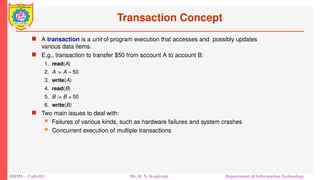
Transaction Concept
A transaction is a unit of program execution that accesses and possibly updates
various data items.
E.g., transaction to transfer $50 from account A to account B:
1. read(A)
2. A := A – 50
3. write(A)
4. read(B)
5. B := B + 50
6. write(B)
Two main issues to deal with:
Failures of various kinds, such as hardware failures and system crashes
Concurrent execution of multiple transactions
4.
DBMS – Unit-IIIMr. R. N. Kankrale Department of Information Technology
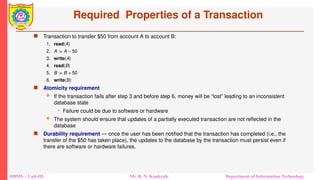
Required Properties of a Transaction
Transaction to transfer $50 from account A to account B:
1. read(A)
2. A := A – 50
3. write(A)
4. read(B)
5. B := B + 50
6. write(B)
Atomicity requirement
If the transaction fails after step 3 and before step 6, money will be “lost” leading to an inconsistent
database state
Failure could be due to software or hardware
The system should ensure that updates of a partially executed transaction are not reflected in the
database
Durability requirement — once the user has been notified that the transaction has completed (i.e., the
transfer of the $50 has taken place), the updates to the database by the transaction must persist even if
there are software or hardware failures.
5.
DBMS – Unit-IIIMr. R. N. Kankrale Department of Information Technology
Required Properties of a Transaction (Cont.)
Consistency requirement in above example:
The sum of A and B is unchanged by the execution of the transaction
In general, consistency requirements include
Explicitly specified integrity constraints such as primary keys and foreign keys
Implicit integrity constraints
– e.g., sum of balances of all accounts, minus sum of loan amounts must equal value of
cash-in-hand
A transaction, when starting to execute, must see a consistent database.
During transaction execution the database may be temporarily inconsistent.
When the transaction completes successfully the database must be consistent
Erroneous transaction logic can lead to inconsistency
6.
DBMS – Unit-IIIMr. R. N. Kankrale Department of Information Technology
Required Properties of a Transaction (Cont.)
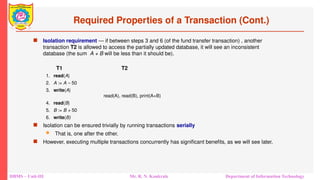
Isolation requirement — if between steps 3 and 6 (of the fund transfer transaction) , another
transaction T2 is allowed to access the partially updated database, it will see an inconsistent
database (the sum A + B will be less than it should be).
T1 T2
1. read(A)
2. A := A – 50
3. write(A)
read(A), read(B), print(A+B)
4. read(B)
5. B := B + 50
6. write(B)
Isolation can be ensured trivially by running transactions serially
That is, one after the other.
However, executing multiple transactions concurrently has significant benefits, as we will see later.
7.
DBMS – Unit-IIIMr. R. N. Kankrale Department of Information Technology
ACID Properties
Atomicity. Either all operations of the transaction are properly reflected in the database or none
are.
Consistency. Execution of a transaction in isolation preserves the consistency of the database.
Isolation. Although multiple transactions may execute concurrently, each transaction must be
unaware of other concurrently executing transactions. Intermediate transaction results must be
hidden from other concurrently executed transactions.
That is, for every pair of transactions Ti and Tj, it appears to Ti that either Tj, finished execution
before Ti started, or Tj started execution after Ti finished.
Durability. After a transaction completes successfully, the changes it has made to the database
persist, even if there are system failures.
A transaction is a unit of program execution that accesses and possibly updates various data items. To
preserve the integrity of data the database system must ensure:
8.
DBMS – Unit-IIIMr. R. N. Kankrale Department of Information Technology
Transaction State
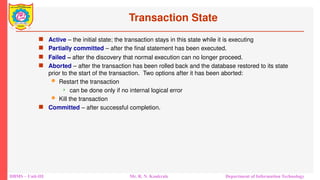
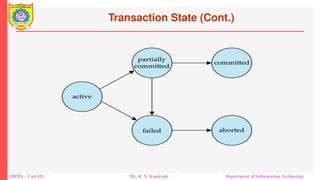
Active – the initial state; the transaction stays in this state while it is executing
Partially committed – after the final statement has been executed.
Failed -- after the discovery that normal execution can no longer proceed.
Aborted – after the transaction has been rolled back and the database restored to its state
prior to the start of the transaction. Two options after it has been aborted:
Restart the transaction
can be done only if no internal logical error
Kill the transaction
Committed – after successful completion.
9.
DBMS – Unit-IIIMr. R. N. Kankrale Department of Information Technology
Transaction State (Cont.)
10.
DBMS – Unit-IIIMr. R. N. Kankrale Department of Information Technology
Concurrent Executions
Multiple transactions are allowed to run concurrently in the system. Advantages
are:
Increased processor and disk utilization, leading to better transaction
throughput
E.g. one transaction can be using the CPU while another is reading from
or writing to the disk
Reduced average response time for transactions: short transactions need
not wait behind long ones.
Concurrency control schemes – mechanisms to achieve isolation
That is, to control the interaction among the concurrent transactions in order
to prevent them from destroying the consistency of the database
Will study in Chapter 15, after studying notion of correctness of concurrent
executions.
11.
DBMS – Unit-IIIMr. R. N. Kankrale Department of Information Technology
Schedules
Schedule – a sequences of instructions that specify the chronological order in which
instructions of concurrent transactions are executed
A schedule for a set of transactions must consist of all instructions of those
transactions
Must preserve the order in which the instructions appear in each individual
transaction.
A transaction that successfully completes its execution will have a commit instructions
as the last statement
By default transaction assumed to execute commit instruction as its last step
A transaction that fails to successfully complete its execution will have an abort
instruction as the last statement
12.
DBMS – Unit-IIIMr. R. N. Kankrale Department of Information Technology
Schedule 1
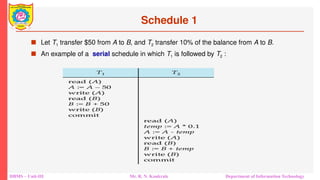
Let T1 transfer $50 from A to B, and T2 transfer 10% of the balance from A to B.
An example of a serial schedule in which T1 is followed by T2 :
13.
DBMS – Unit-IIIMr. R. N. Kankrale Department of Information Technology
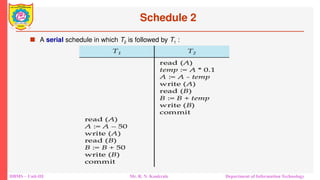
Schedule 2
A serial schedule in which T2 is followed by T1 :
14.
DBMS – Unit-IIIMr. R. N. Kankrale Department of Information Technology
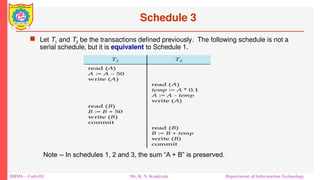
Schedule 3
Let T1 and T2 be the transactions defined previously. The following schedule is not a
serial schedule, but it is equivalent to Schedule 1.
Note -- In schedules 1, 2 and 3, the sum “A + B” is preserved.
15.
DBMS – Unit-IIIMr. R. N. Kankrale Department of Information Technology
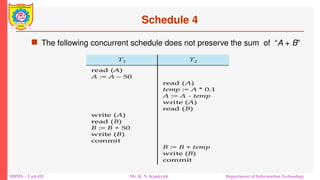
Schedule 4
The following concurrent schedule does not preserve the sum of “A + B”
16.
DBMS – Unit-IIIMr. R. N. Kankrale Department of Information Technology
Serializability
Basic Assumption – Each transaction preserves database consistency.
Thus, serial execution of a set of transactions preserves database
consistency.
A (possibly concurrent) schedule is serializable if it is equivalent to a serial
schedule. Different forms of schedule equivalence give rise to the notions of:
1.conflict serializability
2.view serializability
17.
DBMS – Unit-IIIMr. R. N. Kankrale Department of Information Technology
Simplified view of transactions
We ignore operations other than read and write instructions
We assume that transactions may perform arbitrary computations on data
in local buffers in between reads and writes.
Our simplified schedules consist of only read and write instructions.
18.
DBMS – Unit-IIIMr. R. N. Kankrale Department of Information Technology
Conflicting Instructions
Let li and lj be two Instructions of transactions Ti and Tj respectively. Instructions li and lj
conflict if and only if there exists some item Q accessed by both li and lj, and at least one
of these instructions wrote Q.
1. li = read(Q), lj = read(Q). li and lj don’t conflict.
2. li = read(Q), lj = write(Q). They conflict.
3. li = write(Q), lj = read(Q). They conflict
4. li = write(Q), lj = write(Q). They conflict
Intuitively, a conflict between li and lj forces a (logical) temporal order between them.
If li and lj are consecutive in a schedule and they do not conflict, their results would
remain the same even if they had been interchanged in the schedule.
19.
DBMS – Unit-IIIMr. R. N. Kankrale Department of Information Technology
Conflict Serializability
If a schedule S can be transformed into a schedule S´ by a series of swaps of non-
conflicting instructions, we say that S and S´ are conflict equivalent.
We say that a schedule S is conflict serializable if it is conflict equivalent to a serial
schedule
20.
DBMS – Unit-IIIMr. R. N. Kankrale Department of Information Technology
Conflict Serializability (Cont.)
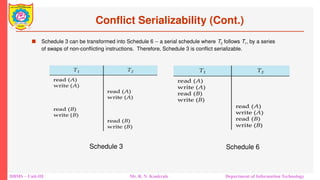
Schedule 3 can be transformed into Schedule 6 -- a serial schedule where T2 follows T1, by a series
of swaps of non-conflicting instructions. Therefore, Schedule 3 is conflict serializable.
Schedule 3 Schedule 6
21.
DBMS – Unit-IIIMr. R. N. Kankrale Department of Information Technology
Conflict Serializability (Cont.)
Example of a schedule that is not conflict serializable:
We are unable to swap instructions in the above schedule to
obtain either the serial schedule < T3, T4 >, or the serial schedule
< T4, T3 >.
22.
DBMS – Unit-IIIMr. R. N. Kankrale Department of Information Technology
Precedence Graph
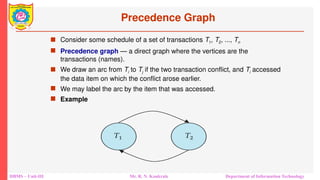
Consider some schedule of a set of transactions T1, T2, ..., Tn
Precedence graph — a direct graph where the vertices are the
transactions (names).
We draw an arc from Ti to Tj if the two transaction conflict, and Ti accessed
the data item on which the conflict arose earlier.
We may label the arc by the item that was accessed.
Example
23.
DBMS – Unit-IIIMr. R. N. Kankrale Department of Information Technology
Testing for Conflict Serializability
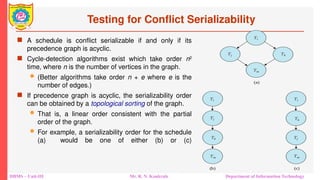
A schedule is conflict serializable if and only if its
precedence graph is acyclic.
Cycle-detection algorithms exist which take order n2
time, where n is the number of vertices in the graph.
(Better algorithms take order n + e where e is the
number of edges.)
If precedence graph is acyclic, the serializability order
can be obtained by a topological sorting of the graph.
That is, a linear order consistent with the partial
order of the graph.
For example, a serializability order for the schedule
(a) would be one of either (b) or (c)
24.
DBMS – Unit-IIIMr. R. N. Kankrale Department of Information Technology
Recoverable Schedules
Recoverable schedule — if a transaction Tj reads a data item previously written by a transaction
Ti , then the commit operation of Ti must appear before the commit operation of Tj.
The following schedule is not recoverable if T9 commits immediately after the read(A) operation.
If T8 should abort, T9 would have read (and possibly shown to the user) an inconsistent database
state. Hence, database must ensure that schedules are recoverable.
25.
DBMS – Unit-IIIMr. R. N. Kankrale Department of Information Technology
Cascading Rollbacks
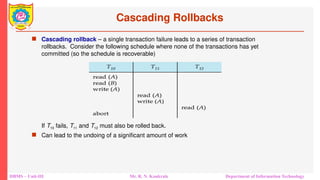
Cascading rollback – a single transaction failure leads to a series of transaction
rollbacks. Consider the following schedule where none of the transactions has yet
committed (so the schedule is recoverable)
If T10 fails, T11 and T12 must also be rolled back.
Can lead to the undoing of a significant amount of work
26.
DBMS – Unit-IIIMr. R. N. Kankrale Department of Information Technology
Cascadeless Schedules
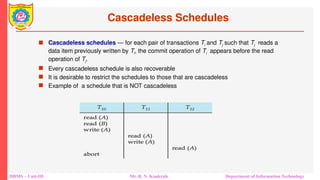
Cascadeless schedules — for each pair of transactions Ti and Tj such that Tj reads a
data item previously written by Ti, the commit operation of Ti appears before the read
operation of Tj.
Every cascadeless schedule is also recoverable
It is desirable to restrict the schedules to those that are cascadeless
Example of a schedule that is NOT cascadeless
27.
DBMS – Unit-IIIMr. R. N. Kankrale Department of Information Technology
Concurrency Control
A database must provide a mechanism that will ensure that all possible schedules are both:
Conflict serializable.
Recoverable and preferably cascadeless
A policy in which only one transaction can execute at a time generates serial schedules, but
provides a poor degree of concurrency
Concurrency-control schemes tradeoff between the amount of concurrency they allow and the
amount of overhead that they incur
Testing a schedule for serializability after it has executed is a little too late!
Tests for serializability help us understand why a concurrency control protocol is correct
Goal – to develop concurrency control protocols that will assure serializability.
28.
DBMS – Unit-IIIMr. R. N. Kankrale Department of Information Technology
View Serializability
Let S and S´ be two schedules with the same set of transactions. S and S´ are view equivalent
if the following three conditions are met, for each data item Q,
1. If in schedule S, transaction Ti reads the initial value of Q, then in schedule S’ also
transaction Ti must read the initial value of Q.
2. If in schedule S transaction Ti executes read(Q), and that value was produced by
transaction Tj (if any), then in schedule S’ also transaction Ti must read the value of Q that
was produced by the same write(Q) operation of transaction Tj .
3. The transaction (if any) that performs the final write(Q) operation in schedule S must also
perform the final write(Q) operation in schedule S’.
As can be seen, view equivalence is also based purely on reads and writes alone.
29.
DBMS – Unit-IIIMr. R. N. Kankrale Department of Information Technology
View Serializability (Cont.)
A schedule S is view serializable if it is view equivalent to a serial schedule.
Every conflict serializable schedule is also view serializable.
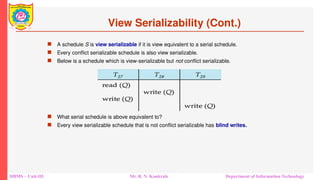
Below is a schedule which is view-serializable but not conflict serializable.
What serial schedule is above equivalent to?
Every view serializable schedule that is not conflict serializable has blind writes.
30.
DBMS – Unit-IIIMr. R. N. Kankrale Department of Information Technology
Test for View Serializability
The precedence graph test for conflict serializability cannot be used directly to test for view
serializability.
Extension to test for view serializability has cost exponential in the size of the precedence
graph.
The problem of checking if a schedule is view serializable falls in the class of NP-complete
problems.
Thus, existence of an efficient algorithm is extremely unlikely.
However ,practical algorithms that just check some sufficient conditions for view serializability
can still be used.
31.
DBMS – Unit-IIIMr. R. N. Kankrale Department of Information Technology
References
Database System Concepts
Sixth Edition
Avi Silberschatz
Henry F. Korth
S. Sudarshan