“H.I.S.-tory” by Vince Ciotti
© 2011 H.I.S. Professionals, LLC, All Rights Reserved
Episode # 5:
“Pre-Cursors”
A pathetic pun on the creative and pseudo-
automated systems that presaged HIS computers.
What came before 60’s Mainframes?
• My apologies to other English
majors out there, but I call them
“Pre-Cursors,” the best IT pun
I’ve ever come up with!
• In truth, it’s an accurate term, as
these pre-EDP system were used
long before the first CRTs (and
their cursors) were invented…
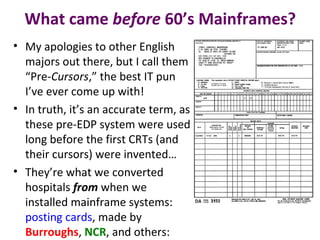
• They’re what we converted
hospitals from when we
installed mainframe systems:
posting cards, made by
Burroughs, NCR, and others:
Pre-Cursor “Systems”
• How did they work?
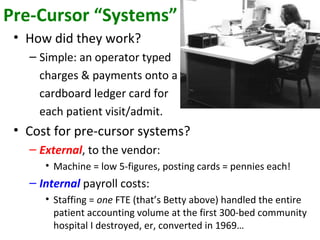
– Simple: an operator typed
charges & payments onto a
cardboard ledger card for
each patient visit/admit.
• Cost for pre-cursor systems?
– External, to the vendor:
• Machine = low 5-figures, posting cards = pennies each!
– Internal payroll costs:
• Staffing = one FTE (that’s Betty above) handled the entire
patient accounting volume at the first 300-bed community
hospital I destroyed, er, converted in 1969…
Typical Pre-Cursor Patient Bill
• How could only one FTE type all
of the charges on every
patient’s bill back then?
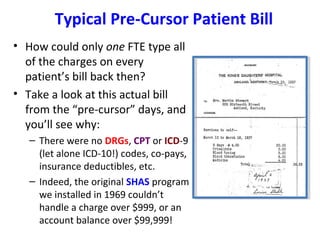
• Take a look at this actual bill
from the “pre-cursor” days, and
you’ll see why:
– There were no DRGs, CPT or ICD-9
(let alone ICD-10!) codes, co-pays,
insurance deductibles, etc.
– Indeed, the original SHAS program
we installed in 1969 couldn’t
handle a charge over $999, or an
account balance over $99,999!
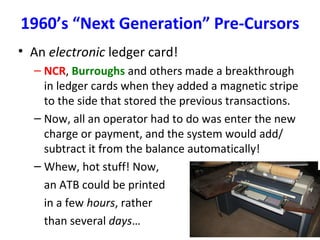
1960’s “Next Generation” Pre-Cursors
• An electronic ledger card!
– NCR, Burroughs and others made a breakthrough
in ledger cards when they added a magnetic stripe
to the side that stored the previous transactions.
– Now, all an operator had to do was enter the new
charge or payment, and the system would add/
subtract it from the balance automatically!
– Whew, hot stuff! Now,
an ATB could be printed
in a few hours, rather
than several days…
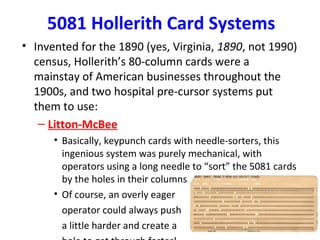
5081 Hollerith Card Systems
• Invented for the 1890 (yes, Virginia, 1890, not 1990)
census, Hollerith’s 80-column cards were a
mainstay of American businesses throughout the
1900s, and two hospital pre-cursor systems put
them to use:
– Litton-McBee
• Basically, keypunch cards with needle-sorters, this
ingenious system was purely mechanical, with
operators using a long needle to “sort” the 5081 cards
by the holes in their columns.
• Of course, an overly eager
operator could always push
a little harder and create a
Medelco’s “Card Drop” System
• I never saw this one, but heard many stories about
this pioneering “order entry” system from the “old
folks” (people over 40) when I joined SMS in 1969.
• It worked by having a card created for every item a
patient might be charged for (today’s CDM),
• And, a card created for every patient (account #)
• Nurses then dropped the patient’s card into an IBM
1056 card reader, followed by the cards for items
they wanted to charge for.
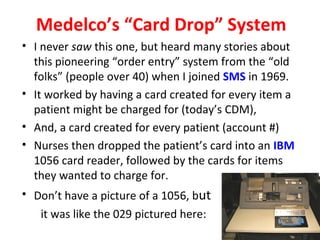
• Don’t have a picture of a 1056, but
it was like the 029 pictured here:
Keypunch Card Systems
• IBM’s 1401 card sorter system was probably the
mainstay of pre-cursor EDP systems in the 50s and 60s.
– Not that IBM had a monopoly on the technology, they had a
monopoly on the industry, as the next installment explains.
• Based on Hollerith’s 5081 cards, they sorted and
printed them in myriads of ways to print ATBs, etc.
• We used them heavily in the 60s and early 70s as the
I/O device computers.
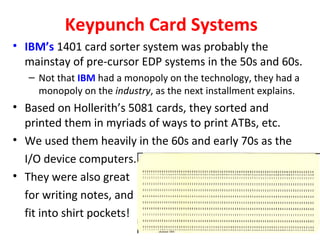
• They were also great
for writing notes, and
fit into shirt pockets!

5. pre cursors

  • 1.
    “H.I.S.-tory” by VinceCiotti © 2011 H.I.S. Professionals, LLC, All Rights Reserved Episode # 5: “Pre-Cursors” A pathetic pun on the creative and pseudo- automated systems that presaged HIS computers.
  • 2.
    What came before60’s Mainframes? • My apologies to other English majors out there, but I call them “Pre-Cursors,” the best IT pun I’ve ever come up with! • In truth, it’s an accurate term, as these pre-EDP system were used long before the first CRTs (and their cursors) were invented… • They’re what we converted hospitals from when we installed mainframe systems: posting cards, made by Burroughs, NCR, and others:
  • 3.
    Pre-Cursor “Systems” • Howdid they work? – Simple: an operator typed charges & payments onto a cardboard ledger card for each patient visit/admit. • Cost for pre-cursor systems? – External, to the vendor: • Machine = low 5-figures, posting cards = pennies each! – Internal payroll costs: • Staffing = one FTE (that’s Betty above) handled the entire patient accounting volume at the first 300-bed community hospital I destroyed, er, converted in 1969…
  • 4.
    Typical Pre-Cursor PatientBill • How could only one FTE type all of the charges on every patient’s bill back then? • Take a look at this actual bill from the “pre-cursor” days, and you’ll see why: – There were no DRGs, CPT or ICD-9 (let alone ICD-10!) codes, co-pays, insurance deductibles, etc. – Indeed, the original SHAS program we installed in 1969 couldn’t handle a charge over $999, or an account balance over $99,999!
  • 5.
    1960’s “Next Generation”Pre-Cursors • An electronic ledger card! – NCR, Burroughs and others made a breakthrough in ledger cards when they added a magnetic stripe to the side that stored the previous transactions. – Now, all an operator had to do was enter the new charge or payment, and the system would add/ subtract it from the balance automatically! – Whew, hot stuff! Now, an ATB could be printed in a few hours, rather than several days…
  • 6.
    5081 Hollerith CardSystems • Invented for the 1890 (yes, Virginia, 1890, not 1990) census, Hollerith’s 80-column cards were a mainstay of American businesses throughout the 1900s, and two hospital pre-cursor systems put them to use: – Litton-McBee • Basically, keypunch cards with needle-sorters, this ingenious system was purely mechanical, with operators using a long needle to “sort” the 5081 cards by the holes in their columns. • Of course, an overly eager operator could always push a little harder and create a
  • 7.
    Medelco’s “Card Drop”System • I never saw this one, but heard many stories about this pioneering “order entry” system from the “old folks” (people over 40) when I joined SMS in 1969. • It worked by having a card created for every item a patient might be charged for (today’s CDM), • And, a card created for every patient (account #) • Nurses then dropped the patient’s card into an IBM 1056 card reader, followed by the cards for items they wanted to charge for. • Don’t have a picture of a 1056, but it was like the 029 pictured here:
  • 8.
    Keypunch Card Systems •IBM’s 1401 card sorter system was probably the mainstay of pre-cursor EDP systems in the 50s and 60s. – Not that IBM had a monopoly on the technology, they had a monopoly on the industry, as the next installment explains. • Based on Hollerith’s 5081 cards, they sorted and printed them in myriads of ways to print ATBs, etc. • We used them heavily in the 60s and early 70s as the I/O device computers. • They were also great for writing notes, and fit into shirt pockets!