Fuel Filtration for Modern Diesel Fuels National Biodiesel Board Technician Outreach Program
Today’s Topics Changes in modern diesel fuel Basics of diesel engine fuel filtration Fuel Filter design  Fuel Filter media Fuel quality  Filter efficiency  Resources
Changes in modern diesel fuel Emissions & air quality driven Ultra Low sulfur Diesel Low Sulfur Diesel fuel, Off-road  Biodiesel & Biodiesel Blends Non- Biodiesel fuels Coal Slurries Raw Vegetable Oils and Fats Non-Esterified Oils Partially Esterified Oils Blends With Diesel Non Ester Renewable Diesel
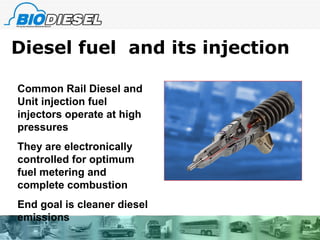
Diesel fuel  and its injection Common Rail Diesel and Unit injection fuel injectors operate at high pressures  They are electronically controlled for optimum fuel metering and complete combustion End goal is cleaner diesel emissions
Fuel Filter Variation Capacity is the measurement (in grams) of the total amount of containment a filter can retain at a rated flow and given end-point (restriction).  Restriction is the pressure drop across the element at a given flow, temperature, and fluid viscosity.  The type of media and general filter construction defines restriction.
Fuel Filter Efficiency Efficiency is the ability of the filter to remove particulate (% efficient) at a given micron (size) The type of media being used ultimately defines the filter's efficiency.
Filter Micron Rating What is a micron? The common unit of measurement in the filtration industry is the micron or micrometer.  One micron equals forty millionths of an inch (.00004).  A single human hair is approximately 70 micrometers.
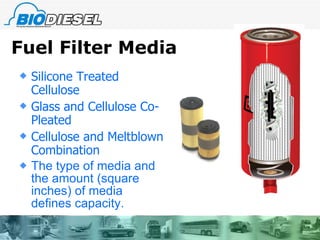
Fuel Filter Media Silicone Treated Cellulose Glass and Cellulose Co-Pleated Cellulose and Meltblown Combination The type of media and the amount (square inches) of media defines capacity.
Primary Fuel Filter Provides low restriction because it is mounted on the suction side of the fuel pump where normally a suction pressure of only 5-6 pounds per square inch is available.  The primary filter protecting the transfer pump and lightening the load of the secondary fuel filter (if installed).  Primary fuel filters typically have a nominal rating of 10 - 30 microns. Not all vehicles have a primary filter
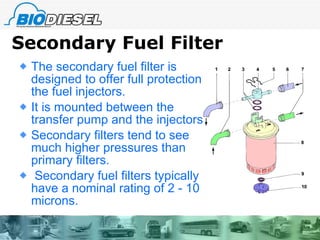
Secondary Fuel Filter The secondary fuel filter is designed to offer full protection to the fuel injectors.  It is mounted between the transfer pump and the injectors.  Secondary filters tend to see much higher pressures than primary filters. Secondary fuel filters typically have a nominal rating of 2 - 10 microns.
Water Separators Water flowing at high velocity between highly polished valve seats and through fine nozzle orifices causes a wearing action that approaches that of abrasion.  The presence of water, especially with entrained air and various fuel components, causes rust and other chemical corrosion that eats away at the finely mated surfaces.  Use chemically treated paper to repel water which then settles by gravity to the bottom of the filter.  Accumulated water can be drained from the filter  if equipped with a drain valve or plug.
Water Separators Emulsified water is a problem for both ULSD and biodiesel Traditional media is challenged by both fuels Interfacial Tension Fuel Surfactancy Fuel/Water emulsion stability
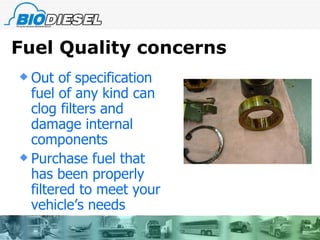
Fuel Quality concerns Out of specification fuel of any kind can clog filters and damage internal components Purchase fuel that has been properly filtered to meet your vehicle’s needs
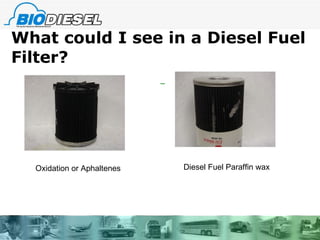
Asphaltenes Asphaltene is a by-product of fuel as it oxidizes.  These particles are generally thought to be in the half micron - 2-micron range Thought to be harmless to the injection system, as they are soft and deformable. As these tiny particles pass through the filter media they tend to stick to the individual fibers. Aphaltenes can be observed in normal fuel filters  as a black, tarry substance on the dirty side of the element
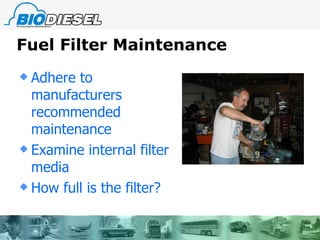
Fuel Filter Maintenance Adhere to manufacturers recommended maintenance Examine internal filter media How full is the filter?
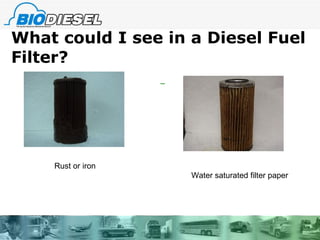
What could I see in a Diesel Fuel Filter? Rust or iron Water saturated filter paper
What could I see in a Diesel Fuel Filter? Oxidation or Aphaltenes Diesel Fuel Paraffin wax
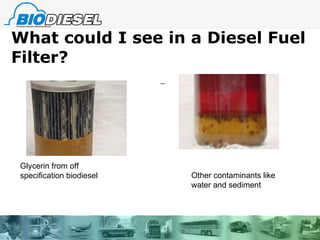
What could I see in a Diesel Fuel Filter? Glycerin from off specification biodiesel Other contaminants like water and sediment
Filtration Resources www.biodiesel.org Technical Library Biodiesel Bulletin Educational Videos Available Informational Resources Technical Resources On-line Database & Spec Sheets Southwest Research International Filtration Conference Filter Manufacturers Council  http://www.filtercouncil.org/ Donaldson Filtration  Society for Automotive Engineers

Biodiesel Fuel Filtration

  • 1.
    Fuel Filtration forModern Diesel Fuels National Biodiesel Board Technician Outreach Program
  • 2.
    Today’s Topics Changesin modern diesel fuel Basics of diesel engine fuel filtration Fuel Filter design Fuel Filter media Fuel quality Filter efficiency Resources
  • 3.
    Changes in moderndiesel fuel Emissions & air quality driven Ultra Low sulfur Diesel Low Sulfur Diesel fuel, Off-road Biodiesel & Biodiesel Blends Non- Biodiesel fuels Coal Slurries Raw Vegetable Oils and Fats Non-Esterified Oils Partially Esterified Oils Blends With Diesel Non Ester Renewable Diesel
  • 4.
    Diesel fuel and its injection Common Rail Diesel and Unit injection fuel injectors operate at high pressures They are electronically controlled for optimum fuel metering and complete combustion End goal is cleaner diesel emissions
  • 5.
    Fuel Filter VariationCapacity is the measurement (in grams) of the total amount of containment a filter can retain at a rated flow and given end-point (restriction). Restriction is the pressure drop across the element at a given flow, temperature, and fluid viscosity. The type of media and general filter construction defines restriction.
  • 6.
    Fuel Filter EfficiencyEfficiency is the ability of the filter to remove particulate (% efficient) at a given micron (size) The type of media being used ultimately defines the filter's efficiency.
  • 7.
    Filter Micron RatingWhat is a micron? The common unit of measurement in the filtration industry is the micron or micrometer. One micron equals forty millionths of an inch (.00004). A single human hair is approximately 70 micrometers.
  • 8.
    Fuel Filter MediaSilicone Treated Cellulose Glass and Cellulose Co-Pleated Cellulose and Meltblown Combination The type of media and the amount (square inches) of media defines capacity.
  • 9.
    Primary Fuel FilterProvides low restriction because it is mounted on the suction side of the fuel pump where normally a suction pressure of only 5-6 pounds per square inch is available. The primary filter protecting the transfer pump and lightening the load of the secondary fuel filter (if installed). Primary fuel filters typically have a nominal rating of 10 - 30 microns. Not all vehicles have a primary filter
  • 10.
    Secondary Fuel FilterThe secondary fuel filter is designed to offer full protection to the fuel injectors. It is mounted between the transfer pump and the injectors. Secondary filters tend to see much higher pressures than primary filters. Secondary fuel filters typically have a nominal rating of 2 - 10 microns.
  • 11.
    Water Separators Waterflowing at high velocity between highly polished valve seats and through fine nozzle orifices causes a wearing action that approaches that of abrasion. The presence of water, especially with entrained air and various fuel components, causes rust and other chemical corrosion that eats away at the finely mated surfaces. Use chemically treated paper to repel water which then settles by gravity to the bottom of the filter. Accumulated water can be drained from the filter if equipped with a drain valve or plug.
  • 12.
    Water Separators Emulsifiedwater is a problem for both ULSD and biodiesel Traditional media is challenged by both fuels Interfacial Tension Fuel Surfactancy Fuel/Water emulsion stability
  • 13.
    Fuel Quality concernsOut of specification fuel of any kind can clog filters and damage internal components Purchase fuel that has been properly filtered to meet your vehicle’s needs
  • 14.
    Asphaltenes Asphaltene isa by-product of fuel as it oxidizes. These particles are generally thought to be in the half micron - 2-micron range Thought to be harmless to the injection system, as they are soft and deformable. As these tiny particles pass through the filter media they tend to stick to the individual fibers. Aphaltenes can be observed in normal fuel filters as a black, tarry substance on the dirty side of the element
  • 15.
    Fuel Filter MaintenanceAdhere to manufacturers recommended maintenance Examine internal filter media How full is the filter?
  • 16.
    What could Isee in a Diesel Fuel Filter? Rust or iron Water saturated filter paper
  • 17.
    What could Isee in a Diesel Fuel Filter? Oxidation or Aphaltenes Diesel Fuel Paraffin wax
  • 18.
    What could Isee in a Diesel Fuel Filter? Glycerin from off specification biodiesel Other contaminants like water and sediment
  • 19.
    Filtration Resources www.biodiesel.orgTechnical Library Biodiesel Bulletin Educational Videos Available Informational Resources Technical Resources On-line Database & Spec Sheets Southwest Research International Filtration Conference Filter Manufacturers Council http://www.filtercouncil.org/ Donaldson Filtration Society for Automotive Engineers