


Getting Creative “ Excellent Companies Innovate” © Phil Jones - 2011
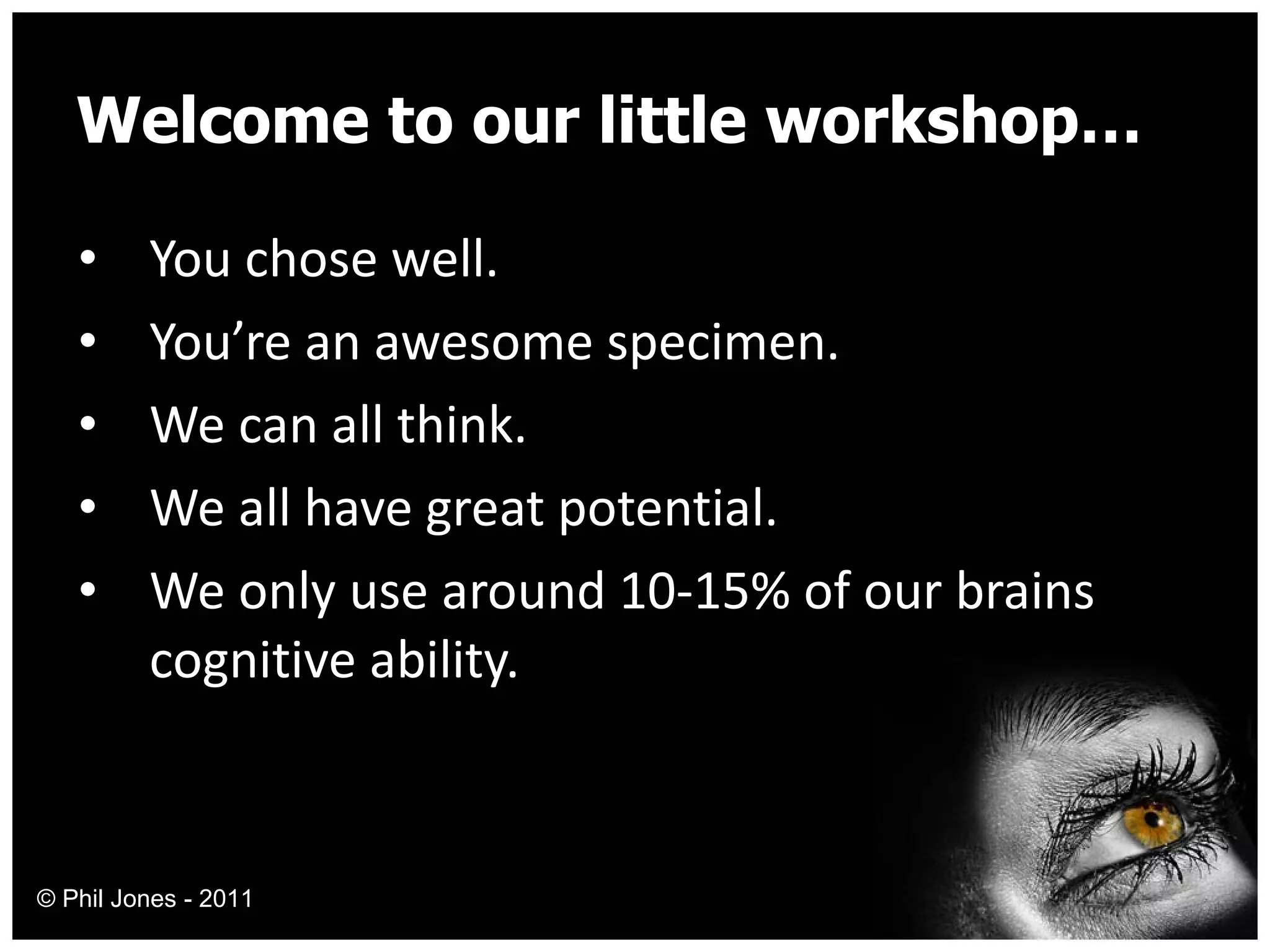
Welcome to our little workshop… You chose well. You’re an awesome specimen. We can all think. We all have great potential. We only use around 10-15% of our brains cognitive ability. © Phil Jones - 2011
Time is the #1 killer of creativity. © Phil Jones - 2011
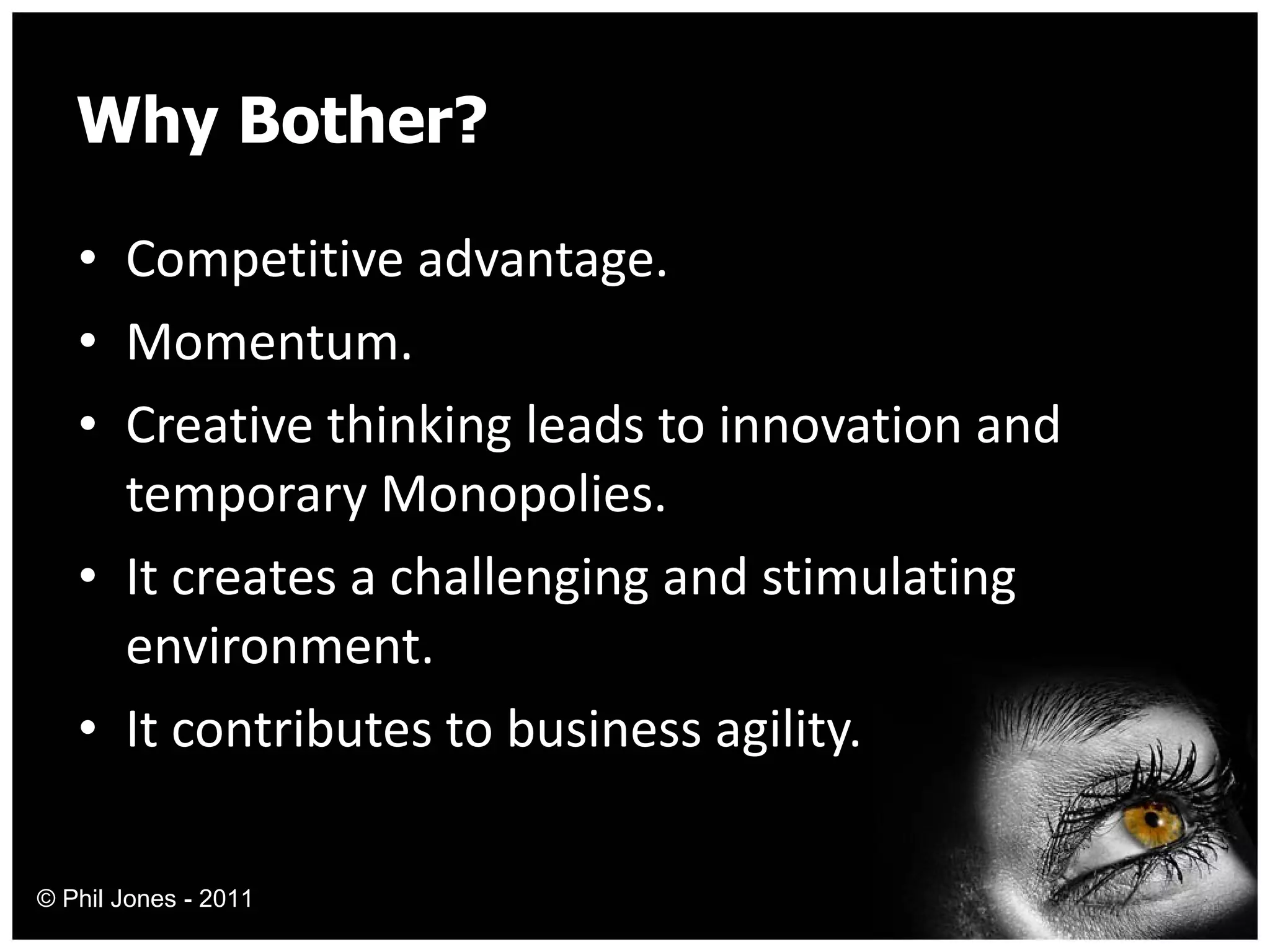
Why Bother? Competitive advantage. Momentum. Creative thinking leads to innovation and temporary Monopolies. It creates a challenging and stimulating environment. It contributes to business agility. © Phil Jones - 2011
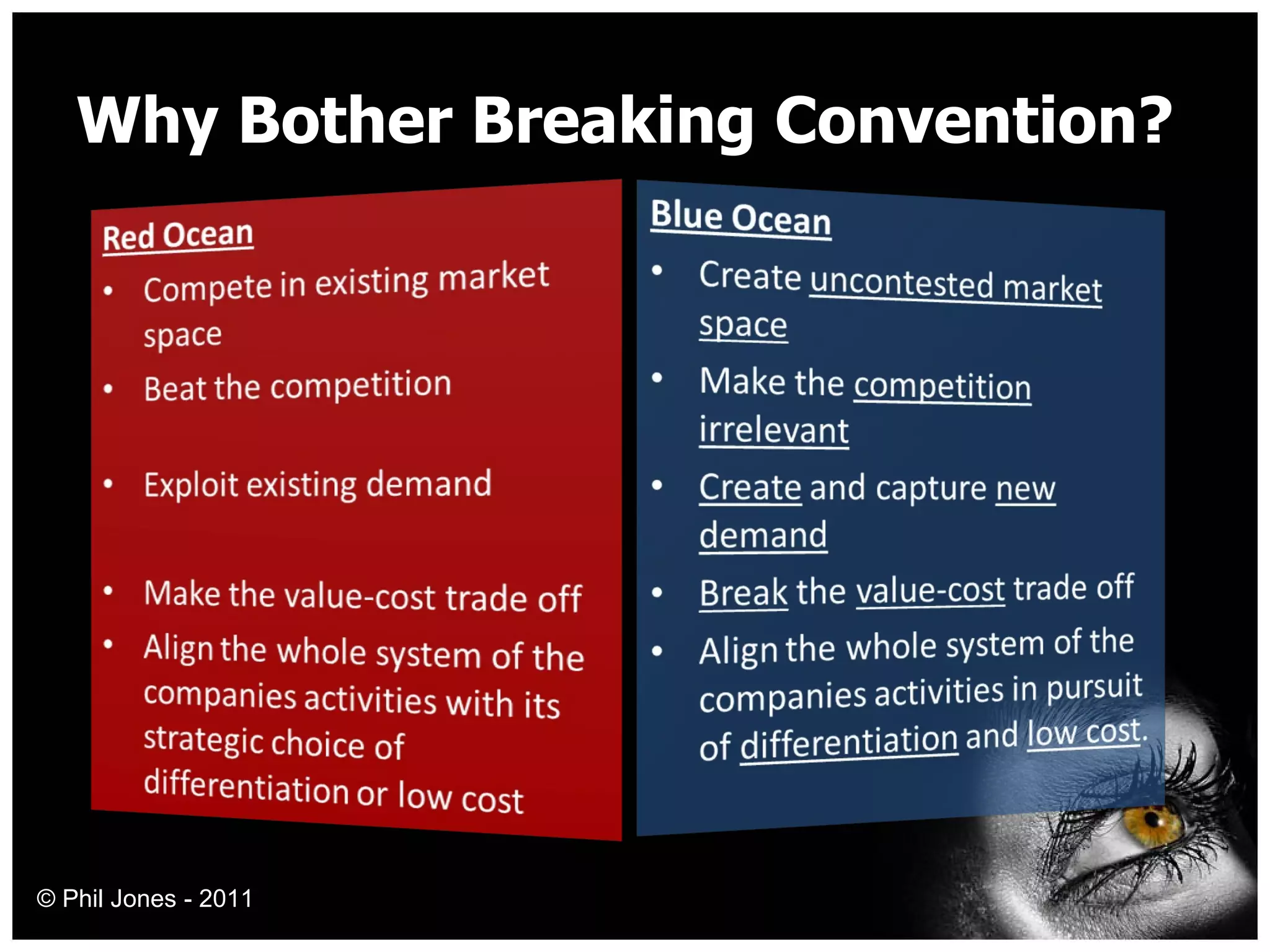
Why Bother Breaking Convention? © Phil Jones - 2011
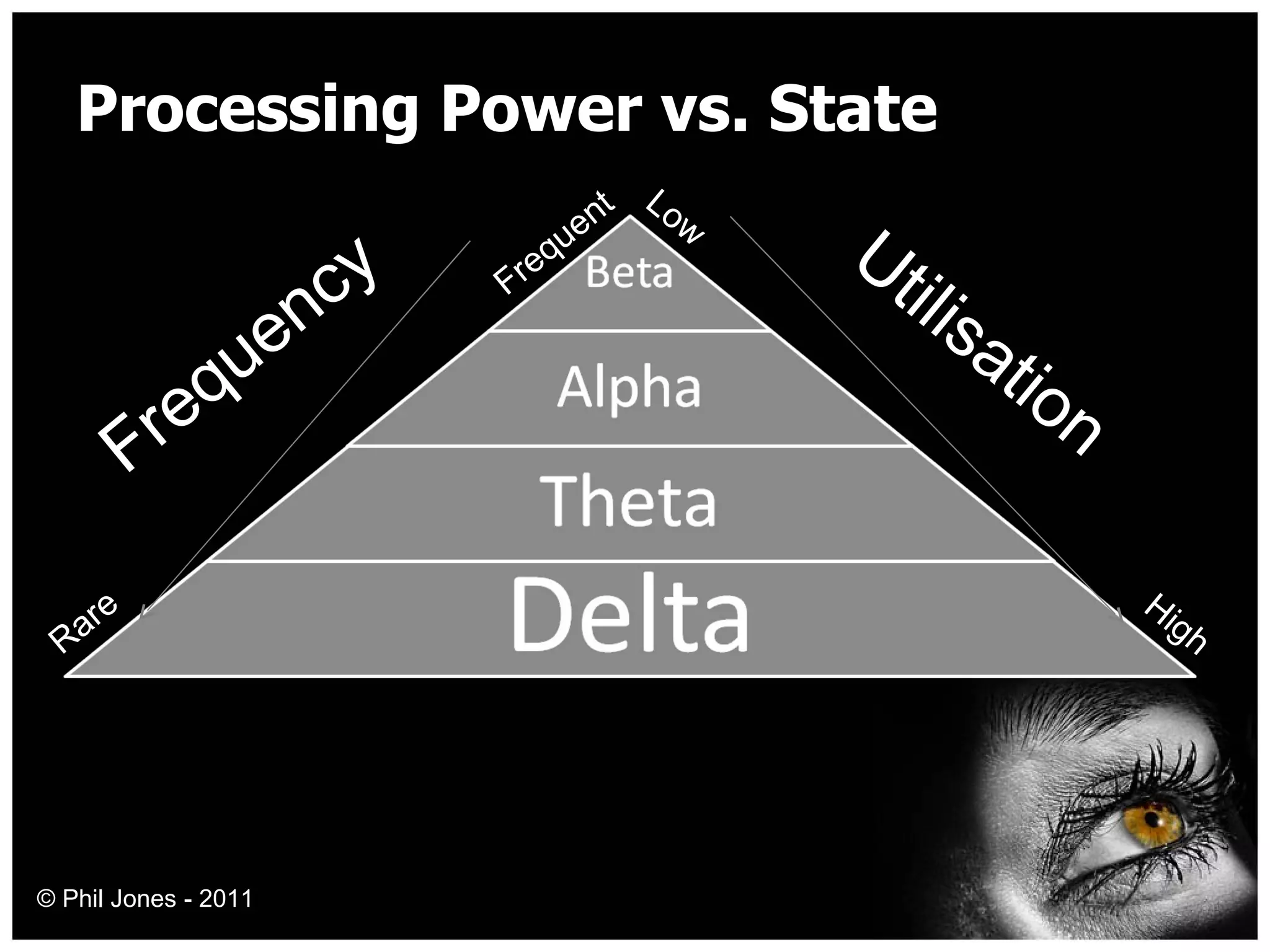
Processing Power vs. State Frequency Rare Frequent Utilisation Low High © Phil Jones - 2011
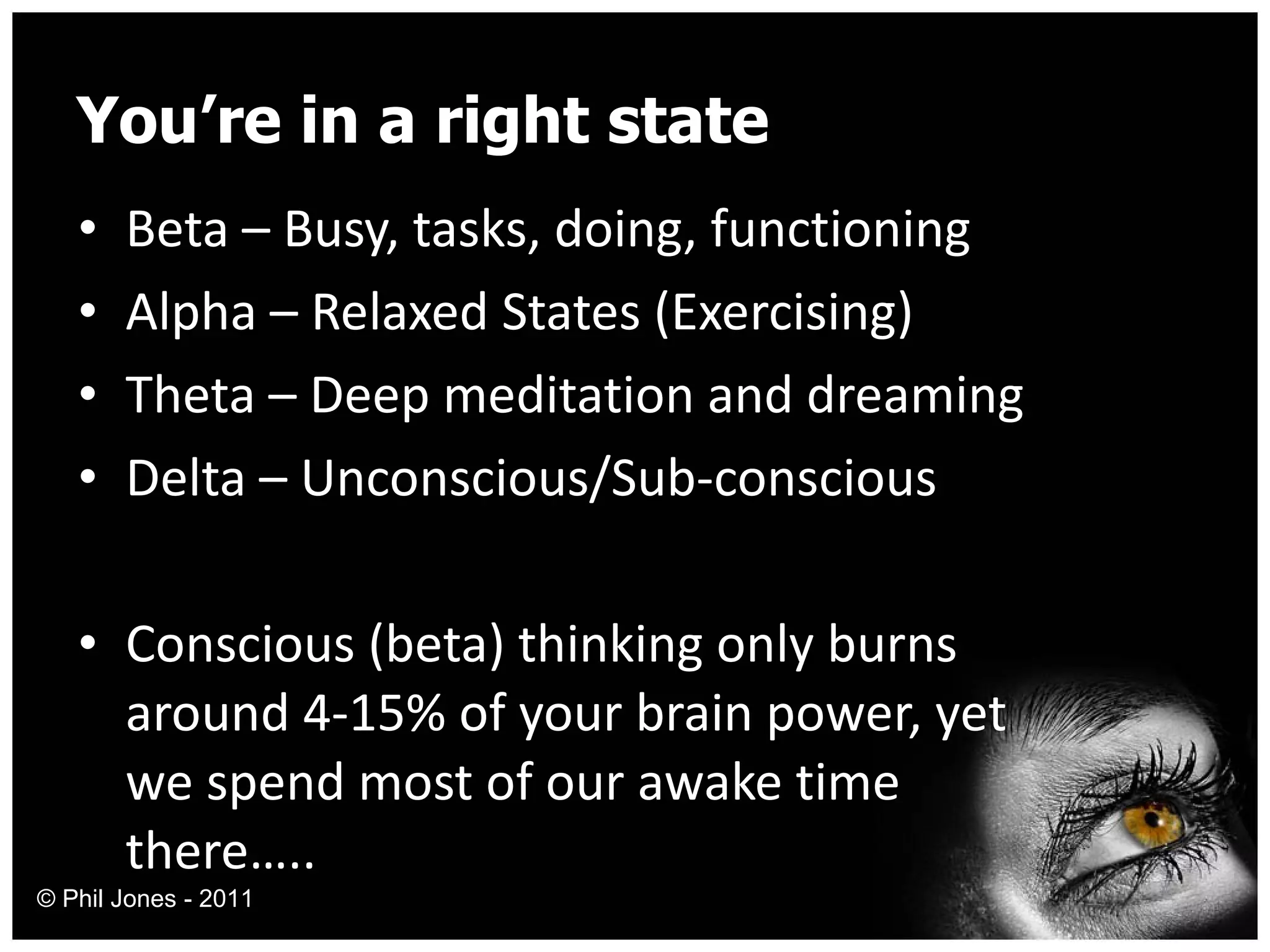
You’re in a right state Beta – Busy, tasks, doing, functioning Alpha – Relaxed States (Exercising) Theta – Deep meditation and dreaming Delta – Unconscious/Sub-conscious Conscious (beta) thinking only burns around 4-15% of your brain power, yet we spend most of our awake time there….. © Phil Jones - 2011
Six Tips to Creative Success Beta/Alpha thinking – be fit to think. Environment – get out of your usual surroundings. Understand personality types. Quickfire works best. Prioritisation is critical. Mornings better than afternoons. © Phil Jones - 2011
And a mad one…that works! Ask your subconscious to do something before you go to sleep. Ask it out loud. Be specific with what you want. Go to sleep and the answers appear as the brain uses Theta state to process. © Phil Jones - 2011
FIVE TIPS © Phil Jones - 2011
Technique One – Restate the Issue Re-word/re-state the issue as you may get different results? We need to grow sales by 10% can mean…. We need to find another 10% from our top 10 customers. We need to find 50 new customers. How do we stop losing customers out of our leaky bucket? How do we cross sell other services to our customers? What new products can we develop? Can we put our prices up 10%? © Phil Jones - 2011
Technique Two– Be Someone Else What would the following people do if they took over your organisation? Sir Richard Branson? (Virgin) Steve Jobs (Apple) Michael O’ Leary? (Easyjet) Example.  “O’Leary would charge our customers for drinks and toilet usage at client review meetings.” © Phil Jones - 2011
Technique Three – Assumption Smashing Write down all your company and industry conventions and challenge them all by asking yourself what if you didn’t do them? Example What’s the worst that can happen if we…….moved our business model to a pay as you go service? © Phil Jones - 2011
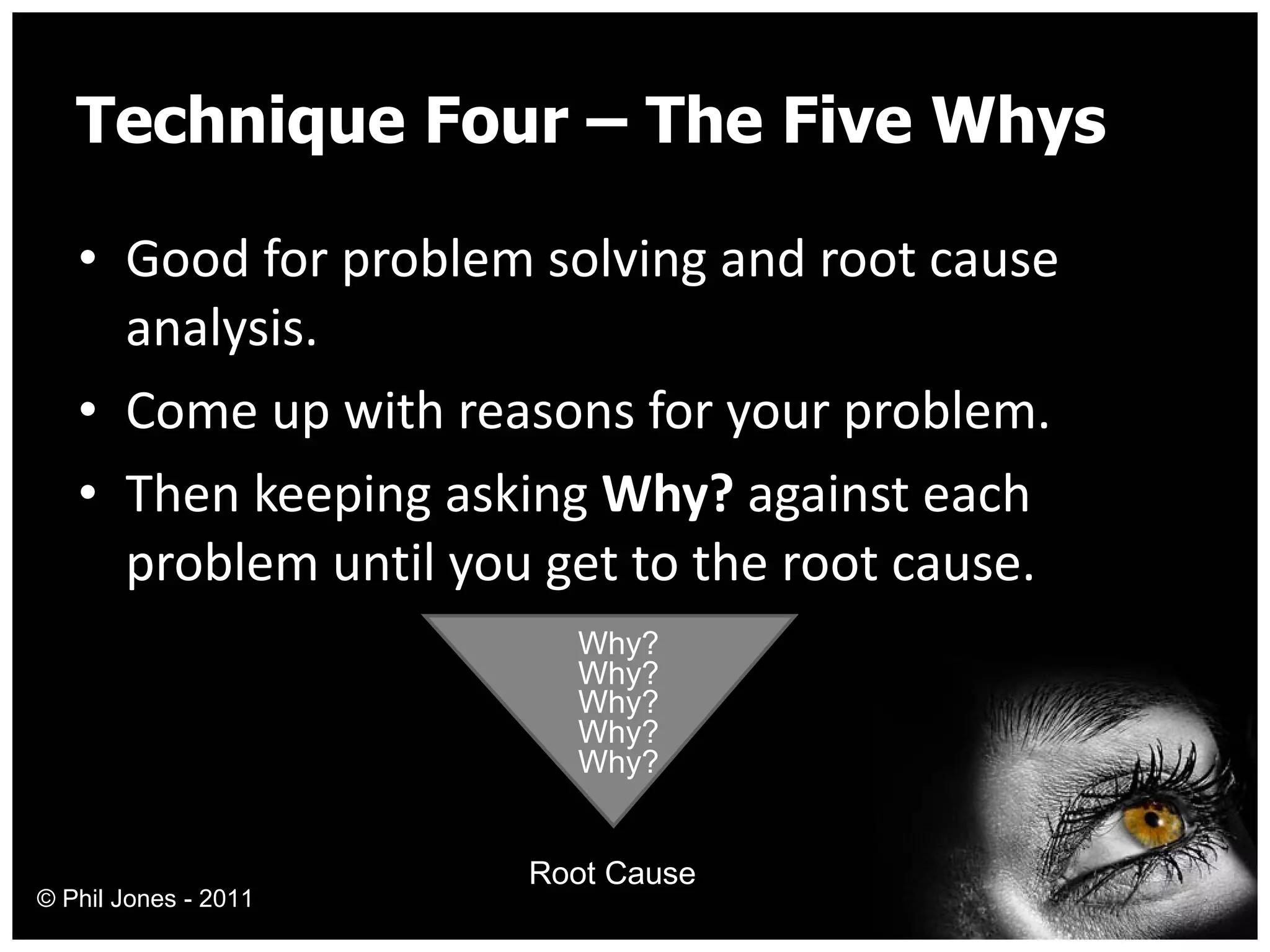
Technique Four – The Five Whys Good for problem solving and root cause analysis. Come up with reasons for your problem. Then keeping asking  Why?  against each problem until you get to the root cause. Why? Why? Why? Why? Why? Root Cause © Phil Jones - 2011
Technique Five– Reverse the Issue If you want to increase sales think of all the things that you could do which would negatively contribute to that goal. We’d treat customers poorly. We’d put our prices up. We wouldn’t deal with everyone. We’d reduce the number of salespeople. Point is.  Are you’re competitors doing any of these and where could you expose them? © Phil Jones - 2011
Exercise 1 Then take the persona of Virgin CEO Richard Branson and re-look at it.  What would Richard do? © Phil Jones - 2011
Exercise 2 – Group (15 mins) Consider the conventions /assumptions of your industry sector and smash them up. Define some new “what if” scenarios… © Phil Jones - 2011
Choose to Think Find time to escape the desk and the workplace. Fit more in if you have to, in order to release time to think. Go somewhere inspiring. Switch the phone/blackberry off. Always carry a notebook with you and have one by the side of your bed. © Phil Jones - 2011
You’re amazing. Unleash your inner creativity. © Phil Jones - 2011
www.philjones.biz Twitter - @philjones40 © Phil Jones - 2011

5 Creativity Tips

  • 1.
    Getting Creative “Excellent Companies Innovate” © Phil Jones - 2011
  • 2.
    Welcome to ourlittle workshop… You chose well. You’re an awesome specimen. We can all think. We all have great potential. We only use around 10-15% of our brains cognitive ability. © Phil Jones - 2011
  • 3.
    Time is the#1 killer of creativity. © Phil Jones - 2011
  • 4.
    Why Bother? Competitiveadvantage. Momentum. Creative thinking leads to innovation and temporary Monopolies. It creates a challenging and stimulating environment. It contributes to business agility. © Phil Jones - 2011
  • 5.
    Why Bother BreakingConvention? © Phil Jones - 2011
  • 6.
    Processing Power vs.State Frequency Rare Frequent Utilisation Low High © Phil Jones - 2011
  • 7.
    You’re in aright state Beta – Busy, tasks, doing, functioning Alpha – Relaxed States (Exercising) Theta – Deep meditation and dreaming Delta – Unconscious/Sub-conscious Conscious (beta) thinking only burns around 4-15% of your brain power, yet we spend most of our awake time there….. © Phil Jones - 2011
  • 8.
    Six Tips toCreative Success Beta/Alpha thinking – be fit to think. Environment – get out of your usual surroundings. Understand personality types. Quickfire works best. Prioritisation is critical. Mornings better than afternoons. © Phil Jones - 2011
  • 9.
    And a madone…that works! Ask your subconscious to do something before you go to sleep. Ask it out loud. Be specific with what you want. Go to sleep and the answers appear as the brain uses Theta state to process. © Phil Jones - 2011
  • 10.
    FIVE TIPS ©Phil Jones - 2011
  • 11.
    Technique One –Restate the Issue Re-word/re-state the issue as you may get different results? We need to grow sales by 10% can mean…. We need to find another 10% from our top 10 customers. We need to find 50 new customers. How do we stop losing customers out of our leaky bucket? How do we cross sell other services to our customers? What new products can we develop? Can we put our prices up 10%? © Phil Jones - 2011
  • 12.
    Technique Two– BeSomeone Else What would the following people do if they took over your organisation? Sir Richard Branson? (Virgin) Steve Jobs (Apple) Michael O’ Leary? (Easyjet) Example. “O’Leary would charge our customers for drinks and toilet usage at client review meetings.” © Phil Jones - 2011
  • 13.
    Technique Three –Assumption Smashing Write down all your company and industry conventions and challenge them all by asking yourself what if you didn’t do them? Example What’s the worst that can happen if we…….moved our business model to a pay as you go service? © Phil Jones - 2011
  • 14.
    Technique Four –The Five Whys Good for problem solving and root cause analysis. Come up with reasons for your problem. Then keeping asking Why? against each problem until you get to the root cause. Why? Why? Why? Why? Why? Root Cause © Phil Jones - 2011
  • 15.
    Technique Five– Reversethe Issue If you want to increase sales think of all the things that you could do which would negatively contribute to that goal. We’d treat customers poorly. We’d put our prices up. We wouldn’t deal with everyone. We’d reduce the number of salespeople. Point is. Are you’re competitors doing any of these and where could you expose them? © Phil Jones - 2011
  • 16.
    Exercise 1 Thentake the persona of Virgin CEO Richard Branson and re-look at it. What would Richard do? © Phil Jones - 2011
  • 17.
    Exercise 2 –Group (15 mins) Consider the conventions /assumptions of your industry sector and smash them up. Define some new “what if” scenarios… © Phil Jones - 2011
  • 18.
    Choose to ThinkFind time to escape the desk and the workplace. Fit more in if you have to, in order to release time to think. Go somewhere inspiring. Switch the phone/blackberry off. Always carry a notebook with you and have one by the side of your bed. © Phil Jones - 2011
  • 19.
    You’re amazing. Unleashyour inner creativity. © Phil Jones - 2011
  • 20.
    www.philjones.biz Twitter -@philjones40 © Phil Jones - 2011