FIND THE
MISSING
NUMBERS.
4.6 – ARITHMETIC
SEQUENCES
Today’s learning goal is that students will be able to:
• Write the terms of arithmetic sequences.
• Graph arithmetic sequences.
• Write arithmetic sequences as functions.
WRITING THE TERMS OF
ARITHMETIC SEQUENCES
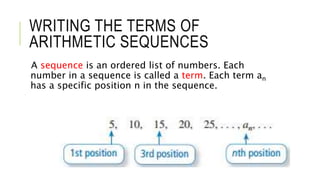
A sequence is an ordered list of numbers. Each
number in a sequence is called a term. Each term an
has a specific position n in the sequence.
CORE CONCEPT – ARITHMETIC
SEQUENCE
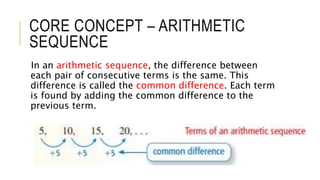
In an arithmetic sequence, the difference between
each pair of consecutive terms is the same. This
difference is called the common difference. Each term
is found by adding the common difference to the
previous term.
EXAMPLE 1 – EXTENDING AN
ARITHMETIC SEQUENCE
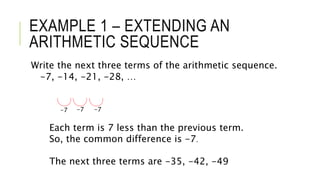
Write the next three terms of the arithmetic sequence.
-7, -14, -21, -28, …
-7 -7 -7
Each term is 7 less than the previous term.
So, the common difference is -7.
The next three terms are -35, -42, -49
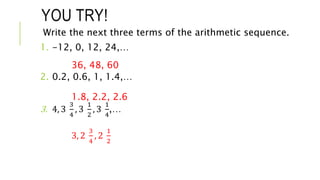
YOU TRY!
Write the next three terms of the arithmetic sequence.
1. -12, 0, 12, 24,…
2. 0.2, 0.6, 1, 1.4,…
3. 4, 3
3
4
, 3
1
2
, 3
1
4
,…
36, 48, 60
1.8, 2.2, 2.6
3, 2
3
4
, 2
1
2
GRAPHING ARITHMETIC
SEQUENCES
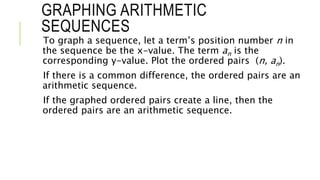
To graph a sequence, let a term’s position number n in
the sequence be the x-value. The term an is the
corresponding y-value. Plot the ordered pairs (n, an).
If there is a common difference, the ordered pairs are an
arithmetic sequence.
If the graphed ordered pairs create a line, then the
ordered pairs are an arithmetic sequence.
EXAMPLE 2 – GRAPHING AN ARITHMETIC
SEQUENCE
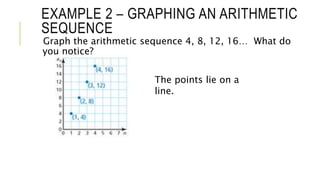
Graph the arithmetic sequence 4, 8, 12, 16… What do
you notice?
The points lie on a
line.
EXAMPLE 3 – IDENTIFYING AN
ARITHMETIC SEQUENCE FROM A
GRAPH
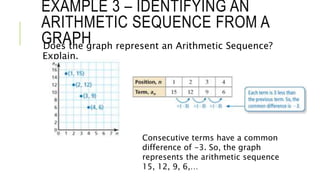
Does the graph represent an Arithmetic Sequence?
Explain.
Consecutive terms have a common
difference of -3. So, the graph
represents the arithmetic sequence
15, 12, 9, 6,…
YOU TRY!
Graph the arithmetic sequence. What do you notice?
4. 3, 6, 9, 12,…
5. 4, 2, 0, -2,…
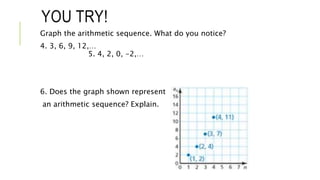
6. Does the graph shown represent
an arithmetic sequence? Explain.
YOU TRY!
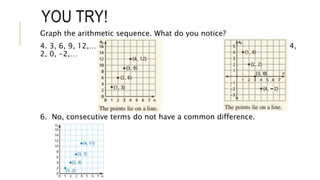
Graph the arithmetic sequence. What do you notice?
4. 3, 6, 9, 12,… 5. 4,
2, 0, -2,…
6. No, consecutive terms do not have a common difference.
CORE CONCEPT
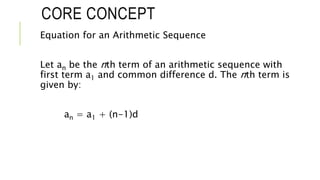
Equation for an Arithmetic Sequence
Let an be the nth term of an arithmetic sequence with
first term a1 and common difference d. The nth term is
given by:
an = a1 + (n-1)d
EXAMPLE 4 – FINDING THE NTH
TERM OF AN ARITHMETIC
SEQUENCE
Write an equation for the nth term of the arithmetic sequence 14, 11, 8,
5,….
The first term is 14, and the common difference is -3.
an = a1 + (n-1) d Equation for an arithmetic
sequence
an = 14 + (n – 1) (-3) Substitute 14 for a1 and -3 for
d.
an = 14 + -3n +3 Distribute
an = -3n + 17 Simplify
Use the equation to find the 30th term.
a30 = -3 (30) + 17
YOU TRY!
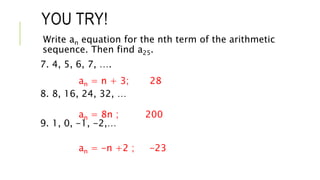
Write an equation for the nth term of the arithmetic
sequence. Then find a25.
7. 4, 5, 6, 7, ….
8. 8, 16, 24, 32, …
9. 1, 0, -1, -2,…
an = n + 3; 28
an = 8n ; 200
an = -n +2 ; -23
EXAMPLE 5 – WRITING REAL-LIFE
FUNCTIONS
Online bidding for a purse increases by $5 for each bid.
After the $60 initial bid.
A. Write a function that represents the arithmetic
sequence.
B. Graph the function
C. The winning bid is $105. How many bids were there?
EXAMPLE 5 – WRITING REAL-LIFE
FUNCTIONS
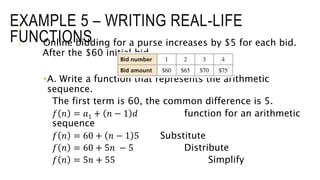
Online bidding for a purse increases by $5 for each bid.
After the $60 initial bid.
A. Write a function that represents the arithmetic
sequence.
The first term is 60, the common difference is 5.
𝑓 𝑛 = 𝑎1 + 𝑛 − 1 𝑑 function for an arithmetic
sequence
𝑓 𝑛 = 60 + 𝑛 − 1 5 Substitute
𝑓 𝑛 = 60 + 5𝑛 − 5 Distribute
𝑓 𝑛 = 5𝑛 + 55 Simplify
EXAMPLE 5 – WRITING REAL-LIFE
FUNCTIONS
Online bidding for a purse increases by $5 for each bid.
After the $60 initial bid.
B. Plot the ordered pairs.
EXAMPLE 5 – WRITING REAL-LIFE
FUNCTIONS
Online bidding for a purse increases by $5 for each bid.
After the $60 initial bid.
C. Use the function to find the value of n for which f(n)
= 105.
𝑓 𝑛 = 5𝑛 + 55 Write the function
105 = 5𝑛 + 55 Substitute
-55 -55 Subtract
50 = 5𝑛 Simplify
5 5 Divide
10 = 𝑛 Solve for
n.
There were
10 bids.
YOU TRY!
A carnival charges $2 for each game after you pay a $5
entry fee..
A. Write a
function that represents the
arithmetic sequence.
B. Graph the
function
C. How many games can you play when you take $29
to the carnival?
𝑓 𝑛 = 2𝑛 + 5
12 games
HOMEWORK /CANVAS
ARITHMETIC
SEQUENCE

4.6 Arithmetic Sequence.pptx

  • 1.
  • 2.
    4.6 – ARITHMETIC SEQUENCES Today’slearning goal is that students will be able to: • Write the terms of arithmetic sequences. • Graph arithmetic sequences. • Write arithmetic sequences as functions.
  • 3.
    WRITING THE TERMSOF ARITHMETIC SEQUENCES A sequence is an ordered list of numbers. Each number in a sequence is called a term. Each term an has a specific position n in the sequence.
  • 4.
    CORE CONCEPT –ARITHMETIC SEQUENCE In an arithmetic sequence, the difference between each pair of consecutive terms is the same. This difference is called the common difference. Each term is found by adding the common difference to the previous term.
  • 5.
    EXAMPLE 1 –EXTENDING AN ARITHMETIC SEQUENCE Write the next three terms of the arithmetic sequence. -7, -14, -21, -28, … -7 -7 -7 Each term is 7 less than the previous term. So, the common difference is -7. The next three terms are -35, -42, -49
  • 6.
    YOU TRY! Write thenext three terms of the arithmetic sequence. 1. -12, 0, 12, 24,… 2. 0.2, 0.6, 1, 1.4,… 3. 4, 3 3 4 , 3 1 2 , 3 1 4 ,… 36, 48, 60 1.8, 2.2, 2.6 3, 2 3 4 , 2 1 2
  • 7.
    GRAPHING ARITHMETIC SEQUENCES To grapha sequence, let a term’s position number n in the sequence be the x-value. The term an is the corresponding y-value. Plot the ordered pairs (n, an). If there is a common difference, the ordered pairs are an arithmetic sequence. If the graphed ordered pairs create a line, then the ordered pairs are an arithmetic sequence.
  • 8.
    EXAMPLE 2 –GRAPHING AN ARITHMETIC SEQUENCE Graph the arithmetic sequence 4, 8, 12, 16… What do you notice? The points lie on a line.
  • 9.
    EXAMPLE 3 –IDENTIFYING AN ARITHMETIC SEQUENCE FROM A GRAPH Does the graph represent an Arithmetic Sequence? Explain. Consecutive terms have a common difference of -3. So, the graph represents the arithmetic sequence 15, 12, 9, 6,…
  • 10.
    YOU TRY! Graph thearithmetic sequence. What do you notice? 4. 3, 6, 9, 12,… 5. 4, 2, 0, -2,… 6. Does the graph shown represent an arithmetic sequence? Explain.
  • 11.
    YOU TRY! Graph thearithmetic sequence. What do you notice? 4. 3, 6, 9, 12,… 5. 4, 2, 0, -2,… 6. No, consecutive terms do not have a common difference.
  • 12.
    CORE CONCEPT Equation foran Arithmetic Sequence Let an be the nth term of an arithmetic sequence with first term a1 and common difference d. The nth term is given by: an = a1 + (n-1)d
  • 13.
    EXAMPLE 4 –FINDING THE NTH TERM OF AN ARITHMETIC SEQUENCE Write an equation for the nth term of the arithmetic sequence 14, 11, 8, 5,…. The first term is 14, and the common difference is -3. an = a1 + (n-1) d Equation for an arithmetic sequence an = 14 + (n – 1) (-3) Substitute 14 for a1 and -3 for d. an = 14 + -3n +3 Distribute an = -3n + 17 Simplify Use the equation to find the 30th term. a30 = -3 (30) + 17
  • 14.
    YOU TRY! Write anequation for the nth term of the arithmetic sequence. Then find a25. 7. 4, 5, 6, 7, …. 8. 8, 16, 24, 32, … 9. 1, 0, -1, -2,… an = n + 3; 28 an = 8n ; 200 an = -n +2 ; -23
  • 15.
    EXAMPLE 5 –WRITING REAL-LIFE FUNCTIONS Online bidding for a purse increases by $5 for each bid. After the $60 initial bid. A. Write a function that represents the arithmetic sequence. B. Graph the function C. The winning bid is $105. How many bids were there?
  • 16.
    EXAMPLE 5 –WRITING REAL-LIFE FUNCTIONS Online bidding for a purse increases by $5 for each bid. After the $60 initial bid. A. Write a function that represents the arithmetic sequence. The first term is 60, the common difference is 5. 𝑓 𝑛 = 𝑎1 + 𝑛 − 1 𝑑 function for an arithmetic sequence 𝑓 𝑛 = 60 + 𝑛 − 1 5 Substitute 𝑓 𝑛 = 60 + 5𝑛 − 5 Distribute 𝑓 𝑛 = 5𝑛 + 55 Simplify
  • 17.
    EXAMPLE 5 –WRITING REAL-LIFE FUNCTIONS Online bidding for a purse increases by $5 for each bid. After the $60 initial bid. B. Plot the ordered pairs.
  • 18.
    EXAMPLE 5 –WRITING REAL-LIFE FUNCTIONS Online bidding for a purse increases by $5 for each bid. After the $60 initial bid. C. Use the function to find the value of n for which f(n) = 105. 𝑓 𝑛 = 5𝑛 + 55 Write the function 105 = 5𝑛 + 55 Substitute -55 -55 Subtract 50 = 5𝑛 Simplify 5 5 Divide 10 = 𝑛 Solve for n. There were 10 bids.
  • 19.
    YOU TRY! A carnivalcharges $2 for each game after you pay a $5 entry fee.. A. Write a function that represents the arithmetic sequence. B. Graph the function C. How many games can you play when you take $29 to the carnival? 𝑓 𝑛 = 2𝑛 + 5 12 games
  • 20.