THE WEST BENGAL UNIVERSITY OF TEACHERS‘
TRAINING, EDUCATION PLANNING AND
ADMINISTRATION
TOPIC : HISTORY OF SCIENCE
NAME : PRIYA JHA
INSTITUTION NAME : SAHID KHUDIRAM COLLEGE OF
EDUCATION
ROLL NO :
SEMESTER : I
SESSION : 2020-2022
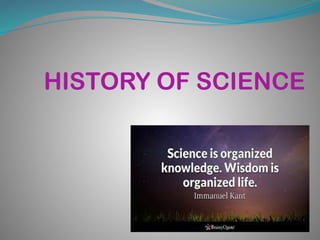
HISTORY OF SCIENCE
CONTENTS
 Introduction
 Early Culture of Science
 Natural Science
 European Medieval Thinking
 Rise of Modern Age
 Age of Enlightment
 Role of History of Science in Academic
 Conclusion
 References
INTRODUCTION
 Science has been characterized as a body of various
knowledge obtained by scientists.
 History of science integrates philosophical approaches
to the study f science.
 It’s help us to understand scientific progress in respect
to normal and revolutionary science.
EARLY CULTURE OF SCIENCE
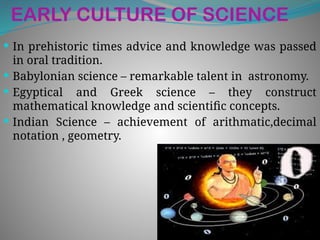
 In prehistoric times advice and knowledge was passed
in oral tradition.
 Babylonian science – remarkable talent in astronomy.
 Egyptical and Greek science – they construct
mathematical knowledge and scientific concepts.
 Indian Science – achievement of arithmatic,decimal
notation , geometry.
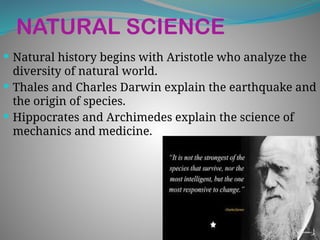
NATURAL SCIENCE
 Natural history begins with Aristotle who analyze the
diversity of natural world.
 Thales and Charles Darwin explain the earthquake and
the origin of species.
 Hippocrates and Archimedes explain the science of
mechanics and medicine.
EUROPEAN MEDIEVAL THINKING
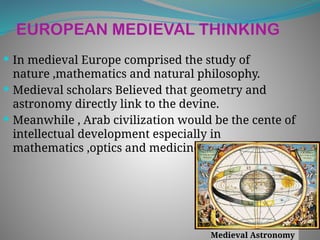
 In medieval Europe comprised the study of
nature ,mathematics and natural philosophy.
 Medieval scholars Believed that geometry and
astronomy directly link to the devine.
 Meanwhile , Arab civilization would be the cente of
intellectual development especially in
mathematics ,optics and medicine.
Medieval Astronomy
RISE OF MODERN AGE
 The scientific revolution is a convenient boundary
between ancient and classical science.
 Nicolaus Copernicus revived the model of
helocentric solar system.
 Johannes Kepler gave first model of planetary
motion.
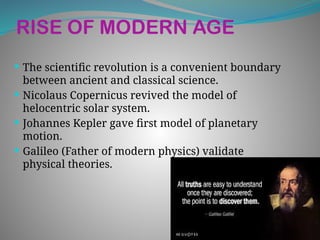
 Galileo (Father of modern physics) validate
physical theories.
AGE OF ENLIGHTMENT
 Enlightenment era brought to the discipline of
science was its popularization.
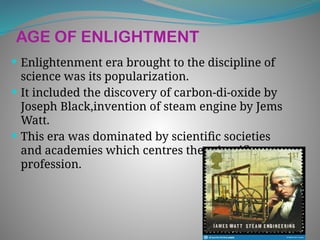
 It included the discovery of carbon-di-oxide by
Joseph Black,invention of steam engine by Jems
Watt.
 This era was dominated by scientific societies
and academies which centres the scientific
profession.
ROLE OF HISTORY OF SCIENCE IN ACADEMIC
 Studying the history of science allows glimpse into
history of world and its discoveries.
 We learn how people made new discoveries with new
thinking allows us to make our new discoveries.
 We see how science is influenced by culture and also
the scientific revolution.
CONCLUSION
 History of science studies the emergence and
development of systematic knowledge dominated by
scientific revolution.
 History shows the strengths and excitement in science
which help to illuminate why some science better than
other.
REFERENCES
 "Whewell and the coining of 'scientist' in the Quarterly
Review » Science Comma” blogs.kent.ac.uk. Retrieved 19
October 2016.
 Hendrix, Scott E. (2011). "Natural Philosophy or Science
in Premodern Epistemic Regimes? The Case of the
Astrology of Albert the Great and Galileo Galilei". Teorie
Vědy / Theory of Science. 33 (1): 111–132. Retrieved 20
February 2012.
 Sean B. Carroll (24 May 2010),"Tracking the Ancestry of
Corn Back 9,000 Years" New York Times.
THANK YOU

4142hshd45.pptxfduuhdjjjdhdhdhhhhhhdjdhhhhd

  • 1.
    THE WEST BENGALUNIVERSITY OF TEACHERS‘ TRAINING, EDUCATION PLANNING AND ADMINISTRATION TOPIC : HISTORY OF SCIENCE NAME : PRIYA JHA INSTITUTION NAME : SAHID KHUDIRAM COLLEGE OF EDUCATION ROLL NO : SEMESTER : I SESSION : 2020-2022
  • 2.
  • 3.
    CONTENTS  Introduction  EarlyCulture of Science  Natural Science  European Medieval Thinking  Rise of Modern Age  Age of Enlightment  Role of History of Science in Academic  Conclusion  References
  • 4.
    INTRODUCTION  Science hasbeen characterized as a body of various knowledge obtained by scientists.  History of science integrates philosophical approaches to the study f science.  It’s help us to understand scientific progress in respect to normal and revolutionary science.
  • 5.
    EARLY CULTURE OFSCIENCE  In prehistoric times advice and knowledge was passed in oral tradition.  Babylonian science – remarkable talent in astronomy.  Egyptical and Greek science – they construct mathematical knowledge and scientific concepts.  Indian Science – achievement of arithmatic,decimal notation , geometry.
  • 6.
    NATURAL SCIENCE  Naturalhistory begins with Aristotle who analyze the diversity of natural world.  Thales and Charles Darwin explain the earthquake and the origin of species.  Hippocrates and Archimedes explain the science of mechanics and medicine.
  • 7.
    EUROPEAN MEDIEVAL THINKING In medieval Europe comprised the study of nature ,mathematics and natural philosophy.  Medieval scholars Believed that geometry and astronomy directly link to the devine.  Meanwhile , Arab civilization would be the cente of intellectual development especially in mathematics ,optics and medicine. Medieval Astronomy
  • 8.
    RISE OF MODERNAGE  The scientific revolution is a convenient boundary between ancient and classical science.  Nicolaus Copernicus revived the model of helocentric solar system.  Johannes Kepler gave first model of planetary motion.  Galileo (Father of modern physics) validate physical theories.
  • 9.
    AGE OF ENLIGHTMENT Enlightenment era brought to the discipline of science was its popularization.  It included the discovery of carbon-di-oxide by Joseph Black,invention of steam engine by Jems Watt.  This era was dominated by scientific societies and academies which centres the scientific profession.
  • 10.
    ROLE OF HISTORYOF SCIENCE IN ACADEMIC  Studying the history of science allows glimpse into history of world and its discoveries.  We learn how people made new discoveries with new thinking allows us to make our new discoveries.  We see how science is influenced by culture and also the scientific revolution.
  • 11.
    CONCLUSION  History ofscience studies the emergence and development of systematic knowledge dominated by scientific revolution.  History shows the strengths and excitement in science which help to illuminate why some science better than other.
  • 12.
    REFERENCES  "Whewell andthe coining of 'scientist' in the Quarterly Review » Science Comma” blogs.kent.ac.uk. Retrieved 19 October 2016.  Hendrix, Scott E. (2011). "Natural Philosophy or Science in Premodern Epistemic Regimes? The Case of the Astrology of Albert the Great and Galileo Galilei". Teorie Vědy / Theory of Science. 33 (1): 111–132. Retrieved 20 February 2012.  Sean B. Carroll (24 May 2010),"Tracking the Ancestry of Corn Back 9,000 Years" New York Times.
  • 13.