THE PARTICIPATION AGE: DEMOCRACY IN
BIG CITIES
The Participacion Age
• Contrary to previous participatory
experiences in 70s-80s, we are talking
about the expansion of participation from
above
• Participation is no longer a counter-power,
it has become part of the planning how
power functions
• The political motto goes from “protest” to
“proposals”
Participatory Budgeting in Big
Cities
• Experiences have increased worlwide from 1989 to
2015.
• But something new happens: PB starts to be a key
experience in big metropolis: New York, Hamburg,
Paris, Madrid…
• It opens a complex and sofisticated scenario:
millions of people, big resources of public
management…
• Threats and Strenghts: invisibility vs high impacts;
managerialism vs more human cities
Big Cities PB Models
• Neigborhood PB and City/Ward PB
• Hard and Social Infraestructuture
• Big Public Resources are decided with citizens
But How to manage plurality, thounsands of
inhabitans and cities with strong internal differences
Deliberative Models (Paris) vs Concerted Models
(Madrid)
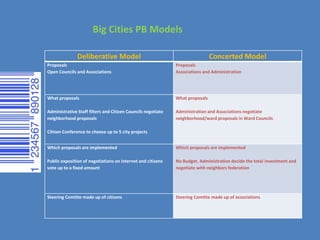
Deliberative Model Concerted Model
Proposals
Open Councils and Associations
Proposals
Associations and Administration
What proposals
Administrative Staff filters and Citizen Councils negotiate
neighborhood proposals
Citizen Conference to choose up to 5 city projects
What proposals
Administration and Associations negotiate
neighborhood/ward proposals in Ward Councils
Which proposals are implemented
Public exposition of negotiations on internet and citizens
vote up to a fixed amount
Which proposals are implemented
No Budget. Administration decide the total investment and
negotiate with neighbors federation
Steering Comitte made up of citizens Steering Comitte made up of associations
Big Cities PB Models
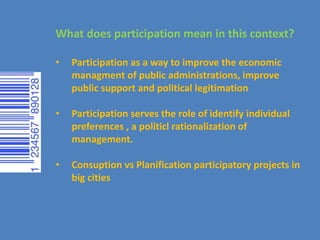
What does participation mean in this context?
• Participation as a way to improve the economic
managment of public administrations, improve
public support and political legitimation
• Participation serves the role of identify individual
preferences , a politicl rationalization of
management.
• Consuption vs Planification participatory projects in
big cities
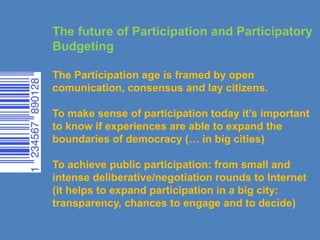
The future of Participation and Participatory
Budgeting
The Participation age is framed by open
comunication, consensus and lay citizens.
To make sense of participation today it’s important
to know if experiences are able to expand the
boundaries of democracy (… in big cities)
To achieve public participation: from small and
intense deliberative/negotiation rounds to Internet
(it helps to expand participation in a big city:
transparency, chances to engage and to decide)
Participation and Administration in Big Cities
But to go from ideals to practice is something
complex.
It’s not only comunication and lay citizens
(Deliberation Model), we should stress how they are
connected to administration (Concerted Model)
This is what can help us to value to what extent new
participatory experiences do or don’t expand the
boundaries of democracy
Conflicts: the Gate Keepers
Underlying theses particiaptory projects there are
negotiations over profound democratic questions
• Who is legitimized to make decisions (demos vs thecne)
• Who speak for the people (the representation of the
comunity)
Muchas gracias por su atención
4. ernesto ganuza

4. ernesto ganuza

  • 1.
    THE PARTICIPATION AGE:DEMOCRACY IN BIG CITIES
  • 2.
    The Participacion Age •Contrary to previous participatory experiences in 70s-80s, we are talking about the expansion of participation from above • Participation is no longer a counter-power, it has become part of the planning how power functions • The political motto goes from “protest” to “proposals”
  • 3.
    Participatory Budgeting inBig Cities • Experiences have increased worlwide from 1989 to 2015. • But something new happens: PB starts to be a key experience in big metropolis: New York, Hamburg, Paris, Madrid… • It opens a complex and sofisticated scenario: millions of people, big resources of public management… • Threats and Strenghts: invisibility vs high impacts; managerialism vs more human cities
  • 4.
    Big Cities PBModels • Neigborhood PB and City/Ward PB • Hard and Social Infraestructuture • Big Public Resources are decided with citizens But How to manage plurality, thounsands of inhabitans and cities with strong internal differences Deliberative Models (Paris) vs Concerted Models (Madrid)
  • 5.
    Deliberative Model ConcertedModel Proposals Open Councils and Associations Proposals Associations and Administration What proposals Administrative Staff filters and Citizen Councils negotiate neighborhood proposals Citizen Conference to choose up to 5 city projects What proposals Administration and Associations negotiate neighborhood/ward proposals in Ward Councils Which proposals are implemented Public exposition of negotiations on internet and citizens vote up to a fixed amount Which proposals are implemented No Budget. Administration decide the total investment and negotiate with neighbors federation Steering Comitte made up of citizens Steering Comitte made up of associations Big Cities PB Models
  • 6.
    What does participationmean in this context? • Participation as a way to improve the economic managment of public administrations, improve public support and political legitimation • Participation serves the role of identify individual preferences , a politicl rationalization of management. • Consuption vs Planification participatory projects in big cities
  • 7.
    The future ofParticipation and Participatory Budgeting The Participation age is framed by open comunication, consensus and lay citizens. To make sense of participation today it’s important to know if experiences are able to expand the boundaries of democracy (… in big cities) To achieve public participation: from small and intense deliberative/negotiation rounds to Internet (it helps to expand participation in a big city: transparency, chances to engage and to decide)
  • 8.
    Participation and Administrationin Big Cities But to go from ideals to practice is something complex. It’s not only comunication and lay citizens (Deliberation Model), we should stress how they are connected to administration (Concerted Model) This is what can help us to value to what extent new participatory experiences do or don’t expand the boundaries of democracy
  • 9.
    Conflicts: the GateKeepers Underlying theses particiaptory projects there are negotiations over profound democratic questions • Who is legitimized to make decisions (demos vs thecne) • Who speak for the people (the representation of the comunity)
  • 10.
    Muchas gracias porsu atención