       An aneurysm is defined as:
         A cardiovascular disease characterized by a saclike
         widening of an artery resulting from weakening of the
         artery wall
        Intracranial aneurysms(ICA) have a prevalence of 2%-
         6.5%
        Common places for ICAs are the cerebral artery, internal
         carotid artery, basilar artery, and the anterior
         communicating artery
        Cerebral blood pressure is autoregulated
        Currently doctors use diameter as a measure of severity
1. http://wordnetweb.princeton.edu/perl/webwn?s=aneurysm
2. Chien A, Castro MA, Tateshima S, et al. Quantitative hemodynamic analysis of brain aneurysms at different locations. AJNR Am J Neuroradiol. 2009;30:1507‐1512.
   Relate acute increases in blood pressure with
    mechanical stress and strain values within an
    intracranial aneurysm.
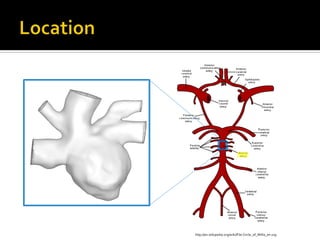
http://en.wikipedia.org/wiki/File:Circle_of_Willis_en.svg
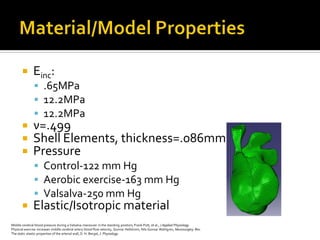
       Einc:
                .65MPa
                12.2MPa
                12.2MPa
              ν=.499
              Shell Elements, thickness=.086mm
              Pressure
                Control-122 mm Hg
                Aerobic exercise-163 mm Hg
                Valsalva-250 mm Hg
              Elastic/Isotropic material
Middle cerebral blood pressure during a Valsalva manouver in the standing position, Frank Pott, et al., J Applied Physiology
Physical exercise increases middle cerebral artery blood flow velocity, Gunnar Hellstrom, Nils Gunnar Wahlgren, Neurosurgery Rev.
The static elastic properties of the arterial wall, D. H. Bergel, J. Physiology
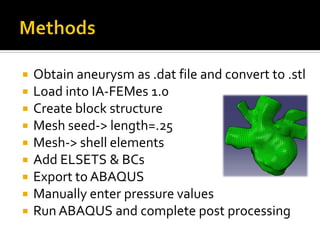
   Obtain aneurysm as .dat file and convert to .stl
   Load into IA-FEMes 1.0
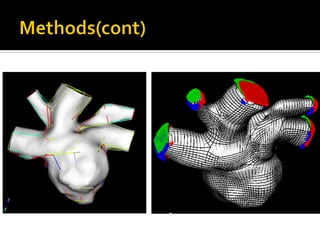
   Create block structure
   Mesh seed-> length=.25
   Mesh-> shell elements
   Add ELSETS & BCs
   Export to ABAQUS
   Manually enter pressure values
   Run ABAQUS and complete post processing
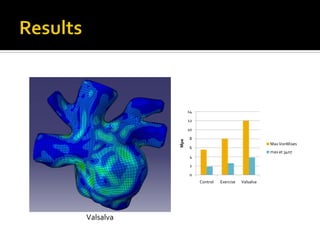
14

                 12

                 10

                 8


           Mpa
                                                      Max VonMises
                 6
                                                      max at 3407
                 4

                 2

                 0
                      Control   Exercise   Valsalva


Valsalva
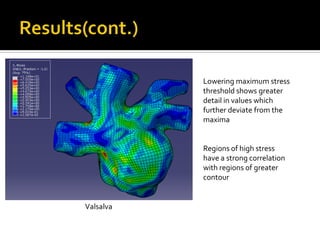
Lowering maximum stress
           threshold shows greater
           detail in values which
           further deviate from the
           maxima


           Regions of high stress
           have a strong correlation
           with regions of greater
           contour


Valsalva
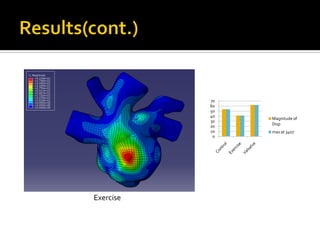
70
           60
           50
           40
                Magnitude of
           30
           20   Disp
           10   max at 3407
            0


Exercise
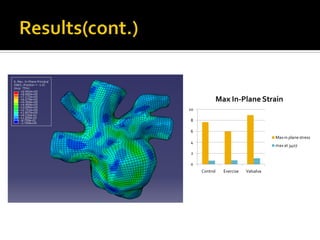
Max In-Plane Strain
10

8

6
                                       Max in plane stress
4
                                       max at 3407
2

0
     Control     Exercise   Valsalva
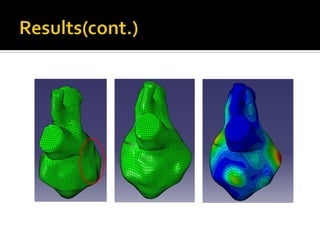
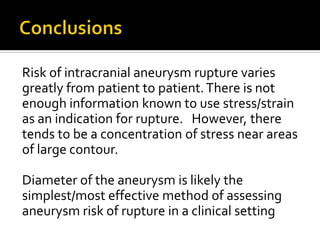
Risk of intracranial aneurysm rupture varies
greatly from patient to patient. There is not
enough information known to use stress/strain
as an indication for rupture. However, there
tends to be a concentration of stress near areas
of large contour.

Diameter of the aneurysm is likely the
simplest/most effective method of assessing
aneurysm risk of rupture in a clinical setting

3D FE Analysis iof Intracranial Aneurysm

  • 2.
    An aneurysm is defined as: A cardiovascular disease characterized by a saclike widening of an artery resulting from weakening of the artery wall  Intracranial aneurysms(ICA) have a prevalence of 2%- 6.5%  Common places for ICAs are the cerebral artery, internal carotid artery, basilar artery, and the anterior communicating artery  Cerebral blood pressure is autoregulated  Currently doctors use diameter as a measure of severity 1. http://wordnetweb.princeton.edu/perl/webwn?s=aneurysm 2. Chien A, Castro MA, Tateshima S, et al. Quantitative hemodynamic analysis of brain aneurysms at different locations. AJNR Am J Neuroradiol. 2009;30:1507‐1512.
  • 3.
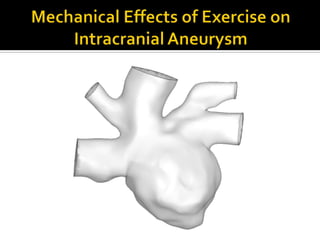
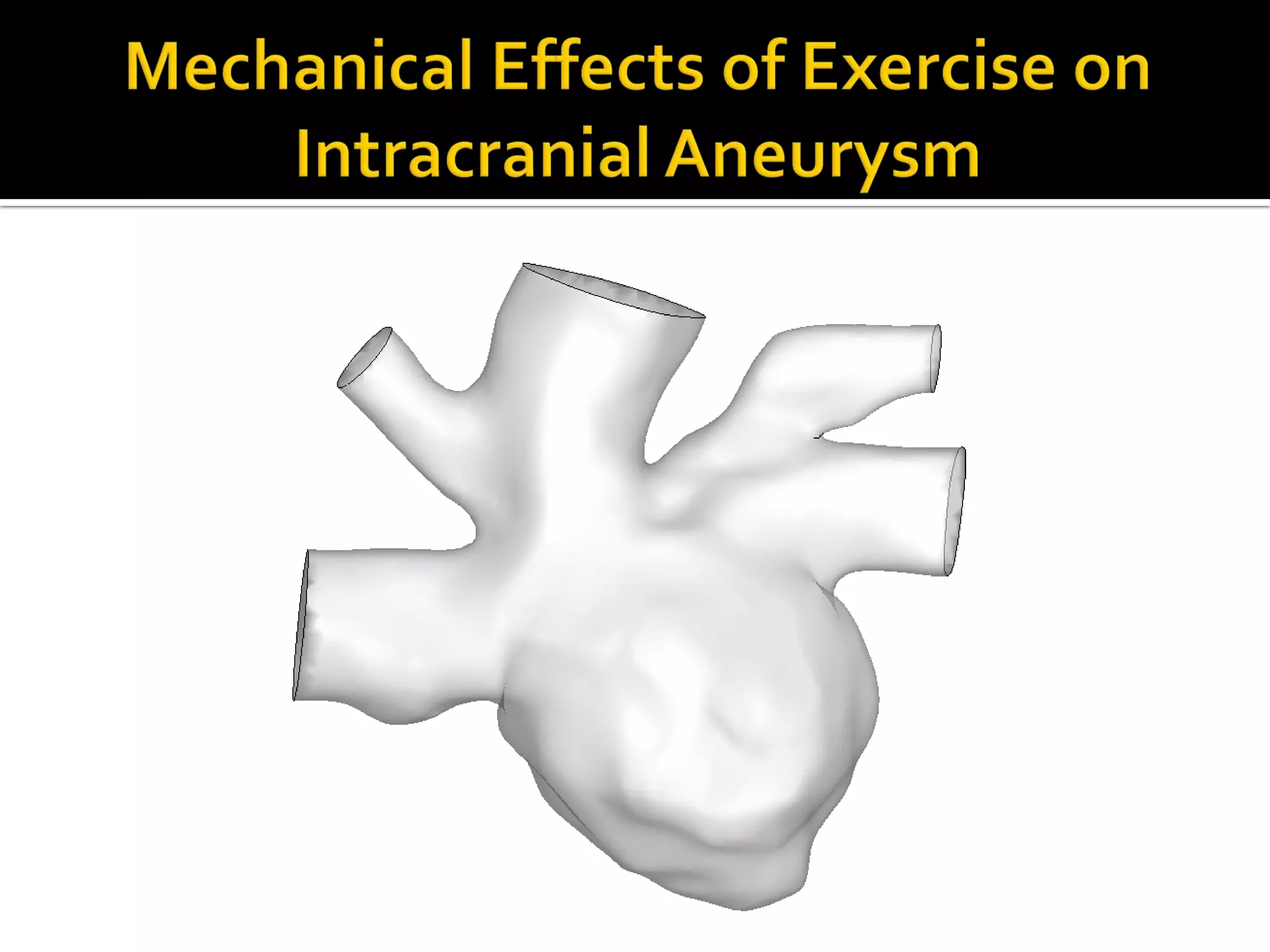
    Relate acute increases in blood pressure with mechanical stress and strain values within an intracranial aneurysm.
  • 4.
  • 5.
    Einc:  .65MPa  12.2MPa  12.2MPa  ν=.499  Shell Elements, thickness=.086mm  Pressure  Control-122 mm Hg  Aerobic exercise-163 mm Hg  Valsalva-250 mm Hg  Elastic/Isotropic material Middle cerebral blood pressure during a Valsalva manouver in the standing position, Frank Pott, et al., J Applied Physiology Physical exercise increases middle cerebral artery blood flow velocity, Gunnar Hellstrom, Nils Gunnar Wahlgren, Neurosurgery Rev. The static elastic properties of the arterial wall, D. H. Bergel, J. Physiology
  • 6.
    Obtain aneurysm as .dat file and convert to .stl  Load into IA-FEMes 1.0  Create block structure  Mesh seed-> length=.25  Mesh-> shell elements  Add ELSETS & BCs  Export to ABAQUS  Manually enter pressure values  Run ABAQUS and complete post processing
  • 8.
    14 12 10 8 Mpa Max VonMises 6 max at 3407 4 2 0 Control Exercise Valsalva Valsalva
  • 9.
    Lowering maximum stress threshold shows greater detail in values which further deviate from the maxima Regions of high stress have a strong correlation with regions of greater contour Valsalva
  • 10.
    70 60 50 40 Magnitude of 30 20 Disp 10 max at 3407 0 Exercise
  • 12.
    Max In-Plane Strain 10 8 6 Max in plane stress 4 max at 3407 2 0 Control Exercise Valsalva
  • 13.
    Risk of intracranialaneurysm rupture varies greatly from patient to patient. There is not enough information known to use stress/strain as an indication for rupture. However, there tends to be a concentration of stress near areas of large contour. Diameter of the aneurysm is likely the simplest/most effective method of assessing aneurysm risk of rupture in a clinical setting