1
Interdisciplinary Action Research Plan
Maggie Dennis
Jana Lee
  2
Table of Contents
Executive Summary…………………………………………………………………………….... 3
Sankara Profile and Research Needs…………………………………………………………….. 4
Research Deliverables…………………………………………………………………………… 5
Core Issues Addressed…………………………………………………………………………... 6
Research Questions……………………………………………………………………………… 7
Description of Data and Data Collection………………………………………………………... 8
Ethical Issues…………………………………………………………………………………… 11
Vocational Discernment………………………………………………………………………... 12
India’s National and Country Context………………………………………………………...... 13
Action Research Work Plan……………………………………………………………………. 15
Health and Safety Plan…………………………………………………………………………. 18
Bibliography……………………………………………………………………………………. 24
  3
Executive Summary
We are a team of two undergraduate Global Social Benefit Fellows with the Miller
Center for Social Entrepreneurship at Santa Clara University. During our eight-week field
placement, we will work with Sankara Eye Care in Coimbatore to help document the social
impact of eye care services and assess the deployment of a web application designed to track
student eye records. Sankara Eye Care is a social enterprise dedicated to eliminating needless
blindness among India’s rural populations by offering accessible, high quality, comprehensive
eye care. Sankara has developed multiple programs that target a diverse range of patients
including the rural poor, urban middle class and school children. To date, Sankara has opened 14
hospitals across 10 different states in India and provided over 1.2 million free eye surgeries for
the rural poor. As Sankara continues to expand its reach, we hope to contribute to the
organization’s mission of providing quality care for all through the compellation of case studies
and the implementation of technology.
While at Sankara, we will be conducting two main research projects. First, we will be
collecting data for a set of 6-7 comprehensive patient case studies. These be used in presentations
to donors and investors, in the annual report and on the Sankara website. Second, we will be
assessing a web application that tracks student eye records by school. We will be evaluating the
functionality and usability of the application. At the end of our stay in August, we will provide a
summary of our findings. We will provide an official report by the end of October. This report
will have two primary components: 1) a set of in-depth case studies reflecting Sankara’s diverse
customer segments and social impact; and 2) a detailed assessment of the usability of the web
application, including recommendations for development and improvement. Our report will also
be published for public use on the Miller Center’s website. We hope these deliverables will be an
added resource for Sankara and will help the organization scale their social impact. We look
forward to working with Sankara to help solve the problem of curable blindness in India. The
following is a detailed research plan outlining our research methodology and planned
deliverables.
  4
Sankara Profile and Research Needs
Background
Sankara Eye Care is a large, comprehensive eye care provider in India. The prevalence of
curable blindness in India is one of the highest in the world. Blindness can have a detrimental
effect on an individual’s life and there is a strong association between blindness and poverty.
Sankara seeks to address this problem by providing high quality, equitable and affordable eye
care to the rural poor in India. Founded in 1997 by Dr. R.V Ramini and Dr. Radha, Sankara has
expanded into 14 eye hospitals located in 10 states. Since its inception, Sankara has performed
over 1 million sight restoring surgeries and has become one of the major eye care providers in
India. Sankara combines highly skilled healthcare workers and advanced technology in order to
provide excellent care to individuals at all socioeconomic levels. Their impact model involves
eliminating curable blindness, allowing individuals to lead more productive lives and increasing
job and empowerment opportunities within communities.
Sankara operates using a cross-subsidy payment model, which allows them to provide
eye care service to low-income individuals free of charge. Sankara has two main customer
segments: the urban middle class, who pay for service, and poor rural customers who receive
services for free. Using this hybrid payment model, 20% of Sankara’s paying customers generate
enough revenue to pay for 80% of free customers. This business model has allowed Sankara to
become 90% self-sustainable.
Sankara operates multiple different types of treatment facilities. They have 14 base
hospitals in urban areas and conduct regular eye camps in rural areas. Rural patients are screened
and diagnosed at the eye camps and then transported to a base hospital if they require surgery.
Services include routine check ups, cataract removal and intraocular lens (IOL) clinics, cornea
and refractive services, vitreo- retinal services, glaucoma services, Lasik surgery, pediatric
ophthalmology and ocular oncology. In addition to the eye camps, Sankara operates several other
outreach programs including the Sankara Eye Bank, the Gift of Vision Program (rural outreach
program), Rainbow Program (preventative eye care for school children) and the Sankara
Academy of Vision, which trains healthcare workers in advanced eye care techniques.
Research Needs
Sankara requires further research in two different areas: social impact assessment and
technological evaluation. One research project that our team will be working on this summer will
be continued documentation of Sankara’s social impact through a set of comprehensive,
qualitative patient case studies. The case studies will be used in annual reports, websites and
presentations to donors. We will also be conducting research to assess a newly deployed web
application to track student eye records. Sankara’s current method of documenting student
records is pencil and paper. This application will help improve efficiency and make tracking
student records significantly easier. The application was designed by Santa Clara University
students at the Frugal Innovation Lab and our research will evaluate how well this application
functions and meets Sankara’s requirements. This assessment will provide information to help
further develop the application to fully meet Sankara’s needs.
  5
Research Deliverables
The main research products that we plan on delivering to Sankara in the fall are a collection of
case studies and an assessment of the mobile application.
Case Studies
We plan on compiling a set of 6-7 in depth patient case studies for Sankara. The purpose
of the case studies is to articulate the social impact that Sankara has. These case studies will
cover general patient information, socioeconomic status, family information and prognosis after
treatment. The case studies will also include high quality photographs of patients before and after
surgery and in their homes or workplaces. The studies will be used by Sankara in their
presentations to donors and investors, in their annual report and on their website. Case studies
will be limited to patients who are 4-9 or over 50, are non-paying and have congenital, bilateral
or developmental cataracts treated by Sankara. We will use the Sankara case study framework
that Sankara has provided. As we develop case studies, we may change aspects of this template
so that case studies can more effectively tell the story of Sankara’s social impact. We plan on
structuring our case studies in four parts:
1. Background story of patient and the struggles that they faced because of blindness or
visual impairment.
2. How patient became involved with Sankara.
3. How the patient's life has improved since receiving care from Sankara.
4. Quantitative statistics about how many people have the same condition as subject.
Mobile Application Evaluation
The Sankara application is a webpage designed to track school children’s eye records.
This will likely be deployed shortly before or soon after we arrive in India. We will report on the
deployment and usability of app. Since we do not know how long the deployment process for
this application will take, we do not know if we will be able to assess how the app is being used.
If we are able to do a field assessment, our report will include feedback from Sankara about the
functions of the app, how it is being used in the field and recommendations for possible next
steps. We plan on conducting the field analysis of the app using the POEMS framework and our
report will contain information answering the following questions:
1. People: what kinds of people are using the application?
2. Objects: do Sankara personnel enjoy using the application?
3. Environments: when do Sankara personnel use the app?
4. Messages: are Sankara personnel interacting with each other if they need assistance with
the app?
5. Services: do Sankara personnel view the app as useful? Will it continue to be used in the
field?
  6
Core Issues Addressed
Growing businesses in the developing world face many challenges. While some of the
issues that organizations face are common for any scaling business, others, like measuring social
impact, are problems unique to social enterprises. Our research for Sankara will focus on two
main areas of their business model: social impact and resources. The patient case studies will
address Sankara’s social impact and provide tangible evidence that Sankara is fulfilling their
social value proposition and theory of change. The evaluation of the mobile application will
address the key resources Sankara needs to maximize social impact. Understanding Social
Entrepreneurship outlines several benefits of measuring social impact, one of which is that
effective assessment enables entrepreneurs to prove to current and potential stakeholders that the
enterprise is achieving its value proposition. The qualitative case study data that we gather in the
field will support the quantitative impact data that Sankara already has. By documenting
different ways in which Sankara has impacted individuals, we will provide additional success
stories and photos for Sankara to use in various marketing platforms. This will strengthen
Sankara’s investor profile and provide more material for Sankara to use on other marketing
platforms. Our research project concerning the impact of the mobile application will address the
key resources component of Sankara’s business model. By reporting on how deployment of the
application goes and assessing how the application functions, we will be able to provide
recommendations to app developers for how the application can be adapted to fit Sankara’s
needs.
  7
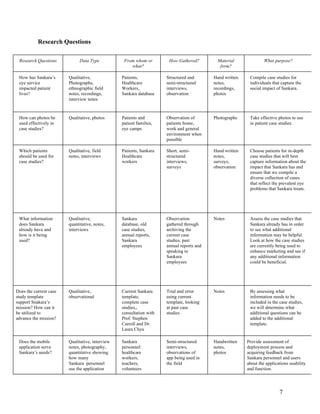
Research Questions
Research Questions Data Type From whom or
what?
How Gathered? Material
form?
What purpose?
How has Sankara’s
eye service
impacted patient
lives?
Qualitative,
Photographs,
ethnographic field
notes, recordings,
interview notes
Patients,
Healthcare
Workers,
Sankara database
Structured and
semi-structured
interviews,
observation
Hand written
notes,
recordings,
photos
Compile case studies for
individuals that capture the
social impact of Sankara.
How can photos be
used effectively in
case studies?
Qualitative, photos Patients and
patient families,
eye camps
Observation of
patients home,
work and general
environment when
possible
Photographs Take effective photos to use
in patient case studies.
Which patients
should be used for
case studies?
Qualitative, field
notes, interviews
Patients, Sankara
Healthcare
workers
Short, semi-
structured
interviews,
surveys
Hand written
notes,
surveys,
observation
Choose patients for in-depth
case studies that will best
capture information about the
impact that Sankara has and
ensure that we compile a
diverse collection of cases
that reflect the prevalent eye
problems that Sankara treats.
What information
does Sankara
already have and
how is it being
used?
Qualitative,
quantitative, notes,
interviews
Sankara
database, old
case studies,
annual reports,
Sankara
employees
Observation
gathered through
archiving the
current case
studies, past
annual reports and
speaking to
Sankara
employees
Notes Assess the case studies that
Sankara already has in order
to see what additional
information may be helpful.
Look at how the case studies
are currently being used to
enhance marketing and see if
any additional information
could be beneficial.
Does the current case
study template
support Snakara’s
mission? How can it
be utilized to
advance the mission?
Qualitative,
observational
Current Sankara
template,
complete case
studies,,
consultation with
Prof. Stephen
Carroll and Dr.
Laura Chyu
Trial and error
using current
template, looking
at past case
studies
Notes By assessing what
information needs to be
included in the case studies,
we will determine what
additional questions can be
added to the additional
template.
Does the mobile
application serve
Sankara’s needs?
Qualitative, interview
notes, photography,
quantitative showing
how many
Sankara personnel
use the application
Sankara
personnel:
healthcare
workers,
teachers,
volunteers
Semi-structured
interviews,
observations of
app being used in
the field
Handwritten
notes,
photos
Provide assessment of
deployment process and
acquiring feedback from
Sankara personnel and users
about the applications usability
and function.
  8
Description of Data and Data Collection
Our data collection will be divided into two sections: compiling case studies and
evaluating the mobile application. Data collection will be primarily qualitative, obtained from
databases at base hospitals, interviews and observations in the field at eye camps and follow up
visits.
Case studies: photography, archival system and framework
Compiling in-depth case studies of Sankara beneficiaries to document social impact will
be one of our main focuses while in the field. Case studies will cover general patient information,
socioeconomic status, family information and prognosis after treatment. The case studies will
also include photographs of patients before and after surgery and in their homes and workplaces.
Case studies will be limited to patients who are 4-9 or over 50, are non-paying and have
congenital, bilateral or developmental cataracts treated by Sankara. Sankara has provided a
template for the information they would like in the case studies. This template will serve as the
basis for our interview questions.
We will use primarily qualitative data, collected by taking ethnographic field notes,
photography, and conducting interviews. We plan on using semi-structured interviews to collect
data from patients with the help of a translator affiliated with Sankara. Data collected will be in
the form of notes, interview recordings and photography. After taking notes and photos we will
transcribe the notes and upload the photos to our computers and dropbox so that they are easily
accessible in the fall. In the fall, we intended to use the data collected to construct in depth case
studies that Sankara can use for presentations to donors and investors, in annual reports, on
websites and for other marketing purposes.
An ideal case study will showcase a patient with a compelling backstory who is eager to
share his or her positive experience with Sankara. Case studies should also be representative of
the main issues that Sankara addresses, such as cataract blindness. We will likely need to
interview many people to find case study subjects. We plan on conducting short, semi-structured
interviews in order to gain a sense of the patient’s story and then peruse additional information
from patients we feel will make good case study subjects. We will gather information directly
from patients and healthcare workers who may know patients well enough to guide us in the
right direction. The purpose of gathering this information is to compile moving case studies for
Sankara that accurately capture the social impact of eye care. By interviewing many patients and
then choosing which patients to use in case studies, we will be able to ensure we obtain a diverse
range of stories for Sankara to use.
Since photos of beneficiaries will be an essential part of our case studies, we will need to
be cognizant of taking usable patient photos. Sankara has requested that case studies include
before and after photos of each patient as well as photos of patients in their home and workplace.
After obtaining informed consent from patients, we are planning on taking pictures of patients
doing everyday tasks in their home or workplace. After taking the photos, we will upload them to
our computers, flash drive and dropbox so that they are accessible to us in the fall. These photos
will be very important for the case studies because of the large role that the case studies play in
Sankara’s investor acquisition efforts.
  9
Sankara has requested that we come up with an archival system to organize the case
studies that they already have. We have proposed organizing case studies into these five
categories:
a. Complete case studies
b. Photos of Eye Camps and Hospitals
c. Photos of patients
d. Economic and education information
e. Quantitative impact information
Looking at the case studies that Sankara already has will help us see how information is
currently being gathered and see which categories have the most and least material. This may
inform the types of patients we should focus on for our case studies to ensure that Sankara has a
variety of patient profiles. This data will be qualitative and quantitative and will be gathered
from the current Sankara case studies and the Sankara database.
Sankara is currently using a general template to conduct case studies. This framework is
broad and addresses the main categories of information that Sankara would like the case studies
to cover. As we begin to conduct interviews, we will draw on our resources at Santa Clara
University to help us refine the template and write specific questions. We will look at complete
case studies to determine the information we will need to gather to achieve the desired story
arch. We then plan on consulting with science and technology expert Dr. Stephen Carroll and
Professor Dr. Laura Chyu during our placement. If needed, we will work with them to create
interview questions that will best capture Sankara’s social impact.
An additional aspect of understanding how to best construct case studies will be looking
at how case studies are currently being used. We will look at annual reports, the Sankara website
and any other marketing or presentation materials available to us. This will tell us what aspects
of case studies are being used most and which types of photographs are most effective. We can
then work on adjusting our interviews and data collection accordingly.
Evaluation of Sankara mobile application
We plan on evaluating the usability and function of the mobile application. This will
include how Sankara personnel (healthcare workers, teachers, and volunteers) interact with the
application and what suggestions they may have to improve its usability and function. The first
aspect of our application research will be determining if the applications meets Sankara’s
requirements. The final features of the application include storing both demographic and student
medical information, storing screening sites, authenticating users prior to access of confidential
information, and search suggestions. Student demographic information will record a student’s
first and last name, biological sex, birthdate, guardian name, address, class number, section
number, roll number, contact number, and teacher’s name. Primary screening information will
ask for who screened the student, the date of the screening, and whether the screening was
classified as “normal” or “defective”. There are also fields to input the physician diagnoses,
medications, and recommendations for the individuals, in addition to recording other specific eye
information.
  10
Assuming that the application has the features that Sankara requires, our next step will be
to do a field assessment of the app. This will include observing how people interact with the
application and measuring individual’s willingness to use it in the field. Our assessment will rely
on qualitative data obtained from users and our own observations about how users interact with
the application. Obtaining user feedback will be important because the web application will have
recently been deployed. If there are problems with the application we will be able to consult
Santa Clara University engineering professors and students about how it can be improved.
To gather information from users, we plan on using a short, forced answer survey and
semi-structured interviews. The interviews will be kept to a maximum of 5 questions, so that we
can respect the participants’ time. A translator will help us facilitate interviews and surveys when
needed. This plan is based off the assumption that the application will be able to be deployed and
tested by healthcare workers while we are in India.
In terms of trouble-shooting the web application, both Christine Rohacz and Christiane
Kotero, part of the iKure Team, will be visiting during the fourth week of our field placement,
and they will be able to fix any minor bugs that may appear on the application. After we have
received some usability feedback about the Sankara webpage, we will analyze our results and
consult the expertise of Dr. Silvia Figuiera and Dr. Natalie Linnell about future improvements
for the application.
The primary purpose of this data collection is to help Sankara deploy a usable and
simplified web application to document children’s eye records. After we obtain information
about the web application, we will report on the deployment and usability of the app. After
outlining any major changes that the app may need to meet Sankara’s expectations and
requirements, we will analyze the results of our field assessment data by drawing upon common
themes that arise during the interviews we conduct. We can interpret the data to make
recommendations for improving the web application. This information can be presented through
participant feedback and we can attach photographs or videos that show how Sankara personnel
are using the application.
  11
Ethical Issues
Since our project focuses on showing social impact through case studies, the largest
ethical issue that we will face while in field will be obtaining informed consent. Sankara’s
customer segment includes both paying and non-paying patients, however, Sankara has
requested patient case studies on non-paying patients only. Based on specifications dictated in
Sankara’s case study framework, we will document social impact by creating profiles of
children, ages 4-9, and the elderly, ages 50 or older. Although informed consent is something
that we will have to address with all patients we interview or photograph, we will also need to be
cognizant of obtaining parental consent when we interview children. We will consult Dr. Pooja
Sangvhi and other personnel at Sankara to see what the current protocol on informed consent is
and if a confidentiality agreement is in place. Respecting the anonymity and privacy of the
patients we interview is a significant issue we will be concerned with. Obtaining consent may be
challenging because many patients may be illiterate or apprehensive about speaking and sharing
information with foreigners. Our team must be wary of the ethical issues at play regarding
patient confidentiality and a respect for persons. Language barriers will pose an additional
challenge when getting consent from patients. Although written consent may not always be an
option, we will record or otherwise document patient consent.
We believe it will be best to approach the patients in a conservative and cautious manner
so that we can gradually gain their trust. To do this, we plan to visit the outreach camps, observe
social interactions between locals, and familiarize ourselves with Sankara procedures before we
start collecting our data. When interviewing children, we can participate in an activity with them,
such as a game of soccer, in order to build rapport and gain their trust. We plan on utilizing
Sankara’s resources, such as translators and field workers, to put is in contact with patients in the
community. Sankara employees who work at the camps regularly may know patients who will
be willing to give us an in-depth interview. We will rely entirely on Sankara staff to recruit and
screen appropriate patients to interview. We will work with Sankara staff so that they negotiate
informed consent with patients, including permission to photograph. Interviewing child patients
raises special ethical considerations. We will have to work very closely with Sankara staff to
obtain appropriate informed consent for profiling any children. In the U.S., it would never be
appropriate to interview or photograph a child about health issues without a parent present,
giving active consent. The situation in India is likely to be different. We will work closely with
Sankara staff to ensure that they obtain informed consent. If we take pictures of children, we will
turn them over to Sankara to use them, since they would not likely be used on the Miller Center’s
webpage.
During our data collection process, we will ask the individual if he or she would like their
name to be included in our case study. We will also inform all participants that their names and
other information may be used by Sankara and published on the Internet as part of our final
report. Since there will most likely be a language barrier when speaking to participants, we will
ensure that our translator is aware that this needs to be conveyed very clearly to patients. It is
especially important for the participants to know of the risks involved with the release of
information on the Internet.
Since our final deliverables will include photography, audio recordings, direct quotes
from patients and use of Sankara’s hospital statistics, our team will proactively ensure that
  12
informed consent is gained before engaging in any of these activities. We will also ensure that
consent is well documented as either a written form or recording.
In order to respect the rights of our participants, we will not disclose any information that
would allow participants to be identified. If we decide to report on a participant that chose to
remain anonymous, we will use a pseudonym when writing the case study. Lastly, we will
consult Sankara about all decisions made about patient privacy and reference the standards that
are already in place at Sankara during our fellowship process.
Vocational Discernment
Maggie Dennis
Thus far, I have learned an enormous amount though participating in this fellowship. At
Santa Clara, and Silicon Valley generally, I feel like a lot of emphasis is put on business and
entrepreneurship as a way to personal gain. I love the idea that business can be used to empower
communities and make a sustainable difference. As an economics major, it has been really
exciting for me to see how the business principles and tools I have been learning over the past
three years can be applied in meaningful ways. Similarly, I am very eager to get into the field
and see the concepts we have studied in class in practice. Through working with Sankara this
summer, I hope to gain a better understanding of what I like doing and start to answer the
question of what my next steps will be after Santa Clara. I have enjoyed the preparation for this
project and have found the topic of social entrepreneurship really interesting, but will I like
actively conducting research and being in the field? Is this the type of work I would want to
continue after college? This experience has already expanded the career possibilities I can see for
myself. I am hoping that this summer will help me start to narrow down the list of things I may
want to pursue so that I can begin to answer the questions of where I will go next and what my
career path may look like.
Jana Lee
Within this stage of my college career, I am still uncertain about which path I should take
within the vast public health field. Santa Clara University has given me many opportunities to
explore different areas of study, such as healthcare administration, research, global health, and
health communication that are all related to public health, but I have yet to see how these diverse
areas fit together. Since the Global Social Benefit Fellowship will be my first experience
working with a health-related social enterprise, I hope that after my experience I will be able to
further narrow my interests. In this way, I expect that there will be numerous cultural challenges
that I will face during the fellowship. There are two main questions about my personal vocation
I wish to answer during my fellowship experience: what aspects of the fellowship motivate me to
work with Sankara every day? In addition, how adaptable can I be in an environment and culture
I am not familiar with? While I believe that I will be productive during my time in India, I
would like to pinpoint what area of social impact action research makes me happy. Although I
have little exposure to the field of business and social entrepreneurship, my passion for helping
marginalized communities within a health organization like Sankara would help me reach my
personal vocational goal of addressing the social disparities still present in the world.
  13
India’s National and Country Context
India is a Southeast Asian country located between Burma and Pakistan. The population
is estimated to be 1.22 billion people, making it the second-most populous country in the world.
India is known for its rich culture, religion, and language. It is the world’s largest secular
democracy and has a diverse range of religious communities including Hindus, Muslims,
Christians, Sikhs, Buddhists, and Jains among others.
India gained independence from the United Kingdom relatively recently in 1947. British
influence is still present in India, but the country has many other cultural traditions worth
mentioning. Typical food, clothing, dance and language vary between different regions. For
example, southern Indian food may include a whole host of spices like coconut, tamarind, curry
leaves and many other ingredients that are not found in northern Indian food. Similarly,
language is a significant aspect of Indian culture to consider. While Hindi is by far the most
common Indian dialect spoken, there are many regional languages such as Bengali, Telugu,
Tamil, Urdu, Kannada, and Punjabi, which are spoken in different areas. Although not an
official language, English is common and serves as a primary tool when dealing with national,
political, and commercial affairs. Language is a barrier that our team is likely to face while
interviewing patients. In order to overcome this challenge, we can gain their trust by showing
them photographs of our homes, families, and school.
While India may be significantly developed in some areas, other areas still have many
societal disparities that hinder the overall health of the population. India has an extremely high
population density. There are 421 people per square mile in India, compared to the U.S., which
has 35 people per square mile. High population density combined with a lack of proper sanitation
and basic infrastructure has led to many water and foodborne infectious disease outbreaks,
especially in rural communities. Despite the health risks that many people in India face, the
government spends only 4% of GDP on health expenditures. These conditions make India an
optimal location to identify and analyze how healthcare inaccessibility affects the general health
of the country. In addition, since two-thirds of the population lives in rural areas, the social
impact potential for individuals at a community level may be enormous. Health organizations
like Sankara use high population density to their advantage and rely on word-of-mouth strategies
to raise awareness about health and eye care services provided.
One cultural difficulty our team may encounter is India’s caste system. This may present
a challenge because of the large social stratification the system represents. While the caste
system was particularly prominent in the past, the Indian government had officially outlawed it.
Despite this, some aspects of the system may still be prevalent in communities today. Gender
roles are also an important factor to take into consideration when looking at how communities
function. Gender inequality can be seen in many aspects of Indian culture. For example, statistics
show that 81% of males are literate compared to 61% of females. Keeping the cultural context in
mind, our team will proactively conduct our action research while simultaneously respecting the
cultural norms around us.
Understanding India’s unique cultural and historic background is crucial for
understanding the belief systems of our field placement. Although there may be many different
social and cultural norms, our team will meet these challenges with open attitudes and genuine
  14
respect. We will take advantage of Sankara’s understanding of the social needs among India’s
population so that we can better integrate into the culture and help Sankara scale their
impact. No matter what challenges we may encounter in the future, our team will be certain
make decisions that align with Sankara’s mission, our research goals, and our vocational
discernments.
  15
Action Research Work Plan
Week 1: June 15 – June 18
Monday, June 15
Depart from San Francisco International Airport (SFO): 16:45
Tuesday, June 16
Arrive in Dubai International Airport (DXB): 19:25
Transfer: Depart from DXB: 21:30
Wednesday, June 17
Arrive in Bengaluru International Airport (BLR): 3:00
Check into hotel
Hotel Logistics: We will be staying at Goldfinch Retreat, Chikkajala. The address
is New International Airport Road, Chikkajala, Karnataka, 562157 India
(Telephone Number: 91 (80) 22011500). We will have the reservation booked for
June 16-18 (Reference number: 7115596731957).
Thursday, June 18
Depart from BLR: 9:55
Arrive in Coimbatore International Airport (CJB): 10:55
Pick up by Sankara hospital team member (pending, need to review with Dr.
Sanghvi)
Week 1 continued: June 18 – June 21
Upon our arrival in Sankara Eye Hospital in Coimbatore, we will meet Dr. Pooja Sanghvi and
other Sankara personnel. Since we will be jet-lagged and adjusting to the weather and time
difference, the remainder of this week will include an orientation of Sankara’s hospital, where
we will be touring the headquarters and meeting other medical personnel. We would like to
familiarize ourselves with different departments within Sankara, including the Communication
and Marketing, Information Technology, and Field Outreach departments.
Week 2: June 22 – June 28
During this week, we hope to prepare for our first field visit at Sankara’s eye camps. We will
ask Dr. Sanghvi what transportation we can take to these eye camps, but we believe that Sankara
has some transportation organized already. During our first field visit, we will take general notes
on the community, environment, and social interactions that may occur. This would be a good
opportunity to take general photographs of the eye camps and what the rural communities look
like. We will also have a translator during the field visit, and he or she can help introduce us to
some of Sankara’s customers.
Week 3: June 29 – July 5
We will continue to conduct interviews with Sankara customers who are willing to interview
us. We want to establish a sense of trust between our team and the customers, and we intend on
doing this by getting to know our customers through informal conversations with a translator
beforehand.
The equipment we bring to the field will be identical each time we visit the eye camps. We will
bring a DSLR camera, our iPhones, a notebook to take notes in, and appropriate paperwork
  16
needed to acquire informed consent. In addition, we will need a translator for this part of our
project as well, and Dr. Sanghvi is informed of our needs.
Dr. Laura Chyu will also be around in the summer, and she is available to Skype in order to
check-in with us about our work. We will schedule a Skype call sometime during this week.
Similarly, Dr. Stephen Carroll will be around during this time, and we will consult both mentors
sometime during this week.
Week 4: July 6 – July 12
During this week, we excitedly anticipate Team iKure’s visit to Sankara Eye Hospital in
Coimbatore. Team iKure can arrive in Coimbatore International Airport, take a taxi from the
airport to Sankara (distance = 8.7 km, approximately 21 minutes), and meet us at the
hospital. While this is still tentative, we will confirm this date and book appropriate plane tickets
when we arrive in India.
With Team iKure, we may be able to begin interviewing Sankara personnel about the usability of
the web application. This may give both teams some insight on how the application is used, and
Team iKure will be able to grasp some of the technicalities of the application that Sankara may
want for a future pilot.
We may also want to take Team iKure to visit the eye camps and schools, where the application
will most likely be used.
While Dr. Natalie Linnell will not be available during the first two weeks of July, we will be able
to collect some feedback on the webpage application and contact her, if needed.
Week 5: July 13 – July 19
We will continue to conduct interviews with Sankara customers who are willing to interview
us. We want to establish a sense of trust between our team and the customers, and we intend on
doing this by getting to know our customers through informal conversations with a translator
beforehand.
The equipment we bring to the field will be identical each time we visit the eye camps. We will
bring a DSLR camera, our iPhones, a notebook to take notes in, and appropriate paperwork
needed to acquire informed consent. In addition, we will need a translator for this part of our
project as well, and Dr. Sanghvi is informed of our needs.
Week 6: July 20 – July 26
During this week, we hope to visit Team iKure in Kolkata, West Bengal and help assess the
social impact of their mobile application. iKure’s mobile application will have only been
launched for one week (and the deployment date may change), so our team will observe
interactions with iKure’s staff, using the same framework we developed to assess the social
impact of Sankara’s web application. In addition, granted it is possible, we may want to join
Team iKure on a field assessment.
  17
Appropriate technologies needed to document social impact include: DSLR camera, iPhone for
possible videography, our personal laptops for processing and backing up data, and our
Moleskine notebooks for field research notes.
Week 7: July 27 – August 2
At the beginning of this week, we will continue to conduct interviews with Sankara customers
who are willing to interview us. We want to establish a sense of trust between our team and the
customers, and we intend on doing this by getting to know our customers through informal
conversations with a translator beforehand.
The equipment we bring to the field will be identical each time we visit the eye camps. We will
bring a DSLR camera, our iPhones, a notebook to take notes in, and appropriate paperwork
needed to acquire informed consent. In addition, we will need a translator for this part of our
project as well, and Dr. Sanghvi is informed of our needs.
At the end of this week, our team may want to organize an independent travel with Team iKure
for a couple of days, where we can explore some of India’s famous landmarks. This is still
pending, and we need to confirm with Dr. Sanghvi.
Week 8: August 3 – August 7
During the final days of our fellowship, we want to compile all the interviews we have done with
Sankara customers and begin our data analysis. As part of our overall deliverable, we will
arrange for a presentation to Sankara’s personnel, including Dr. Sanghvi, so that we can not only
present what we have been working on in the past few weeks, but also ask for recommendations
on how to improve our rough case studies.
We will also draft our research plan for the action research paper. We may need some
quantitative statistics, which would be ideally provided from Sankara’s database, and we will
ensure that we have that data before we depart from India.
Week 8 continued: August 8 – August 9
Saturday, August 8
Depart from BLR: 20:45
Arrive in DXB: 23:05
Travel from DXB to hotel (pending, may use a taxi from the airport)
Check into hotel
Hotel arrangements in Dubai (pending, need to check-in with Spencer)
Sunday, August 9
Travel from Hotel to DXB (pending, may use a taxi from hotel)
Depart from DXB: 8:25
Arrive in SFO: 13:15
Picked up from SFO by parents / friends
  18
Health and Safety Plan
Health and Medical
Vaccinations & Infectious Diseases
Health risk in India includes infectious diseases. The Centers for Disease Control and
Prevention (CDC) recommends that individuals who travel be updated with routine vaccinations,
such as Hepatitis A, Hepatitis B, Diphtheria, Tetanus, and Polio (DTaP), Polio, Flu, Measles,
Mumps, and Rubella (MMR), Chickenpox, and Human papillomavirus (HPV), to name a few.
While these vaccinations may have primarily been obtained at a young age, some vaccinations,
like the flu vaccine or Tetanus, are routinely recommended for adults. For travellers going to
India, Hepatitis A, Typhoid, Hepatitis B, and Japanese Encephalitis are also recommended for
certain regions. Malaria medication is strongly recommended, and we will begin medication a
couple weeks before departing from the U.S. In addition, the risk of Tuberculosis (TB) is higher
in India in comparison to the U.S. To help prevent TB, we can avoid spending time in enclosed
spaces with individuals who may be infected. If we are in an area where people infected, we can
use facemasks. Lastly, Schistosomiasis is a disease caused by parasitic worms that live in certain
types of freshwater snails. There is low risk in India, but they may be present in swimming pool,
lakes or rivers. We will take precautions to avoid contact with the parasites.
There have been few reports about infectious diseases in Bangalore. The last “High
Risk” report occurred in January and February of this year, when there was a large surge in
confirmed cases of H1N1 Influenza Virus. There have been no other high-risk reports in
Bangalore since then.
Water and Dietary Concerns
Drinking water should be from a bottled water or tap water that has been boiled, filtered,
or chemically disinfected. Since we will not always be sure if tap water has been boiled or
filtered, bottled water will be the safest option and may be easier to obtain. Similarly, we must be
wary of un-bottled beverages and especially, drinks containing ice at all costs. Hot coffee, tea,
and milk that have been pasteurized should also be fine.
Food safety is can also be a concern when living in India. It is not uncommon to consume
meat from different types of game. For example, bush meat is meat made from monkeys, bats, or
other wild game. It should not be consumed. Additional steps that our team can take to make
sure that we both remain healthy are to avoid street food, drink bottled or purified water, bring
medication to help with food poisoning, and avoid foods that have been left at room temperature
for extended periods of time.
Other Preventative Measures
Preventative measures against bug bites are covering exposed skin by wearing lightly
colored long-sleeved shirts, pants, and hats and staying and sleeping in air-conditioned rooms.
We will bring appropriate clothing and use insect repellent to reduce the likelihood of
  19
contracting an infectious disease. For protection against ticks and mosquitoes, we will use
repellents that contain 20% or more DEET for protection. While DEET is a recommended insect
repellent, other alternatives we can use are Picaridin and oil of lemon eucalyptus (OLE).
Safety and Security
The overall risk rating for India is “Low” across all categories: Unrest, Terrorism, Crime,
Natural Hazards, Police Conduct, and Conflict. The most recent terrorism attack in Bangalore
was a bomb attack in April 2013. Terrorism is currently a low to moderate threat.
Crime
While safety is important across all categories, we must be especially wary for petty
crime, such as pickpocketing and purse snatching, which are commonly experienced by
foreigners. Some tourists have also reported being robbed after consuming drugged food in train
stations and other public settings. Furthermore, crimes against tourists have become more and
more common. Sexual assault is the fastest growing crime in India and recent incidents have
involved female travelers who may be travelling alone or travelling at night. Sexual assault is a
major concern for our team and will require extra observation within our surroundings.
Natural Hazards
As our placement in Bangalore will be during the southwestern monsoon season (usually
from June to August), Bangalore is prone to flooding during this rainy season. The seismic
activity zone is rated a “2,” which is considered a Stable Zone.
Unrest, Conflict, & Terrorism
As a major city center, Bangalore is a natural place for some civil unrest. Usually this
consists of non-violent demonstrations and protests, which may block roads and increase traffic.
Political protests commonly occur before elections and the government usually imposes a curfew
in response to any demonstrations that become violent.
Conflict is usually present in cities that border other countries like Bangladesh, China, and
Pakistan. Because Bangalore is not close to any foreign borders, it is removed from the risk of
northern Indo-Pakistani violence. However, some conflict may occur in rural villages between
different political and religious groups.
Police Conduct
Bangalore has a large police force that is well equipped to respond to any major incident.
However, response time is generally slow and corruption is a problem. The police force is highly
susceptible to bribery. Although most police officers speak some English, assistance to travelers
can be limited due to lack of resources and training. The emergency police number is 100.
To protect ourselves individually and in a group, we can be aware of our surroundings,
not leave any of our possessions unattended and avoid traveling alone or after sunset when
possible.
  20
Courses of Action
If one of our P-Cards were stolen, our first step would be to contact Spencer as soon as
possible. If one of us received a minor injury we would assess the situation to see if we could
handle it ourselves and then seek medical attention if needed and notify Spencer. If we were
involved in a major accident we would first call the police and then contact Spencer as soon as
possible. If we lost our passports we would report theft or loss to the police in the location where
we lost it and then contact the nearest US embassy or consulate so that they could issue us a FIR
to leave the country. We should have three copies of our passports and visas. We should keep
one copy on our person and the others should be stored in multiple different places, for example
one the lining of our suitcases, one in our wallets and one in an inside pocket of our backpacks.
The overall risk in Bangalore is low. The biggest thing that we need to be aware of is
petty crime and theft. Risk can best be mitigated by being aware of surroundings and possessions
at all times, especially while traveling.
Transportation
There are several risks associated with ground transportation available. Methods of
transportation include Airports, Public Transport, Taxis and Public Transportation, Self Drive,
and Walking.
Airports
It would be helpful to know that Bengaluru International Airport (BLR) is located 40
kilometers (25 miles) northeast of the city center. There is only one terminal that handles both
domestic and international flights.
Taxis & Public Transport
Upon arrival from the airport, we may be using taxis (or be picked up) to travel to our
host location. If taxis are necessary, they should be prepaid from an airport or hotel. There are
three official taxi companies that operate from the airport: KSTDC, Meru, and MegaCabs. These
companies may be more trustworthy than taxis that are hailed off the street. Rickshaws are more
common than taxis, however they are expensive for foreigners and can be unsafe.
The Namma (Bangalore Metro) is a rail service that runs throughout Bangalore. There is also a
bus system, but routes are inconvenient and the system is hard to use, and we are not familiar
with the area.
Self Drive
Roughly speaking driving in international countries is incredibly dangerous. Legally, we
would need a valid Indian driver’s license or an international driver’s license. In addition,
because India has the most traffic-related deaths, we will avoid this option at all costs.
  21
Walking
When walking, it is safest to stay on the sidewalks and used marked crosswalks. People
on foot do not always have the right away and roads are very chaotic, so staying aware is
important. It is best to avoid traveling alone and past sunset when possible. Foreign women who
are alone are at higher risk for harassment, theft and assault. If traveling alone is necessary, it
should be in the daylight.
We will make a plan of where to meet when we arrive in each new destination. For
example, if we are visiting an eye camp and are separated, we will plan to meet at the entrance.
Hotel lobbies and large restaurants are also good options.
Local Tips
There will be three days of significance during our time India: July 17- Jamat Ul Vida,
July 18- Rath Yatra, and July 19th- Eid-ul Fitr. All involve large religious gatherings. There
should not be a lot of additional risk posed, however there are likely to be large gatherings so we
should just make sure that we stay aware. Since Ramadan involves fasting from dawn to dusk,
we will need to be mindful about when and where we eat or drink during that time so that we do
not offend anyone.
Languages Spoken
The official languages of India include Hindi and English, which is used for official
purposes of the Union and for use in Parliament. In Bangalore, we will come across other
languages like Kannad (commonly spoken in the state of Karnataka), Telugu, and Hindi.
Electricity Usage
We do expect to have reliable electricity at our placement, along with relatively reliable
Wi-Fi to access the Internet. Electricity is usually at 110 volts in the US and 220 volts in India.
Below is an image of the adapter we would need to use with our electronics. We are planning on
taking our computers, cameras, phones, and corresponding chargers with these items.
Adaptor for India:
  22
Risk Mitigation
Health & Medical:
1. Making sure water comes from a reliable source.
Is the water safe? Where did the water come from? Being aware of the drinking items we
consume and questioning the source of the water will help us avoid needless stomach problems.
2. Don’t eat street food!
Although tempting, street food may be unreliable for safe consumption. We have received
multiple accounts of friends who have visited Bangalore and have experienced stomach
problems. We will avoid street food.
3. Taking steps to prevent disease.
Being healthy in India is our primary goal. By taking extra steps to consider the safety of items
we consume and environments we will be researching in, it is imperative for us to monitor our
own health during our stay. For instance, setting up weekly or daily reminders to take malaria
pills will help us stay on track with our medications. This can also be done for other medications
as well.
Safety & Security:
1. Being aware of belongings when in public areas.
Theft is a common petty crime that occurs in India. Sometimes, thieves act in groups by trying to
converse with foreigners. While this is happening, another thief will try to open bags or take
items that can be easily obtained. Being wary of our surroundings and not engaging with locals
unless it is necessary can be helpful.
2. Don’t travel alone!
Female foreigners are at higher risk for harassment when traveling alone. We will make sure that
we do not travel alone unless it is truly necessary. If we are put in a situation where we would
have to travel alone, we will travel in the daylight.
3. Avoiding travel at night.
We will avoid travelling at night because there have been increases in gang violence and
harassment among women who travel alone. We will ask our host enterprise contact for
recommendations on what is considered “late” in Bangalore, and we will set curfews to avoid
dangerous situations.
Transportation:
1. Using caution when walking.
Because pedestrians will not have the right of way in Bangalore, it is especially important for us
to watch for cars, rickshaws, or motorcyclists when crossing the streets. We will also stick to
designated sidewalks and not take unfamiliar roads when walking to our destination.
  23
2. Don’t hail taxis off the street.
As mentioned before, taxis off the street could be scams, so we will not use this method of
transportation unless it is associated with an airport or hotel.
3. Having a plan for where to meet if separated.
Since Bangalore is a bustling city and we will most likely be travelling as a team, we will
establish easily identifiable buildings or landmarks and relocate to these places if we are
separated. It is important that we stay in public places, where security is higher, such as hotels or
restaurants. We will also have our host enterprise address, phone number, and other information
memorized before we leave.
  24
Sources
Religion. Government of India. Retrieved June 4, 2015.
Travel Risk Intelligence Portal. (2015). Retrieved June 4, 2015.
The World Factbook: India. (2015, May 20). Retrieved June 4, 2015.
Bibliography
Relevant topics: Economic Activity Sector, Economic Situation of the Intended Beneficiaries,
Historical Origins of the Social Need, Research Methodology, and the Use of Technology
Acharya, T. (2007). Science and technology for wealth and health in developing countries.
Global public health, 2(1), 53-63.
Banerjee, A., Deaton, A., & Duflo, E. (2004). Health care delivery in rural Rajasthan. Economic
and Political Weekly, 944-949.
Banerjee, A., Deaton, A. & Duflo, E. (2004). Wealth, Health and Health Services in Rural
Rajasthan. Poverty Action Lab, 8.
Coffey, D., Chattopadhyay, A., & Gupt, R. (2014). Wealth and Health of Children in India.
Economic & Political Weekly, 49(15), 65.
Dhake, P., Dole, K., Khandekar, R. & Deshpande, M. (2011). Prevalence and causes of
avoidable blindness and severe visual impairment in a tribal district of Maharashtra, India. Oman
Journal of Ophthalmology, 4(3), 129-134.
Dhaliwal, I., & Hanna, R. (2014). Deal with the Devil: The Successes and Limitations of
Bureaucratic Reform in India (No. w20482). National Bureau of Economic Research.
Doncaster, P. (2014). The UX Five-Second Rules: Guidelines for User Experience Design's
Simplest Testing Technique. Morgan Kaufmann.
Enoch, M. (2008). Low vision care in India: a time for action. Visual Impairment Research, 10,
35-43.
Finger, R. (2007). Cataracts in India: current situation, access, and barriers to services over time.
Ophthalmic Epidemiology, 14(3), 112-118.
Finger, R., Kupitz, D., Holz, F., Chandrasekhar, S., Balasubramaniam, B., Ramini, R. & Gilbert,
C. (2011). Regular provision of outreach increases acceptance of cataract surgery in South India.
Tropical Medicine and International Health, 6(10), 1268-1275.
  25
Finger, R., Kupitz, D., Holz, F., Fenwick, E., Balasubramaniam, B., Ramini, R. & Gilbert, C.
(2012). Impact of successful cataract surgery on quality of life, household income and social
status of south India. PLOS one, 7(8), 1-8.
Frick, K., Riva-Clement, L. & Shankar, M. (2009). Screening for refractive error and fitting with
spectacles in rural and urban India: cost effectiveness. Ophthalmic Epidemiology, 16(6), 378-
379.
Gupta, S. K., Viswanath, K., Thulasiraj, R. D., Murthy, G. V. S., Lamping, D. L., Smith, S. C., ...
& Fletcher, A. E. (2005). The development of the Indian vision function questionnaire: field
testing and psychometric evaluation. British Journal of Ophthalmology, 89(5), 621-627.
Hashemi, H., Mohammadi, S. F., Z-Mehrjardi, H., Majdi, M., Ashrafi, E., Mehravaran, S., ... &
KhabazKhoob, M. (2012). The Role of Demographic Characteristics in the Outcomes of Cataract
Surgery and Gender Roles in the Uptake of Postoperative Eye Care: A Hospital-based Study.
Ophthalmic Epidemiology, 19(4), 242-248.
Khan, J., Hassan, T. & Shamshad, T. (2014). Incidence of poverty and level of socio-economic
deprivation in India. The Journal of Developing Areas, 48(2), 21-38.
Kumar, V. (2012). 101 design methods: A Structured Approach for Driving Innovation in Your
Organization. John Wiley & Sons.
Kumar, V., & Whitney, P. (2003). Faster, cheaper, deeper user research. Design Management
Journal (Former Series), 14(2), 50-57.
Lewallen, S., Lansingh, V. & Thulasiraj, R. (2014). Vision 2020: moving beyond blindness.
International Health, 6(3), 158-159.
Muralikrishnan, R., Venkatesh, R., Prajna, N. & Frick, K. (2004). Economic cost of cataract
surgery procedures in established eye care centers in Southern India. Ophthalmic Epidemiology,
11(5), 369-380.
Nangia, V., Jonas, J., Gupta, R., Anshu, A. & Sinha, A. (2011). Prevalence of cataract surgery
and postoperative visual outcome in rural central India. Journal of Cataract & Refractive
Surgery. 37(11), 1932-1937.
Nirmalan, P., Robin, A., Katz, J., Tielsch, J., Thulasiraj, R., Krishnadas, R. & Ramakrishnan, R.
(2004). Risk Factors for age related cataract in a rural population of southern India: the Aravind
comprehensive eye study. British Journal of Ophthalmology, 88(8), 989-994.
Nirmalan, P. K., Katz, J., Robin, A. L., Krishnadas, R., Ramakrishnan, R., Thulasiraj, R. D., &
Tielsch, J. (2004). Utilisation of eye care services in rural south India: the Aravind
Comprehensive Eye Survey. British Journal of Ophthalmology, 88(10), 1237-1241.
Srivastava, S. C., & Shainesh, G. (2015). Bridging the Service Divide Through Digitally Enabled
Service Innovations: Evidence from Indian Healthcare Service Providers. ISSUES.
  26
Taylor, B., & Francis, K. (2013). Qualitative Research in the Health Sciences: Methodologies,
Methods and Processes. Routledge.
Vaishnavi, S. D., & Dash, U. (2009). Catastrophic payments for health care among households in
urban Tamil Nadu, India. Journal of International Development, 21(2), 169-184.

3c. Sankara Action Research Plan

  • 1.
    1 Interdisciplinary Action ResearchPlan Maggie Dennis Jana Lee
  • 2.
      2 Table ofContents Executive Summary…………………………………………………………………………….... 3 Sankara Profile and Research Needs…………………………………………………………….. 4 Research Deliverables…………………………………………………………………………… 5 Core Issues Addressed…………………………………………………………………………... 6 Research Questions……………………………………………………………………………… 7 Description of Data and Data Collection………………………………………………………... 8 Ethical Issues…………………………………………………………………………………… 11 Vocational Discernment………………………………………………………………………... 12 India’s National and Country Context………………………………………………………...... 13 Action Research Work Plan……………………………………………………………………. 15 Health and Safety Plan…………………………………………………………………………. 18 Bibliography……………………………………………………………………………………. 24
  • 3.
      3 Executive Summary Weare a team of two undergraduate Global Social Benefit Fellows with the Miller Center for Social Entrepreneurship at Santa Clara University. During our eight-week field placement, we will work with Sankara Eye Care in Coimbatore to help document the social impact of eye care services and assess the deployment of a web application designed to track student eye records. Sankara Eye Care is a social enterprise dedicated to eliminating needless blindness among India’s rural populations by offering accessible, high quality, comprehensive eye care. Sankara has developed multiple programs that target a diverse range of patients including the rural poor, urban middle class and school children. To date, Sankara has opened 14 hospitals across 10 different states in India and provided over 1.2 million free eye surgeries for the rural poor. As Sankara continues to expand its reach, we hope to contribute to the organization’s mission of providing quality care for all through the compellation of case studies and the implementation of technology. While at Sankara, we will be conducting two main research projects. First, we will be collecting data for a set of 6-7 comprehensive patient case studies. These be used in presentations to donors and investors, in the annual report and on the Sankara website. Second, we will be assessing a web application that tracks student eye records by school. We will be evaluating the functionality and usability of the application. At the end of our stay in August, we will provide a summary of our findings. We will provide an official report by the end of October. This report will have two primary components: 1) a set of in-depth case studies reflecting Sankara’s diverse customer segments and social impact; and 2) a detailed assessment of the usability of the web application, including recommendations for development and improvement. Our report will also be published for public use on the Miller Center’s website. We hope these deliverables will be an added resource for Sankara and will help the organization scale their social impact. We look forward to working with Sankara to help solve the problem of curable blindness in India. The following is a detailed research plan outlining our research methodology and planned deliverables.
  • 4.
      4 Sankara Profileand Research Needs Background Sankara Eye Care is a large, comprehensive eye care provider in India. The prevalence of curable blindness in India is one of the highest in the world. Blindness can have a detrimental effect on an individual’s life and there is a strong association between blindness and poverty. Sankara seeks to address this problem by providing high quality, equitable and affordable eye care to the rural poor in India. Founded in 1997 by Dr. R.V Ramini and Dr. Radha, Sankara has expanded into 14 eye hospitals located in 10 states. Since its inception, Sankara has performed over 1 million sight restoring surgeries and has become one of the major eye care providers in India. Sankara combines highly skilled healthcare workers and advanced technology in order to provide excellent care to individuals at all socioeconomic levels. Their impact model involves eliminating curable blindness, allowing individuals to lead more productive lives and increasing job and empowerment opportunities within communities. Sankara operates using a cross-subsidy payment model, which allows them to provide eye care service to low-income individuals free of charge. Sankara has two main customer segments: the urban middle class, who pay for service, and poor rural customers who receive services for free. Using this hybrid payment model, 20% of Sankara’s paying customers generate enough revenue to pay for 80% of free customers. This business model has allowed Sankara to become 90% self-sustainable. Sankara operates multiple different types of treatment facilities. They have 14 base hospitals in urban areas and conduct regular eye camps in rural areas. Rural patients are screened and diagnosed at the eye camps and then transported to a base hospital if they require surgery. Services include routine check ups, cataract removal and intraocular lens (IOL) clinics, cornea and refractive services, vitreo- retinal services, glaucoma services, Lasik surgery, pediatric ophthalmology and ocular oncology. In addition to the eye camps, Sankara operates several other outreach programs including the Sankara Eye Bank, the Gift of Vision Program (rural outreach program), Rainbow Program (preventative eye care for school children) and the Sankara Academy of Vision, which trains healthcare workers in advanced eye care techniques. Research Needs Sankara requires further research in two different areas: social impact assessment and technological evaluation. One research project that our team will be working on this summer will be continued documentation of Sankara’s social impact through a set of comprehensive, qualitative patient case studies. The case studies will be used in annual reports, websites and presentations to donors. We will also be conducting research to assess a newly deployed web application to track student eye records. Sankara’s current method of documenting student records is pencil and paper. This application will help improve efficiency and make tracking student records significantly easier. The application was designed by Santa Clara University students at the Frugal Innovation Lab and our research will evaluate how well this application functions and meets Sankara’s requirements. This assessment will provide information to help further develop the application to fully meet Sankara’s needs.
  • 5.
      5 Research Deliverables Themain research products that we plan on delivering to Sankara in the fall are a collection of case studies and an assessment of the mobile application. Case Studies We plan on compiling a set of 6-7 in depth patient case studies for Sankara. The purpose of the case studies is to articulate the social impact that Sankara has. These case studies will cover general patient information, socioeconomic status, family information and prognosis after treatment. The case studies will also include high quality photographs of patients before and after surgery and in their homes or workplaces. The studies will be used by Sankara in their presentations to donors and investors, in their annual report and on their website. Case studies will be limited to patients who are 4-9 or over 50, are non-paying and have congenital, bilateral or developmental cataracts treated by Sankara. We will use the Sankara case study framework that Sankara has provided. As we develop case studies, we may change aspects of this template so that case studies can more effectively tell the story of Sankara’s social impact. We plan on structuring our case studies in four parts: 1. Background story of patient and the struggles that they faced because of blindness or visual impairment. 2. How patient became involved with Sankara. 3. How the patient's life has improved since receiving care from Sankara. 4. Quantitative statistics about how many people have the same condition as subject. Mobile Application Evaluation The Sankara application is a webpage designed to track school children’s eye records. This will likely be deployed shortly before or soon after we arrive in India. We will report on the deployment and usability of app. Since we do not know how long the deployment process for this application will take, we do not know if we will be able to assess how the app is being used. If we are able to do a field assessment, our report will include feedback from Sankara about the functions of the app, how it is being used in the field and recommendations for possible next steps. We plan on conducting the field analysis of the app using the POEMS framework and our report will contain information answering the following questions: 1. People: what kinds of people are using the application? 2. Objects: do Sankara personnel enjoy using the application? 3. Environments: when do Sankara personnel use the app? 4. Messages: are Sankara personnel interacting with each other if they need assistance with the app? 5. Services: do Sankara personnel view the app as useful? Will it continue to be used in the field?
  • 6.
      6 Core IssuesAddressed Growing businesses in the developing world face many challenges. While some of the issues that organizations face are common for any scaling business, others, like measuring social impact, are problems unique to social enterprises. Our research for Sankara will focus on two main areas of their business model: social impact and resources. The patient case studies will address Sankara’s social impact and provide tangible evidence that Sankara is fulfilling their social value proposition and theory of change. The evaluation of the mobile application will address the key resources Sankara needs to maximize social impact. Understanding Social Entrepreneurship outlines several benefits of measuring social impact, one of which is that effective assessment enables entrepreneurs to prove to current and potential stakeholders that the enterprise is achieving its value proposition. The qualitative case study data that we gather in the field will support the quantitative impact data that Sankara already has. By documenting different ways in which Sankara has impacted individuals, we will provide additional success stories and photos for Sankara to use in various marketing platforms. This will strengthen Sankara’s investor profile and provide more material for Sankara to use on other marketing platforms. Our research project concerning the impact of the mobile application will address the key resources component of Sankara’s business model. By reporting on how deployment of the application goes and assessing how the application functions, we will be able to provide recommendations to app developers for how the application can be adapted to fit Sankara’s needs.
  • 7.
      7 Research Questions ResearchQuestions Data Type From whom or what? How Gathered? Material form? What purpose? How has Sankara’s eye service impacted patient lives? Qualitative, Photographs, ethnographic field notes, recordings, interview notes Patients, Healthcare Workers, Sankara database Structured and semi-structured interviews, observation Hand written notes, recordings, photos Compile case studies for individuals that capture the social impact of Sankara. How can photos be used effectively in case studies? Qualitative, photos Patients and patient families, eye camps Observation of patients home, work and general environment when possible Photographs Take effective photos to use in patient case studies. Which patients should be used for case studies? Qualitative, field notes, interviews Patients, Sankara Healthcare workers Short, semi- structured interviews, surveys Hand written notes, surveys, observation Choose patients for in-depth case studies that will best capture information about the impact that Sankara has and ensure that we compile a diverse collection of cases that reflect the prevalent eye problems that Sankara treats. What information does Sankara already have and how is it being used? Qualitative, quantitative, notes, interviews Sankara database, old case studies, annual reports, Sankara employees Observation gathered through archiving the current case studies, past annual reports and speaking to Sankara employees Notes Assess the case studies that Sankara already has in order to see what additional information may be helpful. Look at how the case studies are currently being used to enhance marketing and see if any additional information could be beneficial. Does the current case study template support Snakara’s mission? How can it be utilized to advance the mission? Qualitative, observational Current Sankara template, complete case studies,, consultation with Prof. Stephen Carroll and Dr. Laura Chyu Trial and error using current template, looking at past case studies Notes By assessing what information needs to be included in the case studies, we will determine what additional questions can be added to the additional template. Does the mobile application serve Sankara’s needs? Qualitative, interview notes, photography, quantitative showing how many Sankara personnel use the application Sankara personnel: healthcare workers, teachers, volunteers Semi-structured interviews, observations of app being used in the field Handwritten notes, photos Provide assessment of deployment process and acquiring feedback from Sankara personnel and users about the applications usability and function.
  • 8.
      8 Description ofData and Data Collection Our data collection will be divided into two sections: compiling case studies and evaluating the mobile application. Data collection will be primarily qualitative, obtained from databases at base hospitals, interviews and observations in the field at eye camps and follow up visits. Case studies: photography, archival system and framework Compiling in-depth case studies of Sankara beneficiaries to document social impact will be one of our main focuses while in the field. Case studies will cover general patient information, socioeconomic status, family information and prognosis after treatment. The case studies will also include photographs of patients before and after surgery and in their homes and workplaces. Case studies will be limited to patients who are 4-9 or over 50, are non-paying and have congenital, bilateral or developmental cataracts treated by Sankara. Sankara has provided a template for the information they would like in the case studies. This template will serve as the basis for our interview questions. We will use primarily qualitative data, collected by taking ethnographic field notes, photography, and conducting interviews. We plan on using semi-structured interviews to collect data from patients with the help of a translator affiliated with Sankara. Data collected will be in the form of notes, interview recordings and photography. After taking notes and photos we will transcribe the notes and upload the photos to our computers and dropbox so that they are easily accessible in the fall. In the fall, we intended to use the data collected to construct in depth case studies that Sankara can use for presentations to donors and investors, in annual reports, on websites and for other marketing purposes. An ideal case study will showcase a patient with a compelling backstory who is eager to share his or her positive experience with Sankara. Case studies should also be representative of the main issues that Sankara addresses, such as cataract blindness. We will likely need to interview many people to find case study subjects. We plan on conducting short, semi-structured interviews in order to gain a sense of the patient’s story and then peruse additional information from patients we feel will make good case study subjects. We will gather information directly from patients and healthcare workers who may know patients well enough to guide us in the right direction. The purpose of gathering this information is to compile moving case studies for Sankara that accurately capture the social impact of eye care. By interviewing many patients and then choosing which patients to use in case studies, we will be able to ensure we obtain a diverse range of stories for Sankara to use. Since photos of beneficiaries will be an essential part of our case studies, we will need to be cognizant of taking usable patient photos. Sankara has requested that case studies include before and after photos of each patient as well as photos of patients in their home and workplace. After obtaining informed consent from patients, we are planning on taking pictures of patients doing everyday tasks in their home or workplace. After taking the photos, we will upload them to our computers, flash drive and dropbox so that they are accessible to us in the fall. These photos will be very important for the case studies because of the large role that the case studies play in Sankara’s investor acquisition efforts.
  • 9.
      9 Sankara hasrequested that we come up with an archival system to organize the case studies that they already have. We have proposed organizing case studies into these five categories: a. Complete case studies b. Photos of Eye Camps and Hospitals c. Photos of patients d. Economic and education information e. Quantitative impact information Looking at the case studies that Sankara already has will help us see how information is currently being gathered and see which categories have the most and least material. This may inform the types of patients we should focus on for our case studies to ensure that Sankara has a variety of patient profiles. This data will be qualitative and quantitative and will be gathered from the current Sankara case studies and the Sankara database. Sankara is currently using a general template to conduct case studies. This framework is broad and addresses the main categories of information that Sankara would like the case studies to cover. As we begin to conduct interviews, we will draw on our resources at Santa Clara University to help us refine the template and write specific questions. We will look at complete case studies to determine the information we will need to gather to achieve the desired story arch. We then plan on consulting with science and technology expert Dr. Stephen Carroll and Professor Dr. Laura Chyu during our placement. If needed, we will work with them to create interview questions that will best capture Sankara’s social impact. An additional aspect of understanding how to best construct case studies will be looking at how case studies are currently being used. We will look at annual reports, the Sankara website and any other marketing or presentation materials available to us. This will tell us what aspects of case studies are being used most and which types of photographs are most effective. We can then work on adjusting our interviews and data collection accordingly. Evaluation of Sankara mobile application We plan on evaluating the usability and function of the mobile application. This will include how Sankara personnel (healthcare workers, teachers, and volunteers) interact with the application and what suggestions they may have to improve its usability and function. The first aspect of our application research will be determining if the applications meets Sankara’s requirements. The final features of the application include storing both demographic and student medical information, storing screening sites, authenticating users prior to access of confidential information, and search suggestions. Student demographic information will record a student’s first and last name, biological sex, birthdate, guardian name, address, class number, section number, roll number, contact number, and teacher’s name. Primary screening information will ask for who screened the student, the date of the screening, and whether the screening was classified as “normal” or “defective”. There are also fields to input the physician diagnoses, medications, and recommendations for the individuals, in addition to recording other specific eye information.
  • 10.
      10 Assuming thatthe application has the features that Sankara requires, our next step will be to do a field assessment of the app. This will include observing how people interact with the application and measuring individual’s willingness to use it in the field. Our assessment will rely on qualitative data obtained from users and our own observations about how users interact with the application. Obtaining user feedback will be important because the web application will have recently been deployed. If there are problems with the application we will be able to consult Santa Clara University engineering professors and students about how it can be improved. To gather information from users, we plan on using a short, forced answer survey and semi-structured interviews. The interviews will be kept to a maximum of 5 questions, so that we can respect the participants’ time. A translator will help us facilitate interviews and surveys when needed. This plan is based off the assumption that the application will be able to be deployed and tested by healthcare workers while we are in India. In terms of trouble-shooting the web application, both Christine Rohacz and Christiane Kotero, part of the iKure Team, will be visiting during the fourth week of our field placement, and they will be able to fix any minor bugs that may appear on the application. After we have received some usability feedback about the Sankara webpage, we will analyze our results and consult the expertise of Dr. Silvia Figuiera and Dr. Natalie Linnell about future improvements for the application. The primary purpose of this data collection is to help Sankara deploy a usable and simplified web application to document children’s eye records. After we obtain information about the web application, we will report on the deployment and usability of the app. After outlining any major changes that the app may need to meet Sankara’s expectations and requirements, we will analyze the results of our field assessment data by drawing upon common themes that arise during the interviews we conduct. We can interpret the data to make recommendations for improving the web application. This information can be presented through participant feedback and we can attach photographs or videos that show how Sankara personnel are using the application.
  • 11.
      11 Ethical Issues Sinceour project focuses on showing social impact through case studies, the largest ethical issue that we will face while in field will be obtaining informed consent. Sankara’s customer segment includes both paying and non-paying patients, however, Sankara has requested patient case studies on non-paying patients only. Based on specifications dictated in Sankara’s case study framework, we will document social impact by creating profiles of children, ages 4-9, and the elderly, ages 50 or older. Although informed consent is something that we will have to address with all patients we interview or photograph, we will also need to be cognizant of obtaining parental consent when we interview children. We will consult Dr. Pooja Sangvhi and other personnel at Sankara to see what the current protocol on informed consent is and if a confidentiality agreement is in place. Respecting the anonymity and privacy of the patients we interview is a significant issue we will be concerned with. Obtaining consent may be challenging because many patients may be illiterate or apprehensive about speaking and sharing information with foreigners. Our team must be wary of the ethical issues at play regarding patient confidentiality and a respect for persons. Language barriers will pose an additional challenge when getting consent from patients. Although written consent may not always be an option, we will record or otherwise document patient consent. We believe it will be best to approach the patients in a conservative and cautious manner so that we can gradually gain their trust. To do this, we plan to visit the outreach camps, observe social interactions between locals, and familiarize ourselves with Sankara procedures before we start collecting our data. When interviewing children, we can participate in an activity with them, such as a game of soccer, in order to build rapport and gain their trust. We plan on utilizing Sankara’s resources, such as translators and field workers, to put is in contact with patients in the community. Sankara employees who work at the camps regularly may know patients who will be willing to give us an in-depth interview. We will rely entirely on Sankara staff to recruit and screen appropriate patients to interview. We will work with Sankara staff so that they negotiate informed consent with patients, including permission to photograph. Interviewing child patients raises special ethical considerations. We will have to work very closely with Sankara staff to obtain appropriate informed consent for profiling any children. In the U.S., it would never be appropriate to interview or photograph a child about health issues without a parent present, giving active consent. The situation in India is likely to be different. We will work closely with Sankara staff to ensure that they obtain informed consent. If we take pictures of children, we will turn them over to Sankara to use them, since they would not likely be used on the Miller Center’s webpage. During our data collection process, we will ask the individual if he or she would like their name to be included in our case study. We will also inform all participants that their names and other information may be used by Sankara and published on the Internet as part of our final report. Since there will most likely be a language barrier when speaking to participants, we will ensure that our translator is aware that this needs to be conveyed very clearly to patients. It is especially important for the participants to know of the risks involved with the release of information on the Internet. Since our final deliverables will include photography, audio recordings, direct quotes from patients and use of Sankara’s hospital statistics, our team will proactively ensure that
  • 12.
      12 informed consentis gained before engaging in any of these activities. We will also ensure that consent is well documented as either a written form or recording. In order to respect the rights of our participants, we will not disclose any information that would allow participants to be identified. If we decide to report on a participant that chose to remain anonymous, we will use a pseudonym when writing the case study. Lastly, we will consult Sankara about all decisions made about patient privacy and reference the standards that are already in place at Sankara during our fellowship process. Vocational Discernment Maggie Dennis Thus far, I have learned an enormous amount though participating in this fellowship. At Santa Clara, and Silicon Valley generally, I feel like a lot of emphasis is put on business and entrepreneurship as a way to personal gain. I love the idea that business can be used to empower communities and make a sustainable difference. As an economics major, it has been really exciting for me to see how the business principles and tools I have been learning over the past three years can be applied in meaningful ways. Similarly, I am very eager to get into the field and see the concepts we have studied in class in practice. Through working with Sankara this summer, I hope to gain a better understanding of what I like doing and start to answer the question of what my next steps will be after Santa Clara. I have enjoyed the preparation for this project and have found the topic of social entrepreneurship really interesting, but will I like actively conducting research and being in the field? Is this the type of work I would want to continue after college? This experience has already expanded the career possibilities I can see for myself. I am hoping that this summer will help me start to narrow down the list of things I may want to pursue so that I can begin to answer the questions of where I will go next and what my career path may look like. Jana Lee Within this stage of my college career, I am still uncertain about which path I should take within the vast public health field. Santa Clara University has given me many opportunities to explore different areas of study, such as healthcare administration, research, global health, and health communication that are all related to public health, but I have yet to see how these diverse areas fit together. Since the Global Social Benefit Fellowship will be my first experience working with a health-related social enterprise, I hope that after my experience I will be able to further narrow my interests. In this way, I expect that there will be numerous cultural challenges that I will face during the fellowship. There are two main questions about my personal vocation I wish to answer during my fellowship experience: what aspects of the fellowship motivate me to work with Sankara every day? In addition, how adaptable can I be in an environment and culture I am not familiar with? While I believe that I will be productive during my time in India, I would like to pinpoint what area of social impact action research makes me happy. Although I have little exposure to the field of business and social entrepreneurship, my passion for helping marginalized communities within a health organization like Sankara would help me reach my personal vocational goal of addressing the social disparities still present in the world.
  • 13.
      13 India’s Nationaland Country Context India is a Southeast Asian country located between Burma and Pakistan. The population is estimated to be 1.22 billion people, making it the second-most populous country in the world. India is known for its rich culture, religion, and language. It is the world’s largest secular democracy and has a diverse range of religious communities including Hindus, Muslims, Christians, Sikhs, Buddhists, and Jains among others. India gained independence from the United Kingdom relatively recently in 1947. British influence is still present in India, but the country has many other cultural traditions worth mentioning. Typical food, clothing, dance and language vary between different regions. For example, southern Indian food may include a whole host of spices like coconut, tamarind, curry leaves and many other ingredients that are not found in northern Indian food. Similarly, language is a significant aspect of Indian culture to consider. While Hindi is by far the most common Indian dialect spoken, there are many regional languages such as Bengali, Telugu, Tamil, Urdu, Kannada, and Punjabi, which are spoken in different areas. Although not an official language, English is common and serves as a primary tool when dealing with national, political, and commercial affairs. Language is a barrier that our team is likely to face while interviewing patients. In order to overcome this challenge, we can gain their trust by showing them photographs of our homes, families, and school. While India may be significantly developed in some areas, other areas still have many societal disparities that hinder the overall health of the population. India has an extremely high population density. There are 421 people per square mile in India, compared to the U.S., which has 35 people per square mile. High population density combined with a lack of proper sanitation and basic infrastructure has led to many water and foodborne infectious disease outbreaks, especially in rural communities. Despite the health risks that many people in India face, the government spends only 4% of GDP on health expenditures. These conditions make India an optimal location to identify and analyze how healthcare inaccessibility affects the general health of the country. In addition, since two-thirds of the population lives in rural areas, the social impact potential for individuals at a community level may be enormous. Health organizations like Sankara use high population density to their advantage and rely on word-of-mouth strategies to raise awareness about health and eye care services provided. One cultural difficulty our team may encounter is India’s caste system. This may present a challenge because of the large social stratification the system represents. While the caste system was particularly prominent in the past, the Indian government had officially outlawed it. Despite this, some aspects of the system may still be prevalent in communities today. Gender roles are also an important factor to take into consideration when looking at how communities function. Gender inequality can be seen in many aspects of Indian culture. For example, statistics show that 81% of males are literate compared to 61% of females. Keeping the cultural context in mind, our team will proactively conduct our action research while simultaneously respecting the cultural norms around us. Understanding India’s unique cultural and historic background is crucial for understanding the belief systems of our field placement. Although there may be many different social and cultural norms, our team will meet these challenges with open attitudes and genuine
  • 14.
      14 respect. Wewill take advantage of Sankara’s understanding of the social needs among India’s population so that we can better integrate into the culture and help Sankara scale their impact. No matter what challenges we may encounter in the future, our team will be certain make decisions that align with Sankara’s mission, our research goals, and our vocational discernments.
  • 15.
      15 Action ResearchWork Plan Week 1: June 15 – June 18 Monday, June 15 Depart from San Francisco International Airport (SFO): 16:45 Tuesday, June 16 Arrive in Dubai International Airport (DXB): 19:25 Transfer: Depart from DXB: 21:30 Wednesday, June 17 Arrive in Bengaluru International Airport (BLR): 3:00 Check into hotel Hotel Logistics: We will be staying at Goldfinch Retreat, Chikkajala. The address is New International Airport Road, Chikkajala, Karnataka, 562157 India (Telephone Number: 91 (80) 22011500). We will have the reservation booked for June 16-18 (Reference number: 7115596731957). Thursday, June 18 Depart from BLR: 9:55 Arrive in Coimbatore International Airport (CJB): 10:55 Pick up by Sankara hospital team member (pending, need to review with Dr. Sanghvi) Week 1 continued: June 18 – June 21 Upon our arrival in Sankara Eye Hospital in Coimbatore, we will meet Dr. Pooja Sanghvi and other Sankara personnel. Since we will be jet-lagged and adjusting to the weather and time difference, the remainder of this week will include an orientation of Sankara’s hospital, where we will be touring the headquarters and meeting other medical personnel. We would like to familiarize ourselves with different departments within Sankara, including the Communication and Marketing, Information Technology, and Field Outreach departments. Week 2: June 22 – June 28 During this week, we hope to prepare for our first field visit at Sankara’s eye camps. We will ask Dr. Sanghvi what transportation we can take to these eye camps, but we believe that Sankara has some transportation organized already. During our first field visit, we will take general notes on the community, environment, and social interactions that may occur. This would be a good opportunity to take general photographs of the eye camps and what the rural communities look like. We will also have a translator during the field visit, and he or she can help introduce us to some of Sankara’s customers. Week 3: June 29 – July 5 We will continue to conduct interviews with Sankara customers who are willing to interview us. We want to establish a sense of trust between our team and the customers, and we intend on doing this by getting to know our customers through informal conversations with a translator beforehand. The equipment we bring to the field will be identical each time we visit the eye camps. We will bring a DSLR camera, our iPhones, a notebook to take notes in, and appropriate paperwork
  • 16.
      16 needed toacquire informed consent. In addition, we will need a translator for this part of our project as well, and Dr. Sanghvi is informed of our needs. Dr. Laura Chyu will also be around in the summer, and she is available to Skype in order to check-in with us about our work. We will schedule a Skype call sometime during this week. Similarly, Dr. Stephen Carroll will be around during this time, and we will consult both mentors sometime during this week. Week 4: July 6 – July 12 During this week, we excitedly anticipate Team iKure’s visit to Sankara Eye Hospital in Coimbatore. Team iKure can arrive in Coimbatore International Airport, take a taxi from the airport to Sankara (distance = 8.7 km, approximately 21 minutes), and meet us at the hospital. While this is still tentative, we will confirm this date and book appropriate plane tickets when we arrive in India. With Team iKure, we may be able to begin interviewing Sankara personnel about the usability of the web application. This may give both teams some insight on how the application is used, and Team iKure will be able to grasp some of the technicalities of the application that Sankara may want for a future pilot. We may also want to take Team iKure to visit the eye camps and schools, where the application will most likely be used. While Dr. Natalie Linnell will not be available during the first two weeks of July, we will be able to collect some feedback on the webpage application and contact her, if needed. Week 5: July 13 – July 19 We will continue to conduct interviews with Sankara customers who are willing to interview us. We want to establish a sense of trust between our team and the customers, and we intend on doing this by getting to know our customers through informal conversations with a translator beforehand. The equipment we bring to the field will be identical each time we visit the eye camps. We will bring a DSLR camera, our iPhones, a notebook to take notes in, and appropriate paperwork needed to acquire informed consent. In addition, we will need a translator for this part of our project as well, and Dr. Sanghvi is informed of our needs. Week 6: July 20 – July 26 During this week, we hope to visit Team iKure in Kolkata, West Bengal and help assess the social impact of their mobile application. iKure’s mobile application will have only been launched for one week (and the deployment date may change), so our team will observe interactions with iKure’s staff, using the same framework we developed to assess the social impact of Sankara’s web application. In addition, granted it is possible, we may want to join Team iKure on a field assessment.
  • 17.
      17 Appropriate technologiesneeded to document social impact include: DSLR camera, iPhone for possible videography, our personal laptops for processing and backing up data, and our Moleskine notebooks for field research notes. Week 7: July 27 – August 2 At the beginning of this week, we will continue to conduct interviews with Sankara customers who are willing to interview us. We want to establish a sense of trust between our team and the customers, and we intend on doing this by getting to know our customers through informal conversations with a translator beforehand. The equipment we bring to the field will be identical each time we visit the eye camps. We will bring a DSLR camera, our iPhones, a notebook to take notes in, and appropriate paperwork needed to acquire informed consent. In addition, we will need a translator for this part of our project as well, and Dr. Sanghvi is informed of our needs. At the end of this week, our team may want to organize an independent travel with Team iKure for a couple of days, where we can explore some of India’s famous landmarks. This is still pending, and we need to confirm with Dr. Sanghvi. Week 8: August 3 – August 7 During the final days of our fellowship, we want to compile all the interviews we have done with Sankara customers and begin our data analysis. As part of our overall deliverable, we will arrange for a presentation to Sankara’s personnel, including Dr. Sanghvi, so that we can not only present what we have been working on in the past few weeks, but also ask for recommendations on how to improve our rough case studies. We will also draft our research plan for the action research paper. We may need some quantitative statistics, which would be ideally provided from Sankara’s database, and we will ensure that we have that data before we depart from India. Week 8 continued: August 8 – August 9 Saturday, August 8 Depart from BLR: 20:45 Arrive in DXB: 23:05 Travel from DXB to hotel (pending, may use a taxi from the airport) Check into hotel Hotel arrangements in Dubai (pending, need to check-in with Spencer) Sunday, August 9 Travel from Hotel to DXB (pending, may use a taxi from hotel) Depart from DXB: 8:25 Arrive in SFO: 13:15 Picked up from SFO by parents / friends
  • 18.
      18 Health andSafety Plan Health and Medical Vaccinations & Infectious Diseases Health risk in India includes infectious diseases. The Centers for Disease Control and Prevention (CDC) recommends that individuals who travel be updated with routine vaccinations, such as Hepatitis A, Hepatitis B, Diphtheria, Tetanus, and Polio (DTaP), Polio, Flu, Measles, Mumps, and Rubella (MMR), Chickenpox, and Human papillomavirus (HPV), to name a few. While these vaccinations may have primarily been obtained at a young age, some vaccinations, like the flu vaccine or Tetanus, are routinely recommended for adults. For travellers going to India, Hepatitis A, Typhoid, Hepatitis B, and Japanese Encephalitis are also recommended for certain regions. Malaria medication is strongly recommended, and we will begin medication a couple weeks before departing from the U.S. In addition, the risk of Tuberculosis (TB) is higher in India in comparison to the U.S. To help prevent TB, we can avoid spending time in enclosed spaces with individuals who may be infected. If we are in an area where people infected, we can use facemasks. Lastly, Schistosomiasis is a disease caused by parasitic worms that live in certain types of freshwater snails. There is low risk in India, but they may be present in swimming pool, lakes or rivers. We will take precautions to avoid contact with the parasites. There have been few reports about infectious diseases in Bangalore. The last “High Risk” report occurred in January and February of this year, when there was a large surge in confirmed cases of H1N1 Influenza Virus. There have been no other high-risk reports in Bangalore since then. Water and Dietary Concerns Drinking water should be from a bottled water or tap water that has been boiled, filtered, or chemically disinfected. Since we will not always be sure if tap water has been boiled or filtered, bottled water will be the safest option and may be easier to obtain. Similarly, we must be wary of un-bottled beverages and especially, drinks containing ice at all costs. Hot coffee, tea, and milk that have been pasteurized should also be fine. Food safety is can also be a concern when living in India. It is not uncommon to consume meat from different types of game. For example, bush meat is meat made from monkeys, bats, or other wild game. It should not be consumed. Additional steps that our team can take to make sure that we both remain healthy are to avoid street food, drink bottled or purified water, bring medication to help with food poisoning, and avoid foods that have been left at room temperature for extended periods of time. Other Preventative Measures Preventative measures against bug bites are covering exposed skin by wearing lightly colored long-sleeved shirts, pants, and hats and staying and sleeping in air-conditioned rooms. We will bring appropriate clothing and use insect repellent to reduce the likelihood of
  • 19.
      19 contracting aninfectious disease. For protection against ticks and mosquitoes, we will use repellents that contain 20% or more DEET for protection. While DEET is a recommended insect repellent, other alternatives we can use are Picaridin and oil of lemon eucalyptus (OLE). Safety and Security The overall risk rating for India is “Low” across all categories: Unrest, Terrorism, Crime, Natural Hazards, Police Conduct, and Conflict. The most recent terrorism attack in Bangalore was a bomb attack in April 2013. Terrorism is currently a low to moderate threat. Crime While safety is important across all categories, we must be especially wary for petty crime, such as pickpocketing and purse snatching, which are commonly experienced by foreigners. Some tourists have also reported being robbed after consuming drugged food in train stations and other public settings. Furthermore, crimes against tourists have become more and more common. Sexual assault is the fastest growing crime in India and recent incidents have involved female travelers who may be travelling alone or travelling at night. Sexual assault is a major concern for our team and will require extra observation within our surroundings. Natural Hazards As our placement in Bangalore will be during the southwestern monsoon season (usually from June to August), Bangalore is prone to flooding during this rainy season. The seismic activity zone is rated a “2,” which is considered a Stable Zone. Unrest, Conflict, & Terrorism As a major city center, Bangalore is a natural place for some civil unrest. Usually this consists of non-violent demonstrations and protests, which may block roads and increase traffic. Political protests commonly occur before elections and the government usually imposes a curfew in response to any demonstrations that become violent. Conflict is usually present in cities that border other countries like Bangladesh, China, and Pakistan. Because Bangalore is not close to any foreign borders, it is removed from the risk of northern Indo-Pakistani violence. However, some conflict may occur in rural villages between different political and religious groups. Police Conduct Bangalore has a large police force that is well equipped to respond to any major incident. However, response time is generally slow and corruption is a problem. The police force is highly susceptible to bribery. Although most police officers speak some English, assistance to travelers can be limited due to lack of resources and training. The emergency police number is 100. To protect ourselves individually and in a group, we can be aware of our surroundings, not leave any of our possessions unattended and avoid traveling alone or after sunset when possible.
  • 20.
      20 Courses ofAction If one of our P-Cards were stolen, our first step would be to contact Spencer as soon as possible. If one of us received a minor injury we would assess the situation to see if we could handle it ourselves and then seek medical attention if needed and notify Spencer. If we were involved in a major accident we would first call the police and then contact Spencer as soon as possible. If we lost our passports we would report theft or loss to the police in the location where we lost it and then contact the nearest US embassy or consulate so that they could issue us a FIR to leave the country. We should have three copies of our passports and visas. We should keep one copy on our person and the others should be stored in multiple different places, for example one the lining of our suitcases, one in our wallets and one in an inside pocket of our backpacks. The overall risk in Bangalore is low. The biggest thing that we need to be aware of is petty crime and theft. Risk can best be mitigated by being aware of surroundings and possessions at all times, especially while traveling. Transportation There are several risks associated with ground transportation available. Methods of transportation include Airports, Public Transport, Taxis and Public Transportation, Self Drive, and Walking. Airports It would be helpful to know that Bengaluru International Airport (BLR) is located 40 kilometers (25 miles) northeast of the city center. There is only one terminal that handles both domestic and international flights. Taxis & Public Transport Upon arrival from the airport, we may be using taxis (or be picked up) to travel to our host location. If taxis are necessary, they should be prepaid from an airport or hotel. There are three official taxi companies that operate from the airport: KSTDC, Meru, and MegaCabs. These companies may be more trustworthy than taxis that are hailed off the street. Rickshaws are more common than taxis, however they are expensive for foreigners and can be unsafe. The Namma (Bangalore Metro) is a rail service that runs throughout Bangalore. There is also a bus system, but routes are inconvenient and the system is hard to use, and we are not familiar with the area. Self Drive Roughly speaking driving in international countries is incredibly dangerous. Legally, we would need a valid Indian driver’s license or an international driver’s license. In addition, because India has the most traffic-related deaths, we will avoid this option at all costs.
  • 21.
      21 Walking When walking,it is safest to stay on the sidewalks and used marked crosswalks. People on foot do not always have the right away and roads are very chaotic, so staying aware is important. It is best to avoid traveling alone and past sunset when possible. Foreign women who are alone are at higher risk for harassment, theft and assault. If traveling alone is necessary, it should be in the daylight. We will make a plan of where to meet when we arrive in each new destination. For example, if we are visiting an eye camp and are separated, we will plan to meet at the entrance. Hotel lobbies and large restaurants are also good options. Local Tips There will be three days of significance during our time India: July 17- Jamat Ul Vida, July 18- Rath Yatra, and July 19th- Eid-ul Fitr. All involve large religious gatherings. There should not be a lot of additional risk posed, however there are likely to be large gatherings so we should just make sure that we stay aware. Since Ramadan involves fasting from dawn to dusk, we will need to be mindful about when and where we eat or drink during that time so that we do not offend anyone. Languages Spoken The official languages of India include Hindi and English, which is used for official purposes of the Union and for use in Parliament. In Bangalore, we will come across other languages like Kannad (commonly spoken in the state of Karnataka), Telugu, and Hindi. Electricity Usage We do expect to have reliable electricity at our placement, along with relatively reliable Wi-Fi to access the Internet. Electricity is usually at 110 volts in the US and 220 volts in India. Below is an image of the adapter we would need to use with our electronics. We are planning on taking our computers, cameras, phones, and corresponding chargers with these items. Adaptor for India:
  • 22.
      22 Risk Mitigation Health& Medical: 1. Making sure water comes from a reliable source. Is the water safe? Where did the water come from? Being aware of the drinking items we consume and questioning the source of the water will help us avoid needless stomach problems. 2. Don’t eat street food! Although tempting, street food may be unreliable for safe consumption. We have received multiple accounts of friends who have visited Bangalore and have experienced stomach problems. We will avoid street food. 3. Taking steps to prevent disease. Being healthy in India is our primary goal. By taking extra steps to consider the safety of items we consume and environments we will be researching in, it is imperative for us to monitor our own health during our stay. For instance, setting up weekly or daily reminders to take malaria pills will help us stay on track with our medications. This can also be done for other medications as well. Safety & Security: 1. Being aware of belongings when in public areas. Theft is a common petty crime that occurs in India. Sometimes, thieves act in groups by trying to converse with foreigners. While this is happening, another thief will try to open bags or take items that can be easily obtained. Being wary of our surroundings and not engaging with locals unless it is necessary can be helpful. 2. Don’t travel alone! Female foreigners are at higher risk for harassment when traveling alone. We will make sure that we do not travel alone unless it is truly necessary. If we are put in a situation where we would have to travel alone, we will travel in the daylight. 3. Avoiding travel at night. We will avoid travelling at night because there have been increases in gang violence and harassment among women who travel alone. We will ask our host enterprise contact for recommendations on what is considered “late” in Bangalore, and we will set curfews to avoid dangerous situations. Transportation: 1. Using caution when walking. Because pedestrians will not have the right of way in Bangalore, it is especially important for us to watch for cars, rickshaws, or motorcyclists when crossing the streets. We will also stick to designated sidewalks and not take unfamiliar roads when walking to our destination.
  • 23.
      23 2. Don’thail taxis off the street. As mentioned before, taxis off the street could be scams, so we will not use this method of transportation unless it is associated with an airport or hotel. 3. Having a plan for where to meet if separated. Since Bangalore is a bustling city and we will most likely be travelling as a team, we will establish easily identifiable buildings or landmarks and relocate to these places if we are separated. It is important that we stay in public places, where security is higher, such as hotels or restaurants. We will also have our host enterprise address, phone number, and other information memorized before we leave.
  • 24.
      24 Sources Religion. Governmentof India. Retrieved June 4, 2015. Travel Risk Intelligence Portal. (2015). Retrieved June 4, 2015. The World Factbook: India. (2015, May 20). Retrieved June 4, 2015. Bibliography Relevant topics: Economic Activity Sector, Economic Situation of the Intended Beneficiaries, Historical Origins of the Social Need, Research Methodology, and the Use of Technology Acharya, T. (2007). Science and technology for wealth and health in developing countries. Global public health, 2(1), 53-63. Banerjee, A., Deaton, A., & Duflo, E. (2004). Health care delivery in rural Rajasthan. Economic and Political Weekly, 944-949. Banerjee, A., Deaton, A. & Duflo, E. (2004). Wealth, Health and Health Services in Rural Rajasthan. Poverty Action Lab, 8. Coffey, D., Chattopadhyay, A., & Gupt, R. (2014). Wealth and Health of Children in India. Economic & Political Weekly, 49(15), 65. Dhake, P., Dole, K., Khandekar, R. & Deshpande, M. (2011). Prevalence and causes of avoidable blindness and severe visual impairment in a tribal district of Maharashtra, India. Oman Journal of Ophthalmology, 4(3), 129-134. Dhaliwal, I., & Hanna, R. (2014). Deal with the Devil: The Successes and Limitations of Bureaucratic Reform in India (No. w20482). National Bureau of Economic Research. Doncaster, P. (2014). The UX Five-Second Rules: Guidelines for User Experience Design's Simplest Testing Technique. Morgan Kaufmann. Enoch, M. (2008). Low vision care in India: a time for action. Visual Impairment Research, 10, 35-43. Finger, R. (2007). Cataracts in India: current situation, access, and barriers to services over time. Ophthalmic Epidemiology, 14(3), 112-118. Finger, R., Kupitz, D., Holz, F., Chandrasekhar, S., Balasubramaniam, B., Ramini, R. & Gilbert, C. (2011). Regular provision of outreach increases acceptance of cataract surgery in South India. Tropical Medicine and International Health, 6(10), 1268-1275.
  • 25.
      25 Finger, R.,Kupitz, D., Holz, F., Fenwick, E., Balasubramaniam, B., Ramini, R. & Gilbert, C. (2012). Impact of successful cataract surgery on quality of life, household income and social status of south India. PLOS one, 7(8), 1-8. Frick, K., Riva-Clement, L. & Shankar, M. (2009). Screening for refractive error and fitting with spectacles in rural and urban India: cost effectiveness. Ophthalmic Epidemiology, 16(6), 378- 379. Gupta, S. K., Viswanath, K., Thulasiraj, R. D., Murthy, G. V. S., Lamping, D. L., Smith, S. C., ... & Fletcher, A. E. (2005). The development of the Indian vision function questionnaire: field testing and psychometric evaluation. British Journal of Ophthalmology, 89(5), 621-627. Hashemi, H., Mohammadi, S. F., Z-Mehrjardi, H., Majdi, M., Ashrafi, E., Mehravaran, S., ... & KhabazKhoob, M. (2012). The Role of Demographic Characteristics in the Outcomes of Cataract Surgery and Gender Roles in the Uptake of Postoperative Eye Care: A Hospital-based Study. Ophthalmic Epidemiology, 19(4), 242-248. Khan, J., Hassan, T. & Shamshad, T. (2014). Incidence of poverty and level of socio-economic deprivation in India. The Journal of Developing Areas, 48(2), 21-38. Kumar, V. (2012). 101 design methods: A Structured Approach for Driving Innovation in Your Organization. John Wiley & Sons. Kumar, V., & Whitney, P. (2003). Faster, cheaper, deeper user research. Design Management Journal (Former Series), 14(2), 50-57. Lewallen, S., Lansingh, V. & Thulasiraj, R. (2014). Vision 2020: moving beyond blindness. International Health, 6(3), 158-159. Muralikrishnan, R., Venkatesh, R., Prajna, N. & Frick, K. (2004). Economic cost of cataract surgery procedures in established eye care centers in Southern India. Ophthalmic Epidemiology, 11(5), 369-380. Nangia, V., Jonas, J., Gupta, R., Anshu, A. & Sinha, A. (2011). Prevalence of cataract surgery and postoperative visual outcome in rural central India. Journal of Cataract & Refractive Surgery. 37(11), 1932-1937. Nirmalan, P., Robin, A., Katz, J., Tielsch, J., Thulasiraj, R., Krishnadas, R. & Ramakrishnan, R. (2004). Risk Factors for age related cataract in a rural population of southern India: the Aravind comprehensive eye study. British Journal of Ophthalmology, 88(8), 989-994. Nirmalan, P. K., Katz, J., Robin, A. L., Krishnadas, R., Ramakrishnan, R., Thulasiraj, R. D., & Tielsch, J. (2004). Utilisation of eye care services in rural south India: the Aravind Comprehensive Eye Survey. British Journal of Ophthalmology, 88(10), 1237-1241. Srivastava, S. C., & Shainesh, G. (2015). Bridging the Service Divide Through Digitally Enabled Service Innovations: Evidence from Indian Healthcare Service Providers. ISSUES.
  • 26.
      26 Taylor, B.,& Francis, K. (2013). Qualitative Research in the Health Sciences: Methodologies, Methods and Processes. Routledge. Vaishnavi, S. D., & Dash, U. (2009). Catastrophic payments for health care among households in urban Tamil Nadu, India. Journal of International Development, 21(2), 169-184.