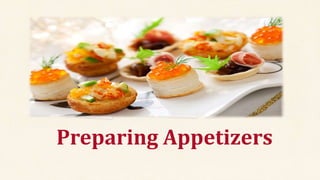
Preparing Appetizers
I. Performing Mise en place
WHAT IS MISE EN PLACE?
Mise en Place is a French culinary phrase
referring to the preparation of your
section, or area in a kitchen. The term
Mise en Place literally means "set in
place".
What Comprises the Mise en Place?
In a restaurant, mise en place refers to
everything that is done to make service as efficient
as possible. It encompasses everything involved in
“getting ready” and also keeping things in
order as service goes on. The more common
term side work is the same thing as mise en
place and some line cooks use the word meez, for
short. You also might hear chefs talk about “doing
the mise en place.”
Other Mise En Place Examples
•cutting and trimming meat, poultry, or fish
•washing and preparing vegetables (trimming,
chopping, dicing)
•preparing the kitchen for the next shift (which
may not be the same people)
II. Preparing Appetizers
HORS D’ OEUVRE AND
APPETIZERS
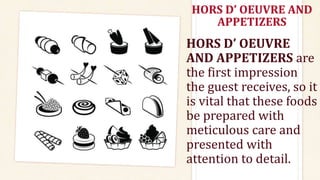
HORS D’ OEUVRE
AND APPETIZERS are
the first impression
the guest receives, so it
is vital that these foods
be prepared with
meticulous care and
presented with
attention to detail.
Different Types of Appetizers
•Appetizers are small portions or
bite-sized delicacies that are served
before a meal.
•Appetizers can be eaten during
cocktail hour or can serve as the only
meal at a casual party or small
gathering.
There are a variety of types of appetizers that make
for a delicious and filling treat.
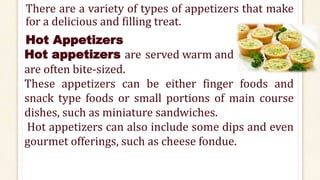
Hot Appetizers
Hot appetizers are served warm and
are often bite-sized.
These appetizers can be either finger foods and
snack type foods or small portions of main course
dishes, such as miniature sandwiches.
Hot appetizers can also include some dips and even
gourmet offerings, such as cheese fondue.
• HORS D’ OEUVRE
The term HORS D’ OEUVRE translates literally from the French
as outside the work”. These foods may be suitable for eating
with the fingers, as is the case with canapés, crudités and other
finger foods or they may require the use of plates and forks,
especially in the case of marinated vegetables or hot hors d’
oeuvres served in sauce.
• Hot HORS D’ OEUVRE
Include two or more hot HORS D’ OEUVRE in a reception menu
to give the impression of substance.
Hot HORS D’ OEUVRE may be presented in a pastry case for
example in puff pastry shells or encased in phyllo dough
When possible, use skewers or picks so that the guests do not
have to hold the food
• Finger foods are the natural choice for such
occasions as outdoor receptions, where the
guests will not be seated. The food itself should
be neat and essentially “self-contained”.
Cold Appetizers
Cold HORS D’ OEUVRE
Cold HORS D’ OEUVRE dishes may be served with a sauce or dip. Some
cold HORS D’ OEUVRE are served very cold; they may even be presented on a
bed of ice. Other type are served at room temperature.
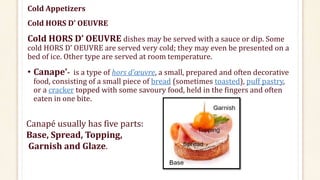
• Canape’- is a type of hors d’œuvre, a small, prepared and often decorative
food, consisting of a small piece of bread (sometimes toasted), puff pastry,
or a cracker topped with some savoury food, held in the fingers and often
eaten in one bite.
Canapé usually has five parts:
Base, Spread, Topping,
Garnish and Glaze.
• Antipasto
(plural antipasti) it is the traditional first course of a
formal Italian meal. Typical ingredients of a traditional
antipasto include cured meats, olives, pepperoncini,
mushrooms, anchovies, artichoke hearts, various cheeses (such
as provolone or mozzarella), pickled meats, and vegetables in oil
or vinegar.
The term “antipasto” was first used in 16th century Italy. Much
like French hors d’oeuvres and Spanish tapas, small bites
signified the beginning of a meal by stimulating the appetite
without filling the stomach. Antipasto is served at room
temperature and incorporates many colors, textures and flavors
to stimulate all of the senses before the main course.
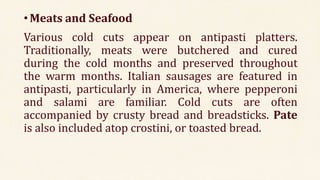
•Meats and Seafood
Various cold cuts appear on antipasti platters.
Traditionally, meats were butchered and cured
during the cold months and preserved throughout
the warm months. Italian sausages are featured in
antipasti, particularly in America, where pepperoni
and salami are familiar. Cold cuts are often
accompanied by crusty bread and breadsticks. Pate
is also included atop crostini, or toasted bread.
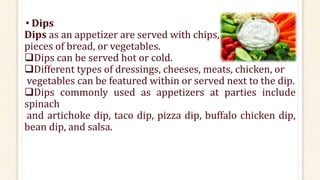
• Dips
Dips as an appetizer are served with chips,
pieces of bread, or vegetables.
Dips can be served hot or cold.
Different types of dressings, cheeses, meats, chicken, or
vegetables can be featured within or served next to the dip.
Dips commonly used as appetizers at parties include
spinach
and artichoke dip, taco dip, pizza dip, buffalo chicken dip,
bean dip, and salsa.
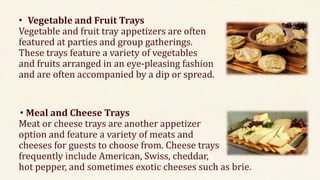
• Vegetable and Fruit Trays
Vegetable and fruit tray appetizers are often
featured at parties and group gatherings.
These trays feature a variety of vegetables
and fruits arranged in an eye-pleasing fashion
and are often accompanied by a dip or spread.
• Meal and Cheese Trays
Meat or cheese trays are another appetizer
option and feature a variety of meats and
cheeses for guests to choose from. Cheese trays
frequently include American, Swiss, cheddar,
hot pepper, and sometimes exotic cheeses such as brie.
Presenting Appetizers
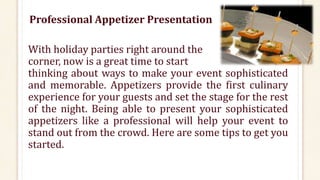
Professional Appetizer Presentation
With holiday parties right around the
corner, now is a great time to start
thinking about ways to make your event sophisticated
and memorable. Appetizers provide the first culinary
experience for your guests and set the stage for the rest
of the night. Being able to present your sophisticated
appetizers like a professional will help your event to
stand out from the crowd. Here are some tips to get you
started.
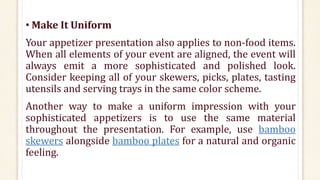
• Make It Uniform
Your appetizer presentation also applies to non-food items.
When all elements of your event are aligned, the event will
always emit a more sophisticated and polished look.
Consider keeping all of your skewers, picks, plates, tasting
utensils and serving trays in the same color scheme.
Another way to make a uniform impression with your
sophisticated appetizers is to use the same material
throughout the presentation. For example, use bamboo
skewers alongside bamboo plates for a natural and organic
feeling.
• Customize It
Show your guests that you have paid attention to every
detail by including custom extras. Add your logo, event
name or another particular indicator to specialty picks.
You can also customize items in other ways, such as
using labeled picks or skewers to indicate whether
different sandwiches are vegan or the temperature of a
meat appetizer. Remember, successful appetizer
presentation is also about staying organized.
• Introduce Color
Infuse color into your presentation with a surprise
ingredient. Add pineapple or dragon fruit on a beef kabob
to liven up the color. Garnish plates with a slice of fresh
fruit or drizzle them with a provocative color glaze.
Fresh basil or parsley is also a favorite option to add a bit
of color to the plate. Other produce options can add a zest
of color, such as carrots, oranges, raspberries, bell peppers
and spinach. This trick is especially effective if you use
white or neutral serving dishes because the colors pop.
• Roll Them Up
Many food presentation ideas are actually quite simple.
Give your appetizers an impressive flair by rolling them up.
This can take the shape of pin rolls, lettuce-wrapped
appetizers, cut wraps or cucumber feta rolls. Stick
a decorative pick into the center of each roll-up to keep
them in place.
Place each appetizer on its own small plate for an elegant
look. Arrange all of the little dishes on a large serving
platter in a circular pattern or a uniform pattern in which
all of the plates are spaced the same amount of distance
from each other. This technique is excellent for enhancing
the visual appeal of your party or event.
• Use Skewers
Using skewers allows you to create a visually inviting
setting without having to take up as much table space
as you would if placing everything in individual
compartments. Skewers can hold meats, but they can
also present a beautiful display of fruit or veggies. Add
olives, banana peppers, sandwich meats and cheese
together as a creative alternative to a sandwich.
• Put It in a Cup
Use small cups or shot glasses as the base for your
appetizer. Swirl purple onion, spinach and peppers
together at the bottom of a shot glass topped with a
cracker or mini bite for an artistic look. Use bamboo
tasting cups as an eco-friendly alternative for this tip.
Cups also work wonders as holders for dips to
accompany your other appetizers
Storing Appetizers
Guidelines in Storing Appetizer
• Appetizers are best served when made fresh, however this is not possible if
doing large number of portions. Examples are small samosas and mini
shashliks that can be prepared and frozen then cooked on the next day.
• Prepared food must be chilled until ready to serve.
• Prepared raw food can be stored and freeze for no longer than 3 days.
• Temperature is important in food storage. Ideal storeroom temperature is
between 10 to20°C, cool rooms at between 2 to 4°C, and freezer at between -
18 to -24°C.
• Perform the stock rotation. Stock rotation means putting all new stock to the
rear or back part of the storage area. This process is also known as F.I.F.O.
‘First In, First Out’ method. Stock the heavy items on the bottom shelves as
position is important when storing stock to make the containers stable.
Separate the storage of raw and cooked ingredients.
• Raw meats should not be placed above raw or cooked
food for it may drip and contaminate the food kept
below.
• Label the stock items, particularly the frozen items.
Labelling is important to identify the ingredient, date
and supplier details.
• Classify the commodities into three categories namely
perishable, semi-perishable and non-perishable.

3.appetizer.pptx

  • 1.
  • 2.
    I. Performing Miseen place WHAT IS MISE EN PLACE? Mise en Place is a French culinary phrase referring to the preparation of your section, or area in a kitchen. The term Mise en Place literally means "set in place".
  • 3.
    What Comprises theMise en Place? In a restaurant, mise en place refers to everything that is done to make service as efficient as possible. It encompasses everything involved in “getting ready” and also keeping things in order as service goes on. The more common term side work is the same thing as mise en place and some line cooks use the word meez, for short. You also might hear chefs talk about “doing the mise en place.”
  • 4.
    Other Mise EnPlace Examples •cutting and trimming meat, poultry, or fish •washing and preparing vegetables (trimming, chopping, dicing) •preparing the kitchen for the next shift (which may not be the same people)
  • 5.
  • 6.
    HORS D’ OEUVREAND APPETIZERS HORS D’ OEUVRE AND APPETIZERS are the first impression the guest receives, so it is vital that these foods be prepared with meticulous care and presented with attention to detail.
  • 7.
    Different Types ofAppetizers •Appetizers are small portions or bite-sized delicacies that are served before a meal. •Appetizers can be eaten during cocktail hour or can serve as the only meal at a casual party or small gathering.
  • 8.
    There are avariety of types of appetizers that make for a delicious and filling treat. Hot Appetizers Hot appetizers are served warm and are often bite-sized. These appetizers can be either finger foods and snack type foods or small portions of main course dishes, such as miniature sandwiches. Hot appetizers can also include some dips and even gourmet offerings, such as cheese fondue.
  • 9.
    • HORS D’OEUVRE The term HORS D’ OEUVRE translates literally from the French as outside the work”. These foods may be suitable for eating with the fingers, as is the case with canapés, crudités and other finger foods or they may require the use of plates and forks, especially in the case of marinated vegetables or hot hors d’ oeuvres served in sauce. • Hot HORS D’ OEUVRE Include two or more hot HORS D’ OEUVRE in a reception menu to give the impression of substance. Hot HORS D’ OEUVRE may be presented in a pastry case for example in puff pastry shells or encased in phyllo dough When possible, use skewers or picks so that the guests do not have to hold the food
  • 10.
    • Finger foodsare the natural choice for such occasions as outdoor receptions, where the guests will not be seated. The food itself should be neat and essentially “self-contained”.
  • 11.
    Cold Appetizers Cold HORSD’ OEUVRE Cold HORS D’ OEUVRE dishes may be served with a sauce or dip. Some cold HORS D’ OEUVRE are served very cold; they may even be presented on a bed of ice. Other type are served at room temperature. • Canape’- is a type of hors d’œuvre, a small, prepared and often decorative food, consisting of a small piece of bread (sometimes toasted), puff pastry, or a cracker topped with some savoury food, held in the fingers and often eaten in one bite. Canapé usually has five parts: Base, Spread, Topping, Garnish and Glaze.
  • 12.
    • Antipasto (plural antipasti)it is the traditional first course of a formal Italian meal. Typical ingredients of a traditional antipasto include cured meats, olives, pepperoncini, mushrooms, anchovies, artichoke hearts, various cheeses (such as provolone or mozzarella), pickled meats, and vegetables in oil or vinegar. The term “antipasto” was first used in 16th century Italy. Much like French hors d’oeuvres and Spanish tapas, small bites signified the beginning of a meal by stimulating the appetite without filling the stomach. Antipasto is served at room temperature and incorporates many colors, textures and flavors to stimulate all of the senses before the main course.
  • 13.
    •Meats and Seafood Variouscold cuts appear on antipasti platters. Traditionally, meats were butchered and cured during the cold months and preserved throughout the warm months. Italian sausages are featured in antipasti, particularly in America, where pepperoni and salami are familiar. Cold cuts are often accompanied by crusty bread and breadsticks. Pate is also included atop crostini, or toasted bread.
  • 14.
    • Dips Dips asan appetizer are served with chips, pieces of bread, or vegetables. Dips can be served hot or cold. Different types of dressings, cheeses, meats, chicken, or vegetables can be featured within or served next to the dip. Dips commonly used as appetizers at parties include spinach and artichoke dip, taco dip, pizza dip, buffalo chicken dip, bean dip, and salsa.
  • 15.
    • Vegetable andFruit Trays Vegetable and fruit tray appetizers are often featured at parties and group gatherings. These trays feature a variety of vegetables and fruits arranged in an eye-pleasing fashion and are often accompanied by a dip or spread. • Meal and Cheese Trays Meat or cheese trays are another appetizer option and feature a variety of meats and cheeses for guests to choose from. Cheese trays frequently include American, Swiss, cheddar, hot pepper, and sometimes exotic cheeses such as brie.
  • 16.
  • 17.
    Professional Appetizer Presentation Withholiday parties right around the corner, now is a great time to start thinking about ways to make your event sophisticated and memorable. Appetizers provide the first culinary experience for your guests and set the stage for the rest of the night. Being able to present your sophisticated appetizers like a professional will help your event to stand out from the crowd. Here are some tips to get you started.
  • 18.
    • Make ItUniform Your appetizer presentation also applies to non-food items. When all elements of your event are aligned, the event will always emit a more sophisticated and polished look. Consider keeping all of your skewers, picks, plates, tasting utensils and serving trays in the same color scheme. Another way to make a uniform impression with your sophisticated appetizers is to use the same material throughout the presentation. For example, use bamboo skewers alongside bamboo plates for a natural and organic feeling.
  • 19.
    • Customize It Showyour guests that you have paid attention to every detail by including custom extras. Add your logo, event name or another particular indicator to specialty picks. You can also customize items in other ways, such as using labeled picks or skewers to indicate whether different sandwiches are vegan or the temperature of a meat appetizer. Remember, successful appetizer presentation is also about staying organized.
  • 20.
    • Introduce Color Infusecolor into your presentation with a surprise ingredient. Add pineapple or dragon fruit on a beef kabob to liven up the color. Garnish plates with a slice of fresh fruit or drizzle them with a provocative color glaze. Fresh basil or parsley is also a favorite option to add a bit of color to the plate. Other produce options can add a zest of color, such as carrots, oranges, raspberries, bell peppers and spinach. This trick is especially effective if you use white or neutral serving dishes because the colors pop.
  • 21.
    • Roll ThemUp Many food presentation ideas are actually quite simple. Give your appetizers an impressive flair by rolling them up. This can take the shape of pin rolls, lettuce-wrapped appetizers, cut wraps or cucumber feta rolls. Stick a decorative pick into the center of each roll-up to keep them in place. Place each appetizer on its own small plate for an elegant look. Arrange all of the little dishes on a large serving platter in a circular pattern or a uniform pattern in which all of the plates are spaced the same amount of distance from each other. This technique is excellent for enhancing the visual appeal of your party or event.
  • 22.
    • Use Skewers Usingskewers allows you to create a visually inviting setting without having to take up as much table space as you would if placing everything in individual compartments. Skewers can hold meats, but they can also present a beautiful display of fruit or veggies. Add olives, banana peppers, sandwich meats and cheese together as a creative alternative to a sandwich.
  • 23.
    • Put Itin a Cup Use small cups or shot glasses as the base for your appetizer. Swirl purple onion, spinach and peppers together at the bottom of a shot glass topped with a cracker or mini bite for an artistic look. Use bamboo tasting cups as an eco-friendly alternative for this tip. Cups also work wonders as holders for dips to accompany your other appetizers
  • 24.
    Storing Appetizers Guidelines inStoring Appetizer • Appetizers are best served when made fresh, however this is not possible if doing large number of portions. Examples are small samosas and mini shashliks that can be prepared and frozen then cooked on the next day. • Prepared food must be chilled until ready to serve. • Prepared raw food can be stored and freeze for no longer than 3 days. • Temperature is important in food storage. Ideal storeroom temperature is between 10 to20°C, cool rooms at between 2 to 4°C, and freezer at between - 18 to -24°C. • Perform the stock rotation. Stock rotation means putting all new stock to the rear or back part of the storage area. This process is also known as F.I.F.O. ‘First In, First Out’ method. Stock the heavy items on the bottom shelves as position is important when storing stock to make the containers stable. Separate the storage of raw and cooked ingredients.
  • 25.
    • Raw meatsshould not be placed above raw or cooked food for it may drip and contaminate the food kept below. • Label the stock items, particularly the frozen items. Labelling is important to identify the ingredient, date and supplier details. • Classify the commodities into three categories namely perishable, semi-perishable and non-perishable.

Editor's Notes

  • #2 NOTE: To replace a picture, just select and delete it. Then use the Insert Picture icon to replace it with one of your own!