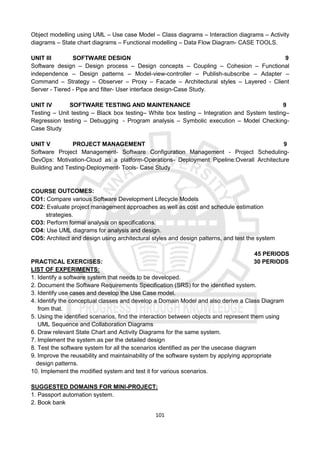
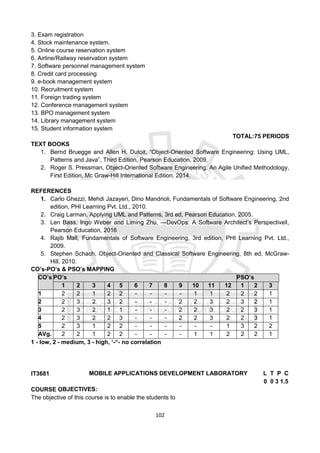
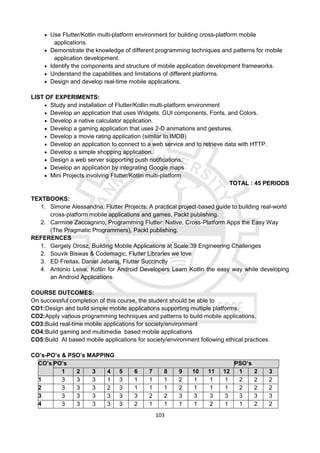
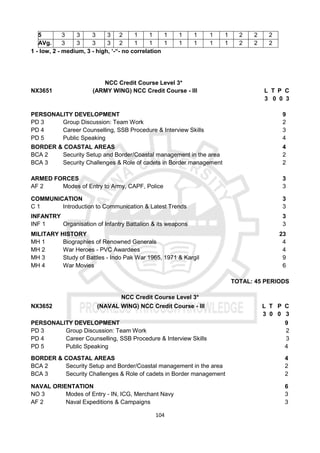
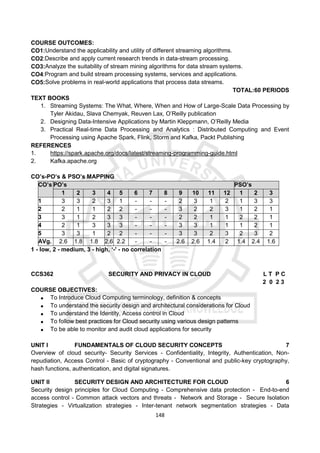
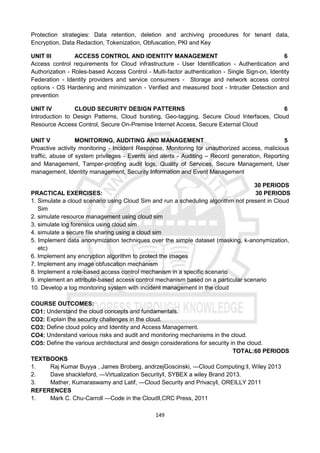
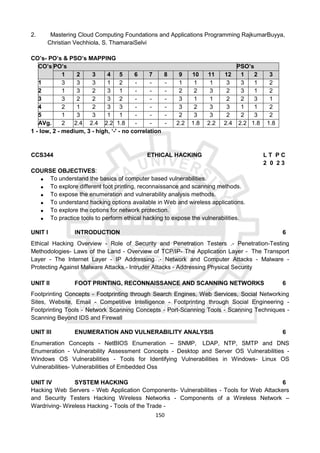
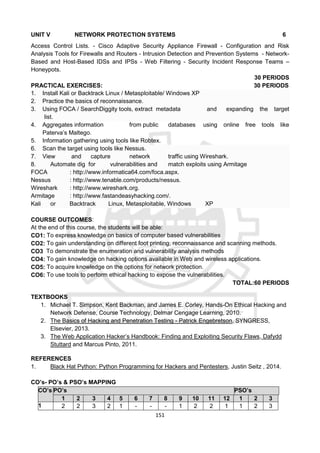
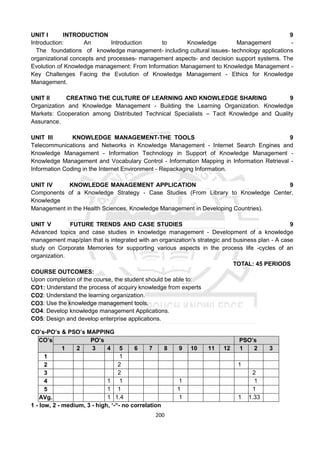
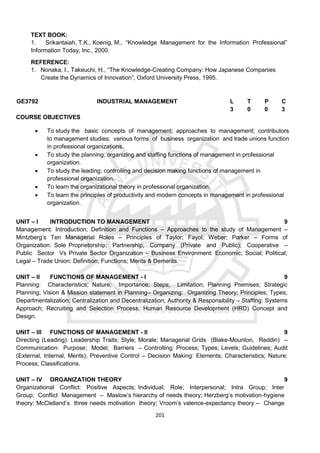
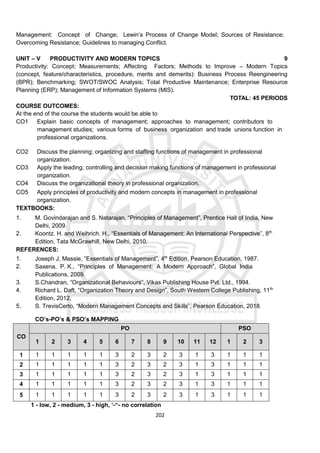
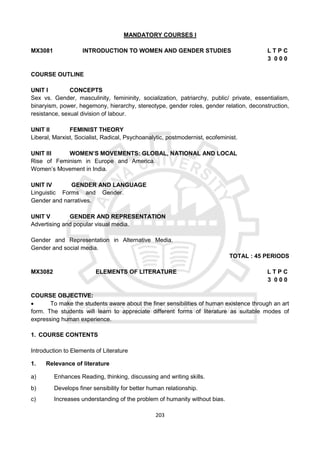
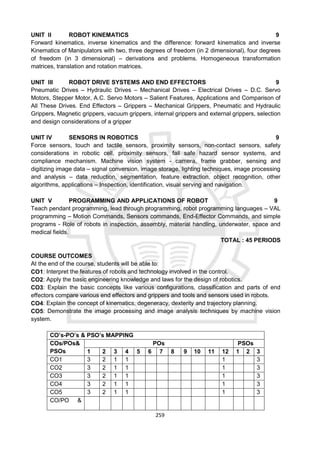
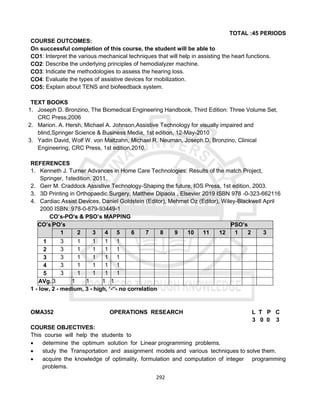
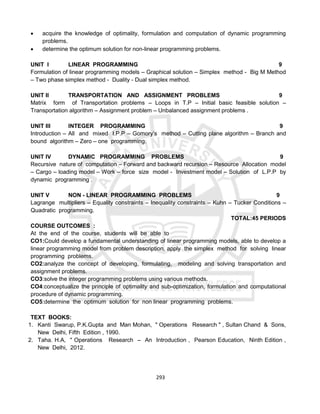
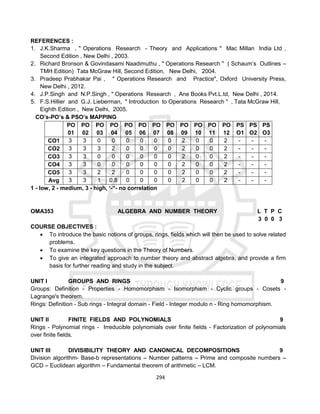
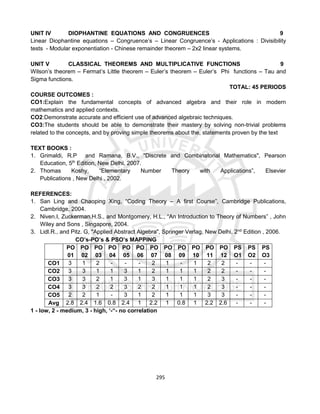
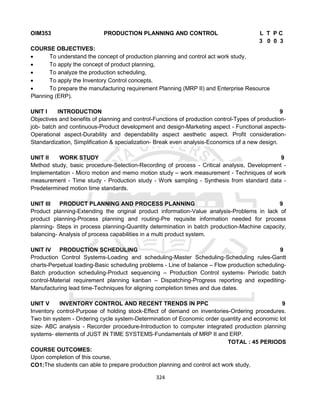
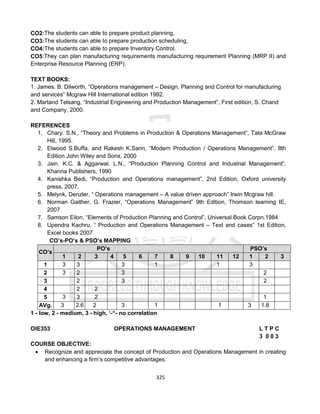
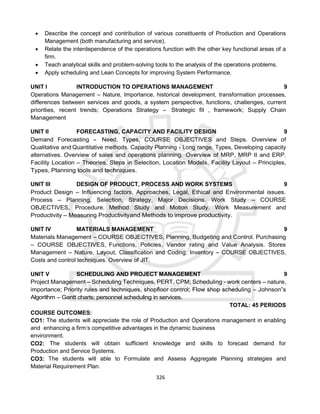
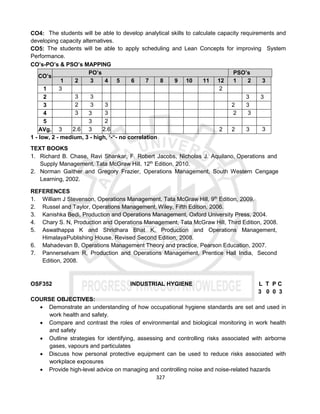
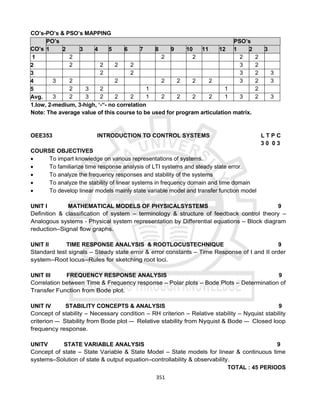
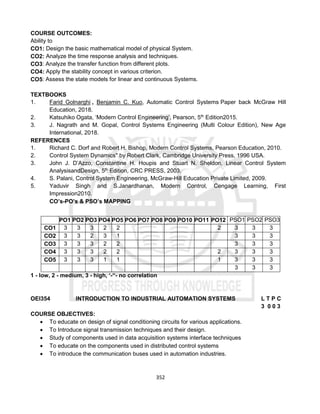
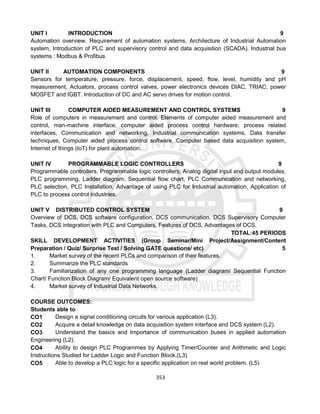
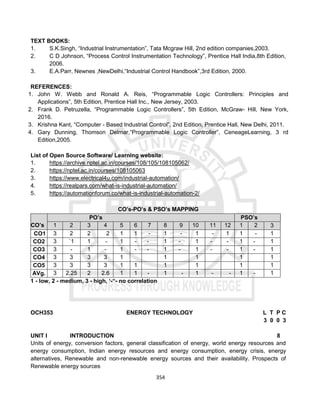
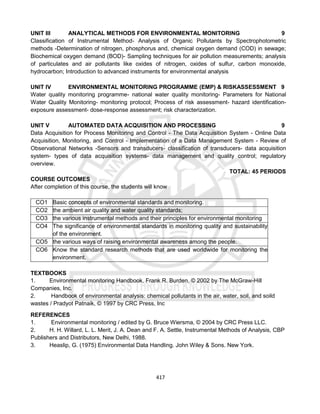
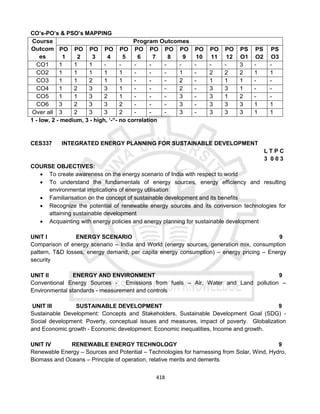
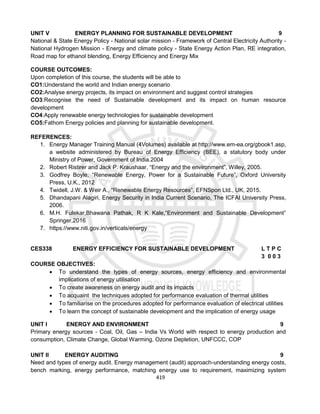
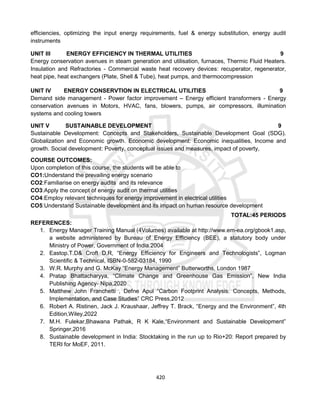
1
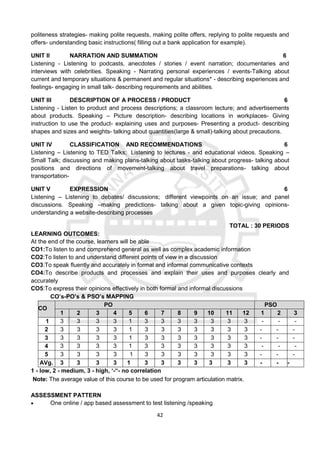
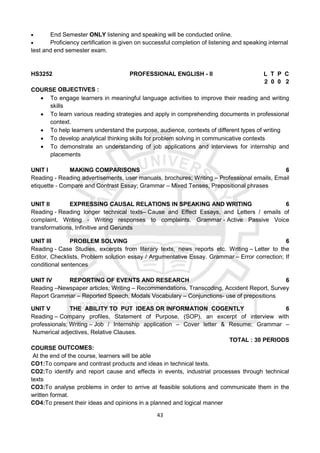
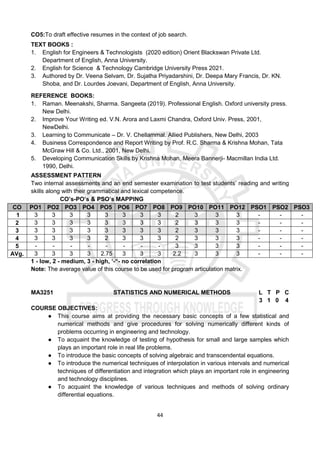
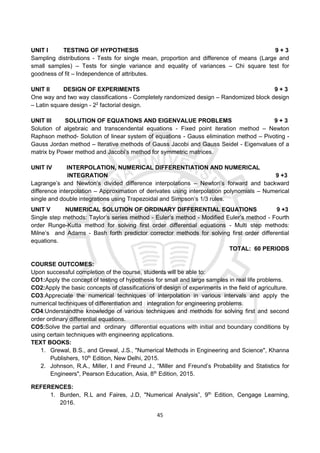
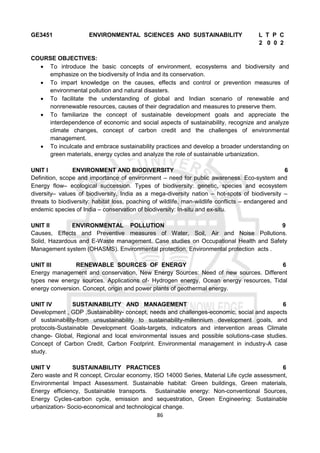
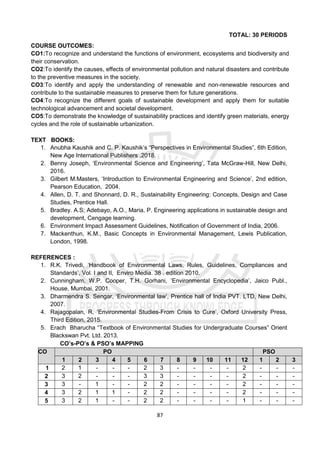
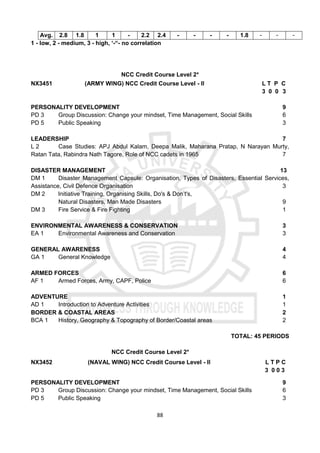
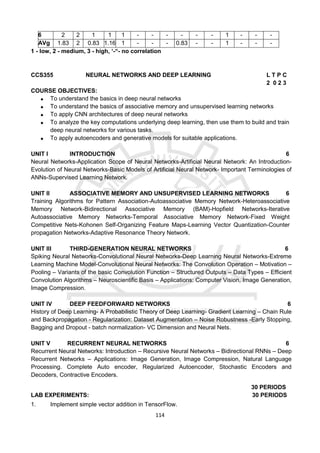
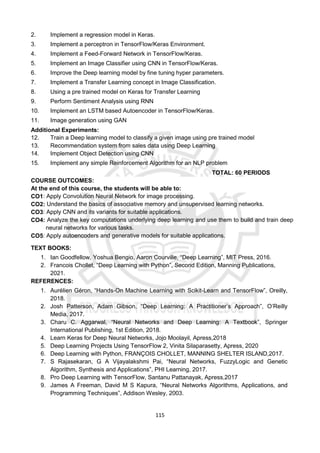
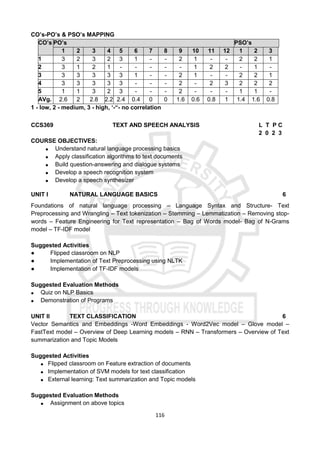
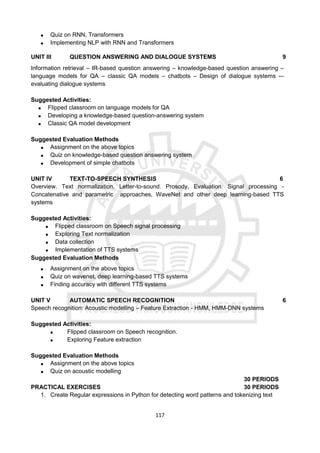
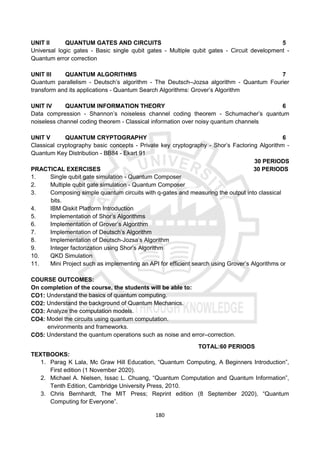
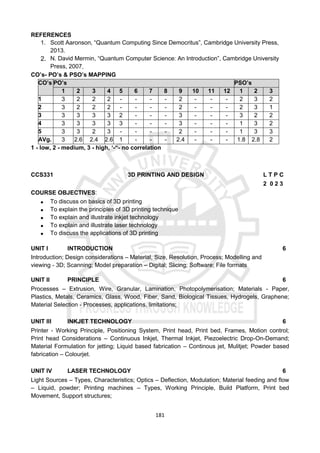
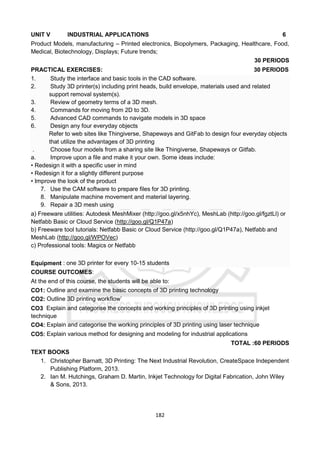
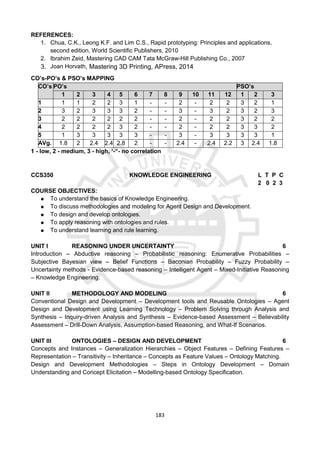
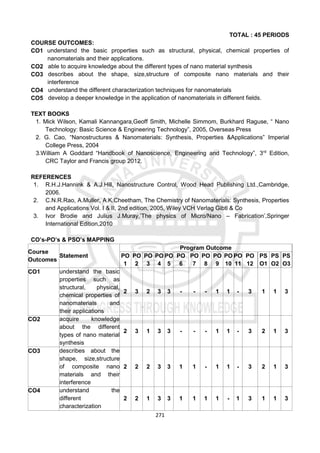
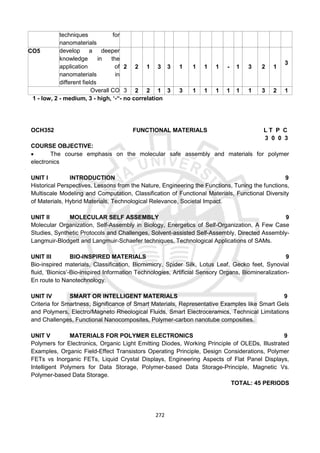
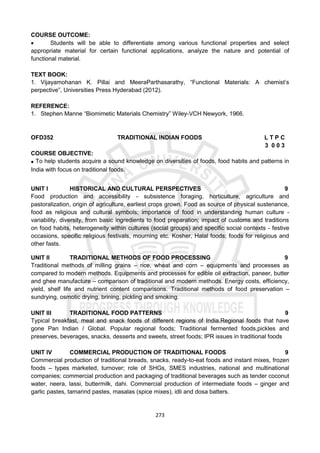
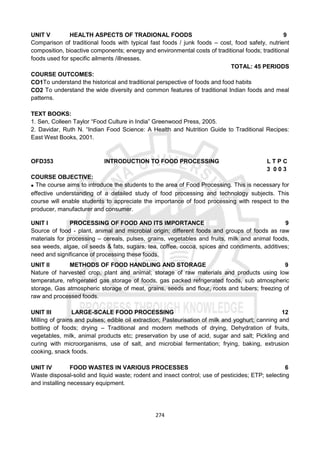
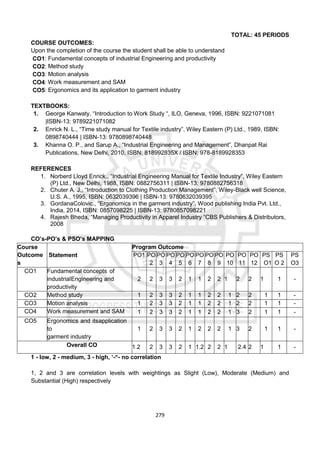
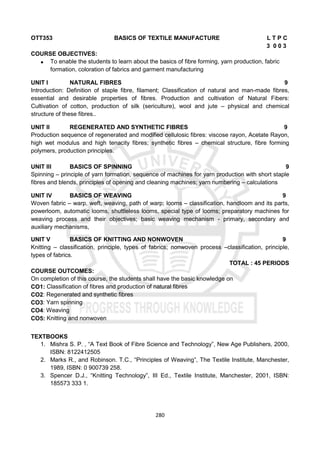
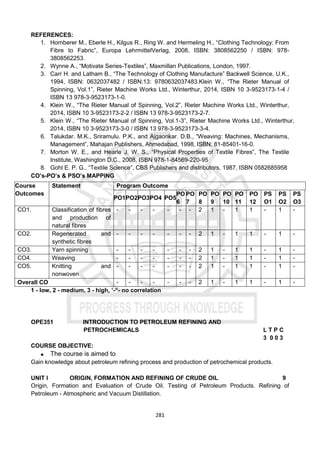
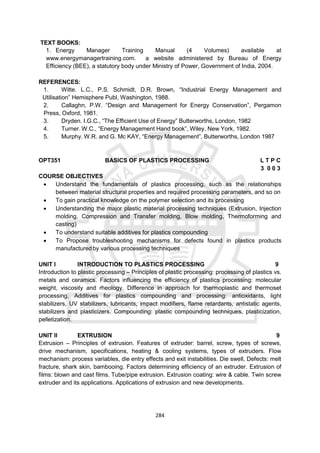
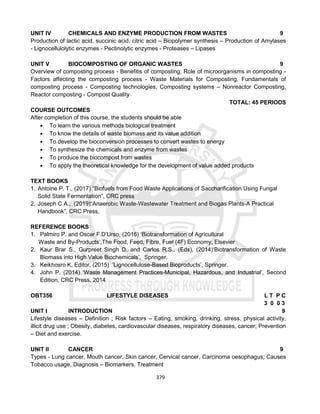
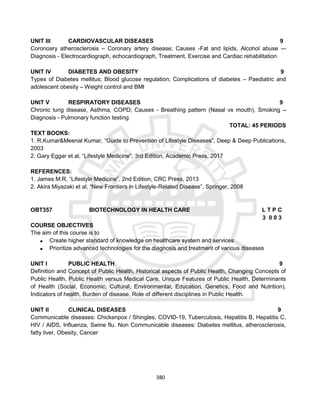
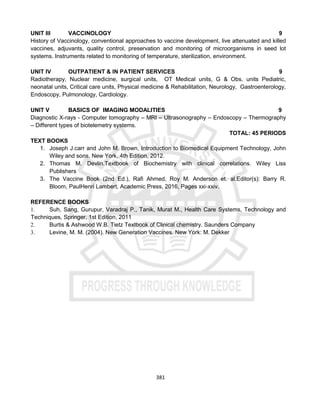
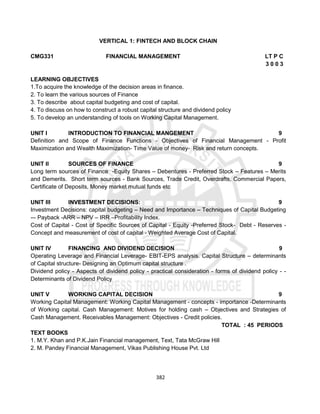
ANNA UNIVERSITY, CHENNAI
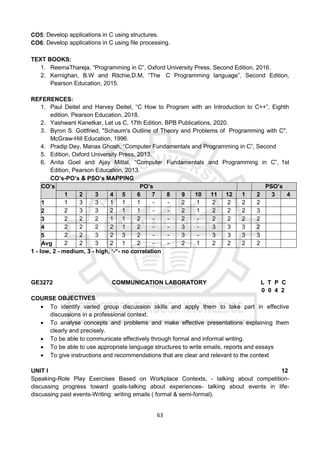
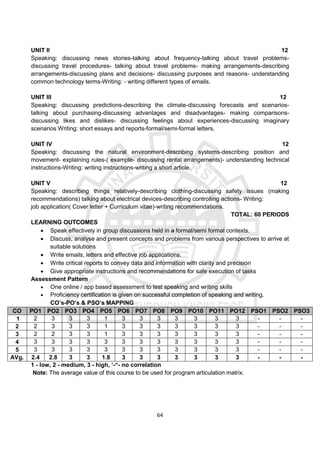
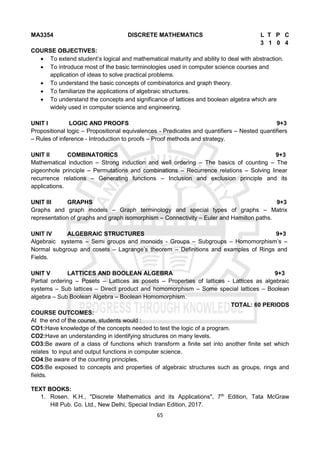
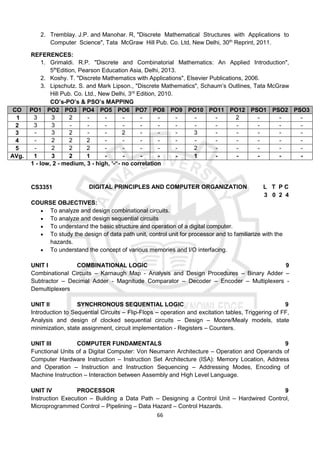
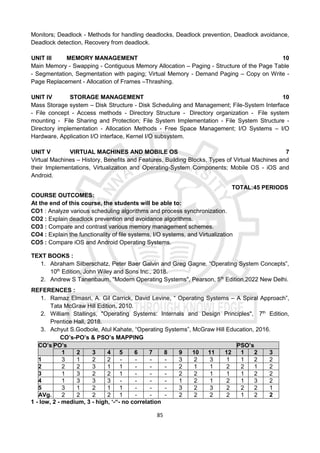
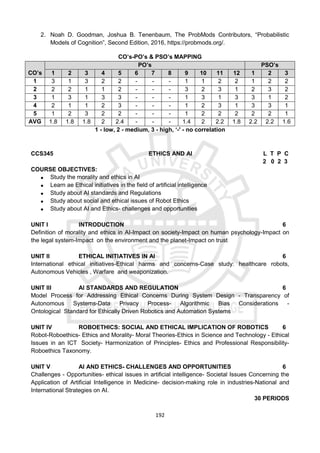
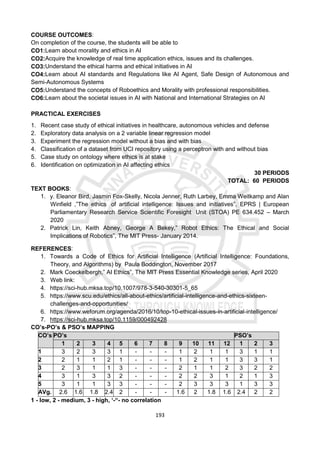
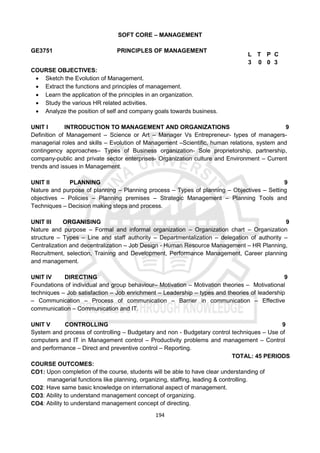
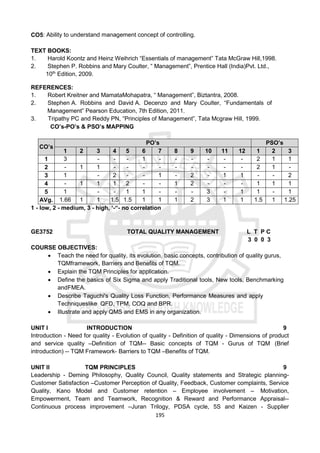
NON- AUTONOMOUS AFFILIATED COLLEGES
REGULATIONS 2021
CHOICE BASED CREDIT SYSTEM
I. PROGRAM EDUCATIONAL OBJECTIVES (PEOs)
Graduates will be able to
 Demonstrate technical competence with analytical and critical thinking to understand and
meet the diversified requirements of industry, academia and research.
 Exhibit technical leadership, team skills and entrepreneurship skills to provide business
solutions to real world problems.
 Work in multi-disciplinary industries with social and environmental responsibility, work
ethics and adaptability to address complex engineering and social problems
 Pursue lifelong learning, use cutting edge technologies and involve in applied research to
design optimal solutions.
II. PROGRAM OUTCOMES (POs)
1 Engineering knowledge: Apply the knowledge of mathematics, science, engineering
fundamentals, and an engineering specialization to the solution of complex engineering
problems.
2 Problem analysis: Identify, formulate, review research literature, and analyze complex
engineering problems reaching substantiated conclusions using first principles of
mathematics, natural sciences, and engineering sciences.
3 Design/development of solutions: Design solutions for complex engineering problems and
design system components or processes that meet the specified needs with appropriate
consideration for the public health and safety, and the cultural, societal, and environmental
considerations.
4 Conduct investigations of complex problems: Use research-based knowledge
and research methods including design of experiments, analysis and interpretation of data,
and synthesis of the information to provide valid conclusions.
5 Modern tool usage: Create, select, and apply appropriate techniques, resources, and
modern engineering and IT tools including prediction and modeling to complex engineering
activities with an understanding of the limitations.
6 The engineer and society: Apply reasoning informed by the contextual knowledge to
assess societal, health, safety, legal and cultural issues and the consequent
responsibilities relevant to the professional engineering practice.
7 Environment and sustainability: Understand the impact of the professional engineering
solutions in societal and environmental contexts, and demonstrate the knowledge of, and need
for sustainable development.
B.TECH. INFORMATION TECHNOLOGY
2
8 Ethics: Apply ethical principles and commit to professional ethics and responsibilities and
norms of the engineering practice.
9 Individual and team work: Function effectively as an individual, and as a member or
leader in diverse teams, and in multidisciplinary settings.
10 Communication: Communicate effectively on complex engineering activities with the
engineering community and with society at large, such as, being able to comprehend and write
effective reports and design documentation, make effective presentations, and give and
receive clear instructions.
11 Project management and finance: Demonstrate knowledge and understanding of the
engineering and management principles and apply these to one’s own work, as a member and
leader in a team, to manage projects and in multidisciplinary environments
12 Life-long learning: Recognize the need for, and have the preparation and ability to
engage in independent and life-long learning in the broadest context of technological
change.
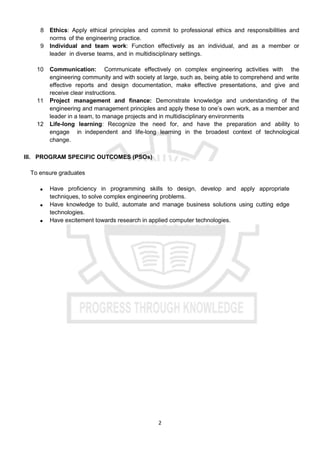
III. PROGRAM SPECIFIC OUTCOMES (PSOs)
To ensure graduates
 Have proficiency in programming skills to design, develop and apply appropriate
techniques, to solve complex engineering problems.
 Have knowledge to build, automate and manage business solutions using cutting edge
technologies.
 Have excitement towards research in applied computer technologies.
3
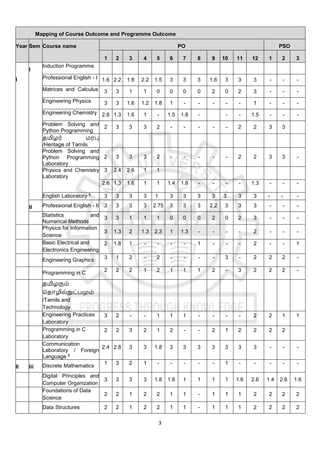
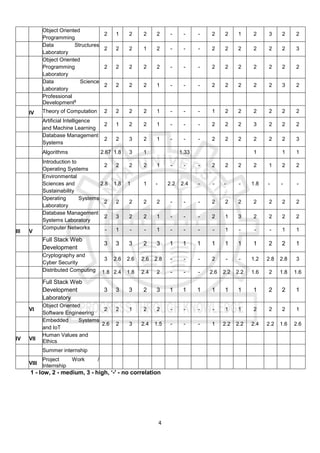
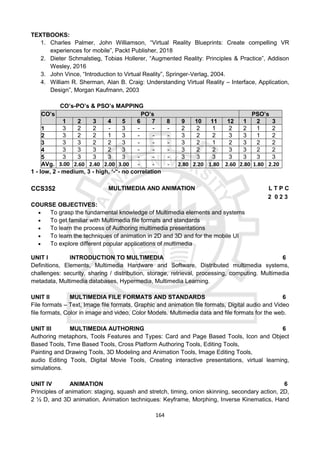
Mapping of Course Outcome and Programme Outcome
Year Sem Course name PO PSO
1 2 3 4 5 6 7 8 9 10 11 12 1 2 3
I
I
Induction Programme
Professional English - I 1.6 2.2 1.8 2.2 1.5 3 3 3 1.6 3 3 3 - - -
Matrices and Calculus 3 3 1 1 0 0 0 0 2 0 2 3 - - -
Engineering Physics 3 3 1.6 1.2 1.8 1 - - - - - 1 - - -
Engineering Chemistry 2.8 1.3 1.6 1 - 1.5 1.8 - - - 1.5 - - -
Problem Solving and
Python Programming
2 3 3 3 2 - - - - - 2 2 3 3
தமிழர் மரபு
/Heritage of Tamils
Problem Solving and
Python Programming
Laboratory
2 3 3 3 2 - - - - - 2 2 3 3 -
Physics and Chemistry
Laboratory
3 2.4 2.6 1 1
2.6 1.3 1.6 1 1 1.4 1.8 - - - - 1.3 - - -
English Laboratory $
3 3 3 3 1 3 3 3 3 3 3 3 - - -
II Professional English - II 3 3 3 3 2.75 3 3 3 2.2 3 3 3 - - -
Statistics and
Numerical Methods
3 3 1 1 1 0 0 0 2 0 2 3 - - -
Physics for Information
Science
3 1.3 2 1.3 2.3 1 1.3 - - - - 2 - - -
Basic Electrical and
Electronics Engineering
2 1.8 1 - - - - 1 - - - 2 - - 1
Engineering Graphics 3 1 2 - 2 - - - - 3 - 2 2 2 -
Programming in C 2 2 2 1 2 1 1 1 2 - 3 2 2 2 -
தமிழரும்
ததொழில்நுட்பமும்
/Tamils and
Technology
Engineering Practices
Laboratory
3 2 - - 1 1 1 - - - - 2 2 1 1
Programming in C
Laboratory
2 2 3 2 1 2 - - 2 1 2 2 2 2
Communication
Laboratory / Foreign
Language $
2.4 2.8 3 3 1.8 3 3 3 3 3 3 3 - - -
II Iii Discrete Mathematics
1 3 2 1 - - - - - 1 - - - - -
Digital Principles and
Computer Organization
3 3 3 3 1.8 1.6 1 1 1 1 1.6 2.6 1.4 2.6 1.6
Foundations of Data
Science
2 2 1 2 2 1 1 - 1 1 1 2 2 2 2
Data Structures 2 2 1 2 2 1 1 - 1 1 1 2 2 2 2
4
Object Oriented
Programming
2 1 2 2 2 - - - 2 2 1 2 3 2 2
Data Structures
Laboratory
2 2 2 1 2 - - - 2 2 2 2 2 2 3
Object Oriented
Programming
Laboratory
2 2 2 2 2 - - - 2 2 2 2 2 2 2
Data Science
Laboratory
2 2 2 2 1 - - - 2 2 2 2 2 3 2
Professional
Development$
IV Theory of Computation 2 2 2 2 1 - - - 1 2 2 2 2 2 2
Artificial Intelligence
and Machine Learning
2 1 2 2 1 - - - 2 2 2 3 2 2 2
Database Management
Systems
2 2 3 2 1 - - - 2 2 2 2 2 2 3
Algorithms 2.67 1.8 3 1 1.33 1 1 1
Introduction to
Operating Systems
2 2 2 2 1 - - - 2 2 2 2 1 2 2
Environmental
Sciences and
Sustainability
2.8 1.8 1 1 - 2.2 2.4 - - - - 1.8 - - -
Operating Systems
Laboratory
2 2 2 2 2 - - - 2 2 2 2 2 2 2
Database Management
Systems Laboratory
2 3 2 2 1 - - - 2 1 3 2 2 2 2
III V
Computer Networks - 1 - - 1 - - - - 1 - - - 1 1
Full Stack Web
Development
3 3 3 2 3 1 1 1 1 1 1 1 2 2 1
Cryptography and
Cyber Security
3 2.6 2.6 2.6 2.8 - - - 2 - - 1.2 2.8 2.8 3
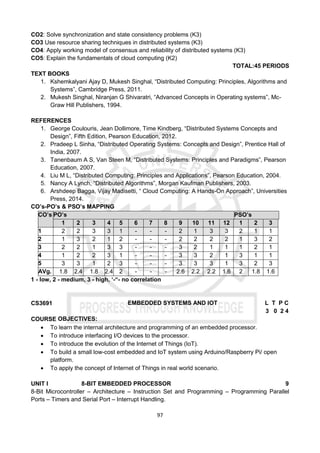
Distributed Computing 1.8 2.4 1.8 2.4 2 - - - 2.6 2.2 2.2 1.6 2 1.8 1.6
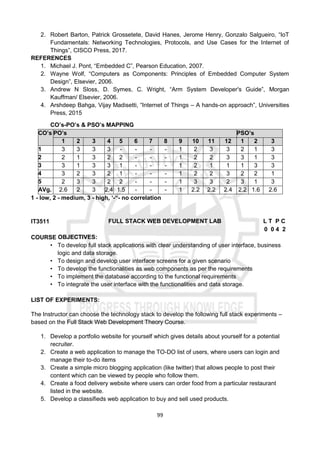
Full Stack Web
Development
Laboratory
3 3 3 2 3 1 1 1 1 1 1 1 2 2 1
VI
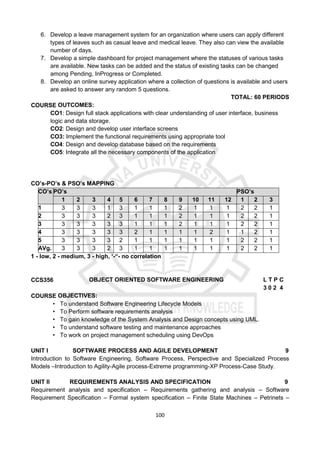
Object Oriented
Software Engineering
2 2 1 2 2 - - - - 1 1 2 2 2 1
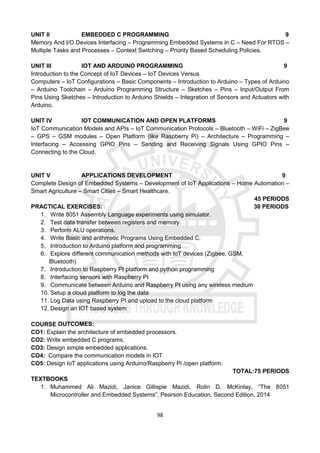
Embedded Systems
and IoT
2.6 2 3 2.4 1.5 - - - 1 2.2 2.2 2.4 2.2 1.6 2.6
IV VII
Human Values and
Ethics
Summer internship
VIII
Project Work /
Internship
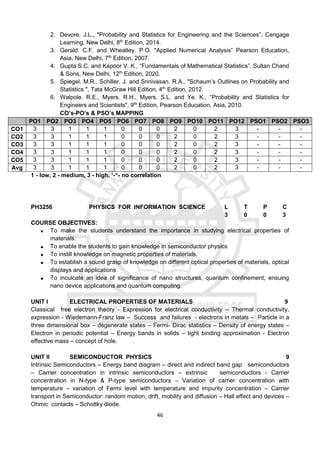
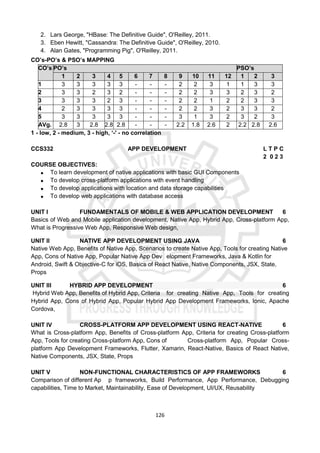
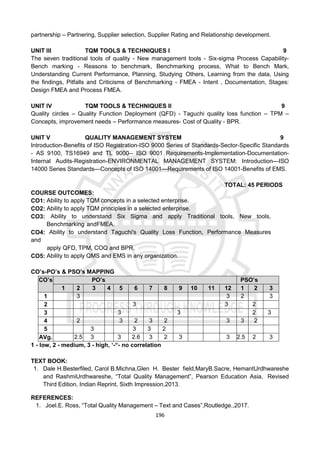
1 - low, 2 - medium, 3 - high, ‘-' - no correlation
5
ANNA UNIVERSITY, CHENNAI
NON- AUTONOMOUS AFFILIATED COLLEGES
REGULATIONS 2021
B. TECH. INFORMATION TECHNOLOGY
CHOICE BASED CREDIT SYSTEM
CURRICULUM AND SYLLABI FOR SEMESTERS I TO VIII
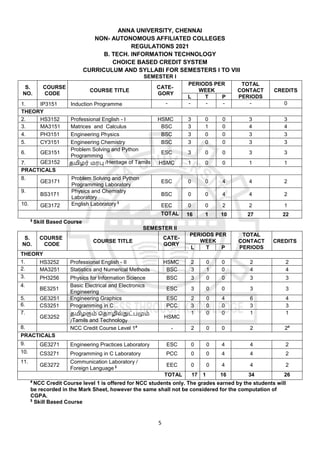
SEMESTER I
S.
NO.
COURSE
CODE
COURSE TITLE
CATE-
GORY
PERIODS PER
WEEK
TOTAL
CONTACT
PERIODS
CREDITS
L T P
1. IP3151 Induction Programme - - - - - 0
THEORY
2. HS3152 Professional English - I HSMC 3 0 0 3 3
3. MA3151 Matrices and Calculus BSC 3 1 0 4 4
4. PH3151 Engineering Physics BSC 3 0 0 3 3
5. CY3151 Engineering Chemistry BSC 3 0 0 3 3
6. GE3151
Problem Solving and Python
Programming
ESC 3 0 0 3 3
7. GE3152 தமிழர் மரபு /Heritage of Tamils HSMC 1 0 0 1 1
PRACTICALS
8.
GE3171
Problem Solving and Python
Programming Laboratory
ESC 0 0 4 4 2
9.
BS3171
Physics and Chemistry
Laboratory
BSC 0 0 4 4 2
10. GE3172 English Laboratory $
EEC 0 0 2 2 1
TOTAL 16 1 10 27 22
$
Skill Based Course
SEMESTER II
S.
NO.
COURSE
CODE
COURSE TITLE
CATE-
GORY
PERIODS PER
WEEK
TOTAL
CONTACT
PERIODS
CREDITS
L T P
THEORY
1. HS3252 Professional English - II HSMC 2 0 0 2 2
2. MA3251 Statistics and Numerical Methods BSC 3 1 0 4 4
3. PH3256 Physics for Information Science BSC 3 0 0 3 3
4.
BE3251
Basic Electrical and Electronics
Engineering
ESC 3 0 0 3 3
5. GE3251 Engineering Graphics ESC 2 0 4 6 4
6. CS3251 Programming in C PCC 3 0 0 3 3
7.
GE3252
தமிழரும் ததொழில்நுட்பமும்
/Tamils and Technology
HSMC
1 0 0 1 1
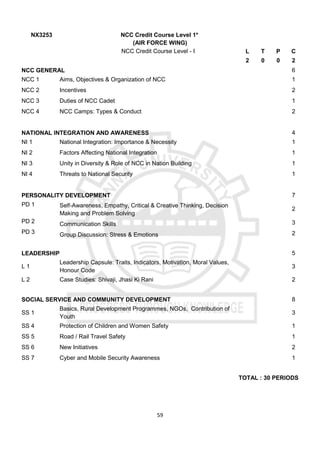
8. NCC Credit Course Level 1#
- 2 0 0 2 2#
PRACTICALS
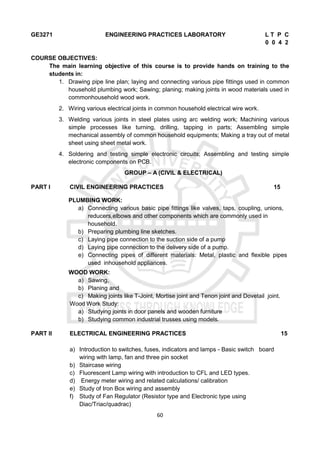
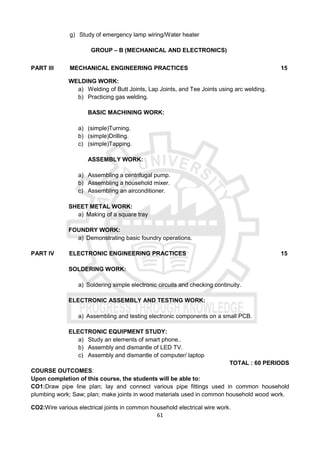
9. GE3271 Engineering Practices Laboratory ESC 0 0 4 4 2
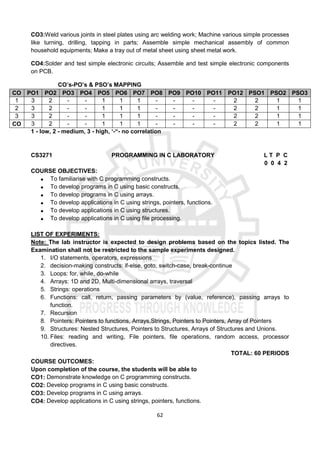
10. CS3271 Programming in C Laboratory PCC 0 0 4 4 2
11.
GE3272
Communication Laboratory /
Foreign Language $ EEC 0 0 4 4 2
TOTAL 17 1 16 34 26
#
NCC Credit Course level 1 is offered for NCC students only. The grades earned by the students will
be recorded in the Mark Sheet, however the same shall not be considered for the computation of
CGPA.
$
Skill Based Course
6
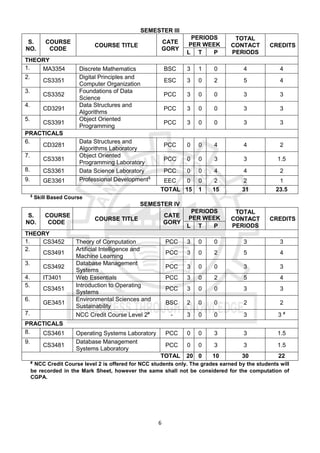
SEMESTER III
S.
NO.
COURSE
CODE
COURSE TITLE
CATE
GORY
PERIODS
PER WEEK
TOTAL
CONTACT
PERIODS
CREDITS
L T P
THEORY
1. MA3354 Discrete Mathematics BSC 3 1 0 4 4
2.
CS3351
Digital Principles and
Computer Organization
ESC 3 0 2 5 4
3.
CS3352
Foundations of Data
Science
PCC 3 0 0 3 3
4.
CD3291
Data Structures and
Algorithms
PCC 3 0 0 3 3
5.
CS3391
Object Oriented
Programming
PCC 3 0 0 3 3
PRACTICALS
6.
CD3281
Data Structures and
Algorithms Laboratory
PCC 0 0 4 4 2
7.
CS3381
Object Oriented
Programming Laboratory
PCC 0 0 3 3 1.5
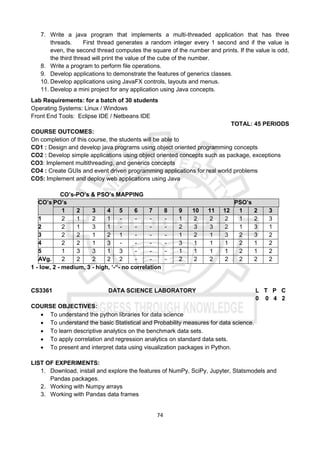
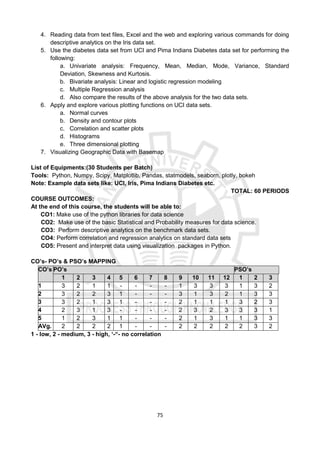
8. CS3361 Data Science Laboratory PCC 0 0 4 4 2
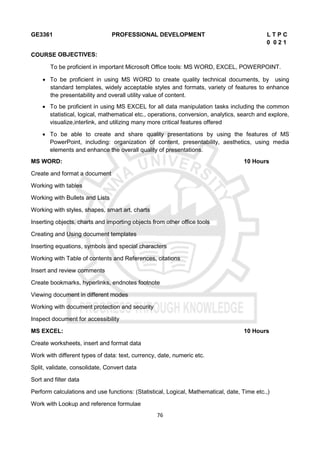
9. GE3361 Professional Development$
EEC 0 0 2 2 1
TOTAL 15 1 15 31 23.5
$
Skill Based Course
SEMESTER IV
S.
NO.
COURSE
CODE
COURSE TITLE
CATE
GORY
PERIODS
PER WEEK
TOTAL
CONTACT
PERIODS
CREDITS
L T P
THEORY
1. CS3452 Theory of Computation PCC 3 0 0 3 3
2.
CS3491
Artificial Intelligence and
Machine Learning
PCC 3 0 2 5 4
3.
CS3492
Database Management
Systems
PCC 3 0 0 3 3
4. IT3401 Web Essentials PCC 3 0 2 5 4
5.
CS3451
Introduction to Operating
Systems
PCC 3 0 0 3 3
6.
GE3451
Environmental Sciences and
Sustainability
BSC 2 0 0 2 2
7. NCC Credit Course Level 2#
- 3 0 0 3 3 #
PRACTICALS
8. CS3461 Operating Systems Laboratory PCC 0 0 3 3 1.5
9.
CS3481
Database Management
Systems Laboratory
PCC 0 0 3 3 1.5
TOTAL 20 0 10 30 22
# NCC Credit Course level 2 is offered for NCC students only. The grades earned by the students will
be recorded in the Mark Sheet, however the same shall not be considered for the computation of
CGPA.
7
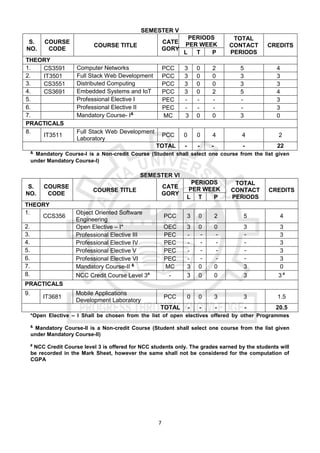
SEMESTER V
S.
NO.
COURSE
CODE
COURSE TITLE
CATE
GORY
PERIODS
PER WEEK
TOTAL
CONTACT
PERIODS
CREDITS
L T P
THEORY
1. CS3591 Computer Networks PCC 3 0 2 5 4
2. IT3501 Full Stack Web Development PCC 3 0 0 3 3
3. CS3551 Distributed Computing PCC 3 0 0 3 3
4. CS3691 Embedded Systems and IoT PCC 3 0 2 5 4
5. Professional Elective I PEC - - - - 3
6. Professional Elective II PEC - - - - 3
7. Mandatory Course- I&
MC 3 0 0 3 0
PRACTICALS
8.
IT3511
Full Stack Web Development
Laboratory
PCC 0 0 4 4 2
TOTAL - - - - 22
& Mandatory Course-I is a Non-credit Course (Student shall select one course from the list given
under Mandatory Course-I)
SEMESTER VI
S.
NO.
COURSE
CODE
COURSE TITLE
CATE
GORY
PERIODS
PER WEEK
TOTAL
CONTACT
PERIODS
CREDITS
L T P
THEORY
1.
CCS356
Object Oriented Software
Engineering
PCC 3 0 2 5 4
2. Open Elective – I* OEC 3 0 0 3 3
3. Professional Elective III PEC - - - - 3
4. Professional Elective IV PEC - - - - 3
5. Professional Elective V PEC - - - - 3
6. Professional Elective VI PEC - - - - 3
7. Mandatory Course-II &
MC 3 0 0 3 0
8. NCC Credit Course Level 3#
- 3 0 0 3 3 #
PRACTICALS
9.
IT3681
Mobile Applications
Development Laboratory
PCC 0 0 3 3 1.5
TOTAL - - - - 20.5
*Open Elective – I Shall be chosen from the list of open electives offered by other Programmes
&
Mandatory Course-II is a Non-credit Course (Student shall select one course from the list given
under Mandatory Course-II)
#
NCC Credit Course level 3 is offered for NCC students only. The grades earned by the students will
be recorded in the Mark Sheet, however the same shall not be considered for the computation of
CGPA
8
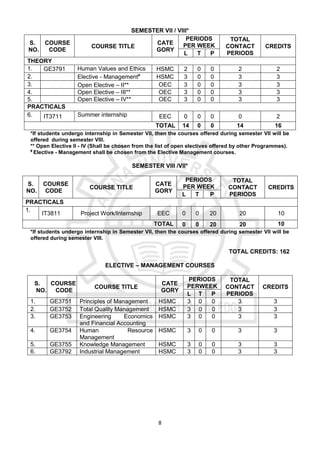
SEMESTER VII / VIII*
S.
NO.
COURSE
CODE
COURSE TITLE
CATE
GORY
PERIODS
PER WEEK
TOTAL
CONTACT
PERIODS
CREDITS
L T P
THEORY
1. GE3791 Human Values and Ethics HSMC 2 0 0 2 2
2. Elective - Management#
HSMC 3 0 0 3 3
3. Open Elective – II** OEC 3 0 0 3 3
4. Open Elective – III** OEC 3 0 0 3 3
5. Open Elective – IV** OEC 3 0 0 3 3
PRACTICALS
6. IT3711 Summer internship EEC 0 0 0 0 2
TOTAL 14 0 0 14 16
*If students undergo internship in Semester VII, then the courses offered during semester VII will be
offered during semester VIII.
** Open Elective II - IV (Shall be chosen from the list of open electives offered by other Programmes).
#
Elective - Management shall be chosen from the Elective Management courses.
SEMESTER VIII /VII*
S.
NO.
COURSE
CODE
COURSE TITLE
CATE
GORY
PERIODS
PER WEEK
TOTAL
CONTACT
PERIODS
CREDITS
L T P
PRACTICALS
1.
IT3811 Project Work/Internship EEC 0 0 20 20 10
TOTAL 0 0 20 20 10
*If students undergo internship in Semester VII, then the courses offered during semester VII will be
offered during semester VIII.
TOTAL CREDITS: 162
ELECTIVE – MANAGEMENT COURSES
S.
NO.
COURSE
CODE
COURSE TITLE
CATE
GORY
PERIODS
PERWEEK
TOTAL
CONTACT
PERIODS
CREDITS
L T P
1. GE3751 Principles of Management HSMC 3 0 0 3 3
2. GE3752 Total Quality Management HSMC 3 0 0 3 3
3. GE3753 Engineering Economics
and Financial Accounting
HSMC 3 0 0 3 3
4. GE3754 Human Resource
Management
HSMC 3 0 0 3 3
5. GE3755 Knowledge Management HSMC 3 0 0 3 3
6. GE3792 Industrial Management HSMC 3 0 0 3 3
9
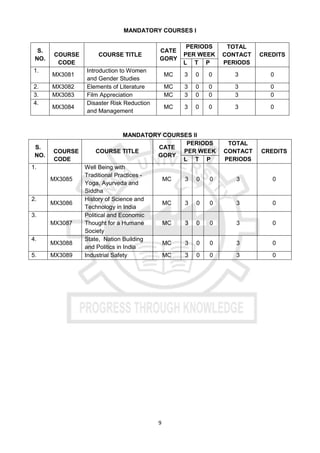
MANDATORY COURSES I
S.
NO.
COURSE
CODE
COURSE TITLE
CATE
GORY
PERIODS
PER WEEK
TOTAL
CONTACT
PERIODS
CREDITS
L T P
1.
MX3081
Introduction to Women
and Gender Studies
MC 3 0 0 3 0
2. MX3082 Elements of Literature MC 3 0 0 3 0
3. MX3083 Film Appreciation MC 3 0 0 3 0
4.
MX3084
Disaster Risk Reduction
and Management
MC 3 0 0 3 0
MANDATORY COURSES II
S.
NO.
COURSE
CODE
COURSE TITLE
CATE
GORY
PERIODS
PER WEEK
TOTAL
CONTACT
PERIODS
CREDITS
L T P
1.
MX3085
Well Being with
Traditional Practices -
Yoga, Ayurveda and
Siddha
MC 3 0 0 3 0
2.
MX3086
History of Science and
Technology in India
MC 3 0 0 3 0
3.
MX3087
Political and Economic
Thought for a Humane
Society
MC 3 0 0 3 0
4.
MX3088
State, Nation Building
and Politics in India
MC 3 0 0 3 0
5. MX3089 Industrial Safety MC 3 0 0 3 0
10
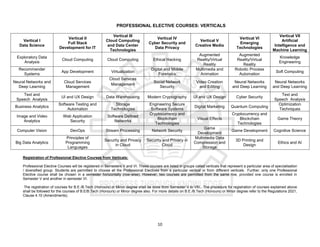
PROFESSIONAL ELECTIVE COURSES: VERTICALS
Registration of Professional Elective Courses from Verticals:
Professional Elective Courses will be registered in Semesters V and VI. These courses are listed in groups called verticals that represent a particular area of specialisation
/ diversified group. Students are permitted to choose all the Professional Electives from a particular vertical or from different verticals. Further, only one Professional
Elective course shall be chosen in a semester horizontally (row-wise). However, two courses are permitted from the same row, provided one course is enrolled in
Semester V and another in semester VI.
The registration of courses for B.E./B.Tech (Honours) or Minor degree shall be done from Semester V to VIII. The procedure for registration of courses explained above
shall be followed for the courses of B.E/B.Tech (Honours) or Minor degree also. For more details on B.E./B.Tech (Honours) or Minor degree refer to the Regulations 2021,
Clause 4.10 (Amendments).
Vertical I
Data Science
Vertical II
Full Stack
Development for IT
Vertical III
Cloud Computing
and Data Center
Technologies
Vertical IV
Cyber Security and
Data Privacy
Vertical V
Creative Media
Vertical VI
Emerging
Technologies
Vertical VII
Artificial
Intelligence and
Machine Learning
Exploratory Data
Analysis
Cloud Computing Cloud Computing Ethical Hacking
Augmented
Reality/Virtual
Reality
Augmented
Reality/Virtual
Reality
Knowledge
Engineering
Recommender
Systems
App Development Virtualization
Digital and Mobile
Forensics
Multimedia and
Animation
Robotic Process
Automation
Soft Computing
Neural Networks and
Deep Learning
Cloud Services
Management
Cloud Services
Management
Social Network
Security
Video Creation
and Editing
Neural Networks
and Deep Learning
Neural Networks
and Deep Learning
Text and
Speech Analysis
UI and UX Design Data Warehousing Modern Cryptography UI and UX Design Cyber Security
Text and
Speech Analysis
Business Analytics
Software Testing and
Automation
Storage
Technologies
Engineering Secure
Software Systems
Digital Marketing Quantum Computing
Optimization
Techniques
Image and Video
Analytics
Web Application
Security
Software Defined
Networks
Cryptocurrency and
Blockchain
Technologies
Visual Effects
Cryptocurrency and
Blockchain
Technologies
Game Theory
Computer Vision DevOps Stream Processing Network Security
Game
Development
Game Development Cognitive Science
Big Data Analytics
Principles of
Programming
Languages
Security and Privacy
in Cloud
Security and Privacy in
Cloud
Multimedia Data
Compression and
Storage
3D Printing and
Design
Ethics and AI
11
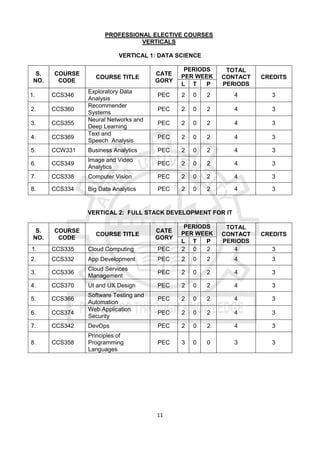
PROFESSIONAL ELECTIVE COURSES
VERTICALS
VERTICAL 1: DATA SCIENCE
S.
NO.
COURSE
CODE
COURSE TITLE
CATE
GORY
PERIODS
PER WEEK
TOTAL
CONTACT
PERIODS
CREDITS
L T P
1. CCS346
Exploratory Data
Analysis
PEC 2 0 2 4 3
2. CCS360
Recommender
Systems
PEC 2 0 2 4 3
3. CCS355
Neural Networks and
Deep Learning
PEC 2 0 2 4 3
4. CCS369
Text and
Speech Analysis
PEC 2 0 2 4 3
5. CCW331 Business Analytics PEC 2 0 2 4 3
6. CCS349
Image and Video
Analytics
PEC 2 0 2 4 3
7. CCS338 Computer Vision PEC 2 0 2 4 3
8. CCS334 Big Data Analytics PEC 2 0 2 4 3
VERTICAL 2: FULL STACK DEVELOPMENT FOR IT
S.
NO.
COURSE
CODE
COURSE TITLE
CATE
GORY
PERIODS
PER WEEK
TOTAL
CONTACT
PERIODS
CREDITS
L T P
1. CCS335 Cloud Computing PEC 2 0 2 4 3
2. CCS332 App Development PEC 2 0 2 4 3
3. CCS336
Cloud Services
Management
PEC 2 0 2 4 3
4. CCS370 UI and UX Design PEC 2 0 2 4 3
5. CCS366
Software Testing and
Automation
PEC 2 0 2 4 3
6. CCS374
Web Application
Security
PEC 2 0 2 4 3
7. CCS342 DevOps PEC 2 0 2 4 3
8. CCS358
Principles of
Programming
Languages
PEC 3 0 0 3 3
12
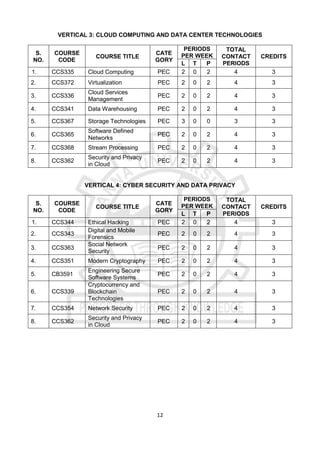
VERTICAL 3: CLOUD COMPUTING AND DATA CENTER TECHNOLOGIES
S.
NO.
COURSE
CODE
COURSE TITLE
CATE
GORY
PERIODS
PER WEEK
TOTAL
CONTACT
PERIODS
CREDITS
L T P
1. CCS335 Cloud Computing PEC 2 0 2 4 3
2. CCS372 Virtualization PEC 2 0 2 4 3
3. CCS336
Cloud Services
Management
PEC 2 0 2 4 3
4. CCS341 Data Warehousing PEC 2 0 2 4 3
5. CCS367 Storage Technologies PEC 3 0 0 3 3
6. CCS365
Software Defined
Networks
PEC 2 0 2 4 3
7. CCS368 Stream Processing PEC 2 0 2 4 3
8. CCS362
Security and Privacy
in Cloud
PEC 2 0 2 4 3
VERTICAL 4: CYBER SECURITY AND DATA PRIVACY
S.
NO.
COURSE
CODE
COURSE TITLE
CATE
GORY
PERIODS
PER WEEK
TOTAL
CONTACT
PERIODS
CREDITS
L T P
1. CCS344 Ethical Hacking PEC 2 0 2 4 3
2. CCS343
Digital and Mobile
Forensics
PEC 2 0 2 4 3
3. CCS363
Social Network
Security
PEC 2 0 2 4 3
4. CCS351 Modern Cryptography PEC 2 0 2 4 3
5. CB3591
Engineering Secure
Software Systems
PEC 2 0 2 4 3
6. CCS339
Cryptocurrency and
Blockchain
Technologies
PEC 2 0 2 4 3
7. CCS354 Network Security PEC 2 0 2 4 3
8. CCS362
Security and Privacy
in Cloud
PEC 2 0 2 4 3
13
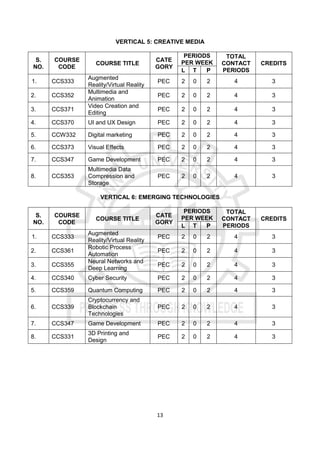
VERTICAL 5: CREATIVE MEDIA
S.
NO.
COURSE
CODE
COURSE TITLE
CATE
GORY
PERIODS
PER WEEK
TOTAL
CONTACT
PERIODS
CREDITS
L T P
1. CCS333
Augmented
Reality/Virtual Reality
PEC 2 0 2 4 3
2. CCS352
Multimedia and
Animation
PEC 2 0 2 4 3
3. CCS371
Video Creation and
Editing
PEC 2 0 2 4 3
4. CCS370 UI and UX Design PEC 2 0 2 4 3
5. CCW332 Digital marketing PEC 2 0 2 4 3
6. CCS373 Visual Effects PEC 2 0 2 4 3
7. CCS347 Game Development PEC 2 0 2 4 3
8. CCS353
Multimedia Data
Compression and
Storage
PEC 2 0 2 4 3
VERTICAL 6: EMERGING TECHNOLOGIES
S.
NO.
COURSE
CODE
COURSE TITLE
CATE
GORY
PERIODS
PER WEEK
TOTAL
CONTACT
PERIODS
CREDITS
L T P
1. CCS333
Augmented
Reality/Virtual Reality
PEC 2 0 2 4 3
2. CCS361
Robotic Process
Automation
PEC 2 0 2 4 3
3. CCS355
Neural Networks and
Deep Learning
PEC 2 0 2 4 3
4. CCS340 Cyber Security PEC 2 0 2 4 3
5. CCS359 Quantum Computing PEC 2 0 2 4 3
6. CCS339
Cryptocurrency and
Blockchain
Technologies
PEC 2 0 2 4 3
7. CCS347 Game Development PEC 2 0 2 4 3
8. CCS331
3D Printing and
Design
PEC 2 0 2 4 3
14
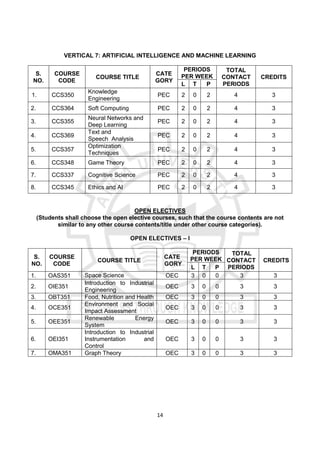
VERTICAL 7: ARTIFICIAL INTELLIGENCE AND MACHINE LEARNING
S.
NO.
COURSE
CODE
COURSE TITLE
CATE
GORY
PERIODS
PER WEEK
TOTAL
CONTACT
PERIODS
CREDITS
L T P
1. CCS350
Knowledge
Engineering
PEC 2 0 2 4 3
2. CCS364 Soft Computing PEC 2 0 2 4 3
3. CCS355
Neural Networks and
Deep Learning
PEC 2 0 2 4 3
4. CCS369
Text and
Speech Analysis
PEC 2 0 2 4 3
5. CCS357
Optimization
Techniques
PEC 2 0 2 4 3
6. CCS348 Game Theory PEC 2 0 2 4 3
7. CCS337 Cognitive Science PEC 2 0 2 4 3
8. CCS345 Ethics and AI PEC 2 0 2 4 3
OPEN ELECTIVES
(Students shall choose the open elective courses, such that the course contents are not
similar to any other course contents/title under other course categories).
OPEN ELECTIVES – I
S.
NO.
COURSE
CODE
COURSE TITLE
CATE
GORY
PERIODS
PER WEEK
TOTAL
CONTACT
PERIODS
CREDITS
L T P
1. OAS351 Space Science OEC 3 0 0 3 3
2. OIE351
Introduction to Industrial
Engineering
OEC 3 0 0 3 3
3. OBT351 Food, Nutrition and Health OEC 3 0 0 3 3
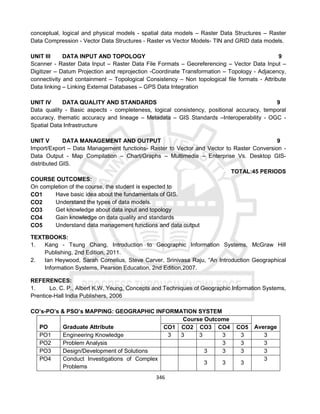
4. OCE351
Environment and Social
Impact Assessment
OEC 3 0 0 3 3
5. OEE351
Renewable Energy
System
OEC 3 0 0 3 3
6. OEI351
Introduction to Industrial
Instrumentation and
Control
OEC 3 0 0 3 3
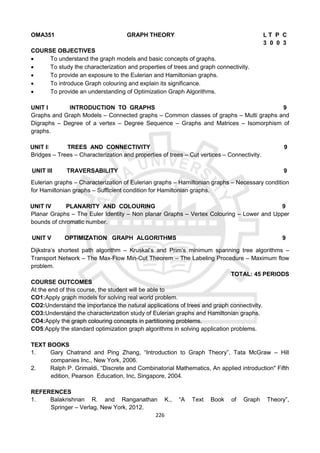
7. OMA351 Graph Theory OEC 3 0 0 3 3
15
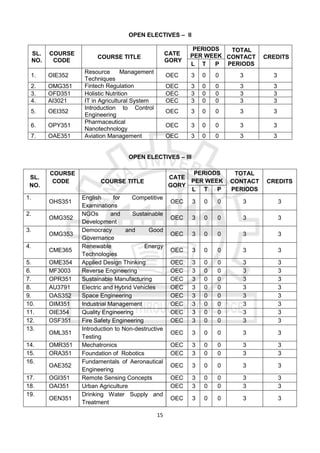
OPEN ELECTIVES – II
SL.
NO.
COURSE
CODE
COURSE TITLE
CATE
GORY
PERIODS
PER WEEK
TOTAL
CONTACT
PERIODS
CREDITS
L T P
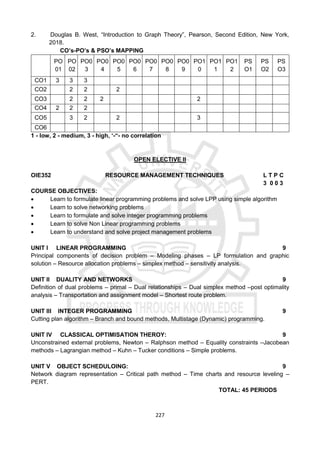
1. OIE352
Resource Management
Techniques
OEC 3 0 0 3 3
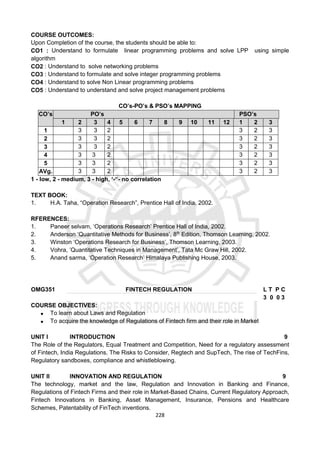
2. OMG351 Fintech Regulation OEC 3 0 0 3 3
3. OFD351 Holistic Nutrition OEC 3 0 0 3 3
4. AI3021 IT in Agricultural System OEC 3 0 0 3 3
5. OEI352
Introduction to Control
Engineering
OEC 3 0 0 3 3
6. OPY351
Pharmaceutical
Nanotechnology
OEC 3 0 0 3 3
7. OAE351 Aviation Management OEC 3 0 0 3 3
OPEN ELECTIVES – III
SL.
NO.
COURSE
CODE COURSE TITLE
CATE
GORY
PERIODS
PER WEEK
TOTAL
CONTACT
PERIODS
CREDITS
L T P
1.
OHS351
English for Competitive
Examinations
OEC 3 0 0 3 3
2.
OMG352
NGOs and Sustainable
Development
OEC 3 0 0 3 3
3.
OMG353
Democracy and Good
Governance
OEC 3 0 0 3 3
4.
CME365
Renewable Energy
Technologies
OEC 3 0 0 3 3
5. OME354 Applied Design Thinking OEC 3 0 0 3 3
6. MF3003 Reverse Engineering OEC 3 0 0 3 3
7. OPR351 Sustainable Manufacturing OEC 3 0 0 3 3
8. AU3791 Electric and Hybrid Vehicles OEC 3 0 0 3 3
9. OAS352 Space Engineering OEC 3 0 0 3 3
10. OIM351 Industrial Management OEC 3 0 0 3 3
11. OIE354 Quality Engineering OEC 3 0 0 3 3
12. OSF351 Fire Safety Engineering OEC 3 0 0 3 3
13.
OML351
Introduction to Non-destructive
Testing
OEC 3 0 0 3 3
14. OMR351 Mechatronics OEC 3 0 0 3 3
15. ORA351 Foundation of Robotics OEC 3 0 0 3 3
16.
OAE352
Fundamentals of Aeronautical
Engineering
OEC 3 0 0 3 3
17. OGI351 Remote Sensing Concepts OEC 3 0 0 3 3
18. OAI351 Urban Agriculture OEC 3 0 0 3 3
19.
OEN351
Drinking Water Supply and
Treatment
OEC 3 0 0 3 3
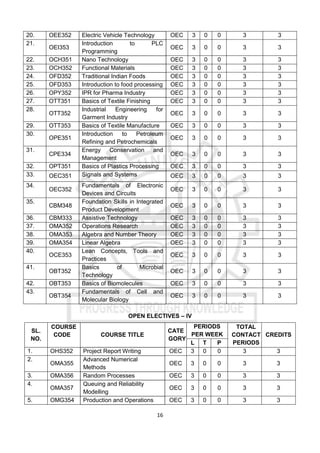
16
20. OEE352 Electric Vehicle Technology OEC 3 0 0 3 3
21.
OEI353
Introduction to PLC
Programming
OEC 3 0 0 3 3
22. OCH351 Nano Technology OEC 3 0 0 3 3
23. OCH352 Functional Materials OEC 3 0 0 3 3
24. OFD352 Traditional Indian Foods OEC 3 0 0 3 3
25. OFD353 Introduction to food processing OEC 3 0 0 3 3
26. OPY352 IPR for Pharma Industry OEC 3 0 0 3 3
27. OTT351 Basics of Textile Finishing OEC 3 0 0 3 3
28.
OTT352
Industrial Engineering for
Garment Industry
OEC 3 0 0 3 3
29. OTT353 Basics of Textile Manufacture OEC 3 0 0 3 3
30.
OPE351
Introduction to Petroleum
Refining and Petrochemicals
OEC 3 0 0 3 3
31.
CPE334
Energy Conservation and
Management
OEC 3 0 0 3 3
32. OPT351 Basics of Plastics Processing OEC 3 0 0 3 3
33. OEC351 Signals and Systems OEC 3 0 0 3 3
34.
OEC352
Fundamentals of Electronic
Devices and Circuits
OEC 3 0 0 3 3
35.
CBM348
Foundation Skills in Integrated
Product Development
OEC 3 0 0 3 3
36. CBM333 Assistive Technology OEC 3 0 0 3 3
37. OMA352 Operations Research OEC 3 0 0 3 3
38. OMA353 Algebra and Number Theory OEC 3 0 0 3 3
39. OMA354 Linear Algebra OEC 3 0 0 3 3
40.
OCE353
Lean Concepts, Tools and
Practices
OEC 3 0 0 3 3
41.
OBT352
Basics of Microbial
Technology
OEC 3 0 0 3 3
42. OBT353 Basics of Biomolecules OEC 3 0 0 3 3
43.
OBT354
Fundamentals of Cell and
Molecular Biology
OEC 3 0 0 3 3
OPEN ELECTIVES – IV
SL.
NO.
COURSE
CODE COURSE TITLE
CATE
GORY
PERIODS
PER WEEK
TOTAL
CONTACT
PERIODS
CREDITS
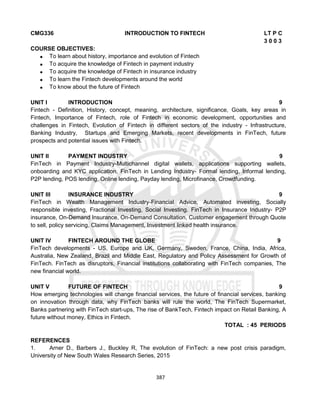
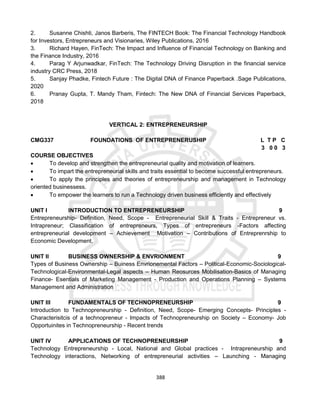
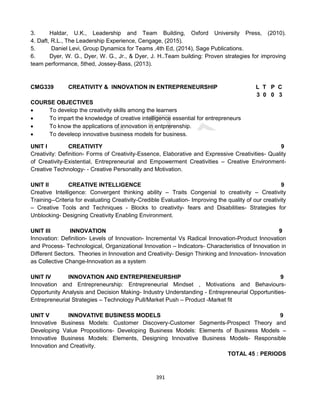
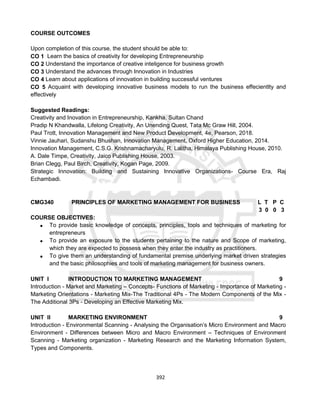
L T P
1. OHS352 Project Report Writing OEC 3 0 0 3 3
2.
OMA355
Advanced Numerical
Methods
OEC 3 0 0 3 3
3. OMA356 Random Processes OEC 3 0 0 3 3
4.
OMA357
Queuing and Reliability
Modelling
OEC 3 0 0 3 3
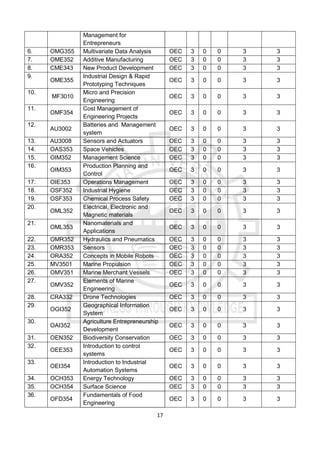
5. OMG354 Production and Operations OEC 3 0 0 3 3
17
Management for
Entrepreneurs
6. OMG355 Multivariate Data Analysis OEC 3 0 0 3 3
7. OME352 Additive Manufacturing OEC 3 0 0 3 3
8. CME343 New Product Development OEC 3 0 0 3 3
9.
OME355
Industrial Design & Rapid
Prototyping Techniques
OEC 3 0 0 3 3
10.
MF3010
Micro and Precision
Engineering
OEC 3 0 0 3 3
11.
OMF354
Cost Management of
Engineering Projects
OEC 3 0 0 3 3
12.
AU3002
Batteries and Management
system
OEC 3 0 0 3 3
13. AU3008 Sensors and Actuators OEC 3 0 0 3 3
14. OAS353 Space Vehicles OEC 3 0 0 3 3
15. OIM352 Management Science OEC 3 0 0 3 3
16.
OIM353
Production Planning and
Control
OEC 3 0 0 3 3
17. OIE353 Operations Management OEC 3 0 0 3 3
18. OSF352 Industrial Hygiene OEC 3 0 0 3 3
19. OSF353 Chemical Process Safety OEC 3 0 0 3 3
20.
OML352
Electrical, Electronic and
Magnetic materials
OEC 3 0 0 3 3
21.
OML353
Nanomaterials and
Applications
OEC 3 0 0 3 3
22. OMR352 Hydraulics and Pneumatics OEC 3 0 0 3 3
23. OMR353 Sensors OEC 3 0 0 3 3
24. ORA352 Concepts in Mobile Robots OEC 3 0 0 3 3
25. MV3501 Marine Propulsion OEC 3 0 0 3 3
26. OMV351 Marine Merchant Vessels OEC 3 0 0 3 3
27.
OMV352
Elements of Marine
Engineering
OEC 3 0 0 3 3
28. CRA332 Drone Technologies OEC 3 0 0 3 3
29.
OGI352
Geographical Information
System
OEC 3 0 0 3 3
30.
OAI352
Agriculture Entrepreneurship
Development
OEC 3 0 0 3 3
31. OEN352 Biodiversity Conservation OEC 3 0 0 3 3
32.
OEE353
Introduction to control
systems
OEC 3 0 0 3 3
33.
OEI354
Introduction to Industrial
Automation Systems
OEC 3 0 0 3 3
34. OCH353 Energy Technology OEC 3 0 0 3 3
35. OCH354 Surface Science OEC 3 0 0 3 3
36.
OFD354
Fundamentals of Food
Engineering
OEC 3 0 0 3 3
18
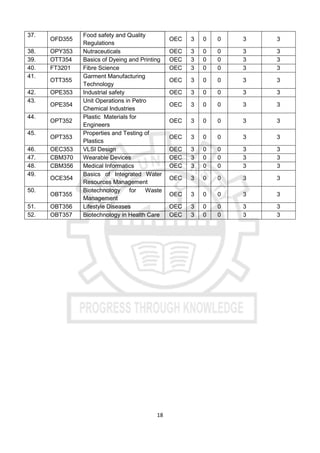
37.
OFD355
Food safety and Quality
Regulations
OEC 3 0 0 3 3
38. OPY353 Nutraceuticals OEC 3 0 0 3 3
39. OTT354 Basics of Dyeing and Printing OEC 3 0 0 3 3
40. FT3201 Fibre Science OEC 3 0 0 3 3
41.
OTT355
Garment Manufacturing
Technology
OEC 3 0 0 3 3
42. OPE353 Industrial safety OEC 3 0 0 3 3
43.
OPE354
Unit Operations in Petro
Chemical Industries
OEC 3 0 0 3 3
44.
OPT352
Plastic Materials for
Engineers
OEC 3 0 0 3 3
45.
OPT353
Properties and Testing of
Plastics
OEC 3 0 0 3 3
46. OEC353 VLSI Design OEC 3 0 0 3 3
47. CBM370 Wearable Devices OEC 3 0 0 3 3
48. CBM356 Medical Informatics OEC 3 0 0 3 3
49.
OCE354
Basics of Integrated Water
Resources Management
OEC 3 0 0 3 3
50.
OBT355
Biotechnology for Waste
Management
OEC 3 0 0 3 3
51. OBT356 Lifestyle Diseases OEC 3 0 0 3 3
52. OBT357 Biotechnology in Health Care OEC 3 0 0 3 3
19
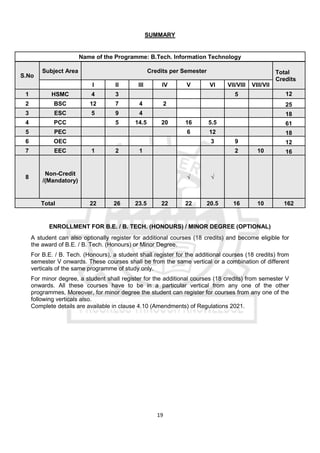
SUMMARY
Name of the Programme: B.Tech. Information Technology
S.No
Subject Area Credits per Semester Total
Credits
I II III IV V VI VII/VIII VIII/VII
1 HSMC 4 3 5 12
2 BSC 12 7 4 2 25
3 ESC 5 9 4 18
4 PCC 5 14.5 20 16 5.5 61
5 PEC 6 12 18
6 OEC 3 9 12
7 EEC 1 2 1 2 10 16
8
Non-Credit
/(Mandatory)
√ √
Total 22 26 23.5 22 22 20.5 16 10 162
ENROLLMENT FOR B.E. / B. TECH. (HONOURS) / MINOR DEGREE (OPTIONAL)
A student can also optionally register for additional courses (18 credits) and become eligible for
the award of B.E. / B. Tech. (Honours) or Minor Degree.
For B.E. / B. Tech. (Honours), a student shall register for the additional courses (18 credits) from
semester V onwards. These courses shall be from the same vertical or a combination of different
verticals of the same programme of study only.
For minor degree, a student shall register for the additional courses (18 credits) from semester V
onwards. All these courses have to be in a particular vertical from any one of the other
programmes, Moreover, for minor degree the student can register for courses from any one of the
following verticals also.
Complete details are available in clause 4.10 (Amendments) of Regulations 2021.
20
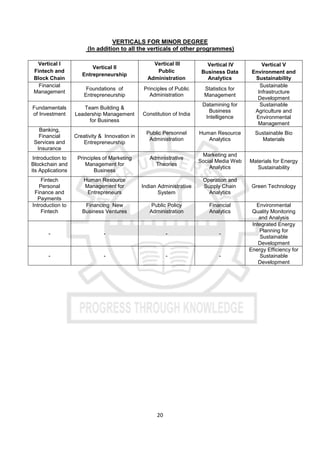
VERTICALS FOR MINOR DEGREE
(In addition to all the verticals of other programmes)
Vertical I
Fintech and
Block Chain
Vertical II
Entrepreneurship
Vertical III
Public
Administration
Vertical IV
Business Data
Analytics
Vertical V
Environment and
Sustainability
Financial
Management
Foundations of
Entrepreneurship
Principles of Public
Administration
Statistics for
Management
Sustainable
Infrastructure
Development
Fundamentals
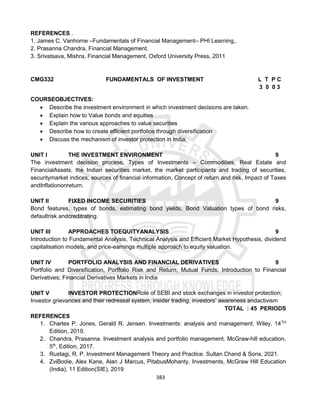
of Investment
Team Building &
Leadership Management
for Business
Constitution of India
Datamining for
Business
Intelligence
Sustainable
Agriculture and
Environmental
Management
Banking,
Financial
Services and
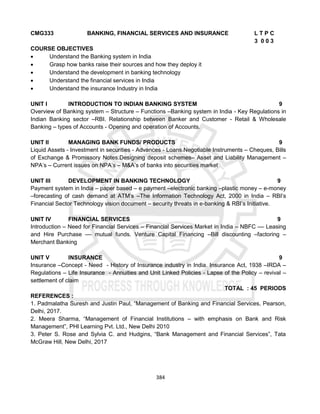
Insurance
Creativity & Innovation in
Entrepreneurship
Public Personnel
Administration
Human Resource
Analytics
Sustainable Bio
Materials
Introduction to
Blockchain and
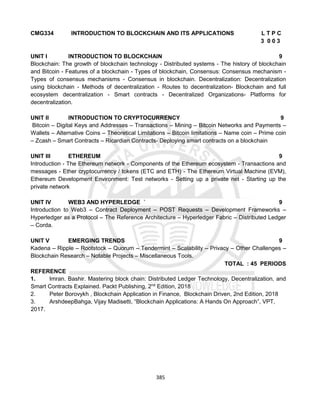
its Applications
Principles of Marketing
Management for
Business
Administrative
Theories
Marketing and
Social Media Web
Analytics
Materials for Energy
Sustainability
Fintech
Personal
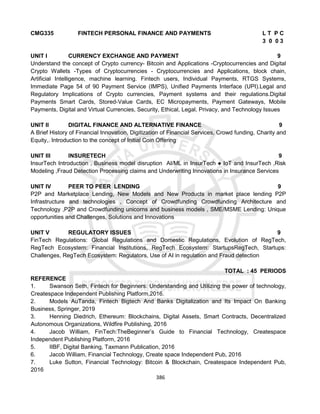
Finance and
Payments
Human Resource
Management for
Entrepreneurs
Indian Administrative
System
Operation and
Supply Chain
Analytics
Green Technology
Introduction to
Fintech
Financing New
Business Ventures
Public Policy
Administration
Financial
Analytics
Environmental
Quality Monitoring
and Analysis
- - - -
Integrated Energy
Planning for
Sustainable
Development
- - - -
Energy Efficiency for
Sustainable
Development
21
(choice of courses for Minor degree is to be made from any one vertical of other
programmes or from anyone of the following verticals)
VERTICAL 1: FINTECH AND BLOCK CHAIN
S.
NO.
COURSE
CODE
COURSE TITLE
CATE
GORY
PERIODS
PER WEEK
TOTAL
CONTACT
PERIODS
CREDITS
L T P
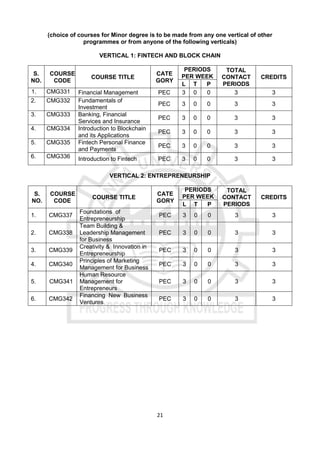
1. CMG331 Financial Management PEC 3 0 0 3 3
2. CMG332 Fundamentals of
Investment
PEC 3 0 0 3 3
3. CMG333 Banking, Financial
Services and Insurance
PEC 3 0 0 3 3
4. CMG334 Introduction to Blockchain
and its Applications
PEC 3 0 0 3 3
5. CMG335 Fintech Personal Finance
and Payments
PEC 3 0 0 3 3
6. CMG336 Introduction to Fintech PEC 3 0 0 3 3
VERTICAL 2: ENTREPRENEURSHIP
S.
NO.
COURSE
CODE
COURSE TITLE
CATE
GORY
PERIODS
PER WEEK
TOTAL
CONTACT
PERIODS
CREDITS
L T P
1. CMG337
Foundations of
Entrepreneurship
PEC 3 0 0 3 3
2. CMG338
Team Building &
Leadership Management
for Business
PEC 3 0 0 3 3
3. CMG339
Creativity & Innovation in
Entrepreneurship
PEC 3 0 0 3 3
4. CMG340
Principles of Marketing
Management for Business
PEC 3 0 0 3 3
5. CMG341
Human Resource
Management for
Entrepreneurs
PEC 3 0 0 3 3
6. CMG342
Financing New Business
Ventures
PEC 3 0 0 3 3
22
VERTICAL 3: PUBLIC ADMINISTRATION
S.
NO.
COURSE
CODE COURSE TITLE
CATE
GORY
PERIODS
PER WEEK
TOTAL
CONTACT
PERIODS
CREDITS
L T P
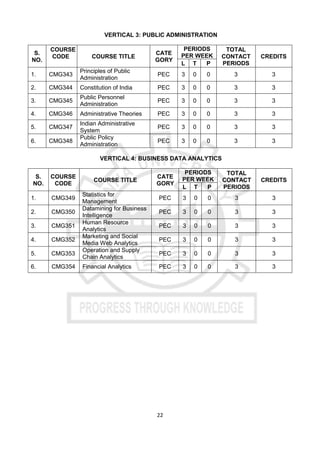
1. CMG343
Principles of Public
Administration
PEC 3 0 0 3 3
2. CMG344 Constitution of India PEC 3 0 0 3 3
3. CMG345
Public Personnel
Administration
PEC 3 0 0 3 3
4. CMG346 Administrative Theories PEC 3 0 0 3 3
5. CMG347
Indian Administrative
System
PEC 3 0 0 3 3
6. CMG348
Public Policy
Administration
PEC 3 0 0 3 3
VERTICAL 4: BUSINESS DATA ANALYTICS
S.
NO.
COURSE
CODE
COURSE TITLE
CATE
GORY
PERIODS
PER WEEK
TOTAL
CONTACT
PERIODS
CREDITS
L T P
1. CMG349
Statistics for
Management
PEC 3 0 0 3 3
2. CMG350
Datamining for Business
Intelligence
PEC 3 0 0 3 3
3. CMG351
Human Resource
Analytics
PEC 3 0 0 3 3
4. CMG352
Marketing and Social
Media Web Analytics
PEC 3 0 0 3 3
5. CMG353
Operation and Supply
Chain Analytics
PEC 3 0 0 3 3
6. CMG354 Financial Analytics PEC 3 0 0 3 3
23
VERTICAL 5: ENVIRONMENT AND SUSTAINABILITY
S.
NO.
COURSE
CODE
COURSE TITLE
CATE
GORY
PERIODS
PER WEEK
TOTAL
CONTACT
PERIODS
CREDITS
L T P
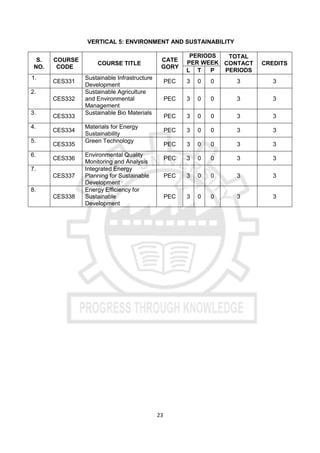
1.
CES331
Sustainable Infrastructure
Development
PEC 3 0 0 3 3
2.
CES332
Sustainable Agriculture
and Environmental
Management
PEC 3 0 0 3 3
3.
CES333
Sustainable Bio Materials
PEC 3 0 0 3 3
4.
CES334
Materials for Energy
Sustainability
PEC 3 0 0 3 3
5.
CES335
Green Technology
PEC 3 0 0 3 3
6.
CES336
Environmental Quality
Monitoring and Analysis
PEC 3 0 0 3 3
7.
CES337
Integrated Energy
Planning for Sustainable
Development
PEC 3 0 0 3 3
8.
CES338
Energy Efficiency for
Sustainable
Development
PEC 3 0 0 3 3
24
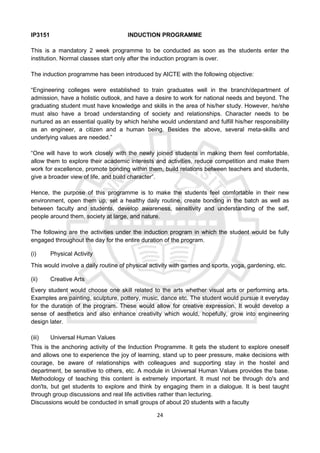
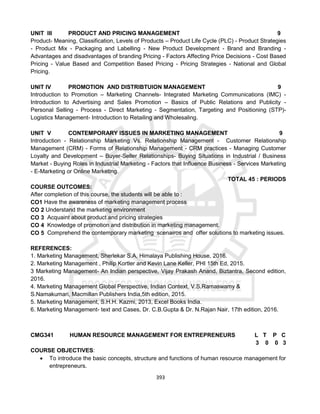
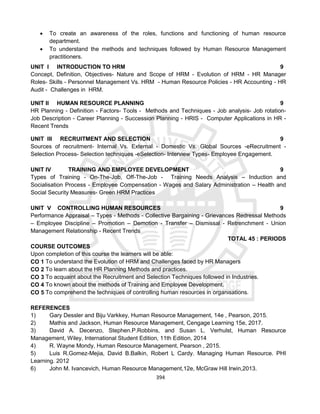
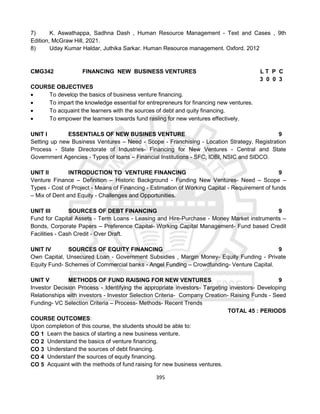
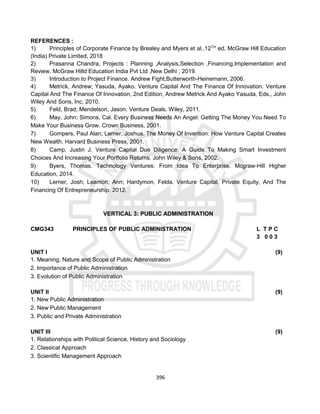
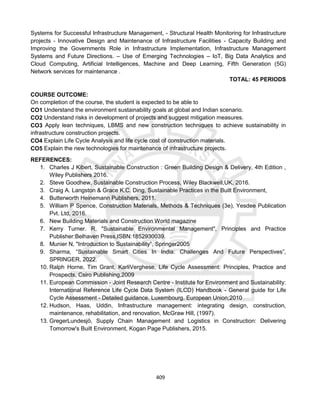
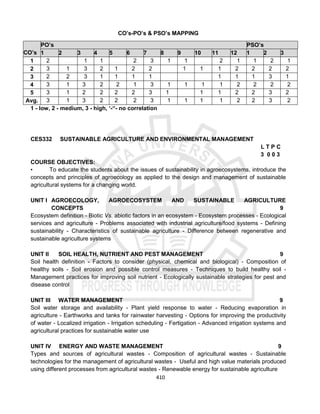
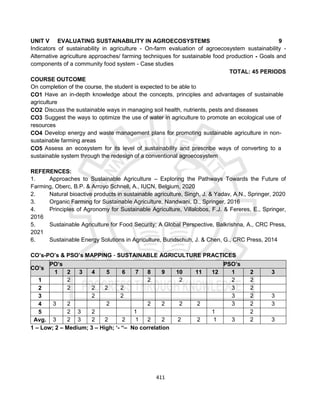
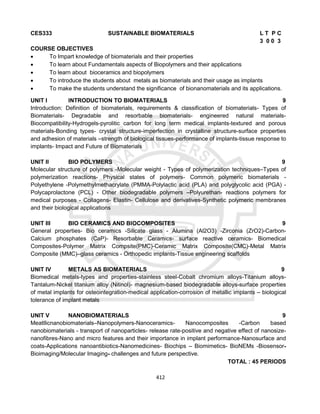
IP3151 INDUCTION PROGRAMME
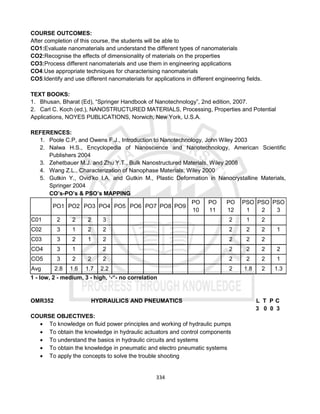
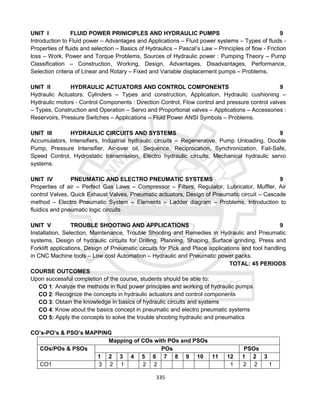
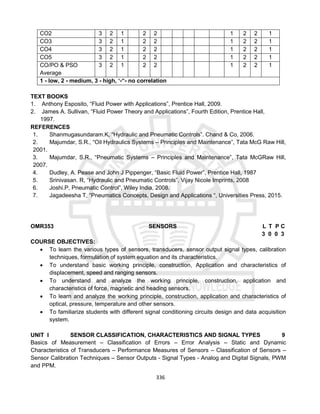
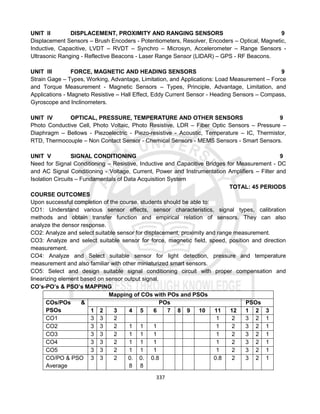
This is a mandatory 2 week programme to be conducted as soon as the students enter the
institution. Normal classes start only after the induction program is over.
The induction programme has been introduced by AICTE with the following objective:
“Engineering colleges were established to train graduates well in the branch/department of
admission, have a holistic outlook, and have a desire to work for national needs and beyond. The
graduating student must have knowledge and skills in the area of his/her study. However, he/she
must also have a broad understanding of society and relationships. Character needs to be
nurtured as an essential quality by which he/she would understand and fulfill his/her responsibility
as an engineer, a citizen and a human being. Besides the above, several meta-skills and
underlying values are needed.”
“One will have to work closely with the newly joined students in making them feel comfortable,
allow them to explore their academic interests and activities, reduce competition and make them
work for excellence, promote bonding within them, build relations between teachers and students,
give a broader view of life, and build character”.
Hence, the purpose of this programme is to make the students feel comfortable in their new
environment, open them up, set a healthy daily routine, create bonding in the batch as well as
between faculty and students, develop awareness, sensitivity and understanding of the self,
people around them, society at large, and nature.
The following are the activities under the induction program in which the student would be fully
engaged throughout the day for the entire duration of the program.
(i) Physical Activity
This would involve a daily routine of physical activity with games and sports, yoga, gardening, etc.
(ii) Creative Arts
Every student would choose one skill related to the arts whether visual arts or performing arts.
Examples are painting, sculpture, pottery, music, dance etc. The student would pursue it everyday
for the duration of the program. These would allow for creative expression. It would develop a
sense of aesthetics and also enhance creativity which would, hopefully, grow into engineering
design later.
(iii) Universal Human Values
This is the anchoring activity of the Induction Programme. It gets the student to explore oneself
and allows one to experience the joy of learning, stand up to peer pressure, make decisions with
courage, be aware of relationships with colleagues and supporting stay in the hostel and
department, be sensitive to others, etc. A module in Universal Human Values provides the base.
Methodology of teaching this content is extremely important. It must not be through do's and
don'ts, but get students to explore and think by engaging them in a dialogue. It is best taught
through group discussions and real life activities rather than lecturing.
Discussions would be conducted in small groups of about 20 students with a faculty
25
mentor each. It would be effective that the faculty mentor assigned is also the faculty advisor for
the student for the full duration of the UG programme.
(iv) Literary Activity
Literary activity would encompass reading, writing and possibly, debating, enacting a play etc.
(v) Proficiency Modules
This would address some lacunas that students might have, for example, English, computer
familiarity etc.
(vi) Lectures by Eminent People
Motivational lectures by eminent people from all walks of life should be arranged to give the
students exposure to people who are socially active or in public life.
(vii) Visits to Local Area
A couple of visits to the landmarks of the city, or a hospital or orphanage could be organized. This
would familiarize them with the area as well as expose them to the underprivileged.
(viii) Familiarization to Dept./Branch & Innovations
They should be told about what getting into a branch or department means what role it plays in
society, through its technology. They should also be shown the laboratories, workshops & other
facilities.
(ix) Department Specific Activities
About a week can be spent in introducing activities (games, quizzes, social interactions, small
experiments, design thinking etc.) that are relevant to the particular branch of Engineering /
Technology / Architecture that can serve as a motivation and kindle interest in building things
(become a maker) in that particular field. This can be conducted in the form of a workshop. For
example, CSE and IT students may be introduced to activities that kindle computational thinking,
and get them to build simple games. ECE students may be introduced to building simple circuits
as an extension of their knowledge in Science, and so on. Students may be asked to build stuff
using their knowledge of science.
Induction Programme is totally an activity based programme and therefore there shall be
no tests / assessments during this programme.
References:
Guide to Induction program from AICTE
26
HS3152 PROFESSIONAL ENGLISH I L T P C
3 0 0 3
COURSE OBJECTIVES:
 To improve the communicative competence of learners
 To learn to use basic grammatic structures in suitable contexts
 To acquire lexical competence and use them appropriately in a sentence and understand
their meaning in a text
 To help learners use language effectively in professional contexts
 To develop learners’ ability to read and write complex texts, summaries, articles, blogs,
definitions, essays and user manuals.
UNIT I INTRODUCTION TO EFFECTIVE COMMUNICATION 1
What is effective communication? (Explain using activities) Why is communication critical for
excellence during study, research and work? What are the seven C’s of effective communication?
What are key language skills? What is effective listening? What does it involve? What is effective
speaking? What does it mean to be an excellent reader? What should you be able to do? What is
effective writing? How does one develop language and communication skills? What does the
course focus on? How are communication and language skills going to be enhanced during this
course? What do you as a learner need to do to enhance your English language and
communication skills to get the best out of this course?
INTRODUCTION TO FUNDAMENTALS OF COMMUNICATION 8
Reading - Reading brochures (technical context), telephone messages / social media messages
relevant to technical contexts and emails. Writing - Writing emails / letters introducing oneself.
Grammar - Present Tense ( simple and progressive); Question types: Wh/ Yes or No/ and Tags.
Vocabulary - Synonyms; One word substitution; Abbreviations & Acronyms (as used in technical
contexts).
UNIT II NARRATION AND SUMMATION 9
Reading - Reading biographies, travelogues, newspaper reports, Excerpts from literature, and
travel & technical blogs. Writing - Guided writing-- Paragraph writing Short Report on an event
(field trip etc.) Grammar –Past tense (simple); Subject-Verb Agreement; and Prepositions.
Vocabulary - Word forms (prefixes& suffixes); Synonyms and Antonyms. Phrasal verbs.
UNIT III DESCRIPTION OF A PROCESS / PRODUCT 9
Reading – Reading advertisements, gadget reviews; user manuals. Writing - Writing definitions;
instructions; and Product /Process description. Grammar - Imperatives; Adjectives; Degrees of
comparison; Present & Past Perfect Tenses. Vocabulary - Compound Nouns, Homonyms; and
Homophones, discourse markers (connectives & sequence words).
UNIT IV CLASSIFICATION AND RECOMMENDATIONS 9
Reading – Newspaper articles; Journal reports –and Non Verbal Communcation ( tables, pie
charts etc,. ). Writing – Note-making / Note-taking (*Study skills to be taught, not tested); Writing
recommendations; Transferring information from non verbal ( chart , graph etc, to verbal mode)
Grammar – Articles; Pronouns - Possessive & Relative pronouns. Vocabulary - Collocations; Fixed
/ Semi fixed expressions.
27
UNIT V EXPRESSION 9
Reading – Reading editorials; and Opinion Blogs; Writing – Essay Writing (Descriptive or
narrative). Grammar – Future Tenses, Punctuation; Negation (Statements & Questions); and
Simple, Compound & Complex Sentences. Vocabulary - Cause & Effect Expressions – Content vs
Function words.
TOTAL : 45 PERIODS
LEARNING OUTCOMES:
At the end of the course, learners will be able
CO1:To use appropriate words in a professional context
CO2:To gain understanding of basic grammatic structures and use them in right context.
CO3:To read and infer the denotative and connotative meanings of technical texts
CO4:To write definitions, descriptions, narrations and essays on various topics
TEXT BOOKS :
1. English for Engineers & Technologists Orient Blackswan Private Ltd. Department of
English, Anna University, (2020 edition)
2. English for Science & Technology Cambridge University Press, 2021.
3. Authored by Dr. Veena Selvam, Dr. Sujatha Priyadarshini, Dr. Deepa Mary Francis, Dr.
KN. Shoba, and Dr. Lourdes Joevani, Department of English, Anna University.
REFERENCES:
1. Technical Communication – Principles And Practices By Meenakshi Raman & Sangeeta
Sharma, Oxford Univ. Press, 2016, New Delhi.
2. A Course Book On Technical English By Lakshminarayanan, Scitech Publications (India)
Pvt. Ltd.
3. English For Technical Communication (With CD) By Aysha Viswamohan, Mcgraw Hill
Education, ISBN : 0070264244.
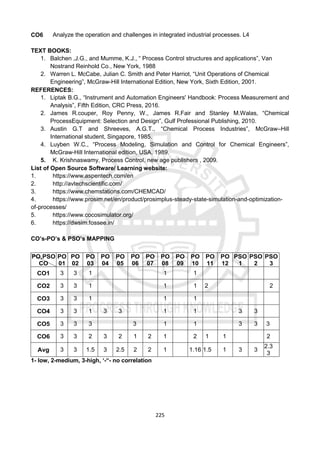
4. Effective Communication Skill, Kulbhusan Kumar, RS Salaria, Khanna Publishing House.
5. Learning to Communicate – Dr. V. Chellammal, Allied Publishing House, New Delhi,2003.
ASSESSMENT PATTERN
Two internal assessments and an end semester examination to test students’ reading and writing
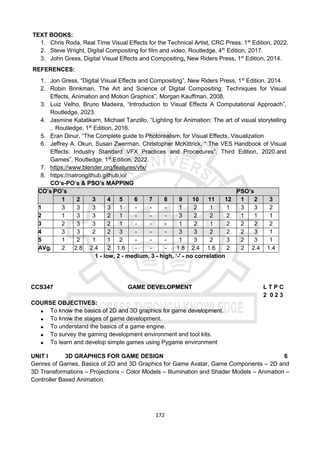
skills along with their grammatical and lexical competence.
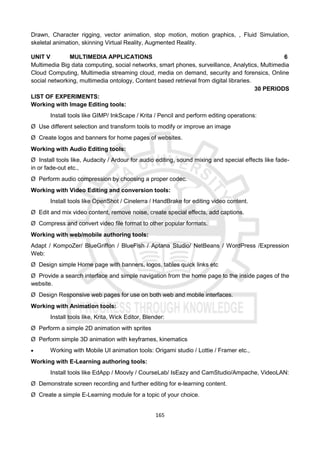
CO’s-PO’s & PSO’s MAPPING
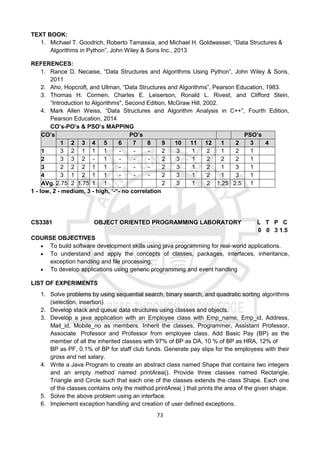
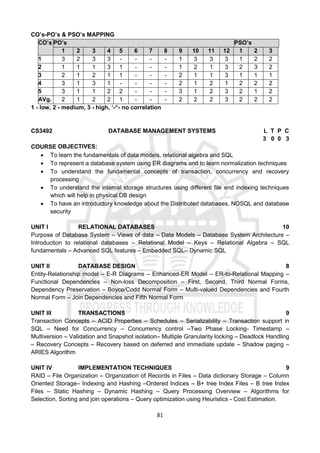
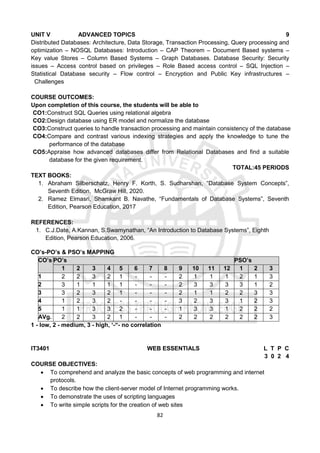
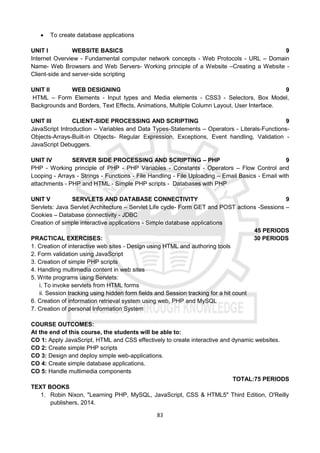
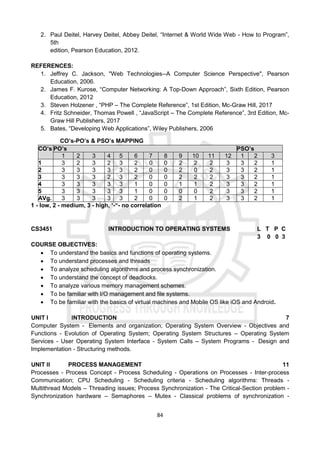
CO PO1 PO2 PO3 PO4 PO5 PO6 PO7 PO8 PO9 PO10 PO11 PO12 PSO1 PSO2 PSO3
1 1 1 1 1 1 3 3 3 1 3 - 3 - - -
2 1 1 1 1 1 3 3 3 1 3 - 3 - - -
3 2 3 2 3 2 3 3 3 2 3 3 3 - - -
4 2 3 2 3 2 3 3 3 2 3 3 3 - - -
5 2 3 3 3 - 3 3 3 2 3 - 3 - - -
AVg. 1.6 2.2 1.8 2.2 1.5 3 3 3 1.6 3 3 3 - - -
1 - low, 2 - medium, 3 - high, ‘-“- no correlation
28
MA3151 MATRICES AND CALCULUS L T P C
3 1 0 4
COURSE OBJECTIVES:
 To develop the use of matrix algebra techniques that are needed by engineers for practical
applications.
 To familiarize the students with differential calculus.
 To familiarize the student with functions of several variables. This is needed in many
branches of engineering.
 To make the students understand various techniques of integration.
 To acquaint the student with mathematical tools needed in evaluating multiple integrals and
their applications.
UNIT I MATRICES 9 + 3
Eigenvalues and Eigenvectors of a real matrix – Characteristic equation – Properties of
Eigenvalues and Eigenvectors – Cayley - Hamilton theorem – Diagonalization of matrices by
orthogonal transformation – Reduction of a quadratic form to canonical form by orthogonal
transformation – Nature of quadratic forms – Applications : Stretching of an elastic membrane.
UNIT II DIFFERENTIAL CALCULUS 9 + 3
Representation of functions - Limit of a function - Continuity - Derivatives - Differentiation rules
(sum, product, quotient, chain rules) - Implicit differentiation - Logarithmic differentiation -
Applications : Maxima and Minima of functions of one variable.
UNIT III FUNCTIONS OF SEVERAL VARIABLES 9 + 3
Partial differentiation – Homogeneous functions and Euler’s theorem – Total derivative – Change
of variables – Jacobians – Partial differentiation of implicit functions – Taylor’s series for functions
of two variables – Applications: Maxima and minima of functions of two variables and Lagrange’s
method of undetermined multipliers.
UNIT IV INTEGRAL CALCULUS 9 + 3
Definite and Indefinite integrals - Substitution rule - Techniques of Integration: Integration by parts,
Trigonometric integrals, Trigonometric substitutions, Integration of rational functions by partial
fraction, Integration of irrational functions - Improper integrals - Applications: Hydrostatic force and
pressure, moments and centres of mass.
UNIT V MULTIPLE INTEGRALS 9 + 3
Double integrals – Change of order of integration – Double integrals in polar coordinates – Area
enclosed by plane curves – Triple integrals – Volume of solids – Change of variables in double
and triple integrals – Applications: Moments and centres of mass, moment of inertia.
TOTAL: 60 PERIODS
COURSE OUTCOMES:
At the end of the course the students will be able to
CO1:Use the matrix algebra methods for solving practical problems.
CO2:Apply differential calculus tools in solving various application problems.
CO3:Able to use differential calculus ideas on several variable functions.
CO4:Apply different methods of integration in solving practical problems.
CO5:Apply multiple integral ideas in solving areas, volumes and other practical problems.
29
TEXT BOOKS:
1. Kreyszig.E, "Advanced Engineering Mathematics", John Wiley and Sons,
10th
Edition, New Delhi, 2016.
2. Grewal.B.S., “Higher Engineering Mathematics”, Khanna Publishers, New Delhi,
44th
Edition , 2018.
3. James Stewart, "Calculus: Early Transcendentals", Cengage Learning, 8th
Edition, New
Delhi, 2015. [For Units II & IV - Sections 1.1, 2.2, 2.3, 2.5, 2.7 (Tangents problems only),
2.8, 3.1 to 3.6, 3.11, 4.1, 4.3, 5.1 (Area problems only), 5.2, 5.3, 5.4 (excluding net
change theorem), 5.5, 7.1 - 7.4 and 7.8 ].
REFERENCES:
1. Anton. H, Bivens. I and Davis. S, "Calculus", Wiley, 10th
Edition, 2016
2. Bali. N., Goyal. M. and Watkins. C., “Advanced Engineering Mathematics”, Firewall
Media (An imprint of Lakshmi Publications Pvt., Ltd.,), New Delhi, 7th
Edition, 2009.
3. Jain. R.K. and Iyengar. S.R.K., “Advanced Engineering Mathematics”, Narosa
Publications, New Delhi, 5th
Edition, 2016.
4. Narayanan. S. and Manicavachagom Pillai. T. K., “Calculus" Volume I and II,
S. Viswanathan Publishers Pvt. Ltd., Chennai, 2009.
5. Ramana. B.V., "Higher Engineering Mathematics", McGraw Hill Education Pvt. Ltd,
New Delhi, 2016.
6. Srimantha Pal and Bhunia. S.C, "Engineering Mathematics" Oxford University Press,
2015.
7. Thomas. G. B., Hass. J, and Weir. M.D, " Thomas Calculus ", 14th
Edition, Pearson India,
2018.
CO’s-PO’s & PSO’s MAPPING
CO PO1 PO2 PO3 PO4 PO5 PO6 PO7 PO8 PO9 PO10 PO11 PO12 PSO1 PSO2 PSO3
CO1 3 3 1 1 0 0 0 0 2 0 2 3 - - -
CO2 3 3 1 1 0 0 0 0 2 0 2 3 - - -
CO3 3 3 1 1 0 0 0 0 2 0 2 3 - - -
CO4 3 3 1 1 0 0 0 0 2 0 2 3 - - -
CO5 3 3 1 1 0 0 0 0 2 0 2 3 - - -
Avg 3 3 1 1 0 0 0 0 2 0 2 3 - - -
1 - low, 2 - medium, 3 - high, ‘-“- no correlation
PH3151 ENGINEERING PHYSICS L T P C
3 0 0 3
COURSE OBJECTIVES:
 To make the students effectively achieve an understanding of mechanics.
 To enable the students to gain knowledge of electromagnetic waves and its applications.
 To introduce the basics of oscillations, optics and lasers.
 Equipping the students to successfully understand the importance of quantum physics.
 To motivate the students towards the applications of quantum mechanics.
UNIT I MECHANICS 9
Multi-particle dynamics: Center of mass (CM) – CM of continuous bodies – motion of the CM –
kinetic energy of the system of particles. Rotation of rigid bodies: Rotational kinematics – rotational
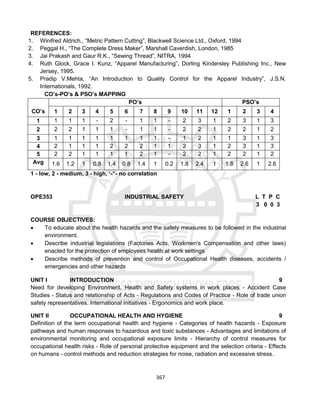
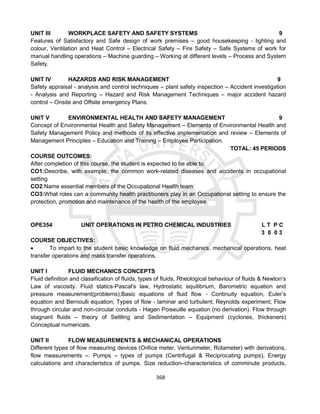
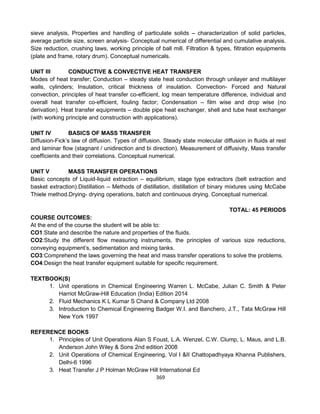
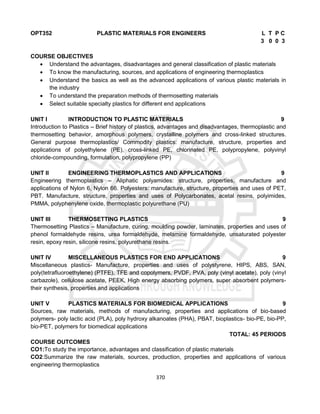
kinetic energy and moment of inertia - theorems of M .I –moment of inertia of continuous bodies –
30
M.I of a diatomic molecule - torque – rotational dynamics of rigid bodies – conservation of angular
momentum – rotational energy state of a rigid diatomic molecule - gyroscope - torsional pendulum
– double pendulum –Introduction to nonlinear oscillations.
UNIT II ELECTROMAGNETIC WAVES 9
The Maxwell’s equations - wave equation; Plane electromagnetic waves in vacuum, Conditions on
the wave field - properties of electromagnetic waves: speed, amplitude, phase, orientation and
waves in matter - polarization - Producing electromagnetic waves - Energy and momentum in EM
waves: Intensity, waves from localized sources, momentum and radiation pressure - Cell-phone
reception. Reflection and transmission of electromagnetic waves from a non-conducting medium-
vacuum interface for normal incidence.
UNIT III OSCILLATIONS, OPTICS AND LASERS 9
Simple harmonic motion - resonance –analogy between electrical and mechanical oscillating
systems - waves on a string - standing waves - traveling waves - Energy transfer of a wave -
sound waves - Doppler effect. Reflection and refraction of light waves - total internal reflection -
interference –Michelson interferometer –Theory of air wedge and experiment. Theory of laser -
characteristics - Spontaneous and stimulated emission - Einstein’s coefficients - population
inversion - Nd-YAG laser, CO2 laser, semiconductor laser –Basic applications of lasers in industry.
UNIT IV BASIC QUANTUM MECHANICS 9
Photons and light waves - Electrons and matter waves –Compton effect - The Schrodinger
equation (Time dependent and time independent forms) - meaning of wave function -
Normalization –Free particle - particle in a infinite potential well: 1D,2D and 3D Boxes-
Normalization, probabilities and the correspondence principle.
UNIT V APPLIED QUANTUM MECHANICS 9
The harmonic oscillator(qualitative)- Barrier penetration and quantum tunneling(qualitative)-
Tunneling microscope - Resonant diode - Finite potential wells (qualitative)- Bloch’s theorem for
particles in a periodic potential –Basics of Kronig-Penney model and origin of energy bands.
TOTAL : 45 PERIODS
COURSE OUTCOMES:
After completion of this course, the students should be able to
CO1:Understand the importance of mechanics.
CO2:Express their knowledge in electromagnetic waves.
CO3:Demonstrate a strong foundational knowledge in oscillations, optics and lasers.
CO4:Understand the importance of quantum physics.
CO5:Comprehend and apply quantum mechanical principles towards the formation of energy
bands.
TEXT BOOKS:
1. D.Kleppner and R.Kolenkow. An Introduction to Mechanics. McGraw Hill Education (Indian
Edition), 2017.
2. E.M.Purcell and D.J.Morin, Electricity and Magnetism, Cambridge Univ.Press, 2013.
3. Arthur Beiser, Shobhit Mahajan, S. Rai Choudhury, Concepts of Modern Physics, McGraw-
Hill (Indian Edition), 2017.
31
REFERENCES:
1. R.Wolfson. Essential University Physics. Volume 1 & 2. Pearson Education (Indian
Edition), 2009.
2. Paul A. Tipler, Physic – Volume 1 & 2, CBS, (Indian Edition), 2004.
3. K.Thyagarajan and A.Ghatak. Lasers: Fundamentals and Applications, Laxmi Publications,
(Indian Edition), 2019.
4. D.Halliday, R.Resnick and J.Walker. Principles of Physics, Wiley (Indian Edition), 2015.
5. N.Garcia, A.Damask and S.Schwarz. Physics for Computer Science Students. Springer-
Verlag, 2012.
CO’s-PO’s & PSO’s MAPPING
CO PO
1
PO2 PO3 PO4 PO5 PO6 PO7 PO8 PO9 PO10 PO11 PO12 PSO1 PSO2 PSO3
1 3 3 2 1 1 1 - - - - - - - - -
2 3 3 2 1 2 1 - - - - - - - - -
3 3 3 2 2 2 1 - - - - - 1 - - -
4 3 3 1 1 2 1 - - - - - - - -
5 3 3 1 1 2 1 - - - - - - - - -
AV
G
3 3 1.6 1.2 1.8 1 - - - - - 1 - - -
1 - low, 2 - medium, 3 - high, ‘-“- no correlation
CY3151 ENGINEERING CHEMISTRY L T P C
3 0 0 3
COURSE OBJECTIVES:
 To inculcate sound understanding of water quality parameters and water treatment
techniques.
 To impart knowledge on the basic principles and preparatory methods of nanomaterials.
 To introduce the basic concepts and applications of phase rule and composites.
 To facilitate the understanding of different types of fuels, their preparation, properties and
combustion characteristics.
 To familiarize the students with the operating principles, working processes and
applications of energy conversion and storage devices.
UNIT I WATER AND ITS TREATMENT 9
Water: Sources and impurities, Water quality parameters: Definition and significance of-color,
odour, turbidity, pH, hardness, alkalinity, TDS, COD and BOD, fluoride and arsenic. Municipal
water treatment: primary treatment and disinfection (UV, Ozonation, break-point chlorination).
Desalination of brackish water: Reverse Osmosis. Boiler troubles: Scale and sludge, Boiler
corrosion, Caustic embrittlement, Priming & foaming. Treatment of boiler feed water: Internal
treatment (phosphate, colloidal, sodium aluminate and calgon conditioning) and External treatment
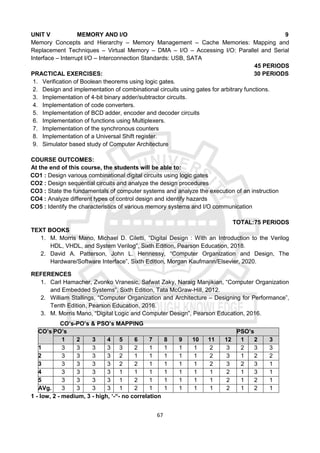
– Ion exchange demineralization and zeolite process.
UNIT II NANOCHEMISTRY 9
Basics: Distinction between molecules, nanomaterials and bulk materials; Size-dependent
properties (optical, electrical, mechanical and magnetic); Types of nanomaterials: Definition,
properties and uses of – nanoparticle, nanocluster, nanorod, nanowire and nanotube. Preparation
of nanomaterials: sol-gel, solvothermal, laser ablation, chemical vapour deposition,
electrochemical deposition and electro spinning. Applications of nanomaterials in medicine,
agriculture, energy, electronics and catalysis.
32
UNIT III PHASE RULE AND COMPOSITES 9
Phase rule: Introduction, definition of terms with examples. One component system - water
system; Reduced phase rule; Construction of a simple eutectic phase diagram - Thermal analysis;
Two component system: lead-silver system - Pattinson process.
Composites: Introduction: Definition & Need for composites; Constitution: Matrix materials
(Polymer matrix, metal matrix and ceramic matrix) and Reinforcement (fiber, particulates, flakes
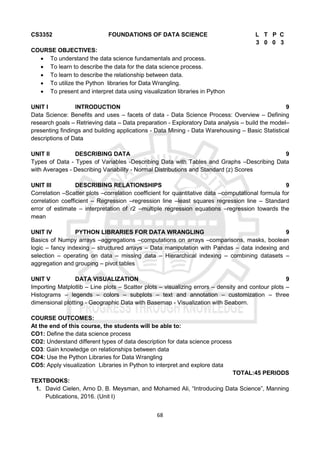
and whiskers). Properties and applications of: Metal matrix composites (MMC), Ceramic matrix
composites and Polymer matrix composites. Hybrid composites - definition and examples.
UNIT IV FUELS AND COMBUSTION 9
Fuels: Introduction: Classification of fuels; Coal and coke: Analysis of coal (proximate and
ultimate), Carbonization, Manufacture of metallurgical coke (Otto Hoffmann method). Petroleum
and Diesel: Manufacture of synthetic petrol (Bergius process), Knocking - octane number, diesel
oil - cetane number; Power alcohol and biodiesel.
Combustion of fuels: Introduction: Calorific value - higher and lower calorific values, Theoretical
calculation of calorific value; Ignition temperature: spontaneous ignition temperature, Explosive
range; Flue gas analysis - ORSAT Method. CO2 emission and carbon footprint.
UNIT V ENERGY SOURCES AND STORAGE DEVICES 9
Stability of nucleus: mass defect (problems), binding energy; Nuclear energy: light water nuclear
power plant, breeder reactor. Solar energy conversion: Principle, working and applications of solar
cells; Recent developments in solar cell materials. Wind energy; Geothermal energy; Batteries:
Types of batteries, Primary battery - dry cell, Secondary battery - lead acid battery and lithium-ion-
battery; Electric vehicles - working principles; Fuel cells: H2-O2 fuel cell, microbial fuel cell;
Supercapacitors: Storage principle, types and examples.
TOTAL: 45 PERIODS
COURSE OUTCOMES:
At the end of the course, the students will be able:
CO1:To infer the quality of water from quality parameter data and propose suitable treatment
methodologies to treat water.
CO2:To identify and apply basic concepts of nanoscience and nanotechnology in designing the
synthesis of nanomaterials for engineering and technology applications.
CO3:To apply the knowledge of phase rule and composites for material selection requirements.
CO4:To recommend suitable fuels for engineering processes and applications.
CO5:To recognize different forms of energy resources and apply them for suitable applications in
energy sectors.
TEXT BOOKS:
1. P. C. Jain and Monica Jain, “Engineering Chemistry”, 17th
Edition, Dhanpat Rai Publishing
Company (P) Ltd, New Delhi, 2018.
2. Sivasankar B., “Engineering Chemistry”, Tata McGraw-Hill Publishing Company Ltd, New
Delhi, 2008.
3. S.S. Dara, “A Text book of Engineering Chemistry”, S. Chand Publishing, 12th
Edition,
2018
REFERENCES:
1. B. S. Murty, P. Shankar, Baldev Raj, B. B. Rath and James Murday, “Text book of
nanoscience and nanotechnology”, Universities Press-IIM Series in Metallurgy and
Materials Science, 2018.
33
2. O.G. Palanna, “Engineering Chemistry” McGraw Hill Education (India) Private Limited, 2nd
Edition, 2017.
3. Friedrich Emich, “Engineering Chemistry”, Scientific International PVT, LTD, New Delhi,
2014.
4. ShikhaAgarwal, “Engineering Chemistry-Fundamentals and Applications”, Cambridge
University Press, Delhi, Second Edition, 2019.
5. O.V. Roussak and H.D. Gesser, Applied Chemistry-A Text Book for Engineers and
Technologists, Springer Science Business Media, New York, 2nd Edition, 2013.
CO’s-PO’s & PSO’s MAPPING
CO PO1 PO2 PO3 PO4 PO5 PO6 PO7 PO8 PO9 PO10 PO11 PO12 PSO1 PSO2 PSO3
1 3 2 2 1 - 1 1 - - - - 1 - - -
2 2 - - 1 - 2 2 - - - - - - - -
3 3 1 - - - - - - - - - - - - -
4 3 1 1 - - 1 2 - - - - - - - -
5 3 1 2 1 - 2 2 - - - - 2 - - -
CO 2.8 1.3 1.6 1 - 1.5 1.8 - - - 1.5 - - -
1 - low, 2 - medium, 3 - high, ‘-“- no correlation
GE3151 PROBLEM SOLVING AND PYTHON PROGRAMMING L T P C
3 0 0 3
COURSE OBJECTIVES:
● To understand the basics of algorithmic problem solving.
● To learn to solve problems using Python conditionals and loops.
● To define Python functions and use function calls to solve problems.
● To use Python data structures - lists, tuples, dictionaries to represent complex data.
● To do input/output with files in Python.
UNIT I COMPUTATIONAL THINKING AND PROBLEM SOLVING 9
Fundamentals of Computing – Identification of Computational Problems -Algorithms, building
blocks of algorithms (statements, state, control flow, functions), notation (pseudo
code, flow chart, programming language), algorithmic problem solving, simple strategies for
developing algorithms (iteration, recursion). Illustrative problems: find minimum in a list, insert a
card in a list of sorted cards, guess an integer number in a range, Towers of Hanoi.
UNIT II DATA TYPES, EXPRESSIONS, STATEMENTS 9
Python interpreter and interactive mode,debugging; values and types: int, float, boolean, string
, and list; variables, expressions, statements, tuple assignment, precedence of operators,
comments; Illustrative programs: exchange the values of two variables, circulate the values of n
variables, distance between two points.
UNIT III CONTROL FLOW, FUNCTIONS, STRINGS 9
Conditionals:Boolean values and operators, conditional (if), alternative (if-else),chained conditional
(if-elif-else);Iteration: state, while, for, break, continue, pass; Fruitful functions: return
values,parameters, local and global scope, function composition, recursion; Strings:
string slices,immutability, string functions and methods, string module; Lists as arrays.
Illustrative programs: square root, gcd, exponentiation, sum an array of numbers, linear search,
binary search.
34
UNIT IV LISTS, TUPLES, DICTIONARIES 9
Lists: list operations, list slices, list methods, list loop, mutability, aliasing, cloning lists, list
parameters; Tuples: tuple assignment, tuple as return value; Dictionaries: operations and
methods; advanced list processing - list comprehension; Illustrative programs: simple sorting,
histogram, Students marks statement, Retail bill preparation.
UNIT V FILES, MODULES, PACKAGES 9
Files and exceptions: text files, reading and writing files, format operator; command line
arguments, errors and exceptions, handling exceptions, modules, packages; Illustrative programs:
word count, copy file, Voter’s age validation, Marks range validation (0-100).
TOTAL : 45 PERIODS
COURSE OUTCOMES:
Upon completion of the course, students will be able to
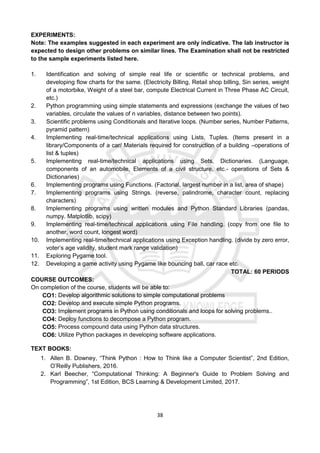
CO1: Develop algorithmic solutions to simple computational problems.
CO2: Develop and execute simple Python programs.
CO3: Write simple Python programs using conditionals and loops for solving problems.
CO4: Decompose a Python program into functions.
CO5: Represent compound data using Python lists, tuples, dictionaries etc.
CO6: Read and write data from/to files in Python programs.
TEXT BOOKS:
1. Allen B. Downey, “Think Python: How to Think like a Computer Scientist”, 2nd Edition,
O’Reilly Publishers, 2016.
2. Karl Beecher, “Computational Thinking: A Beginner's Guide to Problem Solving and
Programming”, 1st Edition, BCS Learning & Development Limited, 2017.
REFERENCES:
1. Paul Deitel and Harvey Deitel, “Python for Programmers”, Pearson Education, 1st Edition,
2021.
2. G Venkatesh and Madhavan Mukund, “Computational Thinking: A Primer for Programmers
and Data Scientists”, 1st Edition, Notion Press, 2021.
3. John V Guttag, "Introduction to Computation and Programming Using Python: With
Applications to Computational Modeling and Understanding Data”, Third Edition, MIT
Press, 2021
4. Eric Matthes, “Python Crash Course, A Hands - on Project Based Introduction to
Programming”, 2nd Edition, No Starch Press, 2019.
5. https://www.python.org/
6. Martin C. Brown, “Python: The Complete Reference”, 4th Edition, Mc-Graw Hill, 2018.
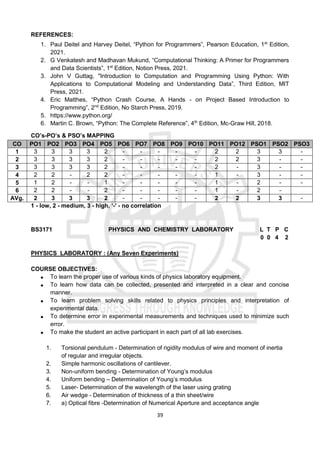
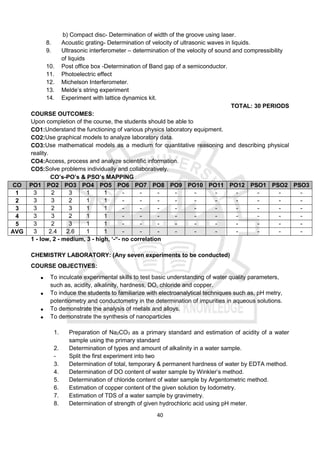
CO’s-PO’s & PSO’s MAPPING
CO PO1 PO2 PO3 PO4 PO5 PO6 PO7 PO8 PO9 PO10 PO11 PO12 PSO1 PSO2 PSO3
1 3 3 3 3 2 - - - - - 2 2 3 3 -
2 3 3 3 3 2 - - - - - 2 2 3 - -
3 3 3 3 3 2 - - - - - 2 - 3 - -
4 2 2 - 2 2 - - - - - 1 - 3 - -
5 1 2 - - 1 - - - - - 1 - 2 - -
6 2 2 - - 2 - - - - - 1 - 2 -
AVg. 2 3 3 3 2 - - - - - 2 2 3 3 -
1 - low, 2 - medium, 3 - high, ‘-' - no correlation
35
GE3152 HERITAGE OF TAMILS L T P C
1 0 0 1
UNIT I LANGUAGE AND LITERATURE 3
Language Families in India - Dravidian Languages – Tamil as aClassical Language - Classical
Literature in Tamil – Secular Nature of Sangam Literature – Distributive Justice in Sangam
Literature - Management Principles in Thirukural - Tamil Epics and Impact of Buddhism & Jainism
in Tamil Land - Bakthi Literature Azhwars and Nayanmars - Forms of minor Poetry - Development
of Modern literature in Tamil - Contribution of Bharathiyar and Bharathidhasan.
UNIT II HERITAGE - ROCK ART PAINTINGS TO MODERN ART – SCULPTURE 3
Hero stone to modern sculpture - Bronze icons - Tribes and their handicrafts - Art of temple car
making - - Massive Terracotta sculptures, Village deities, Thiruvalluvar Statue at Kanyakumari,
Making of musical instruments - Mridhangam, Parai, Veenai, Yazh and Nadhaswaram - Role of
Temples in Social and Economic Life of Tamils.
UNIT III FOLK AND MARTIAL ARTS 3
Therukoothu, Karagattam, Villu Pattu, Kaniyan Koothu, Oyillattam, Leatherpuppetry, Silambattam,
Valari, Tiger dance - Sports and Games of Tamils.
UNIT IV THINAI CONCEPT OF TAMILS 3
Flora and Fauna of Tamils & Aham and Puram Concept from Tholkappiyam and Sangam
Literature - Aram Concept of Tamils - Education and Literacy during Sangam Age - Ancient Cities
and Ports of Sangam Age - Export and Import during Sangam Age - Overseas Conquest of
Cholas.
UNIT V CONTRIBUTION OF TAMILS TO INDIAN NATIONAL MOVEMENT AND INDIAN
CULTURE 3
Contribution of Tamils to Indian Freedom Struggle - The Cultural Influence of Tamils over the
other parts of India – Self-Respect Movement - Role of Siddha Medicine in Indigenous Systems
of Medicine – Inscriptions & Manuscripts – Print History of Tamil Books.
TOTAL : 15 PERIODS
TEXT-CUM-REFERENCE BOOKS
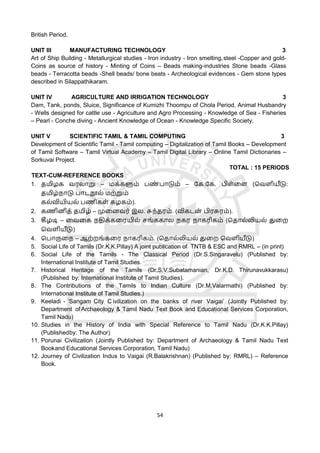
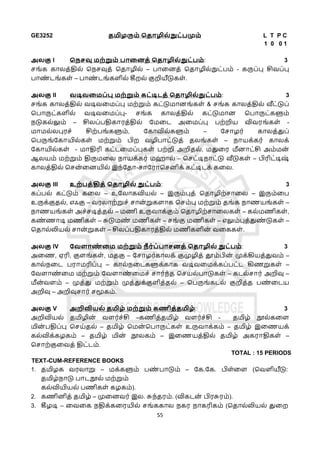
1. தமிழக வரலொறு – மக்களும் பண
் பொடும் – கக.கக. பிள்ளள (தவளியீடு:
தமிழ்நொடு பொடநூல் மற்றும்
கல்வியியல் பணிகள் கழகம்).
2. கணினித் தமிழ் – முளனவர் இல. சுந்தரம். (விகடன
் பிரசுரம்).
3. கீழடி – ளவளக நதிக்களரயில் சங்ககொல நகர நொகரிகம் (ததொல்லியல் துளற
தவளியீடு)
4. தபொருளந – ஆற்றங்களர நொகரிகம். (ததொல்லியல் துளற தவளியீடு)
5. Social Life of Tamils (Dr.K.K.Pillay) A joint publication of TNTB & ESC and RMRL – (in
print)
6. Social Life of the Tamils - The Classical Period (Dr.S.Singaravelu) (Published by:
International Institute of Tamil Studies.
7. Historical Heritage of the Tamils (Dr.S.V.Subatamanian, Dr.K.D. Thirunavukkarasu)
(Published by: International Institute of Tamil Studies).
8. The Contributions of the Tamils to Indian Culture (Dr.M.Valarmathi) (Published by:
36
International Institute of Tamil Studies.)
9. Keeladi - ‘Sangam City C ivilization on the banks of river Vaigai’ (Jointly Published by:
Department ofArchaeology & Tamil Nadu Text Book and Educational Services Corporation,
Tamil Nadu)
10. Studies in the History of India with Special Reference to Tamil Nadu (Dr.K.K.Pillay)
(Publishedby: The Author)
11. Porunai Civilization (Jointly Published by: Department of Archaeology & Tamil Nadu Text
Bookand Educational Services Corporation, Tamil Nadu)
12. Journey of Civilization Indus to Vaigai (R.Balakrishnan) (Published by: RMRL) – Reference
Book.
GE3152 தமிழர் மரபு L T P C
1 0 0 1
அலகு I மமொழி மற்றும் இலக்கியம்: 3
இந்திய தமொழிக் குடும்பங்கள் – திரொவிட தமொழிகள் – தமிழ் ஒரு தசம்தமொழி –
தமிழ் தசவ்விலக்கியங்கள் - சங்க இலக்கியத்தின
் சமயச் சொர்பற்ற தன
் ளம –
சங்க இலக்கியத்தில் பகிர்தல் அறம் – திருக்குறளில் கமலொண
் ளமக் கருத்துக்கள்
– தமிழ்க் கொப்பியங்கள், தமிழகத்தில் சமண தபௌத்த சமயங்களின
் தொக்கம் -
பக்தி இலக்கியம், ஆழ்வொர்கள் மற்றும் நொயன
் மொர்கள் – சிற்றிலக்கியங்கள் –
தமிழில் நவீன இலக்கியத்தின
் வளர்ச்சி – தமிழ் இலக்கிய வளர்ச்சியில்
பொரதியொர் மற்றும் பொரதிதொசன
் ஆகிகயொரின
் பங்களிப்பு.
அலகு II மரபு – பொறற ஓவியங் கள் முதல் நவீன ஓவியங் கள் வறர –
சிற்பக் கறல: 3
நடுகல் முதல் நவீன சிற்பங்கள் வளர – ஐம்தபொன
் சிளலகள்– பழங்குடியினர்
மற்றும் அவர்கள் தயொரிக்கும் ளகவிளனப் தபொருட்கள், தபொம்ளமகள் – கதர்
தசய்யும் களல – சுடுமண
் சிற்பங்கள் – நொட்டுப்புறத் ததய்வங்கள் –
குமரிமுளனயில் திருவள்ளுவர் சிளல – இளசக் கருவிகள் – மிருதங்கம், பளற,
வீளண, யொழ், நொதஸ
் வரம் – தமிழர்களின
் சமூக தபொருளொதொர வொழ்வில்
ககொவில்களின
் பங்கு.
அலகு III நொட்டுப்புறக் கறலகள் மற்றும் வீர விறளயொட்டுகள் : 3
ததருக்கூத்து, கரகொட்டம், வில்லுப்பொட்டு, கணியொன
் கூத்து, ஒயிலொட்டம்,
கதொல்பொளவக் கூத்து, சிலம்பொட்டம், வளரி, புலியொட்டம், தமிழர்களின
்
விளளயொட்டுகள்.
அலகு IV தமிழர்களின
் திறைக் ககொட்பொடுகள் : 3
தமிழகத்தின
் தொவரங்களும், விலங்குகளும் – ததொல்கொப்பியம் மற்றும் சங்க
இலக்கியத்தில் அகம் மற்றும் புறக் ககொட்பொடுகள் – தமிழர்கள் கபொற்றிய
அறக்ககொட்பொடு – சங்ககொலத்தில் தமிழகத்தில் எழுத்தறிவும், கல்வியும் –
சங்ககொல நகரங்களும் துளற முகங்களும் – சங்ககொலத்தில் ஏற்றுமதி மற்றும்
இறக்குமதி – கடல்கடந்த நொடுகளில் கசொழர்களின
் தவற்றி.
37
அலகு V இந்திய கதசிய இயக்கம் மற்றும் இந்திய பை
் பொட்டிற்குத்
தமிழர்களின
் பங் களிப்பு: 3
இந்திய விடுதளலப்கபொரில் தமிழர்களின
் பங்கு – இந்தியொவின
் பிறப்பகுதிகளில்
தமிழ்ப் பண
் பொட்டின
் தொக்கம் – சுயமரியொளத இயக்கம் – இந்திய மருத்துவத்தில்,
சித்த மருத்துவத்தின
் பங்கு – கல்தவட்டுகள், ளகதயழுத்துப்படிகள் - தமிழ்ப்
புத்தகங்களின
் அச்சு வரலொறு.
TOTAL : 15 PERIODS
TEXT-CUM-REFERENCE BOOKS
1. தமிழக வரலொறு – மக்களும் பண
் பொடும் – கக.கக. பிள்ளள (தவளியீடு:
தமிழ்நொடு பொடநூல் மற்றும்
கல்வியியல் பணிகள் கழகம்).
2. கணினித் தமிழ் – முளனவர் இல. சுந்தரம். (விகடன
் பிரசுரம்).
3. கீழடி – ளவளக நதிக்களரயில் சங்ககொல நகர நொகரிகம் (ததொல்லியல் துளற
தவளியீடு)
4. தபொருளந – ஆற்றங்களர நொகரிகம். (ததொல்லியல் துளற தவளியீடு)
5. Social Life of Tamils (Dr.K.K.Pillay) A joint publication of TNTB & ESC and RMRL – (in
print)
6. Social Life of the Tamils - The Classical Period (Dr.S.Singaravelu) (Published by:
International Institute of Tamil Studies.
7. Historical Heritage of the Tamils (Dr.S.V.Subatamanian, Dr.K.D. Thirunavukkarasu)
(Published by: International Institute of Tamil Studies).
8. The Contributions of the Tamils to Indian Culture (Dr.M.Valarmathi) (Published by:
International Institute of Tamil Studies.)
9. Keeladi - ‘Sangam City C ivilization on the banks of river Vaigai’ (Jointly Published by:
Department ofArchaeology & Tamil Nadu Text Book and Educational Services Corporation,
Tamil Nadu)
10. Studies in the History of India with Special Reference to Tamil Nadu (Dr.K.K.Pillay)
(Publishedby: The Author)
11. Porunai Civilization (Jointly Published by: Department of Archaeology & Tamil Nadu Text
Bookand Educational Services Corporation, Tamil Nadu)
12. Journey of Civilization Indus to Vaigai (R.Balakrishnan) (Published by: RMRL) – Reference
Book.
GE3171 PROBLEM SOLVING AND PYTHON PROGRAMMING LABORATORY L T P C
0 0 4 2
COURSE OBJECTIVES:
 To understand the problem solving approaches.
 To learn the basic programming constructs in Python.
 To practice various computing strategies for Python-based solutions to real world
problems.
 To use Python data structures - lists, tuples, dictionaries.
 To do input/output with files in Python.
38
EXPERIMENTS:
Note: The examples suggested in each experiment are only indicative. The lab instructor is
expected to design other problems on similar lines. The Examination shall not be restricted
to the sample experiments listed here.
1. Identification and solving of simple real life or scientific or technical problems, and
developing flow charts for the same. (Electricity Billing, Retail shop billing, Sin series, weight
of a motorbike, Weight of a steel bar, compute Electrical Current in Three Phase AC Circuit,
etc.)
2. Python programming using simple statements and expressions (exchange the values of two
variables, circulate the values of n variables, distance between two points).
3. Scientific problems using Conditionals and Iterative loops. (Number series, Number Patterns,
pyramid pattern)
4. Implementing real-time/technical applications using Lists, Tuples. (Items present in a
library/Components of a car/ Materials required for construction of a building –operations of
list & tuples)
5. Implementing real-time/technical applications using Sets, Dictionaries. (Language,
components of an automobile, Elements of a civil structure, etc.- operations of Sets &
Dictionaries)
6. Implementing programs using Functions. (Factorial, largest number in a list, area of shape)
7. Implementing programs using Strings. (reverse, palindrome, character count, replacing
characters)
8. Implementing programs using written modules and Python Standard Libraries (pandas,
numpy. Matplotlib, scipy)
9. Implementing real-time/technical applications using File handling. (copy from one file to
another, word count, longest word)
10. Implementing real-time/technical applications using Exception handling. (divide by zero error,
voter’s age validity, student mark range validation)
11. Exploring Pygame tool.
12. Developing a game activity using Pygame like bouncing ball, car race etc.
TOTAL: 60 PERIODS
COURSE OUTCOMES:
On completion of the course, students will be able to:
CO1: Develop algorithmic solutions to simple computational problems
CO2: Develop and execute simple Python programs.
CO3: Implement programs in Python using conditionals and loops for solving problems..
CO4: Deploy functions to decompose a Python program.
CO5: Process compound data using Python data structures.
CO6: Utilize Python packages in developing software applications.
TEXT BOOKS:
1. Allen B. Downey, “Think Python : How to Think like a Computer Scientist”, 2nd Edition,
O’Reilly Publishers, 2016.
2. Karl Beecher, “Computational Thinking: A Beginner's Guide to Problem Solving and
Programming”, 1st Edition, BCS Learning & Development Limited, 2017.
39
REFERENCES:
1. Paul Deitel and Harvey Deitel, “Python for Programmers”, Pearson Education, 1st
Edition,
2021.
2. G Venkatesh and Madhavan Mukund, “Computational Thinking: A Primer for Programmers
and Data Scientists”, 1st
Edition, Notion Press, 2021.
3. John V Guttag, "Introduction to Computation and Programming Using Python: With
Applications to Computational Modeling and Understanding Data”, Third Edition, MIT
Press, 2021.
4. Eric Matthes, “Python Crash Course, A Hands - on Project Based Introduction to
Programming”, 2nd
Edition, No Starch Press, 2019.
5. https://www.python.org/
6. Martin C. Brown, “Python: The Complete Reference”, 4th
Edition, Mc-Graw Hill, 2018.
CO’s-PO’s & PSO’s MAPPING
CO PO1 PO2 PO3 PO4 PO5 PO6 PO7 PO8 PO9 PO10 PO11 PO12 PSO1 PSO2 PSO3
1 3 3 3 3 2 - - - - - 2 2 3 3 -
2 3 3 3 3 2 - - - - - 2 2 3 - -
3 3 3 3 3 2 - - - - - 2 - 3 - -
4 2 2 - 2 2 - - - - - 1 - 3 - -
5 1 2 - - 1 - - - - - 1 - 2 - -
6 2 2 - - 2 - - - - - 1 - 2 -
AVg. 2 3 3 3 2 - - - - - 2 2 3 3 -
1 - low, 2 - medium, 3 - high, ‘-' - no correlation
BS3171 PHYSICS AND CHEMISTRY LABORATORY L T P C
0 0 4 2
PHYSICS LABORATORY : (Any Seven Experiments)
COURSE OBJECTIVES:
 To learn the proper use of various kinds of physics laboratory equipment.
 To learn how data can be collected, presented and interpreted in a clear and concise
manner.
 To learn problem solving skills related to physics principles and interpretation of
experimental data.
 To determine error in experimental measurements and techniques used to minimize such
error.
 To make the student an active participant in each part of all lab exercises.
1. Torsional pendulum - Determination of rigidity modulus of wire and moment of inertia
of regular and irregular objects.
2. Simple harmonic oscillations of cantilever.
3. Non-uniform bending - Determination of Young’s modulus
4. Uniform bending – Determination of Young’s modulus
5. Laser- Determination of the wavelength of the laser using grating
6. Air wedge - Determination of thickness of a thin sheet/wire
7. a) Optical fibre -Determination of Numerical Aperture and acceptance angle
40
b) Compact disc- Determination of width of the groove using laser.
8. Acoustic grating- Determination of velocity of ultrasonic waves in liquids.
9. Ultrasonic interferometer – determination of the velocity of sound and compressibility
of liquids
10. Post office box -Determination of Band gap of a semiconductor.
11. Photoelectric effect
12. Michelson Interferometer.
13. Melde’s string experiment
14. Experiment with lattice dynamics kit.
TOTAL: 30 PERIODS
COURSE OUTCOMES:
Upon completion of the course, the students should be able to
CO1:Understand the functioning of various physics laboratory equipment.
CO2:Use graphical models to analyze laboratory data.
CO3:Use mathematical models as a medium for quantitative reasoning and describing physical
reality.
CO4:Access, process and analyze scientific information.
CO5:Solve problems individually and collaboratively.
CO’s-PO’s & PSO’s MAPPING
CO PO1 PO2 PO3 PO4 PO5 PO6 PO7 PO8 PO9 PO10 PO11 PO12 PSO1 PSO2 PSO3
1 3 2 3 1 1 - - - - - - - - - -
2 3 3 2 1 1 - - - - - - - - - -
3 3 2 3 1 1 - - - - - - - - - -
4 3 3 2 1 1 - - - - - - - - - -
5 3 2 3 1 1 - - - - - - - - - -
AVG 3 2.4 2.6 1 1 - - - - - - - - - -
1 - low, 2 - medium, 3 - high, ‘-“- no correlation
CHEMISTRY LABORATORY: (Any seven experiments to be conducted)
COURSE OBJECTIVES:
 To inculcate experimental skills to test basic understanding of water quality parameters,
such as, acidity, alkalinity, hardness, DO, chloride and copper.
 To induce the students to familiarize with electroanalytical techniques such as, pH metry,
potentiometry and conductometry in the determination of impurities in aqueous solutions.
 To demonstrate the analysis of metals and alloys.
 To demonstrate the synthesis of nanoparticles
1. Preparation of Na2CO3 as a primary standard and estimation of acidity of a water
sample using the primary standard
2. Determination of types and amount of alkalinity in a water sample.
- Split the first experiment into two
3. Determination of total, temporary & permanent hardness of water by EDTA method.
4. Determination of DO content of water sample by Winkler’s method.
5. Determination of chloride content of water sample by Argentometric method.
6. Estimation of copper content of the given solution by Iodometry.
7. Estimation of TDS of a water sample by gravimetry.
8. Determination of strength of given hydrochloric acid using pH meter.
41
9. Determination of strength of acids in a mixture of acids using conductivity meter.
10. Conductometric titration of barium chloride against sodium sulphate (precipitation
titration)
11. Estimation of iron content of the given solution using potentiometer.
12. Estimation of sodium /potassium present in water using a flame photometer.
13. Preparation of nanoparticles (TiO2/ZnO/CuO) by Sol-Gel method.
14. Estimation of Nickel in steel
15. Proximate analysis of Coal
TOTAL : 30 PERIODS
COURSE OUTCOMES:
CO1:To analyse the quality of water samples with respect to their acidity, alkalinity, hardness and
DO.
CO2:To determine the amount of metal ions through volumetric and spectroscopic techniques
CO3:To analyse and determine the composition of alloys.
CO4:To learn simple method of synthesis of nanoparticles
CO5:To quantitatively analyse the impurities in solution by electroanalytical techniques
TEXT BOOKS:
1. J. Mendham, R. C. Denney, J.D. Barnes, M. Thomas and B. Sivasankar, Vogel’s Textbook
of Quantitative Chemical Analysis (2009).
CO’s-PO’s & PSO’s MAPPING
CO PO1 PO2 PO3 PO4 PO5 PO6 PO7 PO8 PO9 PO10 PO11 PO12 PSO1 PSO2 PSO3
1 3 - 1 - - 2 2 - - - - 2 - - -
2 3 1 2 - - 1 2 - - - - 1 - - -
3 3 2 1 1 - - 1 - - - - - - - -
4 2 1 2 - - 2 2 - - - - - - - -
5 2 1 2 - 1 2 2 - - - - 1 - - -
Avg. 2.6 1.3 1.6 1 1 1.4 1.8 - - - - 1.3 - - -
1 - low, 2 - medium, 3 - high, ‘-“- no correlation
GE3172 ENGLISH LABORATORY L T P C
0 0 2 1
COURSE OBJECTIVES:
• To improve the communicative competence of learners
• To help learners use language effectively in academic /work contexts
• To develop various listening strategies to comprehend various types of audio materials
like lectures, discussions, videos etc.
• To build on students’ English language skills by engaging them in listening, speaking
and grammar learning activities that are relevant to authentic contexts.
• To use language efficiently in expressing their opinions via various media.
UNIT I INTRODUCTION TO FUNDAMENTALS OF COMMUNICATION 6
Listening for general information-specific details- conversation: Introduction to classmates - Audio /
video (formal & informal); Telephone conversation; Listening to voicemail & messages; Listening
and filling a form. Speaking - making telephone calls-Self Introduction; Introducing a friend; -
42
politeness strategies- making polite requests, making polite offers, replying to polite requests and
offers- understanding basic instructions( filling out a bank application for example).
UNIT II NARRATION AND SUMMATION 6
Listening - Listening to podcasts, anecdotes / stories / event narration; documentaries and
interviews with celebrities. Speaking - Narrating personal experiences / events-Talking about
current and temporary situations & permanent and regular situations* - describing experiences and
feelings- engaging in small talk- describing requirements and abilities.
UNIT III DESCRIPTION OF A PROCESS / PRODUCT 6
Listening - Listen to product and process descriptions; a classroom lecture; and advertisements
about products. Speaking – Picture description- describing locations in workplaces- Giving
instruction to use the product- explaining uses and purposes- Presenting a product- describing
shapes and sizes and weights- talking about quantities(large & small)-talking about precautions.
UNIT IV CLASSIFICATION AND RECOMMENDATIONS 6
Listening – Listening to TED Talks; Listening to lectures - and educational videos. Speaking –
Small Talk; discussing and making plans-talking about tasks-talking about progress- talking about
positions and directions of movement-talking about travel preparations- talking about
transportation-
UNIT V EXPRESSION 6
Listening – Listening to debates/ discussions; different viewpoints on an issue; and panel
discussions. Speaking –making predictions- talking about a given topic-giving opinions-
understanding a website-describing processes
TOTAL : 30 PERIODS
LEARNING OUTCOMES:
At the end of the course, learners will be able
CO1:To listen to and comprehend general as well as complex academic information
CO2:To listen to and understand different points of view in a discussion
CO3:To speak fluently and accurately in formal and informal communicative contexts
CO4:To describe products and processes and explain their uses and purposes clearly and
accurately
CO5:To express their opinions effectively in both formal and informal discussions
CO’s-PO’s & PSO’s MAPPING
CO
PO PSO
1 2 3 4 5 6 7 8 9 10 11 12 1 2 3
1 3 3 3 3 1 3 3 3 3 3 3 3 - - -
2 3 3 3 3 1 3 3 3 3 3 3 3 - - -
3 3 3 3 3 1 3 3 3 3 3 3 3 - - -
4 3 3 3 3 1 3 3 3 3 3 3 3 - - -
5 3 3 3 3 1 3 3 3 3 3 3 3 - - -
AVg. 3 3 3 3 1 3 3 3 3 3 3 3 - - -
1 - low, 2 - medium, 3 - high, ‘-“- no correlation
Note: The average value of this course to be used for program articulation matrix.
ASSESSMENT PATTERN
 One online / app based assessment to test listening /speaking
43
 End Semester ONLY listening and speaking will be conducted online.
 Proficiency certification is given on successful completion of listening and speaking internal
test and end semester exam.
HS3252 PROFESSIONAL ENGLISH - II L T P C
2 0 0 2
COURSE OBJECTIVES :
 To engage learners in meaningful language activities to improve their reading and writing
skills
 To learn various reading strategies and apply in comprehending documents in professional
context.
 To help learners understand the purpose, audience, contexts of different types of writing
 To develop analytical thinking skills for problem solving in communicative contexts
 To demonstrate an understanding of job applications and interviews for internship and
placements
UNIT I MAKING COMPARISONS 6
Reading - Reading advertisements, user manuals, brochures; Writing – Professional emails, Email
etiquette - Compare and Contrast Essay; Grammar – Mixed Tenses, Prepositional phrases
UNIT II EXPRESSING CAUSAL RELATIONS IN SPEAKING AND WRITING 6
Reading - Reading longer technical texts– Cause and Effect Essays, and Letters / emails of
complaint, Writing - Writing responses to complaints. Grammar - Active Passive Voice
transformations, Infinitive and Gerunds
UNIT III PROBLEM SOLVING 6
Reading - Case Studies, excerpts from literary texts, news reports etc. Writing – Letter to the
Editor, Checklists, Problem solution essay / Argumentative Essay. Grammar – Error correction; If
conditional sentences
UNIT IV REPORTING OF EVENTS AND RESEARCH 6
Reading –Newspaper articles; Writing – Recommendations, Transcoding, Accident Report, Survey
Report Grammar – Reported Speech, Modals Vocabulary – Conjunctions- use of prepositions
UNIT V THE ABILITY TO PUT IDEAS OR INFORMATION COGENTLY 6
Reading – Company profiles, Statement of Purpose, (SOP), an excerpt of interview with
professionals; Writing – Job / Internship application – Cover letter & Resume; Grammar –
Numerical adjectives, Relative Clauses.
TOTAL : 30 PERIODS
COURSE OUTCOMES:
At the end of the course, learners will be able
CO1:To compare and contrast products and ideas in technical texts.
CO2:To identify and report cause and effects in events, industrial processes through technical
texts
CO3:To analyse problems in order to arrive at feasible solutions and communicate them in the
written format.
CO4:To present their ideas and opinions in a planned and logical manner
44
CO5:To draft effective resumes in the context of job search.
TEXT BOOKS :
1. English for Engineers & Technologists (2020 edition) Orient Blackswan Private Ltd.
Department of English, Anna University.
2. English for Science & Technology Cambridge University Press 2021.
3. Authored by Dr. Veena Selvam, Dr. Sujatha Priyadarshini, Dr. Deepa Mary Francis, Dr. KN.
Shoba, and Dr. Lourdes Joevani, Department of English, Anna University.
REFERENCE BOOKS:
1. Raman. Meenakshi, Sharma. Sangeeta (2019). Professional English. Oxford university press.
New Delhi.
2. Improve Your Writing ed. V.N. Arora and Laxmi Chandra, Oxford Univ. Press, 2001,
NewDelhi.
3. Learning to Communicate – Dr. V. Chellammal. Allied Publishers, New Delhi, 2003
4. Business Correspondence and Report Writing by Prof. R.C. Sharma & Krishna Mohan, Tata
McGraw Hill & Co. Ltd., 2001, New Delhi.
5. Developing Communication Skills by Krishna Mohan, Meera Bannerji- Macmillan India Ltd.
1990, Delhi.
ASSESSMENT PATTERN
Two internal assessments and an end semester examination to test students’ reading and writing
skills along with their grammatical and lexical competence.
CO’s-PO’s & PSO’s MAPPING
CO PO1 PO2 PO3 PO4 PO5 PO6 PO7 PO8 PO9 PO10 PO11 PO12 PSO1 PSO2 PSO3
1 3 3 3 3 3 3 3 3 2 3 3 3 - - -
2 3 3 3 3 3 3 3 3 2 3 3 3 - - -
3 3 3 3 3 3 3 3 3 2 3 3 3 - - -
4 3 3 3 3 2 3 3 3 2 3 3 3 - - -
5 - - - - - - - - 3 3 3 3 - - -
AVg. 3 3 3 3 2.75 3 3 3 2.2 3 3 3 - - -
1 - low, 2 - medium, 3 - high, ‘-“- no correlation
Note: The average value of this course to be used for program articulation matrix.
MA3251 STATISTICS AND NUMERICAL METHODS L T P C
3 1 0 4
COURSE OBJECTIVES:
● This course aims at providing the necessary basic concepts of a few statistical and
numerical methods and give procedures for solving numerically different kinds of
problems occurring in engineering and technology.
● To acquaint the knowledge of testing of hypothesis for small and large samples which
plays an important role in real life problems.
● To introduce the basic concepts of solving algebraic and transcendental equations.
● To introduce the numerical techniques of interpolation in various intervals and numerical
techniques of differentiation and integration which plays an important role in engineering
and technology disciplines.
● To acquaint the knowledge of various techniques and methods of solving ordinary
differential equations.
45
UNIT I TESTING OF HYPOTHESIS 9 + 3
Sampling distributions - Tests for single mean, proportion and difference of means (Large and
small samples) – Tests for single variance and equality of variances – Chi square test for
goodness of fit – Independence of attributes.
UNIT II DESIGN OF EXPERIMENTS 9 + 3
One way and two way classifications - Completely randomized design – Randomized block design
– Latin square design - 22
factorial design.
UNIT III SOLUTION OF EQUATIONS AND EIGENVALUE PROBLEMS 9 + 3
Solution of algebraic and transcendental equations - Fixed point iteration method – Newton
Raphson method- Solution of linear system of equations - Gauss elimination method – Pivoting -
Gauss Jordan method – Iterative methods of Gauss Jacobi and Gauss Seidel - Eigenvalues of a
matrix by Power method and Jacobi’s method for symmetric matrices.
UNIT IV INTERPOLATION, NUMERICAL DIFFERENTIATION AND NUMERICAL
INTEGRATION 9 +3
Lagrange’s and Newton’s divided difference interpolations – Newton’s forward and backward
difference interpolation – Approximation of derivates using interpolation polynomials – Numerical
single and double integrations using Trapezoidal and Simpson’s 1/3 rules.
UNIT V NUMERICAL SOLUTION OF ORDINARY DIFFERENTIAL EQUATIONS 9 +3
Single step methods: Taylor’s series method - Euler’s method - Modified Euler’s method - Fourth
order Runge-Kutta method for solving first order differential equations - Multi step methods:
Milne’s and Adams - Bash forth predictor corrector methods for solving first order differential
equations.
TOTAL: 60 PERIODS
COURSE OUTCOMES:
Upon successful completion of the course, students will be able to:
CO1:Apply the concept of testing of hypothesis for small and large samples in real life problems.
CO2:Apply the basic concepts of classifications of design of experiments in the field of agriculture.
CO3:Appreciate the numerical techniques of interpolation in various intervals and apply the
numerical techniques of differentiation and integration for engineering problems.
CO4:Understandthe knowledge of various techniques and methods for solving first and second
order ordinary differential equations.
CO5:Solve the partial and ordinary differential equations with initial and boundary conditions by
using certain techniques with engineering applications.
TEXT BOOKS:
1. Grewal, B.S., and Grewal, J.S., "Numerical Methods in Engineering and Science", Khanna
Publishers, 10th
Edition, New Delhi, 2015.
2. Johnson, R.A., Miller, I and Freund J., “Miller and Freund’s Probability and Statistics for
Engineers", Pearson Education, Asia, 8th
Edition, 2015.
REFERENCES:
1. Burden, R.L and Faires, J.D, "Numerical Analysis”, 9th
Edition, Cengage Learning,
2016.
46
2. Devore. J.L., "Probability and Statistics for Engineering and the Sciences”, Cengage
Learning, New Delhi, 8th
Edition, 2014.
3. Gerald. C.F. and Wheatley. P.O. "Applied Numerical Analysis” Pearson Education,
Asia, New Delhi, 7th
Edition, 2007.
4. Gupta S.C. and Kapoor V. K., “Fundamentals of Mathematical Statistics”, Sultan Chand
& Sons, New Delhi, 12th
Edition, 2020.
5. Spiegel. M.R., Schiller. J. and Srinivasan. R.A., "Schaum’s Outlines on Probability and
Statistics ", Tata McGraw Hill Edition, 4th
Edition, 2012.
6. Walpole. R.E., Myers. R.H., Myers. S.L. and Ye. K., “Probability and Statistics for
Engineers and Scientists", 9th
Edition, Pearson Education, Asia, 2010.
CO’s-PO’s & PSO’s MAPPING
CO
PO1 PO2 PO3 PO4 PO5 PO6 PO7 PO8 PO9 PO10 PO11 PO12 PSO1 PSO2 PSO3
CO1 3 3 1 1 1 0 0 0 2 0 2 3 - - -
CO2 3 3 1 1 1 0 0 0 2 0 2 3 - - -
CO3 3 3 1 1 1 0 0 0 2 0 2 3 - - -
CO4 3 3 1 1 1 0 0 0 2 0 2 3 - - -
CO5 3 3 1 1 1 0 0 0 2 0 2 3 - - -
Avg 3 3 1 1 1 0 0 0 2 0 2 3 - - -
1 - low, 2 - medium, 3 - high, ‘-“- no correlation
PH3256 PHYSICS FOR INFORMATION SCIENCE L T P C
3 0 0 3
COURSE OBJECTIVES:
 To make the students understand the importance in studying electrical properties of
materials.
 To enable the students to gain knowledge in semiconductor physics
 To instill knowledge on magnetic properties of materials.
 To establish a sound grasp of knowledge on different optical properties of materials, optical
displays and applications
 To inculcate an idea of significance of nano structures, quantum confinement, ensuing
nano device applications and quantum computing.
UNIT I ELECTRICAL PROPERTIES OF MATERIALS 9
Classical free electron theory - Expression for electrical conductivity – Thermal conductivity,
expression - Wiedemann-Franz law – Success and failures - electrons in metals – Particle in a
three dimensional box – degenerate states – Fermi- Dirac statistics – Density of energy states –
Electron in periodic potential – Energy bands in solids – tight binding approximation - Electron
effective mass – concept of hole.
UNIT II SEMICONDUCTOR PHYSICS 9
Intrinsic Semiconductors – Energy band diagram – direct and indirect band gap semiconductors
– Carrier concentration in intrinsic semiconductors – extrinsic semiconductors - Carrier
concentration in N-type & P-type semiconductors – Variation of carrier concentration with
temperature – variation of Fermi level with temperature and impurity concentration – Carrier
transport in Semiconductor: random motion, drift, mobility and diffusion – Hall effect and devices –
Ohmic contacts – Schottky diode.
47
UNIT III MAGNETIC PROPERTIES OF MATERIALS 9
Magnetic dipole moment – atomic magnetic moments- magnetic permeability and susceptibility -
Magnetic material classification: diamagnetism – paramagnetism – ferromagnetism –
antiferromagnetism – ferrimagnetism – Ferromagnetism: origin and exchange interaction-
saturation magnetization and Curie temperature – Domain Theory- M versus H behaviour – Hard
and soft magnetic materials – examples and uses-– Magnetic principle in computer data storage –
Magnetic hard disc (GMR sensor).
UNIT IV OPTICAL PROPERTIES OF MATERIALS 9
Classification of optical materials – carrier generation and recombination processes - Absorption
emission and scattering of light in metals, insulators and semiconductors (concepts only) - photo
current in a P-N diode – solar cell - LED – Organic LED – Laser diodes – Optical data storage
techniques.
UNIT V NANODEVICES AND QUANTUM COMPUTING 9
Introduction - quantum confinement – quantum structures: quantum wells, wires and dots ––
band gap of nanomaterials. Tunneling – Single electron phenomena: Coulomb blockade -
resonant-tunneling diode – single electron transistor – quantum cellular automata - Quantum
system for information processing - quantum states – classical bits – quantum bits or qubits –
CNOT gate - multiple qubits – Bloch sphere – quantum gates – advantage of quantum computing
over classical computing.
TOTAL :45 PERIODS
COURSE OUTCOMES:
At the end of the course, the students should be able to
CO1:gain knowledge on classical and quantum electron theories, and energy band structures
CO2:acquire knowledge on basics of semiconductor physics and its applications in various
devices
CO3:get knowledge on magnetic properties of materials and their applications in data storage,
CO4:have the necessary understanding on the functioning of optical materials for optoelectronics
CO5:understand the basics of quantum structures and their applications and basics of quantum
computing
TEXT BOOKS:
1. Jasprit Singh, “Semiconductor Devices: Basic Principles”, Wiley (Indian Edition), 2007.
2. S.O. Kasap. Principles of Electronic Materials and Devices, McGraw-Hill Education (Indian
Edition), 2020.
3. Parag K. Lala, Quantum Computing: A Beginner's Introduction, McGraw-Hill Education
(Indian Edition), 2020.
REFERENCES:
1. Charles Kittel, Introduction to Solid State Physics, Wiley India Edition, 2019.
2. Y.B.Band and Y.Avishai, Quantum Mechanics with Applications to Nanotechnology and
Information Science, Academic Press, 2013.
3. V.V.Mitin, V.A. Kochelap and M.A.Stroscio, Introduction to Nanoelectronics, Cambridge
Univ.Press, 2008.
4. G.W. Hanson, Fundamentals of Nanoelectronics, Pearson Education (Indian Edition) 2009.
48
5. B.Rogers, J.Adams and S.Pennathur, Nanotechnology: Understanding Small Systems,
CRC Press, 2014.
CO’s-PO’s & PSO’s MAPPING
CO’s PO’s PSO’s
1 2 3 4 5 6 7 8 9 10 11 12 1 2 3
1 3 1 - - - - - - - - - - - - -
2 3 1 2 - - - - - - - - - - - -
3 3 - - 1 2 1 1 - - - - - - - -
4 3 - 2 1 3 - 1 - - - - - - - -
5 3 2 2 2 2 1 2 - - - - 2 - - -
AVG 3 1.3 2 1.3 2.3 1 1.3 - - - - 2 - - -
1-Low,2-Medium,3-High,”-“-no correlation
Note: the average value of this course to be used for program articulation matrix.
BE3251 BASIC ELECTRICAL AND ELECTRONICS ENGINEERING L T P C
3 0 0 3
COURSE OBJECTIVES:
 To introduce the basics of electric circuits and analysis
 To impart knowledge in the basics of working principles and application of electrical
machines
 To introduce analog devices and their characteristics
 To educate on the fundamental concepts of digital electronics
 To introduce the functional elements and working of measuring instruments
UNIT I ELECTRICAL CIRCUITS 9
DC Circuits: Circuit Components: Conductor, Resistor, Inductor, Capacitor – Ohm’s Law -
Kirchhoff’s Laws –Independent and Dependent Sources – Simple problems- Nodal Analysis,
Mesh analysis with Independent sources only (Steady state)
Introduction to AC Circuits and Parameters: Waveforms, Average value, RMS Value,
Instantaneous power, real power, reactive power and apparent power, power factor – Steady state
analysis of RLC circuits (Simple problems only)
UNIT II ELECTRICAL MACHINES 9
Construction and Working principle- DC Separately and Self excited Generators, EMF equation,
Types and Applications. Working Principle of DC motors, Torque Equation, Types and
Applications. Construction, Working principle and Applications of Transformer, Three phase
Alternator, Synchronous motor and Three Phase Induction Motor.
UNIT III ANALOG ELECTRONICS 9
Resistor, Inductor and Capacitor in Electronic Circuits- Semiconductor Materials: Silicon
&Germanium – PN Junction Diodes, Zener Diode –Characteristics Applications – Bipolar Junction
Transistor-Biasing, JFET, SCR, MOSFET,IGBT – Types, I-V Characteristics and Applications,
Rectifier and Inverters
49
UNIT IV DIGITAL ELECTRONICS 9
Review of number systems, binary codes, error detection and correction codes, Combinational
logic - representation of logic functions-SOP and POS forms, K-map representations -
minimization using K maps (Simple Problems only).
UNIT V MEASUREMENTS AND INSTRUMENTATION 9
Functional elements of an instrument, Standards and calibration, Operating Principle, types -
Moving Coil and Moving Iron meters, Measurement of three phase power, Energy Meter,
Instrument Transformers-CT and PT, DSO- Block diagram- Data acquisition.
TOTAL: 45 PERIODS
COURSE OUTCOMES:
After completing this course, the students will be able to
CO1: Compute the electric circuit parameters for simple problems
CO2: Explain the working principle and applications of electrical machines
CO3: Analyze the characteristics of analog electronic devices
CO4: Explain the basic concepts of digital electronics
CO5: Explain the operating principles of measuring instruments
TEXT BOOKS:
1. Kothari DP and I.J Nagrath, “Basic Electrical and Electronics Engineering”, Second Edition,
McGraw Hill Education, 2020
2. S.K.Bhattacharya “Basic Electrical and Electronics Engineering”, Pearson Education, Second
Edition, 2017.
3. Sedha R.S., “A textbook book of Applied Electronics”, S. Chand & Co., 2008
4. James A .Svoboda, Richard C. Dorf, “Dorf’s Introduction to Electric Circuits”, Wiley, 2018.
5. A.K. Sawhney, Puneet Sawhney ‘A Course in Electrical & Electronic Measurements &
Instrumentation’, Dhanpat Rai and Co, 2015.
REFERENCES:
1. Kothari DP and I.J Nagrath, “Basic Electrical Engineering”, Fourth Edition, McGraw Hill
2. Education, 2019.
3. Thomas L. Floyd, ‘Digital Fundamentals’, 11th Edition, Pearson Education, 2017.
4. Albert Malvino, David Bates, ‘Electronic Principles, McGraw Hill Education; 7th edition, 2017.
5. Mahmood Nahvi and Joseph A. Edminister, “Electric Circuits”, Schaum’ Outline Series,
McGraw Hill, 2002.
6. H.S. Kalsi, ‘Electronic Instrumentation’, Tata McGraw-Hill, New Delhi, 2010
CO’s-PO’s & PSO’s MAPPING
CO PO1 PO2 PO3 PO4 PO5 PO6 PO7 PO8 PO9 PO10 PO11 PO12 PSO1 PSO2 PSO3
1 2 2 1 - - - - 1 - - - 2 - - 1
2 2 2 1 - - - - 1 - - - 2 - - 1
3 2 1 1 - - - - 1 - - - 2 - - 1
4 2 2 1 - - - - 1 - - - 2 - - 1
5 2 2 1 - - - - 1 - - - 2 - - 1
CO 2 1.8 1 - - - - 1 - - - 2 - - 1
1 - low, 2 - medium, 3 - high, ‘-“- no correlation
50
GE3251 ENGINEERING GRAPHICS L T P C
2 0 4 4
COURSE OBJECTIVES:
The main learning objective of this course is to prepare the students for:
• Drawing engineering curves.
• Drawing a freehand sketch of simple objects.
• Drawing orthographic projection of solids and section of solids.
• Drawing development of solids
• Drawing isometric and perspective projections of simple solids.
CONCEPTS AND CONVENTIONS (Not for Examination)
Importance of graphics in engineering applications — Use of drafting instruments — BIS
conventions and specifications — Size, layout and folding of drawing sheets — Lettering and
dimensioning.
UNIT I PLANE CURVES 6+12
Basic Geometrical constructions, Curves used in engineering practices: Conics — Construction of
ellipse, parabola and hyperbola by eccentricity method — Construction of cycloid — construction
of involutes of square and circle — Drawing of tangents and normal to the above curves.
UNIT II PROJECTION OF POINTS, LINES AND PLANE SURFACE 6+12
Orthographic projection- principles-Principal planes-First angle projection-projection of points.
Projection of straight lines (only First angle projections) inclined to both the principal planes -
Determination of true lengths and true inclinations by rotating line method and traces. Projection of
planes (polygonal and circular surfaces) inclined to both the principal planes by rotating object
method.
UNIT III PROJECTION OF SOLIDS AND FREEHAND SKETCHING 6+12
Projection of simple solids like prisms, pyramids, cylinder, cone and truncated solids when the axis
is inclined to one of the principal planes and parallel to the other by rotating object method.
Visualization concepts and Free Hand sketching: Visualization principles —Representation of
Three Dimensional objects — Layout of views- Freehand sketching of multiple views from pictorial
views of objects.
Practicing three dimensional modeling of simple objects by CAD Software (Not for examination)
UNIT IV PROJECTION OF SECTIONED SOLIDS AND DEVELOPMENT OF
SURFACES 6 +12
Sectioning of above solids in simple vertical position when the cutting plane is inclined to one of
the principal planes and perpendicular to the other — obtaining true shape of section.
Development of lateral surfaces of simple and sectioned solids — Prisms, pyramids cylinders and
cones.
Practicing three dimensional modeling of simple objects by CAD Software (Not for examination)
UNIT V ISOMETRIC AND PERSPECTIVE PROJECTIONS 6+12
Principles of isometric projection — isometric scale — isometric projections of simple solids and
truncated solids - Prisms, pyramids, cylinders, cones- combination of two solid objects in simple
vertical positions - Perspective projection of simple solids - Prisms, pyramids and cylinders by
visual ray method.
51
Practicing three dimensional modeling of isometric projection of simple objects by CAD Software
(Not for examination)
TOTAL: (L=30+P=60) 90 PERIODS
COURSE OUTCOMES:
On successful completion of this course, the student will be able to
CO1:Use BIS conventions and specifications for engineering drawing.
CO2:Construct the conic curves, involutes and cycloid.
CO3:Solve practical problems involving projection of lines.
CO4:Draw the orthographic, isometric and perspective projections of simple solids.
CO5:Draw the development of simple solids.
TEXT BOOK:
1. Bhatt N.D. and Panchal V.M., “Engineering Drawing”, Charotar Publishing House, 53rd
Edition, 2019.
2. Natarajan K.V., “A Text Book of Engineering Graphics”, Dhanalakshmi Publishers,
Chennai, 2018.
3. Parthasarathy, N. S. and Vela Murali, “Engineering Drawing”, Oxford University Press,
2015
REFERENCES:
1. Basant Agarwal and Agarwal C.M., “Engineering Drawing”, McGraw Hill, 2nd Edition, 2019.
2. Gopalakrishna K.R., “Engineering Drawing” (Vol. I&II combined), Subhas Publications,
Bangalore, 27th Edition, 2017.
3. Luzzader, Warren.J. and Duff,John M., “Fundamentals of Engineering Drawing with an
introduction to Interactive Computer Graphics for Design and Production, Eastern
Economy Edition, Prentice Hall of India Pvt. Ltd, New Delhi, 2005.
4. Parthasarathy N. S. and Vela Murali, “Engineering Graphics”, Oxford University, Press,
New Delhi, 2015.
5. Shah M.B., and Rana B.C., “Engineering Drawing”, Pearson Education India, 2nd Edition,
2009.
6. Venugopal K. and Prabhu Raja V., “Engineering Graphics", New Age International (P)
Limited, 2008.
Publication of Bureau of Indian Standards:
1. IS 10711 — 2001: Technical products Documentation — Size and layout of drawing
sheets.
2. IS 9609 (Parts 0 & 1) — 2001: Technical products Documentation — Lettering.
3. IS 10714 (Part 20) — 2001 & SP 46 — 2003: Lines for technical drawings.
4. IS 11669 — 1986 & SP 46 —2003: Dimensioning of Technical Drawings.
5. IS 15021 (Parts 1 to 4) — 2001: Technical drawings — Projection Methods.
Special points applicable to University Examinations on Engineering Graphics:
1. There will be five questions, each of either or type covering all units of the syllabus.
2. All questions will carry equal marks of 20 each making a total of 100.
3. The answer paper shall consist of drawing sheets of A3 size only. The students will be
permitted to use appropriate scale to fit a solution within A3 size.
4. The examination will be conducted in appropriate sessions on the same day
52
CO’s-PO’s & PSO’s MAPPING
CO PO1 PO2 PO3 PO4 PO5 PO6 PO7 PO8 PO9 PO10 PO11 PO12 PSO1 PSO2 PSO3
1 3 1 2 - 2 - - - - 3 - 2 2 2 -
2 3 1 2 - 2 - - - - 3 - 2 2 2 -
3 3 1 2 - 2 - - - - 3 - 2 2 2 -
4 3 1 2 - 2 - - - - 3 - 2 2 2 -
5 3 1 2 - 2 - - - - 3 - 2 2 2 -
CO 3 1 2 - 2 - - - - 3 - 2 2 2 -
1 - low, 2 - medium, 3 - high, ‘-“- no correlation
CS3251 PROGRAMMING IN C L T P C
3 0 0 3
COURSE OBJECTIVES:
• To understand the constructs of C Language.
• To develop C Programs using basic programming constructs
• To develop C programs using arrays and strings
• To develop modular applications in C using functions
• To develop applications in C using pointers and structures
• To do input/output and file handling in C
UNIT I BASICS OF C PROGRAMMING 9
Introduction to programming paradigms – Applications of C Language - Structure of C program - C
programming: Data Types - Constants – Enumeration Constants - Keywords – Operators:
Precedence and Associativity - Expressions - Input/Output statements, Assignment statements –
Decision making statements - Switch statement - Looping statements – Preprocessor directives -
Compilation process
UNIT II ARRAYS AND STRINGS 9
Introduction to Arrays: Declaration, Initialization – One dimensional array –Two dimensional
arrays - String operations: length, compare, concatenate, copy – Selection sort, linear and binary
search.
UNIT III FUNCTIONS AND POINTERS 9
Modular programming - Function prototype, function definition, function call, Built-in functions
(string functions, math functions) – Recursion, Binary Search using recursive functions –
Pointers – Pointer operators – Pointer arithmetic – Arrays and pointers – Array of pointers –
Parameter passing: Pass by value, Pass by reference.
UNIT IV STRUCTURES AND UNION 9
Structure - Nested structures – Pointer and Structures – Array of structures – Self referential
structures – Dynamic memory allocation - Singly linked list – typedef – Union - Storage classes
and Visibility.
UNIT V FILE PROCESSING 9
Files – Types of file processing: Sequential access, Random access – Sequential access file -
Random access file - Command line arguments.
53
COURSE OUTCOMES:
Upon completion of the course, the students will be able to
CO1: Demonstrate knowledge on C Programming constructs
CO2: Develop simple applications in C using basic constructs
CO3: Design and implement applications using arrays and strings
CO4: Develop and implement modular applications in C using functions.
CO5: Develop applications in C using structures and pointers.
CO6: Design applications using sequential and random access file processing.
TOTAL : 45 PERIODS
TEXT BOOKS:
1. ReemaThareja, “Programming in C”, Oxford University Press, Second Edition, 2016.
2. Kernighan, B.W and Ritchie,D.M, “The C Programming language”, Second Edition,
Pearson Education, 2015.
REFERENCES:
1. Paul Deitel and Harvey Deitel, “C How to Program with an Introduction to C++”, Eighth
edition, Pearson Education, 2018.
2. Yashwant Kanetkar, Let us C, 17th Edition, BPB Publications, 2020.
3. Byron S. Gottfried, “Schaum’s Outline of Theory and Problems of Programming with C”,
McGraw-Hill Education, 1996.
4. Pradip Dey, Manas Ghosh, “Computer Fundamentals and Programming in C”, Second
5. Edition, Oxford University Press, 2013.
6. Anita Goel and Ajay Mittal, “Computer Fundamentals and Programming in C”, 1st
Edition, Pearson Education, 2013.
CO’s-PO’s & PSO’s MAPPING
CO’s PO’s PSO’s
1 2 3 4 5 6 7 8 9 10 11 12 1 2 3 4
1 1 2 2 1 2 1 1 1 2 - 3 2 1 2
2 2 2 2 1 2 1 1 1 2 - 3 3 2 2
3 2 3 2 1 2 1 1 1 2 - 3 2 2 2
4 3 2 2 1 3 1 1 1 2 - 3 3 2 2
5 2 3 3 1 2 1 2 1 2 - 3 2 2 3
Avg 2 2 2 1 2 1 1 1 2 - 3 2 2 2
1 - low, 2 - medium, 3 - high, ‘-“- no correlation
GE3252 TAMILS AND TECHNOLOGY L T P C
1 0 0 1
UNIT I WEAVING AND CERAMIC TECHNOLOGY 3
Weaving Industry during Sangam Age – Ceramic technology – Black and Red Ware Potteries
(BRW) – Graffiti on Potteries.
UNIT II DESIGN AND CONSTRUCTION TECHNOLOGY 3
Designing and Structural construction House & Designs in household materials during Sangam
Age - Building materials and Hero stones of Sangam age – Details of Stage Constructions in
Silappathikaram - Sculptures and Temples of Mamallapuram - Great Temples of Cholas and
other worship places - Temples of Nayaka Period - Type study (Madurai Meenakshi Temple)-
Thirumalai Nayakar Mahal - Chetti Nadu Houses, Indo - Saracenic architecture at Madras during
54
British Period.
UNIT III MANUFACTURING TECHNOLOGY 3
Art of Ship Building - Metallurgical studies - Iron industry - Iron smelting,steel -Copper and gold-
Coins as source of history - Minting of Coins – Beads making-industries Stone beads -Glass
beads - Terracotta beads -Shell beads/ bone beats - Archeological evidences - Gem stone types
described in Silappathikaram.
UNIT IV AGRICULTURE AND IRRIGATION TECHNOLOGY 3
Dam, Tank, ponds, Sluice, Significance of Kumizhi Thoompu of Chola Period, Animal Husbandry
- Wells designed for cattle use - Agriculture and Agro Processing - Knowledge of Sea - Fisheries
– Pearl - Conche diving - Ancient Knowledge of Ocean - Knowledge Specific Society.
UNIT V SCIENTIFIC TAMIL & TAMIL COMPUTING 3
Development of Scientific Tamil - Tamil computing – Digitalization of Tamil Books – Development
of Tamil Software – Tamil Virtual Academy – Tamil Digital Library – Online Tamil Dictionaries –
Sorkuvai Project.
TOTAL : 15 PERIODS
TEXT-CUM-REFERENCE BOOKS
1. தமிழக வரலொறு – மக்களும் பண
் பொடும் – கக.கக. பிள்ளள (தவளியீடு:
தமிழ்நொடு பொடநூல் மற்றும்
கல்வியியல் பணிகள் கழகம்).
2. கணினித் தமிழ் – முளனவர் இல. சுந்தரம். (விகடன
் பிரசுரம்).
3. கீழடி – ளவளக நதிக்களரயில் சங்ககொல நகர நொகரிகம் (ததொல்லியல் துளற
தவளியீடு)
4. தபொருளந – ஆற்றங்களர நொகரிகம். (ததொல்லியல் துளற தவளியீடு)
5. Social Life of Tamils (Dr.K.K.Pillay) A joint publication of TNTB & ESC and RMRL – (in print)
6. Social Life of the Tamils - The Classical Period (Dr.S.Singaravelu) (Published by:
International Institute of Tamil Studies.
7. Historical Heritage of the Tamils (Dr.S.V.Subatamanian, Dr.K.D. Thirunavukkarasu)
(Published by: International Institute of Tamil Studies).
8. The Contributions of the Tamils to Indian Culture (Dr.M.Valarmathi) (Published by:
International Institute of Tamil Studies.)
9. Keeladi - ‘Sangam City C ivilization on the banks of river Vaigai’ (Jointly Published by:
Department of Archaeology & Tamil Nadu Text Book and Educational Services Corporation,
Tamil Nadu)
10. Studies in the History of India with Special Reference to Tamil Nadu (Dr.K.K.Pillay)
(Publishedby: The Author)
11. Porunai Civilization (Jointly Published by: Department of Archaeology & Tamil Nadu Text
Bookand Educational Services Corporation, Tamil Nadu)
12. Journey of Civilization Indus to Vaigai (R.Balakrishnan) (Published by: RMRL) – Reference
Book.
55
GE3252 தமிழரும் மதொழில்நுட்பமும் L T P C
1 0 0 1
அலகு I மநசவு மற்றும் பொறனத் மதொழில்நுட்பம்: 3
சங்க கொலத்தில் தநசவுத் ததொழில் – பொளனத் ததொழில்நுட்பம் - கருப்பு சிவப்பு
பொண
் டங்கள் – பொண
் டங்களில் கீறல் குறியீடுகள்.
அலகு II வடிவறமப்பு மற்றும் கட்டிடத் மதொழில்நுட்பம்: 3
சங்க கொலத்தில் வடிவளமப்பு மற்றும் கட்டுமொனங்கள் & சங்க கொலத்தில் வீட்டுப்
தபொருட்களில் வடிவளமப்பு- சங்க கொலத்தில் கட்டுமொன தபொருட்களும்
நடுகல்லும் – சிலப்பதிகொரத்தில் கமளட அளமப்பு பற்றிய விவரங்கள் -
மொமல்லபுரச் சிற்பங்களும், ககொவில்களும் – கசொழர் கொலத்துப்
தபருங்ககொயில்கள் மற்றும் பிற வழிபொட்டுத் தலங்கள் – நொயக்கர் கொலக்
ககொயில்கள் - மொதிரி கட்டளமப்புகள் பற்றி அறிதல், மதுளர மீனொட்சி அம்மன
்
ஆலயம் மற்றும் திருமளல நொயக்கர் மஹொல் – தசட்டிநொட்டு வீடுகள் – பிரிட்டிஷ
்
கொலத்தில் தசன
் ளனயில் இந்கதொ-சொகரொதசனிக் கட்டிடக் களல.
அலகு III உற்பத்தித் மதொழில் நுட்பம்: 3
கப்பல் கட்டும் களல – உகலொகவியல் – இரும்புத் ததொழிற்சொளல – இரும்ளப
உருக்குதல், எஃகு – வரலொற்றுச் சொன
்றுகளொக தசம்பு மற்றும் தங்க நொணயங்கள் –
நொணயங்கள் அச்சடித்தல் – மணி உருவொக்கும் ததொழிற்சொளலகள் – கல்மணிகள்,
கண
் ணொடி மணிகள் – சுடுமண
் மணிகள் – சங்கு மணிகள் – எலும்புத்துண
் டுகள் –
ததொல்லியல் சொன
்றுகள் – சிலப்பதிகொரத்தில் மணிகளின
் வளககள்.
அலகு IV கவளொை
் றம மற்றும் நீ ர்ப்பொசனத் மதொழில் நுட்பம்: 3
அளண, ஏரி, குளங்கள், மதகு – கசொழர்கொலக் குமுழித் தூம்பின் முக்கியத்துவம் –
கொல்நளட பரொமரிப்பு – கொல்நளடகளுக்கொக வடிவளமக்கப்பட்ட கிணறுகள் –
கவளொண
் ளம மற்றும் கவளொண
் ளமச் சொர்ந்த தசயல்பொடுகள் – கடல்சொர் அறிவு –
மீன
்வளம் – முத்து மற்றும் முத்துக்குளித்தல் – தபருங்கடல் குறித்த பண
் ளடய
அறிவு – அறிவுசொர் சமூகம்.
அலகு V அறிவியல் தமிழ் மற்றும் கைித்தமிழ்: 3
அறிவியல் தமிழின
் வளர்ச்சி –கணித்தமிழ் வளர்ச்சி - தமிழ் நூல்களள
மின
் பதிப்பு தசய்தல் – தமிழ் தமன
் தபொருட்கள் உருவொக்கம் – தமிழ் இளணயக்
கல்விக்கழகம் – தமிழ் மின
் நூலகம் – இளணயத்தில் தமிழ் அகரொதிகள் –
தசொற்குளவத் திட்டம்.
TOTAL : 15 PERIODS
TEXT-CUM-REFERENCE BOOKS
1. தமிழக வரலொறு – மக்களும் பண
் பொடும் – கக.கக. பிள்ளள (தவளியீடு:
தமிழ்நொடு பொடநூல் மற்றும்
கல்வியியல் பணிகள் கழகம்).
2. கணினித் தமிழ் – முளனவர் இல. சுந்தரம். (விகடன
் பிரசுரம்).
3. கீழடி – ளவளக நதிக்களரயில் சங்ககொல நகர நொகரிகம் (ததொல்லியல் துளற
56
தவளியீடு)
4. தபொருளந – ஆற்றங்களர நொகரிகம். (ததொல்லியல் துளற தவளியீடு)
5. Social Life of Tamils (Dr.K.K.Pillay) A joint publication of TNTB & ESC and RMRL – (in print)
6. Social Life of the Tamils - The Classical Period (Dr.S.Singaravelu) (Published by:
International Institute of Tamil Studies.
7. Historical Heritage of the Tamils (Dr.S.V.Subatamanian, Dr.K.D. Thirunavukkarasu)
(Published by: International Institute of Tamil Studies).
8. The Contributions of the Tamils to Indian Culture (Dr.M.Valarmathi) (Published by:
International Institute of Tamil Studies.)
9. Keeladi - ‘Sangam City C ivilization on the banks of river Vaigai’ (Jointly Published by:
Department of Archaeology & Tamil Nadu Text Book and Educational Services Corporation,
Tamil Nadu)
10. Studies in the History of India with Special Reference to Tamil Nadu (Dr.K.K.Pillay)
(Publishedby: The Author)
11. Porunai Civilization (Jointly Published by: Department of Archaeology & Tamil Nadu Text
Bookand Educational Services Corporation, Tamil Nadu)
Journey of Civilization Indus to Vaigai (R.Balakrishnan) (Published by: RMRL) – Reference
Book.
57
NX3251 NCC Credit Course Level 1*
(ARMY WING)
NCC Credit Course Level - I L T P C
2 0 0 2
NCC GENERAL 6
NCC 1 Aims, Objectives & Organization of NCC 1
NCC 2 Incentives 2
NCC 3 Duties of NCC Cadet 1
NCC 4 NCC Camps: Types & Conduct 2
NATIONAL INTEGRATION AND AWARENESS 4
NI 1 National Integration: Importance & Necessity 1
NI 2 Factors Affecting National Integration 1
NI 3 Unity in Diversity & Role of NCC in Nation Building 1
NI 4 Threats to National Security 1
PERSONALITY DEVELOPMENT 7
PD 1
Self-Awareness, Empathy, Critical & Creative Thinking,
Decision Making and Problem Solving
2
PD 2 Communication Skills 3
PD 3 Group Discussion: Stress & Emotions 2
LEADERSHIP 5
L 1
Leadership Capsule: Traits, Indicators, Motivation, Moral
Values, Honour Code
3
L 2 Case Studies: Shivaji, Jhasi Ki Rani 2
SOCIAL SERVICE AND COMMUNITY DEVELOPMENT 8
SS 1
Basics, Rural Development Programmes, NGOs, Contribution
of Youth
3
SS 4 Protection of Children and Women Safety 1
SS 5 Road / Rail Travel Safety 1
SS 6 New Initiatives 2
SS 7 Cyber and Mobile Security Awareness 1
TOTAL: 30 PERIODS
58
NX3252 NCC Credit Course Level 1*
(NAVAL WING)
NCC Credit Course Level - I L T P C
2 0 0 2
NCC GENERAL 6
NCC 1 Aims, Objectives & Organization of NCC 1
NCC 2 Incentives 2
NCC 3 Duties of NCC Cadet 1
NCC 4 NCC Camps: Types & Conduct 2
NATIONAL INTEGRATION AND AWARENESS 4
NI 1 National Integration: Importance & Necessity 1
NI 2 Factors Affecting National Integration 1
NI 3 Unity in Diversity & Role of NCC in Nation Building 1
NI 4 Threats to National Security 1
PERSONALITY DEVELOPMENT 7
PD 1
Self-Awareness, Empathy, Critical & Creative Thinking, Decision
Making and Problem Solving
2
PD 2 Communication Skills 3
PD 3 Group Discussion: Stress & Emotions 2
LEADERSHIP 5
L 1
Leadership Capsule: Traits, Indicators, Motivation, Moral Values,
Honour Code
3
L 2 Case Studies: Shivaji, Jhasi Ki Rani 2
SOCIAL SERVICE AND COMMUNITY DEVELOPMENT 8
SS 1
Basics, Rural Development Programmes, NGOs, Contribution of
Youth
3
SS 4 Protection of Children and Women Safety 1
SS 5 Road / Rail Travel Safety 1
SS 6 New Initiatives 2
SS 7 Cyber and Mobile Security Awareness 1
TOTAL : 30 PERIODS
59
NX3253 NCC Credit Course Level 1*
(AIR FORCE WING)
NCC Credit Course Level - I L T P C
2 0 0 2
NCC GENERAL 6
NCC 1 Aims, Objectives & Organization of NCC 1
NCC 2 Incentives 2
NCC 3 Duties of NCC Cadet 1
NCC 4 NCC Camps: Types & Conduct 2
NATIONAL INTEGRATION AND AWARENESS 4
NI 1 National Integration: Importance & Necessity 1
NI 2 Factors Affecting National Integration 1
NI 3 Unity in Diversity & Role of NCC in Nation Building 1
NI 4 Threats to National Security 1
PERSONALITY DEVELOPMENT 7
PD 1 Self-Awareness, Empathy, Critical & Creative Thinking, Decision
Making and Problem Solving
2
PD 2 Communication Skills 3
PD 3 Group Discussion: Stress & Emotions 2
LEADERSHIP 5
L 1
Leadership Capsule: Traits, Indicators, Motivation, Moral Values,
Honour Code
3
L 2 Case Studies: Shivaji, Jhasi Ki Rani 2
SOCIAL SERVICE AND COMMUNITY DEVELOPMENT 8
SS 1
Basics, Rural Development Programmes, NGOs, Contribution of
Youth
3
SS 4 Protection of Children and Women Safety 1
SS 5 Road / Rail Travel Safety 1
SS 6 New Initiatives 2
SS 7 Cyber and Mobile Security Awareness 1
TOTAL : 30 PERIODS
60
GE3271 ENGINEERING PRACTICES LABORATORY L T P C
0 0 4 2
COURSE OBJECTIVES:
The main learning objective of this course is to provide hands on training to the
students in:
1. Drawing pipe line plan; laying and connecting various pipe fittings used in common
household plumbing work; Sawing; planing; making joints in wood materials used in
commonhousehold wood work.
2. Wiring various electrical joints in common household electrical wire work.
3. Welding various joints in steel plates using arc welding work; Machining various
simple processes like turning, drilling, tapping in parts; Assembling simple
mechanical assembly of common household equipments; Making a tray out of metal
sheet using sheet metal work.
4. Soldering and testing simple electronic circuits; Assembling and testing simple
electronic components on PCB.
GROUP – A (CIVIL & ELECTRICAL)
PART I CIVIL ENGINEERING PRACTICES 15
PLUMBING WORK:
a) Connecting various basic pipe fittings like valves, taps, coupling, unions,
reducers,elbows and other components which are commonly used in
household.
b) Preparing plumbing line sketches.
c) Laying pipe connection to the suction side of a pump
d) Laying pipe connection to the delivery side of a pump.
e) Connecting pipes of different materials: Metal, plastic and flexible pipes
used inhousehold appliances.
WOOD WORK:
a) Sawing,
b) Planing and
c) Making joints like T-Joint, Mortise joint and Tenon joint and Dovetail joint.
Wood Work Study:
a) Studying joints in door panels and wooden furniture
b) Studying common industrial trusses using models.
PART II ELECTRICAL ENGINEERING PRACTICES 15
a) Introduction to switches, fuses, indicators and lamps - Basic switch board
wiring with lamp, fan and three pin socket
b) Staircase wiring
c) Fluorescent Lamp wiring with introduction to CFL and LED types.
d) Energy meter wiring and related calculations/ calibration
e) Study of Iron Box wiring and assembly
f) Study of Fan Regulator (Resistor type and Electronic type using
Diac/Triac/quadrac)
61
g) Study of emergency lamp wiring/Water heater
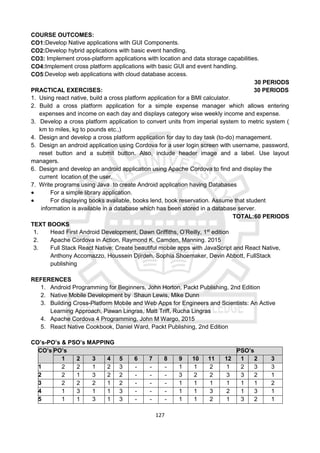
GROUP – B (MECHANICAL AND ELECTRONICS)
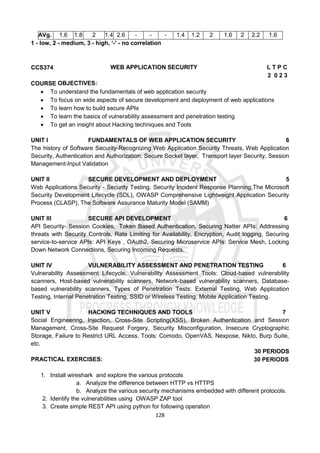
PART III MECHANICAL ENGINEERING PRACTICES 15
WELDING WORK:
a) Welding of Butt Joints, Lap Joints, and Tee Joints using arc welding.
b) Practicing gas welding.
BASIC MACHINING WORK:
a) (simple)Turning.
b) (simple)Drilling.
c) (simple)Tapping.
ASSEMBLY WORK:
a) Assembling a centrifugal pump.
b) Assembling a household mixer.
c) Assembling an airconditioner.
SHEET METAL WORK:
a) Making of a square tray
FOUNDRY WORK:
a) Demonstrating basic foundry operations.
PART IV ELECTRONIC ENGINEERING PRACTICES 15
SOLDERING WORK:
a) Soldering simple electronic circuits and checking continuity.
ELECTRONIC ASSEMBLY AND TESTING WORK:
a) Assembling and testing electronic components on a small PCB.
ELECTRONIC EQUIPMENT STUDY:
a) Study an elements of smart phone..
b) Assembly and dismantle of LED TV.
c) Assembly and dismantle of computer/ laptop
TOTAL : 60 PERIODS
COURSE OUTCOMES:
Upon completion of this course, the students will be able to:
CO1:Draw pipe line plan; lay and connect various pipe fittings used in common household
plumbing work; Saw; plan; make joints in wood materials used in common household wood work.
CO2:Wire various electrical joints in common household electrical wire work.
62
CO3:Weld various joints in steel plates using arc welding work; Machine various simple processes
like turning, drilling, tapping in parts; Assemble simple mechanical assembly of common
household equipments; Make a tray out of metal sheet using sheet metal work.
CO4:Solder and test simple electronic circuits; Assemble and test simple electronic components
on PCB.
CO’s-PO’s & PSO’s MAPPING
CO PO1 PO2 PO3 PO4 PO5 PO6 PO7 PO8 PO9 PO10 PO11 PO12 PSO1 PSO2 PSO3
1 3 2 - - 1 1 1 - - - - 2 2 1 1
2 3 2 - - 1 1 1 - - - - 2 2 1 1
3 3 2 - - 1 1 1 - - - - 2 2 1 1
CO 3 2 - - 1 1 1 - - - - 2 2 1 1
1 - low, 2 - medium, 3 - high, ‘-“- no correlation
CS3271 PROGRAMMING IN C LABORATORY L T P C
0 0 4 2
COURSE OBJECTIVES:
 To familiarise with C programming constructs.
 To develop programs in C using basic constructs.
 To develop programs in C using arrays.
 To develop applications in C using strings, pointers, functions.
 To develop applications in C using structures.
 To develop applications in C using file processing.
LIST OF EXPERIMENTS:
Note: The lab instructor is expected to design problems based on the topics listed. The
Examination shall not be restricted to the sample experiments designed.
1. I/O statements, operators, expressions
2. decision-making constructs: if-else, goto, switch-case, break-continue
3. Loops: for, while, do-while
4. Arrays: 1D and 2D, Multi-dimensional arrays, traversal
5. Strings: operations
6. Functions: call, return, passing parameters by (value, reference), passing arrays to
function.
7. Recursion
8. Pointers: Pointers to functions, Arrays,Strings, Pointers to Pointers, Array of Pointers
9. Structures: Nested Structures, Pointers to Structures, Arrays of Structures and Unions.
10. Files: reading and writing, File pointers, file operations, random access, processor
directives.
TOTAL: 60 PERIODS
COURSE OUTCOMES:
Upon completion of the course, the students will be able to
CO1: Demonstrate knowledge on C programming constructs.
CO2: Develop programs in C using basic constructs.
CO3: Develop programs in C using arrays.
CO4: Develop applications in C using strings, pointers, functions.
63
CO5: Develop applications in C using structures.
CO6: Develop applications in C using file processing.
TEXT BOOKS:
1. ReemaThareja, “Programming in C”, Oxford University Press, Second Edition, 2016.
2. Kernighan, B.W and Ritchie,D.M, “The C Programming language”, Second Edition,
Pearson Education, 2015.
REFERENCES:
1. Paul Deitel and Harvey Deitel, “C How to Program with an Introduction to C++”, Eighth
edition, Pearson Education, 2018.
2. Yashwant Kanetkar, Let us C, 17th Edition, BPB Publications, 2020.
3. Byron S. Gottfried, "Schaum's Outline of Theory and Problems of Programming with C",
McGraw-Hill Education, 1996.
4. Pradip Dey, Manas Ghosh, “Computer Fundamentals and Programming in C”, Second
5. Edition, Oxford University Press, 2013.
6. Anita Goel and Ajay Mittal, “Computer Fundamentals and Programming in C”, 1st
Edition, Pearson Education, 2013.
CO’s-PO’s & PSO’s MAPPING
CO’s PO’s PSO’s
1 2 3 4 5 6 7 8 9 10 11 12 1 2 3 4
1 1 3 3 1 1 1 - - 2 1 2 2 2 2
2 2 3 3 2 1 1 - - 2 1 2 2 2 3
3 2 2 2 1 1 2 - - 2 - 2 2 2 2
4 2 2 2 2 1 2 - - 3 - 3 3 3 2
5 2 2 3 2 3 2 - - 3 - 3 3 3 3
Avg 2 2 3 2 1 2 - - 2 1 2 2 2 2
1 - low, 2 - medium, 3 - high, ‘-“- no correlation
GE3272 COMMUNICATION LABORATORY L T P C
0 0 4 2
COURSE OBJECTIVES
 To identify varied group discussion skills and apply them to take part in effective
discussions in a professional context.
 To analyse concepts and problems and make effective presentations explaining them
clearly and precisely.
 To be able to communicate effectively through formal and informal writing.
 To be able to use appropriate language structures to write emails, reports and essays
 To give instructions and recommendations that are clear and relevant to the context
UNIT I 12
Speaking-Role Play Exercises Based on Workplace Contexts, - talking about competition-
discussing progress toward goals-talking about experiences- talking about events in life-
discussing past events-Writing: writing emails ( formal & semi-formal).
64
UNIT II 12
Speaking: discussing news stories-talking about frequency-talking about travel problems-
discussing travel procedures- talking about travel problems- making arrangements-describing
arrangements-discussing plans and decisions- discussing purposes and reasons- understanding
common technology terms-Writing: - writing different types of emails.
UNIT III 12
Speaking: discussing predictions-describing the climate-discussing forecasts and scenarios-
talking about purchasing-discussing advantages and disadvantages- making comparisons-
discussing likes and dislikes- discussing feelings about experiences-discussing imaginary
scenarios Writing: short essays and reports-formal/semi-formal letters.
UNIT IV 12
Speaking: discussing the natural environment-describing systems-describing position and
movement- explaining rules-( example- discussing rental arrangements)- understanding technical
instructions-Writing: writing instructions-writing a short article.
UNIT V 12
Speaking: describing things relatively-describing clothing-discussing safety issues (making
recommendations) talking about electrical devices-describing controlling actions- Writing:
job application( Cover letter + Curriculum vitae)-writing recommendations.
TOTAL: 60 PERIODS
LEARNING OUTCOMES
 Speak effectively in group discussions held in a formal/semi formal contexts.
 Discuss, analyse and present concepts and problems from various perspectives to arrive at
suitable solutions
 Write emails, letters and effective job applications.
 Write critical reports to convey data and information with clarity and precision
 Give appropriate instructions and recommendations for safe execution of tasks
Assessment Pattern
 One online / app based assessment to test speaking and writing skills
 Proficiency certification is given on successful completion of speaking and writing.
CO’s-PO’s & PSO’s MAPPING
CO PO1 PO2 PO3 PO4 PO5 PO6 PO7 PO8 PO9 PO10 PO11 PO12 PSO1 PSO2 PSO3
1 2 3 3 3 1 3 3 3 3 3 3 3 - - -
2 2 3 3 3 1 3 3 3 3 3 3 3 - - -
3 2 2 3 3 1 3 3 3 3 3 3 3 - - -
4 3 3 3 3 3 3 3 3 3 3 3 3 - - -
5 3 3 3 3 3 3 3 3 3 3 3 3 - - -
AVg. 2.4 2.8 3 3 1.8 3 3 3 3 3 3 3 - - -
1 - low, 2 - medium, 3 - high, ‘-“- no correlation
Note: The average value of this course to be used for program articulation matrix.
65
MA3354 DISCRETE MATHEMATICS L T P C
3 1 0 4
COURSE OBJECTIVES:
 To extend student’s logical and mathematical maturity and ability to deal with abstraction.
 To introduce most of the basic terminologies used in computer science courses and
application of ideas to solve practical problems.
 To understand the basic concepts of combinatorics and graph theory.
 To familiarize the applications of algebraic structures.
 To understand the concepts and significance of lattices and boolean algebra which are
widely used in computer science and engineering.
UNIT I LOGIC AND PROOFS 9+3
Propositional logic – Propositional equivalences - Predicates and quantifiers – Nested quantifiers
– Rules of inference - Introduction to proofs – Proof methods and strategy.
UNIT II COMBINATORICS 9+3
Mathematical induction – Strong induction and well ordering – The basics of counting – The
pigeonhole principle – Permutations and combinations – Recurrence relations – Solving linear
recurrence relations – Generating functions – Inclusion and exclusion principle and its
applications.
UNIT III GRAPHS 9+3
Graphs and graph models – Graph terminology and special types of graphs – Matrix
representation of graphs and graph isomorphism – Connectivity – Euler and Hamilton paths.
UNIT IV ALGEBRAIC STRUCTURES 9+3
Algebraic systems – Semi groups and monoids - Groups – Subgroups – Homomorphism’s –
Normal subgroup and cosets – Lagrange’s theorem – Definitions and examples of Rings and
Fields.
UNIT V LATTICES AND BOOLEAN ALGEBRA 9+3
Partial ordering – Posets – Lattices as posets – Properties of lattices - Lattices as algebraic
systems – Sub lattices – Direct product and homomorphism – Some special lattices – Boolean
algebra – Sub Boolean Algebra – Boolean Homomorphism.
TOTAL: 60 PERIODS
COURSE OUTCOMES:
At the end of the course, students would :
CO1:Have knowledge of the concepts needed to test the logic of a program.
CO2:Have an understanding in identifying structures on many levels.
CO3:Be aware of a class of functions which transform a finite set into another finite set which
relates to input and output functions in computer science.
CO4:Be aware of the counting principles.
CO5:Be exposed to concepts and properties of algebraic structures such as groups, rings and
fields.
TEXT BOOKS:
1. Rosen. K.H., "Discrete Mathematics and its Applications", 7th
Edition, Tata McGraw
Hill Pub. Co. Ltd., New Delhi, Special Indian Edition, 2017.
66
2. Tremblay. J.P. and Manohar. R, "Discrete Mathematical Structures with Applications to
Computer Science", Tata McGraw Hill Pub. Co. Ltd, New Delhi, 30th
Reprint, 2011.
REFERENCES:
1. Grimaldi. R.P. "Discrete and Combinatorial Mathematics: An Applied Introduction",
5th
Edition, Pearson Education Asia, Delhi, 2013.
2. Koshy. T. "Discrete Mathematics with Applications", Elsevier Publications, 2006.
3. Lipschutz. S. and Mark Lipson., "Discrete Mathematics", Schaum’s Outlines, Tata McGraw
Hill Pub. Co. Ltd., New Delhi, 3rd
Edition, 2010.
CO’s-PO’s & PSO’s MAPPING
CO PO1 PO2 PO3 PO4 PO5 PO6 PO7 PO8 PO9 PO10 PO11 PO12 PSO1 PSO2 PSO3
1 3 3 2 - - - - - - - - 2 - - -
2 3 3 - - - - - - - - - - - - -
3 - 3 2 - - 2 - - - 3 - - - - -
4 - 2 2 2 - - - - - - - - - - -
5 - 2 2 2 - - - - - 2 - - - - -
AVg. 1 3 2 1 - - - - - 1 - - - - -
1 - low, 2 - medium, 3 - high, ‘-“- no correlation
CS3351 DIGITAL PRINCIPLES AND COMPUTER ORGANIZATION L T P C
3 0 2 4
COURSE OBJECTIVES:
 To analyze and design combinational circuits.
 To analyze and design sequential circuits
 To understand the basic structure and operation of a digital computer.
 To study the design of data path unit, control unit for processor and to familiarize with the
hazards.
 To understand the concept of various memories and I/O interfacing.
UNIT I COMBINATIONAL LOGIC 9
Combinational Circuits – Karnaugh Map - Analysis and Design Procedures – Binary Adder –
Subtractor – Decimal Adder - Magnitude Comparator – Decoder – Encoder – Multiplexers -
Demultiplexers
UNIT II SYNCHRONOUS SEQUENTIAL LOGIC 9
Introduction to Sequential Circuits – Flip-Flops – operation and excitation tables, Triggering of FF,
Analysis and design of clocked sequential circuits – Design – Moore/Mealy models, state
minimization, state assignment, circuit implementation - Registers – Counters.
UNIT III COMPUTER FUNDAMENTALS 9
Functional Units of a Digital Computer: Von Neumann Architecture – Operation and Operands of
Computer Hardware Instruction – Instruction Set Architecture (ISA): Memory Location, Address
and Operation – Instruction and Instruction Sequencing – Addressing Modes, Encoding of
Machine Instruction – Interaction between Assembly and High Level Language.
UNIT IV PROCESSOR 9
Instruction Execution – Building a Data Path – Designing a Control Unit – Hardwired Control,
Microprogrammed Control – Pipelining – Data Hazard – Control Hazards.
67
UNIT V MEMORY AND I/O 9
Memory Concepts and Hierarchy – Memory Management – Cache Memories: Mapping and
Replacement Techniques – Virtual Memory – DMA – I/O – Accessing I/O: Parallel and Serial
Interface – Interrupt I/O – Interconnection Standards: USB, SATA
45 PERIODS
PRACTICAL EXERCISES: 30 PERIODS
1. Verification of Boolean theorems using logic gates.
2. Design and implementation of combinational circuits using gates for arbitrary functions.
3. Implementation of 4-bit binary adder/subtractor circuits.
4. Implementation of code converters.
5. Implementation of BCD adder, encoder and decoder circuits
6. Implementation of functions using Multiplexers.
7. Implementation of the synchronous counters
8. Implementation of a Universal Shift register.
9. Simulator based study of Computer Architecture
COURSE OUTCOMES:
At the end of this course, the students will be able to:
CO1 : Design various combinational digital circuits using logic gates
CO2 : Design sequential circuits and analyze the design procedures
CO3 : State the fundamentals of computer systems and analyze the execution of an instruction
CO4 : Analyze different types of control design and identify hazards
CO5 : Identify the characteristics of various memory systems and I/O communication
TOTAL:75 PERIODS
TEXT BOOKS
1. M. Morris Mano, Michael D. Ciletti, “Digital Design : With an Introduction to the Verilog
HDL, VHDL, and System Verilog”, Sixth Edition, Pearson Education, 2018.
2. David A. Patterson, John L. Hennessy, “Computer Organization and Design, The
Hardware/Software Interface”, Sixth Edition, Morgan Kaufmann/Elsevier, 2020.
REFERENCES
1. Carl Hamacher, Zvonko Vranesic, Safwat Zaky, Naraig Manjikian, “Computer Organization
and Embedded Systems”, Sixth Edition, Tata McGraw-Hill, 2012.
2. William Stallings, “Computer Organization and Architecture – Designing for Performance”,
Tenth Edition, Pearson Education, 2016.
3. M. Morris Mano, “Digital Logic and Computer Design”, Pearson Education, 2016.
CO’s-PO’s & PSO’s MAPPING
CO’s PO’s PSO’s
1 2 3 4 5 6 7 8 9 10 11 12 1 2 3
1 3 3 3 3 3 2 1 1 1 1 2 3 2 3 3
2 3 3 3 3 2 1 1 1 1 1 2 3 1 2 2
3 3 3 3 3 2 2 1 1 1 1 2 3 2 3 1
4 3 3 3 3 1 1 1 1 1 1 1 2 1 3 1
5 3 3 3 3 1 2 1 1 1 1 1 2 1 2 1
AVg. 3 3 3 3 1 2 1 1 1 1 1 2 1 2 1
1 - low, 2 - medium, 3 - high, ‘-“- no correlation
68
CS3352 FOUNDATIONS OF DATA SCIENCE L T P C
3 0 0 3
COURSE OBJECTIVES:
 To understand the data science fundamentals and process.
 To learn to describe the data for the data science process.
 To learn to describe the relationship between data.
 To utilize the Python libraries for Data Wrangling.
 To present and interpret data using visualization libraries in Python
UNIT I INTRODUCTION 9
Data Science: Benefits and uses – facets of data - Data Science Process: Overview – Defining
research goals – Retrieving data – Data preparation - Exploratory Data analysis – build the model–
presenting findings and building applications - Data Mining - Data Warehousing – Basic Statistical
descriptions of Data
UNIT II DESCRIBING DATA 9
Types of Data - Types of Variables -Describing Data with Tables and Graphs –Describing Data
with Averages - Describing Variability - Normal Distributions and Standard (z) Scores
UNIT III DESCRIBING RELATIONSHIPS 9
Correlation –Scatter plots –correlation coefficient for quantitative data –computational formula for
correlation coefficient – Regression –regression line –least squares regression line – Standard
error of estimate – interpretation of r2 –multiple regression equations –regression towards the
mean
UNIT IV PYTHON LIBRARIES FOR DATA WRANGLING 9
Basics of Numpy arrays –aggregations –computations on arrays –comparisons, masks, boolean
logic – fancy indexing – structured arrays – Data manipulation with Pandas – data indexing and
selection – operating on data – missing data – Hierarchical indexing – combining datasets –
aggregation and grouping – pivot tables
UNIT V DATA VISUALIZATION 9
Importing Matplotlib – Line plots – Scatter plots – visualizing errors – density and contour plots –
Histograms – legends – colors – subplots – text and annotation – customization – three
dimensional plotting - Geographic Data with Basemap - Visualization with Seaborn.
COURSE OUTCOMES:
At the end of this course, the students will be able to:
CO1: Define the data science process
CO2: Understand different types of data description for data science process
CO3: Gain knowledge on relationships between data
CO4: Use the Python Libraries for Data Wrangling
CO5: Apply visualization Libraries in Python to interpret and explore data
TOTAL:45 PERIODS
TEXTBOOKS:
1. David Cielen, Arno D. B. Meysman, and Mohamed Ali, “Introducing Data Science”, Manning
Publications, 2016. (Unit I)
69
2. Robert S. Witte and John S. Witte, “Statistics”, Eleventh Edition, Wiley Publications, 2017.
(Units II and III)
3. Jake VanderPlas, “Python Data Science Handbook”, O’Reilly, 2016. (Units IV and V)
REFERENCE:
1. Allen B. Downey, “Think Stats: Exploratory Data Analysis in Python”, Green Tea Press,2014.
CO’s-PO’s & PSO’s MAPPING
CO’s PO’s PSO’s
1 2 3 4 5 6 7 8 9 10 11 12 1 2 3
1 2 2 1 2 2 - - - 1 1 1 2 2 2 2
2 2 1 - 1 1 - - - 2 1 1 2 2 3 1
3 2 2 1 2 2 1 1 - 1 2 1 3 2 2 3
4 3 2 2 1 2 - - - 1 1 2 2 3 3 2
5 2 2 1 2 2 - - - 1 1 1 2 2 2 2
AVg. 2 2 1 2 2 1 1 - 1 1 1 2 2 2 2
1 - low, 2 - medium, 3 - high, ‘-“- no correlation
CD3291 DATA STRUCTURES AND ALGORITHMS L T P C
3 0 0 3
COURSE OBJECTIVES:
 To understand the concepts of ADTs
 To design linear data structures – lists, stacks, and queues
 To understand sorting, searching, and hashing algorithms
 To apply Tree and Graph structures
UNIT I ABSTRACT DATA TYPES 9
Abstract Data Types (ADTs) – ADTs and classes – introduction to OOP – classes in Python –
inheritance – namespaces – shallow and deep copying
Introduction to analysis of algorithms – asymptotic notations – divide & conquer – recursion –
analyzing recursive algorithms
UNIT II LINEAR STRUCTURES 9
List ADT – array-based implementations – linked list implementations – singly linked lists –
circularly linked lists – doubly linked lists – Stack ADT – Queue ADT – double ended queues –
applications
UNIT III SORTING AND SEARCHING 9
Bubble sort – selection sort – insertion sort – merge sort – quick sort – analysis of sorting
algorithms – linear search – binary search – hashing – hash functions – collision handling – load
factors, rehashing, and efficiency
UNIT IV TREE STRUCTURES 9
Tree ADT – Binary Tree ADT – tree traversals – binary search trees – AVL trees – heaps – multi-
way search trees
70
UNIT V GRAPH STRUCTURES 9
Graph ADT – representations of graph – graph traversals – DAG – topological ordering – greedy
algorithms – dynamic programming – shortest paths – minimum spanning trees – introduction to
complexity classes and intractability
TOTAL: 45 PERIODS
COURSE OUTCOMES:
At the end of the course, the student should be able to:
CO1:Explain abstract data types
CO2:Design, implement, and analyze linear data structures, such as lists, queues, and stacks,
according to the needs of different applications
CO3:Design, implement, and analyze efficient tree structures to meet requirements such as
searching, indexing, and sorting
CO4:Model problems as graph problems and implement efficient graph algorithms to solve them
TEXT BOOK:
1. Michael T. Goodrich, Roberto Tamassia, and Michael H. Goldwasser, “Data Structures &
Algorithms in Python”, An Indian Adaptation, John Wiley & Sons Inc., 2021
REFERENCES:
1. Lee, Kent D., Hubbard, Steve, “Data Structures and Algorithms with Python” Springer
Edition 2015
2. Rance D. Necaise, “Data Structures and Algorithms Using Python”, John Wiley & Sons,
2011
3. Aho, Hopcroft, and Ullman, “Data Structures and Algorithms”, Pearson Education, 1983.
4. Thomas H. Cormen, Charles E. Leiserson, Ronald L. Rivest, and Clifford Stein,
“Introduction to Algorithms", Second Edition, McGraw Hill, 2002.
5. Mark Allen Weiss, “Data Structures and Algorithm Analysis in C++”, Fourth Edition,
Pearson Education, 2014
CO’s-PO’s & PSO’s MAPPING
CO’s PO’s PSO’s
1 2 3 4 5 6 7 8 9 10 11 12 1 2 3
1 1 2 2 3 1 - - - 2 - 2 1 1 1 1
2 2 3 2 2 2 - - - 2 - 2 2 3 2 2
3 2 2 3 2 3 - - - 3 - 2 2 3 2 2
4 3 3 3 3 1 - - - 3 - 2 2 3 2 3
5 - - - - - - - - - - - - - -
AVg. 2 3 3 3 2 - - - 3 - 2 2 3 2 2
1 - low, 2 - medium, 3 - high, ‘-“- no correlation
CS3391 OBJECT ORIENTED PROGRAMMING L T P C
3 0 0 3
COURSE OBJECTIVES:
 To understand Object Oriented Programming concepts and basics of Java programming
language
 To know the principles of packages, inheritance and interfaces
 To develop a java application with threads and generics classes
71
 To define exceptions and use I/O streams
 To design and build Graphical User Interface Application using JAVAFX
UNIT I INTRODUCTION TO OOP AND JAVA 9
Overview of OOP – Object oriented programming paradigms – Features of Object Oriented
Programming – Java Buzzwords – Overview of Java – Data Types, Variables and Arrays –
Operators – Control Statements – Programming Structures in Java – Defining classes in Java –
Constructors-Methods -Access specifiers - Static members- JavaDoc comments
UNIT II INHERITANCE, PACKAGES AND INTERFACES 9
Overloading Methods – Objects as Parameters – Returning Objects –Static, Nested and Inner
Classes. Inheritance: Basics– Types of Inheritance -Super keyword -Method Overriding – Dynamic
Method Dispatch –Abstract Classes – final with Inheritance. Packages and Interfaces: Packages –
Packages and Member Access –Importing Packages – Interfaces.
UNIT III EXCEPTION HANDLING AND MULTITHREADING 9
Exception Handling basics – Multiple catch Clauses – Nested try Statements – Java’s Built-in
Exceptions – User defined Exception. Multithreaded Programming: Java Thread Model–Creating a
Thread and Multiple Threads – Priorities – Synchronization – Inter Thread Communication-
Suspending –Resuming, and Stopping Threads –Multithreading. Wrappers – Auto boxing.
UNIT IV I/O, GENERICS, STRING HANDLING 9
I/O Basics – Reading and Writing Console I/O – Reading and Writing Files. Generics: Generic
Programming – Generic classes – Generic Methods – Bounded Types – Restrictions and
Limitations. Strings: Basic String class, methods and String Buffer Class..
UNIT V JAVAFX EVENT HANDLING, CONTROLS AND COMPONENTS 9
JAVAFX Events and Controls: Event Basics – Handling Key and Mouse Events. Controls:
Checkbox, ToggleButton – RadioButtons – ListView – ComboBox – ChoiceBox – Text Controls –
ScrollPane. Layouts – FlowPane – HBox and VBox – BorderPane – StackPane – GridPane.
Menus – Basics – Menu – Menu bars – MenuItem.
COURSE OUTCOMES:
On completion of this course, the students will be able to
CO1:Apply the concepts of classes and objects to solve simple problems
CO2:Develop programs using inheritance, packages and interfaces
CO3:Make use of exception handling mechanisms and multithreaded model to solve real world
problems
CO4:Build Java applications with I/O packages, string classes, Collections and generics concepts
CO5:Integrate the concepts of event handling and JavaFX components and controls for
developing GUI based applications
TOTAL:45 PERIODS
TEXT BOOKS:
1. Herbert Schildt, “Java: The Complete Reference”, 11 th
Edition, McGraw Hill Education, New
Delhi, 2019
2. Herbert Schildt, “Introducing JavaFX 8 Programming”, 1 st
Edition, McGraw Hill Education, New
Delhi, 2015
72
REFERENCE:
1. Cay S. Horstmann, “Core Java Fundamentals”, Volume 1, 11 th
Edition, Prentice Hall,
2018.
CO’s-PO’s & PSO’s MAPPING
CO’s PO’s PSO’s
1 2 3 4 5 6 7 8 9 10 11 12 1 2 3
1 1 1 3 1 3 - - - 3 2 2 2 3 1 2
2 2 1 3 2 1 - - - 2 1 1 3 3 3 2
3 3 3 1 2 2 - - - 3 2 1 2 3 1 3
4 3 1 2 2 2 - - - 1 2 1 3 3 1 1
5 1 1 2 3 2 - - - 3 2 1 2 3 3 3
AVg. 2 1 2 2 2 - - - 2 2 1 2 3 2 2
1 - low, 2 - medium, 3 - high, ‘-“- no correlation
CD3281 DATA STRUCTURES AND ALGORITHMS LABORATORY L T P C
0 0 4 2
COURSE OBJECTIVES:
 To implement ADTs in Python
 To design and implement linear data structures – lists, stacks, and queues
 To implement sorting, searching and hashing algorithms
 To solve problems using tree and graph structures
LIST OF EXPERIMENTS:
1. Implement simple ADTs as Python classes
2. Implement recursive algorithms in Python
3. Implement List ADT using Python arrays
4. Linked list implementations of List
5. Implementation of Stack and Queue ADTs
6. Applications of List, Stack and Queue ADTs
7. Implementation of sorting and searching algorithms
8. Implementation of Hash tables
9. Tree representation and traversal algorithms
10. Implementation of Binary Search Trees
11. Implementation of Heaps
12. Graph representation and Traversal algorithms
13. Implementation of single source shortest path algorithm
14. Implementation of minimum spanning tree algorithms
TOTAL:60 PERIODS
COURSE OUTCOMES:
At the end of the course, the student should be able to:
CO1:Implement ADTs as Python classes
CO2:Design, implement, and analyse linear data structures, such as lists, queues, and stacks,
according to the needs of different applications
CO3:Design, implement, and analyse efficient tree structures to meet requirements such as
searching, indexing, and sorting
CO4:Model problems as graph problems and implement efficient graph algorithms to solve them
73
TEXT BOOK:
1. Michael T. Goodrich, Roberto Tamassia, and Michael H. Goldwasser, “Data Structures &
Algorithms in Python”, John Wiley & Sons Inc., 2013
REFERENCES:
1. Rance D. Necaise, “Data Structures and Algorithms Using Python”, John Wiley & Sons,
2011
2. Aho, Hopcroft, and Ullman, “Data Structures and Algorithms”, Pearson Education, 1983.
3. Thomas H. Cormen, Charles E. Leiserson, Ronald L. Rivest, and Clifford Stein,
“Introduction to Algorithms", Second Edition, McGraw Hill, 2002.
4. Mark Allen Weiss, “Data Structures and Algorithm Analysis in C++”, Fourth Edition,
Pearson Education, 2014
CO’s-PO’s & PSO’s MAPPING
CO’s PO’s PSO’s
1 2 3 4 5 6 7 8 9 10 11 12 1 2 3 4
1 3 2 1 1 1 - - - 2 3 1 2 1 2 1
2 3 3 2 - 1 - - - 2 3 1 2 2 2 1
3 2 2 2 1 1 - - - 2 3 1 2 1 3 1
4 3 1 2 1 1 - - - 2 3 1 2 1 3 1
AVg. 2.75 2 1.75 1 1 2 3 1 2 1.25 2.5 1
1 - low, 2 - medium, 3 - high, ‘-“- no correlation
CS3381 OBJECT ORIENTED PROGRAMMING LABORATORY L T P C
0 0 3 1.5
COURSE OBJECTIVES
 To build software development skills using java programming for real-world applications.
 To understand and apply the concepts of classes, packages, interfaces, inheritance,
exception handling and file processing.
 To develop applications using generic programming and event handling
LIST OF EXPERIMENTS
1. Solve problems by using sequential search, binary search, and quadratic sorting algorithms
(selection, insertion)
2. Develop stack and queue data structures using classes and objects.
3. Develop a java application with an Employee class with Emp_name, Emp_id, Address,
Mail_id, Mobile_no as members. Inherit the classes, Programmer, Assistant Professor,
Associate Professor and Professor from employee class. Add Basic Pay (BP) as the
member of all the inherited classes with 97% of BP as DA, 10 % of BP as HRA, 12% of
BP as PF, 0.1% of BP for staff club funds. Generate pay slips for the employees with their
gross and net salary.
4. Write a Java Program to create an abstract class named Shape that contains two integers
and an empty method named printArea(). Provide three classes named Rectangle,
Triangle and Circle such that each one of the classes extends the class Shape. Each one
of the classes contains only the method printArea( ) that prints the area of the given shape.
5. Solve the above problem using an interface.
6. Implement exception handling and creation of user defined exceptions.
74
7. Write a java program that implements a multi-threaded application that has three
threads. First thread generates a random integer every 1 second and if the value is
even, the second thread computes the square of the number and prints. If the value is odd,
the third thread will print the value of the cube of the number.
8. Write a program to perform file operations.
9. Develop applications to demonstrate the features of generics classes.
10. Develop applications using JavaFX controls, layouts and menus.
11. Develop a mini project for any application using Java concepts.
Lab Requirements: for a batch of 30 students
Operating Systems: Linux / Windows
Front End Tools: Eclipse IDE / Netbeans IDE
TOTAL: 45 PERIODS
COURSE OUTCOMES:
On completion of this course, the students will be able to
CO1 : Design and develop java programs using object oriented programming concepts
CO2 : Develop simple applications using object oriented concepts such as package, exceptions
CO3: Implement multithreading, and generics concepts
CO4 : Create GUIs and event driven programming applications for real world problems
CO5: Implement and deploy web applications using Java
CO’s-PO’s & PSO’s MAPPING
CO’s PO’s PSO’s
1 2 3 4 5 6 7 8 9 10 11 12 1 2 3
1 2 1 2 1 - - - - 1 2 2 2 1 2 3
2 2 1 3 1 - - - - 2 3 3 2 1 3 1
3 2 2 1 2 1 - - - 1 2 1 3 2 3 2
4 2 2 1 3 - - - - 3 1 1 1 2 1 2
5 1 3 3 1 3 - - - 1 1 1 1 2 1 2
AVg. 2 2 2 2 2 - - - 2 2 2 2 2 2 2
1 - low, 2 - medium, 3 - high, ‘-“- no correlation
CS3361 DATA SCIENCE LABORATORY L T P C
0 0 4 2
COURSE OBJECTIVES:
 To understand the python libraries for data science
 To understand the basic Statistical and Probability measures for data science.
 To learn descriptive analytics on the benchmark data sets.
 To apply correlation and regression analytics on standard data sets.
 To present and interpret data using visualization packages in Python.
LIST OF EXPERIMENTS:
1. Download, install and explore the features of NumPy, SciPy, Jupyter, Statsmodels and
Pandas packages.
2. Working with Numpy arrays
3. Working with Pandas data frames
75
4. Reading data from text files, Excel and the web and exploring various commands for doing
descriptive analytics on the Iris data set.
5. Use the diabetes data set from UCI and Pima Indians Diabetes data set for performing the
following:
a. Univariate analysis: Frequency, Mean, Median, Mode, Variance, Standard
Deviation, Skewness and Kurtosis.
b. Bivariate analysis: Linear and logistic regression modeling
c. Multiple Regression analysis
d. Also compare the results of the above analysis for the two data sets.
6. Apply and explore various plotting functions on UCI data sets.
a. Normal curves
b. Density and contour plots
c. Correlation and scatter plots
d. Histograms
e. Three dimensional plotting
7. Visualizing Geographic Data with Basemap
List of Equipments:(30 Students per Batch)
Tools: Python, Numpy, Scipy, Matplotlib, Pandas, statmodels, seaborn, plotly, bokeh
Note: Example data sets like: UCI, Iris, Pima Indians Diabetes etc.
TOTAL: 60 PERIODS
COURSE OUTCOMES:
At the end of this course, the students will be able to:
CO1: Make use of the python libraries for data science
CO2: Make use of the basic Statistical and Probability measures for data science.
CO3: Perform descriptive analytics on the benchmark data sets.
CO4: Perform correlation and regression analytics on standard data sets
CO5: Present and interpret data using visualization packages in Python.
CO’s- PO’s & PSO’s MAPPING
CO’s PO’s PSO’s
1 2 3 4 5 6 7 8 9 10 11 12 1 2 3
1 3 2 1 1 - - - - 1 3 3 3 1 3 2
2 3 2 2 3 1 - - - 3 1 3 2 1 3 3
3 3 2 1 3 1 - - - 2 1 1 1 3 2 3
4 2 3 1 3 - - - - 2 3 2 3 3 3 1
5 1 2 3 1 1 - - - 2 1 3 1 1 3 3
AVg. 2 2 2 2 1 - - - 2 2 2 2 2 3 2
1 - low, 2 - medium, 3 - high, ‘-“- no correlation
76
GE3361 PROFESSIONAL DEVELOPMENT L T P C
0 0 2 1
COURSE OBJECTIVES:
To be proficient in important Microsoft Office tools: MS WORD, EXCEL, POWERPOINT.
 To be proficient in using MS WORD to create quality technical documents, by using
standard templates, widely acceptable styles and formats, variety of features to enhance
the presentability and overall utility value of content.
 To be proficient in using MS EXCEL for all data manipulation tasks including the common
statistical, logical, mathematical etc., operations, conversion, analytics, search and explore,
visualize,interlink, and utilizing many more critical features offered
 To be able to create and share quality presentations by using the features of MS
PowerPoint, including: organization of content, presentability, aesthetics, using media
elements and enhance the overall quality of presentations.
MS WORD: 10 Hours
Create and format a document
Working with tables
Working with Bullets and Lists
Working with styles, shapes, smart art, charts
Inserting objects, charts and importing objects from other office tools
Creating and Using document templates
Inserting equations, symbols and special characters
Working with Table of contents and References, citations
Insert and review comments
Create bookmarks, hyperlinks, endnotes footnote
Viewing document in different modes
Working with document protection and security
Inspect document for accessibility
MS EXCEL: 10 Hours
Create worksheets, insert and format data
Work with different types of data: text, currency, date, numeric etc.
Split, validate, consolidate, Convert data
Sort and filter data
Perform calculations and use functions: (Statistical, Logical, Mathematical, date, Time etc.,)
Work with Lookup and reference formulae
77
Create and Work with different types of charts
Use pivot tables to summarize and analyse data
Perform data analysis using own formulae and functions
Combine data from multiple worksheets using own formulae and built-in functions to generate
results
Export data and sheets to other file formats
Working with macros
Protecting data and Securing the workbook
MS POWERPOINT: 10 Hours
Select slide templates, layout and themes
Formatting slide content and using bullets and numbering
Insert and format images, smart art, tables, charts
Using Slide master, notes and handout master
Working with animation and transitions
Organize and Group slides
Import or create and use media objects: audio, video, animation
Perform slideshow recording and Record narration and create presentable videos
TOTAL: 30 PERIODS
COURSE OUTCOMES:
On successful completion the students will be able to
CO1:Use MS Word to create quality documents, by structuring and organizing content for their day
to day technical and academic requirements
CO2:Use MS EXCEL to perform data operations and analytics, record, retrieve data as per
requirements and visualize data for ease of understanding
CO3:Use MS PowerPoint to create high quality academic presentations by including common
tables, charts, graphs, interlinking other elements, and using media objects.
CS3452 THEORY OF COMPUTATION L T P C
3 0 0 3
COURSE OBJECTIVES:
 To understand foundations of computation including automata theory
 To construct models of regular expressions and languages.
 To design context free grammar and push down automata
 To understand Turing machines and their capability
 To understand Undecidability and NP class problems
78
UNIT I AUTOMATA AND REGULAR EXPRESSIONS 9
Need for automata theory - Introduction to formal proof – Finite Automata (FA) – Deterministic
Finite Automata (DFA) – Non-deterministic Finite Automata (NFA) – Equivalence between NFA
and DFA – Finite Automata with Epsilon transitions – Equivalence of NFA and DFA- Equivalence
of NFAs with and without ε-moves- Conversion of NFA into DFA – Minimization of DFAs.
UNIT II REGULAR EXPRESSIONS AND LANGUAGES 9
Regular expression – Regular Languages- Equivalence of Finite Automata and regular
expressions – Proving languages to be not regular (Pumping Lemma) – Closure properties of
regular languages.
UNIT III CONTEXT FREE GRAMMAR AND PUSH DOWN AUTOMATA 9
Types of Grammar - Chomsky‘s hierarchy of languages -Context-Free Grammar (CFG) and
Languages – Derivations and Parse trees – Ambiguity in grammars and languages – Push Down
Automata (PDA): Definition – Moves - Instantaneous descriptions -Languages of pushdown
automata – Equivalence of pushdown automata and CFG-CFG to PDA-PDA to CFG –
Deterministic Pushdown Automata.
UNIT IV NORMAL FORMS AND TURING MACHINES 9
Normal forms for CFG – Simplification of CFG- Chomsky Normal Form (CNF) and Greibach
Normal Form (GNF) – Pumping lemma for CFL – Closure properties of Context Free Languages –
Turing Machine : Basic model – definition and representation – Instantaneous Description –
Language acceptance by TM – TM as Computer of Integer functions – Programming techniques
for Turing machines (subroutines).
UNIT V UNDECIDABILITY 9
Unsolvable Problems and Computable Functions –PCP-MPCP- Recursive and recursively
enumerable languages – Properties - Universal Turing machine -Tractable and Intractable
problems - P and NP completeness – Kruskal’s algorithm – Travelling Salesman Problem- 3-CNF
SAT problems.
COURSE OUTCOMES:
At the end of this course, the students will be able to:
CO1: Construct automata theory using Finite Automata
CO2: Write regular expressions for any pattern
CO3: Design context free grammar and Pushdown Automata
CO4: Design Turing machine for computational functions
CO5: Differentiate between decidable and undecidable problems
TOTAL:45 PERIODS
TEXT BOOKS:
1. Hopcroft J.E., Motwani R. & Ullman J.D., "Introduction to Automata Theory, Languages and
Computations", 3rd Edition, Pearson Education, 2008.
2. John C Martin , "Introduction to Languages and the Theory of Computation", 4th Edition, Tata
McGraw Hill, 2011.
REFERENCES
1. Harry R Lewis and Christos H Papadimitriou , "Elements of the Theory of Computation", 2nd
Edition, Prentice Hall of India, 2015.
79
2. Peter Linz, "An Introduction to Formal Language and Automata", 6th Edition, Jones & Bartlett,
2016.
3. K.L.P.Mishra and N.Chandrasekaran, “Theory of Computer Science: Automata Languages and
Computation”, 3rd
Edition, Prentice Hall of India, 2006.
CO’s-PO’s & PSO’s MAPPING
CO’s PO’s PSO’s
1 2 3 4 5 6 7 8 9 10 11 12 1 2 3
1 1 3 2 3 - - - - 1 1 2 3 1 3 2
2 2 2 3 2 1 - - - 3 3 2 3 3 1 2
3 2 2 3 2 1 - - - 1 3 1 2 1 2 2
4 2 2 2 1 - - - - 1 3 3 2 1 3 2
5 2 2 2 1 1 - - - 1 1 3 2 3 1 3
AVg. 2 2 2 2 1 - - - 1 2 2 2 2 2 2
1 - low, 2 - medium, 3 - high, ‘-“- no correlation
CS3491 ARTIFICIAL INTELLIGENCE AND MACHINE LEARNING L T P C
3 0 2 4
COURSE OBJECTIVES:
The main objectives of this course are to:
 Study about uninformed and Heuristic search techniques.
 Learn techniques for reasoning under uncertainty
 Introduce Machine Learning and supervised learning algorithms
 Study about ensembling and unsupervised learning algorithms
 Learn the basics of deep learning using neural networks
UNIT I PROBLEM SOLVING 9
Introduction to AI - AI Applications - Problem solving agents – search algorithms – uninformed
search strategies – Heuristic search strategies – Local search and optimization problems –
adversarial search – constraint satisfaction problems (CSP)
UNIT II PROBABILISTIC REASONING 9
Acting under uncertainty – Bayesian inference – naïve bayes models. Probabilistic reasoning –
Bayesian networks – exact inference in BN – approximate inference in BN – causal networks.
UNIT III SUPERVISED LEARNING 9
Introduction to machine learning – Linear Regression Models: Least squares, single & multiple
variables, Bayesian linear regression, gradient descent, Linear Classification Models: Discriminant
function – Probabilistic discriminative model - Logistic regression, Probabilistic generative model –
Naive Bayes, Maximum margin classifier – Support vector machine, Decision Tree, Random
forests
UNIT IV ENSEMBLE TECHNIQUES AND UNSUPERVISED LEARNING 9
Combining multiple learners: Model combination schemes, Voting, Ensemble Learning - bagging,
boosting, stacking, Unsupervised learning: K-means, Instance Based Learning: KNN, Gaussian
mixture models and Expectation maximization
80
UNIT V NEURAL NETWORKS 9
Perceptron - Multilayer perceptron, activation functions, network training – gradient descent
optimization – stochastic gradient descent, error backpropagation, from shallow networks to deep
networks –Unit saturation (aka the vanishing gradient problem) – ReLU, hyperparameter tuning,
batch normalization, regularization, dropout.
45 PERIODS
PRACTICAL EXERCISES: 30 PERIODS
1. Implementation of Uninformed search algorithms (BFS, DFS)
2. Implementation of Informed search algorithms (A*, memory-bounded A*)
3. Implement naïve Bayes models
4. Implement Bayesian Networks
5. Build Regression models
6. Build decision trees and random forests
7. Build SVM models
8. Implement ensembling techniques
9. Implement clustering algorithms
10. Implement EM for Bayesian networks
11. Build simple NN models
12. Build deep learning NN models
COURSE OUTCOMES:
At the end of this course, the students will be able to:
CO1: Use appropriate search algorithms for problem solving
CO2: Apply reasoning under uncertainty
CO3: Build supervised learning models
CO4: Build ensembling and unsupervised models
CO5: Build deep learning neural network models
TOTAL: 75 PERIODS
TEXT BOOKS:
1. Stuart Russell and Peter Norvig, “Artificial Intelligence – A Modern Approach”, Fourth
Edition, Pearson Education, 2021.
2. Ethem Alpaydin, “Introduction to Machine Learning”, MIT Press, Fourth Edition, 2020.
REFERENCES:
1. Dan W. Patterson, “Introduction to Artificial Intelligence and Expert Systems”, Pearson
Education,2007
2. Kevin Night, Elaine Rich, and Nair B., “Artificial Intelligence”, McGraw Hill, 2008
3. Patrick H. Winston, "Artificial Intelligence", Third Edition, Pearson Education, 2006
4. Deepak Khemani, “Artificial Intelligence”, Tata McGraw Hill Education, 2013
(http://nptel.ac.in/)
5. Christopher M. Bishop, “Pattern Recognition and Machine Learning”, Springer, 2006.
6. Tom Mitchell, “Machine Learning”, McGraw Hill, 3rd Edition,1997.
7. Charu C. Aggarwal, “Data Classification Algorithms and Applications”, CRC Press, 2014
8. Mehryar Mohri, Afshin Rostamizadeh, Ameet Talwalkar, “Foundations of Machine
Learning”, MIT Press, 2012.
9. Ian Goodfellow, Yoshua Bengio, Aaron Courville, “Deep Learning”, MIT Press, 2016
81
CO’s-PO’s & PSO’s MAPPING
CO’s PO’s PSO’s
1 2 3 4 5 6 7 8 9 10 11 12 1 2 3
1 3 2 3 3 - - - - 1 3 3 3 1 2 2
2 1 1 1 3 1 - - - 1 2 1 3 2 3 2
3 2 1 2 1 1 - - - 2 1 1 3 1 1 1
4 3 1 3 1 - - - - 2 1 2 1 2 2 2
5 3 1 1 2 2 - - - 3 1 2 3 2 1 2
AVg. 2 1 2 2 1 - - - 2 2 2 3 2 2 2
1 - low, 2 - medium, 3 - high, ‘-“- no correlation
CS3492 DATABASE MANAGEMENT SYSTEMS L T P C
3 0 0 3
COURSE OBJECTIVES:
 To learn the fundamentals of data models, relational algebra and SQL
 To represent a database system using ER diagrams and to learn normalization techniques
 To understand the fundamental concepts of transaction, concurrency and recovery
processing
 To understand the internal storage structures using different file and indexing techniques
which will help in physical DB design
 To have an introductory knowledge about the Distributed databases, NOSQL and database
security
UNIT I RELATIONAL DATABASES 10
Purpose of Database System – Views of data – Data Models – Database System Architecture –
Introduction to relational databases – Relational Model – Keys – Relational Algebra – SQL
fundamentals – Advanced SQL features – Embedded SQL– Dynamic SQL
UNIT II DATABASE DESIGN 8
Entity-Relationship model – E-R Diagrams – Enhanced-ER Model – ER-to-Relational Mapping –
Functional Dependencies – Non-loss Decomposition – First, Second, Third Normal Forms,
Dependency Preservation – Boyce/Codd Normal Form – Multi-valued Dependencies and Fourth
Normal Form – Join Dependencies and Fifth Normal Form
UNIT III TRANSACTIONS 9
Transaction Concepts – ACID Properties – Schedules – Serializability – Transaction support in
SQL – Need for Concurrency – Concurrency control –Two Phase Locking- Timestamp –
Multiversion – Validation and Snapshot isolation– Multiple Granularity locking – Deadlock Handling
– Recovery Concepts – Recovery based on deferred and immediate update – Shadow paging –
ARIES Algorithm
UNIT IV IMPLEMENTATION TECHNIQUES 9
RAID – File Organization – Organization of Records in Files – Data dictionary Storage – Column
Oriented Storage– Indexing and Hashing –Ordered Indices – B+ tree Index Files – B tree Index
Files – Static Hashing – Dynamic Hashing – Query Processing Overview – Algorithms for
Selection, Sorting and join operations – Query optimization using Heuristics - Cost Estimation.
82
UNIT V ADVANCED TOPICS 9
Distributed Databases: Architecture, Data Storage, Transaction Processing, Query processing and
optimization – NOSQL Databases: Introduction – CAP Theorem – Document Based systems –
Key value Stores – Column Based Systems – Graph Databases. Database Security: Security
issues – Access control based on privileges – Role Based access control – SQL Injection –
Statistical Database security – Flow control – Encryption and Public Key infrastructures –
Challenges
COURSE OUTCOMES:
Upon completion of this course, the students will be able to
CO1:Construct SQL Queries using relational algebra
CO2:Design database using ER model and normalize the database
CO3:Construct queries to handle transaction processing and maintain consistency of the database
CO4:Compare and contrast various indexing strategies and apply the knowledge to tune the
performance of the database
CO5:Appraise how advanced databases differ from Relational Databases and find a suitable
database for the given requirement.
TOTAL:45 PERIODS
TEXT BOOKS:
1. Abraham Silberschatz, Henry F. Korth, S. Sudharshan, “Database System Concepts”,
Seventh Edition, McGraw Hill, 2020.
2. Ramez Elmasri, Shamkant B. Navathe, “Fundamentals of Database Systems”, Seventh
Edition, Pearson Education, 2017
REFERENCES:
1. C.J.Date, A.Kannan, S.Swamynathan, “An Introduction to Database Systems”, Eighth
Edition, Pearson Education, 2006.
CO’s-PO’s & PSO’s MAPPING
CO’s PO’s PSO’s
1 2 3 4 5 6 7 8 9 10 11 12 1 2 3
1 2 2 3 2 1 - - - 2 1 1 1 2 1 3
2 3 1 1 1 1 - - - 2 3 3 3 3 1 2
3 3 2 3 2 1 - - - 2 1 1 2 2 3 3
4 1 2 3 2 - - - - 3 2 3 3 1 2 3
5 1 1 3 3 2 - - - 1 3 3 1 2 2 2
AVg. 2 2 3 2 1 - - - 2 2 2 2 2 2 3
1 - low, 2 - medium, 3 - high, ‘-“- no correlation
IT3401 WEB ESSENTIALS L T P C
3 0 2 4
COURSE OBJECTIVES:
 To comprehend and analyze the basic concepts of web programming and internet
protocols.
 To describe how the client-server model of Internet programming works.
 To demonstrate the uses of scripting languages
 To write simple scripts for the creation of web sites
83
 To create database applications
UNIT I WEBSITE BASICS 9
Internet Overview - Fundamental computer network concepts - Web Protocols - URL – Domain
Name- Web Browsers and Web Servers- Working principle of a Website –Creating a Website -
Client-side and server-side scripting
UNIT II WEB DESIGNING 9
HTML – Form Elements - Input types and Media elements - CSS3 - Selectors, Box Model,
Backgrounds and Borders, Text Effects, Animations, Multiple Column Layout, User Interface.
UNIT III CLIENT-SIDE PROCESSING AND SCRIPTING 9
JavaScript Introduction – Variables and Data Types-Statements – Operators - Literals-Functions-
Objects-Arrays-Built-in Objects- Regular Expression, Exceptions, Event handling, Validation -
JavaScript Debuggers.
UNIT IV SERVER SIDE PROCESSING AND SCRIPTING – PHP 9
PHP - Working principle of PHP - PHP Variables - Constants - Operators – Flow Control and
Looping - Arrays - Strings - Functions - File Handling - File Uploading – Email Basics - Email with
attachments - PHP and HTML - Simple PHP scripts - Databases with PHP
UNIT V SERVLETS AND DATABASE CONNECTIVITY 9
Servlets: Java Servlet Architecture – Servlet Life cycle- Form GET and POST actions -Sessions –
Cookies – Database connectivity - JDBC
Creation of simple interactive applications - Simple database applications
45 PERIODS
PRACTICAL EXERCISES: 30 PERIODS
1. Creation of interactive web sites - Design using HTML and authoring tools
2. Form validation using JavaScript
3. Creation of simple PHP scripts
4. Handling multimedia content in web sites
5. Write programs using Servlets:
i. To invoke servlets from HTML forms
ii. Session tracking using hidden form fields and Session tracking for a hit count
6. Creation of information retrieval system using web, PHP and MySQL
7. Creation of personal Information System
COURSE OUTCOMES:
At the end of this course, the students will be able to:
CO 1: Apply JavaScript, HTML and CSS effectively to create interactive and dynamic websites.
CO 2: Create simple PHP scripts
CO 3: Design and deploy simple web-applications.
CO 4: Create simple database applications.
CO 5: Handle multimedia components
TOTAL:75 PERIODS
TEXT BOOKS
1. Robin Nixon, "Learning PHP, MySQL, JavaScript, CSS & HTML5" Third Edition, O'Reilly
publishers, 2014.
84
2. Paul Deitel, Harvey Deitel, Abbey Deitel, “Internet & World Wide Web - How to Program”,
5th
edition, Pearson Education, 2012.
REFERENCES:
1. Jeffrey C. Jackson, "Web Technologies--A Computer Science Perspective", Pearson
Education, 2006.
2. James F. Kurose, “Computer Networking: A Top-Down Approach”, Sixth Edition, Pearson
Education, 2012
3. Steven Holzener , “PHP – The Complete Reference”, 1st Edition, Mc-Graw Hill, 2017
4. Fritz Schneider, Thomas Powell , “JavaScript – The Complete Reference”, 3rd Edition, Mc-
Graw Hill Publishers, 2017
5. Bates, “Developing Web Applications”, Wiley Publishers, 2006
CO’s-PO’s & PSO’s MAPPING
CO’s PO’s PSO’s
1 2 3 4 5 6 7 8 9 10 11 12 1 2 3
1 3 2 3 2 3 2 0 0 2 2 2 3 3 2 1
2 3 3 3 3 3 2 0 0 2 0 2 3 3 2 1
3 3 3 3 2 3 2 0 0 2 2 2 3 3 2 1
4 3 3 3 3 3 1 0 0 1 1 2 3 3 2 1
5 3 3 3 3 3 1 0 0 0 0 2 3 3 2 1
AVg. 3 3 3 3 3 2 0 0 2 1 2 3 3 2 1
1 - low, 2 - medium, 3 - high, ‘-“- no correlation
CS3451 INTRODUCTION TO OPERATING SYSTEMS L T P C
3 0 0 3
COURSE OBJECTIVES:
 To understand the basics and functions of operating systems.
 To understand processes and threads
 To analyze scheduling algorithms and process synchronization.
 To understand the concept of deadlocks.
 To analyze various memory management schemes.
 To be familiar with I/O management and file systems.
 To be familiar with the basics of virtual machines and Mobile OS like iOS and Android.
UNIT I INTRODUCTION 7
Computer System - Elements and organization; Operating System Overview - Objectives and
Functions - Evolution of Operating System; Operating System Structures – Operating System
Services - User Operating System Interface - System Calls – System Programs - Design and
Implementation - Structuring methods.
UNIT II PROCESS MANAGEMENT 11
Processes - Process Concept - Process Scheduling - Operations on Processes - Inter-process
Communication; CPU Scheduling - Scheduling criteria - Scheduling algorithms: Threads -
Multithread Models – Threading issues; Process Synchronization - The Critical-Section problem -
Synchronization hardware – Semaphores – Mutex - Classical problems of synchronization -
85
Monitors; Deadlock - Methods for handling deadlocks, Deadlock prevention, Deadlock avoidance,
Deadlock detection, Recovery from deadlock.
UNIT III MEMORY MANAGEMENT 10
Main Memory - Swapping - Contiguous Memory Allocation – Paging - Structure of the Page Table
- Segmentation, Segmentation with paging; Virtual Memory - Demand Paging – Copy on Write -
Page Replacement - Allocation of Frames –Thrashing.
UNIT IV STORAGE MANAGEMENT 10
Mass Storage system – Disk Structure - Disk Scheduling and Management; File-System Interface
- File concept - Access methods - Directory Structure - Directory organization - File system
mounting - File Sharing and Protection; File System Implementation - File System Structure -
Directory implementation - Allocation Methods - Free Space Management; I/O Systems – I/O
Hardware, Application I/O interface, Kernel I/O subsystem.
UNIT V VIRTUAL MACHINES AND MOBILE OS 7
Virtual Machines – History, Benefits and Features, Building Blocks, Types of Virtual Machines and
their Implementations, Virtualization and Operating-System Components; Mobile OS - iOS and
Android.
TOTAL:45 PERIODS
COURSE OUTCOMES:
At the end of this course, the students will be able to:
CO1 : Analyze various scheduling algorithms and process synchronization.
CO2 : Explain deadlock prevention and avoidance algorithms.
CO3 : Compare and contrast various memory management schemes.
CO4 : Explain the functionality of file systems, I/O systems, and Virtualization
CO5 : Compare iOS and Android Operating Systems.
TEXT BOOKS :
1. Abraham Silberschatz, Peter Baer Galvin and Greg Gagne, “Operating System Concepts”,
10th
Edition, John Wiley and Sons Inc., 2018.
2. Andrew S Tanenbaum, "Modern Operating Systems", Pearson, 5th
Edition,2022 New Delhi.
REFERENCES :
1. Ramaz Elmasri, A. Gil Carrick, David Levine, “ Operating Systems – A Spiral Approach”,
Tata McGraw Hill Edition, 2010.
2. William Stallings, "Operating Systems: Internals and Design Principles", 7th
Edition,
Prentice Hall, 2018.
3. Achyut S.Godbole, Atul Kahate, “Operating Systems”, McGraw Hill Education, 2016.
CO’s-PO’s & PSO’s MAPPING
CO’s PO’s PSO’s
1 2 3 4 5 6 7 8 9 10 11 12 1 2 3
1 3 1 2 2 - - - - 3 2 3 1 1 2 2
2 2 2 3 1 1 - - - 2 1 1 2 2 1 2
3 1 3 2 2 1 - - - 2 2 1 1 1 2 2
4 1 3 3 3 - - - - 1 2 1 2 1 3 2
5 3 1 2 1 1 - - - 3 2 3 2 2 2 1
AVg. 2 2 2 2 1 - - - 2 2 2 2 1 2 2
1 - low, 2 - medium, 3 - high, ‘-“- no correlation
86
GE3451 ENVIRONMENTAL SCIENCES AND SUSTAINABILITY L T P C
2 0 0 2
COURSE OBJECTIVES:
 To introduce the basic concepts of environment, ecosystems and biodiversity and
emphasize on the biodiversity of India and its conservation.
 To impart knowledge on the causes, effects and control or prevention measures of
environmental pollution and natural disasters.
 To facilitate the understanding of global and Indian scenario of renewable and
nonrenewable resources, causes of their degradation and measures to preserve them.
 To familiarize the concept of sustainable development goals and appreciate the
interdependence of economic and social aspects of sustainability, recognize and analyze
climate changes, concept of carbon credit and the challenges of environmental
management.
 To inculcate and embrace sustainability practices and develop a broader understanding on
green materials, energy cycles and analyze the role of sustainable urbanization.
UNIT I ENVIRONMENT AND BIODIVERSITY 6
Definition, scope and importance of environment – need for public awareness. Eco-system and
Energy flow– ecological succession. Types of biodiversity: genetic, species and ecosystem
diversity– values of biodiversity, India as a mega-diversity nation – hot-spots of biodiversity –
threats to biodiversity: habitat loss, poaching of wildlife, man-wildlife conflicts – endangered and
endemic species of India – conservation of biodiversity: In-situ and ex-situ.
UNIT II ENVIRONMENTAL POLLUTION 9
Causes, Effects and Preventive measures of Water, Soil, Air and Noise Pollutions.
Solid, Hazardous and E-Waste management. Case studies on Occupational Health and Safety
Management system (OHASMS). Environmental protection, Environmental protection acts .
UNIT III RENEWABLE SOURCES OF ENERGY 6
Energy management and conservation, New Energy Sources: Need of new sources. Different
types new energy sources. Applications of- Hydrogen energy, Ocean energy resources, Tidal
energy conversion. Concept, origin and power plants of geothermal energy.
UNIT IV SUSTAINABILITY AND MANAGEMENT 6
Development , GDP ,Sustainability- concept, needs and challenges-economic, social and aspects
of sustainability-from unsustainability to sustainability-millennium development goals, and
protocols-Sustainable Development Goals-targets, indicators and intervention areas Climate
change- Global, Regional and local environmental issues and possible solutions-case studies.
Concept of Carbon Credit, Carbon Footprint. Environmental management in industry-A case
study.
UNIT V SUSTAINABILITY PRACTICES 6
Zero waste and R concept, Circular economy, ISO 14000 Series, Material Life cycle assessment,
Environmental Impact Assessment. Sustainable habitat: Green buildings, Green materials,
Energy efficiency, Sustainable transports. Sustainable energy: Non-conventional Sources,
Energy Cycles-carbon cycle, emission and sequestration, Green Engineering: Sustainable
urbanization- Socio-economical and technological change.
87
TOTAL: 30 PERIODS
COURSE OUTCOMES:
CO1:To recognize and understand the functions of environment, ecosystems and biodiversity and
their conservation.
CO2:To identify the causes, effects of environmental pollution and natural disasters and contribute
to the preventive measures in the society.
CO3:To identify and apply the understanding of renewable and non-renewable resources and
contribute to the sustainable measures to preserve them for future generations.
CO4:To recognize the different goals of sustainable development and apply them for suitable
technological advancement and societal development.
CO5:To demonstrate the knowledge of sustainability practices and identify green materials, energy
cycles and the role of sustainable urbanization.
TEXT BOOKS:
1. Anubha Kaushik and C. P. Kaushik’s “Perspectives in Environmental Studies”, 6th Edition,
New Age International Publishers ,2018.
2. Benny Joseph, ‘Environmental Science and Engineering’, Tata McGraw-Hill, New Delhi,
2016.
3. Gilbert M.Masters, ‘Introduction to Environmental Engineering and Science’, 2nd edition,
Pearson Education, 2004.
4. Allen, D. T. and Shonnard, D. R., Sustainability Engineering: Concepts, Design and Case
Studies, Prentice Hall.
5. Bradley. A.S; Adebayo, A.O., Maria, P. Engineering applications in sustainable design and
development, Cengage learning.
6. Environment Impact Assessment Guidelines, Notification of Government of India, 2006.
7. Mackenthun, K.M., Basic Concepts in Environmental Management, Lewis Publication,
London, 1998.
REFERENCES :
1. R.K. Trivedi, ‘Handbook of Environmental Laws, Rules, Guidelines, Compliances and
Standards’, Vol. I and II, Enviro Media. 38 . edition 2010.
2. Cunningham, W.P. Cooper, T.H. Gorhani, ‘Environmental Encyclopedia’, Jaico Publ.,
House, Mumbai, 2001.
3. Dharmendra S. Sengar, ‘Environmental law’, Prentice hall of India PVT. LTD, New Delhi,
2007.
4. Rajagopalan, R, ‘Environmental Studies-From Crisis to Cure’, Oxford University Press,
Third Edition, 2015.
5. Erach Bharucha “Textbook of Environmental Studies for Undergraduate Courses” Orient
Blackswan Pvt. Ltd. 2013.
CO’s-PO’s & PSO’s MAPPING
CO PO PSO
1 2 3 4 5 6 7 8 9 10 11 12 1 2 3
1 2 1 - - - 2 3 - - - - 2 - - -
2 3 2 - - - 3 3 - - - - 2 - - -
3 3 - 1 - - 2 2 - - - - 2 - - -
4 3 2 1 1 - 2 2 - - - - 2 - - -
5 3 2 1 - - 2 2 - - - - 1 - - -
88
Avg. 2.8 1.8 1 1 - 2.2 2.4 - - - - 1.8 - - -
1 - low, 2 - medium, 3 - high, ‘-“- no correlation
NCC Credit Course Level 2*
NX3451 (ARMY WING) NCC Credit Course Level - II L T P C
3 0 0 3
PERSONALITY DEVELOPMENT 9
PD 3 Group Discussion: Change your mindset, Time Management, Social Skills 6
PD 5 Public Speaking 3
LEADERSHIP 7
L 2 Case Studies: APJ Abdul Kalam, Deepa Malik, Maharana Pratap, N Narayan Murty,
Ratan Tata, Rabindra Nath Tagore, Role of NCC cadets in 1965 7
DISASTER MANAGEMENT 13
DM 1 Disaster Management Capsule: Organisation, Types of Disasters, Essential Services,
Assistance, Civil Defence Organisation 3
DM 2 Initiative Training, Organising Skills, Do's & Don’t's,
Natural Disasters, Man Made Disasters 9
DM 3 Fire Service & Fire Fighting 1
ENVIRONMENTAL AWARENESS & CONSERVATION 3
EA 1 Environmental Awareness and Conservation 3
GENERAL AWARENESS 4
GA 1 General Knowledge 4
ARMED FORCES 6
AF 1 Armed Forces, Army, CAPF, Police 6
ADVENTURE 1
AD 1 Introduction to Adventure Activities 1
BORDER & COASTAL AREAS 2
BCA 1 History, Geography & Topography of Border/Coastal areas 2
TOTAL: 45 PERIODS
NCC Credit Course Level 2*
NX3452 (NAVAL WING) NCC Credit Course Level - II L T P C
3 0 0 3
PERSONALITY DEVELOPMENT 9
PD 3 Group Discussion: Change your mindset, Time Management, Social Skills 6
PD 5 Public Speaking 3
89
LEADERSHIP 7
L 2 Case Studies: APJ Abdul Kalam, Deepa Malik, Maharana Pratap, N Narayan Murty,
Ratan Tata, Rabindra Nath Tagore, Role of NCC cadets in 1965 7
DISASTER MANAGEMENT 13
DM 1 Disaster Management Capsule: Organisation, Types of Disasters, Essential Services,
Assistance, Civil Defence Organisation 3
DM 2 Initiative Training, Organising Skills, Do's & Don’t's,
Natural Disasters, Man Made Disasters 9
DM 3 Fire Service & Fire Fighting 1
ENVIRONMENTAL AWARENESS & CONSERVATION 3
EA 1 Environmental Awareness and Conservation 3
GENERAL AWARENESS 4
GA 1 General Knowledge 4
NAVAL ORIENTATION 6
AF 1 Armed Forces and Navy Capsule 3
EEZ 1 EEZ Maritime Security and ICG 3
ADVENTURE 1
AD 1 Introduction to Adventure Activities 1
BORDER & COASTAL AREAS 2
BCA 1 History, Geography & Topography of Border/Coastal areas 2
TOTAL: 45 PERIODS
NCC Credit Course Level 2*
NX3453 (AIR FORCE WING) NCC Credit Course Level - II L T P C
3 0 0 3
PERSONALITY DEVELOPMENT 9
PD 3 Group Discussion: Change your mindset, Time Management, Social Skills 6
PD 5 Public Speaking 3
LEADERSHIP 7
L 2 Case Studies: APJ Abdul Kalam, Deepa Malik, Maharana Pratap, N Narayan Murty,
Ratan Tata, Rabindra Nath Tagore, Role of NCC cadets in 1965 7
DISASTER MANAGEMENT 13
DM 1 Disaster Management Capsule: Organisation, Types of Disasters, Essential Services,
Assistance, Civil Defence Organisation 3
DM 2 Initiative Training, Organising Skills, Do's & Don’t's,
Natural Disasters, Man Made Disasters 9
DM 3 Fire Service & Fire Fighting 1
90
ENVIRONMENTAL AWARENESS & CONSERVATION 3
EA 1 Environmental Awareness and Conservation 3
GENERAL AWARENESS 4
GA 1 General Knowledge 4
GENERAL SERVICE KNOWLEDGE 6
GSK 1 Armed Forces & IAF Capsule 2
GSK 2 Modes of Entry in IAF, Civil Aviation 2
GSK 3 Aircrafts - Types, Capabilities & Role 2
ADVENTURE 1
AD 1 Introduction to Adventure Activities 1
BORDER & COASTAL AREAS 2
BCA 1 History, Geography & Topography of Border/Coastal areas 2
TOTAL: 45 PERIODS
CS3461 OPERATING SYSTEMS LABORATORY L T P C
0 0 3 1.5
COURSE OBJECTIVES:
 To install windows operating systems.
 To understand the basics of Unix command and shell programming.
 To implement various CPU scheduling algorithms.
 To implement Deadlock Avoidance and Deadlock Detection Algorithms
 To implement Page Replacement Algorithms
 To implement various memory allocation methods.
 To be familiar with File Organization and File Allocation Strategies.
LIST OF EXPERIMENTS:
1. Installation of windows operating system
2. Illustrate UNIX commands and Shell Programming
3. Process Management using System Calls : Fork, Exit, Getpid, Wait, Close
4. Write C programs to implement the various CPU Scheduling Algorithms
5. Illustrate the inter process communication strategy
6. Implement mutual exclusion by Semaphore
7. Write C programs to avoid Deadlock using Banker's Algorithm
8. Write a C program to Implement Deadlock Detection Algorithm
9. Write C program to implement Threading
10. Implement the paging Technique using C program
11. Write C programs to implement the following Memory Allocation Methods
a. First Fit b. Worst Fit c. Best Fit
91
12. Write C programs to implement the various Page Replacement Algorithms
13. Write C programs to Implement the various File Organization Techniques
14. Implement the following File Allocation Strategies using C programs
a. Sequential b. Indexed c. Linked
15. Write C programs for the implementation of various disk scheduling algorithms
16. Install any guest operating system like Linux using VMware.
TOTAL:45 PERIODS
COURSE OUTCOMES:
At th end of this course, the students will be able to:
CO1 : Define and implement UNIX Commands.
CO2 : Compare the performance of various CPU Scheduling Algorithms.
CO3 : Compare and contrast various Memory Allocation Methods.
CO4 :Define File Organization and File Allocation Strategies.
CO5 : Implement various Disk Scheduling Algorithms.
CO’s-PO’s & PSO’s MAPPING
CO’s PO’s PSO’s
1 2 3 4 5 6 7 8 9 10 11 12 1 2 3
1 3 1 3 1 1 - - - 1 3 3 3 2 1 3
2 3 1 1 2 2 - - - 3 2 1 1 3 1 2
3 3 3 2 1 2 - - - 3 3 1 2 2 2 2
4 1 2 2 3 2 - - - 3 1 3 1 1 2 1
5 2 2 1 1 3 - - - 1 2 2 3 1 3 3
AVg. 2 2 2 2 2 - - - 2 2 2 2 2 2 2
1 - low, 2 - medium, 3 - high, ‘-“- no correlation
CS3481 DATABASE MANAGEMENT SYSTEMS LABORATORY L T P C
0 0 3 1.5
COURSE OBJECTIVES:
 To learn and implement important commands in SQL.
 To learn the usage of nested and joint queries.
 To understand functions, procedures and procedural extensions of databases.
 To understand design and implementation of typical database applications.
 To be familiar with the use of a front end tool for GUI based application development.
LIST OF EXPERIMENTS:
1. Create a database table, add constraints (primary key, unique, check, Not null), insert
rows, update and delete rows using SQL DDL and DML commands.
2. Create a set of tables, add foreign key constraints and incorporate referential integrity.
3. Query the database tables using different ‘where’ clause conditions and also implement
aggregate functions.
4. Query the database tables and explore sub queries and simple join operations.
5. Query the database tables and explore natural, equi and outer joins.
6. Write user defined functions and stored procedures in SQL.
7. Execute complex transactions and realize DCL and TCL commands.
92
8. Write SQL Triggers for insert, delete, and update operations in a database table.
9. Create View and index for database tables with a large number of records.
10. Create an XML database and validate it using XML schema.
11. Create Document, column and graph based data using NOSQL database tools.
12. Develop a simple GUI based database application and incorporate all the above-
mentioned features
13. Case Study using any of the real life database applications from the following list
a) Inventory Management for a EMart Grocery Shop
b) Society Financial Management
c) Cop Friendly App – Eseva
d) Property Management – eMall
e) Star Small and Medium Banking and Finance
 Build Entity Model diagram. The diagram should align with the business and
functional goals stated in the application.
 Apply Normalization rules in designing the tables in scope.
 Prepared applicable views, triggers (for auditing purposes), functions for
enabling enterprise grade features.
 Build PL SQL / Stored Procedures for Complex Functionalities, ex EOD Batch
Processing for calculating the EMI for Gold Loan for each eligible Customer.
● Ability to showcase ACID Properties with sample queries with appropriate settings
TOTAL: 45 PERIODS
COURSE OUTCOMES:
At the end of this course, the students will be able to:
CO1: Create databases with different types of key constraints.
CO2: Construct simple and complex SQL queries using DML and DCL commands.
CO3: Use advanced features such as stored procedures and triggers and incorporate in
GUI based application development.
CO4: Create an XML database and validate with meta-data (XML schema).
CO5: Create and manipulate data using NOSQL database.
CO’s-PO’s & PSO’s MAPPING
CO’s PO’s PSO’s
1 2 3 4 5 6 7 8 9 10 11 12 1 2 3
1 3 3 3 3 - - - - 3 1 3 2 2 3 2
2 2 2 3 2 2 - - - 1 2 3 3 2 1 2
3 3 3 2 1 1 - - - 1 1 1 3 2 3 3
4 1 3 3 3 1 - - - 1 1 3 2 3 1 3
5 3 2 1 1 1 - - - 2 2 3 1 3 1 2
AVg. 2 3 2 2 1 - - - 2 1 3 2 2 2 2
1 - low, 2 - medium, 3 - high, ‘-“- no correlation
CS3591 COMPUTER NETWORKS L T P C
3 0 2 4
COURSE OBJECTIVES:
• To understand the concept of layering in networks.
• To know the functions of protocols of each layer of TCP/IP protocol suite.
• To visualize the end-to-end flow of information.
93
• To learn the functions of network layer and the various routing protocols
• To familiarize the functions and protocols of the Transport layer
UNIT I INTRODUCTION AND APPLICATION LAYER 10
Data Communication - Networks – Network Types – Protocol Layering – TCP/IP Protocol suite –
OSI Model – Introduction to Sockets - Application Layer protocols: HTTP – FTP – Email protocols
(SMTP - POP3 - IMAP - MIME) – DNS – SNMP
UNIT II TRANSPORT LAYER 9
Introduction - Transport-Layer Protocols: UDP – TCP: Connection Management – Flow control -
Congestion Control - Congestion avoidance (DECbit, RED) – SCTP – Quality of Service
UNIT III NETWORK LAYER 7
Switching : Packet Switching - Internet protocol - IPV4 – IP Addressing – Subnetting - IPV6, ARP,
RARP, ICMP, DHCP
UNIT IV ROUTING 7
Routing and protocols: Unicast routing - Distance Vector Routing - RIP - Link State Routing –
OSPF – Path-vector routing - BGP - Multicast Routing: DVMRP – PIM.
UNIT V DATA LINK AND PHYSICAL LAYERS 12
Data Link Layer – Framing – Flow control – Error control – Data-Link Layer Protocols – HDLC –
PPP - Media Access Control – Ethernet Basics – CSMA/CD – Virtual LAN – Wireless LAN
(802.11) - Physical Layer: Data and Signals - Performance – Transmission media- Switching –
Circuit Switching.
45 PERIODS
PRACTICAL EXERCISES: 30 PERIODS
1. Learn to use commands like tcpdump, netstat, ifconfig, nslookup and traceroute. Capture ping
and trace route PDUs using a network protocol analyzer and examine.
2. Write a HTTP web client program to download a web page using TCP sockets.
3. Applications using TCP sockets like: a) Echo client and echo server b) Chat
4. Simulation of DNS using UDP sockets.
5. Use a tool like Wireshark to capture packets and examine the packets
6. Write a code simulating ARP /RARP protocols.
7. Study of Network simulator (NS) and Simulation of Congestion Control Algorithms using NS.
8. Study of TCP/UDP performance using Simulation tool.
9. Simulation of Distance Vector/ Link State Routing algorithm.
10. Simulation of an error correction code (like CRC)
COURSE OUTCOMES:
At the end of this course, the students will be able to:
CO 1: Explain the basic layers and its functions in computer networks.
CO 2: Understand the basics of how data flows from one node to another.
CO 3: Analyze routing algorithms.
CO 4: Describe protocols for various functions in the network.
CO 5: Analyze the working of various application layer protocols.
TOTAL :75 PERIODS
94
TEXT BOOKS
1. James F. Kurose, Keith W. Ross, Computer Networking, A Top-Down Approach Featuring
the Internet, Eighth Edition, Pearson Education, 2021.
2. Behrouz A. Forouzan, Data Communications and Networking with TCP/IP Protocol Suite,
Sixth Edition TMH, 2022
REFERENCES
1. Larry L. Peterson, Bruce S. Davie, Computer Networks: A Systems Approach, Fifth Edition,
Morgan Kaufmann Publishers Inc., 2012.
2. William Stallings, Data and Computer Communications, Tenth Edition, Pearson Education,
2013.
3. Nader F. Mir, Computer and Communication Networks, Second Edition, Prentice Hall, 2014.
4. Ying-Dar Lin, Ren-Hung Hwang, Fred Baker, “Computer Networks: An Open Source
Approach”, McGraw Hill, 2012.
CO’s-PO’s & PSO’s MAPPING
CO’s PO’s PSO’s
1 2 3 4 5 6 7 8 9 10 11 12 1 2 3
1 - 2 - - - - - - - - - 3 - -
2 - 1 - - 2 - - - - - - 2 - 2 -
3 - 2 - - 3 - - - - - - - - 3 -
4 - - 1 2 - - - - 3 - - - - -
5 - 3 2 - - - - - - - - - - - 3
AVg. - 1 - - 1 - - - - 1 - - - 1 1
1 - low, 2 - medium, 3 - high, ‘-“- no correlation
IT3501 FULL STACK WEB DEVELOPMENT L T P C
3 0 0 3
COURSE OBJECTIVES:
• To understand the various components of full stack development
• To learn Node.js features and applications
• To develop applications with MongoDB
• To understand the role of Angular and Express in web applications
• To develop simple web applications with React
UNIT I BASICS OF FULL STACK 9
Understanding the Basic Web Development Framework - User - Browser – Webserver - Backend
Services – MVC Architecture - Understanding the different stacks –The role of Express – Angular
– Node – Mongo DB – React
UNIT II NODE JS 9
Basics of Node JS – Installation – Working with Node packages – Using Node package manager –
Creating a simple Node.js application – Using Events – Listeners –Timers - Callbacks – Handling
Data I/O – Implementing HTTP services in Node.js
95
UNIT III MONGO DB 9
Understanding NoSQL and MongoDB – Building MongoDB Environment – User accounts –
Access control – Administering databases – Managing collections – Connecting to MongoDB from
Node.js – simple applications
UNIT IV EXPRESS AND ANGULAR 9
Implementing Express in Node.js - Configuring routes - Using Request and Response objects -
Angular - Typescript - Angular Components - Expressions - Data binding - Built-in directives
UNIT V REACT 9
MERN STACK – Basic React applications – React Components – React State – Express REST
APIs - Modularization and Webpack - Routing with React Router – Server-side rendering
COURSE OUTCOMES:
At the end of the course, students will be able to
CO1: Understand the various stacks available for web application development
CO2: Use Node.js for application development
CO3: Develop applications with MongoDB
CO4: Use the features of Angular and Express
CO5: Develop React applications
TOTAL:45 PERIODS
TEXT BOOKS
1. Brad Dayley, Brendan Dayley, Caleb Dayley, ‘Node.js, MongoDB and Angular Web
Development’, Addison-Wesley, Second Edition, 2018
2. Vasan Subramanian, ‘Pro MERN Stack, Full Stack Web App Development with Mongo,
Express, React, and Node’, Second Edition, Apress, 2019.
REFERENCES
1. Chris Northwood, ‘The Full Stack Developer: Your Essential Guide to the Everyday Skills
Expected of a Modern Full Stack Web Developer’, Apress; 1st edition, 2018
2. Kirupa Chinnathambi, ‘Learning React: A Hands-On Guide to Building Web Applications
Using React and Redux’, Addison-Wesley Professional, 2nd edition, 2018
3. https://www.tutorialspoint.com/the_full_stack_web_development/index.asp
4. https://www.coursera.org/specializations/full-stack-react
5. https://www.udemy.com/course/the-full-stack-web-development/
CO’s-PO’s & PSO’s MAPPING
CO’s PO’s PSO’s
1 2 3 4 5 6 7 8 9 10 11 12 1 2 3
1 3 2 0 0 0 0 0 0 1 1 1 1 1 1 0
2 3 3 3 3 2 1 0 0 2 0 2 3 2 2 1
3 3 3 2 2 2 2 0 0 2 2 2 3 2 2 1
4 3 3 2 2 2 1 0 0 1 1 2 2 2 1 1
5 3 3 3 3 3 1 0 0 0 0 2 2 2 2 1
AVg. 3 3 2 2 2 1 0 0 1 1 2 2 2 2 1
1 - low, 2 - medium, 3 - high, ‘-“- no correlation
96
CS3551 DISTRIBUTED COMPUTING L T P C
3 0 0 3
COURSE OBJECTIVES:
 To introduce the computation and communication models of distributed systems
 To illustrate the issues of synchronization and collection of information in distributed systems
 To describe distributed mutual exclusion and distributed deadlock detection techniques
 To elucidate agreement protocols and fault tolerance mechanisms in distributed systems
 To explain the cloud computing models and the underlying concepts
UNIT I INTRODUCTION 8
Introduction: Definition-Relation to Computer System Components – Motivation – Message -
Passing Systems versus Shared Memory Systems – Primitives for Distributed Communication –
Synchronous versus Asynchronous Executions – Design Issues and Challenges; A Model of
Distributed Computations: A Distributed Program – A Model of Distributed Executions – Models of
Communication Networks – Global State of a Distributed System.
UNIT II LOGICAL TIME AND GLOBAL STATE 10
Logical Time: Physical Clock Synchronization: NTP – A Framework for a System of Logical Clocks
– Scalar Time – Vector Time; Message Ordering and Group Communication: Message Ordering
Paradigms – Asynchronous Execution with Synchronous Communication – Synchronous Program
Order on Asynchronous System – Group Communication – Causal Order – Total Order; Global
State and Snapshot Recording Algorithms: Introduction – System Model and Definitions –
Snapshot Algorithms for FIFO Channels.
UNIT III DISTRIBUTED MUTEX AND DEADLOCK 10
Distributed Mutual exclusion Algorithms: Introduction – Preliminaries – Lamport’s algorithm –
Ricart- Agrawala’s Algorithm –– Token-Based Algorithms – Suzuki-Kasami’s Broadcast Algorithm;
Deadlock Detection in Distributed Systems: Introduction – System Model – Preliminaries – Models
of Deadlocks – Chandy-Misra-Haas Algorithm for the AND model and OR Model.
UNIT IV CONSENSUS AND RECOVERY 10
Consensus and Agreement Algorithms: Problem Definition – Overview of Results – Agreement in
a Failure-Free System(Synchronous and Asynchronous) – Agreement in Synchronous Systems
with Failures; Checkpointing and Rollback Recovery: Introduction – Background and Definitions –
Issues in Failure Recovery – Checkpoint-based Recovery – Coordinated Checkpointing Algorithm
-- Algorithm for Asynchronous Checkpointing and Recovery
UNIT V CLOUD COMPUTING 7
Definition of Cloud Computing – Characteristics of Cloud – Cloud Deployment Models – Cloud
Service Models – Driving Factors and Challenges of Cloud – Virtualization – Load Balancing –
Scalability and Elasticity – Replication – Monitoring – Cloud Services and Platforms: Compute
Services – Storage Services – Application Services
COURSE OUTCOMES:
Upon the completion of this course, the student will be able to
CO1: Explain the foundations of distributed systems (K2)
97
CO2: Solve synchronization and state consistency problems (K3)
CO3 Use resource sharing techniques in distributed systems (K3)
CO4: Apply working model of consensus and reliability of distributed systems (K3)
CO5: Explain the fundamentals of cloud computing (K2)
TOTAL:45 PERIODS
TEXT BOOKS
1. Kshemkalyani Ajay D, Mukesh Singhal, “Distributed Computing: Principles, Algorithms and
Systems”, Cambridge Press, 2011.
2. Mukesh Singhal, Niranjan G Shivaratri, “Advanced Concepts in Operating systems”, Mc-
Graw Hill Publishers, 1994.
REFERENCES
1. George Coulouris, Jean Dollimore, Time Kindberg, “Distributed Systems Concepts and
Design”, Fifth Edition, Pearson Education, 2012.
2. Pradeep L Sinha, “Distributed Operating Systems: Concepts and Design”, Prentice Hall of
India, 2007.
3. Tanenbaum A S, Van Steen M, “Distributed Systems: Principles and Paradigms”, Pearson
Education, 2007.
4. Liu M L, “Distributed Computing: Principles and Applications”, Pearson Education, 2004.
5. Nancy A Lynch, “Distributed Algorithms”, Morgan Kaufman Publishers, 2003.
6. Arshdeep Bagga, Vijay Madisetti, “ Cloud Computing: A Hands-On Approach”, Universities
Press, 2014.
CO’s-PO’s & PSO’s MAPPING
CO’s PO’s PSO’s
1 2 3 4 5 6 7 8 9 10 11 12 1 2 3
1 2 2 3 3 1 - - - 2 1 3 3 2 1 1
2 1 3 2 1 2 - - - 2 2 2 2 1 3 2
3 2 2 1 3 3 - - - 3 2 1 1 1 2 1
4 1 2 2 3 1 - - - 3 3 2 1 3 1 1
5 3 3 1 2 3 - - - 3 3 3 1 3 2 3
AVg. 1.8 2.4 1.8 2.4 2 - - - 2.6 2.2 2.2 1.6 2 1.8 1.6
1 - low, 2 - medium, 3 - high, ‘-“- no correlation
CS3691 EMBEDDED SYSTEMS AND IOT L T P C
3 0 2 4
COURSE OBJECTIVES:
 To learn the internal architecture and programming of an embedded processor.
 To introduce interfacing I/O devices to the processor.
 To introduce the evolution of the Internet of Things (IoT).
 To build a small low-cost embedded and IoT system using Arduino/Raspberry Pi/ open
platform.
 To apply the concept of Internet of Things in real world scenario.
UNIT I 8-BIT EMBEDDED PROCESSOR 9
8-Bit Microcontroller – Architecture – Instruction Set and Programming – Programming Parallel
Ports – Timers and Serial Port – Interrupt Handling.
98
UNIT II EMBEDDED C PROGRAMMING 9
Memory And I/O Devices Interfacing – Programming Embedded Systems in C – Need For RTOS –
Multiple Tasks and Processes – Context Switching – Priority Based Scheduling Policies.
UNIT III IOT AND ARDUINO PROGRAMMING 9
Introduction to the Concept of IoT Devices – IoT Devices Versus
Computers – IoT Configurations – Basic Components – Introduction to Arduino – Types of Arduino
– Arduino Toolchain – Arduino Programming Structure – Sketches – Pins – Input/Output From
Pins Using Sketches – Introduction to Arduino Shields – Integration of Sensors and Actuators with
Arduino.
UNIT IV IOT COMMUNICATION AND OPEN PLATFORMS 9
IoT Communication Models and APIs – IoT Communication Protocols – Bluetooth – WiFi – ZigBee
– GPS – GSM modules – Open Platform (like Raspberry Pi) – Architecture – Programming –
Interfacing – Accessing GPIO Pins – Sending and Receiving Signals Using GPIO Pins –
Connecting to the Cloud.
UNIT V APPLICATIONS DEVELOPMENT 9
Complete Design of Embedded Systems – Development of IoT Applications – Home Automation –
Smart Agriculture – Smart Cities – Smart Healthcare.
45 PERIODS
PRACTICAL EXERCISES: 30 PERIODS
1. Write 8051 Assembly Language experiments using simulator.
2. Test data transfer between registers and memory.
3. Perform ALU operations.
4. Write Basic and arithmetic Programs Using Embedded C.
5. Introduction to Arduino platform and programming
6. Explore different communication methods with IoT devices (Zigbee, GSM,
Bluetooth)
7. Introduction to Raspberry PI platform and python programming
8. Interfacing sensors with Raspberry PI
9. Communicate between Arduino and Raspberry PI using any wireless medium
10. Setup a cloud platform to log the data
11. Log Data using Raspberry PI and upload to the cloud platform
12. Design an IOT based system
COURSE OUTCOMES:
CO1: Explain the architecture of embedded processors.
CO2: Write embedded C programs.
CO3: Design simple embedded applications.
CO4: Compare the communication models in IOT
CO5: Design IoT applications using Arduino/Raspberry Pi /open platform.
TOTAL:75 PERIODS
TEXTBOOKS
1. Muhammed Ali Mazidi, Janice Gillispie Mazidi, Rolin D. McKinlay, “The 8051
Microcontroller and Embedded Systems”, Pearson Education, Second Edition, 2014
99
2. Robert Barton, Patrick Grossetete, David Hanes, Jerome Henry, Gonzalo Salgueiro, “IoT
Fundamentals: Networking Technologies, Protocols, and Use Cases for the Internet of
Things”, CISCO Press, 2017.
REFERENCES
1. Michael J. Pont, “Embedded C”, Pearson Education, 2007.
2. Wayne Wolf, “Computers as Components: Principles of Embedded Computer System
Design”, Elsevier, 2006.
3. Andrew N Sloss, D. Symes, C. Wright, “Arm System Developer's Guide”, Morgan
Kauffman/ Elsevier, 2006.
4. Arshdeep Bahga, Vijay Madisetti, “Internet of Things – A hands-on approach”, Universities
Press, 2015
CO’s-PO’s & PSO’s MAPPING
CO’s PO’s PSO’s
1 2 3 4 5 6 7 8 9 10 11 12 1 2 3
1 3 3 3 3 - - - - 1 2 3 3 2 1 3
2 2 1 3 2 2 - - - 1 2 2 3 3 1 3
3 3 1 3 3 1 - - - 1 2 1 1 1 3 3
4 3 2 3 2 1 - - - 1 2 2 3 2 2 1
5 2 3 3 2 2 - - - 1 3 3 2 3 1 3
AVg. 2.6 2 3 2.4 1.5 - - - 1 2.2 2.2 2.4 2.2 1.6 2.6
1 - low, 2 - medium, 3 - high, ‘-“- no correlation
IT3511 FULL STACK WEB DEVELOPMENT LAB L T P C
0 0 4 2
COURSE OBJECTIVES:
• To develop full stack applications with clear understanding of user interface, business
logic and data storage.
• To design and develop user interface screens for a given scenario
• To develop the functionalities as web components as per the requirements
• To implement the database according to the functional requirements
• To integrate the user interface with the functionalities and data storage.
LIST OF EXPERIMENTS:
The Instructor can choose the technology stack to develop the following full stack experiments –
based on the Full Stack Web Development Theory Course.
1. Develop a portfolio website for yourself which gives details about yourself for a potential
recruiter.
2. Create a web application to manage the TO-DO list of users, where users can login and
manage their to-do items
3. Create a simple micro blogging application (like twitter) that allows people to post their
content which can be viewed by people who follow them.
4. Create a food delivery website where users can order food from a particular restaurant
listed in the website.
5. Develop a classifieds web application to buy and sell used products.
100
6. Develop a leave management system for an organization where users can apply different
types of leaves such as casual leave and medical leave. They also can view the available
number of days.
7. Develop a simple dashboard for project management where the statuses of various tasks
are available. New tasks can be added and the status of existing tasks can be changed
among Pending, InProgress or Completed.
8. Develop an online survey application where a collection of questions is available and users
are asked to answer any random 5 questions.
TOTAL: 60 PERIODS
COURSE OUTCOMES:
CO1: Design full stack applications with clear understanding of user interface, business
logic and data storage.
CO2: Design and develop user interface screens
CO3: Implement the functional requirements using appropriate tool
CO4: Design and develop database based on the requirements
CO5: Integrate all the necessary components of the application
CO’s-PO’s & PSO’s MAPPING
CO’s PO’s PSO’s
1 2 3 4 5 6 7 8 9 10 11 12 1 2 3
1 3 3 3 1 3 1 1 1 2 1 1 1 2 2 1
2 3 3 3 2 3 1 1 1 2 1 1 1 2 2 1
3 3 3 3 3 3 1 1 1 2 1 1 1 2 2 1
4 3 3 3 3 3 2 1 1 1 1 2 1 1 2 1
5 3 3 3 3 2 1 1 1 1 1 1 1 2 2 1
AVg. 3 3 3 2 3 1 1 1 1 1 1 1 2 2 1
1 - low, 2 - medium, 3 - high, ‘-“- no correlation
CCS356 OBJECT ORIENTED SOFTWARE ENGINEERING L T P C
3 0 2 4
COURSE OBJECTIVES:
• To understand Software Engineering Lifecycle Models
• To Perform software requirements analysis
• To gain knowledge of the System Analysis and Design concepts using UML.
• To understand software testing and maintenance approaches
• To work on project management scheduling using DevOps
UNIT I SOFTWARE PROCESS AND AGILE DEVELOPMENT 9
Introduction to Software Engineering, Software Process, Perspective and Specialized Process
Models –Introduction to Agility-Agile process-Extreme programming-XP Process-Case Study.
UNIT II REQUIREMENTS ANALYSIS AND SPECIFICATION 9
Requirement analysis and specification – Requirements gathering and analysis – Software
Requirement Specification – Formal system specification – Finite State Machines – Petrinets –
101
Object modelling using UML – Use case Model – Class diagrams – Interaction diagrams – Activity
diagrams – State chart diagrams – Functional modelling – Data Flow Diagram- CASE TOOLS.
UNIT III SOFTWARE DESIGN 9
Software design – Design process – Design concepts – Coupling – Cohesion – Functional
independence – Design patterns – Model-view-controller – Publish-subscribe – Adapter –
Command – Strategy – Observer – Proxy – Facade – Architectural styles – Layered - Client
Server - Tiered - Pipe and filter- User interface design-Case Study.
UNIT IV SOFTWARE TESTING AND MAINTENANCE 9
Testing – Unit testing – Black box testing– White box testing – Integration and System testing–
Regression testing – Debugging - Program analysis – Symbolic execution – Model Checking-
Case Study
UNIT V PROJECT MANAGEMENT 9
Software Project Management- Software Configuration Management - Project Scheduling-
DevOps: Motivation-Cloud as a platform-Operations- Deployment Pipeline:Overall Architecture
Building and Testing-Deployment- Tools- Case Study
COURSE OUTCOMES:
CO1: Compare various Software Development Lifecycle Models
CO2: Evaluate project management approaches as well as cost and schedule estimation
strategies.
CO3: Perform formal analysis on specifications.
CO4: Use UML diagrams for analysis and design.
CO5: Architect and design using architectural styles and design patterns, and test the system
45 PERIODS
PRACTICAL EXERCISES: 30 PERIODS
LIST OF EXPERIMENTS:
1. Identify a software system that needs to be developed.
2. Document the Software Requirements Specification (SRS) for the identified system.
3. Identify use cases and develop the Use Case model.
4. Identify the conceptual classes and develop a Domain Model and also derive a Class Diagram
from that.
5. Using the identified scenarios, find the interaction between objects and represent them using
UML Sequence and Collaboration Diagrams
6. Draw relevant State Chart and Activity Diagrams for the same system.
7. Implement the system as per the detailed design
8. Test the software system for all the scenarios identified as per the usecase diagram
9. Improve the reusability and maintainability of the software system by applying appropriate
design patterns.
10. Implement the modified system and test it for various scenarios.
SUGGESTED DOMAINS FOR MINI-PROJECT:
1. Passport automation system.
2. Book bank
102
3. Exam registration
4. Stock maintenance system.
5. Online course reservation system
6. Airline/Railway reservation system
7. Software personnel management system
8. Credit card processing
9. e-book management system
10. Recruitment system
11. Foreign trading system
12. Conference management system
13. BPO management system
14. Library management system
15. Student information system
TOTAL:75 PERIODS
TEXT BOOKS
1. Bernd Bruegge and Allen H. Dutoit, “Object-Oriented Software Engineering: Using UML,
Patterns and Java”, Third Edition, Pearson Education, 2009.
2. Roger S. Pressman, Object-Oriented Software Engineering: An Agile Unified Methodology,
First Edition, Mc Graw-Hill International Edition, 2014.
REFERENCES
1. Carlo Ghezzi, Mehdi Jazayeri, Dino Mandrioli, Fundamentals of Software Engineering, 2nd
edition, PHI Learning Pvt. Ltd., 2010.
2. Craig Larman, Applying UML and Patterns, 3rd ed, Pearson Education, 2005.
3. Len Bass, Ingo Weber and Liming Zhu, ―DevOps: A Software Architect‘s Perspective‖,
Pearson Education, 2016
4. Rajib Mall, Fundamentals of Software Engineering, 3rd edition, PHI Learning Pvt. Ltd.,
2009.
5. Stephen Schach, Object-Oriented and Classical Software Engineering, 8th ed, McGraw-
Hill, 2010.
CO’s-PO’s & PSO’s MAPPING
CO’s PO’s PSO’s
1 2 3 4 5 6 7 8 9 10 11 12 1 2 3
1 2 2 1 2 2 - - - - 1 1 2 2 2 1
2 2 3 2 3 2 - - - 2 2 3 2 3 2 1
3 2 3 2 1 1 - - - 2 2 3 2 2 3 1
4 2 3 2 2 3 - - - 2 2 3 2 2 3 1
5 2 3 1 2 2 - - - - - - 1 3 2 2
AVg. 2 2 1 2 2 - - - - 1 1 2 2 2 1
1 - low, 2 - medium, 3 - high, ‘-“- no correlation
IT3681 MOBILE APPLICATIONS DEVELOPMENT LABORATORY L T P C
0 0 3 1.5
COURSE OBJECTIVES:
The objective of this course is to enable the students to
103
 Use Flutter/Kotlin multi-platform environment for building cross-platform mobile
applications.
 Demonstrate the knowledge of different programming techniques and patterns for mobile
application development.
 Identify the components and structure of mobile application development frameworks.
 Understand the capabilities and limitations of different platforms.
 Design and develop real-time mobile applications.
LIST OF EXPERIMENTS:
 Study and installation of Flutter/Kotlin multi-platform environment
 Develop an application that uses Widgets, GUI components, Fonts, and Colors.
 Develop a native calculator application.
 Develop a gaming application that uses 2-D animations and gestures.
 Develop a movie rating application (similar to IMDB)
 Develop an application to connect to a web service and to retrieve data with HTTP.
 Develop a simple shopping application.
 Design a web server supporting push notifications.
 Develop an application by integrating Google maps
 Mini Projects involving Flutter/Kotlin multi-platform
TOTAL : 45 PERIODS
TEXTBOOKS:
1. Simone Alessandria, Flutter Projects: A practical project-based guide to building real-world
cross-platform mobile applications and games, Packt publishing.
2. Carmine Zaccagnino, Programming Flutter: Native, Cross-Platform Apps the Easy Way
(The Pragmatic Programmers), Packt publishing.
REFERENCES
1. Gergely Orosz, Building Mobile Applications at Scale:39 Engineering Challenges
2. Souvik Biswas & Codemagic, Flutter Libraries we love
3. ED Freitas, Daniel Jebaraj, Flutter Succinctly
4. Antonio Leiva, Kotlin for Android Developers Learn Kotlin the easy way while developing
an Android Applications
COURSE OUTCOMES:
On successful completion of this course, the student should be able to
CO1:Design and build simple mobile applications supporting multiple platforms.
CO2:Apply various programming techniques and patterns to build mobile applications.
CO3:Build real-time mobile applications for society/environment
CO4:Build gaming and multimedia based mobile applications
CO5:Build AI based mobile applications for society/environment following ethical practices
CO’s-PO’s & PSO’s MAPPING
CO’s PO’s PSO’s
1 2 3 4 5 6 7 8 9 10 11 12 1 2 3
1 3 3 3 1 3 1 1 1 2 1 1 1 2 2 2
2 3 3 3 2 3 1 1 1 2 1 1 1 2 2 2
3 3 3 3 3 3 3 2 2 3 3 3 3 3 3 3
4 3 3 3 3 3 2 1 1 1 1 2 1 1 2 2
104
5 3 3 3 3 2 1 1 1 1 1 1 1 2 2 2
AVg. 3 3 3 3 2 1 1 1 1 1 1 1 2 2 2
1 - low, 2 - medium, 3 - high, ‘-“- no correlation
NCC Credit Course Level 3*
NX3651 (ARMY WING) NCC Credit Course - III L T P C
3 0 0 3
PERSONALITY DEVELOPMENT 9
PD 3 Group Discussion: Team Work 2
PD 4 Career Counselling, SSB Procedure & Interview Skills 3
PD 5 Public Speaking 4
BORDER & COASTAL AREAS 4
BCA 2 Security Setup and Border/Coastal management in the area 2
BCA 3 Security Challenges & Role of cadets in Border management 2
ARMED FORCES 3
AF 2 Modes of Entry to Army, CAPF, Police 3
COMMUNICATION 3
C 1 Introduction to Communication & Latest Trends 3
INFANTRY 3
INF 1 Organisation of Infantry Battalion & its weapons 3
MILITARY HISTORY 23
MH 1 Biographies of Renowned Generals 4
MH 2 War Heroes - PVC Awardees 4
MH 3 Study of Battles - Indo Pak War 1965, 1971 & Kargil 9
MH 4 War Movies 6
TOTAL: 45 PERIODS
NCC Credit Course Level 3*
NX3652 (NAVAL WING) NCC Credit Course - III L T P C
3 0 0 3
PERSONALITY DEVELOPMENT 9
PD 3 Group Discussion: Team Work 2
PD 4 Career Counselling, SSB Procedure & Interview Skills 3
PD 5 Public Speaking 4
BORDER & COASTAL AREAS 4
BCA 2 Security Setup and Border/Coastal management in the area 2
BCA 3 Security Challenges & Role of cadets in Border management 2
NAVAL ORIENTATION 6
NO 3 Modes of Entry - IN, ICG, Merchant Navy 3
AF 2 Naval Expeditions & Campaigns 3
105
NAVAL COMMUNICATION 2
NC 1 Introduction to Naval Communications 1
NC 2 Semaphore 1
NAVIGATION 2
N 1 Navigation of Ship - Basic Requirements 1
N 2 Chart Work 1
SEAMANSHIP 15
MH 1 Introduction to Anchor Work 2
MH 2 Rigging Capsule 6
MH 3 Boatwork - Parts of Boat 2
MH 4 Boat Pulling Instructions 2
MH 5 Whaler Sailing Instructions 3
FIRE FIGHTING FLOODING & DAMAGE CONTROL 4
FFDC 1 Fire Fighting 2
FFDC 2 Damage Control 2
SHIP MODELLING 3
SM Ship Modelling Capsule 3
TOTAL : 45 PERIODS
NCC Credit Course Level 3*
NX3653 (AIR FORCE WING) NCC Credit Course Level - III L T P C
3 0 0 3
PERSONALITY DEVELOPMENT 9
PD 3 Group Discussion: Team Work 2
PD 4 Career Counselling, SSB Procedure & Interview Skills 3
PD 5 Public Speaking 4
BORDER & COASTAL AREAS 4
BCA 2 Security Setup and Border/Coastal management in the area 2
BCA 3 Security Challenges & Role of cadets in Border management 2
AIRMANSHIP 1
A 1 Airmanship 1
BASIC FLIGHT INSTRUMENTS 3
FI 1 Basic Flight Instruments 3
AERO MODELLING 3
AM 1 Aero Modelling Capsule 3
GENERAL SERVICE KNOWLEDGE 2
GSK 4 Latest Trends & Acquisitions 2
106
AIR CAMPAIGNS 6
AC 1 Air Campaigns 6
PRINCIPLES OF FLIGHT 6
PF 1 Principles of Flight 3
PF 2 Forces acting on Aircraft 3
NAVIGATION 5
NM 1 Navigation 2
NM 2 Introduction to Met and Atmosphere 3
AERO ENGINES 6
E 1 Introduction and types of Aero Engine 3
E 2 Aircraft Controls 3
TOTAL : 45 PERIODS
GE3791 HUMAN VALUES AND ETHICS L T P C
2 0 0 2
COURSE DESCRIPTION
This course aims to provide a broad understanding about the modern values and ethical principles
that have evolved and are enshrined in the Constitution of India with regard to the democratic,
secular and scientific aspects. The course is designed for undergraduate students so that they
could study, understand and apply these values in their day to day life.
COURSE OBJECTIVES:
 To create awareness about values and ethics enshrined in the Constitution of India
 To sensitize students about the democratic values to be upheld in the modern society.
 To inculcate respect for all people irrespective of their religion or other affiliations.
 To instill the scientific temper in the students’ minds and develop their critical thinking.
 To promote sense of responsibility and understanding of the duties of citizen.
UNIT I DEMOCRATIC VALUES 6
Understanding Democratic values: Equality, Liberty, Fraternity, Freedom, Justice, Pluralism,
Tolerance, Respect for All, Freedom of Expression, Citizen Participation in Governance – World
Democracies: French Revolution, American Independence, Indian Freedom Movement.
Reading Text: Excerpts from John Stuart Mills’ On Liberty
UNIT II SECULAR VALUES 6
Understanding Secular values – Interpretation of secularism in Indian context - Disassociation of
state from religion – Acceptance of all faiths – Encouraging non-discriminatory practices.
Reading Text: Excerpt from Secularism in India: Concept and Practice by Ram Puniyani
107
UNIT III SCIENTIFIC VALUES 6
Scientific thinking and method: Inductive and Deductive thinking, Proposing and testing
Hypothesis, Validating facts using evidence based approach – Skepticism and Empiricism –
Rationalism and Scientific Temper.
Reading Text: Excerpt from The Scientific Temper by Antony Michaelis R
UNIT IV SOCIAL ETHICS 6
Application of ethical reasoning to social problems – Gender bias and issues – Gender violence –
Social discrimination – Constitutional protection and policies – Inclusive practices.
Reading Text: Excerpt from 21 Lessons for the 21st
Century by Yuval Noah Harari
UNIT V SCIENTIFIC ETHICS 6
Transparency and Fairness in scientific pursuits – Scientific inventions for the betterment of
society - Unfair application of scientific inventions – Role and Responsibility of Scientist in the
modern society.
Reading Text: Excerpt from American Prometheus: The Triumph and Tragedy of J.Robert
Oppenheimer by Kai Bird and Martin J. Sherwin.
TOTAL: 30 PERIODS
REFERENCES:
1. The Nonreligious: Understanding Secular People and Societies, Luke W. Galen Oxford
University Press, 2016.
2. Secularism: A Dictionary of Atheism, Bullivant, Stephen; Lee, Lois, Oxford University
Press, 2016.
3. The Oxford Handbook of Secularism, John R. Shook, Oxford University Press, 2017.
4. The Civic Culture: Political Attitudes and Democracy in Five Nations by Gabriel A. Almond
and Sidney Verba, Princeton University Press,
5. Research Methodology for Natural Sciences by Soumitro Banerjee, IISc Press, January
2022
COURSE OUTCOMES
Students will be able to
CO1 : Identify the importance of democratic, secular and scientific values in harmonious
functioning of social life
CO2 : Practice democratic and scientific values in both their personal and professional life.
CO3 : Find rational solutions to social problems.
CO4 : Behave in an ethical manner in society
CO5 : Practice critical thinking and the pursuit of truth.
108
IT3711 SUMMER INTERNSHIP L T P C
0 0 0 2
COURSE OBJECTIVES:
To enable the students to
 Get connected with reputed industry/ laboratory/academia / research institute
 Get practical knowledge on Product Development / Services and operations / Software
Design and Development / Testing / Analytics/ research/ startups/ professionalism /
business processes and insights / domain knowledge/ Industry Practices/ and other related
aspects and develop skills to solve related problems
 Develop technical, soft, team skills to cater to the needs of the industry / academia /
businesses / research / organizations in the core aspects of Automation, Digitalization
The students individually undergo training in reputed firms/ research institutes / laboratories for the
specified duration. After the completion of training, a detailed report should be submitted within ten
days from the commencement of next semester. The students will be evaluated as per the
Regulations.
No. of Weeks: 04
COURSE OUTCOMES:
On completion of the course, the student will know about
CO1: Industry Practices, Processes,Techniques, technology, automation and other core aspects
of software industry
CO2: Analyze, Design solutions to complex business problems
CO3: Build and deploy solutions for target platform
CO4: Preparation of Technical reports and presentation
IT3811 PROJECT WORK / INTERNSHIP L T P C
0 0 20 10
COURSE OBJECTIVES:
 To train the students
 For gaining domain knowledge, and technical skills to solve potential business / research
problems
 Gather requirements and Design suitable software solutions and evaluate
 alternatives
 To work in small teams and understand the processes and practices in the ‘industry.
 Implement, Test and deploy solutions for target platforms
 Preparing project reports and presentation
The students shall individually / or as group work on business/research domains and related
problems approved by the Department / organization that offered the internship / project.
The student can select any topic which is relevant to his/her specialization of the programme. The
student should continue the work on the selected topic as per the formulated methodology. At the
end of the semester, after completing the work to the satisfaction of the supervisor and review
committee, a detailed report which contains clear definition of the identified problem, detailed
literature review related to the area of work and methodology for carrying out the work, results
and discussion, conclusion and references should be prepared as per the format prescribed by
109
the University and submitted to the Head of the department. The students will be evaluated
based on the report and viva-voce examination by a panel of examiners as per the Regulations.
TOTAL: 300 PERIODS
COURSE OUTCOMES:
At the end of the project, the student will be able to
CO1: Gain Domain knowledge and technical skill set required for solving industry /
research problems
CO2: Provide solution architecture, module level designs, algorithms
CO3: Implement, test and deploy the solution for the target platform
CO4: Prepare detailed technical report, demonstrate and present the work
110
VERTICALS
CCS346 EXPLORATORY DATA ANALYSIS L T P C
2 0 2 3
COURSE OBJECTIVES:
 To outline an overview of exploratory data analysis.
 To implement data visualization using Matplotlib.
 To perform univariate data exploration and analysis.
 To apply bivariate data exploration and analysis.
 To use Data exploration and visualization techniques for multivariate and time series data.

UNIT I EXPLORATORY DATA ANALYSIS 6
EDA fundamentals – Understanding data science – Significance of EDA – Making sense of data –
Comparing EDA with classical and Bayesian analysis – Software tools for EDA - Visual Aids for
EDA- Data transformation techniques-merging database, reshaping and pivoting, Transformation
techniques.
UNIT II EDA USING PYTHON 6
Data Manipulation using Pandas – Pandas Objects – Data Indexing and Selection – Operating on
Data – Handling Missing Data – Hierarchical Indexing – Combining datasets – Concat, Append,
Merge and Join – Aggregation and grouping – Pivot Tables – Vectorized String Operations.
UNIT III UNIVARIATE ANALYSIS 6
Introduction to Single variable: Distribution Variables - Numerical Summaries of Level and Spread
- Scaling and Standardizing – Inequality.
UNIT IV BIVARIATE ANALYSIS 6
Relationships between Two Variables - Percentage Tables - Analysing Contingency Tables -
Handling Several Batches - Scatterplots and Resistant Lines.
UNIT V MULTIVARIATE AND TIME SERIES ANALYSIS 6
Introducing a Third Variable - Causal Explanations - Three-Variable Contingency Tables and
Beyond – Fundamentals of TSA – Characteristics of time series data – Data Cleaning – Time-
based indexing – Visualizing – Grouping – Resampling.
30 PERIODS
PRACTICAL EXERCISES: 30 PERIODS
1. Install the data Analysis and Visualization tool: R/ Python /Tableau Public/ Power BI.
2. Perform exploratory data analysis (EDA) with datasets like email data set. Export all your
emails as a dataset, import them inside a pandas data frame, visualize them and get
different insights from the data.
3. Working with Numpy arrays, Pandas data frames , Basic plots using Matplotlib.
4. Explore various variable and row filters in R for cleaning data. Apply various plot features in
R on sample data sets and visualize.
5. Perform Time Series Analysis and apply the various visualization techniques.
6. Perform Data Analysis and representation on a Map using various Map data sets with
Mouse Rollover effect, user interaction, etc..
7. Build cartographic visualization for multiple datasets involving various countries of the
world; states and districts in India etc.
8. Perform EDA on Wine Quality Data Set.
111
9. Use a case study on a data set and apply the various EDA and visualization techniques
and present an analysis report.
COURSE OUTCOMES:
At the end of this course, the students will be able to:
CO1: Understand the fundamentals of exploratory data analysis.
CO2: Implement the data visualization using Matplotlib.
CO3: Perform univariate data exploration and analysis.
CO4: Apply bivariate data exploration and analysis.
CO5: Use Data exploration and visualization techniques for multivariate and time series data.
TOTAL: 60 PERIODS
TEXT BOOKS:
1. Suresh Kumar Mukhiya, Usman Ahmed, “Hands-On Exploratory Data Analysis with
Python”, Packt Publishing, 2020. (Unit 1)
2. Jake Vander Plas, "Python Data Science Handbook: Essential Tools for Working with
Data", First Edition, O Reilly, 2017. (Unit 2)
3. Catherine Marsh, Jane Elliott, “Exploring Data: An Introduction to Data Analysis for Social
Scientists”, Wiley Publications, 2nd Edition, 2008. (Unit 3,4,5)
REFERENCES:
1. Eric Pimpler, Data Visualization and Exploration with R, GeoSpatial Training service, 2017.
2. Claus O. Wilke, “Fundamentals of Data Visualization”, O’reilly publications, 2019.
3. Matthew O. Ward, Georges Grinstein, Daniel Keim, “Interactive Data Visualization:
Foundations, Techniques, and Applications”, 2nd Edition, CRC press, 2015.
CO’s-PO’s & PSO’s MAPPING
CO’s PO’s PSO’s
1 2 3 4 5 6 7 8 9 10 11 12 1 2 3
1 3 2 3 3 3 - - - 2 2 3 2 3 3 2
2 2 2 2 3 3 - - - 3 2 2 2 1 2 3
3 2 3 2 2 3 - - - 2 2 2 1 2 3 1
4 2 2 2 2 3 - - - 3 2 2 1 2 2 2
5 2 2 3 2 1 - - - 1 2 2 1 2 2 3
AVg. 2.2 2.2 2.4 2.4 2.6 - - - 2.2 2 2.2 1.4 2 2.4 2.2
1 - low, 2 - medium, 3 - high, ‘-' - no correlation
CCS360 RECOMMENDER SYSTEMS L T P C
2 0 2 3
COURSE OBJECTIVES:
 To understand the foundations of the recommender system.
 To learn the significance of machine learning and data mining algorithms for
Recommender systems
 To learn about collaborative filtering
 To make students design and implement a recommender system.
 To learn collaborative filtering.
112
UNIT I INTRODUCTION 6
Introduction and basic taxonomy of recommender systems - Traditional and non-personalized
Recommender Systems - Overview of data mining methods for recommender systems- similarity
measures- Dimensionality reduction – Singular Value Decomposition (SVD)
Suggested Activities:
 Practical learning – Implement Data similarity measures.
 External Learning – Singular Value Decomposition (SVD) applications
Suggested Evaluation Methods:
 Quiz on Recommender systems.
 Quiz of python tools available for implementing Recommender systems
UNIT II CONTENT-BASED RECOMMENDATION SYSTEMS 6
High-level architecture of content-based systems - Item profiles, Representing item profiles,
Methods for learning user profiles, Similarity-based retrieval, and Classification algorithms.
Suggested Activities:
 Assignment on content-based recommendation systems
 Assignment of learning user profiles
Suggested Evaluation Methods:
 Quiz on similarity-based retrieval.
 Quiz of content-based filtering
UNIT III COLLABORATIVE FILTERING 6
A systematic approach, Nearest-neighbor collaborative filtering (CF), user-based and item-based
CF, components of neighborhood methods (rating normalization, similarity weight computation,
and neighborhood selection
Suggested Activities:
● Practical learning – Implement collaborative filtering concepts
● Assignment of security aspects of recommender systems
Suggested Evaluation Methods:
● Quiz on collaborative filtering
● Seminar on security measures of recommender systems
UNIT IV ATTACK-RESISTANT RECOMMENDER SYSTEMS 6
Introduction – Types of Attacks – Detecting attacks on recommender systems – Individual attack
– Group attack – Strategies for robust recommender design - Robust recommendation algorithms.
Suggested Activities:
● Group Discussion on attacks and their mitigation
● Study of the impact of group attacks
● External Learning – Use of CAPTCHAs
Suggested Evaluation Methods:
● Quiz on attacks on recommender systems
● Seminar on preventing attacks using the CAPTCHAs
113
UNIT V EVALUATING RECOMMENDER SYSTEMS 6
Evaluating Paradigms – User Studies – Online and Offline evaluation – Goals of evaluation design
– Design Issues – Accuracy metrics – Limitations of Evaluation measures
Suggested Activities:
● Group Discussion on goals of evaluation design
● Study of accuracy metrics
Suggested Evaluation Methods:
● Quiz on evaluation design
● Problems on accuracy measures 30 PERIODS
Practical Exercises 30 PERIODS
1. Implement Data similarity measures using Python
2. Implement dimension reduction techniques for recommender systems
3. Implement user profile learning
4. Implement content-based recommendation systems
5. Implement collaborative filter techniques
6. Create an attack for tampering with recommender systems
7. Implement accuracy metrics like Receiver Operated Characteristic curves
TOTAL 60 PERIODS
COURSE OUTCOMES:
On completion of the course, the students will be able to:
CO1:Understand the basic concepts of recommender systems.
CO2:Implement machine-learning and data-mining algorithms in recommender systems
data sets.
CO3:Implementation of Collaborative Filtering in carrying out performance evaluation of
recommender systems based on various metrics.
CO4:Design and implement a simple recommender system.
CO5:Learn about advanced topics of recommender systems.
CO6:Learn about advanced topics of recommender systems applications
TEXTBOOKS:
1. Charu C. Aggarwal, Recommender Systems: The Textbook, Springer, 2016.
2. Dietmar Jannach , Markus Zanker , Alexander Felfernig and Gerhard Friedrich ,
Recommender Systems: An Introduction, Cambridge University Press (2011), 1st ed.
3. Francesco Ricci , Lior Rokach , Bracha Shapira , Recommender Sytems Handbook, 1st
ed, Springer (2011),
4. Jure Leskovec, Anand Rajaraman, Jeffrey David Ullman, Mining of massive datasets, 3rd
edition, Cambridge University Press, 2020.
CO’s-PO’s & PSO’s MAPPING
CO’s PO’s PSO’s
1 2 3 4 5 6 7 8 9 10 11 12 1 2 3
1 2 2 1 2 1 - - - 1 - - 1 - - -
2 1 2 - - 1 - - - - - - 1 - - -
3 2 3 1 - 1 - - - 2 - - - - - -
4 3 2 2 2 1 - - - 2 - - 2 - - -
5 1 1 - 2 1 - - - - - - 1 - - -
114
6 2 2 1 1 1 - - - - - - 1 - - -
AVg 1.83 2 0.83 1.16 1 - - - 0.83 - - 1 - - -
1 - low, 2 - medium, 3 - high, ‘-“- no correlation
CCS355 NEURAL NETWORKS AND DEEP LEARNING L T P C
2 0 2 3
COURSE OBJECTIVES:
 To understand the basics in deep neural networks
 To understand the basics of associative memory and unsupervised learning networks
 To apply CNN architectures of deep neural networks
 To analyze the key computations underlying deep learning, then use them to build and train
deep neural networks for various tasks.
 To apply autoencoders and generative models for suitable applications.
UNIT I INTRODUCTION 6
Neural Networks-Application Scope of Neural Networks-Artificial Neural Network: An Introduction-
Evolution of Neural Networks-Basic Models of Artificial Neural Network- Important Terminologies of
ANNs-Supervised Learning Network.
UNIT II ASSOCIATIVE MEMORY AND UNSUPERVISED LEARNING NETWORKS 6
Training Algorithms for Pattern Association-Autoassociative Memory Network-Heteroassociative
Memory Network-Bidirectional Associative Memory (BAM)-Hopfield Networks-Iterative
Autoassociative Memory Networks-Temporal Associative Memory Network-Fixed Weight
Competitive Nets-Kohonen Self-Organizing Feature Maps-Learning Vector Quantization-Counter
propagation Networks-Adaptive Resonance Theory Network.
UNIT III THIRD-GENERATION NEURAL NETWORKS 6
Spiking Neural Networks-Convolutional Neural Networks-Deep Learning Neural Networks-Extreme
Learning Machine Model-Convolutional Neural Networks: The Convolution Operation – Motivation –
Pooling – Variants of the basic Convolution Function – Structured Outputs – Data Types – Efficient
Convolution Algorithms – Neuroscientific Basis – Applications: Computer Vision, Image Generation,
Image Compression.
UNIT IV DEEP FEEDFORWARD NETWORKS 6
History of Deep Learning- A Probabilistic Theory of Deep Learning- Gradient Learning – Chain Rule
and Backpropagation - Regularization: Dataset Augmentation – Noise Robustness -Early Stopping,
Bagging and Dropout - batch normalization- VC Dimension and Neural Nets.
UNIT V RECURRENT NEURAL NETWORKS 6
Recurrent Neural Networks: Introduction – Recursive Neural Networks – Bidirectional RNNs – Deep
Recurrent Networks – Applications: Image Generation, Image Compression, Natural Language
Processing. Complete Auto encoder, Regularized Autoencoder, Stochastic Encoders and
Decoders, Contractive Encoders.
30 PERIODS
LAB EXPERIMENTS: 30 PERIODS
1. Implement simple vector addition in TensorFlow.
115
2. Implement a regression model in Keras.
3. Implement a perceptron in TensorFlow/Keras Environment.
4. Implement a Feed-Forward Network in TensorFlow/Keras.
5. Implement an Image Classifier using CNN in TensorFlow/Keras.
6. Improve the Deep learning model by fine tuning hyper parameters.
7. Implement a Transfer Learning concept in Image Classification.
8. Using a pre trained model on Keras for Transfer Learning
9. Perform Sentiment Analysis using RNN
10. Implement an LSTM based Autoencoder in TensorFlow/Keras.
11. Image generation using GAN
Additional Experiments:
12. Train a Deep learning model to classify a given image using pre trained model
13. Recommendation system from sales data using Deep Learning
14. Implement Object Detection using CNN
15. Implement any simple Reinforcement Algorithm for an NLP problem
TOTAL: 60 PERIODS
COURSE OUTCOMES:
At the end of this course, the students will be able to:
CO1: Apply Convolution Neural Network for image processing.
CO2: Understand the basics of associative memory and unsupervised learning networks.
CO3: Apply CNN and its variants for suitable applications.
CO4: Analyze the key computations underlying deep learning and use them to build and train deep
neural networks for various tasks.
CO5: Apply autoencoders and generative models for suitable applications.
TEXT BOOKS:
1. Ian Goodfellow, Yoshua Bengio, Aaron Courville, “Deep Learning”, MIT Press, 2016.
2. Francois Chollet, “Deep Learning with Python”, Second Edition, Manning Publications,
2021.
REFERENCES:
1. Aurélien Géron, “Hands-On Machine Learning with Scikit-Learn and TensorFlow”, Oreilly,
2018.
2. Josh Patterson, Adam Gibson, “Deep Learning: A Practitioner’s Approach”, O’Reilly
Media, 2017.
3. Charu C. Aggarwal, “Neural Networks and Deep Learning: A Textbook”, Springer
International Publishing, 1st Edition, 2018.
4. Learn Keras for Deep Neural Networks, Jojo Moolayil, Apress,2018
5. Deep Learning Projects Using TensorFlow 2, Vinita Silaparasetty, Apress, 2020
6. Deep Learning with Python, FRANÇOIS CHOLLET, MANNING SHELTER ISLAND,2017.
7. S Rajasekaran, G A Vijayalakshmi Pai, “Neural Networks, FuzzyLogic and Genetic
Algorithm, Synthesis and Applications”, PHI Learning, 2017.
8. Pro Deep Learning with TensorFlow, Santanu Pattanayak, Apress,2017
9. James A Freeman, David M S Kapura, “Neural Networks Algorithms, Applications, and
Programming Techniques”, Addison Wesley, 2003.
116
CO’s-PO’s & PSO’s MAPPING
CO’s PO’s PSO’s
1 2 3 4 5 6 7 8 9 10 11 12 1 2 3
1 3 2 3 2 3 1 - - 2 1 - - 2 2 1
2 3 1 2 1 - - - - - 1 2 2 - 1 -
3 3 3 3 3 3 1 - - 2 1 - - 2 2 1
4 3 3 3 3 3 - - - 2 - 2 3 2 2 2
5 1 1 3 2 3 - - - 2 - - - 1 1 -
AVg. 2.6 2 2.8 2.2 2.4 0.4 0 0 1.6 0.6 0.8 1 1.4 1.6 0.8
1 - low, 2 - medium, 3 - high, ‘-“- no correlation
CCS369 TEXT AND SPEECH ANALYSIS L T P C
2 0 2 3
COURSE OBJECTIVES:
 Understand natural language processing basics
 Apply classification algorithms to text documents
 Build question-answering and dialogue systems
 Develop a speech recognition system
 Develop a speech synthesizer
UNIT I NATURAL LANGUAGE BASICS 6
Foundations of natural language processing – Language Syntax and Structure- Text
Preprocessing and Wrangling – Text tokenization – Stemming – Lemmatization – Removing stop-
words – Feature Engineering for Text representation – Bag of Words model- Bag of N-Grams
model – TF-IDF model
Suggested Activities
● Flipped classroom on NLP
● Implementation of Text Preprocessing using NLTK
● Implementation of TF-IDF models
Suggested Evaluation Methods
 Quiz on NLP Basics
 Demonstration of Programs
UNIT II TEXT CLASSIFICATION 6
Vector Semantics and Embeddings -Word Embeddings - Word2Vec model – Glove model –
FastText model – Overview of Deep Learning models – RNN – Transformers – Overview of Text
summarization and Topic Models
Suggested Activities
 Flipped classroom on Feature extraction of documents
 Implementation of SVM models for text classification
 External learning: Text summarization and Topic models
Suggested Evaluation Methods
 Assignment on above topics
117
 Quiz on RNN, Transformers
 Implementing NLP with RNN and Transformers
UNIT III QUESTION ANSWERING AND DIALOGUE SYSTEMS 9
Information retrieval – IR-based question answering – knowledge-based question answering –
language models for QA – classic QA models – chatbots – Design of dialogue systems -–
evaluating dialogue systems
Suggested Activities:
 Flipped classroom on language models for QA
 Developing a knowledge-based question-answering system
 Classic QA model development
Suggested Evaluation Methods
 Assignment on the above topics
 Quiz on knowledge-based question answering system
 Development of simple chatbots
UNIT IV TEXT-TO-SPEECH SYNTHESIS 6
Overview. Text normalization. Letter-to-sound. Prosody, Evaluation. Signal processing -
Concatenative and parametric approaches, WaveNet and other deep learning-based TTS
systems
Suggested Activities:
 Flipped classroom on Speech signal processing
 Exploring Text normalization
 Data collection
 Implementation of TTS systems
Suggested Evaluation Methods
 Assignment on the above topics
 Quiz on wavenet, deep learning-based TTS systems
 Finding accuracy with different TTS systems
UNIT V AUTOMATIC SPEECH RECOGNITION 6
Speech recognition: Acoustic modelling – Feature Extraction - HMM, HMM-DNN systems
Suggested Activities:
 Flipped classroom on Speech recognition.
 Exploring Feature extraction
Suggested Evaluation Methods
 Assignment on the above topics
 Quiz on acoustic modelling
30 PERIODS
PRACTICAL EXERCISES 30 PERIODS
1. Create Regular expressions in Python for detecting word patterns and tokenizing text
118
2. Getting started with Python and NLTK - Searching Text, Counting Vocabulary, Frequency
Distribution, Collocations, Bigrams
3. Accessing Text Corpora using NLTK in Python
4. Write a function that finds the 50 most frequently occurring words of a text that are not stop
words.
5. Implement the Word2Vec model
6. Use a transformer for implementing classification
7. Design a chatbot with a simple dialog system
8. Convert text to speech and find accuracy
9. Design a speech recognition system and find the error rate
TOTAL: 60 PERIODS
COURSE OUTCOMES:
On completion of the course, the students will be able to
CO1:Explain existing and emerging deep learning architectures for text and speech processing
CO2:Apply deep learning techniques for NLP tasks, language modelling and machine translation
CO3:Explain coreference and coherence for text processing
CO4:Build question-answering systems, chatbots and dialogue systems
CO5:Apply deep learning models for building speech recognition and text-to-speech systems
TEXTBOOK
1. Daniel Jurafsky and James H. Martin, “Speech and Language Processing: An Introduction
to Natural Language Processing, Computational Linguistics, and Speech Recognition”,
Third Edition, 2022.
REFERENCES:
1. Dipanjan Sarkar, “Text Analytics with Python: A Practical Real-World approach to Gaining
Actionable insights from your data”, APress,2018.
2. Tanveer Siddiqui, Tiwary U S, “Natural Language Processing and Information Retrieval”,
Oxford University Press, 2008.
3. Lawrence Rabiner, Biing-Hwang Juang, B. Yegnanarayana, “Fundamentals of Speech
Recognition” 1st Edition, Pearson, 2009.
4. Steven Bird, Ewan Klein, and Edward Loper, “Natural language processing with Python”,
O’REILLY.
CO’s-PO’s & PSO’s MAPPING
CO’s PO’s PSO’s
1 2 3 4 5 6 7 8 9 10 11 12 1 2 3
1 3 2 3 1 3 - - - 1 2 1 2 1 1 1
2 3 1 2 1 3 - - - 2 2 1 3 3 2 1
3 2 2 1 3 1 - - - 3 3 1 2 3 3 1
4 2 1 1 1 2 - - - 2 1 2 2 3 1 1
5 1 3 2 2 1 - - - 3 2 1 1 2 3 1
AVg. 2.2 1.8 1.8 1.6 2 - - - 2.2 2 1.2 2 2.4 2 1
1 - low, 2 - medium, 3 - high, ‘-' - no correlation
119
CCW331 BUSINESS ANALYTICS L T P C
2 0 2 3
COURSE OBJECTIVES:
 To understand the Analytics Life Cycle.
 To comprehend the process of acquiring Business Intelligence
 To understand various types of analytics for Business Forecasting
 To model the supply chain management for Analytics.
 To apply analytics for different functions of a business
UNIT I INTRODUCTION TO BUSINESS ANALYTICS 6
Analytics and Data Science – Analytics Life Cycle – Types of Analytics – Business Problem
Definition – Data Collection – Data Preparation – Hypothesis Generation – Modeling – Validation
and Evaluation – Interpretation – Deployment and Iteration
UNIT II BUSINESS INTELLIGENCE 6
Data Warehouses and Data Mart - Knowledge Management –Types of Decisions - Decision
Making Process - Decision Support Systems – Business Intelligence –OLAP – Analytic functions
UNIT III BUSINESS FORECASTING 6
Introduction to Business Forecasting and Predictive analytics - Logic and Data Driven Models –
Data Mining and Predictive Analysis Modelling –Machine Learning for Predictive analytics.
UNIT IV HR & SUPPLY CHAIN ANALYTICS 6
Human Resources – Planning and Recruitment – Training and Development - Supply chain
network - Planning Demand, Inventory and Supply – Logistics – Analytics applications in HR &
Supply Chain - Applying HR Analytics to make a prediction of the demand for hourly employees
for a year.
UNIT V MARKETING & SALES ANALYTICS 6
Marketing Strategy, Marketing Mix, Customer Behaviour –selling Process – Sales Planning –
Analytics applications in Marketing and Sales - predictive analytics for customers' behaviour in
marketing and sales.
30 PERIODS
LIST OF EXPERIMENTS: 30 PERIODS
Use MS-Excel and Power-BI to perform the following experiments using a Business data set, and
make presentations.
Students may be encouraged to bring their own real-time socially relevant data set.
I Cycle – MS Excel
1. Explore the features of Ms-Excel.
2. (i) Get the input from user and perform numerical operations (MAX, MIN, AVG, SUM,
SQRT, ROUND)
ii) Perform data import/export operations for different file formats.
3. Perform statistical operations - Mean, Median, Mode and Standard deviation, Variance,
Skewness, Kurtosis
4. Perform Z-test, T-test & ANOVA
5. Perform data pre-processing operations i) Handling Missing data ii) Normalization
6. Perform dimensionality reduction operation using PCA, KPCA & SVD
120
7. Perform bivariate and multivariate analysis on the dataset.
8. Apply and explore various plotting functions on the data set.
II Cycle – Power BI Desktop
9. Explore the features of Power BI Desktop
10. Prepare & Load data
11. Develop the data model
12. Perform DAX calculations
13. Design a report
14. Create a dashboard and perform data analysis
15. Presentation of a case study
COURSE OUTCOMES:
CO1: Explain the real world business problems and model with analytical solutions.
CO2: Identify the business processes for extracting Business Intelligence
CO3 : Apply predictive analytics for business fore-casting
CO4: Apply analytics for supply chain and logistics management
CO5: Use analytics for marketing and sales.
TOTAL :60 PERIODS
TEXT BOOKS
1. R. Evans James, Business Analytics, 2nd Edition, Pearson, 2017
2. R N Prasad, Seema Acharya, Fundamentals of Business Analytics, 2nd Edition, Wiley,
2016
3. Philip Kotler and Kevin Keller, Marketing Management, 15th edition, PHI, 2016
4. VSP RAO, Human Resource Management, 3rd Edition, Excel Books, 2010.
5. Mahadevan B, “Operations Management -Theory and Practice”,3rd Edition,
Pearson Education,2018.
CO’s-PO’s & PSO’s MAPPING
CO’s PO’s PSO’s
1 2 3 4 5 6 7 8 9 10 11 12 1 2 3
1 2 2 3 1 1 - - - 1 2 1 1 3 2 1
2 3 3 3 2 3 - - - 1 2 2 2 3 1 2
3 2 2 3 3 2 - - - 3 1 1 3 3 1 2
4 2 1 1 2 2 - - - 3 3 2 1 1 3 1
5 2 3 2 3 2 - - - 3 3 1 3 3 1 1
AVg. 2.2 2.2 2.4 2.2 2 - - - 2.2 2.2 1.4 2 2.6 1.6 1.4
1 - low, 2 - medium, 3 - high, ‘-' - no correlation
CCS349 IMAGE AND VIDEO ANALYTICS L T P C
2 0 2 3
COURSE OBJECTIVES:
 To understand the basics of image processing techniques for computer vision.
 To learn the techniques used for image pre-processing.
 To discuss the various object detection techniques.
 To understand the various Object recognition mechanisms.
121
 To elaborate on the video analytics techniques.
UNIT I INTRODUCTION 6
Computer Vision – Image representation and image analysis tasks - Image representations –
digitization – properties – color images – Data structures for Image Analysis - Levels of image data
representation - Traditional and Hierarchical image data structures.
UNIT II IMAGE PRE-PROCESSING 6
Local pre-processing - Image smoothing - Edge detectors - Zero-crossings of the second
derivative - Scale in image processing - Canny edge detection - Parametric edge models - Edges
in multi-speralct images - Local pre-processing in the frequency domain - Line detection by local
pre-processing operators - Image restoration.
UNIT III OBJECT DETECTION USING MACHINE LEARNING 6
Object detection– Object detection methods – Deep Learning framework for Object detection–
bounding box approach-Intersection over Union (IoU) –Deep Learning Architectures-R-CNN-Faster
R-CNN-You Only Look Once(YOLO)-Salient features-Loss Functions-YOLO architectures
UNIT IV FACE RECOGNITION AND GESTURE RECOGNITION 6
Face Recognition-Introduction-Applications of Face Recognition-Process of Face Recognition-
DeepFace solution by Facebook-FaceNet for Face Recognition- Implementation using FaceNet-
Gesture Recognition.
UNIT V VIDEO ANALYTICS 6
Video Processing – use cases of video analytics-Vanishing Gradient and exploding gradient
problem-RestNet architecture-RestNet and skip connections-Inception Network-GoogleNet
architecture-Improvement in Inception v2-Video analytics-RestNet and Inception v3.
30 PERIODS
LIST OF EXERCISES 30 PERIODS
1. Write a program that computes the T-pyramid of an image.
2. Write a program that derives the quad tree representation of an image using the
homogeneity criterion of equal intensity
3. Develop programs for the following geometric transforms: (a) Rotation (b) Change of scale
(c) Skewing (d) Affine transform calculated from three pairs of corresponding points (e)
Bilinear transform calculated from four pairs of corresponding points.
4. Develop a program to implement Object Detection and Recognition
5. Develop a program for motion analysis using moving edges, and apply it to your image
sequences.
6. Develop a program for Facial Detection and Recognition
7. Write a program for event detection in video surveillance system
TOTAL: 60 PERIODS
COURSE OUTCOMES:
At the end of this course, the students will be able to:
CO1: Understand the basics of image processing techniques for computer vision and video
analysis.
CO2: Explain the techniques used for image pre-processing.
CO3: Develop various object detection techniques.
CO4: Understand the various face recognition mechanisms.
122
CO5: Elaborate on deep learning-based video analytics.
TEXT BOOK:
1. Milan Sonka, Vaclav Hlavac, Roger Boyle, “Image Processing, Analysis, and Machine
Vision”, 4nd edition, Thomson Learning, 2013.
2. Vaibhav Verdhan,(2021, Computer Vision Using Deep Learning Neural Network
Architectures with Python and Keras,Apress 2021(UNIT-III,IV and V)
REFERENCES
1. Richard Szeliski, “Computer Vision: Algorithms and Applications”, Springer Verlag
London
2. Limited,2011.
3. Caifeng Shan, FatihPorikli, Tao Xiang, Shaogang Gong, “Video Analytics for Business
Intelligence”, Springer, 2012.
4. D. A. Forsyth, J. Ponce, “Computer Vision: A Modern Approach”, Pearson Education,
2003.
5. E. R. Davies, (2012), “Computer & Machine Vision”, Fourth Edition, Academic Press.
CO’s-PO’s & PSO’s MAPPING
CO’s PO’s PSO’s
1 2 3 4 5 6 7 8 9 10 11 12 1 2 3
1 3 1 2 2 2 - - - 3 3 2 1 2 1 3
2 2 2 3 3 3 - - - 3 2 1 1 2 2 1
3 1 2 2 2 3 - - - 1 2 1 2 1 1 3
4 1 2 3 2 3 - - - 2 2 2 3 2 2 2
5 3 2 1 3 2 - - - 2 1 1 3 3 2 1
AVg. 2 1.8 2.2 2.4 2.6 - - - 2.2 2 1.4 2 2 1.6 2
1 - low, 2 - medium, 3 - high, ‘-' - no correlation
CCS338 COMPUTER VISION L T P C
2 0 2 3
COURSE OBJECTIVES:
 To understand the fundamental concepts related to Image formation and processing.
 To learn feature detection, matching and detection
 To become familiar with feature based alignment and motion estimation
 To develop skills on 3D reconstruction
 To understand image based rendering and recognition
UNIT I INTRODUCTION TO IMAGE FORMATION AND PROCESSING 6
Computer Vision - Geometric primitives and transformations - Photometric image formation - The
digital camera - Point operators - Linear filtering - More neighborhood operators - Fourier
transforms - Pyramids and wavelets - Geometric transformations - Global optimization.
UNIT II FEATURE DETECTION, MATCHING AND SEGMENTATION 6
Points and patches - Edges - Lines - Segmentation - Active contours - Split and merge - Mean
shift and mode finding - Normalized cuts - Graph cuts and energy-based methods.
123
UNIT III FEATURE-BASED ALIGNMENT & MOTION ESTIMATION 6
2D and 3D feature-based alignment - Pose estimation - Geometric intrinsic calibration -
Triangulation - Two-frame structure from motion - Factorization - Bundle adjustment - Constrained
structure and motion - Translational alignment - Parametric motion - Spline-based motion - Optical
flow - Layered motion.
UNIT IV 3D RECONSTRUCTION 6
Shape from X - Active rangefinding - Surface representations - Point-based representations-
Volumetric representations - Model-based reconstruction - Recovering texture maps and
albedosos.
UNIT V IMAGE-BASED RENDERING AND RECOGNITION 6
View interpolation Layered depth images - Light fields and Lumigraphs - Environment mattes -
Video-based rendering-Object detection - Face recognition - Instance recognition - Category
recognition - Context and scene understanding- Recognition databases and test sets.
30 PERIODS
PRACTICAL EXERCISES: 30 PERIODS
LABORATORY EXPERIMENTS:
Software needed:
OpenCV computer vision Library for OpenCV in Python / PyCharm or C++ / Visual Studio or or
equivalent
 OpenCV Installation and working with Python
 Basic Image Processing - loading images, Cropping, Resizing, Thresholding, Contour
analysis, Bolb detection
 Image Annotation – Drawing lines, text circle, rectangle, ellipse on images
 Image Enhancement - Understanding Color spaces, color space conversion, Histogram
equialization, Convolution, Image smoothing, Gradients, Edge Detection
 Image Features and Image Alignment – Image transforms – Fourier, Hough, Extract ORB
Image features, Feature matching, cloning, Feature matching based image alignment
 Image segmentation using Graphcut / Grabcut
 Camera Calibration with circular grid
 Pose Estimation
 3D Reconstruction – Creating Depth map from stereo images
 Object Detection and Tracking using Kalman Filter, Camshift
1. docs.opencv.org
2. https://opencv.org/opencv-free-course/
TOTAL : 60 PERIODS
COURSE OUTCOMES:
At the end of this course, the students will be able to:
CO1:To understand basic knowledge, theories and methods in image processing and computer
vision.
CO2:To implement basic and some advanced image processing techniques in OpenCV.
CO3:To apply 2D a feature-based based image alignment, segmentation and motion estimations.
124
CO4:To apply 3D image reconstruction techniques
CO5:To design and develop innovative image processing and computer vision applications.
TEXT BOOKS:
1. Richard Szeliski, “Computer Vision: Algorithms and Applications”, Springer- Texts in
Computer Science, Second Edition, 2022.
2. Computer Vision: A Modern Approach, D. A. Forsyth, J. Ponce, Pearson Education,
Second Edition, 2015.
REFERENCES:
1. Richard Hartley and Andrew Zisserman, Multiple View Geometry in Computer Vision,
Second Edition, Cambridge University Press, March 2004.
2. Christopher M. Bishop; Pattern Recognition and Machine Learning, Springer, 2006
3. E. R. Davies, Computer and Machine Vision, Fourth Edition, Academic Press, 2012.
CO’s-PO’s & PSO’s MAPPING
CO’s PO’s PSO’s
1 2 3 4 5 6 7 8 9 10 11 12 1 2 3
1 3 1 1 1 1 - - - 2 1 3 2 2 1 1
2 3 3 3 2 3 - 1 - 2 1 2 2 3 1 2
3 3 3 2 2 3 - - - 1 1 2 2 3 2 2
4 2 3 3 2 3 - - - 2 1 2 3 2 2 3
5 2 3 3 2 2 2 - - 3 1 2 3 3 3 3
AVg. 2.6 2.6 2.4 1.8 2.4 0.4 0.25 0 2 1 2.2 2.4 2.6 1.8 2.2
1 - low, 2 - medium, 3 - high, ‘-' - no correlation
CCS334 BIG DATA ANALYTICS L T P C
2 0 2 3
COURSE OBJECTIVES:
 To understand big data.
 To learn and use NoSQL big data management.
 To learn mapreduce analytics using Hadoop and related tools.
 To work with map reduce applications
 To understand the usage of Hadoop related tools for Big Data Analytics
UNIT I UNDERSTANDING BIG DATA 5
Introduction to big data – convergence of key trends – unstructured data – industry examples of
big data – web analytics – big data applications– big data technologies – introduction to Hadoop –
open source technologies – cloud and big data – mobile business intelligence – Crowd sourcing
analytics – inter and trans firewall analytics.
UNIT II NOSQL DATA MANAGEMENT 7
Introduction to NoSQL – aggregate data models – key-value and document data models –
relationships – graph databases – schemaless databases – materialized views – distribution
models – master-slave replication – consistency - Cassandra – Cassandra data model –
Cassandra examples – Cassandra clients
125
UNIT III MAP REDUCE APPLICATIONS 6
MapReduce workflows – unit tests with MRUnit – test data and local tests – anatomy of
MapReduce job run – classic Map-reduce – YARN – failures in classic Map-reduce and YARN –
job scheduling – shuffle and sort – task execution – MapReduce types – input formats – output
formats.
UNIT IV BASICS OF HADOOP 6
Data format – analyzing data with Hadoop – scaling out – Hadoop streaming – Hadoop pipes –
design of Hadoop distributed file system (HDFS) – HDFS concepts – Java interface – data flow –
Hadoop I/O – data integrity – compression – serialization – Avro – file-based data structures -
Cassandra – Hadoop integration.
UNIT V HADOOP RELATED TOOLS 6
Hbase – data model and implementations – Hbase clients – Hbase examples – praxis.
Pig – Grunt – pig data model – Pig Latin – developing and testing Pig Latin scripts.
Hive – data types and file formats – HiveQL data definition – HiveQL data manipulation – HiveQL
queries.
30 PERIODS
COURSE OUTCOMES:
After the completion of this course, students will be able to:
CO1:Describe big data and use cases from selected business domains.
CO2:Explain NoSQL big data management.
CO3:Install, configure, and run Hadoop and HDFS.
CO4:Perform map-reduce analytics using Hadoop.
CO5:Use Hadoop-related tools such as HBase, Cassandra, Pig, and Hive for big data analytics.
LIST OF EXPERIMENTS: 30 PERIODS
1. Downloading and installing Hadoop; Understanding different Hadoop modes. Startup scripts,
Configuration files.
2. Hadoop Implementation of file management tasks, such as Adding files and directories,
retrieving files and Deleting files
3. Implement of Matrix Multiplication with Hadoop Map Reduce
4. Run a basic Word Count Map Reduce program to understand Map Reduce Paradigm.
5. Installation of Hive along with practice examples.
7. Installation of HBase, Installing thrift along with Practice examples
8. Practice importing and exporting data from various databases.
Software Requirements:
Cassandra, Hadoop, Java, Pig, Hive and HBase.
TOTAL:60 PERIODS
TEXT BOOKS:
1. Michael Minelli, Michelle Chambers, and AmbigaDhiraj, "Big Data, Big Analytics: Emerging
Business Intelligence and Analytic Trends for Today's Businesses", Wiley, 2013.
2. Eric Sammer, "Hadoop Operations", O'Reilley, 2012.
3. Sadalage, Pramod J. “NoSQL distilled”, 2013
REFERENCES:
1. E. Capriolo, D. Wampler, and J. Rutherglen, "Programming Hive", O'Reilley, 2012.
126
2. Lars George, "HBase: The Definitive Guide", O'Reilley, 2011.
3. Eben Hewitt, "Cassandra: The Definitive Guide", O'Reilley, 2010.
4. Alan Gates, "Programming Pig", O'Reilley, 2011.
CO’s-PO’s & PSO’s MAPPING
CO’s PO’s PSO’s
1 2 3 4 5 6 7 8 9 10 11 12 1 2 3
1 3 3 3 3 3 - - - 2 2 3 1 1 3 3
2 3 3 2 3 2 - - - 2 2 3 3 2 3 2
3 3 3 3 2 3 - - - 2 2 1 2 2 3 3
4 2 3 3 3 3 - - - 2 2 3 2 3 3 2
5 3 3 3 3 3 - - - 3 1 3 2 3 2 3
AVg. 2.8 3 2.8 2.8 2.8 - - - 2.2 1.8 2.6 2 2.2 2.8 2.6
1 - low, 2 - medium, 3 - high, ‘-' - no correlation
CCS332 APP DEVELOPMENT L T P C
2 0 2 3
COURSE OBJECTIVES:
 To learn development of native applications with basic GUI Components
 To develop cross-platform applications with event handling
 To develop applications with location and data storage capabilities
 To develop web applications with database access
UNIT I FUNDAMENTALS OF MOBILE & WEB APPLICATION DEVELOPMENT 6
Basics of Web and Mobile application development, Native App, Hybrid App, Cross-platform App,
What is Progressive Web App, Responsive Web design,
UNIT II NATIVE APP DEVELOPMENT USING JAVA 6
Native Web App, Benefits of Native App, Scenarios to create Native App, Tools for creating Native
App, Cons of Native App, Popular Native App Dev elopment Frameworks, Java & Kotlin for
Android, Swift & Objective-C for iOS, Basics of React Native, Native Components, JSX, State,
Props
UNIT III HYBRID APP DEVELOPMENT 6
Hybrid Web App, Benefits of Hybrid App, Criteria for creating Native App, Tools for creating
Hybrid App, Cons of Hybrid App, Popular Hybrid App Development Frameworks, Ionic, Apache
Cordova,
UNIT IV CROSS-PLATFORM APP DEVELOPMENT USING REACT-NATIVE 6
What is Cross-platform App, Benefits of Cross-platform App, Criteria for creating Cross-platform
App, Tools for creating Cross-platform App, Cons of Cross-platform App, Popular Cross-
platform App Development Frameworks, Flutter, Xamarin, React-Native, Basics of React Native,
Native Components, JSX, State, Props
UNIT V NON-FUNCTIONAL CHARACTERISTICS OF APP FRAMEWORKS 6
Comparison of different Ap p frameworks, Build Performance, App Performance, Debugging
capabilities, Time to Market, Maintainability, Ease of Development, UI/UX, Reusability
127
COURSE OUTCOMES:
CO1:Develop Native applications with GUI Components.
CO2:Develop hybrid applications with basic event handling.
CO3: Implement cross-platform applications with location and data storage capabilities.
CO4:Implement cross platform applications with basic GUI and event handling.
CO5:Develop web applications with cloud database access.
30 PERIODS
PRACTICAL EXERCISES: 30 PERIODS
1. Using react native, build a cross platform application for a BMI calculator.
2. Build a cross platform application for a simple expense manager which allows entering
expenses and income on each day and displays category wise weekly income and expense.
3. Develop a cross platform application to convert units from imperial system to metric system (
km to miles, kg to pounds etc.,)
4. Design and develop a cross platform application for day to day task (to-do) management.
5. Design an android application using Cordova for a user login screen with username, password,
reset button and a submit button. Also, include header image and a label. Use layout
managers.
6. Design and develop an android application using Apache Cordova to find and display the
current location of the user.
7. Write programs using Java to create Android application having Databases
● For a simple library application.
● For displaying books available, books lend, book reservation. Assume that student
information is available in a database which has been stored in a database server.
TOTAL:60 PERIODS
TEXT BOOKS
1. Head First Android Development, Dawn Griffiths, O’Reilly, 1st
edition
2. Apache Cordova in Action, Raymond K. Camden, Manning. 2015
3. Full Stack React Native: Create beautiful mobile apps with JavaScript and React Native,
Anthony Accomazzo, Houssein Djirdeh, Sophia Shoemaker, Devin Abbott, FullStack
publishing
REFERENCES
1. Android Programming for Beginners, John Horton, Packt Publishing, 2nd Edition
2. Native Mobile Development by Shaun Lewis, Mike Dunn
3. Building Cross-Platform Mobile and Web Apps for Engineers and Scientists: An Active
Learning Approach, Pawan Lingras, Matt Triff, Rucha Lingras
4. Apache Cordova 4 Programming, John M Wargo, 2015
5. React Native Cookbook, Daniel Ward, Packt Publishing, 2nd Edition
CO’s-PO’s & PSO’s MAPPING
CO’s PO’s PSO’s
1 2 3 4 5 6 7 8 9 10 11 12 1 2 3
1 2 2 1 2 3 - - - 1 1 2 1 2 3 3
2 2 1 3 2 2 - - - 3 2 2 3 3 2 1
3 2 2 2 1 2 - - - 1 1 1 1 1 1 2
4 1 3 1 1 3 - - - 1 1 3 2 1 3 1
5 1 1 3 1 3 - - - 1 1 2 1 3 2 1
128
AVg. 1.6 1.8 2 1.4 2.6 - - - 1.4 1.2 2 1.6 2 2.2 1.6
1 - low, 2 - medium, 3 - high, ‘-' - no correlation
CCS374 WEB APPLICATION SECURITY L T P C
2 0 2 3
COURSE OBJECTIVES:
 To understand the fundamentals of web application security
 To focus on wide aspects of secure development and deployment of web applications
 To learn how to build secure APIs
 To learn the basics of vulnerability assessment and penetration testing
 To get an insight about Hacking techniques and Tools
UNIT I FUNDAMENTALS OF WEB APPLICATION SECURITY 6
The history of Software Security-Recognizing Web Application Security Threats, Web Application
Security, Authentication and Authorization, Secure Socket layer, Transport layer Security, Session
Management-Input Validation
UNIT II SECURE DEVELOPMENT AND DEPLOYMENT 5
Web Applications Security - Security Testing, Security Incident Response Planning,The Microsoft
Security Development Lifecycle (SDL), OWASP Comprehensive Lightweight Application Security
Process (CLASP), The Software Assurance Maturity Model (SAMM)
UNIT III SECURE API DEVELOPMENT 6
API Security- Session Cookies, Token Based Authentication, Securing Natter APIs: Addressing
threats with Security Controls, Rate Limiting for Availability, Encryption, Audit logging, Securing
service-to-service APIs: API Keys , OAuth2, Securing Microservice APIs: Service Mesh, Locking
Down Network Connections, Securing Incoming Requests.
UNIT IV VULNERABILITY ASSESSMENT AND PENETRATION TESTING 6
Vulnerability Assessment Lifecycle, Vulnerability Assessment Tools: Cloud-based vulnerability
scanners, Host-based vulnerability scanners, Network-based vulnerability scanners, Database-
based vulnerability scanners, Types of Penetration Tests: External Testing, Web Application
Testing, Internal Penetration Testing, SSID or Wireless Testing, Mobile Application Testing.
UNIT V HACKING TECHNIQUES AND TOOLS 7
Social Engineering, Injection, Cross-Site Scripting(XSS), Broken Authentication and Session
Management, Cross-Site Request Forgery, Security Misconfiguration, Insecure Cryptographic
Storage, Failure to Restrict URL Access, Tools: Comodo, OpenVAS, Nexpose, Nikto, Burp Suite,
etc.
30 PERIODS
PRACTICAL EXERCISES: 30 PERIODS
1. Install wireshark and explore the various protocols
a. Analyze the difference between HTTP vs HTTPS
b. Analyze the various security mechanisms embedded with different protocols.
2. Identify the vulnerabilities using OWASP ZAP tool
3. Create simple REST API using python for following operation
129
. GET
a. PUSH
b. POST
c. DELETE
4. Install Burp Suite to do following vulnerabilities:
. SQL injection
a. cross-site scripting (XSS)
5.Attack the website using Social Engineering method
COURSE OUTCOMES:
CO1: Understanding the basic concepts of web application security and the need for it
CO2: Be acquainted with the process for secure development and deployment of web applications
CO3: Acquire the skill to design and develop Secure Web Applications that use Secure APIs
CO4: Be able to get the importance of carrying out vulnerability assessment and penetration
testing
CO5: Acquire the skill to think like a hacker and to use hackers tool sets
TOTAL:60 PERIODS
TEXT BOOKS
1. Andrew Hoffman, Web Application Security: Exploitation and Countermeasures for Modern
Web Applications, First Edition, 2020, O’Reilly Media, Inc.
2. Bryan Sullivan, Vincent Liu, Web Application Security: A Beginners Guide, 2012, The
McGraw-Hill Companies.
3. Neil Madden, API Security in Action, 2020, Manning Publications Co., NY, USA.
REFERENCES
1. Michael Cross, Developer’s Guide to Web Application Security, 2007, Syngress Publishing,
Inc.
2. Ravi Das and Greg Johnson, Testing and Securing Web Applications, 2021, Taylor &
Francis Group, LLC.
3. Prabath Siriwardena, Advanced API Security, 2020, Apress Media LLC, USA.
4. Malcom McDonald, Web Security for Developers, 2020, No Starch Press, Inc.
5. Allen Harper, Shon Harris, Jonathan Ness, Chris Eagle, Gideon Lenkey, and Terron
Williams Grey Hat Hacking: The Ethical Hacker’s Handbook, Third Edition, 2011, The
McGraw-Hill Companies.
CO’s-PO’s & PSO’s MAPPING
CO’s PO’s PSO’s
1 2 3 4 5 6 7 8 9 10 11 12 1 2 3
1 1 2 2 1 3 - - - - - - 1 - - -
2 2 1 2 1 3 - - - - - - - - - -
3 1 1 1 2 3 - - - - - - 1 - - -
4 1 2 1 1 2 - - - - - - - - - -
5 1 2 2 2 2 - - - - - - 1 - - -
AVg. 1.2 1.6 1.6 1.4 2.6 - - - - - - 0.6 - - -
1 - low, 2 - medium, 3 - high, ‘-“- no correlation
130
CCS370 UI AND UX DESIGN L T P C
2 0 2 3
COURSE OBJECTIVES:
 To provide a sound knowledge in UI & UX
 To understand the need for UI and UX
 To understand the various Research Methods used in Design
 To explore the various Tools used in UI & UX
 Creating a wireframe and prototype
UNIT I FOUNDATIONS OF DESIGN 6
UI vs. UX Design - Core Stages of Design Thinking - Divergent and Convergent Thinking -
Brainstorming and Game storming - Observational Empathy
UNIT II FOUNDATIONS OF UI DESIGN 6
Visual and UI Principles - UI Elements and Patterns - Interaction Behaviors and Principles –
Branding - Style Guides
UNIT III FOUNDATIONS OF UX DESIGN 6
Introduction to User Experience - Why You Should Care about User Experience - Understanding
User Experience - Defining the UX Design Process and its Methodology - Research in User
Experience Design - Tools and Method used for Research - User Needs and its Goals - Know
about Business Goals
UNIT IV WIREFRAMING, PROTOTYPING AND TESTING 6
Sketching Principles - Sketching Red Routes - Responsive Design – Wireframing - Creating
Wireflows - Building a Prototype - Building High-Fidelity Mockups - Designing Efficiently with Tools
- Interaction Patterns - Conducting Usability Tests - Other Evaluative User Research Methods -
Synthesizing Test Findings - Prototype Iteration
UNIT V RESEARCH, DESIGNING, IDEATING, & INFORMATION ARCHITECTURE 6
Identifying and Writing Problem Statements - Identifying Appropriate Research Methods - Creating
Personas - Solution Ideation - Creating User Stories - Creating Scenarios - Flow Diagrams - Flow
Mapping - Information Architecture
30 PERIODS
LIST OF EXPERIMENTS 30 PERIODS
1. Designing a Responsive layout for an societal application
2. Exploring various UI Interaction Patterns
3. Developing an interface with proper UI Style Guides
4. Developing Wireflow diagram for application using open source software
5. Exploring various open source collaborative interface Platform
6. Hands on Design Thinking Process for a new product
7. Brainstorming feature for proposed product
8. Defining the Look and Feel of the new Project
9. Create a Sample Pattern Library for that product (Mood board, Fonts, Colors based on UI
principles)
10. Identify a customer problem to solve
11. Conduct end-to-end user research - User research, creating personas, Ideation process (User
stories, Scenarios), Flow diagrams, Flow Mapping
131
12. Sketch, design with popular tool and build a prototype and perform usability testing and
identify improvements
TOTAL: 60 PERIODS
COURSE OUTCOMES:
On completion of the course, the students will be able to:
CO1:Build UI for user Applications
CO2:Evaluate UX design of any product or application
CO3:Demonstrate UX Skills in product development
CO4:Implement Sketching principles
CO5:Create Wireframe and Prototype
TEXT BOOKS
1. Joel Marsh, “UX for Beginners”, O’Reilly , 2022
2. Jon Yablonski, “Laws of UX using Psychology to Design Better Product & Services” O’Reilly
2021
REFERENCES
1. Jenifer Tidwell, Charles Brewer, Aynne Valencia, “Designing Interface” 3 rd Edition ,
O’Reilly 2020
2. Steve Schoger, Adam Wathan “Refactoring UI”, 2018
3. Steve Krug, “Don't Make Me Think, Revisited: A Commonsense Approach to Web &
Mobile”, Third Edition, 2015
4. https://www.nngroup.com/articles/
5. https://www.interaction-design.org/literature.
CO’s-PO’s & PSO’s MAPPING
CO’s PO’s PSO’s
1 2 3 4 5 6 7 8 9 10 11 12 1 2 3
1 3 1 1 3 1 - - - 3 3 2 1 3 3 1
2 2 3 1 3 2 - - - 1 2 2 2 1 2 2
3 1 3 3 2 2 - - - 2 3 1 2 1 3 3
4 1 2 3 3 1 - - - 3 2 1 3 3 3 3
5 1 2 3 2 1 - - - 2 1 1 1 3 2 2
AVg. 1.6 2.2 2.2 2.6 1.4 - - - 2.2 2.2 1.4 1.8 2.2 2.6 2.2
1 - low, 2 - medium, 3 - high, ‘-' - no correlation
CCS366 SOFTWARE TESTING AND AUTOMATION L T P C
2 0 2 3
COURSE OBJECTIVES:
 To understand the basics of software testing
 To learn how to do the testing and planning effectively
 To build test cases and execute them
 To focus on wide aspects of testing and understanding multiple facets of testing
 To get an insight about test automation and the tools used for test automation
132
UNIT I FOUNDATIONS OF SOFTWARE TESTING 6
Why do we test Software?, Black-Box Testing and White-Box Testing, Software Testing Life Cycle,
V-model of Software Testing, Program Correctness and Verification, Reliability versus Safety,
Failures, Errors and Faults (Defects), Software Testing Principles, Program Inspections, Stages of
Testing: Unit Testing, Integration Testing, System Testing
UNIT II TEST PLANNING 6
The Goal of Test Planning, High Level Expectations,Intergroup Responsibilities, Test Phases, Test
Strategy, Resource Requirements, Tester Assignments, Test Schedule, Test Cases, Bug
Reporting, Metrics and Statistics.
UNIT III TEST DESIGN AND EXECUTION 6
Test Objective Identification, Test Design Factors, Requirement identification, Testable
Requirements, Modeling a Test Design Process, Modeling Test Results, Boundary Value Testing,
Equivalence Class Testing, Path Testing, Data Flow Testing, Test Design Preparedness Metrics,
Test Case Design Effectiveness, Model-Driven Test Design, Test Procedures, Test Case
Organization and Tracking, Bug Reporting, Bug Life Cycle.
UNIT IV ADVANCED TESTING CONCEPTS 6
Performance Testing: Load Testing, Stress Testing, Volume Testing, Fail-Over Testing, Recovery
Testing, Configuration Testing, Compatibility Testing, Usability Testing, Testing the
Documentation, Security testing, Testing in the Agile Environment, Testing Web and Mobile
Applications.
UNIT V TEST AUTOMATION AND TOOLS 6
Automated Software Testing, Automate Testing of Web Applications, Selenium: Introducing Web
Driver and Web Elements, Locating Web Elements, Actions on Web Elements, Different Web
Drivers, Understanding Web Driver Events, Testing: Understanding Testing.xml, Adding Classes,
Packages, Methods to Test, Test Reports.
30 PERIODS
PRACTICAL EXERCISES: 30 PERIODS
1. Develop the test plan for testing an e-commerce web/mobile application (www.amazon.in).
2. Design the test cases for testing the e-commerce application
3. Test the e-commerce application and report the defects in it.
4. Develop the test plan and design the test cases for an inventory control system.
5. Execute the test cases against a client server or desktop application and identify the defects.
6. Test the performance of the e-commerce application.
7. Automate the testing of e-commerce applications using Selenium.
8. Integrate TestNG with the above test automation.
9. Mini Project:
a) Build a data-driven framework using Selenium and TestNG
b) Build Page object Model using Selenium and TestNG
c) Build BDD framework with Selenium, TestNG and Cucumber
COURSE OUTCOMES:
CO1: Understand the basic concepts of software testing and the need for software testing
CO2: Design Test planning and different activities involved in test planning
133
CO3: Design effective test cases that can uncover critical defects in the application
CO4: Carry out advanced types of testing
CO5: Automate the software testing using Selenium and TestNG
TOTAL:60 PERIODS
TEXTBOOKS
1. Yogesh Singh, “Software Testing”, Cambridge University Press, 2012
2. Unmesh Gundecha, Satya Avasarala, "Selenium WebDriver 3 Practical Guide" - Second
Edition 2018
REFERENCES
1. Glenford J. Myers, Corey Sandler, Tom Badgett, The Art of Software Testing, 3rd
Edition,
2012, John Wiley & Sons, Inc.
2. Ron Patton, Software testing, 2nd
Edition, 2006, Sams Publishing
3. Paul C. Jorgensen, Software Testing: A Craftsman’s Approach, Fourth Edition, 2014, Taylor
& Francis Group.
4. Carl Cocchiaro, Selenium Framework Design in Data-Driven Testing, 2018, Packt
Publishing.
5. Elfriede Dustin, Thom Garrett, Bernie Gaurf, Implementing Automated Software Testing,
2009, Pearson Education, Inc.
6. Satya Avasarala, Selenium WebDriver Practical Guide, 2014, Packt Publishing.
7. Varun Menon, TestNg Beginner's Guide, 2013, Packt Publishing.
CO’s-PO’s & PSO’s MAPPING
CO’s PO’s PSO’s
1 2 3 4 5 6 7 8 9 10 11 12 1 2 3
1 3 3 2 1 2 - - - 1 1 3 2 3 2 3
2 2 3 1 1 1 - - - 2 2 1 2 1 2 3
3 2 2 1 3 1 - - - 1 3 1 2 2 3 2
4 2 1 3 2 1 - - - 1 1 1 2 3 1 2
5 2 2 1 3 1 - - - 1 3 2 1 2 1 3
AVg. 2.2 2.2 1.6 2 1.2 - - - 1.2 2 1.6 1.8 2.2 1.8 2.6
1 - low, 2 - medium, 3 - high, ‘-' - no correlation
CCS336 CLOUD SERVICES MANAGEMENT L T P C
2 0 2 3
COURSE OBJECTIVES:
 Introduce Cloud Service Management terminology, definition & concepts
 Compare and contrast cloud service management with traditional IT service management
 Identify strategies to reduce risk and eliminate issues associated with adoption of cloud
services
 Select appropriate structures for designing, deploying and running cloud-based services in
a business environment
 Illustrate the benefits and drive the adoption of cloud-based services to solve real world
problems
134
UNIT I CLOUD SERVICE MANAGEMENT FUNDAMENTALS 6
Cloud Ecosystem, The Essential Characteristics, Basics of Information Technology Service
Management and Cloud Service Management, Service Perspectives, Cloud Service Models,
Cloud Service Deployment Models
UNIT II CLOUD SERVICES STRATEGY 6
Cloud Strategy Fundamentals, Cloud Strategy Management Framework, Cloud Policy, Key Driver
for Adoption, Risk Management, IT Capacity and Utilization, Demand and Capacity matching,
Demand Queueing, Change Management, Cloud Service Architecture
UNIT III CLOUD SERVICE MANAGEMENT 6
Cloud Service Reference Model, Cloud Service LifeCycle, Basics of Cloud Service Design,
Dealing with Legacy Systems and Services, Benchmarking of Cloud Services, Cloud Service
Capacity Planning, Cloud Service Deployment and Migration, Cloud Marketplace, Cloud Service
Operations Management
UNIT IV CLOUD SERVICE ECONOMICS 6
Pricing models for Cloud Services, Freemium, Pay Per Reservation, Pay per User, Subscription
based Charging, Procurement of Cloud-based Services, Capex vs Opex Shift, Cloud service
Charging, Cloud Cost Models
UNIT V CLOUD SERVICE GOVERNANCE & VALUE 6
IT Governance Definition, Cloud Governance Definition, Cloud Governance Framework, Cloud
Governance Structure, Cloud Governance Considerations, Cloud Service Model Risk Matrix,
Understanding Value of Cloud Services, Measuring the value of Cloud Services, Balanced
Scorecard, Total Cost of Ownership
COURSE OUTCOMES:
CO1: Exhibit cloud-design skills to build and automate business solutions using cloud
technologies.
CO2: Possess Strong theoretical foundation leading to excellence and excitement towards
adoption of cloud-based services
CO3: Solve the real world problems using Cloud services and technologies
30 PERIODS
PRACTICAL EXERCISES: 30 PERIODS
1. Create a Cloud Organization in AWS/Google Cloud/or any equivalent Open Source cloud
softwares like Openstack, Eucalyptus, OpenNebula with Role-based access control
2. Create a Cost-model for a web application using various services and do Cost-benefit
analysis
3. Create alerts for usage of Cloud resources
4. Create Billing alerts for your Cloud Organization
5. Compare Cloud cost for a simple web application across AWS, Azure and GCP and
suggest the best one
TOTAL:60 PERIODS
TEXT BOOKS
1. Cloud Service Management and Governance: Smart Service Management in Cloud Era by
Enamul Haque, Enel Publications
135
2. Cloud Computing: Concepts, Technology & Architecture by Thomas Erl, Ricardo Puttini,
Zaigham Mohammad 2013
3. Cloud Computing Design Patterns by Thomas Erl, Robert Cope, Amin Naserpour
REFERENCES
1. Economics of Cloud Computing by Praveen Ayyappa, LAP Lambert Academic Publishing
2. Mastering Cloud Computing Foundations and Applications Programming Rajkumar Buyya,
Christian Vechhiola, S. Thamarai Selvi
CO’s-PO’s & PSO’s MAPPING
CO’s PO’s PSO’s
1 2 3 4 5 6 7 8 9 10 11 12 1 2 3
1 3 3 1 1 1 - - - 2 1 3 2 2 1 3
2 3 1 2 3 2 - - - 1 2 3 1 2 2 2
3 1 1 3 1 3 - - - 3 3 1 1 3 2 1
4 1 1 1 2 3 - - - 2 3 3 1 1 1 1
5 1 3 3 2 2 - - - 1 3 1 2 1 3 2
AVg. 1.8 1.8 2 1.8 2.2 - - - 1.8 2.4 2.2 1.4 1.8 1.8 1.8
1 - low, 2 - medium, 3 - high, ‘-“- no correlation
CCS342 DEVOPS L T P C
2 0 2 3
COURSE OBJECTIVES:
 To introduce DevOps terminology, definition & concepts
 To understand the different Version control tools like Git, Mercurial
 To understand the concepts of Continuous Integration/ Continuous Testing/ Continuous
Deployment)
 To understand Configuration management using Ansible
 Illustrate the benefits and drive the adoption of cloud-based Devops tools to solve real
world problems
UNIT I INTRODUCTION TO DEVOPS 6
Devops Essentials - Introduction To AWS, GCP, Azure - Version control systems: Git and Github.
UNIT II COMPILE AND BUILD USING MAVEN & GRADLE 6
Introduction, Installation of Maven, POM files, Maven Build lifecycle, Build phases(compile build,
test, package) Maven Profiles, Maven repositories(local, central, global),Maven plugins, Maven
create and build Artificats, Dependency management, Installation of Gradle, Understand build
using Gradle
UNIT III CONTINUOUS INTEGRATION USING JENKINS 6
Install & Configure Jenkins, Jenkins Architecture Overview, Creating a Jenkins Job, Configuring a
Jenkins job, Introduction to Plugins, Adding Plugins to Jenkins, Commonly used plugins (Git
Plugin, Parameter Plugin, HTML Publisher, Copy Artifact and Extended choice parameters).
Configuring Jenkins to work with java, Git and Maven, Creating a Jenkins Build and Jenkins
workspace.
136
UNIT IV CONFIGURATION MANAGEMENT USING ANSIBLE 6
Ansible Introduction, Installation, Ansible master/slave configuration, YAML basics, Ansible
modules, Ansible Inventory files, Ansible playbooks, Ansible Roles, adhoc commands in ansible
UNIT V BUILDING DEVOPS PIPELINES USING AZURE 6
Create Github Account, Create Repository, Create Azure Organization, Create a new pipeline,
Build a sample code, Modify azure-pipelines.yaml file
COURSE OUTCOMES:
CO1: Understand different actions performed through Version control tools like Git.
CO2: Perform Continuous Integration and Continuous Testing and Continuous Deployment
using Jenkins by building and automating test cases using Maven & Gradle.
CO3: Ability to Perform Automated Continuous Deployment
CO4: Ability to do configuration management using Ansible
CO5: Understand to leverage Cloud-based DevOps tools using Azure DevOps
30 PERIODS
PRACTICAL EXERCISES: 30 PERIODS
1. Create Maven Build pipeline in Azure
2. Run regression tests using Maven Build pipeline in Azure
3. Install Jenkins in Cloud
4. Create CI pipeline using Jenkins
5. Create a CD pipeline in Jenkins and deploy in Cloud
6. Create an Ansible playbook for a simple web application infrastructure
7. Build a simple application using Gradle
8. Install Ansible and configure ansible roles and to write playbooks
TOTAL:60 PERIODS
TEXT BOOKS
1. Roberto Vormittag, “A Practical Guide to Git and GitHub for Windows Users: From Beginner
to Expert in Easy Step-By-Step Exercises”, Second Edition, Kindle Edition, 2016.
2. Jason Cannon, “Linux for Beginners: An Introduction to the Linux Operating System and
Command Line”, Kindle Edition, 2014
REFERENCES
1. Hands-On Azure Devops: Cicd Implementation For Mobile, Hybrid, And Web Applications
Using Azure Devops And Microsoft Azure: CICD Implementation for ... DevOps and
Microsoft Azure (English Edition) Paperback – 1 January 2020
2. by Mitesh Soni
3. Jeff Geerling, “Ansible for DevOps: Server and configuration management for humans”,
First Edition, 2015.
4. David Johnson, “Ansible for DevOps: Everything You Need to Know to Use Ansible for
DevOps”, Second Edition, 2016.
5. Mariot Tsitoara, “Ansible 6. Beginning Git and GitHub: A Comprehensive Guide to Version
Control, Project Management, and Teamwork for the New Developer”, Second Edition,
2019.
6. https://www.jenkins.io/user-handbook.pdf
7. https://maven.apache.org/guides/getting-started/
137
CO’s-PO’s & PSO’s MAPPING
CO’s PO’s PSO’s
1 2 3 4 5 6 7 8 9 10 11 12 1 2 3
1 3 3 3 2 3 - - - - - - - 2 2 2
2 3 3 3 2 3 - - - - - - - 2 2 2
3 3 3 3 2 3 - - - - - - - 2 2 2
4 3 3 3 2 3 - - - - - - - 2 2 2
5 3 3 3 2 3 - - - - - - - 2 2 2
AVg. 3 3 3 2 3 - - - - - - - 2 2 2
1 - low, 2 - medium, 3 - high, ‘-' - no correlation
CCS358 PRINCIPLES OF PROGRAMMING LANGUAGES L T P C
3 0 0 3
COURSE OBJECTIVES:
 To understand and describe syntax and semantics of programming languages
 To understand data, data types, and basic statements
 To understand call-return architecture and ways of implementing them
 To understand object-orientation, concurrency, and event handling in programming
languages
 To develop programs in non-procedural programming paradigms
UNIT I SYNTAX AND SEMANTICS 9
Evolution of programming languages – describing syntax – context-free grammars – attribute
grammars – describing semantics – lexical analysis – parsing – recursive-descent – bottom up
parsing
UNIT II DATA, DATA TYPES, AND BASIC STATEMENTS 9
Names – variables – binding – type checking – scope – scope rules – lifetime and garbage
collection – primitive data types – strings – array types – associative arrays – record types –
union types – pointers and references – Arithmetic expressions – overloaded operators –
type conversions – relational and boolean expressions – assignment statements – mixed mode
assignments – control structures – selection – iterations – branching – guarded statements
UNIT III SUBPROGRAMS AND IMPLEMENTATIONS 9
Subprograms – design issues – local referencing – parameter passing – overloaded
methods – generic methods – design issues for functions – semantics of call and return –
implementing simple subprograms – stack and dynamic local variables – nested
subprograms – blocks – dynamic scoping
UNIT IV OBJECT-ORIENTATION, CONCURRENCY, AND EVENT HANDLING 9
Object-orientation – design issues for OOP languages – implementation of object-oriented
constructs – concurrency – semaphores – monitors – message passing – threads –
statement level concurrency – exception handling – event handling
138
UNIT V FUNCTIONAL AND LOGIC PROGRAMMING LANGUAGES 9
Introduction to lambda calculus – fundamentals of functional programming languages –
Programming with Scheme – Programming with ML – Introduction to logic and logic
programming – Programming with Prolog – multi-paradigm languages
TOTAL:45 PERIODS
COURSE OUTCOMES:
CO1: Describe syntax and semantics of programming languages
CO2: Explain data, data types, and basic statements of programming languages
CO3: Design and implement subprogram constructs
CO4: Apply object-oriented, concurrency, and event handling programming constructs and
Develop programs in Scheme, ML, and Prolog
CO5: Understand and adopt new programming languages
TEXT BOOKS
1. Robert W. Sebesta, “Concepts of Programming Languages”, Twelfth Edition (Global
Edition), Pearson, 2022.
2. Michael L. Scott, “Programming Language Pragmatics”, Fourth Edition, Elsevier, 2018.
3. R. Kent Dybvig, “The Scheme programming language”, Fourth Edition, Prentice Hall, 2011.
4. Jeffrey D. Ullman, “Elements of ML programming”, Second Edition, Pearson, 1997.
5. W. F. Clocksin and C. S. Mellish, “Programming in Prolog: Using the ISO Standard”, Fifth
Edition, Springer, 2003.
CO’s-PO’s & PSO’s MAPPING
CO’s PO’s PSO’s
1 2 3 4 5 6 7 8 9 10 11 12 1 2 3
1 2 2 3 2 1 - - - - - - 3 2 3 -
2 3 3 3 2 2 - - - - - - 3 2 3 -
3 3 3 3 2 2 - - - - - - 3 2 3 -
4 3 3 3 3 2 2 - - - - - - 3 2 -
5 3 3 3 3 3 3 2 2 1 3 1 3 3 3 -
AVg. 2.8 2.8 3 2.4 2 2.5 2 2 1 3 1 3 2.4 2.8 -
1 - low, 2 - medium, 3 - high, ‘-' - no correlation
CCS335 CLOUD COMPUTING L T P C
2 0 2 3
COURSE OBJECTIVES:
 To understand the principles of cloud architecture, models and infrastructure.
 To understand the concepts of virtualization and virtual machines.
 To gain knowledge about virtualization Infrastructure.
 To explore and experiment with various Cloud deployment environments.
 To learn about the security issues in the cloud environment.
UNIT I CLOUD ARCHITECTURE MODELS AND INFRASTRUCTURE 6
Cloud Architecture: System Models for Distributed and Cloud Computing – NIST Cloud Computing
Reference Architecture – Cloud deployment models – Cloud service models; Cloud Infrastructure:
Architectural Design of Compute and Storage Clouds – Design Challenges
139
UNIT II VIRTUALIZATION BASICS 6
Virtual Machine Basics – Taxonomy of Virtual Machines – Hypervisor – Key Concepts –
Virtualization structure – Implementation levels of virtualization – Virtualization Types: Full
Virtualization – Para Virtualization – Hardware Virtualization – Virtualization of CPU, Memory and
I/O devices.
UNIT III VIRTUALIZATION INFRASTRUCTURE AND DOCKER 7
Desktop Virtualization – Network Virtualization – Storage Virtualization – System-level of
Operating Virtualization – Application Virtualization – Virtual clusters and Resource Management –
Containers vs. Virtual Machines – Introduction to Docker – Docker Components – Docker
Container – Docker Images and Repositories.
UNIT IV CLOUD DEPLOYMENT ENVIRONMENT 6
Google App Engine – Amazon AWS – Microsoft Azure; Cloud Software Environments –
Eucalyptus – OpenStack.
UNIT V CLOUD SECURITY 5
Virtualization System-Specific Attacks: Guest hopping – VM migration attack – hyperjacking. Data
Security and Storage; Identity and Access Management (IAM) - IAM Challenges - IAM Architecture
and Practice.
30 PERIODS
PRACTICAL EXERCISES: 30 PERIODS
1. Install Virtualbox/VMware/ Equivalent open source cloud Workstation with different
flavours of Linux or Windows OS on top of windows 8 and above.
2. Install a C compiler in the virtual machine created using a virtual box and execute Simple
Programs
3. Install Google App Engine. Create a hello world app and other simple web applications
using python/java.
4. Use the GAE launcher to launch the web applications.
5. Simulate a cloud scenario using CloudSim and run a scheduling algorithm that is not
present in CloudSim.
6. Find a procedure to transfer the files from one virtual machine to another virtual machine.
7. Install Hadoop single node cluster and run simple applications like wordcount.
8. Creating and Executing Your First Container Using Docker.
9. Run a Container from Docker Hub
COURSE OUTCOMES:
CO1: Understand the design challenges in the cloud.
CO2: Apply the concept of virtualization and its types.
CO3: Experiment with virtualization of hardware resources and Docker.
CO4: Develop and deploy services on the cloud and set up a cloud environment.
CO5: Explain security challenges in the cloud environment.
TOTAL :60 PERIODS
TEXT BOOKS
1. Kai Hwang, Geoffrey C Fox, Jack G Dongarra, “Distributed and Cloud Computing, From
Parallel Processing to the Internet of Things”, Morgan Kaufmann Publishers, 2012.
2. James Turnbull, “The Docker Book”, O’Reilly Publishers, 2014.
140
3. Krutz, R. L., Vines, R. D, “Cloud security. A Comprehensive Guide to Secure Cloud
Computing”, Wiley Publishing, 2010.
REFERENCES
1. James E. Smith, Ravi Nair, “Virtual Machines: Versatile Platforms for Systems and
Processes”, Elsevier/Morgan Kaufmann, 2005.
2. Tim Mather, Subra Kumaraswamy, and Shahed Latif, “Cloud Security and Privacy: an
enterprise perspective on risks and compliance”, O’Reilly Media, Inc., 2009.
CO’s-PO’s & PSO’s MAPPING
CO’s PO’s PSO’s
1 2 3 4 5 6 7 8 9 10 11 12 1 2 3
1 3 2 1 1 1 - - - 2 3 1 3 2 1 3
2 3 1 2 2 1 - - - 1 2 1 3 2 2 1
3 2 3 2 3 1 - - - 3 1 1 3 1 1 1
4 1 2 3 3 3 - - - 3 3 1 2 1 3 3
5 2 3 3 1 3 - - - 2 2 1 2 2 2 3
AVg. 2.2 2.2 2.2 2 1.8 - - - 2.2 2.2 1 2.6 1.6 1.8 2.2
1 - low, 2 - medium, 3 - high, ‘-' - no correlation
CCS372 VIRTUALIZATION L T P C
2 0 2 3
COURSE OBJECTIVES:
 To Learn the basics and types of Virtualization
 To understand the Hypervisors and its types
 To Explore the Virtualization Solutions
 To Experiment the virtualization platforms
UNIT I INTRODUCTION TO VIRTUALIZATION 7
Virtualization and cloud computing - Need of virtualization – cost, administration, fast deployment,
reduce infrastructure cost – limitations- Types of hardware virtualization: Full virtualization - partial
virtualization - Paravirtualization-Types of Hypervisors
UNIT II SERVER AND DESKTOP VIRTUALIZATION 6
Virtual machine basics- Types of virtual machines- Understanding Server Virtualization- types of
server virtualization- Business Cases for Server Virtualization – Uses of Virtual Server
Consolidation – Selecting Server Virtualization Platform-Desktop Virtualization-Types of Desktop
Virtualization
UNIT III NETWORK VIRTUALIZATION 6
Introduction to Network Virtualization-Advantages- Functions-Tools for Network Virtualization-
VLAN-WAN Architecture-WAN Virtualization
141
UNIT IV STORAGE VIRTUALIZATION 5
Memory Virtualization-Types of Storage Virtualization-Block, File-Address space Remapping-Risks
of Storage Virtualization-SAN-NAS-RAID
UNIT V VIRTUALIZATION TOOLS 6
VMWare-Amazon AWS-Microsoft HyperV- Oracle VM Virtual Box - IBM PowerVM- Google
Virtualization- Case study.
30 PERIODS
PRACTICAL EXERCISES: 30 PERIODS
1.Create type 2 virtualization in VMWARE or any equivalent Open Source Tool. Allocate memory
and storage space as per requirement. Install Guest OS on that VMWARE.
2.
a.Shrink and extend virtual disk
b. Create, Manage, Configure and schedule snapshots
c. Create Spanned, Mirrored and Striped volume
d. Create RAID 5 volume
3.
a.Desktop Virtualization using VNC
b.Desktop Virtualization using Chrome Remote Desktop
4.Create type 2 virtualization on ESXI 6.5 server
5.Create a VLAN in CISCO packet tracer
6.Install KVM in Linux
7.Create Nested Virtual Machine(VM under another VM)
COURSE OUTCOMES:
CO1: Analyse the virtualization concepts and Hypervisor
CO2: Apply the Virtualization for real-world applications
CO3: Install & Configure the different VM platforms
CO4: Experiment with the VM with various software
TOTAL :60 PERIODS
TEXT BOOKS
1. Cloud computing a practical approach - Anthony T.Velte , Toby J. Velte Robert Elsenpeter,
TATA McGraw- Hill , New Delhi – 2010
2. Cloud Computing (Principles and Paradigms), Edited by Rajkumar Buyya, James Broberg,
Andrzej Goscinski, John Wiley & Sons, Inc. 2011
3. David Marshall, Wade A. Reynolds, Advanced Server Virtualization: VMware and Microsoft
Platform in the Virtual Data Center, Auerbach
4. Chris Wolf, Erick M. Halter, “Virtualization: From the Desktop to the Enterprise”, APress,
2005.
5. James E. Smith, Ravi Nair, “Virtual Machines: Versatile Platforms for Systems and
Processes”, Elsevier/Morgan Kaufmann, 2005.
6. David Marshall, Wade A. Reynolds, “Advanced Server Virtualization: VMware and
Microsoft Platform in the Virtual Data Center”, Auerbach Publications, 2006.
CO’s-PO’s & PSO’s MAPPING
CO’s PO’s PSO’s
1 2 3 4 5 6 7 8 9 10 11 12 1 2 3
1 1 3 1 3 2 - - - 1 1 3 1 2 3 2
142
2 3 2 2 1 2 - - - 1 2 2 3 3 2 1
3 3 2 1 3 1 - - - 2 2 1 3 3 3 2
4 1 1 2 3 3 - - - 3 3 1 1 3 2 2
5 1 3 2 3 1 - - - 2 1 3 3 1 1 2
AVg. 1.8 2.2 1.6 2.6 1.8 - - - 1.8 1.8 2 2.2 2.4 2.2 1.8
1 - low, 2 - medium, 3 - high, ‘-' - no correlation
CCS341 DATA WAREHOUSING L T P C
2 0 2 3
COURSE OBJECTIVES:
 To know the details of data warehouse Architecture
 To understand the OLAP Technology
 To understand the partitioning strategy
 To differentiate various schema
 To understand the roles of process manager & system manager
UNIT I INTRODUCTION TO DATA WAREHOUSE 5
Data warehouse Introduction - Data warehouse components- operational database Vs data
warehouse – Data warehouse Architecture – Three-tier Data Warehouse Architecture -
Autonomous Data Warehouse- Autonomous Data Warehouse Vs Snowflake - Modern Data
Warehouse
UNIT II ETL AND OLAP TECHNOLOGY 6
What is ETL – ETL Vs ELT – Types of Data warehouses - Data warehouse Design and Modeling -
Delivery Process - Online Analytical Processing (OLAP) - Characteristics of OLAP - Online
Transaction Processing (OLTP) Vs OLAP - OLAP operations- Types of OLAP- ROLAP Vs
MOLAP Vs HOLAP.
UNIT III META DATA, DATA MART AND PARTITION STRATEGY 7
Meta Data – Categories of Metadata – Role of Metadata – Metadata Repository – Challenges for
Meta Management - Data Mart – Need of Data Mart- Cost Effective Data Mart- Designing Data
Marts- Cost of Data Marts- Partitioning Strategy – Vertical partition – Normalization – Row Splitting
– Horizontal Partition
UNIT IV DIMENSIONAL MODELING AND SCHEMA 6
Dimensional Modeling- Multi-Dimensional Data Modeling – Data Cube- Star Schema- Snowflake
schema- Star Vs Snowflake schema- Fact constellation Schema- Schema Definition - Process
Architecture- Types of Data Base Parallelism – Datawarehouse Tools
UNIT V SYSTEM & PROCESS MANAGERS 6
Data Warehousing System Managers: System Configuration Manager- System Scheduling
Manager - System Event Manager - System Database Manager - System Backup Recovery
Manager - Data Warehousing Process Managers: Load Manager – Warehouse Manager- Query
Manager – Tuning – Testing
30 PERIODS
143
PRACTICAL EXERCISES: 30 PERIODS
1. Data exploration and integration with WEKA
2. Apply weka tool for data validation
3. Plan the architecture for real time application
4. Write the query for schema definition
5. Design data ware house for real time applications
6. Analyse the dimensional Modeling
7. Case study using OLAP
8. Case study using OTLP
9. Implementation of warehouse testing.
COURSE OUTCOMES:
At the end of the course the students should be able to
CO1: Design data warehouse architecture for various Problems
CO2: Apply the OLAP Technology
CO3: Analyse the partitioning strategy
CO4: Critically analyze the differentiation of various schema for given problem
CO5: Frame roles of process manager & system manager
TOTAL : 60 PERIODS
TEXT BOOKS
1. Alex Berson and Stephen J. Smith “Data Warehousing, Data Mining & OLAP”, Tata
McGraw – Hill Edition, Thirteenth Reprint 2008.
2. Ralph Kimball, “The Data Warehouse Toolkit: The Complete Guide to Dimensional
Modeling”, Third edition, 2013.
REFERENCES
1. Paul Raj Ponniah, “Data warehousing fundamentals for IT Professionals”, 2012.
2. K.P. Soman, ShyamDiwakar and V. Ajay “Insight into Data mining Theory and Practice”,
Easter Economy Edition, Prentice Hall of India, 2006.
CO’s-PO’s & PSO’s MAPPING
CO
PO
1 2 3 4 5 6 7 8 9 10 11 12
1 3 3 3 2 2 - - - 3 - - 3
2 3 2 2 2 3 - - - 2 - 2 2
3 3 3 3 3 - - - - - - - 3
4 3 3 3 3 - - - - - - - 3
5 3 2 2 2 - 2 - - - - 2 2
AVg. 3 2.6 2.6 1.2 2.5 1 - - 2.5 - 2 2.6
1 - low, 2 - medium, 3 - high, ‘-' - no correlation
CCS367 STORAGE TECHNOLOGIES L T P C
3 0 0 3
COURSE OBJECTIVES:
 Characterize the functionalities of logical and physical components of storage
 Describe various storage networking technologies
144
 Identify different storage virtualization technologies
 Discuss the different backup and recovery strategies
 Understand common storage management activities and solutions
UNIT I STORAGE SYSTEMS 9
Introduction to Information Storage: Digital data and its types, Information storage, Key
characteristics of data center and Evolution of computing platforms. Information Lifecycle
Management. Third Platform Technologies: Cloud computing and its essential characteristics,
Cloud services and cloud deployment models, Big data analytics, Social networking and mobile
computing, Characteristics of third platform infrastructure and Imperatives for third platform
transformation. Data Center Environment: Building blocks of a data center, Compute systems and
compute virtualization and Software-defined data center.
UNIT II INTELLIGENT STORAGE SYSTEMS AND RAID 5
Components of an intelligent storage system, Components, addressing, and performance of hard
disk drives and solid-state drives, RAID, Types of intelligent storage systems, Scale-up and scale-
out storage
Architecture.
UNIT III STORAGE NETWORKING TECHNOLOGIES AND VIRTUALIZATION 13
Block-Based Storage System, File-Based Storage System, Object-Based and Unified Storage.
Fibre Channel SAN: Software-defined networking, FC SAN components and architecture, FC SAN
topologies, link aggregation, and zoning, Virtualization in FC SAN environment. Internet Protocol
SAN: iSCSI protocol, network components, and connectivity, Link aggregation, switch aggregation,
and VLAN, FCIP protocol,
connectivity, and configuration. Fibre Channel over Ethernet SAN: Components of FCoE SAN,
FCoE SAN connectivity, Converged Enhanced Ethernet, FCoE architecture.
UNIT IV BACKUP, ARCHIVE AND REPLICATION 12
Introduction to Business Continuity, Backup architecture, Backup targets and methods, Data
deduplication, Cloud-based and mobile device backup, Data archive, Uses of replication and its
characteristics, Compute based, storage-based, and network-based replication, Data migration,
Disaster Recovery as a Service
(DRaaS).
UNIT V SECURING STORAGE INFRASTRUCTURE 6
Information security goals, Storage security domains, Threats to a storage infrastructure, Security
controls to protect a storage infrastructure, Governance, risk, and compliance, Storage
infrastructure management functions, Storage infrastructure management processes.
COURSE OUTCOMES:
CO1: Demonstrate the fundamentals of information storage management and various models of
Cloud infrastructure services and deployment
CO2: Illustrate the usage of advanced intelligent storage systems and RAID
CO3: Interpret various storage networking architectures - SAN, including storage subsystems and
virtualization
CO4: Examine the different role in providing disaster recovery and remote replication technologies
CO5: Infer the security needs and security measures to be employed in information storage
management
145
TOTAL :45 PERIODS
TEXTBOOKS
1. EMC Corporation, Information Storage and Management, Wiley, India
2. Jon Tate, Pall Beck, Hector Hugo Ibarra, Shanmuganathan Kumaravel and Libor Miklas,
Introduction to Storage Area Networks, Ninth Edition, IBM - Redbooks, December 2017
3. Ulf Troppens, Rainer Erkens, Wolfgang Mueller-Friedt, Rainer Wolafka, Nils Haustein
,Storage Networks Explained, Second Edition, Wiley, 2009
CO’s-PO’s & PSO’s MAPPING
CO’s PO’s PSO’s
1 2 3 4 5 6 7 8 9 10 11 12 1 2 3
1 1 2 1 3 3 - - - 1 1 1 3 1 2 1
2 3 1 2 3 3 - - - 3 2 3 2 2 3 1
3 1 1 3 2 2 - - - 3 1 1 2 2 3 3
4 3 2 1 2 2 - - - 1 1 3 1 3 2 1
5 1 3 2 1 2 - - - 1 2 3 1 3 2 1
AVg. 1.8 1.8 1.8 2.2 2.4 - - - 1.8 1.4 2.2 1.8 2.2 2.4 1.4
1 - low, 2 - medium, 3 - high, ‘-' - no correlation
CCS365 SOFTWARE DEFINED NETWORKS L T P C
2 0 2 3
COURSE OBJECTIVES:
 To understand the need for SDN and its data plane operations
 To understand the functions of control plane
 To comprehend the migration of networking functions to SDN environment
 To explore various techniques of network function virtualization
 To comprehend the concepts behind network virtualization
UNIT I SDN: INTRODUCTION 6
Evolving Network Requirements – The SDN Approach – SDN architecture - SDN Data Plane ,
Control plane and Application Plane
UNIT II SDN DATA PLANE AND CONTROL PLANE 6
Data Plane functions and protocols - OpenFLow Protocol - Flow Table - Control Plane Functions -
Southbound Interface, Northbound Interface – SDN Controllers - Ryu, OpenDaylight, ONOS -
Distributed Controllers
UNIT III SDN APPLICATIONS 6
SDN Application Plane Architecture – Network Services Abstraction Layer – Traffic Engineering –
Measurement and Monitoring – Security – Data Center Networking
UNIT IV NETWORK FUNCTION VIRTUALIZATION 6
Network Virtualization - Virtual LANs – OpenFlow VLAN Support - NFV Concepts – Benefits and
Requirements – Reference Architecture
UNIT V NFV FUNCTIONALITY 6
NFV Infrastructure – Virtualized Network Functions – NFV Management and Orchestration – NFV
Use cases – SDN and NFV
146
30 PERIODS
PRACTICAL EXERCISES: 30 PERIODS
1) Setup your own virtual SDN lab
i) Virtualbox/Mininet Environment for SDN - http://mininet.org
ii) https://www.kathara.org
iii) GNS3
2) Create a simple mininet topology with SDN controller and use Wireshark to capture and
visualize the OpenFlow messages such as OpenFlow FLOW MOD, PACKET IN, PACKET
OUT etc.
3) Create a SDN application that uses the Northbound API to program flow table rules on the
switch for various use cases like L2 learning switch, Traffic Engineering, Firewall etc.
4) Create a simple end-to-end network service with two VNFs using vim-emu
https://github.com/containernet/vim-emu
5) Install OSM and onboard and orchestrate network service.
COURSE OUTCOMES:
After the successful completion of this course, the student will be able to
CO1: Describe the motivation behind SDN
CO2: Identify the functions of the data plane and control plane
CO3: Design and develop network applications using SDN
CO4: Orchestrate network services using NFV
CO5: Explain various use cases of SDN and NFV
TOTAL :60 PERIODS
TEXTBOOKS:
1. William Stallings, “Foundations of Modern Networking: SDN, NFV, QoE, IoT and Cloud”,
Pearson Education, 1st
Edition, 2015.
REFERENCES:
1. Ken Gray, Thomas D. Nadeau, “Network Function Virtualization”, Morgan Kauffman, 2016.
2. Thomas D Nadeau, Ken Gray, “SDN: Software Defined Networks”, O’Reilly Media, 2013.
3. Fei Hu, “Network Innovation through OpenFlow and SDN: Principles and Design”, 1st
Edition, CRC Press, 2014.
4. Paul Goransson, Chuck Black Timothy Culver, “Software Defined Networks: A
Comprehensive Approach”, 2nd
Edition, Morgan Kaufmann Press, 2016.
5. Oswald Coker, Siamak Azodolmolky, “Software-Defined Networking with OpenFlow”, 2nd
Edition, O’Reilly Media, 2017.
CO’s- PO’s & PSO’s MAPPING
CO’s PO’s PSO’s
1 2 3 4 5 6 7 8 9 10 11 12 1 2 3
1 1 2 3 1 3 - - - 2 3 1 3 1 2 1
2 2 1 2 2 3 - - - 2 2 2 2 1 3 2
3 2 2 2 3 3 - - - 3 1 1 2 1 3 3
4 2 2 2 3 1 - - - 1 3 1 2 2 2 2
5 3 3 1 1 3 - - - 1 2 1 2 2 1 3
AVg. 2 2 2 2 2.6 - - - 1.8 2.2 1.2 2.2 1.4 2.2 2.2
1 - low, 2 - medium, 3 - high, ‘-' - no correlation
147
CCS368 STREAM PROCESSING L T P C
2 0 2 3
COURSE OBJECTIVES:
 Introduce Data Processing terminology, definition & concepts
 Define different types of Data Processing
 Explain the concepts of Real-time Data processing
 Select appropriate structures for designing and running real-time data services in a
business environment
 Illustrate the benefits and drive the adoption of real-time data services to solve real world
problems
UNIT I FOUNDATIONS OF DATA SYSTEMS 6
Introduction to Data Processing, Stages of Data processing, Data Analytics, Batch Processing,
Stream processing, Data Migration, Transactional Data processing, Data Mining, Data
Management Strategy, Storage, Processing, Integration, Analytics, Benefits of Data as a Service,
Challenges
UNIT II REAL-TIME DATA PROCESSING 6
Introduction to Big data, Big data infrastructure, Real-time Analytics, Near real-time solution,
Lambda architecture, Kappa Architecture, Stream Processing,Understanding Data Streams,
Message Broker, Stream Processor, Batch & Real-time ETL tools, Streaming Data Storage
UNIT III DATA MODELS AND QUERY LANGUAGES 6
Relational Model, Document Model, Key-Value Pairs, NoSQL, Object-Relational Mismatch, Many-
to-One and Many-to-Many Relationships, Network data models, Schema Flexibility, Structured
Query Language, Data Locality for Queries, Declarative Queries, Graph Data models, Cypher
Query Language, Graph Queries in SQL, The Semantic Web, CODASYL, SPARQL
UNIT IV EVENT PROCESSING WITH APACHE KAFKA 6
Apache Kafka, Kafka as Event Streaming platform, Events, Producers, Consumers, Topics,
Partitions, Brokers, Kafka APIs, Admin API, Producer API, Consumer API, Kafka Streams API,
Kafka Connect API
UNIT V REAL-TIME PROCESSING USING SPARK STREAMING 6
Structured Streaming, Basic Concepts, Handling Event-time and Late Data, Fault-tolerant
Semantics, Exactly-once Semantics, Creating Streaming Datasets, Schema Inference, Partitioning
of Streaming datasets, Operations on Streaming Data, Selection, Aggregation, Projection,
Watermarking, Window operations, Types of Time windows, Join Operations, Deduplication
30 PERIODS
PRACTICAL EXERCISES: 30 PERIODS
1. Install MongoDB
2. Design and Implement Simple application using MongoDB
3. Query the designed system using MongoDB
4. Create a Event Stream with Apache Kafka
5. Create a Real-time Stream processing application using Spark Streaming
6. Build a Micro-batch application
7. Real-time Fraud and Anomaly Detection,
8. Real-time personalization, Marketing, Advertising
148
COURSE OUTCOMES:
CO1:Understand the applicability and utility of different streaming algorithms.
CO2:Describe and apply current research trends in data-stream processing.
CO3:Analyze the suitability of stream mining algorithms for data stream systems.
CO4:Program and build stream processing systems, services and applications.
CO5:Solve problems in real-world applications that process data streams.
TOTAL:60 PERIODS
TEXT BOOKS
1. Streaming Systems: The What, Where, When and How of Large-Scale Data Processing by
Tyler Akidau, Slava Chemyak, Reuven Lax, O’Reilly publication
2. Designing Data-Intensive Applications by Martin Kleppmann, O’Reilly Media
3. Practical Real-time Data Processing and Analytics : Distributed Computing and Event
Processing using Apache Spark, Flink, Storm and Kafka, Packt Publishing
REFERENCES
1. https://spark.apache.org/docs/latest/streaming-programming-guide.html
2. Kafka.apache.org
CO’s-PO’s & PSO’s MAPPING
CO’s PO’s PSO’s
1 2 3 4 5 6 7 8 9 10 11 12 1 2 3
1 3 3 2 3 1 - - - 2 3 1 2 1 3 3
2 2 1 1 2 2 - - - 3 2 2 3 1 2 1
3 3 1 2 3 3 - - - 2 2 1 1 2 2 1
4 2 1 3 3 3 - - - 3 3 1 1 1 2 1
5 3 3 1 2 2 - - - 3 3 2 3 2 3 2
AVg. 2.6 1.8 1.8 2.6 2.2 - - - 2.6 2.6 1.4 2 1.4 2.4 1.6
1 - low, 2 - medium, 3 - high, ‘-' - no correlation
CCS362 SECURITY AND PRIVACY IN CLOUD L T P C
2 0 2 3
COURSE OBJECTIVES:
 To Introduce Cloud Computing terminology, definition & concepts
 To understand the security design and architectural considerations for Cloud
 To understand the Identity, Access control in Cloud
 To follow best practices for Cloud security using various design patterns
 To be able to monitor and audit cloud applications for security
UNIT I FUNDAMENTALS OF CLOUD SECURITY CONCEPTS 7
Overview of cloud security- Security Services - Confidentiality, Integrity, Authentication, Non-
repudiation, Access Control - Basic of cryptography - Conventional and public-key cryptography,
hash functions, authentication, and digital signatures.
UNIT II SECURITY DESIGN AND ARCHITECTURE FOR CLOUD 6
Security design principles for Cloud Computing - Comprehensive data protection - End-to-end
access control - Common attack vectors and threats - Network and Storage - Secure Isolation
Strategies - Virtualization strategies - Inter-tenant network segmentation strategies - Data
149
Protection strategies: Data retention, deletion and archiving procedures for tenant data,
Encryption, Data Redaction, Tokenization, Obfuscation, PKI and Key
UNIT III ACCESS CONTROL AND IDENTITY MANAGEMENT 6
Access control requirements for Cloud infrastructure - User Identification - Authentication and
Authorization - Roles-based Access Control - Multi-factor authentication - Single Sign-on, Identity
Federation - Identity providers and service consumers - Storage and network access control
options - OS Hardening and minimization - Verified and measured boot - Intruder Detection and
prevention
UNIT IV CLOUD SECURITY DESIGN PATTERNS 6
Introduction to Design Patterns, Cloud bursting, Geo-tagging, Secure Cloud Interfaces, Cloud
Resource Access Control, Secure On-Premise Internet Access, Secure External Cloud
UNIT V MONITORING, AUDITING AND MANAGEMENT 5
Proactive activity monitoring - Incident Response, Monitoring for unauthorized access, malicious
traffic, abuse of system privileges - Events and alerts - Auditing – Record generation, Reporting
and Management, Tamper-proofing audit logs, Quality of Services, Secure Management, User
management, Identity management, Security Information and Event Management
30 PERIODS
PRACTICAL EXERCISES: 30 PERIODS
1. Simulate a cloud scenario using Cloud Sim and run a scheduling algorithm not present in Cloud
Sim
2. simulate resource management using cloud sim
3. simulate log forensics using cloud sim
4. simulate a secure file sharing using a cloud sim
5. Implement data anonymization techniques over the simple dataset (masking, k-anonymization,
etc)
6. Implement any encryption algorithm to protect the images
7. Implement any image obfuscation mechanism
8. Implement a role-based access control mechanism in a specific scenario
9. implement an attribute-based access control mechanism based on a particular scenario
10. Develop a log monitoring system with incident management in the cloud
COURSE OUTCOMES:
CO1: Understand the cloud concepts and fundamentals.
CO2: Explain the security challenges in the cloud.
CO3: Define cloud policy and Identity and Access Management.
CO4: Understand various risks and audit and monitoring mechanisms in the cloud.
CO5: Define the various architectural and design considerations for security in the cloud.
TOTAL:60 PERIODS
TEXTBOOKS
1. Raj Kumar Buyya , James Broberg, andrzejGoscinski, ―Cloud Computing:‖, Wiley 2013
2. Dave shackleford, ―Virtualization Security‖, SYBEX a wiley Brand 2013.
3. Mather, Kumaraswamy and Latif, ―Cloud Security and Privacy‖, OREILLY 2011
REFERENCES
1. Mark C. Chu-Carroll ―Code in the Cloud‖,CRC Press, 2011
150
2. Mastering Cloud Computing Foundations and Applications Programming RajkumarBuyya,
Christian Vechhiola, S. ThamaraiSelvi
CO’s- PO’s & PSO’s MAPPING
CO’s PO’s PSO’s
1 2 3 4 5 6 7 8 9 10 11 12 1 2 3
1 3 3 3 1 2 - - - 1 1 1 3 3 1 2
2 1 3 2 3 1 - - - 2 2 3 2 3 1 2
3 3 2 2 3 2 - - - 3 1 1 2 2 3 1
4 2 1 2 3 3 - - - 3 2 3 3 1 1 2
5 1 3 3 1 1 - - - 2 3 3 2 2 3 2
AVg. 2 2.4 2.4 2.2 1.8 - - - 2.2 1.8 2.2 2.4 2.2 1.8 1.8
1 - low, 2 - medium, 3 - high, ‘-' - no correlation
CCS344 ETHICAL HACKING L T P C
2 0 2 3
COURSE OBJECTIVES:
 To understand the basics of computer based vulnerabilities.
 To explore different foot printing, reconnaissance and scanning methods.
 To expose the enumeration and vulnerability analysis methods.
 To understand hacking options available in Web and wireless applications.
 To explore the options for network protection.
 To practice tools to perform ethical hacking to expose the vulnerabilities.
UNIT I INTRODUCTION 6
Ethical Hacking Overview - Role of Security and Penetration Testers .- Penetration-Testing
Methodologies- Laws of the Land - Overview of TCP/IP- The Application Layer - The Transport
Layer - The Internet Layer - IP Addressing .- Network and Computer Attacks - Malware -
Protecting Against Malware Attacks.- Intruder Attacks - Addressing Physical Security
UNIT II FOOT PRINTING, RECONNAISSANCE AND SCANNING NETWORKS 6
Footprinting Concepts - Footprinting through Search Engines, Web Services, Social Networking
Sites, Website, Email - Competitive Intelligence - Footprinting through Social Engineering -
Footprinting Tools - Network Scanning Concepts - Port-Scanning Tools - Scanning Techniques -
Scanning Beyond IDS and Firewall
UNIT III ENUMERATION AND VULNERABILITY ANALYSIS 6
Enumeration Concepts - NetBIOS Enumeration – SNMP, LDAP, NTP, SMTP and DNS
Enumeration - Vulnerability Assessment Concepts - Desktop and Server OS Vulnerabilities -
Windows OS Vulnerabilities - Tools for Identifying Vulnerabilities in Windows- Linux OS
Vulnerabilities- Vulnerabilities of Embedded Oss
UNIT IV SYSTEM HACKING 6
Hacking Web Servers - Web Application Components- Vulnerabilities - Tools for Web Attackers
and Security Testers Hacking Wireless Networks - Components of a Wireless Network –
Wardriving- Wireless Hacking - Tools of the Trade -
151
UNIT V NETWORK PROTECTION SYSTEMS 6
Access Control Lists. - Cisco Adaptive Security Appliance Firewall - Configuration and Risk
Analysis Tools for Firewalls and Routers - Intrusion Detection and Prevention Systems - Network-
Based and Host-Based IDSs and IPSs - Web Filtering - Security Incident Response Teams –
Honeypots.
30 PERIODS
PRACTICAL EXERCISES: 30 PERIODS
1. Install Kali or Backtrack Linux / Metasploitable/ Windows XP
2. Practice the basics of reconnaissance.
3. Using FOCA / SearchDiggity tools, extract metadata and expanding the target
list.
4. Aggregates information from public databases using online free tools like
Paterva’s Maltego.
5. Information gathering using tools like Robtex.
6. Scan the target using tools like Nessus.
7. View and capture network traffic using Wireshark.
8. Automate dig for vulnerabilities and match exploits using Armitage
FOCA : http://www.informatica64.com/foca.aspx.
Nessus : http://www.tenable.com/products/nessus.
Wireshark : http://www.wireshark.org.
Armitage : http://www.fastandeasyhacking.com/.
Kali or Backtrack Linux, Metasploitable, Windows XP
COURSE OUTCOMES:
At the end of this course, the students will be able:
CO1: To express knowledge on basics of computer based vulnerabilities
CO2: To gain understanding on different foot printing, reconnaissance and scanning methods.
CO3 To demonstrate the enumeration and vulnerability analysis methods
CO4: To gain knowledge on hacking options available in Web and wireless applications.
CO5: To acquire knowledge on the options for network protection.
CO6: To use tools to perform ethical hacking to expose the vulnerabilities.
TOTAL:60 PERIODS
TEXTBOOKS
1. Michael T. Simpson, Kent Backman, and James E. Corley, Hands-On Ethical Hacking and
Network Defense, Course Technology, Delmar Cengage Learning, 2010.
2. The Basics of Hacking and Penetration Testing - Patrick Engebretson, SYNGRESS,
Elsevier, 2013.
3. The Web Application Hacker’s Handbook: Finding and Exploiting Security Flaws, Dafydd
Stuttard and Marcus Pinto, 2011.
REFERENCES
1. Black Hat Python: Python Programming for Hackers and Pentesters, Justin Seitz , 2014.
CO’s- PO’s & PSO’s MAPPING
CO’s PO’s PSO’s
1 2 3 4 5 6 7 8 9 10 11 12 1 2 3
1 2 2 3 2 1 - - - 1 2 2 1 1 2 3
152
2 1 2 1 2 1 - - - 2 2 1 1 1 2 2
3 2 2 3 3 1 - - - 1 2 1 2 2 3 1
4 2 1 1 2 1 - - - 1 3 3 3 3 2 1
5 2 3 1 1 2 - - - 2 1 1 1 1 1 3
AVg. 1.8 2 1.8 2 1.2 - - - 1.4 2 1.6 1.6 1.6 2 2
1 - low, 2 - medium, 3 - high, ‘-' - no correlation
CCS343 DIGITAL AND MOBILE FORENSICS L T P C
2 0 2 3
COURSE OBJECTIVES:
 To understand basic digital forensics and techniques.
 To understand digital crime and investigation.
 To understand how to be prepared for digital forensic readiness.
 To understand and use forensics tools for iOS devices.
 To understand and use forensics tools for Android devices.
UNIT I INTRODUCTION TO DIGITAL FORENSICS 6
Forensic Science – Digital Forensics – Digital Evidence – The Digital Forensics Process –
Introduction – The Identification Phase – The Collection Phase – The Examination Phase – The
Analysis Phase – The Presentation Phase
UNIT II DIGITAL CRIME AND INVESTIGATION 6
Digital Crime – Substantive Criminal Law – General Conditions – Offenses – Investigation
Methods for Collecting Digital Evidence – International Cooperation to Collect Digital Evidence
UNIT III DIGITAL FORENSIC READINESS 6
Introduction – Law Enforcement versus Enterprise Digital Forensic Readiness – Rationale for
Digital Forensic Readiness – Frameworks, Standards and Methodologies – Enterprise Digital
Forensic Readiness – Challenges in Digital Forensics
UNIT IV iOS FORENSICS 6
Mobile Hardware and Operating Systems - iOS Fundamentals – Jailbreaking – File System –
Hardware – iPhone Security – iOS Forensics – Procedures and Processes – Tools – Oxygen
Forensics – MobilEdit – iCloud
UNIT V ANDROID FORENSICS 6
Android basics – Key Codes – ADB – Rooting Android – Boot Process – File Systems – Security –
Tools – Android Forensics – Forensic Procedures – ADB – Android Only Tools – Dual Use Tools –
Oxygen Forensics – MobilEdit – Android App Decompiling
30 PERIODS
COURSE OUTCOMES:
On completion of the course, the students will be able to:
CO1: Have knowledge on digital forensics.
CO2: Know about digital crime and investigations.
CO3: Be forensic ready.
CO4: Investigate, identify and extract digital evidence from iOS devices.
CO5: Investigate, identify and extract digital evidence from Android devices.
153
LAB EXPERIMENTS:
1. Installation of Sleuth Kit on Linux. List all data blocks. Analyze allocated as well as unallocated
blocks of a disk image.
2. Data extraction from call logs using Sleuth Kit.
3. Data extraction from SMS and contacts using Sleuth Kit.
4. Install Mobile Verification Toolkit or MVT and decrypt encrypted iOS backups.
5. Process and parse records from the iOS system.
6. Extract installed applications from Android devices.
7. Extract diagnostic information from Android devices through the adb protocol.
8. Generate a unified chronological timeline of extracted records,
30 PERIODS
TOTAL : 60 PERIODS
TEXT BOOK:
1. Andre Arnes, “Digital Forensics”, Wiley, 2018.
2. Chuck Easttom, “An In-depth Guide to Mobile Device Forensics”, First Edition, CRC
Press, 2022.
REFERENCES
1. Vacca, J, Computer Forensics, Computer Crime Scene Investigation, 2nd Ed, Charles
River Media, 2005, ISBN: 1-58450-389.
CO’s-PO’s & PSO’s MAPPING
CO’s PO’s PSO’s
1 2 3 4 5 6 7 8 9 10 11 12 1 2 3
1 3 1 3 2 1 - - - 1 1 3 3 1 3 1
2 3 3 3 3 3 - - - 2 2 1 2 1 3 1
3 3 3 2 3 1 - - - 3 2 1 1 3 2 3
4 3 1 2 2 3 - - - 1 3 3 2 1 3 3
5 1 3 2 3 2 - - - 2 3 2 3 1 2 1
AVg. 3 2 2 3 2 - - - 2 2 2 2 1 3 2
1 - low, 2 - medium, 3 - high, ‘-' - no correlation
CCS363 SOCIAL NETWORK SECURITY L T P C
2 0 2 3
COURSE OBJECTIVES:
 To develop semantic web related simple applications
 To explain Privacy and Security issues in Social Networking
 To explain the data extraction and mining of social networks
 To discuss the prediction of human behavior in social communities
 To describe the Access Control, Privacy and Security management of social networks
UNIT I FUNDAMENTALS OF SOCIAL NETWORKING 6
Introduction to Semantic Web, Limitations of current Web, Development of Semantic Web,
Emergence of the Social Web, Social Network analysis, Development of Social Network
Analysis, Key concepts and measures in network analysis, Historical overview of privacy and
security, Major paradigms, for understanding privacy and security
154
UNIT II SECURITY ISSUES IN SOCIAL NETWORKS 6
The evolution of privacy and security concerns with networked technologies, Contextual influences
on privacy attitudes and behaviors, Anonymity in a networkedworld
UNIT III EXTRACTION AND MINING IN SOCIAL NETWORKING DATA 6
Extracting evolution of Web Community from a Series of Web Archive, Detecting
communities in social networks, Definition of community, Evaluating communities, Methods for
community detection and mining, Applications of community mining algorithms, Tools for detecting
communities social network infrastructures and communities, Big data and Privacy
UNIT IV PREDICTING HUMAN BEHAVIOR AND PRIVACY ISSUES 6
Understanding and predicting human behavior for social communities, User data
Management, Inference and Distribution, Enabling new human experiences, Reality mining,
Context, Awareness, Privacy in online social networks, Trust in online environment, What is Neo4j,
Nodes, Relationships, Properties
UNIT V ACCESS CONTROL, PRIVACY AND IDENTITY MANAGEMENT 6
Understand the access control requirements for Social Network, Enforcing Access Control
Strategies, Authentication and Authorization, Roles-based Access Control, Host, storage and
network access control options, Firewalls, Authentication, and Authorization in Social Network,
Identity & Access Management, Single Sign-on, Identity Federation, Identity providers and service
consumers, The role of Identity provisioning
COURSE OUTCOMES:
CO1: Develop semantic web related simple applications
CO2: Address Privacy and Security issues in Social Networking
CO3: Explain the data extraction and mining of social networks
CO4: Discuss the prediction of human behavior in social communities
CO5: Describe the applications of social networks
30 PERIODS
PRACTICALEXERCISES: 30 PERIODS
1. Design own social media application
2. Create a Network model using Neo4j
3. Read and write Data from Graph Database
4. Find “Friend of Friends” using Neo4j
5. Implement secure search in social media
6. Create a simple Security & Privacy detector
TOTAL :60 PERIODS
TEXT BOOKS
1. Peter Mika, Social Networks and the Semantic Web, First Edition, Springer 2007.
2. BorkoFurht, Handbook of Social Network Technologies and Application, First Edition,
Springer, 2010.
3. Learning Neo4j 3.x –Second Edition By Jérôme Baton, Rik Van Bruggen, Packt publishing
4. David Easley, Jon Kleinberg, Networks, Crowds, and Markets: Reasoning about a Highly
Connected World‖, First Edition, Cambridge University Press, 2010.
155
REFERENCES
1. Easley D. Kleinberg J., Networks, Crowds, and Markets – Reasoning about a Highly
Connected World‖, Cambridge University Press, 2010.
2. Jackson, Matthew O., Social and Economic Networks‖, Princeton University Press, 2008.
3. GuandongXu ,Yanchun Zhang and Lin Li, Web Mining and Social Networking –
Techniques and applications‖, First Edition, Springer, 2011.
4. Dion Goh and Schubert Foo, Social information Retrieval Systems: Emerging Technologies
and Applications for Searching the Web Effectively‖, IGI Global Snippet, 2008.
5. Max Chevalier, Christine Julien and Chantal Soulé-Dupuy, Collaborative and Social
Information Retrieval and Access: Techniques for Improved user Modeling‖, IGI Global
Snippet, 2009.
6. John G. Breslin, Alexander Passant and Stefan Decker, The Social Semantic Web‖,
Springer, 2009.
CO’s-PO’s & PSO’s MAPPING
CO’s PO’s PSO’s
1 2 3 4 5 6 7 8 9 10 11 12 1 2 3
1 3 1 2 3 2 - - - 3 2 1 2 3 3 2
2 2 2 2 3 3 - - - 1 2 2 3 3 3 2
3 2 1 1 3 2 - - - 1 2 1 1 1 3 3
4 3 3 3 3 2 - - - 1 1 1 1 2 1 3
5 1 3 2 2 2 - - - 1 1 3 1 2 3 3
AVg. 2.2 2 2 2.8 2.2 - - - 1.4 1.6 1.6 1.6 2.2 2.6 2.6
1 - low, 2 - medium, 3 - high, ‘-' - no correlation
CCS351 MODERN CRYPTOGRAPHY L T P C
2 0 2 3
COURSE OBJECTIVES:
 To learn about Modern Cryptography.
 To focus on how cryptographic algorithms and protocols work and how to use them.
 To build a Pseudorandom permutation.
 To construct Basic cryptanalytic techniques.
 To provide instruction on how to use the concepts of block ciphers and message
authentication codes.
UNIT I INTRODUCTION 6
Basics of Symmetric Key Cryptography, Basics of Asymmetric Key Cryptography, Hardness of
Functions. Notions of Semantic Security (SS) and Message Indistinguishability (MI): Proof of
Equivalence of SS and MI, Hard Core Predicate, Trap-door permutation, Goldwasser-Micali
Encryption. Goldreich-Levin Theorem: Relation between Hardcore Predicates and Trap-door
permutations.
UNIT II FORMAL NOTIONS OF ATTACKS 6
Attacks under Message Indistinguishability: Chosen Plaintext Attack (IND-CPA), Chosen
Ciphertext Attacks (IND-CCA1 and IND-CCA2), Attacks under Message Non-malleability: NM-CPA
and NM-CCA2, Inter-relations among the attack model
156
UNIT III RANDOM ORACLES 6
Provable Security and asymmetric cryptography, hash functions. One-way functions: Weak and
Strong one-way functions. Pseudo-random Generators (PRG): Blum-Micali-Yao Construction,
Construction of more powerful PRG, Relation between One-way functions and PRG, Pseudo-
random Functions (PRF)
UNIT IV BUILDING A PSEUDORANDOM PERMUTATION 6
The LubyRackoff Construction: Formal Definition, Application of the LubyRackoff Construction to
the construction of Block Ciphers, The DES in the light of LubyRackoff Construction.
UNIT V MESSAGE AUTHENTICATION CODES 6
Left or Right Security (LOR). Formal Definition of Weak and Strong MACs, Using a PRF as a
MAC, Variable length MAC. Public Key Signature Schemes: Formal Definitions, Signing and
Verification, Formal Proofs of Security of Full Domain Hashing. Assumptions for Public Key
Signature Schemes: One-way functions Imply Secure One-time Signatures. Shamir's Secret
Sharing Scheme. Formally Analyzing Cryptographic Protocols. Zero Knowledge Proofs and
Protocols.
30 PERIODS
PRACTICAL EXERCISES: 30 PERIODS
1. Implement Feige-Fiat-Shamir identification protocol.
2. Implement GQ identification protocol.
3. Implement Schnorr identification protocol.
4. Implement Rabin one-time signature scheme.
5. Implement Merkle one-time signature scheme.
6. Implement Authentication trees and one-time signatures.
7. Implement GMR one-time signature scheme.
COURSE OUTCOMES:
CO1: Interpret the basic principles of cryptography and general cryptanalysis.
CO2: Determine the concepts of symmetric encryption and authentication.
CO3 Identify the use of public key encryption, digital signatures, and key establishment.
CO4: Articulate the cryptographic algorithms to compose, build and analyze simple cryptographic
solutions.
CO5: Express the use of Message Authentication Codes.
TOTAL :60 PERIODS
TEXT BOOKS:
1. Hans Delfs and Helmut Knebl, Introduction to Cryptography: Principles and Applications,
Springer Verlag.
2. Wenbo Mao, Modern Cryptography, Theory and Practice, Pearson Education (Low Priced
Edition)
REFERENCES:
1. 1.ShaffiGoldwasser and MihirBellare, Lecture Notes on Cryptography, Available at
http://citeseerx.ist.psu.edu/.
2. 2.OdedGoldreich, Foundations of Cryptography, CRC Press (Low Priced Edition
Available), Part 1 and Part 23
3. 3.William Stallings, “Cryptography and Network Security: Principles and Practice”, PHI 3rd
Edition, 2006.
157
CO’s- PO’s & PSO’s MAPPING
CO’s PO’s PSO’s
1 2 3 4 5 6 7 8 9 10 11 12 1 2 3
1 3 3 3 3 1 - - - 2 1 1 2 2 1 1
2 1 3 2 1 2 - - - 3 2 2 2 2 1 3
3 1 1 2 3 2 - - - 1 1 1 3 1 1 3
4 3 1 2 1 3 - - - 3 2 1 2 3 2 1
5 2 3 3 3 3 - - - 3 1 1 1 2 1 1
AVg. 2 2.2 2.4 2.2 2.2 - - - 2.4 1.4 1.2 2 2 1.2 1.8
1 - low, 2 - medium, 3 - high, ‘-' - no correlation
CB3591 ENGINEERING SECURE SOFTWARE SYSTEMS L T P C
2 0 2 3
COURSE OBJECTIVES:
 Know the importance and need for software security.
 Know about various attacks.
 Learn about secure software design.
 Understand risk management in secure software development.
 Know the working of tools related to software security.
UNIT I NEED OF SOFTWARE SECURITY AND LOW-LEVEL ATTACKS 6
Software Assurance and Software Security - Threats to software security - Sources of software
insecurity - Benefits of Detecting Software Security - Properties of Secure Software – Memory-
Based Attacks: Low-Level Attacks Against Heap and Stack - Defense Against Memory-Based
Attacks
UNIT II SECURE SOFTWARE DESIGN 7
Requirements Engineering for secure software - SQUARE process Model - Requirements
elicitation and prioritization- Isolating The Effects of Untrusted Executable Content - Stack
Inspection – Policy Specification Languages – Vulnerability Trends – Buffer Overflow – Code
Injection - Session Hijacking. Secure Design - Threat Modeling and Security Design Principles
UINT III SECURITY RISK MANAGEMENT 5
Risk Management Life Cycle – Risk Profiling – Risk Exposure Factors – Risk Evaluation and
Mitigation – Risk Assessment Techniques – Threat and Vulnerability Management
UNIT IV SECURITY TESTING 8
Traditional Software Testing – Comparison - Secure Software Development Life Cycle - Risk
Based Security Testing – Prioritizing Security Testing With Threat Modeling – Penetration Testing
– Planning and Scoping - Enumeration – Remote Exploitation – Web Application Exploitation -
Exploits and Client Side Attacks – Post Exploitation – Bypassing Firewalls and Avoiding Detection
- Tools for Penetration Testing
UNIT V SECURE PROJECT MANAGEMENT 4
Governance and security - Adopting an enterprise software security framework - Security and
project management - Maturity of Practice
30 PERIODS
158
PRACTICAL EXERCISES
1. Implement the SQL injection attack.
2. Implement the Buffer Overflow attack.
3. Implement Cross Site Scripting and Prevent XSS.
4. Perform Penetration testing on a web application to gather information about the system, then
initiate XSS and SQL injection attacks using tools like Kali Linux.
5. Develop and test the secure test cases
6. Penetration test using kali Linux
30 PERIODS
COURSE OUTCOMES:
Upon completion of the course, the student will be able to
CO1: Identify various vulnerabilities related to memory attacks.
CO2: Apply security principles in software development.
CO3: Evaluate the extent of risks.
CO4: Involve selection of testing techniques related to software security in the testing phase of
software development.
CO5: Use tools for securing software.
TOTAL: 60 PERIODS
TEXT BOOKS:
1. Julia H. Allen, “Software Security Engineering”, Pearson Education, 2008
2. Evan Wheeler, “Security Risk Management: Building an Information Security Risk
Management Program from the Ground Up”, First edition, Syngress Publishing, 2011
3. Chris Wysopal, Lucas Nelson, Dino Dai Zovi, and Elfriede Dustin, “The Art of Software Security
Testing: Identifying Software Security Flaws (Symantec Press)”, Addison-Wesley Professional,
2006
REFERENCES:
1. Robert C. Seacord, “Secure Coding in C and C++ (SEI Series in Software Engineering)”,
Addison-Wesley Professional, 2005.
2. Jon Erickson, “Hacking: The Art of Exploitation”, 2nd Edition, No Starch Press, 2008.
3. Mike Shema, “Hacking Web Apps: Detecting and Preventing Web Application Security
Problems”, First edition, Syngress Publishing, 2012
4. Bryan Sullivan and Vincent Liu, “Web Application Security, A Beginner's Guide”, Kindle
Edition, McGraw Hill, 2012
5. Lee Allen, “Advanced Penetration Testing for Highly-Secured Environments: The Ultimate
Security Guide (Open Source: Community Experience Distilled)”, Kindle Edition, Packt
Publishing,2012
6. Jason Grembi, “Developing Secure Software”
CO’s-PO’s & PSO’s MAPPING
CO’s PO’s PSO’s
1 2 3 4 5 6 7 8 9 10 11 12 1 2 3
1 2 3 2 3 2 - - - 2 1 2 2 2 2 1
2 2 2 2 3 3 - - - 2 1 2 2 1 2 1
3 1 2 2 2 1 - - - 1 1 2 1 2 2 1
4 2 3 2 2 2 - - - 2 1 2 2 2 2 1
5 2 1 2 2 3 - - - 2 1 1 2 2 1 2
AVg. 1.8 2.2 2 2.4 2.2 - - - 1.8 1 1.8 1.8 1.8 1.8 1.2
1 - low, 2 - medium, 3 - high, ‘-' - no correlation
159
CCS339 CRYPTOCURRENCY AND BLOCKCHAIN TECHNOLOGIES L T P C
2 0 2 3
COURSE OBJECTIVES:
 To understand the basics of Blockchain
 To learn Different protocols and consensus algorithms in Blockchain
 To learn the Blockchain implementation frameworks
 To understand the Blockchain Applications
 To experiment the Hyperledger Fabric, Ethereum networks
UNIT I INTRODUCTION TO BLOCKCHAIN 7
Blockchain- Public Ledgers, Blockchain as Public Ledgers - Block in a Blockchain, Transactions-
The Chain and the Longest Chain - Permissioned Model of Blockchain, Cryptographic -Hash
Function, Properties of a hash function-Hash pointer and Merkle tree
UNIT II BITCOIN AND CRYPTOCURRENCY 6
A basic crypto currency, Creation of coins, Payments and double spending, FORTH – the
precursor for Bitcoin scripting, Bitcoin Scripts , Bitcoin P2P Network, Transaction in Bitcoin
Network, Block Mining, Block propagation and block relay
UNIT III BITCOIN CONSENSUS 6
Bitcoin Consensus, Proof of Work (PoW)- Hashcash PoW , Bitcoin PoW, Attacks on PoW
,monopoly problem- Proof of Stake- Proof of Burn - Proof of Elapsed Time - Bitcoin Miner, Mining
Difficulty, Mining Pool-Permissioned model and use cases.
UNIT IV HYPERLEDGER FABRIC & ETHEREUM 5
Architecture of Hyperledger fabric v1.1- chain code- Ethereum: Ethereum network, EVM,
Transaction fee, Mist Browser, Ether, Gas, Solidity.
UNIT V BLOCKCHAIN APPLICATIONS 6
Smart contracts, Truffle Design and issue- DApps- NFT. Blockchain Applications in Supply Chain
Management, Logistics, Smart Cities, Finance and Banking, Insurance,etc- Case Study.
COURSE OUTCOMES:
CO1: Understand emerging abstract models for Blockchain Technology
CO2: Identify major research challenges and technical gaps existing between theory and practice
in the crypto currency domain.
CO3: It provides conceptual understanding of the function of Blockchain as a method of securing
distributed ledgers, how consensus on their contents is achieved, and the new applications
that they enable.
CO4: Apply hyperledger Fabric and Ethereum platform to implement the Block chain Application.
30 PERIODS
PRACTICAL : 30 PERIODS
1. Install and understand Docker container, Node.js, Java and Hyperledger Fabric, Ethereum
and perform necessary software installation on local machine/create instance on cloud to
run.
160
2. Create and deploy a blockchain network using Hyperledger Fabric SDK for Java Set up
and initialize the channel, install and instantiate chain code, and perform invoke and query
on your blockchain network.
3. Interact with a blockchain network. Execute transactions and requests against a blockchain
network by creating an app to test the network and its rules.
4. Deploy an asset-transfer app using blockchain. Learn app development within a
Hyperledger Fabric network.
5. Use blockchain to track fitness club rewards. Build a web app that uses Hyperledger Fabric
to track and trace member rewards.
6. Car auction network: A Hello World example with Hyperledger Fabric Node SDK and IBM
Blockchain Starter Plan. Use Hyperledger Fabric to invoke chain code while storing results
and data in the starter plan
TOTAL:60 PERIODS
TEXT BOOKS
1. Bashir and Imran, Mastering Blockchain: Deeper insights into decentralization,
cryptography, Bitcoin, and popular Blockchain frameworks, 2017.
2. 2.Andreas Antonopoulos, “Mastering Bitcoin: Unlocking Digital Cryptocurrencies”, O’Reilly,
2014.
REFERENCES:
1. Daniel Drescher, “Blockchain Basics”, First Edition, Apress, 2017.
2. Arvind Narayanan, Joseph Bonneau, Edward Felten, Andrew Miller, and Steven Goldfeder.
Bitcoin and cryptocurrency technologies: a comprehensive introduction. Princeton
University Press, 2016.
3. Melanie Swan, “Blockchain: Blueprint for a New Economy”, O’Reilly, 2015
4. Ritesh Modi, “Solidity Programming Essentials: A Beginner’s Guide to Build Smart
Contracts for Ethereum and Blockchain”, Packt Publishing
5. Handbook of Research on Blockchain Technology, published by Elsevier Inc. ISBN:
9780128198162, 2020.
CO’s-PO’s & PSO’s MAPPING
CO’s PO’s PSO’s
1 2 3 4 5 6 7 8 9 10 11 12 1 2 3
1 3 3 2 2 1 - - - 1 - - 2 3 3 1
2 3 3 3 3 1 - - - 2 - - 2 3 3 1
3 3 3 3 3 2 - - - 3 - - 2 3 3 3
4 3 2 3 2 3 - - - 3 - - 2 3 2 3
AVg. 3 2.75 2.75 2.5 1.75 2.25 2 3 2.75 2
1 - low, 2 - medium, 3 - high, ‘-' - no correlation
CCS354 NETWORK SECURITY L T P C
2 0 2 3
COURSE OBJECTIVES:
 To learn the fundamentals of cryptography.
 To learn the key management techniques and authentication approaches.
 To explore the network and transport layer security techniques.
 To understand the application layer security standards.
 To learn the real time security practices.
161
UNIT I INTRODUCTION 8
Basics of cryptography, conventional and public-key cryptography, hash functions, authentication,
and digital signatures.
UNIT II KEY MANAGEMENT AND AUTHENTICATION 7
Key Management and Distribution: Symmetric Key Distribution, Distribution of Public Keys, X.509
Certificates, Public-Key Infrastructure. User Authentication: Remote User-Authentication
Principles, Remote User-Authentication Using Symmetric Encryption, Kerberos Systems, Remote
User Authentication Using Asymmetric Encryption.
UNIT III ACCESS CONTROL AND SECURITY 4
Network Access Control: Network Access Control, Extensible Authentication Protocol, IEEE
802.1X Port-Based Network Access Control - IP Security - Internet Key Exchange (IKE).
Transport-Level Security: Web Security Considerations, Secure Sockets Layer, Transport Layer
Security, HTTPS standard, Secure Shell (SSH) application.
UNIT IV APPLICATION LAYER SECURITY 5
Electronic Mail Security: Pretty Good Privacy, S/MIME, DomainKeys Identified Mail. Wireless
Network Security: Mobile Device Security
UNIT V SECURITY PRACTICES 6
Firewalls and Intrusion Detection Systems: Intrusion Detection Password Management, Firewall
Characteristics Types of Firewalls, Firewall Basing, Firewall Location and Configurations.
Blockchains, Cloud Security and IoT security
30 PERIODS
PRACTICALEXERCISES: 30 PERIODS
1. Implement symmetric key algorithms
2. Implement asymmetric key algorithms and key exchange algorithms
3. Implement digital signature schemes
4. Installation of Wire shark, tcpdump and observe data transferred in client-server
communication using UDP/TCP and identify the UDP/TCP datagram.
5. Check message integrity and confidentiality using SSL
6. Experiment Eavesdropping, Dictionary attacks, MITM attacks
7. Experiment with Sniff Traffic using ARP Poisoning
8. Demonstrate intrusion detection system using any tool.
9. Explore network monitoring tools
10. Study to configure Firewall, VPN
COURSE OUTCOMES:
At the end of this course, the students will be able:
CO1: Classify the encryption techniques
CO2: Illustrate the key management technique and authentication.
CO3 Evaluate the security techniques applied to network and transport layer
CO4: Discuss the application layer security standards.
CO5: Apply security practices for real time applications.
TOTAL:60 PERIODS
162
TEXT BOOKS:
1. Cryptography and Network Security: Principles and Practice, 6th Edition, William Stallings,
2014, Pearson, ISBN 13:9780133354690.
REFERENCES:
1. Network Security: Private Communications in a Public World, M. Speciner, R. Perlman, C.
Kaufman, Prentice Hall, 2002.
2. Linux iptables Pocket Reference, Gregor N. Purdy, O'Reilly, 2004, ISBN-13: 978-
0596005696.
3. Linux Firewalls, by Michael Rash, No Starch Press, October 2007, ISBN: 978-1-59327-
141-1.
4. Network Security, Firewalls And VPNs, J. Michael Stewart, Jones & Bartlett Learning,
2013, ISBN-10: 1284031675, ISBN-13: 978-1284031676.
5. The Network Security Test Lab: A Step-By-Step Guide, Michael Gregg, Dreamtech Press,
2015, ISBN-10:8126558148, ISBN-13: 978-8126558148.
CO’s-PO’s & PSO’s MAPPING
CO’s PO’s PSO’s
1 2 3 4 5 6 7 8 9 10 11 12 1 2 3
1 3 3 2 2 2 - - - 2 1 2 1 2 3 1
2 1 1 3 2 2 - - - 2 2 1 1 3 1 2
3 1 2 1 1 2 - - - 3 3 1 3 2 1 3
4 2 2 3 2 3 - - - 3 3 2 1 2 1 3
5 2 1 3 2 2 - - - 2 1 1 3 2 1 1
AVg. 1.8 1.8 2.4 1.8 2.2 - - - 2.4 2 1.4 1.8 2.2 1.4 2
1 - low, 2 - medium, 3 - high, ‘-' - no correlation
CCS333 AUGMENTED REALITY/VIRTUAL REALITY L T P C
2 0 2 3
COURSE OBJECTIVES:
 To impart the fundamental aspects and principles of AR/VR technologies.
 To know the internals of the hardware and software components involved in the
development of AR/VR enabled applications.
 To learn about the graphical processing units and their architectures.
 To gain knowledge about AR/VR application development.
 To know the technologies involved in the development of AR/VR based applications.
UNIT I INTRODUCTION 7
Introduction to Virtual Reality and Augmented Reality – Definition – Introduction to Trajectories
and Hybrid Space-Three I’s of Virtual Reality – Virtual Reality Vs 3D Computer Graphics –
Benefits of Virtual Reality – Components of VR System – Introduction to AR-AR Technologies-
Input Devices – 3D Position Trackers – Types of Trackers – Navigation and Manipulation
Interfaces – Gesture Interfaces – Types of Gesture Input Devices – Output Devices – Graphics
Display – Human Visual System – Personal Graphics Displays – Large Volume Displays – Sound
Displays – Human Auditory System.
163
UNIT II VR MODELING 6
Modeling – Geometric Modeling – Virtual Object Shape – Object Visual Appearance – Kinematics
Modeling – Transformation Matrices – Object Position – Transformation Invariants –Object
Hierarchies – Viewing the 3D World – Physical Modeling – Collision Detection – Surface
Deformation – Force Computation – Force Smoothing and Mapping – Behavior Modeling – Model
Management.
UNIT III VR PROGRAMMING 6
VR Programming – Toolkits and Scene Graphs – World ToolKit – Java 3D – Comparison of World
ToolKit and Java 3D
UNIT IV APPLICATIONS 6
Human Factors in VR – Methodology and Terminology – VR Health and Safety Issues – VR and
Society-Medical Applications of VR – Education, Arts and Entertainment – Military VR Applications
– Emerging Applications of VR – VR Applications in Manufacturing – Applications of VR in
Robotics – Information Visualization – VR in Business – VR in Entertainment – VR in Education.
UNIT V AUGMENTED REALITY 5
Introduction to Augmented Reality-Computer vision for AR-Interaction-Modelling and Annotation-
Navigation-Wearable devices
30 PERIODS
PRACTICAL EXERCISES:
1. Study of tools like Unity, Maya, 3DS MAX, AR toolkit, Vuforia and Blender.
2. Use the primitive objects and apply various projection types by handling camera.
3. Download objects from asset store and apply various lighting and shading effects.
4. Model three dimensional objects using various modelling techniques and apply textures
over them.
5. Create three dimensional realistic scenes and develop simple virtual reality enabled mobile
applications which have limited interactivity.
6. Add audio and text special effects to the developed application.
7. Develop VR enabled applications using motion trackers and sensors incorporating full
haptic interactivity.
8. Develop AR enabled applications with interactivity like E learning environment, Virtual
walkthroughs and visualization of historic places.
9. Develop AR enabled simple applications like human anatomy visualization, DNA/RNA
structure visualization and surgery simulation.
10. Develop simple MR enabled gaming applications.
30 PERIODS
COURSE OUTCOMES:
On completion of the course, the students will be able to:
CO1:Understand the basic concepts of AR and VR
CO2:Understand the tools and technologies related to AR/VR
CO3:Know the working principle of AR/VR related Sensor devices
CO4:Design of various models using modeling techniques
CO5:Develop AR/VR applications in different domains
TOTAL:60 PERIODS
164
TEXTBOOKS:
1. Charles Palmer, John Williamson, “Virtual Reality Blueprints: Create compelling VR
experiences for mobile”, Packt Publisher, 2018
2. Dieter Schmalstieg, Tobias Hollerer, “Augmented Reality: Principles & Practice”, Addison
Wesley, 2016
3. John Vince, “Introduction to Virtual Reality”, Springer-Verlag, 2004.
4. William R. Sherman, Alan B. Craig: Understanding Virtual Reality – Interface, Application,
Design”, Morgan Kaufmann, 2003
CO’s-PO’s & PSO’s MAPPING
CO’s PO’s PSO’s
1 2 3 4 5 6 7 8 9 10 11 12 1 2 3
1 3 2 2 - 3 - - - 2 2 1 2 2 1 2
2 3 2 2 1 3 - - - 3 2 2 3 3 1 2
3 3 3 2 2 3 - - - 3 2 1 2 3 2 2
4 3 3 3 2 3 - - - 3 2 2 3 3 2 2
5 3 3 3 3 3 - - - 3 3 3 3 3 3 3
AVg. 3.00 2.60 2.40 2.00 3.00 - - - 2.80 2.20 1.80 2.60 2.80 1.80 2.20
1 - low, 2 - medium, 3 - high, ‘-“- no correlation
CCS352 MULTIMEDIA AND ANIMATION L T P C
2 0 2 3
COURSE OBJECTIVES:
 To grasp the fundamental knowledge of Multimedia elements and systems
 To get familiar with Multimedia file formats and standards
 To learn the process of Authoring multimedia presentations
 To learn the techniques of animation in 2D and 3D and for the mobile UI
 To explore different popular applications of multimedia
UNIT I INTRODUCTION TO MULTIMEDIA 6
Definitions, Elements, Multimedia Hardware and Software, Distributed multimedia systems,
challenges: security, sharing / distribution, storage, retrieval, processing, computing. Multimedia
metadata, Multimedia databases, Hypermedia, Multimedia Learning.
UNIT II MULTIMEDIA FILE FORMATS AND STANDARDS 6
File formats – Text, Image file formats, Graphic and animation file formats, Digital audio and Video
file formats, Color in image and video, Color Models. Multimedia data and file formats for the web.
UNIT III MULTIMEDIA AUTHORING 6
Authoring metaphors, Tools Features and Types: Card and Page Based Tools, Icon and Object
Based Tools, Time Based Tools, Cross Platform Authoring Tools, Editing Tools,
Painting and Drawing Tools, 3D Modeling and Animation Tools, Image Editing Tools,
audio Editing Tools, Digital Movie Tools, Creating interactive presentations, virtual learning,
simulations.
UNIT IV ANIMATION 6
Principles of animation: staging, squash and stretch, timing, onion skinning, secondary action, 2D,
2 ½ D, and 3D animation, Animation techniques: Keyframe, Morphing, Inverse Kinematics, Hand
165
Drawn, Character rigging, vector animation, stop motion, motion graphics, , Fluid Simulation,
skeletal animation, skinning Virtual Reality, Augmented Reality.
UNIT V MULTIMEDIA APPLICATIONS 6
Multimedia Big data computing, social networks, smart phones, surveillance, Analytics, Multimedia
Cloud Computing, Multimedia streaming cloud, media on demand, security and forensics, Online
social networking, multimedia ontology, Content based retrieval from digital libraries.
30 PERIODS
LIST OF EXPERIMENTS:
Working with Image Editing tools:
Install tools like GIMP/ InkScape / Krita / Pencil and perform editing operations:
Ø Use different selection and transform tools to modify or improve an image
Ø Create logos and banners for home pages of websites.
Working with Audio Editing tools:
Ø Install tools like, Audacity / Ardour for audio editing, sound mixing and special effects like fade-
in or fade-out etc.,
Ø Perform audio compression by choosing a proper codec.
Working with Video Editing and conversion tools:
Install tools like OpenShot / Cinelerra / HandBrake for editing video content.
Ø Edit and mix video content, remove noise, create special effects, add captions.
Ø Compress and convert video file format to other popular formats.
Working with web/mobile authoring tools:
Adapt / KompoZer/ BlueGriffon / BlueFish / Aptana Studio/ NetBeans / WordPress /Expression
Web:
Ø Design simple Home page with banners, logos, tables quick links etc
Ø Provide a search interface and simple navigation from the home page to the inside pages of the
website.
Ø Design Responsive web pages for use on both web and mobile interfaces.
Working with Animation tools:
Install tools like, Krita, Wick Editor, Blender:
Ø Perform a simple 2D animation with sprites
Ø Perform simple 3D animation with keyframes, kinematics
 Working with Mobile UI animation tools: Origami studio / Lottie / Framer etc.,
Working with E-Learning authoring tools:
Install tools like EdApp / Moovly / CourseLab/ IsEazy and CamStudio/Ampache, VideoLAN:
Ø Demonstrate screen recording and further editing for e-learning content.
Ø Create a simple E-Learning module for a topic of your choice.
166
Creating VR and AR applications:
Ø Any affordable VR viewer like Google Cardboard and any development platform like
Openspace 3D / ARCore etc.
Note: all tools listed are open source. Usage of any proprietary tools in place of open source tools
is not restricted.
30 PERIODS
TOTAL: 60 PERIODS
WEB REFERENCES:
1. https://itsfoss.com/
2. https://www.ucl.ac.uk/slade/know/3396
3. https://handbrake.fr/
4. https://opensource.com/article/18/2/open-source-audio-visual-production-tools
https://camstudio.org/
5. https://developer.android.com/training/animation/overview
6. https://developer.android.com/training/animation/overview (UNIT-IV)
COURSE OUTCOMES:
 Get the bigger picture of the context of Multimedia and its applications
 Use the different types of media elements of different formats on content pages
 Author 2D and 3D creative and interactive presentations for different target multimedia
applications.
 Use different standard animation techniques for 2D, 21/2 D, 3D applications
 Understand the complexity of multimedia applications in the context of cloud, security,
bigdata streaming, social networking, CBIR etc.,
TEXT BOOKS:
1. Ze-Nian Li, Mark S. Drew, Jiangchuan Liu, Fundamentals of Multimedia”, Third Edition,
Springer Texts in Computer Science, 2021. (UNIT-I, II, III)
REFERENCES:
1. John M Blain, The Complete Guide to Blender Graphics: Computer Modeling & Animation,
CRC press, 3rd
Edition, 2016.
2. Gerald Friedland, Ramesh Jain, “Multimedia Computing”, Cambridge University Press,
2018.
3. Prabhat K.Andleigh, Kiran Thakrar, “Multimedia System Design”, Pearson
Education, 1st
Edition, 2015.
4. Mohsen Amini Salehi, Xiangbo Li, “Multimedia Cloud Computing Systems”, Springer
Nature, 1st
Edition, 2021.
5. Mark Gaimbruno, “3D Graphics and Animation”, Second Edition, New Riders, 2002.
6. Rogers David, “Animation: Master – A Complete Guide (Graphics Series)”, Charles River
Media, 2006.
7. Rick parent, “Computer Animation: Algorithms and Techniques”, Morgan Kauffman, 3rd
Edition, 2012.
167
8. Emilio Rodriguez Martinez, Mireia Alegre Ruiz, “UI Animations with Lottie and After Effects:
Create, render, and ship stunning After Effects animations natively on mobile with React
Native”, Packt Publishing, 2022.
CO’s-PO’s & PSO’s MAPPING
CO’s PO’s PSO’s
1 2 3 4 5 6 7 8 9 10 11 12 1 2 3
1 3 2 3 2 3 - - - 3 2 1 2 3 2 3
2 3 3 3 3 3 - - - 3 3 2 2 3 2 3
3 3 3 3 3 3 - - - 3 3 2 3 3 2 3
4 3 3 3 3 3 2 - - 3 3 3 3 3 3 3
5 3 3 3 3 3 2 - - 3 3 3 3 3 3 3
AVg. 3.00 2.80 3.00 2.80 3.00 2.00 - - 3.00 2.80 2.20 2.60 3.00 2.40 3.00
1 - low, 2 - medium, 3 - high, ‘-“- no correlation
CCS371 VIDEO CREATION AND EDITING L T P C
2 0 2 3
COURSE OBJECTIVES:
● To introduce the broad perspective of linear and nonlinear editing concepts.
● To understand the concept of Storytelling styles.
● To be familiar with audio and video recording. To apply different media tools.
● To learn and understand the concepts of AVID XPRESS DV 4.
UNIT I FUNDAMENTALS 6
Evolution of filmmaking - linear editing - non-linear digital video - Economy of Expression - risks
associated with altering reality through editing.
UNIT II STORYTELLING 6
Storytelling styles in a digital world through jump cuts, L-cuts, match cuts, cutaways, dissolves,
split edits - Consumer and pro NLE systems - digitizing images - managing resolutions -
mechanics of digital editing - pointer files - media management.
UNIT III USING AUDIO AND VIDEO 6
Capturing digital and analog video importing audio putting video on exporting digital video to tape
recording to CDs and VCDs.
UNIT IV WORKING WITH FINAL CUT PRO 6
Working with clips and the Viewer - working with sequences, the Timeline, and the canvas - Basic
Editing - Adding and Editing Testing Effects - Advanced Editing and Training Techniques -
Working with Audio - Using Media Tools - Viewing and Setting Preferences.
168
UNIT V WORKING WITH AVID XPRESS DV 4 6
Starting Projects and Working with Project Window - Using Basic Tools and Logging - Preparing to
Record and Recording - Importing Files - Organizing with Bins - Viewing and Making Footage -
Using Timeline and Working in Trim Mode - Working with Audio - Output Options.
30 PERIODS
LIST OF EXPERIMENTS 30 PERIODS
1. Write a Movie Synopsis (Individual/Team Writing)
2. Present team stories in class.
3. Script/Storyboard Writing(Individual Assignment)
4. Pre-Production: Personnel, budgeting, scheduling, location scouting, casting, contracts &
agreements
5. Production: Single camera production personnel & equipment, Documentary Production
6. Writing The Final Proposal: Overview, Media Treatments, Summary, Pitching
7. Write Documentary & Animation Treatment
8. Post-production: Editing, Sound design, Finishing
TOTAL: 60 PERIODS
COURSE OUTCOMES:
On completion of the course, the students will be able to:
CO1:Compare the strengths and limitations of Nonlinear editing.
CO2:Identify the infrastructure and significance of storytelling.
CO3:Apply suitable methods for recording to CDs and VCDs.
CO4:Address the core issues of advanced editing and training techniques.
CO5:Design and develop projects using AVID XPRESS DV 4
TEXT BOOKS
1. Avid Xpress DV 4 User Guide, 2007.
2. Final Cut Pro 6 User Manual, 2004.
3. Keith Underdahl, “Digital Video for Dummies”, Third Edition, Dummy Series, 2001.
4. Robert M. Goodman and Partick McGarth, “Editing Digital Video: The Complete Creative
and Technical Guide”, Digital Video and Audio, McGraw – Hill 2003.
CO’s- PO’s & PSO’s MAPPING
CO’s PO’s PSO’s
1 2 3 4 5 6 7 8 9 10 11 12 1 2 3
1 3 1 2 1 1 - - - 1 2 3 2 3 1 1
2 2 3 3 3 1 - - - 1 2 2 1 1 1 1
3 2 2 3 3 1 - - - 3 1 1 1 2 1 2
4 2 2 2 2 1 - - - 3 1 1 1 2 2 2
5 2 1 3 3 1 - - - 3 2 1 2 2 2 1
AVg. 2.2 1.8 2.6 2.4 1 - - - 2.2 1.6 1.6 1.4 2 1.4 1.4
1 - low, 2 - medium, 3 - high, ‘-' - no correlation
169
CCW332 DIGITAL MARKETING L T P C
2 0 2 3
COURSE OBJECTIVES:
 The primary objective of this module is to examine and explore the role and importance of
digital marketing in today’s rapidly changing business environment.
 It also focuses on how digital marketing can be utilized by organizations and how
its effectiveness can be measured.
UNIT I INTRODUCTION TO ONLINE MARKET 6
Online Market space- Digital Marketing Strategy- Components - Opportunities for building Brand
Website - Planning and Creation - Content Marketing.
UNIT II SEARCH ENGINE OPTIMISATION 6
Search Engine optimisation - Keyword Strategy- SEO Strategy - SEO success factors -On-Page
Techniques - Off-Page Techniques. Search Engine Marketing- How Search Engine works- SEM
components- PPC advertising -Display Advertisement
UNIT III E- MAIL MARKETING 6
E- Mail Marketing - Types of E- Mail Marketing - Email Automation - Lead Generation - Integrating
Email with Social Media and Mobile- Measuring and maximizing email campaign effectiveness.
Mobile Marketing- Mobile Inventory/channels- Location based; Context based; Coupons and
offers, Mobile Apps, Mobile Commerce, SMS Campaigns-Profiling and targeting
UNIT IV SOCIAL MEDIA MARKETING 6
Social Media Marketing - Social Media Channels- Leveraging Social media for brand
conversations and buzz. Successful /benchmark Social media campaigns. Engagement
Marketing- Building Customer relationships - Creating Loyalty drivers - Influencer Marketing.
UNIT V DIGITAL TRANSFORMATION 6
Digital Transformation & Channel Attribution- Analytics- Ad-words, Email, Mobile, Social Media,
Web Analytics - Changing your strategy based on analysis- Recent trends in Digital marketing.
30 PERIODS
PRACTICAL EXERCISES: 30 PERIODS
1. Subscribe to a weekly/quarterly newsletter and analyze how its content and structure aid
with the branding of the company and how it aids its potential customer segments.
2. Perform keyword search for a skincare hospital website based on search volume and
competition using Google keyword planner tool.
3. Demonstrate how to use the Google WebMasters Indexing API
4. Discuss an interesting case study regarding how an insurance company manages leads.
5. Discuss negative and positive impacts and ethical implications of using social media for
political advertising.
6. Discuss how Predictive analytics is impacting marketing automation
COURSE OUTCOMES:
CO1: To examine and explore the role and importance of digital marketing in today’s
rapidly changing business environment..
CO2: To focuses on how digital marketing can be utilized by organizations and how its
effectiveness can be measured.
170
CO3: To know the key elements of a digital marketing strategy.
CO4: To study how the effectiveness of a digital marketing campaign can be measured
CO5: To demonstrate advanced practical skills in common digital marketing tools such as SEO,
SEM, Social media and Blogs.
TOTAL:60 PERIODS
TEXT BOOKS
1. Fundamentals of Digital Marketing by Puneet Singh Bhatia;Publisher: Pearson
Education;
2. First edition ( July 2017);ISBN-10: 933258737X;ISBN-13: 978-9332587373.
3. Digital Marketing by Vandana Ahuja ;Publisher: Oxford University Press ( April 2015).
ISBN-10: 0199455449
4. Marketing 4.0: Moving from Traditional to Digital by Philip Kotler;Publisher: Wiley; 1st
edition ( April 2017); ISBN10: 9788126566938;ISBN 13: 9788126566938;ASIN:
8126566930.
5. Ryan, D. (2014 ). Understanding Digital Marketing: Marketing Strategies for Engaging the
Digital Generation, Kogan Page Limited..
6. Barker, Barker, Bormann and Neher(2017), Social Media Marketing: A Strategic
Approach, 2E South-Western ,Cengage Learning.
7. Pulizzi,J Beginner's Guide to Digital Marketing , Mcgraw Hill Education
CO’s-PO’s & PSO’s MAPPING
CO’s PO’s PSO’s
1 2 3 4 5 6 7 8 9 10 11 12 1 2 3
1 3 3 2 1 3 - - - 1 2 3 3 3 3 3
2 2 2 2 1 3 - - - 1 2 3 3 3 3 3
3 1 1 1 2 2 - - - 1 2 1 1 3 2 1
4 3 2 2 3 1 - - - 1 3 2 3 2 3 2
5 2 3 1 3 3 - - - 2 3 1 2 1 2 1
AVg. 2.2 2.2 1.6 2 2.4 - - - 1.2 2.4 2 2.4 2.4 2.6 2
1 - low, 2 - medium, 3 - high, ‘-' - no correlation
CCS373 VISUAL EFFECTS L T P C
2 0 2 3
COURSE OBJECTIVES
● To get a basic idea on animation principles and techniques
● To get exposure to CGI, color and light elements of VFX
● To have a better understanding of basic special effects techniques
● To have a knowledge of state of the art vfx techniques
● To become familiar with popular compositing techniques
UNIT I ANIMATION BASICS 6
VFX production pipeline, Principles of animation, Techniques: Keyframe, kinematics, Full
animation, limited animation, Rotoscoping, stop motion, object animation, pixilation, rigging,
shape keys, motion paths.
171
UNIT II CGI, COLOR, LIGHT 6
CGI – virtual worlds, Photorealism, physical realism, function realism, 3D Modeling and
Rendering: color - Color spaces, color depth, Color grading, color effects, HDRI, Light – Area
and mesh lights, image based lights, PBR lights, photometric light, BRDF shading model
UNIT III SPECIAL EFFECTS 6
Special Effects – props, scaled models, animatronics, pyrotechniques, Schüfftan process, Particle
effects – wind, rain, fog, fire
UNIT IV VISUAL EFFECTS TECHNIQUES 6
Motion Capture, Matt Painting, Rigging, Front Projection.Rotoscoping, Match Moving – Tracking,
camera reconstruction, planar tracking, Calibration, Point Cloud Projection, Ground plane
determination, 3D Match Moving
UNIT V COMPOSITING 6
Compositing – chroma key, blue screen/green screen, background projection, alpha compositing,
deep image compositing, multiple exposure, matting, VFX tools - Blender, Natron, GIMP.
30 PERIODS
Laboratory Experiments: 30 PERIODS
Using Natron:
o Understanding Natron Environment:
o Working with color and using color grading
o using Channels
o Merging images
o Using Rotopaint
o performing Tracking and stabilizing
o Transforming elements
o Stereoscopic compositing
Using Blender:
Ø Motion Tracking – camera and object tracking
Ø Camera fx, color grading, vignettes
Ø Compositing images and video files
Ø Multilayer rendering
TOTAL: 60 PERIODS
COURSE OUTCOMES
At the end of the course, the student will be able to:
CO1:To implement animation in 2D / 3D following the principles and techniques
CO2:To use CGI, color and light elements in VFX applications
CO3:To create special effects using any of the state of the art tools
CO4:To apply popular visual effects techniques using advanced tools
CO5:To use compositing tools for creating VFX for a variety of applications
172
TEXT BOOKS:
1. Chris Roda, Real Time Visual Effects for the Technical Artist, CRC Press, 1st
Edition, 2022.
2. Steve Wright, Digital Compositing for film and video, Routledge, 4th
Edition, 2017.
3. John Gress, Digital Visual Effects and Compositing, New Riders Press, 1st
Edition, 2014.
REFERENCES:
1. Jon Gress, “Digital Visual Effects and Compositing”, New Riders Press, 1st
Edition, 2014.
2. Robin Brinkman, The Art and Science of Digital Compositing: Techniques for Visual
Effects, Animation and Motion Graphics”, Morgan Kauffman, 2008.
3. Luiz Velho, Bruno Madeira, “Introduction to Visual Effects A Computational Approach”,
Routledge, 2023.
4. Jasmine Katatikarn, Michael Tanzillo, “Lighting for Animation: The art of visual storytelling
, Routledge, 1st
Edition, 2016.
5. Eran Dinur, “The Complete guide to Photorealism, for Visual Effects, Visualization
6. Jeffrey A. Okun, Susan Zwerman, Christopher McKittrick, “ The VES Handbook of Visual
Effects: Industry Standard VFX Practices and Procedures”, Third Edition, 2020.and
Games”, Routledge, 1st
Edition, 2022.
7. https://www.blender.org/features/vfx/
8. https://natrongithub.github.io/
CO’s-PO’s & PSO’s MAPPING
CO’s PO’s PSO’s
1 2 3 4 5 6 7 8 9 10 11 12 1 2 3
1 3 3 3 3 1 - - - 1 2 1 1 3 3 2
2 1 3 3 2 1 - - - 3 2 2 2 1 1 1
3 2 3 3 2 1 - - - 1 2 1 2 2 2 2
4 3 3 2 2 3 - - - 3 3 2 2 2 3 1
5 1 2 1 1 2 - - - 1 3 2 3 2 3 1
AVg. 2 2.8 2.4 2 1.6 - - - 1.8 2.4 1.6 2 2 2.4 1.4
1 - low, 2 - medium, 3 - high, ‘-' - no correlation
CCS347 GAME DEVELOPMENT L T P C
2 0 2 3
COURSE OBJECTIVES:
 To know the basics of 2D and 3D graphics for game development.
 To know the stages of game development.
 To understand the basics of a game engine.
 To survey the gaming development environment and tool kits.
 To learn and develop simple games using Pygame environment
UNIT I 3D GRAPHICS FOR GAME DESIGN 6
Genres of Games, Basics of 2D and 3D Graphics for Game Avatar, Game Components – 2D and
3D Transformations – Projections – Color Models – Illumination and Shader Models – Animation –
Controller Based Animation.
173
UNIT II GAME DESIGN PRINCIPLES 6
Character Development, Storyboard Development for Gaming – Script Design – Script Narration,
Game Balancing, Core Mechanics, Principles of Level Design – Proposals – Writing for
Preproduction, Production and Post – Production.
UNIT III GAME ENGINE DESIGN 6
Rendering Concept – Software Rendering – Hardware Rendering – Spatial Sorting Algorithms –
Algorithms for Game Engine– Collision Detection – Game Logic – Game AI – Pathfinding.
UNIT IV OVERVIEW OF GAMING PLATFORMS AND FRAMEWORKS 6
Pygame Game development – Unity – Unity Scripts –Mobile Gaming, Game Studio, Unity
Single player and Multi-Player games.
UNIT V GAME DEVELOPMENT USING PYGAME 6
Developing 2D and 3D interactive games using Pygame – Avatar Creation – 2D and 3D Graphics
Programming – Incorporating music and sound – Asset Creations – Game Physics algorithms
Development – Device Handling in Pygame – Overview of Isometric and Tile Based arcade
Games – Puzzle Games.
30 PERIODS
COURSE OUTCOMES:
CO1:Explain the concepts of 2D and 3d Graphics
CO2:Design game design documents.
CO3:Implementation of gaming engines.
CO4:Survey gaming environments and frameworks.
CO5:Implement a simple game in Pygame.
EXPERIMENTS:
1. Installation of a game engine, e.g., Unity, Unreal Engine, familiarization of the GUI.
Conceptualize the theme for a 2D game.
2. Character design, sprites, movement and character control
3. Level design: design of the world in the form of tiles along with interactive and collectible
objects.
4. Design of interaction between the player and the world, optionally using the physics
engine.
5. Developing a 2D interactive using Pygame
6. Developing a Puzzle game
7. Design of menus and user interaction in mobile platforms.
8. Developing a 3D Game using Unreal
9. Developing a Multiplayer game using unity
30 PERIODS
TOTAL: 60 PERIODS
REFERENCES
1. Sanjay Madhav, “Game Programming Algorithms and Techniques: A Platform Agnostic
Approach”, Addison Wesley,2013.
2. Will McGugan, “Beginning Game Development with Python and Pygame: From Novice to
Professional”, Apress,2007.
3. Paul Craven, “Python Arcade games”, Apress Publishers,2016.
174
4. David H. Eberly, “3D Game Engine Design: A Practical Approach to Real-Time Computer
Graphics”, Second Edition, CRC Press,2006.
5. Jung Hyun Han, “3D Graphics for Game Programming”, Chapman and Hall/CRC, 2011.
CO’s-PO’s & PSO’s MAPPING
CO’s PO’s PSO’s
1 2 3 4 5 6 7 8 9 10 11 12 1 2 3
1 3 2 2 1 2 - - - - - - - 2 2 2
2 1 2 2 1 2 - - - - - - - 2 2 1
3 1 1 1 2 1 - - - - - - - 2 2 2
4 3 3 1 3 3 - - - - - - - 2 2 3
5 3 3 2 1 3 - - - - - - - 2 2 3
AVg. 2.2 2.2 1.6 1.6 2.2 - - - - - - - 2 2 2.2
1 - low, 2 - medium, 3 - high, ‘-' - no correlation
CCS353 MULTIMEDIA DATA COMPRESSION AND STORAGE L T P C
2 0 2 3
COURSE OBJECTIVES:
 To understand the basics of compression techniques
 To understand the categories of compression for text, image and video
 To explore the modalities of text, image and video compression algorithms
 To know about basics of consistency of data availability in storage devices
 To understand the concepts of data streaming services
UNIT I BASICS OF DATA COMPRESSION 6
Introduction ––Lossless and LossyCompression– Basics of Huffmann coding- Arithmetic coding-
Dictionary techniques- Context based compression – Applications
UNIT II IMAGE COMPRESSION 6
Lossless Image compression – JPEG-CALIC-JPEG LS-Prediction using conditional averages –
Progressive Image Transmission – Lossless Image compression formats – Applications -
Facsimile encoding
UNIT III VIDEO COMPRESSION 6
Introduction – Motion Compensation – Video Signal Representation – H.261 – MPEG-1- MPEG-2-
H.263.
UNIT IV DATA PLACEMENT ON DISKS 6
Statistical placement on Disks – Striping on Disks – Replication Placement on Disks – Constraint
allocation on Disks – Tertiary storage Devices – Continuous Placement on Hierarchical storage
system – Statistical placement on Hierarchical storage systems – Constraint allocation on
Hierarchical storage system
UNIT V DISK SCHEDULING METHODS 6
Scheduling methods for disk requests – Feasibility conditions of concurrent streams– Scheduling
methods for request streams
30 PERIODS
175
LIST OF EXPERIMENTS
1. Construct Huffman codes for given symbol probabilities.
2. Encode run lengths with fixed-length code.
3. Lempel-Ziv algorithm for adaptive variable-length encoding
4. Compress the given word using arithmetic coding based on the frequency of the letters.
5. Write a shell script, which converts all images in the current directory in JPEG.
6. Write a program to split images from a video without using any primitives.
7. Create a photo album of a trip by applying appropriate image dimensions and format.
8. Write the code for identifying the popularity of content retrieval from media server.
9. Write the code for ensuring data availability in disks using strip based method.
10. Program for scheduling requests for data streams.
30 PERIODS
TOTAL : 60 PERIODS
COURSE OUTCOMES:
CO1: Understand the basics of text, Image and Video compression
CO2: Understand the various compression algorithms for multimedia content
CO3: Explore the applications of various compression techniques
CO4: Explore knowledge on multimedia storage on disks
CO5: Understand scheduling methods for request streams
TEXT BOOKS
1. Khalid Sayood, Introduction to Data Compression, Morgan Kaufmann Series in Multimedia
Information and Systems, 2018, 5th Edition.
2. Philip K.C.Tse, Multimedia Information Storage and Retrieval: Techniques and
Technologies, 2008
REFERENCES
1. David Salomon, A concise introduction to data compression, 2008.
2. Lenald Best, Best’s Guide to Live Stream Video Broadcasting, BCB Live Teaching series,
2017.
3. Yun-Qing Shi, Image And Video Compression For Multimedia Engineering Fundamentals
Algorithms And Standards, Taylor& Francis,2019
4. Irina Bocharova, Compression for Multimedia, Cambridge University Press; 1st edition,
2009
CO’s-PO’s & PSO’s MAPPING
CO’s PO’s PSO’s
1 2 3 4 5 6 7 8 9 10 11 12 1 2 3
1 3 2 2 1 1 - - - - - - - 2 2 2
2 3 2 2 1 2 - - - - - - - 2 2 2
3 3 2 2 1 2 - - - - - - - 2 2 2
4 3 2 2 1 1 - - - - - - - 2 2 2
5 3 2 2 1 1 - - - - - - - 2 2 2
AVg. 3 2 2 1 1.4 - - - - - - - 2 2 2
1 - low, 2 - medium, 3 - high, ‘-' - no correlation
176
CCS361 ROBOTIC PROCESS AUTOMATION L T P C
2 0 2 3
COURSE OBJECTIVES:
 To understand the basic concepts of Robotic Process Automation.
 To expose to the key RPA design and development strategies and methodologies.
 To learn the fundamental RPA logic and structure.
 To explore the Exception Handling, Debugging and Logging operations in RPA.
 To learn to deploy and Maintain the software bot.
UNIT I INTRODUCTION TO ROBOTIC PROCESS AUTOMATION 6
Emergence of Robotic Process Automation (RPA), Evolution of RPA, Differentiating RPA from
Automation - Benefits of RPA - Application areas of RPA, Components of RPA, RPA Platforms.
Robotic Process Automation Tools - Templates, User Interface, Domains in Activities, Workflow
Files.
UNIT II AUTOMATION PROCESS ACTIVITIES 6
Sequence, Flowchart & Control Flow: Sequencing the Workflow, Activities, Flowchart, Control Flow
for Decision making. Data Manipulation: Variables, Collection, Arguments, Data Table, Clipboard
management, File operations Controls: Finding the control, waiting for a control, Act on a control,
UiExplorer, Handling Events
UNIT III APP INTEGRATION, RECORDING AND SCRAPING 6
App Integration, Recording, Scraping, Selector, Workflow Activities. Recording mouse and
keyboard actions to perform operation, Scraping data from website and writing to CSV.
Process Mining.
UNIT IV EXCEPTION HANDLING AND CODE MANAGEMENT 6
Exception handling, Common exceptions, Logging- Debugging techniques, Collecting crash
dumps, Error reporting. Code management and maintenance: Project organization, Nesting
workflows, Reusability, Templates, Commenting techniques, State Machine.
UNIT V DEPLOYMENT AND MAINTENANCE 6
Publishing using publish utility, Orchestration Server, Control bots, Orchestration Server to deploy
bots, License management, Publishing and managing updates. RPA Vendors -
Open Source RPA, Future of RPA
30 PERIODS
PRACTICAL EXERCISES: 30 PERIODS
Setup and Configure a RPA tool and understand the user interface of the tool:
1. Create a Sequence to obtain user inputs display them using a message box;
2. Create a Flowchart to navigate to a desired page based on a condition;
3. Create a State Machine workflow to compare user input with a random number.
4. Build a process in the RPA platform using UI Automation Activities.
5. Create an automation process using key System Activities, Variables and Arguments
6. Also implement Automation using System Trigger
7. Automate login to (web)Email account
8. Recording mouse and keyboard actions.
9. Scraping data from website and writing to CSV
10. Implement Error Handling in RPA platform
177
11. Web Scraping
12. Email Query Processing
TOTAL:60 PERIODS
COURSE OUTCOMES:
By the end of this course, the students will be able to:
 Enunciate the key distinctions between RPA and existing automation techniques
and platforms.
 Use UiPath to design control flows and work flows for the target process
 Implement recording, web scraping andprocess mining by automation
 Use UIPath Studio to detect, and handle exceptions in automation processes
 Implement and use Orchestrator for creation, monitoring, scheduling, and
controlling of automated bots and processes.
TEXT BOOKS:
1. Learning Robotic Process Automation: Create Software robots and automate business
processes with the leading RPA tool - UiPath by Alok Mani Tripathi, Packt
Publishing, 2018.
2. Tom Taulli , “The Robotic Process Automation Handbook: A Guide to Implementing RPA
Systems”, Apress publications, 2020.
REFERENCES:
1. Frank Casale (Author), Rebecca Dilla (Author), Heidi Jaynes (Author), Lauren Livingston
(Author), Introduction to Robotic Process Automation: a Primer, Institute of Robotic
Process Automation, Amazon Asia-Pacific Holdings Private Limited, 2018
2. Richard Murdoch, Robotic Process Automation: Guide To Building Software Robots,
Automate Repetitive Tasks & Become An RPA Consultant, Amazon Asia-Pacific Holdings
Private Limited, 2018
3. A Gerardus Blokdyk, “Robotic Process Automation Rpa A Complete Guide “, 2020
CO’s-PO’s & PSO’s MAPPING
CO’s PO’s PSO’s
1 2 3 4 5 6 7 8 9 10 11 12 1 2 3
1 3 2 2 1 3 - - - 1 3 3 2 2 2 1
2 1 1 2 3 3 - - - 1 2 3 1 3 2 1
3 2 3 2 3 3 - - - 2 3 1 1 3 3 3
4 1 2 1 2 2 - - - 1 2 1 3 3 3 2
5 3 3 3 3 3 - - - 3 1 1 1 3 2 1
AVg. 2 2.2 2 2.4 2.8 - - - 1.6 2.2 1.8 1.6 2.8 2.4 1.6
1 - low, 2 - medium, 3 - high, ‘-“- no correlation
CCS340 CYBER SECURITY L T P C
2 0 2 3
COURSE OBJECTIVES:
 To learn cybercrime and cyberlaw.
 To understand the cyber attacks and tools for mitigating them.
 To understand information gathering.
 To learn how to detect a cyber attack.
178
 To learn how to prevent a cyber attack.
UNIT I INTRODUCTION 6
Cyber Security – History of Internet – Impact of Internet – CIA Triad; Reason for Cyber Crime –
Need for Cyber Security – History of Cyber Crime; Cybercriminals – Classification of Cybercrimes
– A Global Perspective on Cyber Crimes; Cyber Laws – The Indian IT Act – Cybercrime and
Punishment.
UNIT II ATTACKS AND COUNTERMEASURES 6
OSWAP; Malicious Attack Threats and Vulnerabilities: Scope of Cyber-Attacks – Security Breach
– Types of Malicious Attacks – Malicious Software – Common Attack Vectors – Social engineering
Attack – Wireless Network Attack – Web Application Attack – Attack Tools – Countermeasures.
UNIT III RECONNAISSANCE 5
Harvester – Whois – Netcraft – Host – Extracting Information from DNS – Extracting Information
from E-mail Servers – Social Engineering Reconnaissance; Scanning – Port Scanning – Network
Scanning and Vulnerability Scanning – Scanning Methodology – Ping Sweer Techniques – Nmap
Command Switches – SYN – Stealth – XMAS – NULL – IDLE – FIN Scans – Banner Grabbing
and OS Finger printing Techniques.
UNIT IV INTRUSION DETECTION 5
Host -Based Intrusion Detection – Network -Based Intrusion Detection – Distributed or Hybrid
Intrusion Detection – Intrusion Detection Exchange Format – Honeypots – Example System Snort.
UNIT V INTRUSION PREVENTION 5
Firewalls and Intrusion Prevention Systems: Need for Firewalls – Firewall Characteristics and
Access Policy – Types of Firewalls – Firewall Basing – Firewall Location and Configurations –
Intrusion Prevention Systems – Example Unified Threat Management Products.
30 PERIODS
PRACTICAL EXERCISES: 30 PERIODS
1. Install Kali Linux on Virtual box
2. Explore Kali Linux and bash scripting
3. Perform open source intelligence gathering using Netcraft, Whois Lookups, DNS
Reconnaissance, Harvester and Maltego
4. Understand the nmap command d and scan a target using nmap
5. Install metasploitable2 on the virtual box and search for unpatched vulnerabilities
6. Use Metasploit to exploit an unpatched vulnerability
7. Install Linus server on the virtual box and install ssh
8. Use Fail2banto scan log files and ban Ips that show the malicious signs
9. Launch brute-force attacks on the Linux server using Hydra.
10. Perform real-time network traffic analysis and data pocket logging using Snort
COURSE OUTCOMES:
On successful completion of this course, the student will be able to
CO1: Explain the basics of cyber security, cyber crime and cyber law (K2)
CO2: Classify various types of attacks and learn the tools to launch the attacks (K2)
CO3 Apply various tools to perform information gathering (K3)
CO4: Apply intrusion techniques to detect intrusion (K3)
179
CO5: Apply intrusion prevention techniques to prevent intrusion (K3)
TOTAL:60 PERIODS
TEXTBOOKS
1. Anand Shinde, “Introduction to Cyber Security Guide to the World of Cyber Security”,
Notion Press, 2021 (Unit 1)
2. Nina Godbole, Sunit Belapure, “Cyber Security: Understanding Cyber Crimes, Computer
Forensics and Legal Perspectives”, Wiley Publishers, 2011 (Unit 1)
3. https://owasp.org/www-project-top-ten/
REFERENCES
1. David Kim, Michael G. Solomon, “Fundamentals of Information Systems Security”, Jones &
Bartlett Learning Publishers, 2013 (Unit 2)
2. Patrick Engebretson, “The Basics of Hacking and Penetration Testing: Ethical Hacking and
Penetration Testing Made easy”, Elsevier, 2011 (Unit 3)
3. Kimberly Graves, “CEH Official Certified Ethical hacker Review Guide”, Wiley Publishers,
2007 (Unit 3)
4. William Stallings, Lawrie Brown, “Computer Security Principles and Practice”, Third Edition,
Pearson Education, 2015 (Units 4 and 5)
5. Georgia Weidman, “Penetration Testing: A Hands-On Introduction to Hacking”, No Starch
Press, 2014 (Lab)
CO’s- PO’s & PSO’s MAPPING
CO’s PO’s PSO’s
1 2 3 4 5 6 7 8 9 10 11 12 1 2 3
1 1 1 1 1 - 1 - - - - 1 - 2 2 2
2 1 3 1 3 2 1 - - - - - - 2 2 1
3 2 1 1 1 - 1 - - - - 1 - 2 2 2
4 3 3 2 2 2 1 - - - - - - 2 2 3
5 3 2 1 1 1 1 - 1 - - 1 - 2 2 2
AVg. 2 2 1.2 1.6 1 1 0 0.2 0 0 0.6 0 2 2 2
1 - low, 2 - medium, 3 - high, ‘-“- no correlation
CCS359 QUANTUM COMPUTING L T P C
2 0 2 3
COURSE OBJECTIVES:
 To know the background of classical computing and quantum computing.
 To learn the fundamental concepts behind quantum computation.
 To study the details of quantum mechanics and its relation to Computer Science.
 To gain knowledge about the basic hardware and mathematical models of quantum
computation.
 To learn the basics of quantum information and the theory behind it.
UNIT I QUANTUM COMPUTING BASIC CONCEPTS 6
Complex Numbers - Linear Algebra - Matrices and Operators - Global Perspectives Postulates of
Quantum Mechanics – Quantum Bits - Representations of Qubits - Superpositions
180
UNIT II QUANTUM GATES AND CIRCUITS 5
Universal logic gates - Basic single qubit gates - Multiple qubit gates - Circuit development -
Quantum error correction
UNIT III QUANTUM ALGORITHMS 7
Quantum parallelism - Deutsch’s algorithm - The Deutsch–Jozsa algorithm - Quantum Fourier
transform and its applications - Quantum Search Algorithms: Grover’s Algorithm
UNIT IV QUANTUM INFORMATION THEORY 6
Data compression - Shannon’s noiseless channel coding theorem - Schumacher’s quantum
noiseless channel coding theorem - Classical information over noisy quantum channels
UNIT V QUANTUM CRYPTOGRAPHY 6
Classical cryptography basic concepts - Private key cryptography - Shor’s Factoring Algorithm -
Quantum Key Distribution - BB84 - Ekart 91
30 PERIODS
PRACTICAL EXERCISES 30 PERIODS
1. Single qubit gate simulation - Quantum Composer
2. Multiple qubit gate simulation - Quantum Composer
3. Composing simple quantum circuits with q-gates and measuring the output into classical
bits.
4. IBM Qiskit Platform Introduction
5. Implementation of Shor’s Algorithms
6. Implementation of Grover’s Algorithm
7. Implementation of Deutsch’s Algorithm
8. Implementation of Deutsch-Jozsa’s Algorithm
9. Integer factorization using Shor’s Algorithm
10. QKD Simulation
11. Mini Project such as implementing an API for efficient search using Grover’s Algorithms or
COURSE OUTCOMES:
On completion of the course, the students will be able to:
CO1: Understand the basics of quantum computing.
CO2: Understand the background of Quantum Mechanics.
CO3: Analyze the computation models.
CO4: Model the circuits using quantum computation.
environments and frameworks.
CO5: Understand the quantum operations such as noise and error–correction.
TOTAL:60 PERIODS
TEXTBOOKS:
1. Parag K Lala, Mc Graw Hill Education, “Quantum Computing, A Beginners Introduction”,
First edition (1 November 2020).
2. Michael A. Nielsen, Issac L. Chuang, “Quantum Computation and Quantum Information”,
Tenth Edition, Cambridge University Press, 2010.
3. Chris Bernhardt, The MIT Press; Reprint edition (8 September 2020), “Quantum
Computing for Everyone”.
181
REFERENCES
1. Scott Aaronson, “Quantum Computing Since Democritus”, Cambridge University Press,
2013.
2. N. David Mermin, “Quantum Computer Science: An Introduction”, Cambridge University
Press, 2007.
CO’s- PO’s & PSO’s MAPPING
CO’s PO’s PSO’s
1 2 3 4 5 6 7 8 9 10 11 12 1 2 3
1 3 2 2 2 - - - - 2 - - - 2 3 2
2 3 2 2 2 - - - - 2 - - - 2 3 1
3 3 3 3 3 2 - - - 3 - - - 3 2 2
4 3 3 3 3 3 - - - 3 - - - 1 3 2
5 3 3 2 3 - - - - 2 - - - 1 3 3
AVg. 3 2.6 2.4 2.6 1 - - - 2.4 - - - 1.8 2.8 2
1 - low, 2 - medium, 3 - high, ‘-“- no correlation
CCS331 3D PRINTING AND DESIGN L T P C
2 0 2 3
COURSE OBJECTIVES:
 To discuss on basics of 3D printing
 To explain the principles of 3D printing technique
 To explain and illustrate inkjet technology
 To explain and illustrate laser technology
 To discuss the applications of 3D printing
UNIT I INTRODUCTION 6
Introduction; Design considerations – Material, Size, Resolution, Process; Modelling and
viewing - 3D; Scanning; Model preparation – Digital; Slicing; Software; File formats
UNIT II PRINCIPLE 6
Processes – Extrusion, Wire, Granular, Lamination, Photopolymerisation; Materials - Paper,
Plastics, Metals, Ceramics, Glass, Wood, Fiber, Sand, Biological Tissues, Hydrogels, Graphene;
Material Selection - Processes, applications, limitations;
UNIT III INKJET TECHNOLOGY 6
Printer - Working Principle, Positioning System, Print head, Print bed, Frames, Motion control;
Print head Considerations – Continuous Inkjet, Thermal Inkjet, Piezoelectric Drop-On-Demand;
Material Formulation for jetting; Liquid based fabrication – Continous jet, Mulitjet; Powder based
fabrication – Colourjet.
UNIT IV LASER TECHNOLOGY 6
Light Sources – Types, Characteristics; Optics – Deflection, Modulation; Material feeding and flow
– Liquid, powder; Printing machines – Types, Working Principle, Build Platform, Print bed
Movement, Support structures;
182
UNIT V INDUSTRIAL APPLICATIONS 6
Product Models, manufacturing – Printed electronics, Biopolymers, Packaging, Healthcare, Food,
Medical, Biotechnology, Displays; Future trends;
30 PERIODS
PRACTICAL EXERCISES: 30 PERIODS
1. Study the interface and basic tools in the CAD software.
2. Study 3D printer(s) including print heads, build envelope, materials used and related
support removal system(s).
3. Review of geometry terms of a 3D mesh.
4. Commands for moving from 2D to 3D.
5. Advanced CAD commands to navigate models in 3D space
6. Design any four everyday objects
Refer to web sites like Thingiverse, Shapeways and GitFab to design four everyday objects
that utilize the advantages of 3D printing
. Choose four models from a sharing site like Thingiverse, Shapeways or Gitfab.
a. Improve upon a file and make it your own. Some ideas include:
• Redesign it with a specific user in mind
• Redesign it for a slightly different purpose
• Improve the look of the product
7. Use the CAM software to prepare files for 3D printing.
8. Manipulate machine movement and material layering.
9. Repair a 3D mesh using
a) Freeware utilities: Autodesk MeshMixer (http://goo.gl/x5nhYc), MeshLab (http://goo.gl/fgztLl) or
Netfabb Basic or Cloud Service (http://goo.gl/Q1P47a)
b) Freeware tool tutorials: Netfabb Basic or Cloud Service (http://goo.gl/Q1P47a), Netfabb and
MeshLab (http://goo.gl/WPOVec)
c) Professional tools: Magics or Netfabb
Equipment : one 3D printer for every 10-15 students
COURSE OUTCOMES:
At the end of this course, the students will be able to:
CO1: Outline and examine the basic concepts of 3D printing technology
CO2: Outline 3D printing workflow`
CO3 Explain and categorise the concepts and working principles of 3D printing using inkjet
technique
CO4: Explain and categorise the working principles of 3D printing using laser technique
CO5: Explain various method for designing and modeling for industrial applications
TOTAL :60 PERIODS
TEXT BOOKS
1. Christopher Barnatt, 3D Printing: The Next Industrial Revolution, CreateSpace Independent
Publishing Platform, 2013.
2. Ian M. Hutchings, Graham D. Martin, Inkjet Technology for Digital Fabrication, John Wiley
& Sons, 2013.
183
REFERENCES:
1. Chua, C.K., Leong K.F. and Lim C.S., Rapid prototyping: Principles and applications,
second edition, World Scientific Publishers, 2010
2. Ibrahim Zeid, Mastering CAD CAM Tata McGraw-Hill Publishing Co., 2007
3. Joan Horvath, Mastering 3D Printing, APress, 2014
CO’s-PO’s & PSO’s MAPPING
CO’s PO’s PSO’s
1 2 3 4 5 6 7 8 9 10 11 12 1 2 3
1 1 1 2 2 3 1 - - 2 - 2 2 3 2 1
2 3 2 3 3 3 2 - - 3 - 3 2 3 2 3
3 2 2 2 2 2 2 - - 2 - 2 2 3 2 2
4 2 2 2 2 3 2 - - 2 - 2 2 3 3 2
5 1 3 3 3 3 3 - - 3 - 3 3 3 3 1
AVg. 1.8 2 2.4 2.4 2.8 2 - - 2.4 - 2.4 2.2 3 2.4 1.8
1 - low, 2 - medium, 3 - high, ‘-“- no correlation
CCS350 KNOWLEDGE ENGINEERING L T P C
2 0 2 3
COURSE OBJECTIVES:
● To understand the basics of Knowledge Engineering.
● To discuss methodologies and modeling for Agent Design and Development.
● To design and develop ontologies.
● To apply reasoning with ontologies and rules.
● To understand learning and rule learning.
UNIT I REASONING UNDER UNCERTAINTY 6
Introduction – Abductive reasoning – Probabilistic reasoning: Enumerative Probabilities –
Subjective Bayesian view – Belief Functions – Baconian Probability – Fuzzy Probability –
Uncertainty methods - Evidence-based reasoning – Intelligent Agent – Mixed-Initiative Reasoning
– Knowledge Engineering.
UNIT II METHODOLOGY AND MODELING 6
Conventional Design and Development – Development tools and Reusable Ontologies – Agent
Design and Development using Learning Technology – Problem Solving through Analysis and
Synthesis – Inquiry-driven Analysis and Synthesis – Evidence-based Assessment – Believability
Assessment – Drill-Down Analysis, Assumption-based Reasoning, and What-If Scenarios.
UNIT III ONTOLOGIES – DESIGN AND DEVELOPMENT 6
Concepts and Instances – Generalization Hierarchies – Object Features – Defining Features –
Representation – Transitivity – Inheritance – Concepts as Feature Values – Ontology Matching.
Design and Development Methodologies – Steps in Ontology Development – Domain
Understanding and Concept Elicitation – Modelling-based Ontology Specification.
184
UNIT IV REASONIING WITH ONTOLOGIES AND RULES 6
Production System Architecture – Complex Ontology-based Concepts – Reduction and Synthesis
rules and the Inference Engine – Evidence-based hypothesis analysis – Rule and Ontology
Matching – Partially Learned Knowledge – Reasoning with Partially Learned Knowledge.
UNIT V LEARNING AND RULE LEARNING 6
Machine Learning – Concepts – Generalization and Specialization Rules – Types – Formal
definition of Generalization. Modelling, Learning and Problem Solving – Rule learning and
Refinement – Overview – Rule Generation and Analysis – Hypothesis Learning.
30 PERIODS
PRACTICAL EXERCISES: 30 PERIODS
1. Perform operations with Evidence Based Reasoning.
2. Perform Evidence based Analysis.
3. Perform operations on Probability Based Reasoning.
4. Perform Believability Analysis.
5. Implement Rule Learning and refinement.
6. Perform analysis based on learned patterns.
7. Construction of Ontology for a given domain.
COURSE OUTCOMES:
At the end of this course, the students will be able to:
CO1: Understand the basics of Knowledge Engineering.
CO2: Apply methodologies and modelling for Agent Design and Development.
CO3: Design and develop ontologies.
CO4: Apply reasoning with ontologies and rules.
CO5: Understand learning and rule learning.
TOTAL: 60 PERIODS
TEXT BOOKS:
1. Gheorghe Tecuci, Dorin Marcu, Mihai Boicu, David A. Schum, Knowledge Engineering
Building Cognitive Assistants for Evidence-based Reasoning, Cambridge University Press, First
Edition, 2016. (Unit 1 – Chapter 1 / Unit 2 – Chapter 3,4 / Unit 3 – Chapter 5, 6 / Unit 4 - 7 , Unit 5
– Chapter 8, 9 )
2.
REFERENCES:
1. Ronald J. Brachman, Hector J. Levesque: Knowledge Representation and Reasoning,
Morgan Kaufmann, 2004.
2. Ela Kumar, Knowledge Engineering, I K International Publisher House, 2018.
3. John F. Sowa: Knowledge Representation: Logical, Philosophical, and Computational
Foundations, Brooks/Cole, Thomson Learning, 2000.
4. King , Knowledge Management and Organizational Learning , Springer, 2009.
5. Jay Liebowitz, Knowledge Management Learning from Knowledge Engineering, 1st
Edition,2001.
185
CO’s-PO’s & PSO’s MAPPING
CO’s PO’s PSO’s
1 2 3 4 5 6 7 8 9 10 11 12 1 2 3
1 3 1 1 1 1 1 - - 1 2 1 2 1 1 1
2 3 2 3 2 2 - - - 2 1 2 1 3 3 1
3 2 2 3 2 2 - - - 3 2 2 2 3 2 3
4 2 2 3 1 1 - - - 2 2 2 2 2 1 1
5 2 2 2 1 1 - - - 2 1 1 1 2 1 1
AVg. 2.4 1.8 2.4 1.4 1.4 0.2 0 0 2 1.6 1.6 1.6 2.2 1.6 1.4
1 - low, 2 - medium, 3 - high, ‘-“- no correlation
CCS364 SOFT COMPUTING L T P C
2 0 2 3
COURSE OBJECTIVES:
 To introduce the ideas of fuzzy sets, fuzzy logic and use of heuristics based on human
experience.
 To provide the mathematical background for carrying out the optimization associated with
neural network learning
 To learn various evolutionary Algorithms.
 To become familiar with neural networks that can learn from available examples and
generalize to form appropriate rules for inference systems.
 To introduce case studies utilizing the above and illustrate the Intelligent behavior of
programs based on soft computing
UNIT I INTRODUCTION TO SOFT COMPUTING AND FUZZY LOGIC 6
Introduction - Fuzzy Logic - Fuzzy Sets, Fuzzy Membership Functions, Operations on Fuzzy Sets,
Fuzzy Relations, Operations on Fuzzy Relations, Fuzzy Rules and Fuzzy Reasoning, Fuzzy
Inference Systems
UNIT II NEURAL NETWORKS 6
Supervised Learning Neural Networks – Perceptrons - Backpropagation -Multilayer Perceptrons –
Unsupervised Learning Neural Networks – Kohonen Self-Organizing Networks
UNIT III GENETIC ALGORITHMS 6
Chromosome Encoding Schemes -Population initialization and selection methods - Evaluation
function - Genetic operators- Cross over – Mutation - Fitness Function – Maximizing function
UNIT IV NEURO FUZZY MODELING 6
ANFIS architecture – hybrid learning – ANFIS as universal approximator – Coactive Neuro fuzzy
modeling – Framework – Neuron functions for adaptive networks – Neuro fuzzy spectrum -
Analysis of Adaptive Learning Capability
UNIT V APPLICATIONS 6
Modeling a two input sine function - Printed Character Recognition – Fuzzy filtered neural
networks – Plasma Spectrum Analysis – Hand written neural recognition - Soft Computing for
Color Recipe Prediction.
30 PERIODS
186
COURSE OUTCOMES:
CO1:Understand the fundamentals of fuzzy logic operators and inference mechanisms
CO2:Understand neural network architecture for AI applications such as classification and
clustering
CO3:Learn the functionality of Genetic Algorithms in Optimization problems
CO4:Use hybrid techniques involving Neural networks and Fuzzy logic
CO5:Apply soft computing techniques in real world applications
PRACTICAL EXERCISES 30 PERIODS
1. Implementation of fuzzy control/ inference system
2. Programming exercise on classification with a discrete perceptron
3. Implementation of XOR with backpropagation algorithm
4. Implementation of self organizing maps for a specific application
5. Programming exercises on maximizing a function using Genetic algorithm
6. Implementation of two input sine function
7. Implementation of three input non linear function
TOTAL:60 PERIODS
TEXT BOOKS:
1. SaJANG, J.-S. R., SUN, C.-T., & MIZUTANI, E. (1997). Neuro-fuzzy and soft computing: A
computational approach to learning and machine intelligence. Upper Saddle River, NJ,
Prentice Hall,1997
2. Himanshu Singh, Yunis Ahmad Lone, Deep Neuro-Fuzzy Systems with Python
3. With Case Studies and Applications from the Industry, Apress, 2020
REFERENCES
1. roj Kaushik and Sunita Tiwari, Soft Computing-Fundamentals Techniques and
Applications, 1st Edition, McGraw Hill, 2018.
2. S. Rajasekaran and G.A.V.Pai, “Neural Networks, Fuzzy Logic and Genetic Algorithms”,
PHI, 2003.
3. Samir Roy, Udit Chakraborthy, Introduction to Soft Computing, Neuro Fuzzy and Genetic
Algorithms, Pearson Education, 2013.
4. S.N. Sivanandam, S.N. Deepa, Principles of Soft Computing, Third Edition, Wiley India Pvt
Ltd, 2019.
5. R.Eberhart, P.Simpson and R.Dobbins, “Computational Intelligence - PC Tools”, AP
Professional, Boston, 1996
CO’s-PO’s & PSO’s MAPPING
CO’s PO’s PSO’s
1 2 3 4 5 6 7 8 9 10 11 12 1 2 3
1 3 2 3 3 3 - - - 3 1 3 2 3 1 2
2 2 3 3 2 3 - - - 3 2 3 2 2 1 3
3 1 3 2 2 1 - - - 3 1 1 2 1 3 2
4 1 2 1 3 2 - - - 3 3 1 1 2 1 1
5 2 3 1 2 1 - - - 3 3 3 2 1 2 3
AVg. 1.8 2.6 2 2.4 2 - - - 3 2 2.2 1.8 1.8 1.6 2.2
1 - low, 2 - medium, 3 - high, ‘-“- no correlation
187
CCS357 OPTIMIZATION TECHNIQUES L T P C
2 0 2 3
COURSE OBJECTIVES:
The objective of this course is to enable the student to
 Formulate and solve linear programming problems (LPP)
 Evaluate Integer Programming Problems, Transportation and Assignment Problems.
 Obtain a solution to network problems using CPM and PERT techniques.
 Able to optimize the function subject to the constraints.
 Identify and solve problems under Markovian queuing models.
UNIT I LINEAR MODELS 6
Introduction of Operations Research - mathematical formulation of LPP- Graphical Methods to
solve LPP- Simplex Method- Two-Phase method
UNIT II INTEGER PROGRAMMING AND TRANSPORTATION PROBLEMS 6
Integer programming: Branch and bound method- Transportation and Assignment problems -
Traveling salesman problem.
UNIT III PROJECT SCHEDULING 6
Project network -Diagram representation – Floats - Critical path method (CPM) – PERT- Cost
considerations in PERT and CPM
UNIT IV CLASSICAL OPTIMIZATION THEORY 6
Unconstrained problems – necessary and sufficient conditions - Newton-Raphson method,
Constrained problems – equality constraints – inequality constraints - Kuhn-Tucker conditions.
UNIT V QUEUING MODELS 6
Introduction, Queuing Theory, Operating characteristics of a Queuing system, Constituents of a
Queuing system, Service facility, Queue discipline, Single channel models, multiple service
channels.
PRACTICALS
1.Solving simplex maximization problems using R programming.
2. Solving simplex minimization problems using R programming.
3. Solving mixed constraints problems – Big M & Two phase method using TORA.
4. Solving transportation problems using R.
5. Solving assignment problems using R.
6. Solving optimization problems using LINGO.
7. Studying Primal-Dual relationships in LP using TORA.
8. Solving LP problems using dual simplex method using TORA.
9. Sensitivity & post optimality analysis using LINGO.
10. Solving shortest route problems using optimization software
11. Solving Project Management problems using optimization software
12. Testing random numbers and random variates for their uniformity.
13. Testing random numbers and random variates for their independence
14. Solve single server queuing model using simulation software package.
15. Solve multi server queuing model using simulation software package.
TOTAL: 60 PERIODS
188
COURSE OUTCOMES:
On successful completion of this course, the student will able to
CO1:Formulate and solve linear programming problems (LPP)
CO2:Evaluate Integer Programming Problems, Transportation and Assignment Problems.
CO3:Obtain a solution to network problems using CPM and PERT techniques.
CO4:Able to optimize the function subject to the constraints.
CO5:Identify and solve problems under Markovian queuing models
TEXT BOOK:
1. Hamdy A Taha, Operations Research: An Introduction, Pearson, 10th
Edition, 2017.
REFERENCES:
1. ND Vohra, Quantitative Techniques in Management, Tata McGraw Hill, 4th
Edition, 2011.
2. J. K. Sharma, Operations Research Theory and Applications, Macmillan, 5th
Edition, 2012.
3. Hiller F.S, Liberman G.J, Introduction to Operations Research, 10th
Edition McGraw Hill,
2017.
4. Jit. S. Chandran, Mahendran P. Kawatra, KiHoKim, Essentials of Linear Programming,
Vikas Publishing House Pvt.Ltd. New Delhi, 1994.
5. Ravindran A., Philip D.T., and Solberg J.J., Operations Research, John Wiley, 2nd
Edition,
2007.
CO’s-PO’s & PSO’s MAPPING
CO’s PO’s PSO’s
1 2 3 4 5 6 7 8 9 10 11 12 1 2 3
1 3 3 2 1 1 - - - 2 1 1 2 3 3 3
2 3 1 2 2 3 - - - 3 2 3 1 2 1 1
3 2 3 3 2 2 - - - 3 3 1 3 1 3 1
4 2 2 1 1 3 - - - 2 1 3 1 2 1 2
5 2 1 1 3 2 - - - 3 3 1 3 3 2 1
AVg. 2.4 2 1.8 1.8 2.2 - - - 2.6 2 1.8 2 2.2 2 1.6
1 - low, 2 - medium, 3 - high, ‘-“- no correlation
CCS348 GAME THEORY L T P C
2 0 2 3
COURSE OBJECTIVES:
 To introduce the student to the notion of a game, its solutions concepts, and other basic
notions and tools of game theory, and the main applications for which they are
appropriate, including electronic trading markets.
 To formalize the notion of strategic thinking and rational choice by using the tools of game
theory, and to provide insights into using game theory in 41odeIIing applications.
 To draw the connections between game theory, computer science, and economics,
especially emphasizing the computational issues.
 To introduce contemporary topics in the intersection of game theory, computer science,
and economics.
 To apply game theory in searching, auctioning and trading.
189
UNIT I INTRODUCTION 6
Introduction — Making rational choices: basics of Games — strategy — preferences — payoffs
— Mathematical basics — Game theory — Rational Choice — Basic solution concepts-non-
cooperative versus cooperative games — Basic computational issues — finding equilibria and
learning in games- Typical application areas for game theory (e.g. Google's sponsored search,
eBay auctions, electricity trading markets).
UNIT II GAMES WITH PERFECT INFORMATION 6
Games with Perfect Information — Strategic games — prisoner's dilemma, matching pennies -
Nash equilibria —mixed strategy equilibrium — zero-sum games
UNIT III GAMES WITH IMPERFECT INFORMATION 6
Games with Imperfect Information — Bayesian Games — Motivational Examples — General
Definitions
— Information aspects — Illustrations — Extensive Games with Imperfect — Information —
Strategies — Nash Equilibrium —Repeated Games — The Prisoner's Dilemma — Bargaining
UNIT IV NON-COOPERATIVE GAME THEORY 6
Non-cooperative Game Theory — Self-interested agents — Games in normal form — Analyzing
games: from optimality to equilibrium — Computing Solution Concepts of Normal — Form Games
— Computing Nash equilibria of two-player, zero-sum games —Computing Nash equilibria of two-
player, general- sum games — Identifying dominated strategies
UNIT V MECHANISM DESIGN 6
Aggregating Preferences — Social Choice — Formal Model — Voting — Existence of social
functions — Ranking systems — Protocols for Strategic Agents: Mechanism Design —
Mechanism design with unrestricted preferences
30 PERIODS
COURSE OUTCOMES:
Upon Completion of the course, the students will be able to
CO1:Discuss the notion of a strategic game and equilibria and identify the characteristics of
main applications of these concepts.
CO2:Discuss the use of Nash Equilibrium for other problems.
CO3:Identify key strategic aspects and based on these be able to connect them to appropriate
game theoretic concepts given a real world situation.
CO4:Identify some applications that need aspects of Bayesian Games.
CO5:Implement a typical Virtual Business scenario using Game theory.
LABORATORY EXERCISES:
1. Prisoner’s dilemma
2. Pure Strategy Nash Equilibrium
3. Extensive Form – Graphs and Trees, Game Trees
4. Strategic Form – Elimination of dominant strategy
5. Minimax theorem, minimax strategies
6. Perfect information games: trees, players assigned to nodes, payoffs, backward Induction,
subgame perfect equilibrium,
190
7. imperfect-information games - Mixed Strategy Nash Equilibrium - Finding mixed-strategy
Nash equilibria for zero sum games, mixed versus behavioral strategies.
8. Repeated Games
9. Bayesian Nash equilibrium
30 PERIODS
TOTAL: 60 PERIODS
TEXT BOOKS:
1. M. J. Osborne, An Introduction to Game Theory. Oxford University Press, 2012.
2. M. Machler, E. Solan, S. Zamir, Game Theory, Cambridge University Press, 2013.
3. N. Nisan, T. Roughgarden, E. Tardos, and V. V. Vazirani, Algorithmic Game Theory.
Cambridge University Press, 2007.
4. A.Dixit and S. Skeath, Games of Strategy, Second Edition. W W Norton & Co Inc, 2004.
5. YoavShoham, Kevin Leyton-Brown, Multiagent Systems: Algorithmic, Game-Theoretic,
and Logical Foundations, Cambridge University Press 2008.
6. Zhu Han, DusitNiyato, WalidSaad, TamerBasar and Are Hjorungnes, “Game Theory in
Wireless and Communication Networks”, Cambridge University Press, 2012.
7. Y.Narahari, “Game Theory and Mechanism Design”, IISC Press, World Scientific.
8. William Spaniel, “Game Theory 101: The Complete Textbook”, CreateSpace Independent
Publishing, 2011.
CO’s-PO’s & PSO’s MAPPING
CO’s PO’s PSO’s
1 2 3 4 5 6 7 8 9 10 11 12 1 2 3
1 3 3 2 3 3 - - - - - - - 1 1 3
2 3 3 3 2 3 - - - - - - - 1 1 1
3 1 1 3 3 3 - - - - - - - 1 1 2
4 2 1 1 1 1 - - - - - - - 1 1 2
5 2 2 3 2 1 - - - - - - - 1 1 2
AVg. 2.2 2 2.4 2.2 2.2 - - - - - - - 1 1 2
1 - low, 2 - medium, 3 - high, ‘-“- no correlation
CCS337 COGNITIVE SCIENCE L T P C
2 0 2 3
COURSE OBJECTIVES:
 To know the theoretical background of cognition.
 To understand the link between cognition and computational intelligence.
 To explore probabilistic programming language.
 To study the computational inference models of cognition.
 To study the computational learning models of cognition.
UNIT I PHILOSOPHY, PSYCHOLOGY AND NEUROSCIENCE 6
Philosophy: Mental-physical Relation – From Materialism to Mental Science – Logic and the
Sciences of the Mind – Psychology: Place of Psychology within Cognitive Science – Science of
Information Processing –Cognitive Neuroscience – Perception – Decision – Learning and Memory
– Language Understanding and Processing.
191
UNIT II COMPUTATIONAL INTELLIGENCE 6
Machines and Cognition – Artificial Intelligence – Architectures of Cognition – Knowledge Based
Systems – Logical Representation and Reasoning – Logical Decision Making –Learning –
Language – Vision.
UNIT III PROBABILISTIC PROGRAMMING LANGUAGE 6
WebPPL Language – Syntax – Using Javascript Libraries – Manipulating probability types and
distributions – Finding Inference – Exploring random computation – Coroutines: Functions that
receive continuations –Enumeration
UNIT IV INFERENCE MODELS OF COGNITION 6
Generative Models – Conditioning – Causal and statistical dependence – Conditional
dependence – Data Analysis – Algorithms for Inference.
UNIT V LEARNING MODELS OF COGNITION 6
Learning as Conditional Inference – Learning with a Language of Thought – Hierarchical Models–
Learning (Deep) Continuous Functions – Mixture Models.
PRACTICAL EXERCISES
1.Demonstration of Mathematical functions using WebPPL.
2. Implementation of reasoning algorithms.
3. Developing an Application system using generative model.
4. Developing an Application using conditional inference learning model.
5. Application development using hierarchical model.
6. Application development using Mixture model.
COURSE OUTCOMES:
At the end of this course, the students will be able to:
CO1:Understand the underlying theory behind cognition.
CO2:Connect to the cognition elements computationally.
CO3:Implement mathematical functions through WebPPL.
CO4:Develop applications using cognitive inference model.
CO5:Develop applications using cognitive learning model.
TOTAL: 60 PERIODS
TEXT BOOK:
1. Vijay V Raghavan,Venkat N.Gudivada, VenuGovindaraju, C.R. Rao, Cognitive Computing:
Theory and Applications: (Handbook of Statistics 35), Elsevier publications, 2016
2. Judith Hurwitz, Marcia Kaufman, Adrian Bowles, Cognitive Computing and Big Data
Analytics, Wiley Publications, 2015
3. Robert A. Wilson, Frank C. Keil, “The MIT Encyclopedia of the Cognitive Sciences”,The
MIT Press, 1999.
4. Jose Luis Bermúdez, Cognitive Science -An Introduction to the Science of the Mind,
Cambridge University Press 2020
REFERENCES:
1. Noah D. Goodman, Andreas Stuhlmuller, “The Design and Implementation of Probabilistic
Programming Languages”, Electronic version of book, https://dippl.org/.
192
2. Noah D. Goodman, Joshua B. Tenenbaum, The ProbMods Contributors, “Probabilistic
Models of Cognition”, Second Edition, 2016, https://probmods.org/.
CO’s-PO’s & PSO’s MAPPING
CO’s
PO’s PSO’s
1 2 3 4 5 6 7 8 9 10 11 12 1 2 3
1 3 1 3 2 2 - - - 1 1 2 2 1 2 2
2 2 2 1 1 2 - - - 3 2 3 1 2 3 2
3 1 3 1 3 3 - - - 1 3 1 3 3 1 2
4 2 1 1 2 3 - - - 1 2 3 1 3 3 1
5 1 2 3 2 2 - - - 1 2 2 2 2 2 1
AVG 1.8 1.8 1.8 2 2.4 - - - 1.4 2 2.2 1.8 2.2 2.2 1.6
1 - low, 2 - medium, 3 - high, ‘-' - no correlation
CCS345 ETHICS AND AI L T P C
2 0 2 3
COURSE OBJECTIVES:
 Study the morality and ethics in AI
 Learn ae Ethical initiatives in the field of artificial intelligence
 Study about AI standards and Regulations
 Study about social and ethical issues of Robot Ethics
 Study about AI and Ethics- challenges and opportunities
UNIT I INTRODUCTION 6
Definition of morality and ethics in AI-Impact on society-Impact on human psychology-Impact on
the legal system-Impact on the environment and the planet-Impact on trust
UNIT II ETHICAL INITIATIVES IN AI 6
International ethical initiatives-Ethical harms and concerns-Case study: healthcare robots,
Autonomous Vehicles , Warfare and weaponization.
UNIT III AI STANDARDS AND REGULATION 6
Model Process for Addressing Ethical Concerns During System Design - Transparency of
Autonomous Systems-Data Privacy Process- Algorithmic Bias Considerations -
Ontological Standard for Ethically Driven Robotics and Automation Systems
UNIT IV ROBOETHICS: SOCIAL AND ETHICAL IMPLICATION OF ROBOTICS 6
Robot-Roboethics- Ethics and Morality- Moral Theories-Ethics in Science and Technology - Ethical
Issues in an ICT Society- Harmonization of Principles- Ethics and Professional Responsibility-
Roboethics Taxonomy.
UNIT V AI AND ETHICS- CHALLENGES AND OPPORTUNITIES 6
Challenges - Opportunities- ethical issues in artificial intelligence- Societal Issues Concerning the
Application of Artificial Intelligence in Medicine- decision-making role in industries-National and
International Strategies on AI.
30 PERIODS
193
COURSE OUTCOMES:
On completion of the course, the students will be able to
CO1:Learn about morality and ethics in AI
CO2:Acquire the knowledge of real time application ethics, issues and its challenges.
CO3:Understand the ethical harms and ethical initiatives in AI
CO4:Learn about AI standards and Regulations like AI Agent, Safe Design of Autonomous and
Semi-Autonomous Systems
CO5:Understand the concepts of Roboethics and Morality with professional responsibilities.
CO6:Learn about the societal issues in AI with National and International Strategies on AI
PRACTICAL EXERCISES
1. Recent case study of ethical initiatives in healthcare, autonomous vehicles and defense
2. Exploratory data analysis on a 2 variable linear regression model
3. Experiment the regression model without a bias and with bias
4. Classification of a dataset from UCI repository using a perceptron with and without bias
5. Case study on ontology where ethics is at stake
6. Identification on optimization in AI affecting ethics
30 PERIODS
TOTAL: 60 PERIODS
TEXT BOOKS:
1. y. Eleanor Bird, Jasmin Fox-Skelly, Nicola Jenner, Ruth Larbey, Emma Weitkamp and Alan
Winfield ,”The ethics of artificial intelligence: Issues and initiatives”, EPRS | European
Parliamentary Research Service Scientific Foresight Unit (STOA) PE 634.452 – March
2020
2. Patrick Lin, Keith Abney, George A Bekey,” Robot Ethics: The Ethical and Social
Implications of Robotics”, The MIT Press- January 2014.
REFERENCES:
1. Towards a Code of Ethics for Artificial Intelligence (Artificial Intelligence: Foundations,
Theory, and Algorithms) by Paula Boddington, November 2017
2. Mark Coeckelbergh,” AI Ethics”, The MIT Press Essential Knowledge series, April 2020
3. Web link:
4. https://sci-hub.mksa.top/10.1007/978-3-540-30301-5_65
5. https://www.scu.edu/ethics/all-about-ethics/artificial-intelligence-and-ethics-sixteen-
challenges-and-opportunities/
6. https://www.weforum.org/agenda/2016/10/top-10-ethical-issues-in-artificial-intelligence/
7. https://sci-hub.mksa.top/10.1159/000492428
CO’s-PO’s & PSO’s MAPPING
CO’s PO’s PSO’s
1 2 3 4 5 6 7 8 9 10 11 12 1 2 3
1 3 2 3 3 1 - - - 1 2 1 1 3 1 1
2 2 1 1 2 1 - - - 1 2 1 1 3 3 1
3 2 3 1 1 3 - - - 2 1 1 2 3 2 2
4 3 1 3 3 2 - - - 2 2 3 1 2 1 3
5 3 1 1 3 3 - - - 2 3 3 3 1 3 3
AVg. 2.6 1.6 1.8 2.4 2 - - - 1.6 2 1.8 1.6 2.4 2 2
1 - low, 2 - medium, 3 - high, ‘-“- no correlation
194
SOFT CORE – MANAGEMENT
GE3751 PRINCIPLES OF MANAGEMENT
COURSE OBJECTIVES:
 Sketch the Evolution of Management.
 Extract the functions and principles of management.
 Learn the application of the principles in an organization.
 Study the various HR related activities.
 Analyze the position of self and company goals towards business.
UNIT I INTRODUCTION TO MANAGEMENT AND ORGANIZATIONS 9
Definition of Management – Science or Art – Manager Vs Entrepreneur- types of managers-
managerial roles and skills – Evolution of Management –Scientific, human relations, system and
contingency approaches– Types of Business organization- Sole proprietorship, partnership,
company-public and private sector enterprises- Organization culture and Environment – Current
trends and issues in Management.
UNIT II PLANNING 9
Nature and purpose of planning – Planning process – Types of planning – Objectives – Setting
objectives – Policies – Planning premises – Strategic Management – Planning Tools and
Techniques – Decision making steps and process.
UNIT III ORGANISING 9
Nature and purpose – Formal and informal organization – Organization chart – Organization
structure – Types – Line and staff authority – Departmentalization – delegation of authority –
Centralization and decentralization – Job Design - Human Resource Management – HR Planning,
Recruitment, selection, Training and Development, Performance Management, Career planning
and management.
UNIT IV DIRECTING 9
Foundations of individual and group behaviour– Motivation – Motivation theories – Motivational
techniques – Job satisfaction – Job enrichment – Leadership – types and theories of leadership
– Communication – Process of communication – Barrier in communication – Effective
communication – Communication and IT.
UNIT V CONTROLLING 9
System and process of controlling – Budgetary and non - Budgetary control techniques – Use of
computers and IT in Management control – Productivity problems and management – Control
and performance – Direct and preventive control – Reporting.
TOTAL: 45 PERIODS
COURSE OUTCOMES:
CO1: Upon completion of the course, students will be able to have clear understanding of
managerial functions like planning, organizing, staffing, leading & controlling.
CO2: Have same basic knowledge on international aspect of management.
CO3: Ability to understand management concept of organizing.
CO4: Ability to understand management concept of directing.
L T P C
3 0 0 3
195
CO5: Ability to understand management concept of controlling.
TEXT BOOKS:
1. Harold Koontz and Heinz Weihrich “Essentials of management” Tata McGraw Hill,1998.
2. Stephen P. Robbins and Mary Coulter, “ Management”, Prentice Hall (India)Pvt. Ltd.,
10th
Edition, 2009.
REFERENCES:
1. Robert Kreitner and MamataMohapatra, “ Management”, Biztantra, 2008.
2. Stephen A. Robbins and David A. Decenzo and Mary Coulter, “Fundamentals of
Management” Pearson Education, 7th Edition, 2011.
3. Tripathy PC and Reddy PN, “Principles of Management”, Tata Mcgraw Hill, 1999.
CO’s-PO’s & PSO’s MAPPING
CO’s
PO’s PSO’s
1 2 3 4 5 6 7 8 9 10 11 12 1 2 3
1 3 - - - 1 - - - - - - 2 1 1
2 - 1 1 - - - - - - - - - 2 1 -
3 1 - 2 - - 1 - 2 - 1 1 - - 2
4 - 1 1 1 2 - - 1 2 - - - 1 1 1
5 1 - - 1 1 - - - 3 - 1 1 - 1
AVg. 1.66 1 1 1.5 1.5 1 1 1 2 3 1 1 1.5 1 1.25
1 - low, 2 - medium, 3 - high, ‘-“- no correlation
GE3752 TOTAL QUALITY MANAGEMENT L T P C
3 0 0 3
COURSE OBJECTIVES:
 Teach the need for quality, its evolution, basic concepts, contribution of quality gurus,
TQMframework, Barriers and Benefits of TQM.
 Explain the TQM Principles for application.
 Define the basics of Six Sigma and apply Traditional tools, New tools, Benchmarking
andFMEA.
 Describe Taguchi's Quality Loss Function, Performance Measures and apply
Techniqueslike QFD, TPM, COQ and BPR.
 Illustrate and apply QMS and EMS in any organization.
UNIT I INTRODUCTION 9
Introduction - Need for quality - Evolution of quality - Definition of quality - Dimensions of product
and service quality –Definition of TQM-- Basic concepts of TQM - Gurus of TQM (Brief
introduction) -- TQM Framework- Barriers to TQM –Benefits of TQM.
UNIT II TQM PRINCIPLES 9
Leadership - Deming Philosophy, Quality Council, Quality statements and Strategic planning-
Customer Satisfaction –Customer Perception of Quality, Feedback, Customer complaints, Service
Quality, Kano Model and Customer retention – Employee involvement – Motivation,
Empowerment, Team and Teamwork, Recognition & Reward and Performance Appraisal--
Continuous process improvement –Juran Trilogy, PDSA cycle, 5S and Kaizen - Supplier
196
partnership – Partnering, Supplier selection, Supplier Rating and Relationship development.
UNIT III TQM TOOLS & TECHNIQUES I 9
The seven traditional tools of quality - New management tools - Six-sigma Process Capability-
Bench marking - Reasons to benchmark, Benchmarking process, What to Bench Mark,
Understanding Current Performance, Planning, Studying Others, Learning from the data, Using
the findings, Pitfalls and Criticisms of Benchmarking - FMEA - Intent , Documentation, Stages:
Design FMEA and Process FMEA.
UNIT IV TQM TOOLS & TECHNIQUES II 9
Quality circles – Quality Function Deployment (QFD) - Taguchi quality loss function – TPM –
Concepts, improvement needs – Performance measures- Cost of Quality - BPR.
UNIT V QUALITY MANAGEMENT SYSTEM 9
Introduction-Benefits of ISO Registration-ISO 9000 Series of Standards-Sector-Specific Standards
- AS 9100, TS16949 and TL 9000-- ISO 9001 Requirements-Implementation-Documentation-
Internal Audits-Registration-ENVIRONMENTAL MANAGEMENT SYSTEM: Introduction—ISO
14000 Series Standards—Concepts of ISO 14001—Requirements of ISO 14001-Benefits of EMS.
TOTAL: 45 PERIODS
COURSE OUTCOMES:
CO1: Ability to apply TQM concepts in a selected enterprise.
CO2: Ability to apply TQM principles in a selected enterprise.
CO3: Ability to understand Six Sigma and apply Traditional tools, New tools,
Benchmarking andFMEA.
CO4: Ability to understand Taguchi's Quality Loss Function, Performance Measures
and
apply QFD, TPM, COQ and BPR.
CO5: Ability to apply QMS and EMS in any organization.
CO’s-PO’s & PSO’s MAPPING
CO’s PO’s PSO’s
1 2 3 4 5 6 7 8 9 10 11 12 1 2 3
1 3 3 2 3
2 3 3 2
3 3 3 2 3
4 2 3 2 3 2 3 3 2
5 3 3 3 2
AVg. 2.5 3 3 2.6 3 2 3 3 2.5 2 3
1 - low, 2 - medium, 3 - high, ‘-“- no correlation
TEXT BOOK:
1. Dale H.Besterfiled, Carol B.Michna,Glen H. Bester field,MaryB.Sacre, HemantUrdhwareshe
and RashmiUrdhwareshe, “Total Quality Management”, Pearson Education Asia, Revised
Third Edition, Indian Reprint, Sixth Impression,2013.
REFERENCES:
1. Joel.E. Ross, “Total Quality Management – Text and Cases”,Routledge.,2017.
197
2. Kiran.D.R, “Total Quality Management: Key concepts and case studies, Butterworth –
Heinemann Ltd, 2016.
3. Oakland, J.S. “TQM – Text with Cases”, Butterworth – Heinemann Ltd., Oxford, Third
Edition,2003.
4. Suganthi,L and Anand Samuel, “Total Quality Management”, Prentice Hall (India) Pvt.
Ltd.,2006 .
GE3753 ENGINEERING ECONOMICS AND FINANCIAL ACCOUNTING L T P C
3 0 0 3
COURSE OBJECTIVES:
 Understanding the concept of Engineering Economics.
 Implement various micro economics concept in real life.
 Gaining knowledge in the field of macro economics to enable the students to have better
 understanding of various components of macro economics.
 Understanding the different procedures of pricing.
 Learn the various cost related concepts in micro economics.
UNIT I DEMAND & SUPPLY ANALYSIS 9
Managerial Economics - Relationship with other disciplines - Firms: Types, objectives
and goals - Managerial decisions - Decision analysis.Demand - Types of demand - Determinants
of demand - Demand function – Demand elasticity - Demand forecasting - Supply - Determinants
of supply - Supply function -Supply elasticity.
UNIT II PRODUCTION AND COST ANALYSIS 9
Production function - Returns to scale - Production optimization - Least cost input -
Isoquants - Managerial uses of production function.
Cost Concepts - Cost function - Determinants of cost - Short run and Long run cost
curves - Cost Output Decision - Estimation of Cost.
UNIT III PRICING 9
Determinants of Price - Pricing under different objectives and different market structures
- Price discrimination - Pricing methods in practice.
UNIT IV FINANCIAL ACCOUNTING (ELEMENTARY TREATMENT) 9
Balance sheet and related concepts - Profit & Loss Statement and related concepts - -
Financial Ratio Analysis - Cash flow analysis - Funds flow analysis - Comparative
financial statements - Analysis & Interpretation of financial statements.
UNIT V CAPITAL BUDGETING (ELEMENTARY TREATMENT) 9
Investments - Risks and return evaluation of investment decision - Average rate of return
- Payback Period - Net Present Value - Internal rate of return.
TOTAL: 45 PERIODS
COURSE OUTCOMES:
Students able to
CO1: Upon successful completion of this course, students will acquire the skills to apply the basics
of economics and cost analysis to engineering and take economically sound decisions
CO2: Evaluate the economic theories, cost concepts and pricing policies
198
CO3: Understand the market structures and integration concepts
CO4: Understand the measures of national income, the functions of banks and concepts of
globalization
CO5: Apply the concepts of financial management for project appraisal
TEXT BOOKS:
1. Panneer Selvam, R, “Engineering Economics”, Prentice Hall of India Ltd, New Delhi,2001.
2. Managerial Economics: Analysis, Problems and Cases - P. L. Mehta, Edition, 13. Publisher,
Sultan Chand, 2007.
REFERENCES:
1. Chan S.Park, “Contemporary Engineering Economics”, Prentice Hall of India, 2011.
2. Donald.G. Newman, Jerome.P.Lavelle, “Engineering Economics and analysis” Engg.
Press, Texas, 2010.
3. Degarmo, E.P., Sullivan, W.G and Canada, J.R, “Engineering Economy”, Macmillan, New
York, 2011.
4. Zahid A khan: Engineering Economy, "Engineering Economy", Dorling Kindersley, 2012
5. Dr. S. N. Maheswari and Dr. S.K. Maheshwari: Financial Accounting, Vikas, 2009
CO’s-PO’s & PSO’s MAPPING
CO’s PO’s PSO’s
1 2 3 4 5 6 7 8 9 10 11 12 1 2 3
1 - 3 - - - - - - - 2 - - 1 3 -
2 - 3 - - - - - - - - - - - 2 2
3 - 2 - - - - - - - - - - - - -
4 2 3 3 - 2 - - - - - - - 2 3 -
5 3 3 3 - 2 - - - - - - - 2 - 2
AVg. 2.5 2.4 3 - 2 - - - - 2 - - 1.8 2.6 2
1 - low, 2 - medium, 3 - high, ‘-“- no correlation
GE3754 HUMAN RESOURCE MANAGEMENT L T P C
3 0 0 3
COURSE OBJECTIVE:
 To provide knowledge about management issues related to staffing,
 To provide knowledge about management issues related to training,
 To provide knowledge about management issues related to performance
 To provide knowledge about management issues related to compensation
 To provide knowledge about management issues related to human factors consideration
and compliance with human resource requirements.
UNIT I INTRODUCTION TO HUMAN RESOURCE MANAGEMENT 9
The importance of human resources – Objective of Human Resource Management - Human
resource policies - Role of human resource manager.
UNIT II HUMAN RESOURCE PLANNING 9
Importance of Human Resource Planning – Internal and External sources of Human Resources -
Recruitment - Selection – Socialization.
199
UNIT III TRAINING AND EXECUTIVE DEVELOPMENT 9
Types of training and Executive development methods – purpose – benefits.
UNIT IV EMPLOYEE COMPENSATION 9
Compensation plan – Reward – Motivation – Career Development - Mentor – Protege
relationships.
UNIT V PERFORMANCE EVALUATION AND CONTROL 9
Performance evaluation – Feedback - The control process – Importance – Methods – grievances –
Causes – Redressal methods.
TOTAL: 45 PERIODS
COURSE OUTCOMES:
CO1: Students would have gained knowledge on the various aspects of HRM
CO2: Students will gain knowledge needed for success as a human resources professional.
CO3: Students will develop the skills needed for a successful HR manager.
CO4: Students would be prepared to implement the concepts learned in
the workplace.
CO5: Students would be aware of the emerging concepts in the field of HRM
TEXT BOOKS:
1. Decenzo and Robbins, "Human Resource Management", 8th Edition, Wiley, 2007.
2. John Bernardin. H., "Human Resource Management – An Experimental Approach", 5th Edition,
Tata McGraw Hill, 2013, New Delhi.
REFERENCES:
1. Luis R,. Gomez-Mejia, DavidB. Balkin and Robert L. Cardy, “Managing Human
Resources", 7th
Edition, PHI, 2012.
2. Dessler, "Human Resource Management", Pearson Education Limited, 2007.
CO’s-PO’s & PSO’s MAPPING
CO’s PO’s PSO’s
1 2 3 4 5 6 7 8 9 10 11 12 1 2 3
1 2 2 1 2 2 2 1 1 2 1 1 1 1 1 1
2 3 3 2 3 2 2 2 2 3 1 2 1 1 2 1
3 3 3 3 3 3 3 2 2 3 1 2 1 1 2 1
4 3 3 2 3 3 2 2 2 2 1 1 1 1 1 1
5 3 3 1 2 2 2 2 2 2 1 1 1 1 1 1
AVg. 2.8 2.8 1.8 2.6 2.6 2.2 1.8 1.8 2.4 1 1.4 1 1 1.4 1
1 - low, 2 - medium, 3 - high, ‘-“- no correlation
GE3755 KNOWLEDGE MANAGEMENT L T P C
3 0 0 3
COURSE OBJECTIVES:
The student should be made to:
 Learn the Evolution of Knowledge management.
 Be familiar with tools.
 Be exposed to Applications.
 Be familiar with some case studies.
200
UNIT I INTRODUCTION 9
Introduction: An Introduction to Knowledge Management -
The foundations of knowledge management- including cultural issues- technology applications
organizational concepts and processes- management aspects- and decision support systems. The
Evolution of Knowledge management: From Information Management to Knowledge Management -
Key Challenges Facing the Evolution of Knowledge Management - Ethics for Knowledge
Management.
UNIT II CREATING THE CULTURE OF LEARNING AND KNOWLEDGE SHARING 9
Organization and Knowledge Management - Building the Learning Organization. Knowledge
Markets: Cooperation among Distributed Technical Specialists – Tacit Knowledge and Quality
Assurance.
UNIT III KNOWLEDGE MANAGEMENT-THE TOOLS 9
Telecommunications and Networks in Knowledge Management - Internet Search Engines and
Knowledge Management - Information Technology in Support of Knowledge Management -
Knowledge Management and Vocabulary Control - Information Mapping in Information Retrieval -
Information Coding in the Internet Environment - Repackaging Information.
UNIT IV KNOWLEDGE MANAGEMENT APPLICATION 9
Components of a Knowledge Strategy - Case Studies (From Library to Knowledge Center,
Knowledge
Management in the Health Sciences, Knowledge Management in Developing Countries).
UNIT V FUTURE TRENDS AND CASE STUDIES 9
Advanced topics and case studies in knowledge management - Development of a knowledge
management map/plan that is integrated with an organization's strategic and business plan - A case
study on Corporate Memories for supporting various aspects in the process life -cycles of an
organization.
TOTAL: 45 PERIODS
COURSE OUTCOMES:
Upon completion of the course, the student should be able to:
CO1: Understand the process of acquiry knowledge from experts
CO2: Understand the learning organization.
CO3: Use the knowledge management tools.
CO4: Develop knowledge management Applications.
CO5: Design and develop enterprise applications.
CO’s-PO’s & PSO’s MAPPING
CO’s PO’s PSO’s
1 2 3 4 5 6 7 8 9 10 11 12 1 2 3
1 1
2 2 1
3 2 2
4 1 1 1 1
5 1 1 1 1
AVg. 1 1.4 1 1 1.33
1 - low, 2 - medium, 3 - high, ‘-“- no correlation
201
TEXT BOOK:
1. Srikantaiah, T.K., Koenig, M., “Knowledge Management for the Information Professional”
Information Today, Inc., 2000.
REFERENCE:
1. Nonaka, I., Takeuchi, H., “The Knowledge-Creating Company: How Japanese Companies
Create the Dynamics of Innovation”, Oxford University Press, 1995.
GE3792 INDUSTRIAL MANAGEMENT L T P C
3 0 0 3
COURSE OBJECTIVES
 To study the basic concepts of management; approaches to management; contributors
to management studies; various forms of business organization and trade unions function
in professional organizations.
 To study the planning; organizing and staffing functions of management in professional
organization.
 To study the leading; controlling and decision making functions of management in
professional organization.
 To learn the organizational theory in professional organization.
 To learn the principles of productivity and modern concepts in management in professional
organization.
UNIT – I INTRODUCTION TO MANAGEMENT 9
Management: Introduction; Definition and Functions – Approaches to the study of Management –
Mintzberg’s Ten Managerial Roles – Principles of Taylor; Fayol; Weber; Parker – Forms of
Organization: Sole Proprietorship; Partnership; Company (Private and Public); Cooperative –
Public Sector Vs Private Sector Organization – Business Environment: Economic; Social; Political;
Legal – Trade Union: Definition; Functions; Merits & Demerits.
UNIT – II FUNCTIONS OF MANAGEMENT - I 9
Planning: Characteristics; Nature; Importance; Steps; Limitation; Planning Premises; Strategic
Planning; Vision & Mission statement in Planning– Organizing: Organizing Theory; Principles; Types;
Departmentalization; Centralization and Decentralization; Authority & Responsibility – Staffing: Systems
Approach; Recruiting and Selection Process; Human Resource Development (HRD) Concept and
Design.
UNIT – III FUNCTIONS OF MANAGEMENT - II 9
Directing (Leading): Leadership Traits; Style; Morale; Managerial Grids (Blake-Mounton, Reddin) –
Communication: Purpose; Model; Barriers – Controlling: Process; Types; Levels; Guidelines; Audit
(External, Internal, Merits); Preventive Control – Decision Making: Elements; Characteristics; Nature;
Process; Classifications.
UNIT – IV ORGANIZATION THEORY 9
Organizational Conflict: Positive Aspects; Individual; Role; Interpersonal; Intra Group; Inter
Group; Conflict Management – Maslow’s hierarchy of needs theory; Herzberg’s motivation-hygiene
theory; McClelland’s three needs motivation theory; Vroom’s valence-expectancy theory – Change
202
Management: Concept of Change; Lewin’s Process of Change Model; Sources of Resistance;
Overcoming Resistance; Guidelines to managing Conflict.
UNIT – V PRODUCTIVITY AND MODERN TOPICS 9
Productivity: Concept; Measurements; Affecting Factors; Methods to Improve – Modern Topics
(concept, feature/characteristics, procedure, merits and demerits): Business Process Reengineering
(BPR); Benchmarking; SWOT/SWOC Analysis; Total Productive Maintenance; Enterprise Resource
Planning (ERP); Management of Information Systems (MIS).
TOTAL: 45 PERIODS
COURSE OUTCOMES:
At the end of the course the students would be able to
CO1 Explain basic concepts of management; approaches to management; contributors to
management studies; various forms of business organization and trade unions function in
professional organizations.
CO2 Discuss the planning; organizing and staffing functions of management in professional
organization.
CO3 Apply the leading; controlling and decision making functions of management in professional
organization.
CO4 Discuss the organizational theory in professional organization.
CO5 Apply principles of productivity and modern concepts in management in professional
organization.
TEXTBOOKS:
1. M. Govindarajan and S. Natarajan, “Principles of Management”, Prentice Hall of India, New
Delhi, 2009.
2. Koontz. H. and Weihrich. H., “Essentials of Management: An International Perspective”, 8th
Edition, Tata McGrawhill, New Delhi, 2010.
REFERENCES:
1. Joseph J, Massie, “Essentials of Management”, 4th
Edition, Pearson Education, 1987.
2. Saxena, P. K., “Principles of Management: A Modern Approach”, Global India
Publications, 2009.
3. S.Chandran, “Organizational Behaviours”, Vikas Publishing House Pvt. Ltd., 1994.
4. Richard L. Daft, “Organization Theory and Design”, South Western College Publishing, 11th
Edition, 2012.
5. S. TrevisCerto, “Modern Management Concepts and Skills”, Pearson Education, 2018.
CO’s-PO’s & PSO’s MAPPING
CO
PO PSO
1 2 3 4 5 6 7 8 9 10 11 12 1 2 3
1 1 1 1 1 1 3 2 3 2 3 1 3 1 1 1
2 1 1 1 1 1 3 2 3 2 3 1 3 1 1 1
3 1 1 1 1 1 3 2 3 2 3 1 3 1 1 1
4 1 1 1 1 1 3 2 3 2 3 1 3 1 1 1
5 1 1 1 1 1 3 2 3 2 3 1 3 1 1 1
1 - low, 2 - medium, 3 - high, ‘-“- no correlation
203
MANDATORY COURSES I
MX3081 INTRODUCTION TO WOMEN AND GENDER STUDIES L T P C
3 0 0 0
COURSE OUTLINE
UNIT I CONCEPTS
Sex vs. Gender, masculinity, femininity, socialization, patriarchy, public/ private, essentialism,
binaryism, power, hegemony, hierarchy, stereotype, gender roles, gender relation, deconstruction,
resistance, sexual division of labour.
UNIT II FEMINIST THEORY
Liberal, Marxist, Socialist, Radical, Psychoanalytic, postmodernist, ecofeminist.
UNIT III WOMEN’S MOVEMENTS: GLOBAL, NATIONAL AND LOCAL
Rise of Feminism in Europe and America.
Women’s Movement in India.
UNIT IV GENDER AND LANGUAGE
Linguistic Forms and Gender.
Gender and narratives.
UNIT V GENDER AND REPRESENTATION
Advertising and popular visual media.
Gender and Representation in Alternative Media.
Gender and social media.
TOTAL : 45 PERIODS
MX3082 ELEMENTS OF LITERATURE L T P C
3 0 0 0
COURSE OBJECTIVE:
 To make the students aware about the finer sensibilities of human existence through an art
form. The students will learn to appreciate different forms of literature as suitable modes of
expressing human experience.
1. COURSE CONTENTS
Introduction to Elements of Literature
1. Relevance of literature
a) Enhances Reading, thinking, discussing and writing skills.
b) Develops finer sensibility for better human relationship.
c) Increases understanding of the problem of humanity without bias.
204
d) Providing space to reconcile and get a cathartic effect.
2. Elements of fiction
a) Fiction, fact and literary truth.
b) Fictional modes and patterns.
c) Plot character and perspective.
3. Elements of poetry
a) Emotions and imaginations.
b) Figurative language.
c) (Simile, metaphor, conceit, symbol, pun and irony).
d) Personification and animation.
e) Rhetoric and trend.
4. Elements of drama
a) Drama as representational art.
b) Content mode and elements.
c) Theatrical performance.
d) Drama as narration, mediation and persuasion.
e) Features of tragedy, comedy and satire.
3. READINGS:
1. An Introduction to the Study of English Literature, W.H. Hudson, Atlantic, 2007.
2. An Introduction to Literary Studies, Mario Klarer, Routledge, 2013.
3. The Experience of Poetry, Graham Mode, Open college of Arts with Open Unv Press,
1991.
4. The Elements of Fiction: A Survey, Ulf Wolf (ed), Wolfstuff, 2114.
5. The Elements of Drama, J.L.Styan, Literary Licensing, 2011.
3.1 Textbook:
3.2 *Reference Books:: To be decided by the teacher and student, on the basis of individual
student so as to enable him or her to write the term paper.
4. OTHER SESSION:
4.1*Tutorials:
205
4.2*Laboratory:
4.3*Project: The students will write a term paper to show their understanding of a particular piece
of literature
5.*ASSESSMENT:
5.1HA:
5.2Quizzes-HA:
5.3Periodical Examination: one
5.4Project/Lab: one (under the guidance of the teachers the students will take a volume of poetry,
fiction or drama and write a term paper to show their understanding of it in a given context;
sociological, psychological, historical, autobiographical etc.
5.5Final Exam:
TOTAL : 45 PERIODS
OUTCOME OF THE COURSE:
 Students will be able to understand the relevance of literature in human life and appreciate
its aspects in developing finer sensibilities.
MX3083 FILM APPRECIATION L T P C
3 0 0 0
In this course on film appreciation, the students will be introduced broadly to the development of
film as an art and entertainment form. It will also discuss the language of cinema as it evolved over
a century. The students will be taught as to how to read a film and appreciate the various nuances
of a film as a text. The students will be guided to study film joyfully.
Theme - A: The Component of Films
A-1: The material and equipment
A-2: The story, screenplay and script
A-3: The actors, crew members, and the director
A-4: The process of film making… structure of a film
Theme - B: Evolution of Film Language
B-1: Film language, form, movement etc.
B-2: Early cinema… silent film (Particularly French)
B-3: The emergence of feature films: Birth of a Nation
B-4: Talkies
Theme - C: Film Theories and Criticism/Appreciation
C-1: Realist theory; Auteurists
206
C-2: Psychoanalytic, Ideological, Feminists
C-3: How to read films?
C-4: Film Criticism / Appreciation
Theme – D: Development of Films
D-1: Representative Soviet films
D-2: Representative Japanese films
D-3: Representative Italian films
D-4: Representative Hollywood film and the studio system
Theme - E: Indian Films
E-1: The early era
E-2: The important films made by the directors
E-3: The regional films
E-4: The documentaries in India
READING:
A Reader containing important articles on films will be prepared and given to the students. The
students must read them and present in the class and have discussion on these.
MX3084 DISASTER RISK REDUCTION AND MANAGEMENT L T P C
3 0 0 0
COURSE OBJECTIVE
 To impart knowledge on concepts related to disaster, disaster risk reduction, disaster
management
 To acquaint with the skills for planning and organizing disaster response
UNIT I HAZRADS, VULNERABILITY AND DISASTER RISKS 9
Definition: Disaster, Hazard, Vulnerability, Resilience, Risks – Types of Disasters: Natural, Human
induced, Climate change induced –Earthquake, Landslide, Flood, Drought, Fire etc –
Technological disasters- Structural collapse, Industrial accidents, oil spills -Causes, Impacts
including social, Economic, political, environmental, health, psychosocial, etc.- Disaster
vulnerability profile of India and Tamil Nadu - Global trends in disasters: urban disasters,
pandemics, Complex emergencies, - -, Inter relations between Disasters and Sustainable
development Goals
UNIT II DISASTER RISK REDUCTION (DRR) 9
Sendai Framework for Disaster Risk Reduction, Disaster cycle - Phases, Culture of safety,
prevention, mitigation and preparedness community Based DRR, Structural- nonstructural
measures, Roles and responsibilities of- community, Panchayati Raj Institutions / Urban Local
Bodies (PRIs/ULBs), States, Centre, and other stakeholders- Early Warning System – Advisories
from Appropriate Agencies.- Relevance of indigenous Knowledge, appropriate technology and
Local resources.
207
UNIT III DISASTER MANAGEMENT 9
Components of Disaster Management – Preparedness of rescue and relief, mitigation,
rehabilitation and reconstruction- Disaster Risk Management and post disaster management –
Compensation and Insurance- Disaster Management Act (2005) and Policy - Other related
policies, plans, programmers and legislation - Institutional Processes and Framework at State and
Central Level- (NDMA –SDMA-DDMA-NRDF- Civic Volunteers)
UNIT IV TOOLS AND TECHNOLOGY FOR DISASTER MANAGEMENT 9
Early warning systems -Components of Disaster Relief: Water, Food, Sanitation, Shelter, Health,
Waste Management, Institutional arrangements (Mitigation, Response and Preparedness, – Role
of GIS and Information Technology Components in Preparedness, Risk Assessment, Response
and Recovery Phases of Disaster – Disaster Damage Assessment. - Elements of Climate Resilient
Development –Standard operation Procedure for disaster response – Financial planning for
disaster Management
UNIT V DISASTER MANAGEMENT: CASE STUDIES 9
Discussion on selected case studies to analyse the potential impacts and actions in the contest of
disasters-Landslide Hazard Zonation: Earthquake Vulnerability Assessment of Buildings and
Infrastructure: Case Studies, Drought Assessment: Case Studies, Coastal Flooding: Storm Surge
Assessment, Floods: Fluvial and Pluvial Flooding: Case Studies; Forest Fire: Case Studies, Man
Made disasters: Case Studies, Space Based Inputs for Disaster Mitigation and Management and
field works related to disaster management.- Field work-Mock drill -
TOTAL : 45 PERIODS
TEXT BOOKS:
1 Taimpo (2016), Disaster Management and Preparedness, CRC Publications
2 Singh R (2017), Disaster Management Guidelines for earthquakes, Landslides, Avalanches and
tsunami, Horizon Press Publications
3 Singhal J.P. “Disaster Management”, Laxmi Publications, 2010. ISBN-10: 9380386427 ISBN-
13: 978-9380386423
4 Tushar Bhattacharya, “Disaster Science and Management”, McGraw Hill India
Education Pvt. Ltd., 2012. ISBN-10: 1259007367, ISBN-13: 978-1259007361]
REFERENCES
1. Govt. of India: Disaster Management Act, Government of India, New Delhi, 2005.
2. Government of India, National Disaster Management Policy, 2009.
3. Shaw R (2016), Community based Disaster risk reduction, Oxford University Press
COURSE OUTCOME:
CO1: To impart knowledge on the concepts of Disaster, Vulnerability and Disaster Risk reduction
(DRR)
CO2: To enhance understanding on Hazards, Vulnerability and Disaster Risk Assessment
prevention and risk reduction
CO3: To develop disaster response skills by adopting relevant tools and technology
CO4: Enhance awareness of institutional processes for Disaster response in the country and
CO5: Develop rudimentary ability to respond to their surroundings with potential
Disaster response in areas where they live, with due sensitivity
208
CO’s-PO’s & PSO’s MAPPING
CO’s
PO’s PSO’s
1 2 3 4 5 6 7 8 9 10 11 12 1 2 3
1 3 3 2 3 - - 2 2 - - 2 - 2 - 1
2 3 3 3 3 - - 2 1 - - 2 - 2 - 1
3 3 3 3 3 - - 2 2 - - - - 2 - 1
4 3 3 2 3 - - 2 1 - - 2 - 2 - 1
5 3 3 2 3 - - 2 2 - - 2 - 3 - 1
AVG 3 3 3 3 - - 2 2 - - 2 - 2 - 1
1 - low, 2 - medium, 3 - high, ‘-“- no correlation
MANDATORY COURSES II
MX3085 WELL-BEING WITH TRADITIONAL PRACTICES-YOGA, AYURVEDA AND
SIDDHA L T P C
3 0 0 0
COURSE OBJECTIVES:
 To enjoy life happily with fun filled new style activities that help to maintain health also
 To adapt a few lifestyle changes that will prevent many health disorders
 To be cool and handbill every emotion very smoothly in every walk of life
 To learn to eat cost effective but healthy foods that are rich in essential nutrients
 To develop immunity naturally that will improve resistance against many health disorders
UNIT I HEALTH AND ITS IMPORTANCE 2+4
Health: Definition - Importance of maintaining health - More importance on prevention than
treatment
Ten types of health one has to maintain - Physical health - Mental health - Social health - Financial
health - Emotional health - Spiritual health - Intellectual health - Relationship health -
Environmental health - Occupational/Professional heath.
Present health status - The life expectancy-present status - mortality rate - dreadful diseases -
Non-communicable diseases (NCDs) the leading cause of death - 60% - heart disease – cancer –
diabetes - chronic pulmonary diseases - risk factors – tobacco – alcohol - unhealthy diet - lack of
physical activities.
Types of diseases and disorders - Lifestyle disorders – Obesity – Diabetes - Cardiovascular
diseases – Cancer – Strokes – COPD - Arthritis - Mental health issues.
Causes of the above diseases / disorders - Importance of prevention of illness - Takes care
of health - Improves quality of life - Reduces absenteeism - Increase satisfaction - Saves time
Simple lifestyle modifications to maintain health - Healthy Eating habits (Balanced diet
according to age) Physical Activities (Stretching exercise, aerobics, resisting exercise) -
Maintaining BMI-Importance and actions to be taken
209
UNIT II DIET 4+6
Role of diet in maintaining health - energy one needs to keep active throughout the day -
nutrients one needs for growth and repair - helps one to stay strong and healthy - helps to prevent
diet-related illness, such as some cancers - keeps active and - helps one to maintain a healthy
weight - helps to reduce risk of developing lifestyle disorders like diabetes – arthritis –
hypertension – PCOD – infertility – ADHD – sleeplessness -helps to reduce the risk of heart
diseases - keeps the teeth and bones strong.
Balanced Diet and its 7 Components - Carbohydrates – Proteins – Fats – Vitamins – Minerals -
Fibre and Water.
Food additives and their merits & demerits - Effects of food additives - Types of food additives -
Food additives and processed foods - Food additives and their reactions
Definition of BMI and maintaining it with diet
Importance - Consequences of not maintaining BMI - different steps to maintain optimal BM
Common cooking mistakes
Different cooking methods, merits and demerits of each method
UNIT III ROLE OF AYURVEDA & SIDDHA SYSTEMS IN MAINTAINING HEALTH 4+4
AYUSH systems and their role in maintaining health - preventive aspect of AYUSH - AYUSH
as a soft therapy.
Secrets of traditional healthy living - Traditional Diet and Nutrition - Regimen of Personal and
Social Hygiene - Daily routine (Dinacharya) - Seasonal regimens (Ritucharya) - basic sanitation
and healthy living environment - Sadvritta (good conduct) - for conducive social life.
Principles of Siddha & Ayurveda systems - Macrocosm and Microcosm theory -
Pancheekarana Theory / (Five Element Theory) 96 fundamental Principles - Uyir Thathukkal (Tri-
Dosha Theory) - Udal Thathukkal
Prevention of illness with our traditional system of medicine
Primary Prevention - To decrease the number of new cases of a disorder or illness - Health
promotion/education, and - Specific protective measures - Secondary Prevention - To lower the
rate of established cases of a disorder or illness in the population (prevalence) - Tertiary
Prevention - To decrease the amount of disability associated with an existing disorder.
UNIT IV MENTAL WELLNESS 3+4
Emotional health - Definition and types - Three key elements: the subjective experience - the
physiological response - the behavioral response - Importance of maintaining emotional health -
Role of emotions in daily life -Short term and long term effects of emotional disturbances - Leading
a healthy life with emotions - Practices for emotional health - Recognize how thoughts influence
emotions - Cultivate positive thoughts - Practice self-compassion - Expressing a full range of
emotions.
Stress management - Stress definition - Stress in daily life - How stress affects one’s life -
Identifying the cause of stress - Symptoms of stress - Managing stress (habits, tools, training,
professional help) - Complications of stress mismanagement.
Sleep - Sleep and its importance for mental wellness - Sleep and digestion.
210
Immunity - Types and importance - Ways to develop immunity
UNIT V YOGA 2+12
Definition and importance of yoga - Types of yoga - How to Choose the Right Kind for
individuals according to their age - The Eight Limbs of Yoga - Simple yogasanas for cure and
prevention of health disorders - What yoga can bring to our life.
TOTAL : 45 PERIODS
TEXT BOOKS:
1. Nutrition and Dietetics - Ashley Martin, Published by White Word Publications,
New York, NY 10001, USA
2. Yoga for Beginners_ 35 Simple Yoga Poses to Calm Your Mind and Strengthen Your Body,
by Cory Martin, Copyright © 2015 by Althea Press, Berkeley, California
REFERENCES:
1. WHAT WE KNOW ABOUT EMOTIONAL INTELLIGENCE How It Affects Learning, Work,
Relationships, and Our Mental Health, by Moshe Zeidner, Gerald Matthews, and Richard
D. Roberts
2. A Bradford Book, The MIT Press, Cambridge, Massachusetts, London, England The
Mindful Self-Compassion Workbook, Kristin Neff, Ph.D Christopher Germer, Ph.D,
Published by The Guilford Press A Division of Guilford Publications, Inc.370 Seventh
Avenue, Suite 1200, New York, NY 10001
1. https://www.ncbi.nlm.nih.gov/pmc/articles/PMC4799645/
2. Simple lifestyle modifications to maintain health
https://www.niddk.nih.gov/health-information/diet-nutrition/changing-habits-better-
health#:~:text=Make%20your%20new%20healthy%20habit,t%20have%20time%20to%20cook.
3. Read more: https://www.legit.ng/1163909-classes-food-examples-functions.html
4. https://www.yaclass.in/p/science-state-board/class-9/nutrition-and-health-5926
5. Benefits of healthy eating https://www.cdc.gov/nutrition/resources-publications/benefits-of-
healthy-eating.html
6. Food additives https://www.betterhealth.vic.gov.au/health/conditionsandtreatments/food-
additives
7. BMI https://www.hsph.harvard.edu/nutritionsource/healthy-weight/
https://www.who.int/europe/news-room/fact-sheets/item/a-healthy-lifestyle---who-
recommendations
8. Yoga https://www.healthifyme.com/blog/types-of-yoga/
https://yogamedicine.com/guide-types-yoga-styles/
Ayurveda : https://vikaspedia.in/health/ayush/ayurveda-1/concept-of-healthy-living-in-ayurveda
9. Siddha : http://www.tkdl.res.in/tkdl/langdefault/Siddha/Sid_Siddha_Concepts.asp
10. CAM : https://www.hindawi.com/journals/ecam/2013/376327/
11. Preventive herbs : https://www.ncbi.nlm.nih.gov/pmc/articles/PMC3847409/
COURSE OUTCOMES:
After completing the course, the students will be able to:
CO1:Learn the importance of different components of health
CO2:Gain confidence to lead a healthy life
CO3:Learn new techniques to prevent lifestyle health disorders
CO4:Understand the importance of diet and workouts in maintaining health
211
MX3086 HISTORY OF SCIENCE AND TECHNOLOGY IN INDIA L T P C
3 0 0 0
UNIT I CONCEPTS AND PERSPECTIVES
Meaning of History
Objectivity, Determinism, Relativism, Causation, Generalization in History; Moral judgment in
history
Extent of subjectivity, contrast with physical sciences, interpretation and speculation, causation
verses evidence, concept of historical inevitability, Historical Positivism.
Science and Technology-Meaning, Scope and Importance, Interaction of science, technology &
society, Sources of history on science and technology in India.
UNIT II HISTORIOGRAPHY OF SCIENCE AND TECHNOLOGY IN INDIA
Introduction to the works of D.D. Kosambi, Dharmpal, Debiprasad Chattopadhyay, Rehman, S.
Irfan Habib, Deepak Kumar, Dhruv Raina, and others.
UNIT III SCIENCE AND TECHNOLOGY IN ANCIENT INDIA
Technology in pre-historic period
Beginning of agriculture and its impact on technology
Science and Technology during Vedic and Later Vedic times
Science and technology from 1st
century AD to C-1200.
UNIT IV SCIENCE AND TECHNOLOGY IN MEDIEVAL INDIA
Legacy of technology in Medieval India, Interactions with Arabs
Development in medical knowledge, interaction between Unani and Ayurveda and alchemy
Astronomy and Mathematics: interaction with Arabic Sciences
Science and Technology on the eve of British conquest
UNIT V SCIENCE AND TECHNOLOGY IN COLONIAL INDIA
Science and the Empire
Indian response to Western Science
Growth of techno-scientific institutions
UNIT VI SCIENCE AND TECHNOLOGY IN A POST-INDEPENDENT INDIA
Science, Technology and Development discourse
Shaping of the Science and Technology Policy
Developments in the field of Science and Technology
Science and technology in globalizing India
Social implications of new technologies like the Information Technology and Biotechnology
TOTAL : 45 PERIODS
212
MX3087 POLITICAL AND ECONOMIC THOUGHT FOR A HUMANE SOCIETY L T P C
3 0 0 0
Pre-Requisite: None. (Desirable: Universal Human Values 1, Universal Human Values 2)
COURSE OBJECTIVES:
 This course will begin with a short overview of human needs and desires and how different
political-economic systems try to fullfill them. In the process, we will end with a critique of different
systems and their implementations in the past, with possible future directions.
COURSE TOPICS:
Considerations for humane society, holistic thought, human being’s desires, harmony in self,
harmony in relationships, society, and nature, societal systems. (9 lectures, 1 hour each)
(Refs: A Nagaraj, M K Gandhi, JC Kumarappa)
Capitalism – Free markets, demand-supply, perfect competition, laissez-faire, monopolies,
imperialism. Liberal democracy. (5 lectures)
(Refs: Adam smith, J S Mill)
Fascism and totalitarianism. World war I and II. Cold war. (2 lectures)
Communism – Mode of production, theory of labour, surplus value, class struggle, dialectical
materialism, historical materialism, Russian and Chinese models.
(Refs: Marx, Lenin, Mao, M N Roy) (5 lectures)
Welfare state. Relation with human desires. Empowered human beings, satisfaction. (3 lectures)
Gandhian thought. Swaraj, Decentralized economy & polity, Community. Control over one’s lives.
Relationship with nature. (6 lectures)
(Refs: M K Gandhi, Schumacher, Kumarappa)
Essential elements of Indian civilization. (3 lectures)
(Refs: Pt Sundarlal, R C Mazumdar, Dharampal)
Technology as driver of society, Role of education in shaping of society. Future directions. (4
lectures) (Refs: Nandkishore Acharya, David Dixon, Levis Mumford)
Conclusion (2 lectures)
Total lectures: 39
Preferred Textbooks: See Reference Books
213
Reference Books: Authors mentioned along with topics above. Detailed reading list will be
provided.
GRADING:
Mid sems 30
End sem 20
Home Assign 10
Term paper 40
TOTAL : 45 PERIODS
COURSE OUTCOME:
 The students will get an understanding of how societies are shaped by philosophy, political
and economic system, how they relate to fulfilling human goals & desires with some case studies
of how different attempts have been made in the past and how they have fared.
MX3088 STATE, NATION BUILDING AND POLITICS IN INDIA L T P C
3 0 0 0
COURSE OBJECTIVE:
The objective of the course is to provide an understanding of the state, how it works through its
main organs, primacy of politics and political process, the concept of sovereignty and its changing
contours in a globalized world. In the light of this, an attempt will be made to acquaint the students
with the main development and legacies of national movement and constitutional development in
India, reasons for adopting a Parliamentary-federal system, the broad philosophy of the
Constitution of India and the changing nature of Indian Political System. Challenges/ problems and
issues concerning national integration and nation-building will also be discussed in the
contemporary context with the aim of developing a future vision for a better India.
TOPICS:
Understanding the need and role of State and politics.
Development of Nation-State, sovereignty, sovereignty in a globalized world.
Organs of State – Executive, Legislature, Judiciary. Separation of powers, forms of government-
unitary-federal, Presidential-Parliamentary,
The idea of India.
1857 and the national awakening.
1885 Indian National Congress and development of national movement – its
legacies. Constitution making and the Constitution of India.
Goals, objective and philosophy.
Why a federal system?
National integration and nation-building.
Challenges of nation-building – State against democracy (Kothari)
New social movements.
214
The changing nature of Indian Political System, the future
scenario. What can we do?
OUTCOME OF THE COURSE:
It is expected that this course will make students aware of the theoretical aspect of the state, its
organs, its operationalization aspect, the background and philosophy behind the founding of the
present political system, broad streams and challenges of national integration and nation-building
in India. It will equip the students with the real understanding of our political system/ process in
correct perspective and make them sit up and think for devising ways for better participation in the
system with a view to making the governance and delivery system better for the common man who
is often left unheard and unattended in our democratic setup besides generating a lot of
dissatisfaction and difficulties for the system.
SUGGESTED READING:
i. Sunil Khilnani, The Idea of India. Penguin India Ltd., New Delhi.
ii. Madhav Khosla, The Indian Constitution, Oxford University Press. New Delhi, 2012.
iii. Brij Kishore Sharma, Introduction to the Indian Constitution, PHI, New Delhi, latest edition.
iv. Sumantra Bose, Transforming India: Challenges to the World’s Largest Democracy,
Picador India, 2013.
v. Atul Kohli, Democracy and Discontent: India’s Growing Crisis of Governability, Cambridge
University Press, Cambridge, U. K., 1991.
vi. M. P. Singh and Rekha Saxena, Indian Politics: Contemporary Issues and Concerns, PHI,
New Delhi, 2008, latest edition.
vii. Rajni Kothari, Rethinking Democracy, Orient Longman, New Delhi, 2005.
TOTAL : 45 PERIODS
MX3089 INDUSTRIAL SAFETY L T P C
3 0 0 0
COURSE OBJECTIVES
 To Understand the Introduction and basic Terminologies safety.
 To enable the students to learn about the Important Statutory Regulations and standards.
 To enable students to Conduct and participate the various Safety activities in the Industry.
 To have knowledge about Workplace Exposures and Hazards.
 To assess the various Hazards and consequences through various Risk Assessment
Techniques.
UNIT I SAFETY TERMINOLOGIES
Hazard-Types of Hazard- Risk-Hierarchy of Hazards Control Measures-Lead indicators- lag
Indicators-Flammability- Toxicity Time-weighted Average (TWA) - Threshold LimitValue (TLV) -
Short Term Exposure Limit (STEL)- Immediately dangerous to life or health (IDLH)- acute and
chronic Effects- Routes of Chemical Entry-Personnel Protective Equipment- Health and Safety
Policy-Material Safety Data Sheet MSDS
UNIT II STANDARDS AND REGULATIONS
Indian Factories Act-1948- Health- Safety- Hazardous materials and Welfare- ISO 45001:2018
occupational health and safety (OH&S) - Occupational Safety and Health Audit IS14489:1998-
Hazard Identification and Risk Analysis- code of practice IS 15656:2006
215
UNIT III SAFETY ACTIVITIES
Toolbox Talk- Role of safety Committee- Responsibilities of Safety Officers and Safety
Representatives- Safety Training and Safety Incentives- Mock Drills- On-site Emergency Action
Plan- Off-site Emergency Action Plan- Safety poster and Display- Human Error Assessment
UNIT IV WORKPLACE HEALTH AND SAFETY
Noise hazard- Particulate matter- musculoskeletal disorder improper sitting poster and lifting
Ergonomics RULE & REBA- Unsafe act & Unsafe Condition- Electrical Hazards- Crane Safety-
Toxic gas Release
UNIT V HAZARD IDENTIFICATION TECHNIQUES
Job Safety Analysis-Preliminary Hazard Analysis-Failure mode and Effects Analysis- Hazard and
Operability- Fault Tree Analysis- Event Tree Analysis Qualitative and Quantitative Risk
Assessment- Checklist Analysis- Root cause analysis- What-If Analysis- and Hazard Identification
and Risk Assessment
TOTAL : 45 PERIODS
COURSE OUTCOMES:
Course outcomes on completion of this course the student will be able:
CO1:Understand the basic concept of safety.
CO2:Obtain knowledge of Statutory Regulations and standards.
CO3:Know about the safety Activities of the Working Place.
CO4:Analyze on the impact of Occupational Exposures and their Remedies
CO5:Obtain knowledge of Risk Assessment Techniques.
TEXTBOOKS
1. R.K. Jain and Prof. Sunil S. Rao Industrial Safety, Health and Environment Management
Systems KHANNA PUBLISHER
2. L. M. Deshmukh Industrial Safety Management: Hazard Identification and Risk Control
McGraw-Hill Education
REFERENCES
1. Frank Lees (2012) ‘Lees’ Loss Prevention in Process Industries.Butterworth-Heinemann
publications, UK, 4th Edition.
2. John Ridley & John Channing (2008)Safety at Work: Routledge, 7th Edition.
3. Dan Petersen (2003) Techniques of Safety Management: A System Approach.
4. Alan Waring.(1996).Safety management system: Chapman &Hall,England
5. Society of Safety Engineers, USA
ONLINE RESOURCES
ISO 45001:2018 occupational health and safety (OH&S) International Organization for
Standardization https://www.iso.org/standard/63787.html
Indian Standard code of practice on occupational safety and health audit
https://law.resource.org/pub/in/bis/S02/is.14489.1998.pdf
Indian Standard code of practice on Hazard Identification and Risk Analysis IS 15656:2006
https://law.resource.org/pub/in/bis/S02/is.15656.2006.pdf
216
CO’s-PO’s & PSO’s MAPPING
Course
Outcome
s
Statement
Program Outcome
PO
1
PO
2
PO
3
PO
4
PO
5
PO
6
PO
7
PO
8
PO
9
PO
10
PO
11
PO
12
PS
O1
PS
O2
PS
O3
CO1
Understand the basic
concept of safety.
3 3 3 1 1 3 2 2 3 3 1 3 3 3 3
CO2
Obtain knowledge of
Statutory Regulations
and standards.
2 3 2 2 1 3 2 3 3 2 1 3 3 3 3
CO3
Know about the safety
Activities of the
Working Place.
2 2 2 2 1 2 2 2 3 2 1 2 3 3 3
CO4
Analyze on the impact
of Occupational
Exposures and their
Remedies
3 3 3 2 2 3 2 2 3 2 1 3 3 3 3
CO5
Obtain knowledge of
Risk Assessment
Techniques.
3 2 3 2 2 3 2 2 3 2 2 3 3 3 3
Industrial safety 3 3 3 2 1 3 2 2 3 2 1 3 3 3 3
1 - low, 2 - medium, 3 - high, ‘-“- no correlation
217
OPEN ELECTIVE I
OAS351 SPACE SCIENCE L T P C
3 0 0 3
COURSE OBJECTIVES:
 To outline the space environment and their effects.
 To extend the origin of universe and development.
 To classify the galaxies and their evolution.
 To interpret the variable stars in the galaxies.
 To explain theory of formation of our solar system.
UNIT I INTRODUCTION 9
Introduction to space science and applications – historical development – Space Environment-
Vacuum and its Effects, Plasma & Radiation Environments and their Effects, Debris Environment
and its Effects - Newton's Law of gravitation – Fundamental Physical Principles.
UNIT II ORIGIN OF UNIVERSE 9
Early history of the universe – Big-Bang and Hubble expansion model of the universe – cosmic
microwave background radiation – dark matter and dark energy.
UNIT III GALAXIES 7
Galaxies, their evolution and origin – active galaxies and quasars – Galactic rotation – Stellar
populations – galactic magnetic field and cosmic rays.
UNIT IV STARS 10
Stellar spectra and structure – stellar evolution – Nucleo-synthesis and formation of elements –
Classification of stars – Harvard classification system – Hertsprung-Russel diagram – Luminosity
of star – variable stars – composite stars (white dwarfs, Neutron stars, black hole, star clusters,
supernova and binary stars) – Chandrasekhar limit.
UNIT V SOLAR SYSTEM 10
Nebular theory of formation of our Solar System – Solar wind and nuclear reaction as the source
of energy – Sun and Planets: Brief description about shape size – period of rotation about axis and
period of revolution – distance of planets from sun – Bode's law – Kepler's Laws of planetary
motion – Newton's deductions from Kepler's Laws – correction of Kepler's third law –
determination of mass of earth – determination of mass of planets with respect to earth – Brief
description of Asteroids – Satellites and Comets.
TOTAL: 45 PERIODS
COURSE OUTCOMES:
On successful completion of this course, the student will be able to
CO1:Obtain a broad, basic knowledge of the space sciences.
CO2:Explain the scientific concepts such as evolution by means of natural selection, age of the
Earth and solar system and the Big-Bang.
CO3:Describe the main features and formation theories of the various types of observed galaxies,
in particular the Milky Way.
CO4:Explain stellar evolution, including red giants, supernovas, neutron stars, pulsars, white
dwarfs and black holes, using evidence and presently accepted theories;
218
CO5:Describe the presently accepted formation theories of the solar system based upon
observational and physical constraints;
TEXT BOOKS:
1. Hess W., “Introduction to Space Science”, Gordon & Breach Science Pub; Revised Ed.,
1968.
2. Krishnaswami K. S., “Astrophysics: A modern Perspective”, New Age International, 2006.
REFERENCES:
1. Arnab Rai Choudhuri, “Astrophysics for Physicists”, Cambridge University Press, New
York, 2010.
2. Krishnaswami K. S., “Understanding cosmic Panorama”, New Age International, 2008.
OIE351 INTRODUCTION TO INDUSTRIAL ENGINEERING L T P C
3 0 0 3
COURSE OBJECTIVES:
The objective of this course is to provide foundation in Industrial Engineering in order to enable the
students to make significant contributions for improvements in diverse organizations.
 Explain the concepts productivity and productivity measurement approaches.
 Explain the basic principles in facilities planning and plant location.
 Apply work study and ergonomic principles to design workplaces for the improvement of
human performance
 Impart knowledge to design and implement Statistical Process control in any industry.
 Recognize the concept of Production and Operations Management in creating and
enhancing a firm’s competitive advantages
UNIT I INTRODUCTION 9
Concepts of Industrial Engineering – History and development of Industrial Engineering – Roles of
Industrial Engineer – Applications of Industrial Engineering – Production Management Vs
Industrial Engineering – Production System – Input Output Model – Productivity – Factors affecting
Productivity – Increasing Productivity of resources – Kinds of Productivity measures.
UNIT II PLANT LOCATION AND LAYOUT 9
Factors affecting Plant location – COURSE OBJECTIVES of Plant Layout – Principles of Plant
Layout – Types of Plant Layout – Methods of Plant and Facility Layout – Storage Space
requirements – Plant Layout procedure – Line Balancing methods.
UNIT III WORK SYSTEM DESIGN& ERGONOMICS 9
Need – COURSE OBJECTIVES – Method Study procedure – Principles of Motion Economy –
Work
Measurement procedures – Time Study –Work sampling- Ergonomics and its areas of application
in the work system - Physical work load and energy expenditure, Anthropometry – measures –
design procedure, Work postures-sitting, standing.
UNIT IV STATISTICAL QUALITY CONTROL 9
Definition and Concepts – Fundamentals – Control Charts for variables – Control Charts for
attributes – Acceptance Sampling- O.C curve –Single sampling plan- Double sampling plan.
219
UNIT V PRODUCTION PLANNING AND CONTROL 9
Forecasting – Qualitative and Quantitative forecasting techniques – Types of production – Process
planning – Economic Batch Quantity– Loading – Scheduling and control of production –
Dispatching–Progress control.
TOTAL: 45 PERIODS
COURSE OUTCOMES:
At the end of the course, Students will be able to
CO1: Ability To define the concepts of productivity and productivity measurement approaches.
CO2: Ability to evaluate appropriate location models for various facility types and design various
facility layouts
CO3: Ability To conduct a method study and time study to improve the efficiency of the system.
CO4: Ability to Control the quality of processes using control charts in manufacturing/service
industries.
CO5: Ability to define the Planning strategies and Material Requirement Plan.
CO’s- PO’s & PSO’s MAPPING
CO’s PO’s PSO’s
1 2 3 4 5 6 7 8 9 10 11 12 1 2 3
1 2 1 1
2 2 2 3 2
3 2 2 2 1 1 2 1 2
4 2 2 3 1 1
5 1 2 2 1 3
AVg. 2.2 2 2.5 1.3 1 2 1 1 2 1 3
1 - low, 2 - medium, 3 - high, ‘-“- no correlation
TEXT BOOK:
1. O.P.Khanna, 2010, Industrial Engineering and Management, Dhanpat Rai Publications.
REFERENCES:
1. Ravi Shankar, 2009, Industrial Engineering and Management, Galgotia Publications & Private
Limited.
2. Martand Telsang,2006, Industrial Engineering and Production Management, S. Chand and
Company
OBT351 FOOD, NUTRITION AND HEALTH L T P C
3 0 0 3
COURSE OBJECTIVES:
 Build knowledge and an overview on general aspects of nutrition and health.
 Distinguish the nutritive value of various food items, BMI calculation differentiating super
junk, and functional foods in the market.
 To Solve the real-world problems based on nutrition and health
UNIT I FOOD AND MICROBIOLOGY OF HEALTH: 9
Food resources (plant, animal, microbes); Overview of current production systems; constraints and
necessity of novel strategies. Functional and “Super” Foods - role in optimal nutrition. Sugar,
protein and fat substitutes. Food and behaviour- physiological disturbances in alcoholism, drug
220
abuse and smoking. Food Related Laws: Inspection – Microbial Indicators of product quality –
Indicators of food safety – 229 Microbiological safety of foods - control strategies – Hazard
Analysis Critical Point System (HACCP concept)- Microbiological criteria.
UNIT II NUTRIENTS AND FOOD ADDITIVES: 9
Macro nutrients- carbohydrates, proteins and lipids. Micronutrients-Minerals: Calcium, Magnesium,
Iron, Zinc, Copper and Selenium; Vitamins. Nutritional Physiology: Digestion, absorption, and
utilization of major and minor nutrients. Biotechnology of food additives- Bioflavors and colors,
microbial polysaccharides, recombinant enzymes in food sector.
UNIT III NANO FOOD TECHNOLOGY: 9
Nano materials as food components, food packaging and nano materials, policies on usage of
nanomaterials in foods. Food product development: steps involved in food product development,
shelf-life assessment.
UNIT IV FOOD RELATED NUTRITIONAL DISORDERS AND ENERGY CALCULATION:
9
Type I Disorders-Causes of life style and stress related diseases. Cardio-vascular diseases,
hypertension, obesity. Type-II Disorders: Cancer, diabetics, ulcers, electrolyte and water
imbalance. Health indices. Preventive and remedial measures. Energy balance and methods to
calculate individual nutrient and energy needs. Planning a healthy diet.
UNIT V CONSUMERS ON GM FOODS AND CONTEMPORARY ISSUES: 9
Global perspective of consumers on GM foods; Major concerns of transgenic, foods GM
ingredients in food products. (labeling, bioavailability, safety aspects); regulatory agencies involved
in GM foods, Case studies- GM foods.
TOTAL:45 PERIODS
TEXT BOOK(S):
1. P.J. Fellows.2009. Food Processing Technology -Principles and Practice (Third Edition). A
volume in Woodhead Publishing Series in Food Science, Technology and Nutrition.
2. Kalidas Shetty, Gopinadhan Paliyath, Anthony Pometto, Robert E. Levin. 2015. Food
Biotechnology. CRC Press. Second edition.
REFERENCE BOOKS:
1. Understanding Nutrition. 2010. Ellie Whitney, Sharon Rady Rolfes, 11e. Thompson
Wadsworth. 2.
2. Nutritional Sciences- From Fundamentals to Food.2013. Michelle McGuire, Kathy A.
Beerman, 2 nd e. Thompson Wadsworth.
3. Yasmine Motarjemi, Huub Lelieveld, Food Safety Management - A Practical Guide for the
Food Industry (2014), 1st Edition, Academic Press, London, UK
EXPECTED COURSE OUTCOME:
1.To be able to understand the nutritional values of the various types of foods
2.To be able to Analyze the role of food in the metabolic activity of the healthy diet
221
3. To be able to Infer the BMI calculation and stress related diseases.
4. To be able to Elaborate the independent decision on the choice of food to prevent life style
disorders and diseases
5. To be able to Assess about the food laws governance
6. To be able to Compare junk, modified and super foods
OCE351 ENVIRONMENTAL AND SOCIAL IMPACT ASSESSMENT L T P C
3 0 0 3
COURSE OBJECTIVE:
 To impart the knowledge and skills to identify, assess and mitigate the environmental and
social impacts of developmental projects
UNIT I INTRODUCTION 9
Impacts of Development on Environment – Rio Principles of Sustainable Development-
Environmental Impact Assessment (EIA) – Objectives – Historical development – EIA Types – EIA
in project cycle –EIA Notification and Legal Framework–Stakeholders and their Role in EIA–
Selection & Registration Criteria for EIA Consultants
UNIT II ENVIRONMENTAL ASSESSMENT 9
Screening and Scoping in EIA – Drafting of Terms of Reference,Baseline monitoring, Prediction
and Assessment of Impact on land, water, air, noise and energy, flora and fauna - Matrices –
Networks – Checklist Methods - Mathematical models for Impact prediction – Analysis of
alternatives
UNIT III ENVIRONMENTAL MANAGEMENT PLAN 9
Plan for mitigation of adverse impact on water, air and land, water, energy, flora and fauna –
Environmental Monitoring Plan – EIA Report Preparation – Review of EIA Reports – Public
Hearing-Environmental Clearance Post Project Monitoring
UNIT IV SOCIO ECONOMIC ASSESSMENT 9
Baseline monitoring of Socio economic environment – Identification of Project Affected Personal –
Rehabilitation and Resettlement Plan- Economic valuation of Environmental impacts – Cost
benefit Analysis-
UNIT V CASE STUDIES 9
EIA case studies pertaining to Infrastructure Projects – Real Estate Development - Roads and
Bridges – Mass Rapid Transport Systems - Ports and Harbor – Airports - Dams and Irrigation
projects - Power plants – CETPs- Waste Processing and Disposal facilities – Mining Projects.
TOTAL: 45 PERIODS
COURSE OUTCOMES:
The students completing the course will have ability to
CO1:carry out scoping and screening of developmental projects for environmental and social
assessments
CO2:explain different methodologies for environmental impact prediction and assessment
CO3:plan environmental impact assessments and environmental management plans
222
CO4:evaluate environmental impact assessment reports
TEXTBOOKS:
1. Canter, R.L, “Environmental impact Assessment “, 2nd Edition, McGraw Hill Inc, New
Delhi,1995.
2. Lohani, B., J.W. Evans, H. Ludwig, R.R. Everitt, Richard A. Carpenter, and S.L. Tu,
“Environmental Impact Assessment for Developing Countries in Asia”, Volume 1 –
Overview, Asian Development Bank,1997.
3. Peter Morris, Riki Therivel “Methods of Environmental Impact Assessment”, Routledge
Publishers,2009.
REFERENCES:
1. Becker H. A., Frank Vanclay,“The International handbook of social impact assessment”
conceptual and methodological advances, Edward Elgar Publishing, 2003.
2. Barry Sadler and Mary McCabe, “Environmental Impact Assessment Training Resource
Manual”, United Nations Environment Programme, 2002.
3. Judith Petts, “Handbook of Environmental Impact Assessment Vol. I and II”, Blackwell
Science New York, 1998.
4. Ministry of Environment and Forests EIA Notification and Sectoral Guides, Government of
India, New Delhi, 2010.
OEE351 RENEWABLE ENERGY SYSTEM L T P C
3 0 0 3
COURSE OBJECTIVES:
 To Provide knowledge about various renewable energy technologies
 To enable students to understand and design a PV system.
 To provide knowledge about wind energy system.
 To Provide knowledge about various possible hybrid energy systems
 To gain knowledge about application of various renewable energy technologies
UNIT I INTRODUCTION 9
Primary energy sources, renewable vs. non-renewable primary energy sources, renewable energy
resources in India, Current usage of renewable energy sources in India, future potential of
renewable energy in power production and development of renewable energy technologies.
UNIT II SOLAR ENERGY 9
Solar Radiation and its measurements, Solar Thermal Energy Conversion from plate Solar
Collectors, Concentrating Collectors and its Types, Efficiency and performance of collectors,.
Direct Solar Electricity Conversion from Photovoltaic, types of solar cells and its application of
battery charger, domestic lighting, street lighting, and water pumping, power generation schemes.
Recent Advances in PV Applications: Building Integrated PV, Grid Connected PV Systems,
UNIT III WIND ENERGY 9
Wind energy principles, wind site and its resource assessment, wind assessment, Factors
influencing wind, wind turbine components, wind energy conversion systems (WECS),
Classification of WECS devices, wind electric generating and control systems, characteristics and
applications.
223
UNIT IV BIO-ENERGY 9
Energy from biomass, Principle of biomass conversion technologies/process and their
classification, Bio gas generation, types of biogas plants, selection of site for biogas plant,
classification of biogas plants, Advantage and disadvantages of biogas generation, thermal
gasification of biomass, biomass gasifies, Application of biomass and biogas plants and their
economics.
UNIT V OTHER TYPES OF ENERGY 9
Energy conversion from Hydrogen and Fuel cells, Geo thermal energy Resources, types of wells,
methods of harnessing the energy, potential in India. OTEC, Principles utilization, setting of OTEC
plants, thermodynamic cycles. Tidal and wave energy: Potential and conversion techniques, mini-
hydel power plants and their economics.
TOTAL: 45 PERIODS
COURSE OUTCOMES:
At the end of the course students will be able to:
CO1: Attained knowledge about various renewable energy technologies
CO2: Ability to understand and design a PV system.
CO3: Understand the concept of various wind energy system.
CO4: Gained knowledge about various possible hybrid energy systems
CO5: Attained knowledge about various application of renewable energy technologies
REFERENCES
1. Twidell & Wier,‘Renewable Energy Resources’ CRC Press( Taylor & Francis).
2. Tiwari and Ghosal/ Narosa,‘Renewable energy resources’.
3. D.P.Kothari, K.C.Singhal,‘Renewable energy sources and emerging technologies’, P.H.I.
4. D.S.Chauhan, S.K. Srivastava, ‘Non – Conventional Energy Resources’, New Age
Publishers, 2006.
5. B.H.Khan, ‘Non – Conventional Energy Resources’, Tata Mc Graw Hill, 2006.
CO’s-PO’s & PSO’s MAPPING
1 - low, 2 - medium, 3 - high, ‘-“- no correlation
OEI351 INTRODUCTION TO INDUSTRIAL INSTRUMENTATION AND CONTROL
L T P C
3 0 0 3
COURSE OBJECTIVES:
 To introduce common unit operations carried out in process industries.
 To impact knowledge about the important unit operations taking place in process
industries.
PO1 PO2 PO3 PO4 PO5 PO6 PO7 PO8 PO9 PO10 PO11 PO12 PSO1 PSO2 PSO3
CO1 3 - - - - - - - - - - 2 3 3 3
CO2 3 2 - - - - - - - - - 2 3 3 3
CO3 3 2 - - - - - - - - - 2 3 3 3
CO4 3 2 - - - - - - - - - 2 3 3 3
CO5 3 2 - - - - - - - - - 2 3 3 3
AVg. 3 2 - - - - - - - - - 2 3 3 3
224
 To prepare them to take up a case study on selected process industries like petrochemical
industry, power plant industry and paper & pulp industry to make the students understand
the different measurement and control techniques for important processes.
 Facilitate the students to apply knowledge to select appropriate measurement technique
and control strategy for a given process.
UNIT I COMMON UNIT OPERATIONS IN PROCESS INDUSTRIES -I 9
Unit Operation, Measurement and Control:-Transport of solid, liquid and gases - Evaporators –
Crystallizers-Dryers.
UNIT II COMMON UNIT OPERATIONS IN PROCESS INDUSTRIES -II 9
Unit Operation, Measurement and Control: - Distillation – Refrigeration processes – Chemical
reactors.
UNIT III PROCESS MEASUREMENT AND CONTROL IN PETROCHEMICAL
INDUSTRY 9
Process flow diagram of Petro Chemical Industry - Gas oil separation in production platform – wet
gas processing – Fractionation Column – Catalytic Cracking unit – Catalytic reforming unit
UNIT IV PROCESS MEASUREMENT AND CONTROL IN THERMAL POWER PLANT
INDUSTRY 9
Process flow diagram of Coal fired thermal Power Plant– Coal pulverizer - Deaerator – Boiler drum
- Superheater – Turbines.
UNIT V PROCESS MEASUREMENT AND CONTROL IN PAPER & PULP INDUSTRY
9
Process flow diagram of paper and pulp industry – Batch digestor – Continuous sulphatedigestor –
Control problems on the paper machine.
TOTAL: 45 PERIODS
SKILL DEVELOPMENT ACTIVITIES (Group Seminar/Mini Project/Assignment/Content
Preparation / Quiz/ Surprise Test / Solving GATE questions/ etc) 5
Study the characteristics of various processing units involved in chemical plant.
Develop the process model by using predefined unit operations (e.g. mixing, distillation, heating)
from the library of any process simulator.
Analyse the functioning of each processing units with help of virtual unit operations packages.
Perform a physical property analysis using simulation packages
Implement distillation column analysis using simulation software.
Create process flow models and diagrams
COURSE OUTCOMES:
Students able to
CO1 understand common unit operations in process industries. L2
CO2 Identify the dynamics of important unit operations in petro chemical industry. L2
CO3 develop understanding of important processes taking place selected case studies namely
petrochemical industry, power plant industry and paper & pulp industry. L5
CO4 Select appropriate measurement techniques for selective processes. L5
CO5 Develop controller structure based on the process knowledge. L5
225
CO6 Analyze the operation and challenges in integrated industrial processes. L4
TEXT BOOKS:
1. Balchen ,J.G., and Mumme, K.J., “ Process Control structures and applications”, Van
Nostrand Reinhold Co., New York, 1988
2. Warren L. McCabe, Julian C. Smith and Peter Harriot, “Unit Operations of Chemical
Engineering”, McGraw-Hill International Edition, New York, Sixth Edition, 2001.
REFERENCES:
1. Liptak B.G., “Instrument and Automation Engineers' Handbook: Process Measurement and
Analysis”, Fifth Edition, CRC Press, 2016.
2. James R.couper, Roy Penny, W., James R.Fair and Stanley M.Walas, “Chemical
ProcessEquipment: Selection and Design”, Gulf Professional Publishing, 2010.
3. Austin G.T and Shreeves, A.G.T., “Chemical Process Industries”, McGraw–Hill
International student, Singapore, 1985.
4. Luyben W.C., “Process Modeling, Simulation and Control for Chemical Engineers”,
McGraw-Hill International edition, USA, 1989.
5. K. Krishnaswamy, Process Control, new age publishers , 2009.
List of Open Source Software/ Learning website:
1. https://www.aspentech.com/en
2. http://avtechscientific.com/
3. https://www.chemstations.com/CHEMCAD/
4. https://www.prosim.net/en/product/prosimplus-steady-state-simulation-and-optimization-
of-processes/
5. https://www.cocosimulator.org/
6. https://dwsim.fossee.in/
CO’s-PO’s & PSO’s MAPPING
1- low, 2-medium, 3-high, ‘-“- no correlation
PO,PSO
CO
PO
01
PO
02
PO
03
PO
04
PO
05
PO
06
PO
07
PO
08
PO
09
PO
10
PO
11
PO
12
PSO
1
PSO
2
PSO
3
CO1 3 3 1 1 1
CO2 3 3 1 1 1 2 2
CO3 3 3 1 1 1
CO4 3 3 1 3 3 1 1 3 3
CO5 3 3 3 3 1 1 3 3 3
CO6 3 3 2 3 2 1 2 1 2 1 1 2
Avg 3 3 1.5 3 2.5 2 2 1 1.16 1.5 1 3 3
2.3
3
226
OMA351 GRAPH THEORY L T P C
3 0 0 3
COURSE OBJECTIVES
 To understand the graph models and basic concepts of graphs.
 To study the characterization and properties of trees and graph connectivity.
 To provide an exposure to the Eulerian and Hamiltonian graphs.
 To introduce Graph colouring and explain its significance.
 To provide an understanding of Optimization Graph Algorithms.
UNIT I INTRODUCTION TO GRAPHS 9
Graphs and Graph Models – Connected graphs – Common classes of graphs – Multi graphs and
Digraphs – Degree of a vertex – Degree Sequence – Graphs and Matrices – Isomorphism of
graphs.
UNIT II TREES AND CONNECTIVITY 9
Bridges – Trees – Characterization and properties of trees – Cut vertices – Connectivity.
UNIT III TRAVERSABILITY 9
Eulerian graphs – Characterization of Eulerian graphs – Hamiltonian graphs – Necessary condition
for Hamiltonian graphs – Sufficient condition for Hamiltonian graphs.
UNIT IV PLANARITY AND COLOURING 9
Planar Graphs – The Euler Identity – Non planar Graphs – Vertex Colouring – Lower and Upper
bounds of chromatic number.
UNIT V OPTIMIZATION GRAPH ALGORITHMS 9
Dijkstra’s shortest path algorithm – Kruskal’s and Prim’s minimum spanning tree algorithms –
Transport Network – The Max-Flow Min-Cut Theorem – The Labeling Procedure – Maximum flow
problem.
TOTAL: 45 PERIODS
COURSE OUTCOMES
At the end of this course, the student will be able to
CO1:Apply graph models for solving real world problem.
CO2:Understand the importance the natural applications of trees and graph connectivity.
CO3:Understand the characterization study of Eulerian graphs and Hamiltonian graphs.
CO4:Apply the graph colouring concepts in partitioning problems.
CO5:Apply the standard optimization graph algorithms in solving application problems.
TEXT BOOKS
1. Gary Chatrand and Ping Zhang, “Introduction to Graph Theory”, Tata McGraw – Hill
companies Inc., New York, 2006.
2. Ralph P. Grimaldi, “Discrete and Combinatorial Mathematics, An applied introduction" Fifth
edition, Pearson Education, Inc, Singapore, 2004.
REFERENCES
1. Balakrishnan R. and Ranganathan K., “A Text Book of Graph Theory”,
Springer – Verlag, New York, 2012.
227
2. Douglas B. West, “Introduction to Graph Theory”, Pearson, Second Edition, New York,
2018.
CO’s-PO’s & PSO’s MAPPING
PO
01
PO
02
PO0
3
PO0
4
PO0
5
PO0
6
PO0
7
PO0
8
PO0
9
PO1
0
PO1
1
PO1
2
PS
O1
PS
O2
PS
O3
CO1 3 3 3
CO2 2 2 2
CO3 2 2 2 2
CO4 2 2 2
CO5 3 2 2 3
CO6
1 - low, 2 - medium, 3 - high, ‘-“- no correlation
OPEN ELECTIVE II
OIE352 RESOURCE MANAGEMENT TECHNIQUES L T P C
3 0 0 3
COURSE OBJECTIVES:
 Learn to formulate linear programming problems and solve LPP using simple algorithm
 Learn to solve networking problems
 Learn to formulate and solve integer programming problems
 Learn to solve Non Linear programming problems
 Learn to understand and solve project management problems
UNIT I LINEAR PROGRAMMING 9
Principal components of decision problem – Modeling phases – LP formulation and graphic
solution – Resource allocation problems – simplex method – sensitivity analysis.
UNIT II DUALITY AND NETWORKS 9
Definition of dual problems – primal – Dual relationships – Dual simplex method –post optimality
analysis – Transportation and assignment model – Shortest route problem.
UNIT III INTEGER PROGRAMMING 9
Cutting plan algorithm – Branch and bound methods, Multistage (Dynamic) programming.
UNIT IV CLASSICAL OPTIMISATION THEROY: 9
Unconstrained external problems, Newton – Ralphson method – Equality constraints –Jacobean
methods – Lagrangian method – Kuhn – Tucker conditions – Simple problems.
UNIT V OBJECT SCHEDULOING: 9
Network diagram representation – Critical path method – Time charts and resource leveling –
PERT.
TOTAL: 45 PERIODS
228
COURSE OUTCOMES:
Upon Completion of the course, the students should be able to:
CO1 : Understand to formulate linear programming problems and solve LPP using simple
algorithm
CO2 : Understand to solve networking problems
CO3 : Understand to formulate and solve integer programming problems
CO4 : Understand to solve Non Linear programming problems
CO5 : Understand to understand and solve project management problems
CO’s-PO’s & PSO’s MAPPING
CO’s PO’s PSO’s
1 2 3 4 5 6 7 8 9 10 11 12 1 2 3
1 3 3 2 3 2 3
2 3 3 2 3 2 3
3 3 3 2 3 2 3
4 3 3 2 3 2 3
5 3 3 2 3 2 3
AVg. 3 3 2 3 2 3
1 - low, 2 - medium, 3 - high, ‘-“- no correlation
TEXT BOOK:
1. H.A. Taha, “Operation Research”, Prentice Hall of India, 2002.
RFERENCES:
1. Paneer selvam, ‘Operations Research’ Prentice Hall of India, 2002.
2. Anderson ‘Quantitative Methods for Business’, 8th
Edition, Thomson Learning, 2002.
3. Winston ‘Operations Research for Business’, Thomson Learning, 2003.
4. Vohra, ’Quantitative Techniques in Management’, Tata Mc Graw Hill, 2002.
5. Anand sarma, ‘Operation Research’ Himalaya Publishing House, 2003.
OMG351 FINTECH REGULATION L T P C
3 0 0 3
COURSE OBJECTIVES:
 To learn about Laws and Regulation
 To acquire the knowledge of Regulations of Fintech firm and their role in Market
UNIT I INTRODUCTION 9
The Role of the Regulators, Equal Treatment and Competition, Need for a regulatory assessment
of Fintech, India Regulations, The Risks to Consider, Regtech and SupTech, The rise of TechFins,
Regulatory sandboxes, compliance and whistleblowing.
UNIT II INNOVATION AND REGULATION 9
The technology, market and the law, Regulation and Innovation in Banking and Finance,
Regulations of Fintech Firms and their role in Market-Based Chains, Current Regulatory Approach,
Fintech Innovations in Banking, Asset Management, Insurance, Pensions and Healthcare
Schemes, Patentability of FinTech inventions.
229
UNIT III CROWDFUNDING AND DIGITAL ASSETS 9
Types of crowdfunding, The Jobs Act, Regulation crowdfunding, Regulation A+, Regulation D
crowdfunding, Intrastate offerings, Digital Assets – Three uses of Digital Assets, A world of
Altcoins, Stablecoins, Digital Asset Forks, Initial Coin Offerings, Regulatory Framework for Digital
and Crypto Assets, Central Bank Digital Currencies.
UNIT IV MARKETPLACE LENDING AND MOBILE PAYMENTS 9
Online Lending Business Models, Payday Loans, Consumer Protection Laws, Debt Collection,
Equal Credit Opportunity Act, Contract Formation and the E-Sign Act, Military Lending Act,
Securities Laws Considerations, Mobile Devices, Payment Cards and the Law, Truth in Lending
Act and Regulation Z, Card Act, Electronic Fund Transfer Act and Regulation E, Fair Credit
Reporting Act, Federal Bank Secrecy Act, State Money Transmitter Laws.
UNIT V ANTI-MONEY LAUNDERING AND CYBERSECURITY 9
Reporting requirements under the Bank Secrecy Act, Patriot Act, Panalties for violating the BSA,
Virtual currencies and the Bank Secrecy Act, Cybersecurity Frameworks, Cybersecurity Act of
2015, Contractual and Self Regulatory obligations.
TOTAL:45 PERIODS
REFERENCES
1. JelenaMadir, FinTech – Law and Regulation, Edward Elgar Publishing Limited, 2019
2. Valerio Lemma, Fintech Regulation : Exploring New Challenges of the Capital Markets
Union, Palgrave Macmillan, 2020
3. Chris Brummer, Fintech Law in a Nutshell, West Academic Publishing, 2020
4. Bernardo Nicoletti, The Future of Fintech, Integrating Finance and Technology in Financial
Services, Springer Nature, 2017
5. Kevin C. Taylor, FinTech Law : A Guide to Technology Law in the Financial Services
Industry, BNA Books, 2014
6. Lee Reiners, FinTech Law and Policy, 2018
OFD351 HOLISTIC NUTRITION L T P C
3 0 0 3
UNIT I NUTRITION AND HEALTH 9
Introduction to the principles of nutrition; Basics of nutrition including; micronutrients (vitamins and
minerals), the energy-yielding nutrients (Carbohydrates, Lipids and Proteins), metabolism,
digestion, absorption and energy balance. Lipids: their functions, classification, dietary
requirements, digestion & absorption, metabolism and links to the major fatal diseases, heart
disease and cancer.
UNIT II AYURVEDA – MIND/BODY HEALING 9
Philosophy of Holistic Nutrition with spiritual and psychological approaches towards attaining
optimal health; Principles and practical applications of Ayurveda, the oldest healing system in the
world. Three forces – Vata, Pitta and Kapha, that combine in each being into a distinct constitution.
Practical dietary and lifestyle recommendations for different constitutions will also be explored in
real case studies.
230
UNIT III NUTRITION AND ENVIRONMENT 9
Based on an underlying philosophy that environments maintain and promote health and that
individuals have a right to self-determination and self-knowledge, Nutrition principles which
promote health and prevent disease. Safety of our food supply, naturally occurring and
environmental toxins in foods, microbes and food poisoning.
UNIT IV COMPARATIVE DIETS 9
Evaluating principles of food dynamics, nutrient proportions, holistic individuality, the law of
opposites, food combining, and more. Therapeutic benefits and limitations of several alternative
diet approaches, including: modern diets (intermittent fasting, macrobiotics), food combining
(colour-therapy/rainbow diet), high protein diets (Ketogenic, Paleo), Vegetarian approaches (plant-
based/vegetarian/vegan variations, fruitarian, raw food), as well as cleansing and detoxification
diets (caffeine, alcohol, and nicotine detoxes, juice fasts).
UNIT V PREVENTIVE HEALTH CARE 9
Proper nutrition protection against, reverse and/or retard many ailments including: osteoporosis,
diabetes, atherosclerosis and high blood pressure, arthritis, cancer, anemia, kidney disease and
colon cancer. Current research developments on phytochemicals, antioxidants and nutraceuticals
will be explored.
TOTAL: 45 PERIODS
COURSE OUTCOMES
CO1 Discuss the role of essential nutrients in physical, mental and emotional wellness
CO2 Discuss the role of deficiencies in essential nutrients in the disease process
CO3 Explain how the standard American diet relates to the disease process
CO4 Identify five contemporary eating “styles” and lists the pros and cons of each
CO5 Discuss the concept of whole foods nutrition and its relationship to wellness
TEXTBOOKS
1. Desai, B. B., Handbook of Nutrition and Diet. Marcel Dekker, New York. 2000
2. Macrae, R., Rolonson Roles and Sadlu, M.J. 1994. Encyclopedia of Food Science &
Technology & Nutrition. Vol. XI. Academic Press
REFERENCES
1. Modern Nutrition in Health & Disease by Young & Shils.
2. Food, Nutrition and Diet Therapy – by Krause and Mahan 1996, Publisher- W.B. Saunders,
ISBN: 0721658350
3. Nutritive Value of Indian Foods.- by C. Gopalan, B. V. Rama Sastri, S. C. Balasubramanian
Published by National Institute of Nutrition, Indian Council of Medical Research, 1989
AI3021 IT IN AGRICULTURAL SYSTEM L T P C
3 0 0 3
COURSE OBJECTIVES:
 To introduce the students to areas of agricultural systems in which IT and computers play a
major role.
231
 To also expose the students to IT applications in precision farming, environmental control
systems, agricultural systems management and weather prediction models.
UNIT I PRECISION FARMING 9
Precision agriculture and agricultural management – Ground based sensors, Remote sensing,
GPS, GIS and mapping software, Yield mapping systems, Crop production modeling.
UNIT II ENVIRONMENT CONTROL SYSTEMS 9
Artificial light systems, management of crop growth in greenhouses, simulation of CO2
consumption in greenhouses, on-line measurement of plant growth in the greenhouse, models of
plant production and expert systems in horticulture.
UNIT III AGRICULTURAL SYSTEMS MANAGEMENT 9
Agricultural systems - managerial overview, Reliability of agricultural systems, Simulation of crop
growth and field operations, Optimizing the use of resources, Linear programming, Project
scheduling, Artificial intelligence and decision support systems.
UNIT IV WEATHER PREDICTION MODELS 9
Importance of climate variability and seasonal forecasting, Understanding and predicting world’s
climate system, Global climatic models and their potential for seasonal climate forecasting,
General systems approach to applying seasonal climate forecasts.
UNIT V E-GOVERNANCE IN AGRICULTURAL SYSTEMS 9
Expert systems, decision support systems, Agricultural and biological databases, e-commerce, e-
business systems & applications, Technology enhanced learning systems and solutions, e-
learning, Rural development and information society.
TOTAL: 45 PERIODS
TEXTBOOKS:
1. National Research Council, “Precision Agriculture in the 21st Century”, National Academies
Press, Canada, 1997.
2. H. Krug, Liebig, H.P. “International Symposium on Models for Plant Growth, Environmental
Control and Farm Management in Protected Cultivation”, 1989.
REFERENCES:
1. Peart, R.M., and Shoup, W. D., “Agricultural Systems Management”, Marcel Dekker, New
York, 2004.
2. Hammer, G.L., Nicholls, N., and Mitchell, C., “Applications of Seasonal Climate”, Springer,
Germany, 2000.
COURSE OUTCOME:
CO1:The students shall be able to understand the applications of IT in remote sensing
applications such as Drones etc.
CO2:The students will be able to get a clear understanding of how a greenhouse can be
automated and its advantages.
CO3:The students will be able to apply IT principles and concepts for management of field
operations.
CO4:The students will get an understanding about weather models, their inputs and applications.
232
CO5:The students will get an understanding of how IT can be used for e-governance in
agriculture.
CO’s-PO’s & PSO’s MAPPING
PO/PSO Course Outcome Overall
correlation of
CO s to POs
CO1 CO2 CO3 CO4 CO5
PO1 Knowledge of Engineering
Sciences
2 3 2 3 2 2
PO2 Problem Analysis 3 3 3 3 3 3
PO3 Design/ Development of
Solutions
3 3 3 3 3 3
PO4 Investigations 2 3 2 1 2 2
PO5 Modern Tool Usage 3 3 3 3 3 3
PO6 Individual and Team work 1 1 2 2 3 2
PO7 Communication 3 3 3 3 3 3
PO8 The Engineer and Society 3 3 2 3 3 3
PO9 Ethics 1 1 2 1 2 1
PO10 Environment and
Sustainability
3 3 3 3 3 3
PO11 Project Management and
Finance
3 3 3 3 3 3
PO12 Life Long Learning 3 3 3 3 3 3
PSO1 To make expertise in
design and engineering
problem solving approach
in agriculture with proper
knowledge and skill
1 1 2 2 3 2
PSO2 To enhance students
ability to formulate
solutions to real-world
problems pertaining to
sustained agricultural
productivity using modern
technologies.
1 1 2 2 3 2
PSO3 To inculcate
entrepreneurial skills
through strong Industry-
Institution linkage.
1 1 2 2 3 2
1 - low, 2 - medium, 3 - high, ‘-“- no correlation
233
OEI352 INTRODUCTION TO CONTROL ENGINEERING L T P C
3 0 0 3
COURSE OBJECTIVES:
 To introduce the control system components and transfer function model with their graphical
representation
 To understand the analysis of system in time domain along with steady state error.
 To introduce frequency response analysis of systems.
 To accord basic knowledge in design of compensators.
 To introduce the state space models.
UNIT I MATHEMATICAL MODELLING 9
Introduction – transfer function – simple electrical, mechanical, ,pneumatic , hydraulic and thermal
systems–analogies
UNIT II FEEDBACK CONTROL SYSTEMS 9
Control system components - Block diagram representation of control systems, Reduction of block
diagrams, Signal flow graphs, Output to input ratios
UNIT III TIME DOMAIN ANALYSIS 9
Response of systems to different inputs viz., Step impulse, pulse, parabolic and sinusoidal inputs,
Time response of first and second order systems, steady state errors and error constants of unity
feedback circuit.
UNIT IV STABILITY ANALYSIS 9
Necessary and sufficient conditions, Routh-Hurwitz criteria of stability,Rootlocus and
Bodetechniques,Concept and construction,frequency response.
UNIT V STATE SPACE TECHNIQUE 9
State vectors–state space models-Digital Controllers–design aspects.
TOTAL: 45 PERIODS
SKILL DEVELOPMENT ACTIVITIES (Group Seminar/Mini Project/Assignment/Content
Preparation / Quiz/ Surprise Test / Solving GATE questions/ etc) 5
1. Explore various controllers presently used in industries.
2. Develop control structures for industrial processes.
3. Implement the controllers for various transfer functions of industrial systems.
4. Using software tools for practical exposures to the controllers used in industries by undergoing
training.
5. Realisation of various stability criterion techniques for economical operation of process.
COURSE OUTCOMES:
CO1 To represent and develop systems in different forms using the knowledge gained
(L5).
CO2 To analyses the system in time and frequency domain (L4).
CO3 Ability to Derive Transfer function Model of Electrical and Mechanical Systems. (L2)
CO4 Ability to Obtain the transfer Function by the Reduction of Block diagram & Signal flow
graph (L3)
234
CO5 To analyses the stability of physical systems(L4).
CO6 To acquire and analyse knowledge in State variable model for MIMO systems(L1)
TEXT BOOKS:
1. Nagarath, I.J. and Gopal, M., “Control Systems Engineering”, New Age International
Publishers,2017.
2. Benjamin C. Kuo, “Automatic Control Systems”, Wiley, 2014
REFERENCES:
1. Katsuhiko Ogata, “Modern Control Engineering”, Pearson, 2015.
2. Richard C. Dorf and Bishop, R.H., “Modern Control Systems”, Pearson Education,2009.
3. John J.D., Azzo Constantine, H. and HoupisSttuart, N Sheldon, “Linear Control System
Analysis and Design with MATLAB”, CRC Taylor& Francis Reprint 2009.
4. RamesC.Panda and T. Thyagarajan, “An Introduction to Process Modelling Identification and
Control of Engineers”, Narosa Publishing House, 2017.
5. M. Gopal, “Control System: Principle and design”, McGraw Hill Education, 2012.
6. NPTEL Video Lecture Notes on “Control Engineering “by Prof. S. D. Agashe, IIT Bombay.
List of Open Source Software/ Learning website:
1. https://nptel.ac.in/courses/112107240
2. https://onlinecourses.nptel.ac.in/noc20_me25/preview
3. https://onlinecourses.nptel.ac.in/noc20_ee90/preview
4. https://www.classcentral.com/course/swayam-automatic-control-9850
CO’s-PO’s & PSO’s MAPPING
CO’s
PO’s PSO’s
1 2 3 4 5 6 7 8 9 10 11 12 1 2 3
1 L5 3 3 3 3 - - - 1 - 1 - 1
2 L4 3 3 3 2 - - - 1 - 1 - 1
3 L2 2 1 2 1 - - - 1 - 1 - 1
4 L5 3 3 3 3 - - - 1 - 1 - 1
5 L4 3 3 3 2 - - - 1 - 1 - 1
6 L4 3 3 3 2 - - - 1 - 1 - 1
AVg. 2.8 2.6 3 2.1 - - - 1 - 1 - 1
1-low, 2-medium, 3-high, ‘-“- no correlation
Note: The average value of this course to be used for program articulation matrix.
OPY351 PHARMACEUTICAL NANOTECHNOLOGY L T P C
3 0 0 3
COURSE OBJECTIVES:
 The goal of this course is to provide an insight into the fundamentals of nanotechnology in
biomedical and Pharmaceutical research. It will also guide the students to understand how
nanomaterials can be used for a diversity of analytical and medicinal rationales.
235
UNIT I NANOSTRUCTURES 9
Preparation, properties and characterization - Self-assembling nanostructure - vesicular and
micellar polymerization-nanofilms - Metal Nanoparticles- lipid nanoparticles- nanoemulsion -
Molecular nanomaterials: dendrimers, etc.,
UNIT II NANOTECHNOLOGY IN BIOMEDICAL INDUSTRY 9
Reconstructive Intervention and Surgery- Nanomaterials in bone substitutes and dentistry –
Implants and Prosthesis -in vivo imaging- genetic defects and other disease states ––
Nanorobotics in Surgery –Nanocarriers: sustained, controlled, targeted drug delivery systems.
UNIT III NANOTECHNOLOGY IN CANCER THERAPY 9
Cancer Cell Targeting and Detection- Polymeric Nanoparticles for cancer treatment – mechanism
of drug delivery to tumors -advantages and limitations - Multifunctional Agents - Cancer Imaging –
Magnetic Resonance Imaging- Cancer Immunotherapy.
UNIT IV NANOTECHNOLOGY IN COSMETICS 9
Polymers in cosmetics: Film Formers – Thickeners – Hair Colouring – Conditioning Polymers:
conditioning, Cleansing – Silicons – Emulsions – Stimuli Responsive Polymeric Systems -
Formulation of Nano Gels, Shampoos, Hair-conditioners -Micellar self-assembly Sun-screen
dispersions for UV protection – Color cosmetics.
UNIT V NANOTOXICITY 9
NanoToxicology- introduction, dose relationship- Hazard Classification-Risk assessment and
management - factors affecting nano toxicity- Dermal Effects of Nanomaterials, Pulmonary, Neuro
and Cardiovascular effects of Nanoparticles - Gene–Cellular and molecular Interactions of
Nanomaterials.
TOTAL:45 PERIODS
COURSE OUTCOMES:
The student will be able to
CO1:Identify the process for the preparation and characterization of the different nanostructured
materials.
CO2:Apply the nanotechnology in biomedical discipline with related to drug delivery and disease
diagnosis
CO3:Develop the process, experiments and apply in identifying in a societal and global context.
CO4:Design and develop the process with suitable equipment for the preparation of nanomaterials
in developing cosmetic products.
CO5:Understand the ethical principles to confirm the safety of the nano products with respect to
risk assessment and its management.
CO6:Have the knowledge about nanotechnology products and its different applications in a
societal and global context.
TEXT BOOKS:
1. Springer Handbook of Nanotechnology- Ed. by B. Bhushan, Springer-Verlag 2004
2. Nanobiotechnology: Concepts, Applications and Perspectives,. CM.Niemeyer C A. Mirkin,
(Eds) , Wiley, 2004
3. Nanotechnology: Health and Environmental Risks, Jo Anne Shatkin, Second Edition, CRC
Press, 2013
4. Sarah E. Morgan, Kathleen O. Havelka, Robert Y. Lochhead “Cosmetic Nanotechnology:
Polymers and Colloids in Cosmetics”, American Chemical Society, 2006.
236
REFERENCES:
1. Nanotechnology in Biology and Medicine: Methods, Devices and Applications, Tuan VoDinh,
CRC Press, 2007
2. The Chemistry of Nanomaterials: Synthesis, Properties and Applications, C.N.R. Rao, A.
Muller, A. K. Cheetham (Eds), Wiley-VCH Verlag 2004
3. Nanotechnology: Environmental Health and safety, Risks, Regulation and Management,
Matthew Hull and Diana Bowman, Elsevier, 2010.
CO’s-PO’s & PSO’s MAPPING
Course Outcome
Statements
Programme Outcomes (PO) Programme
Specific
Outcomes
(PSO)
1 2 3 4 5 6 7 8 9 10 11 12 1 2 3 4
CO1 3 3 1 2 2 3 2
CO2 3 3 2 2 3 3
CO3 3 3 3 2 2 1 3 3
CO4 3 3 2 1 3
CO5 3 3 2 2 3 3
CO6 3 3 2 2 3 3 2
Overall CO 3 3 1 2 2 3 2
1 - low, 2 - medium, 3 - high, ‘-“- no correlation
(1, 2 and 3 are correlation levels with weightings as Slight (Low), Moderate (Medium) and
Substantial (High) respectively.)
OAE351 AVIATION MANAGEMENT L T P C
3 0 0 3
COURSE OBJECTIVES:
 To acquire solid background of managerial skills in aviation management
 To develop personality to face business difficulties.
 To control multicultural conditions.
 To identify the relevant analytical and logical skills to deal with problems in the airline
industry.
 To learn the concepts of performing well in teams, professionalism, an d the knowledge
acquired in the field of airport planning, airport security, passengers forecasting,
aerodromes work etc
UNIT I INTRODUCTION 9
History of aviation – organisation, global, social & ethical environment – history of Aviation in India
– major players in the airline industry - swot analysis of the different Airline companies in India –
market potential of airline industry in India – new airport Development plans – current challenges
in the airline industry - competition in the Airline industry – domestic and international from an
Indian perspective
237
UNIT II AIRPORT INFRASTRUCTURE AND MANAGEMENT 8
Airport planning – terminal planning design and operation – airport operations – Airport functions –
organisation structure in an airline - airport authority of India - Comparison of global and Indian
airport management – role of AAI -airline privatisation - full Privatisation - gradual privatisation –
partial privatization
UNIT III AIR TRANSPORT SERVICES 12
Various airport services - international air transport services – Indian scenario – an Overview of
airports in Delhi, Mumbai, Hyderabad and Bangalore – the role of private Operators – airport
development fees, rates, tariffs
UNIT IV INSTITUTIONAL FRAMEWORK 8
Role of DGCA - slot allocation – methodology followed by AFC and DGCA -management of
Bilaterals – economic regulations
UNIT V CONTROLLING 8
Role of air traffic control - airspace and navigational aids – control process – case
Studies in airline industry – Mumbai Delhi airport privatisation – Navi Mumbai airport
Tendering process – 6 cases in the airline industry
TOTAL : 45 PERIODS
TEXT BOOKS
1. Graham.A. Managing Airports: An International Perspective - Butterworth - Heinemann,
Oxford 2001.
2. Wells.A. Airport Planning and Management, 4th Edition McGraw- Hill, London 2000.
REFERENCES
1. Doganis. R. The Airport Business Routledge, London 1992
2. Alexender T. Wells, Seth Young, Principles of Airport Management, McGraw Hill 2003
3. P S Senguttavan Fundementals of Air Transport Management , Excel Books 2007
4. Richard de Neufille, Airport Systems: Planning, Design and Management, McGraw-Hill
London 2007.
5.. Manual of Aerodrome licensing of AAI airports – AAI website – freely downloadable – issue
may 2010
COURSE OUTCOMES:
CO1:To interpret business difficulties.
CO2:To Dissect multicultural conditions.
CO3:To identify and apply the relevant analytical and logical skills to deal with problems in the
airline industry.
CO4:To Develop well in teams, professionalism etc.
CO5:To apply the knowledge acquired in the field of airport planning, airport security, passengers
forecasting, aerodromes work etc.
238
OPEN ELCTIVE III
OHS351 ENGLISH FOR COMPETITIVE EXAMINATIONS L T P C
3 0 0 3
Course Description:
Students aspiring to take up competitive exams of which the English language is a vital component
will find this course useful. Designed for students in the higher semesters, the course will help
students to familiarise themselves with those aspects of English that are tested in these
examinations.
COURSE OBJECTIVES:
 To train the students in the language components essential to face competitive examinations
both at the national (UPSC, Banking, Railway, Defence) and the international level (GRE,
TOEFL, IELTS).
 To enhance an awareness of the specific patterns in language testing and the respective
skills to tackle verbal reasoning and verbal ability tests.
 To inculcate effective practices in language-learning in order to improve accuracy in usage of
grammar and coherence in writing.
 To improve students’ confidence to express their ideas and opinions in formal contexts
 To create awareness of accuracy and precision in communication
UNIT I 9
Orientation on different formats of competitive exams - Vocabulary – Verbal ability – Verbal
reasoning - Exploring the world of words – Essential words – Meaning and their usage –
Synonyms-antonyms – Word substitution – Word analogy – Idioms and phrases – Commonly
confused words – Spellings – Word expansion – New words in use.
UNIT II 9
Grammar – Sentence improvement –Sentence completion – Rearranging phrases into sentences
– Error identification –Tenses – Prepositions – Adjectives – Adverbs – Subject-verb agreement –
Voice – Reported speech – Articles – Clauses – Speech patterns.
UNIT III 9
Reading - Specific information and detail – Identifying main and supporting ideas – Speed reading
techniques – Improving global reading skills – Linking ideas – Summarising – Understanding
argument – Identifying opinion/attitude and making inferences - Critical reading.
UNIT IV 9
Writing – Pre-writing techniques – Mindmap - Describing pictures and facts - Paragraph structure –
organising points – Rhetoric writing – Improving an answer – Drafting, writing and developing an
argument – Focus on cohesion – Using cohesive devices –Analytic writing – Structure and types
of essay – Mind maps – Structure of drafts, letters, memos, emails – Statements of Purpose –
Structure, Content and Style.
UNIT V 9
Listening and Speaking – Contextual listening – Listening to instructions – Listening for specific
information – Identifying detail, main ideas – Following signpost words – Stress, rhythm and
239
intonation - Speaking to respond and elicit ideas – Guided speaking – Opening phrases –
Interactive communication – Dysfluency -Sentence stress – Speaking on a topic – Giving opinions
– Giving an oral presentation – Telling a story or a personal anecdote – Talking about oneself -
Utterance – Speech acts- Brainstorming ideas – Group discussion.
TOTAL: 45 PERIODS
LEARNING OUTCOMES:
At the end of the course, learners will be able
 expand their vocabulary and gain practical techniques to read and comprehend a wide
range of texts with the emphasis required
 identify errors with precision and write with clarity and coherence
 understand the importance of task fulfilment and the usage of task-appropriate vocabulary
 communicate effectively in group discussions, presentations and interviews
 write topic based essays with precision and accuracy
CO’s-PO’s & PSO’s MAPPING
CO
PO PSO
1 2 3 4 5 6 7 8 9 10 11 12 1 2 3
1 1 3 3 1 3 3 3 3 1 3 1 3 - - -
2 2 3 3 2 3 3 3 3 1 3 3 3 - - -
3 3 3 3 3 3 3 3 3 3 3 3 3 - - -
4 2 2 2 2 2 2 2 2 3 3 3 3 - - -
5 2 2 2 2 2 2 2 2 2 3 2 3 - - -
AVg. 2 2.6 2.6 2 2.6 2.6 2.6 2.6 2 3 2.4 3 - - -
1 - low, 2 - medium, 3 - high, ‘-“- no correlation
Note: The average value of this course to be used for program articulation matrix.
Teaching Methods:
Instructional methods will involve discussions, taking mock tests on various question papers –
Objective, multiple-choice and descriptive. Peer evaluation, self-check on improvement and peer
feedback - Practice sessions on speaking assessments, interview and discussion – Using
multimedia.
Evaluative Pattern:
Internal Tests – 50%
End Semester Exam - 50%
TEXTBOOKS:
1. R.P.Bhatnagar - General English for Competitive Examinations. Macmillan India Limited,
2009.
REFERENCEBOOKS:
1. Educational Testing Service - The Official Guide to the GRE Revised General Test, Tata
McGraw Hill, 2010.
2. The Official Guide to the TOEFL Test, Tata McGraw Hill, 2010.
3. R Rajagopalan- General English for Competitive Examinations, McGraw Hill Education
(India) Private Limited, 2008.
240
Websites
http://www.examenglish.com/, http://www.ets.org/ , http://www.bankxams.com/
http://civilservicesmentor.com/, http://www.educationobserver.com
http://www.cambridgeenglish.org/in/
OMG352 NGOS AND SUSTAINABLE DEVELOPMENT L T P C
3 0 0 3
COURSE OBJECTIVES
 to understand the importance of sustainable development
 to acquire a reasonable knowledge on the legal frameworks pertaining to pollution control
and environmental management
 to comprehend the role of NGOs in attaining sustainable development
Unit I ENVIRONMENTAL CONCERNS 9
Introduction to sustainable development goals, Global responsibility of environmental concern,
Importance of environmental preservation, Environmental threats, Pollution and its types, Effects
of Pollution, Pollution control, Treatment of wastes
UNIT II ROLE OF NGOS 9
Role of NGO’s in national development, NGO’s and participatory management, Challenges and
limitations of NGO’s, Community Development programmes, Role of NGO’s in Community
Development programmes, Participation of NGO’s in environment management, Corporate Social
responsibility, NGO’s and corporate social responsibility
UNIT III SUSTAINABLE DEVELOPMENT 9
Issues and Challenges of Sustainable Development, Bioenergy, Sustainable Livelihoods and Rural
Poor in Sustainable Development, Protecting ecosystem services for sustainable development,
Non-renewable sources of energy and its effect, Renewable sources of energy for sustainability,
Nuclear resources and Legal Regulation of Hazardous Substances, Sustainable Development:
Programme and Policies, Sustainability assessment and Indicators
UNIT IV NGO’S FOR SUSTAINABILITY 9
Civil Society Initiatives in Environment Management, Civil Society Initiatives for Sustainable
Development, Global Initiatives in Protecting Global Environment, World Summit on Sustainable
Development (Johannesburg Summit 2002), Ecological economics, Environmental sustainability,
Social inclusion, Health for all, education for all, Food security and Water security, NGOs and
Sustainable Development strategies
UNIT V LEGAL FRAMEWORKS 9
Need for a Legal framework and its enforcement, Legal measures to control pollution,
Environmental Legislations in India, Mechanism to implement Environmental Laws in India, Legal
Protection of Forests Act 1927, Legal Protection of Wild Life, Role of NGO’s in implementing
environmental laws, Challenges in the implementation of environmental legislation
TOTAL 45 : PERIODS
241
COURSE OUTCOMES
Upon completion of this course, the student will :
CO1 Have a thorough grounding on the issues and challenges being faced in attaining
sustainable development
CO2 have a knowledge on the role of NGOs towards sustainable developemnt
CO3 present strategies for NGOs in attaining sustainable development
CO4 recognize the importance of providing energy, food security and health equity to all members
of the society without damaging the environment
CO5 understand the environmental legislations
REFERENCE BOOKS
1. Kulsange, S and Kamble, R. (2019). Environmental NGO’s: Sustainability Stewardship, Lap
Lambert Academic Publishing, India, ISBN-13: 978-6200442444.
2. Dodds, F. (2007). NGO diplomacy: The influence of nongovernmental organizations in
international environmental negotiations. Mit Press, Cambridge, ISBN-13: 978-0262524766.
3. Ghosh, S. (Ed.). (2019). Indian environmental law: Key concepts and principles. Orient
BlackSwan, India, ISBN-13: 978-9352875795.
4. Alan Fowler and Chiku Malunga (2010) NGO Management: The Earthscan Companion,
Routledge, ISBN-13 : 978-1849711197.
OMG353 DEMOCRACY AND GOOD GOVERNANCE L T P C
3 0 0 3
UNIT I (9)
Structure and Process of Governance: Indian Model of Democracy, Parliament, Party Politics and
Electoral Behaviour, Federalism, the Supreme Court and Judicial Activism, Units of Local
Governance
UNIT II (9)
Regulatory Institutions – SEBI, TRAI, Competition Commission of India,
UNIT III (9)
Lobbying Institutions: Chambers of Commerce and Industries, Trade Unions, Farmers
Associations, etc.
UNIT IV (9)
Contemporary Political Economy of Development in India: Policy Debates over Models of
Development in India, Recent trends of Liberalisation of Indian Economy in different sectors, E‐
governance
UNIT V (9)
Dynamics of Civil Society: New Social Movements, Role of NGO’s, Understanding the political
significance of Media and Popular Culture.
TOTAL 45 : PERIODS
REFERENCES:
1. Atul Kohli (ed.): The Success of India’s Democracy, Cambridge University Press, 2001.
242
2. Corbridge, Stuart and John Harris: Reinventing India: Liberalisation, Hindu Nationalism and
Popular Democracy, Oxford University Press, 2000.
3. J.Dreze and A.Sen, India: Economic Development and Social Opportunity, Clarendon, 1995.
4. Saima Saeed: Screening the Public Sphere: Media and Democracy in India,2013
5. Himat Singh: Green Revolution Reconsidered: The Rural World of Punjab, OUP, 2001.
6. Jagdish Bhagwati: India in Transition: Freeing The Economy, 1993.
7. Smitu Kothari: Social Movements and the Redefinition of Democracy, Boulder, Westview, 1993.
CME365 RENEWABLE ENERGY TECHNOLOGIES L T P C
3 0 0 3
COURSE OBJECTIVES
 To know the Indian and global energy scenario
 To learn the various solar energy technologies and its applications.
 To educate the various wind energy technologies.
 To explore the various bio-energy technologies.
 To study the ocean and geothermal technologies.
UNIT I ENERGY SCENARIO 9
Indian energy scenario in various sectors – domestic, industrial, commercial, agriculture,
transportation and others – Present conventional energy status – Present renewable energy
status-Potential of various renewable energy sources-Global energy status-Per capita energy
consumption - Future energy plans
UNIT II SOLAR ENERGY 9
Solar radiation – Measurements of solar radiation and sunshine – Solar spectrum - Solar thermal
collectors – Flat plate and concentrating collectors – Solar thermal applications – Solar thermal
energy storage – Fundamentals of solar photo voltaic conversion – Solar cells – Solar PV Systems
– Solar PV applications.
UNIT III WIND ENERGY 9
Wind data and energy estimation – Betz limit - Site selection for windfarms – characteristics - Wind
resource assessment - Horizontal axis wind turbine – components - Vertical axis wind turbine –
Wind turbine generators and its performance – Hybrid systems – Environmental issues -
Applications.
UNIT IV BIO-ENERGY 9
Bio resources – Biomass direct combustion – thermochemical conversion - biochemical
conversion-mechanical conversion - Biomass gasifier - Types of biomass gasifiers - Cogeneration
–- Carbonisation – Pyrolysis - Biogas plants – Digesters –Biodiesel production – Ethanol
production - Applications.
UNIT V OCEAN AND GEOTHERMAL ENERGY 9
Small hydro - Tidal energy – Wave energy – Open and closed OTEC Cycles – Limitations –
Geothermal energy – Geothermal energy sources - Types of geothermal power plants –
Applications - Environmental impact.
TOTAL: 45 PERIODS
243
COURSE OUTCOMES:
At the end of the course the students would be able to
 Discuss the Indian and global energy scenario.
 Describe the various solar energy technologies and its applications.
 Explain the various wind energy technologies.
 Explore the various bio-energy technologies.
 Discuss the ocean and geothermal technologies.
TEXT BOOKS:
1. Fundamentals and Applications of Renewable Energy | Indian Edition, by Mehmet
Kanoglu, Yunus A. Cengel, John M. Cimbala, cGraw Hill; First edition (10 December
2020), ISBN-10 : 9390385636
2. Renewable Energy Sources and Emerging Technologies, by Kothari, Prentice Hall India
Learning Private Limited; 2nd edition (1 January 2011), ISBN-10 : 8120344707
REFERENCES:
1. Godfrey Boyle, “Renewable Energy, Power for a Sustainable Future”, Oxford University
Press, U.K., 2012.
2. Rai.G.D., “Non-Conventional Energy Sources”, Khanna Publishers, New Delhi, 2014.
3. Sukhatme.S.P., “Solar Energy: Principles of Thermal Collection and Storage”, Tata
McGraw Hill Publishing Company Ltd., New Delhi, 2009.
4. Tiwari G.N., “Solar Energy – Fundamentals Design, Modelling and applications”, Alpha
Science Intl Ltd, 2015.
5. Twidell, J.W. & Weir A., “Renewable Energy Resources”, EFNSpon Ltd., UK, 2015.
CO’s-PO’s & PSO’s MAPPING
CO
PO PSO
1 2 3 4 5 6 7 8 9 10 11 12 1 2 3
1 1 1 1 1 1 2 3 2 2 1 1 3 2 1 2
2 3 2 2 1 1 1 3 1 1 1 2 3 2 1 2
3 3 2 3 1 2 1 3 1 1 1 1 3 1 1 2
4 2 2 2 1 2 1 3 1 1 1 2 3 2 2 2
5 2 1 2 1 2 1 3 1 1 1 1 3 2 1 2
Low (1) ; Medium (2) ; High (3)
1 - low, 2 - medium, 3 - high, ‘-“- no correlation
OME354 APPLIED DESIGN THINKING L T P C
3 0 0 3
COURSE OBJECTIVES:
The course aims to
 Introduce tools & techniques of design thinking for innovative product
 development Illustrate customer-centric product innovation using on simple
 use cases Demonstrate development of Minimum usable Prototypes
 Outline principles of solution concepts & their evaluation
 Describe system thinking principles as applied to complex systems
244
UNIT I DESIGN THINKING PRINCIPLES 9
Exploring Human-centered Design - Understanding the Innovation process, discovering areas of
opportunity, Interviewing & empathy-building techniques, Mitigate validation risk with FIR [Forge
Innovation rubric] - Case studies
UNIT II ENDUSER-CENTRIC INNOVATION 9
Importance of customer-centric innovation - Problem Validation and Customer Discovery -
Understanding problem significance and problem incidence - Customer Validation. Target user,
User persona & user stories. Activity: Customer development process - Customer interviews and
field visit
UNIT III APPLIED DESIGN THINKING TOOLS 9
Concept of Minimum Usable Prototype [MUP] - MUP challenge brief - Designing & Crafting
the value proposition - Designing and Testing Value Proposition; Design a compelling value
proposition; Process, tools and techniques of Value Proposition Design
UNIT IV CONCEPT GENERATION 9
Solution Exploration, Concepts Generation and MUP design- Conceptualize the solution
concept; explore, iterate and learn; build the right prototype; Assess capability, usability and
feasibility. Systematic concept generation; evaluation of technology alternatives and the solution
concepts
UNIT V SYSTEM THINKING 9
System Thinking, Understanding Systems, Examples and Understandings, Complex Systems
TOTAL: 45 PERIODS
COURSE OUTCOMES
At the end of the course, learners will be able to:
CO1:Define & test various hypotheses to mitigate the inherent risks in product innovations.
CO2:Design the solution concept based on the proposed value by exploring alternate solutions to
achieve value-price fit.
CO3:Develop skills in empathizing, critical thinking, analyzing, storytelling & pitching
CO4:Apply system thinking in a real-world scenario
TEXT BOOKS
1. Steve Blank, (2013), The four steps to epiphany: Successful strategies for products that win,
Wiley.
2. Alexander Osterwalder, Yves Pigneur, Gregory Bernarda, Alan Smith, Trish Papadakos,
(2014), Value
3. Proposition Design: How to Create Products and Services Customers Want, Wiley
4. Donella H. Meadows, (2015), “Thinking in Systems -A Primer”, Sustainability Institute.
5. Tim Brown,(2012) “Change by Design: How Design Thinking Transforms Organizations and
Inspires Innovation”, Harper Business.
REFERENCES
1. https://www.ideou.com/pages/design-thinking#process
2. https://blog.forgefor ward.in/valuation-risk-versus-validation-risk-in-product-innovations-
49f253ca86 24
3. https://blog.forgefor ward.in/product-innovation-rubric-adf5ebdfd356
245
4. https://blog.forgefor ward.in/evaluating-product-innovations-e8178e58b86e
5. https://blog.forgefor ward.in/user-guide-for-product-innovation-rubric-857181b253dd
6. https://blog.forgefor ward.in/star tup-failure-is-like-true-lie-7812cdfe9b85
MF3003 REVERSE ENGINEERING L T P C
3 0 0 3
COURSE OBJECTIVES:
 The main learning objective of this course is to prepare students for:
 Applying the fundamental concepts and principles of reverse engineering in product design and
development.
 Applying the concept and principles material characteristics, part durability and life limitation in
reverse engineering of product design and development.
 Applying the concept and principles of material identification and process verification in reverse
engineering of product design and development.
 Analysing the various legal aspect and applications of reverse engineering in product design
and development.
 Understand about 3D scanning hardware & software operations and procedure to generate 3D
model
UNIT I INTRODUCTION & GEOMETRIC FORM 9 Hours
Definition – Uses – The Generic Process – Phases – Computer Aided Reverse Engineering -
Surface and Solid Model Reconstruction – Dimensional Measurement – Prototyping.
UNIT II MATERIAL CHARACTERISTICS AND PROCESS IDENTIFICATION 9 Hours
.Alloy Structure Equivalency – Phase Formation and Identification – Mechanical Strength –
Hardness –Part Failure Analysis – Fatigue – Creep and Stress Rupture – Environmentally
Induced Failure Material Specification - Composition Determination - Microstructure Analysis -
Manufacturing Process Verification.
UNIT III DATA PROCESSING 9 Hours
Statistical Analysis – Data Analysis – Reliability and the Theory of Interference – Weibull Analysis
– Data Conformity and Acceptance – Data Report – Performance Criteria – Methodology of
Performance Evaluation – System Compatibility.
UNIT IV 3D SCANNING AND MODELLING 9 Hours
Introduction, working principle and operations of 3D scanners: Laser, White Light, Blue Light -
Applications- Software for scanning and modelling: Types- Applications- Preparation techniques
for Scanning objects- Scanning and Measuring strategies - Calibration of 3D Scanner- Step by
step procedure: 3D scanning - Geometric modelling – 3D inspection- Case studies.
UNIT V INDUSTRIAL APPLICATIONS 9 Hours
Reverse Engineering in the Automotive Industry; Aerospace Industry; Medical Device Industry.
Case studies and Solving Industrial projects in Reverse Engineering.Legality: Patent – Copyrights
–Trade Secret – Third-Party Materials.
TOTAL : 45 PERIODS
246
COURSE OUTCOMES:
Upon completion of this course, the students will be able to:
CO1:Apply the fundamental concepts and principles of reverse engineering in product design and
development.
CO2:Apply the concept and principles material characteristics, part durability and life limitation in
reverse engineering of product design and development.
CO3:Apply the concept and principles of material identification and process verification in reverse
engineering of product design and development.
CO4:Apply the concept and principles of data processing, part performance and system
compatibility in reverse engineering of product design and development.
CO5:Analyze the various legal aspect
CO6:Applications of reverse engineering in product design and development.
TEXT BOOKS:
1. Robert W. Messler, Reverse Engineering: Mechanisms, Structures, Systems & Materials, 1st
Edition, McGraw-Hill Education, 2014
2. Wego Wang, Reverse Engineering Technology of Reinvention, CRC Press, 2011
REFERENCES:
1. Scott J. Lawrence , Principles of Reverse Engineering, Kindle Edition, 2022
2. Kevin Otto and Kristin Wood, Product Design: Techniques in Reverse Engineering and New
Product Development, Prentice Hall, 2001
3. Kathryn, A. Ingle, “Reverse Engineering”, McGraw-Hill, 1994.
4. Linda Wills, “Reverse Engineering”, Kluver Academic Publishers, 1996
5. Vinesh Raj and Kiran Fernandes, “Reverse Engineering: An Industrial Perspective”, Springer-
Verlag London Limited 2008.
OPR351 SUSTAINABLE MANUFACTURING L T P C
3 0 0 3
COURSE OBJECTIVES:
 To be acquainted with sustainability in manufacturing and its evaluation.
 To provide knowledge in environment and social sustainability.
 To provide the student with the knowledge of strategy to achieve sustainability.
 To familiarize with trends in sustainable operations.
 To create awareness in current sustainable practices in manufacturing industry.
UNIT I ECONOMIC SUSTAINABILITY 9
Industrial Revolution-Economic sustainability: globalization and international issues Sustainability
status - Emerging issues- Innovative products- Reconfiguration manufacturing enterprises -
Competitive manufacturing strategies - Performance evaluation- Management for sustainability -
Assessments of economic sustainability
UNIT II SOCIAL AND ENVIRONMENTAL SUSTAINABILITY 9
Social sustainability – Introduction-Work management -Human rights - Societal commitment -
Customers -Business practices -Modelling and assessing social sustainability. Environmental
issues pertaining to the manufacturing sector: Pollution - Use of resources -Pressure to reduce
costs - Environmental management: Processes that minimize negative environmental impacts -
247
environmental legislation and energy costs - need to reduce the carbon footprint of manufacturing
Operations-Modelling and assessing environmental sustainability
UNIT III SUSTAINABILITY PRACTICES 9
Sustainability awareness - Measuring Industry Awareness-Drivers and barriers -Availability of
sustainability indicators -Analysis of sustainability practicing -Modeling and assessment of
sustainable practicing -Sustainability awareness -Sustainability drivers and barriers - Availability of
sustainability indicators- Designing questionnaires- Optimizing Sustainability Indexes-Elements –
Cost and time model.
UNIT IV MANUFACTURING STRATEGY FOR SUSTAINABILITY 9
Concepts of competitive strategy and manufacturing strategies and development of a strategic
improvement programme - Manufacturing strategy in business success strategy formation and
formulation - Structured strategy formulation - Sustainable manufacturing system design options -
Approaches to strategy formulation - Realization of new strategies/system designs.
UNIT V TRENDS IN SUSTAINABLE OPERATIONS 9
Principles of sustainable operations - Life cycle assessment manufacturing and service activities -
influence of product design on operations - Process analysis – Capacity management - Quality
management -Inventory management - Just-In-Time systems - Resource efficient design -
Consumerism and sustainable well-being.
TOTAL: 45 PERIODS
COURSE OUTCOMES
Upon successful completion of the course, students should be able to:
CO1: Discuss the importance of economic sustainability.
CO2: Describe the importance of sustainable practices.
CO3: Identify drivers and barriers for the given conditions.
CO4: Formulate strategy in sustainable manufacturing.
CO5: Plan for sustainable operation of industry with environmental, cost consciousness.
TEXT BOOKS:
1. Ibrahim Garbie, “Sustainability in Manufacturing Enterprises Concepts, Analyses and
Assessments for Industry 4.0”, Springer International Publishing., United States, 2016, ISBN-
13: 978-3319293042.
2. Davim J.P., “Sustainable Manufacturing”, John Wiley & Sons., United States, 2010,ISBN:
978-1-848-21212-1.
REFERENCES:
1. Jovane F, Ęmper, W.E. and Williams, D.J., “The ManuFuture Road: Towards
Competitive and Sustainable High-Adding-Value Manufacturing”, Springer,2009, United
States, ISBN 978-3-540-77011-4.
2. Kutz M., “Environmentally Conscious Mechanical Design”, John Wiley & Sons., United
States, 2007, ISBN: 978-0-471-72636-4.
3. Seliger G., “Sustainable Manufacturing: Shaping Global Value Creation”, Springer,
United States, 2012, ISBN 978-3-642-27289-9.
248
CO’s-PO’s & PSO’s MAPPING
Mapping of COs with POs and PSOs
COs/Pos
&PSOs
POs PSOs
1 2 3 4 5 6 7 8 9 10 11 12 1 2 3
CO1 3 - 2 - - - 2 2 - 1 1 2 2 2 1
CO2 3 - - - - - 2 - - 1 1 2 1 2 2
CO3 3 - - - - - 2 3 - 1 1 2 1 2 2
CO4 3 - 3 - - - 2 - 1 1 2 2 2 1
CO5 3 - 3 - - - 2 2 - 1 1 2 2 2 1
CO/PO &
PSO Average
3 - 3 - - - 2 2 - 1 1 2 2 2 1
1 - low, 2 - medium, 3 - high, ‘-“- no correlation
AU3791 ELECTRIC AND HYBRID VEHICLES L T P C
3 0 0 3
COURSE OBJECTIVES:
 The objective of this course is to prepare the students to know about the general aspects of
Electric and Hybrid Vehicles (EHV), including architectures, modelling, sizing, and sub
system design and hybrid vehicle control.
UNIT I DESIGN CONSIDERATIONS FOR ELECTRIC VEHICLES 9
Need for Electric vehicle- Comparative study of diesel, petrol, hybrid and electric Vehicles.
Advantages and Limitations of hybrid and electric Vehicles. - Design requirement for electric
vehicles- Range, maximum velocity, acceleration, power requirement, mass of the vehicle. Various
Resistance- Transmission efficiency- Electric vehicle chassis and Body Design, Electric Vehicle
Recharging and Refuelling Systems.
UNIT II ENERGY SOURCES 9
Battery Parameters- - Different types of batteries – Lead Acid- Nickel Metal Hydride - Lithium ion-
Sodium based- Metal Air. Battery Modelling - Equivalent circuits, Battery charging- Quick Charging
devices. Fuel Cell- Fuel cell Characteristics- Fuel cell types-Half reactions of fuel cell. Ultra
capacitors. Battery Management System.
UNIT III MOTORS AND DRIVES 9
Types of Motors- DC motors- AC motors, PMSM motors, BLDC motors, Switched reluctance
motors working principle, construction and characteristics.
UNIT IV POWER CONVERTERS AND CONTROLLERS 9
Solid state Switching elements and characteristics – BJT, MOSFET, IGBT, SCR and TRIAC -
Power Converters – rectifiers, inverters and converters - Motor Drives - DC, AC motor, PMSM
motors, BLDC motors, Switched reluctance motors – four quadrant operations –operating modes
UNIT V HYBRID AND ELECTRIC VEHICLES 9
Main components and working principles of a hybrid and electric vehicles, Different configurations
of hybrid and electric vehicles. Power Split devices for Hybrid Vehicles - Operation modes -
249
Control Strategies for Hybrid Vehicle - Economy of hybrid Vehicles - Case study on specification of
electric and hybrid vehicles.
TOTAL: 45 PERIODS
COURSE OUTCOMES:
At the end of this course, the student will be able to
CO1:Understand the operation and architecture of electric and hybrid vehicles
CO2:Identify various energy source options like battery and fuel cell
CO3:Select suitable electric motor for applications in hybrid and electric vehicles.
CO4:Explain the role of power electronics in hybrid and electric vehicles
CO5:Analyze the energy and design requirement for hybrid and electric vehicles.
TEXT BOOKS:
1. Iqbal Husain, “ Electric and Hybrid Vehicles-Design Fundamentals”, CRC Press,2003
2. Mehrdad Ehsani, “ Modern Electric, Hybrid Electric and Fuel Cell Vehicles”, CRCPress,2005.
REFERENCES:
1. James Larminie and John Lowry, “Electric Vehicle Technology Explained “ John Wiley &
Sons,2003
2. Lino Guzzella, “ Vehicle Propulsion System” Springer Publications,2005
3. Ron HodKinson, “Light Weight Electric/ Hybrid Vehicle Design”, Butterworth Heinemann
Publication,2005.
CO’s-PO’s & PSO’s MAPPING
CO
PO PSO
1 2 3 4 5 6 7 8 9 10 11 12 1 2 3
1 1 1 2 1 3 2 2 1 3
2 1 1 2 1 3 2 2 1 3
3 1 1 2 1 3 2 2 1 3
4 1 1 2 1 3 2 2 1 3
5 1 1 2 1 3 2 2 1 3
Avg. 1 1 2 1 3 2 2 1 3
1 - low, 2 - medium, 3 - high, ‘-“- no correlation
OAS352 SPACE ENGINEERING L T P C
3 0 0 3
COURSE OBJECTIVES:
 Use the standard atmosphere tables and equations.
 Find lift and drag coefficient data from NACA plots.
 Apply the concept of static stability to flight vehicles.
 Describe the concepts of stress, strain, Young’s modulus, Poisson’s ratio, yield strength.
 Demonstrate a basic knowledge of dynamics relevant to orbital mechanics.
UNIT I STANDARD ATMOSPHERE 6
History of aviation – standard atmosphere - pressure, temperature and density altitude.
250
UNIT II AERODYNAMICS 10
Aerodynamic forces – Lift generation Viscosity and its implications - Shear stress in a velocity
profile - Lagrangian and Eulerian flow field - Concept of a streamline – Aircraft terminology and
geometry - Aircraft types - Lift and drag coefficients using NACA data.
UNIT III PERFORMANCE AND PROPULSION 9
Viscous and pressure drag - flow separation - aerodynamic drag - thrust calculations -thrust/power
available and thrust/power required.
UNIT IV AIRCRAFT STABILITY AND STRUCTURAL THEORY 10
Degrees of freedom of aircraft motions - stable, unstable and neutral stability - concept of static
stability - Hooke’s Law- brittle and ductile materials - moment of inertia - section
modulus.
UNIT V SPACE APPLICATIONS 10
History of space research - spacecraft trajectories and basic orbital manoeuvres - six orbital
elements - Kepler’s laws of orbits - Newtons law of gravitation.
TOTAL: 45 PERIODS
COURSE OUTCOMES:
CO1:Illustrate the history of aviation & developments over the years
CO2:Ability to identify the types & classifications of components and control systems
CO3:Explain the basic concepts of flight & Physical properties of Atmosphere
CO4:Identify the types of fuselage and constructions.
CO5:Distinguish the types of Engines and explain the principles of Rocket
TEXT BOOKS:
1. John D. Anderson, Introduction to Flight, 8 th Ed., McGraw-Hill Education, New York,2015.
2. E Rathakrishnan, “Introduction to Aerospace Engineering: Basic Principles of Flight”, John
Wiley, NJ, 2021.
3. Stephen. A. Brandt, " Introduction to Aeronautics: A design perspective "
American Institute of Aeronautics & Astronautics,1997.
REFERENCE:
1. Kermode, A.C., “Mechanics of Flight”, Himalayan Book, 1997.
OIM351 INDUSTRIAL MANAGEMENT L T P C
3 0 0 3
COURSE OBJECTIVES:
 To introduce fundamental concepts of industrial management
 To understand the approaches to the study of Management
 To learn about Decision Making, Organizing and leadership
 To analyze the Managerial Role and functions
 To know about the Supply Chain Management’
UNIT I INTRODUCTION 9
Technology Management - Definition - Functions - Evolution of Modern Management - Scientific
Management Development of Management Thought. Approaches to the study of Management,
Forms of Organization -Individual Ownership - Partnership - Joint Stock Companies - Co-operative
Enterprises - Public Sector Undertakings, Corporate Frame Work- Share Holders - Board of
251
Directors - Committees - Chief Executive Line and Functional Managers,-Financial-Legal-Trade
Union
UNIT II FUNCTIONS OF MANAGEMENT 9
Planning - Nature and Purpose - Objectives - Strategies – Policies and Planning Premises -
Decision Making - Organizing - Nature and Process - Premises - Departmentalization - Line and
staff - Decentralization -Organizational culture, Staffing - selection and training .Placement -
Performance appraisal - Career Strategy – Organizational Development. Leading - Managing
human factor - Leadership .Communication, Controlling - Process of Controlling - Controlling
techniques, productivity and operations management - Preventive control, Industrial Safety.
UNIT III ORGANIZATIONAL BEHAVIOUR 9
Definition - Organization - Managerial Role and functions -Organizational approaches, Individual
behaviour - causes - Environmental Effect - Behaviour and Performance, Perception -
Organizational Implications. Personality - Contributing factors - Dimension – Need Theories -
Process Theories - Job Satisfaction, Learning and Behaviour-Learning Curves, Work Design and
approaches.
UNIT IV GROUPDYNAMICS 9
Group Behaviour - Groups - Contributing factors - Group Norms, Communication - Process -
Barriers to communication - Effective communication, leadership - formal and informal
characteristics – Managerial Grid - Leadership styles - Group Decision Making - Leadership Role
in Group Decision, Group Conflicts - Types -Causes - Conflict Resolution -Inter group relations
and conflict, Organization centralization and decentralization - Formal and informal -
Organizational Structures Organizational Change and Development -Change Process –
Resistance to Change - Culture and Ethics.
UNIT V MODERN CONCEPTS 9
Management by Objectives (MBO) - Management by Exception (MBE),Strategic Management -
Planning for Future direction - SWOT Analysis -Evolving development strategies, information
technology in management Decisions support system-Management Games Business Process Re-
engineering(BPR) –Enterprises Resource Planning (ERP) - Supply Chain Management (SCM) -
Activity Based Management (AM) - Global Perspective - Principles and Steps Advantages and
disadvantage
TOTAL: 45 PERIODS
COURSE OUTCOMES:
CO1: Understand the basic concepts of industrial management
CO2: Identify the group conflicts and its causes.
CO3: Perform swot analysis
CO4 : Analyze the learning curves
CO5 : Understand the placement and performance appraisal
REFERENCES:
1. Maynard H.B, “Industrial Engineering Hand book”, McGraw-Hill, sixth 2008
252
CO’s-PO’s & PSO’s MAPPING
CO’s PO’s PSO’s
1 2 3 4 5 6 7 8 9 10 11 12 1 2 3
1 2 1 2 1
2 3 2 3 2
3 2 3 2 3 1 2 3
4 2 2 3 3 3 3
5 2 2 2
AVg. 2 2.2 2.3 3 1.8 2 2.6
1 - low, 2 - medium, 3 - high, ‘-“- no correlation
OIE354 QUALITY ENGINEERING L T P C
3 0 0 3
COURSE OBJECTIVES
 Developing a clear knowledge in the basics of various quality concepts.
 Facilitating the students in understanding the application of control charts and its techniques.
 Developing thespecialcontrolproceduresforserviceandprocessorientedindustries.
 Analyzing and understanding the process capability study.
 Developing the acceptance sampling procedures for incoming raw material.
UNIT I INTRODUCTION 9
Quality Dimensions–Quality definitions–Inspection-Quality control–Quality Assurance–Quality
planning-Quality costs–Economics of quality– Quality loss function
UNIT II CONTROLCHARTS 9
Chance and assignable causes of process variation, statistical basis of the control chart, control
charts for variables- X , R and S charts, attribute control charts - p, np, c and u- Construction and
application.
UNIT III SPECIAL CONTROL PROCEDURES 9
Warning and modified control limits, control chart for individual measurements, multi-vari chart,
Xchart with a linear trend, chart for moving averages and ranges, cumulative-sum and
exponentially weighted moving average control charts.
UNIT IV STATISTICALPROCESSCONTROL 9
Process stability, process capability analysis using a Histogram or probability plots and control
chart.Gauge capability studies,setting specification limits.
UNITV ACCEPTANCESAMPLING 9
The acceptance sampling fundamental, OC curve, sampling plans for attributes, simple, double,
multiple and sequential, sampling plans for variables,MIL-STD-105DandMIL-STD-414E&IS2500
standards.
TOTAL: 45 PERIODS
COURSE OUTCOMES:
Students will be able to:
CO1: Control the quality of processes using control charts for variables in manufacturing industries.
253
CO2: Control the occurrence of defective product and the defects in manufacturing companies.
CO3: Control the occurrence of defects in services.
CO4: Analyzing and understanding the process capability study.
CO5: Developing the acceptance sampling procedures for incoming raw material.
CO’s-PO’s & PSO’s MAPPING
CO’s
PO’s PSO’s
1 2 3 4 5 6 7 8 9 10 11 12 1 2 3
1 2 3 3 3 1 2 2 1
2 3 3 3 3 3 3 2
3 3 3 3 3 3 3 1
4 3 2 3 1 1
5 2 3 3 3 1
AVg. 2.6 2.7 2.7 3 3 1 2.7 1 2.7 1 2 1
1 - low, 2 - medium, 3 - high, ‘-“- no correlation
OSF351 FIRE SAFETY ENGINEERING L T P C
3 0 0 3
COURSE OBJECTIVES
 To enable the students to acquire knowledge of Fire and Safety Studies
 To learn about the effect of fire on materials used for construction, the method of test for
non-combustibility & fire resistance
 To learn about fire area, fire stopped areas and different types of fire-resistant doors
 To learn about the method of fire protection of structural members and their repair due to
fire damage.
 To develop safety professionals for both technical and management through systematic
and quality-based study programmes
UNIT I INHERENT SAFETY CONCEPTS 9
Compartment fire-factors controlling fire severity, ventilation controlled and fuel controlled fires;
Spread of fire in rooms, within building and between buildings. Effect of temperature on the
properties of structural materials- concrete, steel, masonry and wood; Behavior of non-structural
materials on fire- plastics, glass, textile fibres and other house hold materials.
UNIT II PLANT LOCATIONS 9
Compartment temperature-time response at pre-flashover and post flashover periods; Equivalence
of fire severity of compartment fire and furnace fire; Fire resistance test on structural elements-
standard heating condition, Indian standard test method, performance criteria.
UNIT III WORKING CONDITIONS 9
Fire separation between building- principle of calculation of safe distance. Design principles of fire
resistant walls and ceilings; Fire resistant screens- solid screens and water curtains; Local
barriers; Fire stopped areas-in roof, in fire areas and in connecting structures; Fire doors- Low
combustible, Non-combustible and Spark-proof doors; method of suspension of fire doors; Air-tight
sealing of doors;
UNIT IV FIRE SEVERITY AND REPAIR TECHNIQUES 9
Fabricated fire proof boards-calcium silicate, Gypsum, Vermiculite, and Perlite boards; Fire
254
protection of structural elements - Wooden, Steel and RCC.. Reparability of fire damaged
structures- Assessment of damage to concrete, steel, masonry and timber structures, Repair
techniques- repair methods to reinforced concrete Columns, beams and slabs, Repair to steel
structural members, Repair to masonry structures.
UNIT V WORKING AT HEIGHTS 9
Safe Access - Requirement for Safe Work Platforms- Stairways - Gangways and Ramps-Fall
Prevention & Fall Protection - Safety Belts - Safety nets - Fall Arrestors- Working on Fragile Roofs
- Work Permit Systems-Accident Case Studies.
TOTAL : 45 PERIODS
COURSE OUTCOMES
On completion of the course the student will be able to
CO1:Understand the effect of fire on materials used for construction
CO2:Understand the method of test for non-combustibility and fire resistance; and will be able to
select different structural elements and their dimensions for a particular fire resistance rating of a
building.
CO3:To understand the design concept of fire walls, fire screens, local barriers and fire doors and
able to select them appropriately to prevent fire spread.
CO4:To decide the method of fire protection to RCC, steel, and wooden structural elements and
their repair methods if damaged due to fire.
CO5:Describe the safety techniques and improve the analytical and intelligence to take the right
decision at right time.
TEXT BOOKS
1. Roytman, M. Y,”Principles of fire safety standards for building construction”. Amerind
Publishing Co. Pvt. Ltd., New Delhi,1975
2. John A. Purkiss,”Fire safety engineering design of structures” (2nd edn.), Butterworth
Heinemann, Oxford, UK,2009.
REFERENCES:
1. Smith, E.E. and Harmathy, T.Z. (Editors),”Design of buildings for fire safety”. ASTM Special
Publication 685, American Society for Testing and Materials, Boston, U.S.A,1979.
2. Butcher, E. G. and Parnell, A. C, ”Designing of fire safety”. JohnWiley and Sons Ltd., New
York, U.S.A.1983.
3. Jain, V.K,”Fire safety in buildings” (2nd edn.). New Age International(P) Ltd., New
Delhi,2010. 4. Hazop&Hazan,”Identifying and Assessing Process Industry Hazards”, Fourth
Edition ,1999
4. Frank R. Spellman, Nancy E. Whiting,”The Handbook of Safety Engineering: Principles and
Applications”, 2009
CO’s- PO’s & PSO’s MAPPING
CO’s
PO’s PSO’s
1 2 3 4 5 6 7 8 9 10 11 12 1 2 3
1 2 - 1 - - 1 - - - - - - - - -
2 - - 3 - - - - - - - - - - - -
3 1 - 2 - - - 3 - - 1 - - - - -
4 - - - - - 1 1 - - - - - - - -
5 2 - 1 - - 1 1 1 - 1 - 1 - - -
AVg. 1.3 - 1.75 - - 1 1.3 1 1 - 1 - - -
1 - low, 2 - medium, 3 - high, ‘-“- no correlation
255
OML351 INTRODUCTION TO NON-DESTRUCTIVE TESTING L T P C
3 0 0 3
COURSE OBJECTIVES:
The main learning objective of this course is to prepare the students for:
 Understanding the basic importance of NDT in quality assurance.
 Imbibing the basic principles of various NDT techniques, its applications, limitations, codes
and standards.
 Equipping themselves to locate a flaw in various materials, products.
 Applying apply the testing methods for inspecting materials in accordance with industry
specifications and standards.
 Acquiring the knowledge on the selection of the suitable NDT technique for a given
application
UNIT I INTRODUCTION TO NDT & VISUAL TESTING 9
Concepts of Non-destructive testing-relative merits and limitations-NDT Versus mechanical
testing, Fundamentals of Visual Testing – vision, lighting, material attributes, environmental
factors, visual perception, direct and indirect methods – mirrors, magnifiers, boroscopes and
fibroscopes – light sources and special lighting.
UNIT II LIQUID PENETRANT & MAGNETIC PARTICLE TESTING 9
Liquid Penetrant Inspection: principle, applications, advantages and limitations, dyes, developers
and cleaners, Methods & Interpretation.
Magnetic Particle Inspection: Principles, applications, magnetization methods, magnetic particles,
Testing Procedure, demagnetization, advantages and limitations, – Interpretation and evaluation of
test indications.
UNIT III EDDY CURRENT TESTING & THERMOGRAPHY 9
Eddy Current Testing: Generation of eddy currents– properties– eddy current sensing elements,
probes, Instrumentation, Types of arrangement, applications, advantages, limitations – Factors
affecting sensing elements and coil impedance, calibration, Interpretation/Evaluation.
Thermography- Principle, Contact & Non-Contact inspection methods, Active & Passive methods,
Liquid Crystal – Concept, example, advantages & limitations. Electromagnetic spectrum, infrared
thermography- approaches, IR detectors, Instrumentation and methods, applications.
UNIT IV ULTRASONIC TESTING & AET 9
Ultrasonic Testing: Types of ultrasonic waves, characteristics, attenuation, couplants, probes,
EMAT. Inspection methods-pulse echo, transmission and phased array techniques, types of
scanning and displays, angle beam inspection of welds, time of flight diffraction (TOFD) technique,
Thickness determination by ultrasonic method, Study of A, B and C scan presentations,
calibration.
Acoustic Emission Technique – Introduction, Types of AE signal, AE wave propagation, Source
location, Kaiser effect, AE transducers, Principle, AE parameters, AE instrumentation, Advantages
& Limitations, Interpretation of Results, Applications.
UNIT V RADIOGRAPHY TESTING 9
Sources-X-rays and Gamma rays and their characteristics-absorption, scattering. Filters and
screens, Imaging modalities-film radiography and digital radiography (Computed, Direct, Real
256
Time, CT scan). Problems in shadow formation, exposure factors, inverse square law, exposure
charts, Penetrameters, safety in radiography.
TOTAL: 45 PERIODS
COURSE OUTCOMES:
After completion of this course, the students will be able to
CO1:Realize the importance of NDT in various engineering fields.
CO2:Have a basic knowledge of surface NDE techniques which enables to carry out various
inspection in accordance with the established procedures.
CO3:Calibrate the instrument and inspect for in-service damage in the components by means of
Eddy current testing as well as Thermography testing.
CO4:Differentiate various techniques of UT and AET and select appropriate NDT methods for
better evaluation.
CO5:Interpret the results of Radiography testing and also have the ability to analyse the influence
of various parameters on the testing.
TEXT BOOKS:
1. Baldev Raj, T. Jayakumar and M. Thavasimuthu, Practical Non Destructive Testing, Alpha
Science International Limited, 3rd edition, 2002.
2. J. Prasad and C. G. K. Nair, Non-Destructive Test and Evaluation of Materials, Tata McGraw-
Hill Education, 2nd edition, 2011.
3. Ravi Prakash, “Non-Destructive Testing Techniques”, 1st revised edition, New Age
International Publishers, 2010.
REFERENCES:
1. ASM Metals Handbook, V-17, "Nondestructive Evaluation and Quality Control", American
Society of Metals, USA, 2001.
2. Barry Hull and Vernon John,"Nondestructive Testing", Macmillan, 1989.
3. Chuck Hellier, “Handbook of Nondestructive Evaluation”, Mc Graw Hill, 2012.
4. Louis Cartz, "Nondestructive Testing", ASM International, USA, 1995.
CO’s-PO’s & PSO’s MAPPING
PO1 PO2 PO3 PO4 PO5 PO6 PO7 PO8 PO9 PO10 PO11 PO12
PSO
1
PSO
2
PSO
3
C01 2 2 2 3 2 2 2 1 2
C02 3 1 2 2 2 2 2 2 2 1
C03 3 2 1 2 2 2 2 2 2
CO4 3 1 2 2 2 2 2 2 2 2
CO5 3 2 2 2 2 2 2 2 2 1
Avg 2.8 1.6 1.8 2.2 2 2 2 1.8 2 1.3
1 - low, 2 - medium, 3 - high, ‘-“- no correlation
257
OMR351 MECHATRONICS L T P C
3 0 0 3
COURSE OBJECTIVES:
The main learning objective of this course is to prepare the students for:
 Selecting sensors to develop mechatronics systems.
 Explaining the architecture and timing diagram of microprocessor, and also interpret
and develop programs.
 Designing appropriate interfacing circuits to connect I/O devices with microprocessor.
 Applying PLC as a controller in mechatronics system.
 Designing and develop the apt mechatronics system for an application.
UNIT I INTRODUCTION AND SENSORS 9
Introduction to Mechatronics – Systems – Need for Mechatronics – Emerging areas of
Mechatronics – Classification of Mechatronics. Sensors and Transducers: Static and Dynamic
Characteristics of Sensor, Potentiometers – LVDT – Capacitance Sensors – Strain Gauges –
Eddy Current Sensor – Hall Effect Sensor –Temperature Sensors – Light Sensors.
UNIT II 8085 MICROPROCESSOR 9
Introduction – Pin Configuration - Architecture of 8085 – Addressing Modes – Instruction set,
Timing diagram of 8085.
UNIT III PROGRAMMABLE PERIPHERAL INTERFACE 9
Introduction – Architecture of 8255, Keyboard Interfacing, LED display – Interfacing, ADC and
DAC Interface, Temperature Control – Stepper Motor Control – Traffic Control Interface.
UNIT IV PROGRAMMABLE LOGIC CONTROLLER 9
Introduction – Architecture – Input / Output Processing – Programming with Timers, Counters
and Internal relays – Data Handling – Selection of PLC.
UNIT V ACTUATORS AND MECHATRONICS SYSTEM DESIGN 9
Types of Stepper and Servo motors – Construction – Working Principle – Characteristics,
Stages of Mechatronics Design Process – Comparison of Traditional and Mechatronics Design
Concepts with Examples – Case studies of Mechatronics Systems – Pick and Place Robot –
Engine Management system – Automatic Car Park Barrier.
TOTAL: 45 PERIODS
COURSE OUTCOMES
Upon successful completion of the course, students should be able to:
CO1: Select sensors to develop mechatronics systems.
CO2: Explain the architecture and timing diagram of microprocessor, and also
interpret and develop programs.
CO3: Design appropriate interfacing circuits to connect I/O devices with microprocessor.
CO 4: Apply PLC as a controller in mechatronics system.
CO 5: Design and develop the apt mechatronics system for an application.
258
CO’s-PO’s & PSO’s MAPPING
COs/POs &
PSOs
POs PSOs
1 2 3 4 5 6 7 8 9 10 11 12 1 2 3
CO1 3 2 1 3 2 2 3 2 3
CO2 3 2 1 3 2 2 3 2 3
CO3 3 2 1 3 2 2 3 2 3
CO4 3 2 1 3 2 2 3 2 3
CO5 3 2 1 3 2 2 3 2 3
CO/PO & PSO
Average
3 2 1 3 2 2 3 2 3
1 - low, 2 - medium, 3 - high, ‘-“- no correlation
TEXT BOOKS
1. Bolton W., “Mechatronics”, Pearson Education, 6th Edition, 2015.
2. Ramesh S Gaonkar, “Microprocessor Architecture, Programming, and Applications with
the 8085”, Penram International Publishing Private Limited, 6th Edition, 2013.
REFERENCES
1. Bradley D.A., Dawson D., Buru N.C. and Loader A.J., “Mechatronics”, Chapman and Hall,
1993.
2. Davis G. Alciatore and Michael B. Histand, “Introduction to Mechatronics and
Measurement systems”, McGraw Hill Education, 2011.
3. Devadas Shetty and Richard A. Kolk, “Mechatronics Systems Design”, Cengage
Learning, 2010.
4. Nitaigour Premchand Mahalik, “Mechatronics Principles, Concepts and Applications”,
McGraw Hill Education, 2015.
5. Smaili. A and Mrad. F, “Mechatronics Integrated Technologies for Intelligent Machines”,
Oxford University Press, 2007.
ORA351 FOUNDATION OF ROBOTICS L T P C
3 0 0 3
COURSE OBJECTIVES:
 To study the kinematics, drive systems and programming of robots.
 To study the basics of robot laws and transmission systems.
 To familiarize students with the concepts and techniques of robot manipulator, its
kinematics.
 To familiarize students with the various Programming and Machine Vision application in
robots.
 To build confidence among students to evaluate, choose and incorporate robots in
engineering systems.
UNIT I FUNDAMENTALS OF ROBOT 9
Robot – Definition – Robot Anatomy – Co-ordinate systems, Work Envelope, types and
classification – specifications – Pitch, yaw, Roll, Joint Notations, Speed of Motion, Pay Load –
Robot Parts and their functions – Need for Robots – Different Applications.
259
UNIT II ROBOT KINEMATICS 9
Forward kinematics, inverse kinematics and the difference: forward kinematics and inverse
Kinematics of Manipulators with two, three degrees of freedom (in 2 dimensional), four degrees
of freedom (in 3 dimensional) – derivations and problems. Homogeneous transformation
matrices, translation and rotation matrices.
UNIT III ROBOT DRIVE SYSTEMS AND END EFFECTORS 9
Pneumatic Drives – Hydraulic Drives – Mechanical Drives – Electrical Drives – D.C. Servo
Motors, Stepper Motor, A.C. Servo Motors – Salient Features, Applications and Comparison of
All These Drives. End Effectors – Grippers – Mechanical Grippers, Pneumatic and Hydraulic
Grippers, Magnetic grippers, vacuum grippers, internal grippers and external grippers, selection
and design considerations of a gripper
UNIT IV SENSORS IN ROBOTICS 9
Force sensors, touch and tactile sensors, proximity sensors, non-contact sensors, safety
considerations in robotic cell, proximity sensors, fail safe hazard sensor systems, and
compliance mechanism. Machine vision system - camera, frame grabber, sensing and
digitizing image data – signal conversion, image storage, lighting techniques, image processing
and analysis – data reduction, segmentation, feature extraction, object recognition, other
algorithms, applications – Inspection, identification, visual serving and navigation.
UNIT V PROGRAMMING AND APPLICATIONS OF ROBOT 9
Teach pendant programming, lead through programming, robot programming languages – VAL
programming – Motion Commands, Sensors commands, End-Effector Commands, and simple
programs - Role of robots in inspection, assembly, material handling, underwater, space and
medical fields.
TOTAL : 45 PERIODS
COURSE OUTCOMES
At the end of the course, students will be able to:
CO1: Interpret the features of robots and technology involved in the control.
CO2: Apply the basic engineering knowledge and laws for the design of robotics.
CO3: Explain the basic concepts like various configurations, classification and parts of end
effectors compare various end effectors and grippers and tools and sensors used in robots.
CO4: Explain the concept of kinematics, degeneracy, dexterity and trajectory planning.
CO5: Demonstrate the image processing and image analysis techniques by machine vision
system.
CO’s-PO’s & PSO’s MAPPING
COs/POs&
PSOs
POs PSOs
1 2 3 4 5 6 7 8 9 10 11 12 1 2 3
CO1 3 2 1 1 1 3
CO2 3 2 1 1 1 3
CO3 3 2 1 1 1 3
CO4 3 2 1 1 1 3
CO5 3 2 1 1 1 3
CO/PO &
260
PSO
Average
1 - low, 2 - medium, 3 - high, ‘-“- no correlation
TEXT BOOKS:
1. Ganesh.S.Hedge,”A textbook of Industrial Robotics”, Lakshmi Publications, 2006.
2. Mikell.P.Groover , “Industrial Robotics – Technology, Programming and applications”
McGraw Hill 2ND
edition 2012.
REFERENCES:
1. Fu K.S. Gonalz R.C. and ice C.S.G.”Robotics Control, Sensing, Vision and Intelligence”,
McGraw Hill book co. 2007.
2. YoramKoren, “Robotics for Engineers”, McGraw Hill Book, Co., 2002.
3. Janakiraman P.A., “Robotics and Image Processing”, Tata McGraw Hill 2005.
4. John. J.Craig, “Introduction to Robotics: Mechanics and Control” 2nd Edition, 2002.
5. 5. Jazar, “Theory of Applied Robotics: Kinematics, Dynamics and Control”, Springer
India reprint, 2010.
OAE352 FUNDAMENTALS OF AERONAUTICAL ENGINEERING L T P C
3 0 0 3
COURSE OBJECTIVES:
 To acquire the knowledge on the Historical evaluation of Airplanes
 To learn the different component systems and functions
 To know the concepts of basic properties and principles behind the flight
 To learn the basics of different structures & construction
 To learn the various types of power plants used in aircrafts
UNIT I HISTORY OF FLIGHT 8
Balloon flight-ornithopter-Early Airplanes by Wright Brothers, biplanes and monoplanes,
Developments in aerodynamics, materials, structures and propulsion over the years.
UNIT II AIRCRAFT CONFIGURATIONS AND ITS CONTROLS 10
Different types of flight vehicles, classifications-Components of an airplane and their functions-
Conventional control, powered control- Basic instruments for flying-Typical systems for control
actuation.
UNIT III BASICS OF AERODYNAMICS 9
Physical Properties and structures of the Atmosphere, Temperature, pressure and altitude
relationships, Newton’s Law of Motions applied to Aeronautics-Evolution of lift, drag and moment.
Aerofoils, Mach number, Maneuvers.
UNIT IV BASICS OF AIRCRAFT STRUCTURES 9
General types of construction, Monocoque, semi-monocoque and geodesic constructions, typical
wing and fuselage structure. Metallic and non-metallic materials. Use of Aluminium alloy, titanium,
261
stainless steel and composite materials. Stresses and strains-Hooke’s law- stress-strain diagrams-
elastic constants-Factor of Safety.
UNIT V BASICS OF PROPULSION 9
Basic ideas about piston, turboprop and jet engines – use of propeller and jets for thrust
production- Comparative merits, Principle of operation of rocket, types of rocket and typical
applications, Exploration into space.
TOTAL : 45 PERIODS
COURSE OUTCOMES:
CO1:Illustrate the history of aircraft & developments over the years
CO2:Ability to identify the types & classifications of components and control systems
CO3:Explain the basic concepts of flight & Physical properties of Atmosphere
CO4:Identify the types of fuselage and constructions.
CO5:Distinguish the types of Engines and explain the principles of Rocket
TEXT BOOKS
1. Anderson, J.D., Introduction to Flight, McGraw-Hill; 8th edition , 2015
2. E Rathakrishnan, “Introduction to Aerospace Engineering: Basic Principles of Flight”, John
Wiley, NJ, 2021
3. Stephen.A. Brandt, Introduction to aeronautics: A design perspective, 2nd edition, AIAA
Education Series, 2004.
REFERENCE
1. SADHU SINGH, “INTERNAL COMBUSTION ENGINES AND GAS TURBINE”-, SS Kataraia
& sons, 2015
2. KERMODE , “FLIGHT WITHOUT FORMULAE”, -, Pitman; 4th Revised edition 1989
OGI351 REMOTE SENSING CONCEPTS L T P C
3 0 0 3
COURSE OBJECTIVES:
 To introduce the concepts of remote sensing processes and its components.
 To expose the various remote sensing platforms and sensors and to introduce the
elements of data interpretation
UNIT I REMOTE SENSING AND ELECTROMAGNETIC RADIATION 9
Definition – components of RS – History of Remote Sensing – Merits and demerits of data
collation between conventional and remote sensing methods - Electromagnetic Spectrum –
Radiation principles - Wave theory, Planck‘s law, Wien’s Displacement Law, Stefan’s
Boltzmann law, Kirchoff‘s law – Radiation sources: active & passive - Radiation Quantities
UNIT II EMR INTERACTION WITH ATMOSPHERE AND EARTH MATERIAL 9
Standard atmospheric profile – main atmospheric regions and its characteristics – interaction of
radiation with atmosphere – Scattering, absorption and refraction – Atmospheric windows - Energy
balance equation – Specular and diffuse reflectors – Spectral reflectance & emittance –
Spectroradiometer – Spectral Signature concepts – Typical spectral reflectance curves for
vegetation, soil and water – solid surface scattering in microwave region.
262
UNIT III ORBITS AND PLATFORMS 9
Motions of planets and satellites – Newton‘s law of gravitation - Gravitational field and potential -
Escape velocity - Kepler‘s law of planetary motion - Orbit elements and types – Orbital
perturbations and maneuvers – Types of remote sensing platforms - Ground based, Airborne
platforms and Space borne platforms – Classification of satellites – Sun synchronous and
Geosynchronous satellites – Lagrange Orbit.
UNIT IV SENSING TECHNIQUES 9
Classification of remote sensors – Resolution concept : spatial, spectral, radiometric and temporal
resolutions - Scanners - Along and across track scanners – Optical-infrared sensors – Thermal
sensors – microwave sensors – Calibration of sensors - High Resolution Sensors - LIDAR , UAV –
Orbital and sensor characteristics of live Indian earth observation satellites
UNIT V DATA PRODUCTS AND INTERPRETATION 9
Photographic and digital products – Types, levels and open source satellite data products –-
selection and procurement of data– Visual interpretation: basic elements and interpretation keys -
Digital interpretation – Concepts of Image rectification, Image enhancement and Image
classification
TOTAL:45 PERIODS
COURSE OUTCOMES:
On completion of the course, the student is expected to
CO 1 Understand the concepts and laws related to remote sensing
CO 2 Understand the interaction of electromagnetic radiation with atmosphere and earth material
CO 3 Acquire knowledge about satellite orbits and different types of satellites
CO 4 Understand the different types of remote sensors
CO 5 Gain knowledge about the concepts of interpretation of satellite imagery
TEXTBOOKS:
1. Thomas M.Lillesand, Ralph W. Kiefer and Jonathan W. Chipman, Remote Sensing and
Image interpretation, John Wiley and Sons, Inc, New York,2015.
2. George Joseph and C Jeganathan, Fundamentals of Remote Sensing,Third Edition
Universities Press (India) Private limited, Hyderabad, 2018
REFERENCES:
1. Janza, F.Z., Blue H.M. and Johnson,J.E. Manual of Remote Sensing. Vol.1, American Society
of Photogrametry, Virginia, USA, 2002.
2. Verbyla, David, Satellite Remote Sensing of Natural Resources. CRC Press, 1995
3. Paul Curran P.J. Principles of Remote Sensing. Longman, RLBS, 1988.
4. Introduction to Physics and Techniques of Remote Sensing , Charles Elachi and Jacob Van
Zyl, 2006 Edition II, Wiley Publication.
5. Basudeb Bhatta, Remote Sensing and GIS, Oxford University Press, 2011
263
CO’s-PO’s & PSO’s MAPPING
PO Graduate Attribute
Course Outcome
Average
CO1 CO2 CO3 CO4 CO5
PO1 Engineering Knowledge 3 3 3 3 3 3
PO2 Problem Analysis 3 3 3
PO3 Design/Development of Solutions 3 3 3
PO4 Conduct Investigations of Complex
Problems
3 3
3
PO5 Modern Tool Usage 3 3 3
PO6 The Engineer and Society
PO 7 Environment and Sustainability
PO 8 Ethics
PO 9 Individual and Team Work
PO 10 Communication
PO 11 Project Management and Finance
PO 12 Life-long Learning 3 3 3 3 3
PSO 1 Knowledge of Geoinformatics discipline 3 3 3 3 3 3
PSO 2 Critical analysis of Geoinformatics
Engineering problems and innovations
3 3 3 3 3
3
PSO 3 Conceptualization and evaluation of
Design solutions
3 3 3 3 3
3
1 - low, 2 - medium, 3 - high, ‘-“- no correlation
OAI351 URBAN AGRICULTURE L T P C
3 0 0 3
COURSE OBJECTIVES:
 To introduce the students the principles of agricultural crop production and the production
practices of crops in modern ways.
 To delineate the role of agricultural engineers in relation to various crop production practices.
UNIT I INTRODUCTION 9
Benefits of urban agriculture- economic benefits, environmental benefits, social and cultural
benefits, educational, skill-building and job training benefits, health, nutrition and food accessibility
benefits.
UNIT II VERTICAL FARMING 9
Vertical farming- types, green facade, living/green wall-modular green wall , vegetated mat wall-
Structures and components for green wall system: plant selection, growing media, irrigation and
plant nutrition: Design, light, benefits of vertical gardening. Roof garden and its types. Kitchen
garden, hanging baskets: The house plants/ indoor plants
UNIT III SOIL LESS CULTIVATION 9
Hydroponics, aeroponics, aquaponics: merits and limitations, costs and Challenges, backyard
gardens- tactical gardens- street landscaping- forest gardening, greenhouses, urban beekeeping
264
UNIT IV MODERN CONCEPTS 9
Growth of plants in vertical pipes in terraces and inside buildings, micro irrigation concepts suitable
for roof top gardening, rain hose system, Green house, polyhouse and shade net system of crop
production on roof tops
UNIT V WASTE MANAGEMENT 9
Concept, scope and maintenance of waste management- recycle of organic waste, garden
wastes- solid waste management-scope, microbiology of waste, other ingredients like insecticide,
pesticides and fungicides residues, waste utilization.
TOTAL: 45 PERIODS
COURSE OUTCOMES
CO1:Demonstrate the principles behind crop production and various parameters that influences
the crop growth on roof tops
CO2:Explain different methods of crop production on roof tops
CO3:Explain nutrient and pest management for crop production on roof tops
CO4:Illustrate crop water requirement and irrigation water management on roof tops
CO5:Explain the concept of waste management on roof tops
TEXT BOOKS:
1. Martellozzo F and J S Landry. 2020. Urban Agriculture. Scitus Academics Llc.
2. Rob Roggema. 2016. Sustainable Urban Agriculture and Food Planning. Routledge Taylor
and Francis Group.
3. Akrong M O. 2012. Urban Agriculture. LAP Lambert Academic Publishing.
REFERENCES:
1. Agha Rokh A. 2008. Evaluation of ornamental flowers and fishes breeding in Bushehr urban
wastewater using a pilot-scale aquaponic system. Water and Wastewater, 19 (65): 47–53.
2. Agrawal M, Singh B, Rajput M, Marshall F and Bell J. N. B. 2003. Effect of air pollution on peri-
urban agriculture: A case study. Environmental Pollution, 126 (3): 323–329.
https://www.sciencedirect.com/science/article/pii/S0269749103002458#aep-section-id24.
3. Jac Smit and Joe Nasr. 1992. Urban agriculture for sustainable cities: using wastes and idle
land and water bodies as resources. Environment and Urbanization, 4 (2):141-152.
CO’s-PO’s & PSO’s MAPPING
PO/PSO CO1 CO2 CO3 CO4 CO5 Overall
correlation of
COs with POs
PO1 Engineering Knowledge 1 2 1 1 2 1
PO2 Problem Analysis 1 1 1 1 1 2
PO3 Design/ Development of Solutions 1 2 1 1 3 2
PO4 Conduct Investigations of
Complex Problems
1 1 2 2 1 1
PO5 Modern Tool Usage 1 2 1 1 1 2
PO6 The Engineer and Society 1 2 1 2 1 1
PO7 Environment and sustainability 1 2 1 1 2 1
PO8 Ethics 2 1 1 1 2 1
PO9 Individual and team work: 1 1 2 1 1 1
PO10 Communication 1 2 1 1 2 1
265
PO11 Project management and finance 1 1 1 1 1 2
PO12 Life-long learning: 1 2 1 1 3 2
PSO1 To make expertise in design and
engineering problem solving
approach in agriculture with
proper knowledge and skill
1 2 1 1 2 1
PSO2 To enhance students ability to
formulate solutions to real-world
problems pertaining to
sustained agricultural productivity
using modern technologies.
2 1 2 1 1 1
PSO3 To inculcate entrepreneurial skills
through strong Industry-Institution
linkage.
1 2 1 2 1 2
1 - low, 2 - medium, 3 - high, ‘-“- no correlation
OEN351 DRINKING WATER SUPPLY AND TREATMENT L T P C
3 0 0 3
COURSE OBJECTIVE:
 To equip the students with the principles and design of water treatment units and
distribution system.
UNIT I SOURCES OF WATER 9
Public water supply system – Planning, Objectives, Design period, Population forecasting; Water
demand – Sources of water and their characteristics, Surface and Groundwater – Impounding
Reservoir – Development and selection of source – Source Water quality – Characterization –
Significance – Drinking Water quality standards.
UNIT II CONVEYANCE FROM THE SOURCE 9
Water supply – intake structures – Functions; Pipes and conduits for water – Pipe materials –
Hydraulics of flow in pipes – Transmission main design – Laying, jointing and testing of pipes –
appurtenances – Types and capacity of pumps – Selection of pumps and pipe materials.
UNIT III WATER TREATMENT 9
Objectives – Unit operations and processes – Principles, functions, and design of water treatment
plant units, aerators of flash mixers, Coagulation and flocculation –- sand filters - Disinfection -
–Construction, Operation and Maintenance aspects.
UNIT IV ADVANCED WATER TREATMENT 9
Water softening – Desalination- R.O. Plant – demineralization – Adsorption - Ion exchange–
Membrane Systems - Iron and Manganese removal - Defluoridation - Construction and Operation
and Maintenance aspects
266
UNIT V WATER DISTRIBUTION AND SUPPLY 9
Requirements of water distribution – Components – Selection of pipe material – Service reservoirs -
Functions – Network design – Economics - Computer applications – Appurtenances – Leak
detection - Principles of design of water supply in buildings – House service connection – Fixtures
and fittings, systems of plumbing and types of plumbing.
TOTAL: 45 PERIODS
COURSE OUTCOMES
CO1: an understanding of water quality criteria and standards, and their relation to public
health
CO2: the ability to design the water conveyance system
CO3: the knowledge in various unit operations and processes in water treatment
CO4: an ability to understand the various systems for advanced water treatment
CO5: an insight into the structure of drinking water distribution system
TEXTBOOKS :
1. Garg. S.K., "Water Supply Engineering", Khanna Publishers, Delhi, September 2008.
2. Punmia B.C, Arun K.Jain, Ashok K.Jain, “ Water supply Engineering” Lakshmi publication
private limited, New Delhi, 2016.
3. Rangwala "Water Supply and Sanitary Engineering", February 2022
4. Birdie.G.S., "Water Supply and Sanitary Engineering", Dhanpat Rai and sons, 2018.
REFERENCES :
1. Fair. G.M., Geyer.J.C., "Water Supply and Wastewater Disposal", John Wiley and Sons,
1954.
2. Babbit.H.E, and Donald.J.J, "Water Supply Engineering" , McGraw Hill book Co, 1984.
3. Steel. E.W.et al., "Water Supply Engineering" , Mc Graw Hill International book Co, 1984.
4. Duggal. K.N., “Elememts of public Health Engineering”, S.Chand and Company Ltd,
New Delhi, 1998.
CO’s-PO’s & PSO’s MAPPING
CO’s
PO’s PSO’s
1 2 3 4 5 6 7 8 9 10 11 12 1 2 3
1 3 3 3 3
2 3 2 2 3 3
3 2 2 3 3
4 3 2 3 2 3 3
5 3 2 1 2 3 1
Avg. 3 3 2 2 1 3 2 3 1 3
1.low, 2-medium, 3-high, ‘-“- no correlation
Note: The average value of this course to be used for program articulation matrix.
267
OEE352 ELECTRIC VEHICLE TECHNOLOGY L T P C
3 0 0 3
COURSE OBJECTIVES
 To provide knowledge about electric machines and special machine
 To understand the basics of power converters
 To know the concepts of controlling DC and AC drive systems
 To understand the architecture and power train components.
 To impart knowledge on vehicle control for standard drive cycles of hybrid electrical vehicles
(HEVs)
UNIT I ROTATING POWER CONVERTERS 9
Magnetic circuits- DC machine and AC machine –Working principle of Generator and Motor-DC
and AC - Voltage and torque equations – Characteristics and applications. Working principle of
special machines like: Brushless DC motor, Switched reluctance motor and PMSM.
UNIT II STATIC POWER CONVERTERS 9
Working and Characteristics of Power Diodes, MOSFET and IGBT. Working of uncontrolled
rectifiers, controlled rectifiers (Single phase and Three phase), DC choppers, single and three
phase inverters, Multilevel inverters and Matrix Converters.
UNIT III CONTROL OF DC AND AC MOTOR DRIVES 9
Speed control for constant torque, constant HP operation of all electric motors - DC/DC chopper
based four quadrant operation of DC motor drives, inverter based V/f Operation (motoring and
braking) of induction motor drives, Transformation theory, vector control operation of Induction
motor and PMSM, Brushless DC motor drives, Switched reluctance motor (SRM) drives
UNIT IV HYBRID ELECTRIC VEHICLE ARCHITECTURE AND POWER TRAIN
COMPONENTS 9
History of evolution of Electric Vehicles - Comparison of Electric Vehicles with Internal
Combustion Engines - Architecture of Electric Vehicles (EV) and Hybrid Electric Vehicles (HEV) –
Plug-in Hybrid Electric Vehicles (PHEV)- Power train components and sizing, Gears, Clutches,
Transmission and Brakes.
UNIT V MECHANICS OF HYBRID ELECTRIC VEHICLES AND CONTROL OF
VEHICLES 9
Fundamentals of vehicle mechanics - tractive force, power and energy requirements for standard
drive cycles of HEV's - motor torque and power rating and battery capacity. HEV supervisory
control - Selection of modes - power spilt mode - parallel mode - engine brake mode -
regeneration mode - series parallel mode
TOTAL: 45 PERIODS
COURSE OUTCOMES:
CO1: Able to understand the principles of conventional and special electrical machines.
CO2: Acquired the concepts of power devices and power converters
CO3: Able to understand the control for DC and AC drive systems.
CO4: Learned the electric vehicle architecture and power train components.
CO5: Acquired the knowledge of mechanics of electric vehicles and control of electric
vehicles.
268
CO’s-PO’s & PSO’s MAPPING
1 - low, 2 - medium, 3 - high, ‘-“- no correlation
REFERENCES:
1 Stephen D. Umans, “Fitzgerald & Kingsley’s Electric Machinery”, Tata McGraw Hill, 7th
Edition, 2020.
2 Bogdan M. Wilamowski, J. David Irwin, The Industrial Electronics Handbook, Second Edition,
Power Electronics and Motor Drives, CRC Press, 2011
3 Paul C. Krause, Oleg Wasynczuk, Scott D. Sudhoff, Steven D. Pekarek “Analysis of Electric
Machinery and Drive Systems”, 3rd
Edition, Wiley-IEEE Press, 2013.
4 Rashid M.H., “Power Electronics Circuits, Devices and Applications ", Pearson, fourth Edition,
10th
Impression 2021.
5 Iqbal Husain, ‘Electric and Hybrid Electric Vehicles’, CRC Press, 2021.
6 Wei Liu, ‘Hybrid Electric Vehicle System Modeling and Control’, Second Edition, WILEY,
2017
7 James Larminie and John Lowry, ‘Electric Vehicle Technology Explained’, Second Edition,
Wiley, 2012
OEI353 INTRODUCTION TO PLC PROGRAMMING L T P C
3 0 0 3
COURSE OBJECTIVES:
 Understand basic PLC terminologies digital principles, PLC architecture and operation.
 Familiarize different programming language of PLC.
 Develop PLC logic for simple applications using ladder logic.
 Understand the hardware and software behind PLC and SCADA.
 Exposures about communication architecture of PLC/SCADA.
UNIT I INTRODUCTION TO PLC 9
Introduction to PLC: Microprocessor, I/O Ports, Isolation, Filters, Drivers, Microcontrollers/DSP,
PLC/DDC- PLC Construction: What is a PLC, PLC Memories, PLC I/O, , PLC Special I/O, PLC
Types.
UNIT II PLC INSTRUCTIONS 9
PLC Basic Instructions: PLC Ladder Language- Function block Programming- Ladder/Function
Block functions- PLC Basic Instructions, Basic Examples (Start Stop Rung, Entry/Reset Rung)-
Configuration of Sensors, Switches, Solid State Relays-Interlock examples- Timers, Counters,
Examples.
PO
1
PO
2
PO
3
PO
4
PO
5
PO
6
PO
7
PO
8
PO
9
PO
10
PO
11
PO
12
PS
O1
PS
O2
PS
O3
CO1 3 2 3 3 3 3
CO2 3 2 2 3 3 3 3 3
CO3 3 3 2 2 3 3 3
CO4 3 2 2 3 3 3 3
CO5 3 2 2 3 3 3
Avg 3 2 2 3 3 1 2 3 2 3 3 3
269
UNIT III PLC PROGRAMMING 9
Different types of PLC program, Basic Ladder logic, logic functions, PLC module addressing,
registers basics, basic relay instructions, Latching Relays, arithmetic functions, comparison
functions, data handling, data move functions, timer-counter instructions, input-output instructions,
sequencer instructions
UNIT IV COMMUNICATION OF PLC AND SCADA 9
Communication Protocol – Modbus, HART, Profibus- Communication facilities SCADA: -
Hardware and software, Remote terminal units, Master Station and Communication architectures
UNIT V CASE STUDIES 9
Stepper Motor Control- Elevator Control-CNC Machine Control- conveyor control-Interlocking
Problems
TOTAL:45 PERIODS
SKILL DEVELOPMENT ACTIVITIES (Group Seminar/Mini Project/Assignment/Content
Preparation / Quiz/ Surprise Test / Solving GATE questions/ etc) 5
1. Market survey of the recent PLCs and comparison of their features.
2. Summarize the PLC standards
3. Familiarization of any one programming language (Ladder diagram/ Sequential Function
Chart/ Function Block Diagram/ Equivalent open source software)
4. Market survey of Communication Network Used for PLC/SCADA.
COURSE OUTCOMES:
CO1 Know the basic requirement of a PLC input/output devices and architecture. (L1)
CO2 Ability to apply Basics Instruction Sets used for ladder Logic and Function Block
Programming.(L2)
CO3 Ability to design PLC Programmes by Applying Timer/Counter and Arithmetic and Logic
Instructions Studied for Ladder Logic and Function BIock.(L3)
CO4 Able to develop a PLC logic for a specific application on real world problem. (L5)
CO5 Ability to Understand the Concepts of Communication used for PLC/SCADA.(L1)
TEXT BOOKS:
1. Frank Petruzzula, Programmable Logic Controllers, Tata Mc-Graw Hill Edition
2. John W. Webb, Ronald A. Reis, Programmable Logic Controllers Principles and
Applications, PHI publication
REFERENCES:
1. MadhuchanndMitra and SamerjitSengupta, Programmable Logic Controllers Industrial
Automation an Introduction, Penram International Publishing Pvt. Ltd.
2. J. R. Hackworth and F. D. Hackworth, Programmable Logic Controllers Principles
andApplications, Pearson publication
List of Open Source Software/ Learning website:
1. https://nptel.ac.in/courses/108105063
2. https://www.electrical4u.com/industrial-automation/
3. https://www.etf.ues.rs.ba/~slubura/Procesni%20racunari/Programmable%20Logic%2
0Controllers%20Programming%20Methods.pdf
4. https://www.electrical4u.com/industrial-automation/
270
CO’s-PO’s & PSO’s MAPPING
1 - low, 2 - medium, 3 - high, ‘-“- no correlation
OCH351 NANO TECHNOLOGY L T P C
3 0 0 3
UNIT I INTRODUCTION 8
General definition and size effects–important nano structured materials and nano particles-
importance of nano materials- Size effect on thermal, electrical, electronic, mechanical, optical and
magnetic properties of nanomaterials- surface area - band gap energy and applications.
Photochemistry and Electrochemistry of nanomaterials –Ionic properties of nanomaterials- Nano
catalysis.
UNIT II SYNTHESIS OF NANOMATERIALS 8
Bottom up and Top-down approach for obtaining nano materials - Precipitation methods – sol gel
technique – high energy ball milling, CVD and PVD methods, gas phase condensation, magnetron
sputtering and laser deposition methods – laser ablation, sputtering.
UNIT III NANO COMPOSITES 10
Definition- importance of nanocomposites- nano composite materials-classification of composites-
metal/metal oxides, metal-polymer- thermoplastic based, thermoset based and elastomer based-
influence of size, shape and role of interface in composites applications.
UNIT IV NANO STRUCTURES AND CHARACTERIZATION TECHNIQUES 10
Classifications of nanomaterials - Zero dimensional, one-dimensional and two-dimensional
nanostructures- Kinetics in nanostructured materials- multilayer thin films and superlattice-
clusters of metals, semiconductors and nanocomposites. Spectroscopic techniques, Diffraction
methods, thermal analysis method, BET analysis method.
UNIT V APPLICATIONS OF NANO MATERIALS 9
Overview of nanomaterials properties and their applications, nano painting, nano coating,
nanomaterials for renewable energy, Molecular Electronics and Nanoelectronics – Nanobots-
Biological Applications. Emerging technologies for environmental applications- Practice of
nanoparticles for environmental remediation and water treatment.
PO,
PSO
CO
PO
01
PO
02
PO
03
PO
04
PO
05
PO
06
PO
07
PO
08
PO
09
PO
10
PO
11
PO
12
PSO
1
PSO
2
PSO
3
CO1 3 2 1 1 1
CO2 3 3 2 1 1 2 2
CO3 3 3 3 3 1 1 1
CO4 3 3 3 3 1 1 3 3
CO5 3 3 3 2 1 1 1 3 3 3
Avg 3 2.9 2.25 2.6 1.6 1 1 3 3 2.9
271
TOTAL : 45 PERIODS
COURSE OUTCOMES:
CO1 understand the basic properties such as structural, physical, chemical properties of
nanomaterials and their applications.
CO2 able to acquire knowledge about the different types of nano material synthesis
CO3 describes about the shape, size,structure of composite nano materials and their
interference
CO4 understand the different characterization techniques for nanomaterials
CO5 develop a deeper knowledge in the application of nanomaterials in different fields.
TEXT BOOKS
1. Mick Wilson, Kamali Kannangara,Geoff Smith, Michelle Simmom, Burkhard Raguse, “ Nano
Technology: Basic Science & Engineering Technology”, 2005, Overseas Press
2. G. Cao, “Nanostructures & Nanomaterials: Synthesis, Properties &Applications” Imperial
College Press, 2004
3.William A Goddard “Handbook of Nanoscience, Engineering and Technology”, 3rd
Edition,
CRC Taylor and Francis group 2012.
REFERENCES
1. R.H.J.Hannink & A.J.Hill, Nanostructure Control, Wood Head Publishing Ltd.,Cambridge,
2006.
2. C.N.R.Rao, A.Muller, A.K.Cheetham, The Chemistry of Nanomaterials: Synthesis, Properties
and Applications Vol. I & II, 2nd edition, 2005, Wiley VCH Verlag Gibtl & Co
3. Ivor Brodie and Julius J.Muray,’The physics of Micro/Nano – Fabrication’,Springer
International Edition,2010
CO’s-PO’s & PSO’s MAPPING
Course
Outcomes
Statement
Program Outcome
PO
1
PO
2
PO
3
PO
4
PO
5
PO
6
PO
7
PO
8
PO
9
PO
10
PO
11
PO
12
PS
O1
PS
O2
PS
O3
CO1 understand the basic
properties such as
structural, physical,
chemical properties of
nanomaterials and
their applications
2 3 2 3 3 - - - 1 1 - 3 1 1 3
CO2 acquire knowledge
about the different
types of nano material
synthesis
2 3 1 3 3 - - - 1 1 - 3 2 1 3
CO3 describes about the
shape, size,structure
of composite nano
materials and their
interference
2 2 2 3 3 1 1 - 1 1 - 3 2 1 3
CO4 understand the
different
characterization
2 2 1 3 3 1 1 1 1 - 1 3 1 1 3
272
techniques for
nanomaterials
CO5 develop a deeper
knowledge in the
application of
nanomaterials in
different fields
2 2 1 3 3 1 1 1 1 - 1 3 2 1
3
Overall CO 3 2 2 1 3 3 1 1 1 1 1 1 3 2 1
1 - low, 2 - medium, 3 - high, ‘-“- no correlation
OCH352 FUNCTIONAL MATERIALS L T P C
3 0 0 3
COURSE OBJECTIVE:
 The course emphasis on the molecular safe assembly and materials for polymer
electronics
UNIT I INTRODUCTION 9
Historical Perspectives, Lessons from the Nature, Engineering the Functions, Tuning the functions,
Multiscale Modeling and Computation, Classification of Functional Materials, Functional Diversity
of Materials, Hybrid Materials, Technological Relevance, Societal Impact.
UNIT II MOLECULAR SELF ASSEMBLY 9
Molecular Organization, Self-Assembly in Biology, Energetics of Self-Organization, A Few Case
Studies, Synthetic Protocols and Challenges, Solvent-assisted Self-Assembly, Directed Assembly-
Langmuir-Blodgett and Langmuir-Schaefer techniques, Technological Applications of SAMs.
UNIT III BIO-INSPIRED MATERIALS 9
Bio-inspired materials, Classification, Biomimicry, Spider Silk, Lotus Leaf, Gecko feet, Synovial
fluid, ‘Bionics’-Bio-inspired Information Technologies, Artificial Sensory Organs, Biomineralization-
En route to Nanotechnology.
UNIT IV SMART OR INTELLIGENT MATERIALS 9
Criteria for Smartness, Significance of Smart Materials, Representative Examples like Smart Gels
and Polymers, Electro/Magneto Rheological Fluids, Smart Electroceramics, Technical Limitations
and Challenges, Functional Nanocomposites, Polymer-carbon nanotube composities.
UNIT V MATERIALS FOR POLYMER ELECTRONICS 9
Polymers for Electronics, Organic Light Emitting Diodes, Working Principle of OLEDs, Illustrated
Examples, Organic Field-Effect Transistors Operating Principle, Design Considerations, Polymer
FETs vs Inorganic FETs, Liquid Crystal Displays, Engineering Aspects of Flat Panel Displays,
Intelligent Polymers for Data Storage, Polymer-based Data Storage-Principle, Magnetic Vs.
Polymer-based Data Storage.
TOTAL: 45 PERIODS
273
COURSE OUTCOME:
 Students will be able to differentiate among various functional properties and select
appropriate material for certain functional applications, analyze the nature and potential of
functional material.
TEXT BOOK:
1. Vijayamohanan K. Pillai and MeeraParthasarathy, “Functional Materials: A chemist’s
perpective”, Universities Press Hyderabad (2012).
REFERENCE:
1. Stephen Manne “Biomimetic Materials Chemistry” Wiley-VCH Newyork, 1966.
OFD352 TRADITIONAL INDIAN FOODS L T P C
3 0 0 3
COURSE OBJECTIVE:
 To help students acquire a sound knowledge on diversities of foods, food habits and patterns in
India with focus on traditional foods.
UNIT I HISTORICAL AND CULTURAL PERSPECTIVES 9
Food production and accessibility - subsistence foraging, horticulture, agriculture and
pastoralization, origin of agriculture, earliest crops grown. Food as source of physical sustenance,
food as religious and cultural symbols; importance of food in understanding human culture -
variability, diversity, from basic ingredients to food preparation; impact of customs and traditions
on food habits, heterogeneity within cultures (social groups) and specific social contexts - festive
occasions, specific religious festivals, mourning etc. Kosher, Halal foods; foods for religious and
other fasts.
UNIT II TRADITIONAL METHODS OF FOOD PROCESSING 9
Traditional methods of milling grains – rice, wheat and corn – equipments and processes as
compared to modern methods. Equipments and processes for edible oil extraction, paneer, butter
and ghee manufacture – comparison of traditional and modern methods. Energy costs, efficiency,
yield, shelf life and nutrient content comparisons. Traditional methods of food preservation –
sundrying, osmotic drying, brining, pickling and smoking.
UNIT III TRADITIONAL FOOD PATTERNS 9
Typical breakfast, meal and snack foods of different regions of India.Regional foods that have
gone Pan Indian / Global. Popular regional foods; Traditional fermented foods,pickles and
preserves, beverages, snacks, desserts and sweets, street foods; IPR issues in traditional foods
UNIT IV COMMERCIAL PRODUCTION OF TRADITIONAL FOODS 9
Commercial production of traditional breads, snacks, ready-to-eat foods and instant mixes, frozen
foods – types marketed, turnover; role of SHGs, SMES industries, national and multinational
companies; commercial production and packaging of traditional beverages such as tender coconut
water, neera, lassi, buttermilk, dahi. Commercial production of intermediate foods – ginger and
garlic pastes, tamarind pastes, masalas (spice mixes), idli and dosa batters.
274
UNIT V HEALTH ASPECTS OF TRADIONAL FOODS 9
Comparison of traditional foods with typical fast foods / junk foods – cost, food safety, nutrient
composition, bioactive components; energy and environmental costs of traditional foods; traditional
foods used for specific ailments /illnesses.
TOTAL: 45 PERIODS
COURSE OUTCOMES:
CO1To understand the historical and traditional perspective of foods and food habits
CO2 To understand the wide diversity and common features of traditional Indian foods and meal
patterns.
TEXT BOOKS:
1. Sen, Colleen Taylor “Food Culture in India” Greenwood Press, 2005.
2. Davidar, Ruth N. “Indian Food Science: A Health and Nutrition Guide to Traditional Recipes:
East West Books, 2001.
OFD353 INTRODUCTION TO FOOD PROCESSING L T P C
3 0 0 3
COURSE OBJECTIVE:
 The course aims to introduce the students to the area of Food Processing. This is necessary for
effective understanding of a detailed study of food processing and technology subjects. This
course will enable students to appreciate the importance of food processing with respect to the
producer, manufacturer and consumer.
UNIT I PROCESSING OF FOOD AND ITS IMPORTANCE 9
Source of food - plant, animal and microbial origin; different foods and groups of foods as raw
materials for processing – cereals, pulses, grains, vegetables and fruits, milk and animal foods,
sea weeds, algae, oil seeds & fats, sugars, tea, coffee, cocoa, spices and condiments, additives;
need and significance of processing these foods.
UNIT II METHODS OF FOOD HANDLING AND STORAGE 9
Nature of harvested crop, plant and animal; storage of raw materials and products using low
temperature, refrigerated gas storage of foods, gas packed refrigerated foods, sub atmospheric
storage, Gas atmospheric storage of meat, grains, seeds and flour, roots and tubers; freezing of
raw and processed foods.
UNIT III LARGE-SCALE FOOD PROCESSING 12
Milling of grains and pulses; edible oil extraction; Pasteurisation of milk and yoghurt; canning and
bottling of foods; drying – Traditional and modern methods of drying, Dehydration of fruits,
vegetables, milk, animal products etc; preservation by use of acid, sugar and salt; Pickling and
curing with microorganisms, use of salt, and microbial fermentation; frying, baking, extrusion
cooking, snack foods.
UNIT IV FOOD WASTES IN VARIOUS PROCESSES 6
Waste disposal-solid and liquid waste; rodent and insect control; use of pesticides; ETP; selecting
and installing necessary equipment.
275
UNIT V FOOD HYGIENE 9
Food related hazards – Biological hazards – physical hazards – microbiological considerations in
foods. Food adulteration – definition, common food adulterants, contamination with toxic metals,
pesticides and insecticides; Safety in food procurement, storage handling and preparation;
Relationship of microbes to sanitation, Public health hazards due to contaminated water and food;
Personnel hygiene; Training& Education for safe methods of handling and processing food;
sterilization and disinfection of manufacturing plant; use of sanitizers, detergents, heat, chemicals,
Cleaning of equipment and premises.
TOTAL: 45 PERIODS
COURSE OUTCOMES:
On completion of the course the students are expected to
CO1 Be aware of the different methods applied to processing foods.
CO2 Be able to understand the significance of food processing and the role of foodand beverage
industries in the supply of foods.
TEXT BOOKS/REFERENCES:
1. Karnal, Marcus and D.B. Lund “Physical Principles of Food Preservation”. Rutledge, 2003.
2. VanGarde, S.J. and Woodburn. M “Food Preservation and Safety Principles and
Practice”.Surbhi Publications, 2001.
3. Sivasankar, B. “Food Processing & Preservation”, Prentice Hall of India, 2002.
4. Khetarpaul, Neelam, “Food Processing and Preservation”, Daya Publications, 2005.
OPY352 IPR FOR PHARMA INDUSTRY L T P C
3 0 0 3
COURSE OBJECTIVES:
 To provide the basic fundamental knowledge of different forms of Intellectual Property
Rights in national and international level.
 To provide the significance of the Intellectual Property Rights about the patents, copyrights,
industrial design, plant and geographical indications.
 This paper is to study significance of the amended patent act on pharma industry.
UNIT I INTRODUCTION- INTELLECTUAL PROPERTY RIGHTS 9
Introduction, Types of Intellectual Property Rights -patents, plant varieties protection, geographical
indicators, copyright, trademark, trade secrets.
UNIT II PATENTS 9
Patents-Objective, Introduction, Requirement for patenting- Novelty, Inventive step (Non-
obviousness) and industrial application (utility), Non-patentable inventions, rights of patent owner,
assignment of patent rights, patent specification (provisional and complete), parts of complete
specification, claims, procedure for obtaining patents, compulsory license.
UNIT III PLANT VARIETY-TRADITIONAL KNOWLEDGE –GEOGRAPHICAL
INDICATIONS 9
Plant variety- Justification, criteria for protection of plant variety and protection in India. Traditional
knowledge- Concept of traditional knowledge, protection of traditional knowledge under Intellectual
Property frame works in national level and Traditional knowledge digital library (TKDL).
Geographical Indications – Justification for protection, National and International position.
276
UNIT IV ENFORCEMENT AND PRACTICAL ASPECTS OF IPR 9
Introduction – civil remedies – injunction, damage, account of profit – criminal remedies – patent,
trademark. Practical aspects – Introduction, benefits of licensing, licensing of basic types of IPR,
licensing clauses of IPR. Case studies of patent infringement, compulsory licensing, simple patent
license agreements.
UNIT V INTERNATIONAL BACKGROUND OF INTELLECTUAL PROPERTY 9
International Background of Intellectual Property- Paris Convention, Berne convention, World
Trade Organization (WTO), World Intellectual Property Organization (WIPO), Trade Related
Aspects of Intellectual Property Rights (TRIPS) and Patent Co-operation Treaty (PCT).
TOTAL:45 PERIODS
TEXT BOOKS:
1. N. Nagpal, M. Arora, M.R.D. Usman, S. Rahar, “Intellectual Property Rights” Edu creation
Publishing, New Delhi, 2017.
2. The Patents Act, 1970 (Bare Act with Short Notes) (New Delhi: Universal Law Publishing
Company Pvt. Ltd. 2012.
3. B.S. Rao, P.V. Appaji, “Intellectual Property Rights in Pharmaceutical Industry: Theory and
Practice”, 2015.
REFERENCES:
1. Patents for Chemicals, Pharmaceuticals, & Biotechnology-Fundamentals of Global Law,
Practice and Strategy. Philip W. Grubb, Oxford University Press, 2004.
2. Basic Principles of patent law – Basics principles and acquisition of IPR. Ramakrishna T.
CIPRA, NLSIU, Bangalore, 2005
3. S. Lakshmana Prabu, TNK. Suriyaprakash, “Intellectual Property Rights”, 1st ed., In Tech
open access, Croatia, 2017.
COURSE OUTCOME
The student will be able to
C1 Understand and differentiate the categories of intellectual property rights.
C2 Describe about patents and procedure for obtaining patents.
C3 Distinguish plant variety, traditional knowledge and geographical indications under IPR.
C4 Provide the information about the different enforcements and practical aspects involved in
protection of IPR.
C5 Provide different organizations role and responsibilities in the protection of IPR in the
international level.
C6 Understand the interrelationships between different Intellectual Property Rights on
International Society
CO’s-PO’s & PSO’s MAPPING
IPR FOR PHARMA INDUSTRY
PO1 PO2 PO
3
PO4 PO5 PO6 PO7 PO8 PO9 PO1
0
PO11 PO
12
C1 3 3 2 2 2
C2 3 3 2 2
C3 3 3 2 2 1
C4 2 3 3 2 2
277
C5 3 3 2 1
C6 3 2 2 2 2
1 - low, 2 - medium, 3 - high, ‘-“- no correlation
OTT351 BASICS OF TEXTILE FINISHING L T P C
3 0 0 3
COURSE OBJECTIVE:
 To enable the students to understand the basics and different types of finishes required for
textile materials and machines used for finishing.
UNIT I RESIN FINISHING 9
Importance of finishing and its classification. Resin finishing: Mechanism of creasing, Types of
Resins .Anti crease, wash and wear, durable press resin finishing. Study about eco friendly
method of anti crease finishing.
UNIT II FLAME PROOF & WATERPROOF 9
Concept of Flame proof & flame retardancy. Flame retardant finishes for cotton, Concept of
waterproof and water repellent Finishes, Durable & Semi durable and Temporary finishes,
Concept of Antimicrobial finish.
UNIT III SOIL RELEASE AND ANTISTATIC FINISHES 9
Soil Release Finishing: Mechanism of soil retention & soil release. Anti pilling Finishing: chemical
and mechanical methods to produce anti pilling. Concept of UV Protection finishes- Concept of
antistatic finishes.
UNIT IV MECHANICAL FINISHES 9
Mechanical finishing of textile materials - calendaring, compacting, Sanforising, Peach finishing.
Object of Heat setting. Various methods of heat setting and mechanism of heat setting.
UNIT V STIFFENING AND SOFTENING 9
Concept of stiffening and softening of textile materials. Mechanism in the weight reduction of PET
.Concept of Micro encapsulation techniques in finishing process, Nano finish, Plasma Treatment
and Bio finishing.
TOTAL: 45 PERIODS
COURSE OUTCOMES:
Upon completion of the course, the students will be able to Understand the
CO: 1 Basics of Resin Finishing Process.
CO: 2 Concept of Flame proof & flame retardancy, waterproof and water repellent, Antimicrobial
finishes.
CO: 3 Concept of Soil Release, Anti Pilling, UV Protection and Antistatic finishes.
CO: 4 Concept of Mechanical finishing.
CO: 5 Basics of Micro encapsulation techniques, Nano finish, Plasma Treatment.
TEXT BOOKS:
1. V.A.Shennai, "Technology of Finishing", Vol X, Sevak Publications, Mumbai
2. Perkins, W.S., “Textile colouration and finishing”, Carolina Academic Press., U.K, ISBN:
278
0890898855.2004.
REFERENCES:
1. Microencapsulation in finishing, Review of progress of Colouration, SDC, 2001 62
2. Chakraborty, J.N, Fundamentals and Practices in colouration of Textiles, Woodhead
Publishing India, 2009, ISBN-13:978-81-908001-4-3
3. W. D. Schindler and P. J. Hauser "Chemical finishing of textiles", Woodhead Publishing
Cambridge England,2004.
OTT352 INDUSTRIAL ENGINEERING FOR GARMENT INDUSTRY L T P C
3 0 0 3
COURSE OBJECTIVES:
 To enable the students to learn about basics of industrial engineering and different tools of
industrial engineering and its application in apparel industry
UNIT I INTRODUCTION 9
Scope of industrial engineering in apparel Industry, role of industrial engineers.
Productivity: Definition - Productivity, Productivity measures .Reduction of work content due to
the product and process, Reduction of ineffective time due to the management, due to the
worker. Causes for low productivity in apparel industry and measures for improvement.
UNIT II WORK STUDY 9
Definition, Purpose, Basic procedure and techniques of work-study.
Work environment – Lighting, Ventilation, Climatic condition on productivity.
Temperature control, humidity control, noise control measures. Safety and ergonomics on
work station and work environment
Material Handling – Objectives, Classification and characteristics of material handling
equipments, Specialized material handling equipments.
UNIT III METHOD STUDY 9
Definition, Objectives, Procedure, Process charts and symbols. Various charts – Charts
indicating process sequence: Outline process chart, flow process chart (man type, material type
and equipment type); Charts using time scale – multiple activity chart. Diagrams indicating
movement – flow diagram, string diagram, cycle graph, chrono cycle graph, travel chart
MOTION STUDY: Principle of motion economy, Two handed process chart, micro motion
analysis – therbligs, SIMO chart.
UNIT IV WORK MEASUREMENT 9
Definition, purpose, procedure, equipments, techniques. Time study - Definition, basics of
time study- equipments. Time study forms, Stop watch procedure. Predetermined motion time
standards (PMTS). Time Study rating, calculation of standard time, Performance rating –
relaxation and other allowances. Calculation of SAM for different garments, GSD.
UNIT V WORK STUDY APPLICATION 9
Application of work study techniques in cutting, stitching and packing in garment industry.
Workaids in sewing, Pitch diagram, Line balancing, Capacity planning, scientific method
of training.
279
TOTAL: 45 PERIODS
COURSE OUTCOMES:
Upon the completion of the course the student shall be able to understand
CO1: Fundamental concepts of industrial Engineering and productivity
CO2: Method study
CO3: Motion analysis
CO4: Work measurement and SAM
CO5: Ergonomics and its application to garment industry
TEXTBOOKS:
1. George Kanwaty, “Introduction to Work Study “, ILO, Geneva, 1996, ISBN: 9221071081
|ISBN-13: 9789221071082
2. Enrick N. L., “Time study manual for Textile industry”, Wiley Eastern (P) Ltd., 1989, ISBN:
0898740444 | ISBN-13: 9780898740448
3. Khanna O. P., and Sarup A., “Industrial Engineering and Management”, Dhanpat Rai
Publications, New Delhi, 2010, ISBN: 818992835X / ISBN: 978-8189928353
REFERENCES
1. Norberd Lloyd Enrick., “Industrial Engineering Manual for Textile Industry”, Wiley Eastern
(P) Ltd., New Delhi, 1988, ISBN: 0882756311 | ISBN-13: 9780882756318
2. Chuter A. J., “Introduction to Clothing Production Management”, Wiley-Black well Science,
U.S. A., 1995, ISBN: 0632039396 | ISBN-13: 9780632039395
3. GordanaColovic., “Ergonomics in the garment industry”, Wood publishing India Pvt. Ltd.,
India, 2014, ISBN: 0857098225 | ISBN-13: 9780857098221
4. Rajesh Bheda, “Managing Productivity in Apparel Industry “CBS Publishers & Distributors,
2008
CO’s-PO’s & PSO’s MAPPING
Course
Outcome
s
Statement
Program Outcome
PO1 PO
2
PO
3
PO
4
PO
5
PO
6
PO
7
PO
8
PO
9
PO
10
PO
11
PO
12
PS
O1
PS
O 2
PS
O3
CO1 Fundamental concepts of
industrialEngineering and
productivity
2 2 3 3 2 1 1 2 2 1 2 2 1 1 -
CO2 Method study 1 2 3 3 2 1 1 2 2 1 2 2 1 1 -
CO3 Motion analysis 1 2 3 3 2 1 1 2 2 1 2 2 1 1 -
CO4 Work measurement and SAM 1 2 3 3 2 1 1 2 2 1 3 2 1 1 -
CO5 Ergonomics and itsapplication
to
garment industry
1 2 3 3 2 1 2 2 2 1 3 2 1 1 -
Overall CO 1.2 2 3 3 2 1 1.2 2 2 1 2.4 2 1 1 -
1 - low, 2 - medium, 3 - high, ‘-“- no correlation
1, 2 and 3 are correlation levels with weightings as Slight (Low), Moderate (Medium) and
Substantial (High) respectively
280
OTT353 BASICS OF TEXTILE MANUFACTURE L T P C
3 0 0 3
COURSE OBJECTIVES:
 To enable the students to learn about the basics of fibre forming, yarn production, fabric
formation, coloration of fabrics and garment manufacturing
UNIT I NATURAL FIBRES 9
Introduction: Definition of staple fibre, filament; Classification of natural and man-made fibres,
essential and desirable properties of fibres. Production and cultivation of Natural Fibers:
Cultivation of cotton, production of silk (sericulture), wool and jute – physical and chemical
structure of these fibres..
UNIT II REGENERATED AND SYNTHETIC FIBRES 9
Production sequence of regenerated and modified cellulosic fibres: viscose rayon, Acetate Rayon,
high wet modulus and high tenacity fibres; synthetic fibres – chemical structure, fibre forming
polymers, production principles.
UNIT III BASICS OF SPINNING 9
Spinning – principle of yarn formation, sequence of machines for yarn production with short staple
fibres and blends, principles of opening and cleaning machines; yarn numbering – calculations
UNIT IV BASICS OF WEAVING 9
Woven fabric – warp, weft, weaving, path of warp; looms – classification, handloom and its parts,
powerloom, automatic looms, shuttleless looms, special type of looms; preparatory machines for
weaving process and their objectives; basic weaving mechanism - primary, secondary and
auxiliary mechanisms,
UNIT V BASICS OF KNITTING AND NONWOVEN 9
Knitting – classification, principle, types of fabrics; nonwoven process –classification, principle,
types of fabrics.
TOTAL : 45 PERIODS
COURSE OUTCOMES:
On completion of this course, the students shall have the basic knowledge on
CO1: Classification of fibres and production of natural fibres
CO2: Regenerated and synthetic fibres
CO3: Yarn spinning
CO4: Weaving
CO5: Knitting and nonwoven
TEXTBOOKS
1. Mishra S. P. , “A Text Book of Fibre Science and Technology”, New Age Publishers, 2000,
ISBN: 8122412505
2. Marks R., and Robinson. T.C., “Principles of Weaving”, The Textile Institute, Manchester,
1989, ISBN: 0 900739 258.
3. Spencer D.J., “Knitting Technology”, III Ed., Textile Institute, Manchester, 2001, ISBN:
185573 333 1.
281
REFERENCES:
1. Hornberer M., Eberle H., Kilgus R., Ring W. and Hermeling H., “Clothing Technology: From
Fibre to Fabric”, Europa LehrmittelVerlag, 2008, ISBN: 3808562250 / ISBN: 978-
3808562253.
2. Wynne A., “Motivate Series-Textiles”, Maxmillan Publications, London, 1997.
3. Carr H. and Latham B., “The Technology of Clothing Manufacture” Backwell Science, U.K.,
1994, ISBN: 0632037482 / ISBN:13: 9780632037483.Klein W., “The Rieter Manual of
Spinning, Vol.1”, Rieter Machine Works Ltd., Winterthur, 2014, ISBN 10 3-9523173-1-4 /
ISBN 13 978-3-9523173-1-0.
4. Klein W., “The Rieter Manual of Spinning, Vol.2”, Rieter Machine Works Ltd., Winterthur,
2014, ISBN 10 3-9523173-2-2 / ISBN 13 978-3-9523173-2-7.
5. Klein W., “The Rieter Manual of Spinning, Vol.1-3”, Rieter Machine Works Ltd., Winterthur,
2014, ISBN 10 3-9523173-3-0 / ISBN 13 978-3-9523173-3-4.
6. Talukdar. M.K., Sriramulu. P.K., and Ajgaonkar. D.B., “Weaving: Machines, Mechanisms,
Management”, Mahajan Publishers, Ahmedabad, 1998, ISBN: 81-85401-16-0.
7. Morton W. E., and Hearle J. W. S., “Physical Properties of Textile Fibres”, The Textile
Institute, Washington D.C., 2008, ISBN 978-1-84569-220-95
8. Gohl E. P. G., “Textile Science”, CBS Publishers and distributors, 1987, ISBN 0582685958
CO’s-PO’s & PSO’s MAPPING
1 - low, 2 - medium, 3 - high, ‘-“- no correlation
OPE351 INTRODUCTION TO PETROLEUM REFINING AND
PETROCHEMICALS L T P C
3 0 0 3
COURSE OBJECTIVE:
 The course is aimed to
Gain knowledge about petroleum refining process and production of petrochemical products.
UNIT I ORIGIN, FORMATION AND REFINING OF CRUDE OIL 9
Origin, Formation and Evaluation of Crude Oil. Testing of Petroleum Products. Refining of
Petroleum - Atmospheric and Vacuum Distillation.
Course
Outcomes
Statement Program Outcome
PO1PO2PO3PO4 PO5
PO
6
PO
7
PO
8
PO
9
PO
10
PO
11
PO
12
PS
O1
PS
O2
PS
O3
CO1. Classification of fibres
and production of
natural fibres
- - - - - - - 2 1 - 1 1 - 1 -
CO2. Regenerated and
synthetic fibres
- - - - - - - 2 1 - 1 1 - 1 -
CO3. Yarn spinning - - - - - - - 2 1 - 1 1 - 1 -
CO4. Weaving - - - - - - - 2 1 - 1 1 - 1 -
CO5. Knitting and
nonwoven
- - - - - - - 2 1 - 1 1 - 1 -
Overall CO - - - - - - - 2 1 - 1 1 - 1 -
282
UNIT II CRACKING 9
Cracking, Thermal Cracking, Vis-breaking, Catalytic Cracking (FCC), Hydro Cracking, Coking and
Air Blowing of Bitumen
UNIT III REFORMING AND HYDROTREATING 9
Catalytic Reforming of Petroleum Feed Stocks. Lube oil processing- Solvent Treatment
Processes, Dewaxing, Clay Treatment and Hydrofining. Treatment Techniques: Removal of
Sulphur Compounds in all Petroleum Fractions to improve performance.
UNIT IV INTRODUCTION TO PETROCHEMICALS 9
Petrochemicals - Cracking of Naphtha and Feed stock gas for the production of Ethylene,
Propylene, Isobutylene and Butadiene. Production of Acetylene from Methane, and Extraction of
Aromatics.
UNIT V PRODUCTION OF PETROCHEMICALS 9
Production of Petrochemicals like Dimethyl Terephathalate(DMT), Ethylene Glycol, Synthetic
glycerine, Linear Alkyl Benzene (LAB), Acrylonitrile, Methyl Methacrylate (MMA), Vinyl Acetate
Monomer, Phthalic Anhydride, Maleic Anhydride, Phenol, Acetone, Methanol, Formaldehyde,
Acetaldehyde, Pentaerythritol and production of Carbon Black.
TOTAL: 45 PERIODS
COURSE OUTCOMES:
On the completion of the course students are expected to
CO1: Understand the classification, composition and testing methods of crude petroleum and its
products. Learn the mechanism of refining process.
CO2: Understand the insights of primary treatment processes to produce the precursors.
CO3: Study the secondary treatment processes cracking, vis-breaking and coking to produce
more petroleum products.
CO4: Appreciate the need of treatment techniques for the removal of sulphur and other impurities
from petroleum products.
CO5: Understand the societal impact of petrochemicals and learn their manufacturing processes.
CO6: Learn the importance of optimization of process parameters for the high yield of petroleum
products.
TEXT BOOKS
1. Nelson, W. L., “Petroleum Refinery Engineering”, 4th Edition., McGraw Hill, New York,1985.
2. Wiseman. P., "Petrochemicals", UMIST Series in Science and Technology, John Wiley &
Sons,1986.
REFERENCES
1. Bhaskara Rao, B. K., “Modern Petroleum Refining Processes”, 2nd Edition, Oxford and
IBH Publishing Company, New Delhi, 1990.
2. Bhaskara Rao, B. K. “A Text on Petrochemicals”, 1st Edition, Khanna Publishers
283
CPE334 ENERGY CONSERVATION AND MANAGEMENT L T P C
3 0 0 3
COURSE OBJECTIVES:
At the end of the course, the student is expected to
 understand and analyse the energy data of industries
 carryout energy accounting and balancing
 conduct energy audit and suggest methodologies for energy savings and
 utilise the available resources in optimal ways
UNIT I INTRODUCTION 9
Energy - Power – Past & Present scenario of World; National Energy consumption Data –
Environmental aspects associated with energy utilization – Energy Auditing: Need, Types,
Methodology and Barriers. Role of Energy Managers. Instruments for energy auditing.
UNIT II ELECTRICAL SYSTEMS 9
Components of EB billing – HT and LT supply, Transformers, Cable Sizing, Concept of Capacitors,
Power Factor Improvement, Harmonics, Electric Motors - Motor Efficiency Computation, Energy
Efficient Motors, Illumination – Lux, Lumens, Types of lighting, Efficacy, LED Lighting and scope of
Encon in Illumination.
UNIT III THERMAL SYSTEMS 9
Stoichiometry, Boilers, Furnaces and Thermic Fluid Heaters – Efficiency computation and encon
measures. Steam: Distribution &U sage: Steam Traps, Condensate Recovery, Flash Steam
Utilization, Insulators & Refractories
UNIT IV ENERGY CONSERVATION IN MAJOR UTILITIES 9
Pumps, Fans, Blowers, Compressed Air Systems, Refrigeration and Air Conditioning Systems –
Cooling Towers – D.G. sets
UNIT V ECONOMICS 9
Energy Economics – Discount Rate, Payback Period, Internal Rate of Return, Net Present Value,
Life Cycle Costing –ESCO concept
TOTAL: 45 PERIODS
COURSE OUTCOMES:
Upon completion of this course, the students can able to analyze the energy data of industries.
CO1: Remember the knowledge for Basic combustion and furnace design and
selection of thermal and mechanical energy equipment.
CO2: Study the Importance of Stoichiometry relations, Theoretical air required for
complete combustion.
CO3: Skills on combustion thermodynamics and kinetics.
CO4: Apply calculation and design tube still heaters.
CO5: Studied different heat treatment furnace.
CO6: Practical and theoretical knowledge burner design.
284
TEXT BOOKS:
1. Energy Manager Training Manual (4 Volumes) available at
www.energymanagertraining.com. a website administered by Bureau of Energy
Efficiency (BEE), a statutory body under Ministry of Power, Government of India, 2004.
REFERENCES:
1. Witte. L.C., P.S. Schmidt, D.R. Brown, “Industrial Energy Management and
Utilisation” Hemisphere Publ, Washington, 1988.
2. Callaghn, P.W. “Design and Management for Energy Conservation”, Pergamon
Press, Oxford, 1981.
3. Dryden. I.G.C., “The Efficient Use of Energy” Butterworths, London, 1982
4. Turner. W.C., “Energy Management Hand book”, Wiley, New York, 1982.
5. Murphy. W.R. and G. Mc KAY, “Energy Management”, Butterworths, London 1987
OPT351 BASICS OF PLASTICS PROCESSING L T P C
3 0 0 3
COURSE OBJECTIVES
 Understand the fundamentals of plastics processing, such as the relationships
between material structural properties and required processing parameters, and so on
 To gain practical knowledge on the polymer selection and its processing
 Understanding the major plastic material processing techniques (Extrusion, Injection
molding, Compression and Transfer molding, Blow molding, Thermoforming and
casting)
 To understand suitable additives for plastics compounding
 To Propose troubleshooting mechanisms for defects found in plastics products
manufacturedby various processing techniques
UNIT I INTRODUCTION TO PLASTICS PROCESSING 9
Introduction to plastic processing – Principles of plastic processing: processing of plastics vs.
metals and ceramics. Factors influencing the efficiency of plastics processing: molecular
weight, viscosity and rheology. Difference in approach for thermoplastic and thermoset
processing. Additives for plastics compounding and processing: antioxidants, light
stabilizers, UV stabilizers, lubricants, impact modifiers, flame retardants, antistatic agents,
stabilizers and plasticizers. Compounding: plastic compounding techniques, plasticization,
pelletization.
UNIT II EXTRUSION 9
Extrusion – Principles of extrusion. Features of extruder: barrel, screw, types of screws,
drive mechanism, specifications, heating & cooling systems, types of extruders. Flow
mechanism: process variables, die entry effects and exit instabilities. Die swell, Defects: melt
fracture, shark skin, bambooing. Factors determining efficiency of an extruder. Extrusion of
films: blown and cast films. Tube/pipe extrusion. Extrusion coating: wire & cable. Twin screw
extruder and its applications. Applications of extrusion and new developments.
285
UNIT III INJECTION MOLDING 9
Injection molding – Principles and processing outline, machinery, accessories and functions,
specifications, process variables, mould cycle. Types of clamping: hydraulic and toggle
mechanisms. Start-up and shut down procedures-Cylinder nozzles- Press capacity projected
area -Shot weight Basic theoretical concepts and their relationship to processing -
Interaction of moulding process aspect effects in quoted variables. Basic mould types.
Reciprocating vs. plunger type injection moulding. Thermoplastic vs. thermosetting injection
moulding. Injection moulding vs. other plastic processing techniques. State-of-the art
injection moulding techniques - Introduction to trouble shooting
UNIT IV COMPRESSION AND TRANSFER MOLDING 9
Compression moulding – Basic principles of compression and transfer moulding-Meaning of
terms-Bulk factor and flow properties, moulding materials, process variables and process
cycle, Inter relation between flow properties-Curing time-Mould temperature and Pressure
requirements. Preforms and preheating- Techniques of preheating. Machines used-Types of
compression mould- positive, semi-positive and flash. Common moulding faults and their
correction- Finishing of mouldings. Transfer moulding: working principle, equipment, Press
capacity-Integral moulds and auxiliary ram moulds, moulding cycle, moulding tolerances, pot
transfer, plunger transfer and screw transfer moulding techniques, advantages over
compression moulding
UNIT V BLOW MOLDING, THERMOFORMING AND CASTING 9
Blow moulding: principles and terminologies. Injection blow moulding. Extrusion blow
moulding. Design guidelines for optimum product performance and appearance.
Thermoforming: principle, vacuum forming, pressure forming mechanical forming. Casting:
working principle, types and applications.
TOTAL: 45 PERIODS
COURSE OUTCOMES
CO1:Ability to find out the correlation between various processing techniques with product
properties.
CO2:Understand the major plastics processing techniques used in moulding (injection, blow,
compression, and transfer), extrusion, thermoforming, and casting.
CO3:Acquire knowledge on additives for plastic compounding and methods employed for the
same
CO4:Familiarize with the machinery and ancillary equipment associated with various plastic
processing techniques.
CO5:Select an appropriate processing technique for the production of a plastic product
REFERENCES
1. S. S. Schwart, S. H. Goodman, Plastics Materials and Processes, Van Nostrad
Reinhold Company Inc. (1982).
2. F. Hensen (Ed.), Plastic Extrusion Technology, Hanser Gardner (1997).
3. W. S. Allen and P. N. Baker, Hand Book of Plastic Technology, Volume-1, Plastic
Processing Operations [Injection, Compression, Transfer, Blow Molding], CBS Publishers
and Distributors (2004).
4. M. Chanda, S. K. Roy, Plastic Technology handbook, 4th Edn., CRC Press (2007).
5. I. I. Rubin, Injection Molding Theory & Practice, Society of Plastic Engineers, Wiley
286
(1973).
6. D.V. Rosato, M. G. Rosato, Injection Molding Hand Book, Springer (2012).
7. M. L. Berins (Ed.), SPI Plastic Engineering Hand Book of Society of Plastic Industry
Inc., Springer (2012).
8. B. Strong, Plastics: Material & Processing, A, Pearson Prentice hall (2005).
9. D.V Rosato, Blow Molding Hand Book, Carl HanserVerlag GmbH & Co (2003).
OEC351 SIGNALS AND SYSTEMS L T P C
3 0 0 3
COURSE OBJECTIVES :
● To understand the basic properties of signal & systems
● To know the methods of characterization of LTI systems in time domain
● To analyze continuous time signals and system in the Fourier and Laplace domain
● To analyze discrete time signals and system in the Fourier and Z transform domain
UNIT I CLASSIFICATION OF SIGNALS AND SYSTEMS 9
Standard signals- Step, Ramp, Pulse, Impulse, Real and complex exponentials and
Sinusoids_Classification of signals – Continuous time (CT) and Discrete Time (DT) signals,
Periodic & Aperiodic signals, Deterministic & Random signals, Energy & Power signals -
Classification of systems- CT systems and DT systems- – Linear & Nonlinear, Time-
variant& Time-invariant,Causal & Non-causal, Stable & Unstable.
UNIT II ANALYSIS OF CONTINUOUS TIME SIGNALS 9
Fourier series for periodic signals - Fourier Transform – properties- Laplace Transforms and
Properties
UNIT III LINEAR TIME INVARIANT CONTINUOUS TIME SYSTEMS 9
Impulse response - convolution integrals- Differential Equation- Fourier and Laplace
transforms in Analysis of CT systems - Systems connected in series / parallel.
UNIT IV ANALYSIS OF DISCRETE TIME SIGNALS 9
Baseband signal Sampling–Fourier Transform of discrete time signals (DTFT)– Properties
of DTFT - Z Transform & Properties
UNIT V LINEAR TIME INVARIANT-DISCRETE TIME SYSTEMS 9
Impulse response–Difference equations-Convolution sum- Discrete Fourier Transform and
Z Transform Analysis of Recursive & Non-Recursive systems-DT systems connected in
series and parallel.
TOTAL: 45 PERIODS
COURSE OUTCOMES:
At the end of the course, the student will be able to:
CO1:determine if a given system is linear/causal/stable
CO2: determine the frequency components present in a deterministic signal
CO3:characterize continuous LTI systems in the time domain and frequency domain
CO4:characterize discrete LTI systems in the time domain and frequency domain
CO5:compute the output of an LTI system in the time and frequency domains
287
TEXT BOOKS:
1. Oppenheim, Willsky and Hamid, “Signals and Systems”, 2nd Edition, Pearson
Education, New Delhi, 2015.(Units I - V)
2. Simon Haykin, Barry Van Veen, “Signals and Systems”, 2nd Edition, Wiley, 2002
REFERENCES :
1. B. P. Lathi, “Principles of Linear Systems and Signals”, 2nd
Edition, Oxford, 2009.
2. M. J. Roberts, “Signals and Systems Analysis using Transform methods and
MATLAB”, McGraw- Hill Education, 2018.
3. John Alan Stuller, “An Introduction to Signals and Systems”, Thomson, 2007.
CO’s-PO’s & PSO’s MAPPING
C
O
PO
1
PO
2
PO
3
PO
4
PO
5
PO
6
PO
7
PO
8
PO
9
PO
10
PO
11
PO
12
PS
O1
PS
O2
PS
O3
1 3 - 3 - 3 2 - - - - 3 - - 1
2 3 - 3 - - 2 - - - - 3 - 3 -
3 3 3 - - 3 2 - - - - 3 2 - -
4 3 3 - - 3 2 - - - - 3 - 3 1
5 3 3 - 3 3 2 - - - - 3 - 3 1
C
O
3 3 3 3 3 2 - - - - - 3 2 3 1
288
OEC352 FUNDAMENTALS Of ELECTRONIC DEVICES AND CIRCUITS L T P C
3 0 0 3
COURSE OBJECTIVES :
 To give a comprehensive exposure to all types of devices and circuits constructed with
discrete components. This helps to develop a strong basis for building linear and digital
integrated circuits
 To analyze the frequency response of small signal amplifiers
 To design and analyze single stage and multistage amplifier circuits
 To study about feedback amplifiers and oscillators principles
 To understand the analysis and design of multi vibrators
UNIT I SEMICONDUCTOR DEVICES 9
PN junction diode, Zener diode, BJT, MOSFET, UJT –structure, operation and V-I characteristics,
Rectifiers – Half Wave and Full Wave Rectifier, Zener as regulator
UNIT II AMPLIFIERS 9
Load line, operating point, biasing methods for BJT and MOSFET, BJT small signal model –
Analysis of CE, CB, CC amplifiers- Gain and frequency response –Analysis of CS and Source
follower – Gain and frequency response- High frequency analysis.
UNIT III MULTISTAGE AMPLIFIERS AND DIFFERENTIAL AMPLIFIER 9
Cascode amplifier, Differential amplifier – Common mode and Difference mode analysis – Tuned
amplifiers – Gain and frequency response – Neutralization methods.
UNIT IV FEEDBACK AMPLIFIERS AND OSCILLATORS 9
Advantages of negative feedback – Analysis of Voltage / Current, Series , Shunt feedback
Amplifiers – positive feedback–Condition for oscillations, phase shift – Wien bridge, Hartley, Colpitts
and Crystal oscillators.
UNIT V POWER AMPLIFIERS AND DC/DC CONVERTERS 9
Power amplifiers- class A-Class B-Class AB-Class C-Temperature Effect- Class AB Power amplifier
using MOSFET –DC/DC convertors – Buck, Boost, Buck-Boost analysis and
design.
TOTAL: 45 PERIODS
COURSE OUTCOMES :
At the end of the course the students will be able to
CO1: Explain the structure and working operation of basic electronic devices.
CO2: Design and analyze amplifiers.
CO3: Analyze frequency response of BJT and MOSFET amplifiers
CO4: Design and analyze feedback amplifiers and oscillator principles.
CO5: Design and analyze power amplifiers and supply circuits
TEXT BOOKS :
1. David A. Bell, "Electronic Devices and Circuits", Oxford Higher Education press, 5 th Edition,
2010.
289
2. Robert L. Boylestad and Louis Nasheresky, “Electronic Devices and Circuit Theory”, 10th
Edition, Pearson Education / PHI, 2008.
3. Adel .S. Sedra, Kenneth C. Smith, "Micro Electronic Circuits", Oxford University Press, 7 th
Edition, 2014.
REFERENCES :
1. Donald.A. Neamen, "Electronic Circuit Analysis and Design", Tata McGraw Hill, 3 rd Edition,
2010.
2. D.Schilling and C.Belove, "Electronic Circuits", McGraw Hill, 3 rd Edition, 1989
3. Muhammad H.Rashid, "Power Electronics", Pearson Education / PHI , 2004.
CO’s-PO’s & PSO’s MAPPING
CO
PO
1
PO
2
PO
3
PO
4
PO
5
PO
6
PO
7
PO
8
PO
9
PO
10
PO
11
PO
12
PS
O1
PS
O2
PS
O3
1 3 3 3 3 2 1 - - - - - 1 2 1 1
2 3 2 2 3 2 2 - - - - - 1 2 1 1
3 3 3 3 2 1 2 - - - - - 1 2 1 1
4 3 3 2 3 2 2 - - - - - 1 2 1 1
5 3 2 3 2 2 1 - - - - - 1 2 1 1
CO 3 3 3 3 2 2 - - - - - 1 2 1 1
1 - low, 2 - medium, 3 - high, ‘-“- no correlation
CBM348 FOUNDATION SKILLS IN INTEGRATED PRODUCT DEVELOPMENT L T P C
3 0 0 3
COURSE OBJECTIVES:
 To understand the global trends and development methodologies of various types of
products and services
 To conceptualize, prototype and develop product management plan for a new product based
on the type of the new product and development methodology integrating the hardware,
software, controls, electronics and mechanical systems
 To understand requirement engineering and know how to collect, analyze and arrive at
requirements for new product development and convert them in to design specification
 To understand system modeling for system, sub-system and their interfaces and arrive at the
optimum system specification and characteristics
 To develop documentation, test specifications and coordinate with various teams to validate
and sustain up to the EoL (End of Life) support activities for engineering customer
UNIT I BASICS OF PRODUCT DEVELOPMENT 9
Global Trends Analysis and Product decision - Social Trends - Technical Trends- Economical
Trends - Environmental Trends - Political/Policy Trends - Introduction to Product Development
Methodologies and Management - Overview of Products and Services - Types of Product
Development - Overview of Product Development methodologies - Product Life Cycle – Product
Development Planning and Management.
290
UNIT II REQUIREMENTS AND SYSTEM DESIGN 9
Requirement Engineering - Types of Requirements - Requirement Engineering - traceability Matrix
and Analysis - Requirement Management - System Design & Modeling - Introduction to System
Modeling - System Optimization - System Specification - Sub-System Design - Interface Design.
UNIT III DESIGN AND TESTING 9
Conceptualization - Industrial Design and User Interface Design - Introduction to Concept
generation Techniques – Challenges in Integration of Engineering Disciplines - Concept Screening
& Evaluation - Detailed Design - Component Design and Verification – Mechanical, Electronics and
Software Subsystems - High Level Design/Low Level Design of S/W Program - Types of Prototypes,
S/W Testing- Hardware Schematic, Component design, Layout and Hardware Testing – Prototyping
- Introduction to Rapid Prototyping and Rapid Manufacturing - System Integration, Testing,
Certification and Documentation
UNIT IV SUSTENANCE ENGINEERING AND END-OF-LIFE (EOL) SUPPORT 9
Introduction to Product verification processes and stages - Introduction to Product Validation
processes and stages - Product Testing Standards and Certification - Product Documentation -
Sustenance -Maintenance and Repair – Enhancements - Product EoL - Obsolescence Management
– Configuration Management - EoL Disposal
UNIT V BUSINESS DYNAMICS – ENGINEERING SERVICES INDUSTRY 9
The Industry - Engineering Services Industry - Product Development in Industry versus Academia –
The IPD Essentials - Introduction to Vertical Specific Product Development processes -
Manufacturing/Purchase and Assembly of Systems - Integration of Mechanical, Embedded and
Software Systems – Product Development Trade-offs - Intellectual Property Rights and
Confidentiality – Security and Configuration Management.
TOTAL: 45 PERIODS
COURSE OUTCOMES:
Upon completion of the course, the students will be able to:
CO1:Define, formulate, and analyze a problem
CO2:Solve specific problems independently or as part of a team
CO3:Gain knowledge of the Innovation & Product Development process in the Business Context
CO4:Work independently as well as in teams
CO5:Manage a project from start to finish
TEXT BOOKS:
1. Book specially prepared by NASSCOM as per the MoU.
2. Karl T Ulrich and Stephen D Eppinger, "Product Design and Development", Tata McGraw Hill,
Fifth Edition, 2011.
3. John W Newstorm and Keith Davis, "Organizational Behavior", Tata McGraw Hill, Eleventh
Edition, 2005.
REFERENCES:
1. Hiriyappa B, “Corporate Strategy – Managing the Business”, Author House, 2013.
291
2. Peter F Drucker, “People and Performance”, Butterworth – Heinemann [Elsevier], Oxford, 2004.
3. Vinod Kumar Garg and Venkita Krishnan N K, “Enterprise Resource Planning – Concepts”,
Second Edition, Prentice Hall, 2003.
4. Mark S Sanders and Ernest J McCormick, "Human Factors in Engineering and Design", McGraw
Hill Education, Seventh Edition, 2013
CO’s- PO’s & PSO’s MAPPING
CO’s PO’s PSO’s
1 2 3 4 5 6 7 8 9 10 11 12 1 2 3
1 3 2 3 1 1 1
2 3 2 3 1 1 1
3 3 2 3 1 1 1 1 1 1
4 3 2 3 1 1 1 1 1 1
5 3 2 3 1 1 1 1 1 1
AVg.
1 - low, 2 - medium, 3 - high, ‘-“- no correlation
CBM333 ASSISTIVE TECHNOLOGY L T P C
3 0 0 3
COURSE OBJECTIVES:
The student should be made to:
 To know the hardware requirement various assistive devices
 To understand the prosthetic and orthotic devices
 To know the developments in assistive technology
UNIT I CARDIAC ASSIST DEVICES 9
Cardiac functions and parameters, principle of External counter pulsation techniques, intra aortic
balloon pump, Auxillary ventricle and schematic for temporary bypass of left ventricle, prosthetic
heart valves, cardiac pacemaker.
UNIT II HEMODIALYSERS 9
Physiology of kidney, Artificial kidney, Dialysis action, hemodialyser unit, membrane dialysis,
portable dialyser monitoring and functional parameters.
UNIT III HEARING AIDS 9
Anatomy of ear, Common tests – audiograms, air conduction, bone conduction, masking
techniques, SISI, Hearing aids – principles, drawbacks in the conventional unit, DSP based hearing
aids.
UNIT IV PROSTHETIC AND ORTHODIC DEVICES 9
Hand and arm replacement – different types of models, externally powered limb prosthesis,
feedback in orthotic system, functional electrical stimulation, sensory assist devices.
UNIT V RECENT TRENDS 9
Transcutaneous electrical nerve stimulator, bio-feedback, assistive devices in drug delivery
292
TOTAL :45 PERIODS
COURSE OUTCOMES:
On successful completion of this course, the student will be able to
CO1: Interpret the various mechanical techniques that will help in assisting the heart functions.
CO2: Describe the underlying principles of hemodialyzer machine.
CO3: Indicate the methodologies to assess the hearing loss.
CO4: Evaluate the types of assistive devices for mobilization.
CO5: Explain about TENS and biofeedback system.
TEXT BOOKS
1. Joseph D. Bronzino, The Biomedical Engineering Handbook, Third Edition: Three Volume Set,
CRC Press,2006
2. Marion. A. Hersh, Michael A. Johnson,Assistive Technology for visually impaired and
blind,Springer Science & Business Media, 1st edition, 12-May-2010
3. Yadin David, Wolf W. von Maltzahn, Michael R. Neuman, Joseph.D, Bronzino, Clinical
Engineering, CRC Press, 1st edition,2010.
REFERENCES
1. Kenneth J. Turner Advances in Home Care Technologies: Results of the match Project,
Springer, 1stedition, 2011.
2. Gerr M. Craddock Assistive Technology-Shaping the future, IOS Press, 1st edition, 2003.
3. 3D Printing in Orthopaedic Surgery, Matthew Dipaola , Elsevier 2019 ISBN 978 -0-323-662116
4. Cardiac Assist Devices, Daniel Goldstein (Editor), Mehmet Oz (Editor), Wiley-Blackwell April
2000 ISBN: 978-0-879-93449-1
CO’s-PO’s & PSO’s MAPPING
CO’s PO’s PSO’s
1 2 3 4 5 6 7 8 9 10 11 12 1 2 3
1 3 1 1 1 1
2 3 1 1 1 1
3 3 1 1 1 1
4 3 1 1 1 1
5 3 1 1 1 1
AVg. 3 1 1 1 1
1 - low, 2 - medium, 3 - high, ‘-“- no correlation
OMA352 OPERATIONS RESEARCH L T P C
3 0 0 3
COURSE OBJECTIVES:
This course will help the students to
 determine the optimum solution for Linear programming problems.
 study the Transportation and assignment models and various techniques to solve them.
 acquire the knowledge of optimality, formulation and computation of integer programming
problems.
293
 acquire the knowledge of optimality, formulation and computation of dynamic programming
problems.
 determine the optimum solution for non-linear programming problems.
UNIT I LINEAR PROGRAMMING 9
Formulation of linear programming models – Graphical solution – Simplex method - Big M Method
– Two phase simplex method - Duality - Dual simplex method.
UNIT II TRANSPORTATION AND ASSIGNMENT PROBLEMS 9
Matrix form of Transportation problems – Loops in T.P – Initial basic feasible solution –
Transportation algorithm – Assignment problem – Unbalanced assignment problems .
UNIT III INTEGER PROGRAMMING 9
Introduction – All and mixed I.P.P – Gomory’s method – Cutting plane algorithm – Branch and
bound algorithm – Zero – one programming.
UNIT IV DYNAMIC PROGRAMMING PROBLEMS 9
Recursive nature of computation – Forward and backward recursion – Resource Allocation model
– Cargo – loading model – Work – force size model - Investment model – Solution of L.P.P by
dynamic programming .
UNIT V NON - LINEAR PROGRAMMING PROBLEMS 9
Lagrange multipliers – Equality constraints – Inequality constraints – Kuhn – Tucker Conditions –
Quadratic programming.
TOTAL:45 PERIODS
COURSE OUTCOMES :
At the end of the course, students will be able to
CO1:Could develop a fundamental understanding of linear programming models, able to develop a
linear programming model from problem description, apply the simplex method for solving linear
programming problems.
CO2:analyze the concept of developing, formulating, modeling and solving transportation and
assignment problems.
CO3:solve the integer programming problems using various methods.
CO4:conceptualize the principle of optimality and sub-optimization, formulation and computational
procedure of dynamic programming.
CO5:determine the optimum solution for non linear programming problems.
TEXT BOOKS:
1. Kanti Swarup, P.K.Gupta and Man Mohan, " Operations Research " , Sultan Chand & Sons,
New Delhi, Fifth Edition , 1990.
2. Taha. H.A, " Operations Research – An Introduction , Pearson Education, Ninth Edition ,
New Delhi, 2012.
294
REFERENCES :
1. J.K.Sharma , " Operations Research - Theory and Applications " Mac Millan India Ltd ,
Second Edition , New Delhi , 2003.
2. Richard Bronson & Govindasami Naadimuthu , " Operations Research " ( Schaum’s Outlines –
TMH Edition) Tata McGraw Hill, Second Edition, New Delhi, 2004.
3. Pradeep Prabhakar Pai , " Operations Research and Practice", Oxford University Press,
New Delhi , 2012.
4. J.P.Singh and N.P.Singh , " Operations Research , Ane Books Pvt.L.td, New Delhi , 2014.
5. F.S.Hillier and G.J. Lieberman, " Introduction to Operations Research " , Tata McGraw Hill,
Eighth Edition , New Delhi, 2005.
CO’s-PO’s & PSO’s MAPPING
PO
01
PO
02
PO
03
PO
04
PO
05
PO
06
PO
07
PO
08
PO
09
PO
10
PO
11
PO
12
PS
O1
PS
O2
PS
O3
CO1 3 3 0 0 0 0 0 0 2 0 0 2 - - -
CO2 3 3 3 2 0 0 0 0 2 0 0 2 - - -
CO3 3 3 0 0 0 0 0 0 2 0 0 2 - - -
CO4 3 3 0 0 0 0 0 0 2 0 0 2 - - -
CO5 3 3 2 2 0 0 0 0 2 0 0 2 - - -
Avg 3 3 1 0.8 0 0 0 0 2 0 0 2 - - -
1 - low, 2 - medium, 3 - high, ‘-“- no correlation
OMA353 ALGEBRA AND NUMBER THEORY L T P C
3 0 0 3
COURSE OBJECTIVES :
 To introduce the basic notions of groups, rings, fields which will then be used to solve related
problems.
 To examine the key questions in the Theory of Numbers.
 To give an integrated approach to number theory and abstract algebra, and provide a firm
basis for further reading and study in the subject.
UNIT I GROUPS AND RINGS 9
Groups: Definition - Properties - Homomorphism - Isomorphism - Cyclic groups - Cosets -
Lagrange's theorem.
Rings: Definition - Sub rings - Integral domain - Field - Integer modulo n - Ring homomorphism.
UNIT II FINITE FIELDS AND POLYNOMIALS 9
Rings - Polynomial rings - Irreducible polynomials over finite fields - Factorization of polynomials
over finite fields.
UNIT III DIVISIBILITY THEORY AND CANONICAL DECOMPOSITIONS 9
Division algorithm- Base-b representations – Number patterns – Prime and composite numbers –
GCD – Euclidean algorithm – Fundamental theorem of arithmetic – LCM.
295
UNIT IV DIOPHANTINE EQUATIONS AND CONGRUENCES 9
Linear Diophantine equations – Congruence’s – Linear Congruence’s - Applications : Divisibility
tests - Modular exponentiation - Chinese remainder theorem – 2x2 linear systems.
UNIT V CLASSICAL THEOREMS AND MULTIPLICATIVE FUNCTIONS 9
Wilson’s theorem – Fermat’s Little theorem – Euler’s theorem – Euler’s Phi functions – Tau and
Sigma functions.
TOTAL: 45 PERIODS
COURSE OUTCOMES :
CO1:Explain the fundamental concepts of advanced algebra and their role in modern
mathematics and applied contexts.
CO2:Demonstrate accurate and efficient use of advanced algebraic techniques.
CO3:The students should be able to demonstrate their mastery by solving non-trivial problems
related to the concepts, and by proving simple theorems about the, statements proven by the text
TEXT BOOKS :
1. Grimaldi, R.P and Ramana, B.V., "Discrete and Combinatorial Mathematics", Pearson
Education, 5th
Edition, New Delhi, 2007.
2. Thomas Koshy, “Elementary Number Theory with Applications”, Elsevier
Publications , New Delhi , 2002.
REFERENCES:
1. San Ling and Chaoping Xing, “Coding Theory – A first Course”, Cambridge Publications,
Cambridge, 2004.
2. Niven.I, Zuckerman.H.S., and Montgomery, H.L., “An Introduction to Theory of Numbers” , John
Wiley and Sons , Singapore, 2004.
3. Lidl.R., and Pitz. G, "Applied Abstract Algebra", Springer Verlag, New Delhi, 2nd
Edition , 2006.
CO’s-PO’s & PSO’s MAPPING
PO
01
PO
02
PO
03
PO
04
PO
05
PO
06
PO
07
PO
08
PO
09
PO
10
PO
11
PO
12
PS
O1
PS
O2
PS
O3
CO1 3 1 2 - - - 2 1 - 1 2 2 - - -
CO2 3 3 1 1 3 1 2 1 1 1 2 2 - - -
CO3 3 3 2 1 3 1 3 1 1 1 2 3 - - -
CO4 3 3 2 2 3 2 2 1 1 1 2 3 - - -
CO5 2 2 1 - 3 1 2 1 1 1 3 3 - - -
Avg 2.8 2.4 1.6 0.8 2.4 1 2.2 1 0.8 1 2.2 2.6 - - -
1 - low, 2 - medium, 3 - high, ‘-“- no correlation
296
OMA354 LINEAR ALGEBRA L T P C
3 0 0 3
COURSE OBJECTIVES:
 To test the consistency and solve system of linear equations.
 To find the basis and dimension of vector space.
 To obtain the matrix of linear transformation and its eigenvalues and eigenvectors.
 To find orthonormal basis of inner product space and find least square approximation.
 To find eigenvalues of a matrix using numerical techniques and perform matrix
decomposition.
UNIT I MATRICES AND SYSTEM OF LINEAR EQUATIONS 9
Matrices - Row echelon form - Rank - System of linear equations - Consistency - Gauss elimination
method - Gauss Jordan method.
UNIT II VECTOR SPACES 9
Vector spaces over Real and Complex fields - Subspace – Linear space - Linear independence and
dependence - Basis and dimension.
UNIT III LINEAR TRANSFORMATION 9
Linear transformation - Rank space and null space - Rank and nullity - Dimension theorem– Matrix
representation of linear transformation - Eigenvalues and eigenvectors of linear transformation –
Diagonalization.
UNIT IV INNER PRODUCT SPACES 9
Inner product and norms - Properties - Orthogonal, Orthonormal vectors - Gram Schmidt
orthonormalization process - Least square approximation.
UNIT V EIGEN VALUE PROBLEMS AND MATRIX DECOMPOSITION 9
Eigen value Problems : Power method, Jacobi rotation method - Singular value decomposition – QR
decomposition.
TOTAL : 45 PERIODS
COURSE OUTCOMES:
After the completion of the course the student will be able to
CO1:Test the consistency and solve system of linear equations.
CO2:Find the basis and dimension of vector space.
CO3:Obtain the matrix of linear transformation and its eigenvalues and eigenvectors.
CO4:Find orthonormal basis of inner product space and find least square approximation.
CO5:Find eigenvalues of a matrix using numerical techniques and perform matrix decomposition.
TEXT BOOKS
1. Faires J.D. and Burden R., Numerical Methods, Brooks/Cole (Thomson Publications), New
Delhi, 2002.
2. Friedberg A.H, Insel A.J. and Spence L, Linear Algebra, Pearson Education, 5th
Edition,2019.
297
REFERENCES
1. Bernard Kolman, David R. Hill, Introductory Linear Algebra, Pearson Educations, New Delhi,
8th
Edition, 2009.
2. Gerald C.F. and Wheatley P.O, Applied Numerical Analysis, Pearson Educations, New Delhi,
7th
Edition, 2007.
3. Kumaresan S, Linear Algebra - A geometric approach, Prentice Hall of India, New Delhi,
Reprint, 2010.
4. Richard Branson, Matrix Operations, Schaum's outline series, 1989.
5. Strang G, Linear Algebra and its applications, Thomson (Brooks / Cole) New Delhi, 4th
Edition,
2005.
6. Sundarapandian V, Numerical Linear Algebra, Prentice Hall of India, New Delhi, 2014.
CO’s-PO’s & PSO’s MAPPING
PO
01
PO
02
PO
03
PO
04
PO
05
PO
06
PO
07
PO
08
PO
09
PO
10
PO
11
PO
12
PS
O1
PS
O2
PS
O3
CO1 3 3 3 3 2 2 2 1 1 1 1 3 - - -
CO2 3 3 3 3 3 2 2 1 1 1 1 3 - - -
CO3 3 3 3 3 3 2 2 1 1 1 1 3 - - -
CO4 3 3 3 3 3 2 2 1 1 1 1 3 - - -
CO5 3 3 3 3 3 2 2 1 1 1 1 3 - - -
Avg 3 3 3 3 2.8 2 2 1 1 1 1 3 - - -
1 - low, 2 - medium, 3 - high, ‘-“- no correlation
OCE353 LEAN CONCEPTS, TOOLS AND PRACTICES L T P C
3 0 0 3
COURSE OBJECTIVE:
 To impart knowledge about the basics of lean principles, tools and techniques, and
implementation in the construction industry.
UNIT I INTRODUCTION 9
Introduction and overview of the construction project management - Review of Project Management
& Productivity Measurement Systems - Productivity in Construction - Daily Progress Report-The
state of the industry with respect to its management practices -construction project phases - The
problems with current construction management techniques.
UNIT II LEAN MANAGEMENT 9
Introduction to lean management - Toyota’s management principle-Evolution of lean in construction
industry - Production theories in construction –Lean construction value - Value in construction -
Target value design - Lean project delivery system- Forms of waste in construction industry - Waste
Elimination.
UNIT III CORE CONCEPTS IN LEAN 9
Concepts in lean thinking – Principles of lean construction – Variability and its impact – Traditional
construction and lean construction – Traditional project delivery - Lean construction and workflow
reliability – Work structuring – Production control.
298
UNIT IV LEAN TOOLS AND TECHNIQUES 9
Value Stream Mapping – Work sampling – Last planner system – Flow and pull based production –
Last Planner System – Look ahead schedule – constraint analysis – weekly planning meeting- Daily
Huddles – Root cause analysis – Continuous improvement – Just in time.
UNIT V LEAN IMPLEMENTATION IN CONSTRUCTION INDUSTRY 9
Lean construction implementation- Enabling lean through information technology - Lean in design -
Design Structure - BIM (Building Information Modelling) - IPD (Integrated Project Delivery) –
Sustainability through lean construction approach.
TOTAL : 45 PERIODS
COURSE OUTCOME:
On completion of this course, the student is expected to be able to
CO1 Explains the contemporary management techniques and the issues in present scenario.
CO2 Apply the basics of lean management principles and their evolution from manufacturing
industry to construction industry.
CO3 Develops a better understanding of core concepts of lean construction tools and techniques
and their importance in achieving better productivity.
CO4 Apply lean techniques to achieve sustainability in construction projects.
CO5 Apply lean construction techniques in design and modeling.
REFERENCES:
1. Corfe, C. and Clip, B., Implementing lean in construction: Lean and the sustainability agenda,
CIRIA, 2013.
2. Shang Gao and Sui Pheng Low, Lean Construction Management: The Toyota Way, Springer,
2014.
3. Dave, B., Koskela, L., Kiviniemi, A., Owen, R., andTzortzopoulos, P.,Implementing lean in
construction: Lean construction and BIM, CIRIA, 2013.
4. Ballard, G., Tommelein, I., Koskela, L. and Howell, G., Lean construction tools and techniques,
2002.
5. Salem, O., Solomon, J., Genaidy, A. and Luegring, M., Site implementation and Assessment
of Lean Construction Techniques, Lean Construction Journal, 2005.
OBT352 BASICS OF MICROBIAL TECHNOLOGY L T P C
3 0 0 3
COURSE OBJECTIVE:
 Enable the Non-biological student’s to understand about the basics of life science and their
pro and cons for living organisms.
UNIT I BASICS OF MICROBES AND ITS TYPES 9
Introduction to microbes, existence of microbes, inventions of great scientist and history, types of
microorganisms – Bacteria, Virus, Fungi.
299
UNIT II MICROBIAL TECHNIQUES 9
Sterilization – types – physical and chemical sterilization, Decontamination, Preservation methods,
fermentation, Cultivation and growth of microbes, Diagnostic methods.
UNIT III PATHOGENIC MICROBES 9
Infectious Disease – Awareness, Causative agent, Prevention and control - Cholera, Dengu,
Malaria, Diarrhea, Tuberculosis, Typhoid, Covid, HIV.
UNIT IV BENEFICIAL MICROBES 9
Applications of microbes – Clinical microbiology, agricultural microbiology, Food Microbiology,
Environmental Microbiology, Animal Microbiology, Marine Microbiology.
UNIT V PRODUCTS FROM MICROBES 9
Fermentedproducts – Fermented Beverages, Curd, Cheese, Mushroom, Agricultural products –
Biopesticide, Biofertilizers, Vermi compost, Pharmaceutical products - Antibiotics, Vaccines
TOTAL: 45 PERIODS
COURSE OUTCOME:
At the end of the course the students will be able to
CO1:Microbes and their types
CO2:Cultivation of microbes
CO3:Pathogens and control measures for safety
CO4:Microbes in different industry for economy.
TEXT BOOKS
1. Talaron K, Talaron A, Casita, Pelczar and Reid. Foundations in Microbiology, W.C. Brown
Publishers, 1993.
2. Pelczar MJ, Chan ECS and Krein NR, Microbiology, Tata McGraw Hill Edition, New Delhi, India.
3. Prescott L.M., Harley J.P., Klein DA, Microbiology, 3rd Edition, Wm. C. Brown Publishers, 1996.
OBT353 BASICS OF BIOMOLECULES L T P C
3 0 0 3
COURSE OBJECTIVES:
 The objective is to offer basic concepts of biochemistry to students with diverse background
in life sciences including but not limited to the structure and function of various biomolecules and
their metabolism.
UNIT I CARBOHYDRATES 9
Introduction to carbohydrate, classification, properties of monosaccharide, structural aspects of
monosaccharides. Introduction to disaccharide (lactose, maltose, sucrose) and polysaccharide
(Heparin, starch, and glycogen) biological function of carbohydrate.
300
UNIT II LIPID AND FATTY ACIDS 9
Introduction to lipid, occurrence, properties, classification of lipid. Importance of phospholipids,
sphingolipid and glycerolipid. Biological function of lipid. Fatty acid, Introduction, Nomenclature and
classification of fatty acid Essential and non essential fatty acids.
UNIT III AMINO ACIDS AND PROTEIN. 9
Introduction to amino acid, structure, classification of protein based on polarity. Introduction to
protein, classification of protein based on solubility, shape, composition and Function. Peptide
bond– Structure of peptide bond. Denauration – renaturation of protein, properties of protein.
Introduction to lipoprotein, glycoprotein and nucleoprotein.Biological function of protein.
UNIT IV NUCLEIC ACIDS 9
Introduction to nucleic acid, Difference between nucleotide and nucleoside, composition of DNA &
amp; RNA Structure of Nitrogen bases in DNA and RNA along with the nomenclature· DNA double
helix (Watson and crick) model, types of DNA, RNA.
UNIT V VITAMINS AND HORMONES 9
Different types of vitamins, their diverse biochemical functions and deficiency related diseases.
Overview of hormones. Hormone mediated signaling. Mechanism of action of steroid hormones,
epinephrine, glucagons and insulin.Role of vitamins and hormones in metabolism; Hormonal
disorders; Therapeutic uses ofvitamins and hormones.
COURSE OUTCOMES:
CO1:Students will learn about various kinds of biomolecules and their physiological role.
CO2:Students will gain knowledge about various metabolic disorders and will help them to know the
importance of various biomolecules in terms of disease correlation.
TOTAL: 45 PERIODS
TEXT BOOKS
1. Lehninger Principles of Biochemistry 6th Edition by David L. Nelson, Michael M. Cox
W.H.Freeman and Company 2017
2. Satyanarayana, U. and U. Chakerapani, “Biochemistry” 3rd Rev. Edition, Books & Allied
(P) Ltd., 2006. 3. Rastogi, S.C. “Biochemistry” 2nd Edition, Tata McGraw-Hill, 2003.
3. Conn, E.E., etal., “Outlines of Biochemistry” 5th Edition, John Wiley & Sons, 1987.
4. Outlines of Biochemistry, 5th Edition: By E E Conn, P K Stumpf, G Bruening and R Y Doi.pp
693. John Wiley and Sons, New York. 1987.
REFERENCES
1. Berg, Jeremy M. et al. “Biochemsitry”, 6th Edition, W.H. Freeman & Co., 2006.
2. Murray, R.K., etal “Harper’s Illustrated Biochemistry”, 31st Edition, McGraw-Hill, 2018.
3. Voet, D. and Voet, J.G., “Biochemistry”, 4th Edition, John Wiley & Sons Inc., 2010.
301
OBT354 FUNDAMENTALS OF CELL AND MOLECULAR BIOLOGY L T P C
3 0 0 3
COURSE OBJECTIVES:
 To provide knowledge on the fundamentals of cell biology.
 To understand the signalling mechanisms.
 Understand basic principles of molecular biology at intracellular level to regulate growth,
division and development.
UNIT-I INTRODUCTION TO CELL 9
Cell, cell wall and Extracellular Matrix (ECM), composition, cellular dimensions, Evolution,
Organisation, differentiation of prokaryotic and Eukaryotic cells, Virus, bacteria,cyanobacteria,
mycoplasma and prions.
UNIT II CELL ORGANELLES 9
Molecular organisation, biogenesis and functin Mitochondria, endoplasmic reticulam, golgi
apparatus, plastids, chloroplast, leucoplast, centrosome, lysosome, ribosome, peroxisome, Nucleus
and nucleolus. Endo membrane system, concept of compartmentalisation.
UNIT III BIO-MEMBRANE TRANSPORT 9
Physiochemical properties of cell membranes. Molecular constitute of membranes, asymmetrical
organisation of lipids and proteins. Solute transport across membrane’s-fick’s law, simple diffusion,
passive-facilitated diffusion, active transport- primary and secondary, group translocation, transport
ATPases, membrane transport in bacteria and animals. Transportmechanism- mobile carriers and
pores mechanisms. Transport by vesicle formation, endocytosis, exocytosis, cell respiration.
UNIT IV CELL CYCLE 9
Cell cycle- Cell division by mitosis and meosis, Comparision of meosis and mitosis, regulation of cell
cycle, cell lysis, Cytokinesis, Cell signaling, Cell communication, Cell adhesion and Cell junction, cell
cycle checkpoints.
UNIT V CENTRAL DOGMA 9
Overview of Central dogma DNA replication: Meselson & Stahl experiment, bi–directional DNA
replication, Okazaki fragments. Structure and function of mRNA, rRNA and tRNA. RNA synthesis:
Initiation, elongation and termination of RNA synthesis Introduction to Genetic code- Steps in
translation: Initiation, Elongation and termination of protein synthesis.
TOTAL: 45 PERIODS
COURSE OUTCOMES:
CO1:Understanding of cell at structural and functional level.
CO2:Understand the central dogma of life and its significance.
CO3:Comprehend the basic mechanisms of cell division.
TEXTBOOKS:
1. Cooper, G.M. and R.E. Hansman “The Cell: A Molecular Approach”, 8th Edition, Oxford
University Press, 2018
2. Friefelder, David. “Molecular Biology.” Narosa Publications, 1999
3. Weaver, Robert F. “Molecular Biology” IInd Edition, Tata McGraw-Hill, 2003.
302
REFERENCES:
1. Lodish H, Berk A, MatsudairaP,Kaiser CA, Krieger M, Schot MP, Zipursky L, Darnell J.
Molecular Cell Biology, 6th Edition, 2007.
2. Becker, W.M. etal., “The World of the Cell”, 9th Edition, Pearson Education, 2003.
3. Campbell, N.A., J.B. Recee and E.J. Simon “Essential Biology”, VIIrd Edition, Pearson
International, 2007.
4. Alberts, Bruce etal., “Essential Cell Biology”, 4th Edition, W.W. Norton, 2013.
OPEN ELECTIVE IV
OHS352 PROJECT REPORT WRITING L T P C
3 0 0 3
COURSE OBJECTIVE
The Course will enable Learners to,
 Understand the essentials of project writing.
 Perceive the difference between general writing and technical writing
 Assimilate the fundamental features of report writing.
 Understand the essential differences that exist between general and technical writing.
 Learn the structure of a technical and project report.
UNIT I 9
Writing Skills – Essential Grammar and Vocabulary – Passive Voice, Reported Speech, Concord,
Signpost words, Cohesive Devices – Paragraph writing - Technical Writing vs. General Writing.
UNIT II 9
Project Report – Definition, Structure, Types of Reports, Purpose – Intended Audience – Plagiarism
– Report Writing in STEM fields – Experiment – Statistical Analysis.
UNIT III 9
Structure of the Project Report: (Part 1) Framing a Title – Content – Acknowledgement – Funding
Details -Abstract – Introduction – Aim of the Study – Background - Writing the research question -
Need of the Study/Project Significance, Relevance – Determining the feasibility – Theoretical
Framework.
UNIT IV 9
Structure of the Project Report: (Part 2) – Literature Review, Research Design, Methods of Data
Collection - Tools and Procedures - Data Analysis - Interpretation - Findings –Limitations -
Recommendations – Conclusion – Bibliography.
UNIT V 9
Proof reading a report – Avoiding Typographical Errors – Bibliography in required Format – Font –
Spacing – Checking Tables and Illustrations – Presenting a Report Orally – Techniques.
TOTAL:45 PERIODS
303
COURSE OUTCOMES
By the end of the course, learners will be able to
CO1:Write effective project reports.
CO2:Use statistical tools with confidence.
CO3:Explain the purpose and intension of the proposed project coherently and with clarity.
CO4:Create writing texts to suit achieve the intended purpose.
CO5:Master the art of writing winning proposals and projects.
CO’s-PO’s & PSO’s MAPPING
CO PO PSO
1 2 3 4 5 6 7 8 9 10 11 12 1 2 3
1 2 1 1 1 1 3 2 2 3 3 3 3 - - -
2 2 2 2 1 1 1 2 1 2 3 2 3 - - -
3 2 2 3 3 2 3 2 2 2 3 2 3 - - -
4 3 3 3 3 3 3 3 3 3 3 3 3 - - -
5 3 3 3 3 3 3 3 3 3 3 3 3 - - -
AVg. 2.4 2.2 2.4 2.2 2 2.6 2.4 2.2 2.6 3 2.6 3 - - -
1 - low, 2 - medium, 3 - high, ‘-“- no correlation
Note: The average value of this course to be used for program articulation matrix.
REFERENCES
1. Gerson and Gerson - Technical Communication: Process and Product, 7th Edition, Prentice
Hall(2012)
2. Virendra K. Pamecha - Guide to Project Reports, Project Appraisals and Project Finance
(2012)
3. Daniel Riordan - Technical Report Writing Today (1998)
4. Darla-Jean Weatherford - Technical Writing for Engineering Professionals (2016) Penwell
Publishers.
OMA355 ADVANCED NUMERICAL METHODS L T P C
3 0 0 3
COURSE OBJECTIVE:
 To impart knowledge on numerical methods that will come in handy to solve numerically the
problems that arise in engineering and technology. This will also serve as a precursor for future
research.
UNIT I ALGEBRAIC EQUATIONS AND EIGENVALUE PROBLEM 9
System of nonlinear equations : Fixed point iteration method - Newton's method; System of linear
equations: Thomas algorithm for tri diagonal system - SOR iteration methods ; Eigen value
problems: Given's method - Householder's method.
UNIT II INTERPOLATION 9
Central difference: Stirling and Bessel's interpolation formulae ; Piecewise spline interpolation:
Piecewise linear, piecewise quadratic and cubic spline ; Least square approximation for continuous
data (upto 3rd degree).
304
UNIT III NUMERICAL METHODS FOR ORDINARY DIFFERENTIAL EQUATIONS 9
Explicit Adams - Bashforth Techniques - Implicit Adams - Moulton Techniques, Predictor -Corrector
Techniques - Finite difference methods for solving two - point linear boundary value problems -
Orthogonal Collocation method.
UNIT IV FINITE DIFFERENCE METHODS FOR ELLIPTIC EQUATIONS 9
Laplace and Poisson’s equations in a rectangular region : Five point finite difference schemes -
Leibmann’s iterative methods - Dirichlet's and Neumann conditions – Laplace equation in polar
coordinates : Finite difference schemes .
UNIT V FINITE DIFFERENCE METHOD FOR TIME DEPENDENT PARTIAL
DIFFERENTIAL EQUATIONS 9
Parabolic equations : Explicit and implicit finite difference methods – Weighted average
approximation - Dirichlet's and Neumann conditions – First order hyperbolic equations - Method of
characteristics - Different explicit and implicit methods; Wave equation : Explicit scheme – Stability
of above schemes.
TOTAL : 45 PERIODS
COURSE OUTCOMES:
Upon completion of this course, the students will be able to:
CO1: demonstrate the understandings of common numerical methods for nonlinear equations,
system of linear equations and eigenvalue problems;
CO2: understand the interpolation theory;
CO3: understand the concepts of numerical methods for ordinary differential equations;
CO4: demonstrate the understandings of common numerical methods for elliptic equations;
CO5: understand the concepts of numerical methods for time dependent partial differential
equations
TEXT BOOKS :
1. Grewal, B.S., "Numerical Methods in Engineering & Science ", Khanna Publications,
Delhi, 2013.
2. Gupta, S.K., "Numerical Methods for Engineers", (Third Edition), New Age Publishers, 2015.
3. Jain, M.K., Iyengar, S.R.K. and Jain, R.K., "Computational Methods for Partial Differential
Equations", New Age Publishers, 1994.
REFERENCES:
1. Saumyen Guha and Rajesh Srivastava, "Numerical methods for Engineering and Science",
Oxford Higher Education, New Delhi, 2010.
2. Burden, R.L., and Faires, J.D., “Numerical Analysis – Theory and Applications”, 9 th Edition,
Cengage Learning, New Delhi, 2016.
3. Gupta S.K., “Numerical Methods for Engineers”,4th Edition, New Age Publishers, 2019.
4. Sastry, S.S., “Introductory Methods of Numerical Analysis”, 5th Edition, PHI Learning, 2015.
5. Morton, K.W. and Mayers D.F., "Numerical solution of Partial Differential equations",
Cambridge University press, Cambridge, 2002.
305
CO’s-PO’s & PSO’s MAPPING
PO
01
PO
02
PO
03
PO
04
PO
05
PO
06
PO
07
PO
08
PO
09
PO
10
PO
11
PO
12
PS
O1
PS
O2
PS
O3
CO1 3 3 3 3 2 2 2 1 1 1 1 3 - - -
CO2 3 3 3 3 3 2 2 1 1 1 1 3 - - -
CO3 3 3 3 3 3 2 2 1 1 1 1 3 - - -
CO4 3 3 3 3 3 2 2 1 1 1 1 3 - - -
CO5 3 3 3 3 3 2 2 1 1 1 1 3 - - -
Avg 3 3 3 3 3 2 2 1 1 1 1 3 - - -
1 - low, 2 - medium, 3 - high, ‘-“- no correlation
OMA356 RANDOM PROCESSES L T P C
3 0 0 3
COURSE OBJECTIVES:
 To introduce the basic concepts of probability, one and two dimensional random variables with
applications to engineering which can describe real life phenomenon.
 To understand the basic concepts of random processes which are widely used in communication
networks.
 To acquaint with specialized random processes which are apt for modelling the real time
scenario.
 To understand the concept of correlation and spectral densities.
 To understand the significance of linear systems with random inputs.
UNIT I RANDOM VARIABLES 9
Discrete and continuous random variables – Moments – Moment generating functions – Joint
Distribution- Covariance and Correlation – Transformation of a random variable.
UNIT II RANDOM PROCESSES 9
Classification – Characterization – Cross correlation and Cross covariance functions - Stationary
Random Processes – Markov process - Markov chain.
UNIT III SPECIAL RANDOM PROCESSES 9
Bernoulli Process – Gaussian Process - Poisson process – Random telegraph process.
UNIT IV CORRELATION AND SPECTRAL DENSITIES 9
Auto correlation functions – Cross correlation functions – Properties – Power spectral density –
Cross spectral density – Properties.
UNIT V LINEAR SYSTEMS WITH RANDOM INPUTS 9
Linear time invariant system – System transfer function – Linear systems with random inputs – Auto
correlation and cross correlation functions of input and output.
TOTAL: 45 PERIODS
306
COURSE OUTCOMES
Upon successful completion of the course, students should be able to:
CO1:Understand the basic concepts of one and two dimensional random variables and apply in
engineering applications.
CO2:Apply the concept random processes in engineering disciplines.
CO3:Understand and apply the concept of correlation and spectral densities.
CO4:Get an exposure of various distribution functions and help in acquiring skills in handling
situations involving more than one variable.
CO5:Analyze the response of random inputs to linear time invariant systems.
TEXT BOOKS
1. Ibe, O.C.," Fundamentals of Applied Probability and Random Processes ", 1st
Indian Reprint,
Elsevier, 2007.
2. Peebles, P.Z., "Probability, Random Variables and Random Signal Principles ", Tata
McGraw Hill, 4th
Edition, New Delhi, 2002.
REFERENCES
1. Cooper. G.R., McGillem. C.D., "Probabilistic Methods of Signal and System Analysis",
Oxford University Press, New Delhi, 3rd
Indian Edition, 2012.
2. Hwei Hsu, "Schaum’s Outline of Theory and Problems of Probability, Random
Variables and Random Processes ", Tata McGraw Hill Edition, New Delhi, 2004.
3. Miller. S.L. and Childers. D.G., “Probability and Random Processes with Applications to
Signal Processing and Communications ", Academic Press, 2004.
4. Stark. H. and Woods. J.W., “Probability and Random Processes with Applications to Signal
Processing ", Pearson Education, Asia, 3rd
Edition, 2002.
5. Yates. R.D. and Goodman. D.J., “Probability and Stochastic Processes", Wiley India Pvt.
Ltd., Bangalore, 2nd
Edition, 2012.
CO’s-PO’s & PSO’s MAPPING
PO
01
PO
02
PO
03
PO
04
PO
05
PO
06
PO
07
PO
08
PO
09
PO
10
PO
11
PO
12
PS
O1
PS
O2
PS
O3
CO1 3 3 0 0 0 0 0 0 3 0 0 2 - - -
CO2 3 3 0 0 0 0 0 0 3 0 0 2 - - -
CO3 3 3 0 0 0 0 0 0 3 0 0 2 - - -
CO4 3 3 0 0 0 0 0 0 3 0 0 2 - - -
CO5 3 3 0 0 0 0 0 0 3 0 0 2 - - -
Avg 3 3 0 0 0 0 0 0 3 0 0 2 - - -
1 - low, 2 - medium, 3 - high, ‘-“- no correlation
307
OMA357 QUEUEING AND RELIABILITY MODELLING L T P C
3 0 0 3
COURSE OBJECTIVES:
 To provide necessary basic concepts in probability and random processes for applications
such as random signals, linear systems in communication engineering.
 To understand the concept of queueing models and apply in engineering.
 To provide the required mathematical support in real life problems and develop probabilistic
models which can be used in several areas of science and engineering.
 To study the system reliability and hazard function for series and parallel systems.
 To implement Markovian Techniques for availability and maintainability which opens up new
avenues for research.
UNIT I RANDOM PROCESSES 9
Classification – Stationary process – Markov process - Poisson process – Discrete parameter
Markov chain – Chapman Kolmogorov equations – Limiting distributions.
UNIT II MARKOVIAN QUEUEING MODELS 9
Markovian queues – Birth and death processes – Single and multiple server queueing models –
Little’s formula - Queues with finite waiting rooms.
UNIT III ADVANCED QUEUEING MODELS 9
M/G/1 queue – Pollaczek Khinchin formula - M/D/1 and M/EK/1 as special cases – Series queues
– Open Jackson networks.
UNIT IV SYSTEM RELIABILITY 9
Reliability and hazard functions- Exponential, Normal, Weibull and Gamma failure distribution –
Time - dependent hazard models – Reliability of Series and Parallel Systems.
UNIT V MAINTAINABILITY AND AVAILABILITY 9
Maintainability and Availability functions – Frequency of failures – Two Unit parallel system with
repair – k out of m systems.
TOTAL: 45 PERIODS
COURSE OUTCOMES
Upon successful completion of the course, students should be able to:
CO1:Enable the students to apply the concept of random processes in engineering disciplines.
CO2:Students acquire skills in analyzing various queueing models.
CO3:Students can understand and characterize phenomenon which evolve with respect to time in a
probabilistic manner.
CO4:Students can analyze reliability of the systems for various probability distributions.
CO5:Students can be able to formulate problems using the maintainability and availability analyses
by using theoretical approach.
308
TEXT BOOKS
1. Shortle J.F, Gross D, Thompson J.M,Harris C.M., “Fundamentals of Queueing Theory”, John
Wiley and Sons, New York,2018.
2. Balagurusamy E., “Reliability Engineering”, Tata McGraw Hill Publishing Company Ltd., New
Delhi,2010.
REFERENCES
1. Medhi J, ”Stochastic models of Queueing Theory”, Academic Press, Elsevier, Amsterdam,
2003.
2. Taha, H.A., "Operations Research", 9th
Edition, Pearson India Education Services, Delhi, 2016.
3. Trivedi, K.S., "Probability and Statistics with Reliability, Queueing and Computer Science
Applications", 2nd
Edition, John Wiley and Sons, 2002.
4. Govil A.K., “Reliability Engineering”, Tata-McGraw Hill Publishing Company Ltd., New
Delhi,1983.
CO’s-PO’s & PSO’s MAPPING
PO
01
PO
02
PO
03
PO
04
PO
05
PO
06
PO
07
PO
08
PO
09
PO
10
PO
11
PO
12
PS
O1
PS
O2
PS
O3
CO1 3 3 0 0 0 0 0 0 2 0 0 2 - - -
CO2 3 3 2 0 0 0 0 0 2 0 0 2 - - -
CO3 3 3 0 2 0 0 0 0 2 0 0 2 - - -
CO4 3 3 2 0 0 0 0 0 2 0 0 2 - - -
CO5 3 3 3 2 0 0 0 0 2 0 0 2 - - -
Avg 3 3 1.4 0.8 0 0 0 0 2 0 0 2 - - -
1 - low, 2 - medium, 3 - high, ‘-“- no correlation
OMG354 PRODUCTION AND OPERATIONS MANAGEMENT FOR ENTREPRENEURS
L T P C
3 0 0 3
COURSE OBJECTIVES:
 To know the basic concept and function of Production and Operation Management for
entrepreneurship.
 To understand the Production process and planning.
 To understand the Production and Operations Management Control for business owners.
UNIT I INTRODUCTION TO PRODUCTION AND OPERATIONS MANGEMENT 9
Functions of Production Management - Relationship between production and other functions –
Production management and operations management, Characteristics of modern production and
operation management, organisation of production function, recent trends in production /operations
management - production as an organisational function, decision making in production Operations
research
309
UNIT II PRODUCTION & OPERATION SYSTEMS 9
Production Systems- principles – Models - CAD and CAM- Automation in Production - Functions
and significance- Capacity and Facility Planning: Importance of capacity planning- Capacity
measurement – Capacity Requirement Planning (CRP) process for manufacturing and service
industry
UNIT III PRODUCTION & OPERATIONS PLANNING 9
Facility Planning – Location of facilities – Location flexibility – Facility design process and techniques
– Location break even analysis-Production Process Planning: Characteristic of production process
systems – Steps for production process- Production Planning Control Functions – Planning phase-
Action phase- Control phase - Aggregate production planning
UNIT IV PRODUCTION & OPERATIONS MANAGEMENT PROCESS 9
Process selection with PLC phases- Process simulation tools- Work Study – Significance –
Methods, evolution of normal/ standard time – Job design and rating - Value Analysis - Plant
Layout: meaning – characters –- Plant location techniques - Types- MRP and Layout Design -
Optimisation and Theory of Constraints (TOC)– Critical Chain Project Management (CCPM)- REL
(Relationship) Chart – Assembly line balancing- – Plant design optimisation -Forecasting methods.
UNIT V CONTROLING PRODUCTION & OPERATIONS MANAGEMENT 9
Material requirement planning (MRP)- Concept- Process and control - Inventory control systems and
techniques – JIT and Lean manufacturing - Network techniques - Quality Management: Preventive
Vs Breakdown maintenance for Quality – Techniques for measuring quality - Control Chart (X , R , p
, np and C chart ) - Cost of Quality, Continuous improvement (Kaizen) - Quality awards - Supply
Chain Management - Total Quality Management - 6 Sigma approach and Zero Defect
Manufacturing.
TOTAL 45 : PERIODS
COURSE OUTCOMES
Upon completion of this course the learners will be able :
CO 1 To understand the basics and functions of Production and Operation Management for
business owners.
CO 2 To learn about the Production & Operation Systems.
CO 3 To acquaint on the Production & Operations Planning Techniques followed by entrepreneurs
in Industries.
CO 4 To known about the Production & Operations Management Processes in organisations.
CO 5 To comprehend the techniques of controlling , Production and Operations in industries.
REFERENCES
1. Mikell P. Groover, Automation, Production Systems, and Computer-Integrated Manufacturing,
Pearson, 2007.
2. Amitabh Raturi, Production and Inventory Management, , 2008.
3. Adam Jr. Ebert, Production and Operations Management, PHI Publication, 1992.
4. Muhlemann, Okland and Lockyer, Production and Operation Management, Macmillan India,1992.
6. Chary S.N, Production and Operations Management, TMH Publications, 2010.
7. Terry Hill ,Operation Management. Pal Grave McMillan (Case Study).2005.
310
OMG355 MULTIVARIATE DATA ANALYSIS L T P C
3 0 0 3
COURSE OBJECTIVE:
 To know various multivariate data analysis techniques for business research.
UNIT I INTRODUCTION 9
Uni-variate, Bi-variate and Multi-variate techniques – Classification of multivariate techniques –
Guidelines for multivariate analysis and interpretation.
UNIT II PREPARING FOR MULTIVARIATE ANALYSIS 9
Conceptualization of research model with variables, collection of data –-Approaches for dealing with
missing data – Testing the assumptions of multivariate analysis.
UNIT III MULTIPLE LINEAR REGRESSION ANALYSIS, FACTOR ANALYSIS 9
Multiple Linear Regression Analysis – Inferences from the estimated regression function –
Validation of the model. -Approaches to factor analysis – interpretation of results.
UNIT IV LATENT VARIABLE TECHNIQUES 9
Confirmatory Factor Analysis, Structural equation modelling, Mediation models, Moderation models,
Longitudinal studies.
UNIT V ADVANCED MULTIVARIATE TECHNIQUES 9
Multiple Discriminant Analysis, Logistic Regression, Cluster Analysis, Conjoint Analysis,
multidimensional scaling.
TOTAL: 45 PERIODS
COURSE OUTCOMES :
CO1: Demonstrate a sophisticated understanding of the concepts and methods; know the exact
scopes and possible limitations of each method; and show capability of using multivariate
techniques to provide constructive guidance in decision making.
CO2:Use advanced techniques to conduct thorough and insightful analysis, and interpret the results
correctly with detailed and useful information.
CO3:Show substantial understanding of the real problems; conduct deep analysis using correct
methods; and draw reasonable conclusions with sufficient explanation and elaboration.
CO4:Write an insightful and well-organized report for a real-world case study, including thoughtful
and convincing details.
CO5:Make better business decisions by using advanced techniques in data analytics. ‘
REFERENCES :
1. Joseph F Hair, Rolph E Anderson, Ronald L. Tatham & William C. Black, Multivariate Data
Analysis, Pearson Education, New Delhi, 2005.
2. Barbara G. Tabachnick, Linda S.Fidell, Using Multivariate Statistics, 6th Edition, Pearson, 2012.
3. Richard A Johnson and Dean W.Wichern, Applied Multivariate Statistical Analysis, Prentice Hall,
New Delhi, 2005.
311
4. David R Anderson, Dennis J Seveency, and Thomas A Williams, Statistics for Business and
Economics, Thompson, Singapore, 2002
OME352 ADDITIVE MANUFACTURING L T P C
3 0 0 3
COURSE OBJECTIVES:
 To introduce the development, capabilities, applications, of Additive Manufacturing (AM),
and its business opportunities.
 To be acquainted with vat polymerization and material extrusion processes
 To be familiar with powder bed fusion and binder jetting processes.
 To gain knowledge on applications of direct energy deposition, and material jetting
processes.
 To impart knowledge on sheet lamination and direct write technologies.
UNIT I INTRODUCTION 9
Overview - Need - Development of Additive Manufacturing (AM) Technology: Rapid Prototyping-
Rapid Tooling - Rapid Manufacturing - Additive Manufacturing. AM Process Chain - ASTM/ISO
52900 Classification - Benefits - AM Unique Capabilities - AM File formats: STL, AMF Applications:
Building Printing, Bio Printing, Food Printing, Electronics Printing, Automobile, Aerospace,
Healthcare. Business Opportunities in AM.
UNIT II VAT POLYMERIZATION AND MATERIAL EXTRUSION 9
Photo polymerization: Stereolithography Apparatus (SLA)- Materials -Process - top down and
bottom up approach - Advantages - Limitations - Applications. Digital Light Processing (DLP) -
Process - Advantages - Applications.
Material Extrusion: Fused Deposition Modeling (FDM) - Process-Materials -Applications and
Limitations.
UNIT III POWDER BED FUSION AND BINDER JETTING 9
Powder Bed Fusion: Selective Laser Sintering (SLS): Process - Powder Fusion Mechanism -
Materials and Application. Selective Laser Melting (SLM), Electron Beam Melting (EBM): Materials -
Process - Advantages and Applications.
Binder Jetting: Three-Dimensional Printing - Materials - Process - Benefits - Limitations -
Applications.
UNIT IV MATERIAL JETTING AND DIRECTED ENERGY DEPOSITION 9
Material Jetting: Multijet Modeling- Materials - Process - Benefits - Applications.
Directed Energy Deposition: Laser Engineered Net Shaping (LENS) - Process - Material Delivery -
Materials -Benefits -Applications.
UNIT V SHEET LAMINATION AND DIRECT WRITE TECHNOLOGY 9
Sheet Lamination: Laminated Object Manufacturing (LOM)- Basic Principle- Mechanism: Gluing or
Adhesive Bonding - Thermal Bonding - Materials - Application and Limitation.
312
Ink-Based Direct Writing (DW): Nozzle Dispensing Processes, Inkjet Printing Processes, Aerosol
DW - Applications of DW.
TOTAL: 45 PERIODS
COURSE OUTCOMES:
At the end of this course students shall be able to:
CO1: Recognize the development of AM technology and how AM technology propagated into
various businesses and developing opportunities.
CO2: Acquire knowledge on process vat polymerization and material extrusion processes and its
applications.
CO3: Elaborate the process and applications of powder bed fusion and binder jetting.
CO4: Evaluate the advantages, limitations, applications of material jetting and directed energy
deposition processes.
CO5: Acquire knowledge on sheet lamination and direct write technology.
TEXT BOOKS:
1. Ian Gibson, David Rosen, Brent Stucker, Mahyar Khorasani “Additive manufacturing
technologies”. 3rd
edition Springer Cham, Switzerland. (2021). ISBN: 978-3-030-56126-0
2. Andreas Gebhardt and Jan-Steffen Hötter “Additive Manufacturing: 3D Printing for Prototyping
and Manufacturing”, Hanser publications, United States, 2015, ISBN: 978-1-56990-582-
REFERENCES:
1. Andreas Gebhardt, “Understanding Additive Manufacturing: Rapid Prototyping, Rapid
Manufacturing”, Hanser Gardner Publication, Cincinnati., Ohio, 2011, ISBN :9783446425521.
2. Milan Brandt, “Laser Additive Manufacturing: Materials, Design, Technologies, and Applications”,
Woodhead Publishing., United Kingdom, 2016, ISBN: 9780081004333.
3. Amit Bandyopadhyay and Susmita Bose, “Additive Manufacturing”, 1st Edition, CRC Press.,
United States, 2015, ISBN-13: 978-1482223590.
4. Kamrani A.K. and Nasr E.A., “Rapid Prototyping: Theory and practice”, Springer., United States
,2006, ISBN: 978-1-4614-9842-1.
5. Liou, L.W. and Liou, F.W., “Rapid Prototyping and Engineering applications: A tool box for
prototype development”, CRC Press., United States, 2011, ISBN: 9780849334092.
CME343 NEW PRODUCT DEVELOPMENT L T P C
3 0 0 3
COURSE OBJECTIVES
 To introduce the fundamental concepts of the new product development
 To develop material specifications, analysis and process.
 To Learn the Feasibility Studies & reporting of new product development.
 To study the New product qualification and Market Survey on similar products of new product
development
 To learn Reverse Engineering. Cloud points generation, converting cloud data to 3D model
313
UNIT I FUNDAMENTALS OF NPD 9
Introduction – Reading of Drawing – Grid reading, Revisions, ECN (Engg. Change Note), Component
material grade, Specifications, customer specific requirements – Basics of monitoring of NPD applying
Gantt chart, Critical path analysis – Fundamentals of BOM (Bill of Materials), Engg. BOM & Manufacturing
BOM. Basics of MIS software and their application in industries like SAP, MS Dynamics, Oracle ERP
Cloud – QFD.
UNIT II MATERIAL SPECIFICATIONS, ANALYSIS & PROCESS 9
Material specification standards – ISO, DIN, JIS, ASTM, EN, etc. – Awareness on various manufacturing
process like Metal castings & Forming, Machining (Conventional, 3 Axis, 4 Axis, 5 Axis, ), Fabrications,
Welding process. Qualifications of parts mechanical, physical & Chemical properties and their test report
preparation and submission. Fundamentals of DFMEA & PFMEA, Fundamentals of FEA, Bend Analysis,
Hot Distortion, Metal and Material Flow, Fill and Solidification analysis.
UNIT III ESSENTIALS OF NPD 9
RFQ (Request of Quotation) Processing – Feasibility Studies & reporting – CFT (Cross Function Team)
discussion on new product and reporting – Concept design, Machine selection for tool making, Machining
– Manufacturing Process selection, Machining Planning, cutting tool selection – Various Inspection
methods – Manual measuring, CMM – GOM (Geometric Optical Measuring), Lay out marking and Cut
section analysis. Tool Design and Detail drawings preparation, release of details to machine shop and
CAM programing. Tool assembly and shop floor trials. Initial sample submission with PPAP documents.
UNIT IV CRITERIONS OF NPD 9
New product qualification for Dimensions, Mechanical & Physical Properties, Internal Soundness proving
through X-Ray, Radiography, Ultrasonic Testing, MPT, etc. Agreement with customer for testing
frequencies. Market Survey on similar products, Risk analysis, validating samples with simulation
results, Lesson Learned & Horizontal deployment in NPD.
UNIT V REPORTING & FORWARD-THINKING OF NPD 9
Detailed study on PPAP with 18 elements reporting, APQP and its 5 Sections, APQP vs PPAP,
Importance of SOP (Standard Operating Procedure) – Purpose & documents, deployment in shop floor.
Prototyping & RPT - Concepts, Application and its advantages, 3D Printing – resin models, Sand cores for
foundries; Reverse Engineering. Cloud points generation, converting cloud data to 3D model –
Advantages & Limitation of RE, CE (Concurrent Engineering) – Basics, Application and its advantages in
NPD (to reduce development lead time, time to Market, Improve productivity and product cost.)
TOTAL :45 PERIODS
314
COURSE OUTCOMES:
At the end of the course the students would be able to
CO1:Discuss fundamental concepts and customer specific requirements of the New Product
development
CO2:Discuss the Material specification standards, analysis and fabrication, manufacturing process.
CO3:Develop Feasibility Studies & reporting of New Product development
CO4:Analyzing the New product qualification and Market Survey on similar products of new product
development
CO5:Develop Reverse Engineering. Cloud points generation, converting cloud data to 3D model
TEXT BOOKS:
1. Product Development – Sten Jonsson
2. Product Design & Development – Karl T. Ulrich, Maria C. Young, Steven D. Eppinger
REFERENCES:
1. Revolutionizing Product Development – Steven C Wheelwright & Kim B. Clark
2. Change by Design
3. Toyota Product Development System – James Morgan & Jeffrey K. Liker
4. Winning at New Products – Robert Brands 3rd Edition
5. Product Design & Value Engineering – Dr. M.A. Bulsara &Dr. H.R. Thakkar
CO’s-PO’s & PSO’s MAPPING
CO
PO PSO
1 2 3 4 5 6 7 8 9 10 11 12 1 2 3
1 1 1 3 1 1 1 1 1 3 2
2 1 1 3 1 1 1 1 1 3 2
3 1 1 3 1 1 1 1 1 3 2
4 1 1 3 1 1 1 1 1 3 2
5 1 1 3 1 1 1 1 1 3 2
Low (1) ; Medium (2) ; High (3)
1 - low, 2 - medium, 3 - high, ‘-“- no correlation
OME355 INDUSTRIAL DESIGN & RAPID PROTOTYPING TECHNIQUES L T P C
3 0 0 3
COURSE OBJECTIVES:
The course aims to
 Outline Fundamental concepts in UI & UX
 Introduce the principles of Design and Building an mobile app
 Illustrate the use of CAD in product design
 Outline the choice and use of prototyping tools
 Understanding design of electronic circuits and fabrication of electronic devices
315
UNIT I UI/UX 9
Fundamental concepts in UI & UX - Tools - Fundamentals of design principles - Psychology and
Human Factors for User Interface Design - Layout and composition for Web, Mobile and
Devices - Typography - Information architecture - Color theory - Design process flow, wireframes,
best practices in the industry -User engagement ethics - Design alternatives
UNIT II APP DEVELOPMENT 9
SDLC - Introduction to App Development - Types of Apps - web Development -
understanding Stack - Frontend - backend - Working with Databases - Introduction to API -
Introduction to Cloud services - Cloud environment Setup- Reading and writing data to cloud
- Embedding ML models to Apps - Deploying application.
UNIT III INDUSTRIAL DESIGN 9
Introduction to Industrial Design - Points, lines, and planes - Sketching and concept generation
- Sketch to CAD - Introduction to CAD tools - Types of 3D modeling - Basic 3D Modeling Tools -
Part creation – Assembly - Product design and rendering basics - Dimensioning & Tolerancing
UNIT IV MECHANICAL RAPID PROTOTYPING 9
Need for prototyping - Domains in prototyping - Difference between actual manufacturing and
prototyping - Rapid prototyping methods - Tools used in different domains - Mechanical
Prototyping; 3D Printing and classification - Laser Cutting and engraving - RD Works - Additive
manufacturing
UNIT V ELECTRONIC RAPID PROTOTYPING 9
Basics of electronic circuit design - lumped circuits - Electronic Prototyping - Working with
simulation tool - simple PCB design with EDA
TOTAL: 45 PERIODS
COURSE OUTCOMES
At the end of the course, learners will be able to:
CO1:Create quick UI/UX prototypes for customer needs
CO2:Develop web application to test product traction / product feature
CO3:Develop 3D models for prototyping various product ideas
CO4:Built prototypes using Tools and Techniques in a quick iterative methodology
TEXT BOOKS
1. Peter Fiell, Charlotte Fiell, Industrial Design A-Z, TASCHEN America Llc(2003)
2. Samar Malik, Autodesk Fusion 360 - The Master Guide.
3. Steve Krug, Don't Make Me Think, Revisited: A Common Sense Approach to Web Usability,
Pearson,3rd edition(2014)
REFERENCES
1. https://www.adobe.com/products/xd/learn/get-star ted.html
2. https://developer.android.com/guide
3. https://help.autodesk.com/view/fusion360/ENU/courses/
4. https://help.prusa3d.com/en/categor y/prusaslicer_204
316
MF3010 MICRO AND PRECISION ENGINEERING L T P C
3 0 0 3
COURSE OBJECTIVES:
At the end of this course the student should be able to
 Learn about the precision machine tools
 Learn about the macro and micro components.
 Understand handling and operating of the precision machine tools.
 Learn to work with miniature models of existing machine tools/robots and other instruments.
 Learn metrology for micro system
UNIT I INTRODUCTION TO MICROSYSTEMS 9
Design, and material selection, micro-actuators: hydraulic, pneumatic, electrostatic/ magnetic etc.
for medical to general purpose applications. Micro-sensors based on Thermal, mechanical, electrical
properties; micro-sensors for measurement of pressure, flow, temperature, inertia, force,
acceleration, torque, vibration, and monitoring of manufacturing systems.
UNIT II FABRICATION PROCESSES FOR MICRO-SYSTEMS: 9
Additive, subtractive, forming process, microsystems-Micro-pumps, micro- turbines, micro engines,
micro-robot, and miniature biomedical devices
UNIT III INTRODUCTION TO PRECISION ENGINEERING 9
Machine tools, holding and handling devices, positioning fixtures for fabrication/ assembly of
microsystems. Precision drives: inch worm motors, ultrasonic motors, stick- slip mechanism and
other piezo-based devices.
UNIT IV PRECISION MACHINING PROCESSES 9
Precision machining processes for macro components - Diamond turning, fixed and free abrasive
processes, finishing processes.
UNIT V METROLOGY FOR MICRO SYSTEMS 9
Metrology for micro systems - Surface integrity and its characterization.
TOTAL : 45 PERIODS
COURSE OUTCOMES:
Upon the completion of this course the students will be able to
CO1:Select suitable precision machine tools and operate
CO2:Apply the macro and micro components for fabrication of micro systems.
CO3:Apply suitable machining process
CO4:Able to work with miniature models of existing machine tools/robots and other instruments.
CO5:Apply metrology for micro system
TEXT BOOKS:
1. Davim, J. Paulo, ed. Microfabrication and Precision Engineering: Research and
Development. Woodhead Publishing, 2017
2. Gupta K, editor. Micro and Precision Manufacturing. Springer; 2017
317
REFERENCES:
1. Dornfeld, D., and Lee, D. E., Precision Manufacturing, 2008, Springer.
2. H. Nakazawa, Principles of Precision Engineering, 1994, Oxford University Press.
3. Whitehouse, D. J., Handbook of Surface Metrology, Institute of Physics Publishing,
Philadelphia PA, 1994.
4. Murthy.R.L, ―Precision Engineering in Manufacturing‖, New Age International, New Delhi,
2005
OMF354 COST MANAGEMENT OF ENGINEERING PROJECTS L T P C
3 0 0 3
COURSE OBJECTIVES:
 Summarize the costing concepts and their role in decision making
 Infer the project management concepts and their various aspects in selection
 Interpret costing concepts with project execution
 Develop knowledge of costing techniques in service sector and various budgetary control
techniques
 Illustrate with quantitative techniques in cost management
UNIT I INTRODUCTION TO COSTING CONCEPTS 9
Objectives of a Costing System; Cost concepts in decision-making; Relevant cost, Differential cost,
Incremental cost and Opportunity cost; Creation of a Database for operational control.’
UNIT II INTRODUCTION TO PROJECT MANAGEMENT 9
Project: meaning, Different types, why to manage, cost overruns centres, various stages of project
execution: conception to commissioning. Project execution as conglomeration of technical and
nontechnical activities, Detailed Engineering activities, Pre project execution main clearances and
documents, Project team: Role of each member, Importance Project site: Data required with
significance, Project contracts
UNIT III PROJECT EXECUTION AND COSTING CONCEPTS 9
Project execution Project cost control, Bar charts and Network diagram, Project commissioning:
mechanical and process, Cost Behavior and Profit Planning Marginal Costing; Distinction between
Marginal Costing and Absorption Costing; Break-even Analysis, Cost-Volume-Profit Analysis,
Various decision-making problems, Pricing strategies: Pareto Analysis, Target costing, Life Cycle
Costing
UNIT IV COSTING OF SERVICE SECTOR AND BUDGETERY CONTROL 9
Just-in-time approach, Material Requirement Planning, Enterprise Resource Planning, Activity
Based Cost Management, Bench Marking; Balanced Score Card and Value-Chain Analysis,
Budgetary Control: Flexible Budgets; Performance budgets; Zero-based budgets.
UNIT V QUANTITATIVE TECHNIQUES FOR COST MANAGEMENT 9
Linear Programming, PERT/CPM, Transportation problems, Assignment problems, Learning Curve
Theory.
318
TOTAL: 45 PERIODS
COURSE OUTCOMES
Upon successful completion of the course, students should be able to:
CO1: Understand the costing concepts and their role in decision making.
CO2: Understand the project management concepts and their various aspects in selection.
CO3: Interpret costing concepts with project execution.
CO4: Gain knowledge of costing techniques in service sector and various budgetary control
techniques.
CO5: Become familiar with quantitative techniques in cost management.
TEXT BOOKS:
1. John M. Nicholas, Herman Steyn Project Management for Engineering, Business and
Technology, Taylor & Francis, 2 August 2020, ISBN: 9781000092561.
2. Albert Lester ,Project Management, Planning and Control, Elsevier/Butterworth-Heinemann,
2007, ISBN: 9780750669566, 075066956X.
REFERENCES:
1. Ashish K. Bhattacharya, Principles & Practices of Cost Accounting A. H. Wheeler publisher,
1991.
2. Charles T. Horngren and George Foster, Advanced Management Accounting, 1988.
3. Charles T. Horngren et al Cost Accounting a Managerial Emphasis, Prentice Hall of India, New
Delhi, 2011.
4. Robert S Kaplan Anthony A. Alkinson, Management & Cost Accounting, 2003.
5. Vohra N.D., Quantitative Techniques in Management, Tata McGraw Hill Book Co. Ltd, 2007.
AU3002 BATTERIES AND MANAGEMENT SYSTEM L T P C
3 0 0 3
COURSE OBJECTIVES:
The objective of this course is to make the students
 to understand the working and characteristics of different types of batteries and their
management .
UNIT I ADVANCED BATTERIES 9
Li-ion Batteries-different formats, chemistry, safe operating area, efficiency, aging. Characteristics-
SOC,DOD, SOH. Balancing-Passive Balancing Vs Active Balancing. Other Batteries-NCM and NCA
Batteries. NCR18650B specifications.
UNIT II BATTERY PACK 9
Battery Pack- design, sizing, calculations, flow chart, real and simulation Model.Peak power –
definition, testing methods-relationships with Power, Temperature and ohmic Internal Resistance.
Cloud based and Local Smart charging.
319
UNIT III BATTERY MODELLING 9
Battery Modelling Methods-Equivalent Circuit Models, Electrochemical Model, Neural Network
Model. ECM Comparisons- Rint model, Thevenin model, PNGV model. State space Models-
Introduction. Battery Modelling software/simulation frameworks
UNIT IV BATTERY STATE ESTIMATION 9
SOC Estimation- Definition, importance, single cell Vs series batteries SOC. Estimation Methods-
Load voltage, Electromotive force, AC impedance, Ah counting, Neural networks, Neuro-fuzzy
forecast method, Kalman filter. Estimation Algorithms.
UNIT V BMS ARCHITECTURE AND REAL TIME COMPONENTS 9
Battery Management System- need, operation, classification. BMS ASIC-bq76PL536A-Q1 Battery
Monitor IC- CC2662R-Q1 Wireless BMS MCU. Communication Modules- CAN Open-Flex Ray-
CANedge1 package.ARBIN Battery Tester. BMS Development with Modeling software and Model-
Based Design.
TOTAL :45 PERIODS
COURSE OUTCOMES:
At the end of this course, students will be able to
CO1:Acquire knowledge of different Li-ion Batteries performance.
CO2:Design a Battery Pack and make related calculations.
CO3:Demonstrate a BatteryModel or Simulation.
CO4:Estimate State-of-Charges in a Battery Pack.
CO5:Approach different BMS architectures during real world usage.
TEXT BOOKS
1. Jiuchun Jiang and Caiping Zhang, “Fundamentals and applications of Lithium-Ion batteriesin
Electric Drive Vehicles’’, Wiley, 2015.
2. Davide Andrea ,“Battery Management Systems for Large Lithium-Ion Battery Packs” ARTECH
House, 2010.
REFERENCE BOOKS
1. Developing Battery Management Systems with Simulink and Model-Based Design-whitepaper
2. Panasonic NCR18650B- DataSheet
3. bq76PL536A-Q1- IC DataSheet
4. CC2662R-Q1- IC DataSheet
AU3008 SENSORS AND ACTUATORS L T P C
3 0 0 3
COURSE OBJECTIVES:
 The objective of this course is to make the students to list common types of sensor and
actuators used in automotive vehicles.
UNIT I INTRODUCTION TO MEASUREMENTS AND SENSORS 9
Sensors: Functions- Classifications- Main technical requirement and trends Units and standards-
Calibration methods- Classification of errors- Error analysis- Limiting error- Probable error-
320
Propagation of error- Odds and uncertainty- principle of transduction-Classification. Static
characteristics- mathematical model of transducers- Zero, First and Second order transducers-
Dynamic characteristics of first and second order transducers for standard test inputs.
UNIT II VARIABLE RESISTANCE AND INDUTANCE SENSORS 9
Principle of operation- Construction details- Characteristics and applications of resistive
potentiometer- Strain gauges- Resistive thermometers- Thermistors- Piezoresistive sensors
Inductive potentiometer- Variable reluctance transducers:- EI pick up and LVDT
UNIT III VARIABLE AND OTHER SPECIAL SENSORS 9
Variable air gap type, variable area type and variable permittivity type- capacitor microphone
Piezoelectric, Magnetostrictive, Hall Effect, semiconductor sensor- digital transducers-Humidity
Sensor. Rain sensor, climatic condition sensor, solar, light sensor, antiglare sensor.
UNIT IV AUTOMOTIVE ACTUATORS 9
Electromechanical actuators‐ Fluid‐mechanical actuators‐ Electrical machines‐ Direct‐current
machines‐ Three‐phase machines‐ Single‐phase alternating‐current Machines ‐ Duty‐type ratings
for electrical machines. Working principles, construction and location of actuators viz. Solenoid,
relay, stepper motor etc.
UNIT V AUTOMATIC TEMPERATURE CONTROL ACTUATORS 9
Different types of actuators used in automatic temperature control‐ Fixed and variable displacement
temperature control‐ Semi Automatic‐ Controller design for Fixed and variable displacement type air
conditioning system.
TOTAL =45 PERIODS
COURSE OUTCOMES:
At the end of the course, the student will be able to
CO1:List common types of sensor and actuators used in vehicles.
CO2:Design measuring equipment’s for the measurement of pressure force, temperature and flow.
CO3:Generate new ideas in designing the sensors and actuators for automotive application
CO4:Understand the operation of thesensors, actuators and electronic control.
CO5:Design temperature control actuators for vehicles.
TEXT BOOKS:
1. Doebelin's Measurement Systems: 7th Edition (SIE),Ernest O. Doebelin DhaneshN.Manik
McGraw Hill Publishers, 2019.
2. Robert Brandy, “ Automotive Electronics and Computer System”, Prentice Hall,2001
3. William Kimberley,” Bosch Automotive Handbook”, 6th Edition, Robert Bosch GmbH, 2004.
4. Bosch Automotive Electrics and Automotive Electronics Systems and Components,
Networking and Hybrid Drive, 5th Edition, 2007, ISBN No: 978‐3‐658‐01783‐5.
REFERENCES:
1. James D Halderman, “ Automotive Electrical and Electronics” , Prentice Hall, USA, 2013
321
2. Tom Denton, “Automotive Electrical and Electronics Systems,” Third Edition, 2004, SAE
International.
3. Patranabis.D, “ Sensors and Transducers”, 2nd Edition, Prentice Hall India Ltd,2003
4. William Ribbens, "Understanding Automotive Electronics ‐An Engineering Perspective," 7th
Edition, Elsevier Butterworth‐Heinemann Publishers, 2012.
OAS353 SPACE VEHICLES L T P C
3 0 0 3
COURSE OBJECTIVES:
 To interpret the missile space stations, space vs earth environment.
 To explain the life support systems, mission logistics and planning.
 To deploy the skills effectively in the understanding of space vehicle configuration design.
 To explain Engine system and support of space vehicle
 To interpret nose cone configuration of space vehicle
UNIT I FUNDAMENTAL ASPECTS 9
Energy and Efficiencies of power plants for space vehicles – Typical Performance Values – Mission
design – Structural design aspects during launch - role of launch environment on launch vehicle
integrity.
UNIT II SELECTION OF ROCKET PROPULSION SYSTEMS 9
Ascent flight mechanics – Launch vehicle selection process – Criteria for Selection for different
missions – selection of subsystems – types of staging – Interfaces – selection and criteria for stages
and their role in launch vehicle configuration design.
UNIT III ENGINE SYSTEMS, CONTROLS, AND INTEGRATION 9
Propellant Budget – Performance of Complete or Multiple Rocket Propulsion Systems – Engine
Design – Engine Controls – Engine System Calibration – System Integration and Engine
Optimization.
UNIT IV THRUST VECTOR CONTROL 9
TVC Mechanisms with a Single Nozzle – TVC with Multiple Thrust Chambers or Nozzles – Testing –
Integration with Vehicle – SITVC method – other jet control methods - exhaust plume problems in
space environment
UNIT V NOSE CONE CONFIGURATION 9
Aerodynamic aspects on the selection of nose shape of a launch vehicle - design factors in the
finalization of nose configuration with respect to payload - nose cone thermal protection system -
separation of fairings - payload injection mechanism
TOTAL: 45 PERIODS
COURSE OUTCOMES:
On successful completion of this course, the student will be able to
CO1:Explain exotic space propulsion concepts, such as nuclear, solar sail, and antimatter.
CO2:Apply knowledge in selecting the appropriate rocket propulsion systems.
322
CO3:interpret the air-breathing propulsion suitable for initial stages and fly-back boosters.
CO4:Analyze aerodynamics aspect, including boost-phase lift and drag, hypersonic, and re-entry.
CO5:Adapt from aircraft engineers moving into launch vehicle, spacecraft, and hypersonic vehicle
design.
OIM352 MANAGEMENT SCIENCE L T P C
3 0 0 3
COURSE OBJECTIVES:
Of this course are
 To introduce fundamental concepts of management and organization to students.
 Toi mpart knowledge to students on various aspects of marketing, quality control and
marketing strategies.
 To make students familiarize with the concepts of human resources management.
 To acquaint students with the concepts of project management and cost analysis.
 To make students familiarize with the concepts of planning process and business strategies.
UNIT I INTRODUCTION TO MANAGEMENT AND ORGANISATION 9
Concepts of Management and organization- nature, importance and Functions of Management,
Systems Approach to Management - Taylor's Scientific Management Theory- Fayal's Principles of
Management- Maslow's theory of Hierarchy of Human Needs- Douglas McGregor's
TheoryXandTheoryY-HertzbergTwoFactorTheoryofMotivation-
LeadershipStyles,Socialresponsibilities of Management, Designing Organisational Structures: Basic
concepts related to Organisation -Departmentation and Decentralisation.
UNIT II OPERATIONS AND MARKETING MANAGEMENT 9
Principles and Types of Plant Layout-Methods of Production(Job, batch and Mass Production),Work
Study - Basic procedure involved in Method Study and Work Measurement -
BusinessProcessReengineering(BPR)-
StatisticalQualityControl:controlchartsforVariablesandAttributes (simple Problems) and Acceptance
Sampling, Objectives of Inventory control, EOQ,ABC Analysis, Purchase Procedure, Stores
Management and Store Records - JIT System,Supply Chain Management, Functions of Marketing,
Marketing Mix, and Marketing Strategies based on ProductLifeCycle.
UNIT III HUMAN RESOURCES MANAGEMENT 9
Concepts of HRM, HRD and Personnel Management and Industrial Relations (PMIR), HRM vs
PMIR, Basic functions of HR Manager:Manpower planning, Recruitment, Selection,
TrainingandDevelopment,WageandSalaryAdministration,Promotion,Transfer,PerformanceAppraisal,
Grievance Handling and Welfare Administration, Job Evaluation and Merit Rating –Capability
Maturity Model (CMM)Levels.
UNIT IV PROJECT MANAGEMENT 9
Network Analysis, Programme Evaluation and Review Technique (PERT), Critical Path
Method(CPM), identifying critical path, Probability of Completing the project within given time,
323
Project Cost Analysis,Project Crashing (simple problems).
UNIT V STRATEGIC MANAGEMENT AND CONTEMPORARY STRATEGIC ISSUES 9
Mission, Goals, Objectives, Policy, Strategy, Programmes, Elements of Corporate Planning
Process, Environmental Scanning, Value Chain Analysis, SWOT Analysis, Steps in Strategy
Formulation and Implementation, Generic Strategy alternatives. Bench Marking and Balanced Score
Cardas Contemporary Business Strategies.
TOTAL: 45 PERIODS
COURSE OUTCOMES:
Upon completion of the course, Students will be able to
CO1:Plananorganizationalstructureforagivencontextintheorganisationtocarryoutproductionoperations
throughWork-study.
CO2:Surveythemarkets,customersandcompetitionbetterandpricethegivenproductsappropriatey
CO3:Ensurequalityforagivenproduct or service.
CO4:Plan, schedule and control projects through PERTandCPM.
CO5:Evaluate strategyforabusiness orserviceorganisation.
CO’s-PO’s & PSO’s MAPPING
CO’s
PO’s PSO’s
1 2 3 4 5 6 7 8 9 10 11 12 1 2 3
1 3 3 3 3 3 3 2 2 3
2 3 2 3 3 2 3 2 2
3 3 3 2 2 3 2 2 2
4 3 3 3 2 3 2 3 3
5 3 2 3 3 2 3 3 2 1
AVg. 3 2.6 2.8 2.6 2.6 2.6 2.4 2 2 2.5
1 - low, 2 - medium, 3 - high, ‘-“- no correlation
TEXTBOOKS:
1. KanishkaBedi, Production and Operations Management,Oxford University Press, 2007.
2. Stoner,Freeman,Gilbert, Management,6th
Ed, PearsonEducation,NewDelhi,2004.
3. ThomasN.Duening & John M.Ivancevich Management Principles and Guidelines,
Biztantra,2007.
4. P.VijayKumar,N.Appa Rao and Ashnab, Chnalill, CengageLearning India,2012.
REFERECES:
1. KotlerPhilip and KellerKevinLane: Marketing Management, Pearson, 2012.
2. KoontzandWeihrich: Essentials of Management, McGrawHill, 2012.
3. Lawrence RJauch,R.Guptaand William F. Glueck: Business Policy and Strategic Management
Science,McGrawHill,2012.
4. SamuelC.Certo:Modern Management,2012.
324
OIM353 PRODUCTION PLANNING AND CONTROL L T P C
3 0 0 3
COURSE OBJECTIVES:
 To understand the concept of production planning and control act work study,
 To apply the concept of product planning,
 To analyze the production scheduling,
 To apply the Inventory Control concepts.
 To prepare the manufacturing requirement Planning (MRP II) and Enterprise Resource
Planning (ERP).
UNIT I INTRODUCTION 9
Objectives and benefits of planning and control-Functions of production control-Types of production-
job- batch and continuous-Product development and design-Marketing aspect - Functional aspects-
Operational aspect-Durability and dependability aspect aesthetic aspect. Profit consideration-
Standardization, Simplification & specialization- Break even analysis-Economics of a new design.
UNIT II WORK STUDY 9
Method study, basic procedure-Selection-Recording of process - Critical analysis, Development -
Implementation - Micro motion and memo motion study – work measurement - Techniques of work
measurement - Time study - Production study - Work sampling - Synthesis from standard data -
Predetermined motion time standards.
UNIT III PRODUCT PLANNING AND PROCESS PLANNING 9
Product planning-Extending the original product information-Value analysis-Problems in lack of
product planning-Process planning and routing-Pre requisite information needed for process
planning- Steps in process planning-Quantity determination in batch production-Machine capacity,
balancing- Analysis of process capabilities in a multi product system.
UNIT IV PRODUCTION SCHEDULING 9
Production Control Systems-Loading and scheduling-Master Scheduling-Scheduling rules-Gantt
charts-Perpetual loading-Basic scheduling problems - Line of balance – Flow production scheduling-
Batch production scheduling-Product sequencing – Production Control systems- Periodic batch
control-Material requirement planning kanban – Dispatching-Progress reporting and expediting-
Manufacturing lead time-Techniques for aligning completion times and due dates.
UNIT V INVENTORY CONTROL AND RECENT TRENDS IN PPC 9
Inventory control-Purpose of holding stock-Effect of demand on inventories-Ordering procedures.
Two bin system - Ordering cycle system-Determination of Economic order quantity and economic lot
size- ABC analysis - Recorder procedure-Introduction to computer integrated production planning
systems- elements of JUST IN TIME SYSTEMS-Fundamentals of MRP II and ERP.
TOTAL : 45 PERIODS
COURSE OUTCOMES:
Upon completion of this course,
CO1:The students can able to prepare production planning and control act work study,
325
CO2:The students can able to prepare product planning,
CO3:The students can able to prepare production scheduling,
CO4:The students can able to prepare Inventory Control.
CO5:They can plan manufacturing requirements manufacturing requirement Planning (MRP II) and
Enterprise Resource Planning (ERP).
TEXT BOOKS:
1. James. B. Dilworth, ”Operations management – Design, Planning and Control for manufacturing
and services” Mcgraw Hill International edition 1992.
2. Martand Telsang, “Industrial Engineering and Production Management”, First edition, S. Chand
and Company, 2000.
REFERENCES
1. Chary. S.N., “Theory and Problems in Production & Operations Management”, Tata McGraw
Hill, 1995.
2. Elwood S.Buffa, and Rakesh K.Sarin, “Modern Production / Operations Management”, 8th
Edition John Wiley and Sons, 2000
3. Jain. K.C. & Aggarwal. L.N., “Production Planning Control and Industrial Management”,
Khanna Publishers, 1990
4. Kanishka Bedi, “Production and Operations management”, 2nd Edition, Oxford university
press, 2007.
5. Melynk, Denzler, “ Operations management – A value driven approach” Irwin Mcgraw hill.
6. Norman Gaither, G. Frazier, “Operations Management” 9th Edition, Thomson learning IE,
2007
7. Samson Eilon, “Elements of Production Planning and Control”, Universal Book Corpn.1984
8. Upendra Kachru, “ Production and Operations Management – Text and cases” 1st Edition,
Excel books 2007
CO’s-PO’s & PSO’s MAPPING
CO’s
PO’s PSO’s
1 2 3 4 5 6 7 8 9 10 11 12 1 2 3
1 3 3 3 1 1 3
2 3 2 3 2
3 2 3 2
4 2 2
5 3 3 2 1
AVg. 3 2.6 2 3 1 1 3 1.8
1 - low, 2 - medium, 3 - high, ‘-“- no correlation
OIE353 OPERATIONS MANAGEMENT L T P C
3 0 0 3
COURSE OBJECTIVE:
 Recognize and appreciate the concept of Production and Operations Management in creating
and enhancing a firm’s competitive advantages.
326
 Describe the concept and contribution of various constituents of Production and Operations
Management (both manufacturing and service).
 Relate the interdependence of the operations function with the other key functional areas of a
firm.
 Teach analytical skills and problem-solving tools to the analysis of the operations problems.
 Apply scheduling and Lean Concepts for improving System Performance.
UNIT I INTRODUCTION TO OPERATIONS MANAGEMENT 9
Operations Management – Nature, Importance, historical development, transformation processes,
differences between services and goods, a system perspective, functions, challenges, current
priorities, recent trends; Operations Strategy - Strategic fit , framework; Supply Chain
Management
UNIT II FORECASTING, CAPACITY AND FACILITY DESIGN 9
Demand Forecasting - Need, Types, COURSE OBJECTIVES and Steps. Overview of
Qualitative and Quantitative methods. Capacity Planning - Long range, Types, Developing capacity
alternatives. Overview of sales and operations planning. Overview of MRP, MRP II and ERP.
Facility Location – Theories, Steps in Selection, Location Models. Facility Layout – Principles,
Types, Planning tools and techniques.
UNIT III DESIGN OF PRODUCT, PROCESS AND WORK SYSTEMS 9
Product Design – Influencing factors, Approaches, Legal, Ethical and Environmental issues.
Process – Planning, Selection, Strategy, Major Decisions. Work Study – COURSE
OBJECTIVES, Procedure. Method Study and Motion Study. Work Measurement and
Productivity – Measuring Productivityand Methods to improve productivity.
UNIT IV MATERIALS MANAGEMENT 9
Materials Management – COURSE OBJECTIVES, Planning, Budgeting and Control. Purchasing
– COURSE OBJECTIVES, Functions, Policies, Vendor rating and Value Analysis. Stores
Management – Nature, Layout, Classification and Coding. Inventory – COURSE OBJECTIVES,
Costs and control techniques. Overview of JIT.
UNIT V SCHEDULING AND PROJECT MANAGEMENT 9
Project Management – Scheduling Techniques, PERT, CPM; Scheduling - work centers – nature,
importance; Priority rules and techniques, shopfloor control; Flow shop scheduling – Johnson‟s
Algorithm – Gantt charts; personnel scheduling in services.
TOTAL: 45 PERIODS
COURSE OUTCOMES:
CO1: The students will appreciate the role of Production and Operations management in enabling
and enhancing a firm’s competitive advantages in the dynamic business
environment.
CO2: The students will obtain sufficient knowledge and skills to forecast demand for
Production and Service Systems.
CO3: The students will able to Formulate and Assess Aggregate Planning strategies and
Material Requirement Plan.
327
CO4: The students will be able to develop analytical skills to calculate capacity requirements and
developing capacity alternatives.
CO5: The students will be able to apply scheduling and Lean Concepts for improving System
Performance.
CO’s-PO’s & PSO’s MAPPING
CO’s
PO’s PSO’s
1 2 3 4 5 6 7 8 9 10 11 12 1 2 3
1 3 2
2 3 3 3 3
3 2 3 3 2 3
4 3 3 3 2 3
5 3 2
AVg. 3 2.6 3 2.6 2 2 3 3
1 - low, 2 - medium, 3 - high, ‘-“- no correlation
TEXT BOOKS
1. Richard B. Chase, Ravi Shankar, F. Robert Jacobs, Nicholas J. Aquilano, Operations and
Supply Management, Tata McGraw Hill, 12th
Edition, 2010.
2. Norman Gaither and Gregory Frazier, Operations Management, South Western Cengage
Learning, 2002.
REFERENCES
1. William J Stevenson, Operations Management, Tata McGraw Hill, 9th
Edition, 2009.
2. Russel and Taylor, Operations Management, Wiley, Fifth Edition, 2006.
3. Kanishka Bedi, Production and Operations Management, Oxford University Press, 2004.
4. Chary S. N, Production and Operations Management, Tata McGraw Hill, Third Edition, 2008.
5. Aswathappa K and Shridhara Bhat K, Production and Operations Management,
HimalayaPublishing House, Revised Second Edition, 2008.
6. Mahadevan B, Operations Management Theory and practice, Pearson Education, 2007.
7. Pannerselvam R, Production and Operations Management, Prentice Hall India, Second
Edition, 2008.
OSF352 INDUSTRIAL HYGIENE L T P C
3 0 0 3
COURSE OBJECTIVES:
 Demonstrate an understanding of how occupational hygiene standards are set and used in
work health and safety.
 Compare and contrast the roles of environmental and biological monitoring in work health
and safety
 Outline strategies for identifying, assessing and controlling risks associated with airborne
gases, vapours and particulates
 Discuss how personal protective equipment can be used to reduce risks associated with
workplace exposures
 Provide high-level advice on managing and controlling noise and noise-related hazards
328
UNIT I INTRODUCTION AND SCOPE 9
Occupational Health and Environmental Safety Management - Principles practices. Common
Occupational diseases: Occupational Health Management Services at the work place. Pre-
employment, periodic medical examination of workers, medical surveillance for control of
occupational diseases and health records.
UNIT II MONITORING FOR SAFETY, HEALTH & ENVIRONMENT 9
Occupational Health and Environment Safety Management System, ILO and EPA Standards
Industrial Hygiene: Definition of Industrial Hygiene, Industrial Hygiene: Control Methods,
Substitution, Changing the process, Local Exhaust Ventilation, Isolation, Wet method, Personal
hygiene, housekeeping and maintenance, waste disposal, special control measures.
UNIT III OCCUPATIONAL HEALTH AND ENVIRONMENTAL SAFETY EDUCATION 9
Element of training cycle, Assessment of needs.Techniques of training, design and development of
training programs.Training methods and strategies types of training.Evaluation and review of
training programs. Occupational Health Hazards, Promoting Safety, Safety and Health training,
Stress and Safety, Exposure Limit .
UNIT IV OCCUPATIONAL SAFETY, HEALTH AND ENVIRONMENT MANAGEMENT 9
Bureau of Indian standards on safety and health 14489 - 1998 and 15001 – 2000, OSHA, Process
Safety Management (PSM) as per OSHA, PSM principles, OHSAS – 18001, EPA Standards,
Performance measurements to determine effectiveness of PSM. Importance of Industrial safety, role
of safety department,
UNIT V INDUSTRIAL HAZARDS 9
i. Radiation: Types and effects of radiation on human body, Measurement and detection of radiation
intensity. Effects of radiation on human body, Measurement – disposal of radioactive waste, Control
of radiation ii. Noise and Vibration: Sources, and its control, Effects of noise on the auditory system
and health, Measurement of noise , Different air pollutants in industries, Effect of different gases and
particulate matter ,acid fumes ,smoke, fog on human health, Vibration: effects.
TOTAL PERIODS: 45
COURSE OUTCOMES:
Students able to
CO1: Explain and apply human factors engineering concepts in both evaluation of existing systems
and design of new systems
CO2: Specify designs that avoid occupation related injuries
CO3: Define and apply the principles of work design, motion economy, and work environment
design.
CO4: Identify the basic human sensory, cognitive, and physical capabilities and limitations with
respect to human-machine system performance.
CO5: Acknowledge the impact of workplace design and environment on productivity
329
TEXT BOOKS:
1. R. K. Jain and Sunil S. Rao , Industrial Safety , Health and Environment Management Systems,
Khanna publishers, New Delhi (2006)
2. Slote. L, Handbook of Occupational Safety and Health, John Willey and Sons, New York .
REFERENCES:
1. Jeanne MagerStellman, Encyclopedia of Occupational Health and Safety (ILO) Ms. Irma Jourdan
publication
2. Frank P Lees - Loss of prevention in Process Industries, Vol. 1 and 2,
3. ButterworthHeinemann Ltd., London (1991). 2. Industrial Safety - National Safety Council of India
4. Frank P Lees – Loss of prevention in Process Industries , Vol. 1 and 2, Butterworth- Heinemann
Ltd., London
5. R. K. Jain and Sunil S. Rao, Industrial Safety , Health and Environment Management Systems,
Khanna publishers, New Delhi (2006).
CO’s-PO’s & PSO’s MAPPING
CO’s
PO’s PSO’s
1 2 3 4 5 6 7 8 9 10 11 12 1 2 3
1 2 2 2 - - - - - 2 - - - -
2 - 2 - - 1 - - - 1 - - - -
3 - - 2 - - - - - 2 - - - -
4 - - - - - - 2 - 3 - - - -
5 - - - - - 1 - - - - - - -
AVg. 2 - 2 - - - 1 1 2 - 2 - - -
1 - low, 2 - medium, 3 - high, ‘-“- no correlation
OSF353 CHEMICAL PROCESS SAFETY L T P C
3 0 0 3
COURSE OBJECTIVES
 Teach the principles of safety applicable to the design, and operation of chemical process
plants.
 Ensure that potential hazards are identified and mitigation measures are in place to prevent
unwanted release of energy.
 Learn about the hazardous chemicals into locations that could expose employees and others to
serious harm.
 Focuses on preventing incidents and accidents during large scale manufacturing of chemicals
and pharmaceuticals.
 Ensure that the general design of the plant is capable of complying with the dose limits in force
and with the radioactive releases.
UNIT I SAFETY IN THE STORAGE AND HANDLING OF CHEMICALS AND GASES 9
Types of storage-general considerations for storage layouts- atmospheric venting, pressure and
temperature relief - relief valve sizing calculations - storage and handling of hazardous chemicals
330
and industrial gases, safe disposal methods, reaction with other chemicals, hazards during
transportation - pipe line transport - safety in chemical laboratories.
UNIT II CHEMICAL REACTION HAZARDS 9
Hazardous inorganic and organic reactions and processes, Reactivity as a process hazard,
Detonations, Deflagrations, and Runaways, Assessment and Testing strategies, Self - heating
hazards of solids, Explosive potential of chemicals, Structural groups and instability of chemicals,
Thermochemical screening,
UNIT III SAFETY IN THE DESIGN OF CHEMICAL PROCESS PLANTS 9
Design principles -Process design development -types of designs, feasibility survey, preliminary
design, Flow diagrams, piping and instrumentation diagram, batch versus continuous operation,
factors in equipment scale up and design, equipment specifications - reliability and safety in
designing - inherent safety - engineered safety - safety during startup and shutdown - non
destructive testing methods - pressure and leak testing - emergency safety devices - scrubbers and
flares- new concepts in safety design and operation- Pressure vessel testing standards- Inspection
techniques for boilers and reaction vessels.
UNIT IV SAFETY IN THE OPERATION OF CHEMICAL PROCESS PLANTS 9
Properties of chemicals - Material Safety Data Sheets - the various properties and formats used -
methods available for property determination. Operational activities and hazards -standards
operating procedures - safe operation of pumps, compressors, heaters, column, reactors, pressure
vessels, storage vessels, piping systems - effects of pressure, temperature, Flow rate and humidity
on operations - corrosion and control measures- condition monitoring - control valves - safety valves
- pressure reducing valves, drains, bypass valves, inert gases. Chemical splashes, eye irrigation
and automatic showers.
UNIT V SAFETY AND ANALYSIS 9
Safety vs reliability- quantification of basic events, system safety quantification, Human error
analysis, Accident investigation and analysis, OSHAS 18001 and OSHMS.
TOTAL: 45 PERIODS
COURSE OUTCOMES:
Students able to
CO1 Differentiate between inherent safety and engineered safety and recognize the
importance of safety in the design of chemical process plants.
CO2 Develop thorough knowledge about safety in the operation of chemical plants.
CO3Apply the principles of safety in the storage and handling of gases.
CO4Identify the conditions that lead to reaction hazards and adopt measures to prevent them.
CO5Develop thorough knowledge about
TEXT BOOK
1 David A Crowl& Joseph F Louvar,”Chemical Process safety”, Pearson publication, 3rd
Edition,2014
2 Maurice Jones .A,”Fire Protection Systems,2nd
edition, Jones & Bartlett Publishers,2015
331
REFERENCES:
1. Ralph King and Ron Hirst,”King´s safety in the process industries”, Arnold, London, 1998.
2. Industrial Environment and its Evolution and Control, NIOSH Publication, 1973.
3. National Safety Council,” Accident prevention manual for industrial operations”. Chicago, 1982.
4. Lewis, Richard. J., Sr,“Sax´s dangerous properties of materials”. (Ninth edition). Van Nostrand
Reinhold, New York, 1996.
5. Roy E Sanders, ”Chemical Process Safety”,3rd
Edition, Gulf professional publishing, 2006
CO’s- PO’s & PSO’s MAPPING
CO’s
PO’s PSO’s
1 2 3 4 5 6 7 8 9 10 11 12 1 2 3
1 2 3 - - - 1 - - 1 - - - 2 - -
2 - 2 - - - - 1 - - - 2 -
3 - 3 1 - - - 2 - - 1 - - - -
4 - 2 - - 1 - - 1 - - - - 2
5 - 2 3 - - - 1 - - 1 - - - -
AVg. 2 2.5 3 1.5 - 1 - 1.5 1 - 1 2 2 2
1 - low, 2 - medium, 3 - high, ‘-“- no correlation
OML352 ELECTRICAL, ELECTRONIC AND MAGNETIC MATERIALS L T P C
3 0 0 3
COURSE OBJECTIVES:
The main learning objective of this course is to prepare the students for:
 Understanding the importance of various materials used in electrical, electronics and
 magnetic applications
 Acquiring knowledge on the properties of electrical, electronics and magnetic materials.
 Gaining knowledge on the selection of suitable materials for the given application
 Knowing the fundamental concepts in Semiconducting materials
 Getting equipped with the materials used in optical and optoelectronic applications.
UNIT I DIELECTRIC MATERIALS 9
Dielectric as Electric Field Medium, leakage currents, dielectric loss, dielectric strength, breakdown
voltage, breakdown in solid dielectrics, flashover, liquid dielectrics, electric conductivity in solid,
liquid and gaseous dielectrics, Ferromagnetic materials, properties of ferromagnetic materials in
static fields, spontaneous, polarization, curie point, anti-ferromagnetic materials, piezoelectric
materials, pyroelectric materials.
UNIT II MAGNETIC MATERIALS 9
Classification of magnetic materials, spontaneous magnetization in ferromagnetic materials,
magnetic Anisotropy, Magnetostriction, diamagnetism, magnetically soft and hard materials, special
purpose materials, feebly magnetic materials, Ferrites, cast and cermet permanent magnets, ageing
of magnets. Factors effecting permeability and Hysteresis
332
UNIT III SEMICONDUCTOR MATERIALS 9
Properties of semiconductors, Silicon wafers, integration techniques, Large and very large scale
Integration techniques. Concept of superconductivity; theories and examples for high temperature
superconductivity; discussion on specific superconducting materials; comments on fabrication and
engineering applications.
UNIT IV MATERIALS FOR ELECTRICAL APPLICATIONS 9
Materials used for Resistors, rheostats, heaters, transmission line structures, stranded conductors,
bimetals fuses, soft and hard solders, electric contact materials, electric carbon materials,
thermocouple materials. Solid, Liquid and Gaseous insulating materials, Effect of moisture on
insulation.
UNIT V OPTICAL AND OPTOELECTRONIC MATERIALS 9
Principles of photoconductivity - effect of impurities - principles of luminescence-laser principles -
He-Ne, injection lasers, LED materials - binary, ternary photoelectronic materials - LCD materials -
photo detectors - applications of optoelectronic materials - optical fibres and materials - electro optic
modulators - Kerr effect - Pockels effect.
TOTAL: 45 PERIODS
COURSE OUTCOMES:
After completion of this course, the students will be able to
CO1:Understand various types of dielectric materials, their properties in various conditions.
CO2:Evaluate magnetic materials and their behavior.
CO3:Evaluate semiconductor materials and technologies.
CO4:Select suitable materials for electrical engineering applications.
CO5:Identify right material for optical and optoelectronic applications
TEXT BOOKS:
1. Pradeep Fulay, “Electronic, Magnetic and Optical materials”, CRC Press, taylor and Francis, 2 nd
illustrated edition, 2017.
2. “R K Rajput”, “A course in Electrical Engineering Materials”, Laxmi Publications, 2009.
REFERENCE BOOKS:
1. T K Basak, “A course in Electrical Engineering Materials”, New Age Science Publications, 2009
2. TTTI Madras, “Electrical Engineering Materials”, McGraw Hill Education, 2004.
3. Adrianus J. Dekker, “Electrical Engineering Materials”, PHI Publication, 2006.
4. S. P. Seth, P. V. Gupta “A course in Electrical Engineering Materials”, Dhanpat Rai & amp;
Sons, 2011.
5. C. Kittel, “Introduction to Solid State Physics”, 7th Edition, John Wiley & Sons,Singapore,
(2006).
CO’s-PO’s & PSO’s MAPPING
PO1 PO2 PO3 PO4 PO5 PO6 PO7 PO8 PO9
PO1
0
PO11 PO12
PSO
1
PSO
2
PSO
3
C01 3 2 2 3 2 2 2 1
C02 3 1 2 2 2 2 2 1
333
C03 3 2 1 2 2 2 2 1
CO4 3 2 1 2 2 2 2 2
CO5 3 2 2 2 2 2 2 1
Avg 3 1.8 1.6 2.2 2 2 2 1.2
1 - low, 2 - medium, 3 - high, ‘-“- no correlation
OML353 NANOMATERIALS AND APPLICATIONS L T P C
3 0 0 3
COURSE OBJECTIVES:
The main learning objective of this course is to prepare the students for:
 Understanding the evolution of nanomaterials in the scientific era and make them to
understand different types of nanomaterials for the future engineering applications
 Gaining knowledge on dimensionality effects on different properties of nanomaterials
 Getting acquainted with the different processing techniques employed for fabricating
nanomaterials
 Having knowledge on the different characterisation techniques employed to characterise the
nanomaterials
 Acquiring knowledge on different applications of nanomaterials in different disciplines of
engineering.
UNIT I NANOMATERIALS 9
Introduction, Classification: 0D, 1D, 2D, 3D nanomaterials and nano-composites, their mechanical,
electrical, optical, magnetic properties; Nanomaterials versus bulk materials.
UNIT II THERMODYNAMICS & KINETICS OF NANOSTRUCTURED MATERIALS 9
Size and interface/interphase effects, interfacial thermodynamics, phase diagrams, diffusivity, grain
growth, and thermal stability of nanomaterials.
UNIT III PROCESSING 9
Bottom-up and top-down approaches for the synthesis of nanomaterials, mechanical alloying,
chemical routes, severe plastic deformation, and electrical wire explosion technique.
UNIT IV STRUCTURAL CHARACTERISTICS 9
Principles of emerging nanoscale X-ray techniques such as small angle X-ray scattering and X-ray
absorption fine structure (XAFS), electron and neutron diffraction techniques and their application to
nanomaterials; SPM, Nanoindentation, Grain size, phase formation, texture, stress analysis
UNIT V APPLICATIONS 9
Applications of nanoparticles, quantum dots, nanotubes, nanowires, nanocoatings; applications in
electronic, electrical and medical industries
TOTAL: 45 PERIODS
334
COURSE OUTCOMES:
After completion of this course, the students will be able to
CO1:Evaluate nanomaterials and understand the different types of nanomaterials
CO2:Recognise the effects of dimensionality of materials on the properties
CO3:Process different nanomaterials and use them in engineering applications
CO4:Use appropriate techniques for characterising nanomaterials
CO5:Identify and use different nanomaterials for applications in different engineering fields.
TEXT BOOKS:
1. Bhusan, Bharat (Ed), “Springer Handbook of Nanotechnology”, 2nd edition, 2007.
2. Carl C. Koch (ed.), NANOSTRUCTURED MATERIALS, Processing, Properties and Potential
Applications, NOYES PUBLICATIONS, Norwich, New York, U.S.A.
REFERENCES:
1. Poole C.P, and Owens F.J., Introduction to Nanotechnology, John Wiley 2003
2. Nalwa H.S., Encyclopedia of Nanoscience and Nanotechnology, American Scientific
Publishers 2004
3. Zehetbauer M.J. and Zhu Y.T., Bulk Nanostructured Materials, Wiley 2008
4. Wang Z.L., Characterization of Nanophase Materials, Wiley 2000
5. Gutkin Y., Ovid’ko I.A. and Gutkin M., Plastic Deformation in Nanocrystalline Materials,
Springer 2004
CO’s-PO’s & PSO’s MAPPING
PO1 PO2 PO3 PO4 PO5 PO6 PO7 PO8 PO9
PO
10
PO
11
PO
12
PSO
1
PSO
2
PSO
3
C01 2 2 2 3 2 1 2
C02 3 1 2 2 2 2 2 1
C03 3 2 1 2 2 2 2
CO4 3 1 2 2 2 2 2
CO5 3 2 2 2 2 2 2 1
Avg 2.8 1.6 1.7 2.2 2 1.8 2 1.3
1 - low, 2 - medium, 3 - high, ‘-“- no correlation
OMR352 HYDRAULICS AND PNEUMATICS L T P C
3 0 0 3
COURSE OBJECTIVES:
 To knowledge on fluid power principles and working of hydraulic pumps
 To obtain the knowledge in hydraulic actuators and control components
 To understand the basics in hydraulic circuits and systems
 To obtain the knowledge in pneumatic and electro pneumatic systems
 To apply the concepts to solve the trouble shooting
335
UNIT I FLUID POWER PRINICIPLES AND HYDRAULIC PUMPS 9
Introduction to Fluid power – Advantages and Applications – Fluid power systems – Types of fluids -
Properties of fluids and selection – Basics of Hydraulics – Pascal’s Law – Principles of flow - Friction
loss – Work, Power and Torque Problems, Sources of Hydraulic power : Pumping Theory – Pump
Classification – Construction, Working, Design, Advantages, Disadvantages, Performance,
Selection criteria of Linear and Rotary – Fixed and Variable displacement pumps – Problems.
UNIT II HYDRAULIC ACTUATORS AND CONTROL COMPONENTS 9
Hydraulic Actuators: Cylinders – Types and construction, Application, Hydraulic cushioning –
Hydraulic motors - Control Components : Direction Control, Flow control and pressure control valves
– Types, Construction and Operation – Servo and Proportional valves – Applications – Accessories :
Reservoirs, Pressure Switches – Applications – Fluid Power ANSI Symbols – Problems.
UNIT III HYDRAULIC CIRCUITS AND SYSTEMS 9
Accumulators, Intensifiers, Industrial hydraulic circuits – Regenerative, Pump Unloading, Double
Pump, Pressure Intensifier, Air-over oil, Sequence, Reciprocation, Synchronization, Fail-Safe,
Speed Control, Hydrostatic transmission, Electro hydraulic circuits, Mechanical hydraulic servo
systems.
UNIT IV PNEUMATIC AND ELECTRO PNEUMATIC SYSTEMS 9
Properties of air – Perfect Gas Laws – Compressor – Filters, Regulator, Lubricator, Muffler, Air
control Valves, Quick Exhaust Valves, Pneumatic actuators, Design of Pneumatic circuit – Cascade
method – Electro Pneumatic System – Elements – Ladder diagram – Problems, Introduction to
fluidics and pneumatic logic circuits
UNIT V TROUBLE SHOOTING AND APPLICATIONS 9
Installation, Selection, Maintenance, Trouble Shooting and Remedies in Hydraulic and Pneumatic
systems, Design of hydraulic circuits for Drilling, Planning, Shaping, Surface grinding, Press and
Forklift applications. Design of Pneumatic circuits for Pick and Place applications and tool handling
in CNC Machine tools – Low cost Automation – Hydraulic and Pneumatic power packs.
TOTAL: 45 PERIODS
COURSE OUTCOMES
Upon successful completion of the course, students should be able to:
CO 1: Analyze the methods in fluid power principles and working of hydraulic pumps
CO 2: Recognize the concepts in hydraulic actuators and control components
CO 3: Obtain the knowledge in basics of hydraulic circuits and systems
CO 4: Know about the basics concept in pneumatic and electro pneumatic systems
CO 5: Apply the concepts to solve the trouble shooting hydraulic and pneumatics
CO’s-PO’s & PSO’s MAPPING
Mapping of COs with POs and PSOs
COs/POs & PSOs POs PSOs
1 2 3 4 5 6 7 8 9 10 11 12 1 2 3
CO1 3 2 1 2 2 1 2 2 1
336
CO2 3 2 1 2 2 1 2 2 1
CO3 3 2 1 2 2 1 2 2 1
CO4 3 2 1 2 2 1 2 2 1
CO5 3 2 1 2 2 1 2 2 1
CO/PO & PSO
Average
3 2 1 2 2 1 2 2 1
1 - low, 2 - medium, 3 - high, ‘-“- no correlation
TEXT BOOKS
1. Anthony Esposito, “Fluid Power with Applications”, Prentice Hall, 2009.
2. James A. Sullivan, “Fluid Power Theory and Applications”, Fourth Edition, Prentice Hall,
1997.
REFERENCES
1. Shanmugasundaram.K, “Hydraulic and Pneumatic Controls”. Chand & Co, 2006.
2. Majumdar, S.R., “Oil Hydraulics Systems – Principles and Maintenance”, Tata McG Raw Hill,
2001.
3. Majumdar, S.R., “Pneumatic Systems – Principles and Maintenance”, Tata McGRaw Hill,
2007.
4. Dudley, A. Pease and John J Pippenger, “Basic Fluid Power”, Prentice Hall, 1987
5. Srinivasan. R, “Hydraulic and Pneumatic Controls”, Vijay Nicole Imprints, 2008
6. Joshi.P, Pneumatic Control”, Wiley India, 2008.
7. Jagadeesha T, “Pneumatics Concepts, Design and Applications “, Universities Press, 2015.
OMR353 SENSORS L T P C
3 0 0 3
COURSE OBJECTIVES:
 To learn the various types of sensors, transducers, sensor output signal types, calibration
techniques, formulation of system equation and its characteristics.
 To understand basic working principle, construction, Application and characteristics of
displacement, speed and ranging sensors.
 To understand and analyze the working principle, construction, application and
characteristics of force, magnetic and heading sensors.
 To learn and analyze the working principle, construction, application and characteristics of
optical, pressure, temperature and other sensors.
 To familiarize students with different signal conditioning circuits design and data acquisition
system.
UNIT I SENSOR CLASSIFICATION, CHARACTERISTICS AND SIGNAL TYPES 9
Basics of Measurement – Classification of Errors – Error Analysis – Static and Dynamic
Characteristics of Transducers – Performance Measures of Sensors – Classification of Sensors –
Sensor Calibration Techniques – Sensor Outputs - Signal Types - Analog and Digital Signals, PWM
and PPM.
337
UNIT II DISPLACEMENT, PROXIMITY AND RANGING SENSORS 9
Displacement Sensors – Brush Encoders - Potentiometers, Resolver, Encoders – Optical, Magnetic,
Inductive, Capacitive, LVDT – RVDT – Synchro – Microsyn, Accelerometer – Range Sensors -
Ultrasonic Ranging - Reflective Beacons - Laser Range Sensor (LIDAR) – GPS - RF Beacons.
UNIT III FORCE, MAGNETIC AND HEADING SENSORS 9
Strain Gage – Types, Working, Advantage, Limitation, and Applications: Load Measurement – Force
and Torque Measurement - Magnetic Sensors – Types, Principle, Advantage, Limitation, and
Applications - Magneto Resistive – Hall Effect, Eddy Current Sensor - Heading Sensors – Compass,
Gyroscope and Inclinometers.
UNIT IV OPTICAL, PRESSURE, TEMPERATURE AND OTHER SENSORS 9
Photo Conductive Cell, Photo Voltaic, Photo Resistive, LDR – Fiber Optic Sensors – Pressure –
Diaphragm – Bellows - Piezoelectric - Piezo-resistive - Acoustic, Temperature – IC, Thermistor,
RTD, Thermocouple – Non Contact Sensor - Chemical Sensors - MEMS Sensors - Smart Sensors.
UNIT V SIGNAL CONDITIONING 9
Need for Signal Conditioning – Resistive, Inductive and Capacitive Bridges for Measurement - DC
and AC Signal Conditioning - Voltage, Current, Power and Instrumentation Amplifiers – Filter and
Isolation Circuits – Fundamentals of Data Acquisition System
TOTAL: 45 PERIODS
COURSE OUTCOMES
Upon successful completion of the course, students should be able to:
CO1: Understand various sensor effects, sensor characteristics, signal types, calibration
methods and obtain transfer function and empirical relation of sensors. They can also
analyze the densor response.
CO2: Analyze and select suitable sensor for displacement, proximity and range measurement.
CO3: Analyze and select suitable sensor for force, magnetic field, speed, position and direction
measurement.
CO4: Analyze and Select suitable sensor for light detection, pressure and temperature
measurement and also familiar with other miniaturized smart sensors.
CO5: Select and design suitable signal conditioning circuit with proper compensation and
linearizing element based on sensor output signal.
CO’s-PO’s & PSO’s MAPPING
Mapping of COs with POs and PSOs
COs/POs &
PSOs
POs PSOs
1 2 3 4 5 6 7 8 9 10 11 12 1 2 3
CO1 3 3 2 1 2 3 2 1
CO2 3 3 2 1 1 1 1 2 3 2 1
CO3 3 3 2 1 1 1 1 2 3 2 1
CO4 3 3 2 1 1 1 1 2 3 2 1
CO5 3 3 2 1 1 1 1 2 3 2 1
CO/PO & PSO
Average
3 3 2 0.
8
0.
8
0.8 0.8 2 3 2 1
338
1 - low, 2 - medium, 3 - high, ‘-“- no correlation
TEXT BOOKS
1. Bolton W., “Mechatronics”, Pearson Education, 6th Edition, 2015.
2. Ramesh S Gaonkar, “Microprocessor Architecture, Programming, and Applications with the
8085”, Penram International Publishing Private Limited, 6th Edition, 2013.
REFERENCES
1. Bradley D.A., Dawson D., Buru N.C. and Loader A.J., “Mechatronics”, Chapman and Hall,
1993.
2. Davis G. Alciatore and Michael B. Histand, “Introduction to Mechatronics and Measurement
systems”, McGraw Hill Education, 2011.
3. Devadas Shetty and Richard A. Kolk, “Mechatronics Systems Design”, Cengage Learning,
2010.
4. Nitaigour Premchand Mahalik, “Mechatronics Principles, Concepts and Applications”,
McGraw Hill Education, 2015.
5. Smaili. A and Mrad. F, “Mechatronics Integrated Technologies for Intelligent Machines”,
Oxford University Press, 2007.
ORA352 CONCEPTS IN MOBILE ROBOTS L T P C
3 0 0 3
COURSE OBJECTIVES
 To introduce mobile robotic technology and its types in detail.
 To learn the kinematics of wheeled and legged robot.
 To familiarize the intelligence into the mobile robots using various sensors.
 To acquaint the localization strategies and mapping technique for mobile robot.
 To aware the collaborative mobile robotics in task planning, navigation and intelligence.
UNIT I INTRODUCTION TO MOBILE ROBOTICS 9
Introduction – Locomotion of the Robots – Key Issues on Locomotion – Legged Mobile Roots –
Configurations and Stability – Wheeled Mobile Robots – Design Space and Mobility Issues –
Unmanned Aerial and Underwater Vehicles
UNIT II KINEMATICS 9
Kinematic Models – Representation of Robot – Forward Kinematics – Wheel and Robot
Constraints – Degree of Mobility and Steerability – Manoeuvrability – Workspace – Degrees of
Freedom – Path and Trajectory Considerations – Motion Controls - Holonomic Robots
UNIT III PERCEPTION 9
Sensor for Mobile Robots – Classification and Performance Characterization – Wheel/Motor
Sensors – Heading Sensors - Ground-Based Beacons - Active Ranging - Motion/Speed
Sensors – Camera - Visual Appearance based Feature Extraction.
339
UNIT IV LOCALIZATION 9
Localization Based Navigation Versus Programmed Solutions - Map Representation -
Continuous Representations - Decomposition Strategies - Probabilistic Map-Based Localization
- Landmark-Based Navigation - Globally Unique Localization - Positioning Beacon Systems -
Route-Based Localization - Autonomous Map Building - Simultaneous Localization and
Mapping (SLAM).
UNIT V PLANNING, NAVIGATION AND COLLABORATIVE ROBOTS 9
Introduction - Competences for Navigation: Planning and Reacting - Path Planning - Obstacle
Avoidance - Navigation Architectures - Control Localization - Techniques for Decomposition -
Case Studies – Collaborative Robots – Swarm Robots.
TOTAL: 45 PERIODS
COURSE OUTCOMES:
Upon completion of this course, the students will be able to:
CO1: Evaluate the appropriate mobile robots for the desired application.
CO2: Create the kinematics for given wheeled and legged robot.
CO3:Analyse the sensors for the intelligence of mobile robotics.
CO4: Create the localization strategies and mapping technique for mobile robot.
CO5: Create the collaborative mobile robotics for planning, navigation and intelligence for
desired applications.
TEXTBOOK
1. Roland Siegwart and IllahR.Nourbakish, “Introduction to Autonomous Mobile Robots” MIT
Press, Cambridge, 2004.
REFERENCES:
1. Dragomir N. Nenchev, Atsushi Konno, TeppeiTsujita, “Humanoid Robots: Modelling and
Control”, Butterworth-Heinemann, 2018
2. MohantaJagadish Chandra, “Introduction to Mobile Robots Navigation”, LAP Lambert
Academic Publishing, 2015.
3. Peter Corke, “Robotics, Vision and Control”, Springer, 2017.
4. Ulrich Nehmzow, “Mobile Robotics: A Practical Introduction”, Springer, 2003.
5. Xiao Qi Chen, Y.Q. Chen and J.G. Chase, “Mobile Robots - State of the Art in Land, Sea,
Air, and Collaborative Missions”, Intec Press, 2009.
6. Alonzo Kelly, Mobile Robotics: Mathematics, Models, and Methods, Cambridge
University Press, 2013, ISBN: 978-1107031159.
MV3501 MARINE PROPULSION L T P C
3 0 0 3
COOURSE OBJECTIVES:
 To impart knowledge on basics of propulsion system and ship dynamic movements
 To educate them on basic layout and propulsion equipment’s
 To impart basic knowledge on performance of the ship
340
 To impart basic knowledge on Ship propeller and its types
 To impart knowledge on ship rudder and its types
UNIT I BASICS SHIP PROPULSION SYSTEM AND EQUIPMENTS 9
law of floatation - Basics principle of propulsion- Earlier methods of propulsion- ship propulsion
machinery- boiler, Marine steam engine, diesel engine, ship power transmission system, ship
dynamic structure, Marine propulsion equipment - shaft tunnel, Intermediate shaft and bearing, stern
tube, stern tube sealing etc. degree of freedom, Modern propelling methods- water jet propulsion ,
screw propulsion.
UNIT II SHIPS MOVEMENTS AND SHIP STABILIZATION 9
Thrust augmented devices, Ship hull, modern ship propulsion design, bow thruster – Advantages,
various methods to stabilize the ship- passive and active stabilizer, fin stabilizer, bilge keel -
stabilizing and securing ship in port- effect of tides on ship – effect of river water and sea water
sailing vessel, Load line and load line of marking- draught markings.
UNIT III SHIPS SPEED AND ITS PERFORMANCE 9
Ship propulsion factors, factors affecting ships speed, various velocities of ship, hull drag, effects of
fouling on ships hull, ship wake, relation between powers, Fuel consumption of ship, cavitations -
effects of cavitation’s, ship turning radius.
UNIT IV BASICS OF PROPELLER 9
Propeller dimension, Propeller and its types – fixed propeller, control pitch propeller, kort nozzle,
ducted propeller, voith schneider, Parts of propeller, 3 blade - 5 blade - 6 blade propellers and its
advantages, propeller boss hub, crown nut, propeller skew, pitch of propeller - Thrust creation by
propeller. Propeller Material – Propeller balancing- static and dynamic.
UNIT V BASICS OF RUDDER 9
Rudder dimension, Area of rudder and its design, Rudder arrangements, Rudder fittings- Rudder
pintle - Rudder types- Balanced rudder, semi balanced rudder, Spade rudder, merits and demerits
of various types of rudders, Propeller and rudder interaction, Rudder stopper, movement of rudders,
Basic construction of Rudder
TOTAL: 45 PERIODS
COURSE OUTCOMES:
Upon successful completion of the course, students should be able to:
CO1: Explain the basics of propulsion system and ship dynamic movements
CO2: Familiarize with various components assisting ship stabilization.
CO3: Demonstrate the performance of the ship.
CO4: Classify the Propeller and its types, Materials etc.
CO5: Categories the Rudder and its types, design criteria of rudder.
TEXT BOOKS:
1. GP. Ghose, “Basic Ship propulsion”,2015
2. E.A. Stokoe “Reeds Ship construction for marine engineers”, Vol. 5,2010
341
3. E.A. Stokoe, “Reeds Naval architecture for the marine engineers”,4th
Edition,2009
REFERENCES BOOKS:
1. DJ Eyers and GJ Bruse, “Ship Construction”, 7th
Edition, 2006.
2. KJ Rawson and EC Tupper, “Basic Ship theory I” Vol. 1,5th
Edition,2001.
CO’s-PO’s & PSO’s MAPPING
C
O
PO PSO
PO
1
P
O2
P
O3
P
O4
P
O5
P
O6
P
O7
P
O8
P
O9
PO
10
PO
11
PO
12
PS
O1
PS
O2
PS
O3
PS
O4
1 1 1 1 1 1 1 1 1 1
2 1 1 1 1 1
3 1 1 1 1 1 1 1 1 1
4 1 1 1 1 1
5 1 1 1 1 1
Av
g
5/5
=1
2/2
=1
4/4
=1
4/4
=1
2/2
=1
1/1
=1
1/1
=1
2/2
=1
1/1
=1
1/1
=1
5/5
=1
5/5
=1
1 - low, 2 - medium, 3 - high, ‘-“- no correlation
OMV351 MARINE MERCHANT VESSELS L T P C
3 0 0 3
COURSE OBJECTIVES:
At the end of the course, students are expected to acquire
 Knowledge on basics of Hydrostatics
 Familiarization on types of merchant ships
 Knowledge on Shipbuilding Materials
 Knowledge on marine propeller and rudder
 Awareness on governing bodies in shipping industry
UNIT I INTRODUCTION TO HYDROSTATICS 9
Archimedes Principle- Laws of floatation– Meta centre – stability of floating and submerged bodies-
Density, relative density - Displacement –Pressure –centre of pressure.
UNIT II TYPES OF SHIP 10
General cargo ship - Refrigerated cargo ships - Container ships - Roll-on Roll-off ships – Oil tankers-
Bulk carriers - Liquefied Natural Gas carriers - Liquefied Petroleum Gas carriers - Chemical tankers -
Passenger ships
UNIT III SHIPBUILDING MATERIALS 9
Types of Steels used in Shipbuilding - High tensile steels, Corrosion resistant steels, Steel
sandwich panels, Steel castings, Steel forgings - Other shipbuilding materials, Aluminium alloys,
Aluminium alloy sandwich panels, Fire protection especially for Aluminium Alloys, Fiber Reinforced
Composites
342
UNIT IV MARINE PROPELLER AND RUDDER 8
Types of rudder, construction of Rudder-Types of Propeller, Propeller material-Cavitations and its
effects on propeller
UNIT V GOVERNING BODIES FOR SHIPPING INDUSTRY 9
Role of IMO (International Maritime Organization), SOLAS (International Convention for the Safety
of Life at Sea), MARPOL (International Convention for the Prevention of Pollution from Ships ) ,
MLC (Maritime Labour Convention), STCW 2010 (International Convention on Standards of
Training, Certification and Watch keeping for Seafarers), Classification societies Administration
authorities
TOTAL: 45 PERIODS
COURSE OUTCOMES:
Upon completion of this course, students would
CO1:Acquire Knowledge on floatation of ships
CO2:Acquire Knowledge on features of various ships
CO3:Acquire Knowledge of Shipbuilding Materials
CO4:Acquire Knowledge to identify the different types of marine propeller and rudder
CO5:Understand the Roles and responsibilities of governing bodies
TEXT BOOKS:
1. D.J.Eyres, “Ship Constructions”, Seventh Edition, Butter Worth Heinemann Publishing,
USA,2015
2. Dr.DA Taylor, “Merchant Ship Naval Architecture” I. Mar EST publications, 2006
3. EA Stokoe, E.A, “Naval Architecture for Marine Engineers”, Vol.4, Reeds Publications,2000
REFERENCES:
1. Kemp & Young “Ship Construction Sketches & Notes”, Butter Worth Heinemann
Publishing,USA, 2011
2. MARPOL Consolidated Edition , Bhandakar Publications, 2018
3. SOLAS Consolidated Edition , Bhandakar Publications, 2016
OMV352 ELEMENTS OF MARINE ENGINEERING L T P C
3 0 0 3
COURSE OBJECTIVES:
At the end of the course, students are expected to
 Understand the role of Marine machinery systems
 Be familiar with Marine propulsion machinery system
 Acquaint with Marine Auxiliary machinery system
 Have acquired basics of Marine Auxiliary boiler system
 Be aware of ship propellers and steering system
343
UNIT I ELEMENTARY KNOWLEDGE ON MARINE MACHINERY SYSTEMS 9
Marine Engineering Terminologies, Parts of Ship, Introduction to Machinery systems on board ships
– Propulsion Machinery system, Electricity Generator system, Steering gear system, Air
compressors & Air reservoirs, Fuel oil and Lubricating Oil Purifiers, Marine Boiler systems
UNIT II MARINE PROPULSION MACHINERY SYSTEM 9
Two stroke Large Marine slow speed Diesel Engine – General Construction, Basic knowledge of Air
starting and reversing mechanism, Cylinder lubrication oil system, Main lubricating oil system and
cooling water system
UNIT III MARINE AUXILIARY MACHINERY SYSTEM 9
Four stroke medium speed Diesel engine – General Construction, Inline, V-type arrangement of
engine, Difference between slow speed and medium speed engines – advantages, limitations and
applications
UNIT IV MARINE BOILER SYSTEM 9
Types of Boiler – Difference between Water tube boiler and Fire tube boiler, Need for boiler on
board ships, Uses of steam, Advantages of using steam as working medium, Boiler mountings and
accessories – importance of mountings, need for accessories
UNIT V SHIP PROPELLERS AND STEERING MECHANISM 9
Importance of Propellor and Steering gear, Types of propellers - Fixed pitch propellers, Controllable
pitch propellers, Water jet propellers, Steering gear systems - 2-Ram and 4 Ram steering gear,
Electric steering gear
TOTAL: 45 PERIODS
COURSE OUTCOMES:
At the end of the course, students should able to,
CO1:Distinguish the role of various marine machinery systems
CO2:Relate the components of marine propulsion machinery system
CO3:Explain the importance of marine auxiliary machinery system
CO4:Acquire knowledge of marine boiler system
CO5:Understand the importance of ship propellors and steering system
TEXT BOOKS:
1. Taylor, “Introduction to Marine engineering”, Revised Second Edition, Butterworth
Heinemann, London, 2011
2. J.K.Dhar, “Basic Marine Engineering”, Tenth Edition, G-Maritime Publications, Mumbai, 2011
3. K.Ramaraj, “ Text book on Marine Engineering”, Eswar Press, Chennai, 2018
REFERENCES:
1. Alan L.Rowen, “Introduction to Practical Marine Engineering, Volume 1&2, The Institute of
Marine Engineers (India), Mumbai, 2006
2. A.S.Tambwekar, “Naval Architecture and Ship Construction”, The Institute of Marine Engineers
(India), Mumbai, 2015
344
CRA332 DRONE TECHNOLOGIES L T P C
3 0 0 3
COURSE OBJECTIVES:
 To understand the basics of drone concepts
 To learn and understand the fundaments of design, fabrication and programming of
drone
 To impart the knowledge of an flying and operation of drone
 To know about the various applications of drone
 To understand the safety risks and guidelines of fly safely
UNIT I INTRODUCTION TO DRONE TECHNOLOGY 9
Drone Concept - Vocabulary Terminology- History of drone - Types of current generation of
drones based on their method of propulsion- Drone technology impact on the businesses-
Drone business through entrepreneurship- Opportunities/applications for entrepreneurship and
employability
UNIT II DRONE DESIGN, FABRICATION AND PROGRAMMING 9
Classifications of the UAV -Overview of the main drone parts- Technical characteristics of the
parts -Function of the component parts -Assembling a drone- The energy sources- Level of
autonomy- Drones configurations -The methods of programming drone- Download program -
Install program on computer- Running Programs- Multi rotor stabilization- Flight modes -Wi-Fi
connection.
UNIT III DRONE FLYING AND OPERATION 9
Concept of operation for drone -Flight modes- Operate a small drone in a controlled
environment- Drone controls Flight operations –management tool –Sensors-Onboard storage
capacity -Removable storage devices- Linked mobile devices and applications
UNIT IV DRONE COMMERCIAL APPLICATIONS 9
Choosing a drone based on the application -Drones in the insurance sector- Drones in
delivering mail, parcels and other cargo- Drones in agriculture- Drones in inspection of
transmission lines and power distribution -Drones in filming and panoramic picturing
UNIT V FUTURE DRONES AND SAFETY 9
The safety risks- Guidelines to fly safely -Specific aviation regulation and standardization-
Drone license- Miniaturization of drones- Increasing autonomy of drones -The use of drones in
swarms
TOTAL: 45 PERIODS
COURSE OUTCOMES
Upon successful completion of the course, students should be able to:
CO1: Know about a various type of drone technology, drone fabrication and programming.
CO2: Execute the suitable operating procedures for functioning a drone
CO3: Select appropriate sensors and actuators for Drones
CO4: Develop a drone mechanism for specific applications
345
CO5: Createthe programs for various drones
CO’s-PO’s & PSO’s MAPPING
COs/Pos&P
SOs
POs PSOs
1 2 3 4 5 6 7 8 9 10 11 12 1 2 3
CO1 1 2 3 1 3 2 1 2 1 3
CO2 1 2 3 1 3 2 1 2 1 3
CO3 1 2 3 1 3 2 1 2 1 3
CO4 1 2 3 1 3 2 1 2 1 3
CO5 1 2 3 1 3 2 1 2 1 3
CO/PO &
PSO
Average
1 2 3 1 3 2 1 2 1 3
1 - low, 2 - medium, 3 - high, ‘-“- no correlation
TEXT BOOKS
1. Daniel Tal and John Altschuld, “Drone Technology in Architecture, Engineering and
Construction: A Strategic Guide to Unmanned Aerial Vehicle Operation and
Implementation”, 2021 John Wiley & Sons, Inc.
2. Terry Kilby and Belinda Kilby, “Make:Getting Started with Drones “,Maker Media, Inc,
2016
REFERENCES
1. John Baichtal, “Building Your Own Drones: A Beginners' Guide to Drones, UAVs, and
ROVs”, Que Publishing, 2016
2. Zavrsnik, “Drones and Unmanned Aerial Systems: Legal and Social Implications for
Security and Surveillance”, Springer, 2018.
OGI352 GEOGRAPHICAL INFORMATION SYSTEM L T P C
3 0 0 3
COURSE OBJECTIVES:
 To impart the knowledge on basic components, data preparation and implementation of
Geographical Information System.
UNIT I FUNDAMENTALS OF GIS 9
Introduction to GIS - Basic spatial concepts - Coordinate Systems - GIS and Information
Systems – Definitions – History of GIS - Components of a GIS – Hardware, Software, Data,
People, Methods – Proprietary and open source Software - Types of data – Spatial, Attribute
data- types of attributes – scales/ levels of measurements.
UNIT II SPATIAL DATA MODELS 9
Database Structures – Relational, Object Oriented – Entities – ER diagram - data models -
346
conceptual, logical and physical models - spatial data models – Raster Data Structures – Raster
Data Compression - Vector Data Structures - Raster vs Vector Models- TIN and GRID data models.
UNIT III DATA INPUT AND TOPOLOGY 9
Scanner - Raster Data Input – Raster Data File Formats – Georeferencing – Vector Data Input –
Digitizer – Datum Projection and reprojection -Coordinate Transformation – Topology - Adjacency,
connectivity and containment – Topological Consistency – Non topological file formats - Attribute
Data linking – Linking External Databases – GPS Data Integration
UNIT IV DATA QUALITY AND STANDARDS 9
Data quality - Basic aspects - completeness, logical consistency, positional accuracy, temporal
accuracy, thematic accuracy and lineage – Metadata – GIS Standards –Interoperability - OGC -
Spatial Data Infrastructure
UNIT V DATA MANAGEMENT AND OUTPUT 9
Import/Export – Data Management functions- Raster to Vector and Vector to Raster Conversion -
Data Output - Map Compilation – Chart/Graphs – Multimedia – Enterprise Vs. Desktop GIS-
distributed GIS.
TOTAL:45 PERIODS
COURSE OUTCOMES:
On completion of the course, the student is expected to
CO1 Have basic idea about the fundamentals of GIS.
CO2 Understand the types of data models.
CO3 Get knowledge about data input and topology
CO4 Gain knowledge on data quality and standards
CO5 Understand data management functions and data output
TEXTBOOKS:
1. Kang - Tsung Chang, Introduction to Geographic Information Systems, McGraw Hill
Publishing, 2nd Edition, 2011.
2. Ian Heywood, Sarah Cornelius, Steve Carver, Srinivasa Raju, “An Introduction Geographical
Information Systems, Pearson Education, 2nd Edition,2007.
REFERENCES:
1. Lo. C. P., Albert K.W. Yeung, Concepts and Techniques of Geographic Information Systems,
Prentice-Hall India Publishers, 2006
CO’s-PO’s & PSO’s MAPPING: GEOGRAPHIC INFORMATION SYSTEM
PO Graduate Attribute
Course Outcome
Average
CO1 CO2 CO3 CO4 CO5
PO1 Engineering Knowledge 3 3 3 3 3 3
PO2 Problem Analysis 3 3 3
PO3 Design/Development of Solutions 3 3 3 3
PO4 Conduct Investigations of Complex
Problems
3 3 3
3
347
PO5 Modern Tool Usage 3 3 3 3
PO6 The Engineer and Society
PO 7 Environment and Sustainability
PO 8 Ethics
PO 9 Individual and Team Work
PO 10 Communication
PO 11 Project Management and Finance
PO 12 Life-long Learning
PSO 1 Knowledge of Geoinformatics
discipline
3 3 3 3 3
3
PSO 2 Critical analysis of Geoinformatics
Engineering problems and
innovations
3 3 3 3 3
3
PSO 3 Conceptualization and evaluation of
Design solutions 3 3 3 3 3
3
1 - low, 2 - medium, 3 - high, ‘-“- no correlation
OAI352 AGRICULTURE ENTREPRENEURSHIP DEVELOPMENT L T P C
3 0 0 3
COURSE OBJECTIVES
 To introduce the importance of Agri-business management, its characteristics and principles
 To impart knowledge on the functional areas of Agri-business like Marketing management,
Product pricing methods and Market potential assessment.
UNIT I ENTREPRENEURIAL ENVIRONMENT IN INDIAN CONTEXT 9
Entrepreneur Development(ED): Concept of entrepreneur and entrepreneurship assessing overall
business environment in Indian economy- Entrepreneurial and managerial characteristics-
Entrepreneurship development programmers (EDP)-Generation incubation and commercialization of
ideas and innovations- Motivation and entrepreneurship development- Globalization and the
emerging business entrepreneurial environment.
UNIT II AGRIPRNEURSHIP IN GLOBAL ARENA: LEGAL PERSPECTIVE 9
Importance of agribusiness in Indian economy - International trade-WTO agreements- Provisions
related to agreements in agricultural and food commodities - Agreements on Agriculture (AOA)-
Domestic supply, market access, export subsidies agreements on sanitary and phyto-sanitary (SPS)
measures, Trade related intellectual property rights (TRIPS).
UNIT III ENTREPRENEURSHIP MANAGEMENT: FINANCIAL PERSPECTIVE 9
Entrepreneurship - Essence of managerial Knowledge -Management functions- Planning-
organizing-Directing-Motivation-ordering-leading-supervision- communication and control-
Understanding Financial Aspects of Business - Importance of financial statements-liquidity ratios-
leverage ratios, coverage ratios-turnover ratios-Profitability ratios. Agro-based industries-Project-
Project cycle-Project appraisal and evaluation techniques-undiscounted measures-Payback period-
348
proceeds per rupee of outlay, Discounted measures-Net Present Value (NPV)-Benefit-Cost
Ratio(BCR)-Internal Rate of Return(IRR)-Net benefit investment ratio(N/K ratio)-sensitivity analysis.
UNIT IV ENTREPRENEURIAL OPPORTUNITIES: ECONOMIC GROWTH
PERSPECTIVE 9
Managing an enterprise: Importance of planning, budgeting, monitoring evaluation and follow-up
managing competition. Role of ED in economic development of a country- Overview of Indian social,
political system and their implications for decision making by individual entrepreneurs- Economic
system and its implication for decision making by individual entrepreneurs.
UNITV ENTREPRENEURIAL PROMOTION MEASURES AND GOVERNMENT
SUPPORT 9
Social responsibility of business. Morals and ethics in enterprise management- SWOT analysis-
Government schemes and incentives for promotions of entrepreneurship. Government policy on
small and medium enterprises (SMEs)/SSIs/MSME sectors- Venture capital (VC), contract
framing (CF) and Joint Venture (JV), public-private
partnerships (PPP) - overview of agricultural engineering industry, characteristics of Indian farm
machinery industry.
TOTAL: 45 PERIODS
COURSE OUTCOMES
CO1:Judge about agricultural finance, banking and cooperation
CO2:Evaluate basic concepts, principles and functions of financial management
CO3:Improve the skills on basic banking and insurance schemes available to customers
CO4:Analyze various financial data for efficient farm management
CO5:Identify the financial institutions
TEXT BOOKS
1. Joseph L. Massie, 1995, “Essentials of Management”, prentice Hall of India Pvt limited, New
Delhi
2. Khanka S, 1999, Entrepreneurial Development, S, Chand and Co, New Delhi
3. Mohanty S K, 2007, Fundamentals of Entrepreneurship, Prentice Hall India, New Delhi.
REFERENCES
1. Harih S B, Conner U J and Schwab G D, 1981, Management of the Farm Business, Prentice
Hall Inc, New Jersey
2. Omri Ralins, N.1980, Introduction to Agricultural: Prentice Hall Inc, New Jersey
3. Gittenger Price, 1989, Economic Analysis of Agricultural project, John Hopkins University,
Press, London.
4. Thomas W Zimmer and Norman M Scarborough, 1996, Entrepreneurship, Prentice Hall, New
Jersey.
5. Mar J Dollinger, 1999, Entrepreneurship strategies and resources, Prentice –Hall, Upper Saddal
Rover, New Jersey.
349
CO’s-PO’s & PSO’s MAPPING
PO/PSO CO1 CO2 CO3 CO4 CO5 Overall
correlation of
COs with POs
PO1 Engineering Knowledge 1 2 1 1 1 2
PO2 Problem Analysis 2 1 1 1 2 1
PO3 Design/ Development of Solutions 1 1 1 2 1 2
PO4 Conduct Investigations of Complex
Problems
1 1 2 1 1 1
PO5 Modern Tool Usage 2 1 1 1 1 2
PO6 The Engineer and Society 1 2 1 2 1 1
PO7 Environment and sustainability 1 1 2 1 1 1
PO8 Ethics 1 2 1 1 1 1
PO9 Individual and team work: 1 1 1 2 1 1
PO10 Communication 1 1 1 1 2 1
PO11 Project management and finance 1 1 2 1 1 1
PO12 Life-long learning: 1 2 1 1 1 2
PSO1 To make expertise in design and
engineering problem solving approach
in agriculture with proper knowledge
and skill
1 2 1 1 1 1
PSO2 To enhance students ability to
formulate solutions to real-world
problems pertaining to
sustained agricultural productivity using
modern technologies.
1 1 2 1 1 1
PSO3 To inculcate entrepreneurial skills
through strong Industry-Institution
linkage.
1 2 1 1 2 1
1 - low, 2 - medium, 3 - high, ‘-“- no correlation
OEN352 BIODIVERSITY CONSERVATION L T P C
3 0 0 3
COURSE OBJECTIVE:
 The identification of different aspects of biological diversity and conservation
techniques.
UNIT I INTRODUCTION 9
Concept of Species, Variation; Introduction to Major Plant Groups; Evolutionary relationships
between Plant Groups; Nomenclature and History of plant taxonomy; Systems of Classification and
their Application; Study of Plant Groups; Study of Identification Characters; Study of important
families of Angiosperms; Plant Diversity Application.
350
UNIT II INTRODUCTION TO ANIMAL DIVERSITY AND TAXONOMY 9
Principles and Rules of Taxonomy; ICZN Rules, Animal Study Techniques; Concepts of Taxon,
Categories, Holotype, Paratype, Topotype etc; Classification of Animal kingdom, Invertebrates,
Vertebrates, Evolutionary relationships between Animal Groups.
UNIT III MICROBIAL DIVERSITY 9
Microbes and Earth History, Magnitude, Occurrence and Distribution. Concept of Species, Criteria
for Classification, Outline Classification of Microorganisms (Bacteria, Viruses and Protozoa); Criteria
for Classification and Identification of Fungi; Chemical and Biochemical Methods of Microbial
Diversity Analysis
UNIT IV MEGA DIVERSITY 9
Biodiversity Hot-spots, Floristic and Faunal Regions in India and World; IUCN Red List; Factors
affecting Diversity, Impact of Exotic Species and Human Disturbance on Diversity, Dispersal,
Diversity-Stability Relationship; Socio- economic Issues of Biodiversity; Sustainable Utilization of
Bioresources; National Movements and International Convention/Treaties on Biodiversity.
UNIT V CONSERVATIONS OF BIODIVERSITY 9
In-Situ Conservation- National parks, Wildlife sanctuaries, Biosphere reserves; Ex-situ
conservation- Gene bank, Cryopreservation, Tissue culture bank; Long term captive breeding,
Botanical gardens, Animal Translocation, Zoological Gardens; Concept of Keystone Species,
Endangered Species, Threatened Species, Rare Species, Extinct Species
TOTAL: 45 PERIODS
TEXT BOOKS:
1. A textbook of Botany: Angiosperms- Taxonomy, Anatomy, Economic Botany & Embryology. S.
Chand, Limited, Pandey, B. P. January 2001
2. Principles of Systematic Zoology, Mcgraw-Hill College, Ashlock, P.D., Latest Edition.
3. Microbiology, MacGraw Hill Companies Inc, Prescott, L.M., Harley, J.P., and Klein D.A. (2022).
4. Microbiology, Pearson Publisher, Gerard J. Tortora, Berdell R. Funke, Christine L.Case, 13th
Edition 2019
REFERENCES:
1. Ecological Census Technique: A Handbook, Cambridge University Press, Sutherland, W.
2. Encyclopedia of Biodiversity, Academic Press, Simonson Asher Levin.
COURSE OUTCOMES
Upon successful completion of this course, students will:
CO1: An insight into the structure and function of diversity for ecosystem stability.
CO2: Understand the concept of animal diversity and taxonomy
CO3: Understand socio-economic issues pertaining to biodiversity
CO4: An understanding of biodiversity in community resource management.
CO5: Student can apply fundamental knowledge of biodiversity conservation to solve problems
associated with infrastructure development.
351
CO’s-PO’s & PSO’s MAPPING
CO’s
PO’s PSO’s
1 2 3 4 5 6 7 8 9 10 11 12 1 2 3
1 2 2 2 2 2
2 2 2 2 2 3 2
3 2 2 3 2 3
4 3 2 2 2 2 2 2 3 2 3
5 2 3 2 1 1 2
Avg. 3 2 3 2 2 2 1 2 2 2 2 1 3 2 3
1.low, 2-medium, 3-high, ‘-“- no correlation
Note: The average value of this course to be used for program articulation matrix.
OEE353 INTRODUCTION TO CONTROL SYSTEMS L T P C
3 0 0 3
COURSE OBJECTIVES
 To impart knowledge on various representations of systems.
 To familiarize time response analysis of LTI systems and steady state error.
 To analyze the frequency responses and stability of the systems
 To analyze the stability of linear systems in frequency domain and time domain
 To develop linear models mainly state variable model and transfer function model
UNIT I MATHEMATICAL MODELS OF PHYSICALSYSTEMS 9
Definition & classification of system – terminology & structure of feedback control theory –
Analogous systems - Physical system representation by Differential equations – Block diagram
reduction–Signal flow graphs.
UNIT II TIME RESPONSE ANALYSIS & ROOTLOCUSTECHNIQUE 9
Standard test signals – Steady state error & error constants – Time Response of I and II order
system–Root locus–Rules for sketching root loci.
UNIT III FREQUENCY RESPONSE ANALYSIS 9
Correlation between Time & Frequency response – Polar plots – Bode Plots – Determination of
Transfer Function from Bode plot.
UNIT IV STABILITY CONCEPTS & ANALYSIS 9
Concept of stability – Necessary condition – RH criterion – Relative stability – Nyquist stability
criterion – Stability from Bode plot – Relative stability from Nyquist & Bode – Closed loop
frequency response.
UNITV STATE VARIABLE ANALYSIS 9
Concept of state – State Variable & State Model – State models for linear & continuous time
systems–Solution of state & output equation–controllability & observability.
TOTAL : 45 PERIODS
352
COURSE OUTCOMES:
Ability to
CO1: Design the basic mathematical model of physical System.
CO2: Analyze the time response analysis and techniques.
CO3: Analyze the transfer function from different plots.
CO4: Apply the stability concept in various criterion.
CO5: Assess the state models for linear and continuous Systems.
TEXTBOOKS
1. Farid Golnarghi , Benjamin C. Kuo, Automatic Control Systems Paper back McGraw Hill
Education, 2018.
2. Katsuhiko Ogata, ‘Modern Control Engineering’, Pearson, 5th
Edition2015.
3. J. Nagrath and M. Gopal, Control Systems Engineering (Multi Colour Edition), New Age
International, 2018.
REFERENCES
1. Richard C. Dorf and Robert H. Bishop, Modern Control Systems, Pearson Education, 2010.
2. Control System Dynamics" by Robert Clark, Cambridge University Press, 1996 USA.
3. John J. D’Azzo, Constantine H. Houpis and Stuart N. Sheldon, Linear Control System
AnalysisandDesign, 5th
Edition, CRC PRESS, 2003.
4. S. Palani, Control System Engineering, McGraw-Hill Education Private Limited, 2009.
5. Yaduvir Singh and S.Janardhanan, Modern Control, Cengage Learning, First
Impression2010.
CO’s-PO’s & PSO’s MAPPING
1 - low, 2 - medium, 3 - high, ‘-“- no correlation
OEI354 INTRODUCTION TO INDUSTRIAL AUTOMATION SYSTEMS L T P C
3 0 0 3
COURSE OBJECTIVES:
 To educate on design of signal conditioning circuits for various applications.
 To Introduce signal transmission techniques and their design.
 Study of components used in data acquisition systems interface techniques
 To educate on the components used in distributed control systems
 To introduce the communication buses used in automation industries.
PO1 PO2 PO3 PO4 PO5 PO6 PO7 PO8 PO9 PO10 PO11 PO12 PSO1 PSO2 PSO3
CO1 3 3 3 2 2 2 3 3 3
CO2 3 3 2 3 1 3 3 3
CO3 3 3 3 2 2 3 3 3
CO4 3 3 3 2 2 2 3 3 3
CO5 3 3 3 1 1 1 3 3 3
3 3 3
353
UNIT I INTRODUCTION 9
Automation overview, Requirement of automation systems, Architecture of Industrial Automation
system, Introduction of PLC and supervisory control and data acquisition (SCADA). Industrial bus
systems : Modbus & Profibus
UNIT II AUTOMATION COMPONENTS 9
Sensors for temperature, pressure, force, displacement, speed, flow, level, humidity and pH
measurement. Actuators, process control valves, power electronics devices DIAC, TRIAC, power
MOSFET and IGBT. Introduction of DC and AC servo drives for motion control.
UNIT III COMPUTER AIDED MEASUREMENT AND CONTROL SYSTEMS 9
Role of computers in measurement and control, Elements of computer aided measurement and
control, man-machine interface, computer aided process control hardware, process related
interfaces, Communication and networking, Industrial communication systems, Data transfer
techniques, Computer aided process control software, Computer based data acquisition system,
Internet of things (IoT) for plant automation.
UNIT IV PROGRAMMABLE LOGIC CONTROLLERS 9
Programmable controllers, Programmable logic controllers, Analog digital input and output modules,
PLC programming, Ladder diagram, Sequential flow chart, PLC Communication and networking,
PLC selection, PLC Installation, Advantage of using PLC for Industrial automation, Application of
PLC to process control industries.
UNIT V DISTRIBUTED CONTROL SYSTEM 9
Overview of DCS, DCS software configuration, DCS communication, DCS Supervisory Computer
Tasks, DCS integration with PLC and Computers, Features of DCS, Advantages of DCS.
TOTAL:45 PERIODS
SKILL DEVELOPMENT ACTIVITIES (Group Seminar/Mini Project/Assignment/Content
Preparation / Quiz/ Surprise Test / Solving GATE questions/ etc) 5
1. Market survey of the recent PLCs and comparison of their features.
2. Summarize the PLC standards
3. Familiarization of any one programming language (Ladder diagram/ Sequential Function
Chart/ Function Block Diagram/ Equivalent open source software)
4. Market survey of Industrial Data Networks.
COURSE OUTCOMES:
Students able to
CO1 Design a signal conditioning circuits for various application (L3).
CO2 Acquire a detail knowledge on data acquisition system interface and DCS system (L2).
CO3 Understand the basics and Importance of communication buses in applied automation
Engineering (L2).
CO4 Ability to design PLC Programmes by Applying Timer/Counter and Arithmetic and Logic
Instructions Studied for Ladder Logic and Function BIock.(L3)
CO5 Able to develop a PLC logic for a specific application on real world problem. (L5)
354
TEXT BOOKS:
1. S.K.Singh, “Industrial Instrumentation”, Tata Mcgraw Hill, 2nd edition companies,2003.
2. C D Johnson, “Process Control Instrumentation Technology”, Prentice Hall India,8th Edition,
2006.
3. E.A.Parr, Newnes ,NewDelhi,“Industrial Control Handbook”,3rd Edition, 2000.
REFERENCES:
1. John W. Webb and Ronald A. Reis, “Programmable Logic Controllers: Principles and
Applications”, 5th Edition, Prentice Hall Inc., New Jersey, 2003.
2. Frank D. Petruzella, “Programmable Logic Controllers”, 5th Edition, McGraw- Hill, New York,
2016.
3. Krishna Kant, “Computer - Based Industrial Control”, 2nd Edition, Prentice Hall, New Delhi, 2011.
4. Gary Dunning, Thomson Delmar,“Programmable Logic Controller”, CeneageLearning, 3 rd
Edition,2005.
List of Open Source Software/ Learning website:
1. https://archive.nptel.ac.in/courses/108/105/108105062/
2. https://nptel.ac.in/courses/108105063
3. https://www.electrical4u.com/industrial-automation/
4. https://realpars.com/what-is-industrial-automation/
5. https://automationforum.co/what-is-industrial-automation-2/
CO’s-PO’s & PSO’s MAPPING
CO’s
PO’s PSO’s
1 2 3 4 5 6 7 8 9 10 11 12 1 2 3
CO1 3 2 2 2 1 1 - 1 - 1 - 1 1 - 1
CO2 3 `1 1 - 1 - - 1 - 1 - - 1 - 1
CO3 3 - 1 - 1 - - 1 - 1 - - 1 - 1
CO4 3 3 3 3 1 1 1 1 1
CO5 3 3 3 3 1 1 1 1 1 1
AVg. 3 2.25 2 2.6 1 1 - 1 - 1 - - 1 - 1
1 - low, 2 - medium, 3 - high, ‘-“- no correlation
OCH353 ENERGY TECHNOLOGY L T P C
3 0 0 3
UNIT I INTRODUCTION 8
Units of energy, conversion factors, general classification of energy, world energy resources and
energy consumption, Indian energy resources and energy consumption, energy crisis, energy
alternatives, Renewable and non-renewable energy sources and their availability. Prospects of
Renewable energy sources
355
UNIT II CONVENTIONAL ENERGY 8
Conventional energy resources, Thermal, hydel and nuclear reactors, thermal, hydel and nuclear
power plants, efficiency, merits and demerits of the above power plants, combustion processes,
fluidized bed combustion.
UNIT III NON-CONVENTIONAL ENERGY 10
Solar energy, solar thermal systems, flat plate collectors, focusing collectors, solar water heating,
solar cooling, solar distillation, solar refrigeration, solar dryers, solar pond, solar thermal power
generation, solar energy application in India, energy plantations. Wind energy, types of windmills,
types of wind rotors, Darrieus rotor and Gravian rotor, wind electric power generation, wind power in
India, economics of wind farm, ocean wave energy conversion, ocean thermal energy conversion,
tidal energy conversion, geothermal energy.
UNIT IV BIOMASS ENERGY 10
Biomass energy resources, thermo-chemical and biochemical methods of biomass conversion,
combustion, gasification, pyrolysis, biogas production, ethanol, fuel cells, alkaline fuel cell,
phosphoric acid fuel cell, molten carbonate fuel cell, solid oxide fuel cell, solid polymer electrolyte
fuel cell, magneto hydrodynamic power generation, energy storage routes like thermal energy
storage, chemical, mechanical storage and electrical storage.
UNIT V ENERGY CONSERVATION 9
Energy conservation in chemical process plants, energy audit, energy saving in heat exchangers,
distillation columns, dryers, ovens and furnaces and boilers, steam economy in chemical plants,
energy conservation.
TOTAL : 45 PERIODS
COURSE OUTCOMES:
On completion of the course, the students will be able to
CO1: Students will be able to describe the fundamentals and main characteristics of
renewable energy sources and their differences compared to fossil fuels.
CO2: Students will excel as professionals in the various fields of energy engineering
CO3: Compare different renewable energy technologies and choose the most appropriate based on
local conditions.
CO4: Explain the technological basis for harnessing renewable energy sources.
CO5: Identify and critically evaluate current developments and emerging trends within the
field of renewable energy technologies and to develop in-depth technical
understanding of energy problems at an advanced level.
TEXT BOOKS
1. Rao, S. and Parulekar, B.B., Energy Technology, Khanna Publishers, 2005.
2. Rai, G.D., Non-conventional Energy Sources, Khanna Publishers, New Delhi, 1984.
3. Bansal, N.K., Kleeman, M. and Meliss, M., Renewable Energy Sources and Conversion
Technology, Tata McGraw Hill, 1990.
4. Nagpal, G.R., Power Plant Engineering, Khanna Publishers, 2008.
356
REFERENCES
1. Nejat Vezirog, Alternate Energy Sources, IT, McGraw Hill, New York.
2. El. Wakil, Power Plant Technology, Tata McGraw Hill, New York, 2002.
3. Sukhatme. S.P., Solar Enery - Thermal Collection and Storage, Tata McGraw hill, New
Delhi, 1981.
CO’s-PO’s & PSO’s MAPPING
Cour
se
Outc
ome
s
Program Outcomes
Statements P
O
1
P
O
2
P
O
3
P
O
4
P
O
5
P
O
6
P
O
7
P
O
8
P
O
9
P
O
1
0
P
O
1
1
P
O
1
2
P
S
O
1
PS
O2
PS
O3
CO1 Students will be able to
describe the
fundamentals and main
characteristics of
renewable energy
sources and their
differences compared to
fossil fuels.
2 3 2 3 3 - - - 1 1 - 3 1 1 3
CO2 Students will excel as
professionals in the
various fields of energy
engineering
2 3 1 3 3 - - - 1 1 - 3 2 1 3
CO3 Compare different
renewable energy
technologies and choose
the most appropriate
based on local
conditions.
2 2 2 3 3 1 1 - 1 1 - 3 2 1 3
CO4 Explain the technological
basis for harnessing
renewable energy
sources.
2 2 1 3 3 1 1 1 1 - 1 3 1 1 3
CO5 Identify and critically
evaluate current
developments and
emerging trends within
the field of renewable
energy technologies and
to develop in-depth
technical understanding
of energy problems at an
advanced level
2 2 1 3 3 1 1 1 1 - 1 3 2 1 3
OVERALL CO 2 2 1 3 3 2 2 1 1 1 1 3 2 1 3
357
1 - low, 2 - medium, 3 - high, ‘-“- no correlation
1, 2 and 3 are correlation levels with weightings as Slight (Low), Moderate (Medium) and Substantial
(High) respectively
OCH354 SURFACE SCIENCE L T P C
3 0 0 3
COURSE OBJECTIVE:
 To enable the students to analyze properties of a surfaces and correlate them to structure,
chemistry, and physics and surface modification technique.
UNIT I SURFACE STRUCTURE AND EXPERIMENTAL PROBES 9
Relevance of surface science to Chemical and Electrochemical Engineering, Heterogeneous
Catalysis and Nanoscience; Surface structure and reconstructions, absorbate structure, Band and
Vibrational structure, Importance of UHV techniques, Electronic probes and molecular beams,
Scanning probes and diffraction, Qualitative introduction to electronic and vibrational spectroscopy
UNIT II ADSORPTION, DYNAMICS, THERMODYNAMICS AND KINETICS AT
SURFACES 9
Interactions at the surface, Physisorption, Chemisorption, Diffusion, dynamics and reactions of
atoms/molecules on surfaces, Generic reaction mechanism on surfaces, Adsorption isotherms,
Kinetics of adsorption, Use of temperature desorption methods
UNIT III LIQUID INTERFACES 9
Structure and Thermodynamics of liquid-solid interface, Self-assembled monolayers, Electrified
interfaces, Charge transfer at the liquid-solid interfaces, Photoelectrochemical processes, Gratzel
cells
UNIT IV HETEROGENEOUS CATALYSIS 9
Characterization of heterogeneous catalytic processes, Microscopic kinetics to catalysis, Overview
of important heterogeneous catalytic processes: Haber-Bosch, Fishcher-Tropsch and Automotive
catalysis, Role of promoters and poisons, Bimetallic surfaces, surface functionalization and clusters
in catalysis, Role of Sabatier principle in catalyst design, Rate oscillations and spatiotemporal
pattern formation
UNIT V EPITAXIAL GROWTH AND NANO SURFACE-STRUCTURES 9
Origin of surface forces, Role of stress and strain in epitaxial growth, Energetic and growth modes,
Nucleation theory, Nonequilibrium growth modes, MBE, CVD and ablation techniques, Catalytic
growth of nanotubes, Etching of surfaces, Formation of nanopillars and nanorods and its application
in photoelectrochemical processes, Polymer surfaces and biointerfaces.
TOTAL: 45 PERIODS
358
COURSE OUTCOME:
 Upon completion of this course, the students can understand, predict and design surface
properties based on surface structure. Students would understand the physics and chemistry behind
surface phenomena
TEXT BOOK:
1. K. W. Kolasinski, “Surface Science: Foundations of catalysis and nanoscience” II Edition, John
Wiley & Sons, New York, 2008.
REFERENCE:
1. Gabor A. Somorjai and Yimin Li “Introduction to Surface Chemistry and catalysis”, II Edition
John Wiley & Sons, New York, 2010.
OFD354 FUNDAMENTALS OF FOOD ENGINEERING L T P C
3 0 0 3
COURSE OBJECTIVES
The course aims to
 acquaint and equip the students with different techniques of measurement of engineering
properties.
 make the students understand the nature of food constituents in the design of processing
equipment
UNIT I 9
Engineering properties of food materials: physical, thermal, aerodynamic, mechanical, optical and
electromagnetic properties.
UNIT II 9
Drying and dehydration: Basic drying theory, heat and mass transfer in drying, drying rate curves,
calculation of drying times, dryer efficiencies; classification and selection of dryers; tray, vacuum,
osmotic, fluidized bed, pneumatic, rotary, tunnel, trough, bin, belt, microwave, IR, heat pump and
freeze dryers; dryers for liquid: Drum or roller dryer, spray dryer and foammat dryers
UNIT III 9
Size reduction: Benefits, classification, determination and designation of the fineness of ground
material, sieve/screen analysis, principle and mechanisms of comminution of food, Rittinger’s, Kick’s
and Bond’s equations, work index, energy utilization; Size reduction equipment: Principal types,
crushers (jaw crushers, gyratory, smooth roll), hammer mills and impactors, attrition mills, buhr mill,
tumbling mills, tumbling mills, ultra fine grinders, fluid jet pulverizer, colloid mill, cutting machines
(slicing, dicing, shredding, pulping)
UNIT IV 9
Mixing: theory of solids mixing, criteria of mixer effectiveness and mixing indices, rate of mixing,
theory of liquid mixing, power requirement for liquids mixing; Mixing equipment: Mixers for lo.w- or
359
medium-viscosity liquids (paddle agitators, impeller agitators, powder-liquid contacting devices,
other mixers), mixers for high viscosity liquids and pastes, mixers for dry powders and particulate
solids.
UNIT V 9
Mechanical Separations: Theory, centrifugation, liquid-liquid centrifugation, liquid-solid
centrifugation, clarifiers, desludging and decanting machine, Filtration: Theory of filtration, rate of
filtration, pressure drop during filtration, applications, constant-rate filtration and constant-pressure
filtration, derivation of equation; Filtration equipment; plate and frame filter press, rotary filters,
centrifugal filters and air filters, filter aids, Membrane separation: General considerations, materials
for membrane construction, ultra-filtration, microfiltration, concentration, polarization, processing
variables, membrane fouling, applications of ultra-filtration in food processing, reverse osmosis,
mode of operation, and applications; Membrane separation methods, demineralization by electro-
dialysis, gel filtration, ion exchange, per-evaporation and osmotic dehydration.
TOTAL: 45 PERIODS
COURSE OUTCOMES:
At the end of the course the students will be able to
CO1 understand the importance of food polymers
CO2 understand the effect of various methods of processing on the structure and texture of food
materials
CO3 understand the interaction of food constituents with respect to thermal, electrical properties to
develop new technologies for processing and preservation.
TEXTBOOKS:
1. R.L. Earle. 2004. Unit Operations in Food Processing. The New Zealand Intitute of Food
Science & Technology, Nz. Warren L. McCabe, Julian Smith, Peter Harriott. 2004.
2. Unit Operations of Chemical Engineering, 7th Ed. McGraw-Hill, Inc., NY, USA. Christie John
Geankoplis. 2003.
3. Transport Processes and Separation Process Principles (Includes Unit Operations), 4th Ed.
Prentice-Hall, NY, USA.
4. George D. Saravacos and Athanasios E. Kostaropoulos. 2002. Handbook of Food Processing
Equipment. Springer Science+Business Media, New York, USA.
5. J. F. Richardson, J. H. Harker and J. R. Backhurst. 2002. Coulson & Richardson's Chemical
Engineering, Vol. 2, Particle Technology and Separation Processes, 5th Ed.
OFD355 FOOD SAFETY AND QUALITY REGULATIONS L T P C
3 0 0 3
COURSE OBJECTIVES:
 To characterize different type of food hazards, physical, chemical and biological in the
industry and food service establishments
 To help become skilled in systems for food safety surveillance
 To be aware of the regulatory and statutory bodies in India and the world
 To ensure processed food meets global standards
360
UNIT I 10
Introduction to food safety and security: Hygienic design of food plants and equipments, Food
Contaminants (Microbial, Chemical, Physical), Food Adulteration (Common adulterants), Food
Additives (functional role, safety issues), Food Packaging & labeling. Sanitation in warehousing,
storage, shipping, receiving, containers and packaging materials. Control of rats, rodents, mice,
birds, insects and microbes. Cleaning and Disinfection, ISO 22000 – Importance and
Implementation
UNIT II 8
Food quality: Various Quality attributes of food, Instrumental, chemical and microbial Quality control.
Sensory evaluation of food and statistical analysis. Water quality and other utilities.
UNIT III 9
Critical Quality control point in different stages of production including raw materials and processing
materials. Food Quality and Quality control including the HACCP system. Food inspection and Food
Law, Risk assessment – microbial risk assessment, dose response and exposure response
modelling, risk management, implementation of food surveillance system to monitor food safety, risk
communication
UNIT IV 9
Indian and global regulations: FAO in India, Technical Cooperation programmes, Bio-security in
Food and Agriculture, World Health Organization (WHO), World Animal Health Organization (OIE),
International Plant Protection Convention (IPPC)
UNIT V 9
Codex Alimentarius Commission - Codex India – Role of Codex Contact point, National Codex
contact point (NCCP), National Codex Committee of India – ToR, Functions, Shadow Committees
etc.
TOTAL: 45 PERIODS
COURSE OUTCOMES:
CO1 Thorough Knowledge of food hazards, physical, chemical and biological in the industry and
food service establishments
CO2 Awareness on regulatory and statutory bodies in India and the world
REFERENCES:
1. Handbook of food toxicology by S. S. Deshpande, 2002
2. The food safety information handbook by Cynthia A. Robert, 2009
3. Nutritional and safety aspects of food processing by Tannenbaum SR, Marcel Dekker Inc., New
York 1979
4. Microbiological safety of Food by Hobbs BC, 1973
5. Food Safety Handbook by Ronald H. Schmidt, Gary E. Rodrick, A John Wiley & Sons Publication,
2003
361
OPY353 NUTRACEUTICALS L T P C
3 0 0 3
COURSE OBJECTIVES:
 To understand the basic concepts of Nutraceuticals and functional food, their chemical
nature and methods of extraction.
 To understand the role of Nutraceuticals and functional food in health and disease.
UNIT I INTRODUCTION AND SIGNIFICANCE 6
Introduction to Nutraceuticals and functional foods; importance, history, definition, classification, list
of functional foods and their benefits, Phytochemicals, zoochemicals and microbes in food, plants,
animals and microbes.
UNIT II PHYTOCHEMICALS AS NUTRACEUTICALS 11
Phytoestrogens in plants; isoflavones; flavonols, polyphenols, tannins, saponins, lignans, lycopene,
chitin, caratenoids. Manufacturing practice of selected nutraceuticals such as lycopene,
isoflavonoids, glucosamine, phytosterols. Formulation of functional foods containing nutraceuticals -
stability, analytical and labelling issues.
UNIT III ASSESSMENT OF ANTIOXIDANT ACTIVITY 11
In vitro and in vivo methods for the assessment of antioxidant activity, Comparison of different in
vitro methods to evaluate the antioxidant, antioxidant mechanism, Prediction of the antioxidant
activity of natural phenolics from electrotopological state indices, Optimising phytochemical release
by process technology; Variation of Antioxidant Activity during technological treatments, new food
grade peptidases from plant sources.
UNIT IV ROLE IN HEALTH AND DISEASE 11
The health benefit of - Soy protein, Spirulina, Tea, Olive oil, plant sterols, Broccoli, omega3 fatty
acid and eicosanoids. Nutraceuticals and Functional foods in Gastrointestinal disorder, Cancer,
CVD, Diabetic Mellitus, HIV and Dental disease; Importance and function of probiotic, prebiotic and
synbiotic and their applications, Functional foods and immune competence; role and use in obesity
and nervous system disorders.
UNIT V SAFETY ISSUES 6
Health Claims, Adverse effects and toxicity of nutraceuticals, regulations and safety issues
International and national.
TOTAL: 45 PERIODS
TEXT BOOKS:
1. Bisset, Normal Grainger and Max Wich H “Herbal Drugs and Phytopharmaceuticals”, 2nd
Edition, CRC, 2001.
2. Handbook of Nutraceuticals and Functional Foods: Robert Wildman, CRC, Publications. 2006
3. WEBB, PP, Dietary Supplements and Functional Foods Blackwell Publishing Ltd (United
Kingdom), 2006
4. Ikan, Raphael “Natural Products: A Laboratory Guide”, 2nd Edition, Academic Press / Elsevier,
2005.
362
REFERENCES:
1. Asian Functional Foods (Nutraceutical Science and Technology) by John Shi (Editor),
Fereidoon Shahidi (Editor), Chi-Tang Ho (Editor), CRC Publications, Taylor & Francis,
2007
2. Functional Foods and Nutraceuticals in Cancer Prevention by Ronald Ross Watson
(Author), Blackwell Publishing, 2007
3. Marketing Nutrition: Soy, Functional Foods, Biotechnology, and Obesity by Brian
Wansink.
4. Functional foods: Concept to Product: Edited by G R Gibson and C M Williams, Wood
head Publ., 2000
5. Hanson, James R. “Natural Products: The Secondary Metabolites”, Royal Society of
Chemistry, 2003.
COURSE OUTCOME - NUTRACEUTICALS
CO 1 acquire knowledge about the Nutraceuticals and functional foods, their classification and
benefits.
CO 2 acquire knowledge of phytochemicals, zoochemicals and microbes in food, plants,
animals and microbes
CO 3 attain the knowledge of the manufacturing practices of selected nutraceutical
components and formulation considerations of functional foods.
CO 4 distinguish the various In vitro and In vivo assessment of Antioxidant activity of
compounds from plant sources.
CO 5 gain information about the health benefits of various functional foods and nutraceuticals
in the prevention and treatment of various lifestyle diseases.
CO 6 Attain the knowledge of the regulatory and safety issues of nutraceuticals at national
and international level.
CO’s-PO’s & PSO’s MAPPING
NUTRACEUTICALS
Course
outcome
PO1 PO2 PO
3
PO
4
PO
5
PO6 PO
7
PO8 PO
9
PO10 PO11 PO12
CO 1 3 1
CO 2 3 1
CO 3 3 2
CO 4 3
CO 5 3 2 1
CO 6 3 2 1
1 - low, 2 - medium, 3 - high, ‘-“- no correlation
363
OTT354 BASICS OF DYEING AND PRINTING L T P C
3 0 0 3
COURSE OBJECTIVE:
 To enable the students to learn about the basics of Pretreatment, dyeing, printing and
machinery in textile processing.
UNIT I INTRODUCTIO 9
Impurities present in different fibres, Inspection of grey goods and lot preparation. Shearing,
UNIT II PRE TREATMENT 9
Desizing-Objective of Desizing- types of Desizing- Objective of Scouring- Mechanism of Scouring–
Degumming of Silk, Scouring of wool - Bio Scouring. Bleaching -Objective of Bleaching: Bleaching
mechanism of Hydrogen Peroxide, Hypo chlorites. Objective of Mercerizing - Physical and Chemical
changes of Mercerizing.
UNIT III DYEING 9
Dye - Affinity, Substantively, Reactivity, Exhaustion and Fixation. Classification of dyes. Direct dyes:
General properties, principles and method of application on cellulosic materials. Reactive dyes –
principles and method of application on cellulosic materials hot brand, cold brand.
UNIT IV PRINTING 9
Definition of printing – Difference between printing and dying- Classification thickeners –
Requirements to be good thickener, printing paste Preparation - different styles of printing.
UNIT V MACHINERIES 9
Fabric Processing - winch, jigger and soft flow machines. Beam dyeing machines: Printing -flat bed
screen - Rotary screen. Thermo transfer printing machinery. Garment dyeing machines.
TOTAL: 45 PERIODS
COURSE OUTCOMES:
Upon completion of the course, the students will be able to Understand the
CO1: Basics of grey fabric
CO2: Basics of pre treatment
CO3: Concept of Dyeing
CO4: Concept of Printing
CO5: Machinery in processing industry
TEXT BOOKS:
1. Trotman, E.R., Textile Scouring and Bleaching, Charless Griffins, Com. Ltd., London 1990.
2. Shenai V.A. “Technology of Textile Processing Vol. IV” 1998, Sevak Publications, Mumbai.
REFERENCES:
1. Trotman E. R., “Dyeing and Chemical Technology of Textile Fibres”, Charles Griffin & Co. Ltd.,
U.K., 1984, ISBN : 0 85264 165 6.
2. Dr. N N Mahapatra., “Textile dyeing”, Wood head publishing India, 2018
364
3. Mathews Kolanjikombil., ”Dyeing of Textile substrates III –Fibres, Yarns and Knitted fabrics”,
Wood head publishing India , 2021
4. Bleaching & Mercerizing – BTRA Silver Jubilee Monograph series
5. Chakraborty, J.N, "Fundamentals and Practices in colouration of Textiles", Wood head
Publishing India, 2009, ISBN-13:978-81-908001-4-3.
CO’s-PO’s & PSO’s MAPPING:
1, 2 and 3 are correlation levels with weightings as Slight (Low), Moderate (Medium) and Substantial
(High) respectively
Course
Outco
mes
Program Outcome
Statemen
t
PO
1
PO
2
PO
3
PO
4
PO
5
PO
6
PO
7
PO
8
PO
9
PO
10
PO
11
PO
12
PS
O1
PS
O2
PS
O3
CO1
Classifica
tion of
fibres and
productio
n of
natural
fibres
- - - - - - - 2 1 - 1 1 - 1 -
CO2
Regenera
ted and
synthetic
fibres
- - - - - - - 2 1 - 1 1 - 1 -
CO3
Yarn
spinning
- - - - - - - 2 1 - 1 1 - 1 -
CO4 Weaving - - - - - - - 2 1 - 1 1 - 1 -
CO5
Knitting
and
nonwove
n
- - - - - - - 2 1 - 1 1 - 1 -
Overa
ll CO
- - - - - - - 2 1 - 1 1 - 1 -
1 - low, 2 - medium, 3 - high, ‘-“- no correlation
FT3201 FIBRE SCIENCE L T P C
3 0 0 3
COURSE OBJECTIVES
 To enable the students to learn about the types of fibre and its properties
UNIT I INTRODUCTION TO TEXTILE FIBRES 9
Definition of various forms of textile fibres - staple fibre, filament, bicomponent fibres. Classification
of Natural and Man-made fibres, essential and desirable properties of Fibres. Production and
cultivation of Natural Fibers: Cotton, Silk, Wool -Physical and chemical structure of the above fibres.
365
UNIT II REGENERATED FIBRES 9
Production Sequence of Regenerated Cellulosic fibres: Viscose Rayon, Acetate rayon – High wet
modulus fibres: Modal and Lyocel ,Tencel
UNIT III SYNTHEITC FIBRES 9
Production Sequence of Synthetic Fibers: polymer-Polyester, Nylon, Acrylic and polypropylene.
Mineral fibres: fibre glass ,carbon .Introduction to spin finishes and texturization
UNIT IV SPECIALITY FIBRES 9
Properties and end uses of high tenacity and high modulus fibres, high temperature and flame
retardant fibres, Chemical resistant fibres
UNIT V FUNCTIONAL SPECIALITY FIBRES 9
Properties and end uses : Fibres for medical application – Biodegradable fibres based on PLA
,Super absorbent fibres elastomeric fibres, ultra-fine fibres, electrospun nano fibres, metallic fibres –
Gold and Silver coated.
TOTAL : 45 PERIODS
COURSE OUTCOMES
Upon completion of this course, the student would be able to
CO1:Understand the process sequence of various fibres
CO2:Understand the properties of various fibres
TEXT BOOKS:
1. Morton W. E., and Hearle J. W. S., “Physical Properties of Textile Fibres”, The Textile Institute,
Washington D.C., 2008, ISBN 978-1-84569-220-95
2. Meredith R., and Hearle J. W. S., “Physical Methods of Investigation of Textiles”, Wiley
Publication, New York, 1989, ISBN: B00JCV6ZWU | ISBN-13:
3. Mukhopadhyay S. K., “Advances in Fibre Science”, The Textile Institute,1992, ISBN:
1870812379
REFERENCES:
1. Meredith R., “Mechanical Properties of Textile Fibres”, North Holland, Amsterdam, 1986, ISBN:
1114790699, ISBN-13: 9781114790698
2. Hearle J. W. S., Lomas B., and Cooke W. D., “Atlas of Fibre Fracture and Damage to Textiles”,
The Textile Institute, 2nd
Edition, 1998, ISBN: 1855733196.
3. Raheel M. (ed.)., “Modern Textile Characterization Methods”, Marcel Dekker, 1995,
ISBN:0824794737
4. Mukhopadhyay. S. K., “The Structure and Properties of Typical Melt Spun Fibres”, Textile
Progress, Vol. 18, No. 4, Textile Institute, 1989, ISBN: 1870812115
5. Hearle J.W.S., “Polymers and Their Properties: Fundamentals of Structures and Mechanics Vol
1”, Ellis Horwood, England, 1982, ISBN: 047027302X | ISBN-13: 9780470273029 36
366
OTT355 GARMENT MANUFACTURING TECHNOLOGY L T P C
3 0 0 3
COURSE OBJECTIVE:
 To enable the students to understand the basics of pattern making, cutting and sewing.
 To expose the students to various problems & remedies during garment manufacturing
UNIT I PATTERN MAKING, MARKER PLANNING, CUTTING 9
Anthropometry, specification sheet, pattern making – principles, basic pattern set drafting, grading,
marker planning, spreading & cutting
UNIT II TYPES OF SEAMS, STITCHES AND FUNCTIONS OF NEEDLES 9
Different types of seams and stitches; single needle lock stitch machine – mechanism and
accessories; needle – functions, special needles, needlepoint
UNIT III COMPONENTS AND TRIMS USED IN GARMENT 9
Sewing thread-construction, material, thread size, packages, accessories – labels, linings,
interlinings, wadding, lace, braid, elastic, hook and loop fastening, shoulder pads, eyelets and laces,
zip fasteners, buttons
UNIT IV GARMENT INSPECTION AND DIMENSIONAL CHANGES 9
Raw material, in process and final inspection; needle cutting; sewability of fabrics; strength
properties of apparel; dimensional changes in apparel due to laundering, dry-cleaning, steaming and
pressing.
UNIT V GARMENT PRESSING, PACKING AND CARE LABELING 9
Garment pressing – categories and equipment, packing; care 366abelling of apparels
TOTAL: 45 PERIODS
COURSE OUTCOMES:
Upon completion of the course, the students will be able to Understand
CO1: Pattern making, marker planning, cutting
CO2: Types of seams, stitches and functions of needles
CO3: Components and trims used in garment
CO4: Garment inspection and dimensional changes
CO5: Garment pressing, packing and careabelling
TEXT BOOKS:
1. Carr H., and Latham B., “The Technology of Clothing Manufacture”, Blackwell Science Ltd.,
Oxford, 1994.
2. Gerry Cooklin, “Introduction to Clothing Manufacture” Blackwell Science Ltd., 1995. 64
3. Harrison.P.W Garment Dyeing, The Textile Institute Publication, Textile Progress, Vol .19
No.2,1988.
367
REFERENCES:
1. Winifred Aldrich., “Metric Pattern Cutting”, Blackwell Science Ltd., Oxford, 1994
2. Peggal H., “The Complete Dress Maker”, Marshall Caverdish, London, 1985
3. Jai Prakash and Gaur R.K., “Sewing Thread”, NITRA, 1994
4. Ruth Glock, Grace I. Kunz, “Apparel Manufacturing”, Dorling Kindersley Publishing Inc., New
Jersey, 1995.
5. Pradip V.Mehta, “An Introduction to Quality Control for the Apparel Industry”, J.S.N.
Internationals, 1992.
CO’s-PO’s & PSO’s MAPPING
CO’s
PO’s PSO’s
1 2 3 4 5 6 7 8 9 10 11 12 1 2 3 4
1 1 1 1 - 2 - 1 1 - 2 3 1 2 3 1 3
2 2 2 1 1 1 - 1 1 - 2 2 1 2 2 1 2
3 1 1 1 1 1 1 1 1 - 1 2 1 1 3 1 3
4 2 1 1 1 2 2 2 1 1 2 3 1 2 3 1 3
5 2 2 1 1 1 1 2 1 - 2 2 1 2 2 1 2
Avg 1.6 1.2 1 0.8 1.4 0.8 1.4 1 0.2 1.8 2.4 1 1.8 2.6 1 2.6
1 - low, 2 - medium, 3 - high, ‘-“- no correlation
OPE353 INDUSTRIAL SAFETY L T P C
3 0 0 3
COURSE OBJECTIVES:
 To educate about the health hazards and the safety measures to be followed in the industrial
environment.
 Describe industrial legislations (Factories Acts, Workmen's Compensation and other laws)
enacted for the protection of employees health at work settings
 Describe methods of prevention and control of Occupational Health diseases, accidents /
emergencies and other hazards
UNIT I INTRODUCTION 9
Need for developing Environment, Health and Safety systems in work places - Accident Case
Studies - Status and relationship of Acts - Regulations and Codes of Practice - Role of trade union
safety representatives. International initiatives - Ergonomics and work place.
UNIT II OCCUPATIONAL HEALTH AND HYGIENE 9
Definition of the term occupational health and hygiene - Categories of health hazards - Exposure
pathways and human responses to hazardous and toxic substances - Advantages and limitations of
environmental monitoring and occupational exposure limits - Hierarchy of control measures for
occupational health risks - Role of personal protective equipment and the selection criteria - Effects
on humans - control methods and reduction strategies for noise, radiation and excessive stress.
368
UNIT III WORKPLACE SAFETY AND SAFETY SYSTEMS 9
Features of Satisfactory and Safe design of work premises – good housekeeping - lighting and
colour, Ventilation and Heat Control – Electrical Safety – Fire Safety – Safe Systems of work for
manual handling operations – Machine guarding – Working at different levels – Process and System
Safety.
UNIT IV HAZARDS AND RISK MANAGEMENT 9
Safety appraisal - analysis and control techniques – plant safety inspection – Accident investigation
- Analysis and Reporting – Hazard and Risk Management Techniques – major accident hazard
control – Onsite and Offsite emergency Plans.
UNIT V ENVIRONMENTAL HEALTH AND SAFETY MANAGEMENT 9
Concept of Environmental Health and Safety Management – Elements of Environmental Health and
Safety Management Policy and methods of its effective implementation and review – Elements of
Management Principles – Education and Training – Employee Participation.
TOTAL: 45 PERIODS
COURSE OUTCOMES:
After completion of this course, the student is expected to be able to:
CO1:Describe, with example, the common work-related diseases and accidents in occupational
setting
CO2:Name essential members of the Occupational Health team
CO3:What roles can a community health practitioners play in an Occupational setting to ensure the
protection, promotion and maintenance of the health of the employee
OPE354 UNIT OPERATIONS IN PETRO CHEMICAL INDUSTRIES L T P C
3 0 0 3
COURSE OBJECTIVES:
 To impart to the student basic knowledge on fluid mechanics, mechanical operations, heat
transfer operations and mass transfer operations.
UNIT I FLUID MECHANICS CONCEPTS
Fluid definition and classification of fluids, types of fluids, Rheological behaviour of fluids & Newton’s
Law of viscosity. Fluid statics-Pascal's law, Hydrostatic equilibrium, Barometric equation and
pressure measurement(problems),Basic equations of fluid flow - Continuity equation, Euler’s
equation and Bernoulli equation; Types of flow - laminar and turbulent; Reynolds experiment; Flow
through circular and non-circular conduits - Hagen Poiseuille equation (no derivation). Flow through
stagnant fluids – theory of Settling and Sedimentation – Equipment (cyclones, thickeners)
Conceptual numericals.
UNIT II FLOW MEASUREMENTS & MECHANICAL OPERATIONS
Different types of flow measuring devices (Orifice meter, Venturimeter, Rotameter) with derivations,
flow measurements –. Pumps – types of pumps (Centrifugal & Reciprocating pumps), Energy
calculations and characteristics of pumps. Size reduction–characteristics of comminute products,
369
sieve analysis, Properties and handling of particulate solids – characterization of solid particles,
average particle size, screen analysis- Conceptual numerical of differential and cumulative analysis.
Size reduction, crushing laws, working principle of ball mill. Filtration & types, filtration equipments
(plate and frame, rotary drum). Conceptual numericals.
UNIT III CONDUCTIVE & CONVECTIVE HEAT TRANSFER
Modes of heat transfer; Conduction – steady state heat conduction through unilayer and multilayer
walls, cylinders; Insulation, critical thickness of insulation. Convection- Forced and Natural
convection, principles of heat transfer co-efficient, log mean temperature difference, individual and
overall heat transfer co-efficient, fouling factor; Condensation – film wise and drop wise (no
derivation). Heat transfer equipments – double pipe heat exchanger, shell and tube heat exchanger
(with working principle and construction with applications).
UNIT IV BASICS OF MASS TRANSFER
Diffusion-Fick’s law of diffusion. Types of diffusion. Steady state molecular diffusion in fluids at rest
and laminar flow (stagnant / unidirection and bi direction). Measurement of diffusivity, Mass transfer
coefficients and their correlations. Conceptual numerical.
UNIT V MASS TRANSFER OPERATIONS
Basic concepts of Liquid-liquid extraction – equilibrium, stage type extractors (belt extraction and
basket extraction).Distillation – Methods of distillation, distillation of binary mixtures using McCabe
Thiele method.Drying- drying operations, batch and continuous drying. Conceptual numerical.
TOTAL: 45 PERIODS
COURSE OUTCOMES:
At the end of the course the student will be able to:
CO1:State and describe the nature and properties of the fluids.
CO2:Study the different flow measuring instruments, the principles of various size reductions,
conveying equipment’s, sedimentation and mixing tanks.
CO3:Comprehend the laws governing the heat and mass transfer operations to solve the problems.
CO4:Design the heat transfer equipment suitable for specific requirement.
TEXTBOOK(S)
1. Unit operations in Chemical Engineering Warren L. McCabe, Julian C. Smith & Peter
Harriot McGraw-Hill Education (India) Edition 2014
2. Fluid Mechanics K L Kumar S Chand & Company Ltd 2008
3. Introduction to Chemical Engineering Badger W.I. and Banchero, J.T., Tata McGraw Hill
New York 1997
REFERENCE BOOKS
1. Principles of Unit Operations Alan S Foust, L.A. Wenzel, C.W. Clump, L. Maus, and L.B.
Anderson John Wiley & Sons 2nd edition 2008
2. Unit Operations of Chemical Engineering, Vol I &II Chattopadhyaya Khanna Publishers,
Delhi-6 1996
3. Heat Transfer J P Holman McGraw Hill International Ed
370
OPT352 PLASTIC MATERIALS FOR ENGINEERS L T P C
3 0 0 3
COURSE OBJECTIVES
 Understand the advantages, disadvantages and general classification of plastic materials
 To know the manufacturing, sources, and applications of engineering thermoplastics
 Understand the basics as well as the advanced applications of various plastic materials in
the industry
 To understand the preparation methods of thermosetting materials
 Select suitable specialty plastics for different end applications
UNIT I INTRODUCTION TO PLASTIC MATERIALS 9
Introduction to Plastics – Brief history of plastics, advantages and disadvantages, thermoplastic and
thermosetting behavior, amorphous polymers, crystalline polymers and cross-linked structures.
General purpose thermoplastics/ Commodity plastics: manufacture, structure, properties and
applications of polyethylene (PE), cross-linked PE, chlorinated PE, polypropylene, polyvinyl
chloride-compounding, formulation, polypropylene (PP)
UNIT II ENGINEERING THERMOPLASTICS AND APPLICATIONS 9
Engineering thermoplastics – Aliphatic polyamides: structure, properties, manufacture and
applications of Nylon 6, Nylon 66. Polyesters: manufacture, structure, properties and uses of PET,
PBT. Manufacture, structure, properties and uses of Polycarbonates, acetal resins, polyimides,
PMMA, polyphenylene oxide, thermoplastic polyurethane (PU)
UNIT III THERMOSETTING PLASTICS 9
Thermosetting Plastics – Manufacture, curing, moulding powder, laminates, properties and uses of
phenol formaldehyde resins, urea formaldehyde, melamine formaldehyde, unsaturated polyester
resin, epoxy resin, silicone resins, polyurethane resins.
UNIT IV MISCELLANEOUS PLASTICS FOR END APPLICATIONS 9
Miscellaneous plastics- Manufacture, properties and uses of polystyrene, HIPS, ABS, SAN,
poly(tetrafluoroethylene) (PTFE), TFE and copolymers, PVDF, PVA, poly (vinyl acetate), poly (vinyl
carbazole), cellulose acetate, PEEK, High energy absorbing polymers, super absorbent polymers-
their synthesis, properties and applications
UNIT V PLASTICS MATERIALS FOR BIOMEDICAL APPLICATIONS 9
Sources, raw materials, methods of manufacturing, properties and applications of bio-based
polymers- poly lactic acid (PLA), poly hydroxy alkanoates (PHA), PBAT, bioplastics- bio-PE, bio-PP,
bio-PET, polymers for biomedical applications
TOTAL: 45 PERIODS
COURSE OUTCOMES
CO1:To study the importance, advantages and classification of plastic materials
CO2:Summarize the raw materials, sources, production, properties and applications of various
engineering thermoplastics
371
CO3:To understand the application of polyamides, polyesters and other engineering thermoplastics,
thermosetting resins
CO4:Know the manufacture, properties and uses of thermosetting resins based on polyester,
epoxy, silicone and PU
CO5:To understand the engineering applications of various polymers in miscellaneous areas and
applications of different biopolymers
REFERENCES
1. Marianne Gilbert (Ed.), Brydson’s Plastics Materials, 8th
Edn., Elsevier (2017).
2. J.A.Brydson, Plastics Materials, 7th
Edn., Butterworth Heinemann (1999).
3. Manas Chanda, Salil K. Roy, Plastics Technology Handbook, 4th
Edn., CRC press (2006).
4. A. Brent Strong, Plastics: Materials and Processing, 3rd
Edn., Pearson Prentice Hall (2006).
5. Olagoke Olabisi, Kolapo Adewale (Eds.), Handbook of Thermoplastics 2nd
Edn.,
CRC press(2016).
6. Charles A. Harper, Modern Plastics Handbook, McGraw-Hill, New York, 1999.
7. H. Dominighaus, Plastics for Engineers, Hanser Publishers, Munich, 1988.
OPT353 PROPERTIES AND TESTING OF PLASTICS L T P C
3 0 0 3
COURSE OBJECTIVES
 To understand the relevance of standards and specifications as well as the specimen
preparation for polymer testing.
 To study the mechanical properties and testing of polymer materials and their structural
property relationships.
 To understand the thermal properties of polymers and their testing methods.
 To gain knowledge on the electrical and optical properties of polymers and their testing
methods.
 To study about the environmental effects and prevent polymer degradation.
UNIT I INTRODUCTION TO CHARACTERIZATION AND TESTING OF POLYMERS 9
Introduction- Standard organizations: BIS, ASTM, ISO, BS, DIN etc. Standards and specifications.
Importance of standards in the quality control of polymers and polymer products. Preparation of test
pieces, conditioning and test atmospheres. Tests on elastomers: processability parameters of
rubbers – plasticity, Mooney viscosity, scorch time, cure time, cure rate index, Processability tests
carried out on thermoplastics and thermosets: MFI, cup flow index, gel time, bulk density, bulk
factor.
UNIT II MECHANICAL PROPERTIES 9
Mechanical properties: Tensile, compression, flexural, shear, tear strength, hardness, impact
strength, resilience, abrasion resistance, creep and stress relaxation, compression set, dynamic
fatigue, ageing properties, Basic concepts of stress and strain, short term tests: Viscoelastic
372
behavior (simple models: Kelvin model for creep and stress relaxation, Maxwell-Voigt model, strain
recovery and dynamic response), Effect of structure and composition on mechanical properties,
Behavior of reinforced polymers
UNIT III THERMAL RHEOLOGICAL PROPERTIES 9
Thermal properties: Transition temperatures, specific heat, thermal conductivity, co-efficient of
thermal expansion, heat deflection temperature, Vicat softening point, shrinkage, brittleness
temperature, thermal stability and flammability. Product testing: Plastic films, sheeting, pipes,
laminates, foams, containers, cables and tubes.
UNIT IV ELECTRICAL AND OPTICAL PROPERTIES 9
Electrical properties: volume and surface resistivity, dielectric strength, dielectric constant and power
factor, arc resistance, tracking resistance, dielectric behavior of polymers (dielectric co-efficient,
dielectric polarization), dissipation factor and its importance. Optical properties: transparency,
refractive index, haze, gloss, clarity, birefringence.
UNIT V ENVIRONMENTAL AND CHEMICAL RESISTANCE 9
Environmental stress crack resistance (ESCR), water absorption, weathering, aging, ozone
resistance, permeability and adhesion. Tests for chemical resistance. Acids, alkalies, Flammability
tests- oxygen index test.
TOTAL : 45 PERIODS
COURSE OUTCOMES
CO1:Understand the relevance of standards and specifications.
CO2:Summarize the various test methods for evaluating the mechanical properties of the polymers.
CO3:To know the thermal, electrical & optical properties of polymers.
CO4:Identify various techniques used for characterizing polymers.
CO5:Distinguish the processability tests used for thermoplastics, thermosets and
elastomers.
REFERENCES
1. F.Majewska, H.Zowall, Handbook of analysis of synthetic polymers and plastics, Ellis Horwood
Limited Publisher 1977.
2. J.F.Rabek, Experimental Methods in Polymer Chemistry, John Wiley and Sons 1980.
3. R.P.Brown, Plastic test methods, 2nd
Edn., Harlond, Longman Scientific, 1981.
4. A. B. Mathur, I. S. Bharadwaj, Testing and Evaluation of Plastcis, Allied Publishers Pvt. Ltd.,
New Delhi, 2003.
5. Vishu Shah, Handbook of Plastic Testing Technology, 3rd
Edn., John Wiley & Sons 2007.
6. S. K. Nayak, S. N. Yadav, S. Mohanty, Fundamentals of Plastic Testing, Springer, 2010.
OEC353 VLSI DESIGN L T P C
3 0 0 3
COURSE OBJECTIVES:
● Understand the fundamentals of IC technology components and their characteristics.
● Understand combinational logic circuits and design principles.
373
● Understand sequential logic circuits and clocking strategies.
● Understand Interconnects and Memory Architecture.
● Understand the design of arithmetic building blocks
UNIT I MOS TRANSISTOR PRINCIPLES 9
MOS logic families (NMOS and CMOS), Ideal and Non Ideal IV Characteristics, CMOS devices.
MOS(FET) Transistor DC transfer Characteristics ,small signal analysis of MOSFET.
UNIT II COMBINATIONAL LOGIC CIRCUITS 9
Propagation Delays, stick diagram, Layout diagrams, Examples of combinational logic design,
Elmore’s constant, Static Logic Gates, Dynamic Logic Gates, Pass Transistor Logic, Power
Dissipation.
UNIT III SEQUENTIAL LOGIC CIRCUITS AND CLOCKING STRATEGIES 9
Static Latches and Registers, Dynamic Latches and Registers, Pipelines, Timing classification of
Digital Systems, Synchronous Design, Self-Timed Circuit Design .
UNIT IV INTERCONNECT, MEMORY ARCHITECTURE 9
Interconnect Parameters – Capacitance, Resistance, and Inductance, Logic Implementation using
Programmable Devices (ROM, PLA, FPGA), Memory Architecture and Building Blocks.
UNIT V DESIGN OF ARITHMETIC BUILDING BLOCKS 9
Arithmetic Building Blocks: Data Paths, Adders-Ripple Carry Adder, Carry-Bypass Adder, Carry
Select Adder, Carry-Look Ahead Adder, Multipliers, Barrel Shifter, power and speed tradeoffs.
TOTAL: 45 PERIODS
COURSE OUTCOMES:
Upon successful completion of the course the student will be able to
CO1: Understand the working principle and characteristics of MOSFET
CO2: Design Combinational Logic Circuits
CO3: Design Sequential Logic Circuits and Clocking systems
CO4: Understand Memory architecture and interconnects
CO5: Design of arithmetic building blocks.
TEXTBOOKS
1. Jan D Rabaey, Anantha Chandrakasan, “Digital Integrated Circuits: A Design Perspective”,
PHI, 2016.(Units II, III IV and V).
2. Neil H E Weste, Kamran Eshranghian, “Principles of CMOS VLSI Design: A System
Perspective,” Addison Wesley, 2009.( Units - I).
REFERENCES
1. D.A. Hodges and H.G. Jackson, Analysis and Design of Digital Integrated Circuits,
International Student Edition, McGraw Hill 1983
2. P. Rashinkar, Paterson and L. Singh, "System-on-a-Chip Verification-Methodology and
Techniques", Kluwer Academic Publishers,2001
374
3. Samiha Mourad and Yervant Zorian, “Principles of Testing Electronic Systems”, Wiley 2000
4. M. Bushnell and V. D. Agarwal, "Essentials of Electronic Testing for Digital, Memory and
Mixed-Signal VLSI Circuits", Kluwer Academic Publishers,2000
CO’s-PO’s & PSO’s MAPPING
C
O
PO
1
PO
2
PO
3
PO
4
PO
5
PO
6
PO
7
PO
8
PO
9
PO1
0
PO1
1
PO1
2
PSO
1
PSO
2
PSO
3
1 3 3 2 2 1 3 - - - - 2 3 3 3 3
2 3 3 2 2 1 - - - - - - 2 3 3 3
3 3 - 3 2 1 2 - - - - 3 2 3 2 3
4 3 3 2 2 2 - - - - - - 1 3 3 2
5 2 - 3 2 2 1 - - - - 1 1 3 2 2
C
O
3 3 2 2 1 2 - - - - 2 2 3 3 3
1 - low, 2 - medium, 3 - high, ‘-“- no correlation
CBM370 WEARABLE DEVICES L T P C
3 0 0 3
COURSE OBJECTIVES:
The student should be made to:
 To know the hardware requirement of wearable systems
 To understand the communication and security aspects in the wearable devices
 To know the applications of wearable devices in the field of medicine
UNIT I INTRODUCTION TO WEARABLE SYSTEMS AND SENSORS 9
Wearable Systems- Introduction, Need for Wearable Systems, Drawbacks of Conventional Systems
for Wearable Monitoring, Applications of Wearable Systems, Types of Wearable Systems,
Components of wearable Systems. Sensors for wearable systems-Inertia movement sensors,
Respiration activity sensor, Impedance plethysmography, Wearable ground reaction force sensor.
UNIT II SIGNAL PROCESSING AND ENERGY HARVESTING FOR WEARABLE
DEVICES 9
Wearability issues -physical shape and placement of sensor, Technical challenges - sensor design,
signal acquisition, sampling frequency for reduced energy consumption, Rejection of irrelevant
information. Power Requirements- Solar cell, Vibration based, Thermal based, Human body as a
heat source for power generation, Hybrid thermoelectric photovoltaic energy harvests, Thermopiles.
UNIT III WIRELESS HEALTH SYSTEMS 9
Need for wireless monitoring, Definition of Body area network, BAN and Healthcare, Technical
Challenges- System security and reliability, BAN Architecture – Introduction, Wireless
communication Techniques.
UNIT IV SMART TEXTILE 9
Introduction to smart textile- Passive smart textile, active smart textile. Fabrication Techniques-
Conductive Fibres, Treated Conductive Fibres, Conductive Fabrics, Conductive Inks.Case study-
smart fabric for monitoring biological parameters - ECG, respiration.
375
UNIT V APPLICATIONS OF WEARABLE SYSTEMS 9
Medical Diagnostics, Medical Monitoring-Patients with chronic disease, Hospital patients, Elderly
patients, neural recording, Gait analysis, Sports Medicine.
COURSE OUTCOMES:
On successful completion of this course, the student will be able to
CO1: Describe the concepts of wearable system.
CO2: Explain the energy harvestings in wearable device.
CO3: Use the concepts of BAN in health care.
CO4: Illustrate the concept of smart textile
CO5: Compare the various wearable devices in healthcare system
TOTAL:45 PERIODS
TEXT BOOKS
1. Annalisa Bonfiglo and Danilo De Rossi, Wearable Monitoring Systems, Springer, 2011
2. Zhang and Yuan-Ting, Wearable Medical Sensors and Systems,Springer, 2013
3. Edward Sazonov and Micheal R Neuman, Wearable Sensors: Fundamentals,
Implementation and Applications, Elsevier, 2014
4. Mehmet R. Yuce and JamilY.Khan, Wireless Body Area Networks Technology,
Implementation applications,Pan Stanford Publishing Pte.Ltd, Singapore, 2012
REFERENCES
1. Sandeep K.S, Gupta, Tridib Mukherjee and Krishna Kumar Venkatasubramanian, Body Area
Networks Safety, Security, and Sustainability, Cambridge University Press, 2013.
2. Guang-Zhong Yang, Body Sensor Networks, Springer, 2006.
CO’s-PO’s & PSO’s MAPPING
CO’s
PO’s PSO’s
1 2 3 4 5 6 7 8 9 10 11 12 1 2 3
1 3 2 1 1 2 1 1 1
2 3 2 1 1 2 1 1 1
3 3 2 1 1 2 1 1 1
4 3 2 1 1 2 1 1 1
5 3 2 1 1 2 1 1 1
AVg. 3 2 1 1 2 1 1 1
1 - low, 2 - medium, 3 - high, ‘-“- no correlation
CBM356 MEDICAL INFORMATICS L T P C
3 0 0 3
Preamble:
1. To study the applications of information technology in health care management.
2. This course provides knowledge on resources, devices, and methods required to optimize
the acquisition, storage, retrieval, and use of information in health and biomedicine.
376
UNIT I INTRODUCTION TO MEDICAL INFORMATICS 9
Introduction - Structure of Medical Informatics –Internet and Medicine -Security issues , Computer
based medical information retrieval, Hospital management and information
system, Functional capabilities of a computerized HIS, Health Informatics – Medical
Informatics, Bioinformatics
UNIT II COMPUTERS IN CLINICAL LABORATORY AND MEDICAL IMAGING 9
Automated clinical laboratories-Automated methods in hematology, cytology and histology,
Intelligent Laboratory Information System - Computer assisted medical imaging- nuclear
medicine, ultrasound imaging, computed X-ray tomography, Radiation therapy and
planning, Nuclear Magnetic Resonance.
UNIT III COMPUTERISED PATIENT RECORD 9
Introduction - conventional patient record, Components and functionality of CPR, Development
tools, Intranet, CPR in Radiology- Application server provider, Clinical information system,
Computerized prescriptions for patients.
UNIT IV COMPUTER ASSISTED MEDICAL DECISION-MAKING 9
Neuro computers and Artificial Neural Networks application, Expert system-General model of
CMD, Computer–assisted decision support system-production rule system cognitive model,
semantic networks, decisions analysis inclinical medicine-computers in the care of critically ill
patients, Computer aids for the handicapped.
UNIT V RECENT TRENDS IN MEDICAL INFORMATICS 9
Virtual reality applications in medicine, Virtual endoscopy, Computer assisted surgery, Surgical
simulation, Telemedicine - Tele surgery, Computer assisted patient education and health- Medical
education and healthcare information, computer assisted instruction in medicine.
TOTAL : 45 PERIODS
COURSE OUTCOMES:
Upon completion of the course, students will be able to:
CO1:Explain the structure and functional capabilities of Hospital Information System.
CO2:Describe the need of computers in medical imaging and automated clinical laboratory.
CO3:Articulate the functioning of information storage and retrieval in computerized patient record
system.
CO4:Apply the suitable decision support system for automated clinical diagnosis.
CO5:Discuss the application of virtual reality and telehealth technology in medical industry.
TEXT BOOKS:
1. Mohan Bansal, “Medical informatics”, Tata McGraw Hill Publishing Ltd, 2003.
2. R.D.Lele, “Computers in medicine progress in medical informatics”, Tata Mcgraw Hill,2005
REFERENCES:
1. Kathryn J. Hannah, Marion J Ball, “Health Informatics”, 3rd
Edition, Springer, 2006.
377
CO’s- PO’s & PSO’s MAPPING
CO’s PO’s PSO’s
1 2 3 4 5 6 7 8 9 10 11 12 1 2 3
1 3 2 1 1 2 1 1 1 1
2 3 2 1 1 2 1 1 1 1
3 3 2 1 1 2 1 1 1 1
4 3 2 1 1 2 1 1 1 1
5 3 2 1 1 2 1 1 1 1
AVg. 3 2 1 1 2 1 1 1 1
1 - low, 2 - medium, 3 - high, ‘-“- no correlation
OCE354 BASICS OF INTEGRATED WATER RESOURCES MANAGEMENT L T P C
3 0 0 3
COURSE OBJECTIVES
 To introduce the interdisciplinary approach of water management.
 To develop knowledge base and capacity building on IWRM.
UNIT I OVERVIEW OF IWRM 9
Facts about water - Definition – Key challenges - Paradigm shift - Water management Principles -
Social equity - Ecological sustainability – Economic efficiency - SDGs - World Water Forums.
UNIT II WATER USE SECTORS: IMPACTS AND SOLUTION 9
Water users: People, Agriculture, ecosystem and others - Impacts of the water use sectors on
water resources - Securing water for people, food production, ecosystems and other uses - IWRM
relevance in water resources management.
UNIT III WATER ECONOMICS 9
Economic characteristics of water good and services – Economic instruments – Private sector
involvement in water resources management - PPP experiences through case studies.
UNIT IV RECENT TREANDS IN WATER MANAGEMENT 9
River basin management - Ecosystem Regeneration – 5 Rs - WASH - Sustainable livelihood - Water
management in the context of climate change.
UNIT V IMPLEMENTATION OF IWRM 9
Barriers to implementing IWRM - Policy and legal framework - Bureaucratic reforms and inclusive
development - Institutional Transformation - Capacity building - Case studies on conceptual
framework of IWRM.
TOTAL: 45 PERIODS
COURSEOUTCOMES
On completion of the course, the student will be able to apply appropriate management techniques
towards managing the water resources.
378
CO1 Describe the context and principles of IWRM; Compare the conventional and integrated
ways of water management.
CO2 Discuss on the different water uses; how it is impacted and ways to tackle these impacts.
CO3 Explain the economic aspects of water and choose the best economic option among the
alternatives; illustrate the pros and cons of PPP through case studies.
CO4 Illustrate the recent trends in water management.
CO5 Understand the implementation hitches and the institutional frameworks.
TEXT BOOKS
1. Cech Thomas V., Principles of water resources: history, development, management and
policy. John Wiley and Sons Inc., New York. 2003.
2. Mollinga P. et al. “ Integrated Water Resources Management”, Water in South Asia Volume
I, Sage Publications, 2006.
REFERENCES
1. Technical Advisory Committee, Background Papers No: 1, 4 and 7, Stockholm, Sweden.
2002.
2. IWRM Guidelines at River Basin Level (UNESCO, 2008).
3. Tutorial on Basic Principles of Integrated Water Resources Management ,CAP-NET.
http://www.pacificwater.org/userfiles/file/IWRM/Toolboxes/introduction%20to%20iwrm/Tutorial_text.
pdf
4. Pramod R. Bhave, 2011, Water Resources Systems, Narosa Publishers.
5. The 17 Goals, United Nations, https://sdgs.un.org/goals.
OBT355 BIOTECHNOLOGY FOR WASTE MANAGEMENT L T P C
3 0 0 3
UNIT I BIOLOGICAL TREATMENT PROCESS 9
Fundamentals of biological process - Anaerobic process – Pretreatment methods in anaerobic
process – Aerobic process, Anoxic process, Aerobic and anaerobic digestion of organic wastes -
Factors affecting process efficiency - Solid state fermentation – Submerged fermentation – Batch
and continous fermentation
UNIT II WASTE BIOMASS AND ITS VALUE ADDITION 9
Types of waste biomass – Solid waste management - Nature of biomass feedstock – Biobased
economy/process – Value addition of waste biomass – Biotransformation of biomass –
Biotransformation of marine processing wastes – Direct extraction of biochemicals from biomass –
Plant biomass for industrial application
UNIT III BIOCONVERSION OF WASTES TO ENERGY 9
Perspective of biofuels from wastes - Bioethanol production – Biohydrogen Production – dark and
photofermentative process - Biobutanol production – Biogas and Biomethane production - Single
stage anaerobic digestion, Two stage anaerobic digestion - Biodiesel production - Enzymatic
hydrolysis technologies
379
UNIT IV CHEMICALS AND ENZYME PRODUCTION FROM WASTES 9
Production of lactic acid, succinic acid, citric acid – Biopolymer synthesis – Production of Amylases
- Lignocellulolytic enzymes - Pectinolytic enzymes - Proteases – Lipases
UNIT V BIOCOMPOSTING OF ORGANIC WASTES 9
Overview of composting process - Benefitis of composting, Role of microorganisms in composting -
Factors affecting the composting process - Waste Materials for Composting, Fundamentals of
composting process - Composting technologies, Composting systems – Nonreactor Composting,
Reactor composting - Compost Quality
TOTAL: 45 PERIODS
COURSE OUTCOMES
After completion of this course, the students should be able
 To learn the various methods biological treatment
 To know the details of waste biomass and its value addition
 To develop the bioconversion processes to convert wastes to energy
 To synthesize the chemicals and enzyme from wastes
 To produce the biocompost from wastes
 To apply the theoretical knowledge for the development of value added products
TEXT BOOKS
1. Antoine P. T., (2017) “Biofuels from Food Waste Applications of Saccharification Using Fungal
Solid State Fermentation”, CRC press
2. Joseph C A., (2019)“Anaerobic Waste-Wastewater Treatment and Biogas Plants-A Practical
Handbook”, CRC Press,
REFERENCE BOOKS
1. Palmiro P. and Oscar F.D’Urso, (2016) ‘Biotransformation of Agricultural
Waste and By-Products’,The Food, Feed, Fibre, Fuel (4F) Economy, Elsevier
2. Kaur Brar S., Gurpreet Singh D. and Carlos R.S., (Eds), (2014)‘Biotransformation of Waste
Biomass into High Value Biochemicals’, Springer.
3. Keikhosro K, Editor, (2015) ‘Lignocellulose-Based Bioproducts’, Springer.
4. John P, (2014) ‘Waste Management Practices-Municipal, Hazardous, and Industrial’, Second
Edition, CRC Press, 2014
OBT356 LIFESTYLE DISEASES L T P C
3 0 0 3
UNIT I INTRODUCTION 9
Lifestyle diseases – Definition ; Risk factors – Eating, smoking, drinking, stress, physical activity,
illicit drug use ; Obesity, diabetes, cardiovascular diseases, respiratory diseases, cancer; Prevention
– Diet and exercise.
UNIT II CANCER 9
Types - Lung cancer, Mouth cancer, Skin cancer, Cervical cancer, Carcinoma oesophagus; Causes
Tobacco usage, Diagnosis – Biomarkers, Treatment
380
UNIT III CARDIOVASCULAR DISEASES 9
Coronoary atherosclerosis – Coronary artery disease; Causes -Fat and lipids, Alcohol abuse -–
Diagnosis - Electrocardiograph, echocardiograph, Treatment, Exercise and Cardiac rehabilitation
UNIT IV DIABETES AND OBESITY 9
Types of Diabetes mellitus; Blood glucose regulation; Complications of diabetes – Paediatric and
adolescent obesity – Weight control and BMI
UNIT V RESPIRATORY DISEASES 9
Chronic lung disease, Asthma, COPD; Causes - Breathing pattern (Nasal vs mouth), Smoking –
Diagnosis - Pulmonary function testing
TOTAL: 45 PERIODS
TEXT BOOKS:
1. R.Kumar&Meenal Kumar, “Guide to Prevention of Lifestyle Diseases”, Deep & Deep Publications,
2003
2. Gary Eggar et al, “Lifestyle Medicine”, 3rd Edition, Academic Press, 2017
REFERENCES:
1. James M.R, “Lifestyle Medicine”, 2nd Edition, CRC Press, 2013
2. Akira Miyazaki et al, “New Frontiers in Lifestyle-Related Disease”, Springer, 2008
OBT357 BIOTECHNOLOGY IN HEALTH CARE L T P C
3 0 0 3
COURSE OBJECTIVES
The aim of this course is to
 Create higher standard of knowledge on healthcare system and services
 Prioritize advanced technologies for the diagnosis and treatment of various diseases
UNIT I PUBLIC HEALTH 9
Definition and Concept of Public Health, Historical aspects of Public Health, Changing Concepts of
Public Health, Public Health versus Medical Care, Unique Features of Public Health, Determinants
of Health (Social, Economic, Cultural, Environmental, Education, Genetics, Food and Nutrition).
Indicators of health, Burden of disease, Role of different disciplines in Public Health.
UNIT II CLINICAL DISEASES 9
Communicable diseases: Chickenpox / Shingles, COVID-19, Tuberculosis, Hepatitis B, Hepatitis C,
HIV / AIDS, Influenza, Swine flu. Non Communicable diseases: Diabetes mellitus, atherosclerosis,
fatty liver, Obesity, Cancer
381
UNIT III VACCINOLOGY 9
History of Vaccinology, conventional approaches to vaccine development, live attenuated and killed
vaccines, adjuvants, quality control, preservation and monitoring of microorganisms in seed lot
systems. Instruments related to monitoring of temperature, sterilization, environment.
UNIT IV OUTPATIENT & IN PATIENT SERVICES 9
Radiotherapy, Nuclear medicine, surgical units, OT Medical units, G & Obs. units Pediatric,
neonatal units, Critical care units, Physical medicine & Rehabilitation, Neurology, Gastroenterology,
Endoscopy, Pulmonology, Cardiology.
UNIT V BASICS OF IMAGING MODALITIES 9
Diagnostic X-rays - Computer tomography – MRI – Ultrasonography – Endoscopy – Thermography
– Different types of biotelemetry systems.
TOTAL: 45 PERIODS
TEXT BOOKS
1. Joseph J.carr and John M. Brown, Introduction to Biomedical Equipment Technology, John
Wiley and sons, New York, 4th Edition, 2012.
2. Thomas M. Devlin.Textbook of Biochemistry with clinical correlations. Wiley Liss
Publishers
3. The Vaccine Book (2nd Ed.), Rafi Ahmed, Roy M. Anderson et. al.Editor(s): Barry R.
Bloom, PaulHenri Lambert, Academic Press, 2016, Pages xxi-xxiv.
REFERENCE BOOKS
1. Suh, Sang, Gurupur, Varadraj P., Tanik, Murat M., Health Care Systems, Technology and
Techniques, Springer, 1st Edition, 2011
2. Burtis & Ashwood W.B. Tietz Textbook of Clinical chemistry. Saunders Company
3. Levine, M. M. (2004). New Generation Vaccines. New York: M. Dekker
382
VERTICAL 1: FINTECH AND BLOCK CHAIN
CMG331 FINANCIAL MANAGEMENT LT P C
3 0 0 3
LEARNING OBJECTIVES
1.To acquire the knowledge of the decision areas in finance.
2. To learn the various sources of Finance
3. To describe about capital budgeting and cost of capital.
4. To discuss on how to construct a robust capital structure and dividend policy
5. To develop an understanding of tools on Working Capital Management.
UNIT I INTRODUCTION TO FINANCIAL MANGEMENT 9
Definition and Scope of Finance Functions - Objectives of Financial Management - Profit
Maximization and Wealth Maximization- Time Value of money- Risk and return concepts.
UNIT II SOURCES OF FINANCE 9
Long term sources of Finance -Equity Shares – Debentures - Preferred Stock – Features – Merits
and Demerits. Short term sources - Bank Sources, Trade Credit, Overdrafts, Commercial Papers,
Certificate of Deposits, Money market mutual funds etc
UNIT III INVESTMENT DECISIONS: 9
Investment Decisions: capital budgeting – Need and Importance – Techniques of Capital Budgeting
-– Payback -ARR – NPV – IRR –Profitability Index.
Cost of Capital - Cost of Specific Sources of Capital - Equity -Preferred Stock- Debt - Reserves -
Concept and measurement of cost of capital - Weighted Average Cost of Capital.
UNIT IV FINANCING AND DIVIDEND DECISION 9
Operating Leverage and Financial Leverage- EBIT-EPS analysis. Capital Structure – determinants
of Capital structure- Designing an Optimum capital structure .
Dividend policy - Aspects of dividend policy - practical consideration - forms of dividend policy - -
Determinants of Dividend Policy
UNIT V WORKING CAPITAL DECISION 9
Working Capital Management: Working Capital Management - concepts - importance -Determinants
of Working capital. Cash Management: Motives for holding cash – Objectives and Strategies of
Cash Management. Receivables Management: Objectives - Credit policies.
TOTAL : 45 PERIODS
TEXT BOOKS
1. M.Y. Khan and P.K.Jain Financial management, Text, Tata McGraw Hill
2. M. Pandey Financial Management, Vikas Publishing House Pvt. Ltd
383
REFERENCES .
1. James C. Vanhorne –Fundamentals of Financial Management– PHI Learning,.
2. Prasanna Chandra, Financial Management,
3. Srivatsava, Mishra, Financial Management, Oxford University Press, 2011
CMG332 FUNDAMENTALS OF INVESTMENT L T P C
3 0 0 3
COURSEOBJECTIVES:
 Describe the investment environment in which investment decisions are taken.
 Explain how to Value bonds and equities
 Explain the various approaches to value securities
 Describe how to create efficient portfolios through diversification
 Discuss the mechanism of investor protection in India.
UNIT I THE INVESTMENT ENVIRONMENT 9
The investment decision process, Types of Investments – Commodities, Real Estate and
FinancialAssets, the Indian securities market, the market participants and trading of securities,
securitymarket indices, sources of financial information, Concept of return and risk, Impact of Taxes
andInflationonreturn.
UNIT II FIXED INCOME SECURITIES 9
Bond features, types of bonds, estimating bond yields, Bond Valuation types of bond risks,
defaultrisk andcreditrating.
UNIT III APPROACHES TOEQUITYANALYSIS 9
Introduction to Fundamental Analysis, Technical Analysis and Efficient Market Hypothesis, dividend
capitalisation models, and price-earnings multiple approach to equity valuation.
UNIT IV PORTFOLIO ANALYSIS AND FINANCIAL DERIVATIVES 9
Portfolio and Diversification, Portfolio Risk and Return; Mutual Funds; Introduction to Financial
Derivatives; Financial Derivatives Markets in India
UNIT V INVESTOR PROTECTIONRole of SEBI and stock exchanges in investor protection;
Investor grievances and their redressal system, insider trading, investors’ awareness andactivism
TOTAL : 45 PERIODS
REFERENCES
1. Charles P. Jones, Gerald R. Jensen. Investments: analysis and management. Wiley, 14TH
Edition, 2019.
2. Chandra, Prasanna. Investment analysis and portfolio management. McGraw-hill education,
5th
, Edition, 2017.
3. Rustagi, R. P. Investment Management Theory and Practice. Sultan Chand & Sons, 2021.
4. ZviBodie, Alex Kane, Alan J Marcus, PitabusMohanty, Investments, McGraw Hill Education
(India), 11 Edition(SIE), 2019
384
CMG333 BANKING, FINANCIAL SERVICES AND INSURANCE L T P C
3 0 0 3
COURSE OBJECTIVES
 Understand the Banking system in India
 Grasp how banks raise their sources and how they deploy it
 Understand the development in banking technology
 Understand the financial services in India
 Understand the insurance Industry in India
UNIT I INTRODUCTION TO INDIAN BANKING SYSTEM 9
Overview of Banking system – Structure – Functions –Banking system in India - Key Regulations in
Indian Banking sector –RBI. Relationship between Banker and Customer - Retail & Wholesale
Banking – types of Accounts - Opening and operation of Accounts.
UNIT II MANAGING BANK FUNDS/ PRODUCTS 9
Liquid Assets - Investment in securities - Advances - Loans.Negotiable Instruments – Cheques, Bills
of Exchange & Promissory Notes.Designing deposit schemes– Asset and Liability Management –
NPA’s – Current issues on NPA’s – M&A’s of banks into securities market
UNIT III DEVELOPMENT IN BANKING TECHNOLOGY 9
Payment system in India – paper based – e payment –electronic banking –plastic money – e-money
–forecasting of cash demand at ATM’s –The Information Technology Act, 2000 in India – RBI’s
Financial Sector Technology vision document – security threats in e-banking & RBI’s Initiative.
UNIT IV FINANCIAL SERVICES 9
Introduction – Need for Financial Services – Financial Services Market in India – NBFC –– Leasing
and Hire Purchase –– mutual funds. Venture Capital Financing –Bill discounting –factoring –
Merchant Banking
UNIT V INSURANCE 9
Insurance –Concept - Need - History of Insurance industry in India. Insurance Act, 1938 –IRDA –
Regulations – Life Insurance - Annuities and Unit Linked Policies - Lapse of the Policy – revival –
settlement of claim
TOTAL : 45 PERIODS
REFERENCES :
1. Padmalatha Suresh and Justin Paul, “Management of Banking and Financial Services, Pearson,
Delhi, 2017.
2. Meera Sharma, “Management of Financial Institutions – with emphasis on Bank and Risk
Management”, PHI Learning Pvt. Ltd., New Delhi 2010
3. Peter S. Rose and Sylvia C. and Hudgins, “Bank Management and Financial Services”, Tata
McGraw Hill, New Delhi, 2017
385
CMG334 INTRODUCTION TO BLOCKCHAIN AND ITS APPLICATIONS L T P C
3 0 0 3
UNIT I INTRODUCTION TO BLOCKCHAIN 9
Blockchain: The growth of blockchain technology - Distributed systems - The history of blockchain
and Bitcoin - Features of a blockchain - Types of blockchain, Consensus: Consensus mechanism -
Types of consensus mechanisms - Consensus in blockchain. Decentralization: Decentralization
using blockchain - Methods of decentralization - Routes to decentralization- Blockchain and full
ecosystem decentralization - Smart contracts - Decentralized Organizations- Platforms for
decentralization.
UNIT II INTRODUCTION TO CRYPTOCURRENCY 9
Bitcoin – Digital Keys and Addresses – Transactions – Mining – Bitcoin Networks and Payments –
Wallets – Alternative Coins – Theoretical Limitations – Bitcoin limitations – Name coin – Prime coin
– Zcash – Smart Contracts – Ricardian Contracts- Deploying smart contracts on a blockchain
UNIT III ETHEREUM 9
Introduction - The Ethereum network - Components of the Ethereum ecosystem - Transactions and
messages - Ether cryptocurrency / tokens (ETC and ETH) - The Ethereum Virtual Machine (EVM),
Ethereum Development Environment: Test networks - Setting up a private net - Starting up the
private network
UNIT IV WEB3 AND HYPERLEDGE ` 9
Introduction to Web3 – Contract Deployment – POST Requests – Development Frameworks –
Hyperledger as a Protocol – The Reference Architecture – Hyperledger Fabric – Distributed Ledger
– Corda.
UNIT V EMERGING TRENDS 9
Kadena – Ripple – Rootstock – Quorum – Tendermint – Scalability – Privacy – Other Challenges –
Blockchain Research – Notable Projects – Miscellaneous Tools.
TOTAL : 45 PERIODS
REFERENCE
1. Imran. Bashir. Mastering block chain: Distributed Ledger Technology, Decentralization, and
Smart Contracts Explained. Packt Publishing, 2nd
Edition, 2018
2. Peter Borovykh , Blockchain Application in Finance, Blockchain Driven, 2nd Edition, 2018
3. ArshdeepBahga, Vijay Madisetti, “Blockchain Applications: A Hands On Approach”, VPT,
2017.
386
CMG335 FINTECH PERSONAL FINANCE AND PAYMENTS L T P C
3 0 0 3
UNIT I CURRENCY EXCHANGE AND PAYMENT 9
Understand the concept of Crypto currency- Bitcoin and Applications -Cryptocurrencies and Digital
Crypto Wallets -Types of Cryptocurrencies - Cryptocurrencies and Applications, block chain,
Artificial Intelligence, machine learning. Fintech users, Individual Payments, RTGS Systems,
Immediate Page 54 of 90 Payment Service (IMPS), Unified Payments Interface (UPI).Legal and
Regulatory Implications of Crypto currencies, Payment systems and their regulations.Digital
Payments Smart Cards, Stored-Value Cards, EC Micropayments, Payment Gateways, Mobile
Payments, Digital and Virtual Currencies, Security, Ethical, Legal, Privacy, and Technology Issues
UNIT II DIGITAL FINANCE AND ALTERNATIVE FINANCE 9
A Brief History of Financial Innovation, Digitization of Financial Services, Crowd funding, Charity and
Equity,. Introduction to the concept of Initial Coin Offering
UNIT III INSURETECH 9
InsurTech Introduction , Business model disruption AI/ML in InsurTech ● IoT and InsurTech ,Risk
Modeling ,Fraud Detection Processing claims and Underwriting Innovations in Insurance Services
UNIT IV PEER TO PEER LENDING 9
P2P and Marketplace Lending, New Models and New Products in market place lending P2P
Infrastructure and technologies , Concept of Crowdfunding Crowdfunding Architecture and
Technology ,P2P and Crowdfunding unicorns and business models , SME/MSME Lending: Unique
opportunities and Challenges, Solutions and Innovations
UNIT V REGULATORY ISSUES 9
FinTech Regulations: Global Regulations and Domestic Regulations, Evolution of RegTech,
RegTech Ecosystem: Financial Institutions, RegTech Ecosystem: StartupsRegTech, Startups:
Challenges, RegTech Ecosystem: Regulators, Use of AI in regulation and Fraud detection
TOTAL : 45 PERIODS
REFERENCE
1. Swanson Seth, Fintech for Beginners: Understanding and Utilizing the power of technology,
Createspace Independent Publishing Platform,2016.
2. Models AuTanda, Fintech Bigtech And Banks Digitalization and Its Impact On Banking
Business, Springer, 2019
3. Henning Diedrich, Ethereum: Blockchains, Digital Assets, Smart Contracts, Decentralized
Autonomous Organizations, Wildfire Publishing, 2016
4. Jacob William, FinTech:TheBeginner’s Guide to Financial Technology, Createspace
Independent Publishing Platform, 2016
5. IIBF, Digital Banking, Taxmann Publication, 2016
6. Jacob William, Financial Technology, Create space Independent Pub, 2016
7. Luke Sutton, Financial Technology: Bitcoin & Blockchain, Createspace Independent Pub,
2016
387
CMG336 INTRODUCTION TO FINTECH LT P C
3 0 0 3
COURSE OBJECTIVES:
 To learn about history, importance and evolution of Fintech
 To acquire the knowledge of Fintech in payment industry
 To acquire the knowledge of Fintech in insurance industry
 To learn the Fintech developments around the world
 To know about the future of Fintech
UNIT I INTRODUCTION 9
Fintech - Definition, History, concept, meaning, architecture, significance, Goals, key areas in
Fintech, Importance of Fintech, role of Fintech in economic development, opportunities and
challenges in Fintech, Evolution of Fintech in different sectors of the industry - Infrastructure,
Banking Industry, Startups and Emerging Markets, recent developments in FinTech, future
prospects and potential issues with Fintech.
UNIT II PAYMENT INDUSTRY 9
FinTech in Payment Industry-Multichannel digital wallets, applications supporting wallets,
onboarding and KYC application, FinTech in Lending Industry- Formal lending, Informal lending,
P2P lending, POS lending, Online lending, Payday lending, Microfinance, Crowdfunding.
UNIT III INSURANCE INDUSTRY 9
FinTech in Wealth Management Industry-Financial Advice, Automated investing, Socially
responsible investing, Fractional Investing, Social Investing. FinTech in Insurance Industry- P2P
insurance, On-Demand Insurance, On-Demand Consultation, Customer engagement through Quote
to sell, policy servicing, Claims Management, Investment linked health insurance.
UNIT IV FINTECH AROUND THE GLOBE 9
FinTech developments - US, Europe and UK, Germany, Sweden, France, China, India, Africa,
Australia, New Zealand, Brazil and Middle East, Regulatory and Policy Assessment for Growth of
FinTech. FinTech as disruptors, Financial institutions collaborating with FinTech companies, The
new financial world.
UNIT V FUTURE OF FINTECH 9
How emerging technologies will change financial services, the future of financial services, banking
on innovation through data, why FinTech banks will rule the world, The FinTech Supermarket,
Banks partnering with FinTech start-ups, The rise of BankTech, Fintech impact on Retail Banking, A
future without money, Ethics in Fintech.
TOTAL : 45 PERIODS
REFERENCES
1. Arner D., Barbers J., Buckley R, The evolution of FinTech: a new post crisis paradigm,
University of New South Wales Research Series, 2015
388
2. Susanne Chishti, Janos Barberis, The FINTECH Book: The Financial Technology Handbook
for Investors, Entrepreneurs and Visionaries, Wiley Publications, 2016
3. Richard Hayen, FinTech: The Impact and Influence of Financial Technology on Banking and
the Finance Industry, 2016
4. Parag Y Arjunwadkar, FinTech: The Technology Driving Disruption in the financial service
industry CRC Press, 2018
5. Sanjay Phadke, Fintech Future : The Digital DNA of Finance Paperback .Sage Publications,
2020
6. Pranay Gupta, T. Mandy Tham, Fintech: The New DNA of Financial Services Paperback,
2018
VERTICAL 2: ENTREPRENEURSHIP
CMG337 FOUNDATIONS OF ENTREPRENERUSHIP L T P C
3 0 0 3
COURSE OBJECTIVES
 To develop and strengthen the entrepreneurial quality and motivation of learners.
 To impart the entrepreneurial skills and traits essential to become successful entrepreneurs.
 To apply the principles and theories of entrepreneurship and management in Technology
oriented businessess.
 To empower the learners to run a Technology driven business efficiently and effectively
UNIT I INTRODUCTION TO ENTREPRENEURSHIP 9
Entrepreneurship- Definition, Need, Scope - Entrepreneurial Skill & Traits - Entrepreneur vs.
Intrapreneur; Classification of entrepreneurs, Types of entrepreneurs -Factors affecting
entrepreneurial development – Achievement Motivation – Contributions of Entreprenrship to
Economic Development.
UNIT II BUSINESS OWNERSHIP & ENVRIONMENT 9
Types of Business Ownership – Buiness Envrionemental Factors – Political-Economic-Sociological-
Technological-Environmental-Legal aspects – Human Reosurces Mobilisation-Basics of Managing
Finance- Esentials of Marketing Management - Production and Operations Planning – Systems
Management and Administration
UNIT III FUNDAMENTALS OF TECHNOPRENEURSHIP 9
Introduction to Technopreneurship - Definition, Need, Scope- Emerging Concepts- Principles -
Characterisitcis of a technopreneur - Impacts of Technopreneurship on Society – Economy- Job
Opportuinites in Technopreneurship - Recent trends
UNIT IV APPLICATIONS OF TECHNOPRENEURSHIP 9
Technology Entrepreneurship - Local, National and Global practices - Intrapreneurship and
Technology interactions, Networking of entrepreneurial activities – Launching - Managing
389
Technology based Product / Service entrepreneurship -– Success Stories of Technopreneurs -
Case Studies
UNIT V EMERGING TRENDS IN ENTREPRENERUSHIP 9
Effective Business Management Strategies For Franchising - Sub-Contracting- Leasing-
Technopreneurs – Agripreneurs - Netpreneurs- Portfolio entrepreneruship - NGO Entrepreneurship
– Recent Entrperneruial Develoments - Local – National – Global perspectives.
TOTAL45 : PERIODS
COURSE OUTCOMES:
Upon completion of this course, the student should be able to:
CO 1 Learn the basics of Entrepreneurship
CO 2 Understand the business ownership patterns and evnironment
CO 3 Understand the Job opportunites in Industries relating to Technopreneurship
CO 4 Learn about applications of tehnopreneurship and successful technopreneurs
CO 5 Acquaint with the recent and emerging trends in entrepreneruship
TEXT BOOKS:
1 S.S.Khanka, “Entrepreneurial Development” S.Chand & Co. Ltd. Ram Nagar New Delhi, 2021.
2 Donal F Kuratko Entrepreneurship (11th Edition) Theory, Process, Practice by Published 2019
by Cengage Learning,
REFERENCES :
1 Daniel Mankani. 2003. Technopreneurship: The successful Entrepreneur in the new
Economy. Prentice Hall
2 Edward Elgar. 2007. Entrepreneurship, Cooperation and the Firm: The Emergence and
Survival of High-Technology Ventures in Europe. Edi: Jan Ulijn, Dominique Drillon, and Frank
Lasch. Wiley Pub.
3 Lang, J. 2002, The High Tech Entrepreneur's Handbook, Ft.com.
4 David Sheff 2002, China Dawn: The Story of a Technology and Business Revolution,
5 HarperBusiness,https://fanny.staff.uns.ac.id/files/2013/12/Technopreneur-BASED-
EDUCATION-REVOLUTION.pdf
6 JumpStart: A Technoprenuership Fable, Dennis Posadas, (Singapore: Pearson Prentice Hall,
2009
7 Basics of Technoprenuership: Module 1.1-1.2, Frederico Gonzales, President-PESO Inc; M.
Barcelon, UP
8 Journal articles pertaining to Entrepreneurship
CMG338 TEAM BUILDING & LEADERSHIP MANAGEMENT FOR BUSINESS L T P C
3 0 0 3
COURSE OBJECTIVES
 To develop and strengthen the Leadership qualities and motivation of learners.
 To impart the Leadership skills and traits essential to become successful entrepreneurs.
390
 To apply the principles and theories of Team Building in managing Technology oriented
businessess.
 To empower the learners to build robust teams for running and leading a business efficiently
and effectively
UNIT I INTRODUCTION TO MANAGING TEAMS 9
Introduction to Team - Team Dynamics - Team Formation – Stages of Team Devlopment -
Enhancing teamwork within a group - Team Coaching - Team Decision Making - Virtual Teams -
Self Directed Work Teams (SDWTs) -Multicultural Teams.
UNIT II MANAGING AND DEVELOPING EFFECTIVE TEAMS 9
Team-based Organisations- Leadershp roles in team-based organisations - Offsite training and
team development - Experiential Learning - Coaching and Mentoring in team building - Building
High-Performance Teams - Building Credibility and Trust - Skills for Developing Others - Team
Building at the Top - Leadership in Teamwork Effectiveness.
UNIT III INTRODUCTION TO LEADERSHIP 9
Introduction to Leadership - Leadership Myths – Characteristics of Leader, Follower and Situation -
Leadership Attributes - Personality Traits and Leadership- Intelligence Types and Leadership -
Power and Leadership - Delegation and Empowerment .
UNIT IV LEADERSHIP IN ORGANISATIONS 9
Leadership Styles – LMX Theory- Leadership Theory and Normative Decision Model - Situational
Leadership Model - Contingency Model and Path Goal Theory – Transactional and Transformational
Leadership - Charismatic Leadership - Role of Ethics and Values in Organisational Leadership.
UNIT V LEADERSHIP EFFECTIVENESS 9
Leadership Behaviour - Assessment of Leadership Behaviors - Destructive Leadership - Motivation
and Leadership - Managerial Incompetence and Derailment Conflict Management - Negotiation and
Leadership - Culture and Leadership - Global Leadership – Recent Trends in Leadership.
TOTAL 45 : PERIODS
COURSE OUTCOMES
Upon completion of this course, the student should be able to:
CO 1 Learn the basics of managing teams for business.
CO 2 Understand developing effective teams for business management.
CO 3 Understand the fundamentals of leadership for running a business.
CO 4 Learn about the importance of leadership for business development.
CO 5 Acquaint with emerging trends in leadership effectiveness for entreprenerus.’’
REFERENCES :
1. Hughes, R.L., Ginnett, R.C., & Curphy, G.J., Leadership: Enhancing the lessons of
experience ,9th Ed, McGraw Hill Education, Chennai, India. (2019).
2. Katzenback, J.R., Smith, D.K., The Wisdom of Teams: Creating the High Performance
Organisations, Harvard Business Review Press, (2015).
391
3. Haldar, U.K., Leadership and Team Building, Oxford University Press, (2010).
4. Daft, R.L., The Leadership Experience, Cengage, (2015).
5. Daniel Levi, Group Dynamics for Teams ,4th Ed, (2014), Sage Publications.
6. Dyer, W. G., Dyer, W. G., Jr., & Dyer, J. H..Team building: Proven strategies for improving
team performance, 5thed, Jossey-Bass, (2013).
CMG339 CREATIVITY & INNOVATION IN ENTREPRENEURSHIP L T P C
3 0 0 3
COURSE OBJECTIVES
 To develop the creativity skills among the learners
 To impart the knowledge of creative intelligence essential for entrepreneurs
 To know the applications of innovation in entprerenship.
 To develeop innovative business models for business.
UNIT I CREATIVITY 9
Creativity: Definition- Forms of Creativity-Essence, Elaborative and Expressive Creativities- Quality
of Creativity-Existential, Entrepreneurial and Empowerment Creativities – Creative Environment-
Creative Technology- - Creative Personality and Motivation.
UNIT II CREATIVE INTELLIGENCE 9
Creative Intelligence: Convergent thinking ability – Traits Congenial to creativity – Creativity
Training--Criteria for evaluating Creativity-Credible Evaluation- Improving the quality of our creativity
– Creative Tools and Techniques - Blocks to creativity- fears and Disabilities- Strategies for
Unblocking- Designing Creativity Enabling Environment.
UNIT III INNOVATION 9
Innovation: Definition- Levels of Innovation- Incremental Vs Radical Innovation-Product Innovation
and Process- Technological, Organizational Innovation – Indicators- Characteristics of Innovation in
Different Sectors. Theories in Innovation and Creativity- Design Thinking and Innovation- Innovation
as Collective Change-Innovation as a system
UNIT IV INNOVATION AND ENTREPRENEURSHIP 9
Innovation and Entrepreneurship: Entrepreneurial Mindset , Motivations and Behaviours-
Opportunity Analysis and Decision Making- Industry Understanding - Entrepreneurial Opportunities-
Entrepreneurial Strategies – Technology Pull/Market Push – Product -Market fit
UNIT V INNOVATIVE BUSINESS MODELS 9
Innovative Business Models: Customer Discovery-Customer Segments-Prospect Theory and
Developing Value Propositions- Developing Business Models: Elements of Business Models –
Innovative Business Models: Elements, Designing Innovative Business Models- Responsible
Innovation and Creativity.
TOTAL 45 : PERIODS
392
COURSE OUTCOMES
Upon completion of this course, the student should be able to:
CO 1 Learn the basics of creativity for developing Entrepreneurship
CO 2 Understand the importance of creative inteligence for business growth
CO 3 Understand the advances through Innovation in Industries
CO 4 Learn about applications of innovation in building successful ventures
CO 5 Acquaint with developing innovative business models to run the business effecientlty and
effectively
Suggested Readings:
Creativity and Inovation in Entrepreneurship, Kankha, Sultan Chand
Pradip N Khandwalla, Lifelong Creativity, An Unending Quest, Tata Mc Graw Hill, 2004.
Paul Trott, Innovation Management and New Product Development, 4e, Pearson, 2018.
Vinnie Jauhari, Sudanshu Bhushan, Innovation Management, Oxford Higher Education, 2014.
Innovation Management, C.S.G. Krishnamacharyulu, R. Lalitha, Himalaya Publishing House, 2010.
A. Dale Timpe, Creativity, Jaico Publishing House, 2003.
Brian Clegg, Paul Birch, Creativity, Kogan Page, 2009.
Strategic Innovation: Building and Sustaining Innovative Organizations- Course Era, Raj
Echambadi.
CMG340 PRINCIPLES OF MARKETING MANAGEMENT FOR BUSINESS L T P C
3 0 0 3
COURSE OBJECTIVES:
 To provide basic knowledge of concepts, principles, tools and techniques of marketing for
entrepreneurs
 To provide an exposure to the students pertaining to the nature and Scope of marketing,
which they are expected to possess when they enter the industry as practitioners.
 To give them an understanding of fundamental premise underlying market driven strategies
and the basic philosophies and tools of marketing management for business owners.
UNIT I INTRODUCTION TO MARKETING MANAGEMENT 9
Introduction - Market and Marketing – Concepts- Functions of Marketing - Importance of Marketing -
Marketing Orientations - Marketing Mix-The Traditional 4Ps - The Modern Components of the Mix -
The Additional 3Ps - Developing an Effective Marketing Mix.
UNIT II MARKETING ENVIRONMENT 9
Introduction - Environmental Scanning - Analysing the Organisation’s Micro Environment and Macro
Environment - Differences between Micro and Macro Environment – Techniques of Environment
Scanning - Marketing organization - Marketing Research and the Marketing Information System,
Types and Components.
393
UNIT III PRODUCT AND PRICING MANAGEMENT 9
Product- Meaning, Classification, Levels of Products – Product Life Cycle (PLC) - Product Strategies
- Product Mix - Packaging and Labelling - New Product Development - Brand and Branding -
Advantages and disadvantages of branding Pricing - Factors Affecting Price Decisions - Cost Based
Pricing - Value Based and Competition Based Pricing - Pricing Strategies - National and Global
Pricing.
UNIT IV PROMOTION AND DISTRIBTUION MANAGEMENT 9
Introduction to Promotion – Marketing Channels- Integrated Marketing Communications (IMC) -
Introduction to Advertising and Sales Promotion – Basics of Public Relations and Publicity -
Personal Selling - Process - Direct Marketing - Segmentation, Targeting and Positioning (STP)-
Logistics Management- Introduction to Retailing and Wholesaling.
UNIT V CONTEMPORARY ISSUES IN MARKETING MANAGEMENT 9
Introduction - Relationship Marketing Vs. Relationship Management - Customer Relationship
Management (CRM) - Forms of Relationship Management - CRM practices - Managing Customer
Loyalty and Development – Buyer-Seller Relationships- Buying Situations in Industrial / Business
Market - Buying Roles in Industrial Marketing - Factors that Influence Business - Services Marketing
- E-Marketing or Online Marketing.
TOTAL 45 : PERIODS
COURSE OUTCOMES:
After completion of this course, the students will be able to :
CO1 Have the awareness of marketing management process
CO 2 Understand the marketing environment
CO 3 Acquaint about product and pricing strategies
CO 4 Knowledge of promotion and distribution in marketing management.
CO 5 Comprehend the contemporary marketing scenairos and offer solutions to marketing issues.
REFERENCES:
1. Marketing Management, Sherlekar S.A, Himalaya Publishing House, 2016.
2. Marketing Management , Philip Kortler and Kevin Lane Keller, PHI 15th Ed, 2015.
3 Marketing Management- An Indian perspective, Vijay Prakash Anand, Biztantra, Second edition,
2016.
4. Marketing Management Global Perspective, Indian Context, V.S.Ramaswamy &
S.Namakumari, Macmillan Publishers India,5th edition, 2015.
5. Marketing Management, S.H.H. Kazmi, 2013, Excel Books India.
6. Marketing Management- text and Cases, Dr. C.B.Gupta & Dr. N.Rajan Nair, 17th edition, 2016.
CMG341 HUMAN RESOURCE MANAGEMENT FOR ENTREPRENEURS L T P C
3 0 0 3
COURSE OBJECTIVES:
 To introduce the basic concepts, structure and functions of human resource management for
entrepreneurs.
394
 To create an awareness of the roles, functions and functioning of human resource
department.
 To understand the methods and techniques followed by Human Resource Management
practitioners.
UNIT I INTRODUCTION TO HRM 9
Concept, Definition, Objectives- Nature and Scope of HRM - Evolution of HRM - HR Manager
Roles- Skills - Personnel Management Vs. HRM - Human Resource Policies - HR Accounting - HR
Audit - Challenges in HRM.
UNIT II HUMAN RESOURCE PLANNING 9
HR Planning - Definition - Factors- Tools - Methods and Techniques - Job analysis- Job rotation-
Job Description - Career Planning - Succession Planning - HRIS - Computer Applications in HR -
Recent Trends
UNIT III RECRUITMENT AND SELECTION 9
Sources of recruitment- Internal Vs. External - Domestic Vs. Global Sources -eRecruitment -
Selection Process- Selection techniques -eSelection- Interview Types- Employee Engagement.
UNIT IV TRAINING AND EMPLOYEE DEVELOPMENT 9
Types of Training - On-The-Job, Off-The-Job - Training Needs Analysis – Induction and
Socialisation Process - Employee Compensation - Wages and Salary Administration – Health and
Social Security Measures- Green HRM Practices
UNIT V CONTROLLING HUMAN RESOURCES 9
Performance Appraisal – Types - Methods - Collective Bargaining - Grievances Redressal Methods
– Employee Discipline – Promotion – Demotion - Transfer – Dismissal - Retrenchment - Union
Management Relationship - Recent Trends
TOTAL 45 : PERIODS
COURSE OUTCOMES
Upon completion of this course the learners will be able:
CO 1 To understand the Evolution of HRM and Challenges faced by HR Managers
CO 2 To learn about the HR Planning Methods and practices.
CO 3 To acquaint about the Recruitment and Selection Techniques followed in Industries.
CO 4 To known about the methods of Training and Employee Development.
CO 5 To comprehend the techniques of controlling human resources in organisations.
REFERENCES
1) Gary Dessler and Biju Varkkey, Human Resource Management, 14e , Pearson, 2015.
2) Mathis and Jackson, Human Resource Management, Cengage Learning 15e, 2017.
3) David A. Decenzo, Stephen.P.Robbins, and Susan L. Verhulst, Human Resource
Management, Wiley, International Student Edition, 11th Edition, 2014
4) R. Wayne Mondy, Human Resource Management, Pearson , 2015.
5) Luis R.Gomez-Mejia, David B.Balkin, Robert L Cardy. Managing Human Resource. PHI
Learning. 2012
6) John M. Ivancevich, Human Resource Management,12e, McGraw Hill Irwin,2013.
395
7) K. Aswathappa, Sadhna Dash , Human Resource Management - Text and Cases , 9th
Edition, McGraw Hill, 2021.
8) Uday Kumar Haldar, Juthika Sarkar. Human Resource management. Oxford. 2012
CMG342 FINANCING NEW BUSINESS VENTURES L T P C
3 0 0 3
COURSE OBJECTIVES
 To develop the basics of business venture financing.
 To impart the knowledge essential for entrepreneurs for financing new ventures.
 To acquaint the learners with the sources of debt and quity financing.
 To empower the learners towards fund rasiing for new ventures effectively.
UNIT I ESSENTIALS OF NEW BUSINES VENTURE 9
Setting up new Business Ventures – Need - Scope - Franchising - Location Strategy, Registration
Process - State Directorate of Industries- Financing for New Ventures - Central and State
Government Agencies - Types of loans – Financial Institutions - SFC, IDBI, NSIC and SIDCO.
UNIT II INTRODUCTION TO VENTURE FINANCING 9
Venture Finance – Definition – Historic Background - Funding New Ventures- Need – Scope –
Types - Cost of Project - Means of Financing - Estimation of Working Capital - Requirement of funds
– Mix of Dent and Equity - Challenges and Opportunities.
UNIT III SOURCES OF DEBT FINANCING 9
Fund for Capital Assets - Term Loans - Leasing and Hire-Purchase - Money Market instruments –
Bonds, Corporate Papers – Preference Capital- Working Capital Management- Fund based Credit
Facilities - Cash Credit - Over Draft.
UNIT IV SOURCES OF EQUITY FINANCING 9
Own Capital, Unsecured Loan - Government Subsidies , Margin Money- Equity Funding - Private
Equity Fund- Schemes of Commercial banks - Angel Funding – Crowdfunding- Venture Capital.
UNIT V METHODS OF FUND RAISING FOR NEW VENTURES 9
Investor Decision Process - Identifying the appropriate investors- Targeting investors- Developing
Relationships with investors - Investor Selection Criteria- Company Creation- Raising Funds - Seed
Funding- VC Selection Criteria – Process- Methods- Recent Trends
TOTAL 45 : PERIODS
COURSE OUTCOMES:
Upon completion of this course, the students should be able to:
CO 1 Learn the basics of starting a new business venture.
CO 2 Understand the basics of venture financing.
CO 3 Understand the sources of debt financing.
CO 4 Understanf the sources of equity financing.
CO 5 Acquaint with the methods of fund raising for new business ventures.
396
REFERENCES :
1) Principles of Corporate Finance by Brealey and Myers et al.,12TH
ed, McGraw Hill Education
(India) Private Limited, 2018
2) Prasanna Chandra, Projects : Planning ,Analysis,Selection ,Financing,Implementation and
Review, McGraw Hilld Education India Pvt Ltd ,New Delhi , 2019.
3) Introduction to Project Finance. Andrew Fight,Butterworth-Heinemann, 2006.
4) Metrick, Andrew; Yasuda, Ayako. Venture Capital And The Finance Of Innovation. Venture
Capital And The Finance Of Innovation, 2nd Edition, Andrew Metrick And Ayako Yasuda, Eds., John
Wiley And Sons, Inc, 2010.
5) Feld, Brad; Mendelson, Jason. Venture Deals. Wiley, 2011.
6) May, John; Simons, Cal. Every Business Needs An Angel: Getting The Money You Need To
Make Your Business Grow. Crown Business, 2001.
7) Gompers, Paul Alan; Lerner, Joshua. The Money Of Invention: How Venture Capital Creates
New Wealth. Harvard Business Press, 2001.
8) Camp, Justin J. Venture Capital Due Diligence: A Guide To Making Smart Investment
Choices And Increasing Your Portfolio Returns. John Wiley & Sons, 2002.
9) Byers, Thomas. Technology Ventures: From Idea To Enterprise. Mcgraw-Hill Higher
Education, 2014.
10) Lerner, Josh; Leamon, Ann; Hardymon, Felda. Venture Capital, Private Equity, And The
Financing Of Entrepreneurship. 2012.
VERTICAL 3: PUBLIC ADMINISTRATION
CMG343 PRINCIPLES OF PUBLIC ADMINISTRATION L T P C
3 0 0 3
UNIT I (9)
1. Meaning, Nature and Scope of Public Administration
2. Importance of Public Administration
3. Evolution of Public Administration
UNIT II (9)
1. New Public Administration
2. New Public Management
3. Public and Private Administration
UNIT III (9)
1. Relationships with Political Science, History and Sociology
2. Classical Approach
3. Scientific Management Approach
397
UNIT IV (9)
1. Bureaucratic Approach: Max Weber
2. Human Relations Approach : Elton Mayo
3. Ecological Approach : Riggs
UNIT V (9)
1. Leadership: Leadership - Styles - Approaches
2. Communication: Communication Types - Process - Barriers
3. Decision Making: Decision Making - Types, Techniques and Processes.
TOTAL: 45 PERIODS
REFERENCEs:
1. Avasthi and Maheswari: Public Administration in India, Agra:Lakshmi Narain Agarwal,2013.
2. Ramesh K Arora: Indian Public Administration, New Delhi: Wishwa Prakashan, 2012.
3. R.B. Jain: Public Administration in India,21st Century Challenges for Good Governance, New
Delhi: Deep and Deep, 2002.
4. Rumki Basu: Public Administration:Concept and Theories, New Delhi:Sterling, 2013.
5. R. Tyagi, Public Administration, Atma Ram & Sons, New Delhi, 1983.
CMG344 CONSTITUTION OF INDIA L T P C
3 0 0 3
UNIT I (9)
1. Constitutional Development Since 1909 to 1947
2. Making of the Constitution.
3. Constituent Assembly
UNIT II (9)
1. Fundamental Rights
2. Fundamental Duties
3. Directive Principles of State Policy
UNIT III (9)
1. President
2. Parliament
3. Supreme Court
UNIT IV (9)
1. Governor
2. State Legislature
3. High Court
UNIT V (9)
1. Secularism
398
2. Social Justice
3. Minority Safeguards
TOTAL: 45 PERIODS
REFERENCES:
1. Basu. D.D.: Introduction to Indian Constitution ; Prentice Hall; New Delhi.
2. Kapur. A.C: Indian Government and Political System; S.Chand and Company Ltd., New Delhi.
3. Johari J.C.: Indian Politics, Vishal Publications Ltd, New Delhi
4. Agarwal R.C: Indian Political System; S.Chand & Co., New Delhi
CMG345 PUBLIC PERSONNEL ADMINISTRATION L T P C
3 0 0 3
UNIT I (9)
1. Meaning, Scope and Importance of Personnel Administration
2. Types of Personnel Systems: Bureaucratic, Democratic and Representative systems
UNIT II (9)
1. Generalist Vs Specialist
2. Civil Servants’ Relationship with Political Executive
3. Integrity in Administration.
UNIT III (9)
1. Recruitment: Direct Recruitment and Recruitment from Within
2. Training: Kinds of Training
3. Promotion
UNIT IV (9)
1. All India Services
2. Service Conditions
3. State Public Service Commission
UNIT V (9)
1. Employer Employee Relations
2. Wage and Salary Administration
3. Allowances and Benefits
TOTAL: 45 PERIODS
REFERENCES:
1. Stahl Glean O: Public Personnel Administration
2. Parnandikar Pai V.A: Personnel System for Development Administration.
3. Bhambhiru . P: Bureaucracy and Policy in India.
399
4. Dwivedi O.P and Jain R.B: India’s Administrative state.
5. Muttalis M.A: Union Public Service Commission.
6. Bhakara Rao .V: Employer Employee Relations in India.
7. Davar R.S. Personnel Management & Industrial Relations
CMG346 ADMINISTRATIVE THEORIES L T P C
3 0 0 3
UNIT I (9)
Meaning, Scope and significance of Public Administration, Evolution of Public Administration as a
discipline and Identity of Public Administration
UNIT II (9)
Theories of Organization: Scientific Management Theory, Classical Model,
Human Relations Theory
UNIT III (9)
Organization goals and Behaviour, Groups in organization and group dynamics, Organizational
Design.
UNIT IV (9)
Motivation Theories, content, process and contemporary; Theories of Leadership: Traditional and
Modern: Process and techniques of decision-making
UNIT V (9)
Administrative thinkers: Kautilya, Woodrow Willson, C.I. Barnard . Peter Drucker
TOTAL: 45 PERIODS
REFERENCES:
1. Crozior M : The Bureaucratic phenomenon (Chand)
2. Blau. P.M and Scott. W : Formal Organizations (RKP)
3. Presthus. R : The Organizational Society (MAC)
4. Alvi, Shum Sun Nisa : Eminent Administrative Thinkers.
5. Keith Davis : Organization Theory (MAC)
CMG347 INDIAN ADMINISTRATIVE SYSTEM L T P C
3 0 0 3
UNIT I (9)
Evolution and Constitutional Context of Indian Administration, Constitutional Authorities: Finance
Commission, Union Public Services Commission, Election Commission, Comptroller and Auditor
General of India, Attorney General of India
400
UNIT II (9)
Role & Functions of the District Collector, Relationship between the District
Collector and Superintendent of Police, Role of Block Development Officer in development
programmes, Local Government
UNIT III (9)
Main Features of 73rd Constitutional Amendment Act 1992, Salient Features of 74th Constitutional
Amendment Act 1992
UNIT IV (9)
Coalition politics in India, Integrity and Vigilance in Indian Administration
UNIT V (9)
Corruption – Ombudsman, Lok Pal & Lok Ayuktha
TOTAL: 45 PERIODS
REFERENCES:
1. S.R. Maheswari : Indian Administration
2. Khera. S.S : Administration in India
3. Ramesh K. Arora : Indian Public Administration
4. T.N. Chaturvedi : State administration in India
5. Basu, D.D : Introduction to the Constitution of India
CMG348 PUBLIC POLICY ADMINISTRATION L T P C
3 0 0 3
UNIT I (9)
Meaning and Definition of Public Policy - Nature, Scope and Importance of public policy – Public
policy relationship with social sciences especially with political science and Public Administration.
UNIT II (9)
Approaches in Policy Analysis - Institutional Approach – Incremental Approach and System’s
Approach – Dror’s Optimal Model
UNIT III (9)
Major stages involved in Policy making Process – Policy Formulation – Policy Implementation –
Policy Evaluation.
UNIT IV (9)
Institutional Framework of Policy making – Role of Bureaucracy – Role of Interest Groups and Role
of Political Parties.
401
UNIT V (9)
Introduction to the following Public Policies – New Economic Policy – Population Policy – Agriculture
policy - Information Technology Policy.
TOTAL: 45 PERIODS
REFERENCES:
1. Rajesh Chakrabarti & Kaushik Sanyal : Public Policy in India, Oxford University Press, 2016.
2. Kuldeep Mathur : Public Policy and Politics in India, Oxford University Press, 2016.
3. Bidyutv Chakrabarty: Public Policy: Concept, Theory and Practice, 2015.
4. Pradeep Saxena : Public Policy Administration and Development
5. Sapru R.K. : Public Policy: Formulation, Implementation and Evaluation, Sterling Publishers,
2016.
VERTICAL 4: BUSINESS DATA ANALYTICS
CMG349 STATISTICS FOR MANAGEMENT L T P C
3 0 0 3
COURSE OBJECTIVE:
 To learn the applications of statistics in business decision making.
UNIT I INTRODUCTION 9
Basic definitions and rules for probability, Baye‘s theorem and random variables, Probability
distributions: Binomial, Poisson, Uniform and Normal distributions.
UNIT II SAMPLING DISTRIBUTION AND ESTIMATION 9
Introduction to sampling distributions, Central limit theorem and applications, sampling techniques,
Point and Interval estimates of population parameters.
UNIT III TESTING OF HYPOTHESIS - PARAMETIRC TESTS 9
Hypothesis testing: one sample and two sample tests for means of large samples (z-test), one
sample and two sample tests for means of small samples (t-test), ANOVA one way.
UNIT IV NON-PARAMETRIC TESTS 9
Chi-square tests for independence of attributes and goodness of fit, Kolmogorov-Smirnov – test for
goodness of fit, Mann – Whitney U test and Kruskal Wallis test.
UNIT V CORRELATION AND REGRESSION 9
Correlation –Rank Correlation – Regression – Estimation of Regression line – Method of Least
Squares – Standard Error of estimate.
TOTAL:45 PERIODS
COURSE OUTCOMES:
CO1:To facilitate objective solutions in business decision making.
CO2:To understand and solve business problems
402
CO3:To apply statistical techniques to data sets, and correctly interpret the results.
CO4:To develop skill-set that is in demand in both the research and business environments
CO5:To enable the students to apply the statistical techniques in a work setting.
REFERENCES:
1. Richard I. Levin, David S. Rubin, Masood H.Siddiqui, Sanjay Rastogi, Statistics for Management,
Pearson Education, 8th Edition, 2017.
2. Prem. S. Mann, Introductory Statistics, Wiley Publications, 9th Edition, 2015.
3. T N Srivastava and Shailaja Rego, Statistics for Management, Tata McGraw Hill, 3rd Edition
2017.
4. Ken Black, Applied Business Statistics, 7th Edition, Wiley India Edition, 2012.
5. David R. Anderson, Dennis J. Sweeney, Thomas A.Williams, Jeffrey D.Camm, James J.Cochran,
Statistics for business and economics, 13th edition, Thomson (South – Western) Asia, Singapore,
2016.
6. N. D. Vohra, Business Statistics, Tata McGraw Hill, 2017.
CMG350 DATAMINING FOR BUSINESS INTELLIGENCE L T P C
3 0 0 3
COURSE OBJECTIVES :
 To know how to derive meaning form huge volume of data and information.
 To understand how knowledge discovering process is used in business decision making.
UNIT I INTRODUCTION 9
Data mining, Text mining, Web mining, Data ware house.
UNIT II DATA MINING PROCESS 9
Datamining process – KDD, CRISP-DM, SEMMA
Prediction performance measures
UNIT III PREDICTION TECHNIQUES 9
Data visualization, Time series – ARIMA, Winter Holts,
UNIT IV CLASSIFICATION AND CLUSTERING TECHNIQUES 9
Classification, Association, Clustering.
UNIT V MACHINE LEARNING AND AI 9
Genetic algorithms, Neural network, Fuzzy logic, Ant Colony optimization, Particle Swarm
optimization
TOTAL: 45 PERIODS
COURSE OUTCOMES:
CO1:Learn to apply various data mining techniques into various areas of different domains.
CO2:Be able to interact competently on the topic of data mining for business intelligence.
403
CO3:Apply various prediction techniques.
CO4:Learn about supervised and unsupervised learning technique.
CO5:Develop and implement machine learning algorithms
REFERENCES :
1. Jaiwei Ham and Micheline Kamber, Data Mining concepts and techniques, Kauffmann Publishers
2006
2. Efraim Turban, Ramesh Sharda, Jay E. Aronson and David King, Business Intelligence, Prentice
Hall, 2008.
3. W.H.Inmon, Building the Data Warehouse, fourth edition Wiley India pvt. Ltd. 2005.
4. Ralph Kimball and Richard Merz, The data warehouse toolkit, John Wiley, 3rd edition,2013.
5. Michel Berry and Gordon Linoff, Mastering Data mining, John Wiley and Sons Inc, 2nd Edition,
2011
6. Michel Berry and Gordon Linoff, Data mining techniques for Marketing, Sales and Customer
support, John Wiley, 2011
7. G. K. Gupta, Ïntroduction to Data mining with Case Studies, Prentice hall of India, 2011
8. Giudici, Applied Data mining – Statistical Methods for Business and Industry, John Wiley. 2009
9. Elizabeth Vitt, Michael Luckevich Stacia Misner, Business Intelligence, Microsoft, 2011
10. Michalewicz Z., Schmidt M. Michalewicz M and Chiriac C, Adaptive Business Intelligence,
Springer – Verlag, 2007
11. GalitShmueli, Nitin R. Patel and Peter C. Bruce, Data Mining for Business Intelligence –
Concepts, Techniques and Applications Wiley, India, 2010.
CMG351 HUMAN RESOURCE ANALYTICS L T P C
3 0 0 3
COURSE OBJECTIVE:
 To develop the ability of the learners to define and implement HR metrics that are aligned
with the overall business strategy.
 To know the different types of HR metrics and understand their respective impact and
application.
 To understand the impact and use of HR metrics and their connection with HR analytics.
 To understand common workforce issues and resolving them using people analytics.
UNIT I INTRODUCTION TO HR ANALYTICS 9
People Analytics - stages of maturity - Human Capital in the Value Chain : impact on business – HR
metrics and KPIs.
UNIT II HR ANLYTICS I: RECRUITMENT 9
Recruitment Metrics : Fill-up ratio - Time to hire - Cost per hire - Early turnover - Employee referral
hires - Agency hires - Lateral hires - Fulfillment ratio- Quality of hire.
404
UNIT III HR ANALYTICS - TRAINING AND DEVELOPMENT 9
Training & Development Metrics : Percentage of employees trained- Internally and externally trained
-Training hours and cost per employee - ROI.
UNIT IV HR ANALYTICS EMPLOYEE ENGAGEMENT AND CAREER
PROGRESSION 9
Employee Engagement Metrics :Talent Retention index - Voluntary and involuntary turnover-
grades, performance, and service tenure - Internal hired index Career Progression Metrics:
Promotion index - Rotation index - Career path index.
UNIT V HR ANALYTICS IV: WORKFORCE DIVERSITY AND DEVELOPMENT 9
Workforce Diversity and Development Metrics : Employees per manager – Workforce age profiling -
Workforce service profiling - Churnover index - Workforce diversity
index - Gender mix
TOTAL: 45 PERIODS
COURSE OUTCOME:
CO1:The learners will be conversant about HR metrics and ready to apply at work settings.
CO2:The learners will be able to resolve HR issues using people analytics.
REFERENCES:
1. JacFitzenz , The New HR Analytics, AMACOM , 2010.
2. Edwards M. R., & Edwards K, Predictive HR Analytics: Mastering the HR Metric.London: Kogan
Page.2016.
3. Human Resources kit for Dummies – 3 rd edition – Max Messmer, 2003
4. Dipak Kumar Bhattacharyya, HR Analytics ,Understanding Theories and
Applications, SAGE Publications India ,2017.
5. Sesil, J. C. , Applying advanced analytics to HR management decisions: Methods fo selection,
developing incentives, and improving collaboration. Upper Saddle River,New Jersey: Pearson
Education,2014.
6. Pease, G., & Beresford, B, Developing Human Capital: Using Analytics to Plan and Optimize
Your Learning and Development Investments. Wiley ,2014.
7. Phillips, J., & Phillips, P.P, Making Human Capital Analytics Work: Measuring the ROI of Human
Capital Processes and OUTCOME. McGraw-Hill,2014.
8. HR Scorecard and Metrices, HBR, 2001.
CMG352 MARKETING AND SOCIAL MEDIA WEB ANALYTICS L T P C
3 0 0 3
COURSE OBJECTIVE:
 To showcase the opportunities that exist today to leverage the power of the web and social
media
405
UNIT I MARKETING ANALYTICS 9
Marketing Budget and Marketing Performance Measure, Marketing - Geographical Mapping, Data
Exploration, Market Basket Analysis
UNIT II COMMUNITY BUILDING AND MANAGEMENT 9
History and Evolution of Social Media-Understanding Science of Social Media –Goals for using
Social Media- Social Media Audience and Influencers - Digital PR- Promoting Social Media Pages-
Linking Social Media Accounts-The Viral Impact of Social Media.
UNIT III SOCIAL MEDIA POLICIES AND MEASUREMENTS 9
Social Media Policies-Etiquette, Privacy- ethical problems posed by emerging social media
technologies - The Basics of Tracking Social Media.
UNIT IV WEB ANALYTICS 9
Data Collection, Overview of Qualitative Analysis, Business Analysis, KPI and Planning, Critical
Components of a Successful Web Analytics Strategy, Proposals & Reports, Web Data Analysis.
UNIT V SEARCH ANALYTICS 9
Search engine optimization (SEO), user engagement, user-generated content, web traffic analysis,
online security, online ethics, data visualization.
TOTAL: 45 PERIODS
COURSE OUTCOME:
 The Learners will understand social media, web and social media analytics and their potential
impact.
REFERENCES:
1. K. M. Shrivastava, Social Media in Business and Governance, Sterling Publishers Private Limited,
2013
2. Christian Fuchs, Social Media a critical introduction, SAGE Publications Ltd, 2014
3. Bittu Kumar, Social Networking, V & S Publishers, 2013
4. Avinash Kaushik, Web Analytics - An Hour a Day, Wiley Publishing, 2007
5. Ric T. Peterson, Web Analytics Demystified, Celilo Group Media and CafePress 2004
6. Takeshi Moriguchi, Web Analytics Consultant Official Textbook, 7th Edition, 2016
CMG353 OPERATION AND SUPPLY CHAIN ANALYTICS L T P C
3 0 0 3
COURSE OBJECTIVE:
 To treat the subject in depth by emphasizing on the advanced quantitative models and
methods in operations and supply chain management and its practical aspects and the latest
developments in the field.
UNIT I INTRODUCTION 9
Descriptive, predictive and prescriptive analytics, Data Driven Supply Chains – Basics, transforming
supply chains.
406
UNIT II WAREHOUSING DECISIONS 9
P-Median Methods - Guided LP Approach, Greedy Drop Heuristics, Dynamic Location Models,
Space Determination and Layout Methods.
UNIT III INVENTORY MANAGEMENT 9
Dynamic Lot sizing Methods, Multi-Echelon Inventory models, Aggregate Inventory system and
LIMIT, Risk Analysis in Supply Chain, Risk pooling strategies.
UNIT IV TRANSPORTATION NETWORK MODELS 9
Minimal Spanning Tree, Shortest Path Algorithms, Maximal Flow Problems, Transportation
Problems, Set covering and Set Partitioning Problems, Travelling Salesman Problem, Scheduling
Algorithms.
UNIT V MCDM MODELS 9
Analytic Hierarchy Process(AHP), Data Envelopment Analysis (DEA), Fuzzy Logic an Techniques,
the analytical network process (ANP), TOPSIS.
TOTAL: 45 PERIODS
COURSE OUTCOME:
 To enable quantitative solutions in business decision making under conditions of certainty,
risk and uncertainty.
REFERENCES:
1. Nada R. Sanders, Big data driven supply chain management: A framework for implementing
analytics and turning information into intelligence, Pearson Education, 2014.
2. Michael Watson, Sara Lewis, Peter Cacioppi, Jay Jayaraman, Supply Chain Network Design:
Applying Optimization and Analytics to the Global Supply Chain, Pearson Education, 2013.
3. Anna Nagurney, Min Yu, Amir H. Masoumi, Ladimer S. Nagurney, Networks Against Time: Supply
Chain Analytics for Perishable Products, Springer, 2013.
4. Muthu Mathirajan, Chandrasekharan Rajendran, Sowmyanarayanan Sadagopan, Arunachalam
Ravindran, Parasuram Balasubramanian, Analytics in
Operations/Supply Chain Management , I.K. International Publishing House Pvt. Ltd., 2016.
5. Gerhard J. Plenert, Supply Chain Optimization through Segmentation and Analytics, CRC Press,
Taylor & Francis Group, 2014.
CMG354 FINANCIAL ANALYTICS L T P C
3 0 0 3
COURSE OBJECTIVE:
 This course introduces a core set of modern analytical tools that specifically target finance
applications.
407
UNIT I CORPORATE FINANCE ANALYSIS 9
Basic corporate financial predictive modelling- Project analysis- cash flow analysis- cost of capital,
Financial Break even modelling, Capital Budget model-Payback, NPV, IRR.
UNIT II FINANCIAL MARKET ANALYSIS 9
Estimation and prediction of risk and return ( bond investment and stock investment) –Time series-
examining nature of data, Value at risk, ARMA, ARCH and GARCH.
UNIT III PORTFOLIO ANALYSIS 9
Portfolio Analysis – capital asset pricing model, Sharpe ratio, Option pricing models- binomial model
for options, Black Scholes model and Option implied volatility.
UNIT IV TECHNICAL ANALYSIS 9
Prediction using charts and fundamentals – RSI, ROC, MACD, moving average and candle charts,
simulating trading strategies. Prediction of share prices.
UNIT V CREDIT RISK ANALYSIS 9
Credit Risk analysis- Data processing, Decision trees, logistic regression and evaluating credit risk
model.
TOTAL: 45 PERIODS
COURSE OUTCOME
 The learners should be able to perform financial analysis for decision making using excel,
Python and R.
REFERENCES:
1. Financial analytics with R by Mark J. Bennett, Dirk L. Hugen, Cambridge university press.
2. Haskell Financial Data Modeling and Predictive Analytics Paperback – Import, 25 Oct 2013 by
Pavel Ryzhov.
3. Quantitative Financial Analytics: The Path To Investment Profits Paperback – Import, 11 Sep 2017
by Edward E Williams (Author), John A Dobelman.
4. Python for Finance - Paperback – Import, 30 Jun 2017 by Yuxing Yan (Author).
5. Mastering Python for Finance Paperback – Import, 29 Apr 2015 by James Ma Weiming.
VERTICAL 5: ENVIRONMENT AND SUSTAINABILITY
CES331 SUSTAINABLE INFRASTRUCTURE DEVELOPMENT L T P C
3 0 0 3
COURSE OBJECTIVE:
 To impart knowledge about sustainable Infrastructure development goals, practices and to
understand the concepts of sustainable planning, design, construction, maintenance and
decommissioning of infrastructure projects.
408
UNIT I SUSTAINABLE DEVELOPMENT GOALS 9
Definitions, principles and history of Sustainable Development - Sustainable development goals
(SDG): global and Indian – Infrastructure Demand and Supply - Environment and Development
linkages - societal and cultural demands – Sustainability indicators - Performance indicators of
sustainability and Assessment mechanism - Policy frameworks and practices: global and Indian –
Infrastructure Project finance – Infrastructure project life cycle - Constraints and barriers for
sustainable development - future directions.
UNIT II SUSTAINABLE INFRASTRUCTURE PLANNING 9
Overview of Infrastructure projects: Housing sector, Power sector, Water supply, road, rail and port
transportation sector, rural and urban infrastructure. Environmental Impact Assessment (EIA), Land
acquisition -Legal aspects, Resettlement &Rehabilitation and Development - Cost effectiveness
Analysis - Risk Management Framework for Infrastructure Projects, Economic, demand, political,
socio-environmental and cultural risks. Shaping the Planning Phase of Infrastructure Projects to
mitigate risks, Designing Sustainable Contracts, Negotiating with multiple Stakeholders on
Infrastructure Projects. Use of ICT tools in planning – Integrated planning - Clash detection in
construction - BIM (Building Information Modelling).
UNIT III SUSTAINABLE CONSTRUCTION PRACTICES AND TECHNIQUES 9
Sustainability through lean construction approach - Enabling lean through information technology –
Lean in planning and design - IPD (Integrated Project Delivery) - Location Based Management
System - Geospatial Technologies for machine control, site management, precision control and real
time progress monitoring - Role of logistics in achieving sustainable construction – Data
management for integrated supply chains in construction - Resource efficiency benefits of effective
logistics - Sustainability in geotechnical practice – Design considerations, Design Parameters and
Procedures – Quality control and Assurance - Use of sustainable construction techniques: Precast
concrete technology, Pre-engineered buildings.
UNIT IV SUSTAINABLE CONSTRUCTION MATERIALS 9
Construction materials: Concrete, steel, glass, aluminium, timber and FRP - No/Low cement
concrete - Recycled and manufactured aggregate - Role of QC and durability - Sustainable
consumption – Eco-efficiency - green consumerism - product stewardship and green engineering -
Extended producer responsibility – Design for Environment Strategies, Practices, Guidelines,
Methods, And Tools. Eco-design strategies –Design for Disassembly - Dematerialization,
rematerialization, transmaterialization – Green procurement and green distribution - Analysis
framework for reuse and recycling – Typical constraints on reuse and recycling - Communication of
Life Cycle Information - Indian Eco mark scheme - Environmental product declarations –
Environmental marketing- Life cycle Analysis (LCA), Advances in LCA: Hybrid LCA,
Thermodynamic LCA - Extending LCA - economic dimension, social dimension - Life cycle costing
(LCC) - Combining LCA and LCC – Case studies
UNIT V SUSTAINABLE MAINTENANCE OF INFRASTRUCTURE PROJECTS 9
Case Studies - Sustainable projects in developed countries and developing nations - An Integrated
Framework for Successful Infrastructure Planning and Management - Information Technology and
409
Systems for Successful Infrastructure Management, - Structural Health Monitoring for Infrastructure
projects - Innovative Design and Maintenance of Infrastructure Facilities - Capacity Building and
Improving the Governments Role in Infrastructure Implementation, Infrastructure Management
Systems and Future Directions. – Use of Emerging Technologies – IoT, Big Data Analytics and
Cloud Computing, Artificial Intelligences, Machine and Deep Learning, Fifth Generation (5G)
Network services for maintenance .
TOTAL: 45 PERIODS
COURSE OUTCOME:
On completion of the course, the student is expected to be able to
CO1 Understand the environment sustainability goals at global and Indian scenario.
CO2 Understand risks in development of projects and suggest mitigation measures.
CO3 Apply lean techniques, LBMS and new construction techniques to achieve sustainability in
infrastructure construction projects.
CO4 Explain Life Cycle Analysis and life cycle cost of construction materials.
CO5 Explain the new technologies for maintenance of infrastructure projects.
REFERENCES:
1. Charles J Kibert, Sustainable Construction : Green Building Design & Delivery, 4th Edition ,
Wiley Publishers 2016.
2. Steve Goodhew, Sustainable Construction Process, Wiley Blackwell,UK, 2016.
3. Craig A. Langston & Grace K.C. Ding, Sustainable Practices in the Built Environment,
4. Butterworth Heinemann Publishers, 2011.
5. William P Spence, Construction Materials, Methods & Techniques (3e), Yesdee Publication
Pvt. Ltd, 2016.
6. New Building Materials and Construction World magazine
7. Kerry Turner. R, "Sustainable Environmental Management", Principles and Practice
Publisher:Belhaven Press,ISBN:1852930039.
8. Munier N, "Introduction to Sustainability”, Springer2005
9. Sharma, “Sustainable Smart Cities In India: Challenges And Future Perspectives”,
SPRINGER, 2022.
10. Ralph Horne, Tim Grant, KarliVerghese, Life Cycle Assessment: Principles, Practice and
Prospects, Csiro Publishing,2009
11. European Commission - Joint Research Centre - Institute for Environment and Sustainability:
International Reference Life Cycle Data System (ILCD) Handbook - General guide for Life
Cycle Assessment - Detailed guidance. Luxembourg. European Union;2010
12. Hudson, Haas, Uddin, Infrastructure management: integrating design, construction,
maintenance, rehabilitation, and renovation, McGraw Hill, (1997).
13. GregerLundesjö, Supply Chain Management and Logistics in Construction: Delivering
Tomorrow's Built Environment, Kogan Page Publishers, 2015.
410
CO’s-PO’s & PSO’s MAPPING
1 - low, 2 - medium, 3 - high, ‘-“- no correlation
CES332 SUSTAINABLE AGRICULTURE AND ENVIRONMENTAL MANAGEMENT
L T P C
3 0 0 3
COURSE OBJECTIVES:
• To educate the students about the issues of sustainability in agroecosystems, introduce the
concepts and principles of agroecology as applied to the design and management of sustainable
agricultural systems for a changing world.
UNIT I AGROECOLOGY, AGROECOSYSTEM AND SUSTAINABLE AGRICULTURE
CONCEPTS 9
Ecosystem definition - Biotic Vs. abiotic factors in an ecosystem - Ecosystem processes - Ecological
services and agriculture - Problems associated with industrial agriculture/food systems - Defining
sustainability - Characteristics of sustainable agriculture - Difference between regenerative and
sustainable agriculture systems
UNIT II SOIL HEALTH, NUTRIENT AND PEST MANAGEMENT 9
Soil health definition - Factors to consider (physical, chemical and biological) - Composition of
healthy soils - Soil erosion and possible control measures - Techniques to build healthy soil -
Management practices for improving soil nutrient - Ecologically sustainable strategies for pest and
disease control
UNIT III WATER MANAGEMENT 9
Soil water storage and availability - Plant yield response to water - Reducing evaporation in
agriculture - Earthworks and tanks for rainwater harvesting - Options for improving the productivity
of water - Localized irrigation - Irrigation scheduling - Fertigation - Advanced irrigation systems and
agricultural practices for sustainable water use
UNIT IV ENERGY AND WASTE MANAGEMENT 9
Types and sources of agricultural wastes - Composition of agricultural wastes - Sustainable
technologies for the management of agricultural wastes - Useful and high value materials produced
using different processes from agricultural wastes - Renewable energy for sustainable agriculture
CO’s
PO’s PSO’s
1 2 3 4 5 6 7 8 9 10 11 12 1 2 3
1 2 1 1 2 3 1 1 2 1 1 2 1
2 3 1 3 2 1 2 2 1 1 1 2 2 2 2
3 2 2 3 1 1 1 1 1 1 1 3 1
4 3 1 3 2 2 1 3 1 1 1 1 2 2 2 2
5 3 1 2 2 2 2 3 1 1 1 2 2 3 2
Avg. 3 1 3 2 2 2 3 1 1 1 1 2 2 3 2
411
UNIT V EVALUATING SUSTAINABILITY IN AGROECOSYSTEMS 9
Indicators of sustainability in agriculture - On-farm evaluation of agroecosystem sustainability -
Alternative agriculture approaches/ farming techniques for sustainable food production - Goals and
components of a community food system - Case studies
TOTAL: 45 PERIODS
COURSE OUTCOME
On completion of the course, the student is expected to be able to
CO1 Have an in-depth knowledge about the concepts, principles and advantages of sustainable
agriculture
CO2 Discuss the sustainable ways in managing soil health, nutrients, pests and diseases
CO3 Suggest the ways to optimize the use of water in agriculture to promote an ecological use of
resources
CO4 Develop energy and waste management plans for promoting sustainable agriculture in non-
sustainable farming areas
CO5 Assess an ecosystem for its level of sustainability and prescribe ways of converting to a
sustainable system through the redesign of a conventional agroecosystem
REFERENCES:
1. Approaches to Sustainable Agriculture – Exploring the Pathways Towards the Future of
Farming, Oberc, B.P. & Arroyo Schnell, A., IUCN, Belgium, 2020
2. Natural bioactive products in sustainable agriculture, Singh, J. & Yadav, A.N., Springer, 2020
3. Organic Farming for Sustainable Agriculture, Nandwani, D., Springer, 2016
4. Principles of Agronomy for Sustainable Agriculture, Villalobos, F.J. & Fereres, E., Springer,
2016
5. Sustainable Agriculture for Food Security: A Global Perspective, Balkrishna, A., CRC Press,
2021
6. Sustainable Energy Solutions in Agriculture, Bundschuh, J. & Chen, G., CRC Press, 2014
CO’s-PO’s & PSO’s MAPPING - SUSTAINABLE AGRICULTURE PRACTICES
1 – Low; 2 – Medium; 3 – High; ‘- “– No correlation
CO’s
PO’s PSO’s
1 2 3 4 5 6 7 8 9 10 11 12 1 2 3
1 2 2 2 2 2
2 2 2 2 2 3 2
3 2 2 3 2 3
4 3 2 2 2 2 2 2 3 2 3
5 2 3 2 1 1 2
Avg. 3 2 3 2 2 2 1 2 2 2 2 1 3 2 3
412
CES333 SUSTAINABLE BIOMATERIALS L T P C
3 0 0 3
COURSE OBJECTIVES
 To Impart knowledge of biomaterials and their properties
 To learn about Fundamentals aspects of Biopolymers and their applications
 To learn about bioceramics and biopolymers
 To introduce the students about metals as biomaterials and their usage as implants
 To make the students understand the significance of bionanomaterials and its applications.
UNIT I INTRODUCTION TO BIOMATERIALS 9
Introduction: Definition of biomaterials, requirements & classification of biomaterials- Types of
Biomaterials- Degradable and resorbable biomaterials- engineered natural materials-
Biocompatibility-Hydrogels-pyrolitic carbon for long term medical implants-textured and porous
materials-Bonding types- crystal structure-imperfection in crystalline structure-surface properties
and adhesion of materials –strength of biological tissues-performance of implants-tissue response to
implants- Impact and Future of Biomaterials
UNIT II BIO POLYMERS 9
Molecular structure of polymers -Molecular weight - Types of polymerization techniques–Types of
polymerization reactions- Physical states of polymers- Common polymeric biomaterials -
Polyethylene -Polymethylmethacrylate (PMMA-Polylactic acid (PLA) and polyglycolic acid (PGA) -
Polycaprolactone (PCL) - Other biodegradable polymers –Polyurethan- reactions polymers for
medical purposes - Collagens- Elastin- Cellulose and derivatives-Synthetic polymeric membranes
and their biological applications
UNIT III BIO CERAMICS AND BIOCOMPOSITES 9
General properties- Bio ceramics -Silicate glass - Alumina (Al2O3) -Zirconia (ZrO2)-Carbon-
Calcium phosphates (CaP)- Resorbable Ceramics- surface reactive ceramics- Biomedical
Composites-Polymer Matrix Compsite(PMC)-Ceramic Matrix Composite(CMC)-Metal Matrix
Composite (MMC)–glass ceramics - Orthopedic implants-Tissue engineering scaffolds
UNIT IV METALS AS BIOMATERIALS 9
Biomedical metals-types and properties-stainless steel-Cobalt chromium alloys-Titanium alloys-
Tantalum-Nickel titanium alloy (Nitinol)- magnesium-based biodegradable alloys-surface properties
of metal implants for osteointegration-medical application-corrosion of metallic implants – biological
tolerance of implant metals
UNIT V NANOBIOMATERIALS 9
Meatllicnanobiomaterials–Nanopolymers-Nanoceramics- Nanocomposites -Carbon based
nanobiomaterials - transport of nanoparticles- release rate-positive and negative effect of nanosize-
nanofibres-Nano and micro features and their importance in implant performance-Nanosurface and
coats-Applications nanoantibiotics-Nanomedicines- Biochips – Biomimetics- BioNEMs -Biosensor-
Bioimaging/Molecular Imaging- challenges and future perspective.
TOTAL : 45 PERIODS
413
COURSE OUTCOMES
CO1:Students will gain familiarity with Biomaterials and they will understand their importance.
CO2:Students will get an overview of different biopolymers and their properties
CO3:Students gain knowledge on some of the important Bioceramics and Biocomposite materials
CO4:Students gain knowledge on metals as biomaterials
CO5:Student gains knowledge on the importance of nanobiomaterials in biomedical applications.
REFERENCES
1. C. Mauli Agrawal, Joo L. Ong, Mark R. Appleford, Gopinath Mani “Introduction to
Biomaterials Basic Theory with Engineering Applications” Cambridge University Press, 2014.
2. Donglu shi “Introduction to Biomaterials” Tsinghua University press, 2006.
3. Joon Park, R.S.Lakes “Biomaterials An Introduction” third edition, Springer 2007.
4. M.Jaffe,W.Hammond, P.Tolias and T.Arinzeh “Characterization of Biomaterials” Wood head
publishing, 2013.
5. Buddy D.Ratner and Allan S.Hoffman Biomaterials Science “An Introduction to Material in
Medicine” Third Edition, 2013.
6. VasifHasirci, NesrinHasirci “Fundamentals of Biomaterials” Springer, 2018
7. Leopoido Javier Rios Gonzalez. “Handbook of Research on Bioenergy and Biomaterials:
Consolidated and green process” Apple academic press, 2021.
8. Devarajan Thangadurai, Jeyabalan Sangeetha, Ram Prasad “Functional Bionanomaterials”
springer, 2020.
9. Sujata.V.Bhat Biomaterials; Narosa Publishing house, 2002.
CES334 MATERIALS FOR ENERGY SUSTAINABILITY L T P C
3 0 0 3
COURSE OBJECTIVES
 To familiarize the students about the challenges and demands of energy sustainability
 To provide fundamental knowledge about electrochemical devices and the materials used.
 To introduce the students to various types of fuel cell
 To enable students to appreciate novel materials and their usage in photovoltaic application
 To introduce students to the basic principles of various types Supercapacitors and the
materials used.
UNIT I SUSTAINABLE ENERGY SOURCES 9
Introduction to energy demand and challenges ahead – sustainable source of energy (wind, solar
etc.) – electrochemical energy systems for energy harvesting and storage – materials for
sustainable electrochemical systems building – India centric solutions based on locally available
materials – Economics of wind and solar power generators vs. conventional coal plants – Nuclear
energy
UNIT II ELECTROCHEMICAL DEVICES 9
Electrochemical Energy – Difference between primary and secondary batteries – Secondary battery
(Li-ion battery, Sodium-ion battery, Li-S battery, Li-O2 battery, Nickel Cadmium, Nickel Metal
414
Hydride) – Primary battery (Alkaline battery, Zinc-Carbon battery) – Materials for battery (Anode
materials – Lithiated graphite, Sodiated hard carbon, Silicon doped graphene, Lithium Titanate)
(Cathode Materials – S, LiCoO2, LiFePO4, LiMn2O4) – Electrolytes for Lithium-ion battery (ethylene
carbonate and propylene carbonate based)
UNIT III FUEL CELLS 9
Principle of operation of fuel cells – types of fuel cells (Proton exchange membrane fuel cells,
alkaline fuel cell, direct methanol fuel cells, direct borohydride fuel cells, phosphoric acid fuel cells,
solid oxide fuel cells, and molten carbonate fuel cells) – Thermodynamics of fuel cell – Fuel
utilization – electrolyte membrane ( proton conducting and anion conducting) – Catalysts ( Platinum,
Platinum alloys, carbon supported platinum systems and metal oxide supported platinum catalysts)
– Anatomy of fuel cells (gas diffusion layer, catalyst layer, flow field plate, current conductors,
bipolar plates and monopolar plates).
UNIT IV PHOTOVOLTAICS 9
Physics of the solar cell – Theoretical limits of photovoltaic conversion – bulk crystal growth of Si
and wafering for photovoltaic application - Crystalline silicon solar cells – thin film silicon solar cells
– multijunction solar cells – amorphous silicon based solar cells – photovoltaic concentrators –
Cu(InGa)Se2 solar cells – Cadium Telluride solar cells – dye sensitized solar cells – Perovskite solar
cells – Measurement and characterization of solar cells - Materials used in solar cells ( metallic
oxides, CNT films, graphene, OD fullerenes, single-multi walled carbon nanotubes, two-dimensional
Graphene, organic or Small molecule-based solar cells materials - copper-phthalocyanine and
perylenetetracarboxylicbis - benzine – fullerenes - boron subphthalocyanine- tin (II) phthalocyanine)
UNIT V SUPERCAPACITORS 9
Supercapacitor –types of supercapacitors (electrostatic double-layer capacitors, pseudo capacitors
and hybrid capacitors) - design of supercapacitor-three and two electrode cell-parameters of
supercapacitor- Faradaic and non - Faradaic capacitance – electrode materials (transition metal
oxides (MO), mixed metal oxides, conducting polymers (CP), Mxenes, nanocarbons, non-noble
metal, chalcogenides, hydroxides and 1D-3D metal-organic frame work (MOF), activated carbon
fibres (ACF)- Hydroxides-Based Materials - Polyaniline (PANI), a ternary hybrid composite-
conductive polypyrrole hydrogels – Different types of nanocomposites for the SC electrodes
(carbon–carbon composites, carbon-MOs composites, carbon-CPs composites and MOs-CPs
composites) - Two-Dimensional (2D) Electrode Materials - 2D transition metal carbides,
carbonitrides, and nitrides.
TOTAL : 45 PERIODS
COURSE OUTCOMES
CO1:Students will acquire knowledge about energy sustainability.
CO2:Students understand the principles of different electrochemical devices.
CO3:Students learn about the working of fuel cells and their application.
CO4:Students will learn about various Photovoltaic applications and the materials used.
CO5:The students gain knowledge on different types of supercapacitors and the performance of
various materials
415
REFERENCES
1. Functional materials for sustainable energy applications; John A. Kilner, Stephen J. Skinner,
Stuart J. C. Irvine and Peter P. Edwards.
2. Hand Book of Fuel Cells: Fuel Cell Technology and Applications, Wolf Vielstich, Arnold Lamm,
Hubert Andreas Gasteiger, Harumi Yokokawa, Wiley, London 2003.
3. B.E. Conway, Electrochemical supercapacitors: scientific fundamentals and technological
applications, Kluwer Academic / Plenum publishers, New York, 1999.
4. T.R. Crompton, Batteries reference book, Newners, 3rd Edition, 2002.
5. Materials for Supercapacitor applications; B.Viswanathan. M.Aulice Scibioh
6. Electrode Materials for Supercapacitors: A Review of Recent Advances, Parnia Forouzandeh,
Vignesh Kumaravel and Suresh C. Pillai, catalysts 2020.
7. Recent advances, practical challenges, and perspectives of intermediate temperature solid
oxide fuel cell cathodes Amanda Ndubuisi, Sara Abouali, Kalpana Singh and
VenkataramanThangadurai, J. Mater. Chem. A, 2022.
8. Review of next generation photovoltaic solar cell technology and comparative materialistic
development Neeraj Kant, Pushpendra Singh, Materials Today: Proceedings, 2022.
CES335 GREEN TECHNOLOGY L T P C
3 0 0 3
COURSE OBJECTIVE:
 To acquire knowledge on green systems and the environment, energy technology and
efficiency, and sustainability.
 To provide green engineering solutions to energy demand, reduced energy footprint.
UNIT I PRINCIPLES OF GREEN CHEMISTRY 9
Historical Perspectives and Basic Concepts. The twelve Principles of Green Chemistry and green
engineering. Green chemistry metrics- atom economy, E factor, reaction mass efficiency, and other
green chemistry metrics, application of green metrics analysis to synthetic plans.
UNIT II POLLUTION TYPES 9
Pollution – types, causes, effects, and abatement. Waste – sources of waste, different types of
waste, chemical, physical and biochemical methods of waste minimization and recycling.
UNIT III GREEN REAGENTS AND GREEN SYNTHESIS 9
Environmentally benign processes- alternate solvents- supercritical solvents, ionic liquids, water as
a reaction medium, energy-efficient design of processes- photo, electro and sono chemical
methods, microwave-assisted reactions
UNIT IV DESIGNING GREEN PROCESSES 9
Safe design, process intensification, in process monitoring. Safe product and process design –
Design for degradation, Real-time Analysis for pollution prevention, inherently safer chemistry for
accident prevention
416
UNIT V GREEN NANOTECHNOLOGY 9
Nanomaterials for water treatment, nanotechnology for renewable energy, nanotechnology for
environmental remediation and waste management, nanotechnology products as potential
substitutes for harmful chemicals, environmental concerns with nanotechnology
TOTAL: 45 PERIODS
COURSE OUTCOMES
CO1: To understand the principles of green engineering and technology
CO2: To learn about pollution using hazardous chemicals and solvents
CO3: To modify processes and products to make them green and safe.
CO4: To design processes and products using green technology
CO5: To understand advanced technology in green synthesis
TEXT BOOKS
1. Green technology and design for the environment, Samir B. Billatos, Nadia A. Basaly, Taylor &
Francis, Washington, DC, ©1997
2. Green Chemistry – An introductory text - M. Lancaster, RSC,2016.
3. Green chemistry metrics - Alexi Lapkin and david Constable (Eds) , Wiley publications,2008
REFERENCE BOOKS
1. Environmental chemistry, Stanley E Manahan, Taylor and Francis, 2017
CES336 ENVIRONMENTAL QUALITY MONITORING AND ANALYSIS L T P C
3 0 0 3
COURSE OBJECTIVES:
 to understand and study the complexity of the environment in relation to pollutants generated
due to industrial activity.
 To analyze the quality of the environmental parameters and monitor the same for the
purpose of environmental risk assessment.
UNIT I ENVIRONMENTAL MONITORING AND STANDARDS 9
Introduction- Environmental Standards- Classification of Environmental Standards- Global
Environmental Standards- Environmental Standards in India- Ambient air quality standards- water
quality standard- Environmental Monitoring-Need for environmental monitoring- Concepts of
environmental monitoring- Techniques of Environmental Monitoring.
UNIT II MONITORING OF ENVIRONMENTAL PARAMETERS 9
Current Environmental Issues- Global Environmental monitoring programme-International
conventions- Application of Environmental Monitoring- Atmospheric Monitoring - screening
parameters – Significance of environmental sampling- sampling methods – water sampling -
sampling of ambient air-sampling of flue gas.
417
UNIT III ANALYTICAL METHODS FOR ENVIRONMENTAL MONITORING 9
Classification of Instrumental Method- Analysis of Organic Pollutants by Spectrophotometric
methods -Determination of nitrogen, phosphorus and, chemical oxygen demand (COD) in sewage;
Biochemical oxygen demand (BOD)- Sampling techniques for air pollution measurements; analysis
of particulates and air pollutants like oxides of nitrogen, oxides of sulfur, carbon monoxide,
hydrocarbon; Introduction to advanced instruments for environmental analysis
UNIT IV ENVIRONMENTAL MONITORING PROGRAMME (EMP) & RISKASSESSMENT 9
Water quality monitoring programme- national water quality monitoring- Parameters for National
Water Quality Monitoring- monitoring protocol; Process of risk assessment- hazard identification-
exposure assessment- dose-response assessment; risk characterization.
UNIT V AUTOMATED DATA ACQUISITION AND PROCESSING 9
Data Acquisition for Process Monitoring and Control - The Data Acquisition System - Online Data
Acquisition, Monitoring, and Control - Implementation of a Data Management System - Review of
Observational Networks -Sensors and transducers- classification of transducers- data acquisition
system- types of data acquisition systems- data management and quality control; regulatory
overview.
TOTAL: 45 PERIODS
COURSE OUTCOMES
After completion of this course, the students will know
CO1 Basic concepts of environmental standards and monitoring.
CO2 the ambient air quality and water quality standards;
CO3 the various instrumental methods and their principles for environmental monitoring
CO4 The significance of environmental standards in monitoring quality and sustainability
of the environment.
CO5 the various ways of raising environmental awareness among the people.
CO6 Know the standard research methods that are used worldwide for monitoring the
environment.
TEXTBOOKS
1. Environmental monitoring Handbook, Frank R. Burden, © 2002 by The McGraw-Hill
Companies, Inc.
2. Handbook of environmental analysis: chemical pollutants in the air, water, soil, and soild
wastes / Pradyot Patnaik, © 1997 by CRC Press, Inc
REFERENCES
1. Environmental monitoring / edited by G. Bruce Wiersma, © 2004 by CRC Press LLC.
2. H. H. Willard, L. L. Merit, J. A. Dean and F. A. Settle, Instrumental Methods of Analysis, CBP
Publishers and Distributors, New Delhi, 1988.
3. Heaslip, G. (1975) Environmental Data Handling. John Wiley & Sons. New York.
418
CO’s-PO’s & PSO’s MAPPING
Course
Outcom
es
Program Outcomes
PO
1
PO
2
PO
3
PO
4
PO
5
PO
6
PO
7
PO
8
PO
9
PO
10
PO
11
PO
12
PS
O1
PS
O2
PS
O3
CO1 1 1 1 - - - - - - - - - 3 - -
CO2 1 1 1 1 1 - - - 1 - 2 2 2 1 1
CO3 1 1 2 1 1 - - - 2 - 1 1 1 - -
CO4 1 2 3 3 1 - - - 2 - 3 3 1 - -
CO5 1 1 3 2 1 - - - 3 - 3 1 2 - -
CO6 3 2 3 3 2 - - - 3 - 3 3 3 1 1
Over all 3 2 3 3 2 - - - 3 - 3 3 3 1 1
1 - low, 2 - medium, 3 - high, ‘-“- no correlation
CES337 INTEGRATED ENERGY PLANNING FOR SUSTAINABLE DEVELOPMENT
L T P C
3 0 0 3
COURSE OBJECTIVES:
 To create awareness on the energy scenario of India with respect to world
 To understand the fundamentals of energy sources, energy efficiency and resulting
environmental implications of energy utilisation
 Familiarisation on the concept of sustainable development and its benefits
 Recognize the potential of renewable energy sources and its conversion technologies for
attaining sustainable development
 Acquainting with energy policies and energy planning for sustainable development
UNIT I ENERGY SCENARIO 9
Comparison of energy scenario – India and World (energy sources, generation mix, consumption
pattern, T&D losses, energy demand, per capita energy consumption) – energy pricing – Energy
security
UNIT II ENERGY AND ENVIRONMENT 9
Conventional Energy Sources - Emissions from fuels – Air, Water and Land pollution –
Environmental standards - measurement and controls
UNIT III SUSTAINABLE DEVELOPMENT 9
Sustainable Development: Concepts and Stakeholders, Sustainable Development Goal (SDG) -
Social development: Poverty, conceptual issues and measures, impact of poverty. Globalization
and Economic growth - Economic development: Economic inequalities, Income and growth.
UNIT IV RENEWABLE ENERGY TECHNOLOGY 9
Renewable Energy – Sources and Potential – Technologies for harnessing from Solar, Wind, Hydro,
Biomass and Oceans – Principle of operation, relative merits and demerits
419
UNIT V ENERGY PLANNING FOR SUSTAINABLE DEVELOPMENT 9
National & State Energy Policy - National solar mission - Framework of Central Electricity Authority -
National Hydrogen Mission - Energy and climate policy - State Energy Action Plan, RE integration,
Road map for ethanol blending, Energy Efficiency and Energy Mix
COURSE OUTCOMES:
Upon completion of this course, the students will be able to
CO1:Understand the world and Indian energy scenario
CO2:Analyse energy projects, its impact on environment and suggest control strategies
CO3:Recognise the need of Sustainable development and its impact on human resource
development
CO4:Apply renewable energy technologies for sustainable development
CO5:Fathom Energy policies and planning for sustainable development.
REFERENCES:
1. Energy Manager Training Manual (4Volumes) available at http://www.em-ea.org/gbook1.asp,
a website administered by Bureau of Energy Efficiency (BEE), a statutory body under
Ministry of Power, Government of India.2004
2. Robert Ristirer and Jack P. Kraushaar, “Energy and the environment”, Willey, 2005.
3. Godfrey Boyle, “Renewable Energy, Power for a Sustainable Future”, Oxford University
Press, U.K., 2012
4. Twidell, J.W. & Weir A., “Renewable Energy Resources”, EFNSpon Ltd., UK, 2015.
5. Dhandapani Alagiri, Energy Security in India Current Scenario, The ICFAI University Press,
2006.
6. M.H. Fulekar,Bhawana Pathak, R K Kale,“Environment and Sustainable Development”
Springer,2016
7. https://www.niti.gov.in/verticals/energy
CES338 ENERGY EFFICIENCY FOR SUSTAINABLE DEVELOPMENT L T P C
3 0 0 3
COURSE OBJECTIVES:
 To understand the types of energy sources, energy efficiency and environmental
implications of energy utilisation
 To create awareness on energy audit and its impacts
 To acquaint the techniques adopted for performance evaluation of thermal utilities
 To familiarise on the procedures adopted for performance evaluation of electrical utilities
 To learn the concept of sustainable development and the implication of energy usage
UNIT I ENERGY AND ENVIRONMENT 9
Primary energy sources - Coal, Oil, Gas – India Vs World with respect to energy production and
consumption, Climate Change, Global Warming, Ozone Depletion, UNFCCC, COP
UNIT II ENERGY AUDITING 9
Need and types of energy audit. Energy management (audit) approach-understanding energy costs,
bench marking, energy performance, matching energy use to requirement, maximizing system
420
efficiencies, optimizing the input energy requirements, fuel & energy substitution, energy audit
instruments
UNIT III ENERGY EFFICIENCY IN THERMAL UTILITIES 9
Energy conservation avenues in steam generation and utilisation, furnaces, Thermic Fluid Heaters.
Insulation and Refractories - Commercial waste heat recovery devices: recuperator, regenerator,
heat pipe, heat exchangers (Plate, Shell & Tube), heat pumps, and thermocompression
UNIT IV ENERGY CONSERVTION IN ELECTRICAL UTILITIES 9
Demand side management - Power factor improvement – Energy efficient transformers - Energy
conservation avenues in Motors, HVAC, fans, blowers, pumps, air compressors, illumination
systems and cooling towers
UNIT V SUSTAINABLE DEVELOPMENT 9
Sustainable Development: Concepts and Stakeholders, Sustainable Development Goal (SDG).
Globalization and Economic growth. Economic development: Economic inequalities, Income and
growth. Social development: Poverty, conceptual issues and measures, impact of poverty,
COURSE OUTCOMES:
Upon completion of this course, the students will be able to
CO1:Understand the prevailing energy scenario
CO2:Familiarise on energy audits and its relevance
CO3:Apply the concept of energy audit on thermal utilities
CO4:Employ relevant techniques for energy improvement in electrical utilities
CO5:Understand Sustainable development and its impact on human resource development
TOTAL:45 PERIODS
REFERENCES:
1. Energy Manager Training Manual (4Volumes) available at http://www.em-ea.org/gbook1.asp,
a website administered by Bureau of Energy Efficiency (BEE), a statutory body under
Ministry of Power, Government of India.2004
2. Eastop.T.D& Croft D.R, “Energy Efficiency for Engineers and Technologists”, Logman
Scientific & Technical, ISBN-0-582-03184, 1990
3. W.R. Murphy and G. McKay “Energy Management” Butterworths, London 1987
4. Pratap Bhattacharyya, “Climate Change and Greenhouse Gas Emission”, New India
Publishing Agency- Nipa,2020
5. Matthew John Franchetti , Defne Apul “Carbon Footprint Analysis: Concepts, Methods,
Implementation, and Case Studies” CRC Press,2012
6. Robert A. Ristinen, Jack J. Kraushaar, Jeffrey T. Brack, “Energy and the Environment”, 4th
Edition,Wiley,2022
7. M.H. Fulekar,Bhawana Pathak, R K Kale,“Environment and Sustainable Development”
Springer,2016
8. Sustainable development in India: Stocktaking in the run up to Rio+20: Report prepared by
TERI for MoEF, 2011.
421

B.Tech.IT 2021.pdf

  • 1.
    1 ANNA UNIVERSITY, CHENNAI NON-AUTONOMOUS AFFILIATED COLLEGES REGULATIONS 2021 CHOICE BASED CREDIT SYSTEM I. PROGRAM EDUCATIONAL OBJECTIVES (PEOs) Graduates will be able to  Demonstrate technical competence with analytical and critical thinking to understand and meet the diversified requirements of industry, academia and research.  Exhibit technical leadership, team skills and entrepreneurship skills to provide business solutions to real world problems.  Work in multi-disciplinary industries with social and environmental responsibility, work ethics and adaptability to address complex engineering and social problems  Pursue lifelong learning, use cutting edge technologies and involve in applied research to design optimal solutions. II. PROGRAM OUTCOMES (POs) 1 Engineering knowledge: Apply the knowledge of mathematics, science, engineering fundamentals, and an engineering specialization to the solution of complex engineering problems. 2 Problem analysis: Identify, formulate, review research literature, and analyze complex engineering problems reaching substantiated conclusions using first principles of mathematics, natural sciences, and engineering sciences. 3 Design/development of solutions: Design solutions for complex engineering problems and design system components or processes that meet the specified needs with appropriate consideration for the public health and safety, and the cultural, societal, and environmental considerations. 4 Conduct investigations of complex problems: Use research-based knowledge and research methods including design of experiments, analysis and interpretation of data, and synthesis of the information to provide valid conclusions. 5 Modern tool usage: Create, select, and apply appropriate techniques, resources, and modern engineering and IT tools including prediction and modeling to complex engineering activities with an understanding of the limitations. 6 The engineer and society: Apply reasoning informed by the contextual knowledge to assess societal, health, safety, legal and cultural issues and the consequent responsibilities relevant to the professional engineering practice. 7 Environment and sustainability: Understand the impact of the professional engineering solutions in societal and environmental contexts, and demonstrate the knowledge of, and need for sustainable development. B.TECH. INFORMATION TECHNOLOGY
  • 2.
    2 8 Ethics: Applyethical principles and commit to professional ethics and responsibilities and norms of the engineering practice. 9 Individual and team work: Function effectively as an individual, and as a member or leader in diverse teams, and in multidisciplinary settings. 10 Communication: Communicate effectively on complex engineering activities with the engineering community and with society at large, such as, being able to comprehend and write effective reports and design documentation, make effective presentations, and give and receive clear instructions. 11 Project management and finance: Demonstrate knowledge and understanding of the engineering and management principles and apply these to one’s own work, as a member and leader in a team, to manage projects and in multidisciplinary environments 12 Life-long learning: Recognize the need for, and have the preparation and ability to engage in independent and life-long learning in the broadest context of technological change. III. PROGRAM SPECIFIC OUTCOMES (PSOs) To ensure graduates  Have proficiency in programming skills to design, develop and apply appropriate techniques, to solve complex engineering problems.  Have knowledge to build, automate and manage business solutions using cutting edge technologies.  Have excitement towards research in applied computer technologies.
  • 3.
    3 Mapping of CourseOutcome and Programme Outcome Year Sem Course name PO PSO 1 2 3 4 5 6 7 8 9 10 11 12 1 2 3 I I Induction Programme Professional English - I 1.6 2.2 1.8 2.2 1.5 3 3 3 1.6 3 3 3 - - - Matrices and Calculus 3 3 1 1 0 0 0 0 2 0 2 3 - - - Engineering Physics 3 3 1.6 1.2 1.8 1 - - - - - 1 - - - Engineering Chemistry 2.8 1.3 1.6 1 - 1.5 1.8 - - - 1.5 - - - Problem Solving and Python Programming 2 3 3 3 2 - - - - - 2 2 3 3 தமிழர் மரபு /Heritage of Tamils Problem Solving and Python Programming Laboratory 2 3 3 3 2 - - - - - 2 2 3 3 - Physics and Chemistry Laboratory 3 2.4 2.6 1 1 2.6 1.3 1.6 1 1 1.4 1.8 - - - - 1.3 - - - English Laboratory $ 3 3 3 3 1 3 3 3 3 3 3 3 - - - II Professional English - II 3 3 3 3 2.75 3 3 3 2.2 3 3 3 - - - Statistics and Numerical Methods 3 3 1 1 1 0 0 0 2 0 2 3 - - - Physics for Information Science 3 1.3 2 1.3 2.3 1 1.3 - - - - 2 - - - Basic Electrical and Electronics Engineering 2 1.8 1 - - - - 1 - - - 2 - - 1 Engineering Graphics 3 1 2 - 2 - - - - 3 - 2 2 2 - Programming in C 2 2 2 1 2 1 1 1 2 - 3 2 2 2 - தமிழரும் ததொழில்நுட்பமும் /Tamils and Technology Engineering Practices Laboratory 3 2 - - 1 1 1 - - - - 2 2 1 1 Programming in C Laboratory 2 2 3 2 1 2 - - 2 1 2 2 2 2 Communication Laboratory / Foreign Language $ 2.4 2.8 3 3 1.8 3 3 3 3 3 3 3 - - - II Iii Discrete Mathematics 1 3 2 1 - - - - - 1 - - - - - Digital Principles and Computer Organization 3 3 3 3 1.8 1.6 1 1 1 1 1.6 2.6 1.4 2.6 1.6 Foundations of Data Science 2 2 1 2 2 1 1 - 1 1 1 2 2 2 2 Data Structures 2 2 1 2 2 1 1 - 1 1 1 2 2 2 2
  • 4.
    4 Object Oriented Programming 2 12 2 2 - - - 2 2 1 2 3 2 2 Data Structures Laboratory 2 2 2 1 2 - - - 2 2 2 2 2 2 3 Object Oriented Programming Laboratory 2 2 2 2 2 - - - 2 2 2 2 2 2 2 Data Science Laboratory 2 2 2 2 1 - - - 2 2 2 2 2 3 2 Professional Development$ IV Theory of Computation 2 2 2 2 1 - - - 1 2 2 2 2 2 2 Artificial Intelligence and Machine Learning 2 1 2 2 1 - - - 2 2 2 3 2 2 2 Database Management Systems 2 2 3 2 1 - - - 2 2 2 2 2 2 3 Algorithms 2.67 1.8 3 1 1.33 1 1 1 Introduction to Operating Systems 2 2 2 2 1 - - - 2 2 2 2 1 2 2 Environmental Sciences and Sustainability 2.8 1.8 1 1 - 2.2 2.4 - - - - 1.8 - - - Operating Systems Laboratory 2 2 2 2 2 - - - 2 2 2 2 2 2 2 Database Management Systems Laboratory 2 3 2 2 1 - - - 2 1 3 2 2 2 2 III V Computer Networks - 1 - - 1 - - - - 1 - - - 1 1 Full Stack Web Development 3 3 3 2 3 1 1 1 1 1 1 1 2 2 1 Cryptography and Cyber Security 3 2.6 2.6 2.6 2.8 - - - 2 - - 1.2 2.8 2.8 3 Distributed Computing 1.8 2.4 1.8 2.4 2 - - - 2.6 2.2 2.2 1.6 2 1.8 1.6 Full Stack Web Development Laboratory 3 3 3 2 3 1 1 1 1 1 1 1 2 2 1 VI Object Oriented Software Engineering 2 2 1 2 2 - - - - 1 1 2 2 2 1 Embedded Systems and IoT 2.6 2 3 2.4 1.5 - - - 1 2.2 2.2 2.4 2.2 1.6 2.6 IV VII Human Values and Ethics Summer internship VIII Project Work / Internship 1 - low, 2 - medium, 3 - high, ‘-' - no correlation
  • 5.
    5 ANNA UNIVERSITY, CHENNAI NON-AUTONOMOUS AFFILIATED COLLEGES REGULATIONS 2021 B. TECH. INFORMATION TECHNOLOGY CHOICE BASED CREDIT SYSTEM CURRICULUM AND SYLLABI FOR SEMESTERS I TO VIII SEMESTER I S. NO. COURSE CODE COURSE TITLE CATE- GORY PERIODS PER WEEK TOTAL CONTACT PERIODS CREDITS L T P 1. IP3151 Induction Programme - - - - - 0 THEORY 2. HS3152 Professional English - I HSMC 3 0 0 3 3 3. MA3151 Matrices and Calculus BSC 3 1 0 4 4 4. PH3151 Engineering Physics BSC 3 0 0 3 3 5. CY3151 Engineering Chemistry BSC 3 0 0 3 3 6. GE3151 Problem Solving and Python Programming ESC 3 0 0 3 3 7. GE3152 தமிழர் மரபு /Heritage of Tamils HSMC 1 0 0 1 1 PRACTICALS 8. GE3171 Problem Solving and Python Programming Laboratory ESC 0 0 4 4 2 9. BS3171 Physics and Chemistry Laboratory BSC 0 0 4 4 2 10. GE3172 English Laboratory $ EEC 0 0 2 2 1 TOTAL 16 1 10 27 22 $ Skill Based Course SEMESTER II S. NO. COURSE CODE COURSE TITLE CATE- GORY PERIODS PER WEEK TOTAL CONTACT PERIODS CREDITS L T P THEORY 1. HS3252 Professional English - II HSMC 2 0 0 2 2 2. MA3251 Statistics and Numerical Methods BSC 3 1 0 4 4 3. PH3256 Physics for Information Science BSC 3 0 0 3 3 4. BE3251 Basic Electrical and Electronics Engineering ESC 3 0 0 3 3 5. GE3251 Engineering Graphics ESC 2 0 4 6 4 6. CS3251 Programming in C PCC 3 0 0 3 3 7. GE3252 தமிழரும் ததொழில்நுட்பமும் /Tamils and Technology HSMC 1 0 0 1 1 8. NCC Credit Course Level 1# - 2 0 0 2 2# PRACTICALS 9. GE3271 Engineering Practices Laboratory ESC 0 0 4 4 2 10. CS3271 Programming in C Laboratory PCC 0 0 4 4 2 11. GE3272 Communication Laboratory / Foreign Language $ EEC 0 0 4 4 2 TOTAL 17 1 16 34 26 # NCC Credit Course level 1 is offered for NCC students only. The grades earned by the students will be recorded in the Mark Sheet, however the same shall not be considered for the computation of CGPA. $ Skill Based Course
  • 6.
    6 SEMESTER III S. NO. COURSE CODE COURSE TITLE CATE GORY PERIODS PERWEEK TOTAL CONTACT PERIODS CREDITS L T P THEORY 1. MA3354 Discrete Mathematics BSC 3 1 0 4 4 2. CS3351 Digital Principles and Computer Organization ESC 3 0 2 5 4 3. CS3352 Foundations of Data Science PCC 3 0 0 3 3 4. CD3291 Data Structures and Algorithms PCC 3 0 0 3 3 5. CS3391 Object Oriented Programming PCC 3 0 0 3 3 PRACTICALS 6. CD3281 Data Structures and Algorithms Laboratory PCC 0 0 4 4 2 7. CS3381 Object Oriented Programming Laboratory PCC 0 0 3 3 1.5 8. CS3361 Data Science Laboratory PCC 0 0 4 4 2 9. GE3361 Professional Development$ EEC 0 0 2 2 1 TOTAL 15 1 15 31 23.5 $ Skill Based Course SEMESTER IV S. NO. COURSE CODE COURSE TITLE CATE GORY PERIODS PER WEEK TOTAL CONTACT PERIODS CREDITS L T P THEORY 1. CS3452 Theory of Computation PCC 3 0 0 3 3 2. CS3491 Artificial Intelligence and Machine Learning PCC 3 0 2 5 4 3. CS3492 Database Management Systems PCC 3 0 0 3 3 4. IT3401 Web Essentials PCC 3 0 2 5 4 5. CS3451 Introduction to Operating Systems PCC 3 0 0 3 3 6. GE3451 Environmental Sciences and Sustainability BSC 2 0 0 2 2 7. NCC Credit Course Level 2# - 3 0 0 3 3 # PRACTICALS 8. CS3461 Operating Systems Laboratory PCC 0 0 3 3 1.5 9. CS3481 Database Management Systems Laboratory PCC 0 0 3 3 1.5 TOTAL 20 0 10 30 22 # NCC Credit Course level 2 is offered for NCC students only. The grades earned by the students will be recorded in the Mark Sheet, however the same shall not be considered for the computation of CGPA.
  • 7.
    7 SEMESTER V S. NO. COURSE CODE COURSE TITLE CATE GORY PERIODS PERWEEK TOTAL CONTACT PERIODS CREDITS L T P THEORY 1. CS3591 Computer Networks PCC 3 0 2 5 4 2. IT3501 Full Stack Web Development PCC 3 0 0 3 3 3. CS3551 Distributed Computing PCC 3 0 0 3 3 4. CS3691 Embedded Systems and IoT PCC 3 0 2 5 4 5. Professional Elective I PEC - - - - 3 6. Professional Elective II PEC - - - - 3 7. Mandatory Course- I& MC 3 0 0 3 0 PRACTICALS 8. IT3511 Full Stack Web Development Laboratory PCC 0 0 4 4 2 TOTAL - - - - 22 & Mandatory Course-I is a Non-credit Course (Student shall select one course from the list given under Mandatory Course-I) SEMESTER VI S. NO. COURSE CODE COURSE TITLE CATE GORY PERIODS PER WEEK TOTAL CONTACT PERIODS CREDITS L T P THEORY 1. CCS356 Object Oriented Software Engineering PCC 3 0 2 5 4 2. Open Elective – I* OEC 3 0 0 3 3 3. Professional Elective III PEC - - - - 3 4. Professional Elective IV PEC - - - - 3 5. Professional Elective V PEC - - - - 3 6. Professional Elective VI PEC - - - - 3 7. Mandatory Course-II & MC 3 0 0 3 0 8. NCC Credit Course Level 3# - 3 0 0 3 3 # PRACTICALS 9. IT3681 Mobile Applications Development Laboratory PCC 0 0 3 3 1.5 TOTAL - - - - 20.5 *Open Elective – I Shall be chosen from the list of open electives offered by other Programmes & Mandatory Course-II is a Non-credit Course (Student shall select one course from the list given under Mandatory Course-II) # NCC Credit Course level 3 is offered for NCC students only. The grades earned by the students will be recorded in the Mark Sheet, however the same shall not be considered for the computation of CGPA
  • 8.
    8 SEMESTER VII /VIII* S. NO. COURSE CODE COURSE TITLE CATE GORY PERIODS PER WEEK TOTAL CONTACT PERIODS CREDITS L T P THEORY 1. GE3791 Human Values and Ethics HSMC 2 0 0 2 2 2. Elective - Management# HSMC 3 0 0 3 3 3. Open Elective – II** OEC 3 0 0 3 3 4. Open Elective – III** OEC 3 0 0 3 3 5. Open Elective – IV** OEC 3 0 0 3 3 PRACTICALS 6. IT3711 Summer internship EEC 0 0 0 0 2 TOTAL 14 0 0 14 16 *If students undergo internship in Semester VII, then the courses offered during semester VII will be offered during semester VIII. ** Open Elective II - IV (Shall be chosen from the list of open electives offered by other Programmes). # Elective - Management shall be chosen from the Elective Management courses. SEMESTER VIII /VII* S. NO. COURSE CODE COURSE TITLE CATE GORY PERIODS PER WEEK TOTAL CONTACT PERIODS CREDITS L T P PRACTICALS 1. IT3811 Project Work/Internship EEC 0 0 20 20 10 TOTAL 0 0 20 20 10 *If students undergo internship in Semester VII, then the courses offered during semester VII will be offered during semester VIII. TOTAL CREDITS: 162 ELECTIVE – MANAGEMENT COURSES S. NO. COURSE CODE COURSE TITLE CATE GORY PERIODS PERWEEK TOTAL CONTACT PERIODS CREDITS L T P 1. GE3751 Principles of Management HSMC 3 0 0 3 3 2. GE3752 Total Quality Management HSMC 3 0 0 3 3 3. GE3753 Engineering Economics and Financial Accounting HSMC 3 0 0 3 3 4. GE3754 Human Resource Management HSMC 3 0 0 3 3 5. GE3755 Knowledge Management HSMC 3 0 0 3 3 6. GE3792 Industrial Management HSMC 3 0 0 3 3
  • 9.
    9 MANDATORY COURSES I S. NO. COURSE CODE COURSETITLE CATE GORY PERIODS PER WEEK TOTAL CONTACT PERIODS CREDITS L T P 1. MX3081 Introduction to Women and Gender Studies MC 3 0 0 3 0 2. MX3082 Elements of Literature MC 3 0 0 3 0 3. MX3083 Film Appreciation MC 3 0 0 3 0 4. MX3084 Disaster Risk Reduction and Management MC 3 0 0 3 0 MANDATORY COURSES II S. NO. COURSE CODE COURSE TITLE CATE GORY PERIODS PER WEEK TOTAL CONTACT PERIODS CREDITS L T P 1. MX3085 Well Being with Traditional Practices - Yoga, Ayurveda and Siddha MC 3 0 0 3 0 2. MX3086 History of Science and Technology in India MC 3 0 0 3 0 3. MX3087 Political and Economic Thought for a Humane Society MC 3 0 0 3 0 4. MX3088 State, Nation Building and Politics in India MC 3 0 0 3 0 5. MX3089 Industrial Safety MC 3 0 0 3 0
  • 10.
    10 PROFESSIONAL ELECTIVE COURSES:VERTICALS Registration of Professional Elective Courses from Verticals: Professional Elective Courses will be registered in Semesters V and VI. These courses are listed in groups called verticals that represent a particular area of specialisation / diversified group. Students are permitted to choose all the Professional Electives from a particular vertical or from different verticals. Further, only one Professional Elective course shall be chosen in a semester horizontally (row-wise). However, two courses are permitted from the same row, provided one course is enrolled in Semester V and another in semester VI. The registration of courses for B.E./B.Tech (Honours) or Minor degree shall be done from Semester V to VIII. The procedure for registration of courses explained above shall be followed for the courses of B.E/B.Tech (Honours) or Minor degree also. For more details on B.E./B.Tech (Honours) or Minor degree refer to the Regulations 2021, Clause 4.10 (Amendments). Vertical I Data Science Vertical II Full Stack Development for IT Vertical III Cloud Computing and Data Center Technologies Vertical IV Cyber Security and Data Privacy Vertical V Creative Media Vertical VI Emerging Technologies Vertical VII Artificial Intelligence and Machine Learning Exploratory Data Analysis Cloud Computing Cloud Computing Ethical Hacking Augmented Reality/Virtual Reality Augmented Reality/Virtual Reality Knowledge Engineering Recommender Systems App Development Virtualization Digital and Mobile Forensics Multimedia and Animation Robotic Process Automation Soft Computing Neural Networks and Deep Learning Cloud Services Management Cloud Services Management Social Network Security Video Creation and Editing Neural Networks and Deep Learning Neural Networks and Deep Learning Text and Speech Analysis UI and UX Design Data Warehousing Modern Cryptography UI and UX Design Cyber Security Text and Speech Analysis Business Analytics Software Testing and Automation Storage Technologies Engineering Secure Software Systems Digital Marketing Quantum Computing Optimization Techniques Image and Video Analytics Web Application Security Software Defined Networks Cryptocurrency and Blockchain Technologies Visual Effects Cryptocurrency and Blockchain Technologies Game Theory Computer Vision DevOps Stream Processing Network Security Game Development Game Development Cognitive Science Big Data Analytics Principles of Programming Languages Security and Privacy in Cloud Security and Privacy in Cloud Multimedia Data Compression and Storage 3D Printing and Design Ethics and AI
  • 11.
    11 PROFESSIONAL ELECTIVE COURSES VERTICALS VERTICAL1: DATA SCIENCE S. NO. COURSE CODE COURSE TITLE CATE GORY PERIODS PER WEEK TOTAL CONTACT PERIODS CREDITS L T P 1. CCS346 Exploratory Data Analysis PEC 2 0 2 4 3 2. CCS360 Recommender Systems PEC 2 0 2 4 3 3. CCS355 Neural Networks and Deep Learning PEC 2 0 2 4 3 4. CCS369 Text and Speech Analysis PEC 2 0 2 4 3 5. CCW331 Business Analytics PEC 2 0 2 4 3 6. CCS349 Image and Video Analytics PEC 2 0 2 4 3 7. CCS338 Computer Vision PEC 2 0 2 4 3 8. CCS334 Big Data Analytics PEC 2 0 2 4 3 VERTICAL 2: FULL STACK DEVELOPMENT FOR IT S. NO. COURSE CODE COURSE TITLE CATE GORY PERIODS PER WEEK TOTAL CONTACT PERIODS CREDITS L T P 1. CCS335 Cloud Computing PEC 2 0 2 4 3 2. CCS332 App Development PEC 2 0 2 4 3 3. CCS336 Cloud Services Management PEC 2 0 2 4 3 4. CCS370 UI and UX Design PEC 2 0 2 4 3 5. CCS366 Software Testing and Automation PEC 2 0 2 4 3 6. CCS374 Web Application Security PEC 2 0 2 4 3 7. CCS342 DevOps PEC 2 0 2 4 3 8. CCS358 Principles of Programming Languages PEC 3 0 0 3 3
  • 12.
    12 VERTICAL 3: CLOUDCOMPUTING AND DATA CENTER TECHNOLOGIES S. NO. COURSE CODE COURSE TITLE CATE GORY PERIODS PER WEEK TOTAL CONTACT PERIODS CREDITS L T P 1. CCS335 Cloud Computing PEC 2 0 2 4 3 2. CCS372 Virtualization PEC 2 0 2 4 3 3. CCS336 Cloud Services Management PEC 2 0 2 4 3 4. CCS341 Data Warehousing PEC 2 0 2 4 3 5. CCS367 Storage Technologies PEC 3 0 0 3 3 6. CCS365 Software Defined Networks PEC 2 0 2 4 3 7. CCS368 Stream Processing PEC 2 0 2 4 3 8. CCS362 Security and Privacy in Cloud PEC 2 0 2 4 3 VERTICAL 4: CYBER SECURITY AND DATA PRIVACY S. NO. COURSE CODE COURSE TITLE CATE GORY PERIODS PER WEEK TOTAL CONTACT PERIODS CREDITS L T P 1. CCS344 Ethical Hacking PEC 2 0 2 4 3 2. CCS343 Digital and Mobile Forensics PEC 2 0 2 4 3 3. CCS363 Social Network Security PEC 2 0 2 4 3 4. CCS351 Modern Cryptography PEC 2 0 2 4 3 5. CB3591 Engineering Secure Software Systems PEC 2 0 2 4 3 6. CCS339 Cryptocurrency and Blockchain Technologies PEC 2 0 2 4 3 7. CCS354 Network Security PEC 2 0 2 4 3 8. CCS362 Security and Privacy in Cloud PEC 2 0 2 4 3
  • 13.
    13 VERTICAL 5: CREATIVEMEDIA S. NO. COURSE CODE COURSE TITLE CATE GORY PERIODS PER WEEK TOTAL CONTACT PERIODS CREDITS L T P 1. CCS333 Augmented Reality/Virtual Reality PEC 2 0 2 4 3 2. CCS352 Multimedia and Animation PEC 2 0 2 4 3 3. CCS371 Video Creation and Editing PEC 2 0 2 4 3 4. CCS370 UI and UX Design PEC 2 0 2 4 3 5. CCW332 Digital marketing PEC 2 0 2 4 3 6. CCS373 Visual Effects PEC 2 0 2 4 3 7. CCS347 Game Development PEC 2 0 2 4 3 8. CCS353 Multimedia Data Compression and Storage PEC 2 0 2 4 3 VERTICAL 6: EMERGING TECHNOLOGIES S. NO. COURSE CODE COURSE TITLE CATE GORY PERIODS PER WEEK TOTAL CONTACT PERIODS CREDITS L T P 1. CCS333 Augmented Reality/Virtual Reality PEC 2 0 2 4 3 2. CCS361 Robotic Process Automation PEC 2 0 2 4 3 3. CCS355 Neural Networks and Deep Learning PEC 2 0 2 4 3 4. CCS340 Cyber Security PEC 2 0 2 4 3 5. CCS359 Quantum Computing PEC 2 0 2 4 3 6. CCS339 Cryptocurrency and Blockchain Technologies PEC 2 0 2 4 3 7. CCS347 Game Development PEC 2 0 2 4 3 8. CCS331 3D Printing and Design PEC 2 0 2 4 3
  • 14.
    14 VERTICAL 7: ARTIFICIALINTELLIGENCE AND MACHINE LEARNING S. NO. COURSE CODE COURSE TITLE CATE GORY PERIODS PER WEEK TOTAL CONTACT PERIODS CREDITS L T P 1. CCS350 Knowledge Engineering PEC 2 0 2 4 3 2. CCS364 Soft Computing PEC 2 0 2 4 3 3. CCS355 Neural Networks and Deep Learning PEC 2 0 2 4 3 4. CCS369 Text and Speech Analysis PEC 2 0 2 4 3 5. CCS357 Optimization Techniques PEC 2 0 2 4 3 6. CCS348 Game Theory PEC 2 0 2 4 3 7. CCS337 Cognitive Science PEC 2 0 2 4 3 8. CCS345 Ethics and AI PEC 2 0 2 4 3 OPEN ELECTIVES (Students shall choose the open elective courses, such that the course contents are not similar to any other course contents/title under other course categories). OPEN ELECTIVES – I S. NO. COURSE CODE COURSE TITLE CATE GORY PERIODS PER WEEK TOTAL CONTACT PERIODS CREDITS L T P 1. OAS351 Space Science OEC 3 0 0 3 3 2. OIE351 Introduction to Industrial Engineering OEC 3 0 0 3 3 3. OBT351 Food, Nutrition and Health OEC 3 0 0 3 3 4. OCE351 Environment and Social Impact Assessment OEC 3 0 0 3 3 5. OEE351 Renewable Energy System OEC 3 0 0 3 3 6. OEI351 Introduction to Industrial Instrumentation and Control OEC 3 0 0 3 3 7. OMA351 Graph Theory OEC 3 0 0 3 3
  • 15.
    15 OPEN ELECTIVES –II SL. NO. COURSE CODE COURSE TITLE CATE GORY PERIODS PER WEEK TOTAL CONTACT PERIODS CREDITS L T P 1. OIE352 Resource Management Techniques OEC 3 0 0 3 3 2. OMG351 Fintech Regulation OEC 3 0 0 3 3 3. OFD351 Holistic Nutrition OEC 3 0 0 3 3 4. AI3021 IT in Agricultural System OEC 3 0 0 3 3 5. OEI352 Introduction to Control Engineering OEC 3 0 0 3 3 6. OPY351 Pharmaceutical Nanotechnology OEC 3 0 0 3 3 7. OAE351 Aviation Management OEC 3 0 0 3 3 OPEN ELECTIVES – III SL. NO. COURSE CODE COURSE TITLE CATE GORY PERIODS PER WEEK TOTAL CONTACT PERIODS CREDITS L T P 1. OHS351 English for Competitive Examinations OEC 3 0 0 3 3 2. OMG352 NGOs and Sustainable Development OEC 3 0 0 3 3 3. OMG353 Democracy and Good Governance OEC 3 0 0 3 3 4. CME365 Renewable Energy Technologies OEC 3 0 0 3 3 5. OME354 Applied Design Thinking OEC 3 0 0 3 3 6. MF3003 Reverse Engineering OEC 3 0 0 3 3 7. OPR351 Sustainable Manufacturing OEC 3 0 0 3 3 8. AU3791 Electric and Hybrid Vehicles OEC 3 0 0 3 3 9. OAS352 Space Engineering OEC 3 0 0 3 3 10. OIM351 Industrial Management OEC 3 0 0 3 3 11. OIE354 Quality Engineering OEC 3 0 0 3 3 12. OSF351 Fire Safety Engineering OEC 3 0 0 3 3 13. OML351 Introduction to Non-destructive Testing OEC 3 0 0 3 3 14. OMR351 Mechatronics OEC 3 0 0 3 3 15. ORA351 Foundation of Robotics OEC 3 0 0 3 3 16. OAE352 Fundamentals of Aeronautical Engineering OEC 3 0 0 3 3 17. OGI351 Remote Sensing Concepts OEC 3 0 0 3 3 18. OAI351 Urban Agriculture OEC 3 0 0 3 3 19. OEN351 Drinking Water Supply and Treatment OEC 3 0 0 3 3
  • 16.
    16 20. OEE352 ElectricVehicle Technology OEC 3 0 0 3 3 21. OEI353 Introduction to PLC Programming OEC 3 0 0 3 3 22. OCH351 Nano Technology OEC 3 0 0 3 3 23. OCH352 Functional Materials OEC 3 0 0 3 3 24. OFD352 Traditional Indian Foods OEC 3 0 0 3 3 25. OFD353 Introduction to food processing OEC 3 0 0 3 3 26. OPY352 IPR for Pharma Industry OEC 3 0 0 3 3 27. OTT351 Basics of Textile Finishing OEC 3 0 0 3 3 28. OTT352 Industrial Engineering for Garment Industry OEC 3 0 0 3 3 29. OTT353 Basics of Textile Manufacture OEC 3 0 0 3 3 30. OPE351 Introduction to Petroleum Refining and Petrochemicals OEC 3 0 0 3 3 31. CPE334 Energy Conservation and Management OEC 3 0 0 3 3 32. OPT351 Basics of Plastics Processing OEC 3 0 0 3 3 33. OEC351 Signals and Systems OEC 3 0 0 3 3 34. OEC352 Fundamentals of Electronic Devices and Circuits OEC 3 0 0 3 3 35. CBM348 Foundation Skills in Integrated Product Development OEC 3 0 0 3 3 36. CBM333 Assistive Technology OEC 3 0 0 3 3 37. OMA352 Operations Research OEC 3 0 0 3 3 38. OMA353 Algebra and Number Theory OEC 3 0 0 3 3 39. OMA354 Linear Algebra OEC 3 0 0 3 3 40. OCE353 Lean Concepts, Tools and Practices OEC 3 0 0 3 3 41. OBT352 Basics of Microbial Technology OEC 3 0 0 3 3 42. OBT353 Basics of Biomolecules OEC 3 0 0 3 3 43. OBT354 Fundamentals of Cell and Molecular Biology OEC 3 0 0 3 3 OPEN ELECTIVES – IV SL. NO. COURSE CODE COURSE TITLE CATE GORY PERIODS PER WEEK TOTAL CONTACT PERIODS CREDITS L T P 1. OHS352 Project Report Writing OEC 3 0 0 3 3 2. OMA355 Advanced Numerical Methods OEC 3 0 0 3 3 3. OMA356 Random Processes OEC 3 0 0 3 3 4. OMA357 Queuing and Reliability Modelling OEC 3 0 0 3 3 5. OMG354 Production and Operations OEC 3 0 0 3 3
  • 17.
    17 Management for Entrepreneurs 6. OMG355Multivariate Data Analysis OEC 3 0 0 3 3 7. OME352 Additive Manufacturing OEC 3 0 0 3 3 8. CME343 New Product Development OEC 3 0 0 3 3 9. OME355 Industrial Design & Rapid Prototyping Techniques OEC 3 0 0 3 3 10. MF3010 Micro and Precision Engineering OEC 3 0 0 3 3 11. OMF354 Cost Management of Engineering Projects OEC 3 0 0 3 3 12. AU3002 Batteries and Management system OEC 3 0 0 3 3 13. AU3008 Sensors and Actuators OEC 3 0 0 3 3 14. OAS353 Space Vehicles OEC 3 0 0 3 3 15. OIM352 Management Science OEC 3 0 0 3 3 16. OIM353 Production Planning and Control OEC 3 0 0 3 3 17. OIE353 Operations Management OEC 3 0 0 3 3 18. OSF352 Industrial Hygiene OEC 3 0 0 3 3 19. OSF353 Chemical Process Safety OEC 3 0 0 3 3 20. OML352 Electrical, Electronic and Magnetic materials OEC 3 0 0 3 3 21. OML353 Nanomaterials and Applications OEC 3 0 0 3 3 22. OMR352 Hydraulics and Pneumatics OEC 3 0 0 3 3 23. OMR353 Sensors OEC 3 0 0 3 3 24. ORA352 Concepts in Mobile Robots OEC 3 0 0 3 3 25. MV3501 Marine Propulsion OEC 3 0 0 3 3 26. OMV351 Marine Merchant Vessels OEC 3 0 0 3 3 27. OMV352 Elements of Marine Engineering OEC 3 0 0 3 3 28. CRA332 Drone Technologies OEC 3 0 0 3 3 29. OGI352 Geographical Information System OEC 3 0 0 3 3 30. OAI352 Agriculture Entrepreneurship Development OEC 3 0 0 3 3 31. OEN352 Biodiversity Conservation OEC 3 0 0 3 3 32. OEE353 Introduction to control systems OEC 3 0 0 3 3 33. OEI354 Introduction to Industrial Automation Systems OEC 3 0 0 3 3 34. OCH353 Energy Technology OEC 3 0 0 3 3 35. OCH354 Surface Science OEC 3 0 0 3 3 36. OFD354 Fundamentals of Food Engineering OEC 3 0 0 3 3
  • 18.
    18 37. OFD355 Food safety andQuality Regulations OEC 3 0 0 3 3 38. OPY353 Nutraceuticals OEC 3 0 0 3 3 39. OTT354 Basics of Dyeing and Printing OEC 3 0 0 3 3 40. FT3201 Fibre Science OEC 3 0 0 3 3 41. OTT355 Garment Manufacturing Technology OEC 3 0 0 3 3 42. OPE353 Industrial safety OEC 3 0 0 3 3 43. OPE354 Unit Operations in Petro Chemical Industries OEC 3 0 0 3 3 44. OPT352 Plastic Materials for Engineers OEC 3 0 0 3 3 45. OPT353 Properties and Testing of Plastics OEC 3 0 0 3 3 46. OEC353 VLSI Design OEC 3 0 0 3 3 47. CBM370 Wearable Devices OEC 3 0 0 3 3 48. CBM356 Medical Informatics OEC 3 0 0 3 3 49. OCE354 Basics of Integrated Water Resources Management OEC 3 0 0 3 3 50. OBT355 Biotechnology for Waste Management OEC 3 0 0 3 3 51. OBT356 Lifestyle Diseases OEC 3 0 0 3 3 52. OBT357 Biotechnology in Health Care OEC 3 0 0 3 3
  • 19.
    19 SUMMARY Name of theProgramme: B.Tech. Information Technology S.No Subject Area Credits per Semester Total Credits I II III IV V VI VII/VIII VIII/VII 1 HSMC 4 3 5 12 2 BSC 12 7 4 2 25 3 ESC 5 9 4 18 4 PCC 5 14.5 20 16 5.5 61 5 PEC 6 12 18 6 OEC 3 9 12 7 EEC 1 2 1 2 10 16 8 Non-Credit /(Mandatory) √ √ Total 22 26 23.5 22 22 20.5 16 10 162 ENROLLMENT FOR B.E. / B. TECH. (HONOURS) / MINOR DEGREE (OPTIONAL) A student can also optionally register for additional courses (18 credits) and become eligible for the award of B.E. / B. Tech. (Honours) or Minor Degree. For B.E. / B. Tech. (Honours), a student shall register for the additional courses (18 credits) from semester V onwards. These courses shall be from the same vertical or a combination of different verticals of the same programme of study only. For minor degree, a student shall register for the additional courses (18 credits) from semester V onwards. All these courses have to be in a particular vertical from any one of the other programmes, Moreover, for minor degree the student can register for courses from any one of the following verticals also. Complete details are available in clause 4.10 (Amendments) of Regulations 2021.
  • 20.
    20 VERTICALS FOR MINORDEGREE (In addition to all the verticals of other programmes) Vertical I Fintech and Block Chain Vertical II Entrepreneurship Vertical III Public Administration Vertical IV Business Data Analytics Vertical V Environment and Sustainability Financial Management Foundations of Entrepreneurship Principles of Public Administration Statistics for Management Sustainable Infrastructure Development Fundamentals of Investment Team Building & Leadership Management for Business Constitution of India Datamining for Business Intelligence Sustainable Agriculture and Environmental Management Banking, Financial Services and Insurance Creativity & Innovation in Entrepreneurship Public Personnel Administration Human Resource Analytics Sustainable Bio Materials Introduction to Blockchain and its Applications Principles of Marketing Management for Business Administrative Theories Marketing and Social Media Web Analytics Materials for Energy Sustainability Fintech Personal Finance and Payments Human Resource Management for Entrepreneurs Indian Administrative System Operation and Supply Chain Analytics Green Technology Introduction to Fintech Financing New Business Ventures Public Policy Administration Financial Analytics Environmental Quality Monitoring and Analysis - - - - Integrated Energy Planning for Sustainable Development - - - - Energy Efficiency for Sustainable Development
  • 21.
    21 (choice of coursesfor Minor degree is to be made from any one vertical of other programmes or from anyone of the following verticals) VERTICAL 1: FINTECH AND BLOCK CHAIN S. NO. COURSE CODE COURSE TITLE CATE GORY PERIODS PER WEEK TOTAL CONTACT PERIODS CREDITS L T P 1. CMG331 Financial Management PEC 3 0 0 3 3 2. CMG332 Fundamentals of Investment PEC 3 0 0 3 3 3. CMG333 Banking, Financial Services and Insurance PEC 3 0 0 3 3 4. CMG334 Introduction to Blockchain and its Applications PEC 3 0 0 3 3 5. CMG335 Fintech Personal Finance and Payments PEC 3 0 0 3 3 6. CMG336 Introduction to Fintech PEC 3 0 0 3 3 VERTICAL 2: ENTREPRENEURSHIP S. NO. COURSE CODE COURSE TITLE CATE GORY PERIODS PER WEEK TOTAL CONTACT PERIODS CREDITS L T P 1. CMG337 Foundations of Entrepreneurship PEC 3 0 0 3 3 2. CMG338 Team Building & Leadership Management for Business PEC 3 0 0 3 3 3. CMG339 Creativity & Innovation in Entrepreneurship PEC 3 0 0 3 3 4. CMG340 Principles of Marketing Management for Business PEC 3 0 0 3 3 5. CMG341 Human Resource Management for Entrepreneurs PEC 3 0 0 3 3 6. CMG342 Financing New Business Ventures PEC 3 0 0 3 3
  • 22.
    22 VERTICAL 3: PUBLICADMINISTRATION S. NO. COURSE CODE COURSE TITLE CATE GORY PERIODS PER WEEK TOTAL CONTACT PERIODS CREDITS L T P 1. CMG343 Principles of Public Administration PEC 3 0 0 3 3 2. CMG344 Constitution of India PEC 3 0 0 3 3 3. CMG345 Public Personnel Administration PEC 3 0 0 3 3 4. CMG346 Administrative Theories PEC 3 0 0 3 3 5. CMG347 Indian Administrative System PEC 3 0 0 3 3 6. CMG348 Public Policy Administration PEC 3 0 0 3 3 VERTICAL 4: BUSINESS DATA ANALYTICS S. NO. COURSE CODE COURSE TITLE CATE GORY PERIODS PER WEEK TOTAL CONTACT PERIODS CREDITS L T P 1. CMG349 Statistics for Management PEC 3 0 0 3 3 2. CMG350 Datamining for Business Intelligence PEC 3 0 0 3 3 3. CMG351 Human Resource Analytics PEC 3 0 0 3 3 4. CMG352 Marketing and Social Media Web Analytics PEC 3 0 0 3 3 5. CMG353 Operation and Supply Chain Analytics PEC 3 0 0 3 3 6. CMG354 Financial Analytics PEC 3 0 0 3 3
  • 23.
    23 VERTICAL 5: ENVIRONMENTAND SUSTAINABILITY S. NO. COURSE CODE COURSE TITLE CATE GORY PERIODS PER WEEK TOTAL CONTACT PERIODS CREDITS L T P 1. CES331 Sustainable Infrastructure Development PEC 3 0 0 3 3 2. CES332 Sustainable Agriculture and Environmental Management PEC 3 0 0 3 3 3. CES333 Sustainable Bio Materials PEC 3 0 0 3 3 4. CES334 Materials for Energy Sustainability PEC 3 0 0 3 3 5. CES335 Green Technology PEC 3 0 0 3 3 6. CES336 Environmental Quality Monitoring and Analysis PEC 3 0 0 3 3 7. CES337 Integrated Energy Planning for Sustainable Development PEC 3 0 0 3 3 8. CES338 Energy Efficiency for Sustainable Development PEC 3 0 0 3 3
  • 24.
    24 IP3151 INDUCTION PROGRAMME Thisis a mandatory 2 week programme to be conducted as soon as the students enter the institution. Normal classes start only after the induction program is over. The induction programme has been introduced by AICTE with the following objective: “Engineering colleges were established to train graduates well in the branch/department of admission, have a holistic outlook, and have a desire to work for national needs and beyond. The graduating student must have knowledge and skills in the area of his/her study. However, he/she must also have a broad understanding of society and relationships. Character needs to be nurtured as an essential quality by which he/she would understand and fulfill his/her responsibility as an engineer, a citizen and a human being. Besides the above, several meta-skills and underlying values are needed.” “One will have to work closely with the newly joined students in making them feel comfortable, allow them to explore their academic interests and activities, reduce competition and make them work for excellence, promote bonding within them, build relations between teachers and students, give a broader view of life, and build character”. Hence, the purpose of this programme is to make the students feel comfortable in their new environment, open them up, set a healthy daily routine, create bonding in the batch as well as between faculty and students, develop awareness, sensitivity and understanding of the self, people around them, society at large, and nature. The following are the activities under the induction program in which the student would be fully engaged throughout the day for the entire duration of the program. (i) Physical Activity This would involve a daily routine of physical activity with games and sports, yoga, gardening, etc. (ii) Creative Arts Every student would choose one skill related to the arts whether visual arts or performing arts. Examples are painting, sculpture, pottery, music, dance etc. The student would pursue it everyday for the duration of the program. These would allow for creative expression. It would develop a sense of aesthetics and also enhance creativity which would, hopefully, grow into engineering design later. (iii) Universal Human Values This is the anchoring activity of the Induction Programme. It gets the student to explore oneself and allows one to experience the joy of learning, stand up to peer pressure, make decisions with courage, be aware of relationships with colleagues and supporting stay in the hostel and department, be sensitive to others, etc. A module in Universal Human Values provides the base. Methodology of teaching this content is extremely important. It must not be through do's and don'ts, but get students to explore and think by engaging them in a dialogue. It is best taught through group discussions and real life activities rather than lecturing. Discussions would be conducted in small groups of about 20 students with a faculty
  • 25.
    25 mentor each. Itwould be effective that the faculty mentor assigned is also the faculty advisor for the student for the full duration of the UG programme. (iv) Literary Activity Literary activity would encompass reading, writing and possibly, debating, enacting a play etc. (v) Proficiency Modules This would address some lacunas that students might have, for example, English, computer familiarity etc. (vi) Lectures by Eminent People Motivational lectures by eminent people from all walks of life should be arranged to give the students exposure to people who are socially active or in public life. (vii) Visits to Local Area A couple of visits to the landmarks of the city, or a hospital or orphanage could be organized. This would familiarize them with the area as well as expose them to the underprivileged. (viii) Familiarization to Dept./Branch & Innovations They should be told about what getting into a branch or department means what role it plays in society, through its technology. They should also be shown the laboratories, workshops & other facilities. (ix) Department Specific Activities About a week can be spent in introducing activities (games, quizzes, social interactions, small experiments, design thinking etc.) that are relevant to the particular branch of Engineering / Technology / Architecture that can serve as a motivation and kindle interest in building things (become a maker) in that particular field. This can be conducted in the form of a workshop. For example, CSE and IT students may be introduced to activities that kindle computational thinking, and get them to build simple games. ECE students may be introduced to building simple circuits as an extension of their knowledge in Science, and so on. Students may be asked to build stuff using their knowledge of science. Induction Programme is totally an activity based programme and therefore there shall be no tests / assessments during this programme. References: Guide to Induction program from AICTE
  • 26.
    26 HS3152 PROFESSIONAL ENGLISHI L T P C 3 0 0 3 COURSE OBJECTIVES:  To improve the communicative competence of learners  To learn to use basic grammatic structures in suitable contexts  To acquire lexical competence and use them appropriately in a sentence and understand their meaning in a text  To help learners use language effectively in professional contexts  To develop learners’ ability to read and write complex texts, summaries, articles, blogs, definitions, essays and user manuals. UNIT I INTRODUCTION TO EFFECTIVE COMMUNICATION 1 What is effective communication? (Explain using activities) Why is communication critical for excellence during study, research and work? What are the seven C’s of effective communication? What are key language skills? What is effective listening? What does it involve? What is effective speaking? What does it mean to be an excellent reader? What should you be able to do? What is effective writing? How does one develop language and communication skills? What does the course focus on? How are communication and language skills going to be enhanced during this course? What do you as a learner need to do to enhance your English language and communication skills to get the best out of this course? INTRODUCTION TO FUNDAMENTALS OF COMMUNICATION 8 Reading - Reading brochures (technical context), telephone messages / social media messages relevant to technical contexts and emails. Writing - Writing emails / letters introducing oneself. Grammar - Present Tense ( simple and progressive); Question types: Wh/ Yes or No/ and Tags. Vocabulary - Synonyms; One word substitution; Abbreviations & Acronyms (as used in technical contexts). UNIT II NARRATION AND SUMMATION 9 Reading - Reading biographies, travelogues, newspaper reports, Excerpts from literature, and travel & technical blogs. Writing - Guided writing-- Paragraph writing Short Report on an event (field trip etc.) Grammar –Past tense (simple); Subject-Verb Agreement; and Prepositions. Vocabulary - Word forms (prefixes& suffixes); Synonyms and Antonyms. Phrasal verbs. UNIT III DESCRIPTION OF A PROCESS / PRODUCT 9 Reading – Reading advertisements, gadget reviews; user manuals. Writing - Writing definitions; instructions; and Product /Process description. Grammar - Imperatives; Adjectives; Degrees of comparison; Present & Past Perfect Tenses. Vocabulary - Compound Nouns, Homonyms; and Homophones, discourse markers (connectives & sequence words). UNIT IV CLASSIFICATION AND RECOMMENDATIONS 9 Reading – Newspaper articles; Journal reports –and Non Verbal Communcation ( tables, pie charts etc,. ). Writing – Note-making / Note-taking (*Study skills to be taught, not tested); Writing recommendations; Transferring information from non verbal ( chart , graph etc, to verbal mode) Grammar – Articles; Pronouns - Possessive & Relative pronouns. Vocabulary - Collocations; Fixed / Semi fixed expressions.
  • 27.
    27 UNIT V EXPRESSION9 Reading – Reading editorials; and Opinion Blogs; Writing – Essay Writing (Descriptive or narrative). Grammar – Future Tenses, Punctuation; Negation (Statements & Questions); and Simple, Compound & Complex Sentences. Vocabulary - Cause & Effect Expressions – Content vs Function words. TOTAL : 45 PERIODS LEARNING OUTCOMES: At the end of the course, learners will be able CO1:To use appropriate words in a professional context CO2:To gain understanding of basic grammatic structures and use them in right context. CO3:To read and infer the denotative and connotative meanings of technical texts CO4:To write definitions, descriptions, narrations and essays on various topics TEXT BOOKS : 1. English for Engineers & Technologists Orient Blackswan Private Ltd. Department of English, Anna University, (2020 edition) 2. English for Science & Technology Cambridge University Press, 2021. 3. Authored by Dr. Veena Selvam, Dr. Sujatha Priyadarshini, Dr. Deepa Mary Francis, Dr. KN. Shoba, and Dr. Lourdes Joevani, Department of English, Anna University. REFERENCES: 1. Technical Communication – Principles And Practices By Meenakshi Raman & Sangeeta Sharma, Oxford Univ. Press, 2016, New Delhi. 2. A Course Book On Technical English By Lakshminarayanan, Scitech Publications (India) Pvt. Ltd. 3. English For Technical Communication (With CD) By Aysha Viswamohan, Mcgraw Hill Education, ISBN : 0070264244. 4. Effective Communication Skill, Kulbhusan Kumar, RS Salaria, Khanna Publishing House. 5. Learning to Communicate – Dr. V. Chellammal, Allied Publishing House, New Delhi,2003. ASSESSMENT PATTERN Two internal assessments and an end semester examination to test students’ reading and writing skills along with their grammatical and lexical competence. CO’s-PO’s & PSO’s MAPPING CO PO1 PO2 PO3 PO4 PO5 PO6 PO7 PO8 PO9 PO10 PO11 PO12 PSO1 PSO2 PSO3 1 1 1 1 1 1 3 3 3 1 3 - 3 - - - 2 1 1 1 1 1 3 3 3 1 3 - 3 - - - 3 2 3 2 3 2 3 3 3 2 3 3 3 - - - 4 2 3 2 3 2 3 3 3 2 3 3 3 - - - 5 2 3 3 3 - 3 3 3 2 3 - 3 - - - AVg. 1.6 2.2 1.8 2.2 1.5 3 3 3 1.6 3 3 3 - - - 1 - low, 2 - medium, 3 - high, ‘-“- no correlation
  • 28.
    28 MA3151 MATRICES ANDCALCULUS L T P C 3 1 0 4 COURSE OBJECTIVES:  To develop the use of matrix algebra techniques that are needed by engineers for practical applications.  To familiarize the students with differential calculus.  To familiarize the student with functions of several variables. This is needed in many branches of engineering.  To make the students understand various techniques of integration.  To acquaint the student with mathematical tools needed in evaluating multiple integrals and their applications. UNIT I MATRICES 9 + 3 Eigenvalues and Eigenvectors of a real matrix – Characteristic equation – Properties of Eigenvalues and Eigenvectors – Cayley - Hamilton theorem – Diagonalization of matrices by orthogonal transformation – Reduction of a quadratic form to canonical form by orthogonal transformation – Nature of quadratic forms – Applications : Stretching of an elastic membrane. UNIT II DIFFERENTIAL CALCULUS 9 + 3 Representation of functions - Limit of a function - Continuity - Derivatives - Differentiation rules (sum, product, quotient, chain rules) - Implicit differentiation - Logarithmic differentiation - Applications : Maxima and Minima of functions of one variable. UNIT III FUNCTIONS OF SEVERAL VARIABLES 9 + 3 Partial differentiation – Homogeneous functions and Euler’s theorem – Total derivative – Change of variables – Jacobians – Partial differentiation of implicit functions – Taylor’s series for functions of two variables – Applications: Maxima and minima of functions of two variables and Lagrange’s method of undetermined multipliers. UNIT IV INTEGRAL CALCULUS 9 + 3 Definite and Indefinite integrals - Substitution rule - Techniques of Integration: Integration by parts, Trigonometric integrals, Trigonometric substitutions, Integration of rational functions by partial fraction, Integration of irrational functions - Improper integrals - Applications: Hydrostatic force and pressure, moments and centres of mass. UNIT V MULTIPLE INTEGRALS 9 + 3 Double integrals – Change of order of integration – Double integrals in polar coordinates – Area enclosed by plane curves – Triple integrals – Volume of solids – Change of variables in double and triple integrals – Applications: Moments and centres of mass, moment of inertia. TOTAL: 60 PERIODS COURSE OUTCOMES: At the end of the course the students will be able to CO1:Use the matrix algebra methods for solving practical problems. CO2:Apply differential calculus tools in solving various application problems. CO3:Able to use differential calculus ideas on several variable functions. CO4:Apply different methods of integration in solving practical problems. CO5:Apply multiple integral ideas in solving areas, volumes and other practical problems.
  • 29.
    29 TEXT BOOKS: 1. Kreyszig.E,"Advanced Engineering Mathematics", John Wiley and Sons, 10th Edition, New Delhi, 2016. 2. Grewal.B.S., “Higher Engineering Mathematics”, Khanna Publishers, New Delhi, 44th Edition , 2018. 3. James Stewart, "Calculus: Early Transcendentals", Cengage Learning, 8th Edition, New Delhi, 2015. [For Units II & IV - Sections 1.1, 2.2, 2.3, 2.5, 2.7 (Tangents problems only), 2.8, 3.1 to 3.6, 3.11, 4.1, 4.3, 5.1 (Area problems only), 5.2, 5.3, 5.4 (excluding net change theorem), 5.5, 7.1 - 7.4 and 7.8 ]. REFERENCES: 1. Anton. H, Bivens. I and Davis. S, "Calculus", Wiley, 10th Edition, 2016 2. Bali. N., Goyal. M. and Watkins. C., “Advanced Engineering Mathematics”, Firewall Media (An imprint of Lakshmi Publications Pvt., Ltd.,), New Delhi, 7th Edition, 2009. 3. Jain. R.K. and Iyengar. S.R.K., “Advanced Engineering Mathematics”, Narosa Publications, New Delhi, 5th Edition, 2016. 4. Narayanan. S. and Manicavachagom Pillai. T. K., “Calculus" Volume I and II, S. Viswanathan Publishers Pvt. Ltd., Chennai, 2009. 5. Ramana. B.V., "Higher Engineering Mathematics", McGraw Hill Education Pvt. Ltd, New Delhi, 2016. 6. Srimantha Pal and Bhunia. S.C, "Engineering Mathematics" Oxford University Press, 2015. 7. Thomas. G. B., Hass. J, and Weir. M.D, " Thomas Calculus ", 14th Edition, Pearson India, 2018. CO’s-PO’s & PSO’s MAPPING CO PO1 PO2 PO3 PO4 PO5 PO6 PO7 PO8 PO9 PO10 PO11 PO12 PSO1 PSO2 PSO3 CO1 3 3 1 1 0 0 0 0 2 0 2 3 - - - CO2 3 3 1 1 0 0 0 0 2 0 2 3 - - - CO3 3 3 1 1 0 0 0 0 2 0 2 3 - - - CO4 3 3 1 1 0 0 0 0 2 0 2 3 - - - CO5 3 3 1 1 0 0 0 0 2 0 2 3 - - - Avg 3 3 1 1 0 0 0 0 2 0 2 3 - - - 1 - low, 2 - medium, 3 - high, ‘-“- no correlation PH3151 ENGINEERING PHYSICS L T P C 3 0 0 3 COURSE OBJECTIVES:  To make the students effectively achieve an understanding of mechanics.  To enable the students to gain knowledge of electromagnetic waves and its applications.  To introduce the basics of oscillations, optics and lasers.  Equipping the students to successfully understand the importance of quantum physics.  To motivate the students towards the applications of quantum mechanics. UNIT I MECHANICS 9 Multi-particle dynamics: Center of mass (CM) – CM of continuous bodies – motion of the CM – kinetic energy of the system of particles. Rotation of rigid bodies: Rotational kinematics – rotational kinetic energy and moment of inertia - theorems of M .I –moment of inertia of continuous bodies –
  • 30.
    30 M.I of adiatomic molecule - torque – rotational dynamics of rigid bodies – conservation of angular momentum – rotational energy state of a rigid diatomic molecule - gyroscope - torsional pendulum – double pendulum –Introduction to nonlinear oscillations. UNIT II ELECTROMAGNETIC WAVES 9 The Maxwell’s equations - wave equation; Plane electromagnetic waves in vacuum, Conditions on the wave field - properties of electromagnetic waves: speed, amplitude, phase, orientation and waves in matter - polarization - Producing electromagnetic waves - Energy and momentum in EM waves: Intensity, waves from localized sources, momentum and radiation pressure - Cell-phone reception. Reflection and transmission of electromagnetic waves from a non-conducting medium- vacuum interface for normal incidence. UNIT III OSCILLATIONS, OPTICS AND LASERS 9 Simple harmonic motion - resonance –analogy between electrical and mechanical oscillating systems - waves on a string - standing waves - traveling waves - Energy transfer of a wave - sound waves - Doppler effect. Reflection and refraction of light waves - total internal reflection - interference –Michelson interferometer –Theory of air wedge and experiment. Theory of laser - characteristics - Spontaneous and stimulated emission - Einstein’s coefficients - population inversion - Nd-YAG laser, CO2 laser, semiconductor laser –Basic applications of lasers in industry. UNIT IV BASIC QUANTUM MECHANICS 9 Photons and light waves - Electrons and matter waves –Compton effect - The Schrodinger equation (Time dependent and time independent forms) - meaning of wave function - Normalization –Free particle - particle in a infinite potential well: 1D,2D and 3D Boxes- Normalization, probabilities and the correspondence principle. UNIT V APPLIED QUANTUM MECHANICS 9 The harmonic oscillator(qualitative)- Barrier penetration and quantum tunneling(qualitative)- Tunneling microscope - Resonant diode - Finite potential wells (qualitative)- Bloch’s theorem for particles in a periodic potential –Basics of Kronig-Penney model and origin of energy bands. TOTAL : 45 PERIODS COURSE OUTCOMES: After completion of this course, the students should be able to CO1:Understand the importance of mechanics. CO2:Express their knowledge in electromagnetic waves. CO3:Demonstrate a strong foundational knowledge in oscillations, optics and lasers. CO4:Understand the importance of quantum physics. CO5:Comprehend and apply quantum mechanical principles towards the formation of energy bands. TEXT BOOKS: 1. D.Kleppner and R.Kolenkow. An Introduction to Mechanics. McGraw Hill Education (Indian Edition), 2017. 2. E.M.Purcell and D.J.Morin, Electricity and Magnetism, Cambridge Univ.Press, 2013. 3. Arthur Beiser, Shobhit Mahajan, S. Rai Choudhury, Concepts of Modern Physics, McGraw- Hill (Indian Edition), 2017.
  • 31.
    31 REFERENCES: 1. R.Wolfson. EssentialUniversity Physics. Volume 1 & 2. Pearson Education (Indian Edition), 2009. 2. Paul A. Tipler, Physic – Volume 1 & 2, CBS, (Indian Edition), 2004. 3. K.Thyagarajan and A.Ghatak. Lasers: Fundamentals and Applications, Laxmi Publications, (Indian Edition), 2019. 4. D.Halliday, R.Resnick and J.Walker. Principles of Physics, Wiley (Indian Edition), 2015. 5. N.Garcia, A.Damask and S.Schwarz. Physics for Computer Science Students. Springer- Verlag, 2012. CO’s-PO’s & PSO’s MAPPING CO PO 1 PO2 PO3 PO4 PO5 PO6 PO7 PO8 PO9 PO10 PO11 PO12 PSO1 PSO2 PSO3 1 3 3 2 1 1 1 - - - - - - - - - 2 3 3 2 1 2 1 - - - - - - - - - 3 3 3 2 2 2 1 - - - - - 1 - - - 4 3 3 1 1 2 1 - - - - - - - - 5 3 3 1 1 2 1 - - - - - - - - - AV G 3 3 1.6 1.2 1.8 1 - - - - - 1 - - - 1 - low, 2 - medium, 3 - high, ‘-“- no correlation CY3151 ENGINEERING CHEMISTRY L T P C 3 0 0 3 COURSE OBJECTIVES:  To inculcate sound understanding of water quality parameters and water treatment techniques.  To impart knowledge on the basic principles and preparatory methods of nanomaterials.  To introduce the basic concepts and applications of phase rule and composites.  To facilitate the understanding of different types of fuels, their preparation, properties and combustion characteristics.  To familiarize the students with the operating principles, working processes and applications of energy conversion and storage devices. UNIT I WATER AND ITS TREATMENT 9 Water: Sources and impurities, Water quality parameters: Definition and significance of-color, odour, turbidity, pH, hardness, alkalinity, TDS, COD and BOD, fluoride and arsenic. Municipal water treatment: primary treatment and disinfection (UV, Ozonation, break-point chlorination). Desalination of brackish water: Reverse Osmosis. Boiler troubles: Scale and sludge, Boiler corrosion, Caustic embrittlement, Priming & foaming. Treatment of boiler feed water: Internal treatment (phosphate, colloidal, sodium aluminate and calgon conditioning) and External treatment – Ion exchange demineralization and zeolite process. UNIT II NANOCHEMISTRY 9 Basics: Distinction between molecules, nanomaterials and bulk materials; Size-dependent properties (optical, electrical, mechanical and magnetic); Types of nanomaterials: Definition, properties and uses of – nanoparticle, nanocluster, nanorod, nanowire and nanotube. Preparation of nanomaterials: sol-gel, solvothermal, laser ablation, chemical vapour deposition, electrochemical deposition and electro spinning. Applications of nanomaterials in medicine, agriculture, energy, electronics and catalysis.
  • 32.
    32 UNIT III PHASERULE AND COMPOSITES 9 Phase rule: Introduction, definition of terms with examples. One component system - water system; Reduced phase rule; Construction of a simple eutectic phase diagram - Thermal analysis; Two component system: lead-silver system - Pattinson process. Composites: Introduction: Definition & Need for composites; Constitution: Matrix materials (Polymer matrix, metal matrix and ceramic matrix) and Reinforcement (fiber, particulates, flakes and whiskers). Properties and applications of: Metal matrix composites (MMC), Ceramic matrix composites and Polymer matrix composites. Hybrid composites - definition and examples. UNIT IV FUELS AND COMBUSTION 9 Fuels: Introduction: Classification of fuels; Coal and coke: Analysis of coal (proximate and ultimate), Carbonization, Manufacture of metallurgical coke (Otto Hoffmann method). Petroleum and Diesel: Manufacture of synthetic petrol (Bergius process), Knocking - octane number, diesel oil - cetane number; Power alcohol and biodiesel. Combustion of fuels: Introduction: Calorific value - higher and lower calorific values, Theoretical calculation of calorific value; Ignition temperature: spontaneous ignition temperature, Explosive range; Flue gas analysis - ORSAT Method. CO2 emission and carbon footprint. UNIT V ENERGY SOURCES AND STORAGE DEVICES 9 Stability of nucleus: mass defect (problems), binding energy; Nuclear energy: light water nuclear power plant, breeder reactor. Solar energy conversion: Principle, working and applications of solar cells; Recent developments in solar cell materials. Wind energy; Geothermal energy; Batteries: Types of batteries, Primary battery - dry cell, Secondary battery - lead acid battery and lithium-ion- battery; Electric vehicles - working principles; Fuel cells: H2-O2 fuel cell, microbial fuel cell; Supercapacitors: Storage principle, types and examples. TOTAL: 45 PERIODS COURSE OUTCOMES: At the end of the course, the students will be able: CO1:To infer the quality of water from quality parameter data and propose suitable treatment methodologies to treat water. CO2:To identify and apply basic concepts of nanoscience and nanotechnology in designing the synthesis of nanomaterials for engineering and technology applications. CO3:To apply the knowledge of phase rule and composites for material selection requirements. CO4:To recommend suitable fuels for engineering processes and applications. CO5:To recognize different forms of energy resources and apply them for suitable applications in energy sectors. TEXT BOOKS: 1. P. C. Jain and Monica Jain, “Engineering Chemistry”, 17th Edition, Dhanpat Rai Publishing Company (P) Ltd, New Delhi, 2018. 2. Sivasankar B., “Engineering Chemistry”, Tata McGraw-Hill Publishing Company Ltd, New Delhi, 2008. 3. S.S. Dara, “A Text book of Engineering Chemistry”, S. Chand Publishing, 12th Edition, 2018 REFERENCES: 1. B. S. Murty, P. Shankar, Baldev Raj, B. B. Rath and James Murday, “Text book of nanoscience and nanotechnology”, Universities Press-IIM Series in Metallurgy and Materials Science, 2018.
  • 33.
    33 2. O.G. Palanna,“Engineering Chemistry” McGraw Hill Education (India) Private Limited, 2nd Edition, 2017. 3. Friedrich Emich, “Engineering Chemistry”, Scientific International PVT, LTD, New Delhi, 2014. 4. ShikhaAgarwal, “Engineering Chemistry-Fundamentals and Applications”, Cambridge University Press, Delhi, Second Edition, 2019. 5. O.V. Roussak and H.D. Gesser, Applied Chemistry-A Text Book for Engineers and Technologists, Springer Science Business Media, New York, 2nd Edition, 2013. CO’s-PO’s & PSO’s MAPPING CO PO1 PO2 PO3 PO4 PO5 PO6 PO7 PO8 PO9 PO10 PO11 PO12 PSO1 PSO2 PSO3 1 3 2 2 1 - 1 1 - - - - 1 - - - 2 2 - - 1 - 2 2 - - - - - - - - 3 3 1 - - - - - - - - - - - - - 4 3 1 1 - - 1 2 - - - - - - - - 5 3 1 2 1 - 2 2 - - - - 2 - - - CO 2.8 1.3 1.6 1 - 1.5 1.8 - - - 1.5 - - - 1 - low, 2 - medium, 3 - high, ‘-“- no correlation GE3151 PROBLEM SOLVING AND PYTHON PROGRAMMING L T P C 3 0 0 3 COURSE OBJECTIVES: ● To understand the basics of algorithmic problem solving. ● To learn to solve problems using Python conditionals and loops. ● To define Python functions and use function calls to solve problems. ● To use Python data structures - lists, tuples, dictionaries to represent complex data. ● To do input/output with files in Python. UNIT I COMPUTATIONAL THINKING AND PROBLEM SOLVING 9 Fundamentals of Computing – Identification of Computational Problems -Algorithms, building blocks of algorithms (statements, state, control flow, functions), notation (pseudo code, flow chart, programming language), algorithmic problem solving, simple strategies for developing algorithms (iteration, recursion). Illustrative problems: find minimum in a list, insert a card in a list of sorted cards, guess an integer number in a range, Towers of Hanoi. UNIT II DATA TYPES, EXPRESSIONS, STATEMENTS 9 Python interpreter and interactive mode,debugging; values and types: int, float, boolean, string , and list; variables, expressions, statements, tuple assignment, precedence of operators, comments; Illustrative programs: exchange the values of two variables, circulate the values of n variables, distance between two points. UNIT III CONTROL FLOW, FUNCTIONS, STRINGS 9 Conditionals:Boolean values and operators, conditional (if), alternative (if-else),chained conditional (if-elif-else);Iteration: state, while, for, break, continue, pass; Fruitful functions: return values,parameters, local and global scope, function composition, recursion; Strings: string slices,immutability, string functions and methods, string module; Lists as arrays. Illustrative programs: square root, gcd, exponentiation, sum an array of numbers, linear search, binary search.
  • 34.
    34 UNIT IV LISTS,TUPLES, DICTIONARIES 9 Lists: list operations, list slices, list methods, list loop, mutability, aliasing, cloning lists, list parameters; Tuples: tuple assignment, tuple as return value; Dictionaries: operations and methods; advanced list processing - list comprehension; Illustrative programs: simple sorting, histogram, Students marks statement, Retail bill preparation. UNIT V FILES, MODULES, PACKAGES 9 Files and exceptions: text files, reading and writing files, format operator; command line arguments, errors and exceptions, handling exceptions, modules, packages; Illustrative programs: word count, copy file, Voter’s age validation, Marks range validation (0-100). TOTAL : 45 PERIODS COURSE OUTCOMES: Upon completion of the course, students will be able to CO1: Develop algorithmic solutions to simple computational problems. CO2: Develop and execute simple Python programs. CO3: Write simple Python programs using conditionals and loops for solving problems. CO4: Decompose a Python program into functions. CO5: Represent compound data using Python lists, tuples, dictionaries etc. CO6: Read and write data from/to files in Python programs. TEXT BOOKS: 1. Allen B. Downey, “Think Python: How to Think like a Computer Scientist”, 2nd Edition, O’Reilly Publishers, 2016. 2. Karl Beecher, “Computational Thinking: A Beginner's Guide to Problem Solving and Programming”, 1st Edition, BCS Learning & Development Limited, 2017. REFERENCES: 1. Paul Deitel and Harvey Deitel, “Python for Programmers”, Pearson Education, 1st Edition, 2021. 2. G Venkatesh and Madhavan Mukund, “Computational Thinking: A Primer for Programmers and Data Scientists”, 1st Edition, Notion Press, 2021. 3. John V Guttag, "Introduction to Computation and Programming Using Python: With Applications to Computational Modeling and Understanding Data”, Third Edition, MIT Press, 2021 4. Eric Matthes, “Python Crash Course, A Hands - on Project Based Introduction to Programming”, 2nd Edition, No Starch Press, 2019. 5. https://www.python.org/ 6. Martin C. Brown, “Python: The Complete Reference”, 4th Edition, Mc-Graw Hill, 2018. CO’s-PO’s & PSO’s MAPPING CO PO1 PO2 PO3 PO4 PO5 PO6 PO7 PO8 PO9 PO10 PO11 PO12 PSO1 PSO2 PSO3 1 3 3 3 3 2 - - - - - 2 2 3 3 - 2 3 3 3 3 2 - - - - - 2 2 3 - - 3 3 3 3 3 2 - - - - - 2 - 3 - - 4 2 2 - 2 2 - - - - - 1 - 3 - - 5 1 2 - - 1 - - - - - 1 - 2 - - 6 2 2 - - 2 - - - - - 1 - 2 - AVg. 2 3 3 3 2 - - - - - 2 2 3 3 - 1 - low, 2 - medium, 3 - high, ‘-' - no correlation
  • 35.
    35 GE3152 HERITAGE OFTAMILS L T P C 1 0 0 1 UNIT I LANGUAGE AND LITERATURE 3 Language Families in India - Dravidian Languages – Tamil as aClassical Language - Classical Literature in Tamil – Secular Nature of Sangam Literature – Distributive Justice in Sangam Literature - Management Principles in Thirukural - Tamil Epics and Impact of Buddhism & Jainism in Tamil Land - Bakthi Literature Azhwars and Nayanmars - Forms of minor Poetry - Development of Modern literature in Tamil - Contribution of Bharathiyar and Bharathidhasan. UNIT II HERITAGE - ROCK ART PAINTINGS TO MODERN ART – SCULPTURE 3 Hero stone to modern sculpture - Bronze icons - Tribes and their handicrafts - Art of temple car making - - Massive Terracotta sculptures, Village deities, Thiruvalluvar Statue at Kanyakumari, Making of musical instruments - Mridhangam, Parai, Veenai, Yazh and Nadhaswaram - Role of Temples in Social and Economic Life of Tamils. UNIT III FOLK AND MARTIAL ARTS 3 Therukoothu, Karagattam, Villu Pattu, Kaniyan Koothu, Oyillattam, Leatherpuppetry, Silambattam, Valari, Tiger dance - Sports and Games of Tamils. UNIT IV THINAI CONCEPT OF TAMILS 3 Flora and Fauna of Tamils & Aham and Puram Concept from Tholkappiyam and Sangam Literature - Aram Concept of Tamils - Education and Literacy during Sangam Age - Ancient Cities and Ports of Sangam Age - Export and Import during Sangam Age - Overseas Conquest of Cholas. UNIT V CONTRIBUTION OF TAMILS TO INDIAN NATIONAL MOVEMENT AND INDIAN CULTURE 3 Contribution of Tamils to Indian Freedom Struggle - The Cultural Influence of Tamils over the other parts of India – Self-Respect Movement - Role of Siddha Medicine in Indigenous Systems of Medicine – Inscriptions & Manuscripts – Print History of Tamil Books. TOTAL : 15 PERIODS TEXT-CUM-REFERENCE BOOKS 1. தமிழக வரலொறு – மக்களும் பண ் பொடும் – கக.கக. பிள்ளள (தவளியீடு: தமிழ்நொடு பொடநூல் மற்றும் கல்வியியல் பணிகள் கழகம்). 2. கணினித் தமிழ் – முளனவர் இல. சுந்தரம். (விகடன ் பிரசுரம்). 3. கீழடி – ளவளக நதிக்களரயில் சங்ககொல நகர நொகரிகம் (ததொல்லியல் துளற தவளியீடு) 4. தபொருளந – ஆற்றங்களர நொகரிகம். (ததொல்லியல் துளற தவளியீடு) 5. Social Life of Tamils (Dr.K.K.Pillay) A joint publication of TNTB & ESC and RMRL – (in print) 6. Social Life of the Tamils - The Classical Period (Dr.S.Singaravelu) (Published by: International Institute of Tamil Studies. 7. Historical Heritage of the Tamils (Dr.S.V.Subatamanian, Dr.K.D. Thirunavukkarasu) (Published by: International Institute of Tamil Studies). 8. The Contributions of the Tamils to Indian Culture (Dr.M.Valarmathi) (Published by:
  • 36.
    36 International Institute ofTamil Studies.) 9. Keeladi - ‘Sangam City C ivilization on the banks of river Vaigai’ (Jointly Published by: Department ofArchaeology & Tamil Nadu Text Book and Educational Services Corporation, Tamil Nadu) 10. Studies in the History of India with Special Reference to Tamil Nadu (Dr.K.K.Pillay) (Publishedby: The Author) 11. Porunai Civilization (Jointly Published by: Department of Archaeology & Tamil Nadu Text Bookand Educational Services Corporation, Tamil Nadu) 12. Journey of Civilization Indus to Vaigai (R.Balakrishnan) (Published by: RMRL) – Reference Book. GE3152 தமிழர் மரபு L T P C 1 0 0 1 அலகு I மமொழி மற்றும் இலக்கியம்: 3 இந்திய தமொழிக் குடும்பங்கள் – திரொவிட தமொழிகள் – தமிழ் ஒரு தசம்தமொழி – தமிழ் தசவ்விலக்கியங்கள் - சங்க இலக்கியத்தின ் சமயச் சொர்பற்ற தன ் ளம – சங்க இலக்கியத்தில் பகிர்தல் அறம் – திருக்குறளில் கமலொண ் ளமக் கருத்துக்கள் – தமிழ்க் கொப்பியங்கள், தமிழகத்தில் சமண தபௌத்த சமயங்களின ் தொக்கம் - பக்தி இலக்கியம், ஆழ்வொர்கள் மற்றும் நொயன ் மொர்கள் – சிற்றிலக்கியங்கள் – தமிழில் நவீன இலக்கியத்தின ் வளர்ச்சி – தமிழ் இலக்கிய வளர்ச்சியில் பொரதியொர் மற்றும் பொரதிதொசன ் ஆகிகயொரின ் பங்களிப்பு. அலகு II மரபு – பொறற ஓவியங் கள் முதல் நவீன ஓவியங் கள் வறர – சிற்பக் கறல: 3 நடுகல் முதல் நவீன சிற்பங்கள் வளர – ஐம்தபொன ் சிளலகள்– பழங்குடியினர் மற்றும் அவர்கள் தயொரிக்கும் ளகவிளனப் தபொருட்கள், தபொம்ளமகள் – கதர் தசய்யும் களல – சுடுமண ் சிற்பங்கள் – நொட்டுப்புறத் ததய்வங்கள் – குமரிமுளனயில் திருவள்ளுவர் சிளல – இளசக் கருவிகள் – மிருதங்கம், பளற, வீளண, யொழ், நொதஸ ் வரம் – தமிழர்களின ் சமூக தபொருளொதொர வொழ்வில் ககொவில்களின ் பங்கு. அலகு III நொட்டுப்புறக் கறலகள் மற்றும் வீர விறளயொட்டுகள் : 3 ததருக்கூத்து, கரகொட்டம், வில்லுப்பொட்டு, கணியொன ் கூத்து, ஒயிலொட்டம், கதொல்பொளவக் கூத்து, சிலம்பொட்டம், வளரி, புலியொட்டம், தமிழர்களின ் விளளயொட்டுகள். அலகு IV தமிழர்களின ் திறைக் ககொட்பொடுகள் : 3 தமிழகத்தின ் தொவரங்களும், விலங்குகளும் – ததொல்கொப்பியம் மற்றும் சங்க இலக்கியத்தில் அகம் மற்றும் புறக் ககொட்பொடுகள் – தமிழர்கள் கபொற்றிய அறக்ககொட்பொடு – சங்ககொலத்தில் தமிழகத்தில் எழுத்தறிவும், கல்வியும் – சங்ககொல நகரங்களும் துளற முகங்களும் – சங்ககொலத்தில் ஏற்றுமதி மற்றும் இறக்குமதி – கடல்கடந்த நொடுகளில் கசொழர்களின ் தவற்றி.
  • 37.
    37 அலகு V இந்தியகதசிய இயக்கம் மற்றும் இந்திய பை ் பொட்டிற்குத் தமிழர்களின ் பங் களிப்பு: 3 இந்திய விடுதளலப்கபொரில் தமிழர்களின ் பங்கு – இந்தியொவின ் பிறப்பகுதிகளில் தமிழ்ப் பண ் பொட்டின ் தொக்கம் – சுயமரியொளத இயக்கம் – இந்திய மருத்துவத்தில், சித்த மருத்துவத்தின ் பங்கு – கல்தவட்டுகள், ளகதயழுத்துப்படிகள் - தமிழ்ப் புத்தகங்களின ் அச்சு வரலொறு. TOTAL : 15 PERIODS TEXT-CUM-REFERENCE BOOKS 1. தமிழக வரலொறு – மக்களும் பண ் பொடும் – கக.கக. பிள்ளள (தவளியீடு: தமிழ்நொடு பொடநூல் மற்றும் கல்வியியல் பணிகள் கழகம்). 2. கணினித் தமிழ் – முளனவர் இல. சுந்தரம். (விகடன ் பிரசுரம்). 3. கீழடி – ளவளக நதிக்களரயில் சங்ககொல நகர நொகரிகம் (ததொல்லியல் துளற தவளியீடு) 4. தபொருளந – ஆற்றங்களர நொகரிகம். (ததொல்லியல் துளற தவளியீடு) 5. Social Life of Tamils (Dr.K.K.Pillay) A joint publication of TNTB & ESC and RMRL – (in print) 6. Social Life of the Tamils - The Classical Period (Dr.S.Singaravelu) (Published by: International Institute of Tamil Studies. 7. Historical Heritage of the Tamils (Dr.S.V.Subatamanian, Dr.K.D. Thirunavukkarasu) (Published by: International Institute of Tamil Studies). 8. The Contributions of the Tamils to Indian Culture (Dr.M.Valarmathi) (Published by: International Institute of Tamil Studies.) 9. Keeladi - ‘Sangam City C ivilization on the banks of river Vaigai’ (Jointly Published by: Department ofArchaeology & Tamil Nadu Text Book and Educational Services Corporation, Tamil Nadu) 10. Studies in the History of India with Special Reference to Tamil Nadu (Dr.K.K.Pillay) (Publishedby: The Author) 11. Porunai Civilization (Jointly Published by: Department of Archaeology & Tamil Nadu Text Bookand Educational Services Corporation, Tamil Nadu) 12. Journey of Civilization Indus to Vaigai (R.Balakrishnan) (Published by: RMRL) – Reference Book. GE3171 PROBLEM SOLVING AND PYTHON PROGRAMMING LABORATORY L T P C 0 0 4 2 COURSE OBJECTIVES:  To understand the problem solving approaches.  To learn the basic programming constructs in Python.  To practice various computing strategies for Python-based solutions to real world problems.  To use Python data structures - lists, tuples, dictionaries.  To do input/output with files in Python.
  • 38.
    38 EXPERIMENTS: Note: The examplessuggested in each experiment are only indicative. The lab instructor is expected to design other problems on similar lines. The Examination shall not be restricted to the sample experiments listed here. 1. Identification and solving of simple real life or scientific or technical problems, and developing flow charts for the same. (Electricity Billing, Retail shop billing, Sin series, weight of a motorbike, Weight of a steel bar, compute Electrical Current in Three Phase AC Circuit, etc.) 2. Python programming using simple statements and expressions (exchange the values of two variables, circulate the values of n variables, distance between two points). 3. Scientific problems using Conditionals and Iterative loops. (Number series, Number Patterns, pyramid pattern) 4. Implementing real-time/technical applications using Lists, Tuples. (Items present in a library/Components of a car/ Materials required for construction of a building –operations of list & tuples) 5. Implementing real-time/technical applications using Sets, Dictionaries. (Language, components of an automobile, Elements of a civil structure, etc.- operations of Sets & Dictionaries) 6. Implementing programs using Functions. (Factorial, largest number in a list, area of shape) 7. Implementing programs using Strings. (reverse, palindrome, character count, replacing characters) 8. Implementing programs using written modules and Python Standard Libraries (pandas, numpy. Matplotlib, scipy) 9. Implementing real-time/technical applications using File handling. (copy from one file to another, word count, longest word) 10. Implementing real-time/technical applications using Exception handling. (divide by zero error, voter’s age validity, student mark range validation) 11. Exploring Pygame tool. 12. Developing a game activity using Pygame like bouncing ball, car race etc. TOTAL: 60 PERIODS COURSE OUTCOMES: On completion of the course, students will be able to: CO1: Develop algorithmic solutions to simple computational problems CO2: Develop and execute simple Python programs. CO3: Implement programs in Python using conditionals and loops for solving problems.. CO4: Deploy functions to decompose a Python program. CO5: Process compound data using Python data structures. CO6: Utilize Python packages in developing software applications. TEXT BOOKS: 1. Allen B. Downey, “Think Python : How to Think like a Computer Scientist”, 2nd Edition, O’Reilly Publishers, 2016. 2. Karl Beecher, “Computational Thinking: A Beginner's Guide to Problem Solving and Programming”, 1st Edition, BCS Learning & Development Limited, 2017.
  • 39.
    39 REFERENCES: 1. Paul Deiteland Harvey Deitel, “Python for Programmers”, Pearson Education, 1st Edition, 2021. 2. G Venkatesh and Madhavan Mukund, “Computational Thinking: A Primer for Programmers and Data Scientists”, 1st Edition, Notion Press, 2021. 3. John V Guttag, "Introduction to Computation and Programming Using Python: With Applications to Computational Modeling and Understanding Data”, Third Edition, MIT Press, 2021. 4. Eric Matthes, “Python Crash Course, A Hands - on Project Based Introduction to Programming”, 2nd Edition, No Starch Press, 2019. 5. https://www.python.org/ 6. Martin C. Brown, “Python: The Complete Reference”, 4th Edition, Mc-Graw Hill, 2018. CO’s-PO’s & PSO’s MAPPING CO PO1 PO2 PO3 PO4 PO5 PO6 PO7 PO8 PO9 PO10 PO11 PO12 PSO1 PSO2 PSO3 1 3 3 3 3 2 - - - - - 2 2 3 3 - 2 3 3 3 3 2 - - - - - 2 2 3 - - 3 3 3 3 3 2 - - - - - 2 - 3 - - 4 2 2 - 2 2 - - - - - 1 - 3 - - 5 1 2 - - 1 - - - - - 1 - 2 - - 6 2 2 - - 2 - - - - - 1 - 2 - AVg. 2 3 3 3 2 - - - - - 2 2 3 3 - 1 - low, 2 - medium, 3 - high, ‘-' - no correlation BS3171 PHYSICS AND CHEMISTRY LABORATORY L T P C 0 0 4 2 PHYSICS LABORATORY : (Any Seven Experiments) COURSE OBJECTIVES:  To learn the proper use of various kinds of physics laboratory equipment.  To learn how data can be collected, presented and interpreted in a clear and concise manner.  To learn problem solving skills related to physics principles and interpretation of experimental data.  To determine error in experimental measurements and techniques used to minimize such error.  To make the student an active participant in each part of all lab exercises. 1. Torsional pendulum - Determination of rigidity modulus of wire and moment of inertia of regular and irregular objects. 2. Simple harmonic oscillations of cantilever. 3. Non-uniform bending - Determination of Young’s modulus 4. Uniform bending – Determination of Young’s modulus 5. Laser- Determination of the wavelength of the laser using grating 6. Air wedge - Determination of thickness of a thin sheet/wire 7. a) Optical fibre -Determination of Numerical Aperture and acceptance angle
  • 40.
    40 b) Compact disc-Determination of width of the groove using laser. 8. Acoustic grating- Determination of velocity of ultrasonic waves in liquids. 9. Ultrasonic interferometer – determination of the velocity of sound and compressibility of liquids 10. Post office box -Determination of Band gap of a semiconductor. 11. Photoelectric effect 12. Michelson Interferometer. 13. Melde’s string experiment 14. Experiment with lattice dynamics kit. TOTAL: 30 PERIODS COURSE OUTCOMES: Upon completion of the course, the students should be able to CO1:Understand the functioning of various physics laboratory equipment. CO2:Use graphical models to analyze laboratory data. CO3:Use mathematical models as a medium for quantitative reasoning and describing physical reality. CO4:Access, process and analyze scientific information. CO5:Solve problems individually and collaboratively. CO’s-PO’s & PSO’s MAPPING CO PO1 PO2 PO3 PO4 PO5 PO6 PO7 PO8 PO9 PO10 PO11 PO12 PSO1 PSO2 PSO3 1 3 2 3 1 1 - - - - - - - - - - 2 3 3 2 1 1 - - - - - - - - - - 3 3 2 3 1 1 - - - - - - - - - - 4 3 3 2 1 1 - - - - - - - - - - 5 3 2 3 1 1 - - - - - - - - - - AVG 3 2.4 2.6 1 1 - - - - - - - - - - 1 - low, 2 - medium, 3 - high, ‘-“- no correlation CHEMISTRY LABORATORY: (Any seven experiments to be conducted) COURSE OBJECTIVES:  To inculcate experimental skills to test basic understanding of water quality parameters, such as, acidity, alkalinity, hardness, DO, chloride and copper.  To induce the students to familiarize with electroanalytical techniques such as, pH metry, potentiometry and conductometry in the determination of impurities in aqueous solutions.  To demonstrate the analysis of metals and alloys.  To demonstrate the synthesis of nanoparticles 1. Preparation of Na2CO3 as a primary standard and estimation of acidity of a water sample using the primary standard 2. Determination of types and amount of alkalinity in a water sample. - Split the first experiment into two 3. Determination of total, temporary & permanent hardness of water by EDTA method. 4. Determination of DO content of water sample by Winkler’s method. 5. Determination of chloride content of water sample by Argentometric method. 6. Estimation of copper content of the given solution by Iodometry. 7. Estimation of TDS of a water sample by gravimetry. 8. Determination of strength of given hydrochloric acid using pH meter.
  • 41.
    41 9. Determination ofstrength of acids in a mixture of acids using conductivity meter. 10. Conductometric titration of barium chloride against sodium sulphate (precipitation titration) 11. Estimation of iron content of the given solution using potentiometer. 12. Estimation of sodium /potassium present in water using a flame photometer. 13. Preparation of nanoparticles (TiO2/ZnO/CuO) by Sol-Gel method. 14. Estimation of Nickel in steel 15. Proximate analysis of Coal TOTAL : 30 PERIODS COURSE OUTCOMES: CO1:To analyse the quality of water samples with respect to their acidity, alkalinity, hardness and DO. CO2:To determine the amount of metal ions through volumetric and spectroscopic techniques CO3:To analyse and determine the composition of alloys. CO4:To learn simple method of synthesis of nanoparticles CO5:To quantitatively analyse the impurities in solution by electroanalytical techniques TEXT BOOKS: 1. J. Mendham, R. C. Denney, J.D. Barnes, M. Thomas and B. Sivasankar, Vogel’s Textbook of Quantitative Chemical Analysis (2009). CO’s-PO’s & PSO’s MAPPING CO PO1 PO2 PO3 PO4 PO5 PO6 PO7 PO8 PO9 PO10 PO11 PO12 PSO1 PSO2 PSO3 1 3 - 1 - - 2 2 - - - - 2 - - - 2 3 1 2 - - 1 2 - - - - 1 - - - 3 3 2 1 1 - - 1 - - - - - - - - 4 2 1 2 - - 2 2 - - - - - - - - 5 2 1 2 - 1 2 2 - - - - 1 - - - Avg. 2.6 1.3 1.6 1 1 1.4 1.8 - - - - 1.3 - - - 1 - low, 2 - medium, 3 - high, ‘-“- no correlation GE3172 ENGLISH LABORATORY L T P C 0 0 2 1 COURSE OBJECTIVES: • To improve the communicative competence of learners • To help learners use language effectively in academic /work contexts • To develop various listening strategies to comprehend various types of audio materials like lectures, discussions, videos etc. • To build on students’ English language skills by engaging them in listening, speaking and grammar learning activities that are relevant to authentic contexts. • To use language efficiently in expressing their opinions via various media. UNIT I INTRODUCTION TO FUNDAMENTALS OF COMMUNICATION 6 Listening for general information-specific details- conversation: Introduction to classmates - Audio / video (formal & informal); Telephone conversation; Listening to voicemail & messages; Listening and filling a form. Speaking - making telephone calls-Self Introduction; Introducing a friend; -
  • 42.
    42 politeness strategies- makingpolite requests, making polite offers, replying to polite requests and offers- understanding basic instructions( filling out a bank application for example). UNIT II NARRATION AND SUMMATION 6 Listening - Listening to podcasts, anecdotes / stories / event narration; documentaries and interviews with celebrities. Speaking - Narrating personal experiences / events-Talking about current and temporary situations & permanent and regular situations* - describing experiences and feelings- engaging in small talk- describing requirements and abilities. UNIT III DESCRIPTION OF A PROCESS / PRODUCT 6 Listening - Listen to product and process descriptions; a classroom lecture; and advertisements about products. Speaking – Picture description- describing locations in workplaces- Giving instruction to use the product- explaining uses and purposes- Presenting a product- describing shapes and sizes and weights- talking about quantities(large & small)-talking about precautions. UNIT IV CLASSIFICATION AND RECOMMENDATIONS 6 Listening – Listening to TED Talks; Listening to lectures - and educational videos. Speaking – Small Talk; discussing and making plans-talking about tasks-talking about progress- talking about positions and directions of movement-talking about travel preparations- talking about transportation- UNIT V EXPRESSION 6 Listening – Listening to debates/ discussions; different viewpoints on an issue; and panel discussions. Speaking –making predictions- talking about a given topic-giving opinions- understanding a website-describing processes TOTAL : 30 PERIODS LEARNING OUTCOMES: At the end of the course, learners will be able CO1:To listen to and comprehend general as well as complex academic information CO2:To listen to and understand different points of view in a discussion CO3:To speak fluently and accurately in formal and informal communicative contexts CO4:To describe products and processes and explain their uses and purposes clearly and accurately CO5:To express their opinions effectively in both formal and informal discussions CO’s-PO’s & PSO’s MAPPING CO PO PSO 1 2 3 4 5 6 7 8 9 10 11 12 1 2 3 1 3 3 3 3 1 3 3 3 3 3 3 3 - - - 2 3 3 3 3 1 3 3 3 3 3 3 3 - - - 3 3 3 3 3 1 3 3 3 3 3 3 3 - - - 4 3 3 3 3 1 3 3 3 3 3 3 3 - - - 5 3 3 3 3 1 3 3 3 3 3 3 3 - - - AVg. 3 3 3 3 1 3 3 3 3 3 3 3 - - - 1 - low, 2 - medium, 3 - high, ‘-“- no correlation Note: The average value of this course to be used for program articulation matrix. ASSESSMENT PATTERN  One online / app based assessment to test listening /speaking
  • 43.
    43  End SemesterONLY listening and speaking will be conducted online.  Proficiency certification is given on successful completion of listening and speaking internal test and end semester exam. HS3252 PROFESSIONAL ENGLISH - II L T P C 2 0 0 2 COURSE OBJECTIVES :  To engage learners in meaningful language activities to improve their reading and writing skills  To learn various reading strategies and apply in comprehending documents in professional context.  To help learners understand the purpose, audience, contexts of different types of writing  To develop analytical thinking skills for problem solving in communicative contexts  To demonstrate an understanding of job applications and interviews for internship and placements UNIT I MAKING COMPARISONS 6 Reading - Reading advertisements, user manuals, brochures; Writing – Professional emails, Email etiquette - Compare and Contrast Essay; Grammar – Mixed Tenses, Prepositional phrases UNIT II EXPRESSING CAUSAL RELATIONS IN SPEAKING AND WRITING 6 Reading - Reading longer technical texts– Cause and Effect Essays, and Letters / emails of complaint, Writing - Writing responses to complaints. Grammar - Active Passive Voice transformations, Infinitive and Gerunds UNIT III PROBLEM SOLVING 6 Reading - Case Studies, excerpts from literary texts, news reports etc. Writing – Letter to the Editor, Checklists, Problem solution essay / Argumentative Essay. Grammar – Error correction; If conditional sentences UNIT IV REPORTING OF EVENTS AND RESEARCH 6 Reading –Newspaper articles; Writing – Recommendations, Transcoding, Accident Report, Survey Report Grammar – Reported Speech, Modals Vocabulary – Conjunctions- use of prepositions UNIT V THE ABILITY TO PUT IDEAS OR INFORMATION COGENTLY 6 Reading – Company profiles, Statement of Purpose, (SOP), an excerpt of interview with professionals; Writing – Job / Internship application – Cover letter & Resume; Grammar – Numerical adjectives, Relative Clauses. TOTAL : 30 PERIODS COURSE OUTCOMES: At the end of the course, learners will be able CO1:To compare and contrast products and ideas in technical texts. CO2:To identify and report cause and effects in events, industrial processes through technical texts CO3:To analyse problems in order to arrive at feasible solutions and communicate them in the written format. CO4:To present their ideas and opinions in a planned and logical manner
  • 44.
    44 CO5:To draft effectiveresumes in the context of job search. TEXT BOOKS : 1. English for Engineers & Technologists (2020 edition) Orient Blackswan Private Ltd. Department of English, Anna University. 2. English for Science & Technology Cambridge University Press 2021. 3. Authored by Dr. Veena Selvam, Dr. Sujatha Priyadarshini, Dr. Deepa Mary Francis, Dr. KN. Shoba, and Dr. Lourdes Joevani, Department of English, Anna University. REFERENCE BOOKS: 1. Raman. Meenakshi, Sharma. Sangeeta (2019). Professional English. Oxford university press. New Delhi. 2. Improve Your Writing ed. V.N. Arora and Laxmi Chandra, Oxford Univ. Press, 2001, NewDelhi. 3. Learning to Communicate – Dr. V. Chellammal. Allied Publishers, New Delhi, 2003 4. Business Correspondence and Report Writing by Prof. R.C. Sharma & Krishna Mohan, Tata McGraw Hill & Co. Ltd., 2001, New Delhi. 5. Developing Communication Skills by Krishna Mohan, Meera Bannerji- Macmillan India Ltd. 1990, Delhi. ASSESSMENT PATTERN Two internal assessments and an end semester examination to test students’ reading and writing skills along with their grammatical and lexical competence. CO’s-PO’s & PSO’s MAPPING CO PO1 PO2 PO3 PO4 PO5 PO6 PO7 PO8 PO9 PO10 PO11 PO12 PSO1 PSO2 PSO3 1 3 3 3 3 3 3 3 3 2 3 3 3 - - - 2 3 3 3 3 3 3 3 3 2 3 3 3 - - - 3 3 3 3 3 3 3 3 3 2 3 3 3 - - - 4 3 3 3 3 2 3 3 3 2 3 3 3 - - - 5 - - - - - - - - 3 3 3 3 - - - AVg. 3 3 3 3 2.75 3 3 3 2.2 3 3 3 - - - 1 - low, 2 - medium, 3 - high, ‘-“- no correlation Note: The average value of this course to be used for program articulation matrix. MA3251 STATISTICS AND NUMERICAL METHODS L T P C 3 1 0 4 COURSE OBJECTIVES: ● This course aims at providing the necessary basic concepts of a few statistical and numerical methods and give procedures for solving numerically different kinds of problems occurring in engineering and technology. ● To acquaint the knowledge of testing of hypothesis for small and large samples which plays an important role in real life problems. ● To introduce the basic concepts of solving algebraic and transcendental equations. ● To introduce the numerical techniques of interpolation in various intervals and numerical techniques of differentiation and integration which plays an important role in engineering and technology disciplines. ● To acquaint the knowledge of various techniques and methods of solving ordinary differential equations.
  • 45.
    45 UNIT I TESTINGOF HYPOTHESIS 9 + 3 Sampling distributions - Tests for single mean, proportion and difference of means (Large and small samples) – Tests for single variance and equality of variances – Chi square test for goodness of fit – Independence of attributes. UNIT II DESIGN OF EXPERIMENTS 9 + 3 One way and two way classifications - Completely randomized design – Randomized block design – Latin square design - 22 factorial design. UNIT III SOLUTION OF EQUATIONS AND EIGENVALUE PROBLEMS 9 + 3 Solution of algebraic and transcendental equations - Fixed point iteration method – Newton Raphson method- Solution of linear system of equations - Gauss elimination method – Pivoting - Gauss Jordan method – Iterative methods of Gauss Jacobi and Gauss Seidel - Eigenvalues of a matrix by Power method and Jacobi’s method for symmetric matrices. UNIT IV INTERPOLATION, NUMERICAL DIFFERENTIATION AND NUMERICAL INTEGRATION 9 +3 Lagrange’s and Newton’s divided difference interpolations – Newton’s forward and backward difference interpolation – Approximation of derivates using interpolation polynomials – Numerical single and double integrations using Trapezoidal and Simpson’s 1/3 rules. UNIT V NUMERICAL SOLUTION OF ORDINARY DIFFERENTIAL EQUATIONS 9 +3 Single step methods: Taylor’s series method - Euler’s method - Modified Euler’s method - Fourth order Runge-Kutta method for solving first order differential equations - Multi step methods: Milne’s and Adams - Bash forth predictor corrector methods for solving first order differential equations. TOTAL: 60 PERIODS COURSE OUTCOMES: Upon successful completion of the course, students will be able to: CO1:Apply the concept of testing of hypothesis for small and large samples in real life problems. CO2:Apply the basic concepts of classifications of design of experiments in the field of agriculture. CO3:Appreciate the numerical techniques of interpolation in various intervals and apply the numerical techniques of differentiation and integration for engineering problems. CO4:Understandthe knowledge of various techniques and methods for solving first and second order ordinary differential equations. CO5:Solve the partial and ordinary differential equations with initial and boundary conditions by using certain techniques with engineering applications. TEXT BOOKS: 1. Grewal, B.S., and Grewal, J.S., "Numerical Methods in Engineering and Science", Khanna Publishers, 10th Edition, New Delhi, 2015. 2. Johnson, R.A., Miller, I and Freund J., “Miller and Freund’s Probability and Statistics for Engineers", Pearson Education, Asia, 8th Edition, 2015. REFERENCES: 1. Burden, R.L and Faires, J.D, "Numerical Analysis”, 9th Edition, Cengage Learning, 2016.
  • 46.
    46 2. Devore. J.L.,"Probability and Statistics for Engineering and the Sciences”, Cengage Learning, New Delhi, 8th Edition, 2014. 3. Gerald. C.F. and Wheatley. P.O. "Applied Numerical Analysis” Pearson Education, Asia, New Delhi, 7th Edition, 2007. 4. Gupta S.C. and Kapoor V. K., “Fundamentals of Mathematical Statistics”, Sultan Chand & Sons, New Delhi, 12th Edition, 2020. 5. Spiegel. M.R., Schiller. J. and Srinivasan. R.A., "Schaum’s Outlines on Probability and Statistics ", Tata McGraw Hill Edition, 4th Edition, 2012. 6. Walpole. R.E., Myers. R.H., Myers. S.L. and Ye. K., “Probability and Statistics for Engineers and Scientists", 9th Edition, Pearson Education, Asia, 2010. CO’s-PO’s & PSO’s MAPPING CO PO1 PO2 PO3 PO4 PO5 PO6 PO7 PO8 PO9 PO10 PO11 PO12 PSO1 PSO2 PSO3 CO1 3 3 1 1 1 0 0 0 2 0 2 3 - - - CO2 3 3 1 1 1 0 0 0 2 0 2 3 - - - CO3 3 3 1 1 1 0 0 0 2 0 2 3 - - - CO4 3 3 1 1 1 0 0 0 2 0 2 3 - - - CO5 3 3 1 1 1 0 0 0 2 0 2 3 - - - Avg 3 3 1 1 1 0 0 0 2 0 2 3 - - - 1 - low, 2 - medium, 3 - high, ‘-“- no correlation PH3256 PHYSICS FOR INFORMATION SCIENCE L T P C 3 0 0 3 COURSE OBJECTIVES:  To make the students understand the importance in studying electrical properties of materials.  To enable the students to gain knowledge in semiconductor physics  To instill knowledge on magnetic properties of materials.  To establish a sound grasp of knowledge on different optical properties of materials, optical displays and applications  To inculcate an idea of significance of nano structures, quantum confinement, ensuing nano device applications and quantum computing. UNIT I ELECTRICAL PROPERTIES OF MATERIALS 9 Classical free electron theory - Expression for electrical conductivity – Thermal conductivity, expression - Wiedemann-Franz law – Success and failures - electrons in metals – Particle in a three dimensional box – degenerate states – Fermi- Dirac statistics – Density of energy states – Electron in periodic potential – Energy bands in solids – tight binding approximation - Electron effective mass – concept of hole. UNIT II SEMICONDUCTOR PHYSICS 9 Intrinsic Semiconductors – Energy band diagram – direct and indirect band gap semiconductors – Carrier concentration in intrinsic semiconductors – extrinsic semiconductors - Carrier concentration in N-type & P-type semiconductors – Variation of carrier concentration with temperature – variation of Fermi level with temperature and impurity concentration – Carrier transport in Semiconductor: random motion, drift, mobility and diffusion – Hall effect and devices – Ohmic contacts – Schottky diode.
  • 47.
    47 UNIT III MAGNETICPROPERTIES OF MATERIALS 9 Magnetic dipole moment – atomic magnetic moments- magnetic permeability and susceptibility - Magnetic material classification: diamagnetism – paramagnetism – ferromagnetism – antiferromagnetism – ferrimagnetism – Ferromagnetism: origin and exchange interaction- saturation magnetization and Curie temperature – Domain Theory- M versus H behaviour – Hard and soft magnetic materials – examples and uses-– Magnetic principle in computer data storage – Magnetic hard disc (GMR sensor). UNIT IV OPTICAL PROPERTIES OF MATERIALS 9 Classification of optical materials – carrier generation and recombination processes - Absorption emission and scattering of light in metals, insulators and semiconductors (concepts only) - photo current in a P-N diode – solar cell - LED – Organic LED – Laser diodes – Optical data storage techniques. UNIT V NANODEVICES AND QUANTUM COMPUTING 9 Introduction - quantum confinement – quantum structures: quantum wells, wires and dots –– band gap of nanomaterials. Tunneling – Single electron phenomena: Coulomb blockade - resonant-tunneling diode – single electron transistor – quantum cellular automata - Quantum system for information processing - quantum states – classical bits – quantum bits or qubits – CNOT gate - multiple qubits – Bloch sphere – quantum gates – advantage of quantum computing over classical computing. TOTAL :45 PERIODS COURSE OUTCOMES: At the end of the course, the students should be able to CO1:gain knowledge on classical and quantum electron theories, and energy band structures CO2:acquire knowledge on basics of semiconductor physics and its applications in various devices CO3:get knowledge on magnetic properties of materials and their applications in data storage, CO4:have the necessary understanding on the functioning of optical materials for optoelectronics CO5:understand the basics of quantum structures and their applications and basics of quantum computing TEXT BOOKS: 1. Jasprit Singh, “Semiconductor Devices: Basic Principles”, Wiley (Indian Edition), 2007. 2. S.O. Kasap. Principles of Electronic Materials and Devices, McGraw-Hill Education (Indian Edition), 2020. 3. Parag K. Lala, Quantum Computing: A Beginner's Introduction, McGraw-Hill Education (Indian Edition), 2020. REFERENCES: 1. Charles Kittel, Introduction to Solid State Physics, Wiley India Edition, 2019. 2. Y.B.Band and Y.Avishai, Quantum Mechanics with Applications to Nanotechnology and Information Science, Academic Press, 2013. 3. V.V.Mitin, V.A. Kochelap and M.A.Stroscio, Introduction to Nanoelectronics, Cambridge Univ.Press, 2008. 4. G.W. Hanson, Fundamentals of Nanoelectronics, Pearson Education (Indian Edition) 2009.
  • 48.
    48 5. B.Rogers, J.Adamsand S.Pennathur, Nanotechnology: Understanding Small Systems, CRC Press, 2014. CO’s-PO’s & PSO’s MAPPING CO’s PO’s PSO’s 1 2 3 4 5 6 7 8 9 10 11 12 1 2 3 1 3 1 - - - - - - - - - - - - - 2 3 1 2 - - - - - - - - - - - - 3 3 - - 1 2 1 1 - - - - - - - - 4 3 - 2 1 3 - 1 - - - - - - - - 5 3 2 2 2 2 1 2 - - - - 2 - - - AVG 3 1.3 2 1.3 2.3 1 1.3 - - - - 2 - - - 1-Low,2-Medium,3-High,”-“-no correlation Note: the average value of this course to be used for program articulation matrix. BE3251 BASIC ELECTRICAL AND ELECTRONICS ENGINEERING L T P C 3 0 0 3 COURSE OBJECTIVES:  To introduce the basics of electric circuits and analysis  To impart knowledge in the basics of working principles and application of electrical machines  To introduce analog devices and their characteristics  To educate on the fundamental concepts of digital electronics  To introduce the functional elements and working of measuring instruments UNIT I ELECTRICAL CIRCUITS 9 DC Circuits: Circuit Components: Conductor, Resistor, Inductor, Capacitor – Ohm’s Law - Kirchhoff’s Laws –Independent and Dependent Sources – Simple problems- Nodal Analysis, Mesh analysis with Independent sources only (Steady state) Introduction to AC Circuits and Parameters: Waveforms, Average value, RMS Value, Instantaneous power, real power, reactive power and apparent power, power factor – Steady state analysis of RLC circuits (Simple problems only) UNIT II ELECTRICAL MACHINES 9 Construction and Working principle- DC Separately and Self excited Generators, EMF equation, Types and Applications. Working Principle of DC motors, Torque Equation, Types and Applications. Construction, Working principle and Applications of Transformer, Three phase Alternator, Synchronous motor and Three Phase Induction Motor. UNIT III ANALOG ELECTRONICS 9 Resistor, Inductor and Capacitor in Electronic Circuits- Semiconductor Materials: Silicon &Germanium – PN Junction Diodes, Zener Diode –Characteristics Applications – Bipolar Junction Transistor-Biasing, JFET, SCR, MOSFET,IGBT – Types, I-V Characteristics and Applications, Rectifier and Inverters
  • 49.
    49 UNIT IV DIGITALELECTRONICS 9 Review of number systems, binary codes, error detection and correction codes, Combinational logic - representation of logic functions-SOP and POS forms, K-map representations - minimization using K maps (Simple Problems only). UNIT V MEASUREMENTS AND INSTRUMENTATION 9 Functional elements of an instrument, Standards and calibration, Operating Principle, types - Moving Coil and Moving Iron meters, Measurement of three phase power, Energy Meter, Instrument Transformers-CT and PT, DSO- Block diagram- Data acquisition. TOTAL: 45 PERIODS COURSE OUTCOMES: After completing this course, the students will be able to CO1: Compute the electric circuit parameters for simple problems CO2: Explain the working principle and applications of electrical machines CO3: Analyze the characteristics of analog electronic devices CO4: Explain the basic concepts of digital electronics CO5: Explain the operating principles of measuring instruments TEXT BOOKS: 1. Kothari DP and I.J Nagrath, “Basic Electrical and Electronics Engineering”, Second Edition, McGraw Hill Education, 2020 2. S.K.Bhattacharya “Basic Electrical and Electronics Engineering”, Pearson Education, Second Edition, 2017. 3. Sedha R.S., “A textbook book of Applied Electronics”, S. Chand & Co., 2008 4. James A .Svoboda, Richard C. Dorf, “Dorf’s Introduction to Electric Circuits”, Wiley, 2018. 5. A.K. Sawhney, Puneet Sawhney ‘A Course in Electrical & Electronic Measurements & Instrumentation’, Dhanpat Rai and Co, 2015. REFERENCES: 1. Kothari DP and I.J Nagrath, “Basic Electrical Engineering”, Fourth Edition, McGraw Hill 2. Education, 2019. 3. Thomas L. Floyd, ‘Digital Fundamentals’, 11th Edition, Pearson Education, 2017. 4. Albert Malvino, David Bates, ‘Electronic Principles, McGraw Hill Education; 7th edition, 2017. 5. Mahmood Nahvi and Joseph A. Edminister, “Electric Circuits”, Schaum’ Outline Series, McGraw Hill, 2002. 6. H.S. Kalsi, ‘Electronic Instrumentation’, Tata McGraw-Hill, New Delhi, 2010 CO’s-PO’s & PSO’s MAPPING CO PO1 PO2 PO3 PO4 PO5 PO6 PO7 PO8 PO9 PO10 PO11 PO12 PSO1 PSO2 PSO3 1 2 2 1 - - - - 1 - - - 2 - - 1 2 2 2 1 - - - - 1 - - - 2 - - 1 3 2 1 1 - - - - 1 - - - 2 - - 1 4 2 2 1 - - - - 1 - - - 2 - - 1 5 2 2 1 - - - - 1 - - - 2 - - 1 CO 2 1.8 1 - - - - 1 - - - 2 - - 1 1 - low, 2 - medium, 3 - high, ‘-“- no correlation
  • 50.
    50 GE3251 ENGINEERING GRAPHICSL T P C 2 0 4 4 COURSE OBJECTIVES: The main learning objective of this course is to prepare the students for: • Drawing engineering curves. • Drawing a freehand sketch of simple objects. • Drawing orthographic projection of solids and section of solids. • Drawing development of solids • Drawing isometric and perspective projections of simple solids. CONCEPTS AND CONVENTIONS (Not for Examination) Importance of graphics in engineering applications — Use of drafting instruments — BIS conventions and specifications — Size, layout and folding of drawing sheets — Lettering and dimensioning. UNIT I PLANE CURVES 6+12 Basic Geometrical constructions, Curves used in engineering practices: Conics — Construction of ellipse, parabola and hyperbola by eccentricity method — Construction of cycloid — construction of involutes of square and circle — Drawing of tangents and normal to the above curves. UNIT II PROJECTION OF POINTS, LINES AND PLANE SURFACE 6+12 Orthographic projection- principles-Principal planes-First angle projection-projection of points. Projection of straight lines (only First angle projections) inclined to both the principal planes - Determination of true lengths and true inclinations by rotating line method and traces. Projection of planes (polygonal and circular surfaces) inclined to both the principal planes by rotating object method. UNIT III PROJECTION OF SOLIDS AND FREEHAND SKETCHING 6+12 Projection of simple solids like prisms, pyramids, cylinder, cone and truncated solids when the axis is inclined to one of the principal planes and parallel to the other by rotating object method. Visualization concepts and Free Hand sketching: Visualization principles —Representation of Three Dimensional objects — Layout of views- Freehand sketching of multiple views from pictorial views of objects. Practicing three dimensional modeling of simple objects by CAD Software (Not for examination) UNIT IV PROJECTION OF SECTIONED SOLIDS AND DEVELOPMENT OF SURFACES 6 +12 Sectioning of above solids in simple vertical position when the cutting plane is inclined to one of the principal planes and perpendicular to the other — obtaining true shape of section. Development of lateral surfaces of simple and sectioned solids — Prisms, pyramids cylinders and cones. Practicing three dimensional modeling of simple objects by CAD Software (Not for examination) UNIT V ISOMETRIC AND PERSPECTIVE PROJECTIONS 6+12 Principles of isometric projection — isometric scale — isometric projections of simple solids and truncated solids - Prisms, pyramids, cylinders, cones- combination of two solid objects in simple vertical positions - Perspective projection of simple solids - Prisms, pyramids and cylinders by visual ray method.
  • 51.
    51 Practicing three dimensionalmodeling of isometric projection of simple objects by CAD Software (Not for examination) TOTAL: (L=30+P=60) 90 PERIODS COURSE OUTCOMES: On successful completion of this course, the student will be able to CO1:Use BIS conventions and specifications for engineering drawing. CO2:Construct the conic curves, involutes and cycloid. CO3:Solve practical problems involving projection of lines. CO4:Draw the orthographic, isometric and perspective projections of simple solids. CO5:Draw the development of simple solids. TEXT BOOK: 1. Bhatt N.D. and Panchal V.M., “Engineering Drawing”, Charotar Publishing House, 53rd Edition, 2019. 2. Natarajan K.V., “A Text Book of Engineering Graphics”, Dhanalakshmi Publishers, Chennai, 2018. 3. Parthasarathy, N. S. and Vela Murali, “Engineering Drawing”, Oxford University Press, 2015 REFERENCES: 1. Basant Agarwal and Agarwal C.M., “Engineering Drawing”, McGraw Hill, 2nd Edition, 2019. 2. Gopalakrishna K.R., “Engineering Drawing” (Vol. I&II combined), Subhas Publications, Bangalore, 27th Edition, 2017. 3. Luzzader, Warren.J. and Duff,John M., “Fundamentals of Engineering Drawing with an introduction to Interactive Computer Graphics for Design and Production, Eastern Economy Edition, Prentice Hall of India Pvt. Ltd, New Delhi, 2005. 4. Parthasarathy N. S. and Vela Murali, “Engineering Graphics”, Oxford University, Press, New Delhi, 2015. 5. Shah M.B., and Rana B.C., “Engineering Drawing”, Pearson Education India, 2nd Edition, 2009. 6. Venugopal K. and Prabhu Raja V., “Engineering Graphics", New Age International (P) Limited, 2008. Publication of Bureau of Indian Standards: 1. IS 10711 — 2001: Technical products Documentation — Size and layout of drawing sheets. 2. IS 9609 (Parts 0 & 1) — 2001: Technical products Documentation — Lettering. 3. IS 10714 (Part 20) — 2001 & SP 46 — 2003: Lines for technical drawings. 4. IS 11669 — 1986 & SP 46 —2003: Dimensioning of Technical Drawings. 5. IS 15021 (Parts 1 to 4) — 2001: Technical drawings — Projection Methods. Special points applicable to University Examinations on Engineering Graphics: 1. There will be five questions, each of either or type covering all units of the syllabus. 2. All questions will carry equal marks of 20 each making a total of 100. 3. The answer paper shall consist of drawing sheets of A3 size only. The students will be permitted to use appropriate scale to fit a solution within A3 size. 4. The examination will be conducted in appropriate sessions on the same day
  • 52.
    52 CO’s-PO’s & PSO’sMAPPING CO PO1 PO2 PO3 PO4 PO5 PO6 PO7 PO8 PO9 PO10 PO11 PO12 PSO1 PSO2 PSO3 1 3 1 2 - 2 - - - - 3 - 2 2 2 - 2 3 1 2 - 2 - - - - 3 - 2 2 2 - 3 3 1 2 - 2 - - - - 3 - 2 2 2 - 4 3 1 2 - 2 - - - - 3 - 2 2 2 - 5 3 1 2 - 2 - - - - 3 - 2 2 2 - CO 3 1 2 - 2 - - - - 3 - 2 2 2 - 1 - low, 2 - medium, 3 - high, ‘-“- no correlation CS3251 PROGRAMMING IN C L T P C 3 0 0 3 COURSE OBJECTIVES: • To understand the constructs of C Language. • To develop C Programs using basic programming constructs • To develop C programs using arrays and strings • To develop modular applications in C using functions • To develop applications in C using pointers and structures • To do input/output and file handling in C UNIT I BASICS OF C PROGRAMMING 9 Introduction to programming paradigms – Applications of C Language - Structure of C program - C programming: Data Types - Constants – Enumeration Constants - Keywords – Operators: Precedence and Associativity - Expressions - Input/Output statements, Assignment statements – Decision making statements - Switch statement - Looping statements – Preprocessor directives - Compilation process UNIT II ARRAYS AND STRINGS 9 Introduction to Arrays: Declaration, Initialization – One dimensional array –Two dimensional arrays - String operations: length, compare, concatenate, copy – Selection sort, linear and binary search. UNIT III FUNCTIONS AND POINTERS 9 Modular programming - Function prototype, function definition, function call, Built-in functions (string functions, math functions) – Recursion, Binary Search using recursive functions – Pointers – Pointer operators – Pointer arithmetic – Arrays and pointers – Array of pointers – Parameter passing: Pass by value, Pass by reference. UNIT IV STRUCTURES AND UNION 9 Structure - Nested structures – Pointer and Structures – Array of structures – Self referential structures – Dynamic memory allocation - Singly linked list – typedef – Union - Storage classes and Visibility. UNIT V FILE PROCESSING 9 Files – Types of file processing: Sequential access, Random access – Sequential access file - Random access file - Command line arguments.
  • 53.
    53 COURSE OUTCOMES: Upon completionof the course, the students will be able to CO1: Demonstrate knowledge on C Programming constructs CO2: Develop simple applications in C using basic constructs CO3: Design and implement applications using arrays and strings CO4: Develop and implement modular applications in C using functions. CO5: Develop applications in C using structures and pointers. CO6: Design applications using sequential and random access file processing. TOTAL : 45 PERIODS TEXT BOOKS: 1. ReemaThareja, “Programming in C”, Oxford University Press, Second Edition, 2016. 2. Kernighan, B.W and Ritchie,D.M, “The C Programming language”, Second Edition, Pearson Education, 2015. REFERENCES: 1. Paul Deitel and Harvey Deitel, “C How to Program with an Introduction to C++”, Eighth edition, Pearson Education, 2018. 2. Yashwant Kanetkar, Let us C, 17th Edition, BPB Publications, 2020. 3. Byron S. Gottfried, “Schaum’s Outline of Theory and Problems of Programming with C”, McGraw-Hill Education, 1996. 4. Pradip Dey, Manas Ghosh, “Computer Fundamentals and Programming in C”, Second 5. Edition, Oxford University Press, 2013. 6. Anita Goel and Ajay Mittal, “Computer Fundamentals and Programming in C”, 1st Edition, Pearson Education, 2013. CO’s-PO’s & PSO’s MAPPING CO’s PO’s PSO’s 1 2 3 4 5 6 7 8 9 10 11 12 1 2 3 4 1 1 2 2 1 2 1 1 1 2 - 3 2 1 2 2 2 2 2 1 2 1 1 1 2 - 3 3 2 2 3 2 3 2 1 2 1 1 1 2 - 3 2 2 2 4 3 2 2 1 3 1 1 1 2 - 3 3 2 2 5 2 3 3 1 2 1 2 1 2 - 3 2 2 3 Avg 2 2 2 1 2 1 1 1 2 - 3 2 2 2 1 - low, 2 - medium, 3 - high, ‘-“- no correlation GE3252 TAMILS AND TECHNOLOGY L T P C 1 0 0 1 UNIT I WEAVING AND CERAMIC TECHNOLOGY 3 Weaving Industry during Sangam Age – Ceramic technology – Black and Red Ware Potteries (BRW) – Graffiti on Potteries. UNIT II DESIGN AND CONSTRUCTION TECHNOLOGY 3 Designing and Structural construction House & Designs in household materials during Sangam Age - Building materials and Hero stones of Sangam age – Details of Stage Constructions in Silappathikaram - Sculptures and Temples of Mamallapuram - Great Temples of Cholas and other worship places - Temples of Nayaka Period - Type study (Madurai Meenakshi Temple)- Thirumalai Nayakar Mahal - Chetti Nadu Houses, Indo - Saracenic architecture at Madras during
  • 54.
    54 British Period. UNIT IIIMANUFACTURING TECHNOLOGY 3 Art of Ship Building - Metallurgical studies - Iron industry - Iron smelting,steel -Copper and gold- Coins as source of history - Minting of Coins – Beads making-industries Stone beads -Glass beads - Terracotta beads -Shell beads/ bone beats - Archeological evidences - Gem stone types described in Silappathikaram. UNIT IV AGRICULTURE AND IRRIGATION TECHNOLOGY 3 Dam, Tank, ponds, Sluice, Significance of Kumizhi Thoompu of Chola Period, Animal Husbandry - Wells designed for cattle use - Agriculture and Agro Processing - Knowledge of Sea - Fisheries – Pearl - Conche diving - Ancient Knowledge of Ocean - Knowledge Specific Society. UNIT V SCIENTIFIC TAMIL & TAMIL COMPUTING 3 Development of Scientific Tamil - Tamil computing – Digitalization of Tamil Books – Development of Tamil Software – Tamil Virtual Academy – Tamil Digital Library – Online Tamil Dictionaries – Sorkuvai Project. TOTAL : 15 PERIODS TEXT-CUM-REFERENCE BOOKS 1. தமிழக வரலொறு – மக்களும் பண ் பொடும் – கக.கக. பிள்ளள (தவளியீடு: தமிழ்நொடு பொடநூல் மற்றும் கல்வியியல் பணிகள் கழகம்). 2. கணினித் தமிழ் – முளனவர் இல. சுந்தரம். (விகடன ் பிரசுரம்). 3. கீழடி – ளவளக நதிக்களரயில் சங்ககொல நகர நொகரிகம் (ததொல்லியல் துளற தவளியீடு) 4. தபொருளந – ஆற்றங்களர நொகரிகம். (ததொல்லியல் துளற தவளியீடு) 5. Social Life of Tamils (Dr.K.K.Pillay) A joint publication of TNTB & ESC and RMRL – (in print) 6. Social Life of the Tamils - The Classical Period (Dr.S.Singaravelu) (Published by: International Institute of Tamil Studies. 7. Historical Heritage of the Tamils (Dr.S.V.Subatamanian, Dr.K.D. Thirunavukkarasu) (Published by: International Institute of Tamil Studies). 8. The Contributions of the Tamils to Indian Culture (Dr.M.Valarmathi) (Published by: International Institute of Tamil Studies.) 9. Keeladi - ‘Sangam City C ivilization on the banks of river Vaigai’ (Jointly Published by: Department of Archaeology & Tamil Nadu Text Book and Educational Services Corporation, Tamil Nadu) 10. Studies in the History of India with Special Reference to Tamil Nadu (Dr.K.K.Pillay) (Publishedby: The Author) 11. Porunai Civilization (Jointly Published by: Department of Archaeology & Tamil Nadu Text Bookand Educational Services Corporation, Tamil Nadu) 12. Journey of Civilization Indus to Vaigai (R.Balakrishnan) (Published by: RMRL) – Reference Book.
  • 55.
    55 GE3252 தமிழரும் மதொழில்நுட்பமும்L T P C 1 0 0 1 அலகு I மநசவு மற்றும் பொறனத் மதொழில்நுட்பம்: 3 சங்க கொலத்தில் தநசவுத் ததொழில் – பொளனத் ததொழில்நுட்பம் - கருப்பு சிவப்பு பொண ் டங்கள் – பொண ் டங்களில் கீறல் குறியீடுகள். அலகு II வடிவறமப்பு மற்றும் கட்டிடத் மதொழில்நுட்பம்: 3 சங்க கொலத்தில் வடிவளமப்பு மற்றும் கட்டுமொனங்கள் & சங்க கொலத்தில் வீட்டுப் தபொருட்களில் வடிவளமப்பு- சங்க கொலத்தில் கட்டுமொன தபொருட்களும் நடுகல்லும் – சிலப்பதிகொரத்தில் கமளட அளமப்பு பற்றிய விவரங்கள் - மொமல்லபுரச் சிற்பங்களும், ககொவில்களும் – கசொழர் கொலத்துப் தபருங்ககொயில்கள் மற்றும் பிற வழிபொட்டுத் தலங்கள் – நொயக்கர் கொலக் ககொயில்கள் - மொதிரி கட்டளமப்புகள் பற்றி அறிதல், மதுளர மீனொட்சி அம்மன ் ஆலயம் மற்றும் திருமளல நொயக்கர் மஹொல் – தசட்டிநொட்டு வீடுகள் – பிரிட்டிஷ ் கொலத்தில் தசன ் ளனயில் இந்கதொ-சொகரொதசனிக் கட்டிடக் களல. அலகு III உற்பத்தித் மதொழில் நுட்பம்: 3 கப்பல் கட்டும் களல – உகலொகவியல் – இரும்புத் ததொழிற்சொளல – இரும்ளப உருக்குதல், எஃகு – வரலொற்றுச் சொன ்றுகளொக தசம்பு மற்றும் தங்க நொணயங்கள் – நொணயங்கள் அச்சடித்தல் – மணி உருவொக்கும் ததொழிற்சொளலகள் – கல்மணிகள், கண ் ணொடி மணிகள் – சுடுமண ் மணிகள் – சங்கு மணிகள் – எலும்புத்துண ் டுகள் – ததொல்லியல் சொன ்றுகள் – சிலப்பதிகொரத்தில் மணிகளின ் வளககள். அலகு IV கவளொை ் றம மற்றும் நீ ர்ப்பொசனத் மதொழில் நுட்பம்: 3 அளண, ஏரி, குளங்கள், மதகு – கசொழர்கொலக் குமுழித் தூம்பின் முக்கியத்துவம் – கொல்நளட பரொமரிப்பு – கொல்நளடகளுக்கொக வடிவளமக்கப்பட்ட கிணறுகள் – கவளொண ் ளம மற்றும் கவளொண ் ளமச் சொர்ந்த தசயல்பொடுகள் – கடல்சொர் அறிவு – மீன ்வளம் – முத்து மற்றும் முத்துக்குளித்தல் – தபருங்கடல் குறித்த பண ் ளடய அறிவு – அறிவுசொர் சமூகம். அலகு V அறிவியல் தமிழ் மற்றும் கைித்தமிழ்: 3 அறிவியல் தமிழின ் வளர்ச்சி –கணித்தமிழ் வளர்ச்சி - தமிழ் நூல்களள மின ் பதிப்பு தசய்தல் – தமிழ் தமன ் தபொருட்கள் உருவொக்கம் – தமிழ் இளணயக் கல்விக்கழகம் – தமிழ் மின ் நூலகம் – இளணயத்தில் தமிழ் அகரொதிகள் – தசொற்குளவத் திட்டம். TOTAL : 15 PERIODS TEXT-CUM-REFERENCE BOOKS 1. தமிழக வரலொறு – மக்களும் பண ் பொடும் – கக.கக. பிள்ளள (தவளியீடு: தமிழ்நொடு பொடநூல் மற்றும் கல்வியியல் பணிகள் கழகம்). 2. கணினித் தமிழ் – முளனவர் இல. சுந்தரம். (விகடன ் பிரசுரம்). 3. கீழடி – ளவளக நதிக்களரயில் சங்ககொல நகர நொகரிகம் (ததொல்லியல் துளற
  • 56.
    56 தவளியீடு) 4. தபொருளந –ஆற்றங்களர நொகரிகம். (ததொல்லியல் துளற தவளியீடு) 5. Social Life of Tamils (Dr.K.K.Pillay) A joint publication of TNTB & ESC and RMRL – (in print) 6. Social Life of the Tamils - The Classical Period (Dr.S.Singaravelu) (Published by: International Institute of Tamil Studies. 7. Historical Heritage of the Tamils (Dr.S.V.Subatamanian, Dr.K.D. Thirunavukkarasu) (Published by: International Institute of Tamil Studies). 8. The Contributions of the Tamils to Indian Culture (Dr.M.Valarmathi) (Published by: International Institute of Tamil Studies.) 9. Keeladi - ‘Sangam City C ivilization on the banks of river Vaigai’ (Jointly Published by: Department of Archaeology & Tamil Nadu Text Book and Educational Services Corporation, Tamil Nadu) 10. Studies in the History of India with Special Reference to Tamil Nadu (Dr.K.K.Pillay) (Publishedby: The Author) 11. Porunai Civilization (Jointly Published by: Department of Archaeology & Tamil Nadu Text Bookand Educational Services Corporation, Tamil Nadu) Journey of Civilization Indus to Vaigai (R.Balakrishnan) (Published by: RMRL) – Reference Book.
  • 57.
    57 NX3251 NCC CreditCourse Level 1* (ARMY WING) NCC Credit Course Level - I L T P C 2 0 0 2 NCC GENERAL 6 NCC 1 Aims, Objectives & Organization of NCC 1 NCC 2 Incentives 2 NCC 3 Duties of NCC Cadet 1 NCC 4 NCC Camps: Types & Conduct 2 NATIONAL INTEGRATION AND AWARENESS 4 NI 1 National Integration: Importance & Necessity 1 NI 2 Factors Affecting National Integration 1 NI 3 Unity in Diversity & Role of NCC in Nation Building 1 NI 4 Threats to National Security 1 PERSONALITY DEVELOPMENT 7 PD 1 Self-Awareness, Empathy, Critical & Creative Thinking, Decision Making and Problem Solving 2 PD 2 Communication Skills 3 PD 3 Group Discussion: Stress & Emotions 2 LEADERSHIP 5 L 1 Leadership Capsule: Traits, Indicators, Motivation, Moral Values, Honour Code 3 L 2 Case Studies: Shivaji, Jhasi Ki Rani 2 SOCIAL SERVICE AND COMMUNITY DEVELOPMENT 8 SS 1 Basics, Rural Development Programmes, NGOs, Contribution of Youth 3 SS 4 Protection of Children and Women Safety 1 SS 5 Road / Rail Travel Safety 1 SS 6 New Initiatives 2 SS 7 Cyber and Mobile Security Awareness 1 TOTAL: 30 PERIODS
  • 58.
    58 NX3252 NCC CreditCourse Level 1* (NAVAL WING) NCC Credit Course Level - I L T P C 2 0 0 2 NCC GENERAL 6 NCC 1 Aims, Objectives & Organization of NCC 1 NCC 2 Incentives 2 NCC 3 Duties of NCC Cadet 1 NCC 4 NCC Camps: Types & Conduct 2 NATIONAL INTEGRATION AND AWARENESS 4 NI 1 National Integration: Importance & Necessity 1 NI 2 Factors Affecting National Integration 1 NI 3 Unity in Diversity & Role of NCC in Nation Building 1 NI 4 Threats to National Security 1 PERSONALITY DEVELOPMENT 7 PD 1 Self-Awareness, Empathy, Critical & Creative Thinking, Decision Making and Problem Solving 2 PD 2 Communication Skills 3 PD 3 Group Discussion: Stress & Emotions 2 LEADERSHIP 5 L 1 Leadership Capsule: Traits, Indicators, Motivation, Moral Values, Honour Code 3 L 2 Case Studies: Shivaji, Jhasi Ki Rani 2 SOCIAL SERVICE AND COMMUNITY DEVELOPMENT 8 SS 1 Basics, Rural Development Programmes, NGOs, Contribution of Youth 3 SS 4 Protection of Children and Women Safety 1 SS 5 Road / Rail Travel Safety 1 SS 6 New Initiatives 2 SS 7 Cyber and Mobile Security Awareness 1 TOTAL : 30 PERIODS
  • 59.
    59 NX3253 NCC CreditCourse Level 1* (AIR FORCE WING) NCC Credit Course Level - I L T P C 2 0 0 2 NCC GENERAL 6 NCC 1 Aims, Objectives & Organization of NCC 1 NCC 2 Incentives 2 NCC 3 Duties of NCC Cadet 1 NCC 4 NCC Camps: Types & Conduct 2 NATIONAL INTEGRATION AND AWARENESS 4 NI 1 National Integration: Importance & Necessity 1 NI 2 Factors Affecting National Integration 1 NI 3 Unity in Diversity & Role of NCC in Nation Building 1 NI 4 Threats to National Security 1 PERSONALITY DEVELOPMENT 7 PD 1 Self-Awareness, Empathy, Critical & Creative Thinking, Decision Making and Problem Solving 2 PD 2 Communication Skills 3 PD 3 Group Discussion: Stress & Emotions 2 LEADERSHIP 5 L 1 Leadership Capsule: Traits, Indicators, Motivation, Moral Values, Honour Code 3 L 2 Case Studies: Shivaji, Jhasi Ki Rani 2 SOCIAL SERVICE AND COMMUNITY DEVELOPMENT 8 SS 1 Basics, Rural Development Programmes, NGOs, Contribution of Youth 3 SS 4 Protection of Children and Women Safety 1 SS 5 Road / Rail Travel Safety 1 SS 6 New Initiatives 2 SS 7 Cyber and Mobile Security Awareness 1 TOTAL : 30 PERIODS
  • 60.
    60 GE3271 ENGINEERING PRACTICESLABORATORY L T P C 0 0 4 2 COURSE OBJECTIVES: The main learning objective of this course is to provide hands on training to the students in: 1. Drawing pipe line plan; laying and connecting various pipe fittings used in common household plumbing work; Sawing; planing; making joints in wood materials used in commonhousehold wood work. 2. Wiring various electrical joints in common household electrical wire work. 3. Welding various joints in steel plates using arc welding work; Machining various simple processes like turning, drilling, tapping in parts; Assembling simple mechanical assembly of common household equipments; Making a tray out of metal sheet using sheet metal work. 4. Soldering and testing simple electronic circuits; Assembling and testing simple electronic components on PCB. GROUP – A (CIVIL & ELECTRICAL) PART I CIVIL ENGINEERING PRACTICES 15 PLUMBING WORK: a) Connecting various basic pipe fittings like valves, taps, coupling, unions, reducers,elbows and other components which are commonly used in household. b) Preparing plumbing line sketches. c) Laying pipe connection to the suction side of a pump d) Laying pipe connection to the delivery side of a pump. e) Connecting pipes of different materials: Metal, plastic and flexible pipes used inhousehold appliances. WOOD WORK: a) Sawing, b) Planing and c) Making joints like T-Joint, Mortise joint and Tenon joint and Dovetail joint. Wood Work Study: a) Studying joints in door panels and wooden furniture b) Studying common industrial trusses using models. PART II ELECTRICAL ENGINEERING PRACTICES 15 a) Introduction to switches, fuses, indicators and lamps - Basic switch board wiring with lamp, fan and three pin socket b) Staircase wiring c) Fluorescent Lamp wiring with introduction to CFL and LED types. d) Energy meter wiring and related calculations/ calibration e) Study of Iron Box wiring and assembly f) Study of Fan Regulator (Resistor type and Electronic type using Diac/Triac/quadrac)
  • 61.
    61 g) Study ofemergency lamp wiring/Water heater GROUP – B (MECHANICAL AND ELECTRONICS) PART III MECHANICAL ENGINEERING PRACTICES 15 WELDING WORK: a) Welding of Butt Joints, Lap Joints, and Tee Joints using arc welding. b) Practicing gas welding. BASIC MACHINING WORK: a) (simple)Turning. b) (simple)Drilling. c) (simple)Tapping. ASSEMBLY WORK: a) Assembling a centrifugal pump. b) Assembling a household mixer. c) Assembling an airconditioner. SHEET METAL WORK: a) Making of a square tray FOUNDRY WORK: a) Demonstrating basic foundry operations. PART IV ELECTRONIC ENGINEERING PRACTICES 15 SOLDERING WORK: a) Soldering simple electronic circuits and checking continuity. ELECTRONIC ASSEMBLY AND TESTING WORK: a) Assembling and testing electronic components on a small PCB. ELECTRONIC EQUIPMENT STUDY: a) Study an elements of smart phone.. b) Assembly and dismantle of LED TV. c) Assembly and dismantle of computer/ laptop TOTAL : 60 PERIODS COURSE OUTCOMES: Upon completion of this course, the students will be able to: CO1:Draw pipe line plan; lay and connect various pipe fittings used in common household plumbing work; Saw; plan; make joints in wood materials used in common household wood work. CO2:Wire various electrical joints in common household electrical wire work.
  • 62.
    62 CO3:Weld various jointsin steel plates using arc welding work; Machine various simple processes like turning, drilling, tapping in parts; Assemble simple mechanical assembly of common household equipments; Make a tray out of metal sheet using sheet metal work. CO4:Solder and test simple electronic circuits; Assemble and test simple electronic components on PCB. CO’s-PO’s & PSO’s MAPPING CO PO1 PO2 PO3 PO4 PO5 PO6 PO7 PO8 PO9 PO10 PO11 PO12 PSO1 PSO2 PSO3 1 3 2 - - 1 1 1 - - - - 2 2 1 1 2 3 2 - - 1 1 1 - - - - 2 2 1 1 3 3 2 - - 1 1 1 - - - - 2 2 1 1 CO 3 2 - - 1 1 1 - - - - 2 2 1 1 1 - low, 2 - medium, 3 - high, ‘-“- no correlation CS3271 PROGRAMMING IN C LABORATORY L T P C 0 0 4 2 COURSE OBJECTIVES:  To familiarise with C programming constructs.  To develop programs in C using basic constructs.  To develop programs in C using arrays.  To develop applications in C using strings, pointers, functions.  To develop applications in C using structures.  To develop applications in C using file processing. LIST OF EXPERIMENTS: Note: The lab instructor is expected to design problems based on the topics listed. The Examination shall not be restricted to the sample experiments designed. 1. I/O statements, operators, expressions 2. decision-making constructs: if-else, goto, switch-case, break-continue 3. Loops: for, while, do-while 4. Arrays: 1D and 2D, Multi-dimensional arrays, traversal 5. Strings: operations 6. Functions: call, return, passing parameters by (value, reference), passing arrays to function. 7. Recursion 8. Pointers: Pointers to functions, Arrays,Strings, Pointers to Pointers, Array of Pointers 9. Structures: Nested Structures, Pointers to Structures, Arrays of Structures and Unions. 10. Files: reading and writing, File pointers, file operations, random access, processor directives. TOTAL: 60 PERIODS COURSE OUTCOMES: Upon completion of the course, the students will be able to CO1: Demonstrate knowledge on C programming constructs. CO2: Develop programs in C using basic constructs. CO3: Develop programs in C using arrays. CO4: Develop applications in C using strings, pointers, functions.
  • 63.
    63 CO5: Develop applicationsin C using structures. CO6: Develop applications in C using file processing. TEXT BOOKS: 1. ReemaThareja, “Programming in C”, Oxford University Press, Second Edition, 2016. 2. Kernighan, B.W and Ritchie,D.M, “The C Programming language”, Second Edition, Pearson Education, 2015. REFERENCES: 1. Paul Deitel and Harvey Deitel, “C How to Program with an Introduction to C++”, Eighth edition, Pearson Education, 2018. 2. Yashwant Kanetkar, Let us C, 17th Edition, BPB Publications, 2020. 3. Byron S. Gottfried, "Schaum's Outline of Theory and Problems of Programming with C", McGraw-Hill Education, 1996. 4. Pradip Dey, Manas Ghosh, “Computer Fundamentals and Programming in C”, Second 5. Edition, Oxford University Press, 2013. 6. Anita Goel and Ajay Mittal, “Computer Fundamentals and Programming in C”, 1st Edition, Pearson Education, 2013. CO’s-PO’s & PSO’s MAPPING CO’s PO’s PSO’s 1 2 3 4 5 6 7 8 9 10 11 12 1 2 3 4 1 1 3 3 1 1 1 - - 2 1 2 2 2 2 2 2 3 3 2 1 1 - - 2 1 2 2 2 3 3 2 2 2 1 1 2 - - 2 - 2 2 2 2 4 2 2 2 2 1 2 - - 3 - 3 3 3 2 5 2 2 3 2 3 2 - - 3 - 3 3 3 3 Avg 2 2 3 2 1 2 - - 2 1 2 2 2 2 1 - low, 2 - medium, 3 - high, ‘-“- no correlation GE3272 COMMUNICATION LABORATORY L T P C 0 0 4 2 COURSE OBJECTIVES  To identify varied group discussion skills and apply them to take part in effective discussions in a professional context.  To analyse concepts and problems and make effective presentations explaining them clearly and precisely.  To be able to communicate effectively through formal and informal writing.  To be able to use appropriate language structures to write emails, reports and essays  To give instructions and recommendations that are clear and relevant to the context UNIT I 12 Speaking-Role Play Exercises Based on Workplace Contexts, - talking about competition- discussing progress toward goals-talking about experiences- talking about events in life- discussing past events-Writing: writing emails ( formal & semi-formal).
  • 64.
    64 UNIT II 12 Speaking:discussing news stories-talking about frequency-talking about travel problems- discussing travel procedures- talking about travel problems- making arrangements-describing arrangements-discussing plans and decisions- discussing purposes and reasons- understanding common technology terms-Writing: - writing different types of emails. UNIT III 12 Speaking: discussing predictions-describing the climate-discussing forecasts and scenarios- talking about purchasing-discussing advantages and disadvantages- making comparisons- discussing likes and dislikes- discussing feelings about experiences-discussing imaginary scenarios Writing: short essays and reports-formal/semi-formal letters. UNIT IV 12 Speaking: discussing the natural environment-describing systems-describing position and movement- explaining rules-( example- discussing rental arrangements)- understanding technical instructions-Writing: writing instructions-writing a short article. UNIT V 12 Speaking: describing things relatively-describing clothing-discussing safety issues (making recommendations) talking about electrical devices-describing controlling actions- Writing: job application( Cover letter + Curriculum vitae)-writing recommendations. TOTAL: 60 PERIODS LEARNING OUTCOMES  Speak effectively in group discussions held in a formal/semi formal contexts.  Discuss, analyse and present concepts and problems from various perspectives to arrive at suitable solutions  Write emails, letters and effective job applications.  Write critical reports to convey data and information with clarity and precision  Give appropriate instructions and recommendations for safe execution of tasks Assessment Pattern  One online / app based assessment to test speaking and writing skills  Proficiency certification is given on successful completion of speaking and writing. CO’s-PO’s & PSO’s MAPPING CO PO1 PO2 PO3 PO4 PO5 PO6 PO7 PO8 PO9 PO10 PO11 PO12 PSO1 PSO2 PSO3 1 2 3 3 3 1 3 3 3 3 3 3 3 - - - 2 2 3 3 3 1 3 3 3 3 3 3 3 - - - 3 2 2 3 3 1 3 3 3 3 3 3 3 - - - 4 3 3 3 3 3 3 3 3 3 3 3 3 - - - 5 3 3 3 3 3 3 3 3 3 3 3 3 - - - AVg. 2.4 2.8 3 3 1.8 3 3 3 3 3 3 3 - - - 1 - low, 2 - medium, 3 - high, ‘-“- no correlation Note: The average value of this course to be used for program articulation matrix.
  • 65.
    65 MA3354 DISCRETE MATHEMATICSL T P C 3 1 0 4 COURSE OBJECTIVES:  To extend student’s logical and mathematical maturity and ability to deal with abstraction.  To introduce most of the basic terminologies used in computer science courses and application of ideas to solve practical problems.  To understand the basic concepts of combinatorics and graph theory.  To familiarize the applications of algebraic structures.  To understand the concepts and significance of lattices and boolean algebra which are widely used in computer science and engineering. UNIT I LOGIC AND PROOFS 9+3 Propositional logic – Propositional equivalences - Predicates and quantifiers – Nested quantifiers – Rules of inference - Introduction to proofs – Proof methods and strategy. UNIT II COMBINATORICS 9+3 Mathematical induction – Strong induction and well ordering – The basics of counting – The pigeonhole principle – Permutations and combinations – Recurrence relations – Solving linear recurrence relations – Generating functions – Inclusion and exclusion principle and its applications. UNIT III GRAPHS 9+3 Graphs and graph models – Graph terminology and special types of graphs – Matrix representation of graphs and graph isomorphism – Connectivity – Euler and Hamilton paths. UNIT IV ALGEBRAIC STRUCTURES 9+3 Algebraic systems – Semi groups and monoids - Groups – Subgroups – Homomorphism’s – Normal subgroup and cosets – Lagrange’s theorem – Definitions and examples of Rings and Fields. UNIT V LATTICES AND BOOLEAN ALGEBRA 9+3 Partial ordering – Posets – Lattices as posets – Properties of lattices - Lattices as algebraic systems – Sub lattices – Direct product and homomorphism – Some special lattices – Boolean algebra – Sub Boolean Algebra – Boolean Homomorphism. TOTAL: 60 PERIODS COURSE OUTCOMES: At the end of the course, students would : CO1:Have knowledge of the concepts needed to test the logic of a program. CO2:Have an understanding in identifying structures on many levels. CO3:Be aware of a class of functions which transform a finite set into another finite set which relates to input and output functions in computer science. CO4:Be aware of the counting principles. CO5:Be exposed to concepts and properties of algebraic structures such as groups, rings and fields. TEXT BOOKS: 1. Rosen. K.H., "Discrete Mathematics and its Applications", 7th Edition, Tata McGraw Hill Pub. Co. Ltd., New Delhi, Special Indian Edition, 2017.
  • 66.
    66 2. Tremblay. J.P.and Manohar. R, "Discrete Mathematical Structures with Applications to Computer Science", Tata McGraw Hill Pub. Co. Ltd, New Delhi, 30th Reprint, 2011. REFERENCES: 1. Grimaldi. R.P. "Discrete and Combinatorial Mathematics: An Applied Introduction", 5th Edition, Pearson Education Asia, Delhi, 2013. 2. Koshy. T. "Discrete Mathematics with Applications", Elsevier Publications, 2006. 3. Lipschutz. S. and Mark Lipson., "Discrete Mathematics", Schaum’s Outlines, Tata McGraw Hill Pub. Co. Ltd., New Delhi, 3rd Edition, 2010. CO’s-PO’s & PSO’s MAPPING CO PO1 PO2 PO3 PO4 PO5 PO6 PO7 PO8 PO9 PO10 PO11 PO12 PSO1 PSO2 PSO3 1 3 3 2 - - - - - - - - 2 - - - 2 3 3 - - - - - - - - - - - - - 3 - 3 2 - - 2 - - - 3 - - - - - 4 - 2 2 2 - - - - - - - - - - - 5 - 2 2 2 - - - - - 2 - - - - - AVg. 1 3 2 1 - - - - - 1 - - - - - 1 - low, 2 - medium, 3 - high, ‘-“- no correlation CS3351 DIGITAL PRINCIPLES AND COMPUTER ORGANIZATION L T P C 3 0 2 4 COURSE OBJECTIVES:  To analyze and design combinational circuits.  To analyze and design sequential circuits  To understand the basic structure and operation of a digital computer.  To study the design of data path unit, control unit for processor and to familiarize with the hazards.  To understand the concept of various memories and I/O interfacing. UNIT I COMBINATIONAL LOGIC 9 Combinational Circuits – Karnaugh Map - Analysis and Design Procedures – Binary Adder – Subtractor – Decimal Adder - Magnitude Comparator – Decoder – Encoder – Multiplexers - Demultiplexers UNIT II SYNCHRONOUS SEQUENTIAL LOGIC 9 Introduction to Sequential Circuits – Flip-Flops – operation and excitation tables, Triggering of FF, Analysis and design of clocked sequential circuits – Design – Moore/Mealy models, state minimization, state assignment, circuit implementation - Registers – Counters. UNIT III COMPUTER FUNDAMENTALS 9 Functional Units of a Digital Computer: Von Neumann Architecture – Operation and Operands of Computer Hardware Instruction – Instruction Set Architecture (ISA): Memory Location, Address and Operation – Instruction and Instruction Sequencing – Addressing Modes, Encoding of Machine Instruction – Interaction between Assembly and High Level Language. UNIT IV PROCESSOR 9 Instruction Execution – Building a Data Path – Designing a Control Unit – Hardwired Control, Microprogrammed Control – Pipelining – Data Hazard – Control Hazards.
  • 67.
    67 UNIT V MEMORYAND I/O 9 Memory Concepts and Hierarchy – Memory Management – Cache Memories: Mapping and Replacement Techniques – Virtual Memory – DMA – I/O – Accessing I/O: Parallel and Serial Interface – Interrupt I/O – Interconnection Standards: USB, SATA 45 PERIODS PRACTICAL EXERCISES: 30 PERIODS 1. Verification of Boolean theorems using logic gates. 2. Design and implementation of combinational circuits using gates for arbitrary functions. 3. Implementation of 4-bit binary adder/subtractor circuits. 4. Implementation of code converters. 5. Implementation of BCD adder, encoder and decoder circuits 6. Implementation of functions using Multiplexers. 7. Implementation of the synchronous counters 8. Implementation of a Universal Shift register. 9. Simulator based study of Computer Architecture COURSE OUTCOMES: At the end of this course, the students will be able to: CO1 : Design various combinational digital circuits using logic gates CO2 : Design sequential circuits and analyze the design procedures CO3 : State the fundamentals of computer systems and analyze the execution of an instruction CO4 : Analyze different types of control design and identify hazards CO5 : Identify the characteristics of various memory systems and I/O communication TOTAL:75 PERIODS TEXT BOOKS 1. M. Morris Mano, Michael D. Ciletti, “Digital Design : With an Introduction to the Verilog HDL, VHDL, and System Verilog”, Sixth Edition, Pearson Education, 2018. 2. David A. Patterson, John L. Hennessy, “Computer Organization and Design, The Hardware/Software Interface”, Sixth Edition, Morgan Kaufmann/Elsevier, 2020. REFERENCES 1. Carl Hamacher, Zvonko Vranesic, Safwat Zaky, Naraig Manjikian, “Computer Organization and Embedded Systems”, Sixth Edition, Tata McGraw-Hill, 2012. 2. William Stallings, “Computer Organization and Architecture – Designing for Performance”, Tenth Edition, Pearson Education, 2016. 3. M. Morris Mano, “Digital Logic and Computer Design”, Pearson Education, 2016. CO’s-PO’s & PSO’s MAPPING CO’s PO’s PSO’s 1 2 3 4 5 6 7 8 9 10 11 12 1 2 3 1 3 3 3 3 3 2 1 1 1 1 2 3 2 3 3 2 3 3 3 3 2 1 1 1 1 1 2 3 1 2 2 3 3 3 3 3 2 2 1 1 1 1 2 3 2 3 1 4 3 3 3 3 1 1 1 1 1 1 1 2 1 3 1 5 3 3 3 3 1 2 1 1 1 1 1 2 1 2 1 AVg. 3 3 3 3 1 2 1 1 1 1 1 2 1 2 1 1 - low, 2 - medium, 3 - high, ‘-“- no correlation
  • 68.
    68 CS3352 FOUNDATIONS OFDATA SCIENCE L T P C 3 0 0 3 COURSE OBJECTIVES:  To understand the data science fundamentals and process.  To learn to describe the data for the data science process.  To learn to describe the relationship between data.  To utilize the Python libraries for Data Wrangling.  To present and interpret data using visualization libraries in Python UNIT I INTRODUCTION 9 Data Science: Benefits and uses – facets of data - Data Science Process: Overview – Defining research goals – Retrieving data – Data preparation - Exploratory Data analysis – build the model– presenting findings and building applications - Data Mining - Data Warehousing – Basic Statistical descriptions of Data UNIT II DESCRIBING DATA 9 Types of Data - Types of Variables -Describing Data with Tables and Graphs –Describing Data with Averages - Describing Variability - Normal Distributions and Standard (z) Scores UNIT III DESCRIBING RELATIONSHIPS 9 Correlation –Scatter plots –correlation coefficient for quantitative data –computational formula for correlation coefficient – Regression –regression line –least squares regression line – Standard error of estimate – interpretation of r2 –multiple regression equations –regression towards the mean UNIT IV PYTHON LIBRARIES FOR DATA WRANGLING 9 Basics of Numpy arrays –aggregations –computations on arrays –comparisons, masks, boolean logic – fancy indexing – structured arrays – Data manipulation with Pandas – data indexing and selection – operating on data – missing data – Hierarchical indexing – combining datasets – aggregation and grouping – pivot tables UNIT V DATA VISUALIZATION 9 Importing Matplotlib – Line plots – Scatter plots – visualizing errors – density and contour plots – Histograms – legends – colors – subplots – text and annotation – customization – three dimensional plotting - Geographic Data with Basemap - Visualization with Seaborn. COURSE OUTCOMES: At the end of this course, the students will be able to: CO1: Define the data science process CO2: Understand different types of data description for data science process CO3: Gain knowledge on relationships between data CO4: Use the Python Libraries for Data Wrangling CO5: Apply visualization Libraries in Python to interpret and explore data TOTAL:45 PERIODS TEXTBOOKS: 1. David Cielen, Arno D. B. Meysman, and Mohamed Ali, “Introducing Data Science”, Manning Publications, 2016. (Unit I)
  • 69.
    69 2. Robert S.Witte and John S. Witte, “Statistics”, Eleventh Edition, Wiley Publications, 2017. (Units II and III) 3. Jake VanderPlas, “Python Data Science Handbook”, O’Reilly, 2016. (Units IV and V) REFERENCE: 1. Allen B. Downey, “Think Stats: Exploratory Data Analysis in Python”, Green Tea Press,2014. CO’s-PO’s & PSO’s MAPPING CO’s PO’s PSO’s 1 2 3 4 5 6 7 8 9 10 11 12 1 2 3 1 2 2 1 2 2 - - - 1 1 1 2 2 2 2 2 2 1 - 1 1 - - - 2 1 1 2 2 3 1 3 2 2 1 2 2 1 1 - 1 2 1 3 2 2 3 4 3 2 2 1 2 - - - 1 1 2 2 3 3 2 5 2 2 1 2 2 - - - 1 1 1 2 2 2 2 AVg. 2 2 1 2 2 1 1 - 1 1 1 2 2 2 2 1 - low, 2 - medium, 3 - high, ‘-“- no correlation CD3291 DATA STRUCTURES AND ALGORITHMS L T P C 3 0 0 3 COURSE OBJECTIVES:  To understand the concepts of ADTs  To design linear data structures – lists, stacks, and queues  To understand sorting, searching, and hashing algorithms  To apply Tree and Graph structures UNIT I ABSTRACT DATA TYPES 9 Abstract Data Types (ADTs) – ADTs and classes – introduction to OOP – classes in Python – inheritance – namespaces – shallow and deep copying Introduction to analysis of algorithms – asymptotic notations – divide & conquer – recursion – analyzing recursive algorithms UNIT II LINEAR STRUCTURES 9 List ADT – array-based implementations – linked list implementations – singly linked lists – circularly linked lists – doubly linked lists – Stack ADT – Queue ADT – double ended queues – applications UNIT III SORTING AND SEARCHING 9 Bubble sort – selection sort – insertion sort – merge sort – quick sort – analysis of sorting algorithms – linear search – binary search – hashing – hash functions – collision handling – load factors, rehashing, and efficiency UNIT IV TREE STRUCTURES 9 Tree ADT – Binary Tree ADT – tree traversals – binary search trees – AVL trees – heaps – multi- way search trees
  • 70.
    70 UNIT V GRAPHSTRUCTURES 9 Graph ADT – representations of graph – graph traversals – DAG – topological ordering – greedy algorithms – dynamic programming – shortest paths – minimum spanning trees – introduction to complexity classes and intractability TOTAL: 45 PERIODS COURSE OUTCOMES: At the end of the course, the student should be able to: CO1:Explain abstract data types CO2:Design, implement, and analyze linear data structures, such as lists, queues, and stacks, according to the needs of different applications CO3:Design, implement, and analyze efficient tree structures to meet requirements such as searching, indexing, and sorting CO4:Model problems as graph problems and implement efficient graph algorithms to solve them TEXT BOOK: 1. Michael T. Goodrich, Roberto Tamassia, and Michael H. Goldwasser, “Data Structures & Algorithms in Python”, An Indian Adaptation, John Wiley & Sons Inc., 2021 REFERENCES: 1. Lee, Kent D., Hubbard, Steve, “Data Structures and Algorithms with Python” Springer Edition 2015 2. Rance D. Necaise, “Data Structures and Algorithms Using Python”, John Wiley & Sons, 2011 3. Aho, Hopcroft, and Ullman, “Data Structures and Algorithms”, Pearson Education, 1983. 4. Thomas H. Cormen, Charles E. Leiserson, Ronald L. Rivest, and Clifford Stein, “Introduction to Algorithms", Second Edition, McGraw Hill, 2002. 5. Mark Allen Weiss, “Data Structures and Algorithm Analysis in C++”, Fourth Edition, Pearson Education, 2014 CO’s-PO’s & PSO’s MAPPING CO’s PO’s PSO’s 1 2 3 4 5 6 7 8 9 10 11 12 1 2 3 1 1 2 2 3 1 - - - 2 - 2 1 1 1 1 2 2 3 2 2 2 - - - 2 - 2 2 3 2 2 3 2 2 3 2 3 - - - 3 - 2 2 3 2 2 4 3 3 3 3 1 - - - 3 - 2 2 3 2 3 5 - - - - - - - - - - - - - - AVg. 2 3 3 3 2 - - - 3 - 2 2 3 2 2 1 - low, 2 - medium, 3 - high, ‘-“- no correlation CS3391 OBJECT ORIENTED PROGRAMMING L T P C 3 0 0 3 COURSE OBJECTIVES:  To understand Object Oriented Programming concepts and basics of Java programming language  To know the principles of packages, inheritance and interfaces  To develop a java application with threads and generics classes
  • 71.
    71  To defineexceptions and use I/O streams  To design and build Graphical User Interface Application using JAVAFX UNIT I INTRODUCTION TO OOP AND JAVA 9 Overview of OOP – Object oriented programming paradigms – Features of Object Oriented Programming – Java Buzzwords – Overview of Java – Data Types, Variables and Arrays – Operators – Control Statements – Programming Structures in Java – Defining classes in Java – Constructors-Methods -Access specifiers - Static members- JavaDoc comments UNIT II INHERITANCE, PACKAGES AND INTERFACES 9 Overloading Methods – Objects as Parameters – Returning Objects –Static, Nested and Inner Classes. Inheritance: Basics– Types of Inheritance -Super keyword -Method Overriding – Dynamic Method Dispatch –Abstract Classes – final with Inheritance. Packages and Interfaces: Packages – Packages and Member Access –Importing Packages – Interfaces. UNIT III EXCEPTION HANDLING AND MULTITHREADING 9 Exception Handling basics – Multiple catch Clauses – Nested try Statements – Java’s Built-in Exceptions – User defined Exception. Multithreaded Programming: Java Thread Model–Creating a Thread and Multiple Threads – Priorities – Synchronization – Inter Thread Communication- Suspending –Resuming, and Stopping Threads –Multithreading. Wrappers – Auto boxing. UNIT IV I/O, GENERICS, STRING HANDLING 9 I/O Basics – Reading and Writing Console I/O – Reading and Writing Files. Generics: Generic Programming – Generic classes – Generic Methods – Bounded Types – Restrictions and Limitations. Strings: Basic String class, methods and String Buffer Class.. UNIT V JAVAFX EVENT HANDLING, CONTROLS AND COMPONENTS 9 JAVAFX Events and Controls: Event Basics – Handling Key and Mouse Events. Controls: Checkbox, ToggleButton – RadioButtons – ListView – ComboBox – ChoiceBox – Text Controls – ScrollPane. Layouts – FlowPane – HBox and VBox – BorderPane – StackPane – GridPane. Menus – Basics – Menu – Menu bars – MenuItem. COURSE OUTCOMES: On completion of this course, the students will be able to CO1:Apply the concepts of classes and objects to solve simple problems CO2:Develop programs using inheritance, packages and interfaces CO3:Make use of exception handling mechanisms and multithreaded model to solve real world problems CO4:Build Java applications with I/O packages, string classes, Collections and generics concepts CO5:Integrate the concepts of event handling and JavaFX components and controls for developing GUI based applications TOTAL:45 PERIODS TEXT BOOKS: 1. Herbert Schildt, “Java: The Complete Reference”, 11 th Edition, McGraw Hill Education, New Delhi, 2019 2. Herbert Schildt, “Introducing JavaFX 8 Programming”, 1 st Edition, McGraw Hill Education, New Delhi, 2015
  • 72.
    72 REFERENCE: 1. Cay S.Horstmann, “Core Java Fundamentals”, Volume 1, 11 th Edition, Prentice Hall, 2018. CO’s-PO’s & PSO’s MAPPING CO’s PO’s PSO’s 1 2 3 4 5 6 7 8 9 10 11 12 1 2 3 1 1 1 3 1 3 - - - 3 2 2 2 3 1 2 2 2 1 3 2 1 - - - 2 1 1 3 3 3 2 3 3 3 1 2 2 - - - 3 2 1 2 3 1 3 4 3 1 2 2 2 - - - 1 2 1 3 3 1 1 5 1 1 2 3 2 - - - 3 2 1 2 3 3 3 AVg. 2 1 2 2 2 - - - 2 2 1 2 3 2 2 1 - low, 2 - medium, 3 - high, ‘-“- no correlation CD3281 DATA STRUCTURES AND ALGORITHMS LABORATORY L T P C 0 0 4 2 COURSE OBJECTIVES:  To implement ADTs in Python  To design and implement linear data structures – lists, stacks, and queues  To implement sorting, searching and hashing algorithms  To solve problems using tree and graph structures LIST OF EXPERIMENTS: 1. Implement simple ADTs as Python classes 2. Implement recursive algorithms in Python 3. Implement List ADT using Python arrays 4. Linked list implementations of List 5. Implementation of Stack and Queue ADTs 6. Applications of List, Stack and Queue ADTs 7. Implementation of sorting and searching algorithms 8. Implementation of Hash tables 9. Tree representation and traversal algorithms 10. Implementation of Binary Search Trees 11. Implementation of Heaps 12. Graph representation and Traversal algorithms 13. Implementation of single source shortest path algorithm 14. Implementation of minimum spanning tree algorithms TOTAL:60 PERIODS COURSE OUTCOMES: At the end of the course, the student should be able to: CO1:Implement ADTs as Python classes CO2:Design, implement, and analyse linear data structures, such as lists, queues, and stacks, according to the needs of different applications CO3:Design, implement, and analyse efficient tree structures to meet requirements such as searching, indexing, and sorting CO4:Model problems as graph problems and implement efficient graph algorithms to solve them
  • 73.
    73 TEXT BOOK: 1. MichaelT. Goodrich, Roberto Tamassia, and Michael H. Goldwasser, “Data Structures & Algorithms in Python”, John Wiley & Sons Inc., 2013 REFERENCES: 1. Rance D. Necaise, “Data Structures and Algorithms Using Python”, John Wiley & Sons, 2011 2. Aho, Hopcroft, and Ullman, “Data Structures and Algorithms”, Pearson Education, 1983. 3. Thomas H. Cormen, Charles E. Leiserson, Ronald L. Rivest, and Clifford Stein, “Introduction to Algorithms", Second Edition, McGraw Hill, 2002. 4. Mark Allen Weiss, “Data Structures and Algorithm Analysis in C++”, Fourth Edition, Pearson Education, 2014 CO’s-PO’s & PSO’s MAPPING CO’s PO’s PSO’s 1 2 3 4 5 6 7 8 9 10 11 12 1 2 3 4 1 3 2 1 1 1 - - - 2 3 1 2 1 2 1 2 3 3 2 - 1 - - - 2 3 1 2 2 2 1 3 2 2 2 1 1 - - - 2 3 1 2 1 3 1 4 3 1 2 1 1 - - - 2 3 1 2 1 3 1 AVg. 2.75 2 1.75 1 1 2 3 1 2 1.25 2.5 1 1 - low, 2 - medium, 3 - high, ‘-“- no correlation CS3381 OBJECT ORIENTED PROGRAMMING LABORATORY L T P C 0 0 3 1.5 COURSE OBJECTIVES  To build software development skills using java programming for real-world applications.  To understand and apply the concepts of classes, packages, interfaces, inheritance, exception handling and file processing.  To develop applications using generic programming and event handling LIST OF EXPERIMENTS 1. Solve problems by using sequential search, binary search, and quadratic sorting algorithms (selection, insertion) 2. Develop stack and queue data structures using classes and objects. 3. Develop a java application with an Employee class with Emp_name, Emp_id, Address, Mail_id, Mobile_no as members. Inherit the classes, Programmer, Assistant Professor, Associate Professor and Professor from employee class. Add Basic Pay (BP) as the member of all the inherited classes with 97% of BP as DA, 10 % of BP as HRA, 12% of BP as PF, 0.1% of BP for staff club funds. Generate pay slips for the employees with their gross and net salary. 4. Write a Java Program to create an abstract class named Shape that contains two integers and an empty method named printArea(). Provide three classes named Rectangle, Triangle and Circle such that each one of the classes extends the class Shape. Each one of the classes contains only the method printArea( ) that prints the area of the given shape. 5. Solve the above problem using an interface. 6. Implement exception handling and creation of user defined exceptions.
  • 74.
    74 7. Write ajava program that implements a multi-threaded application that has three threads. First thread generates a random integer every 1 second and if the value is even, the second thread computes the square of the number and prints. If the value is odd, the third thread will print the value of the cube of the number. 8. Write a program to perform file operations. 9. Develop applications to demonstrate the features of generics classes. 10. Develop applications using JavaFX controls, layouts and menus. 11. Develop a mini project for any application using Java concepts. Lab Requirements: for a batch of 30 students Operating Systems: Linux / Windows Front End Tools: Eclipse IDE / Netbeans IDE TOTAL: 45 PERIODS COURSE OUTCOMES: On completion of this course, the students will be able to CO1 : Design and develop java programs using object oriented programming concepts CO2 : Develop simple applications using object oriented concepts such as package, exceptions CO3: Implement multithreading, and generics concepts CO4 : Create GUIs and event driven programming applications for real world problems CO5: Implement and deploy web applications using Java CO’s-PO’s & PSO’s MAPPING CO’s PO’s PSO’s 1 2 3 4 5 6 7 8 9 10 11 12 1 2 3 1 2 1 2 1 - - - - 1 2 2 2 1 2 3 2 2 1 3 1 - - - - 2 3 3 2 1 3 1 3 2 2 1 2 1 - - - 1 2 1 3 2 3 2 4 2 2 1 3 - - - - 3 1 1 1 2 1 2 5 1 3 3 1 3 - - - 1 1 1 1 2 1 2 AVg. 2 2 2 2 2 - - - 2 2 2 2 2 2 2 1 - low, 2 - medium, 3 - high, ‘-“- no correlation CS3361 DATA SCIENCE LABORATORY L T P C 0 0 4 2 COURSE OBJECTIVES:  To understand the python libraries for data science  To understand the basic Statistical and Probability measures for data science.  To learn descriptive analytics on the benchmark data sets.  To apply correlation and regression analytics on standard data sets.  To present and interpret data using visualization packages in Python. LIST OF EXPERIMENTS: 1. Download, install and explore the features of NumPy, SciPy, Jupyter, Statsmodels and Pandas packages. 2. Working with Numpy arrays 3. Working with Pandas data frames
  • 75.
    75 4. Reading datafrom text files, Excel and the web and exploring various commands for doing descriptive analytics on the Iris data set. 5. Use the diabetes data set from UCI and Pima Indians Diabetes data set for performing the following: a. Univariate analysis: Frequency, Mean, Median, Mode, Variance, Standard Deviation, Skewness and Kurtosis. b. Bivariate analysis: Linear and logistic regression modeling c. Multiple Regression analysis d. Also compare the results of the above analysis for the two data sets. 6. Apply and explore various plotting functions on UCI data sets. a. Normal curves b. Density and contour plots c. Correlation and scatter plots d. Histograms e. Three dimensional plotting 7. Visualizing Geographic Data with Basemap List of Equipments:(30 Students per Batch) Tools: Python, Numpy, Scipy, Matplotlib, Pandas, statmodels, seaborn, plotly, bokeh Note: Example data sets like: UCI, Iris, Pima Indians Diabetes etc. TOTAL: 60 PERIODS COURSE OUTCOMES: At the end of this course, the students will be able to: CO1: Make use of the python libraries for data science CO2: Make use of the basic Statistical and Probability measures for data science. CO3: Perform descriptive analytics on the benchmark data sets. CO4: Perform correlation and regression analytics on standard data sets CO5: Present and interpret data using visualization packages in Python. CO’s- PO’s & PSO’s MAPPING CO’s PO’s PSO’s 1 2 3 4 5 6 7 8 9 10 11 12 1 2 3 1 3 2 1 1 - - - - 1 3 3 3 1 3 2 2 3 2 2 3 1 - - - 3 1 3 2 1 3 3 3 3 2 1 3 1 - - - 2 1 1 1 3 2 3 4 2 3 1 3 - - - - 2 3 2 3 3 3 1 5 1 2 3 1 1 - - - 2 1 3 1 1 3 3 AVg. 2 2 2 2 1 - - - 2 2 2 2 2 3 2 1 - low, 2 - medium, 3 - high, ‘-“- no correlation
  • 76.
    76 GE3361 PROFESSIONAL DEVELOPMENTL T P C 0 0 2 1 COURSE OBJECTIVES: To be proficient in important Microsoft Office tools: MS WORD, EXCEL, POWERPOINT.  To be proficient in using MS WORD to create quality technical documents, by using standard templates, widely acceptable styles and formats, variety of features to enhance the presentability and overall utility value of content.  To be proficient in using MS EXCEL for all data manipulation tasks including the common statistical, logical, mathematical etc., operations, conversion, analytics, search and explore, visualize,interlink, and utilizing many more critical features offered  To be able to create and share quality presentations by using the features of MS PowerPoint, including: organization of content, presentability, aesthetics, using media elements and enhance the overall quality of presentations. MS WORD: 10 Hours Create and format a document Working with tables Working with Bullets and Lists Working with styles, shapes, smart art, charts Inserting objects, charts and importing objects from other office tools Creating and Using document templates Inserting equations, symbols and special characters Working with Table of contents and References, citations Insert and review comments Create bookmarks, hyperlinks, endnotes footnote Viewing document in different modes Working with document protection and security Inspect document for accessibility MS EXCEL: 10 Hours Create worksheets, insert and format data Work with different types of data: text, currency, date, numeric etc. Split, validate, consolidate, Convert data Sort and filter data Perform calculations and use functions: (Statistical, Logical, Mathematical, date, Time etc.,) Work with Lookup and reference formulae
  • 77.
    77 Create and Workwith different types of charts Use pivot tables to summarize and analyse data Perform data analysis using own formulae and functions Combine data from multiple worksheets using own formulae and built-in functions to generate results Export data and sheets to other file formats Working with macros Protecting data and Securing the workbook MS POWERPOINT: 10 Hours Select slide templates, layout and themes Formatting slide content and using bullets and numbering Insert and format images, smart art, tables, charts Using Slide master, notes and handout master Working with animation and transitions Organize and Group slides Import or create and use media objects: audio, video, animation Perform slideshow recording and Record narration and create presentable videos TOTAL: 30 PERIODS COURSE OUTCOMES: On successful completion the students will be able to CO1:Use MS Word to create quality documents, by structuring and organizing content for their day to day technical and academic requirements CO2:Use MS EXCEL to perform data operations and analytics, record, retrieve data as per requirements and visualize data for ease of understanding CO3:Use MS PowerPoint to create high quality academic presentations by including common tables, charts, graphs, interlinking other elements, and using media objects. CS3452 THEORY OF COMPUTATION L T P C 3 0 0 3 COURSE OBJECTIVES:  To understand foundations of computation including automata theory  To construct models of regular expressions and languages.  To design context free grammar and push down automata  To understand Turing machines and their capability  To understand Undecidability and NP class problems
  • 78.
    78 UNIT I AUTOMATAAND REGULAR EXPRESSIONS 9 Need for automata theory - Introduction to formal proof – Finite Automata (FA) – Deterministic Finite Automata (DFA) – Non-deterministic Finite Automata (NFA) – Equivalence between NFA and DFA – Finite Automata with Epsilon transitions – Equivalence of NFA and DFA- Equivalence of NFAs with and without ε-moves- Conversion of NFA into DFA – Minimization of DFAs. UNIT II REGULAR EXPRESSIONS AND LANGUAGES 9 Regular expression – Regular Languages- Equivalence of Finite Automata and regular expressions – Proving languages to be not regular (Pumping Lemma) – Closure properties of regular languages. UNIT III CONTEXT FREE GRAMMAR AND PUSH DOWN AUTOMATA 9 Types of Grammar - Chomsky‘s hierarchy of languages -Context-Free Grammar (CFG) and Languages – Derivations and Parse trees – Ambiguity in grammars and languages – Push Down Automata (PDA): Definition – Moves - Instantaneous descriptions -Languages of pushdown automata – Equivalence of pushdown automata and CFG-CFG to PDA-PDA to CFG – Deterministic Pushdown Automata. UNIT IV NORMAL FORMS AND TURING MACHINES 9 Normal forms for CFG – Simplification of CFG- Chomsky Normal Form (CNF) and Greibach Normal Form (GNF) – Pumping lemma for CFL – Closure properties of Context Free Languages – Turing Machine : Basic model – definition and representation – Instantaneous Description – Language acceptance by TM – TM as Computer of Integer functions – Programming techniques for Turing machines (subroutines). UNIT V UNDECIDABILITY 9 Unsolvable Problems and Computable Functions –PCP-MPCP- Recursive and recursively enumerable languages – Properties - Universal Turing machine -Tractable and Intractable problems - P and NP completeness – Kruskal’s algorithm – Travelling Salesman Problem- 3-CNF SAT problems. COURSE OUTCOMES: At the end of this course, the students will be able to: CO1: Construct automata theory using Finite Automata CO2: Write regular expressions for any pattern CO3: Design context free grammar and Pushdown Automata CO4: Design Turing machine for computational functions CO5: Differentiate between decidable and undecidable problems TOTAL:45 PERIODS TEXT BOOKS: 1. Hopcroft J.E., Motwani R. & Ullman J.D., "Introduction to Automata Theory, Languages and Computations", 3rd Edition, Pearson Education, 2008. 2. John C Martin , "Introduction to Languages and the Theory of Computation", 4th Edition, Tata McGraw Hill, 2011. REFERENCES 1. Harry R Lewis and Christos H Papadimitriou , "Elements of the Theory of Computation", 2nd Edition, Prentice Hall of India, 2015.
  • 79.
    79 2. Peter Linz,"An Introduction to Formal Language and Automata", 6th Edition, Jones & Bartlett, 2016. 3. K.L.P.Mishra and N.Chandrasekaran, “Theory of Computer Science: Automata Languages and Computation”, 3rd Edition, Prentice Hall of India, 2006. CO’s-PO’s & PSO’s MAPPING CO’s PO’s PSO’s 1 2 3 4 5 6 7 8 9 10 11 12 1 2 3 1 1 3 2 3 - - - - 1 1 2 3 1 3 2 2 2 2 3 2 1 - - - 3 3 2 3 3 1 2 3 2 2 3 2 1 - - - 1 3 1 2 1 2 2 4 2 2 2 1 - - - - 1 3 3 2 1 3 2 5 2 2 2 1 1 - - - 1 1 3 2 3 1 3 AVg. 2 2 2 2 1 - - - 1 2 2 2 2 2 2 1 - low, 2 - medium, 3 - high, ‘-“- no correlation CS3491 ARTIFICIAL INTELLIGENCE AND MACHINE LEARNING L T P C 3 0 2 4 COURSE OBJECTIVES: The main objectives of this course are to:  Study about uninformed and Heuristic search techniques.  Learn techniques for reasoning under uncertainty  Introduce Machine Learning and supervised learning algorithms  Study about ensembling and unsupervised learning algorithms  Learn the basics of deep learning using neural networks UNIT I PROBLEM SOLVING 9 Introduction to AI - AI Applications - Problem solving agents – search algorithms – uninformed search strategies – Heuristic search strategies – Local search and optimization problems – adversarial search – constraint satisfaction problems (CSP) UNIT II PROBABILISTIC REASONING 9 Acting under uncertainty – Bayesian inference – naïve bayes models. Probabilistic reasoning – Bayesian networks – exact inference in BN – approximate inference in BN – causal networks. UNIT III SUPERVISED LEARNING 9 Introduction to machine learning – Linear Regression Models: Least squares, single & multiple variables, Bayesian linear regression, gradient descent, Linear Classification Models: Discriminant function – Probabilistic discriminative model - Logistic regression, Probabilistic generative model – Naive Bayes, Maximum margin classifier – Support vector machine, Decision Tree, Random forests UNIT IV ENSEMBLE TECHNIQUES AND UNSUPERVISED LEARNING 9 Combining multiple learners: Model combination schemes, Voting, Ensemble Learning - bagging, boosting, stacking, Unsupervised learning: K-means, Instance Based Learning: KNN, Gaussian mixture models and Expectation maximization
  • 80.
    80 UNIT V NEURALNETWORKS 9 Perceptron - Multilayer perceptron, activation functions, network training – gradient descent optimization – stochastic gradient descent, error backpropagation, from shallow networks to deep networks –Unit saturation (aka the vanishing gradient problem) – ReLU, hyperparameter tuning, batch normalization, regularization, dropout. 45 PERIODS PRACTICAL EXERCISES: 30 PERIODS 1. Implementation of Uninformed search algorithms (BFS, DFS) 2. Implementation of Informed search algorithms (A*, memory-bounded A*) 3. Implement naïve Bayes models 4. Implement Bayesian Networks 5. Build Regression models 6. Build decision trees and random forests 7. Build SVM models 8. Implement ensembling techniques 9. Implement clustering algorithms 10. Implement EM for Bayesian networks 11. Build simple NN models 12. Build deep learning NN models COURSE OUTCOMES: At the end of this course, the students will be able to: CO1: Use appropriate search algorithms for problem solving CO2: Apply reasoning under uncertainty CO3: Build supervised learning models CO4: Build ensembling and unsupervised models CO5: Build deep learning neural network models TOTAL: 75 PERIODS TEXT BOOKS: 1. Stuart Russell and Peter Norvig, “Artificial Intelligence – A Modern Approach”, Fourth Edition, Pearson Education, 2021. 2. Ethem Alpaydin, “Introduction to Machine Learning”, MIT Press, Fourth Edition, 2020. REFERENCES: 1. Dan W. Patterson, “Introduction to Artificial Intelligence and Expert Systems”, Pearson Education,2007 2. Kevin Night, Elaine Rich, and Nair B., “Artificial Intelligence”, McGraw Hill, 2008 3. Patrick H. Winston, "Artificial Intelligence", Third Edition, Pearson Education, 2006 4. Deepak Khemani, “Artificial Intelligence”, Tata McGraw Hill Education, 2013 (http://nptel.ac.in/) 5. Christopher M. Bishop, “Pattern Recognition and Machine Learning”, Springer, 2006. 6. Tom Mitchell, “Machine Learning”, McGraw Hill, 3rd Edition,1997. 7. Charu C. Aggarwal, “Data Classification Algorithms and Applications”, CRC Press, 2014 8. Mehryar Mohri, Afshin Rostamizadeh, Ameet Talwalkar, “Foundations of Machine Learning”, MIT Press, 2012. 9. Ian Goodfellow, Yoshua Bengio, Aaron Courville, “Deep Learning”, MIT Press, 2016
  • 81.
    81 CO’s-PO’s & PSO’sMAPPING CO’s PO’s PSO’s 1 2 3 4 5 6 7 8 9 10 11 12 1 2 3 1 3 2 3 3 - - - - 1 3 3 3 1 2 2 2 1 1 1 3 1 - - - 1 2 1 3 2 3 2 3 2 1 2 1 1 - - - 2 1 1 3 1 1 1 4 3 1 3 1 - - - - 2 1 2 1 2 2 2 5 3 1 1 2 2 - - - 3 1 2 3 2 1 2 AVg. 2 1 2 2 1 - - - 2 2 2 3 2 2 2 1 - low, 2 - medium, 3 - high, ‘-“- no correlation CS3492 DATABASE MANAGEMENT SYSTEMS L T P C 3 0 0 3 COURSE OBJECTIVES:  To learn the fundamentals of data models, relational algebra and SQL  To represent a database system using ER diagrams and to learn normalization techniques  To understand the fundamental concepts of transaction, concurrency and recovery processing  To understand the internal storage structures using different file and indexing techniques which will help in physical DB design  To have an introductory knowledge about the Distributed databases, NOSQL and database security UNIT I RELATIONAL DATABASES 10 Purpose of Database System – Views of data – Data Models – Database System Architecture – Introduction to relational databases – Relational Model – Keys – Relational Algebra – SQL fundamentals – Advanced SQL features – Embedded SQL– Dynamic SQL UNIT II DATABASE DESIGN 8 Entity-Relationship model – E-R Diagrams – Enhanced-ER Model – ER-to-Relational Mapping – Functional Dependencies – Non-loss Decomposition – First, Second, Third Normal Forms, Dependency Preservation – Boyce/Codd Normal Form – Multi-valued Dependencies and Fourth Normal Form – Join Dependencies and Fifth Normal Form UNIT III TRANSACTIONS 9 Transaction Concepts – ACID Properties – Schedules – Serializability – Transaction support in SQL – Need for Concurrency – Concurrency control –Two Phase Locking- Timestamp – Multiversion – Validation and Snapshot isolation– Multiple Granularity locking – Deadlock Handling – Recovery Concepts – Recovery based on deferred and immediate update – Shadow paging – ARIES Algorithm UNIT IV IMPLEMENTATION TECHNIQUES 9 RAID – File Organization – Organization of Records in Files – Data dictionary Storage – Column Oriented Storage– Indexing and Hashing –Ordered Indices – B+ tree Index Files – B tree Index Files – Static Hashing – Dynamic Hashing – Query Processing Overview – Algorithms for Selection, Sorting and join operations – Query optimization using Heuristics - Cost Estimation.
  • 82.
    82 UNIT V ADVANCEDTOPICS 9 Distributed Databases: Architecture, Data Storage, Transaction Processing, Query processing and optimization – NOSQL Databases: Introduction – CAP Theorem – Document Based systems – Key value Stores – Column Based Systems – Graph Databases. Database Security: Security issues – Access control based on privileges – Role Based access control – SQL Injection – Statistical Database security – Flow control – Encryption and Public Key infrastructures – Challenges COURSE OUTCOMES: Upon completion of this course, the students will be able to CO1:Construct SQL Queries using relational algebra CO2:Design database using ER model and normalize the database CO3:Construct queries to handle transaction processing and maintain consistency of the database CO4:Compare and contrast various indexing strategies and apply the knowledge to tune the performance of the database CO5:Appraise how advanced databases differ from Relational Databases and find a suitable database for the given requirement. TOTAL:45 PERIODS TEXT BOOKS: 1. Abraham Silberschatz, Henry F. Korth, S. Sudharshan, “Database System Concepts”, Seventh Edition, McGraw Hill, 2020. 2. Ramez Elmasri, Shamkant B. Navathe, “Fundamentals of Database Systems”, Seventh Edition, Pearson Education, 2017 REFERENCES: 1. C.J.Date, A.Kannan, S.Swamynathan, “An Introduction to Database Systems”, Eighth Edition, Pearson Education, 2006. CO’s-PO’s & PSO’s MAPPING CO’s PO’s PSO’s 1 2 3 4 5 6 7 8 9 10 11 12 1 2 3 1 2 2 3 2 1 - - - 2 1 1 1 2 1 3 2 3 1 1 1 1 - - - 2 3 3 3 3 1 2 3 3 2 3 2 1 - - - 2 1 1 2 2 3 3 4 1 2 3 2 - - - - 3 2 3 3 1 2 3 5 1 1 3 3 2 - - - 1 3 3 1 2 2 2 AVg. 2 2 3 2 1 - - - 2 2 2 2 2 2 3 1 - low, 2 - medium, 3 - high, ‘-“- no correlation IT3401 WEB ESSENTIALS L T P C 3 0 2 4 COURSE OBJECTIVES:  To comprehend and analyze the basic concepts of web programming and internet protocols.  To describe how the client-server model of Internet programming works.  To demonstrate the uses of scripting languages  To write simple scripts for the creation of web sites
  • 83.
    83  To createdatabase applications UNIT I WEBSITE BASICS 9 Internet Overview - Fundamental computer network concepts - Web Protocols - URL – Domain Name- Web Browsers and Web Servers- Working principle of a Website –Creating a Website - Client-side and server-side scripting UNIT II WEB DESIGNING 9 HTML – Form Elements - Input types and Media elements - CSS3 - Selectors, Box Model, Backgrounds and Borders, Text Effects, Animations, Multiple Column Layout, User Interface. UNIT III CLIENT-SIDE PROCESSING AND SCRIPTING 9 JavaScript Introduction – Variables and Data Types-Statements – Operators - Literals-Functions- Objects-Arrays-Built-in Objects- Regular Expression, Exceptions, Event handling, Validation - JavaScript Debuggers. UNIT IV SERVER SIDE PROCESSING AND SCRIPTING – PHP 9 PHP - Working principle of PHP - PHP Variables - Constants - Operators – Flow Control and Looping - Arrays - Strings - Functions - File Handling - File Uploading – Email Basics - Email with attachments - PHP and HTML - Simple PHP scripts - Databases with PHP UNIT V SERVLETS AND DATABASE CONNECTIVITY 9 Servlets: Java Servlet Architecture – Servlet Life cycle- Form GET and POST actions -Sessions – Cookies – Database connectivity - JDBC Creation of simple interactive applications - Simple database applications 45 PERIODS PRACTICAL EXERCISES: 30 PERIODS 1. Creation of interactive web sites - Design using HTML and authoring tools 2. Form validation using JavaScript 3. Creation of simple PHP scripts 4. Handling multimedia content in web sites 5. Write programs using Servlets: i. To invoke servlets from HTML forms ii. Session tracking using hidden form fields and Session tracking for a hit count 6. Creation of information retrieval system using web, PHP and MySQL 7. Creation of personal Information System COURSE OUTCOMES: At the end of this course, the students will be able to: CO 1: Apply JavaScript, HTML and CSS effectively to create interactive and dynamic websites. CO 2: Create simple PHP scripts CO 3: Design and deploy simple web-applications. CO 4: Create simple database applications. CO 5: Handle multimedia components TOTAL:75 PERIODS TEXT BOOKS 1. Robin Nixon, "Learning PHP, MySQL, JavaScript, CSS & HTML5" Third Edition, O'Reilly publishers, 2014.
  • 84.
    84 2. Paul Deitel,Harvey Deitel, Abbey Deitel, “Internet & World Wide Web - How to Program”, 5th edition, Pearson Education, 2012. REFERENCES: 1. Jeffrey C. Jackson, "Web Technologies--A Computer Science Perspective", Pearson Education, 2006. 2. James F. Kurose, “Computer Networking: A Top-Down Approach”, Sixth Edition, Pearson Education, 2012 3. Steven Holzener , “PHP – The Complete Reference”, 1st Edition, Mc-Graw Hill, 2017 4. Fritz Schneider, Thomas Powell , “JavaScript – The Complete Reference”, 3rd Edition, Mc- Graw Hill Publishers, 2017 5. Bates, “Developing Web Applications”, Wiley Publishers, 2006 CO’s-PO’s & PSO’s MAPPING CO’s PO’s PSO’s 1 2 3 4 5 6 7 8 9 10 11 12 1 2 3 1 3 2 3 2 3 2 0 0 2 2 2 3 3 2 1 2 3 3 3 3 3 2 0 0 2 0 2 3 3 2 1 3 3 3 3 2 3 2 0 0 2 2 2 3 3 2 1 4 3 3 3 3 3 1 0 0 1 1 2 3 3 2 1 5 3 3 3 3 3 1 0 0 0 0 2 3 3 2 1 AVg. 3 3 3 3 3 2 0 0 2 1 2 3 3 2 1 1 - low, 2 - medium, 3 - high, ‘-“- no correlation CS3451 INTRODUCTION TO OPERATING SYSTEMS L T P C 3 0 0 3 COURSE OBJECTIVES:  To understand the basics and functions of operating systems.  To understand processes and threads  To analyze scheduling algorithms and process synchronization.  To understand the concept of deadlocks.  To analyze various memory management schemes.  To be familiar with I/O management and file systems.  To be familiar with the basics of virtual machines and Mobile OS like iOS and Android. UNIT I INTRODUCTION 7 Computer System - Elements and organization; Operating System Overview - Objectives and Functions - Evolution of Operating System; Operating System Structures – Operating System Services - User Operating System Interface - System Calls – System Programs - Design and Implementation - Structuring methods. UNIT II PROCESS MANAGEMENT 11 Processes - Process Concept - Process Scheduling - Operations on Processes - Inter-process Communication; CPU Scheduling - Scheduling criteria - Scheduling algorithms: Threads - Multithread Models – Threading issues; Process Synchronization - The Critical-Section problem - Synchronization hardware – Semaphores – Mutex - Classical problems of synchronization -
  • 85.
    85 Monitors; Deadlock -Methods for handling deadlocks, Deadlock prevention, Deadlock avoidance, Deadlock detection, Recovery from deadlock. UNIT III MEMORY MANAGEMENT 10 Main Memory - Swapping - Contiguous Memory Allocation – Paging - Structure of the Page Table - Segmentation, Segmentation with paging; Virtual Memory - Demand Paging – Copy on Write - Page Replacement - Allocation of Frames –Thrashing. UNIT IV STORAGE MANAGEMENT 10 Mass Storage system – Disk Structure - Disk Scheduling and Management; File-System Interface - File concept - Access methods - Directory Structure - Directory organization - File system mounting - File Sharing and Protection; File System Implementation - File System Structure - Directory implementation - Allocation Methods - Free Space Management; I/O Systems – I/O Hardware, Application I/O interface, Kernel I/O subsystem. UNIT V VIRTUAL MACHINES AND MOBILE OS 7 Virtual Machines – History, Benefits and Features, Building Blocks, Types of Virtual Machines and their Implementations, Virtualization and Operating-System Components; Mobile OS - iOS and Android. TOTAL:45 PERIODS COURSE OUTCOMES: At the end of this course, the students will be able to: CO1 : Analyze various scheduling algorithms and process synchronization. CO2 : Explain deadlock prevention and avoidance algorithms. CO3 : Compare and contrast various memory management schemes. CO4 : Explain the functionality of file systems, I/O systems, and Virtualization CO5 : Compare iOS and Android Operating Systems. TEXT BOOKS : 1. Abraham Silberschatz, Peter Baer Galvin and Greg Gagne, “Operating System Concepts”, 10th Edition, John Wiley and Sons Inc., 2018. 2. Andrew S Tanenbaum, "Modern Operating Systems", Pearson, 5th Edition,2022 New Delhi. REFERENCES : 1. Ramaz Elmasri, A. Gil Carrick, David Levine, “ Operating Systems – A Spiral Approach”, Tata McGraw Hill Edition, 2010. 2. William Stallings, "Operating Systems: Internals and Design Principles", 7th Edition, Prentice Hall, 2018. 3. Achyut S.Godbole, Atul Kahate, “Operating Systems”, McGraw Hill Education, 2016. CO’s-PO’s & PSO’s MAPPING CO’s PO’s PSO’s 1 2 3 4 5 6 7 8 9 10 11 12 1 2 3 1 3 1 2 2 - - - - 3 2 3 1 1 2 2 2 2 2 3 1 1 - - - 2 1 1 2 2 1 2 3 1 3 2 2 1 - - - 2 2 1 1 1 2 2 4 1 3 3 3 - - - - 1 2 1 2 1 3 2 5 3 1 2 1 1 - - - 3 2 3 2 2 2 1 AVg. 2 2 2 2 1 - - - 2 2 2 2 1 2 2 1 - low, 2 - medium, 3 - high, ‘-“- no correlation
  • 86.
    86 GE3451 ENVIRONMENTAL SCIENCESAND SUSTAINABILITY L T P C 2 0 0 2 COURSE OBJECTIVES:  To introduce the basic concepts of environment, ecosystems and biodiversity and emphasize on the biodiversity of India and its conservation.  To impart knowledge on the causes, effects and control or prevention measures of environmental pollution and natural disasters.  To facilitate the understanding of global and Indian scenario of renewable and nonrenewable resources, causes of their degradation and measures to preserve them.  To familiarize the concept of sustainable development goals and appreciate the interdependence of economic and social aspects of sustainability, recognize and analyze climate changes, concept of carbon credit and the challenges of environmental management.  To inculcate and embrace sustainability practices and develop a broader understanding on green materials, energy cycles and analyze the role of sustainable urbanization. UNIT I ENVIRONMENT AND BIODIVERSITY 6 Definition, scope and importance of environment – need for public awareness. Eco-system and Energy flow– ecological succession. Types of biodiversity: genetic, species and ecosystem diversity– values of biodiversity, India as a mega-diversity nation – hot-spots of biodiversity – threats to biodiversity: habitat loss, poaching of wildlife, man-wildlife conflicts – endangered and endemic species of India – conservation of biodiversity: In-situ and ex-situ. UNIT II ENVIRONMENTAL POLLUTION 9 Causes, Effects and Preventive measures of Water, Soil, Air and Noise Pollutions. Solid, Hazardous and E-Waste management. Case studies on Occupational Health and Safety Management system (OHASMS). Environmental protection, Environmental protection acts . UNIT III RENEWABLE SOURCES OF ENERGY 6 Energy management and conservation, New Energy Sources: Need of new sources. Different types new energy sources. Applications of- Hydrogen energy, Ocean energy resources, Tidal energy conversion. Concept, origin and power plants of geothermal energy. UNIT IV SUSTAINABILITY AND MANAGEMENT 6 Development , GDP ,Sustainability- concept, needs and challenges-economic, social and aspects of sustainability-from unsustainability to sustainability-millennium development goals, and protocols-Sustainable Development Goals-targets, indicators and intervention areas Climate change- Global, Regional and local environmental issues and possible solutions-case studies. Concept of Carbon Credit, Carbon Footprint. Environmental management in industry-A case study. UNIT V SUSTAINABILITY PRACTICES 6 Zero waste and R concept, Circular economy, ISO 14000 Series, Material Life cycle assessment, Environmental Impact Assessment. Sustainable habitat: Green buildings, Green materials, Energy efficiency, Sustainable transports. Sustainable energy: Non-conventional Sources, Energy Cycles-carbon cycle, emission and sequestration, Green Engineering: Sustainable urbanization- Socio-economical and technological change.
  • 87.
    87 TOTAL: 30 PERIODS COURSEOUTCOMES: CO1:To recognize and understand the functions of environment, ecosystems and biodiversity and their conservation. CO2:To identify the causes, effects of environmental pollution and natural disasters and contribute to the preventive measures in the society. CO3:To identify and apply the understanding of renewable and non-renewable resources and contribute to the sustainable measures to preserve them for future generations. CO4:To recognize the different goals of sustainable development and apply them for suitable technological advancement and societal development. CO5:To demonstrate the knowledge of sustainability practices and identify green materials, energy cycles and the role of sustainable urbanization. TEXT BOOKS: 1. Anubha Kaushik and C. P. Kaushik’s “Perspectives in Environmental Studies”, 6th Edition, New Age International Publishers ,2018. 2. Benny Joseph, ‘Environmental Science and Engineering’, Tata McGraw-Hill, New Delhi, 2016. 3. Gilbert M.Masters, ‘Introduction to Environmental Engineering and Science’, 2nd edition, Pearson Education, 2004. 4. Allen, D. T. and Shonnard, D. R., Sustainability Engineering: Concepts, Design and Case Studies, Prentice Hall. 5. Bradley. A.S; Adebayo, A.O., Maria, P. Engineering applications in sustainable design and development, Cengage learning. 6. Environment Impact Assessment Guidelines, Notification of Government of India, 2006. 7. Mackenthun, K.M., Basic Concepts in Environmental Management, Lewis Publication, London, 1998. REFERENCES : 1. R.K. Trivedi, ‘Handbook of Environmental Laws, Rules, Guidelines, Compliances and Standards’, Vol. I and II, Enviro Media. 38 . edition 2010. 2. Cunningham, W.P. Cooper, T.H. Gorhani, ‘Environmental Encyclopedia’, Jaico Publ., House, Mumbai, 2001. 3. Dharmendra S. Sengar, ‘Environmental law’, Prentice hall of India PVT. LTD, New Delhi, 2007. 4. Rajagopalan, R, ‘Environmental Studies-From Crisis to Cure’, Oxford University Press, Third Edition, 2015. 5. Erach Bharucha “Textbook of Environmental Studies for Undergraduate Courses” Orient Blackswan Pvt. Ltd. 2013. CO’s-PO’s & PSO’s MAPPING CO PO PSO 1 2 3 4 5 6 7 8 9 10 11 12 1 2 3 1 2 1 - - - 2 3 - - - - 2 - - - 2 3 2 - - - 3 3 - - - - 2 - - - 3 3 - 1 - - 2 2 - - - - 2 - - - 4 3 2 1 1 - 2 2 - - - - 2 - - - 5 3 2 1 - - 2 2 - - - - 1 - - -
  • 88.
    88 Avg. 2.8 1.81 1 - 2.2 2.4 - - - - 1.8 - - - 1 - low, 2 - medium, 3 - high, ‘-“- no correlation NCC Credit Course Level 2* NX3451 (ARMY WING) NCC Credit Course Level - II L T P C 3 0 0 3 PERSONALITY DEVELOPMENT 9 PD 3 Group Discussion: Change your mindset, Time Management, Social Skills 6 PD 5 Public Speaking 3 LEADERSHIP 7 L 2 Case Studies: APJ Abdul Kalam, Deepa Malik, Maharana Pratap, N Narayan Murty, Ratan Tata, Rabindra Nath Tagore, Role of NCC cadets in 1965 7 DISASTER MANAGEMENT 13 DM 1 Disaster Management Capsule: Organisation, Types of Disasters, Essential Services, Assistance, Civil Defence Organisation 3 DM 2 Initiative Training, Organising Skills, Do's & Don’t's, Natural Disasters, Man Made Disasters 9 DM 3 Fire Service & Fire Fighting 1 ENVIRONMENTAL AWARENESS & CONSERVATION 3 EA 1 Environmental Awareness and Conservation 3 GENERAL AWARENESS 4 GA 1 General Knowledge 4 ARMED FORCES 6 AF 1 Armed Forces, Army, CAPF, Police 6 ADVENTURE 1 AD 1 Introduction to Adventure Activities 1 BORDER & COASTAL AREAS 2 BCA 1 History, Geography & Topography of Border/Coastal areas 2 TOTAL: 45 PERIODS NCC Credit Course Level 2* NX3452 (NAVAL WING) NCC Credit Course Level - II L T P C 3 0 0 3 PERSONALITY DEVELOPMENT 9 PD 3 Group Discussion: Change your mindset, Time Management, Social Skills 6 PD 5 Public Speaking 3
  • 89.
    89 LEADERSHIP 7 L 2Case Studies: APJ Abdul Kalam, Deepa Malik, Maharana Pratap, N Narayan Murty, Ratan Tata, Rabindra Nath Tagore, Role of NCC cadets in 1965 7 DISASTER MANAGEMENT 13 DM 1 Disaster Management Capsule: Organisation, Types of Disasters, Essential Services, Assistance, Civil Defence Organisation 3 DM 2 Initiative Training, Organising Skills, Do's & Don’t's, Natural Disasters, Man Made Disasters 9 DM 3 Fire Service & Fire Fighting 1 ENVIRONMENTAL AWARENESS & CONSERVATION 3 EA 1 Environmental Awareness and Conservation 3 GENERAL AWARENESS 4 GA 1 General Knowledge 4 NAVAL ORIENTATION 6 AF 1 Armed Forces and Navy Capsule 3 EEZ 1 EEZ Maritime Security and ICG 3 ADVENTURE 1 AD 1 Introduction to Adventure Activities 1 BORDER & COASTAL AREAS 2 BCA 1 History, Geography & Topography of Border/Coastal areas 2 TOTAL: 45 PERIODS NCC Credit Course Level 2* NX3453 (AIR FORCE WING) NCC Credit Course Level - II L T P C 3 0 0 3 PERSONALITY DEVELOPMENT 9 PD 3 Group Discussion: Change your mindset, Time Management, Social Skills 6 PD 5 Public Speaking 3 LEADERSHIP 7 L 2 Case Studies: APJ Abdul Kalam, Deepa Malik, Maharana Pratap, N Narayan Murty, Ratan Tata, Rabindra Nath Tagore, Role of NCC cadets in 1965 7 DISASTER MANAGEMENT 13 DM 1 Disaster Management Capsule: Organisation, Types of Disasters, Essential Services, Assistance, Civil Defence Organisation 3 DM 2 Initiative Training, Organising Skills, Do's & Don’t's, Natural Disasters, Man Made Disasters 9 DM 3 Fire Service & Fire Fighting 1
  • 90.
    90 ENVIRONMENTAL AWARENESS &CONSERVATION 3 EA 1 Environmental Awareness and Conservation 3 GENERAL AWARENESS 4 GA 1 General Knowledge 4 GENERAL SERVICE KNOWLEDGE 6 GSK 1 Armed Forces & IAF Capsule 2 GSK 2 Modes of Entry in IAF, Civil Aviation 2 GSK 3 Aircrafts - Types, Capabilities & Role 2 ADVENTURE 1 AD 1 Introduction to Adventure Activities 1 BORDER & COASTAL AREAS 2 BCA 1 History, Geography & Topography of Border/Coastal areas 2 TOTAL: 45 PERIODS CS3461 OPERATING SYSTEMS LABORATORY L T P C 0 0 3 1.5 COURSE OBJECTIVES:  To install windows operating systems.  To understand the basics of Unix command and shell programming.  To implement various CPU scheduling algorithms.  To implement Deadlock Avoidance and Deadlock Detection Algorithms  To implement Page Replacement Algorithms  To implement various memory allocation methods.  To be familiar with File Organization and File Allocation Strategies. LIST OF EXPERIMENTS: 1. Installation of windows operating system 2. Illustrate UNIX commands and Shell Programming 3. Process Management using System Calls : Fork, Exit, Getpid, Wait, Close 4. Write C programs to implement the various CPU Scheduling Algorithms 5. Illustrate the inter process communication strategy 6. Implement mutual exclusion by Semaphore 7. Write C programs to avoid Deadlock using Banker's Algorithm 8. Write a C program to Implement Deadlock Detection Algorithm 9. Write C program to implement Threading 10. Implement the paging Technique using C program 11. Write C programs to implement the following Memory Allocation Methods a. First Fit b. Worst Fit c. Best Fit
  • 91.
    91 12. Write Cprograms to implement the various Page Replacement Algorithms 13. Write C programs to Implement the various File Organization Techniques 14. Implement the following File Allocation Strategies using C programs a. Sequential b. Indexed c. Linked 15. Write C programs for the implementation of various disk scheduling algorithms 16. Install any guest operating system like Linux using VMware. TOTAL:45 PERIODS COURSE OUTCOMES: At th end of this course, the students will be able to: CO1 : Define and implement UNIX Commands. CO2 : Compare the performance of various CPU Scheduling Algorithms. CO3 : Compare and contrast various Memory Allocation Methods. CO4 :Define File Organization and File Allocation Strategies. CO5 : Implement various Disk Scheduling Algorithms. CO’s-PO’s & PSO’s MAPPING CO’s PO’s PSO’s 1 2 3 4 5 6 7 8 9 10 11 12 1 2 3 1 3 1 3 1 1 - - - 1 3 3 3 2 1 3 2 3 1 1 2 2 - - - 3 2 1 1 3 1 2 3 3 3 2 1 2 - - - 3 3 1 2 2 2 2 4 1 2 2 3 2 - - - 3 1 3 1 1 2 1 5 2 2 1 1 3 - - - 1 2 2 3 1 3 3 AVg. 2 2 2 2 2 - - - 2 2 2 2 2 2 2 1 - low, 2 - medium, 3 - high, ‘-“- no correlation CS3481 DATABASE MANAGEMENT SYSTEMS LABORATORY L T P C 0 0 3 1.5 COURSE OBJECTIVES:  To learn and implement important commands in SQL.  To learn the usage of nested and joint queries.  To understand functions, procedures and procedural extensions of databases.  To understand design and implementation of typical database applications.  To be familiar with the use of a front end tool for GUI based application development. LIST OF EXPERIMENTS: 1. Create a database table, add constraints (primary key, unique, check, Not null), insert rows, update and delete rows using SQL DDL and DML commands. 2. Create a set of tables, add foreign key constraints and incorporate referential integrity. 3. Query the database tables using different ‘where’ clause conditions and also implement aggregate functions. 4. Query the database tables and explore sub queries and simple join operations. 5. Query the database tables and explore natural, equi and outer joins. 6. Write user defined functions and stored procedures in SQL. 7. Execute complex transactions and realize DCL and TCL commands.
  • 92.
    92 8. Write SQLTriggers for insert, delete, and update operations in a database table. 9. Create View and index for database tables with a large number of records. 10. Create an XML database and validate it using XML schema. 11. Create Document, column and graph based data using NOSQL database tools. 12. Develop a simple GUI based database application and incorporate all the above- mentioned features 13. Case Study using any of the real life database applications from the following list a) Inventory Management for a EMart Grocery Shop b) Society Financial Management c) Cop Friendly App – Eseva d) Property Management – eMall e) Star Small and Medium Banking and Finance  Build Entity Model diagram. The diagram should align with the business and functional goals stated in the application.  Apply Normalization rules in designing the tables in scope.  Prepared applicable views, triggers (for auditing purposes), functions for enabling enterprise grade features.  Build PL SQL / Stored Procedures for Complex Functionalities, ex EOD Batch Processing for calculating the EMI for Gold Loan for each eligible Customer. ● Ability to showcase ACID Properties with sample queries with appropriate settings TOTAL: 45 PERIODS COURSE OUTCOMES: At the end of this course, the students will be able to: CO1: Create databases with different types of key constraints. CO2: Construct simple and complex SQL queries using DML and DCL commands. CO3: Use advanced features such as stored procedures and triggers and incorporate in GUI based application development. CO4: Create an XML database and validate with meta-data (XML schema). CO5: Create and manipulate data using NOSQL database. CO’s-PO’s & PSO’s MAPPING CO’s PO’s PSO’s 1 2 3 4 5 6 7 8 9 10 11 12 1 2 3 1 3 3 3 3 - - - - 3 1 3 2 2 3 2 2 2 2 3 2 2 - - - 1 2 3 3 2 1 2 3 3 3 2 1 1 - - - 1 1 1 3 2 3 3 4 1 3 3 3 1 - - - 1 1 3 2 3 1 3 5 3 2 1 1 1 - - - 2 2 3 1 3 1 2 AVg. 2 3 2 2 1 - - - 2 1 3 2 2 2 2 1 - low, 2 - medium, 3 - high, ‘-“- no correlation CS3591 COMPUTER NETWORKS L T P C 3 0 2 4 COURSE OBJECTIVES: • To understand the concept of layering in networks. • To know the functions of protocols of each layer of TCP/IP protocol suite. • To visualize the end-to-end flow of information.
  • 93.
    93 • To learnthe functions of network layer and the various routing protocols • To familiarize the functions and protocols of the Transport layer UNIT I INTRODUCTION AND APPLICATION LAYER 10 Data Communication - Networks – Network Types – Protocol Layering – TCP/IP Protocol suite – OSI Model – Introduction to Sockets - Application Layer protocols: HTTP – FTP – Email protocols (SMTP - POP3 - IMAP - MIME) – DNS – SNMP UNIT II TRANSPORT LAYER 9 Introduction - Transport-Layer Protocols: UDP – TCP: Connection Management – Flow control - Congestion Control - Congestion avoidance (DECbit, RED) – SCTP – Quality of Service UNIT III NETWORK LAYER 7 Switching : Packet Switching - Internet protocol - IPV4 – IP Addressing – Subnetting - IPV6, ARP, RARP, ICMP, DHCP UNIT IV ROUTING 7 Routing and protocols: Unicast routing - Distance Vector Routing - RIP - Link State Routing – OSPF – Path-vector routing - BGP - Multicast Routing: DVMRP – PIM. UNIT V DATA LINK AND PHYSICAL LAYERS 12 Data Link Layer – Framing – Flow control – Error control – Data-Link Layer Protocols – HDLC – PPP - Media Access Control – Ethernet Basics – CSMA/CD – Virtual LAN – Wireless LAN (802.11) - Physical Layer: Data and Signals - Performance – Transmission media- Switching – Circuit Switching. 45 PERIODS PRACTICAL EXERCISES: 30 PERIODS 1. Learn to use commands like tcpdump, netstat, ifconfig, nslookup and traceroute. Capture ping and trace route PDUs using a network protocol analyzer and examine. 2. Write a HTTP web client program to download a web page using TCP sockets. 3. Applications using TCP sockets like: a) Echo client and echo server b) Chat 4. Simulation of DNS using UDP sockets. 5. Use a tool like Wireshark to capture packets and examine the packets 6. Write a code simulating ARP /RARP protocols. 7. Study of Network simulator (NS) and Simulation of Congestion Control Algorithms using NS. 8. Study of TCP/UDP performance using Simulation tool. 9. Simulation of Distance Vector/ Link State Routing algorithm. 10. Simulation of an error correction code (like CRC) COURSE OUTCOMES: At the end of this course, the students will be able to: CO 1: Explain the basic layers and its functions in computer networks. CO 2: Understand the basics of how data flows from one node to another. CO 3: Analyze routing algorithms. CO 4: Describe protocols for various functions in the network. CO 5: Analyze the working of various application layer protocols. TOTAL :75 PERIODS
  • 94.
    94 TEXT BOOKS 1. JamesF. Kurose, Keith W. Ross, Computer Networking, A Top-Down Approach Featuring the Internet, Eighth Edition, Pearson Education, 2021. 2. Behrouz A. Forouzan, Data Communications and Networking with TCP/IP Protocol Suite, Sixth Edition TMH, 2022 REFERENCES 1. Larry L. Peterson, Bruce S. Davie, Computer Networks: A Systems Approach, Fifth Edition, Morgan Kaufmann Publishers Inc., 2012. 2. William Stallings, Data and Computer Communications, Tenth Edition, Pearson Education, 2013. 3. Nader F. Mir, Computer and Communication Networks, Second Edition, Prentice Hall, 2014. 4. Ying-Dar Lin, Ren-Hung Hwang, Fred Baker, “Computer Networks: An Open Source Approach”, McGraw Hill, 2012. CO’s-PO’s & PSO’s MAPPING CO’s PO’s PSO’s 1 2 3 4 5 6 7 8 9 10 11 12 1 2 3 1 - 2 - - - - - - - - - 3 - - 2 - 1 - - 2 - - - - - - 2 - 2 - 3 - 2 - - 3 - - - - - - - - 3 - 4 - - 1 2 - - - - 3 - - - - - 5 - 3 2 - - - - - - - - - - - 3 AVg. - 1 - - 1 - - - - 1 - - - 1 1 1 - low, 2 - medium, 3 - high, ‘-“- no correlation IT3501 FULL STACK WEB DEVELOPMENT L T P C 3 0 0 3 COURSE OBJECTIVES: • To understand the various components of full stack development • To learn Node.js features and applications • To develop applications with MongoDB • To understand the role of Angular and Express in web applications • To develop simple web applications with React UNIT I BASICS OF FULL STACK 9 Understanding the Basic Web Development Framework - User - Browser – Webserver - Backend Services – MVC Architecture - Understanding the different stacks –The role of Express – Angular – Node – Mongo DB – React UNIT II NODE JS 9 Basics of Node JS – Installation – Working with Node packages – Using Node package manager – Creating a simple Node.js application – Using Events – Listeners –Timers - Callbacks – Handling Data I/O – Implementing HTTP services in Node.js
  • 95.
    95 UNIT III MONGODB 9 Understanding NoSQL and MongoDB – Building MongoDB Environment – User accounts – Access control – Administering databases – Managing collections – Connecting to MongoDB from Node.js – simple applications UNIT IV EXPRESS AND ANGULAR 9 Implementing Express in Node.js - Configuring routes - Using Request and Response objects - Angular - Typescript - Angular Components - Expressions - Data binding - Built-in directives UNIT V REACT 9 MERN STACK – Basic React applications – React Components – React State – Express REST APIs - Modularization and Webpack - Routing with React Router – Server-side rendering COURSE OUTCOMES: At the end of the course, students will be able to CO1: Understand the various stacks available for web application development CO2: Use Node.js for application development CO3: Develop applications with MongoDB CO4: Use the features of Angular and Express CO5: Develop React applications TOTAL:45 PERIODS TEXT BOOKS 1. Brad Dayley, Brendan Dayley, Caleb Dayley, ‘Node.js, MongoDB and Angular Web Development’, Addison-Wesley, Second Edition, 2018 2. Vasan Subramanian, ‘Pro MERN Stack, Full Stack Web App Development with Mongo, Express, React, and Node’, Second Edition, Apress, 2019. REFERENCES 1. Chris Northwood, ‘The Full Stack Developer: Your Essential Guide to the Everyday Skills Expected of a Modern Full Stack Web Developer’, Apress; 1st edition, 2018 2. Kirupa Chinnathambi, ‘Learning React: A Hands-On Guide to Building Web Applications Using React and Redux’, Addison-Wesley Professional, 2nd edition, 2018 3. https://www.tutorialspoint.com/the_full_stack_web_development/index.asp 4. https://www.coursera.org/specializations/full-stack-react 5. https://www.udemy.com/course/the-full-stack-web-development/ CO’s-PO’s & PSO’s MAPPING CO’s PO’s PSO’s 1 2 3 4 5 6 7 8 9 10 11 12 1 2 3 1 3 2 0 0 0 0 0 0 1 1 1 1 1 1 0 2 3 3 3 3 2 1 0 0 2 0 2 3 2 2 1 3 3 3 2 2 2 2 0 0 2 2 2 3 2 2 1 4 3 3 2 2 2 1 0 0 1 1 2 2 2 1 1 5 3 3 3 3 3 1 0 0 0 0 2 2 2 2 1 AVg. 3 3 2 2 2 1 0 0 1 1 2 2 2 2 1 1 - low, 2 - medium, 3 - high, ‘-“- no correlation
  • 96.
    96 CS3551 DISTRIBUTED COMPUTINGL T P C 3 0 0 3 COURSE OBJECTIVES:  To introduce the computation and communication models of distributed systems  To illustrate the issues of synchronization and collection of information in distributed systems  To describe distributed mutual exclusion and distributed deadlock detection techniques  To elucidate agreement protocols and fault tolerance mechanisms in distributed systems  To explain the cloud computing models and the underlying concepts UNIT I INTRODUCTION 8 Introduction: Definition-Relation to Computer System Components – Motivation – Message - Passing Systems versus Shared Memory Systems – Primitives for Distributed Communication – Synchronous versus Asynchronous Executions – Design Issues and Challenges; A Model of Distributed Computations: A Distributed Program – A Model of Distributed Executions – Models of Communication Networks – Global State of a Distributed System. UNIT II LOGICAL TIME AND GLOBAL STATE 10 Logical Time: Physical Clock Synchronization: NTP – A Framework for a System of Logical Clocks – Scalar Time – Vector Time; Message Ordering and Group Communication: Message Ordering Paradigms – Asynchronous Execution with Synchronous Communication – Synchronous Program Order on Asynchronous System – Group Communication – Causal Order – Total Order; Global State and Snapshot Recording Algorithms: Introduction – System Model and Definitions – Snapshot Algorithms for FIFO Channels. UNIT III DISTRIBUTED MUTEX AND DEADLOCK 10 Distributed Mutual exclusion Algorithms: Introduction – Preliminaries – Lamport’s algorithm – Ricart- Agrawala’s Algorithm –– Token-Based Algorithms – Suzuki-Kasami’s Broadcast Algorithm; Deadlock Detection in Distributed Systems: Introduction – System Model – Preliminaries – Models of Deadlocks – Chandy-Misra-Haas Algorithm for the AND model and OR Model. UNIT IV CONSENSUS AND RECOVERY 10 Consensus and Agreement Algorithms: Problem Definition – Overview of Results – Agreement in a Failure-Free System(Synchronous and Asynchronous) – Agreement in Synchronous Systems with Failures; Checkpointing and Rollback Recovery: Introduction – Background and Definitions – Issues in Failure Recovery – Checkpoint-based Recovery – Coordinated Checkpointing Algorithm -- Algorithm for Asynchronous Checkpointing and Recovery UNIT V CLOUD COMPUTING 7 Definition of Cloud Computing – Characteristics of Cloud – Cloud Deployment Models – Cloud Service Models – Driving Factors and Challenges of Cloud – Virtualization – Load Balancing – Scalability and Elasticity – Replication – Monitoring – Cloud Services and Platforms: Compute Services – Storage Services – Application Services COURSE OUTCOMES: Upon the completion of this course, the student will be able to CO1: Explain the foundations of distributed systems (K2)
  • 97.
    97 CO2: Solve synchronizationand state consistency problems (K3) CO3 Use resource sharing techniques in distributed systems (K3) CO4: Apply working model of consensus and reliability of distributed systems (K3) CO5: Explain the fundamentals of cloud computing (K2) TOTAL:45 PERIODS TEXT BOOKS 1. Kshemkalyani Ajay D, Mukesh Singhal, “Distributed Computing: Principles, Algorithms and Systems”, Cambridge Press, 2011. 2. Mukesh Singhal, Niranjan G Shivaratri, “Advanced Concepts in Operating systems”, Mc- Graw Hill Publishers, 1994. REFERENCES 1. George Coulouris, Jean Dollimore, Time Kindberg, “Distributed Systems Concepts and Design”, Fifth Edition, Pearson Education, 2012. 2. Pradeep L Sinha, “Distributed Operating Systems: Concepts and Design”, Prentice Hall of India, 2007. 3. Tanenbaum A S, Van Steen M, “Distributed Systems: Principles and Paradigms”, Pearson Education, 2007. 4. Liu M L, “Distributed Computing: Principles and Applications”, Pearson Education, 2004. 5. Nancy A Lynch, “Distributed Algorithms”, Morgan Kaufman Publishers, 2003. 6. Arshdeep Bagga, Vijay Madisetti, “ Cloud Computing: A Hands-On Approach”, Universities Press, 2014. CO’s-PO’s & PSO’s MAPPING CO’s PO’s PSO’s 1 2 3 4 5 6 7 8 9 10 11 12 1 2 3 1 2 2 3 3 1 - - - 2 1 3 3 2 1 1 2 1 3 2 1 2 - - - 2 2 2 2 1 3 2 3 2 2 1 3 3 - - - 3 2 1 1 1 2 1 4 1 2 2 3 1 - - - 3 3 2 1 3 1 1 5 3 3 1 2 3 - - - 3 3 3 1 3 2 3 AVg. 1.8 2.4 1.8 2.4 2 - - - 2.6 2.2 2.2 1.6 2 1.8 1.6 1 - low, 2 - medium, 3 - high, ‘-“- no correlation CS3691 EMBEDDED SYSTEMS AND IOT L T P C 3 0 2 4 COURSE OBJECTIVES:  To learn the internal architecture and programming of an embedded processor.  To introduce interfacing I/O devices to the processor.  To introduce the evolution of the Internet of Things (IoT).  To build a small low-cost embedded and IoT system using Arduino/Raspberry Pi/ open platform.  To apply the concept of Internet of Things in real world scenario. UNIT I 8-BIT EMBEDDED PROCESSOR 9 8-Bit Microcontroller – Architecture – Instruction Set and Programming – Programming Parallel Ports – Timers and Serial Port – Interrupt Handling.
  • 98.
    98 UNIT II EMBEDDEDC PROGRAMMING 9 Memory And I/O Devices Interfacing – Programming Embedded Systems in C – Need For RTOS – Multiple Tasks and Processes – Context Switching – Priority Based Scheduling Policies. UNIT III IOT AND ARDUINO PROGRAMMING 9 Introduction to the Concept of IoT Devices – IoT Devices Versus Computers – IoT Configurations – Basic Components – Introduction to Arduino – Types of Arduino – Arduino Toolchain – Arduino Programming Structure – Sketches – Pins – Input/Output From Pins Using Sketches – Introduction to Arduino Shields – Integration of Sensors and Actuators with Arduino. UNIT IV IOT COMMUNICATION AND OPEN PLATFORMS 9 IoT Communication Models and APIs – IoT Communication Protocols – Bluetooth – WiFi – ZigBee – GPS – GSM modules – Open Platform (like Raspberry Pi) – Architecture – Programming – Interfacing – Accessing GPIO Pins – Sending and Receiving Signals Using GPIO Pins – Connecting to the Cloud. UNIT V APPLICATIONS DEVELOPMENT 9 Complete Design of Embedded Systems – Development of IoT Applications – Home Automation – Smart Agriculture – Smart Cities – Smart Healthcare. 45 PERIODS PRACTICAL EXERCISES: 30 PERIODS 1. Write 8051 Assembly Language experiments using simulator. 2. Test data transfer between registers and memory. 3. Perform ALU operations. 4. Write Basic and arithmetic Programs Using Embedded C. 5. Introduction to Arduino platform and programming 6. Explore different communication methods with IoT devices (Zigbee, GSM, Bluetooth) 7. Introduction to Raspberry PI platform and python programming 8. Interfacing sensors with Raspberry PI 9. Communicate between Arduino and Raspberry PI using any wireless medium 10. Setup a cloud platform to log the data 11. Log Data using Raspberry PI and upload to the cloud platform 12. Design an IOT based system COURSE OUTCOMES: CO1: Explain the architecture of embedded processors. CO2: Write embedded C programs. CO3: Design simple embedded applications. CO4: Compare the communication models in IOT CO5: Design IoT applications using Arduino/Raspberry Pi /open platform. TOTAL:75 PERIODS TEXTBOOKS 1. Muhammed Ali Mazidi, Janice Gillispie Mazidi, Rolin D. McKinlay, “The 8051 Microcontroller and Embedded Systems”, Pearson Education, Second Edition, 2014
  • 99.
    99 2. Robert Barton,Patrick Grossetete, David Hanes, Jerome Henry, Gonzalo Salgueiro, “IoT Fundamentals: Networking Technologies, Protocols, and Use Cases for the Internet of Things”, CISCO Press, 2017. REFERENCES 1. Michael J. Pont, “Embedded C”, Pearson Education, 2007. 2. Wayne Wolf, “Computers as Components: Principles of Embedded Computer System Design”, Elsevier, 2006. 3. Andrew N Sloss, D. Symes, C. Wright, “Arm System Developer's Guide”, Morgan Kauffman/ Elsevier, 2006. 4. Arshdeep Bahga, Vijay Madisetti, “Internet of Things – A hands-on approach”, Universities Press, 2015 CO’s-PO’s & PSO’s MAPPING CO’s PO’s PSO’s 1 2 3 4 5 6 7 8 9 10 11 12 1 2 3 1 3 3 3 3 - - - - 1 2 3 3 2 1 3 2 2 1 3 2 2 - - - 1 2 2 3 3 1 3 3 3 1 3 3 1 - - - 1 2 1 1 1 3 3 4 3 2 3 2 1 - - - 1 2 2 3 2 2 1 5 2 3 3 2 2 - - - 1 3 3 2 3 1 3 AVg. 2.6 2 3 2.4 1.5 - - - 1 2.2 2.2 2.4 2.2 1.6 2.6 1 - low, 2 - medium, 3 - high, ‘-“- no correlation IT3511 FULL STACK WEB DEVELOPMENT LAB L T P C 0 0 4 2 COURSE OBJECTIVES: • To develop full stack applications with clear understanding of user interface, business logic and data storage. • To design and develop user interface screens for a given scenario • To develop the functionalities as web components as per the requirements • To implement the database according to the functional requirements • To integrate the user interface with the functionalities and data storage. LIST OF EXPERIMENTS: The Instructor can choose the technology stack to develop the following full stack experiments – based on the Full Stack Web Development Theory Course. 1. Develop a portfolio website for yourself which gives details about yourself for a potential recruiter. 2. Create a web application to manage the TO-DO list of users, where users can login and manage their to-do items 3. Create a simple micro blogging application (like twitter) that allows people to post their content which can be viewed by people who follow them. 4. Create a food delivery website where users can order food from a particular restaurant listed in the website. 5. Develop a classifieds web application to buy and sell used products.
  • 100.
    100 6. Develop aleave management system for an organization where users can apply different types of leaves such as casual leave and medical leave. They also can view the available number of days. 7. Develop a simple dashboard for project management where the statuses of various tasks are available. New tasks can be added and the status of existing tasks can be changed among Pending, InProgress or Completed. 8. Develop an online survey application where a collection of questions is available and users are asked to answer any random 5 questions. TOTAL: 60 PERIODS COURSE OUTCOMES: CO1: Design full stack applications with clear understanding of user interface, business logic and data storage. CO2: Design and develop user interface screens CO3: Implement the functional requirements using appropriate tool CO4: Design and develop database based on the requirements CO5: Integrate all the necessary components of the application CO’s-PO’s & PSO’s MAPPING CO’s PO’s PSO’s 1 2 3 4 5 6 7 8 9 10 11 12 1 2 3 1 3 3 3 1 3 1 1 1 2 1 1 1 2 2 1 2 3 3 3 2 3 1 1 1 2 1 1 1 2 2 1 3 3 3 3 3 3 1 1 1 2 1 1 1 2 2 1 4 3 3 3 3 3 2 1 1 1 1 2 1 1 2 1 5 3 3 3 3 2 1 1 1 1 1 1 1 2 2 1 AVg. 3 3 3 2 3 1 1 1 1 1 1 1 2 2 1 1 - low, 2 - medium, 3 - high, ‘-“- no correlation CCS356 OBJECT ORIENTED SOFTWARE ENGINEERING L T P C 3 0 2 4 COURSE OBJECTIVES: • To understand Software Engineering Lifecycle Models • To Perform software requirements analysis • To gain knowledge of the System Analysis and Design concepts using UML. • To understand software testing and maintenance approaches • To work on project management scheduling using DevOps UNIT I SOFTWARE PROCESS AND AGILE DEVELOPMENT 9 Introduction to Software Engineering, Software Process, Perspective and Specialized Process Models –Introduction to Agility-Agile process-Extreme programming-XP Process-Case Study. UNIT II REQUIREMENTS ANALYSIS AND SPECIFICATION 9 Requirement analysis and specification – Requirements gathering and analysis – Software Requirement Specification – Formal system specification – Finite State Machines – Petrinets –
  • 101.
    101 Object modelling usingUML – Use case Model – Class diagrams – Interaction diagrams – Activity diagrams – State chart diagrams – Functional modelling – Data Flow Diagram- CASE TOOLS. UNIT III SOFTWARE DESIGN 9 Software design – Design process – Design concepts – Coupling – Cohesion – Functional independence – Design patterns – Model-view-controller – Publish-subscribe – Adapter – Command – Strategy – Observer – Proxy – Facade – Architectural styles – Layered - Client Server - Tiered - Pipe and filter- User interface design-Case Study. UNIT IV SOFTWARE TESTING AND MAINTENANCE 9 Testing – Unit testing – Black box testing– White box testing – Integration and System testing– Regression testing – Debugging - Program analysis – Symbolic execution – Model Checking- Case Study UNIT V PROJECT MANAGEMENT 9 Software Project Management- Software Configuration Management - Project Scheduling- DevOps: Motivation-Cloud as a platform-Operations- Deployment Pipeline:Overall Architecture Building and Testing-Deployment- Tools- Case Study COURSE OUTCOMES: CO1: Compare various Software Development Lifecycle Models CO2: Evaluate project management approaches as well as cost and schedule estimation strategies. CO3: Perform formal analysis on specifications. CO4: Use UML diagrams for analysis and design. CO5: Architect and design using architectural styles and design patterns, and test the system 45 PERIODS PRACTICAL EXERCISES: 30 PERIODS LIST OF EXPERIMENTS: 1. Identify a software system that needs to be developed. 2. Document the Software Requirements Specification (SRS) for the identified system. 3. Identify use cases and develop the Use Case model. 4. Identify the conceptual classes and develop a Domain Model and also derive a Class Diagram from that. 5. Using the identified scenarios, find the interaction between objects and represent them using UML Sequence and Collaboration Diagrams 6. Draw relevant State Chart and Activity Diagrams for the same system. 7. Implement the system as per the detailed design 8. Test the software system for all the scenarios identified as per the usecase diagram 9. Improve the reusability and maintainability of the software system by applying appropriate design patterns. 10. Implement the modified system and test it for various scenarios. SUGGESTED DOMAINS FOR MINI-PROJECT: 1. Passport automation system. 2. Book bank
  • 102.
    102 3. Exam registration 4.Stock maintenance system. 5. Online course reservation system 6. Airline/Railway reservation system 7. Software personnel management system 8. Credit card processing 9. e-book management system 10. Recruitment system 11. Foreign trading system 12. Conference management system 13. BPO management system 14. Library management system 15. Student information system TOTAL:75 PERIODS TEXT BOOKS 1. Bernd Bruegge and Allen H. Dutoit, “Object-Oriented Software Engineering: Using UML, Patterns and Java”, Third Edition, Pearson Education, 2009. 2. Roger S. Pressman, Object-Oriented Software Engineering: An Agile Unified Methodology, First Edition, Mc Graw-Hill International Edition, 2014. REFERENCES 1. Carlo Ghezzi, Mehdi Jazayeri, Dino Mandrioli, Fundamentals of Software Engineering, 2nd edition, PHI Learning Pvt. Ltd., 2010. 2. Craig Larman, Applying UML and Patterns, 3rd ed, Pearson Education, 2005. 3. Len Bass, Ingo Weber and Liming Zhu, ―DevOps: A Software Architect‘s Perspective‖, Pearson Education, 2016 4. Rajib Mall, Fundamentals of Software Engineering, 3rd edition, PHI Learning Pvt. Ltd., 2009. 5. Stephen Schach, Object-Oriented and Classical Software Engineering, 8th ed, McGraw- Hill, 2010. CO’s-PO’s & PSO’s MAPPING CO’s PO’s PSO’s 1 2 3 4 5 6 7 8 9 10 11 12 1 2 3 1 2 2 1 2 2 - - - - 1 1 2 2 2 1 2 2 3 2 3 2 - - - 2 2 3 2 3 2 1 3 2 3 2 1 1 - - - 2 2 3 2 2 3 1 4 2 3 2 2 3 - - - 2 2 3 2 2 3 1 5 2 3 1 2 2 - - - - - - 1 3 2 2 AVg. 2 2 1 2 2 - - - - 1 1 2 2 2 1 1 - low, 2 - medium, 3 - high, ‘-“- no correlation IT3681 MOBILE APPLICATIONS DEVELOPMENT LABORATORY L T P C 0 0 3 1.5 COURSE OBJECTIVES: The objective of this course is to enable the students to
  • 103.
    103  Use Flutter/Kotlinmulti-platform environment for building cross-platform mobile applications.  Demonstrate the knowledge of different programming techniques and patterns for mobile application development.  Identify the components and structure of mobile application development frameworks.  Understand the capabilities and limitations of different platforms.  Design and develop real-time mobile applications. LIST OF EXPERIMENTS:  Study and installation of Flutter/Kotlin multi-platform environment  Develop an application that uses Widgets, GUI components, Fonts, and Colors.  Develop a native calculator application.  Develop a gaming application that uses 2-D animations and gestures.  Develop a movie rating application (similar to IMDB)  Develop an application to connect to a web service and to retrieve data with HTTP.  Develop a simple shopping application.  Design a web server supporting push notifications.  Develop an application by integrating Google maps  Mini Projects involving Flutter/Kotlin multi-platform TOTAL : 45 PERIODS TEXTBOOKS: 1. Simone Alessandria, Flutter Projects: A practical project-based guide to building real-world cross-platform mobile applications and games, Packt publishing. 2. Carmine Zaccagnino, Programming Flutter: Native, Cross-Platform Apps the Easy Way (The Pragmatic Programmers), Packt publishing. REFERENCES 1. Gergely Orosz, Building Mobile Applications at Scale:39 Engineering Challenges 2. Souvik Biswas & Codemagic, Flutter Libraries we love 3. ED Freitas, Daniel Jebaraj, Flutter Succinctly 4. Antonio Leiva, Kotlin for Android Developers Learn Kotlin the easy way while developing an Android Applications COURSE OUTCOMES: On successful completion of this course, the student should be able to CO1:Design and build simple mobile applications supporting multiple platforms. CO2:Apply various programming techniques and patterns to build mobile applications. CO3:Build real-time mobile applications for society/environment CO4:Build gaming and multimedia based mobile applications CO5:Build AI based mobile applications for society/environment following ethical practices CO’s-PO’s & PSO’s MAPPING CO’s PO’s PSO’s 1 2 3 4 5 6 7 8 9 10 11 12 1 2 3 1 3 3 3 1 3 1 1 1 2 1 1 1 2 2 2 2 3 3 3 2 3 1 1 1 2 1 1 1 2 2 2 3 3 3 3 3 3 3 2 2 3 3 3 3 3 3 3 4 3 3 3 3 3 2 1 1 1 1 2 1 1 2 2
  • 104.
    104 5 3 33 3 2 1 1 1 1 1 1 1 2 2 2 AVg. 3 3 3 3 2 1 1 1 1 1 1 1 2 2 2 1 - low, 2 - medium, 3 - high, ‘-“- no correlation NCC Credit Course Level 3* NX3651 (ARMY WING) NCC Credit Course - III L T P C 3 0 0 3 PERSONALITY DEVELOPMENT 9 PD 3 Group Discussion: Team Work 2 PD 4 Career Counselling, SSB Procedure & Interview Skills 3 PD 5 Public Speaking 4 BORDER & COASTAL AREAS 4 BCA 2 Security Setup and Border/Coastal management in the area 2 BCA 3 Security Challenges & Role of cadets in Border management 2 ARMED FORCES 3 AF 2 Modes of Entry to Army, CAPF, Police 3 COMMUNICATION 3 C 1 Introduction to Communication & Latest Trends 3 INFANTRY 3 INF 1 Organisation of Infantry Battalion & its weapons 3 MILITARY HISTORY 23 MH 1 Biographies of Renowned Generals 4 MH 2 War Heroes - PVC Awardees 4 MH 3 Study of Battles - Indo Pak War 1965, 1971 & Kargil 9 MH 4 War Movies 6 TOTAL: 45 PERIODS NCC Credit Course Level 3* NX3652 (NAVAL WING) NCC Credit Course - III L T P C 3 0 0 3 PERSONALITY DEVELOPMENT 9 PD 3 Group Discussion: Team Work 2 PD 4 Career Counselling, SSB Procedure & Interview Skills 3 PD 5 Public Speaking 4 BORDER & COASTAL AREAS 4 BCA 2 Security Setup and Border/Coastal management in the area 2 BCA 3 Security Challenges & Role of cadets in Border management 2 NAVAL ORIENTATION 6 NO 3 Modes of Entry - IN, ICG, Merchant Navy 3 AF 2 Naval Expeditions & Campaigns 3
  • 105.
    105 NAVAL COMMUNICATION 2 NC1 Introduction to Naval Communications 1 NC 2 Semaphore 1 NAVIGATION 2 N 1 Navigation of Ship - Basic Requirements 1 N 2 Chart Work 1 SEAMANSHIP 15 MH 1 Introduction to Anchor Work 2 MH 2 Rigging Capsule 6 MH 3 Boatwork - Parts of Boat 2 MH 4 Boat Pulling Instructions 2 MH 5 Whaler Sailing Instructions 3 FIRE FIGHTING FLOODING & DAMAGE CONTROL 4 FFDC 1 Fire Fighting 2 FFDC 2 Damage Control 2 SHIP MODELLING 3 SM Ship Modelling Capsule 3 TOTAL : 45 PERIODS NCC Credit Course Level 3* NX3653 (AIR FORCE WING) NCC Credit Course Level - III L T P C 3 0 0 3 PERSONALITY DEVELOPMENT 9 PD 3 Group Discussion: Team Work 2 PD 4 Career Counselling, SSB Procedure & Interview Skills 3 PD 5 Public Speaking 4 BORDER & COASTAL AREAS 4 BCA 2 Security Setup and Border/Coastal management in the area 2 BCA 3 Security Challenges & Role of cadets in Border management 2 AIRMANSHIP 1 A 1 Airmanship 1 BASIC FLIGHT INSTRUMENTS 3 FI 1 Basic Flight Instruments 3 AERO MODELLING 3 AM 1 Aero Modelling Capsule 3 GENERAL SERVICE KNOWLEDGE 2 GSK 4 Latest Trends & Acquisitions 2
  • 106.
    106 AIR CAMPAIGNS 6 AC1 Air Campaigns 6 PRINCIPLES OF FLIGHT 6 PF 1 Principles of Flight 3 PF 2 Forces acting on Aircraft 3 NAVIGATION 5 NM 1 Navigation 2 NM 2 Introduction to Met and Atmosphere 3 AERO ENGINES 6 E 1 Introduction and types of Aero Engine 3 E 2 Aircraft Controls 3 TOTAL : 45 PERIODS GE3791 HUMAN VALUES AND ETHICS L T P C 2 0 0 2 COURSE DESCRIPTION This course aims to provide a broad understanding about the modern values and ethical principles that have evolved and are enshrined in the Constitution of India with regard to the democratic, secular and scientific aspects. The course is designed for undergraduate students so that they could study, understand and apply these values in their day to day life. COURSE OBJECTIVES:  To create awareness about values and ethics enshrined in the Constitution of India  To sensitize students about the democratic values to be upheld in the modern society.  To inculcate respect for all people irrespective of their religion or other affiliations.  To instill the scientific temper in the students’ minds and develop their critical thinking.  To promote sense of responsibility and understanding of the duties of citizen. UNIT I DEMOCRATIC VALUES 6 Understanding Democratic values: Equality, Liberty, Fraternity, Freedom, Justice, Pluralism, Tolerance, Respect for All, Freedom of Expression, Citizen Participation in Governance – World Democracies: French Revolution, American Independence, Indian Freedom Movement. Reading Text: Excerpts from John Stuart Mills’ On Liberty UNIT II SECULAR VALUES 6 Understanding Secular values – Interpretation of secularism in Indian context - Disassociation of state from religion – Acceptance of all faiths – Encouraging non-discriminatory practices. Reading Text: Excerpt from Secularism in India: Concept and Practice by Ram Puniyani
  • 107.
    107 UNIT III SCIENTIFICVALUES 6 Scientific thinking and method: Inductive and Deductive thinking, Proposing and testing Hypothesis, Validating facts using evidence based approach – Skepticism and Empiricism – Rationalism and Scientific Temper. Reading Text: Excerpt from The Scientific Temper by Antony Michaelis R UNIT IV SOCIAL ETHICS 6 Application of ethical reasoning to social problems – Gender bias and issues – Gender violence – Social discrimination – Constitutional protection and policies – Inclusive practices. Reading Text: Excerpt from 21 Lessons for the 21st Century by Yuval Noah Harari UNIT V SCIENTIFIC ETHICS 6 Transparency and Fairness in scientific pursuits – Scientific inventions for the betterment of society - Unfair application of scientific inventions – Role and Responsibility of Scientist in the modern society. Reading Text: Excerpt from American Prometheus: The Triumph and Tragedy of J.Robert Oppenheimer by Kai Bird and Martin J. Sherwin. TOTAL: 30 PERIODS REFERENCES: 1. The Nonreligious: Understanding Secular People and Societies, Luke W. Galen Oxford University Press, 2016. 2. Secularism: A Dictionary of Atheism, Bullivant, Stephen; Lee, Lois, Oxford University Press, 2016. 3. The Oxford Handbook of Secularism, John R. Shook, Oxford University Press, 2017. 4. The Civic Culture: Political Attitudes and Democracy in Five Nations by Gabriel A. Almond and Sidney Verba, Princeton University Press, 5. Research Methodology for Natural Sciences by Soumitro Banerjee, IISc Press, January 2022 COURSE OUTCOMES Students will be able to CO1 : Identify the importance of democratic, secular and scientific values in harmonious functioning of social life CO2 : Practice democratic and scientific values in both their personal and professional life. CO3 : Find rational solutions to social problems. CO4 : Behave in an ethical manner in society CO5 : Practice critical thinking and the pursuit of truth.
  • 108.
    108 IT3711 SUMMER INTERNSHIPL T P C 0 0 0 2 COURSE OBJECTIVES: To enable the students to  Get connected with reputed industry/ laboratory/academia / research institute  Get practical knowledge on Product Development / Services and operations / Software Design and Development / Testing / Analytics/ research/ startups/ professionalism / business processes and insights / domain knowledge/ Industry Practices/ and other related aspects and develop skills to solve related problems  Develop technical, soft, team skills to cater to the needs of the industry / academia / businesses / research / organizations in the core aspects of Automation, Digitalization The students individually undergo training in reputed firms/ research institutes / laboratories for the specified duration. After the completion of training, a detailed report should be submitted within ten days from the commencement of next semester. The students will be evaluated as per the Regulations. No. of Weeks: 04 COURSE OUTCOMES: On completion of the course, the student will know about CO1: Industry Practices, Processes,Techniques, technology, automation and other core aspects of software industry CO2: Analyze, Design solutions to complex business problems CO3: Build and deploy solutions for target platform CO4: Preparation of Technical reports and presentation IT3811 PROJECT WORK / INTERNSHIP L T P C 0 0 20 10 COURSE OBJECTIVES:  To train the students  For gaining domain knowledge, and technical skills to solve potential business / research problems  Gather requirements and Design suitable software solutions and evaluate  alternatives  To work in small teams and understand the processes and practices in the ‘industry.  Implement, Test and deploy solutions for target platforms  Preparing project reports and presentation The students shall individually / or as group work on business/research domains and related problems approved by the Department / organization that offered the internship / project. The student can select any topic which is relevant to his/her specialization of the programme. The student should continue the work on the selected topic as per the formulated methodology. At the end of the semester, after completing the work to the satisfaction of the supervisor and review committee, a detailed report which contains clear definition of the identified problem, detailed literature review related to the area of work and methodology for carrying out the work, results and discussion, conclusion and references should be prepared as per the format prescribed by
  • 109.
    109 the University andsubmitted to the Head of the department. The students will be evaluated based on the report and viva-voce examination by a panel of examiners as per the Regulations. TOTAL: 300 PERIODS COURSE OUTCOMES: At the end of the project, the student will be able to CO1: Gain Domain knowledge and technical skill set required for solving industry / research problems CO2: Provide solution architecture, module level designs, algorithms CO3: Implement, test and deploy the solution for the target platform CO4: Prepare detailed technical report, demonstrate and present the work
  • 110.
    110 VERTICALS CCS346 EXPLORATORY DATAANALYSIS L T P C 2 0 2 3 COURSE OBJECTIVES:  To outline an overview of exploratory data analysis.  To implement data visualization using Matplotlib.  To perform univariate data exploration and analysis.  To apply bivariate data exploration and analysis.  To use Data exploration and visualization techniques for multivariate and time series data.  UNIT I EXPLORATORY DATA ANALYSIS 6 EDA fundamentals – Understanding data science – Significance of EDA – Making sense of data – Comparing EDA with classical and Bayesian analysis – Software tools for EDA - Visual Aids for EDA- Data transformation techniques-merging database, reshaping and pivoting, Transformation techniques. UNIT II EDA USING PYTHON 6 Data Manipulation using Pandas – Pandas Objects – Data Indexing and Selection – Operating on Data – Handling Missing Data – Hierarchical Indexing – Combining datasets – Concat, Append, Merge and Join – Aggregation and grouping – Pivot Tables – Vectorized String Operations. UNIT III UNIVARIATE ANALYSIS 6 Introduction to Single variable: Distribution Variables - Numerical Summaries of Level and Spread - Scaling and Standardizing – Inequality. UNIT IV BIVARIATE ANALYSIS 6 Relationships between Two Variables - Percentage Tables - Analysing Contingency Tables - Handling Several Batches - Scatterplots and Resistant Lines. UNIT V MULTIVARIATE AND TIME SERIES ANALYSIS 6 Introducing a Third Variable - Causal Explanations - Three-Variable Contingency Tables and Beyond – Fundamentals of TSA – Characteristics of time series data – Data Cleaning – Time- based indexing – Visualizing – Grouping – Resampling. 30 PERIODS PRACTICAL EXERCISES: 30 PERIODS 1. Install the data Analysis and Visualization tool: R/ Python /Tableau Public/ Power BI. 2. Perform exploratory data analysis (EDA) with datasets like email data set. Export all your emails as a dataset, import them inside a pandas data frame, visualize them and get different insights from the data. 3. Working with Numpy arrays, Pandas data frames , Basic plots using Matplotlib. 4. Explore various variable and row filters in R for cleaning data. Apply various plot features in R on sample data sets and visualize. 5. Perform Time Series Analysis and apply the various visualization techniques. 6. Perform Data Analysis and representation on a Map using various Map data sets with Mouse Rollover effect, user interaction, etc.. 7. Build cartographic visualization for multiple datasets involving various countries of the world; states and districts in India etc. 8. Perform EDA on Wine Quality Data Set.
  • 111.
    111 9. Use acase study on a data set and apply the various EDA and visualization techniques and present an analysis report. COURSE OUTCOMES: At the end of this course, the students will be able to: CO1: Understand the fundamentals of exploratory data analysis. CO2: Implement the data visualization using Matplotlib. CO3: Perform univariate data exploration and analysis. CO4: Apply bivariate data exploration and analysis. CO5: Use Data exploration and visualization techniques for multivariate and time series data. TOTAL: 60 PERIODS TEXT BOOKS: 1. Suresh Kumar Mukhiya, Usman Ahmed, “Hands-On Exploratory Data Analysis with Python”, Packt Publishing, 2020. (Unit 1) 2. Jake Vander Plas, "Python Data Science Handbook: Essential Tools for Working with Data", First Edition, O Reilly, 2017. (Unit 2) 3. Catherine Marsh, Jane Elliott, “Exploring Data: An Introduction to Data Analysis for Social Scientists”, Wiley Publications, 2nd Edition, 2008. (Unit 3,4,5) REFERENCES: 1. Eric Pimpler, Data Visualization and Exploration with R, GeoSpatial Training service, 2017. 2. Claus O. Wilke, “Fundamentals of Data Visualization”, O’reilly publications, 2019. 3. Matthew O. Ward, Georges Grinstein, Daniel Keim, “Interactive Data Visualization: Foundations, Techniques, and Applications”, 2nd Edition, CRC press, 2015. CO’s-PO’s & PSO’s MAPPING CO’s PO’s PSO’s 1 2 3 4 5 6 7 8 9 10 11 12 1 2 3 1 3 2 3 3 3 - - - 2 2 3 2 3 3 2 2 2 2 2 3 3 - - - 3 2 2 2 1 2 3 3 2 3 2 2 3 - - - 2 2 2 1 2 3 1 4 2 2 2 2 3 - - - 3 2 2 1 2 2 2 5 2 2 3 2 1 - - - 1 2 2 1 2 2 3 AVg. 2.2 2.2 2.4 2.4 2.6 - - - 2.2 2 2.2 1.4 2 2.4 2.2 1 - low, 2 - medium, 3 - high, ‘-' - no correlation CCS360 RECOMMENDER SYSTEMS L T P C 2 0 2 3 COURSE OBJECTIVES:  To understand the foundations of the recommender system.  To learn the significance of machine learning and data mining algorithms for Recommender systems  To learn about collaborative filtering  To make students design and implement a recommender system.  To learn collaborative filtering.
  • 112.
    112 UNIT I INTRODUCTION6 Introduction and basic taxonomy of recommender systems - Traditional and non-personalized Recommender Systems - Overview of data mining methods for recommender systems- similarity measures- Dimensionality reduction – Singular Value Decomposition (SVD) Suggested Activities:  Practical learning – Implement Data similarity measures.  External Learning – Singular Value Decomposition (SVD) applications Suggested Evaluation Methods:  Quiz on Recommender systems.  Quiz of python tools available for implementing Recommender systems UNIT II CONTENT-BASED RECOMMENDATION SYSTEMS 6 High-level architecture of content-based systems - Item profiles, Representing item profiles, Methods for learning user profiles, Similarity-based retrieval, and Classification algorithms. Suggested Activities:  Assignment on content-based recommendation systems  Assignment of learning user profiles Suggested Evaluation Methods:  Quiz on similarity-based retrieval.  Quiz of content-based filtering UNIT III COLLABORATIVE FILTERING 6 A systematic approach, Nearest-neighbor collaborative filtering (CF), user-based and item-based CF, components of neighborhood methods (rating normalization, similarity weight computation, and neighborhood selection Suggested Activities: ● Practical learning – Implement collaborative filtering concepts ● Assignment of security aspects of recommender systems Suggested Evaluation Methods: ● Quiz on collaborative filtering ● Seminar on security measures of recommender systems UNIT IV ATTACK-RESISTANT RECOMMENDER SYSTEMS 6 Introduction – Types of Attacks – Detecting attacks on recommender systems – Individual attack – Group attack – Strategies for robust recommender design - Robust recommendation algorithms. Suggested Activities: ● Group Discussion on attacks and their mitigation ● Study of the impact of group attacks ● External Learning – Use of CAPTCHAs Suggested Evaluation Methods: ● Quiz on attacks on recommender systems ● Seminar on preventing attacks using the CAPTCHAs
  • 113.
    113 UNIT V EVALUATINGRECOMMENDER SYSTEMS 6 Evaluating Paradigms – User Studies – Online and Offline evaluation – Goals of evaluation design – Design Issues – Accuracy metrics – Limitations of Evaluation measures Suggested Activities: ● Group Discussion on goals of evaluation design ● Study of accuracy metrics Suggested Evaluation Methods: ● Quiz on evaluation design ● Problems on accuracy measures 30 PERIODS Practical Exercises 30 PERIODS 1. Implement Data similarity measures using Python 2. Implement dimension reduction techniques for recommender systems 3. Implement user profile learning 4. Implement content-based recommendation systems 5. Implement collaborative filter techniques 6. Create an attack for tampering with recommender systems 7. Implement accuracy metrics like Receiver Operated Characteristic curves TOTAL 60 PERIODS COURSE OUTCOMES: On completion of the course, the students will be able to: CO1:Understand the basic concepts of recommender systems. CO2:Implement machine-learning and data-mining algorithms in recommender systems data sets. CO3:Implementation of Collaborative Filtering in carrying out performance evaluation of recommender systems based on various metrics. CO4:Design and implement a simple recommender system. CO5:Learn about advanced topics of recommender systems. CO6:Learn about advanced topics of recommender systems applications TEXTBOOKS: 1. Charu C. Aggarwal, Recommender Systems: The Textbook, Springer, 2016. 2. Dietmar Jannach , Markus Zanker , Alexander Felfernig and Gerhard Friedrich , Recommender Systems: An Introduction, Cambridge University Press (2011), 1st ed. 3. Francesco Ricci , Lior Rokach , Bracha Shapira , Recommender Sytems Handbook, 1st ed, Springer (2011), 4. Jure Leskovec, Anand Rajaraman, Jeffrey David Ullman, Mining of massive datasets, 3rd edition, Cambridge University Press, 2020. CO’s-PO’s & PSO’s MAPPING CO’s PO’s PSO’s 1 2 3 4 5 6 7 8 9 10 11 12 1 2 3 1 2 2 1 2 1 - - - 1 - - 1 - - - 2 1 2 - - 1 - - - - - - 1 - - - 3 2 3 1 - 1 - - - 2 - - - - - - 4 3 2 2 2 1 - - - 2 - - 2 - - - 5 1 1 - 2 1 - - - - - - 1 - - -
  • 114.
    114 6 2 21 1 1 - - - - - - 1 - - - AVg 1.83 2 0.83 1.16 1 - - - 0.83 - - 1 - - - 1 - low, 2 - medium, 3 - high, ‘-“- no correlation CCS355 NEURAL NETWORKS AND DEEP LEARNING L T P C 2 0 2 3 COURSE OBJECTIVES:  To understand the basics in deep neural networks  To understand the basics of associative memory and unsupervised learning networks  To apply CNN architectures of deep neural networks  To analyze the key computations underlying deep learning, then use them to build and train deep neural networks for various tasks.  To apply autoencoders and generative models for suitable applications. UNIT I INTRODUCTION 6 Neural Networks-Application Scope of Neural Networks-Artificial Neural Network: An Introduction- Evolution of Neural Networks-Basic Models of Artificial Neural Network- Important Terminologies of ANNs-Supervised Learning Network. UNIT II ASSOCIATIVE MEMORY AND UNSUPERVISED LEARNING NETWORKS 6 Training Algorithms for Pattern Association-Autoassociative Memory Network-Heteroassociative Memory Network-Bidirectional Associative Memory (BAM)-Hopfield Networks-Iterative Autoassociative Memory Networks-Temporal Associative Memory Network-Fixed Weight Competitive Nets-Kohonen Self-Organizing Feature Maps-Learning Vector Quantization-Counter propagation Networks-Adaptive Resonance Theory Network. UNIT III THIRD-GENERATION NEURAL NETWORKS 6 Spiking Neural Networks-Convolutional Neural Networks-Deep Learning Neural Networks-Extreme Learning Machine Model-Convolutional Neural Networks: The Convolution Operation – Motivation – Pooling – Variants of the basic Convolution Function – Structured Outputs – Data Types – Efficient Convolution Algorithms – Neuroscientific Basis – Applications: Computer Vision, Image Generation, Image Compression. UNIT IV DEEP FEEDFORWARD NETWORKS 6 History of Deep Learning- A Probabilistic Theory of Deep Learning- Gradient Learning – Chain Rule and Backpropagation - Regularization: Dataset Augmentation – Noise Robustness -Early Stopping, Bagging and Dropout - batch normalization- VC Dimension and Neural Nets. UNIT V RECURRENT NEURAL NETWORKS 6 Recurrent Neural Networks: Introduction – Recursive Neural Networks – Bidirectional RNNs – Deep Recurrent Networks – Applications: Image Generation, Image Compression, Natural Language Processing. Complete Auto encoder, Regularized Autoencoder, Stochastic Encoders and Decoders, Contractive Encoders. 30 PERIODS LAB EXPERIMENTS: 30 PERIODS 1. Implement simple vector addition in TensorFlow.
  • 115.
    115 2. Implement aregression model in Keras. 3. Implement a perceptron in TensorFlow/Keras Environment. 4. Implement a Feed-Forward Network in TensorFlow/Keras. 5. Implement an Image Classifier using CNN in TensorFlow/Keras. 6. Improve the Deep learning model by fine tuning hyper parameters. 7. Implement a Transfer Learning concept in Image Classification. 8. Using a pre trained model on Keras for Transfer Learning 9. Perform Sentiment Analysis using RNN 10. Implement an LSTM based Autoencoder in TensorFlow/Keras. 11. Image generation using GAN Additional Experiments: 12. Train a Deep learning model to classify a given image using pre trained model 13. Recommendation system from sales data using Deep Learning 14. Implement Object Detection using CNN 15. Implement any simple Reinforcement Algorithm for an NLP problem TOTAL: 60 PERIODS COURSE OUTCOMES: At the end of this course, the students will be able to: CO1: Apply Convolution Neural Network for image processing. CO2: Understand the basics of associative memory and unsupervised learning networks. CO3: Apply CNN and its variants for suitable applications. CO4: Analyze the key computations underlying deep learning and use them to build and train deep neural networks for various tasks. CO5: Apply autoencoders and generative models for suitable applications. TEXT BOOKS: 1. Ian Goodfellow, Yoshua Bengio, Aaron Courville, “Deep Learning”, MIT Press, 2016. 2. Francois Chollet, “Deep Learning with Python”, Second Edition, Manning Publications, 2021. REFERENCES: 1. Aurélien Géron, “Hands-On Machine Learning with Scikit-Learn and TensorFlow”, Oreilly, 2018. 2. Josh Patterson, Adam Gibson, “Deep Learning: A Practitioner’s Approach”, O’Reilly Media, 2017. 3. Charu C. Aggarwal, “Neural Networks and Deep Learning: A Textbook”, Springer International Publishing, 1st Edition, 2018. 4. Learn Keras for Deep Neural Networks, Jojo Moolayil, Apress,2018 5. Deep Learning Projects Using TensorFlow 2, Vinita Silaparasetty, Apress, 2020 6. Deep Learning with Python, FRANÇOIS CHOLLET, MANNING SHELTER ISLAND,2017. 7. S Rajasekaran, G A Vijayalakshmi Pai, “Neural Networks, FuzzyLogic and Genetic Algorithm, Synthesis and Applications”, PHI Learning, 2017. 8. Pro Deep Learning with TensorFlow, Santanu Pattanayak, Apress,2017 9. James A Freeman, David M S Kapura, “Neural Networks Algorithms, Applications, and Programming Techniques”, Addison Wesley, 2003.
  • 116.
    116 CO’s-PO’s & PSO’sMAPPING CO’s PO’s PSO’s 1 2 3 4 5 6 7 8 9 10 11 12 1 2 3 1 3 2 3 2 3 1 - - 2 1 - - 2 2 1 2 3 1 2 1 - - - - - 1 2 2 - 1 - 3 3 3 3 3 3 1 - - 2 1 - - 2 2 1 4 3 3 3 3 3 - - - 2 - 2 3 2 2 2 5 1 1 3 2 3 - - - 2 - - - 1 1 - AVg. 2.6 2 2.8 2.2 2.4 0.4 0 0 1.6 0.6 0.8 1 1.4 1.6 0.8 1 - low, 2 - medium, 3 - high, ‘-“- no correlation CCS369 TEXT AND SPEECH ANALYSIS L T P C 2 0 2 3 COURSE OBJECTIVES:  Understand natural language processing basics  Apply classification algorithms to text documents  Build question-answering and dialogue systems  Develop a speech recognition system  Develop a speech synthesizer UNIT I NATURAL LANGUAGE BASICS 6 Foundations of natural language processing – Language Syntax and Structure- Text Preprocessing and Wrangling – Text tokenization – Stemming – Lemmatization – Removing stop- words – Feature Engineering for Text representation – Bag of Words model- Bag of N-Grams model – TF-IDF model Suggested Activities ● Flipped classroom on NLP ● Implementation of Text Preprocessing using NLTK ● Implementation of TF-IDF models Suggested Evaluation Methods  Quiz on NLP Basics  Demonstration of Programs UNIT II TEXT CLASSIFICATION 6 Vector Semantics and Embeddings -Word Embeddings - Word2Vec model – Glove model – FastText model – Overview of Deep Learning models – RNN – Transformers – Overview of Text summarization and Topic Models Suggested Activities  Flipped classroom on Feature extraction of documents  Implementation of SVM models for text classification  External learning: Text summarization and Topic models Suggested Evaluation Methods  Assignment on above topics
  • 117.
    117  Quiz onRNN, Transformers  Implementing NLP with RNN and Transformers UNIT III QUESTION ANSWERING AND DIALOGUE SYSTEMS 9 Information retrieval – IR-based question answering – knowledge-based question answering – language models for QA – classic QA models – chatbots – Design of dialogue systems -– evaluating dialogue systems Suggested Activities:  Flipped classroom on language models for QA  Developing a knowledge-based question-answering system  Classic QA model development Suggested Evaluation Methods  Assignment on the above topics  Quiz on knowledge-based question answering system  Development of simple chatbots UNIT IV TEXT-TO-SPEECH SYNTHESIS 6 Overview. Text normalization. Letter-to-sound. Prosody, Evaluation. Signal processing - Concatenative and parametric approaches, WaveNet and other deep learning-based TTS systems Suggested Activities:  Flipped classroom on Speech signal processing  Exploring Text normalization  Data collection  Implementation of TTS systems Suggested Evaluation Methods  Assignment on the above topics  Quiz on wavenet, deep learning-based TTS systems  Finding accuracy with different TTS systems UNIT V AUTOMATIC SPEECH RECOGNITION 6 Speech recognition: Acoustic modelling – Feature Extraction - HMM, HMM-DNN systems Suggested Activities:  Flipped classroom on Speech recognition.  Exploring Feature extraction Suggested Evaluation Methods  Assignment on the above topics  Quiz on acoustic modelling 30 PERIODS PRACTICAL EXERCISES 30 PERIODS 1. Create Regular expressions in Python for detecting word patterns and tokenizing text
  • 118.
    118 2. Getting startedwith Python and NLTK - Searching Text, Counting Vocabulary, Frequency Distribution, Collocations, Bigrams 3. Accessing Text Corpora using NLTK in Python 4. Write a function that finds the 50 most frequently occurring words of a text that are not stop words. 5. Implement the Word2Vec model 6. Use a transformer for implementing classification 7. Design a chatbot with a simple dialog system 8. Convert text to speech and find accuracy 9. Design a speech recognition system and find the error rate TOTAL: 60 PERIODS COURSE OUTCOMES: On completion of the course, the students will be able to CO1:Explain existing and emerging deep learning architectures for text and speech processing CO2:Apply deep learning techniques for NLP tasks, language modelling and machine translation CO3:Explain coreference and coherence for text processing CO4:Build question-answering systems, chatbots and dialogue systems CO5:Apply deep learning models for building speech recognition and text-to-speech systems TEXTBOOK 1. Daniel Jurafsky and James H. Martin, “Speech and Language Processing: An Introduction to Natural Language Processing, Computational Linguistics, and Speech Recognition”, Third Edition, 2022. REFERENCES: 1. Dipanjan Sarkar, “Text Analytics with Python: A Practical Real-World approach to Gaining Actionable insights from your data”, APress,2018. 2. Tanveer Siddiqui, Tiwary U S, “Natural Language Processing and Information Retrieval”, Oxford University Press, 2008. 3. Lawrence Rabiner, Biing-Hwang Juang, B. Yegnanarayana, “Fundamentals of Speech Recognition” 1st Edition, Pearson, 2009. 4. Steven Bird, Ewan Klein, and Edward Loper, “Natural language processing with Python”, O’REILLY. CO’s-PO’s & PSO’s MAPPING CO’s PO’s PSO’s 1 2 3 4 5 6 7 8 9 10 11 12 1 2 3 1 3 2 3 1 3 - - - 1 2 1 2 1 1 1 2 3 1 2 1 3 - - - 2 2 1 3 3 2 1 3 2 2 1 3 1 - - - 3 3 1 2 3 3 1 4 2 1 1 1 2 - - - 2 1 2 2 3 1 1 5 1 3 2 2 1 - - - 3 2 1 1 2 3 1 AVg. 2.2 1.8 1.8 1.6 2 - - - 2.2 2 1.2 2 2.4 2 1 1 - low, 2 - medium, 3 - high, ‘-' - no correlation
  • 119.
    119 CCW331 BUSINESS ANALYTICSL T P C 2 0 2 3 COURSE OBJECTIVES:  To understand the Analytics Life Cycle.  To comprehend the process of acquiring Business Intelligence  To understand various types of analytics for Business Forecasting  To model the supply chain management for Analytics.  To apply analytics for different functions of a business UNIT I INTRODUCTION TO BUSINESS ANALYTICS 6 Analytics and Data Science – Analytics Life Cycle – Types of Analytics – Business Problem Definition – Data Collection – Data Preparation – Hypothesis Generation – Modeling – Validation and Evaluation – Interpretation – Deployment and Iteration UNIT II BUSINESS INTELLIGENCE 6 Data Warehouses and Data Mart - Knowledge Management –Types of Decisions - Decision Making Process - Decision Support Systems – Business Intelligence –OLAP – Analytic functions UNIT III BUSINESS FORECASTING 6 Introduction to Business Forecasting and Predictive analytics - Logic and Data Driven Models – Data Mining and Predictive Analysis Modelling –Machine Learning for Predictive analytics. UNIT IV HR & SUPPLY CHAIN ANALYTICS 6 Human Resources – Planning and Recruitment – Training and Development - Supply chain network - Planning Demand, Inventory and Supply – Logistics – Analytics applications in HR & Supply Chain - Applying HR Analytics to make a prediction of the demand for hourly employees for a year. UNIT V MARKETING & SALES ANALYTICS 6 Marketing Strategy, Marketing Mix, Customer Behaviour –selling Process – Sales Planning – Analytics applications in Marketing and Sales - predictive analytics for customers' behaviour in marketing and sales. 30 PERIODS LIST OF EXPERIMENTS: 30 PERIODS Use MS-Excel and Power-BI to perform the following experiments using a Business data set, and make presentations. Students may be encouraged to bring their own real-time socially relevant data set. I Cycle – MS Excel 1. Explore the features of Ms-Excel. 2. (i) Get the input from user and perform numerical operations (MAX, MIN, AVG, SUM, SQRT, ROUND) ii) Perform data import/export operations for different file formats. 3. Perform statistical operations - Mean, Median, Mode and Standard deviation, Variance, Skewness, Kurtosis 4. Perform Z-test, T-test & ANOVA 5. Perform data pre-processing operations i) Handling Missing data ii) Normalization 6. Perform dimensionality reduction operation using PCA, KPCA & SVD
  • 120.
    120 7. Perform bivariateand multivariate analysis on the dataset. 8. Apply and explore various plotting functions on the data set. II Cycle – Power BI Desktop 9. Explore the features of Power BI Desktop 10. Prepare & Load data 11. Develop the data model 12. Perform DAX calculations 13. Design a report 14. Create a dashboard and perform data analysis 15. Presentation of a case study COURSE OUTCOMES: CO1: Explain the real world business problems and model with analytical solutions. CO2: Identify the business processes for extracting Business Intelligence CO3 : Apply predictive analytics for business fore-casting CO4: Apply analytics for supply chain and logistics management CO5: Use analytics for marketing and sales. TOTAL :60 PERIODS TEXT BOOKS 1. R. Evans James, Business Analytics, 2nd Edition, Pearson, 2017 2. R N Prasad, Seema Acharya, Fundamentals of Business Analytics, 2nd Edition, Wiley, 2016 3. Philip Kotler and Kevin Keller, Marketing Management, 15th edition, PHI, 2016 4. VSP RAO, Human Resource Management, 3rd Edition, Excel Books, 2010. 5. Mahadevan B, “Operations Management -Theory and Practice”,3rd Edition, Pearson Education,2018. CO’s-PO’s & PSO’s MAPPING CO’s PO’s PSO’s 1 2 3 4 5 6 7 8 9 10 11 12 1 2 3 1 2 2 3 1 1 - - - 1 2 1 1 3 2 1 2 3 3 3 2 3 - - - 1 2 2 2 3 1 2 3 2 2 3 3 2 - - - 3 1 1 3 3 1 2 4 2 1 1 2 2 - - - 3 3 2 1 1 3 1 5 2 3 2 3 2 - - - 3 3 1 3 3 1 1 AVg. 2.2 2.2 2.4 2.2 2 - - - 2.2 2.2 1.4 2 2.6 1.6 1.4 1 - low, 2 - medium, 3 - high, ‘-' - no correlation CCS349 IMAGE AND VIDEO ANALYTICS L T P C 2 0 2 3 COURSE OBJECTIVES:  To understand the basics of image processing techniques for computer vision.  To learn the techniques used for image pre-processing.  To discuss the various object detection techniques.  To understand the various Object recognition mechanisms.
  • 121.
    121  To elaborateon the video analytics techniques. UNIT I INTRODUCTION 6 Computer Vision – Image representation and image analysis tasks - Image representations – digitization – properties – color images – Data structures for Image Analysis - Levels of image data representation - Traditional and Hierarchical image data structures. UNIT II IMAGE PRE-PROCESSING 6 Local pre-processing - Image smoothing - Edge detectors - Zero-crossings of the second derivative - Scale in image processing - Canny edge detection - Parametric edge models - Edges in multi-speralct images - Local pre-processing in the frequency domain - Line detection by local pre-processing operators - Image restoration. UNIT III OBJECT DETECTION USING MACHINE LEARNING 6 Object detection– Object detection methods – Deep Learning framework for Object detection– bounding box approach-Intersection over Union (IoU) –Deep Learning Architectures-R-CNN-Faster R-CNN-You Only Look Once(YOLO)-Salient features-Loss Functions-YOLO architectures UNIT IV FACE RECOGNITION AND GESTURE RECOGNITION 6 Face Recognition-Introduction-Applications of Face Recognition-Process of Face Recognition- DeepFace solution by Facebook-FaceNet for Face Recognition- Implementation using FaceNet- Gesture Recognition. UNIT V VIDEO ANALYTICS 6 Video Processing – use cases of video analytics-Vanishing Gradient and exploding gradient problem-RestNet architecture-RestNet and skip connections-Inception Network-GoogleNet architecture-Improvement in Inception v2-Video analytics-RestNet and Inception v3. 30 PERIODS LIST OF EXERCISES 30 PERIODS 1. Write a program that computes the T-pyramid of an image. 2. Write a program that derives the quad tree representation of an image using the homogeneity criterion of equal intensity 3. Develop programs for the following geometric transforms: (a) Rotation (b) Change of scale (c) Skewing (d) Affine transform calculated from three pairs of corresponding points (e) Bilinear transform calculated from four pairs of corresponding points. 4. Develop a program to implement Object Detection and Recognition 5. Develop a program for motion analysis using moving edges, and apply it to your image sequences. 6. Develop a program for Facial Detection and Recognition 7. Write a program for event detection in video surveillance system TOTAL: 60 PERIODS COURSE OUTCOMES: At the end of this course, the students will be able to: CO1: Understand the basics of image processing techniques for computer vision and video analysis. CO2: Explain the techniques used for image pre-processing. CO3: Develop various object detection techniques. CO4: Understand the various face recognition mechanisms.
  • 122.
    122 CO5: Elaborate ondeep learning-based video analytics. TEXT BOOK: 1. Milan Sonka, Vaclav Hlavac, Roger Boyle, “Image Processing, Analysis, and Machine Vision”, 4nd edition, Thomson Learning, 2013. 2. Vaibhav Verdhan,(2021, Computer Vision Using Deep Learning Neural Network Architectures with Python and Keras,Apress 2021(UNIT-III,IV and V) REFERENCES 1. Richard Szeliski, “Computer Vision: Algorithms and Applications”, Springer Verlag London 2. Limited,2011. 3. Caifeng Shan, FatihPorikli, Tao Xiang, Shaogang Gong, “Video Analytics for Business Intelligence”, Springer, 2012. 4. D. A. Forsyth, J. Ponce, “Computer Vision: A Modern Approach”, Pearson Education, 2003. 5. E. R. Davies, (2012), “Computer & Machine Vision”, Fourth Edition, Academic Press. CO’s-PO’s & PSO’s MAPPING CO’s PO’s PSO’s 1 2 3 4 5 6 7 8 9 10 11 12 1 2 3 1 3 1 2 2 2 - - - 3 3 2 1 2 1 3 2 2 2 3 3 3 - - - 3 2 1 1 2 2 1 3 1 2 2 2 3 - - - 1 2 1 2 1 1 3 4 1 2 3 2 3 - - - 2 2 2 3 2 2 2 5 3 2 1 3 2 - - - 2 1 1 3 3 2 1 AVg. 2 1.8 2.2 2.4 2.6 - - - 2.2 2 1.4 2 2 1.6 2 1 - low, 2 - medium, 3 - high, ‘-' - no correlation CCS338 COMPUTER VISION L T P C 2 0 2 3 COURSE OBJECTIVES:  To understand the fundamental concepts related to Image formation and processing.  To learn feature detection, matching and detection  To become familiar with feature based alignment and motion estimation  To develop skills on 3D reconstruction  To understand image based rendering and recognition UNIT I INTRODUCTION TO IMAGE FORMATION AND PROCESSING 6 Computer Vision - Geometric primitives and transformations - Photometric image formation - The digital camera - Point operators - Linear filtering - More neighborhood operators - Fourier transforms - Pyramids and wavelets - Geometric transformations - Global optimization. UNIT II FEATURE DETECTION, MATCHING AND SEGMENTATION 6 Points and patches - Edges - Lines - Segmentation - Active contours - Split and merge - Mean shift and mode finding - Normalized cuts - Graph cuts and energy-based methods.
  • 123.
    123 UNIT III FEATURE-BASEDALIGNMENT & MOTION ESTIMATION 6 2D and 3D feature-based alignment - Pose estimation - Geometric intrinsic calibration - Triangulation - Two-frame structure from motion - Factorization - Bundle adjustment - Constrained structure and motion - Translational alignment - Parametric motion - Spline-based motion - Optical flow - Layered motion. UNIT IV 3D RECONSTRUCTION 6 Shape from X - Active rangefinding - Surface representations - Point-based representations- Volumetric representations - Model-based reconstruction - Recovering texture maps and albedosos. UNIT V IMAGE-BASED RENDERING AND RECOGNITION 6 View interpolation Layered depth images - Light fields and Lumigraphs - Environment mattes - Video-based rendering-Object detection - Face recognition - Instance recognition - Category recognition - Context and scene understanding- Recognition databases and test sets. 30 PERIODS PRACTICAL EXERCISES: 30 PERIODS LABORATORY EXPERIMENTS: Software needed: OpenCV computer vision Library for OpenCV in Python / PyCharm or C++ / Visual Studio or or equivalent  OpenCV Installation and working with Python  Basic Image Processing - loading images, Cropping, Resizing, Thresholding, Contour analysis, Bolb detection  Image Annotation – Drawing lines, text circle, rectangle, ellipse on images  Image Enhancement - Understanding Color spaces, color space conversion, Histogram equialization, Convolution, Image smoothing, Gradients, Edge Detection  Image Features and Image Alignment – Image transforms – Fourier, Hough, Extract ORB Image features, Feature matching, cloning, Feature matching based image alignment  Image segmentation using Graphcut / Grabcut  Camera Calibration with circular grid  Pose Estimation  3D Reconstruction – Creating Depth map from stereo images  Object Detection and Tracking using Kalman Filter, Camshift 1. docs.opencv.org 2. https://opencv.org/opencv-free-course/ TOTAL : 60 PERIODS COURSE OUTCOMES: At the end of this course, the students will be able to: CO1:To understand basic knowledge, theories and methods in image processing and computer vision. CO2:To implement basic and some advanced image processing techniques in OpenCV. CO3:To apply 2D a feature-based based image alignment, segmentation and motion estimations.
  • 124.
    124 CO4:To apply 3Dimage reconstruction techniques CO5:To design and develop innovative image processing and computer vision applications. TEXT BOOKS: 1. Richard Szeliski, “Computer Vision: Algorithms and Applications”, Springer- Texts in Computer Science, Second Edition, 2022. 2. Computer Vision: A Modern Approach, D. A. Forsyth, J. Ponce, Pearson Education, Second Edition, 2015. REFERENCES: 1. Richard Hartley and Andrew Zisserman, Multiple View Geometry in Computer Vision, Second Edition, Cambridge University Press, March 2004. 2. Christopher M. Bishop; Pattern Recognition and Machine Learning, Springer, 2006 3. E. R. Davies, Computer and Machine Vision, Fourth Edition, Academic Press, 2012. CO’s-PO’s & PSO’s MAPPING CO’s PO’s PSO’s 1 2 3 4 5 6 7 8 9 10 11 12 1 2 3 1 3 1 1 1 1 - - - 2 1 3 2 2 1 1 2 3 3 3 2 3 - 1 - 2 1 2 2 3 1 2 3 3 3 2 2 3 - - - 1 1 2 2 3 2 2 4 2 3 3 2 3 - - - 2 1 2 3 2 2 3 5 2 3 3 2 2 2 - - 3 1 2 3 3 3 3 AVg. 2.6 2.6 2.4 1.8 2.4 0.4 0.25 0 2 1 2.2 2.4 2.6 1.8 2.2 1 - low, 2 - medium, 3 - high, ‘-' - no correlation CCS334 BIG DATA ANALYTICS L T P C 2 0 2 3 COURSE OBJECTIVES:  To understand big data.  To learn and use NoSQL big data management.  To learn mapreduce analytics using Hadoop and related tools.  To work with map reduce applications  To understand the usage of Hadoop related tools for Big Data Analytics UNIT I UNDERSTANDING BIG DATA 5 Introduction to big data – convergence of key trends – unstructured data – industry examples of big data – web analytics – big data applications– big data technologies – introduction to Hadoop – open source technologies – cloud and big data – mobile business intelligence – Crowd sourcing analytics – inter and trans firewall analytics. UNIT II NOSQL DATA MANAGEMENT 7 Introduction to NoSQL – aggregate data models – key-value and document data models – relationships – graph databases – schemaless databases – materialized views – distribution models – master-slave replication – consistency - Cassandra – Cassandra data model – Cassandra examples – Cassandra clients
  • 125.
    125 UNIT III MAPREDUCE APPLICATIONS 6 MapReduce workflows – unit tests with MRUnit – test data and local tests – anatomy of MapReduce job run – classic Map-reduce – YARN – failures in classic Map-reduce and YARN – job scheduling – shuffle and sort – task execution – MapReduce types – input formats – output formats. UNIT IV BASICS OF HADOOP 6 Data format – analyzing data with Hadoop – scaling out – Hadoop streaming – Hadoop pipes – design of Hadoop distributed file system (HDFS) – HDFS concepts – Java interface – data flow – Hadoop I/O – data integrity – compression – serialization – Avro – file-based data structures - Cassandra – Hadoop integration. UNIT V HADOOP RELATED TOOLS 6 Hbase – data model and implementations – Hbase clients – Hbase examples – praxis. Pig – Grunt – pig data model – Pig Latin – developing and testing Pig Latin scripts. Hive – data types and file formats – HiveQL data definition – HiveQL data manipulation – HiveQL queries. 30 PERIODS COURSE OUTCOMES: After the completion of this course, students will be able to: CO1:Describe big data and use cases from selected business domains. CO2:Explain NoSQL big data management. CO3:Install, configure, and run Hadoop and HDFS. CO4:Perform map-reduce analytics using Hadoop. CO5:Use Hadoop-related tools such as HBase, Cassandra, Pig, and Hive for big data analytics. LIST OF EXPERIMENTS: 30 PERIODS 1. Downloading and installing Hadoop; Understanding different Hadoop modes. Startup scripts, Configuration files. 2. Hadoop Implementation of file management tasks, such as Adding files and directories, retrieving files and Deleting files 3. Implement of Matrix Multiplication with Hadoop Map Reduce 4. Run a basic Word Count Map Reduce program to understand Map Reduce Paradigm. 5. Installation of Hive along with practice examples. 7. Installation of HBase, Installing thrift along with Practice examples 8. Practice importing and exporting data from various databases. Software Requirements: Cassandra, Hadoop, Java, Pig, Hive and HBase. TOTAL:60 PERIODS TEXT BOOKS: 1. Michael Minelli, Michelle Chambers, and AmbigaDhiraj, "Big Data, Big Analytics: Emerging Business Intelligence and Analytic Trends for Today's Businesses", Wiley, 2013. 2. Eric Sammer, "Hadoop Operations", O'Reilley, 2012. 3. Sadalage, Pramod J. “NoSQL distilled”, 2013 REFERENCES: 1. E. Capriolo, D. Wampler, and J. Rutherglen, "Programming Hive", O'Reilley, 2012.
  • 126.
    126 2. Lars George,"HBase: The Definitive Guide", O'Reilley, 2011. 3. Eben Hewitt, "Cassandra: The Definitive Guide", O'Reilley, 2010. 4. Alan Gates, "Programming Pig", O'Reilley, 2011. CO’s-PO’s & PSO’s MAPPING CO’s PO’s PSO’s 1 2 3 4 5 6 7 8 9 10 11 12 1 2 3 1 3 3 3 3 3 - - - 2 2 3 1 1 3 3 2 3 3 2 3 2 - - - 2 2 3 3 2 3 2 3 3 3 3 2 3 - - - 2 2 1 2 2 3 3 4 2 3 3 3 3 - - - 2 2 3 2 3 3 2 5 3 3 3 3 3 - - - 3 1 3 2 3 2 3 AVg. 2.8 3 2.8 2.8 2.8 - - - 2.2 1.8 2.6 2 2.2 2.8 2.6 1 - low, 2 - medium, 3 - high, ‘-' - no correlation CCS332 APP DEVELOPMENT L T P C 2 0 2 3 COURSE OBJECTIVES:  To learn development of native applications with basic GUI Components  To develop cross-platform applications with event handling  To develop applications with location and data storage capabilities  To develop web applications with database access UNIT I FUNDAMENTALS OF MOBILE & WEB APPLICATION DEVELOPMENT 6 Basics of Web and Mobile application development, Native App, Hybrid App, Cross-platform App, What is Progressive Web App, Responsive Web design, UNIT II NATIVE APP DEVELOPMENT USING JAVA 6 Native Web App, Benefits of Native App, Scenarios to create Native App, Tools for creating Native App, Cons of Native App, Popular Native App Dev elopment Frameworks, Java & Kotlin for Android, Swift & Objective-C for iOS, Basics of React Native, Native Components, JSX, State, Props UNIT III HYBRID APP DEVELOPMENT 6 Hybrid Web App, Benefits of Hybrid App, Criteria for creating Native App, Tools for creating Hybrid App, Cons of Hybrid App, Popular Hybrid App Development Frameworks, Ionic, Apache Cordova, UNIT IV CROSS-PLATFORM APP DEVELOPMENT USING REACT-NATIVE 6 What is Cross-platform App, Benefits of Cross-platform App, Criteria for creating Cross-platform App, Tools for creating Cross-platform App, Cons of Cross-platform App, Popular Cross- platform App Development Frameworks, Flutter, Xamarin, React-Native, Basics of React Native, Native Components, JSX, State, Props UNIT V NON-FUNCTIONAL CHARACTERISTICS OF APP FRAMEWORKS 6 Comparison of different Ap p frameworks, Build Performance, App Performance, Debugging capabilities, Time to Market, Maintainability, Ease of Development, UI/UX, Reusability
  • 127.
    127 COURSE OUTCOMES: CO1:Develop Nativeapplications with GUI Components. CO2:Develop hybrid applications with basic event handling. CO3: Implement cross-platform applications with location and data storage capabilities. CO4:Implement cross platform applications with basic GUI and event handling. CO5:Develop web applications with cloud database access. 30 PERIODS PRACTICAL EXERCISES: 30 PERIODS 1. Using react native, build a cross platform application for a BMI calculator. 2. Build a cross platform application for a simple expense manager which allows entering expenses and income on each day and displays category wise weekly income and expense. 3. Develop a cross platform application to convert units from imperial system to metric system ( km to miles, kg to pounds etc.,) 4. Design and develop a cross platform application for day to day task (to-do) management. 5. Design an android application using Cordova for a user login screen with username, password, reset button and a submit button. Also, include header image and a label. Use layout managers. 6. Design and develop an android application using Apache Cordova to find and display the current location of the user. 7. Write programs using Java to create Android application having Databases ● For a simple library application. ● For displaying books available, books lend, book reservation. Assume that student information is available in a database which has been stored in a database server. TOTAL:60 PERIODS TEXT BOOKS 1. Head First Android Development, Dawn Griffiths, O’Reilly, 1st edition 2. Apache Cordova in Action, Raymond K. Camden, Manning. 2015 3. Full Stack React Native: Create beautiful mobile apps with JavaScript and React Native, Anthony Accomazzo, Houssein Djirdeh, Sophia Shoemaker, Devin Abbott, FullStack publishing REFERENCES 1. Android Programming for Beginners, John Horton, Packt Publishing, 2nd Edition 2. Native Mobile Development by Shaun Lewis, Mike Dunn 3. Building Cross-Platform Mobile and Web Apps for Engineers and Scientists: An Active Learning Approach, Pawan Lingras, Matt Triff, Rucha Lingras 4. Apache Cordova 4 Programming, John M Wargo, 2015 5. React Native Cookbook, Daniel Ward, Packt Publishing, 2nd Edition CO’s-PO’s & PSO’s MAPPING CO’s PO’s PSO’s 1 2 3 4 5 6 7 8 9 10 11 12 1 2 3 1 2 2 1 2 3 - - - 1 1 2 1 2 3 3 2 2 1 3 2 2 - - - 3 2 2 3 3 2 1 3 2 2 2 1 2 - - - 1 1 1 1 1 1 2 4 1 3 1 1 3 - - - 1 1 3 2 1 3 1 5 1 1 3 1 3 - - - 1 1 2 1 3 2 1
  • 128.
    128 AVg. 1.6 1.82 1.4 2.6 - - - 1.4 1.2 2 1.6 2 2.2 1.6 1 - low, 2 - medium, 3 - high, ‘-' - no correlation CCS374 WEB APPLICATION SECURITY L T P C 2 0 2 3 COURSE OBJECTIVES:  To understand the fundamentals of web application security  To focus on wide aspects of secure development and deployment of web applications  To learn how to build secure APIs  To learn the basics of vulnerability assessment and penetration testing  To get an insight about Hacking techniques and Tools UNIT I FUNDAMENTALS OF WEB APPLICATION SECURITY 6 The history of Software Security-Recognizing Web Application Security Threats, Web Application Security, Authentication and Authorization, Secure Socket layer, Transport layer Security, Session Management-Input Validation UNIT II SECURE DEVELOPMENT AND DEPLOYMENT 5 Web Applications Security - Security Testing, Security Incident Response Planning,The Microsoft Security Development Lifecycle (SDL), OWASP Comprehensive Lightweight Application Security Process (CLASP), The Software Assurance Maturity Model (SAMM) UNIT III SECURE API DEVELOPMENT 6 API Security- Session Cookies, Token Based Authentication, Securing Natter APIs: Addressing threats with Security Controls, Rate Limiting for Availability, Encryption, Audit logging, Securing service-to-service APIs: API Keys , OAuth2, Securing Microservice APIs: Service Mesh, Locking Down Network Connections, Securing Incoming Requests. UNIT IV VULNERABILITY ASSESSMENT AND PENETRATION TESTING 6 Vulnerability Assessment Lifecycle, Vulnerability Assessment Tools: Cloud-based vulnerability scanners, Host-based vulnerability scanners, Network-based vulnerability scanners, Database- based vulnerability scanners, Types of Penetration Tests: External Testing, Web Application Testing, Internal Penetration Testing, SSID or Wireless Testing, Mobile Application Testing. UNIT V HACKING TECHNIQUES AND TOOLS 7 Social Engineering, Injection, Cross-Site Scripting(XSS), Broken Authentication and Session Management, Cross-Site Request Forgery, Security Misconfiguration, Insecure Cryptographic Storage, Failure to Restrict URL Access, Tools: Comodo, OpenVAS, Nexpose, Nikto, Burp Suite, etc. 30 PERIODS PRACTICAL EXERCISES: 30 PERIODS 1. Install wireshark and explore the various protocols a. Analyze the difference between HTTP vs HTTPS b. Analyze the various security mechanisms embedded with different protocols. 2. Identify the vulnerabilities using OWASP ZAP tool 3. Create simple REST API using python for following operation
  • 129.
    129 . GET a. PUSH b.POST c. DELETE 4. Install Burp Suite to do following vulnerabilities: . SQL injection a. cross-site scripting (XSS) 5.Attack the website using Social Engineering method COURSE OUTCOMES: CO1: Understanding the basic concepts of web application security and the need for it CO2: Be acquainted with the process for secure development and deployment of web applications CO3: Acquire the skill to design and develop Secure Web Applications that use Secure APIs CO4: Be able to get the importance of carrying out vulnerability assessment and penetration testing CO5: Acquire the skill to think like a hacker and to use hackers tool sets TOTAL:60 PERIODS TEXT BOOKS 1. Andrew Hoffman, Web Application Security: Exploitation and Countermeasures for Modern Web Applications, First Edition, 2020, O’Reilly Media, Inc. 2. Bryan Sullivan, Vincent Liu, Web Application Security: A Beginners Guide, 2012, The McGraw-Hill Companies. 3. Neil Madden, API Security in Action, 2020, Manning Publications Co., NY, USA. REFERENCES 1. Michael Cross, Developer’s Guide to Web Application Security, 2007, Syngress Publishing, Inc. 2. Ravi Das and Greg Johnson, Testing and Securing Web Applications, 2021, Taylor & Francis Group, LLC. 3. Prabath Siriwardena, Advanced API Security, 2020, Apress Media LLC, USA. 4. Malcom McDonald, Web Security for Developers, 2020, No Starch Press, Inc. 5. Allen Harper, Shon Harris, Jonathan Ness, Chris Eagle, Gideon Lenkey, and Terron Williams Grey Hat Hacking: The Ethical Hacker’s Handbook, Third Edition, 2011, The McGraw-Hill Companies. CO’s-PO’s & PSO’s MAPPING CO’s PO’s PSO’s 1 2 3 4 5 6 7 8 9 10 11 12 1 2 3 1 1 2 2 1 3 - - - - - - 1 - - - 2 2 1 2 1 3 - - - - - - - - - - 3 1 1 1 2 3 - - - - - - 1 - - - 4 1 2 1 1 2 - - - - - - - - - - 5 1 2 2 2 2 - - - - - - 1 - - - AVg. 1.2 1.6 1.6 1.4 2.6 - - - - - - 0.6 - - - 1 - low, 2 - medium, 3 - high, ‘-“- no correlation
  • 130.
    130 CCS370 UI ANDUX DESIGN L T P C 2 0 2 3 COURSE OBJECTIVES:  To provide a sound knowledge in UI & UX  To understand the need for UI and UX  To understand the various Research Methods used in Design  To explore the various Tools used in UI & UX  Creating a wireframe and prototype UNIT I FOUNDATIONS OF DESIGN 6 UI vs. UX Design - Core Stages of Design Thinking - Divergent and Convergent Thinking - Brainstorming and Game storming - Observational Empathy UNIT II FOUNDATIONS OF UI DESIGN 6 Visual and UI Principles - UI Elements and Patterns - Interaction Behaviors and Principles – Branding - Style Guides UNIT III FOUNDATIONS OF UX DESIGN 6 Introduction to User Experience - Why You Should Care about User Experience - Understanding User Experience - Defining the UX Design Process and its Methodology - Research in User Experience Design - Tools and Method used for Research - User Needs and its Goals - Know about Business Goals UNIT IV WIREFRAMING, PROTOTYPING AND TESTING 6 Sketching Principles - Sketching Red Routes - Responsive Design – Wireframing - Creating Wireflows - Building a Prototype - Building High-Fidelity Mockups - Designing Efficiently with Tools - Interaction Patterns - Conducting Usability Tests - Other Evaluative User Research Methods - Synthesizing Test Findings - Prototype Iteration UNIT V RESEARCH, DESIGNING, IDEATING, & INFORMATION ARCHITECTURE 6 Identifying and Writing Problem Statements - Identifying Appropriate Research Methods - Creating Personas - Solution Ideation - Creating User Stories - Creating Scenarios - Flow Diagrams - Flow Mapping - Information Architecture 30 PERIODS LIST OF EXPERIMENTS 30 PERIODS 1. Designing a Responsive layout for an societal application 2. Exploring various UI Interaction Patterns 3. Developing an interface with proper UI Style Guides 4. Developing Wireflow diagram for application using open source software 5. Exploring various open source collaborative interface Platform 6. Hands on Design Thinking Process for a new product 7. Brainstorming feature for proposed product 8. Defining the Look and Feel of the new Project 9. Create a Sample Pattern Library for that product (Mood board, Fonts, Colors based on UI principles) 10. Identify a customer problem to solve 11. Conduct end-to-end user research - User research, creating personas, Ideation process (User stories, Scenarios), Flow diagrams, Flow Mapping
  • 131.
    131 12. Sketch, designwith popular tool and build a prototype and perform usability testing and identify improvements TOTAL: 60 PERIODS COURSE OUTCOMES: On completion of the course, the students will be able to: CO1:Build UI for user Applications CO2:Evaluate UX design of any product or application CO3:Demonstrate UX Skills in product development CO4:Implement Sketching principles CO5:Create Wireframe and Prototype TEXT BOOKS 1. Joel Marsh, “UX for Beginners”, O’Reilly , 2022 2. Jon Yablonski, “Laws of UX using Psychology to Design Better Product & Services” O’Reilly 2021 REFERENCES 1. Jenifer Tidwell, Charles Brewer, Aynne Valencia, “Designing Interface” 3 rd Edition , O’Reilly 2020 2. Steve Schoger, Adam Wathan “Refactoring UI”, 2018 3. Steve Krug, “Don't Make Me Think, Revisited: A Commonsense Approach to Web & Mobile”, Third Edition, 2015 4. https://www.nngroup.com/articles/ 5. https://www.interaction-design.org/literature. CO’s-PO’s & PSO’s MAPPING CO’s PO’s PSO’s 1 2 3 4 5 6 7 8 9 10 11 12 1 2 3 1 3 1 1 3 1 - - - 3 3 2 1 3 3 1 2 2 3 1 3 2 - - - 1 2 2 2 1 2 2 3 1 3 3 2 2 - - - 2 3 1 2 1 3 3 4 1 2 3 3 1 - - - 3 2 1 3 3 3 3 5 1 2 3 2 1 - - - 2 1 1 1 3 2 2 AVg. 1.6 2.2 2.2 2.6 1.4 - - - 2.2 2.2 1.4 1.8 2.2 2.6 2.2 1 - low, 2 - medium, 3 - high, ‘-' - no correlation CCS366 SOFTWARE TESTING AND AUTOMATION L T P C 2 0 2 3 COURSE OBJECTIVES:  To understand the basics of software testing  To learn how to do the testing and planning effectively  To build test cases and execute them  To focus on wide aspects of testing and understanding multiple facets of testing  To get an insight about test automation and the tools used for test automation
  • 132.
    132 UNIT I FOUNDATIONSOF SOFTWARE TESTING 6 Why do we test Software?, Black-Box Testing and White-Box Testing, Software Testing Life Cycle, V-model of Software Testing, Program Correctness and Verification, Reliability versus Safety, Failures, Errors and Faults (Defects), Software Testing Principles, Program Inspections, Stages of Testing: Unit Testing, Integration Testing, System Testing UNIT II TEST PLANNING 6 The Goal of Test Planning, High Level Expectations,Intergroup Responsibilities, Test Phases, Test Strategy, Resource Requirements, Tester Assignments, Test Schedule, Test Cases, Bug Reporting, Metrics and Statistics. UNIT III TEST DESIGN AND EXECUTION 6 Test Objective Identification, Test Design Factors, Requirement identification, Testable Requirements, Modeling a Test Design Process, Modeling Test Results, Boundary Value Testing, Equivalence Class Testing, Path Testing, Data Flow Testing, Test Design Preparedness Metrics, Test Case Design Effectiveness, Model-Driven Test Design, Test Procedures, Test Case Organization and Tracking, Bug Reporting, Bug Life Cycle. UNIT IV ADVANCED TESTING CONCEPTS 6 Performance Testing: Load Testing, Stress Testing, Volume Testing, Fail-Over Testing, Recovery Testing, Configuration Testing, Compatibility Testing, Usability Testing, Testing the Documentation, Security testing, Testing in the Agile Environment, Testing Web and Mobile Applications. UNIT V TEST AUTOMATION AND TOOLS 6 Automated Software Testing, Automate Testing of Web Applications, Selenium: Introducing Web Driver and Web Elements, Locating Web Elements, Actions on Web Elements, Different Web Drivers, Understanding Web Driver Events, Testing: Understanding Testing.xml, Adding Classes, Packages, Methods to Test, Test Reports. 30 PERIODS PRACTICAL EXERCISES: 30 PERIODS 1. Develop the test plan for testing an e-commerce web/mobile application (www.amazon.in). 2. Design the test cases for testing the e-commerce application 3. Test the e-commerce application and report the defects in it. 4. Develop the test plan and design the test cases for an inventory control system. 5. Execute the test cases against a client server or desktop application and identify the defects. 6. Test the performance of the e-commerce application. 7. Automate the testing of e-commerce applications using Selenium. 8. Integrate TestNG with the above test automation. 9. Mini Project: a) Build a data-driven framework using Selenium and TestNG b) Build Page object Model using Selenium and TestNG c) Build BDD framework with Selenium, TestNG and Cucumber COURSE OUTCOMES: CO1: Understand the basic concepts of software testing and the need for software testing CO2: Design Test planning and different activities involved in test planning
  • 133.
    133 CO3: Design effectivetest cases that can uncover critical defects in the application CO4: Carry out advanced types of testing CO5: Automate the software testing using Selenium and TestNG TOTAL:60 PERIODS TEXTBOOKS 1. Yogesh Singh, “Software Testing”, Cambridge University Press, 2012 2. Unmesh Gundecha, Satya Avasarala, "Selenium WebDriver 3 Practical Guide" - Second Edition 2018 REFERENCES 1. Glenford J. Myers, Corey Sandler, Tom Badgett, The Art of Software Testing, 3rd Edition, 2012, John Wiley & Sons, Inc. 2. Ron Patton, Software testing, 2nd Edition, 2006, Sams Publishing 3. Paul C. Jorgensen, Software Testing: A Craftsman’s Approach, Fourth Edition, 2014, Taylor & Francis Group. 4. Carl Cocchiaro, Selenium Framework Design in Data-Driven Testing, 2018, Packt Publishing. 5. Elfriede Dustin, Thom Garrett, Bernie Gaurf, Implementing Automated Software Testing, 2009, Pearson Education, Inc. 6. Satya Avasarala, Selenium WebDriver Practical Guide, 2014, Packt Publishing. 7. Varun Menon, TestNg Beginner's Guide, 2013, Packt Publishing. CO’s-PO’s & PSO’s MAPPING CO’s PO’s PSO’s 1 2 3 4 5 6 7 8 9 10 11 12 1 2 3 1 3 3 2 1 2 - - - 1 1 3 2 3 2 3 2 2 3 1 1 1 - - - 2 2 1 2 1 2 3 3 2 2 1 3 1 - - - 1 3 1 2 2 3 2 4 2 1 3 2 1 - - - 1 1 1 2 3 1 2 5 2 2 1 3 1 - - - 1 3 2 1 2 1 3 AVg. 2.2 2.2 1.6 2 1.2 - - - 1.2 2 1.6 1.8 2.2 1.8 2.6 1 - low, 2 - medium, 3 - high, ‘-' - no correlation CCS336 CLOUD SERVICES MANAGEMENT L T P C 2 0 2 3 COURSE OBJECTIVES:  Introduce Cloud Service Management terminology, definition & concepts  Compare and contrast cloud service management with traditional IT service management  Identify strategies to reduce risk and eliminate issues associated with adoption of cloud services  Select appropriate structures for designing, deploying and running cloud-based services in a business environment  Illustrate the benefits and drive the adoption of cloud-based services to solve real world problems
  • 134.
    134 UNIT I CLOUDSERVICE MANAGEMENT FUNDAMENTALS 6 Cloud Ecosystem, The Essential Characteristics, Basics of Information Technology Service Management and Cloud Service Management, Service Perspectives, Cloud Service Models, Cloud Service Deployment Models UNIT II CLOUD SERVICES STRATEGY 6 Cloud Strategy Fundamentals, Cloud Strategy Management Framework, Cloud Policy, Key Driver for Adoption, Risk Management, IT Capacity and Utilization, Demand and Capacity matching, Demand Queueing, Change Management, Cloud Service Architecture UNIT III CLOUD SERVICE MANAGEMENT 6 Cloud Service Reference Model, Cloud Service LifeCycle, Basics of Cloud Service Design, Dealing with Legacy Systems and Services, Benchmarking of Cloud Services, Cloud Service Capacity Planning, Cloud Service Deployment and Migration, Cloud Marketplace, Cloud Service Operations Management UNIT IV CLOUD SERVICE ECONOMICS 6 Pricing models for Cloud Services, Freemium, Pay Per Reservation, Pay per User, Subscription based Charging, Procurement of Cloud-based Services, Capex vs Opex Shift, Cloud service Charging, Cloud Cost Models UNIT V CLOUD SERVICE GOVERNANCE & VALUE 6 IT Governance Definition, Cloud Governance Definition, Cloud Governance Framework, Cloud Governance Structure, Cloud Governance Considerations, Cloud Service Model Risk Matrix, Understanding Value of Cloud Services, Measuring the value of Cloud Services, Balanced Scorecard, Total Cost of Ownership COURSE OUTCOMES: CO1: Exhibit cloud-design skills to build and automate business solutions using cloud technologies. CO2: Possess Strong theoretical foundation leading to excellence and excitement towards adoption of cloud-based services CO3: Solve the real world problems using Cloud services and technologies 30 PERIODS PRACTICAL EXERCISES: 30 PERIODS 1. Create a Cloud Organization in AWS/Google Cloud/or any equivalent Open Source cloud softwares like Openstack, Eucalyptus, OpenNebula with Role-based access control 2. Create a Cost-model for a web application using various services and do Cost-benefit analysis 3. Create alerts for usage of Cloud resources 4. Create Billing alerts for your Cloud Organization 5. Compare Cloud cost for a simple web application across AWS, Azure and GCP and suggest the best one TOTAL:60 PERIODS TEXT BOOKS 1. Cloud Service Management and Governance: Smart Service Management in Cloud Era by Enamul Haque, Enel Publications
  • 135.
    135 2. Cloud Computing:Concepts, Technology & Architecture by Thomas Erl, Ricardo Puttini, Zaigham Mohammad 2013 3. Cloud Computing Design Patterns by Thomas Erl, Robert Cope, Amin Naserpour REFERENCES 1. Economics of Cloud Computing by Praveen Ayyappa, LAP Lambert Academic Publishing 2. Mastering Cloud Computing Foundations and Applications Programming Rajkumar Buyya, Christian Vechhiola, S. Thamarai Selvi CO’s-PO’s & PSO’s MAPPING CO’s PO’s PSO’s 1 2 3 4 5 6 7 8 9 10 11 12 1 2 3 1 3 3 1 1 1 - - - 2 1 3 2 2 1 3 2 3 1 2 3 2 - - - 1 2 3 1 2 2 2 3 1 1 3 1 3 - - - 3 3 1 1 3 2 1 4 1 1 1 2 3 - - - 2 3 3 1 1 1 1 5 1 3 3 2 2 - - - 1 3 1 2 1 3 2 AVg. 1.8 1.8 2 1.8 2.2 - - - 1.8 2.4 2.2 1.4 1.8 1.8 1.8 1 - low, 2 - medium, 3 - high, ‘-“- no correlation CCS342 DEVOPS L T P C 2 0 2 3 COURSE OBJECTIVES:  To introduce DevOps terminology, definition & concepts  To understand the different Version control tools like Git, Mercurial  To understand the concepts of Continuous Integration/ Continuous Testing/ Continuous Deployment)  To understand Configuration management using Ansible  Illustrate the benefits and drive the adoption of cloud-based Devops tools to solve real world problems UNIT I INTRODUCTION TO DEVOPS 6 Devops Essentials - Introduction To AWS, GCP, Azure - Version control systems: Git and Github. UNIT II COMPILE AND BUILD USING MAVEN & GRADLE 6 Introduction, Installation of Maven, POM files, Maven Build lifecycle, Build phases(compile build, test, package) Maven Profiles, Maven repositories(local, central, global),Maven plugins, Maven create and build Artificats, Dependency management, Installation of Gradle, Understand build using Gradle UNIT III CONTINUOUS INTEGRATION USING JENKINS 6 Install & Configure Jenkins, Jenkins Architecture Overview, Creating a Jenkins Job, Configuring a Jenkins job, Introduction to Plugins, Adding Plugins to Jenkins, Commonly used plugins (Git Plugin, Parameter Plugin, HTML Publisher, Copy Artifact and Extended choice parameters). Configuring Jenkins to work with java, Git and Maven, Creating a Jenkins Build and Jenkins workspace.
  • 136.
    136 UNIT IV CONFIGURATIONMANAGEMENT USING ANSIBLE 6 Ansible Introduction, Installation, Ansible master/slave configuration, YAML basics, Ansible modules, Ansible Inventory files, Ansible playbooks, Ansible Roles, adhoc commands in ansible UNIT V BUILDING DEVOPS PIPELINES USING AZURE 6 Create Github Account, Create Repository, Create Azure Organization, Create a new pipeline, Build a sample code, Modify azure-pipelines.yaml file COURSE OUTCOMES: CO1: Understand different actions performed through Version control tools like Git. CO2: Perform Continuous Integration and Continuous Testing and Continuous Deployment using Jenkins by building and automating test cases using Maven & Gradle. CO3: Ability to Perform Automated Continuous Deployment CO4: Ability to do configuration management using Ansible CO5: Understand to leverage Cloud-based DevOps tools using Azure DevOps 30 PERIODS PRACTICAL EXERCISES: 30 PERIODS 1. Create Maven Build pipeline in Azure 2. Run regression tests using Maven Build pipeline in Azure 3. Install Jenkins in Cloud 4. Create CI pipeline using Jenkins 5. Create a CD pipeline in Jenkins and deploy in Cloud 6. Create an Ansible playbook for a simple web application infrastructure 7. Build a simple application using Gradle 8. Install Ansible and configure ansible roles and to write playbooks TOTAL:60 PERIODS TEXT BOOKS 1. Roberto Vormittag, “A Practical Guide to Git and GitHub for Windows Users: From Beginner to Expert in Easy Step-By-Step Exercises”, Second Edition, Kindle Edition, 2016. 2. Jason Cannon, “Linux for Beginners: An Introduction to the Linux Operating System and Command Line”, Kindle Edition, 2014 REFERENCES 1. Hands-On Azure Devops: Cicd Implementation For Mobile, Hybrid, And Web Applications Using Azure Devops And Microsoft Azure: CICD Implementation for ... DevOps and Microsoft Azure (English Edition) Paperback – 1 January 2020 2. by Mitesh Soni 3. Jeff Geerling, “Ansible for DevOps: Server and configuration management for humans”, First Edition, 2015. 4. David Johnson, “Ansible for DevOps: Everything You Need to Know to Use Ansible for DevOps”, Second Edition, 2016. 5. Mariot Tsitoara, “Ansible 6. Beginning Git and GitHub: A Comprehensive Guide to Version Control, Project Management, and Teamwork for the New Developer”, Second Edition, 2019. 6. https://www.jenkins.io/user-handbook.pdf 7. https://maven.apache.org/guides/getting-started/
  • 137.
    137 CO’s-PO’s & PSO’sMAPPING CO’s PO’s PSO’s 1 2 3 4 5 6 7 8 9 10 11 12 1 2 3 1 3 3 3 2 3 - - - - - - - 2 2 2 2 3 3 3 2 3 - - - - - - - 2 2 2 3 3 3 3 2 3 - - - - - - - 2 2 2 4 3 3 3 2 3 - - - - - - - 2 2 2 5 3 3 3 2 3 - - - - - - - 2 2 2 AVg. 3 3 3 2 3 - - - - - - - 2 2 2 1 - low, 2 - medium, 3 - high, ‘-' - no correlation CCS358 PRINCIPLES OF PROGRAMMING LANGUAGES L T P C 3 0 0 3 COURSE OBJECTIVES:  To understand and describe syntax and semantics of programming languages  To understand data, data types, and basic statements  To understand call-return architecture and ways of implementing them  To understand object-orientation, concurrency, and event handling in programming languages  To develop programs in non-procedural programming paradigms UNIT I SYNTAX AND SEMANTICS 9 Evolution of programming languages – describing syntax – context-free grammars – attribute grammars – describing semantics – lexical analysis – parsing – recursive-descent – bottom up parsing UNIT II DATA, DATA TYPES, AND BASIC STATEMENTS 9 Names – variables – binding – type checking – scope – scope rules – lifetime and garbage collection – primitive data types – strings – array types – associative arrays – record types – union types – pointers and references – Arithmetic expressions – overloaded operators – type conversions – relational and boolean expressions – assignment statements – mixed mode assignments – control structures – selection – iterations – branching – guarded statements UNIT III SUBPROGRAMS AND IMPLEMENTATIONS 9 Subprograms – design issues – local referencing – parameter passing – overloaded methods – generic methods – design issues for functions – semantics of call and return – implementing simple subprograms – stack and dynamic local variables – nested subprograms – blocks – dynamic scoping UNIT IV OBJECT-ORIENTATION, CONCURRENCY, AND EVENT HANDLING 9 Object-orientation – design issues for OOP languages – implementation of object-oriented constructs – concurrency – semaphores – monitors – message passing – threads – statement level concurrency – exception handling – event handling
  • 138.
    138 UNIT V FUNCTIONALAND LOGIC PROGRAMMING LANGUAGES 9 Introduction to lambda calculus – fundamentals of functional programming languages – Programming with Scheme – Programming with ML – Introduction to logic and logic programming – Programming with Prolog – multi-paradigm languages TOTAL:45 PERIODS COURSE OUTCOMES: CO1: Describe syntax and semantics of programming languages CO2: Explain data, data types, and basic statements of programming languages CO3: Design and implement subprogram constructs CO4: Apply object-oriented, concurrency, and event handling programming constructs and Develop programs in Scheme, ML, and Prolog CO5: Understand and adopt new programming languages TEXT BOOKS 1. Robert W. Sebesta, “Concepts of Programming Languages”, Twelfth Edition (Global Edition), Pearson, 2022. 2. Michael L. Scott, “Programming Language Pragmatics”, Fourth Edition, Elsevier, 2018. 3. R. Kent Dybvig, “The Scheme programming language”, Fourth Edition, Prentice Hall, 2011. 4. Jeffrey D. Ullman, “Elements of ML programming”, Second Edition, Pearson, 1997. 5. W. F. Clocksin and C. S. Mellish, “Programming in Prolog: Using the ISO Standard”, Fifth Edition, Springer, 2003. CO’s-PO’s & PSO’s MAPPING CO’s PO’s PSO’s 1 2 3 4 5 6 7 8 9 10 11 12 1 2 3 1 2 2 3 2 1 - - - - - - 3 2 3 - 2 3 3 3 2 2 - - - - - - 3 2 3 - 3 3 3 3 2 2 - - - - - - 3 2 3 - 4 3 3 3 3 2 2 - - - - - - 3 2 - 5 3 3 3 3 3 3 2 2 1 3 1 3 3 3 - AVg. 2.8 2.8 3 2.4 2 2.5 2 2 1 3 1 3 2.4 2.8 - 1 - low, 2 - medium, 3 - high, ‘-' - no correlation CCS335 CLOUD COMPUTING L T P C 2 0 2 3 COURSE OBJECTIVES:  To understand the principles of cloud architecture, models and infrastructure.  To understand the concepts of virtualization and virtual machines.  To gain knowledge about virtualization Infrastructure.  To explore and experiment with various Cloud deployment environments.  To learn about the security issues in the cloud environment. UNIT I CLOUD ARCHITECTURE MODELS AND INFRASTRUCTURE 6 Cloud Architecture: System Models for Distributed and Cloud Computing – NIST Cloud Computing Reference Architecture – Cloud deployment models – Cloud service models; Cloud Infrastructure: Architectural Design of Compute and Storage Clouds – Design Challenges
  • 139.
    139 UNIT II VIRTUALIZATIONBASICS 6 Virtual Machine Basics – Taxonomy of Virtual Machines – Hypervisor – Key Concepts – Virtualization structure – Implementation levels of virtualization – Virtualization Types: Full Virtualization – Para Virtualization – Hardware Virtualization – Virtualization of CPU, Memory and I/O devices. UNIT III VIRTUALIZATION INFRASTRUCTURE AND DOCKER 7 Desktop Virtualization – Network Virtualization – Storage Virtualization – System-level of Operating Virtualization – Application Virtualization – Virtual clusters and Resource Management – Containers vs. Virtual Machines – Introduction to Docker – Docker Components – Docker Container – Docker Images and Repositories. UNIT IV CLOUD DEPLOYMENT ENVIRONMENT 6 Google App Engine – Amazon AWS – Microsoft Azure; Cloud Software Environments – Eucalyptus – OpenStack. UNIT V CLOUD SECURITY 5 Virtualization System-Specific Attacks: Guest hopping – VM migration attack – hyperjacking. Data Security and Storage; Identity and Access Management (IAM) - IAM Challenges - IAM Architecture and Practice. 30 PERIODS PRACTICAL EXERCISES: 30 PERIODS 1. Install Virtualbox/VMware/ Equivalent open source cloud Workstation with different flavours of Linux or Windows OS on top of windows 8 and above. 2. Install a C compiler in the virtual machine created using a virtual box and execute Simple Programs 3. Install Google App Engine. Create a hello world app and other simple web applications using python/java. 4. Use the GAE launcher to launch the web applications. 5. Simulate a cloud scenario using CloudSim and run a scheduling algorithm that is not present in CloudSim. 6. Find a procedure to transfer the files from one virtual machine to another virtual machine. 7. Install Hadoop single node cluster and run simple applications like wordcount. 8. Creating and Executing Your First Container Using Docker. 9. Run a Container from Docker Hub COURSE OUTCOMES: CO1: Understand the design challenges in the cloud. CO2: Apply the concept of virtualization and its types. CO3: Experiment with virtualization of hardware resources and Docker. CO4: Develop and deploy services on the cloud and set up a cloud environment. CO5: Explain security challenges in the cloud environment. TOTAL :60 PERIODS TEXT BOOKS 1. Kai Hwang, Geoffrey C Fox, Jack G Dongarra, “Distributed and Cloud Computing, From Parallel Processing to the Internet of Things”, Morgan Kaufmann Publishers, 2012. 2. James Turnbull, “The Docker Book”, O’Reilly Publishers, 2014.
  • 140.
    140 3. Krutz, R.L., Vines, R. D, “Cloud security. A Comprehensive Guide to Secure Cloud Computing”, Wiley Publishing, 2010. REFERENCES 1. James E. Smith, Ravi Nair, “Virtual Machines: Versatile Platforms for Systems and Processes”, Elsevier/Morgan Kaufmann, 2005. 2. Tim Mather, Subra Kumaraswamy, and Shahed Latif, “Cloud Security and Privacy: an enterprise perspective on risks and compliance”, O’Reilly Media, Inc., 2009. CO’s-PO’s & PSO’s MAPPING CO’s PO’s PSO’s 1 2 3 4 5 6 7 8 9 10 11 12 1 2 3 1 3 2 1 1 1 - - - 2 3 1 3 2 1 3 2 3 1 2 2 1 - - - 1 2 1 3 2 2 1 3 2 3 2 3 1 - - - 3 1 1 3 1 1 1 4 1 2 3 3 3 - - - 3 3 1 2 1 3 3 5 2 3 3 1 3 - - - 2 2 1 2 2 2 3 AVg. 2.2 2.2 2.2 2 1.8 - - - 2.2 2.2 1 2.6 1.6 1.8 2.2 1 - low, 2 - medium, 3 - high, ‘-' - no correlation CCS372 VIRTUALIZATION L T P C 2 0 2 3 COURSE OBJECTIVES:  To Learn the basics and types of Virtualization  To understand the Hypervisors and its types  To Explore the Virtualization Solutions  To Experiment the virtualization platforms UNIT I INTRODUCTION TO VIRTUALIZATION 7 Virtualization and cloud computing - Need of virtualization – cost, administration, fast deployment, reduce infrastructure cost – limitations- Types of hardware virtualization: Full virtualization - partial virtualization - Paravirtualization-Types of Hypervisors UNIT II SERVER AND DESKTOP VIRTUALIZATION 6 Virtual machine basics- Types of virtual machines- Understanding Server Virtualization- types of server virtualization- Business Cases for Server Virtualization – Uses of Virtual Server Consolidation – Selecting Server Virtualization Platform-Desktop Virtualization-Types of Desktop Virtualization UNIT III NETWORK VIRTUALIZATION 6 Introduction to Network Virtualization-Advantages- Functions-Tools for Network Virtualization- VLAN-WAN Architecture-WAN Virtualization
  • 141.
    141 UNIT IV STORAGEVIRTUALIZATION 5 Memory Virtualization-Types of Storage Virtualization-Block, File-Address space Remapping-Risks of Storage Virtualization-SAN-NAS-RAID UNIT V VIRTUALIZATION TOOLS 6 VMWare-Amazon AWS-Microsoft HyperV- Oracle VM Virtual Box - IBM PowerVM- Google Virtualization- Case study. 30 PERIODS PRACTICAL EXERCISES: 30 PERIODS 1.Create type 2 virtualization in VMWARE or any equivalent Open Source Tool. Allocate memory and storage space as per requirement. Install Guest OS on that VMWARE. 2. a.Shrink and extend virtual disk b. Create, Manage, Configure and schedule snapshots c. Create Spanned, Mirrored and Striped volume d. Create RAID 5 volume 3. a.Desktop Virtualization using VNC b.Desktop Virtualization using Chrome Remote Desktop 4.Create type 2 virtualization on ESXI 6.5 server 5.Create a VLAN in CISCO packet tracer 6.Install KVM in Linux 7.Create Nested Virtual Machine(VM under another VM) COURSE OUTCOMES: CO1: Analyse the virtualization concepts and Hypervisor CO2: Apply the Virtualization for real-world applications CO3: Install & Configure the different VM platforms CO4: Experiment with the VM with various software TOTAL :60 PERIODS TEXT BOOKS 1. Cloud computing a practical approach - Anthony T.Velte , Toby J. Velte Robert Elsenpeter, TATA McGraw- Hill , New Delhi – 2010 2. Cloud Computing (Principles and Paradigms), Edited by Rajkumar Buyya, James Broberg, Andrzej Goscinski, John Wiley & Sons, Inc. 2011 3. David Marshall, Wade A. Reynolds, Advanced Server Virtualization: VMware and Microsoft Platform in the Virtual Data Center, Auerbach 4. Chris Wolf, Erick M. Halter, “Virtualization: From the Desktop to the Enterprise”, APress, 2005. 5. James E. Smith, Ravi Nair, “Virtual Machines: Versatile Platforms for Systems and Processes”, Elsevier/Morgan Kaufmann, 2005. 6. David Marshall, Wade A. Reynolds, “Advanced Server Virtualization: VMware and Microsoft Platform in the Virtual Data Center”, Auerbach Publications, 2006. CO’s-PO’s & PSO’s MAPPING CO’s PO’s PSO’s 1 2 3 4 5 6 7 8 9 10 11 12 1 2 3 1 1 3 1 3 2 - - - 1 1 3 1 2 3 2
  • 142.
    142 2 3 22 1 2 - - - 1 2 2 3 3 2 1 3 3 2 1 3 1 - - - 2 2 1 3 3 3 2 4 1 1 2 3 3 - - - 3 3 1 1 3 2 2 5 1 3 2 3 1 - - - 2 1 3 3 1 1 2 AVg. 1.8 2.2 1.6 2.6 1.8 - - - 1.8 1.8 2 2.2 2.4 2.2 1.8 1 - low, 2 - medium, 3 - high, ‘-' - no correlation CCS341 DATA WAREHOUSING L T P C 2 0 2 3 COURSE OBJECTIVES:  To know the details of data warehouse Architecture  To understand the OLAP Technology  To understand the partitioning strategy  To differentiate various schema  To understand the roles of process manager & system manager UNIT I INTRODUCTION TO DATA WAREHOUSE 5 Data warehouse Introduction - Data warehouse components- operational database Vs data warehouse – Data warehouse Architecture – Three-tier Data Warehouse Architecture - Autonomous Data Warehouse- Autonomous Data Warehouse Vs Snowflake - Modern Data Warehouse UNIT II ETL AND OLAP TECHNOLOGY 6 What is ETL – ETL Vs ELT – Types of Data warehouses - Data warehouse Design and Modeling - Delivery Process - Online Analytical Processing (OLAP) - Characteristics of OLAP - Online Transaction Processing (OLTP) Vs OLAP - OLAP operations- Types of OLAP- ROLAP Vs MOLAP Vs HOLAP. UNIT III META DATA, DATA MART AND PARTITION STRATEGY 7 Meta Data – Categories of Metadata – Role of Metadata – Metadata Repository – Challenges for Meta Management - Data Mart – Need of Data Mart- Cost Effective Data Mart- Designing Data Marts- Cost of Data Marts- Partitioning Strategy – Vertical partition – Normalization – Row Splitting – Horizontal Partition UNIT IV DIMENSIONAL MODELING AND SCHEMA 6 Dimensional Modeling- Multi-Dimensional Data Modeling – Data Cube- Star Schema- Snowflake schema- Star Vs Snowflake schema- Fact constellation Schema- Schema Definition - Process Architecture- Types of Data Base Parallelism – Datawarehouse Tools UNIT V SYSTEM & PROCESS MANAGERS 6 Data Warehousing System Managers: System Configuration Manager- System Scheduling Manager - System Event Manager - System Database Manager - System Backup Recovery Manager - Data Warehousing Process Managers: Load Manager – Warehouse Manager- Query Manager – Tuning – Testing 30 PERIODS
  • 143.
    143 PRACTICAL EXERCISES: 30PERIODS 1. Data exploration and integration with WEKA 2. Apply weka tool for data validation 3. Plan the architecture for real time application 4. Write the query for schema definition 5. Design data ware house for real time applications 6. Analyse the dimensional Modeling 7. Case study using OLAP 8. Case study using OTLP 9. Implementation of warehouse testing. COURSE OUTCOMES: At the end of the course the students should be able to CO1: Design data warehouse architecture for various Problems CO2: Apply the OLAP Technology CO3: Analyse the partitioning strategy CO4: Critically analyze the differentiation of various schema for given problem CO5: Frame roles of process manager & system manager TOTAL : 60 PERIODS TEXT BOOKS 1. Alex Berson and Stephen J. Smith “Data Warehousing, Data Mining & OLAP”, Tata McGraw – Hill Edition, Thirteenth Reprint 2008. 2. Ralph Kimball, “The Data Warehouse Toolkit: The Complete Guide to Dimensional Modeling”, Third edition, 2013. REFERENCES 1. Paul Raj Ponniah, “Data warehousing fundamentals for IT Professionals”, 2012. 2. K.P. Soman, ShyamDiwakar and V. Ajay “Insight into Data mining Theory and Practice”, Easter Economy Edition, Prentice Hall of India, 2006. CO’s-PO’s & PSO’s MAPPING CO PO 1 2 3 4 5 6 7 8 9 10 11 12 1 3 3 3 2 2 - - - 3 - - 3 2 3 2 2 2 3 - - - 2 - 2 2 3 3 3 3 3 - - - - - - - 3 4 3 3 3 3 - - - - - - - 3 5 3 2 2 2 - 2 - - - - 2 2 AVg. 3 2.6 2.6 1.2 2.5 1 - - 2.5 - 2 2.6 1 - low, 2 - medium, 3 - high, ‘-' - no correlation CCS367 STORAGE TECHNOLOGIES L T P C 3 0 0 3 COURSE OBJECTIVES:  Characterize the functionalities of logical and physical components of storage  Describe various storage networking technologies
  • 144.
    144  Identify differentstorage virtualization technologies  Discuss the different backup and recovery strategies  Understand common storage management activities and solutions UNIT I STORAGE SYSTEMS 9 Introduction to Information Storage: Digital data and its types, Information storage, Key characteristics of data center and Evolution of computing platforms. Information Lifecycle Management. Third Platform Technologies: Cloud computing and its essential characteristics, Cloud services and cloud deployment models, Big data analytics, Social networking and mobile computing, Characteristics of third platform infrastructure and Imperatives for third platform transformation. Data Center Environment: Building blocks of a data center, Compute systems and compute virtualization and Software-defined data center. UNIT II INTELLIGENT STORAGE SYSTEMS AND RAID 5 Components of an intelligent storage system, Components, addressing, and performance of hard disk drives and solid-state drives, RAID, Types of intelligent storage systems, Scale-up and scale- out storage Architecture. UNIT III STORAGE NETWORKING TECHNOLOGIES AND VIRTUALIZATION 13 Block-Based Storage System, File-Based Storage System, Object-Based and Unified Storage. Fibre Channel SAN: Software-defined networking, FC SAN components and architecture, FC SAN topologies, link aggregation, and zoning, Virtualization in FC SAN environment. Internet Protocol SAN: iSCSI protocol, network components, and connectivity, Link aggregation, switch aggregation, and VLAN, FCIP protocol, connectivity, and configuration. Fibre Channel over Ethernet SAN: Components of FCoE SAN, FCoE SAN connectivity, Converged Enhanced Ethernet, FCoE architecture. UNIT IV BACKUP, ARCHIVE AND REPLICATION 12 Introduction to Business Continuity, Backup architecture, Backup targets and methods, Data deduplication, Cloud-based and mobile device backup, Data archive, Uses of replication and its characteristics, Compute based, storage-based, and network-based replication, Data migration, Disaster Recovery as a Service (DRaaS). UNIT V SECURING STORAGE INFRASTRUCTURE 6 Information security goals, Storage security domains, Threats to a storage infrastructure, Security controls to protect a storage infrastructure, Governance, risk, and compliance, Storage infrastructure management functions, Storage infrastructure management processes. COURSE OUTCOMES: CO1: Demonstrate the fundamentals of information storage management and various models of Cloud infrastructure services and deployment CO2: Illustrate the usage of advanced intelligent storage systems and RAID CO3: Interpret various storage networking architectures - SAN, including storage subsystems and virtualization CO4: Examine the different role in providing disaster recovery and remote replication technologies CO5: Infer the security needs and security measures to be employed in information storage management
  • 145.
    145 TOTAL :45 PERIODS TEXTBOOKS 1.EMC Corporation, Information Storage and Management, Wiley, India 2. Jon Tate, Pall Beck, Hector Hugo Ibarra, Shanmuganathan Kumaravel and Libor Miklas, Introduction to Storage Area Networks, Ninth Edition, IBM - Redbooks, December 2017 3. Ulf Troppens, Rainer Erkens, Wolfgang Mueller-Friedt, Rainer Wolafka, Nils Haustein ,Storage Networks Explained, Second Edition, Wiley, 2009 CO’s-PO’s & PSO’s MAPPING CO’s PO’s PSO’s 1 2 3 4 5 6 7 8 9 10 11 12 1 2 3 1 1 2 1 3 3 - - - 1 1 1 3 1 2 1 2 3 1 2 3 3 - - - 3 2 3 2 2 3 1 3 1 1 3 2 2 - - - 3 1 1 2 2 3 3 4 3 2 1 2 2 - - - 1 1 3 1 3 2 1 5 1 3 2 1 2 - - - 1 2 3 1 3 2 1 AVg. 1.8 1.8 1.8 2.2 2.4 - - - 1.8 1.4 2.2 1.8 2.2 2.4 1.4 1 - low, 2 - medium, 3 - high, ‘-' - no correlation CCS365 SOFTWARE DEFINED NETWORKS L T P C 2 0 2 3 COURSE OBJECTIVES:  To understand the need for SDN and its data plane operations  To understand the functions of control plane  To comprehend the migration of networking functions to SDN environment  To explore various techniques of network function virtualization  To comprehend the concepts behind network virtualization UNIT I SDN: INTRODUCTION 6 Evolving Network Requirements – The SDN Approach – SDN architecture - SDN Data Plane , Control plane and Application Plane UNIT II SDN DATA PLANE AND CONTROL PLANE 6 Data Plane functions and protocols - OpenFLow Protocol - Flow Table - Control Plane Functions - Southbound Interface, Northbound Interface – SDN Controllers - Ryu, OpenDaylight, ONOS - Distributed Controllers UNIT III SDN APPLICATIONS 6 SDN Application Plane Architecture – Network Services Abstraction Layer – Traffic Engineering – Measurement and Monitoring – Security – Data Center Networking UNIT IV NETWORK FUNCTION VIRTUALIZATION 6 Network Virtualization - Virtual LANs – OpenFlow VLAN Support - NFV Concepts – Benefits and Requirements – Reference Architecture UNIT V NFV FUNCTIONALITY 6 NFV Infrastructure – Virtualized Network Functions – NFV Management and Orchestration – NFV Use cases – SDN and NFV
  • 146.
    146 30 PERIODS PRACTICAL EXERCISES:30 PERIODS 1) Setup your own virtual SDN lab i) Virtualbox/Mininet Environment for SDN - http://mininet.org ii) https://www.kathara.org iii) GNS3 2) Create a simple mininet topology with SDN controller and use Wireshark to capture and visualize the OpenFlow messages such as OpenFlow FLOW MOD, PACKET IN, PACKET OUT etc. 3) Create a SDN application that uses the Northbound API to program flow table rules on the switch for various use cases like L2 learning switch, Traffic Engineering, Firewall etc. 4) Create a simple end-to-end network service with two VNFs using vim-emu https://github.com/containernet/vim-emu 5) Install OSM and onboard and orchestrate network service. COURSE OUTCOMES: After the successful completion of this course, the student will be able to CO1: Describe the motivation behind SDN CO2: Identify the functions of the data plane and control plane CO3: Design and develop network applications using SDN CO4: Orchestrate network services using NFV CO5: Explain various use cases of SDN and NFV TOTAL :60 PERIODS TEXTBOOKS: 1. William Stallings, “Foundations of Modern Networking: SDN, NFV, QoE, IoT and Cloud”, Pearson Education, 1st Edition, 2015. REFERENCES: 1. Ken Gray, Thomas D. Nadeau, “Network Function Virtualization”, Morgan Kauffman, 2016. 2. Thomas D Nadeau, Ken Gray, “SDN: Software Defined Networks”, O’Reilly Media, 2013. 3. Fei Hu, “Network Innovation through OpenFlow and SDN: Principles and Design”, 1st Edition, CRC Press, 2014. 4. Paul Goransson, Chuck Black Timothy Culver, “Software Defined Networks: A Comprehensive Approach”, 2nd Edition, Morgan Kaufmann Press, 2016. 5. Oswald Coker, Siamak Azodolmolky, “Software-Defined Networking with OpenFlow”, 2nd Edition, O’Reilly Media, 2017. CO’s- PO’s & PSO’s MAPPING CO’s PO’s PSO’s 1 2 3 4 5 6 7 8 9 10 11 12 1 2 3 1 1 2 3 1 3 - - - 2 3 1 3 1 2 1 2 2 1 2 2 3 - - - 2 2 2 2 1 3 2 3 2 2 2 3 3 - - - 3 1 1 2 1 3 3 4 2 2 2 3 1 - - - 1 3 1 2 2 2 2 5 3 3 1 1 3 - - - 1 2 1 2 2 1 3 AVg. 2 2 2 2 2.6 - - - 1.8 2.2 1.2 2.2 1.4 2.2 2.2 1 - low, 2 - medium, 3 - high, ‘-' - no correlation
  • 147.
    147 CCS368 STREAM PROCESSINGL T P C 2 0 2 3 COURSE OBJECTIVES:  Introduce Data Processing terminology, definition & concepts  Define different types of Data Processing  Explain the concepts of Real-time Data processing  Select appropriate structures for designing and running real-time data services in a business environment  Illustrate the benefits and drive the adoption of real-time data services to solve real world problems UNIT I FOUNDATIONS OF DATA SYSTEMS 6 Introduction to Data Processing, Stages of Data processing, Data Analytics, Batch Processing, Stream processing, Data Migration, Transactional Data processing, Data Mining, Data Management Strategy, Storage, Processing, Integration, Analytics, Benefits of Data as a Service, Challenges UNIT II REAL-TIME DATA PROCESSING 6 Introduction to Big data, Big data infrastructure, Real-time Analytics, Near real-time solution, Lambda architecture, Kappa Architecture, Stream Processing,Understanding Data Streams, Message Broker, Stream Processor, Batch & Real-time ETL tools, Streaming Data Storage UNIT III DATA MODELS AND QUERY LANGUAGES 6 Relational Model, Document Model, Key-Value Pairs, NoSQL, Object-Relational Mismatch, Many- to-One and Many-to-Many Relationships, Network data models, Schema Flexibility, Structured Query Language, Data Locality for Queries, Declarative Queries, Graph Data models, Cypher Query Language, Graph Queries in SQL, The Semantic Web, CODASYL, SPARQL UNIT IV EVENT PROCESSING WITH APACHE KAFKA 6 Apache Kafka, Kafka as Event Streaming platform, Events, Producers, Consumers, Topics, Partitions, Brokers, Kafka APIs, Admin API, Producer API, Consumer API, Kafka Streams API, Kafka Connect API UNIT V REAL-TIME PROCESSING USING SPARK STREAMING 6 Structured Streaming, Basic Concepts, Handling Event-time and Late Data, Fault-tolerant Semantics, Exactly-once Semantics, Creating Streaming Datasets, Schema Inference, Partitioning of Streaming datasets, Operations on Streaming Data, Selection, Aggregation, Projection, Watermarking, Window operations, Types of Time windows, Join Operations, Deduplication 30 PERIODS PRACTICAL EXERCISES: 30 PERIODS 1. Install MongoDB 2. Design and Implement Simple application using MongoDB 3. Query the designed system using MongoDB 4. Create a Event Stream with Apache Kafka 5. Create a Real-time Stream processing application using Spark Streaming 6. Build a Micro-batch application 7. Real-time Fraud and Anomaly Detection, 8. Real-time personalization, Marketing, Advertising
  • 148.
    148 COURSE OUTCOMES: CO1:Understand theapplicability and utility of different streaming algorithms. CO2:Describe and apply current research trends in data-stream processing. CO3:Analyze the suitability of stream mining algorithms for data stream systems. CO4:Program and build stream processing systems, services and applications. CO5:Solve problems in real-world applications that process data streams. TOTAL:60 PERIODS TEXT BOOKS 1. Streaming Systems: The What, Where, When and How of Large-Scale Data Processing by Tyler Akidau, Slava Chemyak, Reuven Lax, O’Reilly publication 2. Designing Data-Intensive Applications by Martin Kleppmann, O’Reilly Media 3. Practical Real-time Data Processing and Analytics : Distributed Computing and Event Processing using Apache Spark, Flink, Storm and Kafka, Packt Publishing REFERENCES 1. https://spark.apache.org/docs/latest/streaming-programming-guide.html 2. Kafka.apache.org CO’s-PO’s & PSO’s MAPPING CO’s PO’s PSO’s 1 2 3 4 5 6 7 8 9 10 11 12 1 2 3 1 3 3 2 3 1 - - - 2 3 1 2 1 3 3 2 2 1 1 2 2 - - - 3 2 2 3 1 2 1 3 3 1 2 3 3 - - - 2 2 1 1 2 2 1 4 2 1 3 3 3 - - - 3 3 1 1 1 2 1 5 3 3 1 2 2 - - - 3 3 2 3 2 3 2 AVg. 2.6 1.8 1.8 2.6 2.2 - - - 2.6 2.6 1.4 2 1.4 2.4 1.6 1 - low, 2 - medium, 3 - high, ‘-' - no correlation CCS362 SECURITY AND PRIVACY IN CLOUD L T P C 2 0 2 3 COURSE OBJECTIVES:  To Introduce Cloud Computing terminology, definition & concepts  To understand the security design and architectural considerations for Cloud  To understand the Identity, Access control in Cloud  To follow best practices for Cloud security using various design patterns  To be able to monitor and audit cloud applications for security UNIT I FUNDAMENTALS OF CLOUD SECURITY CONCEPTS 7 Overview of cloud security- Security Services - Confidentiality, Integrity, Authentication, Non- repudiation, Access Control - Basic of cryptography - Conventional and public-key cryptography, hash functions, authentication, and digital signatures. UNIT II SECURITY DESIGN AND ARCHITECTURE FOR CLOUD 6 Security design principles for Cloud Computing - Comprehensive data protection - End-to-end access control - Common attack vectors and threats - Network and Storage - Secure Isolation Strategies - Virtualization strategies - Inter-tenant network segmentation strategies - Data
  • 149.
    149 Protection strategies: Dataretention, deletion and archiving procedures for tenant data, Encryption, Data Redaction, Tokenization, Obfuscation, PKI and Key UNIT III ACCESS CONTROL AND IDENTITY MANAGEMENT 6 Access control requirements for Cloud infrastructure - User Identification - Authentication and Authorization - Roles-based Access Control - Multi-factor authentication - Single Sign-on, Identity Federation - Identity providers and service consumers - Storage and network access control options - OS Hardening and minimization - Verified and measured boot - Intruder Detection and prevention UNIT IV CLOUD SECURITY DESIGN PATTERNS 6 Introduction to Design Patterns, Cloud bursting, Geo-tagging, Secure Cloud Interfaces, Cloud Resource Access Control, Secure On-Premise Internet Access, Secure External Cloud UNIT V MONITORING, AUDITING AND MANAGEMENT 5 Proactive activity monitoring - Incident Response, Monitoring for unauthorized access, malicious traffic, abuse of system privileges - Events and alerts - Auditing – Record generation, Reporting and Management, Tamper-proofing audit logs, Quality of Services, Secure Management, User management, Identity management, Security Information and Event Management 30 PERIODS PRACTICAL EXERCISES: 30 PERIODS 1. Simulate a cloud scenario using Cloud Sim and run a scheduling algorithm not present in Cloud Sim 2. simulate resource management using cloud sim 3. simulate log forensics using cloud sim 4. simulate a secure file sharing using a cloud sim 5. Implement data anonymization techniques over the simple dataset (masking, k-anonymization, etc) 6. Implement any encryption algorithm to protect the images 7. Implement any image obfuscation mechanism 8. Implement a role-based access control mechanism in a specific scenario 9. implement an attribute-based access control mechanism based on a particular scenario 10. Develop a log monitoring system with incident management in the cloud COURSE OUTCOMES: CO1: Understand the cloud concepts and fundamentals. CO2: Explain the security challenges in the cloud. CO3: Define cloud policy and Identity and Access Management. CO4: Understand various risks and audit and monitoring mechanisms in the cloud. CO5: Define the various architectural and design considerations for security in the cloud. TOTAL:60 PERIODS TEXTBOOKS 1. Raj Kumar Buyya , James Broberg, andrzejGoscinski, ―Cloud Computing:‖, Wiley 2013 2. Dave shackleford, ―Virtualization Security‖, SYBEX a wiley Brand 2013. 3. Mather, Kumaraswamy and Latif, ―Cloud Security and Privacy‖, OREILLY 2011 REFERENCES 1. Mark C. Chu-Carroll ―Code in the Cloud‖,CRC Press, 2011
  • 150.
    150 2. Mastering CloudComputing Foundations and Applications Programming RajkumarBuyya, Christian Vechhiola, S. ThamaraiSelvi CO’s- PO’s & PSO’s MAPPING CO’s PO’s PSO’s 1 2 3 4 5 6 7 8 9 10 11 12 1 2 3 1 3 3 3 1 2 - - - 1 1 1 3 3 1 2 2 1 3 2 3 1 - - - 2 2 3 2 3 1 2 3 3 2 2 3 2 - - - 3 1 1 2 2 3 1 4 2 1 2 3 3 - - - 3 2 3 3 1 1 2 5 1 3 3 1 1 - - - 2 3 3 2 2 3 2 AVg. 2 2.4 2.4 2.2 1.8 - - - 2.2 1.8 2.2 2.4 2.2 1.8 1.8 1 - low, 2 - medium, 3 - high, ‘-' - no correlation CCS344 ETHICAL HACKING L T P C 2 0 2 3 COURSE OBJECTIVES:  To understand the basics of computer based vulnerabilities.  To explore different foot printing, reconnaissance and scanning methods.  To expose the enumeration and vulnerability analysis methods.  To understand hacking options available in Web and wireless applications.  To explore the options for network protection.  To practice tools to perform ethical hacking to expose the vulnerabilities. UNIT I INTRODUCTION 6 Ethical Hacking Overview - Role of Security and Penetration Testers .- Penetration-Testing Methodologies- Laws of the Land - Overview of TCP/IP- The Application Layer - The Transport Layer - The Internet Layer - IP Addressing .- Network and Computer Attacks - Malware - Protecting Against Malware Attacks.- Intruder Attacks - Addressing Physical Security UNIT II FOOT PRINTING, RECONNAISSANCE AND SCANNING NETWORKS 6 Footprinting Concepts - Footprinting through Search Engines, Web Services, Social Networking Sites, Website, Email - Competitive Intelligence - Footprinting through Social Engineering - Footprinting Tools - Network Scanning Concepts - Port-Scanning Tools - Scanning Techniques - Scanning Beyond IDS and Firewall UNIT III ENUMERATION AND VULNERABILITY ANALYSIS 6 Enumeration Concepts - NetBIOS Enumeration – SNMP, LDAP, NTP, SMTP and DNS Enumeration - Vulnerability Assessment Concepts - Desktop and Server OS Vulnerabilities - Windows OS Vulnerabilities - Tools for Identifying Vulnerabilities in Windows- Linux OS Vulnerabilities- Vulnerabilities of Embedded Oss UNIT IV SYSTEM HACKING 6 Hacking Web Servers - Web Application Components- Vulnerabilities - Tools for Web Attackers and Security Testers Hacking Wireless Networks - Components of a Wireless Network – Wardriving- Wireless Hacking - Tools of the Trade -
  • 151.
    151 UNIT V NETWORKPROTECTION SYSTEMS 6 Access Control Lists. - Cisco Adaptive Security Appliance Firewall - Configuration and Risk Analysis Tools for Firewalls and Routers - Intrusion Detection and Prevention Systems - Network- Based and Host-Based IDSs and IPSs - Web Filtering - Security Incident Response Teams – Honeypots. 30 PERIODS PRACTICAL EXERCISES: 30 PERIODS 1. Install Kali or Backtrack Linux / Metasploitable/ Windows XP 2. Practice the basics of reconnaissance. 3. Using FOCA / SearchDiggity tools, extract metadata and expanding the target list. 4. Aggregates information from public databases using online free tools like Paterva’s Maltego. 5. Information gathering using tools like Robtex. 6. Scan the target using tools like Nessus. 7. View and capture network traffic using Wireshark. 8. Automate dig for vulnerabilities and match exploits using Armitage FOCA : http://www.informatica64.com/foca.aspx. Nessus : http://www.tenable.com/products/nessus. Wireshark : http://www.wireshark.org. Armitage : http://www.fastandeasyhacking.com/. Kali or Backtrack Linux, Metasploitable, Windows XP COURSE OUTCOMES: At the end of this course, the students will be able: CO1: To express knowledge on basics of computer based vulnerabilities CO2: To gain understanding on different foot printing, reconnaissance and scanning methods. CO3 To demonstrate the enumeration and vulnerability analysis methods CO4: To gain knowledge on hacking options available in Web and wireless applications. CO5: To acquire knowledge on the options for network protection. CO6: To use tools to perform ethical hacking to expose the vulnerabilities. TOTAL:60 PERIODS TEXTBOOKS 1. Michael T. Simpson, Kent Backman, and James E. Corley, Hands-On Ethical Hacking and Network Defense, Course Technology, Delmar Cengage Learning, 2010. 2. The Basics of Hacking and Penetration Testing - Patrick Engebretson, SYNGRESS, Elsevier, 2013. 3. The Web Application Hacker’s Handbook: Finding and Exploiting Security Flaws, Dafydd Stuttard and Marcus Pinto, 2011. REFERENCES 1. Black Hat Python: Python Programming for Hackers and Pentesters, Justin Seitz , 2014. CO’s- PO’s & PSO’s MAPPING CO’s PO’s PSO’s 1 2 3 4 5 6 7 8 9 10 11 12 1 2 3 1 2 2 3 2 1 - - - 1 2 2 1 1 2 3
  • 152.
    152 2 1 21 2 1 - - - 2 2 1 1 1 2 2 3 2 2 3 3 1 - - - 1 2 1 2 2 3 1 4 2 1 1 2 1 - - - 1 3 3 3 3 2 1 5 2 3 1 1 2 - - - 2 1 1 1 1 1 3 AVg. 1.8 2 1.8 2 1.2 - - - 1.4 2 1.6 1.6 1.6 2 2 1 - low, 2 - medium, 3 - high, ‘-' - no correlation CCS343 DIGITAL AND MOBILE FORENSICS L T P C 2 0 2 3 COURSE OBJECTIVES:  To understand basic digital forensics and techniques.  To understand digital crime and investigation.  To understand how to be prepared for digital forensic readiness.  To understand and use forensics tools for iOS devices.  To understand and use forensics tools for Android devices. UNIT I INTRODUCTION TO DIGITAL FORENSICS 6 Forensic Science – Digital Forensics – Digital Evidence – The Digital Forensics Process – Introduction – The Identification Phase – The Collection Phase – The Examination Phase – The Analysis Phase – The Presentation Phase UNIT II DIGITAL CRIME AND INVESTIGATION 6 Digital Crime – Substantive Criminal Law – General Conditions – Offenses – Investigation Methods for Collecting Digital Evidence – International Cooperation to Collect Digital Evidence UNIT III DIGITAL FORENSIC READINESS 6 Introduction – Law Enforcement versus Enterprise Digital Forensic Readiness – Rationale for Digital Forensic Readiness – Frameworks, Standards and Methodologies – Enterprise Digital Forensic Readiness – Challenges in Digital Forensics UNIT IV iOS FORENSICS 6 Mobile Hardware and Operating Systems - iOS Fundamentals – Jailbreaking – File System – Hardware – iPhone Security – iOS Forensics – Procedures and Processes – Tools – Oxygen Forensics – MobilEdit – iCloud UNIT V ANDROID FORENSICS 6 Android basics – Key Codes – ADB – Rooting Android – Boot Process – File Systems – Security – Tools – Android Forensics – Forensic Procedures – ADB – Android Only Tools – Dual Use Tools – Oxygen Forensics – MobilEdit – Android App Decompiling 30 PERIODS COURSE OUTCOMES: On completion of the course, the students will be able to: CO1: Have knowledge on digital forensics. CO2: Know about digital crime and investigations. CO3: Be forensic ready. CO4: Investigate, identify and extract digital evidence from iOS devices. CO5: Investigate, identify and extract digital evidence from Android devices.
  • 153.
    153 LAB EXPERIMENTS: 1. Installationof Sleuth Kit on Linux. List all data blocks. Analyze allocated as well as unallocated blocks of a disk image. 2. Data extraction from call logs using Sleuth Kit. 3. Data extraction from SMS and contacts using Sleuth Kit. 4. Install Mobile Verification Toolkit or MVT and decrypt encrypted iOS backups. 5. Process and parse records from the iOS system. 6. Extract installed applications from Android devices. 7. Extract diagnostic information from Android devices through the adb protocol. 8. Generate a unified chronological timeline of extracted records, 30 PERIODS TOTAL : 60 PERIODS TEXT BOOK: 1. Andre Arnes, “Digital Forensics”, Wiley, 2018. 2. Chuck Easttom, “An In-depth Guide to Mobile Device Forensics”, First Edition, CRC Press, 2022. REFERENCES 1. Vacca, J, Computer Forensics, Computer Crime Scene Investigation, 2nd Ed, Charles River Media, 2005, ISBN: 1-58450-389. CO’s-PO’s & PSO’s MAPPING CO’s PO’s PSO’s 1 2 3 4 5 6 7 8 9 10 11 12 1 2 3 1 3 1 3 2 1 - - - 1 1 3 3 1 3 1 2 3 3 3 3 3 - - - 2 2 1 2 1 3 1 3 3 3 2 3 1 - - - 3 2 1 1 3 2 3 4 3 1 2 2 3 - - - 1 3 3 2 1 3 3 5 1 3 2 3 2 - - - 2 3 2 3 1 2 1 AVg. 3 2 2 3 2 - - - 2 2 2 2 1 3 2 1 - low, 2 - medium, 3 - high, ‘-' - no correlation CCS363 SOCIAL NETWORK SECURITY L T P C 2 0 2 3 COURSE OBJECTIVES:  To develop semantic web related simple applications  To explain Privacy and Security issues in Social Networking  To explain the data extraction and mining of social networks  To discuss the prediction of human behavior in social communities  To describe the Access Control, Privacy and Security management of social networks UNIT I FUNDAMENTALS OF SOCIAL NETWORKING 6 Introduction to Semantic Web, Limitations of current Web, Development of Semantic Web, Emergence of the Social Web, Social Network analysis, Development of Social Network Analysis, Key concepts and measures in network analysis, Historical overview of privacy and security, Major paradigms, for understanding privacy and security
  • 154.
    154 UNIT II SECURITYISSUES IN SOCIAL NETWORKS 6 The evolution of privacy and security concerns with networked technologies, Contextual influences on privacy attitudes and behaviors, Anonymity in a networkedworld UNIT III EXTRACTION AND MINING IN SOCIAL NETWORKING DATA 6 Extracting evolution of Web Community from a Series of Web Archive, Detecting communities in social networks, Definition of community, Evaluating communities, Methods for community detection and mining, Applications of community mining algorithms, Tools for detecting communities social network infrastructures and communities, Big data and Privacy UNIT IV PREDICTING HUMAN BEHAVIOR AND PRIVACY ISSUES 6 Understanding and predicting human behavior for social communities, User data Management, Inference and Distribution, Enabling new human experiences, Reality mining, Context, Awareness, Privacy in online social networks, Trust in online environment, What is Neo4j, Nodes, Relationships, Properties UNIT V ACCESS CONTROL, PRIVACY AND IDENTITY MANAGEMENT 6 Understand the access control requirements for Social Network, Enforcing Access Control Strategies, Authentication and Authorization, Roles-based Access Control, Host, storage and network access control options, Firewalls, Authentication, and Authorization in Social Network, Identity & Access Management, Single Sign-on, Identity Federation, Identity providers and service consumers, The role of Identity provisioning COURSE OUTCOMES: CO1: Develop semantic web related simple applications CO2: Address Privacy and Security issues in Social Networking CO3: Explain the data extraction and mining of social networks CO4: Discuss the prediction of human behavior in social communities CO5: Describe the applications of social networks 30 PERIODS PRACTICALEXERCISES: 30 PERIODS 1. Design own social media application 2. Create a Network model using Neo4j 3. Read and write Data from Graph Database 4. Find “Friend of Friends” using Neo4j 5. Implement secure search in social media 6. Create a simple Security & Privacy detector TOTAL :60 PERIODS TEXT BOOKS 1. Peter Mika, Social Networks and the Semantic Web, First Edition, Springer 2007. 2. BorkoFurht, Handbook of Social Network Technologies and Application, First Edition, Springer, 2010. 3. Learning Neo4j 3.x –Second Edition By Jérôme Baton, Rik Van Bruggen, Packt publishing 4. David Easley, Jon Kleinberg, Networks, Crowds, and Markets: Reasoning about a Highly Connected World‖, First Edition, Cambridge University Press, 2010.
  • 155.
    155 REFERENCES 1. Easley D.Kleinberg J., Networks, Crowds, and Markets – Reasoning about a Highly Connected World‖, Cambridge University Press, 2010. 2. Jackson, Matthew O., Social and Economic Networks‖, Princeton University Press, 2008. 3. GuandongXu ,Yanchun Zhang and Lin Li, Web Mining and Social Networking – Techniques and applications‖, First Edition, Springer, 2011. 4. Dion Goh and Schubert Foo, Social information Retrieval Systems: Emerging Technologies and Applications for Searching the Web Effectively‖, IGI Global Snippet, 2008. 5. Max Chevalier, Christine Julien and Chantal Soulé-Dupuy, Collaborative and Social Information Retrieval and Access: Techniques for Improved user Modeling‖, IGI Global Snippet, 2009. 6. John G. Breslin, Alexander Passant and Stefan Decker, The Social Semantic Web‖, Springer, 2009. CO’s-PO’s & PSO’s MAPPING CO’s PO’s PSO’s 1 2 3 4 5 6 7 8 9 10 11 12 1 2 3 1 3 1 2 3 2 - - - 3 2 1 2 3 3 2 2 2 2 2 3 3 - - - 1 2 2 3 3 3 2 3 2 1 1 3 2 - - - 1 2 1 1 1 3 3 4 3 3 3 3 2 - - - 1 1 1 1 2 1 3 5 1 3 2 2 2 - - - 1 1 3 1 2 3 3 AVg. 2.2 2 2 2.8 2.2 - - - 1.4 1.6 1.6 1.6 2.2 2.6 2.6 1 - low, 2 - medium, 3 - high, ‘-' - no correlation CCS351 MODERN CRYPTOGRAPHY L T P C 2 0 2 3 COURSE OBJECTIVES:  To learn about Modern Cryptography.  To focus on how cryptographic algorithms and protocols work and how to use them.  To build a Pseudorandom permutation.  To construct Basic cryptanalytic techniques.  To provide instruction on how to use the concepts of block ciphers and message authentication codes. UNIT I INTRODUCTION 6 Basics of Symmetric Key Cryptography, Basics of Asymmetric Key Cryptography, Hardness of Functions. Notions of Semantic Security (SS) and Message Indistinguishability (MI): Proof of Equivalence of SS and MI, Hard Core Predicate, Trap-door permutation, Goldwasser-Micali Encryption. Goldreich-Levin Theorem: Relation between Hardcore Predicates and Trap-door permutations. UNIT II FORMAL NOTIONS OF ATTACKS 6 Attacks under Message Indistinguishability: Chosen Plaintext Attack (IND-CPA), Chosen Ciphertext Attacks (IND-CCA1 and IND-CCA2), Attacks under Message Non-malleability: NM-CPA and NM-CCA2, Inter-relations among the attack model
  • 156.
    156 UNIT III RANDOMORACLES 6 Provable Security and asymmetric cryptography, hash functions. One-way functions: Weak and Strong one-way functions. Pseudo-random Generators (PRG): Blum-Micali-Yao Construction, Construction of more powerful PRG, Relation between One-way functions and PRG, Pseudo- random Functions (PRF) UNIT IV BUILDING A PSEUDORANDOM PERMUTATION 6 The LubyRackoff Construction: Formal Definition, Application of the LubyRackoff Construction to the construction of Block Ciphers, The DES in the light of LubyRackoff Construction. UNIT V MESSAGE AUTHENTICATION CODES 6 Left or Right Security (LOR). Formal Definition of Weak and Strong MACs, Using a PRF as a MAC, Variable length MAC. Public Key Signature Schemes: Formal Definitions, Signing and Verification, Formal Proofs of Security of Full Domain Hashing. Assumptions for Public Key Signature Schemes: One-way functions Imply Secure One-time Signatures. Shamir's Secret Sharing Scheme. Formally Analyzing Cryptographic Protocols. Zero Knowledge Proofs and Protocols. 30 PERIODS PRACTICAL EXERCISES: 30 PERIODS 1. Implement Feige-Fiat-Shamir identification protocol. 2. Implement GQ identification protocol. 3. Implement Schnorr identification protocol. 4. Implement Rabin one-time signature scheme. 5. Implement Merkle one-time signature scheme. 6. Implement Authentication trees and one-time signatures. 7. Implement GMR one-time signature scheme. COURSE OUTCOMES: CO1: Interpret the basic principles of cryptography and general cryptanalysis. CO2: Determine the concepts of symmetric encryption and authentication. CO3 Identify the use of public key encryption, digital signatures, and key establishment. CO4: Articulate the cryptographic algorithms to compose, build and analyze simple cryptographic solutions. CO5: Express the use of Message Authentication Codes. TOTAL :60 PERIODS TEXT BOOKS: 1. Hans Delfs and Helmut Knebl, Introduction to Cryptography: Principles and Applications, Springer Verlag. 2. Wenbo Mao, Modern Cryptography, Theory and Practice, Pearson Education (Low Priced Edition) REFERENCES: 1. 1.ShaffiGoldwasser and MihirBellare, Lecture Notes on Cryptography, Available at http://citeseerx.ist.psu.edu/. 2. 2.OdedGoldreich, Foundations of Cryptography, CRC Press (Low Priced Edition Available), Part 1 and Part 23 3. 3.William Stallings, “Cryptography and Network Security: Principles and Practice”, PHI 3rd Edition, 2006.
  • 157.
    157 CO’s- PO’s &PSO’s MAPPING CO’s PO’s PSO’s 1 2 3 4 5 6 7 8 9 10 11 12 1 2 3 1 3 3 3 3 1 - - - 2 1 1 2 2 1 1 2 1 3 2 1 2 - - - 3 2 2 2 2 1 3 3 1 1 2 3 2 - - - 1 1 1 3 1 1 3 4 3 1 2 1 3 - - - 3 2 1 2 3 2 1 5 2 3 3 3 3 - - - 3 1 1 1 2 1 1 AVg. 2 2.2 2.4 2.2 2.2 - - - 2.4 1.4 1.2 2 2 1.2 1.8 1 - low, 2 - medium, 3 - high, ‘-' - no correlation CB3591 ENGINEERING SECURE SOFTWARE SYSTEMS L T P C 2 0 2 3 COURSE OBJECTIVES:  Know the importance and need for software security.  Know about various attacks.  Learn about secure software design.  Understand risk management in secure software development.  Know the working of tools related to software security. UNIT I NEED OF SOFTWARE SECURITY AND LOW-LEVEL ATTACKS 6 Software Assurance and Software Security - Threats to software security - Sources of software insecurity - Benefits of Detecting Software Security - Properties of Secure Software – Memory- Based Attacks: Low-Level Attacks Against Heap and Stack - Defense Against Memory-Based Attacks UNIT II SECURE SOFTWARE DESIGN 7 Requirements Engineering for secure software - SQUARE process Model - Requirements elicitation and prioritization- Isolating The Effects of Untrusted Executable Content - Stack Inspection – Policy Specification Languages – Vulnerability Trends – Buffer Overflow – Code Injection - Session Hijacking. Secure Design - Threat Modeling and Security Design Principles UINT III SECURITY RISK MANAGEMENT 5 Risk Management Life Cycle – Risk Profiling – Risk Exposure Factors – Risk Evaluation and Mitigation – Risk Assessment Techniques – Threat and Vulnerability Management UNIT IV SECURITY TESTING 8 Traditional Software Testing – Comparison - Secure Software Development Life Cycle - Risk Based Security Testing – Prioritizing Security Testing With Threat Modeling – Penetration Testing – Planning and Scoping - Enumeration – Remote Exploitation – Web Application Exploitation - Exploits and Client Side Attacks – Post Exploitation – Bypassing Firewalls and Avoiding Detection - Tools for Penetration Testing UNIT V SECURE PROJECT MANAGEMENT 4 Governance and security - Adopting an enterprise software security framework - Security and project management - Maturity of Practice 30 PERIODS
  • 158.
    158 PRACTICAL EXERCISES 1. Implementthe SQL injection attack. 2. Implement the Buffer Overflow attack. 3. Implement Cross Site Scripting and Prevent XSS. 4. Perform Penetration testing on a web application to gather information about the system, then initiate XSS and SQL injection attacks using tools like Kali Linux. 5. Develop and test the secure test cases 6. Penetration test using kali Linux 30 PERIODS COURSE OUTCOMES: Upon completion of the course, the student will be able to CO1: Identify various vulnerabilities related to memory attacks. CO2: Apply security principles in software development. CO3: Evaluate the extent of risks. CO4: Involve selection of testing techniques related to software security in the testing phase of software development. CO5: Use tools for securing software. TOTAL: 60 PERIODS TEXT BOOKS: 1. Julia H. Allen, “Software Security Engineering”, Pearson Education, 2008 2. Evan Wheeler, “Security Risk Management: Building an Information Security Risk Management Program from the Ground Up”, First edition, Syngress Publishing, 2011 3. Chris Wysopal, Lucas Nelson, Dino Dai Zovi, and Elfriede Dustin, “The Art of Software Security Testing: Identifying Software Security Flaws (Symantec Press)”, Addison-Wesley Professional, 2006 REFERENCES: 1. Robert C. Seacord, “Secure Coding in C and C++ (SEI Series in Software Engineering)”, Addison-Wesley Professional, 2005. 2. Jon Erickson, “Hacking: The Art of Exploitation”, 2nd Edition, No Starch Press, 2008. 3. Mike Shema, “Hacking Web Apps: Detecting and Preventing Web Application Security Problems”, First edition, Syngress Publishing, 2012 4. Bryan Sullivan and Vincent Liu, “Web Application Security, A Beginner's Guide”, Kindle Edition, McGraw Hill, 2012 5. Lee Allen, “Advanced Penetration Testing for Highly-Secured Environments: The Ultimate Security Guide (Open Source: Community Experience Distilled)”, Kindle Edition, Packt Publishing,2012 6. Jason Grembi, “Developing Secure Software” CO’s-PO’s & PSO’s MAPPING CO’s PO’s PSO’s 1 2 3 4 5 6 7 8 9 10 11 12 1 2 3 1 2 3 2 3 2 - - - 2 1 2 2 2 2 1 2 2 2 2 3 3 - - - 2 1 2 2 1 2 1 3 1 2 2 2 1 - - - 1 1 2 1 2 2 1 4 2 3 2 2 2 - - - 2 1 2 2 2 2 1 5 2 1 2 2 3 - - - 2 1 1 2 2 1 2 AVg. 1.8 2.2 2 2.4 2.2 - - - 1.8 1 1.8 1.8 1.8 1.8 1.2 1 - low, 2 - medium, 3 - high, ‘-' - no correlation
  • 159.
    159 CCS339 CRYPTOCURRENCY ANDBLOCKCHAIN TECHNOLOGIES L T P C 2 0 2 3 COURSE OBJECTIVES:  To understand the basics of Blockchain  To learn Different protocols and consensus algorithms in Blockchain  To learn the Blockchain implementation frameworks  To understand the Blockchain Applications  To experiment the Hyperledger Fabric, Ethereum networks UNIT I INTRODUCTION TO BLOCKCHAIN 7 Blockchain- Public Ledgers, Blockchain as Public Ledgers - Block in a Blockchain, Transactions- The Chain and the Longest Chain - Permissioned Model of Blockchain, Cryptographic -Hash Function, Properties of a hash function-Hash pointer and Merkle tree UNIT II BITCOIN AND CRYPTOCURRENCY 6 A basic crypto currency, Creation of coins, Payments and double spending, FORTH – the precursor for Bitcoin scripting, Bitcoin Scripts , Bitcoin P2P Network, Transaction in Bitcoin Network, Block Mining, Block propagation and block relay UNIT III BITCOIN CONSENSUS 6 Bitcoin Consensus, Proof of Work (PoW)- Hashcash PoW , Bitcoin PoW, Attacks on PoW ,monopoly problem- Proof of Stake- Proof of Burn - Proof of Elapsed Time - Bitcoin Miner, Mining Difficulty, Mining Pool-Permissioned model and use cases. UNIT IV HYPERLEDGER FABRIC & ETHEREUM 5 Architecture of Hyperledger fabric v1.1- chain code- Ethereum: Ethereum network, EVM, Transaction fee, Mist Browser, Ether, Gas, Solidity. UNIT V BLOCKCHAIN APPLICATIONS 6 Smart contracts, Truffle Design and issue- DApps- NFT. Blockchain Applications in Supply Chain Management, Logistics, Smart Cities, Finance and Banking, Insurance,etc- Case Study. COURSE OUTCOMES: CO1: Understand emerging abstract models for Blockchain Technology CO2: Identify major research challenges and technical gaps existing between theory and practice in the crypto currency domain. CO3: It provides conceptual understanding of the function of Blockchain as a method of securing distributed ledgers, how consensus on their contents is achieved, and the new applications that they enable. CO4: Apply hyperledger Fabric and Ethereum platform to implement the Block chain Application. 30 PERIODS PRACTICAL : 30 PERIODS 1. Install and understand Docker container, Node.js, Java and Hyperledger Fabric, Ethereum and perform necessary software installation on local machine/create instance on cloud to run.
  • 160.
    160 2. Create anddeploy a blockchain network using Hyperledger Fabric SDK for Java Set up and initialize the channel, install and instantiate chain code, and perform invoke and query on your blockchain network. 3. Interact with a blockchain network. Execute transactions and requests against a blockchain network by creating an app to test the network and its rules. 4. Deploy an asset-transfer app using blockchain. Learn app development within a Hyperledger Fabric network. 5. Use blockchain to track fitness club rewards. Build a web app that uses Hyperledger Fabric to track and trace member rewards. 6. Car auction network: A Hello World example with Hyperledger Fabric Node SDK and IBM Blockchain Starter Plan. Use Hyperledger Fabric to invoke chain code while storing results and data in the starter plan TOTAL:60 PERIODS TEXT BOOKS 1. Bashir and Imran, Mastering Blockchain: Deeper insights into decentralization, cryptography, Bitcoin, and popular Blockchain frameworks, 2017. 2. 2.Andreas Antonopoulos, “Mastering Bitcoin: Unlocking Digital Cryptocurrencies”, O’Reilly, 2014. REFERENCES: 1. Daniel Drescher, “Blockchain Basics”, First Edition, Apress, 2017. 2. Arvind Narayanan, Joseph Bonneau, Edward Felten, Andrew Miller, and Steven Goldfeder. Bitcoin and cryptocurrency technologies: a comprehensive introduction. Princeton University Press, 2016. 3. Melanie Swan, “Blockchain: Blueprint for a New Economy”, O’Reilly, 2015 4. Ritesh Modi, “Solidity Programming Essentials: A Beginner’s Guide to Build Smart Contracts for Ethereum and Blockchain”, Packt Publishing 5. Handbook of Research on Blockchain Technology, published by Elsevier Inc. ISBN: 9780128198162, 2020. CO’s-PO’s & PSO’s MAPPING CO’s PO’s PSO’s 1 2 3 4 5 6 7 8 9 10 11 12 1 2 3 1 3 3 2 2 1 - - - 1 - - 2 3 3 1 2 3 3 3 3 1 - - - 2 - - 2 3 3 1 3 3 3 3 3 2 - - - 3 - - 2 3 3 3 4 3 2 3 2 3 - - - 3 - - 2 3 2 3 AVg. 3 2.75 2.75 2.5 1.75 2.25 2 3 2.75 2 1 - low, 2 - medium, 3 - high, ‘-' - no correlation CCS354 NETWORK SECURITY L T P C 2 0 2 3 COURSE OBJECTIVES:  To learn the fundamentals of cryptography.  To learn the key management techniques and authentication approaches.  To explore the network and transport layer security techniques.  To understand the application layer security standards.  To learn the real time security practices.
  • 161.
    161 UNIT I INTRODUCTION8 Basics of cryptography, conventional and public-key cryptography, hash functions, authentication, and digital signatures. UNIT II KEY MANAGEMENT AND AUTHENTICATION 7 Key Management and Distribution: Symmetric Key Distribution, Distribution of Public Keys, X.509 Certificates, Public-Key Infrastructure. User Authentication: Remote User-Authentication Principles, Remote User-Authentication Using Symmetric Encryption, Kerberos Systems, Remote User Authentication Using Asymmetric Encryption. UNIT III ACCESS CONTROL AND SECURITY 4 Network Access Control: Network Access Control, Extensible Authentication Protocol, IEEE 802.1X Port-Based Network Access Control - IP Security - Internet Key Exchange (IKE). Transport-Level Security: Web Security Considerations, Secure Sockets Layer, Transport Layer Security, HTTPS standard, Secure Shell (SSH) application. UNIT IV APPLICATION LAYER SECURITY 5 Electronic Mail Security: Pretty Good Privacy, S/MIME, DomainKeys Identified Mail. Wireless Network Security: Mobile Device Security UNIT V SECURITY PRACTICES 6 Firewalls and Intrusion Detection Systems: Intrusion Detection Password Management, Firewall Characteristics Types of Firewalls, Firewall Basing, Firewall Location and Configurations. Blockchains, Cloud Security and IoT security 30 PERIODS PRACTICALEXERCISES: 30 PERIODS 1. Implement symmetric key algorithms 2. Implement asymmetric key algorithms and key exchange algorithms 3. Implement digital signature schemes 4. Installation of Wire shark, tcpdump and observe data transferred in client-server communication using UDP/TCP and identify the UDP/TCP datagram. 5. Check message integrity and confidentiality using SSL 6. Experiment Eavesdropping, Dictionary attacks, MITM attacks 7. Experiment with Sniff Traffic using ARP Poisoning 8. Demonstrate intrusion detection system using any tool. 9. Explore network monitoring tools 10. Study to configure Firewall, VPN COURSE OUTCOMES: At the end of this course, the students will be able: CO1: Classify the encryption techniques CO2: Illustrate the key management technique and authentication. CO3 Evaluate the security techniques applied to network and transport layer CO4: Discuss the application layer security standards. CO5: Apply security practices for real time applications. TOTAL:60 PERIODS
  • 162.
    162 TEXT BOOKS: 1. Cryptographyand Network Security: Principles and Practice, 6th Edition, William Stallings, 2014, Pearson, ISBN 13:9780133354690. REFERENCES: 1. Network Security: Private Communications in a Public World, M. Speciner, R. Perlman, C. Kaufman, Prentice Hall, 2002. 2. Linux iptables Pocket Reference, Gregor N. Purdy, O'Reilly, 2004, ISBN-13: 978- 0596005696. 3. Linux Firewalls, by Michael Rash, No Starch Press, October 2007, ISBN: 978-1-59327- 141-1. 4. Network Security, Firewalls And VPNs, J. Michael Stewart, Jones & Bartlett Learning, 2013, ISBN-10: 1284031675, ISBN-13: 978-1284031676. 5. The Network Security Test Lab: A Step-By-Step Guide, Michael Gregg, Dreamtech Press, 2015, ISBN-10:8126558148, ISBN-13: 978-8126558148. CO’s-PO’s & PSO’s MAPPING CO’s PO’s PSO’s 1 2 3 4 5 6 7 8 9 10 11 12 1 2 3 1 3 3 2 2 2 - - - 2 1 2 1 2 3 1 2 1 1 3 2 2 - - - 2 2 1 1 3 1 2 3 1 2 1 1 2 - - - 3 3 1 3 2 1 3 4 2 2 3 2 3 - - - 3 3 2 1 2 1 3 5 2 1 3 2 2 - - - 2 1 1 3 2 1 1 AVg. 1.8 1.8 2.4 1.8 2.2 - - - 2.4 2 1.4 1.8 2.2 1.4 2 1 - low, 2 - medium, 3 - high, ‘-' - no correlation CCS333 AUGMENTED REALITY/VIRTUAL REALITY L T P C 2 0 2 3 COURSE OBJECTIVES:  To impart the fundamental aspects and principles of AR/VR technologies.  To know the internals of the hardware and software components involved in the development of AR/VR enabled applications.  To learn about the graphical processing units and their architectures.  To gain knowledge about AR/VR application development.  To know the technologies involved in the development of AR/VR based applications. UNIT I INTRODUCTION 7 Introduction to Virtual Reality and Augmented Reality – Definition – Introduction to Trajectories and Hybrid Space-Three I’s of Virtual Reality – Virtual Reality Vs 3D Computer Graphics – Benefits of Virtual Reality – Components of VR System – Introduction to AR-AR Technologies- Input Devices – 3D Position Trackers – Types of Trackers – Navigation and Manipulation Interfaces – Gesture Interfaces – Types of Gesture Input Devices – Output Devices – Graphics Display – Human Visual System – Personal Graphics Displays – Large Volume Displays – Sound Displays – Human Auditory System.
  • 163.
    163 UNIT II VRMODELING 6 Modeling – Geometric Modeling – Virtual Object Shape – Object Visual Appearance – Kinematics Modeling – Transformation Matrices – Object Position – Transformation Invariants –Object Hierarchies – Viewing the 3D World – Physical Modeling – Collision Detection – Surface Deformation – Force Computation – Force Smoothing and Mapping – Behavior Modeling – Model Management. UNIT III VR PROGRAMMING 6 VR Programming – Toolkits and Scene Graphs – World ToolKit – Java 3D – Comparison of World ToolKit and Java 3D UNIT IV APPLICATIONS 6 Human Factors in VR – Methodology and Terminology – VR Health and Safety Issues – VR and Society-Medical Applications of VR – Education, Arts and Entertainment – Military VR Applications – Emerging Applications of VR – VR Applications in Manufacturing – Applications of VR in Robotics – Information Visualization – VR in Business – VR in Entertainment – VR in Education. UNIT V AUGMENTED REALITY 5 Introduction to Augmented Reality-Computer vision for AR-Interaction-Modelling and Annotation- Navigation-Wearable devices 30 PERIODS PRACTICAL EXERCISES: 1. Study of tools like Unity, Maya, 3DS MAX, AR toolkit, Vuforia and Blender. 2. Use the primitive objects and apply various projection types by handling camera. 3. Download objects from asset store and apply various lighting and shading effects. 4. Model three dimensional objects using various modelling techniques and apply textures over them. 5. Create three dimensional realistic scenes and develop simple virtual reality enabled mobile applications which have limited interactivity. 6. Add audio and text special effects to the developed application. 7. Develop VR enabled applications using motion trackers and sensors incorporating full haptic interactivity. 8. Develop AR enabled applications with interactivity like E learning environment, Virtual walkthroughs and visualization of historic places. 9. Develop AR enabled simple applications like human anatomy visualization, DNA/RNA structure visualization and surgery simulation. 10. Develop simple MR enabled gaming applications. 30 PERIODS COURSE OUTCOMES: On completion of the course, the students will be able to: CO1:Understand the basic concepts of AR and VR CO2:Understand the tools and technologies related to AR/VR CO3:Know the working principle of AR/VR related Sensor devices CO4:Design of various models using modeling techniques CO5:Develop AR/VR applications in different domains TOTAL:60 PERIODS
  • 164.
    164 TEXTBOOKS: 1. Charles Palmer,John Williamson, “Virtual Reality Blueprints: Create compelling VR experiences for mobile”, Packt Publisher, 2018 2. Dieter Schmalstieg, Tobias Hollerer, “Augmented Reality: Principles & Practice”, Addison Wesley, 2016 3. John Vince, “Introduction to Virtual Reality”, Springer-Verlag, 2004. 4. William R. Sherman, Alan B. Craig: Understanding Virtual Reality – Interface, Application, Design”, Morgan Kaufmann, 2003 CO’s-PO’s & PSO’s MAPPING CO’s PO’s PSO’s 1 2 3 4 5 6 7 8 9 10 11 12 1 2 3 1 3 2 2 - 3 - - - 2 2 1 2 2 1 2 2 3 2 2 1 3 - - - 3 2 2 3 3 1 2 3 3 3 2 2 3 - - - 3 2 1 2 3 2 2 4 3 3 3 2 3 - - - 3 2 2 3 3 2 2 5 3 3 3 3 3 - - - 3 3 3 3 3 3 3 AVg. 3.00 2.60 2.40 2.00 3.00 - - - 2.80 2.20 1.80 2.60 2.80 1.80 2.20 1 - low, 2 - medium, 3 - high, ‘-“- no correlation CCS352 MULTIMEDIA AND ANIMATION L T P C 2 0 2 3 COURSE OBJECTIVES:  To grasp the fundamental knowledge of Multimedia elements and systems  To get familiar with Multimedia file formats and standards  To learn the process of Authoring multimedia presentations  To learn the techniques of animation in 2D and 3D and for the mobile UI  To explore different popular applications of multimedia UNIT I INTRODUCTION TO MULTIMEDIA 6 Definitions, Elements, Multimedia Hardware and Software, Distributed multimedia systems, challenges: security, sharing / distribution, storage, retrieval, processing, computing. Multimedia metadata, Multimedia databases, Hypermedia, Multimedia Learning. UNIT II MULTIMEDIA FILE FORMATS AND STANDARDS 6 File formats – Text, Image file formats, Graphic and animation file formats, Digital audio and Video file formats, Color in image and video, Color Models. Multimedia data and file formats for the web. UNIT III MULTIMEDIA AUTHORING 6 Authoring metaphors, Tools Features and Types: Card and Page Based Tools, Icon and Object Based Tools, Time Based Tools, Cross Platform Authoring Tools, Editing Tools, Painting and Drawing Tools, 3D Modeling and Animation Tools, Image Editing Tools, audio Editing Tools, Digital Movie Tools, Creating interactive presentations, virtual learning, simulations. UNIT IV ANIMATION 6 Principles of animation: staging, squash and stretch, timing, onion skinning, secondary action, 2D, 2 ½ D, and 3D animation, Animation techniques: Keyframe, Morphing, Inverse Kinematics, Hand
  • 165.
    165 Drawn, Character rigging,vector animation, stop motion, motion graphics, , Fluid Simulation, skeletal animation, skinning Virtual Reality, Augmented Reality. UNIT V MULTIMEDIA APPLICATIONS 6 Multimedia Big data computing, social networks, smart phones, surveillance, Analytics, Multimedia Cloud Computing, Multimedia streaming cloud, media on demand, security and forensics, Online social networking, multimedia ontology, Content based retrieval from digital libraries. 30 PERIODS LIST OF EXPERIMENTS: Working with Image Editing tools: Install tools like GIMP/ InkScape / Krita / Pencil and perform editing operations: Ø Use different selection and transform tools to modify or improve an image Ø Create logos and banners for home pages of websites. Working with Audio Editing tools: Ø Install tools like, Audacity / Ardour for audio editing, sound mixing and special effects like fade- in or fade-out etc., Ø Perform audio compression by choosing a proper codec. Working with Video Editing and conversion tools: Install tools like OpenShot / Cinelerra / HandBrake for editing video content. Ø Edit and mix video content, remove noise, create special effects, add captions. Ø Compress and convert video file format to other popular formats. Working with web/mobile authoring tools: Adapt / KompoZer/ BlueGriffon / BlueFish / Aptana Studio/ NetBeans / WordPress /Expression Web: Ø Design simple Home page with banners, logos, tables quick links etc Ø Provide a search interface and simple navigation from the home page to the inside pages of the website. Ø Design Responsive web pages for use on both web and mobile interfaces. Working with Animation tools: Install tools like, Krita, Wick Editor, Blender: Ø Perform a simple 2D animation with sprites Ø Perform simple 3D animation with keyframes, kinematics  Working with Mobile UI animation tools: Origami studio / Lottie / Framer etc., Working with E-Learning authoring tools: Install tools like EdApp / Moovly / CourseLab/ IsEazy and CamStudio/Ampache, VideoLAN: Ø Demonstrate screen recording and further editing for e-learning content. Ø Create a simple E-Learning module for a topic of your choice.
  • 166.
    166 Creating VR andAR applications: Ø Any affordable VR viewer like Google Cardboard and any development platform like Openspace 3D / ARCore etc. Note: all tools listed are open source. Usage of any proprietary tools in place of open source tools is not restricted. 30 PERIODS TOTAL: 60 PERIODS WEB REFERENCES: 1. https://itsfoss.com/ 2. https://www.ucl.ac.uk/slade/know/3396 3. https://handbrake.fr/ 4. https://opensource.com/article/18/2/open-source-audio-visual-production-tools https://camstudio.org/ 5. https://developer.android.com/training/animation/overview 6. https://developer.android.com/training/animation/overview (UNIT-IV) COURSE OUTCOMES:  Get the bigger picture of the context of Multimedia and its applications  Use the different types of media elements of different formats on content pages  Author 2D and 3D creative and interactive presentations for different target multimedia applications.  Use different standard animation techniques for 2D, 21/2 D, 3D applications  Understand the complexity of multimedia applications in the context of cloud, security, bigdata streaming, social networking, CBIR etc., TEXT BOOKS: 1. Ze-Nian Li, Mark S. Drew, Jiangchuan Liu, Fundamentals of Multimedia”, Third Edition, Springer Texts in Computer Science, 2021. (UNIT-I, II, III) REFERENCES: 1. John M Blain, The Complete Guide to Blender Graphics: Computer Modeling & Animation, CRC press, 3rd Edition, 2016. 2. Gerald Friedland, Ramesh Jain, “Multimedia Computing”, Cambridge University Press, 2018. 3. Prabhat K.Andleigh, Kiran Thakrar, “Multimedia System Design”, Pearson Education, 1st Edition, 2015. 4. Mohsen Amini Salehi, Xiangbo Li, “Multimedia Cloud Computing Systems”, Springer Nature, 1st Edition, 2021. 5. Mark Gaimbruno, “3D Graphics and Animation”, Second Edition, New Riders, 2002. 6. Rogers David, “Animation: Master – A Complete Guide (Graphics Series)”, Charles River Media, 2006. 7. Rick parent, “Computer Animation: Algorithms and Techniques”, Morgan Kauffman, 3rd Edition, 2012.
  • 167.
    167 8. Emilio RodriguezMartinez, Mireia Alegre Ruiz, “UI Animations with Lottie and After Effects: Create, render, and ship stunning After Effects animations natively on mobile with React Native”, Packt Publishing, 2022. CO’s-PO’s & PSO’s MAPPING CO’s PO’s PSO’s 1 2 3 4 5 6 7 8 9 10 11 12 1 2 3 1 3 2 3 2 3 - - - 3 2 1 2 3 2 3 2 3 3 3 3 3 - - - 3 3 2 2 3 2 3 3 3 3 3 3 3 - - - 3 3 2 3 3 2 3 4 3 3 3 3 3 2 - - 3 3 3 3 3 3 3 5 3 3 3 3 3 2 - - 3 3 3 3 3 3 3 AVg. 3.00 2.80 3.00 2.80 3.00 2.00 - - 3.00 2.80 2.20 2.60 3.00 2.40 3.00 1 - low, 2 - medium, 3 - high, ‘-“- no correlation CCS371 VIDEO CREATION AND EDITING L T P C 2 0 2 3 COURSE OBJECTIVES: ● To introduce the broad perspective of linear and nonlinear editing concepts. ● To understand the concept of Storytelling styles. ● To be familiar with audio and video recording. To apply different media tools. ● To learn and understand the concepts of AVID XPRESS DV 4. UNIT I FUNDAMENTALS 6 Evolution of filmmaking - linear editing - non-linear digital video - Economy of Expression - risks associated with altering reality through editing. UNIT II STORYTELLING 6 Storytelling styles in a digital world through jump cuts, L-cuts, match cuts, cutaways, dissolves, split edits - Consumer and pro NLE systems - digitizing images - managing resolutions - mechanics of digital editing - pointer files - media management. UNIT III USING AUDIO AND VIDEO 6 Capturing digital and analog video importing audio putting video on exporting digital video to tape recording to CDs and VCDs. UNIT IV WORKING WITH FINAL CUT PRO 6 Working with clips and the Viewer - working with sequences, the Timeline, and the canvas - Basic Editing - Adding and Editing Testing Effects - Advanced Editing and Training Techniques - Working with Audio - Using Media Tools - Viewing and Setting Preferences.
  • 168.
    168 UNIT V WORKINGWITH AVID XPRESS DV 4 6 Starting Projects and Working with Project Window - Using Basic Tools and Logging - Preparing to Record and Recording - Importing Files - Organizing with Bins - Viewing and Making Footage - Using Timeline and Working in Trim Mode - Working with Audio - Output Options. 30 PERIODS LIST OF EXPERIMENTS 30 PERIODS 1. Write a Movie Synopsis (Individual/Team Writing) 2. Present team stories in class. 3. Script/Storyboard Writing(Individual Assignment) 4. Pre-Production: Personnel, budgeting, scheduling, location scouting, casting, contracts & agreements 5. Production: Single camera production personnel & equipment, Documentary Production 6. Writing The Final Proposal: Overview, Media Treatments, Summary, Pitching 7. Write Documentary & Animation Treatment 8. Post-production: Editing, Sound design, Finishing TOTAL: 60 PERIODS COURSE OUTCOMES: On completion of the course, the students will be able to: CO1:Compare the strengths and limitations of Nonlinear editing. CO2:Identify the infrastructure and significance of storytelling. CO3:Apply suitable methods for recording to CDs and VCDs. CO4:Address the core issues of advanced editing and training techniques. CO5:Design and develop projects using AVID XPRESS DV 4 TEXT BOOKS 1. Avid Xpress DV 4 User Guide, 2007. 2. Final Cut Pro 6 User Manual, 2004. 3. Keith Underdahl, “Digital Video for Dummies”, Third Edition, Dummy Series, 2001. 4. Robert M. Goodman and Partick McGarth, “Editing Digital Video: The Complete Creative and Technical Guide”, Digital Video and Audio, McGraw – Hill 2003. CO’s- PO’s & PSO’s MAPPING CO’s PO’s PSO’s 1 2 3 4 5 6 7 8 9 10 11 12 1 2 3 1 3 1 2 1 1 - - - 1 2 3 2 3 1 1 2 2 3 3 3 1 - - - 1 2 2 1 1 1 1 3 2 2 3 3 1 - - - 3 1 1 1 2 1 2 4 2 2 2 2 1 - - - 3 1 1 1 2 2 2 5 2 1 3 3 1 - - - 3 2 1 2 2 2 1 AVg. 2.2 1.8 2.6 2.4 1 - - - 2.2 1.6 1.6 1.4 2 1.4 1.4 1 - low, 2 - medium, 3 - high, ‘-' - no correlation
  • 169.
    169 CCW332 DIGITAL MARKETINGL T P C 2 0 2 3 COURSE OBJECTIVES:  The primary objective of this module is to examine and explore the role and importance of digital marketing in today’s rapidly changing business environment.  It also focuses on how digital marketing can be utilized by organizations and how its effectiveness can be measured. UNIT I INTRODUCTION TO ONLINE MARKET 6 Online Market space- Digital Marketing Strategy- Components - Opportunities for building Brand Website - Planning and Creation - Content Marketing. UNIT II SEARCH ENGINE OPTIMISATION 6 Search Engine optimisation - Keyword Strategy- SEO Strategy - SEO success factors -On-Page Techniques - Off-Page Techniques. Search Engine Marketing- How Search Engine works- SEM components- PPC advertising -Display Advertisement UNIT III E- MAIL MARKETING 6 E- Mail Marketing - Types of E- Mail Marketing - Email Automation - Lead Generation - Integrating Email with Social Media and Mobile- Measuring and maximizing email campaign effectiveness. Mobile Marketing- Mobile Inventory/channels- Location based; Context based; Coupons and offers, Mobile Apps, Mobile Commerce, SMS Campaigns-Profiling and targeting UNIT IV SOCIAL MEDIA MARKETING 6 Social Media Marketing - Social Media Channels- Leveraging Social media for brand conversations and buzz. Successful /benchmark Social media campaigns. Engagement Marketing- Building Customer relationships - Creating Loyalty drivers - Influencer Marketing. UNIT V DIGITAL TRANSFORMATION 6 Digital Transformation & Channel Attribution- Analytics- Ad-words, Email, Mobile, Social Media, Web Analytics - Changing your strategy based on analysis- Recent trends in Digital marketing. 30 PERIODS PRACTICAL EXERCISES: 30 PERIODS 1. Subscribe to a weekly/quarterly newsletter and analyze how its content and structure aid with the branding of the company and how it aids its potential customer segments. 2. Perform keyword search for a skincare hospital website based on search volume and competition using Google keyword planner tool. 3. Demonstrate how to use the Google WebMasters Indexing API 4. Discuss an interesting case study regarding how an insurance company manages leads. 5. Discuss negative and positive impacts and ethical implications of using social media for political advertising. 6. Discuss how Predictive analytics is impacting marketing automation COURSE OUTCOMES: CO1: To examine and explore the role and importance of digital marketing in today’s rapidly changing business environment.. CO2: To focuses on how digital marketing can be utilized by organizations and how its effectiveness can be measured.
  • 170.
    170 CO3: To knowthe key elements of a digital marketing strategy. CO4: To study how the effectiveness of a digital marketing campaign can be measured CO5: To demonstrate advanced practical skills in common digital marketing tools such as SEO, SEM, Social media and Blogs. TOTAL:60 PERIODS TEXT BOOKS 1. Fundamentals of Digital Marketing by Puneet Singh Bhatia;Publisher: Pearson Education; 2. First edition ( July 2017);ISBN-10: 933258737X;ISBN-13: 978-9332587373. 3. Digital Marketing by Vandana Ahuja ;Publisher: Oxford University Press ( April 2015). ISBN-10: 0199455449 4. Marketing 4.0: Moving from Traditional to Digital by Philip Kotler;Publisher: Wiley; 1st edition ( April 2017); ISBN10: 9788126566938;ISBN 13: 9788126566938;ASIN: 8126566930. 5. Ryan, D. (2014 ). Understanding Digital Marketing: Marketing Strategies for Engaging the Digital Generation, Kogan Page Limited.. 6. Barker, Barker, Bormann and Neher(2017), Social Media Marketing: A Strategic Approach, 2E South-Western ,Cengage Learning. 7. Pulizzi,J Beginner's Guide to Digital Marketing , Mcgraw Hill Education CO’s-PO’s & PSO’s MAPPING CO’s PO’s PSO’s 1 2 3 4 5 6 7 8 9 10 11 12 1 2 3 1 3 3 2 1 3 - - - 1 2 3 3 3 3 3 2 2 2 2 1 3 - - - 1 2 3 3 3 3 3 3 1 1 1 2 2 - - - 1 2 1 1 3 2 1 4 3 2 2 3 1 - - - 1 3 2 3 2 3 2 5 2 3 1 3 3 - - - 2 3 1 2 1 2 1 AVg. 2.2 2.2 1.6 2 2.4 - - - 1.2 2.4 2 2.4 2.4 2.6 2 1 - low, 2 - medium, 3 - high, ‘-' - no correlation CCS373 VISUAL EFFECTS L T P C 2 0 2 3 COURSE OBJECTIVES ● To get a basic idea on animation principles and techniques ● To get exposure to CGI, color and light elements of VFX ● To have a better understanding of basic special effects techniques ● To have a knowledge of state of the art vfx techniques ● To become familiar with popular compositing techniques UNIT I ANIMATION BASICS 6 VFX production pipeline, Principles of animation, Techniques: Keyframe, kinematics, Full animation, limited animation, Rotoscoping, stop motion, object animation, pixilation, rigging, shape keys, motion paths.
  • 171.
    171 UNIT II CGI,COLOR, LIGHT 6 CGI – virtual worlds, Photorealism, physical realism, function realism, 3D Modeling and Rendering: color - Color spaces, color depth, Color grading, color effects, HDRI, Light – Area and mesh lights, image based lights, PBR lights, photometric light, BRDF shading model UNIT III SPECIAL EFFECTS 6 Special Effects – props, scaled models, animatronics, pyrotechniques, Schüfftan process, Particle effects – wind, rain, fog, fire UNIT IV VISUAL EFFECTS TECHNIQUES 6 Motion Capture, Matt Painting, Rigging, Front Projection.Rotoscoping, Match Moving – Tracking, camera reconstruction, planar tracking, Calibration, Point Cloud Projection, Ground plane determination, 3D Match Moving UNIT V COMPOSITING 6 Compositing – chroma key, blue screen/green screen, background projection, alpha compositing, deep image compositing, multiple exposure, matting, VFX tools - Blender, Natron, GIMP. 30 PERIODS Laboratory Experiments: 30 PERIODS Using Natron: o Understanding Natron Environment: o Working with color and using color grading o using Channels o Merging images o Using Rotopaint o performing Tracking and stabilizing o Transforming elements o Stereoscopic compositing Using Blender: Ø Motion Tracking – camera and object tracking Ø Camera fx, color grading, vignettes Ø Compositing images and video files Ø Multilayer rendering TOTAL: 60 PERIODS COURSE OUTCOMES At the end of the course, the student will be able to: CO1:To implement animation in 2D / 3D following the principles and techniques CO2:To use CGI, color and light elements in VFX applications CO3:To create special effects using any of the state of the art tools CO4:To apply popular visual effects techniques using advanced tools CO5:To use compositing tools for creating VFX for a variety of applications
  • 172.
    172 TEXT BOOKS: 1. ChrisRoda, Real Time Visual Effects for the Technical Artist, CRC Press, 1st Edition, 2022. 2. Steve Wright, Digital Compositing for film and video, Routledge, 4th Edition, 2017. 3. John Gress, Digital Visual Effects and Compositing, New Riders Press, 1st Edition, 2014. REFERENCES: 1. Jon Gress, “Digital Visual Effects and Compositing”, New Riders Press, 1st Edition, 2014. 2. Robin Brinkman, The Art and Science of Digital Compositing: Techniques for Visual Effects, Animation and Motion Graphics”, Morgan Kauffman, 2008. 3. Luiz Velho, Bruno Madeira, “Introduction to Visual Effects A Computational Approach”, Routledge, 2023. 4. Jasmine Katatikarn, Michael Tanzillo, “Lighting for Animation: The art of visual storytelling , Routledge, 1st Edition, 2016. 5. Eran Dinur, “The Complete guide to Photorealism, for Visual Effects, Visualization 6. Jeffrey A. Okun, Susan Zwerman, Christopher McKittrick, “ The VES Handbook of Visual Effects: Industry Standard VFX Practices and Procedures”, Third Edition, 2020.and Games”, Routledge, 1st Edition, 2022. 7. https://www.blender.org/features/vfx/ 8. https://natrongithub.github.io/ CO’s-PO’s & PSO’s MAPPING CO’s PO’s PSO’s 1 2 3 4 5 6 7 8 9 10 11 12 1 2 3 1 3 3 3 3 1 - - - 1 2 1 1 3 3 2 2 1 3 3 2 1 - - - 3 2 2 2 1 1 1 3 2 3 3 2 1 - - - 1 2 1 2 2 2 2 4 3 3 2 2 3 - - - 3 3 2 2 2 3 1 5 1 2 1 1 2 - - - 1 3 2 3 2 3 1 AVg. 2 2.8 2.4 2 1.6 - - - 1.8 2.4 1.6 2 2 2.4 1.4 1 - low, 2 - medium, 3 - high, ‘-' - no correlation CCS347 GAME DEVELOPMENT L T P C 2 0 2 3 COURSE OBJECTIVES:  To know the basics of 2D and 3D graphics for game development.  To know the stages of game development.  To understand the basics of a game engine.  To survey the gaming development environment and tool kits.  To learn and develop simple games using Pygame environment UNIT I 3D GRAPHICS FOR GAME DESIGN 6 Genres of Games, Basics of 2D and 3D Graphics for Game Avatar, Game Components – 2D and 3D Transformations – Projections – Color Models – Illumination and Shader Models – Animation – Controller Based Animation.
  • 173.
    173 UNIT II GAMEDESIGN PRINCIPLES 6 Character Development, Storyboard Development for Gaming – Script Design – Script Narration, Game Balancing, Core Mechanics, Principles of Level Design – Proposals – Writing for Preproduction, Production and Post – Production. UNIT III GAME ENGINE DESIGN 6 Rendering Concept – Software Rendering – Hardware Rendering – Spatial Sorting Algorithms – Algorithms for Game Engine– Collision Detection – Game Logic – Game AI – Pathfinding. UNIT IV OVERVIEW OF GAMING PLATFORMS AND FRAMEWORKS 6 Pygame Game development – Unity – Unity Scripts –Mobile Gaming, Game Studio, Unity Single player and Multi-Player games. UNIT V GAME DEVELOPMENT USING PYGAME 6 Developing 2D and 3D interactive games using Pygame – Avatar Creation – 2D and 3D Graphics Programming – Incorporating music and sound – Asset Creations – Game Physics algorithms Development – Device Handling in Pygame – Overview of Isometric and Tile Based arcade Games – Puzzle Games. 30 PERIODS COURSE OUTCOMES: CO1:Explain the concepts of 2D and 3d Graphics CO2:Design game design documents. CO3:Implementation of gaming engines. CO4:Survey gaming environments and frameworks. CO5:Implement a simple game in Pygame. EXPERIMENTS: 1. Installation of a game engine, e.g., Unity, Unreal Engine, familiarization of the GUI. Conceptualize the theme for a 2D game. 2. Character design, sprites, movement and character control 3. Level design: design of the world in the form of tiles along with interactive and collectible objects. 4. Design of interaction between the player and the world, optionally using the physics engine. 5. Developing a 2D interactive using Pygame 6. Developing a Puzzle game 7. Design of menus and user interaction in mobile platforms. 8. Developing a 3D Game using Unreal 9. Developing a Multiplayer game using unity 30 PERIODS TOTAL: 60 PERIODS REFERENCES 1. Sanjay Madhav, “Game Programming Algorithms and Techniques: A Platform Agnostic Approach”, Addison Wesley,2013. 2. Will McGugan, “Beginning Game Development with Python and Pygame: From Novice to Professional”, Apress,2007. 3. Paul Craven, “Python Arcade games”, Apress Publishers,2016.
  • 174.
    174 4. David H.Eberly, “3D Game Engine Design: A Practical Approach to Real-Time Computer Graphics”, Second Edition, CRC Press,2006. 5. Jung Hyun Han, “3D Graphics for Game Programming”, Chapman and Hall/CRC, 2011. CO’s-PO’s & PSO’s MAPPING CO’s PO’s PSO’s 1 2 3 4 5 6 7 8 9 10 11 12 1 2 3 1 3 2 2 1 2 - - - - - - - 2 2 2 2 1 2 2 1 2 - - - - - - - 2 2 1 3 1 1 1 2 1 - - - - - - - 2 2 2 4 3 3 1 3 3 - - - - - - - 2 2 3 5 3 3 2 1 3 - - - - - - - 2 2 3 AVg. 2.2 2.2 1.6 1.6 2.2 - - - - - - - 2 2 2.2 1 - low, 2 - medium, 3 - high, ‘-' - no correlation CCS353 MULTIMEDIA DATA COMPRESSION AND STORAGE L T P C 2 0 2 3 COURSE OBJECTIVES:  To understand the basics of compression techniques  To understand the categories of compression for text, image and video  To explore the modalities of text, image and video compression algorithms  To know about basics of consistency of data availability in storage devices  To understand the concepts of data streaming services UNIT I BASICS OF DATA COMPRESSION 6 Introduction ––Lossless and LossyCompression– Basics of Huffmann coding- Arithmetic coding- Dictionary techniques- Context based compression – Applications UNIT II IMAGE COMPRESSION 6 Lossless Image compression – JPEG-CALIC-JPEG LS-Prediction using conditional averages – Progressive Image Transmission – Lossless Image compression formats – Applications - Facsimile encoding UNIT III VIDEO COMPRESSION 6 Introduction – Motion Compensation – Video Signal Representation – H.261 – MPEG-1- MPEG-2- H.263. UNIT IV DATA PLACEMENT ON DISKS 6 Statistical placement on Disks – Striping on Disks – Replication Placement on Disks – Constraint allocation on Disks – Tertiary storage Devices – Continuous Placement on Hierarchical storage system – Statistical placement on Hierarchical storage systems – Constraint allocation on Hierarchical storage system UNIT V DISK SCHEDULING METHODS 6 Scheduling methods for disk requests – Feasibility conditions of concurrent streams– Scheduling methods for request streams 30 PERIODS
  • 175.
    175 LIST OF EXPERIMENTS 1.Construct Huffman codes for given symbol probabilities. 2. Encode run lengths with fixed-length code. 3. Lempel-Ziv algorithm for adaptive variable-length encoding 4. Compress the given word using arithmetic coding based on the frequency of the letters. 5. Write a shell script, which converts all images in the current directory in JPEG. 6. Write a program to split images from a video without using any primitives. 7. Create a photo album of a trip by applying appropriate image dimensions and format. 8. Write the code for identifying the popularity of content retrieval from media server. 9. Write the code for ensuring data availability in disks using strip based method. 10. Program for scheduling requests for data streams. 30 PERIODS TOTAL : 60 PERIODS COURSE OUTCOMES: CO1: Understand the basics of text, Image and Video compression CO2: Understand the various compression algorithms for multimedia content CO3: Explore the applications of various compression techniques CO4: Explore knowledge on multimedia storage on disks CO5: Understand scheduling methods for request streams TEXT BOOKS 1. Khalid Sayood, Introduction to Data Compression, Morgan Kaufmann Series in Multimedia Information and Systems, 2018, 5th Edition. 2. Philip K.C.Tse, Multimedia Information Storage and Retrieval: Techniques and Technologies, 2008 REFERENCES 1. David Salomon, A concise introduction to data compression, 2008. 2. Lenald Best, Best’s Guide to Live Stream Video Broadcasting, BCB Live Teaching series, 2017. 3. Yun-Qing Shi, Image And Video Compression For Multimedia Engineering Fundamentals Algorithms And Standards, Taylor& Francis,2019 4. Irina Bocharova, Compression for Multimedia, Cambridge University Press; 1st edition, 2009 CO’s-PO’s & PSO’s MAPPING CO’s PO’s PSO’s 1 2 3 4 5 6 7 8 9 10 11 12 1 2 3 1 3 2 2 1 1 - - - - - - - 2 2 2 2 3 2 2 1 2 - - - - - - - 2 2 2 3 3 2 2 1 2 - - - - - - - 2 2 2 4 3 2 2 1 1 - - - - - - - 2 2 2 5 3 2 2 1 1 - - - - - - - 2 2 2 AVg. 3 2 2 1 1.4 - - - - - - - 2 2 2 1 - low, 2 - medium, 3 - high, ‘-' - no correlation
  • 176.
    176 CCS361 ROBOTIC PROCESSAUTOMATION L T P C 2 0 2 3 COURSE OBJECTIVES:  To understand the basic concepts of Robotic Process Automation.  To expose to the key RPA design and development strategies and methodologies.  To learn the fundamental RPA logic and structure.  To explore the Exception Handling, Debugging and Logging operations in RPA.  To learn to deploy and Maintain the software bot. UNIT I INTRODUCTION TO ROBOTIC PROCESS AUTOMATION 6 Emergence of Robotic Process Automation (RPA), Evolution of RPA, Differentiating RPA from Automation - Benefits of RPA - Application areas of RPA, Components of RPA, RPA Platforms. Robotic Process Automation Tools - Templates, User Interface, Domains in Activities, Workflow Files. UNIT II AUTOMATION PROCESS ACTIVITIES 6 Sequence, Flowchart & Control Flow: Sequencing the Workflow, Activities, Flowchart, Control Flow for Decision making. Data Manipulation: Variables, Collection, Arguments, Data Table, Clipboard management, File operations Controls: Finding the control, waiting for a control, Act on a control, UiExplorer, Handling Events UNIT III APP INTEGRATION, RECORDING AND SCRAPING 6 App Integration, Recording, Scraping, Selector, Workflow Activities. Recording mouse and keyboard actions to perform operation, Scraping data from website and writing to CSV. Process Mining. UNIT IV EXCEPTION HANDLING AND CODE MANAGEMENT 6 Exception handling, Common exceptions, Logging- Debugging techniques, Collecting crash dumps, Error reporting. Code management and maintenance: Project organization, Nesting workflows, Reusability, Templates, Commenting techniques, State Machine. UNIT V DEPLOYMENT AND MAINTENANCE 6 Publishing using publish utility, Orchestration Server, Control bots, Orchestration Server to deploy bots, License management, Publishing and managing updates. RPA Vendors - Open Source RPA, Future of RPA 30 PERIODS PRACTICAL EXERCISES: 30 PERIODS Setup and Configure a RPA tool and understand the user interface of the tool: 1. Create a Sequence to obtain user inputs display them using a message box; 2. Create a Flowchart to navigate to a desired page based on a condition; 3. Create a State Machine workflow to compare user input with a random number. 4. Build a process in the RPA platform using UI Automation Activities. 5. Create an automation process using key System Activities, Variables and Arguments 6. Also implement Automation using System Trigger 7. Automate login to (web)Email account 8. Recording mouse and keyboard actions. 9. Scraping data from website and writing to CSV 10. Implement Error Handling in RPA platform
  • 177.
    177 11. Web Scraping 12.Email Query Processing TOTAL:60 PERIODS COURSE OUTCOMES: By the end of this course, the students will be able to:  Enunciate the key distinctions between RPA and existing automation techniques and platforms.  Use UiPath to design control flows and work flows for the target process  Implement recording, web scraping andprocess mining by automation  Use UIPath Studio to detect, and handle exceptions in automation processes  Implement and use Orchestrator for creation, monitoring, scheduling, and controlling of automated bots and processes. TEXT BOOKS: 1. Learning Robotic Process Automation: Create Software robots and automate business processes with the leading RPA tool - UiPath by Alok Mani Tripathi, Packt Publishing, 2018. 2. Tom Taulli , “The Robotic Process Automation Handbook: A Guide to Implementing RPA Systems”, Apress publications, 2020. REFERENCES: 1. Frank Casale (Author), Rebecca Dilla (Author), Heidi Jaynes (Author), Lauren Livingston (Author), Introduction to Robotic Process Automation: a Primer, Institute of Robotic Process Automation, Amazon Asia-Pacific Holdings Private Limited, 2018 2. Richard Murdoch, Robotic Process Automation: Guide To Building Software Robots, Automate Repetitive Tasks & Become An RPA Consultant, Amazon Asia-Pacific Holdings Private Limited, 2018 3. A Gerardus Blokdyk, “Robotic Process Automation Rpa A Complete Guide “, 2020 CO’s-PO’s & PSO’s MAPPING CO’s PO’s PSO’s 1 2 3 4 5 6 7 8 9 10 11 12 1 2 3 1 3 2 2 1 3 - - - 1 3 3 2 2 2 1 2 1 1 2 3 3 - - - 1 2 3 1 3 2 1 3 2 3 2 3 3 - - - 2 3 1 1 3 3 3 4 1 2 1 2 2 - - - 1 2 1 3 3 3 2 5 3 3 3 3 3 - - - 3 1 1 1 3 2 1 AVg. 2 2.2 2 2.4 2.8 - - - 1.6 2.2 1.8 1.6 2.8 2.4 1.6 1 - low, 2 - medium, 3 - high, ‘-“- no correlation CCS340 CYBER SECURITY L T P C 2 0 2 3 COURSE OBJECTIVES:  To learn cybercrime and cyberlaw.  To understand the cyber attacks and tools for mitigating them.  To understand information gathering.  To learn how to detect a cyber attack.
  • 178.
    178  To learnhow to prevent a cyber attack. UNIT I INTRODUCTION 6 Cyber Security – History of Internet – Impact of Internet – CIA Triad; Reason for Cyber Crime – Need for Cyber Security – History of Cyber Crime; Cybercriminals – Classification of Cybercrimes – A Global Perspective on Cyber Crimes; Cyber Laws – The Indian IT Act – Cybercrime and Punishment. UNIT II ATTACKS AND COUNTERMEASURES 6 OSWAP; Malicious Attack Threats and Vulnerabilities: Scope of Cyber-Attacks – Security Breach – Types of Malicious Attacks – Malicious Software – Common Attack Vectors – Social engineering Attack – Wireless Network Attack – Web Application Attack – Attack Tools – Countermeasures. UNIT III RECONNAISSANCE 5 Harvester – Whois – Netcraft – Host – Extracting Information from DNS – Extracting Information from E-mail Servers – Social Engineering Reconnaissance; Scanning – Port Scanning – Network Scanning and Vulnerability Scanning – Scanning Methodology – Ping Sweer Techniques – Nmap Command Switches – SYN – Stealth – XMAS – NULL – IDLE – FIN Scans – Banner Grabbing and OS Finger printing Techniques. UNIT IV INTRUSION DETECTION 5 Host -Based Intrusion Detection – Network -Based Intrusion Detection – Distributed or Hybrid Intrusion Detection – Intrusion Detection Exchange Format – Honeypots – Example System Snort. UNIT V INTRUSION PREVENTION 5 Firewalls and Intrusion Prevention Systems: Need for Firewalls – Firewall Characteristics and Access Policy – Types of Firewalls – Firewall Basing – Firewall Location and Configurations – Intrusion Prevention Systems – Example Unified Threat Management Products. 30 PERIODS PRACTICAL EXERCISES: 30 PERIODS 1. Install Kali Linux on Virtual box 2. Explore Kali Linux and bash scripting 3. Perform open source intelligence gathering using Netcraft, Whois Lookups, DNS Reconnaissance, Harvester and Maltego 4. Understand the nmap command d and scan a target using nmap 5. Install metasploitable2 on the virtual box and search for unpatched vulnerabilities 6. Use Metasploit to exploit an unpatched vulnerability 7. Install Linus server on the virtual box and install ssh 8. Use Fail2banto scan log files and ban Ips that show the malicious signs 9. Launch brute-force attacks on the Linux server using Hydra. 10. Perform real-time network traffic analysis and data pocket logging using Snort COURSE OUTCOMES: On successful completion of this course, the student will be able to CO1: Explain the basics of cyber security, cyber crime and cyber law (K2) CO2: Classify various types of attacks and learn the tools to launch the attacks (K2) CO3 Apply various tools to perform information gathering (K3) CO4: Apply intrusion techniques to detect intrusion (K3)
  • 179.
    179 CO5: Apply intrusionprevention techniques to prevent intrusion (K3) TOTAL:60 PERIODS TEXTBOOKS 1. Anand Shinde, “Introduction to Cyber Security Guide to the World of Cyber Security”, Notion Press, 2021 (Unit 1) 2. Nina Godbole, Sunit Belapure, “Cyber Security: Understanding Cyber Crimes, Computer Forensics and Legal Perspectives”, Wiley Publishers, 2011 (Unit 1) 3. https://owasp.org/www-project-top-ten/ REFERENCES 1. David Kim, Michael G. Solomon, “Fundamentals of Information Systems Security”, Jones & Bartlett Learning Publishers, 2013 (Unit 2) 2. Patrick Engebretson, “The Basics of Hacking and Penetration Testing: Ethical Hacking and Penetration Testing Made easy”, Elsevier, 2011 (Unit 3) 3. Kimberly Graves, “CEH Official Certified Ethical hacker Review Guide”, Wiley Publishers, 2007 (Unit 3) 4. William Stallings, Lawrie Brown, “Computer Security Principles and Practice”, Third Edition, Pearson Education, 2015 (Units 4 and 5) 5. Georgia Weidman, “Penetration Testing: A Hands-On Introduction to Hacking”, No Starch Press, 2014 (Lab) CO’s- PO’s & PSO’s MAPPING CO’s PO’s PSO’s 1 2 3 4 5 6 7 8 9 10 11 12 1 2 3 1 1 1 1 1 - 1 - - - - 1 - 2 2 2 2 1 3 1 3 2 1 - - - - - - 2 2 1 3 2 1 1 1 - 1 - - - - 1 - 2 2 2 4 3 3 2 2 2 1 - - - - - - 2 2 3 5 3 2 1 1 1 1 - 1 - - 1 - 2 2 2 AVg. 2 2 1.2 1.6 1 1 0 0.2 0 0 0.6 0 2 2 2 1 - low, 2 - medium, 3 - high, ‘-“- no correlation CCS359 QUANTUM COMPUTING L T P C 2 0 2 3 COURSE OBJECTIVES:  To know the background of classical computing and quantum computing.  To learn the fundamental concepts behind quantum computation.  To study the details of quantum mechanics and its relation to Computer Science.  To gain knowledge about the basic hardware and mathematical models of quantum computation.  To learn the basics of quantum information and the theory behind it. UNIT I QUANTUM COMPUTING BASIC CONCEPTS 6 Complex Numbers - Linear Algebra - Matrices and Operators - Global Perspectives Postulates of Quantum Mechanics – Quantum Bits - Representations of Qubits - Superpositions
  • 180.
    180 UNIT II QUANTUMGATES AND CIRCUITS 5 Universal logic gates - Basic single qubit gates - Multiple qubit gates - Circuit development - Quantum error correction UNIT III QUANTUM ALGORITHMS 7 Quantum parallelism - Deutsch’s algorithm - The Deutsch–Jozsa algorithm - Quantum Fourier transform and its applications - Quantum Search Algorithms: Grover’s Algorithm UNIT IV QUANTUM INFORMATION THEORY 6 Data compression - Shannon’s noiseless channel coding theorem - Schumacher’s quantum noiseless channel coding theorem - Classical information over noisy quantum channels UNIT V QUANTUM CRYPTOGRAPHY 6 Classical cryptography basic concepts - Private key cryptography - Shor’s Factoring Algorithm - Quantum Key Distribution - BB84 - Ekart 91 30 PERIODS PRACTICAL EXERCISES 30 PERIODS 1. Single qubit gate simulation - Quantum Composer 2. Multiple qubit gate simulation - Quantum Composer 3. Composing simple quantum circuits with q-gates and measuring the output into classical bits. 4. IBM Qiskit Platform Introduction 5. Implementation of Shor’s Algorithms 6. Implementation of Grover’s Algorithm 7. Implementation of Deutsch’s Algorithm 8. Implementation of Deutsch-Jozsa’s Algorithm 9. Integer factorization using Shor’s Algorithm 10. QKD Simulation 11. Mini Project such as implementing an API for efficient search using Grover’s Algorithms or COURSE OUTCOMES: On completion of the course, the students will be able to: CO1: Understand the basics of quantum computing. CO2: Understand the background of Quantum Mechanics. CO3: Analyze the computation models. CO4: Model the circuits using quantum computation. environments and frameworks. CO5: Understand the quantum operations such as noise and error–correction. TOTAL:60 PERIODS TEXTBOOKS: 1. Parag K Lala, Mc Graw Hill Education, “Quantum Computing, A Beginners Introduction”, First edition (1 November 2020). 2. Michael A. Nielsen, Issac L. Chuang, “Quantum Computation and Quantum Information”, Tenth Edition, Cambridge University Press, 2010. 3. Chris Bernhardt, The MIT Press; Reprint edition (8 September 2020), “Quantum Computing for Everyone”.
  • 181.
    181 REFERENCES 1. Scott Aaronson,“Quantum Computing Since Democritus”, Cambridge University Press, 2013. 2. N. David Mermin, “Quantum Computer Science: An Introduction”, Cambridge University Press, 2007. CO’s- PO’s & PSO’s MAPPING CO’s PO’s PSO’s 1 2 3 4 5 6 7 8 9 10 11 12 1 2 3 1 3 2 2 2 - - - - 2 - - - 2 3 2 2 3 2 2 2 - - - - 2 - - - 2 3 1 3 3 3 3 3 2 - - - 3 - - - 3 2 2 4 3 3 3 3 3 - - - 3 - - - 1 3 2 5 3 3 2 3 - - - - 2 - - - 1 3 3 AVg. 3 2.6 2.4 2.6 1 - - - 2.4 - - - 1.8 2.8 2 1 - low, 2 - medium, 3 - high, ‘-“- no correlation CCS331 3D PRINTING AND DESIGN L T P C 2 0 2 3 COURSE OBJECTIVES:  To discuss on basics of 3D printing  To explain the principles of 3D printing technique  To explain and illustrate inkjet technology  To explain and illustrate laser technology  To discuss the applications of 3D printing UNIT I INTRODUCTION 6 Introduction; Design considerations – Material, Size, Resolution, Process; Modelling and viewing - 3D; Scanning; Model preparation – Digital; Slicing; Software; File formats UNIT II PRINCIPLE 6 Processes – Extrusion, Wire, Granular, Lamination, Photopolymerisation; Materials - Paper, Plastics, Metals, Ceramics, Glass, Wood, Fiber, Sand, Biological Tissues, Hydrogels, Graphene; Material Selection - Processes, applications, limitations; UNIT III INKJET TECHNOLOGY 6 Printer - Working Principle, Positioning System, Print head, Print bed, Frames, Motion control; Print head Considerations – Continuous Inkjet, Thermal Inkjet, Piezoelectric Drop-On-Demand; Material Formulation for jetting; Liquid based fabrication – Continous jet, Mulitjet; Powder based fabrication – Colourjet. UNIT IV LASER TECHNOLOGY 6 Light Sources – Types, Characteristics; Optics – Deflection, Modulation; Material feeding and flow – Liquid, powder; Printing machines – Types, Working Principle, Build Platform, Print bed Movement, Support structures;
  • 182.
    182 UNIT V INDUSTRIALAPPLICATIONS 6 Product Models, manufacturing – Printed electronics, Biopolymers, Packaging, Healthcare, Food, Medical, Biotechnology, Displays; Future trends; 30 PERIODS PRACTICAL EXERCISES: 30 PERIODS 1. Study the interface and basic tools in the CAD software. 2. Study 3D printer(s) including print heads, build envelope, materials used and related support removal system(s). 3. Review of geometry terms of a 3D mesh. 4. Commands for moving from 2D to 3D. 5. Advanced CAD commands to navigate models in 3D space 6. Design any four everyday objects Refer to web sites like Thingiverse, Shapeways and GitFab to design four everyday objects that utilize the advantages of 3D printing . Choose four models from a sharing site like Thingiverse, Shapeways or Gitfab. a. Improve upon a file and make it your own. Some ideas include: • Redesign it with a specific user in mind • Redesign it for a slightly different purpose • Improve the look of the product 7. Use the CAM software to prepare files for 3D printing. 8. Manipulate machine movement and material layering. 9. Repair a 3D mesh using a) Freeware utilities: Autodesk MeshMixer (http://goo.gl/x5nhYc), MeshLab (http://goo.gl/fgztLl) or Netfabb Basic or Cloud Service (http://goo.gl/Q1P47a) b) Freeware tool tutorials: Netfabb Basic or Cloud Service (http://goo.gl/Q1P47a), Netfabb and MeshLab (http://goo.gl/WPOVec) c) Professional tools: Magics or Netfabb Equipment : one 3D printer for every 10-15 students COURSE OUTCOMES: At the end of this course, the students will be able to: CO1: Outline and examine the basic concepts of 3D printing technology CO2: Outline 3D printing workflow` CO3 Explain and categorise the concepts and working principles of 3D printing using inkjet technique CO4: Explain and categorise the working principles of 3D printing using laser technique CO5: Explain various method for designing and modeling for industrial applications TOTAL :60 PERIODS TEXT BOOKS 1. Christopher Barnatt, 3D Printing: The Next Industrial Revolution, CreateSpace Independent Publishing Platform, 2013. 2. Ian M. Hutchings, Graham D. Martin, Inkjet Technology for Digital Fabrication, John Wiley & Sons, 2013.
  • 183.
    183 REFERENCES: 1. Chua, C.K.,Leong K.F. and Lim C.S., Rapid prototyping: Principles and applications, second edition, World Scientific Publishers, 2010 2. Ibrahim Zeid, Mastering CAD CAM Tata McGraw-Hill Publishing Co., 2007 3. Joan Horvath, Mastering 3D Printing, APress, 2014 CO’s-PO’s & PSO’s MAPPING CO’s PO’s PSO’s 1 2 3 4 5 6 7 8 9 10 11 12 1 2 3 1 1 1 2 2 3 1 - - 2 - 2 2 3 2 1 2 3 2 3 3 3 2 - - 3 - 3 2 3 2 3 3 2 2 2 2 2 2 - - 2 - 2 2 3 2 2 4 2 2 2 2 3 2 - - 2 - 2 2 3 3 2 5 1 3 3 3 3 3 - - 3 - 3 3 3 3 1 AVg. 1.8 2 2.4 2.4 2.8 2 - - 2.4 - 2.4 2.2 3 2.4 1.8 1 - low, 2 - medium, 3 - high, ‘-“- no correlation CCS350 KNOWLEDGE ENGINEERING L T P C 2 0 2 3 COURSE OBJECTIVES: ● To understand the basics of Knowledge Engineering. ● To discuss methodologies and modeling for Agent Design and Development. ● To design and develop ontologies. ● To apply reasoning with ontologies and rules. ● To understand learning and rule learning. UNIT I REASONING UNDER UNCERTAINTY 6 Introduction – Abductive reasoning – Probabilistic reasoning: Enumerative Probabilities – Subjective Bayesian view – Belief Functions – Baconian Probability – Fuzzy Probability – Uncertainty methods - Evidence-based reasoning – Intelligent Agent – Mixed-Initiative Reasoning – Knowledge Engineering. UNIT II METHODOLOGY AND MODELING 6 Conventional Design and Development – Development tools and Reusable Ontologies – Agent Design and Development using Learning Technology – Problem Solving through Analysis and Synthesis – Inquiry-driven Analysis and Synthesis – Evidence-based Assessment – Believability Assessment – Drill-Down Analysis, Assumption-based Reasoning, and What-If Scenarios. UNIT III ONTOLOGIES – DESIGN AND DEVELOPMENT 6 Concepts and Instances – Generalization Hierarchies – Object Features – Defining Features – Representation – Transitivity – Inheritance – Concepts as Feature Values – Ontology Matching. Design and Development Methodologies – Steps in Ontology Development – Domain Understanding and Concept Elicitation – Modelling-based Ontology Specification.
  • 184.
    184 UNIT IV REASONIINGWITH ONTOLOGIES AND RULES 6 Production System Architecture – Complex Ontology-based Concepts – Reduction and Synthesis rules and the Inference Engine – Evidence-based hypothesis analysis – Rule and Ontology Matching – Partially Learned Knowledge – Reasoning with Partially Learned Knowledge. UNIT V LEARNING AND RULE LEARNING 6 Machine Learning – Concepts – Generalization and Specialization Rules – Types – Formal definition of Generalization. Modelling, Learning and Problem Solving – Rule learning and Refinement – Overview – Rule Generation and Analysis – Hypothesis Learning. 30 PERIODS PRACTICAL EXERCISES: 30 PERIODS 1. Perform operations with Evidence Based Reasoning. 2. Perform Evidence based Analysis. 3. Perform operations on Probability Based Reasoning. 4. Perform Believability Analysis. 5. Implement Rule Learning and refinement. 6. Perform analysis based on learned patterns. 7. Construction of Ontology for a given domain. COURSE OUTCOMES: At the end of this course, the students will be able to: CO1: Understand the basics of Knowledge Engineering. CO2: Apply methodologies and modelling for Agent Design and Development. CO3: Design and develop ontologies. CO4: Apply reasoning with ontologies and rules. CO5: Understand learning and rule learning. TOTAL: 60 PERIODS TEXT BOOKS: 1. Gheorghe Tecuci, Dorin Marcu, Mihai Boicu, David A. Schum, Knowledge Engineering Building Cognitive Assistants for Evidence-based Reasoning, Cambridge University Press, First Edition, 2016. (Unit 1 – Chapter 1 / Unit 2 – Chapter 3,4 / Unit 3 – Chapter 5, 6 / Unit 4 - 7 , Unit 5 – Chapter 8, 9 ) 2. REFERENCES: 1. Ronald J. Brachman, Hector J. Levesque: Knowledge Representation and Reasoning, Morgan Kaufmann, 2004. 2. Ela Kumar, Knowledge Engineering, I K International Publisher House, 2018. 3. John F. Sowa: Knowledge Representation: Logical, Philosophical, and Computational Foundations, Brooks/Cole, Thomson Learning, 2000. 4. King , Knowledge Management and Organizational Learning , Springer, 2009. 5. Jay Liebowitz, Knowledge Management Learning from Knowledge Engineering, 1st Edition,2001.
  • 185.
    185 CO’s-PO’s & PSO’sMAPPING CO’s PO’s PSO’s 1 2 3 4 5 6 7 8 9 10 11 12 1 2 3 1 3 1 1 1 1 1 - - 1 2 1 2 1 1 1 2 3 2 3 2 2 - - - 2 1 2 1 3 3 1 3 2 2 3 2 2 - - - 3 2 2 2 3 2 3 4 2 2 3 1 1 - - - 2 2 2 2 2 1 1 5 2 2 2 1 1 - - - 2 1 1 1 2 1 1 AVg. 2.4 1.8 2.4 1.4 1.4 0.2 0 0 2 1.6 1.6 1.6 2.2 1.6 1.4 1 - low, 2 - medium, 3 - high, ‘-“- no correlation CCS364 SOFT COMPUTING L T P C 2 0 2 3 COURSE OBJECTIVES:  To introduce the ideas of fuzzy sets, fuzzy logic and use of heuristics based on human experience.  To provide the mathematical background for carrying out the optimization associated with neural network learning  To learn various evolutionary Algorithms.  To become familiar with neural networks that can learn from available examples and generalize to form appropriate rules for inference systems.  To introduce case studies utilizing the above and illustrate the Intelligent behavior of programs based on soft computing UNIT I INTRODUCTION TO SOFT COMPUTING AND FUZZY LOGIC 6 Introduction - Fuzzy Logic - Fuzzy Sets, Fuzzy Membership Functions, Operations on Fuzzy Sets, Fuzzy Relations, Operations on Fuzzy Relations, Fuzzy Rules and Fuzzy Reasoning, Fuzzy Inference Systems UNIT II NEURAL NETWORKS 6 Supervised Learning Neural Networks – Perceptrons - Backpropagation -Multilayer Perceptrons – Unsupervised Learning Neural Networks – Kohonen Self-Organizing Networks UNIT III GENETIC ALGORITHMS 6 Chromosome Encoding Schemes -Population initialization and selection methods - Evaluation function - Genetic operators- Cross over – Mutation - Fitness Function – Maximizing function UNIT IV NEURO FUZZY MODELING 6 ANFIS architecture – hybrid learning – ANFIS as universal approximator – Coactive Neuro fuzzy modeling – Framework – Neuron functions for adaptive networks – Neuro fuzzy spectrum - Analysis of Adaptive Learning Capability UNIT V APPLICATIONS 6 Modeling a two input sine function - Printed Character Recognition – Fuzzy filtered neural networks – Plasma Spectrum Analysis – Hand written neural recognition - Soft Computing for Color Recipe Prediction. 30 PERIODS
  • 186.
    186 COURSE OUTCOMES: CO1:Understand thefundamentals of fuzzy logic operators and inference mechanisms CO2:Understand neural network architecture for AI applications such as classification and clustering CO3:Learn the functionality of Genetic Algorithms in Optimization problems CO4:Use hybrid techniques involving Neural networks and Fuzzy logic CO5:Apply soft computing techniques in real world applications PRACTICAL EXERCISES 30 PERIODS 1. Implementation of fuzzy control/ inference system 2. Programming exercise on classification with a discrete perceptron 3. Implementation of XOR with backpropagation algorithm 4. Implementation of self organizing maps for a specific application 5. Programming exercises on maximizing a function using Genetic algorithm 6. Implementation of two input sine function 7. Implementation of three input non linear function TOTAL:60 PERIODS TEXT BOOKS: 1. SaJANG, J.-S. R., SUN, C.-T., & MIZUTANI, E. (1997). Neuro-fuzzy and soft computing: A computational approach to learning and machine intelligence. Upper Saddle River, NJ, Prentice Hall,1997 2. Himanshu Singh, Yunis Ahmad Lone, Deep Neuro-Fuzzy Systems with Python 3. With Case Studies and Applications from the Industry, Apress, 2020 REFERENCES 1. roj Kaushik and Sunita Tiwari, Soft Computing-Fundamentals Techniques and Applications, 1st Edition, McGraw Hill, 2018. 2. S. Rajasekaran and G.A.V.Pai, “Neural Networks, Fuzzy Logic and Genetic Algorithms”, PHI, 2003. 3. Samir Roy, Udit Chakraborthy, Introduction to Soft Computing, Neuro Fuzzy and Genetic Algorithms, Pearson Education, 2013. 4. S.N. Sivanandam, S.N. Deepa, Principles of Soft Computing, Third Edition, Wiley India Pvt Ltd, 2019. 5. R.Eberhart, P.Simpson and R.Dobbins, “Computational Intelligence - PC Tools”, AP Professional, Boston, 1996 CO’s-PO’s & PSO’s MAPPING CO’s PO’s PSO’s 1 2 3 4 5 6 7 8 9 10 11 12 1 2 3 1 3 2 3 3 3 - - - 3 1 3 2 3 1 2 2 2 3 3 2 3 - - - 3 2 3 2 2 1 3 3 1 3 2 2 1 - - - 3 1 1 2 1 3 2 4 1 2 1 3 2 - - - 3 3 1 1 2 1 1 5 2 3 1 2 1 - - - 3 3 3 2 1 2 3 AVg. 1.8 2.6 2 2.4 2 - - - 3 2 2.2 1.8 1.8 1.6 2.2 1 - low, 2 - medium, 3 - high, ‘-“- no correlation
  • 187.
    187 CCS357 OPTIMIZATION TECHNIQUESL T P C 2 0 2 3 COURSE OBJECTIVES: The objective of this course is to enable the student to  Formulate and solve linear programming problems (LPP)  Evaluate Integer Programming Problems, Transportation and Assignment Problems.  Obtain a solution to network problems using CPM and PERT techniques.  Able to optimize the function subject to the constraints.  Identify and solve problems under Markovian queuing models. UNIT I LINEAR MODELS 6 Introduction of Operations Research - mathematical formulation of LPP- Graphical Methods to solve LPP- Simplex Method- Two-Phase method UNIT II INTEGER PROGRAMMING AND TRANSPORTATION PROBLEMS 6 Integer programming: Branch and bound method- Transportation and Assignment problems - Traveling salesman problem. UNIT III PROJECT SCHEDULING 6 Project network -Diagram representation – Floats - Critical path method (CPM) – PERT- Cost considerations in PERT and CPM UNIT IV CLASSICAL OPTIMIZATION THEORY 6 Unconstrained problems – necessary and sufficient conditions - Newton-Raphson method, Constrained problems – equality constraints – inequality constraints - Kuhn-Tucker conditions. UNIT V QUEUING MODELS 6 Introduction, Queuing Theory, Operating characteristics of a Queuing system, Constituents of a Queuing system, Service facility, Queue discipline, Single channel models, multiple service channels. PRACTICALS 1.Solving simplex maximization problems using R programming. 2. Solving simplex minimization problems using R programming. 3. Solving mixed constraints problems – Big M & Two phase method using TORA. 4. Solving transportation problems using R. 5. Solving assignment problems using R. 6. Solving optimization problems using LINGO. 7. Studying Primal-Dual relationships in LP using TORA. 8. Solving LP problems using dual simplex method using TORA. 9. Sensitivity & post optimality analysis using LINGO. 10. Solving shortest route problems using optimization software 11. Solving Project Management problems using optimization software 12. Testing random numbers and random variates for their uniformity. 13. Testing random numbers and random variates for their independence 14. Solve single server queuing model using simulation software package. 15. Solve multi server queuing model using simulation software package. TOTAL: 60 PERIODS
  • 188.
    188 COURSE OUTCOMES: On successfulcompletion of this course, the student will able to CO1:Formulate and solve linear programming problems (LPP) CO2:Evaluate Integer Programming Problems, Transportation and Assignment Problems. CO3:Obtain a solution to network problems using CPM and PERT techniques. CO4:Able to optimize the function subject to the constraints. CO5:Identify and solve problems under Markovian queuing models TEXT BOOK: 1. Hamdy A Taha, Operations Research: An Introduction, Pearson, 10th Edition, 2017. REFERENCES: 1. ND Vohra, Quantitative Techniques in Management, Tata McGraw Hill, 4th Edition, 2011. 2. J. K. Sharma, Operations Research Theory and Applications, Macmillan, 5th Edition, 2012. 3. Hiller F.S, Liberman G.J, Introduction to Operations Research, 10th Edition McGraw Hill, 2017. 4. Jit. S. Chandran, Mahendran P. Kawatra, KiHoKim, Essentials of Linear Programming, Vikas Publishing House Pvt.Ltd. New Delhi, 1994. 5. Ravindran A., Philip D.T., and Solberg J.J., Operations Research, John Wiley, 2nd Edition, 2007. CO’s-PO’s & PSO’s MAPPING CO’s PO’s PSO’s 1 2 3 4 5 6 7 8 9 10 11 12 1 2 3 1 3 3 2 1 1 - - - 2 1 1 2 3 3 3 2 3 1 2 2 3 - - - 3 2 3 1 2 1 1 3 2 3 3 2 2 - - - 3 3 1 3 1 3 1 4 2 2 1 1 3 - - - 2 1 3 1 2 1 2 5 2 1 1 3 2 - - - 3 3 1 3 3 2 1 AVg. 2.4 2 1.8 1.8 2.2 - - - 2.6 2 1.8 2 2.2 2 1.6 1 - low, 2 - medium, 3 - high, ‘-“- no correlation CCS348 GAME THEORY L T P C 2 0 2 3 COURSE OBJECTIVES:  To introduce the student to the notion of a game, its solutions concepts, and other basic notions and tools of game theory, and the main applications for which they are appropriate, including electronic trading markets.  To formalize the notion of strategic thinking and rational choice by using the tools of game theory, and to provide insights into using game theory in 41odeIIing applications.  To draw the connections between game theory, computer science, and economics, especially emphasizing the computational issues.  To introduce contemporary topics in the intersection of game theory, computer science, and economics.  To apply game theory in searching, auctioning and trading.
  • 189.
    189 UNIT I INTRODUCTION6 Introduction — Making rational choices: basics of Games — strategy — preferences — payoffs — Mathematical basics — Game theory — Rational Choice — Basic solution concepts-non- cooperative versus cooperative games — Basic computational issues — finding equilibria and learning in games- Typical application areas for game theory (e.g. Google's sponsored search, eBay auctions, electricity trading markets). UNIT II GAMES WITH PERFECT INFORMATION 6 Games with Perfect Information — Strategic games — prisoner's dilemma, matching pennies - Nash equilibria —mixed strategy equilibrium — zero-sum games UNIT III GAMES WITH IMPERFECT INFORMATION 6 Games with Imperfect Information — Bayesian Games — Motivational Examples — General Definitions — Information aspects — Illustrations — Extensive Games with Imperfect — Information — Strategies — Nash Equilibrium —Repeated Games — The Prisoner's Dilemma — Bargaining UNIT IV NON-COOPERATIVE GAME THEORY 6 Non-cooperative Game Theory — Self-interested agents — Games in normal form — Analyzing games: from optimality to equilibrium — Computing Solution Concepts of Normal — Form Games — Computing Nash equilibria of two-player, zero-sum games —Computing Nash equilibria of two- player, general- sum games — Identifying dominated strategies UNIT V MECHANISM DESIGN 6 Aggregating Preferences — Social Choice — Formal Model — Voting — Existence of social functions — Ranking systems — Protocols for Strategic Agents: Mechanism Design — Mechanism design with unrestricted preferences 30 PERIODS COURSE OUTCOMES: Upon Completion of the course, the students will be able to CO1:Discuss the notion of a strategic game and equilibria and identify the characteristics of main applications of these concepts. CO2:Discuss the use of Nash Equilibrium for other problems. CO3:Identify key strategic aspects and based on these be able to connect them to appropriate game theoretic concepts given a real world situation. CO4:Identify some applications that need aspects of Bayesian Games. CO5:Implement a typical Virtual Business scenario using Game theory. LABORATORY EXERCISES: 1. Prisoner’s dilemma 2. Pure Strategy Nash Equilibrium 3. Extensive Form – Graphs and Trees, Game Trees 4. Strategic Form – Elimination of dominant strategy 5. Minimax theorem, minimax strategies 6. Perfect information games: trees, players assigned to nodes, payoffs, backward Induction, subgame perfect equilibrium,
  • 190.
    190 7. imperfect-information games- Mixed Strategy Nash Equilibrium - Finding mixed-strategy Nash equilibria for zero sum games, mixed versus behavioral strategies. 8. Repeated Games 9. Bayesian Nash equilibrium 30 PERIODS TOTAL: 60 PERIODS TEXT BOOKS: 1. M. J. Osborne, An Introduction to Game Theory. Oxford University Press, 2012. 2. M. Machler, E. Solan, S. Zamir, Game Theory, Cambridge University Press, 2013. 3. N. Nisan, T. Roughgarden, E. Tardos, and V. V. Vazirani, Algorithmic Game Theory. Cambridge University Press, 2007. 4. A.Dixit and S. Skeath, Games of Strategy, Second Edition. W W Norton & Co Inc, 2004. 5. YoavShoham, Kevin Leyton-Brown, Multiagent Systems: Algorithmic, Game-Theoretic, and Logical Foundations, Cambridge University Press 2008. 6. Zhu Han, DusitNiyato, WalidSaad, TamerBasar and Are Hjorungnes, “Game Theory in Wireless and Communication Networks”, Cambridge University Press, 2012. 7. Y.Narahari, “Game Theory and Mechanism Design”, IISC Press, World Scientific. 8. William Spaniel, “Game Theory 101: The Complete Textbook”, CreateSpace Independent Publishing, 2011. CO’s-PO’s & PSO’s MAPPING CO’s PO’s PSO’s 1 2 3 4 5 6 7 8 9 10 11 12 1 2 3 1 3 3 2 3 3 - - - - - - - 1 1 3 2 3 3 3 2 3 - - - - - - - 1 1 1 3 1 1 3 3 3 - - - - - - - 1 1 2 4 2 1 1 1 1 - - - - - - - 1 1 2 5 2 2 3 2 1 - - - - - - - 1 1 2 AVg. 2.2 2 2.4 2.2 2.2 - - - - - - - 1 1 2 1 - low, 2 - medium, 3 - high, ‘-“- no correlation CCS337 COGNITIVE SCIENCE L T P C 2 0 2 3 COURSE OBJECTIVES:  To know the theoretical background of cognition.  To understand the link between cognition and computational intelligence.  To explore probabilistic programming language.  To study the computational inference models of cognition.  To study the computational learning models of cognition. UNIT I PHILOSOPHY, PSYCHOLOGY AND NEUROSCIENCE 6 Philosophy: Mental-physical Relation – From Materialism to Mental Science – Logic and the Sciences of the Mind – Psychology: Place of Psychology within Cognitive Science – Science of Information Processing –Cognitive Neuroscience – Perception – Decision – Learning and Memory – Language Understanding and Processing.
  • 191.
    191 UNIT II COMPUTATIONALINTELLIGENCE 6 Machines and Cognition – Artificial Intelligence – Architectures of Cognition – Knowledge Based Systems – Logical Representation and Reasoning – Logical Decision Making –Learning – Language – Vision. UNIT III PROBABILISTIC PROGRAMMING LANGUAGE 6 WebPPL Language – Syntax – Using Javascript Libraries – Manipulating probability types and distributions – Finding Inference – Exploring random computation – Coroutines: Functions that receive continuations –Enumeration UNIT IV INFERENCE MODELS OF COGNITION 6 Generative Models – Conditioning – Causal and statistical dependence – Conditional dependence – Data Analysis – Algorithms for Inference. UNIT V LEARNING MODELS OF COGNITION 6 Learning as Conditional Inference – Learning with a Language of Thought – Hierarchical Models– Learning (Deep) Continuous Functions – Mixture Models. PRACTICAL EXERCISES 1.Demonstration of Mathematical functions using WebPPL. 2. Implementation of reasoning algorithms. 3. Developing an Application system using generative model. 4. Developing an Application using conditional inference learning model. 5. Application development using hierarchical model. 6. Application development using Mixture model. COURSE OUTCOMES: At the end of this course, the students will be able to: CO1:Understand the underlying theory behind cognition. CO2:Connect to the cognition elements computationally. CO3:Implement mathematical functions through WebPPL. CO4:Develop applications using cognitive inference model. CO5:Develop applications using cognitive learning model. TOTAL: 60 PERIODS TEXT BOOK: 1. Vijay V Raghavan,Venkat N.Gudivada, VenuGovindaraju, C.R. Rao, Cognitive Computing: Theory and Applications: (Handbook of Statistics 35), Elsevier publications, 2016 2. Judith Hurwitz, Marcia Kaufman, Adrian Bowles, Cognitive Computing and Big Data Analytics, Wiley Publications, 2015 3. Robert A. Wilson, Frank C. Keil, “The MIT Encyclopedia of the Cognitive Sciences”,The MIT Press, 1999. 4. Jose Luis Bermúdez, Cognitive Science -An Introduction to the Science of the Mind, Cambridge University Press 2020 REFERENCES: 1. Noah D. Goodman, Andreas Stuhlmuller, “The Design and Implementation of Probabilistic Programming Languages”, Electronic version of book, https://dippl.org/.
  • 192.
    192 2. Noah D.Goodman, Joshua B. Tenenbaum, The ProbMods Contributors, “Probabilistic Models of Cognition”, Second Edition, 2016, https://probmods.org/. CO’s-PO’s & PSO’s MAPPING CO’s PO’s PSO’s 1 2 3 4 5 6 7 8 9 10 11 12 1 2 3 1 3 1 3 2 2 - - - 1 1 2 2 1 2 2 2 2 2 1 1 2 - - - 3 2 3 1 2 3 2 3 1 3 1 3 3 - - - 1 3 1 3 3 1 2 4 2 1 1 2 3 - - - 1 2 3 1 3 3 1 5 1 2 3 2 2 - - - 1 2 2 2 2 2 1 AVG 1.8 1.8 1.8 2 2.4 - - - 1.4 2 2.2 1.8 2.2 2.2 1.6 1 - low, 2 - medium, 3 - high, ‘-' - no correlation CCS345 ETHICS AND AI L T P C 2 0 2 3 COURSE OBJECTIVES:  Study the morality and ethics in AI  Learn ae Ethical initiatives in the field of artificial intelligence  Study about AI standards and Regulations  Study about social and ethical issues of Robot Ethics  Study about AI and Ethics- challenges and opportunities UNIT I INTRODUCTION 6 Definition of morality and ethics in AI-Impact on society-Impact on human psychology-Impact on the legal system-Impact on the environment and the planet-Impact on trust UNIT II ETHICAL INITIATIVES IN AI 6 International ethical initiatives-Ethical harms and concerns-Case study: healthcare robots, Autonomous Vehicles , Warfare and weaponization. UNIT III AI STANDARDS AND REGULATION 6 Model Process for Addressing Ethical Concerns During System Design - Transparency of Autonomous Systems-Data Privacy Process- Algorithmic Bias Considerations - Ontological Standard for Ethically Driven Robotics and Automation Systems UNIT IV ROBOETHICS: SOCIAL AND ETHICAL IMPLICATION OF ROBOTICS 6 Robot-Roboethics- Ethics and Morality- Moral Theories-Ethics in Science and Technology - Ethical Issues in an ICT Society- Harmonization of Principles- Ethics and Professional Responsibility- Roboethics Taxonomy. UNIT V AI AND ETHICS- CHALLENGES AND OPPORTUNITIES 6 Challenges - Opportunities- ethical issues in artificial intelligence- Societal Issues Concerning the Application of Artificial Intelligence in Medicine- decision-making role in industries-National and International Strategies on AI. 30 PERIODS
  • 193.
    193 COURSE OUTCOMES: On completionof the course, the students will be able to CO1:Learn about morality and ethics in AI CO2:Acquire the knowledge of real time application ethics, issues and its challenges. CO3:Understand the ethical harms and ethical initiatives in AI CO4:Learn about AI standards and Regulations like AI Agent, Safe Design of Autonomous and Semi-Autonomous Systems CO5:Understand the concepts of Roboethics and Morality with professional responsibilities. CO6:Learn about the societal issues in AI with National and International Strategies on AI PRACTICAL EXERCISES 1. Recent case study of ethical initiatives in healthcare, autonomous vehicles and defense 2. Exploratory data analysis on a 2 variable linear regression model 3. Experiment the regression model without a bias and with bias 4. Classification of a dataset from UCI repository using a perceptron with and without bias 5. Case study on ontology where ethics is at stake 6. Identification on optimization in AI affecting ethics 30 PERIODS TOTAL: 60 PERIODS TEXT BOOKS: 1. y. Eleanor Bird, Jasmin Fox-Skelly, Nicola Jenner, Ruth Larbey, Emma Weitkamp and Alan Winfield ,”The ethics of artificial intelligence: Issues and initiatives”, EPRS | European Parliamentary Research Service Scientific Foresight Unit (STOA) PE 634.452 – March 2020 2. Patrick Lin, Keith Abney, George A Bekey,” Robot Ethics: The Ethical and Social Implications of Robotics”, The MIT Press- January 2014. REFERENCES: 1. Towards a Code of Ethics for Artificial Intelligence (Artificial Intelligence: Foundations, Theory, and Algorithms) by Paula Boddington, November 2017 2. Mark Coeckelbergh,” AI Ethics”, The MIT Press Essential Knowledge series, April 2020 3. Web link: 4. https://sci-hub.mksa.top/10.1007/978-3-540-30301-5_65 5. https://www.scu.edu/ethics/all-about-ethics/artificial-intelligence-and-ethics-sixteen- challenges-and-opportunities/ 6. https://www.weforum.org/agenda/2016/10/top-10-ethical-issues-in-artificial-intelligence/ 7. https://sci-hub.mksa.top/10.1159/000492428 CO’s-PO’s & PSO’s MAPPING CO’s PO’s PSO’s 1 2 3 4 5 6 7 8 9 10 11 12 1 2 3 1 3 2 3 3 1 - - - 1 2 1 1 3 1 1 2 2 1 1 2 1 - - - 1 2 1 1 3 3 1 3 2 3 1 1 3 - - - 2 1 1 2 3 2 2 4 3 1 3 3 2 - - - 2 2 3 1 2 1 3 5 3 1 1 3 3 - - - 2 3 3 3 1 3 3 AVg. 2.6 1.6 1.8 2.4 2 - - - 1.6 2 1.8 1.6 2.4 2 2 1 - low, 2 - medium, 3 - high, ‘-“- no correlation
  • 194.
    194 SOFT CORE –MANAGEMENT GE3751 PRINCIPLES OF MANAGEMENT COURSE OBJECTIVES:  Sketch the Evolution of Management.  Extract the functions and principles of management.  Learn the application of the principles in an organization.  Study the various HR related activities.  Analyze the position of self and company goals towards business. UNIT I INTRODUCTION TO MANAGEMENT AND ORGANIZATIONS 9 Definition of Management – Science or Art – Manager Vs Entrepreneur- types of managers- managerial roles and skills – Evolution of Management –Scientific, human relations, system and contingency approaches– Types of Business organization- Sole proprietorship, partnership, company-public and private sector enterprises- Organization culture and Environment – Current trends and issues in Management. UNIT II PLANNING 9 Nature and purpose of planning – Planning process – Types of planning – Objectives – Setting objectives – Policies – Planning premises – Strategic Management – Planning Tools and Techniques – Decision making steps and process. UNIT III ORGANISING 9 Nature and purpose – Formal and informal organization – Organization chart – Organization structure – Types – Line and staff authority – Departmentalization – delegation of authority – Centralization and decentralization – Job Design - Human Resource Management – HR Planning, Recruitment, selection, Training and Development, Performance Management, Career planning and management. UNIT IV DIRECTING 9 Foundations of individual and group behaviour– Motivation – Motivation theories – Motivational techniques – Job satisfaction – Job enrichment – Leadership – types and theories of leadership – Communication – Process of communication – Barrier in communication – Effective communication – Communication and IT. UNIT V CONTROLLING 9 System and process of controlling – Budgetary and non - Budgetary control techniques – Use of computers and IT in Management control – Productivity problems and management – Control and performance – Direct and preventive control – Reporting. TOTAL: 45 PERIODS COURSE OUTCOMES: CO1: Upon completion of the course, students will be able to have clear understanding of managerial functions like planning, organizing, staffing, leading & controlling. CO2: Have same basic knowledge on international aspect of management. CO3: Ability to understand management concept of organizing. CO4: Ability to understand management concept of directing. L T P C 3 0 0 3
  • 195.
    195 CO5: Ability tounderstand management concept of controlling. TEXT BOOKS: 1. Harold Koontz and Heinz Weihrich “Essentials of management” Tata McGraw Hill,1998. 2. Stephen P. Robbins and Mary Coulter, “ Management”, Prentice Hall (India)Pvt. Ltd., 10th Edition, 2009. REFERENCES: 1. Robert Kreitner and MamataMohapatra, “ Management”, Biztantra, 2008. 2. Stephen A. Robbins and David A. Decenzo and Mary Coulter, “Fundamentals of Management” Pearson Education, 7th Edition, 2011. 3. Tripathy PC and Reddy PN, “Principles of Management”, Tata Mcgraw Hill, 1999. CO’s-PO’s & PSO’s MAPPING CO’s PO’s PSO’s 1 2 3 4 5 6 7 8 9 10 11 12 1 2 3 1 3 - - - 1 - - - - - - 2 1 1 2 - 1 1 - - - - - - - - - 2 1 - 3 1 - 2 - - 1 - 2 - 1 1 - - 2 4 - 1 1 1 2 - - 1 2 - - - 1 1 1 5 1 - - 1 1 - - - 3 - 1 1 - 1 AVg. 1.66 1 1 1.5 1.5 1 1 1 2 3 1 1 1.5 1 1.25 1 - low, 2 - medium, 3 - high, ‘-“- no correlation GE3752 TOTAL QUALITY MANAGEMENT L T P C 3 0 0 3 COURSE OBJECTIVES:  Teach the need for quality, its evolution, basic concepts, contribution of quality gurus, TQMframework, Barriers and Benefits of TQM.  Explain the TQM Principles for application.  Define the basics of Six Sigma and apply Traditional tools, New tools, Benchmarking andFMEA.  Describe Taguchi's Quality Loss Function, Performance Measures and apply Techniqueslike QFD, TPM, COQ and BPR.  Illustrate and apply QMS and EMS in any organization. UNIT I INTRODUCTION 9 Introduction - Need for quality - Evolution of quality - Definition of quality - Dimensions of product and service quality –Definition of TQM-- Basic concepts of TQM - Gurus of TQM (Brief introduction) -- TQM Framework- Barriers to TQM –Benefits of TQM. UNIT II TQM PRINCIPLES 9 Leadership - Deming Philosophy, Quality Council, Quality statements and Strategic planning- Customer Satisfaction –Customer Perception of Quality, Feedback, Customer complaints, Service Quality, Kano Model and Customer retention – Employee involvement – Motivation, Empowerment, Team and Teamwork, Recognition & Reward and Performance Appraisal-- Continuous process improvement –Juran Trilogy, PDSA cycle, 5S and Kaizen - Supplier
  • 196.
    196 partnership – Partnering,Supplier selection, Supplier Rating and Relationship development. UNIT III TQM TOOLS & TECHNIQUES I 9 The seven traditional tools of quality - New management tools - Six-sigma Process Capability- Bench marking - Reasons to benchmark, Benchmarking process, What to Bench Mark, Understanding Current Performance, Planning, Studying Others, Learning from the data, Using the findings, Pitfalls and Criticisms of Benchmarking - FMEA - Intent , Documentation, Stages: Design FMEA and Process FMEA. UNIT IV TQM TOOLS & TECHNIQUES II 9 Quality circles – Quality Function Deployment (QFD) - Taguchi quality loss function – TPM – Concepts, improvement needs – Performance measures- Cost of Quality - BPR. UNIT V QUALITY MANAGEMENT SYSTEM 9 Introduction-Benefits of ISO Registration-ISO 9000 Series of Standards-Sector-Specific Standards - AS 9100, TS16949 and TL 9000-- ISO 9001 Requirements-Implementation-Documentation- Internal Audits-Registration-ENVIRONMENTAL MANAGEMENT SYSTEM: Introduction—ISO 14000 Series Standards—Concepts of ISO 14001—Requirements of ISO 14001-Benefits of EMS. TOTAL: 45 PERIODS COURSE OUTCOMES: CO1: Ability to apply TQM concepts in a selected enterprise. CO2: Ability to apply TQM principles in a selected enterprise. CO3: Ability to understand Six Sigma and apply Traditional tools, New tools, Benchmarking andFMEA. CO4: Ability to understand Taguchi's Quality Loss Function, Performance Measures and apply QFD, TPM, COQ and BPR. CO5: Ability to apply QMS and EMS in any organization. CO’s-PO’s & PSO’s MAPPING CO’s PO’s PSO’s 1 2 3 4 5 6 7 8 9 10 11 12 1 2 3 1 3 3 2 3 2 3 3 2 3 3 3 2 3 4 2 3 2 3 2 3 3 2 5 3 3 3 2 AVg. 2.5 3 3 2.6 3 2 3 3 2.5 2 3 1 - low, 2 - medium, 3 - high, ‘-“- no correlation TEXT BOOK: 1. Dale H.Besterfiled, Carol B.Michna,Glen H. Bester field,MaryB.Sacre, HemantUrdhwareshe and RashmiUrdhwareshe, “Total Quality Management”, Pearson Education Asia, Revised Third Edition, Indian Reprint, Sixth Impression,2013. REFERENCES: 1. Joel.E. Ross, “Total Quality Management – Text and Cases”,Routledge.,2017.
  • 197.
    197 2. Kiran.D.R, “TotalQuality Management: Key concepts and case studies, Butterworth – Heinemann Ltd, 2016. 3. Oakland, J.S. “TQM – Text with Cases”, Butterworth – Heinemann Ltd., Oxford, Third Edition,2003. 4. Suganthi,L and Anand Samuel, “Total Quality Management”, Prentice Hall (India) Pvt. Ltd.,2006 . GE3753 ENGINEERING ECONOMICS AND FINANCIAL ACCOUNTING L T P C 3 0 0 3 COURSE OBJECTIVES:  Understanding the concept of Engineering Economics.  Implement various micro economics concept in real life.  Gaining knowledge in the field of macro economics to enable the students to have better  understanding of various components of macro economics.  Understanding the different procedures of pricing.  Learn the various cost related concepts in micro economics. UNIT I DEMAND & SUPPLY ANALYSIS 9 Managerial Economics - Relationship with other disciplines - Firms: Types, objectives and goals - Managerial decisions - Decision analysis.Demand - Types of demand - Determinants of demand - Demand function – Demand elasticity - Demand forecasting - Supply - Determinants of supply - Supply function -Supply elasticity. UNIT II PRODUCTION AND COST ANALYSIS 9 Production function - Returns to scale - Production optimization - Least cost input - Isoquants - Managerial uses of production function. Cost Concepts - Cost function - Determinants of cost - Short run and Long run cost curves - Cost Output Decision - Estimation of Cost. UNIT III PRICING 9 Determinants of Price - Pricing under different objectives and different market structures - Price discrimination - Pricing methods in practice. UNIT IV FINANCIAL ACCOUNTING (ELEMENTARY TREATMENT) 9 Balance sheet and related concepts - Profit & Loss Statement and related concepts - - Financial Ratio Analysis - Cash flow analysis - Funds flow analysis - Comparative financial statements - Analysis & Interpretation of financial statements. UNIT V CAPITAL BUDGETING (ELEMENTARY TREATMENT) 9 Investments - Risks and return evaluation of investment decision - Average rate of return - Payback Period - Net Present Value - Internal rate of return. TOTAL: 45 PERIODS COURSE OUTCOMES: Students able to CO1: Upon successful completion of this course, students will acquire the skills to apply the basics of economics and cost analysis to engineering and take economically sound decisions CO2: Evaluate the economic theories, cost concepts and pricing policies
  • 198.
    198 CO3: Understand themarket structures and integration concepts CO4: Understand the measures of national income, the functions of banks and concepts of globalization CO5: Apply the concepts of financial management for project appraisal TEXT BOOKS: 1. Panneer Selvam, R, “Engineering Economics”, Prentice Hall of India Ltd, New Delhi,2001. 2. Managerial Economics: Analysis, Problems and Cases - P. L. Mehta, Edition, 13. Publisher, Sultan Chand, 2007. REFERENCES: 1. Chan S.Park, “Contemporary Engineering Economics”, Prentice Hall of India, 2011. 2. Donald.G. Newman, Jerome.P.Lavelle, “Engineering Economics and analysis” Engg. Press, Texas, 2010. 3. Degarmo, E.P., Sullivan, W.G and Canada, J.R, “Engineering Economy”, Macmillan, New York, 2011. 4. Zahid A khan: Engineering Economy, "Engineering Economy", Dorling Kindersley, 2012 5. Dr. S. N. Maheswari and Dr. S.K. Maheshwari: Financial Accounting, Vikas, 2009 CO’s-PO’s & PSO’s MAPPING CO’s PO’s PSO’s 1 2 3 4 5 6 7 8 9 10 11 12 1 2 3 1 - 3 - - - - - - - 2 - - 1 3 - 2 - 3 - - - - - - - - - - - 2 2 3 - 2 - - - - - - - - - - - - - 4 2 3 3 - 2 - - - - - - - 2 3 - 5 3 3 3 - 2 - - - - - - - 2 - 2 AVg. 2.5 2.4 3 - 2 - - - - 2 - - 1.8 2.6 2 1 - low, 2 - medium, 3 - high, ‘-“- no correlation GE3754 HUMAN RESOURCE MANAGEMENT L T P C 3 0 0 3 COURSE OBJECTIVE:  To provide knowledge about management issues related to staffing,  To provide knowledge about management issues related to training,  To provide knowledge about management issues related to performance  To provide knowledge about management issues related to compensation  To provide knowledge about management issues related to human factors consideration and compliance with human resource requirements. UNIT I INTRODUCTION TO HUMAN RESOURCE MANAGEMENT 9 The importance of human resources – Objective of Human Resource Management - Human resource policies - Role of human resource manager. UNIT II HUMAN RESOURCE PLANNING 9 Importance of Human Resource Planning – Internal and External sources of Human Resources - Recruitment - Selection – Socialization.
  • 199.
    199 UNIT III TRAININGAND EXECUTIVE DEVELOPMENT 9 Types of training and Executive development methods – purpose – benefits. UNIT IV EMPLOYEE COMPENSATION 9 Compensation plan – Reward – Motivation – Career Development - Mentor – Protege relationships. UNIT V PERFORMANCE EVALUATION AND CONTROL 9 Performance evaluation – Feedback - The control process – Importance – Methods – grievances – Causes – Redressal methods. TOTAL: 45 PERIODS COURSE OUTCOMES: CO1: Students would have gained knowledge on the various aspects of HRM CO2: Students will gain knowledge needed for success as a human resources professional. CO3: Students will develop the skills needed for a successful HR manager. CO4: Students would be prepared to implement the concepts learned in the workplace. CO5: Students would be aware of the emerging concepts in the field of HRM TEXT BOOKS: 1. Decenzo and Robbins, "Human Resource Management", 8th Edition, Wiley, 2007. 2. John Bernardin. H., "Human Resource Management – An Experimental Approach", 5th Edition, Tata McGraw Hill, 2013, New Delhi. REFERENCES: 1. Luis R,. Gomez-Mejia, DavidB. Balkin and Robert L. Cardy, “Managing Human Resources", 7th Edition, PHI, 2012. 2. Dessler, "Human Resource Management", Pearson Education Limited, 2007. CO’s-PO’s & PSO’s MAPPING CO’s PO’s PSO’s 1 2 3 4 5 6 7 8 9 10 11 12 1 2 3 1 2 2 1 2 2 2 1 1 2 1 1 1 1 1 1 2 3 3 2 3 2 2 2 2 3 1 2 1 1 2 1 3 3 3 3 3 3 3 2 2 3 1 2 1 1 2 1 4 3 3 2 3 3 2 2 2 2 1 1 1 1 1 1 5 3 3 1 2 2 2 2 2 2 1 1 1 1 1 1 AVg. 2.8 2.8 1.8 2.6 2.6 2.2 1.8 1.8 2.4 1 1.4 1 1 1.4 1 1 - low, 2 - medium, 3 - high, ‘-“- no correlation GE3755 KNOWLEDGE MANAGEMENT L T P C 3 0 0 3 COURSE OBJECTIVES: The student should be made to:  Learn the Evolution of Knowledge management.  Be familiar with tools.  Be exposed to Applications.  Be familiar with some case studies.
  • 200.
    200 UNIT I INTRODUCTION9 Introduction: An Introduction to Knowledge Management - The foundations of knowledge management- including cultural issues- technology applications organizational concepts and processes- management aspects- and decision support systems. The Evolution of Knowledge management: From Information Management to Knowledge Management - Key Challenges Facing the Evolution of Knowledge Management - Ethics for Knowledge Management. UNIT II CREATING THE CULTURE OF LEARNING AND KNOWLEDGE SHARING 9 Organization and Knowledge Management - Building the Learning Organization. Knowledge Markets: Cooperation among Distributed Technical Specialists – Tacit Knowledge and Quality Assurance. UNIT III KNOWLEDGE MANAGEMENT-THE TOOLS 9 Telecommunications and Networks in Knowledge Management - Internet Search Engines and Knowledge Management - Information Technology in Support of Knowledge Management - Knowledge Management and Vocabulary Control - Information Mapping in Information Retrieval - Information Coding in the Internet Environment - Repackaging Information. UNIT IV KNOWLEDGE MANAGEMENT APPLICATION 9 Components of a Knowledge Strategy - Case Studies (From Library to Knowledge Center, Knowledge Management in the Health Sciences, Knowledge Management in Developing Countries). UNIT V FUTURE TRENDS AND CASE STUDIES 9 Advanced topics and case studies in knowledge management - Development of a knowledge management map/plan that is integrated with an organization's strategic and business plan - A case study on Corporate Memories for supporting various aspects in the process life -cycles of an organization. TOTAL: 45 PERIODS COURSE OUTCOMES: Upon completion of the course, the student should be able to: CO1: Understand the process of acquiry knowledge from experts CO2: Understand the learning organization. CO3: Use the knowledge management tools. CO4: Develop knowledge management Applications. CO5: Design and develop enterprise applications. CO’s-PO’s & PSO’s MAPPING CO’s PO’s PSO’s 1 2 3 4 5 6 7 8 9 10 11 12 1 2 3 1 1 2 2 1 3 2 2 4 1 1 1 1 5 1 1 1 1 AVg. 1 1.4 1 1 1.33 1 - low, 2 - medium, 3 - high, ‘-“- no correlation
  • 201.
    201 TEXT BOOK: 1. Srikantaiah,T.K., Koenig, M., “Knowledge Management for the Information Professional” Information Today, Inc., 2000. REFERENCE: 1. Nonaka, I., Takeuchi, H., “The Knowledge-Creating Company: How Japanese Companies Create the Dynamics of Innovation”, Oxford University Press, 1995. GE3792 INDUSTRIAL MANAGEMENT L T P C 3 0 0 3 COURSE OBJECTIVES  To study the basic concepts of management; approaches to management; contributors to management studies; various forms of business organization and trade unions function in professional organizations.  To study the planning; organizing and staffing functions of management in professional organization.  To study the leading; controlling and decision making functions of management in professional organization.  To learn the organizational theory in professional organization.  To learn the principles of productivity and modern concepts in management in professional organization. UNIT – I INTRODUCTION TO MANAGEMENT 9 Management: Introduction; Definition and Functions – Approaches to the study of Management – Mintzberg’s Ten Managerial Roles – Principles of Taylor; Fayol; Weber; Parker – Forms of Organization: Sole Proprietorship; Partnership; Company (Private and Public); Cooperative – Public Sector Vs Private Sector Organization – Business Environment: Economic; Social; Political; Legal – Trade Union: Definition; Functions; Merits & Demerits. UNIT – II FUNCTIONS OF MANAGEMENT - I 9 Planning: Characteristics; Nature; Importance; Steps; Limitation; Planning Premises; Strategic Planning; Vision & Mission statement in Planning– Organizing: Organizing Theory; Principles; Types; Departmentalization; Centralization and Decentralization; Authority & Responsibility – Staffing: Systems Approach; Recruiting and Selection Process; Human Resource Development (HRD) Concept and Design. UNIT – III FUNCTIONS OF MANAGEMENT - II 9 Directing (Leading): Leadership Traits; Style; Morale; Managerial Grids (Blake-Mounton, Reddin) – Communication: Purpose; Model; Barriers – Controlling: Process; Types; Levels; Guidelines; Audit (External, Internal, Merits); Preventive Control – Decision Making: Elements; Characteristics; Nature; Process; Classifications. UNIT – IV ORGANIZATION THEORY 9 Organizational Conflict: Positive Aspects; Individual; Role; Interpersonal; Intra Group; Inter Group; Conflict Management – Maslow’s hierarchy of needs theory; Herzberg’s motivation-hygiene theory; McClelland’s three needs motivation theory; Vroom’s valence-expectancy theory – Change
  • 202.
    202 Management: Concept ofChange; Lewin’s Process of Change Model; Sources of Resistance; Overcoming Resistance; Guidelines to managing Conflict. UNIT – V PRODUCTIVITY AND MODERN TOPICS 9 Productivity: Concept; Measurements; Affecting Factors; Methods to Improve – Modern Topics (concept, feature/characteristics, procedure, merits and demerits): Business Process Reengineering (BPR); Benchmarking; SWOT/SWOC Analysis; Total Productive Maintenance; Enterprise Resource Planning (ERP); Management of Information Systems (MIS). TOTAL: 45 PERIODS COURSE OUTCOMES: At the end of the course the students would be able to CO1 Explain basic concepts of management; approaches to management; contributors to management studies; various forms of business organization and trade unions function in professional organizations. CO2 Discuss the planning; organizing and staffing functions of management in professional organization. CO3 Apply the leading; controlling and decision making functions of management in professional organization. CO4 Discuss the organizational theory in professional organization. CO5 Apply principles of productivity and modern concepts in management in professional organization. TEXTBOOKS: 1. M. Govindarajan and S. Natarajan, “Principles of Management”, Prentice Hall of India, New Delhi, 2009. 2. Koontz. H. and Weihrich. H., “Essentials of Management: An International Perspective”, 8th Edition, Tata McGrawhill, New Delhi, 2010. REFERENCES: 1. Joseph J, Massie, “Essentials of Management”, 4th Edition, Pearson Education, 1987. 2. Saxena, P. K., “Principles of Management: A Modern Approach”, Global India Publications, 2009. 3. S.Chandran, “Organizational Behaviours”, Vikas Publishing House Pvt. Ltd., 1994. 4. Richard L. Daft, “Organization Theory and Design”, South Western College Publishing, 11th Edition, 2012. 5. S. TrevisCerto, “Modern Management Concepts and Skills”, Pearson Education, 2018. CO’s-PO’s & PSO’s MAPPING CO PO PSO 1 2 3 4 5 6 7 8 9 10 11 12 1 2 3 1 1 1 1 1 1 3 2 3 2 3 1 3 1 1 1 2 1 1 1 1 1 3 2 3 2 3 1 3 1 1 1 3 1 1 1 1 1 3 2 3 2 3 1 3 1 1 1 4 1 1 1 1 1 3 2 3 2 3 1 3 1 1 1 5 1 1 1 1 1 3 2 3 2 3 1 3 1 1 1 1 - low, 2 - medium, 3 - high, ‘-“- no correlation
  • 203.
    203 MANDATORY COURSES I MX3081INTRODUCTION TO WOMEN AND GENDER STUDIES L T P C 3 0 0 0 COURSE OUTLINE UNIT I CONCEPTS Sex vs. Gender, masculinity, femininity, socialization, patriarchy, public/ private, essentialism, binaryism, power, hegemony, hierarchy, stereotype, gender roles, gender relation, deconstruction, resistance, sexual division of labour. UNIT II FEMINIST THEORY Liberal, Marxist, Socialist, Radical, Psychoanalytic, postmodernist, ecofeminist. UNIT III WOMEN’S MOVEMENTS: GLOBAL, NATIONAL AND LOCAL Rise of Feminism in Europe and America. Women’s Movement in India. UNIT IV GENDER AND LANGUAGE Linguistic Forms and Gender. Gender and narratives. UNIT V GENDER AND REPRESENTATION Advertising and popular visual media. Gender and Representation in Alternative Media. Gender and social media. TOTAL : 45 PERIODS MX3082 ELEMENTS OF LITERATURE L T P C 3 0 0 0 COURSE OBJECTIVE:  To make the students aware about the finer sensibilities of human existence through an art form. The students will learn to appreciate different forms of literature as suitable modes of expressing human experience. 1. COURSE CONTENTS Introduction to Elements of Literature 1. Relevance of literature a) Enhances Reading, thinking, discussing and writing skills. b) Develops finer sensibility for better human relationship. c) Increases understanding of the problem of humanity without bias.
  • 204.
    204 d) Providing spaceto reconcile and get a cathartic effect. 2. Elements of fiction a) Fiction, fact and literary truth. b) Fictional modes and patterns. c) Plot character and perspective. 3. Elements of poetry a) Emotions and imaginations. b) Figurative language. c) (Simile, metaphor, conceit, symbol, pun and irony). d) Personification and animation. e) Rhetoric and trend. 4. Elements of drama a) Drama as representational art. b) Content mode and elements. c) Theatrical performance. d) Drama as narration, mediation and persuasion. e) Features of tragedy, comedy and satire. 3. READINGS: 1. An Introduction to the Study of English Literature, W.H. Hudson, Atlantic, 2007. 2. An Introduction to Literary Studies, Mario Klarer, Routledge, 2013. 3. The Experience of Poetry, Graham Mode, Open college of Arts with Open Unv Press, 1991. 4. The Elements of Fiction: A Survey, Ulf Wolf (ed), Wolfstuff, 2114. 5. The Elements of Drama, J.L.Styan, Literary Licensing, 2011. 3.1 Textbook: 3.2 *Reference Books:: To be decided by the teacher and student, on the basis of individual student so as to enable him or her to write the term paper. 4. OTHER SESSION: 4.1*Tutorials:
  • 205.
    205 4.2*Laboratory: 4.3*Project: The studentswill write a term paper to show their understanding of a particular piece of literature 5.*ASSESSMENT: 5.1HA: 5.2Quizzes-HA: 5.3Periodical Examination: one 5.4Project/Lab: one (under the guidance of the teachers the students will take a volume of poetry, fiction or drama and write a term paper to show their understanding of it in a given context; sociological, psychological, historical, autobiographical etc. 5.5Final Exam: TOTAL : 45 PERIODS OUTCOME OF THE COURSE:  Students will be able to understand the relevance of literature in human life and appreciate its aspects in developing finer sensibilities. MX3083 FILM APPRECIATION L T P C 3 0 0 0 In this course on film appreciation, the students will be introduced broadly to the development of film as an art and entertainment form. It will also discuss the language of cinema as it evolved over a century. The students will be taught as to how to read a film and appreciate the various nuances of a film as a text. The students will be guided to study film joyfully. Theme - A: The Component of Films A-1: The material and equipment A-2: The story, screenplay and script A-3: The actors, crew members, and the director A-4: The process of film making… structure of a film Theme - B: Evolution of Film Language B-1: Film language, form, movement etc. B-2: Early cinema… silent film (Particularly French) B-3: The emergence of feature films: Birth of a Nation B-4: Talkies Theme - C: Film Theories and Criticism/Appreciation C-1: Realist theory; Auteurists
  • 206.
    206 C-2: Psychoanalytic, Ideological,Feminists C-3: How to read films? C-4: Film Criticism / Appreciation Theme – D: Development of Films D-1: Representative Soviet films D-2: Representative Japanese films D-3: Representative Italian films D-4: Representative Hollywood film and the studio system Theme - E: Indian Films E-1: The early era E-2: The important films made by the directors E-3: The regional films E-4: The documentaries in India READING: A Reader containing important articles on films will be prepared and given to the students. The students must read them and present in the class and have discussion on these. MX3084 DISASTER RISK REDUCTION AND MANAGEMENT L T P C 3 0 0 0 COURSE OBJECTIVE  To impart knowledge on concepts related to disaster, disaster risk reduction, disaster management  To acquaint with the skills for planning and organizing disaster response UNIT I HAZRADS, VULNERABILITY AND DISASTER RISKS 9 Definition: Disaster, Hazard, Vulnerability, Resilience, Risks – Types of Disasters: Natural, Human induced, Climate change induced –Earthquake, Landslide, Flood, Drought, Fire etc – Technological disasters- Structural collapse, Industrial accidents, oil spills -Causes, Impacts including social, Economic, political, environmental, health, psychosocial, etc.- Disaster vulnerability profile of India and Tamil Nadu - Global trends in disasters: urban disasters, pandemics, Complex emergencies, - -, Inter relations between Disasters and Sustainable development Goals UNIT II DISASTER RISK REDUCTION (DRR) 9 Sendai Framework for Disaster Risk Reduction, Disaster cycle - Phases, Culture of safety, prevention, mitigation and preparedness community Based DRR, Structural- nonstructural measures, Roles and responsibilities of- community, Panchayati Raj Institutions / Urban Local Bodies (PRIs/ULBs), States, Centre, and other stakeholders- Early Warning System – Advisories from Appropriate Agencies.- Relevance of indigenous Knowledge, appropriate technology and Local resources.
  • 207.
    207 UNIT III DISASTERMANAGEMENT 9 Components of Disaster Management – Preparedness of rescue and relief, mitigation, rehabilitation and reconstruction- Disaster Risk Management and post disaster management – Compensation and Insurance- Disaster Management Act (2005) and Policy - Other related policies, plans, programmers and legislation - Institutional Processes and Framework at State and Central Level- (NDMA –SDMA-DDMA-NRDF- Civic Volunteers) UNIT IV TOOLS AND TECHNOLOGY FOR DISASTER MANAGEMENT 9 Early warning systems -Components of Disaster Relief: Water, Food, Sanitation, Shelter, Health, Waste Management, Institutional arrangements (Mitigation, Response and Preparedness, – Role of GIS and Information Technology Components in Preparedness, Risk Assessment, Response and Recovery Phases of Disaster – Disaster Damage Assessment. - Elements of Climate Resilient Development –Standard operation Procedure for disaster response – Financial planning for disaster Management UNIT V DISASTER MANAGEMENT: CASE STUDIES 9 Discussion on selected case studies to analyse the potential impacts and actions in the contest of disasters-Landslide Hazard Zonation: Earthquake Vulnerability Assessment of Buildings and Infrastructure: Case Studies, Drought Assessment: Case Studies, Coastal Flooding: Storm Surge Assessment, Floods: Fluvial and Pluvial Flooding: Case Studies; Forest Fire: Case Studies, Man Made disasters: Case Studies, Space Based Inputs for Disaster Mitigation and Management and field works related to disaster management.- Field work-Mock drill - TOTAL : 45 PERIODS TEXT BOOKS: 1 Taimpo (2016), Disaster Management and Preparedness, CRC Publications 2 Singh R (2017), Disaster Management Guidelines for earthquakes, Landslides, Avalanches and tsunami, Horizon Press Publications 3 Singhal J.P. “Disaster Management”, Laxmi Publications, 2010. ISBN-10: 9380386427 ISBN- 13: 978-9380386423 4 Tushar Bhattacharya, “Disaster Science and Management”, McGraw Hill India Education Pvt. Ltd., 2012. ISBN-10: 1259007367, ISBN-13: 978-1259007361] REFERENCES 1. Govt. of India: Disaster Management Act, Government of India, New Delhi, 2005. 2. Government of India, National Disaster Management Policy, 2009. 3. Shaw R (2016), Community based Disaster risk reduction, Oxford University Press COURSE OUTCOME: CO1: To impart knowledge on the concepts of Disaster, Vulnerability and Disaster Risk reduction (DRR) CO2: To enhance understanding on Hazards, Vulnerability and Disaster Risk Assessment prevention and risk reduction CO3: To develop disaster response skills by adopting relevant tools and technology CO4: Enhance awareness of institutional processes for Disaster response in the country and CO5: Develop rudimentary ability to respond to their surroundings with potential Disaster response in areas where they live, with due sensitivity
  • 208.
    208 CO’s-PO’s & PSO’sMAPPING CO’s PO’s PSO’s 1 2 3 4 5 6 7 8 9 10 11 12 1 2 3 1 3 3 2 3 - - 2 2 - - 2 - 2 - 1 2 3 3 3 3 - - 2 1 - - 2 - 2 - 1 3 3 3 3 3 - - 2 2 - - - - 2 - 1 4 3 3 2 3 - - 2 1 - - 2 - 2 - 1 5 3 3 2 3 - - 2 2 - - 2 - 3 - 1 AVG 3 3 3 3 - - 2 2 - - 2 - 2 - 1 1 - low, 2 - medium, 3 - high, ‘-“- no correlation MANDATORY COURSES II MX3085 WELL-BEING WITH TRADITIONAL PRACTICES-YOGA, AYURVEDA AND SIDDHA L T P C 3 0 0 0 COURSE OBJECTIVES:  To enjoy life happily with fun filled new style activities that help to maintain health also  To adapt a few lifestyle changes that will prevent many health disorders  To be cool and handbill every emotion very smoothly in every walk of life  To learn to eat cost effective but healthy foods that are rich in essential nutrients  To develop immunity naturally that will improve resistance against many health disorders UNIT I HEALTH AND ITS IMPORTANCE 2+4 Health: Definition - Importance of maintaining health - More importance on prevention than treatment Ten types of health one has to maintain - Physical health - Mental health - Social health - Financial health - Emotional health - Spiritual health - Intellectual health - Relationship health - Environmental health - Occupational/Professional heath. Present health status - The life expectancy-present status - mortality rate - dreadful diseases - Non-communicable diseases (NCDs) the leading cause of death - 60% - heart disease – cancer – diabetes - chronic pulmonary diseases - risk factors – tobacco – alcohol - unhealthy diet - lack of physical activities. Types of diseases and disorders - Lifestyle disorders – Obesity – Diabetes - Cardiovascular diseases – Cancer – Strokes – COPD - Arthritis - Mental health issues. Causes of the above diseases / disorders - Importance of prevention of illness - Takes care of health - Improves quality of life - Reduces absenteeism - Increase satisfaction - Saves time Simple lifestyle modifications to maintain health - Healthy Eating habits (Balanced diet according to age) Physical Activities (Stretching exercise, aerobics, resisting exercise) - Maintaining BMI-Importance and actions to be taken
  • 209.
    209 UNIT II DIET4+6 Role of diet in maintaining health - energy one needs to keep active throughout the day - nutrients one needs for growth and repair - helps one to stay strong and healthy - helps to prevent diet-related illness, such as some cancers - keeps active and - helps one to maintain a healthy weight - helps to reduce risk of developing lifestyle disorders like diabetes – arthritis – hypertension – PCOD – infertility – ADHD – sleeplessness -helps to reduce the risk of heart diseases - keeps the teeth and bones strong. Balanced Diet and its 7 Components - Carbohydrates – Proteins – Fats – Vitamins – Minerals - Fibre and Water. Food additives and their merits & demerits - Effects of food additives - Types of food additives - Food additives and processed foods - Food additives and their reactions Definition of BMI and maintaining it with diet Importance - Consequences of not maintaining BMI - different steps to maintain optimal BM Common cooking mistakes Different cooking methods, merits and demerits of each method UNIT III ROLE OF AYURVEDA & SIDDHA SYSTEMS IN MAINTAINING HEALTH 4+4 AYUSH systems and their role in maintaining health - preventive aspect of AYUSH - AYUSH as a soft therapy. Secrets of traditional healthy living - Traditional Diet and Nutrition - Regimen of Personal and Social Hygiene - Daily routine (Dinacharya) - Seasonal regimens (Ritucharya) - basic sanitation and healthy living environment - Sadvritta (good conduct) - for conducive social life. Principles of Siddha & Ayurveda systems - Macrocosm and Microcosm theory - Pancheekarana Theory / (Five Element Theory) 96 fundamental Principles - Uyir Thathukkal (Tri- Dosha Theory) - Udal Thathukkal Prevention of illness with our traditional system of medicine Primary Prevention - To decrease the number of new cases of a disorder or illness - Health promotion/education, and - Specific protective measures - Secondary Prevention - To lower the rate of established cases of a disorder or illness in the population (prevalence) - Tertiary Prevention - To decrease the amount of disability associated with an existing disorder. UNIT IV MENTAL WELLNESS 3+4 Emotional health - Definition and types - Three key elements: the subjective experience - the physiological response - the behavioral response - Importance of maintaining emotional health - Role of emotions in daily life -Short term and long term effects of emotional disturbances - Leading a healthy life with emotions - Practices for emotional health - Recognize how thoughts influence emotions - Cultivate positive thoughts - Practice self-compassion - Expressing a full range of emotions. Stress management - Stress definition - Stress in daily life - How stress affects one’s life - Identifying the cause of stress - Symptoms of stress - Managing stress (habits, tools, training, professional help) - Complications of stress mismanagement. Sleep - Sleep and its importance for mental wellness - Sleep and digestion.
  • 210.
    210 Immunity - Typesand importance - Ways to develop immunity UNIT V YOGA 2+12 Definition and importance of yoga - Types of yoga - How to Choose the Right Kind for individuals according to their age - The Eight Limbs of Yoga - Simple yogasanas for cure and prevention of health disorders - What yoga can bring to our life. TOTAL : 45 PERIODS TEXT BOOKS: 1. Nutrition and Dietetics - Ashley Martin, Published by White Word Publications, New York, NY 10001, USA 2. Yoga for Beginners_ 35 Simple Yoga Poses to Calm Your Mind and Strengthen Your Body, by Cory Martin, Copyright © 2015 by Althea Press, Berkeley, California REFERENCES: 1. WHAT WE KNOW ABOUT EMOTIONAL INTELLIGENCE How It Affects Learning, Work, Relationships, and Our Mental Health, by Moshe Zeidner, Gerald Matthews, and Richard D. Roberts 2. A Bradford Book, The MIT Press, Cambridge, Massachusetts, London, England The Mindful Self-Compassion Workbook, Kristin Neff, Ph.D Christopher Germer, Ph.D, Published by The Guilford Press A Division of Guilford Publications, Inc.370 Seventh Avenue, Suite 1200, New York, NY 10001 1. https://www.ncbi.nlm.nih.gov/pmc/articles/PMC4799645/ 2. Simple lifestyle modifications to maintain health https://www.niddk.nih.gov/health-information/diet-nutrition/changing-habits-better- health#:~:text=Make%20your%20new%20healthy%20habit,t%20have%20time%20to%20cook. 3. Read more: https://www.legit.ng/1163909-classes-food-examples-functions.html 4. https://www.yaclass.in/p/science-state-board/class-9/nutrition-and-health-5926 5. Benefits of healthy eating https://www.cdc.gov/nutrition/resources-publications/benefits-of- healthy-eating.html 6. Food additives https://www.betterhealth.vic.gov.au/health/conditionsandtreatments/food- additives 7. BMI https://www.hsph.harvard.edu/nutritionsource/healthy-weight/ https://www.who.int/europe/news-room/fact-sheets/item/a-healthy-lifestyle---who- recommendations 8. Yoga https://www.healthifyme.com/blog/types-of-yoga/ https://yogamedicine.com/guide-types-yoga-styles/ Ayurveda : https://vikaspedia.in/health/ayush/ayurveda-1/concept-of-healthy-living-in-ayurveda 9. Siddha : http://www.tkdl.res.in/tkdl/langdefault/Siddha/Sid_Siddha_Concepts.asp 10. CAM : https://www.hindawi.com/journals/ecam/2013/376327/ 11. Preventive herbs : https://www.ncbi.nlm.nih.gov/pmc/articles/PMC3847409/ COURSE OUTCOMES: After completing the course, the students will be able to: CO1:Learn the importance of different components of health CO2:Gain confidence to lead a healthy life CO3:Learn new techniques to prevent lifestyle health disorders CO4:Understand the importance of diet and workouts in maintaining health
  • 211.
    211 MX3086 HISTORY OFSCIENCE AND TECHNOLOGY IN INDIA L T P C 3 0 0 0 UNIT I CONCEPTS AND PERSPECTIVES Meaning of History Objectivity, Determinism, Relativism, Causation, Generalization in History; Moral judgment in history Extent of subjectivity, contrast with physical sciences, interpretation and speculation, causation verses evidence, concept of historical inevitability, Historical Positivism. Science and Technology-Meaning, Scope and Importance, Interaction of science, technology & society, Sources of history on science and technology in India. UNIT II HISTORIOGRAPHY OF SCIENCE AND TECHNOLOGY IN INDIA Introduction to the works of D.D. Kosambi, Dharmpal, Debiprasad Chattopadhyay, Rehman, S. Irfan Habib, Deepak Kumar, Dhruv Raina, and others. UNIT III SCIENCE AND TECHNOLOGY IN ANCIENT INDIA Technology in pre-historic period Beginning of agriculture and its impact on technology Science and Technology during Vedic and Later Vedic times Science and technology from 1st century AD to C-1200. UNIT IV SCIENCE AND TECHNOLOGY IN MEDIEVAL INDIA Legacy of technology in Medieval India, Interactions with Arabs Development in medical knowledge, interaction between Unani and Ayurveda and alchemy Astronomy and Mathematics: interaction with Arabic Sciences Science and Technology on the eve of British conquest UNIT V SCIENCE AND TECHNOLOGY IN COLONIAL INDIA Science and the Empire Indian response to Western Science Growth of techno-scientific institutions UNIT VI SCIENCE AND TECHNOLOGY IN A POST-INDEPENDENT INDIA Science, Technology and Development discourse Shaping of the Science and Technology Policy Developments in the field of Science and Technology Science and technology in globalizing India Social implications of new technologies like the Information Technology and Biotechnology TOTAL : 45 PERIODS
  • 212.
    212 MX3087 POLITICAL ANDECONOMIC THOUGHT FOR A HUMANE SOCIETY L T P C 3 0 0 0 Pre-Requisite: None. (Desirable: Universal Human Values 1, Universal Human Values 2) COURSE OBJECTIVES:  This course will begin with a short overview of human needs and desires and how different political-economic systems try to fullfill them. In the process, we will end with a critique of different systems and their implementations in the past, with possible future directions. COURSE TOPICS: Considerations for humane society, holistic thought, human being’s desires, harmony in self, harmony in relationships, society, and nature, societal systems. (9 lectures, 1 hour each) (Refs: A Nagaraj, M K Gandhi, JC Kumarappa) Capitalism – Free markets, demand-supply, perfect competition, laissez-faire, monopolies, imperialism. Liberal democracy. (5 lectures) (Refs: Adam smith, J S Mill) Fascism and totalitarianism. World war I and II. Cold war. (2 lectures) Communism – Mode of production, theory of labour, surplus value, class struggle, dialectical materialism, historical materialism, Russian and Chinese models. (Refs: Marx, Lenin, Mao, M N Roy) (5 lectures) Welfare state. Relation with human desires. Empowered human beings, satisfaction. (3 lectures) Gandhian thought. Swaraj, Decentralized economy & polity, Community. Control over one’s lives. Relationship with nature. (6 lectures) (Refs: M K Gandhi, Schumacher, Kumarappa) Essential elements of Indian civilization. (3 lectures) (Refs: Pt Sundarlal, R C Mazumdar, Dharampal) Technology as driver of society, Role of education in shaping of society. Future directions. (4 lectures) (Refs: Nandkishore Acharya, David Dixon, Levis Mumford) Conclusion (2 lectures) Total lectures: 39 Preferred Textbooks: See Reference Books
  • 213.
    213 Reference Books: Authorsmentioned along with topics above. Detailed reading list will be provided. GRADING: Mid sems 30 End sem 20 Home Assign 10 Term paper 40 TOTAL : 45 PERIODS COURSE OUTCOME:  The students will get an understanding of how societies are shaped by philosophy, political and economic system, how they relate to fulfilling human goals & desires with some case studies of how different attempts have been made in the past and how they have fared. MX3088 STATE, NATION BUILDING AND POLITICS IN INDIA L T P C 3 0 0 0 COURSE OBJECTIVE: The objective of the course is to provide an understanding of the state, how it works through its main organs, primacy of politics and political process, the concept of sovereignty and its changing contours in a globalized world. In the light of this, an attempt will be made to acquaint the students with the main development and legacies of national movement and constitutional development in India, reasons for adopting a Parliamentary-federal system, the broad philosophy of the Constitution of India and the changing nature of Indian Political System. Challenges/ problems and issues concerning national integration and nation-building will also be discussed in the contemporary context with the aim of developing a future vision for a better India. TOPICS: Understanding the need and role of State and politics. Development of Nation-State, sovereignty, sovereignty in a globalized world. Organs of State – Executive, Legislature, Judiciary. Separation of powers, forms of government- unitary-federal, Presidential-Parliamentary, The idea of India. 1857 and the national awakening. 1885 Indian National Congress and development of national movement – its legacies. Constitution making and the Constitution of India. Goals, objective and philosophy. Why a federal system? National integration and nation-building. Challenges of nation-building – State against democracy (Kothari) New social movements.
  • 214.
    214 The changing natureof Indian Political System, the future scenario. What can we do? OUTCOME OF THE COURSE: It is expected that this course will make students aware of the theoretical aspect of the state, its organs, its operationalization aspect, the background and philosophy behind the founding of the present political system, broad streams and challenges of national integration and nation-building in India. It will equip the students with the real understanding of our political system/ process in correct perspective and make them sit up and think for devising ways for better participation in the system with a view to making the governance and delivery system better for the common man who is often left unheard and unattended in our democratic setup besides generating a lot of dissatisfaction and difficulties for the system. SUGGESTED READING: i. Sunil Khilnani, The Idea of India. Penguin India Ltd., New Delhi. ii. Madhav Khosla, The Indian Constitution, Oxford University Press. New Delhi, 2012. iii. Brij Kishore Sharma, Introduction to the Indian Constitution, PHI, New Delhi, latest edition. iv. Sumantra Bose, Transforming India: Challenges to the World’s Largest Democracy, Picador India, 2013. v. Atul Kohli, Democracy and Discontent: India’s Growing Crisis of Governability, Cambridge University Press, Cambridge, U. K., 1991. vi. M. P. Singh and Rekha Saxena, Indian Politics: Contemporary Issues and Concerns, PHI, New Delhi, 2008, latest edition. vii. Rajni Kothari, Rethinking Democracy, Orient Longman, New Delhi, 2005. TOTAL : 45 PERIODS MX3089 INDUSTRIAL SAFETY L T P C 3 0 0 0 COURSE OBJECTIVES  To Understand the Introduction and basic Terminologies safety.  To enable the students to learn about the Important Statutory Regulations and standards.  To enable students to Conduct and participate the various Safety activities in the Industry.  To have knowledge about Workplace Exposures and Hazards.  To assess the various Hazards and consequences through various Risk Assessment Techniques. UNIT I SAFETY TERMINOLOGIES Hazard-Types of Hazard- Risk-Hierarchy of Hazards Control Measures-Lead indicators- lag Indicators-Flammability- Toxicity Time-weighted Average (TWA) - Threshold LimitValue (TLV) - Short Term Exposure Limit (STEL)- Immediately dangerous to life or health (IDLH)- acute and chronic Effects- Routes of Chemical Entry-Personnel Protective Equipment- Health and Safety Policy-Material Safety Data Sheet MSDS UNIT II STANDARDS AND REGULATIONS Indian Factories Act-1948- Health- Safety- Hazardous materials and Welfare- ISO 45001:2018 occupational health and safety (OH&S) - Occupational Safety and Health Audit IS14489:1998- Hazard Identification and Risk Analysis- code of practice IS 15656:2006
  • 215.
    215 UNIT III SAFETYACTIVITIES Toolbox Talk- Role of safety Committee- Responsibilities of Safety Officers and Safety Representatives- Safety Training and Safety Incentives- Mock Drills- On-site Emergency Action Plan- Off-site Emergency Action Plan- Safety poster and Display- Human Error Assessment UNIT IV WORKPLACE HEALTH AND SAFETY Noise hazard- Particulate matter- musculoskeletal disorder improper sitting poster and lifting Ergonomics RULE & REBA- Unsafe act & Unsafe Condition- Electrical Hazards- Crane Safety- Toxic gas Release UNIT V HAZARD IDENTIFICATION TECHNIQUES Job Safety Analysis-Preliminary Hazard Analysis-Failure mode and Effects Analysis- Hazard and Operability- Fault Tree Analysis- Event Tree Analysis Qualitative and Quantitative Risk Assessment- Checklist Analysis- Root cause analysis- What-If Analysis- and Hazard Identification and Risk Assessment TOTAL : 45 PERIODS COURSE OUTCOMES: Course outcomes on completion of this course the student will be able: CO1:Understand the basic concept of safety. CO2:Obtain knowledge of Statutory Regulations and standards. CO3:Know about the safety Activities of the Working Place. CO4:Analyze on the impact of Occupational Exposures and their Remedies CO5:Obtain knowledge of Risk Assessment Techniques. TEXTBOOKS 1. R.K. Jain and Prof. Sunil S. Rao Industrial Safety, Health and Environment Management Systems KHANNA PUBLISHER 2. L. M. Deshmukh Industrial Safety Management: Hazard Identification and Risk Control McGraw-Hill Education REFERENCES 1. Frank Lees (2012) ‘Lees’ Loss Prevention in Process Industries.Butterworth-Heinemann publications, UK, 4th Edition. 2. John Ridley & John Channing (2008)Safety at Work: Routledge, 7th Edition. 3. Dan Petersen (2003) Techniques of Safety Management: A System Approach. 4. Alan Waring.(1996).Safety management system: Chapman &Hall,England 5. Society of Safety Engineers, USA ONLINE RESOURCES ISO 45001:2018 occupational health and safety (OH&S) International Organization for Standardization https://www.iso.org/standard/63787.html Indian Standard code of practice on occupational safety and health audit https://law.resource.org/pub/in/bis/S02/is.14489.1998.pdf Indian Standard code of practice on Hazard Identification and Risk Analysis IS 15656:2006 https://law.resource.org/pub/in/bis/S02/is.15656.2006.pdf
  • 216.
    216 CO’s-PO’s & PSO’sMAPPING Course Outcome s Statement Program Outcome PO 1 PO 2 PO 3 PO 4 PO 5 PO 6 PO 7 PO 8 PO 9 PO 10 PO 11 PO 12 PS O1 PS O2 PS O3 CO1 Understand the basic concept of safety. 3 3 3 1 1 3 2 2 3 3 1 3 3 3 3 CO2 Obtain knowledge of Statutory Regulations and standards. 2 3 2 2 1 3 2 3 3 2 1 3 3 3 3 CO3 Know about the safety Activities of the Working Place. 2 2 2 2 1 2 2 2 3 2 1 2 3 3 3 CO4 Analyze on the impact of Occupational Exposures and their Remedies 3 3 3 2 2 3 2 2 3 2 1 3 3 3 3 CO5 Obtain knowledge of Risk Assessment Techniques. 3 2 3 2 2 3 2 2 3 2 2 3 3 3 3 Industrial safety 3 3 3 2 1 3 2 2 3 2 1 3 3 3 3 1 - low, 2 - medium, 3 - high, ‘-“- no correlation
  • 217.
    217 OPEN ELECTIVE I OAS351SPACE SCIENCE L T P C 3 0 0 3 COURSE OBJECTIVES:  To outline the space environment and their effects.  To extend the origin of universe and development.  To classify the galaxies and their evolution.  To interpret the variable stars in the galaxies.  To explain theory of formation of our solar system. UNIT I INTRODUCTION 9 Introduction to space science and applications – historical development – Space Environment- Vacuum and its Effects, Plasma & Radiation Environments and their Effects, Debris Environment and its Effects - Newton's Law of gravitation – Fundamental Physical Principles. UNIT II ORIGIN OF UNIVERSE 9 Early history of the universe – Big-Bang and Hubble expansion model of the universe – cosmic microwave background radiation – dark matter and dark energy. UNIT III GALAXIES 7 Galaxies, their evolution and origin – active galaxies and quasars – Galactic rotation – Stellar populations – galactic magnetic field and cosmic rays. UNIT IV STARS 10 Stellar spectra and structure – stellar evolution – Nucleo-synthesis and formation of elements – Classification of stars – Harvard classification system – Hertsprung-Russel diagram – Luminosity of star – variable stars – composite stars (white dwarfs, Neutron stars, black hole, star clusters, supernova and binary stars) – Chandrasekhar limit. UNIT V SOLAR SYSTEM 10 Nebular theory of formation of our Solar System – Solar wind and nuclear reaction as the source of energy – Sun and Planets: Brief description about shape size – period of rotation about axis and period of revolution – distance of planets from sun – Bode's law – Kepler's Laws of planetary motion – Newton's deductions from Kepler's Laws – correction of Kepler's third law – determination of mass of earth – determination of mass of planets with respect to earth – Brief description of Asteroids – Satellites and Comets. TOTAL: 45 PERIODS COURSE OUTCOMES: On successful completion of this course, the student will be able to CO1:Obtain a broad, basic knowledge of the space sciences. CO2:Explain the scientific concepts such as evolution by means of natural selection, age of the Earth and solar system and the Big-Bang. CO3:Describe the main features and formation theories of the various types of observed galaxies, in particular the Milky Way. CO4:Explain stellar evolution, including red giants, supernovas, neutron stars, pulsars, white dwarfs and black holes, using evidence and presently accepted theories;
  • 218.
    218 CO5:Describe the presentlyaccepted formation theories of the solar system based upon observational and physical constraints; TEXT BOOKS: 1. Hess W., “Introduction to Space Science”, Gordon & Breach Science Pub; Revised Ed., 1968. 2. Krishnaswami K. S., “Astrophysics: A modern Perspective”, New Age International, 2006. REFERENCES: 1. Arnab Rai Choudhuri, “Astrophysics for Physicists”, Cambridge University Press, New York, 2010. 2. Krishnaswami K. S., “Understanding cosmic Panorama”, New Age International, 2008. OIE351 INTRODUCTION TO INDUSTRIAL ENGINEERING L T P C 3 0 0 3 COURSE OBJECTIVES: The objective of this course is to provide foundation in Industrial Engineering in order to enable the students to make significant contributions for improvements in diverse organizations.  Explain the concepts productivity and productivity measurement approaches.  Explain the basic principles in facilities planning and plant location.  Apply work study and ergonomic principles to design workplaces for the improvement of human performance  Impart knowledge to design and implement Statistical Process control in any industry.  Recognize the concept of Production and Operations Management in creating and enhancing a firm’s competitive advantages UNIT I INTRODUCTION 9 Concepts of Industrial Engineering – History and development of Industrial Engineering – Roles of Industrial Engineer – Applications of Industrial Engineering – Production Management Vs Industrial Engineering – Production System – Input Output Model – Productivity – Factors affecting Productivity – Increasing Productivity of resources – Kinds of Productivity measures. UNIT II PLANT LOCATION AND LAYOUT 9 Factors affecting Plant location – COURSE OBJECTIVES of Plant Layout – Principles of Plant Layout – Types of Plant Layout – Methods of Plant and Facility Layout – Storage Space requirements – Plant Layout procedure – Line Balancing methods. UNIT III WORK SYSTEM DESIGN& ERGONOMICS 9 Need – COURSE OBJECTIVES – Method Study procedure – Principles of Motion Economy – Work Measurement procedures – Time Study –Work sampling- Ergonomics and its areas of application in the work system - Physical work load and energy expenditure, Anthropometry – measures – design procedure, Work postures-sitting, standing. UNIT IV STATISTICAL QUALITY CONTROL 9 Definition and Concepts – Fundamentals – Control Charts for variables – Control Charts for attributes – Acceptance Sampling- O.C curve –Single sampling plan- Double sampling plan.
  • 219.
    219 UNIT V PRODUCTIONPLANNING AND CONTROL 9 Forecasting – Qualitative and Quantitative forecasting techniques – Types of production – Process planning – Economic Batch Quantity– Loading – Scheduling and control of production – Dispatching–Progress control. TOTAL: 45 PERIODS COURSE OUTCOMES: At the end of the course, Students will be able to CO1: Ability To define the concepts of productivity and productivity measurement approaches. CO2: Ability to evaluate appropriate location models for various facility types and design various facility layouts CO3: Ability To conduct a method study and time study to improve the efficiency of the system. CO4: Ability to Control the quality of processes using control charts in manufacturing/service industries. CO5: Ability to define the Planning strategies and Material Requirement Plan. CO’s- PO’s & PSO’s MAPPING CO’s PO’s PSO’s 1 2 3 4 5 6 7 8 9 10 11 12 1 2 3 1 2 1 1 2 2 2 3 2 3 2 2 2 1 1 2 1 2 4 2 2 3 1 1 5 1 2 2 1 3 AVg. 2.2 2 2.5 1.3 1 2 1 1 2 1 3 1 - low, 2 - medium, 3 - high, ‘-“- no correlation TEXT BOOK: 1. O.P.Khanna, 2010, Industrial Engineering and Management, Dhanpat Rai Publications. REFERENCES: 1. Ravi Shankar, 2009, Industrial Engineering and Management, Galgotia Publications & Private Limited. 2. Martand Telsang,2006, Industrial Engineering and Production Management, S. Chand and Company OBT351 FOOD, NUTRITION AND HEALTH L T P C 3 0 0 3 COURSE OBJECTIVES:  Build knowledge and an overview on general aspects of nutrition and health.  Distinguish the nutritive value of various food items, BMI calculation differentiating super junk, and functional foods in the market.  To Solve the real-world problems based on nutrition and health UNIT I FOOD AND MICROBIOLOGY OF HEALTH: 9 Food resources (plant, animal, microbes); Overview of current production systems; constraints and necessity of novel strategies. Functional and “Super” Foods - role in optimal nutrition. Sugar, protein and fat substitutes. Food and behaviour- physiological disturbances in alcoholism, drug
  • 220.
    220 abuse and smoking.Food Related Laws: Inspection – Microbial Indicators of product quality – Indicators of food safety – 229 Microbiological safety of foods - control strategies – Hazard Analysis Critical Point System (HACCP concept)- Microbiological criteria. UNIT II NUTRIENTS AND FOOD ADDITIVES: 9 Macro nutrients- carbohydrates, proteins and lipids. Micronutrients-Minerals: Calcium, Magnesium, Iron, Zinc, Copper and Selenium; Vitamins. Nutritional Physiology: Digestion, absorption, and utilization of major and minor nutrients. Biotechnology of food additives- Bioflavors and colors, microbial polysaccharides, recombinant enzymes in food sector. UNIT III NANO FOOD TECHNOLOGY: 9 Nano materials as food components, food packaging and nano materials, policies on usage of nanomaterials in foods. Food product development: steps involved in food product development, shelf-life assessment. UNIT IV FOOD RELATED NUTRITIONAL DISORDERS AND ENERGY CALCULATION: 9 Type I Disorders-Causes of life style and stress related diseases. Cardio-vascular diseases, hypertension, obesity. Type-II Disorders: Cancer, diabetics, ulcers, electrolyte and water imbalance. Health indices. Preventive and remedial measures. Energy balance and methods to calculate individual nutrient and energy needs. Planning a healthy diet. UNIT V CONSUMERS ON GM FOODS AND CONTEMPORARY ISSUES: 9 Global perspective of consumers on GM foods; Major concerns of transgenic, foods GM ingredients in food products. (labeling, bioavailability, safety aspects); regulatory agencies involved in GM foods, Case studies- GM foods. TOTAL:45 PERIODS TEXT BOOK(S): 1. P.J. Fellows.2009. Food Processing Technology -Principles and Practice (Third Edition). A volume in Woodhead Publishing Series in Food Science, Technology and Nutrition. 2. Kalidas Shetty, Gopinadhan Paliyath, Anthony Pometto, Robert E. Levin. 2015. Food Biotechnology. CRC Press. Second edition. REFERENCE BOOKS: 1. Understanding Nutrition. 2010. Ellie Whitney, Sharon Rady Rolfes, 11e. Thompson Wadsworth. 2. 2. Nutritional Sciences- From Fundamentals to Food.2013. Michelle McGuire, Kathy A. Beerman, 2 nd e. Thompson Wadsworth. 3. Yasmine Motarjemi, Huub Lelieveld, Food Safety Management - A Practical Guide for the Food Industry (2014), 1st Edition, Academic Press, London, UK EXPECTED COURSE OUTCOME: 1.To be able to understand the nutritional values of the various types of foods 2.To be able to Analyze the role of food in the metabolic activity of the healthy diet
  • 221.
    221 3. To beable to Infer the BMI calculation and stress related diseases. 4. To be able to Elaborate the independent decision on the choice of food to prevent life style disorders and diseases 5. To be able to Assess about the food laws governance 6. To be able to Compare junk, modified and super foods OCE351 ENVIRONMENTAL AND SOCIAL IMPACT ASSESSMENT L T P C 3 0 0 3 COURSE OBJECTIVE:  To impart the knowledge and skills to identify, assess and mitigate the environmental and social impacts of developmental projects UNIT I INTRODUCTION 9 Impacts of Development on Environment – Rio Principles of Sustainable Development- Environmental Impact Assessment (EIA) – Objectives – Historical development – EIA Types – EIA in project cycle –EIA Notification and Legal Framework–Stakeholders and their Role in EIA– Selection & Registration Criteria for EIA Consultants UNIT II ENVIRONMENTAL ASSESSMENT 9 Screening and Scoping in EIA – Drafting of Terms of Reference,Baseline monitoring, Prediction and Assessment of Impact on land, water, air, noise and energy, flora and fauna - Matrices – Networks – Checklist Methods - Mathematical models for Impact prediction – Analysis of alternatives UNIT III ENVIRONMENTAL MANAGEMENT PLAN 9 Plan for mitigation of adverse impact on water, air and land, water, energy, flora and fauna – Environmental Monitoring Plan – EIA Report Preparation – Review of EIA Reports – Public Hearing-Environmental Clearance Post Project Monitoring UNIT IV SOCIO ECONOMIC ASSESSMENT 9 Baseline monitoring of Socio economic environment – Identification of Project Affected Personal – Rehabilitation and Resettlement Plan- Economic valuation of Environmental impacts – Cost benefit Analysis- UNIT V CASE STUDIES 9 EIA case studies pertaining to Infrastructure Projects – Real Estate Development - Roads and Bridges – Mass Rapid Transport Systems - Ports and Harbor – Airports - Dams and Irrigation projects - Power plants – CETPs- Waste Processing and Disposal facilities – Mining Projects. TOTAL: 45 PERIODS COURSE OUTCOMES: The students completing the course will have ability to CO1:carry out scoping and screening of developmental projects for environmental and social assessments CO2:explain different methodologies for environmental impact prediction and assessment CO3:plan environmental impact assessments and environmental management plans
  • 222.
    222 CO4:evaluate environmental impactassessment reports TEXTBOOKS: 1. Canter, R.L, “Environmental impact Assessment “, 2nd Edition, McGraw Hill Inc, New Delhi,1995. 2. Lohani, B., J.W. Evans, H. Ludwig, R.R. Everitt, Richard A. Carpenter, and S.L. Tu, “Environmental Impact Assessment for Developing Countries in Asia”, Volume 1 – Overview, Asian Development Bank,1997. 3. Peter Morris, Riki Therivel “Methods of Environmental Impact Assessment”, Routledge Publishers,2009. REFERENCES: 1. Becker H. A., Frank Vanclay,“The International handbook of social impact assessment” conceptual and methodological advances, Edward Elgar Publishing, 2003. 2. Barry Sadler and Mary McCabe, “Environmental Impact Assessment Training Resource Manual”, United Nations Environment Programme, 2002. 3. Judith Petts, “Handbook of Environmental Impact Assessment Vol. I and II”, Blackwell Science New York, 1998. 4. Ministry of Environment and Forests EIA Notification and Sectoral Guides, Government of India, New Delhi, 2010. OEE351 RENEWABLE ENERGY SYSTEM L T P C 3 0 0 3 COURSE OBJECTIVES:  To Provide knowledge about various renewable energy technologies  To enable students to understand and design a PV system.  To provide knowledge about wind energy system.  To Provide knowledge about various possible hybrid energy systems  To gain knowledge about application of various renewable energy technologies UNIT I INTRODUCTION 9 Primary energy sources, renewable vs. non-renewable primary energy sources, renewable energy resources in India, Current usage of renewable energy sources in India, future potential of renewable energy in power production and development of renewable energy technologies. UNIT II SOLAR ENERGY 9 Solar Radiation and its measurements, Solar Thermal Energy Conversion from plate Solar Collectors, Concentrating Collectors and its Types, Efficiency and performance of collectors,. Direct Solar Electricity Conversion from Photovoltaic, types of solar cells and its application of battery charger, domestic lighting, street lighting, and water pumping, power generation schemes. Recent Advances in PV Applications: Building Integrated PV, Grid Connected PV Systems, UNIT III WIND ENERGY 9 Wind energy principles, wind site and its resource assessment, wind assessment, Factors influencing wind, wind turbine components, wind energy conversion systems (WECS), Classification of WECS devices, wind electric generating and control systems, characteristics and applications.
  • 223.
    223 UNIT IV BIO-ENERGY9 Energy from biomass, Principle of biomass conversion technologies/process and their classification, Bio gas generation, types of biogas plants, selection of site for biogas plant, classification of biogas plants, Advantage and disadvantages of biogas generation, thermal gasification of biomass, biomass gasifies, Application of biomass and biogas plants and their economics. UNIT V OTHER TYPES OF ENERGY 9 Energy conversion from Hydrogen and Fuel cells, Geo thermal energy Resources, types of wells, methods of harnessing the energy, potential in India. OTEC, Principles utilization, setting of OTEC plants, thermodynamic cycles. Tidal and wave energy: Potential and conversion techniques, mini- hydel power plants and their economics. TOTAL: 45 PERIODS COURSE OUTCOMES: At the end of the course students will be able to: CO1: Attained knowledge about various renewable energy technologies CO2: Ability to understand and design a PV system. CO3: Understand the concept of various wind energy system. CO4: Gained knowledge about various possible hybrid energy systems CO5: Attained knowledge about various application of renewable energy technologies REFERENCES 1. Twidell & Wier,‘Renewable Energy Resources’ CRC Press( Taylor & Francis). 2. Tiwari and Ghosal/ Narosa,‘Renewable energy resources’. 3. D.P.Kothari, K.C.Singhal,‘Renewable energy sources and emerging technologies’, P.H.I. 4. D.S.Chauhan, S.K. Srivastava, ‘Non – Conventional Energy Resources’, New Age Publishers, 2006. 5. B.H.Khan, ‘Non – Conventional Energy Resources’, Tata Mc Graw Hill, 2006. CO’s-PO’s & PSO’s MAPPING 1 - low, 2 - medium, 3 - high, ‘-“- no correlation OEI351 INTRODUCTION TO INDUSTRIAL INSTRUMENTATION AND CONTROL L T P C 3 0 0 3 COURSE OBJECTIVES:  To introduce common unit operations carried out in process industries.  To impact knowledge about the important unit operations taking place in process industries. PO1 PO2 PO3 PO4 PO5 PO6 PO7 PO8 PO9 PO10 PO11 PO12 PSO1 PSO2 PSO3 CO1 3 - - - - - - - - - - 2 3 3 3 CO2 3 2 - - - - - - - - - 2 3 3 3 CO3 3 2 - - - - - - - - - 2 3 3 3 CO4 3 2 - - - - - - - - - 2 3 3 3 CO5 3 2 - - - - - - - - - 2 3 3 3 AVg. 3 2 - - - - - - - - - 2 3 3 3
  • 224.
    224  To preparethem to take up a case study on selected process industries like petrochemical industry, power plant industry and paper & pulp industry to make the students understand the different measurement and control techniques for important processes.  Facilitate the students to apply knowledge to select appropriate measurement technique and control strategy for a given process. UNIT I COMMON UNIT OPERATIONS IN PROCESS INDUSTRIES -I 9 Unit Operation, Measurement and Control:-Transport of solid, liquid and gases - Evaporators – Crystallizers-Dryers. UNIT II COMMON UNIT OPERATIONS IN PROCESS INDUSTRIES -II 9 Unit Operation, Measurement and Control: - Distillation – Refrigeration processes – Chemical reactors. UNIT III PROCESS MEASUREMENT AND CONTROL IN PETROCHEMICAL INDUSTRY 9 Process flow diagram of Petro Chemical Industry - Gas oil separation in production platform – wet gas processing – Fractionation Column – Catalytic Cracking unit – Catalytic reforming unit UNIT IV PROCESS MEASUREMENT AND CONTROL IN THERMAL POWER PLANT INDUSTRY 9 Process flow diagram of Coal fired thermal Power Plant– Coal pulverizer - Deaerator – Boiler drum - Superheater – Turbines. UNIT V PROCESS MEASUREMENT AND CONTROL IN PAPER & PULP INDUSTRY 9 Process flow diagram of paper and pulp industry – Batch digestor – Continuous sulphatedigestor – Control problems on the paper machine. TOTAL: 45 PERIODS SKILL DEVELOPMENT ACTIVITIES (Group Seminar/Mini Project/Assignment/Content Preparation / Quiz/ Surprise Test / Solving GATE questions/ etc) 5 Study the characteristics of various processing units involved in chemical plant. Develop the process model by using predefined unit operations (e.g. mixing, distillation, heating) from the library of any process simulator. Analyse the functioning of each processing units with help of virtual unit operations packages. Perform a physical property analysis using simulation packages Implement distillation column analysis using simulation software. Create process flow models and diagrams COURSE OUTCOMES: Students able to CO1 understand common unit operations in process industries. L2 CO2 Identify the dynamics of important unit operations in petro chemical industry. L2 CO3 develop understanding of important processes taking place selected case studies namely petrochemical industry, power plant industry and paper & pulp industry. L5 CO4 Select appropriate measurement techniques for selective processes. L5 CO5 Develop controller structure based on the process knowledge. L5
  • 225.
    225 CO6 Analyze theoperation and challenges in integrated industrial processes. L4 TEXT BOOKS: 1. Balchen ,J.G., and Mumme, K.J., “ Process Control structures and applications”, Van Nostrand Reinhold Co., New York, 1988 2. Warren L. McCabe, Julian C. Smith and Peter Harriot, “Unit Operations of Chemical Engineering”, McGraw-Hill International Edition, New York, Sixth Edition, 2001. REFERENCES: 1. Liptak B.G., “Instrument and Automation Engineers' Handbook: Process Measurement and Analysis”, Fifth Edition, CRC Press, 2016. 2. James R.couper, Roy Penny, W., James R.Fair and Stanley M.Walas, “Chemical ProcessEquipment: Selection and Design”, Gulf Professional Publishing, 2010. 3. Austin G.T and Shreeves, A.G.T., “Chemical Process Industries”, McGraw–Hill International student, Singapore, 1985. 4. Luyben W.C., “Process Modeling, Simulation and Control for Chemical Engineers”, McGraw-Hill International edition, USA, 1989. 5. K. Krishnaswamy, Process Control, new age publishers , 2009. List of Open Source Software/ Learning website: 1. https://www.aspentech.com/en 2. http://avtechscientific.com/ 3. https://www.chemstations.com/CHEMCAD/ 4. https://www.prosim.net/en/product/prosimplus-steady-state-simulation-and-optimization- of-processes/ 5. https://www.cocosimulator.org/ 6. https://dwsim.fossee.in/ CO’s-PO’s & PSO’s MAPPING 1- low, 2-medium, 3-high, ‘-“- no correlation PO,PSO CO PO 01 PO 02 PO 03 PO 04 PO 05 PO 06 PO 07 PO 08 PO 09 PO 10 PO 11 PO 12 PSO 1 PSO 2 PSO 3 CO1 3 3 1 1 1 CO2 3 3 1 1 1 2 2 CO3 3 3 1 1 1 CO4 3 3 1 3 3 1 1 3 3 CO5 3 3 3 3 1 1 3 3 3 CO6 3 3 2 3 2 1 2 1 2 1 1 2 Avg 3 3 1.5 3 2.5 2 2 1 1.16 1.5 1 3 3 2.3 3
  • 226.
    226 OMA351 GRAPH THEORYL T P C 3 0 0 3 COURSE OBJECTIVES  To understand the graph models and basic concepts of graphs.  To study the characterization and properties of trees and graph connectivity.  To provide an exposure to the Eulerian and Hamiltonian graphs.  To introduce Graph colouring and explain its significance.  To provide an understanding of Optimization Graph Algorithms. UNIT I INTRODUCTION TO GRAPHS 9 Graphs and Graph Models – Connected graphs – Common classes of graphs – Multi graphs and Digraphs – Degree of a vertex – Degree Sequence – Graphs and Matrices – Isomorphism of graphs. UNIT II TREES AND CONNECTIVITY 9 Bridges – Trees – Characterization and properties of trees – Cut vertices – Connectivity. UNIT III TRAVERSABILITY 9 Eulerian graphs – Characterization of Eulerian graphs – Hamiltonian graphs – Necessary condition for Hamiltonian graphs – Sufficient condition for Hamiltonian graphs. UNIT IV PLANARITY AND COLOURING 9 Planar Graphs – The Euler Identity – Non planar Graphs – Vertex Colouring – Lower and Upper bounds of chromatic number. UNIT V OPTIMIZATION GRAPH ALGORITHMS 9 Dijkstra’s shortest path algorithm – Kruskal’s and Prim’s minimum spanning tree algorithms – Transport Network – The Max-Flow Min-Cut Theorem – The Labeling Procedure – Maximum flow problem. TOTAL: 45 PERIODS COURSE OUTCOMES At the end of this course, the student will be able to CO1:Apply graph models for solving real world problem. CO2:Understand the importance the natural applications of trees and graph connectivity. CO3:Understand the characterization study of Eulerian graphs and Hamiltonian graphs. CO4:Apply the graph colouring concepts in partitioning problems. CO5:Apply the standard optimization graph algorithms in solving application problems. TEXT BOOKS 1. Gary Chatrand and Ping Zhang, “Introduction to Graph Theory”, Tata McGraw – Hill companies Inc., New York, 2006. 2. Ralph P. Grimaldi, “Discrete and Combinatorial Mathematics, An applied introduction" Fifth edition, Pearson Education, Inc, Singapore, 2004. REFERENCES 1. Balakrishnan R. and Ranganathan K., “A Text Book of Graph Theory”, Springer – Verlag, New York, 2012.
  • 227.
    227 2. Douglas B.West, “Introduction to Graph Theory”, Pearson, Second Edition, New York, 2018. CO’s-PO’s & PSO’s MAPPING PO 01 PO 02 PO0 3 PO0 4 PO0 5 PO0 6 PO0 7 PO0 8 PO0 9 PO1 0 PO1 1 PO1 2 PS O1 PS O2 PS O3 CO1 3 3 3 CO2 2 2 2 CO3 2 2 2 2 CO4 2 2 2 CO5 3 2 2 3 CO6 1 - low, 2 - medium, 3 - high, ‘-“- no correlation OPEN ELECTIVE II OIE352 RESOURCE MANAGEMENT TECHNIQUES L T P C 3 0 0 3 COURSE OBJECTIVES:  Learn to formulate linear programming problems and solve LPP using simple algorithm  Learn to solve networking problems  Learn to formulate and solve integer programming problems  Learn to solve Non Linear programming problems  Learn to understand and solve project management problems UNIT I LINEAR PROGRAMMING 9 Principal components of decision problem – Modeling phases – LP formulation and graphic solution – Resource allocation problems – simplex method – sensitivity analysis. UNIT II DUALITY AND NETWORKS 9 Definition of dual problems – primal – Dual relationships – Dual simplex method –post optimality analysis – Transportation and assignment model – Shortest route problem. UNIT III INTEGER PROGRAMMING 9 Cutting plan algorithm – Branch and bound methods, Multistage (Dynamic) programming. UNIT IV CLASSICAL OPTIMISATION THEROY: 9 Unconstrained external problems, Newton – Ralphson method – Equality constraints –Jacobean methods – Lagrangian method – Kuhn – Tucker conditions – Simple problems. UNIT V OBJECT SCHEDULOING: 9 Network diagram representation – Critical path method – Time charts and resource leveling – PERT. TOTAL: 45 PERIODS
  • 228.
    228 COURSE OUTCOMES: Upon Completionof the course, the students should be able to: CO1 : Understand to formulate linear programming problems and solve LPP using simple algorithm CO2 : Understand to solve networking problems CO3 : Understand to formulate and solve integer programming problems CO4 : Understand to solve Non Linear programming problems CO5 : Understand to understand and solve project management problems CO’s-PO’s & PSO’s MAPPING CO’s PO’s PSO’s 1 2 3 4 5 6 7 8 9 10 11 12 1 2 3 1 3 3 2 3 2 3 2 3 3 2 3 2 3 3 3 3 2 3 2 3 4 3 3 2 3 2 3 5 3 3 2 3 2 3 AVg. 3 3 2 3 2 3 1 - low, 2 - medium, 3 - high, ‘-“- no correlation TEXT BOOK: 1. H.A. Taha, “Operation Research”, Prentice Hall of India, 2002. RFERENCES: 1. Paneer selvam, ‘Operations Research’ Prentice Hall of India, 2002. 2. Anderson ‘Quantitative Methods for Business’, 8th Edition, Thomson Learning, 2002. 3. Winston ‘Operations Research for Business’, Thomson Learning, 2003. 4. Vohra, ’Quantitative Techniques in Management’, Tata Mc Graw Hill, 2002. 5. Anand sarma, ‘Operation Research’ Himalaya Publishing House, 2003. OMG351 FINTECH REGULATION L T P C 3 0 0 3 COURSE OBJECTIVES:  To learn about Laws and Regulation  To acquire the knowledge of Regulations of Fintech firm and their role in Market UNIT I INTRODUCTION 9 The Role of the Regulators, Equal Treatment and Competition, Need for a regulatory assessment of Fintech, India Regulations, The Risks to Consider, Regtech and SupTech, The rise of TechFins, Regulatory sandboxes, compliance and whistleblowing. UNIT II INNOVATION AND REGULATION 9 The technology, market and the law, Regulation and Innovation in Banking and Finance, Regulations of Fintech Firms and their role in Market-Based Chains, Current Regulatory Approach, Fintech Innovations in Banking, Asset Management, Insurance, Pensions and Healthcare Schemes, Patentability of FinTech inventions.
  • 229.
    229 UNIT III CROWDFUNDINGAND DIGITAL ASSETS 9 Types of crowdfunding, The Jobs Act, Regulation crowdfunding, Regulation A+, Regulation D crowdfunding, Intrastate offerings, Digital Assets – Three uses of Digital Assets, A world of Altcoins, Stablecoins, Digital Asset Forks, Initial Coin Offerings, Regulatory Framework for Digital and Crypto Assets, Central Bank Digital Currencies. UNIT IV MARKETPLACE LENDING AND MOBILE PAYMENTS 9 Online Lending Business Models, Payday Loans, Consumer Protection Laws, Debt Collection, Equal Credit Opportunity Act, Contract Formation and the E-Sign Act, Military Lending Act, Securities Laws Considerations, Mobile Devices, Payment Cards and the Law, Truth in Lending Act and Regulation Z, Card Act, Electronic Fund Transfer Act and Regulation E, Fair Credit Reporting Act, Federal Bank Secrecy Act, State Money Transmitter Laws. UNIT V ANTI-MONEY LAUNDERING AND CYBERSECURITY 9 Reporting requirements under the Bank Secrecy Act, Patriot Act, Panalties for violating the BSA, Virtual currencies and the Bank Secrecy Act, Cybersecurity Frameworks, Cybersecurity Act of 2015, Contractual and Self Regulatory obligations. TOTAL:45 PERIODS REFERENCES 1. JelenaMadir, FinTech – Law and Regulation, Edward Elgar Publishing Limited, 2019 2. Valerio Lemma, Fintech Regulation : Exploring New Challenges of the Capital Markets Union, Palgrave Macmillan, 2020 3. Chris Brummer, Fintech Law in a Nutshell, West Academic Publishing, 2020 4. Bernardo Nicoletti, The Future of Fintech, Integrating Finance and Technology in Financial Services, Springer Nature, 2017 5. Kevin C. Taylor, FinTech Law : A Guide to Technology Law in the Financial Services Industry, BNA Books, 2014 6. Lee Reiners, FinTech Law and Policy, 2018 OFD351 HOLISTIC NUTRITION L T P C 3 0 0 3 UNIT I NUTRITION AND HEALTH 9 Introduction to the principles of nutrition; Basics of nutrition including; micronutrients (vitamins and minerals), the energy-yielding nutrients (Carbohydrates, Lipids and Proteins), metabolism, digestion, absorption and energy balance. Lipids: their functions, classification, dietary requirements, digestion & absorption, metabolism and links to the major fatal diseases, heart disease and cancer. UNIT II AYURVEDA – MIND/BODY HEALING 9 Philosophy of Holistic Nutrition with spiritual and psychological approaches towards attaining optimal health; Principles and practical applications of Ayurveda, the oldest healing system in the world. Three forces – Vata, Pitta and Kapha, that combine in each being into a distinct constitution. Practical dietary and lifestyle recommendations for different constitutions will also be explored in real case studies.
  • 230.
    230 UNIT III NUTRITIONAND ENVIRONMENT 9 Based on an underlying philosophy that environments maintain and promote health and that individuals have a right to self-determination and self-knowledge, Nutrition principles which promote health and prevent disease. Safety of our food supply, naturally occurring and environmental toxins in foods, microbes and food poisoning. UNIT IV COMPARATIVE DIETS 9 Evaluating principles of food dynamics, nutrient proportions, holistic individuality, the law of opposites, food combining, and more. Therapeutic benefits and limitations of several alternative diet approaches, including: modern diets (intermittent fasting, macrobiotics), food combining (colour-therapy/rainbow diet), high protein diets (Ketogenic, Paleo), Vegetarian approaches (plant- based/vegetarian/vegan variations, fruitarian, raw food), as well as cleansing and detoxification diets (caffeine, alcohol, and nicotine detoxes, juice fasts). UNIT V PREVENTIVE HEALTH CARE 9 Proper nutrition protection against, reverse and/or retard many ailments including: osteoporosis, diabetes, atherosclerosis and high blood pressure, arthritis, cancer, anemia, kidney disease and colon cancer. Current research developments on phytochemicals, antioxidants and nutraceuticals will be explored. TOTAL: 45 PERIODS COURSE OUTCOMES CO1 Discuss the role of essential nutrients in physical, mental and emotional wellness CO2 Discuss the role of deficiencies in essential nutrients in the disease process CO3 Explain how the standard American diet relates to the disease process CO4 Identify five contemporary eating “styles” and lists the pros and cons of each CO5 Discuss the concept of whole foods nutrition and its relationship to wellness TEXTBOOKS 1. Desai, B. B., Handbook of Nutrition and Diet. Marcel Dekker, New York. 2000 2. Macrae, R., Rolonson Roles and Sadlu, M.J. 1994. Encyclopedia of Food Science & Technology & Nutrition. Vol. XI. Academic Press REFERENCES 1. Modern Nutrition in Health & Disease by Young & Shils. 2. Food, Nutrition and Diet Therapy – by Krause and Mahan 1996, Publisher- W.B. Saunders, ISBN: 0721658350 3. Nutritive Value of Indian Foods.- by C. Gopalan, B. V. Rama Sastri, S. C. Balasubramanian Published by National Institute of Nutrition, Indian Council of Medical Research, 1989 AI3021 IT IN AGRICULTURAL SYSTEM L T P C 3 0 0 3 COURSE OBJECTIVES:  To introduce the students to areas of agricultural systems in which IT and computers play a major role.
  • 231.
    231  To alsoexpose the students to IT applications in precision farming, environmental control systems, agricultural systems management and weather prediction models. UNIT I PRECISION FARMING 9 Precision agriculture and agricultural management – Ground based sensors, Remote sensing, GPS, GIS and mapping software, Yield mapping systems, Crop production modeling. UNIT II ENVIRONMENT CONTROL SYSTEMS 9 Artificial light systems, management of crop growth in greenhouses, simulation of CO2 consumption in greenhouses, on-line measurement of plant growth in the greenhouse, models of plant production and expert systems in horticulture. UNIT III AGRICULTURAL SYSTEMS MANAGEMENT 9 Agricultural systems - managerial overview, Reliability of agricultural systems, Simulation of crop growth and field operations, Optimizing the use of resources, Linear programming, Project scheduling, Artificial intelligence and decision support systems. UNIT IV WEATHER PREDICTION MODELS 9 Importance of climate variability and seasonal forecasting, Understanding and predicting world’s climate system, Global climatic models and their potential for seasonal climate forecasting, General systems approach to applying seasonal climate forecasts. UNIT V E-GOVERNANCE IN AGRICULTURAL SYSTEMS 9 Expert systems, decision support systems, Agricultural and biological databases, e-commerce, e- business systems & applications, Technology enhanced learning systems and solutions, e- learning, Rural development and information society. TOTAL: 45 PERIODS TEXTBOOKS: 1. National Research Council, “Precision Agriculture in the 21st Century”, National Academies Press, Canada, 1997. 2. H. Krug, Liebig, H.P. “International Symposium on Models for Plant Growth, Environmental Control and Farm Management in Protected Cultivation”, 1989. REFERENCES: 1. Peart, R.M., and Shoup, W. D., “Agricultural Systems Management”, Marcel Dekker, New York, 2004. 2. Hammer, G.L., Nicholls, N., and Mitchell, C., “Applications of Seasonal Climate”, Springer, Germany, 2000. COURSE OUTCOME: CO1:The students shall be able to understand the applications of IT in remote sensing applications such as Drones etc. CO2:The students will be able to get a clear understanding of how a greenhouse can be automated and its advantages. CO3:The students will be able to apply IT principles and concepts for management of field operations. CO4:The students will get an understanding about weather models, their inputs and applications.
  • 232.
    232 CO5:The students willget an understanding of how IT can be used for e-governance in agriculture. CO’s-PO’s & PSO’s MAPPING PO/PSO Course Outcome Overall correlation of CO s to POs CO1 CO2 CO3 CO4 CO5 PO1 Knowledge of Engineering Sciences 2 3 2 3 2 2 PO2 Problem Analysis 3 3 3 3 3 3 PO3 Design/ Development of Solutions 3 3 3 3 3 3 PO4 Investigations 2 3 2 1 2 2 PO5 Modern Tool Usage 3 3 3 3 3 3 PO6 Individual and Team work 1 1 2 2 3 2 PO7 Communication 3 3 3 3 3 3 PO8 The Engineer and Society 3 3 2 3 3 3 PO9 Ethics 1 1 2 1 2 1 PO10 Environment and Sustainability 3 3 3 3 3 3 PO11 Project Management and Finance 3 3 3 3 3 3 PO12 Life Long Learning 3 3 3 3 3 3 PSO1 To make expertise in design and engineering problem solving approach in agriculture with proper knowledge and skill 1 1 2 2 3 2 PSO2 To enhance students ability to formulate solutions to real-world problems pertaining to sustained agricultural productivity using modern technologies. 1 1 2 2 3 2 PSO3 To inculcate entrepreneurial skills through strong Industry- Institution linkage. 1 1 2 2 3 2 1 - low, 2 - medium, 3 - high, ‘-“- no correlation
  • 233.
    233 OEI352 INTRODUCTION TOCONTROL ENGINEERING L T P C 3 0 0 3 COURSE OBJECTIVES:  To introduce the control system components and transfer function model with their graphical representation  To understand the analysis of system in time domain along with steady state error.  To introduce frequency response analysis of systems.  To accord basic knowledge in design of compensators.  To introduce the state space models. UNIT I MATHEMATICAL MODELLING 9 Introduction – transfer function – simple electrical, mechanical, ,pneumatic , hydraulic and thermal systems–analogies UNIT II FEEDBACK CONTROL SYSTEMS 9 Control system components - Block diagram representation of control systems, Reduction of block diagrams, Signal flow graphs, Output to input ratios UNIT III TIME DOMAIN ANALYSIS 9 Response of systems to different inputs viz., Step impulse, pulse, parabolic and sinusoidal inputs, Time response of first and second order systems, steady state errors and error constants of unity feedback circuit. UNIT IV STABILITY ANALYSIS 9 Necessary and sufficient conditions, Routh-Hurwitz criteria of stability,Rootlocus and Bodetechniques,Concept and construction,frequency response. UNIT V STATE SPACE TECHNIQUE 9 State vectors–state space models-Digital Controllers–design aspects. TOTAL: 45 PERIODS SKILL DEVELOPMENT ACTIVITIES (Group Seminar/Mini Project/Assignment/Content Preparation / Quiz/ Surprise Test / Solving GATE questions/ etc) 5 1. Explore various controllers presently used in industries. 2. Develop control structures for industrial processes. 3. Implement the controllers for various transfer functions of industrial systems. 4. Using software tools for practical exposures to the controllers used in industries by undergoing training. 5. Realisation of various stability criterion techniques for economical operation of process. COURSE OUTCOMES: CO1 To represent and develop systems in different forms using the knowledge gained (L5). CO2 To analyses the system in time and frequency domain (L4). CO3 Ability to Derive Transfer function Model of Electrical and Mechanical Systems. (L2) CO4 Ability to Obtain the transfer Function by the Reduction of Block diagram & Signal flow graph (L3)
  • 234.
    234 CO5 To analysesthe stability of physical systems(L4). CO6 To acquire and analyse knowledge in State variable model for MIMO systems(L1) TEXT BOOKS: 1. Nagarath, I.J. and Gopal, M., “Control Systems Engineering”, New Age International Publishers,2017. 2. Benjamin C. Kuo, “Automatic Control Systems”, Wiley, 2014 REFERENCES: 1. Katsuhiko Ogata, “Modern Control Engineering”, Pearson, 2015. 2. Richard C. Dorf and Bishop, R.H., “Modern Control Systems”, Pearson Education,2009. 3. John J.D., Azzo Constantine, H. and HoupisSttuart, N Sheldon, “Linear Control System Analysis and Design with MATLAB”, CRC Taylor& Francis Reprint 2009. 4. RamesC.Panda and T. Thyagarajan, “An Introduction to Process Modelling Identification and Control of Engineers”, Narosa Publishing House, 2017. 5. M. Gopal, “Control System: Principle and design”, McGraw Hill Education, 2012. 6. NPTEL Video Lecture Notes on “Control Engineering “by Prof. S. D. Agashe, IIT Bombay. List of Open Source Software/ Learning website: 1. https://nptel.ac.in/courses/112107240 2. https://onlinecourses.nptel.ac.in/noc20_me25/preview 3. https://onlinecourses.nptel.ac.in/noc20_ee90/preview 4. https://www.classcentral.com/course/swayam-automatic-control-9850 CO’s-PO’s & PSO’s MAPPING CO’s PO’s PSO’s 1 2 3 4 5 6 7 8 9 10 11 12 1 2 3 1 L5 3 3 3 3 - - - 1 - 1 - 1 2 L4 3 3 3 2 - - - 1 - 1 - 1 3 L2 2 1 2 1 - - - 1 - 1 - 1 4 L5 3 3 3 3 - - - 1 - 1 - 1 5 L4 3 3 3 2 - - - 1 - 1 - 1 6 L4 3 3 3 2 - - - 1 - 1 - 1 AVg. 2.8 2.6 3 2.1 - - - 1 - 1 - 1 1-low, 2-medium, 3-high, ‘-“- no correlation Note: The average value of this course to be used for program articulation matrix. OPY351 PHARMACEUTICAL NANOTECHNOLOGY L T P C 3 0 0 3 COURSE OBJECTIVES:  The goal of this course is to provide an insight into the fundamentals of nanotechnology in biomedical and Pharmaceutical research. It will also guide the students to understand how nanomaterials can be used for a diversity of analytical and medicinal rationales.
  • 235.
    235 UNIT I NANOSTRUCTURES9 Preparation, properties and characterization - Self-assembling nanostructure - vesicular and micellar polymerization-nanofilms - Metal Nanoparticles- lipid nanoparticles- nanoemulsion - Molecular nanomaterials: dendrimers, etc., UNIT II NANOTECHNOLOGY IN BIOMEDICAL INDUSTRY 9 Reconstructive Intervention and Surgery- Nanomaterials in bone substitutes and dentistry – Implants and Prosthesis -in vivo imaging- genetic defects and other disease states –– Nanorobotics in Surgery –Nanocarriers: sustained, controlled, targeted drug delivery systems. UNIT III NANOTECHNOLOGY IN CANCER THERAPY 9 Cancer Cell Targeting and Detection- Polymeric Nanoparticles for cancer treatment – mechanism of drug delivery to tumors -advantages and limitations - Multifunctional Agents - Cancer Imaging – Magnetic Resonance Imaging- Cancer Immunotherapy. UNIT IV NANOTECHNOLOGY IN COSMETICS 9 Polymers in cosmetics: Film Formers – Thickeners – Hair Colouring – Conditioning Polymers: conditioning, Cleansing – Silicons – Emulsions – Stimuli Responsive Polymeric Systems - Formulation of Nano Gels, Shampoos, Hair-conditioners -Micellar self-assembly Sun-screen dispersions for UV protection – Color cosmetics. UNIT V NANOTOXICITY 9 NanoToxicology- introduction, dose relationship- Hazard Classification-Risk assessment and management - factors affecting nano toxicity- Dermal Effects of Nanomaterials, Pulmonary, Neuro and Cardiovascular effects of Nanoparticles - Gene–Cellular and molecular Interactions of Nanomaterials. TOTAL:45 PERIODS COURSE OUTCOMES: The student will be able to CO1:Identify the process for the preparation and characterization of the different nanostructured materials. CO2:Apply the nanotechnology in biomedical discipline with related to drug delivery and disease diagnosis CO3:Develop the process, experiments and apply in identifying in a societal and global context. CO4:Design and develop the process with suitable equipment for the preparation of nanomaterials in developing cosmetic products. CO5:Understand the ethical principles to confirm the safety of the nano products with respect to risk assessment and its management. CO6:Have the knowledge about nanotechnology products and its different applications in a societal and global context. TEXT BOOKS: 1. Springer Handbook of Nanotechnology- Ed. by B. Bhushan, Springer-Verlag 2004 2. Nanobiotechnology: Concepts, Applications and Perspectives,. CM.Niemeyer C A. Mirkin, (Eds) , Wiley, 2004 3. Nanotechnology: Health and Environmental Risks, Jo Anne Shatkin, Second Edition, CRC Press, 2013 4. Sarah E. Morgan, Kathleen O. Havelka, Robert Y. Lochhead “Cosmetic Nanotechnology: Polymers and Colloids in Cosmetics”, American Chemical Society, 2006.
  • 236.
    236 REFERENCES: 1. Nanotechnology inBiology and Medicine: Methods, Devices and Applications, Tuan VoDinh, CRC Press, 2007 2. The Chemistry of Nanomaterials: Synthesis, Properties and Applications, C.N.R. Rao, A. Muller, A. K. Cheetham (Eds), Wiley-VCH Verlag 2004 3. Nanotechnology: Environmental Health and safety, Risks, Regulation and Management, Matthew Hull and Diana Bowman, Elsevier, 2010. CO’s-PO’s & PSO’s MAPPING Course Outcome Statements Programme Outcomes (PO) Programme Specific Outcomes (PSO) 1 2 3 4 5 6 7 8 9 10 11 12 1 2 3 4 CO1 3 3 1 2 2 3 2 CO2 3 3 2 2 3 3 CO3 3 3 3 2 2 1 3 3 CO4 3 3 2 1 3 CO5 3 3 2 2 3 3 CO6 3 3 2 2 3 3 2 Overall CO 3 3 1 2 2 3 2 1 - low, 2 - medium, 3 - high, ‘-“- no correlation (1, 2 and 3 are correlation levels with weightings as Slight (Low), Moderate (Medium) and Substantial (High) respectively.) OAE351 AVIATION MANAGEMENT L T P C 3 0 0 3 COURSE OBJECTIVES:  To acquire solid background of managerial skills in aviation management  To develop personality to face business difficulties.  To control multicultural conditions.  To identify the relevant analytical and logical skills to deal with problems in the airline industry.  To learn the concepts of performing well in teams, professionalism, an d the knowledge acquired in the field of airport planning, airport security, passengers forecasting, aerodromes work etc UNIT I INTRODUCTION 9 History of aviation – organisation, global, social & ethical environment – history of Aviation in India – major players in the airline industry - swot analysis of the different Airline companies in India – market potential of airline industry in India – new airport Development plans – current challenges in the airline industry - competition in the Airline industry – domestic and international from an Indian perspective
  • 237.
    237 UNIT II AIRPORTINFRASTRUCTURE AND MANAGEMENT 8 Airport planning – terminal planning design and operation – airport operations – Airport functions – organisation structure in an airline - airport authority of India - Comparison of global and Indian airport management – role of AAI -airline privatisation - full Privatisation - gradual privatisation – partial privatization UNIT III AIR TRANSPORT SERVICES 12 Various airport services - international air transport services – Indian scenario – an Overview of airports in Delhi, Mumbai, Hyderabad and Bangalore – the role of private Operators – airport development fees, rates, tariffs UNIT IV INSTITUTIONAL FRAMEWORK 8 Role of DGCA - slot allocation – methodology followed by AFC and DGCA -management of Bilaterals – economic regulations UNIT V CONTROLLING 8 Role of air traffic control - airspace and navigational aids – control process – case Studies in airline industry – Mumbai Delhi airport privatisation – Navi Mumbai airport Tendering process – 6 cases in the airline industry TOTAL : 45 PERIODS TEXT BOOKS 1. Graham.A. Managing Airports: An International Perspective - Butterworth - Heinemann, Oxford 2001. 2. Wells.A. Airport Planning and Management, 4th Edition McGraw- Hill, London 2000. REFERENCES 1. Doganis. R. The Airport Business Routledge, London 1992 2. Alexender T. Wells, Seth Young, Principles of Airport Management, McGraw Hill 2003 3. P S Senguttavan Fundementals of Air Transport Management , Excel Books 2007 4. Richard de Neufille, Airport Systems: Planning, Design and Management, McGraw-Hill London 2007. 5.. Manual of Aerodrome licensing of AAI airports – AAI website – freely downloadable – issue may 2010 COURSE OUTCOMES: CO1:To interpret business difficulties. CO2:To Dissect multicultural conditions. CO3:To identify and apply the relevant analytical and logical skills to deal with problems in the airline industry. CO4:To Develop well in teams, professionalism etc. CO5:To apply the knowledge acquired in the field of airport planning, airport security, passengers forecasting, aerodromes work etc.
  • 238.
    238 OPEN ELCTIVE III OHS351ENGLISH FOR COMPETITIVE EXAMINATIONS L T P C 3 0 0 3 Course Description: Students aspiring to take up competitive exams of which the English language is a vital component will find this course useful. Designed for students in the higher semesters, the course will help students to familiarise themselves with those aspects of English that are tested in these examinations. COURSE OBJECTIVES:  To train the students in the language components essential to face competitive examinations both at the national (UPSC, Banking, Railway, Defence) and the international level (GRE, TOEFL, IELTS).  To enhance an awareness of the specific patterns in language testing and the respective skills to tackle verbal reasoning and verbal ability tests.  To inculcate effective practices in language-learning in order to improve accuracy in usage of grammar and coherence in writing.  To improve students’ confidence to express their ideas and opinions in formal contexts  To create awareness of accuracy and precision in communication UNIT I 9 Orientation on different formats of competitive exams - Vocabulary – Verbal ability – Verbal reasoning - Exploring the world of words – Essential words – Meaning and their usage – Synonyms-antonyms – Word substitution – Word analogy – Idioms and phrases – Commonly confused words – Spellings – Word expansion – New words in use. UNIT II 9 Grammar – Sentence improvement –Sentence completion – Rearranging phrases into sentences – Error identification –Tenses – Prepositions – Adjectives – Adverbs – Subject-verb agreement – Voice – Reported speech – Articles – Clauses – Speech patterns. UNIT III 9 Reading - Specific information and detail – Identifying main and supporting ideas – Speed reading techniques – Improving global reading skills – Linking ideas – Summarising – Understanding argument – Identifying opinion/attitude and making inferences - Critical reading. UNIT IV 9 Writing – Pre-writing techniques – Mindmap - Describing pictures and facts - Paragraph structure – organising points – Rhetoric writing – Improving an answer – Drafting, writing and developing an argument – Focus on cohesion – Using cohesive devices –Analytic writing – Structure and types of essay – Mind maps – Structure of drafts, letters, memos, emails – Statements of Purpose – Structure, Content and Style. UNIT V 9 Listening and Speaking – Contextual listening – Listening to instructions – Listening for specific information – Identifying detail, main ideas – Following signpost words – Stress, rhythm and
  • 239.
    239 intonation - Speakingto respond and elicit ideas – Guided speaking – Opening phrases – Interactive communication – Dysfluency -Sentence stress – Speaking on a topic – Giving opinions – Giving an oral presentation – Telling a story or a personal anecdote – Talking about oneself - Utterance – Speech acts- Brainstorming ideas – Group discussion. TOTAL: 45 PERIODS LEARNING OUTCOMES: At the end of the course, learners will be able  expand their vocabulary and gain practical techniques to read and comprehend a wide range of texts with the emphasis required  identify errors with precision and write with clarity and coherence  understand the importance of task fulfilment and the usage of task-appropriate vocabulary  communicate effectively in group discussions, presentations and interviews  write topic based essays with precision and accuracy CO’s-PO’s & PSO’s MAPPING CO PO PSO 1 2 3 4 5 6 7 8 9 10 11 12 1 2 3 1 1 3 3 1 3 3 3 3 1 3 1 3 - - - 2 2 3 3 2 3 3 3 3 1 3 3 3 - - - 3 3 3 3 3 3 3 3 3 3 3 3 3 - - - 4 2 2 2 2 2 2 2 2 3 3 3 3 - - - 5 2 2 2 2 2 2 2 2 2 3 2 3 - - - AVg. 2 2.6 2.6 2 2.6 2.6 2.6 2.6 2 3 2.4 3 - - - 1 - low, 2 - medium, 3 - high, ‘-“- no correlation Note: The average value of this course to be used for program articulation matrix. Teaching Methods: Instructional methods will involve discussions, taking mock tests on various question papers – Objective, multiple-choice and descriptive. Peer evaluation, self-check on improvement and peer feedback - Practice sessions on speaking assessments, interview and discussion – Using multimedia. Evaluative Pattern: Internal Tests – 50% End Semester Exam - 50% TEXTBOOKS: 1. R.P.Bhatnagar - General English for Competitive Examinations. Macmillan India Limited, 2009. REFERENCEBOOKS: 1. Educational Testing Service - The Official Guide to the GRE Revised General Test, Tata McGraw Hill, 2010. 2. The Official Guide to the TOEFL Test, Tata McGraw Hill, 2010. 3. R Rajagopalan- General English for Competitive Examinations, McGraw Hill Education (India) Private Limited, 2008.
  • 240.
    240 Websites http://www.examenglish.com/, http://www.ets.org/ ,http://www.bankxams.com/ http://civilservicesmentor.com/, http://www.educationobserver.com http://www.cambridgeenglish.org/in/ OMG352 NGOS AND SUSTAINABLE DEVELOPMENT L T P C 3 0 0 3 COURSE OBJECTIVES  to understand the importance of sustainable development  to acquire a reasonable knowledge on the legal frameworks pertaining to pollution control and environmental management  to comprehend the role of NGOs in attaining sustainable development Unit I ENVIRONMENTAL CONCERNS 9 Introduction to sustainable development goals, Global responsibility of environmental concern, Importance of environmental preservation, Environmental threats, Pollution and its types, Effects of Pollution, Pollution control, Treatment of wastes UNIT II ROLE OF NGOS 9 Role of NGO’s in national development, NGO’s and participatory management, Challenges and limitations of NGO’s, Community Development programmes, Role of NGO’s in Community Development programmes, Participation of NGO’s in environment management, Corporate Social responsibility, NGO’s and corporate social responsibility UNIT III SUSTAINABLE DEVELOPMENT 9 Issues and Challenges of Sustainable Development, Bioenergy, Sustainable Livelihoods and Rural Poor in Sustainable Development, Protecting ecosystem services for sustainable development, Non-renewable sources of energy and its effect, Renewable sources of energy for sustainability, Nuclear resources and Legal Regulation of Hazardous Substances, Sustainable Development: Programme and Policies, Sustainability assessment and Indicators UNIT IV NGO’S FOR SUSTAINABILITY 9 Civil Society Initiatives in Environment Management, Civil Society Initiatives for Sustainable Development, Global Initiatives in Protecting Global Environment, World Summit on Sustainable Development (Johannesburg Summit 2002), Ecological economics, Environmental sustainability, Social inclusion, Health for all, education for all, Food security and Water security, NGOs and Sustainable Development strategies UNIT V LEGAL FRAMEWORKS 9 Need for a Legal framework and its enforcement, Legal measures to control pollution, Environmental Legislations in India, Mechanism to implement Environmental Laws in India, Legal Protection of Forests Act 1927, Legal Protection of Wild Life, Role of NGO’s in implementing environmental laws, Challenges in the implementation of environmental legislation TOTAL 45 : PERIODS
  • 241.
    241 COURSE OUTCOMES Upon completionof this course, the student will : CO1 Have a thorough grounding on the issues and challenges being faced in attaining sustainable development CO2 have a knowledge on the role of NGOs towards sustainable developemnt CO3 present strategies for NGOs in attaining sustainable development CO4 recognize the importance of providing energy, food security and health equity to all members of the society without damaging the environment CO5 understand the environmental legislations REFERENCE BOOKS 1. Kulsange, S and Kamble, R. (2019). Environmental NGO’s: Sustainability Stewardship, Lap Lambert Academic Publishing, India, ISBN-13: 978-6200442444. 2. Dodds, F. (2007). NGO diplomacy: The influence of nongovernmental organizations in international environmental negotiations. Mit Press, Cambridge, ISBN-13: 978-0262524766. 3. Ghosh, S. (Ed.). (2019). Indian environmental law: Key concepts and principles. Orient BlackSwan, India, ISBN-13: 978-9352875795. 4. Alan Fowler and Chiku Malunga (2010) NGO Management: The Earthscan Companion, Routledge, ISBN-13 : 978-1849711197. OMG353 DEMOCRACY AND GOOD GOVERNANCE L T P C 3 0 0 3 UNIT I (9) Structure and Process of Governance: Indian Model of Democracy, Parliament, Party Politics and Electoral Behaviour, Federalism, the Supreme Court and Judicial Activism, Units of Local Governance UNIT II (9) Regulatory Institutions – SEBI, TRAI, Competition Commission of India, UNIT III (9) Lobbying Institutions: Chambers of Commerce and Industries, Trade Unions, Farmers Associations, etc. UNIT IV (9) Contemporary Political Economy of Development in India: Policy Debates over Models of Development in India, Recent trends of Liberalisation of Indian Economy in different sectors, E‐ governance UNIT V (9) Dynamics of Civil Society: New Social Movements, Role of NGO’s, Understanding the political significance of Media and Popular Culture. TOTAL 45 : PERIODS REFERENCES: 1. Atul Kohli (ed.): The Success of India’s Democracy, Cambridge University Press, 2001.
  • 242.
    242 2. Corbridge, Stuartand John Harris: Reinventing India: Liberalisation, Hindu Nationalism and Popular Democracy, Oxford University Press, 2000. 3. J.Dreze and A.Sen, India: Economic Development and Social Opportunity, Clarendon, 1995. 4. Saima Saeed: Screening the Public Sphere: Media and Democracy in India,2013 5. Himat Singh: Green Revolution Reconsidered: The Rural World of Punjab, OUP, 2001. 6. Jagdish Bhagwati: India in Transition: Freeing The Economy, 1993. 7. Smitu Kothari: Social Movements and the Redefinition of Democracy, Boulder, Westview, 1993. CME365 RENEWABLE ENERGY TECHNOLOGIES L T P C 3 0 0 3 COURSE OBJECTIVES  To know the Indian and global energy scenario  To learn the various solar energy technologies and its applications.  To educate the various wind energy technologies.  To explore the various bio-energy technologies.  To study the ocean and geothermal technologies. UNIT I ENERGY SCENARIO 9 Indian energy scenario in various sectors – domestic, industrial, commercial, agriculture, transportation and others – Present conventional energy status – Present renewable energy status-Potential of various renewable energy sources-Global energy status-Per capita energy consumption - Future energy plans UNIT II SOLAR ENERGY 9 Solar radiation – Measurements of solar radiation and sunshine – Solar spectrum - Solar thermal collectors – Flat plate and concentrating collectors – Solar thermal applications – Solar thermal energy storage – Fundamentals of solar photo voltaic conversion – Solar cells – Solar PV Systems – Solar PV applications. UNIT III WIND ENERGY 9 Wind data and energy estimation – Betz limit - Site selection for windfarms – characteristics - Wind resource assessment - Horizontal axis wind turbine – components - Vertical axis wind turbine – Wind turbine generators and its performance – Hybrid systems – Environmental issues - Applications. UNIT IV BIO-ENERGY 9 Bio resources – Biomass direct combustion – thermochemical conversion - biochemical conversion-mechanical conversion - Biomass gasifier - Types of biomass gasifiers - Cogeneration –- Carbonisation – Pyrolysis - Biogas plants – Digesters –Biodiesel production – Ethanol production - Applications. UNIT V OCEAN AND GEOTHERMAL ENERGY 9 Small hydro - Tidal energy – Wave energy – Open and closed OTEC Cycles – Limitations – Geothermal energy – Geothermal energy sources - Types of geothermal power plants – Applications - Environmental impact. TOTAL: 45 PERIODS
  • 243.
    243 COURSE OUTCOMES: At theend of the course the students would be able to  Discuss the Indian and global energy scenario.  Describe the various solar energy technologies and its applications.  Explain the various wind energy technologies.  Explore the various bio-energy technologies.  Discuss the ocean and geothermal technologies. TEXT BOOKS: 1. Fundamentals and Applications of Renewable Energy | Indian Edition, by Mehmet Kanoglu, Yunus A. Cengel, John M. Cimbala, cGraw Hill; First edition (10 December 2020), ISBN-10 : 9390385636 2. Renewable Energy Sources and Emerging Technologies, by Kothari, Prentice Hall India Learning Private Limited; 2nd edition (1 January 2011), ISBN-10 : 8120344707 REFERENCES: 1. Godfrey Boyle, “Renewable Energy, Power for a Sustainable Future”, Oxford University Press, U.K., 2012. 2. Rai.G.D., “Non-Conventional Energy Sources”, Khanna Publishers, New Delhi, 2014. 3. Sukhatme.S.P., “Solar Energy: Principles of Thermal Collection and Storage”, Tata McGraw Hill Publishing Company Ltd., New Delhi, 2009. 4. Tiwari G.N., “Solar Energy – Fundamentals Design, Modelling and applications”, Alpha Science Intl Ltd, 2015. 5. Twidell, J.W. & Weir A., “Renewable Energy Resources”, EFNSpon Ltd., UK, 2015. CO’s-PO’s & PSO’s MAPPING CO PO PSO 1 2 3 4 5 6 7 8 9 10 11 12 1 2 3 1 1 1 1 1 1 2 3 2 2 1 1 3 2 1 2 2 3 2 2 1 1 1 3 1 1 1 2 3 2 1 2 3 3 2 3 1 2 1 3 1 1 1 1 3 1 1 2 4 2 2 2 1 2 1 3 1 1 1 2 3 2 2 2 5 2 1 2 1 2 1 3 1 1 1 1 3 2 1 2 Low (1) ; Medium (2) ; High (3) 1 - low, 2 - medium, 3 - high, ‘-“- no correlation OME354 APPLIED DESIGN THINKING L T P C 3 0 0 3 COURSE OBJECTIVES: The course aims to  Introduce tools & techniques of design thinking for innovative product  development Illustrate customer-centric product innovation using on simple  use cases Demonstrate development of Minimum usable Prototypes  Outline principles of solution concepts & their evaluation  Describe system thinking principles as applied to complex systems
  • 244.
    244 UNIT I DESIGNTHINKING PRINCIPLES 9 Exploring Human-centered Design - Understanding the Innovation process, discovering areas of opportunity, Interviewing & empathy-building techniques, Mitigate validation risk with FIR [Forge Innovation rubric] - Case studies UNIT II ENDUSER-CENTRIC INNOVATION 9 Importance of customer-centric innovation - Problem Validation and Customer Discovery - Understanding problem significance and problem incidence - Customer Validation. Target user, User persona & user stories. Activity: Customer development process - Customer interviews and field visit UNIT III APPLIED DESIGN THINKING TOOLS 9 Concept of Minimum Usable Prototype [MUP] - MUP challenge brief - Designing & Crafting the value proposition - Designing and Testing Value Proposition; Design a compelling value proposition; Process, tools and techniques of Value Proposition Design UNIT IV CONCEPT GENERATION 9 Solution Exploration, Concepts Generation and MUP design- Conceptualize the solution concept; explore, iterate and learn; build the right prototype; Assess capability, usability and feasibility. Systematic concept generation; evaluation of technology alternatives and the solution concepts UNIT V SYSTEM THINKING 9 System Thinking, Understanding Systems, Examples and Understandings, Complex Systems TOTAL: 45 PERIODS COURSE OUTCOMES At the end of the course, learners will be able to: CO1:Define & test various hypotheses to mitigate the inherent risks in product innovations. CO2:Design the solution concept based on the proposed value by exploring alternate solutions to achieve value-price fit. CO3:Develop skills in empathizing, critical thinking, analyzing, storytelling & pitching CO4:Apply system thinking in a real-world scenario TEXT BOOKS 1. Steve Blank, (2013), The four steps to epiphany: Successful strategies for products that win, Wiley. 2. Alexander Osterwalder, Yves Pigneur, Gregory Bernarda, Alan Smith, Trish Papadakos, (2014), Value 3. Proposition Design: How to Create Products and Services Customers Want, Wiley 4. Donella H. Meadows, (2015), “Thinking in Systems -A Primer”, Sustainability Institute. 5. Tim Brown,(2012) “Change by Design: How Design Thinking Transforms Organizations and Inspires Innovation”, Harper Business. REFERENCES 1. https://www.ideou.com/pages/design-thinking#process 2. https://blog.forgefor ward.in/valuation-risk-versus-validation-risk-in-product-innovations- 49f253ca86 24 3. https://blog.forgefor ward.in/product-innovation-rubric-adf5ebdfd356
  • 245.
    245 4. https://blog.forgefor ward.in/evaluating-product-innovations-e8178e58b86e 5.https://blog.forgefor ward.in/user-guide-for-product-innovation-rubric-857181b253dd 6. https://blog.forgefor ward.in/star tup-failure-is-like-true-lie-7812cdfe9b85 MF3003 REVERSE ENGINEERING L T P C 3 0 0 3 COURSE OBJECTIVES:  The main learning objective of this course is to prepare students for:  Applying the fundamental concepts and principles of reverse engineering in product design and development.  Applying the concept and principles material characteristics, part durability and life limitation in reverse engineering of product design and development.  Applying the concept and principles of material identification and process verification in reverse engineering of product design and development.  Analysing the various legal aspect and applications of reverse engineering in product design and development.  Understand about 3D scanning hardware & software operations and procedure to generate 3D model UNIT I INTRODUCTION & GEOMETRIC FORM 9 Hours Definition – Uses – The Generic Process – Phases – Computer Aided Reverse Engineering - Surface and Solid Model Reconstruction – Dimensional Measurement – Prototyping. UNIT II MATERIAL CHARACTERISTICS AND PROCESS IDENTIFICATION 9 Hours .Alloy Structure Equivalency – Phase Formation and Identification – Mechanical Strength – Hardness –Part Failure Analysis – Fatigue – Creep and Stress Rupture – Environmentally Induced Failure Material Specification - Composition Determination - Microstructure Analysis - Manufacturing Process Verification. UNIT III DATA PROCESSING 9 Hours Statistical Analysis – Data Analysis – Reliability and the Theory of Interference – Weibull Analysis – Data Conformity and Acceptance – Data Report – Performance Criteria – Methodology of Performance Evaluation – System Compatibility. UNIT IV 3D SCANNING AND MODELLING 9 Hours Introduction, working principle and operations of 3D scanners: Laser, White Light, Blue Light - Applications- Software for scanning and modelling: Types- Applications- Preparation techniques for Scanning objects- Scanning and Measuring strategies - Calibration of 3D Scanner- Step by step procedure: 3D scanning - Geometric modelling – 3D inspection- Case studies. UNIT V INDUSTRIAL APPLICATIONS 9 Hours Reverse Engineering in the Automotive Industry; Aerospace Industry; Medical Device Industry. Case studies and Solving Industrial projects in Reverse Engineering.Legality: Patent – Copyrights –Trade Secret – Third-Party Materials. TOTAL : 45 PERIODS
  • 246.
    246 COURSE OUTCOMES: Upon completionof this course, the students will be able to: CO1:Apply the fundamental concepts and principles of reverse engineering in product design and development. CO2:Apply the concept and principles material characteristics, part durability and life limitation in reverse engineering of product design and development. CO3:Apply the concept and principles of material identification and process verification in reverse engineering of product design and development. CO4:Apply the concept and principles of data processing, part performance and system compatibility in reverse engineering of product design and development. CO5:Analyze the various legal aspect CO6:Applications of reverse engineering in product design and development. TEXT BOOKS: 1. Robert W. Messler, Reverse Engineering: Mechanisms, Structures, Systems & Materials, 1st Edition, McGraw-Hill Education, 2014 2. Wego Wang, Reverse Engineering Technology of Reinvention, CRC Press, 2011 REFERENCES: 1. Scott J. Lawrence , Principles of Reverse Engineering, Kindle Edition, 2022 2. Kevin Otto and Kristin Wood, Product Design: Techniques in Reverse Engineering and New Product Development, Prentice Hall, 2001 3. Kathryn, A. Ingle, “Reverse Engineering”, McGraw-Hill, 1994. 4. Linda Wills, “Reverse Engineering”, Kluver Academic Publishers, 1996 5. Vinesh Raj and Kiran Fernandes, “Reverse Engineering: An Industrial Perspective”, Springer- Verlag London Limited 2008. OPR351 SUSTAINABLE MANUFACTURING L T P C 3 0 0 3 COURSE OBJECTIVES:  To be acquainted with sustainability in manufacturing and its evaluation.  To provide knowledge in environment and social sustainability.  To provide the student with the knowledge of strategy to achieve sustainability.  To familiarize with trends in sustainable operations.  To create awareness in current sustainable practices in manufacturing industry. UNIT I ECONOMIC SUSTAINABILITY 9 Industrial Revolution-Economic sustainability: globalization and international issues Sustainability status - Emerging issues- Innovative products- Reconfiguration manufacturing enterprises - Competitive manufacturing strategies - Performance evaluation- Management for sustainability - Assessments of economic sustainability UNIT II SOCIAL AND ENVIRONMENTAL SUSTAINABILITY 9 Social sustainability – Introduction-Work management -Human rights - Societal commitment - Customers -Business practices -Modelling and assessing social sustainability. Environmental issues pertaining to the manufacturing sector: Pollution - Use of resources -Pressure to reduce costs - Environmental management: Processes that minimize negative environmental impacts -
  • 247.
    247 environmental legislation andenergy costs - need to reduce the carbon footprint of manufacturing Operations-Modelling and assessing environmental sustainability UNIT III SUSTAINABILITY PRACTICES 9 Sustainability awareness - Measuring Industry Awareness-Drivers and barriers -Availability of sustainability indicators -Analysis of sustainability practicing -Modeling and assessment of sustainable practicing -Sustainability awareness -Sustainability drivers and barriers - Availability of sustainability indicators- Designing questionnaires- Optimizing Sustainability Indexes-Elements – Cost and time model. UNIT IV MANUFACTURING STRATEGY FOR SUSTAINABILITY 9 Concepts of competitive strategy and manufacturing strategies and development of a strategic improvement programme - Manufacturing strategy in business success strategy formation and formulation - Structured strategy formulation - Sustainable manufacturing system design options - Approaches to strategy formulation - Realization of new strategies/system designs. UNIT V TRENDS IN SUSTAINABLE OPERATIONS 9 Principles of sustainable operations - Life cycle assessment manufacturing and service activities - influence of product design on operations - Process analysis – Capacity management - Quality management -Inventory management - Just-In-Time systems - Resource efficient design - Consumerism and sustainable well-being. TOTAL: 45 PERIODS COURSE OUTCOMES Upon successful completion of the course, students should be able to: CO1: Discuss the importance of economic sustainability. CO2: Describe the importance of sustainable practices. CO3: Identify drivers and barriers for the given conditions. CO4: Formulate strategy in sustainable manufacturing. CO5: Plan for sustainable operation of industry with environmental, cost consciousness. TEXT BOOKS: 1. Ibrahim Garbie, “Sustainability in Manufacturing Enterprises Concepts, Analyses and Assessments for Industry 4.0”, Springer International Publishing., United States, 2016, ISBN- 13: 978-3319293042. 2. Davim J.P., “Sustainable Manufacturing”, John Wiley & Sons., United States, 2010,ISBN: 978-1-848-21212-1. REFERENCES: 1. Jovane F, Ęmper, W.E. and Williams, D.J., “The ManuFuture Road: Towards Competitive and Sustainable High-Adding-Value Manufacturing”, Springer,2009, United States, ISBN 978-3-540-77011-4. 2. Kutz M., “Environmentally Conscious Mechanical Design”, John Wiley & Sons., United States, 2007, ISBN: 978-0-471-72636-4. 3. Seliger G., “Sustainable Manufacturing: Shaping Global Value Creation”, Springer, United States, 2012, ISBN 978-3-642-27289-9.
  • 248.
    248 CO’s-PO’s & PSO’sMAPPING Mapping of COs with POs and PSOs COs/Pos &PSOs POs PSOs 1 2 3 4 5 6 7 8 9 10 11 12 1 2 3 CO1 3 - 2 - - - 2 2 - 1 1 2 2 2 1 CO2 3 - - - - - 2 - - 1 1 2 1 2 2 CO3 3 - - - - - 2 3 - 1 1 2 1 2 2 CO4 3 - 3 - - - 2 - 1 1 2 2 2 1 CO5 3 - 3 - - - 2 2 - 1 1 2 2 2 1 CO/PO & PSO Average 3 - 3 - - - 2 2 - 1 1 2 2 2 1 1 - low, 2 - medium, 3 - high, ‘-“- no correlation AU3791 ELECTRIC AND HYBRID VEHICLES L T P C 3 0 0 3 COURSE OBJECTIVES:  The objective of this course is to prepare the students to know about the general aspects of Electric and Hybrid Vehicles (EHV), including architectures, modelling, sizing, and sub system design and hybrid vehicle control. UNIT I DESIGN CONSIDERATIONS FOR ELECTRIC VEHICLES 9 Need for Electric vehicle- Comparative study of diesel, petrol, hybrid and electric Vehicles. Advantages and Limitations of hybrid and electric Vehicles. - Design requirement for electric vehicles- Range, maximum velocity, acceleration, power requirement, mass of the vehicle. Various Resistance- Transmission efficiency- Electric vehicle chassis and Body Design, Electric Vehicle Recharging and Refuelling Systems. UNIT II ENERGY SOURCES 9 Battery Parameters- - Different types of batteries – Lead Acid- Nickel Metal Hydride - Lithium ion- Sodium based- Metal Air. Battery Modelling - Equivalent circuits, Battery charging- Quick Charging devices. Fuel Cell- Fuel cell Characteristics- Fuel cell types-Half reactions of fuel cell. Ultra capacitors. Battery Management System. UNIT III MOTORS AND DRIVES 9 Types of Motors- DC motors- AC motors, PMSM motors, BLDC motors, Switched reluctance motors working principle, construction and characteristics. UNIT IV POWER CONVERTERS AND CONTROLLERS 9 Solid state Switching elements and characteristics – BJT, MOSFET, IGBT, SCR and TRIAC - Power Converters – rectifiers, inverters and converters - Motor Drives - DC, AC motor, PMSM motors, BLDC motors, Switched reluctance motors – four quadrant operations –operating modes UNIT V HYBRID AND ELECTRIC VEHICLES 9 Main components and working principles of a hybrid and electric vehicles, Different configurations of hybrid and electric vehicles. Power Split devices for Hybrid Vehicles - Operation modes -
  • 249.
    249 Control Strategies forHybrid Vehicle - Economy of hybrid Vehicles - Case study on specification of electric and hybrid vehicles. TOTAL: 45 PERIODS COURSE OUTCOMES: At the end of this course, the student will be able to CO1:Understand the operation and architecture of electric and hybrid vehicles CO2:Identify various energy source options like battery and fuel cell CO3:Select suitable electric motor for applications in hybrid and electric vehicles. CO4:Explain the role of power electronics in hybrid and electric vehicles CO5:Analyze the energy and design requirement for hybrid and electric vehicles. TEXT BOOKS: 1. Iqbal Husain, “ Electric and Hybrid Vehicles-Design Fundamentals”, CRC Press,2003 2. Mehrdad Ehsani, “ Modern Electric, Hybrid Electric and Fuel Cell Vehicles”, CRCPress,2005. REFERENCES: 1. James Larminie and John Lowry, “Electric Vehicle Technology Explained “ John Wiley & Sons,2003 2. Lino Guzzella, “ Vehicle Propulsion System” Springer Publications,2005 3. Ron HodKinson, “Light Weight Electric/ Hybrid Vehicle Design”, Butterworth Heinemann Publication,2005. CO’s-PO’s & PSO’s MAPPING CO PO PSO 1 2 3 4 5 6 7 8 9 10 11 12 1 2 3 1 1 1 2 1 3 2 2 1 3 2 1 1 2 1 3 2 2 1 3 3 1 1 2 1 3 2 2 1 3 4 1 1 2 1 3 2 2 1 3 5 1 1 2 1 3 2 2 1 3 Avg. 1 1 2 1 3 2 2 1 3 1 - low, 2 - medium, 3 - high, ‘-“- no correlation OAS352 SPACE ENGINEERING L T P C 3 0 0 3 COURSE OBJECTIVES:  Use the standard atmosphere tables and equations.  Find lift and drag coefficient data from NACA plots.  Apply the concept of static stability to flight vehicles.  Describe the concepts of stress, strain, Young’s modulus, Poisson’s ratio, yield strength.  Demonstrate a basic knowledge of dynamics relevant to orbital mechanics. UNIT I STANDARD ATMOSPHERE 6 History of aviation – standard atmosphere - pressure, temperature and density altitude.
  • 250.
    250 UNIT II AERODYNAMICS10 Aerodynamic forces – Lift generation Viscosity and its implications - Shear stress in a velocity profile - Lagrangian and Eulerian flow field - Concept of a streamline – Aircraft terminology and geometry - Aircraft types - Lift and drag coefficients using NACA data. UNIT III PERFORMANCE AND PROPULSION 9 Viscous and pressure drag - flow separation - aerodynamic drag - thrust calculations -thrust/power available and thrust/power required. UNIT IV AIRCRAFT STABILITY AND STRUCTURAL THEORY 10 Degrees of freedom of aircraft motions - stable, unstable and neutral stability - concept of static stability - Hooke’s Law- brittle and ductile materials - moment of inertia - section modulus. UNIT V SPACE APPLICATIONS 10 History of space research - spacecraft trajectories and basic orbital manoeuvres - six orbital elements - Kepler’s laws of orbits - Newtons law of gravitation. TOTAL: 45 PERIODS COURSE OUTCOMES: CO1:Illustrate the history of aviation & developments over the years CO2:Ability to identify the types & classifications of components and control systems CO3:Explain the basic concepts of flight & Physical properties of Atmosphere CO4:Identify the types of fuselage and constructions. CO5:Distinguish the types of Engines and explain the principles of Rocket TEXT BOOKS: 1. John D. Anderson, Introduction to Flight, 8 th Ed., McGraw-Hill Education, New York,2015. 2. E Rathakrishnan, “Introduction to Aerospace Engineering: Basic Principles of Flight”, John Wiley, NJ, 2021. 3. Stephen. A. Brandt, " Introduction to Aeronautics: A design perspective " American Institute of Aeronautics & Astronautics,1997. REFERENCE: 1. Kermode, A.C., “Mechanics of Flight”, Himalayan Book, 1997. OIM351 INDUSTRIAL MANAGEMENT L T P C 3 0 0 3 COURSE OBJECTIVES:  To introduce fundamental concepts of industrial management  To understand the approaches to the study of Management  To learn about Decision Making, Organizing and leadership  To analyze the Managerial Role and functions  To know about the Supply Chain Management’ UNIT I INTRODUCTION 9 Technology Management - Definition - Functions - Evolution of Modern Management - Scientific Management Development of Management Thought. Approaches to the study of Management, Forms of Organization -Individual Ownership - Partnership - Joint Stock Companies - Co-operative Enterprises - Public Sector Undertakings, Corporate Frame Work- Share Holders - Board of
  • 251.
    251 Directors - Committees- Chief Executive Line and Functional Managers,-Financial-Legal-Trade Union UNIT II FUNCTIONS OF MANAGEMENT 9 Planning - Nature and Purpose - Objectives - Strategies – Policies and Planning Premises - Decision Making - Organizing - Nature and Process - Premises - Departmentalization - Line and staff - Decentralization -Organizational culture, Staffing - selection and training .Placement - Performance appraisal - Career Strategy – Organizational Development. Leading - Managing human factor - Leadership .Communication, Controlling - Process of Controlling - Controlling techniques, productivity and operations management - Preventive control, Industrial Safety. UNIT III ORGANIZATIONAL BEHAVIOUR 9 Definition - Organization - Managerial Role and functions -Organizational approaches, Individual behaviour - causes - Environmental Effect - Behaviour and Performance, Perception - Organizational Implications. Personality - Contributing factors - Dimension – Need Theories - Process Theories - Job Satisfaction, Learning and Behaviour-Learning Curves, Work Design and approaches. UNIT IV GROUPDYNAMICS 9 Group Behaviour - Groups - Contributing factors - Group Norms, Communication - Process - Barriers to communication - Effective communication, leadership - formal and informal characteristics – Managerial Grid - Leadership styles - Group Decision Making - Leadership Role in Group Decision, Group Conflicts - Types -Causes - Conflict Resolution -Inter group relations and conflict, Organization centralization and decentralization - Formal and informal - Organizational Structures Organizational Change and Development -Change Process – Resistance to Change - Culture and Ethics. UNIT V MODERN CONCEPTS 9 Management by Objectives (MBO) - Management by Exception (MBE),Strategic Management - Planning for Future direction - SWOT Analysis -Evolving development strategies, information technology in management Decisions support system-Management Games Business Process Re- engineering(BPR) –Enterprises Resource Planning (ERP) - Supply Chain Management (SCM) - Activity Based Management (AM) - Global Perspective - Principles and Steps Advantages and disadvantage TOTAL: 45 PERIODS COURSE OUTCOMES: CO1: Understand the basic concepts of industrial management CO2: Identify the group conflicts and its causes. CO3: Perform swot analysis CO4 : Analyze the learning curves CO5 : Understand the placement and performance appraisal REFERENCES: 1. Maynard H.B, “Industrial Engineering Hand book”, McGraw-Hill, sixth 2008
  • 252.
    252 CO’s-PO’s & PSO’sMAPPING CO’s PO’s PSO’s 1 2 3 4 5 6 7 8 9 10 11 12 1 2 3 1 2 1 2 1 2 3 2 3 2 3 2 3 2 3 1 2 3 4 2 2 3 3 3 3 5 2 2 2 AVg. 2 2.2 2.3 3 1.8 2 2.6 1 - low, 2 - medium, 3 - high, ‘-“- no correlation OIE354 QUALITY ENGINEERING L T P C 3 0 0 3 COURSE OBJECTIVES  Developing a clear knowledge in the basics of various quality concepts.  Facilitating the students in understanding the application of control charts and its techniques.  Developing thespecialcontrolproceduresforserviceandprocessorientedindustries.  Analyzing and understanding the process capability study.  Developing the acceptance sampling procedures for incoming raw material. UNIT I INTRODUCTION 9 Quality Dimensions–Quality definitions–Inspection-Quality control–Quality Assurance–Quality planning-Quality costs–Economics of quality– Quality loss function UNIT II CONTROLCHARTS 9 Chance and assignable causes of process variation, statistical basis of the control chart, control charts for variables- X , R and S charts, attribute control charts - p, np, c and u- Construction and application. UNIT III SPECIAL CONTROL PROCEDURES 9 Warning and modified control limits, control chart for individual measurements, multi-vari chart, Xchart with a linear trend, chart for moving averages and ranges, cumulative-sum and exponentially weighted moving average control charts. UNIT IV STATISTICALPROCESSCONTROL 9 Process stability, process capability analysis using a Histogram or probability plots and control chart.Gauge capability studies,setting specification limits. UNITV ACCEPTANCESAMPLING 9 The acceptance sampling fundamental, OC curve, sampling plans for attributes, simple, double, multiple and sequential, sampling plans for variables,MIL-STD-105DandMIL-STD-414E&IS2500 standards. TOTAL: 45 PERIODS COURSE OUTCOMES: Students will be able to: CO1: Control the quality of processes using control charts for variables in manufacturing industries.
  • 253.
    253 CO2: Control theoccurrence of defective product and the defects in manufacturing companies. CO3: Control the occurrence of defects in services. CO4: Analyzing and understanding the process capability study. CO5: Developing the acceptance sampling procedures for incoming raw material. CO’s-PO’s & PSO’s MAPPING CO’s PO’s PSO’s 1 2 3 4 5 6 7 8 9 10 11 12 1 2 3 1 2 3 3 3 1 2 2 1 2 3 3 3 3 3 3 2 3 3 3 3 3 3 3 1 4 3 2 3 1 1 5 2 3 3 3 1 AVg. 2.6 2.7 2.7 3 3 1 2.7 1 2.7 1 2 1 1 - low, 2 - medium, 3 - high, ‘-“- no correlation OSF351 FIRE SAFETY ENGINEERING L T P C 3 0 0 3 COURSE OBJECTIVES  To enable the students to acquire knowledge of Fire and Safety Studies  To learn about the effect of fire on materials used for construction, the method of test for non-combustibility & fire resistance  To learn about fire area, fire stopped areas and different types of fire-resistant doors  To learn about the method of fire protection of structural members and their repair due to fire damage.  To develop safety professionals for both technical and management through systematic and quality-based study programmes UNIT I INHERENT SAFETY CONCEPTS 9 Compartment fire-factors controlling fire severity, ventilation controlled and fuel controlled fires; Spread of fire in rooms, within building and between buildings. Effect of temperature on the properties of structural materials- concrete, steel, masonry and wood; Behavior of non-structural materials on fire- plastics, glass, textile fibres and other house hold materials. UNIT II PLANT LOCATIONS 9 Compartment temperature-time response at pre-flashover and post flashover periods; Equivalence of fire severity of compartment fire and furnace fire; Fire resistance test on structural elements- standard heating condition, Indian standard test method, performance criteria. UNIT III WORKING CONDITIONS 9 Fire separation between building- principle of calculation of safe distance. Design principles of fire resistant walls and ceilings; Fire resistant screens- solid screens and water curtains; Local barriers; Fire stopped areas-in roof, in fire areas and in connecting structures; Fire doors- Low combustible, Non-combustible and Spark-proof doors; method of suspension of fire doors; Air-tight sealing of doors; UNIT IV FIRE SEVERITY AND REPAIR TECHNIQUES 9 Fabricated fire proof boards-calcium silicate, Gypsum, Vermiculite, and Perlite boards; Fire
  • 254.
    254 protection of structuralelements - Wooden, Steel and RCC.. Reparability of fire damaged structures- Assessment of damage to concrete, steel, masonry and timber structures, Repair techniques- repair methods to reinforced concrete Columns, beams and slabs, Repair to steel structural members, Repair to masonry structures. UNIT V WORKING AT HEIGHTS 9 Safe Access - Requirement for Safe Work Platforms- Stairways - Gangways and Ramps-Fall Prevention & Fall Protection - Safety Belts - Safety nets - Fall Arrestors- Working on Fragile Roofs - Work Permit Systems-Accident Case Studies. TOTAL : 45 PERIODS COURSE OUTCOMES On completion of the course the student will be able to CO1:Understand the effect of fire on materials used for construction CO2:Understand the method of test for non-combustibility and fire resistance; and will be able to select different structural elements and their dimensions for a particular fire resistance rating of a building. CO3:To understand the design concept of fire walls, fire screens, local barriers and fire doors and able to select them appropriately to prevent fire spread. CO4:To decide the method of fire protection to RCC, steel, and wooden structural elements and their repair methods if damaged due to fire. CO5:Describe the safety techniques and improve the analytical and intelligence to take the right decision at right time. TEXT BOOKS 1. Roytman, M. Y,”Principles of fire safety standards for building construction”. Amerind Publishing Co. Pvt. Ltd., New Delhi,1975 2. John A. Purkiss,”Fire safety engineering design of structures” (2nd edn.), Butterworth Heinemann, Oxford, UK,2009. REFERENCES: 1. Smith, E.E. and Harmathy, T.Z. (Editors),”Design of buildings for fire safety”. ASTM Special Publication 685, American Society for Testing and Materials, Boston, U.S.A,1979. 2. Butcher, E. G. and Parnell, A. C, ”Designing of fire safety”. JohnWiley and Sons Ltd., New York, U.S.A.1983. 3. Jain, V.K,”Fire safety in buildings” (2nd edn.). New Age International(P) Ltd., New Delhi,2010. 4. Hazop&Hazan,”Identifying and Assessing Process Industry Hazards”, Fourth Edition ,1999 4. Frank R. Spellman, Nancy E. Whiting,”The Handbook of Safety Engineering: Principles and Applications”, 2009 CO’s- PO’s & PSO’s MAPPING CO’s PO’s PSO’s 1 2 3 4 5 6 7 8 9 10 11 12 1 2 3 1 2 - 1 - - 1 - - - - - - - - - 2 - - 3 - - - - - - - - - - - - 3 1 - 2 - - - 3 - - 1 - - - - - 4 - - - - - 1 1 - - - - - - - - 5 2 - 1 - - 1 1 1 - 1 - 1 - - - AVg. 1.3 - 1.75 - - 1 1.3 1 1 - 1 - - - 1 - low, 2 - medium, 3 - high, ‘-“- no correlation
  • 255.
    255 OML351 INTRODUCTION TONON-DESTRUCTIVE TESTING L T P C 3 0 0 3 COURSE OBJECTIVES: The main learning objective of this course is to prepare the students for:  Understanding the basic importance of NDT in quality assurance.  Imbibing the basic principles of various NDT techniques, its applications, limitations, codes and standards.  Equipping themselves to locate a flaw in various materials, products.  Applying apply the testing methods for inspecting materials in accordance with industry specifications and standards.  Acquiring the knowledge on the selection of the suitable NDT technique for a given application UNIT I INTRODUCTION TO NDT & VISUAL TESTING 9 Concepts of Non-destructive testing-relative merits and limitations-NDT Versus mechanical testing, Fundamentals of Visual Testing – vision, lighting, material attributes, environmental factors, visual perception, direct and indirect methods – mirrors, magnifiers, boroscopes and fibroscopes – light sources and special lighting. UNIT II LIQUID PENETRANT & MAGNETIC PARTICLE TESTING 9 Liquid Penetrant Inspection: principle, applications, advantages and limitations, dyes, developers and cleaners, Methods & Interpretation. Magnetic Particle Inspection: Principles, applications, magnetization methods, magnetic particles, Testing Procedure, demagnetization, advantages and limitations, – Interpretation and evaluation of test indications. UNIT III EDDY CURRENT TESTING & THERMOGRAPHY 9 Eddy Current Testing: Generation of eddy currents– properties– eddy current sensing elements, probes, Instrumentation, Types of arrangement, applications, advantages, limitations – Factors affecting sensing elements and coil impedance, calibration, Interpretation/Evaluation. Thermography- Principle, Contact & Non-Contact inspection methods, Active & Passive methods, Liquid Crystal – Concept, example, advantages & limitations. Electromagnetic spectrum, infrared thermography- approaches, IR detectors, Instrumentation and methods, applications. UNIT IV ULTRASONIC TESTING & AET 9 Ultrasonic Testing: Types of ultrasonic waves, characteristics, attenuation, couplants, probes, EMAT. Inspection methods-pulse echo, transmission and phased array techniques, types of scanning and displays, angle beam inspection of welds, time of flight diffraction (TOFD) technique, Thickness determination by ultrasonic method, Study of A, B and C scan presentations, calibration. Acoustic Emission Technique – Introduction, Types of AE signal, AE wave propagation, Source location, Kaiser effect, AE transducers, Principle, AE parameters, AE instrumentation, Advantages & Limitations, Interpretation of Results, Applications. UNIT V RADIOGRAPHY TESTING 9 Sources-X-rays and Gamma rays and their characteristics-absorption, scattering. Filters and screens, Imaging modalities-film radiography and digital radiography (Computed, Direct, Real
  • 256.
    256 Time, CT scan).Problems in shadow formation, exposure factors, inverse square law, exposure charts, Penetrameters, safety in radiography. TOTAL: 45 PERIODS COURSE OUTCOMES: After completion of this course, the students will be able to CO1:Realize the importance of NDT in various engineering fields. CO2:Have a basic knowledge of surface NDE techniques which enables to carry out various inspection in accordance with the established procedures. CO3:Calibrate the instrument and inspect for in-service damage in the components by means of Eddy current testing as well as Thermography testing. CO4:Differentiate various techniques of UT and AET and select appropriate NDT methods for better evaluation. CO5:Interpret the results of Radiography testing and also have the ability to analyse the influence of various parameters on the testing. TEXT BOOKS: 1. Baldev Raj, T. Jayakumar and M. Thavasimuthu, Practical Non Destructive Testing, Alpha Science International Limited, 3rd edition, 2002. 2. J. Prasad and C. G. K. Nair, Non-Destructive Test and Evaluation of Materials, Tata McGraw- Hill Education, 2nd edition, 2011. 3. Ravi Prakash, “Non-Destructive Testing Techniques”, 1st revised edition, New Age International Publishers, 2010. REFERENCES: 1. ASM Metals Handbook, V-17, "Nondestructive Evaluation and Quality Control", American Society of Metals, USA, 2001. 2. Barry Hull and Vernon John,"Nondestructive Testing", Macmillan, 1989. 3. Chuck Hellier, “Handbook of Nondestructive Evaluation”, Mc Graw Hill, 2012. 4. Louis Cartz, "Nondestructive Testing", ASM International, USA, 1995. CO’s-PO’s & PSO’s MAPPING PO1 PO2 PO3 PO4 PO5 PO6 PO7 PO8 PO9 PO10 PO11 PO12 PSO 1 PSO 2 PSO 3 C01 2 2 2 3 2 2 2 1 2 C02 3 1 2 2 2 2 2 2 2 1 C03 3 2 1 2 2 2 2 2 2 CO4 3 1 2 2 2 2 2 2 2 2 CO5 3 2 2 2 2 2 2 2 2 1 Avg 2.8 1.6 1.8 2.2 2 2 2 1.8 2 1.3 1 - low, 2 - medium, 3 - high, ‘-“- no correlation
  • 257.
    257 OMR351 MECHATRONICS LT P C 3 0 0 3 COURSE OBJECTIVES: The main learning objective of this course is to prepare the students for:  Selecting sensors to develop mechatronics systems.  Explaining the architecture and timing diagram of microprocessor, and also interpret and develop programs.  Designing appropriate interfacing circuits to connect I/O devices with microprocessor.  Applying PLC as a controller in mechatronics system.  Designing and develop the apt mechatronics system for an application. UNIT I INTRODUCTION AND SENSORS 9 Introduction to Mechatronics – Systems – Need for Mechatronics – Emerging areas of Mechatronics – Classification of Mechatronics. Sensors and Transducers: Static and Dynamic Characteristics of Sensor, Potentiometers – LVDT – Capacitance Sensors – Strain Gauges – Eddy Current Sensor – Hall Effect Sensor –Temperature Sensors – Light Sensors. UNIT II 8085 MICROPROCESSOR 9 Introduction – Pin Configuration - Architecture of 8085 – Addressing Modes – Instruction set, Timing diagram of 8085. UNIT III PROGRAMMABLE PERIPHERAL INTERFACE 9 Introduction – Architecture of 8255, Keyboard Interfacing, LED display – Interfacing, ADC and DAC Interface, Temperature Control – Stepper Motor Control – Traffic Control Interface. UNIT IV PROGRAMMABLE LOGIC CONTROLLER 9 Introduction – Architecture – Input / Output Processing – Programming with Timers, Counters and Internal relays – Data Handling – Selection of PLC. UNIT V ACTUATORS AND MECHATRONICS SYSTEM DESIGN 9 Types of Stepper and Servo motors – Construction – Working Principle – Characteristics, Stages of Mechatronics Design Process – Comparison of Traditional and Mechatronics Design Concepts with Examples – Case studies of Mechatronics Systems – Pick and Place Robot – Engine Management system – Automatic Car Park Barrier. TOTAL: 45 PERIODS COURSE OUTCOMES Upon successful completion of the course, students should be able to: CO1: Select sensors to develop mechatronics systems. CO2: Explain the architecture and timing diagram of microprocessor, and also interpret and develop programs. CO3: Design appropriate interfacing circuits to connect I/O devices with microprocessor. CO 4: Apply PLC as a controller in mechatronics system. CO 5: Design and develop the apt mechatronics system for an application.
  • 258.
    258 CO’s-PO’s & PSO’sMAPPING COs/POs & PSOs POs PSOs 1 2 3 4 5 6 7 8 9 10 11 12 1 2 3 CO1 3 2 1 3 2 2 3 2 3 CO2 3 2 1 3 2 2 3 2 3 CO3 3 2 1 3 2 2 3 2 3 CO4 3 2 1 3 2 2 3 2 3 CO5 3 2 1 3 2 2 3 2 3 CO/PO & PSO Average 3 2 1 3 2 2 3 2 3 1 - low, 2 - medium, 3 - high, ‘-“- no correlation TEXT BOOKS 1. Bolton W., “Mechatronics”, Pearson Education, 6th Edition, 2015. 2. Ramesh S Gaonkar, “Microprocessor Architecture, Programming, and Applications with the 8085”, Penram International Publishing Private Limited, 6th Edition, 2013. REFERENCES 1. Bradley D.A., Dawson D., Buru N.C. and Loader A.J., “Mechatronics”, Chapman and Hall, 1993. 2. Davis G. Alciatore and Michael B. Histand, “Introduction to Mechatronics and Measurement systems”, McGraw Hill Education, 2011. 3. Devadas Shetty and Richard A. Kolk, “Mechatronics Systems Design”, Cengage Learning, 2010. 4. Nitaigour Premchand Mahalik, “Mechatronics Principles, Concepts and Applications”, McGraw Hill Education, 2015. 5. Smaili. A and Mrad. F, “Mechatronics Integrated Technologies for Intelligent Machines”, Oxford University Press, 2007. ORA351 FOUNDATION OF ROBOTICS L T P C 3 0 0 3 COURSE OBJECTIVES:  To study the kinematics, drive systems and programming of robots.  To study the basics of robot laws and transmission systems.  To familiarize students with the concepts and techniques of robot manipulator, its kinematics.  To familiarize students with the various Programming and Machine Vision application in robots.  To build confidence among students to evaluate, choose and incorporate robots in engineering systems. UNIT I FUNDAMENTALS OF ROBOT 9 Robot – Definition – Robot Anatomy – Co-ordinate systems, Work Envelope, types and classification – specifications – Pitch, yaw, Roll, Joint Notations, Speed of Motion, Pay Load – Robot Parts and their functions – Need for Robots – Different Applications.
  • 259.
    259 UNIT II ROBOTKINEMATICS 9 Forward kinematics, inverse kinematics and the difference: forward kinematics and inverse Kinematics of Manipulators with two, three degrees of freedom (in 2 dimensional), four degrees of freedom (in 3 dimensional) – derivations and problems. Homogeneous transformation matrices, translation and rotation matrices. UNIT III ROBOT DRIVE SYSTEMS AND END EFFECTORS 9 Pneumatic Drives – Hydraulic Drives – Mechanical Drives – Electrical Drives – D.C. Servo Motors, Stepper Motor, A.C. Servo Motors – Salient Features, Applications and Comparison of All These Drives. End Effectors – Grippers – Mechanical Grippers, Pneumatic and Hydraulic Grippers, Magnetic grippers, vacuum grippers, internal grippers and external grippers, selection and design considerations of a gripper UNIT IV SENSORS IN ROBOTICS 9 Force sensors, touch and tactile sensors, proximity sensors, non-contact sensors, safety considerations in robotic cell, proximity sensors, fail safe hazard sensor systems, and compliance mechanism. Machine vision system - camera, frame grabber, sensing and digitizing image data – signal conversion, image storage, lighting techniques, image processing and analysis – data reduction, segmentation, feature extraction, object recognition, other algorithms, applications – Inspection, identification, visual serving and navigation. UNIT V PROGRAMMING AND APPLICATIONS OF ROBOT 9 Teach pendant programming, lead through programming, robot programming languages – VAL programming – Motion Commands, Sensors commands, End-Effector Commands, and simple programs - Role of robots in inspection, assembly, material handling, underwater, space and medical fields. TOTAL : 45 PERIODS COURSE OUTCOMES At the end of the course, students will be able to: CO1: Interpret the features of robots and technology involved in the control. CO2: Apply the basic engineering knowledge and laws for the design of robotics. CO3: Explain the basic concepts like various configurations, classification and parts of end effectors compare various end effectors and grippers and tools and sensors used in robots. CO4: Explain the concept of kinematics, degeneracy, dexterity and trajectory planning. CO5: Demonstrate the image processing and image analysis techniques by machine vision system. CO’s-PO’s & PSO’s MAPPING COs/POs& PSOs POs PSOs 1 2 3 4 5 6 7 8 9 10 11 12 1 2 3 CO1 3 2 1 1 1 3 CO2 3 2 1 1 1 3 CO3 3 2 1 1 1 3 CO4 3 2 1 1 1 3 CO5 3 2 1 1 1 3 CO/PO &
  • 260.
    260 PSO Average 1 - low,2 - medium, 3 - high, ‘-“- no correlation TEXT BOOKS: 1. Ganesh.S.Hedge,”A textbook of Industrial Robotics”, Lakshmi Publications, 2006. 2. Mikell.P.Groover , “Industrial Robotics – Technology, Programming and applications” McGraw Hill 2ND edition 2012. REFERENCES: 1. Fu K.S. Gonalz R.C. and ice C.S.G.”Robotics Control, Sensing, Vision and Intelligence”, McGraw Hill book co. 2007. 2. YoramKoren, “Robotics for Engineers”, McGraw Hill Book, Co., 2002. 3. Janakiraman P.A., “Robotics and Image Processing”, Tata McGraw Hill 2005. 4. John. J.Craig, “Introduction to Robotics: Mechanics and Control” 2nd Edition, 2002. 5. 5. Jazar, “Theory of Applied Robotics: Kinematics, Dynamics and Control”, Springer India reprint, 2010. OAE352 FUNDAMENTALS OF AERONAUTICAL ENGINEERING L T P C 3 0 0 3 COURSE OBJECTIVES:  To acquire the knowledge on the Historical evaluation of Airplanes  To learn the different component systems and functions  To know the concepts of basic properties and principles behind the flight  To learn the basics of different structures & construction  To learn the various types of power plants used in aircrafts UNIT I HISTORY OF FLIGHT 8 Balloon flight-ornithopter-Early Airplanes by Wright Brothers, biplanes and monoplanes, Developments in aerodynamics, materials, structures and propulsion over the years. UNIT II AIRCRAFT CONFIGURATIONS AND ITS CONTROLS 10 Different types of flight vehicles, classifications-Components of an airplane and their functions- Conventional control, powered control- Basic instruments for flying-Typical systems for control actuation. UNIT III BASICS OF AERODYNAMICS 9 Physical Properties and structures of the Atmosphere, Temperature, pressure and altitude relationships, Newton’s Law of Motions applied to Aeronautics-Evolution of lift, drag and moment. Aerofoils, Mach number, Maneuvers. UNIT IV BASICS OF AIRCRAFT STRUCTURES 9 General types of construction, Monocoque, semi-monocoque and geodesic constructions, typical wing and fuselage structure. Metallic and non-metallic materials. Use of Aluminium alloy, titanium,
  • 261.
    261 stainless steel andcomposite materials. Stresses and strains-Hooke’s law- stress-strain diagrams- elastic constants-Factor of Safety. UNIT V BASICS OF PROPULSION 9 Basic ideas about piston, turboprop and jet engines – use of propeller and jets for thrust production- Comparative merits, Principle of operation of rocket, types of rocket and typical applications, Exploration into space. TOTAL : 45 PERIODS COURSE OUTCOMES: CO1:Illustrate the history of aircraft & developments over the years CO2:Ability to identify the types & classifications of components and control systems CO3:Explain the basic concepts of flight & Physical properties of Atmosphere CO4:Identify the types of fuselage and constructions. CO5:Distinguish the types of Engines and explain the principles of Rocket TEXT BOOKS 1. Anderson, J.D., Introduction to Flight, McGraw-Hill; 8th edition , 2015 2. E Rathakrishnan, “Introduction to Aerospace Engineering: Basic Principles of Flight”, John Wiley, NJ, 2021 3. Stephen.A. Brandt, Introduction to aeronautics: A design perspective, 2nd edition, AIAA Education Series, 2004. REFERENCE 1. SADHU SINGH, “INTERNAL COMBUSTION ENGINES AND GAS TURBINE”-, SS Kataraia & sons, 2015 2. KERMODE , “FLIGHT WITHOUT FORMULAE”, -, Pitman; 4th Revised edition 1989 OGI351 REMOTE SENSING CONCEPTS L T P C 3 0 0 3 COURSE OBJECTIVES:  To introduce the concepts of remote sensing processes and its components.  To expose the various remote sensing platforms and sensors and to introduce the elements of data interpretation UNIT I REMOTE SENSING AND ELECTROMAGNETIC RADIATION 9 Definition – components of RS – History of Remote Sensing – Merits and demerits of data collation between conventional and remote sensing methods - Electromagnetic Spectrum – Radiation principles - Wave theory, Planck‘s law, Wien’s Displacement Law, Stefan’s Boltzmann law, Kirchoff‘s law – Radiation sources: active & passive - Radiation Quantities UNIT II EMR INTERACTION WITH ATMOSPHERE AND EARTH MATERIAL 9 Standard atmospheric profile – main atmospheric regions and its characteristics – interaction of radiation with atmosphere – Scattering, absorption and refraction – Atmospheric windows - Energy balance equation – Specular and diffuse reflectors – Spectral reflectance & emittance – Spectroradiometer – Spectral Signature concepts – Typical spectral reflectance curves for vegetation, soil and water – solid surface scattering in microwave region.
  • 262.
    262 UNIT III ORBITSAND PLATFORMS 9 Motions of planets and satellites – Newton‘s law of gravitation - Gravitational field and potential - Escape velocity - Kepler‘s law of planetary motion - Orbit elements and types – Orbital perturbations and maneuvers – Types of remote sensing platforms - Ground based, Airborne platforms and Space borne platforms – Classification of satellites – Sun synchronous and Geosynchronous satellites – Lagrange Orbit. UNIT IV SENSING TECHNIQUES 9 Classification of remote sensors – Resolution concept : spatial, spectral, radiometric and temporal resolutions - Scanners - Along and across track scanners – Optical-infrared sensors – Thermal sensors – microwave sensors – Calibration of sensors - High Resolution Sensors - LIDAR , UAV – Orbital and sensor characteristics of live Indian earth observation satellites UNIT V DATA PRODUCTS AND INTERPRETATION 9 Photographic and digital products – Types, levels and open source satellite data products –- selection and procurement of data– Visual interpretation: basic elements and interpretation keys - Digital interpretation – Concepts of Image rectification, Image enhancement and Image classification TOTAL:45 PERIODS COURSE OUTCOMES: On completion of the course, the student is expected to CO 1 Understand the concepts and laws related to remote sensing CO 2 Understand the interaction of electromagnetic radiation with atmosphere and earth material CO 3 Acquire knowledge about satellite orbits and different types of satellites CO 4 Understand the different types of remote sensors CO 5 Gain knowledge about the concepts of interpretation of satellite imagery TEXTBOOKS: 1. Thomas M.Lillesand, Ralph W. Kiefer and Jonathan W. Chipman, Remote Sensing and Image interpretation, John Wiley and Sons, Inc, New York,2015. 2. George Joseph and C Jeganathan, Fundamentals of Remote Sensing,Third Edition Universities Press (India) Private limited, Hyderabad, 2018 REFERENCES: 1. Janza, F.Z., Blue H.M. and Johnson,J.E. Manual of Remote Sensing. Vol.1, American Society of Photogrametry, Virginia, USA, 2002. 2. Verbyla, David, Satellite Remote Sensing of Natural Resources. CRC Press, 1995 3. Paul Curran P.J. Principles of Remote Sensing. Longman, RLBS, 1988. 4. Introduction to Physics and Techniques of Remote Sensing , Charles Elachi and Jacob Van Zyl, 2006 Edition II, Wiley Publication. 5. Basudeb Bhatta, Remote Sensing and GIS, Oxford University Press, 2011
  • 263.
    263 CO’s-PO’s & PSO’sMAPPING PO Graduate Attribute Course Outcome Average CO1 CO2 CO3 CO4 CO5 PO1 Engineering Knowledge 3 3 3 3 3 3 PO2 Problem Analysis 3 3 3 PO3 Design/Development of Solutions 3 3 3 PO4 Conduct Investigations of Complex Problems 3 3 3 PO5 Modern Tool Usage 3 3 3 PO6 The Engineer and Society PO 7 Environment and Sustainability PO 8 Ethics PO 9 Individual and Team Work PO 10 Communication PO 11 Project Management and Finance PO 12 Life-long Learning 3 3 3 3 3 PSO 1 Knowledge of Geoinformatics discipline 3 3 3 3 3 3 PSO 2 Critical analysis of Geoinformatics Engineering problems and innovations 3 3 3 3 3 3 PSO 3 Conceptualization and evaluation of Design solutions 3 3 3 3 3 3 1 - low, 2 - medium, 3 - high, ‘-“- no correlation OAI351 URBAN AGRICULTURE L T P C 3 0 0 3 COURSE OBJECTIVES:  To introduce the students the principles of agricultural crop production and the production practices of crops in modern ways.  To delineate the role of agricultural engineers in relation to various crop production practices. UNIT I INTRODUCTION 9 Benefits of urban agriculture- economic benefits, environmental benefits, social and cultural benefits, educational, skill-building and job training benefits, health, nutrition and food accessibility benefits. UNIT II VERTICAL FARMING 9 Vertical farming- types, green facade, living/green wall-modular green wall , vegetated mat wall- Structures and components for green wall system: plant selection, growing media, irrigation and plant nutrition: Design, light, benefits of vertical gardening. Roof garden and its types. Kitchen garden, hanging baskets: The house plants/ indoor plants UNIT III SOIL LESS CULTIVATION 9 Hydroponics, aeroponics, aquaponics: merits and limitations, costs and Challenges, backyard gardens- tactical gardens- street landscaping- forest gardening, greenhouses, urban beekeeping
  • 264.
    264 UNIT IV MODERNCONCEPTS 9 Growth of plants in vertical pipes in terraces and inside buildings, micro irrigation concepts suitable for roof top gardening, rain hose system, Green house, polyhouse and shade net system of crop production on roof tops UNIT V WASTE MANAGEMENT 9 Concept, scope and maintenance of waste management- recycle of organic waste, garden wastes- solid waste management-scope, microbiology of waste, other ingredients like insecticide, pesticides and fungicides residues, waste utilization. TOTAL: 45 PERIODS COURSE OUTCOMES CO1:Demonstrate the principles behind crop production and various parameters that influences the crop growth on roof tops CO2:Explain different methods of crop production on roof tops CO3:Explain nutrient and pest management for crop production on roof tops CO4:Illustrate crop water requirement and irrigation water management on roof tops CO5:Explain the concept of waste management on roof tops TEXT BOOKS: 1. Martellozzo F and J S Landry. 2020. Urban Agriculture. Scitus Academics Llc. 2. Rob Roggema. 2016. Sustainable Urban Agriculture and Food Planning. Routledge Taylor and Francis Group. 3. Akrong M O. 2012. Urban Agriculture. LAP Lambert Academic Publishing. REFERENCES: 1. Agha Rokh A. 2008. Evaluation of ornamental flowers and fishes breeding in Bushehr urban wastewater using a pilot-scale aquaponic system. Water and Wastewater, 19 (65): 47–53. 2. Agrawal M, Singh B, Rajput M, Marshall F and Bell J. N. B. 2003. Effect of air pollution on peri- urban agriculture: A case study. Environmental Pollution, 126 (3): 323–329. https://www.sciencedirect.com/science/article/pii/S0269749103002458#aep-section-id24. 3. Jac Smit and Joe Nasr. 1992. Urban agriculture for sustainable cities: using wastes and idle land and water bodies as resources. Environment and Urbanization, 4 (2):141-152. CO’s-PO’s & PSO’s MAPPING PO/PSO CO1 CO2 CO3 CO4 CO5 Overall correlation of COs with POs PO1 Engineering Knowledge 1 2 1 1 2 1 PO2 Problem Analysis 1 1 1 1 1 2 PO3 Design/ Development of Solutions 1 2 1 1 3 2 PO4 Conduct Investigations of Complex Problems 1 1 2 2 1 1 PO5 Modern Tool Usage 1 2 1 1 1 2 PO6 The Engineer and Society 1 2 1 2 1 1 PO7 Environment and sustainability 1 2 1 1 2 1 PO8 Ethics 2 1 1 1 2 1 PO9 Individual and team work: 1 1 2 1 1 1 PO10 Communication 1 2 1 1 2 1
  • 265.
    265 PO11 Project managementand finance 1 1 1 1 1 2 PO12 Life-long learning: 1 2 1 1 3 2 PSO1 To make expertise in design and engineering problem solving approach in agriculture with proper knowledge and skill 1 2 1 1 2 1 PSO2 To enhance students ability to formulate solutions to real-world problems pertaining to sustained agricultural productivity using modern technologies. 2 1 2 1 1 1 PSO3 To inculcate entrepreneurial skills through strong Industry-Institution linkage. 1 2 1 2 1 2 1 - low, 2 - medium, 3 - high, ‘-“- no correlation OEN351 DRINKING WATER SUPPLY AND TREATMENT L T P C 3 0 0 3 COURSE OBJECTIVE:  To equip the students with the principles and design of water treatment units and distribution system. UNIT I SOURCES OF WATER 9 Public water supply system – Planning, Objectives, Design period, Population forecasting; Water demand – Sources of water and their characteristics, Surface and Groundwater – Impounding Reservoir – Development and selection of source – Source Water quality – Characterization – Significance – Drinking Water quality standards. UNIT II CONVEYANCE FROM THE SOURCE 9 Water supply – intake structures – Functions; Pipes and conduits for water – Pipe materials – Hydraulics of flow in pipes – Transmission main design – Laying, jointing and testing of pipes – appurtenances – Types and capacity of pumps – Selection of pumps and pipe materials. UNIT III WATER TREATMENT 9 Objectives – Unit operations and processes – Principles, functions, and design of water treatment plant units, aerators of flash mixers, Coagulation and flocculation –- sand filters - Disinfection - –Construction, Operation and Maintenance aspects. UNIT IV ADVANCED WATER TREATMENT 9 Water softening – Desalination- R.O. Plant – demineralization – Adsorption - Ion exchange– Membrane Systems - Iron and Manganese removal - Defluoridation - Construction and Operation and Maintenance aspects
  • 266.
    266 UNIT V WATERDISTRIBUTION AND SUPPLY 9 Requirements of water distribution – Components – Selection of pipe material – Service reservoirs - Functions – Network design – Economics - Computer applications – Appurtenances – Leak detection - Principles of design of water supply in buildings – House service connection – Fixtures and fittings, systems of plumbing and types of plumbing. TOTAL: 45 PERIODS COURSE OUTCOMES CO1: an understanding of water quality criteria and standards, and their relation to public health CO2: the ability to design the water conveyance system CO3: the knowledge in various unit operations and processes in water treatment CO4: an ability to understand the various systems for advanced water treatment CO5: an insight into the structure of drinking water distribution system TEXTBOOKS : 1. Garg. S.K., "Water Supply Engineering", Khanna Publishers, Delhi, September 2008. 2. Punmia B.C, Arun K.Jain, Ashok K.Jain, “ Water supply Engineering” Lakshmi publication private limited, New Delhi, 2016. 3. Rangwala "Water Supply and Sanitary Engineering", February 2022 4. Birdie.G.S., "Water Supply and Sanitary Engineering", Dhanpat Rai and sons, 2018. REFERENCES : 1. Fair. G.M., Geyer.J.C., "Water Supply and Wastewater Disposal", John Wiley and Sons, 1954. 2. Babbit.H.E, and Donald.J.J, "Water Supply Engineering" , McGraw Hill book Co, 1984. 3. Steel. E.W.et al., "Water Supply Engineering" , Mc Graw Hill International book Co, 1984. 4. Duggal. K.N., “Elememts of public Health Engineering”, S.Chand and Company Ltd, New Delhi, 1998. CO’s-PO’s & PSO’s MAPPING CO’s PO’s PSO’s 1 2 3 4 5 6 7 8 9 10 11 12 1 2 3 1 3 3 3 3 2 3 2 2 3 3 3 2 2 3 3 4 3 2 3 2 3 3 5 3 2 1 2 3 1 Avg. 3 3 2 2 1 3 2 3 1 3 1.low, 2-medium, 3-high, ‘-“- no correlation Note: The average value of this course to be used for program articulation matrix.
  • 267.
    267 OEE352 ELECTRIC VEHICLETECHNOLOGY L T P C 3 0 0 3 COURSE OBJECTIVES  To provide knowledge about electric machines and special machine  To understand the basics of power converters  To know the concepts of controlling DC and AC drive systems  To understand the architecture and power train components.  To impart knowledge on vehicle control for standard drive cycles of hybrid electrical vehicles (HEVs) UNIT I ROTATING POWER CONVERTERS 9 Magnetic circuits- DC machine and AC machine –Working principle of Generator and Motor-DC and AC - Voltage and torque equations – Characteristics and applications. Working principle of special machines like: Brushless DC motor, Switched reluctance motor and PMSM. UNIT II STATIC POWER CONVERTERS 9 Working and Characteristics of Power Diodes, MOSFET and IGBT. Working of uncontrolled rectifiers, controlled rectifiers (Single phase and Three phase), DC choppers, single and three phase inverters, Multilevel inverters and Matrix Converters. UNIT III CONTROL OF DC AND AC MOTOR DRIVES 9 Speed control for constant torque, constant HP operation of all electric motors - DC/DC chopper based four quadrant operation of DC motor drives, inverter based V/f Operation (motoring and braking) of induction motor drives, Transformation theory, vector control operation of Induction motor and PMSM, Brushless DC motor drives, Switched reluctance motor (SRM) drives UNIT IV HYBRID ELECTRIC VEHICLE ARCHITECTURE AND POWER TRAIN COMPONENTS 9 History of evolution of Electric Vehicles - Comparison of Electric Vehicles with Internal Combustion Engines - Architecture of Electric Vehicles (EV) and Hybrid Electric Vehicles (HEV) – Plug-in Hybrid Electric Vehicles (PHEV)- Power train components and sizing, Gears, Clutches, Transmission and Brakes. UNIT V MECHANICS OF HYBRID ELECTRIC VEHICLES AND CONTROL OF VEHICLES 9 Fundamentals of vehicle mechanics - tractive force, power and energy requirements for standard drive cycles of HEV's - motor torque and power rating and battery capacity. HEV supervisory control - Selection of modes - power spilt mode - parallel mode - engine brake mode - regeneration mode - series parallel mode TOTAL: 45 PERIODS COURSE OUTCOMES: CO1: Able to understand the principles of conventional and special electrical machines. CO2: Acquired the concepts of power devices and power converters CO3: Able to understand the control for DC and AC drive systems. CO4: Learned the electric vehicle architecture and power train components. CO5: Acquired the knowledge of mechanics of electric vehicles and control of electric vehicles.
  • 268.
    268 CO’s-PO’s & PSO’sMAPPING 1 - low, 2 - medium, 3 - high, ‘-“- no correlation REFERENCES: 1 Stephen D. Umans, “Fitzgerald & Kingsley’s Electric Machinery”, Tata McGraw Hill, 7th Edition, 2020. 2 Bogdan M. Wilamowski, J. David Irwin, The Industrial Electronics Handbook, Second Edition, Power Electronics and Motor Drives, CRC Press, 2011 3 Paul C. Krause, Oleg Wasynczuk, Scott D. Sudhoff, Steven D. Pekarek “Analysis of Electric Machinery and Drive Systems”, 3rd Edition, Wiley-IEEE Press, 2013. 4 Rashid M.H., “Power Electronics Circuits, Devices and Applications ", Pearson, fourth Edition, 10th Impression 2021. 5 Iqbal Husain, ‘Electric and Hybrid Electric Vehicles’, CRC Press, 2021. 6 Wei Liu, ‘Hybrid Electric Vehicle System Modeling and Control’, Second Edition, WILEY, 2017 7 James Larminie and John Lowry, ‘Electric Vehicle Technology Explained’, Second Edition, Wiley, 2012 OEI353 INTRODUCTION TO PLC PROGRAMMING L T P C 3 0 0 3 COURSE OBJECTIVES:  Understand basic PLC terminologies digital principles, PLC architecture and operation.  Familiarize different programming language of PLC.  Develop PLC logic for simple applications using ladder logic.  Understand the hardware and software behind PLC and SCADA.  Exposures about communication architecture of PLC/SCADA. UNIT I INTRODUCTION TO PLC 9 Introduction to PLC: Microprocessor, I/O Ports, Isolation, Filters, Drivers, Microcontrollers/DSP, PLC/DDC- PLC Construction: What is a PLC, PLC Memories, PLC I/O, , PLC Special I/O, PLC Types. UNIT II PLC INSTRUCTIONS 9 PLC Basic Instructions: PLC Ladder Language- Function block Programming- Ladder/Function Block functions- PLC Basic Instructions, Basic Examples (Start Stop Rung, Entry/Reset Rung)- Configuration of Sensors, Switches, Solid State Relays-Interlock examples- Timers, Counters, Examples. PO 1 PO 2 PO 3 PO 4 PO 5 PO 6 PO 7 PO 8 PO 9 PO 10 PO 11 PO 12 PS O1 PS O2 PS O3 CO1 3 2 3 3 3 3 CO2 3 2 2 3 3 3 3 3 CO3 3 3 2 2 3 3 3 CO4 3 2 2 3 3 3 3 CO5 3 2 2 3 3 3 Avg 3 2 2 3 3 1 2 3 2 3 3 3
  • 269.
    269 UNIT III PLCPROGRAMMING 9 Different types of PLC program, Basic Ladder logic, logic functions, PLC module addressing, registers basics, basic relay instructions, Latching Relays, arithmetic functions, comparison functions, data handling, data move functions, timer-counter instructions, input-output instructions, sequencer instructions UNIT IV COMMUNICATION OF PLC AND SCADA 9 Communication Protocol – Modbus, HART, Profibus- Communication facilities SCADA: - Hardware and software, Remote terminal units, Master Station and Communication architectures UNIT V CASE STUDIES 9 Stepper Motor Control- Elevator Control-CNC Machine Control- conveyor control-Interlocking Problems TOTAL:45 PERIODS SKILL DEVELOPMENT ACTIVITIES (Group Seminar/Mini Project/Assignment/Content Preparation / Quiz/ Surprise Test / Solving GATE questions/ etc) 5 1. Market survey of the recent PLCs and comparison of their features. 2. Summarize the PLC standards 3. Familiarization of any one programming language (Ladder diagram/ Sequential Function Chart/ Function Block Diagram/ Equivalent open source software) 4. Market survey of Communication Network Used for PLC/SCADA. COURSE OUTCOMES: CO1 Know the basic requirement of a PLC input/output devices and architecture. (L1) CO2 Ability to apply Basics Instruction Sets used for ladder Logic and Function Block Programming.(L2) CO3 Ability to design PLC Programmes by Applying Timer/Counter and Arithmetic and Logic Instructions Studied for Ladder Logic and Function BIock.(L3) CO4 Able to develop a PLC logic for a specific application on real world problem. (L5) CO5 Ability to Understand the Concepts of Communication used for PLC/SCADA.(L1) TEXT BOOKS: 1. Frank Petruzzula, Programmable Logic Controllers, Tata Mc-Graw Hill Edition 2. John W. Webb, Ronald A. Reis, Programmable Logic Controllers Principles and Applications, PHI publication REFERENCES: 1. MadhuchanndMitra and SamerjitSengupta, Programmable Logic Controllers Industrial Automation an Introduction, Penram International Publishing Pvt. Ltd. 2. J. R. Hackworth and F. D. Hackworth, Programmable Logic Controllers Principles andApplications, Pearson publication List of Open Source Software/ Learning website: 1. https://nptel.ac.in/courses/108105063 2. https://www.electrical4u.com/industrial-automation/ 3. https://www.etf.ues.rs.ba/~slubura/Procesni%20racunari/Programmable%20Logic%2 0Controllers%20Programming%20Methods.pdf 4. https://www.electrical4u.com/industrial-automation/
  • 270.
    270 CO’s-PO’s & PSO’sMAPPING 1 - low, 2 - medium, 3 - high, ‘-“- no correlation OCH351 NANO TECHNOLOGY L T P C 3 0 0 3 UNIT I INTRODUCTION 8 General definition and size effects–important nano structured materials and nano particles- importance of nano materials- Size effect on thermal, electrical, electronic, mechanical, optical and magnetic properties of nanomaterials- surface area - band gap energy and applications. Photochemistry and Electrochemistry of nanomaterials –Ionic properties of nanomaterials- Nano catalysis. UNIT II SYNTHESIS OF NANOMATERIALS 8 Bottom up and Top-down approach for obtaining nano materials - Precipitation methods – sol gel technique – high energy ball milling, CVD and PVD methods, gas phase condensation, magnetron sputtering and laser deposition methods – laser ablation, sputtering. UNIT III NANO COMPOSITES 10 Definition- importance of nanocomposites- nano composite materials-classification of composites- metal/metal oxides, metal-polymer- thermoplastic based, thermoset based and elastomer based- influence of size, shape and role of interface in composites applications. UNIT IV NANO STRUCTURES AND CHARACTERIZATION TECHNIQUES 10 Classifications of nanomaterials - Zero dimensional, one-dimensional and two-dimensional nanostructures- Kinetics in nanostructured materials- multilayer thin films and superlattice- clusters of metals, semiconductors and nanocomposites. Spectroscopic techniques, Diffraction methods, thermal analysis method, BET analysis method. UNIT V APPLICATIONS OF NANO MATERIALS 9 Overview of nanomaterials properties and their applications, nano painting, nano coating, nanomaterials for renewable energy, Molecular Electronics and Nanoelectronics – Nanobots- Biological Applications. Emerging technologies for environmental applications- Practice of nanoparticles for environmental remediation and water treatment. PO, PSO CO PO 01 PO 02 PO 03 PO 04 PO 05 PO 06 PO 07 PO 08 PO 09 PO 10 PO 11 PO 12 PSO 1 PSO 2 PSO 3 CO1 3 2 1 1 1 CO2 3 3 2 1 1 2 2 CO3 3 3 3 3 1 1 1 CO4 3 3 3 3 1 1 3 3 CO5 3 3 3 2 1 1 1 3 3 3 Avg 3 2.9 2.25 2.6 1.6 1 1 3 3 2.9
  • 271.
    271 TOTAL : 45PERIODS COURSE OUTCOMES: CO1 understand the basic properties such as structural, physical, chemical properties of nanomaterials and their applications. CO2 able to acquire knowledge about the different types of nano material synthesis CO3 describes about the shape, size,structure of composite nano materials and their interference CO4 understand the different characterization techniques for nanomaterials CO5 develop a deeper knowledge in the application of nanomaterials in different fields. TEXT BOOKS 1. Mick Wilson, Kamali Kannangara,Geoff Smith, Michelle Simmom, Burkhard Raguse, “ Nano Technology: Basic Science & Engineering Technology”, 2005, Overseas Press 2. G. Cao, “Nanostructures & Nanomaterials: Synthesis, Properties &Applications” Imperial College Press, 2004 3.William A Goddard “Handbook of Nanoscience, Engineering and Technology”, 3rd Edition, CRC Taylor and Francis group 2012. REFERENCES 1. R.H.J.Hannink & A.J.Hill, Nanostructure Control, Wood Head Publishing Ltd.,Cambridge, 2006. 2. C.N.R.Rao, A.Muller, A.K.Cheetham, The Chemistry of Nanomaterials: Synthesis, Properties and Applications Vol. I & II, 2nd edition, 2005, Wiley VCH Verlag Gibtl & Co 3. Ivor Brodie and Julius J.Muray,’The physics of Micro/Nano – Fabrication’,Springer International Edition,2010 CO’s-PO’s & PSO’s MAPPING Course Outcomes Statement Program Outcome PO 1 PO 2 PO 3 PO 4 PO 5 PO 6 PO 7 PO 8 PO 9 PO 10 PO 11 PO 12 PS O1 PS O2 PS O3 CO1 understand the basic properties such as structural, physical, chemical properties of nanomaterials and their applications 2 3 2 3 3 - - - 1 1 - 3 1 1 3 CO2 acquire knowledge about the different types of nano material synthesis 2 3 1 3 3 - - - 1 1 - 3 2 1 3 CO3 describes about the shape, size,structure of composite nano materials and their interference 2 2 2 3 3 1 1 - 1 1 - 3 2 1 3 CO4 understand the different characterization 2 2 1 3 3 1 1 1 1 - 1 3 1 1 3
  • 272.
    272 techniques for nanomaterials CO5 developa deeper knowledge in the application of nanomaterials in different fields 2 2 1 3 3 1 1 1 1 - 1 3 2 1 3 Overall CO 3 2 2 1 3 3 1 1 1 1 1 1 3 2 1 1 - low, 2 - medium, 3 - high, ‘-“- no correlation OCH352 FUNCTIONAL MATERIALS L T P C 3 0 0 3 COURSE OBJECTIVE:  The course emphasis on the molecular safe assembly and materials for polymer electronics UNIT I INTRODUCTION 9 Historical Perspectives, Lessons from the Nature, Engineering the Functions, Tuning the functions, Multiscale Modeling and Computation, Classification of Functional Materials, Functional Diversity of Materials, Hybrid Materials, Technological Relevance, Societal Impact. UNIT II MOLECULAR SELF ASSEMBLY 9 Molecular Organization, Self-Assembly in Biology, Energetics of Self-Organization, A Few Case Studies, Synthetic Protocols and Challenges, Solvent-assisted Self-Assembly, Directed Assembly- Langmuir-Blodgett and Langmuir-Schaefer techniques, Technological Applications of SAMs. UNIT III BIO-INSPIRED MATERIALS 9 Bio-inspired materials, Classification, Biomimicry, Spider Silk, Lotus Leaf, Gecko feet, Synovial fluid, ‘Bionics’-Bio-inspired Information Technologies, Artificial Sensory Organs, Biomineralization- En route to Nanotechnology. UNIT IV SMART OR INTELLIGENT MATERIALS 9 Criteria for Smartness, Significance of Smart Materials, Representative Examples like Smart Gels and Polymers, Electro/Magneto Rheological Fluids, Smart Electroceramics, Technical Limitations and Challenges, Functional Nanocomposites, Polymer-carbon nanotube composities. UNIT V MATERIALS FOR POLYMER ELECTRONICS 9 Polymers for Electronics, Organic Light Emitting Diodes, Working Principle of OLEDs, Illustrated Examples, Organic Field-Effect Transistors Operating Principle, Design Considerations, Polymer FETs vs Inorganic FETs, Liquid Crystal Displays, Engineering Aspects of Flat Panel Displays, Intelligent Polymers for Data Storage, Polymer-based Data Storage-Principle, Magnetic Vs. Polymer-based Data Storage. TOTAL: 45 PERIODS
  • 273.
    273 COURSE OUTCOME:  Studentswill be able to differentiate among various functional properties and select appropriate material for certain functional applications, analyze the nature and potential of functional material. TEXT BOOK: 1. Vijayamohanan K. Pillai and MeeraParthasarathy, “Functional Materials: A chemist’s perpective”, Universities Press Hyderabad (2012). REFERENCE: 1. Stephen Manne “Biomimetic Materials Chemistry” Wiley-VCH Newyork, 1966. OFD352 TRADITIONAL INDIAN FOODS L T P C 3 0 0 3 COURSE OBJECTIVE:  To help students acquire a sound knowledge on diversities of foods, food habits and patterns in India with focus on traditional foods. UNIT I HISTORICAL AND CULTURAL PERSPECTIVES 9 Food production and accessibility - subsistence foraging, horticulture, agriculture and pastoralization, origin of agriculture, earliest crops grown. Food as source of physical sustenance, food as religious and cultural symbols; importance of food in understanding human culture - variability, diversity, from basic ingredients to food preparation; impact of customs and traditions on food habits, heterogeneity within cultures (social groups) and specific social contexts - festive occasions, specific religious festivals, mourning etc. Kosher, Halal foods; foods for religious and other fasts. UNIT II TRADITIONAL METHODS OF FOOD PROCESSING 9 Traditional methods of milling grains – rice, wheat and corn – equipments and processes as compared to modern methods. Equipments and processes for edible oil extraction, paneer, butter and ghee manufacture – comparison of traditional and modern methods. Energy costs, efficiency, yield, shelf life and nutrient content comparisons. Traditional methods of food preservation – sundrying, osmotic drying, brining, pickling and smoking. UNIT III TRADITIONAL FOOD PATTERNS 9 Typical breakfast, meal and snack foods of different regions of India.Regional foods that have gone Pan Indian / Global. Popular regional foods; Traditional fermented foods,pickles and preserves, beverages, snacks, desserts and sweets, street foods; IPR issues in traditional foods UNIT IV COMMERCIAL PRODUCTION OF TRADITIONAL FOODS 9 Commercial production of traditional breads, snacks, ready-to-eat foods and instant mixes, frozen foods – types marketed, turnover; role of SHGs, SMES industries, national and multinational companies; commercial production and packaging of traditional beverages such as tender coconut water, neera, lassi, buttermilk, dahi. Commercial production of intermediate foods – ginger and garlic pastes, tamarind pastes, masalas (spice mixes), idli and dosa batters.
  • 274.
    274 UNIT V HEALTHASPECTS OF TRADIONAL FOODS 9 Comparison of traditional foods with typical fast foods / junk foods – cost, food safety, nutrient composition, bioactive components; energy and environmental costs of traditional foods; traditional foods used for specific ailments /illnesses. TOTAL: 45 PERIODS COURSE OUTCOMES: CO1To understand the historical and traditional perspective of foods and food habits CO2 To understand the wide diversity and common features of traditional Indian foods and meal patterns. TEXT BOOKS: 1. Sen, Colleen Taylor “Food Culture in India” Greenwood Press, 2005. 2. Davidar, Ruth N. “Indian Food Science: A Health and Nutrition Guide to Traditional Recipes: East West Books, 2001. OFD353 INTRODUCTION TO FOOD PROCESSING L T P C 3 0 0 3 COURSE OBJECTIVE:  The course aims to introduce the students to the area of Food Processing. This is necessary for effective understanding of a detailed study of food processing and technology subjects. This course will enable students to appreciate the importance of food processing with respect to the producer, manufacturer and consumer. UNIT I PROCESSING OF FOOD AND ITS IMPORTANCE 9 Source of food - plant, animal and microbial origin; different foods and groups of foods as raw materials for processing – cereals, pulses, grains, vegetables and fruits, milk and animal foods, sea weeds, algae, oil seeds & fats, sugars, tea, coffee, cocoa, spices and condiments, additives; need and significance of processing these foods. UNIT II METHODS OF FOOD HANDLING AND STORAGE 9 Nature of harvested crop, plant and animal; storage of raw materials and products using low temperature, refrigerated gas storage of foods, gas packed refrigerated foods, sub atmospheric storage, Gas atmospheric storage of meat, grains, seeds and flour, roots and tubers; freezing of raw and processed foods. UNIT III LARGE-SCALE FOOD PROCESSING 12 Milling of grains and pulses; edible oil extraction; Pasteurisation of milk and yoghurt; canning and bottling of foods; drying – Traditional and modern methods of drying, Dehydration of fruits, vegetables, milk, animal products etc; preservation by use of acid, sugar and salt; Pickling and curing with microorganisms, use of salt, and microbial fermentation; frying, baking, extrusion cooking, snack foods. UNIT IV FOOD WASTES IN VARIOUS PROCESSES 6 Waste disposal-solid and liquid waste; rodent and insect control; use of pesticides; ETP; selecting and installing necessary equipment.
  • 275.
    275 UNIT V FOODHYGIENE 9 Food related hazards – Biological hazards – physical hazards – microbiological considerations in foods. Food adulteration – definition, common food adulterants, contamination with toxic metals, pesticides and insecticides; Safety in food procurement, storage handling and preparation; Relationship of microbes to sanitation, Public health hazards due to contaminated water and food; Personnel hygiene; Training& Education for safe methods of handling and processing food; sterilization and disinfection of manufacturing plant; use of sanitizers, detergents, heat, chemicals, Cleaning of equipment and premises. TOTAL: 45 PERIODS COURSE OUTCOMES: On completion of the course the students are expected to CO1 Be aware of the different methods applied to processing foods. CO2 Be able to understand the significance of food processing and the role of foodand beverage industries in the supply of foods. TEXT BOOKS/REFERENCES: 1. Karnal, Marcus and D.B. Lund “Physical Principles of Food Preservation”. Rutledge, 2003. 2. VanGarde, S.J. and Woodburn. M “Food Preservation and Safety Principles and Practice”.Surbhi Publications, 2001. 3. Sivasankar, B. “Food Processing & Preservation”, Prentice Hall of India, 2002. 4. Khetarpaul, Neelam, “Food Processing and Preservation”, Daya Publications, 2005. OPY352 IPR FOR PHARMA INDUSTRY L T P C 3 0 0 3 COURSE OBJECTIVES:  To provide the basic fundamental knowledge of different forms of Intellectual Property Rights in national and international level.  To provide the significance of the Intellectual Property Rights about the patents, copyrights, industrial design, plant and geographical indications.  This paper is to study significance of the amended patent act on pharma industry. UNIT I INTRODUCTION- INTELLECTUAL PROPERTY RIGHTS 9 Introduction, Types of Intellectual Property Rights -patents, plant varieties protection, geographical indicators, copyright, trademark, trade secrets. UNIT II PATENTS 9 Patents-Objective, Introduction, Requirement for patenting- Novelty, Inventive step (Non- obviousness) and industrial application (utility), Non-patentable inventions, rights of patent owner, assignment of patent rights, patent specification (provisional and complete), parts of complete specification, claims, procedure for obtaining patents, compulsory license. UNIT III PLANT VARIETY-TRADITIONAL KNOWLEDGE –GEOGRAPHICAL INDICATIONS 9 Plant variety- Justification, criteria for protection of plant variety and protection in India. Traditional knowledge- Concept of traditional knowledge, protection of traditional knowledge under Intellectual Property frame works in national level and Traditional knowledge digital library (TKDL). Geographical Indications – Justification for protection, National and International position.
  • 276.
    276 UNIT IV ENFORCEMENTAND PRACTICAL ASPECTS OF IPR 9 Introduction – civil remedies – injunction, damage, account of profit – criminal remedies – patent, trademark. Practical aspects – Introduction, benefits of licensing, licensing of basic types of IPR, licensing clauses of IPR. Case studies of patent infringement, compulsory licensing, simple patent license agreements. UNIT V INTERNATIONAL BACKGROUND OF INTELLECTUAL PROPERTY 9 International Background of Intellectual Property- Paris Convention, Berne convention, World Trade Organization (WTO), World Intellectual Property Organization (WIPO), Trade Related Aspects of Intellectual Property Rights (TRIPS) and Patent Co-operation Treaty (PCT). TOTAL:45 PERIODS TEXT BOOKS: 1. N. Nagpal, M. Arora, M.R.D. Usman, S. Rahar, “Intellectual Property Rights” Edu creation Publishing, New Delhi, 2017. 2. The Patents Act, 1970 (Bare Act with Short Notes) (New Delhi: Universal Law Publishing Company Pvt. Ltd. 2012. 3. B.S. Rao, P.V. Appaji, “Intellectual Property Rights in Pharmaceutical Industry: Theory and Practice”, 2015. REFERENCES: 1. Patents for Chemicals, Pharmaceuticals, & Biotechnology-Fundamentals of Global Law, Practice and Strategy. Philip W. Grubb, Oxford University Press, 2004. 2. Basic Principles of patent law – Basics principles and acquisition of IPR. Ramakrishna T. CIPRA, NLSIU, Bangalore, 2005 3. S. Lakshmana Prabu, TNK. Suriyaprakash, “Intellectual Property Rights”, 1st ed., In Tech open access, Croatia, 2017. COURSE OUTCOME The student will be able to C1 Understand and differentiate the categories of intellectual property rights. C2 Describe about patents and procedure for obtaining patents. C3 Distinguish plant variety, traditional knowledge and geographical indications under IPR. C4 Provide the information about the different enforcements and practical aspects involved in protection of IPR. C5 Provide different organizations role and responsibilities in the protection of IPR in the international level. C6 Understand the interrelationships between different Intellectual Property Rights on International Society CO’s-PO’s & PSO’s MAPPING IPR FOR PHARMA INDUSTRY PO1 PO2 PO 3 PO4 PO5 PO6 PO7 PO8 PO9 PO1 0 PO11 PO 12 C1 3 3 2 2 2 C2 3 3 2 2 C3 3 3 2 2 1 C4 2 3 3 2 2
  • 277.
    277 C5 3 32 1 C6 3 2 2 2 2 1 - low, 2 - medium, 3 - high, ‘-“- no correlation OTT351 BASICS OF TEXTILE FINISHING L T P C 3 0 0 3 COURSE OBJECTIVE:  To enable the students to understand the basics and different types of finishes required for textile materials and machines used for finishing. UNIT I RESIN FINISHING 9 Importance of finishing and its classification. Resin finishing: Mechanism of creasing, Types of Resins .Anti crease, wash and wear, durable press resin finishing. Study about eco friendly method of anti crease finishing. UNIT II FLAME PROOF & WATERPROOF 9 Concept of Flame proof & flame retardancy. Flame retardant finishes for cotton, Concept of waterproof and water repellent Finishes, Durable & Semi durable and Temporary finishes, Concept of Antimicrobial finish. UNIT III SOIL RELEASE AND ANTISTATIC FINISHES 9 Soil Release Finishing: Mechanism of soil retention & soil release. Anti pilling Finishing: chemical and mechanical methods to produce anti pilling. Concept of UV Protection finishes- Concept of antistatic finishes. UNIT IV MECHANICAL FINISHES 9 Mechanical finishing of textile materials - calendaring, compacting, Sanforising, Peach finishing. Object of Heat setting. Various methods of heat setting and mechanism of heat setting. UNIT V STIFFENING AND SOFTENING 9 Concept of stiffening and softening of textile materials. Mechanism in the weight reduction of PET .Concept of Micro encapsulation techniques in finishing process, Nano finish, Plasma Treatment and Bio finishing. TOTAL: 45 PERIODS COURSE OUTCOMES: Upon completion of the course, the students will be able to Understand the CO: 1 Basics of Resin Finishing Process. CO: 2 Concept of Flame proof & flame retardancy, waterproof and water repellent, Antimicrobial finishes. CO: 3 Concept of Soil Release, Anti Pilling, UV Protection and Antistatic finishes. CO: 4 Concept of Mechanical finishing. CO: 5 Basics of Micro encapsulation techniques, Nano finish, Plasma Treatment. TEXT BOOKS: 1. V.A.Shennai, "Technology of Finishing", Vol X, Sevak Publications, Mumbai 2. Perkins, W.S., “Textile colouration and finishing”, Carolina Academic Press., U.K, ISBN:
  • 278.
    278 0890898855.2004. REFERENCES: 1. Microencapsulation infinishing, Review of progress of Colouration, SDC, 2001 62 2. Chakraborty, J.N, Fundamentals and Practices in colouration of Textiles, Woodhead Publishing India, 2009, ISBN-13:978-81-908001-4-3 3. W. D. Schindler and P. J. Hauser "Chemical finishing of textiles", Woodhead Publishing Cambridge England,2004. OTT352 INDUSTRIAL ENGINEERING FOR GARMENT INDUSTRY L T P C 3 0 0 3 COURSE OBJECTIVES:  To enable the students to learn about basics of industrial engineering and different tools of industrial engineering and its application in apparel industry UNIT I INTRODUCTION 9 Scope of industrial engineering in apparel Industry, role of industrial engineers. Productivity: Definition - Productivity, Productivity measures .Reduction of work content due to the product and process, Reduction of ineffective time due to the management, due to the worker. Causes for low productivity in apparel industry and measures for improvement. UNIT II WORK STUDY 9 Definition, Purpose, Basic procedure and techniques of work-study. Work environment – Lighting, Ventilation, Climatic condition on productivity. Temperature control, humidity control, noise control measures. Safety and ergonomics on work station and work environment Material Handling – Objectives, Classification and characteristics of material handling equipments, Specialized material handling equipments. UNIT III METHOD STUDY 9 Definition, Objectives, Procedure, Process charts and symbols. Various charts – Charts indicating process sequence: Outline process chart, flow process chart (man type, material type and equipment type); Charts using time scale – multiple activity chart. Diagrams indicating movement – flow diagram, string diagram, cycle graph, chrono cycle graph, travel chart MOTION STUDY: Principle of motion economy, Two handed process chart, micro motion analysis – therbligs, SIMO chart. UNIT IV WORK MEASUREMENT 9 Definition, purpose, procedure, equipments, techniques. Time study - Definition, basics of time study- equipments. Time study forms, Stop watch procedure. Predetermined motion time standards (PMTS). Time Study rating, calculation of standard time, Performance rating – relaxation and other allowances. Calculation of SAM for different garments, GSD. UNIT V WORK STUDY APPLICATION 9 Application of work study techniques in cutting, stitching and packing in garment industry. Workaids in sewing, Pitch diagram, Line balancing, Capacity planning, scientific method of training.
  • 279.
    279 TOTAL: 45 PERIODS COURSEOUTCOMES: Upon the completion of the course the student shall be able to understand CO1: Fundamental concepts of industrial Engineering and productivity CO2: Method study CO3: Motion analysis CO4: Work measurement and SAM CO5: Ergonomics and its application to garment industry TEXTBOOKS: 1. George Kanwaty, “Introduction to Work Study “, ILO, Geneva, 1996, ISBN: 9221071081 |ISBN-13: 9789221071082 2. Enrick N. L., “Time study manual for Textile industry”, Wiley Eastern (P) Ltd., 1989, ISBN: 0898740444 | ISBN-13: 9780898740448 3. Khanna O. P., and Sarup A., “Industrial Engineering and Management”, Dhanpat Rai Publications, New Delhi, 2010, ISBN: 818992835X / ISBN: 978-8189928353 REFERENCES 1. Norberd Lloyd Enrick., “Industrial Engineering Manual for Textile Industry”, Wiley Eastern (P) Ltd., New Delhi, 1988, ISBN: 0882756311 | ISBN-13: 9780882756318 2. Chuter A. J., “Introduction to Clothing Production Management”, Wiley-Black well Science, U.S. A., 1995, ISBN: 0632039396 | ISBN-13: 9780632039395 3. GordanaColovic., “Ergonomics in the garment industry”, Wood publishing India Pvt. Ltd., India, 2014, ISBN: 0857098225 | ISBN-13: 9780857098221 4. Rajesh Bheda, “Managing Productivity in Apparel Industry “CBS Publishers & Distributors, 2008 CO’s-PO’s & PSO’s MAPPING Course Outcome s Statement Program Outcome PO1 PO 2 PO 3 PO 4 PO 5 PO 6 PO 7 PO 8 PO 9 PO 10 PO 11 PO 12 PS O1 PS O 2 PS O3 CO1 Fundamental concepts of industrialEngineering and productivity 2 2 3 3 2 1 1 2 2 1 2 2 1 1 - CO2 Method study 1 2 3 3 2 1 1 2 2 1 2 2 1 1 - CO3 Motion analysis 1 2 3 3 2 1 1 2 2 1 2 2 1 1 - CO4 Work measurement and SAM 1 2 3 3 2 1 1 2 2 1 3 2 1 1 - CO5 Ergonomics and itsapplication to garment industry 1 2 3 3 2 1 2 2 2 1 3 2 1 1 - Overall CO 1.2 2 3 3 2 1 1.2 2 2 1 2.4 2 1 1 - 1 - low, 2 - medium, 3 - high, ‘-“- no correlation 1, 2 and 3 are correlation levels with weightings as Slight (Low), Moderate (Medium) and Substantial (High) respectively
  • 280.
    280 OTT353 BASICS OFTEXTILE MANUFACTURE L T P C 3 0 0 3 COURSE OBJECTIVES:  To enable the students to learn about the basics of fibre forming, yarn production, fabric formation, coloration of fabrics and garment manufacturing UNIT I NATURAL FIBRES 9 Introduction: Definition of staple fibre, filament; Classification of natural and man-made fibres, essential and desirable properties of fibres. Production and cultivation of Natural Fibers: Cultivation of cotton, production of silk (sericulture), wool and jute – physical and chemical structure of these fibres.. UNIT II REGENERATED AND SYNTHETIC FIBRES 9 Production sequence of regenerated and modified cellulosic fibres: viscose rayon, Acetate Rayon, high wet modulus and high tenacity fibres; synthetic fibres – chemical structure, fibre forming polymers, production principles. UNIT III BASICS OF SPINNING 9 Spinning – principle of yarn formation, sequence of machines for yarn production with short staple fibres and blends, principles of opening and cleaning machines; yarn numbering – calculations UNIT IV BASICS OF WEAVING 9 Woven fabric – warp, weft, weaving, path of warp; looms – classification, handloom and its parts, powerloom, automatic looms, shuttleless looms, special type of looms; preparatory machines for weaving process and their objectives; basic weaving mechanism - primary, secondary and auxiliary mechanisms, UNIT V BASICS OF KNITTING AND NONWOVEN 9 Knitting – classification, principle, types of fabrics; nonwoven process –classification, principle, types of fabrics. TOTAL : 45 PERIODS COURSE OUTCOMES: On completion of this course, the students shall have the basic knowledge on CO1: Classification of fibres and production of natural fibres CO2: Regenerated and synthetic fibres CO3: Yarn spinning CO4: Weaving CO5: Knitting and nonwoven TEXTBOOKS 1. Mishra S. P. , “A Text Book of Fibre Science and Technology”, New Age Publishers, 2000, ISBN: 8122412505 2. Marks R., and Robinson. T.C., “Principles of Weaving”, The Textile Institute, Manchester, 1989, ISBN: 0 900739 258. 3. Spencer D.J., “Knitting Technology”, III Ed., Textile Institute, Manchester, 2001, ISBN: 185573 333 1.
  • 281.
    281 REFERENCES: 1. Hornberer M.,Eberle H., Kilgus R., Ring W. and Hermeling H., “Clothing Technology: From Fibre to Fabric”, Europa LehrmittelVerlag, 2008, ISBN: 3808562250 / ISBN: 978- 3808562253. 2. Wynne A., “Motivate Series-Textiles”, Maxmillan Publications, London, 1997. 3. Carr H. and Latham B., “The Technology of Clothing Manufacture” Backwell Science, U.K., 1994, ISBN: 0632037482 / ISBN:13: 9780632037483.Klein W., “The Rieter Manual of Spinning, Vol.1”, Rieter Machine Works Ltd., Winterthur, 2014, ISBN 10 3-9523173-1-4 / ISBN 13 978-3-9523173-1-0. 4. Klein W., “The Rieter Manual of Spinning, Vol.2”, Rieter Machine Works Ltd., Winterthur, 2014, ISBN 10 3-9523173-2-2 / ISBN 13 978-3-9523173-2-7. 5. Klein W., “The Rieter Manual of Spinning, Vol.1-3”, Rieter Machine Works Ltd., Winterthur, 2014, ISBN 10 3-9523173-3-0 / ISBN 13 978-3-9523173-3-4. 6. Talukdar. M.K., Sriramulu. P.K., and Ajgaonkar. D.B., “Weaving: Machines, Mechanisms, Management”, Mahajan Publishers, Ahmedabad, 1998, ISBN: 81-85401-16-0. 7. Morton W. E., and Hearle J. W. S., “Physical Properties of Textile Fibres”, The Textile Institute, Washington D.C., 2008, ISBN 978-1-84569-220-95 8. Gohl E. P. G., “Textile Science”, CBS Publishers and distributors, 1987, ISBN 0582685958 CO’s-PO’s & PSO’s MAPPING 1 - low, 2 - medium, 3 - high, ‘-“- no correlation OPE351 INTRODUCTION TO PETROLEUM REFINING AND PETROCHEMICALS L T P C 3 0 0 3 COURSE OBJECTIVE:  The course is aimed to Gain knowledge about petroleum refining process and production of petrochemical products. UNIT I ORIGIN, FORMATION AND REFINING OF CRUDE OIL 9 Origin, Formation and Evaluation of Crude Oil. Testing of Petroleum Products. Refining of Petroleum - Atmospheric and Vacuum Distillation. Course Outcomes Statement Program Outcome PO1PO2PO3PO4 PO5 PO 6 PO 7 PO 8 PO 9 PO 10 PO 11 PO 12 PS O1 PS O2 PS O3 CO1. Classification of fibres and production of natural fibres - - - - - - - 2 1 - 1 1 - 1 - CO2. Regenerated and synthetic fibres - - - - - - - 2 1 - 1 1 - 1 - CO3. Yarn spinning - - - - - - - 2 1 - 1 1 - 1 - CO4. Weaving - - - - - - - 2 1 - 1 1 - 1 - CO5. Knitting and nonwoven - - - - - - - 2 1 - 1 1 - 1 - Overall CO - - - - - - - 2 1 - 1 1 - 1 -
  • 282.
    282 UNIT II CRACKING9 Cracking, Thermal Cracking, Vis-breaking, Catalytic Cracking (FCC), Hydro Cracking, Coking and Air Blowing of Bitumen UNIT III REFORMING AND HYDROTREATING 9 Catalytic Reforming of Petroleum Feed Stocks. Lube oil processing- Solvent Treatment Processes, Dewaxing, Clay Treatment and Hydrofining. Treatment Techniques: Removal of Sulphur Compounds in all Petroleum Fractions to improve performance. UNIT IV INTRODUCTION TO PETROCHEMICALS 9 Petrochemicals - Cracking of Naphtha and Feed stock gas for the production of Ethylene, Propylene, Isobutylene and Butadiene. Production of Acetylene from Methane, and Extraction of Aromatics. UNIT V PRODUCTION OF PETROCHEMICALS 9 Production of Petrochemicals like Dimethyl Terephathalate(DMT), Ethylene Glycol, Synthetic glycerine, Linear Alkyl Benzene (LAB), Acrylonitrile, Methyl Methacrylate (MMA), Vinyl Acetate Monomer, Phthalic Anhydride, Maleic Anhydride, Phenol, Acetone, Methanol, Formaldehyde, Acetaldehyde, Pentaerythritol and production of Carbon Black. TOTAL: 45 PERIODS COURSE OUTCOMES: On the completion of the course students are expected to CO1: Understand the classification, composition and testing methods of crude petroleum and its products. Learn the mechanism of refining process. CO2: Understand the insights of primary treatment processes to produce the precursors. CO3: Study the secondary treatment processes cracking, vis-breaking and coking to produce more petroleum products. CO4: Appreciate the need of treatment techniques for the removal of sulphur and other impurities from petroleum products. CO5: Understand the societal impact of petrochemicals and learn their manufacturing processes. CO6: Learn the importance of optimization of process parameters for the high yield of petroleum products. TEXT BOOKS 1. Nelson, W. L., “Petroleum Refinery Engineering”, 4th Edition., McGraw Hill, New York,1985. 2. Wiseman. P., "Petrochemicals", UMIST Series in Science and Technology, John Wiley & Sons,1986. REFERENCES 1. Bhaskara Rao, B. K., “Modern Petroleum Refining Processes”, 2nd Edition, Oxford and IBH Publishing Company, New Delhi, 1990. 2. Bhaskara Rao, B. K. “A Text on Petrochemicals”, 1st Edition, Khanna Publishers
  • 283.
    283 CPE334 ENERGY CONSERVATIONAND MANAGEMENT L T P C 3 0 0 3 COURSE OBJECTIVES: At the end of the course, the student is expected to  understand and analyse the energy data of industries  carryout energy accounting and balancing  conduct energy audit and suggest methodologies for energy savings and  utilise the available resources in optimal ways UNIT I INTRODUCTION 9 Energy - Power – Past & Present scenario of World; National Energy consumption Data – Environmental aspects associated with energy utilization – Energy Auditing: Need, Types, Methodology and Barriers. Role of Energy Managers. Instruments for energy auditing. UNIT II ELECTRICAL SYSTEMS 9 Components of EB billing – HT and LT supply, Transformers, Cable Sizing, Concept of Capacitors, Power Factor Improvement, Harmonics, Electric Motors - Motor Efficiency Computation, Energy Efficient Motors, Illumination – Lux, Lumens, Types of lighting, Efficacy, LED Lighting and scope of Encon in Illumination. UNIT III THERMAL SYSTEMS 9 Stoichiometry, Boilers, Furnaces and Thermic Fluid Heaters – Efficiency computation and encon measures. Steam: Distribution &U sage: Steam Traps, Condensate Recovery, Flash Steam Utilization, Insulators & Refractories UNIT IV ENERGY CONSERVATION IN MAJOR UTILITIES 9 Pumps, Fans, Blowers, Compressed Air Systems, Refrigeration and Air Conditioning Systems – Cooling Towers – D.G. sets UNIT V ECONOMICS 9 Energy Economics – Discount Rate, Payback Period, Internal Rate of Return, Net Present Value, Life Cycle Costing –ESCO concept TOTAL: 45 PERIODS COURSE OUTCOMES: Upon completion of this course, the students can able to analyze the energy data of industries. CO1: Remember the knowledge for Basic combustion and furnace design and selection of thermal and mechanical energy equipment. CO2: Study the Importance of Stoichiometry relations, Theoretical air required for complete combustion. CO3: Skills on combustion thermodynamics and kinetics. CO4: Apply calculation and design tube still heaters. CO5: Studied different heat treatment furnace. CO6: Practical and theoretical knowledge burner design.
  • 284.
    284 TEXT BOOKS: 1. EnergyManager Training Manual (4 Volumes) available at www.energymanagertraining.com. a website administered by Bureau of Energy Efficiency (BEE), a statutory body under Ministry of Power, Government of India, 2004. REFERENCES: 1. Witte. L.C., P.S. Schmidt, D.R. Brown, “Industrial Energy Management and Utilisation” Hemisphere Publ, Washington, 1988. 2. Callaghn, P.W. “Design and Management for Energy Conservation”, Pergamon Press, Oxford, 1981. 3. Dryden. I.G.C., “The Efficient Use of Energy” Butterworths, London, 1982 4. Turner. W.C., “Energy Management Hand book”, Wiley, New York, 1982. 5. Murphy. W.R. and G. Mc KAY, “Energy Management”, Butterworths, London 1987 OPT351 BASICS OF PLASTICS PROCESSING L T P C 3 0 0 3 COURSE OBJECTIVES  Understand the fundamentals of plastics processing, such as the relationships between material structural properties and required processing parameters, and so on  To gain practical knowledge on the polymer selection and its processing  Understanding the major plastic material processing techniques (Extrusion, Injection molding, Compression and Transfer molding, Blow molding, Thermoforming and casting)  To understand suitable additives for plastics compounding  To Propose troubleshooting mechanisms for defects found in plastics products manufacturedby various processing techniques UNIT I INTRODUCTION TO PLASTICS PROCESSING 9 Introduction to plastic processing – Principles of plastic processing: processing of plastics vs. metals and ceramics. Factors influencing the efficiency of plastics processing: molecular weight, viscosity and rheology. Difference in approach for thermoplastic and thermoset processing. Additives for plastics compounding and processing: antioxidants, light stabilizers, UV stabilizers, lubricants, impact modifiers, flame retardants, antistatic agents, stabilizers and plasticizers. Compounding: plastic compounding techniques, plasticization, pelletization. UNIT II EXTRUSION 9 Extrusion – Principles of extrusion. Features of extruder: barrel, screw, types of screws, drive mechanism, specifications, heating & cooling systems, types of extruders. Flow mechanism: process variables, die entry effects and exit instabilities. Die swell, Defects: melt fracture, shark skin, bambooing. Factors determining efficiency of an extruder. Extrusion of films: blown and cast films. Tube/pipe extrusion. Extrusion coating: wire & cable. Twin screw extruder and its applications. Applications of extrusion and new developments.
  • 285.
    285 UNIT III INJECTIONMOLDING 9 Injection molding – Principles and processing outline, machinery, accessories and functions, specifications, process variables, mould cycle. Types of clamping: hydraulic and toggle mechanisms. Start-up and shut down procedures-Cylinder nozzles- Press capacity projected area -Shot weight Basic theoretical concepts and their relationship to processing - Interaction of moulding process aspect effects in quoted variables. Basic mould types. Reciprocating vs. plunger type injection moulding. Thermoplastic vs. thermosetting injection moulding. Injection moulding vs. other plastic processing techniques. State-of-the art injection moulding techniques - Introduction to trouble shooting UNIT IV COMPRESSION AND TRANSFER MOLDING 9 Compression moulding – Basic principles of compression and transfer moulding-Meaning of terms-Bulk factor and flow properties, moulding materials, process variables and process cycle, Inter relation between flow properties-Curing time-Mould temperature and Pressure requirements. Preforms and preheating- Techniques of preheating. Machines used-Types of compression mould- positive, semi-positive and flash. Common moulding faults and their correction- Finishing of mouldings. Transfer moulding: working principle, equipment, Press capacity-Integral moulds and auxiliary ram moulds, moulding cycle, moulding tolerances, pot transfer, plunger transfer and screw transfer moulding techniques, advantages over compression moulding UNIT V BLOW MOLDING, THERMOFORMING AND CASTING 9 Blow moulding: principles and terminologies. Injection blow moulding. Extrusion blow moulding. Design guidelines for optimum product performance and appearance. Thermoforming: principle, vacuum forming, pressure forming mechanical forming. Casting: working principle, types and applications. TOTAL: 45 PERIODS COURSE OUTCOMES CO1:Ability to find out the correlation between various processing techniques with product properties. CO2:Understand the major plastics processing techniques used in moulding (injection, blow, compression, and transfer), extrusion, thermoforming, and casting. CO3:Acquire knowledge on additives for plastic compounding and methods employed for the same CO4:Familiarize with the machinery and ancillary equipment associated with various plastic processing techniques. CO5:Select an appropriate processing technique for the production of a plastic product REFERENCES 1. S. S. Schwart, S. H. Goodman, Plastics Materials and Processes, Van Nostrad Reinhold Company Inc. (1982). 2. F. Hensen (Ed.), Plastic Extrusion Technology, Hanser Gardner (1997). 3. W. S. Allen and P. N. Baker, Hand Book of Plastic Technology, Volume-1, Plastic Processing Operations [Injection, Compression, Transfer, Blow Molding], CBS Publishers and Distributors (2004). 4. M. Chanda, S. K. Roy, Plastic Technology handbook, 4th Edn., CRC Press (2007). 5. I. I. Rubin, Injection Molding Theory & Practice, Society of Plastic Engineers, Wiley
  • 286.
    286 (1973). 6. D.V. Rosato,M. G. Rosato, Injection Molding Hand Book, Springer (2012). 7. M. L. Berins (Ed.), SPI Plastic Engineering Hand Book of Society of Plastic Industry Inc., Springer (2012). 8. B. Strong, Plastics: Material & Processing, A, Pearson Prentice hall (2005). 9. D.V Rosato, Blow Molding Hand Book, Carl HanserVerlag GmbH & Co (2003). OEC351 SIGNALS AND SYSTEMS L T P C 3 0 0 3 COURSE OBJECTIVES : ● To understand the basic properties of signal & systems ● To know the methods of characterization of LTI systems in time domain ● To analyze continuous time signals and system in the Fourier and Laplace domain ● To analyze discrete time signals and system in the Fourier and Z transform domain UNIT I CLASSIFICATION OF SIGNALS AND SYSTEMS 9 Standard signals- Step, Ramp, Pulse, Impulse, Real and complex exponentials and Sinusoids_Classification of signals – Continuous time (CT) and Discrete Time (DT) signals, Periodic & Aperiodic signals, Deterministic & Random signals, Energy & Power signals - Classification of systems- CT systems and DT systems- – Linear & Nonlinear, Time- variant& Time-invariant,Causal & Non-causal, Stable & Unstable. UNIT II ANALYSIS OF CONTINUOUS TIME SIGNALS 9 Fourier series for periodic signals - Fourier Transform – properties- Laplace Transforms and Properties UNIT III LINEAR TIME INVARIANT CONTINUOUS TIME SYSTEMS 9 Impulse response - convolution integrals- Differential Equation- Fourier and Laplace transforms in Analysis of CT systems - Systems connected in series / parallel. UNIT IV ANALYSIS OF DISCRETE TIME SIGNALS 9 Baseband signal Sampling–Fourier Transform of discrete time signals (DTFT)– Properties of DTFT - Z Transform & Properties UNIT V LINEAR TIME INVARIANT-DISCRETE TIME SYSTEMS 9 Impulse response–Difference equations-Convolution sum- Discrete Fourier Transform and Z Transform Analysis of Recursive & Non-Recursive systems-DT systems connected in series and parallel. TOTAL: 45 PERIODS COURSE OUTCOMES: At the end of the course, the student will be able to: CO1:determine if a given system is linear/causal/stable CO2: determine the frequency components present in a deterministic signal CO3:characterize continuous LTI systems in the time domain and frequency domain CO4:characterize discrete LTI systems in the time domain and frequency domain CO5:compute the output of an LTI system in the time and frequency domains
  • 287.
    287 TEXT BOOKS: 1. Oppenheim,Willsky and Hamid, “Signals and Systems”, 2nd Edition, Pearson Education, New Delhi, 2015.(Units I - V) 2. Simon Haykin, Barry Van Veen, “Signals and Systems”, 2nd Edition, Wiley, 2002 REFERENCES : 1. B. P. Lathi, “Principles of Linear Systems and Signals”, 2nd Edition, Oxford, 2009. 2. M. J. Roberts, “Signals and Systems Analysis using Transform methods and MATLAB”, McGraw- Hill Education, 2018. 3. John Alan Stuller, “An Introduction to Signals and Systems”, Thomson, 2007. CO’s-PO’s & PSO’s MAPPING C O PO 1 PO 2 PO 3 PO 4 PO 5 PO 6 PO 7 PO 8 PO 9 PO 10 PO 11 PO 12 PS O1 PS O2 PS O3 1 3 - 3 - 3 2 - - - - 3 - - 1 2 3 - 3 - - 2 - - - - 3 - 3 - 3 3 3 - - 3 2 - - - - 3 2 - - 4 3 3 - - 3 2 - - - - 3 - 3 1 5 3 3 - 3 3 2 - - - - 3 - 3 1 C O 3 3 3 3 3 2 - - - - - 3 2 3 1
  • 288.
    288 OEC352 FUNDAMENTALS OfELECTRONIC DEVICES AND CIRCUITS L T P C 3 0 0 3 COURSE OBJECTIVES :  To give a comprehensive exposure to all types of devices and circuits constructed with discrete components. This helps to develop a strong basis for building linear and digital integrated circuits  To analyze the frequency response of small signal amplifiers  To design and analyze single stage and multistage amplifier circuits  To study about feedback amplifiers and oscillators principles  To understand the analysis and design of multi vibrators UNIT I SEMICONDUCTOR DEVICES 9 PN junction diode, Zener diode, BJT, MOSFET, UJT –structure, operation and V-I characteristics, Rectifiers – Half Wave and Full Wave Rectifier, Zener as regulator UNIT II AMPLIFIERS 9 Load line, operating point, biasing methods for BJT and MOSFET, BJT small signal model – Analysis of CE, CB, CC amplifiers- Gain and frequency response –Analysis of CS and Source follower – Gain and frequency response- High frequency analysis. UNIT III MULTISTAGE AMPLIFIERS AND DIFFERENTIAL AMPLIFIER 9 Cascode amplifier, Differential amplifier – Common mode and Difference mode analysis – Tuned amplifiers – Gain and frequency response – Neutralization methods. UNIT IV FEEDBACK AMPLIFIERS AND OSCILLATORS 9 Advantages of negative feedback – Analysis of Voltage / Current, Series , Shunt feedback Amplifiers – positive feedback–Condition for oscillations, phase shift – Wien bridge, Hartley, Colpitts and Crystal oscillators. UNIT V POWER AMPLIFIERS AND DC/DC CONVERTERS 9 Power amplifiers- class A-Class B-Class AB-Class C-Temperature Effect- Class AB Power amplifier using MOSFET –DC/DC convertors – Buck, Boost, Buck-Boost analysis and design. TOTAL: 45 PERIODS COURSE OUTCOMES : At the end of the course the students will be able to CO1: Explain the structure and working operation of basic electronic devices. CO2: Design and analyze amplifiers. CO3: Analyze frequency response of BJT and MOSFET amplifiers CO4: Design and analyze feedback amplifiers and oscillator principles. CO5: Design and analyze power amplifiers and supply circuits TEXT BOOKS : 1. David A. Bell, "Electronic Devices and Circuits", Oxford Higher Education press, 5 th Edition, 2010.
  • 289.
    289 2. Robert L.Boylestad and Louis Nasheresky, “Electronic Devices and Circuit Theory”, 10th Edition, Pearson Education / PHI, 2008. 3. Adel .S. Sedra, Kenneth C. Smith, "Micro Electronic Circuits", Oxford University Press, 7 th Edition, 2014. REFERENCES : 1. Donald.A. Neamen, "Electronic Circuit Analysis and Design", Tata McGraw Hill, 3 rd Edition, 2010. 2. D.Schilling and C.Belove, "Electronic Circuits", McGraw Hill, 3 rd Edition, 1989 3. Muhammad H.Rashid, "Power Electronics", Pearson Education / PHI , 2004. CO’s-PO’s & PSO’s MAPPING CO PO 1 PO 2 PO 3 PO 4 PO 5 PO 6 PO 7 PO 8 PO 9 PO 10 PO 11 PO 12 PS O1 PS O2 PS O3 1 3 3 3 3 2 1 - - - - - 1 2 1 1 2 3 2 2 3 2 2 - - - - - 1 2 1 1 3 3 3 3 2 1 2 - - - - - 1 2 1 1 4 3 3 2 3 2 2 - - - - - 1 2 1 1 5 3 2 3 2 2 1 - - - - - 1 2 1 1 CO 3 3 3 3 2 2 - - - - - 1 2 1 1 1 - low, 2 - medium, 3 - high, ‘-“- no correlation CBM348 FOUNDATION SKILLS IN INTEGRATED PRODUCT DEVELOPMENT L T P C 3 0 0 3 COURSE OBJECTIVES:  To understand the global trends and development methodologies of various types of products and services  To conceptualize, prototype and develop product management plan for a new product based on the type of the new product and development methodology integrating the hardware, software, controls, electronics and mechanical systems  To understand requirement engineering and know how to collect, analyze and arrive at requirements for new product development and convert them in to design specification  To understand system modeling for system, sub-system and their interfaces and arrive at the optimum system specification and characteristics  To develop documentation, test specifications and coordinate with various teams to validate and sustain up to the EoL (End of Life) support activities for engineering customer UNIT I BASICS OF PRODUCT DEVELOPMENT 9 Global Trends Analysis and Product decision - Social Trends - Technical Trends- Economical Trends - Environmental Trends - Political/Policy Trends - Introduction to Product Development Methodologies and Management - Overview of Products and Services - Types of Product Development - Overview of Product Development methodologies - Product Life Cycle – Product Development Planning and Management.
  • 290.
    290 UNIT II REQUIREMENTSAND SYSTEM DESIGN 9 Requirement Engineering - Types of Requirements - Requirement Engineering - traceability Matrix and Analysis - Requirement Management - System Design & Modeling - Introduction to System Modeling - System Optimization - System Specification - Sub-System Design - Interface Design. UNIT III DESIGN AND TESTING 9 Conceptualization - Industrial Design and User Interface Design - Introduction to Concept generation Techniques – Challenges in Integration of Engineering Disciplines - Concept Screening & Evaluation - Detailed Design - Component Design and Verification – Mechanical, Electronics and Software Subsystems - High Level Design/Low Level Design of S/W Program - Types of Prototypes, S/W Testing- Hardware Schematic, Component design, Layout and Hardware Testing – Prototyping - Introduction to Rapid Prototyping and Rapid Manufacturing - System Integration, Testing, Certification and Documentation UNIT IV SUSTENANCE ENGINEERING AND END-OF-LIFE (EOL) SUPPORT 9 Introduction to Product verification processes and stages - Introduction to Product Validation processes and stages - Product Testing Standards and Certification - Product Documentation - Sustenance -Maintenance and Repair – Enhancements - Product EoL - Obsolescence Management – Configuration Management - EoL Disposal UNIT V BUSINESS DYNAMICS – ENGINEERING SERVICES INDUSTRY 9 The Industry - Engineering Services Industry - Product Development in Industry versus Academia – The IPD Essentials - Introduction to Vertical Specific Product Development processes - Manufacturing/Purchase and Assembly of Systems - Integration of Mechanical, Embedded and Software Systems – Product Development Trade-offs - Intellectual Property Rights and Confidentiality – Security and Configuration Management. TOTAL: 45 PERIODS COURSE OUTCOMES: Upon completion of the course, the students will be able to: CO1:Define, formulate, and analyze a problem CO2:Solve specific problems independently or as part of a team CO3:Gain knowledge of the Innovation & Product Development process in the Business Context CO4:Work independently as well as in teams CO5:Manage a project from start to finish TEXT BOOKS: 1. Book specially prepared by NASSCOM as per the MoU. 2. Karl T Ulrich and Stephen D Eppinger, "Product Design and Development", Tata McGraw Hill, Fifth Edition, 2011. 3. John W Newstorm and Keith Davis, "Organizational Behavior", Tata McGraw Hill, Eleventh Edition, 2005. REFERENCES: 1. Hiriyappa B, “Corporate Strategy – Managing the Business”, Author House, 2013.
  • 291.
    291 2. Peter FDrucker, “People and Performance”, Butterworth – Heinemann [Elsevier], Oxford, 2004. 3. Vinod Kumar Garg and Venkita Krishnan N K, “Enterprise Resource Planning – Concepts”, Second Edition, Prentice Hall, 2003. 4. Mark S Sanders and Ernest J McCormick, "Human Factors in Engineering and Design", McGraw Hill Education, Seventh Edition, 2013 CO’s- PO’s & PSO’s MAPPING CO’s PO’s PSO’s 1 2 3 4 5 6 7 8 9 10 11 12 1 2 3 1 3 2 3 1 1 1 2 3 2 3 1 1 1 3 3 2 3 1 1 1 1 1 1 4 3 2 3 1 1 1 1 1 1 5 3 2 3 1 1 1 1 1 1 AVg. 1 - low, 2 - medium, 3 - high, ‘-“- no correlation CBM333 ASSISTIVE TECHNOLOGY L T P C 3 0 0 3 COURSE OBJECTIVES: The student should be made to:  To know the hardware requirement various assistive devices  To understand the prosthetic and orthotic devices  To know the developments in assistive technology UNIT I CARDIAC ASSIST DEVICES 9 Cardiac functions and parameters, principle of External counter pulsation techniques, intra aortic balloon pump, Auxillary ventricle and schematic for temporary bypass of left ventricle, prosthetic heart valves, cardiac pacemaker. UNIT II HEMODIALYSERS 9 Physiology of kidney, Artificial kidney, Dialysis action, hemodialyser unit, membrane dialysis, portable dialyser monitoring and functional parameters. UNIT III HEARING AIDS 9 Anatomy of ear, Common tests – audiograms, air conduction, bone conduction, masking techniques, SISI, Hearing aids – principles, drawbacks in the conventional unit, DSP based hearing aids. UNIT IV PROSTHETIC AND ORTHODIC DEVICES 9 Hand and arm replacement – different types of models, externally powered limb prosthesis, feedback in orthotic system, functional electrical stimulation, sensory assist devices. UNIT V RECENT TRENDS 9 Transcutaneous electrical nerve stimulator, bio-feedback, assistive devices in drug delivery
  • 292.
    292 TOTAL :45 PERIODS COURSEOUTCOMES: On successful completion of this course, the student will be able to CO1: Interpret the various mechanical techniques that will help in assisting the heart functions. CO2: Describe the underlying principles of hemodialyzer machine. CO3: Indicate the methodologies to assess the hearing loss. CO4: Evaluate the types of assistive devices for mobilization. CO5: Explain about TENS and biofeedback system. TEXT BOOKS 1. Joseph D. Bronzino, The Biomedical Engineering Handbook, Third Edition: Three Volume Set, CRC Press,2006 2. Marion. A. Hersh, Michael A. Johnson,Assistive Technology for visually impaired and blind,Springer Science & Business Media, 1st edition, 12-May-2010 3. Yadin David, Wolf W. von Maltzahn, Michael R. Neuman, Joseph.D, Bronzino, Clinical Engineering, CRC Press, 1st edition,2010. REFERENCES 1. Kenneth J. Turner Advances in Home Care Technologies: Results of the match Project, Springer, 1stedition, 2011. 2. Gerr M. Craddock Assistive Technology-Shaping the future, IOS Press, 1st edition, 2003. 3. 3D Printing in Orthopaedic Surgery, Matthew Dipaola , Elsevier 2019 ISBN 978 -0-323-662116 4. Cardiac Assist Devices, Daniel Goldstein (Editor), Mehmet Oz (Editor), Wiley-Blackwell April 2000 ISBN: 978-0-879-93449-1 CO’s-PO’s & PSO’s MAPPING CO’s PO’s PSO’s 1 2 3 4 5 6 7 8 9 10 11 12 1 2 3 1 3 1 1 1 1 2 3 1 1 1 1 3 3 1 1 1 1 4 3 1 1 1 1 5 3 1 1 1 1 AVg. 3 1 1 1 1 1 - low, 2 - medium, 3 - high, ‘-“- no correlation OMA352 OPERATIONS RESEARCH L T P C 3 0 0 3 COURSE OBJECTIVES: This course will help the students to  determine the optimum solution for Linear programming problems.  study the Transportation and assignment models and various techniques to solve them.  acquire the knowledge of optimality, formulation and computation of integer programming problems.
  • 293.
    293  acquire theknowledge of optimality, formulation and computation of dynamic programming problems.  determine the optimum solution for non-linear programming problems. UNIT I LINEAR PROGRAMMING 9 Formulation of linear programming models – Graphical solution – Simplex method - Big M Method – Two phase simplex method - Duality - Dual simplex method. UNIT II TRANSPORTATION AND ASSIGNMENT PROBLEMS 9 Matrix form of Transportation problems – Loops in T.P – Initial basic feasible solution – Transportation algorithm – Assignment problem – Unbalanced assignment problems . UNIT III INTEGER PROGRAMMING 9 Introduction – All and mixed I.P.P – Gomory’s method – Cutting plane algorithm – Branch and bound algorithm – Zero – one programming. UNIT IV DYNAMIC PROGRAMMING PROBLEMS 9 Recursive nature of computation – Forward and backward recursion – Resource Allocation model – Cargo – loading model – Work – force size model - Investment model – Solution of L.P.P by dynamic programming . UNIT V NON - LINEAR PROGRAMMING PROBLEMS 9 Lagrange multipliers – Equality constraints – Inequality constraints – Kuhn – Tucker Conditions – Quadratic programming. TOTAL:45 PERIODS COURSE OUTCOMES : At the end of the course, students will be able to CO1:Could develop a fundamental understanding of linear programming models, able to develop a linear programming model from problem description, apply the simplex method for solving linear programming problems. CO2:analyze the concept of developing, formulating, modeling and solving transportation and assignment problems. CO3:solve the integer programming problems using various methods. CO4:conceptualize the principle of optimality and sub-optimization, formulation and computational procedure of dynamic programming. CO5:determine the optimum solution for non linear programming problems. TEXT BOOKS: 1. Kanti Swarup, P.K.Gupta and Man Mohan, " Operations Research " , Sultan Chand & Sons, New Delhi, Fifth Edition , 1990. 2. Taha. H.A, " Operations Research – An Introduction , Pearson Education, Ninth Edition , New Delhi, 2012.
  • 294.
    294 REFERENCES : 1. J.K.Sharma, " Operations Research - Theory and Applications " Mac Millan India Ltd , Second Edition , New Delhi , 2003. 2. Richard Bronson & Govindasami Naadimuthu , " Operations Research " ( Schaum’s Outlines – TMH Edition) Tata McGraw Hill, Second Edition, New Delhi, 2004. 3. Pradeep Prabhakar Pai , " Operations Research and Practice", Oxford University Press, New Delhi , 2012. 4. J.P.Singh and N.P.Singh , " Operations Research , Ane Books Pvt.L.td, New Delhi , 2014. 5. F.S.Hillier and G.J. Lieberman, " Introduction to Operations Research " , Tata McGraw Hill, Eighth Edition , New Delhi, 2005. CO’s-PO’s & PSO’s MAPPING PO 01 PO 02 PO 03 PO 04 PO 05 PO 06 PO 07 PO 08 PO 09 PO 10 PO 11 PO 12 PS O1 PS O2 PS O3 CO1 3 3 0 0 0 0 0 0 2 0 0 2 - - - CO2 3 3 3 2 0 0 0 0 2 0 0 2 - - - CO3 3 3 0 0 0 0 0 0 2 0 0 2 - - - CO4 3 3 0 0 0 0 0 0 2 0 0 2 - - - CO5 3 3 2 2 0 0 0 0 2 0 0 2 - - - Avg 3 3 1 0.8 0 0 0 0 2 0 0 2 - - - 1 - low, 2 - medium, 3 - high, ‘-“- no correlation OMA353 ALGEBRA AND NUMBER THEORY L T P C 3 0 0 3 COURSE OBJECTIVES :  To introduce the basic notions of groups, rings, fields which will then be used to solve related problems.  To examine the key questions in the Theory of Numbers.  To give an integrated approach to number theory and abstract algebra, and provide a firm basis for further reading and study in the subject. UNIT I GROUPS AND RINGS 9 Groups: Definition - Properties - Homomorphism - Isomorphism - Cyclic groups - Cosets - Lagrange's theorem. Rings: Definition - Sub rings - Integral domain - Field - Integer modulo n - Ring homomorphism. UNIT II FINITE FIELDS AND POLYNOMIALS 9 Rings - Polynomial rings - Irreducible polynomials over finite fields - Factorization of polynomials over finite fields. UNIT III DIVISIBILITY THEORY AND CANONICAL DECOMPOSITIONS 9 Division algorithm- Base-b representations – Number patterns – Prime and composite numbers – GCD – Euclidean algorithm – Fundamental theorem of arithmetic – LCM.
  • 295.
    295 UNIT IV DIOPHANTINEEQUATIONS AND CONGRUENCES 9 Linear Diophantine equations – Congruence’s – Linear Congruence’s - Applications : Divisibility tests - Modular exponentiation - Chinese remainder theorem – 2x2 linear systems. UNIT V CLASSICAL THEOREMS AND MULTIPLICATIVE FUNCTIONS 9 Wilson’s theorem – Fermat’s Little theorem – Euler’s theorem – Euler’s Phi functions – Tau and Sigma functions. TOTAL: 45 PERIODS COURSE OUTCOMES : CO1:Explain the fundamental concepts of advanced algebra and their role in modern mathematics and applied contexts. CO2:Demonstrate accurate and efficient use of advanced algebraic techniques. CO3:The students should be able to demonstrate their mastery by solving non-trivial problems related to the concepts, and by proving simple theorems about the, statements proven by the text TEXT BOOKS : 1. Grimaldi, R.P and Ramana, B.V., "Discrete and Combinatorial Mathematics", Pearson Education, 5th Edition, New Delhi, 2007. 2. Thomas Koshy, “Elementary Number Theory with Applications”, Elsevier Publications , New Delhi , 2002. REFERENCES: 1. San Ling and Chaoping Xing, “Coding Theory – A first Course”, Cambridge Publications, Cambridge, 2004. 2. Niven.I, Zuckerman.H.S., and Montgomery, H.L., “An Introduction to Theory of Numbers” , John Wiley and Sons , Singapore, 2004. 3. Lidl.R., and Pitz. G, "Applied Abstract Algebra", Springer Verlag, New Delhi, 2nd Edition , 2006. CO’s-PO’s & PSO’s MAPPING PO 01 PO 02 PO 03 PO 04 PO 05 PO 06 PO 07 PO 08 PO 09 PO 10 PO 11 PO 12 PS O1 PS O2 PS O3 CO1 3 1 2 - - - 2 1 - 1 2 2 - - - CO2 3 3 1 1 3 1 2 1 1 1 2 2 - - - CO3 3 3 2 1 3 1 3 1 1 1 2 3 - - - CO4 3 3 2 2 3 2 2 1 1 1 2 3 - - - CO5 2 2 1 - 3 1 2 1 1 1 3 3 - - - Avg 2.8 2.4 1.6 0.8 2.4 1 2.2 1 0.8 1 2.2 2.6 - - - 1 - low, 2 - medium, 3 - high, ‘-“- no correlation
  • 296.
    296 OMA354 LINEAR ALGEBRAL T P C 3 0 0 3 COURSE OBJECTIVES:  To test the consistency and solve system of linear equations.  To find the basis and dimension of vector space.  To obtain the matrix of linear transformation and its eigenvalues and eigenvectors.  To find orthonormal basis of inner product space and find least square approximation.  To find eigenvalues of a matrix using numerical techniques and perform matrix decomposition. UNIT I MATRICES AND SYSTEM OF LINEAR EQUATIONS 9 Matrices - Row echelon form - Rank - System of linear equations - Consistency - Gauss elimination method - Gauss Jordan method. UNIT II VECTOR SPACES 9 Vector spaces over Real and Complex fields - Subspace – Linear space - Linear independence and dependence - Basis and dimension. UNIT III LINEAR TRANSFORMATION 9 Linear transformation - Rank space and null space - Rank and nullity - Dimension theorem– Matrix representation of linear transformation - Eigenvalues and eigenvectors of linear transformation – Diagonalization. UNIT IV INNER PRODUCT SPACES 9 Inner product and norms - Properties - Orthogonal, Orthonormal vectors - Gram Schmidt orthonormalization process - Least square approximation. UNIT V EIGEN VALUE PROBLEMS AND MATRIX DECOMPOSITION 9 Eigen value Problems : Power method, Jacobi rotation method - Singular value decomposition – QR decomposition. TOTAL : 45 PERIODS COURSE OUTCOMES: After the completion of the course the student will be able to CO1:Test the consistency and solve system of linear equations. CO2:Find the basis and dimension of vector space. CO3:Obtain the matrix of linear transformation and its eigenvalues and eigenvectors. CO4:Find orthonormal basis of inner product space and find least square approximation. CO5:Find eigenvalues of a matrix using numerical techniques and perform matrix decomposition. TEXT BOOKS 1. Faires J.D. and Burden R., Numerical Methods, Brooks/Cole (Thomson Publications), New Delhi, 2002. 2. Friedberg A.H, Insel A.J. and Spence L, Linear Algebra, Pearson Education, 5th Edition,2019.
  • 297.
    297 REFERENCES 1. Bernard Kolman,David R. Hill, Introductory Linear Algebra, Pearson Educations, New Delhi, 8th Edition, 2009. 2. Gerald C.F. and Wheatley P.O, Applied Numerical Analysis, Pearson Educations, New Delhi, 7th Edition, 2007. 3. Kumaresan S, Linear Algebra - A geometric approach, Prentice Hall of India, New Delhi, Reprint, 2010. 4. Richard Branson, Matrix Operations, Schaum's outline series, 1989. 5. Strang G, Linear Algebra and its applications, Thomson (Brooks / Cole) New Delhi, 4th Edition, 2005. 6. Sundarapandian V, Numerical Linear Algebra, Prentice Hall of India, New Delhi, 2014. CO’s-PO’s & PSO’s MAPPING PO 01 PO 02 PO 03 PO 04 PO 05 PO 06 PO 07 PO 08 PO 09 PO 10 PO 11 PO 12 PS O1 PS O2 PS O3 CO1 3 3 3 3 2 2 2 1 1 1 1 3 - - - CO2 3 3 3 3 3 2 2 1 1 1 1 3 - - - CO3 3 3 3 3 3 2 2 1 1 1 1 3 - - - CO4 3 3 3 3 3 2 2 1 1 1 1 3 - - - CO5 3 3 3 3 3 2 2 1 1 1 1 3 - - - Avg 3 3 3 3 2.8 2 2 1 1 1 1 3 - - - 1 - low, 2 - medium, 3 - high, ‘-“- no correlation OCE353 LEAN CONCEPTS, TOOLS AND PRACTICES L T P C 3 0 0 3 COURSE OBJECTIVE:  To impart knowledge about the basics of lean principles, tools and techniques, and implementation in the construction industry. UNIT I INTRODUCTION 9 Introduction and overview of the construction project management - Review of Project Management & Productivity Measurement Systems - Productivity in Construction - Daily Progress Report-The state of the industry with respect to its management practices -construction project phases - The problems with current construction management techniques. UNIT II LEAN MANAGEMENT 9 Introduction to lean management - Toyota’s management principle-Evolution of lean in construction industry - Production theories in construction –Lean construction value - Value in construction - Target value design - Lean project delivery system- Forms of waste in construction industry - Waste Elimination. UNIT III CORE CONCEPTS IN LEAN 9 Concepts in lean thinking – Principles of lean construction – Variability and its impact – Traditional construction and lean construction – Traditional project delivery - Lean construction and workflow reliability – Work structuring – Production control.
  • 298.
    298 UNIT IV LEANTOOLS AND TECHNIQUES 9 Value Stream Mapping – Work sampling – Last planner system – Flow and pull based production – Last Planner System – Look ahead schedule – constraint analysis – weekly planning meeting- Daily Huddles – Root cause analysis – Continuous improvement – Just in time. UNIT V LEAN IMPLEMENTATION IN CONSTRUCTION INDUSTRY 9 Lean construction implementation- Enabling lean through information technology - Lean in design - Design Structure - BIM (Building Information Modelling) - IPD (Integrated Project Delivery) – Sustainability through lean construction approach. TOTAL : 45 PERIODS COURSE OUTCOME: On completion of this course, the student is expected to be able to CO1 Explains the contemporary management techniques and the issues in present scenario. CO2 Apply the basics of lean management principles and their evolution from manufacturing industry to construction industry. CO3 Develops a better understanding of core concepts of lean construction tools and techniques and their importance in achieving better productivity. CO4 Apply lean techniques to achieve sustainability in construction projects. CO5 Apply lean construction techniques in design and modeling. REFERENCES: 1. Corfe, C. and Clip, B., Implementing lean in construction: Lean and the sustainability agenda, CIRIA, 2013. 2. Shang Gao and Sui Pheng Low, Lean Construction Management: The Toyota Way, Springer, 2014. 3. Dave, B., Koskela, L., Kiviniemi, A., Owen, R., andTzortzopoulos, P.,Implementing lean in construction: Lean construction and BIM, CIRIA, 2013. 4. Ballard, G., Tommelein, I., Koskela, L. and Howell, G., Lean construction tools and techniques, 2002. 5. Salem, O., Solomon, J., Genaidy, A. and Luegring, M., Site implementation and Assessment of Lean Construction Techniques, Lean Construction Journal, 2005. OBT352 BASICS OF MICROBIAL TECHNOLOGY L T P C 3 0 0 3 COURSE OBJECTIVE:  Enable the Non-biological student’s to understand about the basics of life science and their pro and cons for living organisms. UNIT I BASICS OF MICROBES AND ITS TYPES 9 Introduction to microbes, existence of microbes, inventions of great scientist and history, types of microorganisms – Bacteria, Virus, Fungi.
  • 299.
    299 UNIT II MICROBIALTECHNIQUES 9 Sterilization – types – physical and chemical sterilization, Decontamination, Preservation methods, fermentation, Cultivation and growth of microbes, Diagnostic methods. UNIT III PATHOGENIC MICROBES 9 Infectious Disease – Awareness, Causative agent, Prevention and control - Cholera, Dengu, Malaria, Diarrhea, Tuberculosis, Typhoid, Covid, HIV. UNIT IV BENEFICIAL MICROBES 9 Applications of microbes – Clinical microbiology, agricultural microbiology, Food Microbiology, Environmental Microbiology, Animal Microbiology, Marine Microbiology. UNIT V PRODUCTS FROM MICROBES 9 Fermentedproducts – Fermented Beverages, Curd, Cheese, Mushroom, Agricultural products – Biopesticide, Biofertilizers, Vermi compost, Pharmaceutical products - Antibiotics, Vaccines TOTAL: 45 PERIODS COURSE OUTCOME: At the end of the course the students will be able to CO1:Microbes and their types CO2:Cultivation of microbes CO3:Pathogens and control measures for safety CO4:Microbes in different industry for economy. TEXT BOOKS 1. Talaron K, Talaron A, Casita, Pelczar and Reid. Foundations in Microbiology, W.C. Brown Publishers, 1993. 2. Pelczar MJ, Chan ECS and Krein NR, Microbiology, Tata McGraw Hill Edition, New Delhi, India. 3. Prescott L.M., Harley J.P., Klein DA, Microbiology, 3rd Edition, Wm. C. Brown Publishers, 1996. OBT353 BASICS OF BIOMOLECULES L T P C 3 0 0 3 COURSE OBJECTIVES:  The objective is to offer basic concepts of biochemistry to students with diverse background in life sciences including but not limited to the structure and function of various biomolecules and their metabolism. UNIT I CARBOHYDRATES 9 Introduction to carbohydrate, classification, properties of monosaccharide, structural aspects of monosaccharides. Introduction to disaccharide (lactose, maltose, sucrose) and polysaccharide (Heparin, starch, and glycogen) biological function of carbohydrate.
  • 300.
    300 UNIT II LIPIDAND FATTY ACIDS 9 Introduction to lipid, occurrence, properties, classification of lipid. Importance of phospholipids, sphingolipid and glycerolipid. Biological function of lipid. Fatty acid, Introduction, Nomenclature and classification of fatty acid Essential and non essential fatty acids. UNIT III AMINO ACIDS AND PROTEIN. 9 Introduction to amino acid, structure, classification of protein based on polarity. Introduction to protein, classification of protein based on solubility, shape, composition and Function. Peptide bond– Structure of peptide bond. Denauration – renaturation of protein, properties of protein. Introduction to lipoprotein, glycoprotein and nucleoprotein.Biological function of protein. UNIT IV NUCLEIC ACIDS 9 Introduction to nucleic acid, Difference between nucleotide and nucleoside, composition of DNA & amp; RNA Structure of Nitrogen bases in DNA and RNA along with the nomenclature· DNA double helix (Watson and crick) model, types of DNA, RNA. UNIT V VITAMINS AND HORMONES 9 Different types of vitamins, their diverse biochemical functions and deficiency related diseases. Overview of hormones. Hormone mediated signaling. Mechanism of action of steroid hormones, epinephrine, glucagons and insulin.Role of vitamins and hormones in metabolism; Hormonal disorders; Therapeutic uses ofvitamins and hormones. COURSE OUTCOMES: CO1:Students will learn about various kinds of biomolecules and their physiological role. CO2:Students will gain knowledge about various metabolic disorders and will help them to know the importance of various biomolecules in terms of disease correlation. TOTAL: 45 PERIODS TEXT BOOKS 1. Lehninger Principles of Biochemistry 6th Edition by David L. Nelson, Michael M. Cox W.H.Freeman and Company 2017 2. Satyanarayana, U. and U. Chakerapani, “Biochemistry” 3rd Rev. Edition, Books & Allied (P) Ltd., 2006. 3. Rastogi, S.C. “Biochemistry” 2nd Edition, Tata McGraw-Hill, 2003. 3. Conn, E.E., etal., “Outlines of Biochemistry” 5th Edition, John Wiley & Sons, 1987. 4. Outlines of Biochemistry, 5th Edition: By E E Conn, P K Stumpf, G Bruening and R Y Doi.pp 693. John Wiley and Sons, New York. 1987. REFERENCES 1. Berg, Jeremy M. et al. “Biochemsitry”, 6th Edition, W.H. Freeman & Co., 2006. 2. Murray, R.K., etal “Harper’s Illustrated Biochemistry”, 31st Edition, McGraw-Hill, 2018. 3. Voet, D. and Voet, J.G., “Biochemistry”, 4th Edition, John Wiley & Sons Inc., 2010.
  • 301.
    301 OBT354 FUNDAMENTALS OFCELL AND MOLECULAR BIOLOGY L T P C 3 0 0 3 COURSE OBJECTIVES:  To provide knowledge on the fundamentals of cell biology.  To understand the signalling mechanisms.  Understand basic principles of molecular biology at intracellular level to regulate growth, division and development. UNIT-I INTRODUCTION TO CELL 9 Cell, cell wall and Extracellular Matrix (ECM), composition, cellular dimensions, Evolution, Organisation, differentiation of prokaryotic and Eukaryotic cells, Virus, bacteria,cyanobacteria, mycoplasma and prions. UNIT II CELL ORGANELLES 9 Molecular organisation, biogenesis and functin Mitochondria, endoplasmic reticulam, golgi apparatus, plastids, chloroplast, leucoplast, centrosome, lysosome, ribosome, peroxisome, Nucleus and nucleolus. Endo membrane system, concept of compartmentalisation. UNIT III BIO-MEMBRANE TRANSPORT 9 Physiochemical properties of cell membranes. Molecular constitute of membranes, asymmetrical organisation of lipids and proteins. Solute transport across membrane’s-fick’s law, simple diffusion, passive-facilitated diffusion, active transport- primary and secondary, group translocation, transport ATPases, membrane transport in bacteria and animals. Transportmechanism- mobile carriers and pores mechanisms. Transport by vesicle formation, endocytosis, exocytosis, cell respiration. UNIT IV CELL CYCLE 9 Cell cycle- Cell division by mitosis and meosis, Comparision of meosis and mitosis, regulation of cell cycle, cell lysis, Cytokinesis, Cell signaling, Cell communication, Cell adhesion and Cell junction, cell cycle checkpoints. UNIT V CENTRAL DOGMA 9 Overview of Central dogma DNA replication: Meselson & Stahl experiment, bi–directional DNA replication, Okazaki fragments. Structure and function of mRNA, rRNA and tRNA. RNA synthesis: Initiation, elongation and termination of RNA synthesis Introduction to Genetic code- Steps in translation: Initiation, Elongation and termination of protein synthesis. TOTAL: 45 PERIODS COURSE OUTCOMES: CO1:Understanding of cell at structural and functional level. CO2:Understand the central dogma of life and its significance. CO3:Comprehend the basic mechanisms of cell division. TEXTBOOKS: 1. Cooper, G.M. and R.E. Hansman “The Cell: A Molecular Approach”, 8th Edition, Oxford University Press, 2018 2. Friefelder, David. “Molecular Biology.” Narosa Publications, 1999 3. Weaver, Robert F. “Molecular Biology” IInd Edition, Tata McGraw-Hill, 2003.
  • 302.
    302 REFERENCES: 1. Lodish H,Berk A, MatsudairaP,Kaiser CA, Krieger M, Schot MP, Zipursky L, Darnell J. Molecular Cell Biology, 6th Edition, 2007. 2. Becker, W.M. etal., “The World of the Cell”, 9th Edition, Pearson Education, 2003. 3. Campbell, N.A., J.B. Recee and E.J. Simon “Essential Biology”, VIIrd Edition, Pearson International, 2007. 4. Alberts, Bruce etal., “Essential Cell Biology”, 4th Edition, W.W. Norton, 2013. OPEN ELECTIVE IV OHS352 PROJECT REPORT WRITING L T P C 3 0 0 3 COURSE OBJECTIVE The Course will enable Learners to,  Understand the essentials of project writing.  Perceive the difference between general writing and technical writing  Assimilate the fundamental features of report writing.  Understand the essential differences that exist between general and technical writing.  Learn the structure of a technical and project report. UNIT I 9 Writing Skills – Essential Grammar and Vocabulary – Passive Voice, Reported Speech, Concord, Signpost words, Cohesive Devices – Paragraph writing - Technical Writing vs. General Writing. UNIT II 9 Project Report – Definition, Structure, Types of Reports, Purpose – Intended Audience – Plagiarism – Report Writing in STEM fields – Experiment – Statistical Analysis. UNIT III 9 Structure of the Project Report: (Part 1) Framing a Title – Content – Acknowledgement – Funding Details -Abstract – Introduction – Aim of the Study – Background - Writing the research question - Need of the Study/Project Significance, Relevance – Determining the feasibility – Theoretical Framework. UNIT IV 9 Structure of the Project Report: (Part 2) – Literature Review, Research Design, Methods of Data Collection - Tools and Procedures - Data Analysis - Interpretation - Findings –Limitations - Recommendations – Conclusion – Bibliography. UNIT V 9 Proof reading a report – Avoiding Typographical Errors – Bibliography in required Format – Font – Spacing – Checking Tables and Illustrations – Presenting a Report Orally – Techniques. TOTAL:45 PERIODS
  • 303.
    303 COURSE OUTCOMES By theend of the course, learners will be able to CO1:Write effective project reports. CO2:Use statistical tools with confidence. CO3:Explain the purpose and intension of the proposed project coherently and with clarity. CO4:Create writing texts to suit achieve the intended purpose. CO5:Master the art of writing winning proposals and projects. CO’s-PO’s & PSO’s MAPPING CO PO PSO 1 2 3 4 5 6 7 8 9 10 11 12 1 2 3 1 2 1 1 1 1 3 2 2 3 3 3 3 - - - 2 2 2 2 1 1 1 2 1 2 3 2 3 - - - 3 2 2 3 3 2 3 2 2 2 3 2 3 - - - 4 3 3 3 3 3 3 3 3 3 3 3 3 - - - 5 3 3 3 3 3 3 3 3 3 3 3 3 - - - AVg. 2.4 2.2 2.4 2.2 2 2.6 2.4 2.2 2.6 3 2.6 3 - - - 1 - low, 2 - medium, 3 - high, ‘-“- no correlation Note: The average value of this course to be used for program articulation matrix. REFERENCES 1. Gerson and Gerson - Technical Communication: Process and Product, 7th Edition, Prentice Hall(2012) 2. Virendra K. Pamecha - Guide to Project Reports, Project Appraisals and Project Finance (2012) 3. Daniel Riordan - Technical Report Writing Today (1998) 4. Darla-Jean Weatherford - Technical Writing for Engineering Professionals (2016) Penwell Publishers. OMA355 ADVANCED NUMERICAL METHODS L T P C 3 0 0 3 COURSE OBJECTIVE:  To impart knowledge on numerical methods that will come in handy to solve numerically the problems that arise in engineering and technology. This will also serve as a precursor for future research. UNIT I ALGEBRAIC EQUATIONS AND EIGENVALUE PROBLEM 9 System of nonlinear equations : Fixed point iteration method - Newton's method; System of linear equations: Thomas algorithm for tri diagonal system - SOR iteration methods ; Eigen value problems: Given's method - Householder's method. UNIT II INTERPOLATION 9 Central difference: Stirling and Bessel's interpolation formulae ; Piecewise spline interpolation: Piecewise linear, piecewise quadratic and cubic spline ; Least square approximation for continuous data (upto 3rd degree).
  • 304.
    304 UNIT III NUMERICALMETHODS FOR ORDINARY DIFFERENTIAL EQUATIONS 9 Explicit Adams - Bashforth Techniques - Implicit Adams - Moulton Techniques, Predictor -Corrector Techniques - Finite difference methods for solving two - point linear boundary value problems - Orthogonal Collocation method. UNIT IV FINITE DIFFERENCE METHODS FOR ELLIPTIC EQUATIONS 9 Laplace and Poisson’s equations in a rectangular region : Five point finite difference schemes - Leibmann’s iterative methods - Dirichlet's and Neumann conditions – Laplace equation in polar coordinates : Finite difference schemes . UNIT V FINITE DIFFERENCE METHOD FOR TIME DEPENDENT PARTIAL DIFFERENTIAL EQUATIONS 9 Parabolic equations : Explicit and implicit finite difference methods – Weighted average approximation - Dirichlet's and Neumann conditions – First order hyperbolic equations - Method of characteristics - Different explicit and implicit methods; Wave equation : Explicit scheme – Stability of above schemes. TOTAL : 45 PERIODS COURSE OUTCOMES: Upon completion of this course, the students will be able to: CO1: demonstrate the understandings of common numerical methods for nonlinear equations, system of linear equations and eigenvalue problems; CO2: understand the interpolation theory; CO3: understand the concepts of numerical methods for ordinary differential equations; CO4: demonstrate the understandings of common numerical methods for elliptic equations; CO5: understand the concepts of numerical methods for time dependent partial differential equations TEXT BOOKS : 1. Grewal, B.S., "Numerical Methods in Engineering & Science ", Khanna Publications, Delhi, 2013. 2. Gupta, S.K., "Numerical Methods for Engineers", (Third Edition), New Age Publishers, 2015. 3. Jain, M.K., Iyengar, S.R.K. and Jain, R.K., "Computational Methods for Partial Differential Equations", New Age Publishers, 1994. REFERENCES: 1. Saumyen Guha and Rajesh Srivastava, "Numerical methods for Engineering and Science", Oxford Higher Education, New Delhi, 2010. 2. Burden, R.L., and Faires, J.D., “Numerical Analysis – Theory and Applications”, 9 th Edition, Cengage Learning, New Delhi, 2016. 3. Gupta S.K., “Numerical Methods for Engineers”,4th Edition, New Age Publishers, 2019. 4. Sastry, S.S., “Introductory Methods of Numerical Analysis”, 5th Edition, PHI Learning, 2015. 5. Morton, K.W. and Mayers D.F., "Numerical solution of Partial Differential equations", Cambridge University press, Cambridge, 2002.
  • 305.
    305 CO’s-PO’s & PSO’sMAPPING PO 01 PO 02 PO 03 PO 04 PO 05 PO 06 PO 07 PO 08 PO 09 PO 10 PO 11 PO 12 PS O1 PS O2 PS O3 CO1 3 3 3 3 2 2 2 1 1 1 1 3 - - - CO2 3 3 3 3 3 2 2 1 1 1 1 3 - - - CO3 3 3 3 3 3 2 2 1 1 1 1 3 - - - CO4 3 3 3 3 3 2 2 1 1 1 1 3 - - - CO5 3 3 3 3 3 2 2 1 1 1 1 3 - - - Avg 3 3 3 3 3 2 2 1 1 1 1 3 - - - 1 - low, 2 - medium, 3 - high, ‘-“- no correlation OMA356 RANDOM PROCESSES L T P C 3 0 0 3 COURSE OBJECTIVES:  To introduce the basic concepts of probability, one and two dimensional random variables with applications to engineering which can describe real life phenomenon.  To understand the basic concepts of random processes which are widely used in communication networks.  To acquaint with specialized random processes which are apt for modelling the real time scenario.  To understand the concept of correlation and spectral densities.  To understand the significance of linear systems with random inputs. UNIT I RANDOM VARIABLES 9 Discrete and continuous random variables – Moments – Moment generating functions – Joint Distribution- Covariance and Correlation – Transformation of a random variable. UNIT II RANDOM PROCESSES 9 Classification – Characterization – Cross correlation and Cross covariance functions - Stationary Random Processes – Markov process - Markov chain. UNIT III SPECIAL RANDOM PROCESSES 9 Bernoulli Process – Gaussian Process - Poisson process – Random telegraph process. UNIT IV CORRELATION AND SPECTRAL DENSITIES 9 Auto correlation functions – Cross correlation functions – Properties – Power spectral density – Cross spectral density – Properties. UNIT V LINEAR SYSTEMS WITH RANDOM INPUTS 9 Linear time invariant system – System transfer function – Linear systems with random inputs – Auto correlation and cross correlation functions of input and output. TOTAL: 45 PERIODS
  • 306.
    306 COURSE OUTCOMES Upon successfulcompletion of the course, students should be able to: CO1:Understand the basic concepts of one and two dimensional random variables and apply in engineering applications. CO2:Apply the concept random processes in engineering disciplines. CO3:Understand and apply the concept of correlation and spectral densities. CO4:Get an exposure of various distribution functions and help in acquiring skills in handling situations involving more than one variable. CO5:Analyze the response of random inputs to linear time invariant systems. TEXT BOOKS 1. Ibe, O.C.," Fundamentals of Applied Probability and Random Processes ", 1st Indian Reprint, Elsevier, 2007. 2. Peebles, P.Z., "Probability, Random Variables and Random Signal Principles ", Tata McGraw Hill, 4th Edition, New Delhi, 2002. REFERENCES 1. Cooper. G.R., McGillem. C.D., "Probabilistic Methods of Signal and System Analysis", Oxford University Press, New Delhi, 3rd Indian Edition, 2012. 2. Hwei Hsu, "Schaum’s Outline of Theory and Problems of Probability, Random Variables and Random Processes ", Tata McGraw Hill Edition, New Delhi, 2004. 3. Miller. S.L. and Childers. D.G., “Probability and Random Processes with Applications to Signal Processing and Communications ", Academic Press, 2004. 4. Stark. H. and Woods. J.W., “Probability and Random Processes with Applications to Signal Processing ", Pearson Education, Asia, 3rd Edition, 2002. 5. Yates. R.D. and Goodman. D.J., “Probability and Stochastic Processes", Wiley India Pvt. Ltd., Bangalore, 2nd Edition, 2012. CO’s-PO’s & PSO’s MAPPING PO 01 PO 02 PO 03 PO 04 PO 05 PO 06 PO 07 PO 08 PO 09 PO 10 PO 11 PO 12 PS O1 PS O2 PS O3 CO1 3 3 0 0 0 0 0 0 3 0 0 2 - - - CO2 3 3 0 0 0 0 0 0 3 0 0 2 - - - CO3 3 3 0 0 0 0 0 0 3 0 0 2 - - - CO4 3 3 0 0 0 0 0 0 3 0 0 2 - - - CO5 3 3 0 0 0 0 0 0 3 0 0 2 - - - Avg 3 3 0 0 0 0 0 0 3 0 0 2 - - - 1 - low, 2 - medium, 3 - high, ‘-“- no correlation
  • 307.
    307 OMA357 QUEUEING ANDRELIABILITY MODELLING L T P C 3 0 0 3 COURSE OBJECTIVES:  To provide necessary basic concepts in probability and random processes for applications such as random signals, linear systems in communication engineering.  To understand the concept of queueing models and apply in engineering.  To provide the required mathematical support in real life problems and develop probabilistic models which can be used in several areas of science and engineering.  To study the system reliability and hazard function for series and parallel systems.  To implement Markovian Techniques for availability and maintainability which opens up new avenues for research. UNIT I RANDOM PROCESSES 9 Classification – Stationary process – Markov process - Poisson process – Discrete parameter Markov chain – Chapman Kolmogorov equations – Limiting distributions. UNIT II MARKOVIAN QUEUEING MODELS 9 Markovian queues – Birth and death processes – Single and multiple server queueing models – Little’s formula - Queues with finite waiting rooms. UNIT III ADVANCED QUEUEING MODELS 9 M/G/1 queue – Pollaczek Khinchin formula - M/D/1 and M/EK/1 as special cases – Series queues – Open Jackson networks. UNIT IV SYSTEM RELIABILITY 9 Reliability and hazard functions- Exponential, Normal, Weibull and Gamma failure distribution – Time - dependent hazard models – Reliability of Series and Parallel Systems. UNIT V MAINTAINABILITY AND AVAILABILITY 9 Maintainability and Availability functions – Frequency of failures – Two Unit parallel system with repair – k out of m systems. TOTAL: 45 PERIODS COURSE OUTCOMES Upon successful completion of the course, students should be able to: CO1:Enable the students to apply the concept of random processes in engineering disciplines. CO2:Students acquire skills in analyzing various queueing models. CO3:Students can understand and characterize phenomenon which evolve with respect to time in a probabilistic manner. CO4:Students can analyze reliability of the systems for various probability distributions. CO5:Students can be able to formulate problems using the maintainability and availability analyses by using theoretical approach.
  • 308.
    308 TEXT BOOKS 1. ShortleJ.F, Gross D, Thompson J.M,Harris C.M., “Fundamentals of Queueing Theory”, John Wiley and Sons, New York,2018. 2. Balagurusamy E., “Reliability Engineering”, Tata McGraw Hill Publishing Company Ltd., New Delhi,2010. REFERENCES 1. Medhi J, ”Stochastic models of Queueing Theory”, Academic Press, Elsevier, Amsterdam, 2003. 2. Taha, H.A., "Operations Research", 9th Edition, Pearson India Education Services, Delhi, 2016. 3. Trivedi, K.S., "Probability and Statistics with Reliability, Queueing and Computer Science Applications", 2nd Edition, John Wiley and Sons, 2002. 4. Govil A.K., “Reliability Engineering”, Tata-McGraw Hill Publishing Company Ltd., New Delhi,1983. CO’s-PO’s & PSO’s MAPPING PO 01 PO 02 PO 03 PO 04 PO 05 PO 06 PO 07 PO 08 PO 09 PO 10 PO 11 PO 12 PS O1 PS O2 PS O3 CO1 3 3 0 0 0 0 0 0 2 0 0 2 - - - CO2 3 3 2 0 0 0 0 0 2 0 0 2 - - - CO3 3 3 0 2 0 0 0 0 2 0 0 2 - - - CO4 3 3 2 0 0 0 0 0 2 0 0 2 - - - CO5 3 3 3 2 0 0 0 0 2 0 0 2 - - - Avg 3 3 1.4 0.8 0 0 0 0 2 0 0 2 - - - 1 - low, 2 - medium, 3 - high, ‘-“- no correlation OMG354 PRODUCTION AND OPERATIONS MANAGEMENT FOR ENTREPRENEURS L T P C 3 0 0 3 COURSE OBJECTIVES:  To know the basic concept and function of Production and Operation Management for entrepreneurship.  To understand the Production process and planning.  To understand the Production and Operations Management Control for business owners. UNIT I INTRODUCTION TO PRODUCTION AND OPERATIONS MANGEMENT 9 Functions of Production Management - Relationship between production and other functions – Production management and operations management, Characteristics of modern production and operation management, organisation of production function, recent trends in production /operations management - production as an organisational function, decision making in production Operations research
  • 309.
    309 UNIT II PRODUCTION& OPERATION SYSTEMS 9 Production Systems- principles – Models - CAD and CAM- Automation in Production - Functions and significance- Capacity and Facility Planning: Importance of capacity planning- Capacity measurement – Capacity Requirement Planning (CRP) process for manufacturing and service industry UNIT III PRODUCTION & OPERATIONS PLANNING 9 Facility Planning – Location of facilities – Location flexibility – Facility design process and techniques – Location break even analysis-Production Process Planning: Characteristic of production process systems – Steps for production process- Production Planning Control Functions – Planning phase- Action phase- Control phase - Aggregate production planning UNIT IV PRODUCTION & OPERATIONS MANAGEMENT PROCESS 9 Process selection with PLC phases- Process simulation tools- Work Study – Significance – Methods, evolution of normal/ standard time – Job design and rating - Value Analysis - Plant Layout: meaning – characters –- Plant location techniques - Types- MRP and Layout Design - Optimisation and Theory of Constraints (TOC)– Critical Chain Project Management (CCPM)- REL (Relationship) Chart – Assembly line balancing- – Plant design optimisation -Forecasting methods. UNIT V CONTROLING PRODUCTION & OPERATIONS MANAGEMENT 9 Material requirement planning (MRP)- Concept- Process and control - Inventory control systems and techniques – JIT and Lean manufacturing - Network techniques - Quality Management: Preventive Vs Breakdown maintenance for Quality – Techniques for measuring quality - Control Chart (X , R , p , np and C chart ) - Cost of Quality, Continuous improvement (Kaizen) - Quality awards - Supply Chain Management - Total Quality Management - 6 Sigma approach and Zero Defect Manufacturing. TOTAL 45 : PERIODS COURSE OUTCOMES Upon completion of this course the learners will be able : CO 1 To understand the basics and functions of Production and Operation Management for business owners. CO 2 To learn about the Production & Operation Systems. CO 3 To acquaint on the Production & Operations Planning Techniques followed by entrepreneurs in Industries. CO 4 To known about the Production & Operations Management Processes in organisations. CO 5 To comprehend the techniques of controlling , Production and Operations in industries. REFERENCES 1. Mikell P. Groover, Automation, Production Systems, and Computer-Integrated Manufacturing, Pearson, 2007. 2. Amitabh Raturi, Production and Inventory Management, , 2008. 3. Adam Jr. Ebert, Production and Operations Management, PHI Publication, 1992. 4. Muhlemann, Okland and Lockyer, Production and Operation Management, Macmillan India,1992. 6. Chary S.N, Production and Operations Management, TMH Publications, 2010. 7. Terry Hill ,Operation Management. Pal Grave McMillan (Case Study).2005.
  • 310.
    310 OMG355 MULTIVARIATE DATAANALYSIS L T P C 3 0 0 3 COURSE OBJECTIVE:  To know various multivariate data analysis techniques for business research. UNIT I INTRODUCTION 9 Uni-variate, Bi-variate and Multi-variate techniques – Classification of multivariate techniques – Guidelines for multivariate analysis and interpretation. UNIT II PREPARING FOR MULTIVARIATE ANALYSIS 9 Conceptualization of research model with variables, collection of data –-Approaches for dealing with missing data – Testing the assumptions of multivariate analysis. UNIT III MULTIPLE LINEAR REGRESSION ANALYSIS, FACTOR ANALYSIS 9 Multiple Linear Regression Analysis – Inferences from the estimated regression function – Validation of the model. -Approaches to factor analysis – interpretation of results. UNIT IV LATENT VARIABLE TECHNIQUES 9 Confirmatory Factor Analysis, Structural equation modelling, Mediation models, Moderation models, Longitudinal studies. UNIT V ADVANCED MULTIVARIATE TECHNIQUES 9 Multiple Discriminant Analysis, Logistic Regression, Cluster Analysis, Conjoint Analysis, multidimensional scaling. TOTAL: 45 PERIODS COURSE OUTCOMES : CO1: Demonstrate a sophisticated understanding of the concepts and methods; know the exact scopes and possible limitations of each method; and show capability of using multivariate techniques to provide constructive guidance in decision making. CO2:Use advanced techniques to conduct thorough and insightful analysis, and interpret the results correctly with detailed and useful information. CO3:Show substantial understanding of the real problems; conduct deep analysis using correct methods; and draw reasonable conclusions with sufficient explanation and elaboration. CO4:Write an insightful and well-organized report for a real-world case study, including thoughtful and convincing details. CO5:Make better business decisions by using advanced techniques in data analytics. ‘ REFERENCES : 1. Joseph F Hair, Rolph E Anderson, Ronald L. Tatham & William C. Black, Multivariate Data Analysis, Pearson Education, New Delhi, 2005. 2. Barbara G. Tabachnick, Linda S.Fidell, Using Multivariate Statistics, 6th Edition, Pearson, 2012. 3. Richard A Johnson and Dean W.Wichern, Applied Multivariate Statistical Analysis, Prentice Hall, New Delhi, 2005.
  • 311.
    311 4. David RAnderson, Dennis J Seveency, and Thomas A Williams, Statistics for Business and Economics, Thompson, Singapore, 2002 OME352 ADDITIVE MANUFACTURING L T P C 3 0 0 3 COURSE OBJECTIVES:  To introduce the development, capabilities, applications, of Additive Manufacturing (AM), and its business opportunities.  To be acquainted with vat polymerization and material extrusion processes  To be familiar with powder bed fusion and binder jetting processes.  To gain knowledge on applications of direct energy deposition, and material jetting processes.  To impart knowledge on sheet lamination and direct write technologies. UNIT I INTRODUCTION 9 Overview - Need - Development of Additive Manufacturing (AM) Technology: Rapid Prototyping- Rapid Tooling - Rapid Manufacturing - Additive Manufacturing. AM Process Chain - ASTM/ISO 52900 Classification - Benefits - AM Unique Capabilities - AM File formats: STL, AMF Applications: Building Printing, Bio Printing, Food Printing, Electronics Printing, Automobile, Aerospace, Healthcare. Business Opportunities in AM. UNIT II VAT POLYMERIZATION AND MATERIAL EXTRUSION 9 Photo polymerization: Stereolithography Apparatus (SLA)- Materials -Process - top down and bottom up approach - Advantages - Limitations - Applications. Digital Light Processing (DLP) - Process - Advantages - Applications. Material Extrusion: Fused Deposition Modeling (FDM) - Process-Materials -Applications and Limitations. UNIT III POWDER BED FUSION AND BINDER JETTING 9 Powder Bed Fusion: Selective Laser Sintering (SLS): Process - Powder Fusion Mechanism - Materials and Application. Selective Laser Melting (SLM), Electron Beam Melting (EBM): Materials - Process - Advantages and Applications. Binder Jetting: Three-Dimensional Printing - Materials - Process - Benefits - Limitations - Applications. UNIT IV MATERIAL JETTING AND DIRECTED ENERGY DEPOSITION 9 Material Jetting: Multijet Modeling- Materials - Process - Benefits - Applications. Directed Energy Deposition: Laser Engineered Net Shaping (LENS) - Process - Material Delivery - Materials -Benefits -Applications. UNIT V SHEET LAMINATION AND DIRECT WRITE TECHNOLOGY 9 Sheet Lamination: Laminated Object Manufacturing (LOM)- Basic Principle- Mechanism: Gluing or Adhesive Bonding - Thermal Bonding - Materials - Application and Limitation.
  • 312.
    312 Ink-Based Direct Writing(DW): Nozzle Dispensing Processes, Inkjet Printing Processes, Aerosol DW - Applications of DW. TOTAL: 45 PERIODS COURSE OUTCOMES: At the end of this course students shall be able to: CO1: Recognize the development of AM technology and how AM technology propagated into various businesses and developing opportunities. CO2: Acquire knowledge on process vat polymerization and material extrusion processes and its applications. CO3: Elaborate the process and applications of powder bed fusion and binder jetting. CO4: Evaluate the advantages, limitations, applications of material jetting and directed energy deposition processes. CO5: Acquire knowledge on sheet lamination and direct write technology. TEXT BOOKS: 1. Ian Gibson, David Rosen, Brent Stucker, Mahyar Khorasani “Additive manufacturing technologies”. 3rd edition Springer Cham, Switzerland. (2021). ISBN: 978-3-030-56126-0 2. Andreas Gebhardt and Jan-Steffen Hötter “Additive Manufacturing: 3D Printing for Prototyping and Manufacturing”, Hanser publications, United States, 2015, ISBN: 978-1-56990-582- REFERENCES: 1. Andreas Gebhardt, “Understanding Additive Manufacturing: Rapid Prototyping, Rapid Manufacturing”, Hanser Gardner Publication, Cincinnati., Ohio, 2011, ISBN :9783446425521. 2. Milan Brandt, “Laser Additive Manufacturing: Materials, Design, Technologies, and Applications”, Woodhead Publishing., United Kingdom, 2016, ISBN: 9780081004333. 3. Amit Bandyopadhyay and Susmita Bose, “Additive Manufacturing”, 1st Edition, CRC Press., United States, 2015, ISBN-13: 978-1482223590. 4. Kamrani A.K. and Nasr E.A., “Rapid Prototyping: Theory and practice”, Springer., United States ,2006, ISBN: 978-1-4614-9842-1. 5. Liou, L.W. and Liou, F.W., “Rapid Prototyping and Engineering applications: A tool box for prototype development”, CRC Press., United States, 2011, ISBN: 9780849334092. CME343 NEW PRODUCT DEVELOPMENT L T P C 3 0 0 3 COURSE OBJECTIVES  To introduce the fundamental concepts of the new product development  To develop material specifications, analysis and process.  To Learn the Feasibility Studies & reporting of new product development.  To study the New product qualification and Market Survey on similar products of new product development  To learn Reverse Engineering. Cloud points generation, converting cloud data to 3D model
  • 313.
    313 UNIT I FUNDAMENTALSOF NPD 9 Introduction – Reading of Drawing – Grid reading, Revisions, ECN (Engg. Change Note), Component material grade, Specifications, customer specific requirements – Basics of monitoring of NPD applying Gantt chart, Critical path analysis – Fundamentals of BOM (Bill of Materials), Engg. BOM & Manufacturing BOM. Basics of MIS software and their application in industries like SAP, MS Dynamics, Oracle ERP Cloud – QFD. UNIT II MATERIAL SPECIFICATIONS, ANALYSIS & PROCESS 9 Material specification standards – ISO, DIN, JIS, ASTM, EN, etc. – Awareness on various manufacturing process like Metal castings & Forming, Machining (Conventional, 3 Axis, 4 Axis, 5 Axis, ), Fabrications, Welding process. Qualifications of parts mechanical, physical & Chemical properties and their test report preparation and submission. Fundamentals of DFMEA & PFMEA, Fundamentals of FEA, Bend Analysis, Hot Distortion, Metal and Material Flow, Fill and Solidification analysis. UNIT III ESSENTIALS OF NPD 9 RFQ (Request of Quotation) Processing – Feasibility Studies & reporting – CFT (Cross Function Team) discussion on new product and reporting – Concept design, Machine selection for tool making, Machining – Manufacturing Process selection, Machining Planning, cutting tool selection – Various Inspection methods – Manual measuring, CMM – GOM (Geometric Optical Measuring), Lay out marking and Cut section analysis. Tool Design and Detail drawings preparation, release of details to machine shop and CAM programing. Tool assembly and shop floor trials. Initial sample submission with PPAP documents. UNIT IV CRITERIONS OF NPD 9 New product qualification for Dimensions, Mechanical & Physical Properties, Internal Soundness proving through X-Ray, Radiography, Ultrasonic Testing, MPT, etc. Agreement with customer for testing frequencies. Market Survey on similar products, Risk analysis, validating samples with simulation results, Lesson Learned & Horizontal deployment in NPD. UNIT V REPORTING & FORWARD-THINKING OF NPD 9 Detailed study on PPAP with 18 elements reporting, APQP and its 5 Sections, APQP vs PPAP, Importance of SOP (Standard Operating Procedure) – Purpose & documents, deployment in shop floor. Prototyping & RPT - Concepts, Application and its advantages, 3D Printing – resin models, Sand cores for foundries; Reverse Engineering. Cloud points generation, converting cloud data to 3D model – Advantages & Limitation of RE, CE (Concurrent Engineering) – Basics, Application and its advantages in NPD (to reduce development lead time, time to Market, Improve productivity and product cost.) TOTAL :45 PERIODS
  • 314.
    314 COURSE OUTCOMES: At theend of the course the students would be able to CO1:Discuss fundamental concepts and customer specific requirements of the New Product development CO2:Discuss the Material specification standards, analysis and fabrication, manufacturing process. CO3:Develop Feasibility Studies & reporting of New Product development CO4:Analyzing the New product qualification and Market Survey on similar products of new product development CO5:Develop Reverse Engineering. Cloud points generation, converting cloud data to 3D model TEXT BOOKS: 1. Product Development – Sten Jonsson 2. Product Design & Development – Karl T. Ulrich, Maria C. Young, Steven D. Eppinger REFERENCES: 1. Revolutionizing Product Development – Steven C Wheelwright & Kim B. Clark 2. Change by Design 3. Toyota Product Development System – James Morgan & Jeffrey K. Liker 4. Winning at New Products – Robert Brands 3rd Edition 5. Product Design & Value Engineering – Dr. M.A. Bulsara &Dr. H.R. Thakkar CO’s-PO’s & PSO’s MAPPING CO PO PSO 1 2 3 4 5 6 7 8 9 10 11 12 1 2 3 1 1 1 3 1 1 1 1 1 3 2 2 1 1 3 1 1 1 1 1 3 2 3 1 1 3 1 1 1 1 1 3 2 4 1 1 3 1 1 1 1 1 3 2 5 1 1 3 1 1 1 1 1 3 2 Low (1) ; Medium (2) ; High (3) 1 - low, 2 - medium, 3 - high, ‘-“- no correlation OME355 INDUSTRIAL DESIGN & RAPID PROTOTYPING TECHNIQUES L T P C 3 0 0 3 COURSE OBJECTIVES: The course aims to  Outline Fundamental concepts in UI & UX  Introduce the principles of Design and Building an mobile app  Illustrate the use of CAD in product design  Outline the choice and use of prototyping tools  Understanding design of electronic circuits and fabrication of electronic devices
  • 315.
    315 UNIT I UI/UX9 Fundamental concepts in UI & UX - Tools - Fundamentals of design principles - Psychology and Human Factors for User Interface Design - Layout and composition for Web, Mobile and Devices - Typography - Information architecture - Color theory - Design process flow, wireframes, best practices in the industry -User engagement ethics - Design alternatives UNIT II APP DEVELOPMENT 9 SDLC - Introduction to App Development - Types of Apps - web Development - understanding Stack - Frontend - backend - Working with Databases - Introduction to API - Introduction to Cloud services - Cloud environment Setup- Reading and writing data to cloud - Embedding ML models to Apps - Deploying application. UNIT III INDUSTRIAL DESIGN 9 Introduction to Industrial Design - Points, lines, and planes - Sketching and concept generation - Sketch to CAD - Introduction to CAD tools - Types of 3D modeling - Basic 3D Modeling Tools - Part creation – Assembly - Product design and rendering basics - Dimensioning & Tolerancing UNIT IV MECHANICAL RAPID PROTOTYPING 9 Need for prototyping - Domains in prototyping - Difference between actual manufacturing and prototyping - Rapid prototyping methods - Tools used in different domains - Mechanical Prototyping; 3D Printing and classification - Laser Cutting and engraving - RD Works - Additive manufacturing UNIT V ELECTRONIC RAPID PROTOTYPING 9 Basics of electronic circuit design - lumped circuits - Electronic Prototyping - Working with simulation tool - simple PCB design with EDA TOTAL: 45 PERIODS COURSE OUTCOMES At the end of the course, learners will be able to: CO1:Create quick UI/UX prototypes for customer needs CO2:Develop web application to test product traction / product feature CO3:Develop 3D models for prototyping various product ideas CO4:Built prototypes using Tools and Techniques in a quick iterative methodology TEXT BOOKS 1. Peter Fiell, Charlotte Fiell, Industrial Design A-Z, TASCHEN America Llc(2003) 2. Samar Malik, Autodesk Fusion 360 - The Master Guide. 3. Steve Krug, Don't Make Me Think, Revisited: A Common Sense Approach to Web Usability, Pearson,3rd edition(2014) REFERENCES 1. https://www.adobe.com/products/xd/learn/get-star ted.html 2. https://developer.android.com/guide 3. https://help.autodesk.com/view/fusion360/ENU/courses/ 4. https://help.prusa3d.com/en/categor y/prusaslicer_204
  • 316.
    316 MF3010 MICRO ANDPRECISION ENGINEERING L T P C 3 0 0 3 COURSE OBJECTIVES: At the end of this course the student should be able to  Learn about the precision machine tools  Learn about the macro and micro components.  Understand handling and operating of the precision machine tools.  Learn to work with miniature models of existing machine tools/robots and other instruments.  Learn metrology for micro system UNIT I INTRODUCTION TO MICROSYSTEMS 9 Design, and material selection, micro-actuators: hydraulic, pneumatic, electrostatic/ magnetic etc. for medical to general purpose applications. Micro-sensors based on Thermal, mechanical, electrical properties; micro-sensors for measurement of pressure, flow, temperature, inertia, force, acceleration, torque, vibration, and monitoring of manufacturing systems. UNIT II FABRICATION PROCESSES FOR MICRO-SYSTEMS: 9 Additive, subtractive, forming process, microsystems-Micro-pumps, micro- turbines, micro engines, micro-robot, and miniature biomedical devices UNIT III INTRODUCTION TO PRECISION ENGINEERING 9 Machine tools, holding and handling devices, positioning fixtures for fabrication/ assembly of microsystems. Precision drives: inch worm motors, ultrasonic motors, stick- slip mechanism and other piezo-based devices. UNIT IV PRECISION MACHINING PROCESSES 9 Precision machining processes for macro components - Diamond turning, fixed and free abrasive processes, finishing processes. UNIT V METROLOGY FOR MICRO SYSTEMS 9 Metrology for micro systems - Surface integrity and its characterization. TOTAL : 45 PERIODS COURSE OUTCOMES: Upon the completion of this course the students will be able to CO1:Select suitable precision machine tools and operate CO2:Apply the macro and micro components for fabrication of micro systems. CO3:Apply suitable machining process CO4:Able to work with miniature models of existing machine tools/robots and other instruments. CO5:Apply metrology for micro system TEXT BOOKS: 1. Davim, J. Paulo, ed. Microfabrication and Precision Engineering: Research and Development. Woodhead Publishing, 2017 2. Gupta K, editor. Micro and Precision Manufacturing. Springer; 2017
  • 317.
    317 REFERENCES: 1. Dornfeld, D.,and Lee, D. E., Precision Manufacturing, 2008, Springer. 2. H. Nakazawa, Principles of Precision Engineering, 1994, Oxford University Press. 3. Whitehouse, D. J., Handbook of Surface Metrology, Institute of Physics Publishing, Philadelphia PA, 1994. 4. Murthy.R.L, ―Precision Engineering in Manufacturing‖, New Age International, New Delhi, 2005 OMF354 COST MANAGEMENT OF ENGINEERING PROJECTS L T P C 3 0 0 3 COURSE OBJECTIVES:  Summarize the costing concepts and their role in decision making  Infer the project management concepts and their various aspects in selection  Interpret costing concepts with project execution  Develop knowledge of costing techniques in service sector and various budgetary control techniques  Illustrate with quantitative techniques in cost management UNIT I INTRODUCTION TO COSTING CONCEPTS 9 Objectives of a Costing System; Cost concepts in decision-making; Relevant cost, Differential cost, Incremental cost and Opportunity cost; Creation of a Database for operational control.’ UNIT II INTRODUCTION TO PROJECT MANAGEMENT 9 Project: meaning, Different types, why to manage, cost overruns centres, various stages of project execution: conception to commissioning. Project execution as conglomeration of technical and nontechnical activities, Detailed Engineering activities, Pre project execution main clearances and documents, Project team: Role of each member, Importance Project site: Data required with significance, Project contracts UNIT III PROJECT EXECUTION AND COSTING CONCEPTS 9 Project execution Project cost control, Bar charts and Network diagram, Project commissioning: mechanical and process, Cost Behavior and Profit Planning Marginal Costing; Distinction between Marginal Costing and Absorption Costing; Break-even Analysis, Cost-Volume-Profit Analysis, Various decision-making problems, Pricing strategies: Pareto Analysis, Target costing, Life Cycle Costing UNIT IV COSTING OF SERVICE SECTOR AND BUDGETERY CONTROL 9 Just-in-time approach, Material Requirement Planning, Enterprise Resource Planning, Activity Based Cost Management, Bench Marking; Balanced Score Card and Value-Chain Analysis, Budgetary Control: Flexible Budgets; Performance budgets; Zero-based budgets. UNIT V QUANTITATIVE TECHNIQUES FOR COST MANAGEMENT 9 Linear Programming, PERT/CPM, Transportation problems, Assignment problems, Learning Curve Theory.
  • 318.
    318 TOTAL: 45 PERIODS COURSEOUTCOMES Upon successful completion of the course, students should be able to: CO1: Understand the costing concepts and their role in decision making. CO2: Understand the project management concepts and their various aspects in selection. CO3: Interpret costing concepts with project execution. CO4: Gain knowledge of costing techniques in service sector and various budgetary control techniques. CO5: Become familiar with quantitative techniques in cost management. TEXT BOOKS: 1. John M. Nicholas, Herman Steyn Project Management for Engineering, Business and Technology, Taylor & Francis, 2 August 2020, ISBN: 9781000092561. 2. Albert Lester ,Project Management, Planning and Control, Elsevier/Butterworth-Heinemann, 2007, ISBN: 9780750669566, 075066956X. REFERENCES: 1. Ashish K. Bhattacharya, Principles & Practices of Cost Accounting A. H. Wheeler publisher, 1991. 2. Charles T. Horngren and George Foster, Advanced Management Accounting, 1988. 3. Charles T. Horngren et al Cost Accounting a Managerial Emphasis, Prentice Hall of India, New Delhi, 2011. 4. Robert S Kaplan Anthony A. Alkinson, Management & Cost Accounting, 2003. 5. Vohra N.D., Quantitative Techniques in Management, Tata McGraw Hill Book Co. Ltd, 2007. AU3002 BATTERIES AND MANAGEMENT SYSTEM L T P C 3 0 0 3 COURSE OBJECTIVES: The objective of this course is to make the students  to understand the working and characteristics of different types of batteries and their management . UNIT I ADVANCED BATTERIES 9 Li-ion Batteries-different formats, chemistry, safe operating area, efficiency, aging. Characteristics- SOC,DOD, SOH. Balancing-Passive Balancing Vs Active Balancing. Other Batteries-NCM and NCA Batteries. NCR18650B specifications. UNIT II BATTERY PACK 9 Battery Pack- design, sizing, calculations, flow chart, real and simulation Model.Peak power – definition, testing methods-relationships with Power, Temperature and ohmic Internal Resistance. Cloud based and Local Smart charging.
  • 319.
    319 UNIT III BATTERYMODELLING 9 Battery Modelling Methods-Equivalent Circuit Models, Electrochemical Model, Neural Network Model. ECM Comparisons- Rint model, Thevenin model, PNGV model. State space Models- Introduction. Battery Modelling software/simulation frameworks UNIT IV BATTERY STATE ESTIMATION 9 SOC Estimation- Definition, importance, single cell Vs series batteries SOC. Estimation Methods- Load voltage, Electromotive force, AC impedance, Ah counting, Neural networks, Neuro-fuzzy forecast method, Kalman filter. Estimation Algorithms. UNIT V BMS ARCHITECTURE AND REAL TIME COMPONENTS 9 Battery Management System- need, operation, classification. BMS ASIC-bq76PL536A-Q1 Battery Monitor IC- CC2662R-Q1 Wireless BMS MCU. Communication Modules- CAN Open-Flex Ray- CANedge1 package.ARBIN Battery Tester. BMS Development with Modeling software and Model- Based Design. TOTAL :45 PERIODS COURSE OUTCOMES: At the end of this course, students will be able to CO1:Acquire knowledge of different Li-ion Batteries performance. CO2:Design a Battery Pack and make related calculations. CO3:Demonstrate a BatteryModel or Simulation. CO4:Estimate State-of-Charges in a Battery Pack. CO5:Approach different BMS architectures during real world usage. TEXT BOOKS 1. Jiuchun Jiang and Caiping Zhang, “Fundamentals and applications of Lithium-Ion batteriesin Electric Drive Vehicles’’, Wiley, 2015. 2. Davide Andrea ,“Battery Management Systems for Large Lithium-Ion Battery Packs” ARTECH House, 2010. REFERENCE BOOKS 1. Developing Battery Management Systems with Simulink and Model-Based Design-whitepaper 2. Panasonic NCR18650B- DataSheet 3. bq76PL536A-Q1- IC DataSheet 4. CC2662R-Q1- IC DataSheet AU3008 SENSORS AND ACTUATORS L T P C 3 0 0 3 COURSE OBJECTIVES:  The objective of this course is to make the students to list common types of sensor and actuators used in automotive vehicles. UNIT I INTRODUCTION TO MEASUREMENTS AND SENSORS 9 Sensors: Functions- Classifications- Main technical requirement and trends Units and standards- Calibration methods- Classification of errors- Error analysis- Limiting error- Probable error-
  • 320.
    320 Propagation of error-Odds and uncertainty- principle of transduction-Classification. Static characteristics- mathematical model of transducers- Zero, First and Second order transducers- Dynamic characteristics of first and second order transducers for standard test inputs. UNIT II VARIABLE RESISTANCE AND INDUTANCE SENSORS 9 Principle of operation- Construction details- Characteristics and applications of resistive potentiometer- Strain gauges- Resistive thermometers- Thermistors- Piezoresistive sensors Inductive potentiometer- Variable reluctance transducers:- EI pick up and LVDT UNIT III VARIABLE AND OTHER SPECIAL SENSORS 9 Variable air gap type, variable area type and variable permittivity type- capacitor microphone Piezoelectric, Magnetostrictive, Hall Effect, semiconductor sensor- digital transducers-Humidity Sensor. Rain sensor, climatic condition sensor, solar, light sensor, antiglare sensor. UNIT IV AUTOMOTIVE ACTUATORS 9 Electromechanical actuators‐ Fluid‐mechanical actuators‐ Electrical machines‐ Direct‐current machines‐ Three‐phase machines‐ Single‐phase alternating‐current Machines ‐ Duty‐type ratings for electrical machines. Working principles, construction and location of actuators viz. Solenoid, relay, stepper motor etc. UNIT V AUTOMATIC TEMPERATURE CONTROL ACTUATORS 9 Different types of actuators used in automatic temperature control‐ Fixed and variable displacement temperature control‐ Semi Automatic‐ Controller design for Fixed and variable displacement type air conditioning system. TOTAL =45 PERIODS COURSE OUTCOMES: At the end of the course, the student will be able to CO1:List common types of sensor and actuators used in vehicles. CO2:Design measuring equipment’s for the measurement of pressure force, temperature and flow. CO3:Generate new ideas in designing the sensors and actuators for automotive application CO4:Understand the operation of thesensors, actuators and electronic control. CO5:Design temperature control actuators for vehicles. TEXT BOOKS: 1. Doebelin's Measurement Systems: 7th Edition (SIE),Ernest O. Doebelin DhaneshN.Manik McGraw Hill Publishers, 2019. 2. Robert Brandy, “ Automotive Electronics and Computer System”, Prentice Hall,2001 3. William Kimberley,” Bosch Automotive Handbook”, 6th Edition, Robert Bosch GmbH, 2004. 4. Bosch Automotive Electrics and Automotive Electronics Systems and Components, Networking and Hybrid Drive, 5th Edition, 2007, ISBN No: 978‐3‐658‐01783‐5. REFERENCES: 1. James D Halderman, “ Automotive Electrical and Electronics” , Prentice Hall, USA, 2013
  • 321.
    321 2. Tom Denton,“Automotive Electrical and Electronics Systems,” Third Edition, 2004, SAE International. 3. Patranabis.D, “ Sensors and Transducers”, 2nd Edition, Prentice Hall India Ltd,2003 4. William Ribbens, "Understanding Automotive Electronics ‐An Engineering Perspective," 7th Edition, Elsevier Butterworth‐Heinemann Publishers, 2012. OAS353 SPACE VEHICLES L T P C 3 0 0 3 COURSE OBJECTIVES:  To interpret the missile space stations, space vs earth environment.  To explain the life support systems, mission logistics and planning.  To deploy the skills effectively in the understanding of space vehicle configuration design.  To explain Engine system and support of space vehicle  To interpret nose cone configuration of space vehicle UNIT I FUNDAMENTAL ASPECTS 9 Energy and Efficiencies of power plants for space vehicles – Typical Performance Values – Mission design – Structural design aspects during launch - role of launch environment on launch vehicle integrity. UNIT II SELECTION OF ROCKET PROPULSION SYSTEMS 9 Ascent flight mechanics – Launch vehicle selection process – Criteria for Selection for different missions – selection of subsystems – types of staging – Interfaces – selection and criteria for stages and their role in launch vehicle configuration design. UNIT III ENGINE SYSTEMS, CONTROLS, AND INTEGRATION 9 Propellant Budget – Performance of Complete or Multiple Rocket Propulsion Systems – Engine Design – Engine Controls – Engine System Calibration – System Integration and Engine Optimization. UNIT IV THRUST VECTOR CONTROL 9 TVC Mechanisms with a Single Nozzle – TVC with Multiple Thrust Chambers or Nozzles – Testing – Integration with Vehicle – SITVC method – other jet control methods - exhaust plume problems in space environment UNIT V NOSE CONE CONFIGURATION 9 Aerodynamic aspects on the selection of nose shape of a launch vehicle - design factors in the finalization of nose configuration with respect to payload - nose cone thermal protection system - separation of fairings - payload injection mechanism TOTAL: 45 PERIODS COURSE OUTCOMES: On successful completion of this course, the student will be able to CO1:Explain exotic space propulsion concepts, such as nuclear, solar sail, and antimatter. CO2:Apply knowledge in selecting the appropriate rocket propulsion systems.
  • 322.
    322 CO3:interpret the air-breathingpropulsion suitable for initial stages and fly-back boosters. CO4:Analyze aerodynamics aspect, including boost-phase lift and drag, hypersonic, and re-entry. CO5:Adapt from aircraft engineers moving into launch vehicle, spacecraft, and hypersonic vehicle design. OIM352 MANAGEMENT SCIENCE L T P C 3 0 0 3 COURSE OBJECTIVES: Of this course are  To introduce fundamental concepts of management and organization to students.  Toi mpart knowledge to students on various aspects of marketing, quality control and marketing strategies.  To make students familiarize with the concepts of human resources management.  To acquaint students with the concepts of project management and cost analysis.  To make students familiarize with the concepts of planning process and business strategies. UNIT I INTRODUCTION TO MANAGEMENT AND ORGANISATION 9 Concepts of Management and organization- nature, importance and Functions of Management, Systems Approach to Management - Taylor's Scientific Management Theory- Fayal's Principles of Management- Maslow's theory of Hierarchy of Human Needs- Douglas McGregor's TheoryXandTheoryY-HertzbergTwoFactorTheoryofMotivation- LeadershipStyles,Socialresponsibilities of Management, Designing Organisational Structures: Basic concepts related to Organisation -Departmentation and Decentralisation. UNIT II OPERATIONS AND MARKETING MANAGEMENT 9 Principles and Types of Plant Layout-Methods of Production(Job, batch and Mass Production),Work Study - Basic procedure involved in Method Study and Work Measurement - BusinessProcessReengineering(BPR)- StatisticalQualityControl:controlchartsforVariablesandAttributes (simple Problems) and Acceptance Sampling, Objectives of Inventory control, EOQ,ABC Analysis, Purchase Procedure, Stores Management and Store Records - JIT System,Supply Chain Management, Functions of Marketing, Marketing Mix, and Marketing Strategies based on ProductLifeCycle. UNIT III HUMAN RESOURCES MANAGEMENT 9 Concepts of HRM, HRD and Personnel Management and Industrial Relations (PMIR), HRM vs PMIR, Basic functions of HR Manager:Manpower planning, Recruitment, Selection, TrainingandDevelopment,WageandSalaryAdministration,Promotion,Transfer,PerformanceAppraisal, Grievance Handling and Welfare Administration, Job Evaluation and Merit Rating –Capability Maturity Model (CMM)Levels. UNIT IV PROJECT MANAGEMENT 9 Network Analysis, Programme Evaluation and Review Technique (PERT), Critical Path Method(CPM), identifying critical path, Probability of Completing the project within given time,
  • 323.
    323 Project Cost Analysis,ProjectCrashing (simple problems). UNIT V STRATEGIC MANAGEMENT AND CONTEMPORARY STRATEGIC ISSUES 9 Mission, Goals, Objectives, Policy, Strategy, Programmes, Elements of Corporate Planning Process, Environmental Scanning, Value Chain Analysis, SWOT Analysis, Steps in Strategy Formulation and Implementation, Generic Strategy alternatives. Bench Marking and Balanced Score Cardas Contemporary Business Strategies. TOTAL: 45 PERIODS COURSE OUTCOMES: Upon completion of the course, Students will be able to CO1:Plananorganizationalstructureforagivencontextintheorganisationtocarryoutproductionoperations throughWork-study. CO2:Surveythemarkets,customersandcompetitionbetterandpricethegivenproductsappropriatey CO3:Ensurequalityforagivenproduct or service. CO4:Plan, schedule and control projects through PERTandCPM. CO5:Evaluate strategyforabusiness orserviceorganisation. CO’s-PO’s & PSO’s MAPPING CO’s PO’s PSO’s 1 2 3 4 5 6 7 8 9 10 11 12 1 2 3 1 3 3 3 3 3 3 2 2 3 2 3 2 3 3 2 3 2 2 3 3 3 2 2 3 2 2 2 4 3 3 3 2 3 2 3 3 5 3 2 3 3 2 3 3 2 1 AVg. 3 2.6 2.8 2.6 2.6 2.6 2.4 2 2 2.5 1 - low, 2 - medium, 3 - high, ‘-“- no correlation TEXTBOOKS: 1. KanishkaBedi, Production and Operations Management,Oxford University Press, 2007. 2. Stoner,Freeman,Gilbert, Management,6th Ed, PearsonEducation,NewDelhi,2004. 3. ThomasN.Duening & John M.Ivancevich Management Principles and Guidelines, Biztantra,2007. 4. P.VijayKumar,N.Appa Rao and Ashnab, Chnalill, CengageLearning India,2012. REFERECES: 1. KotlerPhilip and KellerKevinLane: Marketing Management, Pearson, 2012. 2. KoontzandWeihrich: Essentials of Management, McGrawHill, 2012. 3. Lawrence RJauch,R.Guptaand William F. Glueck: Business Policy and Strategic Management Science,McGrawHill,2012. 4. SamuelC.Certo:Modern Management,2012.
  • 324.
    324 OIM353 PRODUCTION PLANNINGAND CONTROL L T P C 3 0 0 3 COURSE OBJECTIVES:  To understand the concept of production planning and control act work study,  To apply the concept of product planning,  To analyze the production scheduling,  To apply the Inventory Control concepts.  To prepare the manufacturing requirement Planning (MRP II) and Enterprise Resource Planning (ERP). UNIT I INTRODUCTION 9 Objectives and benefits of planning and control-Functions of production control-Types of production- job- batch and continuous-Product development and design-Marketing aspect - Functional aspects- Operational aspect-Durability and dependability aspect aesthetic aspect. Profit consideration- Standardization, Simplification & specialization- Break even analysis-Economics of a new design. UNIT II WORK STUDY 9 Method study, basic procedure-Selection-Recording of process - Critical analysis, Development - Implementation - Micro motion and memo motion study – work measurement - Techniques of work measurement - Time study - Production study - Work sampling - Synthesis from standard data - Predetermined motion time standards. UNIT III PRODUCT PLANNING AND PROCESS PLANNING 9 Product planning-Extending the original product information-Value analysis-Problems in lack of product planning-Process planning and routing-Pre requisite information needed for process planning- Steps in process planning-Quantity determination in batch production-Machine capacity, balancing- Analysis of process capabilities in a multi product system. UNIT IV PRODUCTION SCHEDULING 9 Production Control Systems-Loading and scheduling-Master Scheduling-Scheduling rules-Gantt charts-Perpetual loading-Basic scheduling problems - Line of balance – Flow production scheduling- Batch production scheduling-Product sequencing – Production Control systems- Periodic batch control-Material requirement planning kanban – Dispatching-Progress reporting and expediting- Manufacturing lead time-Techniques for aligning completion times and due dates. UNIT V INVENTORY CONTROL AND RECENT TRENDS IN PPC 9 Inventory control-Purpose of holding stock-Effect of demand on inventories-Ordering procedures. Two bin system - Ordering cycle system-Determination of Economic order quantity and economic lot size- ABC analysis - Recorder procedure-Introduction to computer integrated production planning systems- elements of JUST IN TIME SYSTEMS-Fundamentals of MRP II and ERP. TOTAL : 45 PERIODS COURSE OUTCOMES: Upon completion of this course, CO1:The students can able to prepare production planning and control act work study,
  • 325.
    325 CO2:The students canable to prepare product planning, CO3:The students can able to prepare production scheduling, CO4:The students can able to prepare Inventory Control. CO5:They can plan manufacturing requirements manufacturing requirement Planning (MRP II) and Enterprise Resource Planning (ERP). TEXT BOOKS: 1. James. B. Dilworth, ”Operations management – Design, Planning and Control for manufacturing and services” Mcgraw Hill International edition 1992. 2. Martand Telsang, “Industrial Engineering and Production Management”, First edition, S. Chand and Company, 2000. REFERENCES 1. Chary. S.N., “Theory and Problems in Production & Operations Management”, Tata McGraw Hill, 1995. 2. Elwood S.Buffa, and Rakesh K.Sarin, “Modern Production / Operations Management”, 8th Edition John Wiley and Sons, 2000 3. Jain. K.C. & Aggarwal. L.N., “Production Planning Control and Industrial Management”, Khanna Publishers, 1990 4. Kanishka Bedi, “Production and Operations management”, 2nd Edition, Oxford university press, 2007. 5. Melynk, Denzler, “ Operations management – A value driven approach” Irwin Mcgraw hill. 6. Norman Gaither, G. Frazier, “Operations Management” 9th Edition, Thomson learning IE, 2007 7. Samson Eilon, “Elements of Production Planning and Control”, Universal Book Corpn.1984 8. Upendra Kachru, “ Production and Operations Management – Text and cases” 1st Edition, Excel books 2007 CO’s-PO’s & PSO’s MAPPING CO’s PO’s PSO’s 1 2 3 4 5 6 7 8 9 10 11 12 1 2 3 1 3 3 3 1 1 3 2 3 2 3 2 3 2 3 2 4 2 2 5 3 3 2 1 AVg. 3 2.6 2 3 1 1 3 1.8 1 - low, 2 - medium, 3 - high, ‘-“- no correlation OIE353 OPERATIONS MANAGEMENT L T P C 3 0 0 3 COURSE OBJECTIVE:  Recognize and appreciate the concept of Production and Operations Management in creating and enhancing a firm’s competitive advantages.
  • 326.
    326  Describe theconcept and contribution of various constituents of Production and Operations Management (both manufacturing and service).  Relate the interdependence of the operations function with the other key functional areas of a firm.  Teach analytical skills and problem-solving tools to the analysis of the operations problems.  Apply scheduling and Lean Concepts for improving System Performance. UNIT I INTRODUCTION TO OPERATIONS MANAGEMENT 9 Operations Management – Nature, Importance, historical development, transformation processes, differences between services and goods, a system perspective, functions, challenges, current priorities, recent trends; Operations Strategy - Strategic fit , framework; Supply Chain Management UNIT II FORECASTING, CAPACITY AND FACILITY DESIGN 9 Demand Forecasting - Need, Types, COURSE OBJECTIVES and Steps. Overview of Qualitative and Quantitative methods. Capacity Planning - Long range, Types, Developing capacity alternatives. Overview of sales and operations planning. Overview of MRP, MRP II and ERP. Facility Location – Theories, Steps in Selection, Location Models. Facility Layout – Principles, Types, Planning tools and techniques. UNIT III DESIGN OF PRODUCT, PROCESS AND WORK SYSTEMS 9 Product Design – Influencing factors, Approaches, Legal, Ethical and Environmental issues. Process – Planning, Selection, Strategy, Major Decisions. Work Study – COURSE OBJECTIVES, Procedure. Method Study and Motion Study. Work Measurement and Productivity – Measuring Productivityand Methods to improve productivity. UNIT IV MATERIALS MANAGEMENT 9 Materials Management – COURSE OBJECTIVES, Planning, Budgeting and Control. Purchasing – COURSE OBJECTIVES, Functions, Policies, Vendor rating and Value Analysis. Stores Management – Nature, Layout, Classification and Coding. Inventory – COURSE OBJECTIVES, Costs and control techniques. Overview of JIT. UNIT V SCHEDULING AND PROJECT MANAGEMENT 9 Project Management – Scheduling Techniques, PERT, CPM; Scheduling - work centers – nature, importance; Priority rules and techniques, shopfloor control; Flow shop scheduling – Johnson‟s Algorithm – Gantt charts; personnel scheduling in services. TOTAL: 45 PERIODS COURSE OUTCOMES: CO1: The students will appreciate the role of Production and Operations management in enabling and enhancing a firm’s competitive advantages in the dynamic business environment. CO2: The students will obtain sufficient knowledge and skills to forecast demand for Production and Service Systems. CO3: The students will able to Formulate and Assess Aggregate Planning strategies and Material Requirement Plan.
  • 327.
    327 CO4: The studentswill be able to develop analytical skills to calculate capacity requirements and developing capacity alternatives. CO5: The students will be able to apply scheduling and Lean Concepts for improving System Performance. CO’s-PO’s & PSO’s MAPPING CO’s PO’s PSO’s 1 2 3 4 5 6 7 8 9 10 11 12 1 2 3 1 3 2 2 3 3 3 3 3 2 3 3 2 3 4 3 3 3 2 3 5 3 2 AVg. 3 2.6 3 2.6 2 2 3 3 1 - low, 2 - medium, 3 - high, ‘-“- no correlation TEXT BOOKS 1. Richard B. Chase, Ravi Shankar, F. Robert Jacobs, Nicholas J. Aquilano, Operations and Supply Management, Tata McGraw Hill, 12th Edition, 2010. 2. Norman Gaither and Gregory Frazier, Operations Management, South Western Cengage Learning, 2002. REFERENCES 1. William J Stevenson, Operations Management, Tata McGraw Hill, 9th Edition, 2009. 2. Russel and Taylor, Operations Management, Wiley, Fifth Edition, 2006. 3. Kanishka Bedi, Production and Operations Management, Oxford University Press, 2004. 4. Chary S. N, Production and Operations Management, Tata McGraw Hill, Third Edition, 2008. 5. Aswathappa K and Shridhara Bhat K, Production and Operations Management, HimalayaPublishing House, Revised Second Edition, 2008. 6. Mahadevan B, Operations Management Theory and practice, Pearson Education, 2007. 7. Pannerselvam R, Production and Operations Management, Prentice Hall India, Second Edition, 2008. OSF352 INDUSTRIAL HYGIENE L T P C 3 0 0 3 COURSE OBJECTIVES:  Demonstrate an understanding of how occupational hygiene standards are set and used in work health and safety.  Compare and contrast the roles of environmental and biological monitoring in work health and safety  Outline strategies for identifying, assessing and controlling risks associated with airborne gases, vapours and particulates  Discuss how personal protective equipment can be used to reduce risks associated with workplace exposures  Provide high-level advice on managing and controlling noise and noise-related hazards
  • 328.
    328 UNIT I INTRODUCTIONAND SCOPE 9 Occupational Health and Environmental Safety Management - Principles practices. Common Occupational diseases: Occupational Health Management Services at the work place. Pre- employment, periodic medical examination of workers, medical surveillance for control of occupational diseases and health records. UNIT II MONITORING FOR SAFETY, HEALTH & ENVIRONMENT 9 Occupational Health and Environment Safety Management System, ILO and EPA Standards Industrial Hygiene: Definition of Industrial Hygiene, Industrial Hygiene: Control Methods, Substitution, Changing the process, Local Exhaust Ventilation, Isolation, Wet method, Personal hygiene, housekeeping and maintenance, waste disposal, special control measures. UNIT III OCCUPATIONAL HEALTH AND ENVIRONMENTAL SAFETY EDUCATION 9 Element of training cycle, Assessment of needs.Techniques of training, design and development of training programs.Training methods and strategies types of training.Evaluation and review of training programs. Occupational Health Hazards, Promoting Safety, Safety and Health training, Stress and Safety, Exposure Limit . UNIT IV OCCUPATIONAL SAFETY, HEALTH AND ENVIRONMENT MANAGEMENT 9 Bureau of Indian standards on safety and health 14489 - 1998 and 15001 – 2000, OSHA, Process Safety Management (PSM) as per OSHA, PSM principles, OHSAS – 18001, EPA Standards, Performance measurements to determine effectiveness of PSM. Importance of Industrial safety, role of safety department, UNIT V INDUSTRIAL HAZARDS 9 i. Radiation: Types and effects of radiation on human body, Measurement and detection of radiation intensity. Effects of radiation on human body, Measurement – disposal of radioactive waste, Control of radiation ii. Noise and Vibration: Sources, and its control, Effects of noise on the auditory system and health, Measurement of noise , Different air pollutants in industries, Effect of different gases and particulate matter ,acid fumes ,smoke, fog on human health, Vibration: effects. TOTAL PERIODS: 45 COURSE OUTCOMES: Students able to CO1: Explain and apply human factors engineering concepts in both evaluation of existing systems and design of new systems CO2: Specify designs that avoid occupation related injuries CO3: Define and apply the principles of work design, motion economy, and work environment design. CO4: Identify the basic human sensory, cognitive, and physical capabilities and limitations with respect to human-machine system performance. CO5: Acknowledge the impact of workplace design and environment on productivity
  • 329.
    329 TEXT BOOKS: 1. R.K. Jain and Sunil S. Rao , Industrial Safety , Health and Environment Management Systems, Khanna publishers, New Delhi (2006) 2. Slote. L, Handbook of Occupational Safety and Health, John Willey and Sons, New York . REFERENCES: 1. Jeanne MagerStellman, Encyclopedia of Occupational Health and Safety (ILO) Ms. Irma Jourdan publication 2. Frank P Lees - Loss of prevention in Process Industries, Vol. 1 and 2, 3. ButterworthHeinemann Ltd., London (1991). 2. Industrial Safety - National Safety Council of India 4. Frank P Lees – Loss of prevention in Process Industries , Vol. 1 and 2, Butterworth- Heinemann Ltd., London 5. R. K. Jain and Sunil S. Rao, Industrial Safety , Health and Environment Management Systems, Khanna publishers, New Delhi (2006). CO’s-PO’s & PSO’s MAPPING CO’s PO’s PSO’s 1 2 3 4 5 6 7 8 9 10 11 12 1 2 3 1 2 2 2 - - - - - 2 - - - - 2 - 2 - - 1 - - - 1 - - - - 3 - - 2 - - - - - 2 - - - - 4 - - - - - - 2 - 3 - - - - 5 - - - - - 1 - - - - - - - AVg. 2 - 2 - - - 1 1 2 - 2 - - - 1 - low, 2 - medium, 3 - high, ‘-“- no correlation OSF353 CHEMICAL PROCESS SAFETY L T P C 3 0 0 3 COURSE OBJECTIVES  Teach the principles of safety applicable to the design, and operation of chemical process plants.  Ensure that potential hazards are identified and mitigation measures are in place to prevent unwanted release of energy.  Learn about the hazardous chemicals into locations that could expose employees and others to serious harm.  Focuses on preventing incidents and accidents during large scale manufacturing of chemicals and pharmaceuticals.  Ensure that the general design of the plant is capable of complying with the dose limits in force and with the radioactive releases. UNIT I SAFETY IN THE STORAGE AND HANDLING OF CHEMICALS AND GASES 9 Types of storage-general considerations for storage layouts- atmospheric venting, pressure and temperature relief - relief valve sizing calculations - storage and handling of hazardous chemicals
  • 330.
    330 and industrial gases,safe disposal methods, reaction with other chemicals, hazards during transportation - pipe line transport - safety in chemical laboratories. UNIT II CHEMICAL REACTION HAZARDS 9 Hazardous inorganic and organic reactions and processes, Reactivity as a process hazard, Detonations, Deflagrations, and Runaways, Assessment and Testing strategies, Self - heating hazards of solids, Explosive potential of chemicals, Structural groups and instability of chemicals, Thermochemical screening, UNIT III SAFETY IN THE DESIGN OF CHEMICAL PROCESS PLANTS 9 Design principles -Process design development -types of designs, feasibility survey, preliminary design, Flow diagrams, piping and instrumentation diagram, batch versus continuous operation, factors in equipment scale up and design, equipment specifications - reliability and safety in designing - inherent safety - engineered safety - safety during startup and shutdown - non destructive testing methods - pressure and leak testing - emergency safety devices - scrubbers and flares- new concepts in safety design and operation- Pressure vessel testing standards- Inspection techniques for boilers and reaction vessels. UNIT IV SAFETY IN THE OPERATION OF CHEMICAL PROCESS PLANTS 9 Properties of chemicals - Material Safety Data Sheets - the various properties and formats used - methods available for property determination. Operational activities and hazards -standards operating procedures - safe operation of pumps, compressors, heaters, column, reactors, pressure vessels, storage vessels, piping systems - effects of pressure, temperature, Flow rate and humidity on operations - corrosion and control measures- condition monitoring - control valves - safety valves - pressure reducing valves, drains, bypass valves, inert gases. Chemical splashes, eye irrigation and automatic showers. UNIT V SAFETY AND ANALYSIS 9 Safety vs reliability- quantification of basic events, system safety quantification, Human error analysis, Accident investigation and analysis, OSHAS 18001 and OSHMS. TOTAL: 45 PERIODS COURSE OUTCOMES: Students able to CO1 Differentiate between inherent safety and engineered safety and recognize the importance of safety in the design of chemical process plants. CO2 Develop thorough knowledge about safety in the operation of chemical plants. CO3Apply the principles of safety in the storage and handling of gases. CO4Identify the conditions that lead to reaction hazards and adopt measures to prevent them. CO5Develop thorough knowledge about TEXT BOOK 1 David A Crowl& Joseph F Louvar,”Chemical Process safety”, Pearson publication, 3rd Edition,2014 2 Maurice Jones .A,”Fire Protection Systems,2nd edition, Jones & Bartlett Publishers,2015
  • 331.
    331 REFERENCES: 1. Ralph Kingand Ron Hirst,”King´s safety in the process industries”, Arnold, London, 1998. 2. Industrial Environment and its Evolution and Control, NIOSH Publication, 1973. 3. National Safety Council,” Accident prevention manual for industrial operations”. Chicago, 1982. 4. Lewis, Richard. J., Sr,“Sax´s dangerous properties of materials”. (Ninth edition). Van Nostrand Reinhold, New York, 1996. 5. Roy E Sanders, ”Chemical Process Safety”,3rd Edition, Gulf professional publishing, 2006 CO’s- PO’s & PSO’s MAPPING CO’s PO’s PSO’s 1 2 3 4 5 6 7 8 9 10 11 12 1 2 3 1 2 3 - - - 1 - - 1 - - - 2 - - 2 - 2 - - - - 1 - - - 2 - 3 - 3 1 - - - 2 - - 1 - - - - 4 - 2 - - 1 - - 1 - - - - 2 5 - 2 3 - - - 1 - - 1 - - - - AVg. 2 2.5 3 1.5 - 1 - 1.5 1 - 1 2 2 2 1 - low, 2 - medium, 3 - high, ‘-“- no correlation OML352 ELECTRICAL, ELECTRONIC AND MAGNETIC MATERIALS L T P C 3 0 0 3 COURSE OBJECTIVES: The main learning objective of this course is to prepare the students for:  Understanding the importance of various materials used in electrical, electronics and  magnetic applications  Acquiring knowledge on the properties of electrical, electronics and magnetic materials.  Gaining knowledge on the selection of suitable materials for the given application  Knowing the fundamental concepts in Semiconducting materials  Getting equipped with the materials used in optical and optoelectronic applications. UNIT I DIELECTRIC MATERIALS 9 Dielectric as Electric Field Medium, leakage currents, dielectric loss, dielectric strength, breakdown voltage, breakdown in solid dielectrics, flashover, liquid dielectrics, electric conductivity in solid, liquid and gaseous dielectrics, Ferromagnetic materials, properties of ferromagnetic materials in static fields, spontaneous, polarization, curie point, anti-ferromagnetic materials, piezoelectric materials, pyroelectric materials. UNIT II MAGNETIC MATERIALS 9 Classification of magnetic materials, spontaneous magnetization in ferromagnetic materials, magnetic Anisotropy, Magnetostriction, diamagnetism, magnetically soft and hard materials, special purpose materials, feebly magnetic materials, Ferrites, cast and cermet permanent magnets, ageing of magnets. Factors effecting permeability and Hysteresis
  • 332.
    332 UNIT III SEMICONDUCTORMATERIALS 9 Properties of semiconductors, Silicon wafers, integration techniques, Large and very large scale Integration techniques. Concept of superconductivity; theories and examples for high temperature superconductivity; discussion on specific superconducting materials; comments on fabrication and engineering applications. UNIT IV MATERIALS FOR ELECTRICAL APPLICATIONS 9 Materials used for Resistors, rheostats, heaters, transmission line structures, stranded conductors, bimetals fuses, soft and hard solders, electric contact materials, electric carbon materials, thermocouple materials. Solid, Liquid and Gaseous insulating materials, Effect of moisture on insulation. UNIT V OPTICAL AND OPTOELECTRONIC MATERIALS 9 Principles of photoconductivity - effect of impurities - principles of luminescence-laser principles - He-Ne, injection lasers, LED materials - binary, ternary photoelectronic materials - LCD materials - photo detectors - applications of optoelectronic materials - optical fibres and materials - electro optic modulators - Kerr effect - Pockels effect. TOTAL: 45 PERIODS COURSE OUTCOMES: After completion of this course, the students will be able to CO1:Understand various types of dielectric materials, their properties in various conditions. CO2:Evaluate magnetic materials and their behavior. CO3:Evaluate semiconductor materials and technologies. CO4:Select suitable materials for electrical engineering applications. CO5:Identify right material for optical and optoelectronic applications TEXT BOOKS: 1. Pradeep Fulay, “Electronic, Magnetic and Optical materials”, CRC Press, taylor and Francis, 2 nd illustrated edition, 2017. 2. “R K Rajput”, “A course in Electrical Engineering Materials”, Laxmi Publications, 2009. REFERENCE BOOKS: 1. T K Basak, “A course in Electrical Engineering Materials”, New Age Science Publications, 2009 2. TTTI Madras, “Electrical Engineering Materials”, McGraw Hill Education, 2004. 3. Adrianus J. Dekker, “Electrical Engineering Materials”, PHI Publication, 2006. 4. S. P. Seth, P. V. Gupta “A course in Electrical Engineering Materials”, Dhanpat Rai & amp; Sons, 2011. 5. C. Kittel, “Introduction to Solid State Physics”, 7th Edition, John Wiley & Sons,Singapore, (2006). CO’s-PO’s & PSO’s MAPPING PO1 PO2 PO3 PO4 PO5 PO6 PO7 PO8 PO9 PO1 0 PO11 PO12 PSO 1 PSO 2 PSO 3 C01 3 2 2 3 2 2 2 1 C02 3 1 2 2 2 2 2 1
  • 333.
    333 C03 3 21 2 2 2 2 1 CO4 3 2 1 2 2 2 2 2 CO5 3 2 2 2 2 2 2 1 Avg 3 1.8 1.6 2.2 2 2 2 1.2 1 - low, 2 - medium, 3 - high, ‘-“- no correlation OML353 NANOMATERIALS AND APPLICATIONS L T P C 3 0 0 3 COURSE OBJECTIVES: The main learning objective of this course is to prepare the students for:  Understanding the evolution of nanomaterials in the scientific era and make them to understand different types of nanomaterials for the future engineering applications  Gaining knowledge on dimensionality effects on different properties of nanomaterials  Getting acquainted with the different processing techniques employed for fabricating nanomaterials  Having knowledge on the different characterisation techniques employed to characterise the nanomaterials  Acquiring knowledge on different applications of nanomaterials in different disciplines of engineering. UNIT I NANOMATERIALS 9 Introduction, Classification: 0D, 1D, 2D, 3D nanomaterials and nano-composites, their mechanical, electrical, optical, magnetic properties; Nanomaterials versus bulk materials. UNIT II THERMODYNAMICS & KINETICS OF NANOSTRUCTURED MATERIALS 9 Size and interface/interphase effects, interfacial thermodynamics, phase diagrams, diffusivity, grain growth, and thermal stability of nanomaterials. UNIT III PROCESSING 9 Bottom-up and top-down approaches for the synthesis of nanomaterials, mechanical alloying, chemical routes, severe plastic deformation, and electrical wire explosion technique. UNIT IV STRUCTURAL CHARACTERISTICS 9 Principles of emerging nanoscale X-ray techniques such as small angle X-ray scattering and X-ray absorption fine structure (XAFS), electron and neutron diffraction techniques and their application to nanomaterials; SPM, Nanoindentation, Grain size, phase formation, texture, stress analysis UNIT V APPLICATIONS 9 Applications of nanoparticles, quantum dots, nanotubes, nanowires, nanocoatings; applications in electronic, electrical and medical industries TOTAL: 45 PERIODS
  • 334.
    334 COURSE OUTCOMES: After completionof this course, the students will be able to CO1:Evaluate nanomaterials and understand the different types of nanomaterials CO2:Recognise the effects of dimensionality of materials on the properties CO3:Process different nanomaterials and use them in engineering applications CO4:Use appropriate techniques for characterising nanomaterials CO5:Identify and use different nanomaterials for applications in different engineering fields. TEXT BOOKS: 1. Bhusan, Bharat (Ed), “Springer Handbook of Nanotechnology”, 2nd edition, 2007. 2. Carl C. Koch (ed.), NANOSTRUCTURED MATERIALS, Processing, Properties and Potential Applications, NOYES PUBLICATIONS, Norwich, New York, U.S.A. REFERENCES: 1. Poole C.P, and Owens F.J., Introduction to Nanotechnology, John Wiley 2003 2. Nalwa H.S., Encyclopedia of Nanoscience and Nanotechnology, American Scientific Publishers 2004 3. Zehetbauer M.J. and Zhu Y.T., Bulk Nanostructured Materials, Wiley 2008 4. Wang Z.L., Characterization of Nanophase Materials, Wiley 2000 5. Gutkin Y., Ovid’ko I.A. and Gutkin M., Plastic Deformation in Nanocrystalline Materials, Springer 2004 CO’s-PO’s & PSO’s MAPPING PO1 PO2 PO3 PO4 PO5 PO6 PO7 PO8 PO9 PO 10 PO 11 PO 12 PSO 1 PSO 2 PSO 3 C01 2 2 2 3 2 1 2 C02 3 1 2 2 2 2 2 1 C03 3 2 1 2 2 2 2 CO4 3 1 2 2 2 2 2 CO5 3 2 2 2 2 2 2 1 Avg 2.8 1.6 1.7 2.2 2 1.8 2 1.3 1 - low, 2 - medium, 3 - high, ‘-“- no correlation OMR352 HYDRAULICS AND PNEUMATICS L T P C 3 0 0 3 COURSE OBJECTIVES:  To knowledge on fluid power principles and working of hydraulic pumps  To obtain the knowledge in hydraulic actuators and control components  To understand the basics in hydraulic circuits and systems  To obtain the knowledge in pneumatic and electro pneumatic systems  To apply the concepts to solve the trouble shooting
  • 335.
    335 UNIT I FLUIDPOWER PRINICIPLES AND HYDRAULIC PUMPS 9 Introduction to Fluid power – Advantages and Applications – Fluid power systems – Types of fluids - Properties of fluids and selection – Basics of Hydraulics – Pascal’s Law – Principles of flow - Friction loss – Work, Power and Torque Problems, Sources of Hydraulic power : Pumping Theory – Pump Classification – Construction, Working, Design, Advantages, Disadvantages, Performance, Selection criteria of Linear and Rotary – Fixed and Variable displacement pumps – Problems. UNIT II HYDRAULIC ACTUATORS AND CONTROL COMPONENTS 9 Hydraulic Actuators: Cylinders – Types and construction, Application, Hydraulic cushioning – Hydraulic motors - Control Components : Direction Control, Flow control and pressure control valves – Types, Construction and Operation – Servo and Proportional valves – Applications – Accessories : Reservoirs, Pressure Switches – Applications – Fluid Power ANSI Symbols – Problems. UNIT III HYDRAULIC CIRCUITS AND SYSTEMS 9 Accumulators, Intensifiers, Industrial hydraulic circuits – Regenerative, Pump Unloading, Double Pump, Pressure Intensifier, Air-over oil, Sequence, Reciprocation, Synchronization, Fail-Safe, Speed Control, Hydrostatic transmission, Electro hydraulic circuits, Mechanical hydraulic servo systems. UNIT IV PNEUMATIC AND ELECTRO PNEUMATIC SYSTEMS 9 Properties of air – Perfect Gas Laws – Compressor – Filters, Regulator, Lubricator, Muffler, Air control Valves, Quick Exhaust Valves, Pneumatic actuators, Design of Pneumatic circuit – Cascade method – Electro Pneumatic System – Elements – Ladder diagram – Problems, Introduction to fluidics and pneumatic logic circuits UNIT V TROUBLE SHOOTING AND APPLICATIONS 9 Installation, Selection, Maintenance, Trouble Shooting and Remedies in Hydraulic and Pneumatic systems, Design of hydraulic circuits for Drilling, Planning, Shaping, Surface grinding, Press and Forklift applications. Design of Pneumatic circuits for Pick and Place applications and tool handling in CNC Machine tools – Low cost Automation – Hydraulic and Pneumatic power packs. TOTAL: 45 PERIODS COURSE OUTCOMES Upon successful completion of the course, students should be able to: CO 1: Analyze the methods in fluid power principles and working of hydraulic pumps CO 2: Recognize the concepts in hydraulic actuators and control components CO 3: Obtain the knowledge in basics of hydraulic circuits and systems CO 4: Know about the basics concept in pneumatic and electro pneumatic systems CO 5: Apply the concepts to solve the trouble shooting hydraulic and pneumatics CO’s-PO’s & PSO’s MAPPING Mapping of COs with POs and PSOs COs/POs & PSOs POs PSOs 1 2 3 4 5 6 7 8 9 10 11 12 1 2 3 CO1 3 2 1 2 2 1 2 2 1
  • 336.
    336 CO2 3 21 2 2 1 2 2 1 CO3 3 2 1 2 2 1 2 2 1 CO4 3 2 1 2 2 1 2 2 1 CO5 3 2 1 2 2 1 2 2 1 CO/PO & PSO Average 3 2 1 2 2 1 2 2 1 1 - low, 2 - medium, 3 - high, ‘-“- no correlation TEXT BOOKS 1. Anthony Esposito, “Fluid Power with Applications”, Prentice Hall, 2009. 2. James A. Sullivan, “Fluid Power Theory and Applications”, Fourth Edition, Prentice Hall, 1997. REFERENCES 1. Shanmugasundaram.K, “Hydraulic and Pneumatic Controls”. Chand & Co, 2006. 2. Majumdar, S.R., “Oil Hydraulics Systems – Principles and Maintenance”, Tata McG Raw Hill, 2001. 3. Majumdar, S.R., “Pneumatic Systems – Principles and Maintenance”, Tata McGRaw Hill, 2007. 4. Dudley, A. Pease and John J Pippenger, “Basic Fluid Power”, Prentice Hall, 1987 5. Srinivasan. R, “Hydraulic and Pneumatic Controls”, Vijay Nicole Imprints, 2008 6. Joshi.P, Pneumatic Control”, Wiley India, 2008. 7. Jagadeesha T, “Pneumatics Concepts, Design and Applications “, Universities Press, 2015. OMR353 SENSORS L T P C 3 0 0 3 COURSE OBJECTIVES:  To learn the various types of sensors, transducers, sensor output signal types, calibration techniques, formulation of system equation and its characteristics.  To understand basic working principle, construction, Application and characteristics of displacement, speed and ranging sensors.  To understand and analyze the working principle, construction, application and characteristics of force, magnetic and heading sensors.  To learn and analyze the working principle, construction, application and characteristics of optical, pressure, temperature and other sensors.  To familiarize students with different signal conditioning circuits design and data acquisition system. UNIT I SENSOR CLASSIFICATION, CHARACTERISTICS AND SIGNAL TYPES 9 Basics of Measurement – Classification of Errors – Error Analysis – Static and Dynamic Characteristics of Transducers – Performance Measures of Sensors – Classification of Sensors – Sensor Calibration Techniques – Sensor Outputs - Signal Types - Analog and Digital Signals, PWM and PPM.
  • 337.
    337 UNIT II DISPLACEMENT,PROXIMITY AND RANGING SENSORS 9 Displacement Sensors – Brush Encoders - Potentiometers, Resolver, Encoders – Optical, Magnetic, Inductive, Capacitive, LVDT – RVDT – Synchro – Microsyn, Accelerometer – Range Sensors - Ultrasonic Ranging - Reflective Beacons - Laser Range Sensor (LIDAR) – GPS - RF Beacons. UNIT III FORCE, MAGNETIC AND HEADING SENSORS 9 Strain Gage – Types, Working, Advantage, Limitation, and Applications: Load Measurement – Force and Torque Measurement - Magnetic Sensors – Types, Principle, Advantage, Limitation, and Applications - Magneto Resistive – Hall Effect, Eddy Current Sensor - Heading Sensors – Compass, Gyroscope and Inclinometers. UNIT IV OPTICAL, PRESSURE, TEMPERATURE AND OTHER SENSORS 9 Photo Conductive Cell, Photo Voltaic, Photo Resistive, LDR – Fiber Optic Sensors – Pressure – Diaphragm – Bellows - Piezoelectric - Piezo-resistive - Acoustic, Temperature – IC, Thermistor, RTD, Thermocouple – Non Contact Sensor - Chemical Sensors - MEMS Sensors - Smart Sensors. UNIT V SIGNAL CONDITIONING 9 Need for Signal Conditioning – Resistive, Inductive and Capacitive Bridges for Measurement - DC and AC Signal Conditioning - Voltage, Current, Power and Instrumentation Amplifiers – Filter and Isolation Circuits – Fundamentals of Data Acquisition System TOTAL: 45 PERIODS COURSE OUTCOMES Upon successful completion of the course, students should be able to: CO1: Understand various sensor effects, sensor characteristics, signal types, calibration methods and obtain transfer function and empirical relation of sensors. They can also analyze the densor response. CO2: Analyze and select suitable sensor for displacement, proximity and range measurement. CO3: Analyze and select suitable sensor for force, magnetic field, speed, position and direction measurement. CO4: Analyze and Select suitable sensor for light detection, pressure and temperature measurement and also familiar with other miniaturized smart sensors. CO5: Select and design suitable signal conditioning circuit with proper compensation and linearizing element based on sensor output signal. CO’s-PO’s & PSO’s MAPPING Mapping of COs with POs and PSOs COs/POs & PSOs POs PSOs 1 2 3 4 5 6 7 8 9 10 11 12 1 2 3 CO1 3 3 2 1 2 3 2 1 CO2 3 3 2 1 1 1 1 2 3 2 1 CO3 3 3 2 1 1 1 1 2 3 2 1 CO4 3 3 2 1 1 1 1 2 3 2 1 CO5 3 3 2 1 1 1 1 2 3 2 1 CO/PO & PSO Average 3 3 2 0. 8 0. 8 0.8 0.8 2 3 2 1
  • 338.
    338 1 - low,2 - medium, 3 - high, ‘-“- no correlation TEXT BOOKS 1. Bolton W., “Mechatronics”, Pearson Education, 6th Edition, 2015. 2. Ramesh S Gaonkar, “Microprocessor Architecture, Programming, and Applications with the 8085”, Penram International Publishing Private Limited, 6th Edition, 2013. REFERENCES 1. Bradley D.A., Dawson D., Buru N.C. and Loader A.J., “Mechatronics”, Chapman and Hall, 1993. 2. Davis G. Alciatore and Michael B. Histand, “Introduction to Mechatronics and Measurement systems”, McGraw Hill Education, 2011. 3. Devadas Shetty and Richard A. Kolk, “Mechatronics Systems Design”, Cengage Learning, 2010. 4. Nitaigour Premchand Mahalik, “Mechatronics Principles, Concepts and Applications”, McGraw Hill Education, 2015. 5. Smaili. A and Mrad. F, “Mechatronics Integrated Technologies for Intelligent Machines”, Oxford University Press, 2007. ORA352 CONCEPTS IN MOBILE ROBOTS L T P C 3 0 0 3 COURSE OBJECTIVES  To introduce mobile robotic technology and its types in detail.  To learn the kinematics of wheeled and legged robot.  To familiarize the intelligence into the mobile robots using various sensors.  To acquaint the localization strategies and mapping technique for mobile robot.  To aware the collaborative mobile robotics in task planning, navigation and intelligence. UNIT I INTRODUCTION TO MOBILE ROBOTICS 9 Introduction – Locomotion of the Robots – Key Issues on Locomotion – Legged Mobile Roots – Configurations and Stability – Wheeled Mobile Robots – Design Space and Mobility Issues – Unmanned Aerial and Underwater Vehicles UNIT II KINEMATICS 9 Kinematic Models – Representation of Robot – Forward Kinematics – Wheel and Robot Constraints – Degree of Mobility and Steerability – Manoeuvrability – Workspace – Degrees of Freedom – Path and Trajectory Considerations – Motion Controls - Holonomic Robots UNIT III PERCEPTION 9 Sensor for Mobile Robots – Classification and Performance Characterization – Wheel/Motor Sensors – Heading Sensors - Ground-Based Beacons - Active Ranging - Motion/Speed Sensors – Camera - Visual Appearance based Feature Extraction.
  • 339.
    339 UNIT IV LOCALIZATION9 Localization Based Navigation Versus Programmed Solutions - Map Representation - Continuous Representations - Decomposition Strategies - Probabilistic Map-Based Localization - Landmark-Based Navigation - Globally Unique Localization - Positioning Beacon Systems - Route-Based Localization - Autonomous Map Building - Simultaneous Localization and Mapping (SLAM). UNIT V PLANNING, NAVIGATION AND COLLABORATIVE ROBOTS 9 Introduction - Competences for Navigation: Planning and Reacting - Path Planning - Obstacle Avoidance - Navigation Architectures - Control Localization - Techniques for Decomposition - Case Studies – Collaborative Robots – Swarm Robots. TOTAL: 45 PERIODS COURSE OUTCOMES: Upon completion of this course, the students will be able to: CO1: Evaluate the appropriate mobile robots for the desired application. CO2: Create the kinematics for given wheeled and legged robot. CO3:Analyse the sensors for the intelligence of mobile robotics. CO4: Create the localization strategies and mapping technique for mobile robot. CO5: Create the collaborative mobile robotics for planning, navigation and intelligence for desired applications. TEXTBOOK 1. Roland Siegwart and IllahR.Nourbakish, “Introduction to Autonomous Mobile Robots” MIT Press, Cambridge, 2004. REFERENCES: 1. Dragomir N. Nenchev, Atsushi Konno, TeppeiTsujita, “Humanoid Robots: Modelling and Control”, Butterworth-Heinemann, 2018 2. MohantaJagadish Chandra, “Introduction to Mobile Robots Navigation”, LAP Lambert Academic Publishing, 2015. 3. Peter Corke, “Robotics, Vision and Control”, Springer, 2017. 4. Ulrich Nehmzow, “Mobile Robotics: A Practical Introduction”, Springer, 2003. 5. Xiao Qi Chen, Y.Q. Chen and J.G. Chase, “Mobile Robots - State of the Art in Land, Sea, Air, and Collaborative Missions”, Intec Press, 2009. 6. Alonzo Kelly, Mobile Robotics: Mathematics, Models, and Methods, Cambridge University Press, 2013, ISBN: 978-1107031159. MV3501 MARINE PROPULSION L T P C 3 0 0 3 COOURSE OBJECTIVES:  To impart knowledge on basics of propulsion system and ship dynamic movements  To educate them on basic layout and propulsion equipment’s  To impart basic knowledge on performance of the ship
  • 340.
    340  To impartbasic knowledge on Ship propeller and its types  To impart knowledge on ship rudder and its types UNIT I BASICS SHIP PROPULSION SYSTEM AND EQUIPMENTS 9 law of floatation - Basics principle of propulsion- Earlier methods of propulsion- ship propulsion machinery- boiler, Marine steam engine, diesel engine, ship power transmission system, ship dynamic structure, Marine propulsion equipment - shaft tunnel, Intermediate shaft and bearing, stern tube, stern tube sealing etc. degree of freedom, Modern propelling methods- water jet propulsion , screw propulsion. UNIT II SHIPS MOVEMENTS AND SHIP STABILIZATION 9 Thrust augmented devices, Ship hull, modern ship propulsion design, bow thruster – Advantages, various methods to stabilize the ship- passive and active stabilizer, fin stabilizer, bilge keel - stabilizing and securing ship in port- effect of tides on ship – effect of river water and sea water sailing vessel, Load line and load line of marking- draught markings. UNIT III SHIPS SPEED AND ITS PERFORMANCE 9 Ship propulsion factors, factors affecting ships speed, various velocities of ship, hull drag, effects of fouling on ships hull, ship wake, relation between powers, Fuel consumption of ship, cavitations - effects of cavitation’s, ship turning radius. UNIT IV BASICS OF PROPELLER 9 Propeller dimension, Propeller and its types – fixed propeller, control pitch propeller, kort nozzle, ducted propeller, voith schneider, Parts of propeller, 3 blade - 5 blade - 6 blade propellers and its advantages, propeller boss hub, crown nut, propeller skew, pitch of propeller - Thrust creation by propeller. Propeller Material – Propeller balancing- static and dynamic. UNIT V BASICS OF RUDDER 9 Rudder dimension, Area of rudder and its design, Rudder arrangements, Rudder fittings- Rudder pintle - Rudder types- Balanced rudder, semi balanced rudder, Spade rudder, merits and demerits of various types of rudders, Propeller and rudder interaction, Rudder stopper, movement of rudders, Basic construction of Rudder TOTAL: 45 PERIODS COURSE OUTCOMES: Upon successful completion of the course, students should be able to: CO1: Explain the basics of propulsion system and ship dynamic movements CO2: Familiarize with various components assisting ship stabilization. CO3: Demonstrate the performance of the ship. CO4: Classify the Propeller and its types, Materials etc. CO5: Categories the Rudder and its types, design criteria of rudder. TEXT BOOKS: 1. GP. Ghose, “Basic Ship propulsion”,2015 2. E.A. Stokoe “Reeds Ship construction for marine engineers”, Vol. 5,2010
  • 341.
    341 3. E.A. Stokoe,“Reeds Naval architecture for the marine engineers”,4th Edition,2009 REFERENCES BOOKS: 1. DJ Eyers and GJ Bruse, “Ship Construction”, 7th Edition, 2006. 2. KJ Rawson and EC Tupper, “Basic Ship theory I” Vol. 1,5th Edition,2001. CO’s-PO’s & PSO’s MAPPING C O PO PSO PO 1 P O2 P O3 P O4 P O5 P O6 P O7 P O8 P O9 PO 10 PO 11 PO 12 PS O1 PS O2 PS O3 PS O4 1 1 1 1 1 1 1 1 1 1 2 1 1 1 1 1 3 1 1 1 1 1 1 1 1 1 4 1 1 1 1 1 5 1 1 1 1 1 Av g 5/5 =1 2/2 =1 4/4 =1 4/4 =1 2/2 =1 1/1 =1 1/1 =1 2/2 =1 1/1 =1 1/1 =1 5/5 =1 5/5 =1 1 - low, 2 - medium, 3 - high, ‘-“- no correlation OMV351 MARINE MERCHANT VESSELS L T P C 3 0 0 3 COURSE OBJECTIVES: At the end of the course, students are expected to acquire  Knowledge on basics of Hydrostatics  Familiarization on types of merchant ships  Knowledge on Shipbuilding Materials  Knowledge on marine propeller and rudder  Awareness on governing bodies in shipping industry UNIT I INTRODUCTION TO HYDROSTATICS 9 Archimedes Principle- Laws of floatation– Meta centre – stability of floating and submerged bodies- Density, relative density - Displacement –Pressure –centre of pressure. UNIT II TYPES OF SHIP 10 General cargo ship - Refrigerated cargo ships - Container ships - Roll-on Roll-off ships – Oil tankers- Bulk carriers - Liquefied Natural Gas carriers - Liquefied Petroleum Gas carriers - Chemical tankers - Passenger ships UNIT III SHIPBUILDING MATERIALS 9 Types of Steels used in Shipbuilding - High tensile steels, Corrosion resistant steels, Steel sandwich panels, Steel castings, Steel forgings - Other shipbuilding materials, Aluminium alloys, Aluminium alloy sandwich panels, Fire protection especially for Aluminium Alloys, Fiber Reinforced Composites
  • 342.
    342 UNIT IV MARINEPROPELLER AND RUDDER 8 Types of rudder, construction of Rudder-Types of Propeller, Propeller material-Cavitations and its effects on propeller UNIT V GOVERNING BODIES FOR SHIPPING INDUSTRY 9 Role of IMO (International Maritime Organization), SOLAS (International Convention for the Safety of Life at Sea), MARPOL (International Convention for the Prevention of Pollution from Ships ) , MLC (Maritime Labour Convention), STCW 2010 (International Convention on Standards of Training, Certification and Watch keeping for Seafarers), Classification societies Administration authorities TOTAL: 45 PERIODS COURSE OUTCOMES: Upon completion of this course, students would CO1:Acquire Knowledge on floatation of ships CO2:Acquire Knowledge on features of various ships CO3:Acquire Knowledge of Shipbuilding Materials CO4:Acquire Knowledge to identify the different types of marine propeller and rudder CO5:Understand the Roles and responsibilities of governing bodies TEXT BOOKS: 1. D.J.Eyres, “Ship Constructions”, Seventh Edition, Butter Worth Heinemann Publishing, USA,2015 2. Dr.DA Taylor, “Merchant Ship Naval Architecture” I. Mar EST publications, 2006 3. EA Stokoe, E.A, “Naval Architecture for Marine Engineers”, Vol.4, Reeds Publications,2000 REFERENCES: 1. Kemp & Young “Ship Construction Sketches & Notes”, Butter Worth Heinemann Publishing,USA, 2011 2. MARPOL Consolidated Edition , Bhandakar Publications, 2018 3. SOLAS Consolidated Edition , Bhandakar Publications, 2016 OMV352 ELEMENTS OF MARINE ENGINEERING L T P C 3 0 0 3 COURSE OBJECTIVES: At the end of the course, students are expected to  Understand the role of Marine machinery systems  Be familiar with Marine propulsion machinery system  Acquaint with Marine Auxiliary machinery system  Have acquired basics of Marine Auxiliary boiler system  Be aware of ship propellers and steering system
  • 343.
    343 UNIT I ELEMENTARYKNOWLEDGE ON MARINE MACHINERY SYSTEMS 9 Marine Engineering Terminologies, Parts of Ship, Introduction to Machinery systems on board ships – Propulsion Machinery system, Electricity Generator system, Steering gear system, Air compressors & Air reservoirs, Fuel oil and Lubricating Oil Purifiers, Marine Boiler systems UNIT II MARINE PROPULSION MACHINERY SYSTEM 9 Two stroke Large Marine slow speed Diesel Engine – General Construction, Basic knowledge of Air starting and reversing mechanism, Cylinder lubrication oil system, Main lubricating oil system and cooling water system UNIT III MARINE AUXILIARY MACHINERY SYSTEM 9 Four stroke medium speed Diesel engine – General Construction, Inline, V-type arrangement of engine, Difference between slow speed and medium speed engines – advantages, limitations and applications UNIT IV MARINE BOILER SYSTEM 9 Types of Boiler – Difference between Water tube boiler and Fire tube boiler, Need for boiler on board ships, Uses of steam, Advantages of using steam as working medium, Boiler mountings and accessories – importance of mountings, need for accessories UNIT V SHIP PROPELLERS AND STEERING MECHANISM 9 Importance of Propellor and Steering gear, Types of propellers - Fixed pitch propellers, Controllable pitch propellers, Water jet propellers, Steering gear systems - 2-Ram and 4 Ram steering gear, Electric steering gear TOTAL: 45 PERIODS COURSE OUTCOMES: At the end of the course, students should able to, CO1:Distinguish the role of various marine machinery systems CO2:Relate the components of marine propulsion machinery system CO3:Explain the importance of marine auxiliary machinery system CO4:Acquire knowledge of marine boiler system CO5:Understand the importance of ship propellors and steering system TEXT BOOKS: 1. Taylor, “Introduction to Marine engineering”, Revised Second Edition, Butterworth Heinemann, London, 2011 2. J.K.Dhar, “Basic Marine Engineering”, Tenth Edition, G-Maritime Publications, Mumbai, 2011 3. K.Ramaraj, “ Text book on Marine Engineering”, Eswar Press, Chennai, 2018 REFERENCES: 1. Alan L.Rowen, “Introduction to Practical Marine Engineering, Volume 1&2, The Institute of Marine Engineers (India), Mumbai, 2006 2. A.S.Tambwekar, “Naval Architecture and Ship Construction”, The Institute of Marine Engineers (India), Mumbai, 2015
  • 344.
    344 CRA332 DRONE TECHNOLOGIESL T P C 3 0 0 3 COURSE OBJECTIVES:  To understand the basics of drone concepts  To learn and understand the fundaments of design, fabrication and programming of drone  To impart the knowledge of an flying and operation of drone  To know about the various applications of drone  To understand the safety risks and guidelines of fly safely UNIT I INTRODUCTION TO DRONE TECHNOLOGY 9 Drone Concept - Vocabulary Terminology- History of drone - Types of current generation of drones based on their method of propulsion- Drone technology impact on the businesses- Drone business through entrepreneurship- Opportunities/applications for entrepreneurship and employability UNIT II DRONE DESIGN, FABRICATION AND PROGRAMMING 9 Classifications of the UAV -Overview of the main drone parts- Technical characteristics of the parts -Function of the component parts -Assembling a drone- The energy sources- Level of autonomy- Drones configurations -The methods of programming drone- Download program - Install program on computer- Running Programs- Multi rotor stabilization- Flight modes -Wi-Fi connection. UNIT III DRONE FLYING AND OPERATION 9 Concept of operation for drone -Flight modes- Operate a small drone in a controlled environment- Drone controls Flight operations –management tool –Sensors-Onboard storage capacity -Removable storage devices- Linked mobile devices and applications UNIT IV DRONE COMMERCIAL APPLICATIONS 9 Choosing a drone based on the application -Drones in the insurance sector- Drones in delivering mail, parcels and other cargo- Drones in agriculture- Drones in inspection of transmission lines and power distribution -Drones in filming and panoramic picturing UNIT V FUTURE DRONES AND SAFETY 9 The safety risks- Guidelines to fly safely -Specific aviation regulation and standardization- Drone license- Miniaturization of drones- Increasing autonomy of drones -The use of drones in swarms TOTAL: 45 PERIODS COURSE OUTCOMES Upon successful completion of the course, students should be able to: CO1: Know about a various type of drone technology, drone fabrication and programming. CO2: Execute the suitable operating procedures for functioning a drone CO3: Select appropriate sensors and actuators for Drones CO4: Develop a drone mechanism for specific applications
  • 345.
    345 CO5: Createthe programsfor various drones CO’s-PO’s & PSO’s MAPPING COs/Pos&P SOs POs PSOs 1 2 3 4 5 6 7 8 9 10 11 12 1 2 3 CO1 1 2 3 1 3 2 1 2 1 3 CO2 1 2 3 1 3 2 1 2 1 3 CO3 1 2 3 1 3 2 1 2 1 3 CO4 1 2 3 1 3 2 1 2 1 3 CO5 1 2 3 1 3 2 1 2 1 3 CO/PO & PSO Average 1 2 3 1 3 2 1 2 1 3 1 - low, 2 - medium, 3 - high, ‘-“- no correlation TEXT BOOKS 1. Daniel Tal and John Altschuld, “Drone Technology in Architecture, Engineering and Construction: A Strategic Guide to Unmanned Aerial Vehicle Operation and Implementation”, 2021 John Wiley & Sons, Inc. 2. Terry Kilby and Belinda Kilby, “Make:Getting Started with Drones “,Maker Media, Inc, 2016 REFERENCES 1. John Baichtal, “Building Your Own Drones: A Beginners' Guide to Drones, UAVs, and ROVs”, Que Publishing, 2016 2. Zavrsnik, “Drones and Unmanned Aerial Systems: Legal and Social Implications for Security and Surveillance”, Springer, 2018. OGI352 GEOGRAPHICAL INFORMATION SYSTEM L T P C 3 0 0 3 COURSE OBJECTIVES:  To impart the knowledge on basic components, data preparation and implementation of Geographical Information System. UNIT I FUNDAMENTALS OF GIS 9 Introduction to GIS - Basic spatial concepts - Coordinate Systems - GIS and Information Systems – Definitions – History of GIS - Components of a GIS – Hardware, Software, Data, People, Methods – Proprietary and open source Software - Types of data – Spatial, Attribute data- types of attributes – scales/ levels of measurements. UNIT II SPATIAL DATA MODELS 9 Database Structures – Relational, Object Oriented – Entities – ER diagram - data models -
  • 346.
    346 conceptual, logical andphysical models - spatial data models – Raster Data Structures – Raster Data Compression - Vector Data Structures - Raster vs Vector Models- TIN and GRID data models. UNIT III DATA INPUT AND TOPOLOGY 9 Scanner - Raster Data Input – Raster Data File Formats – Georeferencing – Vector Data Input – Digitizer – Datum Projection and reprojection -Coordinate Transformation – Topology - Adjacency, connectivity and containment – Topological Consistency – Non topological file formats - Attribute Data linking – Linking External Databases – GPS Data Integration UNIT IV DATA QUALITY AND STANDARDS 9 Data quality - Basic aspects - completeness, logical consistency, positional accuracy, temporal accuracy, thematic accuracy and lineage – Metadata – GIS Standards –Interoperability - OGC - Spatial Data Infrastructure UNIT V DATA MANAGEMENT AND OUTPUT 9 Import/Export – Data Management functions- Raster to Vector and Vector to Raster Conversion - Data Output - Map Compilation – Chart/Graphs – Multimedia – Enterprise Vs. Desktop GIS- distributed GIS. TOTAL:45 PERIODS COURSE OUTCOMES: On completion of the course, the student is expected to CO1 Have basic idea about the fundamentals of GIS. CO2 Understand the types of data models. CO3 Get knowledge about data input and topology CO4 Gain knowledge on data quality and standards CO5 Understand data management functions and data output TEXTBOOKS: 1. Kang - Tsung Chang, Introduction to Geographic Information Systems, McGraw Hill Publishing, 2nd Edition, 2011. 2. Ian Heywood, Sarah Cornelius, Steve Carver, Srinivasa Raju, “An Introduction Geographical Information Systems, Pearson Education, 2nd Edition,2007. REFERENCES: 1. Lo. C. P., Albert K.W. Yeung, Concepts and Techniques of Geographic Information Systems, Prentice-Hall India Publishers, 2006 CO’s-PO’s & PSO’s MAPPING: GEOGRAPHIC INFORMATION SYSTEM PO Graduate Attribute Course Outcome Average CO1 CO2 CO3 CO4 CO5 PO1 Engineering Knowledge 3 3 3 3 3 3 PO2 Problem Analysis 3 3 3 PO3 Design/Development of Solutions 3 3 3 3 PO4 Conduct Investigations of Complex Problems 3 3 3 3
  • 347.
    347 PO5 Modern ToolUsage 3 3 3 3 PO6 The Engineer and Society PO 7 Environment and Sustainability PO 8 Ethics PO 9 Individual and Team Work PO 10 Communication PO 11 Project Management and Finance PO 12 Life-long Learning PSO 1 Knowledge of Geoinformatics discipline 3 3 3 3 3 3 PSO 2 Critical analysis of Geoinformatics Engineering problems and innovations 3 3 3 3 3 3 PSO 3 Conceptualization and evaluation of Design solutions 3 3 3 3 3 3 1 - low, 2 - medium, 3 - high, ‘-“- no correlation OAI352 AGRICULTURE ENTREPRENEURSHIP DEVELOPMENT L T P C 3 0 0 3 COURSE OBJECTIVES  To introduce the importance of Agri-business management, its characteristics and principles  To impart knowledge on the functional areas of Agri-business like Marketing management, Product pricing methods and Market potential assessment. UNIT I ENTREPRENEURIAL ENVIRONMENT IN INDIAN CONTEXT 9 Entrepreneur Development(ED): Concept of entrepreneur and entrepreneurship assessing overall business environment in Indian economy- Entrepreneurial and managerial characteristics- Entrepreneurship development programmers (EDP)-Generation incubation and commercialization of ideas and innovations- Motivation and entrepreneurship development- Globalization and the emerging business entrepreneurial environment. UNIT II AGRIPRNEURSHIP IN GLOBAL ARENA: LEGAL PERSPECTIVE 9 Importance of agribusiness in Indian economy - International trade-WTO agreements- Provisions related to agreements in agricultural and food commodities - Agreements on Agriculture (AOA)- Domestic supply, market access, export subsidies agreements on sanitary and phyto-sanitary (SPS) measures, Trade related intellectual property rights (TRIPS). UNIT III ENTREPRENEURSHIP MANAGEMENT: FINANCIAL PERSPECTIVE 9 Entrepreneurship - Essence of managerial Knowledge -Management functions- Planning- organizing-Directing-Motivation-ordering-leading-supervision- communication and control- Understanding Financial Aspects of Business - Importance of financial statements-liquidity ratios- leverage ratios, coverage ratios-turnover ratios-Profitability ratios. Agro-based industries-Project- Project cycle-Project appraisal and evaluation techniques-undiscounted measures-Payback period-
  • 348.
    348 proceeds per rupeeof outlay, Discounted measures-Net Present Value (NPV)-Benefit-Cost Ratio(BCR)-Internal Rate of Return(IRR)-Net benefit investment ratio(N/K ratio)-sensitivity analysis. UNIT IV ENTREPRENEURIAL OPPORTUNITIES: ECONOMIC GROWTH PERSPECTIVE 9 Managing an enterprise: Importance of planning, budgeting, monitoring evaluation and follow-up managing competition. Role of ED in economic development of a country- Overview of Indian social, political system and their implications for decision making by individual entrepreneurs- Economic system and its implication for decision making by individual entrepreneurs. UNITV ENTREPRENEURIAL PROMOTION MEASURES AND GOVERNMENT SUPPORT 9 Social responsibility of business. Morals and ethics in enterprise management- SWOT analysis- Government schemes and incentives for promotions of entrepreneurship. Government policy on small and medium enterprises (SMEs)/SSIs/MSME sectors- Venture capital (VC), contract framing (CF) and Joint Venture (JV), public-private partnerships (PPP) - overview of agricultural engineering industry, characteristics of Indian farm machinery industry. TOTAL: 45 PERIODS COURSE OUTCOMES CO1:Judge about agricultural finance, banking and cooperation CO2:Evaluate basic concepts, principles and functions of financial management CO3:Improve the skills on basic banking and insurance schemes available to customers CO4:Analyze various financial data for efficient farm management CO5:Identify the financial institutions TEXT BOOKS 1. Joseph L. Massie, 1995, “Essentials of Management”, prentice Hall of India Pvt limited, New Delhi 2. Khanka S, 1999, Entrepreneurial Development, S, Chand and Co, New Delhi 3. Mohanty S K, 2007, Fundamentals of Entrepreneurship, Prentice Hall India, New Delhi. REFERENCES 1. Harih S B, Conner U J and Schwab G D, 1981, Management of the Farm Business, Prentice Hall Inc, New Jersey 2. Omri Ralins, N.1980, Introduction to Agricultural: Prentice Hall Inc, New Jersey 3. Gittenger Price, 1989, Economic Analysis of Agricultural project, John Hopkins University, Press, London. 4. Thomas W Zimmer and Norman M Scarborough, 1996, Entrepreneurship, Prentice Hall, New Jersey. 5. Mar J Dollinger, 1999, Entrepreneurship strategies and resources, Prentice –Hall, Upper Saddal Rover, New Jersey.
  • 349.
    349 CO’s-PO’s & PSO’sMAPPING PO/PSO CO1 CO2 CO3 CO4 CO5 Overall correlation of COs with POs PO1 Engineering Knowledge 1 2 1 1 1 2 PO2 Problem Analysis 2 1 1 1 2 1 PO3 Design/ Development of Solutions 1 1 1 2 1 2 PO4 Conduct Investigations of Complex Problems 1 1 2 1 1 1 PO5 Modern Tool Usage 2 1 1 1 1 2 PO6 The Engineer and Society 1 2 1 2 1 1 PO7 Environment and sustainability 1 1 2 1 1 1 PO8 Ethics 1 2 1 1 1 1 PO9 Individual and team work: 1 1 1 2 1 1 PO10 Communication 1 1 1 1 2 1 PO11 Project management and finance 1 1 2 1 1 1 PO12 Life-long learning: 1 2 1 1 1 2 PSO1 To make expertise in design and engineering problem solving approach in agriculture with proper knowledge and skill 1 2 1 1 1 1 PSO2 To enhance students ability to formulate solutions to real-world problems pertaining to sustained agricultural productivity using modern technologies. 1 1 2 1 1 1 PSO3 To inculcate entrepreneurial skills through strong Industry-Institution linkage. 1 2 1 1 2 1 1 - low, 2 - medium, 3 - high, ‘-“- no correlation OEN352 BIODIVERSITY CONSERVATION L T P C 3 0 0 3 COURSE OBJECTIVE:  The identification of different aspects of biological diversity and conservation techniques. UNIT I INTRODUCTION 9 Concept of Species, Variation; Introduction to Major Plant Groups; Evolutionary relationships between Plant Groups; Nomenclature and History of plant taxonomy; Systems of Classification and their Application; Study of Plant Groups; Study of Identification Characters; Study of important families of Angiosperms; Plant Diversity Application.
  • 350.
    350 UNIT II INTRODUCTIONTO ANIMAL DIVERSITY AND TAXONOMY 9 Principles and Rules of Taxonomy; ICZN Rules, Animal Study Techniques; Concepts of Taxon, Categories, Holotype, Paratype, Topotype etc; Classification of Animal kingdom, Invertebrates, Vertebrates, Evolutionary relationships between Animal Groups. UNIT III MICROBIAL DIVERSITY 9 Microbes and Earth History, Magnitude, Occurrence and Distribution. Concept of Species, Criteria for Classification, Outline Classification of Microorganisms (Bacteria, Viruses and Protozoa); Criteria for Classification and Identification of Fungi; Chemical and Biochemical Methods of Microbial Diversity Analysis UNIT IV MEGA DIVERSITY 9 Biodiversity Hot-spots, Floristic and Faunal Regions in India and World; IUCN Red List; Factors affecting Diversity, Impact of Exotic Species and Human Disturbance on Diversity, Dispersal, Diversity-Stability Relationship; Socio- economic Issues of Biodiversity; Sustainable Utilization of Bioresources; National Movements and International Convention/Treaties on Biodiversity. UNIT V CONSERVATIONS OF BIODIVERSITY 9 In-Situ Conservation- National parks, Wildlife sanctuaries, Biosphere reserves; Ex-situ conservation- Gene bank, Cryopreservation, Tissue culture bank; Long term captive breeding, Botanical gardens, Animal Translocation, Zoological Gardens; Concept of Keystone Species, Endangered Species, Threatened Species, Rare Species, Extinct Species TOTAL: 45 PERIODS TEXT BOOKS: 1. A textbook of Botany: Angiosperms- Taxonomy, Anatomy, Economic Botany & Embryology. S. Chand, Limited, Pandey, B. P. January 2001 2. Principles of Systematic Zoology, Mcgraw-Hill College, Ashlock, P.D., Latest Edition. 3. Microbiology, MacGraw Hill Companies Inc, Prescott, L.M., Harley, J.P., and Klein D.A. (2022). 4. Microbiology, Pearson Publisher, Gerard J. Tortora, Berdell R. Funke, Christine L.Case, 13th Edition 2019 REFERENCES: 1. Ecological Census Technique: A Handbook, Cambridge University Press, Sutherland, W. 2. Encyclopedia of Biodiversity, Academic Press, Simonson Asher Levin. COURSE OUTCOMES Upon successful completion of this course, students will: CO1: An insight into the structure and function of diversity for ecosystem stability. CO2: Understand the concept of animal diversity and taxonomy CO3: Understand socio-economic issues pertaining to biodiversity CO4: An understanding of biodiversity in community resource management. CO5: Student can apply fundamental knowledge of biodiversity conservation to solve problems associated with infrastructure development.
  • 351.
    351 CO’s-PO’s & PSO’sMAPPING CO’s PO’s PSO’s 1 2 3 4 5 6 7 8 9 10 11 12 1 2 3 1 2 2 2 2 2 2 2 2 2 2 3 2 3 2 2 3 2 3 4 3 2 2 2 2 2 2 3 2 3 5 2 3 2 1 1 2 Avg. 3 2 3 2 2 2 1 2 2 2 2 1 3 2 3 1.low, 2-medium, 3-high, ‘-“- no correlation Note: The average value of this course to be used for program articulation matrix. OEE353 INTRODUCTION TO CONTROL SYSTEMS L T P C 3 0 0 3 COURSE OBJECTIVES  To impart knowledge on various representations of systems.  To familiarize time response analysis of LTI systems and steady state error.  To analyze the frequency responses and stability of the systems  To analyze the stability of linear systems in frequency domain and time domain  To develop linear models mainly state variable model and transfer function model UNIT I MATHEMATICAL MODELS OF PHYSICALSYSTEMS 9 Definition & classification of system – terminology & structure of feedback control theory – Analogous systems - Physical system representation by Differential equations – Block diagram reduction–Signal flow graphs. UNIT II TIME RESPONSE ANALYSIS & ROOTLOCUSTECHNIQUE 9 Standard test signals – Steady state error & error constants – Time Response of I and II order system–Root locus–Rules for sketching root loci. UNIT III FREQUENCY RESPONSE ANALYSIS 9 Correlation between Time & Frequency response – Polar plots – Bode Plots – Determination of Transfer Function from Bode plot. UNIT IV STABILITY CONCEPTS & ANALYSIS 9 Concept of stability – Necessary condition – RH criterion – Relative stability – Nyquist stability criterion – Stability from Bode plot – Relative stability from Nyquist & Bode – Closed loop frequency response. UNITV STATE VARIABLE ANALYSIS 9 Concept of state – State Variable & State Model – State models for linear & continuous time systems–Solution of state & output equation–controllability & observability. TOTAL : 45 PERIODS
  • 352.
    352 COURSE OUTCOMES: Ability to CO1:Design the basic mathematical model of physical System. CO2: Analyze the time response analysis and techniques. CO3: Analyze the transfer function from different plots. CO4: Apply the stability concept in various criterion. CO5: Assess the state models for linear and continuous Systems. TEXTBOOKS 1. Farid Golnarghi , Benjamin C. Kuo, Automatic Control Systems Paper back McGraw Hill Education, 2018. 2. Katsuhiko Ogata, ‘Modern Control Engineering’, Pearson, 5th Edition2015. 3. J. Nagrath and M. Gopal, Control Systems Engineering (Multi Colour Edition), New Age International, 2018. REFERENCES 1. Richard C. Dorf and Robert H. Bishop, Modern Control Systems, Pearson Education, 2010. 2. Control System Dynamics" by Robert Clark, Cambridge University Press, 1996 USA. 3. John J. D’Azzo, Constantine H. Houpis and Stuart N. Sheldon, Linear Control System AnalysisandDesign, 5th Edition, CRC PRESS, 2003. 4. S. Palani, Control System Engineering, McGraw-Hill Education Private Limited, 2009. 5. Yaduvir Singh and S.Janardhanan, Modern Control, Cengage Learning, First Impression2010. CO’s-PO’s & PSO’s MAPPING 1 - low, 2 - medium, 3 - high, ‘-“- no correlation OEI354 INTRODUCTION TO INDUSTRIAL AUTOMATION SYSTEMS L T P C 3 0 0 3 COURSE OBJECTIVES:  To educate on design of signal conditioning circuits for various applications.  To Introduce signal transmission techniques and their design.  Study of components used in data acquisition systems interface techniques  To educate on the components used in distributed control systems  To introduce the communication buses used in automation industries. PO1 PO2 PO3 PO4 PO5 PO6 PO7 PO8 PO9 PO10 PO11 PO12 PSO1 PSO2 PSO3 CO1 3 3 3 2 2 2 3 3 3 CO2 3 3 2 3 1 3 3 3 CO3 3 3 3 2 2 3 3 3 CO4 3 3 3 2 2 2 3 3 3 CO5 3 3 3 1 1 1 3 3 3 3 3 3
  • 353.
    353 UNIT I INTRODUCTION9 Automation overview, Requirement of automation systems, Architecture of Industrial Automation system, Introduction of PLC and supervisory control and data acquisition (SCADA). Industrial bus systems : Modbus & Profibus UNIT II AUTOMATION COMPONENTS 9 Sensors for temperature, pressure, force, displacement, speed, flow, level, humidity and pH measurement. Actuators, process control valves, power electronics devices DIAC, TRIAC, power MOSFET and IGBT. Introduction of DC and AC servo drives for motion control. UNIT III COMPUTER AIDED MEASUREMENT AND CONTROL SYSTEMS 9 Role of computers in measurement and control, Elements of computer aided measurement and control, man-machine interface, computer aided process control hardware, process related interfaces, Communication and networking, Industrial communication systems, Data transfer techniques, Computer aided process control software, Computer based data acquisition system, Internet of things (IoT) for plant automation. UNIT IV PROGRAMMABLE LOGIC CONTROLLERS 9 Programmable controllers, Programmable logic controllers, Analog digital input and output modules, PLC programming, Ladder diagram, Sequential flow chart, PLC Communication and networking, PLC selection, PLC Installation, Advantage of using PLC for Industrial automation, Application of PLC to process control industries. UNIT V DISTRIBUTED CONTROL SYSTEM 9 Overview of DCS, DCS software configuration, DCS communication, DCS Supervisory Computer Tasks, DCS integration with PLC and Computers, Features of DCS, Advantages of DCS. TOTAL:45 PERIODS SKILL DEVELOPMENT ACTIVITIES (Group Seminar/Mini Project/Assignment/Content Preparation / Quiz/ Surprise Test / Solving GATE questions/ etc) 5 1. Market survey of the recent PLCs and comparison of their features. 2. Summarize the PLC standards 3. Familiarization of any one programming language (Ladder diagram/ Sequential Function Chart/ Function Block Diagram/ Equivalent open source software) 4. Market survey of Industrial Data Networks. COURSE OUTCOMES: Students able to CO1 Design a signal conditioning circuits for various application (L3). CO2 Acquire a detail knowledge on data acquisition system interface and DCS system (L2). CO3 Understand the basics and Importance of communication buses in applied automation Engineering (L2). CO4 Ability to design PLC Programmes by Applying Timer/Counter and Arithmetic and Logic Instructions Studied for Ladder Logic and Function BIock.(L3) CO5 Able to develop a PLC logic for a specific application on real world problem. (L5)
  • 354.
    354 TEXT BOOKS: 1. S.K.Singh,“Industrial Instrumentation”, Tata Mcgraw Hill, 2nd edition companies,2003. 2. C D Johnson, “Process Control Instrumentation Technology”, Prentice Hall India,8th Edition, 2006. 3. E.A.Parr, Newnes ,NewDelhi,“Industrial Control Handbook”,3rd Edition, 2000. REFERENCES: 1. John W. Webb and Ronald A. Reis, “Programmable Logic Controllers: Principles and Applications”, 5th Edition, Prentice Hall Inc., New Jersey, 2003. 2. Frank D. Petruzella, “Programmable Logic Controllers”, 5th Edition, McGraw- Hill, New York, 2016. 3. Krishna Kant, “Computer - Based Industrial Control”, 2nd Edition, Prentice Hall, New Delhi, 2011. 4. Gary Dunning, Thomson Delmar,“Programmable Logic Controller”, CeneageLearning, 3 rd Edition,2005. List of Open Source Software/ Learning website: 1. https://archive.nptel.ac.in/courses/108/105/108105062/ 2. https://nptel.ac.in/courses/108105063 3. https://www.electrical4u.com/industrial-automation/ 4. https://realpars.com/what-is-industrial-automation/ 5. https://automationforum.co/what-is-industrial-automation-2/ CO’s-PO’s & PSO’s MAPPING CO’s PO’s PSO’s 1 2 3 4 5 6 7 8 9 10 11 12 1 2 3 CO1 3 2 2 2 1 1 - 1 - 1 - 1 1 - 1 CO2 3 `1 1 - 1 - - 1 - 1 - - 1 - 1 CO3 3 - 1 - 1 - - 1 - 1 - - 1 - 1 CO4 3 3 3 3 1 1 1 1 1 CO5 3 3 3 3 1 1 1 1 1 1 AVg. 3 2.25 2 2.6 1 1 - 1 - 1 - - 1 - 1 1 - low, 2 - medium, 3 - high, ‘-“- no correlation OCH353 ENERGY TECHNOLOGY L T P C 3 0 0 3 UNIT I INTRODUCTION 8 Units of energy, conversion factors, general classification of energy, world energy resources and energy consumption, Indian energy resources and energy consumption, energy crisis, energy alternatives, Renewable and non-renewable energy sources and their availability. Prospects of Renewable energy sources
  • 355.
    355 UNIT II CONVENTIONALENERGY 8 Conventional energy resources, Thermal, hydel and nuclear reactors, thermal, hydel and nuclear power plants, efficiency, merits and demerits of the above power plants, combustion processes, fluidized bed combustion. UNIT III NON-CONVENTIONAL ENERGY 10 Solar energy, solar thermal systems, flat plate collectors, focusing collectors, solar water heating, solar cooling, solar distillation, solar refrigeration, solar dryers, solar pond, solar thermal power generation, solar energy application in India, energy plantations. Wind energy, types of windmills, types of wind rotors, Darrieus rotor and Gravian rotor, wind electric power generation, wind power in India, economics of wind farm, ocean wave energy conversion, ocean thermal energy conversion, tidal energy conversion, geothermal energy. UNIT IV BIOMASS ENERGY 10 Biomass energy resources, thermo-chemical and biochemical methods of biomass conversion, combustion, gasification, pyrolysis, biogas production, ethanol, fuel cells, alkaline fuel cell, phosphoric acid fuel cell, molten carbonate fuel cell, solid oxide fuel cell, solid polymer electrolyte fuel cell, magneto hydrodynamic power generation, energy storage routes like thermal energy storage, chemical, mechanical storage and electrical storage. UNIT V ENERGY CONSERVATION 9 Energy conservation in chemical process plants, energy audit, energy saving in heat exchangers, distillation columns, dryers, ovens and furnaces and boilers, steam economy in chemical plants, energy conservation. TOTAL : 45 PERIODS COURSE OUTCOMES: On completion of the course, the students will be able to CO1: Students will be able to describe the fundamentals and main characteristics of renewable energy sources and their differences compared to fossil fuels. CO2: Students will excel as professionals in the various fields of energy engineering CO3: Compare different renewable energy technologies and choose the most appropriate based on local conditions. CO4: Explain the technological basis for harnessing renewable energy sources. CO5: Identify and critically evaluate current developments and emerging trends within the field of renewable energy technologies and to develop in-depth technical understanding of energy problems at an advanced level. TEXT BOOKS 1. Rao, S. and Parulekar, B.B., Energy Technology, Khanna Publishers, 2005. 2. Rai, G.D., Non-conventional Energy Sources, Khanna Publishers, New Delhi, 1984. 3. Bansal, N.K., Kleeman, M. and Meliss, M., Renewable Energy Sources and Conversion Technology, Tata McGraw Hill, 1990. 4. Nagpal, G.R., Power Plant Engineering, Khanna Publishers, 2008.
  • 356.
    356 REFERENCES 1. Nejat Vezirog,Alternate Energy Sources, IT, McGraw Hill, New York. 2. El. Wakil, Power Plant Technology, Tata McGraw Hill, New York, 2002. 3. Sukhatme. S.P., Solar Enery - Thermal Collection and Storage, Tata McGraw hill, New Delhi, 1981. CO’s-PO’s & PSO’s MAPPING Cour se Outc ome s Program Outcomes Statements P O 1 P O 2 P O 3 P O 4 P O 5 P O 6 P O 7 P O 8 P O 9 P O 1 0 P O 1 1 P O 1 2 P S O 1 PS O2 PS O3 CO1 Students will be able to describe the fundamentals and main characteristics of renewable energy sources and their differences compared to fossil fuels. 2 3 2 3 3 - - - 1 1 - 3 1 1 3 CO2 Students will excel as professionals in the various fields of energy engineering 2 3 1 3 3 - - - 1 1 - 3 2 1 3 CO3 Compare different renewable energy technologies and choose the most appropriate based on local conditions. 2 2 2 3 3 1 1 - 1 1 - 3 2 1 3 CO4 Explain the technological basis for harnessing renewable energy sources. 2 2 1 3 3 1 1 1 1 - 1 3 1 1 3 CO5 Identify and critically evaluate current developments and emerging trends within the field of renewable energy technologies and to develop in-depth technical understanding of energy problems at an advanced level 2 2 1 3 3 1 1 1 1 - 1 3 2 1 3 OVERALL CO 2 2 1 3 3 2 2 1 1 1 1 3 2 1 3
  • 357.
    357 1 - low,2 - medium, 3 - high, ‘-“- no correlation 1, 2 and 3 are correlation levels with weightings as Slight (Low), Moderate (Medium) and Substantial (High) respectively OCH354 SURFACE SCIENCE L T P C 3 0 0 3 COURSE OBJECTIVE:  To enable the students to analyze properties of a surfaces and correlate them to structure, chemistry, and physics and surface modification technique. UNIT I SURFACE STRUCTURE AND EXPERIMENTAL PROBES 9 Relevance of surface science to Chemical and Electrochemical Engineering, Heterogeneous Catalysis and Nanoscience; Surface structure and reconstructions, absorbate structure, Band and Vibrational structure, Importance of UHV techniques, Electronic probes and molecular beams, Scanning probes and diffraction, Qualitative introduction to electronic and vibrational spectroscopy UNIT II ADSORPTION, DYNAMICS, THERMODYNAMICS AND KINETICS AT SURFACES 9 Interactions at the surface, Physisorption, Chemisorption, Diffusion, dynamics and reactions of atoms/molecules on surfaces, Generic reaction mechanism on surfaces, Adsorption isotherms, Kinetics of adsorption, Use of temperature desorption methods UNIT III LIQUID INTERFACES 9 Structure and Thermodynamics of liquid-solid interface, Self-assembled monolayers, Electrified interfaces, Charge transfer at the liquid-solid interfaces, Photoelectrochemical processes, Gratzel cells UNIT IV HETEROGENEOUS CATALYSIS 9 Characterization of heterogeneous catalytic processes, Microscopic kinetics to catalysis, Overview of important heterogeneous catalytic processes: Haber-Bosch, Fishcher-Tropsch and Automotive catalysis, Role of promoters and poisons, Bimetallic surfaces, surface functionalization and clusters in catalysis, Role of Sabatier principle in catalyst design, Rate oscillations and spatiotemporal pattern formation UNIT V EPITAXIAL GROWTH AND NANO SURFACE-STRUCTURES 9 Origin of surface forces, Role of stress and strain in epitaxial growth, Energetic and growth modes, Nucleation theory, Nonequilibrium growth modes, MBE, CVD and ablation techniques, Catalytic growth of nanotubes, Etching of surfaces, Formation of nanopillars and nanorods and its application in photoelectrochemical processes, Polymer surfaces and biointerfaces. TOTAL: 45 PERIODS
  • 358.
    358 COURSE OUTCOME:  Uponcompletion of this course, the students can understand, predict and design surface properties based on surface structure. Students would understand the physics and chemistry behind surface phenomena TEXT BOOK: 1. K. W. Kolasinski, “Surface Science: Foundations of catalysis and nanoscience” II Edition, John Wiley & Sons, New York, 2008. REFERENCE: 1. Gabor A. Somorjai and Yimin Li “Introduction to Surface Chemistry and catalysis”, II Edition John Wiley & Sons, New York, 2010. OFD354 FUNDAMENTALS OF FOOD ENGINEERING L T P C 3 0 0 3 COURSE OBJECTIVES The course aims to  acquaint and equip the students with different techniques of measurement of engineering properties.  make the students understand the nature of food constituents in the design of processing equipment UNIT I 9 Engineering properties of food materials: physical, thermal, aerodynamic, mechanical, optical and electromagnetic properties. UNIT II 9 Drying and dehydration: Basic drying theory, heat and mass transfer in drying, drying rate curves, calculation of drying times, dryer efficiencies; classification and selection of dryers; tray, vacuum, osmotic, fluidized bed, pneumatic, rotary, tunnel, trough, bin, belt, microwave, IR, heat pump and freeze dryers; dryers for liquid: Drum or roller dryer, spray dryer and foammat dryers UNIT III 9 Size reduction: Benefits, classification, determination and designation of the fineness of ground material, sieve/screen analysis, principle and mechanisms of comminution of food, Rittinger’s, Kick’s and Bond’s equations, work index, energy utilization; Size reduction equipment: Principal types, crushers (jaw crushers, gyratory, smooth roll), hammer mills and impactors, attrition mills, buhr mill, tumbling mills, tumbling mills, ultra fine grinders, fluid jet pulverizer, colloid mill, cutting machines (slicing, dicing, shredding, pulping) UNIT IV 9 Mixing: theory of solids mixing, criteria of mixer effectiveness and mixing indices, rate of mixing, theory of liquid mixing, power requirement for liquids mixing; Mixing equipment: Mixers for lo.w- or
  • 359.
    359 medium-viscosity liquids (paddleagitators, impeller agitators, powder-liquid contacting devices, other mixers), mixers for high viscosity liquids and pastes, mixers for dry powders and particulate solids. UNIT V 9 Mechanical Separations: Theory, centrifugation, liquid-liquid centrifugation, liquid-solid centrifugation, clarifiers, desludging and decanting machine, Filtration: Theory of filtration, rate of filtration, pressure drop during filtration, applications, constant-rate filtration and constant-pressure filtration, derivation of equation; Filtration equipment; plate and frame filter press, rotary filters, centrifugal filters and air filters, filter aids, Membrane separation: General considerations, materials for membrane construction, ultra-filtration, microfiltration, concentration, polarization, processing variables, membrane fouling, applications of ultra-filtration in food processing, reverse osmosis, mode of operation, and applications; Membrane separation methods, demineralization by electro- dialysis, gel filtration, ion exchange, per-evaporation and osmotic dehydration. TOTAL: 45 PERIODS COURSE OUTCOMES: At the end of the course the students will be able to CO1 understand the importance of food polymers CO2 understand the effect of various methods of processing on the structure and texture of food materials CO3 understand the interaction of food constituents with respect to thermal, electrical properties to develop new technologies for processing and preservation. TEXTBOOKS: 1. R.L. Earle. 2004. Unit Operations in Food Processing. The New Zealand Intitute of Food Science & Technology, Nz. Warren L. McCabe, Julian Smith, Peter Harriott. 2004. 2. Unit Operations of Chemical Engineering, 7th Ed. McGraw-Hill, Inc., NY, USA. Christie John Geankoplis. 2003. 3. Transport Processes and Separation Process Principles (Includes Unit Operations), 4th Ed. Prentice-Hall, NY, USA. 4. George D. Saravacos and Athanasios E. Kostaropoulos. 2002. Handbook of Food Processing Equipment. Springer Science+Business Media, New York, USA. 5. J. F. Richardson, J. H. Harker and J. R. Backhurst. 2002. Coulson & Richardson's Chemical Engineering, Vol. 2, Particle Technology and Separation Processes, 5th Ed. OFD355 FOOD SAFETY AND QUALITY REGULATIONS L T P C 3 0 0 3 COURSE OBJECTIVES:  To characterize different type of food hazards, physical, chemical and biological in the industry and food service establishments  To help become skilled in systems for food safety surveillance  To be aware of the regulatory and statutory bodies in India and the world  To ensure processed food meets global standards
  • 360.
    360 UNIT I 10 Introductionto food safety and security: Hygienic design of food plants and equipments, Food Contaminants (Microbial, Chemical, Physical), Food Adulteration (Common adulterants), Food Additives (functional role, safety issues), Food Packaging & labeling. Sanitation in warehousing, storage, shipping, receiving, containers and packaging materials. Control of rats, rodents, mice, birds, insects and microbes. Cleaning and Disinfection, ISO 22000 – Importance and Implementation UNIT II 8 Food quality: Various Quality attributes of food, Instrumental, chemical and microbial Quality control. Sensory evaluation of food and statistical analysis. Water quality and other utilities. UNIT III 9 Critical Quality control point in different stages of production including raw materials and processing materials. Food Quality and Quality control including the HACCP system. Food inspection and Food Law, Risk assessment – microbial risk assessment, dose response and exposure response modelling, risk management, implementation of food surveillance system to monitor food safety, risk communication UNIT IV 9 Indian and global regulations: FAO in India, Technical Cooperation programmes, Bio-security in Food and Agriculture, World Health Organization (WHO), World Animal Health Organization (OIE), International Plant Protection Convention (IPPC) UNIT V 9 Codex Alimentarius Commission - Codex India – Role of Codex Contact point, National Codex contact point (NCCP), National Codex Committee of India – ToR, Functions, Shadow Committees etc. TOTAL: 45 PERIODS COURSE OUTCOMES: CO1 Thorough Knowledge of food hazards, physical, chemical and biological in the industry and food service establishments CO2 Awareness on regulatory and statutory bodies in India and the world REFERENCES: 1. Handbook of food toxicology by S. S. Deshpande, 2002 2. The food safety information handbook by Cynthia A. Robert, 2009 3. Nutritional and safety aspects of food processing by Tannenbaum SR, Marcel Dekker Inc., New York 1979 4. Microbiological safety of Food by Hobbs BC, 1973 5. Food Safety Handbook by Ronald H. Schmidt, Gary E. Rodrick, A John Wiley & Sons Publication, 2003
  • 361.
    361 OPY353 NUTRACEUTICALS LT P C 3 0 0 3 COURSE OBJECTIVES:  To understand the basic concepts of Nutraceuticals and functional food, their chemical nature and methods of extraction.  To understand the role of Nutraceuticals and functional food in health and disease. UNIT I INTRODUCTION AND SIGNIFICANCE 6 Introduction to Nutraceuticals and functional foods; importance, history, definition, classification, list of functional foods and their benefits, Phytochemicals, zoochemicals and microbes in food, plants, animals and microbes. UNIT II PHYTOCHEMICALS AS NUTRACEUTICALS 11 Phytoestrogens in plants; isoflavones; flavonols, polyphenols, tannins, saponins, lignans, lycopene, chitin, caratenoids. Manufacturing practice of selected nutraceuticals such as lycopene, isoflavonoids, glucosamine, phytosterols. Formulation of functional foods containing nutraceuticals - stability, analytical and labelling issues. UNIT III ASSESSMENT OF ANTIOXIDANT ACTIVITY 11 In vitro and in vivo methods for the assessment of antioxidant activity, Comparison of different in vitro methods to evaluate the antioxidant, antioxidant mechanism, Prediction of the antioxidant activity of natural phenolics from electrotopological state indices, Optimising phytochemical release by process technology; Variation of Antioxidant Activity during technological treatments, new food grade peptidases from plant sources. UNIT IV ROLE IN HEALTH AND DISEASE 11 The health benefit of - Soy protein, Spirulina, Tea, Olive oil, plant sterols, Broccoli, omega3 fatty acid and eicosanoids. Nutraceuticals and Functional foods in Gastrointestinal disorder, Cancer, CVD, Diabetic Mellitus, HIV and Dental disease; Importance and function of probiotic, prebiotic and synbiotic and their applications, Functional foods and immune competence; role and use in obesity and nervous system disorders. UNIT V SAFETY ISSUES 6 Health Claims, Adverse effects and toxicity of nutraceuticals, regulations and safety issues International and national. TOTAL: 45 PERIODS TEXT BOOKS: 1. Bisset, Normal Grainger and Max Wich H “Herbal Drugs and Phytopharmaceuticals”, 2nd Edition, CRC, 2001. 2. Handbook of Nutraceuticals and Functional Foods: Robert Wildman, CRC, Publications. 2006 3. WEBB, PP, Dietary Supplements and Functional Foods Blackwell Publishing Ltd (United Kingdom), 2006 4. Ikan, Raphael “Natural Products: A Laboratory Guide”, 2nd Edition, Academic Press / Elsevier, 2005.
  • 362.
    362 REFERENCES: 1. Asian FunctionalFoods (Nutraceutical Science and Technology) by John Shi (Editor), Fereidoon Shahidi (Editor), Chi-Tang Ho (Editor), CRC Publications, Taylor & Francis, 2007 2. Functional Foods and Nutraceuticals in Cancer Prevention by Ronald Ross Watson (Author), Blackwell Publishing, 2007 3. Marketing Nutrition: Soy, Functional Foods, Biotechnology, and Obesity by Brian Wansink. 4. Functional foods: Concept to Product: Edited by G R Gibson and C M Williams, Wood head Publ., 2000 5. Hanson, James R. “Natural Products: The Secondary Metabolites”, Royal Society of Chemistry, 2003. COURSE OUTCOME - NUTRACEUTICALS CO 1 acquire knowledge about the Nutraceuticals and functional foods, their classification and benefits. CO 2 acquire knowledge of phytochemicals, zoochemicals and microbes in food, plants, animals and microbes CO 3 attain the knowledge of the manufacturing practices of selected nutraceutical components and formulation considerations of functional foods. CO 4 distinguish the various In vitro and In vivo assessment of Antioxidant activity of compounds from plant sources. CO 5 gain information about the health benefits of various functional foods and nutraceuticals in the prevention and treatment of various lifestyle diseases. CO 6 Attain the knowledge of the regulatory and safety issues of nutraceuticals at national and international level. CO’s-PO’s & PSO’s MAPPING NUTRACEUTICALS Course outcome PO1 PO2 PO 3 PO 4 PO 5 PO6 PO 7 PO8 PO 9 PO10 PO11 PO12 CO 1 3 1 CO 2 3 1 CO 3 3 2 CO 4 3 CO 5 3 2 1 CO 6 3 2 1 1 - low, 2 - medium, 3 - high, ‘-“- no correlation
  • 363.
    363 OTT354 BASICS OFDYEING AND PRINTING L T P C 3 0 0 3 COURSE OBJECTIVE:  To enable the students to learn about the basics of Pretreatment, dyeing, printing and machinery in textile processing. UNIT I INTRODUCTIO 9 Impurities present in different fibres, Inspection of grey goods and lot preparation. Shearing, UNIT II PRE TREATMENT 9 Desizing-Objective of Desizing- types of Desizing- Objective of Scouring- Mechanism of Scouring– Degumming of Silk, Scouring of wool - Bio Scouring. Bleaching -Objective of Bleaching: Bleaching mechanism of Hydrogen Peroxide, Hypo chlorites. Objective of Mercerizing - Physical and Chemical changes of Mercerizing. UNIT III DYEING 9 Dye - Affinity, Substantively, Reactivity, Exhaustion and Fixation. Classification of dyes. Direct dyes: General properties, principles and method of application on cellulosic materials. Reactive dyes – principles and method of application on cellulosic materials hot brand, cold brand. UNIT IV PRINTING 9 Definition of printing – Difference between printing and dying- Classification thickeners – Requirements to be good thickener, printing paste Preparation - different styles of printing. UNIT V MACHINERIES 9 Fabric Processing - winch, jigger and soft flow machines. Beam dyeing machines: Printing -flat bed screen - Rotary screen. Thermo transfer printing machinery. Garment dyeing machines. TOTAL: 45 PERIODS COURSE OUTCOMES: Upon completion of the course, the students will be able to Understand the CO1: Basics of grey fabric CO2: Basics of pre treatment CO3: Concept of Dyeing CO4: Concept of Printing CO5: Machinery in processing industry TEXT BOOKS: 1. Trotman, E.R., Textile Scouring and Bleaching, Charless Griffins, Com. Ltd., London 1990. 2. Shenai V.A. “Technology of Textile Processing Vol. IV” 1998, Sevak Publications, Mumbai. REFERENCES: 1. Trotman E. R., “Dyeing and Chemical Technology of Textile Fibres”, Charles Griffin & Co. Ltd., U.K., 1984, ISBN : 0 85264 165 6. 2. Dr. N N Mahapatra., “Textile dyeing”, Wood head publishing India, 2018
  • 364.
    364 3. Mathews Kolanjikombil.,”Dyeing of Textile substrates III –Fibres, Yarns and Knitted fabrics”, Wood head publishing India , 2021 4. Bleaching & Mercerizing – BTRA Silver Jubilee Monograph series 5. Chakraborty, J.N, "Fundamentals and Practices in colouration of Textiles", Wood head Publishing India, 2009, ISBN-13:978-81-908001-4-3. CO’s-PO’s & PSO’s MAPPING: 1, 2 and 3 are correlation levels with weightings as Slight (Low), Moderate (Medium) and Substantial (High) respectively Course Outco mes Program Outcome Statemen t PO 1 PO 2 PO 3 PO 4 PO 5 PO 6 PO 7 PO 8 PO 9 PO 10 PO 11 PO 12 PS O1 PS O2 PS O3 CO1 Classifica tion of fibres and productio n of natural fibres - - - - - - - 2 1 - 1 1 - 1 - CO2 Regenera ted and synthetic fibres - - - - - - - 2 1 - 1 1 - 1 - CO3 Yarn spinning - - - - - - - 2 1 - 1 1 - 1 - CO4 Weaving - - - - - - - 2 1 - 1 1 - 1 - CO5 Knitting and nonwove n - - - - - - - 2 1 - 1 1 - 1 - Overa ll CO - - - - - - - 2 1 - 1 1 - 1 - 1 - low, 2 - medium, 3 - high, ‘-“- no correlation FT3201 FIBRE SCIENCE L T P C 3 0 0 3 COURSE OBJECTIVES  To enable the students to learn about the types of fibre and its properties UNIT I INTRODUCTION TO TEXTILE FIBRES 9 Definition of various forms of textile fibres - staple fibre, filament, bicomponent fibres. Classification of Natural and Man-made fibres, essential and desirable properties of Fibres. Production and cultivation of Natural Fibers: Cotton, Silk, Wool -Physical and chemical structure of the above fibres.
  • 365.
    365 UNIT II REGENERATEDFIBRES 9 Production Sequence of Regenerated Cellulosic fibres: Viscose Rayon, Acetate rayon – High wet modulus fibres: Modal and Lyocel ,Tencel UNIT III SYNTHEITC FIBRES 9 Production Sequence of Synthetic Fibers: polymer-Polyester, Nylon, Acrylic and polypropylene. Mineral fibres: fibre glass ,carbon .Introduction to spin finishes and texturization UNIT IV SPECIALITY FIBRES 9 Properties and end uses of high tenacity and high modulus fibres, high temperature and flame retardant fibres, Chemical resistant fibres UNIT V FUNCTIONAL SPECIALITY FIBRES 9 Properties and end uses : Fibres for medical application – Biodegradable fibres based on PLA ,Super absorbent fibres elastomeric fibres, ultra-fine fibres, electrospun nano fibres, metallic fibres – Gold and Silver coated. TOTAL : 45 PERIODS COURSE OUTCOMES Upon completion of this course, the student would be able to CO1:Understand the process sequence of various fibres CO2:Understand the properties of various fibres TEXT BOOKS: 1. Morton W. E., and Hearle J. W. S., “Physical Properties of Textile Fibres”, The Textile Institute, Washington D.C., 2008, ISBN 978-1-84569-220-95 2. Meredith R., and Hearle J. W. S., “Physical Methods of Investigation of Textiles”, Wiley Publication, New York, 1989, ISBN: B00JCV6ZWU | ISBN-13: 3. Mukhopadhyay S. K., “Advances in Fibre Science”, The Textile Institute,1992, ISBN: 1870812379 REFERENCES: 1. Meredith R., “Mechanical Properties of Textile Fibres”, North Holland, Amsterdam, 1986, ISBN: 1114790699, ISBN-13: 9781114790698 2. Hearle J. W. S., Lomas B., and Cooke W. D., “Atlas of Fibre Fracture and Damage to Textiles”, The Textile Institute, 2nd Edition, 1998, ISBN: 1855733196. 3. Raheel M. (ed.)., “Modern Textile Characterization Methods”, Marcel Dekker, 1995, ISBN:0824794737 4. Mukhopadhyay. S. K., “The Structure and Properties of Typical Melt Spun Fibres”, Textile Progress, Vol. 18, No. 4, Textile Institute, 1989, ISBN: 1870812115 5. Hearle J.W.S., “Polymers and Their Properties: Fundamentals of Structures and Mechanics Vol 1”, Ellis Horwood, England, 1982, ISBN: 047027302X | ISBN-13: 9780470273029 36
  • 366.
    366 OTT355 GARMENT MANUFACTURINGTECHNOLOGY L T P C 3 0 0 3 COURSE OBJECTIVE:  To enable the students to understand the basics of pattern making, cutting and sewing.  To expose the students to various problems & remedies during garment manufacturing UNIT I PATTERN MAKING, MARKER PLANNING, CUTTING 9 Anthropometry, specification sheet, pattern making – principles, basic pattern set drafting, grading, marker planning, spreading & cutting UNIT II TYPES OF SEAMS, STITCHES AND FUNCTIONS OF NEEDLES 9 Different types of seams and stitches; single needle lock stitch machine – mechanism and accessories; needle – functions, special needles, needlepoint UNIT III COMPONENTS AND TRIMS USED IN GARMENT 9 Sewing thread-construction, material, thread size, packages, accessories – labels, linings, interlinings, wadding, lace, braid, elastic, hook and loop fastening, shoulder pads, eyelets and laces, zip fasteners, buttons UNIT IV GARMENT INSPECTION AND DIMENSIONAL CHANGES 9 Raw material, in process and final inspection; needle cutting; sewability of fabrics; strength properties of apparel; dimensional changes in apparel due to laundering, dry-cleaning, steaming and pressing. UNIT V GARMENT PRESSING, PACKING AND CARE LABELING 9 Garment pressing – categories and equipment, packing; care 366abelling of apparels TOTAL: 45 PERIODS COURSE OUTCOMES: Upon completion of the course, the students will be able to Understand CO1: Pattern making, marker planning, cutting CO2: Types of seams, stitches and functions of needles CO3: Components and trims used in garment CO4: Garment inspection and dimensional changes CO5: Garment pressing, packing and careabelling TEXT BOOKS: 1. Carr H., and Latham B., “The Technology of Clothing Manufacture”, Blackwell Science Ltd., Oxford, 1994. 2. Gerry Cooklin, “Introduction to Clothing Manufacture” Blackwell Science Ltd., 1995. 64 3. Harrison.P.W Garment Dyeing, The Textile Institute Publication, Textile Progress, Vol .19 No.2,1988.
  • 367.
    367 REFERENCES: 1. Winifred Aldrich.,“Metric Pattern Cutting”, Blackwell Science Ltd., Oxford, 1994 2. Peggal H., “The Complete Dress Maker”, Marshall Caverdish, London, 1985 3. Jai Prakash and Gaur R.K., “Sewing Thread”, NITRA, 1994 4. Ruth Glock, Grace I. Kunz, “Apparel Manufacturing”, Dorling Kindersley Publishing Inc., New Jersey, 1995. 5. Pradip V.Mehta, “An Introduction to Quality Control for the Apparel Industry”, J.S.N. Internationals, 1992. CO’s-PO’s & PSO’s MAPPING CO’s PO’s PSO’s 1 2 3 4 5 6 7 8 9 10 11 12 1 2 3 4 1 1 1 1 - 2 - 1 1 - 2 3 1 2 3 1 3 2 2 2 1 1 1 - 1 1 - 2 2 1 2 2 1 2 3 1 1 1 1 1 1 1 1 - 1 2 1 1 3 1 3 4 2 1 1 1 2 2 2 1 1 2 3 1 2 3 1 3 5 2 2 1 1 1 1 2 1 - 2 2 1 2 2 1 2 Avg 1.6 1.2 1 0.8 1.4 0.8 1.4 1 0.2 1.8 2.4 1 1.8 2.6 1 2.6 1 - low, 2 - medium, 3 - high, ‘-“- no correlation OPE353 INDUSTRIAL SAFETY L T P C 3 0 0 3 COURSE OBJECTIVES:  To educate about the health hazards and the safety measures to be followed in the industrial environment.  Describe industrial legislations (Factories Acts, Workmen's Compensation and other laws) enacted for the protection of employees health at work settings  Describe methods of prevention and control of Occupational Health diseases, accidents / emergencies and other hazards UNIT I INTRODUCTION 9 Need for developing Environment, Health and Safety systems in work places - Accident Case Studies - Status and relationship of Acts - Regulations and Codes of Practice - Role of trade union safety representatives. International initiatives - Ergonomics and work place. UNIT II OCCUPATIONAL HEALTH AND HYGIENE 9 Definition of the term occupational health and hygiene - Categories of health hazards - Exposure pathways and human responses to hazardous and toxic substances - Advantages and limitations of environmental monitoring and occupational exposure limits - Hierarchy of control measures for occupational health risks - Role of personal protective equipment and the selection criteria - Effects on humans - control methods and reduction strategies for noise, radiation and excessive stress.
  • 368.
    368 UNIT III WORKPLACESAFETY AND SAFETY SYSTEMS 9 Features of Satisfactory and Safe design of work premises – good housekeeping - lighting and colour, Ventilation and Heat Control – Electrical Safety – Fire Safety – Safe Systems of work for manual handling operations – Machine guarding – Working at different levels – Process and System Safety. UNIT IV HAZARDS AND RISK MANAGEMENT 9 Safety appraisal - analysis and control techniques – plant safety inspection – Accident investigation - Analysis and Reporting – Hazard and Risk Management Techniques – major accident hazard control – Onsite and Offsite emergency Plans. UNIT V ENVIRONMENTAL HEALTH AND SAFETY MANAGEMENT 9 Concept of Environmental Health and Safety Management – Elements of Environmental Health and Safety Management Policy and methods of its effective implementation and review – Elements of Management Principles – Education and Training – Employee Participation. TOTAL: 45 PERIODS COURSE OUTCOMES: After completion of this course, the student is expected to be able to: CO1:Describe, with example, the common work-related diseases and accidents in occupational setting CO2:Name essential members of the Occupational Health team CO3:What roles can a community health practitioners play in an Occupational setting to ensure the protection, promotion and maintenance of the health of the employee OPE354 UNIT OPERATIONS IN PETRO CHEMICAL INDUSTRIES L T P C 3 0 0 3 COURSE OBJECTIVES:  To impart to the student basic knowledge on fluid mechanics, mechanical operations, heat transfer operations and mass transfer operations. UNIT I FLUID MECHANICS CONCEPTS Fluid definition and classification of fluids, types of fluids, Rheological behaviour of fluids & Newton’s Law of viscosity. Fluid statics-Pascal's law, Hydrostatic equilibrium, Barometric equation and pressure measurement(problems),Basic equations of fluid flow - Continuity equation, Euler’s equation and Bernoulli equation; Types of flow - laminar and turbulent; Reynolds experiment; Flow through circular and non-circular conduits - Hagen Poiseuille equation (no derivation). Flow through stagnant fluids – theory of Settling and Sedimentation – Equipment (cyclones, thickeners) Conceptual numericals. UNIT II FLOW MEASUREMENTS & MECHANICAL OPERATIONS Different types of flow measuring devices (Orifice meter, Venturimeter, Rotameter) with derivations, flow measurements –. Pumps – types of pumps (Centrifugal & Reciprocating pumps), Energy calculations and characteristics of pumps. Size reduction–characteristics of comminute products,
  • 369.
    369 sieve analysis, Propertiesand handling of particulate solids – characterization of solid particles, average particle size, screen analysis- Conceptual numerical of differential and cumulative analysis. Size reduction, crushing laws, working principle of ball mill. Filtration & types, filtration equipments (plate and frame, rotary drum). Conceptual numericals. UNIT III CONDUCTIVE & CONVECTIVE HEAT TRANSFER Modes of heat transfer; Conduction – steady state heat conduction through unilayer and multilayer walls, cylinders; Insulation, critical thickness of insulation. Convection- Forced and Natural convection, principles of heat transfer co-efficient, log mean temperature difference, individual and overall heat transfer co-efficient, fouling factor; Condensation – film wise and drop wise (no derivation). Heat transfer equipments – double pipe heat exchanger, shell and tube heat exchanger (with working principle and construction with applications). UNIT IV BASICS OF MASS TRANSFER Diffusion-Fick’s law of diffusion. Types of diffusion. Steady state molecular diffusion in fluids at rest and laminar flow (stagnant / unidirection and bi direction). Measurement of diffusivity, Mass transfer coefficients and their correlations. Conceptual numerical. UNIT V MASS TRANSFER OPERATIONS Basic concepts of Liquid-liquid extraction – equilibrium, stage type extractors (belt extraction and basket extraction).Distillation – Methods of distillation, distillation of binary mixtures using McCabe Thiele method.Drying- drying operations, batch and continuous drying. Conceptual numerical. TOTAL: 45 PERIODS COURSE OUTCOMES: At the end of the course the student will be able to: CO1:State and describe the nature and properties of the fluids. CO2:Study the different flow measuring instruments, the principles of various size reductions, conveying equipment’s, sedimentation and mixing tanks. CO3:Comprehend the laws governing the heat and mass transfer operations to solve the problems. CO4:Design the heat transfer equipment suitable for specific requirement. TEXTBOOK(S) 1. Unit operations in Chemical Engineering Warren L. McCabe, Julian C. Smith & Peter Harriot McGraw-Hill Education (India) Edition 2014 2. Fluid Mechanics K L Kumar S Chand & Company Ltd 2008 3. Introduction to Chemical Engineering Badger W.I. and Banchero, J.T., Tata McGraw Hill New York 1997 REFERENCE BOOKS 1. Principles of Unit Operations Alan S Foust, L.A. Wenzel, C.W. Clump, L. Maus, and L.B. Anderson John Wiley & Sons 2nd edition 2008 2. Unit Operations of Chemical Engineering, Vol I &II Chattopadhyaya Khanna Publishers, Delhi-6 1996 3. Heat Transfer J P Holman McGraw Hill International Ed
  • 370.
    370 OPT352 PLASTIC MATERIALSFOR ENGINEERS L T P C 3 0 0 3 COURSE OBJECTIVES  Understand the advantages, disadvantages and general classification of plastic materials  To know the manufacturing, sources, and applications of engineering thermoplastics  Understand the basics as well as the advanced applications of various plastic materials in the industry  To understand the preparation methods of thermosetting materials  Select suitable specialty plastics for different end applications UNIT I INTRODUCTION TO PLASTIC MATERIALS 9 Introduction to Plastics – Brief history of plastics, advantages and disadvantages, thermoplastic and thermosetting behavior, amorphous polymers, crystalline polymers and cross-linked structures. General purpose thermoplastics/ Commodity plastics: manufacture, structure, properties and applications of polyethylene (PE), cross-linked PE, chlorinated PE, polypropylene, polyvinyl chloride-compounding, formulation, polypropylene (PP) UNIT II ENGINEERING THERMOPLASTICS AND APPLICATIONS 9 Engineering thermoplastics – Aliphatic polyamides: structure, properties, manufacture and applications of Nylon 6, Nylon 66. Polyesters: manufacture, structure, properties and uses of PET, PBT. Manufacture, structure, properties and uses of Polycarbonates, acetal resins, polyimides, PMMA, polyphenylene oxide, thermoplastic polyurethane (PU) UNIT III THERMOSETTING PLASTICS 9 Thermosetting Plastics – Manufacture, curing, moulding powder, laminates, properties and uses of phenol formaldehyde resins, urea formaldehyde, melamine formaldehyde, unsaturated polyester resin, epoxy resin, silicone resins, polyurethane resins. UNIT IV MISCELLANEOUS PLASTICS FOR END APPLICATIONS 9 Miscellaneous plastics- Manufacture, properties and uses of polystyrene, HIPS, ABS, SAN, poly(tetrafluoroethylene) (PTFE), TFE and copolymers, PVDF, PVA, poly (vinyl acetate), poly (vinyl carbazole), cellulose acetate, PEEK, High energy absorbing polymers, super absorbent polymers- their synthesis, properties and applications UNIT V PLASTICS MATERIALS FOR BIOMEDICAL APPLICATIONS 9 Sources, raw materials, methods of manufacturing, properties and applications of bio-based polymers- poly lactic acid (PLA), poly hydroxy alkanoates (PHA), PBAT, bioplastics- bio-PE, bio-PP, bio-PET, polymers for biomedical applications TOTAL: 45 PERIODS COURSE OUTCOMES CO1:To study the importance, advantages and classification of plastic materials CO2:Summarize the raw materials, sources, production, properties and applications of various engineering thermoplastics
  • 371.
    371 CO3:To understand theapplication of polyamides, polyesters and other engineering thermoplastics, thermosetting resins CO4:Know the manufacture, properties and uses of thermosetting resins based on polyester, epoxy, silicone and PU CO5:To understand the engineering applications of various polymers in miscellaneous areas and applications of different biopolymers REFERENCES 1. Marianne Gilbert (Ed.), Brydson’s Plastics Materials, 8th Edn., Elsevier (2017). 2. J.A.Brydson, Plastics Materials, 7th Edn., Butterworth Heinemann (1999). 3. Manas Chanda, Salil K. Roy, Plastics Technology Handbook, 4th Edn., CRC press (2006). 4. A. Brent Strong, Plastics: Materials and Processing, 3rd Edn., Pearson Prentice Hall (2006). 5. Olagoke Olabisi, Kolapo Adewale (Eds.), Handbook of Thermoplastics 2nd Edn., CRC press(2016). 6. Charles A. Harper, Modern Plastics Handbook, McGraw-Hill, New York, 1999. 7. H. Dominighaus, Plastics for Engineers, Hanser Publishers, Munich, 1988. OPT353 PROPERTIES AND TESTING OF PLASTICS L T P C 3 0 0 3 COURSE OBJECTIVES  To understand the relevance of standards and specifications as well as the specimen preparation for polymer testing.  To study the mechanical properties and testing of polymer materials and their structural property relationships.  To understand the thermal properties of polymers and their testing methods.  To gain knowledge on the electrical and optical properties of polymers and their testing methods.  To study about the environmental effects and prevent polymer degradation. UNIT I INTRODUCTION TO CHARACTERIZATION AND TESTING OF POLYMERS 9 Introduction- Standard organizations: BIS, ASTM, ISO, BS, DIN etc. Standards and specifications. Importance of standards in the quality control of polymers and polymer products. Preparation of test pieces, conditioning and test atmospheres. Tests on elastomers: processability parameters of rubbers – plasticity, Mooney viscosity, scorch time, cure time, cure rate index, Processability tests carried out on thermoplastics and thermosets: MFI, cup flow index, gel time, bulk density, bulk factor. UNIT II MECHANICAL PROPERTIES 9 Mechanical properties: Tensile, compression, flexural, shear, tear strength, hardness, impact strength, resilience, abrasion resistance, creep and stress relaxation, compression set, dynamic fatigue, ageing properties, Basic concepts of stress and strain, short term tests: Viscoelastic
  • 372.
    372 behavior (simple models:Kelvin model for creep and stress relaxation, Maxwell-Voigt model, strain recovery and dynamic response), Effect of structure and composition on mechanical properties, Behavior of reinforced polymers UNIT III THERMAL RHEOLOGICAL PROPERTIES 9 Thermal properties: Transition temperatures, specific heat, thermal conductivity, co-efficient of thermal expansion, heat deflection temperature, Vicat softening point, shrinkage, brittleness temperature, thermal stability and flammability. Product testing: Plastic films, sheeting, pipes, laminates, foams, containers, cables and tubes. UNIT IV ELECTRICAL AND OPTICAL PROPERTIES 9 Electrical properties: volume and surface resistivity, dielectric strength, dielectric constant and power factor, arc resistance, tracking resistance, dielectric behavior of polymers (dielectric co-efficient, dielectric polarization), dissipation factor and its importance. Optical properties: transparency, refractive index, haze, gloss, clarity, birefringence. UNIT V ENVIRONMENTAL AND CHEMICAL RESISTANCE 9 Environmental stress crack resistance (ESCR), water absorption, weathering, aging, ozone resistance, permeability and adhesion. Tests for chemical resistance. Acids, alkalies, Flammability tests- oxygen index test. TOTAL : 45 PERIODS COURSE OUTCOMES CO1:Understand the relevance of standards and specifications. CO2:Summarize the various test methods for evaluating the mechanical properties of the polymers. CO3:To know the thermal, electrical & optical properties of polymers. CO4:Identify various techniques used for characterizing polymers. CO5:Distinguish the processability tests used for thermoplastics, thermosets and elastomers. REFERENCES 1. F.Majewska, H.Zowall, Handbook of analysis of synthetic polymers and plastics, Ellis Horwood Limited Publisher 1977. 2. J.F.Rabek, Experimental Methods in Polymer Chemistry, John Wiley and Sons 1980. 3. R.P.Brown, Plastic test methods, 2nd Edn., Harlond, Longman Scientific, 1981. 4. A. B. Mathur, I. S. Bharadwaj, Testing and Evaluation of Plastcis, Allied Publishers Pvt. Ltd., New Delhi, 2003. 5. Vishu Shah, Handbook of Plastic Testing Technology, 3rd Edn., John Wiley & Sons 2007. 6. S. K. Nayak, S. N. Yadav, S. Mohanty, Fundamentals of Plastic Testing, Springer, 2010. OEC353 VLSI DESIGN L T P C 3 0 0 3 COURSE OBJECTIVES: ● Understand the fundamentals of IC technology components and their characteristics. ● Understand combinational logic circuits and design principles.
  • 373.
    373 ● Understand sequentiallogic circuits and clocking strategies. ● Understand Interconnects and Memory Architecture. ● Understand the design of arithmetic building blocks UNIT I MOS TRANSISTOR PRINCIPLES 9 MOS logic families (NMOS and CMOS), Ideal and Non Ideal IV Characteristics, CMOS devices. MOS(FET) Transistor DC transfer Characteristics ,small signal analysis of MOSFET. UNIT II COMBINATIONAL LOGIC CIRCUITS 9 Propagation Delays, stick diagram, Layout diagrams, Examples of combinational logic design, Elmore’s constant, Static Logic Gates, Dynamic Logic Gates, Pass Transistor Logic, Power Dissipation. UNIT III SEQUENTIAL LOGIC CIRCUITS AND CLOCKING STRATEGIES 9 Static Latches and Registers, Dynamic Latches and Registers, Pipelines, Timing classification of Digital Systems, Synchronous Design, Self-Timed Circuit Design . UNIT IV INTERCONNECT, MEMORY ARCHITECTURE 9 Interconnect Parameters – Capacitance, Resistance, and Inductance, Logic Implementation using Programmable Devices (ROM, PLA, FPGA), Memory Architecture and Building Blocks. UNIT V DESIGN OF ARITHMETIC BUILDING BLOCKS 9 Arithmetic Building Blocks: Data Paths, Adders-Ripple Carry Adder, Carry-Bypass Adder, Carry Select Adder, Carry-Look Ahead Adder, Multipliers, Barrel Shifter, power and speed tradeoffs. TOTAL: 45 PERIODS COURSE OUTCOMES: Upon successful completion of the course the student will be able to CO1: Understand the working principle and characteristics of MOSFET CO2: Design Combinational Logic Circuits CO3: Design Sequential Logic Circuits and Clocking systems CO4: Understand Memory architecture and interconnects CO5: Design of arithmetic building blocks. TEXTBOOKS 1. Jan D Rabaey, Anantha Chandrakasan, “Digital Integrated Circuits: A Design Perspective”, PHI, 2016.(Units II, III IV and V). 2. Neil H E Weste, Kamran Eshranghian, “Principles of CMOS VLSI Design: A System Perspective,” Addison Wesley, 2009.( Units - I). REFERENCES 1. D.A. Hodges and H.G. Jackson, Analysis and Design of Digital Integrated Circuits, International Student Edition, McGraw Hill 1983 2. P. Rashinkar, Paterson and L. Singh, "System-on-a-Chip Verification-Methodology and Techniques", Kluwer Academic Publishers,2001
  • 374.
    374 3. Samiha Mouradand Yervant Zorian, “Principles of Testing Electronic Systems”, Wiley 2000 4. M. Bushnell and V. D. Agarwal, "Essentials of Electronic Testing for Digital, Memory and Mixed-Signal VLSI Circuits", Kluwer Academic Publishers,2000 CO’s-PO’s & PSO’s MAPPING C O PO 1 PO 2 PO 3 PO 4 PO 5 PO 6 PO 7 PO 8 PO 9 PO1 0 PO1 1 PO1 2 PSO 1 PSO 2 PSO 3 1 3 3 2 2 1 3 - - - - 2 3 3 3 3 2 3 3 2 2 1 - - - - - - 2 3 3 3 3 3 - 3 2 1 2 - - - - 3 2 3 2 3 4 3 3 2 2 2 - - - - - - 1 3 3 2 5 2 - 3 2 2 1 - - - - 1 1 3 2 2 C O 3 3 2 2 1 2 - - - - 2 2 3 3 3 1 - low, 2 - medium, 3 - high, ‘-“- no correlation CBM370 WEARABLE DEVICES L T P C 3 0 0 3 COURSE OBJECTIVES: The student should be made to:  To know the hardware requirement of wearable systems  To understand the communication and security aspects in the wearable devices  To know the applications of wearable devices in the field of medicine UNIT I INTRODUCTION TO WEARABLE SYSTEMS AND SENSORS 9 Wearable Systems- Introduction, Need for Wearable Systems, Drawbacks of Conventional Systems for Wearable Monitoring, Applications of Wearable Systems, Types of Wearable Systems, Components of wearable Systems. Sensors for wearable systems-Inertia movement sensors, Respiration activity sensor, Impedance plethysmography, Wearable ground reaction force sensor. UNIT II SIGNAL PROCESSING AND ENERGY HARVESTING FOR WEARABLE DEVICES 9 Wearability issues -physical shape and placement of sensor, Technical challenges - sensor design, signal acquisition, sampling frequency for reduced energy consumption, Rejection of irrelevant information. Power Requirements- Solar cell, Vibration based, Thermal based, Human body as a heat source for power generation, Hybrid thermoelectric photovoltaic energy harvests, Thermopiles. UNIT III WIRELESS HEALTH SYSTEMS 9 Need for wireless monitoring, Definition of Body area network, BAN and Healthcare, Technical Challenges- System security and reliability, BAN Architecture – Introduction, Wireless communication Techniques. UNIT IV SMART TEXTILE 9 Introduction to smart textile- Passive smart textile, active smart textile. Fabrication Techniques- Conductive Fibres, Treated Conductive Fibres, Conductive Fabrics, Conductive Inks.Case study- smart fabric for monitoring biological parameters - ECG, respiration.
  • 375.
    375 UNIT V APPLICATIONSOF WEARABLE SYSTEMS 9 Medical Diagnostics, Medical Monitoring-Patients with chronic disease, Hospital patients, Elderly patients, neural recording, Gait analysis, Sports Medicine. COURSE OUTCOMES: On successful completion of this course, the student will be able to CO1: Describe the concepts of wearable system. CO2: Explain the energy harvestings in wearable device. CO3: Use the concepts of BAN in health care. CO4: Illustrate the concept of smart textile CO5: Compare the various wearable devices in healthcare system TOTAL:45 PERIODS TEXT BOOKS 1. Annalisa Bonfiglo and Danilo De Rossi, Wearable Monitoring Systems, Springer, 2011 2. Zhang and Yuan-Ting, Wearable Medical Sensors and Systems,Springer, 2013 3. Edward Sazonov and Micheal R Neuman, Wearable Sensors: Fundamentals, Implementation and Applications, Elsevier, 2014 4. Mehmet R. Yuce and JamilY.Khan, Wireless Body Area Networks Technology, Implementation applications,Pan Stanford Publishing Pte.Ltd, Singapore, 2012 REFERENCES 1. Sandeep K.S, Gupta, Tridib Mukherjee and Krishna Kumar Venkatasubramanian, Body Area Networks Safety, Security, and Sustainability, Cambridge University Press, 2013. 2. Guang-Zhong Yang, Body Sensor Networks, Springer, 2006. CO’s-PO’s & PSO’s MAPPING CO’s PO’s PSO’s 1 2 3 4 5 6 7 8 9 10 11 12 1 2 3 1 3 2 1 1 2 1 1 1 2 3 2 1 1 2 1 1 1 3 3 2 1 1 2 1 1 1 4 3 2 1 1 2 1 1 1 5 3 2 1 1 2 1 1 1 AVg. 3 2 1 1 2 1 1 1 1 - low, 2 - medium, 3 - high, ‘-“- no correlation CBM356 MEDICAL INFORMATICS L T P C 3 0 0 3 Preamble: 1. To study the applications of information technology in health care management. 2. This course provides knowledge on resources, devices, and methods required to optimize the acquisition, storage, retrieval, and use of information in health and biomedicine.
  • 376.
    376 UNIT I INTRODUCTIONTO MEDICAL INFORMATICS 9 Introduction - Structure of Medical Informatics –Internet and Medicine -Security issues , Computer based medical information retrieval, Hospital management and information system, Functional capabilities of a computerized HIS, Health Informatics – Medical Informatics, Bioinformatics UNIT II COMPUTERS IN CLINICAL LABORATORY AND MEDICAL IMAGING 9 Automated clinical laboratories-Automated methods in hematology, cytology and histology, Intelligent Laboratory Information System - Computer assisted medical imaging- nuclear medicine, ultrasound imaging, computed X-ray tomography, Radiation therapy and planning, Nuclear Magnetic Resonance. UNIT III COMPUTERISED PATIENT RECORD 9 Introduction - conventional patient record, Components and functionality of CPR, Development tools, Intranet, CPR in Radiology- Application server provider, Clinical information system, Computerized prescriptions for patients. UNIT IV COMPUTER ASSISTED MEDICAL DECISION-MAKING 9 Neuro computers and Artificial Neural Networks application, Expert system-General model of CMD, Computer–assisted decision support system-production rule system cognitive model, semantic networks, decisions analysis inclinical medicine-computers in the care of critically ill patients, Computer aids for the handicapped. UNIT V RECENT TRENDS IN MEDICAL INFORMATICS 9 Virtual reality applications in medicine, Virtual endoscopy, Computer assisted surgery, Surgical simulation, Telemedicine - Tele surgery, Computer assisted patient education and health- Medical education and healthcare information, computer assisted instruction in medicine. TOTAL : 45 PERIODS COURSE OUTCOMES: Upon completion of the course, students will be able to: CO1:Explain the structure and functional capabilities of Hospital Information System. CO2:Describe the need of computers in medical imaging and automated clinical laboratory. CO3:Articulate the functioning of information storage and retrieval in computerized patient record system. CO4:Apply the suitable decision support system for automated clinical diagnosis. CO5:Discuss the application of virtual reality and telehealth technology in medical industry. TEXT BOOKS: 1. Mohan Bansal, “Medical informatics”, Tata McGraw Hill Publishing Ltd, 2003. 2. R.D.Lele, “Computers in medicine progress in medical informatics”, Tata Mcgraw Hill,2005 REFERENCES: 1. Kathryn J. Hannah, Marion J Ball, “Health Informatics”, 3rd Edition, Springer, 2006.
  • 377.
    377 CO’s- PO’s &PSO’s MAPPING CO’s PO’s PSO’s 1 2 3 4 5 6 7 8 9 10 11 12 1 2 3 1 3 2 1 1 2 1 1 1 1 2 3 2 1 1 2 1 1 1 1 3 3 2 1 1 2 1 1 1 1 4 3 2 1 1 2 1 1 1 1 5 3 2 1 1 2 1 1 1 1 AVg. 3 2 1 1 2 1 1 1 1 1 - low, 2 - medium, 3 - high, ‘-“- no correlation OCE354 BASICS OF INTEGRATED WATER RESOURCES MANAGEMENT L T P C 3 0 0 3 COURSE OBJECTIVES  To introduce the interdisciplinary approach of water management.  To develop knowledge base and capacity building on IWRM. UNIT I OVERVIEW OF IWRM 9 Facts about water - Definition – Key challenges - Paradigm shift - Water management Principles - Social equity - Ecological sustainability – Economic efficiency - SDGs - World Water Forums. UNIT II WATER USE SECTORS: IMPACTS AND SOLUTION 9 Water users: People, Agriculture, ecosystem and others - Impacts of the water use sectors on water resources - Securing water for people, food production, ecosystems and other uses - IWRM relevance in water resources management. UNIT III WATER ECONOMICS 9 Economic characteristics of water good and services – Economic instruments – Private sector involvement in water resources management - PPP experiences through case studies. UNIT IV RECENT TREANDS IN WATER MANAGEMENT 9 River basin management - Ecosystem Regeneration – 5 Rs - WASH - Sustainable livelihood - Water management in the context of climate change. UNIT V IMPLEMENTATION OF IWRM 9 Barriers to implementing IWRM - Policy and legal framework - Bureaucratic reforms and inclusive development - Institutional Transformation - Capacity building - Case studies on conceptual framework of IWRM. TOTAL: 45 PERIODS COURSEOUTCOMES On completion of the course, the student will be able to apply appropriate management techniques towards managing the water resources.
  • 378.
    378 CO1 Describe thecontext and principles of IWRM; Compare the conventional and integrated ways of water management. CO2 Discuss on the different water uses; how it is impacted and ways to tackle these impacts. CO3 Explain the economic aspects of water and choose the best economic option among the alternatives; illustrate the pros and cons of PPP through case studies. CO4 Illustrate the recent trends in water management. CO5 Understand the implementation hitches and the institutional frameworks. TEXT BOOKS 1. Cech Thomas V., Principles of water resources: history, development, management and policy. John Wiley and Sons Inc., New York. 2003. 2. Mollinga P. et al. “ Integrated Water Resources Management”, Water in South Asia Volume I, Sage Publications, 2006. REFERENCES 1. Technical Advisory Committee, Background Papers No: 1, 4 and 7, Stockholm, Sweden. 2002. 2. IWRM Guidelines at River Basin Level (UNESCO, 2008). 3. Tutorial on Basic Principles of Integrated Water Resources Management ,CAP-NET. http://www.pacificwater.org/userfiles/file/IWRM/Toolboxes/introduction%20to%20iwrm/Tutorial_text. pdf 4. Pramod R. Bhave, 2011, Water Resources Systems, Narosa Publishers. 5. The 17 Goals, United Nations, https://sdgs.un.org/goals. OBT355 BIOTECHNOLOGY FOR WASTE MANAGEMENT L T P C 3 0 0 3 UNIT I BIOLOGICAL TREATMENT PROCESS 9 Fundamentals of biological process - Anaerobic process – Pretreatment methods in anaerobic process – Aerobic process, Anoxic process, Aerobic and anaerobic digestion of organic wastes - Factors affecting process efficiency - Solid state fermentation – Submerged fermentation – Batch and continous fermentation UNIT II WASTE BIOMASS AND ITS VALUE ADDITION 9 Types of waste biomass – Solid waste management - Nature of biomass feedstock – Biobased economy/process – Value addition of waste biomass – Biotransformation of biomass – Biotransformation of marine processing wastes – Direct extraction of biochemicals from biomass – Plant biomass for industrial application UNIT III BIOCONVERSION OF WASTES TO ENERGY 9 Perspective of biofuels from wastes - Bioethanol production – Biohydrogen Production – dark and photofermentative process - Biobutanol production – Biogas and Biomethane production - Single stage anaerobic digestion, Two stage anaerobic digestion - Biodiesel production - Enzymatic hydrolysis technologies
  • 379.
    379 UNIT IV CHEMICALSAND ENZYME PRODUCTION FROM WASTES 9 Production of lactic acid, succinic acid, citric acid – Biopolymer synthesis – Production of Amylases - Lignocellulolytic enzymes - Pectinolytic enzymes - Proteases – Lipases UNIT V BIOCOMPOSTING OF ORGANIC WASTES 9 Overview of composting process - Benefitis of composting, Role of microorganisms in composting - Factors affecting the composting process - Waste Materials for Composting, Fundamentals of composting process - Composting technologies, Composting systems – Nonreactor Composting, Reactor composting - Compost Quality TOTAL: 45 PERIODS COURSE OUTCOMES After completion of this course, the students should be able  To learn the various methods biological treatment  To know the details of waste biomass and its value addition  To develop the bioconversion processes to convert wastes to energy  To synthesize the chemicals and enzyme from wastes  To produce the biocompost from wastes  To apply the theoretical knowledge for the development of value added products TEXT BOOKS 1. Antoine P. T., (2017) “Biofuels from Food Waste Applications of Saccharification Using Fungal Solid State Fermentation”, CRC press 2. Joseph C A., (2019)“Anaerobic Waste-Wastewater Treatment and Biogas Plants-A Practical Handbook”, CRC Press, REFERENCE BOOKS 1. Palmiro P. and Oscar F.D’Urso, (2016) ‘Biotransformation of Agricultural Waste and By-Products’,The Food, Feed, Fibre, Fuel (4F) Economy, Elsevier 2. Kaur Brar S., Gurpreet Singh D. and Carlos R.S., (Eds), (2014)‘Biotransformation of Waste Biomass into High Value Biochemicals’, Springer. 3. Keikhosro K, Editor, (2015) ‘Lignocellulose-Based Bioproducts’, Springer. 4. John P, (2014) ‘Waste Management Practices-Municipal, Hazardous, and Industrial’, Second Edition, CRC Press, 2014 OBT356 LIFESTYLE DISEASES L T P C 3 0 0 3 UNIT I INTRODUCTION 9 Lifestyle diseases – Definition ; Risk factors – Eating, smoking, drinking, stress, physical activity, illicit drug use ; Obesity, diabetes, cardiovascular diseases, respiratory diseases, cancer; Prevention – Diet and exercise. UNIT II CANCER 9 Types - Lung cancer, Mouth cancer, Skin cancer, Cervical cancer, Carcinoma oesophagus; Causes Tobacco usage, Diagnosis – Biomarkers, Treatment
  • 380.
    380 UNIT III CARDIOVASCULARDISEASES 9 Coronoary atherosclerosis – Coronary artery disease; Causes -Fat and lipids, Alcohol abuse -– Diagnosis - Electrocardiograph, echocardiograph, Treatment, Exercise and Cardiac rehabilitation UNIT IV DIABETES AND OBESITY 9 Types of Diabetes mellitus; Blood glucose regulation; Complications of diabetes – Paediatric and adolescent obesity – Weight control and BMI UNIT V RESPIRATORY DISEASES 9 Chronic lung disease, Asthma, COPD; Causes - Breathing pattern (Nasal vs mouth), Smoking – Diagnosis - Pulmonary function testing TOTAL: 45 PERIODS TEXT BOOKS: 1. R.Kumar&Meenal Kumar, “Guide to Prevention of Lifestyle Diseases”, Deep & Deep Publications, 2003 2. Gary Eggar et al, “Lifestyle Medicine”, 3rd Edition, Academic Press, 2017 REFERENCES: 1. James M.R, “Lifestyle Medicine”, 2nd Edition, CRC Press, 2013 2. Akira Miyazaki et al, “New Frontiers in Lifestyle-Related Disease”, Springer, 2008 OBT357 BIOTECHNOLOGY IN HEALTH CARE L T P C 3 0 0 3 COURSE OBJECTIVES The aim of this course is to  Create higher standard of knowledge on healthcare system and services  Prioritize advanced technologies for the diagnosis and treatment of various diseases UNIT I PUBLIC HEALTH 9 Definition and Concept of Public Health, Historical aspects of Public Health, Changing Concepts of Public Health, Public Health versus Medical Care, Unique Features of Public Health, Determinants of Health (Social, Economic, Cultural, Environmental, Education, Genetics, Food and Nutrition). Indicators of health, Burden of disease, Role of different disciplines in Public Health. UNIT II CLINICAL DISEASES 9 Communicable diseases: Chickenpox / Shingles, COVID-19, Tuberculosis, Hepatitis B, Hepatitis C, HIV / AIDS, Influenza, Swine flu. Non Communicable diseases: Diabetes mellitus, atherosclerosis, fatty liver, Obesity, Cancer
  • 381.
    381 UNIT III VACCINOLOGY9 History of Vaccinology, conventional approaches to vaccine development, live attenuated and killed vaccines, adjuvants, quality control, preservation and monitoring of microorganisms in seed lot systems. Instruments related to monitoring of temperature, sterilization, environment. UNIT IV OUTPATIENT & IN PATIENT SERVICES 9 Radiotherapy, Nuclear medicine, surgical units, OT Medical units, G & Obs. units Pediatric, neonatal units, Critical care units, Physical medicine & Rehabilitation, Neurology, Gastroenterology, Endoscopy, Pulmonology, Cardiology. UNIT V BASICS OF IMAGING MODALITIES 9 Diagnostic X-rays - Computer tomography – MRI – Ultrasonography – Endoscopy – Thermography – Different types of biotelemetry systems. TOTAL: 45 PERIODS TEXT BOOKS 1. Joseph J.carr and John M. Brown, Introduction to Biomedical Equipment Technology, John Wiley and sons, New York, 4th Edition, 2012. 2. Thomas M. Devlin.Textbook of Biochemistry with clinical correlations. Wiley Liss Publishers 3. The Vaccine Book (2nd Ed.), Rafi Ahmed, Roy M. Anderson et. al.Editor(s): Barry R. Bloom, PaulHenri Lambert, Academic Press, 2016, Pages xxi-xxiv. REFERENCE BOOKS 1. Suh, Sang, Gurupur, Varadraj P., Tanik, Murat M., Health Care Systems, Technology and Techniques, Springer, 1st Edition, 2011 2. Burtis & Ashwood W.B. Tietz Textbook of Clinical chemistry. Saunders Company 3. Levine, M. M. (2004). New Generation Vaccines. New York: M. Dekker
  • 382.
    382 VERTICAL 1: FINTECHAND BLOCK CHAIN CMG331 FINANCIAL MANAGEMENT LT P C 3 0 0 3 LEARNING OBJECTIVES 1.To acquire the knowledge of the decision areas in finance. 2. To learn the various sources of Finance 3. To describe about capital budgeting and cost of capital. 4. To discuss on how to construct a robust capital structure and dividend policy 5. To develop an understanding of tools on Working Capital Management. UNIT I INTRODUCTION TO FINANCIAL MANGEMENT 9 Definition and Scope of Finance Functions - Objectives of Financial Management - Profit Maximization and Wealth Maximization- Time Value of money- Risk and return concepts. UNIT II SOURCES OF FINANCE 9 Long term sources of Finance -Equity Shares – Debentures - Preferred Stock – Features – Merits and Demerits. Short term sources - Bank Sources, Trade Credit, Overdrafts, Commercial Papers, Certificate of Deposits, Money market mutual funds etc UNIT III INVESTMENT DECISIONS: 9 Investment Decisions: capital budgeting – Need and Importance – Techniques of Capital Budgeting -– Payback -ARR – NPV – IRR –Profitability Index. Cost of Capital - Cost of Specific Sources of Capital - Equity -Preferred Stock- Debt - Reserves - Concept and measurement of cost of capital - Weighted Average Cost of Capital. UNIT IV FINANCING AND DIVIDEND DECISION 9 Operating Leverage and Financial Leverage- EBIT-EPS analysis. Capital Structure – determinants of Capital structure- Designing an Optimum capital structure . Dividend policy - Aspects of dividend policy - practical consideration - forms of dividend policy - - Determinants of Dividend Policy UNIT V WORKING CAPITAL DECISION 9 Working Capital Management: Working Capital Management - concepts - importance -Determinants of Working capital. Cash Management: Motives for holding cash – Objectives and Strategies of Cash Management. Receivables Management: Objectives - Credit policies. TOTAL : 45 PERIODS TEXT BOOKS 1. M.Y. Khan and P.K.Jain Financial management, Text, Tata McGraw Hill 2. M. Pandey Financial Management, Vikas Publishing House Pvt. Ltd
  • 383.
    383 REFERENCES . 1. JamesC. Vanhorne –Fundamentals of Financial Management– PHI Learning,. 2. Prasanna Chandra, Financial Management, 3. Srivatsava, Mishra, Financial Management, Oxford University Press, 2011 CMG332 FUNDAMENTALS OF INVESTMENT L T P C 3 0 0 3 COURSEOBJECTIVES:  Describe the investment environment in which investment decisions are taken.  Explain how to Value bonds and equities  Explain the various approaches to value securities  Describe how to create efficient portfolios through diversification  Discuss the mechanism of investor protection in India. UNIT I THE INVESTMENT ENVIRONMENT 9 The investment decision process, Types of Investments – Commodities, Real Estate and FinancialAssets, the Indian securities market, the market participants and trading of securities, securitymarket indices, sources of financial information, Concept of return and risk, Impact of Taxes andInflationonreturn. UNIT II FIXED INCOME SECURITIES 9 Bond features, types of bonds, estimating bond yields, Bond Valuation types of bond risks, defaultrisk andcreditrating. UNIT III APPROACHES TOEQUITYANALYSIS 9 Introduction to Fundamental Analysis, Technical Analysis and Efficient Market Hypothesis, dividend capitalisation models, and price-earnings multiple approach to equity valuation. UNIT IV PORTFOLIO ANALYSIS AND FINANCIAL DERIVATIVES 9 Portfolio and Diversification, Portfolio Risk and Return; Mutual Funds; Introduction to Financial Derivatives; Financial Derivatives Markets in India UNIT V INVESTOR PROTECTIONRole of SEBI and stock exchanges in investor protection; Investor grievances and their redressal system, insider trading, investors’ awareness andactivism TOTAL : 45 PERIODS REFERENCES 1. Charles P. Jones, Gerald R. Jensen. Investments: analysis and management. Wiley, 14TH Edition, 2019. 2. Chandra, Prasanna. Investment analysis and portfolio management. McGraw-hill education, 5th , Edition, 2017. 3. Rustagi, R. P. Investment Management Theory and Practice. Sultan Chand & Sons, 2021. 4. ZviBodie, Alex Kane, Alan J Marcus, PitabusMohanty, Investments, McGraw Hill Education (India), 11 Edition(SIE), 2019
  • 384.
    384 CMG333 BANKING, FINANCIALSERVICES AND INSURANCE L T P C 3 0 0 3 COURSE OBJECTIVES  Understand the Banking system in India  Grasp how banks raise their sources and how they deploy it  Understand the development in banking technology  Understand the financial services in India  Understand the insurance Industry in India UNIT I INTRODUCTION TO INDIAN BANKING SYSTEM 9 Overview of Banking system – Structure – Functions –Banking system in India - Key Regulations in Indian Banking sector –RBI. Relationship between Banker and Customer - Retail & Wholesale Banking – types of Accounts - Opening and operation of Accounts. UNIT II MANAGING BANK FUNDS/ PRODUCTS 9 Liquid Assets - Investment in securities - Advances - Loans.Negotiable Instruments – Cheques, Bills of Exchange & Promissory Notes.Designing deposit schemes– Asset and Liability Management – NPA’s – Current issues on NPA’s – M&A’s of banks into securities market UNIT III DEVELOPMENT IN BANKING TECHNOLOGY 9 Payment system in India – paper based – e payment –electronic banking –plastic money – e-money –forecasting of cash demand at ATM’s –The Information Technology Act, 2000 in India – RBI’s Financial Sector Technology vision document – security threats in e-banking & RBI’s Initiative. UNIT IV FINANCIAL SERVICES 9 Introduction – Need for Financial Services – Financial Services Market in India – NBFC –– Leasing and Hire Purchase –– mutual funds. Venture Capital Financing –Bill discounting –factoring – Merchant Banking UNIT V INSURANCE 9 Insurance –Concept - Need - History of Insurance industry in India. Insurance Act, 1938 –IRDA – Regulations – Life Insurance - Annuities and Unit Linked Policies - Lapse of the Policy – revival – settlement of claim TOTAL : 45 PERIODS REFERENCES : 1. Padmalatha Suresh and Justin Paul, “Management of Banking and Financial Services, Pearson, Delhi, 2017. 2. Meera Sharma, “Management of Financial Institutions – with emphasis on Bank and Risk Management”, PHI Learning Pvt. Ltd., New Delhi 2010 3. Peter S. Rose and Sylvia C. and Hudgins, “Bank Management and Financial Services”, Tata McGraw Hill, New Delhi, 2017
  • 385.
    385 CMG334 INTRODUCTION TOBLOCKCHAIN AND ITS APPLICATIONS L T P C 3 0 0 3 UNIT I INTRODUCTION TO BLOCKCHAIN 9 Blockchain: The growth of blockchain technology - Distributed systems - The history of blockchain and Bitcoin - Features of a blockchain - Types of blockchain, Consensus: Consensus mechanism - Types of consensus mechanisms - Consensus in blockchain. Decentralization: Decentralization using blockchain - Methods of decentralization - Routes to decentralization- Blockchain and full ecosystem decentralization - Smart contracts - Decentralized Organizations- Platforms for decentralization. UNIT II INTRODUCTION TO CRYPTOCURRENCY 9 Bitcoin – Digital Keys and Addresses – Transactions – Mining – Bitcoin Networks and Payments – Wallets – Alternative Coins – Theoretical Limitations – Bitcoin limitations – Name coin – Prime coin – Zcash – Smart Contracts – Ricardian Contracts- Deploying smart contracts on a blockchain UNIT III ETHEREUM 9 Introduction - The Ethereum network - Components of the Ethereum ecosystem - Transactions and messages - Ether cryptocurrency / tokens (ETC and ETH) - The Ethereum Virtual Machine (EVM), Ethereum Development Environment: Test networks - Setting up a private net - Starting up the private network UNIT IV WEB3 AND HYPERLEDGE ` 9 Introduction to Web3 – Contract Deployment – POST Requests – Development Frameworks – Hyperledger as a Protocol – The Reference Architecture – Hyperledger Fabric – Distributed Ledger – Corda. UNIT V EMERGING TRENDS 9 Kadena – Ripple – Rootstock – Quorum – Tendermint – Scalability – Privacy – Other Challenges – Blockchain Research – Notable Projects – Miscellaneous Tools. TOTAL : 45 PERIODS REFERENCE 1. Imran. Bashir. Mastering block chain: Distributed Ledger Technology, Decentralization, and Smart Contracts Explained. Packt Publishing, 2nd Edition, 2018 2. Peter Borovykh , Blockchain Application in Finance, Blockchain Driven, 2nd Edition, 2018 3. ArshdeepBahga, Vijay Madisetti, “Blockchain Applications: A Hands On Approach”, VPT, 2017.
  • 386.
    386 CMG335 FINTECH PERSONALFINANCE AND PAYMENTS L T P C 3 0 0 3 UNIT I CURRENCY EXCHANGE AND PAYMENT 9 Understand the concept of Crypto currency- Bitcoin and Applications -Cryptocurrencies and Digital Crypto Wallets -Types of Cryptocurrencies - Cryptocurrencies and Applications, block chain, Artificial Intelligence, machine learning. Fintech users, Individual Payments, RTGS Systems, Immediate Page 54 of 90 Payment Service (IMPS), Unified Payments Interface (UPI).Legal and Regulatory Implications of Crypto currencies, Payment systems and their regulations.Digital Payments Smart Cards, Stored-Value Cards, EC Micropayments, Payment Gateways, Mobile Payments, Digital and Virtual Currencies, Security, Ethical, Legal, Privacy, and Technology Issues UNIT II DIGITAL FINANCE AND ALTERNATIVE FINANCE 9 A Brief History of Financial Innovation, Digitization of Financial Services, Crowd funding, Charity and Equity,. Introduction to the concept of Initial Coin Offering UNIT III INSURETECH 9 InsurTech Introduction , Business model disruption AI/ML in InsurTech ● IoT and InsurTech ,Risk Modeling ,Fraud Detection Processing claims and Underwriting Innovations in Insurance Services UNIT IV PEER TO PEER LENDING 9 P2P and Marketplace Lending, New Models and New Products in market place lending P2P Infrastructure and technologies , Concept of Crowdfunding Crowdfunding Architecture and Technology ,P2P and Crowdfunding unicorns and business models , SME/MSME Lending: Unique opportunities and Challenges, Solutions and Innovations UNIT V REGULATORY ISSUES 9 FinTech Regulations: Global Regulations and Domestic Regulations, Evolution of RegTech, RegTech Ecosystem: Financial Institutions, RegTech Ecosystem: StartupsRegTech, Startups: Challenges, RegTech Ecosystem: Regulators, Use of AI in regulation and Fraud detection TOTAL : 45 PERIODS REFERENCE 1. Swanson Seth, Fintech for Beginners: Understanding and Utilizing the power of technology, Createspace Independent Publishing Platform,2016. 2. Models AuTanda, Fintech Bigtech And Banks Digitalization and Its Impact On Banking Business, Springer, 2019 3. Henning Diedrich, Ethereum: Blockchains, Digital Assets, Smart Contracts, Decentralized Autonomous Organizations, Wildfire Publishing, 2016 4. Jacob William, FinTech:TheBeginner’s Guide to Financial Technology, Createspace Independent Publishing Platform, 2016 5. IIBF, Digital Banking, Taxmann Publication, 2016 6. Jacob William, Financial Technology, Create space Independent Pub, 2016 7. Luke Sutton, Financial Technology: Bitcoin & Blockchain, Createspace Independent Pub, 2016
  • 387.
    387 CMG336 INTRODUCTION TOFINTECH LT P C 3 0 0 3 COURSE OBJECTIVES:  To learn about history, importance and evolution of Fintech  To acquire the knowledge of Fintech in payment industry  To acquire the knowledge of Fintech in insurance industry  To learn the Fintech developments around the world  To know about the future of Fintech UNIT I INTRODUCTION 9 Fintech - Definition, History, concept, meaning, architecture, significance, Goals, key areas in Fintech, Importance of Fintech, role of Fintech in economic development, opportunities and challenges in Fintech, Evolution of Fintech in different sectors of the industry - Infrastructure, Banking Industry, Startups and Emerging Markets, recent developments in FinTech, future prospects and potential issues with Fintech. UNIT II PAYMENT INDUSTRY 9 FinTech in Payment Industry-Multichannel digital wallets, applications supporting wallets, onboarding and KYC application, FinTech in Lending Industry- Formal lending, Informal lending, P2P lending, POS lending, Online lending, Payday lending, Microfinance, Crowdfunding. UNIT III INSURANCE INDUSTRY 9 FinTech in Wealth Management Industry-Financial Advice, Automated investing, Socially responsible investing, Fractional Investing, Social Investing. FinTech in Insurance Industry- P2P insurance, On-Demand Insurance, On-Demand Consultation, Customer engagement through Quote to sell, policy servicing, Claims Management, Investment linked health insurance. UNIT IV FINTECH AROUND THE GLOBE 9 FinTech developments - US, Europe and UK, Germany, Sweden, France, China, India, Africa, Australia, New Zealand, Brazil and Middle East, Regulatory and Policy Assessment for Growth of FinTech. FinTech as disruptors, Financial institutions collaborating with FinTech companies, The new financial world. UNIT V FUTURE OF FINTECH 9 How emerging technologies will change financial services, the future of financial services, banking on innovation through data, why FinTech banks will rule the world, The FinTech Supermarket, Banks partnering with FinTech start-ups, The rise of BankTech, Fintech impact on Retail Banking, A future without money, Ethics in Fintech. TOTAL : 45 PERIODS REFERENCES 1. Arner D., Barbers J., Buckley R, The evolution of FinTech: a new post crisis paradigm, University of New South Wales Research Series, 2015
  • 388.
    388 2. Susanne Chishti,Janos Barberis, The FINTECH Book: The Financial Technology Handbook for Investors, Entrepreneurs and Visionaries, Wiley Publications, 2016 3. Richard Hayen, FinTech: The Impact and Influence of Financial Technology on Banking and the Finance Industry, 2016 4. Parag Y Arjunwadkar, FinTech: The Technology Driving Disruption in the financial service industry CRC Press, 2018 5. Sanjay Phadke, Fintech Future : The Digital DNA of Finance Paperback .Sage Publications, 2020 6. Pranay Gupta, T. Mandy Tham, Fintech: The New DNA of Financial Services Paperback, 2018 VERTICAL 2: ENTREPRENEURSHIP CMG337 FOUNDATIONS OF ENTREPRENERUSHIP L T P C 3 0 0 3 COURSE OBJECTIVES  To develop and strengthen the entrepreneurial quality and motivation of learners.  To impart the entrepreneurial skills and traits essential to become successful entrepreneurs.  To apply the principles and theories of entrepreneurship and management in Technology oriented businessess.  To empower the learners to run a Technology driven business efficiently and effectively UNIT I INTRODUCTION TO ENTREPRENEURSHIP 9 Entrepreneurship- Definition, Need, Scope - Entrepreneurial Skill & Traits - Entrepreneur vs. Intrapreneur; Classification of entrepreneurs, Types of entrepreneurs -Factors affecting entrepreneurial development – Achievement Motivation – Contributions of Entreprenrship to Economic Development. UNIT II BUSINESS OWNERSHIP & ENVRIONMENT 9 Types of Business Ownership – Buiness Envrionemental Factors – Political-Economic-Sociological- Technological-Environmental-Legal aspects – Human Reosurces Mobilisation-Basics of Managing Finance- Esentials of Marketing Management - Production and Operations Planning – Systems Management and Administration UNIT III FUNDAMENTALS OF TECHNOPRENEURSHIP 9 Introduction to Technopreneurship - Definition, Need, Scope- Emerging Concepts- Principles - Characterisitcis of a technopreneur - Impacts of Technopreneurship on Society – Economy- Job Opportuinites in Technopreneurship - Recent trends UNIT IV APPLICATIONS OF TECHNOPRENEURSHIP 9 Technology Entrepreneurship - Local, National and Global practices - Intrapreneurship and Technology interactions, Networking of entrepreneurial activities – Launching - Managing
  • 389.
    389 Technology based Product/ Service entrepreneurship -– Success Stories of Technopreneurs - Case Studies UNIT V EMERGING TRENDS IN ENTREPRENERUSHIP 9 Effective Business Management Strategies For Franchising - Sub-Contracting- Leasing- Technopreneurs – Agripreneurs - Netpreneurs- Portfolio entrepreneruship - NGO Entrepreneurship – Recent Entrperneruial Develoments - Local – National – Global perspectives. TOTAL45 : PERIODS COURSE OUTCOMES: Upon completion of this course, the student should be able to: CO 1 Learn the basics of Entrepreneurship CO 2 Understand the business ownership patterns and evnironment CO 3 Understand the Job opportunites in Industries relating to Technopreneurship CO 4 Learn about applications of tehnopreneurship and successful technopreneurs CO 5 Acquaint with the recent and emerging trends in entrepreneruship TEXT BOOKS: 1 S.S.Khanka, “Entrepreneurial Development” S.Chand & Co. Ltd. Ram Nagar New Delhi, 2021. 2 Donal F Kuratko Entrepreneurship (11th Edition) Theory, Process, Practice by Published 2019 by Cengage Learning, REFERENCES : 1 Daniel Mankani. 2003. Technopreneurship: The successful Entrepreneur in the new Economy. Prentice Hall 2 Edward Elgar. 2007. Entrepreneurship, Cooperation and the Firm: The Emergence and Survival of High-Technology Ventures in Europe. Edi: Jan Ulijn, Dominique Drillon, and Frank Lasch. Wiley Pub. 3 Lang, J. 2002, The High Tech Entrepreneur's Handbook, Ft.com. 4 David Sheff 2002, China Dawn: The Story of a Technology and Business Revolution, 5 HarperBusiness,https://fanny.staff.uns.ac.id/files/2013/12/Technopreneur-BASED- EDUCATION-REVOLUTION.pdf 6 JumpStart: A Technoprenuership Fable, Dennis Posadas, (Singapore: Pearson Prentice Hall, 2009 7 Basics of Technoprenuership: Module 1.1-1.2, Frederico Gonzales, President-PESO Inc; M. Barcelon, UP 8 Journal articles pertaining to Entrepreneurship CMG338 TEAM BUILDING & LEADERSHIP MANAGEMENT FOR BUSINESS L T P C 3 0 0 3 COURSE OBJECTIVES  To develop and strengthen the Leadership qualities and motivation of learners.  To impart the Leadership skills and traits essential to become successful entrepreneurs.
  • 390.
    390  To applythe principles and theories of Team Building in managing Technology oriented businessess.  To empower the learners to build robust teams for running and leading a business efficiently and effectively UNIT I INTRODUCTION TO MANAGING TEAMS 9 Introduction to Team - Team Dynamics - Team Formation – Stages of Team Devlopment - Enhancing teamwork within a group - Team Coaching - Team Decision Making - Virtual Teams - Self Directed Work Teams (SDWTs) -Multicultural Teams. UNIT II MANAGING AND DEVELOPING EFFECTIVE TEAMS 9 Team-based Organisations- Leadershp roles in team-based organisations - Offsite training and team development - Experiential Learning - Coaching and Mentoring in team building - Building High-Performance Teams - Building Credibility and Trust - Skills for Developing Others - Team Building at the Top - Leadership in Teamwork Effectiveness. UNIT III INTRODUCTION TO LEADERSHIP 9 Introduction to Leadership - Leadership Myths – Characteristics of Leader, Follower and Situation - Leadership Attributes - Personality Traits and Leadership- Intelligence Types and Leadership - Power and Leadership - Delegation and Empowerment . UNIT IV LEADERSHIP IN ORGANISATIONS 9 Leadership Styles – LMX Theory- Leadership Theory and Normative Decision Model - Situational Leadership Model - Contingency Model and Path Goal Theory – Transactional and Transformational Leadership - Charismatic Leadership - Role of Ethics and Values in Organisational Leadership. UNIT V LEADERSHIP EFFECTIVENESS 9 Leadership Behaviour - Assessment of Leadership Behaviors - Destructive Leadership - Motivation and Leadership - Managerial Incompetence and Derailment Conflict Management - Negotiation and Leadership - Culture and Leadership - Global Leadership – Recent Trends in Leadership. TOTAL 45 : PERIODS COURSE OUTCOMES Upon completion of this course, the student should be able to: CO 1 Learn the basics of managing teams for business. CO 2 Understand developing effective teams for business management. CO 3 Understand the fundamentals of leadership for running a business. CO 4 Learn about the importance of leadership for business development. CO 5 Acquaint with emerging trends in leadership effectiveness for entreprenerus.’’ REFERENCES : 1. Hughes, R.L., Ginnett, R.C., & Curphy, G.J., Leadership: Enhancing the lessons of experience ,9th Ed, McGraw Hill Education, Chennai, India. (2019). 2. Katzenback, J.R., Smith, D.K., The Wisdom of Teams: Creating the High Performance Organisations, Harvard Business Review Press, (2015).
  • 391.
    391 3. Haldar, U.K.,Leadership and Team Building, Oxford University Press, (2010). 4. Daft, R.L., The Leadership Experience, Cengage, (2015). 5. Daniel Levi, Group Dynamics for Teams ,4th Ed, (2014), Sage Publications. 6. Dyer, W. G., Dyer, W. G., Jr., & Dyer, J. H..Team building: Proven strategies for improving team performance, 5thed, Jossey-Bass, (2013). CMG339 CREATIVITY & INNOVATION IN ENTREPRENEURSHIP L T P C 3 0 0 3 COURSE OBJECTIVES  To develop the creativity skills among the learners  To impart the knowledge of creative intelligence essential for entrepreneurs  To know the applications of innovation in entprerenship.  To develeop innovative business models for business. UNIT I CREATIVITY 9 Creativity: Definition- Forms of Creativity-Essence, Elaborative and Expressive Creativities- Quality of Creativity-Existential, Entrepreneurial and Empowerment Creativities – Creative Environment- Creative Technology- - Creative Personality and Motivation. UNIT II CREATIVE INTELLIGENCE 9 Creative Intelligence: Convergent thinking ability – Traits Congenial to creativity – Creativity Training--Criteria for evaluating Creativity-Credible Evaluation- Improving the quality of our creativity – Creative Tools and Techniques - Blocks to creativity- fears and Disabilities- Strategies for Unblocking- Designing Creativity Enabling Environment. UNIT III INNOVATION 9 Innovation: Definition- Levels of Innovation- Incremental Vs Radical Innovation-Product Innovation and Process- Technological, Organizational Innovation – Indicators- Characteristics of Innovation in Different Sectors. Theories in Innovation and Creativity- Design Thinking and Innovation- Innovation as Collective Change-Innovation as a system UNIT IV INNOVATION AND ENTREPRENEURSHIP 9 Innovation and Entrepreneurship: Entrepreneurial Mindset , Motivations and Behaviours- Opportunity Analysis and Decision Making- Industry Understanding - Entrepreneurial Opportunities- Entrepreneurial Strategies – Technology Pull/Market Push – Product -Market fit UNIT V INNOVATIVE BUSINESS MODELS 9 Innovative Business Models: Customer Discovery-Customer Segments-Prospect Theory and Developing Value Propositions- Developing Business Models: Elements of Business Models – Innovative Business Models: Elements, Designing Innovative Business Models- Responsible Innovation and Creativity. TOTAL 45 : PERIODS
  • 392.
    392 COURSE OUTCOMES Upon completionof this course, the student should be able to: CO 1 Learn the basics of creativity for developing Entrepreneurship CO 2 Understand the importance of creative inteligence for business growth CO 3 Understand the advances through Innovation in Industries CO 4 Learn about applications of innovation in building successful ventures CO 5 Acquaint with developing innovative business models to run the business effecientlty and effectively Suggested Readings: Creativity and Inovation in Entrepreneurship, Kankha, Sultan Chand Pradip N Khandwalla, Lifelong Creativity, An Unending Quest, Tata Mc Graw Hill, 2004. Paul Trott, Innovation Management and New Product Development, 4e, Pearson, 2018. Vinnie Jauhari, Sudanshu Bhushan, Innovation Management, Oxford Higher Education, 2014. Innovation Management, C.S.G. Krishnamacharyulu, R. Lalitha, Himalaya Publishing House, 2010. A. Dale Timpe, Creativity, Jaico Publishing House, 2003. Brian Clegg, Paul Birch, Creativity, Kogan Page, 2009. Strategic Innovation: Building and Sustaining Innovative Organizations- Course Era, Raj Echambadi. CMG340 PRINCIPLES OF MARKETING MANAGEMENT FOR BUSINESS L T P C 3 0 0 3 COURSE OBJECTIVES:  To provide basic knowledge of concepts, principles, tools and techniques of marketing for entrepreneurs  To provide an exposure to the students pertaining to the nature and Scope of marketing, which they are expected to possess when they enter the industry as practitioners.  To give them an understanding of fundamental premise underlying market driven strategies and the basic philosophies and tools of marketing management for business owners. UNIT I INTRODUCTION TO MARKETING MANAGEMENT 9 Introduction - Market and Marketing – Concepts- Functions of Marketing - Importance of Marketing - Marketing Orientations - Marketing Mix-The Traditional 4Ps - The Modern Components of the Mix - The Additional 3Ps - Developing an Effective Marketing Mix. UNIT II MARKETING ENVIRONMENT 9 Introduction - Environmental Scanning - Analysing the Organisation’s Micro Environment and Macro Environment - Differences between Micro and Macro Environment – Techniques of Environment Scanning - Marketing organization - Marketing Research and the Marketing Information System, Types and Components.
  • 393.
    393 UNIT III PRODUCTAND PRICING MANAGEMENT 9 Product- Meaning, Classification, Levels of Products – Product Life Cycle (PLC) - Product Strategies - Product Mix - Packaging and Labelling - New Product Development - Brand and Branding - Advantages and disadvantages of branding Pricing - Factors Affecting Price Decisions - Cost Based Pricing - Value Based and Competition Based Pricing - Pricing Strategies - National and Global Pricing. UNIT IV PROMOTION AND DISTRIBTUION MANAGEMENT 9 Introduction to Promotion – Marketing Channels- Integrated Marketing Communications (IMC) - Introduction to Advertising and Sales Promotion – Basics of Public Relations and Publicity - Personal Selling - Process - Direct Marketing - Segmentation, Targeting and Positioning (STP)- Logistics Management- Introduction to Retailing and Wholesaling. UNIT V CONTEMPORARY ISSUES IN MARKETING MANAGEMENT 9 Introduction - Relationship Marketing Vs. Relationship Management - Customer Relationship Management (CRM) - Forms of Relationship Management - CRM practices - Managing Customer Loyalty and Development – Buyer-Seller Relationships- Buying Situations in Industrial / Business Market - Buying Roles in Industrial Marketing - Factors that Influence Business - Services Marketing - E-Marketing or Online Marketing. TOTAL 45 : PERIODS COURSE OUTCOMES: After completion of this course, the students will be able to : CO1 Have the awareness of marketing management process CO 2 Understand the marketing environment CO 3 Acquaint about product and pricing strategies CO 4 Knowledge of promotion and distribution in marketing management. CO 5 Comprehend the contemporary marketing scenairos and offer solutions to marketing issues. REFERENCES: 1. Marketing Management, Sherlekar S.A, Himalaya Publishing House, 2016. 2. Marketing Management , Philip Kortler and Kevin Lane Keller, PHI 15th Ed, 2015. 3 Marketing Management- An Indian perspective, Vijay Prakash Anand, Biztantra, Second edition, 2016. 4. Marketing Management Global Perspective, Indian Context, V.S.Ramaswamy & S.Namakumari, Macmillan Publishers India,5th edition, 2015. 5. Marketing Management, S.H.H. Kazmi, 2013, Excel Books India. 6. Marketing Management- text and Cases, Dr. C.B.Gupta & Dr. N.Rajan Nair, 17th edition, 2016. CMG341 HUMAN RESOURCE MANAGEMENT FOR ENTREPRENEURS L T P C 3 0 0 3 COURSE OBJECTIVES:  To introduce the basic concepts, structure and functions of human resource management for entrepreneurs.
  • 394.
    394  To createan awareness of the roles, functions and functioning of human resource department.  To understand the methods and techniques followed by Human Resource Management practitioners. UNIT I INTRODUCTION TO HRM 9 Concept, Definition, Objectives- Nature and Scope of HRM - Evolution of HRM - HR Manager Roles- Skills - Personnel Management Vs. HRM - Human Resource Policies - HR Accounting - HR Audit - Challenges in HRM. UNIT II HUMAN RESOURCE PLANNING 9 HR Planning - Definition - Factors- Tools - Methods and Techniques - Job analysis- Job rotation- Job Description - Career Planning - Succession Planning - HRIS - Computer Applications in HR - Recent Trends UNIT III RECRUITMENT AND SELECTION 9 Sources of recruitment- Internal Vs. External - Domestic Vs. Global Sources -eRecruitment - Selection Process- Selection techniques -eSelection- Interview Types- Employee Engagement. UNIT IV TRAINING AND EMPLOYEE DEVELOPMENT 9 Types of Training - On-The-Job, Off-The-Job - Training Needs Analysis – Induction and Socialisation Process - Employee Compensation - Wages and Salary Administration – Health and Social Security Measures- Green HRM Practices UNIT V CONTROLLING HUMAN RESOURCES 9 Performance Appraisal – Types - Methods - Collective Bargaining - Grievances Redressal Methods – Employee Discipline – Promotion – Demotion - Transfer – Dismissal - Retrenchment - Union Management Relationship - Recent Trends TOTAL 45 : PERIODS COURSE OUTCOMES Upon completion of this course the learners will be able: CO 1 To understand the Evolution of HRM and Challenges faced by HR Managers CO 2 To learn about the HR Planning Methods and practices. CO 3 To acquaint about the Recruitment and Selection Techniques followed in Industries. CO 4 To known about the methods of Training and Employee Development. CO 5 To comprehend the techniques of controlling human resources in organisations. REFERENCES 1) Gary Dessler and Biju Varkkey, Human Resource Management, 14e , Pearson, 2015. 2) Mathis and Jackson, Human Resource Management, Cengage Learning 15e, 2017. 3) David A. Decenzo, Stephen.P.Robbins, and Susan L. Verhulst, Human Resource Management, Wiley, International Student Edition, 11th Edition, 2014 4) R. Wayne Mondy, Human Resource Management, Pearson , 2015. 5) Luis R.Gomez-Mejia, David B.Balkin, Robert L Cardy. Managing Human Resource. PHI Learning. 2012 6) John M. Ivancevich, Human Resource Management,12e, McGraw Hill Irwin,2013.
  • 395.
    395 7) K. Aswathappa,Sadhna Dash , Human Resource Management - Text and Cases , 9th Edition, McGraw Hill, 2021. 8) Uday Kumar Haldar, Juthika Sarkar. Human Resource management. Oxford. 2012 CMG342 FINANCING NEW BUSINESS VENTURES L T P C 3 0 0 3 COURSE OBJECTIVES  To develop the basics of business venture financing.  To impart the knowledge essential for entrepreneurs for financing new ventures.  To acquaint the learners with the sources of debt and quity financing.  To empower the learners towards fund rasiing for new ventures effectively. UNIT I ESSENTIALS OF NEW BUSINES VENTURE 9 Setting up new Business Ventures – Need - Scope - Franchising - Location Strategy, Registration Process - State Directorate of Industries- Financing for New Ventures - Central and State Government Agencies - Types of loans – Financial Institutions - SFC, IDBI, NSIC and SIDCO. UNIT II INTRODUCTION TO VENTURE FINANCING 9 Venture Finance – Definition – Historic Background - Funding New Ventures- Need – Scope – Types - Cost of Project - Means of Financing - Estimation of Working Capital - Requirement of funds – Mix of Dent and Equity - Challenges and Opportunities. UNIT III SOURCES OF DEBT FINANCING 9 Fund for Capital Assets - Term Loans - Leasing and Hire-Purchase - Money Market instruments – Bonds, Corporate Papers – Preference Capital- Working Capital Management- Fund based Credit Facilities - Cash Credit - Over Draft. UNIT IV SOURCES OF EQUITY FINANCING 9 Own Capital, Unsecured Loan - Government Subsidies , Margin Money- Equity Funding - Private Equity Fund- Schemes of Commercial banks - Angel Funding – Crowdfunding- Venture Capital. UNIT V METHODS OF FUND RAISING FOR NEW VENTURES 9 Investor Decision Process - Identifying the appropriate investors- Targeting investors- Developing Relationships with investors - Investor Selection Criteria- Company Creation- Raising Funds - Seed Funding- VC Selection Criteria – Process- Methods- Recent Trends TOTAL 45 : PERIODS COURSE OUTCOMES: Upon completion of this course, the students should be able to: CO 1 Learn the basics of starting a new business venture. CO 2 Understand the basics of venture financing. CO 3 Understand the sources of debt financing. CO 4 Understanf the sources of equity financing. CO 5 Acquaint with the methods of fund raising for new business ventures.
  • 396.
    396 REFERENCES : 1) Principlesof Corporate Finance by Brealey and Myers et al.,12TH ed, McGraw Hill Education (India) Private Limited, 2018 2) Prasanna Chandra, Projects : Planning ,Analysis,Selection ,Financing,Implementation and Review, McGraw Hilld Education India Pvt Ltd ,New Delhi , 2019. 3) Introduction to Project Finance. Andrew Fight,Butterworth-Heinemann, 2006. 4) Metrick, Andrew; Yasuda, Ayako. Venture Capital And The Finance Of Innovation. Venture Capital And The Finance Of Innovation, 2nd Edition, Andrew Metrick And Ayako Yasuda, Eds., John Wiley And Sons, Inc, 2010. 5) Feld, Brad; Mendelson, Jason. Venture Deals. Wiley, 2011. 6) May, John; Simons, Cal. Every Business Needs An Angel: Getting The Money You Need To Make Your Business Grow. Crown Business, 2001. 7) Gompers, Paul Alan; Lerner, Joshua. The Money Of Invention: How Venture Capital Creates New Wealth. Harvard Business Press, 2001. 8) Camp, Justin J. Venture Capital Due Diligence: A Guide To Making Smart Investment Choices And Increasing Your Portfolio Returns. John Wiley & Sons, 2002. 9) Byers, Thomas. Technology Ventures: From Idea To Enterprise. Mcgraw-Hill Higher Education, 2014. 10) Lerner, Josh; Leamon, Ann; Hardymon, Felda. Venture Capital, Private Equity, And The Financing Of Entrepreneurship. 2012. VERTICAL 3: PUBLIC ADMINISTRATION CMG343 PRINCIPLES OF PUBLIC ADMINISTRATION L T P C 3 0 0 3 UNIT I (9) 1. Meaning, Nature and Scope of Public Administration 2. Importance of Public Administration 3. Evolution of Public Administration UNIT II (9) 1. New Public Administration 2. New Public Management 3. Public and Private Administration UNIT III (9) 1. Relationships with Political Science, History and Sociology 2. Classical Approach 3. Scientific Management Approach
  • 397.
    397 UNIT IV (9) 1.Bureaucratic Approach: Max Weber 2. Human Relations Approach : Elton Mayo 3. Ecological Approach : Riggs UNIT V (9) 1. Leadership: Leadership - Styles - Approaches 2. Communication: Communication Types - Process - Barriers 3. Decision Making: Decision Making - Types, Techniques and Processes. TOTAL: 45 PERIODS REFERENCEs: 1. Avasthi and Maheswari: Public Administration in India, Agra:Lakshmi Narain Agarwal,2013. 2. Ramesh K Arora: Indian Public Administration, New Delhi: Wishwa Prakashan, 2012. 3. R.B. Jain: Public Administration in India,21st Century Challenges for Good Governance, New Delhi: Deep and Deep, 2002. 4. Rumki Basu: Public Administration:Concept and Theories, New Delhi:Sterling, 2013. 5. R. Tyagi, Public Administration, Atma Ram & Sons, New Delhi, 1983. CMG344 CONSTITUTION OF INDIA L T P C 3 0 0 3 UNIT I (9) 1. Constitutional Development Since 1909 to 1947 2. Making of the Constitution. 3. Constituent Assembly UNIT II (9) 1. Fundamental Rights 2. Fundamental Duties 3. Directive Principles of State Policy UNIT III (9) 1. President 2. Parliament 3. Supreme Court UNIT IV (9) 1. Governor 2. State Legislature 3. High Court UNIT V (9) 1. Secularism
  • 398.
    398 2. Social Justice 3.Minority Safeguards TOTAL: 45 PERIODS REFERENCES: 1. Basu. D.D.: Introduction to Indian Constitution ; Prentice Hall; New Delhi. 2. Kapur. A.C: Indian Government and Political System; S.Chand and Company Ltd., New Delhi. 3. Johari J.C.: Indian Politics, Vishal Publications Ltd, New Delhi 4. Agarwal R.C: Indian Political System; S.Chand & Co., New Delhi CMG345 PUBLIC PERSONNEL ADMINISTRATION L T P C 3 0 0 3 UNIT I (9) 1. Meaning, Scope and Importance of Personnel Administration 2. Types of Personnel Systems: Bureaucratic, Democratic and Representative systems UNIT II (9) 1. Generalist Vs Specialist 2. Civil Servants’ Relationship with Political Executive 3. Integrity in Administration. UNIT III (9) 1. Recruitment: Direct Recruitment and Recruitment from Within 2. Training: Kinds of Training 3. Promotion UNIT IV (9) 1. All India Services 2. Service Conditions 3. State Public Service Commission UNIT V (9) 1. Employer Employee Relations 2. Wage and Salary Administration 3. Allowances and Benefits TOTAL: 45 PERIODS REFERENCES: 1. Stahl Glean O: Public Personnel Administration 2. Parnandikar Pai V.A: Personnel System for Development Administration. 3. Bhambhiru . P: Bureaucracy and Policy in India.
  • 399.
    399 4. Dwivedi O.Pand Jain R.B: India’s Administrative state. 5. Muttalis M.A: Union Public Service Commission. 6. Bhakara Rao .V: Employer Employee Relations in India. 7. Davar R.S. Personnel Management & Industrial Relations CMG346 ADMINISTRATIVE THEORIES L T P C 3 0 0 3 UNIT I (9) Meaning, Scope and significance of Public Administration, Evolution of Public Administration as a discipline and Identity of Public Administration UNIT II (9) Theories of Organization: Scientific Management Theory, Classical Model, Human Relations Theory UNIT III (9) Organization goals and Behaviour, Groups in organization and group dynamics, Organizational Design. UNIT IV (9) Motivation Theories, content, process and contemporary; Theories of Leadership: Traditional and Modern: Process and techniques of decision-making UNIT V (9) Administrative thinkers: Kautilya, Woodrow Willson, C.I. Barnard . Peter Drucker TOTAL: 45 PERIODS REFERENCES: 1. Crozior M : The Bureaucratic phenomenon (Chand) 2. Blau. P.M and Scott. W : Formal Organizations (RKP) 3. Presthus. R : The Organizational Society (MAC) 4. Alvi, Shum Sun Nisa : Eminent Administrative Thinkers. 5. Keith Davis : Organization Theory (MAC) CMG347 INDIAN ADMINISTRATIVE SYSTEM L T P C 3 0 0 3 UNIT I (9) Evolution and Constitutional Context of Indian Administration, Constitutional Authorities: Finance Commission, Union Public Services Commission, Election Commission, Comptroller and Auditor General of India, Attorney General of India
  • 400.
    400 UNIT II (9) Role& Functions of the District Collector, Relationship between the District Collector and Superintendent of Police, Role of Block Development Officer in development programmes, Local Government UNIT III (9) Main Features of 73rd Constitutional Amendment Act 1992, Salient Features of 74th Constitutional Amendment Act 1992 UNIT IV (9) Coalition politics in India, Integrity and Vigilance in Indian Administration UNIT V (9) Corruption – Ombudsman, Lok Pal & Lok Ayuktha TOTAL: 45 PERIODS REFERENCES: 1. S.R. Maheswari : Indian Administration 2. Khera. S.S : Administration in India 3. Ramesh K. Arora : Indian Public Administration 4. T.N. Chaturvedi : State administration in India 5. Basu, D.D : Introduction to the Constitution of India CMG348 PUBLIC POLICY ADMINISTRATION L T P C 3 0 0 3 UNIT I (9) Meaning and Definition of Public Policy - Nature, Scope and Importance of public policy – Public policy relationship with social sciences especially with political science and Public Administration. UNIT II (9) Approaches in Policy Analysis - Institutional Approach – Incremental Approach and System’s Approach – Dror’s Optimal Model UNIT III (9) Major stages involved in Policy making Process – Policy Formulation – Policy Implementation – Policy Evaluation. UNIT IV (9) Institutional Framework of Policy making – Role of Bureaucracy – Role of Interest Groups and Role of Political Parties.
  • 401.
    401 UNIT V (9) Introductionto the following Public Policies – New Economic Policy – Population Policy – Agriculture policy - Information Technology Policy. TOTAL: 45 PERIODS REFERENCES: 1. Rajesh Chakrabarti & Kaushik Sanyal : Public Policy in India, Oxford University Press, 2016. 2. Kuldeep Mathur : Public Policy and Politics in India, Oxford University Press, 2016. 3. Bidyutv Chakrabarty: Public Policy: Concept, Theory and Practice, 2015. 4. Pradeep Saxena : Public Policy Administration and Development 5. Sapru R.K. : Public Policy: Formulation, Implementation and Evaluation, Sterling Publishers, 2016. VERTICAL 4: BUSINESS DATA ANALYTICS CMG349 STATISTICS FOR MANAGEMENT L T P C 3 0 0 3 COURSE OBJECTIVE:  To learn the applications of statistics in business decision making. UNIT I INTRODUCTION 9 Basic definitions and rules for probability, Baye‘s theorem and random variables, Probability distributions: Binomial, Poisson, Uniform and Normal distributions. UNIT II SAMPLING DISTRIBUTION AND ESTIMATION 9 Introduction to sampling distributions, Central limit theorem and applications, sampling techniques, Point and Interval estimates of population parameters. UNIT III TESTING OF HYPOTHESIS - PARAMETIRC TESTS 9 Hypothesis testing: one sample and two sample tests for means of large samples (z-test), one sample and two sample tests for means of small samples (t-test), ANOVA one way. UNIT IV NON-PARAMETRIC TESTS 9 Chi-square tests for independence of attributes and goodness of fit, Kolmogorov-Smirnov – test for goodness of fit, Mann – Whitney U test and Kruskal Wallis test. UNIT V CORRELATION AND REGRESSION 9 Correlation –Rank Correlation – Regression – Estimation of Regression line – Method of Least Squares – Standard Error of estimate. TOTAL:45 PERIODS COURSE OUTCOMES: CO1:To facilitate objective solutions in business decision making. CO2:To understand and solve business problems
  • 402.
    402 CO3:To apply statisticaltechniques to data sets, and correctly interpret the results. CO4:To develop skill-set that is in demand in both the research and business environments CO5:To enable the students to apply the statistical techniques in a work setting. REFERENCES: 1. Richard I. Levin, David S. Rubin, Masood H.Siddiqui, Sanjay Rastogi, Statistics for Management, Pearson Education, 8th Edition, 2017. 2. Prem. S. Mann, Introductory Statistics, Wiley Publications, 9th Edition, 2015. 3. T N Srivastava and Shailaja Rego, Statistics for Management, Tata McGraw Hill, 3rd Edition 2017. 4. Ken Black, Applied Business Statistics, 7th Edition, Wiley India Edition, 2012. 5. David R. Anderson, Dennis J. Sweeney, Thomas A.Williams, Jeffrey D.Camm, James J.Cochran, Statistics for business and economics, 13th edition, Thomson (South – Western) Asia, Singapore, 2016. 6. N. D. Vohra, Business Statistics, Tata McGraw Hill, 2017. CMG350 DATAMINING FOR BUSINESS INTELLIGENCE L T P C 3 0 0 3 COURSE OBJECTIVES :  To know how to derive meaning form huge volume of data and information.  To understand how knowledge discovering process is used in business decision making. UNIT I INTRODUCTION 9 Data mining, Text mining, Web mining, Data ware house. UNIT II DATA MINING PROCESS 9 Datamining process – KDD, CRISP-DM, SEMMA Prediction performance measures UNIT III PREDICTION TECHNIQUES 9 Data visualization, Time series – ARIMA, Winter Holts, UNIT IV CLASSIFICATION AND CLUSTERING TECHNIQUES 9 Classification, Association, Clustering. UNIT V MACHINE LEARNING AND AI 9 Genetic algorithms, Neural network, Fuzzy logic, Ant Colony optimization, Particle Swarm optimization TOTAL: 45 PERIODS COURSE OUTCOMES: CO1:Learn to apply various data mining techniques into various areas of different domains. CO2:Be able to interact competently on the topic of data mining for business intelligence.
  • 403.
    403 CO3:Apply various predictiontechniques. CO4:Learn about supervised and unsupervised learning technique. CO5:Develop and implement machine learning algorithms REFERENCES : 1. Jaiwei Ham and Micheline Kamber, Data Mining concepts and techniques, Kauffmann Publishers 2006 2. Efraim Turban, Ramesh Sharda, Jay E. Aronson and David King, Business Intelligence, Prentice Hall, 2008. 3. W.H.Inmon, Building the Data Warehouse, fourth edition Wiley India pvt. Ltd. 2005. 4. Ralph Kimball and Richard Merz, The data warehouse toolkit, John Wiley, 3rd edition,2013. 5. Michel Berry and Gordon Linoff, Mastering Data mining, John Wiley and Sons Inc, 2nd Edition, 2011 6. Michel Berry and Gordon Linoff, Data mining techniques for Marketing, Sales and Customer support, John Wiley, 2011 7. G. K. Gupta, Ïntroduction to Data mining with Case Studies, Prentice hall of India, 2011 8. Giudici, Applied Data mining – Statistical Methods for Business and Industry, John Wiley. 2009 9. Elizabeth Vitt, Michael Luckevich Stacia Misner, Business Intelligence, Microsoft, 2011 10. Michalewicz Z., Schmidt M. Michalewicz M and Chiriac C, Adaptive Business Intelligence, Springer – Verlag, 2007 11. GalitShmueli, Nitin R. Patel and Peter C. Bruce, Data Mining for Business Intelligence – Concepts, Techniques and Applications Wiley, India, 2010. CMG351 HUMAN RESOURCE ANALYTICS L T P C 3 0 0 3 COURSE OBJECTIVE:  To develop the ability of the learners to define and implement HR metrics that are aligned with the overall business strategy.  To know the different types of HR metrics and understand their respective impact and application.  To understand the impact and use of HR metrics and their connection with HR analytics.  To understand common workforce issues and resolving them using people analytics. UNIT I INTRODUCTION TO HR ANALYTICS 9 People Analytics - stages of maturity - Human Capital in the Value Chain : impact on business – HR metrics and KPIs. UNIT II HR ANLYTICS I: RECRUITMENT 9 Recruitment Metrics : Fill-up ratio - Time to hire - Cost per hire - Early turnover - Employee referral hires - Agency hires - Lateral hires - Fulfillment ratio- Quality of hire.
  • 404.
    404 UNIT III HRANALYTICS - TRAINING AND DEVELOPMENT 9 Training & Development Metrics : Percentage of employees trained- Internally and externally trained -Training hours and cost per employee - ROI. UNIT IV HR ANALYTICS EMPLOYEE ENGAGEMENT AND CAREER PROGRESSION 9 Employee Engagement Metrics :Talent Retention index - Voluntary and involuntary turnover- grades, performance, and service tenure - Internal hired index Career Progression Metrics: Promotion index - Rotation index - Career path index. UNIT V HR ANALYTICS IV: WORKFORCE DIVERSITY AND DEVELOPMENT 9 Workforce Diversity and Development Metrics : Employees per manager – Workforce age profiling - Workforce service profiling - Churnover index - Workforce diversity index - Gender mix TOTAL: 45 PERIODS COURSE OUTCOME: CO1:The learners will be conversant about HR metrics and ready to apply at work settings. CO2:The learners will be able to resolve HR issues using people analytics. REFERENCES: 1. JacFitzenz , The New HR Analytics, AMACOM , 2010. 2. Edwards M. R., & Edwards K, Predictive HR Analytics: Mastering the HR Metric.London: Kogan Page.2016. 3. Human Resources kit for Dummies – 3 rd edition – Max Messmer, 2003 4. Dipak Kumar Bhattacharyya, HR Analytics ,Understanding Theories and Applications, SAGE Publications India ,2017. 5. Sesil, J. C. , Applying advanced analytics to HR management decisions: Methods fo selection, developing incentives, and improving collaboration. Upper Saddle River,New Jersey: Pearson Education,2014. 6. Pease, G., & Beresford, B, Developing Human Capital: Using Analytics to Plan and Optimize Your Learning and Development Investments. Wiley ,2014. 7. Phillips, J., & Phillips, P.P, Making Human Capital Analytics Work: Measuring the ROI of Human Capital Processes and OUTCOME. McGraw-Hill,2014. 8. HR Scorecard and Metrices, HBR, 2001. CMG352 MARKETING AND SOCIAL MEDIA WEB ANALYTICS L T P C 3 0 0 3 COURSE OBJECTIVE:  To showcase the opportunities that exist today to leverage the power of the web and social media
  • 405.
    405 UNIT I MARKETINGANALYTICS 9 Marketing Budget and Marketing Performance Measure, Marketing - Geographical Mapping, Data Exploration, Market Basket Analysis UNIT II COMMUNITY BUILDING AND MANAGEMENT 9 History and Evolution of Social Media-Understanding Science of Social Media –Goals for using Social Media- Social Media Audience and Influencers - Digital PR- Promoting Social Media Pages- Linking Social Media Accounts-The Viral Impact of Social Media. UNIT III SOCIAL MEDIA POLICIES AND MEASUREMENTS 9 Social Media Policies-Etiquette, Privacy- ethical problems posed by emerging social media technologies - The Basics of Tracking Social Media. UNIT IV WEB ANALYTICS 9 Data Collection, Overview of Qualitative Analysis, Business Analysis, KPI and Planning, Critical Components of a Successful Web Analytics Strategy, Proposals & Reports, Web Data Analysis. UNIT V SEARCH ANALYTICS 9 Search engine optimization (SEO), user engagement, user-generated content, web traffic analysis, online security, online ethics, data visualization. TOTAL: 45 PERIODS COURSE OUTCOME:  The Learners will understand social media, web and social media analytics and their potential impact. REFERENCES: 1. K. M. Shrivastava, Social Media in Business and Governance, Sterling Publishers Private Limited, 2013 2. Christian Fuchs, Social Media a critical introduction, SAGE Publications Ltd, 2014 3. Bittu Kumar, Social Networking, V & S Publishers, 2013 4. Avinash Kaushik, Web Analytics - An Hour a Day, Wiley Publishing, 2007 5. Ric T. Peterson, Web Analytics Demystified, Celilo Group Media and CafePress 2004 6. Takeshi Moriguchi, Web Analytics Consultant Official Textbook, 7th Edition, 2016 CMG353 OPERATION AND SUPPLY CHAIN ANALYTICS L T P C 3 0 0 3 COURSE OBJECTIVE:  To treat the subject in depth by emphasizing on the advanced quantitative models and methods in operations and supply chain management and its practical aspects and the latest developments in the field. UNIT I INTRODUCTION 9 Descriptive, predictive and prescriptive analytics, Data Driven Supply Chains – Basics, transforming supply chains.
  • 406.
    406 UNIT II WAREHOUSINGDECISIONS 9 P-Median Methods - Guided LP Approach, Greedy Drop Heuristics, Dynamic Location Models, Space Determination and Layout Methods. UNIT III INVENTORY MANAGEMENT 9 Dynamic Lot sizing Methods, Multi-Echelon Inventory models, Aggregate Inventory system and LIMIT, Risk Analysis in Supply Chain, Risk pooling strategies. UNIT IV TRANSPORTATION NETWORK MODELS 9 Minimal Spanning Tree, Shortest Path Algorithms, Maximal Flow Problems, Transportation Problems, Set covering and Set Partitioning Problems, Travelling Salesman Problem, Scheduling Algorithms. UNIT V MCDM MODELS 9 Analytic Hierarchy Process(AHP), Data Envelopment Analysis (DEA), Fuzzy Logic an Techniques, the analytical network process (ANP), TOPSIS. TOTAL: 45 PERIODS COURSE OUTCOME:  To enable quantitative solutions in business decision making under conditions of certainty, risk and uncertainty. REFERENCES: 1. Nada R. Sanders, Big data driven supply chain management: A framework for implementing analytics and turning information into intelligence, Pearson Education, 2014. 2. Michael Watson, Sara Lewis, Peter Cacioppi, Jay Jayaraman, Supply Chain Network Design: Applying Optimization and Analytics to the Global Supply Chain, Pearson Education, 2013. 3. Anna Nagurney, Min Yu, Amir H. Masoumi, Ladimer S. Nagurney, Networks Against Time: Supply Chain Analytics for Perishable Products, Springer, 2013. 4. Muthu Mathirajan, Chandrasekharan Rajendran, Sowmyanarayanan Sadagopan, Arunachalam Ravindran, Parasuram Balasubramanian, Analytics in Operations/Supply Chain Management , I.K. International Publishing House Pvt. Ltd., 2016. 5. Gerhard J. Plenert, Supply Chain Optimization through Segmentation and Analytics, CRC Press, Taylor & Francis Group, 2014. CMG354 FINANCIAL ANALYTICS L T P C 3 0 0 3 COURSE OBJECTIVE:  This course introduces a core set of modern analytical tools that specifically target finance applications.
  • 407.
    407 UNIT I CORPORATEFINANCE ANALYSIS 9 Basic corporate financial predictive modelling- Project analysis- cash flow analysis- cost of capital, Financial Break even modelling, Capital Budget model-Payback, NPV, IRR. UNIT II FINANCIAL MARKET ANALYSIS 9 Estimation and prediction of risk and return ( bond investment and stock investment) –Time series- examining nature of data, Value at risk, ARMA, ARCH and GARCH. UNIT III PORTFOLIO ANALYSIS 9 Portfolio Analysis – capital asset pricing model, Sharpe ratio, Option pricing models- binomial model for options, Black Scholes model and Option implied volatility. UNIT IV TECHNICAL ANALYSIS 9 Prediction using charts and fundamentals – RSI, ROC, MACD, moving average and candle charts, simulating trading strategies. Prediction of share prices. UNIT V CREDIT RISK ANALYSIS 9 Credit Risk analysis- Data processing, Decision trees, logistic regression and evaluating credit risk model. TOTAL: 45 PERIODS COURSE OUTCOME  The learners should be able to perform financial analysis for decision making using excel, Python and R. REFERENCES: 1. Financial analytics with R by Mark J. Bennett, Dirk L. Hugen, Cambridge university press. 2. Haskell Financial Data Modeling and Predictive Analytics Paperback – Import, 25 Oct 2013 by Pavel Ryzhov. 3. Quantitative Financial Analytics: The Path To Investment Profits Paperback – Import, 11 Sep 2017 by Edward E Williams (Author), John A Dobelman. 4. Python for Finance - Paperback – Import, 30 Jun 2017 by Yuxing Yan (Author). 5. Mastering Python for Finance Paperback – Import, 29 Apr 2015 by James Ma Weiming. VERTICAL 5: ENVIRONMENT AND SUSTAINABILITY CES331 SUSTAINABLE INFRASTRUCTURE DEVELOPMENT L T P C 3 0 0 3 COURSE OBJECTIVE:  To impart knowledge about sustainable Infrastructure development goals, practices and to understand the concepts of sustainable planning, design, construction, maintenance and decommissioning of infrastructure projects.
  • 408.
    408 UNIT I SUSTAINABLEDEVELOPMENT GOALS 9 Definitions, principles and history of Sustainable Development - Sustainable development goals (SDG): global and Indian – Infrastructure Demand and Supply - Environment and Development linkages - societal and cultural demands – Sustainability indicators - Performance indicators of sustainability and Assessment mechanism - Policy frameworks and practices: global and Indian – Infrastructure Project finance – Infrastructure project life cycle - Constraints and barriers for sustainable development - future directions. UNIT II SUSTAINABLE INFRASTRUCTURE PLANNING 9 Overview of Infrastructure projects: Housing sector, Power sector, Water supply, road, rail and port transportation sector, rural and urban infrastructure. Environmental Impact Assessment (EIA), Land acquisition -Legal aspects, Resettlement &Rehabilitation and Development - Cost effectiveness Analysis - Risk Management Framework for Infrastructure Projects, Economic, demand, political, socio-environmental and cultural risks. Shaping the Planning Phase of Infrastructure Projects to mitigate risks, Designing Sustainable Contracts, Negotiating with multiple Stakeholders on Infrastructure Projects. Use of ICT tools in planning – Integrated planning - Clash detection in construction - BIM (Building Information Modelling). UNIT III SUSTAINABLE CONSTRUCTION PRACTICES AND TECHNIQUES 9 Sustainability through lean construction approach - Enabling lean through information technology – Lean in planning and design - IPD (Integrated Project Delivery) - Location Based Management System - Geospatial Technologies for machine control, site management, precision control and real time progress monitoring - Role of logistics in achieving sustainable construction – Data management for integrated supply chains in construction - Resource efficiency benefits of effective logistics - Sustainability in geotechnical practice – Design considerations, Design Parameters and Procedures – Quality control and Assurance - Use of sustainable construction techniques: Precast concrete technology, Pre-engineered buildings. UNIT IV SUSTAINABLE CONSTRUCTION MATERIALS 9 Construction materials: Concrete, steel, glass, aluminium, timber and FRP - No/Low cement concrete - Recycled and manufactured aggregate - Role of QC and durability - Sustainable consumption – Eco-efficiency - green consumerism - product stewardship and green engineering - Extended producer responsibility – Design for Environment Strategies, Practices, Guidelines, Methods, And Tools. Eco-design strategies –Design for Disassembly - Dematerialization, rematerialization, transmaterialization – Green procurement and green distribution - Analysis framework for reuse and recycling – Typical constraints on reuse and recycling - Communication of Life Cycle Information - Indian Eco mark scheme - Environmental product declarations – Environmental marketing- Life cycle Analysis (LCA), Advances in LCA: Hybrid LCA, Thermodynamic LCA - Extending LCA - economic dimension, social dimension - Life cycle costing (LCC) - Combining LCA and LCC – Case studies UNIT V SUSTAINABLE MAINTENANCE OF INFRASTRUCTURE PROJECTS 9 Case Studies - Sustainable projects in developed countries and developing nations - An Integrated Framework for Successful Infrastructure Planning and Management - Information Technology and
  • 409.
    409 Systems for SuccessfulInfrastructure Management, - Structural Health Monitoring for Infrastructure projects - Innovative Design and Maintenance of Infrastructure Facilities - Capacity Building and Improving the Governments Role in Infrastructure Implementation, Infrastructure Management Systems and Future Directions. – Use of Emerging Technologies – IoT, Big Data Analytics and Cloud Computing, Artificial Intelligences, Machine and Deep Learning, Fifth Generation (5G) Network services for maintenance . TOTAL: 45 PERIODS COURSE OUTCOME: On completion of the course, the student is expected to be able to CO1 Understand the environment sustainability goals at global and Indian scenario. CO2 Understand risks in development of projects and suggest mitigation measures. CO3 Apply lean techniques, LBMS and new construction techniques to achieve sustainability in infrastructure construction projects. CO4 Explain Life Cycle Analysis and life cycle cost of construction materials. CO5 Explain the new technologies for maintenance of infrastructure projects. REFERENCES: 1. Charles J Kibert, Sustainable Construction : Green Building Design & Delivery, 4th Edition , Wiley Publishers 2016. 2. Steve Goodhew, Sustainable Construction Process, Wiley Blackwell,UK, 2016. 3. Craig A. Langston & Grace K.C. Ding, Sustainable Practices in the Built Environment, 4. Butterworth Heinemann Publishers, 2011. 5. William P Spence, Construction Materials, Methods & Techniques (3e), Yesdee Publication Pvt. Ltd, 2016. 6. New Building Materials and Construction World magazine 7. Kerry Turner. R, "Sustainable Environmental Management", Principles and Practice Publisher:Belhaven Press,ISBN:1852930039. 8. Munier N, "Introduction to Sustainability”, Springer2005 9. Sharma, “Sustainable Smart Cities In India: Challenges And Future Perspectives”, SPRINGER, 2022. 10. Ralph Horne, Tim Grant, KarliVerghese, Life Cycle Assessment: Principles, Practice and Prospects, Csiro Publishing,2009 11. European Commission - Joint Research Centre - Institute for Environment and Sustainability: International Reference Life Cycle Data System (ILCD) Handbook - General guide for Life Cycle Assessment - Detailed guidance. Luxembourg. European Union;2010 12. Hudson, Haas, Uddin, Infrastructure management: integrating design, construction, maintenance, rehabilitation, and renovation, McGraw Hill, (1997). 13. GregerLundesjö, Supply Chain Management and Logistics in Construction: Delivering Tomorrow's Built Environment, Kogan Page Publishers, 2015.
  • 410.
    410 CO’s-PO’s & PSO’sMAPPING 1 - low, 2 - medium, 3 - high, ‘-“- no correlation CES332 SUSTAINABLE AGRICULTURE AND ENVIRONMENTAL MANAGEMENT L T P C 3 0 0 3 COURSE OBJECTIVES: • To educate the students about the issues of sustainability in agroecosystems, introduce the concepts and principles of agroecology as applied to the design and management of sustainable agricultural systems for a changing world. UNIT I AGROECOLOGY, AGROECOSYSTEM AND SUSTAINABLE AGRICULTURE CONCEPTS 9 Ecosystem definition - Biotic Vs. abiotic factors in an ecosystem - Ecosystem processes - Ecological services and agriculture - Problems associated with industrial agriculture/food systems - Defining sustainability - Characteristics of sustainable agriculture - Difference between regenerative and sustainable agriculture systems UNIT II SOIL HEALTH, NUTRIENT AND PEST MANAGEMENT 9 Soil health definition - Factors to consider (physical, chemical and biological) - Composition of healthy soils - Soil erosion and possible control measures - Techniques to build healthy soil - Management practices for improving soil nutrient - Ecologically sustainable strategies for pest and disease control UNIT III WATER MANAGEMENT 9 Soil water storage and availability - Plant yield response to water - Reducing evaporation in agriculture - Earthworks and tanks for rainwater harvesting - Options for improving the productivity of water - Localized irrigation - Irrigation scheduling - Fertigation - Advanced irrigation systems and agricultural practices for sustainable water use UNIT IV ENERGY AND WASTE MANAGEMENT 9 Types and sources of agricultural wastes - Composition of agricultural wastes - Sustainable technologies for the management of agricultural wastes - Useful and high value materials produced using different processes from agricultural wastes - Renewable energy for sustainable agriculture CO’s PO’s PSO’s 1 2 3 4 5 6 7 8 9 10 11 12 1 2 3 1 2 1 1 2 3 1 1 2 1 1 2 1 2 3 1 3 2 1 2 2 1 1 1 2 2 2 2 3 2 2 3 1 1 1 1 1 1 1 3 1 4 3 1 3 2 2 1 3 1 1 1 1 2 2 2 2 5 3 1 2 2 2 2 3 1 1 1 2 2 3 2 Avg. 3 1 3 2 2 2 3 1 1 1 1 2 2 3 2
  • 411.
    411 UNIT V EVALUATINGSUSTAINABILITY IN AGROECOSYSTEMS 9 Indicators of sustainability in agriculture - On-farm evaluation of agroecosystem sustainability - Alternative agriculture approaches/ farming techniques for sustainable food production - Goals and components of a community food system - Case studies TOTAL: 45 PERIODS COURSE OUTCOME On completion of the course, the student is expected to be able to CO1 Have an in-depth knowledge about the concepts, principles and advantages of sustainable agriculture CO2 Discuss the sustainable ways in managing soil health, nutrients, pests and diseases CO3 Suggest the ways to optimize the use of water in agriculture to promote an ecological use of resources CO4 Develop energy and waste management plans for promoting sustainable agriculture in non- sustainable farming areas CO5 Assess an ecosystem for its level of sustainability and prescribe ways of converting to a sustainable system through the redesign of a conventional agroecosystem REFERENCES: 1. Approaches to Sustainable Agriculture – Exploring the Pathways Towards the Future of Farming, Oberc, B.P. & Arroyo Schnell, A., IUCN, Belgium, 2020 2. Natural bioactive products in sustainable agriculture, Singh, J. & Yadav, A.N., Springer, 2020 3. Organic Farming for Sustainable Agriculture, Nandwani, D., Springer, 2016 4. Principles of Agronomy for Sustainable Agriculture, Villalobos, F.J. & Fereres, E., Springer, 2016 5. Sustainable Agriculture for Food Security: A Global Perspective, Balkrishna, A., CRC Press, 2021 6. Sustainable Energy Solutions in Agriculture, Bundschuh, J. & Chen, G., CRC Press, 2014 CO’s-PO’s & PSO’s MAPPING - SUSTAINABLE AGRICULTURE PRACTICES 1 – Low; 2 – Medium; 3 – High; ‘- “– No correlation CO’s PO’s PSO’s 1 2 3 4 5 6 7 8 9 10 11 12 1 2 3 1 2 2 2 2 2 2 2 2 2 2 3 2 3 2 2 3 2 3 4 3 2 2 2 2 2 2 3 2 3 5 2 3 2 1 1 2 Avg. 3 2 3 2 2 2 1 2 2 2 2 1 3 2 3
  • 412.
    412 CES333 SUSTAINABLE BIOMATERIALSL T P C 3 0 0 3 COURSE OBJECTIVES  To Impart knowledge of biomaterials and their properties  To learn about Fundamentals aspects of Biopolymers and their applications  To learn about bioceramics and biopolymers  To introduce the students about metals as biomaterials and their usage as implants  To make the students understand the significance of bionanomaterials and its applications. UNIT I INTRODUCTION TO BIOMATERIALS 9 Introduction: Definition of biomaterials, requirements & classification of biomaterials- Types of Biomaterials- Degradable and resorbable biomaterials- engineered natural materials- Biocompatibility-Hydrogels-pyrolitic carbon for long term medical implants-textured and porous materials-Bonding types- crystal structure-imperfection in crystalline structure-surface properties and adhesion of materials –strength of biological tissues-performance of implants-tissue response to implants- Impact and Future of Biomaterials UNIT II BIO POLYMERS 9 Molecular structure of polymers -Molecular weight - Types of polymerization techniques–Types of polymerization reactions- Physical states of polymers- Common polymeric biomaterials - Polyethylene -Polymethylmethacrylate (PMMA-Polylactic acid (PLA) and polyglycolic acid (PGA) - Polycaprolactone (PCL) - Other biodegradable polymers –Polyurethan- reactions polymers for medical purposes - Collagens- Elastin- Cellulose and derivatives-Synthetic polymeric membranes and their biological applications UNIT III BIO CERAMICS AND BIOCOMPOSITES 9 General properties- Bio ceramics -Silicate glass - Alumina (Al2O3) -Zirconia (ZrO2)-Carbon- Calcium phosphates (CaP)- Resorbable Ceramics- surface reactive ceramics- Biomedical Composites-Polymer Matrix Compsite(PMC)-Ceramic Matrix Composite(CMC)-Metal Matrix Composite (MMC)–glass ceramics - Orthopedic implants-Tissue engineering scaffolds UNIT IV METALS AS BIOMATERIALS 9 Biomedical metals-types and properties-stainless steel-Cobalt chromium alloys-Titanium alloys- Tantalum-Nickel titanium alloy (Nitinol)- magnesium-based biodegradable alloys-surface properties of metal implants for osteointegration-medical application-corrosion of metallic implants – biological tolerance of implant metals UNIT V NANOBIOMATERIALS 9 Meatllicnanobiomaterials–Nanopolymers-Nanoceramics- Nanocomposites -Carbon based nanobiomaterials - transport of nanoparticles- release rate-positive and negative effect of nanosize- nanofibres-Nano and micro features and their importance in implant performance-Nanosurface and coats-Applications nanoantibiotics-Nanomedicines- Biochips – Biomimetics- BioNEMs -Biosensor- Bioimaging/Molecular Imaging- challenges and future perspective. TOTAL : 45 PERIODS
  • 413.
    413 COURSE OUTCOMES CO1:Students willgain familiarity with Biomaterials and they will understand their importance. CO2:Students will get an overview of different biopolymers and their properties CO3:Students gain knowledge on some of the important Bioceramics and Biocomposite materials CO4:Students gain knowledge on metals as biomaterials CO5:Student gains knowledge on the importance of nanobiomaterials in biomedical applications. REFERENCES 1. C. Mauli Agrawal, Joo L. Ong, Mark R. Appleford, Gopinath Mani “Introduction to Biomaterials Basic Theory with Engineering Applications” Cambridge University Press, 2014. 2. Donglu shi “Introduction to Biomaterials” Tsinghua University press, 2006. 3. Joon Park, R.S.Lakes “Biomaterials An Introduction” third edition, Springer 2007. 4. M.Jaffe,W.Hammond, P.Tolias and T.Arinzeh “Characterization of Biomaterials” Wood head publishing, 2013. 5. Buddy D.Ratner and Allan S.Hoffman Biomaterials Science “An Introduction to Material in Medicine” Third Edition, 2013. 6. VasifHasirci, NesrinHasirci “Fundamentals of Biomaterials” Springer, 2018 7. Leopoido Javier Rios Gonzalez. “Handbook of Research on Bioenergy and Biomaterials: Consolidated and green process” Apple academic press, 2021. 8. Devarajan Thangadurai, Jeyabalan Sangeetha, Ram Prasad “Functional Bionanomaterials” springer, 2020. 9. Sujata.V.Bhat Biomaterials; Narosa Publishing house, 2002. CES334 MATERIALS FOR ENERGY SUSTAINABILITY L T P C 3 0 0 3 COURSE OBJECTIVES  To familiarize the students about the challenges and demands of energy sustainability  To provide fundamental knowledge about electrochemical devices and the materials used.  To introduce the students to various types of fuel cell  To enable students to appreciate novel materials and their usage in photovoltaic application  To introduce students to the basic principles of various types Supercapacitors and the materials used. UNIT I SUSTAINABLE ENERGY SOURCES 9 Introduction to energy demand and challenges ahead – sustainable source of energy (wind, solar etc.) – electrochemical energy systems for energy harvesting and storage – materials for sustainable electrochemical systems building – India centric solutions based on locally available materials – Economics of wind and solar power generators vs. conventional coal plants – Nuclear energy UNIT II ELECTROCHEMICAL DEVICES 9 Electrochemical Energy – Difference between primary and secondary batteries – Secondary battery (Li-ion battery, Sodium-ion battery, Li-S battery, Li-O2 battery, Nickel Cadmium, Nickel Metal
  • 414.
    414 Hydride) – Primarybattery (Alkaline battery, Zinc-Carbon battery) – Materials for battery (Anode materials – Lithiated graphite, Sodiated hard carbon, Silicon doped graphene, Lithium Titanate) (Cathode Materials – S, LiCoO2, LiFePO4, LiMn2O4) – Electrolytes for Lithium-ion battery (ethylene carbonate and propylene carbonate based) UNIT III FUEL CELLS 9 Principle of operation of fuel cells – types of fuel cells (Proton exchange membrane fuel cells, alkaline fuel cell, direct methanol fuel cells, direct borohydride fuel cells, phosphoric acid fuel cells, solid oxide fuel cells, and molten carbonate fuel cells) – Thermodynamics of fuel cell – Fuel utilization – electrolyte membrane ( proton conducting and anion conducting) – Catalysts ( Platinum, Platinum alloys, carbon supported platinum systems and metal oxide supported platinum catalysts) – Anatomy of fuel cells (gas diffusion layer, catalyst layer, flow field plate, current conductors, bipolar plates and monopolar plates). UNIT IV PHOTOVOLTAICS 9 Physics of the solar cell – Theoretical limits of photovoltaic conversion – bulk crystal growth of Si and wafering for photovoltaic application - Crystalline silicon solar cells – thin film silicon solar cells – multijunction solar cells – amorphous silicon based solar cells – photovoltaic concentrators – Cu(InGa)Se2 solar cells – Cadium Telluride solar cells – dye sensitized solar cells – Perovskite solar cells – Measurement and characterization of solar cells - Materials used in solar cells ( metallic oxides, CNT films, graphene, OD fullerenes, single-multi walled carbon nanotubes, two-dimensional Graphene, organic or Small molecule-based solar cells materials - copper-phthalocyanine and perylenetetracarboxylicbis - benzine – fullerenes - boron subphthalocyanine- tin (II) phthalocyanine) UNIT V SUPERCAPACITORS 9 Supercapacitor –types of supercapacitors (electrostatic double-layer capacitors, pseudo capacitors and hybrid capacitors) - design of supercapacitor-three and two electrode cell-parameters of supercapacitor- Faradaic and non - Faradaic capacitance – electrode materials (transition metal oxides (MO), mixed metal oxides, conducting polymers (CP), Mxenes, nanocarbons, non-noble metal, chalcogenides, hydroxides and 1D-3D metal-organic frame work (MOF), activated carbon fibres (ACF)- Hydroxides-Based Materials - Polyaniline (PANI), a ternary hybrid composite- conductive polypyrrole hydrogels – Different types of nanocomposites for the SC electrodes (carbon–carbon composites, carbon-MOs composites, carbon-CPs composites and MOs-CPs composites) - Two-Dimensional (2D) Electrode Materials - 2D transition metal carbides, carbonitrides, and nitrides. TOTAL : 45 PERIODS COURSE OUTCOMES CO1:Students will acquire knowledge about energy sustainability. CO2:Students understand the principles of different electrochemical devices. CO3:Students learn about the working of fuel cells and their application. CO4:Students will learn about various Photovoltaic applications and the materials used. CO5:The students gain knowledge on different types of supercapacitors and the performance of various materials
  • 415.
    415 REFERENCES 1. Functional materialsfor sustainable energy applications; John A. Kilner, Stephen J. Skinner, Stuart J. C. Irvine and Peter P. Edwards. 2. Hand Book of Fuel Cells: Fuel Cell Technology and Applications, Wolf Vielstich, Arnold Lamm, Hubert Andreas Gasteiger, Harumi Yokokawa, Wiley, London 2003. 3. B.E. Conway, Electrochemical supercapacitors: scientific fundamentals and technological applications, Kluwer Academic / Plenum publishers, New York, 1999. 4. T.R. Crompton, Batteries reference book, Newners, 3rd Edition, 2002. 5. Materials for Supercapacitor applications; B.Viswanathan. M.Aulice Scibioh 6. Electrode Materials for Supercapacitors: A Review of Recent Advances, Parnia Forouzandeh, Vignesh Kumaravel and Suresh C. Pillai, catalysts 2020. 7. Recent advances, practical challenges, and perspectives of intermediate temperature solid oxide fuel cell cathodes Amanda Ndubuisi, Sara Abouali, Kalpana Singh and VenkataramanThangadurai, J. Mater. Chem. A, 2022. 8. Review of next generation photovoltaic solar cell technology and comparative materialistic development Neeraj Kant, Pushpendra Singh, Materials Today: Proceedings, 2022. CES335 GREEN TECHNOLOGY L T P C 3 0 0 3 COURSE OBJECTIVE:  To acquire knowledge on green systems and the environment, energy technology and efficiency, and sustainability.  To provide green engineering solutions to energy demand, reduced energy footprint. UNIT I PRINCIPLES OF GREEN CHEMISTRY 9 Historical Perspectives and Basic Concepts. The twelve Principles of Green Chemistry and green engineering. Green chemistry metrics- atom economy, E factor, reaction mass efficiency, and other green chemistry metrics, application of green metrics analysis to synthetic plans. UNIT II POLLUTION TYPES 9 Pollution – types, causes, effects, and abatement. Waste – sources of waste, different types of waste, chemical, physical and biochemical methods of waste minimization and recycling. UNIT III GREEN REAGENTS AND GREEN SYNTHESIS 9 Environmentally benign processes- alternate solvents- supercritical solvents, ionic liquids, water as a reaction medium, energy-efficient design of processes- photo, electro and sono chemical methods, microwave-assisted reactions UNIT IV DESIGNING GREEN PROCESSES 9 Safe design, process intensification, in process monitoring. Safe product and process design – Design for degradation, Real-time Analysis for pollution prevention, inherently safer chemistry for accident prevention
  • 416.
    416 UNIT V GREENNANOTECHNOLOGY 9 Nanomaterials for water treatment, nanotechnology for renewable energy, nanotechnology for environmental remediation and waste management, nanotechnology products as potential substitutes for harmful chemicals, environmental concerns with nanotechnology TOTAL: 45 PERIODS COURSE OUTCOMES CO1: To understand the principles of green engineering and technology CO2: To learn about pollution using hazardous chemicals and solvents CO3: To modify processes and products to make them green and safe. CO4: To design processes and products using green technology CO5: To understand advanced technology in green synthesis TEXT BOOKS 1. Green technology and design for the environment, Samir B. Billatos, Nadia A. Basaly, Taylor & Francis, Washington, DC, ©1997 2. Green Chemistry – An introductory text - M. Lancaster, RSC,2016. 3. Green chemistry metrics - Alexi Lapkin and david Constable (Eds) , Wiley publications,2008 REFERENCE BOOKS 1. Environmental chemistry, Stanley E Manahan, Taylor and Francis, 2017 CES336 ENVIRONMENTAL QUALITY MONITORING AND ANALYSIS L T P C 3 0 0 3 COURSE OBJECTIVES:  to understand and study the complexity of the environment in relation to pollutants generated due to industrial activity.  To analyze the quality of the environmental parameters and monitor the same for the purpose of environmental risk assessment. UNIT I ENVIRONMENTAL MONITORING AND STANDARDS 9 Introduction- Environmental Standards- Classification of Environmental Standards- Global Environmental Standards- Environmental Standards in India- Ambient air quality standards- water quality standard- Environmental Monitoring-Need for environmental monitoring- Concepts of environmental monitoring- Techniques of Environmental Monitoring. UNIT II MONITORING OF ENVIRONMENTAL PARAMETERS 9 Current Environmental Issues- Global Environmental monitoring programme-International conventions- Application of Environmental Monitoring- Atmospheric Monitoring - screening parameters – Significance of environmental sampling- sampling methods – water sampling - sampling of ambient air-sampling of flue gas.
  • 417.
    417 UNIT III ANALYTICALMETHODS FOR ENVIRONMENTAL MONITORING 9 Classification of Instrumental Method- Analysis of Organic Pollutants by Spectrophotometric methods -Determination of nitrogen, phosphorus and, chemical oxygen demand (COD) in sewage; Biochemical oxygen demand (BOD)- Sampling techniques for air pollution measurements; analysis of particulates and air pollutants like oxides of nitrogen, oxides of sulfur, carbon monoxide, hydrocarbon; Introduction to advanced instruments for environmental analysis UNIT IV ENVIRONMENTAL MONITORING PROGRAMME (EMP) & RISKASSESSMENT 9 Water quality monitoring programme- national water quality monitoring- Parameters for National Water Quality Monitoring- monitoring protocol; Process of risk assessment- hazard identification- exposure assessment- dose-response assessment; risk characterization. UNIT V AUTOMATED DATA ACQUISITION AND PROCESSING 9 Data Acquisition for Process Monitoring and Control - The Data Acquisition System - Online Data Acquisition, Monitoring, and Control - Implementation of a Data Management System - Review of Observational Networks -Sensors and transducers- classification of transducers- data acquisition system- types of data acquisition systems- data management and quality control; regulatory overview. TOTAL: 45 PERIODS COURSE OUTCOMES After completion of this course, the students will know CO1 Basic concepts of environmental standards and monitoring. CO2 the ambient air quality and water quality standards; CO3 the various instrumental methods and their principles for environmental monitoring CO4 The significance of environmental standards in monitoring quality and sustainability of the environment. CO5 the various ways of raising environmental awareness among the people. CO6 Know the standard research methods that are used worldwide for monitoring the environment. TEXTBOOKS 1. Environmental monitoring Handbook, Frank R. Burden, © 2002 by The McGraw-Hill Companies, Inc. 2. Handbook of environmental analysis: chemical pollutants in the air, water, soil, and soild wastes / Pradyot Patnaik, © 1997 by CRC Press, Inc REFERENCES 1. Environmental monitoring / edited by G. Bruce Wiersma, © 2004 by CRC Press LLC. 2. H. H. Willard, L. L. Merit, J. A. Dean and F. A. Settle, Instrumental Methods of Analysis, CBP Publishers and Distributors, New Delhi, 1988. 3. Heaslip, G. (1975) Environmental Data Handling. John Wiley & Sons. New York.
  • 418.
    418 CO’s-PO’s & PSO’sMAPPING Course Outcom es Program Outcomes PO 1 PO 2 PO 3 PO 4 PO 5 PO 6 PO 7 PO 8 PO 9 PO 10 PO 11 PO 12 PS O1 PS O2 PS O3 CO1 1 1 1 - - - - - - - - - 3 - - CO2 1 1 1 1 1 - - - 1 - 2 2 2 1 1 CO3 1 1 2 1 1 - - - 2 - 1 1 1 - - CO4 1 2 3 3 1 - - - 2 - 3 3 1 - - CO5 1 1 3 2 1 - - - 3 - 3 1 2 - - CO6 3 2 3 3 2 - - - 3 - 3 3 3 1 1 Over all 3 2 3 3 2 - - - 3 - 3 3 3 1 1 1 - low, 2 - medium, 3 - high, ‘-“- no correlation CES337 INTEGRATED ENERGY PLANNING FOR SUSTAINABLE DEVELOPMENT L T P C 3 0 0 3 COURSE OBJECTIVES:  To create awareness on the energy scenario of India with respect to world  To understand the fundamentals of energy sources, energy efficiency and resulting environmental implications of energy utilisation  Familiarisation on the concept of sustainable development and its benefits  Recognize the potential of renewable energy sources and its conversion technologies for attaining sustainable development  Acquainting with energy policies and energy planning for sustainable development UNIT I ENERGY SCENARIO 9 Comparison of energy scenario – India and World (energy sources, generation mix, consumption pattern, T&D losses, energy demand, per capita energy consumption) – energy pricing – Energy security UNIT II ENERGY AND ENVIRONMENT 9 Conventional Energy Sources - Emissions from fuels – Air, Water and Land pollution – Environmental standards - measurement and controls UNIT III SUSTAINABLE DEVELOPMENT 9 Sustainable Development: Concepts and Stakeholders, Sustainable Development Goal (SDG) - Social development: Poverty, conceptual issues and measures, impact of poverty. Globalization and Economic growth - Economic development: Economic inequalities, Income and growth. UNIT IV RENEWABLE ENERGY TECHNOLOGY 9 Renewable Energy – Sources and Potential – Technologies for harnessing from Solar, Wind, Hydro, Biomass and Oceans – Principle of operation, relative merits and demerits
  • 419.
    419 UNIT V ENERGYPLANNING FOR SUSTAINABLE DEVELOPMENT 9 National & State Energy Policy - National solar mission - Framework of Central Electricity Authority - National Hydrogen Mission - Energy and climate policy - State Energy Action Plan, RE integration, Road map for ethanol blending, Energy Efficiency and Energy Mix COURSE OUTCOMES: Upon completion of this course, the students will be able to CO1:Understand the world and Indian energy scenario CO2:Analyse energy projects, its impact on environment and suggest control strategies CO3:Recognise the need of Sustainable development and its impact on human resource development CO4:Apply renewable energy technologies for sustainable development CO5:Fathom Energy policies and planning for sustainable development. REFERENCES: 1. Energy Manager Training Manual (4Volumes) available at http://www.em-ea.org/gbook1.asp, a website administered by Bureau of Energy Efficiency (BEE), a statutory body under Ministry of Power, Government of India.2004 2. Robert Ristirer and Jack P. Kraushaar, “Energy and the environment”, Willey, 2005. 3. Godfrey Boyle, “Renewable Energy, Power for a Sustainable Future”, Oxford University Press, U.K., 2012 4. Twidell, J.W. & Weir A., “Renewable Energy Resources”, EFNSpon Ltd., UK, 2015. 5. Dhandapani Alagiri, Energy Security in India Current Scenario, The ICFAI University Press, 2006. 6. M.H. Fulekar,Bhawana Pathak, R K Kale,“Environment and Sustainable Development” Springer,2016 7. https://www.niti.gov.in/verticals/energy CES338 ENERGY EFFICIENCY FOR SUSTAINABLE DEVELOPMENT L T P C 3 0 0 3 COURSE OBJECTIVES:  To understand the types of energy sources, energy efficiency and environmental implications of energy utilisation  To create awareness on energy audit and its impacts  To acquaint the techniques adopted for performance evaluation of thermal utilities  To familiarise on the procedures adopted for performance evaluation of electrical utilities  To learn the concept of sustainable development and the implication of energy usage UNIT I ENERGY AND ENVIRONMENT 9 Primary energy sources - Coal, Oil, Gas – India Vs World with respect to energy production and consumption, Climate Change, Global Warming, Ozone Depletion, UNFCCC, COP UNIT II ENERGY AUDITING 9 Need and types of energy audit. Energy management (audit) approach-understanding energy costs, bench marking, energy performance, matching energy use to requirement, maximizing system
  • 420.
    420 efficiencies, optimizing theinput energy requirements, fuel & energy substitution, energy audit instruments UNIT III ENERGY EFFICIENCY IN THERMAL UTILITIES 9 Energy conservation avenues in steam generation and utilisation, furnaces, Thermic Fluid Heaters. Insulation and Refractories - Commercial waste heat recovery devices: recuperator, regenerator, heat pipe, heat exchangers (Plate, Shell & Tube), heat pumps, and thermocompression UNIT IV ENERGY CONSERVTION IN ELECTRICAL UTILITIES 9 Demand side management - Power factor improvement – Energy efficient transformers - Energy conservation avenues in Motors, HVAC, fans, blowers, pumps, air compressors, illumination systems and cooling towers UNIT V SUSTAINABLE DEVELOPMENT 9 Sustainable Development: Concepts and Stakeholders, Sustainable Development Goal (SDG). Globalization and Economic growth. Economic development: Economic inequalities, Income and growth. Social development: Poverty, conceptual issues and measures, impact of poverty, COURSE OUTCOMES: Upon completion of this course, the students will be able to CO1:Understand the prevailing energy scenario CO2:Familiarise on energy audits and its relevance CO3:Apply the concept of energy audit on thermal utilities CO4:Employ relevant techniques for energy improvement in electrical utilities CO5:Understand Sustainable development and its impact on human resource development TOTAL:45 PERIODS REFERENCES: 1. Energy Manager Training Manual (4Volumes) available at http://www.em-ea.org/gbook1.asp, a website administered by Bureau of Energy Efficiency (BEE), a statutory body under Ministry of Power, Government of India.2004 2. Eastop.T.D& Croft D.R, “Energy Efficiency for Engineers and Technologists”, Logman Scientific & Technical, ISBN-0-582-03184, 1990 3. W.R. Murphy and G. McKay “Energy Management” Butterworths, London 1987 4. Pratap Bhattacharyya, “Climate Change and Greenhouse Gas Emission”, New India Publishing Agency- Nipa,2020 5. Matthew John Franchetti , Defne Apul “Carbon Footprint Analysis: Concepts, Methods, Implementation, and Case Studies” CRC Press,2012 6. Robert A. Ristinen, Jack J. Kraushaar, Jeffrey T. Brack, “Energy and the Environment”, 4th Edition,Wiley,2022 7. M.H. Fulekar,Bhawana Pathak, R K Kale,“Environment and Sustainable Development” Springer,2016 8. Sustainable development in India: Stocktaking in the run up to Rio+20: Report prepared by TERI for MoEF, 2011.
  • 421.