INDEX
TOPICS
 Certificates……………………………………………………
 Acknowledgement……………………………………........
CHAPTER 1: INTRODUCTION
1.1 Introduction of the project……………………………………
1.2 Project overview……………………………………………...
1.3 Thesis………………………………………………………………
CHAPTER 2: Tools & EMBEDDED SYSTEMS
CHAPTER 3: HARDWARE DESCRIPTION
3.1 Introduction with block diagram……………………………
3.2 Microcontroller………………………………………………….
3.3 Regulated power
supply……………………………………………………………………
……...
3.4 LED
indicator…………………..…..…………………….…………………
……………………...
3.5
Bluetooth………………………………………………………………
…………………………..
3.6
L293D.…………………………………………………………………
…………………………
3.7Dc motor………………………………
3.8 Steering……………………………………………………………...
CHAPTER 4: ADVANTAGES, DISADVANTAGES AND
APPLICATIONS
CHAPTER 5: RESULTS, CONCLUSION, FUTURE PROSPECTS
REFERENCES
CHAPTER 1: INTRODUCTION
1.1 Introduction:
Production cars are designed to understeer and rarely do they
oversteer. If a car could automatically compensate for an
understeer/oversteer problem, the driver would enjoy nearly
neutral steering under varying operating conditions. Four-
wheel steering is a serious effort on the part of automotive
design engineers to provide near-neutral steering. Also in
situations like low speed cornering, vehicle parking and
driving in city conditions with heavy traffic in tight spaces,
driving would be very difficult due to vehicle’s larger
wheelbase and track width. Hence there is a requirement of a
mechanism which result in less turning radius and it can be
achieved by implementing four wheel steering mechanism
instead of regular two wheel steering
Literature Review:
Literature review is the initial step to collect all the
information and data about the topic that for this research,
and from the information gathered, it will be analyze and the
experiment testing will be done according to the journal or
research, to get the real result from the real situation. When
gathering the information about this topic, several sources
have been used, such as journal, references book, website and
other source regarding to the research topic from the already
made product as guidance to learn more about the topic for
this project. Therefore, this initial stage is very important to
learn more the topics, to get know the problems arise and
how to solve it before doing the simulation and experiment
procedures. 2.1 Steering system The handling characteristics
of a road vehicle refer to its response to the steering
commands and to the surrounding inputs, such as wind gust
and road disturbances, that effect the direction of the vehicle.
There are two basic problems in vehicle handling: one is the
control of the direction of motion of the vehicle; the other is
its ability to stabilize its direction of motion against external
disturbances (Wong, 2001). The vehicle as a rigid body has
six degrees of freedom, translations along the x, y and z-axis,
and rotations about this axis shown in Fig.2.1. The primary
motions due to the handling behavior of a vehicle are
longitudinal, lateral, and yaw motion. During turning
maneuver, the vehicle body rolls about the x- axis. This roll
motion may cause the wheels to steer, thus affecting the
handling behavior of the vehicle. Furthermore, bounce and
pitch motions of the vehicle body, may also affect the
steering response of the vehicle. However, the inclusion of
these motions only become necessary in the analysis when
considering the limits of handling characteristics (Wong,
2001).
1.2 Thesis Overview:
The thesis explains the implementation of “4 wheel
steering mechanism”. The organization of the thesis is explained here
with:
Chapter 1 Presents introduction to the overall thesis and the overview
of the project.
Chapter 2 Presents the hardware description. It deals with the different
parts of the project and explains the purpose of each part.
Chapter 3 Presents the advantages, disadvantages and applications of
the project.
Chapter 4 Presents the results, conclusion and future scope of the
project.
CHAPTER 2: TOOLS & EMBEDDED SYSTEMS
2.1 Tools
Drilling:
Drilling is a cutting process that uses a drill bit to cut or enlarge a hole
of circular cross-section in solid materials. The drill bit is a rotary
cutting tool, often multipoint. The bit is pressed against the workpiece
and rotated at rates from hundreds to thousands of revolutions per
minute. This forces the cutting edge against the workpiece, cutting off
chips from what will become the hole being drilled.
Processes:
Drilled holes are characterized by their sharp edge on the
entrance side and the presence of burrs on the exit side (unless they
have been removed). Also, the inside of the hole usually has helical feed
marks.
Drilling may affect the mechanical properties of the workpiece
by creating low residual stresses around the hole opening and a very
thin layer of highly stressed and disturbed material on the newly formed
surface. This causes the workpiece to become more susceptible to
corrosion at the stressed surface. A finish operation may be done to
avoid the corrosion. Zinc plating or any other standard finish operation
of 14 to 20 microns can be done which helps to avoid any sort of
corrosion.
Types of drilling:
 Spot drilling
 Center drilling
 Deep hole drilling
 Micro-drilling
 Vibration Drilling
Drilling in Metal:
Under normal usage, swarf is carried up and away from the tip of
the drill bit by the fluting of the drill bit. The cutting edges produce
more chips which continue the movement of the chips outwards from
the hole. This is successful until the chips pack too tightly, either
because of deeper than normal holes or insufficient backing off
(removing the drill slightly or totally from the hole while drilling).
Cutting fluid is sometimes used to ease this problem and to prolong the
tool's life by cooling and lubricating the tip and chip flow. Coolant may
be introduced via holes through the drill shank, which is common when
using a gun drill. When cutting aluminum in particular, cutting fluid
helps ensure a smooth and accurate hole while preventing the metal
from grabbing the drill bit in the process of drilling the hole.
For heavy feeds and comparatively deep holes oil-hole drills can
be used, with a lubricant pumped to the drill head through a small hole
in the bit and flowing out along the fluting. A conventional drill press
arrangement can be used in oil-hole drilling, but it is more commonly
seen in automatic drilling machinery in which it is the work piece that
rotates rather than the drill bit.
Fig: 1 High speed steel twist bit drilling into aluminum with methylated
spirits lubricant.
Cut-Off Machine
Handling instructions
GENERAL OPERATIONAL PRECAUTIONS
WARNING! When using electric tools, basic safety precautions should
always be followed to reduce the risk of fire, electric shock and
personal injury, including the following.
Read all these instructions before operating this product and save these
instructions.
For safe operations:
1. Keep work area clean. Cluttered areas and benches invite injuries.
2. Consider work area environment. Do not expose power tools to rain.
Do not use power tools in damp or wet locations. Keep work area
well lit.
Do not use power tools where there is risk to cause fire or explosion.
3. Guard against electric shock. Avoid body contact with earthed or
grounded surfaces (e.g. pipes, radiators, ranges, refrigerators).
4. Keep children away. Do not let visitors touch the tool or extension
cord. All visitors should be kept away from work area.
5. Store idle tools. When not in use, tools should be stored in a dry,
high or locked up place, out of reach of children.
6. Do not force the tool. It will do the job better and safer at the rate for
which it was intended.
7. Use the right tool. Do not force small tools or attachments to do the
job of a heavy duty tool. Do not use tools for purposes not intended;
for example, do not use circular saw to cut tree limbs or logs.
8. Dress properly. Do not wear loose clothing or jewellery, they can be
caught in moving parts. Rubber gloves and non-skid footwear are
recommended when working outdoors. Wear protecting hair
covering to contain long hair.
9. Use eye protection. Also use face or dust mask if the cutting
operation is dusty.
10. Connect dust extraction equipment.
If devices are provided for the connection of dust extraction and
collection facilities ensure these are connected and properly used.
11. Do not abuse the cord. Never carry the tool by the cord or yank it to
disconnect it from the receptacle. Keep the cord away from heat, oil
and sharp edges.
12. Secure work. Use clamps or a vise to hold the work. It is safer than
using your hand and it frees both hands to operate tool.
13. Do not overreach. Keep proper footing and balance at all times.
14. Maintain tools with care. Keep cutting tools sharp and clean for
better and safer performance. Follow instructions for lubrication and
changing accessories. Inspect tool cords periodically and if
damaged, have it repaired by authorized service center. Inspect
extension cords periodically and replace, if damaged. Keep handles
dry, clean, and free from oil and grease.
15. Disconnect tools. When not in use, before servicing, and when
changing accessories such as blades, bits and cutters.
16. Remove adjusting keys and wrenches. Form the habit of checking to
see that keys and adjusting wrenches are removed from the tool
before turning it on.
17. Avoid unintentional starting. Do not carry a plugged-in tool with a
finger on the switch. Ensure switch is off when plugging in.
18. Use outdoor extension leads. When tool is used outdoors, use only
extension cords intended for outdoor use.
19. Stay alert. Watch what you are doing. Use common sense. Do not
operate tool when you are tired.
20. Check damaged parts. Before further use of the tool, a guard or
other part that is damaged should be carefully checked to determine
that it will operate properly and perform its intended function.
Check for alignment of moving parts, free running of moving parts,
breakage of parts, mounting and any other conditions that may
affect its operation. A guard or other part that is damaged should be
properly repaired or replaced by an authorized service center unless
otherwise indicated in this handling instructions. Have defective
switches replaced by an authorized service center. Do not use the
tool if the switch does not turn it on and off.
21. Warning
The use of any accessory or attachment, other than those
recommended in this handling instructions, may present a risk of
personal injury.
22. Have your tool repaired by a qualified person. This electric tool is in
accordance with the relevant safety requirements. Repairs should
only be carried out by qualified persons using original spare parts.
Otherwise this may result in considerable danger to the user.
PRECAUTIONS ON USING CUT-OFF MACHINE
1. Before using it, ascertain that the cut-off wheel is not cracked or
split. Always make a trial run before use to confirm that the Cut-off
Machine does not involve abnormalities.
2. Use the normal cut-off wheel on its normal working surface.
3. Guard against cut-off sparks.
4. Properly replace the cut-off wheel.
5. Always pay attention that the cut-off wheel clamping parts are never
impaired. Defective parts will cause damage to the cut-off wheel.
6. Ensure that the workpiece is free of foreign matter such as nails.
SPECIFICATIONS
Voltage (by areas)*
(110V, 115V, 120V,
127V)
(220V, 230V,
240V)
Input 1640W* 2000W*
Max. cutting dimensions
90
° mm
45
°
100
106 mm
No-Load Speed 3800 /min
Max. working peripheral
speed 4800 m/min
Be sure to check the nameplate on product as it is subject to change by
areas
STANDARD ACCESSORIES
(1) Cut-off wheel............................... 1
(2) Hex. bar wrench........................... 1
APPLICATION
Cutting of various metallic materials such as pipes, round bars and
shaped steel.
PRIOR TO OPERATION
¾ Power source
Ensure that the power source to be utilized conforms to the power
requirements specified on the product nameplate.
¾ Power switch
Ensure that the power switch is in the OFF position. If the plug is
connected to a receptacle while the power switch is in the ON
Weight 16.5 kg
position, the power tool will start operating immediately, which
could cause a serious accident.
¾ Extension cord
When the work area is removed from the power source, use an
extension cord of sufficient thickness and rated capacity. The
extension cord should be kept as short as practicable.
¾ Install the machine on a level flat place, and keep it in a stable
condition. Prior to shipping, the equipment is subjected to a rigid
factory inspection to prevent electric shocks during operation.
¾ Since movable portions are secured by tension of a chain while in
transit, remove the chain from the chain hook by slightly depressing
the switch handle.
¾ Ascertain that all cut-off wheels are in perfect condition, and do not
display scars and cracks.
¾ Although they have been fully clamped at the factory prior to
delivery, reclamp the clamping nuts securely for safety.
¾ Possible accidents such as a cracked cut-off wheel is prevented by
this protective cover (wheel cover). Although it has been fully
clamped at the factory prior to delivery, securely reclamp the
mounting screws for safety.
1. When replacing the cut-off wheel, ensure that the replacement
cutting wheel has a designed circumferential speed in excess of
4800 m/min.
2. Ensure that the bar spanner used for tightening or removing the cut-
off wheel is not attached to the machine.
3. Ensure that the material is securely fastened with the vise. If it is
not, a serious accident could be caused if the material comes loose
or the cut-off wheel breaks during operation.
4. Continued cutting without noticing a cracked or split cut-off wheel
may prove to be very hazardous. Before starting operation, make a
trial run to confirm that no abnormalities are involved.
Trial run periods:
When replacing the cut-off wheel Over 3 minutes. When starting
routine work. Over 1 minute.
13. Rotate the cut-off wheel to inspect any facial deflection. A heavy
deflection will cause the cut-off wheel to shift.
CUTTING PROCEDURES
CAUTION:
It is dangerous to remove or install the workpiece while the cut-off
wheel turning.
1. Operating the switch
The switch is switched on by manually pulling the trigger and cut off
by releasing the trigger to the original location. The switch can
operate continuously, even after releasing the trigger, by pushing the
stopper after pulling the trigger. The stopper can be removed by
pulling the trigger again and the switch is cut off with the release of
the trigger.
2. Cutting
3. Rotate the cut-off wheel, gently press down the handle, and
bring the cut-off wheel close to the cutting material.
4. When the cut-off wheel contacts the cutting material, gently
press down the handle further and start cutting.
5. When cutting (or designated slotting) is completed, raise the
handle and restore it to its original position.
6. At the termination of each cutting process, turn OFF the switch
to stop rotation and proceed with the subsequent cutting job.
CAUTION: It does not necessarily cut rapidly when putting more force
on the handle.
Vise (B)
Work piece material
Too much force on the handle will put excessive pressure on the
motor and reduce its capacity.
Do not fail to switch OFF the switch after operation is completed and
pull the plug out.
MOUNTING AND DISMOUNTING THE CUT-OFF WHEEL
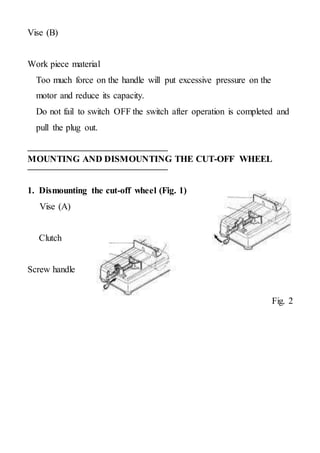
1. Dismounting the cut-off wheel (Fig. 1)
Vise (A)
Clutch
Screw handle
Fig. 2
(1) Press the stopper and loosen the bolt with a hex. bar
wrench.
CAUTION:
Vise (B)Work piece material. When the mounting shaft for cut-off
wheel cannot be
fixed with pressing the stopper, turn the bolt with a
hex. bar wrench while pressing the stopper. The
mounting shaft for cut-off wheel is fixed when the
stopper has been lowered.
(2) Remove the bolt, washer (A), and the wheel washer
and detach the cut-off wheel.
Stopper
Motor
Hex. bar wrench
Cut-off wheel
Fig. 1
2. Mounting the cut-off wheel
Throughly remove dust from the wheel washers and bolt then mount
the wheel by following the dismounting procedures in reverse order.
CAUTION:
Confirm that the stopper which was used for installation and removal
of the cut-off wheel has returned to the retract position.
HOW TO OPERATE
1. Procedure for fixing the cutting material (Fig. 2 and 3)
Place the workpiece material between vise (A) and vise (B), raise the
clutch and push the screw handle to bring vise (A) lightly into contact
with the workpiece material, as shown in
Then, turn the clutch down, and securely fix the workpiece material
in position by turning the screw handle. When the cutting job is
completed, turn the screw handle 2 or 3 times to loosen the vise, and
remove the workpiece material. CAUTION:
Never remove or install a workpiece material while the cut-off wheel
is rotating, to avoid personal injury.
2. Cutting at angles (Fig. 4 and 5)
(1) The machine permits cutting at angles of 45° or 60°.
(2) Loosen the two M10 hexagon socket head bolts on the vice (B),
then set the working surface on the vice-jaw at any angles of 0°, 30°,
or 45° as shown in Fig. 5. Upon completion of setting, securely
tighten the two M10 hexagon socket head bolts.
90
°
60° 45°
Fig. 4
3
(3) When wide material is cut with angle, it will be firmly camped
by fixing a steel board like Fig. 6 to the vise
(B).
1. Replacing a cut-off wheel
When the cut-off wheel has already become dull while
continually using, the unnecessary load is got from
15
120
mm
45 mm
28 6 mm
nuts
mm
Vise (B) 2 - 6.5 mm
2. Inspecting the carbon brushes (Fig. 9)
The motor employs carbon brushes which are
consumable parts. Since an excessively worn carbon
brush can result in motor trouble, replace the carbon
brush with a new one having the same carbon brush
No. shown in the figure when it becomes worn to or
near the “wear limit”. In addition, always keep carbon
brushes clean and ensure that they slide freely within
the brush holders.
3. Moving the stationary vise-jaw
The vise opening is set at the maximum of 170 mm when shipped
from the factory. In case an opening of more than 170 mm is
required, move the vise to the position shown by the chain line after
unscrewing the two bolts. The maximum opening can be set in two
steps 205 mm and 240 mm. When the cutting material is excessively
wide, the vise can be effectively used by repositioning the stationary
side of the vise-jaws.
4. How to use metallic block
When the cut-off wheel has a reduced outer diameter, insert between
the vise (A) and (B) a metallic block slightly smaller than the
dimension of workpiece being cut to use the cut-off wheel
economically.
MAINTENANCE AND INSPECTION
CAUTION:
Be sure to switch off and pull off the plug from the power outlet before
inspection and maintenance.
44
3. Inspecting the mounting screws
Regularly inspect all mounting screws and ensure that they are
properly tightened. Should any of the screws be loose, retighten them
immediately. Failure to do so could result in serious hazard.
4. Lubrication
Supply oil in the following oil supply points once a month so as to
keep the machine workable for a long time.
Oil supply points
Rotary part of shaft Rotary part of vise Slide
way of vise (A)
5. Cleaning
Wipe off chip and waste adhered to the machine with a cloth or the
like time to time. Be careful not to make the motor portion wet with
oil or water.
6. Service parts list
CAUTION:
Repair, modification and inspection of Hitachi Power Tools must be
carried out by an Hitachi Authorized Service Center.
This Parts List will be helpful if presented with the tool to the Hitachi
Authorized Service Center when requesting repair or other
maintenance.
In the operation and maintenance of power tools, the safety
regulations and standards prescribed in each country must be
observed.
MODIFICATIONS:
Hitachi Power Tools are constantly being improved and modified to
incorporate the latest technological advancements.
Accordingly, some parts (i.e. code numbers and/or design) may be
changed without prior notice.
ITE
M PART
NAME
NO
.
4 SUB COVER (A)
5 NUT M5
6
MACHINE SCREW
(W/WASHERS) M5 1
6
7
FLANGE BOLT
(A)
8 COVER SPACER
11
HEX. SOCKET
20
12 WASHER (A)
13
WHEEL WASHER
(A)
14
CUT-OFF WHEEL
ASS’Y
16
MACHINE
17
SPRING WASHER
M5
18 COVER BUSH
19
WHEEL COVER
(A)
20 HITACHI LABEL
21
BOLT WASHER
M5
25
BOLT WASHER
M10
26 SPINNDLE ASS’Y
27
BALL BEARING
6306ZZCM
28 BEARING PLATE
29 BALL BEARING
30
SEAL LOCK HEX.
SOCKET SET SCREW 1
6
31 CHAIN HOOK
32 GEAR CASE
33
BALL BEARING
6002VVCM
34
RETAINING RING
FOR D15 SHAFT
35
ARMATURE
ASS’Y
36 FAN GUIDE
37 BALL BEARING
38 GAUGE SPRING
39
RETAINING RING (E-
TYPE) FOR D6 SHAFT
40 STOPPER PIN
41 TUBE(D)
42
HEX. HD.
TAPPNG SCREW
43 STATOR ASS’Y
44
BRUSH
TERMINAL
45
MACHINE SCREW
(W/WASHERS) M5 3
5
46 NAME PLATE
47 HOUSING ASS’Y
48
HEX. E5SOCKET
8
49 BRUSH HOLDER
50 CARBON BRUSH
51 BRUSH CAP
52 SPRING
53 HANDLE
54 SWITCH
55
TAPPING SCREW
(W/FLANGE)
60 HANDLE COVER
61
TAPPING SCREW
(W/FLANGE) D4 1
6
63 TUBE(D)
64 CORD CLIP
65
TAPPING SCREW
(W/FLANGE) D4 1
6
66 CORD ARMOR
67 CORD
68 VISE ASS’Y
69 SCREW
70 SCREW HOLDER
71
HEX. SOCKET HD.
BOLT (W/W ASHERS)
25
ITE
M PART
NAME
NO
.
72 CHAIN
73 BOLT WASHER M8
74 BOLT
75
SPLITP
IN D3 1
5
76
WASH
ER M16
77 ROLL 2
PIN D5 5
78
VISE
(B)
79
HINGE
SHAFT
80
BASE
RUBBE
R
81 BASE
82
NUT
M8
83 SPRING WASHER M8
84
SPARK
CHUTE
85
HEX. SOCKET HD. BOLT M8
Arc-Welding
Introduction
Arc welding is the fusion of two pieces of metal by an electric arc between the pieces being joined –
the work pieces – and an electrode that is guided along the joint between the pieces. The electrode is
either a rod that simply carries current between the tip and the work, or a rod or wire that melts and
supplies filler metal to the joint.
The basic arc welding circuit is an alternating current (AC) or direct current (DC) power source
connected by a “work” cable to the work piece and by a “hot” cable to an electrode. When the
electrode is positioned close to the work piece, an arc is created across the gap between the metal
and the hot cable electrode. An ionized column of gas develops to complete the circuit.
Basic Welding Circuit
The arc produces a temperature of about 3600°C at the tip and melts part of the metal being welded
and part of the electrode. This produces a pool of molten metal that cools and solidifies behind the
electrode as it is moved along the joint.
There are two types of electrodes. Consumable electrode tips melt, and molten metal droplets detach
and mix into the weld pool. Non-consumable electrodes do not melt. Instead, filler metal is melted
into the joint from a separate rod or wire.
The strength of the weld is reduced when metals at high temperatures react with oxygen and nitrogen
in the air to form oxides and nitrides. Most arc welding processes minimize contact between the
molten metal and the air with a shield of gas, vapour or slag. Granular flux, for example, adds
deoxidizers that create a shield to protect the molten pool, thus improving the weld.
Advances in Welding Power Source Designand Efficiency
The electricity-consuming device – the key component of the arc welding apparatus – is the power
source. Electrical consumption from the approximately 110 000 to 130 000 arc welding machines in
use in Canada is estimated at 100 GWh a year.
In the past, power sources used transformer-rectifier equipment with large step-down transformers
that made them heavy and prone to overheating. They can be used for only one function, i.e., one
type of welding. In the 1990s, advances in power switching semiconductors led to the development
of inverter power sources that are multi-functional, lighter, more flexible and that provide a superior
arc.
Welding power sources use electricity when welding (arc -on) and when idling. Earlier transformer-
rectifier equipment had energy conversion efficiencies that ranged from 40 to 60 percent and
required idling power consumption of 2 to 5 kW. Modern inverter power sources have energy
conversion efficiencies near 90 percent, with idling power consumption in the order of 0.1 kW.
Modern inverter power sources are gradually replacing transformer-rectifier units. They combine a
quick return on investment, and, compared with transformer-rectifier units, are far more portable and
easier to operate, are multi-functional rather than mono-functional, create superior arcs and combine
higher-quality welds with longer arc-on time.
The Five Most Common Arc Welding Processes
Process Known Electrodes Shielding Operator
Popularit
y
as skill
required
Shielded SMAW
Rigid
metal Stick Low
Diminishi
ng
metal arc or stick coatings
welding
Gas metal arc GMAW Solid wire CO2 gas Low Growing
welding or MIG
Flux core arc FCAW
Hollow
wire Core Low Growing
welding or MIG materials
Gas tungsten GTAW Tungsten Argon gas High Steady
arc welding or TIG
Submerged SAW Solid wire Argon gas High Steady
arc welding
Power sources produce DC with the electrode either positive or negative, or AC. The choice of
current and polarity depends on the process, the type of electrode, the arc atmosphere and the metal
being welded.
Energy Efficiency of the Power Source
• Modern inverter power sources have high energy-conversion efficiencies and can be 50
percent more efficient than transformer-rectifier power sources.
16. Modern inverter power sources for idling power requirements are 1/20th of conventional
transformer-rectifier power sources.
17. Modern inverter power sources have power factors that are close to 100 percent; transformer-
rectifier power source percentages are much lower, which reduces electricity consumption.
18. Modern inverter power sources are four times lighter and much smaller than transformer-
rectifier power sources. They are thus more portable and can be moved by one person instead
of four, making it possible to bring the welding equipment to the job, not vice versa.
19. Modern inverter power sources are multi-functional and can be used for GMAW, FCAW,
SMAW and GTAW.
How Much Will I Save?
Assumptions
Work time Two shifts of eight hours for 250 days
a year (4000 hours)
Operating
factor 40 percent
Arc-on time 1600 hours per year
Idling time 2400 hours per year
Cost per kWh $0.12
Welding
process SMAW (Shielded metal arc welding)
Output power 300 amps at 32 volts – 9.6 kW
Inverter-Based Power Source Transformer-Rectifier Power
Source
Weight: 34 kg Weight: 126 kg
Energy conversion efficiency: Energy conversion efficiency:
78.7% 51.6%
Arc-on power: 10.4
kW
Arc-on power: 18.6
kW
Idling power: 0.06 kW
Idling power: 0.87
kW
Operating Electricity
Cost Operating Electricity Cost
Welding time $1,996.80 Welding time $3,571.20
Idling time $16.42 Idling time $250.56
Annual
electricity $2,013.22
Annual
electricity $3,821.76
cost cost
Annual
electricity $1,808.54
saving
Investment Investment
Purchase price $5,609 Purchase price $4,428
Price difference $1,181
Payback period
8
months
The break-even point for investment in an inverter power source equipment occurs approximately
eight months after purchase. From then on, annual energy costs will remain lower.
Purchasing Tips
Find the lowest-powered inverter power source that is most appropriate to your application.
23. If you need process flexibility, choose multi-process equipment.
24. Look for a power factor of 99 percent or higher.
25. Look for an energy conversion efficiency (kVA out over kVA in) near 80 percent.
26. Look for idling power consumption of less than 0.1 kW.
27. Buy from a reliable supplier who provides field maintenance and at least a two-year, all-
parts warranty.
28. Check manufacturers' Web sites for warranty information.
29. Shop for competitive prices.
Operation Tips
Arc welding requires an operator and a power source. Both the operator and the equipment have
roles to play in making the welding process more energy efficient.
Some Important Definitions
Arc-on time: When the welder holds an arc between the electrode and the work piece
Idling time: When welding equipment is ready for use but is not generating an arc
Operating factor: The ratio of arc-on time to the total time worked, often expressed as a percentage:
Work time: Convention is to assume total annual work time of 4000 hours (two shifts).
Power Efficiency
Welding power sources draw power when idling. Efficiency is greater when idling is reduced and the
operating factor is close to 100 percent. The higher the operating factor, the more efficient the
process. The following are ways to improve efficiency:
7. Use the most efficient welding process. Use gas metal arc welding (GMAW) instead of
shielded metal arc welding (SMAW). Typically, operating factors for SMAW fall between
10 to 30 percent; operating factors for GMAW fall between 30 to 50 percent.
8. Use multi-process inverter power sources. Modern inverter power sources can be used for
several welding processes and save time and effort when switching processes. For example,
the Miller XTM 304 can be used for GMAW, FCAW, SMAW and GTAW.
9. Automate when possible. Manage repetitive operations by applying advances in automation
and computer programming.
• Reduce idling time. Cut the time spent on pre-welding tasks such as assembly, positioning,
tacking and cleaning, and on follow-up operations, such as slag removal and defect repair.
Position the work to allow down-hand welding. Experience has shown that down-hand
(vertical high to low) welding is faster, easier on the operator and more error-free than other
techniques.
• Train the welder. Well-trained welders work better and faster and are usually conscious of
energy savings opportunities.
Power Source Performance
Certain characteristics determine the energy efficiency of power sources:
¾ Power factor: Power factor is the ratio of “real” electrical power made available by
the welding power source for producing a welding arc (the power you can use) to the
"apparent" electrical power supplied by the utility (the power you pay for). The older
technology of transformer-rectifier power sources can have power factors in the order of 75
percent; modern inverter power sources have power factors close to 100 percent.
¾ Arc-on power and idling power: Transformer-rectifier power sources use more
power in arc-on and idling modes than modern inverter power sources do with the same
output.
The following table shows that the average annual electrical energy required by a typical
transformer-rectifier source is five to nine times the energy required by an inverter power source for
the same job. In other words, the inverter source uses only 10 to 20 percent of the power needed by a
transformer-rectifier source.
Power Process Apparent Apparent Operating Annual
Source Arc-On Idling Factor Energy
Power Power (OF) Required
(kW) (kW) (kWh)
Transformer SMAW 10.26 4.86 10% 18 600
– rectifier (stick) 10.26 4.86 30% 25 920
Inverter SMAW 3.91 0.12 10% 1 996
(stick) 3.91 0.12 30% 5 028
To compare the performance of power sources use the following formula:
The kVA input and output values for power sources at rated outputs can be found in manufacturers'
equipment data sheets.
COMMON ELECTRIC ARC WELDING
PROCESSES Shielded metal arc welding:
Shielded Metal Arc Welding, also known as manual metal arc welding, stick welding, or electric arc
welding, is the most widely used of the various arc welding processes. Welding is performed with
the heat of an electric arc that is maintained between the end of a coated metal electrode and the
work piece (See Figure below).
The heat produced by the arc melts the base metal, the electrode core rod, and the coating. As the
molten metal droplets are transferred across the arc and into the molten weld puddle, they are
shielded from the atmosphere by the gases produced from the decomposition of the flux coating. The
molten slag floats to the top of the weld puddle where it protects the weld metal from the atmosphere
during solidification.
Other functions of the coating are to provide arc stability and control bead shape. More information
on coating functions will be covered in subsequent lessons.
Equipment & Operation - One reason for the wide acceptance of the SMAW process is the
simplicity of the necessary equipment. The equipment consists of the following items. (See Figure
below)
5. Welding power source
6. Electrode holder
7. Ground clamp
8. Welding cables and connectors
9. Accessory equipment (chipping hammer, wire brush)
10. Protective equipment (helmet, gloves, etc.)
Welding Power Sources - Shielded metal arc welding may utilize either alternating current (AC) or
direct current (DC), but in either case, the power source selected must be of the constant current
type. This type of power source will deliver a relatively constant amperage or welding current
regardless of arc length variations by the operator. The amperage determines the amount of heat at
the arc and since it will remain relatively constant, the weld beads produced will be uniform in size
and shape. Whether to use an AC, DC, or AC/DC power source depends on the type of welding to be
done and the electrodes used. The following factors should be considered:
Electrode Selection - Using a DC power source allows the use of a greater range of electrode types.
While most of the electrodes are designed to be used on AC or DC, some will work properly only on
DC.
Metal Thickness - DC power sources may be used for welding both heavy sections and light gauge
work. Sheet metal is more easily welded with DC because it is easier to strike and maintain the DC
arc at low currents.
Distance from Work - If the distance from the work to the power source is great, AC is the best
choice since the voltage drop through the cables is lower than with DC. Even though welding cables
are made of copper or aluminum (both good conductors), the resistance in the cables becomes
greater as the cable length increases. In other words, a voltage reading taken between the electrode
and the work will be somewhat lower than a reading taken at the output terminals of the power
source. This is known as voltage drop.
Welding Position - Because DC may be operated at lower welding currents, it is more suitable for
overhead and vertical welding than AC. AC can successfully be used for out-of-position work if
proper electrodes are selected.
Arc Blow - When welding with DC, magnetic fields are set up throughout the weldment. In
weldments that have varying thickness and protrusions, this magnetic field can affect the arc by
making it stray or fluctuate in direction. This condition is especially troublesome when welding in
corners. AC seldom causes this problem because of the rapidly reversing magnetic field produced.
Combination power sources that produce both AC and DC are available and provide the versatility
necessary to select the proper welding current for the application. When using a DC power source,
the question of whether to use electrode negative or positive polarity arises. Some electrodes operate
on both DC straight and reverse polarity, and others on DC negative or DC positive polarity only.
Direct current flows in one direction in an electrical circuit and the direction of current flow and the
composition of the electrode coating will have a definite effect on the welding arc and weld bead.
Figure below shows the connections and effects of straight and reverse polarity.
While polarity affects the penetration and burn-off rate, the electrode coating also has a strong
influence on arc characteristics. Performance of individual electrodes will be discussed in
succeeding lessons.
Electrode Holder - The electrode holder connects to the welding cable and con- ducts the welding
current to the electrode. The insulated handle is used to guide the electrode over the weld joint and
feed the electrode over the weld joint and feed the electrode into the weld puddle as it is consumed.
Electrode holders are available in different sizes and are rated on their current carrying capacity.
Ground Clamp - The ground clamp is used to connect the ground cable to the work piece. It may be
connected directly to the work or to the table or fixture upon which the work is positioned. Being a
part of the welding circuit, the ground clamp must be capable of carrying the welding current
without overheating due to electrical resistance.
Welding Cables - The electrode cable and the ground cable are important parts of the welding
circuit. They must be very flexible and have a tough heat-resistant insulation. Connections at the
electrode holder, the ground clamp, and at the power source lugs must be soldered or well crimped to
assure low electrical resistance. The cross-sectional area of the cable must be sufficient size to carry
the welding current with a minimum of voltage drop. Increasing the cable length necessitates
increasing the cable diameter to lessen resistance and voltage drop.
Coated Electrodes - Various types of coated electrodes are used in shielded metal arc welding.
Electrodes used for welding mild or carbon steels are quite different than those used for welding the
low alloys and stainless steels. Details on the specific types will be covered in subsequent lessons.
Gas Tungsten Arc Welding is a welding process performed using the heat of an arc established
between a nonconsumable tungsten electrode and the work piece.
The electrode, the arc, and the area surrounding the molten weld puddle are protected from the
atmosphere by an inert gas shield. The electrode is not consumed in the weld puddle as in shielded
metal arc welding. If a filler metal is necessary, it is added to the leading the molten puddle. Gas
tungsten arc welding produces exceptionally clean welds no slag is produced, the chance inclusions
in the weld metal is and the finished weld requires virtually no cleaning. Argon and Helium, the
primary shielding gases employed, are inert gases. Inert gases do not chemically combine with other
elements and therefore, are used to exclude the reactive gases, such as oxygen and nitrogen, from
forming compounds that could be detrimental to the weld metal. Gas tungsten arc welding may be
used for welding almost all metals — mild steel, low alloys, stainless steel, copper and copper alloys,
aluminum and aluminum alloys, nickel and nickel alloys, magnesium and magnesium alloys,
titanium, and others. This process is most extensively used for welding aluminum and stainless steel
alloys where weld integrity is of the utmost importance. Another use is for the root pass (initial pass)
in pipe welding, which requires a weld of the highest quality. Full penetration without an excessively
high inside bead is important in the root pass, and due to the ease of current control of this process, it
lends itself to control of back-bead size. For high quality welds, it is usually necessary to provide an
inert shielding gas inside the pipe to prevent oxidation of the inside weld bead.
Gas tungsten arc welding lends itself to both manual and automatic operation. In manual operation,
the welder holds the torch in one hand and directs the arc into the weld joint. The filler metal is fed
manually into the leading edge of the puddle. In automatic applications, the torch may be
automatically moved over a stationary work piece or the torch may be stationary with the work
moved or rotated in relation to the torch. Filler metal, if required, is also fed automatically.
Equipment and Operation - Gas tungsten arc welding may be accomplished with relatively simple
equipment, or it may require some highly sophisticated components. Choice of equipment depends
upon the type of metal being joined, the position of the weld being made, and the quality of the weld
metal necessary for the application. The basic equipment consists of the following:
14. The power source
15. Electrode holder (torch)
16. Shielding gas
17. Tungsten electrode
18. Water supply when necessary
19. Ground cable
20. Protective equipment
Power Sources - Both AC and DC power sources are used in gas tungsten arc welding. They are the
constant current type with a drooping volt-ampere curve. This type of power source produces very
slight changes in the arc current when the arc length (voltage) is varied.
The choice between an AC or DC welder depends on the type and thickness of the metal to be
welded. Distinct differences exist between AC and DC arc characteristics, and if DC is chosen, the
polarity also becomes an important factor. The effects of polarity in GTAW are directly opposite the
effects of polarity in SMAW. In SMAW, the distribution of heat between the electrode and work,
which determines the penetration and weld bead width, is controlled mainly by the ingredients in the
flux coating on the electrode. In GTAW where no flux coating exists, heat distribution between the
electrode and the work is controlled solely by the polarity. The choice of the proper welding current
will be better understood by analyzing each type separately.
Direct current electrode negative (DCEN) is produced when the electrode is connected to the
negative terminal of the power source. Since the electrons flow from the electrode to the plate,
approximately 70% of the heat of the arc is concentrated at the work, and approximately 30% at the
electrode end. This allows the use of smaller tungsten elec- trodes that produce a relatively narrow
concentrated arc. The weld shape has deep penetra- tion and is quite narrow. Direct current electrode
negative is suitable for weld- ing most metals. Magnesium and aluminum have a refractory oxide
coating on the surface that must be physically removed immediately prior to welding if DCSP is to
be used.
Direct current electrode positive (DCEP) is produced when the electrode is connected to the
positive terminal of the welding power source. In this condition, the electrons flow from the work to
the electrode tip, concentrating approximately 70% of the heat of the arc at the electrode and 30% at
the work. This higher heat at the electrode necessitates using larger diameter tungsten to prevent it
from melting and contaminating the weld metal. Since the electrode diameter is larger and the heat is
less concentrated at the work, the resultant weld bead is relatively wide and shallow.
47
Direct current electrode positive is rarely used in gas -tungsten arc welding. Despite the excellent
oxide cleaning action, the lower heat input in the weld area makes it a slow process, and in metals
having higher thermal conductivity, the heat is rapidly conducted away from the weld zone. When
used, DCEP is restricted to welding thin sections (under 1/8") of magnesium and aluminum.
Alternating current is actually a combination of DCEN and DCEP and is widely used for welding
aluminum. In a sense, the advantages of both DC processes are combined, and the weld bead
produced is a compromise of the two. Remember that when welding with 60 Hz current, the electron
flow from the electrode tip to the work reverses direction 120 times every second. Thereby, the
intense heat alternates from electrode to work piece, allowing the use of an intermediate size
electrode. The weld bead is a compromise having medium penetration and bead width. The gas ions
blast the oxides from the surface of aluminum and magnesium during the positive half cycle.
DC constant current power sources - Constant current power sources, used for shielded metal arc
welding, may also be used for gas-tungsten arc welding. In applications where weld integrity is not of
utmost importance, these power sources will suffice. With machines of this type, the arc must be
initiated by touching the tungsten electrode to the work and quickly withdrawing it to maintain the
proper arc length. This starting method contaminates the electrode and blunts the point which has
been grounded on the electrode end. These conditions can cause weld metal inclusions and poor arc
direction. Using a power source designed for gas tungsten arc welding with a high frequency
stabilizer will eliminate this problem. The electrode need not be touched to the work for arc initiation.
Instead, the high frequency voltage, at very low current, is superimposed onto the welding current.
When the electrode is brought to within approximately 1/8 inch of the base metal, the high frequency
ionizes the gas path, making it conductive and a welding arc is established. The high frequency is
automatically turned off immediately after arc initiation when using direct current.
AC Constant Current Power Source - Designed for gas tungsten arc welding, always incorporates
high frequency, and it is turned on throughout the weld cycle to maintain a stable arc. When welding
with AC, the current passes through 0 twice in every cycle and the must be reestablished each time it
does so. The oxide coating on metals, such as aluminum and magnesium, can act much like a
rectifier.. The positive half-cycle will be eliminated if the arc does not reignite, causing an unstable
condition. Continuous high frequency maintains an ionized path for the welding arc, and assures arc
re- ignition each time the current changes direction. AC is extensively used for welding aluminum
48
and magnesium.
AC/DC Constant Current Power Sources - Designed for gas tungsten arc welding, are available,
and can be used for welding practically all metals. The gas tungsten arc welding process is usually
chosen because of the high quality welds it can produce. The metals that are commonly welded with
this process, such as stainless steel, aluminum and some of the more exotic metals, cost many times
the price of mild steel; and therefore, the power sources designed for this process have many desirable
features to insure high quality welds. Among these are:
3. Remote current control, which allows the operator to control welding amperage with a hand
control on the torch, or a foot control at the welding station.
4. Automatic soft-start, which prevents a high current surge when the arc is initiated.
5. Shielding gas and cooling water solenoid valves, which automatically control flow before,
during and for an adjustable length of time after the weld is completed.
6. Spot-weld timers, which automatically control all elements during each spot-weld cycle.
Other options and accessories are also available.
Power sources for automatic welding with complete programmable output are also available. Such
units are used extensively for the automatic welding of pipe in position. The welding current is
automatically varied as the torch travels around the pipe. Some units provide a pulsed welding current
where the amperage is automatically varied between a low and high several times per second. This
produces welds with good penetration and improved weld bead shape.
Torches - The torch is actually an electrode holder that supplies welding current to the tungsten
electrode, and an inert gas shield to the arc zone. The electrode is held in a collet-like clamping device
that allows adjustment so that the proper length of electrode pro- trudes beyond the shielding gas cup.
Manual torches are designed to accept electrodes of 3 inch or 7 inch lengths. Torches may be either
air or water-cooled. The air-cooled types actually are cooled to a degree by the shielding gas that is
fed to the torch head through a compos- ite cable. The gas actually surrounds the copper welding
cable, affording some degree of cooling. Water-cooled torches are usually used for applications where
49
the welding current exceeds 200 amperes. The water inlet hose is connected to the torch head.
Circulating around the torch head, the water leaves the torch via the current-in hose and cable
assembly. Cooling the welding cable in this manner allows the use of a smaller diameter cable that is
more flexible and lighter in weight.
The gas nozzles are made of ceramic materials and are available in various sizes and shapes. In some
heavy duty, high current applications, metal water-cooled nozzles are used.
A switch on the torch is used to energize the electrode with welding current and start the shielding gas
flow. High frequency current and water flow are also initiated by this switch if the power source is so
equipped. In many installations, these functions are initiated by a foot control that also is capable of
controlling the welding current. This method gives the operator full control of the arc. The usual
welding method is to start the arc at a low current, gradually increase the current until a molten pool is
achieved, and welding begins. At the end of the weld, current is slowly decreases and the arc
extinguished, preventing the crater that forms at the end of the weld when the arc is broken abruptly.
Shielding Gases - Argon and helium are the major shielding gases used in gas tungsten arc welding.
In some applications, mixtures of the two gases prove advantageous. To a lesser extent, hydrogen is
mixed with argon or helium for special applications.
Argon and helium are colorless, odorless, tasteless and nontoxic gases. Both are inert gases, which
means that they do not readily combine with other elements. They will not burn nor support
combustion. Commercial grades used for welding are 99.99% pure. Argon is .38% heavier than air
and about 10 times heavier than helium. Both gases ionize when present in an electric arc. This means
that the gas atoms lose some of their electrons that have a negative charge. These unbalanced gas
atoms, properly called positive ions, now have a positive charge and are attracted to the negative pole
in the arc. When the arc is positive and the work is negative, these positive ions impinge upon the
work and remove surface oxides or scale in the weld area.
Argon is most commonly used of the shielding gases. Excellent arc starting and ease of use make it
most desirable for manual welding. Argon produces a better cleaning action when welding aluminum
and magnesium with alternating current. The arc produced is relatively narrow. Argon is more
suitable for welding thinner material. At equal amperage, helium produces a higher arc voltage than
50
argon. Since welding heat is the product of volts times amperes, helium produces more available heat
at the arc. This makes it more suitable for welding heavy sections of metal that have high heat
conductivity, or for automatic welding operations where higher welding speeds are required.
Argon-helium gas mixtures are used in applications where higher heat input and the desirable
characteristics of argon are required. Argon, being a relatively heavy gas, blankets the weld area at
lower flow rates. Argon is preferred for many applications because it costs less than helium. Helium,
being approximately 10 times lighter than argon, requires flow rates of 2 to 3 times that of argon to
satisfactorily shield the arc.
Electrodes - Electrodes for gas tungsten arc welding are available in diameters from .010" to 1/4" in
diameter and standard lengths range from 3" to 24". The most commonly used sizes, however, are the
.040", 1/16", 3/32", and 1/8" diameters.
The shape of the tip of the electrode is an important factor in gas tungsten arc welding. When welding
with DCEN, the tip must be ground to a point. The included angle at which the tip is ground varies
with the application, the electrode diameter, and the welding current. Narrow joints require a
relatively small included angle. When welding very thin material at low currents, a needlelike point
ground onto the smallest available electrode may be necessary to stabilize the arc. Properly ground
electrodes will assure easy arc starting, good arc stability, and proper bead width.
When welding with AC, grinding the electrode tip is not necessary. When proper welding current is
used, the electrode will form a hemispherical end. If the proper welding current is exceeded, the end
will become bulbous in shape and possibly melt off to contaminate the weld metal.
The American Welding Society has published Specification AWS A5.12-80 for tungsten arc welding
electrodes that classifies the electrodes on the basis of their chemical composition, size and finish.
Briefly, the types specified are listed below:
7. Pure Tungsten (AWS EWP) Color Code: Green Used for less critical applications. The cost
is low and they give good results at relatively low currents on a variety of metals. Most stable
arc when used on AC, either balanced wave or continuous high frequency.
51
8. 1% Thoriated Tungsten (AWS EWTh-1) Color Code: Yellow Good current carrying
capacity, easy arc starting and provide a stable arc. Less susceptible to contamination.
Designed for DC applications of nonferrous materials.
3. 2% Thoriated Tungsten (AWS EWTh-2) Color Code: Red Longer life than 1% Thoriated
electrodes. Maintain the pointed end longer, used for light gauge critical welds in aircraft work. Like
1%, designed for DC applications for nonferrous materials.
4. 5% Thoriated Tungsten (AWS EWTh-3) Color Code: Blue Sometimes called "striped"
electrode because it has 1.0-2.0% Thoria inserted in a wedge-shaped groove throughout its length.
Combines the good properties of pure and thoriated electrodes. Can be used on either AC or DC
applications.
5. Zirconia Tungsten (AWS EWZr) Color Code: Brown Longer life than pure tungsten. Better
performance when welding with AC. Melts more easily than thoriam-tungsten when forming rounded
or tapered tungsten end. Ideal for applications where tungsten contamination must be minimized.
2.2 Embedded Systems:
An embedded system is a computer system designed to perform one or a few
dedicated functions often with real-time computing constraints. It is embedded as part of a complete
device often including hardware and mechanical parts. By contrast, a general-purpose computer, such
as a personal computer (PC), is designed to be flexible and to meet a wide range of end-user needs.
Embedded systems control many devices in common use today.
Embedded systems are controlled by one or more main processing cores that are
typically either microcontrollers or digital signal processors (DSP). The key characteristic, however,
is being dedicated to handle a particular task, which may require very powerful processors. For
example, air traffic control systems may usefully be viewed as embedded, even though they involve
mainframe computers and dedicated regional and national networks between airports and radar sites.
(Each radar probably includes one or more embedded systems of its own.)
52
Since the embedded system is dedicated to specific tasks, design engineers can optimize
it to reduce the size and cost of the product and increase the reliability and performance. Some
embedded systems are mass-produced, benefiting from economies of scale.
Physically embedded systems range from portable devices such as digital watches and
MP3 players, to large stationary installations like traffic lights, factory controllers, or the systems
controlling nuclear power plants. Complexity varies from low, with a single microcontroller chip, to
very high with multiple units, peripherals and networks mounted inside a large chassis or enclosure.
In general, "embedded system" is not a strictly definable term, as most systems have
some element of extensibility or programmability. For example, handheld computers share some
elements with embedded systems such as the operating systems and microprocessors which power
them, but they allow different applications to be loaded and peripherals to be connected. Moreover,
even systems which don't expose programmability as a primary feature generally need to support
software updates. On a continuum from "general purpose" to "embedded", large application systems
will have subcomponents at most points even if the system as a whole is "designed to perform one or
a few dedicated functions", and is thus appropriate to call "embedded". A modern example of
embedded system is shown in fig: 2.1.
Fig 2.1:A modern example of embedded system
53
Labeled parts include microprocessor (4), RAM (6), flash memory (7).Embedded
systems programming is not like normal PC programming. In many ways, programming for an
embedded system is like programming PC 15 years ago. The hardware for the system is usually
chosen to make the device as cheap as possible. Spending an extra dollar a unit in order to make
things easier to program can cost millions. Hiring a programmer for an extra month is cheap in
comparison. This means the programmer must make do with slow processors and low memory, while
at the same time battling a need for efficiency not seen in most PC applications. Below is a list of
issues specific to the embedded field.
2.1.1 History:
In the earliest years of computers in the 1930–40s, computers were sometimes
dedicated to a single task, but were far too large and expensive for most kinds of tasks performed by
embedded computers of today. Over time however, the concept of programmable controllers evolved
from traditional electromechanical sequencers, via solid state devices, to the use of computer
technology.
One of the first recognizably modern embedded systems was the Apollo Guidance
Computer, developed by Charles Stark Draper at the MIT Instrumentation Laboratory. At the project's
inception, the Apollo guidance computer was considered the riskiest item in the Apollo project as it
employed the then newly developed monolithic integrated circuits to reduce the size and weight. An
early mass-produced embedded system was the Automatics’ D-17 guidance computer for
the Minuteman missile, released in 1961. It was built from transistor logic and had a hard disk for
main memory. When the Minuteman II went into production in 1966, the D-17 was replaced with a
new computer that was the first high-volume use of integrated circuits.
2.1.2 Tools:
Embedded development makes up a small fraction of total programming. There's also a
large number of embedded architectures, unlike the PC world where 1 instruction set rules, and the
Unix world where there's only 3 or 4 major ones. This means that the tools are more expensive. It also
means that they're lowering featured, and less developed. On a major embedded project, at some point
you will almost always find a compiler bug of some sort.
54
Debugging tools are another issue. Since you can't always run general programs on
your embedded processor, you can't always run a debugger on it. This makes fixing your program
difficult. Special hardware such as JTAG ports can overcome this issue in part. However, if you stop
on a breakpoint when your system is controlling real world hardware (such as a motor), permanent
equipment damage can occur. As a result, people doing embedded programming quickly become
masters at using serial IO channels and error message style debugging.
2.1.3 Resources:
To save costs, embedded systems frequently have the cheapest processors that can do
the job. This means your programs need to be written as efficiently as possible. When dealing with
large data sets, issues like memory cache misses that never matter in PC programming can hurt you.
Luckily, this won't happen too often- use reasonably efficient algorithms to start, and optimize only
when necessary. Of course, normal profilers won't work well, due to the same reason debuggers don't
work well.
Memory is also an issue. For the same cost savings reasons, embedded systems usually
have the least memory they can get away with. That means their algorithms must be memory efficient
(unlike in PC programs, you will frequently sacrifice processor time for memory, rather than the
reverse). It also means you can't afford to leak memory. Embedded applications generally use
deterministic memory techniques and avoid the default "new" and "malloc" functions, so that leaks
can be found and eliminated more easily. Other resources programmers expect may not even exist.
For example, most embedded processors do not have hardware FPUs (Floating-Point Processing
Unit). These resources either need to be emulated in software, or avoided altogether.
2.1.4 Real Time Issues:
Embedded systems frequently control hardware, and must be able to respond to them
in real time. Failure to do so could cause inaccuracy in measurements, or even damage hardware such
as motors. This is made even more difficult by the lack of resources available. Almost all embedded
systems need to be able to prioritize some tasks over others, and to be able to put off/skip low priority
tasks such as UI in favor of high priority tasks like hardware control.
2.2 NeedFor Embedded Systems:
The uses of embedded systems are virtually limitless, because every day new products
are introduced to the market that utilizes embedded computers in novel ways. In recent years,
55
hardware such as microprocessors, microcontrollers, and FPGA chips have become much cheaper. So
when implementing a new form of control, it's wiser to just buy the generic chip and write your own
custom software for it. Producing a custom-made chip to handle a particular task or set of tasks costs
far more time and money. Many embedded computers even come with extensive libraries, so that
"writing your own software" becomes a very trivial task indeed. From an implementation viewpoint,
there is a major difference between a computer and an embedded system. Embedded systems are often
required to provide Real-Time response. The main elements that make embedded systems unique are
its reliability and ease in debugging.
2.2.1 Debugging:
Embedded debugging may be performed at different levels, depending on the facilities
available. From simplest to most sophisticate they can be roughly grouped into the following areas:
 Interactive resident debugging, using the simple shell provided by the embedded operating
system (e.g. Forth and Basic)
 External debugging using logging or serial port output to trace operation using either a
monitor in flash or using a debug server like the Remedy Debugger which even works for
heterogeneous multi core systems.
 An in-circuit debugger (ICD), a hardware device that connects to the microprocessor via a
JTAG or Nexus interface. This allows the operation of the microprocessor to be controlled
externally, but is typically restricted to specific debugging capabilities in the processor.
 An in-circuit emulator replaces the microprocessor with a simulated equivalent, providing full
control over all aspects of the microprocessor.
 A complete emulator provides a simulation of all aspects of the hardware, allowing all of it to
be controlled and modified and allowing debugging on a normal PC.
 Unless restricted to external debugging, the programmer can typically load and run software
through the tools, view the code running in the processor, and start or stop its operation. The
view of the code may be as assembly code or source-code.
Because an embedded system is often composed of a wide variety of elements, the
debugging strategy may vary. For instance, debugging a software(and microprocessor) centric
embedded system is different from debugging an embedded system where most of the processing is
performed by peripherals (DSP, FPGA, co-processor). An increasing number of embedded systems
today use more than one single processor core. A common problem with multi-core development is
the proper synchronization of software execution. In such a case, the embedded system design may
56
wish to check the data traffic on the busses between the processor cores, which requires very low-
level debugging, at signal/bus level, with a logic analyzer, for instance.
2.2.2 Reliability:
Embedded systems often reside in machines that are expected to run continuously for
years without errors and in some cases recover by themselves if an error occurs. Therefore the
software is usually developed and tested more carefully than that for personal computers, and
unreliable mechanical moving parts such as disk drives, switches or buttons are avoided.
Specific reliability issues may include:
 The system cannot safely be shut down for repair, or it is too inaccessible to repair. Examples
include space systems, undersea cables, navigational beacons, bore-hole systems, and
automobiles.
 The system must be kept running for safety reasons. "Limp modes" are less tolerable. Often
backups are selected by an operator. Examples include aircraft navigation, reactor control
systems, safety-critical chemical factory controls, train signals, engines on single-engine
aircraft.
 The system will lose large amounts of money when shut down: Telephone switches, factory
controls, bridge and elevator controls, funds transfer and market making, automated sales and
service.
A variety of techniques are used, sometimes in combination, to recover from errors—
both software bugs such as memory leaks, and also soft errors in the hardware:
 Watchdog timer that resets the computer unless the software periodically notifies the
watchdog
 Subsystems with redundant spares that can be switched over to
 software "limp modes" that provide partial function
 Designing with a Trusted Computing Base (TCB) architecture[6] ensures a highly secure &
reliable system environment
 An Embedded Hypervisor is able to provide secure encapsulation for any subsystem
component, so that a compromised software component cannot interfere with other
subsystems, or privileged-level system software. This encapsulation keeps faults from
propagating from one subsystem to another, improving reliability. This may also allow a
subsystem to be automatically shut down and restarted on fault detection.
 Immunity Aware Programming
57
2.3 Explanation of Embedded Systems:
2.3.1 Software Architecture:
There are several different types of software architecture in common use.
 Simple Control Loop:
In this design, the software simply has a loop. The loop calls subroutines, each of
which manages a part of the hardware or software.
 Interrupt Controlled System:
Some embedded systems are predominantly interrupt controlled. This means that tasks
performed by the system are triggered by different kinds of events. An interrupt could be generated
for example by a timer in a predefined frequency, or by a serial port controller receiving a byte. These
kinds of systems are used if event handlers need low latency and the event handlers are short and
simple.
Usually these kinds of systems run a simple task in a main loop also, but this task is not
very sensitive to unexpected delays. Sometimes the interrupt handler will add longer tasks to a queue
structure. Later, after the interrupt handler has finished, these tasks are executed by the main loop.
This method brings the system close to a multitasking kernel with discrete processes.
 Cooperative Multitasking:
A non-preemptive multitasking system is very similar to the simple control loop
scheme, except that the loop is hidden in an API. The programmer defines a series of tasks, and each
task gets its own environment to “run” in. When a task is idle, it calls an idle routine, usually called
“pause”, “wait”, “yield”, “nop” (stands for no operation), etc.The advantages and disadvantages are
very similar to the control loop, except that adding new software is easier, by simply writing a new
task, or adding to the queue-interpreter.
 Primitive Multitasking:
In this type of system, a low-level piece of code switches between tasks or threads
based on a timer (connected to an interrupt). This is the level at which the system is generally
58
considered to have an "operating system" kernel. Depending on how much functionality is required, it
introduces more or less of the complexities of managing multiple tasks running conceptually in
parallel.
As any code can potentially damage the data of another task (except in larger systems
using an MMU) programs must be carefully designed and tested, and access to shared data must be
controlled by some synchronization strategy, such as message queues, semaphores or a non-blocking
synchronization scheme.
Because of these complexities, it is common for organizations to buy a real-time
operating system, allowing the application programmers to concentrate on device functionality rather
than operating system services, at least for large systems; smaller systems often cannot afford the
overhead associated with a generic real time system, due to limitations regarding memory size,
performance, and/or battery life.
 Microkernels And Exokernels:
A microkernel is a logical step up from a real-time OS. The usual arrangement is that
the operating system kernel allocates memory and switches the CPU to different threads of execution.
User mode processes implement major functions such as file systems, network interfaces, etc.
In general, microkernels succeed when the task switching and intertask communication
is fast, and fail when they are slow. Exokernels communicate efficiently by normal subroutine calls.
The hardware and all the software in the system are available to, and extensible by application
programmers. Based on performance, functionality, requirement the embedded systems are divided
into three categories:
2.3.2 Stand Alone Embedded System:
These systems takes the input in the form of electrical signals from transducers or
commands from human beings such as pressing of a button etc.., process them and produces desired
output. This entire process of taking input, processing it and giving output is done in standalone mode.
Such embedded systems comes under standalone embedded systems
Eg: microwave oven, air conditioner etc..
2.3.3 Real-time embedded systems:
59
Embedded systems which are used to perform a specific task or operation in a specific
time period those systems are called as real-time embedded systems. There are two types of real-time
embedded systems.
 Hard Real-time embedded systems:
These embedded systems follow an absolute dead line time period i.e.., if the tasking is
not done in a particular time period then there is a cause of damage to the entire equipment.
Eg: consider a system in which we have to open a valve within 30 milliseconds. If this valve is
not opened in 30 ms this may cause damage to the entire equipment. So in such cases we use
embedded systems for doing automatic operations.
 Soft Real Time embedded systems:
These embedded systems follow a relative dead line time period i.e.., if the task is not
done in a particular time that will not cause damage to the equipment.
Eg: Consider a TV remote control system ,if the remote control takes a few milliseconds
delay it will not cause damage either to the TV or to the remote control. These systems which will not
cause damage when they are not operated at considerable time period those systems comes under soft
real-time embedded systems.
2.3.4 Network communication embedded systems:
A wide range network interfacing communication is provided by using embedded systems.
Eg:
 Consider a web camera that is connected to the computer with internet can be used to
spread communication like sending pictures, images, videos etc.., to another computer
with internet connection throughout anywhere in the world.
 Consider a web camera that is connected at the door lock.
Whenever a person comes near the door, it captures the image of a person and sends to
the desktop of your computer which is connected to internet. This gives an alerting message with
image on to the desktop of your computer, and then you can open the door lock just by clicking the
mouse.
60
Fig 2.2: Network communication embedded systems
2.3.5 Different types of processing units:
The central processing unit (c.p.u) can be any one of the following microprocessor,
microcontroller, digital signal processing.
 Among these Microcontroller is of low cost processor and one of the main advantage of
microcontrollers is, the components such as memory, serial communication interfaces, analog
to digital converters etc.., all these are built on a single chip. The numbers of external
components that are connected to it are very less according to the application.
 Microprocessors are more powerful than microcontrollers. They are used in major applications
with a number of tasking requirements. But the microprocessor requires many external
components like memory, serial communication, hard disk, input output ports etc.., so the
power consumption is also very high when compared to microcontrollers.
 Digital signal processing is used mainly for the applications that particularly involved with
processing of signals
2.4 APPLICATIONS OF EMBEDDED SYSTEMS:
2.4.1 Consumer applications:
61
At home we use a number of embedded systems which include microwave oven,
remote control, vcd players, dvd players, camera etc….
Fig2.3: Automatic coffee makes equipment
2.4.2 Office automation:
We use systems like fax machine, modem, printer etc…
Fig2.4: Fax machine Fig2.5: Printing machine
2.4.3. Industrial automation:
Today a lot of industries are using embedded systems for process control. In industries
we design the embedded systems to perform a specific operation like monitoring temperature,
pressure, humidity ,voltage, current etc.., and basing on these monitored levels we do control other
devices, we can send information to a centralized monitoring station.
62
Fig2.6: Robot
In critical industries where human presence is avoided there we can use robots which
are programmed to do a specific operation.
2.4.5 Computer networking:
Embedded systems are used as bridges routers etc..
Fig2.7: Computer networking
2.4.6 Tele communications:
Cell phones, web cameras etc.
63
Fig2.8: Cell Phone Fig2.9: Web camera
CHAPTER 3: HARDWARE DESCRIPTION
3.1 Block diagram
360 degree Steering Android
Regulated
Power Supply
Micro
Controller
Motor
Driver
LED
Indicator
Bluetooth
Reset
Crystal
Oscillator
DC
Motors
Battery
64
3.2 Micro controller:
ATMEGA328:
Features
• High Performance, Low Power AVR® 8-Bit Microcontroller
• Advanced RISC Architecture
– 131 Powerful Instructions – Most Single Clock Cycle Execution
– 32 x 8 General Purpose Working Registers
– Fully Static Operation
– Up to 20 MIPS Throughput at 20 MHz
– On-chip 2-cycle Multiplier
• High Endurance Non-volatile Memory Segments
– 4/8/16/32K Bytes of In-System Self-Programmable Flash progam memory
(ATmega48PA/88PA/168PA/328P)
– 256/512/512/1K Bytes EEPROM(ATmega48PA/88PA/168PA/328P)
– 512/1K/1K/2K Bytes Internal SRAM(ATmega48PA/88PA/168PA/328P)
– Write/Erase Cycles: 10,000 Flash/100,000 EEPROM
– Data retention: 20 years at 85°C/100 years at 25°C(1)
– Optional Boot Code Section with Independent Lock Bits
In-System Programming by On-chip Boot Program
65
True Read-While-Write Operation
– Programming Lock for Software Security
• Peripheral Features
– Two 8-bit Timer/Counters with Separate Prescaler and Compare Mode
– One 16-bit Timer/Counter with Separate Prescaler, Compare Mode, and Capture
Mode
– Real Time Counter with Separate Oscillator
– Six PWMChannels
– 8-channel 10-bit ADC in TQFP and QFN/MLF package
Temperature Measurement
– 6-channel 10-bit ADC in PDIP Package
Temperature Measurement
– Programmable Serial USART
– Master/Slave SPI Serial Interface
– Byte-oriented 2-wire Serial Interface (Philips I2C compatible)
– Programmable Watchdog Timer with Separate On-chip Oscillator
– On-chip Analog Comparator
– Interrupt and Wake-up on Pin Change
• Special Microcontroller Features
– Power-on Reset and Programmable Brown-out Detection
– Internal Calibrated Oscillator
– External and Internal Interrupt Sources
– Six Sleep Modes: Idle, ADC Noise Reduction, Power-save, Power-down, Standby,
66
and Extended Standby
• I/O and Packages
– 23 Programmable I/O Lines
– 28-pin PDIP, 32-lead TQFP, 28-pad QFN/MLF and 32-pad QFN/MLF
• Operating Voltage:
– 1.8 - 5.5V for ATmega48PA/88PA/168PA/328P
• Temperature Range:
– -40°C to 85°C
• Speed Grade:
– 0 - 20 MHz @ 1.8 - 5.5V
• Low Power Consumption at 1 MHz, 1.8V, 25°C for ATmega48PA/88PA/168PA/328P:
– Active Mode: 0.2 mA
– Power-down Mode: 0.1 μA
– Power-save Mode: 0.75 μA (Including 32 kHz RTC)
67
1.1 Pin Descriptions
1.1.1 VCC Digital supply voltage.
1.1.2 GND Ground.
1.1.3 Port B (PB7:0) XTAL1/XTAL2/TOSC1/TOSC2
Port B isan 8-bit bi-directionalI/Oportwithinternal pull-upresistors(selectedforeach it). The Port B output
buffershave symmetrical drive characteristicswithbothhighsinkandsource capability.Asinputs,Port B pins
that are externallypulledlowwillsource currentif the pull-up resistors are activated. The Port B pins are tri-
stated when a reset condition becomes active, even if the clock is not running. Depending on the clock
selectionfuse settings,PB6can be usedas inputto the invertingOscillatoramplifier and input to the internal
clock operating circuit. Depending on the clock selection fuse settings, PB7 can be used as output from the
inverting Oscillator amplifier.
68
If the Internal Calibrated RC Oscillator is used as chip clock source, PB7..6 is used as TOSC2..1 input for the
Asynchronous Timer/Counter2 if the AS2 bit in ASSR is set. The various special features of Port B are
elaborated in ”Alternate Functions of Port B” on page 82 and ”System Clock and Clock Options” on page 26.
1.1.4 Port C (PC5:0)
Port C isa 7-bitbi-directional I/Oportwithinternalpull-upresistors(selected for each it). The PC5..0 output
buffershave symmetrical drive characteristicswithbothhighsinkandsource capability.Asinputs,Port C pins
that are externallypulledlowwillsource currentif the pull-up resistors are activated. The Port C pins are tri-
stated when a reset condition becomes active, even if the clock is not running.
1.1.5 PC6/RESET
If the RSTDISBL Fuse isprogrammed,PC6is used as an I/O pin. Note that the electrical characteristics of PC6
differ from those of the other pins of Port C. If the RSTDISBL Fuse is un programmed, PC6 is used as a Reset
input.A low level onthispinforlongerthanthe minimumpulse lengthwillgenerateaReset,evenif the clock
is not running.
The minimumpulse lengthisgivenin Table 28-3 on page 318. Shorter pulses are not guaranteed to generate
a Reset. The various special features of Port C are elaborated in ”Alternate Functions of Port C” on page 85.
1.1.6 Port D (PD7:0)
Port D is an 8-bit bi-directional I/O port with internal pull-up resistors (selected for each bit). The Port D
output buffers have symmetrical drive characteristics with both high sink and source capability. As inputs,
Port D pinsthat are externallypulledlow will source current if the pull-up resistors are activated. The Port D
pinsare tri-statedwhenaresetconditionbecomesactive,evenif the clockisnotrunning. The various special
features of Port D are elaborated in ”Alternate Functions of Port D” on page
88.
1.1.7 AVCC
AVCCisthe supplyvoltage pinforthe A/DConverter,PC3:0,and ADC7:6. It shouldbe externallyconnected to
VCC,evenif the ADCis notused. If the ADC is used, it should be connected to VCC through a low-pass filter.
Note that PC6..4 use digital supply voltage, VCC.
1.1.8 AREF
AREF is the analog reference pin for the A/D Converter.
69
1.1.9 ADC7:6 (TQFP and QFN/MLF Package Only)
In the TQFP and QFN/MLF package, ADC7:6 serve as analog inputs to the A/D converter. These pins are
powered from the analog supply and serve as 10-bit ADC channels.
Overview
The ATmega48PA/88PA/168PA/328P isa low-powerCMOS8-bitmicrocontrollerbased on the AVR enhanced
RISC architecture. By executing powerful instructions in a single clock cycle, the
ATmega48PA/88PA/168PA/328P achieves throughputs approaching 1 MIPS per MHz allowing the system
designer to optimize power consumption versus processing speed.
2.1 Block Diagram
70
The AVR core combines a rich instruction set with 32 general purpose working registers. All the 32 registers
are directlyconnectedtothe ArithmeticLogicUnit(ALU),allowingtwoindependent registers to be accessed
inone single instructionexecuted in one clock cycle. The resulting architecture is more code efficient while
achieving throughputs up to ten times faster than conventional CISC microcontrollers.
The ATmega48PA/88PA/168PA/328P provides the following features: 4K/8K bytes of In-System
Programmable Flash with Read-While-Write capabilities, 256/512/512/1K bytes EEPROM, 512/1K/1K/2K
bytes SRAM, 23 general purpose I/O lines, 32 general purpose working registers, three flexible
71
Timer/Counterswithcompare modes,internal andexternal interrupts,aserial programmable USART, a byte-
oriented2-wire Serial Interface, an SPI serial port, a 6-channel 10-bit ADC (8 channels in TQFP and QFN/MLF
packages), a programmable Watchdog Timer with internal Oscillator, and five software selectable power
savingmodes.The Idle mode stops the CPU while allowing the SRAM, Timer/Counters, USART, 2-wire Serial
Interface,SPIport, and interrupt system to continue functioning. The Power-down mode saves the register
contents but freezes the Oscillator, disabling all other chip functions until the next interrupt or hardware
reset.
In Power-save mode, the asynchronous timer continues to run, allowing the user to maintain a timer base
while the rest of the device is sleeping. The ADC Noise Reduction mode stops the CPU and all I/O modules
exceptasynchronoustimerandADC,tominimize switching noise during ADC conversions. In Standby mode,
the crystal/resonatorOscillatorisrunningwhile the restof the device issleeping.Thisallowsveryfaststart-up
combined with low power consumption.
The device ismanufacturedusingAtmel’shighdensitynon-volatilememorytechnology.The On-chipISPFlash
allowsthe programmemorytobe reprogrammedIn-SystemthroughanSPIserial interface,byaconventional
non-volatile memory programmer, or by an On-chip Boot program running on the AVR core. The Boot
program can use any interface to download the application program in the Application Flash memory.
Software in the Boot Flash section will continue to run while the Application Flash section is updated,
providing true Read-While-Write operation. By combining an 8-bit RISC CPU with In-System Self-
Programmable Flash on a monolithic chip, the Atmel ATmega48PA/88PA/168PA/328P is a powerful
microcontroller that provides a highly flexible and cost effective solution to many embedded control
applications.
The ATmega48PA/88PA/168PA/328P AVRissupportedwitha full suite of program and system development
tools including: C Compilers, Macro Assemblers, Program Debugger/Simulators, In-Circuit Emulators, and
Evaluation kits.
2.2 Comparison Between ATmega48PA, ATmega88PA, ATmega168PA and ATmega328P
72
The ATmega48PA, ATmega88PA, ATmega168PA and ATmega328P differ only in memory sizes, boot loader
support,andinterruptvectorsizes.Table 2-1summarizesthe differentmemoryandinterrupt vector sizes for
the three devices.
ATmega88PA, ATmega168PA and ATmega328P support a real Read-While-Write Self-Programming
mechanism.There isaseparate BootLoader Section,andthe SPMinstructioncanonlyexecute from there. In
ATmega48PA, there is no Read-While-Write support and no separate Boot Loader Section. The SPM
instruction can execute from the entire Flash.
AVR CPU Core
6.1 Overview
This section discusses the AVR core architecture in general. The main function of the CPU core is to ensure
correct program execution. The CPU must therefore be able to access memories, perform calculations,
control peripherals, and handle interrupts.
73
In order to maximize performance and parallelism, the AVR uses a Harvard architecture – with separate
memories and buses for program and data. Instructions in the program memory are executed with a single
level pipelining.While one instructionisbeingexecuted,the nextinstructionispre-fetchedfrom the program
memory. This concept enables instructions to be executed in every clock cycle. The program memory is In-
System Reprogrammable Flash memory.
The fast-access Register File contains 32 x 8-bit general purpose working registers with a single clock cycle
access time. This allows single-cycle Arithmetic Logic Unit (ALU) operation. In a typical ALU operation, two
operands are output from the Register File, the operation is executed, and the result is stored back in the
Register File – in one clock cycle. Six of the 32 registers can be used as three 16-bit indirect address register
pointers for Data Space addressing – enabling efficient address calculations. One of the these address
74
pointers can also be used as an address pointer for look up tables in Flash program memory. These added
function registers are the 16-bit X-, Y-, and Z-register, described later in this section.
The ALU supports arithmetic and logic operations between registers or between a constant and a register.
Single registeroperationscanalsobe executedinthe ALU. After an arithmetic operation, the Status Register
is updated to reflect information about the result of the operation.
Program flowisprovidedbyconditional andunconditional jumpandcall instructions,able to directly address
the whole address space. Most AVR instructions have a single 16-bit word format. Every program memory
address contains a 16- or 32-bit instruction.
Program Flash memory space is divided in two sections, the Boot Program section and the Application
Program section. Both sections have dedicated Lock bits for write and read/write protection. The SPM
instruction that writes into the Application Flash memory section must reside in the Boot Program section.
Duringinterrupts and subroutine calls, the return address Program Counter (PC) is stored on the Stack. The
Stack iseffectivelyallocatedinthe general dataSRAM,and consequently the Stack size is only limited by the
total SRAM size and the usage of the SRAM. All user programs must initialize the SP in the Reset routine
(before subroutines or interrupts are executed). The Stack Pointer (SP) is read/write accessible in the I/O
space. The data SRAMcan easily be accessed through the five different addressing modes supported in the
AVR architecture.
The memory spaces in the AVR architecture are all linear and regular memory maps.
A flexibleinterruptmodulehasitscontrol registersinthe I/Ospace withan additional Global InterruptEnable
bit in the Status Register. All interrupts have a separate Interrupt Vector in the Interrupt Vector table. The
interrupts have priority in accordance with their Interrupt Vector position.
The lower the Interrupt Vector address, the higher the priority.
The I/O memory space contains 64 addresses for CPU peripheral functions as Control Registers,
SPI, and other I/O functions. The I/O Memory can be accessed directly, or as the Data Space locations
following those of the Register File, 0x20 - 0x5F. In addition, the ATmega48PA/88PA/168PA/328P has
ExtendedI/Ospace from0x60 - 0xFF inSRAMwhere onlythe ST/STS/STDand LD/LDS/LDD instructionscanbe
used.
6.2 ALU – Arithmetic Logic Unit
75
The high-performance AVR ALU operates in direct connection with all the 32 general purpose working
registers.Withinasingle clockcycle,arithmeticoperationsbetween general purpose registers or between a
register and an immediate are executed. The ALU operations are divided into three main categories –
arithmetic, logical, and bit-functions. Some implementations of the architecture also provide a powerful
multiplier supporting both signed/unsigned multiplication and fractional format. See the “Instruction Set”
section for a detailed description.
6.3 Status Register
The Status Register contains information about the result of the most recently executed arithmetic
instruction. This information can be used for altering program flow in order to perform conditional
operations. Note that the Status Register is updated after all ALU operations, as specified in the Instruction
Set Reference. This will in many cases remove the need for using the dedicated compare instructions,
resultinginfasterandmore compact code.The Status Register is not automatically stored when entering an
interrupt routine and restored when returning from an interrupt. This must be handled by software.
AVR Memories
7.1 Overview
Thissectiondescribesthe different memories in the ATmega48PA/88PA/168PA/328P. The AVR architecture
has two main memory spaces, the Data Memory and the Program Memory space. In addition, the
ATmega48PA/88PA/168PA/328PfeaturesanEEPROM Memoryfor data storage.All three memory spaces are
linear and regular.
7.2 In-System Reprogrammable Flash Program Memory
The ATmega48PA/88PA/168PA/328P contains 4/8/16/32K bytes On-chip In-System Reprogrammable Flash
memory for program storage. Since all AVR instructions are 16 or 32 bits wide, the Flash is organized as
2/4/8/16K x 16. For software security, the Flash Program memory space is divided into two sections, Boot
Loader Section and Application Program Section in ATmega88PA and ATmega168PA. See SELFPRGEN
description in section ”SPMCSR – Store Program Memory Control and Status Register” on page 292 for more
details.
The Flash memory has an endurance of at least 10,000 write/erase cycles. The
ATmega48PA/88PA/168PA/328P Program Counter (PC) is 11/12/13/14 bits wide, thus addressing the
76
2/4/8/16K program memorylocations. The operation of Boot Program section and associated Boot Lock bits
for software protection are described in detail in ”Self-Programming the Flash, ATmega48PA” on page 269
and ”Boot Loader Support – Read-While-Write Self-Programming, ATmega88PA, ATmega168PA and
ATmega328P” on page 277. ”Memory Programming” on page 294 contains a detailed description on Flash
Programming in SPI- or Parallel Programming mode.
Constant tables can be allocated within the entire program memory address space (see the LPM – Load
Program Memory instruction description).
SRAM Data Memory
The ATmega48PA/88PA/168PA/328P is a complex microcontroller with more peripheral units than can be
supportedwithinthe 64locations reserved in the Opcode for the IN and OUT instructions. For the Extended
I/Ospace from0x60 - 0xFFin SRAM, onlythe ST/STS/STDand LD/LDS/LDD instructionscanbe used. The lower
768/1280/1280/2303 data memory locations address both the Register File, the I/O memory, Extended I/O
memory,andthe internal dataSRAM. The first32 locationsaddressthe RegisterFile, the next 64 location the
standard I/O memory, then 160 locations of Extended I/O memory, and the next 512/1024/1024/2048
locations address the internal data SRAM.
The five differentaddressingmodesforthe datamemory cover: Direct, Indirect with Displacement, Indirect,
Indirect with Pre-decrement, and Indirect with Post-increment. In the Register File, registers R26 to R31
feature the indirect addressing pointer registers.
The directaddressingreachesthe entire dataspace. The IndirectwithDisplacement mode reaches63address
locations from the base address given by the Y- or Z-register.
When using register indirect addressing modes with automatic pre-decrement and post-increment, the
addressregistersX,Y,and Z are decremented or incremented. The 32 general purpose working registers, 64
I/O Registers, 160 Extended I/O Registers, and the 512/1024/1024/2048 bytes of internal data SRAMin the
ATmega48PA/88PA/168PA/328P are all accessible through all these addressing modes.
EEPROM Data Memory
The ATmega48PA/88PA/168PA/328P contains 256/512/512/1K bytes of data EEPROM memory. It is
organized as a separate data space, in which single bytes can be read and written. The EEPROM has an
77
endurance of at least100,000 write/erase cycles. The access between the EEPROMand the CPU is described
in the following, specifying the EEPROM Address Registers, the EEPROM Data Register, and the EEPROM
Control Register.
7.4.1 EEPROM Read/Write Access
The EEPROMAccess Registers are accessible in the I/O space.
lets the user software detect when the next byte can be written. If the user code contains instructions that
write the EEPROM, some precautionsmustbe taken.Inheavilyfilteredpower supplies,VCCis likely to rise or
fall slowlyonpower-up/down.Thiscausesthe device for some period of time to run at a voltage lower than
specified as minimum for the clock frequency used. In order to prevent unintentional EEPROM writes, a
specific write procedure must be followed. Refer to the description of the EEPROM Control Register for
detailsonthis. Whenthe EEPROMisread, the CPU ishaltedforfour clockcyclesbefore the nextinstructionis
executed.Whenthe EEPROMis written, the CPU is halted for two clock cycles before the next instruction is
executed.
Low Power Crystal Oscillator
PinsXTAL1 and XTAL2 are inputandoutput,respectively,of aninvertingamplifierwhichcanbe configuredfor
use as an On-chipOscillator,Eitheraquartz crystal or a ceramicresonatormaybe used. ThisCrystal Oscillator
is a low power oscillator, with reduced voltage swing on the XTAL2 output.
It gives the lowest power consumption, but is not capable of driving other clock inputs, and may be more
susceptible to noise in noisy environments. C1 and C2 should always be equal for both crystals and
resonators. The optimal value of the capacitors depends on the crystal or resonator in use, the amount of
stray capacitance,and the electromagnetic noise of the environment. For ceramic resonators, the capacitor
values given by the manufacturer should be used.
78
Watchdog Timer
Features
• Clocked from separate On-chip Oscillator
• 3 Operating modes
– Interrupt
– System Reset
– Interrupt and System Reset
• Selectable Time-out period from 16ms to 8s
• Possible Hardware fuse Watchdog always on (WDTON) for fail-safe mode
Overview
ATmega48PA/88PA/168PA/328P has an Enhanced Watchdog Timer (WDT). The WDT is a timer counting
cycles of a separate on-chip 128 kHz oscillator. The WDT gives an interrupt or a system reset when the
counter reaches a given time-out value. In normal operation mode, it is required that the system uses the
WDR - Watchdog TimerReset - instructiontorestartthe counter before the time-out value is reached. If the
system doesn't restart the counter, an interrupt or system reset will be issued.
In Interruptmode,the WDTgivesan interruptwhenthe timerexpires.Thisinterruptcanbe used to wake the
device from sleep-modes, and also as a general system timer. One example is to limit the maximum time
79
allowed for certain operations, giving an interrupt when the operation has run longer than expected. In
SystemReset mode, the WDT gives a reset when the timer expires. This is typically used to prevent system
hang-upincase of runawaycode.The third mode,InterruptandSystemResetmode,combinesthe other two
modesbyfirstgivinganinterrupt andthenswitchto SystemReset mode. This mode will for instance allow a
safe shutdown by saving critical parameters before a system reset.
The Watchdog always on (WDTON) fuse, if programmed, will force the Watchdog Timer to System Reset
mode. With the fuse programmed the System Reset mode bit (WDE) and Interrupt mode bit (WDIE) are
lockedto1 and 0 respectively.To further ensure program security, alterations to the Watchdog set-up must
follow timed sequences. The sequence for clearing WDE and changing time-out configuration is as follows:
1. In the same operation,write a logic one to the Watchdog change enable bit (WDCE) and WDE. A logic one
must be written to WDE regardless of the previous value of the WDE bit.
2. Within the next four clock cycles, write the WDE and Watchdog prescaler bits (WDP) as desired, but with
the WDCE bit cleared. This must be done in one operation.
The followingcode exampleshowsone assemblyandone Cfunctionforturning off the Watchdog Timer. The
example assumesthatinterruptsare controlled(e.g.bydisablinginterrupts globally) sothatnointerruptswill
occur during the execution of these functions.
8-bit Timer/Counter0 with PWM
Features
• Two Independent Output Compare Units
• Double Buffered Output Compare Registers
• Clear Timer on Compare Match (Auto Reload)
• Glitch Free, Phase Correct Pulse Width Modulator (PWM)
• Variable PWMPeriod
• Frequency Generator
• Three Independent Interrupt Sources (TOV0, OCF0A, and OCF0B)
80
Overview
Timer/Counter0 is a general purpose 8-bit Timer/Counter module, with two independent Output Compare
Units, and with PWM support. It allows accurate program execution timing (event management) and wave
generation.
CPU accessible I/O Registers, including I/O bits and I/O pins, are shown in bold.
3.3 REGULATED POWER SUPPLY:
3.3.1 Introduction:
Power supply is a supply of electrical power. A device or system that
supplies electrical or other types of energy to an output load or group of loads is called a power
supply unit or PSU. The term is most commonly applied to electrical energy supplies, less often to
mechanical ones, and rarely to others.
A power supply may include a power distribution system as well as primary or
secondary sources of energy such as
 Conversion of one form of electrical power to another desired form and voltage, typically
involving converting AC line voltage to a well-regulated lower-voltage DC for electronic devices.
Low voltage, low power DC power supply units are commonly integrated with the devices they
supply, such as computers and household electronics.
 Batteries.
 Chemical fuel cells and other forms of energy storage systems.
 Solar power.
 Generators or alternators.
3.3.2 Block Diagram:
81
Fig 3.3.2 Regulated Power Supply
The basic circuit diagram of a regulated power supply (DC O/P) with led connected as
load is shown in fig: 3.3.3.
82
Fig 3.3.3 Circuit diagram of Regulated Power Supply with Led connection
The components mainly used in above figure are
 230V AC MAINS
 TRANSFORMER
 BRIDGE RECTIFIER(DIODES)
 CAPACITOR
 VOLTAGE REGULATOR(IC 7805)
 RESISTOR
 LED(LIGHT EMITTING DIODE)
The detailed explanation of each and every component mentioned above is as follows:
Transformation: The process of transforming energy from one device to another is called
transformation. For transforming energy we use transformers.
Transformers:
A transformer is a device that transfers electrical energy from one circuit to another
through inductively coupled conductors without changing its frequency. A varying current in the first
or primary winding creates a varying magnetic flux in the transformer's core, and thus a
varying magnetic field through the secondary winding. This varying magnetic field induces a
varying electromotive force (EMF) or "voltage" in the secondary winding. This effect is called mutual
induction.
If a load is connected to the secondary, an electric current will flow in the secondary
winding and electrical energy will be transferred from the primary circuit through the transformer to
the load. This field is made up from lines of force and has the same shape as a bar magnet.
83
If the current is increased, the lines of force move outwards from the coil. If the current
is reduced, the lines of force move inwards.
If another coil is placed adjacent to the first coil then, as the field moves out or in, the
moving lines of force will "cut" the turns of the second coil. As it does this, a voltage is induced in the
second coil. With the 50 Hz AC mains supply, this will happen 50 times a second. This is called
MUTUAL INDUCTION and forms the basis of the transformer.
The input coil is called the PRIMARY WINDING; the output coil is the
SECONDARY WINDING. Fig: 3.3.4 shows step-down transformer.
Fig 3.3.4: Step-Down Transformer
The voltage induced in the secondary is determined by the TURNS RATIO.
For example, if the secondary has half the primary turns; the secondary will have half
the primary voltage.
Another example is if the primary has 5000 turns and the secondary has 500 turns, then
the turn’s ratio is 10:1.
If the primary voltage is 240 volts then the secondary voltage will be x 10 smaller = 24
volts. Assuming a perfect transformer, the power provided by the primary must equal the power taken
by a load on the secondary. If a 24-watt lamp is connected across a 24 volt secondary, then the
primary must supply 24 watts.
84
To aid magnetic coupling between primary and secondary, the coils are wound on a
metal CORE. Since the primary would induce power, called EDDY CURRENTS, into this core, the
core is LAMINATED. This means that it is made up from metal sheets insulated from each other.
Transformers to work at higher frequencies have an iron dust core or no core at all.
Note that the transformer only works on AC, which has a constantly changing current
and moving field. DC has a steady current and therefore a steady field and there would be no
induction.
Some transformers have an electrostatic screen between primary and secondary. This is
to prevent some types of interference being fed from the equipment down into the mains supply, or in
the other direction. Transformers are sometimes used for IMPEDANCE MATCHING.
We can use the transformers as step up or step down.
Step Up transformer:
In case of step up transformer, primary windings are every less compared to secondary
winding.
Because of having more turns secondary winding accepts more energy, and it releases
more voltage at the output side.
Step down transformer:
Incase of step down transformer, Primary winding induces more flux than the
secondary winding, and secondary winding is having less number of turns because of that it accepts
less number of flux, and releases less amount of voltage.
Battery power supply:
A battery is a type of linear power supply that offers benefits that traditional line-
operated power supplies lack: mobility, portability and reliability. A battery consists of multiple
electrochemical cells connected to provide the voltage desired. Fig: 3.3.5 shows Hi-Watt 9V battery
85
Fig 3.3.5: Hi-Watt 9V Battery
The most commonly used dry-cell battery is the carbon-zinc dry cell battery. Dry-cell
batteries are made by stacking a carbon plate, a layer of electrolyte paste, and a zinc plate alternately
until the desired total voltage is achieved. The most common dry-cell batteries have one of the
following voltages: 1.5, 3, 6, 9, 22.5, 45, and 90. During the discharge of a carbon-zinc battery, the
zinc metal is converted to a zinc salt in the electrolyte, and magnesium dioxide is reduced at the
carbon electrode. These actions establish a voltage of approximately 1.5 V.
The lead-acid storage battery may be used. This battery is rechargeable; it consists of
lead and lead/dioxide electrodes which are immersed in sulfuric acid. When fully charged, this type of
battery has a 2.06-2.14 V potential (A 12 volt car battery uses 6 cells in series). During discharge, the
lead is converted to lead sulfate and the sulfuric acid is converted to water. When the battery is
charging, the lead sulfate is converted back to lead and lead dioxide A nickel-cadmium battery has
become more popular in recent years. This battery cell is completely sealed and rechargeable. The
electrolyte is not involved in the electrode reaction, making the voltage constant over the span of the
batteries long service life. During the charging process, nickel oxide is oxidized to its higher oxidation
state and cadmium oxide is reduced. The nickel-cadmium batteries have many benefits. They can be
stored both charged and uncharged. They have a long service life, high current availabilities, constant
voltage, and the ability to be recharged. Fig: 3.3.6 shows pencil battery of 1.5V.
86
Fig 3.3.6: Pencil Battery of 1.5V
RECTIFICATION:
The process of converting an alternating current to a pulsating direct current is called
as rectification. For rectification purpose we use rectifiers.
Rectifiers:
A rectifier is an electrical device that converts alternating current (AC) to direct current
(DC), a process known as rectification. Rectifiers have many uses including as components of power
supplies and as detectors of radio signals. Rectifiers may be made of solid-state diodes, vacuum tube
diodes, mercury arc valves, and other components.
A device that it can perform the opposite function (converting DC to AC) is known as
an inverter.
When only one diode is used to rectify AC (by blocking the negative or positive
portion of the waveform), the difference between the term diode and the term rectifier is merely one
of usage, i.e., the term rectifier describes a diode that is being used to convert AC to DC. Almost all
rectifiers comprise a number of diodes in a specific arrangement for more efficiently converting AC to
DC than is possible with only one diode. Before the development of silicon semiconductor rectifiers,
vacuum tube diodes and copper (I) oxide or selenium rectifier stacks were used.
Bridge full wave rectifier:
The Bridge rectifier circuit is shown in fig: 3.3.7, which converts an ac voltage to dc
voltage using both half cycles of the input ac voltage. The Bridge rectifier circuit is shown in the
figure. The circuit has four diodes connected to form a bridge. The ac input voltage is applied to the
diagonally opposite ends of the bridge. The load resistance is connected between the other two ends of
the bridge.
For the positive half cycle of the input ac voltage, diodes D1 and D3 conduct, whereas
diodes D2 and D4 remain in the OFF state. The conducting diodes will be in series with the load
resistance RL and hence the load current flows through RL.
87
For the negative half cycle of the input ac voltage, diodes D2 and D4 conduct
whereas, D1 and D3 remain OFF. The conducting diodes D2 and D4 will be in series with the load
resistance RL and hence the current flows through RL in the same direction as in the previous half
cycle. Thus a bi-directional wave is converted into a unidirectional wave.
Input Output
Fig 3.3.7: Bridge rectifier: a full-wave rectifier using 4 diodes
DB107:
Now -a -days Bridge rectifier is available in IC with a number of DB107. In our project
we are using an IC in place of bridge rectifier. The picture of DB 107 is shown in fig: 3.3.8.
Features:
 Good for automation insertion
 Surge overload rating - 30 amperes peak
 Ideal for printed circuit board
 Reliable low cost construction utilizing molded
 Glass passivated device
 Polarity symbols molded on body
 Mounting position: Any
 Weight: 1.0 gram
88
Fig 3.3.8: DB107
Filtration:
The process of converting a pulsating direct current to a pure direct current using filters
is called as filtration.
Filters:
Electronic filters are electronic circuits, which perform signal-processing functions,
specifically to remove unwanted frequency components from the signal, to enhance wanted ones.
Introduction to Capacitors:
The Capacitor or sometimes referred to as a Condenser is a passive device, and one
which stores energy in the form of an electrostatic field which produces a potential (static voltage)
across its plates. In its basic form a capacitor consists of two parallel conductive plates that are not
connected but are electrically separated either by air or by an insulating material called the Dielectric.
When a voltage is applied to these plates, a current flows charging up the plates with electrons giving
one plate a positive charge and the other plate an equal and opposite negative charge. This flow of
electrons to the plates is known as the Charging Current and continues to flow until the voltage across
the plates (and hence the capacitor) is equal to the applied voltage Vcc. At this point the capacitor is
said to be fully charged and this is illustrated below. The construction of capacitor and an electrolytic
capacitor are shown in figures 3.3.9 and 3.3.10 respectively.
89
Fig 3.3.9:Construction Of a Capacitor Fig 3.3.10:Electrolytic Capaticor
Units of Capacitance:
Microfarad (μF) 1μF = 1/1,000,000 = 0.000001 = 10-6 F
Nanofarad (nF) 1nF = 1/1,000,000,000 = 0.000000001 = 10-9 F
Pico farad (pF) 1pF = 1/1,000,000,000,000 = 0.000000000001 = 10-12 F
Operation of Capacitor:
Think of water flowing through a pipe. If we imagine a capacitor as being a storage
tank with an inlet and an outlet pipe, it is possible to show approximately how an electronic capacitor
works.
First, let's consider the case of a "coupling capacitor" where the capacitor is used to
connect a signal from one part of a circuit to another but without allowing any direct current to flow.
If the current flow is alternating between zero and a maximum,
our "storage tank" capacitor will allow the current waves to pass
through.
90
However, if there is a steady current, only the initial short burst
will flow until the "floating ball valve" closes and stops further
flow.
So a coupling capacitor allows "alternating current" to pass through because the ball
valve doesn't get a chance to close as the waves go up and down. However, a steady current quickly
fills the tank so that all flow stops.
A capacitor will pass alternating current but (apart from an initial surge) it will not pass
d.c.
Where a capacitor is used to decouple a circuit, the effect is to
"smooth out ripples". Any ripples, waves or pulses of current are
passed to ground while d.c. Flows smoothly.
Regulation:
The process of converting a varying voltage to a constant regulated voltage is called as
regulation. For the process of regulation we use voltage regulators.
Voltage Regulator:
A voltage regulator (also called a ‘regulator’) with only three terminals appears to be a
simple device, but it is in fact a very complex integrated circuit. It converts a varying input voltage
into a constant ‘regulated’ output voltage. Voltage Regulators are available in a variety of outputs like
5V, 6V, 9V, 12V and 15V. The LM78XX series of voltage regulators are designed for positive input.
91
For applications requiring negative input, the LM79XX series is used. Using a pair of ‘voltage-
divider’ resistors can increase the output voltage of a regulator circuit.
It is not possible to obtain a voltage lower than the stated rating. You cannot use a 12V
regulator to make a 5V power supply. Voltage regulators are very robust. These can withstand over-
current draw due to short circuits and also over-heating. In both cases, the regulator will cut off before
any damage occurs. The only way to destroy a regulator is to apply reverse voltage to its input.
Reverse polarity destroys the regulator almost instantly. Fig: 3.3.11 shows voltage regulator.
Fig 3.3.11: Voltage Regulator
Resistors:
A resistor is a two-terminal electronic component that produces a voltage across its terminals
that is proportional to the electric current passing through it in accordance with Ohm's law:
V = IR
Resistors are elements of electrical networks and electronic circuits and are ubiquitous in most
electronic equipment. Practical resistors can be made of various compounds and films, as well as
resistance wire (wire made of a high-resistivity alloy, such as nickel/chrome).
The primary characteristics of a resistor are the resistance, the tolerance, maximum working
voltage and the power rating. Other characteristics include temperature coefficient, noise, and
inductance. Less well-known is critical resistance, the value below which power dissipation limits the
maximum permitted current flow, and above which the limit is applied voltage. Critical resistance is
determined by the design, materials and dimensions of the resistor.
92
Resistors can be made to control the flow of current, to work as Voltage dividers, to
dissipate power and it can shape electrical waves when used in combination of other components.
Basic unit is ohms.
Theory of operation:
Ohm's law:
The behavior of an ideal resistor is dictated by the relationship specified in Ohm's law:
V = IR
Ohm's law states that the voltage (V) across a resistor is proportional to the current (I)
through it where the constant of proportionality is the resistance (R).
Power dissipation:
The power dissipated by a resistor (or the equivalent resistance of a resistor network) is
calculated using the following:
Fig 3.3.12: Resistor Fig 3.3.13: Color Bands In Resistor
3.4. LED:
93
A light-emitting diode (LED) is a semiconductor light source. LED’s are used as
indicator lamps in many devices, and are increasingly used for lighting. Introduced as a practical
electronic component in 1962, early LED’s emitted low-intensity red light, but modern versions are
available across the visible, ultraviolet and infrared wavelengths, with very high brightness. The
internal structure and parts of a led are shown in figures 3.4.1 and 3.4.2 respectively.
Fig 3.4.1: Inside a LED Fig 3.4.2: Parts of a LED
Working:
The structure of the LED light is completely different than that of the light bulb.
Amazingly, the LED has a simple and strong structure. The light-emitting semiconductor material is
what determines the LED's color. The LED is based on the semiconductor diode.
When a diode is forward biased (switched on), electrons are able to recombine with
holes within the device, releasing energy in the form of photons. This effect is called
electroluminescence and the color of the light (corresponding to the energy of the photon) is
determined by the energy gap of the semiconductor. An LED is usually small in area (less than
1 mm2), and integrated optical components are used to shape its radiation pattern and assist in
reflection. LED’s present many advantages over incandescent light sources including lower energy
consumption, longer lifetime, improved robustness, smaller size, faster switching, and greater
durability and reliability. However, they are relatively expensive and require more precise current and
heat management than traditional light sources. Current LED products for general lighting are more
94
expensive to buy than fluorescent lamp sources of comparable output. They also enjoy use in
applications as diverse as replacements for traditional light sources in automotive lighting
(particularly indicators) and in traffic signals. The compact size of LED’s has allowed new text and
video displays and sensors to be developed, while their high switching rates are useful in advanced
communications technology. The electrical symbol and polarities of led are shown in fig: 3.4.3.
Fig 3.4.3: Electrical Symbol & Polarities of LED
LED lights have a variety of advantages over other light sources:
 High-levels of brightness and intensity
 High-efficiency
 Low-voltage and current requirements
 Low radiated heat
 High reliability (resistant to shock and vibration)
 No UV Rays
 Long source life
 Can be easily controlled and programmed
Applications of LED fall into three major categories:
 Visual signal application where the light goes more or less directly from the LED to the
human eye, to convey a message or meaning.
 Illumination where LED light is reflected from object to give visual response of these objects.
 Generate light for measuring and interacting with processes that do not involve the human
visual system.
95
3.5 BLUE TOOTH Module:
‘Bluetooth’, the short-range radio link technology designed to "connect" an array of devices
including mobile phones, PC’s, and PDA’s, and the strategic decisions that Motorola should make in
incorporating this nascent technology into its product portfolio. The purpose of this paper will be to
provide a high-level overview of the technology to the head of Motorola's Communications
Enterprise, and prepare this corporate officer to be strategically and functionally conversant in the
technology with subordinates that have direct responsibility for integrating Bluetooth into Motorola's
product lines. The first sections of the paper detail the background of the Bluetooth technology and its
associated Special-Interest Group, or SIG, (a conglomeration of firms that has sought to reduce
market uncertainty, thereby expediting the diffusion of Bluetooth devices). Bluetooth’s perceived
strengths over other wireless connectivity technologies are also discussed and some macro-level
threats that may impede Bluetooth diffusion are outlined. The remainder of the paper details potential
Bluetooth markets (in terms of consumer and corporate applications) and examines Motorola's current
Bluetooth product offerings (a cell phone battery and computer PCMCIA card each enabled with a
Bluetooth chip). Finally, the paper provides guidance for Motorola's Bluetooth application
development strategies regarding the applications outlined in the SIG's specifications, namely
emphasizing those applications that leverage existing complementary assets, and those that are critical
to Bluetooth adoption regardless of prior expertise.
Bluetooth is a wireless technology standard for exchanging data over short distances (using
short-wavelength UHF radio waves in the ISM band from 2.4 to 2.485 GHz) from fixed and mobile
devices, and building personal area networks (PANs). Invented by telecom vendorEricsson in 1994 it
was originally conceived as a wireless alternative to RS-232 data cables. It can connect several
devices, overcoming problems of synchronization. Bluetooth is managed by the Bluetooth Special
Interest Group (SIG), which has more than 20,000 member companies in the areas of
telecommunication, computing, networking, and consumer electronics.[5] Bluetooth was standardized
as IEEE 802.15.1, but the standard is no longer maintained. The SIG oversees the development of the
96
specification, manages the qualification program, and protects the trademarks. To be marketed as a
Bluetooth device, it must be qualified to standards defined by the SIG. A network of patents is
required to implement the technology, which is licensed only for that qualifying device.
Communication and connection
A master Bluetooth device can communicate with a maximum of seven devices in a piconet
(an ad-hoc computer network using Bluetooth technology), though not all devices reach this
maximum. The devices can switch roles, by agreement, and the slave can become the master (for
example, a headset initiating a connection to a phone will necessarily begin as master, as initiator of
the connection; but may subsequently prefer to be slave).
The Bluetooth Core Specification provides for the connection of two or more piconets to form
a scatternet, in which certain devices simultaneously play the master role in one piconet and the slave
role in another.
At any given time, data can be transferred between the master and one other device (except for
the little-used broadcast mode. The master chooses which slave device to address; typically, it
switches rapidly from one device to another in a round-robin fashion. Since it is the master that
chooses which slave to address, whereas a slave is (in theory) supposed to listen in each receive slot,
being a master is a lighter burden than being a slave. Being a master of seven slaves is possible; being
a slave of more than one master is difficult. The specification is vague as to required behavior in
scatternets. Many USB Bluetooth adapters or "dongles" are available, some of which also include
an IrDAadapter
Specifications and features
The Bluetooth specification was developed as a cable replacement, initiated by Nils Rydbeck
in 1994, first specification written by Tord Wingren and developed by Jaap Haartsen and Sven
Mattisson, who were working for Ericsson in Lund, Sweden. The specification is based on frequency-
hopping spread spectrum technology.
The specifications were formalized by the Bluetooth Special Interest Group (SIG). The SIG was
formally announced on 20 May 1998. Today it has a membership of over 20,000 companies
worldwide.[36] It was established by Ericsson, IBM, Intel, Toshiba and Nokia, and later joined by
many other companies.
All versions of the Bluetooth standards are designed for downward compatibility. That lets the latest
standard cover all older versions.
The Bluetooth Core Specification Working Group (CSWG) produces mainly 4 kinds of specifications
 The Bluetooth Core Specification, release cycle is typically a few years in between
97
 Core Specification Addendum (CSA), release cycle can be as tight as a few times per year
 Core Specification Supplements (CSS), can be released very quickly
 Errata
Bluetooth v1.0 and v1.0B[
Versions 1.0 and 1.0B had many problems, and manufacturers had difficulty making their products
interoperable. Versions 1.0 and 1.0B also included mandatory Bluetooth hardware device address
(BD_ADDR) transmission in the Connecting process (rendering anonymity impossible at the protocol
level), which was a major setback for certain services planned for use in Bluetooth environments.
Bluetooth v1.1
 Ratified as IEEE Standard 802.15.1–2002[37]
 Many errors found in the 1.0B specifications were fixed.
 Added possibility of non-encrypted channels.
 Received Signal Strength Indicator (RSSI).
Bluetooth v1.2
Major enhancements include the following:
 Faster Connection and Discovery
 Adaptive frequency-hopping spread spectrum (AFH), which improves resistance to radio
frequency interference by avoiding the use of crowded frequencies in the hopping sequence.
 Higher transmission speeds in practice, up to 721 kbit/s,[38] than in v1.1.
 Extended Synchronous Connections (eSCO), which improve voice quality of audio links by
allowing retransmissions of corrupted packets, and may optionally increase audio latency to provide
better concurrent data transfer.
 Host Controller Interface (HCI) operation with three-wire UART.
 Ratified as IEEE Standard 802.15.1–2005[39]
 Introduced Flow Control and Retransmission Modes for L2CAP.
Bluetooth v2.0 + EDR
This version of the Bluetooth Core Specification was released in 2004. The main difference is the
introduction of an Enhanced Data Rate (EDR) for faster data transfer. The nominal rate of EDR is
about 3 Mbit/s, although the practical data transfer rate is 2.1 Mbit/s. EDR uses a combination
of GFSK and Phase Shift Keying modulation (PSK) with two variants, π/4-DQPSKand
8DPSK.[40] EDR can provide lower power consumption through a reduced duty cycle.
The specification is published as "Bluetooth v2.0 + EDR" which implies that EDR is an optional
feature. Aside from EDR, there are other minor improvements to the 2.0 specification, and products
98
may claim compliance to "Bluetooth v2.0" without supporting the higher data rate. At least one
commercial device states "Bluetooth v2.0 without EDR" on its data sheet.
Bluetooth v2.1 + EDR
Bluetooth Core Specification Version 2.1 + EDR was adopted by the Bluetooth SIG on 26 July 2007.
The headline feature of 2.1 is secure simple pairing (SSP): this improves the pairing experience for
Bluetooth devices, while increasing the use and strength of security. See the section on Pairing below
for more details
2.1 allows various other improvements, including "Extended inquiry response" (EIR), which provides
more information during the inquiry procedure to allow better filtering of devices before connection;
and sniff subrating, which reduces the power consumption in low-power mode.
Bluetooth v3.0 + HS
Version 3.0 + HS of the Bluetooth Core Specification were adopted by the Bluetooth SIG on 21 April
2009. Bluetooth 3.0+HS provide theoretical data transfer speeds of up to 24 Mbit/s, though not over
the Bluetooth link itself. Instead, the Bluetooth link is used for negotiation and establishment, and the
high data rate traffic is carried over a collocated 802.11 link.
The main new feature is AMP (Alternative MAC/PHY), the addition of 802.11 as a high speed
transport. The High-Speed part of the specification is not mandatory, and hence only devices sporting
the "+HS" will actually support the Bluetooth over 802.11 high-speed data transfer. A Bluetooth 3.0
device without the "+HS" suffix will not support High Speed, and needs to only support a feature
introduced in Core Specification Version 3.0 or earlier Core Specification Addendum 1.
Uses
Class
Max. permitted power
Typ. range[14]
(m)
(mW) (dBm)
1 100 20 ~100
2 2.5 4 ~10
3 1 0 ~1
Bluetooth is a standard wire-replacement communications protocol primarily designed for low-power
consumption, with a short range based on low-cost transceiver microchips in each device. Because the
99
devices use a radio (broadcast) communications system, they do not have to be in visual line of sight
of each other, however a quasi optical wireless path must be viable.[5]Range is power-class-
dependent, but effective ranges vary in practice; see the table on the right.
Version Data rate Max. application throughput
1.2 1 Mbit/s >80 kbit/s
2.0 + EDR 3 Mbit/s >80 kbit/s
3.0 + HS 24 Mbit/s See Version 3.0 + HS
4.0 24 Mbit/s See Version 4.0 LE
The effective range varies due to propagation conditions, material coverage, production sample
variations, antenna configurations and battery conditions. Most Bluetooth applications are in indoor
conditions, where attenuation of walls and signal fading due to signal reflections will cause the range
to be far lower than the specified line-of-sight ranges of the Bluetooth products. Most Bluetooth
applications are battery powered Class 2 devices, with little difference in range whether the other end
of the link is a Class 1 or Class 2 device as the lower powered device tends to set the range limit. In
some cases the effective range of the data link can be extended when a Class 2 devices is connecting
to a Class 1 transceiver with both higher sensitivity and transmission power than a typical Class 2
device. Mostly however the Class 1 devices have a similar sensitivity to Class 2 devices. Connecting
two Class 1 devices with both high sensitivity and high power can allow ranges far in excess of the
typical 100m, depending on the throughput required by the application. Some such devices allow
open field ranges of up to 1 km and beyond between two similar devices without exceeding legal
emission limits.
While the Bluetooth Core Specification does mandate minimal for range, the range of the technology
is application-specific and not limited. Manufacturers may tune their implementations to the range
needed for individual use cases.
Bluetooth protocol stack
100
Bluetooth Protocol Stack
Bluetooth is defined as a layer protocol architecture consisting of core protocols, cable replacement
protocols, telephony control protocols, and adopted protocols. Mandatory protocols for all Bluetooth
stacks are: LMP, L2CAP and SDP. In addition, devices that communicate with Bluetooth almost
universally can use these protocols: HCI and RFCOMM.
List of applications
 Wireless control of and communication between a mobile phone and a hands free head set.
This was one of the earliest applications to become popular.
 Wireless control of and communication between a mobile phone and a Bluetooth compatible
car stereo system.
 Wireless control of and communication with tablets and speakers such as iPad and Android
devices.
 Wireless Bluetooth headset and Intercom. Idiomatically, a headset is sometimes called "a
Bluetooth".
 Wireless networking between PCs in a confined space and where little bandwidth is required.
 Wireless communication with PC input and output devices, the most common being the
mouse, keyboard and printer.
 Transfer of files, contact details, calendar appointments, and reminders between devices
with OBEX.
101
 Replacement of previous wired RS-232 serial communications in test equipment, GPS
receivers, medical equipment, bar code scanners, and traffic control devices.
 For controls where infrared was often used.
 For low bandwidth applications where higher USB bandwidth is not required and cable-free
connection desired.
 Sending small advertisements from Bluetooth-enabled advertising hoardings to other,
discoverable, Bluetooth devices.
 Wireless bridge between two Industrial Ethernet (e.g., PROFINET) networks.
 Three seventh and eighth generation game consoles, Nintendo's Wii and Sony’s PlayStation,
use Bluetooth for their respective wireless controllers.
 Dial-up internet access on personal computers or PDAs using a data-capable mobile phone as
a wireless modem.
 Short range transmission of health sensor data from medical devices to mobile phone, set-top
box or dedicated tele health devices.
 Allowing a DECT phone to ring and answer calls on behalf of a nearby mobile phone.
 Real-time location systems (RTLS), are used to track and identify the location of objects in
real-time using “Nodes” or “tags” attached to, or embedded in the objects tracked, and “Readers” that
receive and process the wireless signals from these tags to determine their locations.[25]
 Personal security application on mobile phones for prevention of theft or loss of items. The
protected item has a Bluetooth marker (e.g., a tag) that is in constant communication with the phone.
If the connection is broken (the marker is out of range of the phone) then an alarm is raised. This can
also be used as a man overboard alarm. A product using this technology has been available since
2009.[26]
 Calgary, Alberta, Canada's Roads Traffic division uses data collected from travelers' Bluetooth
devices to predict travel times and road congestion for motorists.[27]
 Wireless transmission of audio, (a more reliable alternative to FM transmitters)
3.5.1 History
Bluetooth is a worldwide initiative spearheaded by some of the leading powerhouses in the
electronics industry, chiefly Ericsson, Intel, IBM, Nokia, and Toshiba. Following initial development
by Ericsson, these firms started the Bluetooth special-interest group in 1998 with the intent of
developing a worldwide technology for wireless communication among diverse devices. Bluetooth
enables wireless data and voice communication via a short-range radio to provide a low-cost solution
102
for wireless information exchange. Targeted electronic devices include handsets, notebooks, PCs, and
personal digital assistants for the first wave. For instance, this technology could enable Palm Pilots to
synchronize with each other, PCs, or with a mobile phone. This effort to provide a wide range of
wireless data and voice communication to disparate devices may have a significant impact on the way
people synchronize and share data, in that the time and ease of communicating improves radically. To
date, no other effort has been so comprehensive, incorporating potentially dozens of devices with
eclectic user groups (most notably the home and business user). Given an increasing desire amongst
consumer and commercial users for mobility and connectivity, Bluetooth proponents expect that the
demand for Bluetooth technology will lead to its rapid adoption. Dataquest estimates that two-thirds
of all new mobile phone handsets will utilize Bluetooth by 2004. That amounts to more than 570
million phones, as compared to less than 1% this year, or 1.2 million phones (See Exhibit 1). Most
believe that the growth and ultimate success of Bluetooth, much like fax machines and email, will be
dependent on Metcalfe’s Law, which states that the value of a system increases proportionately to the
number of nodes in that system.
The Bluetooth SIG started out with a better strategy than many other technology innovators. It
marketed the Bluetooth concept and membership heavily, accentuating the potential of the technology
to hardware and software developers and manufacturers. Unlike some earlier groups, this SIG
encouraged broad membership, as it charges no fees to join—no royalties, guarantees, or promises.
This open standard has enabled the original five-member group to reach more than 2,108 members to
date; there is massive momentum behind this initiative. More striking, the SIG has focused on a
global roadmap from the onset, supporting country-specific local laws and restrictions, thus lowering
hurdles at the point of initialization. The members of the SIG clearly understand that Bluetooth will
create a "Mix and Match" market, and have worked to unite a broad range of manufacturers under one
standard and minimize the uncertainty for manufacturers and consumers. From G. Moore's "Chasm"
perspective, the users are any firms that can utilize the technology, and SIG has attained critical mass
amongst these “users.” The manufacturer is the critical component of the adoption cycle, rather than
the consumer, because the benefits of the Bluetooth technology are dependent on the availability of a
complementary variety of Bluetooth enabled devices. Accordingly, the support from a wide
assortment of device manufacturers is essential to ensure widespread customer adoption.
Consequently, the SIG has dramatically shortened the product adoption cycle and created market
momentum that will surmount the chasm between early and mainstream markets.
103
Bluetooth itself is a low-power, short-range radio that will operate on average from 10 meters
to 100 meters. These radios are built on silicon using the most common chip fabrication technology, a
CMOS (complimentary metal oxide silicon) process, although some will be built on silicon-
germanium wafers. The module, which essentially is a commodity radio, also includes a baseband
hardware link controller, a link management interface, and software applications to run the module.
The Bluetooth SIG expects the modules will cost $25-$30 each through the end of 2000. Thereafter,
the price is expected to decrease as the volumes increase, possibly to as low as $5-$10 per module.
3.5.2 Advantages
Bluetooth has the potential to improve personal communications (consumer and corporate)
and productivity by creating personal networks between all of a user's electronic devices. It operates
in the unlicensed, internationally available 2.45GHz band and is a much more robust technology than
other wireless technologies used for similar applications, most notably infrared-- which requires a line
of sight link between communicating devices. Bluetooth’s multidirectional capability makes the
technology adaptable to a multitude of applications. Additionally, Bluetooth can enable up to eight
devices at one time, forming a ‘piconet’, communicating amongst themselves (See Exhibit 2).
Additionally, Bluetooth-enabled devices have greater computing power devoted to
communications compared to previous generations of devices, allowing for the power to translate
between internal languages of all sorts of devices thought to be previously incompatible. As an
example, a Bluetooth-enabled portable CD player would be able to play with Bluetooth-enabled
speakers in the absence of headphones. Accordingly, as that example shows, Bluetooth’s most
important hurdle is adoption, which is a function of the demonstrated benefit being offered by a
sufficient number of enabled devices.
3.5.3 Disadvantages
First and foremost, for Bluetooth to become widely adopted, the incremental costs for enabling
Bluetooth technology need to decline significantly. As mentioned, Bluetooth’s success is network
constrained - if it is not widely adopted, its usefulness and capabilities are limited, much like
applications like ICQ. Unlike ICQ, the cost for manufacturers to incorporate Bluetooth chipsets into
devices and the subsequent costs to consumers are presently quite high--at its current cost levels,
wide-scale adoption is not likely. While prices are anticipated to drop to the $5 per device level,
industry analysts believe that the $1 price point is needed for the technology to become truly
ubiquitous (i.e. in a variety of CE products, not simply limited to cell phones and PDAs).
104
In the software and hardware industries, certain companies have been known to take open,
clearly defined standards, and modify them slightly, and then claim that the modified standard was
proprietary. In this way, standards have fragmented and products that should be compatible have not
been. New applications have also failed to be correctly aligned with the traditional and ‘revised’
standards, leading to compatibility and design confusion concerns. A positive for the Bluetooth
platform is its capability to support the robust, versatile TCP/IP platform.
Bluetooth is currently operating in an unlicensed spectrum- 2.45 GHz. This is potentially a
problem if other technologies using the spectrum will interfere with Bluetooth devices. While
2.45GHz is not presently heavily congested, neither were phone lines in 1993 with data transmission.
The point is that growth can be explosive with technologies that grow geometrically. Bluetooth’s 79-
channel architecture helps to curb cross-interference problems, as each time it transmits a packet of
information, it hops to a new frequency. Any problem transmissions are re-transmitted on new
frequencies. Nonetheless, despite the unique technology, the possibility for problems exists.
It should be noted that this paper will not attempt to address the threats that extend somewhat
beyond Motorola's operational parameters (in the sense that Motorola cannot dictate the usage
parameters of unlicensed spectrum, nor control the development activities of independent business
entities). The paper assumes that most companies will adhere to the SIG specifications and that the
Bluetooth architecture will withstand bandwidth congestion; it then focuses on the potential markets
and immediate development strategies that Motorola should undertake to effectively incorporate
Bluetooth into the company's product portfolio and speed Bluetooth on its way to widespread
adoption.
3.5.4 Applications
According to Stephens, Inc., given Bluetooth’s status as an embryonic technology, the market
for Bluetooth-enabled devices has been characterized as “very much in its infancy stage.”
Nonetheless, there are numerous applications that Bluetooth enables in the marketplace. The
following delineates the potential markets for the Bluetooth under two broad categories, Consumer
and Corporate.
Consumer Market:
105
The SIG is initially launching Bluetooth as a cable replacement technology that is easy to use
and highly mobile. Accordingly, the most viable market will be the consumer market, which can be
divided into two separate areas: (i) Domestic applications (ii) Personal communications.
Domestic applications: encompass wireless connectivity for devices within the home environment
such as home entertainment equipment. This could be as simple as replacing infrared remote controls
for televisions and hi-fis with a Bluetooth device that obviates the need for line of sight
communication. Another example is a Bluetooth enabled DVD player that will automatically connect
itself to the TV, VCR, speakers et al without coaxial cables. The potential utilization of Bluetooth
includes the eventual wireless control of a multitude of domestic devices from lighting to security
systems.
Personal communications: covers applications that enhance the way individuals address their
communications needs. Per the Ovum report, the salient Bluetooth application can be effectively
described as “hidden computing”. This encompasses three elements: (i) Automatic file synchronizer:
Bluetooth permits users to automatically synchronize elements of their desktops, laptops, PDAs and
cellular phones. This includes automatic updating of the address book and calendars with changes in
one device automatically changed on another once the two come within range of each other. (ii)
Briefcase trick: a Bluetooth connection permits access to e-mail without taking the laptop out of its
case. When the laptop receives an e-mail, it will alert the user via their cellular phone. The user can
then browse all incoming e-mails via the cellular phone. (iii) Forbidden message: this allows an e-
mail composed on a laptop to be automatically sent to the user's cellular phone when the latter is
switched on. This is particularly useful for business travelers who cannot send e-mails while on a
plane - cellular phones must be switched off. This feature can also be utilized in other places where
mobile phones are not permitted, such as hospitals.
Corporate Market:
Some of the applications enumerated for the consumer market are also applicable to the
corporate world, especially automatic file synchronization. The following are other viable corporate
areas for Bluetooth:
 Wireless Office Infrastructure: using Bluetooth to connect all desktop devices wirelessly. The
mouse, keyboard and desktop monitor can all be connected to the PC without wires, allowing
106
greater flexibility. This can also eliminate the need for connecting the PC to the printer and the
LAN
 “Dockers:” is a mobility version of corporate communications, where employees bring in their
laptop and connect to the company network without wires, using a docking station
 LAN-in-a-box applications: Bluetooth enables small groups of workers to establish their own
LAN while off-site, for example, for consulting engagements or audits
 Point-to-point and point-to-multipoint connections: Bluetooth is not limited to point-to-point
communication. By establishing an ad hoc LAN between up to eight devices, it creates a piconet;
each device within the piconet can belong to more than one piconet at any one time, creating a
scatternet. Other wireless LAN technologies are not capable of this function
 Shared Sites: constitute large sites where there is heavy use of computing equipment and high
traffic volumes need to be catered for. Therefore, installing or moving a wired LAN can be highly
disruptive. Bluetooth can eliminate this. Segments within this market include financial/securities
markets, government offices and departments, hospitals and universities
 Difficult to wire environments: wireless connectivity via Bluetooth is effective where cabling can
cause problems. Public access locations where cabling runs the risk of being damaged such as
airports, department stores or hospitals. Industrial sites with potentially dangerous environments
such as extreme temperatures. Listed buildings with restrictions on building modifications
3.5 Serial Port Applications:
Current State: Motorola is not currently working on applications that would allow a Bluetooth enabled
keyboard, mouse, or other serial device to connect wirelessly with a computer.
Relevance to Motorola’s Current Business Model/Complementary Assets: These products are low-
tech and low margin. Motorola does not have the expertise nor the complementary assets required in
manufacturing, marketing, or distributing these types of products.
Competitive Environment: Motorola would face fierce competition from established companies such
as Microsoft and Logitech.
Strategic Recommendation: Motorola would have to re-tool manufacturing facilities that are
producing high margin products in order to produce the low margin serial devices. Motorola would
also have to absorb the costs associated with traveling up the learning curve before it could attain a
similar cost base to its competitors. Additionally, avoiding head-to-head competition with Microsoft
107
is almost always a good strategy. Therefore, Motorola should not devote resources to developing
serial port applications.
Headsets:
Current State: Motorola is currently working on applications that would allow a Bluetooth enabled
cellular phone to connect with a wireless headset.
Relevance to Motorola’s Current Business Model/Complementary Assets: This product is a critical
product offering to stay competitive in the cellular phone sector. The headset, for all intents and
purposes, is a radio, and Motorola has a strong development and distribution foundation for these
types of products.
Competitive Environment: Motorola will face competition from the traditional cellular phone
manufacturers, such as Ericsson and Nokia, because all manufacturers will need to offer a wireless
headset to complement their phones.
Strategic Recommendation: Motorola should invest the necessary resources to get to market quickly
with a high-quality wireless headset. This application will also allow cellular phone customers to
experience the benefits of Bluetooth in a familiar, easy-to-use product with obvious benefits.
3.6 Dial-up Modem Networking / Faxing:
Current State: Motorola is not working on a stand-alone wireless modem/fax application that utilizes
Bluetooth.
Relevance to Motorola’s Current Business Model/Complementary Assets: Motorola has robust
experience and complementary assets in both wireless technology and wireline modem
manufacturing.
Competitive Environment: The market for wireless modems, connected by cable from the PC to
(usually) a cell phone with modem capability is not large because current performance level's are in
the 14.4 Kbps range. Demand is expected to increase as wireless data rates increase between the
wireless modem devices and the cellular infrastructure.
Strategic Recommendation: Motorola should not invest in developing standalone wireless modem
devices. They should continue to focus on the development process for high-speed, cellular phone-
based wireless modems with Bluetooth interface capability. Motorola should increase development
108
expenditures, as necessary, to ensure that cell phone/modem's availability coincides with the
availability of high-speed cellular data infrastructure (projected for the first half of 2002).
3.7 LAN Access:
Current State: Motorola is not presently working on Bluetooth enabled access point connections to
company Intranets.
Relevance to Motorola’s Current Business Model/Complementary Assets: Although LAN access is
similar to wireless modem capability, there are some additional complexities involved in LAN access.
There would be a need for substantial software development resources while Motorola is just
beginning to invest in and grow its software development capabilities. Moreover, Motorola has
limited experience with competing in the networking products arena.
Competitive Environment: There are already competing formats for wireless LAN access such as
Hiper LAN and IEEE802.11. These products/standards permit data transmissions at speeds much
faster than Bluetooth and over much longer distances.
Strategic Recommendation: Because of its lack of complementary assets and experience, Motorola
should not invest resources in developing Bluetooth products aimed at this market.
3.8 Advantages:
Bluetooth has a lot to offer with an increasingly difficult market place. Bluetooth helps to
bring with it the promise of freedom from the cables and simplicity in networking that has yet to be
matched by LAN (Local Area Network).
In the key marketplace, of wireless and handheld devices, the closest competitor to Bluetooth
is infrared. Infrared holds many key features, although the line of sight it provides doesn't go through
walls or through obstacles like that of the Bluetooth technology.
Unlike infrared, Bluetooth isn't a line of sight and it provides ranges of up to 100 meters.
Bluetooth is also low power and low processing with an overhead protocol. What this means, is that
it's ideal for integration into small battery powered devices. To put it short, the applications with
Bluetooth are virtually endless.
3.9 Disadvantages:
109
Bluetooth has several positive features and one would be extremely hard pressed to find
downsides when given the current competition. The only real downsides are the data rate and security.
Infrared can have data rates of up to 4 MBps, which provides very fast rates for data transfer, while
Bluetooth only offers 1 MBps.
For this very reason, infrared has yet to be dispensed with completely and is considered by
many to be the complimentary technology to that of Bluetooth. Infrared has inherent security due to
its line of sight.
The greater range and radio frequency (RF) of Bluetooth make it much more open to
interception and attack. For this reason, security is a very key aspect to the Bluetooth specification.
Although there are very few disadvantages, Bluetooth still remains the best for short range
wireless technology. Those who have tried it love it, and they know for a fact that Bluetooth will be
around for years to come.
3.8 Dc motor:
A dc motor uses electrical energy to produce mechanical energy, very typically through the
interaction of magnetic fields and current-carrying conductors. The reverse process, producing
electrical energy from mechanical energy, is accomplished by an alternator, generator or dynamo.
Many types of electric motors can be run as generators, and vice versa. The input of a DC motor is
current/voltage and its output is torque (speed).
Fig 3.19: DC Motor
110
The DC motor has two basic parts: the rotating part that is called the armature and the stationary part
that includes coils of wire called the field coils. The stationary part is also called the stator. Figure
shows a picture of a typical DC motor, Figure shows a picture of a DC armature, and Fig shows a
picture of a typical stator. From the picture you can see the armature is made of coils of wire wrapped
around the core, and the core has an extended shaft that rotates on bearings. You should also notice
that the ends of each coil of wire on the armature are terminated at one end of the armature. The
termination points are called the commutator, and this is where the brushes make electrical contact to
bring electrical current from the stationary part to the rotating part of the machine.
Operation:
The DC motor you will find in modem industrial applications operates very similarly to the
simple DC motor described earlier in this chapter. Figure 12-9 shows an electrical diagram of a simple
DC motor. Notice that the DC voltage is applied directly to the field winding and the brushes. The
armature and the field are both shown as a coil of wire. In later diagrams, a field resistor will be added
in series with the field to control the motor speed.
When voltage is applied to the motor, current begins to flow through the field coil from the negative
terminal to the positive terminal. This sets up a strong magnetic field in the field winding. Current
also begins to flow through the brushes into a commutator segment and then through an armature coil.
The current continues to flow through the coil back to the brush that is attached to other end of the
coil and returns to the DC power source. The current flowing in the armature coil sets up a strong
magnetic field in the armature.
111
Fig 3.20: Simple electrical diagram of DC motor
Fig 3.21: Operation of a DC Motor
The magnetic field in the armature and field coil causes the armature to begin to rotate.
This occurs by the unlike magnetic poles attracting each other and the like magnetic poles repelling
each other. As the armature begins to rotate, the commutator segments will also begin to move under
the brushes. As an individual commutator segment moves under the brush connected to positive
voltage, it will become positive, and when it moves under a brush connected to negative voltage it
will become negative. In this way, the commutator segments continually change polarity from
positive to negative. Since the commutator segments are connected to the ends of the wires that make
up the field winding in the armature, it causes the magnetic field in the armature to change polarity
continually from north pole to south pole. The commutator segments and brushes are aligned in such a
way that the switch in polarity of the armature coincides with the location of the armature's magnetic
field and the field winding's magnetic field. The switching action is timed so that the armature will not
lock up magnetically with the field. Instead the magnetic fields tend to build on each other and
provide additional torque to keep the motor shaft rotating.
When the voltage is de-energized to the motor, the magnetic fields in the armature and the
field winding will quickly diminish and the armature shaft's speed will begin to drop to zero. If
voltage is applied to the motor again, the magnetic fields will strengthen and the armature will begin
to rotate again.
112
Types of DC motors:
1. DC Shunt Motor,
2. DC Series Motor,
3. DC Long Shunt Motor (Compound)
4. DC Short Shunt Motor (Compound)
The rotational energy that you get from any motor is usually the battle between two magnetic fields
chasing each other. The DC motor has magnetic poles and an armature, to which DC electricity is fed,
The Magnetic Poles are electromagnets, and when they are energized, they produce a strong magnetic
field around them, and the armature which is given power with a commutator, constantly repels the
poles, and therefore rotates.
1. The DC Shunt Motor:
In a 2 pole DC Motor, the armature will have two separate sets of windings, connected to a
commutator at the end of the shaft that are in constant touch with carbon brushes. The brushes are
static, and the commutator rotate and as the portions of the commutator touching the respective
positive or negative polarity brush will energize the respective part of the armature with the respective
polarity. It is usually arranged in such a way that the armature and the poles are always repelling.
The general idea of a DC Motor is, the stronger the Field Current, the stronger the magnetic field, and
faster the rotation of the armature. When the armature revolves between the poles, the magnetic field
of the poles induce power in the armature conductors, and some electricity is generated in the
armature, which is called back emf, and it acts as a resistance for the armature. Generally an armature
has resistance of less than 1 Ohm, and powering it with heavy voltages of Direct Current could result
in immediate short circuits. This back emf helps us there.
113
When an armature is loaded on a DC Shunt Motor, the speed naturally reduces, and therefore the back
emf reduces, which allows more armatures current to flow. This results in more armature field, and
therefore it results in torque.
Fig: Diagram of DC shunt motor
When a DC Shunt Motor is overloaded, if the armature becomes too slow, the reduction of the back
emf could cause the motor to burn due to heavy current flow thru the armature.
The poles and armature are excited separately, and parallel, therefore it is called a Shunt Motor.
2. The DC Series Motor:
Fig: Diagram of DC series motor
A DC Series Motor has its field coil in series with the armature. Therefore any amount of power
drawn by the armature will be passed thru the field. As a result you cannot start a Series DC Motor
without any load attached to it. It will either run uncontrollably in full speed, or it will stop.
114
Fig: Diagram of DC series motor graph representation
When the load is increased then its efficiency increases with respect to the load applied. So these are
on Electric Trains and elevators.
3. DC Compound Motor:
A compound of Series and Shunt excitation for the fields is done in a Compound DC Motor. This
gives the best of both series and shunt motors. Better torque as in a series motor, while the possibility
to start the motor with no load.
115
Fig: Diagram of DC compound motor
Above is the diagram of a long shunt motor, while in a short shunt, the shunt coil will be connected
after the serial coil.
A Compound motor can be run as a shunt motor without connecting the serial coil at all but not vice
versa.
3.7 DC MotorDriver:
The L293 and L293D are quadruple high-current half-H drivers. The L293 is designed to
provide bidirectional drive currents of up to 1 A at voltages from 4.5 V to 36 V. The L293D is
designed to provide bidirectional drive currents of up to 600-mA at voltages from 4.5 V to 36 V. Both
devices are designed to drive inductive loads such as relays, solenoids, dc and bipolar stepping
motors, as well as other high-current/high-voltage loads in positive-supply applications.
All inputs are TTL compatible. Each output is a complete totem-pole drive circuit, with a
Darlington transistor sink and a pseudo-Darlington source. Drivers are enabled in pairs, with drivers 1
and 2 enabled by 1,2EN and drivers 3 and 4 enabled by 3,4EN.When an enable input is high, the
associated drivers are enabled and their outputs are active and in phase with their inputs.
116
When the enable input is low, those drivers are disabled and their outputs are off and in the
high-impedance state. With the proper data inputs, each pair of drivers forms a full-H (or bridge)
reversible drive suitable for solenoid or motor applications. On the L293, external high-speed output
clamp diodes should be used for inductive transient suppression. A VCC1 terminal, separate from
VCC2, is provided for the logic inputs to minimize device power dissipation. The L293and L293D are
characterized for operation from 0°C to 70°C.
Fig 3.22: L293D IC
Pin Diagram of L293D motor driver:
Fig 3.23: L293D pin diagram
117
Fig 3.24: Internal structure of L293D.
Features of L293D:
 600mA Output current capability per channel
 1.2A Peak output current (non repetitive) per channel
 Enable facility
 Over temperature protection
 Logical “0”input voltage up to 1.5 v
 High noise immunity
 Internal clamp diodes
Applications of DC Motors:
118
1. Electric Train: A kind of DC motor called the DC Series Motor is used in Electric Trains. The DC
Series Motors have the property to deliver more power when they are loaded more. So the more the
people get on a train, the more powerful the train becomes.
2. Elevators: The best bidirectional motors are DC motors. They are used in elevators. Compound DC
Motors are used for this application.
3. PC Fans, CD ROM Drives, and Hard Drives: All these things need motors, very miniature motors,
with great precision. AC motors can never imagine any application in these places.
4. Starter Motors in Automobiles: An automobile battery supplies DC, so a DC motor is best suited
here. Also, you cannot start an engine with a small sized AC motor,
5. Electrical Machines Lab in Colleges.
3.8 Steering:
Steering is the collection of components, linkages, etc. which allows
any vehicle (car, motorcycle, bicycle) to follow the desired course. An exception is the case of rail
transport by which rail tracks combined together with railroad switches (and also known as 'points' in
British English) provide the steering function. The primary purpose of the steering system is to allow
the driver to guide the vehicle.
119
Introduction
The most conventional steering arrangement is to turn the front wheels using a hand–operated steering
wheel which is positioned in front of the driver, via the steering column, which may contain universal
joints (which may also be part of the collapsible steering column design), to allow it to deviate
somewhat from a straight line. Other arrangements are sometimes found on different types of
vehicles, for example a tiller or rear–wheel steering. Tracked vehicles such
as bulldozers and tanks usually employ differential steering — that is, the tracks are made to move at
different speeds or even in opposite directions, using clutches and brakes, to bring about a change of
course or direction.
Wheeled vehicle steering
Basic geometry
120
The basic aim of steering is to ensure that the wheels are pointing in the desired directions. This is
typically achieved by a series of linkages, rods, pivots and gears. One of the fundamental concepts is
that of caster angle – each wheel is steered with a pivot point ahead of the wheel; this makes the
steering tend to be self-centering towards the direction of travel.
The steering linkages connecting the steering box and the wheels usually conform to a variation
of Ackermann steering geometry, to account for the fact that in a turn, the inner wheel is actually
travelling a path of smaller radius than the outer wheel, so that the degree of toe suitable for driving in
a straight path is not suitable for turns. The angle the wheels make with the vertical plane also
influences steering dynamics (see camber angle) as do the tires.
How Car Steering Works
You might be surprised to learn that when you turn your car, your front wheels are not pointing in the
same direction.
For a car to turn smoothly, each wheel must follow a different circle. Since the inside wheel is
following a circle with a smaller radius, it is actually making a tighter turn than the outside wheel. If
you draw a line perpendicular to each wheel, the lines will intersect at the center point of the turn. The
geometry of the steering linkage makes the inside wheel turn more than the outside wheel.
121
2.3 Degree steering
Types of wheel steering:
 Front wheel steering.
 Shorter radius turning.
 Parallel parking.
 Zero degree rotation.
Front Wheel Steering:
Ackermann steering geometry is a geometric arrangement of linkages in the steering of a car or
other vehicle designed to solve the problem of wheels on the inside and outside of a turn needing to
trace out circles of different radii. The difficulty to arrange in practice with simple linkages, and
designers draw or analyze their steering systems over the full range of steering angles. Hence, modern
cars do not use pure Ackermann steering, partly because it ignores important dynamic and compliant
effects, but the principle is sound for low speed maneuvers, and the right and left wheels do not turn
by the same angle, be it any cornering speed. With all the four wheels steered, the problem gets
compounded, since the appropriate steering angles for all four wheels need to be calculated. It is to be
noted that the variation in steering angles as a result of Ackerman geometry is progressive and not
122
fixed; hence they have to be pre-calculated and stored by the controller. This dictates that the control
of four-wheel steering systems be very precise, and consequently, complex. This is another reason
why manufacturers have not preferred the use of such systems in their vehicles, even with recent
advances in technology. The cost of such systems can be high, and a good amount of research &
development is required upfront.[2]
Fig. Front wheel steering.[2]
Shorter Radius Turning:
To minimize the turning radius for the fixed-wheel, differential-drive configuration, the fixed-drive
wheels must be located as close as possible to the geometric center of the chair. For fixed front-wheel-
drive chairs, the drive wheels are moved rearward, and for fixed rear-wheel-drive chairs, the rear
wheels are moved forward. Another benefit of locating the drive wheels close to the geometric center
of the chair is that a larger portion of the total weight of the wheelchair is borne by the drive wheels
and less by the caster wheels. The greater the weight borne by the caster wheels, the more difficult it
is to change directions when caster wheels must reverse directions and rotate through 180°. The
approach, however, causes the designer to take extraordinary steps to provide stability. Typically,
stability is achieved by counterbalancing the user's mass over and in front of the main drive wheels
with the mass of the batteries behind the main drive wheels. It may be necessary to provide caster or
sprung wheels in the rear of the chair to avoid tipping backward while accelerating forward. The
addition of these extra wheels, if small, may also compromise the chair's ability to climb low
obstacles. An alternate approach to minimizing the turning radius is to steer all four wheels; this
avoids the problems associated with caster wheels, yet retains minimum turning radius and maximizes
stability. Added benefits of four-wheel steering are the tracking of front and rear wheels along the
same path and enhanced obstacle climbing capability. The challenge in designing a mechanical four-
wheel steering mechanism is to design a device with the ability to turn each wheel through 180° while
minimizing Ackerman errors (misalignment of the wheels). Ackerman steering linkages, such as those
used in automobiles, owe their simple design to the relatively small turning angles required by that
type of vehicle. For highly maneuverable wheelchairs, the range of steering angle is much greater, and
the wheels must maintain proper alignment over that entire range to avoid undesirable scrubbing
when the wheelchair moves. Scrubbing results in excessive tire wear, wrinkling of carpets, and/or
undesirable tire noise.[2]
123
Fig. Shorter radius turning.[2]
Parallel Parking:
Zero steer can be significantly easy for the parking process, due to its extremely short turning
footprint. This is exemplified by the parallel parking scenario, which is common in foreign countries
and is pretty relevant to our cities. Here, a car has to park between two other cars parked on the
service lane. This maneuver requires a three-way movement of the vehicle and consequently heavy
steering inputs. Moreover, to successfully park the vehicle without incurring any damage, at least 1.75
times the length of the car must be available for parking for a two-wheel steered car. The car requires
just about the same length as itself to park in the spot in the case of parallel parking. The vehicle will
slide to the parking line at a specific angle to the wheels. Also the rear wheels will be parallel to the
front wheels.[2]
Fig: Parallel Parking[2]
124
Zero Degree Rotation:
This vehicle has all the four modes of steering described above, though it sports a truly complex
drive-train and steering layout with two transfer cases to drive the left and right wheels separately.
The four wheels have fully independent steering and need to turn in an unconventional direction to
ensure that the vehicle turns around on its own axis. Such a system requires precise calculation to
make certain that all three steering modes function perfectly. The 360 degree rotation mode of 4WS is
applied by chain movement which helps in movement of wheels in the required position. The
movement of wheels are in a way that the vehicle will move or turn in 360 degree. Also since the 360
degree mode does not require steering inputs the driver can virtually park the vehicle without even
touching the steering wheel. All he has to do give throttle and brake inputs and even they can be
automated in modern cars. Hence such a system can even lead to vehicles that can drive and park by
themselves.[2]
Fig. Zero Degree Rotation[2]
125
2.4 4-BAR LINK MECHANISM:
A four-bar linkage, also called a four-bar, is the simplest movable closed chain linkage. It consists
of four bodies, called bars or links, connected in a loop by four joints. Generally, the joints are
configured so the links move in parallel planes, and the assembly is called a planar four-bar
linkage.[1]
If the linkage has four hinged joints with axes angled to intersect in a single point, then the links move
on concentric spheres and the assembly is called a spherical four-bar linkage. Bennett's linkage is a
spatial four-bar linkage with hinged joints that have their axes angled in a particular way that makes
the system movable.[2][3]
Planar four-bar linkage
Planar four-bar linkages are constructed from four links connected in a loop by four one degree of
freedom joints. A joint may be either a revolute, that is a hinged joint, denoted by R, or a prismatic, as
sliding joint, denoted by P.
A link connected to ground by a hinged joint is usually called a crank. A link connected to ground by
a prismatic joint is called a slider. Sliders are sometimes considered to be cranks that have a hinged
pivot at an extremely long distance away perpendicular to the travel of the slider.
The link that connects two cranks is called a floating link or coupler. A coupler that connects a crank
and a slider, it is often called a connecting rod.
There are three basic types of planar four-bar linkage depending on the use of revolute or prismatic
joints:
1. Four revolute joints: The planar quadrilateral linkage is formed by four links and
four revolute joints, denoted RRRR. It consists of two cranks connected by a coupler.
2. Three revolute joints and a prismatic joint: The slider-crank linkage is constructed from four
links connected by three revolute and one prismatic joint, or RRRP. It can be constructed with
crank and a slider connected by the connecting rod. Or it can be constructed as a two cranks
with the slider acting as the coupler, known as an inverted slider-crank.
3. Two revolute joints and two prismatic joints: The double slider is a PRRP linkage.[3] This
linkage is constructed by connecting two sliders with a coupler link. If the directions of
movement of the two sliders are perpendicular then the trajectories of the points in the coupler
are ellipses and the linkage is known as an elliptical trammel, or the Trammel of Archimedes.
126
Planar four-bar linkages are important mechanisms found in machines.
The kinematics and dynamics of planar four-bar linkages are important topics in mechanical
engineering.
Planar four-bar linkages can be designed to guide a wide variety of movements.
Planar one degree-of-freedom linkages[edit]
The mobility formula provides a way to determine the number of links and joints in a planar linkage
that yields a one degree-of-freedom linkage. If we require the mobility of a planar linkage to be M=1
and fi=1, the result is
or
This formula shows that the linkage must have an even number of links, so we have
 N=2, j=1: this is a two-bar linkage known as the lever;
 N=4, j=4: this is the four-bar linkage;
 N=6, j=7: this is a six-bar linkage [ it has two links that have three joints, called ternary
links, and there are two topologies of this linkage depending how these links are
connected. In the Watt topology, the two ternary links are connected by a joint. In the
Stephenson topology the two ternary links are connected by binary links;[15]
 N=8, j=10: the eight-bar linkage has 16 different topologies;
 N=10, j=13: the 10-bar linkage has 230 different topologies,
 N=12, j=16: the 12-bar has 6856 topologies.
See Sunkari and Schmidt[16] for the number of 14- and 16-bar topologies, as well as the
number of linkages that have two, three and four degrees-of-freedom.
The planar four-bar linkage is probably the simplest and most common linkage. It is a one
degree-of-freedom system that transforms an input crank rotation or slider displacement into
an output rotation or slide.
127
Types of four-bar linkages, s = shortest link, l = longest link
Examples of four-bar linkages are:
 the crank-rocker, in which the input crank fully rotates and the output link rocks back and
forth;
 the slider-crank, in which the input crank rotates and the output slide moves back and
forth;
 drag-link mechanisms, in which the input crank fully rotates and drags the output crank in
a fully rotational movement.
Planar quadrilateral linkage
Planar quadrilateral linkage, RRRR or 4R linkages have four rotating joints. One link of the chain is
usually fixed, and is called the ground link, fixed link, or the frame. The two links connected to the
frame are called the grounded links and are generally the input and output links of the system,
sometimes called the input link and output link. The last link is the floating link, which is also called
a coupler or connecting rod because it connects an input to the output.
Assuming the frame is horizontal there are four possibilities for the input and output links:[3]
 A crank: can rotate a full 360 degrees
 A rocker: can rotate through a limited range of angles which does not include 0° or 180°
 A 0-rocker: can rotate through a limited range of angles which includes 0° but not 180°
 A π-rocker: can rotate through a limited range of angles which includes 180° but not 0°
Some authors do not distinguish between the types of rocker
Grashof condition
The Grashof condition for a four-bar linkage states: If the sum of the shortest and longest link of a
planar quadrilateral linkage is less than or equal to the sum of the remaining two links, then the
128
shortest link can rotate fully with respect to a neighboring link. In other words, the condition is
satisfied if S+L ≤ P+Q where S is the shortest link, L is the longest, and P and Q are the other links.
Design of four bar mechanisms
The synthesis, or design, of four bar mechanisms is important when aiming to produce a desired
output motion for a specific input motion. In order to minimize cost and maximize efficiency, a
designer will choose the simplest mechanism possible to accomplish the desired motion. When
selecting a mechanism type to be designed, link lengths must be determined by a process called
dimensional synthesis. Dimensional synthesis involves an iterate-and-analyze methodology which in
certain circumstances can be an inefficient process; however, in unique scenarios, exact and detailed
procedures to design an accurate mechanism may not exist.[6]
Time ratio[edit]
The time ratio (Q) of a four bar mechanism is a measure of its quick return and is defined as
follows:[6]
With four bar mechanisms there are two strokes, the forward and return, which when added together
create a cycle. Each stroke may be identical or have different average speeds. The time ratio
numerically defines how fast the forward stroke is compared to the quicker return stroke. The total
cycle time (Δtcycle) for a mechanism is:[6]
Most four bar mechanisms are driven by a rotational actuator, or crank, that requires a specific
constant speed. This required speed (ωcrank)is related to the cycle time as follows:[6]
Some mechanisms that produce reciprocating, or repeating, motion are designed to produce
symmetrical motion. That is, the forward stroke of the machine moves at the same pace as the return
stroke. These mechanisms, which are often referred to as in-line design, usually do work in both
directions, as they exert the same force in both directions.[6]
Examples of symmetrical motion mechanisms include:
129
 Windshield wipers
 Engine mechanisms or pistons
 Automobile window crank
Other applications require that the mechanism-to-be-designed has a faster average speed in one
direction than the other. This category of mechanism is most desired for design when work is only
required to operate in one direction. The speed at which this one stroke operates is also very important
in certain machine applications. In general, the return and work-non-intensive stroke should be
accomplished as fast as possible. This is so the majority of time in each cycle is allotted for the work-
intensive stroke. These quick-return mechanisms are often referred to as offset.[6]
Examples of offset mechanisms include:
 Cutting machines
 Package-moving devices
With offset mechanisms, it is very important to understand how and to what degree the offset affects
the time ratio. To relate the geometry of a specific linkage to the timing of the stroke, an imbalance
angle (β) is used. This angle is related to the time ratio, Q, as follows:[6]
Through simple algebraic rearrangement, this equation can be rewritten to solve for β:[6]
Timing charts[edit]
Timing charts are often used to synchronize the motion between two or more mechanisms. They
graphically display information showing where and when each mechanism is stationary or performing
its forward and return strokes. Timing charts allow designers to qualitatively describe the
required kinematic behavior of a mechanism.[6]
These charts are also used to estimate the velocities and accelerations of certain four bar links. The
velocity of a link is the time rate at which its position is changing, while the link's acceleration is the
time rate at which its velocity is changing. Both velocity and acceleration are vector quantities, in that
they have both magnitude and direction; however, only their magnitudes are used in timing charts.
When used with two mechanisms, timing charts assume constant acceleration. This assumption
130
produces polynomial equations for velocity as a function of time. Constant acceleration allows for the
velocity vs. time graph to appear as straight lines, thus designating a relationship
between displacement (ΔR), maximum velocity (vpeak), acceleration (a), and time(Δt). The following
equations show this.[6][7]
ΔR = vpeakΔt
ΔR = a(Δt)^2
Given the displacement and time, both the maximum velocity and acceleration of each
mechanism in a given pair can be calculated.[6]
A planar four-bar linkage consists of four rigid rods in the plane connected by pin joints. We call the
rods:
 Ground link gg: fixed to anchor pivots AA and BB.
 Input link aa: driven by input angle αα.
 Output link bb: gives output angle ββ.
 Floating link ff: connects the two moving pins CC and DD.
We often think of a four-bar linkage as being driven at the input angle αα, resulting in the output
angle ββ. We only need one input, because the system has exactly NDOF=1NDOF=1 degree of
freedom. We can count the DOF as 9 free variables (three moving rigid bodies with three variables
each) minus 8 constraints (four pin joints with two constraints each).
131
Input α:crank
Output β:rocker
Four-bar linkages can be used for many mechanical purposes, including to:
1. convert rotational motion to reciprocating motion (e.g., pumpjack examples below)
2. convert reciprocating motion to rotational motion (e.g., bicycle examples below)
3. constrain motion (e.g., knee joint and suspension examples below)
4. magnify force (e.g., parrotfish jaw examples below)
Rotating cranks and reciprocating rockers
Four-bar linkages can convert between different types of motion. We call these:
 Crank rod: rotating motion through a complete circle.
 Rocker rod: reciprocating motion with a total angle less than 360∘360∘.
On the linkage below, adjusting the lengths of the input rod aa and the output rod bb shows that we
can have an input crank and output rocker or the other way around, depending on
whether a<ba<b or a>ba>b. The case when a=ba=b is special.
132
Input α:crank
Output β:rocker
133
CHAPTER 4:
4.1 Advantages
¾ It consumes very less time to turn from one direction to other direction.
¾ It is more efficient compare to other type of load carry vehicle.
¾ This type of load carry vehicle is easily parked in any direction.
¾ It is less costly load carry vehicle.
¾ Eco friendly.
¾ Less noise operation.
¾ Battery operated thus no fuel required.
¾ More efficient.
¾ Battery is using in this 360 degree wheel rotation vehicle to move forward and backward, so it is a
kind pollution free vehicle
4.2 Disadvantages
This type of load carry vehicle is not applicable to carry more weight.
Battery power is required to move of the vehicle.
4.3 Application
In Industries for automation of raw material like automated guided vehicle.
In automobile sector there are so many types of vehicle are using to carry goods from one position
to another position, there is space problem in the industry so this vehicle is used in automobile
applications because this vehicle consumes very less space compare to other type of vehicle.
This vehicle is used in small Industries for transportation of raw material from one position to
another position.
Modern development and economical progression of Indian society resulted in increase of vehicle
in park so there are also problem. In park other vehicle are taking more space to move from one
direction to other direction and 360 degree wheel rotation vehicle have capability to move parallel
direction so this vehicle is easily move from one direction to other direction in park.
Take easily U-turn because front wheel of this vehicle are rotating freely by steering, chain drive
and sprocket arrangement.
It is used in hospitals to carry the patient from one room to another room. Because there are lots of
patients those are staying in one room
134
Chapter 5
5.1 Result:
The project “FOUR WHEEL STEERING SYSTEM” was designed such that the
robot can be operated using a battery, Microcontroller, Bluetooth, dc motors and L293D drivers
5.2 Conclusion:
Four wheel steering is a relatively new technology, that imposes maneuverability in
cars, trucks and trailers .in standard two wheels steering vehicles, the rear set of wheels are always
directed forward therefore and do not play an active role in controlling the steering in four wheel
steering system the rear wheel can turn left and right . To keep the driving controls as simple as
possible. The aim of 4 Wheel Steering system is a better stability during overtaking manoeuvres,
reduction of vehicle oscillation around its vertical axis, reduced sensibility to lateral wind, neutral
behaviour during cornering, etc., i.e. improvement of active safety
References
[1] Unknown, Four wheel steering report, http://www.scribd.com/doc/34677964/FourWheel-Steering-report,
Retrived on 13th Sep 2012.
[2] Unknown, Four wheel steering, http://www.wisegeek.com/what-is-four-wheelsteering.htm, Retrived on
13th Sep 2012.
[3] Unknown, Four wheel steering, http://what-whenhow.com/automobile/four-wheel-steering-4wsautomobile/,
Retrived on 14th Sep 2012.
[4] “Honda Prelude Si 4WS: It Will Never Steer You Wrong,” Car and Driver, Vol. 33, No. 2, pps. 40- 45,
August 1987.
[5] Sano s et al, “Operational and design features of the steer angle dependent four wheel steering system.”
11th International conference on Experimental safety vehicles, Washington D C 1988, 5P.
[6] Jack Erjavec., Automotive Technology, A System Approach, 5th Edition, 2010.
135
[7] Farrokhi, Four wheel steering, http://www.iust.ac.ir/files/ee/farrokhi_0a5f0/journa l_papers/j13.pdf,
Retrived on 20th Oct 2012.
[8] M. Abe, "Vehicle Dynamics and Control for Improving Handling and Active Safety: From Four-Wheel-
Steering to Direct Yaw Moment Control," in Proc. Institution of Mechanical Engineers, Part K, Journal of
Milti-body Dynamics, vol. 213, no. 4, 1999.
[9] Lee, A.Y., “Vehicle Stability Augmentation Systems Designs for Four Wheel Steering Vehicles,” ASME
Journal of Dynamical Systems, Measurements and Control, Vol. 112, No. 3, pps. 489-495, September 1990.
[10] four wheel steering system for future - International Journals tjprc.org/download.php?fname=2-
23...5...%20FOUR%20%20...
[11] Nalecz A G and Bindemann A C, “ Analysis of the dynamic response of four wheel steering vehicles at
high speed.” International journal of vehicle design, Vol 9, No 2, 1988, pp. 179-202.
[12] Unkown, Maruti Suzuki, http://www.carfolio/maruti-suzuki-800.htm, Retrived on 4th Nov 2012.
[13] Reza.N.Jazar., Vehicle Dynamics, Theory and applications, 2008.

360 degree steering.doc

  • 1.
    INDEX TOPICS  Certificates……………………………………………………  Acknowledgement……………………………………........ CHAPTER1: INTRODUCTION 1.1 Introduction of the project…………………………………… 1.2 Project overview……………………………………………... 1.3 Thesis……………………………………………………………… CHAPTER 2: Tools & EMBEDDED SYSTEMS CHAPTER 3: HARDWARE DESCRIPTION 3.1 Introduction with block diagram…………………………… 3.2 Microcontroller………………………………………………….
  • 2.
    3.3 Regulated power supply…………………………………………………………………… ……... 3.4LED indicator…………………..…..…………………….………………… ……………………... 3.5 Bluetooth……………………………………………………………… ………………………….. 3.6 L293D.………………………………………………………………… ………………………… 3.7Dc motor……………………………… 3.8 Steering……………………………………………………………... CHAPTER 4: ADVANTAGES, DISADVANTAGES AND APPLICATIONS CHAPTER 5: RESULTS, CONCLUSION, FUTURE PROSPECTS REFERENCES
  • 3.
    CHAPTER 1: INTRODUCTION 1.1Introduction: Production cars are designed to understeer and rarely do they oversteer. If a car could automatically compensate for an understeer/oversteer problem, the driver would enjoy nearly neutral steering under varying operating conditions. Four- wheel steering is a serious effort on the part of automotive design engineers to provide near-neutral steering. Also in situations like low speed cornering, vehicle parking and driving in city conditions with heavy traffic in tight spaces, driving would be very difficult due to vehicle’s larger wheelbase and track width. Hence there is a requirement of a mechanism which result in less turning radius and it can be achieved by implementing four wheel steering mechanism instead of regular two wheel steering Literature Review:
  • 4.
    Literature review isthe initial step to collect all the information and data about the topic that for this research, and from the information gathered, it will be analyze and the experiment testing will be done according to the journal or research, to get the real result from the real situation. When gathering the information about this topic, several sources have been used, such as journal, references book, website and other source regarding to the research topic from the already made product as guidance to learn more about the topic for this project. Therefore, this initial stage is very important to learn more the topics, to get know the problems arise and how to solve it before doing the simulation and experiment procedures. 2.1 Steering system The handling characteristics of a road vehicle refer to its response to the steering commands and to the surrounding inputs, such as wind gust and road disturbances, that effect the direction of the vehicle. There are two basic problems in vehicle handling: one is the control of the direction of motion of the vehicle; the other is its ability to stabilize its direction of motion against external disturbances (Wong, 2001). The vehicle as a rigid body has six degrees of freedom, translations along the x, y and z-axis,
  • 5.
    and rotations aboutthis axis shown in Fig.2.1. The primary motions due to the handling behavior of a vehicle are longitudinal, lateral, and yaw motion. During turning maneuver, the vehicle body rolls about the x- axis. This roll motion may cause the wheels to steer, thus affecting the handling behavior of the vehicle. Furthermore, bounce and pitch motions of the vehicle body, may also affect the steering response of the vehicle. However, the inclusion of these motions only become necessary in the analysis when considering the limits of handling characteristics (Wong, 2001). 1.2 Thesis Overview: The thesis explains the implementation of “4 wheel steering mechanism”. The organization of the thesis is explained here with: Chapter 1 Presents introduction to the overall thesis and the overview of the project. Chapter 2 Presents the hardware description. It deals with the different parts of the project and explains the purpose of each part.
  • 6.
    Chapter 3 Presentsthe advantages, disadvantages and applications of the project. Chapter 4 Presents the results, conclusion and future scope of the project.
  • 7.
    CHAPTER 2: TOOLS& EMBEDDED SYSTEMS 2.1 Tools Drilling: Drilling is a cutting process that uses a drill bit to cut or enlarge a hole of circular cross-section in solid materials. The drill bit is a rotary cutting tool, often multipoint. The bit is pressed against the workpiece and rotated at rates from hundreds to thousands of revolutions per minute. This forces the cutting edge against the workpiece, cutting off chips from what will become the hole being drilled. Processes: Drilled holes are characterized by their sharp edge on the entrance side and the presence of burrs on the exit side (unless they have been removed). Also, the inside of the hole usually has helical feed marks.
  • 8.
    Drilling may affectthe mechanical properties of the workpiece by creating low residual stresses around the hole opening and a very thin layer of highly stressed and disturbed material on the newly formed surface. This causes the workpiece to become more susceptible to corrosion at the stressed surface. A finish operation may be done to avoid the corrosion. Zinc plating or any other standard finish operation of 14 to 20 microns can be done which helps to avoid any sort of corrosion. Types of drilling:  Spot drilling  Center drilling  Deep hole drilling  Micro-drilling  Vibration Drilling Drilling in Metal: Under normal usage, swarf is carried up and away from the tip of the drill bit by the fluting of the drill bit. The cutting edges produce more chips which continue the movement of the chips outwards from the hole. This is successful until the chips pack too tightly, either
  • 9.
    because of deeperthan normal holes or insufficient backing off (removing the drill slightly or totally from the hole while drilling). Cutting fluid is sometimes used to ease this problem and to prolong the tool's life by cooling and lubricating the tip and chip flow. Coolant may be introduced via holes through the drill shank, which is common when using a gun drill. When cutting aluminum in particular, cutting fluid helps ensure a smooth and accurate hole while preventing the metal from grabbing the drill bit in the process of drilling the hole. For heavy feeds and comparatively deep holes oil-hole drills can be used, with a lubricant pumped to the drill head through a small hole in the bit and flowing out along the fluting. A conventional drill press arrangement can be used in oil-hole drilling, but it is more commonly seen in automatic drilling machinery in which it is the work piece that rotates rather than the drill bit.
  • 10.
    Fig: 1 Highspeed steel twist bit drilling into aluminum with methylated spirits lubricant. Cut-Off Machine Handling instructions
  • 12.
    GENERAL OPERATIONAL PRECAUTIONS WARNING!When using electric tools, basic safety precautions should always be followed to reduce the risk of fire, electric shock and personal injury, including the following. Read all these instructions before operating this product and save these instructions. For safe operations: 1. Keep work area clean. Cluttered areas and benches invite injuries. 2. Consider work area environment. Do not expose power tools to rain. Do not use power tools in damp or wet locations. Keep work area well lit. Do not use power tools where there is risk to cause fire or explosion. 3. Guard against electric shock. Avoid body contact with earthed or grounded surfaces (e.g. pipes, radiators, ranges, refrigerators). 4. Keep children away. Do not let visitors touch the tool or extension cord. All visitors should be kept away from work area. 5. Store idle tools. When not in use, tools should be stored in a dry,
  • 13.
    high or lockedup place, out of reach of children. 6. Do not force the tool. It will do the job better and safer at the rate for which it was intended. 7. Use the right tool. Do not force small tools or attachments to do the job of a heavy duty tool. Do not use tools for purposes not intended; for example, do not use circular saw to cut tree limbs or logs. 8. Dress properly. Do not wear loose clothing or jewellery, they can be caught in moving parts. Rubber gloves and non-skid footwear are recommended when working outdoors. Wear protecting hair covering to contain long hair. 9. Use eye protection. Also use face or dust mask if the cutting operation is dusty. 10. Connect dust extraction equipment. If devices are provided for the connection of dust extraction and collection facilities ensure these are connected and properly used. 11. Do not abuse the cord. Never carry the tool by the cord or yank it to disconnect it from the receptacle. Keep the cord away from heat, oil and sharp edges. 12. Secure work. Use clamps or a vise to hold the work. It is safer than
  • 14.
    using your handand it frees both hands to operate tool. 13. Do not overreach. Keep proper footing and balance at all times. 14. Maintain tools with care. Keep cutting tools sharp and clean for better and safer performance. Follow instructions for lubrication and changing accessories. Inspect tool cords periodically and if damaged, have it repaired by authorized service center. Inspect extension cords periodically and replace, if damaged. Keep handles dry, clean, and free from oil and grease. 15. Disconnect tools. When not in use, before servicing, and when changing accessories such as blades, bits and cutters. 16. Remove adjusting keys and wrenches. Form the habit of checking to see that keys and adjusting wrenches are removed from the tool before turning it on. 17. Avoid unintentional starting. Do not carry a plugged-in tool with a finger on the switch. Ensure switch is off when plugging in. 18. Use outdoor extension leads. When tool is used outdoors, use only extension cords intended for outdoor use. 19. Stay alert. Watch what you are doing. Use common sense. Do not operate tool when you are tired.
  • 15.
    20. Check damagedparts. Before further use of the tool, a guard or other part that is damaged should be carefully checked to determine that it will operate properly and perform its intended function. Check for alignment of moving parts, free running of moving parts, breakage of parts, mounting and any other conditions that may affect its operation. A guard or other part that is damaged should be properly repaired or replaced by an authorized service center unless otherwise indicated in this handling instructions. Have defective switches replaced by an authorized service center. Do not use the tool if the switch does not turn it on and off. 21. Warning The use of any accessory or attachment, other than those recommended in this handling instructions, may present a risk of personal injury. 22. Have your tool repaired by a qualified person. This electric tool is in accordance with the relevant safety requirements. Repairs should only be carried out by qualified persons using original spare parts. Otherwise this may result in considerable danger to the user. PRECAUTIONS ON USING CUT-OFF MACHINE 1. Before using it, ascertain that the cut-off wheel is not cracked or split. Always make a trial run before use to confirm that the Cut-off
  • 16.
    Machine does notinvolve abnormalities. 2. Use the normal cut-off wheel on its normal working surface. 3. Guard against cut-off sparks. 4. Properly replace the cut-off wheel. 5. Always pay attention that the cut-off wheel clamping parts are never impaired. Defective parts will cause damage to the cut-off wheel. 6. Ensure that the workpiece is free of foreign matter such as nails. SPECIFICATIONS Voltage (by areas)* (110V, 115V, 120V, 127V) (220V, 230V, 240V) Input 1640W* 2000W* Max. cutting dimensions 90 ° mm 45 ° 100 106 mm No-Load Speed 3800 /min Max. working peripheral speed 4800 m/min
  • 17.
    Be sure tocheck the nameplate on product as it is subject to change by areas STANDARD ACCESSORIES (1) Cut-off wheel............................... 1 (2) Hex. bar wrench........................... 1 APPLICATION Cutting of various metallic materials such as pipes, round bars and shaped steel. PRIOR TO OPERATION ¾ Power source Ensure that the power source to be utilized conforms to the power requirements specified on the product nameplate. ¾ Power switch Ensure that the power switch is in the OFF position. If the plug is connected to a receptacle while the power switch is in the ON Weight 16.5 kg
  • 18.
    position, the powertool will start operating immediately, which could cause a serious accident. ¾ Extension cord When the work area is removed from the power source, use an extension cord of sufficient thickness and rated capacity. The extension cord should be kept as short as practicable. ¾ Install the machine on a level flat place, and keep it in a stable condition. Prior to shipping, the equipment is subjected to a rigid factory inspection to prevent electric shocks during operation. ¾ Since movable portions are secured by tension of a chain while in transit, remove the chain from the chain hook by slightly depressing the switch handle. ¾ Ascertain that all cut-off wheels are in perfect condition, and do not display scars and cracks. ¾ Although they have been fully clamped at the factory prior to delivery, reclamp the clamping nuts securely for safety. ¾ Possible accidents such as a cracked cut-off wheel is prevented by this protective cover (wheel cover). Although it has been fully clamped at the factory prior to delivery, securely reclamp the
  • 19.
    mounting screws forsafety. 1. When replacing the cut-off wheel, ensure that the replacement cutting wheel has a designed circumferential speed in excess of 4800 m/min. 2. Ensure that the bar spanner used for tightening or removing the cut- off wheel is not attached to the machine. 3. Ensure that the material is securely fastened with the vise. If it is not, a serious accident could be caused if the material comes loose or the cut-off wheel breaks during operation. 4. Continued cutting without noticing a cracked or split cut-off wheel may prove to be very hazardous. Before starting operation, make a trial run to confirm that no abnormalities are involved. Trial run periods: When replacing the cut-off wheel Over 3 minutes. When starting routine work. Over 1 minute. 13. Rotate the cut-off wheel to inspect any facial deflection. A heavy deflection will cause the cut-off wheel to shift. CUTTING PROCEDURES CAUTION:
  • 20.
    It is dangerousto remove or install the workpiece while the cut-off wheel turning. 1. Operating the switch The switch is switched on by manually pulling the trigger and cut off by releasing the trigger to the original location. The switch can operate continuously, even after releasing the trigger, by pushing the stopper after pulling the trigger. The stopper can be removed by pulling the trigger again and the switch is cut off with the release of the trigger. 2. Cutting 3. Rotate the cut-off wheel, gently press down the handle, and bring the cut-off wheel close to the cutting material. 4. When the cut-off wheel contacts the cutting material, gently press down the handle further and start cutting. 5. When cutting (or designated slotting) is completed, raise the handle and restore it to its original position. 6. At the termination of each cutting process, turn OFF the switch to stop rotation and proceed with the subsequent cutting job. CAUTION: It does not necessarily cut rapidly when putting more force on the handle.
  • 21.
    Vise (B) Work piecematerial Too much force on the handle will put excessive pressure on the motor and reduce its capacity. Do not fail to switch OFF the switch after operation is completed and pull the plug out. MOUNTING AND DISMOUNTING THE CUT-OFF WHEEL 1. Dismounting the cut-off wheel (Fig. 1) Vise (A) Clutch Screw handle Fig. 2
  • 22.
    (1) Press thestopper and loosen the bolt with a hex. bar wrench. CAUTION: Vise (B)Work piece material. When the mounting shaft for cut-off wheel cannot be fixed with pressing the stopper, turn the bolt with a hex. bar wrench while pressing the stopper. The mounting shaft for cut-off wheel is fixed when the stopper has been lowered. (2) Remove the bolt, washer (A), and the wheel washer and detach the cut-off wheel. Stopper Motor Hex. bar wrench Cut-off wheel Fig. 1 2. Mounting the cut-off wheel Throughly remove dust from the wheel washers and bolt then mount
  • 23.
    the wheel byfollowing the dismounting procedures in reverse order. CAUTION: Confirm that the stopper which was used for installation and removal of the cut-off wheel has returned to the retract position. HOW TO OPERATE 1. Procedure for fixing the cutting material (Fig. 2 and 3) Place the workpiece material between vise (A) and vise (B), raise the clutch and push the screw handle to bring vise (A) lightly into contact with the workpiece material, as shown in Then, turn the clutch down, and securely fix the workpiece material in position by turning the screw handle. When the cutting job is completed, turn the screw handle 2 or 3 times to loosen the vise, and remove the workpiece material. CAUTION: Never remove or install a workpiece material while the cut-off wheel is rotating, to avoid personal injury. 2. Cutting at angles (Fig. 4 and 5) (1) The machine permits cutting at angles of 45° or 60°. (2) Loosen the two M10 hexagon socket head bolts on the vice (B), then set the working surface on the vice-jaw at any angles of 0°, 30°,
  • 24.
    or 45° asshown in Fig. 5. Upon completion of setting, securely tighten the two M10 hexagon socket head bolts. 90 ° 60° 45° Fig. 4 3 (3) When wide material is cut with angle, it will be firmly camped by fixing a steel board like Fig. 6 to the vise (B). 1. Replacing a cut-off wheel When the cut-off wheel has already become dull while continually using, the unnecessary load is got from 15 120 mm 45 mm
  • 25.
    28 6 mm nuts mm Vise(B) 2 - 6.5 mm 2. Inspecting the carbon brushes (Fig. 9) The motor employs carbon brushes which are consumable parts. Since an excessively worn carbon brush can result in motor trouble, replace the carbon brush with a new one having the same carbon brush No. shown in the figure when it becomes worn to or near the “wear limit”. In addition, always keep carbon brushes clean and ensure that they slide freely within the brush holders. 3. Moving the stationary vise-jaw The vise opening is set at the maximum of 170 mm when shipped from the factory. In case an opening of more than 170 mm is required, move the vise to the position shown by the chain line after unscrewing the two bolts. The maximum opening can be set in two steps 205 mm and 240 mm. When the cutting material is excessively wide, the vise can be effectively used by repositioning the stationary side of the vise-jaws.
  • 26.
    4. How touse metallic block When the cut-off wheel has a reduced outer diameter, insert between the vise (A) and (B) a metallic block slightly smaller than the dimension of workpiece being cut to use the cut-off wheel economically. MAINTENANCE AND INSPECTION CAUTION: Be sure to switch off and pull off the plug from the power outlet before inspection and maintenance.
  • 27.
    44 3. Inspecting themounting screws Regularly inspect all mounting screws and ensure that they are properly tightened. Should any of the screws be loose, retighten them immediately. Failure to do so could result in serious hazard. 4. Lubrication Supply oil in the following oil supply points once a month so as to keep the machine workable for a long time. Oil supply points Rotary part of shaft Rotary part of vise Slide way of vise (A) 5. Cleaning Wipe off chip and waste adhered to the machine with a cloth or the like time to time. Be careful not to make the motor portion wet with oil or water. 6. Service parts list CAUTION: Repair, modification and inspection of Hitachi Power Tools must be
  • 28.
    carried out byan Hitachi Authorized Service Center. This Parts List will be helpful if presented with the tool to the Hitachi Authorized Service Center when requesting repair or other maintenance. In the operation and maintenance of power tools, the safety regulations and standards prescribed in each country must be observed. MODIFICATIONS: Hitachi Power Tools are constantly being improved and modified to incorporate the latest technological advancements. Accordingly, some parts (i.e. code numbers and/or design) may be changed without prior notice.
  • 30.
    ITE M PART NAME NO . 4 SUBCOVER (A) 5 NUT M5 6 MACHINE SCREW (W/WASHERS) M5 1 6 7 FLANGE BOLT (A) 8 COVER SPACER 11 HEX. SOCKET 20 12 WASHER (A) 13 WHEEL WASHER (A) 14 CUT-OFF WHEEL ASS’Y 16 MACHINE 17 SPRING WASHER M5 18 COVER BUSH 19 WHEEL COVER (A) 20 HITACHI LABEL 21 BOLT WASHER M5 25 BOLT WASHER M10 26 SPINNDLE ASS’Y 27 BALL BEARING 6306ZZCM 28 BEARING PLATE 29 BALL BEARING 30 SEAL LOCK HEX. SOCKET SET SCREW 1 6 31 CHAIN HOOK 32 GEAR CASE 33 BALL BEARING 6002VVCM 34 RETAINING RING FOR D15 SHAFT 35 ARMATURE ASS’Y 36 FAN GUIDE 37 BALL BEARING 38 GAUGE SPRING 39 RETAINING RING (E- TYPE) FOR D6 SHAFT
  • 31.
    40 STOPPER PIN 41TUBE(D) 42 HEX. HD. TAPPNG SCREW 43 STATOR ASS’Y 44 BRUSH TERMINAL 45 MACHINE SCREW (W/WASHERS) M5 3 5 46 NAME PLATE 47 HOUSING ASS’Y 48 HEX. E5SOCKET 8 49 BRUSH HOLDER 50 CARBON BRUSH 51 BRUSH CAP 52 SPRING 53 HANDLE 54 SWITCH 55 TAPPING SCREW (W/FLANGE) 60 HANDLE COVER 61 TAPPING SCREW (W/FLANGE) D4 1 6 63 TUBE(D) 64 CORD CLIP 65 TAPPING SCREW (W/FLANGE) D4 1 6 66 CORD ARMOR 67 CORD 68 VISE ASS’Y 69 SCREW 70 SCREW HOLDER 71 HEX. SOCKET HD. BOLT (W/W ASHERS) 25 ITE M PART NAME NO . 72 CHAIN 73 BOLT WASHER M8 74 BOLT 75 SPLITP IN D3 1 5 76 WASH ER M16 77 ROLL 2
  • 32.
    PIN D5 5 78 VISE (B) 79 HINGE SHAFT 80 BASE RUBBE R 81BASE 82 NUT M8 83 SPRING WASHER M8 84 SPARK CHUTE 85 HEX. SOCKET HD. BOLT M8 Arc-Welding Introduction Arc welding is the fusion of two pieces of metal by an electric arc between the pieces being joined – the work pieces – and an electrode that is guided along the joint between the pieces. The electrode is either a rod that simply carries current between the tip and the work, or a rod or wire that melts and supplies filler metal to the joint. The basic arc welding circuit is an alternating current (AC) or direct current (DC) power source connected by a “work” cable to the work piece and by a “hot” cable to an electrode. When the electrode is positioned close to the work piece, an arc is created across the gap between the metal and the hot cable electrode. An ionized column of gas develops to complete the circuit. Basic Welding Circuit
  • 33.
    The arc producesa temperature of about 3600°C at the tip and melts part of the metal being welded and part of the electrode. This produces a pool of molten metal that cools and solidifies behind the electrode as it is moved along the joint. There are two types of electrodes. Consumable electrode tips melt, and molten metal droplets detach and mix into the weld pool. Non-consumable electrodes do not melt. Instead, filler metal is melted into the joint from a separate rod or wire. The strength of the weld is reduced when metals at high temperatures react with oxygen and nitrogen in the air to form oxides and nitrides. Most arc welding processes minimize contact between the molten metal and the air with a shield of gas, vapour or slag. Granular flux, for example, adds deoxidizers that create a shield to protect the molten pool, thus improving the weld. Advances in Welding Power Source Designand Efficiency The electricity-consuming device – the key component of the arc welding apparatus – is the power source. Electrical consumption from the approximately 110 000 to 130 000 arc welding machines in use in Canada is estimated at 100 GWh a year. In the past, power sources used transformer-rectifier equipment with large step-down transformers that made them heavy and prone to overheating. They can be used for only one function, i.e., one type of welding. In the 1990s, advances in power switching semiconductors led to the development of inverter power sources that are multi-functional, lighter, more flexible and that provide a superior arc. Welding power sources use electricity when welding (arc -on) and when idling. Earlier transformer- rectifier equipment had energy conversion efficiencies that ranged from 40 to 60 percent and required idling power consumption of 2 to 5 kW. Modern inverter power sources have energy conversion efficiencies near 90 percent, with idling power consumption in the order of 0.1 kW. Modern inverter power sources are gradually replacing transformer-rectifier units. They combine a quick return on investment, and, compared with transformer-rectifier units, are far more portable and easier to operate, are multi-functional rather than mono-functional, create superior arcs and combine
  • 34.
    higher-quality welds withlonger arc-on time.
  • 35.
    The Five MostCommon Arc Welding Processes Process Known Electrodes Shielding Operator Popularit y as skill required Shielded SMAW Rigid metal Stick Low Diminishi ng metal arc or stick coatings welding Gas metal arc GMAW Solid wire CO2 gas Low Growing welding or MIG Flux core arc FCAW Hollow wire Core Low Growing welding or MIG materials Gas tungsten GTAW Tungsten Argon gas High Steady arc welding or TIG Submerged SAW Solid wire Argon gas High Steady arc welding Power sources produce DC with the electrode either positive or negative, or AC. The choice of current and polarity depends on the process, the type of electrode, the arc atmosphere and the metal being welded. Energy Efficiency of the Power Source • Modern inverter power sources have high energy-conversion efficiencies and can be 50 percent more efficient than transformer-rectifier power sources. 16. Modern inverter power sources for idling power requirements are 1/20th of conventional transformer-rectifier power sources. 17. Modern inverter power sources have power factors that are close to 100 percent; transformer- rectifier power source percentages are much lower, which reduces electricity consumption. 18. Modern inverter power sources are four times lighter and much smaller than transformer- rectifier power sources. They are thus more portable and can be moved by one person instead of four, making it possible to bring the welding equipment to the job, not vice versa.
  • 36.
    19. Modern inverterpower sources are multi-functional and can be used for GMAW, FCAW, SMAW and GTAW. How Much Will I Save? Assumptions Work time Two shifts of eight hours for 250 days a year (4000 hours) Operating factor 40 percent Arc-on time 1600 hours per year Idling time 2400 hours per year Cost per kWh $0.12 Welding process SMAW (Shielded metal arc welding) Output power 300 amps at 32 volts – 9.6 kW Inverter-Based Power Source Transformer-Rectifier Power Source Weight: 34 kg Weight: 126 kg Energy conversion efficiency: Energy conversion efficiency: 78.7% 51.6% Arc-on power: 10.4 kW Arc-on power: 18.6 kW Idling power: 0.06 kW Idling power: 0.87 kW Operating Electricity Cost Operating Electricity Cost Welding time $1,996.80 Welding time $3,571.20 Idling time $16.42 Idling time $250.56
  • 37.
    Annual electricity $2,013.22 Annual electricity $3,821.76 costcost Annual electricity $1,808.54 saving Investment Investment Purchase price $5,609 Purchase price $4,428 Price difference $1,181 Payback period 8 months The break-even point for investment in an inverter power source equipment occurs approximately eight months after purchase. From then on, annual energy costs will remain lower. Purchasing Tips Find the lowest-powered inverter power source that is most appropriate to your application. 23. If you need process flexibility, choose multi-process equipment. 24. Look for a power factor of 99 percent or higher. 25. Look for an energy conversion efficiency (kVA out over kVA in) near 80 percent. 26. Look for idling power consumption of less than 0.1 kW. 27. Buy from a reliable supplier who provides field maintenance and at least a two-year, all- parts warranty. 28. Check manufacturers' Web sites for warranty information. 29. Shop for competitive prices. Operation Tips
  • 38.
    Arc welding requiresan operator and a power source. Both the operator and the equipment have roles to play in making the welding process more energy efficient. Some Important Definitions Arc-on time: When the welder holds an arc between the electrode and the work piece Idling time: When welding equipment is ready for use but is not generating an arc Operating factor: The ratio of arc-on time to the total time worked, often expressed as a percentage: Work time: Convention is to assume total annual work time of 4000 hours (two shifts). Power Efficiency Welding power sources draw power when idling. Efficiency is greater when idling is reduced and the operating factor is close to 100 percent. The higher the operating factor, the more efficient the process. The following are ways to improve efficiency: 7. Use the most efficient welding process. Use gas metal arc welding (GMAW) instead of shielded metal arc welding (SMAW). Typically, operating factors for SMAW fall between 10 to 30 percent; operating factors for GMAW fall between 30 to 50 percent. 8. Use multi-process inverter power sources. Modern inverter power sources can be used for several welding processes and save time and effort when switching processes. For example, the Miller XTM 304 can be used for GMAW, FCAW, SMAW and GTAW. 9. Automate when possible. Manage repetitive operations by applying advances in automation and computer programming. • Reduce idling time. Cut the time spent on pre-welding tasks such as assembly, positioning, tacking and cleaning, and on follow-up operations, such as slag removal and defect repair. Position the work to allow down-hand welding. Experience has shown that down-hand (vertical high to low) welding is faster, easier on the operator and more error-free than other techniques.
  • 39.
    • Train thewelder. Well-trained welders work better and faster and are usually conscious of energy savings opportunities. Power Source Performance Certain characteristics determine the energy efficiency of power sources: ¾ Power factor: Power factor is the ratio of “real” electrical power made available by the welding power source for producing a welding arc (the power you can use) to the "apparent" electrical power supplied by the utility (the power you pay for). The older technology of transformer-rectifier power sources can have power factors in the order of 75 percent; modern inverter power sources have power factors close to 100 percent. ¾ Arc-on power and idling power: Transformer-rectifier power sources use more power in arc-on and idling modes than modern inverter power sources do with the same output. The following table shows that the average annual electrical energy required by a typical transformer-rectifier source is five to nine times the energy required by an inverter power source for the same job. In other words, the inverter source uses only 10 to 20 percent of the power needed by a transformer-rectifier source. Power Process Apparent Apparent Operating Annual Source Arc-On Idling Factor Energy Power Power (OF) Required (kW) (kW) (kWh) Transformer SMAW 10.26 4.86 10% 18 600 – rectifier (stick) 10.26 4.86 30% 25 920 Inverter SMAW 3.91 0.12 10% 1 996 (stick) 3.91 0.12 30% 5 028 To compare the performance of power sources use the following formula:
  • 40.
    The kVA inputand output values for power sources at rated outputs can be found in manufacturers' equipment data sheets. COMMON ELECTRIC ARC WELDING PROCESSES Shielded metal arc welding: Shielded Metal Arc Welding, also known as manual metal arc welding, stick welding, or electric arc welding, is the most widely used of the various arc welding processes. Welding is performed with the heat of an electric arc that is maintained between the end of a coated metal electrode and the work piece (See Figure below).
  • 41.
    The heat producedby the arc melts the base metal, the electrode core rod, and the coating. As the molten metal droplets are transferred across the arc and into the molten weld puddle, they are shielded from the atmosphere by the gases produced from the decomposition of the flux coating. The molten slag floats to the top of the weld puddle where it protects the weld metal from the atmosphere during solidification. Other functions of the coating are to provide arc stability and control bead shape. More information on coating functions will be covered in subsequent lessons. Equipment & Operation - One reason for the wide acceptance of the SMAW process is the simplicity of the necessary equipment. The equipment consists of the following items. (See Figure below) 5. Welding power source 6. Electrode holder 7. Ground clamp 8. Welding cables and connectors 9. Accessory equipment (chipping hammer, wire brush) 10. Protective equipment (helmet, gloves, etc.) Welding Power Sources - Shielded metal arc welding may utilize either alternating current (AC) or direct current (DC), but in either case, the power source selected must be of the constant current type. This type of power source will deliver a relatively constant amperage or welding current regardless of arc length variations by the operator. The amperage determines the amount of heat at the arc and since it will remain relatively constant, the weld beads produced will be uniform in size
  • 42.
    and shape. Whetherto use an AC, DC, or AC/DC power source depends on the type of welding to be done and the electrodes used. The following factors should be considered: Electrode Selection - Using a DC power source allows the use of a greater range of electrode types. While most of the electrodes are designed to be used on AC or DC, some will work properly only on DC. Metal Thickness - DC power sources may be used for welding both heavy sections and light gauge work. Sheet metal is more easily welded with DC because it is easier to strike and maintain the DC arc at low currents. Distance from Work - If the distance from the work to the power source is great, AC is the best choice since the voltage drop through the cables is lower than with DC. Even though welding cables are made of copper or aluminum (both good conductors), the resistance in the cables becomes greater as the cable length increases. In other words, a voltage reading taken between the electrode and the work will be somewhat lower than a reading taken at the output terminals of the power source. This is known as voltage drop. Welding Position - Because DC may be operated at lower welding currents, it is more suitable for overhead and vertical welding than AC. AC can successfully be used for out-of-position work if proper electrodes are selected. Arc Blow - When welding with DC, magnetic fields are set up throughout the weldment. In weldments that have varying thickness and protrusions, this magnetic field can affect the arc by making it stray or fluctuate in direction. This condition is especially troublesome when welding in corners. AC seldom causes this problem because of the rapidly reversing magnetic field produced. Combination power sources that produce both AC and DC are available and provide the versatility necessary to select the proper welding current for the application. When using a DC power source, the question of whether to use electrode negative or positive polarity arises. Some electrodes operate on both DC straight and reverse polarity, and others on DC negative or DC positive polarity only. Direct current flows in one direction in an electrical circuit and the direction of current flow and the composition of the electrode coating will have a definite effect on the welding arc and weld bead. Figure below shows the connections and effects of straight and reverse polarity.
  • 43.
    While polarity affectsthe penetration and burn-off rate, the electrode coating also has a strong influence on arc characteristics. Performance of individual electrodes will be discussed in succeeding lessons. Electrode Holder - The electrode holder connects to the welding cable and con- ducts the welding current to the electrode. The insulated handle is used to guide the electrode over the weld joint and feed the electrode over the weld joint and feed the electrode into the weld puddle as it is consumed. Electrode holders are available in different sizes and are rated on their current carrying capacity. Ground Clamp - The ground clamp is used to connect the ground cable to the work piece. It may be connected directly to the work or to the table or fixture upon which the work is positioned. Being a part of the welding circuit, the ground clamp must be capable of carrying the welding current without overheating due to electrical resistance. Welding Cables - The electrode cable and the ground cable are important parts of the welding circuit. They must be very flexible and have a tough heat-resistant insulation. Connections at the electrode holder, the ground clamp, and at the power source lugs must be soldered or well crimped to assure low electrical resistance. The cross-sectional area of the cable must be sufficient size to carry the welding current with a minimum of voltage drop. Increasing the cable length necessitates increasing the cable diameter to lessen resistance and voltage drop. Coated Electrodes - Various types of coated electrodes are used in shielded metal arc welding. Electrodes used for welding mild or carbon steels are quite different than those used for welding the low alloys and stainless steels. Details on the specific types will be covered in subsequent lessons. Gas Tungsten Arc Welding is a welding process performed using the heat of an arc established between a nonconsumable tungsten electrode and the work piece.
  • 44.
    The electrode, thearc, and the area surrounding the molten weld puddle are protected from the atmosphere by an inert gas shield. The electrode is not consumed in the weld puddle as in shielded metal arc welding. If a filler metal is necessary, it is added to the leading the molten puddle. Gas tungsten arc welding produces exceptionally clean welds no slag is produced, the chance inclusions in the weld metal is and the finished weld requires virtually no cleaning. Argon and Helium, the primary shielding gases employed, are inert gases. Inert gases do not chemically combine with other elements and therefore, are used to exclude the reactive gases, such as oxygen and nitrogen, from forming compounds that could be detrimental to the weld metal. Gas tungsten arc welding may be used for welding almost all metals — mild steel, low alloys, stainless steel, copper and copper alloys, aluminum and aluminum alloys, nickel and nickel alloys, magnesium and magnesium alloys, titanium, and others. This process is most extensively used for welding aluminum and stainless steel alloys where weld integrity is of the utmost importance. Another use is for the root pass (initial pass) in pipe welding, which requires a weld of the highest quality. Full penetration without an excessively high inside bead is important in the root pass, and due to the ease of current control of this process, it lends itself to control of back-bead size. For high quality welds, it is usually necessary to provide an inert shielding gas inside the pipe to prevent oxidation of the inside weld bead. Gas tungsten arc welding lends itself to both manual and automatic operation. In manual operation, the welder holds the torch in one hand and directs the arc into the weld joint. The filler metal is fed manually into the leading edge of the puddle. In automatic applications, the torch may be automatically moved over a stationary work piece or the torch may be stationary with the work moved or rotated in relation to the torch. Filler metal, if required, is also fed automatically. Equipment and Operation - Gas tungsten arc welding may be accomplished with relatively simple equipment, or it may require some highly sophisticated components. Choice of equipment depends upon the type of metal being joined, the position of the weld being made, and the quality of the weld metal necessary for the application. The basic equipment consists of the following: 14. The power source 15. Electrode holder (torch) 16. Shielding gas

  • 45.
    17. Tungsten electrode 18.Water supply when necessary 19. Ground cable 20. Protective equipment Power Sources - Both AC and DC power sources are used in gas tungsten arc welding. They are the constant current type with a drooping volt-ampere curve. This type of power source produces very slight changes in the arc current when the arc length (voltage) is varied. The choice between an AC or DC welder depends on the type and thickness of the metal to be welded. Distinct differences exist between AC and DC arc characteristics, and if DC is chosen, the polarity also becomes an important factor. The effects of polarity in GTAW are directly opposite the effects of polarity in SMAW. In SMAW, the distribution of heat between the electrode and work, which determines the penetration and weld bead width, is controlled mainly by the ingredients in the flux coating on the electrode. In GTAW where no flux coating exists, heat distribution between the electrode and the work is controlled solely by the polarity. The choice of the proper welding current will be better understood by analyzing each type separately. Direct current electrode negative (DCEN) is produced when the electrode is connected to the negative terminal of the power source. Since the electrons flow from the electrode to the plate, approximately 70% of the heat of the arc is concentrated at the work, and approximately 30% at the electrode end. This allows the use of smaller tungsten elec- trodes that produce a relatively narrow concentrated arc. The weld shape has deep penetra- tion and is quite narrow. Direct current electrode
  • 46.
    negative is suitablefor weld- ing most metals. Magnesium and aluminum have a refractory oxide coating on the surface that must be physically removed immediately prior to welding if DCSP is to be used. Direct current electrode positive (DCEP) is produced when the electrode is connected to the positive terminal of the welding power source. In this condition, the electrons flow from the work to the electrode tip, concentrating approximately 70% of the heat of the arc at the electrode and 30% at the work. This higher heat at the electrode necessitates using larger diameter tungsten to prevent it from melting and contaminating the weld metal. Since the electrode diameter is larger and the heat is less concentrated at the work, the resultant weld bead is relatively wide and shallow.
  • 47.
    47 Direct current electrodepositive is rarely used in gas -tungsten arc welding. Despite the excellent oxide cleaning action, the lower heat input in the weld area makes it a slow process, and in metals having higher thermal conductivity, the heat is rapidly conducted away from the weld zone. When used, DCEP is restricted to welding thin sections (under 1/8") of magnesium and aluminum. Alternating current is actually a combination of DCEN and DCEP and is widely used for welding aluminum. In a sense, the advantages of both DC processes are combined, and the weld bead produced is a compromise of the two. Remember that when welding with 60 Hz current, the electron flow from the electrode tip to the work reverses direction 120 times every second. Thereby, the intense heat alternates from electrode to work piece, allowing the use of an intermediate size electrode. The weld bead is a compromise having medium penetration and bead width. The gas ions blast the oxides from the surface of aluminum and magnesium during the positive half cycle. DC constant current power sources - Constant current power sources, used for shielded metal arc welding, may also be used for gas-tungsten arc welding. In applications where weld integrity is not of utmost importance, these power sources will suffice. With machines of this type, the arc must be initiated by touching the tungsten electrode to the work and quickly withdrawing it to maintain the proper arc length. This starting method contaminates the electrode and blunts the point which has been grounded on the electrode end. These conditions can cause weld metal inclusions and poor arc direction. Using a power source designed for gas tungsten arc welding with a high frequency stabilizer will eliminate this problem. The electrode need not be touched to the work for arc initiation. Instead, the high frequency voltage, at very low current, is superimposed onto the welding current. When the electrode is brought to within approximately 1/8 inch of the base metal, the high frequency ionizes the gas path, making it conductive and a welding arc is established. The high frequency is automatically turned off immediately after arc initiation when using direct current. AC Constant Current Power Source - Designed for gas tungsten arc welding, always incorporates high frequency, and it is turned on throughout the weld cycle to maintain a stable arc. When welding with AC, the current passes through 0 twice in every cycle and the must be reestablished each time it does so. The oxide coating on metals, such as aluminum and magnesium, can act much like a rectifier.. The positive half-cycle will be eliminated if the arc does not reignite, causing an unstable condition. Continuous high frequency maintains an ionized path for the welding arc, and assures arc re- ignition each time the current changes direction. AC is extensively used for welding aluminum
  • 48.
    48 and magnesium. AC/DC ConstantCurrent Power Sources - Designed for gas tungsten arc welding, are available, and can be used for welding practically all metals. The gas tungsten arc welding process is usually chosen because of the high quality welds it can produce. The metals that are commonly welded with this process, such as stainless steel, aluminum and some of the more exotic metals, cost many times the price of mild steel; and therefore, the power sources designed for this process have many desirable features to insure high quality welds. Among these are: 3. Remote current control, which allows the operator to control welding amperage with a hand control on the torch, or a foot control at the welding station. 4. Automatic soft-start, which prevents a high current surge when the arc is initiated. 5. Shielding gas and cooling water solenoid valves, which automatically control flow before, during and for an adjustable length of time after the weld is completed. 6. Spot-weld timers, which automatically control all elements during each spot-weld cycle. Other options and accessories are also available. Power sources for automatic welding with complete programmable output are also available. Such units are used extensively for the automatic welding of pipe in position. The welding current is automatically varied as the torch travels around the pipe. Some units provide a pulsed welding current where the amperage is automatically varied between a low and high several times per second. This produces welds with good penetration and improved weld bead shape. Torches - The torch is actually an electrode holder that supplies welding current to the tungsten electrode, and an inert gas shield to the arc zone. The electrode is held in a collet-like clamping device that allows adjustment so that the proper length of electrode pro- trudes beyond the shielding gas cup. Manual torches are designed to accept electrodes of 3 inch or 7 inch lengths. Torches may be either air or water-cooled. The air-cooled types actually are cooled to a degree by the shielding gas that is fed to the torch head through a compos- ite cable. The gas actually surrounds the copper welding cable, affording some degree of cooling. Water-cooled torches are usually used for applications where
  • 49.
    49 the welding currentexceeds 200 amperes. The water inlet hose is connected to the torch head. Circulating around the torch head, the water leaves the torch via the current-in hose and cable assembly. Cooling the welding cable in this manner allows the use of a smaller diameter cable that is more flexible and lighter in weight. The gas nozzles are made of ceramic materials and are available in various sizes and shapes. In some heavy duty, high current applications, metal water-cooled nozzles are used. A switch on the torch is used to energize the electrode with welding current and start the shielding gas flow. High frequency current and water flow are also initiated by this switch if the power source is so equipped. In many installations, these functions are initiated by a foot control that also is capable of controlling the welding current. This method gives the operator full control of the arc. The usual welding method is to start the arc at a low current, gradually increase the current until a molten pool is achieved, and welding begins. At the end of the weld, current is slowly decreases and the arc extinguished, preventing the crater that forms at the end of the weld when the arc is broken abruptly. Shielding Gases - Argon and helium are the major shielding gases used in gas tungsten arc welding. In some applications, mixtures of the two gases prove advantageous. To a lesser extent, hydrogen is mixed with argon or helium for special applications. Argon and helium are colorless, odorless, tasteless and nontoxic gases. Both are inert gases, which means that they do not readily combine with other elements. They will not burn nor support combustion. Commercial grades used for welding are 99.99% pure. Argon is .38% heavier than air and about 10 times heavier than helium. Both gases ionize when present in an electric arc. This means that the gas atoms lose some of their electrons that have a negative charge. These unbalanced gas atoms, properly called positive ions, now have a positive charge and are attracted to the negative pole in the arc. When the arc is positive and the work is negative, these positive ions impinge upon the work and remove surface oxides or scale in the weld area. Argon is most commonly used of the shielding gases. Excellent arc starting and ease of use make it most desirable for manual welding. Argon produces a better cleaning action when welding aluminum and magnesium with alternating current. The arc produced is relatively narrow. Argon is more suitable for welding thinner material. At equal amperage, helium produces a higher arc voltage than
  • 50.
    50 argon. Since weldingheat is the product of volts times amperes, helium produces more available heat at the arc. This makes it more suitable for welding heavy sections of metal that have high heat conductivity, or for automatic welding operations where higher welding speeds are required. Argon-helium gas mixtures are used in applications where higher heat input and the desirable characteristics of argon are required. Argon, being a relatively heavy gas, blankets the weld area at lower flow rates. Argon is preferred for many applications because it costs less than helium. Helium, being approximately 10 times lighter than argon, requires flow rates of 2 to 3 times that of argon to satisfactorily shield the arc. Electrodes - Electrodes for gas tungsten arc welding are available in diameters from .010" to 1/4" in diameter and standard lengths range from 3" to 24". The most commonly used sizes, however, are the .040", 1/16", 3/32", and 1/8" diameters. The shape of the tip of the electrode is an important factor in gas tungsten arc welding. When welding with DCEN, the tip must be ground to a point. The included angle at which the tip is ground varies with the application, the electrode diameter, and the welding current. Narrow joints require a relatively small included angle. When welding very thin material at low currents, a needlelike point ground onto the smallest available electrode may be necessary to stabilize the arc. Properly ground electrodes will assure easy arc starting, good arc stability, and proper bead width. When welding with AC, grinding the electrode tip is not necessary. When proper welding current is used, the electrode will form a hemispherical end. If the proper welding current is exceeded, the end will become bulbous in shape and possibly melt off to contaminate the weld metal. The American Welding Society has published Specification AWS A5.12-80 for tungsten arc welding electrodes that classifies the electrodes on the basis of their chemical composition, size and finish. Briefly, the types specified are listed below: 7. Pure Tungsten (AWS EWP) Color Code: Green Used for less critical applications. The cost is low and they give good results at relatively low currents on a variety of metals. Most stable arc when used on AC, either balanced wave or continuous high frequency.
  • 51.
    51 8. 1% ThoriatedTungsten (AWS EWTh-1) Color Code: Yellow Good current carrying capacity, easy arc starting and provide a stable arc. Less susceptible to contamination. Designed for DC applications of nonferrous materials. 3. 2% Thoriated Tungsten (AWS EWTh-2) Color Code: Red Longer life than 1% Thoriated electrodes. Maintain the pointed end longer, used for light gauge critical welds in aircraft work. Like 1%, designed for DC applications for nonferrous materials. 4. 5% Thoriated Tungsten (AWS EWTh-3) Color Code: Blue Sometimes called "striped" electrode because it has 1.0-2.0% Thoria inserted in a wedge-shaped groove throughout its length. Combines the good properties of pure and thoriated electrodes. Can be used on either AC or DC applications. 5. Zirconia Tungsten (AWS EWZr) Color Code: Brown Longer life than pure tungsten. Better performance when welding with AC. Melts more easily than thoriam-tungsten when forming rounded or tapered tungsten end. Ideal for applications where tungsten contamination must be minimized. 2.2 Embedded Systems: An embedded system is a computer system designed to perform one or a few dedicated functions often with real-time computing constraints. It is embedded as part of a complete device often including hardware and mechanical parts. By contrast, a general-purpose computer, such as a personal computer (PC), is designed to be flexible and to meet a wide range of end-user needs. Embedded systems control many devices in common use today. Embedded systems are controlled by one or more main processing cores that are typically either microcontrollers or digital signal processors (DSP). The key characteristic, however, is being dedicated to handle a particular task, which may require very powerful processors. For example, air traffic control systems may usefully be viewed as embedded, even though they involve mainframe computers and dedicated regional and national networks between airports and radar sites. (Each radar probably includes one or more embedded systems of its own.)
  • 52.
    52 Since the embeddedsystem is dedicated to specific tasks, design engineers can optimize it to reduce the size and cost of the product and increase the reliability and performance. Some embedded systems are mass-produced, benefiting from economies of scale. Physically embedded systems range from portable devices such as digital watches and MP3 players, to large stationary installations like traffic lights, factory controllers, or the systems controlling nuclear power plants. Complexity varies from low, with a single microcontroller chip, to very high with multiple units, peripherals and networks mounted inside a large chassis or enclosure. In general, "embedded system" is not a strictly definable term, as most systems have some element of extensibility or programmability. For example, handheld computers share some elements with embedded systems such as the operating systems and microprocessors which power them, but they allow different applications to be loaded and peripherals to be connected. Moreover, even systems which don't expose programmability as a primary feature generally need to support software updates. On a continuum from "general purpose" to "embedded", large application systems will have subcomponents at most points even if the system as a whole is "designed to perform one or a few dedicated functions", and is thus appropriate to call "embedded". A modern example of embedded system is shown in fig: 2.1. Fig 2.1:A modern example of embedded system
  • 53.
    53 Labeled parts includemicroprocessor (4), RAM (6), flash memory (7).Embedded systems programming is not like normal PC programming. In many ways, programming for an embedded system is like programming PC 15 years ago. The hardware for the system is usually chosen to make the device as cheap as possible. Spending an extra dollar a unit in order to make things easier to program can cost millions. Hiring a programmer for an extra month is cheap in comparison. This means the programmer must make do with slow processors and low memory, while at the same time battling a need for efficiency not seen in most PC applications. Below is a list of issues specific to the embedded field. 2.1.1 History: In the earliest years of computers in the 1930–40s, computers were sometimes dedicated to a single task, but were far too large and expensive for most kinds of tasks performed by embedded computers of today. Over time however, the concept of programmable controllers evolved from traditional electromechanical sequencers, via solid state devices, to the use of computer technology. One of the first recognizably modern embedded systems was the Apollo Guidance Computer, developed by Charles Stark Draper at the MIT Instrumentation Laboratory. At the project's inception, the Apollo guidance computer was considered the riskiest item in the Apollo project as it employed the then newly developed monolithic integrated circuits to reduce the size and weight. An early mass-produced embedded system was the Automatics’ D-17 guidance computer for the Minuteman missile, released in 1961. It was built from transistor logic and had a hard disk for main memory. When the Minuteman II went into production in 1966, the D-17 was replaced with a new computer that was the first high-volume use of integrated circuits. 2.1.2 Tools: Embedded development makes up a small fraction of total programming. There's also a large number of embedded architectures, unlike the PC world where 1 instruction set rules, and the Unix world where there's only 3 or 4 major ones. This means that the tools are more expensive. It also means that they're lowering featured, and less developed. On a major embedded project, at some point you will almost always find a compiler bug of some sort.
  • 54.
    54 Debugging tools areanother issue. Since you can't always run general programs on your embedded processor, you can't always run a debugger on it. This makes fixing your program difficult. Special hardware such as JTAG ports can overcome this issue in part. However, if you stop on a breakpoint when your system is controlling real world hardware (such as a motor), permanent equipment damage can occur. As a result, people doing embedded programming quickly become masters at using serial IO channels and error message style debugging. 2.1.3 Resources: To save costs, embedded systems frequently have the cheapest processors that can do the job. This means your programs need to be written as efficiently as possible. When dealing with large data sets, issues like memory cache misses that never matter in PC programming can hurt you. Luckily, this won't happen too often- use reasonably efficient algorithms to start, and optimize only when necessary. Of course, normal profilers won't work well, due to the same reason debuggers don't work well. Memory is also an issue. For the same cost savings reasons, embedded systems usually have the least memory they can get away with. That means their algorithms must be memory efficient (unlike in PC programs, you will frequently sacrifice processor time for memory, rather than the reverse). It also means you can't afford to leak memory. Embedded applications generally use deterministic memory techniques and avoid the default "new" and "malloc" functions, so that leaks can be found and eliminated more easily. Other resources programmers expect may not even exist. For example, most embedded processors do not have hardware FPUs (Floating-Point Processing Unit). These resources either need to be emulated in software, or avoided altogether. 2.1.4 Real Time Issues: Embedded systems frequently control hardware, and must be able to respond to them in real time. Failure to do so could cause inaccuracy in measurements, or even damage hardware such as motors. This is made even more difficult by the lack of resources available. Almost all embedded systems need to be able to prioritize some tasks over others, and to be able to put off/skip low priority tasks such as UI in favor of high priority tasks like hardware control. 2.2 NeedFor Embedded Systems: The uses of embedded systems are virtually limitless, because every day new products are introduced to the market that utilizes embedded computers in novel ways. In recent years,
  • 55.
    55 hardware such asmicroprocessors, microcontrollers, and FPGA chips have become much cheaper. So when implementing a new form of control, it's wiser to just buy the generic chip and write your own custom software for it. Producing a custom-made chip to handle a particular task or set of tasks costs far more time and money. Many embedded computers even come with extensive libraries, so that "writing your own software" becomes a very trivial task indeed. From an implementation viewpoint, there is a major difference between a computer and an embedded system. Embedded systems are often required to provide Real-Time response. The main elements that make embedded systems unique are its reliability and ease in debugging. 2.2.1 Debugging: Embedded debugging may be performed at different levels, depending on the facilities available. From simplest to most sophisticate they can be roughly grouped into the following areas:  Interactive resident debugging, using the simple shell provided by the embedded operating system (e.g. Forth and Basic)  External debugging using logging or serial port output to trace operation using either a monitor in flash or using a debug server like the Remedy Debugger which even works for heterogeneous multi core systems.  An in-circuit debugger (ICD), a hardware device that connects to the microprocessor via a JTAG or Nexus interface. This allows the operation of the microprocessor to be controlled externally, but is typically restricted to specific debugging capabilities in the processor.  An in-circuit emulator replaces the microprocessor with a simulated equivalent, providing full control over all aspects of the microprocessor.  A complete emulator provides a simulation of all aspects of the hardware, allowing all of it to be controlled and modified and allowing debugging on a normal PC.  Unless restricted to external debugging, the programmer can typically load and run software through the tools, view the code running in the processor, and start or stop its operation. The view of the code may be as assembly code or source-code. Because an embedded system is often composed of a wide variety of elements, the debugging strategy may vary. For instance, debugging a software(and microprocessor) centric embedded system is different from debugging an embedded system where most of the processing is performed by peripherals (DSP, FPGA, co-processor). An increasing number of embedded systems today use more than one single processor core. A common problem with multi-core development is the proper synchronization of software execution. In such a case, the embedded system design may
  • 56.
    56 wish to checkthe data traffic on the busses between the processor cores, which requires very low- level debugging, at signal/bus level, with a logic analyzer, for instance. 2.2.2 Reliability: Embedded systems often reside in machines that are expected to run continuously for years without errors and in some cases recover by themselves if an error occurs. Therefore the software is usually developed and tested more carefully than that for personal computers, and unreliable mechanical moving parts such as disk drives, switches or buttons are avoided. Specific reliability issues may include:  The system cannot safely be shut down for repair, or it is too inaccessible to repair. Examples include space systems, undersea cables, navigational beacons, bore-hole systems, and automobiles.  The system must be kept running for safety reasons. "Limp modes" are less tolerable. Often backups are selected by an operator. Examples include aircraft navigation, reactor control systems, safety-critical chemical factory controls, train signals, engines on single-engine aircraft.  The system will lose large amounts of money when shut down: Telephone switches, factory controls, bridge and elevator controls, funds transfer and market making, automated sales and service. A variety of techniques are used, sometimes in combination, to recover from errors— both software bugs such as memory leaks, and also soft errors in the hardware:  Watchdog timer that resets the computer unless the software periodically notifies the watchdog  Subsystems with redundant spares that can be switched over to  software "limp modes" that provide partial function  Designing with a Trusted Computing Base (TCB) architecture[6] ensures a highly secure & reliable system environment  An Embedded Hypervisor is able to provide secure encapsulation for any subsystem component, so that a compromised software component cannot interfere with other subsystems, or privileged-level system software. This encapsulation keeps faults from propagating from one subsystem to another, improving reliability. This may also allow a subsystem to be automatically shut down and restarted on fault detection.  Immunity Aware Programming
  • 57.
    57 2.3 Explanation ofEmbedded Systems: 2.3.1 Software Architecture: There are several different types of software architecture in common use.  Simple Control Loop: In this design, the software simply has a loop. The loop calls subroutines, each of which manages a part of the hardware or software.  Interrupt Controlled System: Some embedded systems are predominantly interrupt controlled. This means that tasks performed by the system are triggered by different kinds of events. An interrupt could be generated for example by a timer in a predefined frequency, or by a serial port controller receiving a byte. These kinds of systems are used if event handlers need low latency and the event handlers are short and simple. Usually these kinds of systems run a simple task in a main loop also, but this task is not very sensitive to unexpected delays. Sometimes the interrupt handler will add longer tasks to a queue structure. Later, after the interrupt handler has finished, these tasks are executed by the main loop. This method brings the system close to a multitasking kernel with discrete processes.  Cooperative Multitasking: A non-preemptive multitasking system is very similar to the simple control loop scheme, except that the loop is hidden in an API. The programmer defines a series of tasks, and each task gets its own environment to “run” in. When a task is idle, it calls an idle routine, usually called “pause”, “wait”, “yield”, “nop” (stands for no operation), etc.The advantages and disadvantages are very similar to the control loop, except that adding new software is easier, by simply writing a new task, or adding to the queue-interpreter.  Primitive Multitasking: In this type of system, a low-level piece of code switches between tasks or threads based on a timer (connected to an interrupt). This is the level at which the system is generally
  • 58.
    58 considered to havean "operating system" kernel. Depending on how much functionality is required, it introduces more or less of the complexities of managing multiple tasks running conceptually in parallel. As any code can potentially damage the data of another task (except in larger systems using an MMU) programs must be carefully designed and tested, and access to shared data must be controlled by some synchronization strategy, such as message queues, semaphores or a non-blocking synchronization scheme. Because of these complexities, it is common for organizations to buy a real-time operating system, allowing the application programmers to concentrate on device functionality rather than operating system services, at least for large systems; smaller systems often cannot afford the overhead associated with a generic real time system, due to limitations regarding memory size, performance, and/or battery life.  Microkernels And Exokernels: A microkernel is a logical step up from a real-time OS. The usual arrangement is that the operating system kernel allocates memory and switches the CPU to different threads of execution. User mode processes implement major functions such as file systems, network interfaces, etc. In general, microkernels succeed when the task switching and intertask communication is fast, and fail when they are slow. Exokernels communicate efficiently by normal subroutine calls. The hardware and all the software in the system are available to, and extensible by application programmers. Based on performance, functionality, requirement the embedded systems are divided into three categories: 2.3.2 Stand Alone Embedded System: These systems takes the input in the form of electrical signals from transducers or commands from human beings such as pressing of a button etc.., process them and produces desired output. This entire process of taking input, processing it and giving output is done in standalone mode. Such embedded systems comes under standalone embedded systems Eg: microwave oven, air conditioner etc.. 2.3.3 Real-time embedded systems:
  • 59.
    59 Embedded systems whichare used to perform a specific task or operation in a specific time period those systems are called as real-time embedded systems. There are two types of real-time embedded systems.  Hard Real-time embedded systems: These embedded systems follow an absolute dead line time period i.e.., if the tasking is not done in a particular time period then there is a cause of damage to the entire equipment. Eg: consider a system in which we have to open a valve within 30 milliseconds. If this valve is not opened in 30 ms this may cause damage to the entire equipment. So in such cases we use embedded systems for doing automatic operations.  Soft Real Time embedded systems: These embedded systems follow a relative dead line time period i.e.., if the task is not done in a particular time that will not cause damage to the equipment. Eg: Consider a TV remote control system ,if the remote control takes a few milliseconds delay it will not cause damage either to the TV or to the remote control. These systems which will not cause damage when they are not operated at considerable time period those systems comes under soft real-time embedded systems. 2.3.4 Network communication embedded systems: A wide range network interfacing communication is provided by using embedded systems. Eg:  Consider a web camera that is connected to the computer with internet can be used to spread communication like sending pictures, images, videos etc.., to another computer with internet connection throughout anywhere in the world.  Consider a web camera that is connected at the door lock. Whenever a person comes near the door, it captures the image of a person and sends to the desktop of your computer which is connected to internet. This gives an alerting message with image on to the desktop of your computer, and then you can open the door lock just by clicking the mouse.
  • 60.
    60 Fig 2.2: Networkcommunication embedded systems 2.3.5 Different types of processing units: The central processing unit (c.p.u) can be any one of the following microprocessor, microcontroller, digital signal processing.  Among these Microcontroller is of low cost processor and one of the main advantage of microcontrollers is, the components such as memory, serial communication interfaces, analog to digital converters etc.., all these are built on a single chip. The numbers of external components that are connected to it are very less according to the application.  Microprocessors are more powerful than microcontrollers. They are used in major applications with a number of tasking requirements. But the microprocessor requires many external components like memory, serial communication, hard disk, input output ports etc.., so the power consumption is also very high when compared to microcontrollers.  Digital signal processing is used mainly for the applications that particularly involved with processing of signals 2.4 APPLICATIONS OF EMBEDDED SYSTEMS: 2.4.1 Consumer applications:
  • 61.
    61 At home weuse a number of embedded systems which include microwave oven, remote control, vcd players, dvd players, camera etc…. Fig2.3: Automatic coffee makes equipment 2.4.2 Office automation: We use systems like fax machine, modem, printer etc… Fig2.4: Fax machine Fig2.5: Printing machine 2.4.3. Industrial automation: Today a lot of industries are using embedded systems for process control. In industries we design the embedded systems to perform a specific operation like monitoring temperature, pressure, humidity ,voltage, current etc.., and basing on these monitored levels we do control other devices, we can send information to a centralized monitoring station.
  • 62.
    62 Fig2.6: Robot In criticalindustries where human presence is avoided there we can use robots which are programmed to do a specific operation. 2.4.5 Computer networking: Embedded systems are used as bridges routers etc.. Fig2.7: Computer networking 2.4.6 Tele communications: Cell phones, web cameras etc.
  • 63.
    63 Fig2.8: Cell PhoneFig2.9: Web camera CHAPTER 3: HARDWARE DESCRIPTION 3.1 Block diagram 360 degree Steering Android Regulated Power Supply Micro Controller Motor Driver LED Indicator Bluetooth Reset Crystal Oscillator DC Motors Battery
  • 64.
    64 3.2 Micro controller: ATMEGA328: Features •High Performance, Low Power AVR® 8-Bit Microcontroller • Advanced RISC Architecture – 131 Powerful Instructions – Most Single Clock Cycle Execution – 32 x 8 General Purpose Working Registers – Fully Static Operation – Up to 20 MIPS Throughput at 20 MHz – On-chip 2-cycle Multiplier • High Endurance Non-volatile Memory Segments – 4/8/16/32K Bytes of In-System Self-Programmable Flash progam memory (ATmega48PA/88PA/168PA/328P) – 256/512/512/1K Bytes EEPROM(ATmega48PA/88PA/168PA/328P) – 512/1K/1K/2K Bytes Internal SRAM(ATmega48PA/88PA/168PA/328P) – Write/Erase Cycles: 10,000 Flash/100,000 EEPROM – Data retention: 20 years at 85°C/100 years at 25°C(1) – Optional Boot Code Section with Independent Lock Bits In-System Programming by On-chip Boot Program
  • 65.
    65 True Read-While-Write Operation –Programming Lock for Software Security • Peripheral Features – Two 8-bit Timer/Counters with Separate Prescaler and Compare Mode – One 16-bit Timer/Counter with Separate Prescaler, Compare Mode, and Capture Mode – Real Time Counter with Separate Oscillator – Six PWMChannels – 8-channel 10-bit ADC in TQFP and QFN/MLF package Temperature Measurement – 6-channel 10-bit ADC in PDIP Package Temperature Measurement – Programmable Serial USART – Master/Slave SPI Serial Interface – Byte-oriented 2-wire Serial Interface (Philips I2C compatible) – Programmable Watchdog Timer with Separate On-chip Oscillator – On-chip Analog Comparator – Interrupt and Wake-up on Pin Change • Special Microcontroller Features – Power-on Reset and Programmable Brown-out Detection – Internal Calibrated Oscillator – External and Internal Interrupt Sources – Six Sleep Modes: Idle, ADC Noise Reduction, Power-save, Power-down, Standby,
  • 66.
    66 and Extended Standby •I/O and Packages – 23 Programmable I/O Lines – 28-pin PDIP, 32-lead TQFP, 28-pad QFN/MLF and 32-pad QFN/MLF • Operating Voltage: – 1.8 - 5.5V for ATmega48PA/88PA/168PA/328P • Temperature Range: – -40°C to 85°C • Speed Grade: – 0 - 20 MHz @ 1.8 - 5.5V • Low Power Consumption at 1 MHz, 1.8V, 25°C for ATmega48PA/88PA/168PA/328P: – Active Mode: 0.2 mA – Power-down Mode: 0.1 μA – Power-save Mode: 0.75 μA (Including 32 kHz RTC)
  • 67.
    67 1.1 Pin Descriptions 1.1.1VCC Digital supply voltage. 1.1.2 GND Ground. 1.1.3 Port B (PB7:0) XTAL1/XTAL2/TOSC1/TOSC2 Port B isan 8-bit bi-directionalI/Oportwithinternal pull-upresistors(selectedforeach it). The Port B output buffershave symmetrical drive characteristicswithbothhighsinkandsource capability.Asinputs,Port B pins that are externallypulledlowwillsource currentif the pull-up resistors are activated. The Port B pins are tri- stated when a reset condition becomes active, even if the clock is not running. Depending on the clock selectionfuse settings,PB6can be usedas inputto the invertingOscillatoramplifier and input to the internal clock operating circuit. Depending on the clock selection fuse settings, PB7 can be used as output from the inverting Oscillator amplifier.
  • 68.
    68 If the InternalCalibrated RC Oscillator is used as chip clock source, PB7..6 is used as TOSC2..1 input for the Asynchronous Timer/Counter2 if the AS2 bit in ASSR is set. The various special features of Port B are elaborated in ”Alternate Functions of Port B” on page 82 and ”System Clock and Clock Options” on page 26. 1.1.4 Port C (PC5:0) Port C isa 7-bitbi-directional I/Oportwithinternalpull-upresistors(selected for each it). The PC5..0 output buffershave symmetrical drive characteristicswithbothhighsinkandsource capability.Asinputs,Port C pins that are externallypulledlowwillsource currentif the pull-up resistors are activated. The Port C pins are tri- stated when a reset condition becomes active, even if the clock is not running. 1.1.5 PC6/RESET If the RSTDISBL Fuse isprogrammed,PC6is used as an I/O pin. Note that the electrical characteristics of PC6 differ from those of the other pins of Port C. If the RSTDISBL Fuse is un programmed, PC6 is used as a Reset input.A low level onthispinforlongerthanthe minimumpulse lengthwillgenerateaReset,evenif the clock is not running. The minimumpulse lengthisgivenin Table 28-3 on page 318. Shorter pulses are not guaranteed to generate a Reset. The various special features of Port C are elaborated in ”Alternate Functions of Port C” on page 85. 1.1.6 Port D (PD7:0) Port D is an 8-bit bi-directional I/O port with internal pull-up resistors (selected for each bit). The Port D output buffers have symmetrical drive characteristics with both high sink and source capability. As inputs, Port D pinsthat are externallypulledlow will source current if the pull-up resistors are activated. The Port D pinsare tri-statedwhenaresetconditionbecomesactive,evenif the clockisnotrunning. The various special features of Port D are elaborated in ”Alternate Functions of Port D” on page 88. 1.1.7 AVCC AVCCisthe supplyvoltage pinforthe A/DConverter,PC3:0,and ADC7:6. It shouldbe externallyconnected to VCC,evenif the ADCis notused. If the ADC is used, it should be connected to VCC through a low-pass filter. Note that PC6..4 use digital supply voltage, VCC. 1.1.8 AREF AREF is the analog reference pin for the A/D Converter.
  • 69.
    69 1.1.9 ADC7:6 (TQFPand QFN/MLF Package Only) In the TQFP and QFN/MLF package, ADC7:6 serve as analog inputs to the A/D converter. These pins are powered from the analog supply and serve as 10-bit ADC channels. Overview The ATmega48PA/88PA/168PA/328P isa low-powerCMOS8-bitmicrocontrollerbased on the AVR enhanced RISC architecture. By executing powerful instructions in a single clock cycle, the ATmega48PA/88PA/168PA/328P achieves throughputs approaching 1 MIPS per MHz allowing the system designer to optimize power consumption versus processing speed. 2.1 Block Diagram
  • 70.
    70 The AVR corecombines a rich instruction set with 32 general purpose working registers. All the 32 registers are directlyconnectedtothe ArithmeticLogicUnit(ALU),allowingtwoindependent registers to be accessed inone single instructionexecuted in one clock cycle. The resulting architecture is more code efficient while achieving throughputs up to ten times faster than conventional CISC microcontrollers. The ATmega48PA/88PA/168PA/328P provides the following features: 4K/8K bytes of In-System Programmable Flash with Read-While-Write capabilities, 256/512/512/1K bytes EEPROM, 512/1K/1K/2K bytes SRAM, 23 general purpose I/O lines, 32 general purpose working registers, three flexible
  • 71.
    71 Timer/Counterswithcompare modes,internal andexternalinterrupts,aserial programmable USART, a byte- oriented2-wire Serial Interface, an SPI serial port, a 6-channel 10-bit ADC (8 channels in TQFP and QFN/MLF packages), a programmable Watchdog Timer with internal Oscillator, and five software selectable power savingmodes.The Idle mode stops the CPU while allowing the SRAM, Timer/Counters, USART, 2-wire Serial Interface,SPIport, and interrupt system to continue functioning. The Power-down mode saves the register contents but freezes the Oscillator, disabling all other chip functions until the next interrupt or hardware reset. In Power-save mode, the asynchronous timer continues to run, allowing the user to maintain a timer base while the rest of the device is sleeping. The ADC Noise Reduction mode stops the CPU and all I/O modules exceptasynchronoustimerandADC,tominimize switching noise during ADC conversions. In Standby mode, the crystal/resonatorOscillatorisrunningwhile the restof the device issleeping.Thisallowsveryfaststart-up combined with low power consumption. The device ismanufacturedusingAtmel’shighdensitynon-volatilememorytechnology.The On-chipISPFlash allowsthe programmemorytobe reprogrammedIn-SystemthroughanSPIserial interface,byaconventional non-volatile memory programmer, or by an On-chip Boot program running on the AVR core. The Boot program can use any interface to download the application program in the Application Flash memory. Software in the Boot Flash section will continue to run while the Application Flash section is updated, providing true Read-While-Write operation. By combining an 8-bit RISC CPU with In-System Self- Programmable Flash on a monolithic chip, the Atmel ATmega48PA/88PA/168PA/328P is a powerful microcontroller that provides a highly flexible and cost effective solution to many embedded control applications. The ATmega48PA/88PA/168PA/328P AVRissupportedwitha full suite of program and system development tools including: C Compilers, Macro Assemblers, Program Debugger/Simulators, In-Circuit Emulators, and Evaluation kits. 2.2 Comparison Between ATmega48PA, ATmega88PA, ATmega168PA and ATmega328P
  • 72.
    72 The ATmega48PA, ATmega88PA,ATmega168PA and ATmega328P differ only in memory sizes, boot loader support,andinterruptvectorsizes.Table 2-1summarizesthe differentmemoryandinterrupt vector sizes for the three devices. ATmega88PA, ATmega168PA and ATmega328P support a real Read-While-Write Self-Programming mechanism.There isaseparate BootLoader Section,andthe SPMinstructioncanonlyexecute from there. In ATmega48PA, there is no Read-While-Write support and no separate Boot Loader Section. The SPM instruction can execute from the entire Flash. AVR CPU Core 6.1 Overview This section discusses the AVR core architecture in general. The main function of the CPU core is to ensure correct program execution. The CPU must therefore be able to access memories, perform calculations, control peripherals, and handle interrupts.
  • 73.
    73 In order tomaximize performance and parallelism, the AVR uses a Harvard architecture – with separate memories and buses for program and data. Instructions in the program memory are executed with a single level pipelining.While one instructionisbeingexecuted,the nextinstructionispre-fetchedfrom the program memory. This concept enables instructions to be executed in every clock cycle. The program memory is In- System Reprogrammable Flash memory. The fast-access Register File contains 32 x 8-bit general purpose working registers with a single clock cycle access time. This allows single-cycle Arithmetic Logic Unit (ALU) operation. In a typical ALU operation, two operands are output from the Register File, the operation is executed, and the result is stored back in the Register File – in one clock cycle. Six of the 32 registers can be used as three 16-bit indirect address register pointers for Data Space addressing – enabling efficient address calculations. One of the these address
  • 74.
    74 pointers can alsobe used as an address pointer for look up tables in Flash program memory. These added function registers are the 16-bit X-, Y-, and Z-register, described later in this section. The ALU supports arithmetic and logic operations between registers or between a constant and a register. Single registeroperationscanalsobe executedinthe ALU. After an arithmetic operation, the Status Register is updated to reflect information about the result of the operation. Program flowisprovidedbyconditional andunconditional jumpandcall instructions,able to directly address the whole address space. Most AVR instructions have a single 16-bit word format. Every program memory address contains a 16- or 32-bit instruction. Program Flash memory space is divided in two sections, the Boot Program section and the Application Program section. Both sections have dedicated Lock bits for write and read/write protection. The SPM instruction that writes into the Application Flash memory section must reside in the Boot Program section. Duringinterrupts and subroutine calls, the return address Program Counter (PC) is stored on the Stack. The Stack iseffectivelyallocatedinthe general dataSRAM,and consequently the Stack size is only limited by the total SRAM size and the usage of the SRAM. All user programs must initialize the SP in the Reset routine (before subroutines or interrupts are executed). The Stack Pointer (SP) is read/write accessible in the I/O space. The data SRAMcan easily be accessed through the five different addressing modes supported in the AVR architecture. The memory spaces in the AVR architecture are all linear and regular memory maps. A flexibleinterruptmodulehasitscontrol registersinthe I/Ospace withan additional Global InterruptEnable bit in the Status Register. All interrupts have a separate Interrupt Vector in the Interrupt Vector table. The interrupts have priority in accordance with their Interrupt Vector position. The lower the Interrupt Vector address, the higher the priority. The I/O memory space contains 64 addresses for CPU peripheral functions as Control Registers, SPI, and other I/O functions. The I/O Memory can be accessed directly, or as the Data Space locations following those of the Register File, 0x20 - 0x5F. In addition, the ATmega48PA/88PA/168PA/328P has ExtendedI/Ospace from0x60 - 0xFF inSRAMwhere onlythe ST/STS/STDand LD/LDS/LDD instructionscanbe used. 6.2 ALU – Arithmetic Logic Unit
  • 75.
    75 The high-performance AVRALU operates in direct connection with all the 32 general purpose working registers.Withinasingle clockcycle,arithmeticoperationsbetween general purpose registers or between a register and an immediate are executed. The ALU operations are divided into three main categories – arithmetic, logical, and bit-functions. Some implementations of the architecture also provide a powerful multiplier supporting both signed/unsigned multiplication and fractional format. See the “Instruction Set” section for a detailed description. 6.3 Status Register The Status Register contains information about the result of the most recently executed arithmetic instruction. This information can be used for altering program flow in order to perform conditional operations. Note that the Status Register is updated after all ALU operations, as specified in the Instruction Set Reference. This will in many cases remove the need for using the dedicated compare instructions, resultinginfasterandmore compact code.The Status Register is not automatically stored when entering an interrupt routine and restored when returning from an interrupt. This must be handled by software. AVR Memories 7.1 Overview Thissectiondescribesthe different memories in the ATmega48PA/88PA/168PA/328P. The AVR architecture has two main memory spaces, the Data Memory and the Program Memory space. In addition, the ATmega48PA/88PA/168PA/328PfeaturesanEEPROM Memoryfor data storage.All three memory spaces are linear and regular. 7.2 In-System Reprogrammable Flash Program Memory The ATmega48PA/88PA/168PA/328P contains 4/8/16/32K bytes On-chip In-System Reprogrammable Flash memory for program storage. Since all AVR instructions are 16 or 32 bits wide, the Flash is organized as 2/4/8/16K x 16. For software security, the Flash Program memory space is divided into two sections, Boot Loader Section and Application Program Section in ATmega88PA and ATmega168PA. See SELFPRGEN description in section ”SPMCSR – Store Program Memory Control and Status Register” on page 292 for more details. The Flash memory has an endurance of at least 10,000 write/erase cycles. The ATmega48PA/88PA/168PA/328P Program Counter (PC) is 11/12/13/14 bits wide, thus addressing the
  • 76.
    76 2/4/8/16K program memorylocations.The operation of Boot Program section and associated Boot Lock bits for software protection are described in detail in ”Self-Programming the Flash, ATmega48PA” on page 269 and ”Boot Loader Support – Read-While-Write Self-Programming, ATmega88PA, ATmega168PA and ATmega328P” on page 277. ”Memory Programming” on page 294 contains a detailed description on Flash Programming in SPI- or Parallel Programming mode. Constant tables can be allocated within the entire program memory address space (see the LPM – Load Program Memory instruction description). SRAM Data Memory The ATmega48PA/88PA/168PA/328P is a complex microcontroller with more peripheral units than can be supportedwithinthe 64locations reserved in the Opcode for the IN and OUT instructions. For the Extended I/Ospace from0x60 - 0xFFin SRAM, onlythe ST/STS/STDand LD/LDS/LDD instructionscanbe used. The lower 768/1280/1280/2303 data memory locations address both the Register File, the I/O memory, Extended I/O memory,andthe internal dataSRAM. The first32 locationsaddressthe RegisterFile, the next 64 location the standard I/O memory, then 160 locations of Extended I/O memory, and the next 512/1024/1024/2048 locations address the internal data SRAM. The five differentaddressingmodesforthe datamemory cover: Direct, Indirect with Displacement, Indirect, Indirect with Pre-decrement, and Indirect with Post-increment. In the Register File, registers R26 to R31 feature the indirect addressing pointer registers. The directaddressingreachesthe entire dataspace. The IndirectwithDisplacement mode reaches63address locations from the base address given by the Y- or Z-register. When using register indirect addressing modes with automatic pre-decrement and post-increment, the addressregistersX,Y,and Z are decremented or incremented. The 32 general purpose working registers, 64 I/O Registers, 160 Extended I/O Registers, and the 512/1024/1024/2048 bytes of internal data SRAMin the ATmega48PA/88PA/168PA/328P are all accessible through all these addressing modes. EEPROM Data Memory The ATmega48PA/88PA/168PA/328P contains 256/512/512/1K bytes of data EEPROM memory. It is organized as a separate data space, in which single bytes can be read and written. The EEPROM has an
  • 77.
    77 endurance of atleast100,000 write/erase cycles. The access between the EEPROMand the CPU is described in the following, specifying the EEPROM Address Registers, the EEPROM Data Register, and the EEPROM Control Register. 7.4.1 EEPROM Read/Write Access The EEPROMAccess Registers are accessible in the I/O space. lets the user software detect when the next byte can be written. If the user code contains instructions that write the EEPROM, some precautionsmustbe taken.Inheavilyfilteredpower supplies,VCCis likely to rise or fall slowlyonpower-up/down.Thiscausesthe device for some period of time to run at a voltage lower than specified as minimum for the clock frequency used. In order to prevent unintentional EEPROM writes, a specific write procedure must be followed. Refer to the description of the EEPROM Control Register for detailsonthis. Whenthe EEPROMisread, the CPU ishaltedforfour clockcyclesbefore the nextinstructionis executed.Whenthe EEPROMis written, the CPU is halted for two clock cycles before the next instruction is executed. Low Power Crystal Oscillator PinsXTAL1 and XTAL2 are inputandoutput,respectively,of aninvertingamplifierwhichcanbe configuredfor use as an On-chipOscillator,Eitheraquartz crystal or a ceramicresonatormaybe used. ThisCrystal Oscillator is a low power oscillator, with reduced voltage swing on the XTAL2 output. It gives the lowest power consumption, but is not capable of driving other clock inputs, and may be more susceptible to noise in noisy environments. C1 and C2 should always be equal for both crystals and resonators. The optimal value of the capacitors depends on the crystal or resonator in use, the amount of stray capacitance,and the electromagnetic noise of the environment. For ceramic resonators, the capacitor values given by the manufacturer should be used.
  • 78.
    78 Watchdog Timer Features • Clockedfrom separate On-chip Oscillator • 3 Operating modes – Interrupt – System Reset – Interrupt and System Reset • Selectable Time-out period from 16ms to 8s • Possible Hardware fuse Watchdog always on (WDTON) for fail-safe mode Overview ATmega48PA/88PA/168PA/328P has an Enhanced Watchdog Timer (WDT). The WDT is a timer counting cycles of a separate on-chip 128 kHz oscillator. The WDT gives an interrupt or a system reset when the counter reaches a given time-out value. In normal operation mode, it is required that the system uses the WDR - Watchdog TimerReset - instructiontorestartthe counter before the time-out value is reached. If the system doesn't restart the counter, an interrupt or system reset will be issued. In Interruptmode,the WDTgivesan interruptwhenthe timerexpires.Thisinterruptcanbe used to wake the device from sleep-modes, and also as a general system timer. One example is to limit the maximum time
  • 79.
    79 allowed for certainoperations, giving an interrupt when the operation has run longer than expected. In SystemReset mode, the WDT gives a reset when the timer expires. This is typically used to prevent system hang-upincase of runawaycode.The third mode,InterruptandSystemResetmode,combinesthe other two modesbyfirstgivinganinterrupt andthenswitchto SystemReset mode. This mode will for instance allow a safe shutdown by saving critical parameters before a system reset. The Watchdog always on (WDTON) fuse, if programmed, will force the Watchdog Timer to System Reset mode. With the fuse programmed the System Reset mode bit (WDE) and Interrupt mode bit (WDIE) are lockedto1 and 0 respectively.To further ensure program security, alterations to the Watchdog set-up must follow timed sequences. The sequence for clearing WDE and changing time-out configuration is as follows: 1. In the same operation,write a logic one to the Watchdog change enable bit (WDCE) and WDE. A logic one must be written to WDE regardless of the previous value of the WDE bit. 2. Within the next four clock cycles, write the WDE and Watchdog prescaler bits (WDP) as desired, but with the WDCE bit cleared. This must be done in one operation. The followingcode exampleshowsone assemblyandone Cfunctionforturning off the Watchdog Timer. The example assumesthatinterruptsare controlled(e.g.bydisablinginterrupts globally) sothatnointerruptswill occur during the execution of these functions. 8-bit Timer/Counter0 with PWM Features • Two Independent Output Compare Units • Double Buffered Output Compare Registers • Clear Timer on Compare Match (Auto Reload) • Glitch Free, Phase Correct Pulse Width Modulator (PWM) • Variable PWMPeriod • Frequency Generator • Three Independent Interrupt Sources (TOV0, OCF0A, and OCF0B)
  • 80.
    80 Overview Timer/Counter0 is ageneral purpose 8-bit Timer/Counter module, with two independent Output Compare Units, and with PWM support. It allows accurate program execution timing (event management) and wave generation. CPU accessible I/O Registers, including I/O bits and I/O pins, are shown in bold. 3.3 REGULATED POWER SUPPLY: 3.3.1 Introduction: Power supply is a supply of electrical power. A device or system that supplies electrical or other types of energy to an output load or group of loads is called a power supply unit or PSU. The term is most commonly applied to electrical energy supplies, less often to mechanical ones, and rarely to others. A power supply may include a power distribution system as well as primary or secondary sources of energy such as  Conversion of one form of electrical power to another desired form and voltage, typically involving converting AC line voltage to a well-regulated lower-voltage DC for electronic devices. Low voltage, low power DC power supply units are commonly integrated with the devices they supply, such as computers and household electronics.  Batteries.  Chemical fuel cells and other forms of energy storage systems.  Solar power.  Generators or alternators. 3.3.2 Block Diagram:
  • 81.
    81 Fig 3.3.2 RegulatedPower Supply The basic circuit diagram of a regulated power supply (DC O/P) with led connected as load is shown in fig: 3.3.3.
  • 82.
    82 Fig 3.3.3 Circuitdiagram of Regulated Power Supply with Led connection The components mainly used in above figure are  230V AC MAINS  TRANSFORMER  BRIDGE RECTIFIER(DIODES)  CAPACITOR  VOLTAGE REGULATOR(IC 7805)  RESISTOR  LED(LIGHT EMITTING DIODE) The detailed explanation of each and every component mentioned above is as follows: Transformation: The process of transforming energy from one device to another is called transformation. For transforming energy we use transformers. Transformers: A transformer is a device that transfers electrical energy from one circuit to another through inductively coupled conductors without changing its frequency. A varying current in the first or primary winding creates a varying magnetic flux in the transformer's core, and thus a varying magnetic field through the secondary winding. This varying magnetic field induces a varying electromotive force (EMF) or "voltage" in the secondary winding. This effect is called mutual induction. If a load is connected to the secondary, an electric current will flow in the secondary winding and electrical energy will be transferred from the primary circuit through the transformer to the load. This field is made up from lines of force and has the same shape as a bar magnet.
  • 83.
    83 If the currentis increased, the lines of force move outwards from the coil. If the current is reduced, the lines of force move inwards. If another coil is placed adjacent to the first coil then, as the field moves out or in, the moving lines of force will "cut" the turns of the second coil. As it does this, a voltage is induced in the second coil. With the 50 Hz AC mains supply, this will happen 50 times a second. This is called MUTUAL INDUCTION and forms the basis of the transformer. The input coil is called the PRIMARY WINDING; the output coil is the SECONDARY WINDING. Fig: 3.3.4 shows step-down transformer. Fig 3.3.4: Step-Down Transformer The voltage induced in the secondary is determined by the TURNS RATIO. For example, if the secondary has half the primary turns; the secondary will have half the primary voltage. Another example is if the primary has 5000 turns and the secondary has 500 turns, then the turn’s ratio is 10:1. If the primary voltage is 240 volts then the secondary voltage will be x 10 smaller = 24 volts. Assuming a perfect transformer, the power provided by the primary must equal the power taken by a load on the secondary. If a 24-watt lamp is connected across a 24 volt secondary, then the primary must supply 24 watts.
  • 84.
    84 To aid magneticcoupling between primary and secondary, the coils are wound on a metal CORE. Since the primary would induce power, called EDDY CURRENTS, into this core, the core is LAMINATED. This means that it is made up from metal sheets insulated from each other. Transformers to work at higher frequencies have an iron dust core or no core at all. Note that the transformer only works on AC, which has a constantly changing current and moving field. DC has a steady current and therefore a steady field and there would be no induction. Some transformers have an electrostatic screen between primary and secondary. This is to prevent some types of interference being fed from the equipment down into the mains supply, or in the other direction. Transformers are sometimes used for IMPEDANCE MATCHING. We can use the transformers as step up or step down. Step Up transformer: In case of step up transformer, primary windings are every less compared to secondary winding. Because of having more turns secondary winding accepts more energy, and it releases more voltage at the output side. Step down transformer: Incase of step down transformer, Primary winding induces more flux than the secondary winding, and secondary winding is having less number of turns because of that it accepts less number of flux, and releases less amount of voltage. Battery power supply: A battery is a type of linear power supply that offers benefits that traditional line- operated power supplies lack: mobility, portability and reliability. A battery consists of multiple electrochemical cells connected to provide the voltage desired. Fig: 3.3.5 shows Hi-Watt 9V battery
  • 85.
    85 Fig 3.3.5: Hi-Watt9V Battery The most commonly used dry-cell battery is the carbon-zinc dry cell battery. Dry-cell batteries are made by stacking a carbon plate, a layer of electrolyte paste, and a zinc plate alternately until the desired total voltage is achieved. The most common dry-cell batteries have one of the following voltages: 1.5, 3, 6, 9, 22.5, 45, and 90. During the discharge of a carbon-zinc battery, the zinc metal is converted to a zinc salt in the electrolyte, and magnesium dioxide is reduced at the carbon electrode. These actions establish a voltage of approximately 1.5 V. The lead-acid storage battery may be used. This battery is rechargeable; it consists of lead and lead/dioxide electrodes which are immersed in sulfuric acid. When fully charged, this type of battery has a 2.06-2.14 V potential (A 12 volt car battery uses 6 cells in series). During discharge, the lead is converted to lead sulfate and the sulfuric acid is converted to water. When the battery is charging, the lead sulfate is converted back to lead and lead dioxide A nickel-cadmium battery has become more popular in recent years. This battery cell is completely sealed and rechargeable. The electrolyte is not involved in the electrode reaction, making the voltage constant over the span of the batteries long service life. During the charging process, nickel oxide is oxidized to its higher oxidation state and cadmium oxide is reduced. The nickel-cadmium batteries have many benefits. They can be stored both charged and uncharged. They have a long service life, high current availabilities, constant voltage, and the ability to be recharged. Fig: 3.3.6 shows pencil battery of 1.5V.
  • 86.
    86 Fig 3.3.6: PencilBattery of 1.5V RECTIFICATION: The process of converting an alternating current to a pulsating direct current is called as rectification. For rectification purpose we use rectifiers. Rectifiers: A rectifier is an electrical device that converts alternating current (AC) to direct current (DC), a process known as rectification. Rectifiers have many uses including as components of power supplies and as detectors of radio signals. Rectifiers may be made of solid-state diodes, vacuum tube diodes, mercury arc valves, and other components. A device that it can perform the opposite function (converting DC to AC) is known as an inverter. When only one diode is used to rectify AC (by blocking the negative or positive portion of the waveform), the difference between the term diode and the term rectifier is merely one of usage, i.e., the term rectifier describes a diode that is being used to convert AC to DC. Almost all rectifiers comprise a number of diodes in a specific arrangement for more efficiently converting AC to DC than is possible with only one diode. Before the development of silicon semiconductor rectifiers, vacuum tube diodes and copper (I) oxide or selenium rectifier stacks were used. Bridge full wave rectifier: The Bridge rectifier circuit is shown in fig: 3.3.7, which converts an ac voltage to dc voltage using both half cycles of the input ac voltage. The Bridge rectifier circuit is shown in the figure. The circuit has four diodes connected to form a bridge. The ac input voltage is applied to the diagonally opposite ends of the bridge. The load resistance is connected between the other two ends of the bridge. For the positive half cycle of the input ac voltage, diodes D1 and D3 conduct, whereas diodes D2 and D4 remain in the OFF state. The conducting diodes will be in series with the load resistance RL and hence the load current flows through RL.
  • 87.
    87 For the negativehalf cycle of the input ac voltage, diodes D2 and D4 conduct whereas, D1 and D3 remain OFF. The conducting diodes D2 and D4 will be in series with the load resistance RL and hence the current flows through RL in the same direction as in the previous half cycle. Thus a bi-directional wave is converted into a unidirectional wave. Input Output Fig 3.3.7: Bridge rectifier: a full-wave rectifier using 4 diodes DB107: Now -a -days Bridge rectifier is available in IC with a number of DB107. In our project we are using an IC in place of bridge rectifier. The picture of DB 107 is shown in fig: 3.3.8. Features:  Good for automation insertion  Surge overload rating - 30 amperes peak  Ideal for printed circuit board  Reliable low cost construction utilizing molded  Glass passivated device  Polarity symbols molded on body  Mounting position: Any  Weight: 1.0 gram
  • 88.
    88 Fig 3.3.8: DB107 Filtration: Theprocess of converting a pulsating direct current to a pure direct current using filters is called as filtration. Filters: Electronic filters are electronic circuits, which perform signal-processing functions, specifically to remove unwanted frequency components from the signal, to enhance wanted ones. Introduction to Capacitors: The Capacitor or sometimes referred to as a Condenser is a passive device, and one which stores energy in the form of an electrostatic field which produces a potential (static voltage) across its plates. In its basic form a capacitor consists of two parallel conductive plates that are not connected but are electrically separated either by air or by an insulating material called the Dielectric. When a voltage is applied to these plates, a current flows charging up the plates with electrons giving one plate a positive charge and the other plate an equal and opposite negative charge. This flow of electrons to the plates is known as the Charging Current and continues to flow until the voltage across the plates (and hence the capacitor) is equal to the applied voltage Vcc. At this point the capacitor is said to be fully charged and this is illustrated below. The construction of capacitor and an electrolytic capacitor are shown in figures 3.3.9 and 3.3.10 respectively.
  • 89.
    89 Fig 3.3.9:Construction Ofa Capacitor Fig 3.3.10:Electrolytic Capaticor Units of Capacitance: Microfarad (μF) 1μF = 1/1,000,000 = 0.000001 = 10-6 F Nanofarad (nF) 1nF = 1/1,000,000,000 = 0.000000001 = 10-9 F Pico farad (pF) 1pF = 1/1,000,000,000,000 = 0.000000000001 = 10-12 F Operation of Capacitor: Think of water flowing through a pipe. If we imagine a capacitor as being a storage tank with an inlet and an outlet pipe, it is possible to show approximately how an electronic capacitor works. First, let's consider the case of a "coupling capacitor" where the capacitor is used to connect a signal from one part of a circuit to another but without allowing any direct current to flow. If the current flow is alternating between zero and a maximum, our "storage tank" capacitor will allow the current waves to pass through.
  • 90.
    90 However, if thereis a steady current, only the initial short burst will flow until the "floating ball valve" closes and stops further flow. So a coupling capacitor allows "alternating current" to pass through because the ball valve doesn't get a chance to close as the waves go up and down. However, a steady current quickly fills the tank so that all flow stops. A capacitor will pass alternating current but (apart from an initial surge) it will not pass d.c. Where a capacitor is used to decouple a circuit, the effect is to "smooth out ripples". Any ripples, waves or pulses of current are passed to ground while d.c. Flows smoothly. Regulation: The process of converting a varying voltage to a constant regulated voltage is called as regulation. For the process of regulation we use voltage regulators. Voltage Regulator: A voltage regulator (also called a ‘regulator’) with only three terminals appears to be a simple device, but it is in fact a very complex integrated circuit. It converts a varying input voltage into a constant ‘regulated’ output voltage. Voltage Regulators are available in a variety of outputs like 5V, 6V, 9V, 12V and 15V. The LM78XX series of voltage regulators are designed for positive input.
  • 91.
    91 For applications requiringnegative input, the LM79XX series is used. Using a pair of ‘voltage- divider’ resistors can increase the output voltage of a regulator circuit. It is not possible to obtain a voltage lower than the stated rating. You cannot use a 12V regulator to make a 5V power supply. Voltage regulators are very robust. These can withstand over- current draw due to short circuits and also over-heating. In both cases, the regulator will cut off before any damage occurs. The only way to destroy a regulator is to apply reverse voltage to its input. Reverse polarity destroys the regulator almost instantly. Fig: 3.3.11 shows voltage regulator. Fig 3.3.11: Voltage Regulator Resistors: A resistor is a two-terminal electronic component that produces a voltage across its terminals that is proportional to the electric current passing through it in accordance with Ohm's law: V = IR Resistors are elements of electrical networks and electronic circuits and are ubiquitous in most electronic equipment. Practical resistors can be made of various compounds and films, as well as resistance wire (wire made of a high-resistivity alloy, such as nickel/chrome). The primary characteristics of a resistor are the resistance, the tolerance, maximum working voltage and the power rating. Other characteristics include temperature coefficient, noise, and inductance. Less well-known is critical resistance, the value below which power dissipation limits the maximum permitted current flow, and above which the limit is applied voltage. Critical resistance is determined by the design, materials and dimensions of the resistor.
  • 92.
    92 Resistors can bemade to control the flow of current, to work as Voltage dividers, to dissipate power and it can shape electrical waves when used in combination of other components. Basic unit is ohms. Theory of operation: Ohm's law: The behavior of an ideal resistor is dictated by the relationship specified in Ohm's law: V = IR Ohm's law states that the voltage (V) across a resistor is proportional to the current (I) through it where the constant of proportionality is the resistance (R). Power dissipation: The power dissipated by a resistor (or the equivalent resistance of a resistor network) is calculated using the following: Fig 3.3.12: Resistor Fig 3.3.13: Color Bands In Resistor 3.4. LED:
  • 93.
    93 A light-emitting diode(LED) is a semiconductor light source. LED’s are used as indicator lamps in many devices, and are increasingly used for lighting. Introduced as a practical electronic component in 1962, early LED’s emitted low-intensity red light, but modern versions are available across the visible, ultraviolet and infrared wavelengths, with very high brightness. The internal structure and parts of a led are shown in figures 3.4.1 and 3.4.2 respectively. Fig 3.4.1: Inside a LED Fig 3.4.2: Parts of a LED Working: The structure of the LED light is completely different than that of the light bulb. Amazingly, the LED has a simple and strong structure. The light-emitting semiconductor material is what determines the LED's color. The LED is based on the semiconductor diode. When a diode is forward biased (switched on), electrons are able to recombine with holes within the device, releasing energy in the form of photons. This effect is called electroluminescence and the color of the light (corresponding to the energy of the photon) is determined by the energy gap of the semiconductor. An LED is usually small in area (less than 1 mm2), and integrated optical components are used to shape its radiation pattern and assist in reflection. LED’s present many advantages over incandescent light sources including lower energy consumption, longer lifetime, improved robustness, smaller size, faster switching, and greater durability and reliability. However, they are relatively expensive and require more precise current and heat management than traditional light sources. Current LED products for general lighting are more
  • 94.
    94 expensive to buythan fluorescent lamp sources of comparable output. They also enjoy use in applications as diverse as replacements for traditional light sources in automotive lighting (particularly indicators) and in traffic signals. The compact size of LED’s has allowed new text and video displays and sensors to be developed, while their high switching rates are useful in advanced communications technology. The electrical symbol and polarities of led are shown in fig: 3.4.3. Fig 3.4.3: Electrical Symbol & Polarities of LED LED lights have a variety of advantages over other light sources:  High-levels of brightness and intensity  High-efficiency  Low-voltage and current requirements  Low radiated heat  High reliability (resistant to shock and vibration)  No UV Rays  Long source life  Can be easily controlled and programmed Applications of LED fall into three major categories:  Visual signal application where the light goes more or less directly from the LED to the human eye, to convey a message or meaning.  Illumination where LED light is reflected from object to give visual response of these objects.  Generate light for measuring and interacting with processes that do not involve the human visual system.
  • 95.
    95 3.5 BLUE TOOTHModule: ‘Bluetooth’, the short-range radio link technology designed to "connect" an array of devices including mobile phones, PC’s, and PDA’s, and the strategic decisions that Motorola should make in incorporating this nascent technology into its product portfolio. The purpose of this paper will be to provide a high-level overview of the technology to the head of Motorola's Communications Enterprise, and prepare this corporate officer to be strategically and functionally conversant in the technology with subordinates that have direct responsibility for integrating Bluetooth into Motorola's product lines. The first sections of the paper detail the background of the Bluetooth technology and its associated Special-Interest Group, or SIG, (a conglomeration of firms that has sought to reduce market uncertainty, thereby expediting the diffusion of Bluetooth devices). Bluetooth’s perceived strengths over other wireless connectivity technologies are also discussed and some macro-level threats that may impede Bluetooth diffusion are outlined. The remainder of the paper details potential Bluetooth markets (in terms of consumer and corporate applications) and examines Motorola's current Bluetooth product offerings (a cell phone battery and computer PCMCIA card each enabled with a Bluetooth chip). Finally, the paper provides guidance for Motorola's Bluetooth application development strategies regarding the applications outlined in the SIG's specifications, namely emphasizing those applications that leverage existing complementary assets, and those that are critical to Bluetooth adoption regardless of prior expertise. Bluetooth is a wireless technology standard for exchanging data over short distances (using short-wavelength UHF radio waves in the ISM band from 2.4 to 2.485 GHz) from fixed and mobile devices, and building personal area networks (PANs). Invented by telecom vendorEricsson in 1994 it was originally conceived as a wireless alternative to RS-232 data cables. It can connect several devices, overcoming problems of synchronization. Bluetooth is managed by the Bluetooth Special Interest Group (SIG), which has more than 20,000 member companies in the areas of telecommunication, computing, networking, and consumer electronics.[5] Bluetooth was standardized as IEEE 802.15.1, but the standard is no longer maintained. The SIG oversees the development of the
  • 96.
    96 specification, manages thequalification program, and protects the trademarks. To be marketed as a Bluetooth device, it must be qualified to standards defined by the SIG. A network of patents is required to implement the technology, which is licensed only for that qualifying device. Communication and connection A master Bluetooth device can communicate with a maximum of seven devices in a piconet (an ad-hoc computer network using Bluetooth technology), though not all devices reach this maximum. The devices can switch roles, by agreement, and the slave can become the master (for example, a headset initiating a connection to a phone will necessarily begin as master, as initiator of the connection; but may subsequently prefer to be slave). The Bluetooth Core Specification provides for the connection of two or more piconets to form a scatternet, in which certain devices simultaneously play the master role in one piconet and the slave role in another. At any given time, data can be transferred between the master and one other device (except for the little-used broadcast mode. The master chooses which slave device to address; typically, it switches rapidly from one device to another in a round-robin fashion. Since it is the master that chooses which slave to address, whereas a slave is (in theory) supposed to listen in each receive slot, being a master is a lighter burden than being a slave. Being a master of seven slaves is possible; being a slave of more than one master is difficult. The specification is vague as to required behavior in scatternets. Many USB Bluetooth adapters or "dongles" are available, some of which also include an IrDAadapter Specifications and features The Bluetooth specification was developed as a cable replacement, initiated by Nils Rydbeck in 1994, first specification written by Tord Wingren and developed by Jaap Haartsen and Sven Mattisson, who were working for Ericsson in Lund, Sweden. The specification is based on frequency- hopping spread spectrum technology. The specifications were formalized by the Bluetooth Special Interest Group (SIG). The SIG was formally announced on 20 May 1998. Today it has a membership of over 20,000 companies worldwide.[36] It was established by Ericsson, IBM, Intel, Toshiba and Nokia, and later joined by many other companies. All versions of the Bluetooth standards are designed for downward compatibility. That lets the latest standard cover all older versions. The Bluetooth Core Specification Working Group (CSWG) produces mainly 4 kinds of specifications  The Bluetooth Core Specification, release cycle is typically a few years in between
  • 97.
    97  Core SpecificationAddendum (CSA), release cycle can be as tight as a few times per year  Core Specification Supplements (CSS), can be released very quickly  Errata Bluetooth v1.0 and v1.0B[ Versions 1.0 and 1.0B had many problems, and manufacturers had difficulty making their products interoperable. Versions 1.0 and 1.0B also included mandatory Bluetooth hardware device address (BD_ADDR) transmission in the Connecting process (rendering anonymity impossible at the protocol level), which was a major setback for certain services planned for use in Bluetooth environments. Bluetooth v1.1  Ratified as IEEE Standard 802.15.1–2002[37]  Many errors found in the 1.0B specifications were fixed.  Added possibility of non-encrypted channels.  Received Signal Strength Indicator (RSSI). Bluetooth v1.2 Major enhancements include the following:  Faster Connection and Discovery  Adaptive frequency-hopping spread spectrum (AFH), which improves resistance to radio frequency interference by avoiding the use of crowded frequencies in the hopping sequence.  Higher transmission speeds in practice, up to 721 kbit/s,[38] than in v1.1.  Extended Synchronous Connections (eSCO), which improve voice quality of audio links by allowing retransmissions of corrupted packets, and may optionally increase audio latency to provide better concurrent data transfer.  Host Controller Interface (HCI) operation with three-wire UART.  Ratified as IEEE Standard 802.15.1–2005[39]  Introduced Flow Control and Retransmission Modes for L2CAP. Bluetooth v2.0 + EDR This version of the Bluetooth Core Specification was released in 2004. The main difference is the introduction of an Enhanced Data Rate (EDR) for faster data transfer. The nominal rate of EDR is about 3 Mbit/s, although the practical data transfer rate is 2.1 Mbit/s. EDR uses a combination of GFSK and Phase Shift Keying modulation (PSK) with two variants, π/4-DQPSKand 8DPSK.[40] EDR can provide lower power consumption through a reduced duty cycle. The specification is published as "Bluetooth v2.0 + EDR" which implies that EDR is an optional feature. Aside from EDR, there are other minor improvements to the 2.0 specification, and products
  • 98.
    98 may claim complianceto "Bluetooth v2.0" without supporting the higher data rate. At least one commercial device states "Bluetooth v2.0 without EDR" on its data sheet. Bluetooth v2.1 + EDR Bluetooth Core Specification Version 2.1 + EDR was adopted by the Bluetooth SIG on 26 July 2007. The headline feature of 2.1 is secure simple pairing (SSP): this improves the pairing experience for Bluetooth devices, while increasing the use and strength of security. See the section on Pairing below for more details 2.1 allows various other improvements, including "Extended inquiry response" (EIR), which provides more information during the inquiry procedure to allow better filtering of devices before connection; and sniff subrating, which reduces the power consumption in low-power mode. Bluetooth v3.0 + HS Version 3.0 + HS of the Bluetooth Core Specification were adopted by the Bluetooth SIG on 21 April 2009. Bluetooth 3.0+HS provide theoretical data transfer speeds of up to 24 Mbit/s, though not over the Bluetooth link itself. Instead, the Bluetooth link is used for negotiation and establishment, and the high data rate traffic is carried over a collocated 802.11 link. The main new feature is AMP (Alternative MAC/PHY), the addition of 802.11 as a high speed transport. The High-Speed part of the specification is not mandatory, and hence only devices sporting the "+HS" will actually support the Bluetooth over 802.11 high-speed data transfer. A Bluetooth 3.0 device without the "+HS" suffix will not support High Speed, and needs to only support a feature introduced in Core Specification Version 3.0 or earlier Core Specification Addendum 1. Uses Class Max. permitted power Typ. range[14] (m) (mW) (dBm) 1 100 20 ~100 2 2.5 4 ~10 3 1 0 ~1 Bluetooth is a standard wire-replacement communications protocol primarily designed for low-power consumption, with a short range based on low-cost transceiver microchips in each device. Because the
  • 99.
    99 devices use aradio (broadcast) communications system, they do not have to be in visual line of sight of each other, however a quasi optical wireless path must be viable.[5]Range is power-class- dependent, but effective ranges vary in practice; see the table on the right. Version Data rate Max. application throughput 1.2 1 Mbit/s >80 kbit/s 2.0 + EDR 3 Mbit/s >80 kbit/s 3.0 + HS 24 Mbit/s See Version 3.0 + HS 4.0 24 Mbit/s See Version 4.0 LE The effective range varies due to propagation conditions, material coverage, production sample variations, antenna configurations and battery conditions. Most Bluetooth applications are in indoor conditions, where attenuation of walls and signal fading due to signal reflections will cause the range to be far lower than the specified line-of-sight ranges of the Bluetooth products. Most Bluetooth applications are battery powered Class 2 devices, with little difference in range whether the other end of the link is a Class 1 or Class 2 device as the lower powered device tends to set the range limit. In some cases the effective range of the data link can be extended when a Class 2 devices is connecting to a Class 1 transceiver with both higher sensitivity and transmission power than a typical Class 2 device. Mostly however the Class 1 devices have a similar sensitivity to Class 2 devices. Connecting two Class 1 devices with both high sensitivity and high power can allow ranges far in excess of the typical 100m, depending on the throughput required by the application. Some such devices allow open field ranges of up to 1 km and beyond between two similar devices without exceeding legal emission limits. While the Bluetooth Core Specification does mandate minimal for range, the range of the technology is application-specific and not limited. Manufacturers may tune their implementations to the range needed for individual use cases. Bluetooth protocol stack
  • 100.
    100 Bluetooth Protocol Stack Bluetoothis defined as a layer protocol architecture consisting of core protocols, cable replacement protocols, telephony control protocols, and adopted protocols. Mandatory protocols for all Bluetooth stacks are: LMP, L2CAP and SDP. In addition, devices that communicate with Bluetooth almost universally can use these protocols: HCI and RFCOMM. List of applications  Wireless control of and communication between a mobile phone and a hands free head set. This was one of the earliest applications to become popular.  Wireless control of and communication between a mobile phone and a Bluetooth compatible car stereo system.  Wireless control of and communication with tablets and speakers such as iPad and Android devices.  Wireless Bluetooth headset and Intercom. Idiomatically, a headset is sometimes called "a Bluetooth".  Wireless networking between PCs in a confined space and where little bandwidth is required.  Wireless communication with PC input and output devices, the most common being the mouse, keyboard and printer.  Transfer of files, contact details, calendar appointments, and reminders between devices with OBEX.
  • 101.
    101  Replacement ofprevious wired RS-232 serial communications in test equipment, GPS receivers, medical equipment, bar code scanners, and traffic control devices.  For controls where infrared was often used.  For low bandwidth applications where higher USB bandwidth is not required and cable-free connection desired.  Sending small advertisements from Bluetooth-enabled advertising hoardings to other, discoverable, Bluetooth devices.  Wireless bridge between two Industrial Ethernet (e.g., PROFINET) networks.  Three seventh and eighth generation game consoles, Nintendo's Wii and Sony’s PlayStation, use Bluetooth for their respective wireless controllers.  Dial-up internet access on personal computers or PDAs using a data-capable mobile phone as a wireless modem.  Short range transmission of health sensor data from medical devices to mobile phone, set-top box or dedicated tele health devices.  Allowing a DECT phone to ring and answer calls on behalf of a nearby mobile phone.  Real-time location systems (RTLS), are used to track and identify the location of objects in real-time using “Nodes” or “tags” attached to, or embedded in the objects tracked, and “Readers” that receive and process the wireless signals from these tags to determine their locations.[25]  Personal security application on mobile phones for prevention of theft or loss of items. The protected item has a Bluetooth marker (e.g., a tag) that is in constant communication with the phone. If the connection is broken (the marker is out of range of the phone) then an alarm is raised. This can also be used as a man overboard alarm. A product using this technology has been available since 2009.[26]  Calgary, Alberta, Canada's Roads Traffic division uses data collected from travelers' Bluetooth devices to predict travel times and road congestion for motorists.[27]  Wireless transmission of audio, (a more reliable alternative to FM transmitters) 3.5.1 History Bluetooth is a worldwide initiative spearheaded by some of the leading powerhouses in the electronics industry, chiefly Ericsson, Intel, IBM, Nokia, and Toshiba. Following initial development by Ericsson, these firms started the Bluetooth special-interest group in 1998 with the intent of developing a worldwide technology for wireless communication among diverse devices. Bluetooth enables wireless data and voice communication via a short-range radio to provide a low-cost solution
  • 102.
    102 for wireless informationexchange. Targeted electronic devices include handsets, notebooks, PCs, and personal digital assistants for the first wave. For instance, this technology could enable Palm Pilots to synchronize with each other, PCs, or with a mobile phone. This effort to provide a wide range of wireless data and voice communication to disparate devices may have a significant impact on the way people synchronize and share data, in that the time and ease of communicating improves radically. To date, no other effort has been so comprehensive, incorporating potentially dozens of devices with eclectic user groups (most notably the home and business user). Given an increasing desire amongst consumer and commercial users for mobility and connectivity, Bluetooth proponents expect that the demand for Bluetooth technology will lead to its rapid adoption. Dataquest estimates that two-thirds of all new mobile phone handsets will utilize Bluetooth by 2004. That amounts to more than 570 million phones, as compared to less than 1% this year, or 1.2 million phones (See Exhibit 1). Most believe that the growth and ultimate success of Bluetooth, much like fax machines and email, will be dependent on Metcalfe’s Law, which states that the value of a system increases proportionately to the number of nodes in that system. The Bluetooth SIG started out with a better strategy than many other technology innovators. It marketed the Bluetooth concept and membership heavily, accentuating the potential of the technology to hardware and software developers and manufacturers. Unlike some earlier groups, this SIG encouraged broad membership, as it charges no fees to join—no royalties, guarantees, or promises. This open standard has enabled the original five-member group to reach more than 2,108 members to date; there is massive momentum behind this initiative. More striking, the SIG has focused on a global roadmap from the onset, supporting country-specific local laws and restrictions, thus lowering hurdles at the point of initialization. The members of the SIG clearly understand that Bluetooth will create a "Mix and Match" market, and have worked to unite a broad range of manufacturers under one standard and minimize the uncertainty for manufacturers and consumers. From G. Moore's "Chasm" perspective, the users are any firms that can utilize the technology, and SIG has attained critical mass amongst these “users.” The manufacturer is the critical component of the adoption cycle, rather than the consumer, because the benefits of the Bluetooth technology are dependent on the availability of a complementary variety of Bluetooth enabled devices. Accordingly, the support from a wide assortment of device manufacturers is essential to ensure widespread customer adoption. Consequently, the SIG has dramatically shortened the product adoption cycle and created market momentum that will surmount the chasm between early and mainstream markets.
  • 103.
    103 Bluetooth itself isa low-power, short-range radio that will operate on average from 10 meters to 100 meters. These radios are built on silicon using the most common chip fabrication technology, a CMOS (complimentary metal oxide silicon) process, although some will be built on silicon- germanium wafers. The module, which essentially is a commodity radio, also includes a baseband hardware link controller, a link management interface, and software applications to run the module. The Bluetooth SIG expects the modules will cost $25-$30 each through the end of 2000. Thereafter, the price is expected to decrease as the volumes increase, possibly to as low as $5-$10 per module. 3.5.2 Advantages Bluetooth has the potential to improve personal communications (consumer and corporate) and productivity by creating personal networks between all of a user's electronic devices. It operates in the unlicensed, internationally available 2.45GHz band and is a much more robust technology than other wireless technologies used for similar applications, most notably infrared-- which requires a line of sight link between communicating devices. Bluetooth’s multidirectional capability makes the technology adaptable to a multitude of applications. Additionally, Bluetooth can enable up to eight devices at one time, forming a ‘piconet’, communicating amongst themselves (See Exhibit 2). Additionally, Bluetooth-enabled devices have greater computing power devoted to communications compared to previous generations of devices, allowing for the power to translate between internal languages of all sorts of devices thought to be previously incompatible. As an example, a Bluetooth-enabled portable CD player would be able to play with Bluetooth-enabled speakers in the absence of headphones. Accordingly, as that example shows, Bluetooth’s most important hurdle is adoption, which is a function of the demonstrated benefit being offered by a sufficient number of enabled devices. 3.5.3 Disadvantages First and foremost, for Bluetooth to become widely adopted, the incremental costs for enabling Bluetooth technology need to decline significantly. As mentioned, Bluetooth’s success is network constrained - if it is not widely adopted, its usefulness and capabilities are limited, much like applications like ICQ. Unlike ICQ, the cost for manufacturers to incorporate Bluetooth chipsets into devices and the subsequent costs to consumers are presently quite high--at its current cost levels, wide-scale adoption is not likely. While prices are anticipated to drop to the $5 per device level, industry analysts believe that the $1 price point is needed for the technology to become truly ubiquitous (i.e. in a variety of CE products, not simply limited to cell phones and PDAs).
  • 104.
    104 In the softwareand hardware industries, certain companies have been known to take open, clearly defined standards, and modify them slightly, and then claim that the modified standard was proprietary. In this way, standards have fragmented and products that should be compatible have not been. New applications have also failed to be correctly aligned with the traditional and ‘revised’ standards, leading to compatibility and design confusion concerns. A positive for the Bluetooth platform is its capability to support the robust, versatile TCP/IP platform. Bluetooth is currently operating in an unlicensed spectrum- 2.45 GHz. This is potentially a problem if other technologies using the spectrum will interfere with Bluetooth devices. While 2.45GHz is not presently heavily congested, neither were phone lines in 1993 with data transmission. The point is that growth can be explosive with technologies that grow geometrically. Bluetooth’s 79- channel architecture helps to curb cross-interference problems, as each time it transmits a packet of information, it hops to a new frequency. Any problem transmissions are re-transmitted on new frequencies. Nonetheless, despite the unique technology, the possibility for problems exists. It should be noted that this paper will not attempt to address the threats that extend somewhat beyond Motorola's operational parameters (in the sense that Motorola cannot dictate the usage parameters of unlicensed spectrum, nor control the development activities of independent business entities). The paper assumes that most companies will adhere to the SIG specifications and that the Bluetooth architecture will withstand bandwidth congestion; it then focuses on the potential markets and immediate development strategies that Motorola should undertake to effectively incorporate Bluetooth into the company's product portfolio and speed Bluetooth on its way to widespread adoption. 3.5.4 Applications According to Stephens, Inc., given Bluetooth’s status as an embryonic technology, the market for Bluetooth-enabled devices has been characterized as “very much in its infancy stage.” Nonetheless, there are numerous applications that Bluetooth enables in the marketplace. The following delineates the potential markets for the Bluetooth under two broad categories, Consumer and Corporate. Consumer Market:
  • 105.
    105 The SIG isinitially launching Bluetooth as a cable replacement technology that is easy to use and highly mobile. Accordingly, the most viable market will be the consumer market, which can be divided into two separate areas: (i) Domestic applications (ii) Personal communications. Domestic applications: encompass wireless connectivity for devices within the home environment such as home entertainment equipment. This could be as simple as replacing infrared remote controls for televisions and hi-fis with a Bluetooth device that obviates the need for line of sight communication. Another example is a Bluetooth enabled DVD player that will automatically connect itself to the TV, VCR, speakers et al without coaxial cables. The potential utilization of Bluetooth includes the eventual wireless control of a multitude of domestic devices from lighting to security systems. Personal communications: covers applications that enhance the way individuals address their communications needs. Per the Ovum report, the salient Bluetooth application can be effectively described as “hidden computing”. This encompasses three elements: (i) Automatic file synchronizer: Bluetooth permits users to automatically synchronize elements of their desktops, laptops, PDAs and cellular phones. This includes automatic updating of the address book and calendars with changes in one device automatically changed on another once the two come within range of each other. (ii) Briefcase trick: a Bluetooth connection permits access to e-mail without taking the laptop out of its case. When the laptop receives an e-mail, it will alert the user via their cellular phone. The user can then browse all incoming e-mails via the cellular phone. (iii) Forbidden message: this allows an e- mail composed on a laptop to be automatically sent to the user's cellular phone when the latter is switched on. This is particularly useful for business travelers who cannot send e-mails while on a plane - cellular phones must be switched off. This feature can also be utilized in other places where mobile phones are not permitted, such as hospitals. Corporate Market: Some of the applications enumerated for the consumer market are also applicable to the corporate world, especially automatic file synchronization. The following are other viable corporate areas for Bluetooth:  Wireless Office Infrastructure: using Bluetooth to connect all desktop devices wirelessly. The mouse, keyboard and desktop monitor can all be connected to the PC without wires, allowing
  • 106.
    106 greater flexibility. Thiscan also eliminate the need for connecting the PC to the printer and the LAN  “Dockers:” is a mobility version of corporate communications, where employees bring in their laptop and connect to the company network without wires, using a docking station  LAN-in-a-box applications: Bluetooth enables small groups of workers to establish their own LAN while off-site, for example, for consulting engagements or audits  Point-to-point and point-to-multipoint connections: Bluetooth is not limited to point-to-point communication. By establishing an ad hoc LAN between up to eight devices, it creates a piconet; each device within the piconet can belong to more than one piconet at any one time, creating a scatternet. Other wireless LAN technologies are not capable of this function  Shared Sites: constitute large sites where there is heavy use of computing equipment and high traffic volumes need to be catered for. Therefore, installing or moving a wired LAN can be highly disruptive. Bluetooth can eliminate this. Segments within this market include financial/securities markets, government offices and departments, hospitals and universities  Difficult to wire environments: wireless connectivity via Bluetooth is effective where cabling can cause problems. Public access locations where cabling runs the risk of being damaged such as airports, department stores or hospitals. Industrial sites with potentially dangerous environments such as extreme temperatures. Listed buildings with restrictions on building modifications 3.5 Serial Port Applications: Current State: Motorola is not currently working on applications that would allow a Bluetooth enabled keyboard, mouse, or other serial device to connect wirelessly with a computer. Relevance to Motorola’s Current Business Model/Complementary Assets: These products are low- tech and low margin. Motorola does not have the expertise nor the complementary assets required in manufacturing, marketing, or distributing these types of products. Competitive Environment: Motorola would face fierce competition from established companies such as Microsoft and Logitech. Strategic Recommendation: Motorola would have to re-tool manufacturing facilities that are producing high margin products in order to produce the low margin serial devices. Motorola would also have to absorb the costs associated with traveling up the learning curve before it could attain a similar cost base to its competitors. Additionally, avoiding head-to-head competition with Microsoft
  • 107.
    107 is almost alwaysa good strategy. Therefore, Motorola should not devote resources to developing serial port applications. Headsets: Current State: Motorola is currently working on applications that would allow a Bluetooth enabled cellular phone to connect with a wireless headset. Relevance to Motorola’s Current Business Model/Complementary Assets: This product is a critical product offering to stay competitive in the cellular phone sector. The headset, for all intents and purposes, is a radio, and Motorola has a strong development and distribution foundation for these types of products. Competitive Environment: Motorola will face competition from the traditional cellular phone manufacturers, such as Ericsson and Nokia, because all manufacturers will need to offer a wireless headset to complement their phones. Strategic Recommendation: Motorola should invest the necessary resources to get to market quickly with a high-quality wireless headset. This application will also allow cellular phone customers to experience the benefits of Bluetooth in a familiar, easy-to-use product with obvious benefits. 3.6 Dial-up Modem Networking / Faxing: Current State: Motorola is not working on a stand-alone wireless modem/fax application that utilizes Bluetooth. Relevance to Motorola’s Current Business Model/Complementary Assets: Motorola has robust experience and complementary assets in both wireless technology and wireline modem manufacturing. Competitive Environment: The market for wireless modems, connected by cable from the PC to (usually) a cell phone with modem capability is not large because current performance level's are in the 14.4 Kbps range. Demand is expected to increase as wireless data rates increase between the wireless modem devices and the cellular infrastructure. Strategic Recommendation: Motorola should not invest in developing standalone wireless modem devices. They should continue to focus on the development process for high-speed, cellular phone- based wireless modems with Bluetooth interface capability. Motorola should increase development
  • 108.
    108 expenditures, as necessary,to ensure that cell phone/modem's availability coincides with the availability of high-speed cellular data infrastructure (projected for the first half of 2002). 3.7 LAN Access: Current State: Motorola is not presently working on Bluetooth enabled access point connections to company Intranets. Relevance to Motorola’s Current Business Model/Complementary Assets: Although LAN access is similar to wireless modem capability, there are some additional complexities involved in LAN access. There would be a need for substantial software development resources while Motorola is just beginning to invest in and grow its software development capabilities. Moreover, Motorola has limited experience with competing in the networking products arena. Competitive Environment: There are already competing formats for wireless LAN access such as Hiper LAN and IEEE802.11. These products/standards permit data transmissions at speeds much faster than Bluetooth and over much longer distances. Strategic Recommendation: Because of its lack of complementary assets and experience, Motorola should not invest resources in developing Bluetooth products aimed at this market. 3.8 Advantages: Bluetooth has a lot to offer with an increasingly difficult market place. Bluetooth helps to bring with it the promise of freedom from the cables and simplicity in networking that has yet to be matched by LAN (Local Area Network). In the key marketplace, of wireless and handheld devices, the closest competitor to Bluetooth is infrared. Infrared holds many key features, although the line of sight it provides doesn't go through walls or through obstacles like that of the Bluetooth technology. Unlike infrared, Bluetooth isn't a line of sight and it provides ranges of up to 100 meters. Bluetooth is also low power and low processing with an overhead protocol. What this means, is that it's ideal for integration into small battery powered devices. To put it short, the applications with Bluetooth are virtually endless. 3.9 Disadvantages:
  • 109.
    109 Bluetooth has severalpositive features and one would be extremely hard pressed to find downsides when given the current competition. The only real downsides are the data rate and security. Infrared can have data rates of up to 4 MBps, which provides very fast rates for data transfer, while Bluetooth only offers 1 MBps. For this very reason, infrared has yet to be dispensed with completely and is considered by many to be the complimentary technology to that of Bluetooth. Infrared has inherent security due to its line of sight. The greater range and radio frequency (RF) of Bluetooth make it much more open to interception and attack. For this reason, security is a very key aspect to the Bluetooth specification. Although there are very few disadvantages, Bluetooth still remains the best for short range wireless technology. Those who have tried it love it, and they know for a fact that Bluetooth will be around for years to come. 3.8 Dc motor: A dc motor uses electrical energy to produce mechanical energy, very typically through the interaction of magnetic fields and current-carrying conductors. The reverse process, producing electrical energy from mechanical energy, is accomplished by an alternator, generator or dynamo. Many types of electric motors can be run as generators, and vice versa. The input of a DC motor is current/voltage and its output is torque (speed). Fig 3.19: DC Motor
  • 110.
    110 The DC motorhas two basic parts: the rotating part that is called the armature and the stationary part that includes coils of wire called the field coils. The stationary part is also called the stator. Figure shows a picture of a typical DC motor, Figure shows a picture of a DC armature, and Fig shows a picture of a typical stator. From the picture you can see the armature is made of coils of wire wrapped around the core, and the core has an extended shaft that rotates on bearings. You should also notice that the ends of each coil of wire on the armature are terminated at one end of the armature. The termination points are called the commutator, and this is where the brushes make electrical contact to bring electrical current from the stationary part to the rotating part of the machine. Operation: The DC motor you will find in modem industrial applications operates very similarly to the simple DC motor described earlier in this chapter. Figure 12-9 shows an electrical diagram of a simple DC motor. Notice that the DC voltage is applied directly to the field winding and the brushes. The armature and the field are both shown as a coil of wire. In later diagrams, a field resistor will be added in series with the field to control the motor speed. When voltage is applied to the motor, current begins to flow through the field coil from the negative terminal to the positive terminal. This sets up a strong magnetic field in the field winding. Current also begins to flow through the brushes into a commutator segment and then through an armature coil. The current continues to flow through the coil back to the brush that is attached to other end of the coil and returns to the DC power source. The current flowing in the armature coil sets up a strong magnetic field in the armature.
  • 111.
    111 Fig 3.20: Simpleelectrical diagram of DC motor Fig 3.21: Operation of a DC Motor The magnetic field in the armature and field coil causes the armature to begin to rotate. This occurs by the unlike magnetic poles attracting each other and the like magnetic poles repelling each other. As the armature begins to rotate, the commutator segments will also begin to move under the brushes. As an individual commutator segment moves under the brush connected to positive voltage, it will become positive, and when it moves under a brush connected to negative voltage it will become negative. In this way, the commutator segments continually change polarity from positive to negative. Since the commutator segments are connected to the ends of the wires that make up the field winding in the armature, it causes the magnetic field in the armature to change polarity continually from north pole to south pole. The commutator segments and brushes are aligned in such a way that the switch in polarity of the armature coincides with the location of the armature's magnetic field and the field winding's magnetic field. The switching action is timed so that the armature will not lock up magnetically with the field. Instead the magnetic fields tend to build on each other and provide additional torque to keep the motor shaft rotating. When the voltage is de-energized to the motor, the magnetic fields in the armature and the field winding will quickly diminish and the armature shaft's speed will begin to drop to zero. If voltage is applied to the motor again, the magnetic fields will strengthen and the armature will begin to rotate again.
  • 112.
    112 Types of DCmotors: 1. DC Shunt Motor, 2. DC Series Motor, 3. DC Long Shunt Motor (Compound) 4. DC Short Shunt Motor (Compound) The rotational energy that you get from any motor is usually the battle between two magnetic fields chasing each other. The DC motor has magnetic poles and an armature, to which DC electricity is fed, The Magnetic Poles are electromagnets, and when they are energized, they produce a strong magnetic field around them, and the armature which is given power with a commutator, constantly repels the poles, and therefore rotates. 1. The DC Shunt Motor: In a 2 pole DC Motor, the armature will have two separate sets of windings, connected to a commutator at the end of the shaft that are in constant touch with carbon brushes. The brushes are static, and the commutator rotate and as the portions of the commutator touching the respective positive or negative polarity brush will energize the respective part of the armature with the respective polarity. It is usually arranged in such a way that the armature and the poles are always repelling. The general idea of a DC Motor is, the stronger the Field Current, the stronger the magnetic field, and faster the rotation of the armature. When the armature revolves between the poles, the magnetic field of the poles induce power in the armature conductors, and some electricity is generated in the armature, which is called back emf, and it acts as a resistance for the armature. Generally an armature has resistance of less than 1 Ohm, and powering it with heavy voltages of Direct Current could result in immediate short circuits. This back emf helps us there.
  • 113.
    113 When an armatureis loaded on a DC Shunt Motor, the speed naturally reduces, and therefore the back emf reduces, which allows more armatures current to flow. This results in more armature field, and therefore it results in torque. Fig: Diagram of DC shunt motor When a DC Shunt Motor is overloaded, if the armature becomes too slow, the reduction of the back emf could cause the motor to burn due to heavy current flow thru the armature. The poles and armature are excited separately, and parallel, therefore it is called a Shunt Motor. 2. The DC Series Motor: Fig: Diagram of DC series motor A DC Series Motor has its field coil in series with the armature. Therefore any amount of power drawn by the armature will be passed thru the field. As a result you cannot start a Series DC Motor without any load attached to it. It will either run uncontrollably in full speed, or it will stop.
  • 114.
    114 Fig: Diagram ofDC series motor graph representation When the load is increased then its efficiency increases with respect to the load applied. So these are on Electric Trains and elevators. 3. DC Compound Motor: A compound of Series and Shunt excitation for the fields is done in a Compound DC Motor. This gives the best of both series and shunt motors. Better torque as in a series motor, while the possibility to start the motor with no load.
  • 115.
    115 Fig: Diagram ofDC compound motor Above is the diagram of a long shunt motor, while in a short shunt, the shunt coil will be connected after the serial coil. A Compound motor can be run as a shunt motor without connecting the serial coil at all but not vice versa. 3.7 DC MotorDriver: The L293 and L293D are quadruple high-current half-H drivers. The L293 is designed to provide bidirectional drive currents of up to 1 A at voltages from 4.5 V to 36 V. The L293D is designed to provide bidirectional drive currents of up to 600-mA at voltages from 4.5 V to 36 V. Both devices are designed to drive inductive loads such as relays, solenoids, dc and bipolar stepping motors, as well as other high-current/high-voltage loads in positive-supply applications. All inputs are TTL compatible. Each output is a complete totem-pole drive circuit, with a Darlington transistor sink and a pseudo-Darlington source. Drivers are enabled in pairs, with drivers 1 and 2 enabled by 1,2EN and drivers 3 and 4 enabled by 3,4EN.When an enable input is high, the associated drivers are enabled and their outputs are active and in phase with their inputs.
  • 116.
    116 When the enableinput is low, those drivers are disabled and their outputs are off and in the high-impedance state. With the proper data inputs, each pair of drivers forms a full-H (or bridge) reversible drive suitable for solenoid or motor applications. On the L293, external high-speed output clamp diodes should be used for inductive transient suppression. A VCC1 terminal, separate from VCC2, is provided for the logic inputs to minimize device power dissipation. The L293and L293D are characterized for operation from 0°C to 70°C. Fig 3.22: L293D IC Pin Diagram of L293D motor driver: Fig 3.23: L293D pin diagram
  • 117.
    117 Fig 3.24: Internalstructure of L293D. Features of L293D:  600mA Output current capability per channel  1.2A Peak output current (non repetitive) per channel  Enable facility  Over temperature protection  Logical “0”input voltage up to 1.5 v  High noise immunity  Internal clamp diodes Applications of DC Motors:
  • 118.
    118 1. Electric Train:A kind of DC motor called the DC Series Motor is used in Electric Trains. The DC Series Motors have the property to deliver more power when they are loaded more. So the more the people get on a train, the more powerful the train becomes. 2. Elevators: The best bidirectional motors are DC motors. They are used in elevators. Compound DC Motors are used for this application. 3. PC Fans, CD ROM Drives, and Hard Drives: All these things need motors, very miniature motors, with great precision. AC motors can never imagine any application in these places. 4. Starter Motors in Automobiles: An automobile battery supplies DC, so a DC motor is best suited here. Also, you cannot start an engine with a small sized AC motor, 5. Electrical Machines Lab in Colleges. 3.8 Steering: Steering is the collection of components, linkages, etc. which allows any vehicle (car, motorcycle, bicycle) to follow the desired course. An exception is the case of rail transport by which rail tracks combined together with railroad switches (and also known as 'points' in British English) provide the steering function. The primary purpose of the steering system is to allow the driver to guide the vehicle.
  • 119.
    119 Introduction The most conventionalsteering arrangement is to turn the front wheels using a hand–operated steering wheel which is positioned in front of the driver, via the steering column, which may contain universal joints (which may also be part of the collapsible steering column design), to allow it to deviate somewhat from a straight line. Other arrangements are sometimes found on different types of vehicles, for example a tiller or rear–wheel steering. Tracked vehicles such as bulldozers and tanks usually employ differential steering — that is, the tracks are made to move at different speeds or even in opposite directions, using clutches and brakes, to bring about a change of course or direction. Wheeled vehicle steering Basic geometry
  • 120.
    120 The basic aimof steering is to ensure that the wheels are pointing in the desired directions. This is typically achieved by a series of linkages, rods, pivots and gears. One of the fundamental concepts is that of caster angle – each wheel is steered with a pivot point ahead of the wheel; this makes the steering tend to be self-centering towards the direction of travel. The steering linkages connecting the steering box and the wheels usually conform to a variation of Ackermann steering geometry, to account for the fact that in a turn, the inner wheel is actually travelling a path of smaller radius than the outer wheel, so that the degree of toe suitable for driving in a straight path is not suitable for turns. The angle the wheels make with the vertical plane also influences steering dynamics (see camber angle) as do the tires. How Car Steering Works You might be surprised to learn that when you turn your car, your front wheels are not pointing in the same direction. For a car to turn smoothly, each wheel must follow a different circle. Since the inside wheel is following a circle with a smaller radius, it is actually making a tighter turn than the outside wheel. If you draw a line perpendicular to each wheel, the lines will intersect at the center point of the turn. The geometry of the steering linkage makes the inside wheel turn more than the outside wheel.
  • 121.
    121 2.3 Degree steering Typesof wheel steering:  Front wheel steering.  Shorter radius turning.  Parallel parking.  Zero degree rotation. Front Wheel Steering: Ackermann steering geometry is a geometric arrangement of linkages in the steering of a car or other vehicle designed to solve the problem of wheels on the inside and outside of a turn needing to trace out circles of different radii. The difficulty to arrange in practice with simple linkages, and designers draw or analyze their steering systems over the full range of steering angles. Hence, modern cars do not use pure Ackermann steering, partly because it ignores important dynamic and compliant effects, but the principle is sound for low speed maneuvers, and the right and left wheels do not turn by the same angle, be it any cornering speed. With all the four wheels steered, the problem gets compounded, since the appropriate steering angles for all four wheels need to be calculated. It is to be noted that the variation in steering angles as a result of Ackerman geometry is progressive and not
  • 122.
    122 fixed; hence theyhave to be pre-calculated and stored by the controller. This dictates that the control of four-wheel steering systems be very precise, and consequently, complex. This is another reason why manufacturers have not preferred the use of such systems in their vehicles, even with recent advances in technology. The cost of such systems can be high, and a good amount of research & development is required upfront.[2] Fig. Front wheel steering.[2] Shorter Radius Turning: To minimize the turning radius for the fixed-wheel, differential-drive configuration, the fixed-drive wheels must be located as close as possible to the geometric center of the chair. For fixed front-wheel- drive chairs, the drive wheels are moved rearward, and for fixed rear-wheel-drive chairs, the rear wheels are moved forward. Another benefit of locating the drive wheels close to the geometric center of the chair is that a larger portion of the total weight of the wheelchair is borne by the drive wheels and less by the caster wheels. The greater the weight borne by the caster wheels, the more difficult it is to change directions when caster wheels must reverse directions and rotate through 180°. The approach, however, causes the designer to take extraordinary steps to provide stability. Typically, stability is achieved by counterbalancing the user's mass over and in front of the main drive wheels with the mass of the batteries behind the main drive wheels. It may be necessary to provide caster or sprung wheels in the rear of the chair to avoid tipping backward while accelerating forward. The addition of these extra wheels, if small, may also compromise the chair's ability to climb low obstacles. An alternate approach to minimizing the turning radius is to steer all four wheels; this avoids the problems associated with caster wheels, yet retains minimum turning radius and maximizes stability. Added benefits of four-wheel steering are the tracking of front and rear wheels along the same path and enhanced obstacle climbing capability. The challenge in designing a mechanical four- wheel steering mechanism is to design a device with the ability to turn each wheel through 180° while minimizing Ackerman errors (misalignment of the wheels). Ackerman steering linkages, such as those used in automobiles, owe their simple design to the relatively small turning angles required by that type of vehicle. For highly maneuverable wheelchairs, the range of steering angle is much greater, and the wheels must maintain proper alignment over that entire range to avoid undesirable scrubbing when the wheelchair moves. Scrubbing results in excessive tire wear, wrinkling of carpets, and/or undesirable tire noise.[2]
  • 123.
    123 Fig. Shorter radiusturning.[2] Parallel Parking: Zero steer can be significantly easy for the parking process, due to its extremely short turning footprint. This is exemplified by the parallel parking scenario, which is common in foreign countries and is pretty relevant to our cities. Here, a car has to park between two other cars parked on the service lane. This maneuver requires a three-way movement of the vehicle and consequently heavy steering inputs. Moreover, to successfully park the vehicle without incurring any damage, at least 1.75 times the length of the car must be available for parking for a two-wheel steered car. The car requires just about the same length as itself to park in the spot in the case of parallel parking. The vehicle will slide to the parking line at a specific angle to the wheels. Also the rear wheels will be parallel to the front wheels.[2] Fig: Parallel Parking[2]
  • 124.
    124 Zero Degree Rotation: Thisvehicle has all the four modes of steering described above, though it sports a truly complex drive-train and steering layout with two transfer cases to drive the left and right wheels separately. The four wheels have fully independent steering and need to turn in an unconventional direction to ensure that the vehicle turns around on its own axis. Such a system requires precise calculation to make certain that all three steering modes function perfectly. The 360 degree rotation mode of 4WS is applied by chain movement which helps in movement of wheels in the required position. The movement of wheels are in a way that the vehicle will move or turn in 360 degree. Also since the 360 degree mode does not require steering inputs the driver can virtually park the vehicle without even touching the steering wheel. All he has to do give throttle and brake inputs and even they can be automated in modern cars. Hence such a system can even lead to vehicles that can drive and park by themselves.[2] Fig. Zero Degree Rotation[2]
  • 125.
    125 2.4 4-BAR LINKMECHANISM: A four-bar linkage, also called a four-bar, is the simplest movable closed chain linkage. It consists of four bodies, called bars or links, connected in a loop by four joints. Generally, the joints are configured so the links move in parallel planes, and the assembly is called a planar four-bar linkage.[1] If the linkage has four hinged joints with axes angled to intersect in a single point, then the links move on concentric spheres and the assembly is called a spherical four-bar linkage. Bennett's linkage is a spatial four-bar linkage with hinged joints that have their axes angled in a particular way that makes the system movable.[2][3] Planar four-bar linkage Planar four-bar linkages are constructed from four links connected in a loop by four one degree of freedom joints. A joint may be either a revolute, that is a hinged joint, denoted by R, or a prismatic, as sliding joint, denoted by P. A link connected to ground by a hinged joint is usually called a crank. A link connected to ground by a prismatic joint is called a slider. Sliders are sometimes considered to be cranks that have a hinged pivot at an extremely long distance away perpendicular to the travel of the slider. The link that connects two cranks is called a floating link or coupler. A coupler that connects a crank and a slider, it is often called a connecting rod. There are three basic types of planar four-bar linkage depending on the use of revolute or prismatic joints: 1. Four revolute joints: The planar quadrilateral linkage is formed by four links and four revolute joints, denoted RRRR. It consists of two cranks connected by a coupler. 2. Three revolute joints and a prismatic joint: The slider-crank linkage is constructed from four links connected by three revolute and one prismatic joint, or RRRP. It can be constructed with crank and a slider connected by the connecting rod. Or it can be constructed as a two cranks with the slider acting as the coupler, known as an inverted slider-crank. 3. Two revolute joints and two prismatic joints: The double slider is a PRRP linkage.[3] This linkage is constructed by connecting two sliders with a coupler link. If the directions of movement of the two sliders are perpendicular then the trajectories of the points in the coupler are ellipses and the linkage is known as an elliptical trammel, or the Trammel of Archimedes.
  • 126.
    126 Planar four-bar linkagesare important mechanisms found in machines. The kinematics and dynamics of planar four-bar linkages are important topics in mechanical engineering. Planar four-bar linkages can be designed to guide a wide variety of movements. Planar one degree-of-freedom linkages[edit] The mobility formula provides a way to determine the number of links and joints in a planar linkage that yields a one degree-of-freedom linkage. If we require the mobility of a planar linkage to be M=1 and fi=1, the result is or This formula shows that the linkage must have an even number of links, so we have  N=2, j=1: this is a two-bar linkage known as the lever;  N=4, j=4: this is the four-bar linkage;  N=6, j=7: this is a six-bar linkage [ it has two links that have three joints, called ternary links, and there are two topologies of this linkage depending how these links are connected. In the Watt topology, the two ternary links are connected by a joint. In the Stephenson topology the two ternary links are connected by binary links;[15]  N=8, j=10: the eight-bar linkage has 16 different topologies;  N=10, j=13: the 10-bar linkage has 230 different topologies,  N=12, j=16: the 12-bar has 6856 topologies. See Sunkari and Schmidt[16] for the number of 14- and 16-bar topologies, as well as the number of linkages that have two, three and four degrees-of-freedom. The planar four-bar linkage is probably the simplest and most common linkage. It is a one degree-of-freedom system that transforms an input crank rotation or slider displacement into an output rotation or slide.
  • 127.
    127 Types of four-barlinkages, s = shortest link, l = longest link Examples of four-bar linkages are:  the crank-rocker, in which the input crank fully rotates and the output link rocks back and forth;  the slider-crank, in which the input crank rotates and the output slide moves back and forth;  drag-link mechanisms, in which the input crank fully rotates and drags the output crank in a fully rotational movement. Planar quadrilateral linkage Planar quadrilateral linkage, RRRR or 4R linkages have four rotating joints. One link of the chain is usually fixed, and is called the ground link, fixed link, or the frame. The two links connected to the frame are called the grounded links and are generally the input and output links of the system, sometimes called the input link and output link. The last link is the floating link, which is also called a coupler or connecting rod because it connects an input to the output. Assuming the frame is horizontal there are four possibilities for the input and output links:[3]  A crank: can rotate a full 360 degrees  A rocker: can rotate through a limited range of angles which does not include 0° or 180°  A 0-rocker: can rotate through a limited range of angles which includes 0° but not 180°  A π-rocker: can rotate through a limited range of angles which includes 180° but not 0° Some authors do not distinguish between the types of rocker Grashof condition The Grashof condition for a four-bar linkage states: If the sum of the shortest and longest link of a planar quadrilateral linkage is less than or equal to the sum of the remaining two links, then the
  • 128.
    128 shortest link canrotate fully with respect to a neighboring link. In other words, the condition is satisfied if S+L ≤ P+Q where S is the shortest link, L is the longest, and P and Q are the other links. Design of four bar mechanisms The synthesis, or design, of four bar mechanisms is important when aiming to produce a desired output motion for a specific input motion. In order to minimize cost and maximize efficiency, a designer will choose the simplest mechanism possible to accomplish the desired motion. When selecting a mechanism type to be designed, link lengths must be determined by a process called dimensional synthesis. Dimensional synthesis involves an iterate-and-analyze methodology which in certain circumstances can be an inefficient process; however, in unique scenarios, exact and detailed procedures to design an accurate mechanism may not exist.[6] Time ratio[edit] The time ratio (Q) of a four bar mechanism is a measure of its quick return and is defined as follows:[6] With four bar mechanisms there are two strokes, the forward and return, which when added together create a cycle. Each stroke may be identical or have different average speeds. The time ratio numerically defines how fast the forward stroke is compared to the quicker return stroke. The total cycle time (Δtcycle) for a mechanism is:[6] Most four bar mechanisms are driven by a rotational actuator, or crank, that requires a specific constant speed. This required speed (ωcrank)is related to the cycle time as follows:[6] Some mechanisms that produce reciprocating, or repeating, motion are designed to produce symmetrical motion. That is, the forward stroke of the machine moves at the same pace as the return stroke. These mechanisms, which are often referred to as in-line design, usually do work in both directions, as they exert the same force in both directions.[6] Examples of symmetrical motion mechanisms include:
  • 129.
    129  Windshield wipers Engine mechanisms or pistons  Automobile window crank Other applications require that the mechanism-to-be-designed has a faster average speed in one direction than the other. This category of mechanism is most desired for design when work is only required to operate in one direction. The speed at which this one stroke operates is also very important in certain machine applications. In general, the return and work-non-intensive stroke should be accomplished as fast as possible. This is so the majority of time in each cycle is allotted for the work- intensive stroke. These quick-return mechanisms are often referred to as offset.[6] Examples of offset mechanisms include:  Cutting machines  Package-moving devices With offset mechanisms, it is very important to understand how and to what degree the offset affects the time ratio. To relate the geometry of a specific linkage to the timing of the stroke, an imbalance angle (β) is used. This angle is related to the time ratio, Q, as follows:[6] Through simple algebraic rearrangement, this equation can be rewritten to solve for β:[6] Timing charts[edit] Timing charts are often used to synchronize the motion between two or more mechanisms. They graphically display information showing where and when each mechanism is stationary or performing its forward and return strokes. Timing charts allow designers to qualitatively describe the required kinematic behavior of a mechanism.[6] These charts are also used to estimate the velocities and accelerations of certain four bar links. The velocity of a link is the time rate at which its position is changing, while the link's acceleration is the time rate at which its velocity is changing. Both velocity and acceleration are vector quantities, in that they have both magnitude and direction; however, only their magnitudes are used in timing charts. When used with two mechanisms, timing charts assume constant acceleration. This assumption
  • 130.
    130 produces polynomial equationsfor velocity as a function of time. Constant acceleration allows for the velocity vs. time graph to appear as straight lines, thus designating a relationship between displacement (ΔR), maximum velocity (vpeak), acceleration (a), and time(Δt). The following equations show this.[6][7] ΔR = vpeakΔt ΔR = a(Δt)^2 Given the displacement and time, both the maximum velocity and acceleration of each mechanism in a given pair can be calculated.[6] A planar four-bar linkage consists of four rigid rods in the plane connected by pin joints. We call the rods:  Ground link gg: fixed to anchor pivots AA and BB.  Input link aa: driven by input angle αα.  Output link bb: gives output angle ββ.  Floating link ff: connects the two moving pins CC and DD. We often think of a four-bar linkage as being driven at the input angle αα, resulting in the output angle ββ. We only need one input, because the system has exactly NDOF=1NDOF=1 degree of freedom. We can count the DOF as 9 free variables (three moving rigid bodies with three variables each) minus 8 constraints (four pin joints with two constraints each).
  • 131.
    131 Input α:crank Output β:rocker Four-barlinkages can be used for many mechanical purposes, including to: 1. convert rotational motion to reciprocating motion (e.g., pumpjack examples below) 2. convert reciprocating motion to rotational motion (e.g., bicycle examples below) 3. constrain motion (e.g., knee joint and suspension examples below) 4. magnify force (e.g., parrotfish jaw examples below) Rotating cranks and reciprocating rockers Four-bar linkages can convert between different types of motion. We call these:  Crank rod: rotating motion through a complete circle.  Rocker rod: reciprocating motion with a total angle less than 360∘360∘. On the linkage below, adjusting the lengths of the input rod aa and the output rod bb shows that we can have an input crank and output rocker or the other way around, depending on whether a<ba<b or a>ba>b. The case when a=ba=b is special.
  • 132.
  • 133.
    133 CHAPTER 4: 4.1 Advantages ¾It consumes very less time to turn from one direction to other direction. ¾ It is more efficient compare to other type of load carry vehicle. ¾ This type of load carry vehicle is easily parked in any direction. ¾ It is less costly load carry vehicle. ¾ Eco friendly. ¾ Less noise operation. ¾ Battery operated thus no fuel required. ¾ More efficient. ¾ Battery is using in this 360 degree wheel rotation vehicle to move forward and backward, so it is a kind pollution free vehicle 4.2 Disadvantages This type of load carry vehicle is not applicable to carry more weight. Battery power is required to move of the vehicle. 4.3 Application In Industries for automation of raw material like automated guided vehicle. In automobile sector there are so many types of vehicle are using to carry goods from one position to another position, there is space problem in the industry so this vehicle is used in automobile applications because this vehicle consumes very less space compare to other type of vehicle. This vehicle is used in small Industries for transportation of raw material from one position to another position. Modern development and economical progression of Indian society resulted in increase of vehicle in park so there are also problem. In park other vehicle are taking more space to move from one direction to other direction and 360 degree wheel rotation vehicle have capability to move parallel direction so this vehicle is easily move from one direction to other direction in park. Take easily U-turn because front wheel of this vehicle are rotating freely by steering, chain drive and sprocket arrangement. It is used in hospitals to carry the patient from one room to another room. Because there are lots of patients those are staying in one room
  • 134.
    134 Chapter 5 5.1 Result: Theproject “FOUR WHEEL STEERING SYSTEM” was designed such that the robot can be operated using a battery, Microcontroller, Bluetooth, dc motors and L293D drivers 5.2 Conclusion: Four wheel steering is a relatively new technology, that imposes maneuverability in cars, trucks and trailers .in standard two wheels steering vehicles, the rear set of wheels are always directed forward therefore and do not play an active role in controlling the steering in four wheel steering system the rear wheel can turn left and right . To keep the driving controls as simple as possible. The aim of 4 Wheel Steering system is a better stability during overtaking manoeuvres, reduction of vehicle oscillation around its vertical axis, reduced sensibility to lateral wind, neutral behaviour during cornering, etc., i.e. improvement of active safety References [1] Unknown, Four wheel steering report, http://www.scribd.com/doc/34677964/FourWheel-Steering-report, Retrived on 13th Sep 2012. [2] Unknown, Four wheel steering, http://www.wisegeek.com/what-is-four-wheelsteering.htm, Retrived on 13th Sep 2012. [3] Unknown, Four wheel steering, http://what-whenhow.com/automobile/four-wheel-steering-4wsautomobile/, Retrived on 14th Sep 2012. [4] “Honda Prelude Si 4WS: It Will Never Steer You Wrong,” Car and Driver, Vol. 33, No. 2, pps. 40- 45, August 1987. [5] Sano s et al, “Operational and design features of the steer angle dependent four wheel steering system.” 11th International conference on Experimental safety vehicles, Washington D C 1988, 5P. [6] Jack Erjavec., Automotive Technology, A System Approach, 5th Edition, 2010.
  • 135.
    135 [7] Farrokhi, Fourwheel steering, http://www.iust.ac.ir/files/ee/farrokhi_0a5f0/journa l_papers/j13.pdf, Retrived on 20th Oct 2012. [8] M. Abe, "Vehicle Dynamics and Control for Improving Handling and Active Safety: From Four-Wheel- Steering to Direct Yaw Moment Control," in Proc. Institution of Mechanical Engineers, Part K, Journal of Milti-body Dynamics, vol. 213, no. 4, 1999. [9] Lee, A.Y., “Vehicle Stability Augmentation Systems Designs for Four Wheel Steering Vehicles,” ASME Journal of Dynamical Systems, Measurements and Control, Vol. 112, No. 3, pps. 489-495, September 1990. [10] four wheel steering system for future - International Journals tjprc.org/download.php?fname=2- 23...5...%20FOUR%20%20... [11] Nalecz A G and Bindemann A C, “ Analysis of the dynamic response of four wheel steering vehicles at high speed.” International journal of vehicle design, Vol 9, No 2, 1988, pp. 179-202. [12] Unkown, Maruti Suzuki, http://www.carfolio/maruti-suzuki-800.htm, Retrived on 4th Nov 2012. [13] Reza.N.Jazar., Vehicle Dynamics, Theory and applications, 2008.