3.4: Inheritance
Understandings
 Mendel discovered the principles of inheritance with experiments in
which large numbers of pea plants were crossed.
 Gametes are haploid so contain only one allele of each gene.
 The two alleles of each gene separate into different haploid
daughter nuclei during meiosis.
 Fusion of gametes results in diploid zygotes with two alleles of
each gene that may be the same allele or different alleles.
 Dominant alleles mask the effects of recessive alleles, but
codominant alleles have joint effects.
 Many genetic diseases in humans are due to recessive alleles of
autosomal genes although some genetic diseases are due to
dominant or codominant alleles.
 Some genetic diseases are sex linked. The pattern of inheritance
is different with sex-linked genes due to their location on the sex
chromosome.
 Many genetic diseases have been identified in humans but most
are very rare.
Applications/skills
Guidance
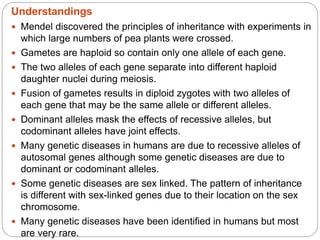
 A: Inheritance of ABO blood groups.
 A: Red-green color blindness and hemophilia as examples of sex-linked
inheritance.
 A: Inheritance of cystic fibrosis and Huntington’s disease.
 A: Consequences of radiation after nuclear bombing of Hiroshima and
accident at Chernobyl
 S: Construction of Punnett grids for predicting the outcomes of
monohybrid genetic crosses.
 S: Comparison of predicted and actual outcomes of genetic crosses
using real data.
 S: Analysis of pedigree charts to deduce the pattern of inheritance of
genetic diseases. Alleles carried on X chromosomes should be shown
as superscript letters on an uppercase X, such as ___.
 The expected notation for ABO blood group alleles is:
TOK, pg 142
When Mendel proposed his ideas about “factors” (genes)
controlling inherited traits, scientists were not eager to
adopt his theories. It was not until many decades later,
when a new generation of scientists repeated his
experiments that the scientific community started to get
excited about genetics. What factors influence scientists
in their decision to accept or reject new theories?
Some of Mendel’s results seemed too good to be true.
His numbers do not show the expected variations that are
typically found when breeding plants. What happened?
- Omit unexpected results?
- Purposefully change numbers (fudging data)? 
unethical
How can we be sure that modern scientific studies are
Gametes have only one allele of
each gene.
 Punnett grids can be used to show how alleles are split
and then recombine.
 Purpose is to show all the possible combinations of
genetic information for a particular trait.
 Steps of the Punnett grid method:
1. Choose a letter- generally the first letter of the dominant
trait.
2. Identify parents’ genotypes.
3. Determine gametes-one set across the top, the other
down the left side.
4. Draw the Punnett grid.
5. Interpret the grid.
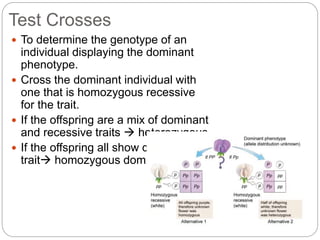
Test Crosses
 To determine the genotype of an
individual displaying the dominant
phenotype.
 Cross the dominant individual with
one that is homozygous recessive
for the trait.
 If the offspring are a mix of dominant
and recessive traits  heterozygous
 If the offspring all show dominant
trait homozygous dominant.
Multiple alleles
 Three or more alleles for a trait. Ex: blood type
How would it be possible for a couple to have
children with all 4 blood types?
humans
 Caused by recessive alleles and found on one of the
first 22 pairs of chromosomes.
 Examples:
 Albinism: body is unable to produce/distribute melanin,
which is responsible for pigment.
 Cystic fibrosis: affects the cells that produce mucus,
sweat and digestive juices.
 PKU: causes the amino acid phenylalanine to build up in
your body.
 Sickle cell: A group of disorders that cause red blood cells
to become misshapen and break down
 Tay Sachs: rare inherited disorder that progressively
destroys nerve cells (neurons) in the brain and spinal
cord.
 Thalassemia: blood disorder in which the body makes an
Sex linkage
 Any genetic trait whose gene has a locus on the X or Y
chromosome = sex linked.
 Sex-linked recessive alleles are rare, usually on X
chromosome.
 Extremely rare to get two X chromosomes with the
recessive allele together, which is why women rarely
suffer from these diseases.
 Women are the only gender that can be carriers for
sex-linked diseases.
 Examples:
 Color blindness (r), hemophilia (r), Duchene muscular
dystrophy (r), white eye color in fruit flies (r), calico fur
color in cats.
Mutations and cancer
 Exposure to radiation and/or carcinogens can modify
the genetic code.
 Base pairs can be knocked out of place, causing a
change in the genetic code.
 This change is passed on through replication.
 The mutation may be benign, but it may be harmful
leading to replication of dysfunctional proteins/cells.
Video
Atomic Bomb in Hiroshima: Health Effects

3.4 inheritance

  • 1.
  • 2.
    Understandings  Mendel discoveredthe principles of inheritance with experiments in which large numbers of pea plants were crossed.  Gametes are haploid so contain only one allele of each gene.  The two alleles of each gene separate into different haploid daughter nuclei during meiosis.  Fusion of gametes results in diploid zygotes with two alleles of each gene that may be the same allele or different alleles.  Dominant alleles mask the effects of recessive alleles, but codominant alleles have joint effects.  Many genetic diseases in humans are due to recessive alleles of autosomal genes although some genetic diseases are due to dominant or codominant alleles.  Some genetic diseases are sex linked. The pattern of inheritance is different with sex-linked genes due to their location on the sex chromosome.  Many genetic diseases have been identified in humans but most are very rare.
  • 3.
    Applications/skills Guidance  A: Inheritanceof ABO blood groups.  A: Red-green color blindness and hemophilia as examples of sex-linked inheritance.  A: Inheritance of cystic fibrosis and Huntington’s disease.  A: Consequences of radiation after nuclear bombing of Hiroshima and accident at Chernobyl  S: Construction of Punnett grids for predicting the outcomes of monohybrid genetic crosses.  S: Comparison of predicted and actual outcomes of genetic crosses using real data.  S: Analysis of pedigree charts to deduce the pattern of inheritance of genetic diseases. Alleles carried on X chromosomes should be shown as superscript letters on an uppercase X, such as ___.  The expected notation for ABO blood group alleles is:
  • 4.
    TOK, pg 142 WhenMendel proposed his ideas about “factors” (genes) controlling inherited traits, scientists were not eager to adopt his theories. It was not until many decades later, when a new generation of scientists repeated his experiments that the scientific community started to get excited about genetics. What factors influence scientists in their decision to accept or reject new theories? Some of Mendel’s results seemed too good to be true. His numbers do not show the expected variations that are typically found when breeding plants. What happened? - Omit unexpected results? - Purposefully change numbers (fudging data)?  unethical How can we be sure that modern scientific studies are
  • 5.
    Gametes have onlyone allele of each gene.  Punnett grids can be used to show how alleles are split and then recombine.  Purpose is to show all the possible combinations of genetic information for a particular trait.  Steps of the Punnett grid method: 1. Choose a letter- generally the first letter of the dominant trait. 2. Identify parents’ genotypes. 3. Determine gametes-one set across the top, the other down the left side. 4. Draw the Punnett grid. 5. Interpret the grid.
  • 6.
    Test Crosses  Todetermine the genotype of an individual displaying the dominant phenotype.  Cross the dominant individual with one that is homozygous recessive for the trait.  If the offspring are a mix of dominant and recessive traits  heterozygous  If the offspring all show dominant trait homozygous dominant.
  • 7.
    Multiple alleles  Threeor more alleles for a trait. Ex: blood type How would it be possible for a couple to have children with all 4 blood types?
  • 8.
    humans  Caused byrecessive alleles and found on one of the first 22 pairs of chromosomes.  Examples:  Albinism: body is unable to produce/distribute melanin, which is responsible for pigment.  Cystic fibrosis: affects the cells that produce mucus, sweat and digestive juices.  PKU: causes the amino acid phenylalanine to build up in your body.  Sickle cell: A group of disorders that cause red blood cells to become misshapen and break down  Tay Sachs: rare inherited disorder that progressively destroys nerve cells (neurons) in the brain and spinal cord.  Thalassemia: blood disorder in which the body makes an
  • 9.
    Sex linkage  Anygenetic trait whose gene has a locus on the X or Y chromosome = sex linked.  Sex-linked recessive alleles are rare, usually on X chromosome.  Extremely rare to get two X chromosomes with the recessive allele together, which is why women rarely suffer from these diseases.  Women are the only gender that can be carriers for sex-linked diseases.  Examples:  Color blindness (r), hemophilia (r), Duchene muscular dystrophy (r), white eye color in fruit flies (r), calico fur color in cats.
  • 10.
    Mutations and cancer Exposure to radiation and/or carcinogens can modify the genetic code.  Base pairs can be knocked out of place, causing a change in the genetic code.  This change is passed on through replication.  The mutation may be benign, but it may be harmful leading to replication of dysfunctional proteins/cells.
  • 11.
    Video Atomic Bomb inHiroshima: Health Effects