GENETICS
CHAPTERS 9 & 12
I. The History of Genetics
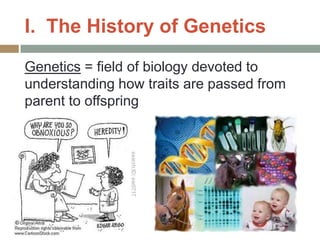
Genetics = field of biology devoted to
understanding how traits are passed from
parent to offspring
Heredity
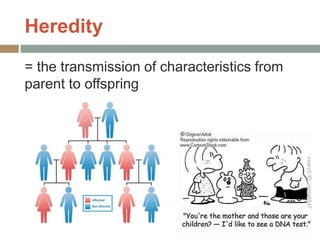
= the transmission of characteristics from
parent to offspring
Mendel’s Experiments
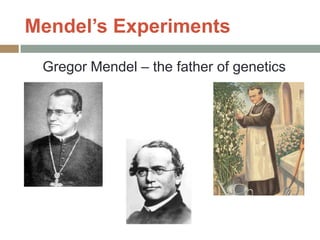
 Gregor Mendel – the father of genetics
Mendel’s Experiments
Continued…
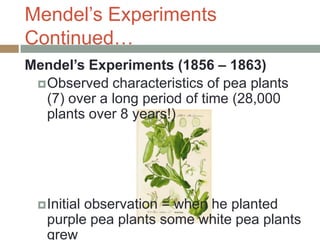
Mendel’s Experiments (1856 – 1863)
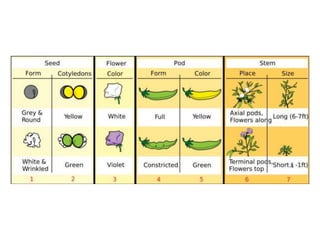
  Observed characteristics of pea plants
   (7) over a long period of time (28,000
   plants over 8 years!)


  Initial
         observation = when he planted
   purple pea plants some white pea plants
   grew
Mendel’s Methods:
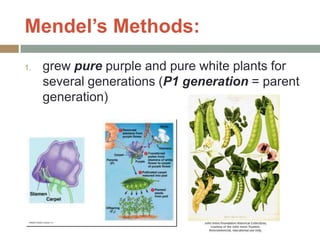
1.   grew pure purple and pure white plants for
     several generations (P1 generation = parent
     generation)
Mendel’s Methods continued…
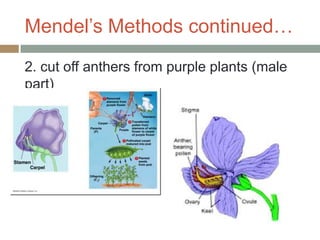
2. cut off anthers from purple plants (male
part)
Mendel’s Methods continued…
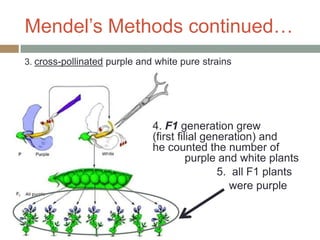
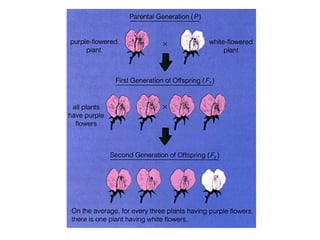
3. cross-pollinated purple and white pure strains


                              4. F1 generation grew
                              (first filial generation) and
                              he counted the number of
                                        purple and white plants
                                               5. all F1 plants
                                                  were purple
Mendel’s Methods continued…

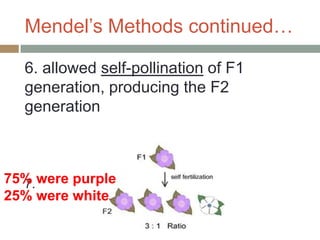
  6. allowed self-pollination of F1
  generation, producing the F2
  generation


75% were purple
  7.
25% were white
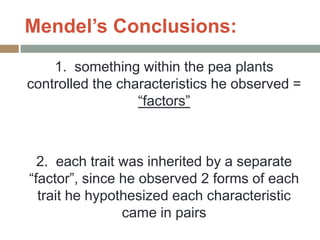
Mendel’s Conclusions:
    1. something within the pea plants
controlled the characteristics he observed =
                  “factors”


  2. each trait was inherited by a separate
“factor”, since he observed 2 forms of each
  trait he hypothesized each characteristic
                came in pairs
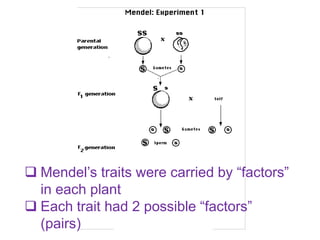
 Mendel’s traits were carried by “factors”
  in each plant
 Each trait had 2 possible “factors”
  (pairs)
Mendel’s Conclusions
continued…
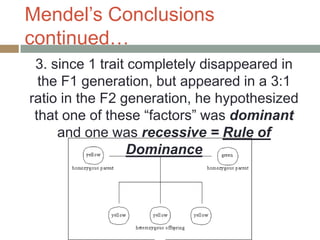
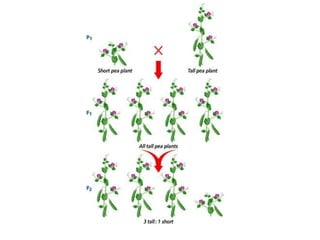
 3. since 1 trait completely disappeared in
  the F1 generation, but appeared in a 3:1
ratio in the F2 generation, he hypothesized
 that one of these “factors” was dominant
     and one was recessive = Rule of
                 Dominance
Laws that Evolved from Mendel’s
Work


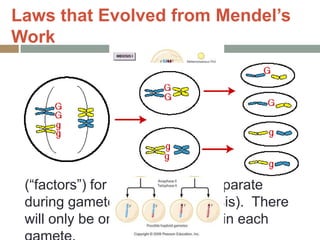
 The Law of Segregation = The two alleles
 (“factors”) for each trait must separate
 during gamete formation (meiosis). There
 will only be one allele for a trait in each
Laws the Evolved from Mendel


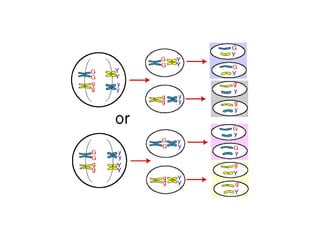
The Law of Independent Assortment =
the alleles for each trait must behave
independently of alleles for other traits
during gamete formation. We have no way
of determining which allele will go into which
gamete, it is random!
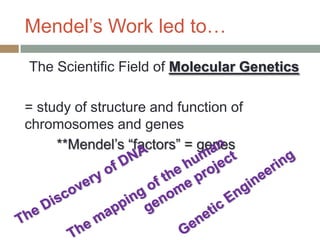
Mendel’s Work led to…
The Scientific Field of Molecular Genetics

= study of structure and function of
chromosomes and genes
     **Mendel’s “factors” = genes
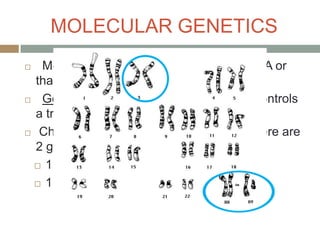
MOLECULAR GENETICS
  Mendel did not know the structure of DNA or
  that there were genes during his research
  Gene = segment of DNA on a CH that controls
  a trait
 Chromosomes (CH’s) occur in pairs = there are

  2 genes responsible for each trait
   1 from mom

   1 from dad
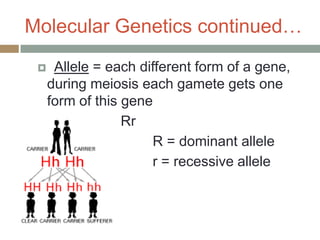
Molecular Genetics continued…
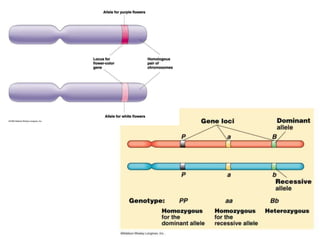
     Allele = each different form of a gene,
     during meiosis each gamete gets one
     form of this gene
                  Rr
                      R = dominant allele
                      r = recessive allele
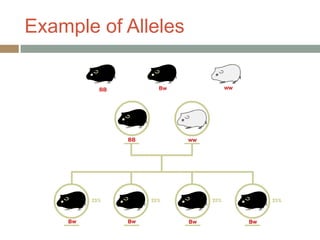
Example of Alleles
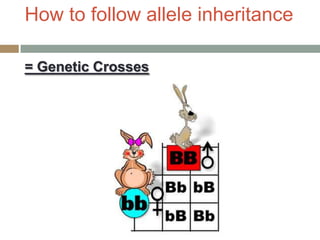
How to follow allele inheritance

= Genetic Crosses
Genetic Crosses Objectives
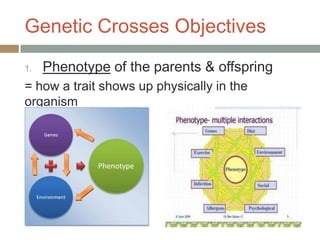
1.   Phenotype of the parents & offspring
= how a trait shows up physically in the
organism
Genetic Crosses Objectives
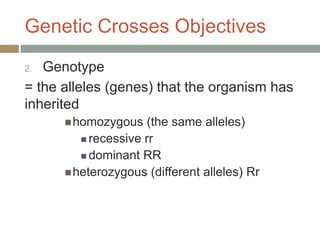
2. Genotype
= the alleles (genes) that the organism has
inherited
       homozygous   (the same alleles)
          recessive rr

          dominant RR

       heterozygous (different alleles) Rr
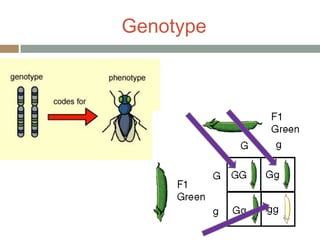
Genotype
Type of Crosses and Inheritance

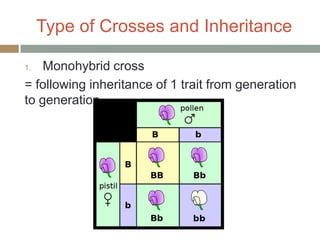
1.  Monohybrid cross
= following inheritance of 1 trait from generation
to generation
Types of Crosses continued…
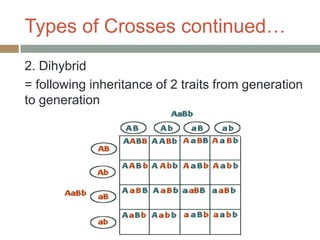
2. Dihybrid
= following inheritance of 2 traits from generation
to generation
Crosses
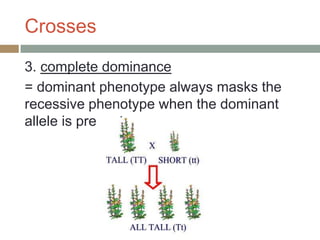
3. complete dominance
= dominant phenotype always masks the
recessive phenotype when the dominant
allele is present
Crosses
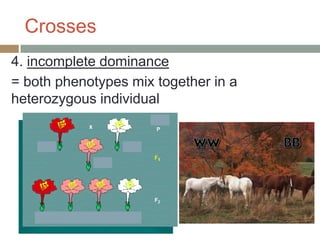
4. incomplete dominance
= both phenotypes mix together in a
heterozygous individual
Crosses
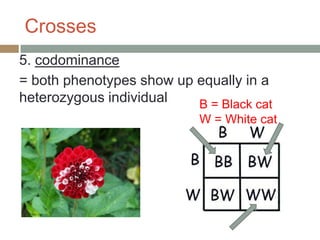
5. codominance
= both phenotypes show up equally in a
heterozygous individual   B = Black cat
                           W = White cat
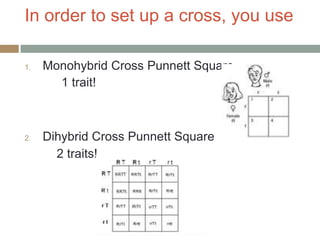
In order to set up a cross, you use

1.   Monohybrid Cross Punnett Square
       1 trait!


2.   Dihybrid Cross Punnett Square
       2 traits!
What if you don’t know the
genotype of an organism…only the
phenotype
    You Perform A Test Cross

= used if the individual of interest shows the
dominant phenotype (physical
characteristic) but you don’t know if it is
heterozygous or homozygous dominant
genotypically (what alleles the individual
actually inherited)
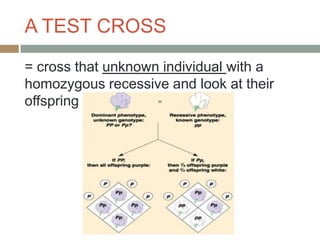
A TEST CROSS
= cross that unknown individual with a
homozygous recessive and look at their
offspring
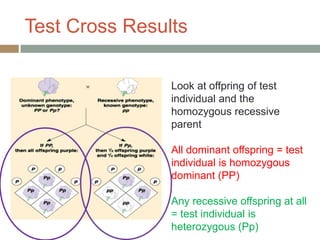
Test Cross Results

                Look at offpring of test
                individual and the
                homozygous recessive
                parent

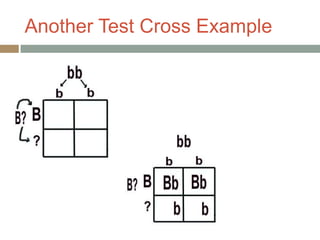
                All dominant offspring = test
                individual is homozygous
                dominant (PP)

                Any recessive offspring at all
                = test individual is
                heterozygous (Pp)
Another Test Cross Example
Probability
Probability
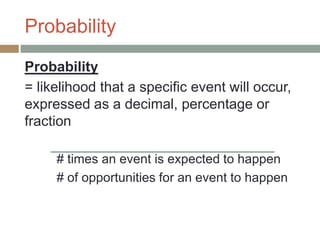
= likelihood that a specific event will occur,
expressed as a decimal, percentage or
fraction

     # times an event is expected to happen
     # of opportunities for an event to happen
Chapter 12 – Human
Inheritance
     Types of Genetic Traits/Disorders & how they
                    are inherited:

1.  Single-allele traits
= controlled by 1 allele of a gene (200)
 i.e. Huntington’s Disease (HD), Cystic fibrosis,
                 sickle cell anemia
Human Inheritance Types…

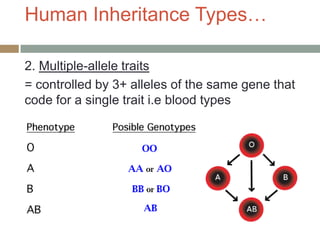
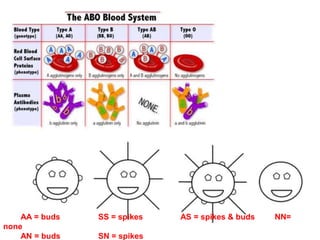
2. Multiple-allele traits
= controlled by 3+ alleles of the same gene that
code for a single trait i.e blood types
AA = buds   SS = spikes   AS = spikes & buds   NN=
none
    AN = buds   SN = spikes
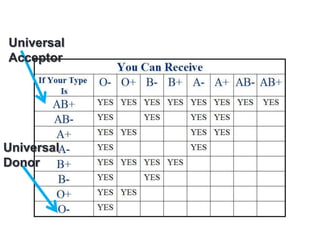
Universal
Acceptor


Universal
Donor
Human Inheritance Types…
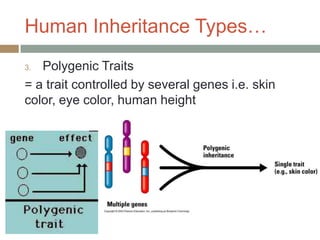
3. Polygenic Traits
= a trait controlled by several genes i.e. skin
color, eye color, human height
Human Inheritance Types…
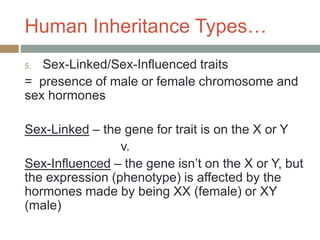
5. Sex-Linked/Sex-Influenced traits
= presence of male or female chromosome and
sex hormones

Sex-Linked – the gene for trait is on the X or Y
                 v.
Sex-Influenced – the gene isn’t on the X or Y, but
the expression (phenotype) is affected by the
hormones made by being XX (female) or XY
(male)
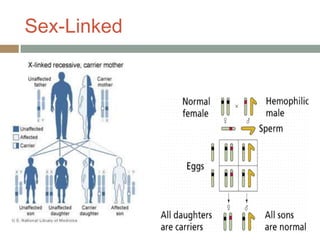
Sex-Linked
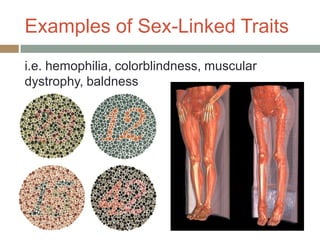
Examples of Sex-Linked Traits
i.e. hemophilia, colorblindness, muscular
dystrophy, baldness
Sex-Linkage
= presence of a gene on a sex chromosome (X or
Y)

1)   X-linked – genes found on the X chromosome
     and inherited when the individual receives an X
     during fertilization
       Most common type


       MostX-linked diseases/traits are recessive
       (need 2 copies of allele to show disease/trait
       physically)
X-linked continued…
     Father   to son transmission is IMPOSSIBLE!

     Youcan be a “carrier” and not have the
     disease

     Morecommon in males! (they only need 1
     copy!)


Examples: muscular dystrophy, hemophilia,
color-blindness, fragile X-syndrome, protanopia,
Aicardi syndrome
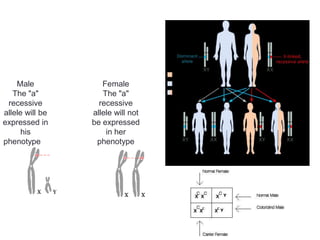
Male            Female
   The "a"          The "a"
 recessive         recessive
allele will be   allele will not
expressed in     be expressed
      his            in her
phenotype         phenotype
Y-Linked Traits
= genes found on the Y chromosome and
inherited when the individual receives a Y (and
become a male) during fertilization

     Only males can have these diseases/traits
     Very rare


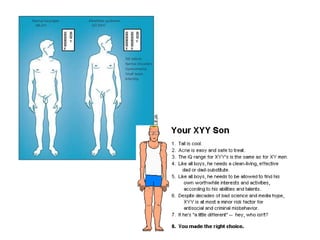
    Examples: Klinefelter syndrome (XXY),
    Jacobs Syndrome (XYY)
What does it mean to “carry” a
trait?
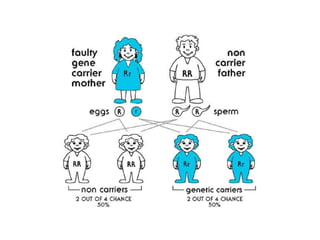
Carrier
= when an organism has 1 copy of an allele that
causes a recessive disorder but does not present
that disorder/trait physically

           XdX = carrier, female
           XdXd = has disorder, female
           XdY    = has disorder, male
           XY = doesn’t have disorder and is not a
                 carrier!, male
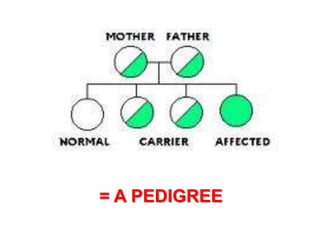
= A PEDIGREE
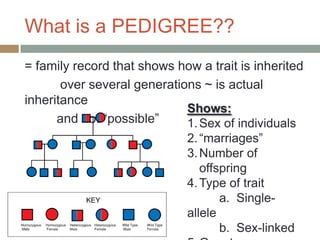
What is a PEDIGREE??
= family record that shows how a trait is inherited
       over several generations ~ is actual
inheritance
                             Shows:
      and not “possible”     1. Sex of individuals
                             2. “marriages”
                             3. Number of
                                offspring
                             4. Type of trait
                                    a. Single-
                             allele
                                    b. Sex-linked
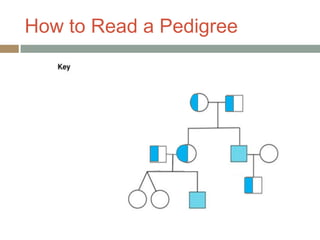
How to Read a Pedigree

Geneticsnotes ch9 bio

  • 1.
  • 2.
    I. The Historyof Genetics Genetics = field of biology devoted to understanding how traits are passed from parent to offspring
  • 3.
    Heredity = the transmissionof characteristics from parent to offspring
  • 4.
    Mendel’s Experiments GregorMendel – the father of genetics
  • 5.
    Mendel’s Experiments Continued… Mendel’s Experiments(1856 – 1863)  Observed characteristics of pea plants (7) over a long period of time (28,000 plants over 8 years!)  Initial observation = when he planted purple pea plants some white pea plants grew
  • 8.
    Mendel’s Methods: 1. grew pure purple and pure white plants for several generations (P1 generation = parent generation)
  • 9.
    Mendel’s Methods continued… 2.cut off anthers from purple plants (male part)
  • 10.
    Mendel’s Methods continued… 3.cross-pollinated purple and white pure strains 4. F1 generation grew (first filial generation) and he counted the number of purple and white plants 5. all F1 plants were purple
  • 11.
    Mendel’s Methods continued… 6. allowed self-pollination of F1 generation, producing the F2 generation 75% were purple 7. 25% were white
  • 12.
    Mendel’s Conclusions: 1. something within the pea plants controlled the characteristics he observed = “factors” 2. each trait was inherited by a separate “factor”, since he observed 2 forms of each trait he hypothesized each characteristic came in pairs
  • 13.
     Mendel’s traitswere carried by “factors” in each plant  Each trait had 2 possible “factors” (pairs)
  • 14.
    Mendel’s Conclusions continued… 3.since 1 trait completely disappeared in the F1 generation, but appeared in a 3:1 ratio in the F2 generation, he hypothesized that one of these “factors” was dominant and one was recessive = Rule of Dominance
  • 17.
    Laws that Evolvedfrom Mendel’s Work The Law of Segregation = The two alleles (“factors”) for each trait must separate during gamete formation (meiosis). There will only be one allele for a trait in each
  • 18.
    Laws the Evolvedfrom Mendel The Law of Independent Assortment = the alleles for each trait must behave independently of alleles for other traits during gamete formation. We have no way of determining which allele will go into which gamete, it is random!
  • 20.
    Mendel’s Work ledto… The Scientific Field of Molecular Genetics = study of structure and function of chromosomes and genes **Mendel’s “factors” = genes
  • 21.
    MOLECULAR GENETICS  Mendel did not know the structure of DNA or that there were genes during his research  Gene = segment of DNA on a CH that controls a trait  Chromosomes (CH’s) occur in pairs = there are 2 genes responsible for each trait  1 from mom  1 from dad
  • 22.
    Molecular Genetics continued…  Allele = each different form of a gene, during meiosis each gamete gets one form of this gene Rr R = dominant allele r = recessive allele
  • 23.
  • 24.
    How to followallele inheritance = Genetic Crosses
  • 25.
    Genetic Crosses Objectives 1. Phenotype of the parents & offspring = how a trait shows up physically in the organism
  • 26.
    Genetic Crosses Objectives 2.Genotype = the alleles (genes) that the organism has inherited  homozygous (the same alleles)  recessive rr  dominant RR  heterozygous (different alleles) Rr
  • 27.
  • 28.
    Type of Crossesand Inheritance 1. Monohybrid cross = following inheritance of 1 trait from generation to generation
  • 29.
    Types of Crossescontinued… 2. Dihybrid = following inheritance of 2 traits from generation to generation
  • 30.
    Crosses 3. complete dominance =dominant phenotype always masks the recessive phenotype when the dominant allele is present
  • 31.
    Crosses 4. incomplete dominance =both phenotypes mix together in a heterozygous individual
  • 32.
    Crosses 5. codominance = bothphenotypes show up equally in a heterozygous individual B = Black cat W = White cat
  • 33.
    In order toset up a cross, you use 1. Monohybrid Cross Punnett Square 1 trait! 2. Dihybrid Cross Punnett Square 2 traits!
  • 34.
    What if youdon’t know the genotype of an organism…only the phenotype You Perform A Test Cross = used if the individual of interest shows the dominant phenotype (physical characteristic) but you don’t know if it is heterozygous or homozygous dominant genotypically (what alleles the individual actually inherited)
  • 35.
    A TEST CROSS =cross that unknown individual with a homozygous recessive and look at their offspring
  • 36.
    Test Cross Results Look at offpring of test individual and the homozygous recessive parent All dominant offspring = test individual is homozygous dominant (PP) Any recessive offspring at all = test individual is heterozygous (Pp)
  • 37.
  • 38.
    Probability Probability = likelihood thata specific event will occur, expressed as a decimal, percentage or fraction # times an event is expected to happen # of opportunities for an event to happen
  • 39.
    Chapter 12 –Human Inheritance Types of Genetic Traits/Disorders & how they are inherited: 1. Single-allele traits = controlled by 1 allele of a gene (200) i.e. Huntington’s Disease (HD), Cystic fibrosis, sickle cell anemia
  • 41.
    Human Inheritance Types… 2.Multiple-allele traits = controlled by 3+ alleles of the same gene that code for a single trait i.e blood types
  • 42.
    AA = buds SS = spikes AS = spikes & buds NN= none AN = buds SN = spikes
  • 43.
  • 44.
    Human Inheritance Types… 3.Polygenic Traits = a trait controlled by several genes i.e. skin color, eye color, human height
  • 45.
    Human Inheritance Types… 5.Sex-Linked/Sex-Influenced traits = presence of male or female chromosome and sex hormones Sex-Linked – the gene for trait is on the X or Y v. Sex-Influenced – the gene isn’t on the X or Y, but the expression (phenotype) is affected by the hormones made by being XX (female) or XY (male)
  • 46.
  • 47.
    Examples of Sex-LinkedTraits i.e. hemophilia, colorblindness, muscular dystrophy, baldness
  • 48.
    Sex-Linkage = presence ofa gene on a sex chromosome (X or Y) 1) X-linked – genes found on the X chromosome and inherited when the individual receives an X during fertilization  Most common type  MostX-linked diseases/traits are recessive (need 2 copies of allele to show disease/trait physically)
  • 49.
    X-linked continued…  Father to son transmission is IMPOSSIBLE!  Youcan be a “carrier” and not have the disease  Morecommon in males! (they only need 1 copy!) Examples: muscular dystrophy, hemophilia, color-blindness, fragile X-syndrome, protanopia, Aicardi syndrome
  • 50.
    Male Female The "a" The "a" recessive recessive allele will be allele will not expressed in be expressed his in her phenotype phenotype
  • 51.
    Y-Linked Traits = genesfound on the Y chromosome and inherited when the individual receives a Y (and become a male) during fertilization  Only males can have these diseases/traits  Very rare Examples: Klinefelter syndrome (XXY), Jacobs Syndrome (XYY)
  • 53.
    What does itmean to “carry” a trait? Carrier = when an organism has 1 copy of an allele that causes a recessive disorder but does not present that disorder/trait physically XdX = carrier, female XdXd = has disorder, female XdY = has disorder, male XY = doesn’t have disorder and is not a carrier!, male
  • 55.
  • 56.
    What is aPEDIGREE?? = family record that shows how a trait is inherited over several generations ~ is actual inheritance Shows: and not “possible” 1. Sex of individuals 2. “marriages” 3. Number of offspring 4. Type of trait a. Single- allele b. Sex-linked
  • 57.
    How to Reada Pedigree