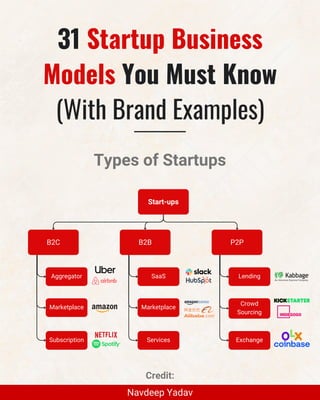
Start-ups
P2P
Lending
SaaS
Aggregator
Crowd
Sourcing
Marketplace
Marketplace
Exchange
Services
Subscription
B2B
B2C
Types of Startups
31 Startup Business
Models You Must Know
(With Brand Examples)
Navdeep Yadav
Credit:
01
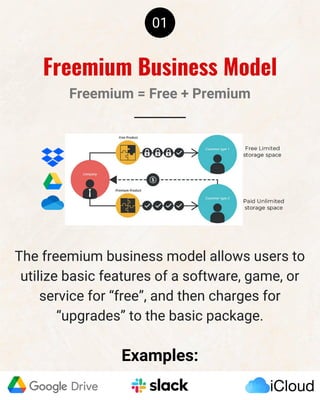
Freemium = Free + Premium
The freemium business model allows users to
utilize basic features of a software, game, or
service for “free”, and then charges for
“upgrades” to the basic package.
Freemium Business Model
Examples:
02
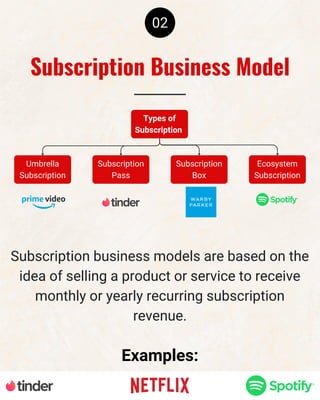
Types of
Subscription
Subscription
Box
Subscription
Pass
Umbrella
Subscription
Ecosystem
Subscription
Subscription business models are based on the
idea of selling a product or service to receive
monthly or yearly recurring subscription
revenue.
Subscription Business Model
Examples:
03
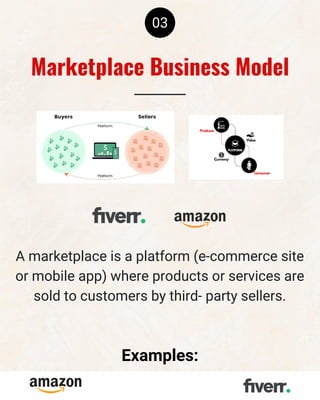
A marketplace is a platform (e-commerce site
or mobile app) where products or services are
sold to customers by third- party sellers.
Marketplace Business Model
Examples:
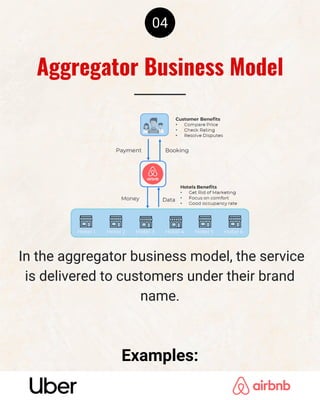
04
In the aggregator business model, the service
is delivered to customers under their brand
name.
Aggregator Business Model
Examples:
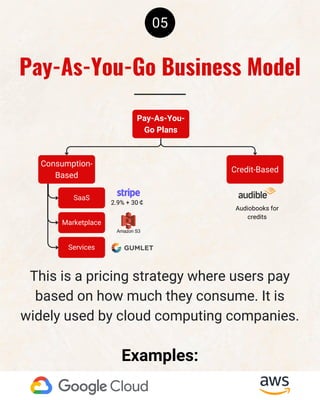
05
Pay-As-You-
Go Plans
Credit-Based
SaaS
Marketplace
Services
Consumption-
Based
This is a pricing strategy where users pay
based on how much they consume. It is
widely used by cloud computing companies.
Pay-As-You-Go Business Model
Examples:
2.9% + 30¢ Audiobooks for
credits
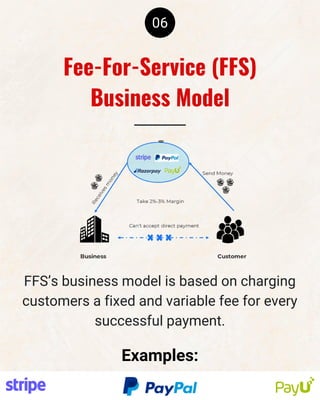
06
FFS’s business model is based on charging
customers a fixed and variable fee for every
successful payment.
Fee-For-Service (FFS)
Business Model
Examples:
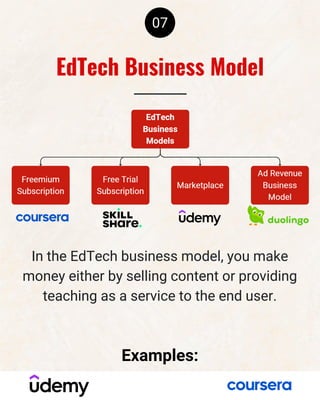
07
EdTech
Business
Models
Marketplace
Free Trial
Subscription
Freemium
Subscription
Ad Revenue
Business
Model
In the EdTech business model, you make
money either by selling content or providing
teaching as a service to the end user.
Examples:
EdTech Business Model
08
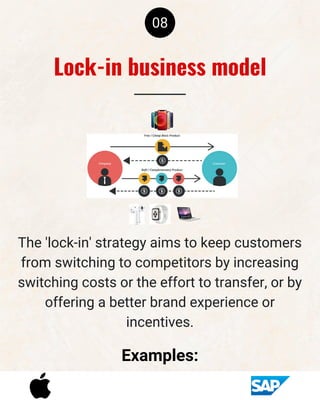
The 'lock-in' strategy aims to keep customers
from switching to competitors by increasing
switching costs or the effort to transfer, or by
offering a better brand experience or
incentives.
Examples:
Lock-in business model
09
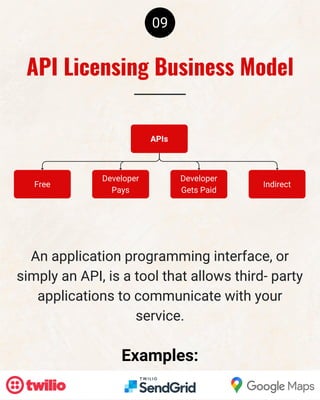
APIs
Developer
Gets Paid
Developer
Pays
Free Indirect
An application programming interface, or
simply an API, is a tool that allows third- party
applications to communicate with your
service.
Examples:
API Licensing Business Model
10
Open-source software is software with source
code that anyone can inspect, modify, and
enhance for personal use.
Examples:
Open-Source Business Model
11
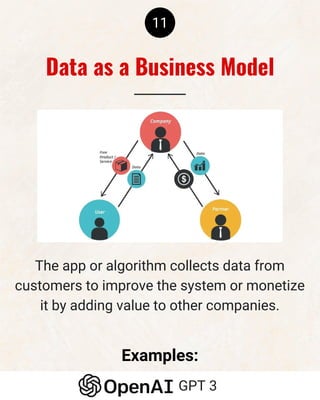
The app or algorithm collects data from
customers to improve the system or monetize
it by adding value to other companies.
Examples:
Data as a Business Model
GPT 3
12
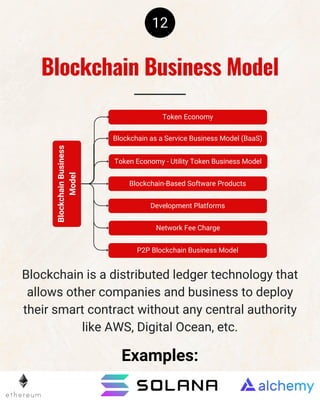
Blockchain
Business
Model
Blockchain-Based Software Products
Token Economy - Utility Token Business Model
P2P Blockchain Business Model
Blockchain as a Service Business Model (BaaS)
Token Economy
Development Platforms
Network Fee Charge
Blockchain is a distributed ledger technology that
allows other companies and business to deploy
their smart contract without any central authority
like AWS, Digital Ocean, etc.
Examples:
Blockchain Business Model
13
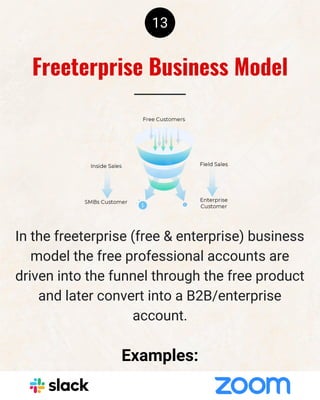
In the freeterprise (free & enterprise) business
model the free professional accounts are
driven into the funnel through the free product
and later convert into a B2B/enterprise
account.
Examples:
Freeterprise Business Model
14
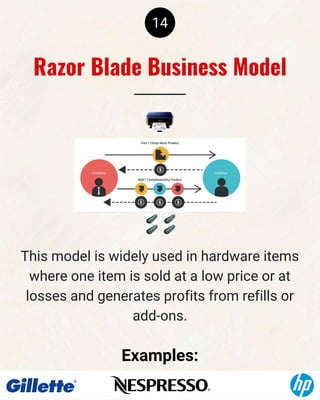
This model is widely used in hardware items
where one item is sold at a low price or at
losses and generates profits from refills or
add-ons.
Examples:
Razor Blade Business Model
15
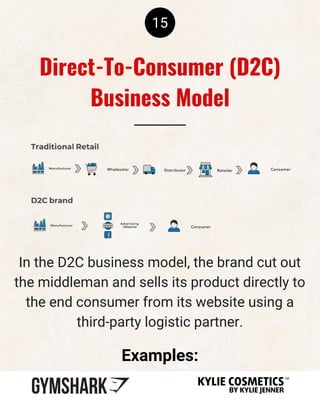
In the D2C business model, the brand cut out
the middleman and sells its product directly to
the end consumer from its website using a
third-party logistic partner.
Direct-To-Consumer (D2C)
Business Model
Examples:
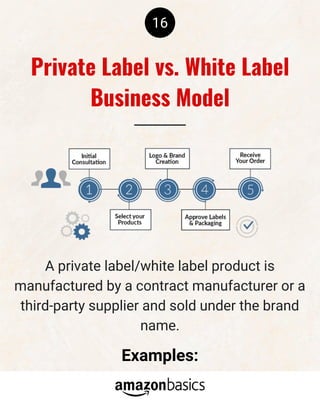
16
A private label/white label product is
manufactured by a contract manufacturer or a
third-party supplier and sold under the brand
name.
Private Label vs. White Label
Business Model
Examples:
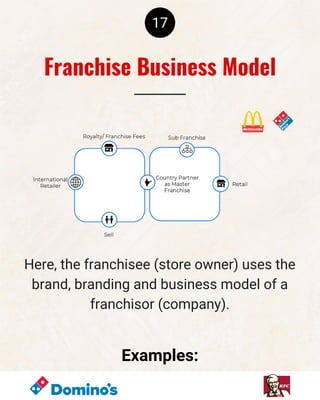
17
Here, the franchisee (store owner) uses the
brand, branding and business model of a
franchisor (company).
Examples:
Franchise Business Model
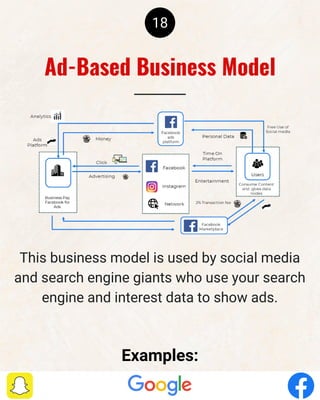
18
This business model is used by social media
and search engine giants who use your search
engine and interest data to show ads.
Examples:
Ad-Based Business Model
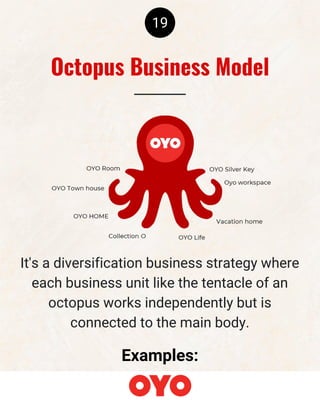
19
It's a diversification business strategy where
each business unit like the tentacle of an
octopus works independently but is
connected to the main body.
Examples:
Octopus Business Model
20
The revenue is generated by directly selling an
item or a service to a customer. Widely used
by e-commerce sites or any other product you
purchase online.
Examples:
Transactional Business Model
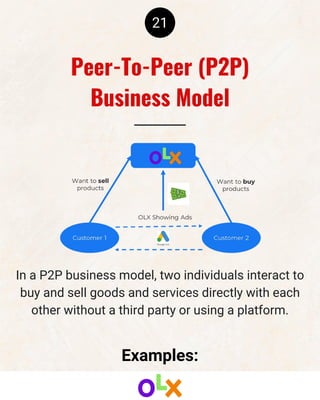
21
In a P2P business model, two individuals interact to
buy and sell goods and services directly with each
other without a third party or using a platform.
Peer-To-Peer (P2P)
Business Model
Examples:
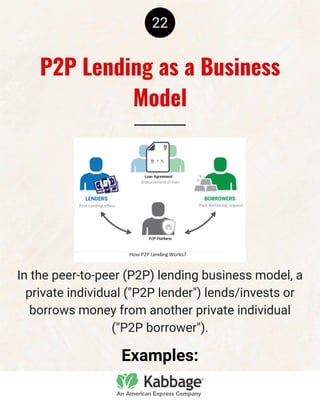
22
In the peer-to-peer (P2P) lending business model, a
private individual ("P2P lender") lends/invests or
borrows money from another private individual
("P2P borrower").
P2P Lending as a Business
Model
Examples:
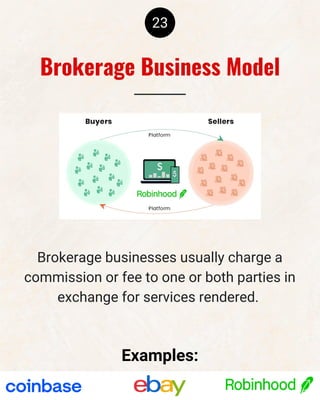
23
Brokerage businesses usually charge a
commission or fee to one or both parties in
exchange for services rendered.
Examples:
Brokerage Business Model
24
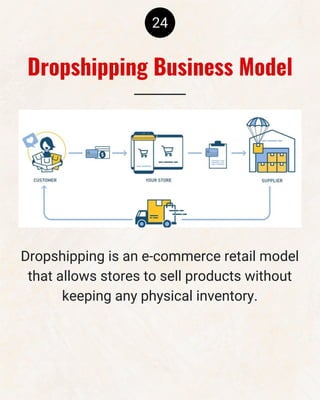
Dropshipping is an e-commerce retail model
that allows stores to sell products without
keeping any physical inventory.
Dropshipping Business Model
25
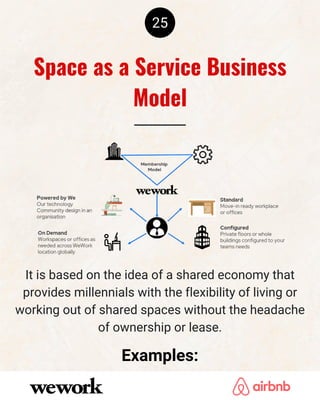
It is based on the idea of a shared economy that
provides millennials with the flexibility of living or
working out of shared spaces without the headache
of ownership or lease.
Space as a Service Business
Model
Examples:
26
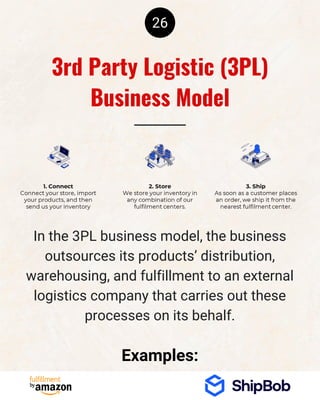
In the 3PL business model, the business
outsources its products’ distribution,
warehousing, and fulfillment to an external
logistics company that carries out these
processes on its behalf.
3rd Party Logistic (3PL)
Business Model
Examples:
27
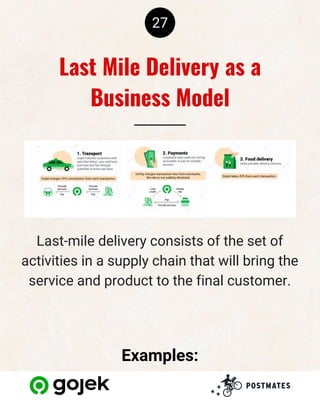
Last-mile delivery consists of the set of
activities in a supply chain that will bring the
service and product to the final customer.
Last Mile Delivery as a
Business Model
Examples:
28
Affiliate marketing is a revenue-earning
strategy of promoting other companies'
products and charging commissions for every
sale.
Examples:
Affiliate Business Model
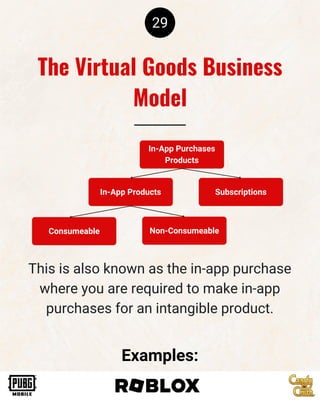
29
In-App Purchases
Products
In-App Products
Consumeable Non-Consumeable
Subscriptions
This is also known as the in-app purchase
where you are required to make in-app
purchases for an intangible product.
The Virtual Goods Business
Model
Examples:
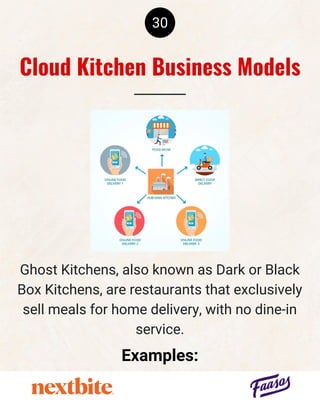
30
Ghost Kitchens, also known as Dark or Black
Box Kitchens, are restaurants that exclusively
sell meals for home delivery, with no dine-in
service.
Examples:
Cloud Kitchen Business Models
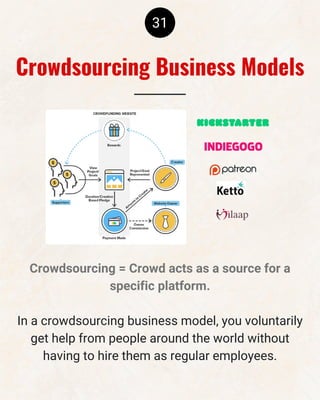
31
Crowdsourcing = Crowd acts as a source for a
specific platform.
In a crowdsourcing business model, you voluntarily
get help from people around the world without
having to hire them as regular employees.
Crowdsourcing Business Models

31 start-up business models with examples.pdf

  • 1.
  • 2.
    01 Freemium = Free+ Premium The freemium business model allows users to utilize basic features of a software, game, or service for “free”, and then charges for “upgrades” to the basic package. Freemium Business Model Examples:
  • 3.
    02 Types of Subscription Subscription Box Subscription Pass Umbrella Subscription Ecosystem Subscription Subscription businessmodels are based on the idea of selling a product or service to receive monthly or yearly recurring subscription revenue. Subscription Business Model Examples:
  • 4.
    03 A marketplace isa platform (e-commerce site or mobile app) where products or services are sold to customers by third- party sellers. Marketplace Business Model Examples:
  • 5.
    04 In the aggregatorbusiness model, the service is delivered to customers under their brand name. Aggregator Business Model Examples:
  • 6.
    05 Pay-As-You- Go Plans Credit-Based SaaS Marketplace Services Consumption- Based This isa pricing strategy where users pay based on how much they consume. It is widely used by cloud computing companies. Pay-As-You-Go Business Model Examples: 2.9% + 30¢ Audiobooks for credits
  • 7.
    06 FFS’s business modelis based on charging customers a fixed and variable fee for every successful payment. Fee-For-Service (FFS) Business Model Examples:
  • 8.
    07 EdTech Business Models Marketplace Free Trial Subscription Freemium Subscription Ad Revenue Business Model Inthe EdTech business model, you make money either by selling content or providing teaching as a service to the end user. Examples: EdTech Business Model
  • 9.
    08 The 'lock-in' strategyaims to keep customers from switching to competitors by increasing switching costs or the effort to transfer, or by offering a better brand experience or incentives. Examples: Lock-in business model
  • 10.
    09 APIs Developer Gets Paid Developer Pays Free Indirect Anapplication programming interface, or simply an API, is a tool that allows third- party applications to communicate with your service. Examples: API Licensing Business Model
  • 11.
    10 Open-source software issoftware with source code that anyone can inspect, modify, and enhance for personal use. Examples: Open-Source Business Model
  • 12.
    11 The app oralgorithm collects data from customers to improve the system or monetize it by adding value to other companies. Examples: Data as a Business Model GPT 3
  • 13.
    12 Blockchain Business Model Blockchain-Based Software Products TokenEconomy - Utility Token Business Model P2P Blockchain Business Model Blockchain as a Service Business Model (BaaS) Token Economy Development Platforms Network Fee Charge Blockchain is a distributed ledger technology that allows other companies and business to deploy their smart contract without any central authority like AWS, Digital Ocean, etc. Examples: Blockchain Business Model
  • 14.
    13 In the freeterprise(free & enterprise) business model the free professional accounts are driven into the funnel through the free product and later convert into a B2B/enterprise account. Examples: Freeterprise Business Model
  • 15.
    14 This model iswidely used in hardware items where one item is sold at a low price or at losses and generates profits from refills or add-ons. Examples: Razor Blade Business Model
  • 16.
    15 In the D2Cbusiness model, the brand cut out the middleman and sells its product directly to the end consumer from its website using a third-party logistic partner. Direct-To-Consumer (D2C) Business Model Examples:
  • 17.
    16 A private label/whitelabel product is manufactured by a contract manufacturer or a third-party supplier and sold under the brand name. Private Label vs. White Label Business Model Examples:
  • 18.
    17 Here, the franchisee(store owner) uses the brand, branding and business model of a franchisor (company). Examples: Franchise Business Model
  • 19.
    18 This business modelis used by social media and search engine giants who use your search engine and interest data to show ads. Examples: Ad-Based Business Model
  • 20.
    19 It's a diversificationbusiness strategy where each business unit like the tentacle of an octopus works independently but is connected to the main body. Examples: Octopus Business Model
  • 21.
    20 The revenue isgenerated by directly selling an item or a service to a customer. Widely used by e-commerce sites or any other product you purchase online. Examples: Transactional Business Model
  • 22.
    21 In a P2Pbusiness model, two individuals interact to buy and sell goods and services directly with each other without a third party or using a platform. Peer-To-Peer (P2P) Business Model Examples:
  • 23.
    22 In the peer-to-peer(P2P) lending business model, a private individual ("P2P lender") lends/invests or borrows money from another private individual ("P2P borrower"). P2P Lending as a Business Model Examples:
  • 24.
    23 Brokerage businesses usuallycharge a commission or fee to one or both parties in exchange for services rendered. Examples: Brokerage Business Model
  • 25.
    24 Dropshipping is ane-commerce retail model that allows stores to sell products without keeping any physical inventory. Dropshipping Business Model
  • 26.
    25 It is basedon the idea of a shared economy that provides millennials with the flexibility of living or working out of shared spaces without the headache of ownership or lease. Space as a Service Business Model Examples:
  • 27.
    26 In the 3PLbusiness model, the business outsources its products’ distribution, warehousing, and fulfillment to an external logistics company that carries out these processes on its behalf. 3rd Party Logistic (3PL) Business Model Examples:
  • 28.
    27 Last-mile delivery consistsof the set of activities in a supply chain that will bring the service and product to the final customer. Last Mile Delivery as a Business Model Examples:
  • 29.
    28 Affiliate marketing isa revenue-earning strategy of promoting other companies' products and charging commissions for every sale. Examples: Affiliate Business Model
  • 30.
    29 In-App Purchases Products In-App Products ConsumeableNon-Consumeable Subscriptions This is also known as the in-app purchase where you are required to make in-app purchases for an intangible product. The Virtual Goods Business Model Examples:
  • 31.
    30 Ghost Kitchens, alsoknown as Dark or Black Box Kitchens, are restaurants that exclusively sell meals for home delivery, with no dine-in service. Examples: Cloud Kitchen Business Models
  • 32.
    31 Crowdsourcing = Crowdacts as a source for a specific platform. In a crowdsourcing business model, you voluntarily get help from people around the world without having to hire them as regular employees. Crowdsourcing Business Models