Important note:
• The toxin is NOT secreted by C.
Botulinum, instead, it is produced during
the bacteria’s autolysis.
Clostridium Botulinum
Catherine Chung
Colin Brinkman
Pam Chao
Introduction to botulism
• Neuroparalytic disease caused by neurotoxins
(BoNTs) produced by bacteria Clostridium
botulinum.
– 7 different BoNTs (A-G) produced by different strains
of C. botulinum.
• BoNTs A, B, E, and F outbreaks in humans
• BoNT C in birds
• BoNT D in cattle
• BoNT G isolated from soils
– BoNT A most common and most potent
– BoNTs also produced by other members of Clostridia
family.
A long history
• Botulism originally known as “sausage poisoning” in late 18th
century and throughout 19th
century.
– From Latin botulus = sausage
• Bacterial etiology recognized at end of 19th
century
– Outbreak of botulism in Belgium 1895 revealed cause as
neuroparalytic toxin produced by anaerobic bacterium
– Probably Type B
• Outbreak in Germany several years later
– Bacterium isolated; different from that in Belgium
– Probably Type A
The 20th
Century and Beyond
• 1949 Burgen et al. determines botulinum toxin
blocks neurotransmitter release
• 1979 Simpson proposes cellular mechanism in 3
steps: binding, internalization, and intraneuronal
action.
• 1990 a.a. sequence of one BoNT determined in
Niemann’s laboratory
• 21st
century – 3D structure of BoNT A resolved.
The History Continues…
• First biological toxin used for treatment of
human disease
• Manufactured for medical use in 1989
under name “Oculinum”
– Licensed for treatment of strabismus and
blepharospasm (eye conditions characterized
by excessive muscle contraction)
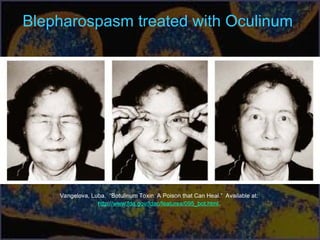
Blepharospasm treated with Oculinum
Vangelova, Luba. “Botulinum Toxin: A Poison that Can Heal.” Available at:
http://www.fda.gov/fdac/features/095_bot.html.
Medical uses of BoNT
• Now manufactured under the name “Botox”
• Experimentally used for treating migraine
headaches, chronic low back pain, stroke, cerebral
palsy, and dystonias (neurologic diseases
involving abnormal muscle posture and tension)
• Frequent injections allows an individual to develop
antibodies
– Studies carried out to determine feasibility of other
strains of BoNT
• BoNT B manufactured for treatment of cervical
dystonia in 2000 as “Myobloc”
Cosmetic Use of BoNT
• 1994 FDA denounced the promotion of BoNT
use for wrinkles as "an egregious example of
promoting a potentially toxic biologic for
cosmetic purposes."
– Botox approved for Cosmetic use in April,
2002
• Myobloc not approved for cosmetic use, but is
used experimentally in many cosmetic
procedures anyway
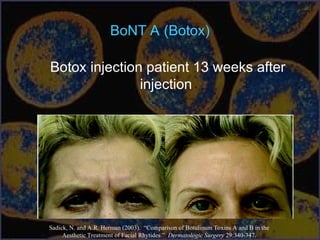
BoNT A (Botox)
Botox injection patient 13 weeks after
injection
Sadick, N. and A.R. Herman (2003). “Comparison of Botulinum Toxins A and B in the
Aesthetic Treatment of Facial Rhytides.” Dermatologic Surgery 29:340-347.
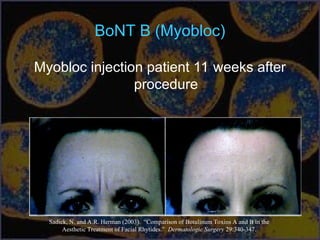
BoNT B (Myobloc)
Myobloc injection patient 11 weeks after
procedure
Sadick, N. and A.R. Herman (2003). “Comparison of Botulinum Toxins A and B in the
Aesthetic Treatment of Facial Rhytides.” Dermatologic Surgery 29:340-347.
The Smart Stuff
• Structure:
– Translated as a single chain precursor
(pretoxin)
• Cleaved to generate fully active neurotoxin
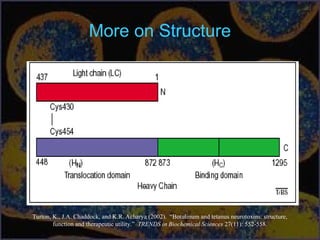
composed of a light chain (LC) and heavy chain
(H)
• Light and heavy chains linked by single
disulfide bridge
• Light chain acts as an endopeptidase
• When bridge is intact, BoNT has no catalytic
activity
More on Structure
Turton, K., J.A. Chaddock, and K.R. Acharya (2002). “Botulinum and tetanus neurotoxins: structure,
function and therapeutic utility.” TRENDS in Biochemical Sciences 27(11): 552-558.
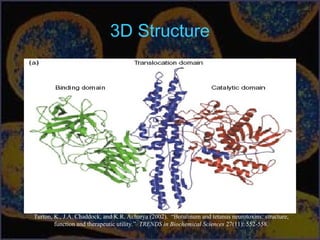
3D Structure
Turton, K., J.A. Chaddock, and K.R. Acharya (2002). “Botulinum and tetanus neurotoxins: structure,
function and therapeutic utility.” TRENDS in Biochemical Sciences 27(11): 552-558.
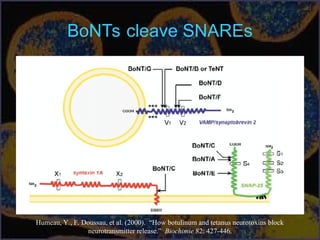
BoNTs prevent neurotransmitter
release
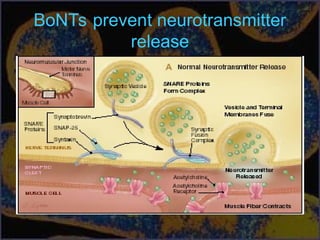
• SNARE proteins form complex to allow
synaptic vesicles to fuse with plasma
membrane  neurotransmitter is released
– 3 different types of SNARE proteins
• VAMPs
• SNAP-25 (cleaved by BoNT A)
• Syntaxin
BoNTs prevent neurotransmitter
release
BoNTs cleave SNAREs
Humeau, Y., F. Doussau, et al. (2000). “How botulinum and tetanus neurotoxins block
neurotransmitter release.” Biochimie 82: 427-446.
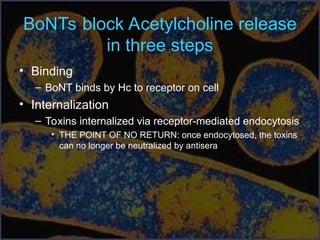
BoNTs block Acetylcholine release
in three steps
• Binding
– BoNT binds by Hc to receptor on cell
• Internalization
– Toxins internalized via receptor-mediated endocytosis
• THE POINT OF NO RETURN: once endocytosed, the toxins
can no longer be neutralized by antisera
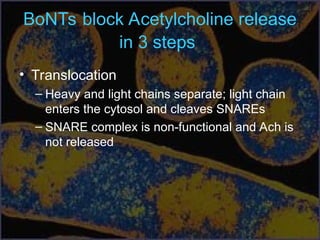
BoNTs block Acetylcholine release
in 3 steps
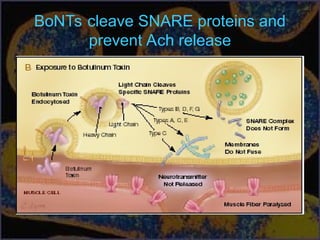
• Translocation
– Heavy and light chains separate; light chain
enters the cytosol and cleaves SNAREs
– SNARE complex is non-functional and Ach is
not released
BoNTs cleave SNARE proteins and
prevent Ach release
Clinical Perspective of Clostridium
botulinum
• There are four types of botulism, characterized
by the method of delivery of the toxin.
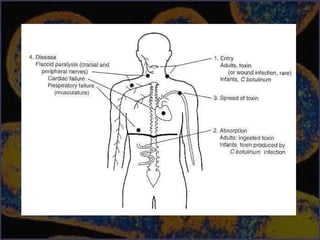
• The toxin cannot pass through the skin, thus,
transmission requires a break in the skin or
direct absorption through mucus membranes in
the lungs or GI tract.
• Foodborne botulism is the result of the ingestion
of food contaminated with Clostridium botulinum
containing the preformed toxin. Note: Ingestion
of the toxin makes a person ill, not Clostridium
botulinum itself.
• Wound botulism occurs when a break in
the skin becomes infected with
Clostridium botulinum which then
multiply and release botulism toxin into
the blood.
• Inhalation botulism occurs when
aerosolized botulism toxin enters the
lungs.
• Infant botulism is the result of the
infestation of the digestive tract with
Clostridium botulinum.
• In infant botulism, illness results from
infestation of the GI tract with
Clostridium botulinum. Such infestation
is generally not an issue in individuals
older than one year due largely to the
large number of competing
microorganisms found in the mature GI
tract.
• Roughly 100 cases of botulism are
reported in the U.S. each year.
• Approximately 25% are foodborne, 72%
are infant botulism, and the remaining
3% are wound botulism.
• Inhalation cases do not occur naturally.
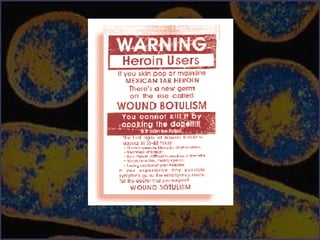
• Wound botulism is on the rise due to an
increase in the use of black tar heroin. The
source of the botulism could be the drug
itself, a cut in the drug, dirty injection
equipment, or contamination during the
preparation process.
• The incubation period varies according to the
mode of transmission, rate of absorption of the
toxin, and the total amount and type of toxin.
• Foodborne botulism usually takes 24-36 hours
to manifest itself.
• Wound botulism often takes 3 or more days to
appear.
• Inhalation botulism has occurred very rarely,
but incubation times may range from several
hours to perhaps days, again depending upon
the type and amount of toxin inhaled.
• All four types of botulism result in symmetric
descending flaccid paralysis of motor and
autonomic nerves always beginning with the
cranial nerves. These symptoms are preceded
by constipation in cases of infant botulism.
• Symptoms include:
• Double or blurred vision
• Drooping eyelids
• Dry mouth
• Difficulty Swallowing
• Muscle weakness
• If left untreated symptoms may expand
to include paralysis of respiratory
muscles as well as the arms and legs.
• Asphyxiation due to respiratory
paralysis is the most common cause of
death in botulism cases.
• Botulism results in death in
approximately 8% of documented cases.
The key to survival is early diagnosis.
For the period 1899-1949 the case
fatality ratio was approximately 60%. For
the Period 1950-1996 the case-fatality
ratio was 15.5%.
• This improvement is largely attributable
to improvements in respiratory intensive
care and availability and prompt
administration of the antitoxin.
Treatment
• Antitoxin can halt the progress of
symptoms if administered early to victims
of food and wound botulism.
• Antitoxin is not given to victims of infant
botulism because when this is diagnosed it
is generally too late for the antitoxin to do
any good.
Treatment
• Wound botulism is treated surgically to remove
the Clostridium colony.
• Artificial respiration is required if paralysis
reaches the lungs. Such respiratory assistance
may be required for weeks to months.
• The paralysis induced by the toxin slowly
improves over the course of many weeks.
• Many patients make close to a full recovery
following weeks to months of intensive care,
however, lingering effects such as fatigue and
shortness of breath may linger for years.
Treatment
• Attempts to develop an effective botulism
vaccine date back to the 1940’s. One
current effort (now moving into clinical
trials) uses injection of a non-toxic
carboxy-terminus segment of the botulism
toxin to confer immunity to the toxin.
Diagnosis
• The symptoms of botulism are similar to
those of Guillain-Barré syndrome,
stroke, and myasthenia gravis.
• As a result, botulism is probably
substantially under-diagnosed.
• Serum electrolytes, renal and liver
function tests, complete blood tests,
urinalysis, and electrocardiograms will
all be normal unless secondary
complications occur.
Diagnosis
• A brain scan, spinal fluid examination,
electromyograph, or tensilon test may be
required to positively identify botulism.
• The most effective test comes from the
identification of botulism toxin in serum
or stool. The test is most often carried
out by injecting samples into a mouse
and observing whether symptoms of
botulism develop.
Diagnosis
• However, the false negative rate for this
test can be as high is 60% for serum
samples and near 80% for stool samples
in individuals clinically diagnosed with
botulism.
• Collection of samples early in the
progression of the illness may be helpful,
however, large outbreaks have occurred
in which none or a very low percentage
of victims produced a positive test result.
Diagnosis
• In vitro methods utilizing ELISA are under
development but are not yet validated.
• Isolation of Clostridium botulinum from the
patient’s feces or gastric sample is a good
confirmation of botulism as the organism is
rarely found in humans in the absence of the
botulism poisoning, however, poisoning can
occur without ingestion of the microorganism at
all.
• If botulism poisoning is suspected clinicians are
advised to contact local and state health
authorities who should then contact the CDC
Prevention
• Proper food preparation is one of the most
effective ways to limit the risk of exposure to
botulism toxin.
• Boiling food or water for ten minutes can
eliminate some strains of Clostridium botulinum
as well as neutralize the toxin as well. However,
this will not assure 100% elimination.
• Limiting growth of Clostridium botulinum and the
production of botulism toxin is an alternative to
their outright destruction.
• Temperature, pH, food preservatives,
and competing microorganisms are
among the factors that influence the
rate and degree of Clostridium
botulinum growth.
• Growth of most strains of Clostridium
botulinum will not occur below 10 or
above 50 degrees Celsius.
• Clostridium botulinum will not grow in
media with pH values lower than about
5.
• Food preservatives such as nitrite,
sorbic acid, parabens, phenolic
antioxidants, polyphosphates, and
ascorbates inhibit the growth of the
microorganism.
• Lactic acid bacteria including
Lactobacillus, Pediococcus, and
Pactococcus can inhibit the growth of
Clostridium botulinum by increasing the
acidity of the medium.
• While the cause of roughly 85% of infant
botulism cases is unknown, in up to 15%
of infant botulism cases the causes was
ingestion of honey. Infants younger than
one year old should not be fed honey.
Avoiding Exposure
• Avoid home-processed foods if at all possible,
especially those with a low salt and acid content.
• Botulism toxin is destroyed at a temperature of
176 F, thus if you must eat home-processed
foods, boil them for 10 minutes before eating if
at all possible.
• If canning vegetables, use a pressure cooker, as
it will kill any spores because it can reach
temperatures above boiling.
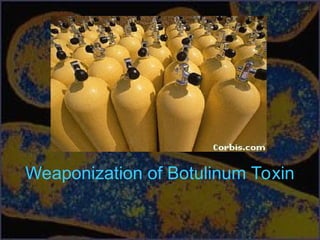
Weaponization of Botulinum Toxin
What does it mean to “weaponize” a
biological agent?
The "weaponization" of a microbial pathogen or toxin
involves:
• rendering the agent resistant to standard antibiotic drugs
• freeze-drying and milling the agent into an extremely fine
powder, consisting of particles tiny enough to become
readily airborne and inhaled into the victims' lungs to
cause infection
• stabilizing the agent so that it will remain infectious for a
longer period after release
• treating the powder with chemical additives that absorb
moisture and reduce clumping, so as to facilitate
aerosolization.
Answer provided by Jonathan B. Tucker, Ph.D.
an expert on chemical and biological weapons in the Washington, D.C and a biological weapons
inspector in Iraq under the auspices of the United Nations Special Commission in 1995
History of Botulinum Toxin as bio-weapon
Early primitive example:
1910s Mexico1
• supporters of Pancho Villa used Botulinum toxin against
Mexican federal troops
• Buried pork and green beans for several days
• Then used the mixture to contaminate food or smeared
on knife-like weapons
• Result in food and wound botulism
Easy to make!
History of Botulinum Toxin as bio-weapon
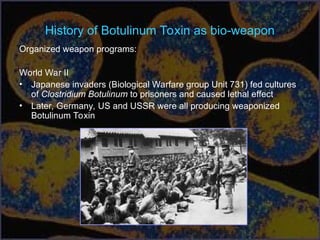
Organized weapon programs:
World War II
• Japanese invaders (Biological Warfare group Unit 731) fed cultures
of Clostridium Botulinum to prisoners and caused lethal effect
• Later, Germany, US and USSR were all producing weaponized
Botulinum Toxin
History of Botulinum Toxin as bio-weapon
Organized weapon programs:
1970s
• Biological and Toxin Weapons Convention banned bio-
weapon research and production
• Iraq and USSR continued to produce Botulinum Toxin as
potential weapon
• Soviets  splice the Botulinum toxin gene into other
bacteria
• Iran, North Korea and Syria are also believed to go on
with developing Botulinum toxin in weapons
History of Botulinum Toxin as bio-weapon
Organized weapon programs:
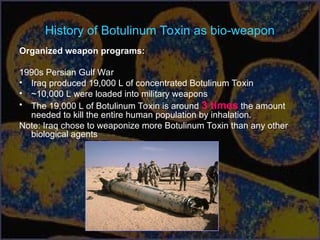
1990s Persian Gulf War
• Iraq produced 19,000 L of concentrated Botulinum Toxin
• ~10,000 L were loaded into military weapons
• The 19,000 L of Botulinum Toxin is around 3 times the amount
needed to kill the entire human population by inhalation.
Note: Iraq chose to weaponize more Botulinum Toxin than any other
biological agents
Contemporary attempt of the toxin in attack
(However, unsuccessful)
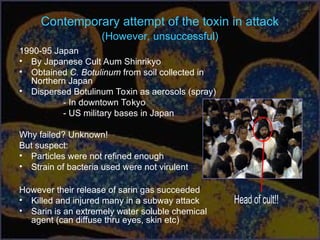
1990-95 Japan
• By Japanese Cult Aum Shinrikyo
• Obtained C. Botulinum from soil collected in
Northern Japan
• Dispersed Botulinum Toxin as aerosols (spray)
- In downtown Tokyo
- US military bases in Japan
Why failed? Unknown!
But suspect:
• Particles were not refined enough
• Strain of bacteria used were not virulent
However their release of sarin gas succeeded
• Killed and injured many in a subway attack
• Sarin is an extremely water soluble chemical
agent (can diffuse thru eyes, skin etc)
Bioweapon Potential
• Botulinum Toxin is a major threat
because
-Extreme potency and lethality
-Ease of production
-Ease of transport
-Need for prolonged intensive care
Bioweapon Potential
• Botulinum Toxin is a major threat
because
-Extreme potency and lethality
-Ease of production
-Ease of transport
-Need for prolonged intensive care
Extreme potency and lethality
• One of top 6 potential biological warfare agents
• Listed as Category A agent by CDC
i.e. Highest priority
• The most toxic substance known
 toxic dose ~0.001g/Kg body weight
 15,000 times more toxic than nerve agent VX
 100,000 times more toxic than sarin
• 1 gram of crystalline toxin can kill >1 million
people if dispersed and inhaled evenly
Bioweapon Potential
• Botulinum Toxin is a major threat
because
-Extreme potency and lethality
-Ease of production
-Ease of transport
-Need for prolonged intensive care
Ease of production
• Recipes for home brews of Botulinum toxin can
be easily found on internet
• C. Botulinum can be grown on fairly basic media
and lab protocols can be accessed in many
books.
• Toxin is easily purified using general
biochemical purification techniques.
– salting out, acid precipitation, gel filtration
chromatography etc..
• Industrial-scale fermentation can produce large
quantities of the toxin for use as a biological
agent.
Bioweapon Potential
• Botulinum Toxin is a major threat
because
-Extreme potency and lethality
-Ease of production
-Ease of transport
-Need for prolonged intensive care
Ease of transport
• It can be easily transported if not made
into aerosolized form.
• C. Botulinum grows naturally in soil and
BoNT can stay stable in still water for
weeks
• Not contagious
• Does not spread by inhalation naturally
• Does not enter through skin
Bioweapon Potential
• Botulinum Toxin is a major threat
because
-Extreme potency and lethality
-Ease of production
-Ease of transport
-Need for prolonged intensive care
Need for Prolonged intensive care
After intoxication and treating w/ antitoxin:
• Ventilatory support and 24-hr nursing care is
commonly needed for 2-8 weeks
• Some might require up to 7 months before the
return of muscular function
• However, no municipality has sufficient
ventilators to provide intensive care for mass
victims of a terrorist attack by aerosolized BoNT
Bioterrorism: routes of intoxication
Types of Botulism:
• Wound (least likely)
• Food/waterborne
• Inhalational
Potential Victims:
Persons of all age and sex.
Lethal Dosage:
For a 70 Kg human
- 0.09-0.15 g intravenously or intramuscularly
- 0.70-0.90 g inhalationaly
- 70 g orally
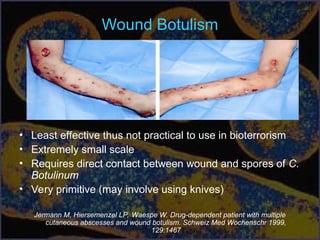
Wound Botulism
• Least effective thus not practical to use in bioterrorism
• Extremely small scale
• Requires direct contact between wound and spores of C.
Botulinum
• Very primitive (may involve using knives)
Jermann M, Hiersemenzel LP, Waespe W. Drug-dependent patient with multiple
cutaneous abscesses and wound botulism. Schweiz Med Wochenschr 1999,
129:1467
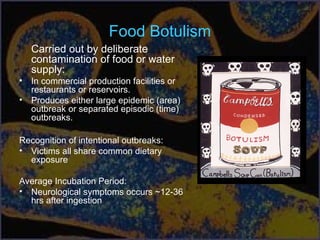
Food Botulism
Carried out by deliberate
contamination of food or water
supply:
• In commercial production facilities or
restaurants or reservoirs.
• Produces either large epidemic (area)
outbreak or separated episodic (time)
outbreaks.
Recognition of intentional outbreaks:
• Victims all share common dietary
exposure
Average Incubation Period:
• Neurological symptoms occurs ~12-36
hrs after ingestion
Food Botulism
• BoNT can stay in untreated water or uncooked food for
up to days
• It is colorless, odorless and tasteless
However, BoNT:
• Can be inactivated by heat (>85c for 5 min)
• Can be rapidly inactivated by standard potable water
treatments (e.g. Chlorination, aeration)
• Large capacity reservoirs requires large* quantities of
BoNT in order to cause severe contamination
*difficult for terrorists to make and carry around
There are obstacles in order to produce an effective large
scale food botulism poisoning
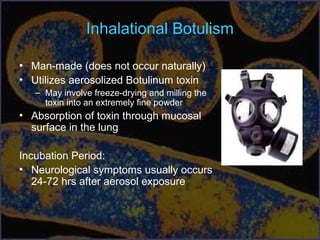
Inhalational Botulism
• Man-made (does not occur naturally)
• Utilizes aerosolized Botulinum toxin
– May involve freeze-drying and milling the
toxin into an extremely fine powder
• Absorption of toxin through mucosal
surface in the lung
Incubation Period:
• Neurological symptoms usually occurs
24-72 hrs after aerosol exposure
Inhalational Botulism:
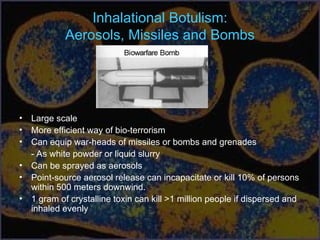
Aerosols, Missiles and Bombs
• Large scale
• More efficient way of bio-terrorism
• Can equip war-heads of missiles or bombs and grenades
- As white powder or liquid slurry
• Can be sprayed as aerosols
• Point-source aerosol release can incapacitate or kill 10% of persons
within 500 meters downwind.
• 1 gram of crystalline toxin can kill >1 million people if dispersed and
inhaled evenly
Inhalation Botulism
More deadly than food botulism (because smaller lethal
dose) but technically and financially difficult to carry
out:
• Instability
– Inactivated by sunlight within 1-3 hours
– Detoxified in air within 12 hours
• Technically difficult and complicated for the
insufficiently funded terrorist to:
– Make the powder form for efficient dispersal
– obtain the accurate dispersal equipment
This is illustrated by the lack of actual cases
(However we can never underestimate the ability of
terrorists..)
Potential danger: Botulinum Superbug?!
WHY?
• BoNT is non-contagious (just a toxin)
• If it can be mae contagious, it will be even more deadly
One known study:
Gene splicing experiments in Soviet Union during 1970s
May have involved:
• Splicing the BoNT gene into other contagious bacteria (e.g. Ebola) to
increase the transmission rate.
• Genetic modifications that removes the effectiveness of possible
vaccines or immune responses
• Genetic engineering to produce new virulent strains or new toxic genes
Here’s an Interview of a former Soviet scientist who was in the
bioweapon program:
http://video.pbs.org:8080/ramgen/wgbh/mediastorage/nova/bioterror/popo
v_220.rm
Good bioweapon?
• Most poisonous poison
• Easy to make
• Can effectively immobilize military opponent
• Takes long time to recover and cure
• Not easy to diagnose
• Confirmation tests are unreliable
• Insufficient emergency care facilities available if
there is a massive attack
Poor bioweapon?
• Non contagious
• Does not pass through skin
• Very unstable
• Food/waterborne botulism can be greatly
prevented by cooking and water treatment
• Airborne botulism is technically difficult to
achieve
• Clinical treatment can greatly reduce mortality
rate
A video clip about Botulism
Video: "The History of Bioterrorism" from CDC
http://video.cdc.gov/ramgen/phepr/historyofbt/realonecc/05_botulism_cc.rm

269166806-Botulinum-Presentation-ppt.ppt

  • 1.
    Important note: • Thetoxin is NOT secreted by C. Botulinum, instead, it is produced during the bacteria’s autolysis.
  • 2.
  • 3.
    Introduction to botulism •Neuroparalytic disease caused by neurotoxins (BoNTs) produced by bacteria Clostridium botulinum. – 7 different BoNTs (A-G) produced by different strains of C. botulinum. • BoNTs A, B, E, and F outbreaks in humans • BoNT C in birds • BoNT D in cattle • BoNT G isolated from soils – BoNT A most common and most potent – BoNTs also produced by other members of Clostridia family.
  • 4.
    A long history •Botulism originally known as “sausage poisoning” in late 18th century and throughout 19th century. – From Latin botulus = sausage • Bacterial etiology recognized at end of 19th century – Outbreak of botulism in Belgium 1895 revealed cause as neuroparalytic toxin produced by anaerobic bacterium – Probably Type B • Outbreak in Germany several years later – Bacterium isolated; different from that in Belgium – Probably Type A
  • 5.
    The 20th Century andBeyond • 1949 Burgen et al. determines botulinum toxin blocks neurotransmitter release • 1979 Simpson proposes cellular mechanism in 3 steps: binding, internalization, and intraneuronal action. • 1990 a.a. sequence of one BoNT determined in Niemann’s laboratory • 21st century – 3D structure of BoNT A resolved.
  • 6.
    The History Continues… •First biological toxin used for treatment of human disease • Manufactured for medical use in 1989 under name “Oculinum” – Licensed for treatment of strabismus and blepharospasm (eye conditions characterized by excessive muscle contraction)
  • 7.
    Blepharospasm treated withOculinum Vangelova, Luba. “Botulinum Toxin: A Poison that Can Heal.” Available at: http://www.fda.gov/fdac/features/095_bot.html.
  • 8.
    Medical uses ofBoNT • Now manufactured under the name “Botox” • Experimentally used for treating migraine headaches, chronic low back pain, stroke, cerebral palsy, and dystonias (neurologic diseases involving abnormal muscle posture and tension) • Frequent injections allows an individual to develop antibodies – Studies carried out to determine feasibility of other strains of BoNT • BoNT B manufactured for treatment of cervical dystonia in 2000 as “Myobloc”
  • 9.
    Cosmetic Use ofBoNT • 1994 FDA denounced the promotion of BoNT use for wrinkles as "an egregious example of promoting a potentially toxic biologic for cosmetic purposes." – Botox approved for Cosmetic use in April, 2002 • Myobloc not approved for cosmetic use, but is used experimentally in many cosmetic procedures anyway
  • 10.
    BoNT A (Botox) Botoxinjection patient 13 weeks after injection Sadick, N. and A.R. Herman (2003). “Comparison of Botulinum Toxins A and B in the Aesthetic Treatment of Facial Rhytides.” Dermatologic Surgery 29:340-347.
  • 11.
    BoNT B (Myobloc) Myoblocinjection patient 11 weeks after procedure Sadick, N. and A.R. Herman (2003). “Comparison of Botulinum Toxins A and B in the Aesthetic Treatment of Facial Rhytides.” Dermatologic Surgery 29:340-347.
  • 12.
    The Smart Stuff •Structure: – Translated as a single chain precursor (pretoxin) • Cleaved to generate fully active neurotoxin composed of a light chain (LC) and heavy chain (H) • Light and heavy chains linked by single disulfide bridge • Light chain acts as an endopeptidase • When bridge is intact, BoNT has no catalytic activity
  • 13.
    More on Structure Turton,K., J.A. Chaddock, and K.R. Acharya (2002). “Botulinum and tetanus neurotoxins: structure, function and therapeutic utility.” TRENDS in Biochemical Sciences 27(11): 552-558.
  • 14.
    3D Structure Turton, K.,J.A. Chaddock, and K.R. Acharya (2002). “Botulinum and tetanus neurotoxins: structure, function and therapeutic utility.” TRENDS in Biochemical Sciences 27(11): 552-558.
  • 15.
    BoNTs prevent neurotransmitter release •SNARE proteins form complex to allow synaptic vesicles to fuse with plasma membrane  neurotransmitter is released – 3 different types of SNARE proteins • VAMPs • SNAP-25 (cleaved by BoNT A) • Syntaxin
  • 16.
  • 17.
    BoNTs cleave SNAREs Humeau,Y., F. Doussau, et al. (2000). “How botulinum and tetanus neurotoxins block neurotransmitter release.” Biochimie 82: 427-446.
  • 18.
    BoNTs block Acetylcholinerelease in three steps • Binding – BoNT binds by Hc to receptor on cell • Internalization – Toxins internalized via receptor-mediated endocytosis • THE POINT OF NO RETURN: once endocytosed, the toxins can no longer be neutralized by antisera
  • 19.
    BoNTs block Acetylcholinerelease in 3 steps • Translocation – Heavy and light chains separate; light chain enters the cytosol and cleaves SNAREs – SNARE complex is non-functional and Ach is not released
  • 20.
    BoNTs cleave SNAREproteins and prevent Ach release
  • 21.
    Clinical Perspective ofClostridium botulinum • There are four types of botulism, characterized by the method of delivery of the toxin. • The toxin cannot pass through the skin, thus, transmission requires a break in the skin or direct absorption through mucus membranes in the lungs or GI tract. • Foodborne botulism is the result of the ingestion of food contaminated with Clostridium botulinum containing the preformed toxin. Note: Ingestion of the toxin makes a person ill, not Clostridium botulinum itself.
  • 22.
    • Wound botulismoccurs when a break in the skin becomes infected with Clostridium botulinum which then multiply and release botulism toxin into the blood. • Inhalation botulism occurs when aerosolized botulism toxin enters the lungs. • Infant botulism is the result of the infestation of the digestive tract with Clostridium botulinum.
  • 24.
    • In infantbotulism, illness results from infestation of the GI tract with Clostridium botulinum. Such infestation is generally not an issue in individuals older than one year due largely to the large number of competing microorganisms found in the mature GI tract.
  • 25.
    • Roughly 100cases of botulism are reported in the U.S. each year. • Approximately 25% are foodborne, 72% are infant botulism, and the remaining 3% are wound botulism. • Inhalation cases do not occur naturally.
  • 29.
    • Wound botulismis on the rise due to an increase in the use of black tar heroin. The source of the botulism could be the drug itself, a cut in the drug, dirty injection equipment, or contamination during the preparation process.
  • 31.
    • The incubationperiod varies according to the mode of transmission, rate of absorption of the toxin, and the total amount and type of toxin. • Foodborne botulism usually takes 24-36 hours to manifest itself. • Wound botulism often takes 3 or more days to appear. • Inhalation botulism has occurred very rarely, but incubation times may range from several hours to perhaps days, again depending upon the type and amount of toxin inhaled.
  • 32.
    • All fourtypes of botulism result in symmetric descending flaccid paralysis of motor and autonomic nerves always beginning with the cranial nerves. These symptoms are preceded by constipation in cases of infant botulism. • Symptoms include: • Double or blurred vision • Drooping eyelids • Dry mouth • Difficulty Swallowing • Muscle weakness
  • 33.
    • If leftuntreated symptoms may expand to include paralysis of respiratory muscles as well as the arms and legs. • Asphyxiation due to respiratory paralysis is the most common cause of death in botulism cases.
  • 34.
    • Botulism resultsin death in approximately 8% of documented cases. The key to survival is early diagnosis. For the period 1899-1949 the case fatality ratio was approximately 60%. For the Period 1950-1996 the case-fatality ratio was 15.5%. • This improvement is largely attributable to improvements in respiratory intensive care and availability and prompt administration of the antitoxin.
  • 35.
    Treatment • Antitoxin canhalt the progress of symptoms if administered early to victims of food and wound botulism. • Antitoxin is not given to victims of infant botulism because when this is diagnosed it is generally too late for the antitoxin to do any good.
  • 36.
    Treatment • Wound botulismis treated surgically to remove the Clostridium colony. • Artificial respiration is required if paralysis reaches the lungs. Such respiratory assistance may be required for weeks to months. • The paralysis induced by the toxin slowly improves over the course of many weeks. • Many patients make close to a full recovery following weeks to months of intensive care, however, lingering effects such as fatigue and shortness of breath may linger for years.
  • 37.
    Treatment • Attempts todevelop an effective botulism vaccine date back to the 1940’s. One current effort (now moving into clinical trials) uses injection of a non-toxic carboxy-terminus segment of the botulism toxin to confer immunity to the toxin.
  • 38.
    Diagnosis • The symptomsof botulism are similar to those of Guillain-Barré syndrome, stroke, and myasthenia gravis. • As a result, botulism is probably substantially under-diagnosed. • Serum electrolytes, renal and liver function tests, complete blood tests, urinalysis, and electrocardiograms will all be normal unless secondary complications occur.
  • 39.
    Diagnosis • A brainscan, spinal fluid examination, electromyograph, or tensilon test may be required to positively identify botulism. • The most effective test comes from the identification of botulism toxin in serum or stool. The test is most often carried out by injecting samples into a mouse and observing whether symptoms of botulism develop.
  • 40.
    Diagnosis • However, thefalse negative rate for this test can be as high is 60% for serum samples and near 80% for stool samples in individuals clinically diagnosed with botulism. • Collection of samples early in the progression of the illness may be helpful, however, large outbreaks have occurred in which none or a very low percentage of victims produced a positive test result.
  • 41.
    Diagnosis • In vitromethods utilizing ELISA are under development but are not yet validated. • Isolation of Clostridium botulinum from the patient’s feces or gastric sample is a good confirmation of botulism as the organism is rarely found in humans in the absence of the botulism poisoning, however, poisoning can occur without ingestion of the microorganism at all. • If botulism poisoning is suspected clinicians are advised to contact local and state health authorities who should then contact the CDC
  • 42.
    Prevention • Proper foodpreparation is one of the most effective ways to limit the risk of exposure to botulism toxin. • Boiling food or water for ten minutes can eliminate some strains of Clostridium botulinum as well as neutralize the toxin as well. However, this will not assure 100% elimination. • Limiting growth of Clostridium botulinum and the production of botulism toxin is an alternative to their outright destruction.
  • 43.
    • Temperature, pH,food preservatives, and competing microorganisms are among the factors that influence the rate and degree of Clostridium botulinum growth. • Growth of most strains of Clostridium botulinum will not occur below 10 or above 50 degrees Celsius.
  • 44.
    • Clostridium botulinumwill not grow in media with pH values lower than about 5. • Food preservatives such as nitrite, sorbic acid, parabens, phenolic antioxidants, polyphosphates, and ascorbates inhibit the growth of the microorganism.
  • 45.
    • Lactic acidbacteria including Lactobacillus, Pediococcus, and Pactococcus can inhibit the growth of Clostridium botulinum by increasing the acidity of the medium. • While the cause of roughly 85% of infant botulism cases is unknown, in up to 15% of infant botulism cases the causes was ingestion of honey. Infants younger than one year old should not be fed honey.
  • 46.
    Avoiding Exposure • Avoidhome-processed foods if at all possible, especially those with a low salt and acid content. • Botulism toxin is destroyed at a temperature of 176 F, thus if you must eat home-processed foods, boil them for 10 minutes before eating if at all possible. • If canning vegetables, use a pressure cooker, as it will kill any spores because it can reach temperatures above boiling.
  • 47.
  • 48.
    What does itmean to “weaponize” a biological agent? The "weaponization" of a microbial pathogen or toxin involves: • rendering the agent resistant to standard antibiotic drugs • freeze-drying and milling the agent into an extremely fine powder, consisting of particles tiny enough to become readily airborne and inhaled into the victims' lungs to cause infection • stabilizing the agent so that it will remain infectious for a longer period after release • treating the powder with chemical additives that absorb moisture and reduce clumping, so as to facilitate aerosolization. Answer provided by Jonathan B. Tucker, Ph.D. an expert on chemical and biological weapons in the Washington, D.C and a biological weapons inspector in Iraq under the auspices of the United Nations Special Commission in 1995
  • 49.
    History of BotulinumToxin as bio-weapon Early primitive example: 1910s Mexico1 • supporters of Pancho Villa used Botulinum toxin against Mexican federal troops • Buried pork and green beans for several days • Then used the mixture to contaminate food or smeared on knife-like weapons • Result in food and wound botulism Easy to make!
  • 50.
    History of BotulinumToxin as bio-weapon Organized weapon programs: World War II • Japanese invaders (Biological Warfare group Unit 731) fed cultures of Clostridium Botulinum to prisoners and caused lethal effect • Later, Germany, US and USSR were all producing weaponized Botulinum Toxin
  • 51.
    History of BotulinumToxin as bio-weapon Organized weapon programs: 1970s • Biological and Toxin Weapons Convention banned bio- weapon research and production • Iraq and USSR continued to produce Botulinum Toxin as potential weapon • Soviets  splice the Botulinum toxin gene into other bacteria • Iran, North Korea and Syria are also believed to go on with developing Botulinum toxin in weapons
  • 52.
    History of BotulinumToxin as bio-weapon Organized weapon programs: 1990s Persian Gulf War • Iraq produced 19,000 L of concentrated Botulinum Toxin • ~10,000 L were loaded into military weapons • The 19,000 L of Botulinum Toxin is around 3 times the amount needed to kill the entire human population by inhalation. Note: Iraq chose to weaponize more Botulinum Toxin than any other biological agents
  • 53.
    Contemporary attempt ofthe toxin in attack (However, unsuccessful) 1990-95 Japan • By Japanese Cult Aum Shinrikyo • Obtained C. Botulinum from soil collected in Northern Japan • Dispersed Botulinum Toxin as aerosols (spray) - In downtown Tokyo - US military bases in Japan Why failed? Unknown! But suspect: • Particles were not refined enough • Strain of bacteria used were not virulent However their release of sarin gas succeeded • Killed and injured many in a subway attack • Sarin is an extremely water soluble chemical agent (can diffuse thru eyes, skin etc)
  • 54.
    Bioweapon Potential • BotulinumToxin is a major threat because -Extreme potency and lethality -Ease of production -Ease of transport -Need for prolonged intensive care
  • 55.
    Bioweapon Potential • BotulinumToxin is a major threat because -Extreme potency and lethality -Ease of production -Ease of transport -Need for prolonged intensive care
  • 56.
    Extreme potency andlethality • One of top 6 potential biological warfare agents • Listed as Category A agent by CDC i.e. Highest priority • The most toxic substance known  toxic dose ~0.001g/Kg body weight  15,000 times more toxic than nerve agent VX  100,000 times more toxic than sarin • 1 gram of crystalline toxin can kill >1 million people if dispersed and inhaled evenly
  • 57.
    Bioweapon Potential • BotulinumToxin is a major threat because -Extreme potency and lethality -Ease of production -Ease of transport -Need for prolonged intensive care
  • 58.
    Ease of production •Recipes for home brews of Botulinum toxin can be easily found on internet • C. Botulinum can be grown on fairly basic media and lab protocols can be accessed in many books. • Toxin is easily purified using general biochemical purification techniques. – salting out, acid precipitation, gel filtration chromatography etc.. • Industrial-scale fermentation can produce large quantities of the toxin for use as a biological agent.
  • 59.
    Bioweapon Potential • BotulinumToxin is a major threat because -Extreme potency and lethality -Ease of production -Ease of transport -Need for prolonged intensive care
  • 60.
    Ease of transport •It can be easily transported if not made into aerosolized form. • C. Botulinum grows naturally in soil and BoNT can stay stable in still water for weeks • Not contagious • Does not spread by inhalation naturally • Does not enter through skin
  • 61.
    Bioweapon Potential • BotulinumToxin is a major threat because -Extreme potency and lethality -Ease of production -Ease of transport -Need for prolonged intensive care
  • 62.
    Need for Prolongedintensive care After intoxication and treating w/ antitoxin: • Ventilatory support and 24-hr nursing care is commonly needed for 2-8 weeks • Some might require up to 7 months before the return of muscular function • However, no municipality has sufficient ventilators to provide intensive care for mass victims of a terrorist attack by aerosolized BoNT
  • 63.
    Bioterrorism: routes ofintoxication Types of Botulism: • Wound (least likely) • Food/waterborne • Inhalational Potential Victims: Persons of all age and sex. Lethal Dosage: For a 70 Kg human - 0.09-0.15 g intravenously or intramuscularly - 0.70-0.90 g inhalationaly - 70 g orally
  • 64.
    Wound Botulism • Leasteffective thus not practical to use in bioterrorism • Extremely small scale • Requires direct contact between wound and spores of C. Botulinum • Very primitive (may involve using knives) Jermann M, Hiersemenzel LP, Waespe W. Drug-dependent patient with multiple cutaneous abscesses and wound botulism. Schweiz Med Wochenschr 1999, 129:1467
  • 65.
    Food Botulism Carried outby deliberate contamination of food or water supply: • In commercial production facilities or restaurants or reservoirs. • Produces either large epidemic (area) outbreak or separated episodic (time) outbreaks. Recognition of intentional outbreaks: • Victims all share common dietary exposure Average Incubation Period: • Neurological symptoms occurs ~12-36 hrs after ingestion
  • 66.
    Food Botulism • BoNTcan stay in untreated water or uncooked food for up to days • It is colorless, odorless and tasteless However, BoNT: • Can be inactivated by heat (>85c for 5 min) • Can be rapidly inactivated by standard potable water treatments (e.g. Chlorination, aeration) • Large capacity reservoirs requires large* quantities of BoNT in order to cause severe contamination *difficult for terrorists to make and carry around There are obstacles in order to produce an effective large scale food botulism poisoning
  • 67.
    Inhalational Botulism • Man-made(does not occur naturally) • Utilizes aerosolized Botulinum toxin – May involve freeze-drying and milling the toxin into an extremely fine powder • Absorption of toxin through mucosal surface in the lung Incubation Period: • Neurological symptoms usually occurs 24-72 hrs after aerosol exposure
  • 68.
    Inhalational Botulism: Aerosols, Missilesand Bombs • Large scale • More efficient way of bio-terrorism • Can equip war-heads of missiles or bombs and grenades - As white powder or liquid slurry • Can be sprayed as aerosols • Point-source aerosol release can incapacitate or kill 10% of persons within 500 meters downwind. • 1 gram of crystalline toxin can kill >1 million people if dispersed and inhaled evenly
  • 70.
    Inhalation Botulism More deadlythan food botulism (because smaller lethal dose) but technically and financially difficult to carry out: • Instability – Inactivated by sunlight within 1-3 hours – Detoxified in air within 12 hours • Technically difficult and complicated for the insufficiently funded terrorist to: – Make the powder form for efficient dispersal – obtain the accurate dispersal equipment This is illustrated by the lack of actual cases (However we can never underestimate the ability of terrorists..)
  • 71.
    Potential danger: BotulinumSuperbug?! WHY? • BoNT is non-contagious (just a toxin) • If it can be mae contagious, it will be even more deadly One known study: Gene splicing experiments in Soviet Union during 1970s May have involved: • Splicing the BoNT gene into other contagious bacteria (e.g. Ebola) to increase the transmission rate. • Genetic modifications that removes the effectiveness of possible vaccines or immune responses • Genetic engineering to produce new virulent strains or new toxic genes Here’s an Interview of a former Soviet scientist who was in the bioweapon program: http://video.pbs.org:8080/ramgen/wgbh/mediastorage/nova/bioterror/popo v_220.rm
  • 72.
    Good bioweapon? • Mostpoisonous poison • Easy to make • Can effectively immobilize military opponent • Takes long time to recover and cure • Not easy to diagnose • Confirmation tests are unreliable • Insufficient emergency care facilities available if there is a massive attack
  • 73.
    Poor bioweapon? • Noncontagious • Does not pass through skin • Very unstable • Food/waterborne botulism can be greatly prevented by cooking and water treatment • Airborne botulism is technically difficult to achieve • Clinical treatment can greatly reduce mortality rate
  • 74.
    A video clipabout Botulism Video: "The History of Bioterrorism" from CDC http://video.cdc.gov/ramgen/phepr/historyofbt/realonecc/05_botulism_cc.rm

Editor's Notes

  • #13 ADD CITATION
  • #14 Add citation Add labels of Heavy and Light chains BoNT A
  • #47 As mentioned earlier, 1 mg of Botulinum Toxin can kill around one million people if evenly distributed. In the following slides I will talk about how it is used in history and …
  • #53 So after all there were no actual record of a successive attack or an intentional outbreak by terrorist or armed forces using botulinum toxin. However, it still has great potential being a biological weapon
  • #58 I will not go into detail since that can prolly take another ½ hr Important point is the knowledge of production is readily available in the internet.
  • #62 As mentioned by Colin, the recovery takes up to months
  • #68 Cannot find sources as for exactly how to equip the agents onto a bomb or missile Next slide will explain
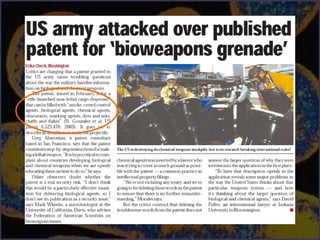
  • #69 Side story: An article from Nature Magazine US army filed and published patent for a “rifle-launched non-lethal cargo dispenser” that can be filled with different agents. Basically the patent outlines the steps to make a potential bio-agent projectile The patent is no longer accessible Prolly the reason why we can’t find information regarding military equipment of these biological agents
  • #70 Even though studies are continually performed on animals, there were no actual historical records of successful attacks using airborne botulinum toxin. Only record being an accidental human inhalation of aerosolized BoNT in a veterinary facility in 1962 Germany 3 ppl were affected - and prolly didn’t die
  • #71 This is actually a secret research performed by USSR….and revealed by former program scientists..therefore no hard evidence can be found..
  • #74 So here’s a little movie about the Toxin as a Biological Weapon, including a brief history