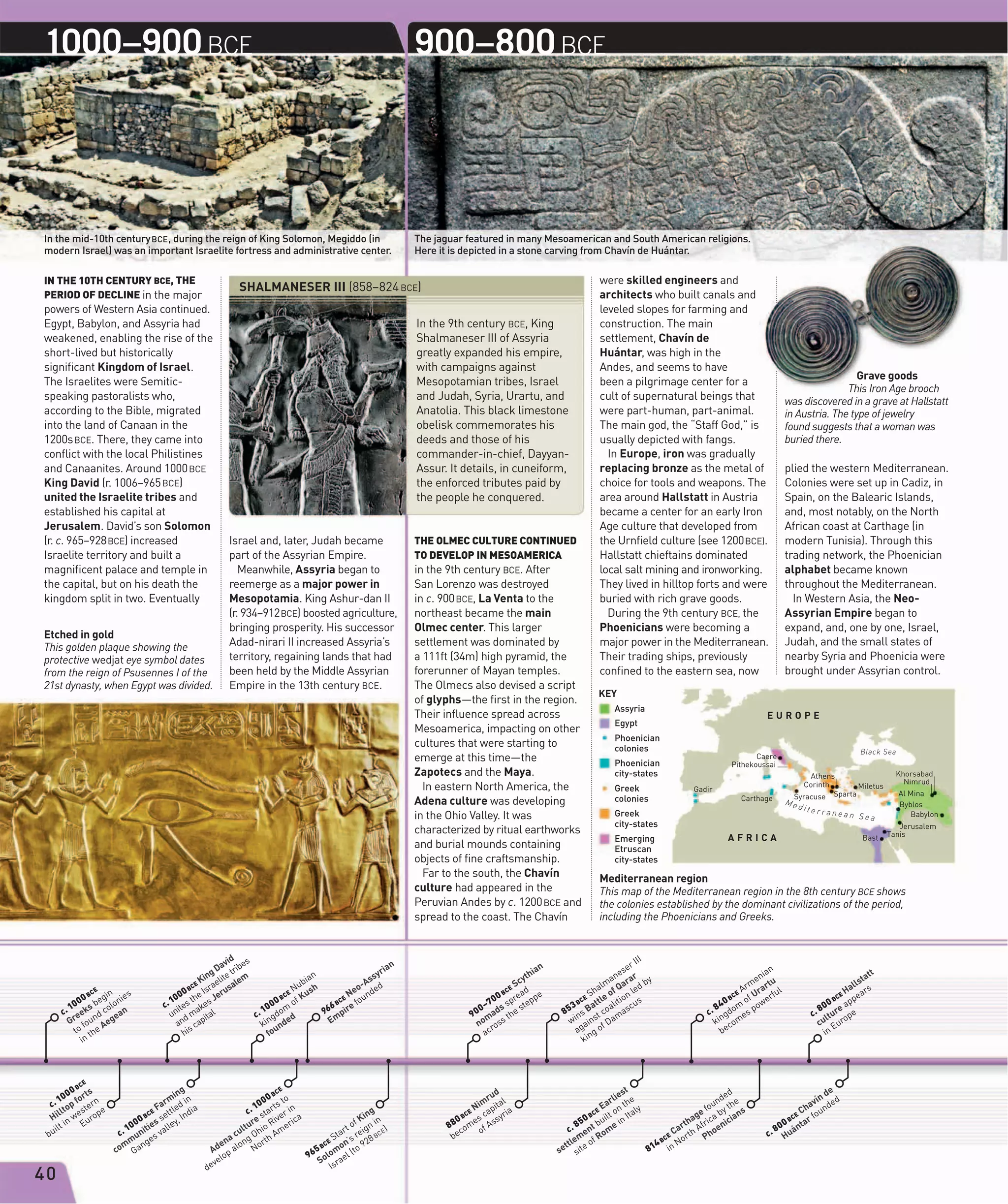
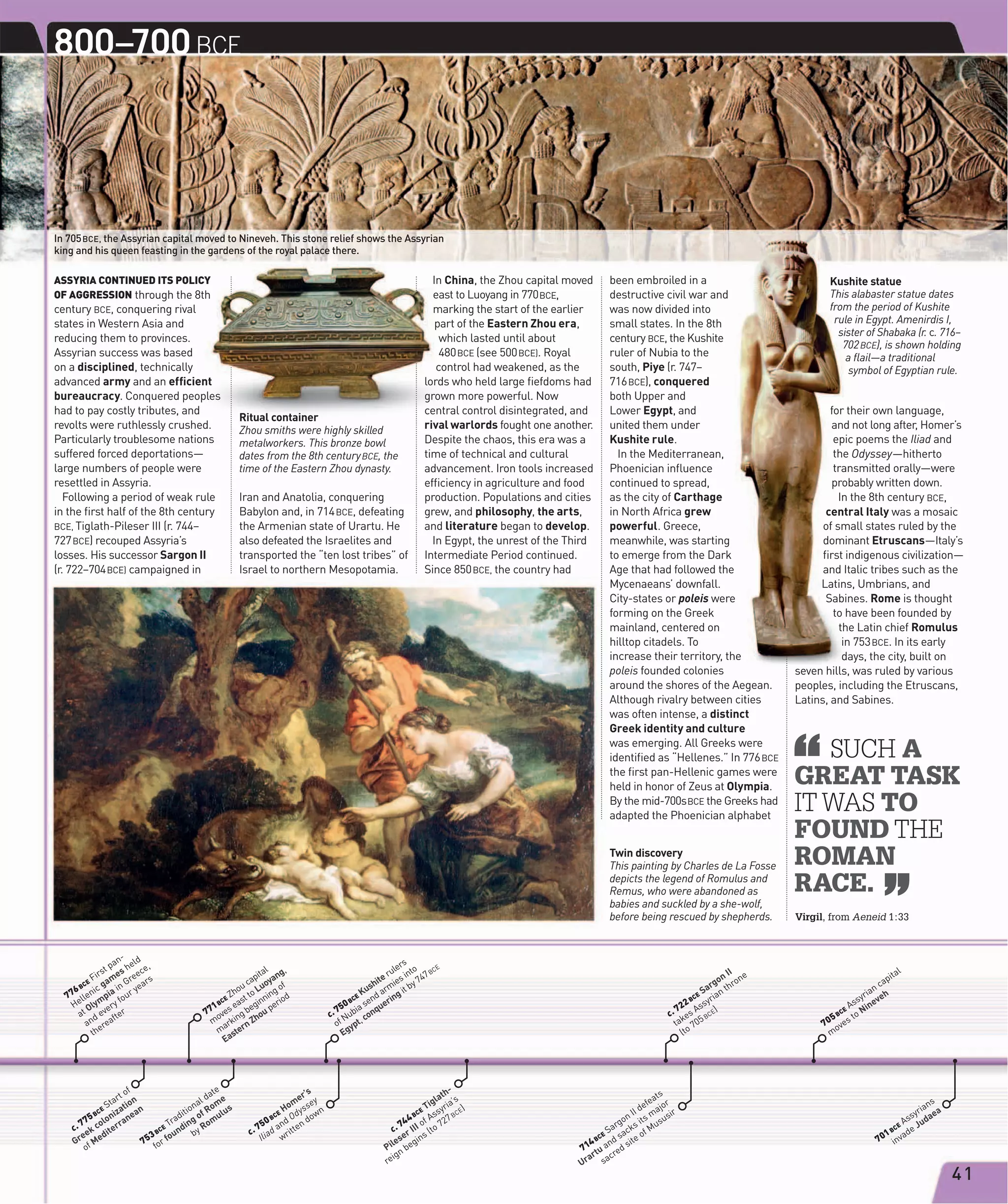
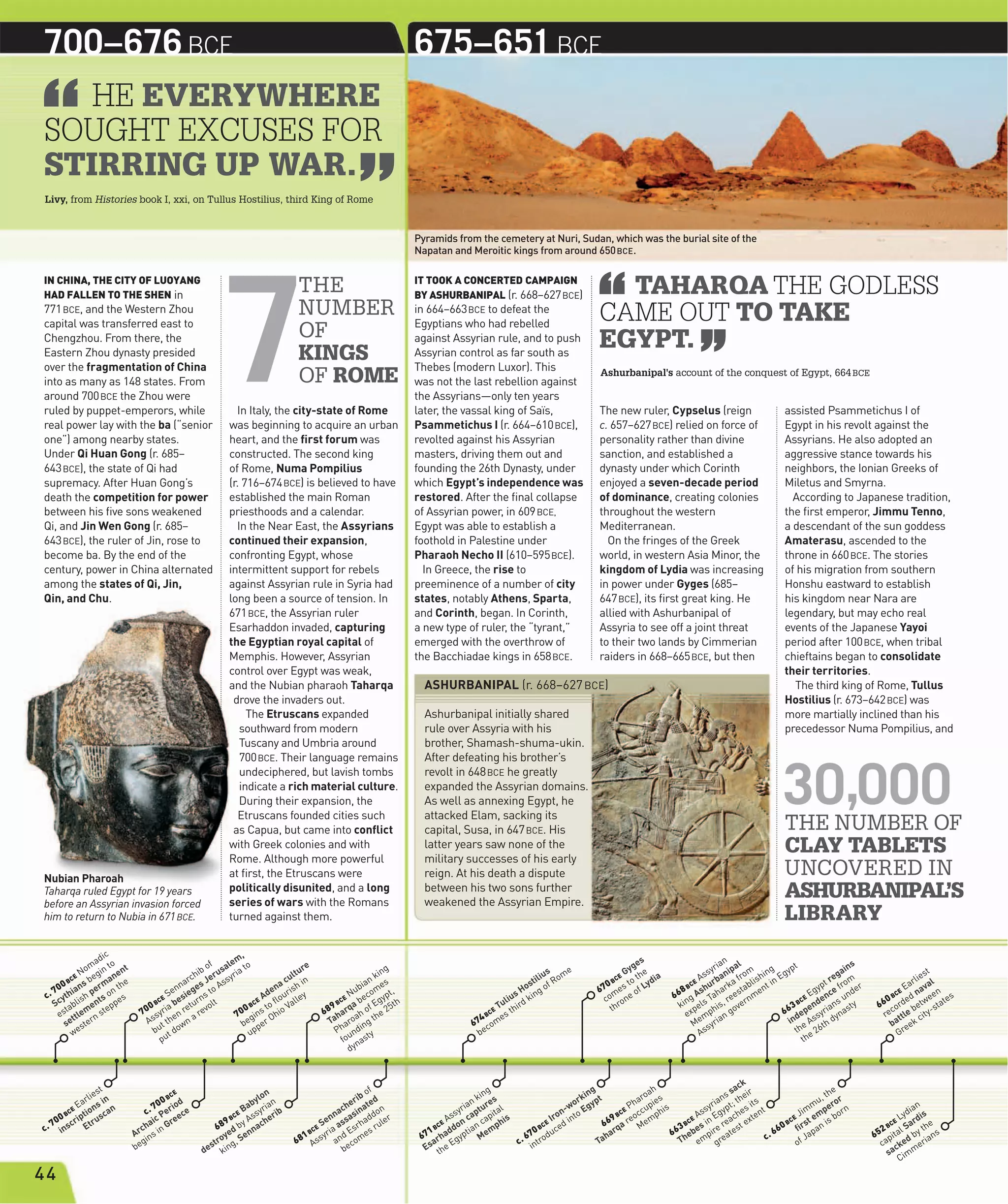
s m i t h s o n i a n
ebooksdownloadrace.blogspot.in
First published in Great Britain in 2011
by Dorling Kindersley Limited
80 Strand, London WC2R 0RL
A Penguin Company
Copyright © 2011 Dorling Kindersley Limited
2 4 6 8 10 9 7 5 3 1
All rights reserved. No part of this publication may be reproduced,
stored in a retrieval system, or transmitted in any form or by any means,
electronic, mechanical, photocopying, recording, or otherwise, without
prior written permission of the copyright owner.
Senior Editors
Angeles Gavira Guerrero,
Peter Frances, Janet Mohun
Project Editors
Lara Maiklem, Ruth O’Rourke-Jones,
Peter Preston, David Summers
Editors
Corinne Masciocchi, Lizzie Munsey,
Martyn Page, Laura Palosuo,
Gill Pitts, Steve Setford,
Nikki Simms, Alison Sturgeon,
Miezan van Zyl, Laura Wheadon,
Victoria Wiggins
Editorial Assistant
Sam Priddy
Indexer
Hilary Bird
Picture Researchers
Ria Jones, Liz Moore
Managing Editor
Sarah Larter
Publisher
Jonathan Metcalf
DK INDIADORLING KINDERSLEY
Senior Art Editor
Ina Stradins
Project Art Editors
Paul Drislane, Alison Gardner,
Anna Hall, Francis Wong
Designers
Riccie Janus, Fiona Macdonald,
Duncan Turner
Production Editor
Ben Marcus
Senior Production Controller
Mandy Inness
Creative Technical Support
Adam Brackenbury
Jacket Designers
Mark Cavanagh
Cartographer
Encompass Graphics Limited
Managing Art Editor
Michelle Baxter
Art Director
Phil Ormerod
SMITHSONIAN INSTITUTION
Project Co-ordinator
Ellen Nanney
Managing Editor
Rohan Sinha
Senior Editor
Soma B. Chowdhury
Editor
Rahul Ganguly
Assistant Editors
Sudeshna Dasgupta,
Himanshi Sharma
DTP Manager
Balwant Singh
DTP Designers
Arjinder Singh, Rajesh Singh
Adhikari, Tanveer Abbas Zaidi,
Shankar Prasad
Design Manager
Arunesh Talapatra
Senior Designers
Sudakshina Basu, Balwant Singh
Designers
Anjana Nair, Mini Dhawan,
Pallavi Narain
Assistant Designers
Showmik Chakraborty,
Arushi Nayar,
Neha Sharma
Production Manager
Pankaj Sharma
Senior DTP Designers
Dheeraj Arora, Jagtar Singh
A CIP catalogue record for this book is available from
the British Library.
ISBN: 978 1 4053 6712 7
Colour reproduction by Alta Images, London
Printed and bound in China by Hung Hing
LONDON, NEW YORK, MELBOURNE,
MUNICH, AND DELHI
Discover more at
www.dk.com
Dr. Jane McIntosh
8MYA–700BCE
Senior Research Associate, Faculty of Asian and
Middle Eastern Studies, University of Cambridge, UK
Professor Neville Morley
700BCE–599CE
Professor of Ancient History, School of
Humanities, University of Bristol, UK
Dr. Roger Collins
600–1449
Honorary Fellow, School of History, Classics,
and Archaeology, University of Edinburgh, UK
TECHNOLOGY AND SUPERPOWERS
R.G. Grant
History writer who has published more than
20 books, including Battle, Soldier, Flight,
and History for DK.
Sally Regan
Contributor to several books for DK including
History, World War II, and Science; award-
winning documentary maker whose films
include Shell Shock and Bomber Command
for the UK’s Channel 4.
GLOSSARY
Richard Beatty
TRADE AND INVENTION
Joel Levy
Writer specializing in history and scientific
history; books include Lost Cities and Lost
Histories.
REFORMATION AND EXPLORATION
Thomas Cussans
Author and contributor to The Times
newspaper; previous titles for DK include
Timelines of World History and History.
Additional text by Frank Ritter
THE AGE OF REVOLUTION
Dr. Carrie Gibson
Writer who has contributed to The Guardian
and Observer newspapers; gained a doctorate
in 18th- and 19th-century history from the
University of Cambridge, UK.
HUMAN ORIGINS
Dr. Fiona Coward
Research Fellow at Royal Holloway University
of London; contributed to DK’s Prehistoric.
Additional text by Dr. Jane McIntosh
EARLY CIVILIZATIONS
Dr. Jen Green
Author of over 250 books on a range
of subjects from history to nature.
Additional text by Dr. Jane McIntosh
THE CLASSICAL AGE
Philip Parker
Historian and writer; books include The
Empire Stops Here and DK Eyewitness
Companion to World History.
Dr. David Parrott
1450–1749
Fellow in History and University Lecturer,
New College, University of Oxford, UK
Dr. Michael Broers
1750–1913
Fellow and Tutor, Lady Margaret Hall,
University of Oxford, UK
Professor Richard Overy
1914–present
Professor of History, University of Exeter, UK
Smithsonian contributors include historians
and museum specialists from:
National Air and Space Museum
The Smithsonian’s National Air and Space
Museum is one of the world’s most popular
museums. Its mission is to educate and
inspire visitors by preserving and displaying
aeronautical and space flight artifacts.
National Museum of American History
The Smithsonian’s National Museum of
American History dedicates its collections and
scholarship to inspiring a broader understanding
of the American nation and its many peoples.
National Museum of Natural History
The Smithsonian’s National Museum of Natural
History is the most visited natural history
museum in the world and the most visited
museum in the Smithsonian complex.
CONTRIBUTORS
CONSULTANTS
SMITHSONIAN INSTITUTION
042 THE
CLASSICAL AGE
Features
048 Ancient Greece
054 The Story of
Metalworking
064 The Story of Money
074 The Rise of the
Roman Empire
084 Ancient Rome
096 Classical Trade
022 EARLY
CIVILIZATIONS
Features
028 The Story of Writing
032 Ancient Empires
038 Ancient Egypt
106 TRADE &
INVENTION
Features
122 The Vikings
134 The Islamic World
144 The Aztecs, Incas,
and Maya
154 The Story of Printing
010 HUMAN
ORIGINS
Features
014 Colonizing the Planet
020 Prehistoric Peoples
8MYA–3000BCE
1 32 43000–700BCE 700BCE–599CE 600–1449
CONTENTS
164 REFORMATION
& EXPLORATION
Features
172 Voyages of Exploration
182 The Story of Astronomy
190 Edo Period
198 Mughal Empire
204 The Renaissance
216 The Story of Arms
and Armor
230 The Rise and Fall of
the Ottoman Empire
238 The Story of Navigation
250 The Story of Agriculture
254 THE AGE
OF REVOLUTION
Features
262 European Nation States
274 The Story of Steam Power
282 The Story of Medicine
290 American Indians
298 The Story of Electricity
310 American Civil War
316 The Qing Dynasty
324 The Imperial World
332 The Story of the Car
338 TECHNOLOGY
& SUPERPOWERS
Features
344 The Great War
350 Soviet Propaganda
354 World War I
364 The Story of Flight
374 The Story of
Communication
388 War in Europe
394 War in the Pacific
402 World War II
412 The Space Race
422 End of Empire
428 The Story of Genetics
442 Collapse of the USSR
452 The European Union
466 Global Economy
468 DIRECTORY
Categories
476 Rulers and Leaders
478 History in Figures
480 Wars
480 Explorers
482 Inventions and
Discoveries
483 Philosophy and Religion
485 Culture and Learning
488 Disasters
490 Glossary
494 Index
510 Acknowledgments
5 76 8
Foreword
Like many people, my early
enthusiasm for history focused
on particular dates and events:
1588 and the defeat of the Spanish
Armada; the battle of Waterloo in
1815; the fall of Constantinople
in 1453. Some had personal
connections: July 1, 1916, when
my grandfather, serving as an
artilleryman, lost several of his
closest friends on the first day
of the Somme offensive.
From the earliest times, history
was cast as a grand chronicle
of events and actions, the work of
often larger-than-life protagonists,
and was intended to enthrall and
capture the imagination in the
same way as a great novel. But
during the 20th century, academic
historians grew skeptical about the
“history of the event.” Most often
the events were battles, treaties,
and political struggles, a narrative
that excluded the lives of the
great majority of men, women,
and children. In reaction to this,
historians focused on cultural,
social, and economic continuities,
looking for their evidence in
everyday objects, trading records,
accounts of childhood and old age.
The result was certainly a richer
and more diverse account of human
experience, but one that often left
little sense of change over time.
As the present book shows, history
constructed on a timeline does not
have to be a narrow account of war
and conquest, treaties and treason.
All of these feature here, but so
do the dates of intellectual and
technological innovations, the
creation of key works of art, crucial
shifts in patterns of agriculture,
exploration, and commerce. This is
an exhilarating and comprehensive
account of human creativity as
much as its destructiveness, of
discovery and understanding as
well as natural disasters and
human folly. Spectacularly
illustrated and succinctly explained,
key events in history from the first
beginnings of agriculture to the
most recent astrophysical
discoveries are laid out along what is
probably the most comprehensive
timeline ever assembled.
No less exciting for me in helping
to compose this book and to choose
from all facets of human history
to build up the timeline, is the
contribution that History Year by Year
makes to an understanding of global
history. Throughout the book, events,
discoveries, and achievements
occurring in Europe and North
America are set against the equally
momentous and significant events
in the Mideast and East Asia, India,
Africa, or South America and the
Pacific Rim. This is a history that
stimulates awareness of a wider
world by placing events from
across that world side by side
and reminding us that progress
and discovery, feats of social
organization, and challenges to a
political status quo are no monopoly
of the Western world, but as likely to
originate in India or Egypt as in
France and Spain.
The design of this book offers a
unique opportunity to appreciate a
global history of mankind in all its
facets. I hope that you enjoy reading
History Year by Year and using it as a
reference as much as we enjoyed
planning and writing it.
DAVID PARROTT
University of Oxford
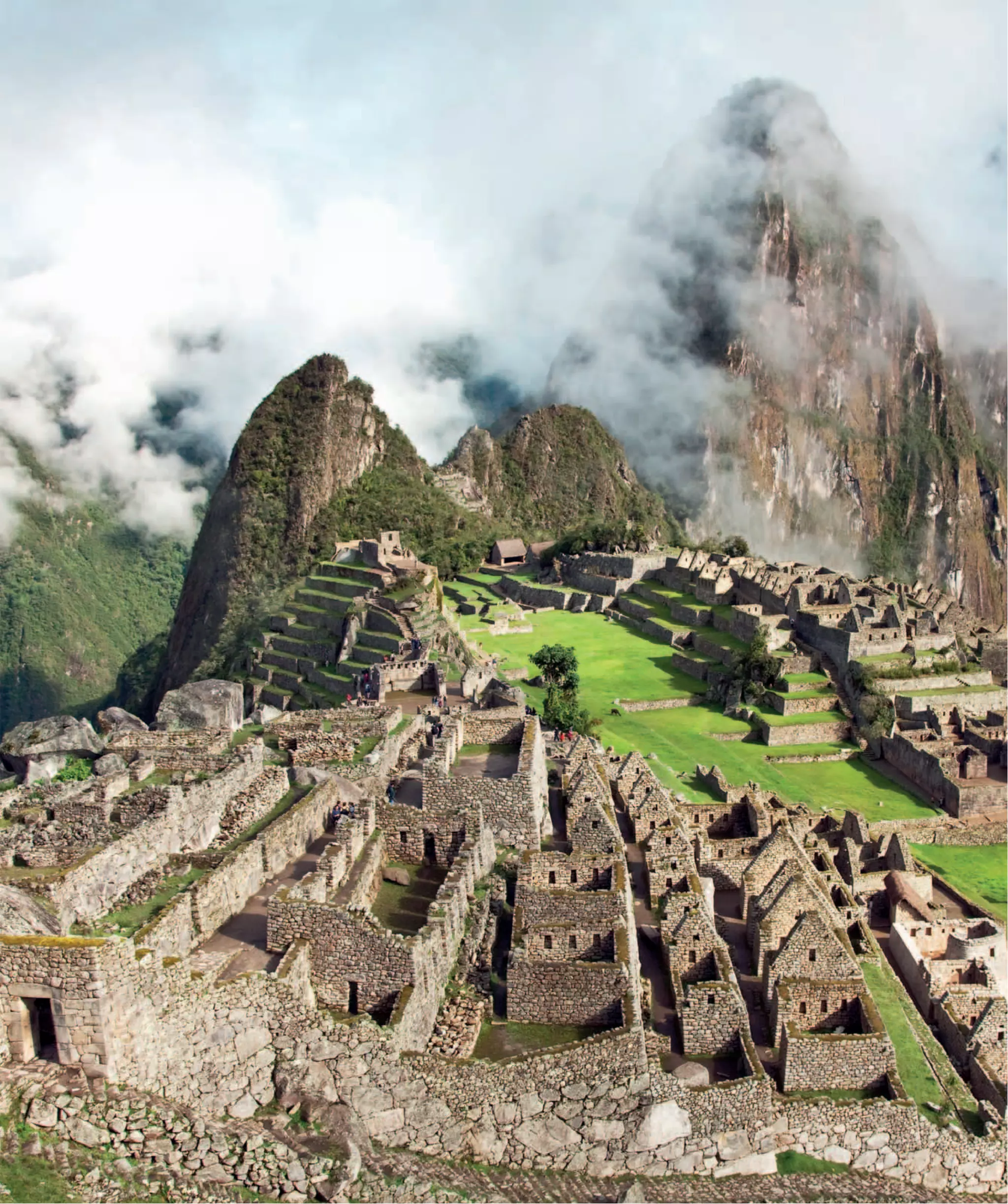
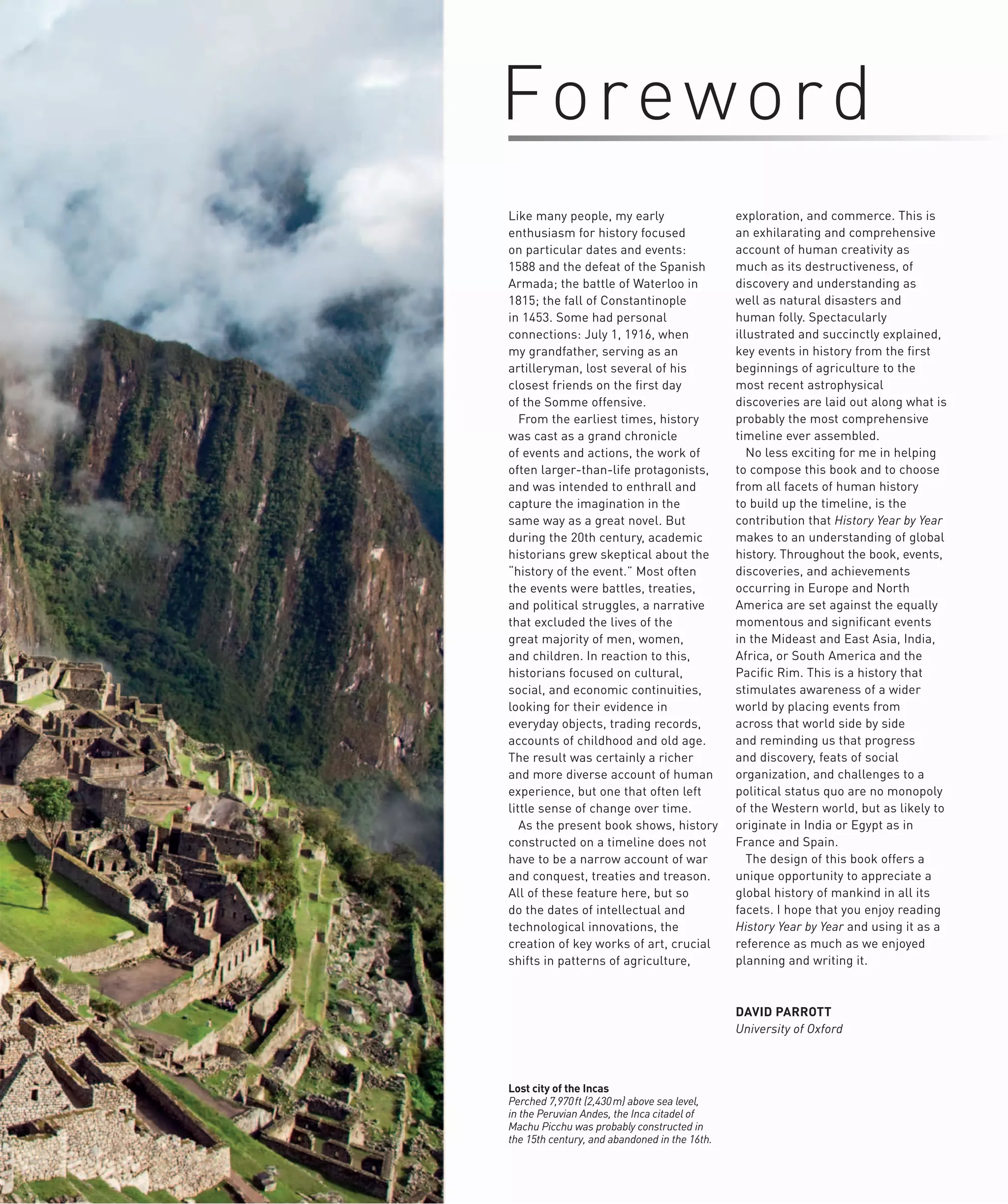
Lost city of the Incas
Perched 7,970ft (2,430m) above sea level,
in the Peruvian Andes, the Inca citadel of
Machu Picchu was probably constructed in
the 15th century, and abandoned in the 16th.
1
HUMAN
ORIGINS
8MYA–3000BCE
Our earliest ancestors lived in Africa almost eight million
years ago. Over seven million years later, we appeared and
developed the skills—including sophisticated toolmaking
and agriculture—that allowed us to colonize the world.
12
Olduvai Gorge in Tanzania is a site of great archaeological significance and is sometimes referred
to as the “Cradle of Mankind.” At least two species of early hominins are associated with this area.
THE DIFFERENCES BETWEEN
HUMANS AND OTHER APES DNA
and blood proteins suggest that
our lineage separated from that
of the chimpanzees between
8 and 6 million years ago (MYA).
Only a few fossil specimens date
to this time: Sahelanthropus
tchadensis (7–6 MYA), Orrorin
NOT LONG AFTER THE
APPEARANCE of Homo ergaster,
hominins expanded their range
beyond Africa for the first time.
A species called H. georgicus
appeared in Dmanisi, Georgia, by
1.7 MYA. Another close relative of
Homo ergaster, Homo erectus,
lived in China and Indonesia
perhaps not long afterward.
Some archaeologists believe that
earlier groups of hominins may
also have left Africa, as some of
the skulls from Dmanisi and from
the much later site of Liang Bua
in Flores, Indonesia, (currently
known as Homo floresiensis)
resemble those of Homo habilis
and Homo rudolfensis.
Living farther north would have
required a different way of life
SEVERAL DIFFERENT
AUSTRALOPITHECINE species
lived in Africa between 4.2 and
2 MYA. Although they walked on
two legs most of the time, they
were rather small and apelike
and still lived partially in trees.
Their brains were about the size
of those of modern chimpanzees,
but some australopithecines seem
to have used tools. The earliest
stone tools come from Ethiopia
and date to 2.6 MYA, but bones
with cut marks made by stone
tools have been found associated
with Australopithecus afarensis
nearby, and date to 3.4 MYA. The
australopithecines’ descendants
followed two distinct modes of
life: members of the genus
Paranthropus had huge jaws
and big teeth for eating tough
vegetable foods; meanwhile, Homo
rudolfensis and H. habilis seem to
have eaten more protein, using
tools to get at the protein-rich
marrow inside long-bones by
scavenging from carnivore kills.
ULTIMATELY, THE
PARANTHROPINES’ WAY OF LIFE
was unsuccessful and they became
extinct after about 1.2 MYA, while
their cousins Homo habilis and
H. rudolfensis survived. These
early Homo species were not very
different from australopithecines.
It was with Homo ergaster (1.8
MYA) that our ancestors started
to look much more familiar.
H. ergaster was tall and slender,
and may have been the first
hominin (a term used to describe
humans and their ancestors)
without much body hair. Their
brains were larger than those of
their ancestors, and they lost the
last of their adaptations to
tree-climbing to become fully
adapted to walking and running.
Lucy
This unusually complete skeleton
of Australopithecus afarensis,
discovered in Kenya in 1974, was
named after the Beatles’ song
“Lucy in the Sky with Diamonds.”
OLDOWAN TOOL
ACHEULEAN TOOL
8–4.5 MYA 4.5–2 MYA 2–1.8MYA 1.8–1.6MYA
Many animal species use natural objects as tools, but the
manufacture of stone tools is unique to hominins. The earliest are
simply sharp flakes broken off stone cobbles by striking them with
a “hammerstone.” These are known as “Oldowan” tools, after
Olduvai Gorge, where they were first found. Later tools, such as
Acheulean handaxes, required more skill. Our manufacture of tools
might be one explanation for the evolution of the human brain.
TOOLS
3.18MYA
“Lucy,”
Australopithecus
afarensis, alive; 13
m
ales and fem
ales of
varying ages form
“first
fam
ily” group of
A. afarensis fossils
5.7–5.2MYA
Ardipithecus
kadabba, possibly
only a variant of
A. ramidus
4.4MYA
Ardipithecus
ramidus (“Ardi”) is
chim
panzee-like,
but definitely
walks upright 1.65MYA
Acheulean
handaxes appear –
they m
ay m
ark a
significant step
forward in hum
an
intelligence
2–1MYA
Paranthropus
robustus, first
paranthropine to
be discovered
1.8MYA
Homo
ergaster is m
uch
taller and m
ore
slender than its
ancestors
2.6MYA Earliest
known stone
tools from
Gona,
Ethiopia
1.7MYA
Earliest
known hom
inin
fossils from
Eurasia
(Homo georgicus),
from
Dm
anisi in
Georgia
7MYA
Hom
inin
and chim
panzee
lineages diverge
4.1–2MYA
Australopithecus
afarensis has a brain not
m
uch larger than that of
m
odern chim
panzees; still
habitually clim
bs trees
7–6MYA
Sahelanthropus
tchadensis m
ay predate
hom
inin/chim
panzee
split, but is thought to
walk upright
2.5–1.2MYA
“Nutcracker m
an,”
Paranthropus boisei, has
huge grinding teeth and
powerful jaws
3.5–2MYA Australopithecus
africanus, the first early
hom
inin to be identified
1.9–1.6MYA
Homo
habilis (“handy m
an”)
is associated with
stone tools and
cut-marked bones3.3MYA
Earliest cut m
arks
produced by stone tools on
bones at Dikika, Ethiopia
tugenensis (6.1–5 MYA), and
two species of Ardipithecus,
kadabba (5.8–5.2 MYA) and
ramidus (4.4 MYA). While all
of these species seem to
have walked on two legs
like us, it is not certain
whether any were actual
ancestors of humans.
Because species are
constantly evolving, and
individuals of those species
can vary, it is difficult to tell
from isolated and often poorly
preserved fossils which species
they should be assigned to, or how
these are related to one another.
However, these fossils do tell us
a great deal about what the last
common ancestor we shared
with chimpanzees was like.
3.6MYA
Hom
inin footprints
preserved in volcanic
ash at Laetoli in
Tanzania
THE TIME
WHEN
THE FIRST
HUMAN
ANCESTOR
APPEARS
7MYA
A F R I C A
E U R O P E
Swanscombe
Boxgrove
Atapuerca
Tautavel
Ceprano
Isernia
la Pineta Petralona
Kocabas
Dmanisi
Ubeidiya
Olduvai Gorge
Olorgesailie
Lake Turkana Koobi Fora
Konso-Gardula
Bodo
Mauer
Steinheim
1.2 MYA
1.7 MYA
PROBABLY
MORE THAN
1.8 MYA
0.95 MYA
Hominins beyond Africa
Our earliest ancestors evolved in
Africa. Possible dispersal routes
from Africa are shown on this map,
with dates referring to the earliest
fossils known from each region.
Burying the dead
Neanderthals often disposed
of their dead with care. Some
were buried in graves, as here
at Kebara Cave in Israel, which
dates to 60,000BCE.
to life in the African savanna.
The climate was cooler and
environments were more
seasonal, with significant
variation in food resources
over the course of a year.
Fewer edible plants meant
that hominins would have had
to rely more on harder-to-find
and fiercely competed-for
animal protein for food. They
needed to move over greater
distances and work together to
share resources and information
to survive in these regions.
ACHEULEAN HANDAXES made by
Homo ergaster and H. erectus were
produced across most of Africa
and Eurasia, and demonstrate the
ability to learn complex skills
from one another and pass them
down over generations. To make
these tools, knappers had to think
several steps ahead in order to
select a suitable stone and to
prepare and place each strike.
Handaxes were used for a wide
range of activities, including
butchery, but they might also have
been important for personal or
group identity, demonstrating
their makers’ strength and skill.
While Homo Erectus continued
to thrive in Asia, Homo antecessor
had appeared as far west as
northern Spain and Italy by 1.2MYA.
Marks on their bones at the site of
Atapuerca in Spain suggest they
practiced cannibalism. However,
these early colonists may not
have thrived in these unfamiliar
landscapes, as very few sites are
known. By 600,000 years ago,
a new hominin species, Homo
heidelbergensis, had spread
much more widely across Europe.
H. heidelbergensis seems to have
been a good hunter, or at least a
proficient scavenger.
BY AROUND 350,000 YEARS AGO,
while Homo erectus continued to
hold sway over eastern Asia,
Homo heidelbergensis in Europe
and Western Asia had evolved into
Homo neanderthalensis.
Neanderthals were stockier and
stronger than modern humans,
and their brains were as large
or even larger, although shaped
slightly differently. Neanderthals
were almost certainly very
accomplished hunters. They were
also highly skilled at making
stone tools and heavy thrusting
spears with which they tackled
even large and dangerous animal
prey, such as horses and bison.
However, despite burying their
dead—which may have indicated
ceremonial practices or belief in
an afterlife—Neanderthals do not
seem to have created more than
the most limited art or used any
symbols, as all modern humans
do. Whether or not they spoke in a
similar way to modern humans is
also difficult to establish. Although
Australopithecines
28 cubic inches
(461 cubic cm)
Homo heidelbergensis
73 cubic inches
(1,204 cubic cm)
Homo neanderthalensis
87 cubic inches
(1,426 cubic cm)
Homo sapiens
90 cubic inches
(1,478 cubic cm)
Paranthropines
32 cubic inches
(517 cubic cm)
Homo habilis
Homo rudolfensis
40 cubic inches
(648 cubic cm)
Homo erectus
Homo ergaster
59 cubic inches
(969 cubic cm)
1.6–0.35MYA 350,000–160,000YA
Humans have a disproportionately large brain for a primate of
their size, but archaeologists disagree about how and why this
expansion happened. Switching to fatty and calorific foods such
as bone marrow and meat may have “powered” brain growth, and
also demanded more complex tools and effective hunting and
foraging skills. Social skills were also a part of this process, as
increasing group cooperation and pair-bonding were necessary
to sustain the longer periods of childhood that infants needed
for their larger brains to develop.
HOMININ BRAIN SIZES
1.2MYA
Appearance of
first Europeans – Homo
antecessor1.5–1.4MYA
Evidence
of fire at sites in
South Africa, but m
ay
be natural
0.28MYA
First evidence for
use of natural pigm
ents
1.6MYA
Earliest known
artifacts in China
thought to have been
m
ade by Homo erectus
although fossils from
region currently date
to only 0.8m
ya
0.4MYA
Fire-hardened
wooden spears in use
0.6MYA
Homo
heidelbergensis
now
widespread
0.4MYA
Distinctive
Neanderthal anatom
y
appears across Europe
0.16MYA
Homo sapiens
idaltu; skull has som
e
prim
itive features, but
shares distinctive
characteristics with
m
odern hum
ans0.2MYA
Mitochondrial
Eve is the last com
m
on
ancestor of all hum
ans
0.186–0.127MYA
Neanderthals engage
in com
m
unal hunting
and m
ass kills
1.65–1MYA Finds
of Homo erectus
from
Java dated to as
early as 1.5m
ya, but
m
ore likely to date
from
around 1m
ya
0.78MYA
Earth’s m
agnetic
field assum
es current polarity
0.79MYA
First
reliable evidence
for control of fire
at Gesher Benot
Ya’aqov, Israel1.5MYA “Turkana
boy” is an almost
com
plete skeleton
of an adolescent Homo
ergaster from
Tanzania
0.3MYA
Evidence
of prepared cores
used to m
ake
m
ultiple-com
ponent
tools
0.28MYA
Incised
pebble from
Berekhat
Ram
, Israel could be
first art
13
their throat and voice-box anatomy
suggests that a Neanderthal
language may have been limited
compared to that of humans, they
must have communicated in some
fashion, perhaps by combining a
less complex form of vocalization
with expressive miming.
0.3MYA
Modern
hum
an skeletal
traits appear in
African Homo
heidelbergensis
THE NUMBER
OF YEARS THE
NEANDERTHAL
DOMINATED
EUROPE AND
WESTERN ASIA
200,000
,,
Stephen Jay Gould, American paleontologist, from I Have Landed: The End of
a Beginning in Natural History, 2002
ALL LIVING HUMANS DESCENDED
FROM COMMON ANCESTORS WHO LIVED
IN AFRICA LESS THAN 200,000 YEARS AGO. ,,
A S I A
Zhoukoudian
Nanjing
Hexian
Lantian Yunxian
Trinil
Ngandong
MojokertoSangiran
Narmada
1.6–1.3 MYA
1.5–1 MYA
KEY
More likely route
Less likely route
Site of fossil finds
14
8 MYA—3000 BCE HUMAN ORIGINS
COLONIZING THE
PLANETTHE SPREAD OF MODERN HUMANS ACROSS THE WORLD
Homo sapiens’ colonization of the globe involved many stops, starts, and sometimes retreats, as well
as waves of different groups of people in some areas. Homo sapiens may have moved into Eurasia
via the Mediterranean coast of western Asia, spreading into Western Europe by 35,000 years ago
(YA). Archaeological evidence suggests that people may also have taken a “southern route”
across Arabia into southern Asia. There may also have been movement eastward, perhaps
much earlier, as stone tools have been found in India from 77,000YA and Malaysia from
70,000YA. Some possible Homo sapiens finds from southern China are dated to 68,000YA
(Liujiang), and even 100,000YA (Zhirendong). However, these finds remain controversial, and
most scholars favor later dates here. In Australia, widespread colonization probably did
not occur until 45,000YA, though some sites have been dated to as early as 60,000YA.
Farther north, Homo sapiens first spread across northern Eurasia around 35,000YA.
However, they may have retreated during the last Ice Age, and not recolonized the
region until after 14,000–13,000YA. Genetically, the North American colonists are likely
to have originated in East Asia. They probably traveled across the plain of “Beringia”—
now beneath the Bering Straits between Siberia and Alaska, but exposed by low sea
levels at the height of the last Ice Age. Distinctive “Clovis” spear points (flaked on both
sides) are found across North America around 12,000YA, so modern humans were
widespread at that point, but earlier sites are also known, including South American
sites such as Monte Verde (15,500–15,000YA).
Skeletal and DNA evidence suggests that our species, Homo sapiens, evolved
in Africa and then spread across the globe. The first traces of modern
humans beyond Africa come from fossils in Israel and possibly from stone
tools found in Arabia. They date to before 100,000 years ago.
LATE ARRIVALS
The islands of Oceania were some of the last parts of the
globe to be colonized, via the Philippines, by
Austronesian-speaking early farmers from Taiwan. The
more remote northern and eastern islands of Micronesia
and Polynesia remained uninhabited until after 700CE,
and New Zealand was populated as late as 1250CE.
N
O
R
T
H
A
M
E
R
I
C
A
SOUTH
A
M
E
R
ICA
Clovis
Cactus Hill
Buttermilk Creek
Meadowcroft
Pedra
Furada
Monte Verde
12,000
YEARS AGO
22,000
YEARS AGO
15,000–11,000
YEARS AGO
A T L A N T I C
O C E A N
ASIA
AUSTRALIA
NEW
ZEALAND
NORTH AMERICA
PACIFIC
OCEAN
PACIFIC
OCEAN
3000 BCE
400–1200 CE
1250 CE
2500 BCE
500 BCE
1500 BCE
1400–750 BCE
500 BCE –1 CE
Borneo
Philippine
Islands
New
Guinea
Samoan
Islands
Hawaiian
Islands
Fiji
Tracking language
The spread of languages can
often be tracked to reflect the
movement of people. This map
shows the spread of Austronesian
speakers across Oceania. Earlier
settlers were already present in
some western areas.
15
COLONIZING THE PLANET
Changing environments
The ancient ancestors of modern humans
evolved in the African tropics. Over time, as
human species evolved larger brains and
developed more advanced skills and behavior,
they became better equipped to deal with the
challenges of new environments.
7MYA Tropical and subtropical
dry broadleaf forest, savanna
40,000YA
Temperate forest,
boreal forest, tundra
TIME
1.7MYA Temperate grassland,
mediterranean shrubland
A F R I C A
E U R O P E
A S I A
A
U
S
T
R
ALIA
Cova Beneito
Jebel Irhoud
Cueva Morín
Gato Preto
Gorham's Cave
Arcy-sur-Cure
Kent's Cavern
Kostienki
Paviland Cave
Saint Césaire
Uçagizli Magara
Jebel Faya
Kara-Bom
DiuktaiUst-Mil
Berelekh
Ushki Lake
Yana
Bluefish Caves
Bering Straits
Swan Point
Tuluaq Hill
(Sluiceway-
Tuluaq complex)
Qafzeh
Ksar Akil
Herto
Omo Kibish
Tianyuan
Yamashita-Cho
Niah CavesKota Tampan
Jwalapuram
Zhirendong
Liujiang
Matenkupkum, Balof 2,
and Panakiwuk
Huon Peninsula
Lake Mungo
Willandra Lakes
Kow Swamp
Malakunanja
Upper Swan
Ngarrabulgan
Riwi and
Carpenter's Gap
Devil's
Lair
Allen's Cave Cuddie
Springs
Puritjarra
Nawalabila I
Blombos Cave
Klasies
Abríc Romaní
Bacho
Kiro
Höhlenstein-Stadel
Istállöskö
Korolevo I
Riparo Mochi
Temnata
Cave
Trou Magrite
Vindija Cave
Pestera cu Oase
Skhul
El Castillo Le Piage
El Pendo
River Mouth
160,000 YEARS AGO
40,000
YEARS AGO
100,000
YEARS AGO
45,000 YEARS AGO
31,000 YEARS AGO
45,000
YEARS AGO
14,000 YEARS AGO
13,000 YEARS AGO
35,000
YEARS AGO
42,000
YEARS AGO
32,000
YEARS AGO
77,000–45,000 YEARS AGO
I N D I A N
O C E A N
PACIFIC
OCEAN
Site of early
General direction
of Homo sapiens
around the world
Homo sapiens
KEY
Going global
Skeletal and genetic evidence suggests that modern humans
originated in Africa and spread across the globe from there,
as reflected on this map. This is called the “Out of Africa”
theory. An alternative “multiregional” theory suggests that
Homo sapiens evolved simultaneously in many different parts
of the world, from ancestors who had left Africa much earlier.
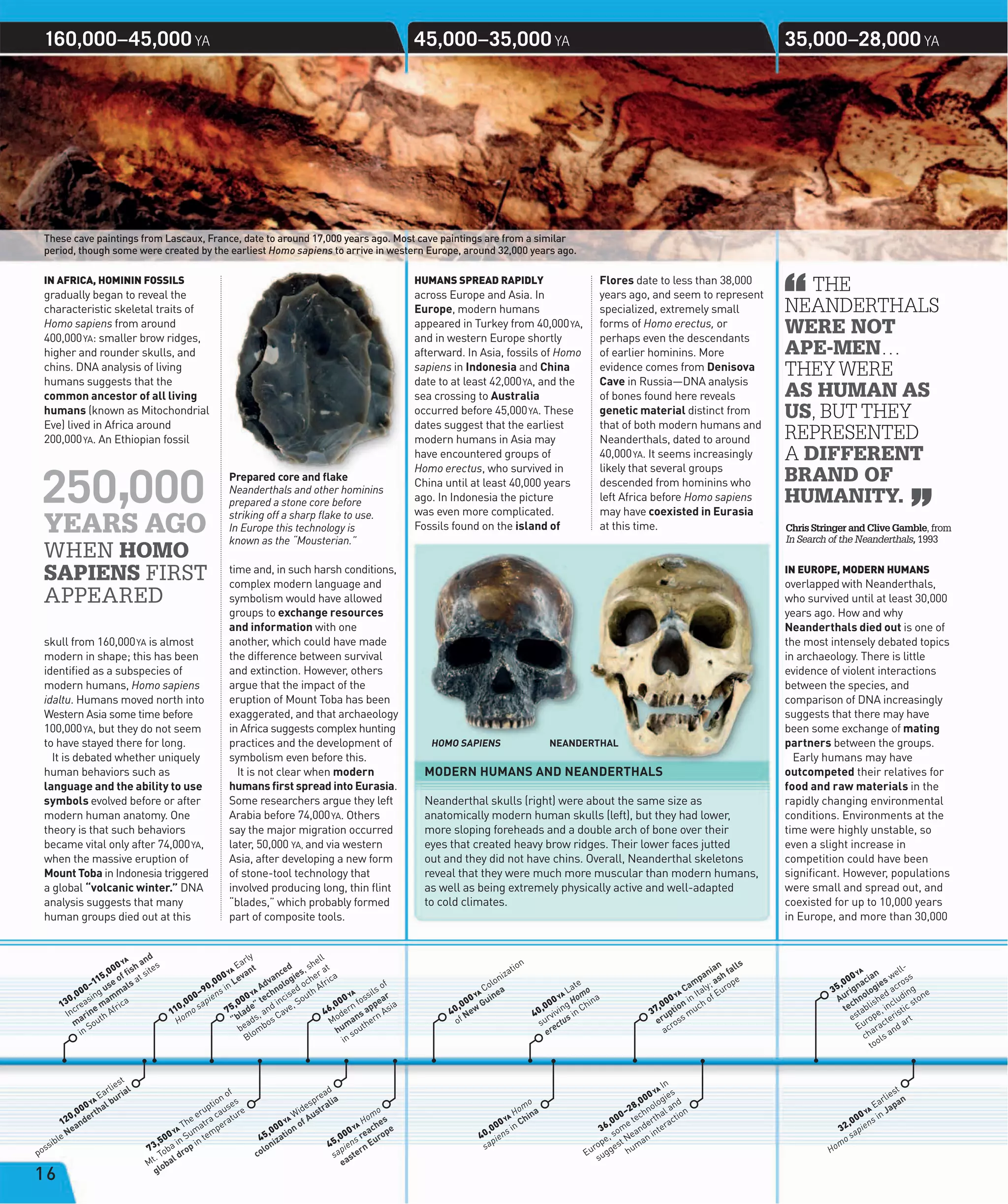
Neanderthal skulls (right) were about the same size as
anatomically modern human skulls (left), but they had lower,
more sloping foreheads and a double arch of bone over their
eyes that created heavy brow ridges. Their lower faces jutted
out and they did not have chins. Overall, Neanderthal skeletons
reveal that they were much more muscular than modern humans,
as well as being extremely physically active and well-adapted
to cold climates.
16
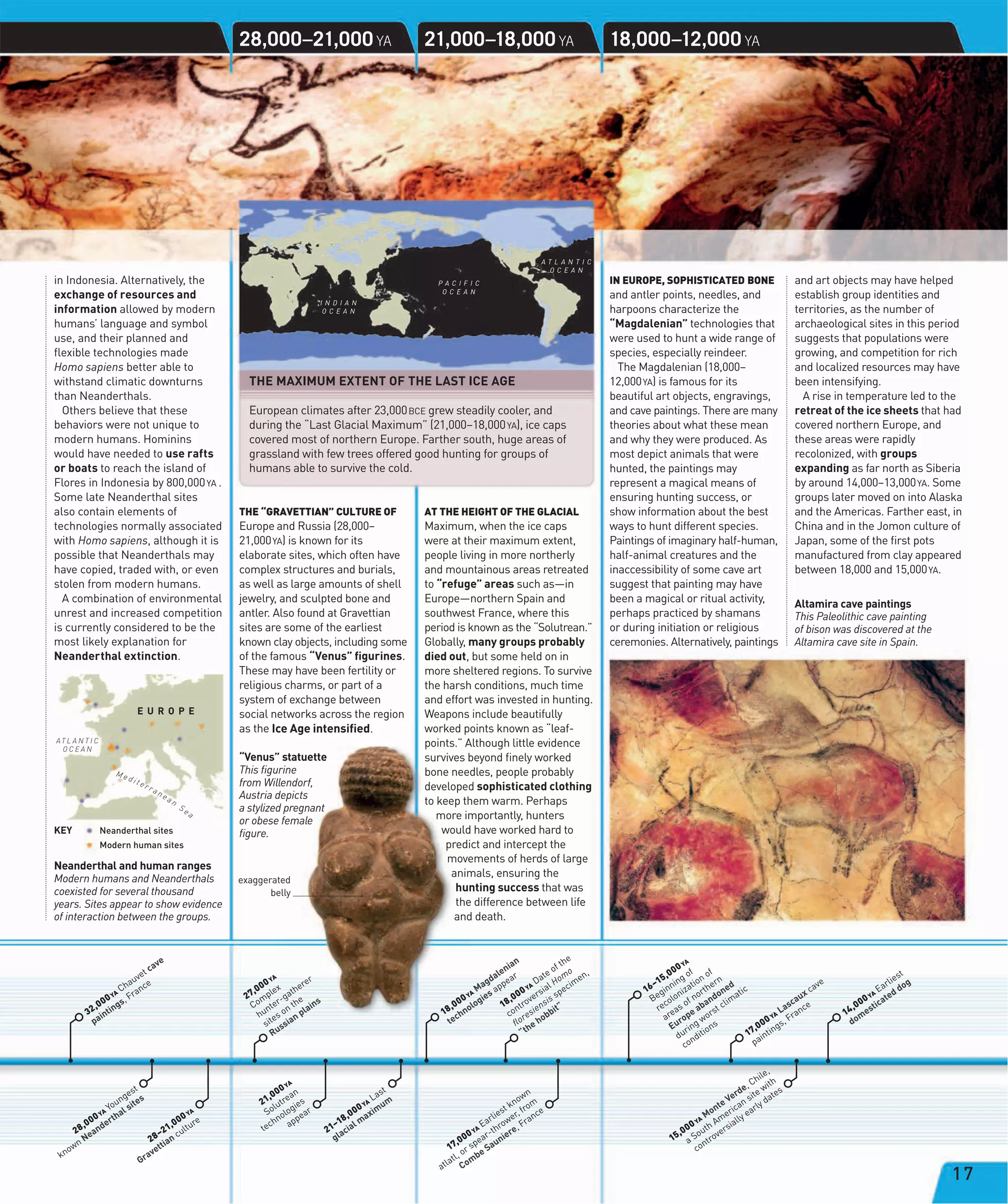
These cave paintings from Lascaux, France, date to around 17,000 years ago. Most cave paintings are from a similar
period, though some were created by the earliest Homo sapiens to arrive in western Europe, around 32,000 years ago.
IN AFRICA, HOMININ FOSSILS
gradually began to reveal the
characteristic skeletal traits of
Homo sapiens from around
400,000YA: smaller brow ridges,
higher and rounder skulls, and
chins. DNA analysis of living
humans suggests that the
common ancestor of all living
humans (known as Mitochondrial
Eve) lived in Africa around
200,000YA. An Ethiopian fossil
IN EUROPE, MODERN HUMANS
overlapped with Neanderthals,
who survived until at least 30,000
years ago. How and why
Neanderthals died out is one of
the most intensely debated topics
in archaeology. There is little
evidence of violent interactions
between the species, and
comparison of DNA increasingly
suggests that there may have
been some exchange of mating
partners between the groups.
Early humans may have
outcompeted their relatives for
food and raw materials in the
rapidly changing environmental
conditions. Environments at the
time were highly unstable, so
even a slight increase in
competition could have been
significant. However, populations
were small and spread out, and
coexisted for up to 10,000 years
in Europe, and more than 30,000
time and, in such harsh conditions,
complex modern language and
symbolism would have allowed
groups to exchange resources
and information with one
another, which could have made
the difference between survival
and extinction. However, others
argue that the impact of the
eruption of Mount Toba has been
exaggerated, and that archaeology
in Africa suggests complex hunting
practices and the development of
symbolism even before this.
It is not clear when modern
humans first spread into Eurasia.
Some researchers argue they left
Arabia before 74,000YA. Others
say the major migration occurred
later, 50,000 YA, and via western
Asia, after developing a new form
of stone-tool technology that
involved producing long, thin flint
“blades,” which probably formed
part of composite tools.
HUMANS SPREAD RAPIDLY
across Europe and Asia. In
Europe, modern humans
appeared in Turkey from 40,000YA,
and in western Europe shortly
afterward. In Asia, fossils of Homo
sapiens in Indonesia and China
date to at least 42,000YA, and the
sea crossing to Australia
occurred before 45,000YA. These
dates suggest that the earliest
modern humans in Asia may
have encountered groups of
Homo erectus, who survived in
China until at least 40,000 years
ago. In Indonesia the picture
was even more complicated.
Fossils found on the island of
Flores date to less than 38,000
years ago, and seem to represent
specialized, extremely small
forms of Homo erectus, or
perhaps even the descendants
of earlier hominins. More
evidence comes from Denisova
Cave in Russia—DNA analysis
of bones found here reveals
genetic material distinct from
that of both modern humans and
Neanderthals, dated to around
40,000YA. It seems increasingly
likely that several groups
descended from hominins who
left Africa before Homo sapiens
may have coexisted in Eurasia
at this time.
Prepared core and flake
Neanderthals and other hominins
prepared a stone core before
striking off a sharp flake to use.
In Europe this technology is
known as the “Mousterian.”
160,000–45,000YA
MODERN HUMANS AND NEANDERTHALS
36,000–28,000YA
In
Europe, som
e technologies
suggest Neanderthal and
hum
an interaction
40,000YA
Homo
sapiens in China
120,000YA
Earliest
possible Neanderthal burial
32,000YA
Earliest
Homo sapiens in Japan
35,000YA
Aurignacian
technologies well-
established across
Europe, including
characteristic stone
tools and art
130,000–115,000YA
Increasing use of fish and
m
arine m
am
m
als at sites
in South Africa
73,500YA
The eruption of
Mt. Toba in Sum
atra causes
global drop in tem
perature
110,000–90,000YA
Early
Homo sapiens in Levant
40,000YA
Colonization
of New
Guinea
YEARS AGO
WHEN HOMO
SAPIENS FIRST
APPEARED
250,000
skull from 160,000YA is almost
modern in shape; this has been
identified as a subspecies of
modern humans, Homo sapiens
idaltu. Humans moved north into
Western Asia some time before
100,000YA, but they do not seem
to have stayed there for long.
It is debated whether uniquely
human behaviors such as
language and the ability to use
symbols evolved before or after
modern human anatomy. One
theory is that such behaviors
became vital only after 74,000YA,
when the massive eruption of
Mount Toba in Indonesia triggered
a global “volcanic winter.” DNA
analysis suggests that many
human groups died out at this
Chris Stringer and Clive Gamble, from
In Search of the Neanderthals, 1993
,,THE
NEANDERTHALS
WERE NOT
APE-MEN…
THEY WERE
AS HUMAN AS
US, BUT THEY
REPRESENTED
A DIFFERENT
BRAND OF
HUMANITY. ,,
35,000–28,000YA45,000–35,000YA
75,000YA
Advanced
“blade” technologies, shell
beads, and incised ocher at
Blom
bos Cave, South Africa
46,000YA
Modern fossils of
hum
ans appear
in southern Asia
37,000YA
Cam
panian
eruption in Italy; ash falls
across m
uch of Europe
45,000YA
Widespread
colonization of Australia
40,000YA
Late
surviving Homo
erectus in China
45,000YA
Homo
sapiens reaches
eastern Europe
HOMO SAPIENS NEANDERTHAL
Neanderthal and human ranges
Modern humans and Neanderthals
coexisted for several thousand
years. Sites appear to show evidence
of interaction between the groups.
in Indonesia. Alternatively, the
exchange of resources and
information allowed by modern
humans’ language and symbol
use, and their planned and
flexible technologies made
Homo sapiens better able to
withstand climatic downturns
than Neanderthals.
Others believe that these
behaviors were not unique to
modern humans. Hominins
would have needed to use rafts
or boats to reach the island of
Flores in Indonesia by 800,000YA .
Some late Neanderthal sites
also contain elements of
technologies normally associated
with Homo sapiens, although it is
possible that Neanderthals may
have copied, traded with, or even
stolen from modern humans.
A combination of environmental
unrest and increased competition
is currently considered to be the
most likely explanation for
Neanderthal extinction.
THE “GRAVETTIAN” CULTURE OF
Europe and Russia (28,000–
21,000YA) is known for its
elaborate sites, which often have
complex structures and burials,
as well as large amounts of shell
jewelry, and sculpted bone and
antler. Also found at Gravettian
sites are some of the earliest
known clay objects, including some
of the famous “Venus” figurines.
These may have been fertility or
religious charms, or part of a
system of exchange between
social networks across the region
as the Ice Age intensified.
AT THE HEIGHT OF THE GLACIAL
Maximum, when the ice caps
were at their maximum extent,
people living in more northerly
and mountainous areas retreated
to “refuge” areas such as—in
Europe—northern Spain and
southwest France, where this
period is known as the “Solutrean.”
Globally, many groups probably
died out, but some held on in
more sheltered regions. To survive
the harsh conditions, much time
and effort was invested in hunting.
Weapons include beautifully
worked points known as “leaf-
points.” Although little evidence
survives beyond finely worked
bone needles, people probably
developed sophisticated clothing
to keep them warm. Perhaps
more importantly, hunters
would have worked hard to
predict and intercept the
movements of herds of large
animals, ensuring the
hunting success that was
the difference between life
and death.
IN EUROPE, SOPHISTICATED BONE
and antler points, needles, and
harpoons characterize the
“Magdalenian” technologies that
were used to hunt a wide range of
species, especially reindeer.
The Magdalenian (18,000–
12,000YA) is famous for its
beautiful art objects, engravings,
and cave paintings. There are many
theories about what these mean
and why they were produced. As
most depict animals that were
hunted, the paintings may
represent a magical means of
ensuring hunting success, or
show information about the best
ways to hunt different species.
Paintings of imaginary half-human,
half-animal creatures and the
inaccessibility of some cave art
suggest that painting may have
been a magical or ritual activity,
perhaps practiced by shamans
or during initiation or religious
ceremonies. Alternatively, paintings
and art objects may have helped
establish group identities and
territories, as the number of
archaeological sites in this period
suggests that populations were
growing, and competition for rich
and localized resources may have
been intensifying.
A rise in temperature led to the
retreat of the ice sheets that had
covered northern Europe, and
these areas were rapidly
recolonized, with groups
expanding as far north as Siberia
by around 14,000–13,000YA. Some
groups later moved on into Alaska
and the Americas. Farther east, in
China and in the Jomon culture of
Japan, some of the first pots
manufactured from clay appeared
between 18,000 and 15,000YA.
“Venus” statuette
This figurine
from Willendorf,
Austria depicts
a stylized pregnant
or obese female
figure.
28–21,000YA
Gravettian culture
28,000YA
Youngest
known Neanderthal sites
21–18,000YA
Last
glacial m
axim
um21,000YA
Solutrean
technologies
appear
17,000YA
Earliest known
atlatl, or spear-thrower, from
Com
be Sauniere, France
15,000YA
Monte Verde, Chile,
a South Am
erican site with
controversially early dates
18,000YA
Magdalenian
technologies appear
18,000YA
Date of the
controversial Homo
floresiensis specim
en,
“the hobbit”
32,000YA
Chauvet cave
paintings, France
27,000YA
Com
plex
hunter-gatherer
sites on the
Russian plains
17,000YA
Lascaux cave
paintings, France
16–15,000YA
Beginning of
recolonization of
areas of northern
Europe abandoned
during worst clim
atic
conditions
17
Altamira cave paintings
This Paleolithic cave painting
of bison was discovered at the
Altamira cave site in Spain.
European climates after 23,000BCE grew steadily cooler, and
during the “Last Glacial Maximum” (21,000–18,000YA), ice caps
covered most of northern Europe. Farther south, huge areas of
grassland with few trees offered good hunting for groups of
humans able to survive the cold.
THE MAXIMUM EXTENT OF THE LAST ICE AGE
28,000–21,000YA 21,000–18,000YA 18,000–12,000YA
14,000YA
Earliest
dom
esticated dog
KEY
I N D I A N
O C E A N
P A C I F I C
O C E A N
A T L A N T I C
O C E A N
E U R O P E
M e d i t er r an ea n
S ea
AT L A N T I C
O C E A N
Neanderthal sites
Modern human sites
exaggerated
belly
18
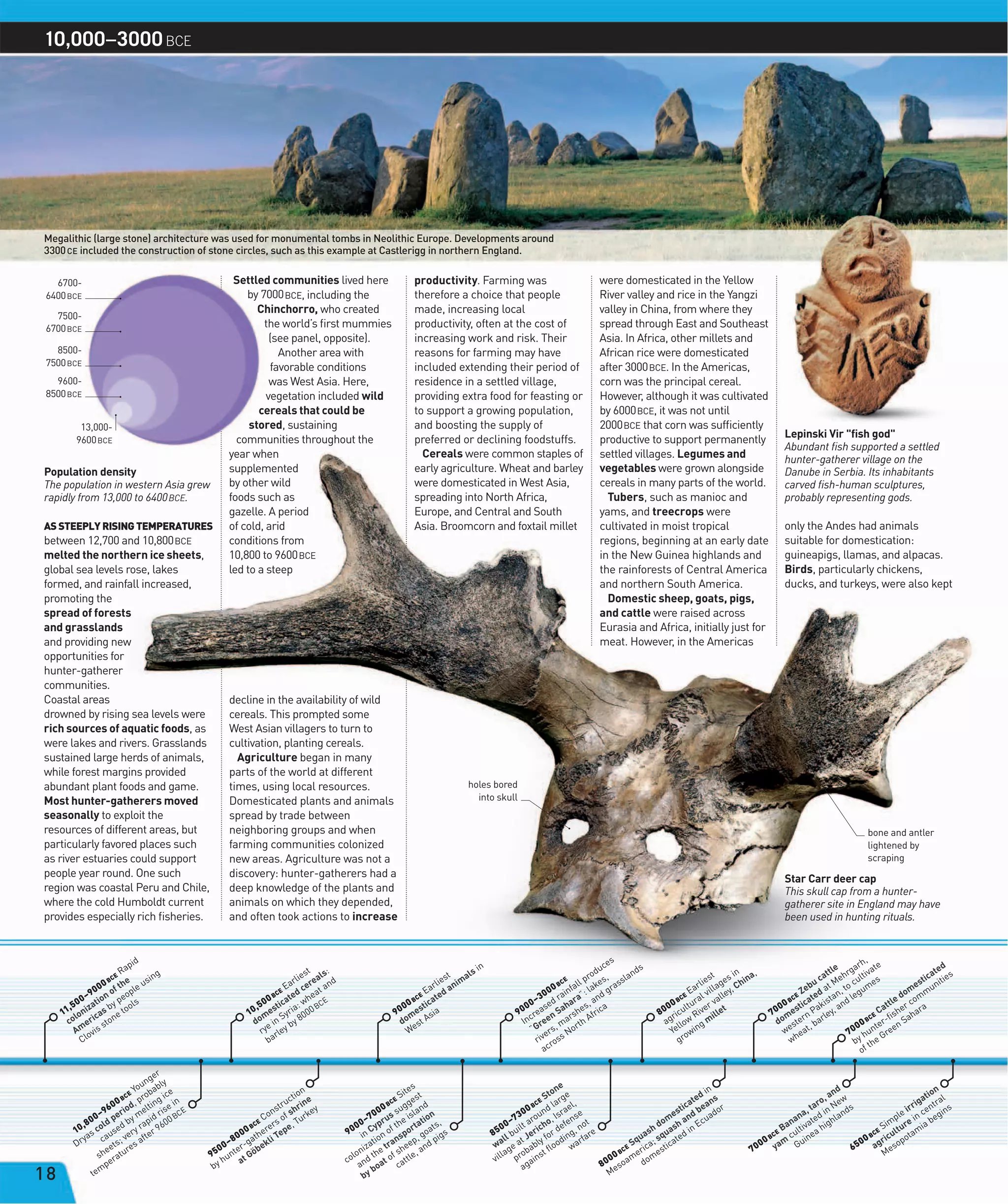
Megalithic (large stone) architecture was used for monumental tombs in Neolithic Europe. Developments around
3300CE included the construction of stone circles, such as this example at Castlerigg in northern England.
AS STEEPLY RISING TEMPERATURES
between 12,700 and 10,800BCE
melted the northern ice sheets,
global sea levels rose, lakes
formed, and rainfall increased,
promoting the
spread of forests
and grasslands
and providing new
opportunities for
hunter-gatherer
communities.
Coastal areas
drowned by rising sea levels were
rich sources of aquatic foods, as
were lakes and rivers. Grasslands
sustained large herds of animals,
while forest margins provided
abundant plant foods and game.
Most hunter-gatherers moved
seasonally to exploit the
resources of different areas, but
particularly favored places such
as river estuaries could support
people year round. One such
region was coastal Peru and Chile,
where the cold Humboldt current
provides especially rich fisheries.
only the Andes had animals
suitable for domestication:
guineapigs, llamas, and alpacas.
Birds, particularly chickens,
ducks, and turkeys, were also kept
Settled communities lived here
by 7000BCE, including the
Chinchorro, who created
the world’s first mummies
(see panel, opposite).
Another area with
favorable conditions
was West Asia. Here,
vegetation included wild
cereals that could be
stored, sustaining
communities throughout the
year when
supplemented
by other wild
foods such as
gazelle. A period
of cold, arid
conditions from
10,800 to 9600BCE
led to a steep
productivity. Farming was
therefore a choice that people
made, increasing local
productivity, often at the cost of
increasing work and risk. Their
reasons for farming may have
included extending their period of
residence in a settled village,
providing extra food for feasting or
to support a growing population,
and boosting the supply of
preferred or declining foodstuffs.
Cereals were common staples of
early agriculture. Wheat and barley
were domesticated in West Asia,
spreading into North Africa,
Europe, and Central and South
Asia. Broomcorn and foxtail millet
were domesticated in the Yellow
River valley and rice in the Yangzi
valley in China, from where they
spread through East and Southeast
Asia. In Africa, other millets and
African rice were domesticated
after 3000BCE. In the Americas,
corn was the principal cereal.
However, although it was cultivated
by 6000BCE, it was not until
2000BCE that corn was sufficiently
productive to support permanently
settled villages. Legumes and
vegetables were grown alongside
cereals in many parts of the world.
Tubers, such as manioc and
yams, and treecrops were
cultivated in moist tropical
regions, beginning at an early date
in the New Guinea highlands and
the rainforests of Central America
and northern South America.
Domestic sheep, goats, pigs,
and cattle were raised across
Eurasia and Africa, initially just for
meat. However, in the Americas
9000–7000BCE
Sites
in Cyprus suggest
colonization of the island
and the transportation
by boat of sheep, goats,
cattle, and pigs
9500–8000BCE
Construction
by hunter-gatherers of shrine
at Göbekli Tepe, Turkey
10,800–9600BCE
Younger
Dryas cold period, probably
caused by m
elting ice
sheets; very rapid rise in
tem
peratures after 9600BCE
8000BCE
Squash dom
esticated in
Mesoam
erica; squash and beans
dom
esticated in Ecuador
7000BCE
Cattle dom
esticated
by hunter-fisher com
m
unities
of the Green Sahara
7000BCE
Banana, taro, and
yam
cultivated in New
Guinea highlands
7000BCE
Zebu cattle
dom
esticated at Mehrgarh,
western Pakistan, to cultivate
wheat, barley, and legum
es
8000BCE
Earliest
agricultural villages in
Yellow
River valley, China,
growing m
illet
6500BCE
Sim
ple irrigation
agriculture in central
Mesopotam
ia begins
10,500BCE
Earliest
dom
esticated cereals:
rye in Syria: wheat and
barley by 8000BCE
11,500–9000BCE
Rapid
colonization of the
Am
ericas by people using
Clovis stone tools
9000BCE
Earliest
dom
esticated anim
als in
West Asia
bone and antler
lightened by
scraping
holes bored
into skull
10,000–3000BCE
Star Carr deer cap
This skull cap from a hunter-
gatherer site in England may have
been used in hunting rituals.
Lepinski Vir "fish god"
Abundant fish supported a settled
hunter-gatherer village on the
Danube in Serbia. Its inhabitants
carved fish-human sculptures,
probably representing gods.
Population density
The population in western Asia grew
rapidly from 13,000 to 6400BCE.
decline in the availability of wild
cereals. This prompted some
West Asian villagers to turn to
cultivation, planting cereals.
Agriculture began in many
parts of the world at different
times, using local resources.
Domesticated plants and animals
spread by trade between
neighboring groups and when
farming communities colonized
new areas. Agriculture was not a
discovery: hunter-gatherers had a
deep knowledge of the plants and
animals on which they depended,
and often took actions to increase
8500–7300BCE
Stone
wall built around large
village at Jericho, Israel,
probably for defense
against flooding, not
warfare
9000–3000BCE
Increased rainfall produces
“Green Sahara”: lakes,
rivers, m
arshes, and grasslands
across North Africa
13,000-
9600BCE
9600-
8500BCE
8500-
7500BCE
7500-
6700BCE
6700-
6400BCE
by Old and New World farmers. By
5000BCE cattle, sheep, and goats
were raised for milk as well as
meat, while cattle were used to
pull plows, enabling people to
cultivate much larger areas.
Wool-bearing sheep were bred in
West Asia in the 4th millennium
BCE, and rapidly spread into
Europe and Central Asia. The use
of pack animals such as llamas
and donkeys allowed long-
distance transport.
Agriculture was more productive
than foraging and could support
larger communities. Settled life
also encouraged population
growth. Many early farming
villages in West Asia grew to
a considerable size. Most
remarkable was Çatalhöyük in
Turkey, occupied around 7400–
6200BCE, which housed as many
as 8,000 people. Its tightly packed
houses were entered from the
roof by ladders, and were
decorated with paintings and
modeled animal heads.
After 7000BCE farmers spread
from Turkey into southeast
and central Europe, while
Mediterranean hunter-gatherers
gradually turned to agriculture,
using imported West Asian crops
and animals. By 3500BCE most of
Europe had adopted farming.
Megaliths—stone chambered
tombs of which a wide variety were
built, often with earthen mounds—
were constructed in western and
northern Europe from the early 5th
millennium BCE. Most housed the
bones of a number of individuals.
Native (naturally occurring pure)
copper and gold were being
shaped into small objects by cold
hammering before 8000BCE in
West Asia. Around 7000BCE, ores
were smelted here to extract
metal and by 6000BCE copper and
lead were also cast. Metals were
initially made into small personal
objects that could enhance
prestige and status. Later,
however, copper began to be used
for tools, and by 4200BCE copper
ores containing arsenic were
deliberately selected to produce a
harder metal. The addition of tin
created a stronger alloy, bronze,
which was in use in West Asia
by 3200BCE.
The development of water-
control techniques enabled West
Asian farmers to colonize the
southern Mesopotamian plains,
where agriculture depended
entirely on irrigation but was
highly productive. By the mid 4th
millennium BCE, this region was
densely populated, and villages
were developing into towns, with
craft specialists. There was a
growing demand for raw
materials, including metal
ores, which often came from
distant sources. A trading
network developed that
stretched from Egypt through
West Asia to the mountainous
borderlands of South Asia, with
towns controlling sources of
materials and strategic points
along the routes. Sumer
(southern Mesopotamia) was at
the forefront of this development,
but social, religious, economic,
and political complexity was also
emerging in Elam (southwest
Iran) and Egypt. Before 3000BCE
all three regions developed
writing systems, used to
record and manage economic
transactions and the ownership
of property. The earliest known
pictographic writing, around
3300BCE, comes from Uruk in
Sumer, a huge and complex
settlement that is deservedly
known as the world’s first city.
6200BCE First farm
ing
com
m
unities established in
Euphrates valley of southern
Mesopotam
ia
5000–1000BCE
Old Copper Culture, a m
ajor industry
and trade network based on
locally m
ined, cold-ham
m
ered
native copper, flourishes in
Great Lakes region
of North Am
erica
4000BCE
Dom
estication
of vine and
olive in eastern
Mediterranean
5000BCE
Dom
esticated llam
a, alpaca, and
probably guinea pig in the Andes;
range of crops grown in Andes,
Andean coast, and tropical
lowlands of northeast
South Am
erica
5100BCE
Copper m
ining
at Aibunar, Bulgaria
5500BCE
Independent
developm
ent of copper
m
etallurgy in the Balkans
6000BCE
Villages in Yangzi
valley (China) fish, grow
rice,
and raise pigs and chickens
6000BCE
Dom
estic
corn develops from
wild teosinte in
Mexico
5000BCE
Dom
estic
anim
als kept for m
ilk and
pulling plows, as well as
for m
eat, in West Asia,
North Africa, and Europe
19
The spread of agriculture
Humans began to cultivate plants and manage animals independently,
in different areas at different times, across the world.
Copper ax heads
Gold and copper were the
first metals to be worked.
They became widespread
in Europe around
2500BCE.
Clive Gamble, from Origins and revolutions: human identity in earliest
prehistory, 2007
THE NEOLITHIC WAS… A POINT
IN A CONTINUOUS STORY OF
GREATER ECONOMIC CONTROL
OVER RESOURCES... FROM
SCAVENGING TO... FARMING.
The earliest mummies come
not from Egypt, but from
coastal northern Chile, an
arid region where natural
mummies occur from
7000BCE. After 5000BCE the
Chinchorro began artificial
mummification. They removed
the flesh, reassembled and
reinforced the skeleton, stuffed
the skin with plant material,
coated it in clay, and painted
it with black manganese or
red ocher. Only some
individuals, particularly
children, were mummified.
CHINCHORRO MUMMIES
2500 BCE
4500 BCE
8000 BCE
7000 BCE
5000 BCE
6000 BCE
7000 BCE
6000 BCE 2500 BCE
4000 BCE
7000 BCE
7000 BCE
8000 BCE
6000 BCE
9000 BCE 9000 BCE
6500 BCE
6500 BCE
AUS T RALASIA
NORTH
AMERICA
SOUTH
AMERICA
AFRICA
EUROPE
A S I A
KEY
Livestock
Cereals
Other
Areas with agriculture
3300BCE
W
riting invented in
southern Mesopotam
ia
3500BCE
W
heeled transport
em
erges, spreads rapidly through
Eurasia—
used for local transport
and m
ilitary purposes
3000BCE
Metallurgy
reaches western China
3200BCE
Beginning
of Egyptian writing
3100–2900BCE
Proto-Elam
ite script
(early Bronze Age writing
system
) across the
Iranian plateau
3500BCE
Stam
p seals
begin to be used in West
Asia for adm
inistrative
and econom
ic purposes
4000BCE
Wet-rice
cultivation in plowed,
flooded paddy fields in
China begins
3200BCE
First bronze
m
anufactured
in West Asia
3200BCE
Uruk
em
erges as
first city
,,
,,
20
8 MYA–3000 BCE HUMAN ORIGINS
hole for
cord
leather or
sinew binding
finely detailed
engraving
barbed head made
from antler
thick base is
easy to hold
reed
framework
coated in
thick plaster
scars where
blades chipped
from core
Engraved bone
13,000–8000BCE • FRANCE
Paleolithic artists often carved as well
as painted their depictions of animals,
as with this scene of a bison being
chased, from Laugerie-Basse.
Antler harpoon
8000BCE • UK
This harpoon head is attached to a long
handle for spearing fish—a key source of food
when sea levels rose as the last Ice Age ended.
Flint hand-ax
200,000BCE • UK
Hand-axes, such as this one from
Swanscombe, were skillfully made
and used for a wide range of activities,
including woodworking and butchery.
Oldowan tool
2.6–1.7MYA • AFRICA
The earliest stone tools were
simple, sharp-edged flakes of
stone, made by striking a stone
cobble with a hard “hammerstone.”
Digging tools with adze heads
11,660–4000BCE • EUROPE
These Mesolithic adzes were used
for digging up edible roots or cutting
wood in the forests that spread across
Europe after the last Ice Age ended.
Blades and core
100,000BCE ONWARDS • WIDESPREAD
Early modern humans produced uniform,
narrow blades that would have been fitted
to wooden and antler handles or held in the
hand, as tools for many different purposes.
Prehistory is traditionally divided into the Stone, Bronze,
and Iron ages, but many other kinds of raw materials
such as wood, hide, and plant fibers were also used in
early technologies. Little evidence of these survives.
In addition to being functional aids to survival and subsistence, the objects
made by prehistoric peoples would also have been important in their social
lives. Different groups develop their own ways of manufacturing and
decorating objects, and distinctive designs may become badges of identity
or status symbols. The trade and exchange of objects is another vital way in
which individuals and groups establish social relationships and hierarchies.
PREHISTORIC PEOPLESEARLY HUMANS ARE DEFINED BY THE RAW MATERIALS THEY USED TO FASHION TOOLS, WEAPONS, AND ORNAMENTS
carefully
sharpened tip
colorful
geometric
design
remains of
flaked cobble
reproduced
wooden handle
minerals define
facial features
geometric,
abstract
pattern
carved antler
setting
Schist plaque
4000BCE • PORTUGAL
It is unclear what Neolithic engraved
plaques, like this one from Alentejo,
symbolized, but they seem to have
been made for burial with the dead.
Pottery shard
4000BCE • ROMANIA
Different cultures can be identified
by their unique ways of decorating
objects—this shard is typical of the
Cucuteni-Tripolye culture.
Human figurine
6750–6500BCE • JORDAN
This large statue from Ain Ghazal
is one of several from sites in
the Near East that may have
represented ancestors or gods.
long, thin
blade
flint head
set into
wooden
sleeve
21
PREHISTORIC PEOPLES
iron sickle blade
bone
shuttle
Bronze Age
sickle
Neolithic flint blade
set in reproduction
handle
Carved spear-thrower
10,500BCE • FRANCE
Spear-throwers, such as this one from
Montastruc, were often carved into animal
shapes—here, a woolly mammoth made
from antler. They enabled hunters to throw
spears farther and with greater force.
Agricultural tools
9500BCE–1834CE • WIDESPREAD
First wild and later domesticated
cereals were harvested using
sickles like these, until they were
superseded in most places by the
invention of the combine harvester.
Lespugue Venus
24,000–22,000BCE • FRANCE
This ivory figurine from Lespugue in
the Pyrenees is one of many “Venus”
figurines—depicting women who are
pregnant or obese, or whose female
features are greatly exaggerated.
Mummified head
7000–3000BCE • PERU
In very dry climates, bodies can
become mummified. Some of
the earliest mummies have
been found in Peruvian deserts.
soft clay was baked
to preserve design
exaggerated
features
Clay burial chest
4000BCE • NEAR EAST
One Chalcolithic (“copper age”)
burial practice involved leaving
the dead out to decay, then
collecting the bones and placing
them in clay chests like this one.
Neolithic seal
7500–5700BCE • ANATOLIA
Seals such as this one
from the settlement of
Çatal Höyük were used
during the Neolithic to
stamp decorative designs
on to skin or cloth.
Cloth-making tools
6500BCE • ORIGIN UNKNOWN
From the mid-Neolithic, weaving
became common. Loom weights
held vertical threads taut; bone
shuttles were used to weave
horizontal threads in and out.
loom
weight
excavation
damage
Gold jewelry
4700–4200BCE • BULGARIA
At the cemetery of Varna in
Bulgaria, more than 3,000
pieces of some of the earliest
gold jewelry have been found,
mainly buried with elite males.
gold easily worked
into decorative
animal shapes
2
3000–700BCE
EARLY
CIVILIZATIONS
This period saw the emergence of complex civilizations.
Communities flourished and trade developed in the fertile
valleys of Egypt, India, western Asia, and China. Europe and
Central and South America also flourished during this time.
ebooksdownloadrace.blogspot.in
24
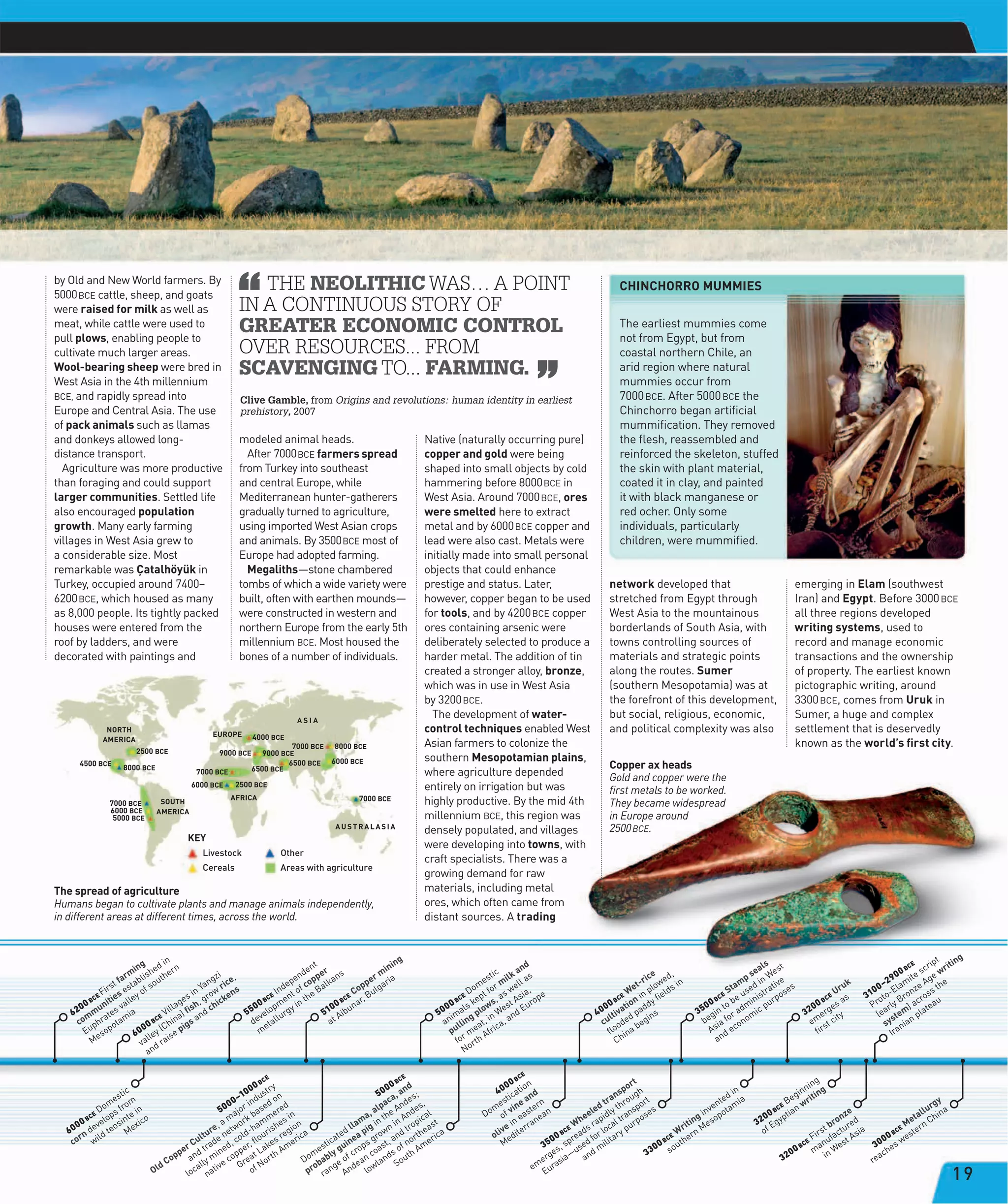
Stonehenge in western Britain was a ceremonial site from around 3100BCE. An early earth enclosure
and a circle of wooden posts were later replaced by the outer circle of stones seen here.
DURING THE LAST HALF OF THE
FOURTH MILLENNIUM BCE, the
world’s first civilizations arose,
first in Western Asia, then North
Africa and South Asia. Civilization
also appeared in China in the
early second millennium BCE. By
3000BCE, the world’s first urban
culture had begun to develop in
southern Mesopotamia, in what
is now Iraq. The lower Euphrates
river plains had been farmed
from c. 6200BCE, after the
development of irrigation
systems—the Greek word
mesopotamia means “land
between the rivers.” By 3500BCE,
farming communities were
growing into towns and then
cities such as Ur, Uruk, and
Eridu. Over the next 300 years,
each city came to dominate its
surrounding area, forming a
group of city-states in the land
called Sumer in southeast
Mesopotamia.
Metalworking had begun in
Mesopotamia around 6000BCE.
Around 3200BCE, Sumerian
3000–2700BCE
c. 3000BCE
Dawn of
Minoan civilization
on Crete
c. 2900–2400BCE
Wooden
structures built
at Stonehenge
cerem
onial
com
plex
c. 3000BCE
Bronze Age
underway in
western Asia
(c. 3200–
c. 1200BCE)
c. 3000–2334BCE
Early Dynastic Period in
Mesopotam
ia; City-states
such as Ur, Uruk, and
Eridu flourish
in Sum
er
c. 2750BCE
First
bronze artifacts
found in China
c. 2800–2700BCE
First cerem
onial centers
develop in South Am
erica,
along coast of Peru
c. 3100–2890BCE
First dynasty
of Egypt.
Early Dynastic
Period begins
(to c. 2686BCE)
c. 3000BCE
Longshan culture
developing in China
(c. 3200–c. 3000BCE)
c. 3000BCE King Menes
rules over a united Egypt
m
ade up of Upper (southern)
and Lower (northern) Egypt
c. 3000BCE Evidence
of copper-working
in southern France
c. 3200–2600BCE
Early Indus period—
towns and regional
cultures in Indus Valley
c. 2890–2686BCE
Second dynasty
of Egypt
Ancient cities of Mesopotamia
Sumer in southern Mesopotamia was the
location of the world’s first urban civilization
fromc.2900BCE as agricultural success
led to a complex society.
Narmer Palette
This carved piece of green siltstone
records the triumph of the legendary
King Narmer of Upper Egypt over
his enemies.
smiths began manufacturing
bronze. The plow had been in
use since about 5000BCE, wheeled
carts from around 3500BCE, and
such advances made farming
more productive. The resulting
food surplus freed some people
from the farming life, allowing
specialization into professions
such as priesthood, crafts, trade,
and administration. The world’s
first tiered society developed,
headed by kings sometimes
known as lugals.
In Egypt, one of the world’s most
complex ancient civilizations
was forming along the banks of
the Nile River by 3100BCE. The
Nile formed a narrow strip of
cultivatable land, floodplain, as the
river’s annual flood (known as the
inundation) spread black silt along
its banks. The Egyptian farming
year began in the fall when the
inundation subsided, and farmers
cultivated wheat, barley, beans,
and lentils in the fertile soil.
By the end of the 4th
millennium BCE, farming
communities had evolved into
two kingdoms: Upper Egypt in
the south and Lower Egypt in
the north. King Narmer united
the two kingdoms c. 3100BCE.
After Narmer came Menes,
although historians are
unsure whether Menes
was Narmer’s successor
or a different name for
Narmer himself. Menes
is credited with founding
the Egyptian capital at
Memphis and Egypt’s
first dynasty.
As in Mesopotamia,
efficient agriculture
produced prosperity and
specialism, allowing arts,
crafts, engineering, and
early medicine to develop.
made the land fertile. As early
as 8000BCE, millet had been
cultivated in the area around
Yangshao in Henan Province.
Around c. 2400BCE, the
neighboring Dawenkou culture
developed into the Longshan
culture of Shangdong Province.
Longshan farmers grew rice
after developing irrigation
systems. As in other early
civilizations, agricultural success
allowed the development of an
elaborate society. Chinese
craftsmen were making bronze
tools c. 3000BCE, jade vessels
c. 2700BCE, and silk weaving had
begun by 3500BCE.
The Bronze Age was underway
in western Asia by 3000BCE, and
possibly considerably earlier. The
Bronze Age in Europe seems to
have developed separately from
around 2500BCE, using ore
sources from the Carpathian
Mountains in Central Europe.
This era also saw the
beginnings of the Minoan
civilization on the Greek
island of Crete around
2000BCE, with trading links
to the nearby Cyclades
Islands and the wider
Mediterranean. In Western
Europe, the earlier tradition of
megalithic tomb building and a
growing interest in astronomical
observation gave rise to a new
megalithic tradition of erecting
stone circles, stone rows,
standing stones, and tombs
including astronomical features.
These include Newgrange in
Ireland, Stonehenge in England,
and Carnac in France.
The Early Dynastic Period
(c. 3100–2686BCE) was already
characterized by many of the
celebrated aspects of Egyptian
culture: hieroglyphic writing, a
sophisticated religion (including
belief in an afterlife), and
preserving the dead using
mummification. A complex
hierarchical society developed,
with the king at the apex
accorded semi-divine status.
Egyptian kings—later known as
pharaohs—ruled with the help of
a chief minister, or vizier, regional
governors (nomarchs), and a
huge staff of lesser officials
including priests, tax collectors,
and scribes.
In China, civilization originated
in the valleys of eastern rivers
such as the Huang He (Yellow
River), where the rich loess soil
c. 2900BCE
Cuneiform
script develops in
Sum
er, Mesopotam
ia
c. 3000–2500BCE
Andean farm
ers grow
potatoes and quinoa,
and raise alpacas
and llam
as
Euphrates
Tigris
Medit
erranean
Sea
Persian
Gulf
S y r i a n
D e s e r t
A r a b i a n P e n i n s u l a
T
aurus
M
ountains
Zagros Mountains
M
esopotamia
Elam
Nippur
Shuruppak Lagash
Uruk
Umma
Ur
Eridu
Kish
50
THOUSAND
THE POPULATION
OF THE CITY OF
URUK c. 2800 BCE
KEY
Extent of Early Dynastic
city-states
Ancient coastline
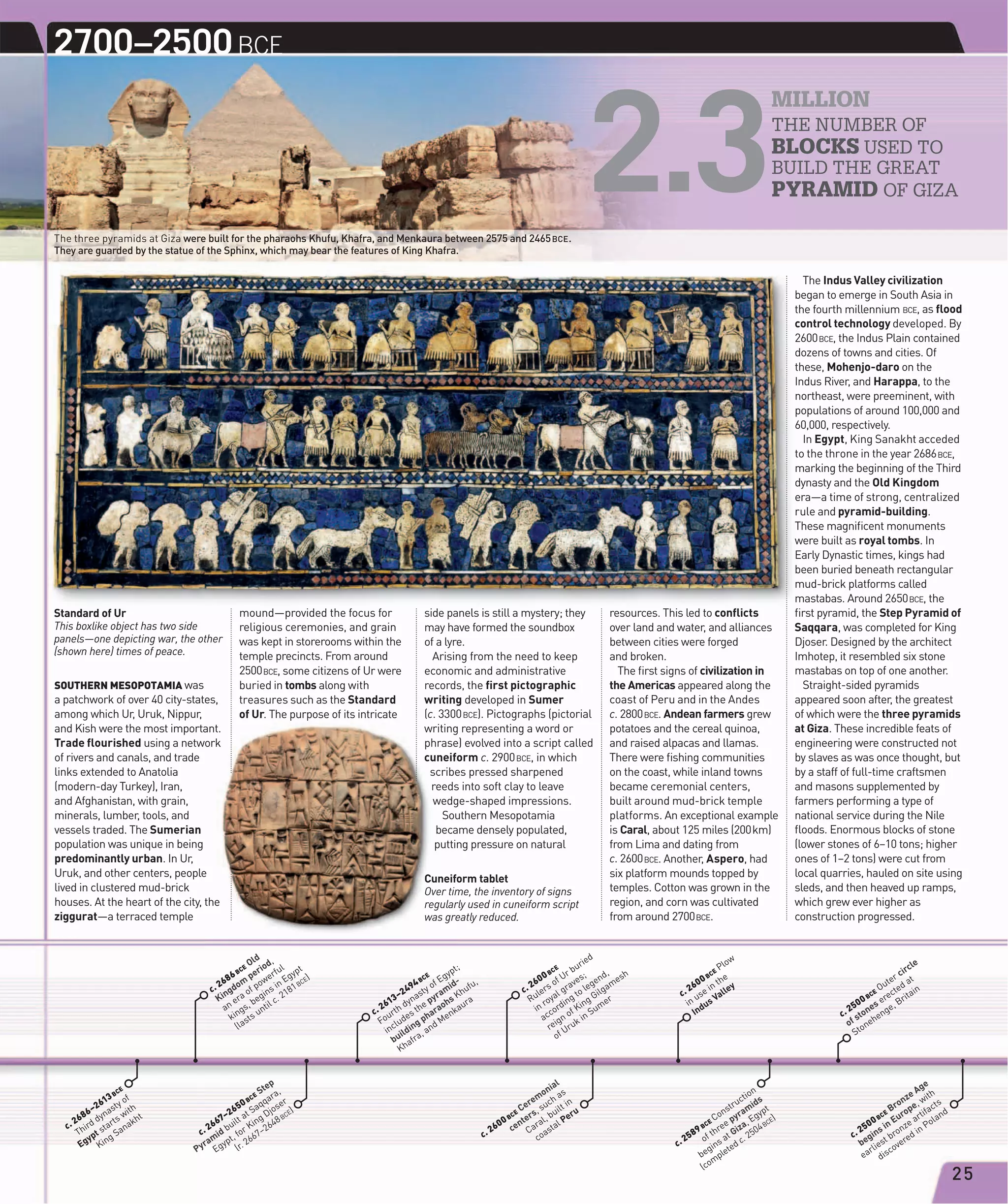
The three pyramids at Giza were built for the pharaohs Khufu, Khafra, and Menkaura between 2575 and 2465BCE.
They are guarded by the statue of the Sphinx, which may bear the features of King Khafra.
SOUTHERN MESOPOTAMIA was
a patchwork of over 40 city-states,
among which Ur, Uruk, Nippur,
and Kish were the most important.
Trade flourished using a network
of rivers and canals, and trade
links extended to Anatolia
(modern-day Turkey), Iran,
and Afghanistan, with grain,
minerals, lumber, tools, and
vessels traded. The Sumerian
population was unique in being
predominantly urban. In Ur,
Uruk, and other centers, people
lived in clustered mud-brick
houses. At the heart of the city, the
ziggurat—a terraced temple
mound—provided the focus for
religious ceremonies, and grain
was kept in storerooms within the
temple precincts. From around
2500BCE, some citizens of Ur were
buried in tombs along with
treasures such as the Standard
of Ur. The purpose of its intricate
resources. This led to conflicts
over land and water, and alliances
between cities were forged
and broken.
The first signs of civilization in
the Americas appeared along the
coast of Peru and in the Andes
c. 2800BCE. Andean farmers grew
potatoes and the cereal quinoa,
and raised alpacas and llamas.
There were fishing communities
on the coast, while inland towns
became ceremonial centers,
built around mud-brick temple
platforms. An exceptional example
is Caral, about 125 miles (200km)
from Lima and dating from
c. 2600BCE. Another, Aspero, had
six platform mounds topped by
temples. Cotton was grown in the
region, and corn was cultivated
from around 2700BCE.
2700–2500BCE
c. 2667–2650BCE
Step
Pyram
id built at Saqqara,
Egypt, for King Djoser
(r. 2667–2648BCE)
c. 2600BCE
Cerem
onial
centers, such as
Caral, built in
coastal Peru
c. 2500BCE
Bronze Age
begins in Europe, with
earliest bronze artifacts
discovered in Poland
c. 2589BCE
Construction
of three pyram
ids
begins at Giza, Egypt
(completed c. 2504BCE)
c. 2600BCE
Rulers of Ur buried
in royal graves;
according to legend,
reign of King Gilgam
esh
of Uruk in Sum
er
c. 2613–2494BCE
Fourth dynasty of Egypt;
includes the pyram
id-
building pharaohs Khufu,
Khafra, and Menkaura
c. 2686BCE
Old
Kingdom
period,
an era of powerful
kings, begins in Egypt
(lasts until c. 2181BCE)
c. 2600BCE
Plow
in use in the
Indus Valley
25
c. 2500BCE
Outer circle
of stones erected at
Stonehenge, Britain
Standard of Ur
This boxlike object has two side
panels—one depicting war, the other
(shown here) times of peace.
Cuneiform tablet
Over time, the inventory of signs
regularly used in cuneiform script
was greatly reduced.
side panels is still a mystery; they
may have formed the soundbox
of a lyre.
Arising from the need to keep
economic and administrative
records, the first pictographic
writing developed in Sumer
(c. 3300BCE). Pictographs (pictorial
writing representing a word or
phrase) evolved into a script called
cuneiform c. 2900BCE, in which
scribes pressed sharpened
reeds into soft clay to leave
wedge-shaped impressions.
Southern Mesopotamia
became densely populated,
putting pressure on natural
The Indus Valley civilization
began to emerge in South Asia in
the fourth millennium BCE, as flood
control technology developed. By
2600BCE, the Indus Plain contained
dozens of towns and cities. Of
these, Mohenjo-daro on the
Indus River, and Harappa, to the
northeast, were preeminent, with
populations of around 100,000 and
60,000, respectively.
In Egypt, King Sanakht acceded
to the throne in the year 2686BCE,
marking the beginning of the Third
dynasty and the Old Kingdom
era—a time of strong, centralized
rule and pyramid-building.
These magnificent monuments
were built as royal tombs. In
Early Dynastic times, kings had
been buried beneath rectangular
mud-brick platforms called
mastabas. Around 2650BCE, the
first pyramid, the Step Pyramid of
Saqqara, was completed for King
Djoser. Designed by the architect
Imhotep, it resembled six stone
mastabas on top of one another.
Straight-sided pyramids
appeared soon after, the greatest
of which were the three pyramids
at Giza. These incredible feats of
engineering were constructed not
by slaves as was once thought, but
by a staff of full-time craftsmen
and masons supplemented by
farmers performing a type of
national service during the Nile
floods. Enormous blocks of stone
(lower stones of 6–10 tons; higher
ones of 1–2 tons) were cut from
local quarries, hauled on site using
sleds, and then heaved up ramps,
which grew ever higher as
construction progressed.
c. 2686–2613BCE
Third dynasty of
Egypt starts with
King Sanakht
2.3
MILLION
THE NUMBER OF
BLOCKS USED TO
BUILD THE GREAT
PYRAMID OF GIZA
26
2500–2350BCE 2350–2200BCE
c. 2334–2316BCE
Sargon of
Akkad conquers Sum
er
to create world’s
first em
pire
c. 2500BCE
Cerem
onial
centers, Aspero and
Kotosh, continue to be
built in coastal Peru
and the Andes
c. 2400BCE
All stones
erected at Stonehenge
cerem
onial com
plex in
southwest Britain
c. 2500BCE
Bell Beaker
culture spreads in Western
and Central Europe
c. 2500BCE
Old
Kingdom
Period
continues in Egypt
c. 2350BCE
Lugalzagesi
of Um
m
a unites
all Sum
er
c. 2345–2181BCE
Sixth dynasty
of Egypt founded
c. 2500BCE
Longshan
culture in China produces
pottery, bronze, and silk
c. 2500BCE
Bronze Age begins
in Central Europe
c. 2500BCE Ur a m
ajor
center ofm
anufacturing
c. 2500BCE
Mature
phase of Indus
civilization em
erges
c. 2500BCE
Ebla,
Mari, and other
cities in Syria and
the Levant em
erge
c. 2500BCE
Evidence of
long-distance trade
routes in South Am
erica
The ruined citadel of Mohenjo-daro was made up of various buildings. It was
built on a platform to guard against flooding of the Indus River.
Silbury Hill in Wiltshire, England, is one of the tallest man-made chalk mounds
in Europe. These mounds probably had a social or cultural function.
IN THE SECOND HALF OF THE 3RD
MILLENNIUM BCE, civilizations
continued to develop in western
Asia, Egypt, and and southern
Asia, and complex societies were
emerging in China, Europe, and
South America.
In southern Asia, the Indus
civilization (see 2700–2500BCE)
emerged in its mature form
around 2500BCE, stretching
1,060 miles (1,700km) from east
to west and 800 miles (1,300km)
from north to south. The region’s
prosperity was based on farming,
mining, crafts, and trade. More
than 100 sites have been
excavated, including the cities
of Mohenjo-daro, Harappa,
and Dholovira.
Mohenjo-daro and Harappa
were well-planned cities laid
out on a grid system. Each city
was protected by brick walls
and dominated by a citadel
overlooking a “lower town” of
public buildings and residential
town houses of one or two stories.
The residential areas
were seemingly
divided by industry,
grandson, Naram-Sin, extended
the empire, but it lasted for only
four generations before falling
to attacks. Sargon’s rule
established a practice of
statewide bureaucratic controls
and standardization in many
aspects of economic life.
In Egypt, this period saw a
weakening of the power of the
Old Kingdom rulers (see
2700–2500BCE), in favor of
regional governors called
nomarchs, who administered
different parts of the Nile valley
and delta. To the south of the first
cataract on the Nile, the kingdom
of Nubia also grew more
powerful. Nubia was centered
around the city of Kerma at the
third cataract. By the end of
the Sixth dynasty (c. 2184BCE),
A NEW POWER AROSE IN
MESOPOTAMIA c. 2334BCE, King
Sargon (c. 2334–2215BCE) from
the northern region of Akkad
defeated Lugalzagesi of Umma to
become the ruler of Sumer.
Through subsequent campaigns
to the Levant, Syria, and Anatolia,
Sargon carved out the world’s first
empire—the Akkadian Empire—
stretching from the eastern
Mediterranean to the Gulf.
Sargon’s exploits were recorded
in several documents, such as the
Sumerian King List. His name
means “legitimate king,” which
led some scholars to believe that
he took power through force.
Sargon spoke Akkadian, a
Semitic language that replaced
Sumerian as the official
language of the empire.such as pottery, bead-making,
and metalworking.
Indus cities and towns had the
most advanced plumbing system
in the ancient world, with enclosed
wells and covered drains. Latrines
emptied waste into drains, which
ran below the streets.
These urban centers were also
connected by extensive trade
links. Merchants
supplied craft
products from
the valleys to
Indus civilization
Excavations suggest that the Indus
civilization covered an area far larger than
Mesopotamia and Egypt combined.
Agrarian lives
A clay model of
a bullock cart
found at Mohenjo-
daro, dating back to
c. 2500–1900BCE, gives
an insight into farming
life in the Indus
civilization.
Bronze-working had begun
in West Asia c. 3200BCE (see
10,000–3000BCE). It was
developed by the Únětice
culture of Bohemia and
Poland c. 2500BCE, and
200 years later had
spread to Italy and the
Balkans. Bronze
provided a hard metal
for forging armor,
weapons, and tools
such as this hand ax.
The bronze industry
also increased trade,
making Europe more
interconnected than
ever before.
the surrounding regions in return
for metal ores, precious stones,
and timber. Long-distance trade
routes reached as far as
Mesopotamia and Afghanistan.
By around 2500BCE, an Indus
script of hundreds of signs
appeared on seals and pottery.
Attempts to decipher the script
have failed; hence, many aspects
of this culture remain a mystery.
In western Asia, Mesopotamia
(see 2700–2500BCE) remained a
patchwork of small but powerful
city-states, each controlling the
surrounding farmlands where
barley, legumes, and date palms
were grown. To the west, city-
states were developing in Syria
and the Levant. A trade network
linking Mesopotamian towns
suggests cooperation between
states, but there was frequent
warfare as well.
BRONZE AGE EUROPE
Akkadian rule was enforced
through regional governors who
collected tributes and taxes. The
empire’s weakness lay in its lack
of defensible borders, and it
came under regular attacks from
neighboring hill tribes. Sargon’s
Lugalzagesi, king of Sumer,
defeated by Sargon c. 2316BCE
,,UNDER HIM
ALL COUNTRIES
LAY [CONTENTED]
IN THEIR
MEADOWS,AND
THE LAND
REJOICED. ,,
one-piece
cart wheel
c. 2500BCE
Indus
script em
erges
c. 2400BCE
Eannatum
of Lagash rules
areas of Sum
er
Zone of urban civilization
Urban centers
Modern coastline
KEY
Dholavira
Mohenjo-daro
Harappa
Kalibangan
Chanhu-daro
Lothal
Banawali
Kuntasi
Nausharo
Rakhighari
Ropar
Shortughai
Sutkagen-dor
Persian Gulf
Arabian
Sea
IndusIndus
Iranian
Plateau
Mountains
Zagros
H i m a l a y a s
IndusValley
the authority of the Egyptian
rulers had steadily eroded.
In Western Europe, the Bell
Beaker culture flourished.
Named after the distinctive shape
of pottery vessels found in
graves, this culture emerged by
c. 2600BCE in France, Spain, and
the Netherlands. Over the next
three centuries, it spread to
Germany and Britain. Around
2300BCE, bronze technology
from Mediterranean regions and
from Central Europe started
to spread northward
along the Rhine and
Danube. The
increasingly
militaristic societies
used bronze to create
weapons, triggering
the appearance of
small chiefdoms
across Europe.
As populations grew,
competition over land
and resources
intensified. Fields were
enclosed, farming
expanded, and boundary
walls built. Imposing
structures such as chalk
mounds were constructed
in many areas.
In South America,
societies continued to
develop in two distinct
regions: the upland valleys
and high plains of the Andes,
2200–2000BCE
c.2205BCE
Xia dynasty founded
in eastern China by Yu the
Great, according to Chinese
tradition; said to have
ruled until 1766
c. 2300BCE
Bronze Age
begins in southern Europe,
in Italy and the Balkans
2278–2184BCE
Reign
of Pepy II of the Sixth
dynasty in Egypt
27
c. 2150BCE
Gutians defeat
Akkadians; city-states of
Mesopotam
ia, such as
Lagash, reassert
independence
2112–2095BCE
Reign of
Ur-Nam
m
u of Ur reunites
m
uch of Mesopotam
ia;
rebuilds Ur’s tem
ple
as a ziggurat
c.2040BCE
Mentuhotep founds
a new
capital at Itj-Towy
near Memphis; Middle
Kingdom
begins
c. 2050 Em
ergence of
the Minoan palace
civilization, Crete
c. 2150BCE
Nubian
kingdom
em
erges south
of Egypt, based at Kerm
a
on Third Cataract of Nile
2112BCE
Third Dynasty
of Ur, founded by
Ur-Nam
m
u (to 2004BCE)
c. 2181BCE First
Interm
ediate Period
begins in Egypt (to
2040 BCE)
c. 2181BCE
Sixth dynasty
and Old Kingdom
period
ends in Egypt after natural
disasters weaken authority
of ruler
2004BCE City of Ur falls
to Elamites, ending
dynasty of Ur
c. 2040BCE
Nebhepetre Mentuhotep
of Thebes defeats rivals
to unite Egypt
Relief sculptures in Egyptian tombs represented everyday life and religious rituals. This carving from
the Sixth dynasty shows boys with sticks, on the left, and youths wrestling, on the right.
been found to confirm the
existence of a centralized state
in China at this time.
By the end of the 3rd millennium,
Europe’s first civilization was
emerging on the Mediterranean
island of Crete, which lay at the
heart of Mediterranean trade
routes. Known as the Minoan
civilization, it grew prosperous
through trade and farming.
Cretan farmlands produced wheat,
olives, wine, and wool, which could
be easily transported by sea. The
Minoans also made bronzework,
pottery, and dyes for export. By
2000BCE, Crete was home to
several small kingdoms.
THE MOUNTAIN PEOPLE OF
GUTIUM ATTACKED the Akkadian
Empire c. 2150BCE. Sumerian
states such as Kish, Ur, and
Lagash took the opportunity to
reassert their independence.
For the next 80 years, the
city-states vied for control in
Mesopotamia. In 2112BCE, Ur
under Ur-Nammu (r. 2112–
2095BCE) gained ascendancy. The
armies of Ur overran eastern
Mesopotamia and Elam, and
regained much of
Sargon’s empire.
Ur-Nammu founded the
Third dynasty of Ur,
which witnessed a
revival of Sumerian
power, as well as an
artistic and cultural
renaissance. Sumerian
scholars devised a method of
counting, based on units of
60. This system is reflected
in our modern division of
hours into 60 minutes,
minutes into 60 seconds,
and a circle into 360
degrees.
Ur-Nammu also
commissioned the first
ziggurat in Ur—an imposing
stepped platform topped
with a temple. The ziggurats
later became a characteristic
of ancient western Asian
architecture.
In c. 2181BCE, Egypt’s Old
Kingdom collapsed following
a series of natural disasters,
including famine. This
undermined the authority of
the king, who was believed to
secure the annual floods that
brought fertility to the Nile
valley. The rule of
Memphis, the capital city
of the Old Kingdom, was
overthrown as nomarchs and
nobles seized control of the
provinces. This ushered in a
time of unrest called the First
Intermediate Period, the first
of the three eras of uncertainty
in Egyptian history. For 140
years, kingdoms such as
Herakleopolis in central Egypt
vied for control with Thebes
in the south. In c. 2040BCE,
the Theban ruler Nebhepetre
Mentuhotep defeated his
rivals and united Egypt once
more, beginning the start of
what came to be known as the
Middle Kingdom.
In China, the Neolithic
Longshan culture (see 3200 BCE)
continued to develop along the
Yellow River in Shandong
province. According to Chinese
historical tradition, the first
dynasty, Xia (Hsia), was founded
by Yu the Great. However, no
archaeological evidence has
Akkadian warrior king
This bronze cast of an Akkadian
ruler may depict Sargon I or his
grandson, Naram-Sin, who
extended Sargon’s empire.
Longshan pottery
This elegant pottery tripod
pitcher has tapering legs
and swirling patterns,
characteristic of
the Longshan
culture.
and along the Pacific coast and
inland valleys. Andean cultures
were based on farming and
herding. Coastal settlements
such as Aspero (Peru) were
unique in their dependence on
fishing rather than on agriculture.
The coastal people grew cotton for
textiles, and gourds, which were
used as fishing floats.
100THOUSAND
THE LIKELY
POPULATION
OF UR c.2100
28
Prehistory
Pictograms
Pictures painted on walls
of caves up to 25,000
years ago are considered
a precursor to writing,
recording information
that could then be
understood by others.
8th century BCE
The Greek alphabet
The first alphabets, using
only consonants, develop
in the Levant by c. 1150BCE.
They include the Phoenician
alphabet, which spreads to
the Greeks through trade,
who add vowels.
100
The Roman alphabet
The Romans adapt the
Greek script to write Latin.
Through the Roman Empire,
this alphabet spreads across
Europe and is used for
personal as well as official
correspondence.
c. 3200BCE
Egyptian hieroglyphs
Egyptian writing develops
100 years after cuneiform.
This script begins as a form
of picture writing, and
includes signs for words and
also sounds. It remains in
use until the 4th century CE.
3300BCE
Cuneiform
The first true written
script is developed by the
Sumerians of Mesopotamia.
Writing with a reed stylus
creates a wedge-shaped
impression on tablets of wet
clay, which then dry hard.
c. 1900BCE
Chinese writing
The first surviving Chinese
writing appears on oracle
bones, used in divination.
This ancient script is still
in use today. Chinese script
involves 50,000 characters
that stand for words.
c. 6th century BCE
Parchment
Made from dried and
processed animal skins,
parchment becomes a
popular medium for writing
around the 6th centuryBCE,
taking over from papyrus, a
paper made from reeds.
Cave images by Anasazi Indians
Chinese paper scroll
Chinese
parchment scroll
Greek wax tablet
Mesopotamian tablet
3000–700 BCE EARLY CIVILIZATIONS
Egyptian hieroglyphic and hieratic script
This ancient Egyptian papyrus manuscript shows two forms of
Egyptian writing: hieratic script (left) and hieroglyphic script
(right) above the two figures. Hieroglyphic is an elaborate script
in which signs take a highly pictorial form, while hieratic is a
simplified version of hieroglyphic for ease of speed and writing.
hieratic script reads
from right to left
papyrus, made
by pressing
together layers
of strips of reed
hieroglyphs
are picture
symbols
illustration shows a
priest making an offering
to the god Osiris
29
THE STORY OF
WRITINGFROM CAVE PAINTINGS TO THE DIGITAL AGE, WRITING IN ITS VARIOUS FORMS HAS ALWAYS BEEN AN IMPORTANT PART OF OUR CIVILIZATION
Some scholars think that prehistoric cave paintings
featuring images and symbols constitute a form of
writing. The first true script was developed by the
Sumerians of Mesopotamia (now Iraq) around
3300BCE. Soon, a number of different ancient
cultures had developed writing, usually to keep
economic records or keep track of time. As writing
developed, it was commonly used to reinforce the
authority of rulers. Many early texts, including
monumental ones in stone, glorify the deeds of
kings and attribute their success to divine approval.
Writing systems can be divided into three types,
according to the function of the signs used:
logographic, syllabic, and alphabetic. However,
some scripts make use of two types of signs. In
logographic scripts, each sign stands for a whole
word; Chinese writing is an example, although it
also uses syllabic signs. The drawback is that a very
large number of symbols are needed (Chinese has
50,000 characters). In syllabic scripts, signs stand
for syllables. A smaller but still large number of
signs are needed—700 in Babylonian cuneiform.
In alphabetic scripts, each sign stands for a sound.
Far fewer symbols are needed—usually around 26.
The first alphabets developed in the Levant between
1450 and 1150BCE. For years, the spread of writing
was limited by the labor involved in hand-copying
texts, but this changed with the invention of
printing. In the late 20th century, writing became
electronic with the invention of word processors.
In the 1990s, the spread of information was again
revolutionized by the arrival of the Internet.
The development of writing was an amazing breakthrough, as it allowed
people to communicate over distance and record information for posterity.
Writing evolved separately in different cultures: in Mesopotamia, Egypt, and
the Indus Valley before 2500BCE and later in Crete, China, and Mesoamerica.
Pictograms, or picture signs, are an ancient form
of communication. Some scholars do not consider
pictograms to be “true” writing, since the symbols
do not convey the sounds of words in any language.
For example, the pictures above—from a house
in Roman Pompeii dating to 79CE, and a modern
sign—convey the same warning. The symbol
can be read in any language—for instance, as
canis, chien, Hund, or dog. Those words convey
the same idea but reproduce the sounds of different
languages—Latin, French, German, and English.
Pictograms have limited use but remain
widespread, appearing, for example, on street
signs, maps, and clothes labels.
PICTOGRAPHIC SYMBOLS
Roman mosaic Modern sign
7th century
Arabic script
The Arabic alphabet is
used to write down the
Qur’an, the holy book
of Islam. Its use spreads
with the Islamic faith to
become one of the world’s
most widely used scripts.
c. 1450
Invention of printing
In medieval times, the laboriousness
of copying by hand limits the
spread of writing. The invention
of printing using movable type
makes writing far more accessible.
In 1500, an estimated 35,000 texts
are in print.
1884
The fountain pen
The first practical fountain
pen is produced by American
inventor L. E. Waterman,
and quickly replaces the
quill pen. Ballpoints,
invented by László Bíró,
are in use by the 1940s.
1990–present
Text messaging
In the 1990s, the first text
messages are sent via mobile
phones. Texting becomes very
popular in the 2000s. In 2009,
more than 1.5 trillion
text messages
are sent.
4th century
The codex
The codex, or manuscript
in book form, gradually
supersedes the roll of
parchment. Originally
developed by the Romans,
the use of codices spreads
with the Christian religion.
7th–9th centuries
Illuminated manuscripts
In early medieval times, the
use of writing spreads through
the copying of Christian texts.
Illuminated manuscripts are
highly decorative, with ornate
capital letters and marginal
illustrations.
1867–1868
The typewriter
American inventor Christopher
Latham Sholes helps to build
the first practical typewriter.
The patent is sold to
Remington, which puts
the first typewriters
on sale in 1874.
1965
Writing enters the digital age
In the mid-1960s, the first
electronic messages (emails)
are sent from one computer to
another. Emails become popular
with the spread of personal
computers in the 1980s.
Book of Durrow
The Remington
Model I
Medieval
Qur’an
Waterman
fountain pen Smartphone
THE STORY OF WRITING
Ancient texts in the digital world
Nowadays, ancient texts can be viewed digitally.
Here, a student examines a digitized page of the Codex
Sinaiticus, handwritten in Greek over 1,600 years ago.
30
Egyptian hieroglyphics involved the use of pictorial signs. This example
is from a coffin from the Middle Kingdom period.
THE MINOAN CIVILIZATION, named
after the legendary King Minos,
flourished on the Aegean island
of Crete in the early 2nd
millennium, reaching its peak
between 2000 and 1600BCE. It is
thought that Crete’s prosperity
was based on the export of
pottery, gold, and bronze, as well
as possibly grain, wine, and oil,
to Egypt, Cyprus, and Palestine.
The Minoans established colonies
in many parts of the Aegean,
including the islands of Kythera,
Thera, Melos, and Rhodes, and at
Miletos on the Turkish mainland.
The farmlands of Crete were
ruled from cities with central
palaces that housed workshops,
IN CHINA, THE SHANG
CIVILIZATION developed along
the Yellow River by 1850BCE.
According to legend, China’s first
dynasty was the Xia, but current
archaeological evidence points
to Shang as the first dynasty.
At Erlitou in Henan province,
archaeologists have uncovered
a palace complex built on a
the administration, religious
facilities, and state storerooms.
Those at Knossos, Phaestos,
Mallia, and Zakros were
particularly impressive, judging by
their remains. Around 1700BCE,
these palaces were burned down,
and only Knossos was rebuilt, on
a more magnificent scale than
before, suggesting its dominance
over the entire island. The palace
was five stories high, with rooms
opening onto inner courtyards.
This mazelike complex is thought
to have given rise to the labyrinth
in the legend of the Minotaur, a
bull-headed monster.
Bulls certainly featured in
Minoan ceremonies. The deities
worshipped in Minoan shrines
seem to have been female, with
a goddess of nature being the
most popular. However, details of
Minoan culture remain obscure,
since the Minoan scripts, known as
Cretan hieroglyphic and Linear A,
have yet to be deciphered.
In Egypt, King Mentuhotep
had reunited the country at the
end of the 3rd millennium (see
2350–2000BCE). Yet the second of
Egypt’s eras of strong, centralized
rule only began with the reign of
Amenemhet I, from about
1985BCE, during the Middle
Kingdom. In 1965BCE, his
successor Senwosret I conquered
the land of Nubia to the south,
Charging bull
Minoan rituals included a bull-leaping
ceremony, in which athletes grasped
the bull’s horns and vaulted over
its back.This Knossos fresco dates
back to c. 1500BCE.
Shang bronze
This bronze plate was found at
Erlitou, and is of the Xia period. It is
inlaid with turquoise mosaic, believed
to represent a dragon’s scales.
2000–1850BCE
c. 2000–1600BCE
Minoan civilization of
Crete reaches height
1960BCE
Senwosret I
of Egypt defeats Nubia and
extends his kingdom
as far as
second cataract on Nile
c. 1984BCE
Founding of
first dynasty of Babylon c. 1900–1700BCE
Indus civilization
declines; cities
gradually abandoned
c. 1900BCE
City
of Erlitou constructed
around Yellow
River, China
c. 2000–
1750BCE
Arctic Sm
all Tools
population, ancestors
of the Inuit, spread from
Alaska across Canada to
settle Greenland 1813–1781BCE Reign of
Shamshi-Adad; conquers
northern Mesopotamia to establish
Kingdom
of Upper Mesopotam
ia,
with its capital at Shubat-Enlil
c. 2000BCE City
of Ashur becom
es
dom
inant in northern
Mesopotam
ia
c. 1985–1955BCE
King Am
enem
het I brings
stability to Egypt during
Middle Kingdom
period
c. 1965–1920BCE
Reign of Senwosret I
of Egypt
extending Egypt’s borders as far
as the second cataract of the Nile.
Nubia yielded gold, copper, and
slaves to swell the ranks of
Egypt’s army. Around a century
later, Senwosret III also made
Levant a vassal state of Egypt.
Middle-Kingdom Egypt was
more democratic than it was
during the Old Kingdom period.
Rulers presented themselves as
shepherds of the state rather than
absolute monarchs. The process
of mummification, once confined
to kings, was now permitted for
ordinary citizens. In order to
preserve it as a permanent home
for the spirit, the body was dried
in natron salt, its vital organs were
removed, and it was stuffed with
linen and wrapped in bandages.
40THE NUMBER
OF DAYS IT
TOOK TO
MUMMIFY
A BODY
20,000THE NUMBER
OF CLAY
TABLETS SO
FAR FOUND
AT MARI
c. 1900BCE Towns and
sm
all kingdom
s
developing in Anatolia
c. 2000BCE Corn, beans,
and squash cultivated
in southwestern North
Am
erica; long-distance
trade routes in place
1850–1790BCE
Shang China
The middle course of the Yellow River
was the heartland of the Shang
civilization c. 1800–1100BCE. From
here, Shang influence, such as
bronze-working, spread elsewhere.
Sumerian hero
Tablets and stone carvings
from the Old Babylonian
period provide a record of
the Epic of Gilgamesh,
previously passed down
in the oral tradition.
Set in stone
Hammurabi’s code was inscribed on
stone pillars called stele. This stele
shows the god of justice Shamash
(left) dictating laws to the king.
WHEN THE ASSYRIAN KING
SHAMSHI-ADAD died in 1781BCE,
he was succeeded by his son
Ishme-Dagan. During his reign,
Assyria declined, allowing the
state of Babylon to come to the
fore. During the reign of Shamshi-
Adad, Babylon was probably a
vassal state of Assyria, but as
Assyria declined, King Hammurabi
of Babylon saw his chance to seize
a wider kingdom. From 1760BCE,
Hammurabi embarked on a series
of conquests, which made
Babylon the region’s foremost
state. Between 1763–1762BCE,
he defeated Elam to the east and
Larsa, which controlled Sumer, to
the south. In 1757–1755BCE, King
Hammurabi conquered much of
northern Mesopotamia and took
the city of Eshnunna after
diverting its water supply.
Hammurabi introduced the
Babylonian law code in the region
under his control. Its 282 laws
covered property, family, trade,
and business practices. The Law
Code of Hammurabi is famous
for punitive laws that meted out
punishments in the same
1790–1650BCE
c. 1800BCE
Cerem
onial
center of La Florida
built in Peru
c. 1725BCE
Middle Kingdom
in
Egypt torn by unrest;
start of Second Interm
ediate
Period (to c. 1540BCE)
c. 1750BCE Large
cerem
onial com
plex
of Sechin Alto
constructed in Peru
c. 1800BCE Shang
civilization begins
in China 1766BCE
Traditional
date for founding of
Shang dynasty by King
Tang, according to
Chinese history c. 1750BCE
Linear A
script com
es into
use in Crete
1792–1750BCE
Reign of Hammurabi
of Babylon; establishes
Babylonian Empire in
Mesopotamia and
promulgates a legal code for
use throughout his empire
31
platform of compressed earth.
They have also unearthed bronze
vessels. Evidence suggests that
many features that were to
characterize Chinese society later,
such as a strong bureaucracy
and the worship of ancestors,
date back to this time.
In southern Asia, the Indus
civilization, which had thrived
during the 3rd millennium (see
2500–2350BCE), went into a
decline by around 1800BCE.
Scholars believe that this was
partly caused by the changes in
the regimes of the rivers that
provided water for irrigation.
Cities seem to have been ravaged
by diseases such as cholera and
malaria. Trade with Mesopotamia
also declined. Meanwhile, new
crops such as millet and rice were
introduced. All these factors seem
to have led to a decline in urban
culture, characterized by writing
and a centralized bureaucracy, in
favor of a rural-based culture.
In South America, large-scale
cultivation was taking place along
the Pacific coast by about
1800BCE. Substantial settlements
such as El Paraíso and Sechin
Alto in Peru were dominated by
massive temple complexes.
Long-distance trade routes linked
coastal towns with communities
in Andean valleys to the east and
beyond. This allowed for the
spread of pottery from Colombia
to Peru by 1800BCE. Meanwhile,
in North America, crops such
as sunflowers and gourds began
to be cultivated in the east.
In Western Asia, the fall of the
Ur III Empire led to the rise of two
states—Assyria in the north and
Babylon in the southeast—which
were to dominate Mesopotamia
for the next 1,500 years. The first
dynasty of Babylon was established
measure as the crime committed
(“an eye for an eye”). However, it is
thought that the law code was
more of a moral statement of
principle than an enforced judicial
system. As such, the code bound
the powerful and wealthy as well
as ordinary people; the strong
were exhorted to refrain from
oppressing the weak.
in c. 1894BCE. In the north, the city
of Ashur became an important
trading center in the 20th century
BCE. In 1813BCE, it was taken over
by the Amorite king Shamshi-
Adad, who carved out a kingdom
in northern Mesopotamia. This
kingdom was a forerunner of the
Greater Assyrian Empire of the
9th century BCE (see 900–800BCE).
Clay tablets recovered from
Mari in central Mesopotamia hold
records of trade and tributes
levied by Assyria from vassal-
states. Writing from this period
included copies of the earliest
surviving work of literature,
The Epic of Gilgamesh.
Law Code of Hammurabi, king of Babylon
,,IF A MAN PUTS OUT THE EYE
OF AN EQUAL, HIS EYE SHALL
BE PUT OUT. ,,Yellow
Sea
Bo Hai
EastChinaSea
Anyang
Shang capital
1300–1027BCE
Xi’ang
Shang capital
1400–1300BCE
Shandon
g
H enan
Zhengzhou
Shang capital
1600–1400BCE
Luoyang
Huixian
Xingtai
Taixicun
Panlongcheng
Wucheng
Erlitou
A S I A
Yellow River
Huai River
Ya
ngtzeRiver
Area of Shang influence
Shang city
KEY
S
A
H
A
R
A
Mediterranean Sea
Ionian
S ea
Sicily
Crete
Sardinia
WILUSA
MIRA
MASA
LUKKA
SEHA
RIVER
LAND
MYCENAEAN
GREECE
ARZAWA
Pylos
Menelaion
Athens
Gla
ThebesOrchomenos
Tiryns
Mycenae
Knossos
Miletus
Apasa
Troy
to Central and
Northern Europe
to sub-Saharan Africa
A F R I C A
ANCIENT EMPIRESTHE BIRTH OF ADVANCED SOCIETIES
The exceptional agricultural productivity of the
Nile, Euphrates, Indus (see p.26), and Yellow (see
p.31) river valleys undoubtedly played a part in the
precocious emergence of civilizations in these
regions. So did international trade, which was also
important in the development of the first New
World civilizations. Trade also enabled many
neighboring societies to achieve prosperity:
through time they developed complex cultures
increasingly focused on urban centers, and came
into competition for resources and markets.
High-level diplomacy was essential to the smooth
operation of international trading networks and
to success in inter-state power struggles. Royal
letters found in the Egyptian capital, Akhetaten
(Amarna), provide a fascinating picture of relations
between the 14th-century BCE rulers of the rival
great states of the eastern Mediterranean.
In the 3rd millennium BCE, states emerged in Egypt, Mesopotamia, and the
Indus. Urban society was consolidated in Western Asia in the 2nd millennium,
and powerful states vied for control of lands; in contrast, in South Asia, towns
disappeared. Complex societies emerged in China and the Americas.
32
THE WORLD PICTURE
Urbanism and complex societies became more
widespread during the 2nd millennium BCE.
While they shared many features such as
trade, high agricultural productivity, dense
populations, and their managerial needs, urban
societies took many different forms. In the
Americas, large ceremonial complexes with
residential suburbs provided the focus for the
communities of the wider region, strongly
connected by shared religion and trade.
The importance of trade
Trade was essential to supply societies with the raw
materials and manufactured goods needed for daily life
(such as metals and lumber), for displaying status (such as
fine weaponry), or for embellishing religious monuments
and royal palaces (such as lapis lazuli). Trade also promoted
the spread of knowledge, technology, and ideas.
Advanced centers
This map shows
established and
emerging civilizations
in the later 2nd
millennium BCE.
Societies of farmers
and hunter-gatherers
occupied other
regions.
,,FOR A LONG TIME WE HAVE
HAD GOOD RELATIONS BETWEEN
US KINGS… ,,Babylonian king Burnaburiash II to Egyptian pharaoh Akhenaten,
from the Amarna letters, 14th centuryBCE
Chavín
Olmec
Shang
Mycenaeans
Egypt
Babylonia
KEY
Assyria
Hittites
Mitanni
Elam
Mycenaean Greece
Hittite Empire
Mitanni
Assyria
Kassite Babylonia
KEY
Elam
New Kingdom Egypt
Arzawa
Trade routes c.1350BCE
gold
silver
tin
copper
fine metalwork
fine pottery
textiles
TRADE COMMODITIES
timber
grain
ivory
ivory objects
perfumed oils
olive oil
wine
glass
faience objects
turquoise
murex dye
seashells
horses
weapons
3000–700 BCE EARLY CIVILIZATIONS
A r a b i a n
P e n i n s u l a
RedSea
Persian
Gulf
Black Sea
Cyprus
(Alashiya)
TUMMANNA
PALA
HAPALLA
KIZZUWATNA
TARHUNTASSA
KASKAS
ISUWA
NIYA
MUKISH
URUADRI
(URARTU)
SEALAND
DILMUN
UPPERLAND
Tigris
Euphrates
Nile
HITTITE
EMPIRE
EGYPT
ELAM
MITANNI ASSYRIA
BABYLONIA
Jerusalem
Ugarit Emar
Hazor
Arwad
Qadesh
Byblos
Tyre
Sidon
LabweSimurru
Tunip
Qatna
Kumida
Shechem
Gaza
Lachish
Sharuhen
Babylon
Dur-Kurigalzu
Ashur
ArbilNineveh
Memphis
Akhetaten
Thebes
to Afghanistan
to Punt
Nippur
Ur
Uruk
Washshukanni
Harran
Aleppo
Alalah
Carchemish
Liyan
Susa
Anshan
Hattusas
33
Old Kingdom c. 2686–2181BCE
Rulers exercised centralized control
and commanded impressive resources,
as shown by the pyramids at Giza.
Middle Kingdom c. 2040–1640BCE
Decorated tombs record prosperous life
under the stable 12th dynasty, but the
state disintegrated under later rulers.
New Kingdom c. 1550–1069BCE
Egypt reached its greatest power and
prosperity, conquering Nubia and the
Levant, and building several temples.
KINGDOMS OF ANCIENT EGYPT
The Nile Valley's exceptional agricultural
fertility promoted the early development
of urbanism in Egypt. Settlements clung
to the Nile delta and riverbanks, beyond
which lay arid desert. The great mineral
resources of the flanking desert regions
and Nubia, which included gold, were
important both for domestic use and to
support international trade.
MemphisGiza
Saqqara
Abydos
Elephantine
Nile
Sinai
Nile Delta
Eastern
Desert
S
A
H A R A
N U B I A N
D E S E R T
W
E S T E R N
D E S E R T
Mediterranean Sea
Red
Sea
LOWER
EGYPT
UPPER
EGYPT
NUBIA
SATJU
YAM
MEDJA
Cyprus
Memphis
Karnak
Waset (Thebes)
Itjtawy
Avaris
(Tell el-Dab’a)
capital
c.1650–1550 BCE
capital
c.1985–1650 BCE
capital
c.2055–1985 BCE
and c.1650–1550 BCE
Nile
Sinai
Eastern
Desert
S
A H A R A
W
E S T E R N
D E S E R T
N U B I A N
D E S E R T
Mediterranean Sea
Red
Sea
LOWER
EGYPT
UPPER
EGYPT
NUBIA
WAWAT
KUSH
Cyprus
Nile
Sinai
Eastern
Desert
S
A
H A R A
N U B I A N
D E S E R T
W
E S T E R N
D E S E R T
Mediterranean Sea
Red
Sea
LOWER
EGYPT
UPPER
EGYPT
NUBIA
KUSH
Cyprus
Waset (Thebes)
Akhetaten (Amarna)
Memphis
Per-Ramesse (Qantir)
Trade routes Capital cities
KEY
Chavín de
Huántar
Mycenae
Babylon
Memphis
Ashur
Susa
Anyang
Xi’ang
Zhengzhou
Hattusas
San
Lorenzo
A T L A N T I C
O C E A N
A T L A N T I C
O C E A N
I N D I A N
O C E A N
P A C I F I C
O C E A N
P A C I F I C
O C E A N
S A H A R A
S i b e r i a
34
Built over 300 years, the temple complex at Karnak, Egypt, includes the world’s
largest temple, dedicated to Amun-Re, the patron deity of the pharaohs.
The Hittites developed iron
smelting by c. 1500BCE. At
first, iron was used only in
luxury objects, such as in the
decoration of this box from
Acemhoyek. Later, as
technology developed, iron
was used to create superior
weapons. Though the Hittites
traded iron goods, they kept
this technology secret for
about 300 years. Around
1200BCE, ironworking spread
to Greece, and then to
Central Europe by c. 750BCE—
the dawn of the Iron Age.
IRON-WORKING
c. 1600BCE
Mycenaean
civilization em
erges on
the Greek m
ainlandc. 1650–1550BCE
Hyksos of the Levant
conquer Lower
Egypt during Second
Interm
ediate Period
c. 1500BCE
Evidence
of m
etalworking
in Peru
c. 1500BCE
Hittite Old
Kingdom
declines;
em
ergence of Hurrian
dynasty of Mitanni in
northern Mesopotam
ia
c. 1500BCE
Egyptians, Mitanni, and
New
Kingdom
Hittites
strive for control
of the Levant
c. 1500–1200BCE
Karnak tem
ple
com
plex at Thebes
constructed
c. 1500s–900BCE
Aryans from
southern
Russia m
igrate to
northern India
c. 1500BCE
Copper
worked in the
Sahara region
c. 1595BCE
Hittite king
Mursilis raids Babylon,
ending the em
pire
founded by Ham
m
urabi
c. 1650BCE
Hittites
establish Old Kingdom
in central Anatolia, with
Hattusas as its capital
c. 1628BCE
A volcano
on the Greek island of
Thera erupts violently,
burying Minoan settlements
on the island with ash
c. 1550sBCE
Theban king
Ahmose I drives Hyksos
from
Lower Egypt to reunite
Egypt; New
Kingdom
period begins
c. 1570sBCE
First Egyptian
pharaohs are buried in Valley
of the Kings near Thebes
AFTER HAMMURABI’S DEATH in
1750BCE, the Babylonian Empire
(see 1850–1790BCE) declined.
At the same time, other powers
were on the rise, such as the
Hurrians of Mitanni in Syria, and
the Hittites of Anatolia in Turkey.
By 1650BCE, the Hittites had
built an extensive kingdom in
central Anatolia, with its capital
at Hattusas. The Hittites had
developed advanced bronze- and
ironworking skills, and they were
also known to be fierce fighters.
In 1595BCE, the Hittite king
Mursilis (r. 1620–1590BCE) raided
Babylon and expanded his
empire. However, he was killed
soon after, and the empire shrank
back for about a century.
In Egypt, the Middle Kingdom
(see 2000–1850BCE) was waning
Egyptian religion was very
complex. Every village, town, and
district had its own patron deity. In
paintings and sculptures, many
deities were shown with animal
heads, representing their most
important attributes. For example,
the falcon god Horus protected
the king, while the ibis-
headed Thoth was the
patron god of scribes.
By 1600BCE, a
new civilization
emerged
on the Greek mainland. Its
people are now known as the
Mycenaeans, after the fortress-
palace of Mycenae, believed to be
the home of the mythical king
Agamemnon from Homer’s Iliad.
However, the Mycenaeans
IN c. 1550BCE, THE THEBAN KING
Ahmose I (r. 1550–1525BCE)
drove the Hyksos from Lower
Egypt, ushering in the third
period of settled rule in Egypt,
known as the New Kingdom
(c. 1550–1070BCE). During this
time, Egyptian rulers assumed
Mask
of gold
German
archaeologist
Heinrich
Schliemann found this
funerary mask at a grave
in Mycenae, and claimed it
belonged to King Agamemnon.
the title “pharaoh,” meaning
“great house.” A succession of
warrior kings campaigned to
expand Egypt’s boundaries
once more. Tuthmosis I
(r. 1504–1492BCE) drove the
Nubians back in the south and
recaptured Sinai and parts of
Syria and Palestine. Under
Tuthmosis III (r. 1479–1425BCE),
Egypt controlled a strip along the
Mediterranean coast and north of
the Euphrates (see p.33).
The conquered states paid huge
annual tributes to Egypt, a part of
which was spent building one of
the world’s largest religious sites
at Karnak and the impressive
mortuary temple of Queen
Hatshepsut (r. 1473–1458BCE).
1650–1550BCE 1550–1400BCE
by 1670BCE, partly due to erratic
floods in the Nile. As regional
governors became more
powerful, civil war broke out.
Outsiders soon took advantage
of the unrest. The Nubians
won back lands that the
Egyptians had taken earlier
(see 2000–1850BCE). In 1650BCE,
the Hyksos from the Levant
seized Lower Egypt, but
Upper Egypt remained under the
control of Egyptian kings.
2000THE NUMBER
OF NAMES FOR
GODS AND
GODDESSES
IN ANCIENT
EGYPT
Hattusas, the Hittite capital, was founded by Hattusalis I
in 1650BCE and destroyed in 1180BCE.
Man and beast
The Hittite Empire was known for its
bronze craftsmanship. Bronze
weapons and artifacts fetched a high
price. This statuette of a man and a
horse was probably a commission.
c. 1570BCE
Kassites of
Iran begin creation of
new
em
pire in Babylonia,
uniting the region
c. 1550BCE
Hittites develop
iron-sm
elting technology
Tutankhamun was buried with fabulous treasure. This detail from the
pharaoh’s throne shows him being anointed by his wife Ankhesenamun.
35
c. 1450BCE
Minoan
palaces on Crete
destroyed; Mycenaeans
take control of the island
m
id-1400sBCE
Lapita people
m
igrate eastward from
Melanesia to colonize
Pacific islands c. 1352–1336BCE
Reign of Am
enhotep IV; breaks
with Egypt’s old religion to
worship the sun-disk Aten and
takes the name Akhenaten
c. 1400sBCE
Bronze-
working spreads to
Vietnam
and Thailand
c. 1400BCE
Shang
capital m
oves from
Zhengzhou to Xi’ang
in China
c. 1450BCE
Mycenaean
trading network stretches
from
Sicily to the Levant
c. 1300sBCE
Hittite king
Suppilulium
as I (r. 1380–
1334BCE) briefly conquers
Syria, rivaling Egypt in size
m
id-1300sBCE
City of
Ashur breaks free from
Mitannian rule; rise of
Assyrian power
c. 1336–1327BCE
Brief reign of the boy-king
Tutankhamun; old Egyptian
religion restored and
Akhetaten abandoned
probably called themselves
Ahhiyawa. They had migrated
from the Balkans or Anatolia
about 500 years earlier. Their
lands were a patchwork of small
kingdoms, each later dominated
by a palace-citadel such as the
ones at Mycenae, Tiryns, and
Pylos. They spread their influence
through trade. After the collapse
of the Minoan Empire c. 1450BCE,
the Mycenaeans took over several
sites formerly occupied by the
Minoans, including Knossos.
After c. 1400BCE, they also took
over Minoan trade networks
and established settlements
on Rhodes, Kos, and the
Anatolian mainland.
The Mycenaeans
inherited Minoan arts
and crafts, adapting
the Linear A script
to write an early
form of Greek
known as the
Linear B script.
They were great
traders, and
ventured out to Sicily
and Italy. A ship
believed to be of
Canaanite origin,
wrecked off Uluburun on
the coast of Turkey, was
found to contain tin from Iran
or Afghanistan, copper and
pottery from Cyprus, ivory and
jewelry from Egypt, and
Mycenaean swords.
The late Bronze Age was a
time of unrest in Western Asia.
From 1550–1400BCE, there was
a struggle between various
powers in the region, including
the Hurrians, Hittites, Elamites,
Egyptians, and Kassites. In the
1570sBCE, the Kassites had
gained control of Babylon.
However, by 1450BCE, the Hittite
New Kingdom was growing
in influence, partly due to an
alliance with Egypt. Around this
time, the Mitanni dominated Syria,
but by the 1400s, the Hittites were
fighting for control of the region.
In China, the Shang civilization
(see 1850–1790BCE) flourished
around 1500BCE, with its rulers
dominating a large area of
central China. However, the
Shang had to regularly fend off
threats to their kingdom from
nomadic tribes to the north.
Shang capitals were surrounded
1400–1300BCE
by defensive walls. Kings and
nobles were buried in tombs,
which held fabulous grave goods.
The Shang capital moved several
times during this period. Shang
society was believed to be well
organized and extremely
hierarchical. Writing began
around 1900BCE. Most examples
of early writing took the form of
oracle bones, attesting to the
Shang rulers’ practice of
consulting their ancestors on
important decisions. Questions
concerning the future were
inscribed on the bone of an ox or
on a turtle shell, which was then
struck with a hot metal tool.
The way the bone cracked was
believed to provide the answer.
IN c. 1352BCE, AMENHOTEP IV,
a religious reformer, became
Egypt’s pharaoh. He broke with
the traditional religion, with its
pantheon of gods, and initiated
the worship of a single god, Aten,
or sun-disk. He changed his name
to Akhenaten, meaning “living
spirit of Aten,” and founded a new
capital between Thebes and
Memphis. He named it Akhetaten,
meaning “horizon of Aten.”
Akhenaten’s religious reforms
were believed to have been
unpopular, especially with the
influential priestly elite. After his
death in c. 1336 BCE, his son
Tutankhamun ascended the
throne at the age of nine. He
restored the old gods
and abandoned the new
capital. Tutankhamun is
believed to have died
under mysterious
circumstances at 18,
and was hastily buried
in a minor tomb. It was
thought for years that
Tutankhamun died of a
blow to the head, but
the latest evidence
suggests he died of
blood poisoning after
breaking his leg in a
chariot crash while out
hunting in the desert.
Sun worship
Akhenaten instituted the
worship of the sun-disk
Aten. In this relief carving
found at Akhetaten
(modern el-Amarna), he
is seen worshipping the
sun with his wife Nefertiti.
Since the 1570sBCE, Egypt’s
pharaohs had been buried in
rock-cut tombs in the Valley
of the Kings, on the west bank
of the Nile. Rulers hoped their
tombs would be safe from
robbers, but almost all the
tombs were robbed of their
rich goods. However, in 1922,
British archaeologist Howard
Carter found Tutankhamun’s
tomb virtually intact. The
shrine room had four gilded
shrines, holding the king’s
coffin and mummy with a solid
gold mask. The other rooms
contained jewelry, furniture,
golden statues, and musical
instruments.
Aegean civilizations
Around 1450BCE Mycenaean
influence spread throughout the
Aegean, including to several sites that
had been part of the Minoan Empire.
Aegean
Sea
Sea of
Marmara
Sea of Crete
Black Sea
Gulf of Corinth
Ionian
Sea
Mediterranean
Sea
Rhodes
Thera
Euboea
Sporades
Chios
Lesbos
Lemnos
Ionian
Islands
Cyclades
Phylakopi
Crete
Dodec
anese
Miletus
Knossos
Phaistos
Chania
Melos
Pylos
Vapheio
Menelaion
Argos
Mycenae
Tiryns
Dendra
Aegina
Athens
Gla
Thebes
Orchomenus
Iolcus
THESSALY
A n a t o l i a
M
ACEDONIA
Peloponnese
THRACE
Mycenaean site
Mycenaean major palace
KEY
36
The boulders used to make these walls, now in ruins, at Mycenae on the Greek
mainland were so huge, later civilizations believed they were built by giants.
The facade of the temple of Ramesses II at Abu Simbel features four colossal seated
statues of the pharaoh, but the statue second from left has crumbled.
TOWARD THE END OF THE 2ND
MILLENNIUM BCE, the eastern
Mediterranean and Western Asia
were a mosaic of empires, which
comprised Egypt, Babylonia, Elam,
Assyria, and the Hittites in Anatolia.
Borders fluctuated as each kingdom
strove to gain ascendancy over its
neighbors through conquest or
diplomacy. In war and peace, vital
trade routes, through which tin and
copper for bronze reached the
region, remained intact.
A frequent flashpoint for conflict
was the Levant (modern Syria and
Lebanon), which Egypt had lost to
the Hittites following the reign
of Akhenaten (see 1350BCE). In the
13th century BCE, Pharaoh Seti I and
his son Ramesses II campaigned
to win it back. Ramesses’ 67-year
reign (r. 1279–1213BCE) was
Ancient propaganda
A detail from the temple
of Ramesses II at Abu
Simbel shows the king
firing an arrow, taking
on the Hittite army
single-handed at the
Battle of Qadesh.
BETWEEN 1250 AND ABOUT 1050
BCE, many of the powers that
had dominated Western Asia for
centuries went into decline, and
some disappeared altogether. The
eastern Mediterranean entered
a time of turmoil, and many
coastal cities were laid waste by
unknown invaders—written
records of the period give few
clues as to their identity. First to
succumb were the Hittites, whose
capital Hattusas was sacked
and abandoned c. 1200BCE.
By c. 1180BCE, Hittite possessions
in the Levant were lost and the
empire fragmented.
These conflicts were most likely
instigated by the waves of migrants
known collectively as the Sea
Peoples. These warlike peoples
came from many different areas,
including Sicily, Sardinia, Greece,
Libya, and Anatolia. Whatever
their origins, their movements
through the eastern Mediterranean
in c. 1200–1100BCE led to attacks
on Cyprus, Egypt, Anatolia, and
Canaan and Syria in the Levant.
In 1178BCE, the Egyptian pharaoh
Ramesses III drove the Sea
Peoples from Lower Egypt, but
1300–1200BCE 1200–1100BCE
c. 1200BCE
States
in the Levant
raided by the
Sea Peoplesc. 1300BCE Urnfield
culture em
erges in
m
iddle Danube
region
c. 1274BCE Egyptians and
Hittites fight at the Battle
of Qadesh
c. 1200BCE Hittite capital
of Hattusas destroyed c. 1150BCE
Mycenaean defenses
strengthened, indicating
fear of attack
c. 1300–1000BCE
Farm
ers and pastoralists
spread through the
Ganges Basin in
northern India
c. 1200BCE Chavín
culture em
erges in the
Peruvian Andes
c. 1184BCE Reign of
Ram
esses III, Egypt’s
last great pharaoh,
starts (to 1153BCE)
1279BCE
Start of reign
of Ram
esses II in Egypt
(to 1213BCE)
c. 1200BCE Olm
ec culture
em
erges in Mexico
c. 1180BCE Hittite
Em
pire collapses
,,THEY CAME BOLDLY
SAILING IN THEIR WARSHIPS
FROM THE MIDST OF THE
SEA, NONE BEING ABLE TO
WITHSTAND THEM… ,,
could not prevent them from
colonizing the Levant.
Around 1200BCE, the
Mycenaean kingdoms entered a
time of upheaval, a result of both
internal disintegration and
external threats. The defenses of
many Mycenean palaces were
strengthened. Records at Pylos
show the inhabitants feared attack
from the sea. By 1100BCE, most of
the Mycenaean palaces had been
sacked and abandoned. This
triggered the so-called Dark Age
of Greece, when writing fell out of
use, not to be reintroduced until
the Homeric age (see 800BCE).
In the late Bronze Age, parts of
Europe came to be dominated by
the Urnfield Culture—named
after the practice of cremating the
dead and burying the remains in
funerary urns, sometimes
accompanied by rich grave goods.
This culture originated in the
Danube region in 1300BCE, and
spread to Italy and central and
eastern Europe in the following
centuries.
Between 1200 and 700BCE iron
technology spread northward
from Greece to Central Europe.
the most famous was
the Battle of Qadesh
(c. 1274BCE). Although
Ramesses claimed
victory at Qadesh, the
battle is believed to
have been inconclusive,
and the Hittites held on
to the region.
In 1259BCE, after
further campaigns in
Syria, Ramesses tried
a different tactic, and
negotiated a pioneering peace
treaty with the new Hittite king,
Hattusilis III. Ramesses also took
two Hittite princesses in marriage
(he had about seven wives in total).
Following the treaty, Ramesses
kept up a friendly correspondence
with the Hittite ruler, which was
recorded on clay tablets in
Akkadian cuneiform script.
Ramesses also embarked
on an extensive program of
monument-building. On Egypt’s
southern border with Nubia, he
constructed the magnificent
temple of Abu Simbel. He founded
a new capital at Per-Ramesses in
Lower Egypt, although Thebes in
Upper Egypt remained an
important center. West of Thebes
he built a vast mortuary temple,
which doubled as a palace, court,
and center of learning.
The late 2nd millennium BCE
saw the resurgence of Ashur,
in what is now called the Middle
Assyrian Empire (1350–
1000BCE). Following the death of
Shamshi-Adad in 1781BCE (see
1850BCE), Ashur had become
a vassal first of Babylon, then
of Mitanni. A revival of Ashur’s
fortunes began under Ashur-
uballit I (r. 1363–1328BCE), who
broke free of Mitannian rule and
carved out a kingdom in northern
Iraq. His later successors,
Shalmaneser I and Tukulti-
Ninurta I, continued to gain
territory, expanding the kingdom’s
borders west to conquer eastern
Mitanni and briefly, from 1225–
1216BCE, southeast to Babylonia.
In the Aegean, the Mycenaean
palace-kingdoms of the Greek
mainland continued to thrive.
a time of stability and prosperity
for Egypt. Through a combination
of war, diplomacy, and strategic
marriage, Ramesses sought
to extend Egyptian influence to
Western Asia. In the 1270sBCE, he
fought a series of wars with the
Hittite king, Muwattalis II, of which An inscription by Ramesses II (r. 1279–1213), referring to the Sea Peoples
Inscription commemorating the
victory of Ramesses II at Qadesh
,,YOU ARE A
GREAT WARRIOR
WITHOUT EQUAL,
VICTORIOUS IN
SIGHT OF THE
WHOLEWORLD. ,,
Stone warrior
Monumental carvings from temples
at Cerro Sechin on the Peruvian
coast show warriors, torture victims,
and human sacrifices.
THE CLOSE OF THE 2ND MILLENNIUM
SAW MAJOR CHANGES in the
power politics of West Asia.
In 1070BCE, the Egyptian New
Kingdom ended and Egypt
entered a time of unrest called
the Third Intermediate Period,
which lasted until 747BCE (see
800–700BCE). Historians believe
that the power of the pharaohs
had been eroded by a priestly elite
who had gained control of many
areas. By 1000BCE, all of the
territories won by New Kingdom
pharaohs had been lost.
In Mesopotamia, there were
frequent wars between the
Babylonians, Assyrians, and
Elamites; the region was also
subjected to devastating raids by
Aramaean nomads from the west.
Meanwhile, other powers were
rising in the region. A Semitic-
speaking people, who called
themselves Canaanites, had
inhabited the Levant for centuries,
living in city-states that controlled
the surrounding territory. They
were skilled seafarers and played
a major role in international trade.
By 1100BCE, Canaanite port cities
such as Arwad, Byblos, Tyre, and
Sidon were expanding their
operations, establishing trading
posts and colonies throughout the
eastern Mediterranean. They
traded cedarwood from Lebanon,
glass- and ivory-ware, metal ores,
and, most important, an expensive
purple dye made from murex
shellfish. It was this luxury
commodity that caused them to
be known by their more familiar
Greek name, the Phoenicians,
after phoinix, Greek for “purple.”
In China, a new dynasty replaced
the Shang in 1027BCE, when King
Wu of the Zhou defeated the last
Shang ruler, Di-Xin. The Zhou
dynasty was to rule China for
700 years. This long era is usually
divided into two periods: the
Western and Eastern Zhou.
During the first era, the Zhou capital
was Zongzhou. This was a time
of prosperity and strong central
control. Zhou territory was divided
into fiefs held by trusted noblemen,
in return for military allegiance.
But many aspects of Chinese
tradition already present in the
Shang period continued in the Zhou,
including ancestor worship and the
use of oracle bones for divination.
Meanwhile, in Japan, the Jomon
culture, named after the cord
patterns (jomon) that decorate its
pottery, continued. The Jomon
people were still hunter-gatherers,
albeit prosperous and sedentary.
In northern India, small groups
of nomadic pastoralists had been
migrating into the Ganges basin
from Central
Asia since
the 1500sBCE.
By the
1100sBCE, most
had begun to
settle and cultivate
crops. They spoke
Sanskrit, which became
the language of early Indian
1100–1000BCE
1027BCE
King Wu
claim
s Shang king has
forfeited Mandate of
Heaven to rule
c. 1000BCE
Phoenicians establish
colonies and ports around
the Mediterranean
c. 1100BCE Mycenaean
period ends and Dark
Age of Greece begins
1069BCE Start of
Third Interm
ediate
Period in Egypt
1006BCE David succeeds
Saul as king of the
Hebrews (Israelites)
37
Iron rapidly replaced bronze in
tools and weapons, signaling the
end of the Bronze Age.
In Mesoamerica, the region’s
first great civilization, the Olmec,
was emerging in the lowlands of
Mexico’s southern Gulf coast. The
Olmecs built ceremonial centers,
including San Lorenzo, constructed
temples and houses on earthen
mounds, and carved huge stone
heads clad in helmets. They also
established long-distance trade
routes. Meanwhile, other cultures
were emerging, such as at Cerro
Sechin, in what is now Peru.
Mark of a culture
In this example of late-Jomon
pottery, the bowl and stand bear
the distinctive rope patterns that
give the Jomon period its name.
sacred writings. Sanskrit, an Indo-
European language related to
Iranian and almost all European
languages, is also the ancestor
of modern languages such as
Hindi and Urdu.
Sacred writings called the
Vedas were transmitted orally
in Sanskrit for many centuries.
Although the Vedas are largely
religious writings and hymns,
the geographical information that
they contain not only describes
the gradual spread of farmers
and pastoralists from the Punjab
to the Ganges basin, but also
gives some information about
conflicts with other groups, and
local life at the time. For example,
the division of society into
varnas or castes is described
in the Vedas, first appearing in
Book X of Rigveda, although there
is nothing in the text to suggest
that the system was hereditary
at the time.
,,WHEN ALL LONGINGS THAT ARE
IN THE HEART VANISH, THEN A
MORTAL BECOMES IMMORTAL… ,,Krishna Yajur Veda
3000–700 BCE EARLY CIVILIZATIONS
Artifacts manufactured over some 2,000 years bear
witness to the skills of Egyptian craft workers. They also
reflect Egypt’s wealth and its trade network, through
which ebony, lapis lazuli, and turquoise were imported.
Many of the objects shown here were used in daily life by well-to-do
Egyptians. They reflect belief in the afterlife and the practice of burying
possessions that it was believed would be used by the dead person’s
spirit in the afterlife. The ruling classes were buried with great wealth,
but almost all of their tombs were stripped of their riches either in
antiquity or more recently.
ANCIENT EGYPTA REMARKABLE CIVILIZATION REVEALED THROUGH EVERYDAY ITEMS AND TREASURES
lapis lazuli
inlay
material is the rare
blue stone anhydrite
neck is circled
by a collar
Perpauty and
his wife
children bringing
offerings
details such
as eyes are
modeled
in paler
wrappings
mask of cartonnage—a combination
of plaster and linen
knob is part of
locking device
Statue with stele
c. 1360BCE
A carved figure representing a high priest
of Amun holds a stele, or carved slab. These
slabs were used as grave or commemorative
markers. The inscription is a hymn to the Sun
god and lists local dignitaries.
Cat figurine
c. 600BCE
This copper alloy figurine sits on a
wooden base. Cats were linked with
the goddess Bastet, who protected
the pharaoh. A hole through the
nose originally held a ring.
Funerary mask
c. 1500BCE
This mask would have been placed over the head
of a mummy. The Egyptians mummified bodies
because the deceased spirit could not survive
unless there was a body for it to return to.
Mummiform shabti
c. 1300BCE
This large shabti figure
was carved from wood.
The tools the figure carries
are traditional symbols of
kingship, while the scarab
represents the god Khepri.
Shabtis
1292–1190BCE
Statuettes of servant-figures called shabtis
were commonly placed in tombs. The Egyptians
believed they would come alive to serve the
dead person’s spirit in the life to come.
Duck-shaped flask
c. 1700BCE
This jar is carved in the shape of a
duck, which appears to be trussed
and plucked. It probably held cosmetic
paste, such as eye-paint, which was
likely removed and applied using a
stopper/applicator, now lost.
Mummified jackal or dog
c. 600BCE
Jackals and, from the 8th century BCE
onward, also dogs were mummified in
honor of the jackal-headed god Anubis,
who presided over funerals and embalmings.
Decorated box of Perpauty
c. 1370BCE
This sycamore box belonging
to a man called Perpauty may
have held linen. All four sides
are painted with scenes. This
side shows Perpauty and his
wife being offered gifts by their
son and three daughters.
scarab ornament
on chest
39
Winged scarab
644–322BCE
Scarabs were common lucky charms.
The scarab beetle was a symbol for
rebirth and was worn as jewelry
in ancient Egypt.
backing for
mirror
inlay held
within cells
of gold
Scarab pectoral
c. 1361–52BCE
This magnificent chest ornament
represents the scarab god Khepri
rolling the red sun-disk. It was found
in the tomb of King Tutankhamun.
handle and
backing made
of ebony
ibex symbolizes grace
and mastery over the
natural world
Mirror handle
c. 1360BCE
This hardwood mirror setting
originally held a polished
bronze mirror disk. The handle
is carved in the shape of a
papyrus column topped with
the god Bes—a popular deity.
Frog amulets
c. 1360BCE
Frogs were a symbol of life
and fertility. Women wore
frog amulets for luck. These
charms are made of blue
faience (pottery) with details
picked out in gold.
Ear studs and earring
c. 1550–1069BCE
Once the basic shapes for these
studs and earring were made,
strands of glass in a contrasting
color were wound around
them. The studs required large
perforations in the wearer’s lobes.
Necklaces
c. 1550–1069BCE
Egyptian craftsmen had access
to many semiprecious stones and
precious metals. Necklaces were
worn in daily life and also buried
with the dead.
Wooden comb
c. 300BCE
This double-sided comb has a
row of longer and shorter teeth.
Many Egyptians had short hair
and wore wigs. Combs were
used to keep both natural hair
and wigs tidy.
Cosmetic spoon
c. 1360BCE
This spoon for cosmetic paste
was carved from schist in the
shape of an ibex, with its head
bent over its back, so that its
straight horns touch the bowl.
Amulet
912–343BCE
The wedjat eye symbolizes
the eye of the god Horus. This
charm was placed on mummies
to protect the dead person’s
spirit in the afterlife. It also
symbolized regeneration.
Male figure amulet
c. 2200BCE
This golden charm shows a
kneeling male god clasping
two palm ribs. He is probably
the god Heh, who symbolized
eternity. The palm ribs are
notched, representing years.
ANCIENT EGYPT
disk representing sun
charm may
have been part
of a necklace
purple amethyst
gold band
40
The jaguar featured in many Mesoamerican and South American religions.
Here it is depicted in a stone carving from Chavín de Huántar.
In the mid-10th centuryBCE, during the reign of King Solomon, Megiddo (in
modern Israel) was an important Israelite fortress and administrative center.
IN THE 10TH CENTURY BCE, THE
PERIOD OF DECLINE in the major
powers of Western Asia continued.
Egypt, Babylon, and Assyria had
weakened, enabling the rise of the
short-lived but historically
significant Kingdom of Israel.
The Israelites were Semitic-
speaking pastoralists who,
according to the Bible, migrated
into the land of Canaan in the
1200sBCE. There, they came into
conflict with the local Philistines
and Canaanites. Around 1000BCE
King David (r. 1006–965BCE)
united the Israelite tribes and
established his capital at
Jerusalem. David’s son Solomon
(r. c. 965–928BCE) increased
Israelite territory and built a
magnificent palace and temple in
the capital, but on his death the
kingdom split in two. Eventually
plied the western Mediterranean.
Colonies were set up in Cadiz, in
Spain, on the Balearic Islands,
and, most notably, on the North
African coast at Carthage (in
modern Tunisia). Through this
trading network, the Phoenician
alphabet became known
throughout the Mediterranean.
In Western Asia, the Neo-
Assyrian Empire began to
expand, and, one by one, Israel,
Judah, and the small states of
nearby Syria and Phoenicia were
brought under Assyrian control.
THE OLMEC CULTURE CONTINUED
TO DEVELOP IN MESOAMERICA
in the 9th century BCE. After
San Lorenzo was destroyed
in c. 900BCE, La Venta to the
northeast became the main
Olmec center. This larger
settlement was dominated by
a 111ft (34m) high pyramid, the
forerunner of Mayan temples.
The Olmecs also devised a script
of glyphs—the first in the region.
Their influence spread across
Mesoamerica, impacting on other
cultures that were starting to
emerge at this time—the
Zapotecs and the Maya.
In eastern North America, the
Adena culture was developing
in the Ohio Valley. It was
characterized by ritual earthworks
and burial mounds containing
objects of fine craftsmanship.
Far to the south, the Chavín
culture had appeared in the
Peruvian Andes by c. 1200BCE and
spread to the coast. The Chavín
were skilled engineers and
architects who built canals and
leveled slopes for farming and
construction. The main
settlement, Chavín de
Huántar, was high in the
Andes, and seems to have
been a pilgrimage center for a
cult of supernatural beings that
were part-human, part-animal.
The main god, the “Staff God,” is
usually depicted with fangs.
In Europe, iron was gradually
replacing bronze as the metal of
choice for tools and weapons. The
area around Hallstatt in Austria
became a center for an early Iron
Age culture that developed from
the Urnfield culture (see 1200BCE).
Hallstatt chieftains dominated
local salt mining and ironworking.
They lived in hilltop forts and were
buried with rich grave goods.
During the 9th century BCE, the
Phoenicians were becoming a
major power in the Mediterranean.
Their trading ships, previously
confined to the eastern sea, now
Israel and, later, Judah became
part of the Assyrian Empire.
Meanwhile, Assyria began to
reemerge as a major power in
Mesopotamia. King Ashur-dan II
(r. 934–912BCE) boosted agriculture,
bringing prosperity. His successor
Adad-nirari II increased Assyria’s
territory, regaining lands that had
been held by the Middle Assyrian
Empire in the 13th century BCE.
900–800BCE1000–900BCE
c. 850BCE
Earliest
settlem
ent built on the
site of Rom
e in Italy
965BCE
Start of King
Solom
on’s reign in
Israel (to 928BCE) 880BCE
Nim
rud
becom
es capital
of Assyria
c. 1000BCE
Farm
ing
com
m
unities settled in
Ganges valley, Indiac. 1000BCE
Hilltop forts
built in western
Europe
814BCE
Carthage founded
in North Africa by the
Phoenicians
c. 800BCE Hallstatt
culture appears
in Europec. 840BCE
Arm
enian
kingdom
of Urartu
becom
es powerful
c. 1000BCE
Greeks begin
to found colonies
in the Aegean 966BCE
Neo-Assyrian
Em
pire founded
c.1000BCE
King David
unites the Israelite tribes
and makes Jerusalem
his capital
Mediterranean region
This map of the Mediterranean region in the 8th century BCE shows
the colonies established by the dominant civilizations of the period,
including the Phoenicians and Greeks.
Grave goods
This Iron Age brooch
was discovered in a grave at Hallstatt
in Austria. The type of jewelry
found suggests that a woman was
buried there.
Etched in gold
This golden plaque showing the
protective wedjat eye symbol dates
from the reign of Psusennes I of the
21st dynasty, when Egypt was divided.
In the 9th century BCE, King
Shalmaneser III of Assyria
greatly expanded his empire,
with campaigns against
Mesopotamian tribes, Israel
and Judah, Syria, Urartu, and
Anatolia. This black limestone
obelisk commemorates his
deeds and those of his
commander-in-chief, Dayyan-
Assur. It details, in cuneiform,
the enforced tributes paid by
the people he conquered.
SHALMANESER III (858–824BCE)
E U R O P E
A F R I C A
Black Sea
M e d i t e r r a n e a n S e a
Caere
Athens
Pithekoussai
MiletusCorinth
SpartaSyracuseCarthage
Gadir
Jerusalem
Byblos
Babylon
Khorsabad
Nimrud
Al Mina
TanisBast
c. 1000BCE
Adena culture starts to
develop along Ohio River in
North Am
erica
900–700BCE
Scythian
nom
ads spread
across the steppe
c. 1000BCE
Nubian
kingdom
of Kush
founded
Phoenician
colonies
Greek
colonies
Emerging
Etruscan
city-states
KEY
Assyria
Egypt
Phoenician
city-states
Greek
city-states
c. 800BCE
Chavín de
Huántar founded
853BCE
Shalm
aneser III
wins Battle of Qarar
against coalition led by
king of Dam
ascus
In 705BCE, the Assyrian capital moved to Nineveh. This stone relief shows the Assyrian
king and his queen feasting in the gardens of the royal palace there.
ASSYRIA CONTINUED ITS POLICY
OF AGGRESSION through the 8th
century BCE, conquering rival
states in Western Asia and
reducing them to provinces.
Assyrian success was based
on a disciplined, technically
advanced army and an efficient
bureaucracy. Conquered peoples
had to pay costly tributes, and
revolts were ruthlessly crushed.
Particularly troublesome nations
suffered forced deportations—
large numbers of people were
resettled in Assyria.
Following a period of weak rule
in the first half of the 8th century
BCE, Tiglath-Pileser III (r. 744–
727BCE) recouped Assyria’s
losses. His successor Sargon II
(r. 722–704BCE) campaigned in
Iran and Anatolia, conquering
Babylon and, in 714BCE, defeating
the Armenian state of Urartu. He
also defeated the Israelites and
transported the “ten lost tribes” of
Israel to northern Mesopotamia.
In China, the Zhou capital moved
east to Luoyang in 770BCE,
marking the start of the earlier
part of the Eastern Zhou era,
which lasted until about
480BCE (see 500BCE). Royal
control had weakened, as the
lords who held large fiefdoms had
grown more powerful. Now
central control disintegrated, and
rival warlords fought one another.
Despite the chaos, this era was a
time of technical and cultural
advancement. Iron tools increased
efficiency in agriculture and food
production. Populations and cities
grew, and philosophy, the arts,
and literature began to develop.
In Egypt, the unrest of the Third
Intermediate Period continued.
Since 850BCE, the country had
been embroiled in a
destructive civil war and
was now divided into
small states. In the 8th
century BCE, the Kushite
ruler of Nubia to the
south, Piye (r. 747–
716BCE), conquered
both Upper and
Lower Egypt, and
united them under
Kushite rule.
In the Mediterranean,
Phoenician influence
continued to spread,
as the city of Carthage
in North Africa grew
powerful. Greece,
meanwhile, was starting
to emerge from the Dark
Age that had followed the
Mycenaeans’ downfall.
City-states or poleis were
forming on the Greek
mainland, centered on
hilltop citadels. To
increase their territory, the
poleis founded colonies
around the shores of the Aegean.
Although rivalry between cities
was often intense, a distinct
Greek identity and culture
was emerging. All Greeks were
identified as “Hellenes.” In 776BCE
the first pan-Hellenic games were
held in honor of Zeus at Olympia.
By the mid-700sBCE the Greeks had
adapted the Phoenician alphabet
for their own language,
and not long after, Homer’s
epic poems the Iliad and
the Odyssey—hitherto
transmitted orally—were
probably written down.
In the 8th century BCE,
central Italy was a mosaic
of small states ruled by the
dominant Etruscans—Italy’s
first indigenous civilization—
and Italic tribes such as the
Latins, Umbrians, and
Sabines. Rome is thought
to have been founded by
the Latin chief Romulus
in 753BCE. In its early
days, the city, built on
seven hills, was ruled by various
peoples, including the Etruscans,
Latins, and Sabines.
800–700BCE
c. 744BCE
Tiglath-
Pileser III of Assyria’s
reign begins (to 727BCE)
c. 750BCE
Hom
er’s
Iliad and Odyssey
written down
753BCE
Traditional date
for founding of Rom
e
by Rom
ulus
701BCE
Assyrians
invade Judaea
771BCE
Zhou capital
moves east to Luoyang,
marking beginning of
Eastern Zhou period776BCE
First pan-
Hellenic gam
es held
at Olym
pia in Greece,
and every four years
thereafter
c. 775BCE
Start of
Greek colonization
of Mediterranean
c.750BCE
Kushite rulers
of Nubia send armies into
Egypt, conquering it by 747BCE
c. 722BCE
Sargon II
takes Assyrian throne
(to 705BCE)
705BCE
Assyrian capital
m
oves to Nineveh
41
Virgil, from Aeneid 1:33
,,SUCH A
GREAT TASK
IT WAS TO
FOUND THE
ROMAN
RACE. ,,Twin discovery
This painting by Charles de La Fosse
depicts the legend of Romulus and
Remus, who were abandoned as
babies and suckled by a she-wolf,
before being rescued by shepherds.
Kushite statue
This alabaster statue dates
from the period of Kushite
rule in Egypt. Amenirdis I,
sister of Shabaka (r. c. 716–
702BCE), is shown holding
a flail—a traditional
symbol of Egyptian rule.
Ritual container
Zhou smiths were highly skilled
metalworkers. This bronze bowl
dates from the 8th centuryBCE, the
time of the Eastern Zhou dynasty.
714BCE
Sargon II defeats
Urartu and sacks its m
ajor
sacred site of Mususir
3
700BCE–599CE
THE
CLASSICAL AGE
Culturally dynamic civilizations emerged in Greece, Rome,
Persia, India, and China, marking the beginning of the
Classical Age. The impact of Classical developments in
science, art, and politics is still felt to this day.
Ashurbanipal initially shared
rule over Assyria with his
brother, Shamash-shuma-ukin.
After defeating his brother’s
revolt in 648BCE he greatly
expanded the Assyrian domains.
As well as annexing Egypt, he
attacked Elam, sacking its
capital, Susa, in 647BCE. His
latter years saw none of the
military successes of his early
reign. At his death a dispute
between his two sons further
weakened the Assyrian Empire.
44
Pyramids from the cemetery at Nuri, Sudan, which was the burial site of the
Napatan and Meroitic kings from around 650BCE.
IN CHINA, THE CITY OF LUOYANG
HAD FALLEN TO THE SHEN in
771BCE, and the Western Zhou
capital was transferred east to
Chengzhou. From there, the
Eastern Zhou dynasty presided
over the fragmentation of China
into as many as 148 states. From
around 700BCE the Zhou were
ruled by puppet-emperors, while
real power lay with the ba (“senior
one”) among nearby states.
Under Qi Huan Gong (r. 685–
643BCE), the state of Qi had
supremacy. After Huan Gong’s
death the competition for power
between his five sons weakened
Qi, and Jin Wen Gong (r. 685–
643BCE), the ruler of Jin, rose to
become ba. By the end of the
century, power in China alternated
among the states of Qi, Jin,
Qin, and Chu.
IT TOOK A CONCERTED CAMPAIGN
BY ASHURBANIPAL (r. 668–627BCE)
in 664–663BCE to defeat the
Egyptians who had rebelled
against Assyrian rule, and to push
Assyrian control as far south as
Thebes (modern Luxor). This
was not the last rebellion against
the Assyrians—only ten years
later, the vassal king of Saïs,
Psammetichus I (r. 664–610BCE),
revolted against his Assyrian
masters, driving them out and
founding the 26th Dynasty, under
which Egypt’s independence was
restored. After the final collapse
of Assyrian power, in 609BCE,
Egypt was able to establish a
foothold in Palestine under
Pharaoh Necho II (610–595BCE).
In Greece, the rise to
preeminence of a number of city
states, notably Athens, Sparta,
and Corinth, began. In Corinth,
a new type of ruler, the “tyrant,”
emerged with the overthrow of
the Bacchiadae kings in 658BCE.
The new ruler, Cypselus (reign
c. 657–627BCE) relied on force of
personality rather than divine
sanction, and established a
dynasty under which Corinth
enjoyed a seven-decade period
of dominance, creating colonies
throughout the western
Mediterranean.
On the fringes of the Greek
world, in western Asia Minor, the
kingdom of Lydia was increasing
in power under Gyges (685–
647BCE), its first great king. He
allied with Ashurbanipal of
Assyria to see off a joint threat
to their two lands by Cimmerian
raiders in 668–665BCE, but then
assisted Psammetichus I of
Egypt in his revolt against the
Assyrians. He also adopted an
aggressive stance towards his
neighbors, the Ionian Greeks of
Miletus and Smyrna.
According to Japanese tradition,
the first emperor, Jimmu Tenno,
a descendant of the sun goddess
Amaterasu, ascended to the
throne in 660BCE. The stories
of his migration from southern
Honshu eastward to establish
his kingdom near Nara are
legendary, but may echo real
events of the Japanese Yayoi
period after 100BCE, when tribal
chieftains began to consolidate
their territories.
The third king of Rome, Tullus
Hostilius (r. 673–642BCE) was
more martially inclined than his
precedessor Numa Pompilius, and
c. 670BCE
Iron-working
introduced into Egypt
669BCE
Pharoah
Taharqa reoccupies
Mem
phis
671BCE
Assyrian king
Esarhaddon captures
the Egyptian capital
Mem
phis
689BCE
Babylon
destroyed by Assyrian
king, Sennacherib
c. 700BCE
Earliest
inscriptions in
Etruscan c. 700BCE
Archaic Period
begins in Greece
652BCE
Lydian
capital Sardis
sacked by the
Cim
m
erians663BCE
Assyrians sack
Thebes in Egypt; their
em
pire reaches its
greatest extent
c. 660BCE
Jim
m
u, the
first em
peror
of Japan is born
663BCE
Egypt regains
independence from
the Assyrians under
the 26th dynasty 660BCE
Earliest
recorded naval
battle between
Greek city-states
670BCE
Gyges
com
es to the
throne of Lydia
668BCE
Assyrian
king Ashurbanipal
expels Taharka from
Mem
phis, reestablishing
Assyrian governm
ent in Egypt
c. 700BCE
Nom
adic
Scythians begin to
establish perm
anent
settlem
ents on the
western steppes
700BCE
Sennarchib of
Assyria besieges Jerusalem
,
but then returns to Assyria to
put down a revolt
700BCE
Adena culture
begins to flourish in
upper Ohio Valley
681BCE
Sennacherib of
Assyria assasinated
and Esrhaddon
becom
es ruler
689BCE
Nubian king
Taharqa becom
es
Pharoah of Egypt,
founding the 25th
dynasty
674BCE
Tulius Hostilius
becom
es third king of Rom
e
Nubian Pharoah
Taharqa ruled Egypt for 19 years
before an Assyrian invasion forced
him to return to Nubia in 671BCE.
7
THE
NUMBER
OF
KINGS
OF ROME
30,000THE NUMBER OF
CLAY TABLETS
UNCOVERED IN
ASHURBANIPAL’S
LIBRARY
Ashurbanipal's account of the conquest of Egypt, 664BCE
,,TAHARQA THE GODLESS
CAME OUT TO TAKE
EGYPT. ,,
Livy, from Histories book I, xxi, on Tullus Hostilius, third King of Rome
,,HE EVERYWHERE
SOUGHT EXCUSES FOR
STIRRING UP WAR.,,
675–651BCE700–676BCE
ASHURBANIPAL (r. 668–627BCE)
In Italy, the city-state of Rome
was beginning to acquire an urban
heart, and the first forum was
constructed. The second king
of Rome, Numa Pompilius
(r. 716–674BCE) is believed to have
established the main Roman
priesthoods and a calendar.
In the Near East, the Assyrians
continued their expansion,
confronting Egypt, whose
intermittent support for rebels
against Assyrian rule in Syria had
long been a source of tension. In
671BCE, the Assyrian ruler
Esarhaddon invaded, capturing
the Egyptian royal capital of
Memphis. However, Assyrian
control over Egypt was weak,
and the Nubian pharaoh Taharqa
drove the invaders out.
The Etruscans expanded
southward from modern
Tuscany and Umbria around
700BCE. Their language remains
undeciphered, but lavish tombs
indicate a rich material culture.
During their expansion, the
Etruscans founded cities such
as Capua, but came into conflict
with Greek colonies and with
Rome. Although more powerful
at first, the Etruscans were
politically disunited, and a long
series of wars with the Romans
turned against them.
A lion frieze from the Processional Way in Babylon, which was built around 600BCE and ran
through the heart of the city to the Ishtar Gate.
led the war against neighboring
Alba Longa, which ultimately led
to that city’s destruction and the
deportation of its population to
Rome, in the first major Roman
expansion. The fourth king,
Ancus Marcius (641–617BCE),
expanded Roman territory toward
the coast, and founded Rome’s
great port of Ostia at the mouth
of the Tiber. His successor,
Tarquinius Priscus (616–578BCE)
was the fifth king of Rome and one
of the city’s greatest kings. He
came from an Etruscan
background, a sign of the high
level of Etruscan influence over
the early city of Rome. Tarquinius
Priscus won a series of victories
over the Sabines, the Latins,
and the Etruscans, who all
competed with Rome for
dominance over central Italy. He is
also said to have established the
public games in Rome.
THE ASSYRIANS HAD FINALLY
CONQUERED BABYLON in 691BCE,
partially destroying the city.
Reconstruction work began under
Esarhaddon (680–669BCE), and by
652BCE Babylon had recovered
its importance and became the
center for a major revolt led by
Shamash-shuma-ukin against
his younger brother Ashurbanipal.
It took four years of war to
suppress the Babylonians and
their Elamite allies, and the
fighting drained Assyria’s ability to
hold on to its empire. By 630BCE,
Assyria had lost Egypt and
Palestine, and in 626BCE the
Babylonians regained their
independence. By 616BCE
Babylon was strong enough to
invade Assyria, aided by the
Medes (whose base was in
northwestern Iran). In 612BCE
the Babylonians, Medes,
and Scythians sacked
the Assyrian capital of
Nineveh. The
Assyrian empire
crumbled.
A remnant of the
Assyrian army
regrouped and
established a small
kingdom around Harran,
but by 609BCE this, too,
had fallen.
The Scythians
formed part of a
culture of nomadic
horsemen which held
a large territory on the
steppes north of the
Caucasus from around
800BCE. In 652BCE they
forced the Medes to submit
to them and the Scythian King
Bartatua was even sufficiently
influential to be given an Assyrian
princess as his wife. The alliance
with Assyria survived into the
reign of his son Madyes, but
around 615BCE the Scythians
switched sides and played a key
role in Assyria’s destruction.
Their Median subjects soon turned
on them and around 590BCE the
Scythians retreated north.
In the Greek world, there was a
growing movement to establish
colonies in the Mediterranean.
Among the earliest were in Italy,
including Syracuse, founded
around 733BCE. In North Africa,
Greek settlers founded Cyrene (in
Libya) in about 630BCE, and
Massilia (Marseilles) around
600BCE. New cities were
established as far west as Spain,
and around the Black Sea coast.
In Greece itself, the city-state of
Sparta was establishing its
dominance in the Peloponnese. A
defeat by the city-state of Argos,
in 669BCE, was followed by
military reforms and victory
against the Messenians (660–
650BCE). By 600BCE, Sparta had
conquered almost all the
southern Peloponnese and
established a stratified social
system.
Sparta’s future rival, Athens,
gradually united the area
surrounding Attica under its rule
in the 8th century BCE. The
hereditary monarchy was
replaced by nine “archons,”
chosen annually. Shortly after a
damaging popular uprising by
Cylon in 632BCE, Athens received
its first law code, drafted by Draco
in 621BCE. The Draconian law
was later known for the severity of
the punishments it prescribed.
To the south of Egypt the state
of Napata became a power of the
first order, conquering Egypt
under Piankhy (751–716BCE) and
controlling it under after the death
of Taharqa (690–664BCE).
621BCE
First Athenian law
code, Code of Draco
630BCE
Greek colony of
Cyrene founded (in
m
odern Libya)
626BCE
Nabopolassar becom
es
ruler of Babylon, founding
Neo-Babylonian dynasty
650BCE
First
coins m
inted
in Lydia
616BCE
Tarquin, an
Etruscan, becom
es
king of Rom
e
612BCE
Assyrian em
pire
collapses in face of
attacks from
Medes
and Babylonians
605BCE
Nebuchadnezzar II
succeeds to the throne
of Babylon631BCE
Ashurbanipal dies
630BCE
Sparta wages war
against the Messenians
609BCE
Residual Assyrian
state, Harran, captured by
Babylonians and Medes; Assyrian
state disappears forever
615BCE
The Medes, an
em
erging power, defeat
the Scythians
647BCE
Ashurbanipal
sacks Susa
620BCE
Foundation of Greek
colony of Tartessus in Spain
652BCE
Babylonian
rebellion threatens
Assyrian rule, but is
put down (ends 649BCE)
625BCE
Periander takes
power as Tyrant
in Corinth648BCE
Babylon
surrenders to
Ashurbanipal
c. 650BCE
Iron
technology reaches
Zhou China
650BCE
Meroe founded
(in m
odern Sudan)
45
stylized
body
Scythian stag
The flowing lines and realistic
depiction of the stag’s muscled
flanks in this late 7th century shield
ornament are typical of the art
of the Scythians.
The Assyrian Empire
From its core around Assur and
Nineveh, the Assyrian empire grew to
encompass Babylonia, Media, Elam,
Urartu, Syria, and Egypt.
650–601BCE
c. 650BCE
Age of
“tyrants” begins in
m
any Greek states
608BCE
Necho II
of Egypt invades
Judah
604BCE
Traditional date
for the birth of Lao Tzu,
the founder of Taoism
SYRIAN
DESERT
Cyprus
LYDIA
ASSYRIA
ELAM
PHRYGIA
EGYPT
URARTU
MEDES
MOAB
JUDAH
AMMON
ISRAEL
PHOENICIA BABYLONIA
Memphis
Tyre
Jerusalem
Damascus
Carchemish
Ashur
Harran
Khorsabad
Nineveh
UrUruk
Babylon
Medite
rranean
Sea
46
A medieval view of the city of Jerusalem, which was captured by the Babylonians in 597BCE. It was taken again,
and largely destroyed, 10 years later. After both sieges many of its inhabitants were deported to Babylon.
Central Asia became a stronghold of Buddhist beliefs. These cave paintings
in Dunhuang, China, illustrate a variety of Buddhist parables.
HAVING HELPED DESTROY THE
ASSYRIAN EMPIRE, Nabopolassar
(r. 626–605BCE), first king of the
neo-Babylonian dynasty,
embellished the city of Babylon.
His son Nebuchadnezzar (r. 605–
562BCE) defeated the Egyptians in
605BCE, repaired Babylon’s main
ziggurat, and ordered the building
of the famous “Hanging Gardens.”
The last neo-Babylonian king,
Nabonidus (r. 556–539BCE),
moved his royal court to the
Arabian oasis of Tema, but
discontent rose among the
Babylonians during his reign.
The Medes of northwest Persia
(Iran), consolidated their kingdom
under Cyaxares (r. 624–585BCE)
and took part in the destruction
of the Assyrian Empire in 612BCE.
CYRUS, RULER OF THE SMALL
KINGDOM OF PERSIS (also called
Pars) in the west of Persia (Iran),
revolted against his Median
overlords in 559BCE. By 550BCE
he had conquered the Median
capital of Ecbatana and
overthrown their ruler, King
Astyages. Afraid of the increasing
power of Persia, the Lydians
under King Croesus opposed
Cyrus, but he struck west and
in 547BCE, on the Halys River,
defeated the Lydian army and
annexed western Asia Minor.
In 539BCE Cyrus captured
Babylon, acquiring most of
Mesopotamia and making the
Persian Empire the greatest in
the Middle East. Cyrus died in
530BCE while fighting in what
is today Turkmenistan, and was
succeeded by his son Cambyses.
In 526BCE Cambyses sent his
armies south into Egypt. The
Pharaoh Amasis had just died and
his successor Psammetichus III
was not well established.
Cambyses defeated the Egyptian
army at Pelusium in 525BCE and
then captured the royal capital
at Memphis. He installed himself
as the pharaoh and then subdued
southern Egypt. Persian rule in
Egypt lasted until 402BCE.
Cambyses died in 522 BCE and
after the brief rebellion of Bardiya,
who was either the younger
brother of Cambyses or someone
impersonating him, Darius, a
Persian noble, took over as king.
Widespread revolts broke out,
including in Media, but Darius put
them all down. He then
expanded the Persian Empire
by annexing lands in central Asia
and on the borders of India from
519 to 515BCE. In India, the
political power had coalesced
around the Mahajapanadas, a
group of around 16 powerful
559BCE Cyrus the Great
becom
es ruler
of Anshan
585BCE Thales of
Miletus predicts a
solar eclipse
560BCE Pisistratus
becom
es Tyrant
of Athens
597BCE Nebuchadnezzar
of Babylon captures
Jerusalem
600BCE
Aryan
kingdom
s dominate
northern India
547BCE Cyrus invades
Lydia, capturing Sardis
the next year and
deposing Croesus
550BCE
Rich states
arise around
Red Sea and
Gulf of Aden
550BCE Cyrus wins
Median throne
550BCE Servius
Tullius establishes
Latin League with
Rom
e’s neighbors,
beginning slow
rise to
political ascendancy of city
560BCE
Croesus
succeeds to
throne of Lydia
and begins its
expansion
550BCE Birth of
Confucius, author of the
Analects, which provide
the central philosophy of
Chinese way of life
600BCE
Iron-working in
Nok region, West Africa
594BCE Solon
becom
es archon
(ruler) of Athens
600BCE
First Greek
coins issued in Ionia
590BCE First drainage
system
is built in Rom
e
600BCE
Olm
ec culture of
Mexico still flourishing
578BCE Servius Tullius
becom
es king of Rom
e;
builds Rom
e’s first wall
Lawgiver and reformer
This image shows the Greek statesman and lawgiver Solon teaching. His
reforms began to undermine the power of the aristocracy in Athens.
600–551BCE
The Behistun inscription of Darius
,,I HAVE FOUGHT 19
BATTLES IN ONE YEAR…
I HAVE WON THEM. ,,
Darius the Great
King Darius is shown enthroned and
bearing symbols of power in this
frieze. His son Xerxes succeeded him.
550–501BCE
Under the last Median king,
Astyages (r. 584–549BCE), Median
armies campaigned in Azerbaijan
and controlled land as far west as
Lydia (Turkey). But by the 550sBCE,
Media was under pressure from
the Babylonians to the south and
the new power of Persia.
The kingdom of Judah had long
acted as a block to Assyrian and
Babylonian expansion to the west.
In 597BCE, Nebuchadnezzar took
Jerusalem and deposed King
Jehoiakim. The king they installed
in his place, Zedekiah, turned
against the Babylonians, and in
587BCE there was another siege.
Much of the city was burned, the
Jewish Temple destroyed, and
many of its inhabitants deported
to a life of exile in Babylon.
The powerful city-state of Athens
experienced reforms under Solon
about 600BCE, notably a law code
that protected the property rights
of the poor, forbade debt-slavery,
and moderated the more extreme
parts of the Draconian laws
(see 650-601). Around 560BCE,
Pisistratus seized power and began
to rule as a tyrant (dictator). Driven
out once, he returned in 547BCE
and established a stable regime.
The Greek city of Miletus saw the
beginnings of philosophical
thought from about 600BCE.
Thales (born c. 624BCE) tried
to understand the basic nature
of the universe and thought its
fundamental element was water.
563BCE Possible birth date of
Siddhartha Gautam
a, the Buddha
589BCE Apries becom
es
Egyptian pharaoh
562BCE Nebuchadnezzar II
dies, and is succeeded
by Am
elm
arduk
545BCE The Ionian
Greek cities of Asia
Minor are forced to
accept Persian
overlordship
547BCE Pisistratus
returns to Athens
and rules
again as tyrant
kingdoms. Of these, Magadha
was the most important state.
Afterward, Darius subdued most
of the Greek city-states of Ionia,
before he crossed into Europe in
513 BCE to conquer Thrace.
In Italy, Servius Tullius (r. 578–
534), the sixth king of Rome and
said to be a former slave, had
succeeded Tarquinius Priscus in
578BCE. During his reign he
implemented important reforms,
fixing the formal boundaries of
the city by dividing the Romans
into four “tribes,” a system that
would be extended as Roman
territory grew, and also into
classes that were graded by
wealth. The population was
divided by what equipment they
could afford and what role they
played in the Roman army. The
wealthiest class fought as cavalry,
the higher classes as heavy
infantry, and the poor as light
auxiliary troops. The votes of the
richer classes carried much
greater weight in the popular
assembly. The last king of Rome,
Tarquinius Superbus (r. 534–
509BCE) was an Etruscan.
Concerned at the growing
tyranny of his rule, a group of
Roman aristocrats led by Lucius
Junius Brutus and Lucius
Tarquinius Collatinus (the king’s
cousin) won over the army and
barred the gates of the city to
the king, who was deposed.
The coup leaders then
established a republic in which
supreme authority was held by
two magistrates called consuls.
The power of the consuls was
limited by the fact that new
consuls were elected by the
popular assembly each year.
Some time around 530BCE,
Gautama Siddharta, a Hindu
prince of Kapilvastu (now in
Nepal), had a religious revelation
and rejected his noble upbringing
to embark on a quest for
“enlightenment.” Six years later
he received it and began to preach
a way of moderate asceticism to
gain release from the suffering of
material life. He is known as the
Buddha (which means the
“awakened one” in Sanskrit), and
his followers, who became known
as Buddhists, spread his ideas
throughout South Asia and, in the
late 3rd century CE, into China and
thence to Korea, Japan, and
Southeast Asia.
Confucius (or Kong Fuzi) was
born around 551BCE, in a period of
political instability during China’s
Spring and Autumn period. From
the age of 15 he devoted himself
to scholarship, and the political
philosophy he developed reflects
the turbulent times. He taught
that the righteous man (or junzi)
must have regard to others and
inflict no unnecessary harm.
His philosophy, as developed
by his disciples, taught respect for
elders and became a cornerstone
of the later imperial system.
530BCE Cyrus is killed
on cam
paign against
Massagetae
538BCE Cyrus occupies
Jerusalem
and perm
its
exiled Jews in Babylon
to return hom
e
534BCE
Rom
e’s last king,
Tarquinius Superbus,
com
es to the throne
540BCE
King
Bim
bisara starts
to rule Magadha
515BCE
Darius builds
royal residence at
Susa, the form
er
Elam
ite capital
521BCE
After civil war,
Darius I com
es to
Persian throne
520BCE
Tarquinius
Superbus begins
building the Capitol
in Rom
e
504BCE Tarquinius
Superbus tries to retake
Rome, but fails510BCE Alcm
aeonids
expel Pisistratids from
Athens with help from
Spartan king
507BCE Cleisthenes
establishes dem
ocratic
governm
entin Athens
540BCE Mahavira,
founder of the Jain
religion, is born
538–515BCE Rebuilding
of Tem
ple in Jerusalem
(burnt in 587BCE) is com
pleted
525BCE Cam
byses
invades Egypt,
defeats Egyptians
at Pelusium
, captures
Mem
phis, and deposes
Pharaoh Psam
m
etichus III,
ending Saite dynasty
533BCE Arm
ies of
Cyrus the Great enter
northern India
539BCE
Rebellion
breaks out in
Babylon; Cyrus enters
city and annexes it
535BCE Greeks and
Carthaginians fight
a naval battle off
Alalia, Corsica 509BCE Rom
ans expel
Tarquinius Superbus and
set up a republic520BCE
Darius I
suppresses revolt in
Babylon, com
pletes
canal connecting Nile
with Red Sea
514BCE
Harm
odius and
Aristogiton revolt
against Pisistratids
in Athens, but fail
47
Gautama Siddharta (Buddha), 563–483BCE
,,EVEN DEATH IS NOT
TO BE FEARED BY ONE
WHO HAS LIVED WISELY ,,
Persian elite
These archers from the palace of Darius at Susa were the elite of the Persian army, which
included representatives from provinces as far off as Ethiopia and Afghanistan.
Little is known about the
early life of Cyrus. He was
the ruler of the kingdom of
Pars when he led a revolt
against his Median overlord
Astyages. By defeating
Astyages, Cyrus became king
of the Medes. He then
continued to expand Persian
influence with the conquest
of Lydia. Cyrus adapted local
ideas about kingship to cast
himself as an ideal ruler in
the cities he conquered.
Cyrus died in 539BCE.
CYRUS THE GREAT
(r. 559–539BCE)
482THE NUMBER
OF YEARS OF
THE ROMAN
REPUBLIC
48
Gold brooch
650–600BCE
This hawk-shaped brooch dates
from a period in which Oriental
(and particularly Egyptian)
influences were strong in Greece.
Corinthian helmet
600–500BCE
The Corinthian helmet, made
from a single bronze sheet,
was the most common type in
Greece, from around 750–300BCE.
Bronze cymbals
500–400BCE
Greek cymbals are bell- or
cup-shaped, and are often
depicted on vases being
held by fauns or satyrs,
or by women in
Bacchanalian revels.
Aulos
400BCE
This wind instrument was
originally a double one (one
wooden pipe has been lost),
played through a reed.
Medusa antefix
DATE UNKNOWN
This terra-cotta
antefix—an ornament
placed at the cornice
of buildings or at roof
eaves—is in the form of
Medusa, the mythical
creature whose gaze
turned people to stone.
Bronze mirror
490–460BCE
This mirror is richly
adorned with an image
of Aphrodite flanked
by cupids.
While the Greeks created magnificent monumental art, smaller
items such as jewelry, musical instruments, weaponry, and
vases show the Greek love of intricate forms and decorative
adornment throughout all periods of their history.
Greek art underwent a series of phases that were reflected in all aspects
of artistic production, but particularly on vases. In the Geometric phase
(c. 850–700BCE), decoration was mainly composed of geometric forms,
replaced in the Orientalizing phase (c. 700–600BCE) with floral and
animal themes, followed by the more naturalistic representations
of the Classical phase (from 600BCE).
ANCIENT GREECEFROM THE FUNCTIONAL TO THE DECORATIVE, THE GREEKS PRODUCED ART OF GREAT BEAUTY
Gold earrings
420–400BCE
These delicate gold filigree
earrings depict boats containing
sirens, mythical creatures
whose beautiful voices lured
unwary seafarers to their doom.
snake-haired
Medusa figure
Mirror lid and fibula
420–400BCE
This silver fibula (brooch) and
chain may have fastened together
a cloak. The ornate mirror-back
shows Aphrodite with the
half-goat god Pan.
finger hole
cup-shaped form
swept-forward
cheek piece
silver mouthpiece
leaf-shaped blade
Aphrodite,
the goddess
of love
fastening
chain
Spearhead
600–400BCE
Greek hoplites (armed
infantry soldiers) carried
a large thrusting spear,
of which this is the tip.
49
lotus and
honeysuckle
pattern
Athenian amphora
540–530BCE
An amphora was a type of vessel used
for storing wine. This one is decorated
using the black-figure technique, which
predates the red-figure method.
Attic lekythos
480–470BCE
Greek vases were often painted with
mythological scenes. This black-
figure vase shows the goddess
Athena beating a giant to his knees.
Epichysis
375–340BCE
The long-spouted epichysis was a vessel
used for pouring wine. This south-Italian
vase has its base decorated with a
pattern of white chevrons.
Discus
600–500BCE
This fine bronze discus belonged to
an athlete named Exoidas. After he
won a victory in a sporting contest
using it, he dedicated the discus
to the gods Castor and Pollux.
Attic skyphos
525–500BCE
This drinking vessel shows a
couple at their wedding standing
in a chariot. The vase is painted
in the black-figure style.
Boeotian horse and rider figurine
550BCE
The depiction of this horse and
rider has an archaic feel about it,
in contrast to the production of
Boeotian terra-cotta workshops
over 200 years later (see right).
Ostrakon
c. 475–470BCE
In Athens, influential politicians could be
ostracized (exiled) by public vote. The name
of the politician each voter wished to be
banished was inscribed on a piece of pottery.
hero Hercules carrying
Erymanthean boar double band
of meanders
lotus bud
pattern
cylindrical
neck
top of foot and
lower base
painted black
Apulian pyxis
500–400BCE
A pyxis was often used for storing
small items of jewelry and cosmetics.
This south-Italian example is decorated
with geometrical shapes.
retrograde
(right-to-left)
inscription
checkerboard
pattern
Attic askos
425–400BCE
The askos was a type of vessel for
pouring liquids such as oil, shaped
in the form of a traditional wine sack.
The design is in the red-figure style
that became popular around 530BCE.
Boeotian figurine
400–200BCE
This terra-cotta figurine of a
woman holding a jar comes
from Boeotia, where a tradition
of such sculptures began as
early as the 8th centuryBCE.
50
This 19th-century painting shows the Spartan king Leonidas I (center, facing) and his men at the Battle of
Thermopylae in 480BCE. Thermopylae became a byword for heroic defiance against overwhelming odds.
THE KINGDOM OF MAGADHA
emerged as an important state in
northern India under the rule of
Bimbisara (r. 543–491BCE), friend
and protector of Gautama Buddha
(c. 563–c. 486BCE), who founded
Buddhism (see 550–501 BCE).
Bimbisara’s son Ajatashastru
(r. 491–461BCE) strengthened the
royal capital at Rajagirha and built
a center at Pataligrama on the
Ganges River, which later became
Pataliputra, the Mauryan royal
capital. By conquering Kosala
and Kashi, and annexing the Vrijji
confederacy, Ajatashastru turned
Magadha into the dominant
power on the Ganges Plain.
In China, the political system of
the Spring and Autumn period
evolved into the Warring States
period (481–221BCE), in which
seven main states engaged in
a constant round of diplomatic
THE GREEK CITY-STATES OF IONIA
in western Anatolia had been
subjects of the Persian Empire
since Cyrus conquered Lydia, their
previous overlord, in 547BCE (see
550–501BCE). In 499BCE,
Aristagoras, the ruler of Miletus,
set out to mainland Greece to
recruit allies for a planned
uprising against the Persians.
Sparta rejected his pleas, but only
Athens and Eretria sent forces. A
failed attack on Sardis led the
Athenian forces to return home.
The Ionians gradually lost ground
to a Persian land offensive from
497BCE. The fall of Miletus to the
Persians that year and the death
of Aristagoras undermined Ionian
unity and, after a great naval
defeat at the Battle of Lade in
494BCE, the revolt fell apart.
In Italy, the young Roman
Republic was rocked by social
dissent in 494BCE when the
plebeians (the lower social
groups) withdrew from Rome en
masse in protest at their
treatment by the patricians (the
higher social groups); they
threatened to set up an alternative
state. They were persuaded back
only by official recognition of their
own representatives (tribunes).
484BCE
Greek dram
atist
Aeschylus (525–456BCE)
wins his first Tragedy
prize at Athens
490BCE
Darius I avenges
Athens’ involvem
ent in
the Ionian revolt; they
destroy the city of
Eretria, but Miltiades
defeats them
at the
Battle of Marathon
c. 500BCE
In Central Am
erica
the Zapotecs develop
hieroglyphic writing
c. 500BCE
Rice
farm
ing reaches
Japan from
China
483BCE
Buddha
(b. c. 563BCE) dies
483BCE
Athenians
begin to build a fleet
on the proceeds of the
new
silver m
ines at
Mount Laurium
c. 500BCE
Darius I begins
building Persepolis and
the Persian Royal Road
c. 500BCE
The Mahabharata and
the Puranas com
posed in India
c. 500BCE
Ironworking
reaches Southeast Asia and
Great Lakes region of Africa; in
Africa, the Nok culture flourishes
c. 490BCE
Carthaginian
m
ariner Hanno is said to
have sailed far down the
west coast of Africa
485BCE
Darius I of Persia
(b. 550) dies and is succeeded
by his son Xerxes
animals were
often the
inspiration for a
rhyton’s shape
Plebeians withdraw from Rome
The departure of the plebeians (on the left in this engraving) threatened to
split Rome irreparably, so the patricians (right) ceded some political power.
490–476BCE500–491BCE
7THE NUMBER
OF WARRING
STATES
The Battle of Lade
The Ionian Greek navy fought hard at
Lade, but the prearranged defection
of the Samians to the Persians led to
its utter defeat.
600
PERSIA
353
IONIA
Herodotus, ancient Greek historian, quoting words attributed to Dieneces, a Spartan, on being told that the Persian
archers shot so many arrows they would conceal the Sun; from Histories
,,THIS IS GOOD NEWS … IF THE
PERSIANS HIDE THE SUN, WE SHALL
DO BATTLE IN THE SHADE. ,,
Persian winged-lion rhyton
The Persian Empire enjoyed
vast wealth, as illustrated by
everyday items such as this
golden drinking vessel. They
directed huge resources toward
the conquest of Greece.
maneuvers to weaken each other,
periodically interrupted
by outbreaks of war.
In 490BCE, Darius I (548–486BCE)
of Persia decided to take revenge
on the mainland Greeks for their
support of the Ionian revolt.
Darius despatched a huge naval
expedition under Artaphernes
and Datis, which sailed from
Cilicia, landing first at Naxos
before seizing Eretria, which had
aided the Ionians in 499BCE.
Although the Athenians appealed
to Sparta for aid, the only help
they received came from Plataea,
which sent 1,000 reinforcements.
The Athenians opted to march
out to meet the Persians rather
than wait for a siege, on the
advice of their general, Miltiades
(550–489BCE). In 490BCE at
499BCE
Ionian revolt
begins (to 494BCE]
496BCE
First treaty
between Carthage
and Rom
e
492BCE
Persians invade
and subdue Thrace
and Macedonia
494 BCE
W
ithdrawal of
the plebeians in Rom
e
leads to creation of the
tribunes of the plebs
486BCE
Egyptians
revolt against
Persian rule
A clever politician and strategist,
Themistocles persuaded the
Athenians to use the wealth of a
silver mine discovered at
Laurium in 483/2BCE to double
their fleet. However, after the
naval victory at Salamis, he
became the object of increasing
jealousy from political rivals. In
about 470BCE Themistocles was
ostracized from Athens (exiled
by public vote).
THEMISTOCLES (c. 524–460BCE)
Marathon, the Greek hoplite
(heavy infantry) formation
advanced head-on against a far
more numerous Persian force to
win an unlikely victory.
Chastened, the Persian
expeditionary force withdrew from
Greece after Marathon, but in
481BCE Xerxes I (519–465BCE)
dispatched another huge Persian
army, which crossed over the
Hellespont (near modern-day
Istanbul) and proceeded south
toward Athens. Many northern
Greek states chose to submit,
but Athens and Sparta patched
together a league of southern
states. In 480BCE, a heroic defense
of the pass at Thermopylae by
the Spartan king Leonidas I,
in which he and all his 10,000
soldiers died, bought time for the
Athenians to evacuate. The
Persians burned the city, but soon
after, under the command of
Themistocles (see panel below),
the Athenian fleet inflicted a
serious defeat on Xerxes’s naval
force at Salamis. Further Greek
victories followed in June 479BCE,
on land at Plataea in Boeotia and
at sea at Mycale off the Ionian
coast. The Greeks then took the
offensive, and during 478–477BCE
won a string of victories in Ionia
and Cyprus, which reversed most
of the Persians’ gains.
THE ATHENIANS ENJOYED EARLY
SUCCESS under the direction of
Cimon (510–450BCE), wresting
Eion on the Strymon River (in
Anatolia) from the Persians in
476BCE and then attacking
Carystos on Euboea (which had
submitted to the Persians) in
470BCE. An attempt by the island
of Naxos to leave the Delian
League around the same time led
to an Athenian expeditionary force
that powerfully suppressed the
breakaway movement. In 469BCE,
Athenian forces won a great
victory over the Persians at the
Eurymedon River on the south
coast of Anatolia, establishing
Athenian supremacy in the Aegean.
Pericles (c. 495–429BCE), the
Athenian statesman largely
responsible for making Athens
the political and cultural focus
of Greece, tried but failed to
prosecute Cimon in 463BCE, on
a charge of having neglected a
chance to conquer Macedonia.
From this maneuver, Pericles’
vision and ideas of expansion for
Athens were already evident.
When the leading figure among
the democrats, Ephialtes, was
assassinated in 461BCE, Pericles,
his protégé, swiftly took his place.
Periodically, the Persians had
tried to bribe the Spartans into
diversionary attacks on Athens,
initially to little effect. In 464BCE, a
revolt of the Messenian Helots
(unfree men) in the western
Peloponnese further distracted
the Spartans from any attempt to
stem the rising power of the
Delian League. The Messenians
received little outside assistance,
and by 462BCE their last stronghold
at Ithome had been reduced. Soon
after, open conflict broke out
between Sparta and Athens and
their respective allies. The First
Peloponnesian War was
inconclusive. It ended in 451BCE
with a five-year truce, extended in
446BCE to a Thirty Years’ Peace
between the two sides.
Meanwhile, the western part of
the Greek world was becoming
increasingly important, marked by
the rise of the Sicilian city-state of
Syracuse. Under a series of able
rulers (tyrants) that began with
Gelon (r. 485–478BCE) and his
brother Hieron (r. 478–467BCE),
Syracusan forces subdued the
neighboring city of Acragas and
expanded territory around Catana.
Although Hieron’s younger
brother Thrasybulus was driven
out in 466BCE, the Syracusans
retained their dominant position
in Sicily beyond the 450sBCE.
479BCE
Chinese social
philosopher Confucius
(b. 551BCE), who developed
a hum
anistic ethical
system
, dies
480BCE
Carthage
attacks the
Greeks of Sicily
but is repulsed
452BCE
A five-year truce
between Athens and the
Peloponnesians begins
454BCE
Pericles
transfers the
treasure of the
Delian League
to Athens
480BCE
Xerxes I
of Persia invades
Greece and burns
Athens, but is defeated
by Them
istocles at the
naval Battle of Salam
is 478BCE
Athens
founds the Delian
League to counter
Sparta’s attem
pts
to dom
inate Greece
479BCE
Persians
are defeated at
Plataea and Mycale,
and withdraw
from
m
ainland Greece 469BCE
Naxos tries
to secede from
the
Delian League and is
blockaded by Athens
c. 470BCE
Them
istocles
is ostracized from
Athens
51
Herodotus, ancient Greek historian,
quoting Pausanias, the Spartan
commander, before the Battle of
Plataea in 479BCE; from Histories
,,THEGREAT
STRUGGLE
HAS COME. ,,
475–451BCE
The Greco–
Persian wars
Although the
Persians possessed
vastly superior numbers, the
Greek forces were motivated
to win crucial land and sea
engagements.
Athenian treasury at Delos
All members of the Delian League
had to deposit funds at treasuries on
Delos, but the contribution of Athens
was the most important.
478BCE
Hieron becom
es
Tyrant of Syracuse and
defeats the Etruscans
464 BCE
The Helots revolt
against Spartan rule, but they
are defeated by 462 BCE
458BCE
Athens defeats the
Peloponnesian cities and Aegina is
forced to join the Delian League
458BCE
The Qin dom
ain
in China is partitioned
463 BCE
The rise to
power of Pericles
begins; he has Cim
on
ostracized in 461BCE
465BCE
Xerxes is
m
urdered by his
bodyguard; his
son Artaxerxes
succeeds him
Bl ack S e a
Aegean
Sea
Mediterranean
Sea
Crete
Peloponnese
A n a t o l i a
Rhodes
Cyprus
Sparta
Athens
Byzantium
Abydus
Pella
Larissa
Sardis 498
Ephesus
GREECE
THRACE
THESSALY
MACEDONIA
Thermopylae 480
Plataea 479 Marathon 490
Mycale 479
Miletus 494
Salamis 480
Artemisium 480
LYDIA
MYSIA
IONIA
KEY
Annexed by Persia
Persian campaigns
against Greece
490–479BCE
Greek victory
Persian victory
Indecisive battles
After the initial defeats of the
Persians in 480–479BCE, Athens
sought to formalize the league of
anti-Persian allies. A treasury
was set up on the island of Delos
in around 477 BCE. The league’s
funds were to be deposited here
and regular meetings were to take
place. But this Delian League
soon became little more than an
Athenian empire, and Sparta and
its allies refused to take part.
52
In the late 5th century, the Mexican city of Monte Albán began to build its public
buildings—the ancestors of its later magnificent pyramids, shown here.
IN THE ROMAN REPUBLIC, the two
social classes—the patricians and
the plebeians (see 500–491BCE)—
were still divided. The two sides
came to an agreement in 451BCE,
appointing a group of ten men
(the decemviri) to govern Rome
outside the normal constitution.
In 449BCE, the decemviri produced
the Laws of the Twelve Tables,
which formed the basis for all
Roman law codes.
Around 450BCE in Central
Europe, a new Celtic culture
emerged, called La Tène, which
supplanted the earlier dominant
ATHENS AND SPARTA HAD FOUGHT
EACH OTHER BEFORE (see 451BCE).
The Athenian Empire had the
naval advantage as it included
most of the island and coastal
states around the northern and
eastern shores of the Aegean Sea.
Meanwhile, the city-state of Sparta
led an alliance of independent
states from the Peloponnese and
central Greece, as well as Corinth,
and had the strongest army.
Despite the Thirty Years’ Peace of
446BCE, tensions remained high
between Athens and Sparta. The
events that led to renewed
hostilities in 430BCE began three
years earlier, when Athens had
intervened on behalf of Corcyra
in a dispute with Corinth; the
Spartans took it as a sign that
Athens had breached the peace.
An attack by Thebes, a Spartan
ally, on Plataea, which supported
Athens, was similarly taken by
the Athenians to indicate Sparta
was fixed on war. Athens, led by
Pericles, achieved early success in
the Peloponnesian War (431–
404BCE). In 426BCE, the Athenians
invaded the Peloponnese, and
the following year landed a large
423BCE
Darius II
becom
es Persian
king after
assassination of
Artaxerxes Ic.428BCE
Birth of
Greek philosopher
Plato (d.c.347BCE)
431BCE
Quarrel between
Plataea and Thebes leads to
another Peloponnesian
War between Athens
and Sparta
449BCE
The Twelve Tables of the
Law
officially adopted in Rom
e
c. 450BCE
Steppe
nom
ad burials at
Pazyryk and
Noin-Ula in
Siberia
427BCE
City of
Plataea, an
Athenian ally,
surrenders to
Sparta 423BCE
One-year truce
in the war between
Athens and Sparta
(extended in 422BCE)
421BCE
Peace of
Nicias between Athens
and Sparta puts
tem
porary halt to
Peloponnesian War
449BCE
Peace of Callias struck
between Greeks and Persians
c.450BCE La Tène
culture em
erges in
Central Europe
449BCE
Pericles begins building
the Long Wall between Athens
and its port, Piraeus
c.450BCE
Construction
begins of Zapotec city of
Monte Albán in Mexico
433BCE
Athens intervenes
for Corcyra in its quarrel
with Corinth, inviting
Spartan retaliation
430BCE
Sparta invades
Attica; Athens stricken
with plague, killing
m
any thousands
430–404BCE450–431BCE
Thucydides, ancient Greek historian, relating a speech by Pericles to the
Athenians; from History of the Peloponnesian War, II.63
,,THE EMPIREYOU
POSSESS IS BY NOW LIKE A
TYRANNY—PERHAPSWRONG
TOACQUIRE IT,BUT CERTAINLY
DANGEROUSTO LET IT GO. ,,
Halstatt culture. Ruled over by a
warrior aristocracy that buried its
dead with swords, spears, and
funerary chariots, La Tène had
important centers in Bohemia (in
what is now the Czech Republic)
and around the Marne and
Moselle rivers (in modern France).
In Oaxaca on Mexico’s Pacific
Coast, a new center arose shortly
before 450BCE at Monte Albán.
This proto-city, on a hilltop above
the Oaxaca Valley, drew people
from the surrounding agricultural
force at Pylos southwest of
Sparta. Yet neither side could land
a fatal blow and in 421BCE they
agreed the Peace of Nicias, which
was supposed to last for 50 years.
The truce soon began to unravel.
Corinth refused to recognize its
authority, a pro-war leadership
emerged in Sparta, and a complex
set of political maneuvers by
Alcibiades (450–404BCE), the
newly dominant politician in
Athens, led to the renewal of the
war in 419BCE. The following year,
Sparta’s allies won a key victory
at Mantinea. Athens struck back
Zapotec figure from Monte Albán
This elaborate ceramic deity is
typical of the production of Monte
Albán, which became Mexico’s
premier site in the 5th centuryBCE.
villages. Monte Albán’s center
housed large-scale public
buildings—including truncated
pyramids, great plazas, and
ballgame courts—as well as
elaborate burial tombs. Within
150 years, the population of
Monte Albán would swell to
around 17,000, making it the
largest city in Mesoamerica.
One of the greatest Greek
philosophers, Socrates served
on the Athenian Council in
406BCE, but his challenges to
conventional morality at a time
of political uncertainty gained
him powerful enemies. He
refused to mount a conventional
defense against charges of
corrupting the Athenian youth
and was sentenced to die by
drinking the poison hemlock.
SOCRATES (469–399BCE)
12THE NUMBER
OF TABLES OF
ROMAN LAW
448BCE
Construction of
a new
Parthenon
begins (finished 432BCE)
53
was briefly overthrown.
Democracy was restored the
following year, and, although the
Athenians won victories at Cyzicus
in 410BCE and Arginusae in 406BCE,
the total destruction of their
fleet at Aegospotami off Ionia in
405BCE left Athens defenseless.
The Spartans blockaded the city,
and, despite a determined
resistance, the Athenians were
forced to surrender. Athens was
deprived of its fleet and in 404BCE
a pro-Spartan Council of Thirty
was installed to govern it.
in 416BCE by capturing Melos—the
only main Aegean island not in
its possession—but fatally
overreached itself in 415BCE
with an expedition to Sicily, ending
in the total destruction of the
Athenian force by the Syracusans
in 413BCE. The Spartans,
meanwhile, established a fort at
Decelea in Attica that denied the
Athenians access to the rich silver
mines. An alliance with Persia
further strengthened Sparta’s
position in 412BCE, and a year later
the democratic regime in Athens
In Magadha in India the
Haryanka dynasty founded by
Bimbisara was replaced c.413BCE
after the death of Ajatashatru
(c.459BCE) and a series of
ineffectual rulers. Shishunaga
founded a new dynasty, which
was responsible for overseeing
the final transfer of the Magadha
royal capital to Pataliputra.
The Shishunaga dynasty lasted
only 500 years.
AFTER ITS VICTORY IN THE
PELOPONNESIAN WAR, Sparta
found itself embroiled in a quarrel
with Persia over whether the
Ionian Greek cities should regain
their autonomy. Through the
390sBCE, sporadic fighting and
abortive peace talks diverted
Sparta from a weakening position
in mainland Greece. The “King’s
Peace,” a definitive treaty with
Persia in 386BCE, deprived the
Ionians of autonomy but allowed
the Spartans to quash any threats
to its supremacy. In 385BCE, they
attacked Mantinea in the central
Peloponnese and in 382BCE
occupied Thebes. Spartan power
seemed unassailable.
In Persia, the death of Darius II
(r.423–404BCE) was followed by a
brief civil war, when Cyrus the
Younger tried to overthrow his
older brother Artaxerxes II
(r.404–358BCE). Cyrus was
defeated and killed at the Battle
of Cunaxa in 401BCE, but in its
aftermath some 10,000 Greek
mercenaries were left trapped in
northern Mesopotamia. Under
Xenophon, the Greeks marched
to the Black Sea coast and
safety near Trapezus (Trabzon
in modern-day Turkey), a feat
their commander immortalized
in his book Anabasis.
In Italy, the Romans widened
their territory and annexed the
city of Veii in 396BCE, whose
submission represented the end
of any Etruscan threat. However,
c.390BCE, an army of Celts, who
had been attacking the Etruscan
city of Clusium, turned south,
defeated a Roman army at the
Battle of the Allia, and then took
Rome itself. This disaster haunted
the Romans for centuries.
405BCE
Athenian fleet is
badly defeated at
Aegospotam
i, putting
an end to Athenian
naval suprem
acy
411BCE
Attem
pted oligarchic
revolution in Athens; a
Council of the Four Hundred
set up, but fails to last
415BCE
Athenian
expedition to Sicily
sets out under
Alcibiades
383BCE
War restarts
between Carthage and
Dionysius of Syracuse
399BCE
Greek philosopher
Socrates executed
403BCE
Council of
Thirty in Athens
dissolved; dem
ocracy
restored413BCE
Athenians defeated
at Syracuse; virtually whole
arm
y is captured
419BCE
Peloponnesian
War resum
es; Spartans
win Battle of Mantinea
and Argos changes sides
404BCE
Spartans
capture Athens; long
walls pulled down and
pro-Spartan Council
of Thirty set up as
governm
ent409BCE
Carthaginians
invade Sicily in attem
pt
to reexert influence there
while the Greek
city-states are at war
c.400BCE
Moche culture
em
erges in Peru
401BCE
Xenophon leads
10,000 Greek mercenaries
supporting a Persian rebellion
from
Babylon to the Black Sea
403–381BCE
The Great
Peloponnesian War
The period of 431–404BCE
saw the destruction of
the Athenian Empire at
the hands of a coalition of
Sparta and its allies.
BATTLE OF SPHACTERIA 425BCE
2,800
ATHENIANS
420
BATTLE OF DELIUM 424BCE
Etruscan tomb painting
The Etruscan language has never been deciphered, so it is through the
frescoes in their tombs that much has been learned of their culture.
7,000
ATHENIANS
18,500
BOEOTIANS
c.413BCE
Shishunaga
dynasty founded in
Magadha, India
386BCE
Sparta and
Persia sign
the “King’s
Peace”399BCE
Egypt breaks away from
Persia and begins its 29th dynasty
396BCE
Rom
ans capture
Etruscan city of Veii
398–397BCE
Dionysius of
Syracuse wins war against
Carthaginians
384BCE
Plato com
pletes his
Symposium
and founds
his Academ
y
Aegean
Sea
Sea of Marmara
Gulf of Corinth Euboea
Cyclades
Dodecane
se
Peloponnese
Corcyra
Rhodes
Thasos
Lesbos
Chios
Melos
Cythera
Lemnos
Zacynthus
Cephallenia
Abdera
Pylos Sparta
Argos
Epidaurus
Corinth Athens
Chalcis
Eretria
Thebes
Delphi
Leucas
Ambracia
Methone
Pella
Potidaea
Acanthus
Thasos
Andros
Lindus
Cnidus
Miletus
Ephesus
Phocaea
Mitylene
Lampsacus
Byzantium
PERSIAN
EMPIRE
CARIA
PHRYGIA
THESSALY
ACHAEA
THRACE
IONIA
EPIRUS
Cyzicus
410
Sphacteria
425
Arginusae
406
Cynossema
411
Aegospotami
405
Notium
407
Mantinea
418
Delium
424
Spartolus
429
Amphipolis
422
KEY
Athenian Empire
Athenian ally
Sparta and allied states
neutral territory
Athenian victory
Spartan victory
Spartans
SIEGE OF SYRACUSE 415–413BCE
30,000
ATHENIANS
3,000
Spartans
54
700BCE–599CE THE CLASSICAL AGE
54
Sumerian copper bull
Copper ore
Shang
cauldron
Funeral mask of
Tutankhamun Greek coin
Prehistory
Use of copper ore
In western Iran and
Anatolia, copper ore is
ground or beaten into
shape to make small
objects such as beads.
2600–2400BCE
Use of beaten
copper plate
Early copper smelting
methods are refined,
allowing the beating
of copper while still
hot into more
complex shapes.
c. 640–500BCE
Metal as money
Metal coins (made of an
alloy of gold and silver)
are first used in Lydia (in
present-day Turkey) around
640BCE. The ancient Greeks
adopt the idea and spread it
around the Mediterranean.
c. 1500–30BCE
Purifying gold
The ancient Egyptians learn how
to separate pure gold from silver
in around 1500BCE and begin to
use it more extensively for
decorative purposes.
c. 900 BCE–100CE
Using iron
Ironworking spreads
from western Anatolia,
reaching Greece around
900BCE and West Africa
about 400BCE, enabling
stronger tools and
weapons to be made.
c. 1500–1200BCE
Refinement of
bronze casting
New techniques are
developed for casting
and adorning bronze
vessels, such as
decorating them by
beating on the inside. Weapon heads
Sutton Hoo buckle
Made of solid gold and decorated with an
interlaced animal pattern, the Anglo-Saxon
Sutton Hoo belt buckle was found in a 7th-
century ship burial in East Anglia, England.
central interlace
pattern
animal interlace with
a biting head and tail
animal interlace
picked out in circles
plain boss connected
with sliding catch
on backplate
c. 100–700
Anglo-Saxon
metalworking
The Anglo-Saxons
bring a new level
of sophistication to
metalworking, often
using animal forms
as decoration.
Sutton Hoo buckle
circular plate at base
of buckle tongue
bird’s head
in profile
55
THE STORY OF METALWORKING
55
THE STORY OF
METALWORKINGFROM EVERYDAY OBJECTS TO COMPLEX MACHINES, METALS ARE VITAL FOR OUR CIVILIZATION
Around 7000BCE, naturally occurring metals,
notably copper, began to be used for small
items such as pins in western Iran and
eastern Anatolia. These were made by
simply grinding or beating the metal
into shape. Heating copper
to make it more malleable was
probably discovered by accidentally
dropping the metal in fire, but it was
the introduction of smelting in a
crucible around 3800BCE that led to the
large-scale use of metals.
THE DEVELOPMENT OF ALLOYS
About 3000BCE, the first alloy—bronze—was
produced. Made by smelting tin and copper
together in a crucible, bronze is stronger and
more easily worked than either of its individual
constituents, and it remained the principal metal
for tools and weapons until the invention of
ironworking around 1250BCE. The technology to
melt pure iron was not invented until the 19th
century, so early iron objects were made by first
smelting iron ore to an impure iron “bloom,” then
separating out the iron pieces and welding them
together in a furnace. This method of production
continued until the introduction of blast furnaces
in Europe in the 15th century. The Industrial
Revolution in the 18th century brought new
techniques and the use of coking coal in blast
furnaces, but it was English inventor Henry
Bessemer’s invention of the Bessemer converter
in 1856 that permitted the large-scale production
of steel, a strong, high-quality, iron–carbon alloy.
Later in the Industrial Revolution, further advances
made it possible to produce other metals, such as
aluminum, magnesium, and titanium, whose light
weight and strength played a vital role in the
development of the aviation and space industries.
Since their earliest known use in the 8th millenniumBCE, metals have
played a crucial role in the production of a vast range of objects, and even
today, with the availability of sophisticated polymers and composites,
they still permeate every aspect of modern civilization.
An alloy is a mixture of metals or of a metal with
a nonmetal (such as iron with carbon in steel).
Many metals occur naturally in alloyed form, but
synthetic alloys were not produced until around
3000BCE, when copper was melted with tin to
produce bronze. The technique spread, reaching
Mesopotamia soon after 3000BCE and Egypt by
2000BCE or possibly earlier.
HOW ALLOYS ARE MADE
Viking
sword
Lockheed Blackbird
1810
Tin can
English inventor Peter
Durand patents the tin
can for preserving food.
His patent was for a can
made of iron and coated
with tin to inhibit rusting
of the iron.
800–1300/1450
Christian objects in
precious metals
Medieval Christians make
sacred objects, such as
crucifixes and reliquaries,
from gold and other
precious metals, sometimes
encrusted with gemstones.
1950s
Titanium aircraft
Because of its high
strength-to-weight
ratio, titanium starts to
be used extensively in
military aircraft. It is
now also widely used in
commercial aircraft.
c. 15th century
Weapons from cast metal
Cast iron is developed. Because
it is strong and can be used
to make shapes such
as tubes, it finds an
immediate use in
making artillery.
Medieval
cannon
The Verdun Altar
1856
Bessemer converter
Englishman Henry
Bessemer invents a
converter that enables
large-scale production
of high-quality steel.
700–800
Sword-making
In Europe, sword-makers
develop stronger swords by
welding together successive
layers of iron with carbon added,
or by beating out thin iron strips
then welding them together.
1910
Aluminum foil
The first aluminum foil
is produced. It was made
possible by the invention in
1886 of a method of mass-
producing the metal by
passing an electric current
through molten ore.Bessemer converter
1,981°FTHE MELTING POINT OF
COPPER. WHEN COPPER
IS ALLOYED WITH TIN,
THIS DROPS TO 1,742°F
56
The ruins of Thebes, Greece’s
dominant city-state in the 360sBCE.
A carving showing the pharaoh Nectanebo I, founder of the 30th Dynasty, making offerings to gods,
including the crocodile-headed Sobek.
EGYPT HAD BROKEN AWAY FROM
Persian control after the revolt
of Amyrtaeus, who founded the
28th Dynasty in 404BCE. However,
the Persians had not given up on
Egypt. Nectanebo I established
the 30th Egyptian Dynasty in
380BCE. He was able to repel a
force sent by the Persians and
their Greek allies in 373BCE.
Persia was diverted from further
attempts to bring Egypt to heel by
the Great Rebellion of the
Satraps in the 360sBCE. This
rebellion was partially aggravated
by the campaigns of Tachos, son of
Nectanebo I, in Persian-ruled
Palestine from 361–360BCE.
Nectanebo II (r. 360–343BCE)
succeeded Nectanebo I, and
continued to meddle in the Persian
civil wars. In an ill-judged
intervention in 346BCE, he sent
troops to aid an uprising in Sidon
(Lebanon). In response,
Artaxerxes III of Persia marched
ALTHOUGH THE ATHENIANS
brokered a general peace in
Greece in 371BCE, the Thebans did
not participate. Thebes built up a
coalition of allies and invaded
Sparta in 370–369BCE. As a result,
Messenia was finally detached
from Spartan control, but further
Theban success was hampered
by the temporary deposition of
Epaminondas, who was tried for
allegedly sparing the city of Sparta
in exchange for a bribe. Once
Epaminondas was back in control,
the Thebans won Persian backing
for their anti-Spartan alliance in
367BCE, and a further invasion of
the Peloponnese in 366BCE gained
recruits for the Theban coalition.
However, Theban successes relied
too narrowly on the personality of
one man, and when Epaminondas
into the Nile Delta region in
343BCE, and Egypt was defeated
within two years. Now under
Persian rule, Egypt was never
again ruled by a native dynasty.
In Greece, the Spartan
occupation of Thebes, which had
begun in 382BCE, was short-lived.
In 379BCE, the Spartan polemarch
(governor) of Thebes was
assassinated, and the Thebans
drove out the Spartan garrison
with the aid of two Athenian
generals who arrived on their own
initiative to help. In retaliation,
the Spartans mounted an
expedition under King
Cleombrotus (r. 380–371BCE). This
expedition failed to retake Thebes,
but it so alarmed the Athenians
that they executed one general and
exiled the other, and temporarily
abandoned the alliance with
Thebes. The Spartans invaded
the region of Boeotia in 378–
377BCE but made little headway,
although the Athenians were
alarmed enough to revive the
Theban alliance and try to
establish a Second Athenian
Confederacy in opposition to
Sparta. In 375BCE the Thebans,
Athenians, and Spartans signed a
“Common Peace,” but it broke
down almost immediately. The
Thebans then took the offensive,
aided by a new elite force of citizen
soldiers, the Sacred Band, which
consisted of 150 male couples. The
Sacred Band supplemented the
mercenaries who largely fought
Greek city-states’ wars by this
period. Theban attempts to
conquer the region of Phocis and
retain dominance in Boeotia
rankled with Sparta, and
scuppered Athenian attempts to
broker a peace in 372BCE. At
Leuctra in 371BCE, the Theban
army under the general
Epaminondas fought a tactically
brilliant battle to smash the
Spartan phalanx. At Sparta’s
mercy just eight years before,
Thebes was now the dominant
power in Greece.
In Sicily, Syracuse continued to
flourish under the strong rule of
Dionysius I (402–367BCE), who
fought the third in a series of wars
against the Carthaginians from 383
to 375BCE. At first, the war went
badly for Dionysius, whose fleet
was wrecked in a storm.
Carthaginian efforts to mount an
expedition to Sicily were hampered
by plague in 379BCE and a revolt by
subject cities in Libya, so that it
was only in 377BCE that an army
was landed. Dionysius, who had
been campaigning against
Carthage’s allies in southern Italy,
returned to Sicily and crushed
Mago’s force—10,000 are said to
have died. Dionysius allowed the
remnants to slip away, and they
regrouped and returned the
following year under Mago’s son
Himilco to deliver a stinging defeat
to the Syracusans. Both sides were
war-weary and in 375BCE made
peace, leaving Dionysius in
possession of most of eastern
Sicily and parts of southern Italy.
371BCE
Theban general
Epam
inondas wins the Battle
of Leuctra against Sparta, and
the Arcadians revolt against
Spartan rule
371BCE
Athens and Sparta
m
ake peace, ending an
eight-year conflict
380BCE
The Servian
Wall is built around
Rom
e
378BCE
Exiled Theban dem
ocrats
under Epam
inondas lead an
uprising against the pro-Spartan
ruling party. The Spartan
garrison abandons the
city of Thebes
369BCE
Epam
inondas
invades Messenia
360BCE
Revolt
of the satraps
(governors)
begins in the
Persian em
pire
370BCE
Foundation of the
Nanda dynasty in India
c. 380BCE
Farm
ing and
iron m
etallurgy is spread
by Bantu-speaking people
in the Western Zam
bezi
region of Africa
380BCE
Nectanebo
becom
es the first
pharaoh of Egypt’s
30th Dynasty 373BCE
Artaxerxes
II is defeated after invading
Egypt in attem
pt to bring it
back under Persian control
Temple of Thoth
Situated at Hermopolis in Upper
Egypt, the temple of Thoth dates
from the New Kingdom but was
renovated in the 4th century BCE.
370–356BCE380–371BCE
150COUPLES
FORMED
THE ELITE
MILITARY UNIT
THE SACRED
BAND OF
THEBES
Battle of Leuctra
At Leuctra in central Greece, the
Thebans exploited the tendency of
the Spartans to shift right by
concentrating their attack on the left,
enabling them to defeat an enemy
with larger numbers than theirs.
Ancient theater
The Odeon was a temple built in the
town of Messene, which was founded
by Epaminondas of Thebes in 367BCE.
11,000
SPARTANS
9,000
THEBANS AND
ALLIES
362BCE
Battle
of Mantinea m
arks
final eclipse of
Spartan power
57
was killed in battle in 362BCE,
Theban power was rapidly eclipsed.
In India, the Nanda dynasty
began its expansion in the
370sBCE, and continued to expand
until it was able to take power from
the Shishunaga in 345BCE. The
dynasty’s founder Mahapadma
Nanda conquered much of north
India, building up a huge army.
He operated an efficient
administrative system with
centrally appointed tax collectors
and undertook irrigation works.
However, the deposition of Dhana
Nanda in 321BCE was followed by
the absorption of the Nanda
empire into the Mauryan empire.
The state of Chu was the most
southerly of China’s Warring
States, centered on the Middle
Yangzi River. Throughout the 5th
century BCE it annexed a number of
states, becoming the dominant
power by 380BCE. In 366BCE a
resounding victory by the state of
Qin against the armies of Hann and
IN 359BCE PERDICCAS III OF
Macedonia died and his successor,
Philip II (r. 359–337BCE) began to
transform the position of what
had been regarded by other
Greeks as a very minor kingdom.
In 357BCE, he made his first major
conquest, Amphipolis in Thrace.
He became involved in the Third
Sacred War (356–346BCE), which
was fought over perceived
violations by Sparta and Phocis of
the sacred oracle at Delphi, using
this to cement his position as an
important player in the power
politics of central Greece and the
Peloponnese. In the 340s, Philip
strengthened his position in
Thessaly and became involved in
petty disputes between the
city-states, as rival factions
turned either to him or to Athens
for support. In 340BCE open war
broke out between Philip and the
Athenian-Theban alliance. Just
two years later, at Chaeronea in
Boeotia, Philip defeated the
Athenians and annihilated the
Theban Sacred Band (see
380–371BCE). Macedonian power
in Greece was now unchallenged.
Rome’s steady expansion in
central Italy had caused alarm
among its neighbors. This led to a
bitter six-year struggle with the
town of Tibur from 360BCE, among
other conflicts. In 340BCE, a
general war broke out between
Rome and the Latins, who
inhabited the modern region
of Lazio around Rome. The
Romans had just emerged from
a war with the Samnites, a
people who inhabited the
central Apennines, and
the Latins took
advantage of Rome’s exhausted
state to launch an attack. During
the first year of the war, at a battle
near Vesuvius, the consul Publius
Decius Mus is said to have
dedicated his body to the gods
of the underworld and then
undertaken a suicidal charge
against the Latin ranks that
turned the tide of battle in the
Romans’ favor. By 338BCE, the
Romans had defeated the Latin
League. The peace terms were
favorable, with many Latins being
granted Roman citizenship. The
League was then dissolved, and
many of the former Latin cities
were absorbed into the Roman
state, moving Rome further
toward complete dominance of
central Italy.
In Peru, the Nazca culture
began around 350BCE. These
people created mysterious
geoglyphs, huge lines in the
desert creating animal and
abstract shapes, which cannot be
made out from the ground.
Wei, followed by another defeat of
Wei at the battle of Shimen in
364BCE led to Chu’s decline and the
shift eastward of Wei’s royal center
to Daliang. A rejuvenated Wei was
strong enough to force the rulers of
four other Warring States to attend
its court in 356BCE. Wei’s
supremacy was short-lived, and
defeats inflicted on it by Qi armies
at Guiling in 353BCE and Maling in
341BCE reduced it to a Qi vassal.
356BCE
“Sacred War”
between Athens and
Phocis begins over access
to the sacred tem
ple and
oracle of Delphi
356BCE
Shang Yang,
chancellor of the western Chinese
state of Qin, introduces wide-ranging
reforms; he increases the power
of centralized government
and introduces a
rigorous penal code359BCE
Nectanebo
II ascends the
Egyptian throne
361BCE
A joint Egyptian-
Spartan force attacks
the Persian-controlled
cities of Phoenicia
346BCE
Dionysius II
becom
es Tyrant
of Sicily
337BCE
Philip of Macedonia
announces plans to liberate the
Ionian Greek cities in Asia Minor
338BCE
Philip of Macedonia
defeats coalition of Greek
states and gains control of
m
ost of Greece
348BCE
Philip of
Macedonia gains
control of the
Chalcidice peninsula
359BCE
Philip II
becom
es king of
Macedonia 358BCE
In Persia,
Artaxerxes III succeeds
Artaxerxes II and ends the satraps’
revolt. Fearing possible rivals, he has
his whole family massacred
342BCE
Persian invasion
puts an end to Egyptian
independence
346BCE
Peace
between Philip of
Macedon and Athens
343BCE
Dionysius II
surrenders to Tim
oleon,
who led a band of
m
ercenaries to Sicily
88THE AGE OF
MAGAPADMA
NANDA AT
HIS DEATH
355–337BCE
Mausoleum of Halicarnassus
Mausolus was the Persian satrap
(governor) of a region of south-
western Turkey. After his death in
353BCE his wife built a tomb for
him, which became one of
the Seven Wonders of the
Ancient World.
Attributed to Philip II, king of Macedonia, 4th century BCE
AN ARMY OF DEER LED BY A LION
IS MORE TO BE FEARED THAN AN ARMY
OF LIONS LED BY A DEER.
,,
,,
Philip II reformed the
Macedonian army and forced
the Greek states to join a
League of Corinth under
Macedonian control. After his
return to Macedonia, he took a
new wife, Cleopatra, but was
stabbed to death at his wedding
feast, possibly on the orders of
his son, Alexander the Great,
who stood to lose his position
if Cleopatra bore another heir.
PHILIP OF MACEDONIA (382–336BCE)
342BCE
Philip of
Macedonia conquers
Thrace
341BCE
War breaks
out between Rom
e
and the Latin League
338BCE
Artaxerxes
III of Persia dies of
poisoning, and is replaced
by Arses, his younger son
338BCE
Rom
e defeats and
dissolves the Latin League
58
Despite being heavily outnumbered at Issus, Alexander the Great, depicted here on his horse
Bucephalus, made brilliant use of his cavalry to win a stunning victory over King Darius III.
AFTER THE ASSASSINATION OF
PHILIP OF MACEDONIA in 336BCE
(see 355–337BCE), his 20-year-old
son Alexander (often referred to
as Alexander the Great) became
commander of the major Greek
city states. The next year Alexander
invaded Thrace, but a rumor that
he had been killed caused a major
revolt centered on the Greek city of
Thebes, supported by Darius III of
Persia (r. 336–330BCE). Alexander
reacted swiftly; the Thebans were
defeated and their city razed.
The other states soon submitted.
In 334BCE, Alexander hurried to
Anatolia, where a Macedonian
army was already established,
totaling perhaps 43,000 infantry
and 6,000 cavalry. Although this
figure was dwarfed by the forces
of the local Persian satraps
(governors), Alexander’s cavalry
smashed the lines of the satrap
Arsites at the Granicus River in
northwest Turkey. He pushed on
toward the heart of the Persian
Empire. In 333BCE, at Issus,
northern Syria, he routed an army
AFTER HIS MURDER OF DARIUS,
Bessus declared himself the new
king of Persia (as Artaxerxes V),
but some of the Persian satraps
submitted to Alexander instead of
Bessus. During 330–329BCE,
Alexander pursued Bessus into
the easternmost regions of the
Persian Empire, beyond the Hindu
Kush and into Bactria. Finally,
in Sogdiana, north of the Oxus
River, the local nobles, led by the
Sogdian warlord Spitamenes,
betrayed Bessus and handed him
over to Alexander. Once Alexander
had continued his march north,
however, Spitamenes revolted. It
took Alexander a year of bitter
campaigning to relieve the siege
of Macaranda (Samarkand) and
pacify Sogdiana, although the
fortress of the “Sogdian Rock”
managed to hold out against the
Macedonian forces until 327BCE.
Alexander then crossed into the
Kabul Valley, and the following
year, at the Hydaspes River, he
overcame the local ruler Porus.
His plans to push further into
India were stymied by his soldiers
who, demoralized and disease-
ridden, mutinied and demanded
to go home. Part of the army
returned home by sea under
Nearchus, but a detachment
under Alexander marched
through the harsh Gedrosian
desert, suffering heavy losses.
His army reached central Persia
early in 324BCE, but Alexander,
still planning new expeditions
into Arabia, died of a fever at
Babylon in May 323BCE, at age 33.
In central Italy, the Samnites of
the central-southern Apennines,
who had lost a war against the
Romans in 342–340BCE, fought
them once more in the Second
Samnite War (326–304BCE). The
advance of the Romans
into Campania after
their abolition of the
Latin League
in 338BCE
alarmed the
Samnites, and
the Roman placing
of a colony in their land in
328BCE and tensions over the
control of Neapolis (Naples) led
to the outbreak of war in 326BCE.
In 321BCE, the Samnites defeated
a Roman army at the Caudine
Forks. The Romans were
humiliated by being forced to bow
down and “pass under the yoke”
(an arch made from their captured
spears). Four years of peace
followed before the Romans
renewed the war and, despite
dogged resistance by the
Samnites, finally emerged
victorious in 304BCE.
331BCE
Persians
defeated by Alexander at
Battle of Gaugam
ela
330BCE
Darius III
assassinated by the
rebel satrap Bessus332BCE
Alexander
conquers Egypt
333BCE
Darius III
beaten by
Alexander at the
Battle of Issus
336BCE
Darius III
com
es to the
Persian throne
328BCE
Murder of
Cleitus the Black,
joint com
m
ander
of Alexander’s
Com
panion Cavalry
326BCE
Alexander
crosses the Indus
and wins Battle of
Hydaspes, but his
advance is halted
when his troops
revolt at Taxila
325BCE
Alexander’s arm
y
retreats through
the Gedrosian
desert toward
Persepolis
324BCE
Alexander
arranges for 90
Macedonian officers to
m
arry the daughters
of Persian and
Medean nobility
326BCE
Death of
Lycurgus, one of
the greatest
Athenian orators
324BCE
On his
return to Persia,
Alexander punishes
officials who have
acted im
properly in
his absence
329–327BCE
Alexander conquers
Bactria and Sogdiana
327BCE
Rom
ans becom
e
involved in a dispute with the
Sam
nites over control of the
Greek city of Neapolis
325BCE
The prince of
Qin takes title of Wang
(king), a claim
to be the
ruler of all China
326BCE
Alexander
seriously wounded
during the siege of the
capital of the Malli people
330BCE
Alexander’s
arm
y pillages
Persepolis336BCE
Philip of Macedonia
m
urdered; he is succeeded
by his son Alexander
334BCE
Alexander defeats
Persians at the Granicus River
335BCE
Philosopher Aristotle
founds a school in Athens
332BCE
Zeno of Cyprus
founds the Stoic school
of philosophers in Athens
Ruins of Persepolis
The Persian ceremonial capital of
Persepolis was burned to the ground
by Alexander’s troops in 330BCE.
336–330BCE 329–323BCE
30THE AGE OF
ALEXANDER’S
FAVORITE
HORSE,
BUCEPHALUS,
WHEN IT DIED
Alexander the Great’s conquests
Alexander penetrated the farthest
corners of the Persian empire. To
cement his rule, he founded a series
of new cities, almost all named after
himself, notably Alexandria in Egypt.
Aristotle
The philosopher Aristotle was
employed by Philip of Macedonia
as Alexander the Great’s tutor.
led by Darius III himself. In 331BCE,
the Macedonians defeated Darius
III again at Gaugamela (in
modern Iraq). The next year Darius
was stabbed to death by Bessus,
one of his generals. Alexander
now seemed to have acquired the
whole of the vast Persian Empire.
Mediterranean Sea
Black Sea
CaspianSea
Red
Sea
Persian Gulf
Arabian
Sea
S A H A R A
Hindu Kush
Arabian
Peninsula
Alexandria
Arachoton
Quetta
Nad-i-Ali
Alexandria
Pasargadae
Ecbatana
Memphis
Jerusalem
Tyre
Byzantium
Troy
Ephesus
Sparta
Pella
Susa
Heraclea
Sardis
Gordium
Persepolis
Nineveh
Thebes
Alexandria
Cyrene
Gaza
Gwadar
Patala
Alexandria Areion
Babylon
Alexandria ad Oxum Bucephala
Alexandria Eschate
Alexandria
CyprusCrete
MESOPOTAM
IA
MACEDONIA
COLCHIS
BABYLO
NIA
PALESTINE
SOGDIANASCYTHIA
BACTRIA
ARACHOSIA
PARTHIAMEDIA
EGYPT
ARMENIA
THRACE
HELLAS
CAPPADOCIA
SYRIA
PISIDIA
PERSIS
CONQUEST OF ALEXANDER
Macedonian Empire 336-323BCE
Route taken by Alexander’s forces
59
ALEXANDER THE GREAT had not
provided for an orderly succession
after his death in 323BCE, and his
most experienced generals were
also dead—except for Antipater,
who had been left as regent in
Macedonia. Alexander’s wife
Roxane was pregnant, and he
had a half-brother Arrhidaeus,
who was, unfortunately,
mentally unstable. A clique of
generals who were present at
Alexander’s deathbed—
Ptolemy, Cassander,
Seleucus, and Lysimachus—
engineered a solution by which
Roxane’s newborn son Alexander
IV (323–310BCE) notionally shared
power with Arrhidaeus, who
became Philip III. In reality, this
military clique carved up the
empire between themselves and
four other generals. Perdiccas
emerged as the main power in
the center; Antipater and
Craterus took
Europe;
Antigonus
Monopthalmus
(“the one-eyed”) was given
Phrygia; Ptolemy got Egypt;
and Seleucus and Cassander
were promoted to senior
military commands.
These generals, who became
known as the Diadochoi
(“successors”), then fought a long
series of wars for dominance in
Alexander’s former empire, at
first pitting the others against
Perdiccas, who was assassinated
in 320 BCE. Antipater rose to
power next, but he died of natural
causes in 318 BCE, leaving
Antigonus to make a bid for power
against the four remaining
principal players: Cassander in
Macedonia, Ptolemy in Egypt,
Lysimachus in Thrace, and
Seleucus in Babylon. War between
the parties raged inconclusively
until 311BCE. But when it was
renewed again in 308BCE, it
looked as if Antigonus might
overcome all the others. Then, in
301BCE, Lysimachus crushed the
Antigonid army at Ipsus, and
annexed most of Antigonus’s
former territories, so cementing a
tripartite division of Alexander’s
empire between himself, Ptolemy,
and Seleucus.
In India, in around 320BCE,
Chandragupta Maurya (r. c. 320–
297BCE) overthrew the last of the
Nandas (see 370–356BCE) to
become ruler of Magadha and the
Ganges plain. An energetic ruler,
he then gradually absorbed the
outlying regions of the Nanda
Empire, pushing his control as
far as Gujarat and the Punjab.
In 305BCE, he began a campaign
against one of Alexander’s
successors, Seleucus, which
ended in a treaty in 303BCE, under
which the Greeks ceded control
of eastern Afghanistan and
Baluchistan to Chandragupta.
Having established the Mauryan
Empire in 307BCE, Chandragupta
decided to abdicate in favor of
his son Bindusara (r. 297–
272BCE). He then retired to
become a Jain monk, ultimately
starving himself to death.
In China, Meng Zi (or Mencius)
(c. 372–289BCE) arrived at the Wei
court around 320BCE and rapidly
earned himself a reputation as
the “second sage” of the
Confucian tradition. His surviving
work, the Shi Ji, is written in the
form of dialogues with several
contemporary kings. Meng Zi
stresses the value of de (virtue)
for a king and, more practically,
recommends lower taxes, less
harsh punishments, and ensuring
that the people have enough to
eat. He believed that if a king
acted benevolently, everyone
would want to be ruled by him,
and he would have no need of
conquest. Meng Zi’s benevolent
view of human nature had a
widespread appeal, and politically
his views were most influential in
the time of the Song dynasty
(960–1279CE).
310BCE
Alexander IV,
son of Alexander
the Great, dies312BCE
Rom
e’s
first aqueduct
built by Appius
Claudius
323BCE
Outbreak of the
Lam
ian (or Hellenic) War
between Athens and her
allies and the Macedonians
in Thessaly 321BCE
Athens
defeated by
Antipater; peace
term
s entail the
end of Athenian
dem
ocracy
305BCE
Seleucus
establishes him
self in
Persia and Anatolia,
founding the
Seleucid Dynasty
307BCE
Athens
falls under
Macedonian
control
301BCE
At the
Battle of Ipsus,
Lysim
achus and
Seleucus defeat
Antigonus, who
is killed
323BCE
Alexander
dies in Babylon; his
em
pire begins to
disintegrate am
ong
warring factions
306BCE
Ptolem
y I
of Egypt defeated off
Salam
is (Cyprus) by
Greeks under Dem
etrius
308BCE
Last royal
burial of a Kushite
king, Natasen, takes
place at Napata
320BCE
Ptolem
y annexes
Judaea and Syria
311BCE
Alexander’s
successors agree on
division of the em
pire
315BCE
Olym
pias, the m
other
of Alexander, m
urdered
321BCE
Rom
an
arm
y defeated by
Sam
nites at the
Caudine Forks
304BCE
Second Sam
nite
War ends; Rom
e wins
but gains no territory
302BCE
Chandragupta
Maurya signs a peace
treaty with Seleucus
322–301BCE
Alexander the Great, on his deathbed in reply to a
question about who would succeed him
,,TO THE STRONGEST! ,,
Samnite-style helmet
The Romans admired the Samnites
as fighters. This gladiator helmet is
based on the Samnite style of armor.
Battle of Ipsus
Although slightly outnumbered,
Lysimachus deployed his archers
against his enemy’s flank, causing
Antigonus’s infantry to flee in panic.
80,000
ANTIGONUS
75,000
LYSIMACHUS
At age 20, Alexander inherited much of Greece from his father; by
his death just 13 years later, he had extended this to cover a vast
area from the Indus River in the east to Illyria in the west. He
was a brilliant general but prone to acts of impetuous violence.
His adoption of Persian court ritual alienated many native
Macedonians, and his not naming an heir proved catastrophic.
ALEXANDER THE GREAT (356–323BCE)
60
The Pharos lighthouse was built under Ptolemy II in around
280BCE. It guided ships into Alexandria harbor at night.
At the Battle of Mylae, in 260BCE,
Rome defeated the Carthaginian navy.
IN ITALY, A THIRD WAR broke
out between the Romans and
Samnites in 298BCE, apparently
provoked by Samnite harassment
of their neighbors, the Lucanians.
Despite two Roman victories in
297BCE, the Samnites, this time
allied with the Gauls, could still
field a huge army against the
Romans at Sentinum in 295BCE.
IN INDIA, the accession of Ashoka
(c. 294–232BCE) to the throne in
268BCE had marked a watershed
for the Mauryan Empire. On his
father Bindusara’s death (see
322–301BCE), Ashoka had to fight
a four-year civil war with his
brothers before he was enthroned.
Around eight years later, he
launched a campaign against
Kalinga (modern Orissa), which
was so bloody that around 100,000
people are said to have died. So
struck with remorse was Ashoka
at this slaughter, that he ever after
rejected war and promoted the
Buddhist concept of dharma,
meaning mercy or piety. He set up
a series of edicts carved in rock
throughout the empire—many of
them on pillars topped with a
lion—promoting his adherence to
dharma. Under his patronage the
Third Buddhist Council met at
Pataliputra around 250BCE, and
Ashoka sought to export his ideas
abroad, exchanging diplomatic
missions with foreign rulers, such
as Antiochus II of Syria and
Ptolemy II of Egypt. At his death
in 232BCE, the Mauryan Empire
had reached its greatest extent
and seemed securely established.
In China, Zhao Zheng succeeded
his father to the throne of Qin in
246BCE. From 228BCE, ably advised
by chancellor Li Si, Zhao Zheng
unleashed a final war of conquest
against the remaining Warring
States (see 370–356BCE). Zhao
and Yan soon fell to his forces, the
Qin armies captured Wei and, in
223BCE, overcame Chu. Only Qi
still held out but, in 221BCE, Zhao
Zheng finally annexed it, leaving
IN 281 BCE, THE APPEAL by envoys
from the southern Italian city of
Tarentum for protection against
the Romans provided Pyrrhus,
the king of the Greek state of
Epirus, with a perfect excuse
for fulfilling his ambitions and
intervening there. He arrived with
an army more than 25,000 strong,
including war elephants. He beat
the Romans at the River Siris in
280BCE, but the Roman senate
refused to make peace. Pyrrhus
vanquished another Roman army
at Asculum the next year, but his
losses were so severe that it
seemed more like a defeat. After
invading Sicily, Pyrrhus retreated
back to Epirus in 275BCE, nursing
huge losses in troops and having
made no territorial gains.
The defeat and death of
Lysimachus in 281BCE in battle
against Seleucus, and the latter’s
assassination, soon led to
instability on the frontier between
the Seleucid Empire (now ruled
by his son Antiochus I) and the
Egyptian ruler Ptolemy II
Philadelphos. Finally, in 274BCE
the First Syrian War broke out
between them. The Egyptians
emerged victorious, annexing
parts of the Syrian coast and
southern Anatolia. This position
was in part reversed by Egyptian
losses in the Second Syrian War
(260–253BCE) and then renewed
in the Third Syrian War (246–241
BCE), which was fought between
the Seleucid Antiochus II and
Ptolemy III. These three
debilitating wars left the Seleucids
particularly vulnerable to the now
growing power of Parthia.
Demetrius Poliorcetes (c.337–
283 BCE), the son of Antigonus
(see 322–301BCE), was now
rebuilding his strength from bases
in the Aegean islands and in
Cyprus. He was able to exploit the
need of Seleucus, in Babylon, for
allies against the now overmighty
Lysimachus. In 294BCE, Demetrius
invaded Macedon, whose ruler
Cassander had died three years
before, leaving his two young
sons to engage in a bitter civil
war. Demetrius then attacked
Lysimachus’s Asian territories,
but in 292BCE he was brought
back to Greece by a revolt in
Aetolia. By 289BCE, Demetrius
had suppressed the revolt, but he
had lost most of his island bases
to Ptolemy’s Egyptian fleet. He
retreated to Asia, and died in
283BCE, a captive of Seleucus.
Of Alexander’s successors,
Ptolemy inherited the weakest
position. A naval defeat in 306BCE
by Demetrius Poliorcetes confined
his ambitions temporarily to Egypt.
Yet here he shrewdly chose to
exploit the existing mechanisms
of power, establishing himself as
a pharaoh in the old style and
setting up an administration that
melded the best of Greek and
Egyptian traditions. By 295BCE,
Ptolemy’s naval forces had
recovered and conquered much of
the Aegean. In Egypt, Ptolemy’s
position was sufficiently secure
that, at his death in 283BCE, aged
84, he passed the kingdom on to
his son Ptolemy II Philadelphos
(r. 283–245BCE), the second king
of a Ptolemaic dynasty that would
rule Egypt until 30BCE.
281BCE
Rom
ans defeat
Gallic people known as
the Senones; Rom
e now
rules over all of
northern Italy
286BCE
Beginning
of an era of Qin
expansion in China
300BCE
City of
Antioch founded
by Seleucus I
298BCE
Sam
nites attack
Rom
an territory, starting
Third Sam
nite War
(to 290BCE)
273BCE
Pyrrhus
invades Macedonia and
deposes Antigonus II
280BCE
Pyrrhus, king
of Epirus, sends troops
to help defend Greek
cities of southern Italy
against Rom
ans
262BCE
Ashoka
converts to
Buddhism263BCE
Eum
enes,
establishes
Pergam
um
as
independent
kingdom272BCE
Celts sack
Delphi in Greece
c. 270–260BCE
Ashoka fights
bloody war
against Kalinga
272BCE
Pyrrhus is
killed cam
paigning
against Sparta 264BCE
Outbreak
of First Punic War
between Rom
e and
Carthage (to 241)
262BCE
After long
siege, Athens
falls to the
Macedonians
273BCE
Reign of Ashoka
begins in India (to 232BCE)
280BCE
Seleucus Nicator,
last surviving general of
Alexander the Great and ruler
of Syria, assassinated
274BCE
First Syrian War
between Ptolem
y II and
Antiochus I (to 271 BCE)
300BCE
Hopewell
culture established in
eastern North Am
erica
300BCE
Appearance
of coinage in Celtic
areas of Europe 287BCE
China’s northern
states begin to build a
protective “Great Wall”
297BCE
Bindusara
expands Mauryan
territory in India
285BCE
Ptolem
y I
of Egypt abdicates
in favor of his son,
Ptolem
y II
Philadelphos
280–266 BCE300–281 BCE 265–241BCE
Pyrrhus, king of the Greek state of Epirus, 279BCE
,,ANOTHER SUCH
VICTORY AND WE
ARE UNDONE. ,,
275THE NUMBER
OF YEARS
THE
PTOLEMAIC
DYNASTY
RULED EGYPT
Pyrrhus's army
The army that Pyrrhus took over to
Italy included a small number of war
elephants, whose presence caused
the Roman cavalry to panic and flee.
Infantry
Cavalry
Archers
Slingers
War elephants
KEY
The equally vast Roman army—at
45,000, the largest they had ever
fielded—was threatened with
defeat until the Roman consul
Publius Decius Mus (d. 295BCE)
dedicated himself and the enemy
army as sacrificial victims to the
gods of the underworld and led a
suicidal charge that shattered the
Samnite line. A string of Roman
successes followed in 293 and
292BCE, and two years later the
Samnites finally surrendered and
their lands were annexed. Roman
territory now stretched across the
Italian peninsula to the Adriatic Sea.
Pyrrhus of Epirus
Despite his many campaigns, when
Pyrrhus died he ruled little more
than the kingdom he had inherited.
2,000
20,000
3,000
500 20
61
expelled the nomads, but wars
with Egypt (280–272BCE and
260–253BCE) overstretched the
kingdom’s resources. On the
death of Antiochus II (r. 261–246
BCE), civil war broke out between
the king’s widow Berenice and his
former wife Laodice. This led to
the breakaway of Bactria under
Diodotus and Parthia
under Andragoras.
Taking advantage
of this instability,
the nomadic Parni, led by
Arsaces, entered Parthia in the
mid-240sBCE.
Rivalry over Sicily, where the
Carthaginians had possessed
colonies since the 8th century BCE,
was at the root of the First Punic
War (264–241BCE), a conflict
between Rome and the North
African power of Carthage. In 264
BCE, the Romans sent an army to
help the Mamertines—a group
of south-Italian mercenaries
occupying the Sicilian city of
Messana—in their conflict with
the city of Syracuse, which was
in turn aided by Carthage. The
Carthaginian’s resistance was so
stubborn that the Romans made
256BCE
Qin takes
Luoyang area in China;
Zhou dynasty ends
254BCE
War between
Seleucids and Ptolem
ies
over possession of Syria
concluded by a
m
arriage alliance
260BCE
Start of Second
Syrian War between
Ptolem
ies and
Seleucids (to 254BCE)
260BCE
Rom
an
naval victory over
Carthaginians at
Mylae
c. 245BCE
Bactrian
kingdom
becom
es
independent from
Seleucid em
pire
c. 250BCE
Zheng (later
Shi Huangdi) becom
es
ruler of Qin dom
ain 241BCE
Rom
e
now
controls
Sicily and First
Punic War ends
241BCE
Rom
ans
win naval victory
against Carthage at
Aegades Islands
247BCE
Ham
ilcar Barca
begins Carthaginian
offensive in Sicily
243BCE
The
Peloponnese liberated
from
Macedonian
dom
inion by Aratus
of Sicyon
c. 245BCE
Arsaces founds
Arsacid (or Parthian) dynasty
256BCE
Rom
ans win
naval victory over
Carthaginians off Econom
us
255BCE
Rom
an invasion
of Carthaginian territory in
North Africa ends in defeat
246BCE King Tissa of Sri
Lanka converts to Buddhism
c. 250BCE
Rom
ans lay
siege to Carthaginian
stronghold of Lilybaeum
in Sicily
257BCE
State of Au Lac
established in Red River
basin (in modern Vietnam);
succeeded by Nam
Viet in 207BCE
260BCE
Rom
ans
capture Corsica
261BCE
Rom
ans use
captured Carthaginian
vessel as m
odel to build
their own fleet
249BCE
Carthaginians
defeat Rom
ans at naval
Battle of Drepana
246BCE
Third Syrian War
breaks out between
Ptolem
ies and Seleucids
23
YEARS
THE LENGTH OF
THE FIRST PUNIC
WAR
Early Roman religion combined
the worship of the great gods,
such as Neptune (shown here),
with that of more local deities.
There were several different
types of priest: haruspices
made predictions from the
entrails of sacrificed animals;
augures determined the divine
will from signs, such as the
flight of birds; and pontifices
controlled the complex
calendar of religious festivals.
In their homes, Romans had
shrines to household gods and
the spirits of their ancestors.
ROMAN RELIGION
The First Punic War
The two decades of fighting was
concentrated around Sicily, but
also saw Roman invasions of
North Africa and Sardinia.
Great Stupa at Sanchi
This Buddhist stupa in central India
was begun by the Mauryan ruler
Ashoka in the 3rd century BCE.
him the master of all China. The
same year he proclaimed himself
the “First Emperor” as Qin Shi
Huangdi, and the first ruler of the
new Qin dynasty.
In Persia, the Greek Seleucid
dynasty, which had inherited the
region after Alexander the Great’s
death in 323BCE, faced a series of
nomad incursions
after 280BCE.
Antiochus I (reign
c. 292–261BCE)
Adriatic Sea
M e d i t e r r a n e a n
S e a
Sicily
to Rome 241
Corsica
to Rome 238
Sardinia
to Rome 238
I b e ria n
Pe nins ula
P
yre n e e s
A l ps
Baleares
Tingis
Gades
Malaca
Cartenna
Iol
Saldae
Utica
Carthage
Hadrumetum
Charax
Leptis Magna
Mylae
Ecnomus
Rhegium
Panormus
Syracuse
Agrigentum
Tarentum
Croton
Thurii
Ostia
Capua
Rome
Aleria
Olbia
Carales
Placentia
Ariminum
Perusia
Pisae
Massalia
Emporiae
Narbo
Rhodae
Saguntum
Tarraco
Tolosa
Dertosa
Numantia
Rusaddir
256BCE
260BCE
241BCE
A F R I C A
E U R O P E
KEY
Carthaginian Empire in 264 BCE
Roman gains by 264 BCE
Roman gains by 238 BCE
Roman victory
little headway. However, after they
had built their first-ever fleet, the
Romans’ fortunes changed. In
260BCE, they won an important
victory over the Carthaginians at
Mylae. A Roman invasion of North
Africa in 256BCE failed to capture
Carthage only through the
ineptitude of the consul, Regulus.
On land, the Romans took the
Carthaginian strongholds in Sicily
one by one until, by 249BCE, only
Drepana, in western Sicily, held
out against them. A massive
Carthaginian naval victory there
set back the Roman cause, but
in 241BCE, a new Roman fleet
appeared off Drepana, took it,
and the next year smashed
a Carthaginian fleet at the
Aegades Islands. This defeat
caused Hamilcar Barca, the
Carthaginian general, to sue for
peace. The peace terms involved
the Carthaginians leaving Sicily.
The two sides’ spheres of
influence remained uncomfortably
overlapping, creating the seeds
of two future conflicts.
Publius Claudius Pulcher, Roman
consul and general, ordering the
drowning of the sacred chickens
when they refused to eat grain
before the Battle of Drepana, 249BCE
,,IF THEY WILL
NOT EAT, LET
THEM DRINK! ,,
62
This rendition of Hannibal’s crossing of the Alps is attributed to Italian artist
Jacopo Ripanda. Amazingly, all 37 elephants survived the mountain passage.
232BCE
Mauryan
Em
pire starts to
break up after
Ashoka’s death
222BCE Gallic
stronghold of
Mediolanum
(Milan) taken
by the Rom
ans
221BCE
Hannibal
becom
es Carthaginian
com
m
ander in Spain
216BCE
Hannibal defeats
the Rom
ans at Cannae
218BCE
Hannibal
crosses the Alps to
invade Italy
215BCE
Philip V of Macedonia
invades Illyria, starting the
First Macedonian
War (to 205 BCE)
212BCE
In China, the
Qin ban nonscientific
books;standardization
and sim
plification of
Chinese script
220BCE
Philip V
becom
es king
of Macedonia
219BCE
Hannibal
besieges Saguntum
in
Spain, beginning the
Second Punic War
219BCE
Fourth Syrian
War breaks out between
Ptolem
ies and Seleucids
over possession of
Phoenecia231BCE
Seleucus II defeated
by Tiridates of Parthia
225BCE Gallic tribes defeated
by Rom
ans at Telam
on
221BCE
The first
em
peror (Shi
Huangdi) unites
China under the
Qin Dynasty
212BCE
Antiochus III
cam
paigns in the east
in an unsuccessful
attem
pt to conquer
Bactria and Parthia
217BCE
Egyptians, led
by Ptolem
y IV Philopator,
crush the Seleucid arm
y
under Antiochus III at
Raphia, Palestine
217BCE
Hannibal trium
phs
over the Rom
ans at
Lake Trasim
ene
215BCE
Rom
ans
counterattack against
the Carthaginians
in Spain
223BCE Antiochus III ascends
to Seleucid throne238BCE Ham
ilcar
Barca reestablishes
Carthaginian rule
in Spain
IN 221BCE, QIN SHI HUANGDI, the
first emperor of China, divided his
empire into 36 commanderies on
the advice of his minister Li Ssu.
The dispossessed aristocrats and
nobles of Qin’s former enemies
were moved to the capital Xianyang
to keep them under close control.
To further encourage a sense of
unity, Li Ssu commissioned a
single script and a standardized
system of weights and measures
for China. Further conquests were
made to the north and south in
219 and 214BCE, and thousands of
colonists were sent to the new
territories. Shi Huangdi dealt
firmly with opposition. In 213BCE,
he ordered the “burning of the
books,” by which the writings of
philosophers opposed to the Qin
state were burned, and in 212BCE
he had many intellectuals who
opposed him brutally killed.
In the aftermath of the First
Punic War (see 264–241BCE),
which Sicily and Sardinia lost,
Carthage turned its attention
to Spain. In 238BCE, Hamilcar
was sent there, and he conquered
almost all of southern Spain. He
died in battle against the Oretani,
a Celtic tribe, in 229BCE, but by
then he had won a new empire
for Carthage and a strong power
base for his family, the Barcids.
Despite their victory in the First
Punic War, the Romans’ position
in northern Italy was still weak. In
225BCE, the Celtic Insubres and
Boii tribes tried to drive them out.
At the Battle of Telamon, the Celts
were trapped between two Roman
armies and routed. Although the
Boii accepted defeat in 224BCE and
the Insubres sued for peace two
years later, the Romans rebuffed
them and pushed on for total
victory. The king of the Boii was
killed in single combat against a
Roman consul, and their capital
Mediolanum (Milan) captured.
The Romans established colonies
in the Celtic territories in 218BCE,
including at Piacenza.
A revolt led by Arsaces (see
265–241BCE) in Parthava, a
former satrapy in the northeast of
the Seleucid Empire, could not be
quelled by Seleucus II (r. 246–225
BCE), and a separate Parthian
kingdom emerged in the region
of modern Iran. The Parthians
gradually annexed more territory
to the west, especially under
Mithridates I (r. 171–138 BCE). By
the early 1st century BCE, only a
small area of Syria was under
Seleucid control.
ALARMED AT CARTHAGINIAN
EXPANSION IN SPAIN, in 226BCE
the Romans sent an embassy to
Hasdrubal—son of Hamilcar and
the new Barcid commander
there—and secured an
agreement that the Carthaginians
would not move north of the Ebro
River. In return, the Romans
pledged not to move south—
although they did forge alliances
with cities in the south, such as
Saguntum. In 221 BCE, Hasdrubal
was assassinated; two years
later, Hannibal, his brother and
successor, attacked Saguntum,
rapidly leading to the Second
Punic War (219–201BCE).
With the prospect of the
Romans sending one army to
Spain and another via Sicily to
invade North Africa, Hannibal
Romans—including one of the
consuls. Faced with many
defections among the allied
cities, the Romans turned to
delaying tactics to hold Hannibal
at bay. But this was a temporary
measure, and the Romans
suffered one of their worst ever
defeats at Cannae in 216BCE, when
36
THE NUMBER OF
COMMANDERIES
(REGIONS) SET UP
BY EMPEROR QIN
SHI HUANGDI
240–220BCE 219–211BCE
Battle of Canae
Some 35,000 Romans survived the
battle of Cannae, but half of those
were captured by the Carthaginians,
and many were sold into slavery.
Second Punic War
There were three principal theaters
of conflict: Spain, Italy, and North
Africa. By 203 BCE, the Carthaginians
were confined to Africa.
decided to strike first. He
marched with 50,000 infantry,
9,000 cavalry, and 37 elephants
into northern Spain, across the
Pyrenees, through southern
Gaul and—to the Romans’
astonishment—crossed the Alps.
Although he now had only around
half the force he had started with,
his presence encouraged the
north Italian Celts to revolt and,
at Trebia in late 218BCE, he
routed a Roman army. The
following year he smashed
another large Roman force at
Lake Trasimene, killing 15,000
Suppressing opposition
This watercolor-on-silk painting
shows Shi Huangdi, China’s first
emperor, overseeing the burning of
books and the execution of scholars.
50,000 casualties
6,000
casualties
FORCESINTHOUSANDS
Roman Carthaginian
0
20
40
60
80
100
TROOPS
Adriatic
Sea
M e d i t e r r a n e a n
S
e
a
Melita
Sicily
Corsica
SardiniaBaleares
Iberian
Peninsula
P
yren e e s
A L P S
207
210
218
208
203
204
209
Trebia 218
River Metaurus 207
Lake Trasimene 217
Cannae 216
Zama 202
Baecula 208
Ilipa 206
Carthago
Nova
Tingis
Gades
Malaca
Cartenna Iol
Saldae Utica
Carthage
Hadrumetum
Charax
Leptis Magna
Mylae
Messina
Rhegium
Motya
Syracuse
Agrigentum
Tarentum
Croton
Thurii
Ostia
Capua
RomeAleria
Olbia
Carales
Placentia
Ariminum
Perusia
Pisae
Massalia
Emporiae
Narbo
Rhodae
Saguntum
Tarraco
Tolosa
Dertosa
Numantia
Rusaddir
A F R I C A
E U R O P E
AT L A N T I C
O C E A N
AT L A N T I C
O C E A N
218–202 BCE
THE SECOND PUNIC WAR
Carthaginian Empire 281BCE
Carthaginian territory 200BCE
Roman territory 218BCE
Roman gains by 200BCE
Massalian territory 218BCE
C
R
H
H
S
Carthaginian victory
Roman victory
Hannibal (219–202)
Hasdrubal (208–207
Scipio Africanus (210–206
and 204–202)
A brilliant tactician, Hannibal’s
string of victories against the
Romans from 218BCE was
not matched by the strategic
judgment to convert them
into final victory. Following
the surrender of Carthage in
201BCE, Hannibal served
as the city’s suffete (chief
magistrate) until the Romans
had him exiled in 195BCE.
He then offered his service
to a succession of Rome’s
enemies before poisoning
himself in Bithynia.
HANNIBAL (247–182BCE)
After his death, the First Qin Emperor was buried in a vast mausoleum, in which
an army of 8,000 terracotta warriors, each around 6ft 6in (2m) tall, were placed.
211BCE
Hannibal
m
arches on Rom
e,
capturing Capua
and Syracuse;
Scipio Africanus
defeats Hasdrubal
in Spain
205BCE
At the Treaty of
Phoenice, Rom
e and
Macedonia agree that
Illyria will be a
shared protectorate206BCE
End of Qin
dynasty; Liu Bang
proclaim
s him
self
em
peror of a new
dynasty, the Han
207BCE
Hasdrubal’s
attem
pt to reinforce
Hannibal in Italy fails;
he is defeated by the
Rom
ans at Metaurus
and killed
203 BCE Hannibal
recalled from
Italy
to defend Carthage
against the
Rom
ans
201BCE
The
Carthaginians
surrender to Rom
e,
ending the Second
Punic War
202BCE
After a brief
period at Luoyang,
Chinese em
peror
Liu Bang sets up his
capital at Chang’an
206 BCE
Rom
an general
Scipio concludes a
successful m
ilitary
cam
paign against the
Carthaginians in Iberia
210BCE
Revolts
in Qin Em
pire
after death of
Shi Huangdi
209BCE
Rom
ans
capture Tarentum
in south Italy
212BCE
Num
idian chiefs
declare war on Carthage;
they are put down by
Hasdrubal
211BCE
Rom
ans
capture the city of
Syracuse in Sicily 202BCE
Scipio
defeats Hannibal
at Battle of Zam
a
204BCE
Rom
an
forces, under Scipio,
invade Africa
202BCE
Seleucid king
Antiochus III seizes
Ptolem
aic-held Syria
63
WHEN THE FIRST QIN EMPEROR
DIED IN 210BCE, resentment
against his autocratic rule erupted
in a series of peasant revolts. A
number of new kingdoms broke
away from the center, while the
anti-Qin forces found a talented
military leader in Xiang Yu. In
208BCE, Li Ssu was executed and
a new army, led by Liu Bang, a
man of peasant origins, emerged
to challenge the Qin. By 206BCE,
the Qin Empire was fragmented
and Xiang Yu and Liu Bang were at
war with one another. In 202BCE,
Xiang Yu committed suicide after
being defeated at Gaixia. With no
one left to oppose him, Liu Bang
had himself declared emperor as
Gaozu, the first ruler of the Han
dynasty (see 200–171BCE).
With Hannibal making little
headway in southern Italy, the
Romans embarked on a policy of
picking off the allies of Carthage.
Their first target was Philip V of
Macedonia, whose attacks on
Illyria in 215BCE had provoked the
First Macedonian War (215–205
BCE) with Rome. In 211BCE, the
Romans allied with the Aetolians,
who fought the Macedonians on
land while the Romans launched
naval attacks. Philip’s invasion
of Aetolia in 207BCE forced the
Aetolians to sue for peace the next
year, and though the Romans sent
fresh forces in 205BCE, the war
ended with a recognition of the
status quo between the two sides.
In Spain, the Romans had
retaken Saguntum in 212BCE, but
a disastrous defeat the following
year in which both consuls died
looked set to destroy the Roman
position there. The Roman senate
sent the young general Publius
Cornelius Scipio (c. 236–183BCE)
to Spain, where he captured the
Carthaginian capital of Carthage
Nova. In 206BCE, he crushed a
large Carthaginian force at Illipa.
In 207BCE, Hannibal’s brother
Hasdrubal was defeated and
killed at the Metaurus River in
northern Italy, denying Hannibal
crucial reinforcements. By 204BCE,
many of Hannibal’s south-Italian
allies had deserted him, and when
Scipio landed with a Roman army
at Utica in North Africa, the
Carthaginians recalled Hannibal
to head off a threat to Carthage
itself. The Romans offered
relatively lenient peace terms, but
the Carthaginians rejected them,
and Scipio captured their towns
one by one. Aided by the Numidian
prince, Massinissa, Scipio
defeated Hannibal’s last army at
Zama in 202BCE. The peace terms
the Carthaginians now had to
accept were much harsher. All of
their territory was forfeit save a
band around Carthage itself; their
fleet was reduced to a mere 10
ships; they were not allowed to
make war outside Africa at all,
and inside it they needed Roman
permission to do so. An annual
tribute of 10,000 talents payable
to the Romans completed the
humiliation of what had once
been Rome’s greatest enemy.
The Continence of Scipio
Scipio was noted for his mercy. In
this 19th-century painting, he is
seen handing back a captured
Carthaginian woman to her fiancé.
210–201BCE
Hannibal’s army massacred up to
50,000 of them. But Hannibal
did not march immediately on
Rome, and his campaign lost
momentum. Although Hannibal
captured much of southern Italy,
including the key city of Capua in
211BCE, by 212BCE the Romans
had raised 25 fresh legions and
stood ready to carry the war back
to the Carthaginians.
64
Cowrie shells
Knife
money
Cattle
Lydian coins
crescent symbol in
post-490BCE coins
owl, the sacred
bird of Athena
Athenian coin
The Athenian
silver tetradrachm
has an image of an
owl on one side and
a helmeted head on
the other. It was also
stamped with the Greek
letters for “ATHE” to identify
the city of its origin.
1200 BCE
Shells as money
Beginning from the
Maldives, the use
of cowrie shells
as money spreads
throughout the Pacific,
and, by the 19th century,
into Africa.
465–454 BCE
Greek coins
Almost every Greek city-state
issues its own coinage, often with
the name of the state inscribed on
it. Silver replaces electrum as the
main metal used.
Prehistory
Cattle as capital
Prehistoric people
use cattle as money,
with animals such as
sheep or chickens
sometimes acting
as small change.
27 BCE–14 CE
Augustan aureus
Emperor Augustus
reforms the Roman
coinage system and
issues a new version of
the standard gold coin,
the aureus, worth
25 silver denarii.
1000–500 BCE
Tool money
In China, common
tools are cast in
metal, punched
with holes (for
stringing several
together), and
used as money.
c. 640–630 BCE
First true coins
The state of Lydia
produces the first true
coins, made of electrum
(an alloy of gold and
silver) and stamped with
an image of a lion or stag.
700 BCE–599 CE THE CLASSICAL AGE
Gold
aureus
65
Credit cards
British check
from 1659
Joachimsthal
thaler
Henricus penny First one dollar bill
THE STORY OF
MONEYTHE ADOPTION OF MONEY ENABLED EARLY SOCIETIES TO FLOURISH AND GROW INTO COMPLEX CIVILIZATIONS
The earliest forms of money—used in ritual
exchanges (for example, as a dowry) and in paying
fines—included physical items such as cattle.
In the 4th millennium BCE, the growth of trade in
Egypt and Mesopotamia led to more compact and
portable forms of money. For thousands of years,
precious metals were used, often in the forms of
bars and ingots. Babylonian king Hammurabi’s law
code mentions loans paid in silver. In 640BCE,
in the kingdom of Lydia in Asia Minor, the
development of money went a stage further with
the invention of coinage, which later spread to
the Greek world. By the Roman era, a tri-metallic
system had been adopted, with coins of gold,
silver, and bronze (of least value) circulating across
the empire. All had the head of the ruler stamped
on them, for propaganda as well as fiscal use.
EXCHANGE NOTES
In 1189, paper money came into use in China during
Jin rule. Notes could express larger denominations
and, therefore, were more convenient than coins.
Gradually, government-backed banks began to issue
notes, which were, in theory, exchangeable for an
equivalent amount in bullion (a system known as
the Gold Standard). However, the economic crisis
following World War I forced countries to abandon
the Gold Standard. Subsequently, the “real” value of
notes and coins became nominal, relying instead on
a sense of trust that they could be exchanged for
goods. The growth of credit cards from 1950 took
this a stage further, as the purchaser passed on
nothing save the promise of payment at a later date.
As societies became more complex, a need arose for a uniform medium of
exchange to acquire goods. Money was created to fulfill this role, and it evolved
from cattle to precious metals, and finally, to coins and bank notes. Today, money
is exchanged more abstractly, through credit cards or electronic transfers.
1519
Thalers
Coin minted from
silver found in the
Joachimsthal mine,
Bohemia, becomes
standard in the
Spanish and Austrian
Habsburg empires.
1694
First bank note
The Bank of England
is founded to fund
England’s growing
national debt. It issues
its first bank notes,
backed by the bank’s
own gold reserves.
1949
Credit and debit cards
The first credit cards
appear in the US in
1949. By the 1980s,
debit cards, which
operate as electronic
cash (without deferred
payment) appear.
806–821
Paper money
In China, Emperor
Xianzong issues the
earliest bank notes during
a period of copper
shortage. The Jin dynasty
issues the first true bank
notes around 1189.
1862
First dollar bill
The US Treasury
issues the first
dollar bills for
national circulation.
These are known
as “greenbacks”
for their vivid green color.
1158
Making change
Henry II of England
creates high-quality
coinage, based on a
silver penny, with
a cross design that
will last over the next
100 years.
17th century
Modern check
By the 17th century, the use
of checks, often backed
by goldsmiths, becomes
widespread in
Europe.
THE STORY OF MONEY
The growth in paper money in Europe after
the Middle Ages was fueled by the needs of
merchants. Traders would deposit funds in a
bank in one city and receive a promissory note,
which allowed them to withdraw the amount
in any other city where the bank had a branch.
Great Italian banking houses, such as the Medici,
were rich enough to fund the military campaigns
of European kings through their loans.
TRADE AND PAPER MONEY
The debasement of Roman coins
Due to inflation, excessive expenditure, and weak control
of minting, the purity of the Roman denarius fell from
around 90 percent silver under Marcus Aurelius
(r. 161–180) to 4 percent during Gallienus’s rule (r. 260–268).
100
0
10
20
30
40
50
60
70
80
90
PERCENTAGEOFSILVER
YEAR
160 170 180 190 200 210 220 230 240 250 260
0
160
Song
dynasty
note
66
This wall painting shows Judah
Maccabee’s revolt in Jerusalem.
The royal entourage of Gaozu, the first emperor of the Han, depicted in the mountains of China.
Gaozu was one of the few Chinese rulers to come from a peasant background.
THE FIRST HAN EMPEROR OF
CHINA, GAOZU, died in 195BCE,
when his successor, Hui Ti, was
just 15. Hui Ti fell under the sway
of his mother, the empress Lu,
who took power for herself on
his premature death in 188BCE.
Under her rule China was
invaded by the Hsiung-nu from
the north and the kingdom of
Nan-yueh to the south, and it
was only under Gaozu’s grandson
THE THIRD MACEDONIAN WAR
ended In 168BCE, when Paullus
defeated Perseus at the Battle of
Pydna. A purge of anti-Roman
elements swept through the
Greek cities, and Macedonia was
broken up into four republics to
prevent it recovering its strength.
In 150BCE, Spartan attempts
to get the Romans to intervene
in a quarrel with the Achaean
League (a group of Greek
city-states) coincided with an
anti-Roman revolt in Macedonia.
By 148BCE, the Macedonians had
been defeated and the Romans
turned their attention to the
Achaeans. The Roman consul
L. Mummius quickly routed the
Archaeans and took Corinth,
which he razed to the ground. The
various leagues of Greek cities
were dissolved and Greece lost
its independence, becoming the
Roman province of Achaea.
the beginnings of political
consolidation in central Japan,
especially around the lower Nara
basin (near Osaka).
In India, the Sunga dynasty
took power in Magadha in 185BCE,
when its founder Pusyamitra
Sunga (r. 185–151BCE), a former
Mauryan general, assassinated
the last Mauryan ruler (see
265BCE). He is said to have
persecuted Buddhists, marking
the beginning of the religion’s
decline in its Indian homeland.
He also fought a long series of
wars with Magadha’s neighbors,
including the Satavahanas, the
Kalingas, and the Indo-Greek
kingdoms of Bactria.
Bactria (in modern Afghanistan)
had broken away from Seleucid
control around 275BCE, but a
series of Greek kings continued
to rule there, starting with
Diodotus around 250BCE. Another
Indo-Greek dynasty emerged in
India, and became powerful
under Menander I (c. 165–
130BCE), an important patron of
Buddhism. Under the Indo-Greek
kings, a new school of art
emerged around Gandhara, which
fused Buddhist iconography and
Greek naturalism. Gradually,
these easternmost Greeks came
under pressure from Scythian
and Yuezhi nomads and in 125BCE
Bactria collapsed. The last
Indo-Greek kingdom of the
Punjab survived until 10CE.
The Roman victory against
Philip V of Macedon (see
210BCE) in the Second
Macedonian War (200–197BCE)
did not lead to permanent
acquisitions in Greece,
and the Romans withdrew
their army in 194BCE.
After the death of Philip V
in 179BCE, his son Perseus
presided over worsening
relations with Rome, and
in 171BCE a Third Macedonian
War broke out. Initial Roman
campaigning achieved little
except the alienation of their
Greek allies, but a more
disciplined approach under
the consul Aemilius Paullus
(see 170BCE) yielded better
results.
196BCE
Rom
e declares
freedom
of the Greeks at
Isthm
us of Corinth
197BCE
Foundation of
library at Pergam
um
in Anatolia
200BCE
Second Macedonian
War (to 197BCE)
c. 200BCE Sm
all
com
m
unities in
Mexico’s Teotihuacan
valley m
erge to form
larger states 160BCE
The city
of Pergam
um
, ruled by
King Eum
enes II,
becom
es a renowned
cultural center
164BCE
Judah Maccabee
enters Jerusalem
c. 165BCE
First
official exam
ination
for the selection of
Chinese civil servants
161BCE
Judah
Maccabee is
killed in battle
c. 200BCE
Regional
cultures appear in
Central Andes
200BCE
Antiochus III takes
Judaea from
Ptolem
ies
geometrical
patterns
and shapes
Yayoi vase
The Yayoi period in Japanese history
(c. 300BCE to 250CE) is named for
the site near Tokyo where its pottery
was first found.
13THE NUMBER
OF REGIONS
THAT MADE UP
HAN CHINA
170–147BCE200–171BCE
Battle of Pydna
Philip V of Macedon’s army was
completely destroyed at the Battle
of Pydna. The Romans killed 20,000
Macedonians and captured 11,000.
Wen Ti (r. 180–157BCE) that
stability was restored.
By 143BCE, the number of
commanderies (regions)
under central Han control had
risen from 13 to a total of 40.
In Japan, the Middle Yayoi
period (c. 200–100BCE) saw an
increase in population—possibly
to as high as 600,000 people—and
NUMBEROFSOLIDERS(IN1,000s)
Romans Macedonians
0
10
20
30
40
50
COMBATANTS
Killed
Killed
Total
Total
Captured
171BCE
Mithridates I
becom
es king of
Persia League
179 BCEPerseus succeeds
Philip V as king of Macedon
175BCE
Antiochus IV im
poses
Greek culture in Judaea,
ordering pigs to be sacrificed
in Jewish Tem
ple
192BCE
Rom
an war
with Antiochus III. He is
defeated at Therm
opylae
and Magnesia (190BCE)
172 BCEThird
Macedonian War
(to 167BCE)
196BCE
Hannibal
elected suffete (m
agistrate)
in Carthage and m
akes
reform
s to public finances
c. 181BCE
End of Mauryan
and start of Sunga dynasty
in northern India
193BCE
The Aetolian League
revolt against Rom
an rule and
ally with Antiochus
191BCE
The m
ost rigorous Qin
laws are abolished in China
177BCE
Advance of Hsiung-nu nom
ads
into Henan region of northern China
180BCE
Wen-ti becom
es
Chinese em
peror. His
23-year reign provides
period of stability
182 BCEHannibal
com
m
its suicide
67
The ruins of Carthage, which was burned and ritually cursed after its capture
in 146BCE. A new Roman town was founded near the city around 48BCE.
After the end of the Second Punic
War, in 202BCE, the Romans had
allowed their ally King Massinissa
of Numidia to encroach on
Carthaginian territory. The peace
conditions that ended the war
forbade the Carthaginians to wage
war without Roman approval.
Unable to act, the Carthaginians
were reduced to sending
embassies to Rome to protest
Massinissa’s behavior. However,
Rome sided with its ally, and one
Carthaginian embassy in 162BCE
even resulted in Carthage being
the Elder, who made a series of
speeches to the Senate calling for
the destruction of Carthage.
The first two years of the Third
Punic war saw ineffective Roman
attacks on towns around Carthage.
In 147BCE, a new commander was
appointed, Scipio Aemilianus,
who transformed Rome’s fortunes
in the war within a year.
In 167BCE, the Seleucid ruler
Antiochus IV outlawed Jewish
religious practices in Judaea,
leading to the revolt of Judah
Maccabee and his brothers in
164BCE. Judah Maccabee entered
Jerusalem, reconsecrated the
temple, and reestablished
Judaism. The Seleucid kingdom
then continued to decline (see
also 280BCE), with the overthrow
of its ruler Demetrius I in 150BCE
by Alexander Balas rapidly leading
to the loss of the key satrapies
(provinces) of Media and Susiana.
IN CHINA, RAIDS BY NOMADIC
HSIUNG-NU TRIBES from 177BCE
gravely threatened the Han
dynasty’s northern borders. In
139BCE the imperial envoy, Zhang
Qian, set out to Central Asia to
seek out possible allies against
the Hsiung-nu. His epic journey
helped scout the way for Chinese
expansion as far as Dunhuang, and
the foundation of a number of new
Central Asian commanderies by
104BCE. Zhang Qian was held
captive by the Hsiung-nu for some
years during his journey before he
was able to make an escape.
Under emperor Wu (141–87BCE)
the Chinese launched several
offensives against the Hsiung-nu,
particularly in 121BCE and 119BCE,
after which the frontier was quiet
for almost 20 years.
In the Near East, the shrunken
and near-helpless Seleucid
realm (see 170BCE) was riven by
civil wars and prey to interference
from the Parthians, the
Hasmonaeans, and, increasingly,
the Romans. In 142BCE, the
Maccabees succeeded in wresting
Jerusalem from Seleucid control
and established a Hasmonaean
kingdom, with Jerusalem as its
capital, under which a Jewish
dynasty ruled until Jerusalem was
captured by the Romans in 63BCE.
On the Iberian Peninsula, the
Romans had conquered most of
southern Spain and parts of
Portugal (where the Lusitanians
vigorously resisted them) by
174BCE. A revolt by the Lusitanian
leader Viriathus from 147BCE was
joined by several Celtiberian
tribes in 144BCE. This rebellion
petered out after Viriathus was
murdered in 140BCE. In 133BCE,
Numantia, the main center of the
revolt, finally fell to the Romans
after a bitter siege. Its population
was sold into slavery and Rome
was left in control of all of Iberia,
except the far north of Spain.
The Third Punic War came to
an end when Scipio Aemilianus
blocked Carthage’s harbor then
launched a successful attack on
the city itself in spring 146BCE.
The last Carthaginian defenders
died in an inferno in the city’s
main temple. The defeat of
Carthage brought its 118-year
struggle against Rome to an end.
The Romans burned the whole
city and deported its population to
prevent any Carthaginian revival.
made to pay an annual fine
of 500 talents. In 151BCE, the
Carthaginian government sent a
military force to relieve a town that
had been besieged by Massinissa,
and the Romans reacted by
declaring war. This was the Third
Punic War (149–146BCE). Rome’s
war was encouraged by the
anti-Carthaginian senator Cato
149BCE
Third Punic War
begins (to 146BCE)
155BCE Athens sends
representatives of its
three great schools
of philosophy on
m
ission to Rom
e
153BCE
Cato starts a
series of speeches in
Senate at Rome calling for
destruction of Carthage
133BCE
Rom
ans take Iberian city
of Num
antia after long siege
136BCE
Confucianism
becom
es state religion
of China
134BCE
Slave revolt in Sicily, the
First Servile War (to 132BCE)
151BCE
Massinissa
invades Carthaginian
territory
155BCE
Rom
ans
invade Dalm
atia155BCE
Beginning
of reign of Indo-
Greek king Menander
in Bactria
148BCE
Rom
an
victory in Fourth
Macedonian War
c. 150BCE
Great Serpent
Mound in Ohio, North
Am
erica is built
141BCE
Parthians
control Mesopotam
ia
141BCE
Han em
peror
W
udi com
es to throne.
He m
akes adm
inistrative
reform
s and expands
into central Asia 138BCE
Em
bassy of
Zhang Qian to Hsiung-nu
and Central Asia
146–131BCE
After the overthrow of the last king in 507BCE,
Rome became a republic, ruled by two annually
elected consuls. Over time the consuls came
to be supported by other magistrates (praetors
and quaestors), and tribunes of the plebs who had
a special role in protecting the rights of the lower
orders. Later elections for the consulate became
bitterly contested as the office provided great
potential for enrichment and personal and family
glory. After Augustus became emperor in 27BCE
the office of consul lost any real power, being
increasingly awarded to imperial favourites.
THE ROMAN REPUBLIC
Cato the Elder, Roman statesman
,,CARTHAGE
MUST BE
DESTROYED. ,, Carthaginean tophet
A memorial stone from the tophet
(cemetery) at Carthage, showing
Tanit, the goddess of the heavens.
Scipio Aemilianus, Roman general and consul, on giving the order
to burn Carthage, from Plutarch’s Apothegmata
,,I SHUDDER TO THINK
THAT ONE DAY SOMEONE
MAY GIVE THE SAME ORDER
FOR ROME. ,,
146BCE
Scythian warriors
invade Bactria
145BCE
Dem
etrius II kills
Alexander Balas, pretender
to the Seleucid throne, and
becom
es king
146BCE
Rom
an arm
y in
alliance with the Achaean
League takes and destroys
city of Corinth. Greece
com
es under Rom
an rule
146BCE
Rom
e creates
province of Africa from
form
er
Carthaginian possessions
146BCE
Mithridates I
lays foundations of
Parthian em
pire
c. 146BCE
Eudoxus of
Cyzicus sails from
Black
Sea to West Africa
133BCE
Liberal social
reform
s by tribune of the
plebs Tiberius Gracchus
lead to his m
urder
131BCE
Rom
an arm
y sent
to Pergam
um
to quell
unrest following
slave revolt led by
Aristonicus, the
pretender to
the throne
68
105BCE
Cim
bri and
Teutones defeat the
Rom
ans at Arausio
104BCE
Marius
reform
s the
Rom
an arm
y
108BCE
Gaius Marius
elected consul and
com
m
ander of
Rom
an forces
against Jugurtha
126BCE
Anti-Rom
an
revolt in Sardinia 123BCE
In Rom
e,
Gaius Gracchus is
elected tribune of the
plebs (killed during
rioting in 121BCE)
c. 100BCE
Khoisan
herders spread to
southern Africa
105BCE
Rom
an general
Marius defeats Jugurtha
107BCE
Civil war in
Egypt as Alexander,
Egyptian governor of
Cyprus, expels his
brother Ptolemy IX
129BCE
Rom
ans regain
control of Pergam
um
and establish province
of Asia
123BCE
Mithridates II
becom
es ruler of Parthia
112BCE
Start of war
between Rom
ans
and Jugurtha of
Num
idia
128BCE
Rise of Satavahana
dynasty in India
c. 125BCE
Sakas
invade Punjab
c. 110BCE
Silk
Road established
across Central Asia
110–91BCE130–111BCE
SAKA (SCYTHIAN) TRIBESMEN
invaded Punjab, northern India,
in about 125BCE. They gradually
occupied more territory, ending
a brief period of Indo-Greek unity
(see 200–171BCE) under the reign
of Antialcidas around 110BCE. Led
by King Maues, the Sakas took
the kingdom of Gandhara and its
capital Taxila in about 80BCE.
After Maues died (c. 60BCE), the
Saka kingdom collapsed, but it
was revived under his son Azes I
(r. 58–c. 30BCE), who conquered
much of northwest India. The
Sakas held this region until the
rise of the Kushan Empire during
the 1st century CE.
In southern and central India,
the Satavahanas began their
rise to power after the breakup of
the Mauryan Empire in the 2nd
century BCE (see 200–171BCE).
From his capital in the Deccan, the
third Satavahana king, Satakarni,
extended his sway considerably
around 50BCE, although he and
later Satavahana rulers struggled
to contain the Saka and Kushan
threats from the northwest.
In Rome, social turmoil had
erupted over the distribution of
public land held by the Senate.
Tiberius Gracchus, who was
tribune of the plebs in 133BCE,
sought to ensure that plots of this
land would be handed over to
poorer families. When the Senate
obstructed his plans, he tried to
extend his tribunate so that he
could pursue his aim. A mob
organized by senators opposed
to the plans beat him to death in
the Forum. Tiberius’s brother
Gaius became tribune in 123BCE
and tried to carry on his brother’s
work. He also reduced the
Senate’s role in dispensing justice,
and pushed through a law to allow
the sale of subsidized grain to the
poor. In 122BCE, the Senate
declared Gaius an enemy of the
state, due to his plans to extend
Roman citizenship more widely
in Italy. He killed himself, and
thousands of his political
supporters were executed.
Following several disastrous
years of campaigning from
111BCE, the Romans sent Quintus
Caecilius Metellus, who captured
Jugurtha’s strongholds one by
one. In 108BCE, Gaius Marius
replaced Metellus. Finally,
trapped in the far west of his
territory, Jugurtha was handed to
the Romans by his father-in-law
Bocchus of Mauretania.
In Gaul, two Germanic tribes,
the Cimbri and Teutones, had
been defeating the Romans since
107BCE, notably at Arausio in
105BCE, where Roman losses
reached 80,000. Marius took
command of the defense against
the Germans on his return from
North Africa, and in 102BCE
vanquished the Teutones at Aquae
Sextiae in Gaul. He next crushed
the Cimbri at the Battle of
Vercellae in 101BCE. He was
rewarded with an unprecedented
sixth consulship in 100BCE.
In China, Emperor Wudi (r.
141–87BCE) strengthened the Han
Empire’s administrative system
In North Africa, the Romans
faced a serious challenge when
Micipsa, the son of their former
ally Massinissa of Numidia (see
170–147BCE), died in 118BCE. The
Romans ordered the kingdom be
divided between Micipsa’s nephew
Jugurtha and his sons. Jugurtha
rejected this, killing one cousin
and attacking the other, Adherbal,
who fled to Rome. After a brief
division of Numidia between
Jugurtha and Adherbal, Jugurtha
renewed his attack on his cousin
and the Romans became involved.
IN PALESTINE, THE HASMONEAN
KINGDOM (see 146–131BCE) had
continued its expansion until the
fall of Jerusalem to the Seleucid
Antiochus VII in 131BCE. However,
during the reign of John Hyrcanus
(r. 134–104 BCE) it recovered much
of the ground that had been lost.
Alexander Jannaeus (r. 103–76
BCE) enlarged the kingdom until it
occupied most of modern Israel
and the West Bank. After defeats
by the Nabataean king Aretas III in
84BCE and internal strife following
Alexander’s death, the
Hasmoneans were
increasingly vulnerable
to Roman interference.
Amravati relief carving
This carving depicts the life of the
Buddha. It comes from Amravati in
Andra Pradesh, southeast India, one
of the capitals of the Satavahanas.
By the late 2nd century BCE, the Roman army was experiencing
difficulty recruiting from the traditional propertied classes. Gaius
Marius changed this by opening the army to those who fell below
the normal property qualification. The eagle became the universal
legionary standard for the first time, and the legions themselves
were reformed as a heavy infantry force. From this point onward
Roman light infantry and cavalry were organized into “auxiliary”
units, which were recruited from noncitizens.
ROMAN MILITARY REFORMS
YOU DO
WELL TO
CONSIDER
THE OFFICE
YOUR OWN,
FOR YOU
BOUGHT IT.
Julius Caesar’s father chastising
the future dictator Sulla for having
corruptly bought office in 94BCE;
from Lives by Plutarch
,,
,,
HOWEVER MUCH YOU MAY
TRY TO DELAY, YOU ARE FATED TO
MEET THE SAME DEATH AS I DID.
,,
,,Tiberius Gracchus, Roman official, speaking in a dream to his
brother Gaius; from an account by Cicero
This 17th-century silk painting from a history of Chinese emperors
shows the Emperor Wudi greeting a scholar.
118BCE
Jugurtha
becom
es ruler
of Num
idia
111BCE
Chinese
Han dynasty
conquers Annam
103BCE
Rom
ans suppress
slave revolt in Sicily
101BCE
Rom
ans defeat
the Cim
bri at Vercellae
108BCE
Han Chinese
defeat Korea and occupy
north of country
102BCE
Rom
ans
defeat the Teutones
at Aquae Sextiae
101BCE
Chinese Han
conquer Tarim
basin and
Ferghana in Central Asia
c. 100BCE
Height of Adena
culture in Ohio
88BCE
Mithridates
VI of Pontus
attacks the Rom
an
province of Asia
c. 100BCE
Celtic
hill-forts spread
in northwest
Europe 91BCE
Social
War breaks out
in Rom
e
(to 89BCE)
83BCE
Second
Mithridatic War
(to 81 BCE)
80BCE
Early cam
paigns of
Julius Caesar in Asia
87BCE
Sulla invades Greece
and besieges Athens
85BCE
Sulla defeats
Mithridates VI at
Orchom
enus
74BCE
Bithynia (in
Anatolia) becom
es
Rom
an province
73BCE
Rom
ans occupy
Pontus and Mithridates VI
flees to Arm
enia
72BCE
Sertorius
m
urdered
100BCE
Political
violence flares
in Rom
e
c. 100BCE
Rise of Aksum
(northeast Africa)
84BCE
Rom
an war with
Mithridates VI ends
86BCE
Marius’s arm
y
takes control of Rom
e
88BCE
Rom
an consul Sulla
conducts a savage purge of
his pro-Marian opponents
88BCE
Mithridates II of Parthia
killed by Scythian invaders
90BCE
Ctesiphon
becom
es capital
of Parthia c. 80BCE
The Sakas
conquer kingdom
of Gandhara in Bactria
99BCE
Serious
uprising in
eastern China
69
Senate had voted to put Marius in
charge of the campaign. Enraged,
Sulla entered Rome with his troops
and seized power. He moved
against Mithridates in 89BCE, and
had driven him out of Greece by
84BCE. Sulla returned to Rome,
defeated his remaining opponents
(including the aged Marius), and
was appointed dictator in 82BCE.
Sulla took savage revenge on the
Marians, packed the Senate with
his supporters, and curtailed the
powers of the tribunes. Anti-Sullan
forces regrouped around Quintus
Sertorius, who had fled to Spain.
After Sulla died in 78BCE, the
Senate sent Pompey to deal with
Sertorius. His military efforts were
ineffective; only the assassination
of Sertorius allowed Pompey to
return victorious to Italy in 71BCE.
In 73BCE, a slave revolt led by
the gladiator Spartacus broke
out near Naples and grew into the
most serious revolt Rome had ever
faced. Eventually, the rebel slaves
were trapped in southern Italy and
defeated by the Roman general
Marcus Licinius Crassus in 71BCE.
By the 1st century BCE, the Celtic
peoples of southern Britain had
started to expand their existing
hill-forts into oppida (“towns”)
that were defended by extensive
fortifications. The greatest oppida
were formidable obstacles to
attackers and some were royal
capitals, complete with palaces.
90–71BCE
Sacred offering
This 1st-century BCE British Celtic
shield was discovered in the Thames
River, where it had probably been
thrown as an offering to a river god.
AFTER HIS VICTORY AT VERCELLAE,
(see 110–91BCE) Marius became
Rome’s dominant politician, but
the brutal behavior of his ally
Saturninus, tribune of the plebs,
provoked the Senate. Political
violence flared, and in 100BCE
Marius had to march an army into
Rome. Saturninus was killed in the
ensuing riot. As Marius’s power
waned, discontent rose among
Italians without Roman citizenship.
In 91BCE, this erupted into the
Social War. A protégé of Marius,
Lucius Sulla (c. 138–78BCE), took a
key role in suppressing the revolt,
which was largely over by 88BCE,
albeit with some concessions
offered by Rome to the rebels.
Sulla was elected consul in 88
BCE. That same year, while waiting
to sail with his army to Greece to
counter the threat posed by the
king of Pontus, Mithridates VI
(134–63BCE), Sulla heard that the
6,000
70,000
The rebellion by Spartacus
Crassus crucified slaves along the
Appian Way, which led to Rome, as
a warning to any others who might
plan a similar insurrection.
Captured in stone
The Danzante carvings at Monte
Alban, Mexico, were once thought
to be of dancers, but they are now
believed to represent the mutilated
bodies of enemies captured in war.
by beginning civil service
examinations. Official positions
for academics had been
established in 136BCE,
consolidating the ruling house’s
stranglehold on the intellectual
life of China. In 106BCE, Wudi
appointed 13 regional
inspectors to monitor the
behavior of government officials,
raised taxes, and forbade private
coin-minting. His armies pushed
deep into Central Asia. By 108BCE,
the Han Empire had reached its
largest extent.
In Mexico, the population of
Monte Albán had reached about
17,000 by around 100BCE. Monte
Albán’s control began to reach
beyond the immediate vicinity of
the Valley of Oaxaca, and many
large stone platforms and public
monuments were built in the city.
Maiden Castle hill-fort in Britain underwent several phases of rebuilding after
it was begun around 600BCE, reaching its final form about 500 years later.
78BCE
Pom
pey
suppresses revolt by the
Rom
an consul Lepidus
73BCE
Spartacan
slave revolt begins;
ends with defeat by
Crassus in 71 BCE
76BCE
Pom
pey begins
suppression of Sertorian revolt
82BCE
Sulla instigates
new
purges in Rom
e
spartican rebels
crucified
SPARTACAN
REBELS
70
59BCE
Ptolem
y
XII, an ally of
Rom
e, is expelled
from
Egypt
57BCE
Caesar
defeats the Belgae
and Nervii
55BCE
Restoration of
Ptolem
y XII to
Egyptian throne
55BCE
Caesar
invades Britain,
but withdraws
54BCE
Revolts in Gaul
by the Senones,
Eburones, and Nervii
are put down
64BCE
Pom
pey
deposes Antiochus
XIII, the last Seleucid
king and m
akes Syria
a Rom
an province65BCE
Pom
pey
defeats Mithridates of
Pontus and Tigranes
of Arm
enia
56BCE
Revolt of the
Veneti in Brittany
against Rom
an rule
55BCE
Breakup of the
Xiongnu confederacy;
southern tribes becom
e
tributary to China
54BCE
Caesar’s
second invasion
of Britain
70BCE
Parthia
collapses after
attacks by Tigranes
of Arm
enia
63BCE
Pom
pey
captures Jerusalem
and annexes Judaea
69BCE
Rom
an general
Lucullus cam
paigns
against Tigranes of
Arm
enia; he restores
Syria to the Seleucids
63BCE
Cicero
elected consul
59BCE
Caesar form
s the
First Trium
virate with
Pom
pey and Crassus
58BCE
Beginning of
Caesar’s Gallic Wars
of conquest (to 50BCE)
Caesar at
the Louvre
Wearing the laurel
wreath of a victorious
general, this statue is
part of Caesar’s cult
of personality.
Mound City, Ohio contains a cluster of more than
20 Hopewell earthwork burial mounds.
A reconstruction of the Roman ramparts at Alesia,
where Caesar forced Vercingetorix to surrender.
AFTER POMPEY’S RETURN TO ITALY
(see 90–71BCE), he was elected
consul for the year, despite still
being below the legal minimum
age. When war broke out with
Mithridates of Pontus again, the
Romans, under general Lucullus,
forced Mithridates to retreat to
Armenia, which was ruled by his
son-in-law Tigranes. However,
Lucullus’s troops mutinied in
68BCE, and Pompey was sent to
replace him. Tigranes surrendered
and Mithridates retired north of the
Black Sea. Having achieved his
aim, Pompey entered Syria, where
he deposed the last Seleucid king,
and then captured Jerusalem.
In China, the Han Dynasty
retreated from modernizing
policies under Zhaodi (r. 87–74BCE)
and Xuandi (r. 74–49BCE). The
Huo family, which had dominated
the government for decades, was
removed from power, and its
leading members executed.
Government expenditure was
cut, and aggressive expeditions
GAIUS JULIUS CAESAR BECAME
CONSUL OF ROME for the first time
in 59BCE. Having served a term as
governor of Spain, he was popular
among the equestrians (wealthy
nonsenators), but resistance to
him from the Senate (and the
obstructiveness of his coconsul
Bibulus) led him to join with
Pompey and Crassus,
and the three
dominated Rome
until 53BCE
as the “First
Triumvirate.”
In 58BCE,
Caesar was
appointed
governor of
Narbonensis,
the Roman-
occupied
in Central Asia were replaced by
the establishment of small,
permanent colonies.
In Mexico, the city of Cuiculco in
the south of the Valley of Mexico
was destroyed by a volcano some
time in the 1st century BCE. Its
disappearance opened the way for
Teotihuacán, to assert its control
over the whole valley and become
Mexico’s dominant power for
more than 500 years.
By the end of the 1st century
BCE, the Adena peoples of Ohio,
in eastern North America, were
beginning to develop into the
Hopewell culture. These people
lived by hunting and gathering,
but they also built large,
elaborate burial mounds
for their chieftains.
Hopewell bird
Clay pipes, often in
the shape of birds,
are one of the most
characteristic products
of the Hopewell culture.
60–51BCE
area of southern Gaul. He took
advantage of the migration of the
Germanic Helvetii across Gaul
toward Italy to cross over the Alps
and defeat Ariovistus, the
Helvetian king. Caesar returned to
Rome, but his deputy, Labienus,
stayed in Gaul and the following
year he pressed on to conquer the
Belgae of northwestern Gaul. By
55BCE, Caesar had subdued most
of Gaul and had acquired a vast
new province for Rome, without
ever receiving any approval
from the Senate.
In 56BCE, an anti-Roman revolt
broke out among the Veneti of
northern Gaul, apparently
supported by the Celtic tribes of
Britain. Caesar responded by
crossing over to Britain in 55BCE
with two legions. A storm
70–61BCE
3THE NUMBER
OF MILITARY
TRIUMPHS
AWARDED
TO POMPEY
61BCE
Julius Caesar
receives first m
ajor
m
ilitary com
m
and as
propraetor for Spain
52BCE
Vercingetorix
leads new
Gallic revolt,
but is defeated
48BCE
Herod
becom
es ruler of
Galilee, ending the
power of the
Hasm
oneans
50BCE
Construction
of a new
forum
in Rom
e
49BCE
Caesar
crosses the
Rubicon into Italy
45BCE
Caesar defeats
Pom
pey’s sons at
Battle of Munda
44BCE
Cleopatra
becom
es ruler
of Egypt
46BCE
Rom
an colony
of Carthage founded;
rem
aining supporters
of Pom
pey defeated
at Thapsus
46BCE
Julian reform
of the calendar; the
“Year of Confusion”
has 445 days
46BCE
Caesar
appointed dictator
46BCE
Juba of
Num
idia com
m
its
suicide after defeat at
Thapsus; his kingdom
is annexed by Rom
e
47BCE
Caesar defeats
Pharnaces of Pontus (son
of Mithridates) at Zela
53BCE
Expedition of
Crassus to Parthia ends
in disaster, as his arm
y is
wiped out at Carrhae in
Mesopotam
ia
48BCE
Pom
pey
flees to Egypt
and is killed there
c. 50BCE
Teotihuacán in
Mexico is the largest city
in the Am
ericas, with a
population of 50,000
c. 50BCE
Kharavela of
Kalinga carves out an
em
pire in India
44BCE
Murder
of Caesar
71
prevented the arrival of
reinforcements, causing him to
retreat, but he returned the next
year with five legions (around
30,000 men). The Britons did not
resist at first, but later, led by
Cassivelaunus, chief of the
Catuvellauni, they vigorously
opposed the Romans all the
way to the Thames River. When
Cassivelaunus’s stronghold at
Wheathampstead fell, he sued
for peace, and Caesar returned
to Rome with hostages and the
promise of tribute.
At the end of 54BCE, shortly after
Caesar’s second expedition to
Britain, another revolt in Gaul, this
time led by the Senones, wiped out
much of the Roman force there.
After putting down the revolt,
Caesar’s attentions were diverted
to Rome, where political violence
had resulted in the murder of his
former ally Clodius, and where
Pompey had been elected sole
consul in 52BCE, rupturing the
Triumvirate. Emboldened by the
turmoil in Rome, the Carnutes
revolted in Gaul. They were
joined by the Averni, led by
Vercingetorix, who won several
skirmishes against Labienus.
Vercingetorix also defeated Caesar
himself at Gergovia, but was then
trapped at Alesia in September
52BCE. The Romans constructed
an encircling rampart around the
Gauls’ position and managed to
beat off a Gaulish relief force. With
no hope left, Vercingetorix
surrendered and was taken back
to Rome, where he was strangled
in 46BCE after appearing in
Caesar’s triumphal parade.
49BCE, he forced the Pompeians
there to surrender. In December,
Caesar set off for Greece in
pursuit of Pompey. A military
engagement at Dyrrachium in
July went against Caesar, but he
fought back before Pompey’s
support could grow, and won a
resounding victory at Pharsalus.
Pompey took refuge in Egypt,
where he was murdered on the
orders of Ptolemy XIII, who
hoped (in vain) to ingratiate
himself with Caesar.
After a short time in Egypt,
Caesar returned to Rome,
where he raised money by
confiscating property from the
supporters of Pompey. In late
47BCE, Caesar set sail for Africa,
where he defeated a new
Pompeian army at Thapsus
(in modern Tunisia). Pompey’s
sons Gnaeus and Sextus escaped
to Spain to continue the
resistance from there, and
Caesar annexed the kingdom of
King Juba of Mauretania, who
had supported them. Caesar then
proceeded to Spain, where in
March 45BCE he defeated Gnaeus
Pompey at Munda, effectively
ending the civil war.
Caesar was now all-powerful.
He was made dictator in 48BCE,
and in 44BCE he was given the
office for life. Concerns over
Caesar’s power—in particular,
fears that he planned to make
himself king—led a group of about
60 conspirators to form around
senators Cassius and Marcus
Brutus. They murdered Caesar
on the Ides of March (March 14)
just before a session of the
Senate. If they had hoped to seize
power, the conspirators were
disappointed: Mark Antony, one
of Caesar’s leading supporters,
came to the fore in Rome, while
Caesar’s great-nephew and
adoptive son Octavian received
widespread support in a bid to
take up the mantle of his father.
In India, Kalinga (modern
Orissa), which had been a client
kingdom of the Mauryas (see
200–171BCE), rose to prominence
under Kharavela in the mid-1st
centuryBCE. Kharavela expanded
Kalinga far to the north and east,
conquering the Sunga capital of
Pataliputra in Magadha. A strong
patron of the Indian religion of
Jainism, Kharavela established
trading contacts as far afield
as Southeast Asia.
50–44BCE
Roman Civil Wars
Caesar won Italy easily, but he had
to fight hard to overcome Pompey
in his Greek stronghold, and then
Pompey’s sons and remaining
supporters in Africa and Spain.
Julius Caesar to his troops on
crossing the Rubicon in 49BCE;
from Plutarch’s Parallel Lives
,,THE DIE
IS CAST. ,,
Murder of Caesar
Conspirators struck Caesar down
with daggers. As he fell, Caesar saw
Marcus Brutus, a former protégé,
and cried out “you too, child?”
CAESAR ENDED THE GALLIC REVOLT
by the end of 51BCE, but by this
point the Triumvirate had ended:
Pompey’s supporters had turned
against Caesar, and Crassus had
been killed in battle in 53BCE. The
Senate ordered Caesar to disband
his army or be declared an enemy
of the state. Instead, he crossed
the Rubicon River into Italy with
his troops in 49BCE. This was
illegal, constituting a declaration
of war against the Senate.
As Caesar marched toward
Rome, town after town submitted
to him. Fearing Caesar, Pompey
left Rome and fled to Greece.
Caesar turned first to Spain,
where seven legions had
declared for Pompey. In August
…[CAESAR] DREAMED THAT HE WAS FLYING
ABOVE THE CLOUDS, AND NOW THAT HE WAS
CLASPING THE HAND OF JUPITER.
,,
Suetonius, recounting Julius Caesar’s dream the night before his
murder in the Senate House in 44BCE; from Lives of the Caesars
,,
PTOLEMAIC KINGDOM
OF EGYPT
PARTHIAN
EMPIRE
MAURETANIA
Black Sea
M e d i t e r r a n e a n S e a
Gallia
Transalpina
Syria
Hispania
Gallia
Cisalpina
47BCE
47BCE
48BCE
49BCE45BCE
46BCE
Cyprus
Sicily
Zela
Athenae
Brundisium
Rome
Carthage
Massilia
Antioch
Ephesus
Cyrenaica
Cyrene
Hierosolyma
Alexandria
Tarraco
Carthago
Nova
Munda
Pharsalus
Thapsus
Gades
47BCE
48BCE
46BCE
45BCE
A F R I C A
E U R O P E
KEY
Caesar’s movements
Siege
Caesar’s victories
72
36BCE
Cam
paigns
against Sextus
Pom
peius
34BCE
Antony invades
Arm
enia and captures its
ruler, Artavasdes
39BCE
Treaty of Misenum
between Antony, Octavian,
and Sextus Pom
peius,
son of Pom
pey
40BCE
Rom
an territories
divided between Octavian
and Antony
40BCE
Herod I
becom
es tetrarch
of Galilee
37BCE
Antony
m
arries Cleopatra,
queen of Egypt
25–24BCE
Aelius
Gallus fails to conquer
Arabia Felix (Yem
en)
for Rom
e
42BCE
Republican forces
defeated at Philippi;
Brutus and Cassius
com
m
it suicide 40BCE
Parthian troops
capture Jerusalem
37BCE
Rom
ans drive
Parthians out of Jerusalem
and restore Herod to throne
39BCE
Antony defeats
Parthians in Cilicia
36BCE
Antony is defeated
by the Parthians and
retreats to Arm
enia
36BCE
Octavian
forces Lepidus
out of
Trium
virate
32BCE
In China,
Chengdi becom
es
Han em
peror
c. 30BCE
Indo-Greek
kingdom
s of Bactria
are overrun by the Saka
tribesm
en of Scythia
This 18th-century painting shows Mark Antony fleeing from the battle scene at Actium
in 31BCE. Many of his supporters defected to Octavian’s side as a result.
Augustus built a new Forum at Rome,
with an imposing new temple to Mars.
HAVING DEFEATED HIS ENEMIES,
Octavian did not take on the title
of dictator, as Julius Caesar had.
He instead ruled informally as the
princeps—the first man of the
state. Having acquired control of
Antony’s legions, he now had an
army of about 500,000 men. He
disbanded more than half of these,
retaining 28 legions (about 150,000
soldiers), settling the remainder
in colonies in Italy and abroad. In
27BCE, Octavian gave up all his
powers, ostensibly restoring the
Republic. The Senate responded
by granting him personal control
of Egypt, Gaul, Germany, Spain,
and Syria. He was also given the
title “Augustus” and, cementing
his position further, he was consul
each year from 27 to 23BCE. Over
time, the Senate voted Augustus
further powers, including that of
imperium maius in 23BCE, which
gave him supreme authority in the
provinces he had not previously
governed, and the permanent
powers of a tribune of the plebs
in 23BCE. Although the Senate was,
in theory, the supreme authority
in Rome, in practice no one could
match Augustus’s power, and he is
seen as the first Roman emperor.
North Africa had been a center
of strong resistance to both Julius
Caesar and Augustus, who settled
many army veterans there. In
25BCE, Augustus gave Mauretania
(western North Africa) to Juba II
of Numidia. Juba, whose wife
was the daughter of Mark Antony
and Cleopatra, proved a reliable
Roman ally. Augustus still sent a
legion to garrison North Africa,
where it stayed for over 300 years.
Suicide of Cleopatra
This 19th-century painting depicts
the death of Cleopatra, who killed
herself to avoid being captured by
Octavian and taken to Rome.
IN ROME, THE PERIOD AFTER THE
ASSASSINATION of Julius Caesar
saw rising tensions between Mark
Antony and Octavian, whom many
viewed as Caesar’s rightful heir.
The two almost came to blows
early in 43BCE, when Octavian
marched to raise the siege of
Mutina (Modena, Italy), where Mark
Antony was besieging Decimus
Brutus, one of Caesar’s assassins.
Mark Antony was forced to retreat
to Gaul. When the Senate voted
to transfer Octavian’s legions to
Decimus Brutus, Octavian realized
he was being sidelined and formed
a three-way alliance with Mark
Antony and Marcus Lepidus, the
governor of Transalpine Gaul. This
became the Second Triumvirate.
The Triumvirate conducted a war
against Cassius and Marcus
Brutus, two more of Caesar’s
assassins, who had seized much
of the territory in the east.
In 42BCE, Mark Antony
and Octavian defeated
them at Philippi, in northern
Greece, after which Cassius
committed suicide. Three weeks
later, they destroyed the remnants
of Marcus Brutus’s army. Mark
Antony stayed in the east until
40BCE, when he returned to Italy to
try to undermine the
growing power of
Octavian. Their two
armies refused to fight,
and a de facto division
of the Roman world was
agreed, with Mark Antony ruling
the east and Octavian governing
the west; Lepidus had to make do
with Africa. The Triumvirate was
renewed in 38BCE for a further
five years, but it was clear that
conflict between Octavian and
Mark Antony could not long
be postponed.
However, Mark Antony was
occupied with a war against
the Parthians, who were allied
with remnants of Cassius’s army
and attacked Syria in 39BCE. In
36BCE, Mark Antony invaded
Parthia itself—ostensibly to
recover the legionary eagles
captured by the Parthians at the
Battle of Carrhae (see 53BCE)—
and advanced to the capital
Phraata, but he did not have
10THE NUMBER
OF YEARS
THE SECOND
TRIUMVIRATE
RULED ROME
Battle of Actium
Octavian’s fleet outnumbered that of
Mark Antony and Cleopatra, with
smaller more manoeuvrable ships,
and fresher, better trained crews.
27BCE
Octavian takes
the title Augustus,
becom
ing in effect the
first Rom
an em
peror
26–19BCE
Cantabrians of
northern Spain
revolt against
Rom
an rule
sufficient resources to besiege it.
In 33BCE, the Triumvirate
expired and Octavian had the
Senate declare Mark Antony a
public enemy. The latter had lost
popularity through his relationship
with Cleopatra, the Egyptian
queen, and Octavian quickly
rallied public opinion to himself.
A fleet was rapidly assembled,
and this destroyed Mark Antony’s
naval force at Actium, off western
Greece, in September 31BCE.
Mark Antony’s land army then
defected to Octavian, and Antony
and Cleopatra fled to Greece,
where Octavian caught up with
them in the summer of 30BCE.
The Roman warlord and the
Egyptian queen both committed
suicide, and Egypt was annexed to
the Roman empire. Octavian was
now the unchallenged master of
the whole Roman world.
Octavian Anthony and
Cleopatra
0
100
200
350
400
500
NUMBEROFWARSHIPS
31BCE
Octavian
defeats Antony at
Battle of Actium
30BCE
Antony and
Cleopatra com
m
it
suicide; Egypt m
ade
Rom
an province 27BCE
Marcus
Agrippa com
pletes
Rom
an conquest
of northern Spain
43–28BCE 27–20BCE
43BCE
Octavian form
s
Second Trium
virate with
Mark Antony and Lepidus
9BCE
Rom
an
cam
paigns against
Maroboduus of the
Marcom
anni along
the Danube
7BCE
In China,
Em
peror Chengdi
is succeeded
by Aidi, his
half-nephew12BCE
Death of Agrippa,
likely successor to Augustus,
opens up question of who
will succeed Augustus
10BCE
Herod I
com
pletes building
of seaport at
Caesarea
15BCE
Rom
an
conquest of Raetia
and Noricum
23BCE
Rom
ans invade
the Meroitic kingdom
(m
odern Sudan)
c. 25BCE
Buddhist
canon written down
for the first tim
e in
Sri Lanka 19BCE
Herod I
rebuilds the tem
ple
at Jerusalem
2BCE
Augustus establishes
the praetorian guard as
im
perial bodyguard
20BCE
Rom
e and
Parthia m
ake peace;
the Rom
an standards
captured at the Battle
of Carrhae are returned
9BCE
Drusus completes
Rome’s campaign against
German tribes; he dies, leaving his
brother Tiberius as leading contender
to succeed Augustus as emperor
12–9BCE
Rom
an
conquest of
Germ
any as far
as the Elbe
14BCE
Major peasant
uprising in China
18BCE
Agrippa, close
associate of Augustus,
m
ade tribune of the plebs
4BCE
Probable birth
date of Jesus Christ
8BCE
Tiberius goes
into exile in Rhodes
73
4BCE
Herod I dies;
his kingdom
is
divided between
his three sons
La Maison Carré, in Nîmes, southern France, is one of the finest surviving
Roman temples. It was built around 16BCE by Marcus Vipsanius Agrippa.
Emperor Augustus
Augustus, seen here dressed as a
priest, acquired the title of pontifex
maximus (chief priest) on the death
of Lepidus in 12BCE.
In western Asia, the ruler of
Galilee, Herod I, was allowed to
retain his position by Octavian,
even though he had supported
Mark Antony. He was even given
extra territories, including parts
of Syria and Gaza. Herod had been
appointed by Mark Antony in 42BCE,
and by 37BCE he had conquered
the remains of the Hasmonean
kingdom (see 146–131BCE).
Herod remained a reliable ally
of Rome until his death in 4BCE. when he died. Around this time,
the Romans annexed the provinces
of Raetia (in modern Switzerland)
and Noricum (between the Alps
and the Danube), moving the
empire’s frontiers almost to a line
along the Rhine and the Danube.
Supporters of Tiberius, now the
most high-profile general, tried
to have him displace Lucius and
Gaius Caesar as Augustus’s heir.
Augustus himself did little to
resolve the question of succession.
BY 9BCE, DRUSUS HAD DEFEATED
THE MAIN GERMAN TRIBES and
had reached the Elbe River. After
his death, Augustus appointed
Tiberius to replace him. Tiberius
won a series of victories in 8BCE,
but then mysteriously resigned
his offices and went into exile in
Rhodes. This left Gaius and Lucius
Caesar (both underage) as heirs
apparent to the Roman Empire.
In China, the reign of Yuandi
(49–33BCE) saw the economic
retrenchment begun under Xuandi
(see 70–61BCE) continue. Some
semi-independent kingdoms that
the early Han had suppressed
began to reappear. Yuandi and his
successors Chengdi (r. 33–7BCE)
and Aidi (r. 7–1BCE) also created
numerous marquisates, many of
which were granted to the sons of
the new kings, weakening the
state’s central control. Chengdi
lacked a male heir, resulting in
the succession of his half-nephew
Aidi in 7BCE. This caused dissent
among nobles whose candidates
for the throne had been overlooked.
The Nabataean kingdom of
northern Arabia grew rich on its
control of the spice trade from
southern Arabia, reaching its
height in the mid-1st centuryBCE
under Malichos I (c. 59–c. 30BCE).
It then faced a growing threat on
its northern borders from Herod I.
A disputed succession in 9/8BCE
between Aretas IV and his chief
minister Syllaeus led the Romans
to take an interest in the area. An
expedition led by Gaius, grandson
of Augustus, may even have
briefly annexed Nabataea in
3–1BCE, but the Romans pulled
back, allowing Nabataea another
century of independence.
AUGUSTUS’S MILITARY AND
POLITICAL SUCCESSES had relied
largely on the abilities of Marcus
Vipsanius Agrippa, who rose from
a minor family to become consul in
37, 28, and 27BCE. After Agrippa
had married Augustus’s daughter
Julia, he received numerous
promotions, including tribune of
the plebs in 18BCE. Augustus’s own
appointed heir had died in 25BCE,
so he adopted Agrippa’s children,
renaming them Gaius and Lucius
Caesar. Agrippa seemed likely to
succeed Augustus, but in 12BCE he
died unexpectedly, throwing open
the question of succession.
By threatening to invade Parthia
in 20BCE, Augustus had engineered
the return of legionary standards
captured by the Parthians at
Carrhae (see 53BCE). In 16BCE, the
Roman governor of Macedonia
began pushing toward the River
Danube, and from 12 BCE Tiberius,
Augustus’s stepson, the son of his
second wife Livia, moved north
from Illyria to create the Roman
province of Pannonia (modern
Austria and Hungary). Tiberius’s
brother Drusus pushed Roman
control across the Rhine toward
the Elbe between 12 and 9BCE,
9–1BCE
Augustus, from the Res Gestae Divi Augusti, the testament
of Augustus, in Ankara, Turkey
THOSE WHO SLEW MY FATHER
I DROVE INTO EXILE… AND…
DEFEATED THEM IN BATTLE.
,,
,,
Suetonius, on Augustus’s embellishment of the
city of Rome; from Lives of the Caesars
,,HE COULD JUSTLY
BOAST THAT HE HAD FOUND
IT BUILT OF BRICK AND
LEFT IT IN MARBLE. ,,
25BCE
Juba II m
ade
king of Mauretania
by Augustus
25BCE
Doors to the Temple
of Janus in Rome are closed,
signifying peace throughout
the Roman world
ROMAN LITERATURE AT THE TIME OF AUGUSTUS
Khazneh at Petra
The Khazneh is one of Petra’s finest
monuments. Carved out of a sheer
cliff-face, it was probably a royal tomb,
perhaps of Aretas IV (c.9BCE–40CE).
20–10BCE
The end of the Republic and
the reign of Augustus saw a
golden age in Latin literature.
The orator Cicero and the
historian Sallust marked the
height of late Republican
literature. After Augustus’s
rise to power, the poets Virgil
(right; 70–19BCE), author of
the Eclogues and the epic
poem The Aeneid, and Horace
(65–8BCE), author of the
Odes and Carmen Saeculare,
both flourished under the
patronage of Maecenas, a
close confidant of Augustus.
THE RISE OF THE
ROMAN EMPIREFROM CITY, TO REPUBLIC, TO DOMINANT EUROPEAN EMPIRE
The early growth of Roman territories was slow, with wars
against neighbors often threatening the survival of Rome itself.
By 290BCE the Romans dominated central Italy and began
expanding into the Italian Peninsula. Rivalry with Carthage led
to the three Punic Wars between 264 and 146BCE, but victories
brought the acquisition of territory in Sicily, Sardinia, Spain, and
then North Africa itself.
In the early 2nd century BCE the Romans fought campaigns in
the Balkans, leading to the annexation of most of Greece in
146BCE. The pace of acquisition quickened in the later years of
the Republic, as generals competed for political power and used
their military successes to bolster their position in Rome.
It was in this period that Pompey annexed Syria and Julius
Caesar conquered much of Gaul, between 58 and 51BCE.
The collapse of the Roman Republic and the accession of
the first emperor, Augustus, in 27BCE did not end the empire’s
expansion. The quest for security along the existing frontiers
resulted in the frontiers being pushed even farther forward.
Rome's final large-scale acquisitions were made in the reigns
of Claudius, who oversaw the invasion of Britain in 43CE, and
Trajan, who conquered new provinces in Dacia (modern
Romania) and Mesopotamia between 106 and 117CE.
Soon after its foundation in 753BCE, the city of Rome began fighting its
neighbors to gain new territory. Gradually, the Romans became entangled
in campaigns in the Italian Peninsula and beyond. By the 1st century CE,
the Roman Empire had become the largest Europe had ever seen.
74
Expanding empire
Between the accession of Augustus and
the death of Trajan, the Roman Empire
almost doubled in size, acquiring vast
new territories in northwestern Europe
and western Asia.
1,900,000mi²
117 CE
1,000,000mi²
25 BCE
A GROWING EMPIRE
It took the Romans nearly 500
years to complete the conquest
of Italy, but only half that time to
enlarge their territories to include
Spain, Gaul, parts of Germany,
most of the Balkans, much of North
Africa, and large parts of western
Asia. Over the following 100 years
they acquired Morocco, Britain, and
Dacia, and made small advances
into western Asia, but the empire
began to contract after 250CE.
700 BCE–599 CE THE CLASSICAL AGE
240BCE The Romans dominated most of
the Italian Peninsula. Victory in the First
Punic War (264–241BCE) brought new
territory in Sicily, but the Romans still faced
resistance to their rule in northern Italy.
100CE
By around 100CE, the Mediterranean had
become a Roman “lake," and the acquisition
of territories in northwest and Central Europe
had brought the northern Roman frontier as
far as the Rhine and the Danube.
Roman population
Around 1CE, the Roman
Empire contained about
one-seventh of the world’s population—
45 million out of 300 million people.
7:1
An empire of noncitizens
In 1CE, only a tenth of the
Roman population were full
citizens. The rest were slaves
or had limited civic rights.
Virgil, Roman poet (70–19BCE), the god Jupiter, prophesying the future
greatness of Rome, from the Aeneid
TO THE ROMANS I SET NO
BOUNDARIES IN TIME OR SPACE.
,, ,,
KEY
Roman territory
AT L A N T I C
O C E A N
Toletum
Emerita
Augusta
Tingis
Olisipo
BAETICA
LUSITANIA
MAURETANIA
TINGITANA
T
A
RRACON
45MILLION
4.5MILLION
75
60BCE New North African territories
were gained in 96BCE, and in 63BCE Syria
and parts of Palestine were annexed.
The frontiers in Anatolia were also
pushed forward.
14CE The Roman borders had expanded
to include Gaul beyond the Alps, as well
as new provinces in Raetia and Noricum
(Switzerland, south Germany, and
Austria), and Pannonia (Hungary).
120BCE Most of Spain had fallen
into Roman possession, as well as
Carthaginian territory in North Africa.
Greece and parts of western Anatolia
were also acquired.
200BCE The Roman defeat of Carthage
in the Second Punic War brought new
possessions in Spain and Sardinia. By
200BCE, a toehold had also been gained
in northwestern Greece.
Baleares
Hibernia
Caledonia
Sardinia
Corsica
Sicilia
S
a
h
a
r
a
Creta
Cyprus
S a r m a t i a n s
QuadiMarcomanni
Burgundians
Roxolani
G
e
r
m
a
n
i a
M e d i t e r r a n e a n S e a
N o r t h
S e a
Baltic
Sea
Red
S
ea
B l a c k S e a
Rome
Aleria
Carales
Massilia
Athens
Cyrene
Alexandria
Jerusalem
Sparta
Tyrus
Ephesus
Delphi
Thessalonica
Corinth
Durostorum
Philippopolis
Miletus
Syracuse
Messana
Leptis Magna
Ptolemais
Sabratha
Utica
Valentia
Carthago Nova
Sirmium
Viminacium
ApulumAquineum
Brigetio
CarnuntumVindobona
Virunun
Lugdunum
Durocortorum
Londinium
Augusta
Treverorum
Colonia
Agrippina
Mogontiacum
Carthage
Thugga
Trapezus
Byzantium
Ravenna
Mediolanum
Aquileia
Eburacum
Lindum Camulodunum
Antioch
SamosataAncyra
Memphis
Petra
Bostra
Zeugma
Damascus
ALPS COTTIAEALPS GRAIAE
ET POENINAE
THRACIA
DACIA
ITALIA
MODESIA
SUPERIOR
MOSIA
INFERIOR
BOSPORAN
KINGDOM
ACHAIA
EPIRUS
ASIA
LYCIA
GALATIA
SYRIA
JUDEA
GERMANIA
SUPERIOR
PANNONIA
INFERIOR
GERMANIA
INFERIOR
BRITANNIA
MAURETANIA
CAESARIENSIS
NARBONES I S
AQUITANIA
LUGDUNENSIS
BELGICA
C
IL LC I A
ARABIA
D
A
L
M
A
T
I A
CAPPADO
CIA
A
F
R
I C
A
AEGYPTUS
CYRENE
ET CRETA
BITHYNI
A
ET
PONTUS
ALPS
MARITIMAE
NORICUM
MACEDONIA
PAN
NONIA
SU
PERIOR
RAE
TIA
ENSIS
60,000MILES
THE APPROXIMATE LENGTH
OF THE ROMAN FRONTIERS
AT THEIR MAXIMUM EXTENT
76
9 King Nakatam
ani of
Meroe (in present-day
Sudan) starts large-scale
building program
m
e
9 Wang Mang seizes
Chinese throne
and establishes
Xin dynastyc. 1 Buddhism
spreads to coastal
areas of southeast
Asian m
ainland
c. 1 Moche culture
flourishes in northern Peru
6 Rom
an procurator
appointed to govern Judaea
12 Artabanus II defeats
the Scythian Pahlavas and
becom
es king of Parthia
17 Germ
anicus, adopted son
of Tiberius, defeats Germ
ans
21 Revolt of the Aedui
and Treveri in Gaul
quickly put down
26 Tiberius retires to
Capri, leaving Sejanus,
the prefect of the Praetorian
Guard, in charge in Rom
e
17 Tacfarinas leads
Num
idian revolt against
Rom
an rule in North Africa
9 Three Rom
an legions
destroyed by Germ
anic tribes
in Teutoberg Forest1 Kushan
invasion of
northwest India
c. 1 Rise of the
Hindu state of Funan
2 First census
in China
c. 1 Appearance of
hieroglyphic writing in
Mayan areas of Mexico
6 Revolt in Pannonia and
Dalm
atia takes Tiberius
three years to suppress
9 Pannonia organized
as Rom
an province
14 Death of Augustus;
he is succeeded by his
adopted son Tiberius
WANG MANG WAS IN CHARGE OF
BOTH THE CHINESE ARMY and the
government under Emperor Ping
Di (r. 1BCE–6CE). He strengthened
his influence by marrying his
daughter to the young emperor.
On Ping Di’s death, many of the
GENGSHI’S REIGN AS CHINESE
EMPEROR WAS SHORT. He
alienated the Red Eyebrows and
angered many of China’s nobility
and bureaucrats by moving the
capital from Luoyang back to
Chang’an. Much of China had
already slipped from Gengshi’s
grasp by 25, when Chang’an was
sacked by the Red Eyebrows. The
emperor was deposed and
replaced by Guang Wudi (25–57),
who is regarded as the first
Eastern Han emperor. The new
ruler had first to face a civil war;
by 27, he had defeated the Red
Eyebrows, but it took him until
36 to overcome the last of the
warlords who opposed him. In 37,
he abolished all except three of
the kingdoms that had sprung up
Consolidating ruler
Rather than extending
Roman territory through foreign
conquests, Tiberius concentrated on
strengthening the existing empire.
Ponte di Tiberio, Rimini, Italy
Completed in the reign of Tiberius,
this bridge carried the Via Aemilia
(which ran from Riminia to Piacenza)
across the Marecchia River.
Emperor Augustus, on hearing of the Roman defeat in the Teutoberg Forest, 9CE
,,QUINCTILIUS VARUS, GIVE
ME BACK MY LEGIONS. ,,
28THE NUMBER
OF DIFFERENT
TYPES OF COIN
ISSUED BY
WANG MANG
(China’s administrative regions),
and reimposed several state
monopolies. Serious floods on the
Yellow River in 4–11 led to famine
and revolts in rural areas. In 23,
the peasant rebels called the “Red
Eyebrows” joined forces with Han
loyalists and overwhelmed Wang
Mang’s armies. When the capital
Chang’an fell, Gengshi became
the first emperor of the restored
Han dynasty. One of his first acts
was to make Luoyang his capital.
In Europe, Tiberius (see 20–2
BCE) returned to Germany in 4 to
subdue the tribes there. The
Marcomanni resisted, but a
planned attack on them in 6 was
postponed because of a revolt in
Pannonia, which took three years
to quell. A new Roman commander,
Quinctilius Varus, was sent to
Germany, but his corrupt rule
angered the German tribes. In 9,
Varus was ambushed in the
Teutoberg Forest, and his three
legions were annihilated. Augustus
then ordered a withdrawal to the
Rhine, where the Roman frontier
remained for the next 400 years.
When Emperor Augustus (see
20–2BCE) died in 14, Tiberius was
his obvious heir (Lucius and Gaius
Caesar having died). Tiberius
already possessed most of
Augustus’s powers and had the
loyalty of the Praetorian
Guard—the elite army unit based
in Rome, which Augustus had
established. Although there were
moves in the senate to restore
the Republic, Tiberius rapidly
squashed them. His reign (to 37)
was quiet at home. Germanicus,
Tiberius’s nephew, campaigned
extensively in Germany up to 16,
but his efforts led to no permanent
reacquisition of territory beyond
the Rhine and he died of poisoning
in 19. After Drusus, Tiberius’s son,
died in 23, the emperor tired of
public life and retired to the
island of Capri, off Naples.
Sejanus, head of the Praetorian
Guard, took day-to-day power, but
his rule was tyrannical and in 31
Tiberius suddenly reasserted
himself and had Sejanus executed.
nobility rejected Wang Mang’s
choice of successor and rose up
in revolt. Wang Mang easily put
them down, and in 9 he took the
title of first Xin emperor. He
reissued the currency, forbade
the selling of private slaves,
reorganized the commanderies
Chinese Han Empire
When Guang Wudi began the
Eastern Han Dynasty in 25, Chinese
control extended deep into Central
Asia. Much of this territory had been
won under the Western Han Dynasty.
17 Cappadocia
annexed to Rom
e
17 Rom
an poet
Ovid dies in exile
(b.43BCE)
c. 33 Crucifixion
of Jesus Christ
26 Pontius Pilate
becom
es procurator
of Judaea
23 Collapse of China’s
Xin dynasty; Han dynasty
restored, with its capital
at Louyang
KEY
Qin China in 206BCE
Territory added by Former
Great Wall under the Han
Han Dynasty 206BCE–9CE
East
China
Sea
South
China
Sea
Sea
of
JapanGobi
Luoyang
Chang’an
Mawangdui
Guanzhou
Gaixia
Pingchang KOREA JAPAN
MONGOLIA
Taiwan
24–401–23
44 Judaea
annexed to
Rom
an Em
pire
43 Revolt of the Trung
sisters in Vietnam
against Chinese
rule is crushed
47 Saint Paul’s
m
issionary journeys
begin (to 57)
48 Eastern Han em
peror
Huang W
udi restores
Chinese rule in inner
Mongolia
41 Caligula
assassinated and
succeeded by his
uncle, Claudius
c. 40 South Am
erican
Arawak peoples
m
igrate down
Orinoco River and
settle in Caribbean
39 Caligula deposes
Herod Antipas as Tetrarch
of Galilee and appoints
Herod Agrippa
in his place
36 Artabanus III
restored as king
of Parthia
42 Rom
ans crush
Mauretanian revolt;
Mauretania becom
es
a Rom
an province
43 Rom
an invasion
of Britain under Aulus
Plautius; by 47, m
ost of south
and east are subjugated
41 Violence
in Alexandria
between Greek and
Jewish inhabitants
37 Tiberius dies
and is succeeded
by his great
nephew
Caligula
40 King Ptolem
y
of Mauretania
assassinated; the
Mauretanians revolt
against Rom
an rule
35 Artabanus III of
Persia overthrown
by his cousin, with
support of Rom
e
46 Rom
ans annex
kingdom
of Thrace
77
47 Ostorius Scapula,
Rom
an com
m
ander
in Britain, advances
north as far as
Hum
ber–Severn line
This ornamental brick from China’s Eastern Han period shows
a procession that includes horse-drawn carriages.
IN INDIA, GROUPS OF YUEZHI
NOMADS occupying land in Bactria
united under Kujula Kadphises
(30–80), who founded the Kushan
Empire and conquered parts of
Gandhara. Although few details
of Kujula’s reign are known, he
minted coins in imitation of both
Greek and Roman models,
demonstrating that Bactria and
northwestern India remained very
much a cultural crossroads.
In northwestern Europe, a group
of disgruntled officers of Rome’s
Praetorian Guard assassinated
Caligula in January 41, tired of
his cruel and irrational behavior
(see 24–40). In 43, the new
emperor, Claudius (r. 41–54), sent
an invasion force of four legions
led by Aulus Plautius, governor
of Pannonia, to conquer Britain.
The Romans landed unopposed
at Richborough, pushed on to
London, and then captured
Christian catacomb, Rome
At first, Roman Christians did not
have their own cemeteries. Later,
they buried their dead in underground
complexes called catacombs.
Colchester, the capital of the
principal British resistance leader,
Caractacus. Claudius himself
made a brief appearance at the
fall of Colchester, before returning
to Rome to bask in the glory of
having acquired a new province.
In 47, the Romans paused briefly
in their conquest of Britain, having
reached a line roughly between
the Humber River in the east and
the Severn River in the west. They
began establishing legionary
fortresses in their new province,
including at Exeter and Lincoln.
Aulus Plautius’s replacement,
Ostorius Scapula invaded Wales,
where Caractacus was continuing
the resistance. In 50, he defeated
an army of Silurian and Ordovician
tribesmen, and Caractacus fled
to the imagined safety of the
Brigantes tribe in northern
England. However, the Brigantian
queen, Cartimandua, handed
Caractacus over to the Romans,
and Roman Britain remained
relatively trouble free during the
following decade.
The 40s saw a struggle in the
early Christian community
between those who wanted to
remain within the Jewish tradition
and those, led by Paul, who
favored the inclusion of gentiles
(non-Jews) in the Christian church.
Paul began a series of missionary
journeys in 46 which led him
through Anatolia and Greece to
Rome, where he was martyred
around 62. A charismatic preacher,
Paul also wrote a powerful series
of epistles (letters) to various
fledgling Christian groups. In
appealing to a wider group than
the Jews within the Roman
empire, Paul ensured that
Christianity spread sufficiently
to help it weather the storms of
persecution that began under the
Emperor Nero in 64. By the late
4th century, Christianity would be
the majority religion within the
Roman Empire.
under his predecessors, and
reinstated Luoyang as the capital.
He faced renewed tension with
the Hsiung-nu on China’s
northern frontier, but failed to take
advantage of their split into two
rival chiefdoms in 49.
The Roman Empire once again
faced an unclear succession at
the death of Tiberius in 37. He had
named two heirs, but Gemellus
was soon pushed aside because
Gaius, nicknamed Caligula (“little
boots”), was popular with the
senate and the army. Caligula’s
behavior as emperor became
increasingly erratic—he had
Gemellus executed, and had many
of Tiberius’s supporters killed.
He also had his sister’s husband—
his heir apparent—condemned to
death. After visiting the Rhineland
legions in 39, Caligula marched
them to the coast opposite Britain
to launch an invasion; when they
got there, he merely had them
collect seashells along the beach.
Independent Jewish kingdoms
in Palestine collapsed as Roman
power grew, creating a powerful
ferment of religious change.
John the Baptist preached in
the 20s, followed in around 30
by a new preacher, Jesus. After
Jesus’s death in 33, his disciples
began to spread his message
more widely. By around 50,
communities of Christians,
as Jesus’s followers were known,
would be established throughout
Western Asia, with particularly
large groups in Antioch and
the first appearance of
Christians in Rome.
Jesus, a carpenter from
Nazareth, began his ministry in
his early 30s. He taught in the
Jewish tradition, calling for
the reform of the Temple and
for the love of one’s neighbour
to take precedence over the
strict observance of religious
law. Jesus gathered a group of
twelve disciples around him,
but was targeted by Jewish
conservatives afraid of his
growing influence. In 33, the
Roman authorities in Judaea
executed Jesus by crucifixion,
but the disciples, convinced
that Jesus had risen from the
dead, continued his teaching.
JESUS CHRIST (c. 4BCE–33CE)
Caligula’s uncle, Claudius,
was an unlikely candidate for
Roman emperor. However, he
turned out to be intelligent
and forceful, putting down
two revolts in 42, after which
he executed more than 300
senators. He was unfortunate
in his choice of wives: he had
his wife Messalina executed
after she had an affair, and
her successor Agrippina
(Caligula’s sister) is reputed
to have poisoned him.
EMPEROR CLAUDIUS
(10BCE–54CE)
41–50
Britain, was away on campaign in
Wales, and by the time he
returned, Camulodunum had
been sacked by the Iceni. The
rebels then burned Londinium
(London) and Verulamium (St.
Albans) before they were finally
trapped and defeated by
Paullinus. It is said the Iceni lost
80,000 warriors and
Boudicca herself was
captured, though she
died, possibly poisoned,
soon after.
78
60 Nero sends an
expedition to
explore Meroe on
the east bank of
the Nile
60 The Iceni revolt
against the Rom
ans in
Britain
58 Arm
enia becom
es a
Rom
an protectorate
53 Vologases of Parthia puts
his brother Tiridates on the
throne of Arm
enia, fuelling
tensions with Rom
e
54 Rom
an em
peror Claudius
is m
urdered and succeeded by
his stepson Nero
66–70 Jewish revolt
against Rom
an rule
64 Great Fire of
Rom
e; Nero blam
es
the Christians and
m
any are m
artyred
c. 65 Buddhism
reaches China
51 Rom
ans capture
Caractacus, leader of the
British resistance
59 Suetonius Paulinus
becom
es governor of
Britain
52 Saint Paul begins
spreading Christianity
in Greece c. 60 Mark begins
writing the first of the
gospels recounting the
life of Jesus Christ
57 An am
bassador from
Japan arrives at the Han
capital of Luoyang
c. 60 Kushans under Kujula
Kadphises advance into northern
India, starting the Kushan Em
pire
63 Peace of Rhandeia
between Rom
e and Parthia;
Tiridates is returned to the
Arm
enian throne
The ruins at Masada, the last outpost of the Jewish revolt against the Romans,
which began in 66.
WHEN CLAUDIUS DIED IN 54,
the Roman imperial throne fell to
Nero (37–68), his adopted son and
son-in-law. The young emperor’s
reign began well when he
promised the senate he would
avoid making any arbitrary
measures. However, the first sign
of Nero’s tyranny surfaced in 59,
when he had his mother
Agrippina (15–59) murdered. In
62, a new praetorian prefect
(commander of the imperial
bodyguard), Tigellinus (c. 10–69),
took office. Tigellinus pandered to
the less desirable side of
Nero’s personality,
whose rule became
increasingly
despotic. Following a
fire that destroyed
much of Rome in 64,
Nero is said to have
taken terrible
retribution on Rome’s
small Christian
population, who proved
convenient scapegoats.
Later, during the
reconstruction of Rome,
Nero alienated senators
by seizing their land to
build himself a new
palace. He also ordered
additional taxes in
Palestine, which sparked
a Jewish revolt in 66.
In Britain, the Romans
faced a serious Iceni
revolt in 60. When the
king of the Iceni died,
he left his lands to his
queen, Boudicca.
The revolt was
triggered when
Roman invasion
When the Romans finally breached
the walls of Masada, all except seven
defenders committed suicide rather
than fall into Roman hands.
IN THE EAST, Rome faced further
troubles with Parthia over the
border region of Armenia, where
the Parthian king had installed
his own candidate, Tiridates,
as king in 53. A Roman force
invaded Armenia in 59, took its
capital cities of Artaxata and
Tigranocerta and put in place a
pro-Roman king, Tigranes VI. His
ill-advised invasion of a Parthian
ally in 61 led to his removal, and
Tiridates was restored. A new
Roman army was then roundly
beaten by the Parthians in 62, and
only a Roman push into Armenia
the following year ended the war.
Tiridates was allowed to keep
the throne, as long as he
travelled to Rome to seek
Nero’s approval, which he
eventually did in 66.
Nero’s position as emperor
became increasingly precarious
when Calpurnius Piso led a
conspiracy in 64, which prompted
Nero to order further
executions, including those of
many senators. In early 68,
a revolt broke out, led by
Gaius Julius Vindex,
governor of Gallia
Lugdunensis.
Shortly after the
revolt of Vindex, the
legion based in Spain
proclaimed the
governor, Sulpicius
Galba, as emperor. Vindex’s
revolt was put down by Verginius
Rufus, the governor of Germany,
but Nero panicked and
committed suicide, believing
Rufus would be the next to try to
claim his throne.
Boudicca
This statue of Boudicca
stands outside the
Houses of
Parliament in
London, a city
that the Iceni
queen razed to
the ground.
51–61 62–72
the Roman procurator (chief
financial official) ruled that
Boudicca could not inherit her
lands, and that they would be
annexed by Rome.
Boudicca raised an
army and marched on
Camulodunum
(Colchester).
Suetonius Paullinus,
the governor of
After Nero’s suicide, four men
became emperor in rapid
succession, making 69 the “Year
of the Four Emperors.” First,
the praetorian guard recognized
Galba (3BCE–69CE) as emperor,
but he made himself unpopular
by refusing to give the praetorians
the donative, a customary bonus
payable on the accession of a
new emperor. In January 69, the
governor of Upper Germany,
Aulus Vitellius, revolted, and
one of Galba’s former supporters,
Salvius Otho (32–69), angered
when Galba recognized another
senator as his heir, had the
emperor murdered and took the
throne. In April 69, the armies of
Otho and Vitellius clashed at
Bedriacum near Cremona in
northern Italy, and the Vitellian
army won. Otho committed
suicide, but Vitellius soon faced
a further conspiracy when
T. Flavius Vespasianus
70
THOUSAND
THE NUMBER OF PEOPLE KILLED
BY BOUDICCA’S ARMY DURING
THE ICENI REVOLT
Survivors
960
COMMITED
SUICIDE
7
69 Year of the Four
Em
perors; Vespasian
becom
es em
peror
67 Vespasian, com
m
ander of
the Danubian legions, begins
suppression of Jewish revolt,
retaking Galilee 70 The Jewish
revolt is ended
79 Eruption of Vesuvius
destroys Pom
peii and
Herculaneum74 Rom
an
capture of
Masada in
Palestine
77 Julius Agricola becom
es
governor of Britain
87 Em
bassy from
the
Kushans arrives in Luoyang
87 War breaks out between the
Rom
ans and Decebalus, king of
the Dacians
69 Rom
ans defeat
the Garm
antians
in North Africa
78 Kushan ruler Vim
a
Kadphises sends envoys to
Rom
e to arrange an attack
on the Parthians
73 Han control
new
stretches of
western oasis areas
in Central Asia
68 Em
peror Nero
com
m
its suicide
c. 80 Luke
begins to write
his gospel
79
83 Battle of Mons
Graupius; Rom
an
com
m
ander Agricola
defeats the Caledonii
A fresco from Pompei—many of Pompei’s elaborate frescoes survived for
nearly 2,000 years buried under the ash.
Jewish revolts between
66 and 74
Although the Jewish
rebels of 66 initially
managed to gain control
of a large part of
Palestine, by 69 they had
lost control of all but the
area around Jerusalem.
Figure from Pompeii
The bodies of those who died in the
Pompeii eruption were coated in
volcanic ash, which then solidified,
leaving their outlines behind.
Romans in Britain
By 74, Roman legions
had reached the north
of England. They then
pushed north into
Scotland until 83.
BY THE MID-70S, CIVILIS’S REVOLT
had fizzled out and the rest of
Vespasian’s reign was largely
peaceful. With a reputation for
frugality, he restored the empire’s
finances, imposing levies on a
number of provinces, including
Egypt. By the time he died in 79,
stability had been restored to
such an extent that the succession
of his eldest son, Titus (r. 79–81),
was unopposed.
Two months after the accession
of Titus as Roman emperor, on
August 25, 79 the city of Pompeii,
near modern Naples, was
far into Scotland, until a final
defeat of the Caledonii at Mons
Graupius (possibly near
Aberdeen) made it likely that all of
Scotland would be annexed. But
emperor Domitian (81–96) was
facing trouble on the Danube and
a legion was withdrawn from
Britain around 86, leaving an
insufficient force to garrison
northern Scotland, which was
evacuated.
Domitian had managed to fend
off the threat from the
Sarmatians, Marcomanni, and
Quadi along the Danube by 84,
but war then erupted with the
Dacians (of modern Romania)
who crossed the Danube and
killed the governor of Roman
Moesia. By 86, Domitian had
defeated the Dacians, under their
new king, Decebalus. Dacia was
not occupied by Rome, leaving
Decebalus in place to cause the
Romans further trouble.
73–90
(Vespasian) (9–79)—the
general in charge of
suppressing the Jewish
revolt—set himself up as yet
another rival emperor. The whole
of the East and the Balkans
defected immediately to
Vespasian. At a second battle
near Cremona in October,
Vitellius’s forces were crushed.
By December Vespasian’s army
had taken Rome and Vitellius
was executed shortly afterward.
Rome had an unchallenged
ruler once again.
Vespasian moved quickly to
reestablish the loyalty of the army,
dismissing Vitellius’s praetorian
guard and recruiting another. He
also had to face a serious revolt
along the Rhine, where Julius
Civilis, a noble of the Batavian
people, joined forces with
dissident legionaries and almost
established an independent
Gallic empire.
Judaea had been under direct
Roman rule since the death of
King Agrippa I in 44. Foreign rule
and Roman insensitivity toward
destroyed by a volcanic eruption.
Showers of ash came raining
down from Vesuvius, and those
who did not escape in time were
overwhelmed by the pyroclastic
flow (a fast-moving mass of hot
gases, ash, and debris) from the
volcano. Perhaps a tenth of the
population of 20,000 died,
including the naturalist Pliny the
Elder, who was commanding a
naval unit nearby and perished in
a failed rescue attempt.
In Britain, the Roman-
controlled area continued to
expand, with governor Petillius
Cerialis (71–74) occupying the
northern English kingdom of
Brigantia. Julius Frontinus
(74–77) completed the subjugation
of Wales, defeating the Silures,
but it was left to Julius Agricola
(77–83/4) to send Roman armies
Jewish laws caused great
discontent. In 60, the rebuilding
of the Temple that Herod had
ordered built decades before was
finished, and 20,000 unemployed
workmen added to the rising
tension. The Roman procurator
of Judaea aggravated these
feelings with his heavy-handed
rule, and in 66 an uprising broke
out. Although the commanders of
the uprising were competent, it
lacked political leadership and
the Jewish strongholds were
gradually reduced, first by
Vespasian and then by his son
Titus (39–81). In 70, Jerusalem
came under siege, and in late
August the city fell and the
Temple was destroyed. Perhaps
as many as 200,000 people died,
many sacred Jewish treasures
were taken to Rome, and
thousands of Jews were
enslaved. Resistance continued
at Masada until 74, when it fell
after a two-year siege.
88 The Han abolish the
state m
onopolies on iron
and salt
c. 90 The Shakas
invade northwest India
80 Flavian am
phitheater (the
Colosseum
) com
pleted in Rom
e
Sea of
Galilee
MediterraneanSea
DeadSea
Jericho
Gadara
Caesarea
Nazareth
Ptolemais
Bethlehem
Gaza
Masada
Machaerus
Emmaus
Beth
Horton
Jerusalem
SAMARIA
GALILEE
DECAPOLIS
JUDAEA
70 CE
74 CE
KEY
Area of major revolt 66
Area of revolt in 69
Siege
Jewish victory
North
Sea
Irish Sea
Anglesey
Stanwick
Eboracum
Lindum
Camulodunum
Londinium
Verulamium
Calleva
Noviomagus
Maiden Castle
Isca Dumnoniorum
Hengistbury
Isca
Burrium Glevum
Inchtuthil
Deva
Virconium
Vo
tadini
Selgovae
Novantae
Dumnonii
Caledonii
Durotriges
Dumnonii
Silures
Ordovices
Brigantes
Coritani
Iceni
Dobunni
Trinovantes
Cantiaci
Catuvellauni
Cornovii
Gallia
KEY
Atrebates, absorbed 70s
Iceni, conquered 60–61
Brigantes, conquered 69–74
Roman expansion 43–47
Roman expansion 47–50
Roman expansion 69–74
Roman expansion 79–84
80
c. 102 Death of Kushan
ruler Kanishka
99 Indian em
bassy
arrives in Rom
e
96 Assassination
of Domitian
97 Praetorian
guard revolts
against Nerva
113 Trajan com
pletes
building of a new
Forum
at Rom
e
114 Trajan annexes
Arm
enia and
invades Parthia
c. 110 Buddhist council in
northern India leads to
division into two branches,
Mahayana and Hinayana
109 Pliny the
Younger appointed
governor of Bithynia
c. 100 Alexandria
em
erges as
Christian center
101 Trajan
invades Dacia
(to 102)
105 Trajan’s Second
Dacian War
91 Han defeat
the Hsiung-nu
in China c. 100 Kushan
em
peror Kanishka
encourages spread
of Buddhism
in
central Asia
92 Dom
itian
cam
paigns along
the Danube c. 105 Paper
invented in China
98 Trajan becom
es
em
peror 106 Following defeat
of Decebalus, his kingdom
is annexed as the Rom
an
province of Dacia
106 The Nabataean
kingdom
is annexed by
Rom
e and becom
es
province of Arabia
Trajan’s Column, in Rome, gives a visual account of Trajan’s campaigns
against Decebalus in the Dacian Wars.
DOMITIAN (51–96) BECAME ROMAN
EMPEROR after the unexpected
death of his brother, Titus (39–81).
Domitian had never commanded
armies and was unprepared for
the exercise of supreme
power. He had some success
in his early campaigns, but
he over-extended himself
against the Dacians, and in
putting down a legionary
revolt led by Saturninus,
the governor of Germania
Superior. This distraction
allowed Decebalus, King of
the Dacians (r. 87–106), to renew
his war against Rome, and
Domitian was forced to pay off the
Dacians with an annual subsidy.
The conspiracy of Saturninus
led Domitian to become
paranoid and he had many
senators executed for treason.
In September 96, he was
murdered in a palace conspiracy
and the Senate chose the aged
M. Cocceius Nerva (30–98) to
replace him. The Senate then
voted to destroy all statues of
Domitian and to recall those he
had exiled. However, in 97 Nerva
faced a mutiny of the praetorian
guard, who demanded the
punishment of Domitian’s
murderers. Nerva was forced
to give in, weakening his
authority. His position was
further diminished by his lack
of an heir. To rectify this he
adopted M. Ulpius Traianus
(Trajan), the governor of Upper
Germany, a man with a strong
military backing. Nerva died
soon afterwards and Trajan
became emperor.
In Central Asia, the northern
Hsiung-nu confederation (see
146–131BCE) collapsed in 89,
allowing the Han to make large
gains in the region, led by general
Ban Chao (32–102). Ban Chao
became protector-general of the
Western Regions in 92, and
reestablished control over the key
oases along the Silk Route. By
the time he retired in 102 the
Han controlled most of the
Tarim Basin. Chinese state
organization became very
complicated under the Han. Three
supreme officials supervised
large, complex departments. Each
of these was subdivided into nine
ministries. Governors oversaw
each region, with regions divided
into over 1,000 counties, each
supervised by a magistrate.
Eunuchs became increasingly
influential at the Han court.
Sacred city
This ruined temple is in the Dacian
capital, Sarmizegetusa Regia (in
modern-day Romania). It contained
the kingdom’s most sacred shrines.
The Dacian Fortune
The large amount of treasure Trajan
acquired in Dacia allowed him to
build impressive monuments to
commemorate his Dacian victory.
165,500 kg
GOLD
331,000 kg
SILVER
campaign against Parthia itself
that gave him greater success
in the east than any previous
Roman emperor. By late 114 the
Armenians had submitted to him,
and he pushed into Mesopotamia,
capturing the Parthian capital of
Ctesiphon. By the end of 115,
Trajan had reached the Persian
EMPEROR TRAJAN (98–117) WAS
FROM A ROMAN FAMILY who had
settled in Spain—he was the first
emperor to come from a Roman
province rather than Italy. Having
returned to Rome from Germany
in 100 to claim his throne, he
started a new Dacian War against
Decebalus in 101. From a base at
Viminacium (in modern Serbia),
he pushed into central Dacia, and
fought a major engagement at
Tapae, in which both sides
suffered serious losses. When
Trajan’s legions neared the Dacian
royal capital at Sarmizegetusa
Regia, Decebalus sued for peace,
agreeing to give up his army’s
weapons and siege equipment,
and to demolish his remaining
forts. The Roman army did not
withdraw totally, establishing a
legionary base near the mountains
and building a bridge across the
Danube at Drobeta to allow easier
access across the river. Three
years later, in 105, the Senate
declared that Decebalus had
violated the treaty, and Trajan
embarked on his Second Dacian
War. This time the legions
reached, and took, Sarmizegetusa
in 106. Decebalus fled and then
committed suicide to avoid
capture. The Romans acquired
an enormous amount of treasure
in Dacia, which allowed Trajan to
embark on a building spree,
including the construction of a
new Forum in Rome. Dacia was
annexed as Rome’s first province
across the Danube. It remained in
imperial hands for over 160 years.
Some time around 106 the
Roman governor of Syria annexed
the Nabataean kingdom, which
became the Roman province of
Arabia. It was not Trajan’s last
acquisition in the east—in 113 he
set off on a campaign against
Parthia. He began by attacking
Armenia in 113–114, but it was his
Emperor Domitian
Domitian’s reign began well, but
his descent into tyranny proved too
much for his opponents, who had
him assassinated.
91–100 101–117
c. 100 Pyram
ids of the Sun
and Moon constructed at
Teotihuacán in Mexico
Fronto, Roman orator, on Emperor Nerva, from Cassius Dio’s
History of Rome
,,[AN EMPEROR] UNDER
WHOM EVERYBODY WAS
PERMITTED TO DO
EVERYTHING.,,
117 Trajan dies
132 Second Jewish
Revolt (to 135) led by
Shim
on Bar Kochba
120–127 Hadrian
em
barks on seven-year
tour of his em
pire
122 Building of Hadrian’s
Wall in northern Britain
begun (com
pleted 126)
135 Kushan attem
pt
to capture the Tarim
Basin repelled by the
Chinese
135 Hadrian
recaptures
Jerusalem
and
expels its Jewish
population
115 Jewish revolt
in Cyrenaica against
Rom
an rule
125 Chinese
General Pan Yong
reconquers the Tarim
Basin from
the Hsiung-nu
of Central Asia
118 Hadrian puts
down an uprising
of the Roxolani
in Moesia
125 Gautam
iputra
Satakarni of the Andhra
dynasty (in eastern Deccan,
India) destroys the Shaka
kingdom
of Maharashtra
81
The remains of Hadrian’s Wall in northern England. The central portion of the
wall occupies a high position that vastly enhances its defensive value.
Treasured goblet
This beautiful vase was found in
Kapisa (Bagram) near Kabul, which
was the Kushan summer capital in
the 1st century.
TRAJAN’S SUCCESSOR HADRIAN
(r. 117–135) rejected his
predecessor’s policy of expansion
and concentrated on better
defense of the imperial
frontiers. In 122, Hadrian visited
Britain, where there had been
frontier troubles. He ordered the
building of a huge barrier from
the Solway Firth in the west to
the Tyne River in the east. It took
governor Aulus Platorius Nepos
two years to complete Hadrian’s
Wall (part in stone, and part in
turf), which ran 76 Roman miles
(113km), and was equipped with
a series of forts and milecastles
for its garrison. Hadrian’s Wall
acted as the northern frontier
line of Roman Britain for the
next 40 years.
The Parthian kingdom was left
in some confusion by the
campaigns of Trajan. His puppet
king, Parthamaspates, was
expelled in 117, but the Parthian
kingdom then seems to have
been divided between Vologeses
985THE NUMBER
OF VILLAGES
RAZED
DURING THE
BAR-KOCHBA
REVOLT
slaughter, after which the revolt
petered out. Hadrian proceeded
with his plan to outlaw Judaism
in Palestine, and many of the
Jews who had survived the
rebellion fled abroad.
are found from the Oxus river in
Afghanistan to as far south as
Varanasi and Sanchi. He was a
strong patron of Buddhism and
presided over the fourth
Buddhist Council, as well as
building a great stupa
at his capital
Purushapura
(Peshawar).
Hadrian’s ban
on circumcision,
his plan to turn
Jerusalem into the
Roman town of Aelia
Capitolina, and his
intent to ban Jewish
religious practices in
Jerusalem caused a
furious revolt in
Jerusalem in 132, as
religious Jews rose up
against religious
reforms. Led by Shimon
Bar Kochba, the rebels
had early successes
against Rome. They set
up the beginnings of an
independent government
and minted their own coins.
In response, Hadrian
summoned Julius Severus,
the governor of Britain, to
conduct a war against the
rebels. Severus commanded
an army formed of
detachments from 12
legions. The rebels had no
large towns under their
control, and so adopted
guerrilla warfare while still
attempting to defend the smaller
forts they held. In 135, the rebel’s
last main stronghold at Bethar
was captured amid great
III (r. 105–147) who ruled the
eastern portion, and Osroes
(r. 117–129) then Mithridates
IV (r. 129–140) in the west.
There was no further conflict
between Parthia and Rome for
the time being.
In India, the Kushan empire
expanded enormously under
Kanishka (127–140), who
conquered Magadha and
campaigned against the Chinese
in Central Asia; his inscriptions
Gulf near modern Basra, Iraq,
where he is said to have remarked
that, had he been younger, he
might have pressed on to India.
The newly conquered territories
were organized as the provinces
of Mesopotamia and Assyria, but
they were already in revolt when
Trajan returned home in 117. The
Parthians rejected Trajan’s puppet
king Parthamaspates, and by the
time Trajan died in August 117
almost all of his gains in the east
had been lost. On his death-bed
Trajan adopted Publius Aelius
Hadrianus (Hadrian), the governor
of Syria, effectively appointing
Hadrian as his successor.
In 109, Trajan appointed the
historian Pliny the Younger
(61–c. 112) as his personal
representative to govern Bithynia-
Pontus on the Black Sea coast of
Anatolia. This was a controversial
move, as Bithynia-Pontus was
theoretically a senatorial province.
The provinces of the empire had
been divided between the emperor
and the senate at the accession
of Augustus in 27BCE, with the
emperor receiving only the
provinces that held legionary
garrisons. This division of the
provinces persisted into the time
of Trajan. Pliny stayed in Bithynia-
Pontus for at least two years,
trying to sort out the finances of
the main cities, which had fallen
into confusion. His letters to Trajan
are an invaluable insight into the
imperial government of the time.
Hadrian came from a Spanish
background and was the
adopted son of his predecessor,
Trajan. He was mocked by
some for his grecophile
tendencies, and was the first
emperor to sport a beard—a
Greek fashion. Hadrian was the
first emperor to travel widely
throughout the Roman empire,
giving him first-hand
knowledge of the provinces,
from Britain to North Africa.
HADRIAN (76–138)
118–135
117 Hadrian abandons
Mesopotam
ia and
Assyria
82
155 Rom
an–Parthian
peace following
Parthian attem
pt to
conquer Arm
enia
160 The Rom
an Rhine
frontier extends beyond
the Neckar valley (in
m
odern Germ
any)
c. 150 Han dom
inion
over Central Asia
reestablished
143 Rom
an frontier in
Britain is m
oved north
to the Antonine Wall
147 Celebrations held for
the 900th anniversary
of the foundation of
the city of Rom
e
c. 161 The Antonine
Wall line in Britain is
abandoned and Rom
an
frontier returns to
Hadrian’s wall
162 Revolt of
the Germ
anic
Chatti
161 Marcus Aurelius
becom
es Rom
an
em
peror, with Lucius
Verus as coem
peror
162 Parthians place
their candidate on
Arm
enian throne
and attack Persia
159 Rise to power
of eunuch factions
in Han China
136–137 Invasion of
Cappadocia by the Alans
from
southeastern
Russia fails
c. 150 Christianity
spreads in North Africa
138 Hadrian
succeeded by adoptive
son Antoninus Pius
c. 150 Peak of
the Nok culture
in Nigeria
c. 150 Kushans becom
e
vassals of the Parthians
154–155 Revolt of the
Brigantes of northern
Britain against Rom
an rule
The Pyramid of the Sun at
Teotihuacán in modern Mexico.
The ruins of Hatra, which was
a Parthian-controlled city.
THE CITY OF TEOTIHUACÁN
IN THE VALLEY OF MEXICO
experienced massive
growth during the 1st and
2nd centuries, with its
population reaching over
80,000 before 200. The city
was planned on a grid,
with two huge
pyramids—of the
Moon and the Sun—at
either end of the main
street. The Teotihuacán
II phase of the city
(0–350) saw the building
of the enormous
Temple of Quetzalcoatl
and the acquisition of an
empire, with Teotihuacán
dominating vast areas of
Mexico and overseeing
client kingdoms as far south
as Guatemala.
Hadrian had adopted Antoninus
Pius (86–161) as his son and
successor, a stop-gap until
Antoninus’s relative, Marcus
Aurelius (121–80), was old enough
to rule, but Antoninus survived
Hadrian by 23 years, and became
Roman emperor in 138. He was
MARCUS AURELIUS SUCCEEDED
TO THE ROMAN THRONE jointly
with Lucius Verus in 161. Marcus
was the more capable of the two,
but it was Lucius who was sent,
in 162, to rescue the situation in
the east after the governor of
Cappadocia was defeated and
killed by the Persians following a
disastrous invasion of Armenia.
By 163–164 Lucius had brought
Armenia back under Roman
control, and renamed its capital
Kaine Polis (“New City”). A new
pro-Roman king was installed
there before the legions moved
on, pushing deeper into Persian
famed for his moderation
and rarely left Rome.
Disturbances in Dacia (in
present-day Romania)
around 140 and an uprising
in North Africa in 145 did
not unduly disturb the
empire’s calm. Antoninus
extended the frontier in
both Scotland and Upper
Germany, ordering the
construction of a new
turf barrier around
100 miles (160km) to the
north of Hadrian’s Wall
(see 188–135BCE) in
Britain. This Antonine
Wall was 39 miles (63km)
in length. The Hadrian’s
Wall garrison was moved
north to a new set of forts, but
their stay was short—Marcus
Aurelius, Antoninus Pius’s
successor, ordered a pull-back
to Hadrian’s Wall around 161,
where the Roman frontier
of Britain remained until the
5th century.
As Christianity grew, so did the
problem of defining a single
doctrine. Among the alternative
doctrines that sprang up in the
2nd century was Marcionism,
which taught that the God of
Christians was distinct from the
Jewish God of the Old Testament
and that Jesus Christ did not have
a human nature. Justin Martyr
(c. 103–165) argued that
Christianity was the fulfillment
of Jewish prophecy and that
Christians were the new chosen
people. Justin also wrote to
Marcus Aurelius, seeking to
explain Christian doctrine.
136–160 161–170
Mexican mask
This sumptuous
mask from Teotihuacán
bears the smooth, flat
features that are
characteristic of work
from the city.
200
THOUSAND
THE TOTAL
POPULATION OF
TEOTIHUACÁN
AT ITS PEAK
Emperor Marcus Aurelius, from
Meditations, 161–180
,,IF IT IS NOT
RIGHT, DO NOT
DO IT: IF IT IS
NOT TRUE, DO
NOT SAY IT. ,,
territory, taking Edessa in
Mesopotamia, and reaching the
Parthian capital of Ctesiphon in
165. The Roman general Avidius
Cassius (c. 130–175) burned the
Parthian palace and then turned
back westward. A swathe of
Parthian territory down the
Euphrates River was annexed as
far east as Dura Europos (in
southeastern Syria). However,
victory celebrations were
short-lived, for the troops
brought the plague back to
Rome and by 167 it had spread
39MILES
THE LENGTH OF
THE ANTONINE
WALL IN
SCOTLAND
necklace made
from coral beads
turquoise
mosaic pieces
163 Parthians
expelled from
Arm
enia
180 The Goths first settle
near the Black Sea
168 Death of
Em
peror Huandi;
Han em
pire in
serious decline
167 Germ
anic
tribes invade
northern Italy
166 “Rom
an” em
bassy
(of Syrian m
erchants)
arrives in China
177 Martyrdom
of
47 Christians in
the Rom
an arena
at Lyons
173 Serious outbreak of
plague in China
175 Revolt of Avidius
Cassius, who declares
him
self Rom
an em
peror.
He is killed by one
of his own soldiers
167 Devastating
outbreak of plague
in Rom
e167 Beginning of
Marcom
annic War
166 Lucius Verus,
Marcus Aurelius’s
co-em
peror, m
akes
peace with Parthia
177 Marcom
anni
and Quadi renew
war
on the Danube frontier
173 Revolt of the
Boukoloi (“shepherds”)
in Egypt—
possibly because
of econom
ic difficulties
165 Avidius Cassius,
Rom
an governor of Syria,
invades Parthia and sacks
Seleucia and Ctesiphon
179–180 Marcus
Aurelius wins
decisive victory over
the Marcom
anni near
Vindobona (Vienna)
83
THE MOCHE CULTURE EMERGED
ON THE COAST OF NORTHERN
PERU between 100 and 200. From
their bases in the Peruvian
valleys of Moche, Chicama, and
Virú, these people spread to
dominate almost the whole
northern coastline. A warlike
people, they sacrificed those
whom they captured to their
deities, including Al Apaec
(“the decapitator”). They were
skilled workers in gold and their
pottery has an extraordinarily
realistic quality.
The Roman Empire was in
crisis in 170—the
Marcomanni and Quadi had
occupied parts of northern Italy,
and an invasion by the Iazyges
and Costobocci had overun large
parts of the Balkans. The Romans
trapped the Marcomanni as they
returned across the Danube and
killed many of them. The Quadi
sued for peace later in 171, but
the Marcommani remained
recalcitrant, forcing a new
offensive in 172. The forces of
Marcus Aurelius could never
quite strike the killer blow,
and by 175 the war had
reached a
stalemate.
In May that
year, rumors that
Marcus Aurelius
had died while on campaign
prompted a revolt by Avidius
Cassius, the governor of Syria.
Avidius was declared emperor in
Egypt, and received support in
Arabia, as well as in his own
province of Syria. Critically,
however, he failed to
secure the support of
Martius Verus, the
governor of Cappadocia, whom he
had fought alongside during
the Parthian War.
As Martius’s army approached,
the loyalty of the usurper’s troops
wavered, and in July Avidius
Cassius was murdered by a
disaffected centurion, putting an
end to his short-lived but
dangerous rebellion. There
were suggestions that Marcus’s
wife Faustina encouraged
Avidius, as she feared for her
husband’s health and worried
her own son Commodus was
unfit to rule.
Free from the distraction of
Avidius’s revolt, Marcus
Aurelius returned to the
Danube in 177. In the winter
of 179–80, the Roman army
occupied positions deep across
the Danube, and it looked as
if Marcus might be able to
create two new Roman
provinces—Marcomannia
and Samartia. However,
Marcus was old and
tired—he died in March
180. His son Commodus
brought the war to a rapid
conclusion, allowing him to
return to Rome.
widely throughout the
Mediterranean.
Barely had the Parthian War
ended than the Marcomannic
War began. In early 167, a group
of Germanic warriors from the
Langobardi and Obii tribes
crossed the Danube to attack the
Roman province of Pannonia.
They were pushed back
fairly easily, but in spring
168 Marcus Aurelius
resolved to visit the region
to assess the situation.
Two more Germanic tribes,
the Marcomanni and
Quadi were threatening to
force their way across the
frontier unless they were
admitted to settle in the
empire, but Marcus’s
presence deterred them.
However, the expedition
was cut short by the death
of Lucius Verus from
plague in early 169. Marcus
returned to Italy, but was back in
Pannonia later in the year to
launch a massive offensive
across the Danube. It was a
disaster, with the Romans
suffering around 20,000 dead and
the Marcomanni and Quadi
pouring into Italy, where they laid
siege to Aquileia. Far from
providing an easy victory for
Marcus, the war dragged on for
another 10 years.
In China, the eunuch faction at
court had become increasingly
powerful and had even engineered
the murder of the emperor Shaodi
in 125. Under Emperor Huandi
(146–68) a series of natural
disasters weakened the authority
171–180
Marcus Aurelius
This statue shows Marcus Aurelius
adopting a pose of victory, something
he claimed but never quite achieved
in his Marcomannic Wars.
THE GERMANIC TRIBES
of the central government, and the
emperor relinquished active
control of government to the
eunuchs. In 168, an attempt by
Dou Xian, regent for the 12-year-
old emperor Lingdi (r. 168–89),
to have the eunuchs massacred
failed—the plot was betrayed
and Dou Xian was forced to
commit suicide. Several hundred
of Dou Xian’s supporters were
executed and, with its enemies
now dead, the eunuch faction
was able to exercise power
almost unopposed.
A painted stucco of the Moche’s most important god, Al Apaec, who is often
depicted with the fangs of a snake.
Moche stirrup jar
This jar has a typical
Moche “stirrup” attached
to the back of it. The
realism of the paddling
figure is characteristic of
the culture’s ceramics.
180 Death of
Marcus Aurelius.
He is succeeded by
his son Com
m
odus,
who m
akes peace
with the Marcom
anni
The Romans had faced Germanic tribes ever since they had
reached the Rhine at the time of Julius Caesar. German groups
across the Danube, such as the Quadi and Marcomanni, proved
troublesome in the 2nd century, but by the late 3rd century new
and more dangerous confederations of Germanic tribes arose,
such as the Franks, Alamanns, and Goths, who overran much of
the Roman Empire by the mid-5th century.
700 BCE–599 CE THE CLASSICAL AGE
As Roman political control steadily expanded outside Italy, in its wake came
the Roman way of life. Roman surveyors laid out new cities, local elites took
up Roman practices, and the masses attended gladiatorial spectacles. On
a domestic level, Roman fashions in clothing and accessories also spread.
Although many of the territories that the Romans conquered initially resisted, the populations of
these provinces, particularly the former ruling classes, gradually adopted many Roman customs.
Influential men became Roman citizens, towns were given new public buildings such as baths and
courthouses, Roman legionary garrisons were established in strategic places, and new trade routes
brought luxury goods from Rome. As a result, similar Roman artifacts have been found across Europe,
the Middle East, and North Africa, dating from around the 1st century BCE to the 5th century CE.
ANCIENT ROMETHE ROMANS SPREAD A RICH MATERIAL CULTURE THROUGHOUT THEIR VAST EMPIRE
Precious necklace
This necklace, made up
of gold and red garnets,
seems to form the shape
of a spectacular fruit tree.
Bone pin
This flat, thin blade or pin is topped
by a female head, an ornamental
touch for an otherwise humdrum
household item.
Plumb line
This bronze weighted
plumb line was attached
to a groma, an instrument
used by the Romans to
survey straight lines.
Gold dolphin earrings
Earrings adorned with
animal-head motifs were
especially popular in the
eastern Roman empire.
This pair bears a symbol
of the sea god Neptune.
Bronze dividers and foot rule
Dividers allowed engineers to
copy scale plans or models at
twice or half their size—the
gap between the lower points
is always twice that between
the upper points. The rule,
which was one Roman foot
long (11¾in/29.6cm), folded
for easy carrying.
cart carrying
worshipers
gold in the form
of a leaf
head of
Oceanus
garnet shaped like
a fruit or berry
bronze
weight
lower
point
foot rule
metal crest to
deflect blows
central
pivot
decorative
female head
Ocean baths
The most important Roman
baths were adorned with
lavish mosaics, such as
this one of Oceanus, the
ocean god, from Sabratha
in Libya.
Wooden tablet
This type of tablet, made from
very thin wood, was used by
the Roman military for
everyday letters and record-
keeping. This one was found
at Vindolanda in England.
cursive
letter forms
Imperial coins
Coins bearing the head of the
current emperor (here Augustus
and Claudius) acted as powerful
propaganda tools across the
empire, showing even the masses
an image of their ruler.
Sling pellets
Roman legionaries normally
relied on their swords, but
auxiliary light infantry used
other weapons to devastating
effect, such as these metal
sling pellets.
Gladiator helmet
Roman gladiators bore a variety of arms
and armor. This sort of helmet was
worn by a Thracian, a type of gladiator
whose equipment was modeled on
that of ancient Thracian warriors.
Bronze gladiator shield
Thracian gladiators—a class of lightly
armed gladiator—carried lightweight,
round shields such as this one for
defense, and a scimitar, with a short,
curved blade, to attack their opponents.
Procession bowl
This lekane, a type of shallow
dish, is decorated with
a scene of half-man,
half-goat satyrs
in a procession in
honor of Bacchus,
the god of wine.
Bathing tools
At the baths, a Roman’s skin
was oiled and then scraped to
remove sweat and dirt. A ring
was used to transport the tools.
Ancient grater
Cheese played an important
part in the Roman diet. Graters
such as this one were invented
to allow cheese to be used as
a topping on other foodstuffs.
Amphora
The Romans transported liquid
goods such as oil and wine
in amphoras, a type of large,
double-handled storage jar.
Military javelin
Each Roman legionary carried two of these pila (javelins).
The javelin’s iron head was designed to break off on
impact to prevent an opponent throwing it back.
Short sword
The Roman military sword, or gladius, had a
short blade—ideal for attacks at close range.
It was used by soldiers and some gladiators.
satyr carrying
cymbals
handle shaped for
throwing
flask
containing oil
ivory grip
short blade
extended
neck-plate
long iron
shank
Latin
text
gridded visor
to protect face
small size would
have offered little
protection
strigil for
scraping
modern-
looking grater
Proof of citizenship
Noncitizens who served 25 years
in the Roman army were awarded
citizenship and given bronze
diplomas such as this one to
record the grant.
ANCIENT ROME
86
In this engraving by Giovanni Stradano, Emperor Commodus shoots an arrow
to subdue a leopard. Fighting in the arena as a gladiator was his great passion.
The Severan arch in Leptis Magna (in modern Libya) commemorates a visit
by the North African emperor to his home town.
181–192 193–211
c. 200 Chinese occupation of
Korea ends; native Korean
states of Koguryo, Paekche,
and Silla start to grow
198 Northern
Mesopotam
ia
becom
es Rom
an
province
193 Pescennius Niger,
Rom
an governor of
Syria proclaim
ed
em
peror by his legions
187 Dom
itian com
pletes
conquest of the Chatti (in
m
odern Germ
any)183 Revolt
of the Yellow
Turbans in China
189 Codification of sayings from
the laws of Moses, the
Mishnah, carried out
by Rabbi Yehudah
211 Severus dies;
succeeded by his sons
Geta and Caracalla.
Caracalla m
urders Geta
to assum
e sole power206–208 Bandit
Bulla Felix conducts
reign of terror in
southern Italy
c. 192 Establishm
ent of
Cham
pa kingdom
in
Southeast Asia
197 Severus defeats
Clodius Albinus at
Lugdunum
(Lyon); then
invades Parthia
208–210 Cam
paigns
of Severus in Scotland
190 Accession of Xiandi,
last Han emperor
c. 200 Teotihuacán
is largest city in
the Am
ericas
c. 200 Rise to
prom
inence of
Mayan city of Tikal
183 Perennis
m
ade prefect of the
Praetorian Guard
189 General Dong Zhuo ends
eunuch rule in China
193 Assassination
of Commodus; Pertinax chosen
emperor but deposed by Didius
Julianus; civil war leads to Septimius
Severus being declared emperor
185 As Com
m
odus’s rule
grows tyrannical, Perennis is
executed for suspected plots
against the em
peror
194 Severus defeats
Pescennius Niger, who is
executed; Syria divided into
two provinces
IN CHINA, INCREASING DISSENT
caused by the corruption of the
eunuchs at the court of Han
Emperor Lindi (r. 168–89) and a
succession of natural disasters
led to the outbreak in 184 of a
major insurrection, named the
Yellow Turban revolt for the
color of its supporters’ headgear.
Up to 400,000 rebels swept
westward towards the capital.
Another uprising fueled by the
Five Pecks of Rice sect then
succeeded in taking over Sichuan
in the southwest. Although the
Yellow Turbans had been largely
crushed by early 185, the control
of the Han emperor was ever
weakening. After Lingdi died in
189, he was replaced by his
younger half-brother Xiandi
(r. 189–220) but he never exercised
real power. Instead, control of the
empire fell to Han general Cao
Cao, who contended for 30 years
with a series of rival warlords,
notably Liu Bei in the southwest
and Sun Quan in the south.
IN 193, AFTER THE MURDER OF
COMMODUS, Helvius Pertinax
(126–93), the prefect of the city,
was declared emperor, but he was
murdered after three months. This
was followed by rival claimants to
the throne engaging in an auction
outside the praetorian camp to
decide who would be emperor.
Didius Julianus (133–93) won, but
his reign was short, as almost
immediately the frontier armies
rebelled: the army on the Danube
proclaimed Septimius Severus
(c. 145–211) emperor, while the
Syrian legions raised their
commander Pescennius Niger
(c. 135–94) to the imperial throne.
Severus reached Rome first and,
after granting the title of Caesar
(junior emperor) to Clodius
Albinus, governor of Britain, he
turned east where, in spring 194,
his armies defeated Niger at the
Battle of Issus in Syria. Severus
stayed in the east and in 195
attacked the Parthian Empire. But
he was forced to return west to
deal with Albinus, who had
revolted, and who was killed near
Lugdunum (modern Lyon, France)
in 197. Severus then returned to
Parthia, this time occupying the
capital Ctesiphon in 197. He
pushed the line of Roman control
toward the Tigris and created the
new province of Mesopotamia.
Trouble in Britain brought the
aging emperor to the province in
208. A large-scale Roman
advance forced the Caledonians
and Maetae north of the provincial
frontier to come to terms in 209,
The daughter of a Syrian high
priest, Julia Domna married
Septimius Severus in 187. A
prophecy had predicted that
she would wed an emperor,
and so it turned out. Forceful
and intelligent, she failed to
mediate between her sons
Caracalla and Geta after
their father’s death and to
prevent Geta’s murder. When
Caracalla was killed, she
deliberately starved herself
to death in protest, a move
that rallied support for the
remaining Severan family.
JULIA DOMNA (170–217)
but they soon broke the peace and
a new campaign was launched in
210. Severus was by now very ill,
and his son Caracalla took over.
In February 211 Severus died in
Eboracum (modern York, England)
and handed succession jointly to
sons Caracalla and Geta. After the
Scottish war, both rushed back to
Rome, but their joint rule was
short-lived: Caracalla had Geta
murdered in December 211.
18THE AGE
AT WHICH
COMMODUS
BECAME SOLE
EMPEROR
Commodus (r. 180–92), Marcus
Aurelius’s son, was the first
Roman emperor to succeed his
father for 90 years, but he proved
to be a disastrous choice. In 182,
after an assassination attempt on
him, apparently organized by his
sister Lucilla, Commodus became
increasingly despotic. Many
senators who were implicated in
the plot were executed and control
of the government fell into the
hands of Tigidius Perennis, the
praetorian prefect (the
commander of the imperial
bodyguard). There were minor
wars in Britain and in Dacia (much
of modern Romania), but in 185
Perennis was suspected of a plot
to make his own son emperor and
was executed by his troops.
Commodus increasingly devoted
himself to fighting in the arena as
a gladiator, while the imperial
chamberlain Cleander dominated
government and sold public offices
to the highest bidder. The man in
charge of the grain supply,
Papirius Dionysius, engineered a
shortage that led to Cleander’s
downfall. This did not result in a
more stable government, as his
replacement only lasted a short
time before being murdered.
Commodus increasingly identified
himself with Hercules (the Greek
hero) and renamed Rome after
himself—colonia Commodiana.
At the end of 192, the praetorian
prefect Laetus was convinced that
Commodus was planning to have
him killed and on New Year’s Day
193 took the initiative and had the
emperor poisoned and, when that
did not work, strangled.
Buying loyalty
The larger bribes offered to the
troops by Didius Julianus meant that
he won the auction to be emperor.
Septimius Severus, dying words as quoted in Book 77 of Roman historian
Dio Cassius’s Roman History, 211
,,BE HARMONIOUS WITH
EACH OTHER, ENRICH
THE SOLDIERS, IGNORE
ALL OTHERS… ,,
20,000
SESTERCES
25,000
SESTERCES
Money offered to each soldier
by Flavius Sulpicianus
Money offered to each
soldier by Didius Julianus
c. 190 Ironworking
spreads as far south
as Zimbabwe and
Botswana
A carving of the Buddha from Sarnath in North India, where a school of
Buddhist art flourished under the Kushans.
212–230
218 Macrinus defeated after
resistance rallied by
Julia Maesa, whose
grandson Elagabalus
becom
es em
peror
216 Rom
ans
invade Parthia
214 Edessa in
Mesopotam
ia becom
es
Rom
an colony
212 Caracalla
grants Rom
an
citizenship to
all free m
ales
in the em
pire
222 Pope Callistus killed
during anti-Christian
riots in Rom
e
230 Ardashir I
invades Syria
213/214 Caracalla
cam
paigns against the
Alam
anni, a new
Germ
anic confederacy
222 Elagabalus killed by
Praetorian Guard; replaced
by his cousin Alexander Severus
c. 220 Han dynasty
collapses; replaced by
kingdom
s of Shu,
W
u, and Wei215 Caracalla orders
m
assacre of the
citizens of Alexandria
217 Caracalla
assassinated near
Edessa; Macrinus, head
of Praetorian Guard,
declared em
peror
224 Parthian rule
collapses after revolt of
Ardashir I, governor of
Pars, who founds the
Sasanian dynasty
87
IN INDIA, THE AREA CONTROLLED
BY THE KUSHAN DYNASTY began
to shrink after the death of King
Kanishka in 140, and particularly
severe territorial losses were
suffered under Huvishka
(r. 160–90). Kushan rule finally
collapsed under Vasudeva
(r. 190–225) when Persian invaders
swept through northwestern
India. Although Kushan kings
continued to rule a much-reduced
realm for a further century, their
influence was purely local and
their heyday was at an end.
In Rome, Caracalla’s
government was unpopular.
Among his measures was the
Antonine Constitution of 212, by
which citizenship was granted to
almost all free males in the
empire. After a successful
campaign on the Rhine (in 213),
Caracalla ventured further afield,
arriving in Egypt in 215. For some
unknown reason, he became
enraged and ordered the
massacre of the citizens of
Alexandria. The next year he
launched an invasion of Parthia.
His praetorian prefect Opellius
Macrinus came to suspect that
Caracalla wanted him dead, so he
persuaded a disaffected soldier to
murder the emperor. After
Caracalla’s murder, the army
declared Macrinus emperor.
There was much residual loyalty
to the Severan family, and a revolt
broke out in Syria, which aimed
to put Elagabalus (203–22),
grandson of Julia Domna’s sister
Julia Maesa, on the throne.
Macrinus lost support and in June
218 he fled to Cappadocia, where
he was killed. In 221, Elagabalus
adopted as his heir his cousin
Alexianus. When the two fell
out in 222, the army backed
Alexianus and Elagabalus
was murdered. Alexianus
became Emperor
Alexander Severus
at age 13.
In Persia, Parthian rule
had been weakened,
both by plague and by
the effects of successive
Roman invasions. In 207,
the kingdom had been
2,000THE NUMBER
OF BATHERS
THAT COULD
USE THE BATHS
OF CARACALLA
Persia was temporarily weakened
by a civil war, the Sasanians
proved to be much tougher
adversaries to the Romans than
the Parthians ever had been.
In China in 220, Cao Cao’s son
Cao Pi forced Xiandi to abdicate.
Within two years Cao Pi, Liu Bei,
and Sun Quan would each declare
himself emperor. The Han dynasty
and China’s unity were at an end.
divided into two
when Vologeses
VI’s brother set
himself up as a
rival king,
Artabanus V; and a further
Roman invasion in 216 ravaged
much of the province of Media.
Taking advantage of this disorder,
the ruler of the southwestern
province of Pars, Ardashir,
expanded his territory and finally
defeated Artabanus V c. 224.
Ardashir I was then declared king
(r. 224–42) as the first ruler of
the Sasanian dynasty. Although
Arch of Caracalla
Originally the arch
was topped by a
figure of the
emperor riding in a
chariot. It stands in
Volubilis, the main
town of Roman
Mauretania Tingitana
(in modern Morocco).
Bronze diploma
Diplomas were issued to
auxiliary soldiers in the
Roman army, granting
them citizenship. This
practice ceased after the
Antonine Constitution.
The Sasanian Empire in Persia
After rapidly acquiring the former
Parthian Empire, the Sasanians
fought a series of wars with the
Romans over control of Mesopotamia.
Pers
ian
Gulf
Black SeaBlack Sea
Arabian Sea
Mediterranean
Sea
Mediterranean
Sea
CaspianSea
Cyprus
Arabian
Peninsula
Caucasus
Hindu Kus
h
Byzantium
(Constantinople)
Damascus
Barbalissus
Jerusalem
Antioch
Alexandria
Babylon Susa
Jalula
Nehavend
Merv
Nishapur
Persepolis
Ecbatana
Dura Europos
Taxila
Kabul
Balkh
Seleucia
Dhu QarAl Qadisiya
Ctesiphon
ARMENIA
ASURISTAN
FARS
KHURASAN
BAHRAIN
KHUZISTAN
MAZUN
MESHAN
SYRIA
BACTRIA
KERMAN
MAKRAN
ROMAN EMPIRE
SASANIAN
EMPIRE
Lak hmids
KEY
Sasanian Empire at greatest extent
East Roman Empire in 3rd century
225 Christian
theologian Tertullian
(b. c. 160) dies
224 Ardashir proclaim
ed
“king of kings”
in Persia
226 Chinese
em
peror Cao Pi
(b. 187) dies
88
242 Kushans invade
Sasanian province
of Bactria
244 Gordian III m
urdered
on Persian expedition;
Philip “the Arab” becom
es
Rom
an em
peror
238 Carpi and Goths
cross the Danube and
ravage Moesia
235 Start of “military
anarchy” in Rome;
more than 20 Roman
emperors in 50 years
256 Sasanian Persian
forces take Antioch
c. 250 Extension of power of
Aksum
(in modern Ethiopia)
under King Aphilas
251 Rom
an em
peror
Decius is killed in battle
against the Goths
253 Alam
anns
and Frankish
barbarians
invade
Gaul
c. 250 Tiahuanaco becom
es
im
portant urban center in Peru;
beginnings of Classic Maya civilization
249 Collapse of Wei
dynasty in China232 Rom
ans
expel Ardashir I
of Persia from
Mesopotam
ia and
Cappadocia
238 Gordian I
declared em
peror
but lasts only 22 days;
Gordian III becom
es
Rom
an em
peror on his
grandfather’s death
241 Shapur I becom
es
ruler of Persia
235 Serious
Alam
m
anic raids
on the upper Rhine
242 Goths dom
inate
southern Russia
241 The prophet Mani
(founder of Manichaeism
)
begins preaching in Persia
in disarray and Shapur’s armies
advanced as far as Iconium
(modern Konya, Turkey).
The western part of the Roman
Empire also faced increasing
pressure. The Romans suffered
invasions of Dacia (much of
modern Romania) by the Carpi
people from c. 214. The Carpi,
together with a new group, the
Goths, took part in a raid across
the Danube in 239–40. In 248,
Emperor Philip withdrew an
annual tribute he had been
paying the Carpi and the Goths,
prompting them to pour into
Moesia (modern Bulgaria). Philip
sent Quintus Decius to deal with
the invasion; he was so successful
that his troops declared him
emperor. Early in 249, Decius
marched to Rome and defeated
and killed Philip. Hearing of the
Roman civil war, the Goths
invaded again, causing Decius to
return to the Balkans in 250.
Under their warleader Cniva, the
PERSIA ATTAINED A POSITION OF
RENEWED STRENGTH under
Shapur I (r. 241–72). In 244, he
won a decisive battle against
Gordian III at Misiche near
Ctesiphon. Shortly after, Gordian
III was killed and replaced by his
army commander Philip (or Philip
“the Arab”). Philip made peace
with Shapur but had to pay a large
ransom to escape Sasanian
territory. His successors broke
the terms of the agreement, so in
256 Shapur I invaded Syria and
captured the towns of Antioch and
Europos Dura. Valerian, who by
then was emperor (r. 253–60),
soon retook Antioch. In 260, he fell
into a trap and was imprisoned
by Shapur. The Romans were left
Relief of Shapur I
In this relief, Shapur I triumphs over
the Roman emperors Gordian III and
Valerian. After Valerian’s capture,
Shapur is said to have used him as a
footstool for mounting his horse.
Roman emperor Gordian III
succeeded his father and grandfather.
A mural of St. Cyprian, Bishop of Carthage at the height of the Decian
persecution. He was martyred in 257 during a campaign under Valerian.
IN CHINA, THE FINAL COLLAPSE OF
THE HAN DYNASTY IN 220 was
followed by 350 years of instability.
The Three Kingdoms period
(220–80) saw China divided into the
Wei kingdom of the north; (initially
under Wei Wendi (r. 220–26); the
Shu Han kingdom in the west
whose first ruler was Shu Han
Xuande (r. 221–23); and the
southern Wu kingdom under Wu
Wudi (r. 222–52). Wei Wendi was a
capable ruler, but his successors
struggled to contain attacks by
northern tribesmen.
In 235, the Roman
emperor Alexander
Severus and his
mother Julia Mamaea
were murdered by
mutinous troops,
putting an end to the
Severan dynasty. The
uprising’s ringleader,
Maximinus Thrax
(r. 235–38), an officer from
a humble background, was
proclaimed emperor, but he
spent most of his reign raising
funds to reward his troops for
their support. This time marks
the start of a period of “military
anarchy” in which Rome had
dozens of emperors, most of them
short-lived rulers who were
raised up by the frontier armies
and just as quickly deposed and
killed. A rebellion in 238 in North
245–260231–244
Art from the Three Kingdoms
High artistic achievements, such as
this fine statue, were a feature of the
late Han dynasty. Its collapse in 220
did not result in an equivalent
decline in China’s artistic output.
Africa proclaimed the province’s
elderly governor as Emperor
Gordian I, but he was quickly and
brutally put down. The Senate
declared Maximinus deposed and
proposed Pupienus and Balbinus
as candidates. Popular sentiment
favored Gordian I’s grandson
Gordian III (r. 238–44), so all
three briefly shared the
throne. Balbinus and
Pupienus were
killed soon after,
leaving Gordian III
to rule alone. His
six-year reign briefly
restored some semblance of
stability to the empire, but
he was killed while leading an
invasion of Persia in 243–44.
Compounding the Roman
Empire’s difficulties was the
appearance of barbarian
confederacies among
the Germanic peoples
of the Rhine and
Danube frontiers.
Principal among these
were the Alemanni. In
213, Caracalla campaigned
against them; by 260 they
were able to invade Italy itself.
25
THE NUMBER OF
ROMAN EMPERORS
THAT RULED
BETWEEN
235 AND 284
China under the Three Kingdoms
Although the Wei kingdom faced the
greatest challenges among the three
kingdoms, it would eventually
conquer the Wu and the Shu Han.
239 Sasanian Ardashir I
captures cities of Carrhae
and Nisibis
249 Decius becom
es
Rom
an em
peror after
he revolts against Philip
247 In Japan,
Yam
ato Queen
Him
iko attacks
kingdom
of
Kunukoku
247 Philip “the Arab”
presides over Rom
e’s
1,000th anniversary
celebrations
KEY
Wei, 220–225
Shu Han, 221–263
Wu, 222–280
Yellow
Sea
South
China
Sea
GOBI DESERT
Hainan
Taiwan
Jiankang
Chengdu
Chang’an Luoyang
WU
WEI
SHU
HAN
267 Odaenathus’s
widow
Zenobia comes to
power in Palmyra, revolts
against Rome, and takes
much of Asia Minor267 Massive Gothic
incursion into Thrace,
Macedonia, and
Greece
260 Breakaway
Gallic Em
pire
established by
Postum
us
258 Martyrdom
of Cyprian,
Bishop of Carthage
273 Aurelian
suppresses the
revolt of Palm
yra
271 Rom
an em
peror
Aurelian orders the
evacuation of Dacia;
he recovers Egypt
for Rom
e
275 St. Anthony
retreats to a solitary
desert life, near the site
of his future m
onastery
275 Murder
of Aurelian; he is
succeeded by Tacitus
260 Shapur I defeats
Valerian and takes him
prisoner; Gallienus
declared Rom
an
em
peror
257 Decius
issues edict forbidding
Christian worship
271 Zenobia has
her son, Vaballathus,
declared em
peror
269 Em
peror Claudius II
wins m
ajor victory against
the Goths at Naissus
267 Murder of
Odaenathus of
Palm
yra, Syria, a
form
er Rom
an ally265 Western Jin
dynasty takes
over the territory
form
erly ruled
by the Wei 274 Tetricus defeated by
Aurelian; the Gallic Em
pire
is reunited with the
Rom
an Em
pire
89
275 Franks and
Alam
anns again
ravage Gaul
The main colonnade at Palmyra, which grew rich on tariffs paid by merchants
who plied the desert route that passed through the Syrian city.
261–275
The Gallic Empire
Postumus began the Gallic Empire
in control of Gaul, Germany, Britain,
and Spain. By its collapse in 274, the
last ruler, Tetricus, had lost Spain.
VALERIAN’S CAPTURE BY THE
PERSIANS in 260 proved
disastrous for the western part of
the Roman Empire as well as the
east. Valerian’s son Gallienus
(r. 260–68), struggling to contain
an invasion of Italy by the
Germanic Iuthungi had no
resources to reinforce the Rhine
frontier, which was being
breached by Alemmanic and
Frankish raiders. The Governor
of Germania Inferior, Marcus
Postumus, revolted and killed
Gallienus’s son Saloninus, who
had been left in charge of Gaul and
Shapur’s early leadership
experience came in a role
assisting his father, Ardashir,
in mopping up support for
the Parthian Arsacid dynasty.
Shapur’s defeats of Gordian
III in 244 and of Valerian in
260 established a temporary
Persian dominance in Syria
and Mesopotamia. He used
the many Roman prisoners
captured in 256 at Antioch to
build the new town of Veh
Antiok Shapur (“Shapur’s
town, better than Antioch”).
SHAPUR I (d.272)
Goths ravaged the province of
Moesia, laying siege to the main
town of Nicopolis (modern
Nikopol, Bulgaria). The campaign
went badly for the Romans, ending
in defeat and Decius’s death at the
Battle of Abrittus in 251.
In Japan, the Yamato kingdom
emerged on the plain of Nara (in
central Japan) around 250. Its
rulers were interred in large burial
mounds, and its armies conquered
most of central Japan. Much of
what is known comes from
Chinese sources, who name the
Queen of Yamato in 238 as Himiko.
Germany. Postumus declared
himself emperor, but unlike
previous usurpers did not march
on Rome, instead setting up a
separate Gallic Empire; this
initially controlled Britain, Spain,
parts of western Germany, and
Gaul. He established a form of
government that mirrored that of
the official empire, complete with
its own Senate. In 269, Postumus
was murdered by his own troops
and replaced by his praetorian
prefect Victorinus. Gallienus—
faced with Gothic invasions and
the revolt of Zenobia of Palmyra
in the east—was never strong
enough to put an end to the Gallic
Empire. In 268 he was murdered
by the army and replaced by
Claudius II Gothicus (r. 268–70),
who was too busy fighting in the
Balkans to deal with Gaul. Only
under Aurelian (r. 270–74) was
the Roman Empire strong enough,
and by then the Gallic Empire was
weakened, with its last ruler,
Tetricus (r. 270–74), facing splits in
the army. In 274, Tetricus was
captured near Châlons, and the
Gallic Empire was reabsorbed.
In the east, a serious challenge
to Roman rule emerged after 260.
The city of Palmyra (in Syria)
proved Rome’s only reliable ally
against the Sasanian advances of
Persia. Its ruler Septimius
Odaenathus (c. 220–67) received a
number of Roman titles, including
Corrector Totius Orientis (“Marshal
of the entire East”), and invaded
the Sasanian Empire in 262 and
266. Odaenathus died in 267; and
his wife Zenobia (r. 267–73)
created an empire of her own. By
269, her armies had taken Syria
and Egypt, and in 271 she declared
her son Vaballathus emperor.
Aurelian marched east and soon
rolled back the Palmyrene gains,
besieging Palmyra in spring 272.
Zenobia was captured while trying
to escape, and Palmyra was
sacked in 273 when it tried to
throw off Roman rule again.
In China, Yuandi (r. 260–64)
restored Wei’s fortunes by
conquering the Shu Han. But
soon after he was overthrown by
one of his own generals, Sima
Yuan, who founded the Western
Jin dynasty and took the title
Wudi (r. 265–89). His armies
crushed and annexed the Wu
kingdom in 280, thus briefly
reuniting China.
Sepulchral relief from Palmyra
The Palmyrenes buried their dead
with exquisite and realistic personal
portrayals; the dead were interred in
tower tombs outside the city.
Zenobia, Queen of Palmyra, to Aurelian Augustus
from Historia Augusta c. 375–400
,,YOU DEMAND MY SURRENDER
AS THOUGH YOU WERE NOT AWARE
THAT CLEOPATRA PREFERRED TO
DIE A QUEEN RATHER THAN
REMAIN ALIVE. ,,
N o r t h
S e a
M e d i t e r r a n e a n S e a
GALLIA
BRITANNIA
HISPANIA
VIENNENSIS
P
A
N
NONIA
IT
A
L
I
A
MAURETANIA
Burgundians
Saxons
Marcomanni
F
ranks
Lombards
Alemanni
Iuthungi
Baleares
Sardinia
Corsica
Rome
Syracuse
Tarraco
Corduba
Emerita
Augusta
Narbo
Vienna
LugdunumBurdigala
Durocortorum
Augusta
Treverorum
Colonia Agrippina
Mogontiacum
Tingis
Carthage
Caesarea
Tarentum
Gades
Ravenna
Mediolanum
Eburacum
KEY
Gallic Empire under
Gallic Empire under
Roman Empire, 260
Postumus, 260–68
Tetricus, 270–74
90
283 Em
peror Carus
invades Persia and takes
Seleucia and Ctesiphon;
he dies m
ysteriously
near Ctesiphon
279 Jewish scholars in
Tiberias publish a collection of
Jewish laws and doctrines,
the Talmud
277 Mani (founder
of Manichaeism
)
is crucified by
the Persians
c. 300 Settlem
ent of Rapa
Nui (Easter Island)
293 Stela 29 at Tikal is the
first m
onum
ent with the Maya
calendar inscription of
the “Long Date”
c. 290 Elite Moche
burials at Sipán, Peru
c. 300 Arm
enia becom
es first
country to accept Christianity
as a state religion
296 Narseh becom
es
ruler of Persia
c. 300 Bantu peoples
in Africa begin to
herd cattle291 Western Jin allow
steppe
peoples from
north of the Great
Wall to settle inside China
293 Diocletian establishes
tetrarchy
276 Probus becom
es
Rom
an em
peror after
brief six-m
onth reign
of Tacitus 280 Western Jin
conquer the south of China
and unite the country under
their leader, Sim
a Yao
277–79 Probus expels
the Franks from
Gaul,
and puts down unrest in
Egypt and Illyria
282 Probus killed
at Sirm
ium
in Illyria
after a m
utiny
285 Diocletian reorganizes
the empire, dividing power
between two emperors; he
rules the East and appoints
Maximian to rule the West
The Pyramid of the Moon at Teotihuacán (near modern Mexico City) was built some time after 200 at one end of
the city’s Avenue of the Dead; the Pyramid of the Sun sits at the other end.
IN 284, THE ROMAN ARMY IN ASIA
MINOR PROCLAIMED DIOCLES, the
former commander of the
imperial bodyguard, Emperor
Diocletian (r. 284–305). In 285,
he defeated Carinus (the then
emperor of the Western Empire)
and started a radical
reorganization of the empire,
reforming the army, and
subdividing provinces. The
challenges on the frontier were
too great to be faced alone; in 285,
he appointed Maximian (250–310)
to rule alongside him, first as
Caesar (junior emperor) then as
Augustus (senior emperor). Other
problems with Britain’s break
from the empire under Carausius
in 286 convinced Diocletian that
more changes were necessary. In
293, he and Maximian appointed
two Caesars: Constantius
Chlorus (r. 293–306) to assist
Diocletian in the Western Empire
and Galerius (r. 293–311) to be
Maximian’s junior in the East. This
tetrarchy (four emperor system)
enjoyed early successes in Britain
(296) and in Egypt (298). In 294,
Diocletian reformed the coinage,
reissuing new bronze and silver
coins, and in 301 he issued an
Edict on Maximum Prices to try
to curb rising inflation. Unlike his
other measures, this one failed.
Aurelius Victor, Roman historian and official, in
De Caesaribus, c. 360
,,PROBUS WAS ALMOST A
SECOND HANNIBAL BECAUSE OF
HIS KNOWLEDGE OF WARFARE… ,,
276–283 284–300
to the Romans. He launched a
major invasion in 296, defeating
the Caesar Galerius in 297. The
next year, however, Galerius
smashed Narseh’s army in
Armenia and captured the Persian
ruler’s family. Galerius marched
as far as Ctesiphon, which he
captured in 298. Narseh was
forced to make peace (Treaty of
Nisibis). Persia remained at peace
with the Romans for 40 years.
In the Valley of Mexico, the city of
Teotihuacán reached the peak of
its power around 300. Its main
street—the Avenue of the
Dead—ran between the Pyramid
of the Moon and the Ciudadela
(which may have been the palace
of the ruler) and was lined with the
residences of the lords of the city.
After the death of Shapur I in
272 Persia faced a period of
political instability. In 293,
Narseh (r. 293–302) ascended to
the Persian throne. He resolved to
recover land in Armenia and
Mesopotamia that had been lost
IN CHINA, THE FIRST EMPEROR OF
THE WESTERN JIN DYNASTY, Wudi
(r. 265–89), was a strong ruler who
secured trade routes to the West
and built a bridge over the Yellow
River to improve communications.
However, the wars of the Three
Kingdoms period (see 231–244)
had impoverished the state and
as the tax burden rose, many
peasants fled to landowners for
protection, resulting in the rise of
private armies.
In the Roman Empire, Emperor
Aurelian—who was murdered in
275—was followed by two
short-lived emperors—Tacitus
and Florianus—before Probus
took power in 276. Within two
years, Probus had defeated the
Goths on the Danube and pushed
back the Franks from the Rhine.
A planned campaign against
Persia was frustrated in 281 by
the revolt of two usurpers in the
West: Bonosus and Proculus.
Despite his military successes, in
282 Probus was murdered by his
own troops, who were resentful
at being forced to work on civil
engineering projects near
Sirmium (in modern Serbia).
Jin sitting bear sculpture
The first half of the Jin dynasty
under Wudi gave China a
period of comparative
peace and stability,
which allowed the
arts to flourish.
Persian frieze
The Paikuli frieze celebrates the
victories of Narseh in Armenia and
justifies his deposition of
predecessor Vahram III.
12
SQUARE
MILES
THE AREA OF
TEOTIHUACAN CITY
AT ITS PEAK
288 Diocletian m
akes
peace with Persia
284 Diocletian declared
em
peror after the m
urder
of Carus’s son
Num
erianus
287 Carausius seizes
control of Britain and part
of northern Gaul
297 Persians invade
Arm
enia and defeat Rom
an
em
peror Galerius
c. 300 Growth of
Yam
ato state in Japan
c. 300 First m
inting of coins
in Aksum
(in ancient Ethiopia)
308 Conference of Carnuntum
declares Maxentius deposed and
replaced by Licinius as
legitimate emperor in the
Western Roman Empire
306 Constantius dies on
cam
paign in Britain; his son
Constantine declared
em
peror by the troops304 Xiongnu invade
China, leading to
breakdown of order in the
north and start of Sixteen
Kingdom
s period (to 439)
312 Battle of Milvian Bridge;
Constantine defeats Maxentius
and takes control of Western
Rom
an Em
pire
311 Xiongnu sack
Luoyang, China
319 Constantine cam
paigns
against barbarians on
the Rhine
314 War breaks out between
Constantine and Licinius; Licinius
loses lands in the Balkans
317 Yuandi becom
es first
Eastern Jin em
peror
303 Beginning of
Diocletianic persecution
of Christians
301 Diocletian
issues his price
edict in an attem
pt
to control inflation
309 Accession of
Shapur II in Persia
305 Diocletian abdicates
and forces Maxim
ian to
do likewise; Galerius and
Constantius replace them
307 Civil war breaks out in
the Rom
an Em
pire; Maxentius
declared em
peror by the
Praetorian Guard
311 Donatist
schism
breaks out in
Africa over status of
those Christians who
m
ade sacrifices to
the Rom
an gods to
avoid persecution
313 Edict of Milan:
Constantine affirms
freedom
of religious
worship. Licinius is sole
ruler of Eastern
Roman Empire
91
318 Arius of Alexandria
puts forward doctrine that
denies the fully divine
nature of Christ
This early 16th-century fresco of the Battle of Milvian Bridge is in the Apostolic Palace in the Vatican. Before the battle,
the emperor Constantine is said to have seen a Christian monogram in a dream predicting his victory.
(Galerius’s army colleague). The
new tetrarchy soon unraveled.
Constantius died in Eboracum
(modern York, England) in July
306 and the troops there
proclaimed his son Constantine
the new Augustus. By October,
Maxentius (r. 306–12), the son of
Maximian, was crowned emperor
in Rome. Severus was killed trying
to retake Rome from Maxentius,
and Maximian restored himself to
the position of Augustus. In 308,
the Conference of Carnuntum
was called to settle the disputes,
presided over by Diocletian, who
came out of retirement.
Constantine accepted a demotion
to Caesar in the West, with
Licinius as Augustus (r. 308–24),
while Maximin Daia became
Galerius’s Caesar in the East
(r. 310–13). This new arrangement
was no more succesful than
the old one.
SINCE PERSECUTIONS IN THE 250S
AND 260S, THE CHRISTIAN
COMMUNITY had experienced
some 40 years of tranquillity in
the Roman Empire. All this
changed in 303 when Diocletian
issued an edict ordering the
destruction of churches and the
handing over and burning of
Christian books. A sterner edict
followed, calling for the arrest of
Christian clergy, and one in 304
ordered that all Christians offer
a sacrifice to the pagan gods.
Devout Christians could not
accede to these demands, and
many of them were martyred.
In 304, Diocletian fell seriously
ill, and in 305 he announced that
he and Maximian would abdicate.
Constantius Chlorus and
Galerius would take over as
Augusti, while the new Caesars
were to be Maximinus (Galerius’s
nephew) and Flavius Severus
Battle numbers at Milvian Bridge
Maxentius’s forces outnumbered
those of Constantine, but his
army became trapped between
Constantine’s men and the river.
Early spread of Christianity
Christianity spread in the 2nd and 3rd centuries until there
were strong Christian communities in Anatolia, southern
Gaul, Italy, Egypt, and the province of Africa (Tunisia).
301–319
over the Eastern provinces. The
alliance between Constantine and
Licinius broke down in 316; they
patched up a peace in 317, and for
six years the Roman Empire
relapsed into an uneasy calm.
In China, Wudi’s successor Huidi
(r. 290–306) was mentally disabled
and so a succession of regents
contended for imperial control.
Huidi’s brother Huaidi (r. 307–12)
invited the northern Xiongnu
tribesmen to help him against
the competing Chinese factions,
but they took him prisoner. The
last Western Jin emperor Mindi
(r. 313–16) saw the Xiongnu sack
the capital of Chang’an (modern
Xi’an); the Jin moved south, where
Yuandi (r. 317–23) became the
first Eastern Jin emperor in 317.
In 311, Galerius died and
Maximin became Augustus in
the East. He ordered renewed
measures against Christians.
Constantine, meanwhile, invaded
Italy and in October 312 defeated
and killed Maxentius at the Battle
of Milvian Bridge. Before the
battle, Constantine is said to have
dreamed of the Chi-Rho symbol
and ordered his troops to mark it
on their shields.
Licinius and Constantine met at
Mediolanum (modern Milan) in
313, where they agreed to share
power and issued the Edict of
Milan, which granted toleration to
all forms of worship, in effect
legalizing Christianity. Licinius
then turned East and defeated
Maximin Daia, securing control
Palace of Diocletian
Diocletian built the great palace at
Split, Croatia, for his retirement
after his abdication in 305. Here,
he tended his cabbages.
Chi-Rho symbol
The monogram of Chi-Rho, the first
two letters of Christ’s name in
Greek, became an important early
symbol of Christianity.
75,000
MAXENTIUS
50,000
CONSTANTINE
316 Jin dynasty
abandons northern China
to Xiongnu; last Western Jin
em
peror Mindi (r. 313–16) dies
Black Sea
Caspian
Sea
ATLANTIC
OCEAN
M e d i t e r r a n e a n S e a
Athens
Carthage
Barcino
Burdigala
Corduba
Illiberris
Carthago
Nova
Londinium
Augustodunum
Augusta
Treverorum
Colonia
Agrippina
Vienna
Lugdunum
Valentia
Hispalis
Massilia
Nemausus
Biterrae
Hippo
Regius
Syracusa
Messina
Neapolis
Ravenna
Pisa
Florentia
Aguontum
Aquileia
Poetovio
Salonae
Sirmium
Alexandria
CyrenePtolemais
Antioch
Tyre
Damascus
Jerusalem
Bethlehem
Petra
Sidon
TripolisSalamis
Paphos
Constantinople
Chalcedon
Nicomedia
Nicaea
Cyzicus
Nicopolis
HierapolisSardes
Ephesus
Miletus
Edessa
Cappadociae
Caesarea
Nyssa
Dura-Europos
Anazarbus
Seleucia
Tarsus
Sinope Amisus
Neocaesarea
Amasia
Corinth
Berytus
Palmyra
Stobi
Philippi
Troas
Leptis Magna
Sicca Veneria
ThessalonicaRome
RhegiumCarales
Tipasa
Myra
Coptus
Mediolanum
Tingis
Cos
Melita
Rhodes
A F R I C A
E U R O P E
Areas strongly Christian by 325
KEY
92
333 Ezana of
Aksum
converts
to Christianity
c. 335 Chandragupta I
succeeded by
Sam
udragupta, who
creates an em
pire in
the Ganges plain
324 Constantine defeats
Licinius to becom
e sole
Rom
an em
peror; he
founds new
capital at
Constantinople
320 Chandragupta I,
founder of the Gupta Em
pire
of India, ascends throne
341 Widespread
persecution of Christians
in Persian Em
pire
346 Bishop Athanasius
restored to Alexandria
337 Shapur II starts
new
war against
the Rom
ans
335 Consecration of Church
of the Holy Sepulchre, Jerusalem
336 Church council at
Tyre condem
ns Athanasius,
patriarch of Alexandria, for
his attitude to Arians320 Accession
of Aksum
ite king
Ezana
325 Pachom
ius founds
m
onastery of Tabenne in
the Egyptian desert
327 Constantine has
his son Crispus put
to death for plotting
321 Constantine
cam
paigns in form
er
Rom
an province of Dacia
329 Saint Peter’s basilica
in Rom
e com
pleted
337 Death of Constantine; his
three sons divide the em
pire
The Column of Constantine
The sole surviving monument from
the forum that Constantine built for
his new city is this column, which
sits in central Istanbul today.
It was largely Eastern Church leaders who gathered at the Council of Nicaea
(depicted here) in 325; only eight Western bishops made the journey there.
IN 335, SAMUDRAGUPTA (r. 335–
75) SUCCEEDED HIS FATHER
Chandragupta I as ruler of the
Gupta domains in northern India.
An inscription he set up in
Prayaga survives, recounting a
series of campaigns he fought in
Uttar Pradesh and Mathura,
both of which were annexed to the
Gupta kingdom. He also made
conquests down the east coast of
India, as far as Madras, and
subdued West Bengal as well as
parts of Rajasthan and the
Punjab. Various other regions
acknowledged his suzerainty,
making him the most powerful
Indian ruler since the Mauryas.
Constantine died in 337, having
accepted Christian baptism only
on his deathbed. He had made no
definite provision for succession,
leaving his sons to divide the
empire between them:
Constantine II (r. 337–40) held
Spain, Gaul, and Britain;
Constans (r. 337–50) ruled Italy,
and Constantius II (r. 337–61)
governed the Eastern Empire.
Their reigns began with a
massacre at Constantinople in
which almost all of their father’s
other male relatives were killed in
order to remove any possible
rivals. Constantine II, who was the
eldest, tried to assert his seniority,
but died during an invasion of
Italy in 340. Constans then took
control of the entire Western
Empire, where he was faced with
a series of hard-fought campaigns
against Frankish invaders in
Gaul, and problems in Britain,
which led him to visit the far-flung
province (the last undisputed
Roman Emperor to do so) in 343.
Disputes between the two
surviving brothers, particularly
one over the status of Athanasius,
Bishop of Alexandria (whom
Constantius II had exiled, but
Constans wanted restored),
soured all relations between
them. In 350, a senior military
officer, Magnentius, revolted at
320–330 331–355
Augustodunum in southern Gaul
(modern Autun, France) and
Constans was killed. Distracted
by a war against Persia,
Constantius II tolerated the
upstart initially, but in 351 he
moved against him. Since
Constantius II had no heir, he
promoted his cousin Gallus—one
of the few survivors of the
massacre of 337—to the rank of
Caesar in 351 and left him in
charge in the East, while he
campaigned against Magnentius
in the West. Magnentius’s army
was defeated at Mursa (in
present-day Croatia); Italy and
North Africa were rapidly
recovered, and in 353 Magnentius
committed suicide in Gaul.
For the next seven years
Constantius II ruled the empire
alone, mainly preoccupied with
Frankish incursions into Gaul, the
revolt of the usurper Silvanus in
355, and a series of church
councils that sought to resolve
doctrinal disputes (Constantius II
favored Arianism over the
traditional orthodoxy).
In the end, Gallus proved too
ambitious and in 354 he was
deposed and executed.
Constantius II turned instead to
Gallus’s brother Julian, a studious
youth with a penchant for pagan
philosophy. In 355, after Silvanus’s
revolt, Julian was despatched to
Gaul as Caesar, where he proved
surprisingly effective at combating
Frankish raiders.
CHANDRAGUPTA I ASCENDED TO
THE THRONE of a small kingdom
in the western Ganges Plain in
320. Through an advantageous
marriage to Princess Kumaradevi
of the powerful Liccachevi dynasty
and by conquest, he expanded his
realm to include most of the
central Ganges, from Magadha
(in southern Bihar) to Prayaga (in
Uttar Pradesh). His descendants,
the Guptas, ruled northern India
for almost 150 years.
After defeating Licinius (r. 308–
24) in 324, Constantine founded
a new capital for the Eastern
Roman Empire at the ancient city
of Byzantium, strategically sited
between Europe and Asia. He
demolished pagan temples and
built new churches, such as Hagia
Sophia, providing public buildings
to rival those of Rome. The city of
Constantinople (modern Istanbul)
was publicly dedicated on April 2,
330. It was the seat of the Eastern
Emperors for over 1,000 years.
Gold Gupta coin
Many Gupta coins contain images
of horses, a possible reference to
the ritual horse sacrifice performed
by some Gupta rulers.
Having taken up the cause of
Christianity in 313, the Roman
Emperor Constantine (r. 280–337)
found that Christians themselves
were far from united in doctrine
or organization. Constantine
called a church council at Nicaea
in western Asia Minor in 325 to
establish (and impose) orthodoxy
in the face of a division over
Arianism (the theology of Arius,
who held that Jesus Christ was
subordinate to God the Father). As
well as Constantine, about 300
church leaders attended, and
Arius’s views were condemned.
THE NUMBER OF
DISTRICTS IN
CONSTANTINOPLE
14
8THE NUMBER
OF TYPES OF
PURE-GOLD
COINS ISSUED
BY SAMUDRA-
GUPTA
325 Constantine sum
m
ons
Council of Nicaea to determ
ine
orthodox Christian doctrine
340 Constans
defeats his brother
Constantine II and
takes the whole
Western Em
pire
,,IN OTHER MEN... TASTE FOR SLAUGHTER
SOMETIMES LOSES ITS FORCE... IN
CONSTANTIUS IT BECAME MORE VIOLENT. ,,Ammianus Marcellinus (d. c. 330) writing on the character of the Emperor
Constantius II in The Later Roman Empire
c. 350 Ulfilas translates
Bible into Gothic350 Hephthalites
(White Huns) invade
Persia and India
355 Julian m
ade junior
em
peror (Caesar) and
Governor of Gaul
350 Constans m
urdered
by m
ilitary com
m
ander
Magnentius
355 Alem
annic
invasion of Gaul
causes widespread
devastation
356 St. Antony, leader
of m
onastic m
ovem
ent
in Egypt and “Desert
Father,” dies
(born c. 251)
358 Constantius II
cam
paigns across
Danube against
Quadi and
Sarm
atians
360 Council of
Constantinople
prom
ulgates
pro-Arian creed
359 Church councils at Rim
ini (of
bishops) and at Seleucia in Cilicia
agree the hom
ois form
ula—
a
com
prom
ise between Arian and
orthodox Nicene Christians
356–57 Constantius II
issues laws banning
divination and sacrifices,
and closing pagan tem
ples
356 Bishop
Athanasius of
Alexandria exiled
once m
ore
358 Huge earthquake
devastates western
Asia Minor
359 Shapur II
invades Syria and
captures Am
ida
93
360 Julian’s
troops declare
him
em
peror
in Paris
Shapur II hunts a stag
Sasanian rulers commissioned lavish
silver items depicting themselves
hunting wild beasts as a display
of their royal power.
The acropolis at Tikal, one of the greatest surviving series of
ruins in the Mayan world.
IN ETHIOPIA, THE KINGDOM OF
AKSUM became one of the
earliest states to embrace
Christianity outside the Roman
Empire. The Syrian Christian
missionary Frumentius
converted the king,
Ezana (r. 320–60) to
Monophysitism (a
doctrine emphasizing
a single nature of
Christ, the divine).
A letter from
Constantius II to
Ezana in 357 has
survived, urging
Ezana to shift his
allegiance to
Arianism and to
replace Frumentius
with an Arian bishop—
evidence that the
Roman emperors took
seriously the religious
loyalties of their neighbors.
Ezana conducted military
campaigns beyond his borders;
an inscription speaks of
some time in 200–300, with
populations declining and
building activity ceasing. But the
region soon recovered, with the
emergence of a new phase in
Maya civilization, the Classic
period (300–900), in which a
series of powerful kingdoms
emerged. Their great urban
centers, such as those at Tikal (in
Guatemala) and Palenque (in
Mexico), are characterized by
huge pyramidal temples and
palace complexes set in a
central “acropolis.” The
Mayans developed a
hieroglyphic form of
writing that survives on
many of the stelae
(carved stone slabs)
they set up to
commemorate
important events; in
Tikal the first such
dated monument is
from 292. The first
named king of Tikal is
Siyaj Chan K’awiil I
(c. 305), and by the reign of
Chak Tok Ich’aak I (r. 360–
78), Tikal was by far the
largest and most powerful of
the Classic Maya cities.
The Roman Empire faced
invasions on both its western and
its eastern borders in the 340s
and 350s. In the West, the Franks
began to push across the Rhine,
and in the early 350s they overran
part of the Rhine frontier,
occupying some old Roman
fortresses. Caesar Julian
engaged in a series of campaigns
against the Franks (356–59) and
drove them from most of the
territory they had taken.
In the East, conflict broke
out again between the Romans
and the Persians, under Shapur
II (r. 309–79), who took advantage
of the political turmoil in the
Roman Empire in the 350s. In
359, Shapur II advanced farther
west and took the great Roman
fortress of Amida (modern
Diyarbakir, Turkey). Other towns
were captured and their
populations deported to Persia,
threatening the Roman position
in the East.
expeditions against neighboring
“Gaze, then the Agame, and the
Siguene,” and it seems his
armies may have occupied Meroë
city (in northern Sudan). Enriched
by such conquests and the control
of trade from sub-Saharan Africa
and Arabia, Aksum would
dominate the region until the
7th century.
The pre-Classic Maya
kingdoms of Guatemala and
Mexico underwent a collapse
356–360
Maya kingdoms
Classic Maya culture
originated in lowland cities,
such as Uaxactun and Tikal,
but spread to the highlands
and the Yucatán peninsula.
6SQUARE MILES
THE AREA
OF THE CITY
OF TIKAL,
c. 400
PACIF
I C
O C E A N
CaribbeanSea
Gulf of Mexico
Yucatan
Peninsula
Peten
NORTHERN MAYA
CENTRAL
MAYA
SOUTHERN MAYA
Palenque
Tikal
KEY
Northern Maya
Central Maya
Southern Maya
Mayan site
Trade route
357 Church council
at Sirm
ium
issues
pro-Arian creed
94
c. 370 Huns begin to
invade Eastern Europe
373 Martin of Tours
establishes one of
the first m
onastic
com
m
unities in
Western Europe369 Sasanian king
Shapur II occupies
Arm
enia
363 Julian killed
near Ctesiphon
378 Goths defeat
the Rom
ans under
Valens at Adrianople
376 Goths petition Valens
to allow
them
to settle in
the Rom
an Em
pire
375 Yax Nuun Ayiin
becom
es ruler of Tikal
376 Fu Jian, of
the Form
er Jin,
extends control
into Central Asia
373 Fu Jian, ruler of
the Form
er Jin (one of 16
kingdom
s) occupies Sichuan,
Yunnan, and parts of Guizhou
362 Julian begins
cam
paign to
restore pagan
worship in the
Rom
an Em
pire
368 Cam
paigns
against the Alem
anni
end in Rom
an victory
c. 370 Japanese invading
force establishes a colony
at Mim
ana in southern Korea
364 On death of
Jovian, Valentinian I
and Valens becom
e
em
perors 373 Rom
an m
ilitary
officer Theodosius puts
down a revolt in Morocco
375 Sam
udragupta dies;
Chandragupta II succeeds; the
Gupta Em
pire now
dom
inates
north and central India
but he ceded key border
provinces to Persia, which
lost him popularity,
and he died (probably
murdered) within
months. An officer of the
imperial bodyguard,
Valentinian (r. 364–75), was
then raised to the throne, and
he selected his brother Valens
(r. 364–78) to be his co-ruler.
Valentinian spent much of his
reign along the Rhine dealing
with Frankish and Alemannic
invaders. He died in 375 after
suffering some type of seizure,
brought on by his anger at
barbarian Quadi
envoys thought to
have insulted him.
The Western
Roman
Empire
was then
subdivided between
Valentinian’s two sons
Gratian (r. 375–83) and
Valentinian II (r. 375–92).
In the Eastern Empire,
Valens was forced to
spend most of the early
370s in Syria to contain
the Persian threat, but
growing trouble with
barbarians along the
Danube later forced him
to turn to the Balkans.
IN CHINA, THE EASTERN JIN
DYNASTY (317–420) brought
comparative stability to the south
of the country. Although many of
the emperors were short-lived,
the bureaucracy in the southern
capital of Nanjing functioned
efficiently and the period saw
a cultural flowering. Artists such
as Gu Kaizhi (c. 345–406) painted
masterpieces such as the
Admonitions of the Instructress
to the Palace Ladies, as well as
producing works on the theory of
painting. Northern China, on the
other hand, was highly unstable,
divided between the Sixteen
Kingdoms, most of them ruled by
nomadic groups. The Eastern Jin
emperors alternated between a
defensive stance towards the
Sixteen Kingdoms and aggressive
campaigns, notably under Mudi
(r. 345–61) who retook Sichuan
and Luoyang. All these gains were
lost, however, under Emperor Aidi
(r. 362–65). In 383, the Eastern Jin
Constantius to meet
immediately. He
died in November
361 as he was
finally marching
west to deal with the
revolt. Now sole
emperor, Julian
immediately set about
restoring the role of
paganism in the Roman
Empire, trying to
establish a kind of pagan
orthodoxy and an official
pagan hierarchy of priests
to counter Christianity’s
strengths. He reopened
pagan
temples,
and
restored the
right to sacrifice.
In 363, Julian set
out on a campaign
against Persia,
planning to punish
its leader, Shapur II,
for his attacks on the
empire in 359–60. He
reached Ctesiphon,
but was then forced
to retreat up the
Tigris River. Being
short of supplies, the
Roman army
suffered constant
harassment from
the Persians and, in
one such skirmish,
Julian was killed.
The pagan reaction
was over.
On Julian’s death the
army chose Jovian
(r. 363–64) as emperor,
Sarmatian dagger
This dagger belonged to
the Sarmatians, a tribe
of Iranian origin who
specialized in horseback
fighting, and were defeated
by Valentinian I.
361–375 376–382
IN 376, LARGE GROUPS OF GOTHS
ARRIVED AT THE DANUBE
FRONTIER, pressing to be admitted
to the Roman Empire. The Huns, a
new nomadic group from Central
Asia, were at their rear, and the
Goths feared being squeezed
between them and the imperial
frontier. Emperor Valens did not
wait for reinforcements before
marching out to meet the Gothic
army. On August 9, 378, near
Adrianople, the Romans met the
Goths, under Fritigern. Misled by
the temporary absence of the
Gothic cavalry, Valens attacked but
his army was surrounded by the
returning barbarian horsemen.
Valens was killed and the Eastern
army destroyed, leaving the
Balkans open to the Goths.
Gratian reacted by turning to
Theodosius, a Spanish military
officer, who he appointed as his
imperial colleague. For the next
three years Theodosius patiently
negotiated, bought off some
groups, and struck militarily
where he could. In 382, the two
Ammianus Marcellinus, on the
Gothic invasion of the Balkans c. 390
,,… THE
BARBARIANS,
[ARE] LIKE BEASTS
… BROKEN
LOOSE… OVER
THE VAST
EXTENT…
OF COUNTRY. ,,
The church of Hagia Eirene in
Istanbul was built by Constantine I.
Here Emperor Julian is seen in religious debate. He attempted to sow discord among
Christians by decreeing the return of those who had been exiled for religious reasons.
(under Xiaouwudi) would be
forced to repel a major invasion
in the north of the country.
In the Roman Empire, Julian
was proclaimed Augustus by his
troops in 360, so he was a direct
challenge to Constantius. The
threat from the Persians, who
were advancing through Asia
Minor, was too great for
16THE NUMBER
OF KINGDOMS
IN CHINA
FROM 304
TO 439
The nephew of Constantine I,
Julian was educated as a
Christian but c. 351 became a
pagan under the influence of
Maximus of Ephesus. When
Julian unexpectedly became
emperor in 363, he tried to
restore paganism in the
empire, including banning
Christians from teaching
literature. He became known
by Christian writers as “the
Apostate” for his perceived
betrayal of Christianity.
JULIAN THE APOSTATE (331–63)
375 Theodosius
dies unexpectedly
while negotiating
with barbarian
Quadi envoys
368 Large-scale
invasion of Britain
by Picts, Scots, and
Saxons is defeated by
Count Theodosius
363 Jovian surrenders
territory to
the Persians
384 Buddhism
arrives in Korea
381 Second Council of
Constantinople
condem
ns Arianism
390 Theodosius forced to
perform
public penance
after massacre in an
uprising in Thessalonica
391 Theodosius makes
Christianity official
religion of the
empire
400 Revolt of the Goths
under Gainas; gains
power, but he is soon
expelled and killed
by the Huns
393 The Yam
ato of Japan
overrun Silla and
Paekche, Korea
379 Shapur II dies379 Theodosius
appointed Eastern
Em
peror by Western
Em
peror Gratian
385 Copper mining and
sm
elting begins at Kansanshi
on Congo–Zam
bia border
c. 400 Intensive
period of building
at Teotihuacán399 Yazdegird
becom
es Persian ruler
383 Magnus Maximus
proclaimed emperor by
legions in Britain (to 388)
383 Theodosius signs
peace with Goths: gives
them
land in exchange
for m
ilitary service 392 Em
peror
Valentinian II dies
(b. 371)
95
394 Theodosius
defeats and kills
Eugenius, becom
ing
sole em
peror
IN CENTRAL AMERICA, THE MAYAN
CITY OF TIKAL had reached the
peak of its influence in the late 4th
century. In 378, a foreign lord
called Siyaj Kak arrived in the city,
possibly from Teotihuacán. His
arrival, which may represent a
military conquest, led to the death
of Tikal’s ruler Chak Tok Ich’aak
and the destruction of most of
Tikal’s public monuments. Siyaj
Kak installed a new dynasty
on the throne of Tikal, possibly
drawn from the ruling house of
Teotihuacán, with Yax Nuun Ayiin
(“Curl Snout”; r. 379–404) as the
first ruler. Monuments depict him
in northern Mexican, rather than
Mayan, dress. Under his rule,
Tikal’s direct influence extended
some 30miles (50km) away.
In the Western Roman Empire,
Gratian had spent much of
his time since the Battle of
Adrianople (378) in northern
Italy, where he continued to
act against pagans in Rome,
ordering the removal of the Altar
of Victory from the Senate House
in 382. In 383, he led an army
north to face an invasion of Gaul
by the Alemanni, but was then
faced with a revolt in Britain,
where the legions declared their
commander Magnus Maximus
emperor. Many of Gratian’s
commanders defected and in
August 383 he was captured and
executed by Maximus, who had
crossed over to Gaul. Theodosius,
fearful of trouble with Persia or
a Gothic revolt in the Balkans if
he moved west, recognized
Maximus as his colleague. A
peace with Persia in 386, however,
freed Theodosius to react when
Maximus invaded Italy in 387. In
August 388, he marched swiftly
into northern Italy, capturing
Maximus near Aquileia and
having him executed.
As well as campaigning against
the Goths and Maximus,
Theodosius was preoccupied with
the imposition of Orthodox
Christianity. He moved against
the Arians, deposing the Bishop of
Constantinople in 380 and calling
a council in 381 in the capital,
which reaffirmed the anti-Arian
decisions of the Council of Nicaea
(see 325). He connived in the
destruction of many pagan
temples, including the great
temple of Serapis in Alexandria,
and in 391 he forbade all pagan
sacrifices throughout the empire.
IN 392, VALENTINIAN II, WHO HAD
CONTINUED TO RULE OVER ITALY,
was found hanged. His military
commander Arbogast—suspected
by some of Valentinian’s murder—
promptly made Flavius Eugenius,
a middle-ranking official,
emperor. Theodosius refused to
recognize Eugenius, and in 393 he
invaded Italy. To gain support in
the Senate—where paganism
was still strong—the Christian
Eugenius revoked all of
Theodosius’s anti-pagan laws.
But, in August 394, he was
defeated by the Theodosian army
at the Frigidus River near
Aquileia. Theodosius did not enjoy
his rule as sole emperor long,
dying in January 395. The empire
was then divided between his two
sons: the older, Arcadius, taking
the eastern part and his younger
brother, Honorius, taking the
western one. Although there was
no clear intention to do so, this
split marked a permanent
division; after 395 no one emperor
ruled the whole empire again.
The Goths had taken part on
Theodosius’s side at the Battle of
the Frigidus River and felt they
had not been sufficiently rewarded
for their losses. In 395, they rose
up, led by Alaric (r. 395–410).
Despite an attempt by Stilicho
(c. 365–408), the half-Vandal
commander of the Western
Roman army, to suppress them,
the Goths escaped and marauded
throughout Greece in 396. Stilicho
moved against Alaric again in 397,
but once more failed to defeat
him. A brief halt to the Gothic
rampage came after Alaric’s
appointment by the Eastern
Roman government to magister
militum (a senior general).
383–391 392–400
sides agreed a truce, whereby the
Goths were allowed to settle in
the empire in return for providing
troops for the Roman army.
The Gupta Empire continued to
expand under Chandragupta II
(r. 375–415) in northern India.
He fought against the Sakas,
annexing much of northwestern
India. He also made an astute
marriage alliance that extended
his realm to the southwest.
St. Ambrose
A Roman nobleman by birth,
Ambrose was Bishop of Milan from
374 to 397. He exercised a powerful
influence over Theodosius I.
Iron pillar of Delhi
This iron pillar at Qutb complex on
the outskirts of Delhi is said to have
been erected on the orders of
Chandragupta II.
Divided in two
The split of the Roman Empire into Eastern and
Western divisions in 395 was permanent. By 476,
its Western part would be overrun by barbarians.
Alaric the Goth, speaking of his enemies c. 400
,,THE THICKER
THE HAY, THE EASIER
IT IS MOWED.,,
St. Jerome (c. 347–420) completed the Vulgate, the first definitive
translation of the Bible into Latin, c. 405.
388 Chandragupta II
conducts war against the
Shakas
386 The Toba Wei reunify
northern China, ruling as
the Northern Wei dynasty
396 The half-
Vandal general Stilicho
becom
es effective ruler
of the Western Em
pire
395 Theodosius dies; the
em
pire is divided in two
397 Gildo begins m
ajor rebellion
against Rom
an em
peror
Honorius in North Africa
M e d i t e r r a
n
e
a n
S e a
M e d i t e r r a
n
e
a n
S e a
Black SeaBlack Sea
North
Sea
North
Sea
Red
Sea
Red
Sea
ATLANTIC
OCEAN
ATLANTIC
OCEAN
Baleares
MAURETANIA
Creta
Sardinia
Corsica
Sicilia
Cyprus
Syrian
Desert
S a h a r a
LIBYA
Burgundians
Fr
anks
Vi
sigoths
Ostrogoths
Heruli
Iazyges
Gepidae
Alemanni
Iuthungi
Berbers
Arabs
Alans
THRACIA
PONTUS
ASIANA
GALLIA
BRITANNIA
HISPANIA
VIENNENSIS
P
A
N
NONIA
ITALIA
MOESIA
ORIENS
AEGYPTUS
Rome
Byzantium
(Constantinople)
SASANIANEMPIRE
KEY
Eastern Roman Empire
Western Roman Empire
A t l a s
M o u n t a i n s
S
a h e l
A l p s
S a h a r a
T i b e s t i
A h a g g a r
Crete
A F R I C A
E U R O P E
Augusta
Treverorum
Aquileia
Massilia
Rome Ostia
Carthage
CaesareaGades
Tingis
Sijilmassa
Tamanrasset
Murzuk
Leptis
Magna Cyrene
Alexandria
Byzantium
Celts
Baltic
Peoples
Berbers
C h a d i a n s
G aramantes
THRACE
MAURETANIA
BRITAIN
GAUL
IBERIA
GERMANY
EGYPT
GREECE
DACIA
R O M A N
E
M
P
I
R
E
ATLANTIC
OCEAN
Bal
tic
Sea
M
e d i t e r r a n e a n S e a
N o r t h
S e a
CLASSICAL TRADEFLOURISHING TRADE BETWEEN CONTINENTS A WORLD APART
The expansion of Han power westward in the
2nd century BCE brought the Chinese into contact
with new powers they called An-hsi (Persia) and
Li-chien (Rome). A Chinese embassy reached the
court of Mithridates II of Parthia around 115BCE. In
the wake of diplomats came merchants, carrying
the Chinese silk for which both Parthia and Rome
had an insatiable appetite. The main Silk Route
ran from China through Central Asia, down into
Persia and then across Roman-controlled Syria
toward the ports of the Mediterranean.
A thriving trade also spanned the Indian Ocean,
transporting spices from the East Indies and
southern India to ports in Africa and southern
Arabia; from here a land route led up through
Petra, in present-day Jordan, to Syria. Control of
these trade routes was very lucrative, and towns
that lay on them were able to exact heavy tolls
from merchants, which they used to build
spectacular public monuments.
Farther west, in the Mediterranean, expensive
goods such as fine wine were carried by sea;
in general land transportation was expensive,
and bulky, low-value products tended to be
produced and consumed locally.
The growth of Roman power in the Mediterranean, the unification of China
under the Qin and Han, and the establishment of the Parthian Empire in Iran
created three large political blocs that provided stable conditions under
which very long-distance trade routes could flourish.
96
700 BCE–600 CE THE CLASSICAL AGE
ROMAN TRADE
The expansion of the Roman Empire to cover much of Europe,
western Asia, and North Africa created largely peaceful conditions
in which both internal and external trade could flourish.
PRICE IN DENARII
8,000
MILES
THE LENGTH OF THE
TRADE ROUTE FROM
CHANG’AN TO ROME
The price of spice
According to the Roman author Pliny, the finest
grade of spices such as cinnamon could fetch
300 denarii a Roman pound (12oz/340g), which
was nearly enough to purchase a male slave.
Ginger
Myrrh (Ethiopian)
Nard (Indian)
Nutmeg
Pepper
Frankincense (first quality)
Malabathrum
(finest cinnamon leaf)
Balsam of Judea
Cardamom
Cinnamon (uncultivated)
Cassia (Chinese cinnamon)
Daphnitis
(high-grade cinnamon)
Amomum
FOOD
SLAVES
ANIMALS
SPICES
SILK
INCENSE
IVORY
COTTON
GOLD
SILVER
OLIVE OIL
GLASS-
W
ARE
W
INE
Roman imports
The Romans imported huge quantities
of raw materials, including luxury
goods such as gold and ivory and
cheaper goods such as food.
Roman exports
The Romans paid for their imports
with precious metal and coins, and
exported products such as wine
and glassware.
0 50 100 150 200 250 300 350 400 450 500250
Lake
Balkhash
Aral
Sea
Lake
Baikal
Socotra
S u m
a
t r
a
J a v a
Celeb
es
P
h
i l i p
p
i
n
e
Is
la
nds
Caucasus
UralMountains
Z a g r o s M o u n t a i n s
Hindu
K
u
s h
H i m a l a y a s
E a s
t
I
n
d
ies
P a m i r s
T
ie
n
S
h
a
n
Ta k l a
M a k a n
D e s e r t
Altai Mountains
G
o
b
i
S
i
b
e
r
i
a
TharDesert
I n
d
i a
A r a b i a n
P e n i n s u l a
Horn of
AfricaE t h i o p i a n
H i g h l a n d s
P l a t e a u
o f T i b e t
I r a n i a n
P l a t e a u
P e r s i a
PA R T H I A
Andaman
Islands
Nicobar
Islands
Taprobane
Borneo
Cyprus
Moluccas
A
S
I
A
Myos Hormus
Berenice
Dongola
Sennar
Juba
Meroe
Leucecome
Adulis
Aksum
Avalites
Aden
Sana
Maji
Sarapion
Aromata
Emporion
Cana
Zenobia
Panticapaeum
(Kerch)
Trapezus
Antioch
Tyre
Gaza
Jerusalem
Petra
Damascus
Hecatompylos
EcbatanaCtesiphon
Babylon Charax
Persepolis
Gerra
Ommana
Asabon
Barbaricon
Kandahar
Alexandria
Areion
Merv
Bactra
Marakanda
Kashgar
Begram
Taxila
Khotan
Yarkand
Aksu
Kuldja
Kitai
Turfan Jiaohei Dunhuang
Anxi
Wuwei
Masulipatam
Poduca
Mandagora
Barygaza
(Broach)
Mathura
Tamluk
Nalanda
Pataliputra
Thaton
Oc Eo
Trang
Cattigara
Kunming
Chengdu
Chang’an
Hankou
Ningbo
Fuzhou
Quanzhou
Nanhai
(Guang-
zhou)
Hangzhou
Luoyang
Kaifeng
Muziris
Colchi
S
a r m a t i a n s
I r a n i a n s
Tocharians
X i o n g
n
u
C h
a
m
s
M
a
l a y s
Malays
Mon-Khmer peoples
K u s h i t e s
A r a b s
T i b e t a n s
PANDYA
J
A
P
A
N
KOREA
S I N K I A N G
DZUNGARIA
MAHA-MEGHAVAHANAS
ASIA MINOR
ARMENIA
SYRIA
FERGHANA
TRANSOXIANA
SOGDIANA
P A H L A V A S
S H A K A S
SATAVAHANAS
MAGADHA
BOSPORAN
KINGDOM
BACTRIA
CHOLA
K
U
S
H
A
N
E
M
P
I R
E
S
C Y T H I A
Y E M E N
A K S U M
K U S H
H A N
E M P I R E
P
A
C
I
F
I
C
O
C
E
A
N
C
a
spian
Sea
R
e
d
S
e
a
Gulf of Aden
P
ersian
Gulf
Yellow
Sea
EastChinaSea
Sea
of
Japan
(East
Sea)
SouthChinaSea
B l a c k S e a
A r a b i a n
S e a
Bay of
Ben gal
I N D I A N O C E A N
J a v a
S e a
97
HAN TRADE
The establishment of Chinese control in Central Asia
from the late 3rd century BCE opened up a series of
routes through Persia to the Mediterranean, which
became collectively known as the Silk Route. However, it
also involved the Han emperors in continuous and costly
defense of their new territories.
Roman Empire
and client states
Han Empire
Roman
Trans–Saharan
(rudimentary route)
Indian Ocean
gold
silver
tin
tortoiseshell
ivory
animals
olive oil
amber
precious
stones
silk
clothing
incense
slaves
horses
grain
spices
timber
wine
Goods tradedTrade routes
Silk Route
China
East Africa
Amber
Incense
Other
(rudimentary route)
KEY
World trade
Trade routes c.1CE criss-crossed the whole
of the classical world. The means of
transport used depended on location—
Bactrian camels were used in Central Asia,
while horses, bullocks, and yaks were used
elsewhere. Maritime trade was also
extensive—there was an active trading
network around the Indian Ocean.
Han exports
Knowledge of silk in China
goes back to at least 2600BCE,
but under the Han it became
a staple export item, alongside
lacquerware.
LACQUERWARE
SILK
PRECIOUS
STONES
SPICESHORSES
YEAR (BCE)
40 30 20 10 050
0
5000
10,000
15,000
20,000
25,000
30,000
QUANTITY
Han imports
The Han valued spices as much as
the Romans did, but they also sent
trade expeditions to Ferghana in
Central Asia in search of what
they called “heavenly horses.”
Buying safety
To guarantee security on their frontiers
and along trade routes, the Han were
forced to pay large bribes in silk to
barbarian groups such as the Hsiung-nu.
Silk floss
(catties)
Silk fabric
(pieces)
KEY
98
420 Eastern Jin
overthrown; Lui Song
dynasty founded
422 Theodosius II, Eastern
em
peror, forced to agree to
annual tribute to the Huns
409 Vandals, Alans, and
Sueves cross into Spain;
Alaric invades Italy again
and besieges Rom
e404 St. Jerom
e com
pletes
The Vulgate (Latin)
translation of the Bible
407 Usurper Constantine
III, declared em
peror by
the arm
y in Britain;
crosses into Gaul
433 Attila becom
es
king of the Huns
429 Bishop Germ
anus
visits Britain on m
ission to
root out Pelagianism
c. 431 Pope Celestine
sends m
ission to Ireland
under Palladius
429–31 Struggle
between Boniface and
Aëtius for suprem
acy at
Rom
an court ends
in Boniface’s death
429 Vandals cross Strait of
Gibraltar into North Africa
401 Visigoths
under Alaric invade
northern Italy
408 Constantine III
extends his area of
rule into Spain
402 Stilicho pushes
Visigoths out of Italy
c. 420 Moche culture in Peru
builds Tem
ple of the Sun, using
50 m
illion bricks 424 Aëtius invades Italy
with Hunnish force
intending to support the
usurper John
406 Hordes of Vandals,
Alans, and Sueves
penetrate deep into
Rom
an Em
pire
425 John defeated; Valentinian III
becom
es em
peror in the West
428 Nestorius, Patriarch of
Constantinople, preaches
new
doctrine distinguishing
Christ’s hum
an and divine
nature; it is condem
ned
as heretical
Around 200 stone heads decorated Tiwanaku’s Semi-Subterranean Temple. They may represent
the group that founded the city—their flat headdresses denote high status.
401–423 424–433
ALTHOUGH THE WESTERN ROMAN
EMPIRE SEEMED RELATIVELY
SECURE IN 400, within a decade it
had suffered a series of disasters.
Gothic raids in 401 and again in
405 ravaged northern Italy. Then
on the last day of 406, hordes of
Vandals, joined by two other
barbarian groups, the Alans and
Sueves, crossed the frozen Rhine
near Mainz, sacked Treveri
(modern Trier, Germany) and
Remi (modern Reims, France),
and forced their way southwest
until they reached the Pyrenees.
Meanwhile, the armies of
Britain had raised up a series
of usurpers as emperor from 406.
The last of these, Constantine III
(r. 407–11), took most of the
remaining Roman troops in Britain
and crossed to Gaul in spring 407,
aiming to seize the throne from the
then head of the Western Roman
Empire, Honorius. Although he
was defeated and captured at Arles
in 412, native leaders in Britain had
already expelled the last Roman
officials there in 410—probably in
revenge for their abandonment by
Constantine’s legion. Britain was
now independent from Rome.
In 408, Alaric (r. c. 395–410),
leader of the Visigoths, invaded
Italy once more. The Roman
The barbarian
invasions
Barbarian groups
took more and more
Roman territory in the
first half of the 5th
century, leaving the
Western emperors
virtually powerless.
THE BARBARIANS WHO HAD
INITIALLY CROSSED THE RHINE IN
401 had gone on to sack a number
of cities before moving southwest
into Aquitania and then crossing
the Pyrenees into Spain, where
they occupied large swaths of
Roman territory. In 416–18,
the Roman army commander
Constantius persuaded the
Visigoths under Wallia (r. 415–
18) to invade Spain. There he
smashed the Alans and the Siling
Vandals, but allowed some of
them to settle in southern Spain
and left the Asing Vandals and
Sueves in possession of
northwestern Spain. Wallia was
rewarded with official possession
of much of southwestern Spain.
Visigoths ride on Rome
Alaric’s sack of Rome in 410 was
particularly shocking, as it was the
first time the city had fallen since the
Gauls took it in 390BCE.
commander Stilicho persuaded
the Senate to agree to pay Alaric
a huge bribe in exchange for
leaving the city, but there seems
to have been a coup d’état and
Stilicho was overthrown and
killed. In 409, Alaric had Attalus,
the prefect of Rome, declared
emperor in an attempt to seize
the initiative, but all negotiations
failed. So, on August 24, 410, the
Visigoths entered Rome and
subjected it to a three-day sack.
The event shook the entire Roman
world, but Alaric was unable to
secure domination over Italy, as
he died later the same year.
In South America, the city of
Tiwanaku, 15miles (25km) south
POUNDS
On the other side of the
Mediterranean in 429, Boniface,
the Roman Governor of North
Africa, revolted against his
long-term adversary Aëtius, and
called on the Siling Vandals for
help. The Vandal king, Gaiseric
(r. 428–77), crossed over the
Straits of Gibraltar with—it was
said—80,000 of his people and, far
from helping Boniface, swiftly
occupied most of North Africa. In
435, he made a treaty with the
Romans, recognizing his
occupation of Mauretania
(modern Algeria and Morocco).
Gaiseric broke this and in 439 his
warriors captured Carthage, the
Roman capital there, and set up
an independent Vandal kingdom.
of Lake Titicaca (on the border
between modern Peru and
Bolivia), reached its greatest
size in the 5th century, covering
an area some 3sq miles (8sq km)
in extent. Its central area
contained a lavish series of
ceremonial buildings and
temples. These included the
Semi-Subterranean Temple,
decorated with stone heads of
humans and supernatural beings,
and structures such as the
massive and beautifully decorated
Gateway of the Sun. These
were erected by a major pre-
Columbian culture that
dominated the Altiplano (flat
high plateau) of Peru and Bolivia,
and whose influence extended
into northern Bolivia.
Ransom demands
Alaric initially asked
for a huge ransom in
return for leaving
Rome in 410. Even
when he moderated
his demands, the
Senate refused, and
so the city was sacked.
Procopius, Byzantine scholar, from
History of the Wars, III iv 1, c. 500–550
,,SOTHE VANDALS, HAVING
WRESTED LIBYA FROM THE
ROMANS IN THIS WAY, MADE
IT THEIR OWN... ,,
410 Alaric’s Goths
capture and sack Rom
e
c. 411 Sueves
establish kingdom
in
northwestern Iberia
411 Constantine III
captured at Arles
415 Kum
aragupta becom
es
ruler of the Gupta Em
pire
Mediterranean Sea
Black Sea
North
Sea
Bay of
Biscay
A F R I C A
E U R O P E
CaspianSea
Carthage
Rome
Tolentum
Constantinople
EMPIRE OF
THE HUNS
KINGDOM OF THE
BURGUNDIANS
SASANIAN
EMPIRE
ROMAN
EMPIRE
KEY
Roman Empire
Sasanian Empire
Huns
Goths
Alans
Vandals, Alans, Sueves
Burgundians
Franks
Jutes, Angles, Saxons
Irish
Picts
Pepper
Gold
Silver
0 10,000 20,000 30,000 40,000
442 Gaiseric signs treaty with
Valentinian III acknowledging
his rule over North Africa
440 Vandal king,
Gaiseric, invades Sicily
439 Vandals capture Carthage,
com
pleting conquest of Rom
an
North Africa
436 Burgundians
defeated by Huns
fighting in Rom
an
service
446 Buddhist rebellion
against Northern Wei
Daoist reform
s
447 Huns under Attila
invade Thrace and
extract heavy tribute
from
the Em
pire
450 Theodosius II dies;
Marcian succeeds him
as Eastern Em
peror
450 Death of Cui Hao
(b. 381), m
ain architect of
Northern Wei
adm
inistrative reform
s
c. 450 Franks occupy land
in Netherlands
up to the Som
m
e
438 Publication of
Theodosian Code, an
attem
pt to reconcile
confusion of conflicting
laws in Rom
an Em
pire
434 Huns defeat
arm
y of Theodosius
II in Thrace
449 Vortigern, a British
ruler, said to have
invited two Saxon
leaders, Hengist and
Horsa to settle in Kent
446 Burgundians
granted im
perial land
in Geneva area
c. 445 Saxons begin to
settle in southern England
440 Center of Buddhist
studies founded on
Ganges plain at Nalanda
444 Daoism
m
ade
official region of
Northern Wei
449 Council of
Ephesus accepts
Monophysitism
, the
doctrine that Christ
has a single,
divine nature
c. 450
Influence of
Teotihuacán
stretches as far
as Guatem
ala
99
c. 450 Nazca
people from
Peru draw
great petroglyph
pictures in desert
A colorful Buddhist mural from the Yungang caves, which were begun
under the Northern Wei c. 450.
434–450
Northern Wei horse
The art of the Northern Wei
often evoked their nomadic
origins, as in this beautiful
terra-cotta horse.
THE EASTERN JIN DYNASTY IN
CHINA HAD ENDED IN 420, with
Gongi’s abdication. His successor,
Song Wudi (r. 420–22), a former
fisherman, had risen to become a
general and founded the Liu Song
dynasty. He strengthened the
southern kingdom’s northern
borders against the barbarian
tribes, but under his son Wendi
(r. 424–53), the northerners
captured Luoyang in 424 before,
some 25 years later, besieging the
Liu Song capital of Nanking.
Although Song Wudi had
strengthened the central
bureaucracy, the growing power
and wealth of the Buddhist and
Daoist monasteries weakened
the economic basis of the state.
Wendi’s successors were weak
and by 479 the Liu Song
were overthrown by the
short-lived Qi dynasty
(479–502).
Meanwhile, in
northern China,
the Sixteen
Kingdoms had
been united
under the Toba Wei (a group of
Turkic nomads), who founded
the Northern Wei dynasty
(386–534). The Northern Wei
ruled over northern China,
until its split into two in the
early 6th century following a
revolt against the imposition of
Chinese dress and language on
the Wei nomads.
In Europe, the Western Roman
Empire continued to lose ground,
as barbarians occupied more and
more of its territory. In the 420s the
Visigoths under Theodoric
(r. 418–51) occupied sections of
the Mediterranean shore of Gaul,
before they were pushed back
southwest in 430. Around this time
a new group of barbarians, the
Huns, began to menace the
empire. This nomadic group from
Central Asia, whose pressure from
the rear on the Goths had been
indirectly responsible for the crisis
of 378 in the Balkans, had since
moved farther west. In 424, the
Roman general Aëtius recruited a
force of Huns to help him bolster
the cause of John, a usurper
raised up at Rome after the death
of Honorius in 423. Aëtius
continued to use the Huns into the
late 420s to secure his power base
and his appointment as patrician
(the most senior post in the late
Roman Empire) in 429. In 435,
he was able to call on
them to aid an attack
on the Burgundians
who had raided
across the lower
Rhine; these
were soundly
defeated and thereafter confined to
a region to the northwest of Italy.
These were all just temporary
successes, however, as the area
controlled by the Western Roman
emperors was diminishing
steadily. The loss of almost all of
North Africa to the Vandals in
429–39 (and of Sicily in 440),
of northern Gaul to the Franks
by 450, of southwest Gaul to the
Visigoths after 418, and of all
save a few isolated outposts in
Spain by the 430s meant the
remaining strongholds in Italy
and southeastern Gaul could not
provide enough tax revenue to
support armies to reconquer the
lost provinces. The long reign of
Valentinian III (r. 425–55) in the
Western Roman Empire
did not provide any
stability as he
ascended to the
throne as a child
and never
asserted
himself until
the very end, when he had Aëtius,
the Western Empire’s last effective
general, murdered.
The barbarians who settled on
the former Roman territories
began gradually to establish
kingdoms of their own, notably
the Franks in northern Gaul and
the Visigoths in southwest Gaul
and Spain. In Britain, the situation
was rather different, since the
province had rebelled against
Rome rather than being subject to
barbarian conquest. In a bygone
era, the Roman army might have
been expected to reassert its
control there, but with the empire
increasingly dependent on
barbarian troops fighting under
their own commanders, there was
virtually no army left to retake it.
The Britons were left to their
own devices. It seems that some
Roman institutions survived for a
while; in 429 Bishop Germanus
of Auxerre visited the island and
found men bearing Roman titles.
But barbarian raiders—attracted
by the weak British defenses and
the lack of a central political
authority to counter them—came
in increasing numbers. Around
446, the leading men of Britain
addressed a desperate letter to
Aëtius, appealing for
aid. No reply was sent to these
“groans of the Britons.” and
within a few years the Angle,
Saxon, and Jutish raiders began
to occupy parts of the former
Roman province.
St. Augustine of Hippo, theologian and philosopher, from Sermons 81, 8
,,THE WORLD IS PASSING
AWAY… LOSING ITS
GRIP, THE WORLD IS
SHORT OF BREATH. ,,
Born of nobility in Moesia
(modern Bulgaria), Aëtius
spent time from 408 in the
royal court of the Huns. He
used these contacts to gain
influence and rose to further
prominence in the late 420s.
The deaths of patricians Felix
(in 430) and Boniface (in 433)
left him with unrivaled
dominance. He shored up the
empire’s position, and in 451
he scored a notable victory
against Attila the Hun. In 454
he was murdered by
Valentinian III himself.
FLAVIUS AËTIUS
(c. 395–454)
100
In this undated painting Attila the Hun is shown with his army—he is said to have
been turned aside from sacking Rome only by the pleas of Pope Leo I.
The baptism of Clovis the first: Clovis’s baptism made him an easier diplomatic
partner for the eastern Roman Empire than his Arian neighbors.
IN JAPAN, THE 5TH CENTURY SAW
THE RAPID DEVELOPMENT and
expansion of the Yamato state.
Complex irrigation systems began
to appear, and rulers built ever
larger burial mounds, such as the
1,600ft- (486m-) long Nintoku
mound. Ojin founded a new line
of kings, who exercised firmer
control over Japan’s main islands
from a royal center in the
Kawachi-Izumi area. Yamato
repeated elsewhere in the Roman
Empire, and the area of imperial
control shrank to little more than
Italy. Anthemius (r. 467–472) tried
to recover some ground, but an
expeditionary force against
Vandal-controlled North Africa in
468 ended in disaster. In Gaul,
Euric conquered almost all
remaining Roman territory in the
south by 475. In 472, Anthemius
was overthrown by Gundobad, a
Burgundian. Gundobad placed
Olybrius (r. 472) and Glycerius
(r. 473–74) on the throne in quick
succession, but, despairing of the
empire’s frailty, he then left for
Burgundy. The last embers of the
empire were contested in 475–76,
between Julius Nepos and
Romulus Augustulus, the son of
Orestes, commander of the
Roman army. Feeling that the
IN 456, THE VISIGOTHS,
encouraged by the western
Roman emperor Avitus, had
invaded the Iberian Peninsula.
The Visigothic king Theoderic
II (r. 453–66) defeated the
Suevic ruler Rechiarius, who
was threatening the Roman
province of Tarraconensis,
and the remaining Sueves
retreated. Theoderic took
most of Spain for himself, but
left the Romans parts of the
east coast. This policy was
reversed by his successor
Euric (r. 466–84), who overran
the remaining Roman territories
in the late 470s. By the time of
Alaric II (r. 484–507) the Visigothic
kingdom encompassed almost all
of Spain, as well as Aquitaine and
Provence in southern Gaul.
The situation in Spain was
overseas contacts became more
extensive, with ten diplomatic
missions visiting China between
421 and 478, and increasing
Yamato interference in civil wars
between the Korean states of
Paekche, Silla, and Koguryo.
The Sasanian Persian Empire
came under pressure from
eastern nomadic groups in the
later 5th century. The Hephthalite
Huns moved into Bactria early in
the century, and were a particular
threat to the Sasanians, but a
famine during the reign of Peroz
(457–84) caused them to move
west again. In 469 Peroz suffered
a terrible defeat at the hands of
the Hephthalites. He was
captured, and only released after
leaving his son as a hostage. In
484, Peroz sought revenge in
a new campaign against the
Hephthalites, but was defeated
and killed.
Having demanded, and been
refused, the hand in marriage of
Honoria, the sister of Roman
Emperor Valentinian III in 450, the
Hunnish king Attila (see 401–450)
marched into Gaul. He was
defeated near Châlons by an army
of Romans under Aëtius and
Goths under Theodoric.
Undaunted, Attila invaded Italy in
452, but turned back short of
Rome. Attila died after his
wedding feast in 453, and his sons
began a civil war that led to the
Hunnish empire falling apart.
Following the death of the
Roman general Aëtius in 454,
real power in the western
Roman Empire was exercised by
a series of barbarian kingmakers,
such as Ricimer, the leader of the
Roman army in Italy. In 457,
Ricimer placed Majorian on the
imperial throne. When Majorian
became too independent-minded,
Ricimer replaced him with
Libius Severus (r. 461–65), who
he later had poisoned. Deprived
of effective leadership, the
Roman Empire lost more of its
Gallic territories to the Visigoths
and Franks.
451–465 466–500
467 Gupta em
pire
begins to collapse
456 Suevish
king Rechiarus
defeated by the
Visigoths
461 Ricim
er deposes
and kills Majorian,
appoints Libius
Severus em
peror
454 Disintegration of
the Hunnish Em
pire
455 Vandal king
Gaiseric sacks Rom
e
455 Avitus
becom
es western
Rom
an em
peror
452 Venice founded
by refugees from
Gothic attacks
453 Ostrogothic
attacks on the Balkans
476 Vandal king Euric
conquers rem
aining Rom
an
territory in southern Gaul
475 Julius Nepos
acknowledges rule of
Euric, king of the
Visigoths, in Spain
477 Kasyapa com
es to
power in Sri Lanka (to 495)
476 Last Rom
an
em
peror in the
west deposed
477 Collapse of
the Liu Song
dynasty
473 Julius Nepos
proclaim
s him
self
western em
peror
462 Vandals
take Sardinia
476 Keyhole tom
b of
Em
peror Nintoku
(d. 421) com
pletedc. 451 Kingdom
of
Aksum
in North
Africa is at the
height of its power
452 Huns invade
northern Italy, attacking
Padua and Verona
451 Attila’s Huns
invade Gaul but
are defeated by a
Rom
an-Gothic
coalition
453 Death of
Attila the Hun
456 Avitus defeated at
Placentia; Ricim
er
appoints Majorian
em
peror of Rom
e
468 Vandals
conquer Sicily
472 Zeno becom
es
eastern Rom
an
em
peror
Callinicus, disciple of Hypatius, from Life of Saint Hypatius, c. 450
,,[HUNS] TOOK CAPTIVE
THE CHURCHES AND
SLEW THE MONKS
AND MAIDENS.,,
Pope Leo I
The illustration on this manuscript
shows Pope Leo I, an Italian
aristocrat, persuading Attila the Hun
not to attack Rome.
Clay bear figurine
Clay haniwa figurines have been
a feature of rich Japanese burials
since the earliest times. The large
burial mounds of Yamato rulers
contain huge quantities of them.
Barbarian kingdoms in Europe C. 500
By 500, most of the former western Roman
Empire was divided among several principal
barbarian successor states: the Vandals in
North Africa, the Visigoths in Spain and
southern Gaul, and the Ostrogoths in Italy.
Mediterranean Sea
Mediterranean Sea
Red
Sea
Red
Sea
Black SeaBlack Sea
Caucasus
Atlas Mountains
Basques
BritonsAngloSaxons
AlemanniAlemanni Lombards
Slavs
Berbers
Ghassanids
Lakhmids
KINGDOM
OF THE
VANDALS
KINGDOM OF
THE FRANKS
KINGDOM OF
THE SUEVES
KINGDOM OF THE
BURGUNDIANS
KINGDOM OF
THE OSTROGOTHS
KINGDOM OF THE GEPIDS
EASTERN ROMAN EMPIRE
SASANIAN
EMPIRE
KINGDOM OF THE VISIGOTHS
507
534
c.496
508
533
533
535
535
540
540
554
537–54
0
A F R I C A
ALP S
KEY
Byzantine reconquests
Frankish expansion
Ostrogothic expanision
Sasanian expansion
Italy, led by Odoacer. He resolved
this by commissioning the king of
the Ostrogoths, Theodoric, to
topple Odoacer in 489. By 500, the
eastern Roman Empire under
Anastasius (r. 492–518) was in
little danger of the implosion that
had erased its western
counterpart just 25 years earlier.
The western Roman Empire
was replaced by a series of
Germanic successor
states.
interests of the Germanic
barbarians in the army were being
ignored, Orestes’s deputy,
Odoacer, revolted and deposed
Romulus in September 476. He
did not appoint a new emperor,
claiming that he ruled Italy on
behalf of the eastern emperor
Zeno (r. 474–91). This marked
the end of the Roman Empire
in the west after 500 years.
However, in the east the Roman
Empire survived. The long reign
of Theodosius II (408–50) had
strengthened its position, and
after 400 the eastern empire had
not had to face such direct threats
from Huns, Goths, Vandals,
Alamanns, Burgundians,
and Franks as the west.
Marcian (r. 450–57)
had consolidated the
eastern empire’s
finances, leaving a
surplus of 100,000
pounds of gold at
his death. Leo I
(r. 457–74) fended
off residual
Gothic threats to
the Balkans, and
even made an
attempt to
recover North
Africa in 468.
Zeno (474–91)
faced the challenge
of the new
Germanic rulers of
Odoacer ruled as king of Italy, but
the legitimacy of his rule was
always questionable. In 489, an
invasion by Theodoric’s
Ostrogoths led to a four-year
standoff, with Odoacer blockading
himself inside the old imperial
capital of Ravenna. After the
murder of Odoacer in 493,
Theodoric established a regime
in which the continuation of
Roman administrative
practices won
the loyalty of the old Roman
aristocracy. In 497, the eastern
emperor Anastasius I recognized
Theodoric’s right to govern Italy,
providing him with a secure base
to consolidate his rule and extend
it into Gaul.
In northwestern Gaul the Franks
had emerged as a threat
in the late 4th century, and by the
460s they were carving out a
kingdom under Childeric. His
successor Clovis (r. 481–511)
transformed that kingdom,
defeating Syagrius, ruler of a
Roman enclave around Soissons,
and expanding along the Rhine at
the expense of the Alamans in
the 490s. In 507, he defeated
the Visigoths at the Battle
of Vouillé and drove
them out of most of
southwestern Gaul. In
the late 490s or early
500s, Clovis
converted to
Catholic
Christianity,
setting him apart
from other
barbarian rulers
who were mostly
Arians (members
of an alternative
Christian church).
In Britain, the
expulsion of Roman
officials had been
followed by a period in
which petty kingdoms
vied for power. These
kingdoms were vulnerable
to coastal raiders, and, late in
the 5th century, groups of
Germanic barbarians (Angles,
Saxons, and Jutes) settled in
Britain. The arrival of the Saxons
has been dated to 449, when they
were invited by the British king
Vortigern. Seven years later, they
revolted and set up a kingdom in
Kent. Aelle founded a kingdom in
Sussex around 477 and Cerdic, in
Wessex (around modern
Hampshire), by 495. A British
victory at Mons Badonicus around
500 stemmed the Saxon tide, but
the respite was short-lived.
484 A schism
splits the
churches of Constantinople
and Rom
e
c. 481 Clovis becom
es
king of the Franks
489 Nestorian Christians,
persecuted by Zeno, m
ove
into the Persian em
pire
480 Gundobad
becom
es
Burgundian king
477 Huneric
becom
es Vandal
king of North Africa
478 First Shinto
shrine built in Japan
491 Arm
enian church
becom
es independent from
Constantinople and Rom
e
484 Hephthalites kill
Sasanian ruler Peroz; he
is succeeded by Balash
486 Clovis rules
m
ost of northern Gaul
c. 500 Tiahuanaco culture
em
erges in Bolivia
c. 500 Expansion of
Huari culture in
central Andes
496 Clovis converts
to Catholicism
c. 500 Hagha kings rule in
Ghana, West Africa
493 Northern Wei capital
m
oves to Luoyang
479 Qi dynasty
assum
es power in
southern China
477 Aelle founds
the Saxon kingdom
of Sussex
477 Buddhism
becom
es state
religion in China
489 Northern Wei rulers
com
m
ission the Buddhist cave
tem
ple com
plex at Yungang
489 Theodoric, ruler of the
Ostrogoths, invades Italy
480 Hephthalite
Huns invade the
Gupta em
pire
c. 500 Paracas
culture
flourishes in
southern Peru
c. 500 Large agricultural
villages of up to 50 houses
in southwest North Am
erica
c. 500 Arrival of Bantu
people in southern Africa
495 Work com
m
ences
on Buddhist cave
com
plex at Longm
en
493 Theodoric
becom
es king
of Italy
101
Saxon brooch
Anglo-Saxon art in the
5th century valued abstract
geometric patterns, as seen
on this brooch.
Son of Thiudmir, a king of the
Ostrogoths, Theodoric spent
11 years as a Roman hostage,
to guarantee the good
behavior of his father. He
returned home to become
king of the Ostrogoths in 471,
and for the next 17 years
alternately allied with and
attacked Roman territories
in the Balkans. In 493,
Theodoric became the first
Ostrogothic king of Italy. His
rule was generally pro-
Roman, and he was buried in
this Roman-style mausoleum.
THEODORIC THE GREAT
(454–526)
102
508 Ostrogoths occupy Provence
506 Peace agreed
between Persia and
Byzantine Em
pire
502 Persians invade
Byzantine Em
pire,
sacking Am
ida in
Mesopotam
ia
518 Justin becom
es
Rom
an em
peror and ends
34-year schism
with
church at Rom
e
525 Military revolts and
nom
adic attack
underm
ine Wei rule in
northern China
526 Athalaric succeeds
Theodoric as king of
Ostrogoths; his m
other
Am
alasuntha is regent
529 Issuing of
Justinian’s Code,
reform
ing
Rom
an law 530 Byzantine
general Belisarius
defeats Persians
at Dara
531 Justinian tries
to enlist Aksum
as
an ally in war
against Persia
532 Peace treaty
between Khusrau I
and Justinian
529 Korean state of Silla
expands at the expense of
states in the southwest
531 Khusrau I becom
es
Sasanian ruler of Persia
532 In Constantinople,
Nike Revolt threatens to
overthrow
Justinian
c. 501 Rise of Mon
state of Dvaravati (in
m
odern Thailand)
502 In China, Xiao
Yan captures Nanjing
from
Qin rulers and
founds Liang dynasty
502 Bulgars ravage
Thrace
507 Franks defeat
Visigoths at Battle of
Vouillé and drive them
out of Aquitaine
511 Frankish king Clovis dies and
Gaul is divided am
ong his four sons
524 Turkic invaders attack
China’s northern Wei dynasty
525 Kingdom
of Aksum
conquers Yem
en (which
was Jewish) and
reinstates Christianity
These 6th-century ivory panels show Emperor Anastasius. He amassed a vast financial
surplus, which his successors spent on expanding the Eastern Roman Empire.
This 6th-century mosaic, from the curch of San Vitale, Ravenna, Italy, depicts
Emperor Justinian with his retinue of officials, guards, and clergy.
IN THE EASTERN ROMAN EMPIRE
(generally called the Byzantine
Empire from about this date),
Anastasius (r. 491–518) faced
difficulties in the Balkans, as new
groups, including the Bulgars,
pressed southward across the
Danube between 493 and 502.
More serious were problems on
the eastern frontier, where the
Persians insisted on Byzantine
financial subsidies to pay for the
defense of strategic passes in the
Caucasus against barbarian
incursions. In 502, the Persian
ruler Kavadh began a war over
the issue; the slow Byzantine
reaction allowed him to capture
Amida as well as several towns in
Armenia. Byzantine forces retook
Amida in 505, and Kavadh—
preoccupied with a Hepthalite
invasion in the east—agreed a
truce, which lasted until 527.
Anastasius was almost 60 when
he became emperor in 491, and
his place on the throne was only
secured by his marriage in 492 to
Ariadne, widow of his predecessor
Zeno. Almost immediately Zeno’s
brother Longinus revolted, and it
took six years for Anastasius to
subdue Longinus’s home area of
Isauria (in western Asia Minor).
Anastasius gained popularity by
abolishing the chrysargyron
tax for traders and craftsmen.
Prosperity continued and over his
reign his treasury amassed a
surplus of 320,000 pounds of gold.
He also implemented monetary
reforms in 498 and 512 aimed at
stabilizing the currency, which had
suffered successive debasements
in the 5th century. In religious
church of Hagia Sophia in 534.
The greatest challenge to his rule
came in 532, when rioting among
the Blue and Green chariot-racing
factions got out of hand and
turned into the Nika Revolt. The
uprising almost caused Justinian
to flee Constantinople, and its
suppression killed 30,000 rebels.
With his throne secure, Justinian
looked abroad. In 533 he sent an
army under Belisarius to
Vandal-controlled North Africa,
where Gelimer had deposed King
Hilderic, a Byzantine ally. On
September 13, Belisarius defeated
Gelimer’s army at Ad Decimum,
just outside Carthage, and Vandal
resistance collapsed. Carthage
was occupied and Gelimer was
sent as a captive to Constantinople.
The rapid conquest of the Vandal
kingdom encouraged Justinian to
intervene in Italy. An excuse was
provided by the murder in April
535 of his friend Amalasuintha,
the Ostrogothic queen. Belisarius
launched a strike against Italy in
535, landing on Sicily with 7,000
troops. Sicily was secured by the
end of 535, and Belisarius moved
into southern Italy early in 536. He
took Naples after a three-week
siege, causing the Ostrogothic
king, Vitigis, to retreat northward.
On December 9, 536, in a symbolic
restoration of the empire’s lost
provinces, the Byzantine army
occupied Rome. Rome was soon
besieged by Goths. Belisarius
finally took the Ostrogothic capital
of Ravenna in 540. Suspicions that
he planned to become emperor
led to his recall, encouraging more
Ostrogothic resistance.
THE REIGN OF THE BYZANTINE
EMPEROR JUSTINIAN (r. 527–65)
began with important reforms. In
528, he commissioned a new law
code to replace the confusion he
had inherited. The new code, the
Codex Justinianus, came into
force in 529 (revised in 534). An
enthusiastic builder, Justinian
ordered the building of the great
terms Anastasius’s reign was less
tranquil, as he was a follower of
Monophysite Christianity, which
held that Christ had only a single
divine nature and did not combine
human and divine in his person.
At first, Anastasius supported
Zeno’s Henotikon—an “act of
union” issued in 482 that tried to
broker a compromise between
supporters of the orthodox creed
(established at the Council of
Chalcedon in 452) and the
Monophysites. However, later his
attitude became more pro-
Monophysite, which led to serious
rioting in 512, and the revolt of an
army officer, Vitalian, in Thrace in
513. Anastasius left no clear heir,
and on his death Justin (r. 518–27),
head of the palace guard, seized
the throne. Justin was of humble
origins and relied heavily on his
nephew Justinian. He restored
Chalcedonian Christianity and
developed good relations with the
Ostrogoths of Italy and the
Vandals of North Africa. Abroad,
his reign was generally peaceful,
apart from a minor campaign
against Persia in early 527.
In Gaul, Clovis, king of the
Franks, had defeated Syagrius,
ruler of a Roman enclave near
Soissons, in 486, followed by the
Alamanns and the Thuringians in
491. The Visigothic kingdom in
southwestern Gaul was his next
target, and it collapsed after a
major Frankish victory at Vouillé
in 507. Clovis’s marriage to Clotilde,
daughter of the Burgundian king
Chilperic, led him to convert to
Catholic Christianity in the 490s,
and he maintained cordial
relations with the Byzantine
emperor Anastasius, who gave
him the title of consul c. 508. Near
the end of his reign, Clovis added
several previously independent
Frankish domains to his kingdom,
notably that of the Ripuarian
Franks. On his death in 511,
Clovis’s kingdom was divided
among his four sons—Theuderic,
Childebert, Chlodomir, and
Chlothar. This tradition of
subdivision would weaken the
Merovingian dynasty, as the
descendants of Clovis were known.
The Merovingians ruled Francia
(France) until the 8th century.
527–540501–526
Frankish fibula brooch
Fibula brooches were practical as
well as decorative, being used to
fasten clothes.This brooch is
decorated with the heads of birds. Theodora, who Justinian
married in 525, had once been
a prostitute and the mistress
of Hecebolus, the governor of
Libya Pentapolis. After the
death of his adoptive mother,
Empress Lucipina (who had
opposed their relationship),
Justinian had the law changed
in 524 to allow him to marry
Theodora. Theodora became
a forceful empress, stiffening
Justinian’s resolve during the
Nika revolt and acting as the
protector of Monophysite
Christians—she was one
herself—during times of
persecution.
THEODORA (C.500–548)
527 Justinian,
nephew
of
Justin, becom
es
Byzantine ruler
529 Platonic Academ
y
at Athens closed down
by Justinian
red
enamel
540 Byzantines capture
Ravenna, the
Ostrogothic capital
540 Bulgars
reach walls of
Constantinople
c.535 Nubia divided into
three kingdom
s: Nobatia,
Alodia, and Mukuria
538 Buddhism
reaches Japan
534 Burgundian
kingdom
absorbed
by Franks
548 Nanjing sacked as
Hou Jing leads
rebellion against
Liang dynasty
543 Nubian kingdom
of
Nobatia converted to
Christianity by Coptic
m
issionaries
546 Ostrogothic king
Totila captures Rom
e,
which falls again soon
after to Belisarius
c. 550 Nubian
kingdom
of
Alodia converted
to Coptic
Christianityc. 550 Turkic Avar
peoples begin to
m
igrate westward
535 Wei dynasty splits into
eastern and western halves
550 Byzantine general
Belisarius replaced by
Narses; Rom
e falls again
to Ostrogoths c. 550 Khm
er state of
Chenla throws off
suzerainty of Funan
533–34 Belisarius
conquers the Vandal
kingdom
of North Africa
547 Rebellion of
Berber tribes breaks
out in North Africa,
but is crushed by
Byzantine arm
y544 Viet kingdom
of Vietnam
established
542 Outbreak of plague
in Constantinople kills
m
any thousands
c. 540 Ethiopian m
onks
translate the Bible into
their own language
536 Belisarius takes Rom
e
537 Rom
e beseiged by Ostrogoths
103
Persia entered a new period of
greatness under Khusrau I
(r. 531–79), who came to the
throne at a time when the
Mazdakites—a populist religious
movement—had caused serious
social tensions. Khusrau
reformed the tax system and
established a new army,
encouraging poorer nobles
and their followers to serve by
paying salaries. Khusrau
captured Antioch in 540, forcing
Justinian to pay 5,000 pounds of
gold to regain it. He attacked
again, in 544, but a siege of
Edessa failed and so he made a
truce. A further Byzantine–
Persian war (546–51) resulted
in a 50-year peace.
THE LATTER PART OF JUSTINIAN’S
REIGN lacked the achievements of
its first half. A serious outbreak of
plague, probably bubonic plague,
began in Egypt in 540 and caused
widespread mortalities, robbing
the empire of desperately needed
manpower. Tax revenues fell,
further weakening the
administration, and
prices rose, leading to
the passing of laws in
544 to reduce inflation.
Further outbreaks of
plague occurred in the
6th and 7th centuries,
sapping the vitality of
the Byzantine Empire.
In Italy, the Ostrogoths
made rapid advances
after the departure of
Belisarius. Their new
king, Totila, secured the
area north of the Po
River, and in 542 took
control of much of
central Italy. Belisarius
was recalled to retrieve
the situation in 544, but
Justinian starved him of
resources and Rome
fell in 546. Although the
Byzantines retook Rome
in 547, it fell once more
to Totila in 550. Justinian
sent two huge armies under
Artabanes and Narses to finish
off the Goths. Artabanes entered
Ravenna in June 552, and in July
Narses defeated Totila at the
Battle of Busta Gallorum in the
Apennines. Totila later died of his
wounds. There was still some
Ostrogoth resistance, but the
war in Italy was effectively over.
541–550
Procopius, Byzantine scholar, on Justinian and Empress Theodora,
from Secret History, c. 550
,,TO ME,AND TO MANY
OTHERS, THESE TWO
SEEMED NOT TO BE
HUMAN BEINGS, BUT
VERITABLE DEMONS…
VAMPIRES. ,,
Procopius, Byzantine scholar, from Secret History, c. 550
,,THE PLAGUE FELL UPON THE
WHOLE WORLD... NOT A SINGLE
MAN IN THE WHOLE ROMAN
EMPIRE COULD ESCAPE… ,,
Justinian’s reconquests
Vandal Italy fell to Justinian’s armies in 533, but it
was devastated by the 20-year war needed to take
it. An attempted Byzantine reconquest of Spain
foundered, capturing only a few coastal areas.
Ostrogothic brooch
This gold and enamel
brooch demonstrates
the high level of
workmanship in the
Ostrogothic kingdom
of Italy. Its eagle
imagery may indicate
Roman influence.
Black Sea
M e d i t e r r a n e a n S e a
Carthage
Cyrene
Alexandria
Antioch
Constaninople
Adrianople
Thessalonica
Athenae
Naissus
Rome
Ravenna
Geneva
ArelateTolosa
Barcino
Tolosa
Carthago
Nova
Tingi
Burdigala
Argentorate
554
533
533
535
537-40
537–40
537–40
Sicily
Cyprus
Sardinia
Slavs
Franks
Persians
A F R I C A
KEY
Byzantine Empire, 527
Justinian’s reconquests
Byzantine campaigns
Battle
104
574 Em
peror Justin II
goes insane and is
replaced by Tiberius II
558 Chlothar I becom
es
sole ruler of Francia
554 Korean state
of Paekche allies
with Japan
against Silla, its
Korean rival
563 Irish m
issionary
Colum
ba begins
evangelizing Scotland
565 Justin II
becom
es
Byzantine
em
peror
569 Nubian
kingdom
of
Makuria converts
to Christianity
c. 570 Birth of the Prophet
Muham
m
ad in Mecca
585 Construction
of new
defensive
walls in the
north of Chinac. 580 Avars
establish a state on
the Hungarian plain
582 Byzantine
em
peror Tiberius II
surrenders Sirm
ium
(in m
odern Serbia) to
the Avars and pays
them
tribute568 Lom
bards m
ove
south from
the Danube
and invade Italy
c. 570 Sef ibn Dhi Yazan
founds the Bornu kingdom
of Kanem
in Central Africa
570 Persians expel the
Askum
ites from
Yem
en
562 50-year peace signed
between Byzantine
em
peror Justinian and
Chosroes I of Persia
557 Yu Wenjue deposes
China’s Western Wei
ruler, founding the
Northern Zhou dynasty
555 Byzantines com
plete
their reconquest of Italy
552 Gao Yang deposes
China’s last Eastern Wei
em
peror, starting the
Northern Qi dynasty 573 Frankish
kingdom
riven by
civil war
577 In China, the
Northern Zhou are
overthrown by Yang
Jian, who founds
the Sui dynasty
577 Saxons win Battle
of Dyrrham
, com
pleting
the conquest of m
ost of
southern England
The 13th-century Iona Abbey (pictured) was built on the site of the original
monastery founded by St. Columba when he arrived on Iona in 563.
MEROVINGIAN FRANCIA (FRANCE)
HAD BEEN DIVIDED into separate
kingdoms on the death of Clovis in
511 (see 501–526). Despite this,
Frankish power continued to grow.
By 558, Chlothar I (511–61), who
ruled the area of Francia around
Soissons, had absorbed the
Rheims kingdom and the region
around Paris after their rulers
died. This left Chlothar as the sole
Merovingian ruler of Francia for
three years, until his death in 561.
Francia was once again divided,
with Charibert I receiving Paris,
Guntram getting Orléans, Sigibert
Rheims, and Chilperic Soissons.
It was not until 613 that the
Frankish kingdom was reunited
under Chlothar II (r. 613–29).
Ireland had been converted to
Christianity by Patrick (d. 461) in
the mid-5th century and a strong
monastic tradition took hold
there. From the 6th century, Irish
monks began conducting missions
abroad. In 563, Columba
(c. 520–97) set up the abbey of
Iona on an island off Scotland’s
western coast. Iona became a
center of Irish-influenced
monasticism, which extended into
northern England, Scotland, and
Francia with the foundation of the
monastic center at Luxeuil in 590.
The Gupta Empire fell apart
after the reign of Vishnugupta
(r. 540–50); and northern India
split into a number of regional
kingdoms. A minor branch of the
Guptas ruled Magadha, but they
were swept aside by the Maukharis
of Kanauj. The region fell to the
Vardhana king Harsha, who
established an empire in the
early 7th century.
Ajanta cave art
The Ajanta caves, a Buddhist holy
site in Maharashtra, India,
experienced a second major phase
of use during the 6th century.
fortress of Dara. On hearing this,
Justin went insane. His wife took
power, and had to agree a
humiliating peace with Persia.
In 567, the Lombards, who had
settled in the former Roman
province of Pannonia (Hungary),
destroyed the Gepids and then,
under Alboin (reign c. 560–72),
moved southwest into Italy, where
the Byzantine authorities were too
weak to resist them. In 568–69 they
occupied the plain of the Po River
and set up dukes in major cities.
By 572, when Pavia fell to them,
they had founded duchies as far
south as Benevento. Attempted
JAPAN’S SOGA FAMILY CAME TO
PROMINENCE IN 540, when Soga
no Iname was made chief
minister. Emperor Bidatsu’s
death in 585 led to a succession
dispute, from which Iname’s
grandson Yomei emerged
successful. The next emperor,
Sushun (r.586–93), had
a Soga mother, reinforcing the
family’s dominance. When Sushun
was assassinated in 593, he was
succeeded by another Soga,
Bidatsu’s widow Suiko (r. 593–
628), Suiko’s reign saw the start of
the Asuka Enlightenment, and
was a time of great confidence in
foreign affairs, state support for
Buddhism, and flourishing arts.
In 572, the Byzantine emperor
Justin II (r. 565–78) went to war
with Persia after he refused to pay
a tribute due under the terms of
Justinian’s 50-year peace deal (see
527–540). In 573, Persia struck
back, invading Syria and taking the
Evagrius Scholasticus, scholar and aide to Gregory of Antioch, on Justin II’s
reaction on the fall of Dara to the Persians, from Ecclesiastical History c. 595
WHEN JUSTIN HAD HEARD THESE EVENTS... HE HAD
NO HEALTHY OR SANE THOUGHTS… HE FELL INTO A
MENTAL DISORDER AND MADNESS AND AFTERWARD
HAD NO UNDERSTANDING OF EVENTS.
,,
,,
551–567 568–588
7
THE NUMBER OF YEARS
THE “ENDLESS PEACE”
OF 532 BETWEEN THE
BYZANTINE EMPIRE AND
PERSIA LASTED
Byzantine counterattacks in 575
were a disaster. Under Agilulf
(r. 590–616) the Lombard kingdom
consolidated; the Byzantines were
limited to small territories around
Rome, Naples, and Ravenna.
Under Khan Bayan (r.c. 562–82),
the Avars—nomadic horsemen
from the northern Caucasus—
exploited the vacuum left by the
departure of the Lombards to
carve out a vast territory
around modern Austria. Their
conquest of a number of Byzantine
towns prompted Emperor Maurice
(r. 582–602) into a successful
campaign to dislodge them.
589 Yang Jian captures the
Yan capital, reuniting China
589 Byzantines lose
city of Martyropolis
to the Persians
(retaken in 592)
589 The western
Turks based in
Dzungaria, control
the Silk Road
591 Byzantines
restore Chosroes II
to the Persian throne
590 Slavs begin to
m
ove into the
Balkans
598 Byzantines agree treaty
with the Lom
bards, conceding
northern Italy to them595 Indian
m
athem
aticians use the
decim
al system
590 Gregory I (“the
Great”) becom
es pope
589 Chosroes II deposed
as Persian ruler by a m
ilitary
uprising under Bahram
; he
flees to Constantinople
589 Visigothic king
Recared announces
conversion of the
country to Catholicism
at Council of Toledo 592 Em
peror Maurice
launches Byzantine
counterattack against
the Slavs in the Balkans
589 Land reform
im
plem
ented by Sui
em
peror Wendi in China
593 Mutiny of
Byzantine arm
y
in the Balkans
105
597 St. Augustine
begins m
ission to
convert England
to Christianity
Painted c. 581–618, this fresco is from China’s Dunhuang caves, in a strategic
Silk Road oasis. The caves contain some of the finest examples of Buddhist art.
IN 581, YIANG JIAN, A GENERAL OF
THE ZHOU RULERS of northern
China, rebelled and took the
throne for himself as the emperor
Wendi (r. 581–604). In 589, he
invaded southern China. His
forces rapidly overcame those of
the last Chen emperor, Hou Zhu.
Wendi was now the country’s
sole ruler and the first emperor
of the Sui dynasty; after three
centuries of division, China was
finally united. Wendi disarmed
private armies and established
agricultural colonies along
China’s frontiers to strengthen
central control in remote areas.
He implemented a major land
reform that increased the
number of households liable to
the land tax from 4 million in 589,
to almost 9 million in 606. Wendi
also extended the country’s canal
system to form a “Grand Canal”
Sui dynasty figurine
This figure depicting a trader on a
camel emphasizes China’s continuing
concern with commerce along the
Silk Road through Central Asia.
dependent on Kent—also
converted, but the infant English
Church would suffer a series of
setbacks before the last Anglo-
Saxon kingdoms became Christian
in the late 7th century.
In the Balkans, the Slavs—a
non-Germanic people referred to
as “Sclaveni” in contemporary
sources—seem to have arrived
north of the Danube in the early to
mid-6th century. When the Avars
moved into the region in c. 559 the
Slavs were pushed farther south.
By the end of the 6th century,
Slavic groups had settled as far
south as northern Greece, the
Dalmatian coast of the Adriatic,
and Macedonia, as well as in
those areas of Bulgaria, Bohemia,
Moravia, Serbia, and Croatia
where the great Slav
kingdoms of the Middle
Ages would later arise.
In 596, Pope
Gregory I sent a
mission to Britain
to revive
Christianity,
following the
invasions by pagan
Anglo-Saxons in the
5th and early
6th centuries. The
missionaries set out
under Augustine, a
former prior of a
monastery in Rome,
and arrived in Kent
the following year.
Their reception was
reasonably warm as
Bertha, the wife of
the Kentish king
Aethelberht, was
already Christian.
After Aethelberht was baptized
a Christian, Augustine was able to
establish a church in Canterbury.
King Saebert of Essex and King
Sigebert of East Anglia—both
that allowed vessels to travel
1,240 miles (2,000km) from
Hangzhuo in the southeast to the
northeastern provinces around
Beijing, via Luoyang in eastern
central China. Austere, strict, and
occasionally violent, Wendi seemed
to have set the Sui dynasty on firm
foundations; in the end, it lasted
only 14 years after his death,
when it was replaced by the Tang.
In 582, Emperor Maurice
succeeded Tiberius II (r. 578–82)
as the Byzantine emperor. He had
been commander of the palace
guard and then of the war against
the Persians from 578. Tiberius’s
overspending and ineffective
campaigns against the Persians,
Lombards, and Avars had emptied
the imperial treasury, leaving
Maurice facing an immediate
financial crisis. His subsequent
economizing led to mutinies by
the eastern army in 588 and by
that of the Balkans in 593. Maurice
made his father Paul head of the
Senate and his brother-in-law
Philippicus head of the palace
guard; such nepotism further
increased his unpopularity.
In 584, Maurice renewed the
war with Persia, appointing
Philippicus to oversee it. The new
commander attacked Arzanene,
but his campaign was disrupted
by the defection of the Ghassanid
Arabs—former allies alienated by
the arrest of their king, al-Mundhir.
The mutiny of the eastern troops
in 588 caused Byzantine efforts to
stall further, and in 589 they lost
the city of Martyropolis (in
present-day Turkey) to the
Persians. The Byzantines were
saved by the outbreak of a civil
war in Persia; the involvement of a
Byzantine army in the restoration
of one Persian claimant,
Chosroes II, led to the recovery
of Martyropolis and Dara in 592.
From 572 to 574 Gregory I was
prefect of Rome, and only
became a monk on his father’s
death. A man of great ability
and energy, he was involved in
resistance to the Lombards
in Italy in the early part of his
papacy, but he maintained good
relations with the Merovingians
in Francia and the Visigothic
rulers of Spain. Relations with
the Byzantine emperor Maurice
broke down over the use of the
title “ecumenical patriarch” by
the Bishop of Constantinople,
which Gregory viewed as a
challenge to his authority.
592 Civil war breaks out
in China between the
pro-Buddhist Soga and
anti-Buddhist
Mononobe clans
Pope Gregory I, on seeing Anglo-Saxon slaves
at a market in Rome
,,NOT ANGLES,
BUT ANGELS. ,,
589–599
POPE GREGORY I (590–604)
4
600–1449
TRADE AND
INVENTION
In the Medieval period, trade and travel unified the Old World
in a single network, with new ideas and inventions emerging
even as the political landscape was transformed. Meanwhile,
in the New World, great civilizations reached their peak.
108
A coin depicting the Eastern Roman
emperor Heraclius.
The ruins of the 7th century Byzantine
fortresses at Sbeitla, Tunisia.
This 1721 engraving by Austrian architect Johann Fischer von Erlach
shows Al-Haram Mosque and Ka’aba in Mecca.
UPHEAVAL IN THE
EASTERN ROMAN EMPIRE
began when the emperor
Maurice (r. 582–602)
dispatched his armies to
the northern Balkans to
regain imperial control of
the Danube frontier from
the Avars (see 568–88). In
602, the army rebelled under
officer Phocas and Maurice was
killed. Phocas became emperor
but Chosroes II of Sasanian
Persia took advantage of the
eastern empire’s weakness, while
the Avars invaded from the north.
In 610 the son of the military
governor of Roman Africa,
Heraclius, executed Phocas and
declared himself emperor.
In 606, in northern India, Harsha
(c. 590–647) acceded to the
thrones of Thanesar and Kannauj,
establishing the last native
Indian empire of ancient times.
BY THE TIME OF MUHAMMAD’S
DEATH IN 632,the young Muslim
community—united by Islam,
which transcended traditional
rivalries—was ready for expansion.
Although Muhammad had left no
guidance as to his successor
(caliph), four men tied to the
prophet by marriage emerged as
SASANIAN CONQUESTS RESTORED
THE PERSIAN EMPIRE at the
expense of the Byzantines with
the falls of Jerusalem in
614 and Egypt in 619. By 618,
Constantinople was besieged by
the Avars, and their Slavic
subjects. In 620, Heraclius bought
off the Avars in order to focus on
repelling the Persians.
In 613 Clothar II (584-629)
reunited the Frankish kingdom,
bringing an end to civil war. His
Edict of Paris, issued in 614,
introduced reforms to the
Merovingian church and state.
In 616–17, rebellions against the
despotic rule of Yangdi (r. 604-17)
caused the collapse of the Sui
dynasty in China. A year later
military governor Li Yuan founded
the Tang dynasty, which ruled
until 906.
MUHAMMAD FIRST RECEIVED A
DIVINE REVELATION IN 610 and
began to preach in Mecca from
613; but the start of the
Islamic era is traditionally
marked by the Hegira or
hijra, the flight to
Medina. Hostility from
the Meccan authorities
forced Muhammad to flee to
Medina with his family and
followers in 622. In Medina,
Muhammad established a
political and religious power
base. He fought a series of
attacks by Meccan forces, with
their ultimate surrender in 630
when he took possession of the
Ka’aba, the holiest shrine in the
Arabian Peninsula. Muhammad’s
rule was then unchallenged.
Heraclius began to claw back
territory ceded to the Persians,
starting at the Battle of Issus in
622 and later, in 627, at the Battle
of Nineveh. In 628 the Sasanian
and Byzantine Empires made
peace, exhausted by decades of
war and unaware of the storm
brewing to the south.
In China the emperor’s son,
Taizong, consolidated Tang
power by suppressing rebellions
across the empire. In 626,
Taizong forced his father to step
down and inaugurated a golden
age of trade, prosperity, and
cultural exchange.
629 Dagobert succeeds Clothar II
as king of all the franks
630 Xuanxang reaches India on
his epic journey to the west
626 Tang Em
peror
overthrown by his
son, Taizong
602 Em
peror Yangdi
orders construction
of Grand Canal;
com
pleted 610 610 Heraclius
becom
es Eastern
Rom
an Em
peror
634 Death of
caliph Abu Bakr;
Um
ar becom
es
second caliph
635Nestorian
Christians reach
China632 Death of the prophet
Muham
m
ad; start of caliphate
602 Eastern Rom
an
em
peror Maurice killed;
Phocas succeeds him
613 Muham
m
ad starts
preaching in Mecca
606 Harsha begins
conquest of
northern India
619 Persians
conquer Egypt
630 Heraclius reaches
zenith of his power and
fam
e by m
arching
trium
phantly into
Jerusalem
Tang dynasty horse sculpture
Horses were symbols of military
prowess, especially warhorses from
the western fringes of the empire.
631–640611–620600–610
Prophet Muhammad
,,THOSE WHO
ARE PATIENT IN
ADVERSITY AND
FORGIVE WRONGS
ARE THE DOERS
OF EXCELLENCE.,,
621–630
Banabhatta, Indian poet, from The
Deeds of Harsha, c. 640
,,THE EMPEROR
HARSHA, NOBLE
IN BIRTH AND OF
WELL-CHOSEN
NAME, THE
SURPASSER OF
ALL THE
VICTORIES WON
BY ALL THE KINGS
OF ANCIENT
TIMES... ,,
A Tang dynasty Mendicant friar, with
an unusual traveling companion.
Born in Mecca, Muhammad ibn Abdallah worked as a merchant
and shepherd before growing discontented and retiring to a life of
contemplation. In 610, he received the first of a series of divine
revelations—these became the Qu’ran. He preached a
monotheistic faith based on complete submission to God (Islam).
Before his death he unified Arabian tribes within his new religion.
MUHAMMAD (570–632)
the Rashidun, or “rightly guided,”
caliphs. The first caliph, Abu Bakr
(r. 632–34), suppressed an Arabian
rebellion, reestablished Islamic
dominion over Arabia, and began
the conquest of Syria. His
successor Umar (r. 634–44)
became caliph in 634 and oversaw
the conquest of Syria and the
defeat of the Byzantines at
Ajnadayn. By 637, Umar controlled
Jerusalem and Damascus, and, in
the same year, Arab forces
conquered Persia (modern Iran
and Iraq), occupying the Sasanian
capital at Ctesiphon. Umar
established several important
practices: the creation of garrison
towns in conquered territory to
separate the invading Arabic forces
from the locals; the recruitment of
soldiers through slavery and tribal
618 Sui Em
peror
Yangdi m
urdered;
Tang dynasty
established 622 Battle of Issus, first
in a string of victories for
Heraclius over Persians
624 Northern China
subdued by Tang
628 Sasanian king Chosroes
II “the victorious”deposed and
slain by his son
613 Clothar II
reunites Frankish
kingdom
One of 20 burial mounds of this type at Sutton Hoo, Suffolk, England, which conceal the
graves and funerary treasures of the royal line of East Anglia.
affiliation—those recruited for
fighting were made dependents of
tribal members; and a taxation
system that favored Muslims and
encouraged conversion but
allowed Christians and Jews to
follow their religions.
Buddhism became increasingly
influential in Tang China; the
Buddhist monk Xuanzang
journeyed far and wide in search
of wisdom. His travels became
legendary and foresaw the
increasing mobility of people and
ideas along the Silk Road, made
possible by the power of the Tang
and later the caliphate. Also
traveling the Silk Road, Nestorian
Christians reached China from
Persia in 635.
ISLAMIC EXPANSION CONTINUED
as the Arabs defeated the Persian
counterattack at the Battle of
Nihavand in 642, dealing the final
blow to the Sasanian Empire;
the last emperor, Yazdgird III, died
in 651, and with him died
Zoroastrianism, the religion of
the empire. Conversion of the
population to Islam proceeded
slowly but steadily over the
following centuries. The Arabs
met with similar success in Egypt
where the Byzantines offered only
token resistance. The fall of
Alexandria came in 642, the
same year that the Muslims
founded the military settlement of
Fustat, which later became Cairo.
The following year the marauding
Islamic armies conquered
Tripolitania in North Africa as
their advance continued,
unchecked even by the
assassination in 644 of Umar by
a Persian slave. His successor,
Uthman, promulgated the first
written version of the Qu’ran,
which had previously been
transmitted orally.
After launching successful
expeditions against the Tibetans
and Mongolians, but failing to
conquer Korea, the Tang
emperor Taizong (r. 626–49)
died in 649, and his weak-willed
son began to cede increasing
influence to the Empress Wu
(624–705). In Japan, the Fujiwara
clan enacted the Taika reforms in
646, bringing all land into imperial
ownership and centralizing power
following the Chinese model.
In England, Christian converts
battled pagan kings for control
over territory and the religious
and cultural direction of the
region. In 642, for instance, the
Christian king Oswald of
Northumbria, hitherto one of the
most powerful kingdoms, was
slain by the pagan king Penda of
Mercia. The great Anglo-Saxon
ship burial at Sutton Hoo,
Suffolk—filled with marvelously
worked artifacts, weapons and
treasures—is believed to have
once contained the body of an
Anglo Saxon king. One of the last
burials of this type in England, the
artifacts comprise a fusion of
Christian and non-Christian
elements, suggesting transition
as Christianity gained in
popularity and strength.
645 Xuanzang returns to
China after pan Asia travels
644 Caliph Um
ar
assassinated; Uthm
an
prom
ulgates Qu’ran to be
written down
639Death of Dagobert,
last of the strong
Merovingian kings
637Battle of Qadisiyya,
Arab forces defeat Persians
and conquer Persia as far north
as Mosul
c. 641 Sutton
Hoo burial
647Death of Indian
em
peror Harsha; his
em
pire breaks up646 Taika
reform
s in
Japan
642 Death of Oswald
of Northum
bria
641 Death of
Heraclius
642 End of Sasanian
Em
pire; Persians crushed
at Battle of Nihavand
649 Death of Tang
em
peror Taizong and rise
of Em
press W
u
109
641–650
From the Old English epic poem, Beowulf
,,THEY BEQUEATHED THE
GLEAMING GOLD, TREASURE
OF MEN, TO EARTH. ,,
89FEET
THE LENGTH
OF THE SUTTON
HOO SHIP
Sutton Hoo helmet
This reconstruction is made from
iron with highly decorated panels of
tinned bronze.
The travels of Xuanzang
The young monk left the Tang
capital, Chang’an, in around 630.
He crossed Central Asia and
reached India in 645.
East China
Sea
East China
Sea
South
China
Sea
South
China
Sea
Arabian
Sea
Arabian
Sea Bay of BengalBay of Bengal
INDIAN
OCEAN
INDIAN
OCEAN
Plateau of
TibetHi m alay a s
Tien Shan
Gobi
Thar
Desert
Takla Makan
Desert
Borneo
Taiwan
Philippine
Islands
Sum
atra
Ordos
Desert
Khotan
Turfan
AnxiDunhuang
Jinchang
Chang’an
Hangzhou
Ratnagiri
Bodh Gaya
Mathura Sarnath
Pataliputra
Nagarjunakonda
Kanchipuram
NasikBarygaza
Peshawar
Perwali
Bactra
Samarkand
Tashkent
Kashgar
Taxila
I N D I A
MONGOLIA
BURMA
C H I N A
KORE
A
MANCHURIA
INDO-
CHINA
KEY
Xuanzang’s route
dragon’s head
crest
110
The weathered landscape of central Anatolia, a Byzantine territory that suffered
repeated raids from Arab forces in the 7th century.
A modern-day depiction of the Battle of Karbala; al-Husayn’s death is
commemorated in the annual Shiite ritual of the ashura.
THE SPLIT BETWEEN SUNNI AND
SHIITE MUSLIMS was the outcome
of fierce disagreement over how
succession to the caliphate ought
to be decided; either by selection
(as in the case of the first three
caliphs) or by hereditary descent.
Caliph Uthman (r. 644–56) had
promoted members of his own
clan, the Umayyads. He was
assassinated in 656 by Egyptian
soldiers, nursing grievances over
their lower status. Ali Ibn Abi
Talib became the fourth caliph.
As Muhammad’s cousin and
son-in-law—next in line by
descent—Ali enjoyed unique
status in the Islamic world, but he
faced many challenges. At the
Battle of the Camel in 656 Ali
overcame a revolt by the prophet’s
widow A’isha and her allies,
opposing his inclusive policies. In
657, the Umayyad emir of Syria,
Mu’awiya, asserted his claim on
the caliphate; Ali was also
challenged by the Kharijis, a
sect that objected to the
application of the
hereditary
principle. In 661,
Ali was murdered
by a Khariji, opening
the way for Mu’awiya
to declare himself
caliph, instituting the
Arab Umayyad dynasty.
Ali’s supporters formed
a party of their own,
which evolved into a
distinctive branch
of Islam, the Shiites,
in opposition to the Sunni.
Emperor Constans II
attempted to reestablish
THE MAYA CITY-STATE OF TIKAL
BEGAN ITS RESURGENCE after a
century-long period of political
and cultural domination by
neighboring city-states known
as the Tikal hiatus, which had
been marked by an absence of
inscriptions in the city’s
petroglyphic record. An inscription
dated to 672 records a military
campaign against the rival
city-state of Dos Pilas, and in the
following decades Tikal restored
its position among the Maya of the
Late Classic period (600–900).
The city’s rulers engaged in a
construction programme to match
their political ambitions, building
many impressive structures
including massive pyramids, ball
Byzantine claims to Italy by
relocating his court to Rome in
663, but raids deep into Anatolia
(modern-day Turkey) by Arab
forces led to a collapse in
his authority; in 668, he
was assassinated and
Constantine IV took
the throne. Arab
incursions into
Anatolia continued and by 670 they
had reached the Byzantine capital,
Constantinople (modern-day
Istanbul), launching the first
siege on the city, which would
last until 677.
The Unified Silla kingdom in
Korea brought to an end the long
Three Kingdoms period, with the
help of Tang China. In 660
the Tang destroyed the
kingdom of Paekche,
while in 668 Silla and
Tang forces combined
to overcome Koguryo,
thus bringing all of the Korean
Peninsula under Silla control.
Stoneware bird
This gray stoneware incense burner
dates from the Silla kingdom, which
was on the verge of becoming the
dominant power during Korea’s late
Three Kingdoms period.
Expansion under the caliphate
The rapid Arab expansion continued throughout
the latter half of the 7th century. Islamic armies
pushed into Central Asia and North Africa,
bringing them within striking distance of Spain.
651–670 671–690
Having consolidated their conquests of Persia and Byzantine
North Africa, Arab armies pressed on eastward and westward. In
Central Asia, Arab forces crossed the Oxus River in 667 and
continued to advance to within range of the Silk Road kingdom of
Bukhara. In Africa, they crushed the Berber kingdoms, reaching
Tangiers in 683.
ARAB CONQUESTS
668 Assassination of Byzantine
em
peror Constans II;
Constantine IV accedes
670 First Siege of
Constantinople
(to 677)
655 Battle of Mast:
Arabic navy destroys
Byzantine fleet
651 Death of
Yazdegird III signals
end of Sasanian
Em
pire and
Zoroastrianism
681 Byzantine Em
pire cedes
lands to Bulgars, who establish
First Bulgarian Em
pire
677 Battle of Syllaeum
:
Byzantine fleet destroys
Arabs, securing a
30-year peace
661 Sunni–Shiite split;
Mu’awiya becom
es fifth
caliph of Islam
664 Arabs conquer
m
uch of Afghanistan
673 First use of
“Greek fire” by the
Byzantines during
siege of Constantinople
668 Silla kingdom
unifies Korea
672 Resurgence of Maya
city-state of Tikal
c. 680 Indian
m
athem
aticians develop
base ten and what is later
known as the Hindu–Arabic
decim
al place-value system
651 Standardized version
of Qur’an issued by
caliph Uthm
an
654 Penda, King
of the Anglo-Saxon
Kingdom
Mercia dies
656 Assassination
of Uthm
an; Ali becom
es
caliph but the succession
is disputed 657 Pacal becom
es ruler
of Maya city-state of
Palenque and builds
astronom
ical observatory
664 Synod of W
hitby—
English
clergy adopt Rom
an over
Celtic Christianity
courts, causeways, observatories,
and palaces.
The Arab forces besieging the
city of Constantinople (see 670)
were unable to breach its massive
walls and were eventually beaten
off with the use of a new
Byzantine secret weapon–
“Greek fire” (see 711–20). Its
deployment may also have helped
destroy the Arab fleet at the Battle
of Syllaeum in 677, forcing the
caliphate to agree a 30-year
truce. The truce bought breathing
space for the embattled Byzantine
Empire, struggling to hold back
the Bulgars, who established the
First Bulgarian Empire in 681 on
conquered Byzantine territory
north of the Balkan mountains.
Mediterranean Sea
Mediterranean Sea
Black Sea
Black Sea
Caspian S
ea
Caspian S
ea
ArabianSea
ArabianSea
ATLANTICOCEAN
Aral
Sea
Aral
Sea
Arabian
Peninsula
British
Isles
Constantinople
Jerusalem Nejd
Maghreb
Hejaz
FarsKhuzistan
Yemen
Syria
Armenia
Oman
Kerman
Khurasan
Transoxiana
Zabulistan
Mesopotamia
A F R I C A
E U R O P E
A S I A
Atlas Mountains
BYZANTINE EMPIRE
FRANKISH
KINGDOMS
EGYPT
KHAZAR
EMPIRE
SASANIAN
EMPIRE
KEY
Muslim lands by 656
Byzantine Empire c.610
Sasanian Empire c.610
Frankish Kingdoms c.610
Jerusalem’s Dome of the Rock—a shrine sacred to all three Abrahamic faiths—
has an octagonal floorplan and a massive gold dome.
Temple at Tikal
Flanking Tikal’s Great Plaza, the
122ft (38m) high Temple II was built
during the construction boom of the
Late Classic resurgence.
At the Battle of Karbala in 680
the Shiite leader al-Husayn ibn
Ali, grandson of Muhammad, was
surrounded by Umayyad troops,
deprived of water for several
days, and eventually killed. His
death was proclaimed a
martyrdom by the Shiites, who
commemorate it to this day.
In China in 690, the Empress
Wu finally took the throne in her
own name—the only woman in
Chinese history to do so—after
decades of controlling it through
her husband and sons. She even
created her own dynasty, Zhou,
which she headed until 705.
ABD AL-MALIK HAD BECOME
CALIPH IN 685, instituting
important changes to the way the
caliphate was ruled, centralizing
government, insisting that all
state business was conducted in
Arabic, setting up the barid (a
postal/intelligence gathering
service), and issuing, around 697,
new coinage: the dinar and
dirham. He also commissioned a
great shrine to be built on the
Temple Mount in Jerusalem,
the Dome of the Rock (or
Qubbat as-Sakhrah),
completed in 692.
The harsh 10-year rule of the
Byzantine emperor Justinian
II had aroused widespread
opposition and in 695 he was
deposed and had his nose cut
off by Leontius, who became
emperor in his stead. However,
in 698, the loss of Carthage,
the last Byzantine stronghold
in North Africa, to the Arabs
led to another revolt and
Leontius suffered the same fate
as his predecessor.
The turn of the century was a
time of change and unrest in the
Americas. In North America, the
spear was superceded by
widespread adoption of the bow
and arrow. In the Valley of Mexico
around 700, the great city-state of
Teotihuacán, which once housed
over 100,000 people, collapsed,
bringing six centuries of growth
and dominance to an end. Social,
economic, and environmental
factors were probably to blame.
Ancient
Teotihuacán
mask
This mask was
probably tied to
a figurine representing
a god. The mask would
have been decorated with
inlays and ear ornaments.
691–700
698 Arabs conquer and destroy
Carthage, found Tunis; loss of
Carthage causes Leontius
to be deposed
692 Dom
e of the
Rock com
pleted
695 King Jaguar Paw
of Maya city-state of
Calakm
ul captured
and sacrificed by
forces of Tikal
c. 700 Collapse of city
of Teotihuacán in the
Valley of Mexico
c. 700 North Am
erican
Indians adopt bow
and arrow
697 Traditional date of
sem
ilegendary first
doge of Venice, Paolo
Lucio Anafesto
690 Em
press W
u
takes Chinese throne,
establishing Zhou
Dynasty (to 705)
695 Justinian II deposed
by Leontius and has
nose cut off
683 Arabs reach
Tangiers
691 Battle of Sebastopolis:
Arabs defeat Byzantine emperor
Justinian II and take Armenia;
Justinian massacres defecting
Slavs in revenge
111
3,000THE NUMBER OF MAJOR STONE
BUILDINGS CONSTRUCTED IN
TIKAL’S LATE CLASSIC PERIOD
Mukaddasi, Arab geographer,
c. 10th century
,,I HAVE NOT
SEEN THE
EQUAL; NEITHER
HAVE I HEARD
TELL OF
ANYTHING…
THAT COULD
RIVAL IN GRACE
THIS DOME OF
THE ROCK… ,,
c. 700 Huare
conquer Moche
in Peru
112
A detail from the illuminated
manuscript of the Lindisfarne Gospels.
An iconic image of Christ held by
Nicephorus, Patriarch of Constantinople.
Greek fire being deployed, as illustrated in the Madrid Skylitzes manuscript from the
12th century, which chronicles the history of the Byzantine Empire.
ANGLO-SAXON ART FUSED
GERMANIC AND CELTIC
ELEMENTS, and, through
travelers and Christian pilgrims,
it also reflected Roman and
Byzantine influences. A product
of this unique synthesis was
the Lindisfarne Gospels, an
illuminated manuscript produced
c. 701 at the priory of Lindisfarne,
on Holy Island, off the northeast
coast of England.
In 705, with the help of Bulgar
allies, the deposed emperor
Justinian II returned from exile
(see 690–700), regained the
Byzantine throne, and exacted
brutal revenge on those who had
mutilated him.
By 705, Zoroastrian refugees
fleeing the Islamic conquest of
Persia established communities
in India and became known as the
Parsees. Persian Zoroastrian
emigration continued during the
following centuries.
CASA GRANDE FLOURISHED
AROUND THE 720s. The success of
this settlement of the Hohokam,
an ancient people of the Sonoran
desert in modern-day Arizona, lay
in a watering system that allowed
a range of crops to be grown,
despite the arid environment. The
Hohokam lived here for more than
a millennium; they were known
as “canal builders” because of
their sophisticated irrigation
technology. Casa Grande was at
the center of a trade network
that stretched from the Pacific
coast to Tucson and to the Gulf of
Mexico. The earliest structures
at Casa Grande were probably pit
houses; the “great house” that
gives the site its name came
much later.
In 725, the Khazars, a Turkic
people of Central Asian origin,
established their capital at
Atil, on the Volga delta at the
northwestern corner of the
Caspian Sea. From here they
controlled trade routes to all
corners of Asia and built an
empire that would control a huge
swathe of Eastern Europe and
Western Asia for centuries
to come.
In Byzantium in 726, the
emperor Leo III (see 711–20)
instituted a policy of iconoclasm
(smashing images deemed
sacrilegious) in response to the
idea that God was punishing
Christian Byzantines by their loss
of land to the Arabs and Slavs.
The controversy encouraged the
Roman papacy to assert their
independence from Byzantine
imperial authority.
IN 710, THE VISIGOTHIC KINGDOM
OF SPAIN had descended into civil
war, presenting a tempting
prospect to the Islamic armies
now established in North Africa,
just a short distance away across
the Straits of Gibraltar. In 711, a
Muslim army under general Tariq
ibn Ziyad, landed at Gibraltar.
Tariq was a Berber (native of
northwestern Africa), or, in the
parlance of the times, a Moor, and
it was a mixed army of Arabs and
Moors that achieved the conquest
of Spain, known to the Islamic
world as al-Andalus. According
to tradition, Tariq defeated the
Visigothic king, Roderick, at the
Battle of Guadalete, and by the
end of the year most of the Iberian
peninsula was under Islamic
control. Only the northwest,
known as Asturias, managed to
resist the invaders, with defeat
at the Battle of Covadonga in
718 checking the Arab advance.
The year 718 is one of the dates
traditionally given for the start
of the process of Christian
reconquest of Spain. Nonetheless,
by the end of the decade further
expeditions across the Pyrenees,
and successful campaigns in
Central Asia, had extended
caliphate control from Provence
to the borders of China.
The Arabs did experience some
setbacks, however. In 717, yet
another incursion into Byzantine
lands triggered a change at the
head of the empire, bringing Leo
III, founder of the Isaurian
Dynasty, to the throne. Although
unable to prevent the Arabs from
reaching the walls of the capital
and launching the second siege
of Constantinople (717–18), Leo’s
energetic command of the
defense, and the deployment of
the secret weapon “Greek fire,”
halted Arab advances in the
Eastern Mediterranean. Byzantine
fleets, wielding Greek fire-
spouting siphons, gained control
of the seas, and Leo was able to
begin restoring the empire.
In 713, the Tang emperor
Xuanzong came to the throne. His
43-year reign would see Tang
China reach its apogee,
economically and culturally, with
the establishment of many
schools, patronage of the arts,
and a great literary flowering.
Ruins of Lindisfarne Priory
The Benedictine Priory, built in the
12th century, replaced an earlier
church founded by St. Aidan in 635.
His favorite concubine
This Tang dynasty scroll shows Xuanzong watching his
concubine Yang Guifei mount a horse. The emperor’s love
for her inspired much drama and poetry.
701–710 711–720 721–730
The Arab expansion indirectly proved the savior of the Byzantine
Empire, when Kallinikos, a Syrian Greek forced into exile by the
Arab invasion, brought to Constantinople the recipe for a secret
weapon that came to be known as Greek fire. Now believed to
have been a concoction of naphtha, sulfur, quicklime, and nitre—
a sort of medieval napalm—this highly flammable mixture was
sprayed at enemies from a siphon device that could be fitted to
the prow of a Byzantine war galley.
GREEK FIRE
713 Xuanzong
becom
es em
peror
in China
705 Em
press W
u
deposed, dies
726 Iconoclasm
in
Byzantium
: the em
peror Leo
uses policy to oppose growth
of m
onastic power
c. 725 Hohokam
settlem
ent of
Casa Grande in
Arizona founded
712 Liutprand, king of
the Lom
bards, attem
pts
unification of Italy; under his
rule the Lom
bard kingdom
reaches its height
714 Charles Martel
becom
es ruler of the
Frankish kingdom
721 Arabs
checked by duke
Eudo at the Battle
of Toulouse
725 De Temporum
Ratione,
a work by the English monk
known as the Venerable
Bede, popularizes the
AD/BC
system
of dating
717–18 Second Siege
of Constantinople; use
of “Greek fire” halts Arab
expansion in Eastern
Mediterranean
c. 701 Creation of
the Lindisfarne Gospels
710 Islam
ic conquest of
Sind (in Pakistan) under
Moham
m
ed ibn al-Kassim
(to 715)
705 Parsees (Persian
Zoroastrians fleeing Islam
ic
expansion) established in India
711 Islam
ic arm
y
under Tariq ibn Ziyad
invades Spain
705 Justinian II
returns from
exile
and m
assacres
opponents
711 Justinian II
killed by rebels
720 Arabs occupy
Provence; caliphate extends
from
Pyrenees to China
716 Islam
ic forces
take Lisbon
In 1837, artist Steuben depicted the Battle of Tours–Poitiers as a clash over the fate of
Christian Europe. In reality Islamic raiders were beaten back in a minor skirmish.
The Great Mosque at Samarra, Iraq, built by the Abbasid Caliphate. Once the
largest mosque in the world, the minaret stands at 171ft (52m) tall.
Statue of Chaak, Mayan god
Mayans would have sought
help from god of rain and
thunder, Chaak, for their
crops. Their civilization sat
in a region of poor soil and
fragile ecology, so rain
was vital.
SINCE CONQUERING SPAIN,
ISLAMIC FORCES had made
regular raids across the
Pyrenees, striking deep into
modern-day France before
retreating to al-Andalus. In 721,
an incursion into Aquitaine—a
dukedom nominally in vassalage
to the Frankish kingdom—had
been checked by Duke Eudo at
the Battle of Toulouse. But in
731, Eudo was unable to halt a
fresh invasion of Islamic forces
under Abd al-Rahman I, emir of
al-Andalus. After defeat at the
Battle of Arles, Eudo was forced
to appeal to Charles Martel, the
Frankish mayor of the palace,
for help. Martel raised an army
and met the Islamic forces on
the banks of the Loire, between
Tours and Poitiers, in 732. He
was victorious at the Battle of
Tours–Poitiers, and subsequent
Christian historians would depict
this as one of the defining
clashes of the age—the moment
at which Islamic expansion was
checked and Europe preserved
for Christianity. Arabic sources
record it as a minor skirmish,
and in reality its main
significance was that it
demonstrated the need for
0the Frankish kingdoms to
present a unified defense.
The Maya city-states
of the Late Classic
period reached
the peak of their
power and
sophistication
in the mid-8th
century in
Central America.
The population of
Tikal, for instance,
swelled to at least
60,000, in a city
spread out over
47 sq miles
(76sqkm). Mayan
rulers built stone
temples, palaces,
ballcourts, and
observatories, and
controlled a trade
network stretching
from California to
South America. Yet
the height of the
city-states’ glory
sowed the seeds of
downfall, as the populations
overtaxed the surrounding
ecology and exceeded their ability
to cope with drought. Collapse
was just around the corner.
THE FOUNDATION OF THE ABBASID
CALIPHATE IN 750 was the
culmination of growing tension in
the Islamic world. Under the
Umayyads (see 651–70) the Arab
elite stubbornly maintained their
special tax and political status,
failing to deal with the growing
grievances of the mawali (non-
Arab Muslims). In 747, revolt broke
out in Persian Khorasan,
stronghold of the Abbasid clan,
who traced their descent back
to Muhammad through his
uncle, al-Abbas. In 749, Abu
al-Abbas al-Saffah was
proclaimed caliph at Kufa in
Iraq, and the following year
at the Battle of the Zab he
defeated Marwan II, the last
Umayyad caliph. Marwan fled
to Egypt but his head was sent
back to Damascus, whereupon
al-Saffah instigated a general
massacre of the Umayyad
clan to remove potential
opposition.
In 741 Charles Martel
(see 731–40) died and was
succeeded by his sons
Pepin the Short and
Carloman. In 748, Pepin had a
son, Charles, who would go on to
unite most of Western Europe
under one banner (see 761–90).
Tiwanaku, a pre-Columbian city
on the altiplano (high plains) of
Bolivia, reached its height in
around 750. Tiwanaku was the
center of a civilization that
flourished from the third to tenth
centuries (see 951–60). The city
itself was probably a ceremonial
and trading center; its cultural
and economic influence spread
far through South America, and
it would profoundly affect the
development of later civilizations
in the Andean region. Tiwanaku
thrived in the harsh environment
of the Bolivian altiplan thanks to
its sophisticated raised-field
agriculture system and extensive
use of terracing and irrigation,
which enabled it to achieve
yields in excess of even
modern petrochemical farming
(see below), and supported the
development of a sophisticated
culture. The Tiwanaku people
built pyramids, temples, and
colossal statues.
731–740 741–750
745 Foundation of
Uighur Em
pire in
Central Asia
732 Charles Martel defeats
Arabic/Moorish forces at Battle
of Tours–Poitiers
c. 731 English
Monk Bede
com
pletes his
History of the
English People
c. 740 Chinese poetry
evolving, with Li Po and Tu Fu
active under Tang patronage
739 Charles Martel in alliance
with Liutprand, King of the
Lom
bards, drives Arabs from
Provence
c. 750 Height of Maya
city-state of Tikal in Central
Am
erica, and pre-Inca
Andean city-state
of Tiwanaku
747 Pepin becom
es sole ruler
of Frankish kingdom
s on his
brother’s death
749Abu al-Abbas
proclaim
ed caliph
750 Battle of the Zab
followed by general
m
assacre of
Um
ayyads
c. 730s Late Classic
Maya civilization
reaches height
731 Islam
ic forces
beat Eudo, duke of
Aquitaine, at Arles
740Battle of Acroinon:
Leo III defeats Arabs in
Anatolia739 Kingdom
of
Asturias expands
into Portugal
737 Charles Martel recaptures
Avignon from
Islam
ic forces
746Terrible plague
afflicts Byzantine em
pire
733 Tang state
em
ploys 17,680 civil
servants
741 Death of Leo III,
Byzantine Em
peror
113
741 Death of Charles Martel,
succeeded by Pepin the Short
and Carlom
an
744 Assassination of
Um
ayyad Caliph
Walid II; Marwan II
accedes to caliphate
Tiwanaku yields
Raised fields and
irrigation canals
enabled Tiwanaku to
achieve yields of up to
10 tons/acre (21 tons/
hectare), according
to experimental
reconstructions.
Traditional Modern
Petrochemical
Tiwanaku
Intensive
FARMING YIELDS COMPARED
738 Trans-Saharan Arab
expedition returns with
quantities of gold
1,050PEOPLE PER
SQUARE MILE
THE
POPULATION
DENSITY
OF TIKAL
YIELD(TONS/HECTARE)
0
5
10
15
20
25
114
Roland bids farewell to Charlemagne,
in this medieval illustration on vellum.
The interior of the Mosque of Cordoba, Spain, shows architecture from the
earliest phase of construction during the reign of Abd al-Rahman I.
The two-tier crop rotation system introduced in the 760s divided fields
between cultivated and fallow land, then alternated, promoting soil fertility.
UNDER THE NEW ABBASID
CALIPHS (see 741–50) the Islamic
Empire continued to grow. Initial
success came in 751 against the
Chinese in the Silk Route kingdom
of Tashkent. The Islamic armies
were victorious at the Battle of
Talas River near Samarkand,
THE DEATH OF PEPIN III IN 758,
had seen the Frankish kingdom
customarily divided between his
sons Carloman and Charles (see
panel, below).
Meanwhile, the great monastic
retreat on the Scottish isle of Iona
was developing a reputation for
piety and scholarship. It is
possible that one of the treasures
of Celtic Christianity—the Book of
Kells—was produced by monks
in the monastery at Iona. Lavishly
decorated and illuminated, this
priceless artifact survived the
Viking raids (see 791–800), and
for safekeeping it was later
transferred to a monastery at
Kells in Ireland.
The founding of Baghdad in
762 signaled the arrival of the
first truly Islamic imperial city.
Sited near Ctesiphon (the old
Sasanian capital), the new city
was carefully laid out on a
circular plan and was connected
to the Tigris and Euphrates rivers
by canals. Baghdad became a
trading hub that attracted
merchants from northern Europe,
India, and China.
which led to the loss of most of
Tang China’s Central Asian
possessions and introduced the
Islamic world to papermaking.
Outlying regions of the caliphate
asserted their autonomy. In Spain
in 756, one of the last surviving
Umayyads, Abd al-Rahman I,
declared an independent
Emirate of Cordoba.
In Europe, the
Carolingian Pepin III
(c. 714–68)
deposed the last
Merovingian
king, Childeric III.
With the pope’s
support Pepin was
crowned and was
soon able to return
the papal favor. When
the Lombards
conquered Ravenna,
the last Byzantine
territory in Italy, the
Lombard king, Aistulf
then set his eyes on
Rome. Pope Stephen II
appealed to Pepin for
help, and in 755 and 756
Pepin invaded Italy,
seizing Ravenna. It was
later claimed by the
papacy in a document entitled
the Donation of Pepin, that
Pepin had conceded all former
conquered territories in northern
Italy to the pope, but this was
almost certainly not the case.
Pepin III
Also known as Pepin the Short,
Pepin III was the first Carolingian
King of the Franks. This carving from
his tomb dates to the 13th century.
761–770 771–780751–760
c. 760s Crop
rotation system
introduced in
Europe
762 Caliphate capital
m
oves to Baghdad
757 Offa becom
es
King of Mercia751 Pepin the Short
becom
es first
Carolingian king
772 Charlem
agne
begins conquest
of East Francia
775 Death of
al-Mansur; al-Mahdi
becom
es caliph
774 Charlem
agne
conquers
Lom
bardy
771 Charlem
agne sole
king of Franks after death
of Carlom
an
751 Secret of
paperm
aking
passes to the
Islam
ic world 757 In China, General An
Lushan is assassinated
and his rebellion
suppressed754 Al-Mansur
becom
es second
Abbasid caliph
760 Abbasids
adopt Indian
num
erals
768 Death of Pepin III,
Charles and Carlom
an
share his kingdom
Athletic and physically impressive, Charlemagne spoke Latin and
understood Greek, but never learned to read. His intent was to
extend Frankish hegemony, foster a close relationship with the
papacy, and reform the Church to ensure divine support for the
Frankish Kingdom. This depiction from a 15th century tapestry is
testament his enduring legacy.
CHARLEMAGNE (748–814)
Charlemagne’s
European Conquests
Charlemagne inherited
land from his father then
embarked on war after
war, continuing the work
of his father and
grandfather.
THE DEATH OF CARLOMAN IN 771
meant that Charlemagne became
sole ruler of the Franks. The
following year he launched a
series of bloody campaigns with
the aim of bringing the peoples
east of the Rhine back under
Frankish rule—they had been
subject to the authority of the
preceding Merovingian Dynasty.
At this time the various Saxon
tribes were still pagans, and
Charlemagne was determined to
convert them to Christianity and
thus bring them under the
hegemony of the Frankish state.
From 773–74 he conquered the
kingdom of the Lombards,
bringing northern Italy into his
empire and establishing his rule
over Venetia, Dalmatia, and
Corsica, thus extending his reach
down both sides of the Adriatic
coast and into the Mediterranean.
In the late 770s, he attempted to
project his power into Spain by
taking advantage of infighting
among the Muslim rulers. Invited
to intervene in local politics by
disgruntled emirs, Charlemagne
756 Cordoba Em
irate
in Spain m
arks start of
breakup of united
Islam
ic caliphate
759 Pepin expels
Moors from
Languedoc
and extends Frankish
rule to Pyrenees
763 Tibetan Em
pire
sacks Tang capital at
Chang’an
765 Split between Im
am
i
and Ism
aili Shiites
AT L A N T I C
O C E A N
AT L A N T I C
O C E A N
Mediterranean
Sea
Mediterranean
Sea
Barcelona
Rome
Bologna
Avignon
Paris
Aachen
Hamburg
E U R O P E
KEY
Frankish Empire on
Charlemagne’s accession
Charlemagne’s
conquests
Regions recognizing
Charlemagne as overlord
The giant Buddha at Leshan in China was begun
in 713 and finished 90 years later.
Offa’s Dyke, which roughly follows the line of the Welsh–English border, was
constructed during the reign of Offa of Mercia; stretches are still visible today.
sent his armies across the
Pyrenees but they failed to take
the city of Saragossa (modern-
day Zaragoza in Spain) and were
forced to retreat.
This botched expedition
inadvertently launched one of
the great romances of
medieval times, the
legend of Roland. In
778, Roland, one of
Charlemagne’s generals,
was killed during an attack
on the rearguard of the
Carolingian armies as they
retreated through the
Pyrenean valley of
Roncesvalles. The attack
was actually carried out by
Basques, but Roland’s Breton
followers took up the tale and as
it spread through France in the
following centuries it morphed
into a legend with many
fictitious elements: Roland
became the nephew of an
elderly, white-bearded
Charlemagne; his attackers
the perfidious Saracens;
and Roland was Count of
the Marches of Brittany.
By the 11th century, the
“Song of Roland”
appeared as an early
chanson de geste; a heroic
epic of the age of chivalry.
In Constantinople, the
death of Emperor Leo IV
brought to the throne his
infant son, Constantine VI.
During his minority the empire
was under the regency of the
Empress Irene, his mother.
VIKING RAIDS on the shores of
the British Isles started in 789
and gathered pace in the
790s with the looting of
the rich monasteries of
Lindisfarne and Iona. The
“Vikings” (possibly from the
Old Norse language)
originated in Scandanavia.
In Tang China, the influence
of Buddhism continued to
grow, signaled by monuments
such as the Leshan Buddha, a
giant statue of the seated Buddha
carved into a bluff next to the
confluence of several major rivers.
In Constantinople (modern-day
Istanbul), the emperor invited his
mother Irene to become
co-ruler in 792; four years later
she had him blinded and declared
herself empress. This move
spurred the scholar Alcuin of York
to suggest that the imperial seat
was effectively vacant, and on
December 25, 800, Charlemagne
was crowned Emperor of the
Romans by his ally, Pope Leo III.
In the same year he received an
embassy from Haroun al-Rashid,
emblematic of how the focus of
power in Europe had shifted.
In 800, the Abbasid caliphs in
Baghdad were forced to recognize
historians in the 1930s as a sort
of pre-Christian Germanic
martyrdom, while others have
called into question its details and
even occurrence. Meanwhile,
concerned about ignorance and
illiteracy among the clergy,
Charlemagne launched a
Carolingian cultural renaissance.
In 786, Haroun al-Rashid
(r. 786–809) acceded to the
caliphate in Baghdad. Under his
rule the Barmakid family gained
great power as his viziers
(high-ranking advisors) and
favorites, while the intellectual
and cultural flowering of the
Islamic world gathered pace.
Growing enthusiasm among
the rich and powerful for books
encouraged scholars to begin
translating ancient Greek and
Roman texts into Arabic.
In 785, Offa of Mercia
(r. 757–96), effective
overlord of Britain,
started constructing
the monumental
earthwork known as
Offa’s Dyke, on the
border between
Wales and Mercia.
Originally 89ft
(27m) wide and 26ft
(8m) high, the
purpose of the dyke
is unknown, and it
probably fell into disuse
soon after its completion.
more or less complete loss
of authority in Africa west of
Egypt. They conceded to the emir
of the province of Ifriqiya
(modern-day Tunisia and part of
Algeria) the right to make his post
hereditary. The emir, Ibrahim ibn
Aghlab, thus founded the
Aghlabid Dynasty. This paid
tribute to Baghdad and nominally
recognized Abbasid authority, but
ruled much of North Africa as an
independent state.
Imperial gift
An exquisite water pitcher sent
to Charlemagne by Haroun
al-Rashid, probably c. 800.
Functional and stylish brooch
Skillfully crafted out of gold, this
Viking brooch was not only beautiful
but also practical, used to fasten
cloaks or other clothing.
781–790 791–800
786 Haroun al-Rashid
becom
es caliph;
ascendancy of
Barm
akids782 Charlem
agne
conquers West
Saxony
778 Battle of
Roncesvalles
790 Arm
y m
utinies in
Constantinople depose
Irene, and puts
Constantine VI
in charge
789 First Viking attack
in Britain
800 Aghlabid dynasty
(800–909) established in
Tunisia, Algeria, and
Sicily
797 Irene has
Constantine blinded
and declares herself
em
press once m
ore
796 Offa of Mercia
dies (b.730)
780 Byzantine
regency of Irene
778 Failed Carolingian
expedition to Spain, Siege
of Saragossa
c. 788 Moroccan Shiite
revolt under Idris
787 Council of Nicaea
ends iconoclasm
controversy
785 Construction of
Offa’s Dyke begins
781 Carolingian
Renaissance begins
115
792 Byzantine em
peror
Constantine VI m
akes
his m
other Irene co-ruler
Einhard, Charlemagne’s friend and Frankish historian, c. 830
,,[CHARLEMAGNE] WAS
LARGE AND STRONG AND OF
LOFTY STATURE,THOUGH NOT
DISPROPORTIONATELY TALL. ,,
CHARLEMAGNE’S CONQUEST OF
WEST SAXONY in 782 comprised
a bloody development with the
mass execution of 4,500 Saxon
prisoners at Werden. This event
was appropriated by Nazi
793 Vikings sack
Lindisfarne
794 Japanese capital
m
oves to Kyoto
796 Charlem
agne battles
Avars, loots Avar hoard
800 Charlem
agne crowned
Em
peror of the Rom
ans
795 Vikings raid
Ireland
800 Zen Buddhism
preem
inent
in China
781 Nestorian Christians in
China erect Nestorian
Tablet in Chang’an
116
THE TIBETAN EMPIRE EXPANDED
in the early part of the 9th century,
and extended its control to the
Bay of Bengal. Its influence in
Central Asia was indicative of
Tang China’s weakness in the
region. Meanwhile, in northern
India, the Gurjara-Prathihara
dynasty, which had united the
region and held back the advance
of Islam, continued to grow in
strength with the conquest of
Kanauj in modern-day India by
Nagabhata II, around 801.
The Temple of Borobudur, a
Buddhist monument in central
Java, Southeast Asia, was
completed in the early 9th
century. The colossal structure,
which is the largest Buddhist
monument in the world, contains
over 2 million stone blocks and
is covered in almost 21,500 sq ft
(2,000 sq m) of carvings. The
monument is a three-dimensional
mandala, or cosmic wheel;
walking its path, which is a
journey of over 2 miles (3km),
reenacts the journey toward
nirvana (enlightenment). Its
construction was an epic
achievement, and a testament to
the power of the Srivijayan
Empire (c. 760–1402), which had
grown rich from the extensive
maritime trade of the region.
For much of this era, Srivijayan
influence extended over the
Southeast Asian mainland,
including the Mekong basin
kingdom formerly known to the
Chinese as Funan. But, in 802,
Jayavarman II, a vassal ruler
whose family had been quietly
extending their territory since
around 770, was powerful enough
to establish an independent
Khmer Empire and have himself
proclaimed chakravartin, or
“universal ruler.” In Sanskrit this
translates as “god-king”—the
authority of Khmer kings rested
on their direct link to the gods,
which was reflected in the
monuments they would construct
at the temple city of Angkor in
centuries to come (see 880–90).
Around 801, Bulan, the Khan of
the Khazar Empire (see 861-70),
hosted a debate between the
three Abrahamic faiths, and
chose Judaism.
world. Mimicking the practices
of the Abbasid’s Persian
predecessors, the Sasanians,the
Translation Movement collected
manuscripts from other cultures
and older traditions, and
translated them into Arabic,
thus preserving much ancient
scholarship that would otherwise
have been lost. Ptolemy’s seminal
work on cosmology, the Almagest,
for instance, was translated from
Greek into Arabic around 827,
and it was only through this
translation that European
scholars would later be able to
access this ancient text.
Civil strife in the Carolingian
Empire (800–88) resulted from
tension between Louis the
Pious and his sons over their
inheritances. After the death in
819 of his first wife—mother of his
sons Lothair, Pepin, and Louis
the German—Louis the Pious had
married the ambitious Judith of
Bavaria, who prevailed on Louis to
grant to her son, Charles the
Bald (823–77), lands that had
previously been promised to
Lothair. In retaliation, Lothair,
THE HOUSE OF WISDOM, or Bait
al-Hikma, was an institute devoted
to the translation of classical
scholarship and the pursuit of
learning in Abbasid Baghdad. It
was the epicenter of the Islamic
intellectual renaissance, the heart
of the Translation Movement, and
the home of great scholars such
as Al-Kharwizmi (c. 780–850);
algebra takes its name from his
great treatise on mathematics of
c. 830, the Kitab al-Jabir, or The
Compendious Book on Calculation
by Completion and Balancing.
The House of Wisdom was
consolidated c. 822 by al-Ma’mun.
After the death of his father
Haroun al-Rashid (see 791–800),
and after a brief struggle, he had
succeeded to the Caliphate in 813
and continued the tradition of
intellectual patronage, building
observatories and gathering the
best scholars from around the
CONFLICT BETWEEN THE
BYZANTINES AND BULGARS
(see 671–90) continued through
the early part of the 9th century.
Despite Byzantine emperor
Nicephorus I (r.  802–11) twice
sacking the Bulgar capital
Pliskas, in 809 and 811, the
Bulgar khan, Krum, fought back,
meeting his foe in battle later
in 811. Nicephorus was killed and
Krum had his foe’s skull lined
with silver for use as a drinking
cup. Two years later, Krum
attempted to besiege the
Byzantine capital Constantinople,
but was unable to breach the walls
and so retreated, devastating
Thrace instead.
Charlemagne (see 760–800)
died in 814 and his last remaining
son, Louis the Pious (r.  814–40),
acceded to the throne. He had
been crowned co-emperor by his
father the year before.
801–810 811–820 821–830
813 Al-Ma’m
un
becom
es Abbasid
caliph
802 Khm
er Em
pire
established by
Jayavarm
an II
c. 801 In India,
Gurjara-Prathihara
king Nagabhata II
conquers Kanauj
c. 801 Construction of
Borobodur tem
ple in Java
828 Wessex dom
inant
in England; Egbert
acknowledged as bretwalda
or overlord
829 Thai em
pire of
Nanchao expands into
southern China
827 First Islam
ic
incursion into Sicily
827 Muslim
fugitives from
Spain conquer Crete and use
it as base for piracy
c. 801 Height of
Tibetan Em
pire
c. 801 Khazarian king
Bulan hosts debate
between three Abraham
ic
faiths; chooses Judaism
811 Krum
of Bulgaria
kills Nicephorus
Louis the Pious in a copy of Raban
Maur’s Book of the Cross.
This 14th-century manuscript depicts scholars seated in the House of Wisdom;
the Abbasid caliphs recruited scholars of all religions, from Europe to China.
Jayavarman II
This statue of Jayavarman II, from
the 12th-century Bayon temple at
Angkor Thom, was constructed by
his namesake, Jayavarman VII.
Thanks to the House of
Wisdom and other similar
centers of scholarship across
the Caliphate, Islamic scholars
went far beyond the learning
of the ancient Greeks and
Romans. Islamic scientists
made great advances in
fields such as alchemy
(proto-chemistry), medicine,
toxicology, metallurgy,
mathematics, and astronomy.
This illustration from The Book
of Knowledge of Ingenious
Mechanical Devices shows an
innovative handwashing device.
ISLAMIC SCIENCE
400THOUSAND
THE NUMBER
OF BOOKS IN
THE HOUSE
OF WISDOM
504
THE NUMBER
OF STATUES AT
BOROBUDUR
TEMPLE
803 Abbasid caliph Haroun
al-Rashid destroys Barm
akids
802 Em
press Irene
exiled; Nicephorus becom
es
Byzantine em
peror
805 Franks under Pepin
defeat Avars in Hungary
809 Nicephorus
raids Bulgar
capital Pliska
c. 810 Islam
ic algebra system
of Persian m
athem
atician
Musa al-Khwarazm
i
established
814 Death of Charlem
agne
(born c. 742); Louis the Pious
ascends to Frankish throne
811 First paper currency
“flying cash” in China
c. 820 Founding of the
House of W
isdom
in
Baghdad
825 Norsem
en reach
the Faroe Islands
825 King Egbert of
Wessex defeats King
Beornwulf at Ellandun
Louis’ co-emperor since 824,
rallied his brothers in revolt
against their father. In early 830,
Louis was deposed, and although
Lothair’s misrule saw his father
restored by the autumn, the older
man’s authority was compromised
and the scene set for worse
conflict to come.
Wessex, the Anglo-Saxon
kingdom in south and west
England, became the dominant
English power as a result of the
victory of King Egbert over King
Beornwulf of Mercia at the Battle
of Ellandun, Wiltshire, in 825.
Egbert was subsequently able to
conquer the southeastern
counties of England, and by
around 828 Wessex was the most
powerful state in the land, with
Egbert recognized as bretwalda,
or overlord, of England until his
death in 839.
The emergence of Great
Moravia began around 830,
with the establishment of the
Principality of Moimir, to the
west of the White Carpathians,
under the rule of Moimir I.
Moimir was one of two Slavic
polities to establish themselves
in the power vacuum left by the
collapse of the Avars in 805; the
other—to the east of the White
Carpathians, in what is now
Slovakia—was Nitra, under the
rule of Prince Pribina. In 833,
Moimir would conquer Nitra,
setting his principality on the
path to becoming the Great
Moravian Empire.
THE ISLAMIC CONQUEST OF SICILY
had begun in 827 with the arrival
of an invasion force from Aghlabid
in North Africa, sent by the Emir
Ziyadat Allah I (r.  817–38) to take
advantage of internal divisions
among the Byzantine rulers of
the island. Hindered by outbreaks
of plague, the Islamic forces made
little headway until 831, when
Palermo fell after a year-long
siege. The city then became the
capital of Islamic Sicily, although
total conquest of the island did
not happen until 902.
The Field of Lies, in
Alsace in 833, was a
meeting brokered by
the Pope to mediate between the
Frankish rulers, which resulted
in the desertion of Louis the Pious
and Charles the Bald by their
followers, and their subsequent
imprisonment. This was one
episode in a series of conflicts
that saw the collapse of central
authority and increasing Frankish
vulnerability to raids from the
Norsemen to the north and west,
Bulgars and Magyars to the east,
and Saracen pirates to the south.
THE TREATY OF VERDUN in
843 marked the definitive
division of Charlemagne’s
empire. After the death of
Louis the Pious in 840, his
three surviving sons
(see 821–30)
embroiled
themselves in further
conflict over land. In
842, Charles the
Bald and Louis the
German teamed up
and swore oaths to
impose a settlement on Lothair
that saw the Frankish Empire
divided into regions. These
broadly equated to France in
the west, Germany in the east,
and a middle kingdom that
would later become known as
Lotharii regnum, or Lotharingia
(modern Lorraine).
The rise of the Cholas, a Tamil
dynasty of southern India, can
be dated to 846, when the Chola
king Vijayalaya captured the
city of Tanjore from the
Pandya kingdom.
The Capitulary of Meersen was
a proclamation by the West
Frankish king Charles the
Bald in 847, ordering every
free man to choose himself a
lord. Charles intended the
decree to facilitate the levy
of armies, but it was also
indicative of the increasing
inability of the Frankish
rulers to protect their subjects.
In place of central authority,
the peasants relied on local
lords; they gave up freedoms
and bound themselves to a
feudal aristocracy in return
for protection from Vikings and
other raiders.
In around 848, the Burmese
city-state of Pagan was founded
in the Irrawaddy Valley. Indian
influence is readily perceptible in
the architecture of this part of
Southeast Asia due to cultural,
religious, and mercantile ties.
The legendary discovery of
coffee is dated to around 850,
when it is said that an Ethiopian
goatherd named Kaldi noticed
that, after eating some red
berries, his goats became
extremely lively. He brought a
sample to a local Islamic holy
man, who, disapproving of
intoxicants, threw them on the
fire, where they roasted and
released a delicious aroma.
831–840 841–850
c. 830 Principality of
Moim
ir, which will
becom
e the Great
Moravian Em
pire,
established
833 Field of Lies: Louis
the Pious deposed, Charles
im
prisoned
836 Bhoja restores
Gurjara kingdom
in India
c. 850 Legendary
discovery of coffee
c. 850 Earliest
gunpowder in China
833 Al Mu’Tasim
accedes to
Abbasid caliphate, creates
ghulam
slave arm
y of Turks
831 Islam
ic conquest
of Sicily continues;
capture of Palerm
o
841–42 Civil war between
sons of Louis the Pious
830 Civil strife
in Carolingian
Em
pire
843 Treaty of Verdun
ends Carolingian civil war
117
846 Chola king Vijayalaya
captures Tanjore from
Pandyas; rise to power of
Chola dynasty
The ancient city of Pagan, in Burma, became the capital of a powerful
Buddhist state occupying roughly the same area as the current region.
The area around Segesta in Sicily, with its Greek ruins, was occupied early in
the Aghlabid invasion of the island.
Saracen warriors
“Saracens” was a European term for
Muslims, especially those occupying
Sicily and raiding Europe.
Coffee plant
The coffee bush is native to the
mountains of Ethiopia and Yemen,
where it was first recorded in use in
the mid-15th century.
836 Vikings raid
inland Ireland
833 War in
Deccan; Gurjara
kingdom
of North
India dim
inished
834 Louis restored to
Frankish throne
838 Death of Pepin;
division of Frankish
Em
pire
840 Collapse of Uighur
Em
pire, Central Asia;
driven out by the Khirgiz
they settle in Tarim
Basin
c. 850 Collapse of
Tibetan Em
pire
c. 850 First Islam
ic
astrolabes
848 Founding of Burm
ese
city-state of Pagan
842 Vikings sack
London
841 Viking kingdom
of
Dublin founded
118
Monument in the courtyard of the
Maya city of Palenque.
The frontispiece of The Diamond Sutra, the earliest known printed work,
shows Buddha explaining the sutra (sermon) to an elderly disciple.
The landscape of Iceland offered scant
welcome, yet Vikings settled here by 874.
THE DECLINE OF THE CLASSIC
MAYA civilization continued as the
wave of abandonments that began
with Palenque at the end of the
9th century spread south and east
into the Classic Maya heartland.
The last recorded inscriptions at
Mayan cities Quiriguá and Copán
date to 810 and 822; at Caracol
to 859; and at Tikal to 889. A
combination of drought, famine,
disease, and social upheaval
were probably responsible, as
overpopulated cities and their
overstretched resources reached
a tipping point.
The first recorded use of a
crossbow was in France in 851.
Although slower to reload than
a longbow, the crossbow, or
arbalest, required little training
or strength to operate.
The Fujiwara regency,
assumed by Yoshifusa (c. 804–72)
on the accession of his grandson,
the child-emperor Seiwa in 858,
marked the Fujiwara clan’s
domination of Japanese power.
island and even overwintered
there, but the first permanent
settlement, according to the
medieval Icelandic Landámabók
(Book of Settlement), was by
the Norwegian chieftain
Ingolfur Arnarson in around
874. According to legend, he
selected the spot for his
homestead by throwing his
ALFRED THE GREAT OF ENGLAND,
an educated man who had spent
time in Rome with the Pope,
acceded to the throne of the
Anglo-Saxon kingdom of Wessex
in 871. During the reign of his
elder brother Aethelred I
(r. 865–71), Danish Vikings had
invaded Wessex, but Alfred had
helped defeat them at the Battle
of Ashdown in 870. On assuming
the kingship, Alfred averted
crisis by defeating the Danes at
Wilton in southwest England,
but another attack in 875
caught him unawares and he
was forced to retreat to the
Somerset marshes.
According to the popular
legend, Alfred was here given
shelter by a peasant woman
who, unaware of his identity,
left him to watch some
cakes that were cooking on
the fire. Preoccupied with the
problems of his kingdom, Alfred
let the cakes burn. Nonetheless
he was able to summon his
armies and defeated the Danish
king Guthrum at the Battle of
Edington in 878, forcing him to
conclude the Peace of Wedmore,
under the terms of which
Guthrum converted to
Christianity and agreed to a
division of the country (see 881–90).
The settlement of Iceland
demonstrated how the Vikings
were advancing on other fronts.
Irish monks had probably already
reached the North Atlantic island,
and Viking navigators had other
clues to its existence, such as
the passage of migrating birds.
Vikings had already visited the
CYRILLIC SCRIPT WAS INVENTED
by the Byzantine missionary later
known as St. Cyril in around 863.
Originally named Constantine,
Cyril and his brother Methodius
were sent to convert the Slavs in
Moravia by Byzantine emperor,
Michael III in around 862. Cyril
devised a new “Glagolitic” script
to translate the Bible into Slavic;
this later became Cyrillic script.
In 867, Basil, a favorite of Michael
III, deposed his master and took
the throne as Basil I. His reign
marked the start of one of the most
glorious periods of Byzantine
history. Intent on restoring the
empire internally and externally,
Basil rebuilt the army and navy and
revised the legal system.
The Diamond Sutra of 868 is the
world’s oldest surviving printed
book. An illustrated Buddhist text,
it was found in a cave in
Dunhuang, a Silk Road town in
northwest China.
861–870851–860 871–880
868 Creation of
Diam
ond Sutra, oldest
surviving printed book
870 Treaty of Meersen
divides Frankish lands
of the Kingdom
of
Lothar I
c. 850s Continued
decline of Classic
Maya civilization
857 Founding of
kingdom
of
Navarre in Spain
874 Peasant revolt against Tang
after terrible drought in China
875 Catalonia in
Spain becom
es partially
autonom
ous from
Carolingian Em
pire
874 Vikings
settle Iceland 874 Persian literary
renaissance begins in
Bukhara
863 Byzantines win victory
over Arabs in Anatolia
866 Vikings capture
York, England
874 Disappearance of Al-Mahdi, the
Hidden Im
am
of Twelver Shi’ites
Crossbow versus longbow
Although the longbow could be
fired much faster, the crossbow
had a greater range and was easy
to operate.
NUMBEROFARROWSPER
MINUTE
Crossbow Longbow
0
3
6
9
12
The Caspian Sea is still known in the region as the Khazar Sea for
the empire that ruled the area between it and the Black Sea from
the 8th to 10th centuries. A contributing cause to the empire’s
decline may have been a rise of 23ft (7m) in the sea level.
KHAZAR EMPIRE
Early Cyrillic script
This wax tablet contains psalms of
David, written in the early 11th
century. It is believed to be the oldest
document written in Cyrillic.
Around the mid-9th century, the
Khazars adopted Judaisim (see
801–10). According to tradition,
they chose an Abrahamic faith
to put them on equal footing with
Christianity in the Byzantine
Empire and Islam in the Caliphate.
King Alfred
A statue of King Alfred was erected
at his capital, Winchester, in 1901.
His sword doubles as a crucifix,
emblematic of his militant faith.
851 Crossbow
introduced to France
858 Fujiwara regency in
Japan; Fujiwara clan
cem
ent hold on power
857 Plague of
ergot poisoning
in Western Europe
from
infected
cereals
862 Vikings
found Novgorod
863 Invention of
earliest form
of
Cyrillic writing
866 Bulgars convert
to Christianity
867 Accession of Basil I,
founder of Macedonian dynasty
868 Ahm
ad ibn-Tulun founds
Tulunid Dynasty in Egypt
869 Last dated
stele at Tikal in
Mesopotam
ia
871 Alfred becom
es
King of Wessex, England
878 Battle of Edington
in England
followed by Peace of Wedm
ore
The façade of a building known as the Nunnery annex, at Chichen Itza,
the leading Maya city-state of the Late or Terminal Classic Period.
Symeon of Bulgaria, depicted in the center, had been educated as a monk in
Constantinople before returning to take control of the Bulgars in 893.
throne pillars overboard and
following their drift.
The Twelfth Imam, al-Mahdi—
believed by some Shi’ites to
be the ultimate savior of
humankind—miraculously
disappeared in 874. According to
some Shi’ites, when the Eleventh
Imam, Hasan al-Askari, died in
874, his successor, a seven-year-
old boy, went into literal and
spiritual hiding, and ever since
has been said to be “occulted,”
or hidden until the day of his
messianic return.
The Anglo-Saxon Chronicle,
a unique written record of events
from wars and politics to the
weather, was kept from around 880
until the mid-12th century. It was
indicative of the scholarship that
King Alfred fostered, inviting
scholars to England and translating
major classical works himself.
SWEDISH VIKINGS, known as the
Varangians or Rus, used rivers
such as the Volga and Dnieper to
push ever farther inland from the
Baltic, establishing dominion over
the eastern Slavs of the region.
Having founded the settlement
of Novgorod in 862 and launched
audacious raids on Constantinople
by navigating rivers all the way to
the Black Sea, they now colonized
ever farther south. In 882, the Rus
prince Oleg (r. 882–912) defeated
his rivals Askold and Dir, seized
their settlement at Kiev, and
transferred his capital there from
Novgorod. The city would become
the capital of Kievan Rus, a loose
federation of territories, until 1169.
The Danelaw—the part of
England in which Viking law was
upheld—was formalized by the
Treaty of Alfred and Guthrum in
886, following renewed attacks by
Guthrum. Alfred would keep the
south, including London, while the
area to the north of a line between
the Thames and Lea rivers went
to the Danish, who would live
under their own laws.
In 887, Charles the Fat
(c. 839–88), the last Carolingian
king to rule both the primary
Frankish territories, West and
East Francia (modern-day France
and Germany), was deposed.
Charles, already king of the East
Franks since 879, had been
elected king of the West Franks in
884. However, he was a victim of
the declining power and authority
of the Carolingian monarchs (see
841–50). Unable or unwilling to
meet the Vikings in battle—
specifically during their Siege of
THE GROWING POWER OF THE
BULGAR KHANATE (see 811–20)
worried the Byzantine emperor
Leo VI, who in 895 prompted the
Magyars to attack the Bulgars.
However, this merely provoked the
new khan, Symeon (r. 893–927),
to mobilize the Pechenegs—a
tribe that had recently arrived on
the Dnieper—to invade Magyar
lands. The Magyars were forced to
migrate west, settling in present-
day Hungary, from where they
launched extensive raids on
Frankish territories for years to
come. In the summer of 896,
Symeon defeated a Byzantine
army at Bulgarophygon, in
modern-day Turkey, forcing the
Byzantine emperor to pay tribute.
Symeon would rule for another
30 years, vying for the Byzantine
throne, only to be thwarted by
the impenetrable walls of its
capital, Constantinople, on
numerous occasions.
The Toltecs (c. 800–1000) were
probably refugees from the
collapsed Teotihuacan culture
(see 690–700), who settled in the
Valley of Mexico, founding a
capital at Tula c. 900, and forging
a militaristic empire that inspired
their descendants, the Aztecs.
881–890 891–900
884 Huang Zhao of Tang China
defeated by Turkic arm
ies, but
Tang power shaken
880 first Anglo-Saxon
chronicle written
879 Nepal
independent
from
Tibet
880 War in India between
Pandya and Cholas
899 Death
of Alfred the
Great of Wessex
(b. 849)
887 Odo crowned
King of West Francia
889 Tikal abandoned,
Chichen Itza preem
inent
c. 900 Developm
ent of Toltec
kingdom
centered on Tula in
Valley of Mexico
c. 900 earliest versions of
alf-Layla wa-Layla, “One
Thousand and One Nights”
880 Huang Zhao, peasant
rebel turned general,
usurps im
perial throne
from
Tang em
peror
c. 900 Vikings
discover Greenland
882 Oleg seizes Kiev, m
akes
it capital of Kievan Rus
119
887 Carolingian
Charles the Fat
deposed
Winston Churchill, British
Politician, on King Alfred, 1956–58
,,WE DISCERN
ACROSS THE
CENTURIES A
COMMANDING
AND VERSATILE
INTELLIGENCE,
WIELDING WITH
EQUAL FORCE
THE SWORD OF
WAR AND OF
JUSTICE. ,, Slavonic–Viking Jewelry
Viking invaders conquered
territories along Russia’s waterways,
establishing a hybrid culture that
mixed Slavonic and Viking styles.
Toltec coyote
Toltec art, such as this depiction
of a coyote-god, influenced other
pre-Columbian American
civilizations, including the Aztecs.
Paris in 885–86—he was proven
incapable of protecting his people.
Odo, Count of Paris (c. 860–98),
who had led a heroic defense
against the Vikings in 885, was
elected king of West Francia in
887. From now on, East and
West Francia would develop as
separate regions.
The catastrophic decline of the
Classic Maya city-states of the
southern lowlands continued
throughout the 9th century, and
Tikal was abandoned by around
889. Maya city-states of the north
(the area of Mexico’s Yucatán
Peninsula) now took precedence
in what is known as the Late or
Terminal Classic Period.
Foremost among these
civilizations was Chichen Itza,
which commanded the advantage
of cenotes, or water holes; of
vital importance in this drought-
vulnerable region.
896 Beginning
of height of
Bulgarian Em
pire
under Sym
eon
120
This stone relief is from the Chinese Five Dynasties and Ten Kingdoms period.
Breakdown of central authority in the period led to economic contraction.
TANG CHINA HAD BEEN IN
MILITARY DECLINE since defeat by
the Arabs at the Battle of Talas
River in 751–760, and the Huang
Zhao rebellion of the 880s
signaled the end of the dynasty.
Zhuwen (c. 852–912) was a
warlord who had originally been
part of the Huang Zhao uprising
and then instrumental in the rebel
defeat. Richly rewarded for his
role, he steadily built up his power
base until in 904 he was ready to
seize control, executing the Tang
emperor Zhaozong and most of
his sons, and installing the
emperor’s 13-year-old son on the
throne as a puppet ruler. In 907,
he took the throne for himself,
founding the Later Liang
Dynasty, but although he
controlled the northern heartland
of China—the Yellow River Valley
region of Huang He—he was
unable to prevent the south from
ABD AL-RAHMAN III BECAME THE
NEW UMAYYAD RULER of the
Córdoba emirate on the death of
his grandfather, Abdallah, in 912.
His territories had been reduced
by rebellions and he quickly set
about regaining much of his lost
kingdom. During his reign and
that of his successors, Córdoba
reached the peak of its power
(see 921–930).
According to traditional
sources, Prince Igor, ruler of
Kievan Rus from 914–945, was
the son of the legendary Rurik,
who founded Novgorod in 862.
Under his protection, Kievan Rus
(see 881–890) became a
fragmenting into ten independent
kingdoms. The Later Liang
Dynasty was short-lived (907–
923), with a succession of groups
seizing control of the Huang He
region and founding dynasties of
their own, but proving unable to
hold on to power. This period of
anarchy, known as the Five
Dynasties and Ten Kingdoms,
lasted until the establishment of
the Northern Song Dynasty (see
951–960), and was a time of great
hardship. Authority broke down,
the economy collapsed, and
barter replaced money in many
areas. There was extensive flood
and famine as flood defenses and
irrigation works fell into disrepair.
To the west and north of the Five
Dynasties region, Shatuo Turks
and Khitan Mongols consolidated
kingdoms of their own. The
Khitans of southern Manchuria
established their empire in 905
under the leadership of Yelü
Abaoji (872–926). He went on to
declare himself emperor in 916,
founding the Liao Dynasty,
which lasted until 1125, including
a brief period as one of the
Five Dynasties controlling
northern China.
In 909, Sa’id ibn-Husayn, an
Ismaili Shi’ite, overthrew the
Sunni Aghlabid Dynasty in
Kairouan (modern-day Tunisia),
declared himself al-Mahdi (the
Shi’ite messiah), and founded
the Fatimid Dynasty, named
for the daughter of the prophet
Muhammad, from whom he
claimed descent.
The Abbey of Cluny in Burgundy,
founded in 910 by William the
Pious, Duke of Aquitaine, became
the center of a monastic “empire”
in Europe (see panel, above).
Displaced westward by the
Pechenegs (see 891–900), the
Magyars launched a series of
devastating raids throughout the
decade. In 901, they ravaged
Carinthia, in 906 and 907 they
wreaked havoc in Moravia, and
in 908 they attacked Bavaria,
Saxony, and Thuringia. With the
Frankish emperor unwilling or
unable to help, the East Franks
elected regional “dukes” to
defend against the incursions.
901–910 911–920
906–07 Magyars
destroy Moravians
907 Collapse of Tang
dynasty; start of Five
Dynasties and Ten
Kingdom
s era
(to 960)
901 Magyars
ravage Carinthia
914 Fatim
ids
take Alexandria912 Abd al-Rahman
III becomes emir,
and institutes zenith
of Umayyad emirate
of Cordoba
913 Prince Igor
becomes ruler
of Kievan Rus
911 Norse
Chieftain Rollo
granted Norm
andyc. 900 Era of
castle building
begins in Europe
904 Chinese warlord
Zhuwen m
urders
Tang em
peror,
Zhaozong, sets up
one of his sons as
puppet em
peror
905 Khitan Em
pire
founded in southern
Manchuria902 Muslim
s
destroy Taorm
ina,
last Byzantine
stronghold in Sicily
905 Kokinshu, earliest
known anthology of
Japanese poetry, written
909 Shi’ite Fatim
id
dynasty founded
in Tunis
William the Pious, who donated
the land for the abbey in 910,
placed no obligations on its
Benedictine monks, so that
it was free from secular
oversight and answerable only
to the Pope. Cluny became the
center of a monastic empire of
great power, governing around
10,000 monks. In 1098, Pope
Urban II, a former Abbot of
Cluny, declared it “the light of
the world.”
ABBEY OF CLUNY
Fatimid era text
Named for Muhammad’s daughter,
Fatima, the Fatimids proved patrons
of learning through their sponsorship
of Cairo’s al-Azhar school.
Igor I of Kiev
Igor, who ruled from 914 until his
death in 945, gestures to his court
in this 19th-century illustration.
The Five Dynasties
A succession of
regimes was unable to
consolidate power,
leaving warlords to
the north and south to
set up independent
kingdoms. The
fractured geopolitical
situation is reflected in
this map, which shows
a tangle of borders
and states.
905 End of Tulunid dynasty;
Abbasid caliphate regains
control of Syria and Egypt
907 Oleg of
Kievan Rus attacks
Constantinople
908 Magyars attack Bavaria,
Saxony, and Thuringia
910 Foundation
of Benedictine
Abbey of Cluny
c. 910 Rise of the Mwene
Mutapa Em
pire
in Zim
babwe
Uighurs
Khitans
Man
Tibetans
YAN
LATER
TANG
FORMER
SHU
JINGNAN
WU
WU YUE
CHU
SOUTHERN HAN
MIN
SHAZHOU
GANZHOU
ANNAM
Yellow
Sea
South
China
Sea
KEY
Chinese states
States occupied by
non–Chinese
peoples
This decorative panel at the Caliph’s Palace in Madinat az-Zahra, Spain, was
erected by Al-Rahman III in imitation of the Abbasid Caliphs in Baghdad.
Lögberg, or Law Rock, in Iceland is
the center of the oldest parliament.
formidable power in the region,
earning the respect of the
Byzantines by force of arms
during the Rus-Byzantine war of
941, and winning lucrative trade
concessions from them.
In 911, in recognition of
helplessness in the face of
constant and devastating Viking
raids (see 881–890), the West
Frankish king, Charles III,
granted a large area of land
guarding the mouth of the Seine
River, which consisted of a large
part of what later became
Normandy, to the Norse chieftain
Rollo, also known as Hrolf, on the
condition that he became a
Christian. Charles’ grip on the
crown was tenuous; the authority
of the Carolingian monarchs had
declined precipitously, with local
counts ruling what were
effectively independent fiefs that
owed only nominal authority to
the king (see 841–850). A powerful
faction of West Frankish
magnates had elected Count Odo
of Paris to the kingship in 887, so
Charles spent much of his reign
engaged in civil war with Odo and
his descendants.
One of the tribal dukes who
came to power with the
impotence of the Carolingians in
the face of the Magyar threat,
Henry I, was elected king of the
East Franks in 919, founding the
Saxon Dynasty. The last
Carolingian monarch of the East
Frankish kingdom, Louis the
Child, died in 911, after which
Conrad, duke of Franconia, was
elected as king. On his death he
nominated his strongest rival,
Henry, as successor.
THE WANING AUTHORITY OF THE
ABBASIDS IN BAGHDAD prompted
Abd al-Rahman III to declare
himself the true caliph in 929,
thus amending his kingdom from
emirate to caliphate. During the
10th century, his capital, Córdoba,
became the largest and most
developed city in Western Europe.
In 930, Icelanders started
meeting to decide on justice
and legislation at an outdoor
assembly on the plains of
Thingvellir. All free men who
had not been outlawed could
attend the Althing, making it
the oldest representative
assembly in the world.
During what archaeologists call
the Pueblo II phase, the Pueblo
peoples of Chaco Canyon, North
America, were thriving. They built
immense structures called
“great houses,” some with up to
700 rooms.
IN 932, THE UMMAYAD CALIPH ABD
AL-RAHMAN III (see 911–920)
captured Toledo, bringing all of
Muslim Spain back under one
banner. Al-Rahman also waged a
successful war against the
Christian kingdoms of León and
Navarre on his northern borders,
forcing them to acknowledge his
overlordship. In general, Jews and
Christians enjoyed tolerance
under the caliphate, though they
remained second-class citizens,
making issues such as tax status
a driving force behind conversion.
The Silla kingdom (see
651–670) was conquered by the
Koryo kingdom in 935,
completing the reunification of
Korea under the Koryo leader
Wang Kon, who now became King
T’aejo (r. 918–943). Wang Kon had
acceded to power in the Three
Kingdoms state of Koguryo in
918, renaming it and leading it
in successful military ventures
against the Kingdom of Paekche,
who were conquered in 934,
and the Silla. During his reign,
T’aejo consolidated power by
incorporating Silla nobility into
his new ruling bureaucracy.
In one of the bloodiest battles
ever fought on British soil, the
Anglo-Saxon king Aethelstan
(c. 893–939) crushed an alliance
of forces in 937, cementing his
control of Britain and his kingship
of a the now unified Anglo-Saxon
realm of England. Alarmed by
the prospect of Anglo-Saxon
expansionism, the king of Alba (in
modern-day Scotland) had joined
forces with the Vikings and other
northern British realms to
counter the threat. The results
were immortalized in an Old
English poem recorded in the
Anglo-Saxon Chronicle (see
871–880), which reported that
five kings and seven earls died
on the battlefield, alongside
“unnumber’d crowds” of soldiers.
Victory confined the Welsh and
Scottish to their borders, halted
Viking expansionism, and helped
create England as a nation.
In 946, the Persian Shi’ite
Buwayhids took Baghdad and
forced the caliph to recognize
Ahmad ibn-Buwayh as supreme
commander. Although Abbasid
caliphs remained in place
until 1258, they were mere
figureheads; real power now
passed to Buwayhid sultans
who ruled from their capital
in Shiraz, Persia.
Henry I (see 911–920) was one
of the tribal dukes who came to
power in the face of Magyar
threat to the Carolingians. Known
as Henry the Fowler, he enlarged
the kingdom and inflicted the
first great defeat that the
Magyars (see 901–910) had
experienced since beginning
their raids into Europe, at the
Battle of Riade in 933. Henry
was powerful enough to ensure
that on his death the succession
would be hereditary, and the
election of 936 was a formality,
acknowledging his son, Otto, as
the new king. Otto’s coronation
ceremony in 962 consciously
emulated that of Charlemagne
(see 761–770), and he was
crowned at Aachen, the old
imperial capital.
921–930 931–950
917 Fatim
ids
take Sicily
917 Magyars raid East
and West Francia
923 Later Liang, first
of the Five Dynasties,
overthrown by the
Shatuo Turks
940s Linen and wool
industry underway
in Flanders
946 Persian Shi’ite
Buwayhid dynasty take
power of Abbasid
Caliphate at Baghdad
917 Sym
eon declares
him
self Czar of the
Bulgars
915 Chola king
Parantaka I conquers
Pandya kingdom
in
southern India
929 Abd al-Rahm
an,
Spanish em
ir,
declares him
self
caliph
927 Death of
Sym
eon, Czar of the
Bulgars (b. 864/65)
919 Henry the Fowler,
Duke of Saxony, is elected
King Henry I of East
Francia, the first king
of the Saxon dynasty 932 Chinese block
printing invented
935 Unification of Korea
as Koryo kingdom
;
conquers Silla
121
937 Battle of
Brunanburh, Aethelstan
controls all of England
NUMBEROFPEOPLEINTHOUSANDS
Córdoba’s population growth
This estimate shows how Córdoba
grew rapidly from a small town to
become one of the world’s
biggest medieval cities.
0
CENTURY
20
40
60
80
100
8th 9th 10th
Unknown author, from the Old English poem
The Battle of Brunaburh, 937
,,IN THIS YEAR, KING
AETHELSTAN, LORD OF WARRIORS,
RING-GIVER TO MEN… WON ETERNAL
GLORY, IN BATTLE WITH SWORD
EDGES, AROUND BRUNABURH. ,,
930 Meeting of the
Althing in Iceland
932 Abd
al-Rahm
an
captures Toledo,
and com
pletes
reunification of
Muslim
Spain
940 Mixtecs sack Zapotec
capital, Monte Alban
c. 950 Bogom
ils
em
erge in Bulgaria
Between the 8th and 11th centuries, the Viking world
spanned Europe, from the Pontic Steppes in the south and
east to the shores of North America in the west and north.
This realm was tied together by a culture of arts and crafts.
The unifying motifs of Viking art and crafts were elaborate ornamentation,
interlacing patterns, and stylized animals. The material culture of the
Vikings was mostly utilitarian yet finely crafted. Common, ceremonial,
and military objects were ornamented heavily. Techniques such as etching,
engraving, and inlaying and the use of metal beading helped to create
patterns of interweaving tendrils, “gripping beasts,” and stylized limbs.
THE VIKINGSTHE ARTISTRY AND SKILL OF VIKING ARTISANS BELIES THEIR REPUTATION AS SAVAGES
Statue of Frey
The Vikings worshipped Frey,
the Norse god of fertility. This
statue from Sweden shows Frey
holding his beard—a symbol
of growth and virility.
Thor’s hammer
pendant
Thor’s hammer—
a symbol of power
and virility—was a
common theme for
jewelry. Thor was the
Norse god of thunder.
Wooden shield
Shields were made from spruce, fir,
pine, or linden wood with iron
handles behind an iron boss.
They were painted with
bright colors and often
had intricate designs.
Ax
Axes were commonly used by
poor Vikings, as they were
cheaper than swords. This
Danish ax has a metal blade
and a wooden haft.
Sword
Swords were rare and extremely
valuable for the Vikings. This
sword could be easily drawn
out from its sheath and wielded
with one hand.
Silver brooch/pin
This gold-coated silver
brooch or cloak pin from
Sweden is highlighted with
niello, a black metallic
compound.colors signified
intent or
allegiance
ends of ring are in
shape of cat heads
sword indicates that
rider is a warrior
baldric (slinglike
shoulder strap)
gold beading
and wire
work
iron blade
buckle plate for
securing baldric
sturdy wooden
haft with runic
inscription
Silver figure of horseman
This stylized metal figure from
Sweden probably represents a
warrior on horseback. The Vikings
were fine horsemen, but they
preferred to travel by ship.
Gold arm ring
Decorated with patterns made
by stamping, beading, and
minute engraving, this arm ring
from Räbylille, Denmark, has
crosses and tree motifs.
double-edged
blade
123
THE VIKINGS
Helmet
Made from iron plates
welded together over a
leather cap, this Norwegian
helmet has an attached face
guard, complete with nose protector.
Sledge
This oak-and-beech sledge is
from a ship burial in Oseberg,
Norway. It has finely carved
runners and animal heads on
each corner post of the box.
Buckle plate
This metal plate was fixed to a
Viking’s leather belt so that it could
be buckled. It has two sections, one
for each end of the belt.
dragon head
used to terrify
enemies
symbol
indicates weight
stylized great
beast with
sinuous limbs
lion figure
indicates wind
direction
face
guard
silver and gold
inlay work
carved teeth
iron crest
beech panel with
tin and iron studs
Early Danish coins
Originally, the Vikings used
looted coins, hack silver
(chunks), and barter in place
of their own money. King
Harald Bluetooth started
mass minting of coins in 975.
Trading weights
Found in Sweden, these
brass-coated iron weights
were used to measure
quantities of goods and
the value of hack silver.
Drinking horn
Vikings believed they would
use drinking horns like this
in Valhalla, the heaven for
warriors, if they died in
battle. This drinking vessel
was used in feasting.
carved from
an animal horn
carved scale
patterns
Gilded weather vane
Weather vanes were originally mounted
on the prows of ships and later on the
tops of churches. This gilded weather
vane was found in Sweden.
Ship’s prow ornament
Elements of Viking culture were
derived from and prefigured in
earlier cultures. For example,
this wooden prow ornament is
from Saxon times.
Hair comb
A typical Viking grooming kit included
a comb, tweezers, and scoops for
cleaning ears. This wooden comb has
a handle secured with iron rivets.
Brooch
This box brooch (top view), from
Martens on the Swedish island
of Gotland, is decorated with four
squatting human figures in gold.
ornate
etching
124
This detail from the “Gateway of the Sun,” a great stone doorway at
Tiwanaku, is carved with a figure known as the Staff God.
This detail from the imperial crown of Otto I shows the biblical figure
King Solomon holding a scroll.
THE PRE-INCA, ANDEAN
CIVILIZATION OF TIWANAKU
declined precipitously in the
second half of the 10th century.
Sophisticated agricultural and
irrigation techniques (see 741–50)
had allowed Tiwanaku to
support a population of up
to 60,000 people, with up to
1.4 million in the wider region,
according to some estimates. A
prolonged drought is believed
to have been responsible for its
decline, and archaeological
evidence suggests that the main
city was abandoned as citizens
THE POPE’S IMPERIAL CORONATION
OF OTTO I as emperor in 962
revived the Carolingian Roman
Empire in the West. In 961, Otto
made an expedition to Italy in
response to a plea for protection
from Pope John XII, and in Pavia
he had assumed the Italian crown.
The following year he went to
Rome to receive the imperial
crown and assert his authority
over the fractious papacy.
His son was crowned co-emperor
as Otto II in 967.
In 965, the King of Denmark,
Harald Bluetooth, converted to
Christianity, and the religion
spread rapidly through the Nordic
region. Denmark had been forced
to accept missionaries as the
consequence of defeat by the East
Frankish king, Henry I, in 933.
DURING HIS SHORT REIGN, JOHN
TZIMISCES, nephew of Nicephorus
II (see 961–70), won a string of
victories. Having fought off a
revolt by general Bardas Phocas
in 971, Tzimisces crushed a
campaign by the Kievan Rus
leader, Sviatoslav, and conquered
Bulgaria as far as the Danube.
In 972, he campaigned in the East,
taking Edessa, Damascus, and
Beirut, reaching the gates
of Jerusalem in 976. He died
suddenly that year.
In 980, the Vikings
started raiding England
again, though they suffered
a reverse in Ireland, where
Malachy II forced Viking
Dublin to pay tribute.
retreated to smaller, rural
settlements, and returned to a
pre-urban lifestyle.
The establishment of the Song
dynasty in China brought an end
to the anarchy and warfare of the
Five Dynasties and Ten Kingdoms
era (see 901–10). Known as the
Northern Song in its early stages
because the capital was at
Kaifeng in northern China, the
dynasty was founded by Zhao
Kuangyin (r. 960-76), who was a
general under the Late Zhou, the
last of the Five Dynasties. He dealt
with the threat from external
states such as the Khitan Liao
(see 901–10), the Tangut kingdom
of Xia Xia, a confederation of
Tibetan tribes, and conquered
several of the Ten Kingdoms to
the south. Zhao used the civil
service examination system to
assert control over the military
and centralize power.
Emperor Otto I, “the Great”
(912–73), defeated the
Magyars at the Battle of
Lechfeld in 955. Since
being displaced by
Byzantine–Bulgar conflict
(see 891–900), the Magyars had
raided Frankish territories,
reaching as far west as Aquitaine
in 951. The son of Henry I (see
911–20), Otto vigorously asserted
royal authority from his coronation
in 936, gaining control of all the
East Frankish duchies. His
powerful army ended the Magyar
menace and also defeated the
Wends—tribes on the eastern
border engaged in a long struggle
to resist Frankish colonization
and Christianization.
971– 980961– 970951– 960
Bronze Mirror
This intricately decorated mirror
from the Song dynasty illustrates
the artistic sophistication of China
in this period.
958 Byzantine
victory at Raban
in Syria
963 Death of Byzantine
Em
peror Constantine VII
(b. 905); general Nicephorus
Phocas becom
es Em
peror
Nicephorus II
955 Battle of Lechfeld;
Otto I defeats Magyars,
who cease raiding and
settle in Hungary
951 Magyars
raid as far west
as Aquitaine
980 Vizier Al-Mansur
becom
es true power in
Cordoba after death of
al-Hakam
II
973 Taila II overthrows
the Rashtrakuta dynasty
of central India,
establishing the
Chalukya dynasty
975 Beginnings of
Hungarian state under
Duke Geisa, who converts
to Rom
an Catholicism
972 Bulgar
Khanate annexed
by Byzantine Em
pire
973 Death of Otto I (b. 912)
c. 950
Abandonm
ent of
Tiwanaku 962 Otto I
crowned em
peror
in Rom
e
954 Construction of
Hindu Lakshm
ana
tem
ple at Khajuraho in
central India
951 Em
peror Otto I of
East Francia invades Italy
965 King Harald Bluetooth of
Denm
ark converts to Christianity
969 Fatim
ids
conquer Egypt
Further afield, Vikings continued
to prosper as they penetrated into
all parts of Europe.
The death of Byzantine emperor
Constantine VII in 963 brought
his infant son Basil II (958–1025)
to the throne. In practice,
authority was assumed by the
general Nicephorus Phocas. As
Nicephorus II (r. 963–969), he
continued the restoration of the
empire that had begun with the
reconquest of Crete in 961,
regaining Cyprus and Cilicia
in 965, subduing the Bulgars in
966–69, and invading northern
Syria in 969. That same year
he was assassinated by his
nephew, John Tzimisces.
33%
protecting rowers
33%
ready
to attack
33%
rowing
Longboat crew in battle
By keeping part of the crew at
the oars, Viking raiding parties
maintained an aggressive posture
without sacrificing mobility.
Viking sea routes
By the late 10th century, Viking seafarers had
penetrated to every corner of Europe and beyond,
reaching as far as Greenland in the north.
Leo the Deacon on John
Tzimisces, late 10th century
,,A RECKLESS
MAN BY
NATURE [WHO]…
ATTEMPTED
UNUSUAL DEEDS ,,
960 Founding
of Northern
Song dynasty,
China
957 Byzantine general
Nicephorus Phocas takes the
city of Hadath, continuing
Byzantine advance in Syria
c. 970 Beowulf
first written
down
967 Otto II crowned
co-em
peror to Otto I
969 First playing cards
used in China
962 Ghaznavid dynasty
founded in present-day
Afghanistan
969 Byzantine general John
Tzim
isces assassinates his uncle
to becom
e em
peror
965 Khazars destroyed by Kievan Rus
ATLANTIC
OCEAN
North
Sea
M
e d i t e r r a n e a n S e a
Black Sea
B
alticSea
Caspi
an
Sea
AthensTunis
Seville
YorkDublin
Bordeaux
Constantinople
Britain
Iceland
E U R O P E
Ireland
Asia Minor
Scandinav
ia
GAUL
ITALY
IBERIA
GREECE
A S I A
A F R I C A
toGreenland
VolgaDnieper
KEY
Viking expansionist
exploration 8–10th
centuries
Al-Mansur
This 17th century oil painting depicts
Al Mansur, or Almanzor to his
Christian subordinates. Al Mansur
means “the Victorious.”
981– 990 991– 1000
IN 981, THE ISLAMIC FORCES OF
CORDOBA defeated the Christian
kingdom of León in Spain, under
the leadership of Al-Mansur.
“Al-Mansur” was the honorific
title taken by Muhammad ibn Abi’
Amir, the powerful and energetic
vizier who was the true power
behind the Umayyad throne (see
911–20). He campaigned
successfully against León,
Navarre, and Catalonia, making
their kings subordinate to the
caliphate, and extended Umayyad
control to Africa via campaigns in
Mauretania (modern-day
Morocco and part of Algeria).
In 986, the Viking explorer Eric
the Red led a party of Icelandic
colonists to the shores
of the bleak landmass
he misleadingly named
IN 991, A FORCE OF ANGLO-SAXON
WARRIORS made a stand against
a much larger army of Vikings at
the Battle of Maldon in East
Anglia, England. They were
slaughtered. The English king,
Aethelred II, “the Unready”
(r. 978–1016), was forced to pay a
tribute known as the Danegeld,
to buy off further incursions.
Byzantine emperor Basil II
launched the first of a long series
of campaigns against his
greatest enemy, the Bulgarian
czar Samuel, in 996. Basil had
won major victories in Syria the
year before, but it took him
nearly 20 years to finally defeat
the Bulgarians.
From around 1000, the
inhabitants of Easter Island,
or Rapa Nui—an island in the
Pacific Ocean—began to carve
monumental statues known as
moai. Thought to represent
ancestors and to channel
mana—spiritual energy—the cult
of moai consumed the Easter
Islanders to the point where they
may have fatally compromised
their environment—setting them
on the path to ecological disaster.
“Greenland” in the hope of
attracting settlers. He succeeded
in recruiting 24 boatloads of men,
women, and children willing to
entrust their lives to Viking
longboats and brave the perilous
crossing. Only 14 ships arrived,
but they quickly established a
thriving colony that may have
eventually numbered around
5,000 people.
Otto II, the emperor and king of
East Francia, died of malaria in
983 after an expedition to
southern Italy. Although his infant
son, Otto III (r. 983–1001),
managed to hold on to the crown
thanks to the strong regency of
his mother, Theophano, the East
Franks were also faced with an
uprising among the Wends, the
forcibly converted Slavic tribes on
the eastern border. The Wends
restored their pagan religion and
resisted Frankish colonization for
nearly two centuries.
In 987, Toltec forces conquered
the Yucatán Maya and made
Chichen Itza the capital of a
Toltec–Maya state. According to
the early Mayan chronicle Chilam
Balam, Chichen Itza was
conquered by Toltecs led by
Kukulcan, the Mayan name for
the Toltec god Quetzlcoatl or “the
feathered serpent”—possibly the
exiled Toltec king, Topiltzin.
Despite the record in the
chronicle, however, archaeological
findings suggest that the city
collapsed around this time.
By the end of the 10th century,
the mercantile powers of Venice
and Genoa were beginning to
dominate the Adriatic and
Tyrrhenian seas, respectively.
Venice, in particular, enjoyed
lucrative trade links with the
Byzantine Empire.
987 Capetian dynasty
founded in France by
Hugh Capet
983 Fatim
ids control
Palestine, Syria
984 Oldest surviving astrolabe
m
ade in Isfahan
982 Dai Viet
Kingdom
destroys
Cham
pa capital
988 Byzantine em
peror
Basil II defeats rebel
general Bardas Phocas
with help of “Varangians”
(Russian Vikings) sent by
Prince Vladim
ir of
Kievan Rus
988 Al-Mansur
overruns León
c. 1000 Easter Island
moai start to be
erected
996 Otto III
crowned em
peror
983 Death of
Otto II (b. 955)981 Annam
repulses the
Northern Song981 Al-Mansur
subjugates León,
Spain
987 Toltec Kukulcan
conquers Yucatán Maya
and m
akes Chichen
Itza his capital
986 Norse
settlem
ent of
Greenland
983 Great Wend
Rebellion against East
Francian expansion
c. 990 Italian trading
city-states Genoa and
Venice flourish
125
Viking longboat
Considered by some to be the greatest
technical achievement of the early
medieval era, the Viking longboat
combined river, close-to-shore, and
oceangoing capacity.
Venice’s modern splendor is the result of control of the lucrative trade routes between
Europe, the Byzantine Empire, and the East in the 10th century.
TOLTECS
The Toltecs, who ruled a state centered on Tula in modern-day
Mexico, were notable for their aggressive militarism, which
changed society in Central America, paving the way for militaristic
states such as the Aztec. The term “Toltec” came to mean
“city-dweller” or “civilized person,” but its literal meaning is
“reed person”—signifying an inhabitant of Tollan (“Place of the
Reeds,” the city now known as Tula). Toltec art and architecture,
characterized by monumental masonry and giant statues, was
greatly influential in the region.
1000 North Vietnam
ese
Dai-Vet invade south
Vietnam
ese Cham
pa
991 Battle of Maldon,
English m
onarchs forced to
pay Danegeld for first tim
e
1000 Boleslav
crowned first
king of Poland
22,000POUNDS
THE WEIGHT
IN SILVER OF
THE DANEGELD
IN 991
rectangular
wool-cloth
sail
126
These ruins at Pueblo Bonito in Chaco Canyon reveal one of more than
a dozen Great Houses constructed by the Anasazi.
The Brihadishvara temple was built by
the Cholas in their capital Tanjore.
One of the greatest but cruelest Byzantine emperors, Basil II became
emperor in 976 at age 20, and ruled for nearly 50 years.
AROUND 1000, THE ANCIENT
PUEBLO CIVILIZATION centered on
Chaco Canyon in southwest North
America reached its climax. The
Anasazi used sophisticated
dryland agriculture and hydrology
to thrive in the arid environment,
and controlled trade routes that
extended as far as the Pacific
coast of present-day California
and the Valley of Mexico. They
achieved impressive feats of
architecture, most notably the
construction of Great Houses
such as Pueblo Bonito, one of 13
such buildings in Chaco Canyon.
Pueblo Bonito was six stories high
and comprised more than 600
rooms. It probably functioned
as a ceremonial center, storage
depot, and elite residence.
Well-maintained roads—some
with stone curbs—connected
Chaco Canyon to thousands of
smaller Anasazi settlements
across the region. The canyon
itself may have been home to as
MURASAKI SHIKIBU (LADY
MURASAKI) wrote the novel Genji
Monogatari (The Tale of Genji)
in installments between 1011 and
1021. It is regarded as the first
Japanese novel, and possibly the
first psychological novel in world
literature.
In 1014, Brian Boru, High King
of Ireland and self-styled
Emperor of the Gael, defeated a
coalition of Dublin Vikings and
Celtic Leinstermen at Clontarf,
Ireland. Although the Norse
kingdom was crushed and Viking
incursions into Ireland halted,
Brian Boru was killed in the battle
and his dream of a united Irish
kingdom fell apart thereafter.
In 1014, at the culmination
of an 18-year war (see 991–1000),
the Byzantine emperor Basil II
defeated the armies of the
Bulgarian czar at Belasita.
Earning the name Bulgaroktonos
(Bulgar Slayer), he put out the
eyes of 15,000 captured warriors
before sending them home.
Basil’s arch-enemy, Samuel the
Bulgarian, was said to have died
IN 1025, THE CHOLA KING
RAJENDRA CHOLADEVRA launched
an audacious naval expedition
against the maritime empire of
Srivijaya in Sumatra, also sacking
the Pegu kingdom in Burma.
Rajendra had inherited a strong
kingdom from his father, Rajaraja I,
who had conquered Sri Lanka
and instituted a program of Hindu
temple building centered on the
Chola capital of Tanjore. Under
Rajendra, the Cholas
expanded their kingdom
to include Bengal, and
shattered the power of
Srivijaya, securing control
of the lucrative Indian-
Chinese trade routes.
Cnut (also known as
Canute) was the son of
Sven Forkbeard, king of
Denmark and Norway,
who had invaded England
and driven the Anglo-
Saxon king, Aethelred II,
into exile in Normandy in
1013. After staging his
own successful invasion in
1015, Cnut was accepted
as overlord of all England
in 1016, and went on
to expand his empire.
By 1030, it included
Norway, Denmark, and
the Faroe, Shetland, and
Orkney islands.
many as 10,000 people, and this
set the Anasazi on a collision
course with the fragile ecology of
the region (see 1161–65).
Mahmud of Ghazni (c. 971–
1030) was a Muslim intent on
spreading the faith into India. In
1001, at Peshawar, he defeated
Jaipal, raja of Punjab, who then
committed suicide.
Probably the first European to
set foot on North America, Leif
Ericson landed in a place he
called Vinland in around 1002.
Shortly after this discovery,
Greenlanders under Thorfinn
Karlsefni tried to establish a
colony, spending three winters
there. The remains of
settlements at L’Anse aux
Meadows, in northern
Newfoundland, attest to Viking
presence in North America.
Lady Murasaki
A scene from a 16th-century hanging
scroll depicts author Lady Murasaki.
Of noble birth, she chronicled the
affairs of the Heian court.
Chola sculpture of Shiva
The Cholas were staunch
Hindus and enthusiastic
temple builders. Shiva, one
of the major Hindu deities,
is depicted here as a young
and handsome man.
The bloody Battle of Clontarf
Fought between the largest armies yet assembled in Ireland,
the Battle of Clontarf was a bloody affair. Up to 4,000 Gaels
and up to 6,000 Norse and their allies were killed.
Leif was the son of Eric the Red, founder
of the Greenland colony (see 981–990).
Stories differ on the exact details of his
discovery of North America. According
to one account, he was returning from
a visit to Norway in 1002, where
he had been converted to
Christianity, and was blown off
course, landing at the place he
called Vinland because of the
grapes growing there. Another
account suggests that he aimed
for a land sighted to the west by
an Icelandic trader.
LEIF ERICSON (970–1020)
1010 Khitans ravage Korea
1014 Cnut becom
es king of England
1003 Brian Boru becom
es
High King of Ireland1001 Stephen
becom
es the first
king of Hungary
1002 Leif Ericson
discovers Vinland
1024 Boleslaw
the Brave
crowned king of Poland,
dies the following year1022 Avicenna’s
Book of Healing written
1016 Norm
an
adventurers active
in southern Italy
1021 St. Vitus’
Dance epidem
ic,
affecting the nervous
system
, sweeps Europe
1022 Suppression of
the Bogom
il heresy;
Rom
an Catholic
Church begins practice
of burning heretics
c. 1000 Height of
Chaco Canyon Anasazi
1009 Com
pletion of
Siva tem
ple in Tanjore
c. 1000 Great age of
Chinese ceram
ics begins
1002 Death of Otto III;
Henry II claim
s
Germ
an crown
1013 Boleslaw
the Brave of
Poland pays hom
age to Henry II
(the Peace of Merseberg)
1014 Basil II blinds
Bulgarian arm
y
of shock. By the end of the
decade, the Bulgarians finally
submitted to Byzantine
annexation.
1001 –1010 1011–1020 1021 –1030
4,000
KILLED
6,000
KILLED
GAELIC VIKING
3,000
survivors
1,000
survivors
c. 1010 Persian poet
Firdausi com
pletes
Shah-nama (The
Book of Kings)
1009 Mahm
ud of
Ghazni conquers
Ghur in Afghanistan
1003 Byzantine em
peror
Basil II defeats the
Bulgarian czar Sam
uel
1001 Mahm
ud of Ghazni
conquers Punjab 1010 Founding of
Ly Dynasty of
Vietnam
ese kingdom
of Dai-co-viet
1019 Jaroslav defeats
his brother to becom
e
Grand Duke of
Kievan Rus
1018 Celibacy introduced for
Rom
an Catholic priests
1018 Rajendra Chola
conquers Sri Lanka
1016 Cnut establishes
overlordship over all England
1014 Henry II crowned
Em
peror
1013 Sven Forkbeard of
Denm
ark conquers England
1014 Battle of Clontarf breaks
Viking dom
inion in Ireland
The Seljuks are shown here battling the Byzantines,
having already conquered Persia.
Between 1041 and 1048, Bi Sheng invented the first movable type printing
system, using clay letters held in wax within an iron frame.
King and Emperor
Ferdinand I was the first ruler of
Castile to call himself king. He
added the title of emperor after
his conquest of León.
A wise and capable king, Cnut
managed conciliation between his
Danish and Anglo-Saxon subjects.
He collected Danegeld (Danish
tax) to pay for a standing navy and
army—an important innovation.
IN 1037, THE SELJUKS, UNDER
CHAGRI BEG AND HIS BROTHER
TUGHRIL BEG, invaded Khurasan
in Persia. In 1040, they crushed
the Ghaznavids at the Battle of
Dandanqan, winning control of
eastern Persia, the first step
on the road to creating a new
Islamic empire. The Seljuks were
Oghuz Turks, originally nomads
from Central Asia who had
converted to Islam and moved to
Transoxiana, where they served
as mercenaries in the region,
before turning their attentions
to Khurasan.
In 1031, 40 lesser
dynasties were founded on
the shattered remnants of the
Córdoba caliphate, in Spain.
Known as the Muluk
al-Tawa’if (“Party Kings”),
these short-lived dynasties
took control of different
provinces of Córdoba after the
strife that brought down the
Umayyads following the
execution of Abd al-Rahman
Sanchol, son of al-Mansur, in
1009. He was the last capable
leader of the caliphate, but
his attempt to move out
from behind the throne
and take the crown
led to his downfall.
Subsequently, the
Berber faction nominated
their own candidate for
caliph and Córdoba
descended into civil war
for 22 years. In 1031, the
death of Hisham III, the last
Umayyad caliph, who had
already lost control of
several provinces, led to the
final breakup of the caliphate,
with the Abbadids seizing Seville,
the Jahwarids taking Córdoba,
and the Hudids seizing
Saragossa. With the Islamic
state in disarray, the Christian
kingdoms to the north were
encouraged to expand southward.
Sancho III of Navarre, who
had conquered Castile and was
overlord of Christian Spain, died
in 1035, and his kingdoms were
divided between his two sons.
Ferdinand inherited Castile, and
in 1037 he killed his brother-in-
law, the king of Léon, and made
himself emperor there in 1039. He
went on to conquer Navarre and
impose serfdom on parts of
Muslim Spain and Portugal.
BANTU IS A FAMILY OF LANGUAGES
that originated in the Bantu
homeland (now southern Nigeria
and northwestern Cameroon).
Bantu-speaking people spread
from here to the east and south
and Bantu became the dominant
language family in sub-Saharan
Africa, although whether this
indicates conquest, colonization,
or simply cultural influence is
less clear. The Bantu expansion
started in the Late Stone Age,
accelerating as the Bantu-
speakers acquired iron technology
and cattle-husbandry skills. By
the mid-11th century, Bantu tribes
had become sophisticated
pastoralists, able to sustain high
population densities and complex
social and economic networks.
This in turn led to the emergence
of chiefdoms, and Bantu
speakers dominated Central and
southern Africa.
In 1044, Anawrata seized power
in the Pagan kingdom in Burma.
His military prowess and skillful
use of Hinayana Buddhism as a
cultural and political driver made
Pagan the center of Burmese
politics, culture, and religion. He
developed Burmese as a written
language, instituted a program of
building, and forged trade and
cultural links to India and China.
In China, sometime between
1041 and 1048, the commoner Bi
(or Pi) Sheng invented the first
movable type system. Block
printing had been in use in China
for centuries, and since the Later
Tang dynasty (923–36) had been
used for most book production,
but Bi Sheng introduced the
innovation of using tiny clay
blocks—one for each character.
The characters were molded on
the ends of thin rods of wet clay,
which were fired to harden them.
Unlike wood, this clay type did not
distort when wet and could be
used over and over again.
Bantu expansion
From their homeland in the
border region of southern
Nigeria and northwestern
Cameroon, Bantu-speaking
people spread east and
south, through the tropical
forest, eventually spreading
to all parts of central and
southern Africa.
1037 Rouen Cathedral
constructed
1035 Death of Cnut
the Great (born c. 985)
1035 Kingdom
of
Aragon established
1030 Cnut’s em
pire
expands to include
Denm
ark and
Norway
1025 Death
of Basil II
(b. 958)
1029 Cholas are expelled
from
Sri Lanka
c. 1040 Bantu expansion
clim
axes in South Africa
1039 Henry III
elected em
peror
1040 Seljuks conquer
Ghaznavid Persia
c. 1050 Mabinogion
(book of Welsh
legends) is com
piled
1048 Seljuk Turks sack
Erzerum
in Anatolia
1050 Seljuk Turks
conquer Isfahan
1030 Death of
Mahm
ud of
Ghazni (b. 971)
1028 Sancho III unites
Navarre and Castile
1046 After Benedict IX
sells the papacy, Henry III
oversees the Deposition
of the Three Popes
1037 Seljuk Turks invade
Khourasan (Persia)
1031 Breakup of the
Cordoba caliphate
1035 William
(the
Conqueror) becom
es
Duke of Norm
andy
1042 Byzantine em
peror
Michael V deposed, blinded,
and succeeded by Theodora
and Zoe; period of intrigue and
instability in Byzantine Em
pire
1042 Edward the
Confessor becom
es
king of England
127
1044 Rise of Pagan kingdom
in Burm
a under Anawrata
1031 –1040 1041 –1050
1037 Ferdinand conquers León
1033 Ferdinand becom
es
King of Castile
1040 King Duncan killed by
Macbeth in Scotland
1038 Tibetan revolt
against the Northern Song
1050 Edward the
Confessor orders
rebuilding of
Westm
inster
Abbey, England
c. 1045 Movable type
invented in China
1044 Earliest recorded recipe
for gunpowder in China
1025 Cholas sack Srivijaya
and establish a m
aritim
e em
pire
Lake
Victoria
Lake
Tanganyika
Lake
Nyasa
c.1000
c.1000
c.1000AT L A N T I C
O C E A N
A F R I C A
Kalahari
Desert
KEY
Bantu homeland
2000 BCE
Spread of Bantu
128
In this detail from the Bayeux Tapestry, completed in 1080, William the Conqueror
exhorts his troops to prepare themselves for battle.
Labanga Mosque in Ghana is possibly the oldest mosque in sub-Saharan
Africa. Ghana was Islamicized by the Almoravids in the 11th century.
IN MOROCCO, IN 1054, A FIREBRAND
CLERIC NAMED IBN YASIN inspired
the unification of Saharan tribal
groups.The confederation—known
as the Almoravids, from the
Arabic “al-Murabitun” (“people of
the frontier garrisons”)—built an
empire that would eventually
encompass much of northwestern
Africa and Muslim Spain (see
1081–90). In 1056, the Almoravids
began the Islamic conquest of
against the king. In 1077, Henry
IV crossed the Alps in the dead of
winter and appeared at Canossa,
dressed as a penitent, to submit
to the pope (see panel, above).
He was absolved but controversy
quickly flared up again, with a
rival, Rudolf of Swabia, being
elected to the German (formerly
East Frankish) throne. In 1080,
Henry had a rival pope elected,
while Gregory allied himself with
Roger Guiscard, Count of Sicily,
against the imperial camp.
In 1071, the Seljuks crushed
the Byzantine army at Manzikert,
capturing and ransoming
Emperor Romanus IV and going
on to conquer Anatolia (present-
day Turkey). This began its
transformation into a Muslim
Turkish region. In 1077, the
Seljuks established the Sultanate
of Rum there, while other
conquests brought them Syria
and Jerusalem.
West Africa, where a number
of powerful states had arisen,
including that of Ghana.
Yoruba was the name given by
outsiders to a group of city-states
in Nigeria that shared a common
language and culture. The oldest
and most prestigious Yoruba
kingdom was Ife, where a
sophisticated urban culture was
well established by the mid-11th
century. Ife was the spiritual and
mythical center of the Yoruba,
but its poor location meant that
it never exerted wide-ranging
military or political control
over the other Yoruba
states. Ife is most
famous for its artistic
achievements, most
notably terracotta
and bronze heads.
In 1059, Pope
Nicholas II
recognized Robert
Guiscard the
Norman as Duke
of Apulia and
Calabria, and
Count of Sicily—
territories under
Byzantine and Arab
control—legitimizing
his attempts to
conquer them.
IN 1066, AT THE BATTLE OF
HASTINGS, William Duke of
Normandy (c. 1028–87) defeated
Harold Godwinson (c. 1022–66),
the last Anglo-Saxon king of
England. England had fallen into
the Norman orbit earlier, with
Edward the Confessor spending
his youth in exile at the Norman
court while Cnut (see 1021–30)
ruled England. William claimed
that Edward had promised him
the English crown, but when
Edward died, in 1066, Harold was
elected king. He marched north
to defeat a Norse invasion, before
dashing south to Hastings to face
William, where he was killed and
his army shattered. William the
Conqueror quickly took southeast
England, then the southwest, and
suppressed a great uprising in the
north in 1069.
Under their leader Tughril Beg,
the Seljuks had occupied Baghdad
and ended the Buwayhid dynasty
(see 931–50), retaining the Abbasid
caliph as a figurehead but giving
him the title of sultan. Tughril Beg
died in 1063; his successor Alp
Arslan extended Seljuk dominion
into Anatolia, Armenia, and Syria.
SINCE CHARLEMAGNE’S
CORONATION BY THE POPE (see
791–800), the Western emperors
had considered it their divine right
to appoint—or invest—bishops.
Emperors had derived great
income and power through their
dispensation of religious offices,
and Emperor Henry III (1017–56)
had gone further still, in 1046,
insisting that it was the
emperor’s right to appoint the
pope. Pope Gregory VII
represented the opposite view; he
held that only popes had the right
to invest clerics. In 1075, at the
Lent synod, Gregory issued a
decree forbidding lay investiture.
The emperor, Henry IV (1050–
1106), who was fighting to reduce
the power of German prelates,
defied the decree. In 1076,
Gregory excommunicated him,
absolving his subjects of their
oaths of loyalty and triggering a
rebellion by Saxon nobles
Ife bronze head
This head probably dates
from the 14th century, but
it represents an artistic
tradition stretching back to
the 11th century that was at
least as sophisticated as
any in contemporary Europe.
1051–60 1061–70 1071–80
Which was greater: secular
or religious authority? This
was the question at the
heart of the Investiture
Controversy. This 12th-
century manuscript
illumination shows Henry IV
requesting mediation from
Matilda of Tuscany and Hugh
of Cluny. Matilda was one of
the most powerful women of
the Middle Ages. It was her
stronghold of Canossa where
Henry made his penitence.
INVESTITURE CONTROVERSY
1075 Start of Investiture
Controversy between the
em
peror and pope
1068 Dai-co-viet
defeats Cham
pa
in Vietnam
1055 Seljuk Turks take
Baghdad, ending
Buwayhid dynasty
1054 Schism
between
Eastern (Byzantine) and
Western Churches
1055 Death of Jaroslav
leads to civil strife in
Kievan Rus
1077 Alfonso
proclaim
s him
self
em
peror of Spain
1080 Bayeux
Tapestry
com
pleted
1077 Penitence
of Henry IV at
Canossa
1077 Seljuks establish
Sultanate of Rum
in Anatolia
1057 Death of
Macbeth, King
of Scotland
(b. 1005)
1054 Founding of
Alm
oravid dynasty; start
of Islam
ic conquest of West Africa
1071 Battle of Manzikert,
Seljuks control m
ost of
Anatolia and Syria, soon
take Jerusalem
Battle of Hastings
Anglo-Saxon casualties
outnumbered Norman
losses by two-to-one, thanks in part
to their forced march from the north,
and the advanced Norman tactics.
2:1
1057 Expansion of
Pagan kingdom
in Burm
a
1059 Treaty of
Melfi: Pope m
akes
Robert Guiscard
the Norm
an titular
ruler of southern
Italy and Sicily
1066 Battle of
Hastings; Norm
an
conquest of England
1069 The Harrying of the North:
Norm
ans ravage northern England
1070 Cholas expelled
from
Sri Lanka
1065 Seljuk Turks invade
Transoxiana and Syria
1062 Alm
oravid
kingdom
establishes
capital at Marrakech
1071 Rebellion of
Hereward the Wake
against Norm
an
rule in England
1076 Alm
oravids
forcibly convert
Ghana Em
pire to
Islam
1071 Norm
ans com
plete
conquest of Byzantine
southern Italy
1055 Gruffydd ap Llywelyn
becom
es king of all Wales
Hassan-i Sabbah leads initiations at Alamut, in an illustration
from Marco Polo’s 13th-century Travels.
The Domesday Book
Nicknamed “Domesday” in reflection of the trepidation that the great
undertaking inspired in the native English, William’s survey actually
comprised two manuscripts; the Great and the Little Domesday.
Battle of the Crusades
This manuscript illustration shows Crusader knights joining battle with
Saracens—the generic term used by Europeans to refer to their Muslim
foes. Around 30,000 knights took part in the First Crusade.
Pope Urban II, 1095
,,LET SUCH AS ARE GOING TO FIGHT FOR
CHRISTIANITY PUT THE FORM OF THE CROSS UPON
THEIR GARMENTS THAT THEY MAY OUTWARDLY
DEMONSTRATE THEIR DEVOTION TO THEIR
INWARD FAITH. ,,
IN 1090, A GROUP OF ISMAILI
SHI’ITES BECAME INVOLVED IN A
DISPUTE over the Fatimid
succession in Cairo (see 901–10).
Under the leadership of the
charismatic Hassan-i Sabbah, this
group recognized the claims of an
infant called Nizar, and were
therefore known as Nizari
Ismailis. Forced to flee Cairo,
Hassan led the Nizaris to his
homeland in Persia where they
captured a fortress known as
Alamut in the mountainous region
of Kazvin and made it the base of a
de facto Nizari kingdom. Thus was
born the group later known as the
Assassins—a name derived from
the word “hashashins,” a label
applied by their enemies who
claimed they used intoxicants such
as hashish to brainwash devotees
into blind obedience.
Alarmed by the advances of
Alfonso VI of Castile, the
Abbadids (see 1031) summoned
the Almoravids from North Africa
to defend against the Christian
threat. Defeating Alfonso at Zallaka
in 1086, they annexed most of
Islamic Spain.
In 1085, William the Conqueror
(see 1061) commissioned a survey
of his new kingdom—known as the
Domesday Book—probably to
regulate military service and
assess taxation opportunities.
IN 1092, CHINESE POLYMATH
SU SUNG DESIGNED AND
CONSTRUCTED A COSMIC ENGINE.
This mechanical astronomical
clock was 30ft (9m) high, and was
water-driven with an armillary
sphere, which showed the position
of celestial objects.
In 1094, a Castilian who had
served both Christian and Islamic
Masters, Rodrigo Diaz de Vivar,
known by the Moors as El Cid
(“the lord”), captured Valencia in
eastern Spain and established
himself as ruler.
At the Council of Clermont in
1095, Pope Urban, a French
Cluniac (see 910), preached to an
assembly of mainly Frankish
clerics and nobles about Muslim
“defilement” of the Holy Land,
urging his audience to take up
arms in a holy war. Urban had
been entreated by the Byzantines
for help against the Seljuks, and
saw a way to channel the energies
of European nobility away from
constant infighting and toward a
Christian expansion that would
benefit the papacy. Fired by
religious zeal and spurred by the
promise of remission of sins,
together with the prospect of
winning booty, land, and control of
the lucrative trade with the Orient,
many nobles of France (formerly
West Francia) and Lorraine
joined, or “took the cross.”
Other nations were either in
conflict with the papacy or
indifferent, so the First
Crusade was a largely
French affair. Taking advantage of
disarray in the Muslim world, three
groups of Crusaders under Godfrey
and Baldwin of Bouillon, Count
Raymond of Toulouse, and the
Norman Bohemond of Otranto,
took the Seljuk Rum capital of
Nicaea in 1097, conquered Edessa
in the same year, captured Antioch
in 1098, and marched on
Jerusalem in 1099. Godfrey was
elected king of Jerusalem but took
the title Defender of the Holy
Sepulchre; his brother, Baldwin
became king the following year.
Under the overlordship of the King
of Jerusalem, the Crusaders
established four principal states:
the kingdom of Jerusalem, which
thrived on trade mediated by the
Italian trading powers; the county
of Tripoli, set up by Raymond; the
county of Edessa, established by
Baldwin; and the principality of
Antioch, set up by Bohemund.
15,000
CRUSADERS
1081–90 1091–1100
c. 1090 Assassins take
up residence in Alam
ut
1089 Developm
ent of
Rom
anesque style
c.1085 Thule Eskim
os
control North
Am
erican Arctic1084 Founding of
Carthusian m
onastic
order
1085 Dom
esday Book
com
m
issioned 1092 Death of
Seljuk sultan Malik
Shah; Seljuk Em
pire
begins to break up
1094 El Cid
takes Valencia
1100 Euclid translated
from
Arabic into Latin
by Adelard of Bath
1099 Knights Hospitaller
established
1100
William
II killed in
hunting accident, Henry I
becom
es king of England
1085 Death of Pope
Gregory VII (born c. 1020)
1085 Alfonso VI
takes Toledo and
Valencia in Spain
1081 Alexis Com
m
enius
accedes to Byzantine throne
1095 Pope Urban
proclaim
s First
Crusade
1092 Su Sung builds Cosm
ic
Engine m
echanical clock in Peking
1092 Norm
ans
com
plete conquest
of Sicily
1086 Battle of Zallaka in
Spain—
Alfonso defeated
by Alm
oravids
1089 Fatim
ids
take Palestine
1096 Construction of
Basilica San Marco, Venice
1097 Crusaders sack
Constantinople
129
1098 Founding of the
Cistercian order
13THOUSAND
THE NUMBER
OF PLACES
LISTED IN THE
DOMESDAY
BOOK
The Siege of Antioch
Islamic forces at the Siege
of Antioch outnumbered
the Crusaders considerably.
In fact Antioch fell only
when a traitor opened a
gate to a party of knights
led by Bohemond of Otranto.
75,000
SARACENS
1100 Baldwin I
becomes first king
of Jerusalem
1098 Council of Bari:
attem
pt to reunify Eastern
and Western Churches
1098 Antioch falls to Crusaders
after year-long siege
1099 Death of El Cid
(b. 1043)
1099 Crusaders
take Jerusalem
: end
of the First Crusade
130
Baldwin of Bourcq
This coin features
Baldwin of Bourcq,
cousin of Baldwin I,
who he succeeded as
count of Edessa, then as
king of Jerusalem (see 1118).
Ceremonial knife
This gold knife is from the Middle
Sicán culture in Peru. The early
1100s mark the threshold between
the Middle and Late Sicán cultures.
THE 12TH CENTURY SAW AN
EXPLOSION OF CATHEDRAL
BUILDING all over Europe,
as population growth,
increased wealth, and
architectural advances
combined with religious
zeal, civic pride, and
the personal ambition
of potentates. The
development of the
Romanesque and
Gothic styles was given
expression in the great
cathedrals, but each
region developed its
own, distinctive idiom.
In Novgorod, for
instance, the Cathedral
of St. Nicholas (started
in 1113) was given
domed cupolas.
The Investiture Controversy
between the papacy and the
Western emperors rumbled on
(see 1071–80). Henry IV’s failure
to reconcile with the papacy had
helped bring about his downfall;
concerned that the ongoing
dispute was undermining royal
authority, his own family had
conspired against him, and he
was imprisoned. His successor,
Henry V (1086–1125), launched a
powerful expedition to Italy to
force an imperial coronation.
Under duress (he was a
prisoner of Henry at the
time), Pope Paschal II
offered major concessions
on the investiture issue in
the Treaty of Sutri, but he
repudiated them the following
year and the issue remained
unsettled (see 1122).
The 12th-century Cathedral of
St. Nicholas at Novgorod, Russia.
1109 Fatim
ids
surrender Tripoli
to Baldwin
1105 Construction
of the Ananda
Tem
ple in Burm
a
1107 Sultan of
Rum
battles
Seljuks of
Persia
1115 Matilda of Tuscany
dies (b. 1046); Florence
becom
es a self-
governing com
m
une
1111 Im
perial
coronation of
Henry V in Rom
e
1106 Henry V becom
es
Em
peror of Rom
e
1107 Henry I of England
m
akes peace with Anselm
,
Archbishop of Canterbury
SOMETIME AROUND THE START
OF THE 12TH CENTURY, OMAR
KHAYYAM (1048–1131), an
astronomer and mathematician in
the service of the Seljuk sultans,
composed a series of four-line
poems, or “roba’iyat,” which
became famous thanks to the
translation made by Edward
Fitzgerald in 1859. Khayyam’s
career reflected the Seljuk era.
At Samarkand, in the early
1070s, he was able
to pursue his
mathematical
studies thanks to
patronage from
a local jurist,
and under
the strong
Seljuk sultan
Malik Shah
(r. 1072–92),
Khayyam was
invited to Isfahan
in 1073 to set up an
observatory and lead
a team of top scholars.
In this period he made many
mathematical and astronomical
breakthroughs, including
an unprecedented accurate
measurement of the length of
the year to 12 decimal places.
Although he is now most famous
for the Rubaiyat, it is not certain
that Khayyam wrote most or any
of the verses involved, and he was
little regarded as a poet in his own
time. Much of the current
reputation of the work derives
from the very free translation
by Edward Fitzgerald.
The success of the First
Crusade (see 1091–1100) owed
much to the disarray of the Islamic
regimes it had dispossessed. The
Fatimid Caliphate in Cairo was
rich but decadent; the Abbasids
in Baghdad were little more than
figureheads; the Seljuk Turks had
failed to forge a unified empire,
and instead warlords and tribal
groups had set up a patchwork of
competing states such as Rum,
Danishmend, and Damascus.
Throughout the early 12th century,
the Crusaders battled
constantly against these
foes. In 1101, Raymond
IV of Toulouse
(c. 1042–1105) led
a new Crusader
NOTED FOR ITS FINE ARTS AND
CRAFTS and construction of
monumental temple mounds,
the post-Moche culture, known
as the Sicán or Lambayeque
on the northern coast of Peru,
reached its height in the early
11th century. But a prolonged
drought, followed by
catastrophic flooding, led
to cultural and political
collapse. In the early 12th
century, the state recovered
from the convulsions of the
11th century and rebuilt
around a new capital at
Túcume. New temples were
built and the capital flourished
until its conquest by the
Chimú (see 1375), by which
time there were 26 mounds
and accompanying enclosures.
In central southern Africa,
in what is now Zimbabwe, the
Mwene Mutapa Empire, also
known as Great Zimbabwe after
its monumental capital, emerged
as the most significant regional
power. A kingdom of the Shona
peoples that emerged around 900,
Mwene Mutapa was initially based
on cattle herding, but from around
1100 it took control of the lucrative
trade routes linking the gold,
iron, and ivory production centers
of the interior to the Arab
trading kingdoms on the east
coast, which offered luxury
goods from Asia.
An illustration from Edward Fitzgerald’s translation of the Rubaiyat; of the 600
verses, only around 120 are thought to have been written by Khayyam himself.
Monumental ruins in the city of Great Zimbabwe, capital of the Mwene Mutapa
Empire. After it seized control of the gold trade, the empire grew rich.
1101–05 1106–10 1111–15
army from Constantinople
against the Sultanate of Rum,
taking Ankara in June, only to
be destroyed by Danishmend
Turks in August. Baldwin I of
Jerusalem (c. 1058–1118)
steadily improved his access to
the Mediterranean by taking a
series of coastal cities from the
Fatimids, defeating them at
Jaffa in 1102, Acre in 1104, and
Ramleh in 1105, although
Raymond died in an attempt to
take Tripoli in 1105.
c. 1100 Om
ar
Khayyam
com
poses
the Rubaiyat
1101 Raym
ond IV of
Toulouse invades Sultanate
of Rum
but is defeated by
Danishm
end Turks
c. 1100 Apogee of
the Mwene Mutapa
Em
pire, also known
as Great Zim
babwe
c. 1102 Baldwin I, king
of Jerusalem
, defeats
Fatim
ids at Jaffa
c. 1105 Baldwin I
defeats Fatim
ids at
Ram
leh
1109 On death
of Alfonso VI of Castile
and León, Alfonso VII
of Aragon and Navarre
begins to style him
self
“Em
peror of the Spains”
1110 Bogom
ils, a religious
sect, persecuted in
Constantinople 1115 Raym
ond
Berengar III, count
of Barcelona, expels
Moors from
Balearics
1112 Start of reign of
Alaungsithu;
Burm
ese kingdom
of
Pagan reaches height
131
Stained glass window of a Templar
Knight in Warwickshire, England.
1123 Danishm
end Turks take
Aleppo from
Seljuks and
found independent em
irate
1123 First Lateran
Council; pope outlaws
simony (selling of offices)
1123 Baldwin II
captured by
Danishm
end Turks
1118 Alexius I
Com
nenus, Byzantine
em
peror, institutes
a form
of feudalism
in the em
pire
1119 Foundation of
Bologna University
1125 Lothair elected king
of the Rom
ans; renews
expansion into Slavic
territory
1124 Louis IV repels
English–Germ
an invasion
1124 Hasan i-Sabbah
dies (b. 1050s)1119 Knights
Tem
plar founded
in Jerusalem
1118 Baldwin of
Bourcq becom
es
Baldwin II, king
of Jerusalem
1125 Death of Henry V
triggers start of what will
becom
e known as the
Guelph–Ghibelline conflict
1124 Baldwin II
ransom
ed, then
wins Tyre1123 Founding of
St. Bartholom
ew’s
Fair in London
1123 Fatim
ids
defeated at Ibelin
and Ascalon1121 Alm
ohads begin
conquest of Alm
oravid
territories
1122 Concordat of
Worm
s ends Investiture
Controversy
1125 Jin occupy
Beijing; Khitan Liao
dynasty collapses
c. 1125 Death of David III
of Georgia (b. 1073),
who established it as
independent state
In Jerusalem, in 1119, a group of
knights, led by the French Hugues
de Payens (c. 1070–1136), formed
an order to protect pilgrims
travelling along the dangerous
road from Jaffa, on the coast,
to the holy city. The new king of
Jerusalem, Baldwin II (cousin
of Baldwin I and his successor as
count of Edessa), assigned them
quarters in part of the Temple
Mount compound, next to the site
where the Temple of Solomon
had once stood. Accordingly, they
called themselves the Poor Fellow
Soldiers of Christ and of the
Temple of Solomon—also known
as the Knights Templar.
Bologna University was the
first in the western world. It was
founded in 1119 (or possibly
earlier, depending on the source).
Institutions such as Bologna
University were the incubators
for the philosophical school of
thought known as Scholasticism
(see panel, right).
From The Primitive Rule of the
Knights Templar
,,IN THIS
RELIGIOUS
ORDER HAS
FLOURISHED
AND IS
REVITALIZED
THE ORDER OF
KNIGHTHOOD. ,,
IN 1121, MOHAMMAD IB-TUMART,
A BERBER LEADER from the Atlas
Mountains, was hailed as the
al-Mahdi (the Muslim messiah—
see 874) and led his forces, known
as the Almohads, in a campaign
of conquest against Almoravid
territories in Africa.
A synod at the German town of
Worms, in 1122, presided by a
papal legate drew up a concordat
(agreement) ending the Investiture
Controversy—although not
the imperial–papal rivalry. A
compromise was agreed along the
lines already adopted between
Henry I of England and Anselm
(see 1107), under which the
emperor would be involved
in investiture but not control it.
Essentially it was a victory for
the papacy.
In 1123, Frankish forces from
Jerusalem defeated a Fatimid
army at Ibelin, while off the coast
at Ascalon (Ashkelon), Venetian
ships destroyed the Fatimid fleet.
This marked the start of the
dominance of Italian maritime
power in the Mediterranean.
Emperor Henry V died in 1125
with no male heir, and an election
was held to choose his successor.
The closest heir was Conrad of
Swabia (1122–90), of the house
of Hohenstaufen (allied to the
Salian dynasty and their
antipapal policies),
but the powerful
archbishops of Mainz
and Cologne angled
for the election of a
candidate more friendly
to the Church. Lothair
of Saxony (1075–1137),
of the house of Welf, was
chosen and became
Emperor Lothair II (III in some
sources). Immediately he was
plunged into a bitter civil war
with the Hohenstaufens, and the
two opposing sides became
entrenched as propapal and
proimperial factions known as
the Guelphs and Ghibellines
respectively. They would plague
relations between and within the
city-states of northern Italy
into the 14th century—long after
they had ceased to dominate
German power politics—as they
became associated with class
struggles and reactionary versus
reforming parties.
The work of Aristotle
(384–322BCE) had survived in
Byzantium and among the Arabs,
but Western Europeans only had
access to a translation by the
philosopher Boethius of one
treatise on logic. This began to
change in the early 12th century, as
the conquest of Islamic areas such
as Toledo and Sicily gave Christian
scholars access to Arabic works.
Increasing exposure to the works
of Aristotle led medieval scholars
to consider him the “master of
those who know” and the chief
authority on matters of reason.
In 1125, the French king
Louis VI (1081–1137) successfully
rallied French nobles to repel
an English–German invasion.
This proved to be a milestone in the
French monarchy’s attempts to
assert its authority, and thus
in the emergence of France as
a nation-state.
Aristotle in translation
A page from a translation
of Aristotle’s Nicomachean
Ethics, written on
vellum—a writing material
made from calf skin, which
is more durable than
papyrus or paper.
Guelph and Ghibelline forces join battle in Italy. These factions, based on the German
Welf and Hohenstaufen dynasties, would come to dominate Italian politics.
25
PERCENT
THE APPROXIMATE
PROPORTION OF
ARISTOTLE’S WORK
SURVIVING TODAY
The school of thought known as Scholasticism—
because it was taught by the scholastics, or
school masters—developed as the dominant
philosophy of learning in medieval Europe, hand
in hand with the emergence of the universities.
Scholasticism was an approach to learning
that used a method of formal discussion and
debating. It became the intellectual basis for
medieval religious and philosophical dogma.
SCHOLASTICISM
1116–20 1121–25
132
A mosaic shows Roger II being
symbolically crowned by Christ.
St. Alban’s Chronicle shows Matilda
of England holding a charter.
A scene from the Siege of Damascus,
a battle of the Second Crusade.
An illustration from a 15th-century copy of the History of the Kings of Britain,
by Geoffrey of Monmouth, shows Brutus the Trojan setting sail for Britain.
IN 1126, THE JIN—the Jurchen
dynasty established by Aguda (see
1115) in Manchuria—turned on
their erstwhile Chinese allies,
overrunning northern China and
seizing the Northern Song capital
at Kaifeng. The Jin took control
of northern China and moved the
capital to Beijing. This marked
the end of the Northern Song.
However, a Song prince, Gaozong,
escaped to the south and
established the Southern Song
dynasty in Hangzhou in 1127.
The death of Pope Honorius,
in 1130, resulted in the election
of two rival popes, Innocent II
and Anacletus II. During this
papal schism, Roger II, count
of Sicily, recognized Anacletus
as pope—his reward was the
throne of Sicily.
THE DEATH OF HENRY I, IN 1135,
PITCHED ENGLAND INTO DYNASTIC
STRIFE. His only male heir died in
1120 while crossing the English
Channel, and although Henry had
made his nobles swear allegiance
to his daughter, the Empress
Matilda (1102–67), she had spent
little time in England and her
second husband, Geoffrey of
Anjou, was unpopular with the
English nobles. Among those who
had sworn fealty to Matilda was
Henry’s nephew and ward
Stephen of Blois (r. 1135–54). On
his uncle’s death he immediately
went to London, secured the
support of most of the nobles and
the Church, and had himself
proclaimed king. However,
Matilda refused to renounce her
claim, and their contest would
lead to a period of warfare and
breakdown of central
authority known as the
Anarchy (see 1136–40).
In 1133, Lothair II
(1070–1137) went to Italy to
intervene in the papal schism,
installing Innocent II. In return,
the Pope confirmed the Matildine
inheritance (the vast estates of
Matilda of Tuscany, which she had
willed first to the papacy and then
to the emperor, sparking a dispute
that would become tied up with
the Guelph versus Ghibelline
contest—(see 1121–25) and
crowned Lothair as emperor. In
1135, Lothair pacified his rivals,
Conrad of Hohenstaufen and his
brother Frederick of Swabia,
apparently securing the German
crown for his son-in-law Henry
the Proud, of the House of Welf.
IN 1141, JOHN OF SEVILLE
TRANSLATED FROM THE ARABIC
the Epitome of the Whole of
Astrology, while in 1142 Adelard
of Bath translated an Arabic
version of Euclid’s Elements of
Geometry, one of the founding
texts of mathematics. This
transmission of learning,
ancient and contemporary, via
Arabic into Latin, was a key
contributor to the emergence of
an intellectual renaissance in
Europe, and beyond that to the
scientific achievements of the
Early Modern period (1500–1800).
In an attempt to end
the civil war that was
convulsing Germany, an
1142 meeting, or diet,
at Frankfurt confirmed
the Welf Henry the Lion
(1129–95) as Duke of
Saxony (which he had
already taken by force).
Henry engaged in
a vigorous renewal of
German expansion
to the east, where his
IN 1137, LOTHAIR DIED SUDDENLY
while returning from a
successful campaign in Italy
against Roger of Sicily. Lothair’s
plans to concentrate German
territories in the hands of the
Welf clan, and create a stable
inheritance for his son-in-law,
evaporated when the election of
1138 chose the Waiblinger Conrad
of Hohenstaufen (1135–95). The
Waiblingers were descended from
the dukes of Franconia; the name
was later corrupted by the Italians
into “Ghibelline.” Conrad set about
reversing the grants of Lothair,
taking Saxony away from the
Welfs, which promptly sparked
renewed civil war.
In 1139, Matilda entered
England to reclaim her crown
from the usurper Stephen of
Blois. Stephen had failed to
strengthen his position since
taking the crown, alienating
many of his nobles on one hand,
and powerful clerics on the
other. He particularly blundered
by arresting his chief minister
Roger, Bishop of Salisbury. At
a stroke, he lost many of his
ablest administrators, and was
henceforth unable to rein in the
depredations of barons and
other landowners, who became
laws unto themselves. The
country deteriorated into a state
of anarchy famously lamented by
the author of the Peterborough
Chronicle, who wrote that under
Stephen’s reign the English
“suffered nineteen long
winters… when Christ and all his
saints slept.”
Sometime around 1140, the
Welsh cleric Geoffrey of
Monmouth (c. 1100–55) wrote the
History of the Kings of Britain,
an important example of early
Anglo-Norman literature that
introduced the legend of King
Arthur to a European audience.
Song dynasty porcelain ware
The Qingbai (“blue-white”) glaze on
this ewer is characteristic of Song
dynasty porcelain from southeastern
China, where the dynasty survived
the Jin invasion.
Pot helm helmet
This type of helmet
was typical of those
worn by Crusader
knights. Made of
steel, the pot helm
helmet completely
covered the head
except for two small
eye slits.
Legendary castle
Tintagel, Cornwall, where the ruins
of a 13th-century castle still stand,
is featured in the Arthurian legends
created by Geoffrey of Monmouth.
1131–35 1136–40 1141–45
1140 Com
pletion of the west
front of St. Denis Basilica in
Paris—
a landm
ark of
Gothic architecture
1137 Death of Lothair II
(b. 1070)
1127 Stephen II of Hungary
takes Belgrade and Sofia
from
the Byzantines
1127 Southern
Song dynasty
established
1134 Gothic tower
built at Chartres
1141 Kara-Khitai
defeat Seljuks at
Sam
arkand
1142 Diet of Frankfurt: an
attem
pt to end Welf–
Waiblinger conflict in Germ
any
1141 Peace party gains
upper hand in Southern
Song Em
pire
1138 Conrad III elected
king of the Rom
ans in
Germ
any leading to
renewed Welf–
Waiblinger war
1126 Jurchen
Jin defeat Northern
Song, and overrun
northern China
1131 Fulk of Anjou
becom
es king of Jerusalem
1127 Conrad elected king of
the Rom
ans as rival to Lothair
1127 Im
ad el-Din
Zengi founds
Zengid dynasty
in Mosul
1137 Central Asian khanate of
Kara-Khitai founded by Khitan
general Yehlü
1126–30
1130 Roger II becom
es
king of Sicily
1135 Lothair’s year of
pacification—
he asserts
dom
inance in Germ
any
1133 Lothair II expels
Anacletus, installs
Innocent II as pope, and
is crowned em
peror
1135 Henry I of England
(b. 1068) dies; Stephen
usurps Matilda
1137 Accession of Owain
the Great in Wales
1139 Matilda enters England
to reclaim
crown; start of
period called the Anarchy
c. 1139 Igbo of Niger
develop sophisticated
bronze-working skills
c. 1140 Geoffrey of
Monm
outh writes
History of the Kings
of Britain
1141 Battle of Lincoln:
Stephen captured, Matilda
becom
es queen of England
Angkor Wat, in Cambodia, was built during the reign of Suryavarman II. It covers
nearly 500 acres (200 hectares) and the central tower is 138 ft (42 m) high.
Koutoubia Mosque in Morocco
The Koutoubia (“booksellers”)
Mosque, built by the Almohads,
reflects the mercantile success of
Almohad Marrakech, where book,
cloth, and other souqs flourished.
campaigns against the heathen
Slavs were given the status
of Crusades.
In 1144, the atabeg (governor) of
Mosul, Imad el-Din Zengi
(1085–1146), founder of the
Zengid dynasty, took advantage
of feuding between the Crusader
principalities to seize the
Crusader county of Edessa. Fulk,
king of Jerusalem, had died in
1143 and his successor Baldwin
III (1130–63) was only a child,
under the regency of his mother
Melisende. She did not have the
authority to settle a dispute
between Antioch and Edessa,
and Imad el-Din besieged Edessa
until it fell to him. The loss of
Edessa caused alarm and
outrage in Europe, and provided
the trigger for the Second
Crusade (see 1146–50).
In 1145, Eugenius III issued
a call-to-arms in the form
of a Papal bull.
1146–50
1147 Roger of Sicily
establishes the silk
industry in Sicily, having
raided Byzantine Greece
1145 Construction
begins on the west
portal of Chartres
Cathedral
1144 Geoffrey Plantagenet,
Count of Anjou, com
pletes
conquest of Norm
andy
1144 Zengid atabeg
of Mosul seizes
Edessa, triggering
Second Crusade
1147 Alm
ohads com
plete
conquest of Alm
oravid
Morocco, then invade Spain
1147 Conrad of Germ
any
and Louis of France
depart on Crusade
1149 Raym
ond of
Antioch defeated by
forces of Nuradin
c. 1150
Construction of the
tem
ple of Angkor Wat
1143 Alfonso VII of
Castile and León
recognizes Afonso I
as king of Portugal
1146 Normans of Sicily take
Tripolitana as Roger seeks to
create a Mediterranean em
pire
1149 Cham
pa
recapture capital
from
the Khm
er
1146 Bernard of
Clairvaux preaches
the Crusade
1144 Death of W
illiam
of
Norwich leads to anti-Sem
itic
pogrom
s in England
1145 Khm
er em
peror
Suryavarm
an II
invades the kingdom
of Cham
pa 1148 Second Crusade
clim
axes with failed
Siege of Dam
ascus
1147 Wend uprising
versus the Saxons
1147 The Moors are
expelled from
Lisbon
133
IN 1146, THE INFLUENTIAL
CISTERCIAN MONK BERNARD OF
CLAIRVAUX (1090–1153) egged on
by Pope Eugenius III, preached a
new Crusade to liberate Edessa
from the clutches of the Zengids;
Conrad III of Germany (1093–
1152) and Louis VII of France
(1120–80) “took the cross.” But
the expedition was a disastrous
affair, except for incidental
success in Portugal achieved by a
contingent of English and Flemish
Crusaders who helped Afonso-
Henriques, Count of Portugal,
take Lisbon from the Moors in
1147. Conrad and Louis took
different routes to the Holy Land,
their armies meeting equally
disastrous fates as they struggled
through Anatolia. In 1148, forced
to hitch a ride on a Byzantine ship,
having lost his army at the Battle
of Dorylaeum, Conrad met up
with Louis. Rather than pitch their
depleted forces against the
powerful Zengids, they decided
instead to launch an attack on
Damascus, the only Muslim state
that was friendly to the Crusader
kingdoms. Hampered by lack
of supplies and threatened by
the Zengid leader Nur al-Din,
successor to Imad el-Din, the
Siege of Damascus also failed.
The Second Crusade broke up
having failed to achieve anything
beyond a damaging fallout. Louis
was cuckolded by one of his
generals, eventually leading to a
divorce from his wife, Eleanor of
Aquitaine (c. 1122–04), and the
loss of her territories (see 1151–
55). The Byzantines were forced
to step in where the Crusade had
failed, occupying western Edessa,
but Roger of Sicily took
advantage of Byzantine distraction
to invade and plunder Greece in
1147. The disasters of the Second
Crusade marked the beginning of
the decline of the Frankish
Crusader kingdoms.
In 1147, the Almohads under
Abd al-Mu’min (1094–1163)
completed the conquest of
Almoravid Morocco, taking
Marrakech, before invading
Moorish Spain (although it took
them until 1172 to subjugate all
the Islamic kingdoms).
Suryavarman II (c. 1113–50)
was the most warlike Khmer king,
although most of his foreign
adventures were unsuccessful. He
launched attacks against the Dai
Vet of northern Vietnam and made
repeated attempts to subjugate the
Champa. More significant
was his building program, the
zenith of which was the temple
of Angkor Wat. This vast complex
includes five towers symbolizing
holy mountains, and large numbers
of elaborate carvings.
French and German Crusaders
The German force outnumbered the
French contingent during the Second
Crusade. Neither army achieved any
success: defeat in Anatolia preceded
failure at Damascus.
0
5,000
10,000
15,000
20,000
25,000
CRUSADERS
French German
ACRES
THE AREA OF
ANGKOR WAT
500
1143 Manuel I
Com
nenus forced to
deal with Arm
enian
rebellion
1142 Adelard of Bath translates
Euclid’s Elements from
Arabic
,,THOSE WHO ARE OF GOD... STRIVE
TO OPPOSE THE MULTITUDE OF THE
INFIDELS, WHO REJOICE IN A
VICTORY GAINED OVER US,AND
DEFEND THE ORIENTAL CHURCH
FREED FROM THEIR TYRANNY BY SO
GREAT AN OUTPOURING OF THE
BLOOD OF YOUR FATHERS... ,,Pope Eugenius III, from Papal bull calling for the Second Crusade, 1145
134
600–1449 TRADE AND INVENTION
Islamic arts and crafts were shaped by religious
restrictions, cultural heritage acquired through conquest,
and the elaboration of unique features, notably the use of
ornamentation and color, and inclusion of Arabic script.
Through its rapid conquest of a huge empire, the Islamic caliphate was
exposed to a diverse mix of cultural styles and heritages; Islamic art
reflects these while maintaining a high degree of homogeneity due to
religious uniformity. Restrictions imposed by Islam, such as prohibitions
on representative art and on the use of gold and silver, generated creative
responses, especially stylized abstract designs, elaborate ornamentation,
strong use of color, and the use of Arabic script and Qu’ranic quotations.
THE ISLAMIC WORLDTECHNOLOGICAL INNOVATION AND RELIGIOUS INSPIRATION COMBINE TO CREATE A UNIQUE HERITAGE OF ARTS AND CRAFTS
Persian ceramic and gold leaf ewer
1200–1399 • IRAN
It was prohibited to make drinking vessels from
gold and silver, as these were considered indulgent,
so Islamic craftsmen became expert in alternatives
such as ceramic, which was then richly decorated.
Pendant
18TH CENTURY • INDIA
From the Indian Mughal Empire, this gold
pendant shows how Muslim rulers sometimes
disregarded prohibitions on representative
art and the use of precious metals.
Jade necklace
1875–1925 • ORIGIN UNKNOWN
This jade necklace is made from
five pieces, all different in shape
and engraved with verses from
the Qu’ran. Such artifacts
could serve as amulets with
quasi-magical powers.
Coins
720–910 • SYRIA/EGYPT
Coins from the Ummayad and Abbadis
caliphates, minted in Damascus and
Cairo, bear Arabic text in place of
pictures of heads of state.
Ornate gilded Shi’ite alam
17TH CENTURY • IRAN
This alam, or standard, made
of brass and gold, symbolically
recalls the Shi’ite standard planted
at the Battle of Kerbala in 680.
Khanjar
19TH CENTURY • INDIA
Although from India, this curved,
double-edged dagger is actually
a traditional Omani blade. It is
decorated with ornate foliage,
a typical Islamic motif.
Surgical scissors and scalpel
10TH CENTURY • ORIGIN UNKNOWN
Islamic physicians made huge
advances in medicine and surgery,
including devising a range of
surgical instruments such as the
mibda (scalpel) and miqass (scissors).
Bronze vase
18TH CENTURY • CHINA
Although this bronze vase from China
displays a text from the Qu’ran in
Arabic, it nonetheless shows clear
Chinese influence.
Star–shaped tile
1267 • IRAN
Though distinctively Islamic in its
use of luster (a ceramic technology
mimicking gilding) and arabesques
(stylized foliage), this tile shows
Mongol influence with
the inclusion of
doglike animals.
foliage in
gold leaf
script border to
prevent clipping
inlaid with
ornate
foliage inscription
reads “Allah,
Muhammad,
Fatima, and
‘Ali, Hasan,
and Husayn”
135
THE ISLAMIC WORLD
Arabic script
inscribed with
careful calligraphy
bold colors
and gold leaf
illuminations
flout normal
prohibitions
twisted cord
design in ochre,
black, and white
no empty space
left unfilled
Illuminated Divan
1800–99 • INDIA
A Divan, or Diwan, is a collection or anthology of poems,
inspired by ancient Persian poetry models. This illuminated
Divan of the Persian poet Hafez from 19th-century India
has typical Kashmiri painted lacquer covers.
Bowl
1000–1199 • IRAN/IRAQ
The bold colors of this simple bowl are
typically Islamic, as is the interlacing cord
design. The lace of highlighted detail lends
a meditative quality to the design.
Feline incense burner
11–12TH CENTURIES • IRAN/AFGHANISTAN
Burners like this, in the shape of a big cat,
were used in the courts of Medieval Islamic
kings—lions and cheetahs symbolized power.
The head tilts to allow insertion of charcoal.
Candlestick
15TH CENTURY • MAMLUK EGYPT
To circumvent the prohibition on precious
metals, Islamic metalworkers became
adept at combining baser metals like
brass with silver and gold inlay.
Qibla compass
DATE AND ORIGIN UNKNOWN
This ornamental compass was
used to indicate the direction,
qibla, of Mecca, so that
worshipers could orient
themselves properly for prayer.
Calligraphy scissors
1700–99 • IRAN
These scissors were used
for shaping pens and brushes.
The blades are inlaid with
gold, a variety of damascening
known as koftgari.
Pen case
1700–1899 • ORIGIN UNKNOWN
This hexagonal case for
carrying pens bares
geometric shapes,
a typical feature of
Islamic design.
Islamic lamp
DATE AND ORIGIN UNKNOWN
This hourglass-shaped lamp
bares a design of Arabic script
on the side, which is picked out
in vibrant blue, a ceramic dye
perfected by Islamic craftsmen.
rim markings
indicate city
or locationhead is hinged
to body
136
The Hassan Tower in Rabat, Morocco, is all that was built of
what was intended to be an Almohad super-mosque.
The University of Bologna was
originally a school for jurists.
Monks Mound, the largest mound at Cahokia, is over 100ft (30m) high.
It has been estimated that it took 15 million baskets of earth to make it.
THE CITY OF CAHOKIA SPRANG
UP AT THE CLIMAX of the
Mississippian (or Cahokian)
culture of the American Bottom
(an area of the Mississippi river
valley). Around the mid-12th
century they constructed more
than 100 mounds, including one
with a base that is larger than
that of the Great Pyramid at Giza,
along with a huge landscaped
plaza that may be the biggest
earthen city square in the world.
The most remarkable feature of
Cahokia is the speed with which it
came into existence. Until around
1050, Mississippians lived in
small villages and had never built
on anything approaching this
scale. By the 1150s the city may
have covered 493 hectares (1,200
acres) and been home to 30,000
people. Its cultural and economic
influence spread across the
Midwest, from the present
Canadian border to the Gulf Coast.
Perhaps because urban living
was so exceptional for the
IN 1161, THE SOUTHERN SONG
REPULSED AN INCURSION by the
northern Jin (see 1126–30),
securing their kingdom from
invasion. A peace treaty of 1165
recognized an uneasy truce
between the two powers.
The Almohad caliph Abd
al-Mu’min died in 1163, having
destroyed the Almoravids and
extended Almohad rule from
Morocco to Tunisia (the province
of Ifriqiya). He made his office
WITH ORIGINS DATING BACK TO
PERHAPS 1088, BOLOGNA CLAIMS
to be the oldest university in the
Western world (see 1116–20)—
in the sense of an institution
specifically designated as a
universitas, as opposed to a
studium generale, as centers for
teaching had previously been
known. In 1158, the emperor
Frederick I (1122–90), on
the advice of scholars
who may have been
Bologna alumni, granted
the university a charter, firmly
establishing the institution as
an independent center of
scholarship. Early universities
tended to specialize in one
field of study, and Bologna was
dedicated to law.
In 1159, Alexander III
(c. 1100–81) was chosen as pope,
although his election was
opposed by the emperor,
Frederick I. Frederick had
once again invaded Italy, this
time intent on assuming his full
imperial inheritance. With the aid
of the League of Pavia (Bresci,
Parma, and others), he had
subdued Milan and its associated
cities, but at the Diet of Roncaglia,
in 1158, he went too far. Harking
back to the Roman era, Frederick
insisted that ancient law gave him
the right to appoint an imperial
podestà (local governor) to rule
each city. Milan was pushed into
revolt, and other cities joined
them in forming a Lombard
League under the auspices of the
papacy. Alexander III would earn
the title “the Great” for leading
this anti-imperial rebellion.
1155 Frederick I
crowned em
peror
1159 Election of Pope
Alexander III, the Great;
form
ation of Lom
bard
League to oppose
Frederick in Italy
1153 Jin m
ove their capital
from
Manchuria to Beijing
1152 Frederick I
(Barbarossa) succeeds
Conrad as king of the Rom
ans
1152 Eleanor of Aquitaine
m
arries Henry of Anjou;
their com
bined lands create
the Angevin Em
pire
c. 1165 Collapse of
Chaco Canyon
Pueblo culture
1164 Battle of
Artah; Nur al-Din
captures Prince
Bohem
ond III of
Antioch
1164 Constitutions of
Clarendon issued by
Henry II of England to
curb the power of
papal authority
1163 Yusuf abn
Ya’qub becom
es
Alm
ohad caliph
1161 Battle of Zaishi;
Southern Song repulse
Jin invasion, China
c. 1150s Clim
ax of
the Cahokia m
ound
settlem
ent, North Am
erica
1154 Henry II
becom
es king of
England1151 First use of
gunpowder explosives
in warfare in China
1158 Frederick I grants
charter to Bologna
University, Italy
1162 Thom
as Becket
becom
es Archbishop of
Canterbury
Mississippians, Cahokia would
decline rapidly, within around
a century, with a return to low-
density farming communities.
In 1152, Conrad III (b. 1093),
king of the Romans, died and his
nephew Frederick of Swabia,
known as Barbarossa (see panel,
below) was elected as successor.
Of combined Welf and Waiblinger
parentage (see 1131–35), he
brought relative peace to
Germany. His coronation as
emperor in Rome was delayed
because the city was in the grip
of a revolutionary commune led
by radical reformer Arnold of
Brescia (1090–1155). Frederick
allied with the papacy against
Arnold and Norman Sicily, making
his first expedition to Italy in 1154.
The following year, in the face of
Roman hostility, he was crowned
by the new pope, Adrian IV
(1100–59), but had to retreat to
Germany, abandoning Adrian,
who was forced to ally himself
with the Normans.
hereditary, and his son Yusuf
abn Ya’qub (1135–84) succeeded
him. He would spend most of his
reign battling internal opposition,
although he was also noted for
military success in Muslim Spain
and for his patronage of the arts.
In 1164, the Zengid emir Nur
al-Din (1118–74) defeated the
Crusader princes at Artah.
Throughout the 1160s, Nur al-Din
contested with the Crusader
kingdoms, particularly as they
vied for control of the ailing
Fatimid kingdom in Egypt,
led by the vizier Shawar.
Amalric, who had become
king of Jerusalem in 1162,
was the first to occupy
Egypt, but Zengid success
at Artah forced him to march
north, leaving the way clear for
Nur al-Din’s general Shirkuh
and his nephew Saladin to
invade Egypt (see 1167).
Around the mid-12th
century, the dense urban culture
of the ancient Pueblo peoples at
Chaco Canyon in North America
collapsed, probably because their
marginal system of agriculture
had overtaxed the fragile dryland
ecology, leaving them vulnerable
to drought. Dating of timbers from
the Chaco Canyon pueblos shows
that the newest timbers date from
around the 1160s—in other words,
there was no construction after
this. Other Pueblo, or Anasazi,
sites show evidence from this
period of fortification, destruction,
and even cannibalism, but there
is also evidence of orderly
abandonment, presumably by
people moving to new sites.
The Bodhisattva Guanyin
This 12th-century Chinese statue
depicts the Buddhist deity Guanyin,
who protects those in danger—
perhaps accounting for his popularity.
Energetic and ambitious,
Frederick I was determined to
make Germany the dominant
state in Europe, and to reassert
authority over all the imperial
lands in Italy. Aware of the
historic context of his office, he
desired to restore the imperial
crown to Roman-era glory,
and began to style his realm
the Holy Roman Empire. In
Germany, he pacified rebels
and expanded royal lands.
FREDERICK BARBAROSSA (1122–90)
1161–651156–601151–55
c. 1156 Yoruba city
states are flourishing
in West Africa
The murder of Thomas Becket is depicted in stained glass at Canterbury Cathedral.
Canonized in 1173 , Becket became one of the most popular English saints.
Muhammad of Ghur, traveling by elephant, leads his
army in the Islamic conquest of India.
IN 1170, THOMAS BECKET,
ARCHBISHOP OF CANTERBURY,
was murdered in Canterbury
Cathedral, England, by four
knights of the court of Henry II
(r. 1154–89). Although he swore
that he had not ordered the crime,
and was absolved of responsibility
by Pope Alexander in 1172,
Henry’s famous outburst (see
above) had prompted the action of
the knights. The context for this
outrage was an ongoing dispute
over the extent of ecclesiastical
versus royal jurisdiction. During
the anarchy of Stephen’s reign
(see 1136–40), clerical courts had
encroached on areas previously
under royal jurisdiction. Following
Stephen’s death, Henry
Plantagenet came to the throne.
He controlled England alongside
the territories of Anjou,
Normandy, and Aquitaine—known
as the Angevin Empire—and set
about instituting a badly needed
reorganization of his new
kingdom. Taxation reforms,
THE GHURIDS WERE A DYNASTY
FOUNDED IN 1151 by Ala-ud-Din
Husayn, who conquered much
of Ghaznavid Afghanistan and
founded a new state based at
Ghur in western Afghanistan. In
1173, Ghiyas-ud-Din became
emir, making his brother
Mu’izz-du-Din, better known as
Muhammad of Ghur, co-emir.
Together the brothers brought
most of Afghanistan under their
control, and in 1175 Muhammad
launched the Islamic invasion of
northern India.
The Spanish rabbi Benjamin of
Tudela (1130–73) was the first
recorded European to have
approached the borders of China,
in an epic journey he made from
1159 to 1173. His account, The
Travels of Benjamin of Tudela,
recounts many exotic legends,
including Noah’s Ark resting
on Mount Ararat.
In the medieval period, the city
of Pisa, in Tuscany, became the
center of a thriving city-state. Its
cathedral was constructed in the
11th century, but in 1173 work
began on a separate bell tower.
Even during construction the
foundations sank and the tower
began to slant. Eventually it
came to lean 15ft (4.5m) from
the perpendicular.
During the 1170s, a new
religious movement emerged
in Lyons. Also known as the Poor
Men of Lyons and the Vaudois,
the Waldenses were led by Peter
Waldes (c. 1140–1218), a rich
merchant who gave away his
property and began to preach a
radical creed of gospel simplicity
that rejected many of the teachings
of Catholicism. Despite initial
blessing by Pope Alexander III,
the Waldensians’ refusal to abide
by his injunction against preaching
led to their denunciation as
heretics in 1179 and a long history
of persecution (see 1206–10).
In 1174, the Zengid emir Nur
al-Din died. His nephew Saladin,
who had already assumed control
of Egypt, quickly marched north to
secure Syria, and was duly
recognized as sultan of Egypt and
Syria by the caliph in Baghdad,
founding the Ayyubid dynasty.
1170 Anglo–Norm
ans
under Robert “Strongbow”
FitzStephen active in Ireland
c. 1170 Clim
ax of Srivijaya
kingdom
in Java
1169 Kilij Arslan II, Sultan
of Rum
takes city of Ankara
in his conquest of the
Danishm
end Turks
1166 Frederick’s
fourth expedition
to Italy prom
pts
renewal of
Lom
bard League
1168 Am
alric invades
Egypt but is forced to
withdraw
by Nur al-Din
1171 Death of last
Fatim
id caliph; Egypt
com
pletely under
control of Zengids
1175 Muham
m
ad of
Ghur invades India
1173 Benjam
in of Tudela
returns from
Asia, and
writes his Travels
c. 1173 Peter Waldes
form
s Waldensian
Christian m
ovem
ent
1169 Casim
ir of Poland
invades Russia
1167 Am
alric of
Jerusalem
allies with
Fatim
ids against the Zengids
1166 Grand Prince
Bolesław
IV of Poland
defeated by the pagan
Prussians 1170 Murder of
Thom
as Becket
(b. 1118)c. 1170s Sack of Tula as
Toltecs are destroyed by
northern Mexican tribes
including Aztecs 1174 Death of Nur
al-Din and Am
alric:
Saladin seizes
Dam
ascus, Syria
1169 Saladin (Salah
al-Din) becom
es
Zengid vizier in Egypt
1171 Conflict between
Byzantines and Venice
over dom
inance of trade
1171 Henry II of England
lands in Ireland
137
1172 Byzantine em
peror Manuel I
Com
nenus captures Stephen
Nem
anja, leader of the Serbs
1173 Construction begins
on the Leaning Tower of Pisa
Leaning Tower of Pisa
Pisa’s famous leaning tower is 179ft
(54.5m) tall and 57ft (17.5m) in
diameter at the base.
Votive tablet
This votive tablet from the trading
empire of Srivijaya is engraved
with Buddhist figures. The ruling
Sailendras were ardent Buddhists.
for instance, replaced the
Danegeld with new levies, but
it was the judicial reform that
brought him into conflict with his
friend and chancellor Thomas
Becket. Becket had already
been forced into exile after being
found guilty of violating the
Constitutions of Clarendon
(see 1164). On his return he vexed
Henry by excommunicating
royally favored bishops.
At its height, in the late 12th
century, the commercial empire
of Srivijaya, based in Sumatra,
controlled much of the Malay
Archipelago. Its authority
extended to colonies around the
East Indies and as far as Sri
Lanka and Taiwan. Srivijayan
power was based almost
exclusively on its maritime
prowess. By securing the seas
in the region against piracy, they
enabled and directed trade
between China, India, and the
Islamic world, but imposition of
heavy duties and taxes stoked
resentment and, eventually, revolt.
Frederick I’s fourth expedition
to Italy, beginning in 1166,
prompted the renewal of the
Lombard League (see 1156–60)
and the construction of the mighty
fortress town Alessandria,
named for the pope. With this
citadel guarding the mountain
passes, Italy became virtually
independent of imperial authority.
1166–70 1171–75
tablet in clay
with molded
design
,,WILL NO ONE
RID ME OF THIS
TURBULENT
PRIEST? ,,Attributed to Henry II, 1170
138
This depiction of the Battle of Yashima during the Gempei Wars illustrates a
heavily armed Minamoto discovering the terrified mother of Emperor Taira.
EMPEROR FREDERICK
BARBARROSA’S FIFTH EXPEDITION
TO ITALY in 1176 (see also
1151–55) ended in disaster for the
imperial forces when his army
was crushed at the Battle of
Legnano. The battle marked one
of the earliest occasions in the
medieval era when cavalry were
defeated by infantry. This had
class implications as knights on
horseback generally belonged to
the feudal aristocracy, while
footmen with pikes represented
freemen of the rising bourgeoisie.
In 1177, Frederick was forced to
concede the Peace of Venice with
the pope; a prelude to the more
comprehensive Peace of
Constance in 1183 (see 1181–85).
Now reconciled with the
emperor, Pope Alexander III was
able to call an ecumenical council
at the Lateran Palace in Rome,
in 1179. The council decreed that
papal elections would be solely
in the hands of the cardinals, and
that a two-thirds majority was
needed to elect a pope. It was
hoped that this would draw a
line under years of contention
between papal candidates
elected by the antiimperial party
and “anti-popes”—persons
selected by the emperor to
oppose the legitimately elected
or sitting pope.
In 1176, the army
of Byzantine
emperor Manuel
Commenus was
destroyed by the
Turks of the
Sultanate of Rum
(see 1100–05)
at the Battle of
Myriocephalum.
The Byzantines were
never again able to
send land forces to
help the Crusaders.
The Gempei Wars
(1180–85) in Japan
marked the end of Taira
domination of Japan (see
641–650), and the start of the
Minamoto shogunate. Civil
wars in 1156 and 1159 had left
control of Japan in the hands of
Taira no Kiyomori (c.1118–81),
who quickly assumed a similar
level of power to the Fujiwara
clan (see 851–860). Not only did
he act as prime minister, but he
also married his daughters to the
imperial family, enabling him to
place his infant grandson on the
throne as emperor in 1180. But
his excessive lust for power and
perceived corruption alienated his
provincial supporters, and in the
same year there was an uprising
by the Minamoto clan against
Taira rule, which grew into the
five-year-long Gempei Wars.
Pope Alexander III
This 14th-century
fresco shows
Pope Alexander III
presenting a sword
to the Venetian Doge
for use against the
emperor, Frederick
Barbarossa.
Saladin, sultan of Egypt and Syria
Saladin escapes from battle on
a camel in this 18th-century
engraving. He was renowned as
a generous and principled leader.
1183 Saladin m
obilizes his
arm
y against Reynald of
Châtillon
1180 Philip II Augustus
(r. 1180–1223) becom
es
king of France
1177 Peace of Venice
between Frederick
Barbarossa and
the pope
1177 Kingdom
of
Cham
pa sacks Khm
er
city of Angkor
1185 Second Bulgarian
Em
pire is founded
(to 1396)
1184 Diet of Mainz; leads
to Third Crusade
1181 Accession of
Jayavarm
an VII of Khm
er
(reigned until 1215) 1183 Peace of
Constance between
Frederick Barbarossa
and Lom
bard League
1176 Byzantine arm
y defeated by
Turks at Battle of Myriocephalum
1179 Third Lateran
Council held in Rom
e
1176 Battle of Legnano
between Frederick
Barbarossa and the
Lom
bard League
1180 Gem
pei
Wars in Japan
(to 1185)
Growing populations, new
agricultural implements, and
constant military activity
increased the demand for
iron in the Middle Ages.
Charcoal was still the main
source of power for iron
forges, but deforestation
caused wood shortages.
As a consequence, demand
for coal increased and
scavenging for sea coal was
increasingly supplemented
by mining. The first record
of a coal mine comes from
Escomb near Durham, in
northern England in 1183.
COAL AND IRON IN
MEDIEVAL EUROPE
BY THE 1180s, THE CRUSADER
KINGDOMS OF OUTREMER(“beyond
the sea,” as they were known in
Europe) were in an increasingly
precarious position. Europe was
deaf to entreaties for Crusader
reinforcements, and the Christian
Byzantines were preoccupied with
other matters, such as war with
Norman Sicily. Meanwhile, their
Muslim opponents were gathering
under the leadership of Saladin, or
Salah al-Din, (c. 1137–93) the
sultan of Egypt and Syria. By 1183,
he had suppressed Christian rebels
at Edessa and Aleppo, and with
both sides reeling from the effects
of a drought, had brokered a peace
treaty with the leper king of
Jerusalem, Baldwin IV
(c. 1161–85). The uneasy peace was
shattered, however, by the actions
of Reynald of Châtillon, an
adventurer from the Second
Crusade, who persistently raided
unarmed caravans of Islamic
pilgrims, and sponsored a pirate
fleet that pillaged the Red Sea.
Saladin mobilized his army,
intent on punishing Reynald, but
his progress was checked by
Frankish fortresses and another
prolonged famine. In 1185,
Baldwin died and his sickly infant
nephew inherited the crown as
Baldwin V (1177–86).
In 1183, the peace between
Emperor Frederick Barbarossa and
his Italian foes was ratified as the
Peace of Constance, but although
imperial authority over Italy was
recognized, the Lombard cities
were granted effective autonomy.
The Battle of Dannoura of 1185
marked the climax of the Gempei
Wars. Warrior Minamoto
Yoshitsune, younger brother of
Yoritomo, the founder of the
shogunate, destroyed the Taira in
the naval battle.
Imad al Din, Secretary to Saladin, from Lightning of Syria, c.1200
,,SALADIN’S HOPE HAD AN
EASY PASSAGE, HIS PATHS WERE
FRAGRANT, HIS GIFTS POURED
OUT, … HIS POWER WAS MANIFEST,
HIS AUTHORITY SUPREME. ,,
1176–80 1181–85
1185 The Taira
defeated at Battle
of Dannoura in Japan
The Horns of Hattin, an extinct volcano crowned with two rocky outcrops,
was the site of the Battle of Hattin in 1187.
King Richard I of England, also known as Richard the Lionheart, is shown
leading Crusaders into battle.
Samurai armor
This beautifully presented
Japanese armor dates from
the 19th century, though the
first samurai warriors fought
with similar armor in the
12th century.
1189 Accession
of Richard I,
“the Lionheart,” to
English throne
1187 Battle of Hattin
fought at Horns of
Hattin, Israel
1190 Hoysala Em
pire of
southern India destroy
Chalukya em
pire
1198 Innocent III
elected pope
1187 Pope Gregory VIII
preaches the Third
Crusade
1187 Byzantines recognize
Bulgarian independence
1189 Third Crusade
launched, although
conflict does not begin
until 1190
1189 Minam
oto
destroys Fujiwara
clan; controls
Japan as shogun
1190 Frederick
Barbarossa dies
(b. 1122) 1192 Battle of
Tararori; Ghurids
crush Hindu
confederacy
139
ON JULY 4, 1187, THE CRUSADER
ARMY WAS DEFEATED by the
forces of Saladin. The Crusader
forces were led by the new king of
Jerusalem, Guy of Lusignan, who
had seized power on the death
of the infant Baldwin V in 1186.
Baldwin’s regents had negotiated
another truce with Saladin, but
THE THIRD CRUSADE was
hampered by infighting among
the European factions of the
Crusaders of Outremer,
and although Richard the
Lionheart won most of his
battles, he was unable to
achieve his sworn aim of
“liberating” Jerusalem. The
Crusade had already gotten off
to a bad start (see 1186–90), and
there were further delays en route
when, in 1191, Richard stopped to
conquer Byzantine Cyprus. He
sold the island to the Templars,
who would later pass it on to the
diminished Crusader kingdoms,
where it became one of the main
supports for continuing Christian
presence in the Holy Land. On
arriving in Palestine, Richard
joined Philip II of France in the
siege of Acre, which was
actually a double siege—King
Guy had laid siege to the city
on his release from captivity
(see 1186–90), but Saladin
had then encircled his
forces. Acre was taken by
the Crusaders in July and
much of the population
was massacred. Philip II
returned to France, but
Richard I had sworn to
liberate Jerusalem, and
marched along the coast,
retaking towns and defeating
Saladin at Arsuf in September.
Although he would go on to
clear Muslim forces from
the rest of the coastal strip,
and camp within sight of
Jerusalem, Richard did not
have the forces he needed
to take and hold the holy
200 Templars and Hospitallers
were executed, while Saladin
personally beheaded Reynald.
King Guy was later released,
but, with his army annihilated,
it was easy for Saladin to cow
many of the remaining
Crusader strongholds into
surrender. He took Acre in July
and Jerusalem in October. Tyre,
Antioch, Tripoli, and a few castles
were all that remained of the
Crusader kingdoms.
The Crusader kingdom of
Outremer had been pleading for
European assistance for years
and the fall of Jerusalem in
1187 finally prompted Pope
Gregory VIII to preach a new
Crusade. The dispatch of
Anglo-French forces was
delayed by disputes between
Henry II of England and Philip
II of France, and then by the
death of Henry and the
accession of Richard I in
1189. Richard I and Philip II
finally set out in late 1190.
Frederick Barbarossa had
already set out overland in
1189, but was drowned en
route the following year.
city. With continued infighting
among the Crusader barons, the
murder of Conrad of Montferrat
by Assassins (see 1081–90)
soon after being made king,
reinforcements arriving for
Saladin, and bad news from
England—where his brother John
was scheming to seize the
crown—Richard was forced to
conclude a peace treaty with
Saladin in 1192. Outremer would
henceforth be confined to a 90
mile (145km) coastal strip, from
Tyre to Jaffa, along with Antioch
and Tripoli.
In 1192, Minamoto Yoritomo
(see 1181–85) awarded himself
the title Seii tai-shogun
(“barbarian-subduing great
general”). Since the end of the
Gempei Wars, Yoritomo had
dispatched all challengers,
including his brother Yoshitsune.
As undisputed military dictator,
his bakufu, or administration, at
Kamakura now supplanted the
imperial court. Japan would be
ruled by shoguns—military
dictators—for centuries to come.
In 1192, the Ghurids of Persia
defeated a Hindu rebellion at the
Battle of Taraori near Thanesar in
India. The following year, Delhi was
taken and Muhammad of Ghur
founded the Sultanate of Delhi.
THE WEIGHT
OF ARMOR
THE WEIGHT
OF A SWORD
THE WEIGHT
OF A MACE
69 lb
3.3 lb
0.4 lb
Battle of Hattin
Saladin’s troops
outnumbered the
Crusaders by 30,000 to 20,000, yet
his success was owed to his tactics
and the Christians’ desperate thirst.
3:2
once again, Reynald of Châtillon
had broken it, raiding a caravan of
pilgrims and provoking Saladin
into a final campaign to sweep the
Holy Land clear of the Christian
principalities. Goaded by Reynald,
King Guy led a combined force
of Crusader knights, Templars,
Hospitallers, and English
mercenaries (see 1116–20) across
a waterless plateau in the blazing
heat to take up a position on
the Horns of Hattin, an extinct
volcano. Between them and Lake
Tiberias—the main source of
fresh water for the thirst-crazed
knights—lay the well-rested and
provisioned army of Saladin.
Using raiding tactics, Saladin
drove the Crusaders into
desperate confusion, surrounding
and capturing them all. More than
1186–90 1191–1200
horns made of
gilded wood
skirts split for ease
of movement
metal plated
gloves or tekko
1189 Beginning of
siege of Acre
(to 1191)
June 1192 Treaty of
Ram
la signed between
Richard I and Saladin
CRUSADER ARMOR
140
A Persian painting shows Temujin, later known as Genghis Khan, battling the
Tartars. The Tartar tribes fought constantly with the Mongols.
Peterhouse College, Cambridge, was
founded 75 years after the university.
POPE INNOCENT III HAD
PROCLAIMED A NEW CRUSADE in
1199, intent on restoring papal
supervision to the crusading
movement, and hoping to reunite
the Greek and Latin churches to
fulfill his vision of a single
Christian dominion under the
papacy. In 1201, envoys met
Enrico Dandolo, Doge of Venice, to
arrange passage to Egypt for the
Fourth Crusade. Under the
Peace of Venice (see 1176–80),
the Venetians agreed to transport
33,500 men and 4,500 horses for a
payment of 85,000 marks. In
addition, they would supply 50 war
galleys in return for half of the
Crusaders’ conquests.
When the Crusaders gathered in
Venice in 1202, it transpired that
there were too few of them, and
they could not pay the agreed
bill. Instead, they agreed to help
Venice by taking Zara, Dalmatia—
a rich source of wood for Venetian
galleys. Pope Innocent protested,
but worse was to come. In 1204,
the Crusaders arrived in
BY 1206, TEMUJIN HAD UNITED
ALL THE TRIBES OF MONGOLIA into
the Khamag Mongol Ulus, “the All
Mongol State,” reorganizing tribal
society into an army grouped on a
decimal system. At the Mongolian
capital of Karakorum, he took the
title Chinggis Khan or “ruler of the
world.” His name is now most
commonly spelled “Genghis.”
In 1208, Pope Innocent III
proclaimed a crusade against
heretics in the south of France—
the Albigensians (Cathars based
around Albi) and Waldenses
(see 1171–75). Their teachings
challenged the worldliness of the
established church, while their
anticlericalism attracted nobles
keen to appropriate church lands;
the Cathars, for instance, were
under the protection of Raymond
of Toulouse, who ruled much of
southern France. The pope’s
declaration gave license to the
French king, Philip II (1165–1223),
to allow his northern lords to
wreak havoc in areas outside of
Constantinople, where relations
with the Byzantines quickly
soured; the city was taken for the
first time in its history, and was
brutally sacked. A new Latin
Empire of the East was
proclaimed under a new emperor,
Baldwin of Flanders, while Venice
was awarded nearly half the city,
numerous Mediterranean islands,
and other territories. Although the
Byzantine emperors relocated to
Byzantine Nicaea, the Fourth
Crusade marked the end of the
Byzantine Empire as a true power,
which discredited the Crusading
movement and helped the Turks.
In the late 12th century, the
Mongolian and Turkic nomads of
the steppes were fearsome but
disunited. Temujin (c. 1162–1227),
who later became known as
Genghis Khan, was a minor
leader who became a nokhor
(companion) to Toghril, Khan of
the Kereits, the dominant tribe in
Central Mongolia. Through ability
and charisma, he rose to become
a great general, crushing the
neighboring Tartar tribes in 1202,
but inciting resentment among
other Kereits so that in 1203 he
clashed with Toghril himself. He
emerged from this confrontation
as the dominant leader among
the Mongol tribes.
Jayavarman VII (c. 1125–1220)
had returned from exile to claim
the Khmer crown in 1181. He
avenged the destruction of the
capital by deposing the Champa
king in 1191, suppressed a revolt
in the west, restored Angkor, and
finally gained ascendancy over the
Champa kingdom. Jayavarman
made Mahayana Buddhism the
state religion and taxed the
resources of the kingdom to build
great temples, as well as hospitals,
shrines, roads, and bridges. One
of his temples, Preah Khan, was
served by 98,000 retainers.
In around 1200, the Chimú state,
centered on their capital at Chan
Chan in the Moche Valley in Peru,
began to expand. Their power
rested on their mastery of
intensive agriculture techniques
and elaborate irrigation. At Chan
Chan, Chimú leaders built
citadels, or palaces, high-walled
buildings with audience chambers
and storage depots. It is believed
that each new Chimú ruler was
obliged to build and fund his own
citadel, which drove the expansion
of the empire.
In 1202, the mathematician
Leonardo of Pisa, better known as
Fibonacci (c. 1177–1250),
produced the most influential
book in European mathematics to
date, the Liber Abaci, or Book of
Calculation. Based on Arabic
mathematics, it introduced
Europe to Hindu numerals (0–9)
and to the word zephirum, a
Latinized version of an Arabic
word that, in the Venetian
dialect, became
zero in algebra,
addition, and
the Fibonacci
sequence.
Jayavarman VII
This bronze statue of King
Jayavarman VII, in Mahayana
Buddhist style, portrays a serene
and contemplative king.
1205 Hojo Yoshitoki becom
es
regent of Kam
akura
shogunate, inaugurating
period of Hojo
rule in Japan
1204 Establishm
ent of
Latin Em
pire under
Baldwin I and partition
of Byzantine Em
pire
1204 John of England loses
m
ost French territories of
the Angevin Em
pire
1202 Fibonacci’s
book Liber Abaci
produced
c. 1200 Khm
er
Em
pire reaches
height under
Jayavarm
an VII
1209 Massacre of
Beziers, Languedoc,
by Crusaders
1205 Second
Bulgarian Em
pire
defeats Latin Em
pire
and captures Baldwin I
c. 1200 Em
ergence
of Chim
ú Em
pire in
Peru, centered on
Chan Chan 1201 Establishm
ent
of Riga (in present-
day Latvia) 1202 Crusaders take
Zara in Dalm
atia
1202 King John
of England battles
Phillip II for his
French lands 1203 Tem
ujin overcom
es
Toghril to becom
e dom
inant
Mongolian leader
1201–05 1206–10
Abbot Arnaud Amaury, on the
Albigensian Crusade
,,KILL THEM
ALL, GOD
WILL KNOW
HIS OWN. ,,
Map of Genghis Khan’s empire
Temujin would go on to unite the Mongol
tribes and conquer a huge empire. His
successors would extend it still further.
1201 Treaty of Venice
m
akes provision for
Fourth Crusade
1204 Crusaders sack
Constantinople
Arabian
Sea South
China
Sea
Mediterranean Sea
EUROPE
A F R I C A
A S I A
INDIA
BURMA
CHINA
JAPAN
KHANATE OF THE
GOLDEN HORDE
IL-KHANATE
CHAGATAI
KHANATE
EMPIRE OF THE
GREAT KHAN
Karakorum
Kaifeng
Hanoi
BeijingBukhara
Ningxia
Tashkent
Patna
LhasaBalkh
Kabul
HeratHamadan
Trebizond
Kashgar
Gran
Nishapur
Mecca
Medina
Constantinople
Guangzhou
Dali
Ningbo
Pagan
Novgorod
Kiev
Bolgar
Campaigns of Genghis
Khan 1206-1227
Empire of Genghis
Khan 1227
Silk road
KEY
1206 Tem
ujin
takes title Genghis
Khan and begins
conquest of Asia
1206 Qutb-ud-din Aibak,
Sultan of Delhi, founds
dynasty of slave kings, India
1209 Pope Innocent III
proclaim
s Albigensian
Crusade in Languedoc,
France
This 19th-century oil painting depicts the Battle of Las Navas de Tolosa,
said to have been the decisive battle of the Reconquista.
A detail from the south gate of the
great Khmer city of Angkor Thom.
Mongolian dagger
The Mongolians had a deservedly
fearsome reputation. After archers
had decimated the enemy, fighters
with hand weapons would close in.
his control, preparing the way for
an expansion of royal power.
In 1209, Cambridge University
was founded by scholars who had
relocated from Oxford. By 1226,
they had acquired some formal
organization.
PETER II OF ARAGON (1178–1213)
AND ALFONSO VIII OF CASTILE
(1155–1214) defeated the
Almohads (see 1146–50) at the
Battle of Las Navas de Tolosa in
1212. Alfonso had earlier been
crushingly defeated by the
Almohads in 1195 but had fought
off invasions by the other Christian
Spanish kingdoms and rebuilt his
army. After this decisive victory, the
Almohads were soon expelled from
Spain, leaving only local Muslim
dynasties that could not stand up to
the Christian advance. Accordingly,
this battle is traditionally said to be
a decisive point in the Christian
reconquest or Reconquista of
Moorish Spain (see 1241–45).
Having lost most of his lands in
France, King John of England
(1166–1216) joined in alliance with
Emperor Otto IV (1178–1215) and
others, but they were crushed at
the Battle of Bouvines in Flanders
in 1214 by Philip II of France and
the rival German emperor,
Frederick II. This ended Anglo-
Norman hopes of regaining French
territories. King John’s barons
were forced to concentrate on
England, where they had cause for
discontent. Thanks to a dispute
with the pope, the king had been
briefly excommunicated. More
importantly, he was taxing the
barons heavily and invalidating the
JAYAVARMAN VII DIED IN AROUND
1220, having seen his greatest
creation take shape. At Angkor, in
modern-day Cambodia, he
created a new city, Angkor Thom,
centered on the great temple of
Bayon. The temple comprises
towers decorated with huge
sculpted faces; the identities of
these are disputed, although they
may include Jayavarman himself.
Having conquered most of
Central Asia and northern China,
Genghis Khan’s empire (see
1201–05) now bordered the
Khwarazm Empire of Persia.
DOMINGO DE GUZMAN, A CASTILIAN
CLERIC, DIED IN 1221. In 1203, he
had gone to Rome to ask
permission to do missionary work
with the Tartars (see 1201–10), but
was sent to France to preach to
the Cathars of Languedoc
instead. By adopting absolute
poverty, he was able to challenge
the Cathars and make some
headway, although ultimately his
failure to “correct” the heretics led
to the Albigensian Crusade (see
1206–10). However, like Francis of
Assisi (see 1226–30), he had
created a new kind of monastic
order—the Dominicans—adapted
to the new urban culture. The
Dominicans and Franciscans
were mendicant friars, mainly
recruited from the middle classes,
living off charity rather than
farming, and devoted to preaching
and charity in towns and cities.
A largely ineffective affair, the
Fifth Crusade was the fruit of
Pope Innocent’s determination to
reboot the Crusading movement.
Targeting Egypt, the Crusaders
took that but then lost Damietta,
and failed to account for the Nile
floods, which foiled their advance
on Cairo. They high-handedly
rejected a treaty offered by the
sultan that would have given them
Jerusalem, and left Egypt in 1221
having accomplished nothing.
1210 Hindu rebellions
against Sultanate
of Delhi, India
1209 Francis of
Assisi establishes
Franciscans, Catholic
religious order
1215 Genghis
Khan takes
Beijing, China
1215 Magna Carta signed
following civil war in England
1215 Fourth Lateran Council
calls halt to Albigensian
Crusade and calls for a
Fifth Crusade to Egypt
1221 Toltecs expelled from
Chichen Itza, Mexico
1209 Otto IV elected
Em
peror
1212 Battle of Las Navas
de Tolosa, Spain
141
1211–15 1216–20 1221–25
Although only 200 Cathars
lived in the town of Beziers
in Languedoc, Crusaders
massacred the entire
population in 1209. Asked
how the attackers should
distinguish between
Catholics and heretics,
crusade leader Abbot
Amaury is reputed to have
given his famous order to
“kill them all.” In its pursuit
of Cathars, the papacy would
eventually create the
Inquisition (see 1231–35).
PERSECUTION OF
THE CATHARS
The Magna Carta
Of the 63 clauses contained in the
original Magna Carta, only three
survive as laws today. Numerous
copies were made, to be distributed
around England; four survive.
law when it suited him. The barons
revolted and after a brief civil war,
John was forced to sign the Articles
of the Barons, known in history as
the Great Charter or Magna Carta.
Although this mainly concerned the
rights of barons, its statement that
the king was not above the law was
an important milestone for human
rights. King John immediately
disowned the charter, and war
broke out once more, this time
with added French involvement.
Retreating from a French invasion
force in 1216, the king lost his
baggage train—and his royal
treasure—while crossing the Wash
in Lincolnshire, England, and died
soon after. His infant son, Henry III
(1207–72) came to the throne.
3 clauses
still in use
4 surviving
copies
63 40
1209 Founding of
Cam
bridge University,
England
1211 Genghis Khan
conquers Kara-Khitai,
Central Asia and
invades Jin China
1211 Civil strife in
Germ
any as Frederick II
elected rival em
peror
to Otto IV
1214 Philip II and Frederick II
defeat anti-Capetian alliance
at Battle of Bouvines, France 1216 Death of
King John of
England (b. 1166)
1218 Death of
Jayavarm
an VII (b. 1125)
1218 Genghis Khan
invades Khwarazm
id
Em
pire, Western Asia
1219 Shokyu War in Japan
1220 Khm
er Em
pire
withdraws from
Cham
pa,
Southeast Asia
1221 Fifth
Crusade ends
with loss of
Dam
ietta and retreat
1221 Death of St. Dom
inic
(b. 1170), founder of the
Dom
inicans
1221 Genghis
Khan sacks
Sam
arkand
1222 Icelandic scholar Snorri
Sturlson writes Edda, a book
of Nordic m
ythology
26FEET
THE HEIGHT OF
THE WALLS OF
ANGKOR THOM
Genghis Khan, Mongolian warlord
,,I AM THE
PUNISHMENT
OF GOD... ,,
CLAUSES ORIGINAL COPIES
142
Steppe landscape; little changed
since the days of the Mongol Empire.
This 14th-century image shows Pope
Gregory IX receiving a list of heretics.
This 13th-century painting by Giotto di Bonodore
shows St. Francis of Assisi preaching to the birds.
THE RENEWAL OF THE
ALBIGENSIAN CRUSADE (see
1206–10) in 1226 was in spite of
the Pope declaring an “official”
end to the Crusade at the Fourth
Lateran Council of 1215. In reality,
the battle for the south of France
descended into vicious guerrilla
warfare. Renewal of the Crusade
1234 Louis IX of
France begins personal
rule after regency of his
mother, Blanche of Castile
1230 Teutonic Knights
begin conquest of
Prussia
1230 Establishm
ent of
Nasrid dynasty in
Granada, Spain
1227 Death of Genghis
Khan, Mongol em
peror
(born c. 1162)1226 Death of St.
Francis of Assisi
(born c. 1182)
1240 Batu
sacks Kiev
1238 Batu destroys
Moscow; kills Prince Juri,
founder of Moscow
1237 Batu leads
Mongol arm
y
into Russia
1236 Teutonic Knights
subjugate Pom
eranians
of Prussia
1226 Renewal
of Albigensian
Crusade (to 1299)
1228–29 Em
peror
Frederick II regains
Jerusalem
by treaty during
Sixth Crusade1226 Genghis Khan
destroys Xia Xia, China
1229 Treaty of Meaux
ends Albigensian Crusade as
Toulouse cedes to Capetians
1229 Establishm
ent of Assam
Kingdom
in m
odern-day Vietnam
1226–30 1231–35 1236–40
was followed eventually by the
submission of Raymond VII, Count
of Toulouse —the Cathars’
protector. Under the Treaty of
Meaux (also known as the Peace
of Paris) of 1229, the town of
Toulouse was ceded to the
Capetian dynasty—the ruling
house of France from 987 to 1328.
Meanwhile, Emperor Frederick II
of Germany realized that peace
with the Muslims was better than
military adventures that could not
be won. In 1229, he concluded a
treaty with the sultan of Egypt that
restored Jerusalem and some
surrounding land to the Christians.
The Sixth Crusade thus passed
without bloodshed, although
Frederick was roundly condemned
for this achievment.
A former soldier, Francis of
Assisi, had founded the
Franciscan order in 1209 (see
1221–25). In 1224, he received the
stigmata (the wounds of Christ),
and he was canonized just two
years after his death in 1226.
Crusader coin
A rare Crusader coin from the
Kingdom of Jerusalem illustrates
the effects of intermingling policy:
the inscription is written in Arabic.
IN 1231, POPE GREGORY IX
established the Papal Inquisition,
a campaign by the church
against heresy. Prior to 1231, the
investigation of heresy had been
the responsibility of bishops but
it now became the preserve of
specialist inquisitors, mostly
drawn from the Dominican and
Franciscan orders (see 1221–25).
In 1233, the Dominicans were
charged with bringing the
Inquisition to Languedoc in
France, where the Cathar heresy
clung on despite the military
defeat of the Count of Toulouse
(see 1226–30).
Mongolian expansion
continued, although Genghis
Khan (see 1201–05) had died
in 1227 while suppressing a
rebellion in Xia Xia in China. He
was succeeded by his second son,
Ogodei (c. 1186–1241), who was
still more ambitious. Ogodei sent
armies to the east and west,
leading the final assault on the
Chinese Jin Empire (see 1126–
30), which was conquered by
1234. The Southern Song had
aided the Mongol advance, but
when they tried to seize Kaifeng
in northern China in 1235, the
Mongols turned on them.
In 1235, Sundiata, king of the
Keita, a Mande people from
sub-Saharan Mali, defeated the
Susu king Sumnaguru at the
Battle of Kirina. The Susu had
destroyed the old Ghana Empire
(c. 830–1235), and Sundiata now
built a new Mande empire on the
ruins of Ghana.
ON HIS DEATH, GENGHIS KHAN had
informally divided his empire
among four of his sons. Given
authority over the west, Batu
Khan (c. 1207–55) established the
Kipchak Khanate, also known as
the Golden Horde Khanate. In
the winter of 1237, when the
frozen rivers allowed his cavalry
to cross, Batu invaded Russia.
Over the next four years, his
armies conquered the Russian
principalities and blazed a trail of
destruction deep into Central
Europe. Under the overlordship
of Ogodei (see 1231–35), the
expanding reach of the Mongol
Empire had important
implications for pan-Eurasian
trade. The Pax Mongolica or
“Mongol Peace” achieved in the
lands under Mongolian control
made the perilous passage
across Central Asia and the silk
road increasingly viable, enabling
the first direct contact between
Europeans and the Chinese
since Roman times in
around 1240.
By 1236, the Teutonic
Knights—a military order formed
in 1198 by German merchants
serving at the Hospital of St. Mary
of the Teutons in Jerusalem—had
completed the subjugation of the
Pomeranians, a pagan tribe in
Prussia. Under their grand
master, Hermann von Salza
(c. 1179–1239), the knights
established numerous
strongholds, and in 1237, they
merged with the Livonian
Brothers of the Sword and
advanced into Livonia (present-
day Estonia and Latvia).
1,000,000THE NUMBER OF PEOPLE
KILLED DURING THE
ALBIGENSIAN CRUSADE
Cathar stronghold
The Cathar castle of Peyrepertuse in
the Pyrenees was located in a
strategic defensive position on the
French–Spanish border.
1229 Ayyubid Em
pire
of Saladin reunited
by al-Kam
il
Muham
m
ad
1231 Pope
Gregory IX
com
m
issions Inquisition
1233 Dom
inicans carry
out Inquisition in
Languedoc, France
1234 Mongols
destroy Jin
dynasty
1235 Rise of the Mali
Em
pire following Battle of
Kirina, West Africa
This miniature from the Annalistic Code of the 16th century depicts the “Battle of the Ice,”
fought on the frozen waters of Lake Peipus, Novgorod.
In this 16th-century painting, Ferdinand III, King of Castile and Lon, accepts
the surrender of the city of Seville from the Moors in 1248.
1244 Fall of Montsegur,
last great stronghold
of the Cathars1241 Form
ation of
Hanseatic League
1248 Seventh Crusade: Louis IX
of France lands in Egypt
1249 Franciscan friar
Roger Bacon records
recipe for gunpowder
1242 Battle of Lake
Peipus: Alexander
Nevski defeats
Teutonic Knights
1241 Mongols ravage
Europe and sack Lahore
in northern India
1243 Battle of Köse
Dag: Mongols defeat
Seljuk Rum
of
Anatolia
1248 Ferdinand III
com
pletes conquest of
al-Andalus, apart from
Granada, with successful
siege of Seville1246 Provence becom
es
part of Capetian France
143
1241–45 1246–50
IN 1241, THE GERMAN TRADING
TOWNS OF LUBECK AND HAMBURG
formed an alliance to protect the
Baltic trade routes. This was the
first act in the formation of the
Hanseatic League (from the
medieval Latin hansa, meaning
a group or association). Lübeck
quickly became the center of
expanding German trade in the
Baltic region, which extended
along the Russian rivers as far
as Novgorod, and linked to the
European trading centers of
England and Flanders.
In 1242, the efforts of the
Teutonic Knights (see 1236–40)
The notion of the
Reconquista—the Christian
reconquest of Islamic Spain—
as a single, continuous
project, is a myth, first created
by clerical propagandists in
the 14th century. In practice,
the advance of the Christian
kingdoms was by degrees,
driven by the need for land,
and facilitated by Muslim
dissention and advances in
military technology.
RECONQUISTA
to extend their
Livonian territories
eastward and launch
the conversion of the
Russians from the
Greek to the Roman
church were checked
by defeat at the
Battle of Lake
Peipus. Led by
Alexander Nevski,
prince of Novgorod,
the Russians
checked the knights’ progress and
Lake Peipus thereafter served as
the eastern limit of Livonia.
In a series of stunning victories
in Eastern and Central Europe,
the Mongol armies destroyed all
opposition. Early in 1241, an army
of horsemen crossed the frozen
Vistula River into Poland, sacking
Kracow and defeating an alliance
of Poles, Silesians, and Teutonic
Knights at Leignitz in April.
Just three days later, another
force under Batu (see 1236–40)
overwhelmed the Hungarian
army in their camp at Mohi. By
December, Batu was destroying
Pest, the largest city in Hungary.
The Mongols had reached the
gates of Vienna when, in 1242, the
news reached them that Ogodei,
the Great Khan, had died. As was
traditional, Batu withdrew his
forces back to Karakorum, the
Mongol capital, for the election
of a new leader. Elsewhere,
Mongol forces had penetrated
the Indian subcontinent, sacking
Lahore in 1241.
In 1244, Jerusalem, which
had been under partial Christian
control since Frederick II’s treaty
with the sultan of Egypt (see
1226–30), was lost to medieval
Christians for the final time. The
Egyptian sultan, Ayyub, was
engaged in a contest with the
Syrian branch of the Ayyubids
(see 1171–75) at Damascus,
which had allied itself with the
Christian Crusader kingdoms.
In 1244, Ayyub’s forces overran
Jerusalem and expelled the
Christians.
IN 1247, FERDINAND III OF CASTILE
AND LEON (c. 1199–1252) laid
siege to the Moorish city of Seville.
It fell to him in 1248, and with it
the last Moorish kingdom in
Spain—with the exception of
Granada. Here, Mohammad
ibn-Yusuf ibn Nasr had
established the Nasrid dynasty in
1230. By 1238, the Nasrids had
begun to reconstruct an old
fortress, the Alhambra, which
would become one of the wonders
of world architecture by the
mid-14th century (see 1350–55).
In 1246, the emir of Granada
agreed to become Ferdinand’s
vassal, but the last relic of
Moorish al-Andalus would resist
Christian pressure until 1492 (see
1490–92).
Louis IX of France (1214–70)
was much respected throughout
Europe and had a reputation
for justice. Under his reign, royal
control was extended to the
Mediterranean, and the previously
autonomous realms of Languedoc
and Provence would become part
of French Capetian territories. In
1244, Louis “took the cross,”
embarking on a crusade in 1248.
Medieval trade
A manuscript
illumination of the port
of Hamburg, a founder
member of the
Hanseatic League,
which had its roots in
an alliance of 1241
with Lübeck.
Theobald of Navarre had
launched a crusade in 1239, but
it was so unsuccessful that it is
not usually recognized as an
ordinate crusade; Louis’ crusade
of 1248 is accounted the
Seventh, the last Crusade of this
magnitude ever undertaken.
Louis landed in Egypt and took
Damietta without opposition, but
in 1250 his army was destroyed
by the Egyptians at Fariskur and
he was taken captive. His mother,
Blanche of Castile, raised a large
ransom to buy his freedom.
The Mamluks (or Mamelukes)
of Egypt were slave soldiers
captured from Turkic and
Circassian tribes (of the Pontic–
Caspian steppes), who formed the
main component of the Ayyubid
army. Eventually they became
strong enough to take power for
themselves murdering Turan
Shah, the last Ayyubid sultan of
Egypt, in 1250. At first the Mamluk
commander Izz-ad-Din Aybak
used the sultan’s widow as a
puppet ruler, but he soon married
her and founded the Mamluk
dynasty, the first slave dynasty to
hold power in its own name.
1096–99
1145–49
1189–92
1202–04
1213–21
1228–29
1248–54
FIRST CRUSADE
SECOND CRUSADE
THIRD CRUSADE
FOURTH CRUSADE
FIFTH CRUSADE
SIXTH CRUSADE
SEVENTH CRUSADE
1248 Cologne
cathedral burns
down; reconstructed
in gothic style
1250 Mam
luk
dynasty founded
in Egypt
THE CRUSADES
600–1449 TRADE AND INVENTION
THE AZTECS,
INCAS, AND MAYATHE EXTRAORDINARY ARTISTIC TRADITIONS OF PRE-COLUMBIAN AMERICA THAT SPANNED MILLENNIA
eagle head
sculpted
in gold
heavy wooden
handle
decorated with
pictoglyphs
Maquahuitl
AZTEC
Lacking iron or steel, pre-Columbian
Americans used obsidian (volcanic
glass) to form cutting edges. The
maquahuitl—a wooden club fringed
with obsidian blades—was a
common Aztec weapon.
Obsidian knife
AZTEC
Long-bladed, razor-sharp
obsidian knives such as
this one were used by
warriors and in the gory
human sacrifices practiced
by the Aztecs.
Priceless heart
AZTEC
The heart was considered the most
precious organ that could be offered to
the gods, and this replica was carved in
jade, which the Aztecs regarded as their
most valuable substance.
Sun stone
AZTEC
This sun stone, or calendar stone, is the
largest Aztec sculpture ever found.
It represents the Aztecs’ mythical
history of the universe. The Sun,
believed to have been formed
in the most recent era of
creation, is at the center.
Warrior effigy pot
MOCHE
This pot from the Moche culture of the
north coast of Peru shows a warrior in
a headdress grasping a club. Constant
warfare was a way of life.
Lip ornament
AZTEC/MIXTEC
This eagle-shaped lip plug, or labret,
would have been worn by a member of
the Aztec elite. The Mixtec, a conquered
tribe, made most Aztec gold jewelry.
Xipe Totec, god of the springtime
AZTEC
The name of this grisly god translates as
“our flayed lord”; he is depicted wearing
the skin of a sacrificial victim, denoting
the spring renewal of the Earth’s “skin.”
The Incas, Aztecs, and Maya were advanced civilizations
with sophisticated arts and crafts and highly developed
graphic systems. The artifacts they created dazzled the
medieval European invaders and still fascinate today.
The art and culture of the pre-Columbian civilizations of Mesoamerica and
the Andes represent the height of ancient traditions stretching back to the
4th millennium BCE. The conquistadors had a devastating effect on these
cultures, but the artifacts that survive are a testament to their rich heritage.
Much of Incan culture came from client states, such as the Moche, while the
Aztecs and Mayans derived theirs from older cultures, such as the Olmecs.
sharp
obsidian blade
disc is 13ft (4m)
across
Human mask
AZTEC
Found at the Great Temple of the
Aztecs in their capital Tenochtitlán
(now Mexico City), this greenstone
mask was a votive offering.
skin of flayed
victim
band showing
days of month
145
THE AZTECS, INCAS, AND MAYA
hunter disguised
as deer
codex was read
from top to bottom,
then left to right
bars and dots
represent numbers
Codex Tro–Cortesianus
MAYA
One of only four surviving Mayan codices,
this one records instructions for divination
(predicting the future) and priestly rituals.
Sheets of bark paper were coated in gesso
(chalky paste) to form a writing surface.
Necklace
INCA
Turquoise was highly valued by the
Incas (Aztecs and Mayans preferred
jade and other greenstones), and this
rare necklace is made from beads
of gold, turquoise, and red shell.
Tomb figurine
INCA
This cast gold figurine
representing an Inca god
made up part of the grave
goods interred in the tomb
of a high-status individual.
Jaina figurine
MAYA
This pottery figure from the island of Jaina
shows a powerful man dressed in all his
finery, with a heavy bead necklace, massive
headdress, and ear plugs.
Panpipes
INCA
Known in Europe
as the syrinx, the
panpipes were
among the most
common Inca musical
instruments. This unusual
set is made of quills from
the feathers of a condor.
Counting device
INCA
This quipu, or counting device, was a
versatile accounting tool that helped
the Incas keep track of the tribute and
population of their empire—data was
recorded in lengths of string and knots.
Decorative plate
MAYA
This plate from the Yucatán Maya shows hunting
scenes—in the center, a hunter drapes a deer he
has caught across his head and shoulders, while
around the edges other hunters wear deer masks.
ornate
headdress
heavy
earplugs
Greenstone yoke
MAYA
Yokes were worn as protective belts in the
sacred ball game ulama, played by most
Mesoamerican cultures. This ornate yoke
was probably a ceremonial replica.
elaborate
carvings
size and position of
knots records numbers
146
Although not as sophisticated as Mayan hieroglyphs, Aztec pictographs such
as the one shown could express simple concepts.
BY THE MID-13TH CENTURY, THE
MEXICA TRIBE—better known
today as the Aztecs—were
established in the Valley of
Mexico. Aztec legend suggests
that they migrated from the
ancestral homeland of Aztlan in
the early 12th century. Settling at
Chapultepec, near Lake Texcoco,
Mexico, in around 1250, they were
soon expelled by the Tepanecs,
one of the tribal confederations
competing for dominance in the
wake of the Toltec collapse in the
early 12th century.
Although the Mongols had
conquered most of the Russian
principalities (see 1236–40), and
the Golden Horde Khanate had
claimed authority over Russia,
surprisingly little changed for
the Russians. In return for
tribute and military service,
the Russian princes were left
in power and the Russian
Church was not interfered
with. Alexander Nevski
(c. 1220–63), the prince of
Novgorod who had led the
Russians to victory against the
Teutonic Knights in 1242,
became the dominant Russian
noble, appointed Grand Duke of
Vladimir after his brother was
driven out by the Mongols.
Under the support of the new
Great Khan, Mongke (r. 1251–59),
his brothers Kublai and Hulagu
renewed the Mongol expansion.
formally made sultans of Egypt,
Syria, and the Levant.
Alfonso X of Castile (r. 1252–
1284) won the nickname “the Wise”
thanks to his learning, patronage of
the arts and Castilian literature,
sponsorship of natural philosophy,
and judicial reforms. He oversaw
the final expulsion of the
Almohads (see 1121–25) from
Spain in 1257.
regain his Syrian conquests and
the westward expansion of the
Mongol Empire was halted.
Hulagu’s conquests, which
encompassed Iran, Iraq, most of
Anatolia, Armenia, Azerbaijan, and
Georgia, became the Il-Khanate,
or Ilkhanate. Meanwhile, the
Mamluks gave refuge to a fugitive
Abbasid prince, setting him
up in Cairo as the new caliph.
Recognized as guardians of the
Islamic faith, the Mamluks were
HULAGU KHAN (SEE 1251–1255)
CONTINUED HIS CAMPAIGN
AGAINST THE SELJUKS and other
Islamic powers. In 1256, he
crushed the Order of the
Assassins (see 1081–90), taking
their stronghold at Alamut in
Persia. In 1258, he sacked
Baghdad and executed the
Abbasid Caliph—the figurehead
of Islam—in just one of countless
atrocities committed by Mongol
invaders who massacred
hundreds of thousands of
Muslims during their campaigns.
In 1259, Hulagu penetrated deep
into Syria, but as with Batu’s
campaign in Europe 18 years
earlier (see 1241–45), his
progress was halted by news of
the death of the Great Khan,
and he withdrew his armies
while he returned to the
Mongolian capital to help
select a new leader.
Taking advantage of Hulagu’s
withdrawal, the Mamluk
general al-Zahir Baybars
marched north and struck at
the Mongol garrisons in
Syria. At the Battle of
Ayn Jalut in Palestine,
General Baybars
defeated the
Mongols and
expelled them from
Palestine and Syria.
On his return to Egypt
he murdered the
sultan and took his
place. Distracted by
dynastic struggles, and
later by a protracted
inter-khanate war,
Hulagu was not able to
1256–601251–55
1258 Mongols destroy
Baghdad; execute
Abbasid Caliph
1254 Manfred of Sicily launches
antipapal cam
paign following
Pope Innocent IV’s
claim
s on Sicily
1257 Alfonso X, the
W
ise, elected Holy
Rom
an Em
peror1253 Hulagu Khan
(c. 1217–1265) begins
conquest of Islam
ic lands
1252 Form
ation of
leagues of pro-Guelph
and pro-Ghibelline
cities, Italy
1254 Louis IX of France departs
Crusader kingdom
of Acre,
Western Asia
1260 Prussian uprising
against Teutonic
Knights
1260 Mongols enter
Dam
ascus, Syria, but Hulegu
forced to retreat due to
dynastic dispute
1260 Mam
luks
recognized as sultans of
Syria, Levant, and Egypt
1260 Kublai Khan
elected Great Khan
but forced to defend
crown in civil war
1260 Mam
luks under
Baybar I destroy Mongols
at Ayn Jalut, Palestine
1256 Hulegu Khan crushes
Assassins at Alam
ut, Persia
1257 Berber-
Muslim
Alm
ohads
expelled from
Spainc. 1250s Aztecs
settle in Valley
of Mexico
1254 Civil war in
Crusader states,
Western Asia
1252 Alexander Nevski
(1220–1263) becom
es
leading prince in Russia
1253 Kublai Khan
(1215–1294) conquers
Nanchao, China, triggering
m
igration of Thai people
1258 English barons force Henry
III to agree to Provisions of Oxford
1254 Teutonic Knights
found Konigsberg,
Prussia
Alfonso X, the Wise, on the Ptolemaic system
,,HAD I BEEN PRESENT
AT THE CREATION, I
WOULD HAVE GIVEN
SOME USEFUL HINTS FOR
THE BETTER ORDERING
OF THE UNIVERSE. ,,Prince of Novgorod
This statue depicts Russian leader,
Alexander Nevski, whose name
derives from the Russian victory at
the Battle of the Neva River.
In 1253, Hulagu led a huge army
into Western Asia to conquer the
Great Seljuk sultanate (see
1031–40), while Kublai launched
campaigns against the Southern
Song and the Kingdom of
Nanchao in China.
The grandson of Genghis Khan,
Kublai spent eight years
campaigning in southern China
before succeeding his brother
Mongke as Great Khan in 1260.
His own kingdom, the Great
Khanate, encompassed
Mongolia and China, where he
founded the Yuan dynasty,
moved the capital to Shangdu,
and did much to foster trade
and international links.
KUBLAI KHAN (1215–94)
1254 Death of Conrad IV
of Germ
any (b. 1228)
1258 Kublai Khan invades
Southern Song China and Korea
This illustration of Mongols battling the Seljuks is from a chronicle by Rashid
al-Din, a Muslim minister in the service of the Il-Khanate.
Geneta Mariam church in Ethiopia,
built during the Solomonid era.
This example of Mamluk architecture from the height of the sultanate adorns
the entrance to the mausoleum of Qalawun in Cairo, Egypt.
Former stronghold of the Knights Hospitaller, Krak des Chevaliers or “fortress
of the knights” in Syria was taken by the Mamluks and fortified further.
ITALIAN NOBLEMAN AND LATER
DOMINICAN MONK, THOMAS
AQUINAS (1225–74) became one of
the most important philosophers
in the history of Western thought.
Renowned for his work in uniting
faith and reason, Aquinas’s
period of greatest productivity
occurred between 1258 and 1273,
when he penned his two best-
known works, the Summa contra
Gentiles and the Summa
Theologiae.
In 1261, Michael VIII Paleologus
(r. 1259–61), the Byzantine
emperor of Nicaea, concluded the
Treaty of Nymphaeum with the
Genoese, agreeing to cede them
all the trading privileges once
enjoyed by the Venetians (see
981–990). He had already secured
an alliance with the Bulgarians,
and was now poised to achieve his
dream of re-taking Constantinople
from the Latin Empire
(Constantinople and environs,
captured from the Byzantines
during the fourth crusade),
and reconstituting the
Byzantine Greek Empire. In
July 1261, a Byzantine army
took advantage of the
absence of the Venetian fleet
to cross the Bosporus strait
and take Constantinople. The
Latin emperor, Baldwin II
fled, and the Paleologus
Empire was established.
Paleologus would campaign
tirelessly to restore lost
Byzantine lands.
The Second Baron’s War in
England between 1264 and
1267 was brought about by a
combination of newly kindled
national consciousness and
resentment at foreign
interference. Henry III of England
(r. 1216–72) had introduced many
foreign officers into government
and taxed the English heavily to
fund overseas adventures and
papal extortion. Rebels led by
Simon de Montfort, Earl of
Leicester, captured the king at
Lewes in 1265 and summoned the
first European parliament that
included elected representatives.
Meanwhile, the Mamluks began
a push to rid the Holy Land of the
Crusader kingdoms once and
for all.
THE SOLOMONID DYNASTY IN
ETHOPIA was founded in 1270 by
Yekuno Amlak, displacing the
previous Zagwe dynasty, and
claiming to have restored the
legitimate line of the ancient
Christian kings of Aksum. Amlak
claimed descent from the biblical
Solomon, via the possibly
Ethiopian Queen of Sheba.
The town of Fabriano in Italy lies
close to the Adriatic port of Ancona,
which was notable in the 13th
century for trade with the Muslim
world. This is probably how paper
manufacture became established
there in the 1270s. Use of animal
gelatin in place of more degradable
vegetable gel made Fabriano
paper more durable, and the town
became the principal paper
manufacturing site in Europe.
In 1270, Louis IX of France made
another attempt at crusading, but
on the request of Charles of Anjou,
the Eighth Crusade was diverted to
Tunis, where disease killed Louis
and his army.
IN 1271,THE VENETIAN MERCHANT
AND EXPLORER, MARCO POLO
(c. 1254–1324), traveled to China.
Arriving at Kublai Khan’s court in
1275, the Great Khan employed
Marco Polo in various capacities.
In 1292, he escorted a Mongol
princess to Persia, returning to
Italy three years later and writing
a travel memoir while a prisoner
of the Genoese. Polo’s memoir,
The Travels—known by Italians as
Il Milione, because of the belief
that it contains a million lies
—is a fascinating portrait of the
Mongolian Empire at its height.
The Pax Mongolica (see 1236–40)
allowed freedom of movement
through lands under the authority
of Il-khanate, and it was said that
a virgin with a pot of gold on her
head could pass unmolested from
Constantinople (modern-day
Istanbul) to Beijing.
In 1272, Edward Plantagenet
(r. 1272–1307), heir apparent to
the English throne, returned from
the Holy Land, having forced the
Mamluks to conclude a 10-year
truce in his attempts to destroy
Acre, one of the last remaining
Crusader footholds in Outremer.
The Mamluks had already taken
the apparently impregnable Krak
des Chevaliers from the Knights
Hospitaller in 1271.
1261–65 1266–71 1272–75
1265 Charles of Anjou, brother
of the French king,
accepts crown
of Sicily
1265 First representative
English parliam
ent
sum
m
oned
1263 Mam
luks begin
push to drive Crusaders
out of Levant1262 Civil war in
Mongol Em
pire
between Golden
Horde and
Il-Khanate
1271 Marco Polo
leaves Venice
for China
1268
Mam
luks take
Jaffa and Antioch,
Crusader States
1270 Death of Louis IX
of France during Eighth
Crusade (b. 1214)
1275 Marco Polo
arrives in China
1274 Council of Lyons attem
pts
to end schism
between Catholic
and Byzantine Churches
1274 Kublai Khan’s first
attempt to invade Japan fails
1261 Fall of Latin
Em
pire and restoration
of Byzantine Em
pire
1261 Genoese–
Byzantine Treaty
of Nym
phaeum
1270 Solom
onid
dynasty founded
in Ethiopia
1269 Death of Jatavarman
Sundara, ruler of South
India and Ceylon
1266 Philosopher
Roger Bacon (c. 1214–94)
writes treatise on natural
science, Opus Maius1264 Thom
as
Aquinas com
pletes
Summa contra Gentiles
1272 Edward
Plantagenet returns
to England to becom
e
king having signed peace
treaty with Mam
luks
147
1265 Sim
on de
Montfort killed at
Battle of Evesham
,
England (b. 1208)
Thomas Aquinas
This 15th-century altarpiece
depicts Thomas Aquinas,
whose philosophy still
underpins Catholic dogma.
22PERCENT
THE WORLD
LAND AREA
COVERED BY
THE MONGOL
EMPIRE AT ITS
HEIGHT
Cost of paper versus parchment
After paper-making technology was
introduced to Italy, the cost of
vegetable-based paper fell to 1/6 of
the cost of animal-based parchment.
COST OF
PARCHMENT
COST
OF
PAPER
Travels of Marco Polo
To reach China, Marco Polo traveled through
Anatolia, Iran, and Afghanistan. On his return,
he sailed to Hormuz in Persia via Sumatra.
Arabian
Sea
RedSea
South
China
Sea
I NDI AN OCE AN
Mediterranean
Sea
S a h a r a
GOBI
H i m a l a y a s
EUROPE
A F R I C A
A S I A
INDIA
TIBET CHINA
KHANATE OF THE
GOLDEN HORDE
IL-KHANATE
CHAGATAI
KHANATE
MAMLUKS
MALI
EMPIRE
OF THE
GREAT KHAN
Venice
Rome
Antioch
Tabriz
Baghdad
Hormuz
Aden
Karakorum
Balkh
Calicut
Pagan
Angkor
Guangzhou
Quanzhou
Hangzhou
Khanbaliq
Shangdu
Mecca
Constantinople
Route of Marco
Polo 1271–1295
Silk road
KEY
1264 Second Baron’s
War in England (to 1267)
1273 Work starts on
Nasrid Alham
bra Palace
in Granada, Spain
1274 Rudolf I becom
es
first Habsburg Holy Rom
an
Em
peror
New Zealand around 1280,
dividing the territory between
hapu (clans). Hapu that traced a
common ancestry formed iwi
(tribes), some of which could trace
their lineage back to a single waka
houra (ocean-going canoe).
Having conquered Korea and
most of China, Kublai Khan
(1215–94) set his sights on
Japan, sending embassies
demanding submission as early
as 1268. Under the bold
leadership of the Hojo regency,
the Japanese refused to be
cowed. After a failed invasion
attempt in 1274, Kublai sent
150,000 men in two huge
fleets in 1281, but the
Japanese held off the invading
armada until a great typhoon,
known in Japan as the
kamikaze (“divine wind”),
devastated the Mongol fleet.
148
Statues adorn the Meenakshi Temple in Madurai, India. Originally constructed by Kulasekhara Pandya, the
temple was destroyed by Muslim invaders and later rebuilt.
IN SOUTHERN INDIA, KING
KULASEKHARA I (r. 1268–1308)
expanded the empire of the
Pandyas to its greatest extent.
The Pandyas were an ancient
Tamil people of the far south, who
contended for supremacy over
the centuries with neighboring
kingdoms such as the Cholas and
the island of Ceylon (Sri Lanka).
Under Sundara (r. 1251–68) the
Pandya empire had expanded
dramatically and reduced some
neighboring states to vassalage.
His son Kulasekhara went on to
conquer Kerala, Kongu, and
Ceylon, and in 1279 he defeated
the last Chola king, Rajendra III,
and annexed his territories. The
IN THE 1280S, A TRIBE OF
TURKOMAN NOMADIC HORSEMEN
and raiders based in northwestern
Anatolia, known as the Ottomans,
elected Osman (1258–1354) as
their chieftain. At this time, the
political map of Anatolia was
fractured: the Mongol onslaught
had broken up Seljuk Rum and
replaced it with many small
principalities, while also driving
waves of Muslim refugees into the
region. Meanwhile, the Byzantine
Empire had been successively
reduced and broken up by Seljuk
and Latin encroachment. Osman
was able to lead his tribe in a
territorial expansion, rapidly
conquering Byzantine territory.
Florence, like many other Italian
cities, had developed into a largely
autonomous republic or
commune. It was typically easier
for the German emperors—the
notional feudal overlords—to grant
cities powers of self-government
than try to control them directly.
Since the mid-13th century,
Florence had see-sawed violently
between Guelph and Ghibelline
regimes (see 1221–25). This
Guelph–Ghibelline conflict had
gripped the Italian city-states,
providing a vehicle for the
expression of local class tensions
as well as national and
international politics. When one
faction gained the upper hand in a
city, the other was typically
expelled. In the 1280s, the
Guelphs had the upper hand, and
Guelph partisans exiled from
Arezzo encouraged them to take
up arms against the rival city. The
Florentines defeated Arezzo at the
Divine wind
An engraving shows the destruction
of the Mongol fleet by the kamikaze
(“divine wind”) in 1281.
1286–901276–85
1284 Genoese fleet
defeats Angevin navy off
Naples, and destroys the
Pisan fleet off Meloria
1285 Having com
pleted
the conquest of Prussia,
Teutonic Knights begin
an assault on Lithuania
c. 1280 Maori
colonization of
New
Zealand1278 Otto Visconti
com
es to power
in Milan
1279 Kulasekhara
of Pandya defeats
the last Chola king
1281 Battle of Hom
s;
Mam
luks defeat
Mongol–Knights
Hospitaller alliance
1281 Kam
ikaze (typhoon)
destroys Kublai Khan’s
Japanese invasion fleet
1287 Kublai Khan’s arm
y
destroys Pagan Em
pire
(present-day Burm
a)
1287 The Genoese
defeat Venetian
fleet off Acre
1286 Kublai Khan’s arm
y
defeated by Dai Viet; he
abandons plans to invade Japan
1276 Treaty of
Vienna; Rudolf I of
Germ
any m
akes
Vienna the capital
of Hapsburg lands
1281 Under the influence
of Charles of Anjou, Pope
Martin IV renounces the union
of Byzantine and Rom
an churches
1279 Form
ation of the
Guelph Tuscan League
1282 Sicilian Vespers
Revolt against Angevin
rule; Sicily is offered to
Peter III of Aragon
1279 Kublai Khan
com
pletes the conquest
of Southern Song by destroying
their fleet at Macau
c. 1280s Osm
an
elected chieftain by
Turkom
an tribesm
en;
Ottom
an dynasty founded
Maori culture is noted for its
tradition of arts and crafts;
chief among these is te toi
whakairo (carving). Master
craftsmen were believed to
channel the voices
of the spirits and
ancestors, and
intricately carved
posts and lintels
adorning
structures
around the marae
(sacred space)
and waka
(canoes) were
believed to
accumulate and
pass on mana
(spiritual power).
MAORI CARVING
greatness of the Pandya court was
attested to by Venetian merchant
Marco Polo, who would pass
through in 1293, but the empire
was short-lived, breaking up in
the early 14th century due to family
quarrels and Muslim invasions.
By the late 13th century, the
Maori had settled in New Zealand
(with the exception of Antarctica,
the last land mass to be colonized
by humans). Dating the Maori
colonization is contentious.
According to estimates based
on Maori traditions, the first
Polynesians visited the islands in
the early 10th century, and waves
of colonization climaxed with the
arrival of the Great Fleet of
ocean-going canoes in 1350.
Archaeological findings tell a
slightly different story. However, it
seems likely that Polynesians,
probably from Tahiti, arrived in
Guglielmo Berardi da Narbona was
killed at the Battle of Campaldino.
1284 Venice issues
regulations regarding
spectacles—
possibly
invented there in 1280
c. 1286 Com
pilation of the
Zohar (a collection of Jewish
Kabbalah literature)
The Eleanor Cross in Geddington, Northamptonshire, England, features an
ogee arch, marking a milestone for the English Gothic style.
William Wallace was outlawed for killing one of Edward’s sheriffs in 1296.
He was one of the first men to be hanged, drawn, and quartered.
IN 1291, AFTER A DESPERATE
SIX-WEEK SIEGE, the Mamluks
took Acre, the last major Crusader
stronghold in Palestine, and a
few months later they took Beirut,
the last remnant of the Crusader
kingdom known as Outremer
(see 1181–85). After nearly 200
years, Christian presence in the
Holy Land was extinguished, and
the Mamluks plundered the
region to deter future Crusades.
To limit the risk of disastrous
fires, Venice moved its glass-
making industry to the island
of Murano in 1291. Venetian
glassmakers were the only ones
in Europe to master the art of
producing clear glass. Their
expertise in working with glass
had earlier borne fruit in the
invention of spectacles (see 1284).
Edward I of England (r. 1272–
1307) had married Eleanor
of Castile in 1254. Though
unpopular with the English, she
and Edward enjoyed a happy
marriage, and he was devastated
when she died in 1290. The
following year he ordered the
erection of 12 so-called Eleanor
crosses to mark the passage of
her funeral cortege to London.
The contest for mastery of the
Mediterranean between Genoa
and Venice continued, with a
Genoese fleet defeating the
Venetians off Laiazzo in 1294. The
following year, Genoa put together
a huge fleet, with the aim of
landing a killer blow. However,
despite a formal challenge being
made, it was not engaged.
Developments in Venetian
shipbuilding, however, were
THE EXTINCTION OF THE CANMORE
DYNASTY, followed by dissent
among the Scottish nobles, had
allowed Edward I to exercise
increasing dominance over the
Scots, and in 1292 he awarded the
crown to John Balliol. However, in
1295, Balliol made an alliance
with England’s enemy, France.
The following year Edward
launched a campaign to subdue
the Scots, defeating them at
Dunbar, and taking the Stone of
Destiny—the Scottish coronation
stone—back to London. In 1297,
the Scottish nationalist William
Wallace (c. 1272–1305) led a
revolt against English dominance,
overcoming a larger English army
at Stirling Bridge, but he was
defeated at Falkirk in 1298 and
forced into years of guerrilla
warfare and overseas fundraising.
Ornate Mughal screen
This screen from the main gateway
of the Qutb complex in Delhi was
built by the Khalji sultan Ala-ud-din,
murderer and successor of Firuz.
Murano glass
This Murano glass vessel dates to
around 1330. As well as increasing
fire safety, concentrating the glass
industry on an island helped to
regulate it and guard its secrets.
1291–95 1296–1300
1295 Marco Polo returns
to Italy, and is captured
by the Genoese
1291 Edward I
builds Eleanor
Crosses in England
1292 Marco Polo
travels to Java with
Kublai Khan’s fleet
1290 Firuz founds
the Khalji dynasty
of the Sultanate
of Delhi
1289 Battle of
Cam
paldino; Florence
is dom
inant in Tuscany
1295 Genoese
build m
assive fleet
1298 First m
ention of a
spinning wheel in
Europe
1297 Scots, under
William
Wallace,
win Battle of
Stirling Bridge
1297 Sultan of Delhi
conquers Gujarat
1289
Mam
luks take
Tripoli
1287 Mongol invasion of
Punjab halted at Lahore
1295 Ghazan becom
es
Ilkhan, m
akes Islam
the state religion
of the Ilkhanate
1292 Edward of England
nom
inates John Balliol as
king of Scotland in face of
Scottish opposition
1294 Kublai Khan (b. 1215) dies
1291 Mam
luks
take Acre; end of
Crusader kingdom
s
in Palestine
1291 Venetian glass industry
m
oves to Murano
1298 Scottish nationalists defeated
at Battle of Falkirk
1296 Chiang Mai
founded as capital
of new
Thai kingdom
of Lan Na
1297 Venetians sack
Genoese port in Crim
ea;
the Genoese ravage Crete and
m
assacre Venetian m
erchants
in the Byzantine Em
pire
149
Battle of Campaldino, heralding
the start of a period of Florentine
dominance in Tuscany. Among
those battling on the Florentine
side was the poet Dante Alighieri
(see 1311–17).
The line of Slave Kings of Delhi
came to an end in 1290 with the
seizure of power by Firuz of the
Khalji Turks—a tribe living in
Afghanistan—thus founding the
Khalji dynasty. Firuz is best
remembered for releasing into
Bengal 1,000 Thugs or Thuggees,
cult followers of the goddess Kali
devoted to murder and robbery
in her name.
The Genoese–Venetian naval
conflict continued, with battles in
the Black Sea and the Greek
islands. At the Battle of Curzola,
in 1298, the Genoese fleet inflicted
a disastrous defeat on the
Venetians, destroying all but a few
of their ships and killing up to
7,000 men.
Genoese trade routes
The Genoese opened a lucrative trade route to the
North Sea, and competed with Venice to dominate
trade with the Byzantines and the East.
Battle of
Stirling Bridge
Under William Wallace,
an estimated 2,500 Scots defeated a
much larger force of English soldiers
(numbering up to 10,000) at the
Battle of Stirling Bridge.
1:4
1298 Genoese defeat
Venetians at Curzola;
Matteo Visconti
negotiates a peace treaty
between the two powers
1300 France takes
control of Flanders
Crete CyprusM e d i t e r r a n e a n S e a
Bay of
Biscay
North
Sea
Black Sea
Balti
c
Sea
ATLANTIC
OCEAN
ENGLAND
FRANCE
HUNGARY
CASTILE
E U R O P E
A F R I C A
Paris
KaffaMoncastro
Valencia
Murcia
Málaga
Lisbon
Cadiz
Marseille
Bruges
London
Rhodes
Famagusta
Beirut
Varna
Phocaea
Constantinople
Trapani
Palermo
Syracuse
Tunis
Bône
BougieHonein
Naples
Rome
Bastia
Genoa
Southampton
Trebizond
Tana
Dubrovnik
Venice
Frankfurt
Danzig
KEY
Trade routes
THE NUMBER
OF GALLEYS
IN THE 1295
FLEET OF
GENOA
165
underway. Capable of carrying
more cargo and a larger crew, the
construction of the first of the great
galleys in 1294 heralded a distinct
advantage for the Venetians.
150
Domenico di Michelino’s painting The Comedy Illuminating Florence, depicts
Dante, the city of Florence, and scenes from the Divine Comedy.
The torture of Jacques de Molay, Grand
Master of the Knights Templar.
ALTHOUGH THE GHIBELLINES HAD
BEEN EXPELLED FROM FLORENCE
(see 1286–90), factionalism still
plagued the city, with a drawn-out
power struggle between the old
aristocratic nobility, the new
mercantile nobles, and the
powerful guilds. The Guelph
faction split into Black (extreme)
and White (moderate) parties.
In 1301, the Whites expelled the
Blacks, only for them to return
when Charles, count of Valois,
entered the city. The following
year the Black Guelphs sentenced
the Whites to death or exile—
among them the poet Dante
Alighieri (see panel, right).
In 1301, Pope Boniface VIII
(c. 1235–1303) supposedly issued
a bull asserting papal supremacy
over France. In fact, the bull was a
forgery, put out by the French king
Philip IV the Fair (r. 1285–1314) to
stir up animosity against the pope.
Philip “responded” by calling one
of the first Estates General—
FROM THEIR HUMBLE BEGINNINGS,
WHEN THEY HAD BEEN SO POOR
that two knights sometimes had
to share a horse, the Knights
Templar had risen to
dizzying heights. With the
backing of Cistercian
abbot Bernard of
Clairvaux (1090–1153),
and subsequently the
Pope, they had won
exemption from secular
jurisdiction and taxation,
and thrived as donations
of land and money poured
in. By the 13th century
they had become de facto
bankers to much of
Europe, able to direct a
large fleet and maintain the
primary Crusader army in
Outremer. Templar knights rose
to prominence all over Europe,
especially in England, where the
Master of the Temple was the
first baron of the realm. In the
early 13th century, then Master
William Marshal ruled the
country as regent for the young
king Henry III (1207–72). However,
after the fall of Outremer, the
Templars were struggling to stay
afloat, and presented an easy
target for their enemy, Philip IV of
France. Philip coveted the Templar
lands and cooked up charges of
heresy in which to indict them. On
October 13, 1307, Philip’s officials
simultaneously arrested every
Templar in France. They were
accused of a variety of crimes,
including sexual and occult
outrages and worshipping an idol.
The use of torture obtained lurid
confessions, and over the next few
Palais des Papes
Situated on a rocky outcrop, the
papal palace in Avignon is one of the
largest and most important medieval
Gothic buildings in Europe.
Hereford Mappa Mundi
The world is shown as a disk, with
Jerusalem at the center. Trade and
pilgrimage routes are illustrated,
together with places of interest.
1301–10 1311–17
1313 Dai Viet Em
pire
occupies Cham
pa
1307 Dante begins
his Divine Comedy
while in exile
1312 King Henry VII
crowned Holy Rom
an
Em
peror in the m
idst of a
battle to assert control over
Italian city-states
1306 Robert the Bruce
crowned king of
Scotland
1303 French king Philip IV has
Pope Boniface VIII arrested
1316 Fam
ine in Western
Europe follows crop failure
the previous year
1314 War between rival
claim
ants to the Germ
an
im
perial crown after death
of Henry VII
1314 Hereford Mappa
Mundi created
1317 d’Este
brothers elected
rulers in Ferrarra
1314 Mam
luks establish
Muslim
Dongola
1315 Swiss Confederation
recognized by Em
peror
Ludwig IV of Bavaria
1301 W
hite
Guelphs expel
Black Guelphs from
Florence, who then return
under Charles of Valois
1307 Philip IV the
Fair orders arrest
of the Knights Tem
plar
1302 Matins of Bruges:
Flem
ish revolt against
French occupation
1313 Wang Chen devises
a m
ovable-type printing
press in China
1311 Catalan Grand
Com
pany seizes Athens
1304 Catalan
Grand Com
pany
of m
ercenaries
halts advance of
Ottom
an Turks
1314 Battle of Bannockburn:
English expelled from
Scotland
1312 Final suppression
of the Knights Tem
plar
at Council of Vienne
including representatives of the
towns and clergy—and received
their backing. Boniface
excommunicated Philip and
Philip called for the Pope to face
criminal charges. In 1303, agents
acting for Philip forced their way
into the papal apartments in
Anagni and arrested the Pope,
who died soon after. Facing
tumultuous conditions in Italy, in
1303 the cardinals elected the
archbishop of Bordeaux as Pope
Clement V. Although hoping to
establish himself in Italy when
the violence subsided, Clement
remained in southern France,
finally settling in Avignon in 1309,
then owned by the king of Naples.
This temporary arrangement for
the papacy would last until 1378.
years around 60 Templars were
executed. Elsewhere in Europe,
some arrests were made, but
there was much less appetite for
condemning the order. At the
Council of Vienne (1311–12),
Philip forced Pope Clement to
dissolve the Templars, and in 1314
the last Grand Master, Jacques de
Molay, was burned at the stake.
Hereford, in England, was an
important center for the wool
trade—one of the main sources
of wealth in medieval England.
Foreign buyers flocked to the
country to buy wool for export to
the textile industries of Flanders
and Italy, and the wool trade was
described as “the jewel in the
realm.” The wealth of places
such as Hereford was expressed
in the magnificence of their
Jacques de Molay, the Grand Master of the Knights
Templar, cursing King Philip and Pope Clement V, 1314
,,LET EVIL SWIFTLY BEFALL
THOSE WHO HAVE WRONGLY
CONDEMNED US—GOD
WILL AVENGE US. ,,
Dante is the greatest Italian
poet to have lived and one of
the most important writers
in European literature. He is
best known for his epic poem
the Divine Comedy, and for
his tragic love for Beatrice,
who married another and
died young. Exiled from his
native Florence for political
reasons, Dante spent much
of his life traveling from one
city to another. He died in
Ravenna in 1321.
DANTE ALIGHIERI
(1265–1321)
cathedrals and the richness of
their accessories. At Hereford
Cathedral a huge Mappa Mundi
(map of the world) was created
in around 1300 (its creation is
variously dated to 1285 and 1314)
and used as an altarpiece; it is the
largest mappa mundi in existence.
Such maps encapsulated the
medieval world view on the eve
of the Age of Discovery.
At the Battle of Bannockburn
in 1314, Robert the Bruce, king
of Scotland (r.1306–29), finally
expelled the English from Scotland.
Red Sea
1307 Hindu king of
Deogir pays tribute to
Ala-ud-din of Delhi
1309 Papacy
relocates to Avignon
(until 1378) 1317 Qutb-ad-Din
Mubarak, sultan of Delhi,
annexes Hindu kingdom
of Deogir
south, led a revolt that resulted in
the establishment of the last great
Hindu empire in India, centered
on the city of Vijayanagar.
Edward II of England invested
power in favorites, especially
Piers Gaveston (murdered by
resentful barons in 1312) and the
Despenser family. He also
alienated his wife, Isabella of
France, who was sent to France
in 1325 to arrange the marriage of
their son. While there, she
became the lover of Roger
Mortimer, and when
they returned, in
1326, they led a
revolt against
the king. The
Despensers were
hanged, Edward
was forced to
abdicate in favor of
his teenage son,
and Roger and
Isabella ruled as
regents. Eight
months later,
Edward II was
horribly murdered.
The regents ceded
Gascony to France
and acknowledged
Robert the Bruce
as king of an
independent
Scotland. In 1330,
Edward III (r.1327–
77) had Mortimer
hanged and began
his own rule. Rising
tension with France
was exacerbated by
Edward’s embargo on
wool exports to
The earliest European illustration of a cannon, from a book by Walter de
Milemete, presented to the future Edward III of England in 1326.
The gilded bronze doors on the Baptistry in Florence, sculpted and cast by Andrea
Pisano, took six years to make after he won the commission in 1329.
GUNPOWDER WAS SLOWLY BUT
STEADILY CHANGING THE FACE OF
WARFARE. Arabs and Moors had
probably gained knowledge of
gunpowder from the Chinese,
using cannons in Spain as early as
1284. The Mamluks are believed
to have used handguns at Ain
Jalut, while the Mongols acquired
the technology on conquering
China. Europeans probably picked
it up from Spain and contact with
the Mongols. The first record of
cannons forged from iron comes
from Metz in 1324; later that year
an English fortress in Gascony
was bombarded for a month.
The Mali Empire of West Africa
reached its height under Mansa
Musa (r. 1312–37), extending from
the Atlantic to Nigeria, and from
the Sahara to the rain forest. His
great wealth was based on Mali’s
gold, and when he traveled on
pilgrimage to Mecca in 1324–25,
he dispensed so much gold on his
FLORENCE IN THE 1320s AND
1330s WAS HOME TO ARTISTS
including Giotto di Bondone
(c. 1267–1337) and Andrea
Pisano (c. 1290–1349)—both seen
as forerunners of the Italian
Renaissance (see pp.208–09).
Giotto painted naturalistic frescoes
on the walls of the Basilica of
Santa Croce in around 1325, and
in 1334 was put in charge of the
construction of the Duomo
(cathedral). Greatly influenced by
Giotto, Pisano won a commission
to craft a set of bronze doors for
the Baptistry of Florence,
finishing them in 1336.
The Tughluk dynasty of the
Delhi sultanate had expanded
the reach of the Muslim state,
reducing neighboring Hindu
kingdoms to vassal status, and
repelling a series of Mongol
incursions. In 1325, Muhammad
Tughluk (c. 1300–51) murdered
his father and took the throne,
and established a reputation for
cruelty. In 1327, he transferred the
capital from Delhi to Daulatabad
for defensive reasons, forcing the
population to relocate. In 1336,
Harihara I and his brother Bukka
of the Sangama dynasty in the
The travels of Ibn Battuta
Ibn Battuta’s first journey was the Hajj (pilgrimage)
to Mecca. He made seven further journeys, visiting
almost every corner of the Muslim world.
Vijayanagar sculpture
Lord Hanuman, the Hindu monkey
god, is shown carved on a rock
surface in Vijayanagar, the heart
of the last great Hindu empire.
1318–25 1326–39
1324 Musa, em
peror of
Mali, annexes Tim
buktu
1325 The travels of
Ibn Battuta begin
1324 Cannons used at
the Siege of Metz
1328 Accession of
Phillip VI, first Valois
king of France
1330 Serbs defeat and
kill the Bulgarian czar
1337 Philip seizes Gascony
from
the English; start of
the Hundred Years’ War
1336 Civil war in Japan; the
Ashikaga clan takes power
1337 Flem
ish rebellion triggered
by English wool em
bargo
1324 W
illiam
of Ockham
accused of heresy at
Avignon for supporting
the banned “Spiritual”
Franciscans
1323 Sultan Tughluq of
Delhi annexes Telingana
and repulses the Mongols
1321 Dante Alighieri
dies in Ravenna (b.1265)
1330 Edward III of
England begins reign
1328 Ludwig of Bavaria crowned
Holy Rom
an
Em
peror
1326 Edward II
captured by Roger
Mortim
er, then deposed and
m
urdered the following year
1325 Aztecs found
Tenochtitlán
1324–25 Musa’s
pilgrim
age to Mecca
1333 Black Death
starts in China
1331 Ottom
an leader Ghazi
Orkhan takes Nicaea
1332 Negus of Abyssinia
repulses an Islam
ic assault
1336 A Hindu rebellion
establishes the Vijayanagar
Em
pire in southern India
1336 Pisano’s doors
installed on the
Florence baptistry
151
passage through Cairo that he
destabilized the economy. On
his return, he employed an
Andalusian architect to build a
new palace at Timbuktu, which
became a centrer for Islamic
scholarship. Mali was later
visited by the Moroccan scholar
Ibn Battuta (c. 1304–69), who first
set out on his travels in 1325.
THE PERCENTAGE
OF TIMBUKTU’S
POPULATION AT
SANKORE
UNIVERSITY
25
Flanders, which triggered a
revolt there against French
domination. In 1337, Philip VI
of France declared Edward’s
French territories forfeit, while
Edward claimed the French
crown, triggering the start of
the Hundred Years’ War.
1332 Moscow
becom
es civil and
ecclesiastical capital of Russia
1333 In Japan, Em
peror Godaigo
defeats the Hojo regency
William Stubbs, English historian,
describing Edward II, 1875
,,THE FIRST
KING AFTER THE
CONQUEST WHO
WAS NOT A MAN
OF BUSINESS. ,,Route of
Ibn Battuta
1325–1345
Silk road
KEY
Arabian
Sea
South
China
Sea
INDIAN OCEAN
S a h a r a
H i m a l a y a sAcre
Granada
Tangier
FezMarrakesh
Timbuktu
Jenne
Niani
Cairo
Jerusalem
Multan
Samarkand
Delhi
Mogadishu
Malindi
Zanzibar
Kilwa
New Sarai
Astrakhan
Moscow Bulgar
Kiev
EUROPE
A F R I C A
A S I A
INDIA
CHINA
KHANATE OF THE
GOLDEN HORDE
IL-KHANATE
CHAGATAI
KHANATE
MALI
EMPIRE OF THE
GREAT KHAN
MAMLUKS
Antioch
Tabriz
Baghdad
Hormuz
Aden
Balkh
Calicut
Guangzhou
Quanzhou
Hangzhou
Mecca
Constantinople
152
The Strait of Gibraltar, where Marinid
forces destroyed the Castilian fleet.
An illustration from Froissart’s Chronicle, of 1346, depicts the Battle of Crécy,
at which the English used mobile artillery for the first time.
THE BATTLE OF RIO SALADO IS
CONSIDERED, BY SOME, to be the
defining battle of the Reconquista,
ending forever the threat of
Islamic incursion into the Iberian
Peninsula from Africa. The Marinid
dynasty of Morocco, which had
overthrown the Almohads in the
mid-13th century, gathered a vast
force and destroyed the Castilian
fleet in the Strait of Gibraltar.
The Marinids then marched inland
to the Salado River, where they
were defeated by the Christian
kings Alfonso XI of Castile
(r. 1312–50) and Afonso IV of
Portugal (r. 1325–57).
To finance his expensive war in
France, Edward III of England
(r. 1327–77) had taken out huge
loans from Florentine bankers,
especially the Peruzzi family.
When the money ran out, Edward
renounced his loan in 1342.
With the king of Naples also
defaulting on loans, the Peruzzi
were bankrupted, throwing
Florence into economic chaos.
Walter de Brienne, the mercenary
duke of Athens, was called in
to take power in Florence but,
eventually, a mercantile
oligarchy took over.
HAVING GAINED MASTERY OF THE
ENGLISH CHANNEL at the naval
battle of Sluys in 1340, Edward III
was free to invade France. He
landed in Normandy in 1346 and
took Caen, but retreated in the
face of a huge French army. At
bay, on the borders of the forest
of Crécy, Edward took up a
defensive position and inflicted a
crushing defeat on the forces of
Philip VI. This was largely thanks
to the indiscipline and arrogance
of the French knights and the
effectiveness of the Welsh and
English longbowmen. At the cost
of a handful of casualties, the
English killed tens of thousands,
including the kings of Bohemia
and Majorca, the duke of Lorraine,
the count of Flanders, the count of
Blois, eight other counts, and
three archbishops. The English
use of combined aristocratic and
yeoman forces had produced a
powerful new form of army. They
would go on to besiege Calais,
THE PAPACY WAS REFORMING ITS
BUREAUCRACY and improving its
finances under the Avignon popes.
In 1348, Clement VI (1291–1352)
bought Avignon from Joanne of
Naples, and work continued on
its papal palace. Scholars and
artists were attracted to the
papal city, briefly among them the
Florentine Francesco Petrarch
(1304–74), who had been crowned
poet laureate in Rome in 1341. In
1351, Petrarch started to arrange
his poems in sonnet form. He was
also a scholar, whose translation
and popularization of Classical
literature contributed to the
emergence of humanism, a new
school of philosophy that would
help to trigger the Renaissance.
In 1354, the Nasrid king of
Granada, Yusuf I, was murdered
by his son Mohammed V (1338–
91) who took the throne. Under
Mohammed, the Alhambra—the
fortress-palace of Granada—was
further developed, becoming a
treasure of Islamic architecture.
The Ottomans were invited to
Gallipoli, on the Dardanelles
(the straits separating Asia from
Europe), by John Cantacuzenus
(c. 1292–1383), claimant to the
Byzantine throne, to help in his
attempt to gain power. Led by
Orhan, the Turkish dynasty soon
seized the peninsula, securing
themselves a foothold in Europe.
1345–491340–44 1350–55
The effects of the Black Death
are best recorded in Europe,
where it had profound
consequences. It depopulated
the land, depressed the
economy, checked intellectual
and artistic progress, changed
the social order, contributed
to the end of feudalism, and
triggered a wave of anti-
Semitic pogroms on Jews,
who were blamed for the
pestilence, forcing many to
migrate to Eastern Europe.
1348 Black Death
hits Tuscany,
France, Spain,
and England
1346 Battle of Crécy
1347 English take Calais
1344 Mongols
defeated by Poles
and Hungarians
1340 Blast furnaces for iron
sm
elting used in Belgium
1354 Ottom
ans
seize Gallipoli
1354 Cola Di Rienzo,
tribune and dictator of
Rom
e, deposed
and killed
1351 Boccaccio com
pletes
his Decameron
1353 Cham
pa battles
to regain territory
from
Dai Viet
1340 Battle of
Rio Salado
1346 Rebellion against the
Sultanate of Delhi leads to
foundation of Kashm
iri kingdom
1344 Aegean Crusade
takes Sm
yrna from
the Turks
1347 Black Death strikes
Genoa, Constantinople,
Marseille, Cyprus, and
Naples, and ravages
Western Asia
Plague deaths
It is estimated that up to 45 percent
of the total population of Europe was
killed by the various waves of the
Black Death plague.
Architectural jewel
The Court of the Lions is at the heart
of the Alhambra palace, built by
Mohammed V as the winter
residence of the royal family.
which fell in 1347, after a
protracted siege.
Also in 1347, the Black Death
arrived in Europe. It is thought to
have been carried initially by
Genoese returning from the
Crimea, where they had been
exposed to it by infected Mongols.
Transmitted by fleas that were
carried by rats, the plague was
spread by ship to the principal
ports, and then to every corner of
Europe and Western Asia. A large
proportion of the population died.
THE BLACK DEATH
Petrarch, Florentine scholar and poet, from Canzoniere Number 1 (c. 1352)
,,WHATEVER THE WORLD
FINDS PLEASING, IS BUT
A BRIEF DREAM.,,
45%
KILLED
THE AMOUNT
IN FLORINS
OWED BY
EDWARD III
800,000
1342 Edward III
renounces debts to
Peruzzi bankers
1346 Stephan Dushan IV
crowned em
peror of the Serbs
1348 Teutonic
Knights defeat
Lithuanian
princes at Kovno
1347 Truce between
English and French
1351 War starts between
Florence and Milan
1351 Second Siam
ese
kingdom
form
ed
1351 Acam
apichtli
becom
es king of
the Aztecs
1351 Petrarch starts to
develop his sonnets
1351 Zurich joins the
Swiss Confederation,
followed by Bern and
other cities
TOTAL
POPULATION
To many people, Petrarch is known
as the “father of humanism.”
Constructed of brick and timber, the Bell Tower of Xi’an was built during the
early Ming dynasty, in the reign of Zhu Yuanzhang, the first Ming emperor.
This mural features Timur Leng, who rose from humble beginnings to found
the Timurid dynasty after outmatching the conquests of Genghis Khan.
EDWARD, THE BLACK PRINCE, HAD
BEEN MADE PRINCE OF GASCONY
AND AQUITAINE in 1362, moving to
Bordeaux and becoming a major
player in continental affairs. In
1367, he intervened in a dynastic
dispute in Castile, where French
ally Henry of Trastamara (1334–
79) had deposed English ally
Pedro I, thereby placing control
of the Castilian navy in the
French camp. Edward defeated
Henry at Nájera but was forced to
withdraw owing to illness.
Subsequently, Henry regained the
Castilian throne. In 1372—after
Charles V of France (r. 1364–80)
had fomented a Gascon
rebellion, restarting the Hundred
Years’ War—the Castilian navy
proved instrumental in defeating an
English fleet at La Rochelle.
China was reunited by conquest
from the south, as a native
rebellion drove out the Mongol
Yuan dynasty. In 1368, rebels
under Zhu Yuanzhang
(1328–98)—a former peasant
turned Buddhist monk then
general—struck north from
their base in Nanjing,
displacing the Yuan from
Beijing. Taking the imperial
name Hongwu, Yuanzhang
established the Ming
dynasty, setting up a strong,
centralized government,
in which the position of
emperor was strengthened,
but so was access to the
bureaucracy. In 1372, he
passed an edict attempting
to ban maritime trade and
thus limit contact with
foreigners.
Under Murad I (r. 1362–89), the
Ottoman Turks extended their
control deep into the Balkans.
In 1371, Murad defeated an
alliance of Serbs, Byzantines, and
Bulgars, and held control over
much of Thrace, Macedonia,
Bulgaria, and Serbia. He also
created the janissaries, a
slave-warrior corps that became
the mainstay of Ottoman armies.
1356–65 1366–72
1354 Moham
m
ed V
becom
es king of
Granada and develops
the Alham
bra palace
1360 Edward III cam
paigns
in France, and agrees term
s
at the Treaty of Calais
1356 Anti-Mongol
Chinese rebels
seize Nanjing
1359 Civil war in the
Golden Horde,
Eastern Europe1355 Nationalist
revolt against
Mongol rule gathers
pace in China
1368 Tibet regains
independence following
Yuan collapse
c. 1362 Tim
ur Leng
em
erges as tribal
leader in Transoxiana,
Central Asia
1364 Casim
ir the Great
of Poland founds a
school at Cracow 1372 French are
victorious in naval
battle of La Rochelle,
and recover Poitiers
1371 Battle of
Chernom
en
1355 Stephen Dushan,
king of Serbia, dies;
his em
pire starts to
disintegrate
1354 Venetian
fleet defeats Genoese
at Porto Longo
1356 Battle
of Poitiers; the Black
Prince captures King
John of France
1356 Golden Bull of
Em
peror Charles IV
1369 Hundred
Years’ War
restarts
1367 Battle of Nájera
1368 Zhu Yuanzhang expels
Yuan dynasty and founds
Ming dynasty
153
NUMBEROFTROOPS
Battle of Nájera
Outnumbered by almost three to
one, the English–Gascon army
defeated the French–Castilian forces
with the loss of only around 100 men.
FrenchEnglish
0
10,000
20,000
30,000
40,000
50,000
60,000
7,000 dead
100 dead
BOHEMIA HAD EMERGED AS A
POWERFUL STATE under the
Premyslid dynasty in the 13th
century. Under the Luxembourg
dynasty, it became the central
force in German imperial
geopolitics, while its ruler
Charles I (Charles IV as Holy
Roman Emperor) sought to
modernize the imperial
institution and advance the
fortunes of Bohemia. In 1348, he
had enlarged the kingdom by
granting it territories such
as Moravia and Silesia, and
refounded Prague to become one
of the foremost cities in Europe,
with a major university. In 1356,
Charles IV issued the Golden
Bull, which regularized the
election of the emperor to a
majority vote of seven electoral
princes, most of which were
hereditary; the papacy would have
no role. This, in turn, allowed the
electoral principalities to develop
sovereign states, and set the
constitutional basis of the Holy
Roman Empire until its final
dissolution in 1806. The Bull
established Bohemia as first
among the electors and
guaranteed its independence.
Timur Leng (1336–1405)—also
known as Tamerlane—rose from
modest beginnings to become
leader of a Turkic-Mongol
Chagatai tribe in Transoxiana,
Central Asia, in around 1362.
Despite having a limp, and the
fact that he was not of Chinggid
descent (directly descended from
Genghis Khan—only Chinggids
could become khans), he was
destined to become one of the
greatest conquerors in history.
Edward of Woodstock, eldest son
of Edward III, also known as the
Black Prince (1330–76), had won
his spurs at the Battle of Crécy at
age 16. He went on to become one
of the most effective English
commanders. When hostilities
renewed between England and
France in 1355, he invaded
France, winning a great victory
near Poitiers in 1356, in which he
captured King John of France.
Golden Bull
Edicts issued with
golden seals were
called Golden
Bulls. That of
Emperor Charles
IV sought to
prevent future
imperial elections
from descending
into conflict.
1363 Algirdas of
Lithuania defeats the
Mongols and extends
his territories to
Black Sea
1369 Tim
ur Leng
conquers Sam
arkand
1369 Hanseatic League at
peak of its power
276THE SPAN, IN
YEARS, OF THE
MING DYNASTY
70,000
600–1449 TRADE AND INVENTION
154
THE STORY OF
PRINTINGA REVOLUTION IN HUMAN COMMUNICATION CHANGES THE WORLD FOREVER
Printing is the impression of marks on a medium—
most commonly ink on paper. The earliest writing,
cuneiform, was a form of printing composed of
indentations made by a stylus in clay. Printing in the
modern sense of the word first arose in 8th-century
China with the development of block printing.
Blocks of wood carved into bas-relief were used as
stamps to reproduce multiple copies of a single text,
complete with images, such as the Diamond Sutra,
the earliest datable printed book (see 861–70).
MECHANICAL PRINTING
Block printing was laborious and slow, as each block
was specific to one page. Movable type was a major
advance (see panel, opposite), first achieved in
eastern Asia but perfected by German printer
Johannes Gutenberg (see 1454–55). His printing
press was so advanced that, except for refinements
such as new typefaces and mechanization of the
presses and paper handling, the basic process
remained unchanged until the 19th century.
In the 1880s, the development of linotype allowed
a typesetter to compose lines of type using a
keyboard, rather than by hand. Stereotyping made
it possible to duplicate complete pages for multiple
printing. In the 20th century, filmsetting enabled
rapid photographic creation of printing plates. By
the end of the century, computers allowed every
aspect of printing, from typesetting and graphics
to inking and drying, to be done on one machine.
By making it possible to communicate and disseminate information at a
speed and scale previously unthinkable, printing wrought changes that
are still unfolding today, from triggering religious mania, to scientific
and political revolutions—even changing language itself.
c. 2291–2254 BCE
Sumerian cuneiform
Stamping cuneiform
inscriptions, rather
than drawing them by
hand, is introduced.
Stamps are pressed
into soft clay bricks,
which are then fired.
868
Block printed book
The earliest dated
book (entire
manuscript) is
the Diamond Sutra,
a Buddhist text
found in a cave in
Dunhuang, China.
1377
Movable metal type
The first metal
movable type is
cast in bronze in
Korea and is used
to produce the
Jikji Simche Yojeol,
a Buddhist scripture.
1790s–1820s
Metal presses
The all-metal
Columbian printing
press is the first to
replace the screw with
levers and weights.
8th century
Block printing
Printing using carved
wooden blocks and ink
is known as xylography; the
earliest surviving xylographic
fragment is a Buddhist
dharani scroll from Korea.
c. 1275–1313
Movable type
Invented in China in the
11th century, movable
type is refined by
Wang Shen, who uses
over 60,000 wooden
types in his treatise.
Japanese
dharani
scroll
Gutenberg’s printing press
The Diamond SutraSumerian cuneiform Early Korean book
Columbian metal press
c. 1455–56
The printing press
Gutenberg prints the
first book in Europe—the
Gutenberg or 42-Line Bible
(because of the number of
lines on each page).
Thomas Carlyle, Scottish essayist and historian, 1759–1881
,,HE WHO FIRST SHORTENED THE LABOUR OF COPYISTS
BY DEVICE OF MOVABLE TYPES WAS … CREATING A
WHOLE NEW DEMOCRATIC WORLD; HE HAD INVENTED
THE ART OF PRINTING. ,,
form, or frame, for
setting Gutenberg’s
special type
paper is pressed
against form to
produce imprint
bar to lower platen
wooden coffin,
which slides
under platen
155
THE STORY OF PRINTING
Late 20th
century–present
Desktop printing
The laser printer
offers technology
that would once
have filled an
entire workshop.
1886
Linotype
A linotype machine allows a
typesetter to make up entire lines
of type, using a typewriter-like
keyboard, rather than hand-
compositing letter-by-letter.
1903
Offset printing
In offset printing, the inked image
is transferred (or offset) from the
printing plate to the paper via a
rubber sheet, achieving smooth,
precise transfer and reducing
wear on the plate.
1949
Photocopying
Developed by American Chester
Carlson at the Xerox Corporation
in the US, the photocopier
uses electrostatic distribution of
powder ink or toner, rather than
wet ink, to create an exact copy.
Linotype typesetter
Laser printer
Gutenberg’s press
Gutenberg created a screw
press for pressing inked
type, set on a wooden frame,
against a sheet of paper. This
was a dramatic improvement
on the traditional method
of taking impressions by
means of rubbing.
leather
ink balls
stuffed with
horsehair
heavy
platen, or
printing
plate
ink impression
on paper
screw, or spindle,
adapted from
wine press
square sleeve,
or socket
raised
movable type
sturdy construction
for industrial-scale
production
Letterpress printing with movable type
The key technology in the printing revolution was
movable type, in which each character in a script
had a corresponding single, small block, or type,
allowing lines of type to be assembled, and then
reordered for different texts. The first book, printed
by movable type cast in bronze, was published in
Korea in the late 14th century. Gutenberg improved
upon this technology by developing a technique that
enabled rapid, precision casting of metal type.
MOVABLE TYPE
Early
photocopier
156
An illustration from Froissart’s Chronicle depicts the Peasants’ Revolt, the first great popular
rebellion in English history, led by Wat Tyler, who was executed by the mayor of London.
A 16th-century painting captures the triumphant return of the
Doge to Venice after victory over the Genoese.
THE BLACK DEATH AND
SUBSEQUENT LABOUR SHORTAGES
contributed to rising social
tension in England. Around 1362,
for instance, the poor country
priest William Langland had
written Piers Plowman, a poem in
English sympathizing with the
plight of the poor peasant.
Churchman and scholar John
Wycliffe (or Wiclif) had caused a
stir with writings that prefigured
Protestantism, and a popular
Biblical egalitarian sect, known as
the Lollards, partially inspired
by Wycliffe, was winning
widespread support. In
1377, the so-called Bad
Parliament, dominated
by the king’s son John
of Gaunt, Earl of
Lancaster and
soon-to-be regent to
his infant nephew
Richard II (1367–
1400), introduced a
poll tax; subsequent
parliaments
extended it, causing
widespread
grievance. In 1381,
attempts to
reintroduce serfdom
triggered the
Peasants’ Revolt,
which saw peasants
rising against landlords,
burning manors, and
destroying records. Up
to 100,000 men, under
Jack Straw and Wat Tyler,
marched on London and
siezed the Tower, burning the
palace of John of Gaunt and killing
Archbishop Sudbury, who was
blamed for the poll taxes. Richard
II cleverly appeased the rebels;
Tyler was executed and the revolt
was brutally suppressed.
Japanese Noh drama developed
in the 14th century, mainly under
the aegis of Kanami Kiyotsugo
(1333–84) and his son Zeami
Motokiyo (1363–1443), who wrote
hundreds of Noh plays and
developed the highly stylized and
symbolic performances.
Castilian influence in Portugal
in the 1380s threatened the
independence of the kingdom and
sparked resentment among the
Portuguese. An uprising
triggered by a nun resulted in
Joäo (1358–1453), illegitimate son
of Pedro I, seizing control of the
country. In 1384, John I of Castile
(1358–90) invaded Portugal, but
Joäo was elected king by the
Portuguese parliament and, with
English help, defeated
Castile at the Battle of
Aljubarrota, in 1385.
In doing so, he freed
Portugal from Castilian
influence and, after
marrying the daughter
of John of Gaunt,
founded the Anglo-
Portuguese Avis
dynasty.
In 1384, Philip the
Bold of Burgundy
inherited the county
of Flanders, adding
to his extensive
territories. France,
ruled by the young
and mentally ill
Charles VI, was now
dominated by rivalry
between the houses of
Burgundy and Orléans.
THE WAR OF CHIOGGIA, BETWEEN
VENICE AND GENOA, was triggered
by the continuing contest for
control of the trade routes
through the Dardanelles, along
which flowed the lucrative trade
of the Byzantine Empire and the
Silk Road beyond it. In 1376,
the Byzantine emperor John V
Palaeologus (r. 1341–76) granted
to Venice the Aegean island of
Tenedos, key to the Dardanelles.
Meanwhile, his son and rival
Andronicus IV (1348–85) granted
it to Genoa. In the ensuing war,
the Genoans defeated the
Venetians at Pola and, in 1379,
seized Chioggia in Italy and
blockaded Venice. Under Vittorio
Pisano, the Venetians counter-
blockaded the Genoese fleet,
starving it into submission.
Genoese maritime power was
broken and Venice now controlled
the Levantine trade.
St. Catherine of Siena, (1347–80)
,,NOTHING
GREAT IS EVER
ACHIEVED
WITHOUT MUCH
ENDURING. ,,
Executioner of Cesena
The anti-pope Clement VII was
known as the “executioner of
Cesena” for his brutal suppression
of a rebellion in the Papal States
while acting as a papal legate.
Noh mask
In Noh drama, which involves
music, singing, speech, and mime,
masks are used by the principal
character, and by female and
elderly characters.
1381–851373–80
1384 Kanam
i Kiyotsugo,
dram
atist who shaped
developm
ent of Noh
theater in Japan, dies
1382
Golden Horde
sacks Moscow
and
reasserts control
over Russia
1382 Tim
ur Leng
conquers Khorasan
1377 Edward III dies
(b. 1312); Richard II is
crowned king of
England 1385 Battle of
Aljubarrota establishes
Portuguese
independence
1384 Philip the Bold
of Burgundy becom
es
count of Flanders
1385 Ottom
ans take
Sofia1373 John Hawkwood’s
W
hite Com
pany m
ercenaries
defeat the Milanese
1381 The Peasants’
Revolt in England
1375 Mam
luks
invade Arm
enia
1382 Ming take
com
plete control of China
and expel the Mongols
1377 Papacy
returns to Rom
e
1384 John W
ycliffe dies;
rise of Lollards
mask usually made
of wood or clay
In 1376, Dominican mystic and
miracle worker Catherine of Siena
travelled to Avignon to convince
Gregory XI (c. 1336–78) to return
the papacy to Rome. A few
months later, Gregory went to
Rome to attempt to restore order
in the Papal States, and died soon
after. The Roman mob pressured
the conclave of cardinals to choose
an Italian pope, and Urban VI
(c. 1318–89) was duly elected.
French cardinals, meanwhile,
elected Robert of Geneva
(1342–94) as anti-pope Clement
VII. The French king, Charles V,
threw his weight behind Clement,
while Richard II of England allied
with the Holy Roman Emperor
Charles IV in supporting the
Roman candidate. Thus began the
Western, or Great Schism, which
saw rival popes installed in Rome
and Avignon until 1417.
1380 Tim
ur
Leng begins to
overrun Persia
1380 Russians under
Dm
itri III of Moscow
defeat the Golden
Horde at Kulikovo
1378 War of Chioggia
begins (to 1381):
Venice ends Genoan
suprem
acy
1378 Schism
of
rival popes at Rom
e
and Avignon
1378 Ayutthaya
(present-day Thailand)
subjugates Sukothai
Traveling pilgrims are shown in an illustration from the Canterbury Tales. This unfinished poem by Geoffrey Chaucer,
17,000 lines long, vividly illustrates the medieval world view on social, religious, and moral matters.
A miniature from the Topkapi Museum in Istanbul, shows the Battle of
Nicopolis, at which the Ottomans destroyed a crusading army.
JAGIELLO OF LITHUANIA
(C. 1362–1434), THE LAST PAGAN
RULER in Europe, was crowned
king of Poland and converted to
Christianity in 1386. Marriage to
Jadwiga of Poland united the two
kingdoms, and brought Lithuania
into the Catholic Church, although
pagan traditions lingered on.
Timur Leng (see 1356–65)
completed his conquest of Persia
in 1386 and raided deep into the
Caucasus, sacking Tbilisi in
Georgia and capturing the Georgian
king. However, when the army of
the Golden Horde attacked his
Central Asian territories, in 1387,
he was forced to turn back and
meet them. It took another nine
years for him to destroy the threat.
Geoffrey Chaucer (c. 1340–
1400) was a soldier, scholar, writer,
diplomat, government official, and
THE START OF THE MING DYNASTY
IN CHINA TRIGGERED CHANGE IN
KOREA, which was considered
a client state by the Ming. The
Koryo empire had supported the
new Chinese dynasty, but this did
not prevent the Ming from
threatening to invade. In 1388, Yi
Songgye (1335–1408), a leading
general who favored the Chinese,
seized power in Korea. In 1392,
as King Taejo, he founded the
Yi dynasty, also known as the
Choson (or Joseon), a name
taken from an ancient Korean
kingdom. Taejo restructured his
government on the Chinese
model, and instituted wide-
ranging land reforms to
redistribute estates from the
hands of the oligarchy, replacing
them with a new class of
technocrats known as the
yangban. Neo-Confucianism
was adopted as the state religion,
and a new capital was founded at
Hanseong (Seoul). The Yi dynasty
lasted until 1910.
In Japan, the union of
the northern and
southern imperial
courts in 1392 brought
to an end the Yoshino
period (also known
as the Period of
Northern and Southern
Courts). During this period, the
line of the emperor Godaigo—
driven out of the capital, Kyoto, by
the Ashikaga shogun Takauji, in
1336—had maintained a rival
court in the mountainous
Yoshino region south of Nara.
Japan was wracked by civil war
until the shogun Ashikaga
Yoshimitsu (1358–1408)
negotiated a reunification
and brought Ashikaga power
to its apogee.
The Nicopolis Crusade of
1396—intended to roll back the
Ottoman advance in the
Balkans—saw a Franco-
Hungarian expedition led by
Sigismund of Hungary
humiliatingly crushed at the
Bulgarian town of Nicopolis on
the Danube. A huge army,
featuring volunteers from most
of the Christian states, proved
ill-disciplined. The failure of this
adventure proved that Christian
Europe had to look to its defense.
Gyeongbokgung Palace
This colossal palace, built
by King Taejo (Yi Songgye)
in 1395, is also known as
the “Palace of Shining
Happiness” and the
“Palace Greatly Blessed
by Heaven.”
1386–90 1391–1400
1389 Battle of Kosovo;
Serbian em
pire
absorbed by Ottom
ans
1388 John Wycliffe’s
English translation of
the Bible published; a
later version is known as
the Lollard’s Bible1386 Tim
ur Leng
com
pletes the
conquest of Persia
and sacks Georgia
1387 War between
Tim
ur Leng and the
Golden Horde
1399 Henry IV deposes
Richard II in England
1396 Battle of Nicopolis; Ottom
ans
repel the Crusader cam
paign
1388 Milan, under Gian
Galeazzo Visconti, adds
Padua to other conquests
in northern Italy
1387 English writer
Geoffrey Chaucer
begins to write the
Canterbury Tales
1386 Jagiello of
Lithuania, the last
pagan ruler in Europe,
crowned king of Poland
and converts to Christianity
1389 Wenceslas IV,
king of Bohem
ia and Holy
Rom
an Em
peror, enacted a
general peace in Germ
any
1398 Tim
ur Leng
invades India,
and takes Delhi
1392 League of Bologna:
Florence, Bologna, Padua,
and Ferrara join together
to oppose Milan
1393 Tim
ur Leng com
pletes
the conquest of IlKhanate
157
Member of Parliament. He was
instrumental in the development
of Middle English—a combination
of Old English and French
influences. His greatest work, the
Canterbury Tales, partially
modeled on Italian author Giovanni
Boccaccio’s Decameron, tells the
story of pilgrims on the road to the
shrine of Thomas Becket (see
1170); it was begun in 1387.
At the Battle of Kosovo, in 1389,
the Ottomans defeated the Serbs
and Bosnians, smashing the
Serbian empire and absorbing
most of its territories. The Ottoman
leader, Murad, was killed in the
battle but his son Bayezid the
Thunderbolt (1360–1403) took over.
News of Murad’s death prompted
the Ottoman vassals in Europe and
Anatolia to revolt, but Bayezid
swiftly reduced most of them,
bringing their territories under
direct Ottoman rule. The Ottomans
now controlled most of Anatolia and
the Balkans south of the Danube.
Bayezid introduced the devshirme
—the levy of Christian children
who were converted to Islam and
used in the administration and
Janissary corps.
In Europe, the medieval period
saw the vigorous advance
of Christianity until it
encompassed the entire region
(with just a few exceptions).
The spectacular success in
converting Europe posed
extreme challenges to the
Church, as it struggled to
reconcile temporal and
spiritual power. Internal
forces would continue to
revolutionize the religion.
The Timurid Empire
Established by Timur Leng, the
Timurid Empire eventually reached
a greater extent even than that of
Genghis Khan, but it would not long
survive Timur’s death.
CHRISTIANIZATION OF EUROPE
Yelets
New Sarai
Kaffa
Astrakhan
Ankara
SirasSmyria
Isfahan
Shiraz
Urgench
Ottar
Bukhara
Nishapur
Kandahar
Kabul
Multan
Delhi
Aleppo
Damascus
JerusalemCairo
Baghdad
Antioch
Mecca
Aswan
Konya Balkh
Samarkand
Herat
Qum
Hormuz
Acre
Medina
Alexandria
Constantinople
Tarsus
Mosul
Alamut
Derbent
KHANATE OF THE
GOLDEN HORDE
MAMLUK
SULTANATE
IL-KHANATE
PERSIA
EGYPT
CHAGATAI
KHANATE
Arabian
Penin
sula
RedSea
P
ersian Gulf
CaspianSea
Aral
Sea
Arabian
Sea
Black Sea
Mediterranean Sea
Campaigns of Timur
Extent of Timur’s empire
KEY
1392
Yi (Choson)
dynasty begins in Korea
1392 End of the Yoshino
period in Japan;
Northern and Southern
Courts are reunited
1395 Tim
ur Leng routs
the Golden Horde and
despoils their khanate
1399 Welsh ruler
Owain Glendower
leads a Welsh
rebellion
158
Wladyslaw II Jagiello of Poland prepares
for the Battle of Tannenberg.
The wall of skulls at the Templo Mayor archaeological site in Mexico City is made from skulls carved in stone,
covered with stucco; the Aztecs practised human sacrifice at the vast temples in the centre of Tenochtitlan.
HAVING CONQUERED AS FAR AS
RUSSIA in the East, Timur Leng
(see 1386–90) set his sights on the
greatest empire—China. In 1405,
he embarked on a campaign, but
died en route to China and was
buried at his capital, Samarkand.
Despite his possibly exaggerated
reputation for cruelty, Timur was
a devout Muslim and a patron of
the arts and architecture. His
enormous empire did not long
survive him, quickly breaking
down into a Timurid state ruled by
his son Shah Rukh (1377–1447),
which soon fragmented further.
In 1404, John the Fearless
(1371–1419) became duke of
Burgundy, leading opposition to
the regency of Louis, duke of
Orleans (1372–1407), brother of
the mad king, Charles VI of France
(1368–1422). In 1407, John
ordered the assassination of
Louis, triggering civil war
between the Burgundians and the
Armagnacs (named for the count
of Armagnac, the father-in-law of
Charles, the new duke of Orleans).
The Burgundians, who favored
peace with the English, were
popular in Paris and the north,
while the Armagnacs, who were
anti-English and pro-war, had the
support of Queen Isabeau of
Bavaria, the great nobles, and
the south of the country.
In 1404, Zheng He (1371–1435)
—a Muslim captured from Yunnan
in China as a boy, castrated, and
pressed into military service—was
named grand, or high-ranking,
eunuch at the imperial court. The
following year he led the first of
seven epic voyages of discovery.
THE RELENTLESS ADVANCE OF
THE ORDER OF TEUTONIC KNIGHTS
(see 1236–40) had brought
Prussia and much of the Baltic
coast under their control, cutting
Poland off from the sea. The union
of Poland and Lithuania under
King Wladyslaw II Jagiello
(c. 1362–1434) posed a new threat
to the Order, and the Great
Northern War ensued. At the
Battle of Tannenberg in 1410—
one of the greatest cavalry
confrontations of the age—a huge
Polish–Lithuanian army of up to
16,500, including Bohemian
mercenaries, Russians, and even
Tatars (Turkic Mongols), defeated
FOUNDED BY THE AZTECS IN 1325,
the city of Tenochtitlan—existing
on the apparently unpromising
site of a marshy island in a
partially brackish lake—reached
its height at the beginning of the
15th century. Tenochtitlan means
“Place of the Fruit of the
Cactus”—a reference to the vision
that supposedly informed the
choice of location. In this vision,
the tossed heart of a conquered
enemy landed on the island where
an eagle wrestled with a snake on
a cactus growing out of a rock—
as depicted on the present-
day Mexican flag. The Aztecs
drained the island, reclaiming
surrounding land, and joined the
land together with causeways.
Meanwhile, they expanded their
political territory through
marriages, alliances, and
conquest. After a flood,
Tenochtitlan was laid out on a
grid pattern, with quarters
arranged around a central
sacred district, regarded as
the center of the world. A huge
population of up to 200,000
was supported by intensive
agriculture and extensive
networks of trade and tribute.
The African Songhay kingdom
was centered on the trading
metropolis of Gao, in the Niger
Bend area of West Africa. Gao
had long been a prosperous city
thanks to interregional and
trans-Saharan trade with the
Islamic world, especially
in salt, gold, slaves, and
ivory. In the mid-13th
century, because of the
allure of its riches, it
became an eastern
province of the Mali
Empire (see 1231–35).
However, in the early
,,
Zheng He, Chinese explorer
WE HAVE SET
EYES ON...
REGIONS... FAR
AWAY... ,,
1401–03 1408–101404–07
1405 Death of
Tim
ur (b. 1336);
fragm
entation of
Tim
urid Em
pire
1405 First voyage of
explorer Zheng He
1403 Malay ruler
Parm
esvara establishes
Sultanate of Malaccac. 1400s
Expansion of
West African
Songhay Em
pire
1409 Council of
Pisa results in three
papal claim
ants
1409 Donatello di
Niccolo di Betto Bardi
com
pletes his
m
asterpiece, David
c. 1400s Height
of Aztec city of
Tenochtitlan 1405 Breakup of
Visconti dom
ains;
Venice seizes Padua,
Verona, and Vincenza
1402 Battle of
Ankara; Tim
ur
captures
Ottom
an sultan
Map of Tenochtitlan
Causeways connected
Tenochtitlan to other
settlements on the lake
and the mainland. The
city and its emperor
dominated the Valley
of Mexico.
15th century, Mali declined and
Gao won its independence,
beginning the growth of a
Songhay Empire that would
eclipse the other two largest
empires of the late Iron Age in
West Africa—Ghana and Mali.
In 1398, Timur Leng (see
1356–65) had invaded northern
India and destroyed the Delhi
sultanate with astonishing speed
and terrifying cruelty. Marching
160 miles (260km) in two days, he
captured and massacred 100,000
fugitives outside Delhi before
sacking the city, supposedly
building a huge pyramid from the
skulls of his victims. In 1401,
Timur massacred the population
of Baghdad and launched an
invasion of Syria. He then moved
against the Ottomans (see
1286–90), occupying Anatolia and
restoring the old Turkoman
principalities.
Songhay gold coin
This coin from the Songhay Empire
is from the Songhay city of Gao; rich
and powerful, the city provided the
basis for building the empire.
1401 Tim
ur (1336–
1405) m
assacres
population of Baghdad
1402 Italian architect
Lorenzo Ghiberti
com
m
issioned to design
doors of Florence
Baptistry 1407 Civil war in
France pits Arm
agnacs
against Burgundians
TENOCHTITLAN
VALLEY OF
MEXICO
Lake
Texcoco
Lake
Xochimilco
DykeofNetzahualcoyotl
Tlatelolco
Tenayuca
Pantlaco
Atepehuacán Atzacualco
Tepeyacac
Tacuba
Popotlan
Acachinanco
Mixiucan
Xola-Xalac Zacatlalmanco
Coyoacán
Mexicatzincgo
Huitzilopochco
Tepetlatzinco
Tlacateco
Chapultepec
Altepetlac
Coltonco
Azcapotzalco
KEY
street
aqueduct
causeway
dyke
This later depiction of the Battle of Agincourt shows cavalry engaged in
conflict; around 10,000 French troops were killed or captured.
This illustration from the Chronicle of Ulrich von Richental shows the papal
electors taking their leave from Emperor Sigismund at the Council of Constance.
IN 1413, HENRY IV OF ENGLAND
DIED and his son, Henry V
(1386–1422), came to the throne.
In 1415, Henry concluded an
alliance with Burgundy and
reasserted the English claim to
the French crown as a pretext for
renewing the Hundred Years’
War (see panel, right). In October,
Henry inflicted a terrible defeat on
a far superior French force at
Agincourt, taking the Duke of
Orleans prisoner, and going on to
conquer Normandy.
THE COUNCIL OF CONSTANCE
ENDED THE GREAT SCHISM in 1417
by trying and deposing the last
antipope, Benedict XIII, and
electing Martin V (c. 1348–1431)
as the sole true pope.
The burning at the stake of
Bohemian religious reformer Jan
Huss (see 1411–15), and the death
of Wenceslaus IV of Bohemia
(1361–1419), sparked a Hussite
uprising in Bohemia. This
combined a religious tussle
between the papacy and
antipapists, with a nationalist
struggle between Czechs
(Bohemians and Moravians) and
Germans. The Hussites, made
up of moderate (Utraquist) and
extreme (Taborite) factions, united
to face a crusading alliance led by
Wenceslaus’ brother, the emperor
Sigismund. The Hussites defeated
the alliance outside Prague.
In 1411, peace was concluded
between Portugal and Castile
(see 1381–85). Portugal now
began to look outward, winning
a foothold on the north coast of
Africa at Ceuta in 1415. Explorer
Henry the Navigator (1394–1460)
distinguished himself in the
expedition; his visit to Africa
sparked an interest in exploration,
and he may have set up the first
school of navigation in Europe at
Sagres, in Portugal (see 1434).
From Gesta Henrici Quinti, c. 1416
,,...THE LIVING
FELL ON TOP OF
THE DEAD, AND
OTHERS FALLING
ON TOP OF THE
LIVING WERE
KILLED AS WELL. .,,
The Holy Trinity
This detail from Andrei
Rublev’s greatest icon,
painted around 1410,
shows the three angels
who visited Abraham.
Each angel represents
a different aspect of
the Trinity.
1411–15 1416–20
The series of conflicts from 1337 to 1453, later known as the
Hundred Years’ War, was triggered by a combination of factors:
tensions over the status of the duchy of Guienne, which belonged
to the kings of England but owed sovereignty to the French
crown; English claims to that crown, based on descent from the
Capetians; anxieties of influence on both sides; and the need of
English kings to use foreign adventures to shore up support at
home. There should have been little contest between France, the
most powerful nation in Europe, and smaller, poorer England, but
the English used new tactics and weapons, especially the longbow,
to devastating effect. The war drained resources on both sides, but
also forged a new degree of national identity for both countries.
THE HUNDRED YEARS’ WAR
1413 Battle of
Jam
urlu in Serbia
1410 Anti-pope
John
XIII m
akes Medici
Bank in Florence
the papal bank
1410 Death of
Kanajejdi, king of
Kano, present-day
Nigeria
1415 Portugal
conquers Ceuta in
Africa1414 Khizr Khan
(r. 1414–21)
establishes Sayyid
dynasty in Delhi
1420 Hussite Wars;
Hussites under Jan
Zizka defeat anti-
Hussite crusade
1417 Ming em
peror
Yongle (1360–1424) fixes
Confucian canon,
reinstitutes civil service
exam
system
1419 Henry the
Navigator (1394–1460)
possibly sets up school
of navigation in Portugal
1410 Polish–
Lithuanian forces
defeat Teutonic
Knights at Battle of
Tannenburg 1415 Battle of
Agincourt fought
between French
and English1413 Fourth and
greatest expedition of
Zheng He
1413 Accession of
Henry V of England
1411 Peace of
Thorn ends conflict
between Teutonic
Knights and Polish-
Lithuanian forces
1417 Council of
Constance ends
Great Schism
1416 Noblem
an
Am
adeus VII nam
ed
duke of Savoy; annexes
Piedm
ont, Italy
159
the forces of the Teutonic Knights
who were around 11,000 strong.
The Order was crushed, but
Jagiello was unable to keep the
powerful Polish nobles in order
and thus could not press home
his advantage. The Peace of
Thorn, concluded the following
year, failed to secure Polish
access to the Baltic and enabled
the Teutonic Knights to regain
some of their advantage.
Andrei Rublev (c. 1370–1430)
was a Russian monk and painter,
based at the St. Sergius monastery
of the Holy Trinity in Moscow.
He worked during a period of
monastic revival in Russia, when
the Eastern Orthodox
Church offered
comfort in the face of
internecine war and
the hated Mongol
Yoke—the tribute
and service exacted
by the Golden Horde.
Though inspired by
the great icon painter
Theophanes the
Greek, Rublev was
celebrated for
pioneering a new,
more serene and
symmetrical style.
45THE NUMBER
OF SESSIONS
HELD AT THE
42-MONTH-
LONG COUNCIL
OF CONSTANCE
During Chinese explorer Zheng
He’s fourth and greatest
expedition in 1413, he visited
Calicut in India, and reached
Hormuz on the Persian Gulf,
sending ships to explore down the
African coast as far as Malindi in
Kenya. The fleet included 63 ships
of up to 260ft (80m) long.
In 1414, anti-pope John XXIII—
one of three men claiming to be
pope—was expelled from Rome by
King Ladislas of Naples. John
sought refuge with the emperor,
Sigismund, who forced him to
convene a general council—the
Council of Constance—to resolve
the split in the Catholic Church
known as the Great Schism (see
1373–80). In 1415, the Council
deposed the existing claimants,
and condemned the Bohemian
priest, religious reformer, and
philosopher Jan Huss, who was
executed the same year.
1413 Henry IV
of England
dies (b. 1366)
Sultan Murad II
Murad defended and
extended the Ottoman
Empire, and was also
a patron of poetry
and learning,
making his court
a cultural center.
160
The Doge’s Palace, seat of the doge of Venice, is a masterpiece of 14th-century
Gothic architecture, overlain with 15th, 16th, and 17th century additions.
Filippo Maria Visconti of Milan sits in state; having assassinated his brother to
become duke of Milan, he restored Visconti hegemony over northern Italy.
Joan of Arc leads troops into battle,
wielding a crossbow.
SULTAN MEHMED I
(1382–1421) had
successfully
restored the
Ottoman state
after the Timurid
invasion (see
1401–03),
although his navy
had come out
worse in a conflict
with the Venetians
at the Battle of
Gallipoli in 1416,
forcing the Ottomans to
recognize Venetian claims in
Albania. In 1421, Mehmed died
and his son, Murad II (1404–51),
became sultan. Domestically, he
restored the devshirme practice of
training Christian slaves for key
roles in government; externally,
he pursued a policy of renewed
expansion, beginning with the
first Ottoman siege of
Constantinople. The siege was
unsuccessful and Mehmed was
distracted by an uprising led by
the Sufi theologian and preacher
Sheikh Bedreddin—it was
suppressed, and the sheikh
was executed.
The Visconti family had ruled
Milan since Archbishop Otto
Visconti rose to power in 1277;
their domain had spread to
encompass much of northern
Italy, reaching its height under
Gian Galeazzo (1351–1402), sole
ruler from 1385. He had made
marriage alliances with the chief
monarchs of Europe; was made
hereditary duke in 1395; mastered
Verona, Vicenza, Padua, Pisa,
Siena, Assisi, and Perugia
IN THE 1420S, THE CULTURAL
MOVEMENT known later as the
Italian or High Renaissance
gathered pace, particularly in the
field of painting and the visual
arts. In 1424, the sculptor
Lorenzo Ghiberti (1378–1455)
completed the gilded bronze
doors for the Florence Baptistry
that he had been commissioned to
make in 1403; the following year
he was commissioned for a
further set. Working at the same
time as Ghiberti were a host of
other artists, including
Brunelleschi, Jacopo della
Quercia, Masaccio, Donatello,
Gentile da Fabriano, Jan van Eyck,
and many more.
The Tribute Money
Tommaso di Ser Giovanni di Simone
Masaccio died at just 27 years old, but
created some of the most influential
artworks of the Renaissance.
Bodkin point
This type of arrowhead is an
uncomplicated, squared, metal
spike, extensively used during the
wars of the Middle Ages.
1426–301423–251421–22
1424 Italian artist Lorenzo
Ghiberti com
pletes doors
to Florence Baptistry
1424 Francesco Sforza
succeeds his father as
condottierro (leader) of a
m
ercenary com
pany, Milan
October 21, 1422
Death of Charles VI of
France (b. 1368)
1421 Milan
annexes Genoa;
defeats Swiss
1421 Chinese im
perial
court moves to Forbidden
City at Beijing
May 1429 Joan of Arc
relieves siege of Orleans
1427 Portuguese
discover the Azores,
North Atlantic
1428 Le dynasty in Vietnam
wins independence from
China
1426 Hussites
under Procopius the
Great (c. 1380–1434) defeat
third anti-Hussite crusade
1427 Venetian forces
take Bergam
o from
Milan, northern Italy1421 Murad II
becom
es
Ottom
an sultan
1422 Chinese
explorer Zheng He’s 6th
voyage brings giraffes back
from
Africa
1421 Czech estates form
autonom
ous governm
ent;
repel second anti-Hussite crusade
August 31, 1422 Death of
Henry V of England in France;
succession of Henry VI (b. 1387)
1424 Ottom
ans
take Sm
yrna,
Anatolia
August 17, 1424 Duke of
Bedford, regent of France,
defeats supporters of dauphin
Charles at Battle of Verneuil
1424 Ulugh Beg
(1394–1449), ruler of
Sam
arkand, builds
observatory
between 1386
and 1400; and
threatened Florence
until his death in
1402. Strife between
his sons Gian Maria and
Filippo Maria saw this empire
disintegrate, but when Filippo had
Gian assassinated in 1412, he set
about restoring it, regaining
Genoa in 1421. The Visconti
patronized the arts and
scholarship, helping to drive the
Renaissance (see pp. 208–09).
The French had suffered great
losses at Agincourt (see 1411–
15), and in 1420, at the prompting
of the pro-English Burgundians,
Charles VI of France had accepted
the Treaty of Troyes and
acknowledged Henry V of England
as his heir and immediate regent.
The agreement ceded all the
conquered lands up to the Loire
to the English and declared the
dauphin, Charles, to be
illegitimate. The English now
controlled northern France.
In 1422, both Henry and Charles
died, and under the terms of the
Treaty, the infant Henry VI was
acclaimed king of both England
and France. The dauphin, based at
Bourges, refused to accept this,
and the Hundred Years’ War (see
1411–15) continued.
Although Florence was the
heart of the Renaissance in the
15th century, the other great
Italian power centers of Milan,
Rome, and Venice also fostered
artistic and architectural
achievement. In Venice, the
Doge’s Palace, which had been
evolving since its origins in the
9th century, embodied many of
the architectural high points
of the previous six centuries. The
current building began to take
shape around 1340; work on the
side overlooking the Piazzetta did
not begin until 1424, under Doge
Francesco Foscari (1373–1457).
In 1424, Timur’s descendant,
Ulugh Beg (1394–1449)—
astronomer and future Mongol
leader—built a great observatory
in Samarkand. It was equipped
with a 130-ft (40-m) sextant, and
Ulugh and his team of scholars
cataloged over a thousand stars.
THE DAUGHTER OF A FARMER,
JOAN OF ARC (1412–31) was 16
when in 1429 voices in her head
commanded her to bear aid to the
French dauphin (see 1421–22).
The English under John, duke of
Bedford (1389–1435), had made
further gains against the forces of
1422 First
Ottom
an siege of
Constantinople
1424 Renovation begins on
Piazetta facade of Doge’s
Palace, Venice
The Arnolfini Marriage by Jan van
Eyck is noted for its detailed interior.
Painting of the first Medici ruler
of Florence, Cosimo.
FROM 1431 TO 1433, ZHENG HE
(see 1404–07) made a seventh and
final expedition, returning to the
Persian Gulf. Despite this last
trip, China’s period of exploration
had come to an end with the death
of Emperor Yongle in 1424, after
which the Ming dynasty returned
to its former isolationist policy.
Surrendering the lead in
exploration to Portugal and the
Europeans would have profound
consequences for the Chinese and
for world history.
Not all the great Renaissance
painters were Italian; Jan van
Eyck (c. 1390–1441) was Flemish.
Celebrated for his mastery of
realism and his perfection of oil
painting, van Eyck produced some
of his greatest masterpieces in
the 1430s. In 1432, he and his
brother Hubert completed their
largest surviving work, the
altarpiece of St. Bavo’s Cathedral
in Ghent, Belgium. Later that year,
in London, van Eyck painted
the Portrait of an Unknown Man
and the Man with the Red Turban;
possibly a self-portrait.
In 1431, Joan of Arc was turned
over by the English to the French
ecclesiastical authorities for trial.
She was found guilty of heresy,
and was burned at the stake
in Rouen.
SINCE THE 1380S, FLORENCE HAD
BEEN DOMINATED by the Albizzi
family, who extended the city’s
control of Tuscany. The attempts
of Visconti Milan (see 1421–22) to
gain control over all of Tuscany
forced Florence into a ruinously
expensive war, although alliance
with Venice saw Milan defeated.
A leader of the peace party was
wool merchant and banker
Giovanni de Medici, possibly the
richest man in Europe. After his
death in 1429 and a disastrous
war with Lucca in Tuscany, the
Albizzi succeeded in having
Giovanni’s son, Cosimo de Medici,
banished from Florence in 1433,
but new elections saw him
returned the following year,
marking the start of Medici
domination of the city. Cosimo
combined business acumen with
political shrewdness, winning
popular support for his policies.
All attempts by anti-Hussite
forces under the emperor
Sigismund to dislodge the
Hussites and regain control of the
Czech territories had failed
(see 1416–20). The superior
organization and tactics of the
Hussites, first under Jan Zizka
and, after his death in 1424, under
Andrew Prokops, made them
militarily powerful. In 1430, they
invaded Germany and raided as
far as Franconia. Negotiations
with the ecumenical Council of
Basel in 1413 led to the Compact
of Prague, or Compactacta, under
which moderate Hussites (the
Utraquists) agreed to go back to
the Catholic Church. The extreme
anti-papist Taborites rejected the
The Windrose
The windrose mosaic at Sagres in
Portugal—possibly a sundial—was
commissioned by Portuguese
navigator Prince Henry.
1431–33 1434
1433 Zheng He’s last
voyage and subsequent
isolationofChina
1432 Flem
ish artist
Jan van Eyck completes
the Adoration of the
Mystic Lamb
1433 Com
pacts of
Prague end Hussite wars
c. 1430 Full plate
arm
or introduced for
European knightsMay 23, 1430
Capture of Joan
of Arc by the
Burgundians
Cosim
o de Medici
(1389–1464) begins Medici
dom
inance in Florence
Zara Ya’qub
(1399–1468) becom
es
king of Ethiopia
Portuguese explorers
round Cape Bojador,
West Africa
1430 Ottom
ans take
Salonika in Greece from
Venice, dem
onstrating
their naval powerJuly 17, 1429
Coronation of dauphin
as Charles VII of France
June 1 Death of W
ladyslaw
II
Jagiello (born c. 1362), Grand Duke
of Lithuania and king of Poland
May 30
Taborites defeated by
Utraquist–Catholic alliance
at Battle of Lipany where
Procopius (b. c. 1380) is killed
1433 Tuaregs
conquer Timbuktu,
Mali Em
pire
May 30, 1431
Joan of Arc (b. 1412)
burned at stake
1431 Khm
er capital
m
oved from
Angkor after
Thai raid, Southeast Asia
Aztec Triple Alliance with
Texcoco and Tiacopan,
Central Am
erica
Khm
er capital m
oves
to Phnom
Penh,
Southeast Asia
161
Compact, and civil war broke out
between the factions, which
represented different classes as
well as religious ideals. In 1434, at
the Battle of Lipany, the upper-
class Utraquists vanquished the
Taborites, killing Prokops.
The rising power of the
Sukhothai kingdom of Thailand
had increasingly threatened the
Khmer Empire (see 1201–05)
through the 14th century. Repeated
Thai raids, particularly an
incursion in 1431, may have helped
into the Atlantic had discovered
the islands of Madeira and the
Azores. Henry personally
oversaw the colonization of these
Atlantic outposts, successfully
establishing them as centers of
agricultural production and
forward bases for Portuguese
exploration. Henry’s next target
was to round Cape Bojador on the
coast of West Africa, the farthest
limit of Portuguese exploration;
contemporary European sailors’
lore viewed the seas beyond as a
Cosimo de Medici
,,WE READ THAT WE OUGHT TO
FORGIVE OUR ENEMIES; BUT WE
DO NOT READ THAT WE OUGHT
TO FORGIVE OUR FRIENDS. ,,
trigger the 1434 abandonment of
Angkor (see 1146–50) and the
transfer of the Khmer capital to
Phnom Penh, farther south,
although it is also possible that
the new location offered better
connections for foreign trade.
Sponsored by Prince Henry the
Navigator (see 1416–20),
Portuguese explorers pushing out
dangerous and terrifying
otherworld. Cape Bojador was
finally rounded by Gil Eannes in
1434. The experiences of his
sailors on these voyages of
discovery convinced Henry that
the traditional barca ships in use
were unsuitable, and he worked
with shipwrights to design a new
type of vessel, the caravel. This
was smaller, lighter, and swifter,
with a shallow draft for near-
shore operations and more space
for stores to allow the ships to
stay at sea for longer.
the dauphin and were besieging
Orleans, while the dauphin had
still not managed to secure his
coronation. Joan succeeded in
obtaining an interview with him at
Chinon, won him over, and was
provided with troops and the title
chef de guerre (“war leader”). She
successfully relieved Orleans,
going on to defeat the English
twice more, and stood next to the
dauphin at his coronation as
Charles VII at Reims in 1429. Joan
failed to take Paris, however, and
the following year, she was
captured by the Burgundians,
who ransomed her to their
English allies (see 1431–33).
In 1428, Le Loi, leader of
Vietnamese resistance to the
Chinese occupation, expelled the
Chinese and founded the Le
dynasty of Dai Viet. On admitting
Chinese authority, his dynasty was
recognized by the Ming.
SHIP LENGTHS
COLUMBUS’S
SHIP
ZHENG HE’S
SHIP
72ft
440ft
Gold llama statuette
The Inca were so rich in gold that
emperor Atahualpa was able to offer
a ransom of 750 tons of it when
captured by conquistadors in 1532.
162
This manuscript illustration shows
Charles VII entering Paris in triumph.
Founded by King Henry VI of England, construction of Eton college was
halted when the king was deposed during the War of the Roses.
Fresco by Domenico di Bartolo, (c. 1410-1461), of the Sienese school,
from Siena’s hospital of Santa Maria della Scala.
THOUGH ALLIED WITH THE
ENGLISH OCCUPATION OF FRANCE,
the Burgundians (see 1404–07)
were increasingly concerned at
English gains. With the Treaty of
Arras, the Burgundians and the
French king, Charles VII, made
peace but the English, unwilling to
accept the terms, withdrew from
negotiations. The following year,
the French alliance took Paris
from English control.
The 1430s saw increasing
tension between the papacy and
the conciliar movement, which
held that the Church ought to be
governed by a Church council,
rather than an individual pope.
Pope Eugenius IV summoned a
General Council at Basel in
1431, but it was dominated by
antipapal sentiment and, in
1437, he tried to transfer the
Council to Ferrara, where it would
be more amenable to his influence.
Most of the delegates refused to
leave Basel, resulting in two
concurrent councils.
MACHU PICCHU (meaning “Old
Peak” in Quechua, the language of
the Incas) is a mountaintop citadel
about 43 miles (70km) northwest of
Cuzco. Construction probably
began in the 1440s, under the
auspices of Pachacutec. The
maximum population of Machu
Picchu was possibly only around
1,000, and it is thought that it
served as a ceremonial center,
as well as being an impregnable
stronghold for the Inca elite in
case of attack.
Resistance to Ottoman
occupation of the Balkans
increased, and in 1443, a
crusading army defeated the
Ottomans at Nis, in Bulgaria. The
Ottoman sultan, Murad II (see
1421–22), was forced out of
retirement to take over from his
son, Mehmed II, to whom he had
IN 1438, PACHACUTEC (C. 1438–
1472) BECAME THE NINTH INCA
KING, or Sapa Inca. His reign
heralded the beginning of a great
expansion of the Inca realm,
which had been confined to the
immediate area around Cuzco
since its foundation (see 1201–
1205). It began with invasion by
the rival Chancas, who besieged
Cuzco, and were completely
defeated. Inca expansion was
facilitated by the sophisticated
nature of most of the kingdoms
and tribes they conquered;
tight-knit, centralized
administration focused on
the emperor; a genius for
organization and record-keeping
(despite having no writing); and an
imperial road-building program
rivalled only by the Roman
Empire.
In 1440, the young king of
England founded a new
college at Eton. The King’s
College of Our Lady of
Eton near Windsor, now
known as Eton College,
was intended to be part of
a large foundation
including a massive
church, an almshouse,
and 70 scholars who were
1439 Ottom
an sultan
Murad II (1404–51) begins
conquest of Serbia
1440 Moctezum
a I
(c. 1398–1469) becom
es
Aztec em
peror and
expands dom
inionDecem
ber 9, 1437
Death of Em
peror
Sigism
und (b. 1368)
1437 Civil war in Scotland
1437 Moors retake
Ceuta, North Africa
1441 Mayan city of Mayapán
destroyed in revolt,
Central Am
erica
1442 Death of Alexander
I the Great (b. 1386), who
reunited Georgia
1441 Francesco Sforza
negotiates Treaty of
Cavriana between
Venice and Milan1435 Treaty of Arras;
alliance
of Burgundians
with Charles VII of France
against English
1436 Com
pletion of Italian
architect Filippo Brunelleschi’s
Duom
o, Florence
1439 Oba Ewuare takes power
in Benin Em
pire, West Africa
c. 1440s Construction
of Machu Picchu,
Inca Em
pire,
begins
Joan of Arc, Christian visionary
,,THE
KINGDOM OF
FRANCE…
WILL BE THUS
RULED BY KING
CHARLES VII…
HE WILL ENTER
PARIS IN GOOD
COMPANY. ,,
to receive free education before
going on to King’s College,
Cambridge.
With the Ottomans (see
1286–90) occupying
territories on all sides of the
tiny remnants of the
Byzantine Empire, and
threatening Constantinople itself,
the embattled Byzantine emperor
John VIII Palaeologus (see
1448–49) arrived in Europe to
plead for help from the Council
of Ferrara in 1438.
Inca expansion
The Inca Empire had expanded
greatly between 1400 and the end of
Pachacutec’s reign. It would triple in
size by the 16th century.
Machu Picchu
High above the Urubamba
Valley in the Peruvian
Andes, on an
inaccessible ridge,
lies Machu Picchu,
sacred citadel of
the Inca
kings.
attempted to entrust his crown.
At Adrianople, Murad made a
10-year truce with Albanian
military leader Hunyadi
Skandebeg and other resistors of
Ottoman advance. However, with
the pope preaching crusade, the
resistors were absolved of their
oaths of peace and they launched
a new attack. Led by Hunyadi and
Wladyslaw III of Poland and
Hungary (1424–1444), the
crusading army—the last major
1435–37 1438–40 1441–44
A ma z o n
B as in
Andes
Lake
Titicaca
PACIF IC
OCEAN
Vilcas
Machu Picchu
Cuzco
Pachacamac
Jauja
Huánuco
Chan Chan
Chiquitoy
HuancabambaPiura
Ingapirca
Latacunga
Quito
Pomata
Juli
Nazca
Expansion by 1400
Expansion in the reign of Pachacutec
KEY
1438 Byzantine
em
peror John VIII
Palaeologus arrives at
Council of Ferrara to seek
help against Ottom
ans
1438 Expansion of Inca Em
pire
begins under Sapa Inca Pachacutec
1439 Council of Basel
deposes Pope Eugene IV;
elects anti-pope Felix V
1438 Francesco Sforza
acting for Venice defeats
Milanese m
ercenaries
1440 Henry VI founds Eton
College, England
The rocky north coast between Paul and Ribeira Grande
in Santa Antao in the Cape Verde islands.
Illustration from a Muromachi period manuscript. The arts flourished in
Japan under Ashikaga patronage.
HENRY THE NAVIGATOR’S
EXPENSIVE PROJECT to open up
the coast of Africa (see 1434) was
met with scepticism at home in
Portugal, until in 1441, one of his
ships returned with gold dust and
slaves, prompting an acceleration
of activity. Between 1444 and
1446, around 35 of Henry’s vessels
sailed for the West African coast.
In 1445, sailing in one of Henry’s
new caravels, explorer Dinis Dias
sighted the mouth of the Senegal
River, which offered a trade route
deep into the African interior,
and rounded Cape Verde, the
westernmost point of Africa. Dias
returned the following year as
part of a fleet of caravels
intending to plant the Portuguese
flag and explore what Henry
believed might be the western
branch of the Nile, while another
of Henry’s captains, Nuño Tristão,
sighted the Gambia River.
The marriage of Margaret of
Anjou (c. 1430–82) to Henry VI of
England in 1445 was negotiated by
William de la Pole, chief advisor to
the king and power behind the
throne, whose aim was to stop the
war in France (see 1435–37). At
first, the match and the bride were
popular in England, but in 1448, the
territory of Maine in northern
France was lost to Charles VII and
the queen was blamed for her
influence over the weak king.
Margaret would survive this,
however, and become an important
player in the Wars of the Roses
(see 1454–55).
The death of Filippo Maria
Visconti in 1447 signaled the end
of the Visconti ducal line of Milan
(see 1421–22). There were
multiple claimants to the ducal
throne, and eager to avoid
domination by a foreigner, the
Milanese powers immediately
constituted the Aurea Repubblica
Ambrosiana of Milan, or the
Ambrosian Republic, but they
faced insurmountable obstacles.
Riven by internal dissension and
unwilling to lose control of the
other cities controlled by Milan,
they were soon forced to turn
military control over to a
condotierre, or mercenary soldier-
leader—the powerful Muzio
Attendolo, nicknamed Sforza
meaning “exert” or “force.”
In the mid-15th century, the
Shona kingdom of Mwene Mutapa,
also known as Great Zimbabwe
(see 1106–10), was nearing the
end of its glory days. By this time,
the riches of the gold fields had
funded construction of the Great
Enclosure, an elliptical space
enclosed by a giant wall 800ft
(244m) around, and up to 36ft
(11m) high in places, built from
almost a million granite blocks.
IN 1449, ASHIKAGA YOSHIMASA
(1435–90) BECAME SHOGUN, or
military dictator, of Japan.
Although his reign marked a
cultural highpoint of the Ashikaga,
or Muromachi period (1336–1573)
it was also a period of increasing
civil strife. Repeated famines
triggered constant uprisings,
while the Ashikaga practice of
issuing tokuseirei or “acts of
grace” to cancel debts, damaged
the economy. Despite this,
Yoshimasa presided over a
cultural flowering at his
Higashiyama estate.
The new pope, Nicholas V,
elected in 1447, was intent on
bringing an end to the schism
caused by his predecessor’s clash
with the Council of Basel (see
1435–37), and on restoring peace
to Italy and achieving harmonious
relations with other rulers. At the
Concordat of Vienna in 1448, he
made concessions to Emperor
Frederick III and the other
German princes, who in return
abandoned the Council of Basel
and recognized some papal
powers. The following year,
the Council of Basel finally
disbanded and the anti-pope,
Felix V, abdicated in return for a
cardinalship. This marked the
final victory of the papacy over
the conciliar movement.
Following the death of Byzantine
emperor John VIII, his brother
Constantine XI Palaeologus (see
panel, right) acceded to the throne
in Constantinople—he would be
the last Byzantine emperor. The
Ottomans had defeated another of
Jan Hunyadi’s crusades to clear
them from the Balkans at the
second Battle of Kosovo in 1448,
regaining control of Albania. It
was clear that there would be
no European rescue for the
embattled Byzantines. The
Ottomans were closing in on
Constantinople.
c. 1445 Last golden age
of Great Zim
babwe
1445 Zara Ya’qub of
Ethiopia (1399–1468)
defeats sultanate of Ifat
and kills sultan of Adal,
Som
alia
Novem
ber 10, 1444 Ottom
an
sultan Murad II repels
Hungarian-led crusading
arm
y at Battle of Varna
1443 Skanderbeg
(1405–1468) leads
Albanian revolt
against the Ottom
ans
1447 Am
brosian
Republic founded
in Milan
1449 Trium
ph of papacy over
conciliar m
ovem
ent with
dissolution of Council
of Basel
1449 Chinese em
peror Zhengtong
(1427–64) captured by Mongols
1449 Rule of Ashikaga Yoshisam
a
(1435–90) m
arks height of the
Murom
achi period, Japan
1443 Alfonso of Aragon
(1396–1458) crowned king
of Naples 1447 Casim
ir IV
(1427–92) reunites
Lithuania and
Poland
1446 Death of Deva
Raya II (b. 1424) who had
expanded Vijayanagar Em
pire,
India, to greatest extent
April 23, 1445 Marriage
of Margaret of Anjou to
Henry VI of England
1448 Murad II defeats
crusade of Jan Hunyadi at
Second Battle of Kosovo
1449 Accession of Constantine
XI Palaeologus, the last
Byzantine em
peror
1448 Portuguese
build slave-trading
fort on Arguin Island,
West Africa
1448 Concordat of Vienna
163
1445 Portuguese explorer
Dinis Dias rounds Cape
Verde, West Africa
Battle of Varna
The Hungarian-led
crusader army, with a
strength of 30,000, suffered heavy
losses at the hands of the Ottoman
troops, who numbered 60,000.
2:1
Golden age of Great Zimbabwe
In the mid-15th century, the
population of Great Zimbabwe was
just under half the size of the
population of London.
attempt to expel the Ottomans
from the Balkans and relieve
Constantinople—was decisively
crushed by Murad at the Battle of
Varna. Wladyslaw disappeared
in the battle and was presumed
dead, despite rumors of his
miraculous survival.
1445–47 1448–49
Population
of Great
Zimbabwe
Constantine XI Palaeologus
succeeded to the remnants
of a once-great empire, left
without the resources to
defend itself. He was the last
emperor of Byzantium, a state
that had lasted throughout the
medieval period, providing a
unique bridge between east
and west, ancient and
modern. He died on the walls
of Constantinople, having
done everything in his power
to secure its defense.
PALAEOLOGUS
(1404–53)
50,000
POPULATION
OF LONDON
20,000
1448 Germ
an printer
Johannes Gutenberg
(c. 1398–1468) borrows
m
oney to develop a
printing press, Mainz
1449 Ming dynasty begin
rebuilding Great Wall,
China
5
1450–1749
REFORMATION
AND
EXPLORATION
The 16th and 17th centuries were determined by new horizons,
as new lands were explored and new ideas formulated.
Religious reform and conflict, global exploration, and a
scientific revolution laid the grounds of a new understanding.
166
A detail from Ghiberti’s Doors of Paradise for Florence Cathedral’s Baptistry. The
second pair of doors he completed, they show scenes from the Old Testament.
This 16th-century fresco depicts the siege of Constantinople, which began on
April 2, 1453 and ended when the Ottomans took the city on May 29.
1450–52 1453
July 17 France defeats
English forces in Battle
of CastillonApril 2 Ottom
ans under
Mehm
ed II begin siege of
Constantinople
1451 Mehm
ed II becom
es
Ottom
an sultan
1451 First Afghan
dynasty, the Lodi,
established at Delhi
June 1452 Pope Nicholas
V publishes Dum
Diversas,
giving religious authority
for slave trade
1452 Italian polym
ath
Leon Battista Alberti
publishes De Re
Aedificatoria (Ten Books
of Architecture)
June 30, 1451
French
capture Bordeaux
from
English
May 29 Mehm
ed II’s
Ottom
an forces capture
Constantinople
1452 Florentine goldsm
ith
Lorenzo Ghiberti
com
pletes doors for
Baptistry, Florence
October 19 France
recaptures Bordeaux
from
the English, ending
the Hundred Years’ War
THE GREAT ZIMBABWE
CIVILIZATION of southeast Africa
(see 1106–10) was in decline by
the mid-15th century. This
coincided with the rise of the
Mutapa Empire in the fertile,
copper-rich uplands between
the Zambezi and Limpopo rivers
in present-day Zimbabwe and
Mozambique. Sustained by
lucrative trade in copper, cattle,
ivory, slaves, and gold with
Mosque pavilion in
Mehrauli
The remains of a
mosque in Mehrauli,
Delhi, built during
the reign of the Lodi
dynasty (1451–1526),
who were the last
rulers of the Delhi
sultanate.
English defeat at Castillon
The Battle of Castillon decisively
ended the hopes of England’s French
Plantagenet kings to pursue their
claim to the French throne.
France. Bordeaux was
recaptured by the English, but
an attempt in July to relieve the
English stronghold of Castillon,
which was besieged by a large
French force, was a calamitous
failure. In the first major
European conflict to be decided
by artillery, the English lost 4,000
men; the French, scarcely 100.
Three months later, in October,
Bordeaux itself fell again to the
French. This brought to an end
the Hundred Years’ War and left
Calais on the Channel coast as
the only remaining English
possession in France. For the
English, defeat provoked the first
of a series of descents into
madness by the country’s hapless
king, Henry VI. For the French,
victory brought closer the goal
of a properly united kingdom
under a single monarch.
In Western Asia and on the
borders of Christendom,
Constantinople, capital of the
beleaguered Byzantine Empire,
remained the center of Orthodox
Christian civilization. But it faced
an imminent threat from the
Muslim Ottoman Empire. This
threat materialized when the
Ottoman sultan, Mehmed II
(“The Conqueror”), who believed
that only relentless conquest
would guarantee continued
Ottoman supremacy, mustered
an army of 80,000 to attack
Constantinople; the defenders of
the city could call on fewer than
7,000 troops. In addition, Mehmed
had the most formidable artillery
in the world. The ancient,
crumbling walls of the city were
Siege of
Constantinople
Mehmed led
80,000 men against only 7,000
defenders during the siege of
Constantinople, a disparity that
made the city’s fall almost inevitable.
1:12
no match for destructive force on
this scale, and the city fell to the
Ottomans in May 1453.
Conscious of their destiny as
world conquerors in need of a
suitably imposing capital, the
Ottomans were careful to
preserve the city after they had
taken it: they needed it as a
symbol of their own, newly gained
grandeur. Its imposing Christian
buildings were pressed into
service for Muslim worship, and
the city itself remained a symbol
of Ottoman military might for
more than 450 years. The
Ottoman conquest of
Constantinople—now renamed
Istanbul—was the clearest
possible signal that the Turkish
Ottomans were the most dynamic
military and political force in the
region, and that they were an
unmistakable threat, not only to
what remained of Christian claims
in Western Asia but also to Europe
as a whole.
THE HUNDRED YEARS’ WAR, a
grimly drawn-out period of
Anglo–French conflict (see
1411–15), ended with absolute
French triumph in 1453. Any
hopes England’s French
Plantagenet kings had of
asserting their rights to the
French throne came to a final halt
at Castillon outside Bordeaux.
Two years earlier, Bordeaux,
which had been in English hands
for 300 years, had fallen to the
French. This prompted a last,
desperate attempt by the English
to reassert themselves against
the forces of the French king,
Charles VII, which were massing
in strength in the southwest of
Muslim coastal settlements, the
Mutapa Empire remained the
dominant regional power for more
than a century, when repeated
Portuguese attempts to infiltrate
it finally succeeded (see 1629).
On the Indian subcontinent, the
Delhi sultanate had fractured
into competing regional powers
in the aftermath of Timur’s
invasion of 1398. But in 1451,
the new Afghan Lodi dynasty
reasserted the sultanate’s former
dominance in the region, which
lasted until it was ousted by the
Mughal Babur in 1526.
In Europe, Florentine goldsmith
Lorenzo Ghiberti completed his
second set of bronze doors for the
Baptistry in Florence in 1452.
The first door, begun in 1403, took
him 21 years; the second, 27
years. In the same year, Leon
Battista Alberti published De Re
Aedificatoria, (Ten Books of
Architecture). Both works were
masterpieces in their fields and
exemplified the self-confidence
and intellectual
daring of the
Florentine
Renaissance.
Leon Battista Alberti, Italian polymath (1404–72)
,,NO ART, HOWEVER MINOR,
DEMANDS LESSTHAN
TOTAL DEDICATION. ,,
A Turkish miniature painting showing Mehmed II’s forces attacking Belgrade,
which they tried unsuccessfully to take from Hungary in 1456.
1454–55 1456–60
February 18,
1455 Italian
painter Fra Angelico
(b. 1395) dies
May 22, 1455 Rival claim
ants to
English throne clash in Battle of
St. Albans, starting the
Wars of the Roses
April 8, 1455 Calixtus
III becom
es pope,
succeeding Nicholas V
April 9, 1454 Treaty
of Lodi signed in
Lom
bardy, Italy
Decem
ber 1,
1455 Florentine
goldsm
ith Lorenzo
Ghiberti (b. 1378)
dies
1458 Ottom
ans
take AthensJuly 21–22, 1456
Hungary defeats
Ottom
ans at Battle
of Belgrade
August 20, 1456 Vlad
III (“the Im
paler”)
becom
es king of
Rom
ania; his brutality
gives rise to the
legend of Dracula
1454/55 Germ
an printer
Johannes Gutenberg publishes
the Gutenberg Bible
January 20, 1458
Matthias Corvinus
becom
es king of
Hungary at age of 14
1459 Ottom
ans
annex Serbia
1454 Thirteen Years’ War
begins between Poland
and Teutonic Order
167
King Henry VI
This anonymous portrait is of King
Henry VI, reputedly a peaceful, pious
man who suffered from prolonged
bouts of severe mental illness.
THE COMPETING AMBITIONS OF
ITALY’S CITY-STATES, which had
led to almost a century of war,
was ended by the Treaty of Lodi
in 1454. Milan, Venice, Florence,
the Papal States, and Naples were
the signatories. The treaty had
been given additional impetus by
the fall of Constantinople to the
Ottomans a year earlier, when it
became clear there was a need to
present a united Christian front.
In 1454 or 1455, Johannes
Gutenberg produced the first
major book to be printed with a
movable type printing press: the
Gutenberg Bible. His method of
printing meant that thousands
of copies of books could be made
relatively easily. The result was an
explosion in the spread of ideas
and knowledge, above all
because works appeared in
vernacular languages rather than
exclusively in Latin and Greek.
In England, on May 22, 1455,
armies belonging to the Duke
of Somerset and Duke of York
clashed in the Battle of St. Albans,
the opening conflict of the Wars
of the Roses. These were a series
of civil wars between the rival
Plantagenet houses of York and
Lancaster, both of which had
claims to the throne. Henry VI, a
Lancastrian, was on the throne at
the outbreak of the wars, but with
the victory and accession of
Edward IV in 1461, the conflict
seemed to have been won by the
Yorkists. The wars continued until
1485, when Henry Tudor seized
the throne (see 1483–85).
By the mid-15th century,
Prussia (conquered by the
Teutonic Knights two centuries
earlier) had become resentful of
its lowly status within the Baltic
territories of the Teutonic Order.
In 1454 the Prussian Estates
revolted, and asked for Polish
military support, beginning what
was to become the Thirteen
Years’ War against the Teutonic
Knights. The war ended in 1466
with the division of Prussia into
two territories: one in the east still
controlled by the Order, and
so-called Royal Prussia, now a
vassal state of the kings of Poland.
OTTOMAN EXPANSION CONTINUED
IN THE BALKANS AND GREECE as
Mehmed II pressed ahead in his
determination to conquer the
world for Islam. Mehmed
attempted to take Belgrade
in 1456 but was repulsed by
Hungary. However, by 1459 the
rest of Serbia was under Ottoman
control. Simultaneously, the
Ottomans conquered the
Peloponnese in southern Greece,
with Athens falling in 1456. Over
the next two decades, Ottoman
control of the Balkans was
consolidated with the conquest of
Bosnia and Herzegovina, and in
the Aegean, remaining Christian-
held islands—which were chiefly
Venetian and Genoan—were
clearly under threat.
In 1458, Matthias Corvinus,
second son of Janos Hunyadi, the
man who had led the successful
defence of Belgrade against
Mehmed II’s Ottoman troops
in 1456, was elected king of
Hungary. His reign promised
much: not only to draw the
Hungarians into the wider
European Renaissance, but also
to increase the reach and prestige
of his country.
Corvinus was permanently
distracted by the need to defend
Hungary against further Ottoman
incursions, but he had territorial
ambitions to the west. He was
successful in substantially
expanding Hungarian territory at
the expense of Bohemia, against
whose Hussite ruler, George of
Podebrady (r. 1458–71), he
obtained papal sanction in 1468
to lead a crusade. During the
crusade, Corvinus gained control
of Moravia, Silesia, and Lusatia.
However, in the longer run his
actions destabilized both Hungary
and Bohemia, and brought him
into conflict with the Holy Roman
Emperor, Frederick III. His actions
also sparked suspicion among
Hungary’s nobles, who feared
that their own positions would
be undermined.
Despite these initial territorial
gains engineered by Corvinus,
the net result was that most of
Hungary fell victim to Ottoman
conquest in 1526, and Bohemia
and the remaining part of
Hungary came under direct
Habsburg control.
,,IT IS A PRESS, CERTAINLY, BUT A
PRESS FROM WHICH SHALL FLOW IN
INEXHAUSTIBLE STREAMS…THROUGH
IT, GOD WILL SPREAD HIS WORD. ,,Johannes Gutenberg, German inventor and printer (c. 1398–1468)
Gutenberg Bible
Johannes Gutenberg produced only
180 copies of his Gutenberg Bible,
but it marked the start of the age of
the printed book.
168
Malbork Castle was the headquarters of the Teutonic Knights. It was
Europe’s largest medieval brick castle and is in what is now Poland.
Czar Ivan III, “Ivan the Great,” declared Moscow free of Tartar domination by tearing up
the deed (money demand) of Tartar Khan.
APTLY NAMED "THE SPIDER KING,”
Louis XI acceded the French
throne in July 1461, marking a
critical point in the evolution of
the French state. The medieval
monarchs of France, whatever
their nominal power, were heavily
limited in their influence. They
exercised direct rule over only a
limited area, chiefly in the north
and center, with the rest of the
country controlled by a series of
mostly hostile magnates, of whom
the Duke of Burgundy (Charles
the Bold) in 1461 was the most
obviously threatening (see
1472–76). By the end of the
Hundred Years’ War in 1453,
THE THIRTEEN YEARS’ WAR
between Poland–Lithuania and
the Teutonic Knights—a military
order founded in Palestine—ended
with the Second Treaty of Torun
in 1466. The Teutonic Knights,
powerful since the early 13th
century (see 1236–40), were
1466–691461–65
1467 Charles the Bold
succeeds Philip the
Good to becom
e last
Duke of Burgundy
October 9, 1466 Second
Treaty of Torun, Prussia
becom
es a fief of Poland
1465 League of the
Com
m
on Weal set up
as an aristocratic
opposition to Louis XI
March 1462 Ivan
the Great (Ivan III)
becom
es Grand
Duke of Moscow 1464 Revolts break
out across Ming China
(to 1466)
1468 Ottom
ans take
Karam
an in south-
central Turkey
1467 Onin War begins
in Japan, initiating the
Warring States period
(to 1477)
March 4, 1461
Henry VI deposed following
Battle of Towton (in the Wars
of the Roses); Edward IV
becom
es Yorkist king
1463 Ottom
ans
conquer Bosnia
August 15, 1461
Ottom
ans take
Trebizond
July 22, 1461
Louis XI becom
es
king of France
1465 Songhay
ruler Sunni Ali
begins raids on
Mali, enlarging
the Songhay Em
pire
Louis XI
Crowned king of France in 1461,
Louis XI extended his rule over an
increasing number of territories
during his 22-year reign.
The underlying political fragility
of Japan and the relative
impotence of the Ashikaga
shoguns, rulers of Japan since
1333, was made starkly clear by
the 11-year Onin War, which
broke out in 1467. It left Japan
devastated and led to more than
Samurai sword
This 15th-century katana, with its
scabbard, is typical of those used in
the Onin war. It could deliver a
sweeping cut in a single movement.
France was effectively also
bankrupt. Yet by 1481, Louis had
not only seen off the last of the
dukes of Burgundy, bringing
Artois, Picardy, and Burgundy
itself under his rule, but by a
combination of inheritance and
clever diplomacy had added
Roussillon, Cerdagne, Maine,
Provence, and Anjou. This
extension of centralizing royal
authority was a crucial step in
the subsequent emergence of a
unified, much more powerful
French state. In reality, relations
between the French monarchy
and its most powerful subjects
would remain fraught well into
the 17th century. As elsewhere, it
proved necessary both to assert
authority and to negotiate with
provincial and noble elites. This
dual process, central to the
making of early modern France,
led to friction and tension long
after the reign of Louis XI.
Expansion on an even more
dramatic scale also marked
developments in Muscovy—the
Grand Duchy of Moscow—with the
accession of Ivan III “the Great”
in March 1462. The collapse of
Mongol rule over the 14th and
15th centuries, and the fall of
Constantinople (now Istanbul) in
1453, had opened the way for
Muscovy not merely to assert
leadership of the Orthodox world,
but to defy any last Mongol
attempts at overlordship. In the
process, it sparked a burst of
expansion that characterized
Russia well into the 19th century.
The most notable of these
extensions under Ivan was in the
vast Novgorod Territory, which,
although sparsely populated,
economically marginal, and
imperfectly known, was rich in
natural resources. In 1478, Ivan
simply annexed it.
However much it may have
increased the stability and
prosperity of China, the Ming
dynasty faced a series of
substantial internal threats to its
authority as well as continuing
conflict with the Mongols to the
north. If most revolts were the
product of famine, a number were
also the result of the increasingly
autocratic and rigid nature of
Ming rule. In every case, they
were harshly suppressed. In
1464, the same year that the
16-year-old Emperor Chenghua
came to the throne, such a revolt
broke out among the native Miao
and Yao people in the provinces
of Huguang and then Guangxi in
south-central China. The revolt
took two years to put down. In
addition to the 160,000 troops
stationed in the south, a further
30,000 were sent to the two
provinces. No accurate estimate
of the death toll is possible. The
revolt flared up again in 1467 and,
on a larger scale, in 1475.
Onin Ki, late 15th–mid 16th century account of the Onin War
,,THE CAPITAL THAT WE
BELIEVED WOULD FLOURISH
FOR TEN THOUSAND YEARS
HAS NOW BECOME A LAIR
FOR THE WOLVES. ,,
obliged to cede much of the
western half of their territory
to Prussia, and, in return for
Polish–Lithuanian aid in the war,
this territory became the property
of the Polish crown.
a century of turbulence—the
Sengoku jidai or Warring States
Period—as a series of regional
magnates or daimyo attempted
to eradicate their rivals. The war
began as a succession dispute
over who would replace the
elderly and retiring Ashikaga
Yoshimasa as shogun, the
Hosokawa clan supporting the
claims of Yoshimasa’s brother,
the Yamana clan those of his
silk binding
covers handle
scabbard
1470–71
1470 First French printing
press established at
Sorbonne, Paris
1469 Axayacatl
assum
es control of
Aztec em
pire (to 1481)
1470 Portuguese
begin trading on
Gold Coast
1470 Ottom
ans
recapture Negroponte
from
Venice
1471 Collapse of
Kingdom
of Cham
pa
(present-day
Vietnam
)
April 11, 1471
Henry VI of England
deposed for second
tim
e. Edward IV
regains throne
October 19, 1469
Marriage of Ferdinand
and Isabella unites
Castile and Aragon
October 30, 1470
Henry VI regains throne
of England (to 1471)
1469 Lorenzo de’ Medici
takes control of Florence,
beginning a period rich in
culture and intellectual thought
1471 Portuguese gain
Tangier and reach Gulf
of Guinea
1470 Inca conquest
of Chim
or kingdom
1471 Beginning of
reign of Tupac
Yupanqui (to 1493)
169
BY ABOUT 1470, PORTUGUESE
exploration of the west coast of
Africa had reached as far as
modern-day Sierra Leone. It had
been a hesitant process, limited
by ship types, principally galleys
and cogs, that were unsuited to
long-range exploration. Its goals
were uncertain beyond a general
hope to trace the trans-Saharan
gold trade to its source and to
exploit the West African slave
trade. The death in 1460 of
Prince Henry, “the Navigator,”
the early champion of Portuguese
exploration (see 1434), had made
further progress unlikely.
However, in 1469 Portuguese king
Afonso V agreed—in exchange for
an annual fee—to allow a Lisbon
merchant, Fernão Gomes, to
continue to push Portuguese
efforts south along the West
African coast. The results were
spectacular. Within five years
Gomes had explored a further
Inca ruler
This 18th-century
painting shows Tupac
Yupanqui (Topa Inca),
the fifth Inca of the
Hanan dynasty.
2,000 miles (3,200 km) of coastline.
Not only was Portugal able to lay
claim to a series of what would
prove immensely lucrative
trading stations (see 1480–82) on
the West African coast, Gomes also
opened the way to the Portuguese
penetration of the South Atlantic.
The Inca Empire, more short-
lived even than its Aztec neighbor
to the north, was formed in a
surge of conquest after 1438 from
its Andean heartlands in central
Peru. Tupac Yupanqui (Topa Inca),
who came to the Inca throne in
1471, had been
made head of the
Inca armies in 1463
and had already
substantially
enlarged Inca
control to the north,
well into modern-
day Ecuador. The
empire extended
about 2,500 miles
Fernando Pessoa, Portuguese poet and writer, 1885–1935
,,THE LANDLOCKED SEA IS GREEK
OR ROMAN, THE BOUNDLESS SEA
IS PORTUGUESE. ,,
state in early 16th-century
Europe. Isabella was 17 years old
when she married Ferdinand. In
choosing to marry him, she risked
the wrath of her older half-
brother Henry IV, who perceived
her as a threat to his own power.
But the marriage, in the Spanish
city of Valladolid, was the
beginning of an important phase
of Spanish history. Within eight
years, Ferdinand and Isabella—
Los Reyes Católicos, the Catholic
Monarchs—were jointly ruling
Castile and Aragon, although the
kingdoms were not formally
unified. Administratively,
politically, and financially, they
remained separate and, as such,
were consistently bedeviled by
competing priorities and rivalries.
Even at the height of Spanish
power in the 16th and early 17th
centuries, no Spanish monarch
was able to resolve the problem
satisfactorily. Nonetheless,
Spain's potential to emerge as the
dominant force in Renaissance
Europe was unmistakable under
Ferdinand and Isabella. It was a
position that the tirelessly
hard-headed Isabella and the
politically astute Ferdinand were
well placed to exploit.
Castile and Aragon
The two kingdoms of Aragon and
Castile became a composite
monarchy through the marriage of
Ferdinand and Isabella in 1469.
(4,000km). Topa Inca's principal
contribution to Inca expansion
came with his conquest from
about 1470 of the Peruvian
kingdom of Chimor.
In southeast Asia, the kingdom
of Champa (in modern-day
Vietnam) had existed since the 7th
century. But in 1471 it was
effectively destroyed by Viet
troops who laid waste the Champa
capital, Vijaya. What remained of
the kingdom would henceforth be
a vassal state of the Vietnamese.
infant son. In the process, not
only was Kyoto, the imperial
capital, entirely destroyed,
but the Hosokawa and Yamana
themselves became victims of the
conflict, their power and status
swept away as the increasingly
brutal fighting continued.
The marriage in 1469 of
Isabella, heir to the Castilian
throne (which she inherited in
1474), and Ferdinand, heir to
the throne of Aragon (which he
inherited in 1479), led directly
to the emergence of a unified,
unbendingly Christian Spain.
This resulted in the development
of Spain as the most powerful
2,500
MILES
THE EXTENT
OF THE INCA
EMPIRE
Portuguese explorers
Fernão Gomes (right) continued the
age of exploration begun by Henry the
Navigator (left) as depicted in the
Monument to the Discoveries, Lisbon.
NAVARRE FRANCE
KINGDOM OF
CASTILE
KINGDOM OF
ARAGON
PORTUGAL
GRANADA
Mediterranean Sea
tempered point
170
A carving of the central Aztec deity Quetzalcoatl in Teotihuacán
located near present-day Mexico City.
IN JANUARY 1477, CHARLES THE
BOLD’S Burgundian forces
confronted the Swiss again, at
Nancy in Lorraine. They were
comprehensively routed and the
body of the duke was discovered
face down in a frozen pond. While
Louis XI (see 1461) seized the
Burgundians’ French territories,
those in the Low Countries
passed to the Habsburgs with the
marriage of Charles’s only child,
Margaret, to the future Holy
Roman Emperor, Maximilian I.
William Caxton (c. 1420–92)
was an English merchant whose
continental travels introduced him
to printing. He established the
first printing press in England in
1476, printing the first book a year
later. He published 87 books,
many also translated by him.
FOLLOWING THE OTTOMAN
CONQUEST of Constantinople in
1453, its conqueror, Mehmed II,
set out not merely to extend
Ottoman rule in the Balkans, but
also to reassert it in Anatolia,
where Ottoman strength had been
significantly reduced in the wake
of Timur’s early 15th-century
invasion (see 1401–03). It was now
most obviously opposed in the
region by a Turcoman people, the
White Sheep Turcomans, under
the rule of Uzun Hasan. They had
been actively, if not particularly
successfully, wooed by various
Christian powers, notably Venice,
in an attempt to enlist them in
Christian struggles against
Ottoman expansion. The result
of Uzun Hasan’s efforts was a
comprehensive defeat in 1473 at
the Battle of Otlukbeli, the light
cavalry of the Turcoman forces
swept aside by the Ottomans’
overwhelming firepower.
By the mid-1470s, the territories
of Burgundy were at their height.
Their heartlands were the Duchy
and County of Burgundy,
awarded to the first duke of
Burgundy, Philip the Bold, brother
of King Charles V
of France, in
1363. In 1369,
with his marriage
to Margaret, the
countess of
Flanders, Philip also
acquired Flanders
and Artois—in
effect a significant
portion of modern-
day Belgium. To this
constellation of
territories, Philip’s
grandson, Philip the
Good, then added
parts of northeast
France and much of
modern Holland.
These holdings,
however imposing,
were still far from
being a single, continuous
territory. Furthermore, as many
of them were within the Holy
Roman Empire, these were at
least theoretically subject to the
Holy Roman Emperor, just as
Burgundy’s French lands were
nominally subject to the king
of France. But their size and,
crucially, the fact that they held
many of the richest of the
burgeoning trading centres of
the Low Countries made the
Burgundians a formidable
power. Philip the Good’s heir,
Charles the Bold, inherited this
state within states in 1467 and
determined not just to make it
a continuous territory—which by
1472 he had succeeded in doing
through an audacious
combination of purchase and
Ottoman drums
The Janissaries of the
Ottoman army parade
with the drums that
were used to urge the
soldiers into battle.
Caxton’s printing press
The first printing press in England,
established by William Caxton in
Westminster, London, produced its
first book in 1477.
Expansion of Burgundy
This map shows the
territories held by Charles
the Bold, who pursued
an aggressive
expansionist policy.
The duchies of
Bar and Lorraine
gave Charles
an almost
continuous
stretch of land
by 1475.
1477–791472–76
1476 Incas conquer
south coast of Peru
1474 Territories
of Novgorod incorporated
into the Grand Duchy
of Muscovy
1475 Burgundian
expansion at its height
under Charles the Bold
1473 Venetians
destroy Sm
yrna and
take Cyprus
1473 Aztecs
defeat and annex
Tlatelolco
 1477 Louis XI of France
initiates Royal Postal
Service to speed royal
com
m
unications
January 5, 1477
Burgundians defeated at
Battle of Nancy: death of
Charles the Bold (b. 1433)
August 11, 1473
Ottom
ans defeat
Turkom
ans at Battle
of Otlukbeli
1472 Portuguese
discover island of
Fernando Po off West
African coast
1474 Austrian
Habsburgs forced to
recognize independence
of Swiss League
1472 First publication of the
Etymologies of Bishop Isidore of
Seville, first Christian encyclopedia
1474 Treaty of Utrecht
grants Hanseatic League
m
ajor trading advantages
in England June 22, 1476
Swiss defeat
Burgundians at
Morat, Switzerland
March 2, 1476 Swiss
defeat Burgundians at
Grandson, Switzerland
conquest—but to assert its
independence as a separate
kingdom. The Burgundians were
inevitably opposed by the infinitely
more calculating French king,
Louis XI. In little more than four
months in1476, they suffered two
calamitous defeats by Swiss
mercenary armies in the pay of
Louis—at Grandson and at Morat
in modern northwest Switzerland.
The rigidly hierarchical Aztec
Empire (1428–1521) became
a formidable military force,
imposing itself with brutal finality
on its neighbors in central Mexico
from Tenochtitlan, its capital.
Axayacatl, who came to the
Aztec throne in 1469, added
substantially to the empire, mainly
with the conquest of the state of
Tlatelolco in 1473.
Territories
held 1467
Territories
added by 1475
Border of Holy
Roman Empire
KEY
Luxembourg
Paris
Cologne
Zurich
Calais
Bruges
Antwerp
DUCHY OF
LUXEMBOURG
DUCHY
OF BAR
DUCHY OF
LORRAINE
DUCHY OF
BURGUNDY
COUNTY
OF MÂCON
COUNTY OF
CHAROLAIS
COUNTY OF
BURGUNDY
COUNTY OF
FLANDERS
DUCHY OF
BRABANT
COUNTY OF
VERMANDOIS
COUNTY OF
HAINAUT
North
Sea
FRANCE
HOLY
ROMAN
EMPIRE
The Battle of Nancy was the final and decisive Burgundian War, which left
thousands dead, including the Duke of Burgundy, Charles the Bold.
Built in 1482 as São Jorge da Mina, Elmina Castle was one of the first
Portuguese trading forts on the west coast of Africa (now Ghana).
Cão’s cross
Portuguese explorer Diogo Cão
marked his discoveries of the west
coast of Africa with a series of
imposing stone crosses.
BY ABOUT 1440, THREE SEPARATE
MOSSI KINGDOMS had become
established in West Africa, roughly
in present-day Burkina Faso.
These were Tengkodogo, Yatenga,
and Wogodogo. Making use of
formidable cavalry, from about
1480 they exploited the gradual
decline of Mali in the face of
Songhay expansion by raiding
deep into Mali territories. They
would remain an important
presence until colonization by
France some 400 years later.
The year 1482 saw two crucial
developments in the continuing
Portuguese exploration and
settlement of West Africa.
The first was the construction of
São Jorge da Mina, now called
Elmina Castle, on what was later
known as the Gold Coast and is
today Ghana. It was a strongly
fortified trading post, built on royal
authority and the first permanent
European settlement in
1480–82
January 4, 1478 City of
Novgorod, surrenders
to Ivan III
Septem
ber 4, 1479 Treaty of
Alcáçovas confirm
s
Portuguese and Castile
claim
s in West Africa and the
Atlantic island groups 
Novem
ber 1, 1478
Spanish Inquisition
founded
1482 First Portuguese trading
fort, São Jorge da Mina
(Elm
ina), West Africa, built
1480 Civil war in
north Maya states
1481 Mali em
pire
weakens in face of
raids by Mossi
Decem
ber 23, 1482 Treaty
of Arras: Burgundy and
Anjou absorbed into France
May 3, 1481 Death of
Mehm
ed II (b. 1432), the
Conqueror; accession of
Bayezid II
1480 Ludovico
Sforza becom
es regent
of Milan (to 1499)
1477 William
Caxton
publishes first book from
London printing press
January 25, 1479 Peace
of Constantinople: Venice
cedes Lem
nos and coastal
Albania to Ottom
ans
1482
West African
voyages of Diogo Cão
begin (to 1486)
171
Joan, wife of King Afonso V of
Portugal, in part to disrupt
Castilian claims in the exploration
of the West African coast. At its
heart was a dispute as to which
country could lay claim to the
Atlantic island groups—the
Canaries, the Azores, and
Madeira—successively colonized
by Spain and Portugal since the
early 15th century. The outcome
was the 1479 Treaty of Alcáçovas,
confirming Castile’s claims to the
Canaries and Portugal’s claims to
the Azores and Madeira, and
Portuguese rights in West Africa.
the Portuguese throne. Both
voyages were epics of tenacity,
made in the face of consistently
unfavorable winds and currents.
This was a discouraging discovery.
Where sailing conditions around
West Africa to the Gulf of Guinea
were generally benign, aided by
northeast trade winds and the
Guinea Current, to the south they
were much more arduous. Cão’s
achievement was impressive, but
it emphasized that if a practical
route existed to the Indian Ocean
and the East, it would be left to
later Portuguese navigators—
notably Bartolomeu Dias in
1487—to pioneer the new route,
deep into the South Atlantic.
sub-Saharan Africa, designed to
secure a Portuguese monopoly
of the West African gold trade.
It proved immensely lucrative.
By the early 16th century, 1,500lb
(680kg) of gold a year were passing
through Elmina.
The second development was a
further series of voyages, led by
Diogo Cão, southward along the
West African coast. The voyages
were sponsored by the new king
of Portugal, John II, who came
to the throne in 1481 and who
committed his country to a
deliberately aggressive policy of
Portuguese expansion. On Cão’s
first voyage, in 1482, he
reached—and claimed for
Portugal—the mouth of the
Congo. On his second voyage, in
1484–86, he penetrated almost a
farther 1,000 miles (1,600km)
south to Walvis Bay (now in
Namibia), once again imperiously
claiming the coast in the name of
The Ottomans continued their
expansion with the Treaty of
Constantinople of 1479, which
ended the intermittent Ottoman–
Venetian war that had begun in
1463. It confirmed the Ottomans
as a naval power of growing
importance. It also brought with it
Ottoman control of the Greek
island Negroponte (Euobea) and
of Lemnos in the north Aegean.
Venice remained a major power
in much of the region but it was
anxious not to jeopardize its
lucrative Ottoman trading links.
The accession of Isabella I to the
throne of Castile in 1474 was
challenged by her step-niece,
Founded by Ferdinand and
Isabella in 1478, the goal of the
Inquisition was to impose an
overarching Christian Catholic
identity on all Spanish
territories. Tribunals were held
in which heretics—which at this
time meant Jews and those
who had converted to
Christianity from Judaism—
were punished and expelled.
After the fall of Granada in
1492, it was also applied to
Muslims. The Inquisition was
finally disbanded in 1820.
THE SPANISH INQUISITION
87THE NUMBER
OF BOOKS
PUBLISHED BY
CAXTON’S
PRESS
Charles the Bold, Duke of Burgundy (1433–77)
,,IT IS NOT NECESSARY TO
HOPE IN ORDER TO UNDERTAKE,
NOR TO SUCCEED IN ORDER TO
PERSEVERE. ,,
VOYAGES OF
EXPLORATIONSETTING SAIL AROUND THE GLOBE IN THE AGE OF DICOVERY
European explorers were motivated by glory,
Christian zeal, and—above all—gold, spices, and
slaves. The goal was the East, source of legendary
riches. With overland routes blocked by Muslim
states, maritime routes offered the prospect of
outflanking them. By 1488, the Portuguese had
rounded southern Africa. Ten years later they
reached India and, by 1512, the Spice Islands.
There, they were later challenged by the Dutch.
The Spanish went west. Theirs was a more dramatic
discovery: an unknown world, America. By the
1550s, they had conquered two empires—the
Aztecs and the Incas—and created a huge New
World empire. By 1522, they had also completed
the first circumnavigation of the globe. English and
French efforts were directed initially at finding a
way around North America. Though futile, this paved
the way for two further European empires there.
Christopher Columbus’s voyage across the Atlantic in 1492 sparked an
unprecedented opening-up of the world—first by the Portuguese and
Spanish, then by the Dutch, English, and French. By 1700, European
explorers and colonizers had established themselves globally.
172
COST AND IMPACT
European maritime exploration was
made possible by better ship types
and navigation. But journeys were
still arduous, and many ships simply
disappeared. The fate of Magellan’s
fleet in 1519–22 reflected these risks.
Relations with native peoples also
proved fraught and almost invariably
ended violently. Europeans generally
saw natives as a resource to be
exploited and Christianized. But the
startling death tolls in the New World
were more the result of the dislocation
of settled ways of life and of imported
European diseases than of deliberate
policy. The sudden intermingling of
previously separate worlds had a
dramatic impact in both directions,
with crops and animal types
introduced to new environments.
1450–1749 REFORMATION AND EXPLORATION
Survival ratio
of Magellan's
circumnavigation
Magellan left Spain in September 1519
with 237 men. Just 18 men made it back
three years later. Magellan himself was
killed in the Philippines, in April 1521.
Ships commanded by Magellan
Five ships set sail on Magellan’s
cicumnavigation. Two were
wrecked, one abandoned, and one
deserted. Only Victoria returned.
Biological exchange
New foods—and new
diseases—passed
between Europe and the
New World as a direct
result of the voyages of
discovery. The results
were at times beneficial;
at others, fatal.
1:13
Effect on populations
The Spanish conquests
had a devastating impact
on native populations.
African slaves were taken
over to replace them.
ESTIMATED NATIVE POPULATION
OF CENTRAL AMERICA
ESTIMATED NATIVE
POPULATION OF PERU
,,Hernán Cortés, Spanish explorer, on his quest to defeat the Aztecs, 1519
,,I AND MY COMPANIONS SUFFER FROM
A DISEASE OF THE HEART WHICH CAN
BE CURED ONLY BY GOLD.
AMERICA
CORN, POTATOES,
TOMATOES, AND
CHILI PEPPERS
EUROPE
HORSES, CATTLE,
PIGS AND WHEAT
ASIA
RICE, BANANAS,
YAMS, AND
SUGARCANE
AFRICA
Major European voyages
This map shows the date and routes taken by the first
European voyages of discovery and exploration: the
earliest Christopher Columbus in 1492, through to
Francis Drake in 1577–80. Ships sailed for months
at a time to cross the vast oceans, often with crude
systems for navigation.5
SHIPS IN 1519
2.5 1.5
25
MILLION
CENTRAL AMERICA
1519
11
MILLION
PERU
1519
1
SHIP
IN 1522
population in
millions
1565
population in
millions 1565
A R C T I C O C E A N
P A C I F I C
JAPAN
A S I A
AU ST R ALIA
Macao
Nagasaki
Loaisa 1526
M
agellan
1519–21
Philippine
Islands
Moluccas
New Guinea
173
1800 European expansion continued in the 17th
and 18th centuries, with massive areas of the
world claimed by Europe by 1800. Britain, in
particular, despite losing its American colonies,
was gaining ground—in Canada, in southern
Africa, and above all, in India.
1600 Spain took the lead in exploring and claiming
new lands, especially in Central and South America.
By 1600, Spain also had claims on the Philippine
Islands. Portugal claimed only a handful of coastal
trading posts in Africa, India, and the Spice Islands,
along with a strip of Brazilian coast.
KEY
Spanish expeditions
Portuguese expeditions
English expeditions
French expeditions
Dutch expeditions
I N D I A N
O C E A N
A R C T I C O C E A N
S O U T H E R N O C E A N
AT L A N T I C
O C E A N
O C E A N
SPAIN
PORTUGAL
FRANCE
ENGLAND
INDIA
MING
CHINA
ANNAM
JAPAN
NETHERLANDS
A F R I C A
A S I AEUROPEN O R T H
A M E R I C A
S O U T H
A M E R I C A
AU ST R ALIA
Acapulco
Panama
Panama
Puerto San Julián
Hochelaga
(Montreal)
Lima
Sofala
Kilwa
Malindi
Mogadishu
Calicut
Goa
Macao
Nagasaki
Malacca
Archangel
Loaisa 1526
Magellan 1519–21
Drake 1577–80
(after death of Magellan) 1521–22
del CanoDrake 1577–80
Cabral 1500
daGama1497–98
Willoug
hby 1553
Frobisher 1576
Barents 1596–97
Dra
ke1577–80
Drake1577–80
Magellan1519–21
Columbus 1492
Columbus 1502–04
1500Corte-Real
Cartier
Cabot 1497
de Abreu
1511
Loaisa1526
Loaisa 1526
Cabr
al
15
00
da Gama
1497–98
Pires1515–16
1534–36
Lab
rador
Isla de Chiloé
Sumatra
Java
Hainan
Borneo
Philippine
Islands
Moluccas
New Guinea
G r e e n l a n d
Iceland
Spitsbergen
Novaya
Zemlya
Cape Sierra Leone
Azores
Cape Tiburón
Canary
Islands
Bahamas
Cuba
Madagascar
Baffin Islan
d
Strait of Magellan
Cape of Good Hope
Cape Horn
INDIAN
OCEAN
SOUTHERN OCEAN
ATLANTIC
OCEAN
PACIFIC
OCEAN
PACIFIC
OCEAN
A F R I C A
A S I A
NORTH
AMERICA
SOUTH
AMERICA
AUSTRALIA
E U R O P E
INDIAN
OCEAN
SOUTHERN OCEAN
ATLANTIC
OCEAN
PACIFIC
OCEAN
PACIFIC
OCEAN
A F R I C A
A S I A
NORTH
AMERICA
SOUTH
AMERICA
AUSTRALIA
E U R O P E
Spain and
possessions
Portugal and
possessions
England and
possessions
Denmark and
possessions
Dutch (United
Provinces)
possessions
KEY
Britain and
possessions
France and
possessions
Denmark and
possessions
Spain and
possessions
Portugal and
possessions
The Netherlands
and possessions
KEY
VOYAGES OF EXPLORATION
174
Most of what remains of the Great Wall of China was rebuilt during the Ming dynasty.
Dotted with fortifications it extends over 4,000 miles (6,400km).
IN 1483, THE WARS OF THE ROSES
flared up again (see 1454–55).
Fought between Lancastrians and
Yorkists—rival Plantagenet
claimants to the English throne—
it had appeared to have been
settled for good in 1471. In 1470,
the Yorkist Edward IV, who had
seized the throne from the
hapless Lancastrian Henry VI in
1461, had been forced from it by a
group of vengeful magnates. In
1471, with Burgundian support
from Charles the Bold (see
1472–76), Edward retook the
throne. Henry was murdered,
probably on Edward’s orders.
In 1483, Edward, now grossly
corpulent, died. Instantly, the
conflict reignited, albeit in a
different form. The problem was
that the new king, Edward V,
was only 12 years old and his
mother’s family, the Woodvilles,
saw the boy-king as an obvious
opportunity to proclaim
themselves regents—in effect,
to seize the throne themselves,
undoing Edward IV’s legacy. This
at least was the view of the dead
king’s most consistent champion,
his brother the Duke of
Gloucester, who was competent,
intelligent, and loyal. Gloucester
characteristically preempted the
Woodvilles by seizing the throne
himself, as Richard III, executing
the leading Woodvilles, and
imprisoning Edward V with his
younger brother in the Tower of
London where both were then
murdered. If no definitive proof
has ever been offered that Richard
III was responsible for the deaths
of his nephews, the overwhelming
Gulf, reporting favorably on all
these routes in 1492. The second
expedition, under Bartolomeu
Dias, was specifically charged
with finding a navigable passage
around the presumed southern tip
of Africa. In January 1488, rather
than simply following the African
coast southward as Cão and
others before him had done, at
around 27°S (several hundred
miles short of the tip of south
Africa) he headed southwest,
away from the coast. By any
measure, that was remarkably
daring. Miles from land, he picked
up the westerlies that blow in the
South Atlantic and was carried
almost 300 miles (500km) to the
east of the Cape of Good Hope
on the tip of southern Africa.
Dias’s voyage provided a better
understanding of the wind
systems that linked the Atlantic
and Indian oceans, and proved
vital in calculating the route to the
Cape of Good Hope and beyond.
Later, Vasco da Gama and Pedro
Cabral exploited this knowledge
in their own voyages.
Human sacrifice is a feature
common to many early societies.
probability is that he ordered
their killings; his hold on the
throne was too shaky to permit
any rivals to survive if he could
eliminate them. Richard III was
vilified in later Tudor propaganda.
But given the turbulent treachery
of late-medieval England,
Richard’s actions seem fairly
rational. Sooner or later the
Woodvilles would have sought an
excuse for his death.
But there was a further
Lancastrian claimant, Henry
Tudor (1457–1509). His right to
the throne was tenuous at best,
but critically he had the support of
the French king, Charles VIII (r.
1483–98). In August 1485, Henry
led an invasion from France. By
the end of the month, Richard
was dead, killed at the Battle of
Bosworth, his superiority in
numbers undone by the ineptitude
of many of his commanders.
Henry Tudor, in turn, crowned on
the field of the battle, had become
Henry VII. The Tudor monarch’s
seizure of the throne might easily
have provoked yet another round
in this destabilizing infighting. But
Henry VII would prove among the
most pragmatic, capable, and
far-sighted of kings. Under the
Tudors, England was significantly
strengthened, its magnates
tamed, and its government
comprehensively overhauled.
August 22, 1485 Battle of
Bosworth, England:
Yorkists defeated, Richard
III killed, Tudor dynasty
inaugurated
1485 Venetian
painter Titian
born (d.1576)
1485 Ottom
an–Mam
luk
War (to 1491): Ottom
ans
invade Anatolia and Syria
August 9, 1483 Pope
Sixtus IV celebrates the
first m
ass in the newly
com
pleted Sistine
Chapel
1483 Diogo Cão reaches
the m
outh of the Congo
February 1487
Portuguese navigator
Bartolom
eu Dias rounds
Cape of Good Hope
1486 Sandro Botticelli
paints Birth of Venus
1483 Italian painter
Raphael born (d. 1520) 1484 Ottom
ans
capture Akkerm
an,
Moldavia
June 26, 1483 Richard III
seizes the throne of England
1484 First European
m
anual of navigation
and nautical alm
anac
prepared at the request
of John II of Portugal
1486 Colum
bus first
approaches Castilian
court for sponsorship
for western voyage to
Indies but is rebuffed
1483 Edward V of England
and brother Richard of
Shrewsbury, 1st Duke of
York (The Princes in the
Tower) m
urdered 1485 Portuguese
m
issionaries arrive in the
Kongo kingdom
(present-day Angola)
1486 Giovanni Pico della
Mirandola in Florence writes
his great hum
anist tract,
Oration of the Dignity of Man
FOLLOWING ON FROM EARLIER
PORTUGUESE VOYAGES (see
1470–71), two further expeditions
were despatched in 1487 to
investigate routes to and across
the Indian Ocean. Pêro da Covilhã
was charged with investigating
the East African coast as well as
the Indian Ocean. From Aden,
reached via the Red Sea, he sailed
to Calicut in India, as far south as
Sofala in East Africa, and north to
the Strait of Hormuz in the Persian
20,000THE ESTIMATED NUMBER OF
PEOPLE SACRIFICED AT THE
INAUGURATION OF THE
TENOCHTITLAN PYRAMID
Battle of Bosworth
Henry’s Tudor army of
5,000 troops overcame
Richard III’s much larger force, which
was undermined by poor leadership.
5:8
1483–85 1486–89
The Renaissance (literally
“rebirth”) grew out of the
Italian Middle Ages and
marked a reevaluation of
European thought. At its heart
was a reinterpretation of
Europe’s Classical past. It gave
rise, first in Florence (left), to
an artistic and architectural
revolution, and later, to a
scientific one. Its early impact
was fitful but eventually spread
to most of Europe in the
following 200 years.
THE RENAISSANCE
This 19th-century painting shows the Fall of Granada in 1492, which ended
780 years of Muslim rule in Spain.
None is known to have practiced
it with the vigor of the Aztecs,
however—or on the same
gargantuan scale. It is estimated
that the Aztecs ritually sacrificed
upward of 20,000 victims a
year—slaves, enemies captured
in battle, and people simply
offered in tribute. The aim was to
placate their gods, above all the
god of war, Huitzilopochtil,
whose daily battles with the sun
could be sustained only by blood.
In 1487, on the opening of the new
great temple in the Aztec capital,
Tenochtitlán, up to 20,000 people
were ritually executed, their
hearts sliced from their bodies, in
a single ceremony that may have
lasted anything from 4 to 20 days.
In China, the Ming dynasty
(1368–1644) continued the
ambitious rebuilding of the
4,000-mile (6,400-km) long Great
Wall. First built in 200BCE, the
wall had presented a symbol of
superiority as well as a barrier
to incursions from barbarians in
the north. Under the Ming, its
mountainous eastern length was
built mostly of brick and stone, its
western, desertlike length of clay
and earth, often reinforced with
wood.Itstoodonaverage25ft(8m)
high and 18ft (5.5m) wide and was
studded with 25,000 towers and
upward of 15,000 garrisons—a
monumental feat of construction.
THE OTTOMAN–MAMLUK peace
treaty of May 1491 ended a war
that had begun in 1485 for control
of the Western Asia and Red Sea
trade routes. Neither side gained
much but the war exhausted the
Mamluks financially, making their
subsequent conquest by the
Ottomans in 1516–17 inevitable.
By 1490, Vladislas II (1456–
1516) ruled over a vast kingdom,
including Poland–Lithuania,
Bohemia, and Hungary, whose
crown he accepted in 1490. Despite
the size of these territories, they
had little influence on Europe as
a whole. Poland–Lithuania—vast,
desolate, and impoverished—was
on the margins of Europe.
Hungary and Bohemia, although
more sophisticated, remained
not just separate kingdoms but
uneasy rivals. The potential of
these sprawling lands would
never be realized.
1489 Venetians
purchase Cyprus,
ending Frankish rule
1488 First m
ajor
uprising of Ikko
Buddhists in
Japan
1492 Last independent Muslim
territory in Spain elim
inated in
conquest of Granada by
Ferdinand and Isabella
1490 Mausoleum
of Tim
ur, is erected
in Sam
arkand
1493 Muham
m
ad Ture
begins Islam
ification
of African em
pire
of Songhay
January 19, 1493 Charles VIII
returns Cerdagne and Roussillon
in the Eastern Pyrenees
to Spain with the Treaty
of Barcelona
August 18, 1492 Rodrigo Borgia
crowned Pope Alexander VI
1487 Great pyram
id
inaugurated at
Tenochtitlán
1487 Pêro da
Covilhã sails
through Red Sea on
voyage to India (to 1489)
1491 Brittany incorporated
within France
1491 Ottom
an–
Mam
luk accord signed
after six years of war
Septem
ber 18, 1490
Vladislas II, king of Bohemia,
becom
es king of Hungary
1489 Approxim
ate
date of Songhay
raids into Mossi
territory
August 3, 1492 Colum
bus, in
search of Asia, departs Canaries
and crosses Atlantic to New
World
October 12, 1492 Colum
bus
arrives in Baham
as at what he
nam
ed “San Salvador”
1492 Jews expelled
from
Spain by royal
decree
175
Septem
ber 25,
1493 Colum
bus
sets sail on
second voyage
Born in Genoa, Italy,
Christopher Columbus made
four transatlantic voyages
believing that the riches of
the East could be reached by
sailing west from Spain. His
first journey (1492–93) was
followed by others in 1493–96,
1498–1500, and 1502–04.
He was the first European to
sight South America, in 1498,
and charted most of the
Caribbean. He died still
certain he had reached Asia.
On January 2, 1492, Spanish
monarchs Ferdinand and
Isabella (see 1469) presided
over the fall of the Kingdom of
Granada, marking the end of a
10-year campaign to claim the
last Moorish territory in Iberia.
It was the end of a process begun
in the 8th century—the Christian
reconquest or reconquista. It
underlined Spain’s determination
to project itself as an aggressively
expansionist Christian power.
In 1492, the Spanish crown finally
decided to back Christopher
Columbus’s first Atlantic crossing.
Columbus had made a series of
extravagant claims about the
reward his voyage to the Indies
(Asia) would generate. Spain was
anxious to match the spoils
flowing to Portugal from its West
African ventures. It also needed
to replace the lost revenues from
Tenochtitlán
This mural of the 16th-century Aztec
capital imagined by 20th-century
Mexican artist Diego Rivera shows
the city’s massive scale.
Mamluk helmet
This 15th-century iron Mamluk
helmet, as worn by Mamluk soldiers,
is decorated with inlaid silver
calligraphy.
,,SAILED THIS
DAY NINETEEN
LEAGUES...
(COUNTED) LESS
THAN THE TRUE
NUMBER,THAT
THE CREW
MIGHT NOT BE
DISMAYED IF
THE VOYAGE
SHOULD PROVE
LONG. ,,Christopher Columbus, 1492
“crusading” taxes, previously paid
before the fall of Granada. Success
depended on Columbus’s
undoubted navigational ability and
on his insistence that Asia lay
much farther to the east than
conventionally believed. On his
arrival in the New World on
October 12, somewhere in the
Bahamas, he immediately
despatched emissaries to the
“Chinese” court. Columbus’s
self-belief blinded him to the
reality of what he had discovered.
CHRISTOPHER COLUMBUS
(c. 1451–1506)
1490–93
176
1497 Norway, Sweden,
and Denm
ark united
under King John (of
Denm
ark)
July 6, 1495 Holy
League defeats
France at Battle
of Fornovo,
northern Italy1494 Charles VIII
invades Italy, m
arking
start of Franco–
Spanish Italian
Wars (to 1559)
June 7, 1494
Treaty of Tordesillas
divides discoveries in
New
World between
Spain and Portugal
1499 France
seizes Milan
May 20, 1499 Vasco
da Gam
a reaches
Calicut, India
August 12–25, 1499 Venetian
fleet defeated by Ottoman
navy at Battle of Zonchio
Septem
ber 22, 1499
Treaty of Basle confirm
independence of Swiss
Confederation
1498 Leonardo
da Vinci
com
pletes The
Last Supper
1494 Philip the Fair,
son of Maxim
ilian I,
becom
es ruler of the
Low
Countries
January 2, 1494
Christopher Colum
bus
establishes first European
colony in New
World at La
Isabella, Hispaniola
1496 Ottom
ans invade
Montenegro
1494 Florence under
religious dictatorship of
Girolam
o Savonarola
(executed 1498)
June 24, 1497 Italian John Cabot,
sponsored by Henry VII of England,
reaches Newfoundland
This map by Alberto Cantino was the first to show Portugal’s discoveries in the West and East
and the division between Spanish and Portuguese territories agreed upon at Tordesillas.
This 20th-century painting depicts King Manuel I of Portugal blessing Vasco da
Gama and his expedition as they get ready to set sail from Lisbon.
THE SOUTHWARD PROBING ALONG
the African coast by the
Portuguese in the 15th century
had reached a climax when
Bartolomeu Dias rounded the tip
of Africa in 1488. In May 1498,
Vasco da Gama consolidated this
achievement when he continued
into the Indian Ocean and reached
IN 1494, POPE ALEXANDER VI drew
up the Treaty of Tordesillas,
which effectively divided up
existing and future New World
discoveries between Spain and
Portugal. It drew a north–south
line 370 leagues (about 1,350
miles or 2,000km) west of the
Cape Verde Islands. Land to the
west was assigned to Spain; that
to the east, to Portugal.
The political crisis provoked in
Florence by the death of Lorenzo
(“the Magnificent”) de Medici in
1492 was expoited by a Dominican
monk, Girolamo Savonarola, who
imposed on the city a “Christian
and religious republic.” In 1494, he
denounced tyrants and instituted
the Bonfire of the Vanities: the
destruction of idolatrous goods.
He was overthrown, tortured, and
executed four years later.
The Italian Wars, nominally
sparked by the desire of Charles
VIII of France (1470–98) to assert a
claim to the kingdom of Naples,
saw an intermittent 65-year
struggle between France and
Spain for control of Italy. Its
opening salvo, which ended in
1499, was both destructive and
inconclusive. The first phase ended
with the Battle of Fornovo, fought
near Parma in July 1495. However,
having made his triumphant way to
Naples to claim its throne, Charles
VIII found his former Italian allies,
notably Milan, had joined forces
Battle of Zonchio
This woodcut depicts ships in the
first battle of the Ottoman–Venetian
War. It was the first time cannons
had been used in a naval battle.
Calicut in southwest India. A
practical route to the East had
been discovered. Da Gama’s
crossing of the Indian Ocean—
crisscrossed by Arab and other
trade routes since the 9th
century—depended on local
Muslim knowledge. His route to
the Indian Ocean, on the other
hand, was new. Where previous
Portuguese mariners had hugged
the African coast, da Gama made a
vast sweep westward into the
South Atlantic. It was not only the
longest ocean crossing yet made,
1,000,000THE APPROXIMATE NUMBER OF
EUROPEANS WHO CONTRACTED
SYPHILIS IN 50 YEARS FROM 1496
1494–97 1498–1500
Born in Italy, Leonardo was a
self-taught polymath—a
painter, sculptor, inventor,
and scientific enquirer—
whose restless genius drove
him to embrace a limitless
range of projects, but to
complete almost none.
Among his masterpieces are
Mona Lisa and The Last
Supper. He died in France in
the service of Francois I.
LEONARDO DA VINCI
(1452–1519)
with Venice, the papacy, and the
Holy Roman Empire to oppose him
in a Holy League, ending his
dreams of Italian conquest.
By about 1496, an outbreak of
what was commonly called the
French pox (so-named as it was
first recorded among French
troops there) occurred in Italy. It
was syphilis. By the middle of the
16th century, about one million
people had contracted the
disease—probably from a more
virulent strain brought by sailors
returning from the New World.
From about 1490, Genoese
mariner John Cabot had lobbied
Portugal and Spain to sponsor a
westward voyage to Asia across
the Atlantic, but was rebuffed. He
turned his attentions to England,
basing himself in Bristol. An early
voyage failed, but in May 1497—
with royal backing—he set out
again. He reached northern
Newfoundland, then sailed south
along 400 miles (650km) of coast.
He returned to England certain
he had reached China. The
following year, he led a much
larger expedition. All but one
of its five ships were lost, Cabot
with them. But his initial
success prompted five more
voyages to Newfoundland from
1501 to 1505, which confirmed
the new discoveries were clearly
not Asian. Despite these
disappointments, the English
ventures were important in proving
the existence of a hitherto
unsuspected continent—North
America—and in staking a claim
to later English primacy in its
exploration and settlement.
Novem
ber 22, 1497
Vasco da Gam
a rounds
Cape of Good Hope en
route to India
establishment in 1504
of the Funj Sultanate
of Sennar in the north of
Sudan, at the expense of
the previous Christian rulers
of Sennar. The sultanate
rapidly established itself as
a major power in the
region, threatening both
Ethiopia and the
Ottomans in Egypt.
In Europe, the role of
Florence in the early
years of the High
Renaissance (see
pp.204–205) was
highlighted by
two remarkable
works: Michelangelo’s statue of
David, which he completed in
1504; and Leonardo’s painting
Mona Lisa, completed sometime
around 1505–07.
1500 Vicente Yáñez
Pinzón discovers m
outh
of Am
azon River
April 22, 1500
Portuguese
explorer Pedro
Alvares Cabral
sights Brazil
1502 Donato Bram
ante,
one of the greatest
architects of the
Renaissance, com
pletes
Tem
pietto (the “Little
Chapel”), Rom
e1502 Germ
an Peter
Henlein m
akes first
pocket watch
1504 Muslim
Funj
rulers defeat Christian
rulers of Sennar
between the Blue and
White Nile
Novem
ber 1, 1503 Giuliano
delle Rovere becom
es Pope
Julius II, beginning a period
of rem
arkable artistic
patronage in Rom
e
April 1500 French
defeat forces of Ludovio
Sforza, Duke of Milan, at
Novara, Milan
1499 Venetian–
Ottom
an War begins
(to 1503)
1502 Safavid ruler
Shah Ism
ail I executes
Sunni dissenters1502 Introduction of
African slaves to
Caribbean by Spanish
1501 Accession
of Shah Ism
ail I
establishes Safavid
dynasty, Persia
c. 1500 First
Inuit settlem
ent
of Arctic
1503 Moscow
becom
es politically
independent
1502 Alberto
Cantino produces
first m
ap to show
discoveries in the
New
World, India,
and divisions of the
Treaty of Tordesillas
177
This scene from a fresco in Chehel Stun Palace in Isfahan, Iran, depicts
Safavid Emperor Shah Ismail I in battle against Uzbek warriors.
Safavid Empire
From modest beginnings on the
Caspian Sea, by 1501 the Safavid
Empire extended to occupy a swath
of Western Asia.
Michelangelo’s David
Completed by Michelangelo in
1504, this giant marble statue of
biblical hero David stands at
17ft (5.2m) tall.
THE YEAR 1501 IS CONSIDERED
the date the Safavid Empire was
founded. With the Ottoman
Empire to the west and the
Mughal Empire to the east, it
formed one of a bloc of
sophisticated, centralized, highly
cultured Muslim empires that
dominated West Asia in the 16th
and 17th centuries. It began in a
burst of conquest launched by
Shah Ismail I, whose troops
surged westward across Persia,
putting an end to the political
vacuum and infighting that had
followed the death of Timur (see
1386–90) in 1405. Proclaiming
himself Shah of Persia, Ismail I
was a Shi’ite Muslim and
vigorously promoted his faith as
the official state religion. Checked
but it also initiated the route used
throughout the “Age of Sail”
(see pp.172–73).
The ongoing Ottoman naval
threat to Christendom was
underlined by the Venetian–
Ottoman War of 1499–1503. Both
sides enjoyed profitable trade
links. But Venetian sea-power
represented an obstacle to
Ottoman designs in the eastern
Mediterranean. The Venetian
defeat at the Battle of Zonchio in
August 1499 made Ottoman naval
power strikingly clear.
to the west by the military
might of the Ottomans, the
Safavids increasingly turned
their focus to the east. In
the process the Safavid
capital was moved
eastward, finally
ending at Isfahan.
The introduction
of African slaves by
European settlers to
the New World began
in 1502, hardly 10
years after Columbus’s
first Atlantic crossing. In
part, this was a response to
the alarming death rates
of the native populations,
who had been similarly
enslaved. The Portuguese
rapidly followed suit. This
initial phase of the trade,
known as the First
Atlantic system, lasted
until around 1580.
The spread of Islam in East
Africa was reinforced by the
1501–04
A further round in the Franco–
Spanish struggle for mastery of
Italy was launched in 1499, when
Louis XII of France (1462–1515)
seized Milan. He then allied with
Ferdinand of Aragon (1452–1516),
agreeing to divide Naples between
them. With Naples secured, Louis
and Ferdinand fell out. Twice
defeated by his former ally, Louis
reluctantly made peace in 1504.
The burst of European
exploration sparked by Columbus
continued in 1500 when a Spanish
expedition under Vicente Pinzón
and a Portuguese enterprise
under Pedro Alvares Cabral bound
for India made the coast of Brazil.
Cabral’s sighting of this new land
would prove important in
establishing Portuguese claims to
Brazil. Of greater significance was
the growing realization that this
was indeed a New World.
…ANYONE
WHO HAS SEEN
MICHELANGELO’S
DAVID HAS NO
NEED TO SEE
ANYTHING ELSE
BY ANY OTHER
SCULPTOR…,,Giorgio Vasari, Italian author,
from Lives of the Artists, 1568
,,
Ottomans Venetians
NAVALSTRENGTH
Zonchio ship numbers
The disparity in numbers between
the Ottoman and Venetian fleets was
compounded by the refusal of some
Venetian commanders to fight at all.
0
50
100
150
200
250
300
81
galleys and galliots
64
galleys
and
galliots
100
other ships
200
other ships
Black
Sea
Persian
Gu lf
CaspianSea
Arabian
Sea
Gulf of
Oman
Basra
Baghdad
Tehran
Isfahan
S A FA V I D E M P I R E
MUGHAL
EMPIRE
OTTOMAN
EMPIRE
Kandahar
FARS
KERMAN
KHURASAN
KURDISTAN
QARABAGH
GEORGIA
SHIRWAN
AFGHANISTAN
TRANSOXIANA
SEISTAN
BALUCHISTAN
M
ESOPOTAMIA
KHANATE OF
BUKHARA
KHANATE
OF KIVA
LURISTAN
AZERBAIJAN
ARMENIA
1504 Michelangelo
com
pletes statue
of David
April 1503 Spanish arm
y routs
French forces at Cerignola, Italy
1508 Safavids seize
Baghdad
1508 Michelangelo
begins work in Rom
e
on ceiling of
Sistine Chapel
April 21, 1509
Accession of Henry VIII,
England
1506 Portuguese seize
Red Sea island of
Socotra
1505
Portuguese
sack Mom
basa,
East Africa
1508 Spanish begin
enslavem
ent of natives
of Hispaniola
1505 Pope
Julius II sum
m
ons
Michelangelo to Rom
e
to create his tom
b
1507 First appearance
of nam
e “Am
erica” on
Waldseem
üller
world m
ap
1508 Pope Julius II
creates the
anti-Venetian
League of Cam
brai
1506 Leonardo da
Vinci com
pletes
Mona Lisa
February 3, 1509 Portuguese
defeat Ottom
an fleet at Battle
of Diu, Indian Ocean May 14, 1509 French
victory over Venice at
Battle of Agnadello,
near Milan
1510 Japanese pirate
raids against south
coast of China begin1510 Portuguese
seize Goa
1510 Safavids seize
Herat, Bactria, and
Khiva1509 Spain begins
settlem
ent of Central
Am
erica and Puerto Rico
1510 Tripoli captured by
Spanish King Ferdinand
1509 Dutch hum
anist
Desiderius Erasm
us
writes satirical tract
In Praise of Folly
1505–12
MICHELANGELO BUONARROTI
(1475–1564) was one of the
defining figures of the High
Renaissance (see pp.204–05). In
1505, he was invited to Rome by
Pope Julius II to begin work on a
monumental tomb, an association
that would last for 40 years. In
1508, he began work painting a
fresco on the Sistine Chapel ceiling,
which he completed 4 years later.
The pace of Portuguese
expansion across the Indian
Ocean in the early 16th century
was remarkable. From 1505,
the Portuguese established
themselves in a string of ports
along the East African coast. The
goal was simple and ruthlessly
pursued—the domination of the
lucrative spice trade with India
and East Asia. A key player in
this campaign was Afonso de
Albuquerque, who in 1509
became viceroy of the fledgling
Portuguese colony in India. By
1510, he had secured Goa as the
principal Portuguese base in India;
by 1511, he had overseen the
foundation of the first Portuguese
settlement in Southeast Asia,
Malacca. He also sponsored the
first Portuguese voyage to the
Spice Islands, the Moluccas,
which were reached in 1512 by
Francisco Serrão, who had sailed
in company with Antonio de
Abreu and Francisco Rodrigues.
Sistine ceiling
Commissioned by Pope Julius II, the
ceiling of the Sistine Chapel in the
Vatican is one of the masterworks
of Michelangelo. It depicts scenes
from the Old Testament.
,,THE TRUE
WORK OF ART IS
BUT A SHADOW
OF THE DIVINE
PERFECTION. ,,Michelangelo Buonarroti, Italian
artist (1475–1564)
178
This detail shows the coronation of Ottoman Sultan Selim I. The empire
almost trebled during his nine-year reign.
April 11, 1512 French
defeat Holy League at
Ravenna, Italy
1512 Accession of
Selim
I in Ottom
an
Em
pire
1511 England
joins anti-French
Holy League of
Pope Julius II
1514 Ottom
ans crush
Safavids at Çaldiran in
northwest Iran and
overrun Syria
1513 Spanish explorer
Juan Ponce de León
claim
s Florida coast
for Spain
1515 Babur
(1483–1531)
conquers Punjab
and occupies
Delhi, India
1512 Songhay
Em
pire of West
Africa conquers
Hausa states of
Katsina, Zaria, and
KanoDecem
ber 4, 1511
Antonio de Montesinos
denounces Spanish
colonists over
enslavem
ent
1513 Niccolò
Machiavelli writes
The Prince
1512 Portuguese
reach Spice
Islands
Septem
ber 13, 1515
Battle of Marignano in
northern Italy leaves
French in control of
Duchy of Milan
1515 Alliance between
Habsburg and Polish
Jagiellon dynasties in
Central Europe
1513–15
Spice Islands exploration
Portuguese explorer Francisco
Serrao successfully reached the
Moluccas (Spice Islands) after
others had turned back.
,,Antonio de Montesinos, Dominican friar, delivering a sermon
to Spanish colonists, Hispaniola, December 4, 1511
,,ARE THEY NOT MEN?
DO THEY NOT HAVE
RATIONAL SOULS?
Where the latter two were forced
to turn back in the Banda Sea,
Serrão was able to continue to the
Moluccas using native craft.
However initially unpromising, it
was a measure of the excitement
sparked by Columbus’s Atlantic
crossings (see 1492) that within
20 years a variety of Spanish
expeditions had explored and
mapped almost the entire
Caribbean. This included, in
1508–09, the Yucatán Peninsula
on the east coast of Mexico, a
discovery that led directly to the
conquest of Mexico by Hernan
Cortés (see 1519). The European
conquest of the New World was
driven largely by greed and
effected principally by violence.
It nonetheless laid claim to a
Christian imperative, given papal
sanction as early as 1452, by
which “saracens, pagans, and any
other unbelievers” could be
enslaved. It was a view explosively
challenged in 1511 in a sermon by
a Spanish Dominican friar,
Antonio de Montesinos, in which,
to predictable outrage, he
denounced the “cruelty and
tyranny” of the settlers.
Similarly aggressive Spanish
and Portuguese attempts at
colonization in Morocco, where
both seized coastal strongholds in
the 15th and early 16th centuries,
partly helped the rise of a new
Moroccan dynasty after 1511—the
Sa’dis—who filled the political
vacuum created by the crumbling
of Marinid rule in the 1480s.
The Venetian Republic was
diplomatically isolated and
opposed by almost every major
Western European power when
Pope Julius II established the
League of Cambrai in 1508.
The Republic was quickly
plunged into crisis by its defeat
in May 1509 by Louis XII’s French
army at the Battle of Agnadello,
one of the major battles of the
Italian Wars (1494–1559). The
following year Julius II allied
himself with Venice against
France, anxious that Venetian
territorial designs in northern
Italy had been replaced by
identical French ambitions. This
shuffling of alliances was typical
of the period. It was given a
further twist with the formation
in 1511 of a new Holy League,
including England, now directed
against France. One outcome of
this was a subsequent Franco–
Venetian alliance.
Hemmed in on the west by the
Ottomans and threatened to
the south by the Portuguese,
the Safavids were nonetheless
successful in confronting the
loose Uzbek confederation of
peoples of Central Asia to their
north. In December 1510, with
victory over the Uzbeks outside
the city of Merv, substantial
territories, including Herat,
Bactria, and Kandahar, came
under Safavid rule.
Depiction of the Battle of Agnadello, one of the major battles of the Italian
Wars, from the tomb of Louis XII and Anne of Brittany, France.
NO LESS SIGNIFICANT than
the Spanish exploration of the
Caribbean in the immediate
aftermath of Columbus’s 1492
crossing was the discovery by
Juan Ponce de León in April
1513 of the “island” of Florida. It
was the first Spanish contact with
the mainland of North America
and the basis for subsequent
Spanish claims to the region. In
attempting to circumnavigate his
island, Ponce de León made a
further discovery almost as
important in the age of sail as
Columbus’s discovery of the wind
systems of the central Atlantic—
the Gulf Stream.
Niccolò Machiavelli was a
diplomat in Florence when, in
1513, he wrote the first modern
handbook of political science,
The Prince (published in 1532).
Its central theme—that the
exercise of political power requires
violence and deceit—earned it
lasting notoriety. It offers advice
about the most effective means
of ruling: essentially a pragmatic
determination to use all means
at hand.
Ottoman territorial expansion
was renewed after the civil war
of 1509–12 which saw Selim I
emerge as sultan at the expense
of both his father, Bayezid II, who
was forced to abdicate, and Selim’s
older brother, Ahmed, who was
killed in battle. Selim initiated this
burst of growth—directed south
and east against fellow Muslims
rather than north against Christian
Europe—in 1514 when the
Safavids, vastly outnumbered and
with no answer to the Ottoman
Philosopher and writer,
Niccolò Machiavelli was a
functionary in Florence,
where he witnessed the
power of aggressive rulers
first hand, including, in
1502–03, that of the pope’s
illegitimate son, the ruthless
Cesare Borgia. He completed
several diplomatic missions,
but in 1513 was arrested and
tortured. He wrote The Prince
in the same year. He died
aged of 58, impoverished,
before his book enjoyed its
later notoriety.
NICCOLO MACHIAVELLI
(1469–1527)
artillery, were overpowered at
the Battle of Caldiran. His Eastern
flank secured, Selim swept
into Syria and Mamluk Egypt,
which instantly crumbled.
Selim I not only dramatically
increased Ottoman territories
but, in securing almost all the
Muslim holy places of the Near
East, added substantially to
Ottoman prestige (see pp.230–31).
INDIAN
OCEAN
PACIFIC
OCEANSouth
China
Sea
Java Sea Flores Sea
Banda
Sea
Gulf of
Thailand
Celebes
Sea
Celebes
Sumbawa
Sumba
Flores
Mindanao
Ceram
Timor
Moluccas
(Spice
Islands)
Philippine
Islands
Borneo
Java
New
Guinea
Sum
atra
Makassar
Bangkok
Saigon
Banten
Malacca
Antonio de Abreu /
Francisco Rodrigues 1512
Francisco Serrão 1512
KEY
179
180
The fall of Tenochtitlán on August 13, 1521 was the result not just of Spanish
ferocity but of a 20,000-strong native army recruited by Hernán Cortés.
THE OTTOMAN CONQUESTS IN THE
MIDDLE EAST under Selim I—
who in 1517 also brought Algeria
into the Ottoman orbit—meant
that the Ottoman Turkish state
was now emphatically an empire.
It was also rapidly developing as
a major naval power. Control of
Egypt both consolidated the
Ottoman presence in the eastern
Mediterranean and, crucially, gave
them access to the Red Sea.
Already effectively masters of the
overland trade routes with the
East, the Ottomans were now
poised to dominate the lucrative
“route of spices.” In doing so,
they found themselves in direct
conflict with the Portuguese, who
had been actively probing the Red
Sea since 1513. The stage was set
for another round of conflict
between the Muslim world and
the Christian West.
In October 1517, the priest and
professor of theology Martin
Luther (1483–1546) nailed his
95 Theses to the door of All Saints
THE ELECTION OF CHARLES V AS
HOLY ROMAN EMPEROR in 1519
appeared pivotal. Charles
(1500–58) was already the
ruler of several territories across
Europe: in Italy, Austria, the Low
Countries, and in Spain. Now, as
Holy Roman Emperor, his status
appeared unassailable. For the
earnest Charles, the imperatives
were clear—to preside over a
prosperous, pan-European
Catholic entity which, properly
mobilized, would then rout the
Ottoman menace. The reality was
painfully different. The size of his
territories made effective control
impossible. Few of his subjects
were prepared to surrender
traditional “liberties” to a distant,
foreign ruler; almost none was
prepared to finance him; and
religious differences persistently
intruded. Simultaneously, the
prospect of Habsburg domination
alarmed every other major
European power, above all France.
The result was a reign of near
Church in Wittenberg, Saxony,
as part of what was a growing
protest movement against
religious practices and corruption
in the Catholic Church. In 1521,
after being excommunicated by
the pope, his opposition to the
Church hardened. The ready
response to Luther’s teachings
and the influence of the printing
press (see pp.154–55) in
disseminating his ideas resulted in
a major force for religious change
known as the Reformation.
The arrival of a Portuguese
fleet under Tomé Pires in Canton,
China, in August 1517 was the
climax of a campaign to open up
trading routes across the Indian
Ocean, begun when Vasco da Gama
rounded the Cape of Good Hope in
1498. However, the early results
of these encounters were not
promising, as the Chinese regarded
the newcomers as uncouth
barbarians. A Portuguese trade
mission to Peking in 1520 was
treated with similar scorn.
Emperor Charles V
Few rulers were more dutiful than
Charles V or as conscious of their
divine destiny. However, his best
efforts consistently proved in vain.
1516–18 1519–22
1520 Portuguese
am
bassador arrives in
Beijing, China
June 28, 1519 Charles I
of Spain elected Holy
Rom
an Em
peror as
Charles V
1516 Thom
as More
publishes his Utopia
1516 Death of
Ferdinand II of
Aragon (b. 1452)
March 1516
Accession of Charles
I as King of Spain
1516 Ottom
ans
conquer Syria, Egypt,
the Hejaz, and Yem
en
permanent warfare and dutiful
hopes consistently frustrated.
The daring, ruthlessness, and
single-mindedness Spain brought
to overseas adventuring paid
dividends with Hernán
Cortés’s march on
Tenochtitlán, capital of
the Mexican Aztec
Empire. Beginning
in 1519, in less than
five years the
Spanish force,
aided by Tlaxaclan
warriors, had
subjugated an
entire nation. A
minor noble and self-
financing adventurer,
Cortés brought about Spanish
domination of Central America.
A further milestone in the
cementing of Spain’s global role
was marked in 1519—the launch
of the first circumnavigation of
the globe. The expedition leader,
Ferdinand Magellan (b. 1480)
was a Portuguese nobleman who,
despite his nationality, succeeded
in persuading Charles V to bankroll
his scheme to reach the Spice
Islands in the Pacific by sailing
June7–24,1520 Henry
VIII and François I
agree Anglo-French
alliance at the Field of
the Cloth of Gold
February 1519
Hernán Cortés lands
in Mexico and m
arches
on Tenochtitlán
(arrives Novem
ber 8)
Septem
ber 20, 1519
Explorer Ferdinand
Magellan leaves Spain
seeking western passage to
Spice Islands
Martin Luther, German priest, from 95 Theses, 1517
,,WHY DOES NOT THE POPE...
BUILD... ST. PETER’S WITH HIS OWN
MONEY, RATHER THAN WITH THE
MONEY... OF POOR BELIEVERS. ,,
The Reformation—the religious
revolt against the Catholic
Church instigated by Martin
Luther (right)—tore the
Western Church apart. Politics
intruded from the start as the
revolt spread across Europe.
The consequence was a legacy
of violent religious division
and confrontation between
Catholics and Protestants that
led to a permanent divide in
European Christendom.
THE REFORMATION
Antonio Pigafetta, Italian navigator,
on Ferdinand Magellan, 1521
,,HE KNEW
BETTER THAN
ANY OTHER THE
TRUE ART OF
NAVIGATION. ,,
May 2, 1519 Death of Italian
polym
ath Leonardo da Vinci
(b. 1452)
August 1517 First
Portuguese trading
m
ission to China
October 31, 1517
Martin Luther
publishes his 95
Theses, Wittenberg
1518 Spanish take
Tlem
cen, North Africa
October 11, 1521
Pope Leo X grants
Henry VIII the title
Defender of the Faith
May 25, 1521 Edict of
Worm
s declares Martin
Luther a heretic and bans
his works
June 1521 Im
perial
forces invade
Cham
pagne, France
August 13, 1521
Tenochtitlán falls
to Spanish
January 3, 1521
Martin Luther
excom
m
unicated
April 27, 1521 Death
of Ferdinand Magellan
(born c. 1480)
Portuguese caravel
Magellan’s flagship Trinidad was
a caravel like this Portuguese
vessel. Typically less than
100 ft (30 m) long, they
were sturdily
seaworthy ships.
Habsburg Empire under Charles V
The very size of Charles V’s empire
made it effectively ungovernable.
Whatever its potential power, it was
riven by religious and political strife.
THE BELIEF THAT THE LANDS IN
THE WEST discovered by European
explorers from Columbus onward
were unknown Asian coasts, rather
than a new continent, proved
tenacious. It was likewise widely
held that a navigable passage
to the East through these
landmasses must exist. It was
only the voyages between 1524
and 1528 from Florida to Nova
Scotia by Giovanni da Verrazzano
(1485–1528), a Florentine in the
service of François I of France,
that revealed the existence of
a continuous coastline. Yet
Verrazzano persisted in the belief
that the Pacific was within reach.
The German Peasants’ War of
1524–25 was a sharp reminder
of the way that the language of
Protestant reformation could be
appropriated by groups who
usually lacked a voice in politics.
The revolts were attempts by
huge numbers of the politically
disenfranchised in Germany and
in Austria, by no means all of
them peasants, to end what they
saw as abuses against them—
chiefly taxes and labor services—
by the Church and the nobility. At
the war’s height in the spring of
1525, perhaps 300,000 people had
IN HIS STRUGGLES AGAINST
CHARLES V (see 1521), François I
had solicited the help of the
Ottomans in 1525, in the process
initiating a Franco–Ottoman
alliance that lasted 250 years.
The alliance also provided the
Ottomans with further justification
to renew their conflict with
Hungary and, in August 1526, they
obliterated a combined Hungarian–
Bohemian force at Mohács.
In 1526, the Mughal Empire was
founded in northern India. It was
the creation of Babur (1483–1530),
a descendant of Genghis Khan
(see 1201–05). Babur hailed from
Ferghana in central Asia, from
where he had been expelled. In
1522, however, he captured
Kandahar, an important staging
point on the road to India and, in
1526, defeated the Afghan Sultan
of Delhi, Ibrahim Lodi, and
declared himself emperor. At its
height at the beginning of the
18th century, the Mughal empire
(“Mughal” is Persian for Mongol)
covered almost the entire
subcontinent. It was a byword
for sophisticated and courtly life,
fattened by trade and conquest,
and, though Islamic, tolerant
of other religions.
1523–25 1526
March–June 1524
Giovanni da Verrazzano
traces east coast of North
Am
erica to Nova Scotia
1524 Hojo Ujitsuna, head
of the Hojo clan in Japan,
captures Edo castle
February 28, 1525
Aztec Em
peror
Cuauhtém
oc executed
by Hernán Cortés
February 24, 1525
François I captured after
further defeat at Pavia
W
illiam
Tyndale
translates the
New
Testam
ent
into English
1525 Construction begins
on Michelangelo’s
Laurentian Library and
Vestibule in Florence
Protestant League of
Torgau established,
Germ
any
1524–25 Germ
an
Peasants’ War in
southern and central
Germ
any and Austria1524 Egyptian
revolt suppressed
by Ottom
ans
1523 Japanese
pirates repulsed
from
China
June 6, 1523 Architect of
Swedish independence,
Gustav Vasa, elected king
of Sweden
1525 Portuguese
defeated by Ottom
ans
in Red Sea
181
Babur’s Mughal empire could only be
created—and sustained—by force.
At Pavia in 1525, the French army’s siege lines were broken by a Spanish relief
army, then the soldiers were cut to pieces by pikemen and gunfire.
100,000THE NUMBER OF REBELS
KILLED IN THE POPULAR
UPRISING IN GERMANY
Battle of Pavia
The French Army was
virtually wiped out at
Pavia on February 24, 1525, with
8,000 casualties compared to 1,000
Imperial casualties.
8:1
west. Five ships set out; one
returned, three years later, and
without Magellan, who had been
killed by islanders in 1521. It was,
nonetheless, perhaps the most
remarkable enterprise of the age
of sail, an epic which for the first
time revealed the immensity of
the Pacific.
1521 saw another round in the
Italian wars (1494–1559), this
time sparked by French fears of
a Habsburg-dominated Europe
after the election of Charles V as
Holy Roman Emperor. France and,
at least initially, Venice joined
forces to oppose Charles, England,
and the papacy. For the French,
the war was as unsatisfactory as
its predecessors, culminating in a
series of defeats.
gathered in a variety of loose
groupings and hastily assembled
armies. The uprising was
savagely repressed, with
thousands killed. Luther and
other leaders of the “official”
Reformation vehemently denied
any connection with the rebels,
and the revolt provoked a
brutal clampdown on forms of
Protestant religious radicalism,
Inscription on Babur’s tomb 1530
,,IF THERE IS
A PARADISE
ON EARTH, IT IS
THIS, IT IS THIS,
IT IS THIS. ,,
such as Anabaptism, which were
considered to challenge both social
hierarchy and Protestant authority.
The Battle of Pavia in 1525 saw
François I captured and shipped
to Madrid, where he was obliged
to surrender all claim to Italy. But
it was an agreement the French
king had no intention of honoring.
August 29
Com
bined Hungarian
and Bohem
ian
arm
ies defeated at
Mohács by Ottom
ans
April 21 Battle of Panipat
results in Babur establishing
the Mughal Em
pire
ENGLAND
HOLY
ROMAN
EMPIRE
FRANCE
SPAIN
AFRICA
POLAND
HUNGARY
LANDS OF THE
BOHEMIAN
CROWN
OTTOMAN
EMPIRE
KINGDOM
OF SICILY
KINGDOM OF
SARDINIA
ST
ATES
PA
PAL
KINGDO
M
OFNAPLES
TYROL CARINTHIA
STYRIA
AUSTRIA
FRANCHE–
COMTÉ
CARNIOLA
NETHERLA
N
DS
DUCHY OF MILAN
VENETIAN
REP
UBLIC
Balearic Islands
ATLANTIC
OCEAN
Med ite rr anean S e a
Naples
Rome
Madrid
Barcelona
Paris
Vienna
Buda
Milan
Border of Holy
Habsburg
possessions 1525
Roman Empire
KEY
1522 Hernán Cortés
proclaim
ed captain-general
and governor of New
Spain
Septem
ber 6, 1522
Rem
nants of Magellan’s
expedition com
plete first
circum
navigation of
the globe
April 27, 1522 France
forced to surrender
Milan after defeat
at Bicocca
January 9, 1522
Charles V’s nom
inee,
Adrian of Utrecht, elected
Pope Adrian VI
1450–1749 REFORMATION AND EXPLORATION
182
THE STORY OF
ASTRONOMYONE OF THE OLDEST SCIENCES, ASTRONOMY MAY HOLD THE KEY TO THE ORIGIN OF EVERYTHING
Early astronomy was closely linked to mythology,
religion, and prognostication. Celestial
observations were used to measure time, devise
calendars, set the dates of religious festivals, and
for astrological prediction. For millennia, it was
believed that the Earth was the center of
the cosmos. However, this did not fully
explain the observed movements of the
Moon, Sun, and planets.
MODERN ASTRONOMY
In 1543, Nicolaus Copernicus
published his heliocentric model,
which put the Sun at the center
of the cosmos and is widely
considered to mark the birth
of modern astronomy.
Then, after 1609, the newly
invented telescope revealed
a host of new astronomical
objects. The 17th century also
saw the establishment
of the laws of planetary
motion by Johannes
Kepler, and an explanation
of the gravitational force controlling that movement
by Isaac Newton. In the 19th century, the distance to
the Sun and nearby stars was accurately measured,
spectroscopy was introduced, and advances in
theoretical physics provided explanations for
problems such as how stars generate their energy
(by nuclear reactions in their cores). Prior to 1920,
many thought the Universe consisted of only our
own Milky Way Galaxy. However, Edwin Hubble
measured the speed at which distant nebulae
were receding, and it was realized that these
nebulae were independent galaxies. Not only
were the galaxies moving away, but the speed
they were moving away increased with
distance, implying that the Universe
had a beginning, when everything was
close together. It was proposed that the
expansion had been caused by a massive
explosion—the Big Bang. Findings from
modern space astronomy have supported
the Big Bang theory, but it has also been
discovered that much of the Universe
consists of dark matter and dark
energy, the nature and origin of
which are still unknown.
The development of astronomy has been influenced by two key factors: the
invention of the telescope, which revealed previously undetectable celestial
objects, and advances in mathematics, physics, chemistry, and computing,
which have been crucial to explaining astronomical observations.
Stars and other astronomical objects emit light and
other forms of electromagnetic energy, such as
X-rays and radio waves. Using spectroscopy, these
electromagnetic emissions can be broken up into
a spectrum of colors. A star’s spectrum is crossed
by dark absorption lines, each corresponding to
a different chemical element. By investigating
the intensity of these lines, a star’s chemical
composition can be discovered. Further study
can also establish its temperature, relative velocity,
and the pressure and density of its atmosphere.
THE ELECTROMAGNETIC SPECTRUM
Zodiac of Senenmut
Ulugh Beg
observatory
Babylonian
boundary
stone
Newton’s
telescope
2000BCE
Solar and lunar calendars
The Babylonians produce the
first calendar by integrating
the 365.25 days of the solar
year with the 29.53 days of
the lunar month. Similar
calendars are used in
ancient Egypt.
1420
Ulugh Beg
The Persian Ulugh
Beg builds an
observatory in
Samarkand. He
measures the tilt
of Earth’s axis to
1/100th of a degree.
c. 1400BCE
Deities and the Zodiac
The ancient Egyptians
produce the earliest known
representation of the Zodiac,
in which stars, planets, and
associated deities appear.
Zodiacs also appear in
Babylonian artifacts.
1543
The Sun-centered Universe
Nicolaus Copernicus suggests
the Earth orbits the Sun and
not vice versa. This demotes
the Earth to being just one
of the six known planets.
1608/1668
The first telescopes
German-born Dutch
lensmaker Hans Lippershey
makes the first refracting
telescope in 1608. English
scientist Isaac Newton
makes the first reflecting
telescope in 1668.
c. 90–168CE
Ptolemy’s Universe
Greek polymath
Claudius Ptolemy
proposes that the
Earth is the center
of the cosmos, a view
that prevailed until
the 16th century. Ptolemy’s constellations
Persian astrolabe
Astrolabes show a representation of the
night sky and were used until the 17th
century to estimate time and for navigation.
Newton’s telescope
(front view)
primary
(main) mirror
supporting strut
secondary mirror
hydrogen beta line
magnesium lines
The Copernican Solar System
sodium lines
183
Herschel’s 1.26m telescope Hubble Space Telescope
The Hooker telescope
1920s
Edwin Hubble
Using the US’s 2.5m
Hooker telescope,
Hubble shows that the
Universe has more than
100 billion galaxies, and
that it is expanding.
Grote Reber’s radio telescope
1930s
Radio telescopes
A new field of astronomy—
radio astronomy—begins
when early radio telescopes
detect radio waves from the
Sun and distant galaxies.
Mars rover
1960s–present
Exploring other worlds
Spacecraft are used
to explore the Solar
System. They fly past,
orbit, and land on
planets, moons,
asteroids, and comets.
1990–present
Space telescopes
Telescopes are put
into space near
Earth or orbit
around it, from
where they probe
the sky in a range
of wavelengths.
1780s
William Herschel
Herschel discovers
Uranus (1781) using a
homemade telescope.
He makes over
400 more,
including a
1.26m reflector.
Newton’s telescope
Isaac Newton made his first
reflecting telescope in 1668.
Shortly afterward, he made
a second model (shown here),
which stands about 8in (20cm)
high. Newton’s telescope was
the first to use a primary mirror
rather than a lens to collect
light. A secondary mirror then
reflects the light through a
magnifying eyepiece for viewing.
screw that holds
main mirror in
position
supporting
strut
lower tube made
of layers of paper
and cardboard
upper tube covered with
decorative vellum
sphere rotates to
point telescope tube
in different directions
aperture through
which light enters
telescope
eyepiece lens
magnifies image
35 times
wooden base
plaque recording that this
telescope was presented to
the Royal Society, London,
in January 1672
THE DIAMETER
OF THE OBJECTIVE
MIRROR IN NEWTON’S TELESCOPE.
TELESCOPES USED BY MODERN
ASTRONOMERS HAVE MIRRORS
UP TO 10,400MM IN DIAMETER.
30MM
184
Atahualpa, the last Inca emperor,
leads his army at Caxamalca.
The Sack of Rome in 1527 shocked Europe and devastated the Church. Although it also
deeply embarrassed Charles V, it meant his dominance in Italy was confirmed.
THE MOST SHOCKING EVENT OF
THE ITALIAN WARS was the Sack
of Rome in 1527 by Charles V’s
Imperial troops. It also highlighted
the contradictions facing Charles
V as he struggled to impose order
SPANISH EXPLORATION AND
CONQUEST IN THE NEW WORLD,
so decisively reinforced by the
subjection of Mexico in 1521, was
continued on an even more
spectacular scale with the
takeover of the Peruvian Inca
Empire by Francisco Pizarro
(1476–1541) in 1532. In little more
than a year, a force of 188
Spaniards defeated a highly
organized state of five million.
Like Cortés’s invasion of Mexico,
its success depended on internal
divisions within the Inca Empire,
and a combination of religious
zeal, greed, and superior military
means—steel, guns, and armor
against the Incas’ weapons of
sharpened stones and padded
cotton armour—the whole driven
by Pizarro, a man of huge ambition.
On the other side of the continent,
further European penetration of
South America was also taking
place, albeit on a far smaller scale.
In 1532, Portugal established its
first permanent settlement in
Brazil, at São Vicente. This was
the nucleus of what by the end of
the century would be a huge
colonial enterprise based on
slavery and sugar plantations.
In 1532, hostilities between
Germany’s Schmalkaldic League
and Emperor Charles V ceased
with the signing of a treaty at
Nuremberg. The concessions
made to the Protestants by
Charles, which, most importantly,
included freedom of worship,
were welcomed by Martin Luther
and enabled German Protestants
to spread throughout the country
in the following decade.
on his vast territories. As Holy
Roman Emperor, Charles V was
the natural ally of the Catholic
Church just as he was the natural
enemy of Lutheranism (see 1517).
Yet not only was Charles now at
war with the papacy’s Holy
League—assembled to challenge
his dominance in Italy—some of
the troops who had laid waste to
Rome, when his army ran out of
control in protest at their unpaid
wages were openly sympathetic to
the reformist doctrines of Luther.
But, while Pope Clement VII
cowered in the Castel San’ Angelo
as churches and palaces were
ransacked and nuns raped and
priests murdered, it was clear
that Charles’s control of Italy
was now absolute.
Following their victory at Mohács
in 1526 and the conquest of much
of Hungary in 1529, the Ottomans
feared the Habsburgs would try to
recapture the lost territories and
so laid siege to Vienna. It proved
too ambitious a task even for the
formidable Ottoman army, for the
weather proved as arduous a foe
as the Austrians. A second attempt
on the city in 1532 also failed.
After his victory at Panipat in
1526, Babur consolidated his hold
over north India the following year,
defeating a Rajput army under
Rana Sanga at the Battle of
Khanwa. The final establishment
of Mughal power came in 1529
with the destruction of an Afghan
army at Ghagra.
In 1531, the Schmalkadic
League was formed. This was a
military alliance, made originally
between the Lutheran rulers of
15321527–31
1531 Charles V outlaws
Protestantism
in the
Netherlands
June 25, 1530 The Augsburg
Confession outlines the
key elem
ents of the
Lutheran faith 1530 Portuguese begin
colonization of Brazil
1528 Safavids take Baghdad
June 21, 1527 Death
of Niccolò Machiavelli
(b. 1469), author
of The Prince
April 6, 1528 Death of
Germ
an artist Albrecht
Dürer (b. 1471)
1532 Peace of
Nurem
berg
guarantees Germ
an
Protestant princes
freedom
of worship
1532 Ottom
ans
defeated in
Hungary
July 1532 Francisco
Pizarro launches Spanish
conquest of Inca Peru (to 1533)
May 6, 1527 Unpaid and
uncontrolled Im
perial
arm
ies sack Rom
e
1528 Publication of
Baldassare Castiglione’s
Book of the Courtier
March 17, 1527 Mughal
Em
pire defeats the Rajputs
at the Battle of Khanwa
Septem
ber 27–October 14,
1529 Ottom
ans unsuccessfully
besiege Vienna, Austria
1528 Portuguese reach Bengal
August 3, 1529 Tem
porary
truce created between France and
Charles V with the Peace of Cam
brai
Siege of Vienna
The Ottoman siege of Vienna in 1529
failed because of the bad weather—
bitter autumn rains and early snow
—and over-extended supply lines.
The 46-year rule of Suleiman
was marked by a succession
of victories in the Balkans,
the Middle East, and North
Africa that left the Ottomans
as the most dynamic and
dominant presence in the
Western Hemisphere. He is
known as “Suleiman the
Magnificent” in the West and
as Kanuri, “The Lawgiver,”
in the Islamic world, and his
reign saw a flowering of
Ottoman art and culture.
SULEIMAN I (1494–1566)
Hesse and Saxony in northern
Germany, under which each
promised to aid the other if
Charles V attempted, by force, to
reimpose Catholicism. It rapidly
expanded to include other German
Protestant states and gained the
support of Charles’s external
enemies, the Ottomans and
France. It was also an opportunity
for each territory to enrich itself
by taking over church property.
February 27, 1531
Germ
an Protestants form
the Schm
alkaldic League
to resist Charles V
Decem
ber 26, 1530
Death of Babur,
founder of the Mughal
Em
pire (b. 1483)
Septem
ber 8, 1529
Ottom
ans capture
Buda, Hungary
May 6, 1529 Mughals
defeat Afghans in the
Battle of Ghaghra
1532 Khanate of
Crim
ea established
under Ottom
an
protection
1532 Portuguese establish
São Vicente, Brazil
Charles V’s seizure of Tunis in June 1935 was almost the only unequivocal success
of his reign. Briefly, the prospect of a resurgent Christendom loomed.
HENRY VIII OF ENGLAND had been
awarded the title Fidei Defensor—
Defender of the Faith—by Pope
Leo X in 1521 in recognition of his
vehement defense of the Catholic
Church against Protestant
attacks. Henry would remain
a devout Catholic to the end of
his life, opposed to all attempts
to reform Catholic practice.
And yet by 1533 he had been
excommunicated from the
Roman Church. The following
year, he completed the rupture,
establishing a national church,
totally independent from Rome,
with himself as its “supreme
head.” The reasons for this
improbable split were simple.
Initially, Henry wanted a divorce
from his aging Spanish wife,
Catherine of Aragon, who after
24 years of marriage had yet to
give birth to a son. Henry had
convinced himself this was divine
punishment for marrying his
brother’s widow—in 1501,
Catherine had married Henry’s
elder brother Arthur, who died
the following year; Henry and
Catherine married in 1509.
The pope, under pressure from
Catherine’s nephew, Charles V,
refused to grant a divorce. Henry’s
response, formulated over several
years, was in effect to become his
own pope, able to authorize his
own divorce. Prompted in addition
by the knowledge that, as
elsewhere in Europe, any ruler
asserting control of the Church in
his own country would necessarily
increase his own authority, in 1534
the Church of England was
brought into being under the Act
of Supremacy. In pursuit of Henry’s
personal interests, Roman
Catholicism was abolished.
HAVING BROKEN WITH ROME,
it followed that all the structures
of the Catholic Church in England
should be taken over by the state.
This was not just a question of
wanting to eradicate papal
authority in England. The Catholic
Church in England was immensely
wealthy, and this was money that
Henry VIII, permanently strapped
for cash, was determined to have.
In 1535, the king’s secretary,
Thomas Cromwell (c. 1485–
1540), took charge of the two-part
dissolution of the country’s
monasteries. Starting in 1536
and culminating with all the great
monasteries in 1539, the
dissolution involved systematic
vandalism and saw the greatest
transfer of land ownership in
England since the Norman
Conquest in 1066. Every one of the
560 monasteries in England was
suppressed, yielding the crown
an additional income of around
£200,000 per annum. However,
within years the money was gone,
squandered by the king.
Henry VIII’s divorce from
Catherine of Aragon in 1533 had
been necessary to allow him to
marry Anne Boleyn. When she,
too, failed to produce a son, Henry
had her executed on charges of
adultery in 1536. In the same
year, tensions at the pace and
extent of religious change, and the
sincere concerns of many that the
break with Rome signaled larger
changes in the fabric of the
traditional Church, had reached
the boiling point in the North of
England. The Pilgrimage of
Grace saw the largest uprisings
in England since the Peasants
Revolt in 1381. Those involved had
shown little or no dissatisfaction
with the Catholic church and were
unprepared to see centuries of
settled faith discarded. Faced with
protest on this scale, the king
conceded to the movement’s
demands. But when the crisis
was over, he had the rebellion’s
leaders executed.
Distracted by events in Europe,
Charles V was rarely able to
pursue his goal of driving the
Ottomans back to their Turkish
heartlands. In 1535, however, he
achieved a rare success with the
conquest of Tunis in North Africa.
It proved to be a costly victory,
provoking an Ottoman raid on
Majorca that captured 6,000
Christians and encouraged the
French monarch to cooperate
more closely with the Ottomans.
While it never achieved the
notoriety of its Spanish equivalent
(see 1480), the Portuguese
Inquisition, founded in 1536, was
nonetheless vigorous in rooting
out heresy in Portugal and, from
1560, in its colonies, such as Goa.
Its chief target was Jews, many
originally Spanish, who were
forcibly converted to Catholicism.
1533–34 1535–37
1534 French author
François Rabelais
writes Gargantua
Novem
ber 1534 The Church
of England is founded by
the Act of Suprem
acy
1534 The Treaty of Augsburg allies
France with Germ
an Protestant
princes against Charles V
February 27, 1534 Anabaptists seize
Münster in Germ
any, declaring
it “The New
Jerusalem
”
July 26, 1533 Murder
of Inca Em
peror
Atahualpa by Pizarro
May 19, 1536 Execution of
Anne Boleyn (born
c. 1501/1507)
June 1, 1535
Charles V leads
capture of Tunis,
North Africa
July 6, 1535 Henry VIII executes
Sir Thom
as More (b. 1478), for
denying the Royal Suprem
acy
over the Church
1537 Franco–Ottom
an
alliance against
Habsburgs in the
Mediterranean
October 1536–February
1537 The Pilgrim
age of
Grace, an uprising in the
North of England, takes place
1533 Germ
an artist Hans Holbein
the Younger paints The Ambassadors
Septem
ber7,1533 Birth
of Elizabeth I of England
(d. 1603)
July 11, 1533
Henry VIII
excom
m
unicated
1535 Portuguese penetrate
Zam
bezi Valley, southern Africa
June 1535 Anabaptist
rebellion at Münster
forcibly suppressed
January 18, 1535 Francisco
Pizarro founds Lim
a, Peru
June 9, 1534 Jacques
Cartier discovers the
St. Lawrence River
August 15, 1534 The Jesuits,
a Catholic order, established
by Ignatius of Loyola
1536 Portuguese
Inquisition founded
1536 England and
Wales united by the
Act of Union
1536 Henry VIII orders
dissolution of sm
aller
m
onasteries
185
Portuguese Inquisition
Between 1540 and 1794, tribunals
held in Lisbon, Porto, Coimbra, and
Evora led to the death by burning of
1,175 people, most of them Jews.
The initial Catholic response to
the Reformation was hesitant
and uncoordinated, and was
led by a series of individuals
rather than the Church itself.
The Jesuits, the Society of
Jesus, were established in
1534 by a Basque nobleman,
Ignatius of Loyola. Loyola’s
goal was to produce a new
generation of highly educated
priests to spread a new
militantly Catholic faith. Given
papal sanction in 1540, the
Jesuits spearheaded the
Catholic revival.
THE JESUIT ORDER
Anne Boleyn
Henry VIII married Anne Boleyn in
secret in January 1533, four months
before he divorced Catherine of
Aragon. She was crowned in June.
Dissolution of monasteries
Under the Dissolution of Lesser
Monasteries Act of 1536, 243 of
the 419 eligible monasteries were
suppressed or dissolved.
PORTUGUESE
INQUISITION
29,590
PENANCE
IMPOSED
644
effigiesburned
1,175
people burned
58% of eligible
monasteries
dissolved
,,Catherine of Aragon to Henry VIII about Anne Boleyn, 1533
,,...THE SCANDAL
OF CHRISTENDOM AND
A DISGRACE TO YOU.
October 24, 1537 Jane Seym
our
(b. 1508), Henry VIII’s third wife,
dies after giving birth to
Edward VI
186
This illustration from the Vallard Atlas of 1547 depicts Jacques Cartier and
members of the abortive French–Canadian colony of 1541–42.
THE BATTLE OF PREVEZA, fought
off western Greece in September
1538, further underlined the reach
of Ottoman naval power. It pitched
the Ottomans against a combined
Papal, Venetian, Genoese, and
Spanish fleet brought together
by Pope Paul III. The Ottoman
victory highlighted the difficulty
the Christians faced in welding
together disparate, uneasily
allied forces.
THE FIRST CONTACT BETWEEN
EUROPE AND JAPAN WAS IN 1543.
According to the Portuguese
writer and explorer Fernão
Mendes Pinto, it occurred on the
island of Tanegashima, to the
south of the main Japanese
archipelago. Not only did the
Portuguese introduce firearms
to Japan, but they became
intermediaries between China
and Japan, whose merchants had
been forbidden to trade with the
Chinese as a result of persistent
raids by Japanese pirates.
In 1543, the Polish mathematician
Nicolaus Copernicus (1473–1543)
published On the Revolution of the
Heavenly Bodies. It was based not
on Copernicus’s own observations
of the heavens so much as on
those of Greek and Arab
astronomers. Nonetheless, he
was able to demonstrate that
these much older observations
were more readily explained by
the Earth orbiting the Sun rather
suppression of the revolt and the
city’s notables were forced to
parade barefoot. The underlying
tension, however, remained.
Despite concerted efforts, the
Spanish exploration of North
America in the 16th century
proved discouraging. The myths
that drove it—a waterway linking
the Atlantic and Pacific, the
“Seven Cities of Gold”—proved to
be just that. The reality was vast
territories that proved hostile and
unrewarding. Nonetheless, from
1539, Hernando de Soto led a
four-year expedition across much
of the southern territories of
today’s US. Similarly, in 1540–42,
Francisco Vázquez de Coronado
headed a still larger force north
from Mexico, penetrating as far
as Kansas. And in 1542–43, Juan
Rodríguez Cabrillo led a fleet
north along the unknown Pacific
coast, discovering
San Diego harbor.
But none of these
ventures would
be followed up
until the end of
the century.
French attempts
at settlement in
North America,
promoted in part
by nervousness of being beaten
to it by Spain (just as Spain was
anxious not to be outflanked by
France), proved no more fruitful.
Initial efforts had been made in
1534 and then in 1535–36 by
Jacques Cartier (1491–1557), in
the course of which the Gulf
of St. Lawrence and then the
St. Lawrence River in present-day
Canada were reached and claimed
for France. In 1541, by now
thoroughly alarmed by Spanish
intentions, France launched a
more substantial expedition to
Canada with the explicit goal
of establishing a permanent
settlement. It was led by
Jean-Francois de la Rocque de
Roberval, with Cartier his deputy,
and was a dismal failure. Cartier
returned, unauthorized, to France
in 1542 with “gold and diamonds”
that proved worthless. Roberval
abandoned the colony the
following year after a winter of
near starvation. French efforts in
North America would not be
renewed for half a century.
A consequence of the Catholic
response to the Reformation was
the missionary work undertaken
between 1541 and 1552 by Francis
Xavier (1506–52), a cofounder of
the Jesuits in 1534. Conceived
on a heroic scale, its aim was to
spread Christianity to East Asia.
Xavier traveled via Mozambique
to Goa, then to the Spice Islands
between 1545 and 1547, and then
to Canton and Japan before
returning to China, where he died
in 1552. His Christian conversions
are said to have been exceeded
only by St. Paul.
Battle of Préveza
Despite the size of
the Christian fleet at
the Battle of Préveza
in September 1538,
it proved no match
for the Ottoman fleet
led by Khair ed-Din
(Barbarossa).
Copernicus’s Universe
This painting by Andreas Cellarius
from 1660 shows “The system of the
entire created Universe according
to Copernicus.”
June 26, 1541 Assassination of
Spanish conquistador Francisco
Pizarro (born c. 1471/1476)
1540 Francisco Vásquez de
Coronado explores southwest
North Am
erica (to 1542)
1540 Portuguese trade links
established with Cochin China
(present-day Vietnam
)
July 28, 1540 Execution of
Thom
as Crom
well (born c. 1485),
Henry VIII’s chief m
inister
1538 Portuguese
subjugation of
Yem
en and Aden
1539 Hernando de Soto
explores southern
North Am
erica (to 1543)
Septem
ber 28, 1542
Portuguese explorer Juan
Rodríquez Cabrillo lands at
present-day San Diego
while exploring the
Californian coast
May 6, 1542
Francis Xavier
arrives in Goa
August 26, 1542
Spaniard Francisco
de Orellana
com
pletes first
navigation of entire
Am
azon River
February 13,
1542 Catherine
Howard executed
(born c. 1520–25)
1540 Pedro de Valdivia
crosses the Atacam
a Desert,
Peru, extending Spanish
conquests to the south
August 1539 Revolt
in Ghent suppressed
by Charles V
July 28, 1540 Henry
VIII m
arries Catherine
Howard, his fifth wife
Septem
ber 28, 1538
Ottom
ans win Battle
of Préveza April 7, 1541 Jesuit
m
ission to the Far East
led by Francis Xavier
departs from
Portugal
January 1540 Henry VIII
m
arries Anne of Cleves
(1515–57), his fourth wife
1540 Mughal expansion
tem
porarily halted by Afghans
1541 Jacques
Cartier founds
Charlesbourg-
Royal, French
colony in Canada
(abandoned 1543)
In August 1539, Ghent, the
birthplace of Charles V, rose in
revolt against him. The issue was
tax, demanded by Charles to
finance his Italian wars. It revealed
the difficulties faced by Charles V
in imposing authority over
autonomous cities determined
to guard their “liberties” by
refusing to pay a distant ruler for
an equally distant campaign.
Charles personally oversaw the
1542–481538–41
,,I AM INCLINED TO
BELIEVE THAT THIS IS
THE LAND GOD
GAVE TO CAIN. ,,Jacques Cartier, French explorer, about Canada, 1536
Septem
ber 27, 1540 Papal
authority granted to the Jesuits
1541 Southern part
of Hungary m
ade an
Ottom
an province
Natives and llamas were pressed into service to transport silver from Potosí,
Bolivia. The sprawling shanty town became the largest in the New World.
than the other way around. It
took others, notably the Danish
astronomer Tycho Brahe in the
1570s, to show by direct
observation that Copernicus
was right. But a major breach in
the geocentric universe theory
had been made.
Also published in 1543 was
Vesalius’s On the Fabric of the
Human Body. Like Copernicus,
Andreas Vesalius (1514–64)
looked to ancient Greek learning.
Unlike Copernicus, he made his
own direct observations, based on
dissections of human bodies. If
any moment can be pinpointed as
initiating a scientific revolution in
the West—the belief the world is
best understood by empirical
observation—it was perhaps this.
Ever since the formation of the
Protestant Schmalkaldic League
in 1531, Charles V had been forced
to skirt its threat to his authority as
Holy Roman Emperor. Persistently
distracted by the French and the
Ottomans, he had had little option
but to appease the league (see
1532) and only in 1546, with
France temporarily sidelined after
the Treaty of Crépy of 1544, did
he feel able to confront it directly.
The result, decided at the Battle
of Mühlberg in April 1547, was
an overwhelming military success
for Charles. The longer-term
consequences were mixed.
In 1545, Spanish colonists
discovered at Potosí, in present-
day Bolivia, the biggest single
concentration of silver ever found
—in effect, an entire mountain of
silver. Together with silver found
in northern Mexico, it would prove
to be the motor of the cash-hungry
Spanish Empire, for it was New
World silver from Potosí that drove
Spanish trade with China just as
it financed Spain’s attempts at
European dominance.
In the same year, at Trent in the
Italian Alps, the Catholic Church
set out to challenge the Protestant
Reformation by reforming and
remodeling itself. The Council
of Trent aimed to eradicate
corruption, make the Church’s
teachings more coherent, and to
project itself as a dynamic and
competitive religious force. It gave
rise to a series of new Catholic
orders and met twice more, in
1551–52 and 1559–63.
1544 Com
pletion of King’s
College Chapel, Cam
bridge
1543 Publication of Andreas Vesalius’s
On the Fabric of the Human Body
1544 Portuguese trading
ports established at
Quelim
ane and Maputo
Bay, southern Africa
1542
Rom
an
Inquisition
founded April 24, 1547
Habsburgs defeat the
Schm
alkaldic League at
the Battle of Mühlberg
July 10, 1546 Schmalkaldic War
begins between Charles V and the
Schmalkaldic League (to 1547)
Decem
ber 13, 1545 Council
of Trent convenes to initiate
the Catholic Counter-
Reform
ation (to 1547)
1545 Mughals take
Kandahar, in present-
day Afghanistan
1548 Ming governm
ent closes
China to foreign trade to
protect their coast from
Japanese pirates
1548 Jesuits launch m
ission to
the Kongo, central Africa
1543 Nicolaus Copernicus
(1473–1543) publishes his
theory of heliocentricity
January 3, 1543 Death of
Juan Rodríquez Cabrillo
(born c. 1499)
1542 Renewed
hostilities between
France and Habsburgs
July 4, 1546 Death of
Ottom
an adm
iral Khair
ed-Din, better known as
Barbarossa (born c. 1478)
April 1545 Spanish
discover vast silver
deposits at Potosí, Peru
Septem
ber 18, 1544
Treaty of Crépy between
France and Habsburgs
following French victory at
Ceresole, north Italy
1543 France attacks the
Netherlands, northern
Spain, and Nice
1543 Portuguese reach Japan
1546 Songhay Em
pire
destroys Mali Em
pire
1546 Portuguese rout
Indian arm
y at Diu, India
Decem
ber 2, 1547 Death
of Spanish conquistador
Hernán Cortés (b.1485)
187
Gold and silver shipped to Seville
The silver mountain at Potosí meant
it dominated the exports of precious
metals shipped to Spain from Chile
and Mexico from 1503 to1660.
The Portuguese arrive in Japan
Portuguese merchants display some
of their wares to the intrigue of the
locals on their arrival on Japanese
shores in 1543.
204
tons of gold
17,500
TONS OF
SILVER
January 28, 1547
Death of Henry VIII of
England (b. 1491)
July 12, 1543 Henry VIII
m
arries Catherine Parr,
his sixth wife
February 20, 1547 Edward VI
crowned King of England
1547 Mughals take Kabul, in
present-day Afghanistan
Septem
ber 8, 1548
Death of Catherine
Parr (b. 1512)
188
The only surviving child of Henry VIII and Catherine of Aragon, Mary I was the
first queen of England to rule in her own right.
This copper engraving depicts the
Peace of Augsburg of 1555.
THE ACCESSION OF THE NINE-
YEAR-OLD EDWARD VI (1537–53) to
the English throne in 1547 marked
a violent break with his father’s
religious settlement. Henry VIII’s
Church of England (see 1534) was
Protestant only in its rejection of
papal authority. Edward VI, guided
by the actively Protestant Lord
THE FINAL PHASE OF THE ITALIAN
WARS made plain that Charles V
could never impose himself
militarily on those of his nominal
subjects within the Holy Roman
Empire who had embraced
Protestantism. Charles accordingly,
and reluctantly, allowed his
brother Archduke Ferdinand, Holy
Roman Emperor designate, to
negotiate a compromise, the
Peace of Augsburg, agreed in
September 1555. At its heart was
a formula—cuius regio eius religio
(“whose realm, his religion”)—
that allowed each ruler to impose
his own religion on his territory.
Tolerance of this sort suggested
a major breakthrough. But the
choice was between Catholicism
and Lutheranism only—Calvinism
(see 1552–54) was not included.
The accession of the 14-year-old
Akbar to the Mughal throne in
1556 marked a decisive moment
in the dynasty’s fortunes. His
father, Humayun, had seen a
substantial erosion of Mughal
power in the face of Afghan and
Hindu advances. Having fought
off a determined Hindu attempt on
his throne at the Second Battle
of Panipat in November 1556,
Akbar presided over an enormous
expansion of Mughal power.
The claims of Russia’s czars
to be the sole legitimate heirs of
Rome and, therefore, the only
guardians of Christianity led
naturally to a belief that the
expansion of Russia by conquest
was not just desirable but
inevitable. Under Ivan IV, known
as “the Terrible” (1530–84),
such ambitious assertions were
of Cranmer’s Book of Common
Prayer—its use was compulsory.
When the first Portuguese
Governor-General, Tomé de
Sousa, arrived in Brazil in 1549 he
was accompanied by five Jesuits,
sent at the express wish of the
Portuguese king, João III, and led
by Manuel de Nóbrega (1517–70).
The Jesuits (see 1533–34), in
other words, were central to the
Portuguese colonization of Brazil
from the beginning. Nóbrega not
only celebrated the first mass in
Brazil, at Salvador, first capital of
the new colony, he established the
first Jesuit College in the New
World. He and his companions
proved energetic missionaries,
establishing schools and chapels
and, importantly, concentrating
their efforts among the natives’
children. He was a consistent
champion of the Indians in the
face of routine brutality by the
Portuguese colonizers.
Throughout the 16th century,
the North African coast was one
of the key battlegrounds between
the Christian West, chiefly Spain,
and the Ottomans for control of
the Mediterranean. Spain needed
to eradicate the devastating raids
by Barbary pirates—actively
encouraged by the Ottomans—that
permanently threatened to disrupt
Habsburg communications with
its Italian lands. The fall of Tripoli
to the Ottomans in 1551, with
some assistance from French
ships, was a striking blow to
Habsburg strategic hopes, just as
it marked a significant victory for
the Turks. The city withstood
repeated efforts to retake it.
Book of Common Prayer
The Book of Common Prayer made
English the language of the English
Church for the first time. It also
provoked bitter protests and uprisings.
Burned at the stake
Michael Servetus died in Geneva, a
copy of his book chained to his leg,
uttering the words: “Jesus, Son of
the Eternal God, have mercy on me.”
October 27, 1553 Michael
Servetus (b. 1511) burned as a
heretic in Protestant Geneva
1552 Portuguese
establish trading
post at Macao
1551 Ottom
ans
recapture Tripoli
July 27, 1549
Jesuit Francis
Xavier arrives
in Japan
October 25, 1555
Charles V progressively
abdicates (to 1558)
January23,1555
Shaanxi earthquake
in northwest China kills
estim
ated 830,000
March 1549
Salvador da Bahia
established as Brazil’s
first colonial capital
1552 French
ally with Maurice
of Saxony against
Charles V, who is
driven from
Germ
any
1549 Jesuits begin m
ission
to Brazil
Protector, the Duke of Somerset,
actingheadofthegovernment,and
Thomas Cranmer (1489–1556),
the Archbishop of Canterbury,
introduced a new, vehemently
Protestant church, given legal force
in 1549 by the Act of Uniformity.
Many of the outward forms of
Catholic worship, including
bell-ringing, were forbidden. It
was reinforced by the publication
IN 1552, THE LAST CHAPTER of the
60-plus years of the Italian Wars
(see 1505–12] was opened. It saw
France allied with the Ottomans
in the Mediterranean, and with
a series of German Protestant
princes, notably Maurice of
Saxony, in Germany. England
would make a late and disastrous
contribution to the Spanish cause
in 1557. This came about because
Henry VIII’s daughter, Mary,
became queen in 1553 and
married Charles V’s son, the
future Philip II of Spain, in 1554.
That the ruler of an England that
had been Protestant since 1534
should be married to the son of
the most militantly Catholic ruler
in Europe is easily explained.
Where her brother, Edward VI, had
been aggressively Protestant (see
1549–51), Mary I was no less
aggressivelyCatholic, determined
on the full restoration of Catholic
—and papal—supremacy. In the
space of less than a year, England
was wrenched from one religious
extreme to another. From 1555, she
began the systematic persecution
of leading Protestant figures, 283
of whom she had burned alive
—hence her later demonization
as Bloody Mary.
The execution in Geneva in
October 1553 of the Spanish
theologian and radical humanist,
Michael Servetus, burned at the
stake at the express command
of the French religious reformer
John Calvin (1509–64), marked
a critical moment in the
Reformation (see 1516–18).
Servetus was a keen exponent,
guilty in Calvin’s view of “execrable
blasphemies” because he rejected
Calvin’s belief in predestination—
that all events are “willed by God,”
with eternal salvation available
only to those who submit to God’s
will (largely as defined by Calvin).
What was significant about the
death of Servetus was that for the
first time Protestantism was seen
to be as intolerant of heresy as
Catholicism. The implications
were bleakly ominous.
,,Giorgio Vasari, from Lives of the Most Excellent Italian Painters... 1550
,,ART OWES ITS ORIGIN TO
NATURE...THIS BEAUTIFUL CREATION...
SUPPLIEDTHE FIRST MODEL,WHILE
THE ORIGINAL TEACHER WASTHAT
DIVINE INTELLIGENCE…
Heretics put to death
During her five-year
rule, Mary I had 283
Protestants burned at the stake for
heresy—227 of them were men
and 56 were women.
4:1
1549–51 1552–54 1555–56
1549 First Book of Common
Prayer published in England
1550 Magdeburg,
centrer of Protestant
opposition, besieged
by Charles V
April 9, 1553 Death of
Francois Rabelais,
French writer
(born c. 1494)
July 6, 1553 Death of King
Edward VI of England (b.1537)
July 19, 1553 Catholicism
reim
posed in England with
the accession of Mary I
1554 Saadi dynasty
established, Morocco
1553 Safavid–
Ottom
an conflict
(to 1555)
1554 Katsina, West Africa,
regains independence
from
Songhay Em
pire
July 12, 1555 Creation of the
Jewish Ghetto in Rom
e by
order of Pope Paul IV
April 21, 1551 Death of
Japanese warlord Oda
Nobuhide (b. 1510)1550 Publication of
Georgio Vasari’s Lives of
the Most Excellent Italian
Painters, Sculptors and Architects
1550 Helsinki founded by
King Gustav I of Sweden
Decem
ber 2, 1552 Death of
Jesuit Francis Xavier (b. 1506)
Septem
ber 25,
1555 Lutheran
princes guaranteed
freedom
of religion at
Peace of Augsburg
This oil painting shows Henri II of France and Philip II of Spain meeting at Cateau-Cambrésis
on April 3, 1559 to sign the peace treaty. In reality, it was signed by their ambassadors.
Akbar the Great in procession
During the 46-year reign of Akbar,
Mughal India enjoyed expansion
of territory, prosperity, religious
tolerance, and cultural richness.
Capture of Calais
This enamel plaque
by French artist
Leonard Limosin
celebrates the
capture of Calais by
French forces led by
Francis, Duke of Guise
on January 7, 1558.
Expansion of
Moscow
In 1547, Ivan IV
transformed the
Grand Duchy of
Moscow into the
Czardom of Russia.
In the 1550s, he
began the expansion
of its boundaries,
and its territory and
population doubled
during his reign.
Russia now found itself not only in
control of the trade routes to
Central Asia, it was also poised
to sweep eastward across Siberia.
THE TENSE RELATIONS BETWEEN
the Portuguese, who had been
attempting to establish trading
posts in China since 1513, and
the Chinese, always suspicious
of Portuguese intentions, had
thawed during the 1540s to the
point that by 1552 China agreed
to allow Portugal a trading post
in Macau on the south coast of
China. It was the key foothold the
Portuguese had been seeking. By
1557, this temporary settlement
had become permanent. It would,
in turn, prove a crucial link in the
Portuguese, later Spanish, global
trading system. Macau remained
Portuguese until 1999.
In 1557, Mary I of England (see
1552–54) was persuaded by her
husband Philip II to join Spain in its
renewed war with France. This
proved disastrous, leading directly
to the loss of Calais to the
French in January 1558; Calais
had been English since 1360 and
was the country’s last foothold in
continental Europe. Mary had
been unable to have children and
when she died in November
1558, she was succeeded
by her Protestant
half-sister Elizabeth I,
the daughter of
Anne Boleyn.
1556 John III of
Sweden becom
es
ruler of Finland
1556 Russians seize
Khanate of Astrakhan
and reach Caspian Sea
July 31, 1556 Death
of Ignatius of Loyola,
founder of Jesuits (b. 1491)
January 7, 1558 French
counterattack English
and capture Calais
Novem
ber 17, 1558 Accession of
Elizabeth I following death of
Mary I (b. 1516)
1559 Spanish
settlem
ent founded,
Mobile Bay,
Alabam
a
July 10, 1559 Francis II
becom
es king of France
Novem
ber 5, 1556 Akbar
defeats Hindus at Second
Battle of Panipat
March 21, 1556
Thom
as Cranm
er, form
er
Archbishop of Canterbury,
executed for heresy
August 10, 1557 Spain routs
French at St. Quentin
1557 England
allies with Spain
and declares war
on France
June 30, 1559 Henry II
of France killed in jousting
tournam
ent plunging French
m
onarchy into crisisSeptem
ber 21,
1558 Death of
Charles V, Holy Roman
Emperor (b. 1500)
189
The Treaty of Cateau-
Cambrésis of April 1559 marked
the definitive end of the Italian
Wars. It proved a short-lived
success. Habsburg Spain was the
clear victor, its dominance in Italy
absolute (at the expense of the
papacy as much as of France). For
its part, France kept Calais as well
as Metz, Toul, and Verdun. By the
terms of the treaty, Philip II
was tacitly making plain
that the military
and financial
contributions of
the Netherlands
to the conflict
had been
principally to
advance Spain’s
Italian goals.
Future conflict
in the Spanish
Netherlands was
more or less
guaranteed. A less
predictable consequence was the
death of the French king, Henry
II (b. 1519) three months later in a
tournament held to celebrate the
treaty. The succession of boy-kings
that followed led France to 40
years of bitter civil war (see 1572).
In 1558, Czar Ivan IV continued
his policy of Russian expansion
with the beginning of the
settlement of the Khanate of Sibir
(western Siberia). Ivan’s conquest
of Kazan in 1552 had opened up
the way to the Urals and Siberia
to the east. Colonization was led
by rich merchants, such as the
Stroganovs, who had been
granted estates and tax privileges
by Ivan in the lands they took.
Protected by Cossacks, large-
scale migration into Siberia
followed in the 1570s, establishing
trade links with local tribes. The
Khanate of Sibir was eventually
conquered in 1582, greatly
increasing the size of Russia.
significantly boosted. Although his
efforts in the west were thwarted
by Lithuanian arms, those to the
south were strikingly successful.
He had already conquered the
Khanate of Kazan in 1552. In 1556,
he achieved an even more notable
breakthrough, destroying the
enfeebled Khanate of Astrakhan.
1557–59
Septem
ber 1, 1557
Death of French
explorer Jacques
Cartier (b. 1491)
1557 Portuguese take
possession of Macau, China
1558 Ivan the Terrible begins
conquest of Khanate of Sibir
April 2–3, 1559 Treaty
of Cateau-Cam
brésis
m
arks end of
Italian Wars
January 27, 1556
Accession of Akbar
(1542–1605) to
Mughal throne
1559 Margaret of
Parm
a, daughter of
Charles V, becomes
Governor of
Netherlands
KEY
Territory of
Moscow 1300–1505
Expansion of
Moscow 1505–1584
CaspianSea
Black Sea
Aral
Sea
Barents Sea
Baltic
Sea
Samara
Tsaritsyn
Rostov
Saratov
Arkhangelsk
Nizhny
Novgorod
Moscow
Ryazan
Smolensk
Kazan
Astrakhan
Riga Pskov
Kiev
Constantinople
LITHUANIA
NORW
AY
SWEDEN
FINLAND
ESTONIA
POLAND
SIBERIA
KIRGHIZ
HUNGARY
LATVIA
UralMountains
190
1450–1749 REFORMATION AND EXPLORATION
The Edo period (1603–1868) was one of peace. The
merchant class grew wealthier and better educated, and
began to enjoy arts that were previously the preserve of
the landowning elites and the samurai warrior class.
Japanese craftsmen were inspired by the culture of ukiyo (Floating
World), itself inspired by the Buddhist idea that all is illusion. In Edo
Japan ukiyo became associated with fleeting pleasures—from dallying
with courtesans to attending kabuki dance dramas. Craftsmen strove
for an esthetic of otherworldly elegance. Surrounded by beauty, their
clients set about their pursuits, from writing to prayer, as though they
too were part of the illusory Floating World.
EDO PERIODJAPANESE ARTS FLOURISHED UNDER THE TOKUGAWA SHOGUNS’ RULE
human figure
typical floral
decoration
separable
component
bamboo
mount gives
fan rigidity
netsuke stops
inro from slipping
off belt
lacquered
surface finely carved
detail
Porcelain tea bowl
1700–1750
Used as a delicate cup, this
example of blue-and-white Arita
ware, decorated with figures,
imitates a design of the Chinese
Kangxi dynasty period (1662–1722).
Imari charger
Edo period
Vast quantities of Imari porcelain,
named after its principal port of
distribution, have featured this
charger’s palette, dominated by
blue, pink, and orange shades.
Wrestler’s netsuke
1800–1850
In the Edo period much ingenuity went
into the designs of carved toggles called
netsuke. This example, depicting a snail
on a mushroom, is made of boxwood.
Wooden Buddha figure
18th century
Buddhism lay at the heart of
Tokugawa ideas of a coherent
society. This small figure was
kept as a reminder of Buddha.
Ivory figure
18th century
This delicately carved ivory figure
of an old woman carrying a
bundle of faggots carries the
inscription of Gyokusen.
Brass lantern
18th century
Intended for exterior use,
probably at an entrance approach,
this monumental brass lantern
disassembles into five parts.
Tea jar
17th century
This formerly lidded jar is
Agano stoneware. Its shape,
black body, and blue glaze
imitate wares imported from
China for the tea ceremony.Lacquer inro
1750–1799
Inros were small boxes hung from
the belt and secured by a netsuke.
This lacquer and gold example is
decorated with scenes around Kyoto.
Printed fan
1858
This late Edo artifact is made of split
bamboo and paper. On each side is a
different silkscreen-printed scene by
Hiroshige II (1826–69).
Folding screen
Edo period
Sliding panels (fusuma) and folding
screens served as movable interior
walls in Edo Japan.
connecting
cord
gold surface
Lotus
throne
Zen ink
decoration
Mount Fuji
top piece
emphasizes
height
decorative
straw hat
191
detail drawn from
nature
Writing tools
1800–1899
Calligraphy was widely practiced by
the well-to-do as a leisure pursuit. The
compartments of this box contain brushes
and other paraphernalia of the art.
Theater mask
Edo period
This mask represents Hannya,
a female Noh character turned
into a demon by jealousy and
anger. Noh theater coexisted with
other forms, such as Kabuki.
Brocade picture
18th century
Entitled Truth-Sincerity,
this is one of the nishiki-e
(brocade pictures) of Suzuki
Harunobu (c. 1725–70), made
by superimposing printings
of woodblocks inked with a
range of colors.
ink blockgrinding
block
three
volumes
bound
together
horns confirm
demonic identity
bamboo
brush
Bound woodblock prints
1779
A monochrome print consists of a single
impression from a carved woodblock.
Some later examples were hand-colored,
in anticipation of color printing.
light coloring
denotes an
aristocrat
gaping mouth and
demonic teeth
wooden cube
contains
penknife and
a needle
hair accentuates
wild movement
water pot seal block
192
Oda Nobunaga ruthlessly broke the military power of Japan’s leading regional
warlords in a drive for control that eventually united Japan.
Construction of the austere yet vast royal residence, El Escorial, began in 1563.
It was intended to underline the piety as well as the majesty of Spain’s rulers.
BY ABOUT 1560, ODA NOBUNAGA,
LEADER OF THE ODA CLAN in
central Japan, was emerging as
the greatest of the country’s
regional warlords, or daimyo.
Since the calamitous Onin War,
which began in 1466, Japan had
been effectively ungovernable—
the daimyo brutally vying for
supremacy. The arrival of the
Portuguese in the mid-15th
century, bringing with them
firearms, added to the chaos—
the Japanese proved to be ready
students of the possibilities
of Western-style artillery
bombardments (see 1574–77).
From 1561, the substantial
Baltic territories of the Livonian
Order (see 1236–40), which had
already lost East Prussia in 1525
when the Teutonic Grand Master,
Albrecht von Hohenzollern,
converted to Protestantism, were
progressively dismembered by
Russia, Sweden, Poland, and
Denmark. Originally a Crusading
(that is, Christian) frontier entity,
Livonia was a victim in part of the
Reformation, but more of Polish–
Russian rivalries—neither willing
to see the other strengthened in
the region at its own expense.
Few conflicts were more
destablizing than the French
Wars of Religion, which began in
IN 1563, SWEDEN AND DENMARK
CLASHED FOR SUPREMACY in the
Baltic. The first modern naval
war ensued—that is, with sailing
ships, rather than galleys (as was
still common in the Mediterranean),
heavily armed with cannon. Both
countries were competing for
control of the maritime invasion
routes, the Danes supported by
the semi-independent German
city of Lübeck. Seven major naval
battles were fought between 1563
and 1570, by which point both
sides were effectively bankrupt.
As other countries would discover,
custom-built men-of-war may
have been the most formidably
powerful weapons of the period
but the ships were prodigiously
expensive. The war ended with no
territorial gain for either side.
Massacre of Huguenots
The killing of 80 Huguenots at Vassy
in northeast France in March 1562
was the spark that began the French
Wars of Religion.
Battle of Oland
The Danes were victorious at the Battle of Oland
on May 30–31, 1564, during which the Swedes
lost their new royal flagship, Mars.
1563 Ming China finally
repulses Japanese
pirate m
enace
March 1, 1562
Massacre at Vassy
m
arks start of French
Wars of Religion
(to 1598) c. 1562 Flem
ish artist
Peter Breugel the
Elder (c. 1525–69)
paints The Triumph
of Death
1561 Collapse of
Livonian Order and
subsequent partition
of LivoniaDecem
ber 6, 1560
Charles IX (1550–74)
becom
es king
of France
1560 Foundations laid for the
eventual unification of Japan
under Oda Nobunaga
(1534–82)
October 15, 1564 Death
of Flem
ish anatom
ist
Andreas Vesalius
(b. 1514)
June 22, 1564 French
settlem
ent Fort Caroline
established in Florida
1563 Publication of The 39
Articles, definitive statem
ent
of Church of England doctrine
April 23, 1563
Philip II of Spain
begins construction of
El Escorial
May30,1563 Nordic Seven
Years’ War between Denm
ark
and Sweden begins (to 1570)
April 19, 1560
Death of Germ
an
reform
er Philipp
Melanchthon (b. 1497)
1560 Portuguese
begin sugarcane
cultivation in Brazil
Decem
ber 5, 1560 Death
of Francis II (b. 1544); his
m
other Catherine de Medici
becom
es Regent of France
1560 Diplom
at Jean Nicot
(1530–1600) introduces
tobacco from
New
World to
French court
1562 Ottom
ans occupy
Transylvania
1561 Com
pletion of St. Basil’s
Cathedral, Moscow
,,Oda Nobunaga (1534–82)
,,WITHOUT DESTRUCTION,
THERE IS NO CREATION…
THERE IS NO CHANGE.
crown or the nobles, whether
Catholic or Huguenot. The French
Protestants were known as
Huguenots, from the Swiss–
German Eidgenossen or “oath
companions.” The Catholics were
in the majority, but the Huguenots
were exceptionally well organized.
Both parties had powerful
aristocratic leaders for whom the
struggle was also political. A royal
minority always brought political
instability in its wake (see 1557–59),
but from 1560 it was compounded
by three successive kings who had
very limited ability to manage the
nobles. As none produced an heir
and civil war intensified, what was
at stake by the end was not just
the country’s religious destiny but
royal authority itself.
Escaping persecution at home,
in 1564 a group of Huguenot
settlers established a colony in
Florida on the banks of the St.
John’s River on the site of what
today is Jacksonville. Called Fort
Caroline, it was the first French
colony in what would become the
US. It lasted little more than a
year before it was destroyed by a
Spanish force determined not to
allow French settlers, especially
Protestant ones, to encroach on
a territory where they enjoyed
superiority. All the settlers and
the relieving force, bar a number
of women and children, were
killed. In revenge, in 1568, a
French force destroyed a
Spanish colony, Fort Matanzas,
built after the destruction
of Fort Caroline.
1562 and dragged on until 1598.
There were, technically, eight
separate wars; in reality, it was a
single, long-drawn-out struggle.
On one level, it was a purely
religious conflict—was France to
be Catholic or Protestant?
Inevitably, this meant that the
principal Catholic and Protestant
rulers of Europe were periodically
dragged into the conflict, neither
the pope nor Philip II of Spain
wanting a Protestant triumph any
more than the Protestant rulers
wanted a Catholic one. Yet it was
also a matter of determining who
exercised authority in France—the
44
THE NUMBER OF
KNIGHTS WHO
SERVED AS GRAND
MASTER OF THE
LIVONIAN ORDER
1560–62 1563–64
1563 Publication of English historian
John Foxe’s key work of Protestant
propaganda The Book of Martyrs
May 27, 1564 Death of
French Protestant reform
er
John Calvin (b. 1509)
Although Breugel’s Massacre of the Innocents has a Biblical subject, in reality
it is a commentary on Spanish brutality during the Dutch Revolt.
A priest blesses two soldiers in the Northern Rising of 1569, the last sustained
attempt by Catholics in England to protest against the Reformation.
Spanish settlement
St. Augustine in Florida, founded by
Spain in August 1565, is the oldest
continuously inhabited European
settlement in North America.
Gerardus Mercator
Mercator was an engraver and a
mathematician as well as a skilled
cartographer. He devised his world
map of 1569 for marine navigation.
IN ESTABLISHING HIS OWN BRAND
of divinely sanctioned Orthodox
absolutism, Ivan IV (see panel,
right) never had to contend with
the substantial vested interests—
mercantile, aristocratic, or
clerical—that frustrated his
counterparts in Western Europe.
His principal opponents were the
Cossacks—free-ranging
frontiersmen—and the boyars, the
(see 1532) was to link them with
the Philippines and the Spice
Islands on the western extremity
of the Pacific, which, in 1564,
Spain determined to colonize.
A westward route across the
Pacific had been pioneered in
1527, but no return route was
known. Between June and
October 1565, Spanish navigator
Andrés de Urdaneta made the
critical breakthrough,
sailing far to the north to
find favorable winds in
the longest nonstop
voyage yet made—
11,600 miles (18,700km).
It completed a vital trade
network.
In much the same way
that religious conflict and
power politics in the
French Wars of Religion
produced a savage
conflict, so the Dutch
Revolt—which began in
1566 and lasted until 1648—was
the product of a toxic mix of
religious intolerance and a drive
for political domination. In 1566,
Philip II of Spain, Catholic ruler
of the Netherlands, asserted:
“I do not propose nor desire to be
the ruler of heretics.” Given that
there was considerable support
for a growing Protestant minority
in the Netherlands, his divine
obligation to eradicate these
heresies was inescapable. But
there was a further complication.
The Netherlands, whether
Protestant or Catholic, had no
desire to submit to Philip’s rule
given that this would mean
surrendering its own “liberties”—
its right to govern itself even while
acknowledging Philip as its
overall ruler. In particular, it saw
no reason why it should pay taxes
to finance the Spanish king’s
campaigns elsewhere. While this
was a problem that could never be
resolved peacefully, even by the
standards of the period, the
resulting conflict was shockin in
its violence (see 1572–73).
IN 1568, OMURA SUMIDATA , a
Japanese daimyo who in 1563 had
converted to Christianity, gave
permission for Portuguese
traders and missionaries to
establish a port at a fishing village
at the southern tip of Japan—
Nagasaki. Until the suppression
of Christianity in Japan in 1614,
Nagasaki, a Jesuit colony, was not
only almost entirely Catholic—or
“kirishitan”—it was Portugal’s
most important trading center in
East Asia.
The most urgent task facing
Akbar in his consolidation of
Mughal power in India (see
1555–56) was the defeat of the
Hindu Rajputs of the northwest.
This was a decade-long campaign,
which climaxed in 1569 with the
fall of the fortresses of Mewar
and Ranthambore. Having
secured the submission of the
principal Rajput rulers, Akbar
married a series of Hindu
princesses (he had 36 wives in
all), tying his defeated enemies to
him in matrimonial alliances.
In 1659, the failure of Sigismund
II, last of the Jagiellonian rulers of
the Grand Duchy of Lithuania and
of Poland, to produce an heir led
to a formal union between the
two states. This new Polish–
Lithuanian Commonwealth
became the largest territorial
state in Europe. The move was
prompted by Sigismund’s desire
to ensure that his dynasty’s
territories were preserved, and
the need to protect Lithuania from
the Ottomans and the Russians.
The nobles of both territories
quarreled over the new
c.Septem
ber6,1566
Death of Suleim
an
the Magnificent,
Sultan of the Ottom
an
Em
pire (b. 1494)
June 19, 1566 Birth of Jam
es
IV of Scotland/Jam
es I of
England (d. 1625)
1565 Malta successfully
resists siege to halt
Ottom
an advance in
western Mediterranean
August 28, 1565
Spanish establish
St. Augustine, Florida 1568 Akbar
captures Rajput
stronghold of
Chitor, India
1567 Second
French War of
Religion (to 1568)
1567 Spanish troops
dispatched to Netherlands
1569 Mercator’s projection used
for first tim
e in a world m
ap
1568 Spanish navigator Álvaro
de Mendaña de Neira explores
Solom
an Islands, South Pacific
1565 Ivan the Terrible begins
reign of terror, Russia
February 13, 1565 Spanish
colonization of Philippines
begins with settlement on Cebu
1566 Dutch Revolt
begins (to 1648)
July 2, 1566 Death of
French seer
Nostradam
us (b. 1503)
1565 Venetian artist
Tintoretto (1518–1594)
paints Scenes from
the
Life of ChristJune–October 1565
Andrés de Urdaneta
(1498–1568) pioneers return route
across northern Pacific to New
World
1568 Dutch “Sea Beggars” raid
Spanish shipping vessels
1568 Christian
settlement established
in Nagasaki, Japan
193
Though capable of bouts of
remorse—as when, in 1581,
he killed his eldest son and
heir by staving in his head
with a staff—Ivan IV applied a
ruthless brutality to his rule.
Hence Ivan “the Terrible”.
One key consequence was
that vast numbers fled
Russia during his reign from
1547 to 1584, depopulating
the country to the point
that serfdom (bonded
peasantry) was the only
means of retaining an
agricultural workforce.
IVAN THE TERRIBLE
(1530–84)
constitutional arrangement,
anxious it should not be to their
disadvantage. For the Poles, the
clinching factor was the transfer
to them of immense territories,
among them the Ukraine.
The Northern Rising of
November 1569 was the most
serious threat to Elizabeth I’s
pragmatic Protestantism. Led by
the Catholic earls of Westmorland
and Northumberland, it swept
across northern England before
being savagely repressed.
In 1569, the Flemish cartographer
Gerardus Mercator (1512–94)
devised a world map that for the
first time showed the true compass
bearing of every landmass. The
Mercator projection remains the
most familiar map of the world.
hereditary nobility. The Cossacks
were co-opted as allies by the
obvious strategy of bribing them,
while, from 1565, the boyars were
dispossessed, and in most cases
slaughtered. Their former estates
became Ivan’s “private domain,”
the oprichina—a vast area of
central Russia—parceled out
among a new nobility, the dvoriane,
loyal to the czar.
The key maritime challenge
confronting Spain after its
conquests in Mexico and Peru
1565–67 1568–69
1568 Oda Nobunaga
seizes Japanese im
perial
capital, Kyoto
1568 Third French War
of Religion (to 1570)
1568 Construction begins in Rom
e
on principal church of the Jesuits,
the Gesú
1569 Akbar ends Rajput
power in north India
Novem
ber 1569 Northern
Rising against the Reform
ation,
England (to January 1570)
July1,1569 Union of Lublin
creates Polish–Lithuanian
Commonwealth
194
Andrea Palladio, the most influential
architect of the later Renaissance.
In the background of this painting of the St. Bartholomew’s Day Massacre by
the Huguenot François Dubois, Catherine de Medici inspects a pile of corpses.
THE MANILA GALLEON was one of
the most distinctive elements
of Spain’s New World trading
system. From the 1570s, three
galleons (two after 1593) made
an annual round-trip between
Acapulco in Mexico and Manila in
the Philippines. In return for New
World silver, Spain imported silks,
spices, porcelain, lacquerware,
and ivory. It is estimated that by
1600 the value of a single cargo
of these ships—the largest in the
world—exceeded the entire annual
revenue of the English crown.
DESPITE THE SPANISH CONQUEST
of Inca Peru (see 1532), a remnant
Inca state was set up in the Upper
Amazon in 1539 under a minor
Inca noble, Manco Inca Yupanqui,
in a small settlement, Vilcabamba.
From here, he and his descendants
waged an intermittent, generally
ineffective campaign against the
Spanish. In 1572, Vilcabamba was
overrun and the last Inca leader,
Túpac Amaru, was executed.
In 1566, a delegation of Dutch
nobles appeared before Margaret
of Parma (1522–86), half-sister of
Philip II and governor-general of
the Netherlands, objecting to
Philip’s drive against heresy in the
Netherlands. They were referred
to contemptuously by one of
Margaret’s counselors as
“gueux”—“beggars.” The name
was enthusiastically taken up by
the protesting Dutch, particularly
the Sea Beggars, privateers (or
pirates) whose raids on Spanish
shipping from 1568 significantly
hampered Spain’s military efforts.
The Sea Beggars depended to a
considerable extent on support
from England, discreetly doing
what it could to disrupt the
Spanish. But in the spring of 1572,
Elizabeth I (see 1586–89), anxious
not to offend Spain too obviously,
closed English harbors to them.
In response, in a more or less
desperate gamble, on April 1, 1572
the Sea Beggars seized Brill,
Holland. Within three months they
had taken practically every town
in Zeeland and Holland, purging
them of royalists and Catholics.
William of Orange (1533–84),
politically and military the most
1572–731570–71
1572 Final collapse of Inca
resistance to Spanish rule
with fall of Vilcabam
ba
1571 Oda Nobunaga
destroys rebellious Ikko
sect near Nara, Japan
May 1571 Crim
ean
arm
y led by Devlet I
Giray starts Great
Fire of Moscow
1570 Publication in
Italy of Four Books of
Architecture by
Andrea Palladio
1570 Cyprus
taken by Ottom
ans
1570 Portuguese
trading m
ission to
Nagasaki, Japan
July 1573 Edict of Boulogne lim
its
Huguenot worship to La Rochelle,
Montauban, and Nîm
es
1572 Portuguese epic poem
Os Lusíadas written by
Luís de Cam
ões
July 13, 1573 Spanish capture
Haarlem
, Netherlands after
seven-m
onth siege
1572 Mughals
overrun Gujarat,
India
February 11, 1573 Duke
of Anjou leads Catholic
siege of Huguenot
La Rochelle (to July 6)
May 20, 1570
Flem
ish cartographer
Abraham
Ortelius issues the first
m
odern atlas, Theatre of the World
October 7, 1571
Ottom
ans defeated by
com
bined Christian fleet
at Battle of Lepanto
August8,1570 Peace of St. Germain
ends the Third French War of Religion
1570 First official shipm
ent, via
Manila, of Spanish silver from
South
and Central Am
erica reaches China
1571 Portuguese colony
founded in Angola
Andrea Palladio, from Four Books of Architecture, 1570
,,BEAUTY WILL RESULT
FROM THE FORM AND THE
CORRESPONDENCE OF
THE WHOLE… ,,
Battle of Lepanto
An estimated 20,000 Ottomans and
7,500 Christians died at the Battle of
Lepanto. The ramming tactics of the
Ottoman galleys proved ineffective.
significant figure in the Revolt,
agreed to take command of them.
Rebellion had turned to open war.
The massacre of Huguenots
in Paris on August 24, 1572,
St. Bartholomew’s Day, was the
worst atrocity of the French Wars
of Religion. It stemmed from an
attempt to resolve the wars by a
marriage. Henry of Navarre, a
leading Huguenot close to the
succession of the French throne,
was to wed Marguerite of Valois,
sister of the young French king,
Charles IX. This was largely
brokered by the king’s mother,
Catherine de Medici (see panel,
right) who, as fearful for her son’s
throne as she was alarmed by
growing Huguenot power, had
nonetheless persistently sought
to bring the warring factions
to terms. In this overheated
atmosphere, Catholics and
Huguenots descended on Paris
for the marriage. However, there
was a plot to assassinate the
Huguenot’s dominant figure,
Gaspard de Coligny. Who was
behind it remains uncertain. In
In 1571, the Portuguese
attempted to colonize Angola,
but the Kimbundu people proved
impossible to subdue, the soil of
the coast was too poor to cultivate,
and the salt trade could not be
wrested from African control.
They did establish trading forts at
Luanda and Benguela in 1575 and
1587, boosting their slave trade.
The Battle of Lepanto, fought
off the coast of western Greece in
October 1571, was the last major
engagement between galleys—
with 208 Christian galleys against
251 Ottoman. The Christian fleet,
commanded by Don Juan of
Austria, illegitimate son of
Charles V, triumphed, largely
through its artillery. Although the
Christians failed in the wider goal
to retake Cyprus, the threat of
Ottoman expansion in the western
Mediterranean was ended.
Inca population
The European conquest of the Incas
was devastating. Imported European
diseases, rather than deliberate
genocide, were the chief culprit.
12–15
MILLION
1.5
MILLION
1492 1572
February 13,
1571 Death
of Italian artist
Benvenuto Cellini (b. 1500)
August 24, 1572
St. Bartholom
ew’s
Day Massacre, Paris
April 1, 1572
Sea Beggars revive
opposition to the Spanish
in the Netherlands
Hopelessly outnumbered, the Portuguese were in effect exterminated at the
Battle of Alcácer Quibir. Portugal lost not only its king but most of its nobles.
Chichak helmet
The Ottoman rawhide
helmet with copper
gilt was so effective it
was widely imitated
in Europe in the
17th century.
THE NORTH AFRICAN COAST of the
western Mediterranean was a key
focus of Ottoman–Christian
rivalry, with Spain, in particular,
seeking to prevent Muslim raids
on its shipping. Yet, gradually, the
handful of North African cities in
Spanish hands were lost—Algiers
in 1529, Tripoli in 1551, and Bugia
in 1555. By 1574, only Tunis
remained. Its final fall in August
1574 to an overwhelming Ottoman
fleet marked the end of Habsburg
ambitions in North Africa, which
from now was to remain firmly
within the Ottoman orbit.
The Battle of Nagashino, fought
in June 1575 between the forces
of Takeda Katsuyori (1546–82)
and an alliance led by the warlord
Oda Nobunaga (see 1560–62),
marked a decisive moment in the
evolution of warfare in Japan—the
first effective use of firearms. The
arquebus muskets introduced by
JUST AS PHILIP II’S ATTEMPTS TO
REASSERT HIS AUTHORITY over
the heretical Netherlands were
derailed by his simultaneous need
to confront the Ottomans in the
Mediterranean, so the Ottomans’
attempts to confront the heretical
Safavids in Persia were distracted
by their conflicts with Spain. The
pause in the conflict after the fall
of Tunis in 1574, confirmed by a
peace treaty in 1580, freed both
states to pursue their goals
elsewhere. The benefits for the
Ottomans were immediate—a
string of conquests in Georgia
and Azerbaijan that, by the fall
of Tabriz in 1585, saw both
incorporated within their empire.
In August 1578, the king of
Portugal, Sebastian, was killed at
the Battle of Alcácer Quibir in
northern Morocco. The battle had
two consequences. One was to
confirm Ahmad al-Mansur
(1549–1603) as the new sultan of
an Ottoman-backed Morocco. The
other was a succession crisis in
Portugal. Sebastian’s heir was
his 66-year-old great-uncle,
Henry, a cardinal. He died,
childless, 17 months later.
Among the claimants to the
throne was Philip II (see 1580).
After the Pacification of
Ghent (see 1576), Philip II
was forced to agree not just
to pull out his troops but to
restore traditional privileges
across the provinces. But
on the question of religion,
he remained adamant—
Catholicism must be restored
everywhere. The violence flared
again. Philip’s envoy, Don Juan,
stormed the city of Namur; in
retaliation, Calvinist dissenters
established themselves in cities
across the south. In January 1579,
the Catholic nobility of the south
reaffirmed their loyalty to Philip,
forming the Union of Arras. The
northern provinces formed the
Union of Utrecht. To the miseries
of the Netherlands were added
the horrors of civil war.
1578–791574–77
1575 Com
pletion of the
Selim
iye Mosque,
Erdine, Anatolia
1578 Renewed Ottom
an–
Safavid conflict over
Caucasian provinces and
Azerbaijan (to 1590)
1574 Dutch force
Spanish to abandon
siege of Leiden
June 28, 1575 Battle of
Nagashino, Japan
1573 Massive peasant
revolts in Croatia and
Slovenia crushed by
local nobility
1573 Slavery legalized
in Brazil
Septem
ber 17, 1577
Peace of Bergerac signed
in France between
Henry III and
the Huguenots
Novem
ber 8, 1576 Dutch unite
to call for the withdrawal of
Spanish troops at Pacification
of Ghent
1579 Mughal Em
peror
Akbar invites Jesuits
to his court
June 17, 1579 Francis
Drake claim
s New
Albion on
California coast for England
August 27, 1573
Murom
achi shogunate
subm
its to Odo
Nobunaga, Japan
August 27, 1576
Death of Titian,
Italian painter (born
c. 1488/1490)
1575 Spanish agree to
withdraw
troops from
the
Netherlands at Breda conference
June 27, 1574
Death of Giorgio
Vasari, Italian painter
and writer (b. 1511)
August 4, 1578
Battle of Alcácer Quibir,
Morocco, results in death of
Sebastian, king of Portugal (b. 1554)
January6,1579 Catholic
provinces of Netherlands
assert loyalty to Philip II of
Spain with Union of Arras
February 1578
Sweden defeats
Russia at Battle of
Wenden (Livonian War)
March 1579 Duke of Parm
a begins
the reconquest of southern
Netherlands, capturing Maastricht
195
the Portuguese in the 1540s had
been eagerly imitated by the
Japanese despite being very slow
to load. Nobunaga’s solution was
to have three guns for each man
firing them, supported by teams
of loaders. The result was a near
continuous fire against which the
Takeda clan’s conventional cavalry
and infantry were helpless.
Spain’s efforts to suppress the
Dutch Revolt (see 1572–73)
foundered in 1575. Unable to levy
taxes in the Netherlands, Philip II
could not pay his troops and they
mutinied, looting and murdering
indiscriminately. Philip’s authority
in the Netherlands disintegrated.
The vacuum was filled by the
Dutch themselves—Catholics and
royalists as well as the rebellious
Protestants. Their agreement was
sealed by the Pacification of
Ghent, signed in November 1576.
,,SOVEREIGNTY IS THE ABSOLUTE
AND PERPETUAL POWER OF A
COMMONWEALTH… THE HIGHEST
POWER OF COMMAND… ,,Jean Bodin, French political philosopher, 1576
any case, the plot failed—Coligny,
though wounded, survived—but
the mood in Paris became
explosive. Catherine may then
have persuaded the king that a
Huguenot takeover was in the
offing and could be forestalled
only by killing all the principal
Huguenots in the city. Equally, the
subsequent bloodletting may have
been spontaneous. At all events,
not only was Coligny murdered, but
more than 3,000 Huguenots were
killed. Across France, 20,000 may
have died in the following weeks.
Selimiye Mosque
Built by Mimar Sinan for Selim II in
Edirne and completed in 1575, this
mosque is the supreme statement
of Ottoman Islamic architecture.
The Italian-born Catherine
married Henry II of France in
1533. On his death in 1559,
she became monarch in all
but name as France fell into
turmoil, with her first two
sons, Francis II and Charles
IX, proving too young and
inexperienced, and Henry III
facing a deteriorating political
situation. Her goal to preserve
the Valois monarchy was a
spectacular failure.
CATHERINE DE MEDICI
(1519–89)
TROOPS(INTHOUSANDS)
Battle of Nagashino
Nobunaga’s men outnumbered the
Takeda troops by more than 2:1, but
it was Nobunaga’s skillful use of
firearms that won the day for them.
Nobunaga
forces
Takeda
forces
0
10
20
30
40
50
6,000
casualties
10,000
casualties
January 23, 1579 Protestant
provinces of Netherlands form
defensive alliance with
Union of Utrecht
1576 Mughals
overrun Bengal
196
Resistance to Philip II’s claim on the Portuguese crown in 1580 was weak—
while an army advanced on Lisbon, the Spanish fleet assaulted it from the sea.
Toyotomi Hideyoshi’s victory at Shizugatake in May 1583 was typical of his
ruthless deployment of overwhelming force against his enemies.
THE PUBLICATION IN DRESDEN
of the Book of Concord in 1580
was a pivotal moment in the
development of Lutheranism (see
1516–18). While reaffirming the
supreme importance of the Holy
Scriptures—the Bible—it set out a
strict interpretation of them “as
the unanimous consensus and
exposition of our Christian faith.”
It remains the basis of Lutheran
beliefs today.
Philip II of Spain’s claim to
the Portuguese crown after the
throne became vacant (see
1578–79) was made good in
August 1580 by a combination
of military force and bribery.
THE RITUAL SUICIDE OF ODA
NOBUNAGA (see 1560–62) in 1582
brought to power his most able
general, Toyotomi Hideyoshi
(c. 1536/37–98). Within a decade,
he had succeeded in unifying
almost the whole of Japan under
his rule. It was a remarkable
achievement for one born a
peasant. All non-samurai were
disarmed to ensure that
commoners could not challenge
his authority, while his
reorganization of the tax system
and redistribution of land
guaranteed the revenues needed
to complete his conquests.
On February 24, 1582, Pope
Gregory XIII (1502–85) decreed a
revision to the Julian Calendar,
introduced in 46BCE, which
underestimated the length of
every year by 11 minutes. By the
late 16th century, the Julian date
was 10 days adrift from the actual
date, meaning that the spring
equinox, from which the date of
Sir Francis Drake (1540–96)
became the first English captain
to circumnavigate the globe in
1577–80, renewing English
interest in the New World. Sir
Humphrey Gilbert had already
voyaged to Newfoundland in
1578–79. In 1583, he returned,
with Elizabeth I’s backing, and
claimed it for England. In 1584,
again with royal approval, Sir
Walter Raleigh (c. 1552–1618)
sent an expedition to found the
Virginia Colony, named for the
“Virgin Queen.” It was established
the following year at Roanoke
Island, today in North Carolina,
but, by 1590, it had disappeared.
The surrender of Antwerp on
August 17, 1585, to the Duke of
Parma was not merely a striking
military triumph for Spain, but it
also brought the city’s commercial
preeminence to an abrupt end.
assertion that a legal king could
be legally overthrown would
have significant consequences.
The impact of the Single Whip
Reform, or “simple rule,” in 1581
in Ming China was immense. The
reform meant that not only would
all taxes be based on property—
itself recorded in a universal
census—but they would be paid in
silver. It was introduced to
simplify China’s tax system and to
avoid problems of inflation created
by a paper currency and debased
coinage. It was made possible by
the inflow of Spanish and Japanese
silver. The new tax system created
even greater demand for bullion,
raised the price of silver still
further, and in the long term
contributed to destabilizing the
entire Ming economy.
Francis, Duke of Anjou
Foreign support—English or
French—was essential to defeat the
Spanish, so the Dutch Protestants
made the Duke of Anjou their ruler.
Siege of Antwerp
The 13-month siege reduced the
city’s population from 100,000 to
40,000, but it returned the southern
Netherlands to Spanish control.
Songhay Empire
The death of Askia
Daud in 1582
followed by the
Moroccan invasion
(see 1591) were
key factors in
the Songhay
Empire’s decline.
1583 United Provinces besiege
Am
sterdam
, Netherlands
May 1583 Battle of
Shizugatake, Japan
April 4, 1581 English privateer
Francis Drake knighted by Elizabeth I
July 26, 1581 Act of Abjuration
deposes Philip II as ruler of
United Provinces
1580
Philip II unites
Spanish and
Portuguese
crowns (to 1640)
August 17, 1585 Fall of
Antwerp to Spanish led
by Duke of Parm
a
1585 Virginia Colony established at
Roanoke (abandoned by 1590)
July 10, 1584
Assassination of W
illiam
of Orange (b. 1533),
leader of Dutch Revolt
June 21, 1582 Toyotom
i
Hideyoshi seizes power in
Japan after death of Oda
Nobunaga (b. 1534)
1585 Spain establishes
first perm
anent
European settlem
ent
in Philippines
at Cebu1584 First Chinese Catholic
catechism
produced by Jesuit priest
Michele Ruggieri (1543–1607)
1583 Burm
ese invade
Yunnan province, China
January 31, 1580 Death
of Henry I of Portugal (b. 1512)
prom
pts succession crisis
1582 Death of Em
peror Askia
Daud (r. 1549–82) sparks dynastic
disputes in Songhay Em
pire, West Africa
June 25, 1580 Publication of the
Lutheran Book of Concord
1581 Single W
hip
Reform
in China orders
that all land taxes be
paid in silver
Easter was calculated, fell on
March 11 rather than March 21.
Thus, for doctrinal reasons, the
pope’s modest adjustment was
made. The change was introduced
in October—Thursday the 4th
being followed by Friday the15th—
but only in Spain, Portugal, Italy,
and Poland-Lithuania. The rest of
Europe, especially Protestant
Europe, scenting a popish plot,
was much slower to follow suit.
,,NOTHING
IS SO FIRMLY
BELIEVED
AS THAT
WHICH LEAST
IS KNOWN. ,,Michel de Montaigne, French
Renaissance writer, Essais Book I
In July 1581, the northern
provinces of the Netherlands—the
United Provinces—declared their
independence by the Act of
Abjuration, renouncing their
oaths of loyalty to Philip II. With
the Spanish king now technically
deposed, a new throne, that of the
Netherlands, was created and
accepted by the Duke of Anjou
(1555–84), brother of Henry III
of France. The south remained
broadly loyal to Philip, but the Act’s
1580–81 1582–85
Jenne
TimbuktuKoumbi Saleh Gao
SONGHAY EMPIRE
ATLAN
T
IC
OCEA
N
S
AHARA
KEY
Songhay territory
in 1500
Songhay territory
in 1625
1580 Publication of Essais by
French philosopher Michel de
Montaigne (1533–92)
Septem
ber 1581 Russians besieged
at Pskov by Polish–Lithuanians,
consequently abandoning
claim
s to Livonia
(to February 1582)
August 1582 Arrival of
Jesuit Matteo Ricci in China
October 15, 1582
Gregorian Calendar
introduced
August 5, 1583 Sir
Hum
phrey Gilbert (c. 1539–83)
claims Newfoundland for England
1585 Chocolate
introduced to Europe
After keeping her in custody for 19 years, Elizabeth I finally had Mary, Queen
of Scots tried and executed for treason in February 1587.
Spanish Armada
Severe storms and the English fleet
caused heavy losses to the Armada,
which numbered around 150 ships
when it left Lisbon.
ENGLAND’S INTERVENTION IN THE
DUTCH REVOLT (see 1572–73) was
characterized by the Battle of
Zutphen in September 1586—it
was a comprehensive defeat of
the combined Anglo–Dutch forces
by the Spanish. Elizabeth I had
better luck with her attempts to
destabilize Spain. In a series of
plundering voyages to the
Caribbean, Drake had highlighted
how Spain’s lucrative New World
trade could be disrupted. In April
1587, Elizabeth despatched him
on a mission to Spain with a goal
of further raiding and destruction.
Characteristically, she almost
immediately changed her mind,
but her message recalling Drake
never reached him. It was a
spectacular success—Spanish
and Portuguese vessels and ports
were attacked with audacious
abandon. The highlight was a
three-day assault on Cadiz in
southern Spain, in which 23
Spanish ships were sunk
(according to Spanish sources;
Drake claimed 33) and four were
captured. The raid delayed Philip
II’s Armada by over a year.
Plots and rebellions plagued
Elizabeth’s reign and she had her
Catholic cousin, Mary, Queen of
Scots, executed in 1587 as a
dangerous claimant to her throne.
Christianity in Japan thrived
when first introduced by the
Portuguese in the mid-16th
century. By about 1580, there
were an estimated 130,000
Japanese Christians, most in and
around Nagasaki. For Toyotomi
Hideyoshi (see 1582–85) they
represented an organized and
armed force around which
opposition to him could be rallied.
A prime motive for the conversion
of many warlords had been that it
would make it easier for them to
obtain gunpowder, since its trade
was still largely controlled by the
Portuguese. At the same time,
Hideyoshi was anxious not to
jeopardize the trading links the
Portuguese had established.
His response was typically
hardheaded—trade was still to
be encouraged but Christianity
would be banned. In July 1587,
a Purge Directive Order to the
Jesuits was issued. In addition,
Nagasaki was brought under his
direct rule. Though the Order
was not fully enforced for a
decade or more, Christianity
in Japan would in future be
forced underground.
THE SPANISH ARMADA was Philip
II’s most obvious military
gamble—a massive deployment of
Spanish naval might meant first to
overthrow England, then to crush
the Protestant provinces of the
Netherlands. It failed entirely.
It showed how outright military
success was elusive, and that
logistical difficulties confronted
any long-range military operation.
Launched on May 30, 1588, the
Armada was the victim of English
seamanship, of lengthening lines
of supply, and of the weather—the
gale-wracked Spanish fleet was
forced home in disarray. Spanish
hopes of exterminating Protestant
heresies were decisively checked.
The death in 1589 of Henry III of
France, stabbed by a Dominican
monk, brought Henry of Navarre
(1533–1610) to the throne and
plunged France into crisis. Henry
IV’s claims to the crown were
clear, yet he was a Protestant.
To the powerful Catholic League
Septem
ber 18, 1587
Poles elect a Swedish king,
Sigism
und III Vasa
(1566–1632)
April29–May1,1587
Sir Francis Drake
raids Cadiz, Spain
1586 Spanish Renaissance
artist El Greco (1541–1614)
paints The Burial of the
Count of Orgaz
July–August 1588 Spanish
Arm
ada defeated by English
1589 Portuguese sack
Mom
basa, East Africa
January 5, 1589 Death
of Catherine de Medici
(b. 1519), wife of Henry II
of France
Septem
ber 22, 1586
Anglo–Dutch arm
y beaten
by Spanish at Battle of
Zutphen May 30, 1588 Spanish
Arm
ada sails from
Lisbon
April 4, 1588
Christian IV
(1577–1648) becom
es
King of Denm
ark
July 1587 Anti-Christian
edict issued in Japan
February 8, 1587
Elizabeth I orders
execution of Mary,
Queen of Scots
(b. 1542)1586 Mughals annex
Kashm
ir
1588 Fam
ine and
pestilence sweep China,
leading to depopulation
and lawlessness
197
August 2, 1589
Assassination of Henry
III (b. 1551) of France
and succession of
Henry of Navarre
,,
,,
I HAVE THE BODY BUT OF A WEAK AND
FEEBLE WOMAN, BUT I HAVE THE HEART
AND STOMACH OF A KING...
Elizabeth I, Queen of England, addressing the troops at Tilbury, August 19, 1588
Elizabeth faced many
problems on her accession to
the English throne in 1558—
religious division, economic
hardship, and threats from
Scotland, France, and Spain.
She overcame them with a
combination of guile and
intelligence and presided
over a reinvention of England
as a defiantly self-confident
Protestant nation.
ELIZABETH I (1533–1603)
Septem
ber 4, 1588 Death
of Robert Dudley (b. 1532),
potential suitor of Elizabeth I
Battle of Zutphen
The Anglo–Dutch forces suffered
huge losses in the Battle of Zutphen
in 1586, which resulted in the city
being handed over to the Spanish.
of France, and to Philip II in Spain,
the prospect of a Protestant
king of France was unthinkable.
Henry IV’s eventual acclamation
as king came only in 1593, after
a series of debilitating wars,
when he—conveniently—
converted to Catholicism.
1586–87 1588–89ARMY(INTHOUSANDS)
0
5
10
15
20
25
30
4,500
casualties
Anglo–Dutch
army
Spanish
army
6,000
casualties
1586 Sir Francis Drake
raids Spanish Caribbean
settlem
ents
May 12, 1588 Day of
the Barricades—
public uprising in Paris
against Henry III
central
plate
silk embroidery
in chain stitches
Hunt painting
17th century
Hunting and horsemanship
were favorite pastimes of
Mughal rulers, who created
huge hunting parks. A prince
is seen here on horseback
with a servant and hound.
Spiked parrying shield
18th century
With its five spikes and central plate, this
Mughal device served as an elaborate and
dangerously impressive weapon, as well
as vital protection for its bearer.
Metal turban helmet
Date unknown
The warriors of early Mughal armies
wore lightweight but effective turban
helmets with nose and neck guards
to deflect enemy arrows and blades.
Satin hunting jacket
Early 17th century
The sport of kings required
beautifully adorned clothing—
this coat is lavishly
embroidered with typically
Persian floral patterns.
Ivory priming powder horn
Date unknown
Ivory carving had an ancient history
in India, and it became equally revered
in Mughal courts. This powder horn,
used on hunts, has an antelope shape.
Dastana forearm guard
Date unknown
Forearm guards (dastanas) were worn
by Mughal warriors to shield limbs
from glancing blows. The hinged plate
also protected the inner arm surface.
Battle-ax
17th century
Mughal ideals of beauty extended even to
weapons, such as this ornate but formidable
cavalryman’s ax from India’s Deccan region.
Iron mace
18th century
Solid weapons, like this mace, could crush
enemy skulls, even through plate armor,
and were used by Mughal foot soldiers.
Mughal miniature
Date unknown
Arts and architecture flourished under the
patronage of Mughal kings such as Akbar
(r. 1542–1605). Miniature painting, introduced
as manuscript illustration, was most prized.
For over two centuries (1526–1761), Mughal rulers
dominated most of India. Through military might
and administrative prowess, they integrated Hindus
and Muslims into a rich culture of imperial splendor.
With their roots in Mongol and Turkish cultures, seven generations of
Mughal kings, beginning with Babur (r. 1526–30), blended Persian and Islamic
military and artistic influences into India’s indigenous Hindu culture. The
result was one of the most impressive medieval empires, which, at its height
(1556–1707), commanded vast wealth, assimilated Hindus into its ruling elite,
expanded education, and provided patronage in the arts and literature.
MUGHAL EMPIREOUT OF A POWER STRUGGLE EMERGED AN ADVANCED, WEALTHY, AND INTEGRATED SOCIETY
elaborate
tip
antelope features
carved in ivory
elbow
protector
stylized blade
with battle spikes
sliding bar for
nose protection
servant
with hound
fleeing
antelope
deer being
hunted
each blade is 7in
(17.7cm) long
199
Jahan, fifth
Mughal emperor
enameled
floral motif
spike can be
used as weapon
Hansli necklace
18th century
Cast in gold and heavily encrusted
with precious stones, this rigid torque
or necklace was known as a hansli,
because it was designed to rest on the
wearer’s collarbone—or hansli in Urdu.
Sarpech
Date unknown
The extraordinary wealth of the
Mughals was evident in their love of
jeweled objects. This sarpech, made
of gold, emeralds, diamonds, rubies,
and a pearl, adorned a royal turban.
Bowl inlaid with jade
18th century
Parchîn kârî, or inlay, reached
its peak during the reign of Jahan
(1628–58). This bowl is inlaid with
jade and precious stones.
Enameled gold wine goblet
17th century
Records of Mughal courtly life describe
kings sipping their wine from enameled
gold or silver goblets, and dozens of
dishes served on gold and silver plates.
Mortar and pestle
17th century
Jade could only be worked using
diamond dust, so it was highly prized
in Mughal society. This mortar and
pestle was carved from one block.
Hookahs
18th century
The Mughals brought the Persian tradition
of hookah-smoking to India. Both men and
women used hookahs, in which tobacco
smoke is cooled with water.
Mughal court painting
17th century
The splendor of the Mughal court is clear
from this painting of the emperor Jahan
(r. 1628–58) among his nobles, grouped in
strict hierarchical order around the throne.
floral pattern
shows through
golden
base
silver incised
hookah bowl
engraving of
a dancing girl
deer
motif
solid jade
pestle
large ruby
at center
Talisman
Date unknown
Mughal craftsmen were famed for
the intricacy of their work. This
talisman, or tabeez, is decorated
with verses from the Qur’an.
water jar
or bowl
bowl for
holding tobacco
MUGHAL EMPIRE
200
An estimated 40,000–50,000 people died in Paris in 1590 until the Spanish
army led by the Duke of Parma broke the four-month siege in September.
In this Portuguese map of Mombasa,
Fort Jesus is depicted bottom right.
BY 1590, TOYOTOMI HIDEYOSHI
(see 1582–87) had effectively
completed the unification of
Japan, and the distinctive
character of the regime that was
to dominate the country for over
250 years was established.
Though it was not the capital, from
1590 Hideyoshi based himself at
Edo, where the feudal nobility,
now entirely subservient to him,
were required to spend every other
year. It proved a highly effective
means of preventing rebellion. This
elaborate social structure was
largely supported by the peasantry,
who had to pay heavy taxes.
Attempting to impose himself on
France as king, Henry of Navarre
(see 1588–89) besieged Paris in
May 1590. The siege was broken
in September by Spanish troops
under the Duke of Parma.
In 1591, the Sultan of Morocco,
Ahmad al-Mansur, (see
THE OTTOMAN–HABSBURG
FRONTIER, generally stable after
the renewed Ottoman attempt on
Vienna in 1529, was a key focus
of Ottoman–Christian conflict. It
came center-stage again in 1593
with the Long War. A series of
inconclusive campaigns followed
in Hungary and the Balkans, with
the nominal Ottoman vassals of
Transylvania, Wallachia, and
Moldavia supporting the
Habsburgs. The net result of the
eventual peace settlement—the
Treaty of Zsitvatorok of 1606—
was to leave the frontier in a state
of simmering uncertainty.
On June 10, 1594, in the Spanish
settlement of St. Augustine,
Florida, Father Diego Escobar
de Zambrana baptized Maria,
daughter of Juan Jimenez de la
Cueva and Maria Melendez. The
event was recorded in the oldest
public document in what would
become the US and is the first
authentic record of a child born
to European settlers there.
Fort Jesus in Mombasa, East
Africa was built at the command of
Philip II and completed in 1593. It
proved to be crucial to Portuguese
endeavors in the Indian Ocean
throughout the 17th century.
1578–79), launched an invasion of
the troubled Songhay Empire
(see 1582–85). Al-Mansur’s goal
was the trans-Saharan gold
trade. The invasion involved a
perilous four-month crossing of
the Sahara by a fighting force
of 4,000 men sustained by 8,000
camels. In March 1592, a Songhay
army over 40,000 strong was
routed at the Battle of Tondibi by
the Moroccans’ vastly superior
firepower, which included
numerous arquebuses and eight
English cannons.
Castle complex
Himeji, or "White Egret," Castle is
one of 200 massive castles built on
the orders of Toyotomi Hideyoshi to
ensure his power across Japan.
Rialto Bridge
The Rialto Bridge over the Grand
Canal in Venice was completed in
1592. It was the fifth bridge built at
the site, and the first made of stone.
Com
pletion of the
Rialto Bridge, Venice
Mughals annex
Orissa, India
Septem
ber 13 Death of
Michel de Montaigne,
French essayist (b. 1533)
1591 Regent of Russia, Boris
Godunov, suspected of m
urdering
nine-year-old son of Ivan the Terrible
August 18, 1590
English Virginia
Colony at Roanoke
found abandoned
1590 Publication of Arcadia
by English poet Philip
Sidney (1554–86)
1593 Long War
between Habsburgs
and Ottom
ans (to 1606)
February 27, 1594 Coronation
of Henry IV of France
1593 Portuguese
com
plete Fort
Jesus, Mom
basa
July 25, 1593
Henry of Navarre
converts to Catholicism
1593 Japanese pull out
of Korea after Chinese
m
ilitary intervention
May 21, 1590 Ottom
an
frontiers extended to
Caucasus and Caspian following
Ottom
an–Safavid peace treaty
1590 Toyotom
i Hideyoshi
(c. 1536/37–98) com
pletes
unification of Japan
Septem
ber 1590 Duke
of Parm
a ends Henry of
Navarre’s siege of Paris
May 23 Japanese invasion
of Korea begins Seven Year
War (to 1598)
1591 Moroccans capture
Tim
buktu, Songhay
Em
pire
Moroccans take Songhay
capital Gao
,,Henry IV of France, 1593
,,PARIS
ISWORTH A
MASS.
£500,000THE GREATEST PRIZE EVER
TAKEN BY ENGLISH PRIVATEERS,
FROM THE MADRE DE DEUS
THE SEVEN YEAR WAR began
in the spring of 1592 when
Japanese forces mounted a
sustained invasion of Korea.
Partly an attempt by Toyotomi
Hideyoshi to unite the Japanese
in a common cause, it was more
particularly the fulfillment of his
predecessor Oda Nobunaga’s
ambitious goal of a conquest of
Ming China itself. The campaign
met with mixed results. Japanese
land victories in Korea were
matched by Korean naval
victories—the heavily armed and
protected Korean turtle ships
proving decisive against Japan’s
progressively weakened fleets.
Chinese intervention late in the
year tipped the balance against
Japan. By the spring of 1593, the
Japanese were forced to sue for
peace. By the middle of the year,
they had begun to pull out. In 1597,
the aging Hideyoshi renewed the
campaign, sending larger forces.
The result was a further defeat
for Japan in 1598, but the savage
fighting devastated Korea.
Though the war did not formally
end until 1608, by 1599 it was
effectively over. Paradoxically, it
was Japan that benefited most.
The defeat had a significant
influence on its subsequent, if
never absolute, isolation from the
wider world. Korea, by contrast,
took years to recover, while the
immense cost of the war to Ming
China not only provoked riots
against the extra taxes levied but
weakened its military capacity on
its vulnerable northeastern frontier.
From 1592, Akbar (see 1555–56)
launched a further round of
conquests that saw the Mughal
Empire's frontiers reach their
greatest extent during his reign.
In the east, Orissa was annexed. In
1594, Baluchistan and the coastal
strip of Makran on the Safavid
Persian border were conquered.
And in 1596, the key Afghan city
of Kandahar, lost by Akbar's
father Humayan, was retaken.
1590–91 1593–941592
August English privateers
capture Portuguese galleon
Madre de Deus
Despite the perils of the venture, all four Dutch ships that set out for the East
Indies in 1595 made it back safely to Amsterdam with their cargo in 1599.
This ceiling fresco at Chehel Sotoun Palace in Isfahan, Iran, shows Shah Abbas I,
seated on the right, playing host to Vali Muhammad Khan of Bukara.
Anglo–Dutch fleet attacks Cadiz
Nominally a joint Anglo–Dutch
operation, in reality, of the 150 ships
in the fleet that attacked Cadiz in
1596, 130 were English.
THE FINAL CONVULSIONS OF THE
FRENCH WARS OF RELIGION
(1562–98) were played out after
1595. Henry IV (see 1588–89), by
his conversion to Catholicism in
1593, succeeded in winning broad
acceptance as king. Yet his
conversion aroused the suspicions
of the Huguenots—fearful he now
intended to turn against them—
and did nothing to appease the
ambitions of the leaders of the
Catholic League, whose goal was
not merely the extermination of
Protestantism in France but the
seizure of the throne. Henry’s
response, in January 1595, was to
declare war on Spain. His aim
was both to eradicate the Catholic
League, supported by Spain, while
demonstrating to the Huguenots
that, Catholic or not, he was no
puppet of the Spanish monarchy.
An early French victory in June
1595 against a combined
Spanish–Catholic League force
in Burgundy was followed the
following spring by a renewed
Spanish offensive that saw the
capture of Calais and Amiens.
The inevitable sieges by Henry
followed, and the capitulation
of Amiens in September 1597
marked his final triumph.
Until the beginning of the Dutch
Revolt in 1566, the Netherlands
largely dominated the lucrative
maritime trade between Spain
and Portugal and northern
Europe—it was Dutch ships that
carried spices and other New
World goods from Iberia to the
north. Thereafter, forbidden to
trade with Iberian ports and
conscious of the failings of Spain’s
maritime reach highlighted by the
Armada, the Dutch determined
to break into the spice trade. In
1595, four Dutch ships under
Cornelius van Houten sailed for
the East Indies. The crews
endured scurvy and repeated
clashes with local rulers and the
Portuguese, and van Houten was
killed in Sumatra. When, in 1599,
the beleaguered fleet returned to
Amsterdam, it brought with it an
apparently meager quantity of
spices, yet this was enough to
secure a huge profit. The stage for
Dutch domination of the East India
trade was set (see 1602–03).
One of England's few successes
in its participation in the Dutch
Revolt was a raid on Cadiz in
southern Spain in July 1596.
Much like Drake’s raid in 1587, it
caused enormous devastation,
with most of the city destroyed,
and contributed to the bankruptcy
of the Spanish crown in 1597.
ALTHOUGH THE BANNING OF
CHRISTIANITY IN JAPAN had been
enforced only partially since 1587,
in December 1596, certain that
Spain and Portugal were using
Christian penetration as a prelude
to conquest, Toyotomi ordered the
deaths of 26 Christians—six
Franciscan missionaries and 20
Japanese. On February 5, 1597, in
Nagasaki, they were strapped to
crosses and speared to death. The
significance of their deaths was
less that Christianity would not be
tolerated in Japan, and more that
any challenge to the central
authority would not be allowed.
The uneasy compromise
brokered by Henry IV in France
after 1597 was symbolized by the
Edict of Nantes of April 1598.
Under it, Protestants in France
were granted the right to organize
a quasi-independent state within
France. Not only could they
practice their religion freely—
other than in Paris—but the
Crown guaranteed their security,
paying them to garrison their
towns. Nothing if not pragmatic—
and effective enough in the short
term in ending the French Wars
of Religion—inevitably it satisfied
no one. The Huguenots still felt
themselves unequally treated
compared to the Catholics, while
the latter were horrified that the
Huguenots should be tolerated at
all, let alone protected.
The accession in 1587 of the
16-year-old Abbas I as the shah
of Safavid Persia rejuvenated its
fortunes. Under his father Shah
Mohammed, Persia had been in a
state of near civil war created by
rival factions within the Qizilbash
army and had lost substantial
territories to the Ottomans and
Uzbeks. Abbas set about a major
reform of his rebellious army,
drafting in new troops, principally
from the Caucasus, who were
directly loyal to him. He rearmed
them with muskets supplied by
an English diplomat, Sir Anthony
Shirley, who was negotiating an
Anglo–Persian anti-Ottoman
treaty. Between April and August
1598, Abbas launched a major
campaign against the Uzbeks,
driving them from the northwest
of Persia.
1595 Dutch colonization
of East Indies begins
October 26, 1595 Hungarians
victorious over Ottom
ans at
Giurgiu, Wallachia (in
present-day Rom
ania)
August–October 1596
Ottom
ans victorious at
Erlau and Mezőkereztes,
Hungary
June 30–July 15, 1596
Anglo–Dutch fleet sacks
Cadiz, Spain
1597 Renewed Japanese
invasion of Korea
1599 Italian artist Caravaggio
(1571–1610) paints the Calling of
Saint Matthew, Rom
e
1599 First recorded perform
ance
at Globe Theatre, London
June 1595 Spanish
expelled from
Burgundy
during the Franco–Spanish
War
c. January 29/30,
1595 First perform
ance of
W
illiam
Shakespeare’s
Romeo and Juliet
January 28, 1596
Death of Sir Francis
Drake, English
privateer (b. 1540)
1596 Mughals
conquer Kandahar,
Afghanistan
Septem
ber 25, 1597
Spanish-held Am
iens,
France, falls to Henry IV
201
William Shakespeare exerted
more influence on English
literature and European
drama than any other writer.
The son of a Stratford-upon-
Avon wool dealer, he was an
actor turned author, and
wrote at least 37 plays and
154 sonnets. He is believed
to have written the tragedy
Hamlet around 1599–1602.
He also excelled at comedy.
WILLIAM SHAKESPEARE
(1564–1616)
Raid on Cadiz
The Spanish lost 80 percent of the
fleet anchored at Cadiz. They set
many of their ships on fire to deny
the Anglo–Dutch raiders their prize.
RAID ON
CADIZ
Anglo–Dutch ships
Spanish ships
Anglo–Dutch
ships lost
Spanish
ships lost
150 40
3210
1595–96 1597–99
February 5, 1597
26 Christians
executed in Japan
April 13, 1598 Henry IV
issues Edict of Nantes
February 21, 1598
Boris Godunov elected
Czar of Russia
May 2, 1598 Treaty of Vervins
ends Franco–Spanish War
1598 Bam
bara people oust last
Mali king and found Kingdom
of Segu, West Africa
1598 Shah Abbas of Persia
(1571–1629) drives back Turkish
Ozbeg invaders
202
The English East India Company began trading with Surat, a key center of
Indian Ocean trade, in 1608. By 1615, it had ousted the Portuguese.
Tokugawa Ieyasu was 60 years old when he received the title of shogun from
Emperor Go-Yōzei. He remained the effective ruler of Japan until his death.
BY ABOUT 1600, THE POLYNESIAN
PEOPLES OF NEW ZEALAND, the
Maori, had become progressively
better established in their new
lands (see 1276–85). Although
theirs was still a Stone Age
society—and would remain so
until the arrival of Europeans and
the introduction of metal—it was
remarkably well adapted to the
new environment. Known as the
Classic Maori phase,
the culture was
distinguished by
elaborate wood
carving, precisely
patterned bone tools
and weapons, and
substantial earthwork
settlements.
The establishment, with royal
approval, on December 31, 1600
of the English East India
Company was a clear statement
of English intent that Spain and
Portugal could not expect
exclusive domination of trade with
FOR AROUND 100 YEARS, THE
DUTCH EAST INDIA COMPANY,
established in 1602 and exact
equivalent of its English rival, was
the most successful commercial
venture in the world. Its
navigators not only outflanked
the Portuguese in the Indian
Ocean—pioneering new
routes deep into the Southern
Ocean as a means of access to
the East Indies—but, having
reached their lucrative goals,
they exploited them with a
single-mindedness that left
their predecessors floundering.
In 1602, the Dutch had laid claim
to Guiana in South America. More
importantly, by 1605 they had
ousted the Portuguese from the
Moluccas (Spice Islands). The
foundations of a Dutch East Asian
trading empire had been laid.
When James I (1566–1625)
became King of England in 1603
on the death of Elizabeth I, he had
already been King of Scotland, as
James VI, for 36 years. Although
they remained two quite clearly
separate countries, sharing only
a common monarch, James did
manage to drive through the
repeal of mutually hostile laws.
Otherwise, the closest he came
to the union he sought was an
Anglo-Scots flag, the Union Jack,
known for his preferred French
name, Jacques.
On the very same day as James’s
accession, Tokugawa Ieyasu
(1543–1616) became shogun of
the Tokugawa shogunate of
Japan. He presided over a rigidly
stratified, inward-looking society
that endured for 250 years.
WHEN SPANISH FORCES UNDER
GENERAL SPINOLA TOOK OSTEND
from a combined Anglo–Dutch
force on September 16, 1604, it
ended a siege that had lasted
three years, two months, and 17
days. Even by the standards of
17th-century Europe—a century
that saw only four years of
peace—it was an extraordinarily
brutal business. Siege warfare
developed in response to artillery,
to which the medieval castle, with
high, thin walls, was vulnerable.
Instead, fortifications became
lower, thicker, and very much
larger. So much so that many
fortified towns were beyond the
range of contemporary guns, and
a blockade was the only practical
means of taking them.
The death of Czar Boris
Godunov in 1605 brought to a
head a political crisis rapidly
engulfing Russia, one heightened
by a terrible famine that killed
two million people—a third of the
population—in 1601–03. Hoping
to exploit Russia’s divisions to its
own advantage, and supported by
disaffected Russian nobles, an
unofficial Polish–Lithuanian
force had already invaded the
East Asia. That said, from the
start the East India Company was
a speculative venture at best. It
depended not merely on an
uncertain ability to reach these
distant lands but, once there, to
present itself—militarily and
diplomatically—as a credible
alternative to its European rivals.
It called for a combination of
seamanship, commercial
intuition, and force—the last a
permanent necessity. Eventually,
it would establish itself almost as
an arm of the English, later the
British, state. But it was never
intended as a means of conquest
or colonization—enrichment for
its shareholders was its sole
goal. Ironically, its penetration of
these new markets coincided with
that of another latecomer, the
Dutch. European domination for
the riches of the East Indies would
be contested not between England
and Iberia but between England
and the Dutch.
French exploration in the New
World was resumed by Samuel
de Champlain in 1603. Over the
following 12 years, he made
a series of pioneering journeys
along the St. Lawrence River
toward the Great Lakes. In 1605,
he also established a short-lived
French colony, Port Royal, in Novia
Scotia and, in 1608, a permanent
French base at Québec. Although
partly motivated by a search for
a river passage to the Pacific,
Champlain recognized that this
rugged land was valuable in
itself, above all for its furs. He
subsequently sponsored a series
of westward explorations beyond
the Great Lakes, championing the
potential of Nouvelle France.
March 24, 1603 Tokugawa
Ieyasu proclaim
ed
shogun of Japan
March 15, 1603 French
explorer Sam
uel de
Cham
plain (1567–1635)
arrives in Canada
c. 1600 Hausa
city-states of West
Africa flourish
c. 1600 Classic
Maori phase in
New
Zealand
1601 Deccan
kingdom
s absorbed
by Mughals, India
1604 Posthum
ous publication
of Dr. Faustus by English
dram
atist Christopher
Marlowe (1564–93)
1603 Scientific institute Accadem
ia
dei Lincei founded, Rom
e
Septem
ber 16,
1604 Ostend in the
United Provinces
falls to Spanish
August 18, 1604
Treaty of London
signed, concluding the
Anglo–Spanish War
February19,1600
Huaynaputina volcano,
Peru, erupts, killing
around 1,500 people
October24, 1601
Death of Tycho
Brahe, Danish
astronom
er
(b. 1546)Decem
ber 31, 1600
East India Com
pany
established, England
1602 Dutch colony
established, Guiana
c. 1600 Statue-building
culture of Easter Island
begins to decline
March 24, 1603 Union of
English and Scottish crowns
with accession of Jam
es I of
England following death of
Elizabeth I (b. 1533)
Maori weapon
The wahaika, a short
wooden club held by a
dog-skin thong looped
around the thumb
and wrist, was
used for close
combat.
Trade in East Asia
The Dutch East India Company was
five times as successful as its
English equivalent throughout the
17th and 18th centuries.
Guy Fawkes (third from the right) and
his fellow Catholic conspirators.
7CUBIC MILES
THE VOLUME OF
MATERIAL
EJECTED FROM
HUAYNAPUTINA
VOLCANO, PERU
1602–1798
2,700 0.5
4,800 2.5
Ships of
Dutch East
India Company
Ships of
English
East India
Company
English
trade goods
in million
tons
Dutch trade
goods in
million tons
Anonymous, Siege of Ostend
,,THE SPANISH
ASSAILED THE
UNASSAILABLE;
THE DUTCH
DEFENDED THE
INDEFENSIBLE. ,,
1600–01 1602–03 1604–05
1601 Russian fam
ine (to 1603)
heralds “Tim
e of Troubles”
March 20, 1602
Dutch East India
Com
pany established
August 1603 Internal conflict
in Morocco following death of
Ahm
ad al-Mansur (b. 1549)
1603 Renewed Safavid–
Ottom
an conflict (to 1619)
partly to forestall
Spanish, French, and
Dutch attempts at
settlement, and more
particularly to locate a
sea passage to East
Asia, as well as to
prospect for gold and
other precious
metals. Its early
years were
unpromising.
The site, chosen
principally
because it was
easily defended,
was swampy,
malarial, and had
little arable land. The
colonists succumbed to
disease and starvation, and
relations with the Powhatan
Indians were tense as well. It
was only in 1612, when the first
tobacco crop was exported, that
the colony looked to have any
prospects of survival.
A reconstruction of Jamestown, the first permanent English settlement in North
America, established in 1607 on the James River in what is now Virginia.
country, its aim in part to claim
Orthodox Russia for the Catholic
church. With Godunov’s death, the
interlopers placed on the Russian
throne a man claiming to be Ivan
the Terrible’s youngest son. After
less than a year, this False Dimitri
was overthrown by Vasili IV
(1552–1612), who slaughtered the
Poles in Moscow, perhaps 2,000.
Seeking to strengthen himself
against continuing Polish
agitation, in 1609 Vasili allied with
Sweden, provoking an official
Polish declaration of war against
Russia. The following year, the
Poles had taken Moscow and
their king, Sigismund III, asserted
his own right to the Russian
throne. Alarmed at the prospect
of Poland–Lithuania taking over
Russia, the Swedes invaded and
captured Novgorod. In 1612,
Russia was saved when a
patriotic rising under Prince
Pozharsky forced the Poles out of
Moscow and elected the first
Romanov czar, Mikhail (1596–
1645). Though unable to oust the
Swedes, Russia came to terms
with Sweden in 1617 at the cost of
giving up its access to the Baltic.
In 1619, the Polish–Russian
conflict was ended by Russia
ceding substantial territories on
its western border.
In Strasbourg in 1605, Johann
Carolus (1575–1634) published
what is generally acknowledged
as the world’s first newspaper,
Relation aller Fürnemmen und
gedenckwürdigen Historien—
“Collection of all
Distinguished and
Commemorable
News.” Carolus already
produced a hand-written
news-sheet. He realized,
however, that a printed
version, sold more
cheaply and to a wider audience,
would be more profitable. By
1617, there were a further four
German newspapers.
The hopes of James I of England
for religious toleration were dashed
with the discovery on November 5,
1605 of a Catholic plot to blow
up the Houses of Parliament.
It is possible that the plotters
were encouraged by Robert Cecil,
chief minister of James I, in order
to stoke anti-Catholic opinion.
1605 First newspaper
published by Johann Carolus
in Strasbourg, Germ
any
1605 Port Royal,
a French colony in Nova
Scotia, established
Novem
ber 5, 1605 Catholic
conspirator Guy Fawkes
attem
pts to blow
up English
Houses of Parliam
ent
Novem
ber 11, 1606
Treaty of Zsitvatorok
ends Habsburg–
Ottom
an Long War
February 1606
Dutch navigator
W
illem
Janszoon
lands on north
Australian coast
1607 Mughal em
peror
Jahangir sends envoy to
Portuguese in Goa, India
1606 Spanish navigator
Luis Váez de Torres
explores strait between
New
Guinea and Australia
October 15, 1605 Death
of Mughal Em
peror
Akbar I (b. 1542)April 23, 1605
Death of Boris
Godunov, Czar of
Russia (born c. 1551)
April 12, 1606 Union Jack
adopted as national m
aritim
e
flag of Great Britain
January 31, 1606
Execution of gunpowder
plot conspirator Guy
Fawkes (b. 1570)
1605 Polish–
Lithuanian
invasion of
Russia Decem
ber 26, 1606
W
illiam
Shakespeare’s
play King Lear first
perform
ed May 14, 1607 Jam
estown,
Virginia, becom
es first
perm
anent English
settlem
ent in North Am
erica
203
1605 Dutch take
Moluccas, East Asia,
from
Portugal
First newspaper on sale
The appearance of the Relation in
Europe in 1605 was early evidence of
a growing demand for information
in a fast-changing world.
Torres Strait Islanders mask
The sea-faring Torres Strait
Islanders had a range of masks for
ritual occasions, many of the most
elaborate made from turtle shells.
,,THE FIFTEENTH DAY OF JUNE,
WE HAD BUILT AND FINISHED
OUR FORT… THIS COUNTRY
IS A FRUITFUL SOIL, BEARING
MANY GOODLY AND
FRUITFUL TREES…
George Percy, English colonist, from Jamestown Narratives
IN DECEMBER 1605, PORTUGUESE
NAVIGATOR Pedro Fernández de
Quiros received royal approval for
a second voyage across the Pacific
in search of the presumed
southern continent, Terra
Australis Incognita. After sailing
through the Tuamotu Archipelago
in February 1606, he reached the
New Hebrides in May, but was
swept out to sea by the trade
winds and forced to return to New
Spain. The expedition had a
second ship, under the command
of Luis Váez de Torres. Continuing
to the west, he discovered the
strait that bears his name
between New Guinea and
Australia, sighting the continent
in the process. In the event, his
discoveries, meticulously noted
but never published, would not be
followed up by Spain. It was left to
the Dutch to confirm the existence
of Australia.
On May 4, 1607, the first
permanent English settlement
was established in North
America. Jamestown, in
present-day Virginia, was a highly
speculative venture, financed by
the London Company (later the
Virginia Company). It was intended
,,
1606–07
May 19, 1606 Vasili IV
becom
es Czar of Russia
204
1450–1749 REFORMATION AND EXPLORATION
204204204
beard demonstrates
sculptor’s skill
facial expression
intended to elicit
sympathy
sumptuous clothing
identifies the artist’s
patron
A thousand years after the Roman Empire’s collapse,
scholars in Florence, Italy, arrived at a renewed
understanding of the art, architecture, and literature
of the classical period, sparking a cultural revolution.
In the 14th century, trade among European states increased and Florence,
as a banking and commercial center—eventually under Medici control—
developed a class of wealthy, educated individuals who became patrons
of artists and thinkers. If Florence stood initially at the forefront of these
artistic and intellectual developments, by the 16th century, the lead had
passed to Papal Rome and Venice.
Mona Lisa
1503–06 • ITALY
Also known as La Gioconda, this
enigmatic painting by Leonardo
da Vinci (1452–1519) is the most
famous Renaissance work and
the world’s best-known painting.
THE RENAISSANCEA REBIRTH OF EUROPEAN CULTURE INSPIRED BY ANCIENT GREECE AND ROME
Processional cross
15th century • ITALY
The wealth of the Italian
Catholic Church is expressed
by this cross, made of gold,
silver, and enamel, and
paraded on religious holidays.
The Descent from the Cross
c. 1435 • NETHERLANDS
This painting by Rogier van der
Weyden (c. 1399–1464) exemplifies
Flemish assimilation of the
Renaissance move toward
idealization of faces and figures.
Venetian gold ducat
16th century • ITALY
This gold coin depicts the Doge of Venice
(right) receiving the city’s banner from
a dominating St. Mark the Evangelist.
Figure of Moses
c. 1515 • ITALY
Sculpted by Michelangelo
(1475–1564) for the tomb
of Pope Julius II, this statue
now stands in the Church
of San Pietro in Vincoli, Rome.
Florence Cathedral’s dome
15th century • ITALY
The octagonal cathedral dome by
Filippo Brunelleschi (1377–1446)
consists of three parts, with the
innermost visible from inside
the building, as shown by this
19th-century engraving.
lantern lets
in light and air
floor plan
under dome
inner brick dome
supports light roof
horns represent
light rays
larger than
life-size figure
(8.33ft/2.54m high)
205
THE RENAISSANCE
205205205
distorted skull
symbolizes death;
when viewed from
the side, the skull
is undistorted
lute with broken
string suggests
religious discord
straight lines represent
headings of mariner’s compass
celestial globe symbolizes
navigational skills
torquetum, an
astronomical instrument,
symbolizes scientific
learning
Asian carpet
symbolizes
exploration
Medici ceramic
15th century • ITALY
This tin-glazed majolica plate,
emblazoned with the Medici coat of
arms, suggests the wealth and prestige
of the Medici dynasty in Florence.
The Birth of Venus
c. 1486 • ITALY
This masterly painting of the
early Renaissance by Botticelli
(c. 1445–1510) refers directly
to the Renaissance desire to
appropriate and update ancient
Roman ideals of beauty.
Organs in the abdominal cavity
c. 1453 • ITALY
From De humani corporis fabrica
by Andreas Vesalius (1514–64), this
anatomical diagram typifies the
Renaissance determination to
expand scientific knowledge.
Hand-powered wing
c. 1490 • ITALY
Leonardo da Vinci produced
several proposals for human-
powered flying machines,
including this sketch for a
hand-cranked wing from his
12-volume Codex Atlanticus.
The Ambassadors
1533 • GERMANY
A highly detailed painting with
complex symbolism, this
portrait of two young French
diplomats by Hans Holbein the
Younger (c. 1497–1543) includes
much evidence of their lives and
accomplishments as cultured
men of the Renaissance.
Mappa Mundi
1502 • SPAIN
Venice’s wealth derived from
its dominance of world trade
routes. This map shows
the Mediterranean and
its adjacent seas, which
Venetian ships regularly
visited to distribute goods
that were carried to the west
by overland trade routes.
hand-crank
mechanism
fur-trimmed coat
denotes wealth
and prestige
kidney
red ball signifies
a medicine pill
pose of the goddess
Venus is based on
a Roman statue
structure
based on a
bat’s wing
abdominal cavity
with intestines
removed to reveal
underlying organs
Mediterranean sea
Hudson River
New York State’s river is named for
Englishman Henry Hudson, who
explored the river’s course.
206
This painting shows the Battle of
Kalmar on the Baltic Sea.
A copper engraving depicts the assassination of Henry IV, King of
France, in Paris. Henry IV had survived 18 previous attempts on his life.
ON OCTOBER 2, 1608, HANS
LIPPERSHEY(1570–1619), a
lens-maker in Zeeland in the
Dutch Netherlands, applied for
a patent for a device for “seeing
things far away as if they were
nearby.” This was soon known
as a telescope. Lippershey’s
device was crude, only magnifying
by three times, and was soon
exceeded by others. But it was still
a milestone in the development
of scientific observation in 17th-
century Europe.
Since 1606, the Dutch had been
trying to broker a truce with Spain
to halt the ongoing wars of the
Dutch Revolt. Forty years of war
had left both sides spent, yet each
feared the other would use a
ceasefire to regroup—as each
intended to do. Despite this, in April
1609, a 12-year truce was agreed.
In 1526, Charles V had decreed
that all Muslims in Spain convert
to Catholicism. The resulting
THE ASSASSINATION OF HENRY IV
in Paris on May 14, 1610, stabbed
by a one-time monk and teacher,
Francois Ravaillac, promised a
reawakening of the brutal
religious divisions Henry had
worked so hard—and killed so
many—to avoid. The reality was
quite the opposite. Not only was
Henry’s nine-year-old son
immediately accepted as the new
monarch, Louis XIII, but the
threat of renewed conflict between
France and Spain was averted.
Both had been sparring for
control of the duchy of Jülich-
Cleves in Germany, threatening a
renewed pan-European religious
conflict. With Henry’s death, both
could now legitimately retire with
no loss of face. Henry IV, first of
the Bourbon kings, was among
the most remarkable of France’s
kings: his reconstruction of the
pestilential medieval shambles of
Paris echoed his far-sighted
reconstruction of France itself.
Less than a year after Hans
Lippershey claimed to have
invented a telescope, Galileo
(see panel, right), working from
no more than descriptions of
Lippershey’s device, had devised
his own. It took him, he claimed,
less than one day to put together.
It was 10 times more powerful. It
was with this basic instrument
that, in January 1610, Galileo
began to observe the “three fixed
stars,” invisible to the naked eye,
that were next to the planet
Jupiter. They were, he realized,
orbiting the planet. This was a
discovery that challenged the
accepted notion of how heavenly
IN 1604, KING JAMES I OF
ENGLAND authorized a new
English translation of the Bible.
Since the Reformation there
had been two previous English
translations: the Great Bible of
1539 and the Bishops’ Bible
of 1568. However, it was felt
that both contained minor
inaccuracies and neither fully
reflected the doctrinal authority
and structure of the Church of
England. The new translation,
published in 1611 as The Holy
Bible, was the work of 47
scholars under the direction of
the Archbishop of Canterbury,
Richard Bancroft. Though
accepted relatively slowly by the
Anglicans, by the 18th century
it was widely regarded by all
English-speaking Protestant
churches as the definitive
English-language Bible. It was
only when the revised edition was
issued in the late 18th century
that it became commonly referred
May 14 Assassination of
Henry IV of France (b. 1553)
1609 Dutch expedition
under Henry Hudson
explores Hudson River
Dahom
ey kingdom
established, West Africa
1609 Moriscos expelled from
Spain
1608 Spain
legalizes slavery of
Chilean Indians
1608 Work restarted on key
Rom
an High Baroque church
of Sant’Andrea della Valle,
Rom
e (com
pleted 1650)
English trading post
established at
Masulipatam
, East India
Poles occupy Moscow
after Swedish invasion
of Russia
August Hudson Bay, North
Am
erica, discovered by Henry
Hudson
1608 French explorer
Sam
uel de Cham
plain
(c. 1567–1635) founds Quebec
1609 Polish war with
Russia (to 1618)
1608 First telescope,
m
ade by Hans Lippershey,
Netherlands
1609 Astronomia Nova
by Johannes Kepler
(1571–1630) published;
outlines first two laws
of planetary m
otion
April 9, 1609 Twelve Years’ Truce
agreed between Spain and Netherlands
Orom
o are dom
inant
population in South Ethiopia
and prom
inent am
ong Muslim
s
of the Harar plateau
minority Morisco population
remained on the margins of
Spanish society—valued for their
cheap labor, but suspected for
their religious affiliation. In 1609,
Philip III agreed to expel them
from Spain entirely. The decision
caused whole communities to be
summarily expelled and their
possessions forfeited. It also
created economic dislocation
in many parts of the country
as a valuable source of labor
disappeared. Muslim resentment
toward Spain predictably increased.
In 1609, the Dutch East India
Company had sent Henry Hudson
to investigate North America’s
east coast. He explored the Hudson
River to present-day Albany,
claiming the region for the Dutch.
bodies could orbit only one fixed
point in the skies: the Earth.
This explosive revelation was
reinforced later the same year
when Galileo began a systematic
series of observations of the
planet Venus. Its phases—
crescent, partial, and full—could
be explained only if it, too, was
orbiting another body, the Sun.
Observations made possible by
the telescope were poised to
revolutionize humanity’s
understanding of its relationship
with a vast, impersonal universe.
Johannes Kepler, German astronomer
,,SO LONG AS THE MOTHER,
IGNORANCE, LIVES, IT IS NOT
SAFE FOR SCIENCE, THE
OFFSPRING, TO DIVULGE THE
HIDDEN CAUSE OF THINGS. ,,
1610 1611
Galileo Galilei, born in Pisa,
was an Italian scientist who,
despite obstruction from
religious orthodoxy, revealed
an entirely new, scientific
understanding of the world.
The Church regarded his
revelations as heresy but,
reluctant to condemn the
scientific pioneer outright, did
its best to accommodate him.
Heretic or not, Galileo died
with his reputation not just
growing but assured.
GALILEO (1564–1642)
King James Bible
Several scholars from each
institution translated the Bible
from Greek, Hebrew, and Latin
into English in 1604–08.
15
OXFORD
UNIVERSITY
SCHOLARS
15
CAMBRIDGE
UNIVERSITY
SCHOLARS
17
WESTMINSTER
ABBEY
SCHOLARS
1608–09
1609 Sam
uel de Cham
plain
explores St. Lawrence and
eastern Great Lakes,
North Am
erica
January Galileo Galilei
reports his discovery, via
use of the telescope, of
m
oons of Jupiter
IN STARK CONTRAST TO ENGLAND,
where parliamentary authority
would progressively increase
throughout the 17th century, the
influence of France’s legislative
assembly, the Estates-General
withered almost entirely. During
the crises of the French Wars of
Religion and their aftermath, the
Estates-General met regularly, if
ineffectually: six times between
1560 and 1614. But it would
not meet again until 1789,
by which point France
would be on the verge
of revolution.
By 1615, China
was grappling with
financial crisis and
social breakdown.
There were tensions in
the Chinese government
over conflict between the
scholars of the Donglin Academy
(literally, “the Eastern Grove
Academy”) in eastern China, and
the court eunuchs—particularly
the notoriously capricious and
The title page of Don Quixote, part one of which was published in 1605, and
part two in 1615. It remains a cornerstone of European literature.
Tully Castle in County Fermanagh, Northern Ireland, was built in 1619 for
Sir John Hume, a Scottish “planter,” or settler.
Napier’s Bones
This is an abacus created by John
Napier around 1615, which used
numbered rods in order to simplify
multiplication.
Czar’s orb
This jewel-encrusted orb was
used at the coronation of Mikhail
Romanov on July 1613.
April War of Kalm
ar:
Swedish–Danish conflict
for control of the Baltic
(to 1613)
February 21, 1613
Mikhail Rom
anov elected
czar of Russia (crowned
in July)
1612 Tobacco cultivation
begins, Virginia,
North Am
erica
January 20, 1613
Peace of Knäred—
Sweden pays vast
ransom
for return of fortress of
Alvsborg, on the frontiers
with Denm
ark
1615 Publication of final
part of Don Quixote de la
Mancha, by Miguel de
Cervantes, Spain
1614 Last m
eeting of the
French Estates-General
before 1789 Revolution
1615 Internal conflict in China
between Donglin party
and corrupt eunuch
party (to 1627)
1615 England sends first
European am
bassador to
Mughal court
1612 Portuguese
transport approxim
ately
10,000 slaves a year
from
Angola to Brazil
1612 First English East
India Com
pany factory
in India, Surat
King Jam
es Bible
published, England
1612 Poles forced to
retreat from
Russia
1613 Protestant
“Plantation”
(settlem
ent) of
Ireland begins
1614 Christianity form
ally
prohibited in Japan
1614 Scottish
m
athem
atician John Napier
(1550–1617) publishes
logarithm
ic tables
1614 Rom
anovs defeat
Cossacks at Rostokino
207
1612–13
to as the “King James Bible”. And
it was only in the early 19th
century that it came to be known
as the Authorized Version.
In June 1611, English explorer
Henry Hudson, then in the pay of
a group of English merchants,
was abandoned by his crew after
spending an arduous winter on
the southern shore of the great
bay in northwest Canada that
bears his name. He was never
seen again. Hudson was
searching for a northwest
passage to Asia. Just as Magellan
had discovered a route to the
Pacific around the tip of South
America, so it was believed that a
comparable northern passage
must exist. The search for it had
sparked one of the most heroically
futile episodes in global
exploration, a series of mostly
English endeavors from 1576 that
revealed only unnavigable,
ice-choked, dead-ends.
Control of the Sound—the
narrow waterway between
Denmark and Sweden at the
mouth of the Baltic—was a
central preoccupation in the
continuing Scandinavian
struggle for supremacy in
the Baltic. In 1611, Sweden,
determined to end
Denmark’s stranglehold on
this vital waterway, began
what became known as the
Kalmar War. The result, in
1613, was inconclusive, the
Dutch and England in particular
supporting the Swedes once
a Danish victory threatened.
Future conflict was, in effect,
merely postponed.
OVER THE WINTER OF 1609–10,
the fledging English colony at
Jamestown in Virginia endured
what was known as the Starving
Time, a systematic attempt by the
Powhatan Indians to starve the
colony into submission. All but
60 of the 500 colonists died.
What transformed its
prospects was tobacco. The
Indians themselves cultivated
tobacco but the native strain,
Nicotiana rustica, was so harsh as
to be unsmokeable. John Rolfe,
who arrived at Jamestown in
1610, had with him seeds of the
much sweeter Nicotiana tabacum.
His first crop, in 1612, found an
instant market in London.
By 1627, the trade was worth
£500,000 a year.
Meanwhile, in Ireland the
deliberate settlement of
Protestants, many from Scotland,
started in 1613. It was intended to
reassure James I’s Scottish
subjects that he had not
forgotten their interests
and to “pacify” and
convert the rebellious
Catholic population
of Ireland. Its
results were
generally only to
inflame religious
passions and, by
creating a Catholic
underclass, to
create tensions that
still slumber today.
cruel Wei Zhongxian. With the
semiretirement of the Wanli
emperor, Wei Zhongxian had
assumed personal control of the
government. The Donglin
scholars, adherents of the moral
imperatives of Confucianism,
objected to the self-glorification
and extravagance of the eunuchs.
By 1624, Wei Zhongxian had
ensured the execution of the
leading Donglin academics.
Meanwhile, the Dutch started to
settle North America. In 1615,
the Dutch cemented their 1609
claim to the region of present-day
Albany by building Fort Nassau
at the same site. In 1625, they
would build a further settlement
at the mouth of the Hudson
River, New Amsterdam. Dutch
colonial settlement would,
however, dwindle by the end
of the 17th century.
THE
ESTIMATED
NUMBER OF
EUNUCHS
EMPLOYED
BY THE MING
DYNASTY
IN CHINA
100,000
1614–15
one of 37
pearls
sapphires
and
emeralds
Old
Testament
scenes
bones
in box,
shown
end on
numbered
rod or bone
1615 Sam
uel de
Cham
plain reaches
Lake Huron, one of
the Great Lakes in
North Am
erica
208
An illustration depicts the defenestration of two regents by Protestants in
Prague Castle, Bohemia, an event that sparked the Thirty Years’ War.
THE SEEDS OF THE LATER FALL of
China’s Ming dynasty (see 1644)
were sown in 1616 when Manchu
tribal leader, Nurhaci (1559–1626),
pronounced himself Great Jin,
establishing the Qing dynasty.
ON MAY 23, 1618, THE PROTESTANT
Count Thurn had the two regents
of the Catholic king of Bohemia,
and future Holy Roman Emperor,
Ferdinand II (1578–1637), thrown
from an upper window of
Prague Castle, in Bohemia. The
Defenestration of Prague
sparked the brutal Thirty Years’
War. It was mostly confined to
Germany, which by 1648 was a
scene of wholesale destruction
and slaughter. Initially a religious
conflict, Ferdinand’s quest to
erase Protestantism from all his
dominions became a Europe-wide
fight for supremacy involving, at
different points, every major
European power.
On October 29, 1618, the English
soldier and explorer Sir Walter
Raleigh (1552–1618) was
executed by beheading at the
Tower of London. He had
been one of the early English
colonizers of Virginia, North
America, but his failure to
find the legendary South
American city of El Dorado,
as well as his attacking
a Spanish settlement
against the expressed
wishes of King James I,
had sealed his fate.
1618 1619–201616–17
First African slaves shipped
to English Am
erican
colonies arrive in
Jam
estown, VirginiaMay 23
Defenstration of
Prague sparks
Thirty Years’ War
October 29 English
adventurer and courtier
Sir Walter Raleigh
executed
(b. 1552)April 23, 1616
Spanish writer Miguel
de Cervantes dies
(b. 1547)
January 1616
Dutch discover
route around
Cape Horn
May 8, 1619 Synod of
Dort, Netherlands,
endorses hardline
Calvinist theology
May 30, 1619
Dutch found
Batavia
March 6, 1619 French
poet Cyrano de Bergerac
born (d. 1655)
March 1619 Qing
defeat Ming at
Battle of Sarhu
1616 Blue Mosque,
in Constantinople,
com
pleted1616 Manchu leader
Nurhaci declares him
self
Great Jin (khan) of China
April 23, 1616
English playwright
W
illiam
Shakespeare
dies (b. 1564)
Ottom
ans recognize the
reconquest of Persia by
Shah Abbas
1617 Gorée Island, south of
Cape Verde, Africa, becom
es
a Dutch possession
Gustavus Adolphus, king of Sweden, Treaty of Stolbovo, 1617
,,I HOPE IT WILL BE HARD
FOR THE RUSSIANS TO
JUMP ACROSS THAT
CREEK. ,,
THE DUTCH, IN AGGRESSIVELY
SEEKING to supplant the
Portuguese in the East Indies,
had first attempted to establish
a trading post in Java in 1596.
From 1602, they also had to
contend with English efforts to
infiltrate themselves in the East
Indies. In 1619, the Dutch struck
back decisively, ousting the
English and their Javanese allies,
and establishing themselves in
Jayakarta, which they renamed
Batavia. It would become not
merely the capital of the Dutch
East Indies but the focal point of
the Dutch colonial empire,
dismembered only by its conquest
by Japan in 1942.
Dutch slave base
This colored engraving shows the
fort at Gorée Island when it was
controlled by the Dutch. It proved a
highly profitable venture for them.
,,THIS IS A SHARP
MEDICINE, BUT IT IS A
PHYSICIAN FOR ALL
DISEASESAND MISERIES. ,,Sir Walter Raleigh, last words before execution, October 29, 1618
The work of the English philosopher Francis
Bacon was to have a lasting impact.
Although it was in the 18th
century that the Atlantic
slave trade reached its peak,
in the early 17th century it
was developing rapidly.
Slaves were transported
from a series of slave forts
on the west coast of Africa to
the burgeoning European
colonial lands of the New
World. Male
slaves were
branded with
irons (pictured)
on the Atlantic
Ocean crossing,
in which
about 25
percent
died.
difficult to navigate. In 1616, a
Dutch expedition under Jakob le
Maire and Willem Schouten found
a new route through open water
to the south, naming its
southernmost island, Cape Horn.
One of Islam’s finest buildings
was completed after seven years
in 1616. The Sultan Ahmed
Mosque, in Constantinople (now
Istanbul), is known as the Blue
Mosque because of the many
ceramic tiles of its interior.
Gorée Island, to the south of
Africa’s Cape Verde, was
purchased by the Dutch from its
Portuguese owners in 1617. They
turned it into a major slave
trading base, a role continued by
the French, who took it in 1677.
The 1617 Treaty of Stolbovo
ended the war between Russia
and Sweden that had lasted seven
years. It drew a new, more secure
boundary for Sweden that made
use of lakes Ladoga and Peipus.
English privateers (state-
sponsored raiders) had bought
and sold African slaves since the
late 16th century, but in 1618
England’s involvement in the
Atlantic slave trade became
deeper when the first slave
shipment to its North American
colonies arrived from West Africa
at Jamestown, Virginia.
20,000THE NUMBER
OF BLUE
CEILING TILES
THAT GIVE THE
BLUE MOSQUE
ITS NAME
Since 1599, he had united other
Manchu tribes in the Eight
Banners military system. War
with the Ming followed in 1618.
Although the Magellan Strait,
linking the Atlantic and Pacific in
southern South America, had
been discovered in 1519, it was
EARLY SLAVE TRADE
February 27, 1617
Treaty of Stolbovo ends
Ingrian War between
Sweden and Russia March 21, 1617
Algonquian Indian
princess Pocahontas
dies (b.c. 1595)
Nurhaci’s Seven Grievances
declaration of war on Ming
Germ
an astronom
er Johannes
Kepler (1571–1630) discovers
third law
of planetary m
otion
Novem
ber 3 Mughal
em
peror Aurangzeb
born (d. 1707)
1619 Treaty of
Deulino ends
Polish–Russian War
,,MANY WILL TRAVEL
AND KNOWLEDGE
WILL BE INCREASED.
American Indians of the Powhatan attack a farm in the English colony of
Virginia in 1622, massacring all of its inhabitants.
THE PURITAN PILGRIMS of the
Mayflower had arrived in the New
World in 1620 not only late in the
year, with the New England winter
settling in, but in the wrong place:
their original goal was the Hudson
River, several hundred miles to
the south. Their early survival
at what they named Plymouth
Colony was almost entirely a
matter of luck, a harsh winter
survived largely through American
Indian aid. Thereafter, they
scraped a desperate existence,
dependent on uncertain
reinforcement from England and
their own meagre efforts.
The expiration in 1621 of the
Twelve–Year Truce between
Spain and the Dutch Republic in
1609 was, perhaps predictably,
the signal for a further round of
Spanish–Dutch conflict. Both
sides had increased their armies
and navies in expectation of a
resumption of the war. In addition,
Dutch financial if not military help
to Frederick V—now in exile in the
Dutch Republic after his crushing
defeat at White Mountain the year
before—provided an obvious
motive for renewed Spanish
relations with the Powhatan they
meant it exclusively on their own
terms, rose against them. The
predictable consequence was a
violent English backlash, which
by the middle of the century had
all but eliminated the Powhatan
American Indians.
Determined to end the power
of the Janissaries—the elite
military group that formed the
household troops and bodyguard
of the Ottoman sultan—Osman II
(1604–22) had made a dangerous
enemy for himself since becoming
sultan in 1618. His attempts to
assert himself as an independent
ruler provoked a Jannissary
uprising that saw him imprisoned
in his own palace. On May 20,
1622, the 17-year-old sultan was
murdered, probably strangled by
one of his captors.
1621–23
Novem
ber 1620
Pilgrim
s arrive at
Plym
outh Colony
on Mayflower
October 1622 Dutch
end Spanish siege of
Bergen-op-Zoom1620 Francis Bacon
writes Novum
Organum
October 1620 Ottom
ans defeat
Poles at Battle of Cecora
1620 Im
perial
palace of Katsura,
Kyoto, com
pleted
1622 Safavid Persians take
Kandahar from
Mughals,
and expel Portuguese
from
Horm
uz1621 Swedes
seize Riga
1621 Japanese forbidden
to travel overseas
Decem
ber 1623
Publication of First
Folio of William
Shakespeare
1623 Safavid Persians capture
Baghdad, Mosul, and
Mesopotam
ia from
Ottom
ans
August 1623 Battle of Stadtlohn
in Thirty Years’ War sees
Protestant arm
y destroyed
August 10, 1619 Treaty
of Angoulêm
e ends first
civil war in FranceJune 10, 1619
Protestant defeat in
Thirty Years’ War at
Battle of Sablat
1621 Massacre in Banda Islands
March 9, 1623
Massacre of English
and Japanese on island
of Am
boina by Dutch
East Indies officials
April 1621 Renewed
fighting between Spanish
and Dutch as Twelve-Year
Truce expires1621 Mutapa state of
lower Zam
bezi valley
invaded by Maravi Em
pire
Novem
ber 8,
1620 Battle
of White
Mountain
1620 Shogun
Tokugawa Hidetada
rem
odels Osaka castle
1623 Territory of New
Ham
pshire established
209
August 28, 1619
Ferdinand II elected
Holy Rom
an Em
peror
August 1620 Louis XIII
(1601–43) in civil war
victory at Les Ponts-de-Cé
might have expected. It galvanized
Protestant opposition to him,
importantly including Denmark.
The founding of Jamestown in
1607 as the first permanent
English colony in the New World
was overshadowed by the arrival
near modern Boston in November
1620 of the Mayflower. The
102 passengers on board were
Puritan pilgrims, Protestant
self-exiles staking all on a new
life in a new world.
Sultan Osman II
This equestrian portrait of gouache
on paper shows the Ottoman sultan
Osman II. His short, but brave, reign
ended in violent tragedy.
Battle of White Mountain
This major engagement—a Catholic
victory—took place near Prague, and
ended the first, or Bohemian, period
in the Thirty Years’ War.
POPULATION
Population of Plymouth
The population of Plymouth Colony
dropped dramatically in the first,
difficult year of its founding.
1620 1621
0
40
80
120Novum Organum, one of the
great books of philosophy, was
written by English philosopher
and scientist Francis Bacon
(1561–1626) in 1620. It was a
major work in the development
of scientific method.
The initial phase of the Thirty
Years’ War climaxed in the Battle
of White Mountain in November
1620, when the forces of Holy
Roman Emperor Ferdinand II
decisively routed those of the
Calvinist Frederick V (1596–1632),
ruler of what was called the
Palatinate, in southwest Germany.
Ferdinand’s victory over
Frederick had almost exactly the
opposite effect from what he
hostility. Yet the subsequent
fighting was less an attempt by
Spain at the reconquest of the
Dutch so much as an effort to
destabilize them politically and
economically by attempts to ban
Dutch mercantile activities and
to blockade their principal ports.
The Spanish were successful in
besieging Jülich and Steenbergen
in 1622 but an attempted siege
of Bergen-op-Zoom had to be
abandoned at huge cost.
The Banda Islands, in the East
Indies, were the only known
sources of nutmeg and mace,
spices that commanded a huge
premium in Europe. They were
accordingly the focus of bitter,
often violent rivalry, first
between the Portuguese and the
Dutch and, by the early 17th
century, between the English and
the Dutch. In 1621, having ousted
the English from the islands, the
Dutch, actively encouraged by the
Governor-General of the East
Indies, Jan Pieterszoon Coen, set
about the extermination of the
islanders. It is estimated that of a
population of 15,000, all but 1,000
were killed or expelled.
On March 22, 1622, the
Powhatan American Indians in
what was now the English colony
of Virginia, killed 347 of the
settlers—men, women, and
children—approximately 25
percent of the total number of
colonists. As early as 1610,
tensions between the settlers and
the American Indians had flared
into open conflict. By 1622, the
Indians, realizing that when the
settlers claimed to want peaceful
Francis Bacon, English philosopher, from Novum Organum, 1620
,,
,,
March 22, 1622 Virginia Colony
m
assacre by Powhatan
Am
erican Indians
May 20, 1622 Ottom
an
Sultan Osm
an II m
urdered
October 1622 Louis XIII takes
Protestant Montpellier,
blockades La Rochelle
210
This illustration shows Peter Minuit purchasing the island of Manhattan from
the local American Indians, most likely the Lenape people, in 1626.
IN AUGUST 1624, CARDINAL
RICHELIEU (1585–1642) became
chief minister to the king of
France, 23-year-old Louis XIII
(1601–43). Richelieu claimed that
his goals were “to destroy the
military power of the Habsburgs,
to humble the great nobles [of
France], and to raise the prestige
of the House of Bourbon in
Europe.” It was ambitious, and
involved alliances with groups that
had little commitment to his
program. Eventually, the price of
confronting enemies abroad and
Protestants at home would be
popular revolt in France against
the financial and military burdens
imposed by him. It would also
lead to rebellion by the elites that
culminated in the civil war of the
ONE OF THE MOST FAMOUS EVER
TRANSACTIONS occurred on
May 26, 1626 when Peter Minuit,
director-general of the Dutch
West India Company’s New
Netherlands settlement, bought
Manhattan island—site of Fort
Amsterdam since 1625—from
its American Indian inhabitants.
The fee was 60 Dutch guilders,
estimated since to be around $24.
Neither side felt the deal to be
overly unreasonable.
The Thirty Years’ War was a
brutal watershed in 17th-century
Europe, but its cruelty was not
merely a grim consequence of
battle. Always strapped for money,
armies took funding into their own
hands and imposed taxes
directly on the peasants and the
towns. Faced by the collection of
Fronde (see 1648–49). His political
astuteness and manipulation of
factions, however, prevented
political breakdown, and by his
death, France was making
progress against its Habsburg
enemies. Richelieu also knew that
Huguenot military power at home
(see 1597–98) was a permanent
threat to France’s stability, but
that the persecution of Protestant
worship would lead to last-ditch
resistance at home and imperil
France’s alliances with foreign
Protestant powers, on which its
anti-Habsburg strategy rested.
In 1625, the already tangled
conflicts of the unfolding Thirty
Years’ War became even more
complex. With the Twelve-Year
Truce over, Spain squeezed the
overly heavy taxes by soldiers,
peasants and poor townspeople
became even more vulnerable to
fluctuations in food supply
through bad harvests, military
activity, and looting. Across much
of Europe, but notably in France,
the Austrian Habsburg lands, and
Spanish southern Italy, peasant
revolts and urban riots
threatened to take whole areas
out of the control of government.
With the onset of the Little Ice Age
in the mid-17th century (see
1645), the problem intensified.
The Surrender
of Breda
Justin von Nassau is
shown surrendering
Breda in 1625 to
Ambrosio Spinola, the
Spanish commander,
after an 11-month-
long siege. Breda was
retaken in 1637.
1624–25 1626–27
May 1624 Bahia,
Brazil, seized by
Dutch from
Portugal
1625 In China,
Manchus establish
capital at Mukden
Gathering pace in the early
17th century, the Roman
High Baroque was a strong
Catholic response to the
Protestant Reformation,
and reasserted classical
Renaissance architecture. Its
church building, in particular
St. Peter’s Basilica in
Rome (pictured), sought to
advertise and glorify the
Catholic Church, and
produced numerous new
and grandiose buildings.
BAROQUE
ARCHITECTURE
Battle of Lutter
In 1626, a Danish army, with a huge
loss of about 8,500 men, failed to
hold ground against a similar-sized
Holy Roman Empire force.
8,500
casualties
200
casualties
ARMIES(INTHOUSANDS)
Imperial
army
Danish
army
0
5
10
15
20
25
Dutch, taking Breda after an
11-month siege, while France,
whose policy was now being
directed by the hawkish Richelieu,
became covertly involved in
supporting an anti-Habsburg
struggle in northern Italy.
This was an attempt by Richelieu
to sever the Spanish Road, the
tenuous but vital link between
Habsburg Italy and the
Netherlands. At almost precisely
the same moment, Christian IV of
Denmark (1577–1648) entered the
war, in part seeking to bolster
the Protestant cause, but more
particularly to forestall Swedish
ambitions to control northern
Germany and the Baltic. In August
1626, his army was defeated at
the Battle of Lutter (see right) by
a Bavarian Catholic
army led by Count
Tilly and in alliance
with the Habsburg
emperor. It seemed
for the moment that
French scheming
and Dutch fighting
could not prevent
a comprehensive
victory for the
Habsburgs.
January 1624
Safavid Persians
recapture Baghdad
after 90 years of
Ottom
an rule
1624 Dutch trading post
established in Taiwan
June 1624 Dutch
settlers arrive in
New
Am
sterdam
1624 First English
Caribbean settlem
ent
at St. Christopher
June 5, 1625 Breda, in the
Netherlands, surrenders
to Habsburgs
August 12, 1624 Cardinal
Richelieu becom
es chief
m
inister of France
1624 Gian Lorenzo Bernini
(1598–1680) com
pletes
statue of David
March 27, 1625
Jam
es I of
England dies
(b. 1566)
1625 Dutch seize San
Juan, Puerto Rico,
from
Spain
c. 1625 Queen Nzinga
(c. 1583–1663)
becom
es queen of
Ndongo and Matam
ba,
southwest Africa
August 27, 1626 Danes
routed by Habsburgs at
Battle of Lutter
Novem
ber 18,
1626 Consecration
of St. Peter’s
Basilica, Rom
e
1627 Manchu
invasion of Korea
1627 Auroch, ancestor
of dom
estic cattle,
becom
es extinct; last
one killed in Poland
1626 Germ
an
harvest fails
May 24, 1626 Dutch
acquire Manhattan
from
Am
erican Indians
Septem
ber 30,
1626 Manchu leader
Nurhaci dies
(b. 1559)
1627 Com
pany
of New
France
established for
trade and
settlem
ent in
North Am
erica
,,WAR IS ONE OFTHE SCOURGES
WITH WHICH IT HAS PLEASED
GOD TO AFFLICT MEN. ,,Cardinal Richelieu, chief minister of France, 1620s
This 17th-century ink and watercolor miniature of Shah Jahan shows the fifth
Mughal emperor with a holy nimbus around his turbaned head.
A hand-colored woodcut depicting the siege of Magdeburg by the Holy Roman
Empire. The city was later burned and 20,000 people massacred.
Swedish field cannon
This cannon was used by the army
of Gustavus Adolphus. The barrel
has a caliber (diameter) of 2¾in
(7cm), and weighs 440lb (200kg).
Queen of France
Portrait of Marie de Medici, the
second wife of King Henry IV of
France, who attempted to displace
Cardinal Richelieu in 1630.
Siege of La Rochelle
Chief minister of France, Cardinal
Richelieu, inspects the formidable
sea wall defenses of La Rochelle,
during the siege of 1628.
AFTER MORE THAN A YEAR, THE
SIEGE OF LA ROCHELLE, the
strongest Protestant enclave in
France, ended in October 1628
with defeat for the Huguenots.
The siege was Richelieu’s
response to lingering hopes of
Huguenot opposition to the
French Crown, and was designed
to both crush Huguenot
resistance and dismantle its still
formidable military. Although
Richelieu acknowledged their
right to religious toleration, he
made sure they could mount no
further threat to the Crown.
The publication in 1628 of On the
Motion of the Heart and Blood, by
royal physician William Harvey
(1578–1657), marked one of the
major discoveries of the 17th
century. It explained both the
circulation of the blood and the
functioning of the heart, by using
observation and experimentation.
One of the great leaders of
India’s Mughal Empire, Shah
Jahan (1592–1666), was crowned
emperor in 1628. His 30-year
reign would be a golden age for
Mughal India, hugely increasing
the size of its territory as well as
initiating a great flowering of
Mughal architecture and culture.
In the 17th century, rulers
across Europe embraced the idea
of strong central authority as
the only guarantee of stability. In
England, for Charles I (1600–49),
absolute monarchy was
legitimized by his conviction that
he had been divinely sanctioned
by God to rule. In 1629, irritated by
its checks on his authority, he
dismissed Parliament, provoking
a growing resentment among
those seeking to share
power at what were
seen as attempts to
impose illegal
taxes.
THE ENTRY OF SWEDEN INTO THE
THIRTY YEARS’ WAR in 1630 added
a new dimension to the conflict.
It was still essentially a religious
war—one that the Catholic Holy
Roman Emperor Ferdinand II was
clearly winning. Exploiting this,
Sweden’s Lutheran king,
Gustavus Adolphus (1594–1632),
presented himself as the savior
of the Lutheran princes of north
Germany. Yet he was potentially
as much a threat to them as to
Ferdinand. Having spent the
previous 19 years fighting the
Russians, Poles, and Danes for
control of the Baltic, he now
hoped to dominate its German
coast too. His intervention might
have led to nothing, however,
had not the Imperial troops
besieging the Lutheran
stronghold of Magdeburg in 1631
then massacred the population.
This provoked outrage among the
Lutheran princes. With their
political support, in addition to
substantial French funding,
Gustavus Adolphus inflicted a
crushing defeat over an Imperial
army at Breitenfeld, near Leipzig,
in September 1631. At this stage,
his army marching triumphantly
south, Gustavus Adolphus seems
to have conceived a vision of an
empire that included both Sweden
and Germany. Yet the events of the
following year would destroy this
hope (see 1632).
On a day in November 1630,
forever known as the Day of
Dupes, the enemies of Cardinal
Richelieu attempted to overthrow
him. They commanded Louis XIII
to replace Richelieu with Marie de
Medici (1575–1642), the mother of
the king, and when he retired to
ponder his decison they believed
they had been successful. Yet
powerful friends saved Cardinal
Richelieu, and the king’s mother
was exiled to Compiègne.
1628–29 1630–31
211
Battle of Breitenfeld
At Breitenfeld in 1631, a strong
Swedish–Saxon army inflicted huge
numbers of casualties on an army of
the Holy Roman Empire.
900THE
APPROXIMATE
NUMBER OF
PEOPLE BURNT
AT THE STAKE
AFTER THE
WÜRZBURG
WITCH TRIALS
FORCES(INTHOUSANDS)
Swedish–Saxon
army
Imperial
army
0
10
20
30
40
50
60
5,500
casualties
20,000
casualties
copper alloy
barrel
1629 Mutapa
Kingdom
, East
Africa, defeated
by Portugal
Septem
ber 25, 1629
Treaty of Altm
ark ends
Polish–Sweden War
March 10, 1629 Charles I of
England dissolves Parliam
ent
August 10, 1628
Swedish flagship Vasa
sinks on m
aiden
voyage, Stockholm
Decem
ber 23, 1631
Swedish arm
y
captures Mainz,
Germ
any
July 1631 W
ürzburg
witch trials, Germ
any,
end after five years
1631 Magdeburg
sacked by Holy
Rom
an forces
Novem
ber 15, 1630
Germ
an astronom
er
Johannes Kepler dies
(b. 1571)
Septem
ber 1630
Boston, Massachusetts
Bay Colony, founded
January 25, 1628
Shah Jahan crowned
em
peror of Mughal
Em
pire
1628 English physician
W
illiam
Harvey
publishes key work on
circulation of blood
October 28, 1628 Siege
of La Rochelle ends
1629 North Italian
Plague breaks out
(to 1631) March 1630 New
Holland (Dutch Brazil)
established, Brazil
July 1630 Sweden
intervenes in Thirty
Years’ War Novem
ber 1630
Richelieu survives
Day of Dupes
1631 Renewed conflict between
Portugal and Mutapa Kingdom
March 31, 1631
English poet
John Donne dies
(b. 1572)
Septem
ber 17,
1631 Swedish arm
y
defeats Im
perial
forces at Battle of
Breitenfeld
212
The assassination of Field Marshal Albrecht Wallenstein took place at the
Pachelbel House, at Eger, Bohemia. He was awoken and killed by his own men.
An oil painting depicting the trial of Galileo shows the Italian physicist and
astronomer sitting before the assembled ranks of the Inquisition, in Rome.
ANXIOUS TO RECOVER ITS LOSSES
TO POLAND–LITHUANIA under the
Treaty of Deulino of 1619, and
exploiting the death of the Polish
king, Sigismund III Vasa, Russia
besieged Smolensk in October
1632. Polish forces were unable to
attempt a lifting of the siege for
almost a year. Their ultimate
defeat of the Russians in 1634,
however, was absolute.
Sweden’s success of the
previous year in the Thirty Years’
War continued with a defeat of
gradually reversing their previous
losses, so Germany was
devastated. The fighting spilled
into France when, in 1636,
a Spanish army invaded the
northeast, briefly threatening
Paris, and again, in 1637, when
Spain launched an attack on
Languedoc in the south. In 1639,
France retaliated by invading
Catalonia in the northeast of
Spain. In this wave of violence, all
the participants were by now
effectively bankrupt. It was Spain
that suffered the most, with
attempts at raising revenue
provoking bitter resentment, even
in Spain itself. In 1640, outright
revolt against the Spanish Crown
broke out in Catalonia and
Portugal, both uprisings openly
encouraged by France. In the
THE DEFEAT AT LÜTZEN WAS one
of the last times that Albrecht
Wallenstein (1583–1634) led an
Imperial army. Although generally
successful, he was distrusted by
almost everyone and was believed
to be negotiating a separate
peace. He was charged with
treason by Holy Roman Emperor
Ferdinand II, but in February 1634
he was murdered by some of his
own officers, with the tacit
approval of Ferdinand. Yet, with
the Swedes having failed to follow
up their victory at Lützen, the
initiative returned to the Imperial
forces, who crushed the Swedes
at the Battle of Nördlingen in
November 1634. The subsequent
Treaty of Prague, in 1635, made
clear the extent of the Habsburg
triumph and the Swedish defeat.
Germany’s Protestant princes
now backed Ferdinand II. It
provoked the final and most brutal
phase of the Thirty Years’ War, and
direct French intervention.
As in the 16th century, France
feared Habsburg encirclement.
Up to now, it had sought to secure
itself by financing those states
most likely to defeat the Habsburg
forces, Sweden above all. With the
Swedes on the verge of pulling out
of Germany, the French now took
the field themselves. As Franco–
Swedish armies progressively
ravaged Germany, the Swedes
the Imperial armies in April 1632
at the Battle of Rain, in Bavaria. A
minor triumph in November at the
Battle of Lützen, near Leipzig,
might then have confirmed
Swedish territorial ambitions in
Germany had King Gustavus
Adolphus not been killed in the
battle. At a stroke, the impetus
went out of the Protestant
campaign. Habsburg supremacy
seemed to have been assured.
In 1633, Italian astronomer
Galileo Galilei (1564–1642) was
called before the Roman
Inquisition of the Catholic
Church. His crime was to support
the heliocentric view of the Solar
System that placed the Sun, and
not the Earth, at its center. He was
found guilty of heresy, forced to
recant, and spent the rest of his
life under house arrest.
Under Japan’s Tokugawa
shogunate, a policy of kaikin (“sea
restriction”) was declared in 1633.
Contact with the outside world
was strictly controlled, although
trade with Korea and China was
allowed, and the Dutch kept a
trading post. The idea was to
prevent possible territorial
incursions into Japan. It remained
official policy until 1853.
1632–33 1634–35
October 11, 1634
Burchardi Flood drowns
up to 12,000 on Germ
an–
Denm
ark North Sea coast
March 1, 1634 Poles and
Cossacks lift siege of Sm
olensk
2,000,000THE NUMBER OF PEOPLE
WHO DIED IN THE DECCAN
FAMINE, 1630–32
FORCES(INTHOUSANDS)
Battle of Lützen
Similar-sized forces suffered similar
casualties at the Battle of Lützen.
Critically, though, the Swedes lost
their leader, Gustavus Adolphus.
Swedish
army
Imperial
army
0
6
12
18
24
30
6,800
casualties
6,000
casualties
Battle of Nördlingen
Fought in southern Germany, this
battle resulted in a crushing victory
for the Habsburgs—but it was not a
conclusive end to the war.
April 1632 Swedish
crossing of Rain River
destroys Bavarian arm
y,
an ally of the Habsburgs
1632 Russians
besiege Sm
olensk
1632 Fasilides becom
es
em
peror of Ethiopia
1632 Deccan Fam
ine, India,
ends after two years
February 24, 1634
Com
m
ander of the Im
perial
arm
ies Albrecht Wallenstein
assassinated (b. 1583)
Septem
ber 6, 1634
Battle of Nördlingen sees
Habsburgs defeat Swedes
1634 English colony of
Maryland established,
in North Am
erica
1635 First m
eeting of
Académ
ie Française
1632 Mughal em
peror
Shah Jahan destroys
Hindu tem
ples
Novem
ber 16, 1632 Battle
of Lützen; Swedish king,
Gustavus Adolphus, killed
June 1633 Galileo condem
ned
by Catholic Inquisition
1633 Shogun Tokugawa
Iem
itsu (1604–51) begins
isolation of Japan
1634 English trading post
opens at Canton, China
1634 Dutch capture
Caribbean island
of Curaçao
1635 Ottom
ans capture
Yerevan, Arm
enia, from
Safavid Persians
1635 Treaty of
Prague confirm
s
Habsburg trium
ph
in Germ
any
This engraving depicts the Ottoman sultan, Murad IV, sitting on a horse. His
reign restored internal authority and brought secure borders with Persia.
ETHIOPIAN EMPEROR
since 1632, Fasilides
(c. 1603–67) founded
a permanent imperial
capital at Gondar in
1636. The buildings
he constructed there included the
Fasil Ghebbi, a fortress complex
that became home to Ethiopia’s
emperors until the 18th century.
An early speculative bubble
burst in February 1637, when the
Dutch price of tulip bulbs peaked
One of the founders of modern
philosophy, French writer René
Descartes (1596–1650), an
advocate of rationalism, produced
Discours de la Méthode in 1637.
It was one of the most influential
works of Western philosophy.
THE INTERMITTENT CONFLICT
between the Ottoman Empire and
the Safavid Persian Empire, which
had begun in 1623, climaxed
in 1638. Baghdad fell to the
Ottomans under Sultan Murad IV
(1612–40), the last Ottoman ruler
to lead his troops in battle. This
was followed in 1639 by the
Treaty of Qasr-i-Shirin, which
definitively settled the long-
disputed Ottoman–Safavid border,
largely to the benefit of the
Ottomans. It granted all of
Mesopotamia (modern Iraq) to
the Ottomans, while handing the
city of Yerevan (in present-day
Armenia) to the Safavid Persians.
The problems that would
eventually lead to the execution
of Charles I of England in 1649
stemmed from the king’s
high-handed conviction that he
could always impose himself on
his kingdoms. This was not
exclusively a matter of royal
versus parliamentary authority.
A significant element of religious
controversy was involved, too.
In 1637, Charles, encouraged by
William Laud, the archbishop of
Canterbury, had made the use of
the Church of England’s Book of
Common Prayer compulsory in
Scotland. Both Charles and Laud
cordially despised the Calvinist
Scottish Kirk (Church). For their
part, Scotland’s Kirk elders, much
like their Puritan counterparts in
England, considered any attempt
to impose Anglican religious
uniformity little better than
papism. Their virulent protests in
the following year, known as the
Great Covenant, were followed in
1639 by the invasion of England
by a “Covenanter” army from
Scotland. The king’s options
were narrowing.
In 1638, Portuguese explorer
Pedro Teixeira (d. 1641) achieved
a remarkable double first in
becoming the first person to make
the return journey of the entire
length of the Amazon River,
reaching Belém, at the river’s
mouth, more than two years after
he had set out. The previous year
Teixeira had been the first person
to make the journey upstream,
a venture partly inspired by the
need to know how far east
Spanish colonists had advanced
beyond the Andes and into the
Amazon Basin.
On November 24, 1639, English
astronomer Jeremiah Horrocks
(1618–41) became the first person
to both predict and observe a
transit of Venus. This rare event
sees Venus pass directly between
the Sun and the Earth. Observing
the transit provided information
vital to calculating the distance
from the Earth to the Sun.
1636–37 1638–39
213
Portuguese
soldiers
canoes
Gondar Castle
Part of the Fasil
Ghebbi, founded by
Fasilides, in Ethiopia,
this 17th-century
castle shows Arab,
Nubian, and Baroque
design influences.
René Descartes, from Discours de la Méthode, 1637
,,IT IS NOT ENOUGH
TO HAVE A GOOD MIND;
THE MAIN THING IS TO
USE IT WELL. ,,
same year, there was no Spanish
New World treasure fleet. By now,
the original causes of the Thirty
Years’ War had been superseded.
Habsburg weakness, in Spain
as much as in Germany, was
increasingly apparent.
When not conspiring against his
enemies, chief minister Cardinal
Richelieu schemed to promote
French prestige, or gloire. He
championed colonial expansion,
and promoted French arts and
learning. Among his lasting
achievements was the Académie
Française, set up in 1635. Part
of a pan-European move toward
officially sanctioned institutes of
learning, it was also designed to
consolidate what France saw as
one of its chief claims to gloire: its
language. The Académie’s 40
members continue to pronounce
on language usage today.
In 1635, the system of sankin
kotai (“alternate attendance”),
introduced to Japan by Toyotomi
Hideyoshi in the 1590s, was made
compulsory. The daimyo (feudal
lords) were forced to spend every
other year at the shogun’s court at
Edo to participate in lavish rituals.
The cost of such submission, plus
the time spent at court, made
rebellion less likely. When they
returned to their estates, which
they held from the shogun, each
daimyo’s wife and heir remained
behind. Exacting demands were
enforced regarding dress, types
of weapons carried, soldier
numbers accompanying each
daimyo, and the contributions—
military and financial—the daimyo
were expected to provide.
Pedro Teixeira’s
Amazon expedition
Teixeira’s expedition was immense
and expensive. Of some political
interest, it was financed by the
governor of Maranhão, in Brazil.
1,200
NATIVES
47
1,000PERCENT
THE RELATIVE PRICE OF TULIP
BULBS COMPARED TO THE
ANNUAL INCOME OF A SKILLED
DUTCH CRAFTSMAN
70
and then suddenly nose-dived,
allegedly ruining many investors.
A luxury item, they were seen as
a safe haven for investment in an
uncertain time. Although Tulip
Mania prices are difficult to be
certain about, and have been
disputed, anecdotal evidence
suggests significant highs.
A major new encyclopedia, The
Exploitation of the Works of Nature,
by minor provincial bureaucrat,
Song Yingxing, was published in
China in May 1637. Its wide range
of information regarding Chinese
technology distinguished it from
earlier traditions, and provided an
obvious and extensive resource.
1635 Sankin kotai system
introduced in Japan
April 1635 France
declares war on
Habsburg Spain
1636 France
declares war on
Holy Rom
an Em
pire
1636 Ottom
ans
expelled from
Yem
en
by Zaydi im
am
s
1636 Rhode Island,
in North Am
erica,
settled by English 1637 Anglican
prayer book
im
posed on
Scotland
1638 Ottom
ans led
by Murad IV retake
Baghdad from
Safavids
1638 Christian Shim
abara
Rebellion in Japan suppressed
1638 Pedro Teixeira explores
full length of Am
azon River
1639 Russian explorers
reach Pacific coast
of Siberia
1635 English colony of
Connecticut established,
in North Am
erica
Decem
ber25,1635
French explorer
Samuel de
Champlain dies
(b. c. 1567)
1636 King Fasilides
founds Ethiopian
capital at Gondar
February 1637 Tulip
Mania bubble collapses
in Netherlands
1637 French philosopher
René Descartes writes
Discours de la Méthode
1637 Song Yingxing (1587–1666)
writes The Exploitation of the
Works of Nature
1638 Dutch and
Singhalese drive
Portuguese from
Sri Lanka
May 1639 Scottish
Covenanters invade
England
May 1639 Treaty of
Qasr-i-Shirin between
Ottom
ans and Safavids
Novem
ber 24, 1639 English
astronom
er Jerem
iah
Horrocks observes
transit of Venus
214
An illustration of Malacca, which was taken from the Portuguese by the Dutch
in 1641. An earlier attack by the Dutch in 1605 had failed.
A depiction of the Battle of Rocroi, fought on May 19, 1643. It resulted in
the crushing victory of a French army over a Spanish force.
FOLLOWING A SCOTTISH INVASION
OF ENGLAND IN 1639, in April 1640
Charles I (1600–49) recalled the
parliament he had dismissed 11
years earlier. He needed approval
to raise taxes for an army.
Determined not to submit to its
lists of grievances, he dismissed
it, but a second invasion in August
forced a recall. In December 1641,
Parliament presented a Grand
Remonstrance, an accusation of
royal abuses of power. The king
responded, in January 1642,
with an attempt to arrest his
parliamentary opponents. By
August, the country was at war.
THE COURSE, NOT TO MENTION
THE CAUSES, of the English Civil
War that began in August 1642
was never clear cut. It pitted a
king bent on absolutism against
a Parliament determined not so
much to overthrow the monarchy
as to reassert its claim to shared
sovereignty in the government
of the kingdom. As the opening
battles were fought, Charles I
proved himself a surprisingly
obstinate and able war leader.
However, he was soon to become
undone, not just by his compulsive
deviousness but by the fact that
he found himself confronting
increasingly assertive and better
organized Parliamentarian forces.
These would be largely dominated
by the formidably imposing figure
of Oliver Cromwell (1599–1658),
a Puritan, East-Anglian country
squire and Member of Parliament.
The war’s significance, at least in
English terms, was to be that
Parliament could claim greater
legitimacy than that of any king: in
short, that Parliament could
restrain a king, divinely
sanctioned or not, held to have
broken his trust with his people.
Eleven years after the village of
Breitenfeld, in Saxony, had seen
King Gustavus Adolphus of
Sweden defeat a Holy Roman
Empire army (see 1631), the
Second Battle of Breitenfeld in
October 1642 saw another
decisive victory for Sweden in the
Thirty Years’ War. Sweden was
subsequently free to occupy
Leipzig and the rest of Saxony,
further strengthening
Protestantism in Central Europe,
Torricelli’s barometer
In this engraving, Torricelli
demonstrates the existence of
atmospheric pressure through the
use of mercury-filled tubes.
Life dancing to music
Poussin’s A Dance to the Music of
Time shows four dancing figures
representing poverty, labor, wealth,
and pleasure in a perpetual cycle.
1640–41 1642–43
October 23, 1642
Second Battle of
Breitenfeld sees
Swedes defeat
Im
perial arm
y
January 4, 1642
Charles I attem
pts
arrest of parliam
entary
opponents
By 1640, French painter Nicolas
Poussin (1594–1665) completed A
Dance to the Music of Time, a key
work of the era. Poussin stressed
clarity and order rather than the
emotion and color of the Baroque
style dominant at that time.
From 1641, a devastating plague
struck China, further weakening
a Ming China threatened by both
the Manchu military to the north
and increasingly lawless bands of
peasants roaming the country,
victims of repeated famines. An
almost complete breakdown of
central control in China followed.
Continuing Dutch encroachment
on the territory and trade of the
Portuguese in Asia saw the
capture of the key trading base
of Malacca in 1641. It would prove
a valuable cornerstone of the vast
Dutch Empire in the East Indies.
and making the Catholics of the
Holy Roman Empire more
amenable to negotiation.
The overwhelming French
defeat of Spain at the Battle of
Rocroi in northeast France in May
1643 put to an end to hopes of a
Spanish triumph against either
of the Dutch Republic or France in
the Thirty Years’ War. Spain was
already on the defensive against
both countries. Rocroi marked the
end of its dreams of European
imperial dominance. The Spanish
army in Flanders was destroyed,
losing almost all its most
experienced infantry in the
battle. Combined with its internal
struggles against the Catalonians
and the Portuguese, and its
chronic shortage of money, Spain
risked permanent eclipse. In the
short term, defeat reduced the
threat from the Dutch, who were
anxious that they had potentially
swapped the prospect of Spanish
domination for that of control by
the French. In the longer term,
Spanish decline seemed
inevitable.
In 1643, Italian physicist and
mathematician Evangelista
Torricelli (1608–47) made a
major contribution to scientific
method in Europe with his
invention of the mercury
barometer. He had not intended
to make this invention, but while
working on a water pump for the
Duke of Tuscany, and substituting
the much heavier mercury for
water, he realized that the rising
and falling of a column of
mercury in a tube sealed at one
end was due to changes in
atmospheric pressure.
FORCES(INTHOUSANDS)
Second Battle of Breitenfeld
The imperial army of the Holy
Roman Empire suffered heavy
losses at the hands of the Swedish
army at Breitenfeld, in Saxony.
Swedish Imperial
0
8
16
24
32
40
10,000
casualties
4,000
casualties
April 1640 Short
Parliam
ent, in
England, called
by Charles I
May 1640 Catalan revolt
against Castilian m
ilitary
im
positions breaks out
Novem
ber 1640 Long
Parliam
ent called, ending
Charles I’s personal rule
1641 Dutch take
Portuguese possession
of Malacca January 8, 1642 Italian
astronom
er and physicist
Galileo Galilei dies
(b. 1564)
October 23, 1642
Battle of Edgehill is
drawn in First English
Civil War
May 14, 1643
Accession of
infant Louis XIV,
France
1642 Kaifeng Flood kills
300,000 in China
1642 Dutch painter
Rem
brandt van Rijn
(1606–69) paints The
Night Watch
Novem
ber 22, 1641
Grand Rem
onstrance of
English Parliam
ent
1641 Revolts begin against
Ming rule in China; plague
sweeps through China
Decem
ber 1640 End of Iberian
Union; John IV proclaim
ed
king of Portugal
1640 Nicolas Poussin
com
pletes A Dance to
the Music of Time
1642 Montreal
founded by
French
1642 Dutch sailor Abel
Tasm
an (1603–59)
discovers Tasm
ania
and New
Zealand
January 4, 1643 English
astronom
er, m
athem
atician,
and physicist Isaac Newton
born (d. 1727)
May 19, 1643
Battle of Rocroi
sees French crush
Spanish
1643 Evangelista Torricelli
invents m
ercury
barom
eter, Tuscany
Carisbrooke Castle, on the Isle of Wight, England, was where Charles I was
imprisoned for 14 months, from 1647, after his defeat in the English Civil War.
English Civil War armor
Metal breastplates with appended
tassets (to protect the legs and lower
body) were used by foot soldiers on
both sides during the civil war.
ON APRIL 24, 1644, AS A REBEL
MING ARMY under Li Zicheng
prepared to take Beijing, the
Chongzhen Emperor, the last
Ming ruler, committed suicide.
In February, Li had proclaimed the
Shun dynasty, but it was not to last
long. In May, the Manchus, allying
with a remnant Ming force,
crushed Li’s army at the Battle of
Shanhai Pass. By the autumn, the
first Manchu Qing emperor of
China, the six-year-old Shunzhi
Emperor (1638–61), had been
installed in Beijing. Ming
resistance in the south continued
until 1681. The Qing themselves
ruled until their collapse in 1911.
POWER IN THE EARLY YEARS OF
THE QING DYNASTY was exercised
by the child-emperor’s uncle,
Prince Dorgon (1612–50). A
distinctive feature of the Qing was
their hair, shaved at the front,
braided into a pigtail at the back,
and known as a “queue.” Dorgon
now made this compulsory for
all male Han Chinese (the Queue
Order). Clashing with Confucian
contention that hair, as a gift from
your parents, should never be cut,
to wear a Manchu pigtail was seen
as a mark of servility, as Dorgon
intended. Thousands who refused
to adopt it were put to death.
On May 26, 1647, the
Massachusetts Bay Colony
banned Jesuit priests from the
colony. Founded as a staunchly
Puritan enclave, the colonists
loathed the Jesuits as a sinister
manifestation of popery. Also,
increasingly alarmed by the
French Jesuit missionaries in
Canada, who had converted
many Huron and Algonquin
American Indians, they
were determined that a
movement “subversive to
society” should have no
place in the new colony.
After escaping
Parliament’s siege of
Oxford in April 1646,
King Charles I
surrendered to a
Scottish army. The
next year they
delivered him to
Parliament. He
was imprisoned
at Carisbrooke
Castle, on the
Isle of White.
From there, he
continued to try to bargain
with the various parties, but his
secret negotiations with the
Scottish Presbyterians to invade
England led to a renewal of the
English Civil War.
1644–45 1646–47
215
,,WE STUDY THE GLORY OF GOD,AND THE
HONOUR AND LIBERTY OF PARLIAMENT,
FOR WHICH WE… FIGHT, WITHOUT
SEEKING OUR OWN INTERESTS… ,,Oliver Cromwell, English Parliamentarian general, Battle of Marston Moor, 1644
In the English Civil
War, the Battle of
Marston Moor in
July 1644 saw a
decisive victory for
Parliament. The
following summer, at
Naseby in June 1645,
ultimate victory was
virtually guaranteed
when the main army
of Charles I was
annihilated by Parliament’s newly
formed New Model Army. Led by
Oliver Cromwell and Sir Thomas
Fairfax, the New Model Army
brought a greater professionalism
and mobility into the conflict, and emphasized the ultimately
superior resources of the
Parliamentary cause.
From about 1645, the Northern
Hemisphere saw crop failures
brought about by abnormally cold
winters. The result was famine on
a massive scale, leading to both
war and the collapse of state
structures across the globe.
These climatic changes,
known since 1976 as the
Maunder Minimum, were
the result of reduced
sunspot activity, the
direct consequence of
which was the Little Ice
Age, in which global
temperatures fell by
several degrees.
In 1645, the 5th Dalai
Lama, Lozang Gyatso
(1617–82), began the
construction of the modern
Potala Palace, in Lhasa, Tibet.
Construction finally ended in
1694, and it remained the seat of
the Dalai Lama up to 1959.
Having secured control of China proper in 1644, the Qing Empire
continued to expand throughout the 17th and 18th centuries,
provoked in part by the threat of Russian, British, and French
moves into Asia. Only some areas of the vast empire were
governed directly by the Manchu or settled by the Chinese. Much
was secured, at huge expense, through military garrisons.
GROWTH OF QING EMPIRE
Potala Palace in Tibet
The Potala Palace, seen atop the
Marpo Ri hill in this view from the
south, rises more than 1,000ft
(300m) above the valley floor.
attachment for
holding strap
1645 Work begins on Potala
Palace, Tibet’s largest
Buddhist m
onastery
1645 Beginning of
Maunder Minim
um
;
global clim
ate
disruption
1645 Peace of Linz
guarantees religious
freedom
for Hungary
1645 War between
Mughals and Hindu
Marathas in India
1644 French philosopher
René Descartes (1596–
1650) writes Principles
of Philosophy
July 2, 1644 Battle of
Marston Moor in First
English Civil War
May 1646 Charles I
surrenders to Scottish
Presbyterian arm
y
1647 Qing further extend
control over China,
taking Canton
1647 Charles I im
prisoned
at Carisbrooke Castle
1647 Gian Lorenzo
Bernini (1598–1680)
sculpts The Ecstasy
of St Theresa, Rom
e
1644 Abel Tasman
maps north and west
coasts of Australia
April 25, 1644 Suicide
of China’s last Ming
em
peror; Qing dynasty
begins
1644 Torra Civil
War in Zim
babwe
1645 Cretan War
between Ottom
ans and
Venice begins (to 1669)
June 14, 1645 Battle
of Naseby in First
English Civil War
1645 Anti-Habsburg
revolt in Naples 1646 Short-lived
Mughal conquests in
northern Afghanistan
1646 Qing control of China
extended over provinces of
Zhejiang, Fujian, and Sichuan
1647 Jesuits banned
from
Massachusetts,
North Am
erica
May 1647 Peter
Stuyvesant (1612–72)
arrives in New
Am
sterdam
,
North Am
erica, as
director-general
Bay of
Bengal
PACIFIC
OCEAN
Sea of
Japan
R U S S I A N E M P I R E
I N D I A
TIBET
XINJIANG
OUTER
MONGOLIA MANCHURIA
AMUR
Chongqing
Nanjing
Beijing
Suzhou
Mukden
Fuzhou
Macao
Guangzhou
Changsha
Lhasa
Under Manchu
control by 1644
Under Qing
control by 1660
Under Qing
control
by 1770
KEY
1450–1749 REFORMATION AND EXPLORATION
216216
THE STORY OF
ARMS AND
ARMORFROM STICKS AND STONES TO A DEADLY ART FORM
Whether for hunting or sport, conflict or contests of skill, handheld arms
have played a crucial role in human existence and advancement. The first
weapons developed out of survival tools: found objects, such as stones, were
used to bludgeon prey, or to fend off predatory animals or rival humans.
As prehistoric humans’ skills advanced, clubs and
stone hand-axes gave way to carefully crafted
wooden spears used to hunt animals or impale
fish. Even more effective weapons married wooden
shafts with razor-sharp flint blades to form axes,
daggers, spears, and arrowheads. Soft, easily
worked metals such as copper replaced flint,
followed by stronger, sharper, and longer Bronze
Age and Iron Age swords, daggers, javelins, and
battle-axes. Until the advent of firearms, the
history of handheld weapons is one of variations on
a theme, culminating in the sophisticated forging
processes of Japan’s samurai swords, which at
their height in the 14th–16th centuries wrapped
super-sharp steel around a flexible iron core.
THE DEVELOPMENT OF ARMOR
Early “armor” consisted of padding: thick layers of
cloth with a stiff leather “helmet” to protect the
head. Plated helmets, breastplates, and wooden
shields were used by classical Greek and Roman
armies, but elsewhere, ordinary soldiers relied on
padding, leather, and luck—a situation that changed
little in Europe until chain mail was perfected in
11th-century France. Full suits of armor were
costly, so they were also used as status symbols.
French 16th-century embossed helmet
Armor reached its greatest decorative
heights during the Renaissance. Suits and
helmets were embossed and etched, gilded
or silvered, particularly for tournaments—
and to show the owner’s wealth and status.
Like arms and body armor,
shields—a type of “accessory
armor”—could be functional,
decorative, or both. During
the medieval period in Europe,
when knights held high status
in society, shields were often
embellished with elaborate
scenes of courtly devotion or
prowess in battle. Decoration
like this was thought to bring
added protection to the bearer.
SHIELDS
15th-century Flemish shield
750,000–50,000BCE
Flint cutting edges
Razor-sharp flint
daggers, spears, and
axes are used for
both hunting and
warfare.
5500–3300BCE
Flint arrowheads
The wooden bow combined
with arrowheads made from
sharpened flint proves a
deadly combination, allowing
users to strike their victims
from a safe distance.
2500BCE
Helmets
The first part of the
body to be protected
is the head. Early
armies use plated
helmets, but most
soldiers rely on
leather caps.
6th–mid-5th
centuries BCE
The crossbow
Crossbows can
be cocked well
in advance of
firing—providing
one of the earliest
“loaded” weapons.
3rd–4th
centuries
Steel blades
Adding carbon to iron
produces steel, which
allows bladed weapons to be
mass-produced. Blades also
become stronger and longer.
450,000–400,000BCE
Wooden weapons
Easily worked and readily available,
wood is shaped into spears
for hunting or defense.
c. 1400BCE
Suit armor develops
Plated body armor is
an early invention, but
it is expensive and not
always practical for
movement in battle.
3700–2300BCE
Metal weapons
Metalworking gives
rise to sophisticated
and effective blades
in the Bronze and
Iron Ages.
Wooden spear
Flint
dagger
Bronze ax
Roman
gladius
Mycenaean armor
Attic helmet
Early Chinese
crossbow
cherub’s head
decoration
hole to
attach crest
two sections of
skull plate join
at comb
rope
comb
217
THE STORY OF ARMS AND ARMOR
217
1939–1945
Flak jackets
Based on the
same design as
the cuirass, World
War II flak jackets
stop shrapnel,
but not bullets.
15th–17th centuries
Firearms developed
With the invention of guns, body armor
shrinks back to the cuirass (breastplate),
to allow for drawing of pistols.
11th century
Mail perfected
Lighter and less bulky
than armor plate,
chain mail worn over a
gambeson (padded
jacket) saves lives.
1100 onward
Swords improve
The cross-guard is added
to protect the hand, and
marks the first big change
to sword design since
Roman times. Refined
edges mean swords can
now cut and stab.
19th century
Automatic-loading firearms
The advent of the revolver, with its
rotating cylinder, meant that multiple
shots could be fired before reloading.
20th–21st centuries
Kevlar and “liquid”
body armor
Kevlar threads are five times
stronger than steel. Soaked
in shear thickening fluid
(STF), it can withstand
bullet penetration.
15th century
First suits of full plate
armor develop
Suits of armor provide the
best protection. Gloves now
have jointed fingers, while
shoulder plates bring freer
movement and less exposure.
Chain mail Colt 1849 pocket pistol
Reinforced
flak jacket
Wheel-lock
pistol
surface is made
from bright steel
single pivot for visor
and face guard
closed visor protects
face, but limits field
of view
peg for
lifting visor
upper bevor
decorated with
figures in Roman
armor
The return of armor
During World War I, body
armor was revived. German
machine gunners wore suits
like this one when firing
from exposed places.
breastplate is
combined with a
neck guard
separate plates
offer protection, but
allow movement
THE
APPROXIMATE
WEIGHT OF
A FULL SUIT OF EUROPEAN 16TH-
CENTURY TOURNAMENT ARMOR
77 lb
neck guard
218
Cannon and gunners are seen in this 17th-century painting commemorating
the actions of the royalist forces in defeating the Fronde uprising in France.
This depiction of the execution of King Charles I of England outside the
Banqueting House, in London, was painted by English artist John Weesop.
THE DEATH OF LOUIS XIII in May
1643 had brought to the French
throne the four-year old
Louis XIV, under the regency of
his mother, Anne of Austria (in
direct defiance of Louis XIII’s will).
Whatever France’s successes in
the Thirty Years’ War (see 1635)
and its emerging supremacy over
Spain, the country was not only
strapped for cash, it had to
confront continuing peasant
uprisings brought about by
harvest failures and punitive
demands for tax. In addition,
those nobles that Cardinal
Richelieu (see 1624) had excluded
from government were invited
back to counter those supporters
of Richelieu who were hostile to
Anne and her new chief minister,
Cardinal Mazarin (1602–61).
Bungled attempts to
ON JANUARY 30, 1649, Charles I
of England was beheaded. He
remains the only king of England
to have been legally executed.
His conviction by the High Court
of Justice as “tyrant, traitor, and
murderer” was carried by a vote
of 68 to 67. Throughout his trial,
Charles consistently rejected any
idea that any court could legally
try a king. “I would know by what
power I am called hither…
Remember I am your King, your
lawful King.” In reality, there is
little doubt that since the triumph
of the parliamentary New Model
Army, dominated by Oliver
Cromwell, his death became a
possible outcome to the crisis.
The awkward question was
whether one form of tyranny was
being swapped for another.
Nonetheless, what counted was
the assertion that a body of law
twice forced into exile. When it
fizzled out in 1652, the way lay
open to a better management of
aristocratic loyalties that was to
come with the personal rule of
Louis XIV from 1661.
In October 1648, after four years
of negotiations, the Thirty Years’
War in Germany was brought to
a close with a series of treaties
collectively known as the Treaty
of Westphalia. France was still
at war with Spain (as it would be
until 1659), but Germany’s horrors
at least had been ended. France
secured rather vaguely defined
gains on its eastern border;
Sweden was confirmed in its
possession of Pomerania on the
Baltic coast, as well as receiving a
huge cash payment from the Holy
Roman Emperor, Ferdinand III, to
withdraw its troops. Among the
German states, Brandenburg–
Prussia gained the most.
Crucially, Spain also recognized
the independence of the Dutch
Republic, and Germany’s local
rulers were given the right to
make alliances with foreign
powers, in effect confirming them
as sovereign states. The authority
of the Holy Roman Emperor
appeared fatally undermined.
Treaty of Westphalia
This document was agreed over
several months and signed by the
Holy Roman Emperor and the king
of France, ending 30 years of war.
Dahomey panther mask
This bronze pendant in the shape of
a stylized head of a panther, dating
from 17th-century Dahomey, shows
the country’s cultural sophistication.
Oliver Cromwell
This portrait of Oliver Cromwell, the
chief instigator of the trial and
execution of the king, was painted by
English artist Robert Walker.
1648 1649–50
Mughals transfer im
perial
court to Shahjahanabad
(Delhi)
Russian serfs lose
rights; anti-tax risings
in Moscow
separate from the person of the
king existed that no one, legal
ruler or not, could disregard:
Parliament, not the king, was
the law’s rightful custodian.
At the end of the 1640s, the
Kingdom of Dahomey began to
emerge as a powerful force
under King Wegbeja (d. 1685).
After uniting the lands of the Aja
and the Fon, he introduced new
laws, reformed government and
bureaucracy, and initiated a
religion and culture that would
characterize this West African
state for more than two centuries.
Axel Oxenstierna, Swedish chancellor, Westphalia, 1648
,,DO YOU NOT KNOW, MY
SON, WITH WHAT LITTLE
WISDOM THE WORLD
IS GOVERNED? ,,
seal of one of
109 parties
January
Khm
elnytsky Uprising
(to 1651): Ukrainian Cossacks
seek independence from
Poland–Lithuania January 17 Long
Parliam
ent breaks off
negotiations with Charles I,
leading to Second English
Civil War
October 24 Treaty
of Westphalia ends Thirty
Years’ War
April Portuguese
defeat Dutch arm
y in Brazil
Septem
ber 12 Battle
of Stirling fought
during Scottish
Civil War
January 30 Eighty Years’
War between Dutch and
Spanish ends
The Fronde, a French
aristocratic rebellion
against Cardinal Mazarin,
begins (to 1652)
Ottom
ans besiege
Venetian-held Crete
Decem
ber 11 Pride’s
Purge expels m
ajority from
England’s Long Parliam
ent,
creating Rum
p Parliam
ent
Russian explorer Sem
yon
Dezhnev (1605–72) discovers
Bering Strait
January 30,
1649 Charles I of
England executed
(b. 1600)
May 1649 Com
m
onwealth and
Free State of England declared
Septem
ber 1649 Siege
of Drogheda, Ireland, by
Oliver Crom
well
1649 Religious
toleration guaranteed
in Maryland, attracting
m
any new
settlers
1650 Portuguese
retake Angolan coast
from
Dutch but lose
Swahili ports to
sultan of Om
an
1650 Sa’di dynasty,
Morocco, wanes, as
Berbers challenge
1650 Dahom
ey
em
erges as
powerful West
African state
manage factional rivalries while
maintaining a costly war were to
lead to government breakdown in
1648 with the Fronde—initially a
parliamentary protest, but later an
aristocratic uprising. Four years
of turmoil followed: Paris was
taken, the royal family fled, and
Mazarin was
The Coronation of Louis XIV, a tapestry from a painting by Charles Le Brun,
court artist to Louis XIV, shows the young Louis about to receive his crown.
Taj Mahal
This view of the white-domed marble
of the Taj Mahal, in India, has made
it one of the most recognizable and
admired buildings in the world.
CHARLES I’S EXECUTION did not
mark the final collapse of the
royalist cause in England. A rump
army, much of it Scottish, was still
active. The royalists had an
obvious figure to rally round,
Charles’s elder son, also called
Charles. Yet his defeat at
Worcester in September 1651
marked the final battle of the
English Civil War, and saw Charles
forced into a nine-year exile.
One of the foundations of
Western political philosophy
appeared in 1651 when Thomas
Hobbes (1588–1679) published
Leviathan. It argued for the
absolutism of a sovereign
authority. Though recognizing the
liberty of the individual, Hobbes
believed that anarchy could only
be averted through a strong
central government. It was an
early example of social contract
theory (individuals in society are
united by mutual consent) and
was profoundly influential.
In 1648, the Khmelnytsky
Uprising saw a Cossack revolt
against the rule of the Polish–
Lithuanian Commonwealth in the
Ukraine, which had been awarded
to Poland under the Treaty of
Lublin of 1589. The uprising
climaxed in 1651 with the Battle
of Berestechko, the largest
single battle of the 17th century.
The result was a victory of sorts
for the Polish–Lithuanians.
However, the ultimate effect of the
struggle was a weakening of the
Commonwealth, which was
already wracked by numerous
internal disputes among its
querulous nobles.
The first of three wars between
England and the Netherlands
began in 1652 (two followed in
1665–67 and 1672–74). All were
naval wars fought for command
of the sea and shipborne
commerce. For the Dutch, a
small nation with few natural
resources, but still the leading
mercantile power of Europe, they
assumed vast importance. For
the English, they marked the
emergence of a new bullish
confidence. England’s eventual
victory signaled the decline of
Dutch commercial preeminence,
and launched a new Anglo–
French rivalry for commercial
and colonial supremacy.
ONE OF THE WORLD’S ICONIC
structures, the Taj Mahal, in Agra,
India, was completed in 1653 after
19 years. A mausoleum built by
Mughal emperor Shah Jahan
(1592–1666) in memory of his
third wife, Mumtaz Mahal, it
combined Indian, Persian, and
Islamic styles of architecture.
In December 1653, Oliver
Cromwell was made Lord
Protector of England. Various
types of government for the new
republic had previously been tried,
including military rule, while
parliaments were formed and
dissolved, generally by the
irascible Cromwell, with great
rapidity. Cromwell resisted the
idea that he be made king. In the
end, after his death in September
1658, it appeared desirable and
inevitable that the vacuum could
be filled only by the restoration of
the actual king-in-waiting, the
future Charles II.
Weakened by its struggle with
the Cossacks during the
Khmelnytsky Uprising, the partial
dismemberment of the Polish–
Lithuanian Commonwealth by
neighbors eager for territorial
gains became inevitable. The
resulting devastation—its
population almost halved, its
economy all but destroyed—is
known as The Deluge. Not only
did Poland endure a Russian
invasion in June 1654, in what
became known as the Thirteen
Years’ War, the following year
Sweden, too, invaded the country.
The most enduring consequence
of this calamitous period was not
merely Poland’s loss of the
Ukraine to Russia under the
Treaty of Andrusovo in 1667;
rather, that Orthodox Russia was
immensely boosted, and its czars’
claims to rule “all the Russias”
made tangible.
On June 7, 1654, the 15-year-old
Louis XIV was crowned king of
France. Since acceding to the
throne when aged four, first his
mother and then Cardinal Mazarin
acted as regent. His subsequent
reign, of 72 years and 110 days,
remains one of history’s longest.
1651–52 1653–54
219
,,IT IS NOT WISDOM
BUT AUTHORITY THAT
MAKES A LAW. ,,Thomas Hobbes, English philosopher, from Leviathan, 1651
COSSACK–CRIMEAN
TARTAR FORCES
POLISH–LITHUANIAN
FORCES
Battle of Berestechko, 1651
The Cossack–Crimean Tartar forces
suffered 40,000 casualties at
Berestechko, far more than their
Polish–Lithuanian adversaries.
40,000
cavalry
40,000
cavalry
700
casualties
63,000
INFANTRY
100,000
INFANTRY
40,000
casualties
June 1651 Battle
of Berestechko, in
Khm
elnytsky Uprising
1651 Keian Uprising,
Japan, ends in failure
May 1652 First
Anglo–Dutch War
breaks out
1651 English
philosopher Thom
as
Hobbes writes Leviathan
Septem
ber 3, 1651
English royalist
cause ends at Battle
of Worcester
April 6, 1652
Dutch found Cape
Town, southern Africa
1652 Fronde rebellion
in France collapses
1652 Virginia subm
its to
English Parliam
ent;
Massachusetts proclaim
s
independence
February 1653
Indecisive naval
battle off Portland,
England, in First
Anglo–Dutch War
1653 Taj Mahal
com
pleted
April 5, 1654 Treaty of
Westm
inster ends First
Anglo–Dutch War
July 1654 Russian–
Polish Thirteen
Years’ War breaks out
August 28, 1654
Swedish chancellor Axel
Oxenstierna dies (b. 1583)
June 1653 English fleet
defeats Dutch fleet at Battle
of the Gabbard
Decem
ber 16, 1653 Oliver
Crom
well declared Lord
Protector of England
June 3, 1654
Coronation of Louis
XIV in Reim
s
1654 Portugal regains
Recife and control of Brazil
after Dutch withdraw
October 30, 1654 Japanese
Em
peror Go-Kom
yo
dies (b. 1633)
220
This engraving on wood depicts Brandenburg forces storming Polish positions
at the Battle of Warsaw in 1656 during the First Northern War.
A manuscript showing Ottoman
troops on the island of Lemnos.
FEARFUL OF RUSSIAN
DOMINATION OF THE BALTIC,
Sweden entered the Thirteen
Years’ War between Russia and
Poland–Lithuania in 1655, thus
creating the First Northern War.
Other countries were sucked in
and alliances changed. In 1656,
ON MARCH 2, 1657, the Great Fire
of Meireki began in Edo (Tokyo).
In two days, fed by relentless
winds, it destroyed almost 70
percent of the city, consuming the
paper and wooden buildings and
killing around 100,000 people.
Although an offshoot of the First
Northern War, the Swedish–
Danish Wars of 1657–58 and
1658–60 developed into a largely
separate conflict over control of
the Baltic when, in June 1657,
Denmark joined the coalition
confronting Sweden in Poland.
Sweden had made consistent
gains at Denmark’s expense
since the mid-16th century; the
prize, control of The Sound—the
strategically and economically
vital entrance to the Baltic—still
under Danish control in 1657. In
the winter of 1657–58, Charles X
of Sweden (1622–60) outflanked
the Danes, marching his troops
into Denmark and then, in
February, across the frozen Baltic
to Copenhagen itself. The Treaty
of Roskilde in 1658 confirmed
Sweden’s territorial dominance.
The second war, if less favorable
to Sweden, still underlined
Sweden’s Baltic superiority.
With the Ottoman Empire now
reinvigorated by Grand Vizier
Köprülü Mehmed, in late 1657 its
fleet captured the Aegean
islands of Lemnos and Tenedos
from the Venetians. The islands,
which dominated the approaches
to the Dardanelles, had been used
by the Venetians to blockade
Constantinople, the Ottoman
capital. The Venetians would not
pose such a threat again.
Las Meninas
Diego Velázquez’s painting of
Margarita, the daughter of Philip IV
of Spain, and her entourage, is
known for its complex composition.
Conqueror of the World
This portrait of the Mughal emperor,
Aurangzeb I, seen here with his
courtiers, is attributed to the Indian
artist Bhawani Das.
1658–5916571655–56
March 25, 1655
Saturn’s largest
m
oon, Titan,
discovered by
Christiaan
Huygens
the Polish capital Warsaw was
taken by a Swedish–Brandenburg
force, further undermining the
Polish–Lithuanian state.
One of the greatest paintings in
Western culture was created in
1656 when Spanish artist Diego
Velázquez (1599–1660) painted
IN JUNE 1658, AURANGZEB
(1618–1707), or Alamgir
(“Conqueror of the World”) as he
called himself, was crowned
Mughal emperor. It ended two
years of infighting between him
and his brothers for their father,
Shah Jahan’s, throne—this
despite Shah Jahan still being
alive. All three brothers were
subsequently executed (two by
Aurangzeb). His reign would prove
paradoxical. Mughal India was
still immensely rich and powerful.
Under Aurangzeb, a devout
Muslim, it reached it greatest
territorial extent (see p.234). Yet
the near continuous warfare of his
49-year reign, in which immense
4,600,000
SQUARE MILES
THE APPROXIMATE SIZE OF THE
EMPIRE CLAIMED BY PORTUGAL
Las Meninas, an enigmatic work
that has been hugely influential.
A renewed phase of Ottoman
confidence began when Köprülü
Mehmed (1575–1661) became
grand vizier in 1656, Sultan
Mehmed IV handing him control
of the empire. He ruthlessly
stamped out opposition and
embarked on a series of military
campaigns—completed after his
death in 1661—that saw the
empire at its greatest extent.
1655 Manchurians
check Russian
advance into Siberia
1655 Sa’di
dynasty toppled
in Morocco
January 1656 Treaty of
Königsberg allies Sweden
and Brandenburg
1656 Köprülü Mehm
ed
becom
es grand vizier of
Ottom
an Em
pire
1656 Velázquez paints Las
Meninas, m
asterpiece of
Spanish Baroque
Decem
ber 1656
Pendulum
clock
invented by Dutch
m
athem
atician
Christiaan Huygens
1655 First Northern War sees
Sweden, Russia, Denm
ark, and
Poland–Lithuania in conflict
May 1655 England
seizes Jam
aica
from
Spain
October 15, 1655
Jews of Lublin,
Poland, m
assacred
1656 Mughals force
Deccan sultanate to
pay tribute and
cede territory
July 1656 Warsaw
captured
by Swedish–Brandenburg arm
y
January Great Fire
of Meireki, Japan
August Quakers arrive
in New
Am
sterdam
,
North Am
erica
Danish–Swedish
War begins
Ottom
ans seize Tenedos
and Lem
nos from
Venice
1658 Dutch
com
plete capture
of Ceylon from
Portugal
June1658Battle of the Dunes
sees Anglo–French force defeat
Spanish; Dunkirk ceded to
England (to 1662)
February 26, 1658
Treaty of Roskilde,
Sweden gains southern
Scandinavian peninsula
from
Denm
ark
1658 Aurangzeb
proclaim
s him
self
Mughal em
peror
1656 Dutch capture
Colom
bo, Ceylon,
from
Portuguese
Em
pire at its height
Novem
ber
Brandenburg and
Poland allied
against Sweden
1660–61
,,THE TRUTH IS, I DO INDULGE
MYSELF A LITTLE THE MORE IN
PLEASURE, KNOWING THAT THIS
IS THE PROPER AGE OF MY LIFE
TO DO IT. ,,Samuel Pepys, English diarist, diary entry, 1660
The Peace of the Pyrenees in 1659 saw Louis XIV of France (center left) meet
Philip IV of Spain to ratify the treaty that ended Franco–Spanish conflict.
Swedish Empire
The Swedish
Empire reached its
peak in 1658 in the
reign of Charles X,
following the
Treaty of Roskilde.
However, the need
to defend its new
territories forced it
into a series of
unsustainably
expensive wars.
221
“I... BLESSED GOD... IT WAS THE
LORD’S DOING.” With these words
diarist John Evelyn recorded the
overwhelming reception accorded
Charles II (1630–85) in London in
May 1660 on his restoration as
king of England. By any measure,
Charles’s restoration was a
triumphant vindication of the
principles of kingship, as well as
of the contradictory limitations of
Oliver Cromwell’s republican
experiment. Charles II swept back
to his throne on a wave of popular
sentiment. Worldly, knowing, and,
at heart, lazy, Charles was always
ready to compromise with his
parliamentary opponents. His
charm was legendary. That said,
his weakness for pleasure-
seeking combined with his
instinctive sympathy for
Catholicism, especially when
funded by Louis XIV in France,
highlighted a still unresolved
political crisis. Charles, by turns
vengeful and forgiving, never
resolved this dilemma. It was
left to his successor, the rather
less shrewd James II, to provoke
the crisis that would later
definitively propel England into
a unique parliamentary
revolution (see 1688).
The famous English diarist
Samuel Pepys (1633–1703) began
putting his daily thoughts on
paper in 1660. Pepys was a
high-ranking naval official, and
his diary, which he kept until 1669
but which was not published until
the 19th century, provided one of
the most valuable sources of
information on life during the
English Restoration.
The death of Cardinal Mazarin
(see 1648) in 1661 began the
personal rule of the 22-year-old
Louis XIV. He would remain on
the French throne for a further
53 years. A childhood in which
France was divided made him
aware of the need to develop a
style of personal assertiveness
and grandeur. This was to impress
on the French elites that they
were part of his great project for
French glory and preeminence in
Europe. United under a ruler who
recognized their privileges and
status, French nobles and officials
supported a series of wars to
assert this position. However,
these wars would bring France
to the brink of disaster and
pauperize most of its population.
Yet the cultural impact of Louis’
rule remained; no other European
country would approach France
in the second half of the 17th
century for such a projection of
national preeminence.
£400THE VALUE OF
THE EARLIEST-
KNOWN CHECK
LOUIS XIV (1638–1715)
Louis XIV, known as Le Roi
Soleil (Sun King), had a greater
impact on France than any
other monarch. Determined
to be the absolute ruler of his
nobles and his country, he
centralized the state, fought
numerous wars, and also
encouraged culture. By his
later reign, France had
expanded its territory and was
the leading nation in Europe,
much admired and imitated.
campaigns were launched against
the Sikhs and the Marathas,
exhausted the country’s
treasuries and highlighted the
internal flaws of his vast empire.
By his death in 1707, it was visibly
in decline.
Near Dunkirk, in northeastern
France, on June 14, 1658 a
combined Anglo–French force
defeated the Spanish. This was
the last decisive conflict of the
Franco–Spanish War that had
begun in 1635, and as such the
last battle of the Thirty Years’ War.
It was also the last confrontation
of the Anglo–Spanish War, which
had begun in 1654. For the
French, the imperative, as ever,
was dominance in Europe; for the
English, to steal whatever
advantage, commercial or
territorial, they could over Spain,
hence the pragmatic alliance
between Oliver Cromwell’s
Puritan England with Louis XIV’s
Catholic France.
The year 1659 marked the start
of one of the most remarkable
developments of the scientific
revolution in Europe with the
beginning of what is now known
as the Central England
Temperature, or CET, record. It
was a scientific experiment on an
unprecedented scale, an attempt
to measure temperatures almost
nationally, but in reality within a
triangle bounded in the north by
Manchester, the east by London,
and in the west by Bristol. Today, it
constitutes the oldest continuous
measurement of temperatures
in the world. It had a precedent
of sorts in 1657 in Italy, the
Accademia del Cimento (Academy
of Experiment) in Florence
instituting what has been called
the “world’s first weather
observation network.” If Europe’s
scientific revolution depended on
accurate observation and
measurement, the CET was a
crucial forerunner.
The Peace of the Pyrenees in
November 1659 ended the
enduring Franco–Spanish conflict
in Europe. France was now
Europe’s major power, and
Spain, its New World revenues
diminishing, its internal tensions
multiplying, and its support from
Austria curtailed, was slowly
subsiding. The change roused
those states able to confront an
assertive France to do just that,
putting France on a collision
course with the other emerging
powers in Europe: England, the
Dutch, and Habsburg Austria.
POLAND–
LITHUANIA
DENMARK
BREMEN
RUSSIA
NORWAY S W E D E N
FINLAND
North
Sea
BalticSea
Stockholm
Christiania
Helsingfors
Trondheim
MalmöCopenhagen
Stralsund
Riga
Narva
Septem
ber3,1658Oliver
Crom
well dies (b. 1599)
and is succeeded as Lord
Protector by son Richard
February 16, 1659
Earliest-known check
is drawn, in London
May 25, 1659 Richard
Crom
well resigns as
England’s Lord Protector
October 10, 1659 Dutch
explorer Abel Tasm
an
dies (b. 1603)
Novem
ber 25, 1659 Dutch
under Michiel de Ruyter
capture Danish city of
Nyborg from
Swedish
1659 Central England
Tem
perature record begun
1660 Collapse of Mali
Em
pire, West Africa
May 27, 1660 Treaty of
Copenhagen ends First
Northern War
March 9, 1661 Personal rule of
Louis XIV begins with death of
regent, Cardinal Mazarin
1661 Indigenous
Caribs expelled
from
Martinique
by French
July 1658 Qing fleet
defeats Russian flotilla
on Am
ur River, Siberia
1658 Dutch in Cape
Colony start to im
port
slaves from
India
January 14, 1659 Battle
of Elvas all but guarantees
Portuguese independence
from
Spain (achieved 1668)
1659Annamite
(Vietnamese)invade
Cambodia; English East India
Company posts abandoned
May31,1659Netherlands,
England, and France recognize
1658 Treaty of Roskilde at
the Hague
Novem
ber 7, 1659
Peace of the
Pyrenees ends
Franco–Spanish war January 1, 1660
Sam
uel Pepys
begins diary
1660 Gujaratis produce
earliest known Indian
m
aritim
e charts
May 1660 Restoration
of m
onarchy after fall
of the Com
m
onwealth of
England, Scotland, and Ireland
February 5, 1661 Kangxi
Em
peror begins China’s
longest reign of m
ore
than 61 years
222
A 1635 view of Fort Zeelandia, in
Tainan, present-day Taiwan.
This representation of London’s Great Plague shows, in the center foreground,
the Angel of Death holding an hourglass and a spear.
The people of New Amsterdam plead with its director-general, Peter
Stuyvesant, not to resist the English warships gathering in the harbor.
NUMEROUS ENGLISH RAIDS on
Dutch shipping and trading posts
in this year were the result of an
English desire to win as much
Dutch trade as possible. The most
successful of these took place on
August 27, when a small English
fleet arrived at New Amsterdam,
the capital of the Dutch North
American colony of New
Netherland, and demanded its
surrender. Director-general Peter
Stuyvesant eventually complied.
By March 1665, the Second
Anglo–Dutch War broke out.
The Austro–Turkish War that
broke out in 1663 reached a
climax in August 1664, when an
Hooke’s
findings
This page from
Robert Hooke’s
1665 publication,
Micrographia,
shows a detailed
illustration of
an ant. Hooke had
drawn the ant after
viewing it under his
microscope, which
is shown here.
Battle of St. Gotthard
This woodcut, based on a drawing by
Adolf Ehrhardt, shows an attack by
the Habsburg cavalry in the defeat of
the Ottomans at St. Gotthard.
1662–63 1664 1665
July 1662 Royal
Society, London,
founded
French East India
Com
pany established
Ottoman army, intent on capturing
Vienna, was defeated by a
Habsburg force at St. Gotthard,
Hungary. Although the Ottomans
gained favorable peace terms,
their invasion was curtailed.
Alarmed at English and Dutch
domination of trade with Asia,
in 1664 the French East India
Company was established, with
royal patronage. It was lavishly
funded, but it resulted only in
the settlement of the island of
Réunion in the Indian Ocean and a
handful of trading posts in India.
5MILLION
THE PRICE
IN LIVRES
FOR WHICH
FRANCE
BOUGHT
DUNKIRK
,,
,,Molière, from Tartuffe, 1664
ONE IS EASILY
FOOLED BY
THAT WHICH
ONE LOVES.
FOR ALMOST FOUR DECADES the
Dutch East India Company had
controlled western Formosa
(Taiwan), with its trading base Fort
Zeelandia at its heart. Hostile to
this alien presence, the Chinese
Ming dynasty besieged the fort,
which was inadequately supplied
by water, and captured it in
February 1662. The Dutch were
forced to abandon Formosa.
The pace of scientific
investigation in the 17th century
led Europe’s scientists to share
ideas, and then to form bodies
devoted to a better understanding
of science. In 1662, the Royal
Society, the world’s oldest such
scientific body, was founded in
London. That it had royal approval
showed how both the practical
application of science and the
pursuit of pure knowledge had
become of interest to the state. THE PUBLICATION IN THIS YEAR OF
Micrographia, by English natural
philosopher and polymath Robert
Hooke (1635–1703), was the first
work under the patronage of the
Royal Society. It was not merely
the first time that those other
than a closed circle of specialists
had been made aware of the
remarkable world revealed by
microscopes. His drawings of an
ant, louse, and flea, lovingly
detailed and precisely executed,
sparked particular astonishment
at the complexity of this hitherto
unsuspected microworld. It was,
according to diarist Samuel
Pepys, “the most ingenious book
that I ever read in my life.” Of
greater significance was that
Hooke was the first to use the
term “cell” for the smallest unit
of a living organism, the term
derived from the fact the cells
Hooke observed reminded him of
a monk’s cell.
The year 1665 also saw the last
outbreak of bubonic plague in
England. The disease was
concentrated mostly in London,
where, at its height in September,
7,000 a week were dying. In the 18
months the plague ravaged the
city, 100,000 people died.
1662 Charles II
sells Dunkirk,
English since 1658,
to Louis XIV
February 1662
Chinese force Dutch
to abandon Form
osa
England attacks
Dutch West African
trading posts
Dutch partially take
Guiana from
England
Septem
ber 24 Peter
Stuyvesant surrenders
New
Am
sterdam
, in North
Am
erica, to an English
naval force
January12French
mathematician Pierre
de Fermat dies (b. 1601)
April Great Plague
begins, London
Battle of Montes Claros
sees Anglo–Portuguese
force defeat Spain
Septem
ber 17 Philip IV
of Spain dies (b. 1605)
1663 Austro–Turkish
War begins (to 1664)
August 1 Battle of
St. Gotthard sees
Austrians defeat
Ottom
ans
French playwright
Molière (1622–73)
writes Tartuffe
Marathas capture
Surat, India
Treaty of Vasvar ends
Austro–Turkish War
Second Anglo–Dutch
War begins (to 1667)
New
Jersey founded by
English settlers
Robert Hooke
publishes Micrographia
October 29 Battle of
Mbwila sees Portuguese
defeat and kill António I
of Kongo kingdom
A woodcut portrait of the admiral and
privateer Henry Morgan.
In 1666, a major fire swept through the central parts of London, consuming
thousands of houses and wiping away centuries of history.
Siege of Lille
Louis XIV directs French forces at
Lille during the War of Devolution. Its
capture provided one of France’s few
gains from a frustrating conflict.
THE TREATY OF ANDRUSOVO in
January 1667 ended the Polish-
Lithuanian Commonwealth’s
calamitous war with Russia
that had begun in 1654. It also
climaxed The Deluge—its
dramatic decline above all in
the face of Russian expansion.
Russia, granted Smolensk and
present-day Belarus, could for the
first time claim to have unified
the Slavic peoples of the region.
The completion in 1667 of the
Piazza San Pietro, by Gian
Lorenzo Bernini (1598–1680), saw
the high point of urban planning in
Baroque Rome. Many of Rome’s
public spaces were ambitiously
rebuilt by a series of architects to
make them deliberately imposing,
and worthy to be at the center of
the Catholic Church.
The War of Devolution began in
May 1667 as a result of Louis XIV’s
continuing claims to the Spanish
Netherlands. It saw France take
some Habsburg cities in Flanders,
as well as Franche-Comté to its
east. However, a Triple Aliance of
THE BIGGEST ENGAGEMENT OF
THE SECOND ANGLO–DUTCH WAR,
which had begun in 1665, the
Four Days’ Battle was an English
attempt to destroy the Dutch fleet
before it could grow to challenge
them. However, the English
suffered such losses that it
handed the initiative to the Dutch.
Disaster then followed for
England in June 1667 after a
daring Dutch raid on the Medway
River, in the Thames estuary. With
discontent at home, England
brought the war to a halt.
As the Great Plague ended, a
new disaster overtook London,
the Great Fire, which burned
from September 2 to 5. London
was still a medieval city, filthy
and unplanned, with no great
spaces and few public buildings of
note. The City, which was the
commercial heart, was especially
overcrowded and unsanitary. It
was here the fire began. Although
the risk of fire was well known, no
THE PORTUGUESE TRADING POST
AT BOMBAY (Mumbai) had passed
to the English Crown in 1662 as
part of the dowry of Catherine of
Braganza, Charles II’s Portuguese
wife. In 1668, the king leased it to
the East India Company for an
annual rent of £10, making it the
Company’s third trading post
in India after those at Surat and
Madras. With Bombay Castle
completed in 1675, from 1687
it became the focus of all the
Company’s trading in India,
resisting attempts to storm it
by the Mughals and the Dutch.
In 1668, the Welsh privateer
(state-sponsored raider) Henry
Morgan, famous for his attacks
on Spanish settlements in the
Caribbean, succeeded in one of
the most daring assaults ever
when his ships captured the
well-protected Spanish trading
city of Porto Bello, in Panama.
It won him both great wealth and
further English support for his
buccaneering endeavors.
Just as Philip II’s seizure of the
Portuguese crown in 1580 was
a sign of Spanish power, so its
recognition of Portuguese
independence in 1668 under the
Treaty of Lisbon, which confirmed
the House of Braganza as rulers
of Portugal, was evidence of its
decline. From 1640, Portugal had
been in open revolt against Spain,
and in June 1665 at the Battle of
Montes Claros a combined
Anglo–Portuguese force inflicted
a crushing defeat on them. Close
to bankruptcy, and sure of further
French hostility, the Spanish had
little option but to concede.
1666 1667 1668
223
John Milton, English poet, from Paradise Lost, 1667
,,THE MIND IS ITS OWN
PLACE AND IN ITSELF, CAN
MAKE A HEAVEN OF HELL,
A HELL OF HEAVEN. ,,
79
SHIPS
84
SHIPS
10 ships lost 4 ships lost
ENGLISH FLEET DUTCH FLEET
Four Days’ Battle
In one of the longest naval engagements ever, the Four Days’
Battle, fought in June 1666 during the Second Anglo–Dutch War,
saw the Dutch inflict a defeat on the English.
effective precautions were taken.
Though drought and a heat wave
had made the city especially
vulnerable, a crucial added factor
was a strong easterly wind. The
result was that the whole of the
City was destroyed, including the
medieval St. Paul’s Cathedral, 87
other churches, and upward of
13,000 houses. The official death
toll of six has long been disputed.
Not to be outdone by the
founding of the Royal Society of
London (see 1662), in December
1666 Louis XIV gave his blessing
to the creation of the French
Academy of Sciences, which in
1699 became the Royal Academy
of Sciences and was installed in
the Louvre Palace, in Paris. Today,
it is part of the Institut de France.
It was at the heart of a drive for
verifiable scientific knowledge.
As an arm of the state it was also
interested in discoveries that
could enrich its country, such as
in agriculture and armaments.
80,000THE NUMBER OF
PEOPLE KILLED
IN THE SAMAKHI
EARTHQUAKE
IN AZERBAIJAN
England, Sweden, and the Dutch
Republic forced the isolated Louis
to return most of his gains by the
1668 Treaty of Aix-la-Chapelle.
In 1667, the epic poem Paradise
Lost, by English poet John Milton
(1608–74), gave the English
language one of its greatest
literary achievements. It told the
Christian story of man’s fall from
grace in the Garden of Eden.
January 22 Mughal
em
peror Shah Jahan
dies (b. 1592)
June Four Days’ Battle
sees Dutch naval victory
over English
August 26 Dutch painter
Frans Hals dies (b. 1580)
Mughals expel Portuguese
from
Chittagong, Bengal
January 20 Treaty of
Andrusovo between Russia
and Polish–Lithuanian
Com
m
onwealth
May 24 War of Devolution
begins in Europe
July 31 Treaty of Breda ends
Second Anglo–Dutch War
October 18 Em
peror
Fasilides of Ethiopia
dies (b. 1603)
English East India
Com
pany gains Bom
bay
May Treaty of Aix-la-
Chapelle ends War
of Devolution
Sultan Moulay
al-Rashid (1631–72),
founder of Moroccan
Alaouite dynasty,
captures Fes Septem
ber Great
Fire of London
Decem
ber 22 French
Academ
y of Sciences
(Académ
ie des
Sciences) founded
Decem
ber 26 10th
Sikh Guru Gobind
Singh born (d. 1708)
June Dutch Raid on
Medway destroys
English fleet
August Lille besieged in
War of Devolution
Novem
ber 25 Sam
akhi
earthquake, Azerbaijan
John Milton publishes
Paradise Lost
Treaty of Lisbon;
Portugal independent
from
Spain
July Privateer Henry
Morgan captures Porto
Bello, Panam
a
Com
pletion of Piazza
San Pietro, Rom
e
224
The Badshahi Mosque, Lahore, was
commissioned by Aurangzeb.
Portuguese glazed tiles decorate the São Miguel Fortress in Luanda, a key
military strongpoint in the colonization of Angola in the later 17th century.
ONE OF THE REASONS GIVEN FOR
THE DISINTEGRATION of the
Mughal Empire after the death of
Aurangzeb in 1707 has been his
supposed religious persecution
of Hindus and other minorities.
Where his predessor Akbar I
had pursued an active policy of
religious toleration as the most
effective means of controlling his
Hindu vassals, Aurangzeb—
himself a Sunni Muslim—was
said to have systematically
destroyed Hindu temples. In
addition, he banned the use of
music, central to Hindu practice,
issuing a decree, perhaps in 1669,
to this effect. He also had drawn
up an exhaustive digest of
Muslim law, the Fatawa-e-
Alamgri, said to have been
rigorously imposed. All these
claims are disputed, however. In
fact, the number of Hindu temples
said to have been destroyed varies
improbably from 80 to 60,000.
That Aurangzeb was strongly
anti-Christian, though, seems
certain to have been true.
while the Dutch preferred a weak
Spain as a neighbor to a strong
France. The War of Devolution of
1667–68 had seen French gains,
and then losses, in the Spanish
Netherlands, but in 1672 Louis,
allied with England and Sweden,
tried again in the Franco–Dutch
War. The war ended with the
Dutch granting New Amsterdam
to England, while the French—
although their conquest of the
Dutch Republic failed—gained the
former Burgundian territory of the
Franche-Comté and a string of
border territories in the Spanish
Netherlands. Yet the peace proved
a brief pause in Louis’ attempts to
expand and safeguard France.
IN 1671, PORTUGAL ENDED THE
INDEPENDENCE of the kingdom of
Ndongo, in what is today Angola.
A Portuguese colony had largely
dominated the Ndongo since the
16th century, but a rebellion by
their king, Philip, in 1671, saw
Portuguese troops capture the
capital and take control of its
entire territory.
Just as fears of Spanish
dominance in Europe had allied
France, England, and the Dutch
Republic, so French dominance
after 1659 saw anti-French
alliances throw Spain and the
252784414 timelines-of-history-the-ultimate-visual-guide-smithsonian

252784414 timelines-of-history-the-ultimate-visual-guide-smithsonian

  • 3.
    s m it h s o n i a n
  • 5.
    s m it h s o n i a n ebooksdownloadrace.blogspot.in
  • 6.
    First published inGreat Britain in 2011 by Dorling Kindersley Limited 80 Strand, London WC2R 0RL A Penguin Company Copyright © 2011 Dorling Kindersley Limited 2 4 6 8 10 9 7 5 3 1 All rights reserved. No part of this publication may be reproduced, stored in a retrieval system, or transmitted in any form or by any means, electronic, mechanical, photocopying, recording, or otherwise, without prior written permission of the copyright owner. Senior Editors Angeles Gavira Guerrero, Peter Frances, Janet Mohun Project Editors Lara Maiklem, Ruth O’Rourke-Jones, Peter Preston, David Summers Editors Corinne Masciocchi, Lizzie Munsey, Martyn Page, Laura Palosuo, Gill Pitts, Steve Setford, Nikki Simms, Alison Sturgeon, Miezan van Zyl, Laura Wheadon, Victoria Wiggins Editorial Assistant Sam Priddy Indexer Hilary Bird Picture Researchers Ria Jones, Liz Moore Managing Editor Sarah Larter Publisher Jonathan Metcalf DK INDIADORLING KINDERSLEY Senior Art Editor Ina Stradins Project Art Editors Paul Drislane, Alison Gardner, Anna Hall, Francis Wong Designers Riccie Janus, Fiona Macdonald, Duncan Turner Production Editor Ben Marcus Senior Production Controller Mandy Inness Creative Technical Support Adam Brackenbury Jacket Designers Mark Cavanagh Cartographer Encompass Graphics Limited Managing Art Editor Michelle Baxter Art Director Phil Ormerod SMITHSONIAN INSTITUTION Project Co-ordinator Ellen Nanney Managing Editor Rohan Sinha Senior Editor Soma B. Chowdhury Editor Rahul Ganguly Assistant Editors Sudeshna Dasgupta, Himanshi Sharma DTP Manager Balwant Singh DTP Designers Arjinder Singh, Rajesh Singh Adhikari, Tanveer Abbas Zaidi, Shankar Prasad Design Manager Arunesh Talapatra Senior Designers Sudakshina Basu, Balwant Singh Designers Anjana Nair, Mini Dhawan, Pallavi Narain Assistant Designers Showmik Chakraborty, Arushi Nayar, Neha Sharma Production Manager Pankaj Sharma Senior DTP Designers Dheeraj Arora, Jagtar Singh A CIP catalogue record for this book is available from the British Library. ISBN: 978 1 4053 6712 7 Colour reproduction by Alta Images, London Printed and bound in China by Hung Hing LONDON, NEW YORK, MELBOURNE, MUNICH, AND DELHI Discover more at www.dk.com
  • 7.
    Dr. Jane McIntosh 8MYA–700BCE SeniorResearch Associate, Faculty of Asian and Middle Eastern Studies, University of Cambridge, UK Professor Neville Morley 700BCE–599CE Professor of Ancient History, School of Humanities, University of Bristol, UK Dr. Roger Collins 600–1449 Honorary Fellow, School of History, Classics, and Archaeology, University of Edinburgh, UK TECHNOLOGY AND SUPERPOWERS R.G. Grant History writer who has published more than 20 books, including Battle, Soldier, Flight, and History for DK. Sally Regan Contributor to several books for DK including History, World War II, and Science; award- winning documentary maker whose films include Shell Shock and Bomber Command for the UK’s Channel 4. GLOSSARY Richard Beatty TRADE AND INVENTION Joel Levy Writer specializing in history and scientific history; books include Lost Cities and Lost Histories. REFORMATION AND EXPLORATION Thomas Cussans Author and contributor to The Times newspaper; previous titles for DK include Timelines of World History and History. Additional text by Frank Ritter THE AGE OF REVOLUTION Dr. Carrie Gibson Writer who has contributed to The Guardian and Observer newspapers; gained a doctorate in 18th- and 19th-century history from the University of Cambridge, UK. HUMAN ORIGINS Dr. Fiona Coward Research Fellow at Royal Holloway University of London; contributed to DK’s Prehistoric. Additional text by Dr. Jane McIntosh EARLY CIVILIZATIONS Dr. Jen Green Author of over 250 books on a range of subjects from history to nature. Additional text by Dr. Jane McIntosh THE CLASSICAL AGE Philip Parker Historian and writer; books include The Empire Stops Here and DK Eyewitness Companion to World History. Dr. David Parrott 1450–1749 Fellow in History and University Lecturer, New College, University of Oxford, UK Dr. Michael Broers 1750–1913 Fellow and Tutor, Lady Margaret Hall, University of Oxford, UK Professor Richard Overy 1914–present Professor of History, University of Exeter, UK Smithsonian contributors include historians and museum specialists from: National Air and Space Museum The Smithsonian’s National Air and Space Museum is one of the world’s most popular museums. Its mission is to educate and inspire visitors by preserving and displaying aeronautical and space flight artifacts. National Museum of American History The Smithsonian’s National Museum of American History dedicates its collections and scholarship to inspiring a broader understanding of the American nation and its many peoples. National Museum of Natural History The Smithsonian’s National Museum of Natural History is the most visited natural history museum in the world and the most visited museum in the Smithsonian complex. CONTRIBUTORS CONSULTANTS SMITHSONIAN INSTITUTION
  • 8.
    042 THE CLASSICAL AGE Features 048Ancient Greece 054 The Story of Metalworking 064 The Story of Money 074 The Rise of the Roman Empire 084 Ancient Rome 096 Classical Trade 022 EARLY CIVILIZATIONS Features 028 The Story of Writing 032 Ancient Empires 038 Ancient Egypt 106 TRADE & INVENTION Features 122 The Vikings 134 The Islamic World 144 The Aztecs, Incas, and Maya 154 The Story of Printing 010 HUMAN ORIGINS Features 014 Colonizing the Planet 020 Prehistoric Peoples 8MYA–3000BCE 1 32 43000–700BCE 700BCE–599CE 600–1449 CONTENTS
  • 9.
    164 REFORMATION & EXPLORATION Features 172Voyages of Exploration 182 The Story of Astronomy 190 Edo Period 198 Mughal Empire 204 The Renaissance 216 The Story of Arms and Armor 230 The Rise and Fall of the Ottoman Empire 238 The Story of Navigation 250 The Story of Agriculture 254 THE AGE OF REVOLUTION Features 262 European Nation States 274 The Story of Steam Power 282 The Story of Medicine 290 American Indians 298 The Story of Electricity 310 American Civil War 316 The Qing Dynasty 324 The Imperial World 332 The Story of the Car 338 TECHNOLOGY & SUPERPOWERS Features 344 The Great War 350 Soviet Propaganda 354 World War I 364 The Story of Flight 374 The Story of Communication 388 War in Europe 394 War in the Pacific 402 World War II 412 The Space Race 422 End of Empire 428 The Story of Genetics 442 Collapse of the USSR 452 The European Union 466 Global Economy 468 DIRECTORY Categories 476 Rulers and Leaders 478 History in Figures 480 Wars 480 Explorers 482 Inventions and Discoveries 483 Philosophy and Religion 485 Culture and Learning 488 Disasters 490 Glossary 494 Index 510 Acknowledgments 5 76 8
  • 11.
    Foreword Like many people,my early enthusiasm for history focused on particular dates and events: 1588 and the defeat of the Spanish Armada; the battle of Waterloo in 1815; the fall of Constantinople in 1453. Some had personal connections: July 1, 1916, when my grandfather, serving as an artilleryman, lost several of his closest friends on the first day of the Somme offensive. From the earliest times, history was cast as a grand chronicle of events and actions, the work of often larger-than-life protagonists, and was intended to enthrall and capture the imagination in the same way as a great novel. But during the 20th century, academic historians grew skeptical about the “history of the event.” Most often the events were battles, treaties, and political struggles, a narrative that excluded the lives of the great majority of men, women, and children. In reaction to this, historians focused on cultural, social, and economic continuities, looking for their evidence in everyday objects, trading records, accounts of childhood and old age. The result was certainly a richer and more diverse account of human experience, but one that often left little sense of change over time. As the present book shows, history constructed on a timeline does not have to be a narrow account of war and conquest, treaties and treason. All of these feature here, but so do the dates of intellectual and technological innovations, the creation of key works of art, crucial shifts in patterns of agriculture, exploration, and commerce. This is an exhilarating and comprehensive account of human creativity as much as its destructiveness, of discovery and understanding as well as natural disasters and human folly. Spectacularly illustrated and succinctly explained, key events in history from the first beginnings of agriculture to the most recent astrophysical discoveries are laid out along what is probably the most comprehensive timeline ever assembled. No less exciting for me in helping to compose this book and to choose from all facets of human history to build up the timeline, is the contribution that History Year by Year makes to an understanding of global history. Throughout the book, events, discoveries, and achievements occurring in Europe and North America are set against the equally momentous and significant events in the Mideast and East Asia, India, Africa, or South America and the Pacific Rim. This is a history that stimulates awareness of a wider world by placing events from across that world side by side and reminding us that progress and discovery, feats of social organization, and challenges to a political status quo are no monopoly of the Western world, but as likely to originate in India or Egypt as in France and Spain. The design of this book offers a unique opportunity to appreciate a global history of mankind in all its facets. I hope that you enjoy reading History Year by Year and using it as a reference as much as we enjoyed planning and writing it. DAVID PARROTT University of Oxford Lost city of the Incas Perched 7,970ft (2,430m) above sea level, in the Peruvian Andes, the Inca citadel of Machu Picchu was probably constructed in the 15th century, and abandoned in the 16th.
  • 12.
  • 13.
    HUMAN ORIGINS 8MYA–3000BCE Our earliest ancestorslived in Africa almost eight million years ago. Over seven million years later, we appeared and developed the skills—including sophisticated toolmaking and agriculture—that allowed us to colonize the world.
  • 14.
    12 Olduvai Gorge inTanzania is a site of great archaeological significance and is sometimes referred to as the “Cradle of Mankind.” At least two species of early hominins are associated with this area. THE DIFFERENCES BETWEEN HUMANS AND OTHER APES DNA and blood proteins suggest that our lineage separated from that of the chimpanzees between 8 and 6 million years ago (MYA). Only a few fossil specimens date to this time: Sahelanthropus tchadensis (7–6 MYA), Orrorin NOT LONG AFTER THE APPEARANCE of Homo ergaster, hominins expanded their range beyond Africa for the first time. A species called H. georgicus appeared in Dmanisi, Georgia, by 1.7 MYA. Another close relative of Homo ergaster, Homo erectus, lived in China and Indonesia perhaps not long afterward. Some archaeologists believe that earlier groups of hominins may also have left Africa, as some of the skulls from Dmanisi and from the much later site of Liang Bua in Flores, Indonesia, (currently known as Homo floresiensis) resemble those of Homo habilis and Homo rudolfensis. Living farther north would have required a different way of life SEVERAL DIFFERENT AUSTRALOPITHECINE species lived in Africa between 4.2 and 2 MYA. Although they walked on two legs most of the time, they were rather small and apelike and still lived partially in trees. Their brains were about the size of those of modern chimpanzees, but some australopithecines seem to have used tools. The earliest stone tools come from Ethiopia and date to 2.6 MYA, but bones with cut marks made by stone tools have been found associated with Australopithecus afarensis nearby, and date to 3.4 MYA. The australopithecines’ descendants followed two distinct modes of life: members of the genus Paranthropus had huge jaws and big teeth for eating tough vegetable foods; meanwhile, Homo rudolfensis and H. habilis seem to have eaten more protein, using tools to get at the protein-rich marrow inside long-bones by scavenging from carnivore kills. ULTIMATELY, THE PARANTHROPINES’ WAY OF LIFE was unsuccessful and they became extinct after about 1.2 MYA, while their cousins Homo habilis and H. rudolfensis survived. These early Homo species were not very different from australopithecines. It was with Homo ergaster (1.8 MYA) that our ancestors started to look much more familiar. H. ergaster was tall and slender, and may have been the first hominin (a term used to describe humans and their ancestors) without much body hair. Their brains were larger than those of their ancestors, and they lost the last of their adaptations to tree-climbing to become fully adapted to walking and running. Lucy This unusually complete skeleton of Australopithecus afarensis, discovered in Kenya in 1974, was named after the Beatles’ song “Lucy in the Sky with Diamonds.” OLDOWAN TOOL ACHEULEAN TOOL 8–4.5 MYA 4.5–2 MYA 2–1.8MYA 1.8–1.6MYA Many animal species use natural objects as tools, but the manufacture of stone tools is unique to hominins. The earliest are simply sharp flakes broken off stone cobbles by striking them with a “hammerstone.” These are known as “Oldowan” tools, after Olduvai Gorge, where they were first found. Later tools, such as Acheulean handaxes, required more skill. Our manufacture of tools might be one explanation for the evolution of the human brain. TOOLS 3.18MYA “Lucy,” Australopithecus afarensis, alive; 13 m ales and fem ales of varying ages form “first fam ily” group of A. afarensis fossils 5.7–5.2MYA Ardipithecus kadabba, possibly only a variant of A. ramidus 4.4MYA Ardipithecus ramidus (“Ardi”) is chim panzee-like, but definitely walks upright 1.65MYA Acheulean handaxes appear – they m ay m ark a significant step forward in hum an intelligence 2–1MYA Paranthropus robustus, first paranthropine to be discovered 1.8MYA Homo ergaster is m uch taller and m ore slender than its ancestors 2.6MYA Earliest known stone tools from Gona, Ethiopia 1.7MYA Earliest known hom inin fossils from Eurasia (Homo georgicus), from Dm anisi in Georgia 7MYA Hom inin and chim panzee lineages diverge 4.1–2MYA Australopithecus afarensis has a brain not m uch larger than that of m odern chim panzees; still habitually clim bs trees 7–6MYA Sahelanthropus tchadensis m ay predate hom inin/chim panzee split, but is thought to walk upright 2.5–1.2MYA “Nutcracker m an,” Paranthropus boisei, has huge grinding teeth and powerful jaws 3.5–2MYA Australopithecus africanus, the first early hom inin to be identified 1.9–1.6MYA Homo habilis (“handy m an”) is associated with stone tools and cut-marked bones3.3MYA Earliest cut m arks produced by stone tools on bones at Dikika, Ethiopia tugenensis (6.1–5 MYA), and two species of Ardipithecus, kadabba (5.8–5.2 MYA) and ramidus (4.4 MYA). While all of these species seem to have walked on two legs like us, it is not certain whether any were actual ancestors of humans. Because species are constantly evolving, and individuals of those species can vary, it is difficult to tell from isolated and often poorly preserved fossils which species they should be assigned to, or how these are related to one another. However, these fossils do tell us a great deal about what the last common ancestor we shared with chimpanzees was like. 3.6MYA Hom inin footprints preserved in volcanic ash at Laetoli in Tanzania THE TIME WHEN THE FIRST HUMAN ANCESTOR APPEARS 7MYA A F R I C A E U R O P E Swanscombe Boxgrove Atapuerca Tautavel Ceprano Isernia la Pineta Petralona Kocabas Dmanisi Ubeidiya Olduvai Gorge Olorgesailie Lake Turkana Koobi Fora Konso-Gardula Bodo Mauer Steinheim 1.2 MYA 1.7 MYA PROBABLY MORE THAN 1.8 MYA 0.95 MYA
  • 15.
    Hominins beyond Africa Ourearliest ancestors evolved in Africa. Possible dispersal routes from Africa are shown on this map, with dates referring to the earliest fossils known from each region. Burying the dead Neanderthals often disposed of their dead with care. Some were buried in graves, as here at Kebara Cave in Israel, which dates to 60,000BCE. to life in the African savanna. The climate was cooler and environments were more seasonal, with significant variation in food resources over the course of a year. Fewer edible plants meant that hominins would have had to rely more on harder-to-find and fiercely competed-for animal protein for food. They needed to move over greater distances and work together to share resources and information to survive in these regions. ACHEULEAN HANDAXES made by Homo ergaster and H. erectus were produced across most of Africa and Eurasia, and demonstrate the ability to learn complex skills from one another and pass them down over generations. To make these tools, knappers had to think several steps ahead in order to select a suitable stone and to prepare and place each strike. Handaxes were used for a wide range of activities, including butchery, but they might also have been important for personal or group identity, demonstrating their makers’ strength and skill. While Homo Erectus continued to thrive in Asia, Homo antecessor had appeared as far west as northern Spain and Italy by 1.2MYA. Marks on their bones at the site of Atapuerca in Spain suggest they practiced cannibalism. However, these early colonists may not have thrived in these unfamiliar landscapes, as very few sites are known. By 600,000 years ago, a new hominin species, Homo heidelbergensis, had spread much more widely across Europe. H. heidelbergensis seems to have been a good hunter, or at least a proficient scavenger. BY AROUND 350,000 YEARS AGO, while Homo erectus continued to hold sway over eastern Asia, Homo heidelbergensis in Europe and Western Asia had evolved into Homo neanderthalensis. Neanderthals were stockier and stronger than modern humans, and their brains were as large or even larger, although shaped slightly differently. Neanderthals were almost certainly very accomplished hunters. They were also highly skilled at making stone tools and heavy thrusting spears with which they tackled even large and dangerous animal prey, such as horses and bison. However, despite burying their dead—which may have indicated ceremonial practices or belief in an afterlife—Neanderthals do not seem to have created more than the most limited art or used any symbols, as all modern humans do. Whether or not they spoke in a similar way to modern humans is also difficult to establish. Although Australopithecines 28 cubic inches (461 cubic cm) Homo heidelbergensis 73 cubic inches (1,204 cubic cm) Homo neanderthalensis 87 cubic inches (1,426 cubic cm) Homo sapiens 90 cubic inches (1,478 cubic cm) Paranthropines 32 cubic inches (517 cubic cm) Homo habilis Homo rudolfensis 40 cubic inches (648 cubic cm) Homo erectus Homo ergaster 59 cubic inches (969 cubic cm) 1.6–0.35MYA 350,000–160,000YA Humans have a disproportionately large brain for a primate of their size, but archaeologists disagree about how and why this expansion happened. Switching to fatty and calorific foods such as bone marrow and meat may have “powered” brain growth, and also demanded more complex tools and effective hunting and foraging skills. Social skills were also a part of this process, as increasing group cooperation and pair-bonding were necessary to sustain the longer periods of childhood that infants needed for their larger brains to develop. HOMININ BRAIN SIZES 1.2MYA Appearance of first Europeans – Homo antecessor1.5–1.4MYA Evidence of fire at sites in South Africa, but m ay be natural 0.28MYA First evidence for use of natural pigm ents 1.6MYA Earliest known artifacts in China thought to have been m ade by Homo erectus although fossils from region currently date to only 0.8m ya 0.4MYA Fire-hardened wooden spears in use 0.6MYA Homo heidelbergensis now widespread 0.4MYA Distinctive Neanderthal anatom y appears across Europe 0.16MYA Homo sapiens idaltu; skull has som e prim itive features, but shares distinctive characteristics with m odern hum ans0.2MYA Mitochondrial Eve is the last com m on ancestor of all hum ans 0.186–0.127MYA Neanderthals engage in com m unal hunting and m ass kills 1.65–1MYA Finds of Homo erectus from Java dated to as early as 1.5m ya, but m ore likely to date from around 1m ya 0.78MYA Earth’s m agnetic field assum es current polarity 0.79MYA First reliable evidence for control of fire at Gesher Benot Ya’aqov, Israel1.5MYA “Turkana boy” is an almost com plete skeleton of an adolescent Homo ergaster from Tanzania 0.3MYA Evidence of prepared cores used to m ake m ultiple-com ponent tools 0.28MYA Incised pebble from Berekhat Ram , Israel could be first art 13 their throat and voice-box anatomy suggests that a Neanderthal language may have been limited compared to that of humans, they must have communicated in some fashion, perhaps by combining a less complex form of vocalization with expressive miming. 0.3MYA Modern hum an skeletal traits appear in African Homo heidelbergensis THE NUMBER OF YEARS THE NEANDERTHAL DOMINATED EUROPE AND WESTERN ASIA 200,000 ,, Stephen Jay Gould, American paleontologist, from I Have Landed: The End of a Beginning in Natural History, 2002 ALL LIVING HUMANS DESCENDED FROM COMMON ANCESTORS WHO LIVED IN AFRICA LESS THAN 200,000 YEARS AGO. ,, A S I A Zhoukoudian Nanjing Hexian Lantian Yunxian Trinil Ngandong MojokertoSangiran Narmada 1.6–1.3 MYA 1.5–1 MYA KEY More likely route Less likely route Site of fossil finds
  • 16.
    14 8 MYA—3000 BCEHUMAN ORIGINS COLONIZING THE PLANETTHE SPREAD OF MODERN HUMANS ACROSS THE WORLD Homo sapiens’ colonization of the globe involved many stops, starts, and sometimes retreats, as well as waves of different groups of people in some areas. Homo sapiens may have moved into Eurasia via the Mediterranean coast of western Asia, spreading into Western Europe by 35,000 years ago (YA). Archaeological evidence suggests that people may also have taken a “southern route” across Arabia into southern Asia. There may also have been movement eastward, perhaps much earlier, as stone tools have been found in India from 77,000YA and Malaysia from 70,000YA. Some possible Homo sapiens finds from southern China are dated to 68,000YA (Liujiang), and even 100,000YA (Zhirendong). However, these finds remain controversial, and most scholars favor later dates here. In Australia, widespread colonization probably did not occur until 45,000YA, though some sites have been dated to as early as 60,000YA. Farther north, Homo sapiens first spread across northern Eurasia around 35,000YA. However, they may have retreated during the last Ice Age, and not recolonized the region until after 14,000–13,000YA. Genetically, the North American colonists are likely to have originated in East Asia. They probably traveled across the plain of “Beringia”— now beneath the Bering Straits between Siberia and Alaska, but exposed by low sea levels at the height of the last Ice Age. Distinctive “Clovis” spear points (flaked on both sides) are found across North America around 12,000YA, so modern humans were widespread at that point, but earlier sites are also known, including South American sites such as Monte Verde (15,500–15,000YA). Skeletal and DNA evidence suggests that our species, Homo sapiens, evolved in Africa and then spread across the globe. The first traces of modern humans beyond Africa come from fossils in Israel and possibly from stone tools found in Arabia. They date to before 100,000 years ago. LATE ARRIVALS The islands of Oceania were some of the last parts of the globe to be colonized, via the Philippines, by Austronesian-speaking early farmers from Taiwan. The more remote northern and eastern islands of Micronesia and Polynesia remained uninhabited until after 700CE, and New Zealand was populated as late as 1250CE. N O R T H A M E R I C A SOUTH A M E R ICA Clovis Cactus Hill Buttermilk Creek Meadowcroft Pedra Furada Monte Verde 12,000 YEARS AGO 22,000 YEARS AGO 15,000–11,000 YEARS AGO A T L A N T I C O C E A N ASIA AUSTRALIA NEW ZEALAND NORTH AMERICA PACIFIC OCEAN PACIFIC OCEAN 3000 BCE 400–1200 CE 1250 CE 2500 BCE 500 BCE 1500 BCE 1400–750 BCE 500 BCE –1 CE Borneo Philippine Islands New Guinea Samoan Islands Hawaiian Islands Fiji Tracking language The spread of languages can often be tracked to reflect the movement of people. This map shows the spread of Austronesian speakers across Oceania. Earlier settlers were already present in some western areas.
  • 17.
    15 COLONIZING THE PLANET Changingenvironments The ancient ancestors of modern humans evolved in the African tropics. Over time, as human species evolved larger brains and developed more advanced skills and behavior, they became better equipped to deal with the challenges of new environments. 7MYA Tropical and subtropical dry broadleaf forest, savanna 40,000YA Temperate forest, boreal forest, tundra TIME 1.7MYA Temperate grassland, mediterranean shrubland A F R I C A E U R O P E A S I A A U S T R ALIA Cova Beneito Jebel Irhoud Cueva Morín Gato Preto Gorham's Cave Arcy-sur-Cure Kent's Cavern Kostienki Paviland Cave Saint Césaire Uçagizli Magara Jebel Faya Kara-Bom DiuktaiUst-Mil Berelekh Ushki Lake Yana Bluefish Caves Bering Straits Swan Point Tuluaq Hill (Sluiceway- Tuluaq complex) Qafzeh Ksar Akil Herto Omo Kibish Tianyuan Yamashita-Cho Niah CavesKota Tampan Jwalapuram Zhirendong Liujiang Matenkupkum, Balof 2, and Panakiwuk Huon Peninsula Lake Mungo Willandra Lakes Kow Swamp Malakunanja Upper Swan Ngarrabulgan Riwi and Carpenter's Gap Devil's Lair Allen's Cave Cuddie Springs Puritjarra Nawalabila I Blombos Cave Klasies Abríc Romaní Bacho Kiro Höhlenstein-Stadel Istállöskö Korolevo I Riparo Mochi Temnata Cave Trou Magrite Vindija Cave Pestera cu Oase Skhul El Castillo Le Piage El Pendo River Mouth 160,000 YEARS AGO 40,000 YEARS AGO 100,000 YEARS AGO 45,000 YEARS AGO 31,000 YEARS AGO 45,000 YEARS AGO 14,000 YEARS AGO 13,000 YEARS AGO 35,000 YEARS AGO 42,000 YEARS AGO 32,000 YEARS AGO 77,000–45,000 YEARS AGO I N D I A N O C E A N PACIFIC OCEAN Site of early General direction of Homo sapiens around the world Homo sapiens KEY Going global Skeletal and genetic evidence suggests that modern humans originated in Africa and spread across the globe from there, as reflected on this map. This is called the “Out of Africa” theory. An alternative “multiregional” theory suggests that Homo sapiens evolved simultaneously in many different parts of the world, from ancestors who had left Africa much earlier.
  • 18.
    Neanderthal skulls (right)were about the same size as anatomically modern human skulls (left), but they had lower, more sloping foreheads and a double arch of bone over their eyes that created heavy brow ridges. Their lower faces jutted out and they did not have chins. Overall, Neanderthal skeletons reveal that they were much more muscular than modern humans, as well as being extremely physically active and well-adapted to cold climates. 16 These cave paintings from Lascaux, France, date to around 17,000 years ago. Most cave paintings are from a similar period, though some were created by the earliest Homo sapiens to arrive in western Europe, around 32,000 years ago. IN AFRICA, HOMININ FOSSILS gradually began to reveal the characteristic skeletal traits of Homo sapiens from around 400,000YA: smaller brow ridges, higher and rounder skulls, and chins. DNA analysis of living humans suggests that the common ancestor of all living humans (known as Mitochondrial Eve) lived in Africa around 200,000YA. An Ethiopian fossil IN EUROPE, MODERN HUMANS overlapped with Neanderthals, who survived until at least 30,000 years ago. How and why Neanderthals died out is one of the most intensely debated topics in archaeology. There is little evidence of violent interactions between the species, and comparison of DNA increasingly suggests that there may have been some exchange of mating partners between the groups. Early humans may have outcompeted their relatives for food and raw materials in the rapidly changing environmental conditions. Environments at the time were highly unstable, so even a slight increase in competition could have been significant. However, populations were small and spread out, and coexisted for up to 10,000 years in Europe, and more than 30,000 time and, in such harsh conditions, complex modern language and symbolism would have allowed groups to exchange resources and information with one another, which could have made the difference between survival and extinction. However, others argue that the impact of the eruption of Mount Toba has been exaggerated, and that archaeology in Africa suggests complex hunting practices and the development of symbolism even before this. It is not clear when modern humans first spread into Eurasia. Some researchers argue they left Arabia before 74,000YA. Others say the major migration occurred later, 50,000 YA, and via western Asia, after developing a new form of stone-tool technology that involved producing long, thin flint “blades,” which probably formed part of composite tools. HUMANS SPREAD RAPIDLY across Europe and Asia. In Europe, modern humans appeared in Turkey from 40,000YA, and in western Europe shortly afterward. In Asia, fossils of Homo sapiens in Indonesia and China date to at least 42,000YA, and the sea crossing to Australia occurred before 45,000YA. These dates suggest that the earliest modern humans in Asia may have encountered groups of Homo erectus, who survived in China until at least 40,000 years ago. In Indonesia the picture was even more complicated. Fossils found on the island of Flores date to less than 38,000 years ago, and seem to represent specialized, extremely small forms of Homo erectus, or perhaps even the descendants of earlier hominins. More evidence comes from Denisova Cave in Russia—DNA analysis of bones found here reveals genetic material distinct from that of both modern humans and Neanderthals, dated to around 40,000YA. It seems increasingly likely that several groups descended from hominins who left Africa before Homo sapiens may have coexisted in Eurasia at this time. Prepared core and flake Neanderthals and other hominins prepared a stone core before striking off a sharp flake to use. In Europe this technology is known as the “Mousterian.” 160,000–45,000YA MODERN HUMANS AND NEANDERTHALS 36,000–28,000YA In Europe, som e technologies suggest Neanderthal and hum an interaction 40,000YA Homo sapiens in China 120,000YA Earliest possible Neanderthal burial 32,000YA Earliest Homo sapiens in Japan 35,000YA Aurignacian technologies well- established across Europe, including characteristic stone tools and art 130,000–115,000YA Increasing use of fish and m arine m am m als at sites in South Africa 73,500YA The eruption of Mt. Toba in Sum atra causes global drop in tem perature 110,000–90,000YA Early Homo sapiens in Levant 40,000YA Colonization of New Guinea YEARS AGO WHEN HOMO SAPIENS FIRST APPEARED 250,000 skull from 160,000YA is almost modern in shape; this has been identified as a subspecies of modern humans, Homo sapiens idaltu. Humans moved north into Western Asia some time before 100,000YA, but they do not seem to have stayed there for long. It is debated whether uniquely human behaviors such as language and the ability to use symbols evolved before or after modern human anatomy. One theory is that such behaviors became vital only after 74,000YA, when the massive eruption of Mount Toba in Indonesia triggered a global “volcanic winter.” DNA analysis suggests that many human groups died out at this Chris Stringer and Clive Gamble, from In Search of the Neanderthals, 1993 ,,THE NEANDERTHALS WERE NOT APE-MEN… THEY WERE AS HUMAN AS US, BUT THEY REPRESENTED A DIFFERENT BRAND OF HUMANITY. ,, 35,000–28,000YA45,000–35,000YA 75,000YA Advanced “blade” technologies, shell beads, and incised ocher at Blom bos Cave, South Africa 46,000YA Modern fossils of hum ans appear in southern Asia 37,000YA Cam panian eruption in Italy; ash falls across m uch of Europe 45,000YA Widespread colonization of Australia 40,000YA Late surviving Homo erectus in China 45,000YA Homo sapiens reaches eastern Europe HOMO SAPIENS NEANDERTHAL
  • 19.
    Neanderthal and humanranges Modern humans and Neanderthals coexisted for several thousand years. Sites appear to show evidence of interaction between the groups. in Indonesia. Alternatively, the exchange of resources and information allowed by modern humans’ language and symbol use, and their planned and flexible technologies made Homo sapiens better able to withstand climatic downturns than Neanderthals. Others believe that these behaviors were not unique to modern humans. Hominins would have needed to use rafts or boats to reach the island of Flores in Indonesia by 800,000YA . Some late Neanderthal sites also contain elements of technologies normally associated with Homo sapiens, although it is possible that Neanderthals may have copied, traded with, or even stolen from modern humans. A combination of environmental unrest and increased competition is currently considered to be the most likely explanation for Neanderthal extinction. THE “GRAVETTIAN” CULTURE OF Europe and Russia (28,000– 21,000YA) is known for its elaborate sites, which often have complex structures and burials, as well as large amounts of shell jewelry, and sculpted bone and antler. Also found at Gravettian sites are some of the earliest known clay objects, including some of the famous “Venus” figurines. These may have been fertility or religious charms, or part of a system of exchange between social networks across the region as the Ice Age intensified. AT THE HEIGHT OF THE GLACIAL Maximum, when the ice caps were at their maximum extent, people living in more northerly and mountainous areas retreated to “refuge” areas such as—in Europe—northern Spain and southwest France, where this period is known as the “Solutrean.” Globally, many groups probably died out, but some held on in more sheltered regions. To survive the harsh conditions, much time and effort was invested in hunting. Weapons include beautifully worked points known as “leaf- points.” Although little evidence survives beyond finely worked bone needles, people probably developed sophisticated clothing to keep them warm. Perhaps more importantly, hunters would have worked hard to predict and intercept the movements of herds of large animals, ensuring the hunting success that was the difference between life and death. IN EUROPE, SOPHISTICATED BONE and antler points, needles, and harpoons characterize the “Magdalenian” technologies that were used to hunt a wide range of species, especially reindeer. The Magdalenian (18,000– 12,000YA) is famous for its beautiful art objects, engravings, and cave paintings. There are many theories about what these mean and why they were produced. As most depict animals that were hunted, the paintings may represent a magical means of ensuring hunting success, or show information about the best ways to hunt different species. Paintings of imaginary half-human, half-animal creatures and the inaccessibility of some cave art suggest that painting may have been a magical or ritual activity, perhaps practiced by shamans or during initiation or religious ceremonies. Alternatively, paintings and art objects may have helped establish group identities and territories, as the number of archaeological sites in this period suggests that populations were growing, and competition for rich and localized resources may have been intensifying. A rise in temperature led to the retreat of the ice sheets that had covered northern Europe, and these areas were rapidly recolonized, with groups expanding as far north as Siberia by around 14,000–13,000YA. Some groups later moved on into Alaska and the Americas. Farther east, in China and in the Jomon culture of Japan, some of the first pots manufactured from clay appeared between 18,000 and 15,000YA. “Venus” statuette This figurine from Willendorf, Austria depicts a stylized pregnant or obese female figure. 28–21,000YA Gravettian culture 28,000YA Youngest known Neanderthal sites 21–18,000YA Last glacial m axim um21,000YA Solutrean technologies appear 17,000YA Earliest known atlatl, or spear-thrower, from Com be Sauniere, France 15,000YA Monte Verde, Chile, a South Am erican site with controversially early dates 18,000YA Magdalenian technologies appear 18,000YA Date of the controversial Homo floresiensis specim en, “the hobbit” 32,000YA Chauvet cave paintings, France 27,000YA Com plex hunter-gatherer sites on the Russian plains 17,000YA Lascaux cave paintings, France 16–15,000YA Beginning of recolonization of areas of northern Europe abandoned during worst clim atic conditions 17 Altamira cave paintings This Paleolithic cave painting of bison was discovered at the Altamira cave site in Spain. European climates after 23,000BCE grew steadily cooler, and during the “Last Glacial Maximum” (21,000–18,000YA), ice caps covered most of northern Europe. Farther south, huge areas of grassland with few trees offered good hunting for groups of humans able to survive the cold. THE MAXIMUM EXTENT OF THE LAST ICE AGE 28,000–21,000YA 21,000–18,000YA 18,000–12,000YA 14,000YA Earliest dom esticated dog KEY I N D I A N O C E A N P A C I F I C O C E A N A T L A N T I C O C E A N E U R O P E M e d i t er r an ea n S ea AT L A N T I C O C E A N Neanderthal sites Modern human sites exaggerated belly
  • 20.
    18 Megalithic (large stone)architecture was used for monumental tombs in Neolithic Europe. Developments around 3300CE included the construction of stone circles, such as this example at Castlerigg in northern England. AS STEEPLY RISING TEMPERATURES between 12,700 and 10,800BCE melted the northern ice sheets, global sea levels rose, lakes formed, and rainfall increased, promoting the spread of forests and grasslands and providing new opportunities for hunter-gatherer communities. Coastal areas drowned by rising sea levels were rich sources of aquatic foods, as were lakes and rivers. Grasslands sustained large herds of animals, while forest margins provided abundant plant foods and game. Most hunter-gatherers moved seasonally to exploit the resources of different areas, but particularly favored places such as river estuaries could support people year round. One such region was coastal Peru and Chile, where the cold Humboldt current provides especially rich fisheries. only the Andes had animals suitable for domestication: guineapigs, llamas, and alpacas. Birds, particularly chickens, ducks, and turkeys, were also kept Settled communities lived here by 7000BCE, including the Chinchorro, who created the world’s first mummies (see panel, opposite). Another area with favorable conditions was West Asia. Here, vegetation included wild cereals that could be stored, sustaining communities throughout the year when supplemented by other wild foods such as gazelle. A period of cold, arid conditions from 10,800 to 9600BCE led to a steep productivity. Farming was therefore a choice that people made, increasing local productivity, often at the cost of increasing work and risk. Their reasons for farming may have included extending their period of residence in a settled village, providing extra food for feasting or to support a growing population, and boosting the supply of preferred or declining foodstuffs. Cereals were common staples of early agriculture. Wheat and barley were domesticated in West Asia, spreading into North Africa, Europe, and Central and South Asia. Broomcorn and foxtail millet were domesticated in the Yellow River valley and rice in the Yangzi valley in China, from where they spread through East and Southeast Asia. In Africa, other millets and African rice were domesticated after 3000BCE. In the Americas, corn was the principal cereal. However, although it was cultivated by 6000BCE, it was not until 2000BCE that corn was sufficiently productive to support permanently settled villages. Legumes and vegetables were grown alongside cereals in many parts of the world. Tubers, such as manioc and yams, and treecrops were cultivated in moist tropical regions, beginning at an early date in the New Guinea highlands and the rainforests of Central America and northern South America. Domestic sheep, goats, pigs, and cattle were raised across Eurasia and Africa, initially just for meat. However, in the Americas 9000–7000BCE Sites in Cyprus suggest colonization of the island and the transportation by boat of sheep, goats, cattle, and pigs 9500–8000BCE Construction by hunter-gatherers of shrine at Göbekli Tepe, Turkey 10,800–9600BCE Younger Dryas cold period, probably caused by m elting ice sheets; very rapid rise in tem peratures after 9600BCE 8000BCE Squash dom esticated in Mesoam erica; squash and beans dom esticated in Ecuador 7000BCE Cattle dom esticated by hunter-fisher com m unities of the Green Sahara 7000BCE Banana, taro, and yam cultivated in New Guinea highlands 7000BCE Zebu cattle dom esticated at Mehrgarh, western Pakistan, to cultivate wheat, barley, and legum es 8000BCE Earliest agricultural villages in Yellow River valley, China, growing m illet 6500BCE Sim ple irrigation agriculture in central Mesopotam ia begins 10,500BCE Earliest dom esticated cereals: rye in Syria: wheat and barley by 8000BCE 11,500–9000BCE Rapid colonization of the Am ericas by people using Clovis stone tools 9000BCE Earliest dom esticated anim als in West Asia bone and antler lightened by scraping holes bored into skull 10,000–3000BCE Star Carr deer cap This skull cap from a hunter- gatherer site in England may have been used in hunting rituals. Lepinski Vir "fish god" Abundant fish supported a settled hunter-gatherer village on the Danube in Serbia. Its inhabitants carved fish-human sculptures, probably representing gods. Population density The population in western Asia grew rapidly from 13,000 to 6400BCE. decline in the availability of wild cereals. This prompted some West Asian villagers to turn to cultivation, planting cereals. Agriculture began in many parts of the world at different times, using local resources. Domesticated plants and animals spread by trade between neighboring groups and when farming communities colonized new areas. Agriculture was not a discovery: hunter-gatherers had a deep knowledge of the plants and animals on which they depended, and often took actions to increase 8500–7300BCE Stone wall built around large village at Jericho, Israel, probably for defense against flooding, not warfare 9000–3000BCE Increased rainfall produces “Green Sahara”: lakes, rivers, m arshes, and grasslands across North Africa 13,000- 9600BCE 9600- 8500BCE 8500- 7500BCE 7500- 6700BCE 6700- 6400BCE
  • 21.
    by Old andNew World farmers. By 5000BCE cattle, sheep, and goats were raised for milk as well as meat, while cattle were used to pull plows, enabling people to cultivate much larger areas. Wool-bearing sheep were bred in West Asia in the 4th millennium BCE, and rapidly spread into Europe and Central Asia. The use of pack animals such as llamas and donkeys allowed long- distance transport. Agriculture was more productive than foraging and could support larger communities. Settled life also encouraged population growth. Many early farming villages in West Asia grew to a considerable size. Most remarkable was Çatalhöyük in Turkey, occupied around 7400– 6200BCE, which housed as many as 8,000 people. Its tightly packed houses were entered from the roof by ladders, and were decorated with paintings and modeled animal heads. After 7000BCE farmers spread from Turkey into southeast and central Europe, while Mediterranean hunter-gatherers gradually turned to agriculture, using imported West Asian crops and animals. By 3500BCE most of Europe had adopted farming. Megaliths—stone chambered tombs of which a wide variety were built, often with earthen mounds— were constructed in western and northern Europe from the early 5th millennium BCE. Most housed the bones of a number of individuals. Native (naturally occurring pure) copper and gold were being shaped into small objects by cold hammering before 8000BCE in West Asia. Around 7000BCE, ores were smelted here to extract metal and by 6000BCE copper and lead were also cast. Metals were initially made into small personal objects that could enhance prestige and status. Later, however, copper began to be used for tools, and by 4200BCE copper ores containing arsenic were deliberately selected to produce a harder metal. The addition of tin created a stronger alloy, bronze, which was in use in West Asia by 3200BCE. The development of water- control techniques enabled West Asian farmers to colonize the southern Mesopotamian plains, where agriculture depended entirely on irrigation but was highly productive. By the mid 4th millennium BCE, this region was densely populated, and villages were developing into towns, with craft specialists. There was a growing demand for raw materials, including metal ores, which often came from distant sources. A trading network developed that stretched from Egypt through West Asia to the mountainous borderlands of South Asia, with towns controlling sources of materials and strategic points along the routes. Sumer (southern Mesopotamia) was at the forefront of this development, but social, religious, economic, and political complexity was also emerging in Elam (southwest Iran) and Egypt. Before 3000BCE all three regions developed writing systems, used to record and manage economic transactions and the ownership of property. The earliest known pictographic writing, around 3300BCE, comes from Uruk in Sumer, a huge and complex settlement that is deservedly known as the world’s first city. 6200BCE First farm ing com m unities established in Euphrates valley of southern Mesopotam ia 5000–1000BCE Old Copper Culture, a m ajor industry and trade network based on locally m ined, cold-ham m ered native copper, flourishes in Great Lakes region of North Am erica 4000BCE Dom estication of vine and olive in eastern Mediterranean 5000BCE Dom esticated llam a, alpaca, and probably guinea pig in the Andes; range of crops grown in Andes, Andean coast, and tropical lowlands of northeast South Am erica 5100BCE Copper m ining at Aibunar, Bulgaria 5500BCE Independent developm ent of copper m etallurgy in the Balkans 6000BCE Villages in Yangzi valley (China) fish, grow rice, and raise pigs and chickens 6000BCE Dom estic corn develops from wild teosinte in Mexico 5000BCE Dom estic anim als kept for m ilk and pulling plows, as well as for m eat, in West Asia, North Africa, and Europe 19 The spread of agriculture Humans began to cultivate plants and manage animals independently, in different areas at different times, across the world. Copper ax heads Gold and copper were the first metals to be worked. They became widespread in Europe around 2500BCE. Clive Gamble, from Origins and revolutions: human identity in earliest prehistory, 2007 THE NEOLITHIC WAS… A POINT IN A CONTINUOUS STORY OF GREATER ECONOMIC CONTROL OVER RESOURCES... FROM SCAVENGING TO... FARMING. The earliest mummies come not from Egypt, but from coastal northern Chile, an arid region where natural mummies occur from 7000BCE. After 5000BCE the Chinchorro began artificial mummification. They removed the flesh, reassembled and reinforced the skeleton, stuffed the skin with plant material, coated it in clay, and painted it with black manganese or red ocher. Only some individuals, particularly children, were mummified. CHINCHORRO MUMMIES 2500 BCE 4500 BCE 8000 BCE 7000 BCE 5000 BCE 6000 BCE 7000 BCE 6000 BCE 2500 BCE 4000 BCE 7000 BCE 7000 BCE 8000 BCE 6000 BCE 9000 BCE 9000 BCE 6500 BCE 6500 BCE AUS T RALASIA NORTH AMERICA SOUTH AMERICA AFRICA EUROPE A S I A KEY Livestock Cereals Other Areas with agriculture 3300BCE W riting invented in southern Mesopotam ia 3500BCE W heeled transport em erges, spreads rapidly through Eurasia— used for local transport and m ilitary purposes 3000BCE Metallurgy reaches western China 3200BCE Beginning of Egyptian writing 3100–2900BCE Proto-Elam ite script (early Bronze Age writing system ) across the Iranian plateau 3500BCE Stam p seals begin to be used in West Asia for adm inistrative and econom ic purposes 4000BCE Wet-rice cultivation in plowed, flooded paddy fields in China begins 3200BCE First bronze m anufactured in West Asia 3200BCE Uruk em erges as first city ,, ,,
  • 22.
    20 8 MYA–3000 BCEHUMAN ORIGINS hole for cord leather or sinew binding finely detailed engraving barbed head made from antler thick base is easy to hold reed framework coated in thick plaster scars where blades chipped from core Engraved bone 13,000–8000BCE • FRANCE Paleolithic artists often carved as well as painted their depictions of animals, as with this scene of a bison being chased, from Laugerie-Basse. Antler harpoon 8000BCE • UK This harpoon head is attached to a long handle for spearing fish—a key source of food when sea levels rose as the last Ice Age ended. Flint hand-ax 200,000BCE • UK Hand-axes, such as this one from Swanscombe, were skillfully made and used for a wide range of activities, including woodworking and butchery. Oldowan tool 2.6–1.7MYA • AFRICA The earliest stone tools were simple, sharp-edged flakes of stone, made by striking a stone cobble with a hard “hammerstone.” Digging tools with adze heads 11,660–4000BCE • EUROPE These Mesolithic adzes were used for digging up edible roots or cutting wood in the forests that spread across Europe after the last Ice Age ended. Blades and core 100,000BCE ONWARDS • WIDESPREAD Early modern humans produced uniform, narrow blades that would have been fitted to wooden and antler handles or held in the hand, as tools for many different purposes. Prehistory is traditionally divided into the Stone, Bronze, and Iron ages, but many other kinds of raw materials such as wood, hide, and plant fibers were also used in early technologies. Little evidence of these survives. In addition to being functional aids to survival and subsistence, the objects made by prehistoric peoples would also have been important in their social lives. Different groups develop their own ways of manufacturing and decorating objects, and distinctive designs may become badges of identity or status symbols. The trade and exchange of objects is another vital way in which individuals and groups establish social relationships and hierarchies. PREHISTORIC PEOPLESEARLY HUMANS ARE DEFINED BY THE RAW MATERIALS THEY USED TO FASHION TOOLS, WEAPONS, AND ORNAMENTS carefully sharpened tip colorful geometric design remains of flaked cobble reproduced wooden handle minerals define facial features geometric, abstract pattern carved antler setting Schist plaque 4000BCE • PORTUGAL It is unclear what Neolithic engraved plaques, like this one from Alentejo, symbolized, but they seem to have been made for burial with the dead. Pottery shard 4000BCE • ROMANIA Different cultures can be identified by their unique ways of decorating objects—this shard is typical of the Cucuteni-Tripolye culture. Human figurine 6750–6500BCE • JORDAN This large statue from Ain Ghazal is one of several from sites in the Near East that may have represented ancestors or gods. long, thin blade flint head set into wooden sleeve
  • 23.
    21 PREHISTORIC PEOPLES iron sickleblade bone shuttle Bronze Age sickle Neolithic flint blade set in reproduction handle Carved spear-thrower 10,500BCE • FRANCE Spear-throwers, such as this one from Montastruc, were often carved into animal shapes—here, a woolly mammoth made from antler. They enabled hunters to throw spears farther and with greater force. Agricultural tools 9500BCE–1834CE • WIDESPREAD First wild and later domesticated cereals were harvested using sickles like these, until they were superseded in most places by the invention of the combine harvester. Lespugue Venus 24,000–22,000BCE • FRANCE This ivory figurine from Lespugue in the Pyrenees is one of many “Venus” figurines—depicting women who are pregnant or obese, or whose female features are greatly exaggerated. Mummified head 7000–3000BCE • PERU In very dry climates, bodies can become mummified. Some of the earliest mummies have been found in Peruvian deserts. soft clay was baked to preserve design exaggerated features Clay burial chest 4000BCE • NEAR EAST One Chalcolithic (“copper age”) burial practice involved leaving the dead out to decay, then collecting the bones and placing them in clay chests like this one. Neolithic seal 7500–5700BCE • ANATOLIA Seals such as this one from the settlement of Çatal Höyük were used during the Neolithic to stamp decorative designs on to skin or cloth. Cloth-making tools 6500BCE • ORIGIN UNKNOWN From the mid-Neolithic, weaving became common. Loom weights held vertical threads taut; bone shuttles were used to weave horizontal threads in and out. loom weight excavation damage Gold jewelry 4700–4200BCE • BULGARIA At the cemetery of Varna in Bulgaria, more than 3,000 pieces of some of the earliest gold jewelry have been found, mainly buried with elite males. gold easily worked into decorative animal shapes
  • 24.
  • 25.
    3000–700BCE EARLY CIVILIZATIONS This period sawthe emergence of complex civilizations. Communities flourished and trade developed in the fertile valleys of Egypt, India, western Asia, and China. Europe and Central and South America also flourished during this time. ebooksdownloadrace.blogspot.in
  • 26.
    24 Stonehenge in westernBritain was a ceremonial site from around 3100BCE. An early earth enclosure and a circle of wooden posts were later replaced by the outer circle of stones seen here. DURING THE LAST HALF OF THE FOURTH MILLENNIUM BCE, the world’s first civilizations arose, first in Western Asia, then North Africa and South Asia. Civilization also appeared in China in the early second millennium BCE. By 3000BCE, the world’s first urban culture had begun to develop in southern Mesopotamia, in what is now Iraq. The lower Euphrates river plains had been farmed from c. 6200BCE, after the development of irrigation systems—the Greek word mesopotamia means “land between the rivers.” By 3500BCE, farming communities were growing into towns and then cities such as Ur, Uruk, and Eridu. Over the next 300 years, each city came to dominate its surrounding area, forming a group of city-states in the land called Sumer in southeast Mesopotamia. Metalworking had begun in Mesopotamia around 6000BCE. Around 3200BCE, Sumerian 3000–2700BCE c. 3000BCE Dawn of Minoan civilization on Crete c. 2900–2400BCE Wooden structures built at Stonehenge cerem onial com plex c. 3000BCE Bronze Age underway in western Asia (c. 3200– c. 1200BCE) c. 3000–2334BCE Early Dynastic Period in Mesopotam ia; City-states such as Ur, Uruk, and Eridu flourish in Sum er c. 2750BCE First bronze artifacts found in China c. 2800–2700BCE First cerem onial centers develop in South Am erica, along coast of Peru c. 3100–2890BCE First dynasty of Egypt. Early Dynastic Period begins (to c. 2686BCE) c. 3000BCE Longshan culture developing in China (c. 3200–c. 3000BCE) c. 3000BCE King Menes rules over a united Egypt m ade up of Upper (southern) and Lower (northern) Egypt c. 3000BCE Evidence of copper-working in southern France c. 3200–2600BCE Early Indus period— towns and regional cultures in Indus Valley c. 2890–2686BCE Second dynasty of Egypt Ancient cities of Mesopotamia Sumer in southern Mesopotamia was the location of the world’s first urban civilization fromc.2900BCE as agricultural success led to a complex society. Narmer Palette This carved piece of green siltstone records the triumph of the legendary King Narmer of Upper Egypt over his enemies. smiths began manufacturing bronze. The plow had been in use since about 5000BCE, wheeled carts from around 3500BCE, and such advances made farming more productive. The resulting food surplus freed some people from the farming life, allowing specialization into professions such as priesthood, crafts, trade, and administration. The world’s first tiered society developed, headed by kings sometimes known as lugals. In Egypt, one of the world’s most complex ancient civilizations was forming along the banks of the Nile River by 3100BCE. The Nile formed a narrow strip of cultivatable land, floodplain, as the river’s annual flood (known as the inundation) spread black silt along its banks. The Egyptian farming year began in the fall when the inundation subsided, and farmers cultivated wheat, barley, beans, and lentils in the fertile soil. By the end of the 4th millennium BCE, farming communities had evolved into two kingdoms: Upper Egypt in the south and Lower Egypt in the north. King Narmer united the two kingdoms c. 3100BCE. After Narmer came Menes, although historians are unsure whether Menes was Narmer’s successor or a different name for Narmer himself. Menes is credited with founding the Egyptian capital at Memphis and Egypt’s first dynasty. As in Mesopotamia, efficient agriculture produced prosperity and specialism, allowing arts, crafts, engineering, and early medicine to develop. made the land fertile. As early as 8000BCE, millet had been cultivated in the area around Yangshao in Henan Province. Around c. 2400BCE, the neighboring Dawenkou culture developed into the Longshan culture of Shangdong Province. Longshan farmers grew rice after developing irrigation systems. As in other early civilizations, agricultural success allowed the development of an elaborate society. Chinese craftsmen were making bronze tools c. 3000BCE, jade vessels c. 2700BCE, and silk weaving had begun by 3500BCE. The Bronze Age was underway in western Asia by 3000BCE, and possibly considerably earlier. The Bronze Age in Europe seems to have developed separately from around 2500BCE, using ore sources from the Carpathian Mountains in Central Europe. This era also saw the beginnings of the Minoan civilization on the Greek island of Crete around 2000BCE, with trading links to the nearby Cyclades Islands and the wider Mediterranean. In Western Europe, the earlier tradition of megalithic tomb building and a growing interest in astronomical observation gave rise to a new megalithic tradition of erecting stone circles, stone rows, standing stones, and tombs including astronomical features. These include Newgrange in Ireland, Stonehenge in England, and Carnac in France. The Early Dynastic Period (c. 3100–2686BCE) was already characterized by many of the celebrated aspects of Egyptian culture: hieroglyphic writing, a sophisticated religion (including belief in an afterlife), and preserving the dead using mummification. A complex hierarchical society developed, with the king at the apex accorded semi-divine status. Egyptian kings—later known as pharaohs—ruled with the help of a chief minister, or vizier, regional governors (nomarchs), and a huge staff of lesser officials including priests, tax collectors, and scribes. In China, civilization originated in the valleys of eastern rivers such as the Huang He (Yellow River), where the rich loess soil c. 2900BCE Cuneiform script develops in Sum er, Mesopotam ia c. 3000–2500BCE Andean farm ers grow potatoes and quinoa, and raise alpacas and llam as Euphrates Tigris Medit erranean Sea Persian Gulf S y r i a n D e s e r t A r a b i a n P e n i n s u l a T aurus M ountains Zagros Mountains M esopotamia Elam Nippur Shuruppak Lagash Uruk Umma Ur Eridu Kish 50 THOUSAND THE POPULATION OF THE CITY OF URUK c. 2800 BCE KEY Extent of Early Dynastic city-states Ancient coastline
  • 27.
    The three pyramidsat Giza were built for the pharaohs Khufu, Khafra, and Menkaura between 2575 and 2465BCE. They are guarded by the statue of the Sphinx, which may bear the features of King Khafra. SOUTHERN MESOPOTAMIA was a patchwork of over 40 city-states, among which Ur, Uruk, Nippur, and Kish were the most important. Trade flourished using a network of rivers and canals, and trade links extended to Anatolia (modern-day Turkey), Iran, and Afghanistan, with grain, minerals, lumber, tools, and vessels traded. The Sumerian population was unique in being predominantly urban. In Ur, Uruk, and other centers, people lived in clustered mud-brick houses. At the heart of the city, the ziggurat—a terraced temple mound—provided the focus for religious ceremonies, and grain was kept in storerooms within the temple precincts. From around 2500BCE, some citizens of Ur were buried in tombs along with treasures such as the Standard of Ur. The purpose of its intricate resources. This led to conflicts over land and water, and alliances between cities were forged and broken. The first signs of civilization in the Americas appeared along the coast of Peru and in the Andes c. 2800BCE. Andean farmers grew potatoes and the cereal quinoa, and raised alpacas and llamas. There were fishing communities on the coast, while inland towns became ceremonial centers, built around mud-brick temple platforms. An exceptional example is Caral, about 125 miles (200km) from Lima and dating from c. 2600BCE. Another, Aspero, had six platform mounds topped by temples. Cotton was grown in the region, and corn was cultivated from around 2700BCE. 2700–2500BCE c. 2667–2650BCE Step Pyram id built at Saqqara, Egypt, for King Djoser (r. 2667–2648BCE) c. 2600BCE Cerem onial centers, such as Caral, built in coastal Peru c. 2500BCE Bronze Age begins in Europe, with earliest bronze artifacts discovered in Poland c. 2589BCE Construction of three pyram ids begins at Giza, Egypt (completed c. 2504BCE) c. 2600BCE Rulers of Ur buried in royal graves; according to legend, reign of King Gilgam esh of Uruk in Sum er c. 2613–2494BCE Fourth dynasty of Egypt; includes the pyram id- building pharaohs Khufu, Khafra, and Menkaura c. 2686BCE Old Kingdom period, an era of powerful kings, begins in Egypt (lasts until c. 2181BCE) c. 2600BCE Plow in use in the Indus Valley 25 c. 2500BCE Outer circle of stones erected at Stonehenge, Britain Standard of Ur This boxlike object has two side panels—one depicting war, the other (shown here) times of peace. Cuneiform tablet Over time, the inventory of signs regularly used in cuneiform script was greatly reduced. side panels is still a mystery; they may have formed the soundbox of a lyre. Arising from the need to keep economic and administrative records, the first pictographic writing developed in Sumer (c. 3300BCE). Pictographs (pictorial writing representing a word or phrase) evolved into a script called cuneiform c. 2900BCE, in which scribes pressed sharpened reeds into soft clay to leave wedge-shaped impressions. Southern Mesopotamia became densely populated, putting pressure on natural The Indus Valley civilization began to emerge in South Asia in the fourth millennium BCE, as flood control technology developed. By 2600BCE, the Indus Plain contained dozens of towns and cities. Of these, Mohenjo-daro on the Indus River, and Harappa, to the northeast, were preeminent, with populations of around 100,000 and 60,000, respectively. In Egypt, King Sanakht acceded to the throne in the year 2686BCE, marking the beginning of the Third dynasty and the Old Kingdom era—a time of strong, centralized rule and pyramid-building. These magnificent monuments were built as royal tombs. In Early Dynastic times, kings had been buried beneath rectangular mud-brick platforms called mastabas. Around 2650BCE, the first pyramid, the Step Pyramid of Saqqara, was completed for King Djoser. Designed by the architect Imhotep, it resembled six stone mastabas on top of one another. Straight-sided pyramids appeared soon after, the greatest of which were the three pyramids at Giza. These incredible feats of engineering were constructed not by slaves as was once thought, but by a staff of full-time craftsmen and masons supplemented by farmers performing a type of national service during the Nile floods. Enormous blocks of stone (lower stones of 6–10 tons; higher ones of 1–2 tons) were cut from local quarries, hauled on site using sleds, and then heaved up ramps, which grew ever higher as construction progressed. c. 2686–2613BCE Third dynasty of Egypt starts with King Sanakht 2.3 MILLION THE NUMBER OF BLOCKS USED TO BUILD THE GREAT PYRAMID OF GIZA
  • 28.
    26 2500–2350BCE 2350–2200BCE c. 2334–2316BCE Sargonof Akkad conquers Sum er to create world’s first em pire c. 2500BCE Cerem onial centers, Aspero and Kotosh, continue to be built in coastal Peru and the Andes c. 2400BCE All stones erected at Stonehenge cerem onial com plex in southwest Britain c. 2500BCE Bell Beaker culture spreads in Western and Central Europe c. 2500BCE Old Kingdom Period continues in Egypt c. 2350BCE Lugalzagesi of Um m a unites all Sum er c. 2345–2181BCE Sixth dynasty of Egypt founded c. 2500BCE Longshan culture in China produces pottery, bronze, and silk c. 2500BCE Bronze Age begins in Central Europe c. 2500BCE Ur a m ajor center ofm anufacturing c. 2500BCE Mature phase of Indus civilization em erges c. 2500BCE Ebla, Mari, and other cities in Syria and the Levant em erge c. 2500BCE Evidence of long-distance trade routes in South Am erica The ruined citadel of Mohenjo-daro was made up of various buildings. It was built on a platform to guard against flooding of the Indus River. Silbury Hill in Wiltshire, England, is one of the tallest man-made chalk mounds in Europe. These mounds probably had a social or cultural function. IN THE SECOND HALF OF THE 3RD MILLENNIUM BCE, civilizations continued to develop in western Asia, Egypt, and and southern Asia, and complex societies were emerging in China, Europe, and South America. In southern Asia, the Indus civilization (see 2700–2500BCE) emerged in its mature form around 2500BCE, stretching 1,060 miles (1,700km) from east to west and 800 miles (1,300km) from north to south. The region’s prosperity was based on farming, mining, crafts, and trade. More than 100 sites have been excavated, including the cities of Mohenjo-daro, Harappa, and Dholovira. Mohenjo-daro and Harappa were well-planned cities laid out on a grid system. Each city was protected by brick walls and dominated by a citadel overlooking a “lower town” of public buildings and residential town houses of one or two stories. The residential areas were seemingly divided by industry, grandson, Naram-Sin, extended the empire, but it lasted for only four generations before falling to attacks. Sargon’s rule established a practice of statewide bureaucratic controls and standardization in many aspects of economic life. In Egypt, this period saw a weakening of the power of the Old Kingdom rulers (see 2700–2500BCE), in favor of regional governors called nomarchs, who administered different parts of the Nile valley and delta. To the south of the first cataract on the Nile, the kingdom of Nubia also grew more powerful. Nubia was centered around the city of Kerma at the third cataract. By the end of the Sixth dynasty (c. 2184BCE), A NEW POWER AROSE IN MESOPOTAMIA c. 2334BCE, King Sargon (c. 2334–2215BCE) from the northern region of Akkad defeated Lugalzagesi of Umma to become the ruler of Sumer. Through subsequent campaigns to the Levant, Syria, and Anatolia, Sargon carved out the world’s first empire—the Akkadian Empire— stretching from the eastern Mediterranean to the Gulf. Sargon’s exploits were recorded in several documents, such as the Sumerian King List. His name means “legitimate king,” which led some scholars to believe that he took power through force. Sargon spoke Akkadian, a Semitic language that replaced Sumerian as the official language of the empire.such as pottery, bead-making, and metalworking. Indus cities and towns had the most advanced plumbing system in the ancient world, with enclosed wells and covered drains. Latrines emptied waste into drains, which ran below the streets. These urban centers were also connected by extensive trade links. Merchants supplied craft products from the valleys to Indus civilization Excavations suggest that the Indus civilization covered an area far larger than Mesopotamia and Egypt combined. Agrarian lives A clay model of a bullock cart found at Mohenjo- daro, dating back to c. 2500–1900BCE, gives an insight into farming life in the Indus civilization. Bronze-working had begun in West Asia c. 3200BCE (see 10,000–3000BCE). It was developed by the Únětice culture of Bohemia and Poland c. 2500BCE, and 200 years later had spread to Italy and the Balkans. Bronze provided a hard metal for forging armor, weapons, and tools such as this hand ax. The bronze industry also increased trade, making Europe more interconnected than ever before. the surrounding regions in return for metal ores, precious stones, and timber. Long-distance trade routes reached as far as Mesopotamia and Afghanistan. By around 2500BCE, an Indus script of hundreds of signs appeared on seals and pottery. Attempts to decipher the script have failed; hence, many aspects of this culture remain a mystery. In western Asia, Mesopotamia (see 2700–2500BCE) remained a patchwork of small but powerful city-states, each controlling the surrounding farmlands where barley, legumes, and date palms were grown. To the west, city- states were developing in Syria and the Levant. A trade network linking Mesopotamian towns suggests cooperation between states, but there was frequent warfare as well. BRONZE AGE EUROPE Akkadian rule was enforced through regional governors who collected tributes and taxes. The empire’s weakness lay in its lack of defensible borders, and it came under regular attacks from neighboring hill tribes. Sargon’s Lugalzagesi, king of Sumer, defeated by Sargon c. 2316BCE ,,UNDER HIM ALL COUNTRIES LAY [CONTENTED] IN THEIR MEADOWS,AND THE LAND REJOICED. ,, one-piece cart wheel c. 2500BCE Indus script em erges c. 2400BCE Eannatum of Lagash rules areas of Sum er Zone of urban civilization Urban centers Modern coastline KEY Dholavira Mohenjo-daro Harappa Kalibangan Chanhu-daro Lothal Banawali Kuntasi Nausharo Rakhighari Ropar Shortughai Sutkagen-dor Persian Gulf Arabian Sea IndusIndus Iranian Plateau Mountains Zagros H i m a l a y a s IndusValley
  • 29.
    the authority ofthe Egyptian rulers had steadily eroded. In Western Europe, the Bell Beaker culture flourished. Named after the distinctive shape of pottery vessels found in graves, this culture emerged by c. 2600BCE in France, Spain, and the Netherlands. Over the next three centuries, it spread to Germany and Britain. Around 2300BCE, bronze technology from Mediterranean regions and from Central Europe started to spread northward along the Rhine and Danube. The increasingly militaristic societies used bronze to create weapons, triggering the appearance of small chiefdoms across Europe. As populations grew, competition over land and resources intensified. Fields were enclosed, farming expanded, and boundary walls built. Imposing structures such as chalk mounds were constructed in many areas. In South America, societies continued to develop in two distinct regions: the upland valleys and high plains of the Andes, 2200–2000BCE c.2205BCE Xia dynasty founded in eastern China by Yu the Great, according to Chinese tradition; said to have ruled until 1766 c. 2300BCE Bronze Age begins in southern Europe, in Italy and the Balkans 2278–2184BCE Reign of Pepy II of the Sixth dynasty in Egypt 27 c. 2150BCE Gutians defeat Akkadians; city-states of Mesopotam ia, such as Lagash, reassert independence 2112–2095BCE Reign of Ur-Nam m u of Ur reunites m uch of Mesopotam ia; rebuilds Ur’s tem ple as a ziggurat c.2040BCE Mentuhotep founds a new capital at Itj-Towy near Memphis; Middle Kingdom begins c. 2050 Em ergence of the Minoan palace civilization, Crete c. 2150BCE Nubian kingdom em erges south of Egypt, based at Kerm a on Third Cataract of Nile 2112BCE Third Dynasty of Ur, founded by Ur-Nam m u (to 2004BCE) c. 2181BCE First Interm ediate Period begins in Egypt (to 2040 BCE) c. 2181BCE Sixth dynasty and Old Kingdom period ends in Egypt after natural disasters weaken authority of ruler 2004BCE City of Ur falls to Elamites, ending dynasty of Ur c. 2040BCE Nebhepetre Mentuhotep of Thebes defeats rivals to unite Egypt Relief sculptures in Egyptian tombs represented everyday life and religious rituals. This carving from the Sixth dynasty shows boys with sticks, on the left, and youths wrestling, on the right. been found to confirm the existence of a centralized state in China at this time. By the end of the 3rd millennium, Europe’s first civilization was emerging on the Mediterranean island of Crete, which lay at the heart of Mediterranean trade routes. Known as the Minoan civilization, it grew prosperous through trade and farming. Cretan farmlands produced wheat, olives, wine, and wool, which could be easily transported by sea. The Minoans also made bronzework, pottery, and dyes for export. By 2000BCE, Crete was home to several small kingdoms. THE MOUNTAIN PEOPLE OF GUTIUM ATTACKED the Akkadian Empire c. 2150BCE. Sumerian states such as Kish, Ur, and Lagash took the opportunity to reassert their independence. For the next 80 years, the city-states vied for control in Mesopotamia. In 2112BCE, Ur under Ur-Nammu (r. 2112– 2095BCE) gained ascendancy. The armies of Ur overran eastern Mesopotamia and Elam, and regained much of Sargon’s empire. Ur-Nammu founded the Third dynasty of Ur, which witnessed a revival of Sumerian power, as well as an artistic and cultural renaissance. Sumerian scholars devised a method of counting, based on units of 60. This system is reflected in our modern division of hours into 60 minutes, minutes into 60 seconds, and a circle into 360 degrees. Ur-Nammu also commissioned the first ziggurat in Ur—an imposing stepped platform topped with a temple. The ziggurats later became a characteristic of ancient western Asian architecture. In c. 2181BCE, Egypt’s Old Kingdom collapsed following a series of natural disasters, including famine. This undermined the authority of the king, who was believed to secure the annual floods that brought fertility to the Nile valley. The rule of Memphis, the capital city of the Old Kingdom, was overthrown as nomarchs and nobles seized control of the provinces. This ushered in a time of unrest called the First Intermediate Period, the first of the three eras of uncertainty in Egyptian history. For 140 years, kingdoms such as Herakleopolis in central Egypt vied for control with Thebes in the south. In c. 2040BCE, the Theban ruler Nebhepetre Mentuhotep defeated his rivals and united Egypt once more, beginning the start of what came to be known as the Middle Kingdom. In China, the Neolithic Longshan culture (see 3200 BCE) continued to develop along the Yellow River in Shandong province. According to Chinese historical tradition, the first dynasty, Xia (Hsia), was founded by Yu the Great. However, no archaeological evidence has Akkadian warrior king This bronze cast of an Akkadian ruler may depict Sargon I or his grandson, Naram-Sin, who extended Sargon’s empire. Longshan pottery This elegant pottery tripod pitcher has tapering legs and swirling patterns, characteristic of the Longshan culture. and along the Pacific coast and inland valleys. Andean cultures were based on farming and herding. Coastal settlements such as Aspero (Peru) were unique in their dependence on fishing rather than on agriculture. The coastal people grew cotton for textiles, and gourds, which were used as fishing floats. 100THOUSAND THE LIKELY POPULATION OF UR c.2100
  • 30.
    28 Prehistory Pictograms Pictures painted onwalls of caves up to 25,000 years ago are considered a precursor to writing, recording information that could then be understood by others. 8th century BCE The Greek alphabet The first alphabets, using only consonants, develop in the Levant by c. 1150BCE. They include the Phoenician alphabet, which spreads to the Greeks through trade, who add vowels. 100 The Roman alphabet The Romans adapt the Greek script to write Latin. Through the Roman Empire, this alphabet spreads across Europe and is used for personal as well as official correspondence. c. 3200BCE Egyptian hieroglyphs Egyptian writing develops 100 years after cuneiform. This script begins as a form of picture writing, and includes signs for words and also sounds. It remains in use until the 4th century CE. 3300BCE Cuneiform The first true written script is developed by the Sumerians of Mesopotamia. Writing with a reed stylus creates a wedge-shaped impression on tablets of wet clay, which then dry hard. c. 1900BCE Chinese writing The first surviving Chinese writing appears on oracle bones, used in divination. This ancient script is still in use today. Chinese script involves 50,000 characters that stand for words. c. 6th century BCE Parchment Made from dried and processed animal skins, parchment becomes a popular medium for writing around the 6th centuryBCE, taking over from papyrus, a paper made from reeds. Cave images by Anasazi Indians Chinese paper scroll Chinese parchment scroll Greek wax tablet Mesopotamian tablet 3000–700 BCE EARLY CIVILIZATIONS Egyptian hieroglyphic and hieratic script This ancient Egyptian papyrus manuscript shows two forms of Egyptian writing: hieratic script (left) and hieroglyphic script (right) above the two figures. Hieroglyphic is an elaborate script in which signs take a highly pictorial form, while hieratic is a simplified version of hieroglyphic for ease of speed and writing. hieratic script reads from right to left papyrus, made by pressing together layers of strips of reed hieroglyphs are picture symbols illustration shows a priest making an offering to the god Osiris
  • 31.
    29 THE STORY OF WRITINGFROMCAVE PAINTINGS TO THE DIGITAL AGE, WRITING IN ITS VARIOUS FORMS HAS ALWAYS BEEN AN IMPORTANT PART OF OUR CIVILIZATION Some scholars think that prehistoric cave paintings featuring images and symbols constitute a form of writing. The first true script was developed by the Sumerians of Mesopotamia (now Iraq) around 3300BCE. Soon, a number of different ancient cultures had developed writing, usually to keep economic records or keep track of time. As writing developed, it was commonly used to reinforce the authority of rulers. Many early texts, including monumental ones in stone, glorify the deeds of kings and attribute their success to divine approval. Writing systems can be divided into three types, according to the function of the signs used: logographic, syllabic, and alphabetic. However, some scripts make use of two types of signs. In logographic scripts, each sign stands for a whole word; Chinese writing is an example, although it also uses syllabic signs. The drawback is that a very large number of symbols are needed (Chinese has 50,000 characters). In syllabic scripts, signs stand for syllables. A smaller but still large number of signs are needed—700 in Babylonian cuneiform. In alphabetic scripts, each sign stands for a sound. Far fewer symbols are needed—usually around 26. The first alphabets developed in the Levant between 1450 and 1150BCE. For years, the spread of writing was limited by the labor involved in hand-copying texts, but this changed with the invention of printing. In the late 20th century, writing became electronic with the invention of word processors. In the 1990s, the spread of information was again revolutionized by the arrival of the Internet. The development of writing was an amazing breakthrough, as it allowed people to communicate over distance and record information for posterity. Writing evolved separately in different cultures: in Mesopotamia, Egypt, and the Indus Valley before 2500BCE and later in Crete, China, and Mesoamerica. Pictograms, or picture signs, are an ancient form of communication. Some scholars do not consider pictograms to be “true” writing, since the symbols do not convey the sounds of words in any language. For example, the pictures above—from a house in Roman Pompeii dating to 79CE, and a modern sign—convey the same warning. The symbol can be read in any language—for instance, as canis, chien, Hund, or dog. Those words convey the same idea but reproduce the sounds of different languages—Latin, French, German, and English. Pictograms have limited use but remain widespread, appearing, for example, on street signs, maps, and clothes labels. PICTOGRAPHIC SYMBOLS Roman mosaic Modern sign 7th century Arabic script The Arabic alphabet is used to write down the Qur’an, the holy book of Islam. Its use spreads with the Islamic faith to become one of the world’s most widely used scripts. c. 1450 Invention of printing In medieval times, the laboriousness of copying by hand limits the spread of writing. The invention of printing using movable type makes writing far more accessible. In 1500, an estimated 35,000 texts are in print. 1884 The fountain pen The first practical fountain pen is produced by American inventor L. E. Waterman, and quickly replaces the quill pen. Ballpoints, invented by László Bíró, are in use by the 1940s. 1990–present Text messaging In the 1990s, the first text messages are sent via mobile phones. Texting becomes very popular in the 2000s. In 2009, more than 1.5 trillion text messages are sent. 4th century The codex The codex, or manuscript in book form, gradually supersedes the roll of parchment. Originally developed by the Romans, the use of codices spreads with the Christian religion. 7th–9th centuries Illuminated manuscripts In early medieval times, the use of writing spreads through the copying of Christian texts. Illuminated manuscripts are highly decorative, with ornate capital letters and marginal illustrations. 1867–1868 The typewriter American inventor Christopher Latham Sholes helps to build the first practical typewriter. The patent is sold to Remington, which puts the first typewriters on sale in 1874. 1965 Writing enters the digital age In the mid-1960s, the first electronic messages (emails) are sent from one computer to another. Emails become popular with the spread of personal computers in the 1980s. Book of Durrow The Remington Model I Medieval Qur’an Waterman fountain pen Smartphone THE STORY OF WRITING Ancient texts in the digital world Nowadays, ancient texts can be viewed digitally. Here, a student examines a digitized page of the Codex Sinaiticus, handwritten in Greek over 1,600 years ago.
  • 32.
    30 Egyptian hieroglyphics involvedthe use of pictorial signs. This example is from a coffin from the Middle Kingdom period. THE MINOAN CIVILIZATION, named after the legendary King Minos, flourished on the Aegean island of Crete in the early 2nd millennium, reaching its peak between 2000 and 1600BCE. It is thought that Crete’s prosperity was based on the export of pottery, gold, and bronze, as well as possibly grain, wine, and oil, to Egypt, Cyprus, and Palestine. The Minoans established colonies in many parts of the Aegean, including the islands of Kythera, Thera, Melos, and Rhodes, and at Miletos on the Turkish mainland. The farmlands of Crete were ruled from cities with central palaces that housed workshops, IN CHINA, THE SHANG CIVILIZATION developed along the Yellow River by 1850BCE. According to legend, China’s first dynasty was the Xia, but current archaeological evidence points to Shang as the first dynasty. At Erlitou in Henan province, archaeologists have uncovered a palace complex built on a the administration, religious facilities, and state storerooms. Those at Knossos, Phaestos, Mallia, and Zakros were particularly impressive, judging by their remains. Around 1700BCE, these palaces were burned down, and only Knossos was rebuilt, on a more magnificent scale than before, suggesting its dominance over the entire island. The palace was five stories high, with rooms opening onto inner courtyards. This mazelike complex is thought to have given rise to the labyrinth in the legend of the Minotaur, a bull-headed monster. Bulls certainly featured in Minoan ceremonies. The deities worshipped in Minoan shrines seem to have been female, with a goddess of nature being the most popular. However, details of Minoan culture remain obscure, since the Minoan scripts, known as Cretan hieroglyphic and Linear A, have yet to be deciphered. In Egypt, King Mentuhotep had reunited the country at the end of the 3rd millennium (see 2350–2000BCE). Yet the second of Egypt’s eras of strong, centralized rule only began with the reign of Amenemhet I, from about 1985BCE, during the Middle Kingdom. In 1965BCE, his successor Senwosret I conquered the land of Nubia to the south, Charging bull Minoan rituals included a bull-leaping ceremony, in which athletes grasped the bull’s horns and vaulted over its back.This Knossos fresco dates back to c. 1500BCE. Shang bronze This bronze plate was found at Erlitou, and is of the Xia period. It is inlaid with turquoise mosaic, believed to represent a dragon’s scales. 2000–1850BCE c. 2000–1600BCE Minoan civilization of Crete reaches height 1960BCE Senwosret I of Egypt defeats Nubia and extends his kingdom as far as second cataract on Nile c. 1984BCE Founding of first dynasty of Babylon c. 1900–1700BCE Indus civilization declines; cities gradually abandoned c. 1900BCE City of Erlitou constructed around Yellow River, China c. 2000– 1750BCE Arctic Sm all Tools population, ancestors of the Inuit, spread from Alaska across Canada to settle Greenland 1813–1781BCE Reign of Shamshi-Adad; conquers northern Mesopotamia to establish Kingdom of Upper Mesopotam ia, with its capital at Shubat-Enlil c. 2000BCE City of Ashur becom es dom inant in northern Mesopotam ia c. 1985–1955BCE King Am enem het I brings stability to Egypt during Middle Kingdom period c. 1965–1920BCE Reign of Senwosret I of Egypt extending Egypt’s borders as far as the second cataract of the Nile. Nubia yielded gold, copper, and slaves to swell the ranks of Egypt’s army. Around a century later, Senwosret III also made Levant a vassal state of Egypt. Middle-Kingdom Egypt was more democratic than it was during the Old Kingdom period. Rulers presented themselves as shepherds of the state rather than absolute monarchs. The process of mummification, once confined to kings, was now permitted for ordinary citizens. In order to preserve it as a permanent home for the spirit, the body was dried in natron salt, its vital organs were removed, and it was stuffed with linen and wrapped in bandages. 40THE NUMBER OF DAYS IT TOOK TO MUMMIFY A BODY 20,000THE NUMBER OF CLAY TABLETS SO FAR FOUND AT MARI c. 1900BCE Towns and sm all kingdom s developing in Anatolia c. 2000BCE Corn, beans, and squash cultivated in southwestern North Am erica; long-distance trade routes in place 1850–1790BCE
  • 33.
    Shang China The middlecourse of the Yellow River was the heartland of the Shang civilization c. 1800–1100BCE. From here, Shang influence, such as bronze-working, spread elsewhere. Sumerian hero Tablets and stone carvings from the Old Babylonian period provide a record of the Epic of Gilgamesh, previously passed down in the oral tradition. Set in stone Hammurabi’s code was inscribed on stone pillars called stele. This stele shows the god of justice Shamash (left) dictating laws to the king. WHEN THE ASSYRIAN KING SHAMSHI-ADAD died in 1781BCE, he was succeeded by his son Ishme-Dagan. During his reign, Assyria declined, allowing the state of Babylon to come to the fore. During the reign of Shamshi- Adad, Babylon was probably a vassal state of Assyria, but as Assyria declined, King Hammurabi of Babylon saw his chance to seize a wider kingdom. From 1760BCE, Hammurabi embarked on a series of conquests, which made Babylon the region’s foremost state. Between 1763–1762BCE, he defeated Elam to the east and Larsa, which controlled Sumer, to the south. In 1757–1755BCE, King Hammurabi conquered much of northern Mesopotamia and took the city of Eshnunna after diverting its water supply. Hammurabi introduced the Babylonian law code in the region under his control. Its 282 laws covered property, family, trade, and business practices. The Law Code of Hammurabi is famous for punitive laws that meted out punishments in the same 1790–1650BCE c. 1800BCE Cerem onial center of La Florida built in Peru c. 1725BCE Middle Kingdom in Egypt torn by unrest; start of Second Interm ediate Period (to c. 1540BCE) c. 1750BCE Large cerem onial com plex of Sechin Alto constructed in Peru c. 1800BCE Shang civilization begins in China 1766BCE Traditional date for founding of Shang dynasty by King Tang, according to Chinese history c. 1750BCE Linear A script com es into use in Crete 1792–1750BCE Reign of Hammurabi of Babylon; establishes Babylonian Empire in Mesopotamia and promulgates a legal code for use throughout his empire 31 platform of compressed earth. They have also unearthed bronze vessels. Evidence suggests that many features that were to characterize Chinese society later, such as a strong bureaucracy and the worship of ancestors, date back to this time. In southern Asia, the Indus civilization, which had thrived during the 3rd millennium (see 2500–2350BCE), went into a decline by around 1800BCE. Scholars believe that this was partly caused by the changes in the regimes of the rivers that provided water for irrigation. Cities seem to have been ravaged by diseases such as cholera and malaria. Trade with Mesopotamia also declined. Meanwhile, new crops such as millet and rice were introduced. All these factors seem to have led to a decline in urban culture, characterized by writing and a centralized bureaucracy, in favor of a rural-based culture. In South America, large-scale cultivation was taking place along the Pacific coast by about 1800BCE. Substantial settlements such as El Paraíso and Sechin Alto in Peru were dominated by massive temple complexes. Long-distance trade routes linked coastal towns with communities in Andean valleys to the east and beyond. This allowed for the spread of pottery from Colombia to Peru by 1800BCE. Meanwhile, in North America, crops such as sunflowers and gourds began to be cultivated in the east. In Western Asia, the fall of the Ur III Empire led to the rise of two states—Assyria in the north and Babylon in the southeast—which were to dominate Mesopotamia for the next 1,500 years. The first dynasty of Babylon was established measure as the crime committed (“an eye for an eye”). However, it is thought that the law code was more of a moral statement of principle than an enforced judicial system. As such, the code bound the powerful and wealthy as well as ordinary people; the strong were exhorted to refrain from oppressing the weak. in c. 1894BCE. In the north, the city of Ashur became an important trading center in the 20th century BCE. In 1813BCE, it was taken over by the Amorite king Shamshi- Adad, who carved out a kingdom in northern Mesopotamia. This kingdom was a forerunner of the Greater Assyrian Empire of the 9th century BCE (see 900–800BCE). Clay tablets recovered from Mari in central Mesopotamia hold records of trade and tributes levied by Assyria from vassal- states. Writing from this period included copies of the earliest surviving work of literature, The Epic of Gilgamesh. Law Code of Hammurabi, king of Babylon ,,IF A MAN PUTS OUT THE EYE OF AN EQUAL, HIS EYE SHALL BE PUT OUT. ,,Yellow Sea Bo Hai EastChinaSea Anyang Shang capital 1300–1027BCE Xi’ang Shang capital 1400–1300BCE Shandon g H enan Zhengzhou Shang capital 1600–1400BCE Luoyang Huixian Xingtai Taixicun Panlongcheng Wucheng Erlitou A S I A Yellow River Huai River Ya ngtzeRiver Area of Shang influence Shang city KEY
  • 34.
    S A H A R A Mediterranean Sea Ionian S ea Sicily Crete Sardinia WILUSA MIRA MASA LUKKA SEHA RIVER LAND MYCENAEAN GREECE ARZAWA Pylos Menelaion Athens Gla ThebesOrchomenos Tiryns Mycenae Knossos Miletus Apasa Troy toCentral and Northern Europe to sub-Saharan Africa A F R I C A ANCIENT EMPIRESTHE BIRTH OF ADVANCED SOCIETIES The exceptional agricultural productivity of the Nile, Euphrates, Indus (see p.26), and Yellow (see p.31) river valleys undoubtedly played a part in the precocious emergence of civilizations in these regions. So did international trade, which was also important in the development of the first New World civilizations. Trade also enabled many neighboring societies to achieve prosperity: through time they developed complex cultures increasingly focused on urban centers, and came into competition for resources and markets. High-level diplomacy was essential to the smooth operation of international trading networks and to success in inter-state power struggles. Royal letters found in the Egyptian capital, Akhetaten (Amarna), provide a fascinating picture of relations between the 14th-century BCE rulers of the rival great states of the eastern Mediterranean. In the 3rd millennium BCE, states emerged in Egypt, Mesopotamia, and the Indus. Urban society was consolidated in Western Asia in the 2nd millennium, and powerful states vied for control of lands; in contrast, in South Asia, towns disappeared. Complex societies emerged in China and the Americas. 32 THE WORLD PICTURE Urbanism and complex societies became more widespread during the 2nd millennium BCE. While they shared many features such as trade, high agricultural productivity, dense populations, and their managerial needs, urban societies took many different forms. In the Americas, large ceremonial complexes with residential suburbs provided the focus for the communities of the wider region, strongly connected by shared religion and trade. The importance of trade Trade was essential to supply societies with the raw materials and manufactured goods needed for daily life (such as metals and lumber), for displaying status (such as fine weaponry), or for embellishing religious monuments and royal palaces (such as lapis lazuli). Trade also promoted the spread of knowledge, technology, and ideas. Advanced centers This map shows established and emerging civilizations in the later 2nd millennium BCE. Societies of farmers and hunter-gatherers occupied other regions. ,,FOR A LONG TIME WE HAVE HAD GOOD RELATIONS BETWEEN US KINGS… ,,Babylonian king Burnaburiash II to Egyptian pharaoh Akhenaten, from the Amarna letters, 14th centuryBCE Chavín Olmec Shang Mycenaeans Egypt Babylonia KEY Assyria Hittites Mitanni Elam Mycenaean Greece Hittite Empire Mitanni Assyria Kassite Babylonia KEY Elam New Kingdom Egypt Arzawa Trade routes c.1350BCE gold silver tin copper fine metalwork fine pottery textiles TRADE COMMODITIES timber grain ivory ivory objects perfumed oils olive oil wine glass faience objects turquoise murex dye seashells horses weapons 3000–700 BCE EARLY CIVILIZATIONS
  • 35.
    A r ab i a n P e n i n s u l a RedSea Persian Gulf Black Sea Cyprus (Alashiya) TUMMANNA PALA HAPALLA KIZZUWATNA TARHUNTASSA KASKAS ISUWA NIYA MUKISH URUADRI (URARTU) SEALAND DILMUN UPPERLAND Tigris Euphrates Nile HITTITE EMPIRE EGYPT ELAM MITANNI ASSYRIA BABYLONIA Jerusalem Ugarit Emar Hazor Arwad Qadesh Byblos Tyre Sidon LabweSimurru Tunip Qatna Kumida Shechem Gaza Lachish Sharuhen Babylon Dur-Kurigalzu Ashur ArbilNineveh Memphis Akhetaten Thebes to Afghanistan to Punt Nippur Ur Uruk Washshukanni Harran Aleppo Alalah Carchemish Liyan Susa Anshan Hattusas 33 Old Kingdom c. 2686–2181BCE Rulers exercised centralized control and commanded impressive resources, as shown by the pyramids at Giza. Middle Kingdom c. 2040–1640BCE Decorated tombs record prosperous life under the stable 12th dynasty, but the state disintegrated under later rulers. New Kingdom c. 1550–1069BCE Egypt reached its greatest power and prosperity, conquering Nubia and the Levant, and building several temples. KINGDOMS OF ANCIENT EGYPT The Nile Valley's exceptional agricultural fertility promoted the early development of urbanism in Egypt. Settlements clung to the Nile delta and riverbanks, beyond which lay arid desert. The great mineral resources of the flanking desert regions and Nubia, which included gold, were important both for domestic use and to support international trade. MemphisGiza Saqqara Abydos Elephantine Nile Sinai Nile Delta Eastern Desert S A H A R A N U B I A N D E S E R T W E S T E R N D E S E R T Mediterranean Sea Red Sea LOWER EGYPT UPPER EGYPT NUBIA SATJU YAM MEDJA Cyprus Memphis Karnak Waset (Thebes) Itjtawy Avaris (Tell el-Dab’a) capital c.1650–1550 BCE capital c.1985–1650 BCE capital c.2055–1985 BCE and c.1650–1550 BCE Nile Sinai Eastern Desert S A H A R A W E S T E R N D E S E R T N U B I A N D E S E R T Mediterranean Sea Red Sea LOWER EGYPT UPPER EGYPT NUBIA WAWAT KUSH Cyprus Nile Sinai Eastern Desert S A H A R A N U B I A N D E S E R T W E S T E R N D E S E R T Mediterranean Sea Red Sea LOWER EGYPT UPPER EGYPT NUBIA KUSH Cyprus Waset (Thebes) Akhetaten (Amarna) Memphis Per-Ramesse (Qantir) Trade routes Capital cities KEY Chavín de Huántar Mycenae Babylon Memphis Ashur Susa Anyang Xi’ang Zhengzhou Hattusas San Lorenzo A T L A N T I C O C E A N A T L A N T I C O C E A N I N D I A N O C E A N P A C I F I C O C E A N P A C I F I C O C E A N S A H A R A S i b e r i a
  • 36.
    34 Built over 300years, the temple complex at Karnak, Egypt, includes the world’s largest temple, dedicated to Amun-Re, the patron deity of the pharaohs. The Hittites developed iron smelting by c. 1500BCE. At first, iron was used only in luxury objects, such as in the decoration of this box from Acemhoyek. Later, as technology developed, iron was used to create superior weapons. Though the Hittites traded iron goods, they kept this technology secret for about 300 years. Around 1200BCE, ironworking spread to Greece, and then to Central Europe by c. 750BCE— the dawn of the Iron Age. IRON-WORKING c. 1600BCE Mycenaean civilization em erges on the Greek m ainlandc. 1650–1550BCE Hyksos of the Levant conquer Lower Egypt during Second Interm ediate Period c. 1500BCE Evidence of m etalworking in Peru c. 1500BCE Hittite Old Kingdom declines; em ergence of Hurrian dynasty of Mitanni in northern Mesopotam ia c. 1500BCE Egyptians, Mitanni, and New Kingdom Hittites strive for control of the Levant c. 1500–1200BCE Karnak tem ple com plex at Thebes constructed c. 1500s–900BCE Aryans from southern Russia m igrate to northern India c. 1500BCE Copper worked in the Sahara region c. 1595BCE Hittite king Mursilis raids Babylon, ending the em pire founded by Ham m urabi c. 1650BCE Hittites establish Old Kingdom in central Anatolia, with Hattusas as its capital c. 1628BCE A volcano on the Greek island of Thera erupts violently, burying Minoan settlements on the island with ash c. 1550sBCE Theban king Ahmose I drives Hyksos from Lower Egypt to reunite Egypt; New Kingdom period begins c. 1570sBCE First Egyptian pharaohs are buried in Valley of the Kings near Thebes AFTER HAMMURABI’S DEATH in 1750BCE, the Babylonian Empire (see 1850–1790BCE) declined. At the same time, other powers were on the rise, such as the Hurrians of Mitanni in Syria, and the Hittites of Anatolia in Turkey. By 1650BCE, the Hittites had built an extensive kingdom in central Anatolia, with its capital at Hattusas. The Hittites had developed advanced bronze- and ironworking skills, and they were also known to be fierce fighters. In 1595BCE, the Hittite king Mursilis (r. 1620–1590BCE) raided Babylon and expanded his empire. However, he was killed soon after, and the empire shrank back for about a century. In Egypt, the Middle Kingdom (see 2000–1850BCE) was waning Egyptian religion was very complex. Every village, town, and district had its own patron deity. In paintings and sculptures, many deities were shown with animal heads, representing their most important attributes. For example, the falcon god Horus protected the king, while the ibis- headed Thoth was the patron god of scribes. By 1600BCE, a new civilization emerged on the Greek mainland. Its people are now known as the Mycenaeans, after the fortress- palace of Mycenae, believed to be the home of the mythical king Agamemnon from Homer’s Iliad. However, the Mycenaeans IN c. 1550BCE, THE THEBAN KING Ahmose I (r. 1550–1525BCE) drove the Hyksos from Lower Egypt, ushering in the third period of settled rule in Egypt, known as the New Kingdom (c. 1550–1070BCE). During this time, Egyptian rulers assumed Mask of gold German archaeologist Heinrich Schliemann found this funerary mask at a grave in Mycenae, and claimed it belonged to King Agamemnon. the title “pharaoh,” meaning “great house.” A succession of warrior kings campaigned to expand Egypt’s boundaries once more. Tuthmosis I (r. 1504–1492BCE) drove the Nubians back in the south and recaptured Sinai and parts of Syria and Palestine. Under Tuthmosis III (r. 1479–1425BCE), Egypt controlled a strip along the Mediterranean coast and north of the Euphrates (see p.33). The conquered states paid huge annual tributes to Egypt, a part of which was spent building one of the world’s largest religious sites at Karnak and the impressive mortuary temple of Queen Hatshepsut (r. 1473–1458BCE). 1650–1550BCE 1550–1400BCE by 1670BCE, partly due to erratic floods in the Nile. As regional governors became more powerful, civil war broke out. Outsiders soon took advantage of the unrest. The Nubians won back lands that the Egyptians had taken earlier (see 2000–1850BCE). In 1650BCE, the Hyksos from the Levant seized Lower Egypt, but Upper Egypt remained under the control of Egyptian kings. 2000THE NUMBER OF NAMES FOR GODS AND GODDESSES IN ANCIENT EGYPT Hattusas, the Hittite capital, was founded by Hattusalis I in 1650BCE and destroyed in 1180BCE. Man and beast The Hittite Empire was known for its bronze craftsmanship. Bronze weapons and artifacts fetched a high price. This statuette of a man and a horse was probably a commission. c. 1570BCE Kassites of Iran begin creation of new em pire in Babylonia, uniting the region c. 1550BCE Hittites develop iron-sm elting technology
  • 37.
    Tutankhamun was buriedwith fabulous treasure. This detail from the pharaoh’s throne shows him being anointed by his wife Ankhesenamun. 35 c. 1450BCE Minoan palaces on Crete destroyed; Mycenaeans take control of the island m id-1400sBCE Lapita people m igrate eastward from Melanesia to colonize Pacific islands c. 1352–1336BCE Reign of Am enhotep IV; breaks with Egypt’s old religion to worship the sun-disk Aten and takes the name Akhenaten c. 1400sBCE Bronze- working spreads to Vietnam and Thailand c. 1400BCE Shang capital m oves from Zhengzhou to Xi’ang in China c. 1450BCE Mycenaean trading network stretches from Sicily to the Levant c. 1300sBCE Hittite king Suppilulium as I (r. 1380– 1334BCE) briefly conquers Syria, rivaling Egypt in size m id-1300sBCE City of Ashur breaks free from Mitannian rule; rise of Assyrian power c. 1336–1327BCE Brief reign of the boy-king Tutankhamun; old Egyptian religion restored and Akhetaten abandoned probably called themselves Ahhiyawa. They had migrated from the Balkans or Anatolia about 500 years earlier. Their lands were a patchwork of small kingdoms, each later dominated by a palace-citadel such as the ones at Mycenae, Tiryns, and Pylos. They spread their influence through trade. After the collapse of the Minoan Empire c. 1450BCE, the Mycenaeans took over several sites formerly occupied by the Minoans, including Knossos. After c. 1400BCE, they also took over Minoan trade networks and established settlements on Rhodes, Kos, and the Anatolian mainland. The Mycenaeans inherited Minoan arts and crafts, adapting the Linear A script to write an early form of Greek known as the Linear B script. They were great traders, and ventured out to Sicily and Italy. A ship believed to be of Canaanite origin, wrecked off Uluburun on the coast of Turkey, was found to contain tin from Iran or Afghanistan, copper and pottery from Cyprus, ivory and jewelry from Egypt, and Mycenaean swords. The late Bronze Age was a time of unrest in Western Asia. From 1550–1400BCE, there was a struggle between various powers in the region, including the Hurrians, Hittites, Elamites, Egyptians, and Kassites. In the 1570sBCE, the Kassites had gained control of Babylon. However, by 1450BCE, the Hittite New Kingdom was growing in influence, partly due to an alliance with Egypt. Around this time, the Mitanni dominated Syria, but by the 1400s, the Hittites were fighting for control of the region. In China, the Shang civilization (see 1850–1790BCE) flourished around 1500BCE, with its rulers dominating a large area of central China. However, the Shang had to regularly fend off threats to their kingdom from nomadic tribes to the north. Shang capitals were surrounded 1400–1300BCE by defensive walls. Kings and nobles were buried in tombs, which held fabulous grave goods. The Shang capital moved several times during this period. Shang society was believed to be well organized and extremely hierarchical. Writing began around 1900BCE. Most examples of early writing took the form of oracle bones, attesting to the Shang rulers’ practice of consulting their ancestors on important decisions. Questions concerning the future were inscribed on the bone of an ox or on a turtle shell, which was then struck with a hot metal tool. The way the bone cracked was believed to provide the answer. IN c. 1352BCE, AMENHOTEP IV, a religious reformer, became Egypt’s pharaoh. He broke with the traditional religion, with its pantheon of gods, and initiated the worship of a single god, Aten, or sun-disk. He changed his name to Akhenaten, meaning “living spirit of Aten,” and founded a new capital between Thebes and Memphis. He named it Akhetaten, meaning “horizon of Aten.” Akhenaten’s religious reforms were believed to have been unpopular, especially with the influential priestly elite. After his death in c. 1336 BCE, his son Tutankhamun ascended the throne at the age of nine. He restored the old gods and abandoned the new capital. Tutankhamun is believed to have died under mysterious circumstances at 18, and was hastily buried in a minor tomb. It was thought for years that Tutankhamun died of a blow to the head, but the latest evidence suggests he died of blood poisoning after breaking his leg in a chariot crash while out hunting in the desert. Sun worship Akhenaten instituted the worship of the sun-disk Aten. In this relief carving found at Akhetaten (modern el-Amarna), he is seen worshipping the sun with his wife Nefertiti. Since the 1570sBCE, Egypt’s pharaohs had been buried in rock-cut tombs in the Valley of the Kings, on the west bank of the Nile. Rulers hoped their tombs would be safe from robbers, but almost all the tombs were robbed of their rich goods. However, in 1922, British archaeologist Howard Carter found Tutankhamun’s tomb virtually intact. The shrine room had four gilded shrines, holding the king’s coffin and mummy with a solid gold mask. The other rooms contained jewelry, furniture, golden statues, and musical instruments. Aegean civilizations Around 1450BCE Mycenaean influence spread throughout the Aegean, including to several sites that had been part of the Minoan Empire. Aegean Sea Sea of Marmara Sea of Crete Black Sea Gulf of Corinth Ionian Sea Mediterranean Sea Rhodes Thera Euboea Sporades Chios Lesbos Lemnos Ionian Islands Cyclades Phylakopi Crete Dodec anese Miletus Knossos Phaistos Chania Melos Pylos Vapheio Menelaion Argos Mycenae Tiryns Dendra Aegina Athens Gla Thebes Orchomenus Iolcus THESSALY A n a t o l i a M ACEDONIA Peloponnese THRACE Mycenaean site Mycenaean major palace KEY
  • 38.
    36 The boulders usedto make these walls, now in ruins, at Mycenae on the Greek mainland were so huge, later civilizations believed they were built by giants. The facade of the temple of Ramesses II at Abu Simbel features four colossal seated statues of the pharaoh, but the statue second from left has crumbled. TOWARD THE END OF THE 2ND MILLENNIUM BCE, the eastern Mediterranean and Western Asia were a mosaic of empires, which comprised Egypt, Babylonia, Elam, Assyria, and the Hittites in Anatolia. Borders fluctuated as each kingdom strove to gain ascendancy over its neighbors through conquest or diplomacy. In war and peace, vital trade routes, through which tin and copper for bronze reached the region, remained intact. A frequent flashpoint for conflict was the Levant (modern Syria and Lebanon), which Egypt had lost to the Hittites following the reign of Akhenaten (see 1350BCE). In the 13th century BCE, Pharaoh Seti I and his son Ramesses II campaigned to win it back. Ramesses’ 67-year reign (r. 1279–1213BCE) was Ancient propaganda A detail from the temple of Ramesses II at Abu Simbel shows the king firing an arrow, taking on the Hittite army single-handed at the Battle of Qadesh. BETWEEN 1250 AND ABOUT 1050 BCE, many of the powers that had dominated Western Asia for centuries went into decline, and some disappeared altogether. The eastern Mediterranean entered a time of turmoil, and many coastal cities were laid waste by unknown invaders—written records of the period give few clues as to their identity. First to succumb were the Hittites, whose capital Hattusas was sacked and abandoned c. 1200BCE. By c. 1180BCE, Hittite possessions in the Levant were lost and the empire fragmented. These conflicts were most likely instigated by the waves of migrants known collectively as the Sea Peoples. These warlike peoples came from many different areas, including Sicily, Sardinia, Greece, Libya, and Anatolia. Whatever their origins, their movements through the eastern Mediterranean in c. 1200–1100BCE led to attacks on Cyprus, Egypt, Anatolia, and Canaan and Syria in the Levant. In 1178BCE, the Egyptian pharaoh Ramesses III drove the Sea Peoples from Lower Egypt, but 1300–1200BCE 1200–1100BCE c. 1200BCE States in the Levant raided by the Sea Peoplesc. 1300BCE Urnfield culture em erges in m iddle Danube region c. 1274BCE Egyptians and Hittites fight at the Battle of Qadesh c. 1200BCE Hittite capital of Hattusas destroyed c. 1150BCE Mycenaean defenses strengthened, indicating fear of attack c. 1300–1000BCE Farm ers and pastoralists spread through the Ganges Basin in northern India c. 1200BCE Chavín culture em erges in the Peruvian Andes c. 1184BCE Reign of Ram esses III, Egypt’s last great pharaoh, starts (to 1153BCE) 1279BCE Start of reign of Ram esses II in Egypt (to 1213BCE) c. 1200BCE Olm ec culture em erges in Mexico c. 1180BCE Hittite Em pire collapses ,,THEY CAME BOLDLY SAILING IN THEIR WARSHIPS FROM THE MIDST OF THE SEA, NONE BEING ABLE TO WITHSTAND THEM… ,, could not prevent them from colonizing the Levant. Around 1200BCE, the Mycenaean kingdoms entered a time of upheaval, a result of both internal disintegration and external threats. The defenses of many Mycenean palaces were strengthened. Records at Pylos show the inhabitants feared attack from the sea. By 1100BCE, most of the Mycenaean palaces had been sacked and abandoned. This triggered the so-called Dark Age of Greece, when writing fell out of use, not to be reintroduced until the Homeric age (see 800BCE). In the late Bronze Age, parts of Europe came to be dominated by the Urnfield Culture—named after the practice of cremating the dead and burying the remains in funerary urns, sometimes accompanied by rich grave goods. This culture originated in the Danube region in 1300BCE, and spread to Italy and central and eastern Europe in the following centuries. Between 1200 and 700BCE iron technology spread northward from Greece to Central Europe. the most famous was the Battle of Qadesh (c. 1274BCE). Although Ramesses claimed victory at Qadesh, the battle is believed to have been inconclusive, and the Hittites held on to the region. In 1259BCE, after further campaigns in Syria, Ramesses tried a different tactic, and negotiated a pioneering peace treaty with the new Hittite king, Hattusilis III. Ramesses also took two Hittite princesses in marriage (he had about seven wives in total). Following the treaty, Ramesses kept up a friendly correspondence with the Hittite ruler, which was recorded on clay tablets in Akkadian cuneiform script. Ramesses also embarked on an extensive program of monument-building. On Egypt’s southern border with Nubia, he constructed the magnificent temple of Abu Simbel. He founded a new capital at Per-Ramesses in Lower Egypt, although Thebes in Upper Egypt remained an important center. West of Thebes he built a vast mortuary temple, which doubled as a palace, court, and center of learning. The late 2nd millennium BCE saw the resurgence of Ashur, in what is now called the Middle Assyrian Empire (1350– 1000BCE). Following the death of Shamshi-Adad in 1781BCE (see 1850BCE), Ashur had become a vassal first of Babylon, then of Mitanni. A revival of Ashur’s fortunes began under Ashur- uballit I (r. 1363–1328BCE), who broke free of Mitannian rule and carved out a kingdom in northern Iraq. His later successors, Shalmaneser I and Tukulti- Ninurta I, continued to gain territory, expanding the kingdom’s borders west to conquer eastern Mitanni and briefly, from 1225– 1216BCE, southeast to Babylonia. In the Aegean, the Mycenaean palace-kingdoms of the Greek mainland continued to thrive. a time of stability and prosperity for Egypt. Through a combination of war, diplomacy, and strategic marriage, Ramesses sought to extend Egyptian influence to Western Asia. In the 1270sBCE, he fought a series of wars with the Hittite king, Muwattalis II, of which An inscription by Ramesses II (r. 1279–1213), referring to the Sea Peoples Inscription commemorating the victory of Ramesses II at Qadesh ,,YOU ARE A GREAT WARRIOR WITHOUT EQUAL, VICTORIOUS IN SIGHT OF THE WHOLEWORLD. ,,
  • 39.
    Stone warrior Monumental carvingsfrom temples at Cerro Sechin on the Peruvian coast show warriors, torture victims, and human sacrifices. THE CLOSE OF THE 2ND MILLENNIUM SAW MAJOR CHANGES in the power politics of West Asia. In 1070BCE, the Egyptian New Kingdom ended and Egypt entered a time of unrest called the Third Intermediate Period, which lasted until 747BCE (see 800–700BCE). Historians believe that the power of the pharaohs had been eroded by a priestly elite who had gained control of many areas. By 1000BCE, all of the territories won by New Kingdom pharaohs had been lost. In Mesopotamia, there were frequent wars between the Babylonians, Assyrians, and Elamites; the region was also subjected to devastating raids by Aramaean nomads from the west. Meanwhile, other powers were rising in the region. A Semitic- speaking people, who called themselves Canaanites, had inhabited the Levant for centuries, living in city-states that controlled the surrounding territory. They were skilled seafarers and played a major role in international trade. By 1100BCE, Canaanite port cities such as Arwad, Byblos, Tyre, and Sidon were expanding their operations, establishing trading posts and colonies throughout the eastern Mediterranean. They traded cedarwood from Lebanon, glass- and ivory-ware, metal ores, and, most important, an expensive purple dye made from murex shellfish. It was this luxury commodity that caused them to be known by their more familiar Greek name, the Phoenicians, after phoinix, Greek for “purple.” In China, a new dynasty replaced the Shang in 1027BCE, when King Wu of the Zhou defeated the last Shang ruler, Di-Xin. The Zhou dynasty was to rule China for 700 years. This long era is usually divided into two periods: the Western and Eastern Zhou. During the first era, the Zhou capital was Zongzhou. This was a time of prosperity and strong central control. Zhou territory was divided into fiefs held by trusted noblemen, in return for military allegiance. But many aspects of Chinese tradition already present in the Shang period continued in the Zhou, including ancestor worship and the use of oracle bones for divination. Meanwhile, in Japan, the Jomon culture, named after the cord patterns (jomon) that decorate its pottery, continued. The Jomon people were still hunter-gatherers, albeit prosperous and sedentary. In northern India, small groups of nomadic pastoralists had been migrating into the Ganges basin from Central Asia since the 1500sBCE. By the 1100sBCE, most had begun to settle and cultivate crops. They spoke Sanskrit, which became the language of early Indian 1100–1000BCE 1027BCE King Wu claim s Shang king has forfeited Mandate of Heaven to rule c. 1000BCE Phoenicians establish colonies and ports around the Mediterranean c. 1100BCE Mycenaean period ends and Dark Age of Greece begins 1069BCE Start of Third Interm ediate Period in Egypt 1006BCE David succeeds Saul as king of the Hebrews (Israelites) 37 Iron rapidly replaced bronze in tools and weapons, signaling the end of the Bronze Age. In Mesoamerica, the region’s first great civilization, the Olmec, was emerging in the lowlands of Mexico’s southern Gulf coast. The Olmecs built ceremonial centers, including San Lorenzo, constructed temples and houses on earthen mounds, and carved huge stone heads clad in helmets. They also established long-distance trade routes. Meanwhile, other cultures were emerging, such as at Cerro Sechin, in what is now Peru. Mark of a culture In this example of late-Jomon pottery, the bowl and stand bear the distinctive rope patterns that give the Jomon period its name. sacred writings. Sanskrit, an Indo- European language related to Iranian and almost all European languages, is also the ancestor of modern languages such as Hindi and Urdu. Sacred writings called the Vedas were transmitted orally in Sanskrit for many centuries. Although the Vedas are largely religious writings and hymns, the geographical information that they contain not only describes the gradual spread of farmers and pastoralists from the Punjab to the Ganges basin, but also gives some information about conflicts with other groups, and local life at the time. For example, the division of society into varnas or castes is described in the Vedas, first appearing in Book X of Rigveda, although there is nothing in the text to suggest that the system was hereditary at the time. ,,WHEN ALL LONGINGS THAT ARE IN THE HEART VANISH, THEN A MORTAL BECOMES IMMORTAL… ,,Krishna Yajur Veda
  • 40.
    3000–700 BCE EARLYCIVILIZATIONS Artifacts manufactured over some 2,000 years bear witness to the skills of Egyptian craft workers. They also reflect Egypt’s wealth and its trade network, through which ebony, lapis lazuli, and turquoise were imported. Many of the objects shown here were used in daily life by well-to-do Egyptians. They reflect belief in the afterlife and the practice of burying possessions that it was believed would be used by the dead person’s spirit in the afterlife. The ruling classes were buried with great wealth, but almost all of their tombs were stripped of their riches either in antiquity or more recently. ANCIENT EGYPTA REMARKABLE CIVILIZATION REVEALED THROUGH EVERYDAY ITEMS AND TREASURES lapis lazuli inlay material is the rare blue stone anhydrite neck is circled by a collar Perpauty and his wife children bringing offerings details such as eyes are modeled in paler wrappings mask of cartonnage—a combination of plaster and linen knob is part of locking device Statue with stele c. 1360BCE A carved figure representing a high priest of Amun holds a stele, or carved slab. These slabs were used as grave or commemorative markers. The inscription is a hymn to the Sun god and lists local dignitaries. Cat figurine c. 600BCE This copper alloy figurine sits on a wooden base. Cats were linked with the goddess Bastet, who protected the pharaoh. A hole through the nose originally held a ring. Funerary mask c. 1500BCE This mask would have been placed over the head of a mummy. The Egyptians mummified bodies because the deceased spirit could not survive unless there was a body for it to return to. Mummiform shabti c. 1300BCE This large shabti figure was carved from wood. The tools the figure carries are traditional symbols of kingship, while the scarab represents the god Khepri. Shabtis 1292–1190BCE Statuettes of servant-figures called shabtis were commonly placed in tombs. The Egyptians believed they would come alive to serve the dead person’s spirit in the life to come. Duck-shaped flask c. 1700BCE This jar is carved in the shape of a duck, which appears to be trussed and plucked. It probably held cosmetic paste, such as eye-paint, which was likely removed and applied using a stopper/applicator, now lost. Mummified jackal or dog c. 600BCE Jackals and, from the 8th century BCE onward, also dogs were mummified in honor of the jackal-headed god Anubis, who presided over funerals and embalmings. Decorated box of Perpauty c. 1370BCE This sycamore box belonging to a man called Perpauty may have held linen. All four sides are painted with scenes. This side shows Perpauty and his wife being offered gifts by their son and three daughters. scarab ornament on chest
  • 41.
    39 Winged scarab 644–322BCE Scarabs werecommon lucky charms. The scarab beetle was a symbol for rebirth and was worn as jewelry in ancient Egypt. backing for mirror inlay held within cells of gold Scarab pectoral c. 1361–52BCE This magnificent chest ornament represents the scarab god Khepri rolling the red sun-disk. It was found in the tomb of King Tutankhamun. handle and backing made of ebony ibex symbolizes grace and mastery over the natural world Mirror handle c. 1360BCE This hardwood mirror setting originally held a polished bronze mirror disk. The handle is carved in the shape of a papyrus column topped with the god Bes—a popular deity. Frog amulets c. 1360BCE Frogs were a symbol of life and fertility. Women wore frog amulets for luck. These charms are made of blue faience (pottery) with details picked out in gold. Ear studs and earring c. 1550–1069BCE Once the basic shapes for these studs and earring were made, strands of glass in a contrasting color were wound around them. The studs required large perforations in the wearer’s lobes. Necklaces c. 1550–1069BCE Egyptian craftsmen had access to many semiprecious stones and precious metals. Necklaces were worn in daily life and also buried with the dead. Wooden comb c. 300BCE This double-sided comb has a row of longer and shorter teeth. Many Egyptians had short hair and wore wigs. Combs were used to keep both natural hair and wigs tidy. Cosmetic spoon c. 1360BCE This spoon for cosmetic paste was carved from schist in the shape of an ibex, with its head bent over its back, so that its straight horns touch the bowl. Amulet 912–343BCE The wedjat eye symbolizes the eye of the god Horus. This charm was placed on mummies to protect the dead person’s spirit in the afterlife. It also symbolized regeneration. Male figure amulet c. 2200BCE This golden charm shows a kneeling male god clasping two palm ribs. He is probably the god Heh, who symbolized eternity. The palm ribs are notched, representing years. ANCIENT EGYPT disk representing sun charm may have been part of a necklace purple amethyst gold band
  • 42.
    40 The jaguar featuredin many Mesoamerican and South American religions. Here it is depicted in a stone carving from Chavín de Huántar. In the mid-10th centuryBCE, during the reign of King Solomon, Megiddo (in modern Israel) was an important Israelite fortress and administrative center. IN THE 10TH CENTURY BCE, THE PERIOD OF DECLINE in the major powers of Western Asia continued. Egypt, Babylon, and Assyria had weakened, enabling the rise of the short-lived but historically significant Kingdom of Israel. The Israelites were Semitic- speaking pastoralists who, according to the Bible, migrated into the land of Canaan in the 1200sBCE. There, they came into conflict with the local Philistines and Canaanites. Around 1000BCE King David (r. 1006–965BCE) united the Israelite tribes and established his capital at Jerusalem. David’s son Solomon (r. c. 965–928BCE) increased Israelite territory and built a magnificent palace and temple in the capital, but on his death the kingdom split in two. Eventually plied the western Mediterranean. Colonies were set up in Cadiz, in Spain, on the Balearic Islands, and, most notably, on the North African coast at Carthage (in modern Tunisia). Through this trading network, the Phoenician alphabet became known throughout the Mediterranean. In Western Asia, the Neo- Assyrian Empire began to expand, and, one by one, Israel, Judah, and the small states of nearby Syria and Phoenicia were brought under Assyrian control. THE OLMEC CULTURE CONTINUED TO DEVELOP IN MESOAMERICA in the 9th century BCE. After San Lorenzo was destroyed in c. 900BCE, La Venta to the northeast became the main Olmec center. This larger settlement was dominated by a 111ft (34m) high pyramid, the forerunner of Mayan temples. The Olmecs also devised a script of glyphs—the first in the region. Their influence spread across Mesoamerica, impacting on other cultures that were starting to emerge at this time—the Zapotecs and the Maya. In eastern North America, the Adena culture was developing in the Ohio Valley. It was characterized by ritual earthworks and burial mounds containing objects of fine craftsmanship. Far to the south, the Chavín culture had appeared in the Peruvian Andes by c. 1200BCE and spread to the coast. The Chavín were skilled engineers and architects who built canals and leveled slopes for farming and construction. The main settlement, Chavín de Huántar, was high in the Andes, and seems to have been a pilgrimage center for a cult of supernatural beings that were part-human, part-animal. The main god, the “Staff God,” is usually depicted with fangs. In Europe, iron was gradually replacing bronze as the metal of choice for tools and weapons. The area around Hallstatt in Austria became a center for an early Iron Age culture that developed from the Urnfield culture (see 1200BCE). Hallstatt chieftains dominated local salt mining and ironworking. They lived in hilltop forts and were buried with rich grave goods. During the 9th century BCE, the Phoenicians were becoming a major power in the Mediterranean. Their trading ships, previously confined to the eastern sea, now Israel and, later, Judah became part of the Assyrian Empire. Meanwhile, Assyria began to reemerge as a major power in Mesopotamia. King Ashur-dan II (r. 934–912BCE) boosted agriculture, bringing prosperity. His successor Adad-nirari II increased Assyria’s territory, regaining lands that had been held by the Middle Assyrian Empire in the 13th century BCE. 900–800BCE1000–900BCE c. 850BCE Earliest settlem ent built on the site of Rom e in Italy 965BCE Start of King Solom on’s reign in Israel (to 928BCE) 880BCE Nim rud becom es capital of Assyria c. 1000BCE Farm ing com m unities settled in Ganges valley, Indiac. 1000BCE Hilltop forts built in western Europe 814BCE Carthage founded in North Africa by the Phoenicians c. 800BCE Hallstatt culture appears in Europec. 840BCE Arm enian kingdom of Urartu becom es powerful c. 1000BCE Greeks begin to found colonies in the Aegean 966BCE Neo-Assyrian Em pire founded c.1000BCE King David unites the Israelite tribes and makes Jerusalem his capital Mediterranean region This map of the Mediterranean region in the 8th century BCE shows the colonies established by the dominant civilizations of the period, including the Phoenicians and Greeks. Grave goods This Iron Age brooch was discovered in a grave at Hallstatt in Austria. The type of jewelry found suggests that a woman was buried there. Etched in gold This golden plaque showing the protective wedjat eye symbol dates from the reign of Psusennes I of the 21st dynasty, when Egypt was divided. In the 9th century BCE, King Shalmaneser III of Assyria greatly expanded his empire, with campaigns against Mesopotamian tribes, Israel and Judah, Syria, Urartu, and Anatolia. This black limestone obelisk commemorates his deeds and those of his commander-in-chief, Dayyan- Assur. It details, in cuneiform, the enforced tributes paid by the people he conquered. SHALMANESER III (858–824BCE) E U R O P E A F R I C A Black Sea M e d i t e r r a n e a n S e a Caere Athens Pithekoussai MiletusCorinth SpartaSyracuseCarthage Gadir Jerusalem Byblos Babylon Khorsabad Nimrud Al Mina TanisBast c. 1000BCE Adena culture starts to develop along Ohio River in North Am erica 900–700BCE Scythian nom ads spread across the steppe c. 1000BCE Nubian kingdom of Kush founded Phoenician colonies Greek colonies Emerging Etruscan city-states KEY Assyria Egypt Phoenician city-states Greek city-states c. 800BCE Chavín de Huántar founded 853BCE Shalm aneser III wins Battle of Qarar against coalition led by king of Dam ascus
  • 43.
    In 705BCE, theAssyrian capital moved to Nineveh. This stone relief shows the Assyrian king and his queen feasting in the gardens of the royal palace there. ASSYRIA CONTINUED ITS POLICY OF AGGRESSION through the 8th century BCE, conquering rival states in Western Asia and reducing them to provinces. Assyrian success was based on a disciplined, technically advanced army and an efficient bureaucracy. Conquered peoples had to pay costly tributes, and revolts were ruthlessly crushed. Particularly troublesome nations suffered forced deportations— large numbers of people were resettled in Assyria. Following a period of weak rule in the first half of the 8th century BCE, Tiglath-Pileser III (r. 744– 727BCE) recouped Assyria’s losses. His successor Sargon II (r. 722–704BCE) campaigned in Iran and Anatolia, conquering Babylon and, in 714BCE, defeating the Armenian state of Urartu. He also defeated the Israelites and transported the “ten lost tribes” of Israel to northern Mesopotamia. In China, the Zhou capital moved east to Luoyang in 770BCE, marking the start of the earlier part of the Eastern Zhou era, which lasted until about 480BCE (see 500BCE). Royal control had weakened, as the lords who held large fiefdoms had grown more powerful. Now central control disintegrated, and rival warlords fought one another. Despite the chaos, this era was a time of technical and cultural advancement. Iron tools increased efficiency in agriculture and food production. Populations and cities grew, and philosophy, the arts, and literature began to develop. In Egypt, the unrest of the Third Intermediate Period continued. Since 850BCE, the country had been embroiled in a destructive civil war and was now divided into small states. In the 8th century BCE, the Kushite ruler of Nubia to the south, Piye (r. 747– 716BCE), conquered both Upper and Lower Egypt, and united them under Kushite rule. In the Mediterranean, Phoenician influence continued to spread, as the city of Carthage in North Africa grew powerful. Greece, meanwhile, was starting to emerge from the Dark Age that had followed the Mycenaeans’ downfall. City-states or poleis were forming on the Greek mainland, centered on hilltop citadels. To increase their territory, the poleis founded colonies around the shores of the Aegean. Although rivalry between cities was often intense, a distinct Greek identity and culture was emerging. All Greeks were identified as “Hellenes.” In 776BCE the first pan-Hellenic games were held in honor of Zeus at Olympia. By the mid-700sBCE the Greeks had adapted the Phoenician alphabet for their own language, and not long after, Homer’s epic poems the Iliad and the Odyssey—hitherto transmitted orally—were probably written down. In the 8th century BCE, central Italy was a mosaic of small states ruled by the dominant Etruscans—Italy’s first indigenous civilization— and Italic tribes such as the Latins, Umbrians, and Sabines. Rome is thought to have been founded by the Latin chief Romulus in 753BCE. In its early days, the city, built on seven hills, was ruled by various peoples, including the Etruscans, Latins, and Sabines. 800–700BCE c. 744BCE Tiglath- Pileser III of Assyria’s reign begins (to 727BCE) c. 750BCE Hom er’s Iliad and Odyssey written down 753BCE Traditional date for founding of Rom e by Rom ulus 701BCE Assyrians invade Judaea 771BCE Zhou capital moves east to Luoyang, marking beginning of Eastern Zhou period776BCE First pan- Hellenic gam es held at Olym pia in Greece, and every four years thereafter c. 775BCE Start of Greek colonization of Mediterranean c.750BCE Kushite rulers of Nubia send armies into Egypt, conquering it by 747BCE c. 722BCE Sargon II takes Assyrian throne (to 705BCE) 705BCE Assyrian capital m oves to Nineveh 41 Virgil, from Aeneid 1:33 ,,SUCH A GREAT TASK IT WAS TO FOUND THE ROMAN RACE. ,,Twin discovery This painting by Charles de La Fosse depicts the legend of Romulus and Remus, who were abandoned as babies and suckled by a she-wolf, before being rescued by shepherds. Kushite statue This alabaster statue dates from the period of Kushite rule in Egypt. Amenirdis I, sister of Shabaka (r. c. 716– 702BCE), is shown holding a flail—a traditional symbol of Egyptian rule. Ritual container Zhou smiths were highly skilled metalworkers. This bronze bowl dates from the 8th centuryBCE, the time of the Eastern Zhou dynasty. 714BCE Sargon II defeats Urartu and sacks its m ajor sacred site of Mususir
  • 44.
  • 45.
    700BCE–599CE THE CLASSICAL AGE Culturally dynamiccivilizations emerged in Greece, Rome, Persia, India, and China, marking the beginning of the Classical Age. The impact of Classical developments in science, art, and politics is still felt to this day.
  • 46.
    Ashurbanipal initially shared ruleover Assyria with his brother, Shamash-shuma-ukin. After defeating his brother’s revolt in 648BCE he greatly expanded the Assyrian domains. As well as annexing Egypt, he attacked Elam, sacking its capital, Susa, in 647BCE. His latter years saw none of the military successes of his early reign. At his death a dispute between his two sons further weakened the Assyrian Empire. 44 Pyramids from the cemetery at Nuri, Sudan, which was the burial site of the Napatan and Meroitic kings from around 650BCE. IN CHINA, THE CITY OF LUOYANG HAD FALLEN TO THE SHEN in 771BCE, and the Western Zhou capital was transferred east to Chengzhou. From there, the Eastern Zhou dynasty presided over the fragmentation of China into as many as 148 states. From around 700BCE the Zhou were ruled by puppet-emperors, while real power lay with the ba (“senior one”) among nearby states. Under Qi Huan Gong (r. 685– 643BCE), the state of Qi had supremacy. After Huan Gong’s death the competition for power between his five sons weakened Qi, and Jin Wen Gong (r. 685– 643BCE), the ruler of Jin, rose to become ba. By the end of the century, power in China alternated among the states of Qi, Jin, Qin, and Chu. IT TOOK A CONCERTED CAMPAIGN BY ASHURBANIPAL (r. 668–627BCE) in 664–663BCE to defeat the Egyptians who had rebelled against Assyrian rule, and to push Assyrian control as far south as Thebes (modern Luxor). This was not the last rebellion against the Assyrians—only ten years later, the vassal king of Saïs, Psammetichus I (r. 664–610BCE), revolted against his Assyrian masters, driving them out and founding the 26th Dynasty, under which Egypt’s independence was restored. After the final collapse of Assyrian power, in 609BCE, Egypt was able to establish a foothold in Palestine under Pharaoh Necho II (610–595BCE). In Greece, the rise to preeminence of a number of city states, notably Athens, Sparta, and Corinth, began. In Corinth, a new type of ruler, the “tyrant,” emerged with the overthrow of the Bacchiadae kings in 658BCE. The new ruler, Cypselus (reign c. 657–627BCE) relied on force of personality rather than divine sanction, and established a dynasty under which Corinth enjoyed a seven-decade period of dominance, creating colonies throughout the western Mediterranean. On the fringes of the Greek world, in western Asia Minor, the kingdom of Lydia was increasing in power under Gyges (685– 647BCE), its first great king. He allied with Ashurbanipal of Assyria to see off a joint threat to their two lands by Cimmerian raiders in 668–665BCE, but then assisted Psammetichus I of Egypt in his revolt against the Assyrians. He also adopted an aggressive stance towards his neighbors, the Ionian Greeks of Miletus and Smyrna. According to Japanese tradition, the first emperor, Jimmu Tenno, a descendant of the sun goddess Amaterasu, ascended to the throne in 660BCE. The stories of his migration from southern Honshu eastward to establish his kingdom near Nara are legendary, but may echo real events of the Japanese Yayoi period after 100BCE, when tribal chieftains began to consolidate their territories. The third king of Rome, Tullus Hostilius (r. 673–642BCE) was more martially inclined than his precedessor Numa Pompilius, and c. 670BCE Iron-working introduced into Egypt 669BCE Pharoah Taharqa reoccupies Mem phis 671BCE Assyrian king Esarhaddon captures the Egyptian capital Mem phis 689BCE Babylon destroyed by Assyrian king, Sennacherib c. 700BCE Earliest inscriptions in Etruscan c. 700BCE Archaic Period begins in Greece 652BCE Lydian capital Sardis sacked by the Cim m erians663BCE Assyrians sack Thebes in Egypt; their em pire reaches its greatest extent c. 660BCE Jim m u, the first em peror of Japan is born 663BCE Egypt regains independence from the Assyrians under the 26th dynasty 660BCE Earliest recorded naval battle between Greek city-states 670BCE Gyges com es to the throne of Lydia 668BCE Assyrian king Ashurbanipal expels Taharka from Mem phis, reestablishing Assyrian governm ent in Egypt c. 700BCE Nom adic Scythians begin to establish perm anent settlem ents on the western steppes 700BCE Sennarchib of Assyria besieges Jerusalem , but then returns to Assyria to put down a revolt 700BCE Adena culture begins to flourish in upper Ohio Valley 681BCE Sennacherib of Assyria assasinated and Esrhaddon becom es ruler 689BCE Nubian king Taharqa becom es Pharoah of Egypt, founding the 25th dynasty 674BCE Tulius Hostilius becom es third king of Rom e Nubian Pharoah Taharqa ruled Egypt for 19 years before an Assyrian invasion forced him to return to Nubia in 671BCE. 7 THE NUMBER OF KINGS OF ROME 30,000THE NUMBER OF CLAY TABLETS UNCOVERED IN ASHURBANIPAL’S LIBRARY Ashurbanipal's account of the conquest of Egypt, 664BCE ,,TAHARQA THE GODLESS CAME OUT TO TAKE EGYPT. ,, Livy, from Histories book I, xxi, on Tullus Hostilius, third King of Rome ,,HE EVERYWHERE SOUGHT EXCUSES FOR STIRRING UP WAR.,, 675–651BCE700–676BCE ASHURBANIPAL (r. 668–627BCE) In Italy, the city-state of Rome was beginning to acquire an urban heart, and the first forum was constructed. The second king of Rome, Numa Pompilius (r. 716–674BCE) is believed to have established the main Roman priesthoods and a calendar. In the Near East, the Assyrians continued their expansion, confronting Egypt, whose intermittent support for rebels against Assyrian rule in Syria had long been a source of tension. In 671BCE, the Assyrian ruler Esarhaddon invaded, capturing the Egyptian royal capital of Memphis. However, Assyrian control over Egypt was weak, and the Nubian pharaoh Taharqa drove the invaders out. The Etruscans expanded southward from modern Tuscany and Umbria around 700BCE. Their language remains undeciphered, but lavish tombs indicate a rich material culture. During their expansion, the Etruscans founded cities such as Capua, but came into conflict with Greek colonies and with Rome. Although more powerful at first, the Etruscans were politically disunited, and a long series of wars with the Romans turned against them.
  • 47.
    A lion friezefrom the Processional Way in Babylon, which was built around 600BCE and ran through the heart of the city to the Ishtar Gate. led the war against neighboring Alba Longa, which ultimately led to that city’s destruction and the deportation of its population to Rome, in the first major Roman expansion. The fourth king, Ancus Marcius (641–617BCE), expanded Roman territory toward the coast, and founded Rome’s great port of Ostia at the mouth of the Tiber. His successor, Tarquinius Priscus (616–578BCE) was the fifth king of Rome and one of the city’s greatest kings. He came from an Etruscan background, a sign of the high level of Etruscan influence over the early city of Rome. Tarquinius Priscus won a series of victories over the Sabines, the Latins, and the Etruscans, who all competed with Rome for dominance over central Italy. He is also said to have established the public games in Rome. THE ASSYRIANS HAD FINALLY CONQUERED BABYLON in 691BCE, partially destroying the city. Reconstruction work began under Esarhaddon (680–669BCE), and by 652BCE Babylon had recovered its importance and became the center for a major revolt led by Shamash-shuma-ukin against his younger brother Ashurbanipal. It took four years of war to suppress the Babylonians and their Elamite allies, and the fighting drained Assyria’s ability to hold on to its empire. By 630BCE, Assyria had lost Egypt and Palestine, and in 626BCE the Babylonians regained their independence. By 616BCE Babylon was strong enough to invade Assyria, aided by the Medes (whose base was in northwestern Iran). In 612BCE the Babylonians, Medes, and Scythians sacked the Assyrian capital of Nineveh. The Assyrian empire crumbled. A remnant of the Assyrian army regrouped and established a small kingdom around Harran, but by 609BCE this, too, had fallen. The Scythians formed part of a culture of nomadic horsemen which held a large territory on the steppes north of the Caucasus from around 800BCE. In 652BCE they forced the Medes to submit to them and the Scythian King Bartatua was even sufficiently influential to be given an Assyrian princess as his wife. The alliance with Assyria survived into the reign of his son Madyes, but around 615BCE the Scythians switched sides and played a key role in Assyria’s destruction. Their Median subjects soon turned on them and around 590BCE the Scythians retreated north. In the Greek world, there was a growing movement to establish colonies in the Mediterranean. Among the earliest were in Italy, including Syracuse, founded around 733BCE. In North Africa, Greek settlers founded Cyrene (in Libya) in about 630BCE, and Massilia (Marseilles) around 600BCE. New cities were established as far west as Spain, and around the Black Sea coast. In Greece itself, the city-state of Sparta was establishing its dominance in the Peloponnese. A defeat by the city-state of Argos, in 669BCE, was followed by military reforms and victory against the Messenians (660– 650BCE). By 600BCE, Sparta had conquered almost all the southern Peloponnese and established a stratified social system. Sparta’s future rival, Athens, gradually united the area surrounding Attica under its rule in the 8th century BCE. The hereditary monarchy was replaced by nine “archons,” chosen annually. Shortly after a damaging popular uprising by Cylon in 632BCE, Athens received its first law code, drafted by Draco in 621BCE. The Draconian law was later known for the severity of the punishments it prescribed. To the south of Egypt the state of Napata became a power of the first order, conquering Egypt under Piankhy (751–716BCE) and controlling it under after the death of Taharqa (690–664BCE). 621BCE First Athenian law code, Code of Draco 630BCE Greek colony of Cyrene founded (in m odern Libya) 626BCE Nabopolassar becom es ruler of Babylon, founding Neo-Babylonian dynasty 650BCE First coins m inted in Lydia 616BCE Tarquin, an Etruscan, becom es king of Rom e 612BCE Assyrian em pire collapses in face of attacks from Medes and Babylonians 605BCE Nebuchadnezzar II succeeds to the throne of Babylon631BCE Ashurbanipal dies 630BCE Sparta wages war against the Messenians 609BCE Residual Assyrian state, Harran, captured by Babylonians and Medes; Assyrian state disappears forever 615BCE The Medes, an em erging power, defeat the Scythians 647BCE Ashurbanipal sacks Susa 620BCE Foundation of Greek colony of Tartessus in Spain 652BCE Babylonian rebellion threatens Assyrian rule, but is put down (ends 649BCE) 625BCE Periander takes power as Tyrant in Corinth648BCE Babylon surrenders to Ashurbanipal c. 650BCE Iron technology reaches Zhou China 650BCE Meroe founded (in m odern Sudan) 45 stylized body Scythian stag The flowing lines and realistic depiction of the stag’s muscled flanks in this late 7th century shield ornament are typical of the art of the Scythians. The Assyrian Empire From its core around Assur and Nineveh, the Assyrian empire grew to encompass Babylonia, Media, Elam, Urartu, Syria, and Egypt. 650–601BCE c. 650BCE Age of “tyrants” begins in m any Greek states 608BCE Necho II of Egypt invades Judah 604BCE Traditional date for the birth of Lao Tzu, the founder of Taoism SYRIAN DESERT Cyprus LYDIA ASSYRIA ELAM PHRYGIA EGYPT URARTU MEDES MOAB JUDAH AMMON ISRAEL PHOENICIA BABYLONIA Memphis Tyre Jerusalem Damascus Carchemish Ashur Harran Khorsabad Nineveh UrUruk Babylon Medite rranean Sea
  • 48.
    46 A medieval viewof the city of Jerusalem, which was captured by the Babylonians in 597BCE. It was taken again, and largely destroyed, 10 years later. After both sieges many of its inhabitants were deported to Babylon. Central Asia became a stronghold of Buddhist beliefs. These cave paintings in Dunhuang, China, illustrate a variety of Buddhist parables. HAVING HELPED DESTROY THE ASSYRIAN EMPIRE, Nabopolassar (r. 626–605BCE), first king of the neo-Babylonian dynasty, embellished the city of Babylon. His son Nebuchadnezzar (r. 605– 562BCE) defeated the Egyptians in 605BCE, repaired Babylon’s main ziggurat, and ordered the building of the famous “Hanging Gardens.” The last neo-Babylonian king, Nabonidus (r. 556–539BCE), moved his royal court to the Arabian oasis of Tema, but discontent rose among the Babylonians during his reign. The Medes of northwest Persia (Iran), consolidated their kingdom under Cyaxares (r. 624–585BCE) and took part in the destruction of the Assyrian Empire in 612BCE. CYRUS, RULER OF THE SMALL KINGDOM OF PERSIS (also called Pars) in the west of Persia (Iran), revolted against his Median overlords in 559BCE. By 550BCE he had conquered the Median capital of Ecbatana and overthrown their ruler, King Astyages. Afraid of the increasing power of Persia, the Lydians under King Croesus opposed Cyrus, but he struck west and in 547BCE, on the Halys River, defeated the Lydian army and annexed western Asia Minor. In 539BCE Cyrus captured Babylon, acquiring most of Mesopotamia and making the Persian Empire the greatest in the Middle East. Cyrus died in 530BCE while fighting in what is today Turkmenistan, and was succeeded by his son Cambyses. In 526BCE Cambyses sent his armies south into Egypt. The Pharaoh Amasis had just died and his successor Psammetichus III was not well established. Cambyses defeated the Egyptian army at Pelusium in 525BCE and then captured the royal capital at Memphis. He installed himself as the pharaoh and then subdued southern Egypt. Persian rule in Egypt lasted until 402BCE. Cambyses died in 522 BCE and after the brief rebellion of Bardiya, who was either the younger brother of Cambyses or someone impersonating him, Darius, a Persian noble, took over as king. Widespread revolts broke out, including in Media, but Darius put them all down. He then expanded the Persian Empire by annexing lands in central Asia and on the borders of India from 519 to 515BCE. In India, the political power had coalesced around the Mahajapanadas, a group of around 16 powerful 559BCE Cyrus the Great becom es ruler of Anshan 585BCE Thales of Miletus predicts a solar eclipse 560BCE Pisistratus becom es Tyrant of Athens 597BCE Nebuchadnezzar of Babylon captures Jerusalem 600BCE Aryan kingdom s dominate northern India 547BCE Cyrus invades Lydia, capturing Sardis the next year and deposing Croesus 550BCE Rich states arise around Red Sea and Gulf of Aden 550BCE Cyrus wins Median throne 550BCE Servius Tullius establishes Latin League with Rom e’s neighbors, beginning slow rise to political ascendancy of city 560BCE Croesus succeeds to throne of Lydia and begins its expansion 550BCE Birth of Confucius, author of the Analects, which provide the central philosophy of Chinese way of life 600BCE Iron-working in Nok region, West Africa 594BCE Solon becom es archon (ruler) of Athens 600BCE First Greek coins issued in Ionia 590BCE First drainage system is built in Rom e 600BCE Olm ec culture of Mexico still flourishing 578BCE Servius Tullius becom es king of Rom e; builds Rom e’s first wall Lawgiver and reformer This image shows the Greek statesman and lawgiver Solon teaching. His reforms began to undermine the power of the aristocracy in Athens. 600–551BCE The Behistun inscription of Darius ,,I HAVE FOUGHT 19 BATTLES IN ONE YEAR… I HAVE WON THEM. ,, Darius the Great King Darius is shown enthroned and bearing symbols of power in this frieze. His son Xerxes succeeded him. 550–501BCE Under the last Median king, Astyages (r. 584–549BCE), Median armies campaigned in Azerbaijan and controlled land as far west as Lydia (Turkey). But by the 550sBCE, Media was under pressure from the Babylonians to the south and the new power of Persia. The kingdom of Judah had long acted as a block to Assyrian and Babylonian expansion to the west. In 597BCE, Nebuchadnezzar took Jerusalem and deposed King Jehoiakim. The king they installed in his place, Zedekiah, turned against the Babylonians, and in 587BCE there was another siege. Much of the city was burned, the Jewish Temple destroyed, and many of its inhabitants deported to a life of exile in Babylon. The powerful city-state of Athens experienced reforms under Solon about 600BCE, notably a law code that protected the property rights of the poor, forbade debt-slavery, and moderated the more extreme parts of the Draconian laws (see 650-601). Around 560BCE, Pisistratus seized power and began to rule as a tyrant (dictator). Driven out once, he returned in 547BCE and established a stable regime. The Greek city of Miletus saw the beginnings of philosophical thought from about 600BCE. Thales (born c. 624BCE) tried to understand the basic nature of the universe and thought its fundamental element was water. 563BCE Possible birth date of Siddhartha Gautam a, the Buddha 589BCE Apries becom es Egyptian pharaoh 562BCE Nebuchadnezzar II dies, and is succeeded by Am elm arduk 545BCE The Ionian Greek cities of Asia Minor are forced to accept Persian overlordship 547BCE Pisistratus returns to Athens and rules again as tyrant
  • 49.
    kingdoms. Of these,Magadha was the most important state. Afterward, Darius subdued most of the Greek city-states of Ionia, before he crossed into Europe in 513 BCE to conquer Thrace. In Italy, Servius Tullius (r. 578– 534), the sixth king of Rome and said to be a former slave, had succeeded Tarquinius Priscus in 578BCE. During his reign he implemented important reforms, fixing the formal boundaries of the city by dividing the Romans into four “tribes,” a system that would be extended as Roman territory grew, and also into classes that were graded by wealth. The population was divided by what equipment they could afford and what role they played in the Roman army. The wealthiest class fought as cavalry, the higher classes as heavy infantry, and the poor as light auxiliary troops. The votes of the richer classes carried much greater weight in the popular assembly. The last king of Rome, Tarquinius Superbus (r. 534– 509BCE) was an Etruscan. Concerned at the growing tyranny of his rule, a group of Roman aristocrats led by Lucius Junius Brutus and Lucius Tarquinius Collatinus (the king’s cousin) won over the army and barred the gates of the city to the king, who was deposed. The coup leaders then established a republic in which supreme authority was held by two magistrates called consuls. The power of the consuls was limited by the fact that new consuls were elected by the popular assembly each year. Some time around 530BCE, Gautama Siddharta, a Hindu prince of Kapilvastu (now in Nepal), had a religious revelation and rejected his noble upbringing to embark on a quest for “enlightenment.” Six years later he received it and began to preach a way of moderate asceticism to gain release from the suffering of material life. He is known as the Buddha (which means the “awakened one” in Sanskrit), and his followers, who became known as Buddhists, spread his ideas throughout South Asia and, in the late 3rd century CE, into China and thence to Korea, Japan, and Southeast Asia. Confucius (or Kong Fuzi) was born around 551BCE, in a period of political instability during China’s Spring and Autumn period. From the age of 15 he devoted himself to scholarship, and the political philosophy he developed reflects the turbulent times. He taught that the righteous man (or junzi) must have regard to others and inflict no unnecessary harm. His philosophy, as developed by his disciples, taught respect for elders and became a cornerstone of the later imperial system. 530BCE Cyrus is killed on cam paign against Massagetae 538BCE Cyrus occupies Jerusalem and perm its exiled Jews in Babylon to return hom e 534BCE Rom e’s last king, Tarquinius Superbus, com es to the throne 540BCE King Bim bisara starts to rule Magadha 515BCE Darius builds royal residence at Susa, the form er Elam ite capital 521BCE After civil war, Darius I com es to Persian throne 520BCE Tarquinius Superbus begins building the Capitol in Rom e 504BCE Tarquinius Superbus tries to retake Rome, but fails510BCE Alcm aeonids expel Pisistratids from Athens with help from Spartan king 507BCE Cleisthenes establishes dem ocratic governm entin Athens 540BCE Mahavira, founder of the Jain religion, is born 538–515BCE Rebuilding of Tem ple in Jerusalem (burnt in 587BCE) is com pleted 525BCE Cam byses invades Egypt, defeats Egyptians at Pelusium , captures Mem phis, and deposes Pharaoh Psam m etichus III, ending Saite dynasty 533BCE Arm ies of Cyrus the Great enter northern India 539BCE Rebellion breaks out in Babylon; Cyrus enters city and annexes it 535BCE Greeks and Carthaginians fight a naval battle off Alalia, Corsica 509BCE Rom ans expel Tarquinius Superbus and set up a republic520BCE Darius I suppresses revolt in Babylon, com pletes canal connecting Nile with Red Sea 514BCE Harm odius and Aristogiton revolt against Pisistratids in Athens, but fail 47 Gautama Siddharta (Buddha), 563–483BCE ,,EVEN DEATH IS NOT TO BE FEARED BY ONE WHO HAS LIVED WISELY ,, Persian elite These archers from the palace of Darius at Susa were the elite of the Persian army, which included representatives from provinces as far off as Ethiopia and Afghanistan. Little is known about the early life of Cyrus. He was the ruler of the kingdom of Pars when he led a revolt against his Median overlord Astyages. By defeating Astyages, Cyrus became king of the Medes. He then continued to expand Persian influence with the conquest of Lydia. Cyrus adapted local ideas about kingship to cast himself as an ideal ruler in the cities he conquered. Cyrus died in 539BCE. CYRUS THE GREAT (r. 559–539BCE) 482THE NUMBER OF YEARS OF THE ROMAN REPUBLIC
  • 50.
    48 Gold brooch 650–600BCE This hawk-shapedbrooch dates from a period in which Oriental (and particularly Egyptian) influences were strong in Greece. Corinthian helmet 600–500BCE The Corinthian helmet, made from a single bronze sheet, was the most common type in Greece, from around 750–300BCE. Bronze cymbals 500–400BCE Greek cymbals are bell- or cup-shaped, and are often depicted on vases being held by fauns or satyrs, or by women in Bacchanalian revels. Aulos 400BCE This wind instrument was originally a double one (one wooden pipe has been lost), played through a reed. Medusa antefix DATE UNKNOWN This terra-cotta antefix—an ornament placed at the cornice of buildings or at roof eaves—is in the form of Medusa, the mythical creature whose gaze turned people to stone. Bronze mirror 490–460BCE This mirror is richly adorned with an image of Aphrodite flanked by cupids. While the Greeks created magnificent monumental art, smaller items such as jewelry, musical instruments, weaponry, and vases show the Greek love of intricate forms and decorative adornment throughout all periods of their history. Greek art underwent a series of phases that were reflected in all aspects of artistic production, but particularly on vases. In the Geometric phase (c. 850–700BCE), decoration was mainly composed of geometric forms, replaced in the Orientalizing phase (c. 700–600BCE) with floral and animal themes, followed by the more naturalistic representations of the Classical phase (from 600BCE). ANCIENT GREECEFROM THE FUNCTIONAL TO THE DECORATIVE, THE GREEKS PRODUCED ART OF GREAT BEAUTY Gold earrings 420–400BCE These delicate gold filigree earrings depict boats containing sirens, mythical creatures whose beautiful voices lured unwary seafarers to their doom. snake-haired Medusa figure Mirror lid and fibula 420–400BCE This silver fibula (brooch) and chain may have fastened together a cloak. The ornate mirror-back shows Aphrodite with the half-goat god Pan. finger hole cup-shaped form swept-forward cheek piece silver mouthpiece leaf-shaped blade Aphrodite, the goddess of love fastening chain Spearhead 600–400BCE Greek hoplites (armed infantry soldiers) carried a large thrusting spear, of which this is the tip.
  • 51.
    49 lotus and honeysuckle pattern Athenian amphora 540–530BCE Anamphora was a type of vessel used for storing wine. This one is decorated using the black-figure technique, which predates the red-figure method. Attic lekythos 480–470BCE Greek vases were often painted with mythological scenes. This black- figure vase shows the goddess Athena beating a giant to his knees. Epichysis 375–340BCE The long-spouted epichysis was a vessel used for pouring wine. This south-Italian vase has its base decorated with a pattern of white chevrons. Discus 600–500BCE This fine bronze discus belonged to an athlete named Exoidas. After he won a victory in a sporting contest using it, he dedicated the discus to the gods Castor and Pollux. Attic skyphos 525–500BCE This drinking vessel shows a couple at their wedding standing in a chariot. The vase is painted in the black-figure style. Boeotian horse and rider figurine 550BCE The depiction of this horse and rider has an archaic feel about it, in contrast to the production of Boeotian terra-cotta workshops over 200 years later (see right). Ostrakon c. 475–470BCE In Athens, influential politicians could be ostracized (exiled) by public vote. The name of the politician each voter wished to be banished was inscribed on a piece of pottery. hero Hercules carrying Erymanthean boar double band of meanders lotus bud pattern cylindrical neck top of foot and lower base painted black Apulian pyxis 500–400BCE A pyxis was often used for storing small items of jewelry and cosmetics. This south-Italian example is decorated with geometrical shapes. retrograde (right-to-left) inscription checkerboard pattern Attic askos 425–400BCE The askos was a type of vessel for pouring liquids such as oil, shaped in the form of a traditional wine sack. The design is in the red-figure style that became popular around 530BCE. Boeotian figurine 400–200BCE This terra-cotta figurine of a woman holding a jar comes from Boeotia, where a tradition of such sculptures began as early as the 8th centuryBCE.
  • 52.
    50 This 19th-century paintingshows the Spartan king Leonidas I (center, facing) and his men at the Battle of Thermopylae in 480BCE. Thermopylae became a byword for heroic defiance against overwhelming odds. THE KINGDOM OF MAGADHA emerged as an important state in northern India under the rule of Bimbisara (r. 543–491BCE), friend and protector of Gautama Buddha (c. 563–c. 486BCE), who founded Buddhism (see 550–501 BCE). Bimbisara’s son Ajatashastru (r. 491–461BCE) strengthened the royal capital at Rajagirha and built a center at Pataligrama on the Ganges River, which later became Pataliputra, the Mauryan royal capital. By conquering Kosala and Kashi, and annexing the Vrijji confederacy, Ajatashastru turned Magadha into the dominant power on the Ganges Plain. In China, the political system of the Spring and Autumn period evolved into the Warring States period (481–221BCE), in which seven main states engaged in a constant round of diplomatic THE GREEK CITY-STATES OF IONIA in western Anatolia had been subjects of the Persian Empire since Cyrus conquered Lydia, their previous overlord, in 547BCE (see 550–501BCE). In 499BCE, Aristagoras, the ruler of Miletus, set out to mainland Greece to recruit allies for a planned uprising against the Persians. Sparta rejected his pleas, but only Athens and Eretria sent forces. A failed attack on Sardis led the Athenian forces to return home. The Ionians gradually lost ground to a Persian land offensive from 497BCE. The fall of Miletus to the Persians that year and the death of Aristagoras undermined Ionian unity and, after a great naval defeat at the Battle of Lade in 494BCE, the revolt fell apart. In Italy, the young Roman Republic was rocked by social dissent in 494BCE when the plebeians (the lower social groups) withdrew from Rome en masse in protest at their treatment by the patricians (the higher social groups); they threatened to set up an alternative state. They were persuaded back only by official recognition of their own representatives (tribunes). 484BCE Greek dram atist Aeschylus (525–456BCE) wins his first Tragedy prize at Athens 490BCE Darius I avenges Athens’ involvem ent in the Ionian revolt; they destroy the city of Eretria, but Miltiades defeats them at the Battle of Marathon c. 500BCE In Central Am erica the Zapotecs develop hieroglyphic writing c. 500BCE Rice farm ing reaches Japan from China 483BCE Buddha (b. c. 563BCE) dies 483BCE Athenians begin to build a fleet on the proceeds of the new silver m ines at Mount Laurium c. 500BCE Darius I begins building Persepolis and the Persian Royal Road c. 500BCE The Mahabharata and the Puranas com posed in India c. 500BCE Ironworking reaches Southeast Asia and Great Lakes region of Africa; in Africa, the Nok culture flourishes c. 490BCE Carthaginian m ariner Hanno is said to have sailed far down the west coast of Africa 485BCE Darius I of Persia (b. 550) dies and is succeeded by his son Xerxes animals were often the inspiration for a rhyton’s shape Plebeians withdraw from Rome The departure of the plebeians (on the left in this engraving) threatened to split Rome irreparably, so the patricians (right) ceded some political power. 490–476BCE500–491BCE 7THE NUMBER OF WARRING STATES The Battle of Lade The Ionian Greek navy fought hard at Lade, but the prearranged defection of the Samians to the Persians led to its utter defeat. 600 PERSIA 353 IONIA Herodotus, ancient Greek historian, quoting words attributed to Dieneces, a Spartan, on being told that the Persian archers shot so many arrows they would conceal the Sun; from Histories ,,THIS IS GOOD NEWS … IF THE PERSIANS HIDE THE SUN, WE SHALL DO BATTLE IN THE SHADE. ,, Persian winged-lion rhyton The Persian Empire enjoyed vast wealth, as illustrated by everyday items such as this golden drinking vessel. They directed huge resources toward the conquest of Greece. maneuvers to weaken each other, periodically interrupted by outbreaks of war. In 490BCE, Darius I (548–486BCE) of Persia decided to take revenge on the mainland Greeks for their support of the Ionian revolt. Darius despatched a huge naval expedition under Artaphernes and Datis, which sailed from Cilicia, landing first at Naxos before seizing Eretria, which had aided the Ionians in 499BCE. Although the Athenians appealed to Sparta for aid, the only help they received came from Plataea, which sent 1,000 reinforcements. The Athenians opted to march out to meet the Persians rather than wait for a siege, on the advice of their general, Miltiades (550–489BCE). In 490BCE at 499BCE Ionian revolt begins (to 494BCE] 496BCE First treaty between Carthage and Rom e 492BCE Persians invade and subdue Thrace and Macedonia 494 BCE W ithdrawal of the plebeians in Rom e leads to creation of the tribunes of the plebs 486BCE Egyptians revolt against Persian rule
  • 53.
    A clever politicianand strategist, Themistocles persuaded the Athenians to use the wealth of a silver mine discovered at Laurium in 483/2BCE to double their fleet. However, after the naval victory at Salamis, he became the object of increasing jealousy from political rivals. In about 470BCE Themistocles was ostracized from Athens (exiled by public vote). THEMISTOCLES (c. 524–460BCE) Marathon, the Greek hoplite (heavy infantry) formation advanced head-on against a far more numerous Persian force to win an unlikely victory. Chastened, the Persian expeditionary force withdrew from Greece after Marathon, but in 481BCE Xerxes I (519–465BCE) dispatched another huge Persian army, which crossed over the Hellespont (near modern-day Istanbul) and proceeded south toward Athens. Many northern Greek states chose to submit, but Athens and Sparta patched together a league of southern states. In 480BCE, a heroic defense of the pass at Thermopylae by the Spartan king Leonidas I, in which he and all his 10,000 soldiers died, bought time for the Athenians to evacuate. The Persians burned the city, but soon after, under the command of Themistocles (see panel below), the Athenian fleet inflicted a serious defeat on Xerxes’s naval force at Salamis. Further Greek victories followed in June 479BCE, on land at Plataea in Boeotia and at sea at Mycale off the Ionian coast. The Greeks then took the offensive, and during 478–477BCE won a string of victories in Ionia and Cyprus, which reversed most of the Persians’ gains. THE ATHENIANS ENJOYED EARLY SUCCESS under the direction of Cimon (510–450BCE), wresting Eion on the Strymon River (in Anatolia) from the Persians in 476BCE and then attacking Carystos on Euboea (which had submitted to the Persians) in 470BCE. An attempt by the island of Naxos to leave the Delian League around the same time led to an Athenian expeditionary force that powerfully suppressed the breakaway movement. In 469BCE, Athenian forces won a great victory over the Persians at the Eurymedon River on the south coast of Anatolia, establishing Athenian supremacy in the Aegean. Pericles (c. 495–429BCE), the Athenian statesman largely responsible for making Athens the political and cultural focus of Greece, tried but failed to prosecute Cimon in 463BCE, on a charge of having neglected a chance to conquer Macedonia. From this maneuver, Pericles’ vision and ideas of expansion for Athens were already evident. When the leading figure among the democrats, Ephialtes, was assassinated in 461BCE, Pericles, his protégé, swiftly took his place. Periodically, the Persians had tried to bribe the Spartans into diversionary attacks on Athens, initially to little effect. In 464BCE, a revolt of the Messenian Helots (unfree men) in the western Peloponnese further distracted the Spartans from any attempt to stem the rising power of the Delian League. The Messenians received little outside assistance, and by 462BCE their last stronghold at Ithome had been reduced. Soon after, open conflict broke out between Sparta and Athens and their respective allies. The First Peloponnesian War was inconclusive. It ended in 451BCE with a five-year truce, extended in 446BCE to a Thirty Years’ Peace between the two sides. Meanwhile, the western part of the Greek world was becoming increasingly important, marked by the rise of the Sicilian city-state of Syracuse. Under a series of able rulers (tyrants) that began with Gelon (r. 485–478BCE) and his brother Hieron (r. 478–467BCE), Syracusan forces subdued the neighboring city of Acragas and expanded territory around Catana. Although Hieron’s younger brother Thrasybulus was driven out in 466BCE, the Syracusans retained their dominant position in Sicily beyond the 450sBCE. 479BCE Chinese social philosopher Confucius (b. 551BCE), who developed a hum anistic ethical system , dies 480BCE Carthage attacks the Greeks of Sicily but is repulsed 452BCE A five-year truce between Athens and the Peloponnesians begins 454BCE Pericles transfers the treasure of the Delian League to Athens 480BCE Xerxes I of Persia invades Greece and burns Athens, but is defeated by Them istocles at the naval Battle of Salam is 478BCE Athens founds the Delian League to counter Sparta’s attem pts to dom inate Greece 479BCE Persians are defeated at Plataea and Mycale, and withdraw from m ainland Greece 469BCE Naxos tries to secede from the Delian League and is blockaded by Athens c. 470BCE Them istocles is ostracized from Athens 51 Herodotus, ancient Greek historian, quoting Pausanias, the Spartan commander, before the Battle of Plataea in 479BCE; from Histories ,,THEGREAT STRUGGLE HAS COME. ,, 475–451BCE The Greco– Persian wars Although the Persians possessed vastly superior numbers, the Greek forces were motivated to win crucial land and sea engagements. Athenian treasury at Delos All members of the Delian League had to deposit funds at treasuries on Delos, but the contribution of Athens was the most important. 478BCE Hieron becom es Tyrant of Syracuse and defeats the Etruscans 464 BCE The Helots revolt against Spartan rule, but they are defeated by 462 BCE 458BCE Athens defeats the Peloponnesian cities and Aegina is forced to join the Delian League 458BCE The Qin dom ain in China is partitioned 463 BCE The rise to power of Pericles begins; he has Cim on ostracized in 461BCE 465BCE Xerxes is m urdered by his bodyguard; his son Artaxerxes succeeds him Bl ack S e a Aegean Sea Mediterranean Sea Crete Peloponnese A n a t o l i a Rhodes Cyprus Sparta Athens Byzantium Abydus Pella Larissa Sardis 498 Ephesus GREECE THRACE THESSALY MACEDONIA Thermopylae 480 Plataea 479 Marathon 490 Mycale 479 Miletus 494 Salamis 480 Artemisium 480 LYDIA MYSIA IONIA KEY Annexed by Persia Persian campaigns against Greece 490–479BCE Greek victory Persian victory Indecisive battles After the initial defeats of the Persians in 480–479BCE, Athens sought to formalize the league of anti-Persian allies. A treasury was set up on the island of Delos in around 477 BCE. The league’s funds were to be deposited here and regular meetings were to take place. But this Delian League soon became little more than an Athenian empire, and Sparta and its allies refused to take part.
  • 54.
    52 In the late5th century, the Mexican city of Monte Albán began to build its public buildings—the ancestors of its later magnificent pyramids, shown here. IN THE ROMAN REPUBLIC, the two social classes—the patricians and the plebeians (see 500–491BCE)— were still divided. The two sides came to an agreement in 451BCE, appointing a group of ten men (the decemviri) to govern Rome outside the normal constitution. In 449BCE, the decemviri produced the Laws of the Twelve Tables, which formed the basis for all Roman law codes. Around 450BCE in Central Europe, a new Celtic culture emerged, called La Tène, which supplanted the earlier dominant ATHENS AND SPARTA HAD FOUGHT EACH OTHER BEFORE (see 451BCE). The Athenian Empire had the naval advantage as it included most of the island and coastal states around the northern and eastern shores of the Aegean Sea. Meanwhile, the city-state of Sparta led an alliance of independent states from the Peloponnese and central Greece, as well as Corinth, and had the strongest army. Despite the Thirty Years’ Peace of 446BCE, tensions remained high between Athens and Sparta. The events that led to renewed hostilities in 430BCE began three years earlier, when Athens had intervened on behalf of Corcyra in a dispute with Corinth; the Spartans took it as a sign that Athens had breached the peace. An attack by Thebes, a Spartan ally, on Plataea, which supported Athens, was similarly taken by the Athenians to indicate Sparta was fixed on war. Athens, led by Pericles, achieved early success in the Peloponnesian War (431– 404BCE). In 426BCE, the Athenians invaded the Peloponnese, and the following year landed a large 423BCE Darius II becom es Persian king after assassination of Artaxerxes Ic.428BCE Birth of Greek philosopher Plato (d.c.347BCE) 431BCE Quarrel between Plataea and Thebes leads to another Peloponnesian War between Athens and Sparta 449BCE The Twelve Tables of the Law officially adopted in Rom e c. 450BCE Steppe nom ad burials at Pazyryk and Noin-Ula in Siberia 427BCE City of Plataea, an Athenian ally, surrenders to Sparta 423BCE One-year truce in the war between Athens and Sparta (extended in 422BCE) 421BCE Peace of Nicias between Athens and Sparta puts tem porary halt to Peloponnesian War 449BCE Peace of Callias struck between Greeks and Persians c.450BCE La Tène culture em erges in Central Europe 449BCE Pericles begins building the Long Wall between Athens and its port, Piraeus c.450BCE Construction begins of Zapotec city of Monte Albán in Mexico 433BCE Athens intervenes for Corcyra in its quarrel with Corinth, inviting Spartan retaliation 430BCE Sparta invades Attica; Athens stricken with plague, killing m any thousands 430–404BCE450–431BCE Thucydides, ancient Greek historian, relating a speech by Pericles to the Athenians; from History of the Peloponnesian War, II.63 ,,THE EMPIREYOU POSSESS IS BY NOW LIKE A TYRANNY—PERHAPSWRONG TOACQUIRE IT,BUT CERTAINLY DANGEROUSTO LET IT GO. ,, Halstatt culture. Ruled over by a warrior aristocracy that buried its dead with swords, spears, and funerary chariots, La Tène had important centers in Bohemia (in what is now the Czech Republic) and around the Marne and Moselle rivers (in modern France). In Oaxaca on Mexico’s Pacific Coast, a new center arose shortly before 450BCE at Monte Albán. This proto-city, on a hilltop above the Oaxaca Valley, drew people from the surrounding agricultural force at Pylos southwest of Sparta. Yet neither side could land a fatal blow and in 421BCE they agreed the Peace of Nicias, which was supposed to last for 50 years. The truce soon began to unravel. Corinth refused to recognize its authority, a pro-war leadership emerged in Sparta, and a complex set of political maneuvers by Alcibiades (450–404BCE), the newly dominant politician in Athens, led to the renewal of the war in 419BCE. The following year, Sparta’s allies won a key victory at Mantinea. Athens struck back Zapotec figure from Monte Albán This elaborate ceramic deity is typical of the production of Monte Albán, which became Mexico’s premier site in the 5th centuryBCE. villages. Monte Albán’s center housed large-scale public buildings—including truncated pyramids, great plazas, and ballgame courts—as well as elaborate burial tombs. Within 150 years, the population of Monte Albán would swell to around 17,000, making it the largest city in Mesoamerica. One of the greatest Greek philosophers, Socrates served on the Athenian Council in 406BCE, but his challenges to conventional morality at a time of political uncertainty gained him powerful enemies. He refused to mount a conventional defense against charges of corrupting the Athenian youth and was sentenced to die by drinking the poison hemlock. SOCRATES (469–399BCE) 12THE NUMBER OF TABLES OF ROMAN LAW 448BCE Construction of a new Parthenon begins (finished 432BCE)
  • 55.
    53 was briefly overthrown. Democracywas restored the following year, and, although the Athenians won victories at Cyzicus in 410BCE and Arginusae in 406BCE, the total destruction of their fleet at Aegospotami off Ionia in 405BCE left Athens defenseless. The Spartans blockaded the city, and, despite a determined resistance, the Athenians were forced to surrender. Athens was deprived of its fleet and in 404BCE a pro-Spartan Council of Thirty was installed to govern it. in 416BCE by capturing Melos—the only main Aegean island not in its possession—but fatally overreached itself in 415BCE with an expedition to Sicily, ending in the total destruction of the Athenian force by the Syracusans in 413BCE. The Spartans, meanwhile, established a fort at Decelea in Attica that denied the Athenians access to the rich silver mines. An alliance with Persia further strengthened Sparta’s position in 412BCE, and a year later the democratic regime in Athens In Magadha in India the Haryanka dynasty founded by Bimbisara was replaced c.413BCE after the death of Ajatashatru (c.459BCE) and a series of ineffectual rulers. Shishunaga founded a new dynasty, which was responsible for overseeing the final transfer of the Magadha royal capital to Pataliputra. The Shishunaga dynasty lasted only 500 years. AFTER ITS VICTORY IN THE PELOPONNESIAN WAR, Sparta found itself embroiled in a quarrel with Persia over whether the Ionian Greek cities should regain their autonomy. Through the 390sBCE, sporadic fighting and abortive peace talks diverted Sparta from a weakening position in mainland Greece. The “King’s Peace,” a definitive treaty with Persia in 386BCE, deprived the Ionians of autonomy but allowed the Spartans to quash any threats to its supremacy. In 385BCE, they attacked Mantinea in the central Peloponnese and in 382BCE occupied Thebes. Spartan power seemed unassailable. In Persia, the death of Darius II (r.423–404BCE) was followed by a brief civil war, when Cyrus the Younger tried to overthrow his older brother Artaxerxes II (r.404–358BCE). Cyrus was defeated and killed at the Battle of Cunaxa in 401BCE, but in its aftermath some 10,000 Greek mercenaries were left trapped in northern Mesopotamia. Under Xenophon, the Greeks marched to the Black Sea coast and safety near Trapezus (Trabzon in modern-day Turkey), a feat their commander immortalized in his book Anabasis. In Italy, the Romans widened their territory and annexed the city of Veii in 396BCE, whose submission represented the end of any Etruscan threat. However, c.390BCE, an army of Celts, who had been attacking the Etruscan city of Clusium, turned south, defeated a Roman army at the Battle of the Allia, and then took Rome itself. This disaster haunted the Romans for centuries. 405BCE Athenian fleet is badly defeated at Aegospotam i, putting an end to Athenian naval suprem acy 411BCE Attem pted oligarchic revolution in Athens; a Council of the Four Hundred set up, but fails to last 415BCE Athenian expedition to Sicily sets out under Alcibiades 383BCE War restarts between Carthage and Dionysius of Syracuse 399BCE Greek philosopher Socrates executed 403BCE Council of Thirty in Athens dissolved; dem ocracy restored413BCE Athenians defeated at Syracuse; virtually whole arm y is captured 419BCE Peloponnesian War resum es; Spartans win Battle of Mantinea and Argos changes sides 404BCE Spartans capture Athens; long walls pulled down and pro-Spartan Council of Thirty set up as governm ent409BCE Carthaginians invade Sicily in attem pt to reexert influence there while the Greek city-states are at war c.400BCE Moche culture em erges in Peru 401BCE Xenophon leads 10,000 Greek mercenaries supporting a Persian rebellion from Babylon to the Black Sea 403–381BCE The Great Peloponnesian War The period of 431–404BCE saw the destruction of the Athenian Empire at the hands of a coalition of Sparta and its allies. BATTLE OF SPHACTERIA 425BCE 2,800 ATHENIANS 420 BATTLE OF DELIUM 424BCE Etruscan tomb painting The Etruscan language has never been deciphered, so it is through the frescoes in their tombs that much has been learned of their culture. 7,000 ATHENIANS 18,500 BOEOTIANS c.413BCE Shishunaga dynasty founded in Magadha, India 386BCE Sparta and Persia sign the “King’s Peace”399BCE Egypt breaks away from Persia and begins its 29th dynasty 396BCE Rom ans capture Etruscan city of Veii 398–397BCE Dionysius of Syracuse wins war against Carthaginians 384BCE Plato com pletes his Symposium and founds his Academ y Aegean Sea Sea of Marmara Gulf of Corinth Euboea Cyclades Dodecane se Peloponnese Corcyra Rhodes Thasos Lesbos Chios Melos Cythera Lemnos Zacynthus Cephallenia Abdera Pylos Sparta Argos Epidaurus Corinth Athens Chalcis Eretria Thebes Delphi Leucas Ambracia Methone Pella Potidaea Acanthus Thasos Andros Lindus Cnidus Miletus Ephesus Phocaea Mitylene Lampsacus Byzantium PERSIAN EMPIRE CARIA PHRYGIA THESSALY ACHAEA THRACE IONIA EPIRUS Cyzicus 410 Sphacteria 425 Arginusae 406 Cynossema 411 Aegospotami 405 Notium 407 Mantinea 418 Delium 424 Spartolus 429 Amphipolis 422 KEY Athenian Empire Athenian ally Sparta and allied states neutral territory Athenian victory Spartan victory Spartans SIEGE OF SYRACUSE 415–413BCE 30,000 ATHENIANS 3,000 Spartans
  • 56.
    54 700BCE–599CE THE CLASSICALAGE 54 Sumerian copper bull Copper ore Shang cauldron Funeral mask of Tutankhamun Greek coin Prehistory Use of copper ore In western Iran and Anatolia, copper ore is ground or beaten into shape to make small objects such as beads. 2600–2400BCE Use of beaten copper plate Early copper smelting methods are refined, allowing the beating of copper while still hot into more complex shapes. c. 640–500BCE Metal as money Metal coins (made of an alloy of gold and silver) are first used in Lydia (in present-day Turkey) around 640BCE. The ancient Greeks adopt the idea and spread it around the Mediterranean. c. 1500–30BCE Purifying gold The ancient Egyptians learn how to separate pure gold from silver in around 1500BCE and begin to use it more extensively for decorative purposes. c. 900 BCE–100CE Using iron Ironworking spreads from western Anatolia, reaching Greece around 900BCE and West Africa about 400BCE, enabling stronger tools and weapons to be made. c. 1500–1200BCE Refinement of bronze casting New techniques are developed for casting and adorning bronze vessels, such as decorating them by beating on the inside. Weapon heads Sutton Hoo buckle Made of solid gold and decorated with an interlaced animal pattern, the Anglo-Saxon Sutton Hoo belt buckle was found in a 7th- century ship burial in East Anglia, England. central interlace pattern animal interlace with a biting head and tail animal interlace picked out in circles plain boss connected with sliding catch on backplate c. 100–700 Anglo-Saxon metalworking The Anglo-Saxons bring a new level of sophistication to metalworking, often using animal forms as decoration. Sutton Hoo buckle circular plate at base of buckle tongue bird’s head in profile
  • 57.
    55 THE STORY OFMETALWORKING 55 THE STORY OF METALWORKINGFROM EVERYDAY OBJECTS TO COMPLEX MACHINES, METALS ARE VITAL FOR OUR CIVILIZATION Around 7000BCE, naturally occurring metals, notably copper, began to be used for small items such as pins in western Iran and eastern Anatolia. These were made by simply grinding or beating the metal into shape. Heating copper to make it more malleable was probably discovered by accidentally dropping the metal in fire, but it was the introduction of smelting in a crucible around 3800BCE that led to the large-scale use of metals. THE DEVELOPMENT OF ALLOYS About 3000BCE, the first alloy—bronze—was produced. Made by smelting tin and copper together in a crucible, bronze is stronger and more easily worked than either of its individual constituents, and it remained the principal metal for tools and weapons until the invention of ironworking around 1250BCE. The technology to melt pure iron was not invented until the 19th century, so early iron objects were made by first smelting iron ore to an impure iron “bloom,” then separating out the iron pieces and welding them together in a furnace. This method of production continued until the introduction of blast furnaces in Europe in the 15th century. The Industrial Revolution in the 18th century brought new techniques and the use of coking coal in blast furnaces, but it was English inventor Henry Bessemer’s invention of the Bessemer converter in 1856 that permitted the large-scale production of steel, a strong, high-quality, iron–carbon alloy. Later in the Industrial Revolution, further advances made it possible to produce other metals, such as aluminum, magnesium, and titanium, whose light weight and strength played a vital role in the development of the aviation and space industries. Since their earliest known use in the 8th millenniumBCE, metals have played a crucial role in the production of a vast range of objects, and even today, with the availability of sophisticated polymers and composites, they still permeate every aspect of modern civilization. An alloy is a mixture of metals or of a metal with a nonmetal (such as iron with carbon in steel). Many metals occur naturally in alloyed form, but synthetic alloys were not produced until around 3000BCE, when copper was melted with tin to produce bronze. The technique spread, reaching Mesopotamia soon after 3000BCE and Egypt by 2000BCE or possibly earlier. HOW ALLOYS ARE MADE Viking sword Lockheed Blackbird 1810 Tin can English inventor Peter Durand patents the tin can for preserving food. His patent was for a can made of iron and coated with tin to inhibit rusting of the iron. 800–1300/1450 Christian objects in precious metals Medieval Christians make sacred objects, such as crucifixes and reliquaries, from gold and other precious metals, sometimes encrusted with gemstones. 1950s Titanium aircraft Because of its high strength-to-weight ratio, titanium starts to be used extensively in military aircraft. It is now also widely used in commercial aircraft. c. 15th century Weapons from cast metal Cast iron is developed. Because it is strong and can be used to make shapes such as tubes, it finds an immediate use in making artillery. Medieval cannon The Verdun Altar 1856 Bessemer converter Englishman Henry Bessemer invents a converter that enables large-scale production of high-quality steel. 700–800 Sword-making In Europe, sword-makers develop stronger swords by welding together successive layers of iron with carbon added, or by beating out thin iron strips then welding them together. 1910 Aluminum foil The first aluminum foil is produced. It was made possible by the invention in 1886 of a method of mass- producing the metal by passing an electric current through molten ore.Bessemer converter 1,981°FTHE MELTING POINT OF COPPER. WHEN COPPER IS ALLOYED WITH TIN, THIS DROPS TO 1,742°F
  • 58.
    56 The ruins ofThebes, Greece’s dominant city-state in the 360sBCE. A carving showing the pharaoh Nectanebo I, founder of the 30th Dynasty, making offerings to gods, including the crocodile-headed Sobek. EGYPT HAD BROKEN AWAY FROM Persian control after the revolt of Amyrtaeus, who founded the 28th Dynasty in 404BCE. However, the Persians had not given up on Egypt. Nectanebo I established the 30th Egyptian Dynasty in 380BCE. He was able to repel a force sent by the Persians and their Greek allies in 373BCE. Persia was diverted from further attempts to bring Egypt to heel by the Great Rebellion of the Satraps in the 360sBCE. This rebellion was partially aggravated by the campaigns of Tachos, son of Nectanebo I, in Persian-ruled Palestine from 361–360BCE. Nectanebo II (r. 360–343BCE) succeeded Nectanebo I, and continued to meddle in the Persian civil wars. In an ill-judged intervention in 346BCE, he sent troops to aid an uprising in Sidon (Lebanon). In response, Artaxerxes III of Persia marched ALTHOUGH THE ATHENIANS brokered a general peace in Greece in 371BCE, the Thebans did not participate. Thebes built up a coalition of allies and invaded Sparta in 370–369BCE. As a result, Messenia was finally detached from Spartan control, but further Theban success was hampered by the temporary deposition of Epaminondas, who was tried for allegedly sparing the city of Sparta in exchange for a bribe. Once Epaminondas was back in control, the Thebans won Persian backing for their anti-Spartan alliance in 367BCE, and a further invasion of the Peloponnese in 366BCE gained recruits for the Theban coalition. However, Theban successes relied too narrowly on the personality of one man, and when Epaminondas into the Nile Delta region in 343BCE, and Egypt was defeated within two years. Now under Persian rule, Egypt was never again ruled by a native dynasty. In Greece, the Spartan occupation of Thebes, which had begun in 382BCE, was short-lived. In 379BCE, the Spartan polemarch (governor) of Thebes was assassinated, and the Thebans drove out the Spartan garrison with the aid of two Athenian generals who arrived on their own initiative to help. In retaliation, the Spartans mounted an expedition under King Cleombrotus (r. 380–371BCE). This expedition failed to retake Thebes, but it so alarmed the Athenians that they executed one general and exiled the other, and temporarily abandoned the alliance with Thebes. The Spartans invaded the region of Boeotia in 378– 377BCE but made little headway, although the Athenians were alarmed enough to revive the Theban alliance and try to establish a Second Athenian Confederacy in opposition to Sparta. In 375BCE the Thebans, Athenians, and Spartans signed a “Common Peace,” but it broke down almost immediately. The Thebans then took the offensive, aided by a new elite force of citizen soldiers, the Sacred Band, which consisted of 150 male couples. The Sacred Band supplemented the mercenaries who largely fought Greek city-states’ wars by this period. Theban attempts to conquer the region of Phocis and retain dominance in Boeotia rankled with Sparta, and scuppered Athenian attempts to broker a peace in 372BCE. At Leuctra in 371BCE, the Theban army under the general Epaminondas fought a tactically brilliant battle to smash the Spartan phalanx. At Sparta’s mercy just eight years before, Thebes was now the dominant power in Greece. In Sicily, Syracuse continued to flourish under the strong rule of Dionysius I (402–367BCE), who fought the third in a series of wars against the Carthaginians from 383 to 375BCE. At first, the war went badly for Dionysius, whose fleet was wrecked in a storm. Carthaginian efforts to mount an expedition to Sicily were hampered by plague in 379BCE and a revolt by subject cities in Libya, so that it was only in 377BCE that an army was landed. Dionysius, who had been campaigning against Carthage’s allies in southern Italy, returned to Sicily and crushed Mago’s force—10,000 are said to have died. Dionysius allowed the remnants to slip away, and they regrouped and returned the following year under Mago’s son Himilco to deliver a stinging defeat to the Syracusans. Both sides were war-weary and in 375BCE made peace, leaving Dionysius in possession of most of eastern Sicily and parts of southern Italy. 371BCE Theban general Epam inondas wins the Battle of Leuctra against Sparta, and the Arcadians revolt against Spartan rule 371BCE Athens and Sparta m ake peace, ending an eight-year conflict 380BCE The Servian Wall is built around Rom e 378BCE Exiled Theban dem ocrats under Epam inondas lead an uprising against the pro-Spartan ruling party. The Spartan garrison abandons the city of Thebes 369BCE Epam inondas invades Messenia 360BCE Revolt of the satraps (governors) begins in the Persian em pire 370BCE Foundation of the Nanda dynasty in India c. 380BCE Farm ing and iron m etallurgy is spread by Bantu-speaking people in the Western Zam bezi region of Africa 380BCE Nectanebo becom es the first pharaoh of Egypt’s 30th Dynasty 373BCE Artaxerxes II is defeated after invading Egypt in attem pt to bring it back under Persian control Temple of Thoth Situated at Hermopolis in Upper Egypt, the temple of Thoth dates from the New Kingdom but was renovated in the 4th century BCE. 370–356BCE380–371BCE 150COUPLES FORMED THE ELITE MILITARY UNIT THE SACRED BAND OF THEBES Battle of Leuctra At Leuctra in central Greece, the Thebans exploited the tendency of the Spartans to shift right by concentrating their attack on the left, enabling them to defeat an enemy with larger numbers than theirs. Ancient theater The Odeon was a temple built in the town of Messene, which was founded by Epaminondas of Thebes in 367BCE. 11,000 SPARTANS 9,000 THEBANS AND ALLIES 362BCE Battle of Mantinea m arks final eclipse of Spartan power
  • 59.
    57 was killed inbattle in 362BCE, Theban power was rapidly eclipsed. In India, the Nanda dynasty began its expansion in the 370sBCE, and continued to expand until it was able to take power from the Shishunaga in 345BCE. The dynasty’s founder Mahapadma Nanda conquered much of north India, building up a huge army. He operated an efficient administrative system with centrally appointed tax collectors and undertook irrigation works. However, the deposition of Dhana Nanda in 321BCE was followed by the absorption of the Nanda empire into the Mauryan empire. The state of Chu was the most southerly of China’s Warring States, centered on the Middle Yangzi River. Throughout the 5th century BCE it annexed a number of states, becoming the dominant power by 380BCE. In 366BCE a resounding victory by the state of Qin against the armies of Hann and IN 359BCE PERDICCAS III OF Macedonia died and his successor, Philip II (r. 359–337BCE) began to transform the position of what had been regarded by other Greeks as a very minor kingdom. In 357BCE, he made his first major conquest, Amphipolis in Thrace. He became involved in the Third Sacred War (356–346BCE), which was fought over perceived violations by Sparta and Phocis of the sacred oracle at Delphi, using this to cement his position as an important player in the power politics of central Greece and the Peloponnese. In the 340s, Philip strengthened his position in Thessaly and became involved in petty disputes between the city-states, as rival factions turned either to him or to Athens for support. In 340BCE open war broke out between Philip and the Athenian-Theban alliance. Just two years later, at Chaeronea in Boeotia, Philip defeated the Athenians and annihilated the Theban Sacred Band (see 380–371BCE). Macedonian power in Greece was now unchallenged. Rome’s steady expansion in central Italy had caused alarm among its neighbors. This led to a bitter six-year struggle with the town of Tibur from 360BCE, among other conflicts. In 340BCE, a general war broke out between Rome and the Latins, who inhabited the modern region of Lazio around Rome. The Romans had just emerged from a war with the Samnites, a people who inhabited the central Apennines, and the Latins took advantage of Rome’s exhausted state to launch an attack. During the first year of the war, at a battle near Vesuvius, the consul Publius Decius Mus is said to have dedicated his body to the gods of the underworld and then undertaken a suicidal charge against the Latin ranks that turned the tide of battle in the Romans’ favor. By 338BCE, the Romans had defeated the Latin League. The peace terms were favorable, with many Latins being granted Roman citizenship. The League was then dissolved, and many of the former Latin cities were absorbed into the Roman state, moving Rome further toward complete dominance of central Italy. In Peru, the Nazca culture began around 350BCE. These people created mysterious geoglyphs, huge lines in the desert creating animal and abstract shapes, which cannot be made out from the ground. Wei, followed by another defeat of Wei at the battle of Shimen in 364BCE led to Chu’s decline and the shift eastward of Wei’s royal center to Daliang. A rejuvenated Wei was strong enough to force the rulers of four other Warring States to attend its court in 356BCE. Wei’s supremacy was short-lived, and defeats inflicted on it by Qi armies at Guiling in 353BCE and Maling in 341BCE reduced it to a Qi vassal. 356BCE “Sacred War” between Athens and Phocis begins over access to the sacred tem ple and oracle of Delphi 356BCE Shang Yang, chancellor of the western Chinese state of Qin, introduces wide-ranging reforms; he increases the power of centralized government and introduces a rigorous penal code359BCE Nectanebo II ascends the Egyptian throne 361BCE A joint Egyptian- Spartan force attacks the Persian-controlled cities of Phoenicia 346BCE Dionysius II becom es Tyrant of Sicily 337BCE Philip of Macedonia announces plans to liberate the Ionian Greek cities in Asia Minor 338BCE Philip of Macedonia defeats coalition of Greek states and gains control of m ost of Greece 348BCE Philip of Macedonia gains control of the Chalcidice peninsula 359BCE Philip II becom es king of Macedonia 358BCE In Persia, Artaxerxes III succeeds Artaxerxes II and ends the satraps’ revolt. Fearing possible rivals, he has his whole family massacred 342BCE Persian invasion puts an end to Egyptian independence 346BCE Peace between Philip of Macedon and Athens 343BCE Dionysius II surrenders to Tim oleon, who led a band of m ercenaries to Sicily 88THE AGE OF MAGAPADMA NANDA AT HIS DEATH 355–337BCE Mausoleum of Halicarnassus Mausolus was the Persian satrap (governor) of a region of south- western Turkey. After his death in 353BCE his wife built a tomb for him, which became one of the Seven Wonders of the Ancient World. Attributed to Philip II, king of Macedonia, 4th century BCE AN ARMY OF DEER LED BY A LION IS MORE TO BE FEARED THAN AN ARMY OF LIONS LED BY A DEER. ,, ,, Philip II reformed the Macedonian army and forced the Greek states to join a League of Corinth under Macedonian control. After his return to Macedonia, he took a new wife, Cleopatra, but was stabbed to death at his wedding feast, possibly on the orders of his son, Alexander the Great, who stood to lose his position if Cleopatra bore another heir. PHILIP OF MACEDONIA (382–336BCE) 342BCE Philip of Macedonia conquers Thrace 341BCE War breaks out between Rom e and the Latin League 338BCE Artaxerxes III of Persia dies of poisoning, and is replaced by Arses, his younger son 338BCE Rom e defeats and dissolves the Latin League
  • 60.
    58 Despite being heavilyoutnumbered at Issus, Alexander the Great, depicted here on his horse Bucephalus, made brilliant use of his cavalry to win a stunning victory over King Darius III. AFTER THE ASSASSINATION OF PHILIP OF MACEDONIA in 336BCE (see 355–337BCE), his 20-year-old son Alexander (often referred to as Alexander the Great) became commander of the major Greek city states. The next year Alexander invaded Thrace, but a rumor that he had been killed caused a major revolt centered on the Greek city of Thebes, supported by Darius III of Persia (r. 336–330BCE). Alexander reacted swiftly; the Thebans were defeated and their city razed. The other states soon submitted. In 334BCE, Alexander hurried to Anatolia, where a Macedonian army was already established, totaling perhaps 43,000 infantry and 6,000 cavalry. Although this figure was dwarfed by the forces of the local Persian satraps (governors), Alexander’s cavalry smashed the lines of the satrap Arsites at the Granicus River in northwest Turkey. He pushed on toward the heart of the Persian Empire. In 333BCE, at Issus, northern Syria, he routed an army AFTER HIS MURDER OF DARIUS, Bessus declared himself the new king of Persia (as Artaxerxes V), but some of the Persian satraps submitted to Alexander instead of Bessus. During 330–329BCE, Alexander pursued Bessus into the easternmost regions of the Persian Empire, beyond the Hindu Kush and into Bactria. Finally, in Sogdiana, north of the Oxus River, the local nobles, led by the Sogdian warlord Spitamenes, betrayed Bessus and handed him over to Alexander. Once Alexander had continued his march north, however, Spitamenes revolted. It took Alexander a year of bitter campaigning to relieve the siege of Macaranda (Samarkand) and pacify Sogdiana, although the fortress of the “Sogdian Rock” managed to hold out against the Macedonian forces until 327BCE. Alexander then crossed into the Kabul Valley, and the following year, at the Hydaspes River, he overcame the local ruler Porus. His plans to push further into India were stymied by his soldiers who, demoralized and disease- ridden, mutinied and demanded to go home. Part of the army returned home by sea under Nearchus, but a detachment under Alexander marched through the harsh Gedrosian desert, suffering heavy losses. His army reached central Persia early in 324BCE, but Alexander, still planning new expeditions into Arabia, died of a fever at Babylon in May 323BCE, at age 33. In central Italy, the Samnites of the central-southern Apennines, who had lost a war against the Romans in 342–340BCE, fought them once more in the Second Samnite War (326–304BCE). The advance of the Romans into Campania after their abolition of the Latin League in 338BCE alarmed the Samnites, and the Roman placing of a colony in their land in 328BCE and tensions over the control of Neapolis (Naples) led to the outbreak of war in 326BCE. In 321BCE, the Samnites defeated a Roman army at the Caudine Forks. The Romans were humiliated by being forced to bow down and “pass under the yoke” (an arch made from their captured spears). Four years of peace followed before the Romans renewed the war and, despite dogged resistance by the Samnites, finally emerged victorious in 304BCE. 331BCE Persians defeated by Alexander at Battle of Gaugam ela 330BCE Darius III assassinated by the rebel satrap Bessus332BCE Alexander conquers Egypt 333BCE Darius III beaten by Alexander at the Battle of Issus 336BCE Darius III com es to the Persian throne 328BCE Murder of Cleitus the Black, joint com m ander of Alexander’s Com panion Cavalry 326BCE Alexander crosses the Indus and wins Battle of Hydaspes, but his advance is halted when his troops revolt at Taxila 325BCE Alexander’s arm y retreats through the Gedrosian desert toward Persepolis 324BCE Alexander arranges for 90 Macedonian officers to m arry the daughters of Persian and Medean nobility 326BCE Death of Lycurgus, one of the greatest Athenian orators 324BCE On his return to Persia, Alexander punishes officials who have acted im properly in his absence 329–327BCE Alexander conquers Bactria and Sogdiana 327BCE Rom ans becom e involved in a dispute with the Sam nites over control of the Greek city of Neapolis 325BCE The prince of Qin takes title of Wang (king), a claim to be the ruler of all China 326BCE Alexander seriously wounded during the siege of the capital of the Malli people 330BCE Alexander’s arm y pillages Persepolis336BCE Philip of Macedonia m urdered; he is succeeded by his son Alexander 334BCE Alexander defeats Persians at the Granicus River 335BCE Philosopher Aristotle founds a school in Athens 332BCE Zeno of Cyprus founds the Stoic school of philosophers in Athens Ruins of Persepolis The Persian ceremonial capital of Persepolis was burned to the ground by Alexander’s troops in 330BCE. 336–330BCE 329–323BCE 30THE AGE OF ALEXANDER’S FAVORITE HORSE, BUCEPHALUS, WHEN IT DIED Alexander the Great’s conquests Alexander penetrated the farthest corners of the Persian empire. To cement his rule, he founded a series of new cities, almost all named after himself, notably Alexandria in Egypt. Aristotle The philosopher Aristotle was employed by Philip of Macedonia as Alexander the Great’s tutor. led by Darius III himself. In 331BCE, the Macedonians defeated Darius III again at Gaugamela (in modern Iraq). The next year Darius was stabbed to death by Bessus, one of his generals. Alexander now seemed to have acquired the whole of the vast Persian Empire. Mediterranean Sea Black Sea CaspianSea Red Sea Persian Gulf Arabian Sea S A H A R A Hindu Kush Arabian Peninsula Alexandria Arachoton Quetta Nad-i-Ali Alexandria Pasargadae Ecbatana Memphis Jerusalem Tyre Byzantium Troy Ephesus Sparta Pella Susa Heraclea Sardis Gordium Persepolis Nineveh Thebes Alexandria Cyrene Gaza Gwadar Patala Alexandria Areion Babylon Alexandria ad Oxum Bucephala Alexandria Eschate Alexandria CyprusCrete MESOPOTAM IA MACEDONIA COLCHIS BABYLO NIA PALESTINE SOGDIANASCYTHIA BACTRIA ARACHOSIA PARTHIAMEDIA EGYPT ARMENIA THRACE HELLAS CAPPADOCIA SYRIA PISIDIA PERSIS CONQUEST OF ALEXANDER Macedonian Empire 336-323BCE Route taken by Alexander’s forces
  • 61.
    59 ALEXANDER THE GREAThad not provided for an orderly succession after his death in 323BCE, and his most experienced generals were also dead—except for Antipater, who had been left as regent in Macedonia. Alexander’s wife Roxane was pregnant, and he had a half-brother Arrhidaeus, who was, unfortunately, mentally unstable. A clique of generals who were present at Alexander’s deathbed— Ptolemy, Cassander, Seleucus, and Lysimachus— engineered a solution by which Roxane’s newborn son Alexander IV (323–310BCE) notionally shared power with Arrhidaeus, who became Philip III. In reality, this military clique carved up the empire between themselves and four other generals. Perdiccas emerged as the main power in the center; Antipater and Craterus took Europe; Antigonus Monopthalmus (“the one-eyed”) was given Phrygia; Ptolemy got Egypt; and Seleucus and Cassander were promoted to senior military commands. These generals, who became known as the Diadochoi (“successors”), then fought a long series of wars for dominance in Alexander’s former empire, at first pitting the others against Perdiccas, who was assassinated in 320 BCE. Antipater rose to power next, but he died of natural causes in 318 BCE, leaving Antigonus to make a bid for power against the four remaining principal players: Cassander in Macedonia, Ptolemy in Egypt, Lysimachus in Thrace, and Seleucus in Babylon. War between the parties raged inconclusively until 311BCE. But when it was renewed again in 308BCE, it looked as if Antigonus might overcome all the others. Then, in 301BCE, Lysimachus crushed the Antigonid army at Ipsus, and annexed most of Antigonus’s former territories, so cementing a tripartite division of Alexander’s empire between himself, Ptolemy, and Seleucus. In India, in around 320BCE, Chandragupta Maurya (r. c. 320– 297BCE) overthrew the last of the Nandas (see 370–356BCE) to become ruler of Magadha and the Ganges plain. An energetic ruler, he then gradually absorbed the outlying regions of the Nanda Empire, pushing his control as far as Gujarat and the Punjab. In 305BCE, he began a campaign against one of Alexander’s successors, Seleucus, which ended in a treaty in 303BCE, under which the Greeks ceded control of eastern Afghanistan and Baluchistan to Chandragupta. Having established the Mauryan Empire in 307BCE, Chandragupta decided to abdicate in favor of his son Bindusara (r. 297– 272BCE). He then retired to become a Jain monk, ultimately starving himself to death. In China, Meng Zi (or Mencius) (c. 372–289BCE) arrived at the Wei court around 320BCE and rapidly earned himself a reputation as the “second sage” of the Confucian tradition. His surviving work, the Shi Ji, is written in the form of dialogues with several contemporary kings. Meng Zi stresses the value of de (virtue) for a king and, more practically, recommends lower taxes, less harsh punishments, and ensuring that the people have enough to eat. He believed that if a king acted benevolently, everyone would want to be ruled by him, and he would have no need of conquest. Meng Zi’s benevolent view of human nature had a widespread appeal, and politically his views were most influential in the time of the Song dynasty (960–1279CE). 310BCE Alexander IV, son of Alexander the Great, dies312BCE Rom e’s first aqueduct built by Appius Claudius 323BCE Outbreak of the Lam ian (or Hellenic) War between Athens and her allies and the Macedonians in Thessaly 321BCE Athens defeated by Antipater; peace term s entail the end of Athenian dem ocracy 305BCE Seleucus establishes him self in Persia and Anatolia, founding the Seleucid Dynasty 307BCE Athens falls under Macedonian control 301BCE At the Battle of Ipsus, Lysim achus and Seleucus defeat Antigonus, who is killed 323BCE Alexander dies in Babylon; his em pire begins to disintegrate am ong warring factions 306BCE Ptolem y I of Egypt defeated off Salam is (Cyprus) by Greeks under Dem etrius 308BCE Last royal burial of a Kushite king, Natasen, takes place at Napata 320BCE Ptolem y annexes Judaea and Syria 311BCE Alexander’s successors agree on division of the em pire 315BCE Olym pias, the m other of Alexander, m urdered 321BCE Rom an arm y defeated by Sam nites at the Caudine Forks 304BCE Second Sam nite War ends; Rom e wins but gains no territory 302BCE Chandragupta Maurya signs a peace treaty with Seleucus 322–301BCE Alexander the Great, on his deathbed in reply to a question about who would succeed him ,,TO THE STRONGEST! ,, Samnite-style helmet The Romans admired the Samnites as fighters. This gladiator helmet is based on the Samnite style of armor. Battle of Ipsus Although slightly outnumbered, Lysimachus deployed his archers against his enemy’s flank, causing Antigonus’s infantry to flee in panic. 80,000 ANTIGONUS 75,000 LYSIMACHUS At age 20, Alexander inherited much of Greece from his father; by his death just 13 years later, he had extended this to cover a vast area from the Indus River in the east to Illyria in the west. He was a brilliant general but prone to acts of impetuous violence. His adoption of Persian court ritual alienated many native Macedonians, and his not naming an heir proved catastrophic. ALEXANDER THE GREAT (356–323BCE)
  • 62.
    60 The Pharos lighthousewas built under Ptolemy II in around 280BCE. It guided ships into Alexandria harbor at night. At the Battle of Mylae, in 260BCE, Rome defeated the Carthaginian navy. IN ITALY, A THIRD WAR broke out between the Romans and Samnites in 298BCE, apparently provoked by Samnite harassment of their neighbors, the Lucanians. Despite two Roman victories in 297BCE, the Samnites, this time allied with the Gauls, could still field a huge army against the Romans at Sentinum in 295BCE. IN INDIA, the accession of Ashoka (c. 294–232BCE) to the throne in 268BCE had marked a watershed for the Mauryan Empire. On his father Bindusara’s death (see 322–301BCE), Ashoka had to fight a four-year civil war with his brothers before he was enthroned. Around eight years later, he launched a campaign against Kalinga (modern Orissa), which was so bloody that around 100,000 people are said to have died. So struck with remorse was Ashoka at this slaughter, that he ever after rejected war and promoted the Buddhist concept of dharma, meaning mercy or piety. He set up a series of edicts carved in rock throughout the empire—many of them on pillars topped with a lion—promoting his adherence to dharma. Under his patronage the Third Buddhist Council met at Pataliputra around 250BCE, and Ashoka sought to export his ideas abroad, exchanging diplomatic missions with foreign rulers, such as Antiochus II of Syria and Ptolemy II of Egypt. At his death in 232BCE, the Mauryan Empire had reached its greatest extent and seemed securely established. In China, Zhao Zheng succeeded his father to the throne of Qin in 246BCE. From 228BCE, ably advised by chancellor Li Si, Zhao Zheng unleashed a final war of conquest against the remaining Warring States (see 370–356BCE). Zhao and Yan soon fell to his forces, the Qin armies captured Wei and, in 223BCE, overcame Chu. Only Qi still held out but, in 221BCE, Zhao Zheng finally annexed it, leaving IN 281 BCE, THE APPEAL by envoys from the southern Italian city of Tarentum for protection against the Romans provided Pyrrhus, the king of the Greek state of Epirus, with a perfect excuse for fulfilling his ambitions and intervening there. He arrived with an army more than 25,000 strong, including war elephants. He beat the Romans at the River Siris in 280BCE, but the Roman senate refused to make peace. Pyrrhus vanquished another Roman army at Asculum the next year, but his losses were so severe that it seemed more like a defeat. After invading Sicily, Pyrrhus retreated back to Epirus in 275BCE, nursing huge losses in troops and having made no territorial gains. The defeat and death of Lysimachus in 281BCE in battle against Seleucus, and the latter’s assassination, soon led to instability on the frontier between the Seleucid Empire (now ruled by his son Antiochus I) and the Egyptian ruler Ptolemy II Philadelphos. Finally, in 274BCE the First Syrian War broke out between them. The Egyptians emerged victorious, annexing parts of the Syrian coast and southern Anatolia. This position was in part reversed by Egyptian losses in the Second Syrian War (260–253BCE) and then renewed in the Third Syrian War (246–241 BCE), which was fought between the Seleucid Antiochus II and Ptolemy III. These three debilitating wars left the Seleucids particularly vulnerable to the now growing power of Parthia. Demetrius Poliorcetes (c.337– 283 BCE), the son of Antigonus (see 322–301BCE), was now rebuilding his strength from bases in the Aegean islands and in Cyprus. He was able to exploit the need of Seleucus, in Babylon, for allies against the now overmighty Lysimachus. In 294BCE, Demetrius invaded Macedon, whose ruler Cassander had died three years before, leaving his two young sons to engage in a bitter civil war. Demetrius then attacked Lysimachus’s Asian territories, but in 292BCE he was brought back to Greece by a revolt in Aetolia. By 289BCE, Demetrius had suppressed the revolt, but he had lost most of his island bases to Ptolemy’s Egyptian fleet. He retreated to Asia, and died in 283BCE, a captive of Seleucus. Of Alexander’s successors, Ptolemy inherited the weakest position. A naval defeat in 306BCE by Demetrius Poliorcetes confined his ambitions temporarily to Egypt. Yet here he shrewdly chose to exploit the existing mechanisms of power, establishing himself as a pharaoh in the old style and setting up an administration that melded the best of Greek and Egyptian traditions. By 295BCE, Ptolemy’s naval forces had recovered and conquered much of the Aegean. In Egypt, Ptolemy’s position was sufficiently secure that, at his death in 283BCE, aged 84, he passed the kingdom on to his son Ptolemy II Philadelphos (r. 283–245BCE), the second king of a Ptolemaic dynasty that would rule Egypt until 30BCE. 281BCE Rom ans defeat Gallic people known as the Senones; Rom e now rules over all of northern Italy 286BCE Beginning of an era of Qin expansion in China 300BCE City of Antioch founded by Seleucus I 298BCE Sam nites attack Rom an territory, starting Third Sam nite War (to 290BCE) 273BCE Pyrrhus invades Macedonia and deposes Antigonus II 280BCE Pyrrhus, king of Epirus, sends troops to help defend Greek cities of southern Italy against Rom ans 262BCE Ashoka converts to Buddhism263BCE Eum enes, establishes Pergam um as independent kingdom272BCE Celts sack Delphi in Greece c. 270–260BCE Ashoka fights bloody war against Kalinga 272BCE Pyrrhus is killed cam paigning against Sparta 264BCE Outbreak of First Punic War between Rom e and Carthage (to 241) 262BCE After long siege, Athens falls to the Macedonians 273BCE Reign of Ashoka begins in India (to 232BCE) 280BCE Seleucus Nicator, last surviving general of Alexander the Great and ruler of Syria, assassinated 274BCE First Syrian War between Ptolem y II and Antiochus I (to 271 BCE) 300BCE Hopewell culture established in eastern North Am erica 300BCE Appearance of coinage in Celtic areas of Europe 287BCE China’s northern states begin to build a protective “Great Wall” 297BCE Bindusara expands Mauryan territory in India 285BCE Ptolem y I of Egypt abdicates in favor of his son, Ptolem y II Philadelphos 280–266 BCE300–281 BCE 265–241BCE Pyrrhus, king of the Greek state of Epirus, 279BCE ,,ANOTHER SUCH VICTORY AND WE ARE UNDONE. ,, 275THE NUMBER OF YEARS THE PTOLEMAIC DYNASTY RULED EGYPT Pyrrhus's army The army that Pyrrhus took over to Italy included a small number of war elephants, whose presence caused the Roman cavalry to panic and flee. Infantry Cavalry Archers Slingers War elephants KEY The equally vast Roman army—at 45,000, the largest they had ever fielded—was threatened with defeat until the Roman consul Publius Decius Mus (d. 295BCE) dedicated himself and the enemy army as sacrificial victims to the gods of the underworld and led a suicidal charge that shattered the Samnite line. A string of Roman successes followed in 293 and 292BCE, and two years later the Samnites finally surrendered and their lands were annexed. Roman territory now stretched across the Italian peninsula to the Adriatic Sea. Pyrrhus of Epirus Despite his many campaigns, when Pyrrhus died he ruled little more than the kingdom he had inherited. 2,000 20,000 3,000 500 20
  • 63.
    61 expelled the nomads,but wars with Egypt (280–272BCE and 260–253BCE) overstretched the kingdom’s resources. On the death of Antiochus II (r. 261–246 BCE), civil war broke out between the king’s widow Berenice and his former wife Laodice. This led to the breakaway of Bactria under Diodotus and Parthia under Andragoras. Taking advantage of this instability, the nomadic Parni, led by Arsaces, entered Parthia in the mid-240sBCE. Rivalry over Sicily, where the Carthaginians had possessed colonies since the 8th century BCE, was at the root of the First Punic War (264–241BCE), a conflict between Rome and the North African power of Carthage. In 264 BCE, the Romans sent an army to help the Mamertines—a group of south-Italian mercenaries occupying the Sicilian city of Messana—in their conflict with the city of Syracuse, which was in turn aided by Carthage. The Carthaginian’s resistance was so stubborn that the Romans made 256BCE Qin takes Luoyang area in China; Zhou dynasty ends 254BCE War between Seleucids and Ptolem ies over possession of Syria concluded by a m arriage alliance 260BCE Start of Second Syrian War between Ptolem ies and Seleucids (to 254BCE) 260BCE Rom an naval victory over Carthaginians at Mylae c. 245BCE Bactrian kingdom becom es independent from Seleucid em pire c. 250BCE Zheng (later Shi Huangdi) becom es ruler of Qin dom ain 241BCE Rom e now controls Sicily and First Punic War ends 241BCE Rom ans win naval victory against Carthage at Aegades Islands 247BCE Ham ilcar Barca begins Carthaginian offensive in Sicily 243BCE The Peloponnese liberated from Macedonian dom inion by Aratus of Sicyon c. 245BCE Arsaces founds Arsacid (or Parthian) dynasty 256BCE Rom ans win naval victory over Carthaginians off Econom us 255BCE Rom an invasion of Carthaginian territory in North Africa ends in defeat 246BCE King Tissa of Sri Lanka converts to Buddhism c. 250BCE Rom ans lay siege to Carthaginian stronghold of Lilybaeum in Sicily 257BCE State of Au Lac established in Red River basin (in modern Vietnam); succeeded by Nam Viet in 207BCE 260BCE Rom ans capture Corsica 261BCE Rom ans use captured Carthaginian vessel as m odel to build their own fleet 249BCE Carthaginians defeat Rom ans at naval Battle of Drepana 246BCE Third Syrian War breaks out between Ptolem ies and Seleucids 23 YEARS THE LENGTH OF THE FIRST PUNIC WAR Early Roman religion combined the worship of the great gods, such as Neptune (shown here), with that of more local deities. There were several different types of priest: haruspices made predictions from the entrails of sacrificed animals; augures determined the divine will from signs, such as the flight of birds; and pontifices controlled the complex calendar of religious festivals. In their homes, Romans had shrines to household gods and the spirits of their ancestors. ROMAN RELIGION The First Punic War The two decades of fighting was concentrated around Sicily, but also saw Roman invasions of North Africa and Sardinia. Great Stupa at Sanchi This Buddhist stupa in central India was begun by the Mauryan ruler Ashoka in the 3rd century BCE. him the master of all China. The same year he proclaimed himself the “First Emperor” as Qin Shi Huangdi, and the first ruler of the new Qin dynasty. In Persia, the Greek Seleucid dynasty, which had inherited the region after Alexander the Great’s death in 323BCE, faced a series of nomad incursions after 280BCE. Antiochus I (reign c. 292–261BCE) Adriatic Sea M e d i t e r r a n e a n S e a Sicily to Rome 241 Corsica to Rome 238 Sardinia to Rome 238 I b e ria n Pe nins ula P yre n e e s A l ps Baleares Tingis Gades Malaca Cartenna Iol Saldae Utica Carthage Hadrumetum Charax Leptis Magna Mylae Ecnomus Rhegium Panormus Syracuse Agrigentum Tarentum Croton Thurii Ostia Capua Rome Aleria Olbia Carales Placentia Ariminum Perusia Pisae Massalia Emporiae Narbo Rhodae Saguntum Tarraco Tolosa Dertosa Numantia Rusaddir 256BCE 260BCE 241BCE A F R I C A E U R O P E KEY Carthaginian Empire in 264 BCE Roman gains by 264 BCE Roman gains by 238 BCE Roman victory little headway. However, after they had built their first-ever fleet, the Romans’ fortunes changed. In 260BCE, they won an important victory over the Carthaginians at Mylae. A Roman invasion of North Africa in 256BCE failed to capture Carthage only through the ineptitude of the consul, Regulus. On land, the Romans took the Carthaginian strongholds in Sicily one by one until, by 249BCE, only Drepana, in western Sicily, held out against them. A massive Carthaginian naval victory there set back the Roman cause, but in 241BCE, a new Roman fleet appeared off Drepana, took it, and the next year smashed a Carthaginian fleet at the Aegades Islands. This defeat caused Hamilcar Barca, the Carthaginian general, to sue for peace. The peace terms involved the Carthaginians leaving Sicily. The two sides’ spheres of influence remained uncomfortably overlapping, creating the seeds of two future conflicts. Publius Claudius Pulcher, Roman consul and general, ordering the drowning of the sacred chickens when they refused to eat grain before the Battle of Drepana, 249BCE ,,IF THEY WILL NOT EAT, LET THEM DRINK! ,,
  • 64.
    62 This rendition ofHannibal’s crossing of the Alps is attributed to Italian artist Jacopo Ripanda. Amazingly, all 37 elephants survived the mountain passage. 232BCE Mauryan Em pire starts to break up after Ashoka’s death 222BCE Gallic stronghold of Mediolanum (Milan) taken by the Rom ans 221BCE Hannibal becom es Carthaginian com m ander in Spain 216BCE Hannibal defeats the Rom ans at Cannae 218BCE Hannibal crosses the Alps to invade Italy 215BCE Philip V of Macedonia invades Illyria, starting the First Macedonian War (to 205 BCE) 212BCE In China, the Qin ban nonscientific books;standardization and sim plification of Chinese script 220BCE Philip V becom es king of Macedonia 219BCE Hannibal besieges Saguntum in Spain, beginning the Second Punic War 219BCE Fourth Syrian War breaks out between Ptolem ies and Seleucids over possession of Phoenecia231BCE Seleucus II defeated by Tiridates of Parthia 225BCE Gallic tribes defeated by Rom ans at Telam on 221BCE The first em peror (Shi Huangdi) unites China under the Qin Dynasty 212BCE Antiochus III cam paigns in the east in an unsuccessful attem pt to conquer Bactria and Parthia 217BCE Egyptians, led by Ptolem y IV Philopator, crush the Seleucid arm y under Antiochus III at Raphia, Palestine 217BCE Hannibal trium phs over the Rom ans at Lake Trasim ene 215BCE Rom ans counterattack against the Carthaginians in Spain 223BCE Antiochus III ascends to Seleucid throne238BCE Ham ilcar Barca reestablishes Carthaginian rule in Spain IN 221BCE, QIN SHI HUANGDI, the first emperor of China, divided his empire into 36 commanderies on the advice of his minister Li Ssu. The dispossessed aristocrats and nobles of Qin’s former enemies were moved to the capital Xianyang to keep them under close control. To further encourage a sense of unity, Li Ssu commissioned a single script and a standardized system of weights and measures for China. Further conquests were made to the north and south in 219 and 214BCE, and thousands of colonists were sent to the new territories. Shi Huangdi dealt firmly with opposition. In 213BCE, he ordered the “burning of the books,” by which the writings of philosophers opposed to the Qin state were burned, and in 212BCE he had many intellectuals who opposed him brutally killed. In the aftermath of the First Punic War (see 264–241BCE), which Sicily and Sardinia lost, Carthage turned its attention to Spain. In 238BCE, Hamilcar was sent there, and he conquered almost all of southern Spain. He died in battle against the Oretani, a Celtic tribe, in 229BCE, but by then he had won a new empire for Carthage and a strong power base for his family, the Barcids. Despite their victory in the First Punic War, the Romans’ position in northern Italy was still weak. In 225BCE, the Celtic Insubres and Boii tribes tried to drive them out. At the Battle of Telamon, the Celts were trapped between two Roman armies and routed. Although the Boii accepted defeat in 224BCE and the Insubres sued for peace two years later, the Romans rebuffed them and pushed on for total victory. The king of the Boii was killed in single combat against a Roman consul, and their capital Mediolanum (Milan) captured. The Romans established colonies in the Celtic territories in 218BCE, including at Piacenza. A revolt led by Arsaces (see 265–241BCE) in Parthava, a former satrapy in the northeast of the Seleucid Empire, could not be quelled by Seleucus II (r. 246–225 BCE), and a separate Parthian kingdom emerged in the region of modern Iran. The Parthians gradually annexed more territory to the west, especially under Mithridates I (r. 171–138 BCE). By the early 1st century BCE, only a small area of Syria was under Seleucid control. ALARMED AT CARTHAGINIAN EXPANSION IN SPAIN, in 226BCE the Romans sent an embassy to Hasdrubal—son of Hamilcar and the new Barcid commander there—and secured an agreement that the Carthaginians would not move north of the Ebro River. In return, the Romans pledged not to move south— although they did forge alliances with cities in the south, such as Saguntum. In 221 BCE, Hasdrubal was assassinated; two years later, Hannibal, his brother and successor, attacked Saguntum, rapidly leading to the Second Punic War (219–201BCE). With the prospect of the Romans sending one army to Spain and another via Sicily to invade North Africa, Hannibal Romans—including one of the consuls. Faced with many defections among the allied cities, the Romans turned to delaying tactics to hold Hannibal at bay. But this was a temporary measure, and the Romans suffered one of their worst ever defeats at Cannae in 216BCE, when 36 THE NUMBER OF COMMANDERIES (REGIONS) SET UP BY EMPEROR QIN SHI HUANGDI 240–220BCE 219–211BCE Battle of Canae Some 35,000 Romans survived the battle of Cannae, but half of those were captured by the Carthaginians, and many were sold into slavery. Second Punic War There were three principal theaters of conflict: Spain, Italy, and North Africa. By 203 BCE, the Carthaginians were confined to Africa. decided to strike first. He marched with 50,000 infantry, 9,000 cavalry, and 37 elephants into northern Spain, across the Pyrenees, through southern Gaul and—to the Romans’ astonishment—crossed the Alps. Although he now had only around half the force he had started with, his presence encouraged the north Italian Celts to revolt and, at Trebia in late 218BCE, he routed a Roman army. The following year he smashed another large Roman force at Lake Trasimene, killing 15,000 Suppressing opposition This watercolor-on-silk painting shows Shi Huangdi, China’s first emperor, overseeing the burning of books and the execution of scholars. 50,000 casualties 6,000 casualties FORCESINTHOUSANDS Roman Carthaginian 0 20 40 60 80 100 TROOPS Adriatic Sea M e d i t e r r a n e a n S e a Melita Sicily Corsica SardiniaBaleares Iberian Peninsula P yren e e s A L P S 207 210 218 208 203 204 209 Trebia 218 River Metaurus 207 Lake Trasimene 217 Cannae 216 Zama 202 Baecula 208 Ilipa 206 Carthago Nova Tingis Gades Malaca Cartenna Iol Saldae Utica Carthage Hadrumetum Charax Leptis Magna Mylae Messina Rhegium Motya Syracuse Agrigentum Tarentum Croton Thurii Ostia Capua RomeAleria Olbia Carales Placentia Ariminum Perusia Pisae Massalia Emporiae Narbo Rhodae Saguntum Tarraco Tolosa Dertosa Numantia Rusaddir A F R I C A E U R O P E AT L A N T I C O C E A N AT L A N T I C O C E A N 218–202 BCE THE SECOND PUNIC WAR Carthaginian Empire 281BCE Carthaginian territory 200BCE Roman territory 218BCE Roman gains by 200BCE Massalian territory 218BCE C R H H S Carthaginian victory Roman victory Hannibal (219–202) Hasdrubal (208–207 Scipio Africanus (210–206 and 204–202)
  • 65.
    A brilliant tactician,Hannibal’s string of victories against the Romans from 218BCE was not matched by the strategic judgment to convert them into final victory. Following the surrender of Carthage in 201BCE, Hannibal served as the city’s suffete (chief magistrate) until the Romans had him exiled in 195BCE. He then offered his service to a succession of Rome’s enemies before poisoning himself in Bithynia. HANNIBAL (247–182BCE) After his death, the First Qin Emperor was buried in a vast mausoleum, in which an army of 8,000 terracotta warriors, each around 6ft 6in (2m) tall, were placed. 211BCE Hannibal m arches on Rom e, capturing Capua and Syracuse; Scipio Africanus defeats Hasdrubal in Spain 205BCE At the Treaty of Phoenice, Rom e and Macedonia agree that Illyria will be a shared protectorate206BCE End of Qin dynasty; Liu Bang proclaim s him self em peror of a new dynasty, the Han 207BCE Hasdrubal’s attem pt to reinforce Hannibal in Italy fails; he is defeated by the Rom ans at Metaurus and killed 203 BCE Hannibal recalled from Italy to defend Carthage against the Rom ans 201BCE The Carthaginians surrender to Rom e, ending the Second Punic War 202BCE After a brief period at Luoyang, Chinese em peror Liu Bang sets up his capital at Chang’an 206 BCE Rom an general Scipio concludes a successful m ilitary cam paign against the Carthaginians in Iberia 210BCE Revolts in Qin Em pire after death of Shi Huangdi 209BCE Rom ans capture Tarentum in south Italy 212BCE Num idian chiefs declare war on Carthage; they are put down by Hasdrubal 211BCE Rom ans capture the city of Syracuse in Sicily 202BCE Scipio defeats Hannibal at Battle of Zam a 204BCE Rom an forces, under Scipio, invade Africa 202BCE Seleucid king Antiochus III seizes Ptolem aic-held Syria 63 WHEN THE FIRST QIN EMPEROR DIED IN 210BCE, resentment against his autocratic rule erupted in a series of peasant revolts. A number of new kingdoms broke away from the center, while the anti-Qin forces found a talented military leader in Xiang Yu. In 208BCE, Li Ssu was executed and a new army, led by Liu Bang, a man of peasant origins, emerged to challenge the Qin. By 206BCE, the Qin Empire was fragmented and Xiang Yu and Liu Bang were at war with one another. In 202BCE, Xiang Yu committed suicide after being defeated at Gaixia. With no one left to oppose him, Liu Bang had himself declared emperor as Gaozu, the first ruler of the Han dynasty (see 200–171BCE). With Hannibal making little headway in southern Italy, the Romans embarked on a policy of picking off the allies of Carthage. Their first target was Philip V of Macedonia, whose attacks on Illyria in 215BCE had provoked the First Macedonian War (215–205 BCE) with Rome. In 211BCE, the Romans allied with the Aetolians, who fought the Macedonians on land while the Romans launched naval attacks. Philip’s invasion of Aetolia in 207BCE forced the Aetolians to sue for peace the next year, and though the Romans sent fresh forces in 205BCE, the war ended with a recognition of the status quo between the two sides. In Spain, the Romans had retaken Saguntum in 212BCE, but a disastrous defeat the following year in which both consuls died looked set to destroy the Roman position there. The Roman senate sent the young general Publius Cornelius Scipio (c. 236–183BCE) to Spain, where he captured the Carthaginian capital of Carthage Nova. In 206BCE, he crushed a large Carthaginian force at Illipa. In 207BCE, Hannibal’s brother Hasdrubal was defeated and killed at the Metaurus River in northern Italy, denying Hannibal crucial reinforcements. By 204BCE, many of Hannibal’s south-Italian allies had deserted him, and when Scipio landed with a Roman army at Utica in North Africa, the Carthaginians recalled Hannibal to head off a threat to Carthage itself. The Romans offered relatively lenient peace terms, but the Carthaginians rejected them, and Scipio captured their towns one by one. Aided by the Numidian prince, Massinissa, Scipio defeated Hannibal’s last army at Zama in 202BCE. The peace terms the Carthaginians now had to accept were much harsher. All of their territory was forfeit save a band around Carthage itself; their fleet was reduced to a mere 10 ships; they were not allowed to make war outside Africa at all, and inside it they needed Roman permission to do so. An annual tribute of 10,000 talents payable to the Romans completed the humiliation of what had once been Rome’s greatest enemy. The Continence of Scipio Scipio was noted for his mercy. In this 19th-century painting, he is seen handing back a captured Carthaginian woman to her fiancé. 210–201BCE Hannibal’s army massacred up to 50,000 of them. But Hannibal did not march immediately on Rome, and his campaign lost momentum. Although Hannibal captured much of southern Italy, including the key city of Capua in 211BCE, by 212BCE the Romans had raised 25 fresh legions and stood ready to carry the war back to the Carthaginians.
  • 66.
    64 Cowrie shells Knife money Cattle Lydian coins crescentsymbol in post-490BCE coins owl, the sacred bird of Athena Athenian coin The Athenian silver tetradrachm has an image of an owl on one side and a helmeted head on the other. It was also stamped with the Greek letters for “ATHE” to identify the city of its origin. 1200 BCE Shells as money Beginning from the Maldives, the use of cowrie shells as money spreads throughout the Pacific, and, by the 19th century, into Africa. 465–454 BCE Greek coins Almost every Greek city-state issues its own coinage, often with the name of the state inscribed on it. Silver replaces electrum as the main metal used. Prehistory Cattle as capital Prehistoric people use cattle as money, with animals such as sheep or chickens sometimes acting as small change. 27 BCE–14 CE Augustan aureus Emperor Augustus reforms the Roman coinage system and issues a new version of the standard gold coin, the aureus, worth 25 silver denarii. 1000–500 BCE Tool money In China, common tools are cast in metal, punched with holes (for stringing several together), and used as money. c. 640–630 BCE First true coins The state of Lydia produces the first true coins, made of electrum (an alloy of gold and silver) and stamped with an image of a lion or stag. 700 BCE–599 CE THE CLASSICAL AGE Gold aureus
  • 67.
    65 Credit cards British check from1659 Joachimsthal thaler Henricus penny First one dollar bill THE STORY OF MONEYTHE ADOPTION OF MONEY ENABLED EARLY SOCIETIES TO FLOURISH AND GROW INTO COMPLEX CIVILIZATIONS The earliest forms of money—used in ritual exchanges (for example, as a dowry) and in paying fines—included physical items such as cattle. In the 4th millennium BCE, the growth of trade in Egypt and Mesopotamia led to more compact and portable forms of money. For thousands of years, precious metals were used, often in the forms of bars and ingots. Babylonian king Hammurabi’s law code mentions loans paid in silver. In 640BCE, in the kingdom of Lydia in Asia Minor, the development of money went a stage further with the invention of coinage, which later spread to the Greek world. By the Roman era, a tri-metallic system had been adopted, with coins of gold, silver, and bronze (of least value) circulating across the empire. All had the head of the ruler stamped on them, for propaganda as well as fiscal use. EXCHANGE NOTES In 1189, paper money came into use in China during Jin rule. Notes could express larger denominations and, therefore, were more convenient than coins. Gradually, government-backed banks began to issue notes, which were, in theory, exchangeable for an equivalent amount in bullion (a system known as the Gold Standard). However, the economic crisis following World War I forced countries to abandon the Gold Standard. Subsequently, the “real” value of notes and coins became nominal, relying instead on a sense of trust that they could be exchanged for goods. The growth of credit cards from 1950 took this a stage further, as the purchaser passed on nothing save the promise of payment at a later date. As societies became more complex, a need arose for a uniform medium of exchange to acquire goods. Money was created to fulfill this role, and it evolved from cattle to precious metals, and finally, to coins and bank notes. Today, money is exchanged more abstractly, through credit cards or electronic transfers. 1519 Thalers Coin minted from silver found in the Joachimsthal mine, Bohemia, becomes standard in the Spanish and Austrian Habsburg empires. 1694 First bank note The Bank of England is founded to fund England’s growing national debt. It issues its first bank notes, backed by the bank’s own gold reserves. 1949 Credit and debit cards The first credit cards appear in the US in 1949. By the 1980s, debit cards, which operate as electronic cash (without deferred payment) appear. 806–821 Paper money In China, Emperor Xianzong issues the earliest bank notes during a period of copper shortage. The Jin dynasty issues the first true bank notes around 1189. 1862 First dollar bill The US Treasury issues the first dollar bills for national circulation. These are known as “greenbacks” for their vivid green color. 1158 Making change Henry II of England creates high-quality coinage, based on a silver penny, with a cross design that will last over the next 100 years. 17th century Modern check By the 17th century, the use of checks, often backed by goldsmiths, becomes widespread in Europe. THE STORY OF MONEY The growth in paper money in Europe after the Middle Ages was fueled by the needs of merchants. Traders would deposit funds in a bank in one city and receive a promissory note, which allowed them to withdraw the amount in any other city where the bank had a branch. Great Italian banking houses, such as the Medici, were rich enough to fund the military campaigns of European kings through their loans. TRADE AND PAPER MONEY The debasement of Roman coins Due to inflation, excessive expenditure, and weak control of minting, the purity of the Roman denarius fell from around 90 percent silver under Marcus Aurelius (r. 161–180) to 4 percent during Gallienus’s rule (r. 260–268). 100 0 10 20 30 40 50 60 70 80 90 PERCENTAGEOFSILVER YEAR 160 170 180 190 200 210 220 230 240 250 260 0 160 Song dynasty note
  • 68.
    66 This wall paintingshows Judah Maccabee’s revolt in Jerusalem. The royal entourage of Gaozu, the first emperor of the Han, depicted in the mountains of China. Gaozu was one of the few Chinese rulers to come from a peasant background. THE FIRST HAN EMPEROR OF CHINA, GAOZU, died in 195BCE, when his successor, Hui Ti, was just 15. Hui Ti fell under the sway of his mother, the empress Lu, who took power for herself on his premature death in 188BCE. Under her rule China was invaded by the Hsiung-nu from the north and the kingdom of Nan-yueh to the south, and it was only under Gaozu’s grandson THE THIRD MACEDONIAN WAR ended In 168BCE, when Paullus defeated Perseus at the Battle of Pydna. A purge of anti-Roman elements swept through the Greek cities, and Macedonia was broken up into four republics to prevent it recovering its strength. In 150BCE, Spartan attempts to get the Romans to intervene in a quarrel with the Achaean League (a group of Greek city-states) coincided with an anti-Roman revolt in Macedonia. By 148BCE, the Macedonians had been defeated and the Romans turned their attention to the Achaeans. The Roman consul L. Mummius quickly routed the Archaeans and took Corinth, which he razed to the ground. The various leagues of Greek cities were dissolved and Greece lost its independence, becoming the Roman province of Achaea. the beginnings of political consolidation in central Japan, especially around the lower Nara basin (near Osaka). In India, the Sunga dynasty took power in Magadha in 185BCE, when its founder Pusyamitra Sunga (r. 185–151BCE), a former Mauryan general, assassinated the last Mauryan ruler (see 265BCE). He is said to have persecuted Buddhists, marking the beginning of the religion’s decline in its Indian homeland. He also fought a long series of wars with Magadha’s neighbors, including the Satavahanas, the Kalingas, and the Indo-Greek kingdoms of Bactria. Bactria (in modern Afghanistan) had broken away from Seleucid control around 275BCE, but a series of Greek kings continued to rule there, starting with Diodotus around 250BCE. Another Indo-Greek dynasty emerged in India, and became powerful under Menander I (c. 165– 130BCE), an important patron of Buddhism. Under the Indo-Greek kings, a new school of art emerged around Gandhara, which fused Buddhist iconography and Greek naturalism. Gradually, these easternmost Greeks came under pressure from Scythian and Yuezhi nomads and in 125BCE Bactria collapsed. The last Indo-Greek kingdom of the Punjab survived until 10CE. The Roman victory against Philip V of Macedon (see 210BCE) in the Second Macedonian War (200–197BCE) did not lead to permanent acquisitions in Greece, and the Romans withdrew their army in 194BCE. After the death of Philip V in 179BCE, his son Perseus presided over worsening relations with Rome, and in 171BCE a Third Macedonian War broke out. Initial Roman campaigning achieved little except the alienation of their Greek allies, but a more disciplined approach under the consul Aemilius Paullus (see 170BCE) yielded better results. 196BCE Rom e declares freedom of the Greeks at Isthm us of Corinth 197BCE Foundation of library at Pergam um in Anatolia 200BCE Second Macedonian War (to 197BCE) c. 200BCE Sm all com m unities in Mexico’s Teotihuacan valley m erge to form larger states 160BCE The city of Pergam um , ruled by King Eum enes II, becom es a renowned cultural center 164BCE Judah Maccabee enters Jerusalem c. 165BCE First official exam ination for the selection of Chinese civil servants 161BCE Judah Maccabee is killed in battle c. 200BCE Regional cultures appear in Central Andes 200BCE Antiochus III takes Judaea from Ptolem ies geometrical patterns and shapes Yayoi vase The Yayoi period in Japanese history (c. 300BCE to 250CE) is named for the site near Tokyo where its pottery was first found. 13THE NUMBER OF REGIONS THAT MADE UP HAN CHINA 170–147BCE200–171BCE Battle of Pydna Philip V of Macedon’s army was completely destroyed at the Battle of Pydna. The Romans killed 20,000 Macedonians and captured 11,000. Wen Ti (r. 180–157BCE) that stability was restored. By 143BCE, the number of commanderies (regions) under central Han control had risen from 13 to a total of 40. In Japan, the Middle Yayoi period (c. 200–100BCE) saw an increase in population—possibly to as high as 600,000 people—and NUMBEROFSOLIDERS(IN1,000s) Romans Macedonians 0 10 20 30 40 50 COMBATANTS Killed Killed Total Total Captured 171BCE Mithridates I becom es king of Persia League 179 BCEPerseus succeeds Philip V as king of Macedon 175BCE Antiochus IV im poses Greek culture in Judaea, ordering pigs to be sacrificed in Jewish Tem ple 192BCE Rom an war with Antiochus III. He is defeated at Therm opylae and Magnesia (190BCE) 172 BCEThird Macedonian War (to 167BCE) 196BCE Hannibal elected suffete (m agistrate) in Carthage and m akes reform s to public finances c. 181BCE End of Mauryan and start of Sunga dynasty in northern India 193BCE The Aetolian League revolt against Rom an rule and ally with Antiochus 191BCE The m ost rigorous Qin laws are abolished in China 177BCE Advance of Hsiung-nu nom ads into Henan region of northern China 180BCE Wen-ti becom es Chinese em peror. His 23-year reign provides period of stability 182 BCEHannibal com m its suicide
  • 69.
    67 The ruins ofCarthage, which was burned and ritually cursed after its capture in 146BCE. A new Roman town was founded near the city around 48BCE. After the end of the Second Punic War, in 202BCE, the Romans had allowed their ally King Massinissa of Numidia to encroach on Carthaginian territory. The peace conditions that ended the war forbade the Carthaginians to wage war without Roman approval. Unable to act, the Carthaginians were reduced to sending embassies to Rome to protest Massinissa’s behavior. However, Rome sided with its ally, and one Carthaginian embassy in 162BCE even resulted in Carthage being the Elder, who made a series of speeches to the Senate calling for the destruction of Carthage. The first two years of the Third Punic war saw ineffective Roman attacks on towns around Carthage. In 147BCE, a new commander was appointed, Scipio Aemilianus, who transformed Rome’s fortunes in the war within a year. In 167BCE, the Seleucid ruler Antiochus IV outlawed Jewish religious practices in Judaea, leading to the revolt of Judah Maccabee and his brothers in 164BCE. Judah Maccabee entered Jerusalem, reconsecrated the temple, and reestablished Judaism. The Seleucid kingdom then continued to decline (see also 280BCE), with the overthrow of its ruler Demetrius I in 150BCE by Alexander Balas rapidly leading to the loss of the key satrapies (provinces) of Media and Susiana. IN CHINA, RAIDS BY NOMADIC HSIUNG-NU TRIBES from 177BCE gravely threatened the Han dynasty’s northern borders. In 139BCE the imperial envoy, Zhang Qian, set out to Central Asia to seek out possible allies against the Hsiung-nu. His epic journey helped scout the way for Chinese expansion as far as Dunhuang, and the foundation of a number of new Central Asian commanderies by 104BCE. Zhang Qian was held captive by the Hsiung-nu for some years during his journey before he was able to make an escape. Under emperor Wu (141–87BCE) the Chinese launched several offensives against the Hsiung-nu, particularly in 121BCE and 119BCE, after which the frontier was quiet for almost 20 years. In the Near East, the shrunken and near-helpless Seleucid realm (see 170BCE) was riven by civil wars and prey to interference from the Parthians, the Hasmonaeans, and, increasingly, the Romans. In 142BCE, the Maccabees succeeded in wresting Jerusalem from Seleucid control and established a Hasmonaean kingdom, with Jerusalem as its capital, under which a Jewish dynasty ruled until Jerusalem was captured by the Romans in 63BCE. On the Iberian Peninsula, the Romans had conquered most of southern Spain and parts of Portugal (where the Lusitanians vigorously resisted them) by 174BCE. A revolt by the Lusitanian leader Viriathus from 147BCE was joined by several Celtiberian tribes in 144BCE. This rebellion petered out after Viriathus was murdered in 140BCE. In 133BCE, Numantia, the main center of the revolt, finally fell to the Romans after a bitter siege. Its population was sold into slavery and Rome was left in control of all of Iberia, except the far north of Spain. The Third Punic War came to an end when Scipio Aemilianus blocked Carthage’s harbor then launched a successful attack on the city itself in spring 146BCE. The last Carthaginian defenders died in an inferno in the city’s main temple. The defeat of Carthage brought its 118-year struggle against Rome to an end. The Romans burned the whole city and deported its population to prevent any Carthaginian revival. made to pay an annual fine of 500 talents. In 151BCE, the Carthaginian government sent a military force to relieve a town that had been besieged by Massinissa, and the Romans reacted by declaring war. This was the Third Punic War (149–146BCE). Rome’s war was encouraged by the anti-Carthaginian senator Cato 149BCE Third Punic War begins (to 146BCE) 155BCE Athens sends representatives of its three great schools of philosophy on m ission to Rom e 153BCE Cato starts a series of speeches in Senate at Rome calling for destruction of Carthage 133BCE Rom ans take Iberian city of Num antia after long siege 136BCE Confucianism becom es state religion of China 134BCE Slave revolt in Sicily, the First Servile War (to 132BCE) 151BCE Massinissa invades Carthaginian territory 155BCE Rom ans invade Dalm atia155BCE Beginning of reign of Indo- Greek king Menander in Bactria 148BCE Rom an victory in Fourth Macedonian War c. 150BCE Great Serpent Mound in Ohio, North Am erica is built 141BCE Parthians control Mesopotam ia 141BCE Han em peror W udi com es to throne. He m akes adm inistrative reform s and expands into central Asia 138BCE Em bassy of Zhang Qian to Hsiung-nu and Central Asia 146–131BCE After the overthrow of the last king in 507BCE, Rome became a republic, ruled by two annually elected consuls. Over time the consuls came to be supported by other magistrates (praetors and quaestors), and tribunes of the plebs who had a special role in protecting the rights of the lower orders. Later elections for the consulate became bitterly contested as the office provided great potential for enrichment and personal and family glory. After Augustus became emperor in 27BCE the office of consul lost any real power, being increasingly awarded to imperial favourites. THE ROMAN REPUBLIC Cato the Elder, Roman statesman ,,CARTHAGE MUST BE DESTROYED. ,, Carthaginean tophet A memorial stone from the tophet (cemetery) at Carthage, showing Tanit, the goddess of the heavens. Scipio Aemilianus, Roman general and consul, on giving the order to burn Carthage, from Plutarch’s Apothegmata ,,I SHUDDER TO THINK THAT ONE DAY SOMEONE MAY GIVE THE SAME ORDER FOR ROME. ,, 146BCE Scythian warriors invade Bactria 145BCE Dem etrius II kills Alexander Balas, pretender to the Seleucid throne, and becom es king 146BCE Rom an arm y in alliance with the Achaean League takes and destroys city of Corinth. Greece com es under Rom an rule 146BCE Rom e creates province of Africa from form er Carthaginian possessions 146BCE Mithridates I lays foundations of Parthian em pire c. 146BCE Eudoxus of Cyzicus sails from Black Sea to West Africa 133BCE Liberal social reform s by tribune of the plebs Tiberius Gracchus lead to his m urder 131BCE Rom an arm y sent to Pergam um to quell unrest following slave revolt led by Aristonicus, the pretender to the throne
  • 70.
    68 105BCE Cim bri and Teutones defeatthe Rom ans at Arausio 104BCE Marius reform s the Rom an arm y 108BCE Gaius Marius elected consul and com m ander of Rom an forces against Jugurtha 126BCE Anti-Rom an revolt in Sardinia 123BCE In Rom e, Gaius Gracchus is elected tribune of the plebs (killed during rioting in 121BCE) c. 100BCE Khoisan herders spread to southern Africa 105BCE Rom an general Marius defeats Jugurtha 107BCE Civil war in Egypt as Alexander, Egyptian governor of Cyprus, expels his brother Ptolemy IX 129BCE Rom ans regain control of Pergam um and establish province of Asia 123BCE Mithridates II becom es ruler of Parthia 112BCE Start of war between Rom ans and Jugurtha of Num idia 128BCE Rise of Satavahana dynasty in India c. 125BCE Sakas invade Punjab c. 110BCE Silk Road established across Central Asia 110–91BCE130–111BCE SAKA (SCYTHIAN) TRIBESMEN invaded Punjab, northern India, in about 125BCE. They gradually occupied more territory, ending a brief period of Indo-Greek unity (see 200–171BCE) under the reign of Antialcidas around 110BCE. Led by King Maues, the Sakas took the kingdom of Gandhara and its capital Taxila in about 80BCE. After Maues died (c. 60BCE), the Saka kingdom collapsed, but it was revived under his son Azes I (r. 58–c. 30BCE), who conquered much of northwest India. The Sakas held this region until the rise of the Kushan Empire during the 1st century CE. In southern and central India, the Satavahanas began their rise to power after the breakup of the Mauryan Empire in the 2nd century BCE (see 200–171BCE). From his capital in the Deccan, the third Satavahana king, Satakarni, extended his sway considerably around 50BCE, although he and later Satavahana rulers struggled to contain the Saka and Kushan threats from the northwest. In Rome, social turmoil had erupted over the distribution of public land held by the Senate. Tiberius Gracchus, who was tribune of the plebs in 133BCE, sought to ensure that plots of this land would be handed over to poorer families. When the Senate obstructed his plans, he tried to extend his tribunate so that he could pursue his aim. A mob organized by senators opposed to the plans beat him to death in the Forum. Tiberius’s brother Gaius became tribune in 123BCE and tried to carry on his brother’s work. He also reduced the Senate’s role in dispensing justice, and pushed through a law to allow the sale of subsidized grain to the poor. In 122BCE, the Senate declared Gaius an enemy of the state, due to his plans to extend Roman citizenship more widely in Italy. He killed himself, and thousands of his political supporters were executed. Following several disastrous years of campaigning from 111BCE, the Romans sent Quintus Caecilius Metellus, who captured Jugurtha’s strongholds one by one. In 108BCE, Gaius Marius replaced Metellus. Finally, trapped in the far west of his territory, Jugurtha was handed to the Romans by his father-in-law Bocchus of Mauretania. In Gaul, two Germanic tribes, the Cimbri and Teutones, had been defeating the Romans since 107BCE, notably at Arausio in 105BCE, where Roman losses reached 80,000. Marius took command of the defense against the Germans on his return from North Africa, and in 102BCE vanquished the Teutones at Aquae Sextiae in Gaul. He next crushed the Cimbri at the Battle of Vercellae in 101BCE. He was rewarded with an unprecedented sixth consulship in 100BCE. In China, Emperor Wudi (r. 141–87BCE) strengthened the Han Empire’s administrative system In North Africa, the Romans faced a serious challenge when Micipsa, the son of their former ally Massinissa of Numidia (see 170–147BCE), died in 118BCE. The Romans ordered the kingdom be divided between Micipsa’s nephew Jugurtha and his sons. Jugurtha rejected this, killing one cousin and attacking the other, Adherbal, who fled to Rome. After a brief division of Numidia between Jugurtha and Adherbal, Jugurtha renewed his attack on his cousin and the Romans became involved. IN PALESTINE, THE HASMONEAN KINGDOM (see 146–131BCE) had continued its expansion until the fall of Jerusalem to the Seleucid Antiochus VII in 131BCE. However, during the reign of John Hyrcanus (r. 134–104 BCE) it recovered much of the ground that had been lost. Alexander Jannaeus (r. 103–76 BCE) enlarged the kingdom until it occupied most of modern Israel and the West Bank. After defeats by the Nabataean king Aretas III in 84BCE and internal strife following Alexander’s death, the Hasmoneans were increasingly vulnerable to Roman interference. Amravati relief carving This carving depicts the life of the Buddha. It comes from Amravati in Andra Pradesh, southeast India, one of the capitals of the Satavahanas. By the late 2nd century BCE, the Roman army was experiencing difficulty recruiting from the traditional propertied classes. Gaius Marius changed this by opening the army to those who fell below the normal property qualification. The eagle became the universal legionary standard for the first time, and the legions themselves were reformed as a heavy infantry force. From this point onward Roman light infantry and cavalry were organized into “auxiliary” units, which were recruited from noncitizens. ROMAN MILITARY REFORMS YOU DO WELL TO CONSIDER THE OFFICE YOUR OWN, FOR YOU BOUGHT IT. Julius Caesar’s father chastising the future dictator Sulla for having corruptly bought office in 94BCE; from Lives by Plutarch ,, ,, HOWEVER MUCH YOU MAY TRY TO DELAY, YOU ARE FATED TO MEET THE SAME DEATH AS I DID. ,, ,,Tiberius Gracchus, Roman official, speaking in a dream to his brother Gaius; from an account by Cicero This 17th-century silk painting from a history of Chinese emperors shows the Emperor Wudi greeting a scholar. 118BCE Jugurtha becom es ruler of Num idia 111BCE Chinese Han dynasty conquers Annam 103BCE Rom ans suppress slave revolt in Sicily 101BCE Rom ans defeat the Cim bri at Vercellae 108BCE Han Chinese defeat Korea and occupy north of country 102BCE Rom ans defeat the Teutones at Aquae Sextiae 101BCE Chinese Han conquer Tarim basin and Ferghana in Central Asia c. 100BCE Height of Adena culture in Ohio
  • 71.
    88BCE Mithridates VI of Pontus attacksthe Rom an province of Asia c. 100BCE Celtic hill-forts spread in northwest Europe 91BCE Social War breaks out in Rom e (to 89BCE) 83BCE Second Mithridatic War (to 81 BCE) 80BCE Early cam paigns of Julius Caesar in Asia 87BCE Sulla invades Greece and besieges Athens 85BCE Sulla defeats Mithridates VI at Orchom enus 74BCE Bithynia (in Anatolia) becom es Rom an province 73BCE Rom ans occupy Pontus and Mithridates VI flees to Arm enia 72BCE Sertorius m urdered 100BCE Political violence flares in Rom e c. 100BCE Rise of Aksum (northeast Africa) 84BCE Rom an war with Mithridates VI ends 86BCE Marius’s arm y takes control of Rom e 88BCE Rom an consul Sulla conducts a savage purge of his pro-Marian opponents 88BCE Mithridates II of Parthia killed by Scythian invaders 90BCE Ctesiphon becom es capital of Parthia c. 80BCE The Sakas conquer kingdom of Gandhara in Bactria 99BCE Serious uprising in eastern China 69 Senate had voted to put Marius in charge of the campaign. Enraged, Sulla entered Rome with his troops and seized power. He moved against Mithridates in 89BCE, and had driven him out of Greece by 84BCE. Sulla returned to Rome, defeated his remaining opponents (including the aged Marius), and was appointed dictator in 82BCE. Sulla took savage revenge on the Marians, packed the Senate with his supporters, and curtailed the powers of the tribunes. Anti-Sullan forces regrouped around Quintus Sertorius, who had fled to Spain. After Sulla died in 78BCE, the Senate sent Pompey to deal with Sertorius. His military efforts were ineffective; only the assassination of Sertorius allowed Pompey to return victorious to Italy in 71BCE. In 73BCE, a slave revolt led by the gladiator Spartacus broke out near Naples and grew into the most serious revolt Rome had ever faced. Eventually, the rebel slaves were trapped in southern Italy and defeated by the Roman general Marcus Licinius Crassus in 71BCE. By the 1st century BCE, the Celtic peoples of southern Britain had started to expand their existing hill-forts into oppida (“towns”) that were defended by extensive fortifications. The greatest oppida were formidable obstacles to attackers and some were royal capitals, complete with palaces. 90–71BCE Sacred offering This 1st-century BCE British Celtic shield was discovered in the Thames River, where it had probably been thrown as an offering to a river god. AFTER HIS VICTORY AT VERCELLAE, (see 110–91BCE) Marius became Rome’s dominant politician, but the brutal behavior of his ally Saturninus, tribune of the plebs, provoked the Senate. Political violence flared, and in 100BCE Marius had to march an army into Rome. Saturninus was killed in the ensuing riot. As Marius’s power waned, discontent rose among Italians without Roman citizenship. In 91BCE, this erupted into the Social War. A protégé of Marius, Lucius Sulla (c. 138–78BCE), took a key role in suppressing the revolt, which was largely over by 88BCE, albeit with some concessions offered by Rome to the rebels. Sulla was elected consul in 88 BCE. That same year, while waiting to sail with his army to Greece to counter the threat posed by the king of Pontus, Mithridates VI (134–63BCE), Sulla heard that the 6,000 70,000 The rebellion by Spartacus Crassus crucified slaves along the Appian Way, which led to Rome, as a warning to any others who might plan a similar insurrection. Captured in stone The Danzante carvings at Monte Alban, Mexico, were once thought to be of dancers, but they are now believed to represent the mutilated bodies of enemies captured in war. by beginning civil service examinations. Official positions for academics had been established in 136BCE, consolidating the ruling house’s stranglehold on the intellectual life of China. In 106BCE, Wudi appointed 13 regional inspectors to monitor the behavior of government officials, raised taxes, and forbade private coin-minting. His armies pushed deep into Central Asia. By 108BCE, the Han Empire had reached its largest extent. In Mexico, the population of Monte Albán had reached about 17,000 by around 100BCE. Monte Albán’s control began to reach beyond the immediate vicinity of the Valley of Oaxaca, and many large stone platforms and public monuments were built in the city. Maiden Castle hill-fort in Britain underwent several phases of rebuilding after it was begun around 600BCE, reaching its final form about 500 years later. 78BCE Pom pey suppresses revolt by the Rom an consul Lepidus 73BCE Spartacan slave revolt begins; ends with defeat by Crassus in 71 BCE 76BCE Pom pey begins suppression of Sertorian revolt 82BCE Sulla instigates new purges in Rom e spartican rebels crucified SPARTACAN REBELS
  • 72.
    70 59BCE Ptolem y XII, an allyof Rom e, is expelled from Egypt 57BCE Caesar defeats the Belgae and Nervii 55BCE Restoration of Ptolem y XII to Egyptian throne 55BCE Caesar invades Britain, but withdraws 54BCE Revolts in Gaul by the Senones, Eburones, and Nervii are put down 64BCE Pom pey deposes Antiochus XIII, the last Seleucid king and m akes Syria a Rom an province65BCE Pom pey defeats Mithridates of Pontus and Tigranes of Arm enia 56BCE Revolt of the Veneti in Brittany against Rom an rule 55BCE Breakup of the Xiongnu confederacy; southern tribes becom e tributary to China 54BCE Caesar’s second invasion of Britain 70BCE Parthia collapses after attacks by Tigranes of Arm enia 63BCE Pom pey captures Jerusalem and annexes Judaea 69BCE Rom an general Lucullus cam paigns against Tigranes of Arm enia; he restores Syria to the Seleucids 63BCE Cicero elected consul 59BCE Caesar form s the First Trium virate with Pom pey and Crassus 58BCE Beginning of Caesar’s Gallic Wars of conquest (to 50BCE) Caesar at the Louvre Wearing the laurel wreath of a victorious general, this statue is part of Caesar’s cult of personality. Mound City, Ohio contains a cluster of more than 20 Hopewell earthwork burial mounds. A reconstruction of the Roman ramparts at Alesia, where Caesar forced Vercingetorix to surrender. AFTER POMPEY’S RETURN TO ITALY (see 90–71BCE), he was elected consul for the year, despite still being below the legal minimum age. When war broke out with Mithridates of Pontus again, the Romans, under general Lucullus, forced Mithridates to retreat to Armenia, which was ruled by his son-in-law Tigranes. However, Lucullus’s troops mutinied in 68BCE, and Pompey was sent to replace him. Tigranes surrendered and Mithridates retired north of the Black Sea. Having achieved his aim, Pompey entered Syria, where he deposed the last Seleucid king, and then captured Jerusalem. In China, the Han Dynasty retreated from modernizing policies under Zhaodi (r. 87–74BCE) and Xuandi (r. 74–49BCE). The Huo family, which had dominated the government for decades, was removed from power, and its leading members executed. Government expenditure was cut, and aggressive expeditions GAIUS JULIUS CAESAR BECAME CONSUL OF ROME for the first time in 59BCE. Having served a term as governor of Spain, he was popular among the equestrians (wealthy nonsenators), but resistance to him from the Senate (and the obstructiveness of his coconsul Bibulus) led him to join with Pompey and Crassus, and the three dominated Rome until 53BCE as the “First Triumvirate.” In 58BCE, Caesar was appointed governor of Narbonensis, the Roman- occupied in Central Asia were replaced by the establishment of small, permanent colonies. In Mexico, the city of Cuiculco in the south of the Valley of Mexico was destroyed by a volcano some time in the 1st century BCE. Its disappearance opened the way for Teotihuacán, to assert its control over the whole valley and become Mexico’s dominant power for more than 500 years. By the end of the 1st century BCE, the Adena peoples of Ohio, in eastern North America, were beginning to develop into the Hopewell culture. These people lived by hunting and gathering, but they also built large, elaborate burial mounds for their chieftains. Hopewell bird Clay pipes, often in the shape of birds, are one of the most characteristic products of the Hopewell culture. 60–51BCE area of southern Gaul. He took advantage of the migration of the Germanic Helvetii across Gaul toward Italy to cross over the Alps and defeat Ariovistus, the Helvetian king. Caesar returned to Rome, but his deputy, Labienus, stayed in Gaul and the following year he pressed on to conquer the Belgae of northwestern Gaul. By 55BCE, Caesar had subdued most of Gaul and had acquired a vast new province for Rome, without ever receiving any approval from the Senate. In 56BCE, an anti-Roman revolt broke out among the Veneti of northern Gaul, apparently supported by the Celtic tribes of Britain. Caesar responded by crossing over to Britain in 55BCE with two legions. A storm 70–61BCE 3THE NUMBER OF MILITARY TRIUMPHS AWARDED TO POMPEY 61BCE Julius Caesar receives first m ajor m ilitary com m and as propraetor for Spain
  • 73.
    52BCE Vercingetorix leads new Gallic revolt, butis defeated 48BCE Herod becom es ruler of Galilee, ending the power of the Hasm oneans 50BCE Construction of a new forum in Rom e 49BCE Caesar crosses the Rubicon into Italy 45BCE Caesar defeats Pom pey’s sons at Battle of Munda 44BCE Cleopatra becom es ruler of Egypt 46BCE Rom an colony of Carthage founded; rem aining supporters of Pom pey defeated at Thapsus 46BCE Julian reform of the calendar; the “Year of Confusion” has 445 days 46BCE Caesar appointed dictator 46BCE Juba of Num idia com m its suicide after defeat at Thapsus; his kingdom is annexed by Rom e 47BCE Caesar defeats Pharnaces of Pontus (son of Mithridates) at Zela 53BCE Expedition of Crassus to Parthia ends in disaster, as his arm y is wiped out at Carrhae in Mesopotam ia 48BCE Pom pey flees to Egypt and is killed there c. 50BCE Teotihuacán in Mexico is the largest city in the Am ericas, with a population of 50,000 c. 50BCE Kharavela of Kalinga carves out an em pire in India 44BCE Murder of Caesar 71 prevented the arrival of reinforcements, causing him to retreat, but he returned the next year with five legions (around 30,000 men). The Britons did not resist at first, but later, led by Cassivelaunus, chief of the Catuvellauni, they vigorously opposed the Romans all the way to the Thames River. When Cassivelaunus’s stronghold at Wheathampstead fell, he sued for peace, and Caesar returned to Rome with hostages and the promise of tribute. At the end of 54BCE, shortly after Caesar’s second expedition to Britain, another revolt in Gaul, this time led by the Senones, wiped out much of the Roman force there. After putting down the revolt, Caesar’s attentions were diverted to Rome, where political violence had resulted in the murder of his former ally Clodius, and where Pompey had been elected sole consul in 52BCE, rupturing the Triumvirate. Emboldened by the turmoil in Rome, the Carnutes revolted in Gaul. They were joined by the Averni, led by Vercingetorix, who won several skirmishes against Labienus. Vercingetorix also defeated Caesar himself at Gergovia, but was then trapped at Alesia in September 52BCE. The Romans constructed an encircling rampart around the Gauls’ position and managed to beat off a Gaulish relief force. With no hope left, Vercingetorix surrendered and was taken back to Rome, where he was strangled in 46BCE after appearing in Caesar’s triumphal parade. 49BCE, he forced the Pompeians there to surrender. In December, Caesar set off for Greece in pursuit of Pompey. A military engagement at Dyrrachium in July went against Caesar, but he fought back before Pompey’s support could grow, and won a resounding victory at Pharsalus. Pompey took refuge in Egypt, where he was murdered on the orders of Ptolemy XIII, who hoped (in vain) to ingratiate himself with Caesar. After a short time in Egypt, Caesar returned to Rome, where he raised money by confiscating property from the supporters of Pompey. In late 47BCE, Caesar set sail for Africa, where he defeated a new Pompeian army at Thapsus (in modern Tunisia). Pompey’s sons Gnaeus and Sextus escaped to Spain to continue the resistance from there, and Caesar annexed the kingdom of King Juba of Mauretania, who had supported them. Caesar then proceeded to Spain, where in March 45BCE he defeated Gnaeus Pompey at Munda, effectively ending the civil war. Caesar was now all-powerful. He was made dictator in 48BCE, and in 44BCE he was given the office for life. Concerns over Caesar’s power—in particular, fears that he planned to make himself king—led a group of about 60 conspirators to form around senators Cassius and Marcus Brutus. They murdered Caesar on the Ides of March (March 14) just before a session of the Senate. If they had hoped to seize power, the conspirators were disappointed: Mark Antony, one of Caesar’s leading supporters, came to the fore in Rome, while Caesar’s great-nephew and adoptive son Octavian received widespread support in a bid to take up the mantle of his father. In India, Kalinga (modern Orissa), which had been a client kingdom of the Mauryas (see 200–171BCE), rose to prominence under Kharavela in the mid-1st centuryBCE. Kharavela expanded Kalinga far to the north and east, conquering the Sunga capital of Pataliputra in Magadha. A strong patron of the Indian religion of Jainism, Kharavela established trading contacts as far afield as Southeast Asia. 50–44BCE Roman Civil Wars Caesar won Italy easily, but he had to fight hard to overcome Pompey in his Greek stronghold, and then Pompey’s sons and remaining supporters in Africa and Spain. Julius Caesar to his troops on crossing the Rubicon in 49BCE; from Plutarch’s Parallel Lives ,,THE DIE IS CAST. ,, Murder of Caesar Conspirators struck Caesar down with daggers. As he fell, Caesar saw Marcus Brutus, a former protégé, and cried out “you too, child?” CAESAR ENDED THE GALLIC REVOLT by the end of 51BCE, but by this point the Triumvirate had ended: Pompey’s supporters had turned against Caesar, and Crassus had been killed in battle in 53BCE. The Senate ordered Caesar to disband his army or be declared an enemy of the state. Instead, he crossed the Rubicon River into Italy with his troops in 49BCE. This was illegal, constituting a declaration of war against the Senate. As Caesar marched toward Rome, town after town submitted to him. Fearing Caesar, Pompey left Rome and fled to Greece. Caesar turned first to Spain, where seven legions had declared for Pompey. In August …[CAESAR] DREAMED THAT HE WAS FLYING ABOVE THE CLOUDS, AND NOW THAT HE WAS CLASPING THE HAND OF JUPITER. ,, Suetonius, recounting Julius Caesar’s dream the night before his murder in the Senate House in 44BCE; from Lives of the Caesars ,, PTOLEMAIC KINGDOM OF EGYPT PARTHIAN EMPIRE MAURETANIA Black Sea M e d i t e r r a n e a n S e a Gallia Transalpina Syria Hispania Gallia Cisalpina 47BCE 47BCE 48BCE 49BCE45BCE 46BCE Cyprus Sicily Zela Athenae Brundisium Rome Carthage Massilia Antioch Ephesus Cyrenaica Cyrene Hierosolyma Alexandria Tarraco Carthago Nova Munda Pharsalus Thapsus Gades 47BCE 48BCE 46BCE 45BCE A F R I C A E U R O P E KEY Caesar’s movements Siege Caesar’s victories
  • 74.
    72 36BCE Cam paigns against Sextus Pom peius 34BCE Antony invades Arm eniaand captures its ruler, Artavasdes 39BCE Treaty of Misenum between Antony, Octavian, and Sextus Pom peius, son of Pom pey 40BCE Rom an territories divided between Octavian and Antony 40BCE Herod I becom es tetrarch of Galilee 37BCE Antony m arries Cleopatra, queen of Egypt 25–24BCE Aelius Gallus fails to conquer Arabia Felix (Yem en) for Rom e 42BCE Republican forces defeated at Philippi; Brutus and Cassius com m it suicide 40BCE Parthian troops capture Jerusalem 37BCE Rom ans drive Parthians out of Jerusalem and restore Herod to throne 39BCE Antony defeats Parthians in Cilicia 36BCE Antony is defeated by the Parthians and retreats to Arm enia 36BCE Octavian forces Lepidus out of Trium virate 32BCE In China, Chengdi becom es Han em peror c. 30BCE Indo-Greek kingdom s of Bactria are overrun by the Saka tribesm en of Scythia This 18th-century painting shows Mark Antony fleeing from the battle scene at Actium in 31BCE. Many of his supporters defected to Octavian’s side as a result. Augustus built a new Forum at Rome, with an imposing new temple to Mars. HAVING DEFEATED HIS ENEMIES, Octavian did not take on the title of dictator, as Julius Caesar had. He instead ruled informally as the princeps—the first man of the state. Having acquired control of Antony’s legions, he now had an army of about 500,000 men. He disbanded more than half of these, retaining 28 legions (about 150,000 soldiers), settling the remainder in colonies in Italy and abroad. In 27BCE, Octavian gave up all his powers, ostensibly restoring the Republic. The Senate responded by granting him personal control of Egypt, Gaul, Germany, Spain, and Syria. He was also given the title “Augustus” and, cementing his position further, he was consul each year from 27 to 23BCE. Over time, the Senate voted Augustus further powers, including that of imperium maius in 23BCE, which gave him supreme authority in the provinces he had not previously governed, and the permanent powers of a tribune of the plebs in 23BCE. Although the Senate was, in theory, the supreme authority in Rome, in practice no one could match Augustus’s power, and he is seen as the first Roman emperor. North Africa had been a center of strong resistance to both Julius Caesar and Augustus, who settled many army veterans there. In 25BCE, Augustus gave Mauretania (western North Africa) to Juba II of Numidia. Juba, whose wife was the daughter of Mark Antony and Cleopatra, proved a reliable Roman ally. Augustus still sent a legion to garrison North Africa, where it stayed for over 300 years. Suicide of Cleopatra This 19th-century painting depicts the death of Cleopatra, who killed herself to avoid being captured by Octavian and taken to Rome. IN ROME, THE PERIOD AFTER THE ASSASSINATION of Julius Caesar saw rising tensions between Mark Antony and Octavian, whom many viewed as Caesar’s rightful heir. The two almost came to blows early in 43BCE, when Octavian marched to raise the siege of Mutina (Modena, Italy), where Mark Antony was besieging Decimus Brutus, one of Caesar’s assassins. Mark Antony was forced to retreat to Gaul. When the Senate voted to transfer Octavian’s legions to Decimus Brutus, Octavian realized he was being sidelined and formed a three-way alliance with Mark Antony and Marcus Lepidus, the governor of Transalpine Gaul. This became the Second Triumvirate. The Triumvirate conducted a war against Cassius and Marcus Brutus, two more of Caesar’s assassins, who had seized much of the territory in the east. In 42BCE, Mark Antony and Octavian defeated them at Philippi, in northern Greece, after which Cassius committed suicide. Three weeks later, they destroyed the remnants of Marcus Brutus’s army. Mark Antony stayed in the east until 40BCE, when he returned to Italy to try to undermine the growing power of Octavian. Their two armies refused to fight, and a de facto division of the Roman world was agreed, with Mark Antony ruling the east and Octavian governing the west; Lepidus had to make do with Africa. The Triumvirate was renewed in 38BCE for a further five years, but it was clear that conflict between Octavian and Mark Antony could not long be postponed. However, Mark Antony was occupied with a war against the Parthians, who were allied with remnants of Cassius’s army and attacked Syria in 39BCE. In 36BCE, Mark Antony invaded Parthia itself—ostensibly to recover the legionary eagles captured by the Parthians at the Battle of Carrhae (see 53BCE)— and advanced to the capital Phraata, but he did not have 10THE NUMBER OF YEARS THE SECOND TRIUMVIRATE RULED ROME Battle of Actium Octavian’s fleet outnumbered that of Mark Antony and Cleopatra, with smaller more manoeuvrable ships, and fresher, better trained crews. 27BCE Octavian takes the title Augustus, becom ing in effect the first Rom an em peror 26–19BCE Cantabrians of northern Spain revolt against Rom an rule sufficient resources to besiege it. In 33BCE, the Triumvirate expired and Octavian had the Senate declare Mark Antony a public enemy. The latter had lost popularity through his relationship with Cleopatra, the Egyptian queen, and Octavian quickly rallied public opinion to himself. A fleet was rapidly assembled, and this destroyed Mark Antony’s naval force at Actium, off western Greece, in September 31BCE. Mark Antony’s land army then defected to Octavian, and Antony and Cleopatra fled to Greece, where Octavian caught up with them in the summer of 30BCE. The Roman warlord and the Egyptian queen both committed suicide, and Egypt was annexed to the Roman empire. Octavian was now the unchallenged master of the whole Roman world. Octavian Anthony and Cleopatra 0 100 200 350 400 500 NUMBEROFWARSHIPS 31BCE Octavian defeats Antony at Battle of Actium 30BCE Antony and Cleopatra com m it suicide; Egypt m ade Rom an province 27BCE Marcus Agrippa com pletes Rom an conquest of northern Spain 43–28BCE 27–20BCE 43BCE Octavian form s Second Trium virate with Mark Antony and Lepidus
  • 75.
    9BCE Rom an cam paigns against Maroboduus ofthe Marcom anni along the Danube 7BCE In China, Em peror Chengdi is succeeded by Aidi, his half-nephew12BCE Death of Agrippa, likely successor to Augustus, opens up question of who will succeed Augustus 10BCE Herod I com pletes building of seaport at Caesarea 15BCE Rom an conquest of Raetia and Noricum 23BCE Rom ans invade the Meroitic kingdom (m odern Sudan) c. 25BCE Buddhist canon written down for the first tim e in Sri Lanka 19BCE Herod I rebuilds the tem ple at Jerusalem 2BCE Augustus establishes the praetorian guard as im perial bodyguard 20BCE Rom e and Parthia m ake peace; the Rom an standards captured at the Battle of Carrhae are returned 9BCE Drusus completes Rome’s campaign against German tribes; he dies, leaving his brother Tiberius as leading contender to succeed Augustus as emperor 12–9BCE Rom an conquest of Germ any as far as the Elbe 14BCE Major peasant uprising in China 18BCE Agrippa, close associate of Augustus, m ade tribune of the plebs 4BCE Probable birth date of Jesus Christ 8BCE Tiberius goes into exile in Rhodes 73 4BCE Herod I dies; his kingdom is divided between his three sons La Maison Carré, in Nîmes, southern France, is one of the finest surviving Roman temples. It was built around 16BCE by Marcus Vipsanius Agrippa. Emperor Augustus Augustus, seen here dressed as a priest, acquired the title of pontifex maximus (chief priest) on the death of Lepidus in 12BCE. In western Asia, the ruler of Galilee, Herod I, was allowed to retain his position by Octavian, even though he had supported Mark Antony. He was even given extra territories, including parts of Syria and Gaza. Herod had been appointed by Mark Antony in 42BCE, and by 37BCE he had conquered the remains of the Hasmonean kingdom (see 146–131BCE). Herod remained a reliable ally of Rome until his death in 4BCE. when he died. Around this time, the Romans annexed the provinces of Raetia (in modern Switzerland) and Noricum (between the Alps and the Danube), moving the empire’s frontiers almost to a line along the Rhine and the Danube. Supporters of Tiberius, now the most high-profile general, tried to have him displace Lucius and Gaius Caesar as Augustus’s heir. Augustus himself did little to resolve the question of succession. BY 9BCE, DRUSUS HAD DEFEATED THE MAIN GERMAN TRIBES and had reached the Elbe River. After his death, Augustus appointed Tiberius to replace him. Tiberius won a series of victories in 8BCE, but then mysteriously resigned his offices and went into exile in Rhodes. This left Gaius and Lucius Caesar (both underage) as heirs apparent to the Roman Empire. In China, the reign of Yuandi (49–33BCE) saw the economic retrenchment begun under Xuandi (see 70–61BCE) continue. Some semi-independent kingdoms that the early Han had suppressed began to reappear. Yuandi and his successors Chengdi (r. 33–7BCE) and Aidi (r. 7–1BCE) also created numerous marquisates, many of which were granted to the sons of the new kings, weakening the state’s central control. Chengdi lacked a male heir, resulting in the succession of his half-nephew Aidi in 7BCE. This caused dissent among nobles whose candidates for the throne had been overlooked. The Nabataean kingdom of northern Arabia grew rich on its control of the spice trade from southern Arabia, reaching its height in the mid-1st centuryBCE under Malichos I (c. 59–c. 30BCE). It then faced a growing threat on its northern borders from Herod I. A disputed succession in 9/8BCE between Aretas IV and his chief minister Syllaeus led the Romans to take an interest in the area. An expedition led by Gaius, grandson of Augustus, may even have briefly annexed Nabataea in 3–1BCE, but the Romans pulled back, allowing Nabataea another century of independence. AUGUSTUS’S MILITARY AND POLITICAL SUCCESSES had relied largely on the abilities of Marcus Vipsanius Agrippa, who rose from a minor family to become consul in 37, 28, and 27BCE. After Agrippa had married Augustus’s daughter Julia, he received numerous promotions, including tribune of the plebs in 18BCE. Augustus’s own appointed heir had died in 25BCE, so he adopted Agrippa’s children, renaming them Gaius and Lucius Caesar. Agrippa seemed likely to succeed Augustus, but in 12BCE he died unexpectedly, throwing open the question of succession. By threatening to invade Parthia in 20BCE, Augustus had engineered the return of legionary standards captured by the Parthians at Carrhae (see 53BCE). In 16BCE, the Roman governor of Macedonia began pushing toward the River Danube, and from 12 BCE Tiberius, Augustus’s stepson, the son of his second wife Livia, moved north from Illyria to create the Roman province of Pannonia (modern Austria and Hungary). Tiberius’s brother Drusus pushed Roman control across the Rhine toward the Elbe between 12 and 9BCE, 9–1BCE Augustus, from the Res Gestae Divi Augusti, the testament of Augustus, in Ankara, Turkey THOSE WHO SLEW MY FATHER I DROVE INTO EXILE… AND… DEFEATED THEM IN BATTLE. ,, ,, Suetonius, on Augustus’s embellishment of the city of Rome; from Lives of the Caesars ,,HE COULD JUSTLY BOAST THAT HE HAD FOUND IT BUILT OF BRICK AND LEFT IT IN MARBLE. ,, 25BCE Juba II m ade king of Mauretania by Augustus 25BCE Doors to the Temple of Janus in Rome are closed, signifying peace throughout the Roman world ROMAN LITERATURE AT THE TIME OF AUGUSTUS Khazneh at Petra The Khazneh is one of Petra’s finest monuments. Carved out of a sheer cliff-face, it was probably a royal tomb, perhaps of Aretas IV (c.9BCE–40CE). 20–10BCE The end of the Republic and the reign of Augustus saw a golden age in Latin literature. The orator Cicero and the historian Sallust marked the height of late Republican literature. After Augustus’s rise to power, the poets Virgil (right; 70–19BCE), author of the Eclogues and the epic poem The Aeneid, and Horace (65–8BCE), author of the Odes and Carmen Saeculare, both flourished under the patronage of Maecenas, a close confidant of Augustus.
  • 76.
    THE RISE OFTHE ROMAN EMPIREFROM CITY, TO REPUBLIC, TO DOMINANT EUROPEAN EMPIRE The early growth of Roman territories was slow, with wars against neighbors often threatening the survival of Rome itself. By 290BCE the Romans dominated central Italy and began expanding into the Italian Peninsula. Rivalry with Carthage led to the three Punic Wars between 264 and 146BCE, but victories brought the acquisition of territory in Sicily, Sardinia, Spain, and then North Africa itself. In the early 2nd century BCE the Romans fought campaigns in the Balkans, leading to the annexation of most of Greece in 146BCE. The pace of acquisition quickened in the later years of the Republic, as generals competed for political power and used their military successes to bolster their position in Rome. It was in this period that Pompey annexed Syria and Julius Caesar conquered much of Gaul, between 58 and 51BCE. The collapse of the Roman Republic and the accession of the first emperor, Augustus, in 27BCE did not end the empire’s expansion. The quest for security along the existing frontiers resulted in the frontiers being pushed even farther forward. Rome's final large-scale acquisitions were made in the reigns of Claudius, who oversaw the invasion of Britain in 43CE, and Trajan, who conquered new provinces in Dacia (modern Romania) and Mesopotamia between 106 and 117CE. Soon after its foundation in 753BCE, the city of Rome began fighting its neighbors to gain new territory. Gradually, the Romans became entangled in campaigns in the Italian Peninsula and beyond. By the 1st century CE, the Roman Empire had become the largest Europe had ever seen. 74 Expanding empire Between the accession of Augustus and the death of Trajan, the Roman Empire almost doubled in size, acquiring vast new territories in northwestern Europe and western Asia. 1,900,000mi² 117 CE 1,000,000mi² 25 BCE A GROWING EMPIRE It took the Romans nearly 500 years to complete the conquest of Italy, but only half that time to enlarge their territories to include Spain, Gaul, parts of Germany, most of the Balkans, much of North Africa, and large parts of western Asia. Over the following 100 years they acquired Morocco, Britain, and Dacia, and made small advances into western Asia, but the empire began to contract after 250CE. 700 BCE–599 CE THE CLASSICAL AGE 240BCE The Romans dominated most of the Italian Peninsula. Victory in the First Punic War (264–241BCE) brought new territory in Sicily, but the Romans still faced resistance to their rule in northern Italy. 100CE By around 100CE, the Mediterranean had become a Roman “lake," and the acquisition of territories in northwest and Central Europe had brought the northern Roman frontier as far as the Rhine and the Danube. Roman population Around 1CE, the Roman Empire contained about one-seventh of the world’s population— 45 million out of 300 million people. 7:1 An empire of noncitizens In 1CE, only a tenth of the Roman population were full citizens. The rest were slaves or had limited civic rights. Virgil, Roman poet (70–19BCE), the god Jupiter, prophesying the future greatness of Rome, from the Aeneid TO THE ROMANS I SET NO BOUNDARIES IN TIME OR SPACE. ,, ,, KEY Roman territory AT L A N T I C O C E A N Toletum Emerita Augusta Tingis Olisipo BAETICA LUSITANIA MAURETANIA TINGITANA T A RRACON 45MILLION 4.5MILLION
  • 77.
    75 60BCE New NorthAfrican territories were gained in 96BCE, and in 63BCE Syria and parts of Palestine were annexed. The frontiers in Anatolia were also pushed forward. 14CE The Roman borders had expanded to include Gaul beyond the Alps, as well as new provinces in Raetia and Noricum (Switzerland, south Germany, and Austria), and Pannonia (Hungary). 120BCE Most of Spain had fallen into Roman possession, as well as Carthaginian territory in North Africa. Greece and parts of western Anatolia were also acquired. 200BCE The Roman defeat of Carthage in the Second Punic War brought new possessions in Spain and Sardinia. By 200BCE, a toehold had also been gained in northwestern Greece. Baleares Hibernia Caledonia Sardinia Corsica Sicilia S a h a r a Creta Cyprus S a r m a t i a n s QuadiMarcomanni Burgundians Roxolani G e r m a n i a M e d i t e r r a n e a n S e a N o r t h S e a Baltic Sea Red S ea B l a c k S e a Rome Aleria Carales Massilia Athens Cyrene Alexandria Jerusalem Sparta Tyrus Ephesus Delphi Thessalonica Corinth Durostorum Philippopolis Miletus Syracuse Messana Leptis Magna Ptolemais Sabratha Utica Valentia Carthago Nova Sirmium Viminacium ApulumAquineum Brigetio CarnuntumVindobona Virunun Lugdunum Durocortorum Londinium Augusta Treverorum Colonia Agrippina Mogontiacum Carthage Thugga Trapezus Byzantium Ravenna Mediolanum Aquileia Eburacum Lindum Camulodunum Antioch SamosataAncyra Memphis Petra Bostra Zeugma Damascus ALPS COTTIAEALPS GRAIAE ET POENINAE THRACIA DACIA ITALIA MODESIA SUPERIOR MOSIA INFERIOR BOSPORAN KINGDOM ACHAIA EPIRUS ASIA LYCIA GALATIA SYRIA JUDEA GERMANIA SUPERIOR PANNONIA INFERIOR GERMANIA INFERIOR BRITANNIA MAURETANIA CAESARIENSIS NARBONES I S AQUITANIA LUGDUNENSIS BELGICA C IL LC I A ARABIA D A L M A T I A CAPPADO CIA A F R I C A AEGYPTUS CYRENE ET CRETA BITHYNI A ET PONTUS ALPS MARITIMAE NORICUM MACEDONIA PAN NONIA SU PERIOR RAE TIA ENSIS 60,000MILES THE APPROXIMATE LENGTH OF THE ROMAN FRONTIERS AT THEIR MAXIMUM EXTENT
  • 78.
    76 9 King Nakatam aniof Meroe (in present-day Sudan) starts large-scale building program m e 9 Wang Mang seizes Chinese throne and establishes Xin dynastyc. 1 Buddhism spreads to coastal areas of southeast Asian m ainland c. 1 Moche culture flourishes in northern Peru 6 Rom an procurator appointed to govern Judaea 12 Artabanus II defeats the Scythian Pahlavas and becom es king of Parthia 17 Germ anicus, adopted son of Tiberius, defeats Germ ans 21 Revolt of the Aedui and Treveri in Gaul quickly put down 26 Tiberius retires to Capri, leaving Sejanus, the prefect of the Praetorian Guard, in charge in Rom e 17 Tacfarinas leads Num idian revolt against Rom an rule in North Africa 9 Three Rom an legions destroyed by Germ anic tribes in Teutoberg Forest1 Kushan invasion of northwest India c. 1 Rise of the Hindu state of Funan 2 First census in China c. 1 Appearance of hieroglyphic writing in Mayan areas of Mexico 6 Revolt in Pannonia and Dalm atia takes Tiberius three years to suppress 9 Pannonia organized as Rom an province 14 Death of Augustus; he is succeeded by his adopted son Tiberius WANG MANG WAS IN CHARGE OF BOTH THE CHINESE ARMY and the government under Emperor Ping Di (r. 1BCE–6CE). He strengthened his influence by marrying his daughter to the young emperor. On Ping Di’s death, many of the GENGSHI’S REIGN AS CHINESE EMPEROR WAS SHORT. He alienated the Red Eyebrows and angered many of China’s nobility and bureaucrats by moving the capital from Luoyang back to Chang’an. Much of China had already slipped from Gengshi’s grasp by 25, when Chang’an was sacked by the Red Eyebrows. The emperor was deposed and replaced by Guang Wudi (25–57), who is regarded as the first Eastern Han emperor. The new ruler had first to face a civil war; by 27, he had defeated the Red Eyebrows, but it took him until 36 to overcome the last of the warlords who opposed him. In 37, he abolished all except three of the kingdoms that had sprung up Consolidating ruler Rather than extending Roman territory through foreign conquests, Tiberius concentrated on strengthening the existing empire. Ponte di Tiberio, Rimini, Italy Completed in the reign of Tiberius, this bridge carried the Via Aemilia (which ran from Riminia to Piacenza) across the Marecchia River. Emperor Augustus, on hearing of the Roman defeat in the Teutoberg Forest, 9CE ,,QUINCTILIUS VARUS, GIVE ME BACK MY LEGIONS. ,, 28THE NUMBER OF DIFFERENT TYPES OF COIN ISSUED BY WANG MANG (China’s administrative regions), and reimposed several state monopolies. Serious floods on the Yellow River in 4–11 led to famine and revolts in rural areas. In 23, the peasant rebels called the “Red Eyebrows” joined forces with Han loyalists and overwhelmed Wang Mang’s armies. When the capital Chang’an fell, Gengshi became the first emperor of the restored Han dynasty. One of his first acts was to make Luoyang his capital. In Europe, Tiberius (see 20–2 BCE) returned to Germany in 4 to subdue the tribes there. The Marcomanni resisted, but a planned attack on them in 6 was postponed because of a revolt in Pannonia, which took three years to quell. A new Roman commander, Quinctilius Varus, was sent to Germany, but his corrupt rule angered the German tribes. In 9, Varus was ambushed in the Teutoberg Forest, and his three legions were annihilated. Augustus then ordered a withdrawal to the Rhine, where the Roman frontier remained for the next 400 years. When Emperor Augustus (see 20–2BCE) died in 14, Tiberius was his obvious heir (Lucius and Gaius Caesar having died). Tiberius already possessed most of Augustus’s powers and had the loyalty of the Praetorian Guard—the elite army unit based in Rome, which Augustus had established. Although there were moves in the senate to restore the Republic, Tiberius rapidly squashed them. His reign (to 37) was quiet at home. Germanicus, Tiberius’s nephew, campaigned extensively in Germany up to 16, but his efforts led to no permanent reacquisition of territory beyond the Rhine and he died of poisoning in 19. After Drusus, Tiberius’s son, died in 23, the emperor tired of public life and retired to the island of Capri, off Naples. Sejanus, head of the Praetorian Guard, took day-to-day power, but his rule was tyrannical and in 31 Tiberius suddenly reasserted himself and had Sejanus executed. nobility rejected Wang Mang’s choice of successor and rose up in revolt. Wang Mang easily put them down, and in 9 he took the title of first Xin emperor. He reissued the currency, forbade the selling of private slaves, reorganized the commanderies Chinese Han Empire When Guang Wudi began the Eastern Han Dynasty in 25, Chinese control extended deep into Central Asia. Much of this territory had been won under the Western Han Dynasty. 17 Cappadocia annexed to Rom e 17 Rom an poet Ovid dies in exile (b.43BCE) c. 33 Crucifixion of Jesus Christ 26 Pontius Pilate becom es procurator of Judaea 23 Collapse of China’s Xin dynasty; Han dynasty restored, with its capital at Louyang KEY Qin China in 206BCE Territory added by Former Great Wall under the Han Han Dynasty 206BCE–9CE East China Sea South China Sea Sea of JapanGobi Luoyang Chang’an Mawangdui Guanzhou Gaixia Pingchang KOREA JAPAN MONGOLIA Taiwan 24–401–23
  • 79.
    44 Judaea annexed to Rom anEm pire 43 Revolt of the Trung sisters in Vietnam against Chinese rule is crushed 47 Saint Paul’s m issionary journeys begin (to 57) 48 Eastern Han em peror Huang W udi restores Chinese rule in inner Mongolia 41 Caligula assassinated and succeeded by his uncle, Claudius c. 40 South Am erican Arawak peoples m igrate down Orinoco River and settle in Caribbean 39 Caligula deposes Herod Antipas as Tetrarch of Galilee and appoints Herod Agrippa in his place 36 Artabanus III restored as king of Parthia 42 Rom ans crush Mauretanian revolt; Mauretania becom es a Rom an province 43 Rom an invasion of Britain under Aulus Plautius; by 47, m ost of south and east are subjugated 41 Violence in Alexandria between Greek and Jewish inhabitants 37 Tiberius dies and is succeeded by his great nephew Caligula 40 King Ptolem y of Mauretania assassinated; the Mauretanians revolt against Rom an rule 35 Artabanus III of Persia overthrown by his cousin, with support of Rom e 46 Rom ans annex kingdom of Thrace 77 47 Ostorius Scapula, Rom an com m ander in Britain, advances north as far as Hum ber–Severn line This ornamental brick from China’s Eastern Han period shows a procession that includes horse-drawn carriages. IN INDIA, GROUPS OF YUEZHI NOMADS occupying land in Bactria united under Kujula Kadphises (30–80), who founded the Kushan Empire and conquered parts of Gandhara. Although few details of Kujula’s reign are known, he minted coins in imitation of both Greek and Roman models, demonstrating that Bactria and northwestern India remained very much a cultural crossroads. In northwestern Europe, a group of disgruntled officers of Rome’s Praetorian Guard assassinated Caligula in January 41, tired of his cruel and irrational behavior (see 24–40). In 43, the new emperor, Claudius (r. 41–54), sent an invasion force of four legions led by Aulus Plautius, governor of Pannonia, to conquer Britain. The Romans landed unopposed at Richborough, pushed on to London, and then captured Christian catacomb, Rome At first, Roman Christians did not have their own cemeteries. Later, they buried their dead in underground complexes called catacombs. Colchester, the capital of the principal British resistance leader, Caractacus. Claudius himself made a brief appearance at the fall of Colchester, before returning to Rome to bask in the glory of having acquired a new province. In 47, the Romans paused briefly in their conquest of Britain, having reached a line roughly between the Humber River in the east and the Severn River in the west. They began establishing legionary fortresses in their new province, including at Exeter and Lincoln. Aulus Plautius’s replacement, Ostorius Scapula invaded Wales, where Caractacus was continuing the resistance. In 50, he defeated an army of Silurian and Ordovician tribesmen, and Caractacus fled to the imagined safety of the Brigantes tribe in northern England. However, the Brigantian queen, Cartimandua, handed Caractacus over to the Romans, and Roman Britain remained relatively trouble free during the following decade. The 40s saw a struggle in the early Christian community between those who wanted to remain within the Jewish tradition and those, led by Paul, who favored the inclusion of gentiles (non-Jews) in the Christian church. Paul began a series of missionary journeys in 46 which led him through Anatolia and Greece to Rome, where he was martyred around 62. A charismatic preacher, Paul also wrote a powerful series of epistles (letters) to various fledgling Christian groups. In appealing to a wider group than the Jews within the Roman empire, Paul ensured that Christianity spread sufficiently to help it weather the storms of persecution that began under the Emperor Nero in 64. By the late 4th century, Christianity would be the majority religion within the Roman Empire. under his predecessors, and reinstated Luoyang as the capital. He faced renewed tension with the Hsiung-nu on China’s northern frontier, but failed to take advantage of their split into two rival chiefdoms in 49. The Roman Empire once again faced an unclear succession at the death of Tiberius in 37. He had named two heirs, but Gemellus was soon pushed aside because Gaius, nicknamed Caligula (“little boots”), was popular with the senate and the army. Caligula’s behavior as emperor became increasingly erratic—he had Gemellus executed, and had many of Tiberius’s supporters killed. He also had his sister’s husband— his heir apparent—condemned to death. After visiting the Rhineland legions in 39, Caligula marched them to the coast opposite Britain to launch an invasion; when they got there, he merely had them collect seashells along the beach. Independent Jewish kingdoms in Palestine collapsed as Roman power grew, creating a powerful ferment of religious change. John the Baptist preached in the 20s, followed in around 30 by a new preacher, Jesus. After Jesus’s death in 33, his disciples began to spread his message more widely. By around 50, communities of Christians, as Jesus’s followers were known, would be established throughout Western Asia, with particularly large groups in Antioch and the first appearance of Christians in Rome. Jesus, a carpenter from Nazareth, began his ministry in his early 30s. He taught in the Jewish tradition, calling for the reform of the Temple and for the love of one’s neighbour to take precedence over the strict observance of religious law. Jesus gathered a group of twelve disciples around him, but was targeted by Jewish conservatives afraid of his growing influence. In 33, the Roman authorities in Judaea executed Jesus by crucifixion, but the disciples, convinced that Jesus had risen from the dead, continued his teaching. JESUS CHRIST (c. 4BCE–33CE) Caligula’s uncle, Claudius, was an unlikely candidate for Roman emperor. However, he turned out to be intelligent and forceful, putting down two revolts in 42, after which he executed more than 300 senators. He was unfortunate in his choice of wives: he had his wife Messalina executed after she had an affair, and her successor Agrippina (Caligula’s sister) is reputed to have poisoned him. EMPEROR CLAUDIUS (10BCE–54CE) 41–50
  • 80.
    Britain, was awayon campaign in Wales, and by the time he returned, Camulodunum had been sacked by the Iceni. The rebels then burned Londinium (London) and Verulamium (St. Albans) before they were finally trapped and defeated by Paullinus. It is said the Iceni lost 80,000 warriors and Boudicca herself was captured, though she died, possibly poisoned, soon after. 78 60 Nero sends an expedition to explore Meroe on the east bank of the Nile 60 The Iceni revolt against the Rom ans in Britain 58 Arm enia becom es a Rom an protectorate 53 Vologases of Parthia puts his brother Tiridates on the throne of Arm enia, fuelling tensions with Rom e 54 Rom an em peror Claudius is m urdered and succeeded by his stepson Nero 66–70 Jewish revolt against Rom an rule 64 Great Fire of Rom e; Nero blam es the Christians and m any are m artyred c. 65 Buddhism reaches China 51 Rom ans capture Caractacus, leader of the British resistance 59 Suetonius Paulinus becom es governor of Britain 52 Saint Paul begins spreading Christianity in Greece c. 60 Mark begins writing the first of the gospels recounting the life of Jesus Christ 57 An am bassador from Japan arrives at the Han capital of Luoyang c. 60 Kushans under Kujula Kadphises advance into northern India, starting the Kushan Em pire 63 Peace of Rhandeia between Rom e and Parthia; Tiridates is returned to the Arm enian throne The ruins at Masada, the last outpost of the Jewish revolt against the Romans, which began in 66. WHEN CLAUDIUS DIED IN 54, the Roman imperial throne fell to Nero (37–68), his adopted son and son-in-law. The young emperor’s reign began well when he promised the senate he would avoid making any arbitrary measures. However, the first sign of Nero’s tyranny surfaced in 59, when he had his mother Agrippina (15–59) murdered. In 62, a new praetorian prefect (commander of the imperial bodyguard), Tigellinus (c. 10–69), took office. Tigellinus pandered to the less desirable side of Nero’s personality, whose rule became increasingly despotic. Following a fire that destroyed much of Rome in 64, Nero is said to have taken terrible retribution on Rome’s small Christian population, who proved convenient scapegoats. Later, during the reconstruction of Rome, Nero alienated senators by seizing their land to build himself a new palace. He also ordered additional taxes in Palestine, which sparked a Jewish revolt in 66. In Britain, the Romans faced a serious Iceni revolt in 60. When the king of the Iceni died, he left his lands to his queen, Boudicca. The revolt was triggered when Roman invasion When the Romans finally breached the walls of Masada, all except seven defenders committed suicide rather than fall into Roman hands. IN THE EAST, Rome faced further troubles with Parthia over the border region of Armenia, where the Parthian king had installed his own candidate, Tiridates, as king in 53. A Roman force invaded Armenia in 59, took its capital cities of Artaxata and Tigranocerta and put in place a pro-Roman king, Tigranes VI. His ill-advised invasion of a Parthian ally in 61 led to his removal, and Tiridates was restored. A new Roman army was then roundly beaten by the Parthians in 62, and only a Roman push into Armenia the following year ended the war. Tiridates was allowed to keep the throne, as long as he travelled to Rome to seek Nero’s approval, which he eventually did in 66. Nero’s position as emperor became increasingly precarious when Calpurnius Piso led a conspiracy in 64, which prompted Nero to order further executions, including those of many senators. In early 68, a revolt broke out, led by Gaius Julius Vindex, governor of Gallia Lugdunensis. Shortly after the revolt of Vindex, the legion based in Spain proclaimed the governor, Sulpicius Galba, as emperor. Vindex’s revolt was put down by Verginius Rufus, the governor of Germany, but Nero panicked and committed suicide, believing Rufus would be the next to try to claim his throne. Boudicca This statue of Boudicca stands outside the Houses of Parliament in London, a city that the Iceni queen razed to the ground. 51–61 62–72 the Roman procurator (chief financial official) ruled that Boudicca could not inherit her lands, and that they would be annexed by Rome. Boudicca raised an army and marched on Camulodunum (Colchester). Suetonius Paullinus, the governor of After Nero’s suicide, four men became emperor in rapid succession, making 69 the “Year of the Four Emperors.” First, the praetorian guard recognized Galba (3BCE–69CE) as emperor, but he made himself unpopular by refusing to give the praetorians the donative, a customary bonus payable on the accession of a new emperor. In January 69, the governor of Upper Germany, Aulus Vitellius, revolted, and one of Galba’s former supporters, Salvius Otho (32–69), angered when Galba recognized another senator as his heir, had the emperor murdered and took the throne. In April 69, the armies of Otho and Vitellius clashed at Bedriacum near Cremona in northern Italy, and the Vitellian army won. Otho committed suicide, but Vitellius soon faced a further conspiracy when T. Flavius Vespasianus 70 THOUSAND THE NUMBER OF PEOPLE KILLED BY BOUDICCA’S ARMY DURING THE ICENI REVOLT Survivors 960 COMMITED SUICIDE 7
  • 81.
    69 Year ofthe Four Em perors; Vespasian becom es em peror 67 Vespasian, com m ander of the Danubian legions, begins suppression of Jewish revolt, retaking Galilee 70 The Jewish revolt is ended 79 Eruption of Vesuvius destroys Pom peii and Herculaneum74 Rom an capture of Masada in Palestine 77 Julius Agricola becom es governor of Britain 87 Em bassy from the Kushans arrives in Luoyang 87 War breaks out between the Rom ans and Decebalus, king of the Dacians 69 Rom ans defeat the Garm antians in North Africa 78 Kushan ruler Vim a Kadphises sends envoys to Rom e to arrange an attack on the Parthians 73 Han control new stretches of western oasis areas in Central Asia 68 Em peror Nero com m its suicide c. 80 Luke begins to write his gospel 79 83 Battle of Mons Graupius; Rom an com m ander Agricola defeats the Caledonii A fresco from Pompei—many of Pompei’s elaborate frescoes survived for nearly 2,000 years buried under the ash. Jewish revolts between 66 and 74 Although the Jewish rebels of 66 initially managed to gain control of a large part of Palestine, by 69 they had lost control of all but the area around Jerusalem. Figure from Pompeii The bodies of those who died in the Pompeii eruption were coated in volcanic ash, which then solidified, leaving their outlines behind. Romans in Britain By 74, Roman legions had reached the north of England. They then pushed north into Scotland until 83. BY THE MID-70S, CIVILIS’S REVOLT had fizzled out and the rest of Vespasian’s reign was largely peaceful. With a reputation for frugality, he restored the empire’s finances, imposing levies on a number of provinces, including Egypt. By the time he died in 79, stability had been restored to such an extent that the succession of his eldest son, Titus (r. 79–81), was unopposed. Two months after the accession of Titus as Roman emperor, on August 25, 79 the city of Pompeii, near modern Naples, was far into Scotland, until a final defeat of the Caledonii at Mons Graupius (possibly near Aberdeen) made it likely that all of Scotland would be annexed. But emperor Domitian (81–96) was facing trouble on the Danube and a legion was withdrawn from Britain around 86, leaving an insufficient force to garrison northern Scotland, which was evacuated. Domitian had managed to fend off the threat from the Sarmatians, Marcomanni, and Quadi along the Danube by 84, but war then erupted with the Dacians (of modern Romania) who crossed the Danube and killed the governor of Roman Moesia. By 86, Domitian had defeated the Dacians, under their new king, Decebalus. Dacia was not occupied by Rome, leaving Decebalus in place to cause the Romans further trouble. 73–90 (Vespasian) (9–79)—the general in charge of suppressing the Jewish revolt—set himself up as yet another rival emperor. The whole of the East and the Balkans defected immediately to Vespasian. At a second battle near Cremona in October, Vitellius’s forces were crushed. By December Vespasian’s army had taken Rome and Vitellius was executed shortly afterward. Rome had an unchallenged ruler once again. Vespasian moved quickly to reestablish the loyalty of the army, dismissing Vitellius’s praetorian guard and recruiting another. He also had to face a serious revolt along the Rhine, where Julius Civilis, a noble of the Batavian people, joined forces with dissident legionaries and almost established an independent Gallic empire. Judaea had been under direct Roman rule since the death of King Agrippa I in 44. Foreign rule and Roman insensitivity toward destroyed by a volcanic eruption. Showers of ash came raining down from Vesuvius, and those who did not escape in time were overwhelmed by the pyroclastic flow (a fast-moving mass of hot gases, ash, and debris) from the volcano. Perhaps a tenth of the population of 20,000 died, including the naturalist Pliny the Elder, who was commanding a naval unit nearby and perished in a failed rescue attempt. In Britain, the Roman- controlled area continued to expand, with governor Petillius Cerialis (71–74) occupying the northern English kingdom of Brigantia. Julius Frontinus (74–77) completed the subjugation of Wales, defeating the Silures, but it was left to Julius Agricola (77–83/4) to send Roman armies Jewish laws caused great discontent. In 60, the rebuilding of the Temple that Herod had ordered built decades before was finished, and 20,000 unemployed workmen added to the rising tension. The Roman procurator of Judaea aggravated these feelings with his heavy-handed rule, and in 66 an uprising broke out. Although the commanders of the uprising were competent, it lacked political leadership and the Jewish strongholds were gradually reduced, first by Vespasian and then by his son Titus (39–81). In 70, Jerusalem came under siege, and in late August the city fell and the Temple was destroyed. Perhaps as many as 200,000 people died, many sacred Jewish treasures were taken to Rome, and thousands of Jews were enslaved. Resistance continued at Masada until 74, when it fell after a two-year siege. 88 The Han abolish the state m onopolies on iron and salt c. 90 The Shakas invade northwest India 80 Flavian am phitheater (the Colosseum ) com pleted in Rom e Sea of Galilee MediterraneanSea DeadSea Jericho Gadara Caesarea Nazareth Ptolemais Bethlehem Gaza Masada Machaerus Emmaus Beth Horton Jerusalem SAMARIA GALILEE DECAPOLIS JUDAEA 70 CE 74 CE KEY Area of major revolt 66 Area of revolt in 69 Siege Jewish victory North Sea Irish Sea Anglesey Stanwick Eboracum Lindum Camulodunum Londinium Verulamium Calleva Noviomagus Maiden Castle Isca Dumnoniorum Hengistbury Isca Burrium Glevum Inchtuthil Deva Virconium Vo tadini Selgovae Novantae Dumnonii Caledonii Durotriges Dumnonii Silures Ordovices Brigantes Coritani Iceni Dobunni Trinovantes Cantiaci Catuvellauni Cornovii Gallia KEY Atrebates, absorbed 70s Iceni, conquered 60–61 Brigantes, conquered 69–74 Roman expansion 43–47 Roman expansion 47–50 Roman expansion 69–74 Roman expansion 79–84
  • 82.
    80 c. 102 Deathof Kushan ruler Kanishka 99 Indian em bassy arrives in Rom e 96 Assassination of Domitian 97 Praetorian guard revolts against Nerva 113 Trajan com pletes building of a new Forum at Rom e 114 Trajan annexes Arm enia and invades Parthia c. 110 Buddhist council in northern India leads to division into two branches, Mahayana and Hinayana 109 Pliny the Younger appointed governor of Bithynia c. 100 Alexandria em erges as Christian center 101 Trajan invades Dacia (to 102) 105 Trajan’s Second Dacian War 91 Han defeat the Hsiung-nu in China c. 100 Kushan em peror Kanishka encourages spread of Buddhism in central Asia 92 Dom itian cam paigns along the Danube c. 105 Paper invented in China 98 Trajan becom es em peror 106 Following defeat of Decebalus, his kingdom is annexed as the Rom an province of Dacia 106 The Nabataean kingdom is annexed by Rom e and becom es province of Arabia Trajan’s Column, in Rome, gives a visual account of Trajan’s campaigns against Decebalus in the Dacian Wars. DOMITIAN (51–96) BECAME ROMAN EMPEROR after the unexpected death of his brother, Titus (39–81). Domitian had never commanded armies and was unprepared for the exercise of supreme power. He had some success in his early campaigns, but he over-extended himself against the Dacians, and in putting down a legionary revolt led by Saturninus, the governor of Germania Superior. This distraction allowed Decebalus, King of the Dacians (r. 87–106), to renew his war against Rome, and Domitian was forced to pay off the Dacians with an annual subsidy. The conspiracy of Saturninus led Domitian to become paranoid and he had many senators executed for treason. In September 96, he was murdered in a palace conspiracy and the Senate chose the aged M. Cocceius Nerva (30–98) to replace him. The Senate then voted to destroy all statues of Domitian and to recall those he had exiled. However, in 97 Nerva faced a mutiny of the praetorian guard, who demanded the punishment of Domitian’s murderers. Nerva was forced to give in, weakening his authority. His position was further diminished by his lack of an heir. To rectify this he adopted M. Ulpius Traianus (Trajan), the governor of Upper Germany, a man with a strong military backing. Nerva died soon afterwards and Trajan became emperor. In Central Asia, the northern Hsiung-nu confederation (see 146–131BCE) collapsed in 89, allowing the Han to make large gains in the region, led by general Ban Chao (32–102). Ban Chao became protector-general of the Western Regions in 92, and reestablished control over the key oases along the Silk Route. By the time he retired in 102 the Han controlled most of the Tarim Basin. Chinese state organization became very complicated under the Han. Three supreme officials supervised large, complex departments. Each of these was subdivided into nine ministries. Governors oversaw each region, with regions divided into over 1,000 counties, each supervised by a magistrate. Eunuchs became increasingly influential at the Han court. Sacred city This ruined temple is in the Dacian capital, Sarmizegetusa Regia (in modern-day Romania). It contained the kingdom’s most sacred shrines. The Dacian Fortune The large amount of treasure Trajan acquired in Dacia allowed him to build impressive monuments to commemorate his Dacian victory. 165,500 kg GOLD 331,000 kg SILVER campaign against Parthia itself that gave him greater success in the east than any previous Roman emperor. By late 114 the Armenians had submitted to him, and he pushed into Mesopotamia, capturing the Parthian capital of Ctesiphon. By the end of 115, Trajan had reached the Persian EMPEROR TRAJAN (98–117) WAS FROM A ROMAN FAMILY who had settled in Spain—he was the first emperor to come from a Roman province rather than Italy. Having returned to Rome from Germany in 100 to claim his throne, he started a new Dacian War against Decebalus in 101. From a base at Viminacium (in modern Serbia), he pushed into central Dacia, and fought a major engagement at Tapae, in which both sides suffered serious losses. When Trajan’s legions neared the Dacian royal capital at Sarmizegetusa Regia, Decebalus sued for peace, agreeing to give up his army’s weapons and siege equipment, and to demolish his remaining forts. The Roman army did not withdraw totally, establishing a legionary base near the mountains and building a bridge across the Danube at Drobeta to allow easier access across the river. Three years later, in 105, the Senate declared that Decebalus had violated the treaty, and Trajan embarked on his Second Dacian War. This time the legions reached, and took, Sarmizegetusa in 106. Decebalus fled and then committed suicide to avoid capture. The Romans acquired an enormous amount of treasure in Dacia, which allowed Trajan to embark on a building spree, including the construction of a new Forum in Rome. Dacia was annexed as Rome’s first province across the Danube. It remained in imperial hands for over 160 years. Some time around 106 the Roman governor of Syria annexed the Nabataean kingdom, which became the Roman province of Arabia. It was not Trajan’s last acquisition in the east—in 113 he set off on a campaign against Parthia. He began by attacking Armenia in 113–114, but it was his Emperor Domitian Domitian’s reign began well, but his descent into tyranny proved too much for his opponents, who had him assassinated. 91–100 101–117 c. 100 Pyram ids of the Sun and Moon constructed at Teotihuacán in Mexico Fronto, Roman orator, on Emperor Nerva, from Cassius Dio’s History of Rome ,,[AN EMPEROR] UNDER WHOM EVERYBODY WAS PERMITTED TO DO EVERYTHING.,,
  • 83.
    117 Trajan dies 132Second Jewish Revolt (to 135) led by Shim on Bar Kochba 120–127 Hadrian em barks on seven-year tour of his em pire 122 Building of Hadrian’s Wall in northern Britain begun (com pleted 126) 135 Kushan attem pt to capture the Tarim Basin repelled by the Chinese 135 Hadrian recaptures Jerusalem and expels its Jewish population 115 Jewish revolt in Cyrenaica against Rom an rule 125 Chinese General Pan Yong reconquers the Tarim Basin from the Hsiung-nu of Central Asia 118 Hadrian puts down an uprising of the Roxolani in Moesia 125 Gautam iputra Satakarni of the Andhra dynasty (in eastern Deccan, India) destroys the Shaka kingdom of Maharashtra 81 The remains of Hadrian’s Wall in northern England. The central portion of the wall occupies a high position that vastly enhances its defensive value. Treasured goblet This beautiful vase was found in Kapisa (Bagram) near Kabul, which was the Kushan summer capital in the 1st century. TRAJAN’S SUCCESSOR HADRIAN (r. 117–135) rejected his predecessor’s policy of expansion and concentrated on better defense of the imperial frontiers. In 122, Hadrian visited Britain, where there had been frontier troubles. He ordered the building of a huge barrier from the Solway Firth in the west to the Tyne River in the east. It took governor Aulus Platorius Nepos two years to complete Hadrian’s Wall (part in stone, and part in turf), which ran 76 Roman miles (113km), and was equipped with a series of forts and milecastles for its garrison. Hadrian’s Wall acted as the northern frontier line of Roman Britain for the next 40 years. The Parthian kingdom was left in some confusion by the campaigns of Trajan. His puppet king, Parthamaspates, was expelled in 117, but the Parthian kingdom then seems to have been divided between Vologeses 985THE NUMBER OF VILLAGES RAZED DURING THE BAR-KOCHBA REVOLT slaughter, after which the revolt petered out. Hadrian proceeded with his plan to outlaw Judaism in Palestine, and many of the Jews who had survived the rebellion fled abroad. are found from the Oxus river in Afghanistan to as far south as Varanasi and Sanchi. He was a strong patron of Buddhism and presided over the fourth Buddhist Council, as well as building a great stupa at his capital Purushapura (Peshawar). Hadrian’s ban on circumcision, his plan to turn Jerusalem into the Roman town of Aelia Capitolina, and his intent to ban Jewish religious practices in Jerusalem caused a furious revolt in Jerusalem in 132, as religious Jews rose up against religious reforms. Led by Shimon Bar Kochba, the rebels had early successes against Rome. They set up the beginnings of an independent government and minted their own coins. In response, Hadrian summoned Julius Severus, the governor of Britain, to conduct a war against the rebels. Severus commanded an army formed of detachments from 12 legions. The rebels had no large towns under their control, and so adopted guerrilla warfare while still attempting to defend the smaller forts they held. In 135, the rebel’s last main stronghold at Bethar was captured amid great III (r. 105–147) who ruled the eastern portion, and Osroes (r. 117–129) then Mithridates IV (r. 129–140) in the west. There was no further conflict between Parthia and Rome for the time being. In India, the Kushan empire expanded enormously under Kanishka (127–140), who conquered Magadha and campaigned against the Chinese in Central Asia; his inscriptions Gulf near modern Basra, Iraq, where he is said to have remarked that, had he been younger, he might have pressed on to India. The newly conquered territories were organized as the provinces of Mesopotamia and Assyria, but they were already in revolt when Trajan returned home in 117. The Parthians rejected Trajan’s puppet king Parthamaspates, and by the time Trajan died in August 117 almost all of his gains in the east had been lost. On his death-bed Trajan adopted Publius Aelius Hadrianus (Hadrian), the governor of Syria, effectively appointing Hadrian as his successor. In 109, Trajan appointed the historian Pliny the Younger (61–c. 112) as his personal representative to govern Bithynia- Pontus on the Black Sea coast of Anatolia. This was a controversial move, as Bithynia-Pontus was theoretically a senatorial province. The provinces of the empire had been divided between the emperor and the senate at the accession of Augustus in 27BCE, with the emperor receiving only the provinces that held legionary garrisons. This division of the provinces persisted into the time of Trajan. Pliny stayed in Bithynia- Pontus for at least two years, trying to sort out the finances of the main cities, which had fallen into confusion. His letters to Trajan are an invaluable insight into the imperial government of the time. Hadrian came from a Spanish background and was the adopted son of his predecessor, Trajan. He was mocked by some for his grecophile tendencies, and was the first emperor to sport a beard—a Greek fashion. Hadrian was the first emperor to travel widely throughout the Roman empire, giving him first-hand knowledge of the provinces, from Britain to North Africa. HADRIAN (76–138) 118–135 117 Hadrian abandons Mesopotam ia and Assyria
  • 84.
    82 155 Rom an–Parthian peace following Parthianattem pt to conquer Arm enia 160 The Rom an Rhine frontier extends beyond the Neckar valley (in m odern Germ any) c. 150 Han dom inion over Central Asia reestablished 143 Rom an frontier in Britain is m oved north to the Antonine Wall 147 Celebrations held for the 900th anniversary of the foundation of the city of Rom e c. 161 The Antonine Wall line in Britain is abandoned and Rom an frontier returns to Hadrian’s wall 162 Revolt of the Germ anic Chatti 161 Marcus Aurelius becom es Rom an em peror, with Lucius Verus as coem peror 162 Parthians place their candidate on Arm enian throne and attack Persia 159 Rise to power of eunuch factions in Han China 136–137 Invasion of Cappadocia by the Alans from southeastern Russia fails c. 150 Christianity spreads in North Africa 138 Hadrian succeeded by adoptive son Antoninus Pius c. 150 Peak of the Nok culture in Nigeria c. 150 Kushans becom e vassals of the Parthians 154–155 Revolt of the Brigantes of northern Britain against Rom an rule The Pyramid of the Sun at Teotihuacán in modern Mexico. The ruins of Hatra, which was a Parthian-controlled city. THE CITY OF TEOTIHUACÁN IN THE VALLEY OF MEXICO experienced massive growth during the 1st and 2nd centuries, with its population reaching over 80,000 before 200. The city was planned on a grid, with two huge pyramids—of the Moon and the Sun—at either end of the main street. The Teotihuacán II phase of the city (0–350) saw the building of the enormous Temple of Quetzalcoatl and the acquisition of an empire, with Teotihuacán dominating vast areas of Mexico and overseeing client kingdoms as far south as Guatemala. Hadrian had adopted Antoninus Pius (86–161) as his son and successor, a stop-gap until Antoninus’s relative, Marcus Aurelius (121–80), was old enough to rule, but Antoninus survived Hadrian by 23 years, and became Roman emperor in 138. He was MARCUS AURELIUS SUCCEEDED TO THE ROMAN THRONE jointly with Lucius Verus in 161. Marcus was the more capable of the two, but it was Lucius who was sent, in 162, to rescue the situation in the east after the governor of Cappadocia was defeated and killed by the Persians following a disastrous invasion of Armenia. By 163–164 Lucius had brought Armenia back under Roman control, and renamed its capital Kaine Polis (“New City”). A new pro-Roman king was installed there before the legions moved on, pushing deeper into Persian famed for his moderation and rarely left Rome. Disturbances in Dacia (in present-day Romania) around 140 and an uprising in North Africa in 145 did not unduly disturb the empire’s calm. Antoninus extended the frontier in both Scotland and Upper Germany, ordering the construction of a new turf barrier around 100 miles (160km) to the north of Hadrian’s Wall (see 188–135BCE) in Britain. This Antonine Wall was 39 miles (63km) in length. The Hadrian’s Wall garrison was moved north to a new set of forts, but their stay was short—Marcus Aurelius, Antoninus Pius’s successor, ordered a pull-back to Hadrian’s Wall around 161, where the Roman frontier of Britain remained until the 5th century. As Christianity grew, so did the problem of defining a single doctrine. Among the alternative doctrines that sprang up in the 2nd century was Marcionism, which taught that the God of Christians was distinct from the Jewish God of the Old Testament and that Jesus Christ did not have a human nature. Justin Martyr (c. 103–165) argued that Christianity was the fulfillment of Jewish prophecy and that Christians were the new chosen people. Justin also wrote to Marcus Aurelius, seeking to explain Christian doctrine. 136–160 161–170 Mexican mask This sumptuous mask from Teotihuacán bears the smooth, flat features that are characteristic of work from the city. 200 THOUSAND THE TOTAL POPULATION OF TEOTIHUACÁN AT ITS PEAK Emperor Marcus Aurelius, from Meditations, 161–180 ,,IF IT IS NOT RIGHT, DO NOT DO IT: IF IT IS NOT TRUE, DO NOT SAY IT. ,, territory, taking Edessa in Mesopotamia, and reaching the Parthian capital of Ctesiphon in 165. The Roman general Avidius Cassius (c. 130–175) burned the Parthian palace and then turned back westward. A swathe of Parthian territory down the Euphrates River was annexed as far east as Dura Europos (in southeastern Syria). However, victory celebrations were short-lived, for the troops brought the plague back to Rome and by 167 it had spread 39MILES THE LENGTH OF THE ANTONINE WALL IN SCOTLAND necklace made from coral beads turquoise mosaic pieces
  • 85.
    163 Parthians expelled from Arm enia 180The Goths first settle near the Black Sea 168 Death of Em peror Huandi; Han em pire in serious decline 167 Germ anic tribes invade northern Italy 166 “Rom an” em bassy (of Syrian m erchants) arrives in China 177 Martyrdom of 47 Christians in the Rom an arena at Lyons 173 Serious outbreak of plague in China 175 Revolt of Avidius Cassius, who declares him self Rom an em peror. He is killed by one of his own soldiers 167 Devastating outbreak of plague in Rom e167 Beginning of Marcom annic War 166 Lucius Verus, Marcus Aurelius’s co-em peror, m akes peace with Parthia 177 Marcom anni and Quadi renew war on the Danube frontier 173 Revolt of the Boukoloi (“shepherds”) in Egypt— possibly because of econom ic difficulties 165 Avidius Cassius, Rom an governor of Syria, invades Parthia and sacks Seleucia and Ctesiphon 179–180 Marcus Aurelius wins decisive victory over the Marcom anni near Vindobona (Vienna) 83 THE MOCHE CULTURE EMERGED ON THE COAST OF NORTHERN PERU between 100 and 200. From their bases in the Peruvian valleys of Moche, Chicama, and Virú, these people spread to dominate almost the whole northern coastline. A warlike people, they sacrificed those whom they captured to their deities, including Al Apaec (“the decapitator”). They were skilled workers in gold and their pottery has an extraordinarily realistic quality. The Roman Empire was in crisis in 170—the Marcomanni and Quadi had occupied parts of northern Italy, and an invasion by the Iazyges and Costobocci had overun large parts of the Balkans. The Romans trapped the Marcomanni as they returned across the Danube and killed many of them. The Quadi sued for peace later in 171, but the Marcommani remained recalcitrant, forcing a new offensive in 172. The forces of Marcus Aurelius could never quite strike the killer blow, and by 175 the war had reached a stalemate. In May that year, rumors that Marcus Aurelius had died while on campaign prompted a revolt by Avidius Cassius, the governor of Syria. Avidius was declared emperor in Egypt, and received support in Arabia, as well as in his own province of Syria. Critically, however, he failed to secure the support of Martius Verus, the governor of Cappadocia, whom he had fought alongside during the Parthian War. As Martius’s army approached, the loyalty of the usurper’s troops wavered, and in July Avidius Cassius was murdered by a disaffected centurion, putting an end to his short-lived but dangerous rebellion. There were suggestions that Marcus’s wife Faustina encouraged Avidius, as she feared for her husband’s health and worried her own son Commodus was unfit to rule. Free from the distraction of Avidius’s revolt, Marcus Aurelius returned to the Danube in 177. In the winter of 179–80, the Roman army occupied positions deep across the Danube, and it looked as if Marcus might be able to create two new Roman provinces—Marcomannia and Samartia. However, Marcus was old and tired—he died in March 180. His son Commodus brought the war to a rapid conclusion, allowing him to return to Rome. widely throughout the Mediterranean. Barely had the Parthian War ended than the Marcomannic War began. In early 167, a group of Germanic warriors from the Langobardi and Obii tribes crossed the Danube to attack the Roman province of Pannonia. They were pushed back fairly easily, but in spring 168 Marcus Aurelius resolved to visit the region to assess the situation. Two more Germanic tribes, the Marcomanni and Quadi were threatening to force their way across the frontier unless they were admitted to settle in the empire, but Marcus’s presence deterred them. However, the expedition was cut short by the death of Lucius Verus from plague in early 169. Marcus returned to Italy, but was back in Pannonia later in the year to launch a massive offensive across the Danube. It was a disaster, with the Romans suffering around 20,000 dead and the Marcomanni and Quadi pouring into Italy, where they laid siege to Aquileia. Far from providing an easy victory for Marcus, the war dragged on for another 10 years. In China, the eunuch faction at court had become increasingly powerful and had even engineered the murder of the emperor Shaodi in 125. Under Emperor Huandi (146–68) a series of natural disasters weakened the authority 171–180 Marcus Aurelius This statue shows Marcus Aurelius adopting a pose of victory, something he claimed but never quite achieved in his Marcomannic Wars. THE GERMANIC TRIBES of the central government, and the emperor relinquished active control of government to the eunuchs. In 168, an attempt by Dou Xian, regent for the 12-year- old emperor Lingdi (r. 168–89), to have the eunuchs massacred failed—the plot was betrayed and Dou Xian was forced to commit suicide. Several hundred of Dou Xian’s supporters were executed and, with its enemies now dead, the eunuch faction was able to exercise power almost unopposed. A painted stucco of the Moche’s most important god, Al Apaec, who is often depicted with the fangs of a snake. Moche stirrup jar This jar has a typical Moche “stirrup” attached to the back of it. The realism of the paddling figure is characteristic of the culture’s ceramics. 180 Death of Marcus Aurelius. He is succeeded by his son Com m odus, who m akes peace with the Marcom anni The Romans had faced Germanic tribes ever since they had reached the Rhine at the time of Julius Caesar. German groups across the Danube, such as the Quadi and Marcomanni, proved troublesome in the 2nd century, but by the late 3rd century new and more dangerous confederations of Germanic tribes arose, such as the Franks, Alamanns, and Goths, who overran much of the Roman Empire by the mid-5th century.
  • 86.
    700 BCE–599 CETHE CLASSICAL AGE As Roman political control steadily expanded outside Italy, in its wake came the Roman way of life. Roman surveyors laid out new cities, local elites took up Roman practices, and the masses attended gladiatorial spectacles. On a domestic level, Roman fashions in clothing and accessories also spread. Although many of the territories that the Romans conquered initially resisted, the populations of these provinces, particularly the former ruling classes, gradually adopted many Roman customs. Influential men became Roman citizens, towns were given new public buildings such as baths and courthouses, Roman legionary garrisons were established in strategic places, and new trade routes brought luxury goods from Rome. As a result, similar Roman artifacts have been found across Europe, the Middle East, and North Africa, dating from around the 1st century BCE to the 5th century CE. ANCIENT ROMETHE ROMANS SPREAD A RICH MATERIAL CULTURE THROUGHOUT THEIR VAST EMPIRE Precious necklace This necklace, made up of gold and red garnets, seems to form the shape of a spectacular fruit tree. Bone pin This flat, thin blade or pin is topped by a female head, an ornamental touch for an otherwise humdrum household item. Plumb line This bronze weighted plumb line was attached to a groma, an instrument used by the Romans to survey straight lines. Gold dolphin earrings Earrings adorned with animal-head motifs were especially popular in the eastern Roman empire. This pair bears a symbol of the sea god Neptune. Bronze dividers and foot rule Dividers allowed engineers to copy scale plans or models at twice or half their size—the gap between the lower points is always twice that between the upper points. The rule, which was one Roman foot long (11¾in/29.6cm), folded for easy carrying. cart carrying worshipers gold in the form of a leaf head of Oceanus garnet shaped like a fruit or berry bronze weight lower point foot rule metal crest to deflect blows central pivot decorative female head Ocean baths The most important Roman baths were adorned with lavish mosaics, such as this one of Oceanus, the ocean god, from Sabratha in Libya. Wooden tablet This type of tablet, made from very thin wood, was used by the Roman military for everyday letters and record- keeping. This one was found at Vindolanda in England. cursive letter forms
  • 87.
    Imperial coins Coins bearingthe head of the current emperor (here Augustus and Claudius) acted as powerful propaganda tools across the empire, showing even the masses an image of their ruler. Sling pellets Roman legionaries normally relied on their swords, but auxiliary light infantry used other weapons to devastating effect, such as these metal sling pellets. Gladiator helmet Roman gladiators bore a variety of arms and armor. This sort of helmet was worn by a Thracian, a type of gladiator whose equipment was modeled on that of ancient Thracian warriors. Bronze gladiator shield Thracian gladiators—a class of lightly armed gladiator—carried lightweight, round shields such as this one for defense, and a scimitar, with a short, curved blade, to attack their opponents. Procession bowl This lekane, a type of shallow dish, is decorated with a scene of half-man, half-goat satyrs in a procession in honor of Bacchus, the god of wine. Bathing tools At the baths, a Roman’s skin was oiled and then scraped to remove sweat and dirt. A ring was used to transport the tools. Ancient grater Cheese played an important part in the Roman diet. Graters such as this one were invented to allow cheese to be used as a topping on other foodstuffs. Amphora The Romans transported liquid goods such as oil and wine in amphoras, a type of large, double-handled storage jar. Military javelin Each Roman legionary carried two of these pila (javelins). The javelin’s iron head was designed to break off on impact to prevent an opponent throwing it back. Short sword The Roman military sword, or gladius, had a short blade—ideal for attacks at close range. It was used by soldiers and some gladiators. satyr carrying cymbals handle shaped for throwing flask containing oil ivory grip short blade extended neck-plate long iron shank Latin text gridded visor to protect face small size would have offered little protection strigil for scraping modern- looking grater Proof of citizenship Noncitizens who served 25 years in the Roman army were awarded citizenship and given bronze diplomas such as this one to record the grant. ANCIENT ROME
  • 88.
    86 In this engravingby Giovanni Stradano, Emperor Commodus shoots an arrow to subdue a leopard. Fighting in the arena as a gladiator was his great passion. The Severan arch in Leptis Magna (in modern Libya) commemorates a visit by the North African emperor to his home town. 181–192 193–211 c. 200 Chinese occupation of Korea ends; native Korean states of Koguryo, Paekche, and Silla start to grow 198 Northern Mesopotam ia becom es Rom an province 193 Pescennius Niger, Rom an governor of Syria proclaim ed em peror by his legions 187 Dom itian com pletes conquest of the Chatti (in m odern Germ any)183 Revolt of the Yellow Turbans in China 189 Codification of sayings from the laws of Moses, the Mishnah, carried out by Rabbi Yehudah 211 Severus dies; succeeded by his sons Geta and Caracalla. Caracalla m urders Geta to assum e sole power206–208 Bandit Bulla Felix conducts reign of terror in southern Italy c. 192 Establishm ent of Cham pa kingdom in Southeast Asia 197 Severus defeats Clodius Albinus at Lugdunum (Lyon); then invades Parthia 208–210 Cam paigns of Severus in Scotland 190 Accession of Xiandi, last Han emperor c. 200 Teotihuacán is largest city in the Am ericas c. 200 Rise to prom inence of Mayan city of Tikal 183 Perennis m ade prefect of the Praetorian Guard 189 General Dong Zhuo ends eunuch rule in China 193 Assassination of Commodus; Pertinax chosen emperor but deposed by Didius Julianus; civil war leads to Septimius Severus being declared emperor 185 As Com m odus’s rule grows tyrannical, Perennis is executed for suspected plots against the em peror 194 Severus defeats Pescennius Niger, who is executed; Syria divided into two provinces IN CHINA, INCREASING DISSENT caused by the corruption of the eunuchs at the court of Han Emperor Lindi (r. 168–89) and a succession of natural disasters led to the outbreak in 184 of a major insurrection, named the Yellow Turban revolt for the color of its supporters’ headgear. Up to 400,000 rebels swept westward towards the capital. Another uprising fueled by the Five Pecks of Rice sect then succeeded in taking over Sichuan in the southwest. Although the Yellow Turbans had been largely crushed by early 185, the control of the Han emperor was ever weakening. After Lingdi died in 189, he was replaced by his younger half-brother Xiandi (r. 189–220) but he never exercised real power. Instead, control of the empire fell to Han general Cao Cao, who contended for 30 years with a series of rival warlords, notably Liu Bei in the southwest and Sun Quan in the south. IN 193, AFTER THE MURDER OF COMMODUS, Helvius Pertinax (126–93), the prefect of the city, was declared emperor, but he was murdered after three months. This was followed by rival claimants to the throne engaging in an auction outside the praetorian camp to decide who would be emperor. Didius Julianus (133–93) won, but his reign was short, as almost immediately the frontier armies rebelled: the army on the Danube proclaimed Septimius Severus (c. 145–211) emperor, while the Syrian legions raised their commander Pescennius Niger (c. 135–94) to the imperial throne. Severus reached Rome first and, after granting the title of Caesar (junior emperor) to Clodius Albinus, governor of Britain, he turned east where, in spring 194, his armies defeated Niger at the Battle of Issus in Syria. Severus stayed in the east and in 195 attacked the Parthian Empire. But he was forced to return west to deal with Albinus, who had revolted, and who was killed near Lugdunum (modern Lyon, France) in 197. Severus then returned to Parthia, this time occupying the capital Ctesiphon in 197. He pushed the line of Roman control toward the Tigris and created the new province of Mesopotamia. Trouble in Britain brought the aging emperor to the province in 208. A large-scale Roman advance forced the Caledonians and Maetae north of the provincial frontier to come to terms in 209, The daughter of a Syrian high priest, Julia Domna married Septimius Severus in 187. A prophecy had predicted that she would wed an emperor, and so it turned out. Forceful and intelligent, she failed to mediate between her sons Caracalla and Geta after their father’s death and to prevent Geta’s murder. When Caracalla was killed, she deliberately starved herself to death in protest, a move that rallied support for the remaining Severan family. JULIA DOMNA (170–217) but they soon broke the peace and a new campaign was launched in 210. Severus was by now very ill, and his son Caracalla took over. In February 211 Severus died in Eboracum (modern York, England) and handed succession jointly to sons Caracalla and Geta. After the Scottish war, both rushed back to Rome, but their joint rule was short-lived: Caracalla had Geta murdered in December 211. 18THE AGE AT WHICH COMMODUS BECAME SOLE EMPEROR Commodus (r. 180–92), Marcus Aurelius’s son, was the first Roman emperor to succeed his father for 90 years, but he proved to be a disastrous choice. In 182, after an assassination attempt on him, apparently organized by his sister Lucilla, Commodus became increasingly despotic. Many senators who were implicated in the plot were executed and control of the government fell into the hands of Tigidius Perennis, the praetorian prefect (the commander of the imperial bodyguard). There were minor wars in Britain and in Dacia (much of modern Romania), but in 185 Perennis was suspected of a plot to make his own son emperor and was executed by his troops. Commodus increasingly devoted himself to fighting in the arena as a gladiator, while the imperial chamberlain Cleander dominated government and sold public offices to the highest bidder. The man in charge of the grain supply, Papirius Dionysius, engineered a shortage that led to Cleander’s downfall. This did not result in a more stable government, as his replacement only lasted a short time before being murdered. Commodus increasingly identified himself with Hercules (the Greek hero) and renamed Rome after himself—colonia Commodiana. At the end of 192, the praetorian prefect Laetus was convinced that Commodus was planning to have him killed and on New Year’s Day 193 took the initiative and had the emperor poisoned and, when that did not work, strangled. Buying loyalty The larger bribes offered to the troops by Didius Julianus meant that he won the auction to be emperor. Septimius Severus, dying words as quoted in Book 77 of Roman historian Dio Cassius’s Roman History, 211 ,,BE HARMONIOUS WITH EACH OTHER, ENRICH THE SOLDIERS, IGNORE ALL OTHERS… ,, 20,000 SESTERCES 25,000 SESTERCES Money offered to each soldier by Flavius Sulpicianus Money offered to each soldier by Didius Julianus c. 190 Ironworking spreads as far south as Zimbabwe and Botswana
  • 89.
    A carving ofthe Buddha from Sarnath in North India, where a school of Buddhist art flourished under the Kushans. 212–230 218 Macrinus defeated after resistance rallied by Julia Maesa, whose grandson Elagabalus becom es em peror 216 Rom ans invade Parthia 214 Edessa in Mesopotam ia becom es Rom an colony 212 Caracalla grants Rom an citizenship to all free m ales in the em pire 222 Pope Callistus killed during anti-Christian riots in Rom e 230 Ardashir I invades Syria 213/214 Caracalla cam paigns against the Alam anni, a new Germ anic confederacy 222 Elagabalus killed by Praetorian Guard; replaced by his cousin Alexander Severus c. 220 Han dynasty collapses; replaced by kingdom s of Shu, W u, and Wei215 Caracalla orders m assacre of the citizens of Alexandria 217 Caracalla assassinated near Edessa; Macrinus, head of Praetorian Guard, declared em peror 224 Parthian rule collapses after revolt of Ardashir I, governor of Pars, who founds the Sasanian dynasty 87 IN INDIA, THE AREA CONTROLLED BY THE KUSHAN DYNASTY began to shrink after the death of King Kanishka in 140, and particularly severe territorial losses were suffered under Huvishka (r. 160–90). Kushan rule finally collapsed under Vasudeva (r. 190–225) when Persian invaders swept through northwestern India. Although Kushan kings continued to rule a much-reduced realm for a further century, their influence was purely local and their heyday was at an end. In Rome, Caracalla’s government was unpopular. Among his measures was the Antonine Constitution of 212, by which citizenship was granted to almost all free males in the empire. After a successful campaign on the Rhine (in 213), Caracalla ventured further afield, arriving in Egypt in 215. For some unknown reason, he became enraged and ordered the massacre of the citizens of Alexandria. The next year he launched an invasion of Parthia. His praetorian prefect Opellius Macrinus came to suspect that Caracalla wanted him dead, so he persuaded a disaffected soldier to murder the emperor. After Caracalla’s murder, the army declared Macrinus emperor. There was much residual loyalty to the Severan family, and a revolt broke out in Syria, which aimed to put Elagabalus (203–22), grandson of Julia Domna’s sister Julia Maesa, on the throne. Macrinus lost support and in June 218 he fled to Cappadocia, where he was killed. In 221, Elagabalus adopted as his heir his cousin Alexianus. When the two fell out in 222, the army backed Alexianus and Elagabalus was murdered. Alexianus became Emperor Alexander Severus at age 13. In Persia, Parthian rule had been weakened, both by plague and by the effects of successive Roman invasions. In 207, the kingdom had been 2,000THE NUMBER OF BATHERS THAT COULD USE THE BATHS OF CARACALLA Persia was temporarily weakened by a civil war, the Sasanians proved to be much tougher adversaries to the Romans than the Parthians ever had been. In China in 220, Cao Cao’s son Cao Pi forced Xiandi to abdicate. Within two years Cao Pi, Liu Bei, and Sun Quan would each declare himself emperor. The Han dynasty and China’s unity were at an end. divided into two when Vologeses VI’s brother set himself up as a rival king, Artabanus V; and a further Roman invasion in 216 ravaged much of the province of Media. Taking advantage of this disorder, the ruler of the southwestern province of Pars, Ardashir, expanded his territory and finally defeated Artabanus V c. 224. Ardashir I was then declared king (r. 224–42) as the first ruler of the Sasanian dynasty. Although Arch of Caracalla Originally the arch was topped by a figure of the emperor riding in a chariot. It stands in Volubilis, the main town of Roman Mauretania Tingitana (in modern Morocco). Bronze diploma Diplomas were issued to auxiliary soldiers in the Roman army, granting them citizenship. This practice ceased after the Antonine Constitution. The Sasanian Empire in Persia After rapidly acquiring the former Parthian Empire, the Sasanians fought a series of wars with the Romans over control of Mesopotamia. Pers ian Gulf Black SeaBlack Sea Arabian Sea Mediterranean Sea Mediterranean Sea CaspianSea Cyprus Arabian Peninsula Caucasus Hindu Kus h Byzantium (Constantinople) Damascus Barbalissus Jerusalem Antioch Alexandria Babylon Susa Jalula Nehavend Merv Nishapur Persepolis Ecbatana Dura Europos Taxila Kabul Balkh Seleucia Dhu QarAl Qadisiya Ctesiphon ARMENIA ASURISTAN FARS KHURASAN BAHRAIN KHUZISTAN MAZUN MESHAN SYRIA BACTRIA KERMAN MAKRAN ROMAN EMPIRE SASANIAN EMPIRE Lak hmids KEY Sasanian Empire at greatest extent East Roman Empire in 3rd century 225 Christian theologian Tertullian (b. c. 160) dies 224 Ardashir proclaim ed “king of kings” in Persia 226 Chinese em peror Cao Pi (b. 187) dies
  • 90.
    88 242 Kushans invade Sasanianprovince of Bactria 244 Gordian III m urdered on Persian expedition; Philip “the Arab” becom es Rom an em peror 238 Carpi and Goths cross the Danube and ravage Moesia 235 Start of “military anarchy” in Rome; more than 20 Roman emperors in 50 years 256 Sasanian Persian forces take Antioch c. 250 Extension of power of Aksum (in modern Ethiopia) under King Aphilas 251 Rom an em peror Decius is killed in battle against the Goths 253 Alam anns and Frankish barbarians invade Gaul c. 250 Tiahuanaco becom es im portant urban center in Peru; beginnings of Classic Maya civilization 249 Collapse of Wei dynasty in China232 Rom ans expel Ardashir I of Persia from Mesopotam ia and Cappadocia 238 Gordian I declared em peror but lasts only 22 days; Gordian III becom es Rom an em peror on his grandfather’s death 241 Shapur I becom es ruler of Persia 235 Serious Alam m anic raids on the upper Rhine 242 Goths dom inate southern Russia 241 The prophet Mani (founder of Manichaeism ) begins preaching in Persia in disarray and Shapur’s armies advanced as far as Iconium (modern Konya, Turkey). The western part of the Roman Empire also faced increasing pressure. The Romans suffered invasions of Dacia (much of modern Romania) by the Carpi people from c. 214. The Carpi, together with a new group, the Goths, took part in a raid across the Danube in 239–40. In 248, Emperor Philip withdrew an annual tribute he had been paying the Carpi and the Goths, prompting them to pour into Moesia (modern Bulgaria). Philip sent Quintus Decius to deal with the invasion; he was so successful that his troops declared him emperor. Early in 249, Decius marched to Rome and defeated and killed Philip. Hearing of the Roman civil war, the Goths invaded again, causing Decius to return to the Balkans in 250. Under their warleader Cniva, the PERSIA ATTAINED A POSITION OF RENEWED STRENGTH under Shapur I (r. 241–72). In 244, he won a decisive battle against Gordian III at Misiche near Ctesiphon. Shortly after, Gordian III was killed and replaced by his army commander Philip (or Philip “the Arab”). Philip made peace with Shapur but had to pay a large ransom to escape Sasanian territory. His successors broke the terms of the agreement, so in 256 Shapur I invaded Syria and captured the towns of Antioch and Europos Dura. Valerian, who by then was emperor (r. 253–60), soon retook Antioch. In 260, he fell into a trap and was imprisoned by Shapur. The Romans were left Relief of Shapur I In this relief, Shapur I triumphs over the Roman emperors Gordian III and Valerian. After Valerian’s capture, Shapur is said to have used him as a footstool for mounting his horse. Roman emperor Gordian III succeeded his father and grandfather. A mural of St. Cyprian, Bishop of Carthage at the height of the Decian persecution. He was martyred in 257 during a campaign under Valerian. IN CHINA, THE FINAL COLLAPSE OF THE HAN DYNASTY IN 220 was followed by 350 years of instability. The Three Kingdoms period (220–80) saw China divided into the Wei kingdom of the north; (initially under Wei Wendi (r. 220–26); the Shu Han kingdom in the west whose first ruler was Shu Han Xuande (r. 221–23); and the southern Wu kingdom under Wu Wudi (r. 222–52). Wei Wendi was a capable ruler, but his successors struggled to contain attacks by northern tribesmen. In 235, the Roman emperor Alexander Severus and his mother Julia Mamaea were murdered by mutinous troops, putting an end to the Severan dynasty. The uprising’s ringleader, Maximinus Thrax (r. 235–38), an officer from a humble background, was proclaimed emperor, but he spent most of his reign raising funds to reward his troops for their support. This time marks the start of a period of “military anarchy” in which Rome had dozens of emperors, most of them short-lived rulers who were raised up by the frontier armies and just as quickly deposed and killed. A rebellion in 238 in North 245–260231–244 Art from the Three Kingdoms High artistic achievements, such as this fine statue, were a feature of the late Han dynasty. Its collapse in 220 did not result in an equivalent decline in China’s artistic output. Africa proclaimed the province’s elderly governor as Emperor Gordian I, but he was quickly and brutally put down. The Senate declared Maximinus deposed and proposed Pupienus and Balbinus as candidates. Popular sentiment favored Gordian I’s grandson Gordian III (r. 238–44), so all three briefly shared the throne. Balbinus and Pupienus were killed soon after, leaving Gordian III to rule alone. His six-year reign briefly restored some semblance of stability to the empire, but he was killed while leading an invasion of Persia in 243–44. Compounding the Roman Empire’s difficulties was the appearance of barbarian confederacies among the Germanic peoples of the Rhine and Danube frontiers. Principal among these were the Alemanni. In 213, Caracalla campaigned against them; by 260 they were able to invade Italy itself. 25 THE NUMBER OF ROMAN EMPERORS THAT RULED BETWEEN 235 AND 284 China under the Three Kingdoms Although the Wei kingdom faced the greatest challenges among the three kingdoms, it would eventually conquer the Wu and the Shu Han. 239 Sasanian Ardashir I captures cities of Carrhae and Nisibis 249 Decius becom es Rom an em peror after he revolts against Philip 247 In Japan, Yam ato Queen Him iko attacks kingdom of Kunukoku 247 Philip “the Arab” presides over Rom e’s 1,000th anniversary celebrations KEY Wei, 220–225 Shu Han, 221–263 Wu, 222–280 Yellow Sea South China Sea GOBI DESERT Hainan Taiwan Jiankang Chengdu Chang’an Luoyang WU WEI SHU HAN
  • 91.
    267 Odaenathus’s widow Zenobia comesto power in Palmyra, revolts against Rome, and takes much of Asia Minor267 Massive Gothic incursion into Thrace, Macedonia, and Greece 260 Breakaway Gallic Em pire established by Postum us 258 Martyrdom of Cyprian, Bishop of Carthage 273 Aurelian suppresses the revolt of Palm yra 271 Rom an em peror Aurelian orders the evacuation of Dacia; he recovers Egypt for Rom e 275 St. Anthony retreats to a solitary desert life, near the site of his future m onastery 275 Murder of Aurelian; he is succeeded by Tacitus 260 Shapur I defeats Valerian and takes him prisoner; Gallienus declared Rom an em peror 257 Decius issues edict forbidding Christian worship 271 Zenobia has her son, Vaballathus, declared em peror 269 Em peror Claudius II wins m ajor victory against the Goths at Naissus 267 Murder of Odaenathus of Palm yra, Syria, a form er Rom an ally265 Western Jin dynasty takes over the territory form erly ruled by the Wei 274 Tetricus defeated by Aurelian; the Gallic Em pire is reunited with the Rom an Em pire 89 275 Franks and Alam anns again ravage Gaul The main colonnade at Palmyra, which grew rich on tariffs paid by merchants who plied the desert route that passed through the Syrian city. 261–275 The Gallic Empire Postumus began the Gallic Empire in control of Gaul, Germany, Britain, and Spain. By its collapse in 274, the last ruler, Tetricus, had lost Spain. VALERIAN’S CAPTURE BY THE PERSIANS in 260 proved disastrous for the western part of the Roman Empire as well as the east. Valerian’s son Gallienus (r. 260–68), struggling to contain an invasion of Italy by the Germanic Iuthungi had no resources to reinforce the Rhine frontier, which was being breached by Alemmanic and Frankish raiders. The Governor of Germania Inferior, Marcus Postumus, revolted and killed Gallienus’s son Saloninus, who had been left in charge of Gaul and Shapur’s early leadership experience came in a role assisting his father, Ardashir, in mopping up support for the Parthian Arsacid dynasty. Shapur’s defeats of Gordian III in 244 and of Valerian in 260 established a temporary Persian dominance in Syria and Mesopotamia. He used the many Roman prisoners captured in 256 at Antioch to build the new town of Veh Antiok Shapur (“Shapur’s town, better than Antioch”). SHAPUR I (d.272) Goths ravaged the province of Moesia, laying siege to the main town of Nicopolis (modern Nikopol, Bulgaria). The campaign went badly for the Romans, ending in defeat and Decius’s death at the Battle of Abrittus in 251. In Japan, the Yamato kingdom emerged on the plain of Nara (in central Japan) around 250. Its rulers were interred in large burial mounds, and its armies conquered most of central Japan. Much of what is known comes from Chinese sources, who name the Queen of Yamato in 238 as Himiko. Germany. Postumus declared himself emperor, but unlike previous usurpers did not march on Rome, instead setting up a separate Gallic Empire; this initially controlled Britain, Spain, parts of western Germany, and Gaul. He established a form of government that mirrored that of the official empire, complete with its own Senate. In 269, Postumus was murdered by his own troops and replaced by his praetorian prefect Victorinus. Gallienus— faced with Gothic invasions and the revolt of Zenobia of Palmyra in the east—was never strong enough to put an end to the Gallic Empire. In 268 he was murdered by the army and replaced by Claudius II Gothicus (r. 268–70), who was too busy fighting in the Balkans to deal with Gaul. Only under Aurelian (r. 270–74) was the Roman Empire strong enough, and by then the Gallic Empire was weakened, with its last ruler, Tetricus (r. 270–74), facing splits in the army. In 274, Tetricus was captured near Châlons, and the Gallic Empire was reabsorbed. In the east, a serious challenge to Roman rule emerged after 260. The city of Palmyra (in Syria) proved Rome’s only reliable ally against the Sasanian advances of Persia. Its ruler Septimius Odaenathus (c. 220–67) received a number of Roman titles, including Corrector Totius Orientis (“Marshal of the entire East”), and invaded the Sasanian Empire in 262 and 266. Odaenathus died in 267; and his wife Zenobia (r. 267–73) created an empire of her own. By 269, her armies had taken Syria and Egypt, and in 271 she declared her son Vaballathus emperor. Aurelian marched east and soon rolled back the Palmyrene gains, besieging Palmyra in spring 272. Zenobia was captured while trying to escape, and Palmyra was sacked in 273 when it tried to throw off Roman rule again. In China, Yuandi (r. 260–64) restored Wei’s fortunes by conquering the Shu Han. But soon after he was overthrown by one of his own generals, Sima Yuan, who founded the Western Jin dynasty and took the title Wudi (r. 265–89). His armies crushed and annexed the Wu kingdom in 280, thus briefly reuniting China. Sepulchral relief from Palmyra The Palmyrenes buried their dead with exquisite and realistic personal portrayals; the dead were interred in tower tombs outside the city. Zenobia, Queen of Palmyra, to Aurelian Augustus from Historia Augusta c. 375–400 ,,YOU DEMAND MY SURRENDER AS THOUGH YOU WERE NOT AWARE THAT CLEOPATRA PREFERRED TO DIE A QUEEN RATHER THAN REMAIN ALIVE. ,, N o r t h S e a M e d i t e r r a n e a n S e a GALLIA BRITANNIA HISPANIA VIENNENSIS P A N NONIA IT A L I A MAURETANIA Burgundians Saxons Marcomanni F ranks Lombards Alemanni Iuthungi Baleares Sardinia Corsica Rome Syracuse Tarraco Corduba Emerita Augusta Narbo Vienna LugdunumBurdigala Durocortorum Augusta Treverorum Colonia Agrippina Mogontiacum Tingis Carthage Caesarea Tarentum Gades Ravenna Mediolanum Eburacum KEY Gallic Empire under Gallic Empire under Roman Empire, 260 Postumus, 260–68 Tetricus, 270–74
  • 92.
    90 283 Em peror Carus invadesPersia and takes Seleucia and Ctesiphon; he dies m ysteriously near Ctesiphon 279 Jewish scholars in Tiberias publish a collection of Jewish laws and doctrines, the Talmud 277 Mani (founder of Manichaeism ) is crucified by the Persians c. 300 Settlem ent of Rapa Nui (Easter Island) 293 Stela 29 at Tikal is the first m onum ent with the Maya calendar inscription of the “Long Date” c. 290 Elite Moche burials at Sipán, Peru c. 300 Arm enia becom es first country to accept Christianity as a state religion 296 Narseh becom es ruler of Persia c. 300 Bantu peoples in Africa begin to herd cattle291 Western Jin allow steppe peoples from north of the Great Wall to settle inside China 293 Diocletian establishes tetrarchy 276 Probus becom es Rom an em peror after brief six-m onth reign of Tacitus 280 Western Jin conquer the south of China and unite the country under their leader, Sim a Yao 277–79 Probus expels the Franks from Gaul, and puts down unrest in Egypt and Illyria 282 Probus killed at Sirm ium in Illyria after a m utiny 285 Diocletian reorganizes the empire, dividing power between two emperors; he rules the East and appoints Maximian to rule the West The Pyramid of the Moon at Teotihuacán (near modern Mexico City) was built some time after 200 at one end of the city’s Avenue of the Dead; the Pyramid of the Sun sits at the other end. IN 284, THE ROMAN ARMY IN ASIA MINOR PROCLAIMED DIOCLES, the former commander of the imperial bodyguard, Emperor Diocletian (r. 284–305). In 285, he defeated Carinus (the then emperor of the Western Empire) and started a radical reorganization of the empire, reforming the army, and subdividing provinces. The challenges on the frontier were too great to be faced alone; in 285, he appointed Maximian (250–310) to rule alongside him, first as Caesar (junior emperor) then as Augustus (senior emperor). Other problems with Britain’s break from the empire under Carausius in 286 convinced Diocletian that more changes were necessary. In 293, he and Maximian appointed two Caesars: Constantius Chlorus (r. 293–306) to assist Diocletian in the Western Empire and Galerius (r. 293–311) to be Maximian’s junior in the East. This tetrarchy (four emperor system) enjoyed early successes in Britain (296) and in Egypt (298). In 294, Diocletian reformed the coinage, reissuing new bronze and silver coins, and in 301 he issued an Edict on Maximum Prices to try to curb rising inflation. Unlike his other measures, this one failed. Aurelius Victor, Roman historian and official, in De Caesaribus, c. 360 ,,PROBUS WAS ALMOST A SECOND HANNIBAL BECAUSE OF HIS KNOWLEDGE OF WARFARE… ,, 276–283 284–300 to the Romans. He launched a major invasion in 296, defeating the Caesar Galerius in 297. The next year, however, Galerius smashed Narseh’s army in Armenia and captured the Persian ruler’s family. Galerius marched as far as Ctesiphon, which he captured in 298. Narseh was forced to make peace (Treaty of Nisibis). Persia remained at peace with the Romans for 40 years. In the Valley of Mexico, the city of Teotihuacán reached the peak of its power around 300. Its main street—the Avenue of the Dead—ran between the Pyramid of the Moon and the Ciudadela (which may have been the palace of the ruler) and was lined with the residences of the lords of the city. After the death of Shapur I in 272 Persia faced a period of political instability. In 293, Narseh (r. 293–302) ascended to the Persian throne. He resolved to recover land in Armenia and Mesopotamia that had been lost IN CHINA, THE FIRST EMPEROR OF THE WESTERN JIN DYNASTY, Wudi (r. 265–89), was a strong ruler who secured trade routes to the West and built a bridge over the Yellow River to improve communications. However, the wars of the Three Kingdoms period (see 231–244) had impoverished the state and as the tax burden rose, many peasants fled to landowners for protection, resulting in the rise of private armies. In the Roman Empire, Emperor Aurelian—who was murdered in 275—was followed by two short-lived emperors—Tacitus and Florianus—before Probus took power in 276. Within two years, Probus had defeated the Goths on the Danube and pushed back the Franks from the Rhine. A planned campaign against Persia was frustrated in 281 by the revolt of two usurpers in the West: Bonosus and Proculus. Despite his military successes, in 282 Probus was murdered by his own troops, who were resentful at being forced to work on civil engineering projects near Sirmium (in modern Serbia). Jin sitting bear sculpture The first half of the Jin dynasty under Wudi gave China a period of comparative peace and stability, which allowed the arts to flourish. Persian frieze The Paikuli frieze celebrates the victories of Narseh in Armenia and justifies his deposition of predecessor Vahram III. 12 SQUARE MILES THE AREA OF TEOTIHUACAN CITY AT ITS PEAK 288 Diocletian m akes peace with Persia 284 Diocletian declared em peror after the m urder of Carus’s son Num erianus 287 Carausius seizes control of Britain and part of northern Gaul 297 Persians invade Arm enia and defeat Rom an em peror Galerius c. 300 Growth of Yam ato state in Japan c. 300 First m inting of coins in Aksum (in ancient Ethiopia)
  • 93.
    308 Conference ofCarnuntum declares Maxentius deposed and replaced by Licinius as legitimate emperor in the Western Roman Empire 306 Constantius dies on cam paign in Britain; his son Constantine declared em peror by the troops304 Xiongnu invade China, leading to breakdown of order in the north and start of Sixteen Kingdom s period (to 439) 312 Battle of Milvian Bridge; Constantine defeats Maxentius and takes control of Western Rom an Em pire 311 Xiongnu sack Luoyang, China 319 Constantine cam paigns against barbarians on the Rhine 314 War breaks out between Constantine and Licinius; Licinius loses lands in the Balkans 317 Yuandi becom es first Eastern Jin em peror 303 Beginning of Diocletianic persecution of Christians 301 Diocletian issues his price edict in an attem pt to control inflation 309 Accession of Shapur II in Persia 305 Diocletian abdicates and forces Maxim ian to do likewise; Galerius and Constantius replace them 307 Civil war breaks out in the Rom an Em pire; Maxentius declared em peror by the Praetorian Guard 311 Donatist schism breaks out in Africa over status of those Christians who m ade sacrifices to the Rom an gods to avoid persecution 313 Edict of Milan: Constantine affirms freedom of religious worship. Licinius is sole ruler of Eastern Roman Empire 91 318 Arius of Alexandria puts forward doctrine that denies the fully divine nature of Christ This early 16th-century fresco of the Battle of Milvian Bridge is in the Apostolic Palace in the Vatican. Before the battle, the emperor Constantine is said to have seen a Christian monogram in a dream predicting his victory. (Galerius’s army colleague). The new tetrarchy soon unraveled. Constantius died in Eboracum (modern York, England) in July 306 and the troops there proclaimed his son Constantine the new Augustus. By October, Maxentius (r. 306–12), the son of Maximian, was crowned emperor in Rome. Severus was killed trying to retake Rome from Maxentius, and Maximian restored himself to the position of Augustus. In 308, the Conference of Carnuntum was called to settle the disputes, presided over by Diocletian, who came out of retirement. Constantine accepted a demotion to Caesar in the West, with Licinius as Augustus (r. 308–24), while Maximin Daia became Galerius’s Caesar in the East (r. 310–13). This new arrangement was no more succesful than the old one. SINCE PERSECUTIONS IN THE 250S AND 260S, THE CHRISTIAN COMMUNITY had experienced some 40 years of tranquillity in the Roman Empire. All this changed in 303 when Diocletian issued an edict ordering the destruction of churches and the handing over and burning of Christian books. A sterner edict followed, calling for the arrest of Christian clergy, and one in 304 ordered that all Christians offer a sacrifice to the pagan gods. Devout Christians could not accede to these demands, and many of them were martyred. In 304, Diocletian fell seriously ill, and in 305 he announced that he and Maximian would abdicate. Constantius Chlorus and Galerius would take over as Augusti, while the new Caesars were to be Maximinus (Galerius’s nephew) and Flavius Severus Battle numbers at Milvian Bridge Maxentius’s forces outnumbered those of Constantine, but his army became trapped between Constantine’s men and the river. Early spread of Christianity Christianity spread in the 2nd and 3rd centuries until there were strong Christian communities in Anatolia, southern Gaul, Italy, Egypt, and the province of Africa (Tunisia). 301–319 over the Eastern provinces. The alliance between Constantine and Licinius broke down in 316; they patched up a peace in 317, and for six years the Roman Empire relapsed into an uneasy calm. In China, Wudi’s successor Huidi (r. 290–306) was mentally disabled and so a succession of regents contended for imperial control. Huidi’s brother Huaidi (r. 307–12) invited the northern Xiongnu tribesmen to help him against the competing Chinese factions, but they took him prisoner. The last Western Jin emperor Mindi (r. 313–16) saw the Xiongnu sack the capital of Chang’an (modern Xi’an); the Jin moved south, where Yuandi (r. 317–23) became the first Eastern Jin emperor in 317. In 311, Galerius died and Maximin became Augustus in the East. He ordered renewed measures against Christians. Constantine, meanwhile, invaded Italy and in October 312 defeated and killed Maxentius at the Battle of Milvian Bridge. Before the battle, Constantine is said to have dreamed of the Chi-Rho symbol and ordered his troops to mark it on their shields. Licinius and Constantine met at Mediolanum (modern Milan) in 313, where they agreed to share power and issued the Edict of Milan, which granted toleration to all forms of worship, in effect legalizing Christianity. Licinius then turned East and defeated Maximin Daia, securing control Palace of Diocletian Diocletian built the great palace at Split, Croatia, for his retirement after his abdication in 305. Here, he tended his cabbages. Chi-Rho symbol The monogram of Chi-Rho, the first two letters of Christ’s name in Greek, became an important early symbol of Christianity. 75,000 MAXENTIUS 50,000 CONSTANTINE 316 Jin dynasty abandons northern China to Xiongnu; last Western Jin em peror Mindi (r. 313–16) dies Black Sea Caspian Sea ATLANTIC OCEAN M e d i t e r r a n e a n S e a Athens Carthage Barcino Burdigala Corduba Illiberris Carthago Nova Londinium Augustodunum Augusta Treverorum Colonia Agrippina Vienna Lugdunum Valentia Hispalis Massilia Nemausus Biterrae Hippo Regius Syracusa Messina Neapolis Ravenna Pisa Florentia Aguontum Aquileia Poetovio Salonae Sirmium Alexandria CyrenePtolemais Antioch Tyre Damascus Jerusalem Bethlehem Petra Sidon TripolisSalamis Paphos Constantinople Chalcedon Nicomedia Nicaea Cyzicus Nicopolis HierapolisSardes Ephesus Miletus Edessa Cappadociae Caesarea Nyssa Dura-Europos Anazarbus Seleucia Tarsus Sinope Amisus Neocaesarea Amasia Corinth Berytus Palmyra Stobi Philippi Troas Leptis Magna Sicca Veneria ThessalonicaRome RhegiumCarales Tipasa Myra Coptus Mediolanum Tingis Cos Melita Rhodes A F R I C A E U R O P E Areas strongly Christian by 325 KEY
  • 94.
    92 333 Ezana of Aksum converts toChristianity c. 335 Chandragupta I succeeded by Sam udragupta, who creates an em pire in the Ganges plain 324 Constantine defeats Licinius to becom e sole Rom an em peror; he founds new capital at Constantinople 320 Chandragupta I, founder of the Gupta Em pire of India, ascends throne 341 Widespread persecution of Christians in Persian Em pire 346 Bishop Athanasius restored to Alexandria 337 Shapur II starts new war against the Rom ans 335 Consecration of Church of the Holy Sepulchre, Jerusalem 336 Church council at Tyre condem ns Athanasius, patriarch of Alexandria, for his attitude to Arians320 Accession of Aksum ite king Ezana 325 Pachom ius founds m onastery of Tabenne in the Egyptian desert 327 Constantine has his son Crispus put to death for plotting 321 Constantine cam paigns in form er Rom an province of Dacia 329 Saint Peter’s basilica in Rom e com pleted 337 Death of Constantine; his three sons divide the em pire The Column of Constantine The sole surviving monument from the forum that Constantine built for his new city is this column, which sits in central Istanbul today. It was largely Eastern Church leaders who gathered at the Council of Nicaea (depicted here) in 325; only eight Western bishops made the journey there. IN 335, SAMUDRAGUPTA (r. 335– 75) SUCCEEDED HIS FATHER Chandragupta I as ruler of the Gupta domains in northern India. An inscription he set up in Prayaga survives, recounting a series of campaigns he fought in Uttar Pradesh and Mathura, both of which were annexed to the Gupta kingdom. He also made conquests down the east coast of India, as far as Madras, and subdued West Bengal as well as parts of Rajasthan and the Punjab. Various other regions acknowledged his suzerainty, making him the most powerful Indian ruler since the Mauryas. Constantine died in 337, having accepted Christian baptism only on his deathbed. He had made no definite provision for succession, leaving his sons to divide the empire between them: Constantine II (r. 337–40) held Spain, Gaul, and Britain; Constans (r. 337–50) ruled Italy, and Constantius II (r. 337–61) governed the Eastern Empire. Their reigns began with a massacre at Constantinople in which almost all of their father’s other male relatives were killed in order to remove any possible rivals. Constantine II, who was the eldest, tried to assert his seniority, but died during an invasion of Italy in 340. Constans then took control of the entire Western Empire, where he was faced with a series of hard-fought campaigns against Frankish invaders in Gaul, and problems in Britain, which led him to visit the far-flung province (the last undisputed Roman Emperor to do so) in 343. Disputes between the two surviving brothers, particularly one over the status of Athanasius, Bishop of Alexandria (whom Constantius II had exiled, but Constans wanted restored), soured all relations between them. In 350, a senior military officer, Magnentius, revolted at 320–330 331–355 Augustodunum in southern Gaul (modern Autun, France) and Constans was killed. Distracted by a war against Persia, Constantius II tolerated the upstart initially, but in 351 he moved against him. Since Constantius II had no heir, he promoted his cousin Gallus—one of the few survivors of the massacre of 337—to the rank of Caesar in 351 and left him in charge in the East, while he campaigned against Magnentius in the West. Magnentius’s army was defeated at Mursa (in present-day Croatia); Italy and North Africa were rapidly recovered, and in 353 Magnentius committed suicide in Gaul. For the next seven years Constantius II ruled the empire alone, mainly preoccupied with Frankish incursions into Gaul, the revolt of the usurper Silvanus in 355, and a series of church councils that sought to resolve doctrinal disputes (Constantius II favored Arianism over the traditional orthodoxy). In the end, Gallus proved too ambitious and in 354 he was deposed and executed. Constantius II turned instead to Gallus’s brother Julian, a studious youth with a penchant for pagan philosophy. In 355, after Silvanus’s revolt, Julian was despatched to Gaul as Caesar, where he proved surprisingly effective at combating Frankish raiders. CHANDRAGUPTA I ASCENDED TO THE THRONE of a small kingdom in the western Ganges Plain in 320. Through an advantageous marriage to Princess Kumaradevi of the powerful Liccachevi dynasty and by conquest, he expanded his realm to include most of the central Ganges, from Magadha (in southern Bihar) to Prayaga (in Uttar Pradesh). His descendants, the Guptas, ruled northern India for almost 150 years. After defeating Licinius (r. 308– 24) in 324, Constantine founded a new capital for the Eastern Roman Empire at the ancient city of Byzantium, strategically sited between Europe and Asia. He demolished pagan temples and built new churches, such as Hagia Sophia, providing public buildings to rival those of Rome. The city of Constantinople (modern Istanbul) was publicly dedicated on April 2, 330. It was the seat of the Eastern Emperors for over 1,000 years. Gold Gupta coin Many Gupta coins contain images of horses, a possible reference to the ritual horse sacrifice performed by some Gupta rulers. Having taken up the cause of Christianity in 313, the Roman Emperor Constantine (r. 280–337) found that Christians themselves were far from united in doctrine or organization. Constantine called a church council at Nicaea in western Asia Minor in 325 to establish (and impose) orthodoxy in the face of a division over Arianism (the theology of Arius, who held that Jesus Christ was subordinate to God the Father). As well as Constantine, about 300 church leaders attended, and Arius’s views were condemned. THE NUMBER OF DISTRICTS IN CONSTANTINOPLE 14 8THE NUMBER OF TYPES OF PURE-GOLD COINS ISSUED BY SAMUDRA- GUPTA 325 Constantine sum m ons Council of Nicaea to determ ine orthodox Christian doctrine 340 Constans defeats his brother Constantine II and takes the whole Western Em pire ,,IN OTHER MEN... TASTE FOR SLAUGHTER SOMETIMES LOSES ITS FORCE... IN CONSTANTIUS IT BECAME MORE VIOLENT. ,,Ammianus Marcellinus (d. c. 330) writing on the character of the Emperor Constantius II in The Later Roman Empire c. 350 Ulfilas translates Bible into Gothic350 Hephthalites (White Huns) invade Persia and India 355 Julian m ade junior em peror (Caesar) and Governor of Gaul 350 Constans m urdered by m ilitary com m ander Magnentius 355 Alem annic invasion of Gaul causes widespread devastation
  • 95.
    356 St. Antony,leader of m onastic m ovem ent in Egypt and “Desert Father,” dies (born c. 251) 358 Constantius II cam paigns across Danube against Quadi and Sarm atians 360 Council of Constantinople prom ulgates pro-Arian creed 359 Church councils at Rim ini (of bishops) and at Seleucia in Cilicia agree the hom ois form ula— a com prom ise between Arian and orthodox Nicene Christians 356–57 Constantius II issues laws banning divination and sacrifices, and closing pagan tem ples 356 Bishop Athanasius of Alexandria exiled once m ore 358 Huge earthquake devastates western Asia Minor 359 Shapur II invades Syria and captures Am ida 93 360 Julian’s troops declare him em peror in Paris Shapur II hunts a stag Sasanian rulers commissioned lavish silver items depicting themselves hunting wild beasts as a display of their royal power. The acropolis at Tikal, one of the greatest surviving series of ruins in the Mayan world. IN ETHIOPIA, THE KINGDOM OF AKSUM became one of the earliest states to embrace Christianity outside the Roman Empire. The Syrian Christian missionary Frumentius converted the king, Ezana (r. 320–60) to Monophysitism (a doctrine emphasizing a single nature of Christ, the divine). A letter from Constantius II to Ezana in 357 has survived, urging Ezana to shift his allegiance to Arianism and to replace Frumentius with an Arian bishop— evidence that the Roman emperors took seriously the religious loyalties of their neighbors. Ezana conducted military campaigns beyond his borders; an inscription speaks of some time in 200–300, with populations declining and building activity ceasing. But the region soon recovered, with the emergence of a new phase in Maya civilization, the Classic period (300–900), in which a series of powerful kingdoms emerged. Their great urban centers, such as those at Tikal (in Guatemala) and Palenque (in Mexico), are characterized by huge pyramidal temples and palace complexes set in a central “acropolis.” The Mayans developed a hieroglyphic form of writing that survives on many of the stelae (carved stone slabs) they set up to commemorate important events; in Tikal the first such dated monument is from 292. The first named king of Tikal is Siyaj Chan K’awiil I (c. 305), and by the reign of Chak Tok Ich’aak I (r. 360– 78), Tikal was by far the largest and most powerful of the Classic Maya cities. The Roman Empire faced invasions on both its western and its eastern borders in the 340s and 350s. In the West, the Franks began to push across the Rhine, and in the early 350s they overran part of the Rhine frontier, occupying some old Roman fortresses. Caesar Julian engaged in a series of campaigns against the Franks (356–59) and drove them from most of the territory they had taken. In the East, conflict broke out again between the Romans and the Persians, under Shapur II (r. 309–79), who took advantage of the political turmoil in the Roman Empire in the 350s. In 359, Shapur II advanced farther west and took the great Roman fortress of Amida (modern Diyarbakir, Turkey). Other towns were captured and their populations deported to Persia, threatening the Roman position in the East. expeditions against neighboring “Gaze, then the Agame, and the Siguene,” and it seems his armies may have occupied Meroë city (in northern Sudan). Enriched by such conquests and the control of trade from sub-Saharan Africa and Arabia, Aksum would dominate the region until the 7th century. The pre-Classic Maya kingdoms of Guatemala and Mexico underwent a collapse 356–360 Maya kingdoms Classic Maya culture originated in lowland cities, such as Uaxactun and Tikal, but spread to the highlands and the Yucatán peninsula. 6SQUARE MILES THE AREA OF THE CITY OF TIKAL, c. 400 PACIF I C O C E A N CaribbeanSea Gulf of Mexico Yucatan Peninsula Peten NORTHERN MAYA CENTRAL MAYA SOUTHERN MAYA Palenque Tikal KEY Northern Maya Central Maya Southern Maya Mayan site Trade route 357 Church council at Sirm ium issues pro-Arian creed
  • 96.
    94 c. 370 Hunsbegin to invade Eastern Europe 373 Martin of Tours establishes one of the first m onastic com m unities in Western Europe369 Sasanian king Shapur II occupies Arm enia 363 Julian killed near Ctesiphon 378 Goths defeat the Rom ans under Valens at Adrianople 376 Goths petition Valens to allow them to settle in the Rom an Em pire 375 Yax Nuun Ayiin becom es ruler of Tikal 376 Fu Jian, of the Form er Jin, extends control into Central Asia 373 Fu Jian, ruler of the Form er Jin (one of 16 kingdom s) occupies Sichuan, Yunnan, and parts of Guizhou 362 Julian begins cam paign to restore pagan worship in the Rom an Em pire 368 Cam paigns against the Alem anni end in Rom an victory c. 370 Japanese invading force establishes a colony at Mim ana in southern Korea 364 On death of Jovian, Valentinian I and Valens becom e em perors 373 Rom an m ilitary officer Theodosius puts down a revolt in Morocco 375 Sam udragupta dies; Chandragupta II succeeds; the Gupta Em pire now dom inates north and central India but he ceded key border provinces to Persia, which lost him popularity, and he died (probably murdered) within months. An officer of the imperial bodyguard, Valentinian (r. 364–75), was then raised to the throne, and he selected his brother Valens (r. 364–78) to be his co-ruler. Valentinian spent much of his reign along the Rhine dealing with Frankish and Alemannic invaders. He died in 375 after suffering some type of seizure, brought on by his anger at barbarian Quadi envoys thought to have insulted him. The Western Roman Empire was then subdivided between Valentinian’s two sons Gratian (r. 375–83) and Valentinian II (r. 375–92). In the Eastern Empire, Valens was forced to spend most of the early 370s in Syria to contain the Persian threat, but growing trouble with barbarians along the Danube later forced him to turn to the Balkans. IN CHINA, THE EASTERN JIN DYNASTY (317–420) brought comparative stability to the south of the country. Although many of the emperors were short-lived, the bureaucracy in the southern capital of Nanjing functioned efficiently and the period saw a cultural flowering. Artists such as Gu Kaizhi (c. 345–406) painted masterpieces such as the Admonitions of the Instructress to the Palace Ladies, as well as producing works on the theory of painting. Northern China, on the other hand, was highly unstable, divided between the Sixteen Kingdoms, most of them ruled by nomadic groups. The Eastern Jin emperors alternated between a defensive stance towards the Sixteen Kingdoms and aggressive campaigns, notably under Mudi (r. 345–61) who retook Sichuan and Luoyang. All these gains were lost, however, under Emperor Aidi (r. 362–65). In 383, the Eastern Jin Constantius to meet immediately. He died in November 361 as he was finally marching west to deal with the revolt. Now sole emperor, Julian immediately set about restoring the role of paganism in the Roman Empire, trying to establish a kind of pagan orthodoxy and an official pagan hierarchy of priests to counter Christianity’s strengths. He reopened pagan temples, and restored the right to sacrifice. In 363, Julian set out on a campaign against Persia, planning to punish its leader, Shapur II, for his attacks on the empire in 359–60. He reached Ctesiphon, but was then forced to retreat up the Tigris River. Being short of supplies, the Roman army suffered constant harassment from the Persians and, in one such skirmish, Julian was killed. The pagan reaction was over. On Julian’s death the army chose Jovian (r. 363–64) as emperor, Sarmatian dagger This dagger belonged to the Sarmatians, a tribe of Iranian origin who specialized in horseback fighting, and were defeated by Valentinian I. 361–375 376–382 IN 376, LARGE GROUPS OF GOTHS ARRIVED AT THE DANUBE FRONTIER, pressing to be admitted to the Roman Empire. The Huns, a new nomadic group from Central Asia, were at their rear, and the Goths feared being squeezed between them and the imperial frontier. Emperor Valens did not wait for reinforcements before marching out to meet the Gothic army. On August 9, 378, near Adrianople, the Romans met the Goths, under Fritigern. Misled by the temporary absence of the Gothic cavalry, Valens attacked but his army was surrounded by the returning barbarian horsemen. Valens was killed and the Eastern army destroyed, leaving the Balkans open to the Goths. Gratian reacted by turning to Theodosius, a Spanish military officer, who he appointed as his imperial colleague. For the next three years Theodosius patiently negotiated, bought off some groups, and struck militarily where he could. In 382, the two Ammianus Marcellinus, on the Gothic invasion of the Balkans c. 390 ,,… THE BARBARIANS, [ARE] LIKE BEASTS … BROKEN LOOSE… OVER THE VAST EXTENT… OF COUNTRY. ,, The church of Hagia Eirene in Istanbul was built by Constantine I. Here Emperor Julian is seen in religious debate. He attempted to sow discord among Christians by decreeing the return of those who had been exiled for religious reasons. (under Xiaouwudi) would be forced to repel a major invasion in the north of the country. In the Roman Empire, Julian was proclaimed Augustus by his troops in 360, so he was a direct challenge to Constantius. The threat from the Persians, who were advancing through Asia Minor, was too great for 16THE NUMBER OF KINGDOMS IN CHINA FROM 304 TO 439 The nephew of Constantine I, Julian was educated as a Christian but c. 351 became a pagan under the influence of Maximus of Ephesus. When Julian unexpectedly became emperor in 363, he tried to restore paganism in the empire, including banning Christians from teaching literature. He became known by Christian writers as “the Apostate” for his perceived betrayal of Christianity. JULIAN THE APOSTATE (331–63) 375 Theodosius dies unexpectedly while negotiating with barbarian Quadi envoys 368 Large-scale invasion of Britain by Picts, Scots, and Saxons is defeated by Count Theodosius 363 Jovian surrenders territory to the Persians
  • 97.
    384 Buddhism arrives inKorea 381 Second Council of Constantinople condem ns Arianism 390 Theodosius forced to perform public penance after massacre in an uprising in Thessalonica 391 Theodosius makes Christianity official religion of the empire 400 Revolt of the Goths under Gainas; gains power, but he is soon expelled and killed by the Huns 393 The Yam ato of Japan overrun Silla and Paekche, Korea 379 Shapur II dies379 Theodosius appointed Eastern Em peror by Western Em peror Gratian 385 Copper mining and sm elting begins at Kansanshi on Congo–Zam bia border c. 400 Intensive period of building at Teotihuacán399 Yazdegird becom es Persian ruler 383 Magnus Maximus proclaimed emperor by legions in Britain (to 388) 383 Theodosius signs peace with Goths: gives them land in exchange for m ilitary service 392 Em peror Valentinian II dies (b. 371) 95 394 Theodosius defeats and kills Eugenius, becom ing sole em peror IN CENTRAL AMERICA, THE MAYAN CITY OF TIKAL had reached the peak of its influence in the late 4th century. In 378, a foreign lord called Siyaj Kak arrived in the city, possibly from Teotihuacán. His arrival, which may represent a military conquest, led to the death of Tikal’s ruler Chak Tok Ich’aak and the destruction of most of Tikal’s public monuments. Siyaj Kak installed a new dynasty on the throne of Tikal, possibly drawn from the ruling house of Teotihuacán, with Yax Nuun Ayiin (“Curl Snout”; r. 379–404) as the first ruler. Monuments depict him in northern Mexican, rather than Mayan, dress. Under his rule, Tikal’s direct influence extended some 30miles (50km) away. In the Western Roman Empire, Gratian had spent much of his time since the Battle of Adrianople (378) in northern Italy, where he continued to act against pagans in Rome, ordering the removal of the Altar of Victory from the Senate House in 382. In 383, he led an army north to face an invasion of Gaul by the Alemanni, but was then faced with a revolt in Britain, where the legions declared their commander Magnus Maximus emperor. Many of Gratian’s commanders defected and in August 383 he was captured and executed by Maximus, who had crossed over to Gaul. Theodosius, fearful of trouble with Persia or a Gothic revolt in the Balkans if he moved west, recognized Maximus as his colleague. A peace with Persia in 386, however, freed Theodosius to react when Maximus invaded Italy in 387. In August 388, he marched swiftly into northern Italy, capturing Maximus near Aquileia and having him executed. As well as campaigning against the Goths and Maximus, Theodosius was preoccupied with the imposition of Orthodox Christianity. He moved against the Arians, deposing the Bishop of Constantinople in 380 and calling a council in 381 in the capital, which reaffirmed the anti-Arian decisions of the Council of Nicaea (see 325). He connived in the destruction of many pagan temples, including the great temple of Serapis in Alexandria, and in 391 he forbade all pagan sacrifices throughout the empire. IN 392, VALENTINIAN II, WHO HAD CONTINUED TO RULE OVER ITALY, was found hanged. His military commander Arbogast—suspected by some of Valentinian’s murder— promptly made Flavius Eugenius, a middle-ranking official, emperor. Theodosius refused to recognize Eugenius, and in 393 he invaded Italy. To gain support in the Senate—where paganism was still strong—the Christian Eugenius revoked all of Theodosius’s anti-pagan laws. But, in August 394, he was defeated by the Theodosian army at the Frigidus River near Aquileia. Theodosius did not enjoy his rule as sole emperor long, dying in January 395. The empire was then divided between his two sons: the older, Arcadius, taking the eastern part and his younger brother, Honorius, taking the western one. Although there was no clear intention to do so, this split marked a permanent division; after 395 no one emperor ruled the whole empire again. The Goths had taken part on Theodosius’s side at the Battle of the Frigidus River and felt they had not been sufficiently rewarded for their losses. In 395, they rose up, led by Alaric (r. 395–410). Despite an attempt by Stilicho (c. 365–408), the half-Vandal commander of the Western Roman army, to suppress them, the Goths escaped and marauded throughout Greece in 396. Stilicho moved against Alaric again in 397, but once more failed to defeat him. A brief halt to the Gothic rampage came after Alaric’s appointment by the Eastern Roman government to magister militum (a senior general). 383–391 392–400 sides agreed a truce, whereby the Goths were allowed to settle in the empire in return for providing troops for the Roman army. The Gupta Empire continued to expand under Chandragupta II (r. 375–415) in northern India. He fought against the Sakas, annexing much of northwestern India. He also made an astute marriage alliance that extended his realm to the southwest. St. Ambrose A Roman nobleman by birth, Ambrose was Bishop of Milan from 374 to 397. He exercised a powerful influence over Theodosius I. Iron pillar of Delhi This iron pillar at Qutb complex on the outskirts of Delhi is said to have been erected on the orders of Chandragupta II. Divided in two The split of the Roman Empire into Eastern and Western divisions in 395 was permanent. By 476, its Western part would be overrun by barbarians. Alaric the Goth, speaking of his enemies c. 400 ,,THE THICKER THE HAY, THE EASIER IT IS MOWED.,, St. Jerome (c. 347–420) completed the Vulgate, the first definitive translation of the Bible into Latin, c. 405. 388 Chandragupta II conducts war against the Shakas 386 The Toba Wei reunify northern China, ruling as the Northern Wei dynasty 396 The half- Vandal general Stilicho becom es effective ruler of the Western Em pire 395 Theodosius dies; the em pire is divided in two 397 Gildo begins m ajor rebellion against Rom an em peror Honorius in North Africa M e d i t e r r a n e a n S e a M e d i t e r r a n e a n S e a Black SeaBlack Sea North Sea North Sea Red Sea Red Sea ATLANTIC OCEAN ATLANTIC OCEAN Baleares MAURETANIA Creta Sardinia Corsica Sicilia Cyprus Syrian Desert S a h a r a LIBYA Burgundians Fr anks Vi sigoths Ostrogoths Heruli Iazyges Gepidae Alemanni Iuthungi Berbers Arabs Alans THRACIA PONTUS ASIANA GALLIA BRITANNIA HISPANIA VIENNENSIS P A N NONIA ITALIA MOESIA ORIENS AEGYPTUS Rome Byzantium (Constantinople) SASANIANEMPIRE KEY Eastern Roman Empire Western Roman Empire
  • 98.
    A t la s M o u n t a i n s S a h e l A l p s S a h a r a T i b e s t i A h a g g a r Crete A F R I C A E U R O P E Augusta Treverorum Aquileia Massilia Rome Ostia Carthage CaesareaGades Tingis Sijilmassa Tamanrasset Murzuk Leptis Magna Cyrene Alexandria Byzantium Celts Baltic Peoples Berbers C h a d i a n s G aramantes THRACE MAURETANIA BRITAIN GAUL IBERIA GERMANY EGYPT GREECE DACIA R O M A N E M P I R E ATLANTIC OCEAN Bal tic Sea M e d i t e r r a n e a n S e a N o r t h S e a CLASSICAL TRADEFLOURISHING TRADE BETWEEN CONTINENTS A WORLD APART The expansion of Han power westward in the 2nd century BCE brought the Chinese into contact with new powers they called An-hsi (Persia) and Li-chien (Rome). A Chinese embassy reached the court of Mithridates II of Parthia around 115BCE. In the wake of diplomats came merchants, carrying the Chinese silk for which both Parthia and Rome had an insatiable appetite. The main Silk Route ran from China through Central Asia, down into Persia and then across Roman-controlled Syria toward the ports of the Mediterranean. A thriving trade also spanned the Indian Ocean, transporting spices from the East Indies and southern India to ports in Africa and southern Arabia; from here a land route led up through Petra, in present-day Jordan, to Syria. Control of these trade routes was very lucrative, and towns that lay on them were able to exact heavy tolls from merchants, which they used to build spectacular public monuments. Farther west, in the Mediterranean, expensive goods such as fine wine were carried by sea; in general land transportation was expensive, and bulky, low-value products tended to be produced and consumed locally. The growth of Roman power in the Mediterranean, the unification of China under the Qin and Han, and the establishment of the Parthian Empire in Iran created three large political blocs that provided stable conditions under which very long-distance trade routes could flourish. 96 700 BCE–600 CE THE CLASSICAL AGE ROMAN TRADE The expansion of the Roman Empire to cover much of Europe, western Asia, and North Africa created largely peaceful conditions in which both internal and external trade could flourish. PRICE IN DENARII 8,000 MILES THE LENGTH OF THE TRADE ROUTE FROM CHANG’AN TO ROME The price of spice According to the Roman author Pliny, the finest grade of spices such as cinnamon could fetch 300 denarii a Roman pound (12oz/340g), which was nearly enough to purchase a male slave. Ginger Myrrh (Ethiopian) Nard (Indian) Nutmeg Pepper Frankincense (first quality) Malabathrum (finest cinnamon leaf) Balsam of Judea Cardamom Cinnamon (uncultivated) Cassia (Chinese cinnamon) Daphnitis (high-grade cinnamon) Amomum FOOD SLAVES ANIMALS SPICES SILK INCENSE IVORY COTTON GOLD SILVER OLIVE OIL GLASS- W ARE W INE Roman imports The Romans imported huge quantities of raw materials, including luxury goods such as gold and ivory and cheaper goods such as food. Roman exports The Romans paid for their imports with precious metal and coins, and exported products such as wine and glassware. 0 50 100 150 200 250 300 350 400 450 500250
  • 99.
    Lake Balkhash Aral Sea Lake Baikal Socotra S u m a tr a J a v a Celeb es P h i l i p p i n e Is la nds Caucasus UralMountains Z a g r o s M o u n t a i n s Hindu K u s h H i m a l a y a s E a s t I n d ies P a m i r s T ie n S h a n Ta k l a M a k a n D e s e r t Altai Mountains G o b i S i b e r i a TharDesert I n d i a A r a b i a n P e n i n s u l a Horn of AfricaE t h i o p i a n H i g h l a n d s P l a t e a u o f T i b e t I r a n i a n P l a t e a u P e r s i a PA R T H I A Andaman Islands Nicobar Islands Taprobane Borneo Cyprus Moluccas A S I A Myos Hormus Berenice Dongola Sennar Juba Meroe Leucecome Adulis Aksum Avalites Aden Sana Maji Sarapion Aromata Emporion Cana Zenobia Panticapaeum (Kerch) Trapezus Antioch Tyre Gaza Jerusalem Petra Damascus Hecatompylos EcbatanaCtesiphon Babylon Charax Persepolis Gerra Ommana Asabon Barbaricon Kandahar Alexandria Areion Merv Bactra Marakanda Kashgar Begram Taxila Khotan Yarkand Aksu Kuldja Kitai Turfan Jiaohei Dunhuang Anxi Wuwei Masulipatam Poduca Mandagora Barygaza (Broach) Mathura Tamluk Nalanda Pataliputra Thaton Oc Eo Trang Cattigara Kunming Chengdu Chang’an Hankou Ningbo Fuzhou Quanzhou Nanhai (Guang- zhou) Hangzhou Luoyang Kaifeng Muziris Colchi S a r m a t i a n s I r a n i a n s Tocharians X i o n g n u C h a m s M a l a y s Malays Mon-Khmer peoples K u s h i t e s A r a b s T i b e t a n s PANDYA J A P A N KOREA S I N K I A N G DZUNGARIA MAHA-MEGHAVAHANAS ASIA MINOR ARMENIA SYRIA FERGHANA TRANSOXIANA SOGDIANA P A H L A V A S S H A K A S SATAVAHANAS MAGADHA BOSPORAN KINGDOM BACTRIA CHOLA K U S H A N E M P I R E S C Y T H I A Y E M E N A K S U M K U S H H A N E M P I R E P A C I F I C O C E A N C a spian Sea R e d S e a Gulf of Aden P ersian Gulf Yellow Sea EastChinaSea Sea of Japan (East Sea) SouthChinaSea B l a c k S e a A r a b i a n S e a Bay of Ben gal I N D I A N O C E A N J a v a S e a 97 HAN TRADE The establishment of Chinese control in Central Asia from the late 3rd century BCE opened up a series of routes through Persia to the Mediterranean, which became collectively known as the Silk Route. However, it also involved the Han emperors in continuous and costly defense of their new territories. Roman Empire and client states Han Empire Roman Trans–Saharan (rudimentary route) Indian Ocean gold silver tin tortoiseshell ivory animals olive oil amber precious stones silk clothing incense slaves horses grain spices timber wine Goods tradedTrade routes Silk Route China East Africa Amber Incense Other (rudimentary route) KEY World trade Trade routes c.1CE criss-crossed the whole of the classical world. The means of transport used depended on location— Bactrian camels were used in Central Asia, while horses, bullocks, and yaks were used elsewhere. Maritime trade was also extensive—there was an active trading network around the Indian Ocean. Han exports Knowledge of silk in China goes back to at least 2600BCE, but under the Han it became a staple export item, alongside lacquerware. LACQUERWARE SILK PRECIOUS STONES SPICESHORSES YEAR (BCE) 40 30 20 10 050 0 5000 10,000 15,000 20,000 25,000 30,000 QUANTITY Han imports The Han valued spices as much as the Romans did, but they also sent trade expeditions to Ferghana in Central Asia in search of what they called “heavenly horses.” Buying safety To guarantee security on their frontiers and along trade routes, the Han were forced to pay large bribes in silk to barbarian groups such as the Hsiung-nu. Silk floss (catties) Silk fabric (pieces) KEY
  • 100.
    98 420 Eastern Jin overthrown;Lui Song dynasty founded 422 Theodosius II, Eastern em peror, forced to agree to annual tribute to the Huns 409 Vandals, Alans, and Sueves cross into Spain; Alaric invades Italy again and besieges Rom e404 St. Jerom e com pletes The Vulgate (Latin) translation of the Bible 407 Usurper Constantine III, declared em peror by the arm y in Britain; crosses into Gaul 433 Attila becom es king of the Huns 429 Bishop Germ anus visits Britain on m ission to root out Pelagianism c. 431 Pope Celestine sends m ission to Ireland under Palladius 429–31 Struggle between Boniface and Aëtius for suprem acy at Rom an court ends in Boniface’s death 429 Vandals cross Strait of Gibraltar into North Africa 401 Visigoths under Alaric invade northern Italy 408 Constantine III extends his area of rule into Spain 402 Stilicho pushes Visigoths out of Italy c. 420 Moche culture in Peru builds Tem ple of the Sun, using 50 m illion bricks 424 Aëtius invades Italy with Hunnish force intending to support the usurper John 406 Hordes of Vandals, Alans, and Sueves penetrate deep into Rom an Em pire 425 John defeated; Valentinian III becom es em peror in the West 428 Nestorius, Patriarch of Constantinople, preaches new doctrine distinguishing Christ’s hum an and divine nature; it is condem ned as heretical Around 200 stone heads decorated Tiwanaku’s Semi-Subterranean Temple. They may represent the group that founded the city—their flat headdresses denote high status. 401–423 424–433 ALTHOUGH THE WESTERN ROMAN EMPIRE SEEMED RELATIVELY SECURE IN 400, within a decade it had suffered a series of disasters. Gothic raids in 401 and again in 405 ravaged northern Italy. Then on the last day of 406, hordes of Vandals, joined by two other barbarian groups, the Alans and Sueves, crossed the frozen Rhine near Mainz, sacked Treveri (modern Trier, Germany) and Remi (modern Reims, France), and forced their way southwest until they reached the Pyrenees. Meanwhile, the armies of Britain had raised up a series of usurpers as emperor from 406. The last of these, Constantine III (r. 407–11), took most of the remaining Roman troops in Britain and crossed to Gaul in spring 407, aiming to seize the throne from the then head of the Western Roman Empire, Honorius. Although he was defeated and captured at Arles in 412, native leaders in Britain had already expelled the last Roman officials there in 410—probably in revenge for their abandonment by Constantine’s legion. Britain was now independent from Rome. In 408, Alaric (r. c. 395–410), leader of the Visigoths, invaded Italy once more. The Roman The barbarian invasions Barbarian groups took more and more Roman territory in the first half of the 5th century, leaving the Western emperors virtually powerless. THE BARBARIANS WHO HAD INITIALLY CROSSED THE RHINE IN 401 had gone on to sack a number of cities before moving southwest into Aquitania and then crossing the Pyrenees into Spain, where they occupied large swaths of Roman territory. In 416–18, the Roman army commander Constantius persuaded the Visigoths under Wallia (r. 415– 18) to invade Spain. There he smashed the Alans and the Siling Vandals, but allowed some of them to settle in southern Spain and left the Asing Vandals and Sueves in possession of northwestern Spain. Wallia was rewarded with official possession of much of southwestern Spain. Visigoths ride on Rome Alaric’s sack of Rome in 410 was particularly shocking, as it was the first time the city had fallen since the Gauls took it in 390BCE. commander Stilicho persuaded the Senate to agree to pay Alaric a huge bribe in exchange for leaving the city, but there seems to have been a coup d’état and Stilicho was overthrown and killed. In 409, Alaric had Attalus, the prefect of Rome, declared emperor in an attempt to seize the initiative, but all negotiations failed. So, on August 24, 410, the Visigoths entered Rome and subjected it to a three-day sack. The event shook the entire Roman world, but Alaric was unable to secure domination over Italy, as he died later the same year. In South America, the city of Tiwanaku, 15miles (25km) south POUNDS On the other side of the Mediterranean in 429, Boniface, the Roman Governor of North Africa, revolted against his long-term adversary Aëtius, and called on the Siling Vandals for help. The Vandal king, Gaiseric (r. 428–77), crossed over the Straits of Gibraltar with—it was said—80,000 of his people and, far from helping Boniface, swiftly occupied most of North Africa. In 435, he made a treaty with the Romans, recognizing his occupation of Mauretania (modern Algeria and Morocco). Gaiseric broke this and in 439 his warriors captured Carthage, the Roman capital there, and set up an independent Vandal kingdom. of Lake Titicaca (on the border between modern Peru and Bolivia), reached its greatest size in the 5th century, covering an area some 3sq miles (8sq km) in extent. Its central area contained a lavish series of ceremonial buildings and temples. These included the Semi-Subterranean Temple, decorated with stone heads of humans and supernatural beings, and structures such as the massive and beautifully decorated Gateway of the Sun. These were erected by a major pre- Columbian culture that dominated the Altiplano (flat high plateau) of Peru and Bolivia, and whose influence extended into northern Bolivia. Ransom demands Alaric initially asked for a huge ransom in return for leaving Rome in 410. Even when he moderated his demands, the Senate refused, and so the city was sacked. Procopius, Byzantine scholar, from History of the Wars, III iv 1, c. 500–550 ,,SOTHE VANDALS, HAVING WRESTED LIBYA FROM THE ROMANS IN THIS WAY, MADE IT THEIR OWN... ,, 410 Alaric’s Goths capture and sack Rom e c. 411 Sueves establish kingdom in northwestern Iberia 411 Constantine III captured at Arles 415 Kum aragupta becom es ruler of the Gupta Em pire Mediterranean Sea Black Sea North Sea Bay of Biscay A F R I C A E U R O P E CaspianSea Carthage Rome Tolentum Constantinople EMPIRE OF THE HUNS KINGDOM OF THE BURGUNDIANS SASANIAN EMPIRE ROMAN EMPIRE KEY Roman Empire Sasanian Empire Huns Goths Alans Vandals, Alans, Sueves Burgundians Franks Jutes, Angles, Saxons Irish Picts Pepper Gold Silver 0 10,000 20,000 30,000 40,000
  • 101.
    442 Gaiseric signstreaty with Valentinian III acknowledging his rule over North Africa 440 Vandal king, Gaiseric, invades Sicily 439 Vandals capture Carthage, com pleting conquest of Rom an North Africa 436 Burgundians defeated by Huns fighting in Rom an service 446 Buddhist rebellion against Northern Wei Daoist reform s 447 Huns under Attila invade Thrace and extract heavy tribute from the Em pire 450 Theodosius II dies; Marcian succeeds him as Eastern Em peror 450 Death of Cui Hao (b. 381), m ain architect of Northern Wei adm inistrative reform s c. 450 Franks occupy land in Netherlands up to the Som m e 438 Publication of Theodosian Code, an attem pt to reconcile confusion of conflicting laws in Rom an Em pire 434 Huns defeat arm y of Theodosius II in Thrace 449 Vortigern, a British ruler, said to have invited two Saxon leaders, Hengist and Horsa to settle in Kent 446 Burgundians granted im perial land in Geneva area c. 445 Saxons begin to settle in southern England 440 Center of Buddhist studies founded on Ganges plain at Nalanda 444 Daoism m ade official region of Northern Wei 449 Council of Ephesus accepts Monophysitism , the doctrine that Christ has a single, divine nature c. 450 Influence of Teotihuacán stretches as far as Guatem ala 99 c. 450 Nazca people from Peru draw great petroglyph pictures in desert A colorful Buddhist mural from the Yungang caves, which were begun under the Northern Wei c. 450. 434–450 Northern Wei horse The art of the Northern Wei often evoked their nomadic origins, as in this beautiful terra-cotta horse. THE EASTERN JIN DYNASTY IN CHINA HAD ENDED IN 420, with Gongi’s abdication. His successor, Song Wudi (r. 420–22), a former fisherman, had risen to become a general and founded the Liu Song dynasty. He strengthened the southern kingdom’s northern borders against the barbarian tribes, but under his son Wendi (r. 424–53), the northerners captured Luoyang in 424 before, some 25 years later, besieging the Liu Song capital of Nanking. Although Song Wudi had strengthened the central bureaucracy, the growing power and wealth of the Buddhist and Daoist monasteries weakened the economic basis of the state. Wendi’s successors were weak and by 479 the Liu Song were overthrown by the short-lived Qi dynasty (479–502). Meanwhile, in northern China, the Sixteen Kingdoms had been united under the Toba Wei (a group of Turkic nomads), who founded the Northern Wei dynasty (386–534). The Northern Wei ruled over northern China, until its split into two in the early 6th century following a revolt against the imposition of Chinese dress and language on the Wei nomads. In Europe, the Western Roman Empire continued to lose ground, as barbarians occupied more and more of its territory. In the 420s the Visigoths under Theodoric (r. 418–51) occupied sections of the Mediterranean shore of Gaul, before they were pushed back southwest in 430. Around this time a new group of barbarians, the Huns, began to menace the empire. This nomadic group from Central Asia, whose pressure from the rear on the Goths had been indirectly responsible for the crisis of 378 in the Balkans, had since moved farther west. In 424, the Roman general Aëtius recruited a force of Huns to help him bolster the cause of John, a usurper raised up at Rome after the death of Honorius in 423. Aëtius continued to use the Huns into the late 420s to secure his power base and his appointment as patrician (the most senior post in the late Roman Empire) in 429. In 435, he was able to call on them to aid an attack on the Burgundians who had raided across the lower Rhine; these were soundly defeated and thereafter confined to a region to the northwest of Italy. These were all just temporary successes, however, as the area controlled by the Western Roman emperors was diminishing steadily. The loss of almost all of North Africa to the Vandals in 429–39 (and of Sicily in 440), of northern Gaul to the Franks by 450, of southwest Gaul to the Visigoths after 418, and of all save a few isolated outposts in Spain by the 430s meant the remaining strongholds in Italy and southeastern Gaul could not provide enough tax revenue to support armies to reconquer the lost provinces. The long reign of Valentinian III (r. 425–55) in the Western Roman Empire did not provide any stability as he ascended to the throne as a child and never asserted himself until the very end, when he had Aëtius, the Western Empire’s last effective general, murdered. The barbarians who settled on the former Roman territories began gradually to establish kingdoms of their own, notably the Franks in northern Gaul and the Visigoths in southwest Gaul and Spain. In Britain, the situation was rather different, since the province had rebelled against Rome rather than being subject to barbarian conquest. In a bygone era, the Roman army might have been expected to reassert its control there, but with the empire increasingly dependent on barbarian troops fighting under their own commanders, there was virtually no army left to retake it. The Britons were left to their own devices. It seems that some Roman institutions survived for a while; in 429 Bishop Germanus of Auxerre visited the island and found men bearing Roman titles. But barbarian raiders—attracted by the weak British defenses and the lack of a central political authority to counter them—came in increasing numbers. Around 446, the leading men of Britain addressed a desperate letter to Aëtius, appealing for aid. No reply was sent to these “groans of the Britons.” and within a few years the Angle, Saxon, and Jutish raiders began to occupy parts of the former Roman province. St. Augustine of Hippo, theologian and philosopher, from Sermons 81, 8 ,,THE WORLD IS PASSING AWAY… LOSING ITS GRIP, THE WORLD IS SHORT OF BREATH. ,, Born of nobility in Moesia (modern Bulgaria), Aëtius spent time from 408 in the royal court of the Huns. He used these contacts to gain influence and rose to further prominence in the late 420s. The deaths of patricians Felix (in 430) and Boniface (in 433) left him with unrivaled dominance. He shored up the empire’s position, and in 451 he scored a notable victory against Attila the Hun. In 454 he was murdered by Valentinian III himself. FLAVIUS AËTIUS (c. 395–454)
  • 102.
    100 In this undatedpainting Attila the Hun is shown with his army—he is said to have been turned aside from sacking Rome only by the pleas of Pope Leo I. The baptism of Clovis the first: Clovis’s baptism made him an easier diplomatic partner for the eastern Roman Empire than his Arian neighbors. IN JAPAN, THE 5TH CENTURY SAW THE RAPID DEVELOPMENT and expansion of the Yamato state. Complex irrigation systems began to appear, and rulers built ever larger burial mounds, such as the 1,600ft- (486m-) long Nintoku mound. Ojin founded a new line of kings, who exercised firmer control over Japan’s main islands from a royal center in the Kawachi-Izumi area. Yamato repeated elsewhere in the Roman Empire, and the area of imperial control shrank to little more than Italy. Anthemius (r. 467–472) tried to recover some ground, but an expeditionary force against Vandal-controlled North Africa in 468 ended in disaster. In Gaul, Euric conquered almost all remaining Roman territory in the south by 475. In 472, Anthemius was overthrown by Gundobad, a Burgundian. Gundobad placed Olybrius (r. 472) and Glycerius (r. 473–74) on the throne in quick succession, but, despairing of the empire’s frailty, he then left for Burgundy. The last embers of the empire were contested in 475–76, between Julius Nepos and Romulus Augustulus, the son of Orestes, commander of the Roman army. Feeling that the IN 456, THE VISIGOTHS, encouraged by the western Roman emperor Avitus, had invaded the Iberian Peninsula. The Visigothic king Theoderic II (r. 453–66) defeated the Suevic ruler Rechiarius, who was threatening the Roman province of Tarraconensis, and the remaining Sueves retreated. Theoderic took most of Spain for himself, but left the Romans parts of the east coast. This policy was reversed by his successor Euric (r. 466–84), who overran the remaining Roman territories in the late 470s. By the time of Alaric II (r. 484–507) the Visigothic kingdom encompassed almost all of Spain, as well as Aquitaine and Provence in southern Gaul. The situation in Spain was overseas contacts became more extensive, with ten diplomatic missions visiting China between 421 and 478, and increasing Yamato interference in civil wars between the Korean states of Paekche, Silla, and Koguryo. The Sasanian Persian Empire came under pressure from eastern nomadic groups in the later 5th century. The Hephthalite Huns moved into Bactria early in the century, and were a particular threat to the Sasanians, but a famine during the reign of Peroz (457–84) caused them to move west again. In 469 Peroz suffered a terrible defeat at the hands of the Hephthalites. He was captured, and only released after leaving his son as a hostage. In 484, Peroz sought revenge in a new campaign against the Hephthalites, but was defeated and killed. Having demanded, and been refused, the hand in marriage of Honoria, the sister of Roman Emperor Valentinian III in 450, the Hunnish king Attila (see 401–450) marched into Gaul. He was defeated near Châlons by an army of Romans under Aëtius and Goths under Theodoric. Undaunted, Attila invaded Italy in 452, but turned back short of Rome. Attila died after his wedding feast in 453, and his sons began a civil war that led to the Hunnish empire falling apart. Following the death of the Roman general Aëtius in 454, real power in the western Roman Empire was exercised by a series of barbarian kingmakers, such as Ricimer, the leader of the Roman army in Italy. In 457, Ricimer placed Majorian on the imperial throne. When Majorian became too independent-minded, Ricimer replaced him with Libius Severus (r. 461–65), who he later had poisoned. Deprived of effective leadership, the Roman Empire lost more of its Gallic territories to the Visigoths and Franks. 451–465 466–500 467 Gupta em pire begins to collapse 456 Suevish king Rechiarus defeated by the Visigoths 461 Ricim er deposes and kills Majorian, appoints Libius Severus em peror 454 Disintegration of the Hunnish Em pire 455 Vandal king Gaiseric sacks Rom e 455 Avitus becom es western Rom an em peror 452 Venice founded by refugees from Gothic attacks 453 Ostrogothic attacks on the Balkans 476 Vandal king Euric conquers rem aining Rom an territory in southern Gaul 475 Julius Nepos acknowledges rule of Euric, king of the Visigoths, in Spain 477 Kasyapa com es to power in Sri Lanka (to 495) 476 Last Rom an em peror in the west deposed 477 Collapse of the Liu Song dynasty 473 Julius Nepos proclaim s him self western em peror 462 Vandals take Sardinia 476 Keyhole tom b of Em peror Nintoku (d. 421) com pletedc. 451 Kingdom of Aksum in North Africa is at the height of its power 452 Huns invade northern Italy, attacking Padua and Verona 451 Attila’s Huns invade Gaul but are defeated by a Rom an-Gothic coalition 453 Death of Attila the Hun 456 Avitus defeated at Placentia; Ricim er appoints Majorian em peror of Rom e 468 Vandals conquer Sicily 472 Zeno becom es eastern Rom an em peror Callinicus, disciple of Hypatius, from Life of Saint Hypatius, c. 450 ,,[HUNS] TOOK CAPTIVE THE CHURCHES AND SLEW THE MONKS AND MAIDENS.,, Pope Leo I The illustration on this manuscript shows Pope Leo I, an Italian aristocrat, persuading Attila the Hun not to attack Rome. Clay bear figurine Clay haniwa figurines have been a feature of rich Japanese burials since the earliest times. The large burial mounds of Yamato rulers contain huge quantities of them. Barbarian kingdoms in Europe C. 500 By 500, most of the former western Roman Empire was divided among several principal barbarian successor states: the Vandals in North Africa, the Visigoths in Spain and southern Gaul, and the Ostrogoths in Italy. Mediterranean Sea Mediterranean Sea Red Sea Red Sea Black SeaBlack Sea Caucasus Atlas Mountains Basques BritonsAngloSaxons AlemanniAlemanni Lombards Slavs Berbers Ghassanids Lakhmids KINGDOM OF THE VANDALS KINGDOM OF THE FRANKS KINGDOM OF THE SUEVES KINGDOM OF THE BURGUNDIANS KINGDOM OF THE OSTROGOTHS KINGDOM OF THE GEPIDS EASTERN ROMAN EMPIRE SASANIAN EMPIRE KINGDOM OF THE VISIGOTHS 507 534 c.496 508 533 533 535 535 540 540 554 537–54 0 A F R I C A ALP S KEY Byzantine reconquests Frankish expansion Ostrogothic expanision Sasanian expansion
  • 103.
    Italy, led byOdoacer. He resolved this by commissioning the king of the Ostrogoths, Theodoric, to topple Odoacer in 489. By 500, the eastern Roman Empire under Anastasius (r. 492–518) was in little danger of the implosion that had erased its western counterpart just 25 years earlier. The western Roman Empire was replaced by a series of Germanic successor states. interests of the Germanic barbarians in the army were being ignored, Orestes’s deputy, Odoacer, revolted and deposed Romulus in September 476. He did not appoint a new emperor, claiming that he ruled Italy on behalf of the eastern emperor Zeno (r. 474–91). This marked the end of the Roman Empire in the west after 500 years. However, in the east the Roman Empire survived. The long reign of Theodosius II (408–50) had strengthened its position, and after 400 the eastern empire had not had to face such direct threats from Huns, Goths, Vandals, Alamanns, Burgundians, and Franks as the west. Marcian (r. 450–57) had consolidated the eastern empire’s finances, leaving a surplus of 100,000 pounds of gold at his death. Leo I (r. 457–74) fended off residual Gothic threats to the Balkans, and even made an attempt to recover North Africa in 468. Zeno (474–91) faced the challenge of the new Germanic rulers of Odoacer ruled as king of Italy, but the legitimacy of his rule was always questionable. In 489, an invasion by Theodoric’s Ostrogoths led to a four-year standoff, with Odoacer blockading himself inside the old imperial capital of Ravenna. After the murder of Odoacer in 493, Theodoric established a regime in which the continuation of Roman administrative practices won the loyalty of the old Roman aristocracy. In 497, the eastern emperor Anastasius I recognized Theodoric’s right to govern Italy, providing him with a secure base to consolidate his rule and extend it into Gaul. In northwestern Gaul the Franks had emerged as a threat in the late 4th century, and by the 460s they were carving out a kingdom under Childeric. His successor Clovis (r. 481–511) transformed that kingdom, defeating Syagrius, ruler of a Roman enclave around Soissons, and expanding along the Rhine at the expense of the Alamans in the 490s. In 507, he defeated the Visigoths at the Battle of Vouillé and drove them out of most of southwestern Gaul. In the late 490s or early 500s, Clovis converted to Catholic Christianity, setting him apart from other barbarian rulers who were mostly Arians (members of an alternative Christian church). In Britain, the expulsion of Roman officials had been followed by a period in which petty kingdoms vied for power. These kingdoms were vulnerable to coastal raiders, and, late in the 5th century, groups of Germanic barbarians (Angles, Saxons, and Jutes) settled in Britain. The arrival of the Saxons has been dated to 449, when they were invited by the British king Vortigern. Seven years later, they revolted and set up a kingdom in Kent. Aelle founded a kingdom in Sussex around 477 and Cerdic, in Wessex (around modern Hampshire), by 495. A British victory at Mons Badonicus around 500 stemmed the Saxon tide, but the respite was short-lived. 484 A schism splits the churches of Constantinople and Rom e c. 481 Clovis becom es king of the Franks 489 Nestorian Christians, persecuted by Zeno, m ove into the Persian em pire 480 Gundobad becom es Burgundian king 477 Huneric becom es Vandal king of North Africa 478 First Shinto shrine built in Japan 491 Arm enian church becom es independent from Constantinople and Rom e 484 Hephthalites kill Sasanian ruler Peroz; he is succeeded by Balash 486 Clovis rules m ost of northern Gaul c. 500 Tiahuanaco culture em erges in Bolivia c. 500 Expansion of Huari culture in central Andes 496 Clovis converts to Catholicism c. 500 Hagha kings rule in Ghana, West Africa 493 Northern Wei capital m oves to Luoyang 479 Qi dynasty assum es power in southern China 477 Aelle founds the Saxon kingdom of Sussex 477 Buddhism becom es state religion in China 489 Northern Wei rulers com m ission the Buddhist cave tem ple com plex at Yungang 489 Theodoric, ruler of the Ostrogoths, invades Italy 480 Hephthalite Huns invade the Gupta em pire c. 500 Paracas culture flourishes in southern Peru c. 500 Large agricultural villages of up to 50 houses in southwest North Am erica c. 500 Arrival of Bantu people in southern Africa 495 Work com m ences on Buddhist cave com plex at Longm en 493 Theodoric becom es king of Italy 101 Saxon brooch Anglo-Saxon art in the 5th century valued abstract geometric patterns, as seen on this brooch. Son of Thiudmir, a king of the Ostrogoths, Theodoric spent 11 years as a Roman hostage, to guarantee the good behavior of his father. He returned home to become king of the Ostrogoths in 471, and for the next 17 years alternately allied with and attacked Roman territories in the Balkans. In 493, Theodoric became the first Ostrogothic king of Italy. His rule was generally pro- Roman, and he was buried in this Roman-style mausoleum. THEODORIC THE GREAT (454–526)
  • 104.
    102 508 Ostrogoths occupyProvence 506 Peace agreed between Persia and Byzantine Em pire 502 Persians invade Byzantine Em pire, sacking Am ida in Mesopotam ia 518 Justin becom es Rom an em peror and ends 34-year schism with church at Rom e 525 Military revolts and nom adic attack underm ine Wei rule in northern China 526 Athalaric succeeds Theodoric as king of Ostrogoths; his m other Am alasuntha is regent 529 Issuing of Justinian’s Code, reform ing Rom an law 530 Byzantine general Belisarius defeats Persians at Dara 531 Justinian tries to enlist Aksum as an ally in war against Persia 532 Peace treaty between Khusrau I and Justinian 529 Korean state of Silla expands at the expense of states in the southwest 531 Khusrau I becom es Sasanian ruler of Persia 532 In Constantinople, Nike Revolt threatens to overthrow Justinian c. 501 Rise of Mon state of Dvaravati (in m odern Thailand) 502 In China, Xiao Yan captures Nanjing from Qin rulers and founds Liang dynasty 502 Bulgars ravage Thrace 507 Franks defeat Visigoths at Battle of Vouillé and drive them out of Aquitaine 511 Frankish king Clovis dies and Gaul is divided am ong his four sons 524 Turkic invaders attack China’s northern Wei dynasty 525 Kingdom of Aksum conquers Yem en (which was Jewish) and reinstates Christianity These 6th-century ivory panels show Emperor Anastasius. He amassed a vast financial surplus, which his successors spent on expanding the Eastern Roman Empire. This 6th-century mosaic, from the curch of San Vitale, Ravenna, Italy, depicts Emperor Justinian with his retinue of officials, guards, and clergy. IN THE EASTERN ROMAN EMPIRE (generally called the Byzantine Empire from about this date), Anastasius (r. 491–518) faced difficulties in the Balkans, as new groups, including the Bulgars, pressed southward across the Danube between 493 and 502. More serious were problems on the eastern frontier, where the Persians insisted on Byzantine financial subsidies to pay for the defense of strategic passes in the Caucasus against barbarian incursions. In 502, the Persian ruler Kavadh began a war over the issue; the slow Byzantine reaction allowed him to capture Amida as well as several towns in Armenia. Byzantine forces retook Amida in 505, and Kavadh— preoccupied with a Hepthalite invasion in the east—agreed a truce, which lasted until 527. Anastasius was almost 60 when he became emperor in 491, and his place on the throne was only secured by his marriage in 492 to Ariadne, widow of his predecessor Zeno. Almost immediately Zeno’s brother Longinus revolted, and it took six years for Anastasius to subdue Longinus’s home area of Isauria (in western Asia Minor). Anastasius gained popularity by abolishing the chrysargyron tax for traders and craftsmen. Prosperity continued and over his reign his treasury amassed a surplus of 320,000 pounds of gold. He also implemented monetary reforms in 498 and 512 aimed at stabilizing the currency, which had suffered successive debasements in the 5th century. In religious church of Hagia Sophia in 534. The greatest challenge to his rule came in 532, when rioting among the Blue and Green chariot-racing factions got out of hand and turned into the Nika Revolt. The uprising almost caused Justinian to flee Constantinople, and its suppression killed 30,000 rebels. With his throne secure, Justinian looked abroad. In 533 he sent an army under Belisarius to Vandal-controlled North Africa, where Gelimer had deposed King Hilderic, a Byzantine ally. On September 13, Belisarius defeated Gelimer’s army at Ad Decimum, just outside Carthage, and Vandal resistance collapsed. Carthage was occupied and Gelimer was sent as a captive to Constantinople. The rapid conquest of the Vandal kingdom encouraged Justinian to intervene in Italy. An excuse was provided by the murder in April 535 of his friend Amalasuintha, the Ostrogothic queen. Belisarius launched a strike against Italy in 535, landing on Sicily with 7,000 troops. Sicily was secured by the end of 535, and Belisarius moved into southern Italy early in 536. He took Naples after a three-week siege, causing the Ostrogothic king, Vitigis, to retreat northward. On December 9, 536, in a symbolic restoration of the empire’s lost provinces, the Byzantine army occupied Rome. Rome was soon besieged by Goths. Belisarius finally took the Ostrogothic capital of Ravenna in 540. Suspicions that he planned to become emperor led to his recall, encouraging more Ostrogothic resistance. THE REIGN OF THE BYZANTINE EMPEROR JUSTINIAN (r. 527–65) began with important reforms. In 528, he commissioned a new law code to replace the confusion he had inherited. The new code, the Codex Justinianus, came into force in 529 (revised in 534). An enthusiastic builder, Justinian ordered the building of the great terms Anastasius’s reign was less tranquil, as he was a follower of Monophysite Christianity, which held that Christ had only a single divine nature and did not combine human and divine in his person. At first, Anastasius supported Zeno’s Henotikon—an “act of union” issued in 482 that tried to broker a compromise between supporters of the orthodox creed (established at the Council of Chalcedon in 452) and the Monophysites. However, later his attitude became more pro- Monophysite, which led to serious rioting in 512, and the revolt of an army officer, Vitalian, in Thrace in 513. Anastasius left no clear heir, and on his death Justin (r. 518–27), head of the palace guard, seized the throne. Justin was of humble origins and relied heavily on his nephew Justinian. He restored Chalcedonian Christianity and developed good relations with the Ostrogoths of Italy and the Vandals of North Africa. Abroad, his reign was generally peaceful, apart from a minor campaign against Persia in early 527. In Gaul, Clovis, king of the Franks, had defeated Syagrius, ruler of a Roman enclave near Soissons, in 486, followed by the Alamanns and the Thuringians in 491. The Visigothic kingdom in southwestern Gaul was his next target, and it collapsed after a major Frankish victory at Vouillé in 507. Clovis’s marriage to Clotilde, daughter of the Burgundian king Chilperic, led him to convert to Catholic Christianity in the 490s, and he maintained cordial relations with the Byzantine emperor Anastasius, who gave him the title of consul c. 508. Near the end of his reign, Clovis added several previously independent Frankish domains to his kingdom, notably that of the Ripuarian Franks. On his death in 511, Clovis’s kingdom was divided among his four sons—Theuderic, Childebert, Chlodomir, and Chlothar. This tradition of subdivision would weaken the Merovingian dynasty, as the descendants of Clovis were known. The Merovingians ruled Francia (France) until the 8th century. 527–540501–526 Frankish fibula brooch Fibula brooches were practical as well as decorative, being used to fasten clothes.This brooch is decorated with the heads of birds. Theodora, who Justinian married in 525, had once been a prostitute and the mistress of Hecebolus, the governor of Libya Pentapolis. After the death of his adoptive mother, Empress Lucipina (who had opposed their relationship), Justinian had the law changed in 524 to allow him to marry Theodora. Theodora became a forceful empress, stiffening Justinian’s resolve during the Nika revolt and acting as the protector of Monophysite Christians—she was one herself—during times of persecution. THEODORA (C.500–548) 527 Justinian, nephew of Justin, becom es Byzantine ruler 529 Platonic Academ y at Athens closed down by Justinian red enamel
  • 105.
    540 Byzantines capture Ravenna,the Ostrogothic capital 540 Bulgars reach walls of Constantinople c.535 Nubia divided into three kingdom s: Nobatia, Alodia, and Mukuria 538 Buddhism reaches Japan 534 Burgundian kingdom absorbed by Franks 548 Nanjing sacked as Hou Jing leads rebellion against Liang dynasty 543 Nubian kingdom of Nobatia converted to Christianity by Coptic m issionaries 546 Ostrogothic king Totila captures Rom e, which falls again soon after to Belisarius c. 550 Nubian kingdom of Alodia converted to Coptic Christianityc. 550 Turkic Avar peoples begin to m igrate westward 535 Wei dynasty splits into eastern and western halves 550 Byzantine general Belisarius replaced by Narses; Rom e falls again to Ostrogoths c. 550 Khm er state of Chenla throws off suzerainty of Funan 533–34 Belisarius conquers the Vandal kingdom of North Africa 547 Rebellion of Berber tribes breaks out in North Africa, but is crushed by Byzantine arm y544 Viet kingdom of Vietnam established 542 Outbreak of plague in Constantinople kills m any thousands c. 540 Ethiopian m onks translate the Bible into their own language 536 Belisarius takes Rom e 537 Rom e beseiged by Ostrogoths 103 Persia entered a new period of greatness under Khusrau I (r. 531–79), who came to the throne at a time when the Mazdakites—a populist religious movement—had caused serious social tensions. Khusrau reformed the tax system and established a new army, encouraging poorer nobles and their followers to serve by paying salaries. Khusrau captured Antioch in 540, forcing Justinian to pay 5,000 pounds of gold to regain it. He attacked again, in 544, but a siege of Edessa failed and so he made a truce. A further Byzantine– Persian war (546–51) resulted in a 50-year peace. THE LATTER PART OF JUSTINIAN’S REIGN lacked the achievements of its first half. A serious outbreak of plague, probably bubonic plague, began in Egypt in 540 and caused widespread mortalities, robbing the empire of desperately needed manpower. Tax revenues fell, further weakening the administration, and prices rose, leading to the passing of laws in 544 to reduce inflation. Further outbreaks of plague occurred in the 6th and 7th centuries, sapping the vitality of the Byzantine Empire. In Italy, the Ostrogoths made rapid advances after the departure of Belisarius. Their new king, Totila, secured the area north of the Po River, and in 542 took control of much of central Italy. Belisarius was recalled to retrieve the situation in 544, but Justinian starved him of resources and Rome fell in 546. Although the Byzantines retook Rome in 547, it fell once more to Totila in 550. Justinian sent two huge armies under Artabanes and Narses to finish off the Goths. Artabanes entered Ravenna in June 552, and in July Narses defeated Totila at the Battle of Busta Gallorum in the Apennines. Totila later died of his wounds. There was still some Ostrogoth resistance, but the war in Italy was effectively over. 541–550 Procopius, Byzantine scholar, on Justinian and Empress Theodora, from Secret History, c. 550 ,,TO ME,AND TO MANY OTHERS, THESE TWO SEEMED NOT TO BE HUMAN BEINGS, BUT VERITABLE DEMONS… VAMPIRES. ,, Procopius, Byzantine scholar, from Secret History, c. 550 ,,THE PLAGUE FELL UPON THE WHOLE WORLD... NOT A SINGLE MAN IN THE WHOLE ROMAN EMPIRE COULD ESCAPE… ,, Justinian’s reconquests Vandal Italy fell to Justinian’s armies in 533, but it was devastated by the 20-year war needed to take it. An attempted Byzantine reconquest of Spain foundered, capturing only a few coastal areas. Ostrogothic brooch This gold and enamel brooch demonstrates the high level of workmanship in the Ostrogothic kingdom of Italy. Its eagle imagery may indicate Roman influence. Black Sea M e d i t e r r a n e a n S e a Carthage Cyrene Alexandria Antioch Constaninople Adrianople Thessalonica Athenae Naissus Rome Ravenna Geneva ArelateTolosa Barcino Tolosa Carthago Nova Tingi Burdigala Argentorate 554 533 533 535 537-40 537–40 537–40 Sicily Cyprus Sardinia Slavs Franks Persians A F R I C A KEY Byzantine Empire, 527 Justinian’s reconquests Byzantine campaigns Battle
  • 106.
    104 574 Em peror JustinII goes insane and is replaced by Tiberius II 558 Chlothar I becom es sole ruler of Francia 554 Korean state of Paekche allies with Japan against Silla, its Korean rival 563 Irish m issionary Colum ba begins evangelizing Scotland 565 Justin II becom es Byzantine em peror 569 Nubian kingdom of Makuria converts to Christianity c. 570 Birth of the Prophet Muham m ad in Mecca 585 Construction of new defensive walls in the north of Chinac. 580 Avars establish a state on the Hungarian plain 582 Byzantine em peror Tiberius II surrenders Sirm ium (in m odern Serbia) to the Avars and pays them tribute568 Lom bards m ove south from the Danube and invade Italy c. 570 Sef ibn Dhi Yazan founds the Bornu kingdom of Kanem in Central Africa 570 Persians expel the Askum ites from Yem en 562 50-year peace signed between Byzantine em peror Justinian and Chosroes I of Persia 557 Yu Wenjue deposes China’s Western Wei ruler, founding the Northern Zhou dynasty 555 Byzantines com plete their reconquest of Italy 552 Gao Yang deposes China’s last Eastern Wei em peror, starting the Northern Qi dynasty 573 Frankish kingdom riven by civil war 577 In China, the Northern Zhou are overthrown by Yang Jian, who founds the Sui dynasty 577 Saxons win Battle of Dyrrham , com pleting the conquest of m ost of southern England The 13th-century Iona Abbey (pictured) was built on the site of the original monastery founded by St. Columba when he arrived on Iona in 563. MEROVINGIAN FRANCIA (FRANCE) HAD BEEN DIVIDED into separate kingdoms on the death of Clovis in 511 (see 501–526). Despite this, Frankish power continued to grow. By 558, Chlothar I (511–61), who ruled the area of Francia around Soissons, had absorbed the Rheims kingdom and the region around Paris after their rulers died. This left Chlothar as the sole Merovingian ruler of Francia for three years, until his death in 561. Francia was once again divided, with Charibert I receiving Paris, Guntram getting Orléans, Sigibert Rheims, and Chilperic Soissons. It was not until 613 that the Frankish kingdom was reunited under Chlothar II (r. 613–29). Ireland had been converted to Christianity by Patrick (d. 461) in the mid-5th century and a strong monastic tradition took hold there. From the 6th century, Irish monks began conducting missions abroad. In 563, Columba (c. 520–97) set up the abbey of Iona on an island off Scotland’s western coast. Iona became a center of Irish-influenced monasticism, which extended into northern England, Scotland, and Francia with the foundation of the monastic center at Luxeuil in 590. The Gupta Empire fell apart after the reign of Vishnugupta (r. 540–50); and northern India split into a number of regional kingdoms. A minor branch of the Guptas ruled Magadha, but they were swept aside by the Maukharis of Kanauj. The region fell to the Vardhana king Harsha, who established an empire in the early 7th century. Ajanta cave art The Ajanta caves, a Buddhist holy site in Maharashtra, India, experienced a second major phase of use during the 6th century. fortress of Dara. On hearing this, Justin went insane. His wife took power, and had to agree a humiliating peace with Persia. In 567, the Lombards, who had settled in the former Roman province of Pannonia (Hungary), destroyed the Gepids and then, under Alboin (reign c. 560–72), moved southwest into Italy, where the Byzantine authorities were too weak to resist them. In 568–69 they occupied the plain of the Po River and set up dukes in major cities. By 572, when Pavia fell to them, they had founded duchies as far south as Benevento. Attempted JAPAN’S SOGA FAMILY CAME TO PROMINENCE IN 540, when Soga no Iname was made chief minister. Emperor Bidatsu’s death in 585 led to a succession dispute, from which Iname’s grandson Yomei emerged successful. The next emperor, Sushun (r.586–93), had a Soga mother, reinforcing the family’s dominance. When Sushun was assassinated in 593, he was succeeded by another Soga, Bidatsu’s widow Suiko (r. 593– 628), Suiko’s reign saw the start of the Asuka Enlightenment, and was a time of great confidence in foreign affairs, state support for Buddhism, and flourishing arts. In 572, the Byzantine emperor Justin II (r. 565–78) went to war with Persia after he refused to pay a tribute due under the terms of Justinian’s 50-year peace deal (see 527–540). In 573, Persia struck back, invading Syria and taking the Evagrius Scholasticus, scholar and aide to Gregory of Antioch, on Justin II’s reaction on the fall of Dara to the Persians, from Ecclesiastical History c. 595 WHEN JUSTIN HAD HEARD THESE EVENTS... HE HAD NO HEALTHY OR SANE THOUGHTS… HE FELL INTO A MENTAL DISORDER AND MADNESS AND AFTERWARD HAD NO UNDERSTANDING OF EVENTS. ,, ,, 551–567 568–588 7 THE NUMBER OF YEARS THE “ENDLESS PEACE” OF 532 BETWEEN THE BYZANTINE EMPIRE AND PERSIA LASTED Byzantine counterattacks in 575 were a disaster. Under Agilulf (r. 590–616) the Lombard kingdom consolidated; the Byzantines were limited to small territories around Rome, Naples, and Ravenna. Under Khan Bayan (r.c. 562–82), the Avars—nomadic horsemen from the northern Caucasus— exploited the vacuum left by the departure of the Lombards to carve out a vast territory around modern Austria. Their conquest of a number of Byzantine towns prompted Emperor Maurice (r. 582–602) into a successful campaign to dislodge them.
  • 107.
    589 Yang Jiancaptures the Yan capital, reuniting China 589 Byzantines lose city of Martyropolis to the Persians (retaken in 592) 589 The western Turks based in Dzungaria, control the Silk Road 591 Byzantines restore Chosroes II to the Persian throne 590 Slavs begin to m ove into the Balkans 598 Byzantines agree treaty with the Lom bards, conceding northern Italy to them595 Indian m athem aticians use the decim al system 590 Gregory I (“the Great”) becom es pope 589 Chosroes II deposed as Persian ruler by a m ilitary uprising under Bahram ; he flees to Constantinople 589 Visigothic king Recared announces conversion of the country to Catholicism at Council of Toledo 592 Em peror Maurice launches Byzantine counterattack against the Slavs in the Balkans 589 Land reform im plem ented by Sui em peror Wendi in China 593 Mutiny of Byzantine arm y in the Balkans 105 597 St. Augustine begins m ission to convert England to Christianity Painted c. 581–618, this fresco is from China’s Dunhuang caves, in a strategic Silk Road oasis. The caves contain some of the finest examples of Buddhist art. IN 581, YIANG JIAN, A GENERAL OF THE ZHOU RULERS of northern China, rebelled and took the throne for himself as the emperor Wendi (r. 581–604). In 589, he invaded southern China. His forces rapidly overcame those of the last Chen emperor, Hou Zhu. Wendi was now the country’s sole ruler and the first emperor of the Sui dynasty; after three centuries of division, China was finally united. Wendi disarmed private armies and established agricultural colonies along China’s frontiers to strengthen central control in remote areas. He implemented a major land reform that increased the number of households liable to the land tax from 4 million in 589, to almost 9 million in 606. Wendi also extended the country’s canal system to form a “Grand Canal” Sui dynasty figurine This figure depicting a trader on a camel emphasizes China’s continuing concern with commerce along the Silk Road through Central Asia. dependent on Kent—also converted, but the infant English Church would suffer a series of setbacks before the last Anglo- Saxon kingdoms became Christian in the late 7th century. In the Balkans, the Slavs—a non-Germanic people referred to as “Sclaveni” in contemporary sources—seem to have arrived north of the Danube in the early to mid-6th century. When the Avars moved into the region in c. 559 the Slavs were pushed farther south. By the end of the 6th century, Slavic groups had settled as far south as northern Greece, the Dalmatian coast of the Adriatic, and Macedonia, as well as in those areas of Bulgaria, Bohemia, Moravia, Serbia, and Croatia where the great Slav kingdoms of the Middle Ages would later arise. In 596, Pope Gregory I sent a mission to Britain to revive Christianity, following the invasions by pagan Anglo-Saxons in the 5th and early 6th centuries. The missionaries set out under Augustine, a former prior of a monastery in Rome, and arrived in Kent the following year. Their reception was reasonably warm as Bertha, the wife of the Kentish king Aethelberht, was already Christian. After Aethelberht was baptized a Christian, Augustine was able to establish a church in Canterbury. King Saebert of Essex and King Sigebert of East Anglia—both that allowed vessels to travel 1,240 miles (2,000km) from Hangzhuo in the southeast to the northeastern provinces around Beijing, via Luoyang in eastern central China. Austere, strict, and occasionally violent, Wendi seemed to have set the Sui dynasty on firm foundations; in the end, it lasted only 14 years after his death, when it was replaced by the Tang. In 582, Emperor Maurice succeeded Tiberius II (r. 578–82) as the Byzantine emperor. He had been commander of the palace guard and then of the war against the Persians from 578. Tiberius’s overspending and ineffective campaigns against the Persians, Lombards, and Avars had emptied the imperial treasury, leaving Maurice facing an immediate financial crisis. His subsequent economizing led to mutinies by the eastern army in 588 and by that of the Balkans in 593. Maurice made his father Paul head of the Senate and his brother-in-law Philippicus head of the palace guard; such nepotism further increased his unpopularity. In 584, Maurice renewed the war with Persia, appointing Philippicus to oversee it. The new commander attacked Arzanene, but his campaign was disrupted by the defection of the Ghassanid Arabs—former allies alienated by the arrest of their king, al-Mundhir. The mutiny of the eastern troops in 588 caused Byzantine efforts to stall further, and in 589 they lost the city of Martyropolis (in present-day Turkey) to the Persians. The Byzantines were saved by the outbreak of a civil war in Persia; the involvement of a Byzantine army in the restoration of one Persian claimant, Chosroes II, led to the recovery of Martyropolis and Dara in 592. From 572 to 574 Gregory I was prefect of Rome, and only became a monk on his father’s death. A man of great ability and energy, he was involved in resistance to the Lombards in Italy in the early part of his papacy, but he maintained good relations with the Merovingians in Francia and the Visigothic rulers of Spain. Relations with the Byzantine emperor Maurice broke down over the use of the title “ecumenical patriarch” by the Bishop of Constantinople, which Gregory viewed as a challenge to his authority. 592 Civil war breaks out in China between the pro-Buddhist Soga and anti-Buddhist Mononobe clans Pope Gregory I, on seeing Anglo-Saxon slaves at a market in Rome ,,NOT ANGLES, BUT ANGELS. ,, 589–599 POPE GREGORY I (590–604)
  • 108.
  • 109.
    600–1449 TRADE AND INVENTION In theMedieval period, trade and travel unified the Old World in a single network, with new ideas and inventions emerging even as the political landscape was transformed. Meanwhile, in the New World, great civilizations reached their peak.
  • 110.
    108 A coin depictingthe Eastern Roman emperor Heraclius. The ruins of the 7th century Byzantine fortresses at Sbeitla, Tunisia. This 1721 engraving by Austrian architect Johann Fischer von Erlach shows Al-Haram Mosque and Ka’aba in Mecca. UPHEAVAL IN THE EASTERN ROMAN EMPIRE began when the emperor Maurice (r. 582–602) dispatched his armies to the northern Balkans to regain imperial control of the Danube frontier from the Avars (see 568–88). In 602, the army rebelled under officer Phocas and Maurice was killed. Phocas became emperor but Chosroes II of Sasanian Persia took advantage of the eastern empire’s weakness, while the Avars invaded from the north. In 610 the son of the military governor of Roman Africa, Heraclius, executed Phocas and declared himself emperor. In 606, in northern India, Harsha (c. 590–647) acceded to the thrones of Thanesar and Kannauj, establishing the last native Indian empire of ancient times. BY THE TIME OF MUHAMMAD’S DEATH IN 632,the young Muslim community—united by Islam, which transcended traditional rivalries—was ready for expansion. Although Muhammad had left no guidance as to his successor (caliph), four men tied to the prophet by marriage emerged as SASANIAN CONQUESTS RESTORED THE PERSIAN EMPIRE at the expense of the Byzantines with the falls of Jerusalem in 614 and Egypt in 619. By 618, Constantinople was besieged by the Avars, and their Slavic subjects. In 620, Heraclius bought off the Avars in order to focus on repelling the Persians. In 613 Clothar II (584-629) reunited the Frankish kingdom, bringing an end to civil war. His Edict of Paris, issued in 614, introduced reforms to the Merovingian church and state. In 616–17, rebellions against the despotic rule of Yangdi (r. 604-17) caused the collapse of the Sui dynasty in China. A year later military governor Li Yuan founded the Tang dynasty, which ruled until 906. MUHAMMAD FIRST RECEIVED A DIVINE REVELATION IN 610 and began to preach in Mecca from 613; but the start of the Islamic era is traditionally marked by the Hegira or hijra, the flight to Medina. Hostility from the Meccan authorities forced Muhammad to flee to Medina with his family and followers in 622. In Medina, Muhammad established a political and religious power base. He fought a series of attacks by Meccan forces, with their ultimate surrender in 630 when he took possession of the Ka’aba, the holiest shrine in the Arabian Peninsula. Muhammad’s rule was then unchallenged. Heraclius began to claw back territory ceded to the Persians, starting at the Battle of Issus in 622 and later, in 627, at the Battle of Nineveh. In 628 the Sasanian and Byzantine Empires made peace, exhausted by decades of war and unaware of the storm brewing to the south. In China the emperor’s son, Taizong, consolidated Tang power by suppressing rebellions across the empire. In 626, Taizong forced his father to step down and inaugurated a golden age of trade, prosperity, and cultural exchange. 629 Dagobert succeeds Clothar II as king of all the franks 630 Xuanxang reaches India on his epic journey to the west 626 Tang Em peror overthrown by his son, Taizong 602 Em peror Yangdi orders construction of Grand Canal; com pleted 610 610 Heraclius becom es Eastern Rom an Em peror 634 Death of caliph Abu Bakr; Um ar becom es second caliph 635Nestorian Christians reach China632 Death of the prophet Muham m ad; start of caliphate 602 Eastern Rom an em peror Maurice killed; Phocas succeeds him 613 Muham m ad starts preaching in Mecca 606 Harsha begins conquest of northern India 619 Persians conquer Egypt 630 Heraclius reaches zenith of his power and fam e by m arching trium phantly into Jerusalem Tang dynasty horse sculpture Horses were symbols of military prowess, especially warhorses from the western fringes of the empire. 631–640611–620600–610 Prophet Muhammad ,,THOSE WHO ARE PATIENT IN ADVERSITY AND FORGIVE WRONGS ARE THE DOERS OF EXCELLENCE.,, 621–630 Banabhatta, Indian poet, from The Deeds of Harsha, c. 640 ,,THE EMPEROR HARSHA, NOBLE IN BIRTH AND OF WELL-CHOSEN NAME, THE SURPASSER OF ALL THE VICTORIES WON BY ALL THE KINGS OF ANCIENT TIMES... ,, A Tang dynasty Mendicant friar, with an unusual traveling companion. Born in Mecca, Muhammad ibn Abdallah worked as a merchant and shepherd before growing discontented and retiring to a life of contemplation. In 610, he received the first of a series of divine revelations—these became the Qu’ran. He preached a monotheistic faith based on complete submission to God (Islam). Before his death he unified Arabian tribes within his new religion. MUHAMMAD (570–632) the Rashidun, or “rightly guided,” caliphs. The first caliph, Abu Bakr (r. 632–34), suppressed an Arabian rebellion, reestablished Islamic dominion over Arabia, and began the conquest of Syria. His successor Umar (r. 634–44) became caliph in 634 and oversaw the conquest of Syria and the defeat of the Byzantines at Ajnadayn. By 637, Umar controlled Jerusalem and Damascus, and, in the same year, Arab forces conquered Persia (modern Iran and Iraq), occupying the Sasanian capital at Ctesiphon. Umar established several important practices: the creation of garrison towns in conquered territory to separate the invading Arabic forces from the locals; the recruitment of soldiers through slavery and tribal 618 Sui Em peror Yangdi m urdered; Tang dynasty established 622 Battle of Issus, first in a string of victories for Heraclius over Persians 624 Northern China subdued by Tang 628 Sasanian king Chosroes II “the victorious”deposed and slain by his son 613 Clothar II reunites Frankish kingdom
  • 111.
    One of 20burial mounds of this type at Sutton Hoo, Suffolk, England, which conceal the graves and funerary treasures of the royal line of East Anglia. affiliation—those recruited for fighting were made dependents of tribal members; and a taxation system that favored Muslims and encouraged conversion but allowed Christians and Jews to follow their religions. Buddhism became increasingly influential in Tang China; the Buddhist monk Xuanzang journeyed far and wide in search of wisdom. His travels became legendary and foresaw the increasing mobility of people and ideas along the Silk Road, made possible by the power of the Tang and later the caliphate. Also traveling the Silk Road, Nestorian Christians reached China from Persia in 635. ISLAMIC EXPANSION CONTINUED as the Arabs defeated the Persian counterattack at the Battle of Nihavand in 642, dealing the final blow to the Sasanian Empire; the last emperor, Yazdgird III, died in 651, and with him died Zoroastrianism, the religion of the empire. Conversion of the population to Islam proceeded slowly but steadily over the following centuries. The Arabs met with similar success in Egypt where the Byzantines offered only token resistance. The fall of Alexandria came in 642, the same year that the Muslims founded the military settlement of Fustat, which later became Cairo. The following year the marauding Islamic armies conquered Tripolitania in North Africa as their advance continued, unchecked even by the assassination in 644 of Umar by a Persian slave. His successor, Uthman, promulgated the first written version of the Qu’ran, which had previously been transmitted orally. After launching successful expeditions against the Tibetans and Mongolians, but failing to conquer Korea, the Tang emperor Taizong (r. 626–49) died in 649, and his weak-willed son began to cede increasing influence to the Empress Wu (624–705). In Japan, the Fujiwara clan enacted the Taika reforms in 646, bringing all land into imperial ownership and centralizing power following the Chinese model. In England, Christian converts battled pagan kings for control over territory and the religious and cultural direction of the region. In 642, for instance, the Christian king Oswald of Northumbria, hitherto one of the most powerful kingdoms, was slain by the pagan king Penda of Mercia. The great Anglo-Saxon ship burial at Sutton Hoo, Suffolk—filled with marvelously worked artifacts, weapons and treasures—is believed to have once contained the body of an Anglo Saxon king. One of the last burials of this type in England, the artifacts comprise a fusion of Christian and non-Christian elements, suggesting transition as Christianity gained in popularity and strength. 645 Xuanzang returns to China after pan Asia travels 644 Caliph Um ar assassinated; Uthm an prom ulgates Qu’ran to be written down 639Death of Dagobert, last of the strong Merovingian kings 637Battle of Qadisiyya, Arab forces defeat Persians and conquer Persia as far north as Mosul c. 641 Sutton Hoo burial 647Death of Indian em peror Harsha; his em pire breaks up646 Taika reform s in Japan 642 Death of Oswald of Northum bria 641 Death of Heraclius 642 End of Sasanian Em pire; Persians crushed at Battle of Nihavand 649 Death of Tang em peror Taizong and rise of Em press W u 109 641–650 From the Old English epic poem, Beowulf ,,THEY BEQUEATHED THE GLEAMING GOLD, TREASURE OF MEN, TO EARTH. ,, 89FEET THE LENGTH OF THE SUTTON HOO SHIP Sutton Hoo helmet This reconstruction is made from iron with highly decorated panels of tinned bronze. The travels of Xuanzang The young monk left the Tang capital, Chang’an, in around 630. He crossed Central Asia and reached India in 645. East China Sea East China Sea South China Sea South China Sea Arabian Sea Arabian Sea Bay of BengalBay of Bengal INDIAN OCEAN INDIAN OCEAN Plateau of TibetHi m alay a s Tien Shan Gobi Thar Desert Takla Makan Desert Borneo Taiwan Philippine Islands Sum atra Ordos Desert Khotan Turfan AnxiDunhuang Jinchang Chang’an Hangzhou Ratnagiri Bodh Gaya Mathura Sarnath Pataliputra Nagarjunakonda Kanchipuram NasikBarygaza Peshawar Perwali Bactra Samarkand Tashkent Kashgar Taxila I N D I A MONGOLIA BURMA C H I N A KORE A MANCHURIA INDO- CHINA KEY Xuanzang’s route dragon’s head crest
  • 112.
    110 The weathered landscapeof central Anatolia, a Byzantine territory that suffered repeated raids from Arab forces in the 7th century. A modern-day depiction of the Battle of Karbala; al-Husayn’s death is commemorated in the annual Shiite ritual of the ashura. THE SPLIT BETWEEN SUNNI AND SHIITE MUSLIMS was the outcome of fierce disagreement over how succession to the caliphate ought to be decided; either by selection (as in the case of the first three caliphs) or by hereditary descent. Caliph Uthman (r. 644–56) had promoted members of his own clan, the Umayyads. He was assassinated in 656 by Egyptian soldiers, nursing grievances over their lower status. Ali Ibn Abi Talib became the fourth caliph. As Muhammad’s cousin and son-in-law—next in line by descent—Ali enjoyed unique status in the Islamic world, but he faced many challenges. At the Battle of the Camel in 656 Ali overcame a revolt by the prophet’s widow A’isha and her allies, opposing his inclusive policies. In 657, the Umayyad emir of Syria, Mu’awiya, asserted his claim on the caliphate; Ali was also challenged by the Kharijis, a sect that objected to the application of the hereditary principle. In 661, Ali was murdered by a Khariji, opening the way for Mu’awiya to declare himself caliph, instituting the Arab Umayyad dynasty. Ali’s supporters formed a party of their own, which evolved into a distinctive branch of Islam, the Shiites, in opposition to the Sunni. Emperor Constans II attempted to reestablish THE MAYA CITY-STATE OF TIKAL BEGAN ITS RESURGENCE after a century-long period of political and cultural domination by neighboring city-states known as the Tikal hiatus, which had been marked by an absence of inscriptions in the city’s petroglyphic record. An inscription dated to 672 records a military campaign against the rival city-state of Dos Pilas, and in the following decades Tikal restored its position among the Maya of the Late Classic period (600–900). The city’s rulers engaged in a construction programme to match their political ambitions, building many impressive structures including massive pyramids, ball Byzantine claims to Italy by relocating his court to Rome in 663, but raids deep into Anatolia (modern-day Turkey) by Arab forces led to a collapse in his authority; in 668, he was assassinated and Constantine IV took the throne. Arab incursions into Anatolia continued and by 670 they had reached the Byzantine capital, Constantinople (modern-day Istanbul), launching the first siege on the city, which would last until 677. The Unified Silla kingdom in Korea brought to an end the long Three Kingdoms period, with the help of Tang China. In 660 the Tang destroyed the kingdom of Paekche, while in 668 Silla and Tang forces combined to overcome Koguryo, thus bringing all of the Korean Peninsula under Silla control. Stoneware bird This gray stoneware incense burner dates from the Silla kingdom, which was on the verge of becoming the dominant power during Korea’s late Three Kingdoms period. Expansion under the caliphate The rapid Arab expansion continued throughout the latter half of the 7th century. Islamic armies pushed into Central Asia and North Africa, bringing them within striking distance of Spain. 651–670 671–690 Having consolidated their conquests of Persia and Byzantine North Africa, Arab armies pressed on eastward and westward. In Central Asia, Arab forces crossed the Oxus River in 667 and continued to advance to within range of the Silk Road kingdom of Bukhara. In Africa, they crushed the Berber kingdoms, reaching Tangiers in 683. ARAB CONQUESTS 668 Assassination of Byzantine em peror Constans II; Constantine IV accedes 670 First Siege of Constantinople (to 677) 655 Battle of Mast: Arabic navy destroys Byzantine fleet 651 Death of Yazdegird III signals end of Sasanian Em pire and Zoroastrianism 681 Byzantine Em pire cedes lands to Bulgars, who establish First Bulgarian Em pire 677 Battle of Syllaeum : Byzantine fleet destroys Arabs, securing a 30-year peace 661 Sunni–Shiite split; Mu’awiya becom es fifth caliph of Islam 664 Arabs conquer m uch of Afghanistan 673 First use of “Greek fire” by the Byzantines during siege of Constantinople 668 Silla kingdom unifies Korea 672 Resurgence of Maya city-state of Tikal c. 680 Indian m athem aticians develop base ten and what is later known as the Hindu–Arabic decim al place-value system 651 Standardized version of Qur’an issued by caliph Uthm an 654 Penda, King of the Anglo-Saxon Kingdom Mercia dies 656 Assassination of Uthm an; Ali becom es caliph but the succession is disputed 657 Pacal becom es ruler of Maya city-state of Palenque and builds astronom ical observatory 664 Synod of W hitby— English clergy adopt Rom an over Celtic Christianity courts, causeways, observatories, and palaces. The Arab forces besieging the city of Constantinople (see 670) were unable to breach its massive walls and were eventually beaten off with the use of a new Byzantine secret weapon– “Greek fire” (see 711–20). Its deployment may also have helped destroy the Arab fleet at the Battle of Syllaeum in 677, forcing the caliphate to agree a 30-year truce. The truce bought breathing space for the embattled Byzantine Empire, struggling to hold back the Bulgars, who established the First Bulgarian Empire in 681 on conquered Byzantine territory north of the Balkan mountains. Mediterranean Sea Mediterranean Sea Black Sea Black Sea Caspian S ea Caspian S ea ArabianSea ArabianSea ATLANTICOCEAN Aral Sea Aral Sea Arabian Peninsula British Isles Constantinople Jerusalem Nejd Maghreb Hejaz FarsKhuzistan Yemen Syria Armenia Oman Kerman Khurasan Transoxiana Zabulistan Mesopotamia A F R I C A E U R O P E A S I A Atlas Mountains BYZANTINE EMPIRE FRANKISH KINGDOMS EGYPT KHAZAR EMPIRE SASANIAN EMPIRE KEY Muslim lands by 656 Byzantine Empire c.610 Sasanian Empire c.610 Frankish Kingdoms c.610
  • 113.
    Jerusalem’s Dome ofthe Rock—a shrine sacred to all three Abrahamic faiths— has an octagonal floorplan and a massive gold dome. Temple at Tikal Flanking Tikal’s Great Plaza, the 122ft (38m) high Temple II was built during the construction boom of the Late Classic resurgence. At the Battle of Karbala in 680 the Shiite leader al-Husayn ibn Ali, grandson of Muhammad, was surrounded by Umayyad troops, deprived of water for several days, and eventually killed. His death was proclaimed a martyrdom by the Shiites, who commemorate it to this day. In China in 690, the Empress Wu finally took the throne in her own name—the only woman in Chinese history to do so—after decades of controlling it through her husband and sons. She even created her own dynasty, Zhou, which she headed until 705. ABD AL-MALIK HAD BECOME CALIPH IN 685, instituting important changes to the way the caliphate was ruled, centralizing government, insisting that all state business was conducted in Arabic, setting up the barid (a postal/intelligence gathering service), and issuing, around 697, new coinage: the dinar and dirham. He also commissioned a great shrine to be built on the Temple Mount in Jerusalem, the Dome of the Rock (or Qubbat as-Sakhrah), completed in 692. The harsh 10-year rule of the Byzantine emperor Justinian II had aroused widespread opposition and in 695 he was deposed and had his nose cut off by Leontius, who became emperor in his stead. However, in 698, the loss of Carthage, the last Byzantine stronghold in North Africa, to the Arabs led to another revolt and Leontius suffered the same fate as his predecessor. The turn of the century was a time of change and unrest in the Americas. In North America, the spear was superceded by widespread adoption of the bow and arrow. In the Valley of Mexico around 700, the great city-state of Teotihuacán, which once housed over 100,000 people, collapsed, bringing six centuries of growth and dominance to an end. Social, economic, and environmental factors were probably to blame. Ancient Teotihuacán mask This mask was probably tied to a figurine representing a god. The mask would have been decorated with inlays and ear ornaments. 691–700 698 Arabs conquer and destroy Carthage, found Tunis; loss of Carthage causes Leontius to be deposed 692 Dom e of the Rock com pleted 695 King Jaguar Paw of Maya city-state of Calakm ul captured and sacrificed by forces of Tikal c. 700 Collapse of city of Teotihuacán in the Valley of Mexico c. 700 North Am erican Indians adopt bow and arrow 697 Traditional date of sem ilegendary first doge of Venice, Paolo Lucio Anafesto 690 Em press W u takes Chinese throne, establishing Zhou Dynasty (to 705) 695 Justinian II deposed by Leontius and has nose cut off 683 Arabs reach Tangiers 691 Battle of Sebastopolis: Arabs defeat Byzantine emperor Justinian II and take Armenia; Justinian massacres defecting Slavs in revenge 111 3,000THE NUMBER OF MAJOR STONE BUILDINGS CONSTRUCTED IN TIKAL’S LATE CLASSIC PERIOD Mukaddasi, Arab geographer, c. 10th century ,,I HAVE NOT SEEN THE EQUAL; NEITHER HAVE I HEARD TELL OF ANYTHING… THAT COULD RIVAL IN GRACE THIS DOME OF THE ROCK… ,, c. 700 Huare conquer Moche in Peru
  • 114.
    112 A detail fromthe illuminated manuscript of the Lindisfarne Gospels. An iconic image of Christ held by Nicephorus, Patriarch of Constantinople. Greek fire being deployed, as illustrated in the Madrid Skylitzes manuscript from the 12th century, which chronicles the history of the Byzantine Empire. ANGLO-SAXON ART FUSED GERMANIC AND CELTIC ELEMENTS, and, through travelers and Christian pilgrims, it also reflected Roman and Byzantine influences. A product of this unique synthesis was the Lindisfarne Gospels, an illuminated manuscript produced c. 701 at the priory of Lindisfarne, on Holy Island, off the northeast coast of England. In 705, with the help of Bulgar allies, the deposed emperor Justinian II returned from exile (see 690–700), regained the Byzantine throne, and exacted brutal revenge on those who had mutilated him. By 705, Zoroastrian refugees fleeing the Islamic conquest of Persia established communities in India and became known as the Parsees. Persian Zoroastrian emigration continued during the following centuries. CASA GRANDE FLOURISHED AROUND THE 720s. The success of this settlement of the Hohokam, an ancient people of the Sonoran desert in modern-day Arizona, lay in a watering system that allowed a range of crops to be grown, despite the arid environment. The Hohokam lived here for more than a millennium; they were known as “canal builders” because of their sophisticated irrigation technology. Casa Grande was at the center of a trade network that stretched from the Pacific coast to Tucson and to the Gulf of Mexico. The earliest structures at Casa Grande were probably pit houses; the “great house” that gives the site its name came much later. In 725, the Khazars, a Turkic people of Central Asian origin, established their capital at Atil, on the Volga delta at the northwestern corner of the Caspian Sea. From here they controlled trade routes to all corners of Asia and built an empire that would control a huge swathe of Eastern Europe and Western Asia for centuries to come. In Byzantium in 726, the emperor Leo III (see 711–20) instituted a policy of iconoclasm (smashing images deemed sacrilegious) in response to the idea that God was punishing Christian Byzantines by their loss of land to the Arabs and Slavs. The controversy encouraged the Roman papacy to assert their independence from Byzantine imperial authority. IN 710, THE VISIGOTHIC KINGDOM OF SPAIN had descended into civil war, presenting a tempting prospect to the Islamic armies now established in North Africa, just a short distance away across the Straits of Gibraltar. In 711, a Muslim army under general Tariq ibn Ziyad, landed at Gibraltar. Tariq was a Berber (native of northwestern Africa), or, in the parlance of the times, a Moor, and it was a mixed army of Arabs and Moors that achieved the conquest of Spain, known to the Islamic world as al-Andalus. According to tradition, Tariq defeated the Visigothic king, Roderick, at the Battle of Guadalete, and by the end of the year most of the Iberian peninsula was under Islamic control. Only the northwest, known as Asturias, managed to resist the invaders, with defeat at the Battle of Covadonga in 718 checking the Arab advance. The year 718 is one of the dates traditionally given for the start of the process of Christian reconquest of Spain. Nonetheless, by the end of the decade further expeditions across the Pyrenees, and successful campaigns in Central Asia, had extended caliphate control from Provence to the borders of China. The Arabs did experience some setbacks, however. In 717, yet another incursion into Byzantine lands triggered a change at the head of the empire, bringing Leo III, founder of the Isaurian Dynasty, to the throne. Although unable to prevent the Arabs from reaching the walls of the capital and launching the second siege of Constantinople (717–18), Leo’s energetic command of the defense, and the deployment of the secret weapon “Greek fire,” halted Arab advances in the Eastern Mediterranean. Byzantine fleets, wielding Greek fire- spouting siphons, gained control of the seas, and Leo was able to begin restoring the empire. In 713, the Tang emperor Xuanzong came to the throne. His 43-year reign would see Tang China reach its apogee, economically and culturally, with the establishment of many schools, patronage of the arts, and a great literary flowering. Ruins of Lindisfarne Priory The Benedictine Priory, built in the 12th century, replaced an earlier church founded by St. Aidan in 635. His favorite concubine This Tang dynasty scroll shows Xuanzong watching his concubine Yang Guifei mount a horse. The emperor’s love for her inspired much drama and poetry. 701–710 711–720 721–730 The Arab expansion indirectly proved the savior of the Byzantine Empire, when Kallinikos, a Syrian Greek forced into exile by the Arab invasion, brought to Constantinople the recipe for a secret weapon that came to be known as Greek fire. Now believed to have been a concoction of naphtha, sulfur, quicklime, and nitre— a sort of medieval napalm—this highly flammable mixture was sprayed at enemies from a siphon device that could be fitted to the prow of a Byzantine war galley. GREEK FIRE 713 Xuanzong becom es em peror in China 705 Em press W u deposed, dies 726 Iconoclasm in Byzantium : the em peror Leo uses policy to oppose growth of m onastic power c. 725 Hohokam settlem ent of Casa Grande in Arizona founded 712 Liutprand, king of the Lom bards, attem pts unification of Italy; under his rule the Lom bard kingdom reaches its height 714 Charles Martel becom es ruler of the Frankish kingdom 721 Arabs checked by duke Eudo at the Battle of Toulouse 725 De Temporum Ratione, a work by the English monk known as the Venerable Bede, popularizes the AD/BC system of dating 717–18 Second Siege of Constantinople; use of “Greek fire” halts Arab expansion in Eastern Mediterranean c. 701 Creation of the Lindisfarne Gospels 710 Islam ic conquest of Sind (in Pakistan) under Moham m ed ibn al-Kassim (to 715) 705 Parsees (Persian Zoroastrians fleeing Islam ic expansion) established in India 711 Islam ic arm y under Tariq ibn Ziyad invades Spain 705 Justinian II returns from exile and m assacres opponents 711 Justinian II killed by rebels 720 Arabs occupy Provence; caliphate extends from Pyrenees to China 716 Islam ic forces take Lisbon
  • 115.
    In 1837, artistSteuben depicted the Battle of Tours–Poitiers as a clash over the fate of Christian Europe. In reality Islamic raiders were beaten back in a minor skirmish. The Great Mosque at Samarra, Iraq, built by the Abbasid Caliphate. Once the largest mosque in the world, the minaret stands at 171ft (52m) tall. Statue of Chaak, Mayan god Mayans would have sought help from god of rain and thunder, Chaak, for their crops. Their civilization sat in a region of poor soil and fragile ecology, so rain was vital. SINCE CONQUERING SPAIN, ISLAMIC FORCES had made regular raids across the Pyrenees, striking deep into modern-day France before retreating to al-Andalus. In 721, an incursion into Aquitaine—a dukedom nominally in vassalage to the Frankish kingdom—had been checked by Duke Eudo at the Battle of Toulouse. But in 731, Eudo was unable to halt a fresh invasion of Islamic forces under Abd al-Rahman I, emir of al-Andalus. After defeat at the Battle of Arles, Eudo was forced to appeal to Charles Martel, the Frankish mayor of the palace, for help. Martel raised an army and met the Islamic forces on the banks of the Loire, between Tours and Poitiers, in 732. He was victorious at the Battle of Tours–Poitiers, and subsequent Christian historians would depict this as one of the defining clashes of the age—the moment at which Islamic expansion was checked and Europe preserved for Christianity. Arabic sources record it as a minor skirmish, and in reality its main significance was that it demonstrated the need for 0the Frankish kingdoms to present a unified defense. The Maya city-states of the Late Classic period reached the peak of their power and sophistication in the mid-8th century in Central America. The population of Tikal, for instance, swelled to at least 60,000, in a city spread out over 47 sq miles (76sqkm). Mayan rulers built stone temples, palaces, ballcourts, and observatories, and controlled a trade network stretching from California to South America. Yet the height of the city-states’ glory sowed the seeds of downfall, as the populations overtaxed the surrounding ecology and exceeded their ability to cope with drought. Collapse was just around the corner. THE FOUNDATION OF THE ABBASID CALIPHATE IN 750 was the culmination of growing tension in the Islamic world. Under the Umayyads (see 651–70) the Arab elite stubbornly maintained their special tax and political status, failing to deal with the growing grievances of the mawali (non- Arab Muslims). In 747, revolt broke out in Persian Khorasan, stronghold of the Abbasid clan, who traced their descent back to Muhammad through his uncle, al-Abbas. In 749, Abu al-Abbas al-Saffah was proclaimed caliph at Kufa in Iraq, and the following year at the Battle of the Zab he defeated Marwan II, the last Umayyad caliph. Marwan fled to Egypt but his head was sent back to Damascus, whereupon al-Saffah instigated a general massacre of the Umayyad clan to remove potential opposition. In 741 Charles Martel (see 731–40) died and was succeeded by his sons Pepin the Short and Carloman. In 748, Pepin had a son, Charles, who would go on to unite most of Western Europe under one banner (see 761–90). Tiwanaku, a pre-Columbian city on the altiplano (high plains) of Bolivia, reached its height in around 750. Tiwanaku was the center of a civilization that flourished from the third to tenth centuries (see 951–60). The city itself was probably a ceremonial and trading center; its cultural and economic influence spread far through South America, and it would profoundly affect the development of later civilizations in the Andean region. Tiwanaku thrived in the harsh environment of the Bolivian altiplan thanks to its sophisticated raised-field agriculture system and extensive use of terracing and irrigation, which enabled it to achieve yields in excess of even modern petrochemical farming (see below), and supported the development of a sophisticated culture. The Tiwanaku people built pyramids, temples, and colossal statues. 731–740 741–750 745 Foundation of Uighur Em pire in Central Asia 732 Charles Martel defeats Arabic/Moorish forces at Battle of Tours–Poitiers c. 731 English Monk Bede com pletes his History of the English People c. 740 Chinese poetry evolving, with Li Po and Tu Fu active under Tang patronage 739 Charles Martel in alliance with Liutprand, King of the Lom bards, drives Arabs from Provence c. 750 Height of Maya city-state of Tikal in Central Am erica, and pre-Inca Andean city-state of Tiwanaku 747 Pepin becom es sole ruler of Frankish kingdom s on his brother’s death 749Abu al-Abbas proclaim ed caliph 750 Battle of the Zab followed by general m assacre of Um ayyads c. 730s Late Classic Maya civilization reaches height 731 Islam ic forces beat Eudo, duke of Aquitaine, at Arles 740Battle of Acroinon: Leo III defeats Arabs in Anatolia739 Kingdom of Asturias expands into Portugal 737 Charles Martel recaptures Avignon from Islam ic forces 746Terrible plague afflicts Byzantine em pire 733 Tang state em ploys 17,680 civil servants 741 Death of Leo III, Byzantine Em peror 113 741 Death of Charles Martel, succeeded by Pepin the Short and Carlom an 744 Assassination of Um ayyad Caliph Walid II; Marwan II accedes to caliphate Tiwanaku yields Raised fields and irrigation canals enabled Tiwanaku to achieve yields of up to 10 tons/acre (21 tons/ hectare), according to experimental reconstructions. Traditional Modern Petrochemical Tiwanaku Intensive FARMING YIELDS COMPARED 738 Trans-Saharan Arab expedition returns with quantities of gold 1,050PEOPLE PER SQUARE MILE THE POPULATION DENSITY OF TIKAL YIELD(TONS/HECTARE) 0 5 10 15 20 25
  • 116.
    114 Roland bids farewellto Charlemagne, in this medieval illustration on vellum. The interior of the Mosque of Cordoba, Spain, shows architecture from the earliest phase of construction during the reign of Abd al-Rahman I. The two-tier crop rotation system introduced in the 760s divided fields between cultivated and fallow land, then alternated, promoting soil fertility. UNDER THE NEW ABBASID CALIPHS (see 741–50) the Islamic Empire continued to grow. Initial success came in 751 against the Chinese in the Silk Route kingdom of Tashkent. The Islamic armies were victorious at the Battle of Talas River near Samarkand, THE DEATH OF PEPIN III IN 758, had seen the Frankish kingdom customarily divided between his sons Carloman and Charles (see panel, below). Meanwhile, the great monastic retreat on the Scottish isle of Iona was developing a reputation for piety and scholarship. It is possible that one of the treasures of Celtic Christianity—the Book of Kells—was produced by monks in the monastery at Iona. Lavishly decorated and illuminated, this priceless artifact survived the Viking raids (see 791–800), and for safekeeping it was later transferred to a monastery at Kells in Ireland. The founding of Baghdad in 762 signaled the arrival of the first truly Islamic imperial city. Sited near Ctesiphon (the old Sasanian capital), the new city was carefully laid out on a circular plan and was connected to the Tigris and Euphrates rivers by canals. Baghdad became a trading hub that attracted merchants from northern Europe, India, and China. which led to the loss of most of Tang China’s Central Asian possessions and introduced the Islamic world to papermaking. Outlying regions of the caliphate asserted their autonomy. In Spain in 756, one of the last surviving Umayyads, Abd al-Rahman I, declared an independent Emirate of Cordoba. In Europe, the Carolingian Pepin III (c. 714–68) deposed the last Merovingian king, Childeric III. With the pope’s support Pepin was crowned and was soon able to return the papal favor. When the Lombards conquered Ravenna, the last Byzantine territory in Italy, the Lombard king, Aistulf then set his eyes on Rome. Pope Stephen II appealed to Pepin for help, and in 755 and 756 Pepin invaded Italy, seizing Ravenna. It was later claimed by the papacy in a document entitled the Donation of Pepin, that Pepin had conceded all former conquered territories in northern Italy to the pope, but this was almost certainly not the case. Pepin III Also known as Pepin the Short, Pepin III was the first Carolingian King of the Franks. This carving from his tomb dates to the 13th century. 761–770 771–780751–760 c. 760s Crop rotation system introduced in Europe 762 Caliphate capital m oves to Baghdad 757 Offa becom es King of Mercia751 Pepin the Short becom es first Carolingian king 772 Charlem agne begins conquest of East Francia 775 Death of al-Mansur; al-Mahdi becom es caliph 774 Charlem agne conquers Lom bardy 771 Charlem agne sole king of Franks after death of Carlom an 751 Secret of paperm aking passes to the Islam ic world 757 In China, General An Lushan is assassinated and his rebellion suppressed754 Al-Mansur becom es second Abbasid caliph 760 Abbasids adopt Indian num erals 768 Death of Pepin III, Charles and Carlom an share his kingdom Athletic and physically impressive, Charlemagne spoke Latin and understood Greek, but never learned to read. His intent was to extend Frankish hegemony, foster a close relationship with the papacy, and reform the Church to ensure divine support for the Frankish Kingdom. This depiction from a 15th century tapestry is testament his enduring legacy. CHARLEMAGNE (748–814) Charlemagne’s European Conquests Charlemagne inherited land from his father then embarked on war after war, continuing the work of his father and grandfather. THE DEATH OF CARLOMAN IN 771 meant that Charlemagne became sole ruler of the Franks. The following year he launched a series of bloody campaigns with the aim of bringing the peoples east of the Rhine back under Frankish rule—they had been subject to the authority of the preceding Merovingian Dynasty. At this time the various Saxon tribes were still pagans, and Charlemagne was determined to convert them to Christianity and thus bring them under the hegemony of the Frankish state. From 773–74 he conquered the kingdom of the Lombards, bringing northern Italy into his empire and establishing his rule over Venetia, Dalmatia, and Corsica, thus extending his reach down both sides of the Adriatic coast and into the Mediterranean. In the late 770s, he attempted to project his power into Spain by taking advantage of infighting among the Muslim rulers. Invited to intervene in local politics by disgruntled emirs, Charlemagne 756 Cordoba Em irate in Spain m arks start of breakup of united Islam ic caliphate 759 Pepin expels Moors from Languedoc and extends Frankish rule to Pyrenees 763 Tibetan Em pire sacks Tang capital at Chang’an 765 Split between Im am i and Ism aili Shiites AT L A N T I C O C E A N AT L A N T I C O C E A N Mediterranean Sea Mediterranean Sea Barcelona Rome Bologna Avignon Paris Aachen Hamburg E U R O P E KEY Frankish Empire on Charlemagne’s accession Charlemagne’s conquests Regions recognizing Charlemagne as overlord
  • 117.
    The giant Buddhaat Leshan in China was begun in 713 and finished 90 years later. Offa’s Dyke, which roughly follows the line of the Welsh–English border, was constructed during the reign of Offa of Mercia; stretches are still visible today. sent his armies across the Pyrenees but they failed to take the city of Saragossa (modern- day Zaragoza in Spain) and were forced to retreat. This botched expedition inadvertently launched one of the great romances of medieval times, the legend of Roland. In 778, Roland, one of Charlemagne’s generals, was killed during an attack on the rearguard of the Carolingian armies as they retreated through the Pyrenean valley of Roncesvalles. The attack was actually carried out by Basques, but Roland’s Breton followers took up the tale and as it spread through France in the following centuries it morphed into a legend with many fictitious elements: Roland became the nephew of an elderly, white-bearded Charlemagne; his attackers the perfidious Saracens; and Roland was Count of the Marches of Brittany. By the 11th century, the “Song of Roland” appeared as an early chanson de geste; a heroic epic of the age of chivalry. In Constantinople, the death of Emperor Leo IV brought to the throne his infant son, Constantine VI. During his minority the empire was under the regency of the Empress Irene, his mother. VIKING RAIDS on the shores of the British Isles started in 789 and gathered pace in the 790s with the looting of the rich monasteries of Lindisfarne and Iona. The “Vikings” (possibly from the Old Norse language) originated in Scandanavia. In Tang China, the influence of Buddhism continued to grow, signaled by monuments such as the Leshan Buddha, a giant statue of the seated Buddha carved into a bluff next to the confluence of several major rivers. In Constantinople (modern-day Istanbul), the emperor invited his mother Irene to become co-ruler in 792; four years later she had him blinded and declared herself empress. This move spurred the scholar Alcuin of York to suggest that the imperial seat was effectively vacant, and on December 25, 800, Charlemagne was crowned Emperor of the Romans by his ally, Pope Leo III. In the same year he received an embassy from Haroun al-Rashid, emblematic of how the focus of power in Europe had shifted. In 800, the Abbasid caliphs in Baghdad were forced to recognize historians in the 1930s as a sort of pre-Christian Germanic martyrdom, while others have called into question its details and even occurrence. Meanwhile, concerned about ignorance and illiteracy among the clergy, Charlemagne launched a Carolingian cultural renaissance. In 786, Haroun al-Rashid (r. 786–809) acceded to the caliphate in Baghdad. Under his rule the Barmakid family gained great power as his viziers (high-ranking advisors) and favorites, while the intellectual and cultural flowering of the Islamic world gathered pace. Growing enthusiasm among the rich and powerful for books encouraged scholars to begin translating ancient Greek and Roman texts into Arabic. In 785, Offa of Mercia (r. 757–96), effective overlord of Britain, started constructing the monumental earthwork known as Offa’s Dyke, on the border between Wales and Mercia. Originally 89ft (27m) wide and 26ft (8m) high, the purpose of the dyke is unknown, and it probably fell into disuse soon after its completion. more or less complete loss of authority in Africa west of Egypt. They conceded to the emir of the province of Ifriqiya (modern-day Tunisia and part of Algeria) the right to make his post hereditary. The emir, Ibrahim ibn Aghlab, thus founded the Aghlabid Dynasty. This paid tribute to Baghdad and nominally recognized Abbasid authority, but ruled much of North Africa as an independent state. Imperial gift An exquisite water pitcher sent to Charlemagne by Haroun al-Rashid, probably c. 800. Functional and stylish brooch Skillfully crafted out of gold, this Viking brooch was not only beautiful but also practical, used to fasten cloaks or other clothing. 781–790 791–800 786 Haroun al-Rashid becom es caliph; ascendancy of Barm akids782 Charlem agne conquers West Saxony 778 Battle of Roncesvalles 790 Arm y m utinies in Constantinople depose Irene, and puts Constantine VI in charge 789 First Viking attack in Britain 800 Aghlabid dynasty (800–909) established in Tunisia, Algeria, and Sicily 797 Irene has Constantine blinded and declares herself em press once m ore 796 Offa of Mercia dies (b.730) 780 Byzantine regency of Irene 778 Failed Carolingian expedition to Spain, Siege of Saragossa c. 788 Moroccan Shiite revolt under Idris 787 Council of Nicaea ends iconoclasm controversy 785 Construction of Offa’s Dyke begins 781 Carolingian Renaissance begins 115 792 Byzantine em peror Constantine VI m akes his m other Irene co-ruler Einhard, Charlemagne’s friend and Frankish historian, c. 830 ,,[CHARLEMAGNE] WAS LARGE AND STRONG AND OF LOFTY STATURE,THOUGH NOT DISPROPORTIONATELY TALL. ,, CHARLEMAGNE’S CONQUEST OF WEST SAXONY in 782 comprised a bloody development with the mass execution of 4,500 Saxon prisoners at Werden. This event was appropriated by Nazi 793 Vikings sack Lindisfarne 794 Japanese capital m oves to Kyoto 796 Charlem agne battles Avars, loots Avar hoard 800 Charlem agne crowned Em peror of the Rom ans 795 Vikings raid Ireland 800 Zen Buddhism preem inent in China 781 Nestorian Christians in China erect Nestorian Tablet in Chang’an
  • 118.
    116 THE TIBETAN EMPIREEXPANDED in the early part of the 9th century, and extended its control to the Bay of Bengal. Its influence in Central Asia was indicative of Tang China’s weakness in the region. Meanwhile, in northern India, the Gurjara-Prathihara dynasty, which had united the region and held back the advance of Islam, continued to grow in strength with the conquest of Kanauj in modern-day India by Nagabhata II, around 801. The Temple of Borobudur, a Buddhist monument in central Java, Southeast Asia, was completed in the early 9th century. The colossal structure, which is the largest Buddhist monument in the world, contains over 2 million stone blocks and is covered in almost 21,500 sq ft (2,000 sq m) of carvings. The monument is a three-dimensional mandala, or cosmic wheel; walking its path, which is a journey of over 2 miles (3km), reenacts the journey toward nirvana (enlightenment). Its construction was an epic achievement, and a testament to the power of the Srivijayan Empire (c. 760–1402), which had grown rich from the extensive maritime trade of the region. For much of this era, Srivijayan influence extended over the Southeast Asian mainland, including the Mekong basin kingdom formerly known to the Chinese as Funan. But, in 802, Jayavarman II, a vassal ruler whose family had been quietly extending their territory since around 770, was powerful enough to establish an independent Khmer Empire and have himself proclaimed chakravartin, or “universal ruler.” In Sanskrit this translates as “god-king”—the authority of Khmer kings rested on their direct link to the gods, which was reflected in the monuments they would construct at the temple city of Angkor in centuries to come (see 880–90). Around 801, Bulan, the Khan of the Khazar Empire (see 861-70), hosted a debate between the three Abrahamic faiths, and chose Judaism. world. Mimicking the practices of the Abbasid’s Persian predecessors, the Sasanians,the Translation Movement collected manuscripts from other cultures and older traditions, and translated them into Arabic, thus preserving much ancient scholarship that would otherwise have been lost. Ptolemy’s seminal work on cosmology, the Almagest, for instance, was translated from Greek into Arabic around 827, and it was only through this translation that European scholars would later be able to access this ancient text. Civil strife in the Carolingian Empire (800–88) resulted from tension between Louis the Pious and his sons over their inheritances. After the death in 819 of his first wife—mother of his sons Lothair, Pepin, and Louis the German—Louis the Pious had married the ambitious Judith of Bavaria, who prevailed on Louis to grant to her son, Charles the Bald (823–77), lands that had previously been promised to Lothair. In retaliation, Lothair, THE HOUSE OF WISDOM, or Bait al-Hikma, was an institute devoted to the translation of classical scholarship and the pursuit of learning in Abbasid Baghdad. It was the epicenter of the Islamic intellectual renaissance, the heart of the Translation Movement, and the home of great scholars such as Al-Kharwizmi (c. 780–850); algebra takes its name from his great treatise on mathematics of c. 830, the Kitab al-Jabir, or The Compendious Book on Calculation by Completion and Balancing. The House of Wisdom was consolidated c. 822 by al-Ma’mun. After the death of his father Haroun al-Rashid (see 791–800), and after a brief struggle, he had succeeded to the Caliphate in 813 and continued the tradition of intellectual patronage, building observatories and gathering the best scholars from around the CONFLICT BETWEEN THE BYZANTINES AND BULGARS (see 671–90) continued through the early part of the 9th century. Despite Byzantine emperor Nicephorus I (r.  802–11) twice sacking the Bulgar capital Pliskas, in 809 and 811, the Bulgar khan, Krum, fought back, meeting his foe in battle later in 811. Nicephorus was killed and Krum had his foe’s skull lined with silver for use as a drinking cup. Two years later, Krum attempted to besiege the Byzantine capital Constantinople, but was unable to breach the walls and so retreated, devastating Thrace instead. Charlemagne (see 760–800) died in 814 and his last remaining son, Louis the Pious (r.  814–40), acceded to the throne. He had been crowned co-emperor by his father the year before. 801–810 811–820 821–830 813 Al-Ma’m un becom es Abbasid caliph 802 Khm er Em pire established by Jayavarm an II c. 801 In India, Gurjara-Prathihara king Nagabhata II conquers Kanauj c. 801 Construction of Borobodur tem ple in Java 828 Wessex dom inant in England; Egbert acknowledged as bretwalda or overlord 829 Thai em pire of Nanchao expands into southern China 827 First Islam ic incursion into Sicily 827 Muslim fugitives from Spain conquer Crete and use it as base for piracy c. 801 Height of Tibetan Em pire c. 801 Khazarian king Bulan hosts debate between three Abraham ic faiths; chooses Judaism 811 Krum of Bulgaria kills Nicephorus Louis the Pious in a copy of Raban Maur’s Book of the Cross. This 14th-century manuscript depicts scholars seated in the House of Wisdom; the Abbasid caliphs recruited scholars of all religions, from Europe to China. Jayavarman II This statue of Jayavarman II, from the 12th-century Bayon temple at Angkor Thom, was constructed by his namesake, Jayavarman VII. Thanks to the House of Wisdom and other similar centers of scholarship across the Caliphate, Islamic scholars went far beyond the learning of the ancient Greeks and Romans. Islamic scientists made great advances in fields such as alchemy (proto-chemistry), medicine, toxicology, metallurgy, mathematics, and astronomy. This illustration from The Book of Knowledge of Ingenious Mechanical Devices shows an innovative handwashing device. ISLAMIC SCIENCE 400THOUSAND THE NUMBER OF BOOKS IN THE HOUSE OF WISDOM 504 THE NUMBER OF STATUES AT BOROBUDUR TEMPLE 803 Abbasid caliph Haroun al-Rashid destroys Barm akids 802 Em press Irene exiled; Nicephorus becom es Byzantine em peror 805 Franks under Pepin defeat Avars in Hungary 809 Nicephorus raids Bulgar capital Pliska c. 810 Islam ic algebra system of Persian m athem atician Musa al-Khwarazm i established 814 Death of Charlem agne (born c. 742); Louis the Pious ascends to Frankish throne 811 First paper currency “flying cash” in China c. 820 Founding of the House of W isdom in Baghdad 825 Norsem en reach the Faroe Islands 825 King Egbert of Wessex defeats King Beornwulf at Ellandun
  • 119.
    Louis’ co-emperor since824, rallied his brothers in revolt against their father. In early 830, Louis was deposed, and although Lothair’s misrule saw his father restored by the autumn, the older man’s authority was compromised and the scene set for worse conflict to come. Wessex, the Anglo-Saxon kingdom in south and west England, became the dominant English power as a result of the victory of King Egbert over King Beornwulf of Mercia at the Battle of Ellandun, Wiltshire, in 825. Egbert was subsequently able to conquer the southeastern counties of England, and by around 828 Wessex was the most powerful state in the land, with Egbert recognized as bretwalda, or overlord, of England until his death in 839. The emergence of Great Moravia began around 830, with the establishment of the Principality of Moimir, to the west of the White Carpathians, under the rule of Moimir I. Moimir was one of two Slavic polities to establish themselves in the power vacuum left by the collapse of the Avars in 805; the other—to the east of the White Carpathians, in what is now Slovakia—was Nitra, under the rule of Prince Pribina. In 833, Moimir would conquer Nitra, setting his principality on the path to becoming the Great Moravian Empire. THE ISLAMIC CONQUEST OF SICILY had begun in 827 with the arrival of an invasion force from Aghlabid in North Africa, sent by the Emir Ziyadat Allah I (r.  817–38) to take advantage of internal divisions among the Byzantine rulers of the island. Hindered by outbreaks of plague, the Islamic forces made little headway until 831, when Palermo fell after a year-long siege. The city then became the capital of Islamic Sicily, although total conquest of the island did not happen until 902. The Field of Lies, in Alsace in 833, was a meeting brokered by the Pope to mediate between the Frankish rulers, which resulted in the desertion of Louis the Pious and Charles the Bald by their followers, and their subsequent imprisonment. This was one episode in a series of conflicts that saw the collapse of central authority and increasing Frankish vulnerability to raids from the Norsemen to the north and west, Bulgars and Magyars to the east, and Saracen pirates to the south. THE TREATY OF VERDUN in 843 marked the definitive division of Charlemagne’s empire. After the death of Louis the Pious in 840, his three surviving sons (see 821–30) embroiled themselves in further conflict over land. In 842, Charles the Bald and Louis the German teamed up and swore oaths to impose a settlement on Lothair that saw the Frankish Empire divided into regions. These broadly equated to France in the west, Germany in the east, and a middle kingdom that would later become known as Lotharii regnum, or Lotharingia (modern Lorraine). The rise of the Cholas, a Tamil dynasty of southern India, can be dated to 846, when the Chola king Vijayalaya captured the city of Tanjore from the Pandya kingdom. The Capitulary of Meersen was a proclamation by the West Frankish king Charles the Bald in 847, ordering every free man to choose himself a lord. Charles intended the decree to facilitate the levy of armies, but it was also indicative of the increasing inability of the Frankish rulers to protect their subjects. In place of central authority, the peasants relied on local lords; they gave up freedoms and bound themselves to a feudal aristocracy in return for protection from Vikings and other raiders. In around 848, the Burmese city-state of Pagan was founded in the Irrawaddy Valley. Indian influence is readily perceptible in the architecture of this part of Southeast Asia due to cultural, religious, and mercantile ties. The legendary discovery of coffee is dated to around 850, when it is said that an Ethiopian goatherd named Kaldi noticed that, after eating some red berries, his goats became extremely lively. He brought a sample to a local Islamic holy man, who, disapproving of intoxicants, threw them on the fire, where they roasted and released a delicious aroma. 831–840 841–850 c. 830 Principality of Moim ir, which will becom e the Great Moravian Em pire, established 833 Field of Lies: Louis the Pious deposed, Charles im prisoned 836 Bhoja restores Gurjara kingdom in India c. 850 Legendary discovery of coffee c. 850 Earliest gunpowder in China 833 Al Mu’Tasim accedes to Abbasid caliphate, creates ghulam slave arm y of Turks 831 Islam ic conquest of Sicily continues; capture of Palerm o 841–42 Civil war between sons of Louis the Pious 830 Civil strife in Carolingian Em pire 843 Treaty of Verdun ends Carolingian civil war 117 846 Chola king Vijayalaya captures Tanjore from Pandyas; rise to power of Chola dynasty The ancient city of Pagan, in Burma, became the capital of a powerful Buddhist state occupying roughly the same area as the current region. The area around Segesta in Sicily, with its Greek ruins, was occupied early in the Aghlabid invasion of the island. Saracen warriors “Saracens” was a European term for Muslims, especially those occupying Sicily and raiding Europe. Coffee plant The coffee bush is native to the mountains of Ethiopia and Yemen, where it was first recorded in use in the mid-15th century. 836 Vikings raid inland Ireland 833 War in Deccan; Gurjara kingdom of North India dim inished 834 Louis restored to Frankish throne 838 Death of Pepin; division of Frankish Em pire 840 Collapse of Uighur Em pire, Central Asia; driven out by the Khirgiz they settle in Tarim Basin c. 850 Collapse of Tibetan Em pire c. 850 First Islam ic astrolabes 848 Founding of Burm ese city-state of Pagan 842 Vikings sack London 841 Viking kingdom of Dublin founded
  • 120.
    118 Monument in thecourtyard of the Maya city of Palenque. The frontispiece of The Diamond Sutra, the earliest known printed work, shows Buddha explaining the sutra (sermon) to an elderly disciple. The landscape of Iceland offered scant welcome, yet Vikings settled here by 874. THE DECLINE OF THE CLASSIC MAYA civilization continued as the wave of abandonments that began with Palenque at the end of the 9th century spread south and east into the Classic Maya heartland. The last recorded inscriptions at Mayan cities Quiriguá and Copán date to 810 and 822; at Caracol to 859; and at Tikal to 889. A combination of drought, famine, disease, and social upheaval were probably responsible, as overpopulated cities and their overstretched resources reached a tipping point. The first recorded use of a crossbow was in France in 851. Although slower to reload than a longbow, the crossbow, or arbalest, required little training or strength to operate. The Fujiwara regency, assumed by Yoshifusa (c. 804–72) on the accession of his grandson, the child-emperor Seiwa in 858, marked the Fujiwara clan’s domination of Japanese power. island and even overwintered there, but the first permanent settlement, according to the medieval Icelandic Landámabók (Book of Settlement), was by the Norwegian chieftain Ingolfur Arnarson in around 874. According to legend, he selected the spot for his homestead by throwing his ALFRED THE GREAT OF ENGLAND, an educated man who had spent time in Rome with the Pope, acceded to the throne of the Anglo-Saxon kingdom of Wessex in 871. During the reign of his elder brother Aethelred I (r. 865–71), Danish Vikings had invaded Wessex, but Alfred had helped defeat them at the Battle of Ashdown in 870. On assuming the kingship, Alfred averted crisis by defeating the Danes at Wilton in southwest England, but another attack in 875 caught him unawares and he was forced to retreat to the Somerset marshes. According to the popular legend, Alfred was here given shelter by a peasant woman who, unaware of his identity, left him to watch some cakes that were cooking on the fire. Preoccupied with the problems of his kingdom, Alfred let the cakes burn. Nonetheless he was able to summon his armies and defeated the Danish king Guthrum at the Battle of Edington in 878, forcing him to conclude the Peace of Wedmore, under the terms of which Guthrum converted to Christianity and agreed to a division of the country (see 881–90). The settlement of Iceland demonstrated how the Vikings were advancing on other fronts. Irish monks had probably already reached the North Atlantic island, and Viking navigators had other clues to its existence, such as the passage of migrating birds. Vikings had already visited the CYRILLIC SCRIPT WAS INVENTED by the Byzantine missionary later known as St. Cyril in around 863. Originally named Constantine, Cyril and his brother Methodius were sent to convert the Slavs in Moravia by Byzantine emperor, Michael III in around 862. Cyril devised a new “Glagolitic” script to translate the Bible into Slavic; this later became Cyrillic script. In 867, Basil, a favorite of Michael III, deposed his master and took the throne as Basil I. His reign marked the start of one of the most glorious periods of Byzantine history. Intent on restoring the empire internally and externally, Basil rebuilt the army and navy and revised the legal system. The Diamond Sutra of 868 is the world’s oldest surviving printed book. An illustrated Buddhist text, it was found in a cave in Dunhuang, a Silk Road town in northwest China. 861–870851–860 871–880 868 Creation of Diam ond Sutra, oldest surviving printed book 870 Treaty of Meersen divides Frankish lands of the Kingdom of Lothar I c. 850s Continued decline of Classic Maya civilization 857 Founding of kingdom of Navarre in Spain 874 Peasant revolt against Tang after terrible drought in China 875 Catalonia in Spain becom es partially autonom ous from Carolingian Em pire 874 Vikings settle Iceland 874 Persian literary renaissance begins in Bukhara 863 Byzantines win victory over Arabs in Anatolia 866 Vikings capture York, England 874 Disappearance of Al-Mahdi, the Hidden Im am of Twelver Shi’ites Crossbow versus longbow Although the longbow could be fired much faster, the crossbow had a greater range and was easy to operate. NUMBEROFARROWSPER MINUTE Crossbow Longbow 0 3 6 9 12 The Caspian Sea is still known in the region as the Khazar Sea for the empire that ruled the area between it and the Black Sea from the 8th to 10th centuries. A contributing cause to the empire’s decline may have been a rise of 23ft (7m) in the sea level. KHAZAR EMPIRE Early Cyrillic script This wax tablet contains psalms of David, written in the early 11th century. It is believed to be the oldest document written in Cyrillic. Around the mid-9th century, the Khazars adopted Judaisim (see 801–10). According to tradition, they chose an Abrahamic faith to put them on equal footing with Christianity in the Byzantine Empire and Islam in the Caliphate. King Alfred A statue of King Alfred was erected at his capital, Winchester, in 1901. His sword doubles as a crucifix, emblematic of his militant faith. 851 Crossbow introduced to France 858 Fujiwara regency in Japan; Fujiwara clan cem ent hold on power 857 Plague of ergot poisoning in Western Europe from infected cereals 862 Vikings found Novgorod 863 Invention of earliest form of Cyrillic writing 866 Bulgars convert to Christianity 867 Accession of Basil I, founder of Macedonian dynasty 868 Ahm ad ibn-Tulun founds Tulunid Dynasty in Egypt 869 Last dated stele at Tikal in Mesopotam ia 871 Alfred becom es King of Wessex, England 878 Battle of Edington in England followed by Peace of Wedm ore
  • 121.
    The façade ofa building known as the Nunnery annex, at Chichen Itza, the leading Maya city-state of the Late or Terminal Classic Period. Symeon of Bulgaria, depicted in the center, had been educated as a monk in Constantinople before returning to take control of the Bulgars in 893. throne pillars overboard and following their drift. The Twelfth Imam, al-Mahdi— believed by some Shi’ites to be the ultimate savior of humankind—miraculously disappeared in 874. According to some Shi’ites, when the Eleventh Imam, Hasan al-Askari, died in 874, his successor, a seven-year- old boy, went into literal and spiritual hiding, and ever since has been said to be “occulted,” or hidden until the day of his messianic return. The Anglo-Saxon Chronicle, a unique written record of events from wars and politics to the weather, was kept from around 880 until the mid-12th century. It was indicative of the scholarship that King Alfred fostered, inviting scholars to England and translating major classical works himself. SWEDISH VIKINGS, known as the Varangians or Rus, used rivers such as the Volga and Dnieper to push ever farther inland from the Baltic, establishing dominion over the eastern Slavs of the region. Having founded the settlement of Novgorod in 862 and launched audacious raids on Constantinople by navigating rivers all the way to the Black Sea, they now colonized ever farther south. In 882, the Rus prince Oleg (r. 882–912) defeated his rivals Askold and Dir, seized their settlement at Kiev, and transferred his capital there from Novgorod. The city would become the capital of Kievan Rus, a loose federation of territories, until 1169. The Danelaw—the part of England in which Viking law was upheld—was formalized by the Treaty of Alfred and Guthrum in 886, following renewed attacks by Guthrum. Alfred would keep the south, including London, while the area to the north of a line between the Thames and Lea rivers went to the Danish, who would live under their own laws. In 887, Charles the Fat (c. 839–88), the last Carolingian king to rule both the primary Frankish territories, West and East Francia (modern-day France and Germany), was deposed. Charles, already king of the East Franks since 879, had been elected king of the West Franks in 884. However, he was a victim of the declining power and authority of the Carolingian monarchs (see 841–50). Unable or unwilling to meet the Vikings in battle— specifically during their Siege of THE GROWING POWER OF THE BULGAR KHANATE (see 811–20) worried the Byzantine emperor Leo VI, who in 895 prompted the Magyars to attack the Bulgars. However, this merely provoked the new khan, Symeon (r. 893–927), to mobilize the Pechenegs—a tribe that had recently arrived on the Dnieper—to invade Magyar lands. The Magyars were forced to migrate west, settling in present- day Hungary, from where they launched extensive raids on Frankish territories for years to come. In the summer of 896, Symeon defeated a Byzantine army at Bulgarophygon, in modern-day Turkey, forcing the Byzantine emperor to pay tribute. Symeon would rule for another 30 years, vying for the Byzantine throne, only to be thwarted by the impenetrable walls of its capital, Constantinople, on numerous occasions. The Toltecs (c. 800–1000) were probably refugees from the collapsed Teotihuacan culture (see 690–700), who settled in the Valley of Mexico, founding a capital at Tula c. 900, and forging a militaristic empire that inspired their descendants, the Aztecs. 881–890 891–900 884 Huang Zhao of Tang China defeated by Turkic arm ies, but Tang power shaken 880 first Anglo-Saxon chronicle written 879 Nepal independent from Tibet 880 War in India between Pandya and Cholas 899 Death of Alfred the Great of Wessex (b. 849) 887 Odo crowned King of West Francia 889 Tikal abandoned, Chichen Itza preem inent c. 900 Developm ent of Toltec kingdom centered on Tula in Valley of Mexico c. 900 earliest versions of alf-Layla wa-Layla, “One Thousand and One Nights” 880 Huang Zhao, peasant rebel turned general, usurps im perial throne from Tang em peror c. 900 Vikings discover Greenland 882 Oleg seizes Kiev, m akes it capital of Kievan Rus 119 887 Carolingian Charles the Fat deposed Winston Churchill, British Politician, on King Alfred, 1956–58 ,,WE DISCERN ACROSS THE CENTURIES A COMMANDING AND VERSATILE INTELLIGENCE, WIELDING WITH EQUAL FORCE THE SWORD OF WAR AND OF JUSTICE. ,, Slavonic–Viking Jewelry Viking invaders conquered territories along Russia’s waterways, establishing a hybrid culture that mixed Slavonic and Viking styles. Toltec coyote Toltec art, such as this depiction of a coyote-god, influenced other pre-Columbian American civilizations, including the Aztecs. Paris in 885–86—he was proven incapable of protecting his people. Odo, Count of Paris (c. 860–98), who had led a heroic defense against the Vikings in 885, was elected king of West Francia in 887. From now on, East and West Francia would develop as separate regions. The catastrophic decline of the Classic Maya city-states of the southern lowlands continued throughout the 9th century, and Tikal was abandoned by around 889. Maya city-states of the north (the area of Mexico’s Yucatán Peninsula) now took precedence in what is known as the Late or Terminal Classic Period. Foremost among these civilizations was Chichen Itza, which commanded the advantage of cenotes, or water holes; of vital importance in this drought- vulnerable region. 896 Beginning of height of Bulgarian Em pire under Sym eon
  • 122.
    120 This stone reliefis from the Chinese Five Dynasties and Ten Kingdoms period. Breakdown of central authority in the period led to economic contraction. TANG CHINA HAD BEEN IN MILITARY DECLINE since defeat by the Arabs at the Battle of Talas River in 751–760, and the Huang Zhao rebellion of the 880s signaled the end of the dynasty. Zhuwen (c. 852–912) was a warlord who had originally been part of the Huang Zhao uprising and then instrumental in the rebel defeat. Richly rewarded for his role, he steadily built up his power base until in 904 he was ready to seize control, executing the Tang emperor Zhaozong and most of his sons, and installing the emperor’s 13-year-old son on the throne as a puppet ruler. In 907, he took the throne for himself, founding the Later Liang Dynasty, but although he controlled the northern heartland of China—the Yellow River Valley region of Huang He—he was unable to prevent the south from ABD AL-RAHMAN III BECAME THE NEW UMAYYAD RULER of the Córdoba emirate on the death of his grandfather, Abdallah, in 912. His territories had been reduced by rebellions and he quickly set about regaining much of his lost kingdom. During his reign and that of his successors, Córdoba reached the peak of its power (see 921–930). According to traditional sources, Prince Igor, ruler of Kievan Rus from 914–945, was the son of the legendary Rurik, who founded Novgorod in 862. Under his protection, Kievan Rus (see 881–890) became a fragmenting into ten independent kingdoms. The Later Liang Dynasty was short-lived (907– 923), with a succession of groups seizing control of the Huang He region and founding dynasties of their own, but proving unable to hold on to power. This period of anarchy, known as the Five Dynasties and Ten Kingdoms, lasted until the establishment of the Northern Song Dynasty (see 951–960), and was a time of great hardship. Authority broke down, the economy collapsed, and barter replaced money in many areas. There was extensive flood and famine as flood defenses and irrigation works fell into disrepair. To the west and north of the Five Dynasties region, Shatuo Turks and Khitan Mongols consolidated kingdoms of their own. The Khitans of southern Manchuria established their empire in 905 under the leadership of Yelü Abaoji (872–926). He went on to declare himself emperor in 916, founding the Liao Dynasty, which lasted until 1125, including a brief period as one of the Five Dynasties controlling northern China. In 909, Sa’id ibn-Husayn, an Ismaili Shi’ite, overthrew the Sunni Aghlabid Dynasty in Kairouan (modern-day Tunisia), declared himself al-Mahdi (the Shi’ite messiah), and founded the Fatimid Dynasty, named for the daughter of the prophet Muhammad, from whom he claimed descent. The Abbey of Cluny in Burgundy, founded in 910 by William the Pious, Duke of Aquitaine, became the center of a monastic “empire” in Europe (see panel, above). Displaced westward by the Pechenegs (see 891–900), the Magyars launched a series of devastating raids throughout the decade. In 901, they ravaged Carinthia, in 906 and 907 they wreaked havoc in Moravia, and in 908 they attacked Bavaria, Saxony, and Thuringia. With the Frankish emperor unwilling or unable to help, the East Franks elected regional “dukes” to defend against the incursions. 901–910 911–920 906–07 Magyars destroy Moravians 907 Collapse of Tang dynasty; start of Five Dynasties and Ten Kingdom s era (to 960) 901 Magyars ravage Carinthia 914 Fatim ids take Alexandria912 Abd al-Rahman III becomes emir, and institutes zenith of Umayyad emirate of Cordoba 913 Prince Igor becomes ruler of Kievan Rus 911 Norse Chieftain Rollo granted Norm andyc. 900 Era of castle building begins in Europe 904 Chinese warlord Zhuwen m urders Tang em peror, Zhaozong, sets up one of his sons as puppet em peror 905 Khitan Em pire founded in southern Manchuria902 Muslim s destroy Taorm ina, last Byzantine stronghold in Sicily 905 Kokinshu, earliest known anthology of Japanese poetry, written 909 Shi’ite Fatim id dynasty founded in Tunis William the Pious, who donated the land for the abbey in 910, placed no obligations on its Benedictine monks, so that it was free from secular oversight and answerable only to the Pope. Cluny became the center of a monastic empire of great power, governing around 10,000 monks. In 1098, Pope Urban II, a former Abbot of Cluny, declared it “the light of the world.” ABBEY OF CLUNY Fatimid era text Named for Muhammad’s daughter, Fatima, the Fatimids proved patrons of learning through their sponsorship of Cairo’s al-Azhar school. Igor I of Kiev Igor, who ruled from 914 until his death in 945, gestures to his court in this 19th-century illustration. The Five Dynasties A succession of regimes was unable to consolidate power, leaving warlords to the north and south to set up independent kingdoms. The fractured geopolitical situation is reflected in this map, which shows a tangle of borders and states. 905 End of Tulunid dynasty; Abbasid caliphate regains control of Syria and Egypt 907 Oleg of Kievan Rus attacks Constantinople 908 Magyars attack Bavaria, Saxony, and Thuringia 910 Foundation of Benedictine Abbey of Cluny c. 910 Rise of the Mwene Mutapa Em pire in Zim babwe Uighurs Khitans Man Tibetans YAN LATER TANG FORMER SHU JINGNAN WU WU YUE CHU SOUTHERN HAN MIN SHAZHOU GANZHOU ANNAM Yellow Sea South China Sea KEY Chinese states States occupied by non–Chinese peoples
  • 123.
    This decorative panelat the Caliph’s Palace in Madinat az-Zahra, Spain, was erected by Al-Rahman III in imitation of the Abbasid Caliphs in Baghdad. Lögberg, or Law Rock, in Iceland is the center of the oldest parliament. formidable power in the region, earning the respect of the Byzantines by force of arms during the Rus-Byzantine war of 941, and winning lucrative trade concessions from them. In 911, in recognition of helplessness in the face of constant and devastating Viking raids (see 881–890), the West Frankish king, Charles III, granted a large area of land guarding the mouth of the Seine River, which consisted of a large part of what later became Normandy, to the Norse chieftain Rollo, also known as Hrolf, on the condition that he became a Christian. Charles’ grip on the crown was tenuous; the authority of the Carolingian monarchs had declined precipitously, with local counts ruling what were effectively independent fiefs that owed only nominal authority to the king (see 841–850). A powerful faction of West Frankish magnates had elected Count Odo of Paris to the kingship in 887, so Charles spent much of his reign engaged in civil war with Odo and his descendants. One of the tribal dukes who came to power with the impotence of the Carolingians in the face of the Magyar threat, Henry I, was elected king of the East Franks in 919, founding the Saxon Dynasty. The last Carolingian monarch of the East Frankish kingdom, Louis the Child, died in 911, after which Conrad, duke of Franconia, was elected as king. On his death he nominated his strongest rival, Henry, as successor. THE WANING AUTHORITY OF THE ABBASIDS IN BAGHDAD prompted Abd al-Rahman III to declare himself the true caliph in 929, thus amending his kingdom from emirate to caliphate. During the 10th century, his capital, Córdoba, became the largest and most developed city in Western Europe. In 930, Icelanders started meeting to decide on justice and legislation at an outdoor assembly on the plains of Thingvellir. All free men who had not been outlawed could attend the Althing, making it the oldest representative assembly in the world. During what archaeologists call the Pueblo II phase, the Pueblo peoples of Chaco Canyon, North America, were thriving. They built immense structures called “great houses,” some with up to 700 rooms. IN 932, THE UMMAYAD CALIPH ABD AL-RAHMAN III (see 911–920) captured Toledo, bringing all of Muslim Spain back under one banner. Al-Rahman also waged a successful war against the Christian kingdoms of León and Navarre on his northern borders, forcing them to acknowledge his overlordship. In general, Jews and Christians enjoyed tolerance under the caliphate, though they remained second-class citizens, making issues such as tax status a driving force behind conversion. The Silla kingdom (see 651–670) was conquered by the Koryo kingdom in 935, completing the reunification of Korea under the Koryo leader Wang Kon, who now became King T’aejo (r. 918–943). Wang Kon had acceded to power in the Three Kingdoms state of Koguryo in 918, renaming it and leading it in successful military ventures against the Kingdom of Paekche, who were conquered in 934, and the Silla. During his reign, T’aejo consolidated power by incorporating Silla nobility into his new ruling bureaucracy. In one of the bloodiest battles ever fought on British soil, the Anglo-Saxon king Aethelstan (c. 893–939) crushed an alliance of forces in 937, cementing his control of Britain and his kingship of a the now unified Anglo-Saxon realm of England. Alarmed by the prospect of Anglo-Saxon expansionism, the king of Alba (in modern-day Scotland) had joined forces with the Vikings and other northern British realms to counter the threat. The results were immortalized in an Old English poem recorded in the Anglo-Saxon Chronicle (see 871–880), which reported that five kings and seven earls died on the battlefield, alongside “unnumber’d crowds” of soldiers. Victory confined the Welsh and Scottish to their borders, halted Viking expansionism, and helped create England as a nation. In 946, the Persian Shi’ite Buwayhids took Baghdad and forced the caliph to recognize Ahmad ibn-Buwayh as supreme commander. Although Abbasid caliphs remained in place until 1258, they were mere figureheads; real power now passed to Buwayhid sultans who ruled from their capital in Shiraz, Persia. Henry I (see 911–920) was one of the tribal dukes who came to power in the face of Magyar threat to the Carolingians. Known as Henry the Fowler, he enlarged the kingdom and inflicted the first great defeat that the Magyars (see 901–910) had experienced since beginning their raids into Europe, at the Battle of Riade in 933. Henry was powerful enough to ensure that on his death the succession would be hereditary, and the election of 936 was a formality, acknowledging his son, Otto, as the new king. Otto’s coronation ceremony in 962 consciously emulated that of Charlemagne (see 761–770), and he was crowned at Aachen, the old imperial capital. 921–930 931–950 917 Fatim ids take Sicily 917 Magyars raid East and West Francia 923 Later Liang, first of the Five Dynasties, overthrown by the Shatuo Turks 940s Linen and wool industry underway in Flanders 946 Persian Shi’ite Buwayhid dynasty take power of Abbasid Caliphate at Baghdad 917 Sym eon declares him self Czar of the Bulgars 915 Chola king Parantaka I conquers Pandya kingdom in southern India 929 Abd al-Rahm an, Spanish em ir, declares him self caliph 927 Death of Sym eon, Czar of the Bulgars (b. 864/65) 919 Henry the Fowler, Duke of Saxony, is elected King Henry I of East Francia, the first king of the Saxon dynasty 932 Chinese block printing invented 935 Unification of Korea as Koryo kingdom ; conquers Silla 121 937 Battle of Brunanburh, Aethelstan controls all of England NUMBEROFPEOPLEINTHOUSANDS Córdoba’s population growth This estimate shows how Córdoba grew rapidly from a small town to become one of the world’s biggest medieval cities. 0 CENTURY 20 40 60 80 100 8th 9th 10th Unknown author, from the Old English poem The Battle of Brunaburh, 937 ,,IN THIS YEAR, KING AETHELSTAN, LORD OF WARRIORS, RING-GIVER TO MEN… WON ETERNAL GLORY, IN BATTLE WITH SWORD EDGES, AROUND BRUNABURH. ,, 930 Meeting of the Althing in Iceland 932 Abd al-Rahm an captures Toledo, and com pletes reunification of Muslim Spain 940 Mixtecs sack Zapotec capital, Monte Alban c. 950 Bogom ils em erge in Bulgaria
  • 124.
    Between the 8thand 11th centuries, the Viking world spanned Europe, from the Pontic Steppes in the south and east to the shores of North America in the west and north. This realm was tied together by a culture of arts and crafts. The unifying motifs of Viking art and crafts were elaborate ornamentation, interlacing patterns, and stylized animals. The material culture of the Vikings was mostly utilitarian yet finely crafted. Common, ceremonial, and military objects were ornamented heavily. Techniques such as etching, engraving, and inlaying and the use of metal beading helped to create patterns of interweaving tendrils, “gripping beasts,” and stylized limbs. THE VIKINGSTHE ARTISTRY AND SKILL OF VIKING ARTISANS BELIES THEIR REPUTATION AS SAVAGES Statue of Frey The Vikings worshipped Frey, the Norse god of fertility. This statue from Sweden shows Frey holding his beard—a symbol of growth and virility. Thor’s hammer pendant Thor’s hammer— a symbol of power and virility—was a common theme for jewelry. Thor was the Norse god of thunder. Wooden shield Shields were made from spruce, fir, pine, or linden wood with iron handles behind an iron boss. They were painted with bright colors and often had intricate designs. Ax Axes were commonly used by poor Vikings, as they were cheaper than swords. This Danish ax has a metal blade and a wooden haft. Sword Swords were rare and extremely valuable for the Vikings. This sword could be easily drawn out from its sheath and wielded with one hand. Silver brooch/pin This gold-coated silver brooch or cloak pin from Sweden is highlighted with niello, a black metallic compound.colors signified intent or allegiance ends of ring are in shape of cat heads sword indicates that rider is a warrior baldric (slinglike shoulder strap) gold beading and wire work iron blade buckle plate for securing baldric sturdy wooden haft with runic inscription Silver figure of horseman This stylized metal figure from Sweden probably represents a warrior on horseback. The Vikings were fine horsemen, but they preferred to travel by ship. Gold arm ring Decorated with patterns made by stamping, beading, and minute engraving, this arm ring from Räbylille, Denmark, has crosses and tree motifs. double-edged blade
  • 125.
    123 THE VIKINGS Helmet Made fromiron plates welded together over a leather cap, this Norwegian helmet has an attached face guard, complete with nose protector. Sledge This oak-and-beech sledge is from a ship burial in Oseberg, Norway. It has finely carved runners and animal heads on each corner post of the box. Buckle plate This metal plate was fixed to a Viking’s leather belt so that it could be buckled. It has two sections, one for each end of the belt. dragon head used to terrify enemies symbol indicates weight stylized great beast with sinuous limbs lion figure indicates wind direction face guard silver and gold inlay work carved teeth iron crest beech panel with tin and iron studs Early Danish coins Originally, the Vikings used looted coins, hack silver (chunks), and barter in place of their own money. King Harald Bluetooth started mass minting of coins in 975. Trading weights Found in Sweden, these brass-coated iron weights were used to measure quantities of goods and the value of hack silver. Drinking horn Vikings believed they would use drinking horns like this in Valhalla, the heaven for warriors, if they died in battle. This drinking vessel was used in feasting. carved from an animal horn carved scale patterns Gilded weather vane Weather vanes were originally mounted on the prows of ships and later on the tops of churches. This gilded weather vane was found in Sweden. Ship’s prow ornament Elements of Viking culture were derived from and prefigured in earlier cultures. For example, this wooden prow ornament is from Saxon times. Hair comb A typical Viking grooming kit included a comb, tweezers, and scoops for cleaning ears. This wooden comb has a handle secured with iron rivets. Brooch This box brooch (top view), from Martens on the Swedish island of Gotland, is decorated with four squatting human figures in gold. ornate etching
  • 126.
    124 This detail fromthe “Gateway of the Sun,” a great stone doorway at Tiwanaku, is carved with a figure known as the Staff God. This detail from the imperial crown of Otto I shows the biblical figure King Solomon holding a scroll. THE PRE-INCA, ANDEAN CIVILIZATION OF TIWANAKU declined precipitously in the second half of the 10th century. Sophisticated agricultural and irrigation techniques (see 741–50) had allowed Tiwanaku to support a population of up to 60,000 people, with up to 1.4 million in the wider region, according to some estimates. A prolonged drought is believed to have been responsible for its decline, and archaeological evidence suggests that the main city was abandoned as citizens THE POPE’S IMPERIAL CORONATION OF OTTO I as emperor in 962 revived the Carolingian Roman Empire in the West. In 961, Otto made an expedition to Italy in response to a plea for protection from Pope John XII, and in Pavia he had assumed the Italian crown. The following year he went to Rome to receive the imperial crown and assert his authority over the fractious papacy. His son was crowned co-emperor as Otto II in 967. In 965, the King of Denmark, Harald Bluetooth, converted to Christianity, and the religion spread rapidly through the Nordic region. Denmark had been forced to accept missionaries as the consequence of defeat by the East Frankish king, Henry I, in 933. DURING HIS SHORT REIGN, JOHN TZIMISCES, nephew of Nicephorus II (see 961–70), won a string of victories. Having fought off a revolt by general Bardas Phocas in 971, Tzimisces crushed a campaign by the Kievan Rus leader, Sviatoslav, and conquered Bulgaria as far as the Danube. In 972, he campaigned in the East, taking Edessa, Damascus, and Beirut, reaching the gates of Jerusalem in 976. He died suddenly that year. In 980, the Vikings started raiding England again, though they suffered a reverse in Ireland, where Malachy II forced Viking Dublin to pay tribute. retreated to smaller, rural settlements, and returned to a pre-urban lifestyle. The establishment of the Song dynasty in China brought an end to the anarchy and warfare of the Five Dynasties and Ten Kingdoms era (see 901–10). Known as the Northern Song in its early stages because the capital was at Kaifeng in northern China, the dynasty was founded by Zhao Kuangyin (r. 960-76), who was a general under the Late Zhou, the last of the Five Dynasties. He dealt with the threat from external states such as the Khitan Liao (see 901–10), the Tangut kingdom of Xia Xia, a confederation of Tibetan tribes, and conquered several of the Ten Kingdoms to the south. Zhao used the civil service examination system to assert control over the military and centralize power. Emperor Otto I, “the Great” (912–73), defeated the Magyars at the Battle of Lechfeld in 955. Since being displaced by Byzantine–Bulgar conflict (see 891–900), the Magyars had raided Frankish territories, reaching as far west as Aquitaine in 951. The son of Henry I (see 911–20), Otto vigorously asserted royal authority from his coronation in 936, gaining control of all the East Frankish duchies. His powerful army ended the Magyar menace and also defeated the Wends—tribes on the eastern border engaged in a long struggle to resist Frankish colonization and Christianization. 971– 980961– 970951– 960 Bronze Mirror This intricately decorated mirror from the Song dynasty illustrates the artistic sophistication of China in this period. 958 Byzantine victory at Raban in Syria 963 Death of Byzantine Em peror Constantine VII (b. 905); general Nicephorus Phocas becom es Em peror Nicephorus II 955 Battle of Lechfeld; Otto I defeats Magyars, who cease raiding and settle in Hungary 951 Magyars raid as far west as Aquitaine 980 Vizier Al-Mansur becom es true power in Cordoba after death of al-Hakam II 973 Taila II overthrows the Rashtrakuta dynasty of central India, establishing the Chalukya dynasty 975 Beginnings of Hungarian state under Duke Geisa, who converts to Rom an Catholicism 972 Bulgar Khanate annexed by Byzantine Em pire 973 Death of Otto I (b. 912) c. 950 Abandonm ent of Tiwanaku 962 Otto I crowned em peror in Rom e 954 Construction of Hindu Lakshm ana tem ple at Khajuraho in central India 951 Em peror Otto I of East Francia invades Italy 965 King Harald Bluetooth of Denm ark converts to Christianity 969 Fatim ids conquer Egypt Further afield, Vikings continued to prosper as they penetrated into all parts of Europe. The death of Byzantine emperor Constantine VII in 963 brought his infant son Basil II (958–1025) to the throne. In practice, authority was assumed by the general Nicephorus Phocas. As Nicephorus II (r. 963–969), he continued the restoration of the empire that had begun with the reconquest of Crete in 961, regaining Cyprus and Cilicia in 965, subduing the Bulgars in 966–69, and invading northern Syria in 969. That same year he was assassinated by his nephew, John Tzimisces. 33% protecting rowers 33% ready to attack 33% rowing Longboat crew in battle By keeping part of the crew at the oars, Viking raiding parties maintained an aggressive posture without sacrificing mobility. Viking sea routes By the late 10th century, Viking seafarers had penetrated to every corner of Europe and beyond, reaching as far as Greenland in the north. Leo the Deacon on John Tzimisces, late 10th century ,,A RECKLESS MAN BY NATURE [WHO]… ATTEMPTED UNUSUAL DEEDS ,, 960 Founding of Northern Song dynasty, China 957 Byzantine general Nicephorus Phocas takes the city of Hadath, continuing Byzantine advance in Syria c. 970 Beowulf first written down 967 Otto II crowned co-em peror to Otto I 969 First playing cards used in China 962 Ghaznavid dynasty founded in present-day Afghanistan 969 Byzantine general John Tzim isces assassinates his uncle to becom e em peror 965 Khazars destroyed by Kievan Rus ATLANTIC OCEAN North Sea M e d i t e r r a n e a n S e a Black Sea B alticSea Caspi an Sea AthensTunis Seville YorkDublin Bordeaux Constantinople Britain Iceland E U R O P E Ireland Asia Minor Scandinav ia GAUL ITALY IBERIA GREECE A S I A A F R I C A toGreenland VolgaDnieper KEY Viking expansionist exploration 8–10th centuries
  • 127.
    Al-Mansur This 17th centuryoil painting depicts Al Mansur, or Almanzor to his Christian subordinates. Al Mansur means “the Victorious.” 981– 990 991– 1000 IN 981, THE ISLAMIC FORCES OF CORDOBA defeated the Christian kingdom of León in Spain, under the leadership of Al-Mansur. “Al-Mansur” was the honorific title taken by Muhammad ibn Abi’ Amir, the powerful and energetic vizier who was the true power behind the Umayyad throne (see 911–20). He campaigned successfully against León, Navarre, and Catalonia, making their kings subordinate to the caliphate, and extended Umayyad control to Africa via campaigns in Mauretania (modern-day Morocco and part of Algeria). In 986, the Viking explorer Eric the Red led a party of Icelandic colonists to the shores of the bleak landmass he misleadingly named IN 991, A FORCE OF ANGLO-SAXON WARRIORS made a stand against a much larger army of Vikings at the Battle of Maldon in East Anglia, England. They were slaughtered. The English king, Aethelred II, “the Unready” (r. 978–1016), was forced to pay a tribute known as the Danegeld, to buy off further incursions. Byzantine emperor Basil II launched the first of a long series of campaigns against his greatest enemy, the Bulgarian czar Samuel, in 996. Basil had won major victories in Syria the year before, but it took him nearly 20 years to finally defeat the Bulgarians. From around 1000, the inhabitants of Easter Island, or Rapa Nui—an island in the Pacific Ocean—began to carve monumental statues known as moai. Thought to represent ancestors and to channel mana—spiritual energy—the cult of moai consumed the Easter Islanders to the point where they may have fatally compromised their environment—setting them on the path to ecological disaster. “Greenland” in the hope of attracting settlers. He succeeded in recruiting 24 boatloads of men, women, and children willing to entrust their lives to Viking longboats and brave the perilous crossing. Only 14 ships arrived, but they quickly established a thriving colony that may have eventually numbered around 5,000 people. Otto II, the emperor and king of East Francia, died of malaria in 983 after an expedition to southern Italy. Although his infant son, Otto III (r. 983–1001), managed to hold on to the crown thanks to the strong regency of his mother, Theophano, the East Franks were also faced with an uprising among the Wends, the forcibly converted Slavic tribes on the eastern border. The Wends restored their pagan religion and resisted Frankish colonization for nearly two centuries. In 987, Toltec forces conquered the Yucatán Maya and made Chichen Itza the capital of a Toltec–Maya state. According to the early Mayan chronicle Chilam Balam, Chichen Itza was conquered by Toltecs led by Kukulcan, the Mayan name for the Toltec god Quetzlcoatl or “the feathered serpent”—possibly the exiled Toltec king, Topiltzin. Despite the record in the chronicle, however, archaeological findings suggest that the city collapsed around this time. By the end of the 10th century, the mercantile powers of Venice and Genoa were beginning to dominate the Adriatic and Tyrrhenian seas, respectively. Venice, in particular, enjoyed lucrative trade links with the Byzantine Empire. 987 Capetian dynasty founded in France by Hugh Capet 983 Fatim ids control Palestine, Syria 984 Oldest surviving astrolabe m ade in Isfahan 982 Dai Viet Kingdom destroys Cham pa capital 988 Byzantine em peror Basil II defeats rebel general Bardas Phocas with help of “Varangians” (Russian Vikings) sent by Prince Vladim ir of Kievan Rus 988 Al-Mansur overruns León c. 1000 Easter Island moai start to be erected 996 Otto III crowned em peror 983 Death of Otto II (b. 955)981 Annam repulses the Northern Song981 Al-Mansur subjugates León, Spain 987 Toltec Kukulcan conquers Yucatán Maya and m akes Chichen Itza his capital 986 Norse settlem ent of Greenland 983 Great Wend Rebellion against East Francian expansion c. 990 Italian trading city-states Genoa and Venice flourish 125 Viking longboat Considered by some to be the greatest technical achievement of the early medieval era, the Viking longboat combined river, close-to-shore, and oceangoing capacity. Venice’s modern splendor is the result of control of the lucrative trade routes between Europe, the Byzantine Empire, and the East in the 10th century. TOLTECS The Toltecs, who ruled a state centered on Tula in modern-day Mexico, were notable for their aggressive militarism, which changed society in Central America, paving the way for militaristic states such as the Aztec. The term “Toltec” came to mean “city-dweller” or “civilized person,” but its literal meaning is “reed person”—signifying an inhabitant of Tollan (“Place of the Reeds,” the city now known as Tula). Toltec art and architecture, characterized by monumental masonry and giant statues, was greatly influential in the region. 1000 North Vietnam ese Dai-Vet invade south Vietnam ese Cham pa 991 Battle of Maldon, English m onarchs forced to pay Danegeld for first tim e 1000 Boleslav crowned first king of Poland 22,000POUNDS THE WEIGHT IN SILVER OF THE DANEGELD IN 991 rectangular wool-cloth sail
  • 128.
    126 These ruins atPueblo Bonito in Chaco Canyon reveal one of more than a dozen Great Houses constructed by the Anasazi. The Brihadishvara temple was built by the Cholas in their capital Tanjore. One of the greatest but cruelest Byzantine emperors, Basil II became emperor in 976 at age 20, and ruled for nearly 50 years. AROUND 1000, THE ANCIENT PUEBLO CIVILIZATION centered on Chaco Canyon in southwest North America reached its climax. The Anasazi used sophisticated dryland agriculture and hydrology to thrive in the arid environment, and controlled trade routes that extended as far as the Pacific coast of present-day California and the Valley of Mexico. They achieved impressive feats of architecture, most notably the construction of Great Houses such as Pueblo Bonito, one of 13 such buildings in Chaco Canyon. Pueblo Bonito was six stories high and comprised more than 600 rooms. It probably functioned as a ceremonial center, storage depot, and elite residence. Well-maintained roads—some with stone curbs—connected Chaco Canyon to thousands of smaller Anasazi settlements across the region. The canyon itself may have been home to as MURASAKI SHIKIBU (LADY MURASAKI) wrote the novel Genji Monogatari (The Tale of Genji) in installments between 1011 and 1021. It is regarded as the first Japanese novel, and possibly the first psychological novel in world literature. In 1014, Brian Boru, High King of Ireland and self-styled Emperor of the Gael, defeated a coalition of Dublin Vikings and Celtic Leinstermen at Clontarf, Ireland. Although the Norse kingdom was crushed and Viking incursions into Ireland halted, Brian Boru was killed in the battle and his dream of a united Irish kingdom fell apart thereafter. In 1014, at the culmination of an 18-year war (see 991–1000), the Byzantine emperor Basil II defeated the armies of the Bulgarian czar at Belasita. Earning the name Bulgaroktonos (Bulgar Slayer), he put out the eyes of 15,000 captured warriors before sending them home. Basil’s arch-enemy, Samuel the Bulgarian, was said to have died IN 1025, THE CHOLA KING RAJENDRA CHOLADEVRA launched an audacious naval expedition against the maritime empire of Srivijaya in Sumatra, also sacking the Pegu kingdom in Burma. Rajendra had inherited a strong kingdom from his father, Rajaraja I, who had conquered Sri Lanka and instituted a program of Hindu temple building centered on the Chola capital of Tanjore. Under Rajendra, the Cholas expanded their kingdom to include Bengal, and shattered the power of Srivijaya, securing control of the lucrative Indian- Chinese trade routes. Cnut (also known as Canute) was the son of Sven Forkbeard, king of Denmark and Norway, who had invaded England and driven the Anglo- Saxon king, Aethelred II, into exile in Normandy in 1013. After staging his own successful invasion in 1015, Cnut was accepted as overlord of all England in 1016, and went on to expand his empire. By 1030, it included Norway, Denmark, and the Faroe, Shetland, and Orkney islands. many as 10,000 people, and this set the Anasazi on a collision course with the fragile ecology of the region (see 1161–65). Mahmud of Ghazni (c. 971– 1030) was a Muslim intent on spreading the faith into India. In 1001, at Peshawar, he defeated Jaipal, raja of Punjab, who then committed suicide. Probably the first European to set foot on North America, Leif Ericson landed in a place he called Vinland in around 1002. Shortly after this discovery, Greenlanders under Thorfinn Karlsefni tried to establish a colony, spending three winters there. The remains of settlements at L’Anse aux Meadows, in northern Newfoundland, attest to Viking presence in North America. Lady Murasaki A scene from a 16th-century hanging scroll depicts author Lady Murasaki. Of noble birth, she chronicled the affairs of the Heian court. Chola sculpture of Shiva The Cholas were staunch Hindus and enthusiastic temple builders. Shiva, one of the major Hindu deities, is depicted here as a young and handsome man. The bloody Battle of Clontarf Fought between the largest armies yet assembled in Ireland, the Battle of Clontarf was a bloody affair. Up to 4,000 Gaels and up to 6,000 Norse and their allies were killed. Leif was the son of Eric the Red, founder of the Greenland colony (see 981–990). Stories differ on the exact details of his discovery of North America. According to one account, he was returning from a visit to Norway in 1002, where he had been converted to Christianity, and was blown off course, landing at the place he called Vinland because of the grapes growing there. Another account suggests that he aimed for a land sighted to the west by an Icelandic trader. LEIF ERICSON (970–1020) 1010 Khitans ravage Korea 1014 Cnut becom es king of England 1003 Brian Boru becom es High King of Ireland1001 Stephen becom es the first king of Hungary 1002 Leif Ericson discovers Vinland 1024 Boleslaw the Brave crowned king of Poland, dies the following year1022 Avicenna’s Book of Healing written 1016 Norm an adventurers active in southern Italy 1021 St. Vitus’ Dance epidem ic, affecting the nervous system , sweeps Europe 1022 Suppression of the Bogom il heresy; Rom an Catholic Church begins practice of burning heretics c. 1000 Height of Chaco Canyon Anasazi 1009 Com pletion of Siva tem ple in Tanjore c. 1000 Great age of Chinese ceram ics begins 1002 Death of Otto III; Henry II claim s Germ an crown 1013 Boleslaw the Brave of Poland pays hom age to Henry II (the Peace of Merseberg) 1014 Basil II blinds Bulgarian arm y of shock. By the end of the decade, the Bulgarians finally submitted to Byzantine annexation. 1001 –1010 1011–1020 1021 –1030 4,000 KILLED 6,000 KILLED GAELIC VIKING 3,000 survivors 1,000 survivors c. 1010 Persian poet Firdausi com pletes Shah-nama (The Book of Kings) 1009 Mahm ud of Ghazni conquers Ghur in Afghanistan 1003 Byzantine em peror Basil II defeats the Bulgarian czar Sam uel 1001 Mahm ud of Ghazni conquers Punjab 1010 Founding of Ly Dynasty of Vietnam ese kingdom of Dai-co-viet 1019 Jaroslav defeats his brother to becom e Grand Duke of Kievan Rus 1018 Celibacy introduced for Rom an Catholic priests 1018 Rajendra Chola conquers Sri Lanka 1016 Cnut establishes overlordship over all England 1014 Henry II crowned Em peror 1013 Sven Forkbeard of Denm ark conquers England 1014 Battle of Clontarf breaks Viking dom inion in Ireland
  • 129.
    The Seljuks areshown here battling the Byzantines, having already conquered Persia. Between 1041 and 1048, Bi Sheng invented the first movable type printing system, using clay letters held in wax within an iron frame. King and Emperor Ferdinand I was the first ruler of Castile to call himself king. He added the title of emperor after his conquest of León. A wise and capable king, Cnut managed conciliation between his Danish and Anglo-Saxon subjects. He collected Danegeld (Danish tax) to pay for a standing navy and army—an important innovation. IN 1037, THE SELJUKS, UNDER CHAGRI BEG AND HIS BROTHER TUGHRIL BEG, invaded Khurasan in Persia. In 1040, they crushed the Ghaznavids at the Battle of Dandanqan, winning control of eastern Persia, the first step on the road to creating a new Islamic empire. The Seljuks were Oghuz Turks, originally nomads from Central Asia who had converted to Islam and moved to Transoxiana, where they served as mercenaries in the region, before turning their attentions to Khurasan. In 1031, 40 lesser dynasties were founded on the shattered remnants of the Córdoba caliphate, in Spain. Known as the Muluk al-Tawa’if (“Party Kings”), these short-lived dynasties took control of different provinces of Córdoba after the strife that brought down the Umayyads following the execution of Abd al-Rahman Sanchol, son of al-Mansur, in 1009. He was the last capable leader of the caliphate, but his attempt to move out from behind the throne and take the crown led to his downfall. Subsequently, the Berber faction nominated their own candidate for caliph and Córdoba descended into civil war for 22 years. In 1031, the death of Hisham III, the last Umayyad caliph, who had already lost control of several provinces, led to the final breakup of the caliphate, with the Abbadids seizing Seville, the Jahwarids taking Córdoba, and the Hudids seizing Saragossa. With the Islamic state in disarray, the Christian kingdoms to the north were encouraged to expand southward. Sancho III of Navarre, who had conquered Castile and was overlord of Christian Spain, died in 1035, and his kingdoms were divided between his two sons. Ferdinand inherited Castile, and in 1037 he killed his brother-in- law, the king of Léon, and made himself emperor there in 1039. He went on to conquer Navarre and impose serfdom on parts of Muslim Spain and Portugal. BANTU IS A FAMILY OF LANGUAGES that originated in the Bantu homeland (now southern Nigeria and northwestern Cameroon). Bantu-speaking people spread from here to the east and south and Bantu became the dominant language family in sub-Saharan Africa, although whether this indicates conquest, colonization, or simply cultural influence is less clear. The Bantu expansion started in the Late Stone Age, accelerating as the Bantu- speakers acquired iron technology and cattle-husbandry skills. By the mid-11th century, Bantu tribes had become sophisticated pastoralists, able to sustain high population densities and complex social and economic networks. This in turn led to the emergence of chiefdoms, and Bantu speakers dominated Central and southern Africa. In 1044, Anawrata seized power in the Pagan kingdom in Burma. His military prowess and skillful use of Hinayana Buddhism as a cultural and political driver made Pagan the center of Burmese politics, culture, and religion. He developed Burmese as a written language, instituted a program of building, and forged trade and cultural links to India and China. In China, sometime between 1041 and 1048, the commoner Bi (or Pi) Sheng invented the first movable type system. Block printing had been in use in China for centuries, and since the Later Tang dynasty (923–36) had been used for most book production, but Bi Sheng introduced the innovation of using tiny clay blocks—one for each character. The characters were molded on the ends of thin rods of wet clay, which were fired to harden them. Unlike wood, this clay type did not distort when wet and could be used over and over again. Bantu expansion From their homeland in the border region of southern Nigeria and northwestern Cameroon, Bantu-speaking people spread east and south, through the tropical forest, eventually spreading to all parts of central and southern Africa. 1037 Rouen Cathedral constructed 1035 Death of Cnut the Great (born c. 985) 1035 Kingdom of Aragon established 1030 Cnut’s em pire expands to include Denm ark and Norway 1025 Death of Basil II (b. 958) 1029 Cholas are expelled from Sri Lanka c. 1040 Bantu expansion clim axes in South Africa 1039 Henry III elected em peror 1040 Seljuks conquer Ghaznavid Persia c. 1050 Mabinogion (book of Welsh legends) is com piled 1048 Seljuk Turks sack Erzerum in Anatolia 1050 Seljuk Turks conquer Isfahan 1030 Death of Mahm ud of Ghazni (b. 971) 1028 Sancho III unites Navarre and Castile 1046 After Benedict IX sells the papacy, Henry III oversees the Deposition of the Three Popes 1037 Seljuk Turks invade Khourasan (Persia) 1031 Breakup of the Cordoba caliphate 1035 William (the Conqueror) becom es Duke of Norm andy 1042 Byzantine em peror Michael V deposed, blinded, and succeeded by Theodora and Zoe; period of intrigue and instability in Byzantine Em pire 1042 Edward the Confessor becom es king of England 127 1044 Rise of Pagan kingdom in Burm a under Anawrata 1031 –1040 1041 –1050 1037 Ferdinand conquers León 1033 Ferdinand becom es King of Castile 1040 King Duncan killed by Macbeth in Scotland 1038 Tibetan revolt against the Northern Song 1050 Edward the Confessor orders rebuilding of Westm inster Abbey, England c. 1045 Movable type invented in China 1044 Earliest recorded recipe for gunpowder in China 1025 Cholas sack Srivijaya and establish a m aritim e em pire Lake Victoria Lake Tanganyika Lake Nyasa c.1000 c.1000 c.1000AT L A N T I C O C E A N A F R I C A Kalahari Desert KEY Bantu homeland 2000 BCE Spread of Bantu
  • 130.
    128 In this detailfrom the Bayeux Tapestry, completed in 1080, William the Conqueror exhorts his troops to prepare themselves for battle. Labanga Mosque in Ghana is possibly the oldest mosque in sub-Saharan Africa. Ghana was Islamicized by the Almoravids in the 11th century. IN MOROCCO, IN 1054, A FIREBRAND CLERIC NAMED IBN YASIN inspired the unification of Saharan tribal groups.The confederation—known as the Almoravids, from the Arabic “al-Murabitun” (“people of the frontier garrisons”)—built an empire that would eventually encompass much of northwestern Africa and Muslim Spain (see 1081–90). In 1056, the Almoravids began the Islamic conquest of against the king. In 1077, Henry IV crossed the Alps in the dead of winter and appeared at Canossa, dressed as a penitent, to submit to the pope (see panel, above). He was absolved but controversy quickly flared up again, with a rival, Rudolf of Swabia, being elected to the German (formerly East Frankish) throne. In 1080, Henry had a rival pope elected, while Gregory allied himself with Roger Guiscard, Count of Sicily, against the imperial camp. In 1071, the Seljuks crushed the Byzantine army at Manzikert, capturing and ransoming Emperor Romanus IV and going on to conquer Anatolia (present- day Turkey). This began its transformation into a Muslim Turkish region. In 1077, the Seljuks established the Sultanate of Rum there, while other conquests brought them Syria and Jerusalem. West Africa, where a number of powerful states had arisen, including that of Ghana. Yoruba was the name given by outsiders to a group of city-states in Nigeria that shared a common language and culture. The oldest and most prestigious Yoruba kingdom was Ife, where a sophisticated urban culture was well established by the mid-11th century. Ife was the spiritual and mythical center of the Yoruba, but its poor location meant that it never exerted wide-ranging military or political control over the other Yoruba states. Ife is most famous for its artistic achievements, most notably terracotta and bronze heads. In 1059, Pope Nicholas II recognized Robert Guiscard the Norman as Duke of Apulia and Calabria, and Count of Sicily— territories under Byzantine and Arab control—legitimizing his attempts to conquer them. IN 1066, AT THE BATTLE OF HASTINGS, William Duke of Normandy (c. 1028–87) defeated Harold Godwinson (c. 1022–66), the last Anglo-Saxon king of England. England had fallen into the Norman orbit earlier, with Edward the Confessor spending his youth in exile at the Norman court while Cnut (see 1021–30) ruled England. William claimed that Edward had promised him the English crown, but when Edward died, in 1066, Harold was elected king. He marched north to defeat a Norse invasion, before dashing south to Hastings to face William, where he was killed and his army shattered. William the Conqueror quickly took southeast England, then the southwest, and suppressed a great uprising in the north in 1069. Under their leader Tughril Beg, the Seljuks had occupied Baghdad and ended the Buwayhid dynasty (see 931–50), retaining the Abbasid caliph as a figurehead but giving him the title of sultan. Tughril Beg died in 1063; his successor Alp Arslan extended Seljuk dominion into Anatolia, Armenia, and Syria. SINCE CHARLEMAGNE’S CORONATION BY THE POPE (see 791–800), the Western emperors had considered it their divine right to appoint—or invest—bishops. Emperors had derived great income and power through their dispensation of religious offices, and Emperor Henry III (1017–56) had gone further still, in 1046, insisting that it was the emperor’s right to appoint the pope. Pope Gregory VII represented the opposite view; he held that only popes had the right to invest clerics. In 1075, at the Lent synod, Gregory issued a decree forbidding lay investiture. The emperor, Henry IV (1050– 1106), who was fighting to reduce the power of German prelates, defied the decree. In 1076, Gregory excommunicated him, absolving his subjects of their oaths of loyalty and triggering a rebellion by Saxon nobles Ife bronze head This head probably dates from the 14th century, but it represents an artistic tradition stretching back to the 11th century that was at least as sophisticated as any in contemporary Europe. 1051–60 1061–70 1071–80 Which was greater: secular or religious authority? This was the question at the heart of the Investiture Controversy. This 12th- century manuscript illumination shows Henry IV requesting mediation from Matilda of Tuscany and Hugh of Cluny. Matilda was one of the most powerful women of the Middle Ages. It was her stronghold of Canossa where Henry made his penitence. INVESTITURE CONTROVERSY 1075 Start of Investiture Controversy between the em peror and pope 1068 Dai-co-viet defeats Cham pa in Vietnam 1055 Seljuk Turks take Baghdad, ending Buwayhid dynasty 1054 Schism between Eastern (Byzantine) and Western Churches 1055 Death of Jaroslav leads to civil strife in Kievan Rus 1077 Alfonso proclaim s him self em peror of Spain 1080 Bayeux Tapestry com pleted 1077 Penitence of Henry IV at Canossa 1077 Seljuks establish Sultanate of Rum in Anatolia 1057 Death of Macbeth, King of Scotland (b. 1005) 1054 Founding of Alm oravid dynasty; start of Islam ic conquest of West Africa 1071 Battle of Manzikert, Seljuks control m ost of Anatolia and Syria, soon take Jerusalem Battle of Hastings Anglo-Saxon casualties outnumbered Norman losses by two-to-one, thanks in part to their forced march from the north, and the advanced Norman tactics. 2:1 1057 Expansion of Pagan kingdom in Burm a 1059 Treaty of Melfi: Pope m akes Robert Guiscard the Norm an titular ruler of southern Italy and Sicily 1066 Battle of Hastings; Norm an conquest of England 1069 The Harrying of the North: Norm ans ravage northern England 1070 Cholas expelled from Sri Lanka 1065 Seljuk Turks invade Transoxiana and Syria 1062 Alm oravid kingdom establishes capital at Marrakech 1071 Rebellion of Hereward the Wake against Norm an rule in England 1076 Alm oravids forcibly convert Ghana Em pire to Islam 1071 Norm ans com plete conquest of Byzantine southern Italy 1055 Gruffydd ap Llywelyn becom es king of all Wales
  • 131.
    Hassan-i Sabbah leadsinitiations at Alamut, in an illustration from Marco Polo’s 13th-century Travels. The Domesday Book Nicknamed “Domesday” in reflection of the trepidation that the great undertaking inspired in the native English, William’s survey actually comprised two manuscripts; the Great and the Little Domesday. Battle of the Crusades This manuscript illustration shows Crusader knights joining battle with Saracens—the generic term used by Europeans to refer to their Muslim foes. Around 30,000 knights took part in the First Crusade. Pope Urban II, 1095 ,,LET SUCH AS ARE GOING TO FIGHT FOR CHRISTIANITY PUT THE FORM OF THE CROSS UPON THEIR GARMENTS THAT THEY MAY OUTWARDLY DEMONSTRATE THEIR DEVOTION TO THEIR INWARD FAITH. ,, IN 1090, A GROUP OF ISMAILI SHI’ITES BECAME INVOLVED IN A DISPUTE over the Fatimid succession in Cairo (see 901–10). Under the leadership of the charismatic Hassan-i Sabbah, this group recognized the claims of an infant called Nizar, and were therefore known as Nizari Ismailis. Forced to flee Cairo, Hassan led the Nizaris to his homeland in Persia where they captured a fortress known as Alamut in the mountainous region of Kazvin and made it the base of a de facto Nizari kingdom. Thus was born the group later known as the Assassins—a name derived from the word “hashashins,” a label applied by their enemies who claimed they used intoxicants such as hashish to brainwash devotees into blind obedience. Alarmed by the advances of Alfonso VI of Castile, the Abbadids (see 1031) summoned the Almoravids from North Africa to defend against the Christian threat. Defeating Alfonso at Zallaka in 1086, they annexed most of Islamic Spain. In 1085, William the Conqueror (see 1061) commissioned a survey of his new kingdom—known as the Domesday Book—probably to regulate military service and assess taxation opportunities. IN 1092, CHINESE POLYMATH SU SUNG DESIGNED AND CONSTRUCTED A COSMIC ENGINE. This mechanical astronomical clock was 30ft (9m) high, and was water-driven with an armillary sphere, which showed the position of celestial objects. In 1094, a Castilian who had served both Christian and Islamic Masters, Rodrigo Diaz de Vivar, known by the Moors as El Cid (“the lord”), captured Valencia in eastern Spain and established himself as ruler. At the Council of Clermont in 1095, Pope Urban, a French Cluniac (see 910), preached to an assembly of mainly Frankish clerics and nobles about Muslim “defilement” of the Holy Land, urging his audience to take up arms in a holy war. Urban had been entreated by the Byzantines for help against the Seljuks, and saw a way to channel the energies of European nobility away from constant infighting and toward a Christian expansion that would benefit the papacy. Fired by religious zeal and spurred by the promise of remission of sins, together with the prospect of winning booty, land, and control of the lucrative trade with the Orient, many nobles of France (formerly West Francia) and Lorraine joined, or “took the cross.” Other nations were either in conflict with the papacy or indifferent, so the First Crusade was a largely French affair. Taking advantage of disarray in the Muslim world, three groups of Crusaders under Godfrey and Baldwin of Bouillon, Count Raymond of Toulouse, and the Norman Bohemond of Otranto, took the Seljuk Rum capital of Nicaea in 1097, conquered Edessa in the same year, captured Antioch in 1098, and marched on Jerusalem in 1099. Godfrey was elected king of Jerusalem but took the title Defender of the Holy Sepulchre; his brother, Baldwin became king the following year. Under the overlordship of the King of Jerusalem, the Crusaders established four principal states: the kingdom of Jerusalem, which thrived on trade mediated by the Italian trading powers; the county of Tripoli, set up by Raymond; the county of Edessa, established by Baldwin; and the principality of Antioch, set up by Bohemund. 15,000 CRUSADERS 1081–90 1091–1100 c. 1090 Assassins take up residence in Alam ut 1089 Developm ent of Rom anesque style c.1085 Thule Eskim os control North Am erican Arctic1084 Founding of Carthusian m onastic order 1085 Dom esday Book com m issioned 1092 Death of Seljuk sultan Malik Shah; Seljuk Em pire begins to break up 1094 El Cid takes Valencia 1100 Euclid translated from Arabic into Latin by Adelard of Bath 1099 Knights Hospitaller established 1100 William II killed in hunting accident, Henry I becom es king of England 1085 Death of Pope Gregory VII (born c. 1020) 1085 Alfonso VI takes Toledo and Valencia in Spain 1081 Alexis Com m enius accedes to Byzantine throne 1095 Pope Urban proclaim s First Crusade 1092 Su Sung builds Cosm ic Engine m echanical clock in Peking 1092 Norm ans com plete conquest of Sicily 1086 Battle of Zallaka in Spain— Alfonso defeated by Alm oravids 1089 Fatim ids take Palestine 1096 Construction of Basilica San Marco, Venice 1097 Crusaders sack Constantinople 129 1098 Founding of the Cistercian order 13THOUSAND THE NUMBER OF PLACES LISTED IN THE DOMESDAY BOOK The Siege of Antioch Islamic forces at the Siege of Antioch outnumbered the Crusaders considerably. In fact Antioch fell only when a traitor opened a gate to a party of knights led by Bohemond of Otranto. 75,000 SARACENS 1100 Baldwin I becomes first king of Jerusalem 1098 Council of Bari: attem pt to reunify Eastern and Western Churches 1098 Antioch falls to Crusaders after year-long siege 1099 Death of El Cid (b. 1043) 1099 Crusaders take Jerusalem : end of the First Crusade
  • 132.
    130 Baldwin of Bourcq Thiscoin features Baldwin of Bourcq, cousin of Baldwin I, who he succeeded as count of Edessa, then as king of Jerusalem (see 1118). Ceremonial knife This gold knife is from the Middle Sicán culture in Peru. The early 1100s mark the threshold between the Middle and Late Sicán cultures. THE 12TH CENTURY SAW AN EXPLOSION OF CATHEDRAL BUILDING all over Europe, as population growth, increased wealth, and architectural advances combined with religious zeal, civic pride, and the personal ambition of potentates. The development of the Romanesque and Gothic styles was given expression in the great cathedrals, but each region developed its own, distinctive idiom. In Novgorod, for instance, the Cathedral of St. Nicholas (started in 1113) was given domed cupolas. The Investiture Controversy between the papacy and the Western emperors rumbled on (see 1071–80). Henry IV’s failure to reconcile with the papacy had helped bring about his downfall; concerned that the ongoing dispute was undermining royal authority, his own family had conspired against him, and he was imprisoned. His successor, Henry V (1086–1125), launched a powerful expedition to Italy to force an imperial coronation. Under duress (he was a prisoner of Henry at the time), Pope Paschal II offered major concessions on the investiture issue in the Treaty of Sutri, but he repudiated them the following year and the issue remained unsettled (see 1122). The 12th-century Cathedral of St. Nicholas at Novgorod, Russia. 1109 Fatim ids surrender Tripoli to Baldwin 1105 Construction of the Ananda Tem ple in Burm a 1107 Sultan of Rum battles Seljuks of Persia 1115 Matilda of Tuscany dies (b. 1046); Florence becom es a self- governing com m une 1111 Im perial coronation of Henry V in Rom e 1106 Henry V becom es Em peror of Rom e 1107 Henry I of England m akes peace with Anselm , Archbishop of Canterbury SOMETIME AROUND THE START OF THE 12TH CENTURY, OMAR KHAYYAM (1048–1131), an astronomer and mathematician in the service of the Seljuk sultans, composed a series of four-line poems, or “roba’iyat,” which became famous thanks to the translation made by Edward Fitzgerald in 1859. Khayyam’s career reflected the Seljuk era. At Samarkand, in the early 1070s, he was able to pursue his mathematical studies thanks to patronage from a local jurist, and under the strong Seljuk sultan Malik Shah (r. 1072–92), Khayyam was invited to Isfahan in 1073 to set up an observatory and lead a team of top scholars. In this period he made many mathematical and astronomical breakthroughs, including an unprecedented accurate measurement of the length of the year to 12 decimal places. Although he is now most famous for the Rubaiyat, it is not certain that Khayyam wrote most or any of the verses involved, and he was little regarded as a poet in his own time. Much of the current reputation of the work derives from the very free translation by Edward Fitzgerald. The success of the First Crusade (see 1091–1100) owed much to the disarray of the Islamic regimes it had dispossessed. The Fatimid Caliphate in Cairo was rich but decadent; the Abbasids in Baghdad were little more than figureheads; the Seljuk Turks had failed to forge a unified empire, and instead warlords and tribal groups had set up a patchwork of competing states such as Rum, Danishmend, and Damascus. Throughout the early 12th century, the Crusaders battled constantly against these foes. In 1101, Raymond IV of Toulouse (c. 1042–1105) led a new Crusader NOTED FOR ITS FINE ARTS AND CRAFTS and construction of monumental temple mounds, the post-Moche culture, known as the Sicán or Lambayeque on the northern coast of Peru, reached its height in the early 11th century. But a prolonged drought, followed by catastrophic flooding, led to cultural and political collapse. In the early 12th century, the state recovered from the convulsions of the 11th century and rebuilt around a new capital at Túcume. New temples were built and the capital flourished until its conquest by the Chimú (see 1375), by which time there were 26 mounds and accompanying enclosures. In central southern Africa, in what is now Zimbabwe, the Mwene Mutapa Empire, also known as Great Zimbabwe after its monumental capital, emerged as the most significant regional power. A kingdom of the Shona peoples that emerged around 900, Mwene Mutapa was initially based on cattle herding, but from around 1100 it took control of the lucrative trade routes linking the gold, iron, and ivory production centers of the interior to the Arab trading kingdoms on the east coast, which offered luxury goods from Asia. An illustration from Edward Fitzgerald’s translation of the Rubaiyat; of the 600 verses, only around 120 are thought to have been written by Khayyam himself. Monumental ruins in the city of Great Zimbabwe, capital of the Mwene Mutapa Empire. After it seized control of the gold trade, the empire grew rich. 1101–05 1106–10 1111–15 army from Constantinople against the Sultanate of Rum, taking Ankara in June, only to be destroyed by Danishmend Turks in August. Baldwin I of Jerusalem (c. 1058–1118) steadily improved his access to the Mediterranean by taking a series of coastal cities from the Fatimids, defeating them at Jaffa in 1102, Acre in 1104, and Ramleh in 1105, although Raymond died in an attempt to take Tripoli in 1105. c. 1100 Om ar Khayyam com poses the Rubaiyat 1101 Raym ond IV of Toulouse invades Sultanate of Rum but is defeated by Danishm end Turks c. 1100 Apogee of the Mwene Mutapa Em pire, also known as Great Zim babwe c. 1102 Baldwin I, king of Jerusalem , defeats Fatim ids at Jaffa c. 1105 Baldwin I defeats Fatim ids at Ram leh 1109 On death of Alfonso VI of Castile and León, Alfonso VII of Aragon and Navarre begins to style him self “Em peror of the Spains” 1110 Bogom ils, a religious sect, persecuted in Constantinople 1115 Raym ond Berengar III, count of Barcelona, expels Moors from Balearics 1112 Start of reign of Alaungsithu; Burm ese kingdom of Pagan reaches height
  • 133.
    131 Stained glass windowof a Templar Knight in Warwickshire, England. 1123 Danishm end Turks take Aleppo from Seljuks and found independent em irate 1123 First Lateran Council; pope outlaws simony (selling of offices) 1123 Baldwin II captured by Danishm end Turks 1118 Alexius I Com nenus, Byzantine em peror, institutes a form of feudalism in the em pire 1119 Foundation of Bologna University 1125 Lothair elected king of the Rom ans; renews expansion into Slavic territory 1124 Louis IV repels English–Germ an invasion 1124 Hasan i-Sabbah dies (b. 1050s)1119 Knights Tem plar founded in Jerusalem 1118 Baldwin of Bourcq becom es Baldwin II, king of Jerusalem 1125 Death of Henry V triggers start of what will becom e known as the Guelph–Ghibelline conflict 1124 Baldwin II ransom ed, then wins Tyre1123 Founding of St. Bartholom ew’s Fair in London 1123 Fatim ids defeated at Ibelin and Ascalon1121 Alm ohads begin conquest of Alm oravid territories 1122 Concordat of Worm s ends Investiture Controversy 1125 Jin occupy Beijing; Khitan Liao dynasty collapses c. 1125 Death of David III of Georgia (b. 1073), who established it as independent state In Jerusalem, in 1119, a group of knights, led by the French Hugues de Payens (c. 1070–1136), formed an order to protect pilgrims travelling along the dangerous road from Jaffa, on the coast, to the holy city. The new king of Jerusalem, Baldwin II (cousin of Baldwin I and his successor as count of Edessa), assigned them quarters in part of the Temple Mount compound, next to the site where the Temple of Solomon had once stood. Accordingly, they called themselves the Poor Fellow Soldiers of Christ and of the Temple of Solomon—also known as the Knights Templar. Bologna University was the first in the western world. It was founded in 1119 (or possibly earlier, depending on the source). Institutions such as Bologna University were the incubators for the philosophical school of thought known as Scholasticism (see panel, right). From The Primitive Rule of the Knights Templar ,,IN THIS RELIGIOUS ORDER HAS FLOURISHED AND IS REVITALIZED THE ORDER OF KNIGHTHOOD. ,, IN 1121, MOHAMMAD IB-TUMART, A BERBER LEADER from the Atlas Mountains, was hailed as the al-Mahdi (the Muslim messiah— see 874) and led his forces, known as the Almohads, in a campaign of conquest against Almoravid territories in Africa. A synod at the German town of Worms, in 1122, presided by a papal legate drew up a concordat (agreement) ending the Investiture Controversy—although not the imperial–papal rivalry. A compromise was agreed along the lines already adopted between Henry I of England and Anselm (see 1107), under which the emperor would be involved in investiture but not control it. Essentially it was a victory for the papacy. In 1123, Frankish forces from Jerusalem defeated a Fatimid army at Ibelin, while off the coast at Ascalon (Ashkelon), Venetian ships destroyed the Fatimid fleet. This marked the start of the dominance of Italian maritime power in the Mediterranean. Emperor Henry V died in 1125 with no male heir, and an election was held to choose his successor. The closest heir was Conrad of Swabia (1122–90), of the house of Hohenstaufen (allied to the Salian dynasty and their antipapal policies), but the powerful archbishops of Mainz and Cologne angled for the election of a candidate more friendly to the Church. Lothair of Saxony (1075–1137), of the house of Welf, was chosen and became Emperor Lothair II (III in some sources). Immediately he was plunged into a bitter civil war with the Hohenstaufens, and the two opposing sides became entrenched as propapal and proimperial factions known as the Guelphs and Ghibellines respectively. They would plague relations between and within the city-states of northern Italy into the 14th century—long after they had ceased to dominate German power politics—as they became associated with class struggles and reactionary versus reforming parties. The work of Aristotle (384–322BCE) had survived in Byzantium and among the Arabs, but Western Europeans only had access to a translation by the philosopher Boethius of one treatise on logic. This began to change in the early 12th century, as the conquest of Islamic areas such as Toledo and Sicily gave Christian scholars access to Arabic works. Increasing exposure to the works of Aristotle led medieval scholars to consider him the “master of those who know” and the chief authority on matters of reason. In 1125, the French king Louis VI (1081–1137) successfully rallied French nobles to repel an English–German invasion. This proved to be a milestone in the French monarchy’s attempts to assert its authority, and thus in the emergence of France as a nation-state. Aristotle in translation A page from a translation of Aristotle’s Nicomachean Ethics, written on vellum—a writing material made from calf skin, which is more durable than papyrus or paper. Guelph and Ghibelline forces join battle in Italy. These factions, based on the German Welf and Hohenstaufen dynasties, would come to dominate Italian politics. 25 PERCENT THE APPROXIMATE PROPORTION OF ARISTOTLE’S WORK SURVIVING TODAY The school of thought known as Scholasticism— because it was taught by the scholastics, or school masters—developed as the dominant philosophy of learning in medieval Europe, hand in hand with the emergence of the universities. Scholasticism was an approach to learning that used a method of formal discussion and debating. It became the intellectual basis for medieval religious and philosophical dogma. SCHOLASTICISM 1116–20 1121–25
  • 134.
    132 A mosaic showsRoger II being symbolically crowned by Christ. St. Alban’s Chronicle shows Matilda of England holding a charter. A scene from the Siege of Damascus, a battle of the Second Crusade. An illustration from a 15th-century copy of the History of the Kings of Britain, by Geoffrey of Monmouth, shows Brutus the Trojan setting sail for Britain. IN 1126, THE JIN—the Jurchen dynasty established by Aguda (see 1115) in Manchuria—turned on their erstwhile Chinese allies, overrunning northern China and seizing the Northern Song capital at Kaifeng. The Jin took control of northern China and moved the capital to Beijing. This marked the end of the Northern Song. However, a Song prince, Gaozong, escaped to the south and established the Southern Song dynasty in Hangzhou in 1127. The death of Pope Honorius, in 1130, resulted in the election of two rival popes, Innocent II and Anacletus II. During this papal schism, Roger II, count of Sicily, recognized Anacletus as pope—his reward was the throne of Sicily. THE DEATH OF HENRY I, IN 1135, PITCHED ENGLAND INTO DYNASTIC STRIFE. His only male heir died in 1120 while crossing the English Channel, and although Henry had made his nobles swear allegiance to his daughter, the Empress Matilda (1102–67), she had spent little time in England and her second husband, Geoffrey of Anjou, was unpopular with the English nobles. Among those who had sworn fealty to Matilda was Henry’s nephew and ward Stephen of Blois (r. 1135–54). On his uncle’s death he immediately went to London, secured the support of most of the nobles and the Church, and had himself proclaimed king. However, Matilda refused to renounce her claim, and their contest would lead to a period of warfare and breakdown of central authority known as the Anarchy (see 1136–40). In 1133, Lothair II (1070–1137) went to Italy to intervene in the papal schism, installing Innocent II. In return, the Pope confirmed the Matildine inheritance (the vast estates of Matilda of Tuscany, which she had willed first to the papacy and then to the emperor, sparking a dispute that would become tied up with the Guelph versus Ghibelline contest—(see 1121–25) and crowned Lothair as emperor. In 1135, Lothair pacified his rivals, Conrad of Hohenstaufen and his brother Frederick of Swabia, apparently securing the German crown for his son-in-law Henry the Proud, of the House of Welf. IN 1141, JOHN OF SEVILLE TRANSLATED FROM THE ARABIC the Epitome of the Whole of Astrology, while in 1142 Adelard of Bath translated an Arabic version of Euclid’s Elements of Geometry, one of the founding texts of mathematics. This transmission of learning, ancient and contemporary, via Arabic into Latin, was a key contributor to the emergence of an intellectual renaissance in Europe, and beyond that to the scientific achievements of the Early Modern period (1500–1800). In an attempt to end the civil war that was convulsing Germany, an 1142 meeting, or diet, at Frankfurt confirmed the Welf Henry the Lion (1129–95) as Duke of Saxony (which he had already taken by force). Henry engaged in a vigorous renewal of German expansion to the east, where his IN 1137, LOTHAIR DIED SUDDENLY while returning from a successful campaign in Italy against Roger of Sicily. Lothair’s plans to concentrate German territories in the hands of the Welf clan, and create a stable inheritance for his son-in-law, evaporated when the election of 1138 chose the Waiblinger Conrad of Hohenstaufen (1135–95). The Waiblingers were descended from the dukes of Franconia; the name was later corrupted by the Italians into “Ghibelline.” Conrad set about reversing the grants of Lothair, taking Saxony away from the Welfs, which promptly sparked renewed civil war. In 1139, Matilda entered England to reclaim her crown from the usurper Stephen of Blois. Stephen had failed to strengthen his position since taking the crown, alienating many of his nobles on one hand, and powerful clerics on the other. He particularly blundered by arresting his chief minister Roger, Bishop of Salisbury. At a stroke, he lost many of his ablest administrators, and was henceforth unable to rein in the depredations of barons and other landowners, who became laws unto themselves. The country deteriorated into a state of anarchy famously lamented by the author of the Peterborough Chronicle, who wrote that under Stephen’s reign the English “suffered nineteen long winters… when Christ and all his saints slept.” Sometime around 1140, the Welsh cleric Geoffrey of Monmouth (c. 1100–55) wrote the History of the Kings of Britain, an important example of early Anglo-Norman literature that introduced the legend of King Arthur to a European audience. Song dynasty porcelain ware The Qingbai (“blue-white”) glaze on this ewer is characteristic of Song dynasty porcelain from southeastern China, where the dynasty survived the Jin invasion. Pot helm helmet This type of helmet was typical of those worn by Crusader knights. Made of steel, the pot helm helmet completely covered the head except for two small eye slits. Legendary castle Tintagel, Cornwall, where the ruins of a 13th-century castle still stand, is featured in the Arthurian legends created by Geoffrey of Monmouth. 1131–35 1136–40 1141–45 1140 Com pletion of the west front of St. Denis Basilica in Paris— a landm ark of Gothic architecture 1137 Death of Lothair II (b. 1070) 1127 Stephen II of Hungary takes Belgrade and Sofia from the Byzantines 1127 Southern Song dynasty established 1134 Gothic tower built at Chartres 1141 Kara-Khitai defeat Seljuks at Sam arkand 1142 Diet of Frankfurt: an attem pt to end Welf– Waiblinger conflict in Germ any 1141 Peace party gains upper hand in Southern Song Em pire 1138 Conrad III elected king of the Rom ans in Germ any leading to renewed Welf– Waiblinger war 1126 Jurchen Jin defeat Northern Song, and overrun northern China 1131 Fulk of Anjou becom es king of Jerusalem 1127 Conrad elected king of the Rom ans as rival to Lothair 1127 Im ad el-Din Zengi founds Zengid dynasty in Mosul 1137 Central Asian khanate of Kara-Khitai founded by Khitan general Yehlü 1126–30 1130 Roger II becom es king of Sicily 1135 Lothair’s year of pacification— he asserts dom inance in Germ any 1133 Lothair II expels Anacletus, installs Innocent II as pope, and is crowned em peror 1135 Henry I of England (b. 1068) dies; Stephen usurps Matilda 1137 Accession of Owain the Great in Wales 1139 Matilda enters England to reclaim crown; start of period called the Anarchy c. 1139 Igbo of Niger develop sophisticated bronze-working skills c. 1140 Geoffrey of Monm outh writes History of the Kings of Britain 1141 Battle of Lincoln: Stephen captured, Matilda becom es queen of England
  • 135.
    Angkor Wat, inCambodia, was built during the reign of Suryavarman II. It covers nearly 500 acres (200 hectares) and the central tower is 138 ft (42 m) high. Koutoubia Mosque in Morocco The Koutoubia (“booksellers”) Mosque, built by the Almohads, reflects the mercantile success of Almohad Marrakech, where book, cloth, and other souqs flourished. campaigns against the heathen Slavs were given the status of Crusades. In 1144, the atabeg (governor) of Mosul, Imad el-Din Zengi (1085–1146), founder of the Zengid dynasty, took advantage of feuding between the Crusader principalities to seize the Crusader county of Edessa. Fulk, king of Jerusalem, had died in 1143 and his successor Baldwin III (1130–63) was only a child, under the regency of his mother Melisende. She did not have the authority to settle a dispute between Antioch and Edessa, and Imad el-Din besieged Edessa until it fell to him. The loss of Edessa caused alarm and outrage in Europe, and provided the trigger for the Second Crusade (see 1146–50). In 1145, Eugenius III issued a call-to-arms in the form of a Papal bull. 1146–50 1147 Roger of Sicily establishes the silk industry in Sicily, having raided Byzantine Greece 1145 Construction begins on the west portal of Chartres Cathedral 1144 Geoffrey Plantagenet, Count of Anjou, com pletes conquest of Norm andy 1144 Zengid atabeg of Mosul seizes Edessa, triggering Second Crusade 1147 Alm ohads com plete conquest of Alm oravid Morocco, then invade Spain 1147 Conrad of Germ any and Louis of France depart on Crusade 1149 Raym ond of Antioch defeated by forces of Nuradin c. 1150 Construction of the tem ple of Angkor Wat 1143 Alfonso VII of Castile and León recognizes Afonso I as king of Portugal 1146 Normans of Sicily take Tripolitana as Roger seeks to create a Mediterranean em pire 1149 Cham pa recapture capital from the Khm er 1146 Bernard of Clairvaux preaches the Crusade 1144 Death of W illiam of Norwich leads to anti-Sem itic pogrom s in England 1145 Khm er em peror Suryavarm an II invades the kingdom of Cham pa 1148 Second Crusade clim axes with failed Siege of Dam ascus 1147 Wend uprising versus the Saxons 1147 The Moors are expelled from Lisbon 133 IN 1146, THE INFLUENTIAL CISTERCIAN MONK BERNARD OF CLAIRVAUX (1090–1153) egged on by Pope Eugenius III, preached a new Crusade to liberate Edessa from the clutches of the Zengids; Conrad III of Germany (1093– 1152) and Louis VII of France (1120–80) “took the cross.” But the expedition was a disastrous affair, except for incidental success in Portugal achieved by a contingent of English and Flemish Crusaders who helped Afonso- Henriques, Count of Portugal, take Lisbon from the Moors in 1147. Conrad and Louis took different routes to the Holy Land, their armies meeting equally disastrous fates as they struggled through Anatolia. In 1148, forced to hitch a ride on a Byzantine ship, having lost his army at the Battle of Dorylaeum, Conrad met up with Louis. Rather than pitch their depleted forces against the powerful Zengids, they decided instead to launch an attack on Damascus, the only Muslim state that was friendly to the Crusader kingdoms. Hampered by lack of supplies and threatened by the Zengid leader Nur al-Din, successor to Imad el-Din, the Siege of Damascus also failed. The Second Crusade broke up having failed to achieve anything beyond a damaging fallout. Louis was cuckolded by one of his generals, eventually leading to a divorce from his wife, Eleanor of Aquitaine (c. 1122–04), and the loss of her territories (see 1151– 55). The Byzantines were forced to step in where the Crusade had failed, occupying western Edessa, but Roger of Sicily took advantage of Byzantine distraction to invade and plunder Greece in 1147. The disasters of the Second Crusade marked the beginning of the decline of the Frankish Crusader kingdoms. In 1147, the Almohads under Abd al-Mu’min (1094–1163) completed the conquest of Almoravid Morocco, taking Marrakech, before invading Moorish Spain (although it took them until 1172 to subjugate all the Islamic kingdoms). Suryavarman II (c. 1113–50) was the most warlike Khmer king, although most of his foreign adventures were unsuccessful. He launched attacks against the Dai Vet of northern Vietnam and made repeated attempts to subjugate the Champa. More significant was his building program, the zenith of which was the temple of Angkor Wat. This vast complex includes five towers symbolizing holy mountains, and large numbers of elaborate carvings. French and German Crusaders The German force outnumbered the French contingent during the Second Crusade. Neither army achieved any success: defeat in Anatolia preceded failure at Damascus. 0 5,000 10,000 15,000 20,000 25,000 CRUSADERS French German ACRES THE AREA OF ANGKOR WAT 500 1143 Manuel I Com nenus forced to deal with Arm enian rebellion 1142 Adelard of Bath translates Euclid’s Elements from Arabic ,,THOSE WHO ARE OF GOD... STRIVE TO OPPOSE THE MULTITUDE OF THE INFIDELS, WHO REJOICE IN A VICTORY GAINED OVER US,AND DEFEND THE ORIENTAL CHURCH FREED FROM THEIR TYRANNY BY SO GREAT AN OUTPOURING OF THE BLOOD OF YOUR FATHERS... ,,Pope Eugenius III, from Papal bull calling for the Second Crusade, 1145
  • 136.
    134 600–1449 TRADE ANDINVENTION Islamic arts and crafts were shaped by religious restrictions, cultural heritage acquired through conquest, and the elaboration of unique features, notably the use of ornamentation and color, and inclusion of Arabic script. Through its rapid conquest of a huge empire, the Islamic caliphate was exposed to a diverse mix of cultural styles and heritages; Islamic art reflects these while maintaining a high degree of homogeneity due to religious uniformity. Restrictions imposed by Islam, such as prohibitions on representative art and on the use of gold and silver, generated creative responses, especially stylized abstract designs, elaborate ornamentation, strong use of color, and the use of Arabic script and Qu’ranic quotations. THE ISLAMIC WORLDTECHNOLOGICAL INNOVATION AND RELIGIOUS INSPIRATION COMBINE TO CREATE A UNIQUE HERITAGE OF ARTS AND CRAFTS Persian ceramic and gold leaf ewer 1200–1399 • IRAN It was prohibited to make drinking vessels from gold and silver, as these were considered indulgent, so Islamic craftsmen became expert in alternatives such as ceramic, which was then richly decorated. Pendant 18TH CENTURY • INDIA From the Indian Mughal Empire, this gold pendant shows how Muslim rulers sometimes disregarded prohibitions on representative art and the use of precious metals. Jade necklace 1875–1925 • ORIGIN UNKNOWN This jade necklace is made from five pieces, all different in shape and engraved with verses from the Qu’ran. Such artifacts could serve as amulets with quasi-magical powers. Coins 720–910 • SYRIA/EGYPT Coins from the Ummayad and Abbadis caliphates, minted in Damascus and Cairo, bear Arabic text in place of pictures of heads of state. Ornate gilded Shi’ite alam 17TH CENTURY • IRAN This alam, or standard, made of brass and gold, symbolically recalls the Shi’ite standard planted at the Battle of Kerbala in 680. Khanjar 19TH CENTURY • INDIA Although from India, this curved, double-edged dagger is actually a traditional Omani blade. It is decorated with ornate foliage, a typical Islamic motif. Surgical scissors and scalpel 10TH CENTURY • ORIGIN UNKNOWN Islamic physicians made huge advances in medicine and surgery, including devising a range of surgical instruments such as the mibda (scalpel) and miqass (scissors). Bronze vase 18TH CENTURY • CHINA Although this bronze vase from China displays a text from the Qu’ran in Arabic, it nonetheless shows clear Chinese influence. Star–shaped tile 1267 • IRAN Though distinctively Islamic in its use of luster (a ceramic technology mimicking gilding) and arabesques (stylized foliage), this tile shows Mongol influence with the inclusion of doglike animals. foliage in gold leaf script border to prevent clipping inlaid with ornate foliage inscription reads “Allah, Muhammad, Fatima, and ‘Ali, Hasan, and Husayn”
  • 137.
    135 THE ISLAMIC WORLD Arabicscript inscribed with careful calligraphy bold colors and gold leaf illuminations flout normal prohibitions twisted cord design in ochre, black, and white no empty space left unfilled Illuminated Divan 1800–99 • INDIA A Divan, or Diwan, is a collection or anthology of poems, inspired by ancient Persian poetry models. This illuminated Divan of the Persian poet Hafez from 19th-century India has typical Kashmiri painted lacquer covers. Bowl 1000–1199 • IRAN/IRAQ The bold colors of this simple bowl are typically Islamic, as is the interlacing cord design. The lace of highlighted detail lends a meditative quality to the design. Feline incense burner 11–12TH CENTURIES • IRAN/AFGHANISTAN Burners like this, in the shape of a big cat, were used in the courts of Medieval Islamic kings—lions and cheetahs symbolized power. The head tilts to allow insertion of charcoal. Candlestick 15TH CENTURY • MAMLUK EGYPT To circumvent the prohibition on precious metals, Islamic metalworkers became adept at combining baser metals like brass with silver and gold inlay. Qibla compass DATE AND ORIGIN UNKNOWN This ornamental compass was used to indicate the direction, qibla, of Mecca, so that worshipers could orient themselves properly for prayer. Calligraphy scissors 1700–99 • IRAN These scissors were used for shaping pens and brushes. The blades are inlaid with gold, a variety of damascening known as koftgari. Pen case 1700–1899 • ORIGIN UNKNOWN This hexagonal case for carrying pens bares geometric shapes, a typical feature of Islamic design. Islamic lamp DATE AND ORIGIN UNKNOWN This hourglass-shaped lamp bares a design of Arabic script on the side, which is picked out in vibrant blue, a ceramic dye perfected by Islamic craftsmen. rim markings indicate city or locationhead is hinged to body
  • 138.
    136 The Hassan Towerin Rabat, Morocco, is all that was built of what was intended to be an Almohad super-mosque. The University of Bologna was originally a school for jurists. Monks Mound, the largest mound at Cahokia, is over 100ft (30m) high. It has been estimated that it took 15 million baskets of earth to make it. THE CITY OF CAHOKIA SPRANG UP AT THE CLIMAX of the Mississippian (or Cahokian) culture of the American Bottom (an area of the Mississippi river valley). Around the mid-12th century they constructed more than 100 mounds, including one with a base that is larger than that of the Great Pyramid at Giza, along with a huge landscaped plaza that may be the biggest earthen city square in the world. The most remarkable feature of Cahokia is the speed with which it came into existence. Until around 1050, Mississippians lived in small villages and had never built on anything approaching this scale. By the 1150s the city may have covered 493 hectares (1,200 acres) and been home to 30,000 people. Its cultural and economic influence spread across the Midwest, from the present Canadian border to the Gulf Coast. Perhaps because urban living was so exceptional for the IN 1161, THE SOUTHERN SONG REPULSED AN INCURSION by the northern Jin (see 1126–30), securing their kingdom from invasion. A peace treaty of 1165 recognized an uneasy truce between the two powers. The Almohad caliph Abd al-Mu’min died in 1163, having destroyed the Almoravids and extended Almohad rule from Morocco to Tunisia (the province of Ifriqiya). He made his office WITH ORIGINS DATING BACK TO PERHAPS 1088, BOLOGNA CLAIMS to be the oldest university in the Western world (see 1116–20)— in the sense of an institution specifically designated as a universitas, as opposed to a studium generale, as centers for teaching had previously been known. In 1158, the emperor Frederick I (1122–90), on the advice of scholars who may have been Bologna alumni, granted the university a charter, firmly establishing the institution as an independent center of scholarship. Early universities tended to specialize in one field of study, and Bologna was dedicated to law. In 1159, Alexander III (c. 1100–81) was chosen as pope, although his election was opposed by the emperor, Frederick I. Frederick had once again invaded Italy, this time intent on assuming his full imperial inheritance. With the aid of the League of Pavia (Bresci, Parma, and others), he had subdued Milan and its associated cities, but at the Diet of Roncaglia, in 1158, he went too far. Harking back to the Roman era, Frederick insisted that ancient law gave him the right to appoint an imperial podestà (local governor) to rule each city. Milan was pushed into revolt, and other cities joined them in forming a Lombard League under the auspices of the papacy. Alexander III would earn the title “the Great” for leading this anti-imperial rebellion. 1155 Frederick I crowned em peror 1159 Election of Pope Alexander III, the Great; form ation of Lom bard League to oppose Frederick in Italy 1153 Jin m ove their capital from Manchuria to Beijing 1152 Frederick I (Barbarossa) succeeds Conrad as king of the Rom ans 1152 Eleanor of Aquitaine m arries Henry of Anjou; their com bined lands create the Angevin Em pire c. 1165 Collapse of Chaco Canyon Pueblo culture 1164 Battle of Artah; Nur al-Din captures Prince Bohem ond III of Antioch 1164 Constitutions of Clarendon issued by Henry II of England to curb the power of papal authority 1163 Yusuf abn Ya’qub becom es Alm ohad caliph 1161 Battle of Zaishi; Southern Song repulse Jin invasion, China c. 1150s Clim ax of the Cahokia m ound settlem ent, North Am erica 1154 Henry II becom es king of England1151 First use of gunpowder explosives in warfare in China 1158 Frederick I grants charter to Bologna University, Italy 1162 Thom as Becket becom es Archbishop of Canterbury Mississippians, Cahokia would decline rapidly, within around a century, with a return to low- density farming communities. In 1152, Conrad III (b. 1093), king of the Romans, died and his nephew Frederick of Swabia, known as Barbarossa (see panel, below) was elected as successor. Of combined Welf and Waiblinger parentage (see 1131–35), he brought relative peace to Germany. His coronation as emperor in Rome was delayed because the city was in the grip of a revolutionary commune led by radical reformer Arnold of Brescia (1090–1155). Frederick allied with the papacy against Arnold and Norman Sicily, making his first expedition to Italy in 1154. The following year, in the face of Roman hostility, he was crowned by the new pope, Adrian IV (1100–59), but had to retreat to Germany, abandoning Adrian, who was forced to ally himself with the Normans. hereditary, and his son Yusuf abn Ya’qub (1135–84) succeeded him. He would spend most of his reign battling internal opposition, although he was also noted for military success in Muslim Spain and for his patronage of the arts. In 1164, the Zengid emir Nur al-Din (1118–74) defeated the Crusader princes at Artah. Throughout the 1160s, Nur al-Din contested with the Crusader kingdoms, particularly as they vied for control of the ailing Fatimid kingdom in Egypt, led by the vizier Shawar. Amalric, who had become king of Jerusalem in 1162, was the first to occupy Egypt, but Zengid success at Artah forced him to march north, leaving the way clear for Nur al-Din’s general Shirkuh and his nephew Saladin to invade Egypt (see 1167). Around the mid-12th century, the dense urban culture of the ancient Pueblo peoples at Chaco Canyon in North America collapsed, probably because their marginal system of agriculture had overtaxed the fragile dryland ecology, leaving them vulnerable to drought. Dating of timbers from the Chaco Canyon pueblos shows that the newest timbers date from around the 1160s—in other words, there was no construction after this. Other Pueblo, or Anasazi, sites show evidence from this period of fortification, destruction, and even cannibalism, but there is also evidence of orderly abandonment, presumably by people moving to new sites. The Bodhisattva Guanyin This 12th-century Chinese statue depicts the Buddhist deity Guanyin, who protects those in danger— perhaps accounting for his popularity. Energetic and ambitious, Frederick I was determined to make Germany the dominant state in Europe, and to reassert authority over all the imperial lands in Italy. Aware of the historic context of his office, he desired to restore the imperial crown to Roman-era glory, and began to style his realm the Holy Roman Empire. In Germany, he pacified rebels and expanded royal lands. FREDERICK BARBAROSSA (1122–90) 1161–651156–601151–55 c. 1156 Yoruba city states are flourishing in West Africa
  • 139.
    The murder ofThomas Becket is depicted in stained glass at Canterbury Cathedral. Canonized in 1173 , Becket became one of the most popular English saints. Muhammad of Ghur, traveling by elephant, leads his army in the Islamic conquest of India. IN 1170, THOMAS BECKET, ARCHBISHOP OF CANTERBURY, was murdered in Canterbury Cathedral, England, by four knights of the court of Henry II (r. 1154–89). Although he swore that he had not ordered the crime, and was absolved of responsibility by Pope Alexander in 1172, Henry’s famous outburst (see above) had prompted the action of the knights. The context for this outrage was an ongoing dispute over the extent of ecclesiastical versus royal jurisdiction. During the anarchy of Stephen’s reign (see 1136–40), clerical courts had encroached on areas previously under royal jurisdiction. Following Stephen’s death, Henry Plantagenet came to the throne. He controlled England alongside the territories of Anjou, Normandy, and Aquitaine—known as the Angevin Empire—and set about instituting a badly needed reorganization of his new kingdom. Taxation reforms, THE GHURIDS WERE A DYNASTY FOUNDED IN 1151 by Ala-ud-Din Husayn, who conquered much of Ghaznavid Afghanistan and founded a new state based at Ghur in western Afghanistan. In 1173, Ghiyas-ud-Din became emir, making his brother Mu’izz-du-Din, better known as Muhammad of Ghur, co-emir. Together the brothers brought most of Afghanistan under their control, and in 1175 Muhammad launched the Islamic invasion of northern India. The Spanish rabbi Benjamin of Tudela (1130–73) was the first recorded European to have approached the borders of China, in an epic journey he made from 1159 to 1173. His account, The Travels of Benjamin of Tudela, recounts many exotic legends, including Noah’s Ark resting on Mount Ararat. In the medieval period, the city of Pisa, in Tuscany, became the center of a thriving city-state. Its cathedral was constructed in the 11th century, but in 1173 work began on a separate bell tower. Even during construction the foundations sank and the tower began to slant. Eventually it came to lean 15ft (4.5m) from the perpendicular. During the 1170s, a new religious movement emerged in Lyons. Also known as the Poor Men of Lyons and the Vaudois, the Waldenses were led by Peter Waldes (c. 1140–1218), a rich merchant who gave away his property and began to preach a radical creed of gospel simplicity that rejected many of the teachings of Catholicism. Despite initial blessing by Pope Alexander III, the Waldensians’ refusal to abide by his injunction against preaching led to their denunciation as heretics in 1179 and a long history of persecution (see 1206–10). In 1174, the Zengid emir Nur al-Din died. His nephew Saladin, who had already assumed control of Egypt, quickly marched north to secure Syria, and was duly recognized as sultan of Egypt and Syria by the caliph in Baghdad, founding the Ayyubid dynasty. 1170 Anglo–Norm ans under Robert “Strongbow” FitzStephen active in Ireland c. 1170 Clim ax of Srivijaya kingdom in Java 1169 Kilij Arslan II, Sultan of Rum takes city of Ankara in his conquest of the Danishm end Turks 1166 Frederick’s fourth expedition to Italy prom pts renewal of Lom bard League 1168 Am alric invades Egypt but is forced to withdraw by Nur al-Din 1171 Death of last Fatim id caliph; Egypt com pletely under control of Zengids 1175 Muham m ad of Ghur invades India 1173 Benjam in of Tudela returns from Asia, and writes his Travels c. 1173 Peter Waldes form s Waldensian Christian m ovem ent 1169 Casim ir of Poland invades Russia 1167 Am alric of Jerusalem allies with Fatim ids against the Zengids 1166 Grand Prince Bolesław IV of Poland defeated by the pagan Prussians 1170 Murder of Thom as Becket (b. 1118)c. 1170s Sack of Tula as Toltecs are destroyed by northern Mexican tribes including Aztecs 1174 Death of Nur al-Din and Am alric: Saladin seizes Dam ascus, Syria 1169 Saladin (Salah al-Din) becom es Zengid vizier in Egypt 1171 Conflict between Byzantines and Venice over dom inance of trade 1171 Henry II of England lands in Ireland 137 1172 Byzantine em peror Manuel I Com nenus captures Stephen Nem anja, leader of the Serbs 1173 Construction begins on the Leaning Tower of Pisa Leaning Tower of Pisa Pisa’s famous leaning tower is 179ft (54.5m) tall and 57ft (17.5m) in diameter at the base. Votive tablet This votive tablet from the trading empire of Srivijaya is engraved with Buddhist figures. The ruling Sailendras were ardent Buddhists. for instance, replaced the Danegeld with new levies, but it was the judicial reform that brought him into conflict with his friend and chancellor Thomas Becket. Becket had already been forced into exile after being found guilty of violating the Constitutions of Clarendon (see 1164). On his return he vexed Henry by excommunicating royally favored bishops. At its height, in the late 12th century, the commercial empire of Srivijaya, based in Sumatra, controlled much of the Malay Archipelago. Its authority extended to colonies around the East Indies and as far as Sri Lanka and Taiwan. Srivijayan power was based almost exclusively on its maritime prowess. By securing the seas in the region against piracy, they enabled and directed trade between China, India, and the Islamic world, but imposition of heavy duties and taxes stoked resentment and, eventually, revolt. Frederick I’s fourth expedition to Italy, beginning in 1166, prompted the renewal of the Lombard League (see 1156–60) and the construction of the mighty fortress town Alessandria, named for the pope. With this citadel guarding the mountain passes, Italy became virtually independent of imperial authority. 1166–70 1171–75 tablet in clay with molded design ,,WILL NO ONE RID ME OF THIS TURBULENT PRIEST? ,,Attributed to Henry II, 1170
  • 140.
    138 This depiction ofthe Battle of Yashima during the Gempei Wars illustrates a heavily armed Minamoto discovering the terrified mother of Emperor Taira. EMPEROR FREDERICK BARBARROSA’S FIFTH EXPEDITION TO ITALY in 1176 (see also 1151–55) ended in disaster for the imperial forces when his army was crushed at the Battle of Legnano. The battle marked one of the earliest occasions in the medieval era when cavalry were defeated by infantry. This had class implications as knights on horseback generally belonged to the feudal aristocracy, while footmen with pikes represented freemen of the rising bourgeoisie. In 1177, Frederick was forced to concede the Peace of Venice with the pope; a prelude to the more comprehensive Peace of Constance in 1183 (see 1181–85). Now reconciled with the emperor, Pope Alexander III was able to call an ecumenical council at the Lateran Palace in Rome, in 1179. The council decreed that papal elections would be solely in the hands of the cardinals, and that a two-thirds majority was needed to elect a pope. It was hoped that this would draw a line under years of contention between papal candidates elected by the antiimperial party and “anti-popes”—persons selected by the emperor to oppose the legitimately elected or sitting pope. In 1176, the army of Byzantine emperor Manuel Commenus was destroyed by the Turks of the Sultanate of Rum (see 1100–05) at the Battle of Myriocephalum. The Byzantines were never again able to send land forces to help the Crusaders. The Gempei Wars (1180–85) in Japan marked the end of Taira domination of Japan (see 641–650), and the start of the Minamoto shogunate. Civil wars in 1156 and 1159 had left control of Japan in the hands of Taira no Kiyomori (c.1118–81), who quickly assumed a similar level of power to the Fujiwara clan (see 851–860). Not only did he act as prime minister, but he also married his daughters to the imperial family, enabling him to place his infant grandson on the throne as emperor in 1180. But his excessive lust for power and perceived corruption alienated his provincial supporters, and in the same year there was an uprising by the Minamoto clan against Taira rule, which grew into the five-year-long Gempei Wars. Pope Alexander III This 14th-century fresco shows Pope Alexander III presenting a sword to the Venetian Doge for use against the emperor, Frederick Barbarossa. Saladin, sultan of Egypt and Syria Saladin escapes from battle on a camel in this 18th-century engraving. He was renowned as a generous and principled leader. 1183 Saladin m obilizes his arm y against Reynald of Châtillon 1180 Philip II Augustus (r. 1180–1223) becom es king of France 1177 Peace of Venice between Frederick Barbarossa and the pope 1177 Kingdom of Cham pa sacks Khm er city of Angkor 1185 Second Bulgarian Em pire is founded (to 1396) 1184 Diet of Mainz; leads to Third Crusade 1181 Accession of Jayavarm an VII of Khm er (reigned until 1215) 1183 Peace of Constance between Frederick Barbarossa and Lom bard League 1176 Byzantine arm y defeated by Turks at Battle of Myriocephalum 1179 Third Lateran Council held in Rom e 1176 Battle of Legnano between Frederick Barbarossa and the Lom bard League 1180 Gem pei Wars in Japan (to 1185) Growing populations, new agricultural implements, and constant military activity increased the demand for iron in the Middle Ages. Charcoal was still the main source of power for iron forges, but deforestation caused wood shortages. As a consequence, demand for coal increased and scavenging for sea coal was increasingly supplemented by mining. The first record of a coal mine comes from Escomb near Durham, in northern England in 1183. COAL AND IRON IN MEDIEVAL EUROPE BY THE 1180s, THE CRUSADER KINGDOMS OF OUTREMER(“beyond the sea,” as they were known in Europe) were in an increasingly precarious position. Europe was deaf to entreaties for Crusader reinforcements, and the Christian Byzantines were preoccupied with other matters, such as war with Norman Sicily. Meanwhile, their Muslim opponents were gathering under the leadership of Saladin, or Salah al-Din, (c. 1137–93) the sultan of Egypt and Syria. By 1183, he had suppressed Christian rebels at Edessa and Aleppo, and with both sides reeling from the effects of a drought, had brokered a peace treaty with the leper king of Jerusalem, Baldwin IV (c. 1161–85). The uneasy peace was shattered, however, by the actions of Reynald of Châtillon, an adventurer from the Second Crusade, who persistently raided unarmed caravans of Islamic pilgrims, and sponsored a pirate fleet that pillaged the Red Sea. Saladin mobilized his army, intent on punishing Reynald, but his progress was checked by Frankish fortresses and another prolonged famine. In 1185, Baldwin died and his sickly infant nephew inherited the crown as Baldwin V (1177–86). In 1183, the peace between Emperor Frederick Barbarossa and his Italian foes was ratified as the Peace of Constance, but although imperial authority over Italy was recognized, the Lombard cities were granted effective autonomy. The Battle of Dannoura of 1185 marked the climax of the Gempei Wars. Warrior Minamoto Yoshitsune, younger brother of Yoritomo, the founder of the shogunate, destroyed the Taira in the naval battle. Imad al Din, Secretary to Saladin, from Lightning of Syria, c.1200 ,,SALADIN’S HOPE HAD AN EASY PASSAGE, HIS PATHS WERE FRAGRANT, HIS GIFTS POURED OUT, … HIS POWER WAS MANIFEST, HIS AUTHORITY SUPREME. ,, 1176–80 1181–85 1185 The Taira defeated at Battle of Dannoura in Japan
  • 141.
    The Horns ofHattin, an extinct volcano crowned with two rocky outcrops, was the site of the Battle of Hattin in 1187. King Richard I of England, also known as Richard the Lionheart, is shown leading Crusaders into battle. Samurai armor This beautifully presented Japanese armor dates from the 19th century, though the first samurai warriors fought with similar armor in the 12th century. 1189 Accession of Richard I, “the Lionheart,” to English throne 1187 Battle of Hattin fought at Horns of Hattin, Israel 1190 Hoysala Em pire of southern India destroy Chalukya em pire 1198 Innocent III elected pope 1187 Pope Gregory VIII preaches the Third Crusade 1187 Byzantines recognize Bulgarian independence 1189 Third Crusade launched, although conflict does not begin until 1190 1189 Minam oto destroys Fujiwara clan; controls Japan as shogun 1190 Frederick Barbarossa dies (b. 1122) 1192 Battle of Tararori; Ghurids crush Hindu confederacy 139 ON JULY 4, 1187, THE CRUSADER ARMY WAS DEFEATED by the forces of Saladin. The Crusader forces were led by the new king of Jerusalem, Guy of Lusignan, who had seized power on the death of the infant Baldwin V in 1186. Baldwin’s regents had negotiated another truce with Saladin, but THE THIRD CRUSADE was hampered by infighting among the European factions of the Crusaders of Outremer, and although Richard the Lionheart won most of his battles, he was unable to achieve his sworn aim of “liberating” Jerusalem. The Crusade had already gotten off to a bad start (see 1186–90), and there were further delays en route when, in 1191, Richard stopped to conquer Byzantine Cyprus. He sold the island to the Templars, who would later pass it on to the diminished Crusader kingdoms, where it became one of the main supports for continuing Christian presence in the Holy Land. On arriving in Palestine, Richard joined Philip II of France in the siege of Acre, which was actually a double siege—King Guy had laid siege to the city on his release from captivity (see 1186–90), but Saladin had then encircled his forces. Acre was taken by the Crusaders in July and much of the population was massacred. Philip II returned to France, but Richard I had sworn to liberate Jerusalem, and marched along the coast, retaking towns and defeating Saladin at Arsuf in September. Although he would go on to clear Muslim forces from the rest of the coastal strip, and camp within sight of Jerusalem, Richard did not have the forces he needed to take and hold the holy 200 Templars and Hospitallers were executed, while Saladin personally beheaded Reynald. King Guy was later released, but, with his army annihilated, it was easy for Saladin to cow many of the remaining Crusader strongholds into surrender. He took Acre in July and Jerusalem in October. Tyre, Antioch, Tripoli, and a few castles were all that remained of the Crusader kingdoms. The Crusader kingdom of Outremer had been pleading for European assistance for years and the fall of Jerusalem in 1187 finally prompted Pope Gregory VIII to preach a new Crusade. The dispatch of Anglo-French forces was delayed by disputes between Henry II of England and Philip II of France, and then by the death of Henry and the accession of Richard I in 1189. Richard I and Philip II finally set out in late 1190. Frederick Barbarossa had already set out overland in 1189, but was drowned en route the following year. city. With continued infighting among the Crusader barons, the murder of Conrad of Montferrat by Assassins (see 1081–90) soon after being made king, reinforcements arriving for Saladin, and bad news from England—where his brother John was scheming to seize the crown—Richard was forced to conclude a peace treaty with Saladin in 1192. Outremer would henceforth be confined to a 90 mile (145km) coastal strip, from Tyre to Jaffa, along with Antioch and Tripoli. In 1192, Minamoto Yoritomo (see 1181–85) awarded himself the title Seii tai-shogun (“barbarian-subduing great general”). Since the end of the Gempei Wars, Yoritomo had dispatched all challengers, including his brother Yoshitsune. As undisputed military dictator, his bakufu, or administration, at Kamakura now supplanted the imperial court. Japan would be ruled by shoguns—military dictators—for centuries to come. In 1192, the Ghurids of Persia defeated a Hindu rebellion at the Battle of Taraori near Thanesar in India. The following year, Delhi was taken and Muhammad of Ghur founded the Sultanate of Delhi. THE WEIGHT OF ARMOR THE WEIGHT OF A SWORD THE WEIGHT OF A MACE 69 lb 3.3 lb 0.4 lb Battle of Hattin Saladin’s troops outnumbered the Crusaders by 30,000 to 20,000, yet his success was owed to his tactics and the Christians’ desperate thirst. 3:2 once again, Reynald of Châtillon had broken it, raiding a caravan of pilgrims and provoking Saladin into a final campaign to sweep the Holy Land clear of the Christian principalities. Goaded by Reynald, King Guy led a combined force of Crusader knights, Templars, Hospitallers, and English mercenaries (see 1116–20) across a waterless plateau in the blazing heat to take up a position on the Horns of Hattin, an extinct volcano. Between them and Lake Tiberias—the main source of fresh water for the thirst-crazed knights—lay the well-rested and provisioned army of Saladin. Using raiding tactics, Saladin drove the Crusaders into desperate confusion, surrounding and capturing them all. More than 1186–90 1191–1200 horns made of gilded wood skirts split for ease of movement metal plated gloves or tekko 1189 Beginning of siege of Acre (to 1191) June 1192 Treaty of Ram la signed between Richard I and Saladin CRUSADER ARMOR
  • 142.
    140 A Persian paintingshows Temujin, later known as Genghis Khan, battling the Tartars. The Tartar tribes fought constantly with the Mongols. Peterhouse College, Cambridge, was founded 75 years after the university. POPE INNOCENT III HAD PROCLAIMED A NEW CRUSADE in 1199, intent on restoring papal supervision to the crusading movement, and hoping to reunite the Greek and Latin churches to fulfill his vision of a single Christian dominion under the papacy. In 1201, envoys met Enrico Dandolo, Doge of Venice, to arrange passage to Egypt for the Fourth Crusade. Under the Peace of Venice (see 1176–80), the Venetians agreed to transport 33,500 men and 4,500 horses for a payment of 85,000 marks. In addition, they would supply 50 war galleys in return for half of the Crusaders’ conquests. When the Crusaders gathered in Venice in 1202, it transpired that there were too few of them, and they could not pay the agreed bill. Instead, they agreed to help Venice by taking Zara, Dalmatia— a rich source of wood for Venetian galleys. Pope Innocent protested, but worse was to come. In 1204, the Crusaders arrived in BY 1206, TEMUJIN HAD UNITED ALL THE TRIBES OF MONGOLIA into the Khamag Mongol Ulus, “the All Mongol State,” reorganizing tribal society into an army grouped on a decimal system. At the Mongolian capital of Karakorum, he took the title Chinggis Khan or “ruler of the world.” His name is now most commonly spelled “Genghis.” In 1208, Pope Innocent III proclaimed a crusade against heretics in the south of France— the Albigensians (Cathars based around Albi) and Waldenses (see 1171–75). Their teachings challenged the worldliness of the established church, while their anticlericalism attracted nobles keen to appropriate church lands; the Cathars, for instance, were under the protection of Raymond of Toulouse, who ruled much of southern France. The pope’s declaration gave license to the French king, Philip II (1165–1223), to allow his northern lords to wreak havoc in areas outside of Constantinople, where relations with the Byzantines quickly soured; the city was taken for the first time in its history, and was brutally sacked. A new Latin Empire of the East was proclaimed under a new emperor, Baldwin of Flanders, while Venice was awarded nearly half the city, numerous Mediterranean islands, and other territories. Although the Byzantine emperors relocated to Byzantine Nicaea, the Fourth Crusade marked the end of the Byzantine Empire as a true power, which discredited the Crusading movement and helped the Turks. In the late 12th century, the Mongolian and Turkic nomads of the steppes were fearsome but disunited. Temujin (c. 1162–1227), who later became known as Genghis Khan, was a minor leader who became a nokhor (companion) to Toghril, Khan of the Kereits, the dominant tribe in Central Mongolia. Through ability and charisma, he rose to become a great general, crushing the neighboring Tartar tribes in 1202, but inciting resentment among other Kereits so that in 1203 he clashed with Toghril himself. He emerged from this confrontation as the dominant leader among the Mongol tribes. Jayavarman VII (c. 1125–1220) had returned from exile to claim the Khmer crown in 1181. He avenged the destruction of the capital by deposing the Champa king in 1191, suppressed a revolt in the west, restored Angkor, and finally gained ascendancy over the Champa kingdom. Jayavarman made Mahayana Buddhism the state religion and taxed the resources of the kingdom to build great temples, as well as hospitals, shrines, roads, and bridges. One of his temples, Preah Khan, was served by 98,000 retainers. In around 1200, the Chimú state, centered on their capital at Chan Chan in the Moche Valley in Peru, began to expand. Their power rested on their mastery of intensive agriculture techniques and elaborate irrigation. At Chan Chan, Chimú leaders built citadels, or palaces, high-walled buildings with audience chambers and storage depots. It is believed that each new Chimú ruler was obliged to build and fund his own citadel, which drove the expansion of the empire. In 1202, the mathematician Leonardo of Pisa, better known as Fibonacci (c. 1177–1250), produced the most influential book in European mathematics to date, the Liber Abaci, or Book of Calculation. Based on Arabic mathematics, it introduced Europe to Hindu numerals (0–9) and to the word zephirum, a Latinized version of an Arabic word that, in the Venetian dialect, became zero in algebra, addition, and the Fibonacci sequence. Jayavarman VII This bronze statue of King Jayavarman VII, in Mahayana Buddhist style, portrays a serene and contemplative king. 1205 Hojo Yoshitoki becom es regent of Kam akura shogunate, inaugurating period of Hojo rule in Japan 1204 Establishm ent of Latin Em pire under Baldwin I and partition of Byzantine Em pire 1204 John of England loses m ost French territories of the Angevin Em pire 1202 Fibonacci’s book Liber Abaci produced c. 1200 Khm er Em pire reaches height under Jayavarm an VII 1209 Massacre of Beziers, Languedoc, by Crusaders 1205 Second Bulgarian Em pire defeats Latin Em pire and captures Baldwin I c. 1200 Em ergence of Chim ú Em pire in Peru, centered on Chan Chan 1201 Establishm ent of Riga (in present- day Latvia) 1202 Crusaders take Zara in Dalm atia 1202 King John of England battles Phillip II for his French lands 1203 Tem ujin overcom es Toghril to becom e dom inant Mongolian leader 1201–05 1206–10 Abbot Arnaud Amaury, on the Albigensian Crusade ,,KILL THEM ALL, GOD WILL KNOW HIS OWN. ,, Map of Genghis Khan’s empire Temujin would go on to unite the Mongol tribes and conquer a huge empire. His successors would extend it still further. 1201 Treaty of Venice m akes provision for Fourth Crusade 1204 Crusaders sack Constantinople Arabian Sea South China Sea Mediterranean Sea EUROPE A F R I C A A S I A INDIA BURMA CHINA JAPAN KHANATE OF THE GOLDEN HORDE IL-KHANATE CHAGATAI KHANATE EMPIRE OF THE GREAT KHAN Karakorum Kaifeng Hanoi BeijingBukhara Ningxia Tashkent Patna LhasaBalkh Kabul HeratHamadan Trebizond Kashgar Gran Nishapur Mecca Medina Constantinople Guangzhou Dali Ningbo Pagan Novgorod Kiev Bolgar Campaigns of Genghis Khan 1206-1227 Empire of Genghis Khan 1227 Silk road KEY 1206 Tem ujin takes title Genghis Khan and begins conquest of Asia 1206 Qutb-ud-din Aibak, Sultan of Delhi, founds dynasty of slave kings, India 1209 Pope Innocent III proclaim s Albigensian Crusade in Languedoc, France
  • 143.
    This 19th-century oilpainting depicts the Battle of Las Navas de Tolosa, said to have been the decisive battle of the Reconquista. A detail from the south gate of the great Khmer city of Angkor Thom. Mongolian dagger The Mongolians had a deservedly fearsome reputation. After archers had decimated the enemy, fighters with hand weapons would close in. his control, preparing the way for an expansion of royal power. In 1209, Cambridge University was founded by scholars who had relocated from Oxford. By 1226, they had acquired some formal organization. PETER II OF ARAGON (1178–1213) AND ALFONSO VIII OF CASTILE (1155–1214) defeated the Almohads (see 1146–50) at the Battle of Las Navas de Tolosa in 1212. Alfonso had earlier been crushingly defeated by the Almohads in 1195 but had fought off invasions by the other Christian Spanish kingdoms and rebuilt his army. After this decisive victory, the Almohads were soon expelled from Spain, leaving only local Muslim dynasties that could not stand up to the Christian advance. Accordingly, this battle is traditionally said to be a decisive point in the Christian reconquest or Reconquista of Moorish Spain (see 1241–45). Having lost most of his lands in France, King John of England (1166–1216) joined in alliance with Emperor Otto IV (1178–1215) and others, but they were crushed at the Battle of Bouvines in Flanders in 1214 by Philip II of France and the rival German emperor, Frederick II. This ended Anglo- Norman hopes of regaining French territories. King John’s barons were forced to concentrate on England, where they had cause for discontent. Thanks to a dispute with the pope, the king had been briefly excommunicated. More importantly, he was taxing the barons heavily and invalidating the JAYAVARMAN VII DIED IN AROUND 1220, having seen his greatest creation take shape. At Angkor, in modern-day Cambodia, he created a new city, Angkor Thom, centered on the great temple of Bayon. The temple comprises towers decorated with huge sculpted faces; the identities of these are disputed, although they may include Jayavarman himself. Having conquered most of Central Asia and northern China, Genghis Khan’s empire (see 1201–05) now bordered the Khwarazm Empire of Persia. DOMINGO DE GUZMAN, A CASTILIAN CLERIC, DIED IN 1221. In 1203, he had gone to Rome to ask permission to do missionary work with the Tartars (see 1201–10), but was sent to France to preach to the Cathars of Languedoc instead. By adopting absolute poverty, he was able to challenge the Cathars and make some headway, although ultimately his failure to “correct” the heretics led to the Albigensian Crusade (see 1206–10). However, like Francis of Assisi (see 1226–30), he had created a new kind of monastic order—the Dominicans—adapted to the new urban culture. The Dominicans and Franciscans were mendicant friars, mainly recruited from the middle classes, living off charity rather than farming, and devoted to preaching and charity in towns and cities. A largely ineffective affair, the Fifth Crusade was the fruit of Pope Innocent’s determination to reboot the Crusading movement. Targeting Egypt, the Crusaders took that but then lost Damietta, and failed to account for the Nile floods, which foiled their advance on Cairo. They high-handedly rejected a treaty offered by the sultan that would have given them Jerusalem, and left Egypt in 1221 having accomplished nothing. 1210 Hindu rebellions against Sultanate of Delhi, India 1209 Francis of Assisi establishes Franciscans, Catholic religious order 1215 Genghis Khan takes Beijing, China 1215 Magna Carta signed following civil war in England 1215 Fourth Lateran Council calls halt to Albigensian Crusade and calls for a Fifth Crusade to Egypt 1221 Toltecs expelled from Chichen Itza, Mexico 1209 Otto IV elected Em peror 1212 Battle of Las Navas de Tolosa, Spain 141 1211–15 1216–20 1221–25 Although only 200 Cathars lived in the town of Beziers in Languedoc, Crusaders massacred the entire population in 1209. Asked how the attackers should distinguish between Catholics and heretics, crusade leader Abbot Amaury is reputed to have given his famous order to “kill them all.” In its pursuit of Cathars, the papacy would eventually create the Inquisition (see 1231–35). PERSECUTION OF THE CATHARS The Magna Carta Of the 63 clauses contained in the original Magna Carta, only three survive as laws today. Numerous copies were made, to be distributed around England; four survive. law when it suited him. The barons revolted and after a brief civil war, John was forced to sign the Articles of the Barons, known in history as the Great Charter or Magna Carta. Although this mainly concerned the rights of barons, its statement that the king was not above the law was an important milestone for human rights. King John immediately disowned the charter, and war broke out once more, this time with added French involvement. Retreating from a French invasion force in 1216, the king lost his baggage train—and his royal treasure—while crossing the Wash in Lincolnshire, England, and died soon after. His infant son, Henry III (1207–72) came to the throne. 3 clauses still in use 4 surviving copies 63 40 1209 Founding of Cam bridge University, England 1211 Genghis Khan conquers Kara-Khitai, Central Asia and invades Jin China 1211 Civil strife in Germ any as Frederick II elected rival em peror to Otto IV 1214 Philip II and Frederick II defeat anti-Capetian alliance at Battle of Bouvines, France 1216 Death of King John of England (b. 1166) 1218 Death of Jayavarm an VII (b. 1125) 1218 Genghis Khan invades Khwarazm id Em pire, Western Asia 1219 Shokyu War in Japan 1220 Khm er Em pire withdraws from Cham pa, Southeast Asia 1221 Fifth Crusade ends with loss of Dam ietta and retreat 1221 Death of St. Dom inic (b. 1170), founder of the Dom inicans 1221 Genghis Khan sacks Sam arkand 1222 Icelandic scholar Snorri Sturlson writes Edda, a book of Nordic m ythology 26FEET THE HEIGHT OF THE WALLS OF ANGKOR THOM Genghis Khan, Mongolian warlord ,,I AM THE PUNISHMENT OF GOD... ,, CLAUSES ORIGINAL COPIES
  • 144.
    142 Steppe landscape; littlechanged since the days of the Mongol Empire. This 14th-century image shows Pope Gregory IX receiving a list of heretics. This 13th-century painting by Giotto di Bonodore shows St. Francis of Assisi preaching to the birds. THE RENEWAL OF THE ALBIGENSIAN CRUSADE (see 1206–10) in 1226 was in spite of the Pope declaring an “official” end to the Crusade at the Fourth Lateran Council of 1215. In reality, the battle for the south of France descended into vicious guerrilla warfare. Renewal of the Crusade 1234 Louis IX of France begins personal rule after regency of his mother, Blanche of Castile 1230 Teutonic Knights begin conquest of Prussia 1230 Establishm ent of Nasrid dynasty in Granada, Spain 1227 Death of Genghis Khan, Mongol em peror (born c. 1162)1226 Death of St. Francis of Assisi (born c. 1182) 1240 Batu sacks Kiev 1238 Batu destroys Moscow; kills Prince Juri, founder of Moscow 1237 Batu leads Mongol arm y into Russia 1236 Teutonic Knights subjugate Pom eranians of Prussia 1226 Renewal of Albigensian Crusade (to 1299) 1228–29 Em peror Frederick II regains Jerusalem by treaty during Sixth Crusade1226 Genghis Khan destroys Xia Xia, China 1229 Treaty of Meaux ends Albigensian Crusade as Toulouse cedes to Capetians 1229 Establishm ent of Assam Kingdom in m odern-day Vietnam 1226–30 1231–35 1236–40 was followed eventually by the submission of Raymond VII, Count of Toulouse —the Cathars’ protector. Under the Treaty of Meaux (also known as the Peace of Paris) of 1229, the town of Toulouse was ceded to the Capetian dynasty—the ruling house of France from 987 to 1328. Meanwhile, Emperor Frederick II of Germany realized that peace with the Muslims was better than military adventures that could not be won. In 1229, he concluded a treaty with the sultan of Egypt that restored Jerusalem and some surrounding land to the Christians. The Sixth Crusade thus passed without bloodshed, although Frederick was roundly condemned for this achievment. A former soldier, Francis of Assisi, had founded the Franciscan order in 1209 (see 1221–25). In 1224, he received the stigmata (the wounds of Christ), and he was canonized just two years after his death in 1226. Crusader coin A rare Crusader coin from the Kingdom of Jerusalem illustrates the effects of intermingling policy: the inscription is written in Arabic. IN 1231, POPE GREGORY IX established the Papal Inquisition, a campaign by the church against heresy. Prior to 1231, the investigation of heresy had been the responsibility of bishops but it now became the preserve of specialist inquisitors, mostly drawn from the Dominican and Franciscan orders (see 1221–25). In 1233, the Dominicans were charged with bringing the Inquisition to Languedoc in France, where the Cathar heresy clung on despite the military defeat of the Count of Toulouse (see 1226–30). Mongolian expansion continued, although Genghis Khan (see 1201–05) had died in 1227 while suppressing a rebellion in Xia Xia in China. He was succeeded by his second son, Ogodei (c. 1186–1241), who was still more ambitious. Ogodei sent armies to the east and west, leading the final assault on the Chinese Jin Empire (see 1126– 30), which was conquered by 1234. The Southern Song had aided the Mongol advance, but when they tried to seize Kaifeng in northern China in 1235, the Mongols turned on them. In 1235, Sundiata, king of the Keita, a Mande people from sub-Saharan Mali, defeated the Susu king Sumnaguru at the Battle of Kirina. The Susu had destroyed the old Ghana Empire (c. 830–1235), and Sundiata now built a new Mande empire on the ruins of Ghana. ON HIS DEATH, GENGHIS KHAN had informally divided his empire among four of his sons. Given authority over the west, Batu Khan (c. 1207–55) established the Kipchak Khanate, also known as the Golden Horde Khanate. In the winter of 1237, when the frozen rivers allowed his cavalry to cross, Batu invaded Russia. Over the next four years, his armies conquered the Russian principalities and blazed a trail of destruction deep into Central Europe. Under the overlordship of Ogodei (see 1231–35), the expanding reach of the Mongol Empire had important implications for pan-Eurasian trade. The Pax Mongolica or “Mongol Peace” achieved in the lands under Mongolian control made the perilous passage across Central Asia and the silk road increasingly viable, enabling the first direct contact between Europeans and the Chinese since Roman times in around 1240. By 1236, the Teutonic Knights—a military order formed in 1198 by German merchants serving at the Hospital of St. Mary of the Teutons in Jerusalem—had completed the subjugation of the Pomeranians, a pagan tribe in Prussia. Under their grand master, Hermann von Salza (c. 1179–1239), the knights established numerous strongholds, and in 1237, they merged with the Livonian Brothers of the Sword and advanced into Livonia (present- day Estonia and Latvia). 1,000,000THE NUMBER OF PEOPLE KILLED DURING THE ALBIGENSIAN CRUSADE Cathar stronghold The Cathar castle of Peyrepertuse in the Pyrenees was located in a strategic defensive position on the French–Spanish border. 1229 Ayyubid Em pire of Saladin reunited by al-Kam il Muham m ad 1231 Pope Gregory IX com m issions Inquisition 1233 Dom inicans carry out Inquisition in Languedoc, France 1234 Mongols destroy Jin dynasty 1235 Rise of the Mali Em pire following Battle of Kirina, West Africa
  • 145.
    This miniature fromthe Annalistic Code of the 16th century depicts the “Battle of the Ice,” fought on the frozen waters of Lake Peipus, Novgorod. In this 16th-century painting, Ferdinand III, King of Castile and Lon, accepts the surrender of the city of Seville from the Moors in 1248. 1244 Fall of Montsegur, last great stronghold of the Cathars1241 Form ation of Hanseatic League 1248 Seventh Crusade: Louis IX of France lands in Egypt 1249 Franciscan friar Roger Bacon records recipe for gunpowder 1242 Battle of Lake Peipus: Alexander Nevski defeats Teutonic Knights 1241 Mongols ravage Europe and sack Lahore in northern India 1243 Battle of Köse Dag: Mongols defeat Seljuk Rum of Anatolia 1248 Ferdinand III com pletes conquest of al-Andalus, apart from Granada, with successful siege of Seville1246 Provence becom es part of Capetian France 143 1241–45 1246–50 IN 1241, THE GERMAN TRADING TOWNS OF LUBECK AND HAMBURG formed an alliance to protect the Baltic trade routes. This was the first act in the formation of the Hanseatic League (from the medieval Latin hansa, meaning a group or association). Lübeck quickly became the center of expanding German trade in the Baltic region, which extended along the Russian rivers as far as Novgorod, and linked to the European trading centers of England and Flanders. In 1242, the efforts of the Teutonic Knights (see 1236–40) The notion of the Reconquista—the Christian reconquest of Islamic Spain— as a single, continuous project, is a myth, first created by clerical propagandists in the 14th century. In practice, the advance of the Christian kingdoms was by degrees, driven by the need for land, and facilitated by Muslim dissention and advances in military technology. RECONQUISTA to extend their Livonian territories eastward and launch the conversion of the Russians from the Greek to the Roman church were checked by defeat at the Battle of Lake Peipus. Led by Alexander Nevski, prince of Novgorod, the Russians checked the knights’ progress and Lake Peipus thereafter served as the eastern limit of Livonia. In a series of stunning victories in Eastern and Central Europe, the Mongol armies destroyed all opposition. Early in 1241, an army of horsemen crossed the frozen Vistula River into Poland, sacking Kracow and defeating an alliance of Poles, Silesians, and Teutonic Knights at Leignitz in April. Just three days later, another force under Batu (see 1236–40) overwhelmed the Hungarian army in their camp at Mohi. By December, Batu was destroying Pest, the largest city in Hungary. The Mongols had reached the gates of Vienna when, in 1242, the news reached them that Ogodei, the Great Khan, had died. As was traditional, Batu withdrew his forces back to Karakorum, the Mongol capital, for the election of a new leader. Elsewhere, Mongol forces had penetrated the Indian subcontinent, sacking Lahore in 1241. In 1244, Jerusalem, which had been under partial Christian control since Frederick II’s treaty with the sultan of Egypt (see 1226–30), was lost to medieval Christians for the final time. The Egyptian sultan, Ayyub, was engaged in a contest with the Syrian branch of the Ayyubids (see 1171–75) at Damascus, which had allied itself with the Christian Crusader kingdoms. In 1244, Ayyub’s forces overran Jerusalem and expelled the Christians. IN 1247, FERDINAND III OF CASTILE AND LEON (c. 1199–1252) laid siege to the Moorish city of Seville. It fell to him in 1248, and with it the last Moorish kingdom in Spain—with the exception of Granada. Here, Mohammad ibn-Yusuf ibn Nasr had established the Nasrid dynasty in 1230. By 1238, the Nasrids had begun to reconstruct an old fortress, the Alhambra, which would become one of the wonders of world architecture by the mid-14th century (see 1350–55). In 1246, the emir of Granada agreed to become Ferdinand’s vassal, but the last relic of Moorish al-Andalus would resist Christian pressure until 1492 (see 1490–92). Louis IX of France (1214–70) was much respected throughout Europe and had a reputation for justice. Under his reign, royal control was extended to the Mediterranean, and the previously autonomous realms of Languedoc and Provence would become part of French Capetian territories. In 1244, Louis “took the cross,” embarking on a crusade in 1248. Medieval trade A manuscript illumination of the port of Hamburg, a founder member of the Hanseatic League, which had its roots in an alliance of 1241 with Lübeck. Theobald of Navarre had launched a crusade in 1239, but it was so unsuccessful that it is not usually recognized as an ordinate crusade; Louis’ crusade of 1248 is accounted the Seventh, the last Crusade of this magnitude ever undertaken. Louis landed in Egypt and took Damietta without opposition, but in 1250 his army was destroyed by the Egyptians at Fariskur and he was taken captive. His mother, Blanche of Castile, raised a large ransom to buy his freedom. The Mamluks (or Mamelukes) of Egypt were slave soldiers captured from Turkic and Circassian tribes (of the Pontic– Caspian steppes), who formed the main component of the Ayyubid army. Eventually they became strong enough to take power for themselves murdering Turan Shah, the last Ayyubid sultan of Egypt, in 1250. At first the Mamluk commander Izz-ad-Din Aybak used the sultan’s widow as a puppet ruler, but he soon married her and founded the Mamluk dynasty, the first slave dynasty to hold power in its own name. 1096–99 1145–49 1189–92 1202–04 1213–21 1228–29 1248–54 FIRST CRUSADE SECOND CRUSADE THIRD CRUSADE FOURTH CRUSADE FIFTH CRUSADE SIXTH CRUSADE SEVENTH CRUSADE 1248 Cologne cathedral burns down; reconstructed in gothic style 1250 Mam luk dynasty founded in Egypt THE CRUSADES
  • 146.
    600–1449 TRADE ANDINVENTION THE AZTECS, INCAS, AND MAYATHE EXTRAORDINARY ARTISTIC TRADITIONS OF PRE-COLUMBIAN AMERICA THAT SPANNED MILLENNIA eagle head sculpted in gold heavy wooden handle decorated with pictoglyphs Maquahuitl AZTEC Lacking iron or steel, pre-Columbian Americans used obsidian (volcanic glass) to form cutting edges. The maquahuitl—a wooden club fringed with obsidian blades—was a common Aztec weapon. Obsidian knife AZTEC Long-bladed, razor-sharp obsidian knives such as this one were used by warriors and in the gory human sacrifices practiced by the Aztecs. Priceless heart AZTEC The heart was considered the most precious organ that could be offered to the gods, and this replica was carved in jade, which the Aztecs regarded as their most valuable substance. Sun stone AZTEC This sun stone, or calendar stone, is the largest Aztec sculpture ever found. It represents the Aztecs’ mythical history of the universe. The Sun, believed to have been formed in the most recent era of creation, is at the center. Warrior effigy pot MOCHE This pot from the Moche culture of the north coast of Peru shows a warrior in a headdress grasping a club. Constant warfare was a way of life. Lip ornament AZTEC/MIXTEC This eagle-shaped lip plug, or labret, would have been worn by a member of the Aztec elite. The Mixtec, a conquered tribe, made most Aztec gold jewelry. Xipe Totec, god of the springtime AZTEC The name of this grisly god translates as “our flayed lord”; he is depicted wearing the skin of a sacrificial victim, denoting the spring renewal of the Earth’s “skin.” The Incas, Aztecs, and Maya were advanced civilizations with sophisticated arts and crafts and highly developed graphic systems. The artifacts they created dazzled the medieval European invaders and still fascinate today. The art and culture of the pre-Columbian civilizations of Mesoamerica and the Andes represent the height of ancient traditions stretching back to the 4th millennium BCE. The conquistadors had a devastating effect on these cultures, but the artifacts that survive are a testament to their rich heritage. Much of Incan culture came from client states, such as the Moche, while the Aztecs and Mayans derived theirs from older cultures, such as the Olmecs. sharp obsidian blade disc is 13ft (4m) across Human mask AZTEC Found at the Great Temple of the Aztecs in their capital Tenochtitlán (now Mexico City), this greenstone mask was a votive offering. skin of flayed victim band showing days of month
  • 147.
    145 THE AZTECS, INCAS,AND MAYA hunter disguised as deer codex was read from top to bottom, then left to right bars and dots represent numbers Codex Tro–Cortesianus MAYA One of only four surviving Mayan codices, this one records instructions for divination (predicting the future) and priestly rituals. Sheets of bark paper were coated in gesso (chalky paste) to form a writing surface. Necklace INCA Turquoise was highly valued by the Incas (Aztecs and Mayans preferred jade and other greenstones), and this rare necklace is made from beads of gold, turquoise, and red shell. Tomb figurine INCA This cast gold figurine representing an Inca god made up part of the grave goods interred in the tomb of a high-status individual. Jaina figurine MAYA This pottery figure from the island of Jaina shows a powerful man dressed in all his finery, with a heavy bead necklace, massive headdress, and ear plugs. Panpipes INCA Known in Europe as the syrinx, the panpipes were among the most common Inca musical instruments. This unusual set is made of quills from the feathers of a condor. Counting device INCA This quipu, or counting device, was a versatile accounting tool that helped the Incas keep track of the tribute and population of their empire—data was recorded in lengths of string and knots. Decorative plate MAYA This plate from the Yucatán Maya shows hunting scenes—in the center, a hunter drapes a deer he has caught across his head and shoulders, while around the edges other hunters wear deer masks. ornate headdress heavy earplugs Greenstone yoke MAYA Yokes were worn as protective belts in the sacred ball game ulama, played by most Mesoamerican cultures. This ornate yoke was probably a ceremonial replica. elaborate carvings size and position of knots records numbers
  • 148.
    146 Although not assophisticated as Mayan hieroglyphs, Aztec pictographs such as the one shown could express simple concepts. BY THE MID-13TH CENTURY, THE MEXICA TRIBE—better known today as the Aztecs—were established in the Valley of Mexico. Aztec legend suggests that they migrated from the ancestral homeland of Aztlan in the early 12th century. Settling at Chapultepec, near Lake Texcoco, Mexico, in around 1250, they were soon expelled by the Tepanecs, one of the tribal confederations competing for dominance in the wake of the Toltec collapse in the early 12th century. Although the Mongols had conquered most of the Russian principalities (see 1236–40), and the Golden Horde Khanate had claimed authority over Russia, surprisingly little changed for the Russians. In return for tribute and military service, the Russian princes were left in power and the Russian Church was not interfered with. Alexander Nevski (c. 1220–63), the prince of Novgorod who had led the Russians to victory against the Teutonic Knights in 1242, became the dominant Russian noble, appointed Grand Duke of Vladimir after his brother was driven out by the Mongols. Under the support of the new Great Khan, Mongke (r. 1251–59), his brothers Kublai and Hulagu renewed the Mongol expansion. formally made sultans of Egypt, Syria, and the Levant. Alfonso X of Castile (r. 1252– 1284) won the nickname “the Wise” thanks to his learning, patronage of the arts and Castilian literature, sponsorship of natural philosophy, and judicial reforms. He oversaw the final expulsion of the Almohads (see 1121–25) from Spain in 1257. regain his Syrian conquests and the westward expansion of the Mongol Empire was halted. Hulagu’s conquests, which encompassed Iran, Iraq, most of Anatolia, Armenia, Azerbaijan, and Georgia, became the Il-Khanate, or Ilkhanate. Meanwhile, the Mamluks gave refuge to a fugitive Abbasid prince, setting him up in Cairo as the new caliph. Recognized as guardians of the Islamic faith, the Mamluks were HULAGU KHAN (SEE 1251–1255) CONTINUED HIS CAMPAIGN AGAINST THE SELJUKS and other Islamic powers. In 1256, he crushed the Order of the Assassins (see 1081–90), taking their stronghold at Alamut in Persia. In 1258, he sacked Baghdad and executed the Abbasid Caliph—the figurehead of Islam—in just one of countless atrocities committed by Mongol invaders who massacred hundreds of thousands of Muslims during their campaigns. In 1259, Hulagu penetrated deep into Syria, but as with Batu’s campaign in Europe 18 years earlier (see 1241–45), his progress was halted by news of the death of the Great Khan, and he withdrew his armies while he returned to the Mongolian capital to help select a new leader. Taking advantage of Hulagu’s withdrawal, the Mamluk general al-Zahir Baybars marched north and struck at the Mongol garrisons in Syria. At the Battle of Ayn Jalut in Palestine, General Baybars defeated the Mongols and expelled them from Palestine and Syria. On his return to Egypt he murdered the sultan and took his place. Distracted by dynastic struggles, and later by a protracted inter-khanate war, Hulagu was not able to 1256–601251–55 1258 Mongols destroy Baghdad; execute Abbasid Caliph 1254 Manfred of Sicily launches antipapal cam paign following Pope Innocent IV’s claim s on Sicily 1257 Alfonso X, the W ise, elected Holy Rom an Em peror1253 Hulagu Khan (c. 1217–1265) begins conquest of Islam ic lands 1252 Form ation of leagues of pro-Guelph and pro-Ghibelline cities, Italy 1254 Louis IX of France departs Crusader kingdom of Acre, Western Asia 1260 Prussian uprising against Teutonic Knights 1260 Mongols enter Dam ascus, Syria, but Hulegu forced to retreat due to dynastic dispute 1260 Mam luks recognized as sultans of Syria, Levant, and Egypt 1260 Kublai Khan elected Great Khan but forced to defend crown in civil war 1260 Mam luks under Baybar I destroy Mongols at Ayn Jalut, Palestine 1256 Hulegu Khan crushes Assassins at Alam ut, Persia 1257 Berber- Muslim Alm ohads expelled from Spainc. 1250s Aztecs settle in Valley of Mexico 1254 Civil war in Crusader states, Western Asia 1252 Alexander Nevski (1220–1263) becom es leading prince in Russia 1253 Kublai Khan (1215–1294) conquers Nanchao, China, triggering m igration of Thai people 1258 English barons force Henry III to agree to Provisions of Oxford 1254 Teutonic Knights found Konigsberg, Prussia Alfonso X, the Wise, on the Ptolemaic system ,,HAD I BEEN PRESENT AT THE CREATION, I WOULD HAVE GIVEN SOME USEFUL HINTS FOR THE BETTER ORDERING OF THE UNIVERSE. ,,Prince of Novgorod This statue depicts Russian leader, Alexander Nevski, whose name derives from the Russian victory at the Battle of the Neva River. In 1253, Hulagu led a huge army into Western Asia to conquer the Great Seljuk sultanate (see 1031–40), while Kublai launched campaigns against the Southern Song and the Kingdom of Nanchao in China. The grandson of Genghis Khan, Kublai spent eight years campaigning in southern China before succeeding his brother Mongke as Great Khan in 1260. His own kingdom, the Great Khanate, encompassed Mongolia and China, where he founded the Yuan dynasty, moved the capital to Shangdu, and did much to foster trade and international links. KUBLAI KHAN (1215–94) 1254 Death of Conrad IV of Germ any (b. 1228) 1258 Kublai Khan invades Southern Song China and Korea This illustration of Mongols battling the Seljuks is from a chronicle by Rashid al-Din, a Muslim minister in the service of the Il-Khanate.
  • 149.
    Geneta Mariam churchin Ethiopia, built during the Solomonid era. This example of Mamluk architecture from the height of the sultanate adorns the entrance to the mausoleum of Qalawun in Cairo, Egypt. Former stronghold of the Knights Hospitaller, Krak des Chevaliers or “fortress of the knights” in Syria was taken by the Mamluks and fortified further. ITALIAN NOBLEMAN AND LATER DOMINICAN MONK, THOMAS AQUINAS (1225–74) became one of the most important philosophers in the history of Western thought. Renowned for his work in uniting faith and reason, Aquinas’s period of greatest productivity occurred between 1258 and 1273, when he penned his two best- known works, the Summa contra Gentiles and the Summa Theologiae. In 1261, Michael VIII Paleologus (r. 1259–61), the Byzantine emperor of Nicaea, concluded the Treaty of Nymphaeum with the Genoese, agreeing to cede them all the trading privileges once enjoyed by the Venetians (see 981–990). He had already secured an alliance with the Bulgarians, and was now poised to achieve his dream of re-taking Constantinople from the Latin Empire (Constantinople and environs, captured from the Byzantines during the fourth crusade), and reconstituting the Byzantine Greek Empire. In July 1261, a Byzantine army took advantage of the absence of the Venetian fleet to cross the Bosporus strait and take Constantinople. The Latin emperor, Baldwin II fled, and the Paleologus Empire was established. Paleologus would campaign tirelessly to restore lost Byzantine lands. The Second Baron’s War in England between 1264 and 1267 was brought about by a combination of newly kindled national consciousness and resentment at foreign interference. Henry III of England (r. 1216–72) had introduced many foreign officers into government and taxed the English heavily to fund overseas adventures and papal extortion. Rebels led by Simon de Montfort, Earl of Leicester, captured the king at Lewes in 1265 and summoned the first European parliament that included elected representatives. Meanwhile, the Mamluks began a push to rid the Holy Land of the Crusader kingdoms once and for all. THE SOLOMONID DYNASTY IN ETHOPIA was founded in 1270 by Yekuno Amlak, displacing the previous Zagwe dynasty, and claiming to have restored the legitimate line of the ancient Christian kings of Aksum. Amlak claimed descent from the biblical Solomon, via the possibly Ethiopian Queen of Sheba. The town of Fabriano in Italy lies close to the Adriatic port of Ancona, which was notable in the 13th century for trade with the Muslim world. This is probably how paper manufacture became established there in the 1270s. Use of animal gelatin in place of more degradable vegetable gel made Fabriano paper more durable, and the town became the principal paper manufacturing site in Europe. In 1270, Louis IX of France made another attempt at crusading, but on the request of Charles of Anjou, the Eighth Crusade was diverted to Tunis, where disease killed Louis and his army. IN 1271,THE VENETIAN MERCHANT AND EXPLORER, MARCO POLO (c. 1254–1324), traveled to China. Arriving at Kublai Khan’s court in 1275, the Great Khan employed Marco Polo in various capacities. In 1292, he escorted a Mongol princess to Persia, returning to Italy three years later and writing a travel memoir while a prisoner of the Genoese. Polo’s memoir, The Travels—known by Italians as Il Milione, because of the belief that it contains a million lies —is a fascinating portrait of the Mongolian Empire at its height. The Pax Mongolica (see 1236–40) allowed freedom of movement through lands under the authority of Il-khanate, and it was said that a virgin with a pot of gold on her head could pass unmolested from Constantinople (modern-day Istanbul) to Beijing. In 1272, Edward Plantagenet (r. 1272–1307), heir apparent to the English throne, returned from the Holy Land, having forced the Mamluks to conclude a 10-year truce in his attempts to destroy Acre, one of the last remaining Crusader footholds in Outremer. The Mamluks had already taken the apparently impregnable Krak des Chevaliers from the Knights Hospitaller in 1271. 1261–65 1266–71 1272–75 1265 Charles of Anjou, brother of the French king, accepts crown of Sicily 1265 First representative English parliam ent sum m oned 1263 Mam luks begin push to drive Crusaders out of Levant1262 Civil war in Mongol Em pire between Golden Horde and Il-Khanate 1271 Marco Polo leaves Venice for China 1268 Mam luks take Jaffa and Antioch, Crusader States 1270 Death of Louis IX of France during Eighth Crusade (b. 1214) 1275 Marco Polo arrives in China 1274 Council of Lyons attem pts to end schism between Catholic and Byzantine Churches 1274 Kublai Khan’s first attempt to invade Japan fails 1261 Fall of Latin Em pire and restoration of Byzantine Em pire 1261 Genoese– Byzantine Treaty of Nym phaeum 1270 Solom onid dynasty founded in Ethiopia 1269 Death of Jatavarman Sundara, ruler of South India and Ceylon 1266 Philosopher Roger Bacon (c. 1214–94) writes treatise on natural science, Opus Maius1264 Thom as Aquinas com pletes Summa contra Gentiles 1272 Edward Plantagenet returns to England to becom e king having signed peace treaty with Mam luks 147 1265 Sim on de Montfort killed at Battle of Evesham , England (b. 1208) Thomas Aquinas This 15th-century altarpiece depicts Thomas Aquinas, whose philosophy still underpins Catholic dogma. 22PERCENT THE WORLD LAND AREA COVERED BY THE MONGOL EMPIRE AT ITS HEIGHT Cost of paper versus parchment After paper-making technology was introduced to Italy, the cost of vegetable-based paper fell to 1/6 of the cost of animal-based parchment. COST OF PARCHMENT COST OF PAPER Travels of Marco Polo To reach China, Marco Polo traveled through Anatolia, Iran, and Afghanistan. On his return, he sailed to Hormuz in Persia via Sumatra. Arabian Sea RedSea South China Sea I NDI AN OCE AN Mediterranean Sea S a h a r a GOBI H i m a l a y a s EUROPE A F R I C A A S I A INDIA TIBET CHINA KHANATE OF THE GOLDEN HORDE IL-KHANATE CHAGATAI KHANATE MAMLUKS MALI EMPIRE OF THE GREAT KHAN Venice Rome Antioch Tabriz Baghdad Hormuz Aden Karakorum Balkh Calicut Pagan Angkor Guangzhou Quanzhou Hangzhou Khanbaliq Shangdu Mecca Constantinople Route of Marco Polo 1271–1295 Silk road KEY 1264 Second Baron’s War in England (to 1267) 1273 Work starts on Nasrid Alham bra Palace in Granada, Spain 1274 Rudolf I becom es first Habsburg Holy Rom an Em peror
  • 150.
    New Zealand around1280, dividing the territory between hapu (clans). Hapu that traced a common ancestry formed iwi (tribes), some of which could trace their lineage back to a single waka houra (ocean-going canoe). Having conquered Korea and most of China, Kublai Khan (1215–94) set his sights on Japan, sending embassies demanding submission as early as 1268. Under the bold leadership of the Hojo regency, the Japanese refused to be cowed. After a failed invasion attempt in 1274, Kublai sent 150,000 men in two huge fleets in 1281, but the Japanese held off the invading armada until a great typhoon, known in Japan as the kamikaze (“divine wind”), devastated the Mongol fleet. 148 Statues adorn the Meenakshi Temple in Madurai, India. Originally constructed by Kulasekhara Pandya, the temple was destroyed by Muslim invaders and later rebuilt. IN SOUTHERN INDIA, KING KULASEKHARA I (r. 1268–1308) expanded the empire of the Pandyas to its greatest extent. The Pandyas were an ancient Tamil people of the far south, who contended for supremacy over the centuries with neighboring kingdoms such as the Cholas and the island of Ceylon (Sri Lanka). Under Sundara (r. 1251–68) the Pandya empire had expanded dramatically and reduced some neighboring states to vassalage. His son Kulasekhara went on to conquer Kerala, Kongu, and Ceylon, and in 1279 he defeated the last Chola king, Rajendra III, and annexed his territories. The IN THE 1280S, A TRIBE OF TURKOMAN NOMADIC HORSEMEN and raiders based in northwestern Anatolia, known as the Ottomans, elected Osman (1258–1354) as their chieftain. At this time, the political map of Anatolia was fractured: the Mongol onslaught had broken up Seljuk Rum and replaced it with many small principalities, while also driving waves of Muslim refugees into the region. Meanwhile, the Byzantine Empire had been successively reduced and broken up by Seljuk and Latin encroachment. Osman was able to lead his tribe in a territorial expansion, rapidly conquering Byzantine territory. Florence, like many other Italian cities, had developed into a largely autonomous republic or commune. It was typically easier for the German emperors—the notional feudal overlords—to grant cities powers of self-government than try to control them directly. Since the mid-13th century, Florence had see-sawed violently between Guelph and Ghibelline regimes (see 1221–25). This Guelph–Ghibelline conflict had gripped the Italian city-states, providing a vehicle for the expression of local class tensions as well as national and international politics. When one faction gained the upper hand in a city, the other was typically expelled. In the 1280s, the Guelphs had the upper hand, and Guelph partisans exiled from Arezzo encouraged them to take up arms against the rival city. The Florentines defeated Arezzo at the Divine wind An engraving shows the destruction of the Mongol fleet by the kamikaze (“divine wind”) in 1281. 1286–901276–85 1284 Genoese fleet defeats Angevin navy off Naples, and destroys the Pisan fleet off Meloria 1285 Having com pleted the conquest of Prussia, Teutonic Knights begin an assault on Lithuania c. 1280 Maori colonization of New Zealand1278 Otto Visconti com es to power in Milan 1279 Kulasekhara of Pandya defeats the last Chola king 1281 Battle of Hom s; Mam luks defeat Mongol–Knights Hospitaller alliance 1281 Kam ikaze (typhoon) destroys Kublai Khan’s Japanese invasion fleet 1287 Kublai Khan’s arm y destroys Pagan Em pire (present-day Burm a) 1287 The Genoese defeat Venetian fleet off Acre 1286 Kublai Khan’s arm y defeated by Dai Viet; he abandons plans to invade Japan 1276 Treaty of Vienna; Rudolf I of Germ any m akes Vienna the capital of Hapsburg lands 1281 Under the influence of Charles of Anjou, Pope Martin IV renounces the union of Byzantine and Rom an churches 1279 Form ation of the Guelph Tuscan League 1282 Sicilian Vespers Revolt against Angevin rule; Sicily is offered to Peter III of Aragon 1279 Kublai Khan com pletes the conquest of Southern Song by destroying their fleet at Macau c. 1280s Osm an elected chieftain by Turkom an tribesm en; Ottom an dynasty founded Maori culture is noted for its tradition of arts and crafts; chief among these is te toi whakairo (carving). Master craftsmen were believed to channel the voices of the spirits and ancestors, and intricately carved posts and lintels adorning structures around the marae (sacred space) and waka (canoes) were believed to accumulate and pass on mana (spiritual power). MAORI CARVING greatness of the Pandya court was attested to by Venetian merchant Marco Polo, who would pass through in 1293, but the empire was short-lived, breaking up in the early 14th century due to family quarrels and Muslim invasions. By the late 13th century, the Maori had settled in New Zealand (with the exception of Antarctica, the last land mass to be colonized by humans). Dating the Maori colonization is contentious. According to estimates based on Maori traditions, the first Polynesians visited the islands in the early 10th century, and waves of colonization climaxed with the arrival of the Great Fleet of ocean-going canoes in 1350. Archaeological findings tell a slightly different story. However, it seems likely that Polynesians, probably from Tahiti, arrived in Guglielmo Berardi da Narbona was killed at the Battle of Campaldino. 1284 Venice issues regulations regarding spectacles— possibly invented there in 1280 c. 1286 Com pilation of the Zohar (a collection of Jewish Kabbalah literature)
  • 151.
    The Eleanor Crossin Geddington, Northamptonshire, England, features an ogee arch, marking a milestone for the English Gothic style. William Wallace was outlawed for killing one of Edward’s sheriffs in 1296. He was one of the first men to be hanged, drawn, and quartered. IN 1291, AFTER A DESPERATE SIX-WEEK SIEGE, the Mamluks took Acre, the last major Crusader stronghold in Palestine, and a few months later they took Beirut, the last remnant of the Crusader kingdom known as Outremer (see 1181–85). After nearly 200 years, Christian presence in the Holy Land was extinguished, and the Mamluks plundered the region to deter future Crusades. To limit the risk of disastrous fires, Venice moved its glass- making industry to the island of Murano in 1291. Venetian glassmakers were the only ones in Europe to master the art of producing clear glass. Their expertise in working with glass had earlier borne fruit in the invention of spectacles (see 1284). Edward I of England (r. 1272– 1307) had married Eleanor of Castile in 1254. Though unpopular with the English, she and Edward enjoyed a happy marriage, and he was devastated when she died in 1290. The following year he ordered the erection of 12 so-called Eleanor crosses to mark the passage of her funeral cortege to London. The contest for mastery of the Mediterranean between Genoa and Venice continued, with a Genoese fleet defeating the Venetians off Laiazzo in 1294. The following year, Genoa put together a huge fleet, with the aim of landing a killer blow. However, despite a formal challenge being made, it was not engaged. Developments in Venetian shipbuilding, however, were THE EXTINCTION OF THE CANMORE DYNASTY, followed by dissent among the Scottish nobles, had allowed Edward I to exercise increasing dominance over the Scots, and in 1292 he awarded the crown to John Balliol. However, in 1295, Balliol made an alliance with England’s enemy, France. The following year Edward launched a campaign to subdue the Scots, defeating them at Dunbar, and taking the Stone of Destiny—the Scottish coronation stone—back to London. In 1297, the Scottish nationalist William Wallace (c. 1272–1305) led a revolt against English dominance, overcoming a larger English army at Stirling Bridge, but he was defeated at Falkirk in 1298 and forced into years of guerrilla warfare and overseas fundraising. Ornate Mughal screen This screen from the main gateway of the Qutb complex in Delhi was built by the Khalji sultan Ala-ud-din, murderer and successor of Firuz. Murano glass This Murano glass vessel dates to around 1330. As well as increasing fire safety, concentrating the glass industry on an island helped to regulate it and guard its secrets. 1291–95 1296–1300 1295 Marco Polo returns to Italy, and is captured by the Genoese 1291 Edward I builds Eleanor Crosses in England 1292 Marco Polo travels to Java with Kublai Khan’s fleet 1290 Firuz founds the Khalji dynasty of the Sultanate of Delhi 1289 Battle of Cam paldino; Florence is dom inant in Tuscany 1295 Genoese build m assive fleet 1298 First m ention of a spinning wheel in Europe 1297 Scots, under William Wallace, win Battle of Stirling Bridge 1297 Sultan of Delhi conquers Gujarat 1289 Mam luks take Tripoli 1287 Mongol invasion of Punjab halted at Lahore 1295 Ghazan becom es Ilkhan, m akes Islam the state religion of the Ilkhanate 1292 Edward of England nom inates John Balliol as king of Scotland in face of Scottish opposition 1294 Kublai Khan (b. 1215) dies 1291 Mam luks take Acre; end of Crusader kingdom s in Palestine 1291 Venetian glass industry m oves to Murano 1298 Scottish nationalists defeated at Battle of Falkirk 1296 Chiang Mai founded as capital of new Thai kingdom of Lan Na 1297 Venetians sack Genoese port in Crim ea; the Genoese ravage Crete and m assacre Venetian m erchants in the Byzantine Em pire 149 Battle of Campaldino, heralding the start of a period of Florentine dominance in Tuscany. Among those battling on the Florentine side was the poet Dante Alighieri (see 1311–17). The line of Slave Kings of Delhi came to an end in 1290 with the seizure of power by Firuz of the Khalji Turks—a tribe living in Afghanistan—thus founding the Khalji dynasty. Firuz is best remembered for releasing into Bengal 1,000 Thugs or Thuggees, cult followers of the goddess Kali devoted to murder and robbery in her name. The Genoese–Venetian naval conflict continued, with battles in the Black Sea and the Greek islands. At the Battle of Curzola, in 1298, the Genoese fleet inflicted a disastrous defeat on the Venetians, destroying all but a few of their ships and killing up to 7,000 men. Genoese trade routes The Genoese opened a lucrative trade route to the North Sea, and competed with Venice to dominate trade with the Byzantines and the East. Battle of Stirling Bridge Under William Wallace, an estimated 2,500 Scots defeated a much larger force of English soldiers (numbering up to 10,000) at the Battle of Stirling Bridge. 1:4 1298 Genoese defeat Venetians at Curzola; Matteo Visconti negotiates a peace treaty between the two powers 1300 France takes control of Flanders Crete CyprusM e d i t e r r a n e a n S e a Bay of Biscay North Sea Black Sea Balti c Sea ATLANTIC OCEAN ENGLAND FRANCE HUNGARY CASTILE E U R O P E A F R I C A Paris KaffaMoncastro Valencia Murcia Málaga Lisbon Cadiz Marseille Bruges London Rhodes Famagusta Beirut Varna Phocaea Constantinople Trapani Palermo Syracuse Tunis Bône BougieHonein Naples Rome Bastia Genoa Southampton Trebizond Tana Dubrovnik Venice Frankfurt Danzig KEY Trade routes THE NUMBER OF GALLEYS IN THE 1295 FLEET OF GENOA 165 underway. Capable of carrying more cargo and a larger crew, the construction of the first of the great galleys in 1294 heralded a distinct advantage for the Venetians.
  • 152.
    150 Domenico di Michelino’spainting The Comedy Illuminating Florence, depicts Dante, the city of Florence, and scenes from the Divine Comedy. The torture of Jacques de Molay, Grand Master of the Knights Templar. ALTHOUGH THE GHIBELLINES HAD BEEN EXPELLED FROM FLORENCE (see 1286–90), factionalism still plagued the city, with a drawn-out power struggle between the old aristocratic nobility, the new mercantile nobles, and the powerful guilds. The Guelph faction split into Black (extreme) and White (moderate) parties. In 1301, the Whites expelled the Blacks, only for them to return when Charles, count of Valois, entered the city. The following year the Black Guelphs sentenced the Whites to death or exile— among them the poet Dante Alighieri (see panel, right). In 1301, Pope Boniface VIII (c. 1235–1303) supposedly issued a bull asserting papal supremacy over France. In fact, the bull was a forgery, put out by the French king Philip IV the Fair (r. 1285–1314) to stir up animosity against the pope. Philip “responded” by calling one of the first Estates General— FROM THEIR HUMBLE BEGINNINGS, WHEN THEY HAD BEEN SO POOR that two knights sometimes had to share a horse, the Knights Templar had risen to dizzying heights. With the backing of Cistercian abbot Bernard of Clairvaux (1090–1153), and subsequently the Pope, they had won exemption from secular jurisdiction and taxation, and thrived as donations of land and money poured in. By the 13th century they had become de facto bankers to much of Europe, able to direct a large fleet and maintain the primary Crusader army in Outremer. Templar knights rose to prominence all over Europe, especially in England, where the Master of the Temple was the first baron of the realm. In the early 13th century, then Master William Marshal ruled the country as regent for the young king Henry III (1207–72). However, after the fall of Outremer, the Templars were struggling to stay afloat, and presented an easy target for their enemy, Philip IV of France. Philip coveted the Templar lands and cooked up charges of heresy in which to indict them. On October 13, 1307, Philip’s officials simultaneously arrested every Templar in France. They were accused of a variety of crimes, including sexual and occult outrages and worshipping an idol. The use of torture obtained lurid confessions, and over the next few Palais des Papes Situated on a rocky outcrop, the papal palace in Avignon is one of the largest and most important medieval Gothic buildings in Europe. Hereford Mappa Mundi The world is shown as a disk, with Jerusalem at the center. Trade and pilgrimage routes are illustrated, together with places of interest. 1301–10 1311–17 1313 Dai Viet Em pire occupies Cham pa 1307 Dante begins his Divine Comedy while in exile 1312 King Henry VII crowned Holy Rom an Em peror in the m idst of a battle to assert control over Italian city-states 1306 Robert the Bruce crowned king of Scotland 1303 French king Philip IV has Pope Boniface VIII arrested 1316 Fam ine in Western Europe follows crop failure the previous year 1314 War between rival claim ants to the Germ an im perial crown after death of Henry VII 1314 Hereford Mappa Mundi created 1317 d’Este brothers elected rulers in Ferrarra 1314 Mam luks establish Muslim Dongola 1315 Swiss Confederation recognized by Em peror Ludwig IV of Bavaria 1301 W hite Guelphs expel Black Guelphs from Florence, who then return under Charles of Valois 1307 Philip IV the Fair orders arrest of the Knights Tem plar 1302 Matins of Bruges: Flem ish revolt against French occupation 1313 Wang Chen devises a m ovable-type printing press in China 1311 Catalan Grand Com pany seizes Athens 1304 Catalan Grand Com pany of m ercenaries halts advance of Ottom an Turks 1314 Battle of Bannockburn: English expelled from Scotland 1312 Final suppression of the Knights Tem plar at Council of Vienne including representatives of the towns and clergy—and received their backing. Boniface excommunicated Philip and Philip called for the Pope to face criminal charges. In 1303, agents acting for Philip forced their way into the papal apartments in Anagni and arrested the Pope, who died soon after. Facing tumultuous conditions in Italy, in 1303 the cardinals elected the archbishop of Bordeaux as Pope Clement V. Although hoping to establish himself in Italy when the violence subsided, Clement remained in southern France, finally settling in Avignon in 1309, then owned by the king of Naples. This temporary arrangement for the papacy would last until 1378. years around 60 Templars were executed. Elsewhere in Europe, some arrests were made, but there was much less appetite for condemning the order. At the Council of Vienne (1311–12), Philip forced Pope Clement to dissolve the Templars, and in 1314 the last Grand Master, Jacques de Molay, was burned at the stake. Hereford, in England, was an important center for the wool trade—one of the main sources of wealth in medieval England. Foreign buyers flocked to the country to buy wool for export to the textile industries of Flanders and Italy, and the wool trade was described as “the jewel in the realm.” The wealth of places such as Hereford was expressed in the magnificence of their Jacques de Molay, the Grand Master of the Knights Templar, cursing King Philip and Pope Clement V, 1314 ,,LET EVIL SWIFTLY BEFALL THOSE WHO HAVE WRONGLY CONDEMNED US—GOD WILL AVENGE US. ,, Dante is the greatest Italian poet to have lived and one of the most important writers in European literature. He is best known for his epic poem the Divine Comedy, and for his tragic love for Beatrice, who married another and died young. Exiled from his native Florence for political reasons, Dante spent much of his life traveling from one city to another. He died in Ravenna in 1321. DANTE ALIGHIERI (1265–1321) cathedrals and the richness of their accessories. At Hereford Cathedral a huge Mappa Mundi (map of the world) was created in around 1300 (its creation is variously dated to 1285 and 1314) and used as an altarpiece; it is the largest mappa mundi in existence. Such maps encapsulated the medieval world view on the eve of the Age of Discovery. At the Battle of Bannockburn in 1314, Robert the Bruce, king of Scotland (r.1306–29), finally expelled the English from Scotland. Red Sea 1307 Hindu king of Deogir pays tribute to Ala-ud-din of Delhi 1309 Papacy relocates to Avignon (until 1378) 1317 Qutb-ad-Din Mubarak, sultan of Delhi, annexes Hindu kingdom of Deogir
  • 153.
    south, led arevolt that resulted in the establishment of the last great Hindu empire in India, centered on the city of Vijayanagar. Edward II of England invested power in favorites, especially Piers Gaveston (murdered by resentful barons in 1312) and the Despenser family. He also alienated his wife, Isabella of France, who was sent to France in 1325 to arrange the marriage of their son. While there, she became the lover of Roger Mortimer, and when they returned, in 1326, they led a revolt against the king. The Despensers were hanged, Edward was forced to abdicate in favor of his teenage son, and Roger and Isabella ruled as regents. Eight months later, Edward II was horribly murdered. The regents ceded Gascony to France and acknowledged Robert the Bruce as king of an independent Scotland. In 1330, Edward III (r.1327– 77) had Mortimer hanged and began his own rule. Rising tension with France was exacerbated by Edward’s embargo on wool exports to The earliest European illustration of a cannon, from a book by Walter de Milemete, presented to the future Edward III of England in 1326. The gilded bronze doors on the Baptistry in Florence, sculpted and cast by Andrea Pisano, took six years to make after he won the commission in 1329. GUNPOWDER WAS SLOWLY BUT STEADILY CHANGING THE FACE OF WARFARE. Arabs and Moors had probably gained knowledge of gunpowder from the Chinese, using cannons in Spain as early as 1284. The Mamluks are believed to have used handguns at Ain Jalut, while the Mongols acquired the technology on conquering China. Europeans probably picked it up from Spain and contact with the Mongols. The first record of cannons forged from iron comes from Metz in 1324; later that year an English fortress in Gascony was bombarded for a month. The Mali Empire of West Africa reached its height under Mansa Musa (r. 1312–37), extending from the Atlantic to Nigeria, and from the Sahara to the rain forest. His great wealth was based on Mali’s gold, and when he traveled on pilgrimage to Mecca in 1324–25, he dispensed so much gold on his FLORENCE IN THE 1320s AND 1330s WAS HOME TO ARTISTS including Giotto di Bondone (c. 1267–1337) and Andrea Pisano (c. 1290–1349)—both seen as forerunners of the Italian Renaissance (see pp.208–09). Giotto painted naturalistic frescoes on the walls of the Basilica of Santa Croce in around 1325, and in 1334 was put in charge of the construction of the Duomo (cathedral). Greatly influenced by Giotto, Pisano won a commission to craft a set of bronze doors for the Baptistry of Florence, finishing them in 1336. The Tughluk dynasty of the Delhi sultanate had expanded the reach of the Muslim state, reducing neighboring Hindu kingdoms to vassal status, and repelling a series of Mongol incursions. In 1325, Muhammad Tughluk (c. 1300–51) murdered his father and took the throne, and established a reputation for cruelty. In 1327, he transferred the capital from Delhi to Daulatabad for defensive reasons, forcing the population to relocate. In 1336, Harihara I and his brother Bukka of the Sangama dynasty in the The travels of Ibn Battuta Ibn Battuta’s first journey was the Hajj (pilgrimage) to Mecca. He made seven further journeys, visiting almost every corner of the Muslim world. Vijayanagar sculpture Lord Hanuman, the Hindu monkey god, is shown carved on a rock surface in Vijayanagar, the heart of the last great Hindu empire. 1318–25 1326–39 1324 Musa, em peror of Mali, annexes Tim buktu 1325 The travels of Ibn Battuta begin 1324 Cannons used at the Siege of Metz 1328 Accession of Phillip VI, first Valois king of France 1330 Serbs defeat and kill the Bulgarian czar 1337 Philip seizes Gascony from the English; start of the Hundred Years’ War 1336 Civil war in Japan; the Ashikaga clan takes power 1337 Flem ish rebellion triggered by English wool em bargo 1324 W illiam of Ockham accused of heresy at Avignon for supporting the banned “Spiritual” Franciscans 1323 Sultan Tughluq of Delhi annexes Telingana and repulses the Mongols 1321 Dante Alighieri dies in Ravenna (b.1265) 1330 Edward III of England begins reign 1328 Ludwig of Bavaria crowned Holy Rom an Em peror 1326 Edward II captured by Roger Mortim er, then deposed and m urdered the following year 1325 Aztecs found Tenochtitlán 1324–25 Musa’s pilgrim age to Mecca 1333 Black Death starts in China 1331 Ottom an leader Ghazi Orkhan takes Nicaea 1332 Negus of Abyssinia repulses an Islam ic assault 1336 A Hindu rebellion establishes the Vijayanagar Em pire in southern India 1336 Pisano’s doors installed on the Florence baptistry 151 passage through Cairo that he destabilized the economy. On his return, he employed an Andalusian architect to build a new palace at Timbuktu, which became a centrer for Islamic scholarship. Mali was later visited by the Moroccan scholar Ibn Battuta (c. 1304–69), who first set out on his travels in 1325. THE PERCENTAGE OF TIMBUKTU’S POPULATION AT SANKORE UNIVERSITY 25 Flanders, which triggered a revolt there against French domination. In 1337, Philip VI of France declared Edward’s French territories forfeit, while Edward claimed the French crown, triggering the start of the Hundred Years’ War. 1332 Moscow becom es civil and ecclesiastical capital of Russia 1333 In Japan, Em peror Godaigo defeats the Hojo regency William Stubbs, English historian, describing Edward II, 1875 ,,THE FIRST KING AFTER THE CONQUEST WHO WAS NOT A MAN OF BUSINESS. ,,Route of Ibn Battuta 1325–1345 Silk road KEY Arabian Sea South China Sea INDIAN OCEAN S a h a r a H i m a l a y a sAcre Granada Tangier FezMarrakesh Timbuktu Jenne Niani Cairo Jerusalem Multan Samarkand Delhi Mogadishu Malindi Zanzibar Kilwa New Sarai Astrakhan Moscow Bulgar Kiev EUROPE A F R I C A A S I A INDIA CHINA KHANATE OF THE GOLDEN HORDE IL-KHANATE CHAGATAI KHANATE MALI EMPIRE OF THE GREAT KHAN MAMLUKS Antioch Tabriz Baghdad Hormuz Aden Balkh Calicut Guangzhou Quanzhou Hangzhou Mecca Constantinople
  • 154.
    152 The Strait ofGibraltar, where Marinid forces destroyed the Castilian fleet. An illustration from Froissart’s Chronicle, of 1346, depicts the Battle of Crécy, at which the English used mobile artillery for the first time. THE BATTLE OF RIO SALADO IS CONSIDERED, BY SOME, to be the defining battle of the Reconquista, ending forever the threat of Islamic incursion into the Iberian Peninsula from Africa. The Marinid dynasty of Morocco, which had overthrown the Almohads in the mid-13th century, gathered a vast force and destroyed the Castilian fleet in the Strait of Gibraltar. The Marinids then marched inland to the Salado River, where they were defeated by the Christian kings Alfonso XI of Castile (r. 1312–50) and Afonso IV of Portugal (r. 1325–57). To finance his expensive war in France, Edward III of England (r. 1327–77) had taken out huge loans from Florentine bankers, especially the Peruzzi family. When the money ran out, Edward renounced his loan in 1342. With the king of Naples also defaulting on loans, the Peruzzi were bankrupted, throwing Florence into economic chaos. Walter de Brienne, the mercenary duke of Athens, was called in to take power in Florence but, eventually, a mercantile oligarchy took over. HAVING GAINED MASTERY OF THE ENGLISH CHANNEL at the naval battle of Sluys in 1340, Edward III was free to invade France. He landed in Normandy in 1346 and took Caen, but retreated in the face of a huge French army. At bay, on the borders of the forest of Crécy, Edward took up a defensive position and inflicted a crushing defeat on the forces of Philip VI. This was largely thanks to the indiscipline and arrogance of the French knights and the effectiveness of the Welsh and English longbowmen. At the cost of a handful of casualties, the English killed tens of thousands, including the kings of Bohemia and Majorca, the duke of Lorraine, the count of Flanders, the count of Blois, eight other counts, and three archbishops. The English use of combined aristocratic and yeoman forces had produced a powerful new form of army. They would go on to besiege Calais, THE PAPACY WAS REFORMING ITS BUREAUCRACY and improving its finances under the Avignon popes. In 1348, Clement VI (1291–1352) bought Avignon from Joanne of Naples, and work continued on its papal palace. Scholars and artists were attracted to the papal city, briefly among them the Florentine Francesco Petrarch (1304–74), who had been crowned poet laureate in Rome in 1341. In 1351, Petrarch started to arrange his poems in sonnet form. He was also a scholar, whose translation and popularization of Classical literature contributed to the emergence of humanism, a new school of philosophy that would help to trigger the Renaissance. In 1354, the Nasrid king of Granada, Yusuf I, was murdered by his son Mohammed V (1338– 91) who took the throne. Under Mohammed, the Alhambra—the fortress-palace of Granada—was further developed, becoming a treasure of Islamic architecture. The Ottomans were invited to Gallipoli, on the Dardanelles (the straits separating Asia from Europe), by John Cantacuzenus (c. 1292–1383), claimant to the Byzantine throne, to help in his attempt to gain power. Led by Orhan, the Turkish dynasty soon seized the peninsula, securing themselves a foothold in Europe. 1345–491340–44 1350–55 The effects of the Black Death are best recorded in Europe, where it had profound consequences. It depopulated the land, depressed the economy, checked intellectual and artistic progress, changed the social order, contributed to the end of feudalism, and triggered a wave of anti- Semitic pogroms on Jews, who were blamed for the pestilence, forcing many to migrate to Eastern Europe. 1348 Black Death hits Tuscany, France, Spain, and England 1346 Battle of Crécy 1347 English take Calais 1344 Mongols defeated by Poles and Hungarians 1340 Blast furnaces for iron sm elting used in Belgium 1354 Ottom ans seize Gallipoli 1354 Cola Di Rienzo, tribune and dictator of Rom e, deposed and killed 1351 Boccaccio com pletes his Decameron 1353 Cham pa battles to regain territory from Dai Viet 1340 Battle of Rio Salado 1346 Rebellion against the Sultanate of Delhi leads to foundation of Kashm iri kingdom 1344 Aegean Crusade takes Sm yrna from the Turks 1347 Black Death strikes Genoa, Constantinople, Marseille, Cyprus, and Naples, and ravages Western Asia Plague deaths It is estimated that up to 45 percent of the total population of Europe was killed by the various waves of the Black Death plague. Architectural jewel The Court of the Lions is at the heart of the Alhambra palace, built by Mohammed V as the winter residence of the royal family. which fell in 1347, after a protracted siege. Also in 1347, the Black Death arrived in Europe. It is thought to have been carried initially by Genoese returning from the Crimea, where they had been exposed to it by infected Mongols. Transmitted by fleas that were carried by rats, the plague was spread by ship to the principal ports, and then to every corner of Europe and Western Asia. A large proportion of the population died. THE BLACK DEATH Petrarch, Florentine scholar and poet, from Canzoniere Number 1 (c. 1352) ,,WHATEVER THE WORLD FINDS PLEASING, IS BUT A BRIEF DREAM.,, 45% KILLED THE AMOUNT IN FLORINS OWED BY EDWARD III 800,000 1342 Edward III renounces debts to Peruzzi bankers 1346 Stephan Dushan IV crowned em peror of the Serbs 1348 Teutonic Knights defeat Lithuanian princes at Kovno 1347 Truce between English and French 1351 War starts between Florence and Milan 1351 Second Siam ese kingdom form ed 1351 Acam apichtli becom es king of the Aztecs 1351 Petrarch starts to develop his sonnets 1351 Zurich joins the Swiss Confederation, followed by Bern and other cities TOTAL POPULATION
  • 155.
    To many people,Petrarch is known as the “father of humanism.” Constructed of brick and timber, the Bell Tower of Xi’an was built during the early Ming dynasty, in the reign of Zhu Yuanzhang, the first Ming emperor. This mural features Timur Leng, who rose from humble beginnings to found the Timurid dynasty after outmatching the conquests of Genghis Khan. EDWARD, THE BLACK PRINCE, HAD BEEN MADE PRINCE OF GASCONY AND AQUITAINE in 1362, moving to Bordeaux and becoming a major player in continental affairs. In 1367, he intervened in a dynastic dispute in Castile, where French ally Henry of Trastamara (1334– 79) had deposed English ally Pedro I, thereby placing control of the Castilian navy in the French camp. Edward defeated Henry at Nájera but was forced to withdraw owing to illness. Subsequently, Henry regained the Castilian throne. In 1372—after Charles V of France (r. 1364–80) had fomented a Gascon rebellion, restarting the Hundred Years’ War—the Castilian navy proved instrumental in defeating an English fleet at La Rochelle. China was reunited by conquest from the south, as a native rebellion drove out the Mongol Yuan dynasty. In 1368, rebels under Zhu Yuanzhang (1328–98)—a former peasant turned Buddhist monk then general—struck north from their base in Nanjing, displacing the Yuan from Beijing. Taking the imperial name Hongwu, Yuanzhang established the Ming dynasty, setting up a strong, centralized government, in which the position of emperor was strengthened, but so was access to the bureaucracy. In 1372, he passed an edict attempting to ban maritime trade and thus limit contact with foreigners. Under Murad I (r. 1362–89), the Ottoman Turks extended their control deep into the Balkans. In 1371, Murad defeated an alliance of Serbs, Byzantines, and Bulgars, and held control over much of Thrace, Macedonia, Bulgaria, and Serbia. He also created the janissaries, a slave-warrior corps that became the mainstay of Ottoman armies. 1356–65 1366–72 1354 Moham m ed V becom es king of Granada and develops the Alham bra palace 1360 Edward III cam paigns in France, and agrees term s at the Treaty of Calais 1356 Anti-Mongol Chinese rebels seize Nanjing 1359 Civil war in the Golden Horde, Eastern Europe1355 Nationalist revolt against Mongol rule gathers pace in China 1368 Tibet regains independence following Yuan collapse c. 1362 Tim ur Leng em erges as tribal leader in Transoxiana, Central Asia 1364 Casim ir the Great of Poland founds a school at Cracow 1372 French are victorious in naval battle of La Rochelle, and recover Poitiers 1371 Battle of Chernom en 1355 Stephen Dushan, king of Serbia, dies; his em pire starts to disintegrate 1354 Venetian fleet defeats Genoese at Porto Longo 1356 Battle of Poitiers; the Black Prince captures King John of France 1356 Golden Bull of Em peror Charles IV 1369 Hundred Years’ War restarts 1367 Battle of Nájera 1368 Zhu Yuanzhang expels Yuan dynasty and founds Ming dynasty 153 NUMBEROFTROOPS Battle of Nájera Outnumbered by almost three to one, the English–Gascon army defeated the French–Castilian forces with the loss of only around 100 men. FrenchEnglish 0 10,000 20,000 30,000 40,000 50,000 60,000 7,000 dead 100 dead BOHEMIA HAD EMERGED AS A POWERFUL STATE under the Premyslid dynasty in the 13th century. Under the Luxembourg dynasty, it became the central force in German imperial geopolitics, while its ruler Charles I (Charles IV as Holy Roman Emperor) sought to modernize the imperial institution and advance the fortunes of Bohemia. In 1348, he had enlarged the kingdom by granting it territories such as Moravia and Silesia, and refounded Prague to become one of the foremost cities in Europe, with a major university. In 1356, Charles IV issued the Golden Bull, which regularized the election of the emperor to a majority vote of seven electoral princes, most of which were hereditary; the papacy would have no role. This, in turn, allowed the electoral principalities to develop sovereign states, and set the constitutional basis of the Holy Roman Empire until its final dissolution in 1806. The Bull established Bohemia as first among the electors and guaranteed its independence. Timur Leng (1336–1405)—also known as Tamerlane—rose from modest beginnings to become leader of a Turkic-Mongol Chagatai tribe in Transoxiana, Central Asia, in around 1362. Despite having a limp, and the fact that he was not of Chinggid descent (directly descended from Genghis Khan—only Chinggids could become khans), he was destined to become one of the greatest conquerors in history. Edward of Woodstock, eldest son of Edward III, also known as the Black Prince (1330–76), had won his spurs at the Battle of Crécy at age 16. He went on to become one of the most effective English commanders. When hostilities renewed between England and France in 1355, he invaded France, winning a great victory near Poitiers in 1356, in which he captured King John of France. Golden Bull Edicts issued with golden seals were called Golden Bulls. That of Emperor Charles IV sought to prevent future imperial elections from descending into conflict. 1363 Algirdas of Lithuania defeats the Mongols and extends his territories to Black Sea 1369 Tim ur Leng conquers Sam arkand 1369 Hanseatic League at peak of its power 276THE SPAN, IN YEARS, OF THE MING DYNASTY 70,000
  • 156.
    600–1449 TRADE ANDINVENTION 154 THE STORY OF PRINTINGA REVOLUTION IN HUMAN COMMUNICATION CHANGES THE WORLD FOREVER Printing is the impression of marks on a medium— most commonly ink on paper. The earliest writing, cuneiform, was a form of printing composed of indentations made by a stylus in clay. Printing in the modern sense of the word first arose in 8th-century China with the development of block printing. Blocks of wood carved into bas-relief were used as stamps to reproduce multiple copies of a single text, complete with images, such as the Diamond Sutra, the earliest datable printed book (see 861–70). MECHANICAL PRINTING Block printing was laborious and slow, as each block was specific to one page. Movable type was a major advance (see panel, opposite), first achieved in eastern Asia but perfected by German printer Johannes Gutenberg (see 1454–55). His printing press was so advanced that, except for refinements such as new typefaces and mechanization of the presses and paper handling, the basic process remained unchanged until the 19th century. In the 1880s, the development of linotype allowed a typesetter to compose lines of type using a keyboard, rather than by hand. Stereotyping made it possible to duplicate complete pages for multiple printing. In the 20th century, filmsetting enabled rapid photographic creation of printing plates. By the end of the century, computers allowed every aspect of printing, from typesetting and graphics to inking and drying, to be done on one machine. By making it possible to communicate and disseminate information at a speed and scale previously unthinkable, printing wrought changes that are still unfolding today, from triggering religious mania, to scientific and political revolutions—even changing language itself. c. 2291–2254 BCE Sumerian cuneiform Stamping cuneiform inscriptions, rather than drawing them by hand, is introduced. Stamps are pressed into soft clay bricks, which are then fired. 868 Block printed book The earliest dated book (entire manuscript) is the Diamond Sutra, a Buddhist text found in a cave in Dunhuang, China. 1377 Movable metal type The first metal movable type is cast in bronze in Korea and is used to produce the Jikji Simche Yojeol, a Buddhist scripture. 1790s–1820s Metal presses The all-metal Columbian printing press is the first to replace the screw with levers and weights. 8th century Block printing Printing using carved wooden blocks and ink is known as xylography; the earliest surviving xylographic fragment is a Buddhist dharani scroll from Korea. c. 1275–1313 Movable type Invented in China in the 11th century, movable type is refined by Wang Shen, who uses over 60,000 wooden types in his treatise. Japanese dharani scroll Gutenberg’s printing press The Diamond SutraSumerian cuneiform Early Korean book Columbian metal press c. 1455–56 The printing press Gutenberg prints the first book in Europe—the Gutenberg or 42-Line Bible (because of the number of lines on each page). Thomas Carlyle, Scottish essayist and historian, 1759–1881 ,,HE WHO FIRST SHORTENED THE LABOUR OF COPYISTS BY DEVICE OF MOVABLE TYPES WAS … CREATING A WHOLE NEW DEMOCRATIC WORLD; HE HAD INVENTED THE ART OF PRINTING. ,, form, or frame, for setting Gutenberg’s special type paper is pressed against form to produce imprint bar to lower platen wooden coffin, which slides under platen
  • 157.
    155 THE STORY OFPRINTING Late 20th century–present Desktop printing The laser printer offers technology that would once have filled an entire workshop. 1886 Linotype A linotype machine allows a typesetter to make up entire lines of type, using a typewriter-like keyboard, rather than hand- compositing letter-by-letter. 1903 Offset printing In offset printing, the inked image is transferred (or offset) from the printing plate to the paper via a rubber sheet, achieving smooth, precise transfer and reducing wear on the plate. 1949 Photocopying Developed by American Chester Carlson at the Xerox Corporation in the US, the photocopier uses electrostatic distribution of powder ink or toner, rather than wet ink, to create an exact copy. Linotype typesetter Laser printer Gutenberg’s press Gutenberg created a screw press for pressing inked type, set on a wooden frame, against a sheet of paper. This was a dramatic improvement on the traditional method of taking impressions by means of rubbing. leather ink balls stuffed with horsehair heavy platen, or printing plate ink impression on paper screw, or spindle, adapted from wine press square sleeve, or socket raised movable type sturdy construction for industrial-scale production Letterpress printing with movable type The key technology in the printing revolution was movable type, in which each character in a script had a corresponding single, small block, or type, allowing lines of type to be assembled, and then reordered for different texts. The first book, printed by movable type cast in bronze, was published in Korea in the late 14th century. Gutenberg improved upon this technology by developing a technique that enabled rapid, precision casting of metal type. MOVABLE TYPE Early photocopier
  • 158.
    156 An illustration fromFroissart’s Chronicle depicts the Peasants’ Revolt, the first great popular rebellion in English history, led by Wat Tyler, who was executed by the mayor of London. A 16th-century painting captures the triumphant return of the Doge to Venice after victory over the Genoese. THE BLACK DEATH AND SUBSEQUENT LABOUR SHORTAGES contributed to rising social tension in England. Around 1362, for instance, the poor country priest William Langland had written Piers Plowman, a poem in English sympathizing with the plight of the poor peasant. Churchman and scholar John Wycliffe (or Wiclif) had caused a stir with writings that prefigured Protestantism, and a popular Biblical egalitarian sect, known as the Lollards, partially inspired by Wycliffe, was winning widespread support. In 1377, the so-called Bad Parliament, dominated by the king’s son John of Gaunt, Earl of Lancaster and soon-to-be regent to his infant nephew Richard II (1367– 1400), introduced a poll tax; subsequent parliaments extended it, causing widespread grievance. In 1381, attempts to reintroduce serfdom triggered the Peasants’ Revolt, which saw peasants rising against landlords, burning manors, and destroying records. Up to 100,000 men, under Jack Straw and Wat Tyler, marched on London and siezed the Tower, burning the palace of John of Gaunt and killing Archbishop Sudbury, who was blamed for the poll taxes. Richard II cleverly appeased the rebels; Tyler was executed and the revolt was brutally suppressed. Japanese Noh drama developed in the 14th century, mainly under the aegis of Kanami Kiyotsugo (1333–84) and his son Zeami Motokiyo (1363–1443), who wrote hundreds of Noh plays and developed the highly stylized and symbolic performances. Castilian influence in Portugal in the 1380s threatened the independence of the kingdom and sparked resentment among the Portuguese. An uprising triggered by a nun resulted in Joäo (1358–1453), illegitimate son of Pedro I, seizing control of the country. In 1384, John I of Castile (1358–90) invaded Portugal, but Joäo was elected king by the Portuguese parliament and, with English help, defeated Castile at the Battle of Aljubarrota, in 1385. In doing so, he freed Portugal from Castilian influence and, after marrying the daughter of John of Gaunt, founded the Anglo- Portuguese Avis dynasty. In 1384, Philip the Bold of Burgundy inherited the county of Flanders, adding to his extensive territories. France, ruled by the young and mentally ill Charles VI, was now dominated by rivalry between the houses of Burgundy and Orléans. THE WAR OF CHIOGGIA, BETWEEN VENICE AND GENOA, was triggered by the continuing contest for control of the trade routes through the Dardanelles, along which flowed the lucrative trade of the Byzantine Empire and the Silk Road beyond it. In 1376, the Byzantine emperor John V Palaeologus (r. 1341–76) granted to Venice the Aegean island of Tenedos, key to the Dardanelles. Meanwhile, his son and rival Andronicus IV (1348–85) granted it to Genoa. In the ensuing war, the Genoans defeated the Venetians at Pola and, in 1379, seized Chioggia in Italy and blockaded Venice. Under Vittorio Pisano, the Venetians counter- blockaded the Genoese fleet, starving it into submission. Genoese maritime power was broken and Venice now controlled the Levantine trade. St. Catherine of Siena, (1347–80) ,,NOTHING GREAT IS EVER ACHIEVED WITHOUT MUCH ENDURING. ,, Executioner of Cesena The anti-pope Clement VII was known as the “executioner of Cesena” for his brutal suppression of a rebellion in the Papal States while acting as a papal legate. Noh mask In Noh drama, which involves music, singing, speech, and mime, masks are used by the principal character, and by female and elderly characters. 1381–851373–80 1384 Kanam i Kiyotsugo, dram atist who shaped developm ent of Noh theater in Japan, dies 1382 Golden Horde sacks Moscow and reasserts control over Russia 1382 Tim ur Leng conquers Khorasan 1377 Edward III dies (b. 1312); Richard II is crowned king of England 1385 Battle of Aljubarrota establishes Portuguese independence 1384 Philip the Bold of Burgundy becom es count of Flanders 1385 Ottom ans take Sofia1373 John Hawkwood’s W hite Com pany m ercenaries defeat the Milanese 1381 The Peasants’ Revolt in England 1375 Mam luks invade Arm enia 1382 Ming take com plete control of China and expel the Mongols 1377 Papacy returns to Rom e 1384 John W ycliffe dies; rise of Lollards mask usually made of wood or clay In 1376, Dominican mystic and miracle worker Catherine of Siena travelled to Avignon to convince Gregory XI (c. 1336–78) to return the papacy to Rome. A few months later, Gregory went to Rome to attempt to restore order in the Papal States, and died soon after. The Roman mob pressured the conclave of cardinals to choose an Italian pope, and Urban VI (c. 1318–89) was duly elected. French cardinals, meanwhile, elected Robert of Geneva (1342–94) as anti-pope Clement VII. The French king, Charles V, threw his weight behind Clement, while Richard II of England allied with the Holy Roman Emperor Charles IV in supporting the Roman candidate. Thus began the Western, or Great Schism, which saw rival popes installed in Rome and Avignon until 1417. 1380 Tim ur Leng begins to overrun Persia 1380 Russians under Dm itri III of Moscow defeat the Golden Horde at Kulikovo 1378 War of Chioggia begins (to 1381): Venice ends Genoan suprem acy 1378 Schism of rival popes at Rom e and Avignon 1378 Ayutthaya (present-day Thailand) subjugates Sukothai
  • 159.
    Traveling pilgrims areshown in an illustration from the Canterbury Tales. This unfinished poem by Geoffrey Chaucer, 17,000 lines long, vividly illustrates the medieval world view on social, religious, and moral matters. A miniature from the Topkapi Museum in Istanbul, shows the Battle of Nicopolis, at which the Ottomans destroyed a crusading army. JAGIELLO OF LITHUANIA (C. 1362–1434), THE LAST PAGAN RULER in Europe, was crowned king of Poland and converted to Christianity in 1386. Marriage to Jadwiga of Poland united the two kingdoms, and brought Lithuania into the Catholic Church, although pagan traditions lingered on. Timur Leng (see 1356–65) completed his conquest of Persia in 1386 and raided deep into the Caucasus, sacking Tbilisi in Georgia and capturing the Georgian king. However, when the army of the Golden Horde attacked his Central Asian territories, in 1387, he was forced to turn back and meet them. It took another nine years for him to destroy the threat. Geoffrey Chaucer (c. 1340– 1400) was a soldier, scholar, writer, diplomat, government official, and THE START OF THE MING DYNASTY IN CHINA TRIGGERED CHANGE IN KOREA, which was considered a client state by the Ming. The Koryo empire had supported the new Chinese dynasty, but this did not prevent the Ming from threatening to invade. In 1388, Yi Songgye (1335–1408), a leading general who favored the Chinese, seized power in Korea. In 1392, as King Taejo, he founded the Yi dynasty, also known as the Choson (or Joseon), a name taken from an ancient Korean kingdom. Taejo restructured his government on the Chinese model, and instituted wide- ranging land reforms to redistribute estates from the hands of the oligarchy, replacing them with a new class of technocrats known as the yangban. Neo-Confucianism was adopted as the state religion, and a new capital was founded at Hanseong (Seoul). The Yi dynasty lasted until 1910. In Japan, the union of the northern and southern imperial courts in 1392 brought to an end the Yoshino period (also known as the Period of Northern and Southern Courts). During this period, the line of the emperor Godaigo— driven out of the capital, Kyoto, by the Ashikaga shogun Takauji, in 1336—had maintained a rival court in the mountainous Yoshino region south of Nara. Japan was wracked by civil war until the shogun Ashikaga Yoshimitsu (1358–1408) negotiated a reunification and brought Ashikaga power to its apogee. The Nicopolis Crusade of 1396—intended to roll back the Ottoman advance in the Balkans—saw a Franco- Hungarian expedition led by Sigismund of Hungary humiliatingly crushed at the Bulgarian town of Nicopolis on the Danube. A huge army, featuring volunteers from most of the Christian states, proved ill-disciplined. The failure of this adventure proved that Christian Europe had to look to its defense. Gyeongbokgung Palace This colossal palace, built by King Taejo (Yi Songgye) in 1395, is also known as the “Palace of Shining Happiness” and the “Palace Greatly Blessed by Heaven.” 1386–90 1391–1400 1389 Battle of Kosovo; Serbian em pire absorbed by Ottom ans 1388 John Wycliffe’s English translation of the Bible published; a later version is known as the Lollard’s Bible1386 Tim ur Leng com pletes the conquest of Persia and sacks Georgia 1387 War between Tim ur Leng and the Golden Horde 1399 Henry IV deposes Richard II in England 1396 Battle of Nicopolis; Ottom ans repel the Crusader cam paign 1388 Milan, under Gian Galeazzo Visconti, adds Padua to other conquests in northern Italy 1387 English writer Geoffrey Chaucer begins to write the Canterbury Tales 1386 Jagiello of Lithuania, the last pagan ruler in Europe, crowned king of Poland and converts to Christianity 1389 Wenceslas IV, king of Bohem ia and Holy Rom an Em peror, enacted a general peace in Germ any 1398 Tim ur Leng invades India, and takes Delhi 1392 League of Bologna: Florence, Bologna, Padua, and Ferrara join together to oppose Milan 1393 Tim ur Leng com pletes the conquest of IlKhanate 157 Member of Parliament. He was instrumental in the development of Middle English—a combination of Old English and French influences. His greatest work, the Canterbury Tales, partially modeled on Italian author Giovanni Boccaccio’s Decameron, tells the story of pilgrims on the road to the shrine of Thomas Becket (see 1170); it was begun in 1387. At the Battle of Kosovo, in 1389, the Ottomans defeated the Serbs and Bosnians, smashing the Serbian empire and absorbing most of its territories. The Ottoman leader, Murad, was killed in the battle but his son Bayezid the Thunderbolt (1360–1403) took over. News of Murad’s death prompted the Ottoman vassals in Europe and Anatolia to revolt, but Bayezid swiftly reduced most of them, bringing their territories under direct Ottoman rule. The Ottomans now controlled most of Anatolia and the Balkans south of the Danube. Bayezid introduced the devshirme —the levy of Christian children who were converted to Islam and used in the administration and Janissary corps. In Europe, the medieval period saw the vigorous advance of Christianity until it encompassed the entire region (with just a few exceptions). The spectacular success in converting Europe posed extreme challenges to the Church, as it struggled to reconcile temporal and spiritual power. Internal forces would continue to revolutionize the religion. The Timurid Empire Established by Timur Leng, the Timurid Empire eventually reached a greater extent even than that of Genghis Khan, but it would not long survive Timur’s death. CHRISTIANIZATION OF EUROPE Yelets New Sarai Kaffa Astrakhan Ankara SirasSmyria Isfahan Shiraz Urgench Ottar Bukhara Nishapur Kandahar Kabul Multan Delhi Aleppo Damascus JerusalemCairo Baghdad Antioch Mecca Aswan Konya Balkh Samarkand Herat Qum Hormuz Acre Medina Alexandria Constantinople Tarsus Mosul Alamut Derbent KHANATE OF THE GOLDEN HORDE MAMLUK SULTANATE IL-KHANATE PERSIA EGYPT CHAGATAI KHANATE Arabian Penin sula RedSea P ersian Gulf CaspianSea Aral Sea Arabian Sea Black Sea Mediterranean Sea Campaigns of Timur Extent of Timur’s empire KEY 1392 Yi (Choson) dynasty begins in Korea 1392 End of the Yoshino period in Japan; Northern and Southern Courts are reunited 1395 Tim ur Leng routs the Golden Horde and despoils their khanate 1399 Welsh ruler Owain Glendower leads a Welsh rebellion
  • 160.
    158 Wladyslaw II Jagielloof Poland prepares for the Battle of Tannenberg. The wall of skulls at the Templo Mayor archaeological site in Mexico City is made from skulls carved in stone, covered with stucco; the Aztecs practised human sacrifice at the vast temples in the centre of Tenochtitlan. HAVING CONQUERED AS FAR AS RUSSIA in the East, Timur Leng (see 1386–90) set his sights on the greatest empire—China. In 1405, he embarked on a campaign, but died en route to China and was buried at his capital, Samarkand. Despite his possibly exaggerated reputation for cruelty, Timur was a devout Muslim and a patron of the arts and architecture. His enormous empire did not long survive him, quickly breaking down into a Timurid state ruled by his son Shah Rukh (1377–1447), which soon fragmented further. In 1404, John the Fearless (1371–1419) became duke of Burgundy, leading opposition to the regency of Louis, duke of Orleans (1372–1407), brother of the mad king, Charles VI of France (1368–1422). In 1407, John ordered the assassination of Louis, triggering civil war between the Burgundians and the Armagnacs (named for the count of Armagnac, the father-in-law of Charles, the new duke of Orleans). The Burgundians, who favored peace with the English, were popular in Paris and the north, while the Armagnacs, who were anti-English and pro-war, had the support of Queen Isabeau of Bavaria, the great nobles, and the south of the country. In 1404, Zheng He (1371–1435) —a Muslim captured from Yunnan in China as a boy, castrated, and pressed into military service—was named grand, or high-ranking, eunuch at the imperial court. The following year he led the first of seven epic voyages of discovery. THE RELENTLESS ADVANCE OF THE ORDER OF TEUTONIC KNIGHTS (see 1236–40) had brought Prussia and much of the Baltic coast under their control, cutting Poland off from the sea. The union of Poland and Lithuania under King Wladyslaw II Jagiello (c. 1362–1434) posed a new threat to the Order, and the Great Northern War ensued. At the Battle of Tannenberg in 1410— one of the greatest cavalry confrontations of the age—a huge Polish–Lithuanian army of up to 16,500, including Bohemian mercenaries, Russians, and even Tatars (Turkic Mongols), defeated FOUNDED BY THE AZTECS IN 1325, the city of Tenochtitlan—existing on the apparently unpromising site of a marshy island in a partially brackish lake—reached its height at the beginning of the 15th century. Tenochtitlan means “Place of the Fruit of the Cactus”—a reference to the vision that supposedly informed the choice of location. In this vision, the tossed heart of a conquered enemy landed on the island where an eagle wrestled with a snake on a cactus growing out of a rock— as depicted on the present- day Mexican flag. The Aztecs drained the island, reclaiming surrounding land, and joined the land together with causeways. Meanwhile, they expanded their political territory through marriages, alliances, and conquest. After a flood, Tenochtitlan was laid out on a grid pattern, with quarters arranged around a central sacred district, regarded as the center of the world. A huge population of up to 200,000 was supported by intensive agriculture and extensive networks of trade and tribute. The African Songhay kingdom was centered on the trading metropolis of Gao, in the Niger Bend area of West Africa. Gao had long been a prosperous city thanks to interregional and trans-Saharan trade with the Islamic world, especially in salt, gold, slaves, and ivory. In the mid-13th century, because of the allure of its riches, it became an eastern province of the Mali Empire (see 1231–35). However, in the early ,, Zheng He, Chinese explorer WE HAVE SET EYES ON... REGIONS... FAR AWAY... ,, 1401–03 1408–101404–07 1405 Death of Tim ur (b. 1336); fragm entation of Tim urid Em pire 1405 First voyage of explorer Zheng He 1403 Malay ruler Parm esvara establishes Sultanate of Malaccac. 1400s Expansion of West African Songhay Em pire 1409 Council of Pisa results in three papal claim ants 1409 Donatello di Niccolo di Betto Bardi com pletes his m asterpiece, David c. 1400s Height of Aztec city of Tenochtitlan 1405 Breakup of Visconti dom ains; Venice seizes Padua, Verona, and Vincenza 1402 Battle of Ankara; Tim ur captures Ottom an sultan Map of Tenochtitlan Causeways connected Tenochtitlan to other settlements on the lake and the mainland. The city and its emperor dominated the Valley of Mexico. 15th century, Mali declined and Gao won its independence, beginning the growth of a Songhay Empire that would eclipse the other two largest empires of the late Iron Age in West Africa—Ghana and Mali. In 1398, Timur Leng (see 1356–65) had invaded northern India and destroyed the Delhi sultanate with astonishing speed and terrifying cruelty. Marching 160 miles (260km) in two days, he captured and massacred 100,000 fugitives outside Delhi before sacking the city, supposedly building a huge pyramid from the skulls of his victims. In 1401, Timur massacred the population of Baghdad and launched an invasion of Syria. He then moved against the Ottomans (see 1286–90), occupying Anatolia and restoring the old Turkoman principalities. Songhay gold coin This coin from the Songhay Empire is from the Songhay city of Gao; rich and powerful, the city provided the basis for building the empire. 1401 Tim ur (1336– 1405) m assacres population of Baghdad 1402 Italian architect Lorenzo Ghiberti com m issioned to design doors of Florence Baptistry 1407 Civil war in France pits Arm agnacs against Burgundians TENOCHTITLAN VALLEY OF MEXICO Lake Texcoco Lake Xochimilco DykeofNetzahualcoyotl Tlatelolco Tenayuca Pantlaco Atepehuacán Atzacualco Tepeyacac Tacuba Popotlan Acachinanco Mixiucan Xola-Xalac Zacatlalmanco Coyoacán Mexicatzincgo Huitzilopochco Tepetlatzinco Tlacateco Chapultepec Altepetlac Coltonco Azcapotzalco KEY street aqueduct causeway dyke
  • 161.
    This later depictionof the Battle of Agincourt shows cavalry engaged in conflict; around 10,000 French troops were killed or captured. This illustration from the Chronicle of Ulrich von Richental shows the papal electors taking their leave from Emperor Sigismund at the Council of Constance. IN 1413, HENRY IV OF ENGLAND DIED and his son, Henry V (1386–1422), came to the throne. In 1415, Henry concluded an alliance with Burgundy and reasserted the English claim to the French crown as a pretext for renewing the Hundred Years’ War (see panel, right). In October, Henry inflicted a terrible defeat on a far superior French force at Agincourt, taking the Duke of Orleans prisoner, and going on to conquer Normandy. THE COUNCIL OF CONSTANCE ENDED THE GREAT SCHISM in 1417 by trying and deposing the last antipope, Benedict XIII, and electing Martin V (c. 1348–1431) as the sole true pope. The burning at the stake of Bohemian religious reformer Jan Huss (see 1411–15), and the death of Wenceslaus IV of Bohemia (1361–1419), sparked a Hussite uprising in Bohemia. This combined a religious tussle between the papacy and antipapists, with a nationalist struggle between Czechs (Bohemians and Moravians) and Germans. The Hussites, made up of moderate (Utraquist) and extreme (Taborite) factions, united to face a crusading alliance led by Wenceslaus’ brother, the emperor Sigismund. The Hussites defeated the alliance outside Prague. In 1411, peace was concluded between Portugal and Castile (see 1381–85). Portugal now began to look outward, winning a foothold on the north coast of Africa at Ceuta in 1415. Explorer Henry the Navigator (1394–1460) distinguished himself in the expedition; his visit to Africa sparked an interest in exploration, and he may have set up the first school of navigation in Europe at Sagres, in Portugal (see 1434). From Gesta Henrici Quinti, c. 1416 ,,...THE LIVING FELL ON TOP OF THE DEAD, AND OTHERS FALLING ON TOP OF THE LIVING WERE KILLED AS WELL. .,, The Holy Trinity This detail from Andrei Rublev’s greatest icon, painted around 1410, shows the three angels who visited Abraham. Each angel represents a different aspect of the Trinity. 1411–15 1416–20 The series of conflicts from 1337 to 1453, later known as the Hundred Years’ War, was triggered by a combination of factors: tensions over the status of the duchy of Guienne, which belonged to the kings of England but owed sovereignty to the French crown; English claims to that crown, based on descent from the Capetians; anxieties of influence on both sides; and the need of English kings to use foreign adventures to shore up support at home. There should have been little contest between France, the most powerful nation in Europe, and smaller, poorer England, but the English used new tactics and weapons, especially the longbow, to devastating effect. The war drained resources on both sides, but also forged a new degree of national identity for both countries. THE HUNDRED YEARS’ WAR 1413 Battle of Jam urlu in Serbia 1410 Anti-pope John XIII m akes Medici Bank in Florence the papal bank 1410 Death of Kanajejdi, king of Kano, present-day Nigeria 1415 Portugal conquers Ceuta in Africa1414 Khizr Khan (r. 1414–21) establishes Sayyid dynasty in Delhi 1420 Hussite Wars; Hussites under Jan Zizka defeat anti- Hussite crusade 1417 Ming em peror Yongle (1360–1424) fixes Confucian canon, reinstitutes civil service exam system 1419 Henry the Navigator (1394–1460) possibly sets up school of navigation in Portugal 1410 Polish– Lithuanian forces defeat Teutonic Knights at Battle of Tannenburg 1415 Battle of Agincourt fought between French and English1413 Fourth and greatest expedition of Zheng He 1413 Accession of Henry V of England 1411 Peace of Thorn ends conflict between Teutonic Knights and Polish- Lithuanian forces 1417 Council of Constance ends Great Schism 1416 Noblem an Am adeus VII nam ed duke of Savoy; annexes Piedm ont, Italy 159 the forces of the Teutonic Knights who were around 11,000 strong. The Order was crushed, but Jagiello was unable to keep the powerful Polish nobles in order and thus could not press home his advantage. The Peace of Thorn, concluded the following year, failed to secure Polish access to the Baltic and enabled the Teutonic Knights to regain some of their advantage. Andrei Rublev (c. 1370–1430) was a Russian monk and painter, based at the St. Sergius monastery of the Holy Trinity in Moscow. He worked during a period of monastic revival in Russia, when the Eastern Orthodox Church offered comfort in the face of internecine war and the hated Mongol Yoke—the tribute and service exacted by the Golden Horde. Though inspired by the great icon painter Theophanes the Greek, Rublev was celebrated for pioneering a new, more serene and symmetrical style. 45THE NUMBER OF SESSIONS HELD AT THE 42-MONTH- LONG COUNCIL OF CONSTANCE During Chinese explorer Zheng He’s fourth and greatest expedition in 1413, he visited Calicut in India, and reached Hormuz on the Persian Gulf, sending ships to explore down the African coast as far as Malindi in Kenya. The fleet included 63 ships of up to 260ft (80m) long. In 1414, anti-pope John XXIII— one of three men claiming to be pope—was expelled from Rome by King Ladislas of Naples. John sought refuge with the emperor, Sigismund, who forced him to convene a general council—the Council of Constance—to resolve the split in the Catholic Church known as the Great Schism (see 1373–80). In 1415, the Council deposed the existing claimants, and condemned the Bohemian priest, religious reformer, and philosopher Jan Huss, who was executed the same year. 1413 Henry IV of England dies (b. 1366)
  • 162.
    Sultan Murad II Muraddefended and extended the Ottoman Empire, and was also a patron of poetry and learning, making his court a cultural center. 160 The Doge’s Palace, seat of the doge of Venice, is a masterpiece of 14th-century Gothic architecture, overlain with 15th, 16th, and 17th century additions. Filippo Maria Visconti of Milan sits in state; having assassinated his brother to become duke of Milan, he restored Visconti hegemony over northern Italy. Joan of Arc leads troops into battle, wielding a crossbow. SULTAN MEHMED I (1382–1421) had successfully restored the Ottoman state after the Timurid invasion (see 1401–03), although his navy had come out worse in a conflict with the Venetians at the Battle of Gallipoli in 1416, forcing the Ottomans to recognize Venetian claims in Albania. In 1421, Mehmed died and his son, Murad II (1404–51), became sultan. Domestically, he restored the devshirme practice of training Christian slaves for key roles in government; externally, he pursued a policy of renewed expansion, beginning with the first Ottoman siege of Constantinople. The siege was unsuccessful and Mehmed was distracted by an uprising led by the Sufi theologian and preacher Sheikh Bedreddin—it was suppressed, and the sheikh was executed. The Visconti family had ruled Milan since Archbishop Otto Visconti rose to power in 1277; their domain had spread to encompass much of northern Italy, reaching its height under Gian Galeazzo (1351–1402), sole ruler from 1385. He had made marriage alliances with the chief monarchs of Europe; was made hereditary duke in 1395; mastered Verona, Vicenza, Padua, Pisa, Siena, Assisi, and Perugia IN THE 1420S, THE CULTURAL MOVEMENT known later as the Italian or High Renaissance gathered pace, particularly in the field of painting and the visual arts. In 1424, the sculptor Lorenzo Ghiberti (1378–1455) completed the gilded bronze doors for the Florence Baptistry that he had been commissioned to make in 1403; the following year he was commissioned for a further set. Working at the same time as Ghiberti were a host of other artists, including Brunelleschi, Jacopo della Quercia, Masaccio, Donatello, Gentile da Fabriano, Jan van Eyck, and many more. The Tribute Money Tommaso di Ser Giovanni di Simone Masaccio died at just 27 years old, but created some of the most influential artworks of the Renaissance. Bodkin point This type of arrowhead is an uncomplicated, squared, metal spike, extensively used during the wars of the Middle Ages. 1426–301423–251421–22 1424 Italian artist Lorenzo Ghiberti com pletes doors to Florence Baptistry 1424 Francesco Sforza succeeds his father as condottierro (leader) of a m ercenary com pany, Milan October 21, 1422 Death of Charles VI of France (b. 1368) 1421 Milan annexes Genoa; defeats Swiss 1421 Chinese im perial court moves to Forbidden City at Beijing May 1429 Joan of Arc relieves siege of Orleans 1427 Portuguese discover the Azores, North Atlantic 1428 Le dynasty in Vietnam wins independence from China 1426 Hussites under Procopius the Great (c. 1380–1434) defeat third anti-Hussite crusade 1427 Venetian forces take Bergam o from Milan, northern Italy1421 Murad II becom es Ottom an sultan 1422 Chinese explorer Zheng He’s 6th voyage brings giraffes back from Africa 1421 Czech estates form autonom ous governm ent; repel second anti-Hussite crusade August 31, 1422 Death of Henry V of England in France; succession of Henry VI (b. 1387) 1424 Ottom ans take Sm yrna, Anatolia August 17, 1424 Duke of Bedford, regent of France, defeats supporters of dauphin Charles at Battle of Verneuil 1424 Ulugh Beg (1394–1449), ruler of Sam arkand, builds observatory between 1386 and 1400; and threatened Florence until his death in 1402. Strife between his sons Gian Maria and Filippo Maria saw this empire disintegrate, but when Filippo had Gian assassinated in 1412, he set about restoring it, regaining Genoa in 1421. The Visconti patronized the arts and scholarship, helping to drive the Renaissance (see pp. 208–09). The French had suffered great losses at Agincourt (see 1411– 15), and in 1420, at the prompting of the pro-English Burgundians, Charles VI of France had accepted the Treaty of Troyes and acknowledged Henry V of England as his heir and immediate regent. The agreement ceded all the conquered lands up to the Loire to the English and declared the dauphin, Charles, to be illegitimate. The English now controlled northern France. In 1422, both Henry and Charles died, and under the terms of the Treaty, the infant Henry VI was acclaimed king of both England and France. The dauphin, based at Bourges, refused to accept this, and the Hundred Years’ War (see 1411–15) continued. Although Florence was the heart of the Renaissance in the 15th century, the other great Italian power centers of Milan, Rome, and Venice also fostered artistic and architectural achievement. In Venice, the Doge’s Palace, which had been evolving since its origins in the 9th century, embodied many of the architectural high points of the previous six centuries. The current building began to take shape around 1340; work on the side overlooking the Piazzetta did not begin until 1424, under Doge Francesco Foscari (1373–1457). In 1424, Timur’s descendant, Ulugh Beg (1394–1449)— astronomer and future Mongol leader—built a great observatory in Samarkand. It was equipped with a 130-ft (40-m) sextant, and Ulugh and his team of scholars cataloged over a thousand stars. THE DAUGHTER OF A FARMER, JOAN OF ARC (1412–31) was 16 when in 1429 voices in her head commanded her to bear aid to the French dauphin (see 1421–22). The English under John, duke of Bedford (1389–1435), had made further gains against the forces of 1422 First Ottom an siege of Constantinople 1424 Renovation begins on Piazetta facade of Doge’s Palace, Venice
  • 163.
    The Arnolfini Marriageby Jan van Eyck is noted for its detailed interior. Painting of the first Medici ruler of Florence, Cosimo. FROM 1431 TO 1433, ZHENG HE (see 1404–07) made a seventh and final expedition, returning to the Persian Gulf. Despite this last trip, China’s period of exploration had come to an end with the death of Emperor Yongle in 1424, after which the Ming dynasty returned to its former isolationist policy. Surrendering the lead in exploration to Portugal and the Europeans would have profound consequences for the Chinese and for world history. Not all the great Renaissance painters were Italian; Jan van Eyck (c. 1390–1441) was Flemish. Celebrated for his mastery of realism and his perfection of oil painting, van Eyck produced some of his greatest masterpieces in the 1430s. In 1432, he and his brother Hubert completed their largest surviving work, the altarpiece of St. Bavo’s Cathedral in Ghent, Belgium. Later that year, in London, van Eyck painted the Portrait of an Unknown Man and the Man with the Red Turban; possibly a self-portrait. In 1431, Joan of Arc was turned over by the English to the French ecclesiastical authorities for trial. She was found guilty of heresy, and was burned at the stake in Rouen. SINCE THE 1380S, FLORENCE HAD BEEN DOMINATED by the Albizzi family, who extended the city’s control of Tuscany. The attempts of Visconti Milan (see 1421–22) to gain control over all of Tuscany forced Florence into a ruinously expensive war, although alliance with Venice saw Milan defeated. A leader of the peace party was wool merchant and banker Giovanni de Medici, possibly the richest man in Europe. After his death in 1429 and a disastrous war with Lucca in Tuscany, the Albizzi succeeded in having Giovanni’s son, Cosimo de Medici, banished from Florence in 1433, but new elections saw him returned the following year, marking the start of Medici domination of the city. Cosimo combined business acumen with political shrewdness, winning popular support for his policies. All attempts by anti-Hussite forces under the emperor Sigismund to dislodge the Hussites and regain control of the Czech territories had failed (see 1416–20). The superior organization and tactics of the Hussites, first under Jan Zizka and, after his death in 1424, under Andrew Prokops, made them militarily powerful. In 1430, they invaded Germany and raided as far as Franconia. Negotiations with the ecumenical Council of Basel in 1413 led to the Compact of Prague, or Compactacta, under which moderate Hussites (the Utraquists) agreed to go back to the Catholic Church. The extreme anti-papist Taborites rejected the The Windrose The windrose mosaic at Sagres in Portugal—possibly a sundial—was commissioned by Portuguese navigator Prince Henry. 1431–33 1434 1433 Zheng He’s last voyage and subsequent isolationofChina 1432 Flem ish artist Jan van Eyck completes the Adoration of the Mystic Lamb 1433 Com pacts of Prague end Hussite wars c. 1430 Full plate arm or introduced for European knightsMay 23, 1430 Capture of Joan of Arc by the Burgundians Cosim o de Medici (1389–1464) begins Medici dom inance in Florence Zara Ya’qub (1399–1468) becom es king of Ethiopia Portuguese explorers round Cape Bojador, West Africa 1430 Ottom ans take Salonika in Greece from Venice, dem onstrating their naval powerJuly 17, 1429 Coronation of dauphin as Charles VII of France June 1 Death of W ladyslaw II Jagiello (born c. 1362), Grand Duke of Lithuania and king of Poland May 30 Taborites defeated by Utraquist–Catholic alliance at Battle of Lipany where Procopius (b. c. 1380) is killed 1433 Tuaregs conquer Timbuktu, Mali Em pire May 30, 1431 Joan of Arc (b. 1412) burned at stake 1431 Khm er capital m oved from Angkor after Thai raid, Southeast Asia Aztec Triple Alliance with Texcoco and Tiacopan, Central Am erica Khm er capital m oves to Phnom Penh, Southeast Asia 161 Compact, and civil war broke out between the factions, which represented different classes as well as religious ideals. In 1434, at the Battle of Lipany, the upper- class Utraquists vanquished the Taborites, killing Prokops. The rising power of the Sukhothai kingdom of Thailand had increasingly threatened the Khmer Empire (see 1201–05) through the 14th century. Repeated Thai raids, particularly an incursion in 1431, may have helped into the Atlantic had discovered the islands of Madeira and the Azores. Henry personally oversaw the colonization of these Atlantic outposts, successfully establishing them as centers of agricultural production and forward bases for Portuguese exploration. Henry’s next target was to round Cape Bojador on the coast of West Africa, the farthest limit of Portuguese exploration; contemporary European sailors’ lore viewed the seas beyond as a Cosimo de Medici ,,WE READ THAT WE OUGHT TO FORGIVE OUR ENEMIES; BUT WE DO NOT READ THAT WE OUGHT TO FORGIVE OUR FRIENDS. ,, trigger the 1434 abandonment of Angkor (see 1146–50) and the transfer of the Khmer capital to Phnom Penh, farther south, although it is also possible that the new location offered better connections for foreign trade. Sponsored by Prince Henry the Navigator (see 1416–20), Portuguese explorers pushing out dangerous and terrifying otherworld. Cape Bojador was finally rounded by Gil Eannes in 1434. The experiences of his sailors on these voyages of discovery convinced Henry that the traditional barca ships in use were unsuitable, and he worked with shipwrights to design a new type of vessel, the caravel. This was smaller, lighter, and swifter, with a shallow draft for near- shore operations and more space for stores to allow the ships to stay at sea for longer. the dauphin and were besieging Orleans, while the dauphin had still not managed to secure his coronation. Joan succeeded in obtaining an interview with him at Chinon, won him over, and was provided with troops and the title chef de guerre (“war leader”). She successfully relieved Orleans, going on to defeat the English twice more, and stood next to the dauphin at his coronation as Charles VII at Reims in 1429. Joan failed to take Paris, however, and the following year, she was captured by the Burgundians, who ransomed her to their English allies (see 1431–33). In 1428, Le Loi, leader of Vietnamese resistance to the Chinese occupation, expelled the Chinese and founded the Le dynasty of Dai Viet. On admitting Chinese authority, his dynasty was recognized by the Ming. SHIP LENGTHS COLUMBUS’S SHIP ZHENG HE’S SHIP 72ft 440ft
  • 164.
    Gold llama statuette TheInca were so rich in gold that emperor Atahualpa was able to offer a ransom of 750 tons of it when captured by conquistadors in 1532. 162 This manuscript illustration shows Charles VII entering Paris in triumph. Founded by King Henry VI of England, construction of Eton college was halted when the king was deposed during the War of the Roses. Fresco by Domenico di Bartolo, (c. 1410-1461), of the Sienese school, from Siena’s hospital of Santa Maria della Scala. THOUGH ALLIED WITH THE ENGLISH OCCUPATION OF FRANCE, the Burgundians (see 1404–07) were increasingly concerned at English gains. With the Treaty of Arras, the Burgundians and the French king, Charles VII, made peace but the English, unwilling to accept the terms, withdrew from negotiations. The following year, the French alliance took Paris from English control. The 1430s saw increasing tension between the papacy and the conciliar movement, which held that the Church ought to be governed by a Church council, rather than an individual pope. Pope Eugenius IV summoned a General Council at Basel in 1431, but it was dominated by antipapal sentiment and, in 1437, he tried to transfer the Council to Ferrara, where it would be more amenable to his influence. Most of the delegates refused to leave Basel, resulting in two concurrent councils. MACHU PICCHU (meaning “Old Peak” in Quechua, the language of the Incas) is a mountaintop citadel about 43 miles (70km) northwest of Cuzco. Construction probably began in the 1440s, under the auspices of Pachacutec. The maximum population of Machu Picchu was possibly only around 1,000, and it is thought that it served as a ceremonial center, as well as being an impregnable stronghold for the Inca elite in case of attack. Resistance to Ottoman occupation of the Balkans increased, and in 1443, a crusading army defeated the Ottomans at Nis, in Bulgaria. The Ottoman sultan, Murad II (see 1421–22), was forced out of retirement to take over from his son, Mehmed II, to whom he had IN 1438, PACHACUTEC (C. 1438– 1472) BECAME THE NINTH INCA KING, or Sapa Inca. His reign heralded the beginning of a great expansion of the Inca realm, which had been confined to the immediate area around Cuzco since its foundation (see 1201– 1205). It began with invasion by the rival Chancas, who besieged Cuzco, and were completely defeated. Inca expansion was facilitated by the sophisticated nature of most of the kingdoms and tribes they conquered; tight-knit, centralized administration focused on the emperor; a genius for organization and record-keeping (despite having no writing); and an imperial road-building program rivalled only by the Roman Empire. In 1440, the young king of England founded a new college at Eton. The King’s College of Our Lady of Eton near Windsor, now known as Eton College, was intended to be part of a large foundation including a massive church, an almshouse, and 70 scholars who were 1439 Ottom an sultan Murad II (1404–51) begins conquest of Serbia 1440 Moctezum a I (c. 1398–1469) becom es Aztec em peror and expands dom inionDecem ber 9, 1437 Death of Em peror Sigism und (b. 1368) 1437 Civil war in Scotland 1437 Moors retake Ceuta, North Africa 1441 Mayan city of Mayapán destroyed in revolt, Central Am erica 1442 Death of Alexander I the Great (b. 1386), who reunited Georgia 1441 Francesco Sforza negotiates Treaty of Cavriana between Venice and Milan1435 Treaty of Arras; alliance of Burgundians with Charles VII of France against English 1436 Com pletion of Italian architect Filippo Brunelleschi’s Duom o, Florence 1439 Oba Ewuare takes power in Benin Em pire, West Africa c. 1440s Construction of Machu Picchu, Inca Em pire, begins Joan of Arc, Christian visionary ,,THE KINGDOM OF FRANCE… WILL BE THUS RULED BY KING CHARLES VII… HE WILL ENTER PARIS IN GOOD COMPANY. ,, to receive free education before going on to King’s College, Cambridge. With the Ottomans (see 1286–90) occupying territories on all sides of the tiny remnants of the Byzantine Empire, and threatening Constantinople itself, the embattled Byzantine emperor John VIII Palaeologus (see 1448–49) arrived in Europe to plead for help from the Council of Ferrara in 1438. Inca expansion The Inca Empire had expanded greatly between 1400 and the end of Pachacutec’s reign. It would triple in size by the 16th century. Machu Picchu High above the Urubamba Valley in the Peruvian Andes, on an inaccessible ridge, lies Machu Picchu, sacred citadel of the Inca kings. attempted to entrust his crown. At Adrianople, Murad made a 10-year truce with Albanian military leader Hunyadi Skandebeg and other resistors of Ottoman advance. However, with the pope preaching crusade, the resistors were absolved of their oaths of peace and they launched a new attack. Led by Hunyadi and Wladyslaw III of Poland and Hungary (1424–1444), the crusading army—the last major 1435–37 1438–40 1441–44 A ma z o n B as in Andes Lake Titicaca PACIF IC OCEAN Vilcas Machu Picchu Cuzco Pachacamac Jauja Huánuco Chan Chan Chiquitoy HuancabambaPiura Ingapirca Latacunga Quito Pomata Juli Nazca Expansion by 1400 Expansion in the reign of Pachacutec KEY 1438 Byzantine em peror John VIII Palaeologus arrives at Council of Ferrara to seek help against Ottom ans 1438 Expansion of Inca Em pire begins under Sapa Inca Pachacutec 1439 Council of Basel deposes Pope Eugene IV; elects anti-pope Felix V 1438 Francesco Sforza acting for Venice defeats Milanese m ercenaries 1440 Henry VI founds Eton College, England
  • 165.
    The rocky northcoast between Paul and Ribeira Grande in Santa Antao in the Cape Verde islands. Illustration from a Muromachi period manuscript. The arts flourished in Japan under Ashikaga patronage. HENRY THE NAVIGATOR’S EXPENSIVE PROJECT to open up the coast of Africa (see 1434) was met with scepticism at home in Portugal, until in 1441, one of his ships returned with gold dust and slaves, prompting an acceleration of activity. Between 1444 and 1446, around 35 of Henry’s vessels sailed for the West African coast. In 1445, sailing in one of Henry’s new caravels, explorer Dinis Dias sighted the mouth of the Senegal River, which offered a trade route deep into the African interior, and rounded Cape Verde, the westernmost point of Africa. Dias returned the following year as part of a fleet of caravels intending to plant the Portuguese flag and explore what Henry believed might be the western branch of the Nile, while another of Henry’s captains, Nuño Tristão, sighted the Gambia River. The marriage of Margaret of Anjou (c. 1430–82) to Henry VI of England in 1445 was negotiated by William de la Pole, chief advisor to the king and power behind the throne, whose aim was to stop the war in France (see 1435–37). At first, the match and the bride were popular in England, but in 1448, the territory of Maine in northern France was lost to Charles VII and the queen was blamed for her influence over the weak king. Margaret would survive this, however, and become an important player in the Wars of the Roses (see 1454–55). The death of Filippo Maria Visconti in 1447 signaled the end of the Visconti ducal line of Milan (see 1421–22). There were multiple claimants to the ducal throne, and eager to avoid domination by a foreigner, the Milanese powers immediately constituted the Aurea Repubblica Ambrosiana of Milan, or the Ambrosian Republic, but they faced insurmountable obstacles. Riven by internal dissension and unwilling to lose control of the other cities controlled by Milan, they were soon forced to turn military control over to a condotierre, or mercenary soldier- leader—the powerful Muzio Attendolo, nicknamed Sforza meaning “exert” or “force.” In the mid-15th century, the Shona kingdom of Mwene Mutapa, also known as Great Zimbabwe (see 1106–10), was nearing the end of its glory days. By this time, the riches of the gold fields had funded construction of the Great Enclosure, an elliptical space enclosed by a giant wall 800ft (244m) around, and up to 36ft (11m) high in places, built from almost a million granite blocks. IN 1449, ASHIKAGA YOSHIMASA (1435–90) BECAME SHOGUN, or military dictator, of Japan. Although his reign marked a cultural highpoint of the Ashikaga, or Muromachi period (1336–1573) it was also a period of increasing civil strife. Repeated famines triggered constant uprisings, while the Ashikaga practice of issuing tokuseirei or “acts of grace” to cancel debts, damaged the economy. Despite this, Yoshimasa presided over a cultural flowering at his Higashiyama estate. The new pope, Nicholas V, elected in 1447, was intent on bringing an end to the schism caused by his predecessor’s clash with the Council of Basel (see 1435–37), and on restoring peace to Italy and achieving harmonious relations with other rulers. At the Concordat of Vienna in 1448, he made concessions to Emperor Frederick III and the other German princes, who in return abandoned the Council of Basel and recognized some papal powers. The following year, the Council of Basel finally disbanded and the anti-pope, Felix V, abdicated in return for a cardinalship. This marked the final victory of the papacy over the conciliar movement. Following the death of Byzantine emperor John VIII, his brother Constantine XI Palaeologus (see panel, right) acceded to the throne in Constantinople—he would be the last Byzantine emperor. The Ottomans had defeated another of Jan Hunyadi’s crusades to clear them from the Balkans at the second Battle of Kosovo in 1448, regaining control of Albania. It was clear that there would be no European rescue for the embattled Byzantines. The Ottomans were closing in on Constantinople. c. 1445 Last golden age of Great Zim babwe 1445 Zara Ya’qub of Ethiopia (1399–1468) defeats sultanate of Ifat and kills sultan of Adal, Som alia Novem ber 10, 1444 Ottom an sultan Murad II repels Hungarian-led crusading arm y at Battle of Varna 1443 Skanderbeg (1405–1468) leads Albanian revolt against the Ottom ans 1447 Am brosian Republic founded in Milan 1449 Trium ph of papacy over conciliar m ovem ent with dissolution of Council of Basel 1449 Chinese em peror Zhengtong (1427–64) captured by Mongols 1449 Rule of Ashikaga Yoshisam a (1435–90) m arks height of the Murom achi period, Japan 1443 Alfonso of Aragon (1396–1458) crowned king of Naples 1447 Casim ir IV (1427–92) reunites Lithuania and Poland 1446 Death of Deva Raya II (b. 1424) who had expanded Vijayanagar Em pire, India, to greatest extent April 23, 1445 Marriage of Margaret of Anjou to Henry VI of England 1448 Murad II defeats crusade of Jan Hunyadi at Second Battle of Kosovo 1449 Accession of Constantine XI Palaeologus, the last Byzantine em peror 1448 Portuguese build slave-trading fort on Arguin Island, West Africa 1448 Concordat of Vienna 163 1445 Portuguese explorer Dinis Dias rounds Cape Verde, West Africa Battle of Varna The Hungarian-led crusader army, with a strength of 30,000, suffered heavy losses at the hands of the Ottoman troops, who numbered 60,000. 2:1 Golden age of Great Zimbabwe In the mid-15th century, the population of Great Zimbabwe was just under half the size of the population of London. attempt to expel the Ottomans from the Balkans and relieve Constantinople—was decisively crushed by Murad at the Battle of Varna. Wladyslaw disappeared in the battle and was presumed dead, despite rumors of his miraculous survival. 1445–47 1448–49 Population of Great Zimbabwe Constantine XI Palaeologus succeeded to the remnants of a once-great empire, left without the resources to defend itself. He was the last emperor of Byzantium, a state that had lasted throughout the medieval period, providing a unique bridge between east and west, ancient and modern. He died on the walls of Constantinople, having done everything in his power to secure its defense. PALAEOLOGUS (1404–53) 50,000 POPULATION OF LONDON 20,000 1448 Germ an printer Johannes Gutenberg (c. 1398–1468) borrows m oney to develop a printing press, Mainz 1449 Ming dynasty begin rebuilding Great Wall, China
  • 166.
  • 167.
    1450–1749 REFORMATION AND EXPLORATION The 16th and17th centuries were determined by new horizons, as new lands were explored and new ideas formulated. Religious reform and conflict, global exploration, and a scientific revolution laid the grounds of a new understanding.
  • 168.
    166 A detail fromGhiberti’s Doors of Paradise for Florence Cathedral’s Baptistry. The second pair of doors he completed, they show scenes from the Old Testament. This 16th-century fresco depicts the siege of Constantinople, which began on April 2, 1453 and ended when the Ottomans took the city on May 29. 1450–52 1453 July 17 France defeats English forces in Battle of CastillonApril 2 Ottom ans under Mehm ed II begin siege of Constantinople 1451 Mehm ed II becom es Ottom an sultan 1451 First Afghan dynasty, the Lodi, established at Delhi June 1452 Pope Nicholas V publishes Dum Diversas, giving religious authority for slave trade 1452 Italian polym ath Leon Battista Alberti publishes De Re Aedificatoria (Ten Books of Architecture) June 30, 1451 French capture Bordeaux from English May 29 Mehm ed II’s Ottom an forces capture Constantinople 1452 Florentine goldsm ith Lorenzo Ghiberti com pletes doors for Baptistry, Florence October 19 France recaptures Bordeaux from the English, ending the Hundred Years’ War THE GREAT ZIMBABWE CIVILIZATION of southeast Africa (see 1106–10) was in decline by the mid-15th century. This coincided with the rise of the Mutapa Empire in the fertile, copper-rich uplands between the Zambezi and Limpopo rivers in present-day Zimbabwe and Mozambique. Sustained by lucrative trade in copper, cattle, ivory, slaves, and gold with Mosque pavilion in Mehrauli The remains of a mosque in Mehrauli, Delhi, built during the reign of the Lodi dynasty (1451–1526), who were the last rulers of the Delhi sultanate. English defeat at Castillon The Battle of Castillon decisively ended the hopes of England’s French Plantagenet kings to pursue their claim to the French throne. France. Bordeaux was recaptured by the English, but an attempt in July to relieve the English stronghold of Castillon, which was besieged by a large French force, was a calamitous failure. In the first major European conflict to be decided by artillery, the English lost 4,000 men; the French, scarcely 100. Three months later, in October, Bordeaux itself fell again to the French. This brought to an end the Hundred Years’ War and left Calais on the Channel coast as the only remaining English possession in France. For the English, defeat provoked the first of a series of descents into madness by the country’s hapless king, Henry VI. For the French, victory brought closer the goal of a properly united kingdom under a single monarch. In Western Asia and on the borders of Christendom, Constantinople, capital of the beleaguered Byzantine Empire, remained the center of Orthodox Christian civilization. But it faced an imminent threat from the Muslim Ottoman Empire. This threat materialized when the Ottoman sultan, Mehmed II (“The Conqueror”), who believed that only relentless conquest would guarantee continued Ottoman supremacy, mustered an army of 80,000 to attack Constantinople; the defenders of the city could call on fewer than 7,000 troops. In addition, Mehmed had the most formidable artillery in the world. The ancient, crumbling walls of the city were Siege of Constantinople Mehmed led 80,000 men against only 7,000 defenders during the siege of Constantinople, a disparity that made the city’s fall almost inevitable. 1:12 no match for destructive force on this scale, and the city fell to the Ottomans in May 1453. Conscious of their destiny as world conquerors in need of a suitably imposing capital, the Ottomans were careful to preserve the city after they had taken it: they needed it as a symbol of their own, newly gained grandeur. Its imposing Christian buildings were pressed into service for Muslim worship, and the city itself remained a symbol of Ottoman military might for more than 450 years. The Ottoman conquest of Constantinople—now renamed Istanbul—was the clearest possible signal that the Turkish Ottomans were the most dynamic military and political force in the region, and that they were an unmistakable threat, not only to what remained of Christian claims in Western Asia but also to Europe as a whole. THE HUNDRED YEARS’ WAR, a grimly drawn-out period of Anglo–French conflict (see 1411–15), ended with absolute French triumph in 1453. Any hopes England’s French Plantagenet kings had of asserting their rights to the French throne came to a final halt at Castillon outside Bordeaux. Two years earlier, Bordeaux, which had been in English hands for 300 years, had fallen to the French. This prompted a last, desperate attempt by the English to reassert themselves against the forces of the French king, Charles VII, which were massing in strength in the southwest of Muslim coastal settlements, the Mutapa Empire remained the dominant regional power for more than a century, when repeated Portuguese attempts to infiltrate it finally succeeded (see 1629). On the Indian subcontinent, the Delhi sultanate had fractured into competing regional powers in the aftermath of Timur’s invasion of 1398. But in 1451, the new Afghan Lodi dynasty reasserted the sultanate’s former dominance in the region, which lasted until it was ousted by the Mughal Babur in 1526. In Europe, Florentine goldsmith Lorenzo Ghiberti completed his second set of bronze doors for the Baptistry in Florence in 1452. The first door, begun in 1403, took him 21 years; the second, 27 years. In the same year, Leon Battista Alberti published De Re Aedificatoria, (Ten Books of Architecture). Both works were masterpieces in their fields and exemplified the self-confidence and intellectual daring of the Florentine Renaissance. Leon Battista Alberti, Italian polymath (1404–72) ,,NO ART, HOWEVER MINOR, DEMANDS LESSTHAN TOTAL DEDICATION. ,,
  • 169.
    A Turkish miniaturepainting showing Mehmed II’s forces attacking Belgrade, which they tried unsuccessfully to take from Hungary in 1456. 1454–55 1456–60 February 18, 1455 Italian painter Fra Angelico (b. 1395) dies May 22, 1455 Rival claim ants to English throne clash in Battle of St. Albans, starting the Wars of the Roses April 8, 1455 Calixtus III becom es pope, succeeding Nicholas V April 9, 1454 Treaty of Lodi signed in Lom bardy, Italy Decem ber 1, 1455 Florentine goldsm ith Lorenzo Ghiberti (b. 1378) dies 1458 Ottom ans take AthensJuly 21–22, 1456 Hungary defeats Ottom ans at Battle of Belgrade August 20, 1456 Vlad III (“the Im paler”) becom es king of Rom ania; his brutality gives rise to the legend of Dracula 1454/55 Germ an printer Johannes Gutenberg publishes the Gutenberg Bible January 20, 1458 Matthias Corvinus becom es king of Hungary at age of 14 1459 Ottom ans annex Serbia 1454 Thirteen Years’ War begins between Poland and Teutonic Order 167 King Henry VI This anonymous portrait is of King Henry VI, reputedly a peaceful, pious man who suffered from prolonged bouts of severe mental illness. THE COMPETING AMBITIONS OF ITALY’S CITY-STATES, which had led to almost a century of war, was ended by the Treaty of Lodi in 1454. Milan, Venice, Florence, the Papal States, and Naples were the signatories. The treaty had been given additional impetus by the fall of Constantinople to the Ottomans a year earlier, when it became clear there was a need to present a united Christian front. In 1454 or 1455, Johannes Gutenberg produced the first major book to be printed with a movable type printing press: the Gutenberg Bible. His method of printing meant that thousands of copies of books could be made relatively easily. The result was an explosion in the spread of ideas and knowledge, above all because works appeared in vernacular languages rather than exclusively in Latin and Greek. In England, on May 22, 1455, armies belonging to the Duke of Somerset and Duke of York clashed in the Battle of St. Albans, the opening conflict of the Wars of the Roses. These were a series of civil wars between the rival Plantagenet houses of York and Lancaster, both of which had claims to the throne. Henry VI, a Lancastrian, was on the throne at the outbreak of the wars, but with the victory and accession of Edward IV in 1461, the conflict seemed to have been won by the Yorkists. The wars continued until 1485, when Henry Tudor seized the throne (see 1483–85). By the mid-15th century, Prussia (conquered by the Teutonic Knights two centuries earlier) had become resentful of its lowly status within the Baltic territories of the Teutonic Order. In 1454 the Prussian Estates revolted, and asked for Polish military support, beginning what was to become the Thirteen Years’ War against the Teutonic Knights. The war ended in 1466 with the division of Prussia into two territories: one in the east still controlled by the Order, and so-called Royal Prussia, now a vassal state of the kings of Poland. OTTOMAN EXPANSION CONTINUED IN THE BALKANS AND GREECE as Mehmed II pressed ahead in his determination to conquer the world for Islam. Mehmed attempted to take Belgrade in 1456 but was repulsed by Hungary. However, by 1459 the rest of Serbia was under Ottoman control. Simultaneously, the Ottomans conquered the Peloponnese in southern Greece, with Athens falling in 1456. Over the next two decades, Ottoman control of the Balkans was consolidated with the conquest of Bosnia and Herzegovina, and in the Aegean, remaining Christian- held islands—which were chiefly Venetian and Genoan—were clearly under threat. In 1458, Matthias Corvinus, second son of Janos Hunyadi, the man who had led the successful defence of Belgrade against Mehmed II’s Ottoman troops in 1456, was elected king of Hungary. His reign promised much: not only to draw the Hungarians into the wider European Renaissance, but also to increase the reach and prestige of his country. Corvinus was permanently distracted by the need to defend Hungary against further Ottoman incursions, but he had territorial ambitions to the west. He was successful in substantially expanding Hungarian territory at the expense of Bohemia, against whose Hussite ruler, George of Podebrady (r. 1458–71), he obtained papal sanction in 1468 to lead a crusade. During the crusade, Corvinus gained control of Moravia, Silesia, and Lusatia. However, in the longer run his actions destabilized both Hungary and Bohemia, and brought him into conflict with the Holy Roman Emperor, Frederick III. His actions also sparked suspicion among Hungary’s nobles, who feared that their own positions would be undermined. Despite these initial territorial gains engineered by Corvinus, the net result was that most of Hungary fell victim to Ottoman conquest in 1526, and Bohemia and the remaining part of Hungary came under direct Habsburg control. ,,IT IS A PRESS, CERTAINLY, BUT A PRESS FROM WHICH SHALL FLOW IN INEXHAUSTIBLE STREAMS…THROUGH IT, GOD WILL SPREAD HIS WORD. ,,Johannes Gutenberg, German inventor and printer (c. 1398–1468) Gutenberg Bible Johannes Gutenberg produced only 180 copies of his Gutenberg Bible, but it marked the start of the age of the printed book.
  • 170.
    168 Malbork Castle wasthe headquarters of the Teutonic Knights. It was Europe’s largest medieval brick castle and is in what is now Poland. Czar Ivan III, “Ivan the Great,” declared Moscow free of Tartar domination by tearing up the deed (money demand) of Tartar Khan. APTLY NAMED "THE SPIDER KING,” Louis XI acceded the French throne in July 1461, marking a critical point in the evolution of the French state. The medieval monarchs of France, whatever their nominal power, were heavily limited in their influence. They exercised direct rule over only a limited area, chiefly in the north and center, with the rest of the country controlled by a series of mostly hostile magnates, of whom the Duke of Burgundy (Charles the Bold) in 1461 was the most obviously threatening (see 1472–76). By the end of the Hundred Years’ War in 1453, THE THIRTEEN YEARS’ WAR between Poland–Lithuania and the Teutonic Knights—a military order founded in Palestine—ended with the Second Treaty of Torun in 1466. The Teutonic Knights, powerful since the early 13th century (see 1236–40), were 1466–691461–65 1467 Charles the Bold succeeds Philip the Good to becom e last Duke of Burgundy October 9, 1466 Second Treaty of Torun, Prussia becom es a fief of Poland 1465 League of the Com m on Weal set up as an aristocratic opposition to Louis XI March 1462 Ivan the Great (Ivan III) becom es Grand Duke of Moscow 1464 Revolts break out across Ming China (to 1466) 1468 Ottom ans take Karam an in south- central Turkey 1467 Onin War begins in Japan, initiating the Warring States period (to 1477) March 4, 1461 Henry VI deposed following Battle of Towton (in the Wars of the Roses); Edward IV becom es Yorkist king 1463 Ottom ans conquer Bosnia August 15, 1461 Ottom ans take Trebizond July 22, 1461 Louis XI becom es king of France 1465 Songhay ruler Sunni Ali begins raids on Mali, enlarging the Songhay Em pire Louis XI Crowned king of France in 1461, Louis XI extended his rule over an increasing number of territories during his 22-year reign. The underlying political fragility of Japan and the relative impotence of the Ashikaga shoguns, rulers of Japan since 1333, was made starkly clear by the 11-year Onin War, which broke out in 1467. It left Japan devastated and led to more than Samurai sword This 15th-century katana, with its scabbard, is typical of those used in the Onin war. It could deliver a sweeping cut in a single movement. France was effectively also bankrupt. Yet by 1481, Louis had not only seen off the last of the dukes of Burgundy, bringing Artois, Picardy, and Burgundy itself under his rule, but by a combination of inheritance and clever diplomacy had added Roussillon, Cerdagne, Maine, Provence, and Anjou. This extension of centralizing royal authority was a crucial step in the subsequent emergence of a unified, much more powerful French state. In reality, relations between the French monarchy and its most powerful subjects would remain fraught well into the 17th century. As elsewhere, it proved necessary both to assert authority and to negotiate with provincial and noble elites. This dual process, central to the making of early modern France, led to friction and tension long after the reign of Louis XI. Expansion on an even more dramatic scale also marked developments in Muscovy—the Grand Duchy of Moscow—with the accession of Ivan III “the Great” in March 1462. The collapse of Mongol rule over the 14th and 15th centuries, and the fall of Constantinople (now Istanbul) in 1453, had opened the way for Muscovy not merely to assert leadership of the Orthodox world, but to defy any last Mongol attempts at overlordship. In the process, it sparked a burst of expansion that characterized Russia well into the 19th century. The most notable of these extensions under Ivan was in the vast Novgorod Territory, which, although sparsely populated, economically marginal, and imperfectly known, was rich in natural resources. In 1478, Ivan simply annexed it. However much it may have increased the stability and prosperity of China, the Ming dynasty faced a series of substantial internal threats to its authority as well as continuing conflict with the Mongols to the north. If most revolts were the product of famine, a number were also the result of the increasingly autocratic and rigid nature of Ming rule. In every case, they were harshly suppressed. In 1464, the same year that the 16-year-old Emperor Chenghua came to the throne, such a revolt broke out among the native Miao and Yao people in the provinces of Huguang and then Guangxi in south-central China. The revolt took two years to put down. In addition to the 160,000 troops stationed in the south, a further 30,000 were sent to the two provinces. No accurate estimate of the death toll is possible. The revolt flared up again in 1467 and, on a larger scale, in 1475. Onin Ki, late 15th–mid 16th century account of the Onin War ,,THE CAPITAL THAT WE BELIEVED WOULD FLOURISH FOR TEN THOUSAND YEARS HAS NOW BECOME A LAIR FOR THE WOLVES. ,, obliged to cede much of the western half of their territory to Prussia, and, in return for Polish–Lithuanian aid in the war, this territory became the property of the Polish crown. a century of turbulence—the Sengoku jidai or Warring States Period—as a series of regional magnates or daimyo attempted to eradicate their rivals. The war began as a succession dispute over who would replace the elderly and retiring Ashikaga Yoshimasa as shogun, the Hosokawa clan supporting the claims of Yoshimasa’s brother, the Yamana clan those of his silk binding covers handle scabbard
  • 171.
    1470–71 1470 First Frenchprinting press established at Sorbonne, Paris 1469 Axayacatl assum es control of Aztec em pire (to 1481) 1470 Portuguese begin trading on Gold Coast 1470 Ottom ans recapture Negroponte from Venice 1471 Collapse of Kingdom of Cham pa (present-day Vietnam ) April 11, 1471 Henry VI of England deposed for second tim e. Edward IV regains throne October 19, 1469 Marriage of Ferdinand and Isabella unites Castile and Aragon October 30, 1470 Henry VI regains throne of England (to 1471) 1469 Lorenzo de’ Medici takes control of Florence, beginning a period rich in culture and intellectual thought 1471 Portuguese gain Tangier and reach Gulf of Guinea 1470 Inca conquest of Chim or kingdom 1471 Beginning of reign of Tupac Yupanqui (to 1493) 169 BY ABOUT 1470, PORTUGUESE exploration of the west coast of Africa had reached as far as modern-day Sierra Leone. It had been a hesitant process, limited by ship types, principally galleys and cogs, that were unsuited to long-range exploration. Its goals were uncertain beyond a general hope to trace the trans-Saharan gold trade to its source and to exploit the West African slave trade. The death in 1460 of Prince Henry, “the Navigator,” the early champion of Portuguese exploration (see 1434), had made further progress unlikely. However, in 1469 Portuguese king Afonso V agreed—in exchange for an annual fee—to allow a Lisbon merchant, Fernão Gomes, to continue to push Portuguese efforts south along the West African coast. The results were spectacular. Within five years Gomes had explored a further Inca ruler This 18th-century painting shows Tupac Yupanqui (Topa Inca), the fifth Inca of the Hanan dynasty. 2,000 miles (3,200 km) of coastline. Not only was Portugal able to lay claim to a series of what would prove immensely lucrative trading stations (see 1480–82) on the West African coast, Gomes also opened the way to the Portuguese penetration of the South Atlantic. The Inca Empire, more short- lived even than its Aztec neighbor to the north, was formed in a surge of conquest after 1438 from its Andean heartlands in central Peru. Tupac Yupanqui (Topa Inca), who came to the Inca throne in 1471, had been made head of the Inca armies in 1463 and had already substantially enlarged Inca control to the north, well into modern- day Ecuador. The empire extended about 2,500 miles Fernando Pessoa, Portuguese poet and writer, 1885–1935 ,,THE LANDLOCKED SEA IS GREEK OR ROMAN, THE BOUNDLESS SEA IS PORTUGUESE. ,, state in early 16th-century Europe. Isabella was 17 years old when she married Ferdinand. In choosing to marry him, she risked the wrath of her older half- brother Henry IV, who perceived her as a threat to his own power. But the marriage, in the Spanish city of Valladolid, was the beginning of an important phase of Spanish history. Within eight years, Ferdinand and Isabella— Los Reyes Católicos, the Catholic Monarchs—were jointly ruling Castile and Aragon, although the kingdoms were not formally unified. Administratively, politically, and financially, they remained separate and, as such, were consistently bedeviled by competing priorities and rivalries. Even at the height of Spanish power in the 16th and early 17th centuries, no Spanish monarch was able to resolve the problem satisfactorily. Nonetheless, Spain's potential to emerge as the dominant force in Renaissance Europe was unmistakable under Ferdinand and Isabella. It was a position that the tirelessly hard-headed Isabella and the politically astute Ferdinand were well placed to exploit. Castile and Aragon The two kingdoms of Aragon and Castile became a composite monarchy through the marriage of Ferdinand and Isabella in 1469. (4,000km). Topa Inca's principal contribution to Inca expansion came with his conquest from about 1470 of the Peruvian kingdom of Chimor. In southeast Asia, the kingdom of Champa (in modern-day Vietnam) had existed since the 7th century. But in 1471 it was effectively destroyed by Viet troops who laid waste the Champa capital, Vijaya. What remained of the kingdom would henceforth be a vassal state of the Vietnamese. infant son. In the process, not only was Kyoto, the imperial capital, entirely destroyed, but the Hosokawa and Yamana themselves became victims of the conflict, their power and status swept away as the increasingly brutal fighting continued. The marriage in 1469 of Isabella, heir to the Castilian throne (which she inherited in 1474), and Ferdinand, heir to the throne of Aragon (which he inherited in 1479), led directly to the emergence of a unified, unbendingly Christian Spain. This resulted in the development of Spain as the most powerful 2,500 MILES THE EXTENT OF THE INCA EMPIRE Portuguese explorers Fernão Gomes (right) continued the age of exploration begun by Henry the Navigator (left) as depicted in the Monument to the Discoveries, Lisbon. NAVARRE FRANCE KINGDOM OF CASTILE KINGDOM OF ARAGON PORTUGAL GRANADA Mediterranean Sea tempered point
  • 172.
    170 A carving ofthe central Aztec deity Quetzalcoatl in Teotihuacán located near present-day Mexico City. IN JANUARY 1477, CHARLES THE BOLD’S Burgundian forces confronted the Swiss again, at Nancy in Lorraine. They were comprehensively routed and the body of the duke was discovered face down in a frozen pond. While Louis XI (see 1461) seized the Burgundians’ French territories, those in the Low Countries passed to the Habsburgs with the marriage of Charles’s only child, Margaret, to the future Holy Roman Emperor, Maximilian I. William Caxton (c. 1420–92) was an English merchant whose continental travels introduced him to printing. He established the first printing press in England in 1476, printing the first book a year later. He published 87 books, many also translated by him. FOLLOWING THE OTTOMAN CONQUEST of Constantinople in 1453, its conqueror, Mehmed II, set out not merely to extend Ottoman rule in the Balkans, but also to reassert it in Anatolia, where Ottoman strength had been significantly reduced in the wake of Timur’s early 15th-century invasion (see 1401–03). It was now most obviously opposed in the region by a Turcoman people, the White Sheep Turcomans, under the rule of Uzun Hasan. They had been actively, if not particularly successfully, wooed by various Christian powers, notably Venice, in an attempt to enlist them in Christian struggles against Ottoman expansion. The result of Uzun Hasan’s efforts was a comprehensive defeat in 1473 at the Battle of Otlukbeli, the light cavalry of the Turcoman forces swept aside by the Ottomans’ overwhelming firepower. By the mid-1470s, the territories of Burgundy were at their height. Their heartlands were the Duchy and County of Burgundy, awarded to the first duke of Burgundy, Philip the Bold, brother of King Charles V of France, in 1363. In 1369, with his marriage to Margaret, the countess of Flanders, Philip also acquired Flanders and Artois—in effect a significant portion of modern- day Belgium. To this constellation of territories, Philip’s grandson, Philip the Good, then added parts of northeast France and much of modern Holland. These holdings, however imposing, were still far from being a single, continuous territory. Furthermore, as many of them were within the Holy Roman Empire, these were at least theoretically subject to the Holy Roman Emperor, just as Burgundy’s French lands were nominally subject to the king of France. But their size and, crucially, the fact that they held many of the richest of the burgeoning trading centres of the Low Countries made the Burgundians a formidable power. Philip the Good’s heir, Charles the Bold, inherited this state within states in 1467 and determined not just to make it a continuous territory—which by 1472 he had succeeded in doing through an audacious combination of purchase and Ottoman drums The Janissaries of the Ottoman army parade with the drums that were used to urge the soldiers into battle. Caxton’s printing press The first printing press in England, established by William Caxton in Westminster, London, produced its first book in 1477. Expansion of Burgundy This map shows the territories held by Charles the Bold, who pursued an aggressive expansionist policy. The duchies of Bar and Lorraine gave Charles an almost continuous stretch of land by 1475. 1477–791472–76 1476 Incas conquer south coast of Peru 1474 Territories of Novgorod incorporated into the Grand Duchy of Muscovy 1475 Burgundian expansion at its height under Charles the Bold 1473 Venetians destroy Sm yrna and take Cyprus 1473 Aztecs defeat and annex Tlatelolco  1477 Louis XI of France initiates Royal Postal Service to speed royal com m unications January 5, 1477 Burgundians defeated at Battle of Nancy: death of Charles the Bold (b. 1433) August 11, 1473 Ottom ans defeat Turkom ans at Battle of Otlukbeli 1472 Portuguese discover island of Fernando Po off West African coast 1474 Austrian Habsburgs forced to recognize independence of Swiss League 1472 First publication of the Etymologies of Bishop Isidore of Seville, first Christian encyclopedia 1474 Treaty of Utrecht grants Hanseatic League m ajor trading advantages in England June 22, 1476 Swiss defeat Burgundians at Morat, Switzerland March 2, 1476 Swiss defeat Burgundians at Grandson, Switzerland conquest—but to assert its independence as a separate kingdom. The Burgundians were inevitably opposed by the infinitely more calculating French king, Louis XI. In little more than four months in1476, they suffered two calamitous defeats by Swiss mercenary armies in the pay of Louis—at Grandson and at Morat in modern northwest Switzerland. The rigidly hierarchical Aztec Empire (1428–1521) became a formidable military force, imposing itself with brutal finality on its neighbors in central Mexico from Tenochtitlan, its capital. Axayacatl, who came to the Aztec throne in 1469, added substantially to the empire, mainly with the conquest of the state of Tlatelolco in 1473. Territories held 1467 Territories added by 1475 Border of Holy Roman Empire KEY Luxembourg Paris Cologne Zurich Calais Bruges Antwerp DUCHY OF LUXEMBOURG DUCHY OF BAR DUCHY OF LORRAINE DUCHY OF BURGUNDY COUNTY OF MÂCON COUNTY OF CHAROLAIS COUNTY OF BURGUNDY COUNTY OF FLANDERS DUCHY OF BRABANT COUNTY OF VERMANDOIS COUNTY OF HAINAUT North Sea FRANCE HOLY ROMAN EMPIRE
  • 173.
    The Battle ofNancy was the final and decisive Burgundian War, which left thousands dead, including the Duke of Burgundy, Charles the Bold. Built in 1482 as São Jorge da Mina, Elmina Castle was one of the first Portuguese trading forts on the west coast of Africa (now Ghana). Cão’s cross Portuguese explorer Diogo Cão marked his discoveries of the west coast of Africa with a series of imposing stone crosses. BY ABOUT 1440, THREE SEPARATE MOSSI KINGDOMS had become established in West Africa, roughly in present-day Burkina Faso. These were Tengkodogo, Yatenga, and Wogodogo. Making use of formidable cavalry, from about 1480 they exploited the gradual decline of Mali in the face of Songhay expansion by raiding deep into Mali territories. They would remain an important presence until colonization by France some 400 years later. The year 1482 saw two crucial developments in the continuing Portuguese exploration and settlement of West Africa. The first was the construction of São Jorge da Mina, now called Elmina Castle, on what was later known as the Gold Coast and is today Ghana. It was a strongly fortified trading post, built on royal authority and the first permanent European settlement in 1480–82 January 4, 1478 City of Novgorod, surrenders to Ivan III Septem ber 4, 1479 Treaty of Alcáçovas confirm s Portuguese and Castile claim s in West Africa and the Atlantic island groups  Novem ber 1, 1478 Spanish Inquisition founded 1482 First Portuguese trading fort, São Jorge da Mina (Elm ina), West Africa, built 1480 Civil war in north Maya states 1481 Mali em pire weakens in face of raids by Mossi Decem ber 23, 1482 Treaty of Arras: Burgundy and Anjou absorbed into France May 3, 1481 Death of Mehm ed II (b. 1432), the Conqueror; accession of Bayezid II 1480 Ludovico Sforza becom es regent of Milan (to 1499) 1477 William Caxton publishes first book from London printing press January 25, 1479 Peace of Constantinople: Venice cedes Lem nos and coastal Albania to Ottom ans 1482 West African voyages of Diogo Cão begin (to 1486) 171 Joan, wife of King Afonso V of Portugal, in part to disrupt Castilian claims in the exploration of the West African coast. At its heart was a dispute as to which country could lay claim to the Atlantic island groups—the Canaries, the Azores, and Madeira—successively colonized by Spain and Portugal since the early 15th century. The outcome was the 1479 Treaty of Alcáçovas, confirming Castile’s claims to the Canaries and Portugal’s claims to the Azores and Madeira, and Portuguese rights in West Africa. the Portuguese throne. Both voyages were epics of tenacity, made in the face of consistently unfavorable winds and currents. This was a discouraging discovery. Where sailing conditions around West Africa to the Gulf of Guinea were generally benign, aided by northeast trade winds and the Guinea Current, to the south they were much more arduous. Cão’s achievement was impressive, but it emphasized that if a practical route existed to the Indian Ocean and the East, it would be left to later Portuguese navigators— notably Bartolomeu Dias in 1487—to pioneer the new route, deep into the South Atlantic. sub-Saharan Africa, designed to secure a Portuguese monopoly of the West African gold trade. It proved immensely lucrative. By the early 16th century, 1,500lb (680kg) of gold a year were passing through Elmina. The second development was a further series of voyages, led by Diogo Cão, southward along the West African coast. The voyages were sponsored by the new king of Portugal, John II, who came to the throne in 1481 and who committed his country to a deliberately aggressive policy of Portuguese expansion. On Cão’s first voyage, in 1482, he reached—and claimed for Portugal—the mouth of the Congo. On his second voyage, in 1484–86, he penetrated almost a farther 1,000 miles (1,600km) south to Walvis Bay (now in Namibia), once again imperiously claiming the coast in the name of The Ottomans continued their expansion with the Treaty of Constantinople of 1479, which ended the intermittent Ottoman– Venetian war that had begun in 1463. It confirmed the Ottomans as a naval power of growing importance. It also brought with it Ottoman control of the Greek island Negroponte (Euobea) and of Lemnos in the north Aegean. Venice remained a major power in much of the region but it was anxious not to jeopardize its lucrative Ottoman trading links. The accession of Isabella I to the throne of Castile in 1474 was challenged by her step-niece, Founded by Ferdinand and Isabella in 1478, the goal of the Inquisition was to impose an overarching Christian Catholic identity on all Spanish territories. Tribunals were held in which heretics—which at this time meant Jews and those who had converted to Christianity from Judaism— were punished and expelled. After the fall of Granada in 1492, it was also applied to Muslims. The Inquisition was finally disbanded in 1820. THE SPANISH INQUISITION 87THE NUMBER OF BOOKS PUBLISHED BY CAXTON’S PRESS Charles the Bold, Duke of Burgundy (1433–77) ,,IT IS NOT NECESSARY TO HOPE IN ORDER TO UNDERTAKE, NOR TO SUCCEED IN ORDER TO PERSEVERE. ,,
  • 174.
    VOYAGES OF EXPLORATIONSETTING SAILAROUND THE GLOBE IN THE AGE OF DICOVERY European explorers were motivated by glory, Christian zeal, and—above all—gold, spices, and slaves. The goal was the East, source of legendary riches. With overland routes blocked by Muslim states, maritime routes offered the prospect of outflanking them. By 1488, the Portuguese had rounded southern Africa. Ten years later they reached India and, by 1512, the Spice Islands. There, they were later challenged by the Dutch. The Spanish went west. Theirs was a more dramatic discovery: an unknown world, America. By the 1550s, they had conquered two empires—the Aztecs and the Incas—and created a huge New World empire. By 1522, they had also completed the first circumnavigation of the globe. English and French efforts were directed initially at finding a way around North America. Though futile, this paved the way for two further European empires there. Christopher Columbus’s voyage across the Atlantic in 1492 sparked an unprecedented opening-up of the world—first by the Portuguese and Spanish, then by the Dutch, English, and French. By 1700, European explorers and colonizers had established themselves globally. 172 COST AND IMPACT European maritime exploration was made possible by better ship types and navigation. But journeys were still arduous, and many ships simply disappeared. The fate of Magellan’s fleet in 1519–22 reflected these risks. Relations with native peoples also proved fraught and almost invariably ended violently. Europeans generally saw natives as a resource to be exploited and Christianized. But the startling death tolls in the New World were more the result of the dislocation of settled ways of life and of imported European diseases than of deliberate policy. The sudden intermingling of previously separate worlds had a dramatic impact in both directions, with crops and animal types introduced to new environments. 1450–1749 REFORMATION AND EXPLORATION Survival ratio of Magellan's circumnavigation Magellan left Spain in September 1519 with 237 men. Just 18 men made it back three years later. Magellan himself was killed in the Philippines, in April 1521. Ships commanded by Magellan Five ships set sail on Magellan’s cicumnavigation. Two were wrecked, one abandoned, and one deserted. Only Victoria returned. Biological exchange New foods—and new diseases—passed between Europe and the New World as a direct result of the voyages of discovery. The results were at times beneficial; at others, fatal. 1:13 Effect on populations The Spanish conquests had a devastating impact on native populations. African slaves were taken over to replace them. ESTIMATED NATIVE POPULATION OF CENTRAL AMERICA ESTIMATED NATIVE POPULATION OF PERU ,,Hernán Cortés, Spanish explorer, on his quest to defeat the Aztecs, 1519 ,,I AND MY COMPANIONS SUFFER FROM A DISEASE OF THE HEART WHICH CAN BE CURED ONLY BY GOLD. AMERICA CORN, POTATOES, TOMATOES, AND CHILI PEPPERS EUROPE HORSES, CATTLE, PIGS AND WHEAT ASIA RICE, BANANAS, YAMS, AND SUGARCANE AFRICA Major European voyages This map shows the date and routes taken by the first European voyages of discovery and exploration: the earliest Christopher Columbus in 1492, through to Francis Drake in 1577–80. Ships sailed for months at a time to cross the vast oceans, often with crude systems for navigation.5 SHIPS IN 1519 2.5 1.5 25 MILLION CENTRAL AMERICA 1519 11 MILLION PERU 1519 1 SHIP IN 1522 population in millions 1565 population in millions 1565 A R C T I C O C E A N P A C I F I C JAPAN A S I A AU ST R ALIA Macao Nagasaki Loaisa 1526 M agellan 1519–21 Philippine Islands Moluccas New Guinea
  • 175.
    173 1800 European expansioncontinued in the 17th and 18th centuries, with massive areas of the world claimed by Europe by 1800. Britain, in particular, despite losing its American colonies, was gaining ground—in Canada, in southern Africa, and above all, in India. 1600 Spain took the lead in exploring and claiming new lands, especially in Central and South America. By 1600, Spain also had claims on the Philippine Islands. Portugal claimed only a handful of coastal trading posts in Africa, India, and the Spice Islands, along with a strip of Brazilian coast. KEY Spanish expeditions Portuguese expeditions English expeditions French expeditions Dutch expeditions I N D I A N O C E A N A R C T I C O C E A N S O U T H E R N O C E A N AT L A N T I C O C E A N O C E A N SPAIN PORTUGAL FRANCE ENGLAND INDIA MING CHINA ANNAM JAPAN NETHERLANDS A F R I C A A S I AEUROPEN O R T H A M E R I C A S O U T H A M E R I C A AU ST R ALIA Acapulco Panama Panama Puerto San Julián Hochelaga (Montreal) Lima Sofala Kilwa Malindi Mogadishu Calicut Goa Macao Nagasaki Malacca Archangel Loaisa 1526 Magellan 1519–21 Drake 1577–80 (after death of Magellan) 1521–22 del CanoDrake 1577–80 Cabral 1500 daGama1497–98 Willoug hby 1553 Frobisher 1576 Barents 1596–97 Dra ke1577–80 Drake1577–80 Magellan1519–21 Columbus 1492 Columbus 1502–04 1500Corte-Real Cartier Cabot 1497 de Abreu 1511 Loaisa1526 Loaisa 1526 Cabr al 15 00 da Gama 1497–98 Pires1515–16 1534–36 Lab rador Isla de Chiloé Sumatra Java Hainan Borneo Philippine Islands Moluccas New Guinea G r e e n l a n d Iceland Spitsbergen Novaya Zemlya Cape Sierra Leone Azores Cape Tiburón Canary Islands Bahamas Cuba Madagascar Baffin Islan d Strait of Magellan Cape of Good Hope Cape Horn INDIAN OCEAN SOUTHERN OCEAN ATLANTIC OCEAN PACIFIC OCEAN PACIFIC OCEAN A F R I C A A S I A NORTH AMERICA SOUTH AMERICA AUSTRALIA E U R O P E INDIAN OCEAN SOUTHERN OCEAN ATLANTIC OCEAN PACIFIC OCEAN PACIFIC OCEAN A F R I C A A S I A NORTH AMERICA SOUTH AMERICA AUSTRALIA E U R O P E Spain and possessions Portugal and possessions England and possessions Denmark and possessions Dutch (United Provinces) possessions KEY Britain and possessions France and possessions Denmark and possessions Spain and possessions Portugal and possessions The Netherlands and possessions KEY VOYAGES OF EXPLORATION
  • 176.
    174 Most of whatremains of the Great Wall of China was rebuilt during the Ming dynasty. Dotted with fortifications it extends over 4,000 miles (6,400km). IN 1483, THE WARS OF THE ROSES flared up again (see 1454–55). Fought between Lancastrians and Yorkists—rival Plantagenet claimants to the English throne— it had appeared to have been settled for good in 1471. In 1470, the Yorkist Edward IV, who had seized the throne from the hapless Lancastrian Henry VI in 1461, had been forced from it by a group of vengeful magnates. In 1471, with Burgundian support from Charles the Bold (see 1472–76), Edward retook the throne. Henry was murdered, probably on Edward’s orders. In 1483, Edward, now grossly corpulent, died. Instantly, the conflict reignited, albeit in a different form. The problem was that the new king, Edward V, was only 12 years old and his mother’s family, the Woodvilles, saw the boy-king as an obvious opportunity to proclaim themselves regents—in effect, to seize the throne themselves, undoing Edward IV’s legacy. This at least was the view of the dead king’s most consistent champion, his brother the Duke of Gloucester, who was competent, intelligent, and loyal. Gloucester characteristically preempted the Woodvilles by seizing the throne himself, as Richard III, executing the leading Woodvilles, and imprisoning Edward V with his younger brother in the Tower of London where both were then murdered. If no definitive proof has ever been offered that Richard III was responsible for the deaths of his nephews, the overwhelming Gulf, reporting favorably on all these routes in 1492. The second expedition, under Bartolomeu Dias, was specifically charged with finding a navigable passage around the presumed southern tip of Africa. In January 1488, rather than simply following the African coast southward as Cão and others before him had done, at around 27°S (several hundred miles short of the tip of south Africa) he headed southwest, away from the coast. By any measure, that was remarkably daring. Miles from land, he picked up the westerlies that blow in the South Atlantic and was carried almost 300 miles (500km) to the east of the Cape of Good Hope on the tip of southern Africa. Dias’s voyage provided a better understanding of the wind systems that linked the Atlantic and Indian oceans, and proved vital in calculating the route to the Cape of Good Hope and beyond. Later, Vasco da Gama and Pedro Cabral exploited this knowledge in their own voyages. Human sacrifice is a feature common to many early societies. probability is that he ordered their killings; his hold on the throne was too shaky to permit any rivals to survive if he could eliminate them. Richard III was vilified in later Tudor propaganda. But given the turbulent treachery of late-medieval England, Richard’s actions seem fairly rational. Sooner or later the Woodvilles would have sought an excuse for his death. But there was a further Lancastrian claimant, Henry Tudor (1457–1509). His right to the throne was tenuous at best, but critically he had the support of the French king, Charles VIII (r. 1483–98). In August 1485, Henry led an invasion from France. By the end of the month, Richard was dead, killed at the Battle of Bosworth, his superiority in numbers undone by the ineptitude of many of his commanders. Henry Tudor, in turn, crowned on the field of the battle, had become Henry VII. The Tudor monarch’s seizure of the throne might easily have provoked yet another round in this destabilizing infighting. But Henry VII would prove among the most pragmatic, capable, and far-sighted of kings. Under the Tudors, England was significantly strengthened, its magnates tamed, and its government comprehensively overhauled. August 22, 1485 Battle of Bosworth, England: Yorkists defeated, Richard III killed, Tudor dynasty inaugurated 1485 Venetian painter Titian born (d.1576) 1485 Ottom an–Mam luk War (to 1491): Ottom ans invade Anatolia and Syria August 9, 1483 Pope Sixtus IV celebrates the first m ass in the newly com pleted Sistine Chapel 1483 Diogo Cão reaches the m outh of the Congo February 1487 Portuguese navigator Bartolom eu Dias rounds Cape of Good Hope 1486 Sandro Botticelli paints Birth of Venus 1483 Italian painter Raphael born (d. 1520) 1484 Ottom ans capture Akkerm an, Moldavia June 26, 1483 Richard III seizes the throne of England 1484 First European m anual of navigation and nautical alm anac prepared at the request of John II of Portugal 1486 Colum bus first approaches Castilian court for sponsorship for western voyage to Indies but is rebuffed 1483 Edward V of England and brother Richard of Shrewsbury, 1st Duke of York (The Princes in the Tower) m urdered 1485 Portuguese m issionaries arrive in the Kongo kingdom (present-day Angola) 1486 Giovanni Pico della Mirandola in Florence writes his great hum anist tract, Oration of the Dignity of Man FOLLOWING ON FROM EARLIER PORTUGUESE VOYAGES (see 1470–71), two further expeditions were despatched in 1487 to investigate routes to and across the Indian Ocean. Pêro da Covilhã was charged with investigating the East African coast as well as the Indian Ocean. From Aden, reached via the Red Sea, he sailed to Calicut in India, as far south as Sofala in East Africa, and north to the Strait of Hormuz in the Persian 20,000THE ESTIMATED NUMBER OF PEOPLE SACRIFICED AT THE INAUGURATION OF THE TENOCHTITLAN PYRAMID Battle of Bosworth Henry’s Tudor army of 5,000 troops overcame Richard III’s much larger force, which was undermined by poor leadership. 5:8 1483–85 1486–89 The Renaissance (literally “rebirth”) grew out of the Italian Middle Ages and marked a reevaluation of European thought. At its heart was a reinterpretation of Europe’s Classical past. It gave rise, first in Florence (left), to an artistic and architectural revolution, and later, to a scientific one. Its early impact was fitful but eventually spread to most of Europe in the following 200 years. THE RENAISSANCE
  • 177.
    This 19th-century paintingshows the Fall of Granada in 1492, which ended 780 years of Muslim rule in Spain. None is known to have practiced it with the vigor of the Aztecs, however—or on the same gargantuan scale. It is estimated that the Aztecs ritually sacrificed upward of 20,000 victims a year—slaves, enemies captured in battle, and people simply offered in tribute. The aim was to placate their gods, above all the god of war, Huitzilopochtil, whose daily battles with the sun could be sustained only by blood. In 1487, on the opening of the new great temple in the Aztec capital, Tenochtitlán, up to 20,000 people were ritually executed, their hearts sliced from their bodies, in a single ceremony that may have lasted anything from 4 to 20 days. In China, the Ming dynasty (1368–1644) continued the ambitious rebuilding of the 4,000-mile (6,400-km) long Great Wall. First built in 200BCE, the wall had presented a symbol of superiority as well as a barrier to incursions from barbarians in the north. Under the Ming, its mountainous eastern length was built mostly of brick and stone, its western, desertlike length of clay and earth, often reinforced with wood.Itstoodonaverage25ft(8m) high and 18ft (5.5m) wide and was studded with 25,000 towers and upward of 15,000 garrisons—a monumental feat of construction. THE OTTOMAN–MAMLUK peace treaty of May 1491 ended a war that had begun in 1485 for control of the Western Asia and Red Sea trade routes. Neither side gained much but the war exhausted the Mamluks financially, making their subsequent conquest by the Ottomans in 1516–17 inevitable. By 1490, Vladislas II (1456– 1516) ruled over a vast kingdom, including Poland–Lithuania, Bohemia, and Hungary, whose crown he accepted in 1490. Despite the size of these territories, they had little influence on Europe as a whole. Poland–Lithuania—vast, desolate, and impoverished—was on the margins of Europe. Hungary and Bohemia, although more sophisticated, remained not just separate kingdoms but uneasy rivals. The potential of these sprawling lands would never be realized. 1489 Venetians purchase Cyprus, ending Frankish rule 1488 First m ajor uprising of Ikko Buddhists in Japan 1492 Last independent Muslim territory in Spain elim inated in conquest of Granada by Ferdinand and Isabella 1490 Mausoleum of Tim ur, is erected in Sam arkand 1493 Muham m ad Ture begins Islam ification of African em pire of Songhay January 19, 1493 Charles VIII returns Cerdagne and Roussillon in the Eastern Pyrenees to Spain with the Treaty of Barcelona August 18, 1492 Rodrigo Borgia crowned Pope Alexander VI 1487 Great pyram id inaugurated at Tenochtitlán 1487 Pêro da Covilhã sails through Red Sea on voyage to India (to 1489) 1491 Brittany incorporated within France 1491 Ottom an– Mam luk accord signed after six years of war Septem ber 18, 1490 Vladislas II, king of Bohemia, becom es king of Hungary 1489 Approxim ate date of Songhay raids into Mossi territory August 3, 1492 Colum bus, in search of Asia, departs Canaries and crosses Atlantic to New World October 12, 1492 Colum bus arrives in Baham as at what he nam ed “San Salvador” 1492 Jews expelled from Spain by royal decree 175 Septem ber 25, 1493 Colum bus sets sail on second voyage Born in Genoa, Italy, Christopher Columbus made four transatlantic voyages believing that the riches of the East could be reached by sailing west from Spain. His first journey (1492–93) was followed by others in 1493–96, 1498–1500, and 1502–04. He was the first European to sight South America, in 1498, and charted most of the Caribbean. He died still certain he had reached Asia. On January 2, 1492, Spanish monarchs Ferdinand and Isabella (see 1469) presided over the fall of the Kingdom of Granada, marking the end of a 10-year campaign to claim the last Moorish territory in Iberia. It was the end of a process begun in the 8th century—the Christian reconquest or reconquista. It underlined Spain’s determination to project itself as an aggressively expansionist Christian power. In 1492, the Spanish crown finally decided to back Christopher Columbus’s first Atlantic crossing. Columbus had made a series of extravagant claims about the reward his voyage to the Indies (Asia) would generate. Spain was anxious to match the spoils flowing to Portugal from its West African ventures. It also needed to replace the lost revenues from Tenochtitlán This mural of the 16th-century Aztec capital imagined by 20th-century Mexican artist Diego Rivera shows the city’s massive scale. Mamluk helmet This 15th-century iron Mamluk helmet, as worn by Mamluk soldiers, is decorated with inlaid silver calligraphy. ,,SAILED THIS DAY NINETEEN LEAGUES... (COUNTED) LESS THAN THE TRUE NUMBER,THAT THE CREW MIGHT NOT BE DISMAYED IF THE VOYAGE SHOULD PROVE LONG. ,,Christopher Columbus, 1492 “crusading” taxes, previously paid before the fall of Granada. Success depended on Columbus’s undoubted navigational ability and on his insistence that Asia lay much farther to the east than conventionally believed. On his arrival in the New World on October 12, somewhere in the Bahamas, he immediately despatched emissaries to the “Chinese” court. Columbus’s self-belief blinded him to the reality of what he had discovered. CHRISTOPHER COLUMBUS (c. 1451–1506) 1490–93
  • 178.
    176 1497 Norway, Sweden, andDenm ark united under King John (of Denm ark) July 6, 1495 Holy League defeats France at Battle of Fornovo, northern Italy1494 Charles VIII invades Italy, m arking start of Franco– Spanish Italian Wars (to 1559) June 7, 1494 Treaty of Tordesillas divides discoveries in New World between Spain and Portugal 1499 France seizes Milan May 20, 1499 Vasco da Gam a reaches Calicut, India August 12–25, 1499 Venetian fleet defeated by Ottoman navy at Battle of Zonchio Septem ber 22, 1499 Treaty of Basle confirm independence of Swiss Confederation 1498 Leonardo da Vinci com pletes The Last Supper 1494 Philip the Fair, son of Maxim ilian I, becom es ruler of the Low Countries January 2, 1494 Christopher Colum bus establishes first European colony in New World at La Isabella, Hispaniola 1496 Ottom ans invade Montenegro 1494 Florence under religious dictatorship of Girolam o Savonarola (executed 1498) June 24, 1497 Italian John Cabot, sponsored by Henry VII of England, reaches Newfoundland This map by Alberto Cantino was the first to show Portugal’s discoveries in the West and East and the division between Spanish and Portuguese territories agreed upon at Tordesillas. This 20th-century painting depicts King Manuel I of Portugal blessing Vasco da Gama and his expedition as they get ready to set sail from Lisbon. THE SOUTHWARD PROBING ALONG the African coast by the Portuguese in the 15th century had reached a climax when Bartolomeu Dias rounded the tip of Africa in 1488. In May 1498, Vasco da Gama consolidated this achievement when he continued into the Indian Ocean and reached IN 1494, POPE ALEXANDER VI drew up the Treaty of Tordesillas, which effectively divided up existing and future New World discoveries between Spain and Portugal. It drew a north–south line 370 leagues (about 1,350 miles or 2,000km) west of the Cape Verde Islands. Land to the west was assigned to Spain; that to the east, to Portugal. The political crisis provoked in Florence by the death of Lorenzo (“the Magnificent”) de Medici in 1492 was expoited by a Dominican monk, Girolamo Savonarola, who imposed on the city a “Christian and religious republic.” In 1494, he denounced tyrants and instituted the Bonfire of the Vanities: the destruction of idolatrous goods. He was overthrown, tortured, and executed four years later. The Italian Wars, nominally sparked by the desire of Charles VIII of France (1470–98) to assert a claim to the kingdom of Naples, saw an intermittent 65-year struggle between France and Spain for control of Italy. Its opening salvo, which ended in 1499, was both destructive and inconclusive. The first phase ended with the Battle of Fornovo, fought near Parma in July 1495. However, having made his triumphant way to Naples to claim its throne, Charles VIII found his former Italian allies, notably Milan, had joined forces Battle of Zonchio This woodcut depicts ships in the first battle of the Ottoman–Venetian War. It was the first time cannons had been used in a naval battle. Calicut in southwest India. A practical route to the East had been discovered. Da Gama’s crossing of the Indian Ocean— crisscrossed by Arab and other trade routes since the 9th century—depended on local Muslim knowledge. His route to the Indian Ocean, on the other hand, was new. Where previous Portuguese mariners had hugged the African coast, da Gama made a vast sweep westward into the South Atlantic. It was not only the longest ocean crossing yet made, 1,000,000THE APPROXIMATE NUMBER OF EUROPEANS WHO CONTRACTED SYPHILIS IN 50 YEARS FROM 1496 1494–97 1498–1500 Born in Italy, Leonardo was a self-taught polymath—a painter, sculptor, inventor, and scientific enquirer— whose restless genius drove him to embrace a limitless range of projects, but to complete almost none. Among his masterpieces are Mona Lisa and The Last Supper. He died in France in the service of Francois I. LEONARDO DA VINCI (1452–1519) with Venice, the papacy, and the Holy Roman Empire to oppose him in a Holy League, ending his dreams of Italian conquest. By about 1496, an outbreak of what was commonly called the French pox (so-named as it was first recorded among French troops there) occurred in Italy. It was syphilis. By the middle of the 16th century, about one million people had contracted the disease—probably from a more virulent strain brought by sailors returning from the New World. From about 1490, Genoese mariner John Cabot had lobbied Portugal and Spain to sponsor a westward voyage to Asia across the Atlantic, but was rebuffed. He turned his attentions to England, basing himself in Bristol. An early voyage failed, but in May 1497— with royal backing—he set out again. He reached northern Newfoundland, then sailed south along 400 miles (650km) of coast. He returned to England certain he had reached China. The following year, he led a much larger expedition. All but one of its five ships were lost, Cabot with them. But his initial success prompted five more voyages to Newfoundland from 1501 to 1505, which confirmed the new discoveries were clearly not Asian. Despite these disappointments, the English ventures were important in proving the existence of a hitherto unsuspected continent—North America—and in staking a claim to later English primacy in its exploration and settlement. Novem ber 22, 1497 Vasco da Gam a rounds Cape of Good Hope en route to India
  • 179.
    establishment in 1504 ofthe Funj Sultanate of Sennar in the north of Sudan, at the expense of the previous Christian rulers of Sennar. The sultanate rapidly established itself as a major power in the region, threatening both Ethiopia and the Ottomans in Egypt. In Europe, the role of Florence in the early years of the High Renaissance (see pp.204–205) was highlighted by two remarkable works: Michelangelo’s statue of David, which he completed in 1504; and Leonardo’s painting Mona Lisa, completed sometime around 1505–07. 1500 Vicente Yáñez Pinzón discovers m outh of Am azon River April 22, 1500 Portuguese explorer Pedro Alvares Cabral sights Brazil 1502 Donato Bram ante, one of the greatest architects of the Renaissance, com pletes Tem pietto (the “Little Chapel”), Rom e1502 Germ an Peter Henlein m akes first pocket watch 1504 Muslim Funj rulers defeat Christian rulers of Sennar between the Blue and White Nile Novem ber 1, 1503 Giuliano delle Rovere becom es Pope Julius II, beginning a period of rem arkable artistic patronage in Rom e April 1500 French defeat forces of Ludovio Sforza, Duke of Milan, at Novara, Milan 1499 Venetian– Ottom an War begins (to 1503) 1502 Safavid ruler Shah Ism ail I executes Sunni dissenters1502 Introduction of African slaves to Caribbean by Spanish 1501 Accession of Shah Ism ail I establishes Safavid dynasty, Persia c. 1500 First Inuit settlem ent of Arctic 1503 Moscow becom es politically independent 1502 Alberto Cantino produces first m ap to show discoveries in the New World, India, and divisions of the Treaty of Tordesillas 177 This scene from a fresco in Chehel Stun Palace in Isfahan, Iran, depicts Safavid Emperor Shah Ismail I in battle against Uzbek warriors. Safavid Empire From modest beginnings on the Caspian Sea, by 1501 the Safavid Empire extended to occupy a swath of Western Asia. Michelangelo’s David Completed by Michelangelo in 1504, this giant marble statue of biblical hero David stands at 17ft (5.2m) tall. THE YEAR 1501 IS CONSIDERED the date the Safavid Empire was founded. With the Ottoman Empire to the west and the Mughal Empire to the east, it formed one of a bloc of sophisticated, centralized, highly cultured Muslim empires that dominated West Asia in the 16th and 17th centuries. It began in a burst of conquest launched by Shah Ismail I, whose troops surged westward across Persia, putting an end to the political vacuum and infighting that had followed the death of Timur (see 1386–90) in 1405. Proclaiming himself Shah of Persia, Ismail I was a Shi’ite Muslim and vigorously promoted his faith as the official state religion. Checked but it also initiated the route used throughout the “Age of Sail” (see pp.172–73). The ongoing Ottoman naval threat to Christendom was underlined by the Venetian– Ottoman War of 1499–1503. Both sides enjoyed profitable trade links. But Venetian sea-power represented an obstacle to Ottoman designs in the eastern Mediterranean. The Venetian defeat at the Battle of Zonchio in August 1499 made Ottoman naval power strikingly clear. to the west by the military might of the Ottomans, the Safavids increasingly turned their focus to the east. In the process the Safavid capital was moved eastward, finally ending at Isfahan. The introduction of African slaves by European settlers to the New World began in 1502, hardly 10 years after Columbus’s first Atlantic crossing. In part, this was a response to the alarming death rates of the native populations, who had been similarly enslaved. The Portuguese rapidly followed suit. This initial phase of the trade, known as the First Atlantic system, lasted until around 1580. The spread of Islam in East Africa was reinforced by the 1501–04 A further round in the Franco– Spanish struggle for mastery of Italy was launched in 1499, when Louis XII of France (1462–1515) seized Milan. He then allied with Ferdinand of Aragon (1452–1516), agreeing to divide Naples between them. With Naples secured, Louis and Ferdinand fell out. Twice defeated by his former ally, Louis reluctantly made peace in 1504. The burst of European exploration sparked by Columbus continued in 1500 when a Spanish expedition under Vicente Pinzón and a Portuguese enterprise under Pedro Alvares Cabral bound for India made the coast of Brazil. Cabral’s sighting of this new land would prove important in establishing Portuguese claims to Brazil. Of greater significance was the growing realization that this was indeed a New World. …ANYONE WHO HAS SEEN MICHELANGELO’S DAVID HAS NO NEED TO SEE ANYTHING ELSE BY ANY OTHER SCULPTOR…,,Giorgio Vasari, Italian author, from Lives of the Artists, 1568 ,, Ottomans Venetians NAVALSTRENGTH Zonchio ship numbers The disparity in numbers between the Ottoman and Venetian fleets was compounded by the refusal of some Venetian commanders to fight at all. 0 50 100 150 200 250 300 81 galleys and galliots 64 galleys and galliots 100 other ships 200 other ships Black Sea Persian Gu lf CaspianSea Arabian Sea Gulf of Oman Basra Baghdad Tehran Isfahan S A FA V I D E M P I R E MUGHAL EMPIRE OTTOMAN EMPIRE Kandahar FARS KERMAN KHURASAN KURDISTAN QARABAGH GEORGIA SHIRWAN AFGHANISTAN TRANSOXIANA SEISTAN BALUCHISTAN M ESOPOTAMIA KHANATE OF BUKHARA KHANATE OF KIVA LURISTAN AZERBAIJAN ARMENIA 1504 Michelangelo com pletes statue of David April 1503 Spanish arm y routs French forces at Cerignola, Italy
  • 180.
    1508 Safavids seize Baghdad 1508Michelangelo begins work in Rom e on ceiling of Sistine Chapel April 21, 1509 Accession of Henry VIII, England 1506 Portuguese seize Red Sea island of Socotra 1505 Portuguese sack Mom basa, East Africa 1508 Spanish begin enslavem ent of natives of Hispaniola 1505 Pope Julius II sum m ons Michelangelo to Rom e to create his tom b 1507 First appearance of nam e “Am erica” on Waldseem üller world m ap 1508 Pope Julius II creates the anti-Venetian League of Cam brai 1506 Leonardo da Vinci com pletes Mona Lisa February 3, 1509 Portuguese defeat Ottom an fleet at Battle of Diu, Indian Ocean May 14, 1509 French victory over Venice at Battle of Agnadello, near Milan 1510 Japanese pirate raids against south coast of China begin1510 Portuguese seize Goa 1510 Safavids seize Herat, Bactria, and Khiva1509 Spain begins settlem ent of Central Am erica and Puerto Rico 1510 Tripoli captured by Spanish King Ferdinand 1509 Dutch hum anist Desiderius Erasm us writes satirical tract In Praise of Folly 1505–12 MICHELANGELO BUONARROTI (1475–1564) was one of the defining figures of the High Renaissance (see pp.204–05). In 1505, he was invited to Rome by Pope Julius II to begin work on a monumental tomb, an association that would last for 40 years. In 1508, he began work painting a fresco on the Sistine Chapel ceiling, which he completed 4 years later. The pace of Portuguese expansion across the Indian Ocean in the early 16th century was remarkable. From 1505, the Portuguese established themselves in a string of ports along the East African coast. The goal was simple and ruthlessly pursued—the domination of the lucrative spice trade with India and East Asia. A key player in this campaign was Afonso de Albuquerque, who in 1509 became viceroy of the fledgling Portuguese colony in India. By 1510, he had secured Goa as the principal Portuguese base in India; by 1511, he had overseen the foundation of the first Portuguese settlement in Southeast Asia, Malacca. He also sponsored the first Portuguese voyage to the Spice Islands, the Moluccas, which were reached in 1512 by Francisco Serrão, who had sailed in company with Antonio de Abreu and Francisco Rodrigues. Sistine ceiling Commissioned by Pope Julius II, the ceiling of the Sistine Chapel in the Vatican is one of the masterworks of Michelangelo. It depicts scenes from the Old Testament. ,,THE TRUE WORK OF ART IS BUT A SHADOW OF THE DIVINE PERFECTION. ,,Michelangelo Buonarroti, Italian artist (1475–1564) 178
  • 181.
    This detail showsthe coronation of Ottoman Sultan Selim I. The empire almost trebled during his nine-year reign. April 11, 1512 French defeat Holy League at Ravenna, Italy 1512 Accession of Selim I in Ottom an Em pire 1511 England joins anti-French Holy League of Pope Julius II 1514 Ottom ans crush Safavids at Çaldiran in northwest Iran and overrun Syria 1513 Spanish explorer Juan Ponce de León claim s Florida coast for Spain 1515 Babur (1483–1531) conquers Punjab and occupies Delhi, India 1512 Songhay Em pire of West Africa conquers Hausa states of Katsina, Zaria, and KanoDecem ber 4, 1511 Antonio de Montesinos denounces Spanish colonists over enslavem ent 1513 Niccolò Machiavelli writes The Prince 1512 Portuguese reach Spice Islands Septem ber 13, 1515 Battle of Marignano in northern Italy leaves French in control of Duchy of Milan 1515 Alliance between Habsburg and Polish Jagiellon dynasties in Central Europe 1513–15 Spice Islands exploration Portuguese explorer Francisco Serrao successfully reached the Moluccas (Spice Islands) after others had turned back. ,,Antonio de Montesinos, Dominican friar, delivering a sermon to Spanish colonists, Hispaniola, December 4, 1511 ,,ARE THEY NOT MEN? DO THEY NOT HAVE RATIONAL SOULS? Where the latter two were forced to turn back in the Banda Sea, Serrão was able to continue to the Moluccas using native craft. However initially unpromising, it was a measure of the excitement sparked by Columbus’s Atlantic crossings (see 1492) that within 20 years a variety of Spanish expeditions had explored and mapped almost the entire Caribbean. This included, in 1508–09, the Yucatán Peninsula on the east coast of Mexico, a discovery that led directly to the conquest of Mexico by Hernan Cortés (see 1519). The European conquest of the New World was driven largely by greed and effected principally by violence. It nonetheless laid claim to a Christian imperative, given papal sanction as early as 1452, by which “saracens, pagans, and any other unbelievers” could be enslaved. It was a view explosively challenged in 1511 in a sermon by a Spanish Dominican friar, Antonio de Montesinos, in which, to predictable outrage, he denounced the “cruelty and tyranny” of the settlers. Similarly aggressive Spanish and Portuguese attempts at colonization in Morocco, where both seized coastal strongholds in the 15th and early 16th centuries, partly helped the rise of a new Moroccan dynasty after 1511—the Sa’dis—who filled the political vacuum created by the crumbling of Marinid rule in the 1480s. The Venetian Republic was diplomatically isolated and opposed by almost every major Western European power when Pope Julius II established the League of Cambrai in 1508. The Republic was quickly plunged into crisis by its defeat in May 1509 by Louis XII’s French army at the Battle of Agnadello, one of the major battles of the Italian Wars (1494–1559). The following year Julius II allied himself with Venice against France, anxious that Venetian territorial designs in northern Italy had been replaced by identical French ambitions. This shuffling of alliances was typical of the period. It was given a further twist with the formation in 1511 of a new Holy League, including England, now directed against France. One outcome of this was a subsequent Franco– Venetian alliance. Hemmed in on the west by the Ottomans and threatened to the south by the Portuguese, the Safavids were nonetheless successful in confronting the loose Uzbek confederation of peoples of Central Asia to their north. In December 1510, with victory over the Uzbeks outside the city of Merv, substantial territories, including Herat, Bactria, and Kandahar, came under Safavid rule. Depiction of the Battle of Agnadello, one of the major battles of the Italian Wars, from the tomb of Louis XII and Anne of Brittany, France. NO LESS SIGNIFICANT than the Spanish exploration of the Caribbean in the immediate aftermath of Columbus’s 1492 crossing was the discovery by Juan Ponce de León in April 1513 of the “island” of Florida. It was the first Spanish contact with the mainland of North America and the basis for subsequent Spanish claims to the region. In attempting to circumnavigate his island, Ponce de León made a further discovery almost as important in the age of sail as Columbus’s discovery of the wind systems of the central Atlantic— the Gulf Stream. Niccolò Machiavelli was a diplomat in Florence when, in 1513, he wrote the first modern handbook of political science, The Prince (published in 1532). Its central theme—that the exercise of political power requires violence and deceit—earned it lasting notoriety. It offers advice about the most effective means of ruling: essentially a pragmatic determination to use all means at hand. Ottoman territorial expansion was renewed after the civil war of 1509–12 which saw Selim I emerge as sultan at the expense of both his father, Bayezid II, who was forced to abdicate, and Selim’s older brother, Ahmed, who was killed in battle. Selim initiated this burst of growth—directed south and east against fellow Muslims rather than north against Christian Europe—in 1514 when the Safavids, vastly outnumbered and with no answer to the Ottoman Philosopher and writer, Niccolò Machiavelli was a functionary in Florence, where he witnessed the power of aggressive rulers first hand, including, in 1502–03, that of the pope’s illegitimate son, the ruthless Cesare Borgia. He completed several diplomatic missions, but in 1513 was arrested and tortured. He wrote The Prince in the same year. He died aged of 58, impoverished, before his book enjoyed its later notoriety. NICCOLO MACHIAVELLI (1469–1527) artillery, were overpowered at the Battle of Caldiran. His Eastern flank secured, Selim swept into Syria and Mamluk Egypt, which instantly crumbled. Selim I not only dramatically increased Ottoman territories but, in securing almost all the Muslim holy places of the Near East, added substantially to Ottoman prestige (see pp.230–31). INDIAN OCEAN PACIFIC OCEANSouth China Sea Java Sea Flores Sea Banda Sea Gulf of Thailand Celebes Sea Celebes Sumbawa Sumba Flores Mindanao Ceram Timor Moluccas (Spice Islands) Philippine Islands Borneo Java New Guinea Sum atra Makassar Bangkok Saigon Banten Malacca Antonio de Abreu / Francisco Rodrigues 1512 Francisco Serrão 1512 KEY 179
  • 182.
    180 The fall ofTenochtitlán on August 13, 1521 was the result not just of Spanish ferocity but of a 20,000-strong native army recruited by Hernán Cortés. THE OTTOMAN CONQUESTS IN THE MIDDLE EAST under Selim I— who in 1517 also brought Algeria into the Ottoman orbit—meant that the Ottoman Turkish state was now emphatically an empire. It was also rapidly developing as a major naval power. Control of Egypt both consolidated the Ottoman presence in the eastern Mediterranean and, crucially, gave them access to the Red Sea. Already effectively masters of the overland trade routes with the East, the Ottomans were now poised to dominate the lucrative “route of spices.” In doing so, they found themselves in direct conflict with the Portuguese, who had been actively probing the Red Sea since 1513. The stage was set for another round of conflict between the Muslim world and the Christian West. In October 1517, the priest and professor of theology Martin Luther (1483–1546) nailed his 95 Theses to the door of All Saints THE ELECTION OF CHARLES V AS HOLY ROMAN EMPEROR in 1519 appeared pivotal. Charles (1500–58) was already the ruler of several territories across Europe: in Italy, Austria, the Low Countries, and in Spain. Now, as Holy Roman Emperor, his status appeared unassailable. For the earnest Charles, the imperatives were clear—to preside over a prosperous, pan-European Catholic entity which, properly mobilized, would then rout the Ottoman menace. The reality was painfully different. The size of his territories made effective control impossible. Few of his subjects were prepared to surrender traditional “liberties” to a distant, foreign ruler; almost none was prepared to finance him; and religious differences persistently intruded. Simultaneously, the prospect of Habsburg domination alarmed every other major European power, above all France. The result was a reign of near Church in Wittenberg, Saxony, as part of what was a growing protest movement against religious practices and corruption in the Catholic Church. In 1521, after being excommunicated by the pope, his opposition to the Church hardened. The ready response to Luther’s teachings and the influence of the printing press (see pp.154–55) in disseminating his ideas resulted in a major force for religious change known as the Reformation. The arrival of a Portuguese fleet under Tomé Pires in Canton, China, in August 1517 was the climax of a campaign to open up trading routes across the Indian Ocean, begun when Vasco da Gama rounded the Cape of Good Hope in 1498. However, the early results of these encounters were not promising, as the Chinese regarded the newcomers as uncouth barbarians. A Portuguese trade mission to Peking in 1520 was treated with similar scorn. Emperor Charles V Few rulers were more dutiful than Charles V or as conscious of their divine destiny. However, his best efforts consistently proved in vain. 1516–18 1519–22 1520 Portuguese am bassador arrives in Beijing, China June 28, 1519 Charles I of Spain elected Holy Rom an Em peror as Charles V 1516 Thom as More publishes his Utopia 1516 Death of Ferdinand II of Aragon (b. 1452) March 1516 Accession of Charles I as King of Spain 1516 Ottom ans conquer Syria, Egypt, the Hejaz, and Yem en permanent warfare and dutiful hopes consistently frustrated. The daring, ruthlessness, and single-mindedness Spain brought to overseas adventuring paid dividends with Hernán Cortés’s march on Tenochtitlán, capital of the Mexican Aztec Empire. Beginning in 1519, in less than five years the Spanish force, aided by Tlaxaclan warriors, had subjugated an entire nation. A minor noble and self- financing adventurer, Cortés brought about Spanish domination of Central America. A further milestone in the cementing of Spain’s global role was marked in 1519—the launch of the first circumnavigation of the globe. The expedition leader, Ferdinand Magellan (b. 1480) was a Portuguese nobleman who, despite his nationality, succeeded in persuading Charles V to bankroll his scheme to reach the Spice Islands in the Pacific by sailing June7–24,1520 Henry VIII and François I agree Anglo-French alliance at the Field of the Cloth of Gold February 1519 Hernán Cortés lands in Mexico and m arches on Tenochtitlán (arrives Novem ber 8) Septem ber 20, 1519 Explorer Ferdinand Magellan leaves Spain seeking western passage to Spice Islands Martin Luther, German priest, from 95 Theses, 1517 ,,WHY DOES NOT THE POPE... BUILD... ST. PETER’S WITH HIS OWN MONEY, RATHER THAN WITH THE MONEY... OF POOR BELIEVERS. ,, The Reformation—the religious revolt against the Catholic Church instigated by Martin Luther (right)—tore the Western Church apart. Politics intruded from the start as the revolt spread across Europe. The consequence was a legacy of violent religious division and confrontation between Catholics and Protestants that led to a permanent divide in European Christendom. THE REFORMATION Antonio Pigafetta, Italian navigator, on Ferdinand Magellan, 1521 ,,HE KNEW BETTER THAN ANY OTHER THE TRUE ART OF NAVIGATION. ,, May 2, 1519 Death of Italian polym ath Leonardo da Vinci (b. 1452) August 1517 First Portuguese trading m ission to China October 31, 1517 Martin Luther publishes his 95 Theses, Wittenberg 1518 Spanish take Tlem cen, North Africa October 11, 1521 Pope Leo X grants Henry VIII the title Defender of the Faith May 25, 1521 Edict of Worm s declares Martin Luther a heretic and bans his works June 1521 Im perial forces invade Cham pagne, France August 13, 1521 Tenochtitlán falls to Spanish January 3, 1521 Martin Luther excom m unicated April 27, 1521 Death of Ferdinand Magellan (born c. 1480)
  • 183.
    Portuguese caravel Magellan’s flagshipTrinidad was a caravel like this Portuguese vessel. Typically less than 100 ft (30 m) long, they were sturdily seaworthy ships. Habsburg Empire under Charles V The very size of Charles V’s empire made it effectively ungovernable. Whatever its potential power, it was riven by religious and political strife. THE BELIEF THAT THE LANDS IN THE WEST discovered by European explorers from Columbus onward were unknown Asian coasts, rather than a new continent, proved tenacious. It was likewise widely held that a navigable passage to the East through these landmasses must exist. It was only the voyages between 1524 and 1528 from Florida to Nova Scotia by Giovanni da Verrazzano (1485–1528), a Florentine in the service of François I of France, that revealed the existence of a continuous coastline. Yet Verrazzano persisted in the belief that the Pacific was within reach. The German Peasants’ War of 1524–25 was a sharp reminder of the way that the language of Protestant reformation could be appropriated by groups who usually lacked a voice in politics. The revolts were attempts by huge numbers of the politically disenfranchised in Germany and in Austria, by no means all of them peasants, to end what they saw as abuses against them— chiefly taxes and labor services— by the Church and the nobility. At the war’s height in the spring of 1525, perhaps 300,000 people had IN HIS STRUGGLES AGAINST CHARLES V (see 1521), François I had solicited the help of the Ottomans in 1525, in the process initiating a Franco–Ottoman alliance that lasted 250 years. The alliance also provided the Ottomans with further justification to renew their conflict with Hungary and, in August 1526, they obliterated a combined Hungarian– Bohemian force at Mohács. In 1526, the Mughal Empire was founded in northern India. It was the creation of Babur (1483–1530), a descendant of Genghis Khan (see 1201–05). Babur hailed from Ferghana in central Asia, from where he had been expelled. In 1522, however, he captured Kandahar, an important staging point on the road to India and, in 1526, defeated the Afghan Sultan of Delhi, Ibrahim Lodi, and declared himself emperor. At its height at the beginning of the 18th century, the Mughal empire (“Mughal” is Persian for Mongol) covered almost the entire subcontinent. It was a byword for sophisticated and courtly life, fattened by trade and conquest, and, though Islamic, tolerant of other religions. 1523–25 1526 March–June 1524 Giovanni da Verrazzano traces east coast of North Am erica to Nova Scotia 1524 Hojo Ujitsuna, head of the Hojo clan in Japan, captures Edo castle February 28, 1525 Aztec Em peror Cuauhtém oc executed by Hernán Cortés February 24, 1525 François I captured after further defeat at Pavia W illiam Tyndale translates the New Testam ent into English 1525 Construction begins on Michelangelo’s Laurentian Library and Vestibule in Florence Protestant League of Torgau established, Germ any 1524–25 Germ an Peasants’ War in southern and central Germ any and Austria1524 Egyptian revolt suppressed by Ottom ans 1523 Japanese pirates repulsed from China June 6, 1523 Architect of Swedish independence, Gustav Vasa, elected king of Sweden 1525 Portuguese defeated by Ottom ans in Red Sea 181 Babur’s Mughal empire could only be created—and sustained—by force. At Pavia in 1525, the French army’s siege lines were broken by a Spanish relief army, then the soldiers were cut to pieces by pikemen and gunfire. 100,000THE NUMBER OF REBELS KILLED IN THE POPULAR UPRISING IN GERMANY Battle of Pavia The French Army was virtually wiped out at Pavia on February 24, 1525, with 8,000 casualties compared to 1,000 Imperial casualties. 8:1 west. Five ships set out; one returned, three years later, and without Magellan, who had been killed by islanders in 1521. It was, nonetheless, perhaps the most remarkable enterprise of the age of sail, an epic which for the first time revealed the immensity of the Pacific. 1521 saw another round in the Italian wars (1494–1559), this time sparked by French fears of a Habsburg-dominated Europe after the election of Charles V as Holy Roman Emperor. France and, at least initially, Venice joined forces to oppose Charles, England, and the papacy. For the French, the war was as unsatisfactory as its predecessors, culminating in a series of defeats. gathered in a variety of loose groupings and hastily assembled armies. The uprising was savagely repressed, with thousands killed. Luther and other leaders of the “official” Reformation vehemently denied any connection with the rebels, and the revolt provoked a brutal clampdown on forms of Protestant religious radicalism, Inscription on Babur’s tomb 1530 ,,IF THERE IS A PARADISE ON EARTH, IT IS THIS, IT IS THIS, IT IS THIS. ,, such as Anabaptism, which were considered to challenge both social hierarchy and Protestant authority. The Battle of Pavia in 1525 saw François I captured and shipped to Madrid, where he was obliged to surrender all claim to Italy. But it was an agreement the French king had no intention of honoring. August 29 Com bined Hungarian and Bohem ian arm ies defeated at Mohács by Ottom ans April 21 Battle of Panipat results in Babur establishing the Mughal Em pire ENGLAND HOLY ROMAN EMPIRE FRANCE SPAIN AFRICA POLAND HUNGARY LANDS OF THE BOHEMIAN CROWN OTTOMAN EMPIRE KINGDOM OF SICILY KINGDOM OF SARDINIA ST ATES PA PAL KINGDO M OFNAPLES TYROL CARINTHIA STYRIA AUSTRIA FRANCHE– COMTÉ CARNIOLA NETHERLA N DS DUCHY OF MILAN VENETIAN REP UBLIC Balearic Islands ATLANTIC OCEAN Med ite rr anean S e a Naples Rome Madrid Barcelona Paris Vienna Buda Milan Border of Holy Habsburg possessions 1525 Roman Empire KEY 1522 Hernán Cortés proclaim ed captain-general and governor of New Spain Septem ber 6, 1522 Rem nants of Magellan’s expedition com plete first circum navigation of the globe April 27, 1522 France forced to surrender Milan after defeat at Bicocca January 9, 1522 Charles V’s nom inee, Adrian of Utrecht, elected Pope Adrian VI
  • 184.
    1450–1749 REFORMATION ANDEXPLORATION 182 THE STORY OF ASTRONOMYONE OF THE OLDEST SCIENCES, ASTRONOMY MAY HOLD THE KEY TO THE ORIGIN OF EVERYTHING Early astronomy was closely linked to mythology, religion, and prognostication. Celestial observations were used to measure time, devise calendars, set the dates of religious festivals, and for astrological prediction. For millennia, it was believed that the Earth was the center of the cosmos. However, this did not fully explain the observed movements of the Moon, Sun, and planets. MODERN ASTRONOMY In 1543, Nicolaus Copernicus published his heliocentric model, which put the Sun at the center of the cosmos and is widely considered to mark the birth of modern astronomy. Then, after 1609, the newly invented telescope revealed a host of new astronomical objects. The 17th century also saw the establishment of the laws of planetary motion by Johannes Kepler, and an explanation of the gravitational force controlling that movement by Isaac Newton. In the 19th century, the distance to the Sun and nearby stars was accurately measured, spectroscopy was introduced, and advances in theoretical physics provided explanations for problems such as how stars generate their energy (by nuclear reactions in their cores). Prior to 1920, many thought the Universe consisted of only our own Milky Way Galaxy. However, Edwin Hubble measured the speed at which distant nebulae were receding, and it was realized that these nebulae were independent galaxies. Not only were the galaxies moving away, but the speed they were moving away increased with distance, implying that the Universe had a beginning, when everything was close together. It was proposed that the expansion had been caused by a massive explosion—the Big Bang. Findings from modern space astronomy have supported the Big Bang theory, but it has also been discovered that much of the Universe consists of dark matter and dark energy, the nature and origin of which are still unknown. The development of astronomy has been influenced by two key factors: the invention of the telescope, which revealed previously undetectable celestial objects, and advances in mathematics, physics, chemistry, and computing, which have been crucial to explaining astronomical observations. Stars and other astronomical objects emit light and other forms of electromagnetic energy, such as X-rays and radio waves. Using spectroscopy, these electromagnetic emissions can be broken up into a spectrum of colors. A star’s spectrum is crossed by dark absorption lines, each corresponding to a different chemical element. By investigating the intensity of these lines, a star’s chemical composition can be discovered. Further study can also establish its temperature, relative velocity, and the pressure and density of its atmosphere. THE ELECTROMAGNETIC SPECTRUM Zodiac of Senenmut Ulugh Beg observatory Babylonian boundary stone Newton’s telescope 2000BCE Solar and lunar calendars The Babylonians produce the first calendar by integrating the 365.25 days of the solar year with the 29.53 days of the lunar month. Similar calendars are used in ancient Egypt. 1420 Ulugh Beg The Persian Ulugh Beg builds an observatory in Samarkand. He measures the tilt of Earth’s axis to 1/100th of a degree. c. 1400BCE Deities and the Zodiac The ancient Egyptians produce the earliest known representation of the Zodiac, in which stars, planets, and associated deities appear. Zodiacs also appear in Babylonian artifacts. 1543 The Sun-centered Universe Nicolaus Copernicus suggests the Earth orbits the Sun and not vice versa. This demotes the Earth to being just one of the six known planets. 1608/1668 The first telescopes German-born Dutch lensmaker Hans Lippershey makes the first refracting telescope in 1608. English scientist Isaac Newton makes the first reflecting telescope in 1668. c. 90–168CE Ptolemy’s Universe Greek polymath Claudius Ptolemy proposes that the Earth is the center of the cosmos, a view that prevailed until the 16th century. Ptolemy’s constellations Persian astrolabe Astrolabes show a representation of the night sky and were used until the 17th century to estimate time and for navigation. Newton’s telescope (front view) primary (main) mirror supporting strut secondary mirror hydrogen beta line magnesium lines The Copernican Solar System sodium lines
  • 185.
    183 Herschel’s 1.26m telescopeHubble Space Telescope The Hooker telescope 1920s Edwin Hubble Using the US’s 2.5m Hooker telescope, Hubble shows that the Universe has more than 100 billion galaxies, and that it is expanding. Grote Reber’s radio telescope 1930s Radio telescopes A new field of astronomy— radio astronomy—begins when early radio telescopes detect radio waves from the Sun and distant galaxies. Mars rover 1960s–present Exploring other worlds Spacecraft are used to explore the Solar System. They fly past, orbit, and land on planets, moons, asteroids, and comets. 1990–present Space telescopes Telescopes are put into space near Earth or orbit around it, from where they probe the sky in a range of wavelengths. 1780s William Herschel Herschel discovers Uranus (1781) using a homemade telescope. He makes over 400 more, including a 1.26m reflector. Newton’s telescope Isaac Newton made his first reflecting telescope in 1668. Shortly afterward, he made a second model (shown here), which stands about 8in (20cm) high. Newton’s telescope was the first to use a primary mirror rather than a lens to collect light. A secondary mirror then reflects the light through a magnifying eyepiece for viewing. screw that holds main mirror in position supporting strut lower tube made of layers of paper and cardboard upper tube covered with decorative vellum sphere rotates to point telescope tube in different directions aperture through which light enters telescope eyepiece lens magnifies image 35 times wooden base plaque recording that this telescope was presented to the Royal Society, London, in January 1672 THE DIAMETER OF THE OBJECTIVE MIRROR IN NEWTON’S TELESCOPE. TELESCOPES USED BY MODERN ASTRONOMERS HAVE MIRRORS UP TO 10,400MM IN DIAMETER. 30MM
  • 186.
    184 Atahualpa, the lastInca emperor, leads his army at Caxamalca. The Sack of Rome in 1527 shocked Europe and devastated the Church. Although it also deeply embarrassed Charles V, it meant his dominance in Italy was confirmed. THE MOST SHOCKING EVENT OF THE ITALIAN WARS was the Sack of Rome in 1527 by Charles V’s Imperial troops. It also highlighted the contradictions facing Charles V as he struggled to impose order SPANISH EXPLORATION AND CONQUEST IN THE NEW WORLD, so decisively reinforced by the subjection of Mexico in 1521, was continued on an even more spectacular scale with the takeover of the Peruvian Inca Empire by Francisco Pizarro (1476–1541) in 1532. In little more than a year, a force of 188 Spaniards defeated a highly organized state of five million. Like Cortés’s invasion of Mexico, its success depended on internal divisions within the Inca Empire, and a combination of religious zeal, greed, and superior military means—steel, guns, and armor against the Incas’ weapons of sharpened stones and padded cotton armour—the whole driven by Pizarro, a man of huge ambition. On the other side of the continent, further European penetration of South America was also taking place, albeit on a far smaller scale. In 1532, Portugal established its first permanent settlement in Brazil, at São Vicente. This was the nucleus of what by the end of the century would be a huge colonial enterprise based on slavery and sugar plantations. In 1532, hostilities between Germany’s Schmalkaldic League and Emperor Charles V ceased with the signing of a treaty at Nuremberg. The concessions made to the Protestants by Charles, which, most importantly, included freedom of worship, were welcomed by Martin Luther and enabled German Protestants to spread throughout the country in the following decade. on his vast territories. As Holy Roman Emperor, Charles V was the natural ally of the Catholic Church just as he was the natural enemy of Lutheranism (see 1517). Yet not only was Charles now at war with the papacy’s Holy League—assembled to challenge his dominance in Italy—some of the troops who had laid waste to Rome, when his army ran out of control in protest at their unpaid wages were openly sympathetic to the reformist doctrines of Luther. But, while Pope Clement VII cowered in the Castel San’ Angelo as churches and palaces were ransacked and nuns raped and priests murdered, it was clear that Charles’s control of Italy was now absolute. Following their victory at Mohács in 1526 and the conquest of much of Hungary in 1529, the Ottomans feared the Habsburgs would try to recapture the lost territories and so laid siege to Vienna. It proved too ambitious a task even for the formidable Ottoman army, for the weather proved as arduous a foe as the Austrians. A second attempt on the city in 1532 also failed. After his victory at Panipat in 1526, Babur consolidated his hold over north India the following year, defeating a Rajput army under Rana Sanga at the Battle of Khanwa. The final establishment of Mughal power came in 1529 with the destruction of an Afghan army at Ghagra. In 1531, the Schmalkadic League was formed. This was a military alliance, made originally between the Lutheran rulers of 15321527–31 1531 Charles V outlaws Protestantism in the Netherlands June 25, 1530 The Augsburg Confession outlines the key elem ents of the Lutheran faith 1530 Portuguese begin colonization of Brazil 1528 Safavids take Baghdad June 21, 1527 Death of Niccolò Machiavelli (b. 1469), author of The Prince April 6, 1528 Death of Germ an artist Albrecht Dürer (b. 1471) 1532 Peace of Nurem berg guarantees Germ an Protestant princes freedom of worship 1532 Ottom ans defeated in Hungary July 1532 Francisco Pizarro launches Spanish conquest of Inca Peru (to 1533) May 6, 1527 Unpaid and uncontrolled Im perial arm ies sack Rom e 1528 Publication of Baldassare Castiglione’s Book of the Courtier March 17, 1527 Mughal Em pire defeats the Rajputs at the Battle of Khanwa Septem ber 27–October 14, 1529 Ottom ans unsuccessfully besiege Vienna, Austria 1528 Portuguese reach Bengal August 3, 1529 Tem porary truce created between France and Charles V with the Peace of Cam brai Siege of Vienna The Ottoman siege of Vienna in 1529 failed because of the bad weather— bitter autumn rains and early snow —and over-extended supply lines. The 46-year rule of Suleiman was marked by a succession of victories in the Balkans, the Middle East, and North Africa that left the Ottomans as the most dynamic and dominant presence in the Western Hemisphere. He is known as “Suleiman the Magnificent” in the West and as Kanuri, “The Lawgiver,” in the Islamic world, and his reign saw a flowering of Ottoman art and culture. SULEIMAN I (1494–1566) Hesse and Saxony in northern Germany, under which each promised to aid the other if Charles V attempted, by force, to reimpose Catholicism. It rapidly expanded to include other German Protestant states and gained the support of Charles’s external enemies, the Ottomans and France. It was also an opportunity for each territory to enrich itself by taking over church property. February 27, 1531 Germ an Protestants form the Schm alkaldic League to resist Charles V Decem ber 26, 1530 Death of Babur, founder of the Mughal Em pire (b. 1483) Septem ber 8, 1529 Ottom ans capture Buda, Hungary May 6, 1529 Mughals defeat Afghans in the Battle of Ghaghra 1532 Khanate of Crim ea established under Ottom an protection 1532 Portuguese establish São Vicente, Brazil
  • 187.
    Charles V’s seizureof Tunis in June 1935 was almost the only unequivocal success of his reign. Briefly, the prospect of a resurgent Christendom loomed. HENRY VIII OF ENGLAND had been awarded the title Fidei Defensor— Defender of the Faith—by Pope Leo X in 1521 in recognition of his vehement defense of the Catholic Church against Protestant attacks. Henry would remain a devout Catholic to the end of his life, opposed to all attempts to reform Catholic practice. And yet by 1533 he had been excommunicated from the Roman Church. The following year, he completed the rupture, establishing a national church, totally independent from Rome, with himself as its “supreme head.” The reasons for this improbable split were simple. Initially, Henry wanted a divorce from his aging Spanish wife, Catherine of Aragon, who after 24 years of marriage had yet to give birth to a son. Henry had convinced himself this was divine punishment for marrying his brother’s widow—in 1501, Catherine had married Henry’s elder brother Arthur, who died the following year; Henry and Catherine married in 1509. The pope, under pressure from Catherine’s nephew, Charles V, refused to grant a divorce. Henry’s response, formulated over several years, was in effect to become his own pope, able to authorize his own divorce. Prompted in addition by the knowledge that, as elsewhere in Europe, any ruler asserting control of the Church in his own country would necessarily increase his own authority, in 1534 the Church of England was brought into being under the Act of Supremacy. In pursuit of Henry’s personal interests, Roman Catholicism was abolished. HAVING BROKEN WITH ROME, it followed that all the structures of the Catholic Church in England should be taken over by the state. This was not just a question of wanting to eradicate papal authority in England. The Catholic Church in England was immensely wealthy, and this was money that Henry VIII, permanently strapped for cash, was determined to have. In 1535, the king’s secretary, Thomas Cromwell (c. 1485– 1540), took charge of the two-part dissolution of the country’s monasteries. Starting in 1536 and culminating with all the great monasteries in 1539, the dissolution involved systematic vandalism and saw the greatest transfer of land ownership in England since the Norman Conquest in 1066. Every one of the 560 monasteries in England was suppressed, yielding the crown an additional income of around £200,000 per annum. However, within years the money was gone, squandered by the king. Henry VIII’s divorce from Catherine of Aragon in 1533 had been necessary to allow him to marry Anne Boleyn. When she, too, failed to produce a son, Henry had her executed on charges of adultery in 1536. In the same year, tensions at the pace and extent of religious change, and the sincere concerns of many that the break with Rome signaled larger changes in the fabric of the traditional Church, had reached the boiling point in the North of England. The Pilgrimage of Grace saw the largest uprisings in England since the Peasants Revolt in 1381. Those involved had shown little or no dissatisfaction with the Catholic church and were unprepared to see centuries of settled faith discarded. Faced with protest on this scale, the king conceded to the movement’s demands. But when the crisis was over, he had the rebellion’s leaders executed. Distracted by events in Europe, Charles V was rarely able to pursue his goal of driving the Ottomans back to their Turkish heartlands. In 1535, however, he achieved a rare success with the conquest of Tunis in North Africa. It proved to be a costly victory, provoking an Ottoman raid on Majorca that captured 6,000 Christians and encouraged the French monarch to cooperate more closely with the Ottomans. While it never achieved the notoriety of its Spanish equivalent (see 1480), the Portuguese Inquisition, founded in 1536, was nonetheless vigorous in rooting out heresy in Portugal and, from 1560, in its colonies, such as Goa. Its chief target was Jews, many originally Spanish, who were forcibly converted to Catholicism. 1533–34 1535–37 1534 French author François Rabelais writes Gargantua Novem ber 1534 The Church of England is founded by the Act of Suprem acy 1534 The Treaty of Augsburg allies France with Germ an Protestant princes against Charles V February 27, 1534 Anabaptists seize Münster in Germ any, declaring it “The New Jerusalem ” July 26, 1533 Murder of Inca Em peror Atahualpa by Pizarro May 19, 1536 Execution of Anne Boleyn (born c. 1501/1507) June 1, 1535 Charles V leads capture of Tunis, North Africa July 6, 1535 Henry VIII executes Sir Thom as More (b. 1478), for denying the Royal Suprem acy over the Church 1537 Franco–Ottom an alliance against Habsburgs in the Mediterranean October 1536–February 1537 The Pilgrim age of Grace, an uprising in the North of England, takes place 1533 Germ an artist Hans Holbein the Younger paints The Ambassadors Septem ber7,1533 Birth of Elizabeth I of England (d. 1603) July 11, 1533 Henry VIII excom m unicated 1535 Portuguese penetrate Zam bezi Valley, southern Africa June 1535 Anabaptist rebellion at Münster forcibly suppressed January 18, 1535 Francisco Pizarro founds Lim a, Peru June 9, 1534 Jacques Cartier discovers the St. Lawrence River August 15, 1534 The Jesuits, a Catholic order, established by Ignatius of Loyola 1536 Portuguese Inquisition founded 1536 England and Wales united by the Act of Union 1536 Henry VIII orders dissolution of sm aller m onasteries 185 Portuguese Inquisition Between 1540 and 1794, tribunals held in Lisbon, Porto, Coimbra, and Evora led to the death by burning of 1,175 people, most of them Jews. The initial Catholic response to the Reformation was hesitant and uncoordinated, and was led by a series of individuals rather than the Church itself. The Jesuits, the Society of Jesus, were established in 1534 by a Basque nobleman, Ignatius of Loyola. Loyola’s goal was to produce a new generation of highly educated priests to spread a new militantly Catholic faith. Given papal sanction in 1540, the Jesuits spearheaded the Catholic revival. THE JESUIT ORDER Anne Boleyn Henry VIII married Anne Boleyn in secret in January 1533, four months before he divorced Catherine of Aragon. She was crowned in June. Dissolution of monasteries Under the Dissolution of Lesser Monasteries Act of 1536, 243 of the 419 eligible monasteries were suppressed or dissolved. PORTUGUESE INQUISITION 29,590 PENANCE IMPOSED 644 effigiesburned 1,175 people burned 58% of eligible monasteries dissolved ,,Catherine of Aragon to Henry VIII about Anne Boleyn, 1533 ,,...THE SCANDAL OF CHRISTENDOM AND A DISGRACE TO YOU. October 24, 1537 Jane Seym our (b. 1508), Henry VIII’s third wife, dies after giving birth to Edward VI
  • 188.
    186 This illustration fromthe Vallard Atlas of 1547 depicts Jacques Cartier and members of the abortive French–Canadian colony of 1541–42. THE BATTLE OF PREVEZA, fought off western Greece in September 1538, further underlined the reach of Ottoman naval power. It pitched the Ottomans against a combined Papal, Venetian, Genoese, and Spanish fleet brought together by Pope Paul III. The Ottoman victory highlighted the difficulty the Christians faced in welding together disparate, uneasily allied forces. THE FIRST CONTACT BETWEEN EUROPE AND JAPAN WAS IN 1543. According to the Portuguese writer and explorer Fernão Mendes Pinto, it occurred on the island of Tanegashima, to the south of the main Japanese archipelago. Not only did the Portuguese introduce firearms to Japan, but they became intermediaries between China and Japan, whose merchants had been forbidden to trade with the Chinese as a result of persistent raids by Japanese pirates. In 1543, the Polish mathematician Nicolaus Copernicus (1473–1543) published On the Revolution of the Heavenly Bodies. It was based not on Copernicus’s own observations of the heavens so much as on those of Greek and Arab astronomers. Nonetheless, he was able to demonstrate that these much older observations were more readily explained by the Earth orbiting the Sun rather suppression of the revolt and the city’s notables were forced to parade barefoot. The underlying tension, however, remained. Despite concerted efforts, the Spanish exploration of North America in the 16th century proved discouraging. The myths that drove it—a waterway linking the Atlantic and Pacific, the “Seven Cities of Gold”—proved to be just that. The reality was vast territories that proved hostile and unrewarding. Nonetheless, from 1539, Hernando de Soto led a four-year expedition across much of the southern territories of today’s US. Similarly, in 1540–42, Francisco Vázquez de Coronado headed a still larger force north from Mexico, penetrating as far as Kansas. And in 1542–43, Juan Rodríguez Cabrillo led a fleet north along the unknown Pacific coast, discovering San Diego harbor. But none of these ventures would be followed up until the end of the century. French attempts at settlement in North America, promoted in part by nervousness of being beaten to it by Spain (just as Spain was anxious not to be outflanked by France), proved no more fruitful. Initial efforts had been made in 1534 and then in 1535–36 by Jacques Cartier (1491–1557), in the course of which the Gulf of St. Lawrence and then the St. Lawrence River in present-day Canada were reached and claimed for France. In 1541, by now thoroughly alarmed by Spanish intentions, France launched a more substantial expedition to Canada with the explicit goal of establishing a permanent settlement. It was led by Jean-Francois de la Rocque de Roberval, with Cartier his deputy, and was a dismal failure. Cartier returned, unauthorized, to France in 1542 with “gold and diamonds” that proved worthless. Roberval abandoned the colony the following year after a winter of near starvation. French efforts in North America would not be renewed for half a century. A consequence of the Catholic response to the Reformation was the missionary work undertaken between 1541 and 1552 by Francis Xavier (1506–52), a cofounder of the Jesuits in 1534. Conceived on a heroic scale, its aim was to spread Christianity to East Asia. Xavier traveled via Mozambique to Goa, then to the Spice Islands between 1545 and 1547, and then to Canton and Japan before returning to China, where he died in 1552. His Christian conversions are said to have been exceeded only by St. Paul. Battle of Préveza Despite the size of the Christian fleet at the Battle of Préveza in September 1538, it proved no match for the Ottoman fleet led by Khair ed-Din (Barbarossa). Copernicus’s Universe This painting by Andreas Cellarius from 1660 shows “The system of the entire created Universe according to Copernicus.” June 26, 1541 Assassination of Spanish conquistador Francisco Pizarro (born c. 1471/1476) 1540 Francisco Vásquez de Coronado explores southwest North Am erica (to 1542) 1540 Portuguese trade links established with Cochin China (present-day Vietnam ) July 28, 1540 Execution of Thom as Crom well (born c. 1485), Henry VIII’s chief m inister 1538 Portuguese subjugation of Yem en and Aden 1539 Hernando de Soto explores southern North Am erica (to 1543) Septem ber 28, 1542 Portuguese explorer Juan Rodríquez Cabrillo lands at present-day San Diego while exploring the Californian coast May 6, 1542 Francis Xavier arrives in Goa August 26, 1542 Spaniard Francisco de Orellana com pletes first navigation of entire Am azon River February 13, 1542 Catherine Howard executed (born c. 1520–25) 1540 Pedro de Valdivia crosses the Atacam a Desert, Peru, extending Spanish conquests to the south August 1539 Revolt in Ghent suppressed by Charles V July 28, 1540 Henry VIII m arries Catherine Howard, his fifth wife Septem ber 28, 1538 Ottom ans win Battle of Préveza April 7, 1541 Jesuit m ission to the Far East led by Francis Xavier departs from Portugal January 1540 Henry VIII m arries Anne of Cleves (1515–57), his fourth wife 1540 Mughal expansion tem porarily halted by Afghans 1541 Jacques Cartier founds Charlesbourg- Royal, French colony in Canada (abandoned 1543) In August 1539, Ghent, the birthplace of Charles V, rose in revolt against him. The issue was tax, demanded by Charles to finance his Italian wars. It revealed the difficulties faced by Charles V in imposing authority over autonomous cities determined to guard their “liberties” by refusing to pay a distant ruler for an equally distant campaign. Charles personally oversaw the 1542–481538–41 ,,I AM INCLINED TO BELIEVE THAT THIS IS THE LAND GOD GAVE TO CAIN. ,,Jacques Cartier, French explorer, about Canada, 1536 Septem ber 27, 1540 Papal authority granted to the Jesuits 1541 Southern part of Hungary m ade an Ottom an province
  • 189.
    Natives and llamaswere pressed into service to transport silver from Potosí, Bolivia. The sprawling shanty town became the largest in the New World. than the other way around. It took others, notably the Danish astronomer Tycho Brahe in the 1570s, to show by direct observation that Copernicus was right. But a major breach in the geocentric universe theory had been made. Also published in 1543 was Vesalius’s On the Fabric of the Human Body. Like Copernicus, Andreas Vesalius (1514–64) looked to ancient Greek learning. Unlike Copernicus, he made his own direct observations, based on dissections of human bodies. If any moment can be pinpointed as initiating a scientific revolution in the West—the belief the world is best understood by empirical observation—it was perhaps this. Ever since the formation of the Protestant Schmalkaldic League in 1531, Charles V had been forced to skirt its threat to his authority as Holy Roman Emperor. Persistently distracted by the French and the Ottomans, he had had little option but to appease the league (see 1532) and only in 1546, with France temporarily sidelined after the Treaty of Crépy of 1544, did he feel able to confront it directly. The result, decided at the Battle of Mühlberg in April 1547, was an overwhelming military success for Charles. The longer-term consequences were mixed. In 1545, Spanish colonists discovered at Potosí, in present- day Bolivia, the biggest single concentration of silver ever found —in effect, an entire mountain of silver. Together with silver found in northern Mexico, it would prove to be the motor of the cash-hungry Spanish Empire, for it was New World silver from Potosí that drove Spanish trade with China just as it financed Spain’s attempts at European dominance. In the same year, at Trent in the Italian Alps, the Catholic Church set out to challenge the Protestant Reformation by reforming and remodeling itself. The Council of Trent aimed to eradicate corruption, make the Church’s teachings more coherent, and to project itself as a dynamic and competitive religious force. It gave rise to a series of new Catholic orders and met twice more, in 1551–52 and 1559–63. 1544 Com pletion of King’s College Chapel, Cam bridge 1543 Publication of Andreas Vesalius’s On the Fabric of the Human Body 1544 Portuguese trading ports established at Quelim ane and Maputo Bay, southern Africa 1542 Rom an Inquisition founded April 24, 1547 Habsburgs defeat the Schm alkaldic League at the Battle of Mühlberg July 10, 1546 Schmalkaldic War begins between Charles V and the Schmalkaldic League (to 1547) Decem ber 13, 1545 Council of Trent convenes to initiate the Catholic Counter- Reform ation (to 1547) 1545 Mughals take Kandahar, in present- day Afghanistan 1548 Ming governm ent closes China to foreign trade to protect their coast from Japanese pirates 1548 Jesuits launch m ission to the Kongo, central Africa 1543 Nicolaus Copernicus (1473–1543) publishes his theory of heliocentricity January 3, 1543 Death of Juan Rodríquez Cabrillo (born c. 1499) 1542 Renewed hostilities between France and Habsburgs July 4, 1546 Death of Ottom an adm iral Khair ed-Din, better known as Barbarossa (born c. 1478) April 1545 Spanish discover vast silver deposits at Potosí, Peru Septem ber 18, 1544 Treaty of Crépy between France and Habsburgs following French victory at Ceresole, north Italy 1543 France attacks the Netherlands, northern Spain, and Nice 1543 Portuguese reach Japan 1546 Songhay Em pire destroys Mali Em pire 1546 Portuguese rout Indian arm y at Diu, India Decem ber 2, 1547 Death of Spanish conquistador Hernán Cortés (b.1485) 187 Gold and silver shipped to Seville The silver mountain at Potosí meant it dominated the exports of precious metals shipped to Spain from Chile and Mexico from 1503 to1660. The Portuguese arrive in Japan Portuguese merchants display some of their wares to the intrigue of the locals on their arrival on Japanese shores in 1543. 204 tons of gold 17,500 TONS OF SILVER January 28, 1547 Death of Henry VIII of England (b. 1491) July 12, 1543 Henry VIII m arries Catherine Parr, his sixth wife February 20, 1547 Edward VI crowned King of England 1547 Mughals take Kabul, in present-day Afghanistan Septem ber 8, 1548 Death of Catherine Parr (b. 1512)
  • 190.
    188 The only survivingchild of Henry VIII and Catherine of Aragon, Mary I was the first queen of England to rule in her own right. This copper engraving depicts the Peace of Augsburg of 1555. THE ACCESSION OF THE NINE- YEAR-OLD EDWARD VI (1537–53) to the English throne in 1547 marked a violent break with his father’s religious settlement. Henry VIII’s Church of England (see 1534) was Protestant only in its rejection of papal authority. Edward VI, guided by the actively Protestant Lord THE FINAL PHASE OF THE ITALIAN WARS made plain that Charles V could never impose himself militarily on those of his nominal subjects within the Holy Roman Empire who had embraced Protestantism. Charles accordingly, and reluctantly, allowed his brother Archduke Ferdinand, Holy Roman Emperor designate, to negotiate a compromise, the Peace of Augsburg, agreed in September 1555. At its heart was a formula—cuius regio eius religio (“whose realm, his religion”)— that allowed each ruler to impose his own religion on his territory. Tolerance of this sort suggested a major breakthrough. But the choice was between Catholicism and Lutheranism only—Calvinism (see 1552–54) was not included. The accession of the 14-year-old Akbar to the Mughal throne in 1556 marked a decisive moment in the dynasty’s fortunes. His father, Humayun, had seen a substantial erosion of Mughal power in the face of Afghan and Hindu advances. Having fought off a determined Hindu attempt on his throne at the Second Battle of Panipat in November 1556, Akbar presided over an enormous expansion of Mughal power. The claims of Russia’s czars to be the sole legitimate heirs of Rome and, therefore, the only guardians of Christianity led naturally to a belief that the expansion of Russia by conquest was not just desirable but inevitable. Under Ivan IV, known as “the Terrible” (1530–84), such ambitious assertions were of Cranmer’s Book of Common Prayer—its use was compulsory. When the first Portuguese Governor-General, Tomé de Sousa, arrived in Brazil in 1549 he was accompanied by five Jesuits, sent at the express wish of the Portuguese king, João III, and led by Manuel de Nóbrega (1517–70). The Jesuits (see 1533–34), in other words, were central to the Portuguese colonization of Brazil from the beginning. Nóbrega not only celebrated the first mass in Brazil, at Salvador, first capital of the new colony, he established the first Jesuit College in the New World. He and his companions proved energetic missionaries, establishing schools and chapels and, importantly, concentrating their efforts among the natives’ children. He was a consistent champion of the Indians in the face of routine brutality by the Portuguese colonizers. Throughout the 16th century, the North African coast was one of the key battlegrounds between the Christian West, chiefly Spain, and the Ottomans for control of the Mediterranean. Spain needed to eradicate the devastating raids by Barbary pirates—actively encouraged by the Ottomans—that permanently threatened to disrupt Habsburg communications with its Italian lands. The fall of Tripoli to the Ottomans in 1551, with some assistance from French ships, was a striking blow to Habsburg strategic hopes, just as it marked a significant victory for the Turks. The city withstood repeated efforts to retake it. Book of Common Prayer The Book of Common Prayer made English the language of the English Church for the first time. It also provoked bitter protests and uprisings. Burned at the stake Michael Servetus died in Geneva, a copy of his book chained to his leg, uttering the words: “Jesus, Son of the Eternal God, have mercy on me.” October 27, 1553 Michael Servetus (b. 1511) burned as a heretic in Protestant Geneva 1552 Portuguese establish trading post at Macao 1551 Ottom ans recapture Tripoli July 27, 1549 Jesuit Francis Xavier arrives in Japan October 25, 1555 Charles V progressively abdicates (to 1558) January23,1555 Shaanxi earthquake in northwest China kills estim ated 830,000 March 1549 Salvador da Bahia established as Brazil’s first colonial capital 1552 French ally with Maurice of Saxony against Charles V, who is driven from Germ any 1549 Jesuits begin m ission to Brazil Protector, the Duke of Somerset, actingheadofthegovernment,and Thomas Cranmer (1489–1556), the Archbishop of Canterbury, introduced a new, vehemently Protestant church, given legal force in 1549 by the Act of Uniformity. Many of the outward forms of Catholic worship, including bell-ringing, were forbidden. It was reinforced by the publication IN 1552, THE LAST CHAPTER of the 60-plus years of the Italian Wars (see 1505–12] was opened. It saw France allied with the Ottomans in the Mediterranean, and with a series of German Protestant princes, notably Maurice of Saxony, in Germany. England would make a late and disastrous contribution to the Spanish cause in 1557. This came about because Henry VIII’s daughter, Mary, became queen in 1553 and married Charles V’s son, the future Philip II of Spain, in 1554. That the ruler of an England that had been Protestant since 1534 should be married to the son of the most militantly Catholic ruler in Europe is easily explained. Where her brother, Edward VI, had been aggressively Protestant (see 1549–51), Mary I was no less aggressivelyCatholic, determined on the full restoration of Catholic —and papal—supremacy. In the space of less than a year, England was wrenched from one religious extreme to another. From 1555, she began the systematic persecution of leading Protestant figures, 283 of whom she had burned alive —hence her later demonization as Bloody Mary. The execution in Geneva in October 1553 of the Spanish theologian and radical humanist, Michael Servetus, burned at the stake at the express command of the French religious reformer John Calvin (1509–64), marked a critical moment in the Reformation (see 1516–18). Servetus was a keen exponent, guilty in Calvin’s view of “execrable blasphemies” because he rejected Calvin’s belief in predestination— that all events are “willed by God,” with eternal salvation available only to those who submit to God’s will (largely as defined by Calvin). What was significant about the death of Servetus was that for the first time Protestantism was seen to be as intolerant of heresy as Catholicism. The implications were bleakly ominous. ,,Giorgio Vasari, from Lives of the Most Excellent Italian Painters... 1550 ,,ART OWES ITS ORIGIN TO NATURE...THIS BEAUTIFUL CREATION... SUPPLIEDTHE FIRST MODEL,WHILE THE ORIGINAL TEACHER WASTHAT DIVINE INTELLIGENCE… Heretics put to death During her five-year rule, Mary I had 283 Protestants burned at the stake for heresy—227 of them were men and 56 were women. 4:1 1549–51 1552–54 1555–56 1549 First Book of Common Prayer published in England 1550 Magdeburg, centrer of Protestant opposition, besieged by Charles V April 9, 1553 Death of Francois Rabelais, French writer (born c. 1494) July 6, 1553 Death of King Edward VI of England (b.1537) July 19, 1553 Catholicism reim posed in England with the accession of Mary I 1554 Saadi dynasty established, Morocco 1553 Safavid– Ottom an conflict (to 1555) 1554 Katsina, West Africa, regains independence from Songhay Em pire July 12, 1555 Creation of the Jewish Ghetto in Rom e by order of Pope Paul IV April 21, 1551 Death of Japanese warlord Oda Nobuhide (b. 1510)1550 Publication of Georgio Vasari’s Lives of the Most Excellent Italian Painters, Sculptors and Architects 1550 Helsinki founded by King Gustav I of Sweden Decem ber 2, 1552 Death of Jesuit Francis Xavier (b. 1506) Septem ber 25, 1555 Lutheran princes guaranteed freedom of religion at Peace of Augsburg
  • 191.
    This oil paintingshows Henri II of France and Philip II of Spain meeting at Cateau-Cambrésis on April 3, 1559 to sign the peace treaty. In reality, it was signed by their ambassadors. Akbar the Great in procession During the 46-year reign of Akbar, Mughal India enjoyed expansion of territory, prosperity, religious tolerance, and cultural richness. Capture of Calais This enamel plaque by French artist Leonard Limosin celebrates the capture of Calais by French forces led by Francis, Duke of Guise on January 7, 1558. Expansion of Moscow In 1547, Ivan IV transformed the Grand Duchy of Moscow into the Czardom of Russia. In the 1550s, he began the expansion of its boundaries, and its territory and population doubled during his reign. Russia now found itself not only in control of the trade routes to Central Asia, it was also poised to sweep eastward across Siberia. THE TENSE RELATIONS BETWEEN the Portuguese, who had been attempting to establish trading posts in China since 1513, and the Chinese, always suspicious of Portuguese intentions, had thawed during the 1540s to the point that by 1552 China agreed to allow Portugal a trading post in Macau on the south coast of China. It was the key foothold the Portuguese had been seeking. By 1557, this temporary settlement had become permanent. It would, in turn, prove a crucial link in the Portuguese, later Spanish, global trading system. Macau remained Portuguese until 1999. In 1557, Mary I of England (see 1552–54) was persuaded by her husband Philip II to join Spain in its renewed war with France. This proved disastrous, leading directly to the loss of Calais to the French in January 1558; Calais had been English since 1360 and was the country’s last foothold in continental Europe. Mary had been unable to have children and when she died in November 1558, she was succeeded by her Protestant half-sister Elizabeth I, the daughter of Anne Boleyn. 1556 John III of Sweden becom es ruler of Finland 1556 Russians seize Khanate of Astrakhan and reach Caspian Sea July 31, 1556 Death of Ignatius of Loyola, founder of Jesuits (b. 1491) January 7, 1558 French counterattack English and capture Calais Novem ber 17, 1558 Accession of Elizabeth I following death of Mary I (b. 1516) 1559 Spanish settlem ent founded, Mobile Bay, Alabam a July 10, 1559 Francis II becom es king of France Novem ber 5, 1556 Akbar defeats Hindus at Second Battle of Panipat March 21, 1556 Thom as Cranm er, form er Archbishop of Canterbury, executed for heresy August 10, 1557 Spain routs French at St. Quentin 1557 England allies with Spain and declares war on France June 30, 1559 Henry II of France killed in jousting tournam ent plunging French m onarchy into crisisSeptem ber 21, 1558 Death of Charles V, Holy Roman Emperor (b. 1500) 189 The Treaty of Cateau- Cambrésis of April 1559 marked the definitive end of the Italian Wars. It proved a short-lived success. Habsburg Spain was the clear victor, its dominance in Italy absolute (at the expense of the papacy as much as of France). For its part, France kept Calais as well as Metz, Toul, and Verdun. By the terms of the treaty, Philip II was tacitly making plain that the military and financial contributions of the Netherlands to the conflict had been principally to advance Spain’s Italian goals. Future conflict in the Spanish Netherlands was more or less guaranteed. A less predictable consequence was the death of the French king, Henry II (b. 1519) three months later in a tournament held to celebrate the treaty. The succession of boy-kings that followed led France to 40 years of bitter civil war (see 1572). In 1558, Czar Ivan IV continued his policy of Russian expansion with the beginning of the settlement of the Khanate of Sibir (western Siberia). Ivan’s conquest of Kazan in 1552 had opened up the way to the Urals and Siberia to the east. Colonization was led by rich merchants, such as the Stroganovs, who had been granted estates and tax privileges by Ivan in the lands they took. Protected by Cossacks, large- scale migration into Siberia followed in the 1570s, establishing trade links with local tribes. The Khanate of Sibir was eventually conquered in 1582, greatly increasing the size of Russia. significantly boosted. Although his efforts in the west were thwarted by Lithuanian arms, those to the south were strikingly successful. He had already conquered the Khanate of Kazan in 1552. In 1556, he achieved an even more notable breakthrough, destroying the enfeebled Khanate of Astrakhan. 1557–59 Septem ber 1, 1557 Death of French explorer Jacques Cartier (b. 1491) 1557 Portuguese take possession of Macau, China 1558 Ivan the Terrible begins conquest of Khanate of Sibir April 2–3, 1559 Treaty of Cateau-Cam brésis m arks end of Italian Wars January 27, 1556 Accession of Akbar (1542–1605) to Mughal throne 1559 Margaret of Parm a, daughter of Charles V, becomes Governor of Netherlands KEY Territory of Moscow 1300–1505 Expansion of Moscow 1505–1584 CaspianSea Black Sea Aral Sea Barents Sea Baltic Sea Samara Tsaritsyn Rostov Saratov Arkhangelsk Nizhny Novgorod Moscow Ryazan Smolensk Kazan Astrakhan Riga Pskov Kiev Constantinople LITHUANIA NORW AY SWEDEN FINLAND ESTONIA POLAND SIBERIA KIRGHIZ HUNGARY LATVIA UralMountains
  • 192.
    190 1450–1749 REFORMATION ANDEXPLORATION The Edo period (1603–1868) was one of peace. The merchant class grew wealthier and better educated, and began to enjoy arts that were previously the preserve of the landowning elites and the samurai warrior class. Japanese craftsmen were inspired by the culture of ukiyo (Floating World), itself inspired by the Buddhist idea that all is illusion. In Edo Japan ukiyo became associated with fleeting pleasures—from dallying with courtesans to attending kabuki dance dramas. Craftsmen strove for an esthetic of otherworldly elegance. Surrounded by beauty, their clients set about their pursuits, from writing to prayer, as though they too were part of the illusory Floating World. EDO PERIODJAPANESE ARTS FLOURISHED UNDER THE TOKUGAWA SHOGUNS’ RULE human figure typical floral decoration separable component bamboo mount gives fan rigidity netsuke stops inro from slipping off belt lacquered surface finely carved detail Porcelain tea bowl 1700–1750 Used as a delicate cup, this example of blue-and-white Arita ware, decorated with figures, imitates a design of the Chinese Kangxi dynasty period (1662–1722). Imari charger Edo period Vast quantities of Imari porcelain, named after its principal port of distribution, have featured this charger’s palette, dominated by blue, pink, and orange shades. Wrestler’s netsuke 1800–1850 In the Edo period much ingenuity went into the designs of carved toggles called netsuke. This example, depicting a snail on a mushroom, is made of boxwood. Wooden Buddha figure 18th century Buddhism lay at the heart of Tokugawa ideas of a coherent society. This small figure was kept as a reminder of Buddha. Ivory figure 18th century This delicately carved ivory figure of an old woman carrying a bundle of faggots carries the inscription of Gyokusen. Brass lantern 18th century Intended for exterior use, probably at an entrance approach, this monumental brass lantern disassembles into five parts. Tea jar 17th century This formerly lidded jar is Agano stoneware. Its shape, black body, and blue glaze imitate wares imported from China for the tea ceremony.Lacquer inro 1750–1799 Inros were small boxes hung from the belt and secured by a netsuke. This lacquer and gold example is decorated with scenes around Kyoto. Printed fan 1858 This late Edo artifact is made of split bamboo and paper. On each side is a different silkscreen-printed scene by Hiroshige II (1826–69). Folding screen Edo period Sliding panels (fusuma) and folding screens served as movable interior walls in Edo Japan. connecting cord gold surface Lotus throne Zen ink decoration Mount Fuji top piece emphasizes height decorative straw hat
  • 193.
    191 detail drawn from nature Writingtools 1800–1899 Calligraphy was widely practiced by the well-to-do as a leisure pursuit. The compartments of this box contain brushes and other paraphernalia of the art. Theater mask Edo period This mask represents Hannya, a female Noh character turned into a demon by jealousy and anger. Noh theater coexisted with other forms, such as Kabuki. Brocade picture 18th century Entitled Truth-Sincerity, this is one of the nishiki-e (brocade pictures) of Suzuki Harunobu (c. 1725–70), made by superimposing printings of woodblocks inked with a range of colors. ink blockgrinding block three volumes bound together horns confirm demonic identity bamboo brush Bound woodblock prints 1779 A monochrome print consists of a single impression from a carved woodblock. Some later examples were hand-colored, in anticipation of color printing. light coloring denotes an aristocrat gaping mouth and demonic teeth wooden cube contains penknife and a needle hair accentuates wild movement water pot seal block
  • 194.
    192 Oda Nobunaga ruthlesslybroke the military power of Japan’s leading regional warlords in a drive for control that eventually united Japan. Construction of the austere yet vast royal residence, El Escorial, began in 1563. It was intended to underline the piety as well as the majesty of Spain’s rulers. BY ABOUT 1560, ODA NOBUNAGA, LEADER OF THE ODA CLAN in central Japan, was emerging as the greatest of the country’s regional warlords, or daimyo. Since the calamitous Onin War, which began in 1466, Japan had been effectively ungovernable— the daimyo brutally vying for supremacy. The arrival of the Portuguese in the mid-15th century, bringing with them firearms, added to the chaos— the Japanese proved to be ready students of the possibilities of Western-style artillery bombardments (see 1574–77). From 1561, the substantial Baltic territories of the Livonian Order (see 1236–40), which had already lost East Prussia in 1525 when the Teutonic Grand Master, Albrecht von Hohenzollern, converted to Protestantism, were progressively dismembered by Russia, Sweden, Poland, and Denmark. Originally a Crusading (that is, Christian) frontier entity, Livonia was a victim in part of the Reformation, but more of Polish– Russian rivalries—neither willing to see the other strengthened in the region at its own expense. Few conflicts were more destablizing than the French Wars of Religion, which began in IN 1563, SWEDEN AND DENMARK CLASHED FOR SUPREMACY in the Baltic. The first modern naval war ensued—that is, with sailing ships, rather than galleys (as was still common in the Mediterranean), heavily armed with cannon. Both countries were competing for control of the maritime invasion routes, the Danes supported by the semi-independent German city of Lübeck. Seven major naval battles were fought between 1563 and 1570, by which point both sides were effectively bankrupt. As other countries would discover, custom-built men-of-war may have been the most formidably powerful weapons of the period but the ships were prodigiously expensive. The war ended with no territorial gain for either side. Massacre of Huguenots The killing of 80 Huguenots at Vassy in northeast France in March 1562 was the spark that began the French Wars of Religion. Battle of Oland The Danes were victorious at the Battle of Oland on May 30–31, 1564, during which the Swedes lost their new royal flagship, Mars. 1563 Ming China finally repulses Japanese pirate m enace March 1, 1562 Massacre at Vassy m arks start of French Wars of Religion (to 1598) c. 1562 Flem ish artist Peter Breugel the Elder (c. 1525–69) paints The Triumph of Death 1561 Collapse of Livonian Order and subsequent partition of LivoniaDecem ber 6, 1560 Charles IX (1550–74) becom es king of France 1560 Foundations laid for the eventual unification of Japan under Oda Nobunaga (1534–82) October 15, 1564 Death of Flem ish anatom ist Andreas Vesalius (b. 1514) June 22, 1564 French settlem ent Fort Caroline established in Florida 1563 Publication of The 39 Articles, definitive statem ent of Church of England doctrine April 23, 1563 Philip II of Spain begins construction of El Escorial May30,1563 Nordic Seven Years’ War between Denm ark and Sweden begins (to 1570) April 19, 1560 Death of Germ an reform er Philipp Melanchthon (b. 1497) 1560 Portuguese begin sugarcane cultivation in Brazil Decem ber 5, 1560 Death of Francis II (b. 1544); his m other Catherine de Medici becom es Regent of France 1560 Diplom at Jean Nicot (1530–1600) introduces tobacco from New World to French court 1562 Ottom ans occupy Transylvania 1561 Com pletion of St. Basil’s Cathedral, Moscow ,,Oda Nobunaga (1534–82) ,,WITHOUT DESTRUCTION, THERE IS NO CREATION… THERE IS NO CHANGE. crown or the nobles, whether Catholic or Huguenot. The French Protestants were known as Huguenots, from the Swiss– German Eidgenossen or “oath companions.” The Catholics were in the majority, but the Huguenots were exceptionally well organized. Both parties had powerful aristocratic leaders for whom the struggle was also political. A royal minority always brought political instability in its wake (see 1557–59), but from 1560 it was compounded by three successive kings who had very limited ability to manage the nobles. As none produced an heir and civil war intensified, what was at stake by the end was not just the country’s religious destiny but royal authority itself. Escaping persecution at home, in 1564 a group of Huguenot settlers established a colony in Florida on the banks of the St. John’s River on the site of what today is Jacksonville. Called Fort Caroline, it was the first French colony in what would become the US. It lasted little more than a year before it was destroyed by a Spanish force determined not to allow French settlers, especially Protestant ones, to encroach on a territory where they enjoyed superiority. All the settlers and the relieving force, bar a number of women and children, were killed. In revenge, in 1568, a French force destroyed a Spanish colony, Fort Matanzas, built after the destruction of Fort Caroline. 1562 and dragged on until 1598. There were, technically, eight separate wars; in reality, it was a single, long-drawn-out struggle. On one level, it was a purely religious conflict—was France to be Catholic or Protestant? Inevitably, this meant that the principal Catholic and Protestant rulers of Europe were periodically dragged into the conflict, neither the pope nor Philip II of Spain wanting a Protestant triumph any more than the Protestant rulers wanted a Catholic one. Yet it was also a matter of determining who exercised authority in France—the 44 THE NUMBER OF KNIGHTS WHO SERVED AS GRAND MASTER OF THE LIVONIAN ORDER 1560–62 1563–64 1563 Publication of English historian John Foxe’s key work of Protestant propaganda The Book of Martyrs May 27, 1564 Death of French Protestant reform er John Calvin (b. 1509)
  • 195.
    Although Breugel’s Massacreof the Innocents has a Biblical subject, in reality it is a commentary on Spanish brutality during the Dutch Revolt. A priest blesses two soldiers in the Northern Rising of 1569, the last sustained attempt by Catholics in England to protest against the Reformation. Spanish settlement St. Augustine in Florida, founded by Spain in August 1565, is the oldest continuously inhabited European settlement in North America. Gerardus Mercator Mercator was an engraver and a mathematician as well as a skilled cartographer. He devised his world map of 1569 for marine navigation. IN ESTABLISHING HIS OWN BRAND of divinely sanctioned Orthodox absolutism, Ivan IV (see panel, right) never had to contend with the substantial vested interests— mercantile, aristocratic, or clerical—that frustrated his counterparts in Western Europe. His principal opponents were the Cossacks—free-ranging frontiersmen—and the boyars, the (see 1532) was to link them with the Philippines and the Spice Islands on the western extremity of the Pacific, which, in 1564, Spain determined to colonize. A westward route across the Pacific had been pioneered in 1527, but no return route was known. Between June and October 1565, Spanish navigator Andrés de Urdaneta made the critical breakthrough, sailing far to the north to find favorable winds in the longest nonstop voyage yet made— 11,600 miles (18,700km). It completed a vital trade network. In much the same way that religious conflict and power politics in the French Wars of Religion produced a savage conflict, so the Dutch Revolt—which began in 1566 and lasted until 1648—was the product of a toxic mix of religious intolerance and a drive for political domination. In 1566, Philip II of Spain, Catholic ruler of the Netherlands, asserted: “I do not propose nor desire to be the ruler of heretics.” Given that there was considerable support for a growing Protestant minority in the Netherlands, his divine obligation to eradicate these heresies was inescapable. But there was a further complication. The Netherlands, whether Protestant or Catholic, had no desire to submit to Philip’s rule given that this would mean surrendering its own “liberties”— its right to govern itself even while acknowledging Philip as its overall ruler. In particular, it saw no reason why it should pay taxes to finance the Spanish king’s campaigns elsewhere. While this was a problem that could never be resolved peacefully, even by the standards of the period, the resulting conflict was shockin in its violence (see 1572–73). IN 1568, OMURA SUMIDATA , a Japanese daimyo who in 1563 had converted to Christianity, gave permission for Portuguese traders and missionaries to establish a port at a fishing village at the southern tip of Japan— Nagasaki. Until the suppression of Christianity in Japan in 1614, Nagasaki, a Jesuit colony, was not only almost entirely Catholic—or “kirishitan”—it was Portugal’s most important trading center in East Asia. The most urgent task facing Akbar in his consolidation of Mughal power in India (see 1555–56) was the defeat of the Hindu Rajputs of the northwest. This was a decade-long campaign, which climaxed in 1569 with the fall of the fortresses of Mewar and Ranthambore. Having secured the submission of the principal Rajput rulers, Akbar married a series of Hindu princesses (he had 36 wives in all), tying his defeated enemies to him in matrimonial alliances. In 1659, the failure of Sigismund II, last of the Jagiellonian rulers of the Grand Duchy of Lithuania and of Poland, to produce an heir led to a formal union between the two states. This new Polish– Lithuanian Commonwealth became the largest territorial state in Europe. The move was prompted by Sigismund’s desire to ensure that his dynasty’s territories were preserved, and the need to protect Lithuania from the Ottomans and the Russians. The nobles of both territories quarreled over the new c.Septem ber6,1566 Death of Suleim an the Magnificent, Sultan of the Ottom an Em pire (b. 1494) June 19, 1566 Birth of Jam es IV of Scotland/Jam es I of England (d. 1625) 1565 Malta successfully resists siege to halt Ottom an advance in western Mediterranean August 28, 1565 Spanish establish St. Augustine, Florida 1568 Akbar captures Rajput stronghold of Chitor, India 1567 Second French War of Religion (to 1568) 1567 Spanish troops dispatched to Netherlands 1569 Mercator’s projection used for first tim e in a world m ap 1568 Spanish navigator Álvaro de Mendaña de Neira explores Solom an Islands, South Pacific 1565 Ivan the Terrible begins reign of terror, Russia February 13, 1565 Spanish colonization of Philippines begins with settlement on Cebu 1566 Dutch Revolt begins (to 1648) July 2, 1566 Death of French seer Nostradam us (b. 1503) 1565 Venetian artist Tintoretto (1518–1594) paints Scenes from the Life of ChristJune–October 1565 Andrés de Urdaneta (1498–1568) pioneers return route across northern Pacific to New World 1568 Dutch “Sea Beggars” raid Spanish shipping vessels 1568 Christian settlement established in Nagasaki, Japan 193 Though capable of bouts of remorse—as when, in 1581, he killed his eldest son and heir by staving in his head with a staff—Ivan IV applied a ruthless brutality to his rule. Hence Ivan “the Terrible”. One key consequence was that vast numbers fled Russia during his reign from 1547 to 1584, depopulating the country to the point that serfdom (bonded peasantry) was the only means of retaining an agricultural workforce. IVAN THE TERRIBLE (1530–84) constitutional arrangement, anxious it should not be to their disadvantage. For the Poles, the clinching factor was the transfer to them of immense territories, among them the Ukraine. The Northern Rising of November 1569 was the most serious threat to Elizabeth I’s pragmatic Protestantism. Led by the Catholic earls of Westmorland and Northumberland, it swept across northern England before being savagely repressed. In 1569, the Flemish cartographer Gerardus Mercator (1512–94) devised a world map that for the first time showed the true compass bearing of every landmass. The Mercator projection remains the most familiar map of the world. hereditary nobility. The Cossacks were co-opted as allies by the obvious strategy of bribing them, while, from 1565, the boyars were dispossessed, and in most cases slaughtered. Their former estates became Ivan’s “private domain,” the oprichina—a vast area of central Russia—parceled out among a new nobility, the dvoriane, loyal to the czar. The key maritime challenge confronting Spain after its conquests in Mexico and Peru 1565–67 1568–69 1568 Oda Nobunaga seizes Japanese im perial capital, Kyoto 1568 Third French War of Religion (to 1570) 1568 Construction begins in Rom e on principal church of the Jesuits, the Gesú 1569 Akbar ends Rajput power in north India Novem ber 1569 Northern Rising against the Reform ation, England (to January 1570) July1,1569 Union of Lublin creates Polish–Lithuanian Commonwealth
  • 196.
    194 Andrea Palladio, themost influential architect of the later Renaissance. In the background of this painting of the St. Bartholomew’s Day Massacre by the Huguenot François Dubois, Catherine de Medici inspects a pile of corpses. THE MANILA GALLEON was one of the most distinctive elements of Spain’s New World trading system. From the 1570s, three galleons (two after 1593) made an annual round-trip between Acapulco in Mexico and Manila in the Philippines. In return for New World silver, Spain imported silks, spices, porcelain, lacquerware, and ivory. It is estimated that by 1600 the value of a single cargo of these ships—the largest in the world—exceeded the entire annual revenue of the English crown. DESPITE THE SPANISH CONQUEST of Inca Peru (see 1532), a remnant Inca state was set up in the Upper Amazon in 1539 under a minor Inca noble, Manco Inca Yupanqui, in a small settlement, Vilcabamba. From here, he and his descendants waged an intermittent, generally ineffective campaign against the Spanish. In 1572, Vilcabamba was overrun and the last Inca leader, Túpac Amaru, was executed. In 1566, a delegation of Dutch nobles appeared before Margaret of Parma (1522–86), half-sister of Philip II and governor-general of the Netherlands, objecting to Philip’s drive against heresy in the Netherlands. They were referred to contemptuously by one of Margaret’s counselors as “gueux”—“beggars.” The name was enthusiastically taken up by the protesting Dutch, particularly the Sea Beggars, privateers (or pirates) whose raids on Spanish shipping from 1568 significantly hampered Spain’s military efforts. The Sea Beggars depended to a considerable extent on support from England, discreetly doing what it could to disrupt the Spanish. But in the spring of 1572, Elizabeth I (see 1586–89), anxious not to offend Spain too obviously, closed English harbors to them. In response, in a more or less desperate gamble, on April 1, 1572 the Sea Beggars seized Brill, Holland. Within three months they had taken practically every town in Zeeland and Holland, purging them of royalists and Catholics. William of Orange (1533–84), politically and military the most 1572–731570–71 1572 Final collapse of Inca resistance to Spanish rule with fall of Vilcabam ba 1571 Oda Nobunaga destroys rebellious Ikko sect near Nara, Japan May 1571 Crim ean arm y led by Devlet I Giray starts Great Fire of Moscow 1570 Publication in Italy of Four Books of Architecture by Andrea Palladio 1570 Cyprus taken by Ottom ans 1570 Portuguese trading m ission to Nagasaki, Japan July 1573 Edict of Boulogne lim its Huguenot worship to La Rochelle, Montauban, and Nîm es 1572 Portuguese epic poem Os Lusíadas written by Luís de Cam ões July 13, 1573 Spanish capture Haarlem , Netherlands after seven-m onth siege 1572 Mughals overrun Gujarat, India February 11, 1573 Duke of Anjou leads Catholic siege of Huguenot La Rochelle (to July 6) May 20, 1570 Flem ish cartographer Abraham Ortelius issues the first m odern atlas, Theatre of the World October 7, 1571 Ottom ans defeated by com bined Christian fleet at Battle of Lepanto August8,1570 Peace of St. Germain ends the Third French War of Religion 1570 First official shipm ent, via Manila, of Spanish silver from South and Central Am erica reaches China 1571 Portuguese colony founded in Angola Andrea Palladio, from Four Books of Architecture, 1570 ,,BEAUTY WILL RESULT FROM THE FORM AND THE CORRESPONDENCE OF THE WHOLE… ,, Battle of Lepanto An estimated 20,000 Ottomans and 7,500 Christians died at the Battle of Lepanto. The ramming tactics of the Ottoman galleys proved ineffective. significant figure in the Revolt, agreed to take command of them. Rebellion had turned to open war. The massacre of Huguenots in Paris on August 24, 1572, St. Bartholomew’s Day, was the worst atrocity of the French Wars of Religion. It stemmed from an attempt to resolve the wars by a marriage. Henry of Navarre, a leading Huguenot close to the succession of the French throne, was to wed Marguerite of Valois, sister of the young French king, Charles IX. This was largely brokered by the king’s mother, Catherine de Medici (see panel, right) who, as fearful for her son’s throne as she was alarmed by growing Huguenot power, had nonetheless persistently sought to bring the warring factions to terms. In this overheated atmosphere, Catholics and Huguenots descended on Paris for the marriage. However, there was a plot to assassinate the Huguenot’s dominant figure, Gaspard de Coligny. Who was behind it remains uncertain. In In 1571, the Portuguese attempted to colonize Angola, but the Kimbundu people proved impossible to subdue, the soil of the coast was too poor to cultivate, and the salt trade could not be wrested from African control. They did establish trading forts at Luanda and Benguela in 1575 and 1587, boosting their slave trade. The Battle of Lepanto, fought off the coast of western Greece in October 1571, was the last major engagement between galleys— with 208 Christian galleys against 251 Ottoman. The Christian fleet, commanded by Don Juan of Austria, illegitimate son of Charles V, triumphed, largely through its artillery. Although the Christians failed in the wider goal to retake Cyprus, the threat of Ottoman expansion in the western Mediterranean was ended. Inca population The European conquest of the Incas was devastating. Imported European diseases, rather than deliberate genocide, were the chief culprit. 12–15 MILLION 1.5 MILLION 1492 1572 February 13, 1571 Death of Italian artist Benvenuto Cellini (b. 1500) August 24, 1572 St. Bartholom ew’s Day Massacre, Paris April 1, 1572 Sea Beggars revive opposition to the Spanish in the Netherlands
  • 197.
    Hopelessly outnumbered, thePortuguese were in effect exterminated at the Battle of Alcácer Quibir. Portugal lost not only its king but most of its nobles. Chichak helmet The Ottoman rawhide helmet with copper gilt was so effective it was widely imitated in Europe in the 17th century. THE NORTH AFRICAN COAST of the western Mediterranean was a key focus of Ottoman–Christian rivalry, with Spain, in particular, seeking to prevent Muslim raids on its shipping. Yet, gradually, the handful of North African cities in Spanish hands were lost—Algiers in 1529, Tripoli in 1551, and Bugia in 1555. By 1574, only Tunis remained. Its final fall in August 1574 to an overwhelming Ottoman fleet marked the end of Habsburg ambitions in North Africa, which from now was to remain firmly within the Ottoman orbit. The Battle of Nagashino, fought in June 1575 between the forces of Takeda Katsuyori (1546–82) and an alliance led by the warlord Oda Nobunaga (see 1560–62), marked a decisive moment in the evolution of warfare in Japan—the first effective use of firearms. The arquebus muskets introduced by JUST AS PHILIP II’S ATTEMPTS TO REASSERT HIS AUTHORITY over the heretical Netherlands were derailed by his simultaneous need to confront the Ottomans in the Mediterranean, so the Ottomans’ attempts to confront the heretical Safavids in Persia were distracted by their conflicts with Spain. The pause in the conflict after the fall of Tunis in 1574, confirmed by a peace treaty in 1580, freed both states to pursue their goals elsewhere. The benefits for the Ottomans were immediate—a string of conquests in Georgia and Azerbaijan that, by the fall of Tabriz in 1585, saw both incorporated within their empire. In August 1578, the king of Portugal, Sebastian, was killed at the Battle of Alcácer Quibir in northern Morocco. The battle had two consequences. One was to confirm Ahmad al-Mansur (1549–1603) as the new sultan of an Ottoman-backed Morocco. The other was a succession crisis in Portugal. Sebastian’s heir was his 66-year-old great-uncle, Henry, a cardinal. He died, childless, 17 months later. Among the claimants to the throne was Philip II (see 1580). After the Pacification of Ghent (see 1576), Philip II was forced to agree not just to pull out his troops but to restore traditional privileges across the provinces. But on the question of religion, he remained adamant— Catholicism must be restored everywhere. The violence flared again. Philip’s envoy, Don Juan, stormed the city of Namur; in retaliation, Calvinist dissenters established themselves in cities across the south. In January 1579, the Catholic nobility of the south reaffirmed their loyalty to Philip, forming the Union of Arras. The northern provinces formed the Union of Utrecht. To the miseries of the Netherlands were added the horrors of civil war. 1578–791574–77 1575 Com pletion of the Selim iye Mosque, Erdine, Anatolia 1578 Renewed Ottom an– Safavid conflict over Caucasian provinces and Azerbaijan (to 1590) 1574 Dutch force Spanish to abandon siege of Leiden June 28, 1575 Battle of Nagashino, Japan 1573 Massive peasant revolts in Croatia and Slovenia crushed by local nobility 1573 Slavery legalized in Brazil Septem ber 17, 1577 Peace of Bergerac signed in France between Henry III and the Huguenots Novem ber 8, 1576 Dutch unite to call for the withdrawal of Spanish troops at Pacification of Ghent 1579 Mughal Em peror Akbar invites Jesuits to his court June 17, 1579 Francis Drake claim s New Albion on California coast for England August 27, 1573 Murom achi shogunate subm its to Odo Nobunaga, Japan August 27, 1576 Death of Titian, Italian painter (born c. 1488/1490) 1575 Spanish agree to withdraw troops from the Netherlands at Breda conference June 27, 1574 Death of Giorgio Vasari, Italian painter and writer (b. 1511) August 4, 1578 Battle of Alcácer Quibir, Morocco, results in death of Sebastian, king of Portugal (b. 1554) January6,1579 Catholic provinces of Netherlands assert loyalty to Philip II of Spain with Union of Arras February 1578 Sweden defeats Russia at Battle of Wenden (Livonian War) March 1579 Duke of Parm a begins the reconquest of southern Netherlands, capturing Maastricht 195 the Portuguese in the 1540s had been eagerly imitated by the Japanese despite being very slow to load. Nobunaga’s solution was to have three guns for each man firing them, supported by teams of loaders. The result was a near continuous fire against which the Takeda clan’s conventional cavalry and infantry were helpless. Spain’s efforts to suppress the Dutch Revolt (see 1572–73) foundered in 1575. Unable to levy taxes in the Netherlands, Philip II could not pay his troops and they mutinied, looting and murdering indiscriminately. Philip’s authority in the Netherlands disintegrated. The vacuum was filled by the Dutch themselves—Catholics and royalists as well as the rebellious Protestants. Their agreement was sealed by the Pacification of Ghent, signed in November 1576. ,,SOVEREIGNTY IS THE ABSOLUTE AND PERPETUAL POWER OF A COMMONWEALTH… THE HIGHEST POWER OF COMMAND… ,,Jean Bodin, French political philosopher, 1576 any case, the plot failed—Coligny, though wounded, survived—but the mood in Paris became explosive. Catherine may then have persuaded the king that a Huguenot takeover was in the offing and could be forestalled only by killing all the principal Huguenots in the city. Equally, the subsequent bloodletting may have been spontaneous. At all events, not only was Coligny murdered, but more than 3,000 Huguenots were killed. Across France, 20,000 may have died in the following weeks. Selimiye Mosque Built by Mimar Sinan for Selim II in Edirne and completed in 1575, this mosque is the supreme statement of Ottoman Islamic architecture. The Italian-born Catherine married Henry II of France in 1533. On his death in 1559, she became monarch in all but name as France fell into turmoil, with her first two sons, Francis II and Charles IX, proving too young and inexperienced, and Henry III facing a deteriorating political situation. Her goal to preserve the Valois monarchy was a spectacular failure. CATHERINE DE MEDICI (1519–89) TROOPS(INTHOUSANDS) Battle of Nagashino Nobunaga’s men outnumbered the Takeda troops by more than 2:1, but it was Nobunaga’s skillful use of firearms that won the day for them. Nobunaga forces Takeda forces 0 10 20 30 40 50 6,000 casualties 10,000 casualties January 23, 1579 Protestant provinces of Netherlands form defensive alliance with Union of Utrecht 1576 Mughals overrun Bengal
  • 198.
    196 Resistance to PhilipII’s claim on the Portuguese crown in 1580 was weak— while an army advanced on Lisbon, the Spanish fleet assaulted it from the sea. Toyotomi Hideyoshi’s victory at Shizugatake in May 1583 was typical of his ruthless deployment of overwhelming force against his enemies. THE PUBLICATION IN DRESDEN of the Book of Concord in 1580 was a pivotal moment in the development of Lutheranism (see 1516–18). While reaffirming the supreme importance of the Holy Scriptures—the Bible—it set out a strict interpretation of them “as the unanimous consensus and exposition of our Christian faith.” It remains the basis of Lutheran beliefs today. Philip II of Spain’s claim to the Portuguese crown after the throne became vacant (see 1578–79) was made good in August 1580 by a combination of military force and bribery. THE RITUAL SUICIDE OF ODA NOBUNAGA (see 1560–62) in 1582 brought to power his most able general, Toyotomi Hideyoshi (c. 1536/37–98). Within a decade, he had succeeded in unifying almost the whole of Japan under his rule. It was a remarkable achievement for one born a peasant. All non-samurai were disarmed to ensure that commoners could not challenge his authority, while his reorganization of the tax system and redistribution of land guaranteed the revenues needed to complete his conquests. On February 24, 1582, Pope Gregory XIII (1502–85) decreed a revision to the Julian Calendar, introduced in 46BCE, which underestimated the length of every year by 11 minutes. By the late 16th century, the Julian date was 10 days adrift from the actual date, meaning that the spring equinox, from which the date of Sir Francis Drake (1540–96) became the first English captain to circumnavigate the globe in 1577–80, renewing English interest in the New World. Sir Humphrey Gilbert had already voyaged to Newfoundland in 1578–79. In 1583, he returned, with Elizabeth I’s backing, and claimed it for England. In 1584, again with royal approval, Sir Walter Raleigh (c. 1552–1618) sent an expedition to found the Virginia Colony, named for the “Virgin Queen.” It was established the following year at Roanoke Island, today in North Carolina, but, by 1590, it had disappeared. The surrender of Antwerp on August 17, 1585, to the Duke of Parma was not merely a striking military triumph for Spain, but it also brought the city’s commercial preeminence to an abrupt end. assertion that a legal king could be legally overthrown would have significant consequences. The impact of the Single Whip Reform, or “simple rule,” in 1581 in Ming China was immense. The reform meant that not only would all taxes be based on property— itself recorded in a universal census—but they would be paid in silver. It was introduced to simplify China’s tax system and to avoid problems of inflation created by a paper currency and debased coinage. It was made possible by the inflow of Spanish and Japanese silver. The new tax system created even greater demand for bullion, raised the price of silver still further, and in the long term contributed to destabilizing the entire Ming economy. Francis, Duke of Anjou Foreign support—English or French—was essential to defeat the Spanish, so the Dutch Protestants made the Duke of Anjou their ruler. Siege of Antwerp The 13-month siege reduced the city’s population from 100,000 to 40,000, but it returned the southern Netherlands to Spanish control. Songhay Empire The death of Askia Daud in 1582 followed by the Moroccan invasion (see 1591) were key factors in the Songhay Empire’s decline. 1583 United Provinces besiege Am sterdam , Netherlands May 1583 Battle of Shizugatake, Japan April 4, 1581 English privateer Francis Drake knighted by Elizabeth I July 26, 1581 Act of Abjuration deposes Philip II as ruler of United Provinces 1580 Philip II unites Spanish and Portuguese crowns (to 1640) August 17, 1585 Fall of Antwerp to Spanish led by Duke of Parm a 1585 Virginia Colony established at Roanoke (abandoned by 1590) July 10, 1584 Assassination of W illiam of Orange (b. 1533), leader of Dutch Revolt June 21, 1582 Toyotom i Hideyoshi seizes power in Japan after death of Oda Nobunaga (b. 1534) 1585 Spain establishes first perm anent European settlem ent in Philippines at Cebu1584 First Chinese Catholic catechism produced by Jesuit priest Michele Ruggieri (1543–1607) 1583 Burm ese invade Yunnan province, China January 31, 1580 Death of Henry I of Portugal (b. 1512) prom pts succession crisis 1582 Death of Em peror Askia Daud (r. 1549–82) sparks dynastic disputes in Songhay Em pire, West Africa June 25, 1580 Publication of the Lutheran Book of Concord 1581 Single W hip Reform in China orders that all land taxes be paid in silver Easter was calculated, fell on March 11 rather than March 21. Thus, for doctrinal reasons, the pope’s modest adjustment was made. The change was introduced in October—Thursday the 4th being followed by Friday the15th— but only in Spain, Portugal, Italy, and Poland-Lithuania. The rest of Europe, especially Protestant Europe, scenting a popish plot, was much slower to follow suit. ,,NOTHING IS SO FIRMLY BELIEVED AS THAT WHICH LEAST IS KNOWN. ,,Michel de Montaigne, French Renaissance writer, Essais Book I In July 1581, the northern provinces of the Netherlands—the United Provinces—declared their independence by the Act of Abjuration, renouncing their oaths of loyalty to Philip II. With the Spanish king now technically deposed, a new throne, that of the Netherlands, was created and accepted by the Duke of Anjou (1555–84), brother of Henry III of France. The south remained broadly loyal to Philip, but the Act’s 1580–81 1582–85 Jenne TimbuktuKoumbi Saleh Gao SONGHAY EMPIRE ATLAN T IC OCEA N S AHARA KEY Songhay territory in 1500 Songhay territory in 1625 1580 Publication of Essais by French philosopher Michel de Montaigne (1533–92) Septem ber 1581 Russians besieged at Pskov by Polish–Lithuanians, consequently abandoning claim s to Livonia (to February 1582) August 1582 Arrival of Jesuit Matteo Ricci in China October 15, 1582 Gregorian Calendar introduced August 5, 1583 Sir Hum phrey Gilbert (c. 1539–83) claims Newfoundland for England 1585 Chocolate introduced to Europe
  • 199.
    After keeping herin custody for 19 years, Elizabeth I finally had Mary, Queen of Scots tried and executed for treason in February 1587. Spanish Armada Severe storms and the English fleet caused heavy losses to the Armada, which numbered around 150 ships when it left Lisbon. ENGLAND’S INTERVENTION IN THE DUTCH REVOLT (see 1572–73) was characterized by the Battle of Zutphen in September 1586—it was a comprehensive defeat of the combined Anglo–Dutch forces by the Spanish. Elizabeth I had better luck with her attempts to destabilize Spain. In a series of plundering voyages to the Caribbean, Drake had highlighted how Spain’s lucrative New World trade could be disrupted. In April 1587, Elizabeth despatched him on a mission to Spain with a goal of further raiding and destruction. Characteristically, she almost immediately changed her mind, but her message recalling Drake never reached him. It was a spectacular success—Spanish and Portuguese vessels and ports were attacked with audacious abandon. The highlight was a three-day assault on Cadiz in southern Spain, in which 23 Spanish ships were sunk (according to Spanish sources; Drake claimed 33) and four were captured. The raid delayed Philip II’s Armada by over a year. Plots and rebellions plagued Elizabeth’s reign and she had her Catholic cousin, Mary, Queen of Scots, executed in 1587 as a dangerous claimant to her throne. Christianity in Japan thrived when first introduced by the Portuguese in the mid-16th century. By about 1580, there were an estimated 130,000 Japanese Christians, most in and around Nagasaki. For Toyotomi Hideyoshi (see 1582–85) they represented an organized and armed force around which opposition to him could be rallied. A prime motive for the conversion of many warlords had been that it would make it easier for them to obtain gunpowder, since its trade was still largely controlled by the Portuguese. At the same time, Hideyoshi was anxious not to jeopardize the trading links the Portuguese had established. His response was typically hardheaded—trade was still to be encouraged but Christianity would be banned. In July 1587, a Purge Directive Order to the Jesuits was issued. In addition, Nagasaki was brought under his direct rule. Though the Order was not fully enforced for a decade or more, Christianity in Japan would in future be forced underground. THE SPANISH ARMADA was Philip II’s most obvious military gamble—a massive deployment of Spanish naval might meant first to overthrow England, then to crush the Protestant provinces of the Netherlands. It failed entirely. It showed how outright military success was elusive, and that logistical difficulties confronted any long-range military operation. Launched on May 30, 1588, the Armada was the victim of English seamanship, of lengthening lines of supply, and of the weather—the gale-wracked Spanish fleet was forced home in disarray. Spanish hopes of exterminating Protestant heresies were decisively checked. The death in 1589 of Henry III of France, stabbed by a Dominican monk, brought Henry of Navarre (1533–1610) to the throne and plunged France into crisis. Henry IV’s claims to the crown were clear, yet he was a Protestant. To the powerful Catholic League Septem ber 18, 1587 Poles elect a Swedish king, Sigism und III Vasa (1566–1632) April29–May1,1587 Sir Francis Drake raids Cadiz, Spain 1586 Spanish Renaissance artist El Greco (1541–1614) paints The Burial of the Count of Orgaz July–August 1588 Spanish Arm ada defeated by English 1589 Portuguese sack Mom basa, East Africa January 5, 1589 Death of Catherine de Medici (b. 1519), wife of Henry II of France Septem ber 22, 1586 Anglo–Dutch arm y beaten by Spanish at Battle of Zutphen May 30, 1588 Spanish Arm ada sails from Lisbon April 4, 1588 Christian IV (1577–1648) becom es King of Denm ark July 1587 Anti-Christian edict issued in Japan February 8, 1587 Elizabeth I orders execution of Mary, Queen of Scots (b. 1542)1586 Mughals annex Kashm ir 1588 Fam ine and pestilence sweep China, leading to depopulation and lawlessness 197 August 2, 1589 Assassination of Henry III (b. 1551) of France and succession of Henry of Navarre ,, ,, I HAVE THE BODY BUT OF A WEAK AND FEEBLE WOMAN, BUT I HAVE THE HEART AND STOMACH OF A KING... Elizabeth I, Queen of England, addressing the troops at Tilbury, August 19, 1588 Elizabeth faced many problems on her accession to the English throne in 1558— religious division, economic hardship, and threats from Scotland, France, and Spain. She overcame them with a combination of guile and intelligence and presided over a reinvention of England as a defiantly self-confident Protestant nation. ELIZABETH I (1533–1603) Septem ber 4, 1588 Death of Robert Dudley (b. 1532), potential suitor of Elizabeth I Battle of Zutphen The Anglo–Dutch forces suffered huge losses in the Battle of Zutphen in 1586, which resulted in the city being handed over to the Spanish. of France, and to Philip II in Spain, the prospect of a Protestant king of France was unthinkable. Henry IV’s eventual acclamation as king came only in 1593, after a series of debilitating wars, when he—conveniently— converted to Catholicism. 1586–87 1588–89ARMY(INTHOUSANDS) 0 5 10 15 20 25 30 4,500 casualties Anglo–Dutch army Spanish army 6,000 casualties 1586 Sir Francis Drake raids Spanish Caribbean settlem ents May 12, 1588 Day of the Barricades— public uprising in Paris against Henry III
  • 200.
    central plate silk embroidery in chainstitches Hunt painting 17th century Hunting and horsemanship were favorite pastimes of Mughal rulers, who created huge hunting parks. A prince is seen here on horseback with a servant and hound. Spiked parrying shield 18th century With its five spikes and central plate, this Mughal device served as an elaborate and dangerously impressive weapon, as well as vital protection for its bearer. Metal turban helmet Date unknown The warriors of early Mughal armies wore lightweight but effective turban helmets with nose and neck guards to deflect enemy arrows and blades. Satin hunting jacket Early 17th century The sport of kings required beautifully adorned clothing— this coat is lavishly embroidered with typically Persian floral patterns. Ivory priming powder horn Date unknown Ivory carving had an ancient history in India, and it became equally revered in Mughal courts. This powder horn, used on hunts, has an antelope shape. Dastana forearm guard Date unknown Forearm guards (dastanas) were worn by Mughal warriors to shield limbs from glancing blows. The hinged plate also protected the inner arm surface. Battle-ax 17th century Mughal ideals of beauty extended even to weapons, such as this ornate but formidable cavalryman’s ax from India’s Deccan region. Iron mace 18th century Solid weapons, like this mace, could crush enemy skulls, even through plate armor, and were used by Mughal foot soldiers. Mughal miniature Date unknown Arts and architecture flourished under the patronage of Mughal kings such as Akbar (r. 1542–1605). Miniature painting, introduced as manuscript illustration, was most prized. For over two centuries (1526–1761), Mughal rulers dominated most of India. Through military might and administrative prowess, they integrated Hindus and Muslims into a rich culture of imperial splendor. With their roots in Mongol and Turkish cultures, seven generations of Mughal kings, beginning with Babur (r. 1526–30), blended Persian and Islamic military and artistic influences into India’s indigenous Hindu culture. The result was one of the most impressive medieval empires, which, at its height (1556–1707), commanded vast wealth, assimilated Hindus into its ruling elite, expanded education, and provided patronage in the arts and literature. MUGHAL EMPIREOUT OF A POWER STRUGGLE EMERGED AN ADVANCED, WEALTHY, AND INTEGRATED SOCIETY elaborate tip antelope features carved in ivory elbow protector stylized blade with battle spikes sliding bar for nose protection servant with hound fleeing antelope deer being hunted each blade is 7in (17.7cm) long
  • 201.
    199 Jahan, fifth Mughal emperor enameled floralmotif spike can be used as weapon Hansli necklace 18th century Cast in gold and heavily encrusted with precious stones, this rigid torque or necklace was known as a hansli, because it was designed to rest on the wearer’s collarbone—or hansli in Urdu. Sarpech Date unknown The extraordinary wealth of the Mughals was evident in their love of jeweled objects. This sarpech, made of gold, emeralds, diamonds, rubies, and a pearl, adorned a royal turban. Bowl inlaid with jade 18th century Parchîn kârî, or inlay, reached its peak during the reign of Jahan (1628–58). This bowl is inlaid with jade and precious stones. Enameled gold wine goblet 17th century Records of Mughal courtly life describe kings sipping their wine from enameled gold or silver goblets, and dozens of dishes served on gold and silver plates. Mortar and pestle 17th century Jade could only be worked using diamond dust, so it was highly prized in Mughal society. This mortar and pestle was carved from one block. Hookahs 18th century The Mughals brought the Persian tradition of hookah-smoking to India. Both men and women used hookahs, in which tobacco smoke is cooled with water. Mughal court painting 17th century The splendor of the Mughal court is clear from this painting of the emperor Jahan (r. 1628–58) among his nobles, grouped in strict hierarchical order around the throne. floral pattern shows through golden base silver incised hookah bowl engraving of a dancing girl deer motif solid jade pestle large ruby at center Talisman Date unknown Mughal craftsmen were famed for the intricacy of their work. This talisman, or tabeez, is decorated with verses from the Qur’an. water jar or bowl bowl for holding tobacco MUGHAL EMPIRE
  • 202.
    200 An estimated 40,000–50,000people died in Paris in 1590 until the Spanish army led by the Duke of Parma broke the four-month siege in September. In this Portuguese map of Mombasa, Fort Jesus is depicted bottom right. BY 1590, TOYOTOMI HIDEYOSHI (see 1582–87) had effectively completed the unification of Japan, and the distinctive character of the regime that was to dominate the country for over 250 years was established. Though it was not the capital, from 1590 Hideyoshi based himself at Edo, where the feudal nobility, now entirely subservient to him, were required to spend every other year. It proved a highly effective means of preventing rebellion. This elaborate social structure was largely supported by the peasantry, who had to pay heavy taxes. Attempting to impose himself on France as king, Henry of Navarre (see 1588–89) besieged Paris in May 1590. The siege was broken in September by Spanish troops under the Duke of Parma. In 1591, the Sultan of Morocco, Ahmad al-Mansur, (see THE OTTOMAN–HABSBURG FRONTIER, generally stable after the renewed Ottoman attempt on Vienna in 1529, was a key focus of Ottoman–Christian conflict. It came center-stage again in 1593 with the Long War. A series of inconclusive campaigns followed in Hungary and the Balkans, with the nominal Ottoman vassals of Transylvania, Wallachia, and Moldavia supporting the Habsburgs. The net result of the eventual peace settlement—the Treaty of Zsitvatorok of 1606— was to leave the frontier in a state of simmering uncertainty. On June 10, 1594, in the Spanish settlement of St. Augustine, Florida, Father Diego Escobar de Zambrana baptized Maria, daughter of Juan Jimenez de la Cueva and Maria Melendez. The event was recorded in the oldest public document in what would become the US and is the first authentic record of a child born to European settlers there. Fort Jesus in Mombasa, East Africa was built at the command of Philip II and completed in 1593. It proved to be crucial to Portuguese endeavors in the Indian Ocean throughout the 17th century. 1578–79), launched an invasion of the troubled Songhay Empire (see 1582–85). Al-Mansur’s goal was the trans-Saharan gold trade. The invasion involved a perilous four-month crossing of the Sahara by a fighting force of 4,000 men sustained by 8,000 camels. In March 1592, a Songhay army over 40,000 strong was routed at the Battle of Tondibi by the Moroccans’ vastly superior firepower, which included numerous arquebuses and eight English cannons. Castle complex Himeji, or "White Egret," Castle is one of 200 massive castles built on the orders of Toyotomi Hideyoshi to ensure his power across Japan. Rialto Bridge The Rialto Bridge over the Grand Canal in Venice was completed in 1592. It was the fifth bridge built at the site, and the first made of stone. Com pletion of the Rialto Bridge, Venice Mughals annex Orissa, India Septem ber 13 Death of Michel de Montaigne, French essayist (b. 1533) 1591 Regent of Russia, Boris Godunov, suspected of m urdering nine-year-old son of Ivan the Terrible August 18, 1590 English Virginia Colony at Roanoke found abandoned 1590 Publication of Arcadia by English poet Philip Sidney (1554–86) 1593 Long War between Habsburgs and Ottom ans (to 1606) February 27, 1594 Coronation of Henry IV of France 1593 Portuguese com plete Fort Jesus, Mom basa July 25, 1593 Henry of Navarre converts to Catholicism 1593 Japanese pull out of Korea after Chinese m ilitary intervention May 21, 1590 Ottom an frontiers extended to Caucasus and Caspian following Ottom an–Safavid peace treaty 1590 Toyotom i Hideyoshi (c. 1536/37–98) com pletes unification of Japan Septem ber 1590 Duke of Parm a ends Henry of Navarre’s siege of Paris May 23 Japanese invasion of Korea begins Seven Year War (to 1598) 1591 Moroccans capture Tim buktu, Songhay Em pire Moroccans take Songhay capital Gao ,,Henry IV of France, 1593 ,,PARIS ISWORTH A MASS. £500,000THE GREATEST PRIZE EVER TAKEN BY ENGLISH PRIVATEERS, FROM THE MADRE DE DEUS THE SEVEN YEAR WAR began in the spring of 1592 when Japanese forces mounted a sustained invasion of Korea. Partly an attempt by Toyotomi Hideyoshi to unite the Japanese in a common cause, it was more particularly the fulfillment of his predecessor Oda Nobunaga’s ambitious goal of a conquest of Ming China itself. The campaign met with mixed results. Japanese land victories in Korea were matched by Korean naval victories—the heavily armed and protected Korean turtle ships proving decisive against Japan’s progressively weakened fleets. Chinese intervention late in the year tipped the balance against Japan. By the spring of 1593, the Japanese were forced to sue for peace. By the middle of the year, they had begun to pull out. In 1597, the aging Hideyoshi renewed the campaign, sending larger forces. The result was a further defeat for Japan in 1598, but the savage fighting devastated Korea. Though the war did not formally end until 1608, by 1599 it was effectively over. Paradoxically, it was Japan that benefited most. The defeat had a significant influence on its subsequent, if never absolute, isolation from the wider world. Korea, by contrast, took years to recover, while the immense cost of the war to Ming China not only provoked riots against the extra taxes levied but weakened its military capacity on its vulnerable northeastern frontier. From 1592, Akbar (see 1555–56) launched a further round of conquests that saw the Mughal Empire's frontiers reach their greatest extent during his reign. In the east, Orissa was annexed. In 1594, Baluchistan and the coastal strip of Makran on the Safavid Persian border were conquered. And in 1596, the key Afghan city of Kandahar, lost by Akbar's father Humayan, was retaken. 1590–91 1593–941592 August English privateers capture Portuguese galleon Madre de Deus
  • 203.
    Despite the perilsof the venture, all four Dutch ships that set out for the East Indies in 1595 made it back safely to Amsterdam with their cargo in 1599. This ceiling fresco at Chehel Sotoun Palace in Isfahan, Iran, shows Shah Abbas I, seated on the right, playing host to Vali Muhammad Khan of Bukara. Anglo–Dutch fleet attacks Cadiz Nominally a joint Anglo–Dutch operation, in reality, of the 150 ships in the fleet that attacked Cadiz in 1596, 130 were English. THE FINAL CONVULSIONS OF THE FRENCH WARS OF RELIGION (1562–98) were played out after 1595. Henry IV (see 1588–89), by his conversion to Catholicism in 1593, succeeded in winning broad acceptance as king. Yet his conversion aroused the suspicions of the Huguenots—fearful he now intended to turn against them— and did nothing to appease the ambitions of the leaders of the Catholic League, whose goal was not merely the extermination of Protestantism in France but the seizure of the throne. Henry’s response, in January 1595, was to declare war on Spain. His aim was both to eradicate the Catholic League, supported by Spain, while demonstrating to the Huguenots that, Catholic or not, he was no puppet of the Spanish monarchy. An early French victory in June 1595 against a combined Spanish–Catholic League force in Burgundy was followed the following spring by a renewed Spanish offensive that saw the capture of Calais and Amiens. The inevitable sieges by Henry followed, and the capitulation of Amiens in September 1597 marked his final triumph. Until the beginning of the Dutch Revolt in 1566, the Netherlands largely dominated the lucrative maritime trade between Spain and Portugal and northern Europe—it was Dutch ships that carried spices and other New World goods from Iberia to the north. Thereafter, forbidden to trade with Iberian ports and conscious of the failings of Spain’s maritime reach highlighted by the Armada, the Dutch determined to break into the spice trade. In 1595, four Dutch ships under Cornelius van Houten sailed for the East Indies. The crews endured scurvy and repeated clashes with local rulers and the Portuguese, and van Houten was killed in Sumatra. When, in 1599, the beleaguered fleet returned to Amsterdam, it brought with it an apparently meager quantity of spices, yet this was enough to secure a huge profit. The stage for Dutch domination of the East India trade was set (see 1602–03). One of England's few successes in its participation in the Dutch Revolt was a raid on Cadiz in southern Spain in July 1596. Much like Drake’s raid in 1587, it caused enormous devastation, with most of the city destroyed, and contributed to the bankruptcy of the Spanish crown in 1597. ALTHOUGH THE BANNING OF CHRISTIANITY IN JAPAN had been enforced only partially since 1587, in December 1596, certain that Spain and Portugal were using Christian penetration as a prelude to conquest, Toyotomi ordered the deaths of 26 Christians—six Franciscan missionaries and 20 Japanese. On February 5, 1597, in Nagasaki, they were strapped to crosses and speared to death. The significance of their deaths was less that Christianity would not be tolerated in Japan, and more that any challenge to the central authority would not be allowed. The uneasy compromise brokered by Henry IV in France after 1597 was symbolized by the Edict of Nantes of April 1598. Under it, Protestants in France were granted the right to organize a quasi-independent state within France. Not only could they practice their religion freely— other than in Paris—but the Crown guaranteed their security, paying them to garrison their towns. Nothing if not pragmatic— and effective enough in the short term in ending the French Wars of Religion—inevitably it satisfied no one. The Huguenots still felt themselves unequally treated compared to the Catholics, while the latter were horrified that the Huguenots should be tolerated at all, let alone protected. The accession in 1587 of the 16-year-old Abbas I as the shah of Safavid Persia rejuvenated its fortunes. Under his father Shah Mohammed, Persia had been in a state of near civil war created by rival factions within the Qizilbash army and had lost substantial territories to the Ottomans and Uzbeks. Abbas set about a major reform of his rebellious army, drafting in new troops, principally from the Caucasus, who were directly loyal to him. He rearmed them with muskets supplied by an English diplomat, Sir Anthony Shirley, who was negotiating an Anglo–Persian anti-Ottoman treaty. Between April and August 1598, Abbas launched a major campaign against the Uzbeks, driving them from the northwest of Persia. 1595 Dutch colonization of East Indies begins October 26, 1595 Hungarians victorious over Ottom ans at Giurgiu, Wallachia (in present-day Rom ania) August–October 1596 Ottom ans victorious at Erlau and Mezőkereztes, Hungary June 30–July 15, 1596 Anglo–Dutch fleet sacks Cadiz, Spain 1597 Renewed Japanese invasion of Korea 1599 Italian artist Caravaggio (1571–1610) paints the Calling of Saint Matthew, Rom e 1599 First recorded perform ance at Globe Theatre, London June 1595 Spanish expelled from Burgundy during the Franco–Spanish War c. January 29/30, 1595 First perform ance of W illiam Shakespeare’s Romeo and Juliet January 28, 1596 Death of Sir Francis Drake, English privateer (b. 1540) 1596 Mughals conquer Kandahar, Afghanistan Septem ber 25, 1597 Spanish-held Am iens, France, falls to Henry IV 201 William Shakespeare exerted more influence on English literature and European drama than any other writer. The son of a Stratford-upon- Avon wool dealer, he was an actor turned author, and wrote at least 37 plays and 154 sonnets. He is believed to have written the tragedy Hamlet around 1599–1602. He also excelled at comedy. WILLIAM SHAKESPEARE (1564–1616) Raid on Cadiz The Spanish lost 80 percent of the fleet anchored at Cadiz. They set many of their ships on fire to deny the Anglo–Dutch raiders their prize. RAID ON CADIZ Anglo–Dutch ships Spanish ships Anglo–Dutch ships lost Spanish ships lost 150 40 3210 1595–96 1597–99 February 5, 1597 26 Christians executed in Japan April 13, 1598 Henry IV issues Edict of Nantes February 21, 1598 Boris Godunov elected Czar of Russia May 2, 1598 Treaty of Vervins ends Franco–Spanish War 1598 Bam bara people oust last Mali king and found Kingdom of Segu, West Africa 1598 Shah Abbas of Persia (1571–1629) drives back Turkish Ozbeg invaders
  • 204.
    202 The English EastIndia Company began trading with Surat, a key center of Indian Ocean trade, in 1608. By 1615, it had ousted the Portuguese. Tokugawa Ieyasu was 60 years old when he received the title of shogun from Emperor Go-Yōzei. He remained the effective ruler of Japan until his death. BY ABOUT 1600, THE POLYNESIAN PEOPLES OF NEW ZEALAND, the Maori, had become progressively better established in their new lands (see 1276–85). Although theirs was still a Stone Age society—and would remain so until the arrival of Europeans and the introduction of metal—it was remarkably well adapted to the new environment. Known as the Classic Maori phase, the culture was distinguished by elaborate wood carving, precisely patterned bone tools and weapons, and substantial earthwork settlements. The establishment, with royal approval, on December 31, 1600 of the English East India Company was a clear statement of English intent that Spain and Portugal could not expect exclusive domination of trade with FOR AROUND 100 YEARS, THE DUTCH EAST INDIA COMPANY, established in 1602 and exact equivalent of its English rival, was the most successful commercial venture in the world. Its navigators not only outflanked the Portuguese in the Indian Ocean—pioneering new routes deep into the Southern Ocean as a means of access to the East Indies—but, having reached their lucrative goals, they exploited them with a single-mindedness that left their predecessors floundering. In 1602, the Dutch had laid claim to Guiana in South America. More importantly, by 1605 they had ousted the Portuguese from the Moluccas (Spice Islands). The foundations of a Dutch East Asian trading empire had been laid. When James I (1566–1625) became King of England in 1603 on the death of Elizabeth I, he had already been King of Scotland, as James VI, for 36 years. Although they remained two quite clearly separate countries, sharing only a common monarch, James did manage to drive through the repeal of mutually hostile laws. Otherwise, the closest he came to the union he sought was an Anglo-Scots flag, the Union Jack, known for his preferred French name, Jacques. On the very same day as James’s accession, Tokugawa Ieyasu (1543–1616) became shogun of the Tokugawa shogunate of Japan. He presided over a rigidly stratified, inward-looking society that endured for 250 years. WHEN SPANISH FORCES UNDER GENERAL SPINOLA TOOK OSTEND from a combined Anglo–Dutch force on September 16, 1604, it ended a siege that had lasted three years, two months, and 17 days. Even by the standards of 17th-century Europe—a century that saw only four years of peace—it was an extraordinarily brutal business. Siege warfare developed in response to artillery, to which the medieval castle, with high, thin walls, was vulnerable. Instead, fortifications became lower, thicker, and very much larger. So much so that many fortified towns were beyond the range of contemporary guns, and a blockade was the only practical means of taking them. The death of Czar Boris Godunov in 1605 brought to a head a political crisis rapidly engulfing Russia, one heightened by a terrible famine that killed two million people—a third of the population—in 1601–03. Hoping to exploit Russia’s divisions to its own advantage, and supported by disaffected Russian nobles, an unofficial Polish–Lithuanian force had already invaded the East Asia. That said, from the start the East India Company was a speculative venture at best. It depended not merely on an uncertain ability to reach these distant lands but, once there, to present itself—militarily and diplomatically—as a credible alternative to its European rivals. It called for a combination of seamanship, commercial intuition, and force—the last a permanent necessity. Eventually, it would establish itself almost as an arm of the English, later the British, state. But it was never intended as a means of conquest or colonization—enrichment for its shareholders was its sole goal. Ironically, its penetration of these new markets coincided with that of another latecomer, the Dutch. European domination for the riches of the East Indies would be contested not between England and Iberia but between England and the Dutch. French exploration in the New World was resumed by Samuel de Champlain in 1603. Over the following 12 years, he made a series of pioneering journeys along the St. Lawrence River toward the Great Lakes. In 1605, he also established a short-lived French colony, Port Royal, in Novia Scotia and, in 1608, a permanent French base at Québec. Although partly motivated by a search for a river passage to the Pacific, Champlain recognized that this rugged land was valuable in itself, above all for its furs. He subsequently sponsored a series of westward explorations beyond the Great Lakes, championing the potential of Nouvelle France. March 24, 1603 Tokugawa Ieyasu proclaim ed shogun of Japan March 15, 1603 French explorer Sam uel de Cham plain (1567–1635) arrives in Canada c. 1600 Hausa city-states of West Africa flourish c. 1600 Classic Maori phase in New Zealand 1601 Deccan kingdom s absorbed by Mughals, India 1604 Posthum ous publication of Dr. Faustus by English dram atist Christopher Marlowe (1564–93) 1603 Scientific institute Accadem ia dei Lincei founded, Rom e Septem ber 16, 1604 Ostend in the United Provinces falls to Spanish August 18, 1604 Treaty of London signed, concluding the Anglo–Spanish War February19,1600 Huaynaputina volcano, Peru, erupts, killing around 1,500 people October24, 1601 Death of Tycho Brahe, Danish astronom er (b. 1546)Decem ber 31, 1600 East India Com pany established, England 1602 Dutch colony established, Guiana c. 1600 Statue-building culture of Easter Island begins to decline March 24, 1603 Union of English and Scottish crowns with accession of Jam es I of England following death of Elizabeth I (b. 1533) Maori weapon The wahaika, a short wooden club held by a dog-skin thong looped around the thumb and wrist, was used for close combat. Trade in East Asia The Dutch East India Company was five times as successful as its English equivalent throughout the 17th and 18th centuries. Guy Fawkes (third from the right) and his fellow Catholic conspirators. 7CUBIC MILES THE VOLUME OF MATERIAL EJECTED FROM HUAYNAPUTINA VOLCANO, PERU 1602–1798 2,700 0.5 4,800 2.5 Ships of Dutch East India Company Ships of English East India Company English trade goods in million tons Dutch trade goods in million tons Anonymous, Siege of Ostend ,,THE SPANISH ASSAILED THE UNASSAILABLE; THE DUTCH DEFENDED THE INDEFENSIBLE. ,, 1600–01 1602–03 1604–05 1601 Russian fam ine (to 1603) heralds “Tim e of Troubles” March 20, 1602 Dutch East India Com pany established August 1603 Internal conflict in Morocco following death of Ahm ad al-Mansur (b. 1549) 1603 Renewed Safavid– Ottom an conflict (to 1619)
  • 205.
    partly to forestall Spanish,French, and Dutch attempts at settlement, and more particularly to locate a sea passage to East Asia, as well as to prospect for gold and other precious metals. Its early years were unpromising. The site, chosen principally because it was easily defended, was swampy, malarial, and had little arable land. The colonists succumbed to disease and starvation, and relations with the Powhatan Indians were tense as well. It was only in 1612, when the first tobacco crop was exported, that the colony looked to have any prospects of survival. A reconstruction of Jamestown, the first permanent English settlement in North America, established in 1607 on the James River in what is now Virginia. country, its aim in part to claim Orthodox Russia for the Catholic church. With Godunov’s death, the interlopers placed on the Russian throne a man claiming to be Ivan the Terrible’s youngest son. After less than a year, this False Dimitri was overthrown by Vasili IV (1552–1612), who slaughtered the Poles in Moscow, perhaps 2,000. Seeking to strengthen himself against continuing Polish agitation, in 1609 Vasili allied with Sweden, provoking an official Polish declaration of war against Russia. The following year, the Poles had taken Moscow and their king, Sigismund III, asserted his own right to the Russian throne. Alarmed at the prospect of Poland–Lithuania taking over Russia, the Swedes invaded and captured Novgorod. In 1612, Russia was saved when a patriotic rising under Prince Pozharsky forced the Poles out of Moscow and elected the first Romanov czar, Mikhail (1596– 1645). Though unable to oust the Swedes, Russia came to terms with Sweden in 1617 at the cost of giving up its access to the Baltic. In 1619, the Polish–Russian conflict was ended by Russia ceding substantial territories on its western border. In Strasbourg in 1605, Johann Carolus (1575–1634) published what is generally acknowledged as the world’s first newspaper, Relation aller Fürnemmen und gedenckwürdigen Historien— “Collection of all Distinguished and Commemorable News.” Carolus already produced a hand-written news-sheet. He realized, however, that a printed version, sold more cheaply and to a wider audience, would be more profitable. By 1617, there were a further four German newspapers. The hopes of James I of England for religious toleration were dashed with the discovery on November 5, 1605 of a Catholic plot to blow up the Houses of Parliament. It is possible that the plotters were encouraged by Robert Cecil, chief minister of James I, in order to stoke anti-Catholic opinion. 1605 First newspaper published by Johann Carolus in Strasbourg, Germ any 1605 Port Royal, a French colony in Nova Scotia, established Novem ber 5, 1605 Catholic conspirator Guy Fawkes attem pts to blow up English Houses of Parliam ent Novem ber 11, 1606 Treaty of Zsitvatorok ends Habsburg– Ottom an Long War February 1606 Dutch navigator W illem Janszoon lands on north Australian coast 1607 Mughal em peror Jahangir sends envoy to Portuguese in Goa, India 1606 Spanish navigator Luis Váez de Torres explores strait between New Guinea and Australia October 15, 1605 Death of Mughal Em peror Akbar I (b. 1542)April 23, 1605 Death of Boris Godunov, Czar of Russia (born c. 1551) April 12, 1606 Union Jack adopted as national m aritim e flag of Great Britain January 31, 1606 Execution of gunpowder plot conspirator Guy Fawkes (b. 1570) 1605 Polish– Lithuanian invasion of Russia Decem ber 26, 1606 W illiam Shakespeare’s play King Lear first perform ed May 14, 1607 Jam estown, Virginia, becom es first perm anent English settlem ent in North Am erica 203 1605 Dutch take Moluccas, East Asia, from Portugal First newspaper on sale The appearance of the Relation in Europe in 1605 was early evidence of a growing demand for information in a fast-changing world. Torres Strait Islanders mask The sea-faring Torres Strait Islanders had a range of masks for ritual occasions, many of the most elaborate made from turtle shells. ,,THE FIFTEENTH DAY OF JUNE, WE HAD BUILT AND FINISHED OUR FORT… THIS COUNTRY IS A FRUITFUL SOIL, BEARING MANY GOODLY AND FRUITFUL TREES… George Percy, English colonist, from Jamestown Narratives IN DECEMBER 1605, PORTUGUESE NAVIGATOR Pedro Fernández de Quiros received royal approval for a second voyage across the Pacific in search of the presumed southern continent, Terra Australis Incognita. After sailing through the Tuamotu Archipelago in February 1606, he reached the New Hebrides in May, but was swept out to sea by the trade winds and forced to return to New Spain. The expedition had a second ship, under the command of Luis Váez de Torres. Continuing to the west, he discovered the strait that bears his name between New Guinea and Australia, sighting the continent in the process. In the event, his discoveries, meticulously noted but never published, would not be followed up by Spain. It was left to the Dutch to confirm the existence of Australia. On May 4, 1607, the first permanent English settlement was established in North America. Jamestown, in present-day Virginia, was a highly speculative venture, financed by the London Company (later the Virginia Company). It was intended ,, 1606–07 May 19, 1606 Vasili IV becom es Czar of Russia
  • 206.
    204 1450–1749 REFORMATION ANDEXPLORATION 204204204 beard demonstrates sculptor’s skill facial expression intended to elicit sympathy sumptuous clothing identifies the artist’s patron A thousand years after the Roman Empire’s collapse, scholars in Florence, Italy, arrived at a renewed understanding of the art, architecture, and literature of the classical period, sparking a cultural revolution. In the 14th century, trade among European states increased and Florence, as a banking and commercial center—eventually under Medici control— developed a class of wealthy, educated individuals who became patrons of artists and thinkers. If Florence stood initially at the forefront of these artistic and intellectual developments, by the 16th century, the lead had passed to Papal Rome and Venice. Mona Lisa 1503–06 • ITALY Also known as La Gioconda, this enigmatic painting by Leonardo da Vinci (1452–1519) is the most famous Renaissance work and the world’s best-known painting. THE RENAISSANCEA REBIRTH OF EUROPEAN CULTURE INSPIRED BY ANCIENT GREECE AND ROME Processional cross 15th century • ITALY The wealth of the Italian Catholic Church is expressed by this cross, made of gold, silver, and enamel, and paraded on religious holidays. The Descent from the Cross c. 1435 • NETHERLANDS This painting by Rogier van der Weyden (c. 1399–1464) exemplifies Flemish assimilation of the Renaissance move toward idealization of faces and figures. Venetian gold ducat 16th century • ITALY This gold coin depicts the Doge of Venice (right) receiving the city’s banner from a dominating St. Mark the Evangelist. Figure of Moses c. 1515 • ITALY Sculpted by Michelangelo (1475–1564) for the tomb of Pope Julius II, this statue now stands in the Church of San Pietro in Vincoli, Rome. Florence Cathedral’s dome 15th century • ITALY The octagonal cathedral dome by Filippo Brunelleschi (1377–1446) consists of three parts, with the innermost visible from inside the building, as shown by this 19th-century engraving. lantern lets in light and air floor plan under dome inner brick dome supports light roof horns represent light rays larger than life-size figure (8.33ft/2.54m high)
  • 207.
    205 THE RENAISSANCE 205205205 distorted skull symbolizesdeath; when viewed from the side, the skull is undistorted lute with broken string suggests religious discord straight lines represent headings of mariner’s compass celestial globe symbolizes navigational skills torquetum, an astronomical instrument, symbolizes scientific learning Asian carpet symbolizes exploration Medici ceramic 15th century • ITALY This tin-glazed majolica plate, emblazoned with the Medici coat of arms, suggests the wealth and prestige of the Medici dynasty in Florence. The Birth of Venus c. 1486 • ITALY This masterly painting of the early Renaissance by Botticelli (c. 1445–1510) refers directly to the Renaissance desire to appropriate and update ancient Roman ideals of beauty. Organs in the abdominal cavity c. 1453 • ITALY From De humani corporis fabrica by Andreas Vesalius (1514–64), this anatomical diagram typifies the Renaissance determination to expand scientific knowledge. Hand-powered wing c. 1490 • ITALY Leonardo da Vinci produced several proposals for human- powered flying machines, including this sketch for a hand-cranked wing from his 12-volume Codex Atlanticus. The Ambassadors 1533 • GERMANY A highly detailed painting with complex symbolism, this portrait of two young French diplomats by Hans Holbein the Younger (c. 1497–1543) includes much evidence of their lives and accomplishments as cultured men of the Renaissance. Mappa Mundi 1502 • SPAIN Venice’s wealth derived from its dominance of world trade routes. This map shows the Mediterranean and its adjacent seas, which Venetian ships regularly visited to distribute goods that were carried to the west by overland trade routes. hand-crank mechanism fur-trimmed coat denotes wealth and prestige kidney red ball signifies a medicine pill pose of the goddess Venus is based on a Roman statue structure based on a bat’s wing abdominal cavity with intestines removed to reveal underlying organs Mediterranean sea
  • 208.
    Hudson River New YorkState’s river is named for Englishman Henry Hudson, who explored the river’s course. 206 This painting shows the Battle of Kalmar on the Baltic Sea. A copper engraving depicts the assassination of Henry IV, King of France, in Paris. Henry IV had survived 18 previous attempts on his life. ON OCTOBER 2, 1608, HANS LIPPERSHEY(1570–1619), a lens-maker in Zeeland in the Dutch Netherlands, applied for a patent for a device for “seeing things far away as if they were nearby.” This was soon known as a telescope. Lippershey’s device was crude, only magnifying by three times, and was soon exceeded by others. But it was still a milestone in the development of scientific observation in 17th- century Europe. Since 1606, the Dutch had been trying to broker a truce with Spain to halt the ongoing wars of the Dutch Revolt. Forty years of war had left both sides spent, yet each feared the other would use a ceasefire to regroup—as each intended to do. Despite this, in April 1609, a 12-year truce was agreed. In 1526, Charles V had decreed that all Muslims in Spain convert to Catholicism. The resulting THE ASSASSINATION OF HENRY IV in Paris on May 14, 1610, stabbed by a one-time monk and teacher, Francois Ravaillac, promised a reawakening of the brutal religious divisions Henry had worked so hard—and killed so many—to avoid. The reality was quite the opposite. Not only was Henry’s nine-year-old son immediately accepted as the new monarch, Louis XIII, but the threat of renewed conflict between France and Spain was averted. Both had been sparring for control of the duchy of Jülich- Cleves in Germany, threatening a renewed pan-European religious conflict. With Henry’s death, both could now legitimately retire with no loss of face. Henry IV, first of the Bourbon kings, was among the most remarkable of France’s kings: his reconstruction of the pestilential medieval shambles of Paris echoed his far-sighted reconstruction of France itself. Less than a year after Hans Lippershey claimed to have invented a telescope, Galileo (see panel, right), working from no more than descriptions of Lippershey’s device, had devised his own. It took him, he claimed, less than one day to put together. It was 10 times more powerful. It was with this basic instrument that, in January 1610, Galileo began to observe the “three fixed stars,” invisible to the naked eye, that were next to the planet Jupiter. They were, he realized, orbiting the planet. This was a discovery that challenged the accepted notion of how heavenly IN 1604, KING JAMES I OF ENGLAND authorized a new English translation of the Bible. Since the Reformation there had been two previous English translations: the Great Bible of 1539 and the Bishops’ Bible of 1568. However, it was felt that both contained minor inaccuracies and neither fully reflected the doctrinal authority and structure of the Church of England. The new translation, published in 1611 as The Holy Bible, was the work of 47 scholars under the direction of the Archbishop of Canterbury, Richard Bancroft. Though accepted relatively slowly by the Anglicans, by the 18th century it was widely regarded by all English-speaking Protestant churches as the definitive English-language Bible. It was only when the revised edition was issued in the late 18th century that it became commonly referred May 14 Assassination of Henry IV of France (b. 1553) 1609 Dutch expedition under Henry Hudson explores Hudson River Dahom ey kingdom established, West Africa 1609 Moriscos expelled from Spain 1608 Spain legalizes slavery of Chilean Indians 1608 Work restarted on key Rom an High Baroque church of Sant’Andrea della Valle, Rom e (com pleted 1650) English trading post established at Masulipatam , East India Poles occupy Moscow after Swedish invasion of Russia August Hudson Bay, North Am erica, discovered by Henry Hudson 1608 French explorer Sam uel de Cham plain (c. 1567–1635) founds Quebec 1609 Polish war with Russia (to 1618) 1608 First telescope, m ade by Hans Lippershey, Netherlands 1609 Astronomia Nova by Johannes Kepler (1571–1630) published; outlines first two laws of planetary m otion April 9, 1609 Twelve Years’ Truce agreed between Spain and Netherlands Orom o are dom inant population in South Ethiopia and prom inent am ong Muslim s of the Harar plateau minority Morisco population remained on the margins of Spanish society—valued for their cheap labor, but suspected for their religious affiliation. In 1609, Philip III agreed to expel them from Spain entirely. The decision caused whole communities to be summarily expelled and their possessions forfeited. It also created economic dislocation in many parts of the country as a valuable source of labor disappeared. Muslim resentment toward Spain predictably increased. In 1609, the Dutch East India Company had sent Henry Hudson to investigate North America’s east coast. He explored the Hudson River to present-day Albany, claiming the region for the Dutch. bodies could orbit only one fixed point in the skies: the Earth. This explosive revelation was reinforced later the same year when Galileo began a systematic series of observations of the planet Venus. Its phases— crescent, partial, and full—could be explained only if it, too, was orbiting another body, the Sun. Observations made possible by the telescope were poised to revolutionize humanity’s understanding of its relationship with a vast, impersonal universe. Johannes Kepler, German astronomer ,,SO LONG AS THE MOTHER, IGNORANCE, LIVES, IT IS NOT SAFE FOR SCIENCE, THE OFFSPRING, TO DIVULGE THE HIDDEN CAUSE OF THINGS. ,, 1610 1611 Galileo Galilei, born in Pisa, was an Italian scientist who, despite obstruction from religious orthodoxy, revealed an entirely new, scientific understanding of the world. The Church regarded his revelations as heresy but, reluctant to condemn the scientific pioneer outright, did its best to accommodate him. Heretic or not, Galileo died with his reputation not just growing but assured. GALILEO (1564–1642) King James Bible Several scholars from each institution translated the Bible from Greek, Hebrew, and Latin into English in 1604–08. 15 OXFORD UNIVERSITY SCHOLARS 15 CAMBRIDGE UNIVERSITY SCHOLARS 17 WESTMINSTER ABBEY SCHOLARS 1608–09 1609 Sam uel de Cham plain explores St. Lawrence and eastern Great Lakes, North Am erica January Galileo Galilei reports his discovery, via use of the telescope, of m oons of Jupiter
  • 209.
    IN STARK CONTRASTTO ENGLAND, where parliamentary authority would progressively increase throughout the 17th century, the influence of France’s legislative assembly, the Estates-General withered almost entirely. During the crises of the French Wars of Religion and their aftermath, the Estates-General met regularly, if ineffectually: six times between 1560 and 1614. But it would not meet again until 1789, by which point France would be on the verge of revolution. By 1615, China was grappling with financial crisis and social breakdown. There were tensions in the Chinese government over conflict between the scholars of the Donglin Academy (literally, “the Eastern Grove Academy”) in eastern China, and the court eunuchs—particularly the notoriously capricious and The title page of Don Quixote, part one of which was published in 1605, and part two in 1615. It remains a cornerstone of European literature. Tully Castle in County Fermanagh, Northern Ireland, was built in 1619 for Sir John Hume, a Scottish “planter,” or settler. Napier’s Bones This is an abacus created by John Napier around 1615, which used numbered rods in order to simplify multiplication. Czar’s orb This jewel-encrusted orb was used at the coronation of Mikhail Romanov on July 1613. April War of Kalm ar: Swedish–Danish conflict for control of the Baltic (to 1613) February 21, 1613 Mikhail Rom anov elected czar of Russia (crowned in July) 1612 Tobacco cultivation begins, Virginia, North Am erica January 20, 1613 Peace of Knäred— Sweden pays vast ransom for return of fortress of Alvsborg, on the frontiers with Denm ark 1615 Publication of final part of Don Quixote de la Mancha, by Miguel de Cervantes, Spain 1614 Last m eeting of the French Estates-General before 1789 Revolution 1615 Internal conflict in China between Donglin party and corrupt eunuch party (to 1627) 1615 England sends first European am bassador to Mughal court 1612 Portuguese transport approxim ately 10,000 slaves a year from Angola to Brazil 1612 First English East India Com pany factory in India, Surat King Jam es Bible published, England 1612 Poles forced to retreat from Russia 1613 Protestant “Plantation” (settlem ent) of Ireland begins 1614 Christianity form ally prohibited in Japan 1614 Scottish m athem atician John Napier (1550–1617) publishes logarithm ic tables 1614 Rom anovs defeat Cossacks at Rostokino 207 1612–13 to as the “King James Bible”. And it was only in the early 19th century that it came to be known as the Authorized Version. In June 1611, English explorer Henry Hudson, then in the pay of a group of English merchants, was abandoned by his crew after spending an arduous winter on the southern shore of the great bay in northwest Canada that bears his name. He was never seen again. Hudson was searching for a northwest passage to Asia. Just as Magellan had discovered a route to the Pacific around the tip of South America, so it was believed that a comparable northern passage must exist. The search for it had sparked one of the most heroically futile episodes in global exploration, a series of mostly English endeavors from 1576 that revealed only unnavigable, ice-choked, dead-ends. Control of the Sound—the narrow waterway between Denmark and Sweden at the mouth of the Baltic—was a central preoccupation in the continuing Scandinavian struggle for supremacy in the Baltic. In 1611, Sweden, determined to end Denmark’s stranglehold on this vital waterway, began what became known as the Kalmar War. The result, in 1613, was inconclusive, the Dutch and England in particular supporting the Swedes once a Danish victory threatened. Future conflict was, in effect, merely postponed. OVER THE WINTER OF 1609–10, the fledging English colony at Jamestown in Virginia endured what was known as the Starving Time, a systematic attempt by the Powhatan Indians to starve the colony into submission. All but 60 of the 500 colonists died. What transformed its prospects was tobacco. The Indians themselves cultivated tobacco but the native strain, Nicotiana rustica, was so harsh as to be unsmokeable. John Rolfe, who arrived at Jamestown in 1610, had with him seeds of the much sweeter Nicotiana tabacum. His first crop, in 1612, found an instant market in London. By 1627, the trade was worth £500,000 a year. Meanwhile, in Ireland the deliberate settlement of Protestants, many from Scotland, started in 1613. It was intended to reassure James I’s Scottish subjects that he had not forgotten their interests and to “pacify” and convert the rebellious Catholic population of Ireland. Its results were generally only to inflame religious passions and, by creating a Catholic underclass, to create tensions that still slumber today. cruel Wei Zhongxian. With the semiretirement of the Wanli emperor, Wei Zhongxian had assumed personal control of the government. The Donglin scholars, adherents of the moral imperatives of Confucianism, objected to the self-glorification and extravagance of the eunuchs. By 1624, Wei Zhongxian had ensured the execution of the leading Donglin academics. Meanwhile, the Dutch started to settle North America. In 1615, the Dutch cemented their 1609 claim to the region of present-day Albany by building Fort Nassau at the same site. In 1625, they would build a further settlement at the mouth of the Hudson River, New Amsterdam. Dutch colonial settlement would, however, dwindle by the end of the 17th century. THE ESTIMATED NUMBER OF EUNUCHS EMPLOYED BY THE MING DYNASTY IN CHINA 100,000 1614–15 one of 37 pearls sapphires and emeralds Old Testament scenes bones in box, shown end on numbered rod or bone 1615 Sam uel de Cham plain reaches Lake Huron, one of the Great Lakes in North Am erica
  • 210.
    208 An illustration depictsthe defenestration of two regents by Protestants in Prague Castle, Bohemia, an event that sparked the Thirty Years’ War. THE SEEDS OF THE LATER FALL of China’s Ming dynasty (see 1644) were sown in 1616 when Manchu tribal leader, Nurhaci (1559–1626), pronounced himself Great Jin, establishing the Qing dynasty. ON MAY 23, 1618, THE PROTESTANT Count Thurn had the two regents of the Catholic king of Bohemia, and future Holy Roman Emperor, Ferdinand II (1578–1637), thrown from an upper window of Prague Castle, in Bohemia. The Defenestration of Prague sparked the brutal Thirty Years’ War. It was mostly confined to Germany, which by 1648 was a scene of wholesale destruction and slaughter. Initially a religious conflict, Ferdinand’s quest to erase Protestantism from all his dominions became a Europe-wide fight for supremacy involving, at different points, every major European power. On October 29, 1618, the English soldier and explorer Sir Walter Raleigh (1552–1618) was executed by beheading at the Tower of London. He had been one of the early English colonizers of Virginia, North America, but his failure to find the legendary South American city of El Dorado, as well as his attacking a Spanish settlement against the expressed wishes of King James I, had sealed his fate. 1618 1619–201616–17 First African slaves shipped to English Am erican colonies arrive in Jam estown, VirginiaMay 23 Defenstration of Prague sparks Thirty Years’ War October 29 English adventurer and courtier Sir Walter Raleigh executed (b. 1552)April 23, 1616 Spanish writer Miguel de Cervantes dies (b. 1547) January 1616 Dutch discover route around Cape Horn May 8, 1619 Synod of Dort, Netherlands, endorses hardline Calvinist theology May 30, 1619 Dutch found Batavia March 6, 1619 French poet Cyrano de Bergerac born (d. 1655) March 1619 Qing defeat Ming at Battle of Sarhu 1616 Blue Mosque, in Constantinople, com pleted1616 Manchu leader Nurhaci declares him self Great Jin (khan) of China April 23, 1616 English playwright W illiam Shakespeare dies (b. 1564) Ottom ans recognize the reconquest of Persia by Shah Abbas 1617 Gorée Island, south of Cape Verde, Africa, becom es a Dutch possession Gustavus Adolphus, king of Sweden, Treaty of Stolbovo, 1617 ,,I HOPE IT WILL BE HARD FOR THE RUSSIANS TO JUMP ACROSS THAT CREEK. ,, THE DUTCH, IN AGGRESSIVELY SEEKING to supplant the Portuguese in the East Indies, had first attempted to establish a trading post in Java in 1596. From 1602, they also had to contend with English efforts to infiltrate themselves in the East Indies. In 1619, the Dutch struck back decisively, ousting the English and their Javanese allies, and establishing themselves in Jayakarta, which they renamed Batavia. It would become not merely the capital of the Dutch East Indies but the focal point of the Dutch colonial empire, dismembered only by its conquest by Japan in 1942. Dutch slave base This colored engraving shows the fort at Gorée Island when it was controlled by the Dutch. It proved a highly profitable venture for them. ,,THIS IS A SHARP MEDICINE, BUT IT IS A PHYSICIAN FOR ALL DISEASESAND MISERIES. ,,Sir Walter Raleigh, last words before execution, October 29, 1618 The work of the English philosopher Francis Bacon was to have a lasting impact. Although it was in the 18th century that the Atlantic slave trade reached its peak, in the early 17th century it was developing rapidly. Slaves were transported from a series of slave forts on the west coast of Africa to the burgeoning European colonial lands of the New World. Male slaves were branded with irons (pictured) on the Atlantic Ocean crossing, in which about 25 percent died. difficult to navigate. In 1616, a Dutch expedition under Jakob le Maire and Willem Schouten found a new route through open water to the south, naming its southernmost island, Cape Horn. One of Islam’s finest buildings was completed after seven years in 1616. The Sultan Ahmed Mosque, in Constantinople (now Istanbul), is known as the Blue Mosque because of the many ceramic tiles of its interior. Gorée Island, to the south of Africa’s Cape Verde, was purchased by the Dutch from its Portuguese owners in 1617. They turned it into a major slave trading base, a role continued by the French, who took it in 1677. The 1617 Treaty of Stolbovo ended the war between Russia and Sweden that had lasted seven years. It drew a new, more secure boundary for Sweden that made use of lakes Ladoga and Peipus. English privateers (state- sponsored raiders) had bought and sold African slaves since the late 16th century, but in 1618 England’s involvement in the Atlantic slave trade became deeper when the first slave shipment to its North American colonies arrived from West Africa at Jamestown, Virginia. 20,000THE NUMBER OF BLUE CEILING TILES THAT GIVE THE BLUE MOSQUE ITS NAME Since 1599, he had united other Manchu tribes in the Eight Banners military system. War with the Ming followed in 1618. Although the Magellan Strait, linking the Atlantic and Pacific in southern South America, had been discovered in 1519, it was EARLY SLAVE TRADE February 27, 1617 Treaty of Stolbovo ends Ingrian War between Sweden and Russia March 21, 1617 Algonquian Indian princess Pocahontas dies (b.c. 1595) Nurhaci’s Seven Grievances declaration of war on Ming Germ an astronom er Johannes Kepler (1571–1630) discovers third law of planetary m otion Novem ber 3 Mughal em peror Aurangzeb born (d. 1707) 1619 Treaty of Deulino ends Polish–Russian War
  • 211.
    ,,MANY WILL TRAVEL ANDKNOWLEDGE WILL BE INCREASED. American Indians of the Powhatan attack a farm in the English colony of Virginia in 1622, massacring all of its inhabitants. THE PURITAN PILGRIMS of the Mayflower had arrived in the New World in 1620 not only late in the year, with the New England winter settling in, but in the wrong place: their original goal was the Hudson River, several hundred miles to the south. Their early survival at what they named Plymouth Colony was almost entirely a matter of luck, a harsh winter survived largely through American Indian aid. Thereafter, they scraped a desperate existence, dependent on uncertain reinforcement from England and their own meagre efforts. The expiration in 1621 of the Twelve–Year Truce between Spain and the Dutch Republic in 1609 was, perhaps predictably, the signal for a further round of Spanish–Dutch conflict. Both sides had increased their armies and navies in expectation of a resumption of the war. In addition, Dutch financial if not military help to Frederick V—now in exile in the Dutch Republic after his crushing defeat at White Mountain the year before—provided an obvious motive for renewed Spanish relations with the Powhatan they meant it exclusively on their own terms, rose against them. The predictable consequence was a violent English backlash, which by the middle of the century had all but eliminated the Powhatan American Indians. Determined to end the power of the Janissaries—the elite military group that formed the household troops and bodyguard of the Ottoman sultan—Osman II (1604–22) had made a dangerous enemy for himself since becoming sultan in 1618. His attempts to assert himself as an independent ruler provoked a Jannissary uprising that saw him imprisoned in his own palace. On May 20, 1622, the 17-year-old sultan was murdered, probably strangled by one of his captors. 1621–23 Novem ber 1620 Pilgrim s arrive at Plym outh Colony on Mayflower October 1622 Dutch end Spanish siege of Bergen-op-Zoom1620 Francis Bacon writes Novum Organum October 1620 Ottom ans defeat Poles at Battle of Cecora 1620 Im perial palace of Katsura, Kyoto, com pleted 1622 Safavid Persians take Kandahar from Mughals, and expel Portuguese from Horm uz1621 Swedes seize Riga 1621 Japanese forbidden to travel overseas Decem ber 1623 Publication of First Folio of William Shakespeare 1623 Safavid Persians capture Baghdad, Mosul, and Mesopotam ia from Ottom ans August 1623 Battle of Stadtlohn in Thirty Years’ War sees Protestant arm y destroyed August 10, 1619 Treaty of Angoulêm e ends first civil war in FranceJune 10, 1619 Protestant defeat in Thirty Years’ War at Battle of Sablat 1621 Massacre in Banda Islands March 9, 1623 Massacre of English and Japanese on island of Am boina by Dutch East Indies officials April 1621 Renewed fighting between Spanish and Dutch as Twelve-Year Truce expires1621 Mutapa state of lower Zam bezi valley invaded by Maravi Em pire Novem ber 8, 1620 Battle of White Mountain 1620 Shogun Tokugawa Hidetada rem odels Osaka castle 1623 Territory of New Ham pshire established 209 August 28, 1619 Ferdinand II elected Holy Rom an Em peror August 1620 Louis XIII (1601–43) in civil war victory at Les Ponts-de-Cé might have expected. It galvanized Protestant opposition to him, importantly including Denmark. The founding of Jamestown in 1607 as the first permanent English colony in the New World was overshadowed by the arrival near modern Boston in November 1620 of the Mayflower. The 102 passengers on board were Puritan pilgrims, Protestant self-exiles staking all on a new life in a new world. Sultan Osman II This equestrian portrait of gouache on paper shows the Ottoman sultan Osman II. His short, but brave, reign ended in violent tragedy. Battle of White Mountain This major engagement—a Catholic victory—took place near Prague, and ended the first, or Bohemian, period in the Thirty Years’ War. POPULATION Population of Plymouth The population of Plymouth Colony dropped dramatically in the first, difficult year of its founding. 1620 1621 0 40 80 120Novum Organum, one of the great books of philosophy, was written by English philosopher and scientist Francis Bacon (1561–1626) in 1620. It was a major work in the development of scientific method. The initial phase of the Thirty Years’ War climaxed in the Battle of White Mountain in November 1620, when the forces of Holy Roman Emperor Ferdinand II decisively routed those of the Calvinist Frederick V (1596–1632), ruler of what was called the Palatinate, in southwest Germany. Ferdinand’s victory over Frederick had almost exactly the opposite effect from what he hostility. Yet the subsequent fighting was less an attempt by Spain at the reconquest of the Dutch so much as an effort to destabilize them politically and economically by attempts to ban Dutch mercantile activities and to blockade their principal ports. The Spanish were successful in besieging Jülich and Steenbergen in 1622 but an attempted siege of Bergen-op-Zoom had to be abandoned at huge cost. The Banda Islands, in the East Indies, were the only known sources of nutmeg and mace, spices that commanded a huge premium in Europe. They were accordingly the focus of bitter, often violent rivalry, first between the Portuguese and the Dutch and, by the early 17th century, between the English and the Dutch. In 1621, having ousted the English from the islands, the Dutch, actively encouraged by the Governor-General of the East Indies, Jan Pieterszoon Coen, set about the extermination of the islanders. It is estimated that of a population of 15,000, all but 1,000 were killed or expelled. On March 22, 1622, the Powhatan American Indians in what was now the English colony of Virginia, killed 347 of the settlers—men, women, and children—approximately 25 percent of the total number of colonists. As early as 1610, tensions between the settlers and the American Indians had flared into open conflict. By 1622, the Indians, realizing that when the settlers claimed to want peaceful Francis Bacon, English philosopher, from Novum Organum, 1620 ,, ,, March 22, 1622 Virginia Colony m assacre by Powhatan Am erican Indians May 20, 1622 Ottom an Sultan Osm an II m urdered October 1622 Louis XIII takes Protestant Montpellier, blockades La Rochelle
  • 212.
    210 This illustration showsPeter Minuit purchasing the island of Manhattan from the local American Indians, most likely the Lenape people, in 1626. IN AUGUST 1624, CARDINAL RICHELIEU (1585–1642) became chief minister to the king of France, 23-year-old Louis XIII (1601–43). Richelieu claimed that his goals were “to destroy the military power of the Habsburgs, to humble the great nobles [of France], and to raise the prestige of the House of Bourbon in Europe.” It was ambitious, and involved alliances with groups that had little commitment to his program. Eventually, the price of confronting enemies abroad and Protestants at home would be popular revolt in France against the financial and military burdens imposed by him. It would also lead to rebellion by the elites that culminated in the civil war of the ONE OF THE MOST FAMOUS EVER TRANSACTIONS occurred on May 26, 1626 when Peter Minuit, director-general of the Dutch West India Company’s New Netherlands settlement, bought Manhattan island—site of Fort Amsterdam since 1625—from its American Indian inhabitants. The fee was 60 Dutch guilders, estimated since to be around $24. Neither side felt the deal to be overly unreasonable. The Thirty Years’ War was a brutal watershed in 17th-century Europe, but its cruelty was not merely a grim consequence of battle. Always strapped for money, armies took funding into their own hands and imposed taxes directly on the peasants and the towns. Faced by the collection of Fronde (see 1648–49). His political astuteness and manipulation of factions, however, prevented political breakdown, and by his death, France was making progress against its Habsburg enemies. Richelieu also knew that Huguenot military power at home (see 1597–98) was a permanent threat to France’s stability, but that the persecution of Protestant worship would lead to last-ditch resistance at home and imperil France’s alliances with foreign Protestant powers, on which its anti-Habsburg strategy rested. In 1625, the already tangled conflicts of the unfolding Thirty Years’ War became even more complex. With the Twelve-Year Truce over, Spain squeezed the overly heavy taxes by soldiers, peasants and poor townspeople became even more vulnerable to fluctuations in food supply through bad harvests, military activity, and looting. Across much of Europe, but notably in France, the Austrian Habsburg lands, and Spanish southern Italy, peasant revolts and urban riots threatened to take whole areas out of the control of government. With the onset of the Little Ice Age in the mid-17th century (see 1645), the problem intensified. The Surrender of Breda Justin von Nassau is shown surrendering Breda in 1625 to Ambrosio Spinola, the Spanish commander, after an 11-month- long siege. Breda was retaken in 1637. 1624–25 1626–27 May 1624 Bahia, Brazil, seized by Dutch from Portugal 1625 In China, Manchus establish capital at Mukden Gathering pace in the early 17th century, the Roman High Baroque was a strong Catholic response to the Protestant Reformation, and reasserted classical Renaissance architecture. Its church building, in particular St. Peter’s Basilica in Rome (pictured), sought to advertise and glorify the Catholic Church, and produced numerous new and grandiose buildings. BAROQUE ARCHITECTURE Battle of Lutter In 1626, a Danish army, with a huge loss of about 8,500 men, failed to hold ground against a similar-sized Holy Roman Empire force. 8,500 casualties 200 casualties ARMIES(INTHOUSANDS) Imperial army Danish army 0 5 10 15 20 25 Dutch, taking Breda after an 11-month siege, while France, whose policy was now being directed by the hawkish Richelieu, became covertly involved in supporting an anti-Habsburg struggle in northern Italy. This was an attempt by Richelieu to sever the Spanish Road, the tenuous but vital link between Habsburg Italy and the Netherlands. At almost precisely the same moment, Christian IV of Denmark (1577–1648) entered the war, in part seeking to bolster the Protestant cause, but more particularly to forestall Swedish ambitions to control northern Germany and the Baltic. In August 1626, his army was defeated at the Battle of Lutter (see right) by a Bavarian Catholic army led by Count Tilly and in alliance with the Habsburg emperor. It seemed for the moment that French scheming and Dutch fighting could not prevent a comprehensive victory for the Habsburgs. January 1624 Safavid Persians recapture Baghdad after 90 years of Ottom an rule 1624 Dutch trading post established in Taiwan June 1624 Dutch settlers arrive in New Am sterdam 1624 First English Caribbean settlem ent at St. Christopher June 5, 1625 Breda, in the Netherlands, surrenders to Habsburgs August 12, 1624 Cardinal Richelieu becom es chief m inister of France 1624 Gian Lorenzo Bernini (1598–1680) com pletes statue of David March 27, 1625 Jam es I of England dies (b. 1566) 1625 Dutch seize San Juan, Puerto Rico, from Spain c. 1625 Queen Nzinga (c. 1583–1663) becom es queen of Ndongo and Matam ba, southwest Africa August 27, 1626 Danes routed by Habsburgs at Battle of Lutter Novem ber 18, 1626 Consecration of St. Peter’s Basilica, Rom e 1627 Manchu invasion of Korea 1627 Auroch, ancestor of dom estic cattle, becom es extinct; last one killed in Poland 1626 Germ an harvest fails May 24, 1626 Dutch acquire Manhattan from Am erican Indians Septem ber 30, 1626 Manchu leader Nurhaci dies (b. 1559) 1627 Com pany of New France established for trade and settlem ent in North Am erica ,,WAR IS ONE OFTHE SCOURGES WITH WHICH IT HAS PLEASED GOD TO AFFLICT MEN. ,,Cardinal Richelieu, chief minister of France, 1620s
  • 213.
    This 17th-century inkand watercolor miniature of Shah Jahan shows the fifth Mughal emperor with a holy nimbus around his turbaned head. A hand-colored woodcut depicting the siege of Magdeburg by the Holy Roman Empire. The city was later burned and 20,000 people massacred. Swedish field cannon This cannon was used by the army of Gustavus Adolphus. The barrel has a caliber (diameter) of 2¾in (7cm), and weighs 440lb (200kg). Queen of France Portrait of Marie de Medici, the second wife of King Henry IV of France, who attempted to displace Cardinal Richelieu in 1630. Siege of La Rochelle Chief minister of France, Cardinal Richelieu, inspects the formidable sea wall defenses of La Rochelle, during the siege of 1628. AFTER MORE THAN A YEAR, THE SIEGE OF LA ROCHELLE, the strongest Protestant enclave in France, ended in October 1628 with defeat for the Huguenots. The siege was Richelieu’s response to lingering hopes of Huguenot opposition to the French Crown, and was designed to both crush Huguenot resistance and dismantle its still formidable military. Although Richelieu acknowledged their right to religious toleration, he made sure they could mount no further threat to the Crown. The publication in 1628 of On the Motion of the Heart and Blood, by royal physician William Harvey (1578–1657), marked one of the major discoveries of the 17th century. It explained both the circulation of the blood and the functioning of the heart, by using observation and experimentation. One of the great leaders of India’s Mughal Empire, Shah Jahan (1592–1666), was crowned emperor in 1628. His 30-year reign would be a golden age for Mughal India, hugely increasing the size of its territory as well as initiating a great flowering of Mughal architecture and culture. In the 17th century, rulers across Europe embraced the idea of strong central authority as the only guarantee of stability. In England, for Charles I (1600–49), absolute monarchy was legitimized by his conviction that he had been divinely sanctioned by God to rule. In 1629, irritated by its checks on his authority, he dismissed Parliament, provoking a growing resentment among those seeking to share power at what were seen as attempts to impose illegal taxes. THE ENTRY OF SWEDEN INTO THE THIRTY YEARS’ WAR in 1630 added a new dimension to the conflict. It was still essentially a religious war—one that the Catholic Holy Roman Emperor Ferdinand II was clearly winning. Exploiting this, Sweden’s Lutheran king, Gustavus Adolphus (1594–1632), presented himself as the savior of the Lutheran princes of north Germany. Yet he was potentially as much a threat to them as to Ferdinand. Having spent the previous 19 years fighting the Russians, Poles, and Danes for control of the Baltic, he now hoped to dominate its German coast too. His intervention might have led to nothing, however, had not the Imperial troops besieging the Lutheran stronghold of Magdeburg in 1631 then massacred the population. This provoked outrage among the Lutheran princes. With their political support, in addition to substantial French funding, Gustavus Adolphus inflicted a crushing defeat over an Imperial army at Breitenfeld, near Leipzig, in September 1631. At this stage, his army marching triumphantly south, Gustavus Adolphus seems to have conceived a vision of an empire that included both Sweden and Germany. Yet the events of the following year would destroy this hope (see 1632). On a day in November 1630, forever known as the Day of Dupes, the enemies of Cardinal Richelieu attempted to overthrow him. They commanded Louis XIII to replace Richelieu with Marie de Medici (1575–1642), the mother of the king, and when he retired to ponder his decison they believed they had been successful. Yet powerful friends saved Cardinal Richelieu, and the king’s mother was exiled to Compiègne. 1628–29 1630–31 211 Battle of Breitenfeld At Breitenfeld in 1631, a strong Swedish–Saxon army inflicted huge numbers of casualties on an army of the Holy Roman Empire. 900THE APPROXIMATE NUMBER OF PEOPLE BURNT AT THE STAKE AFTER THE WÜRZBURG WITCH TRIALS FORCES(INTHOUSANDS) Swedish–Saxon army Imperial army 0 10 20 30 40 50 60 5,500 casualties 20,000 casualties copper alloy barrel 1629 Mutapa Kingdom , East Africa, defeated by Portugal Septem ber 25, 1629 Treaty of Altm ark ends Polish–Sweden War March 10, 1629 Charles I of England dissolves Parliam ent August 10, 1628 Swedish flagship Vasa sinks on m aiden voyage, Stockholm Decem ber 23, 1631 Swedish arm y captures Mainz, Germ any July 1631 W ürzburg witch trials, Germ any, end after five years 1631 Magdeburg sacked by Holy Rom an forces Novem ber 15, 1630 Germ an astronom er Johannes Kepler dies (b. 1571) Septem ber 1630 Boston, Massachusetts Bay Colony, founded January 25, 1628 Shah Jahan crowned em peror of Mughal Em pire 1628 English physician W illiam Harvey publishes key work on circulation of blood October 28, 1628 Siege of La Rochelle ends 1629 North Italian Plague breaks out (to 1631) March 1630 New Holland (Dutch Brazil) established, Brazil July 1630 Sweden intervenes in Thirty Years’ War Novem ber 1630 Richelieu survives Day of Dupes 1631 Renewed conflict between Portugal and Mutapa Kingdom March 31, 1631 English poet John Donne dies (b. 1572) Septem ber 17, 1631 Swedish arm y defeats Im perial forces at Battle of Breitenfeld
  • 214.
    212 The assassination ofField Marshal Albrecht Wallenstein took place at the Pachelbel House, at Eger, Bohemia. He was awoken and killed by his own men. An oil painting depicting the trial of Galileo shows the Italian physicist and astronomer sitting before the assembled ranks of the Inquisition, in Rome. ANXIOUS TO RECOVER ITS LOSSES TO POLAND–LITHUANIA under the Treaty of Deulino of 1619, and exploiting the death of the Polish king, Sigismund III Vasa, Russia besieged Smolensk in October 1632. Polish forces were unable to attempt a lifting of the siege for almost a year. Their ultimate defeat of the Russians in 1634, however, was absolute. Sweden’s success of the previous year in the Thirty Years’ War continued with a defeat of gradually reversing their previous losses, so Germany was devastated. The fighting spilled into France when, in 1636, a Spanish army invaded the northeast, briefly threatening Paris, and again, in 1637, when Spain launched an attack on Languedoc in the south. In 1639, France retaliated by invading Catalonia in the northeast of Spain. In this wave of violence, all the participants were by now effectively bankrupt. It was Spain that suffered the most, with attempts at raising revenue provoking bitter resentment, even in Spain itself. In 1640, outright revolt against the Spanish Crown broke out in Catalonia and Portugal, both uprisings openly encouraged by France. In the THE DEFEAT AT LÜTZEN WAS one of the last times that Albrecht Wallenstein (1583–1634) led an Imperial army. Although generally successful, he was distrusted by almost everyone and was believed to be negotiating a separate peace. He was charged with treason by Holy Roman Emperor Ferdinand II, but in February 1634 he was murdered by some of his own officers, with the tacit approval of Ferdinand. Yet, with the Swedes having failed to follow up their victory at Lützen, the initiative returned to the Imperial forces, who crushed the Swedes at the Battle of Nördlingen in November 1634. The subsequent Treaty of Prague, in 1635, made clear the extent of the Habsburg triumph and the Swedish defeat. Germany’s Protestant princes now backed Ferdinand II. It provoked the final and most brutal phase of the Thirty Years’ War, and direct French intervention. As in the 16th century, France feared Habsburg encirclement. Up to now, it had sought to secure itself by financing those states most likely to defeat the Habsburg forces, Sweden above all. With the Swedes on the verge of pulling out of Germany, the French now took the field themselves. As Franco– Swedish armies progressively ravaged Germany, the Swedes the Imperial armies in April 1632 at the Battle of Rain, in Bavaria. A minor triumph in November at the Battle of Lützen, near Leipzig, might then have confirmed Swedish territorial ambitions in Germany had King Gustavus Adolphus not been killed in the battle. At a stroke, the impetus went out of the Protestant campaign. Habsburg supremacy seemed to have been assured. In 1633, Italian astronomer Galileo Galilei (1564–1642) was called before the Roman Inquisition of the Catholic Church. His crime was to support the heliocentric view of the Solar System that placed the Sun, and not the Earth, at its center. He was found guilty of heresy, forced to recant, and spent the rest of his life under house arrest. Under Japan’s Tokugawa shogunate, a policy of kaikin (“sea restriction”) was declared in 1633. Contact with the outside world was strictly controlled, although trade with Korea and China was allowed, and the Dutch kept a trading post. The idea was to prevent possible territorial incursions into Japan. It remained official policy until 1853. 1632–33 1634–35 October 11, 1634 Burchardi Flood drowns up to 12,000 on Germ an– Denm ark North Sea coast March 1, 1634 Poles and Cossacks lift siege of Sm olensk 2,000,000THE NUMBER OF PEOPLE WHO DIED IN THE DECCAN FAMINE, 1630–32 FORCES(INTHOUSANDS) Battle of Lützen Similar-sized forces suffered similar casualties at the Battle of Lützen. Critically, though, the Swedes lost their leader, Gustavus Adolphus. Swedish army Imperial army 0 6 12 18 24 30 6,800 casualties 6,000 casualties Battle of Nördlingen Fought in southern Germany, this battle resulted in a crushing victory for the Habsburgs—but it was not a conclusive end to the war. April 1632 Swedish crossing of Rain River destroys Bavarian arm y, an ally of the Habsburgs 1632 Russians besiege Sm olensk 1632 Fasilides becom es em peror of Ethiopia 1632 Deccan Fam ine, India, ends after two years February 24, 1634 Com m ander of the Im perial arm ies Albrecht Wallenstein assassinated (b. 1583) Septem ber 6, 1634 Battle of Nördlingen sees Habsburgs defeat Swedes 1634 English colony of Maryland established, in North Am erica 1635 First m eeting of Académ ie Française 1632 Mughal em peror Shah Jahan destroys Hindu tem ples Novem ber 16, 1632 Battle of Lützen; Swedish king, Gustavus Adolphus, killed June 1633 Galileo condem ned by Catholic Inquisition 1633 Shogun Tokugawa Iem itsu (1604–51) begins isolation of Japan 1634 English trading post opens at Canton, China 1634 Dutch capture Caribbean island of Curaçao 1635 Ottom ans capture Yerevan, Arm enia, from Safavid Persians 1635 Treaty of Prague confirm s Habsburg trium ph in Germ any
  • 215.
    This engraving depictsthe Ottoman sultan, Murad IV, sitting on a horse. His reign restored internal authority and brought secure borders with Persia. ETHIOPIAN EMPEROR since 1632, Fasilides (c. 1603–67) founded a permanent imperial capital at Gondar in 1636. The buildings he constructed there included the Fasil Ghebbi, a fortress complex that became home to Ethiopia’s emperors until the 18th century. An early speculative bubble burst in February 1637, when the Dutch price of tulip bulbs peaked One of the founders of modern philosophy, French writer René Descartes (1596–1650), an advocate of rationalism, produced Discours de la Méthode in 1637. It was one of the most influential works of Western philosophy. THE INTERMITTENT CONFLICT between the Ottoman Empire and the Safavid Persian Empire, which had begun in 1623, climaxed in 1638. Baghdad fell to the Ottomans under Sultan Murad IV (1612–40), the last Ottoman ruler to lead his troops in battle. This was followed in 1639 by the Treaty of Qasr-i-Shirin, which definitively settled the long- disputed Ottoman–Safavid border, largely to the benefit of the Ottomans. It granted all of Mesopotamia (modern Iraq) to the Ottomans, while handing the city of Yerevan (in present-day Armenia) to the Safavid Persians. The problems that would eventually lead to the execution of Charles I of England in 1649 stemmed from the king’s high-handed conviction that he could always impose himself on his kingdoms. This was not exclusively a matter of royal versus parliamentary authority. A significant element of religious controversy was involved, too. In 1637, Charles, encouraged by William Laud, the archbishop of Canterbury, had made the use of the Church of England’s Book of Common Prayer compulsory in Scotland. Both Charles and Laud cordially despised the Calvinist Scottish Kirk (Church). For their part, Scotland’s Kirk elders, much like their Puritan counterparts in England, considered any attempt to impose Anglican religious uniformity little better than papism. Their virulent protests in the following year, known as the Great Covenant, were followed in 1639 by the invasion of England by a “Covenanter” army from Scotland. The king’s options were narrowing. In 1638, Portuguese explorer Pedro Teixeira (d. 1641) achieved a remarkable double first in becoming the first person to make the return journey of the entire length of the Amazon River, reaching Belém, at the river’s mouth, more than two years after he had set out. The previous year Teixeira had been the first person to make the journey upstream, a venture partly inspired by the need to know how far east Spanish colonists had advanced beyond the Andes and into the Amazon Basin. On November 24, 1639, English astronomer Jeremiah Horrocks (1618–41) became the first person to both predict and observe a transit of Venus. This rare event sees Venus pass directly between the Sun and the Earth. Observing the transit provided information vital to calculating the distance from the Earth to the Sun. 1636–37 1638–39 213 Portuguese soldiers canoes Gondar Castle Part of the Fasil Ghebbi, founded by Fasilides, in Ethiopia, this 17th-century castle shows Arab, Nubian, and Baroque design influences. René Descartes, from Discours de la Méthode, 1637 ,,IT IS NOT ENOUGH TO HAVE A GOOD MIND; THE MAIN THING IS TO USE IT WELL. ,, same year, there was no Spanish New World treasure fleet. By now, the original causes of the Thirty Years’ War had been superseded. Habsburg weakness, in Spain as much as in Germany, was increasingly apparent. When not conspiring against his enemies, chief minister Cardinal Richelieu schemed to promote French prestige, or gloire. He championed colonial expansion, and promoted French arts and learning. Among his lasting achievements was the Académie Française, set up in 1635. Part of a pan-European move toward officially sanctioned institutes of learning, it was also designed to consolidate what France saw as one of its chief claims to gloire: its language. The Académie’s 40 members continue to pronounce on language usage today. In 1635, the system of sankin kotai (“alternate attendance”), introduced to Japan by Toyotomi Hideyoshi in the 1590s, was made compulsory. The daimyo (feudal lords) were forced to spend every other year at the shogun’s court at Edo to participate in lavish rituals. The cost of such submission, plus the time spent at court, made rebellion less likely. When they returned to their estates, which they held from the shogun, each daimyo’s wife and heir remained behind. Exacting demands were enforced regarding dress, types of weapons carried, soldier numbers accompanying each daimyo, and the contributions— military and financial—the daimyo were expected to provide. Pedro Teixeira’s Amazon expedition Teixeira’s expedition was immense and expensive. Of some political interest, it was financed by the governor of Maranhão, in Brazil. 1,200 NATIVES 47 1,000PERCENT THE RELATIVE PRICE OF TULIP BULBS COMPARED TO THE ANNUAL INCOME OF A SKILLED DUTCH CRAFTSMAN 70 and then suddenly nose-dived, allegedly ruining many investors. A luxury item, they were seen as a safe haven for investment in an uncertain time. Although Tulip Mania prices are difficult to be certain about, and have been disputed, anecdotal evidence suggests significant highs. A major new encyclopedia, The Exploitation of the Works of Nature, by minor provincial bureaucrat, Song Yingxing, was published in China in May 1637. Its wide range of information regarding Chinese technology distinguished it from earlier traditions, and provided an obvious and extensive resource. 1635 Sankin kotai system introduced in Japan April 1635 France declares war on Habsburg Spain 1636 France declares war on Holy Rom an Em pire 1636 Ottom ans expelled from Yem en by Zaydi im am s 1636 Rhode Island, in North Am erica, settled by English 1637 Anglican prayer book im posed on Scotland 1638 Ottom ans led by Murad IV retake Baghdad from Safavids 1638 Christian Shim abara Rebellion in Japan suppressed 1638 Pedro Teixeira explores full length of Am azon River 1639 Russian explorers reach Pacific coast of Siberia 1635 English colony of Connecticut established, in North Am erica Decem ber25,1635 French explorer Samuel de Champlain dies (b. c. 1567) 1636 King Fasilides founds Ethiopian capital at Gondar February 1637 Tulip Mania bubble collapses in Netherlands 1637 French philosopher René Descartes writes Discours de la Méthode 1637 Song Yingxing (1587–1666) writes The Exploitation of the Works of Nature 1638 Dutch and Singhalese drive Portuguese from Sri Lanka May 1639 Scottish Covenanters invade England May 1639 Treaty of Qasr-i-Shirin between Ottom ans and Safavids Novem ber 24, 1639 English astronom er Jerem iah Horrocks observes transit of Venus
  • 216.
    214 An illustration ofMalacca, which was taken from the Portuguese by the Dutch in 1641. An earlier attack by the Dutch in 1605 had failed. A depiction of the Battle of Rocroi, fought on May 19, 1643. It resulted in the crushing victory of a French army over a Spanish force. FOLLOWING A SCOTTISH INVASION OF ENGLAND IN 1639, in April 1640 Charles I (1600–49) recalled the parliament he had dismissed 11 years earlier. He needed approval to raise taxes for an army. Determined not to submit to its lists of grievances, he dismissed it, but a second invasion in August forced a recall. In December 1641, Parliament presented a Grand Remonstrance, an accusation of royal abuses of power. The king responded, in January 1642, with an attempt to arrest his parliamentary opponents. By August, the country was at war. THE COURSE, NOT TO MENTION THE CAUSES, of the English Civil War that began in August 1642 was never clear cut. It pitted a king bent on absolutism against a Parliament determined not so much to overthrow the monarchy as to reassert its claim to shared sovereignty in the government of the kingdom. As the opening battles were fought, Charles I proved himself a surprisingly obstinate and able war leader. However, he was soon to become undone, not just by his compulsive deviousness but by the fact that he found himself confronting increasingly assertive and better organized Parliamentarian forces. These would be largely dominated by the formidably imposing figure of Oliver Cromwell (1599–1658), a Puritan, East-Anglian country squire and Member of Parliament. The war’s significance, at least in English terms, was to be that Parliament could claim greater legitimacy than that of any king: in short, that Parliament could restrain a king, divinely sanctioned or not, held to have broken his trust with his people. Eleven years after the village of Breitenfeld, in Saxony, had seen King Gustavus Adolphus of Sweden defeat a Holy Roman Empire army (see 1631), the Second Battle of Breitenfeld in October 1642 saw another decisive victory for Sweden in the Thirty Years’ War. Sweden was subsequently free to occupy Leipzig and the rest of Saxony, further strengthening Protestantism in Central Europe, Torricelli’s barometer In this engraving, Torricelli demonstrates the existence of atmospheric pressure through the use of mercury-filled tubes. Life dancing to music Poussin’s A Dance to the Music of Time shows four dancing figures representing poverty, labor, wealth, and pleasure in a perpetual cycle. 1640–41 1642–43 October 23, 1642 Second Battle of Breitenfeld sees Swedes defeat Im perial arm y January 4, 1642 Charles I attem pts arrest of parliam entary opponents By 1640, French painter Nicolas Poussin (1594–1665) completed A Dance to the Music of Time, a key work of the era. Poussin stressed clarity and order rather than the emotion and color of the Baroque style dominant at that time. From 1641, a devastating plague struck China, further weakening a Ming China threatened by both the Manchu military to the north and increasingly lawless bands of peasants roaming the country, victims of repeated famines. An almost complete breakdown of central control in China followed. Continuing Dutch encroachment on the territory and trade of the Portuguese in Asia saw the capture of the key trading base of Malacca in 1641. It would prove a valuable cornerstone of the vast Dutch Empire in the East Indies. and making the Catholics of the Holy Roman Empire more amenable to negotiation. The overwhelming French defeat of Spain at the Battle of Rocroi in northeast France in May 1643 put to an end to hopes of a Spanish triumph against either of the Dutch Republic or France in the Thirty Years’ War. Spain was already on the defensive against both countries. Rocroi marked the end of its dreams of European imperial dominance. The Spanish army in Flanders was destroyed, losing almost all its most experienced infantry in the battle. Combined with its internal struggles against the Catalonians and the Portuguese, and its chronic shortage of money, Spain risked permanent eclipse. In the short term, defeat reduced the threat from the Dutch, who were anxious that they had potentially swapped the prospect of Spanish domination for that of control by the French. In the longer term, Spanish decline seemed inevitable. In 1643, Italian physicist and mathematician Evangelista Torricelli (1608–47) made a major contribution to scientific method in Europe with his invention of the mercury barometer. He had not intended to make this invention, but while working on a water pump for the Duke of Tuscany, and substituting the much heavier mercury for water, he realized that the rising and falling of a column of mercury in a tube sealed at one end was due to changes in atmospheric pressure. FORCES(INTHOUSANDS) Second Battle of Breitenfeld The imperial army of the Holy Roman Empire suffered heavy losses at the hands of the Swedish army at Breitenfeld, in Saxony. Swedish Imperial 0 8 16 24 32 40 10,000 casualties 4,000 casualties April 1640 Short Parliam ent, in England, called by Charles I May 1640 Catalan revolt against Castilian m ilitary im positions breaks out Novem ber 1640 Long Parliam ent called, ending Charles I’s personal rule 1641 Dutch take Portuguese possession of Malacca January 8, 1642 Italian astronom er and physicist Galileo Galilei dies (b. 1564) October 23, 1642 Battle of Edgehill is drawn in First English Civil War May 14, 1643 Accession of infant Louis XIV, France 1642 Kaifeng Flood kills 300,000 in China 1642 Dutch painter Rem brandt van Rijn (1606–69) paints The Night Watch Novem ber 22, 1641 Grand Rem onstrance of English Parliam ent 1641 Revolts begin against Ming rule in China; plague sweeps through China Decem ber 1640 End of Iberian Union; John IV proclaim ed king of Portugal 1640 Nicolas Poussin com pletes A Dance to the Music of Time 1642 Montreal founded by French 1642 Dutch sailor Abel Tasm an (1603–59) discovers Tasm ania and New Zealand January 4, 1643 English astronom er, m athem atician, and physicist Isaac Newton born (d. 1727) May 19, 1643 Battle of Rocroi sees French crush Spanish 1643 Evangelista Torricelli invents m ercury barom eter, Tuscany
  • 217.
    Carisbrooke Castle, onthe Isle of Wight, England, was where Charles I was imprisoned for 14 months, from 1647, after his defeat in the English Civil War. English Civil War armor Metal breastplates with appended tassets (to protect the legs and lower body) were used by foot soldiers on both sides during the civil war. ON APRIL 24, 1644, AS A REBEL MING ARMY under Li Zicheng prepared to take Beijing, the Chongzhen Emperor, the last Ming ruler, committed suicide. In February, Li had proclaimed the Shun dynasty, but it was not to last long. In May, the Manchus, allying with a remnant Ming force, crushed Li’s army at the Battle of Shanhai Pass. By the autumn, the first Manchu Qing emperor of China, the six-year-old Shunzhi Emperor (1638–61), had been installed in Beijing. Ming resistance in the south continued until 1681. The Qing themselves ruled until their collapse in 1911. POWER IN THE EARLY YEARS OF THE QING DYNASTY was exercised by the child-emperor’s uncle, Prince Dorgon (1612–50). A distinctive feature of the Qing was their hair, shaved at the front, braided into a pigtail at the back, and known as a “queue.” Dorgon now made this compulsory for all male Han Chinese (the Queue Order). Clashing with Confucian contention that hair, as a gift from your parents, should never be cut, to wear a Manchu pigtail was seen as a mark of servility, as Dorgon intended. Thousands who refused to adopt it were put to death. On May 26, 1647, the Massachusetts Bay Colony banned Jesuit priests from the colony. Founded as a staunchly Puritan enclave, the colonists loathed the Jesuits as a sinister manifestation of popery. Also, increasingly alarmed by the French Jesuit missionaries in Canada, who had converted many Huron and Algonquin American Indians, they were determined that a movement “subversive to society” should have no place in the new colony. After escaping Parliament’s siege of Oxford in April 1646, King Charles I surrendered to a Scottish army. The next year they delivered him to Parliament. He was imprisoned at Carisbrooke Castle, on the Isle of White. From there, he continued to try to bargain with the various parties, but his secret negotiations with the Scottish Presbyterians to invade England led to a renewal of the English Civil War. 1644–45 1646–47 215 ,,WE STUDY THE GLORY OF GOD,AND THE HONOUR AND LIBERTY OF PARLIAMENT, FOR WHICH WE… FIGHT, WITHOUT SEEKING OUR OWN INTERESTS… ,,Oliver Cromwell, English Parliamentarian general, Battle of Marston Moor, 1644 In the English Civil War, the Battle of Marston Moor in July 1644 saw a decisive victory for Parliament. The following summer, at Naseby in June 1645, ultimate victory was virtually guaranteed when the main army of Charles I was annihilated by Parliament’s newly formed New Model Army. Led by Oliver Cromwell and Sir Thomas Fairfax, the New Model Army brought a greater professionalism and mobility into the conflict, and emphasized the ultimately superior resources of the Parliamentary cause. From about 1645, the Northern Hemisphere saw crop failures brought about by abnormally cold winters. The result was famine on a massive scale, leading to both war and the collapse of state structures across the globe. These climatic changes, known since 1976 as the Maunder Minimum, were the result of reduced sunspot activity, the direct consequence of which was the Little Ice Age, in which global temperatures fell by several degrees. In 1645, the 5th Dalai Lama, Lozang Gyatso (1617–82), began the construction of the modern Potala Palace, in Lhasa, Tibet. Construction finally ended in 1694, and it remained the seat of the Dalai Lama up to 1959. Having secured control of China proper in 1644, the Qing Empire continued to expand throughout the 17th and 18th centuries, provoked in part by the threat of Russian, British, and French moves into Asia. Only some areas of the vast empire were governed directly by the Manchu or settled by the Chinese. Much was secured, at huge expense, through military garrisons. GROWTH OF QING EMPIRE Potala Palace in Tibet The Potala Palace, seen atop the Marpo Ri hill in this view from the south, rises more than 1,000ft (300m) above the valley floor. attachment for holding strap 1645 Work begins on Potala Palace, Tibet’s largest Buddhist m onastery 1645 Beginning of Maunder Minim um ; global clim ate disruption 1645 Peace of Linz guarantees religious freedom for Hungary 1645 War between Mughals and Hindu Marathas in India 1644 French philosopher René Descartes (1596– 1650) writes Principles of Philosophy July 2, 1644 Battle of Marston Moor in First English Civil War May 1646 Charles I surrenders to Scottish Presbyterian arm y 1647 Qing further extend control over China, taking Canton 1647 Charles I im prisoned at Carisbrooke Castle 1647 Gian Lorenzo Bernini (1598–1680) sculpts The Ecstasy of St Theresa, Rom e 1644 Abel Tasman maps north and west coasts of Australia April 25, 1644 Suicide of China’s last Ming em peror; Qing dynasty begins 1644 Torra Civil War in Zim babwe 1645 Cretan War between Ottom ans and Venice begins (to 1669) June 14, 1645 Battle of Naseby in First English Civil War 1645 Anti-Habsburg revolt in Naples 1646 Short-lived Mughal conquests in northern Afghanistan 1646 Qing control of China extended over provinces of Zhejiang, Fujian, and Sichuan 1647 Jesuits banned from Massachusetts, North Am erica May 1647 Peter Stuyvesant (1612–72) arrives in New Am sterdam , North Am erica, as director-general Bay of Bengal PACIFIC OCEAN Sea of Japan R U S S I A N E M P I R E I N D I A TIBET XINJIANG OUTER MONGOLIA MANCHURIA AMUR Chongqing Nanjing Beijing Suzhou Mukden Fuzhou Macao Guangzhou Changsha Lhasa Under Manchu control by 1644 Under Qing control by 1660 Under Qing control by 1770 KEY
  • 218.
    1450–1749 REFORMATION ANDEXPLORATION 216216 THE STORY OF ARMS AND ARMORFROM STICKS AND STONES TO A DEADLY ART FORM Whether for hunting or sport, conflict or contests of skill, handheld arms have played a crucial role in human existence and advancement. The first weapons developed out of survival tools: found objects, such as stones, were used to bludgeon prey, or to fend off predatory animals or rival humans. As prehistoric humans’ skills advanced, clubs and stone hand-axes gave way to carefully crafted wooden spears used to hunt animals or impale fish. Even more effective weapons married wooden shafts with razor-sharp flint blades to form axes, daggers, spears, and arrowheads. Soft, easily worked metals such as copper replaced flint, followed by stronger, sharper, and longer Bronze Age and Iron Age swords, daggers, javelins, and battle-axes. Until the advent of firearms, the history of handheld weapons is one of variations on a theme, culminating in the sophisticated forging processes of Japan’s samurai swords, which at their height in the 14th–16th centuries wrapped super-sharp steel around a flexible iron core. THE DEVELOPMENT OF ARMOR Early “armor” consisted of padding: thick layers of cloth with a stiff leather “helmet” to protect the head. Plated helmets, breastplates, and wooden shields were used by classical Greek and Roman armies, but elsewhere, ordinary soldiers relied on padding, leather, and luck—a situation that changed little in Europe until chain mail was perfected in 11th-century France. Full suits of armor were costly, so they were also used as status symbols. French 16th-century embossed helmet Armor reached its greatest decorative heights during the Renaissance. Suits and helmets were embossed and etched, gilded or silvered, particularly for tournaments— and to show the owner’s wealth and status. Like arms and body armor, shields—a type of “accessory armor”—could be functional, decorative, or both. During the medieval period in Europe, when knights held high status in society, shields were often embellished with elaborate scenes of courtly devotion or prowess in battle. Decoration like this was thought to bring added protection to the bearer. SHIELDS 15th-century Flemish shield 750,000–50,000BCE Flint cutting edges Razor-sharp flint daggers, spears, and axes are used for both hunting and warfare. 5500–3300BCE Flint arrowheads The wooden bow combined with arrowheads made from sharpened flint proves a deadly combination, allowing users to strike their victims from a safe distance. 2500BCE Helmets The first part of the body to be protected is the head. Early armies use plated helmets, but most soldiers rely on leather caps. 6th–mid-5th centuries BCE The crossbow Crossbows can be cocked well in advance of firing—providing one of the earliest “loaded” weapons. 3rd–4th centuries Steel blades Adding carbon to iron produces steel, which allows bladed weapons to be mass-produced. Blades also become stronger and longer. 450,000–400,000BCE Wooden weapons Easily worked and readily available, wood is shaped into spears for hunting or defense. c. 1400BCE Suit armor develops Plated body armor is an early invention, but it is expensive and not always practical for movement in battle. 3700–2300BCE Metal weapons Metalworking gives rise to sophisticated and effective blades in the Bronze and Iron Ages. Wooden spear Flint dagger Bronze ax Roman gladius Mycenaean armor Attic helmet Early Chinese crossbow cherub’s head decoration hole to attach crest two sections of skull plate join at comb rope comb
  • 219.
    217 THE STORY OFARMS AND ARMOR 217 1939–1945 Flak jackets Based on the same design as the cuirass, World War II flak jackets stop shrapnel, but not bullets. 15th–17th centuries Firearms developed With the invention of guns, body armor shrinks back to the cuirass (breastplate), to allow for drawing of pistols. 11th century Mail perfected Lighter and less bulky than armor plate, chain mail worn over a gambeson (padded jacket) saves lives. 1100 onward Swords improve The cross-guard is added to protect the hand, and marks the first big change to sword design since Roman times. Refined edges mean swords can now cut and stab. 19th century Automatic-loading firearms The advent of the revolver, with its rotating cylinder, meant that multiple shots could be fired before reloading. 20th–21st centuries Kevlar and “liquid” body armor Kevlar threads are five times stronger than steel. Soaked in shear thickening fluid (STF), it can withstand bullet penetration. 15th century First suits of full plate armor develop Suits of armor provide the best protection. Gloves now have jointed fingers, while shoulder plates bring freer movement and less exposure. Chain mail Colt 1849 pocket pistol Reinforced flak jacket Wheel-lock pistol surface is made from bright steel single pivot for visor and face guard closed visor protects face, but limits field of view peg for lifting visor upper bevor decorated with figures in Roman armor The return of armor During World War I, body armor was revived. German machine gunners wore suits like this one when firing from exposed places. breastplate is combined with a neck guard separate plates offer protection, but allow movement THE APPROXIMATE WEIGHT OF A FULL SUIT OF EUROPEAN 16TH- CENTURY TOURNAMENT ARMOR 77 lb neck guard
  • 220.
    218 Cannon and gunnersare seen in this 17th-century painting commemorating the actions of the royalist forces in defeating the Fronde uprising in France. This depiction of the execution of King Charles I of England outside the Banqueting House, in London, was painted by English artist John Weesop. THE DEATH OF LOUIS XIII in May 1643 had brought to the French throne the four-year old Louis XIV, under the regency of his mother, Anne of Austria (in direct defiance of Louis XIII’s will). Whatever France’s successes in the Thirty Years’ War (see 1635) and its emerging supremacy over Spain, the country was not only strapped for cash, it had to confront continuing peasant uprisings brought about by harvest failures and punitive demands for tax. In addition, those nobles that Cardinal Richelieu (see 1624) had excluded from government were invited back to counter those supporters of Richelieu who were hostile to Anne and her new chief minister, Cardinal Mazarin (1602–61). Bungled attempts to ON JANUARY 30, 1649, Charles I of England was beheaded. He remains the only king of England to have been legally executed. His conviction by the High Court of Justice as “tyrant, traitor, and murderer” was carried by a vote of 68 to 67. Throughout his trial, Charles consistently rejected any idea that any court could legally try a king. “I would know by what power I am called hither… Remember I am your King, your lawful King.” In reality, there is little doubt that since the triumph of the parliamentary New Model Army, dominated by Oliver Cromwell, his death became a possible outcome to the crisis. The awkward question was whether one form of tyranny was being swapped for another. Nonetheless, what counted was the assertion that a body of law twice forced into exile. When it fizzled out in 1652, the way lay open to a better management of aristocratic loyalties that was to come with the personal rule of Louis XIV from 1661. In October 1648, after four years of negotiations, the Thirty Years’ War in Germany was brought to a close with a series of treaties collectively known as the Treaty of Westphalia. France was still at war with Spain (as it would be until 1659), but Germany’s horrors at least had been ended. France secured rather vaguely defined gains on its eastern border; Sweden was confirmed in its possession of Pomerania on the Baltic coast, as well as receiving a huge cash payment from the Holy Roman Emperor, Ferdinand III, to withdraw its troops. Among the German states, Brandenburg– Prussia gained the most. Crucially, Spain also recognized the independence of the Dutch Republic, and Germany’s local rulers were given the right to make alliances with foreign powers, in effect confirming them as sovereign states. The authority of the Holy Roman Emperor appeared fatally undermined. Treaty of Westphalia This document was agreed over several months and signed by the Holy Roman Emperor and the king of France, ending 30 years of war. Dahomey panther mask This bronze pendant in the shape of a stylized head of a panther, dating from 17th-century Dahomey, shows the country’s cultural sophistication. Oliver Cromwell This portrait of Oliver Cromwell, the chief instigator of the trial and execution of the king, was painted by English artist Robert Walker. 1648 1649–50 Mughals transfer im perial court to Shahjahanabad (Delhi) Russian serfs lose rights; anti-tax risings in Moscow separate from the person of the king existed that no one, legal ruler or not, could disregard: Parliament, not the king, was the law’s rightful custodian. At the end of the 1640s, the Kingdom of Dahomey began to emerge as a powerful force under King Wegbeja (d. 1685). After uniting the lands of the Aja and the Fon, he introduced new laws, reformed government and bureaucracy, and initiated a religion and culture that would characterize this West African state for more than two centuries. Axel Oxenstierna, Swedish chancellor, Westphalia, 1648 ,,DO YOU NOT KNOW, MY SON, WITH WHAT LITTLE WISDOM THE WORLD IS GOVERNED? ,, seal of one of 109 parties January Khm elnytsky Uprising (to 1651): Ukrainian Cossacks seek independence from Poland–Lithuania January 17 Long Parliam ent breaks off negotiations with Charles I, leading to Second English Civil War October 24 Treaty of Westphalia ends Thirty Years’ War April Portuguese defeat Dutch arm y in Brazil Septem ber 12 Battle of Stirling fought during Scottish Civil War January 30 Eighty Years’ War between Dutch and Spanish ends The Fronde, a French aristocratic rebellion against Cardinal Mazarin, begins (to 1652) Ottom ans besiege Venetian-held Crete Decem ber 11 Pride’s Purge expels m ajority from England’s Long Parliam ent, creating Rum p Parliam ent Russian explorer Sem yon Dezhnev (1605–72) discovers Bering Strait January 30, 1649 Charles I of England executed (b. 1600) May 1649 Com m onwealth and Free State of England declared Septem ber 1649 Siege of Drogheda, Ireland, by Oliver Crom well 1649 Religious toleration guaranteed in Maryland, attracting m any new settlers 1650 Portuguese retake Angolan coast from Dutch but lose Swahili ports to sultan of Om an 1650 Sa’di dynasty, Morocco, wanes, as Berbers challenge 1650 Dahom ey em erges as powerful West African state manage factional rivalries while maintaining a costly war were to lead to government breakdown in 1648 with the Fronde—initially a parliamentary protest, but later an aristocratic uprising. Four years of turmoil followed: Paris was taken, the royal family fled, and Mazarin was
  • 221.
    The Coronation ofLouis XIV, a tapestry from a painting by Charles Le Brun, court artist to Louis XIV, shows the young Louis about to receive his crown. Taj Mahal This view of the white-domed marble of the Taj Mahal, in India, has made it one of the most recognizable and admired buildings in the world. CHARLES I’S EXECUTION did not mark the final collapse of the royalist cause in England. A rump army, much of it Scottish, was still active. The royalists had an obvious figure to rally round, Charles’s elder son, also called Charles. Yet his defeat at Worcester in September 1651 marked the final battle of the English Civil War, and saw Charles forced into a nine-year exile. One of the foundations of Western political philosophy appeared in 1651 when Thomas Hobbes (1588–1679) published Leviathan. It argued for the absolutism of a sovereign authority. Though recognizing the liberty of the individual, Hobbes believed that anarchy could only be averted through a strong central government. It was an early example of social contract theory (individuals in society are united by mutual consent) and was profoundly influential. In 1648, the Khmelnytsky Uprising saw a Cossack revolt against the rule of the Polish– Lithuanian Commonwealth in the Ukraine, which had been awarded to Poland under the Treaty of Lublin of 1589. The uprising climaxed in 1651 with the Battle of Berestechko, the largest single battle of the 17th century. The result was a victory of sorts for the Polish–Lithuanians. However, the ultimate effect of the struggle was a weakening of the Commonwealth, which was already wracked by numerous internal disputes among its querulous nobles. The first of three wars between England and the Netherlands began in 1652 (two followed in 1665–67 and 1672–74). All were naval wars fought for command of the sea and shipborne commerce. For the Dutch, a small nation with few natural resources, but still the leading mercantile power of Europe, they assumed vast importance. For the English, they marked the emergence of a new bullish confidence. England’s eventual victory signaled the decline of Dutch commercial preeminence, and launched a new Anglo– French rivalry for commercial and colonial supremacy. ONE OF THE WORLD’S ICONIC structures, the Taj Mahal, in Agra, India, was completed in 1653 after 19 years. A mausoleum built by Mughal emperor Shah Jahan (1592–1666) in memory of his third wife, Mumtaz Mahal, it combined Indian, Persian, and Islamic styles of architecture. In December 1653, Oliver Cromwell was made Lord Protector of England. Various types of government for the new republic had previously been tried, including military rule, while parliaments were formed and dissolved, generally by the irascible Cromwell, with great rapidity. Cromwell resisted the idea that he be made king. In the end, after his death in September 1658, it appeared desirable and inevitable that the vacuum could be filled only by the restoration of the actual king-in-waiting, the future Charles II. Weakened by its struggle with the Cossacks during the Khmelnytsky Uprising, the partial dismemberment of the Polish– Lithuanian Commonwealth by neighbors eager for territorial gains became inevitable. The resulting devastation—its population almost halved, its economy all but destroyed—is known as The Deluge. Not only did Poland endure a Russian invasion in June 1654, in what became known as the Thirteen Years’ War, the following year Sweden, too, invaded the country. The most enduring consequence of this calamitous period was not merely Poland’s loss of the Ukraine to Russia under the Treaty of Andrusovo in 1667; rather, that Orthodox Russia was immensely boosted, and its czars’ claims to rule “all the Russias” made tangible. On June 7, 1654, the 15-year-old Louis XIV was crowned king of France. Since acceding to the throne when aged four, first his mother and then Cardinal Mazarin acted as regent. His subsequent reign, of 72 years and 110 days, remains one of history’s longest. 1651–52 1653–54 219 ,,IT IS NOT WISDOM BUT AUTHORITY THAT MAKES A LAW. ,,Thomas Hobbes, English philosopher, from Leviathan, 1651 COSSACK–CRIMEAN TARTAR FORCES POLISH–LITHUANIAN FORCES Battle of Berestechko, 1651 The Cossack–Crimean Tartar forces suffered 40,000 casualties at Berestechko, far more than their Polish–Lithuanian adversaries. 40,000 cavalry 40,000 cavalry 700 casualties 63,000 INFANTRY 100,000 INFANTRY 40,000 casualties June 1651 Battle of Berestechko, in Khm elnytsky Uprising 1651 Keian Uprising, Japan, ends in failure May 1652 First Anglo–Dutch War breaks out 1651 English philosopher Thom as Hobbes writes Leviathan Septem ber 3, 1651 English royalist cause ends at Battle of Worcester April 6, 1652 Dutch found Cape Town, southern Africa 1652 Fronde rebellion in France collapses 1652 Virginia subm its to English Parliam ent; Massachusetts proclaim s independence February 1653 Indecisive naval battle off Portland, England, in First Anglo–Dutch War 1653 Taj Mahal com pleted April 5, 1654 Treaty of Westm inster ends First Anglo–Dutch War July 1654 Russian– Polish Thirteen Years’ War breaks out August 28, 1654 Swedish chancellor Axel Oxenstierna dies (b. 1583) June 1653 English fleet defeats Dutch fleet at Battle of the Gabbard Decem ber 16, 1653 Oliver Crom well declared Lord Protector of England June 3, 1654 Coronation of Louis XIV in Reim s 1654 Portugal regains Recife and control of Brazil after Dutch withdraw October 30, 1654 Japanese Em peror Go-Kom yo dies (b. 1633)
  • 222.
    220 This engraving onwood depicts Brandenburg forces storming Polish positions at the Battle of Warsaw in 1656 during the First Northern War. A manuscript showing Ottoman troops on the island of Lemnos. FEARFUL OF RUSSIAN DOMINATION OF THE BALTIC, Sweden entered the Thirteen Years’ War between Russia and Poland–Lithuania in 1655, thus creating the First Northern War. Other countries were sucked in and alliances changed. In 1656, ON MARCH 2, 1657, the Great Fire of Meireki began in Edo (Tokyo). In two days, fed by relentless winds, it destroyed almost 70 percent of the city, consuming the paper and wooden buildings and killing around 100,000 people. Although an offshoot of the First Northern War, the Swedish– Danish Wars of 1657–58 and 1658–60 developed into a largely separate conflict over control of the Baltic when, in June 1657, Denmark joined the coalition confronting Sweden in Poland. Sweden had made consistent gains at Denmark’s expense since the mid-16th century; the prize, control of The Sound—the strategically and economically vital entrance to the Baltic—still under Danish control in 1657. In the winter of 1657–58, Charles X of Sweden (1622–60) outflanked the Danes, marching his troops into Denmark and then, in February, across the frozen Baltic to Copenhagen itself. The Treaty of Roskilde in 1658 confirmed Sweden’s territorial dominance. The second war, if less favorable to Sweden, still underlined Sweden’s Baltic superiority. With the Ottoman Empire now reinvigorated by Grand Vizier Köprülü Mehmed, in late 1657 its fleet captured the Aegean islands of Lemnos and Tenedos from the Venetians. The islands, which dominated the approaches to the Dardanelles, had been used by the Venetians to blockade Constantinople, the Ottoman capital. The Venetians would not pose such a threat again. Las Meninas Diego Velázquez’s painting of Margarita, the daughter of Philip IV of Spain, and her entourage, is known for its complex composition. Conqueror of the World This portrait of the Mughal emperor, Aurangzeb I, seen here with his courtiers, is attributed to the Indian artist Bhawani Das. 1658–5916571655–56 March 25, 1655 Saturn’s largest m oon, Titan, discovered by Christiaan Huygens the Polish capital Warsaw was taken by a Swedish–Brandenburg force, further undermining the Polish–Lithuanian state. One of the greatest paintings in Western culture was created in 1656 when Spanish artist Diego Velázquez (1599–1660) painted IN JUNE 1658, AURANGZEB (1618–1707), or Alamgir (“Conqueror of the World”) as he called himself, was crowned Mughal emperor. It ended two years of infighting between him and his brothers for their father, Shah Jahan’s, throne—this despite Shah Jahan still being alive. All three brothers were subsequently executed (two by Aurangzeb). His reign would prove paradoxical. Mughal India was still immensely rich and powerful. Under Aurangzeb, a devout Muslim, it reached it greatest territorial extent (see p.234). Yet the near continuous warfare of his 49-year reign, in which immense 4,600,000 SQUARE MILES THE APPROXIMATE SIZE OF THE EMPIRE CLAIMED BY PORTUGAL Las Meninas, an enigmatic work that has been hugely influential. A renewed phase of Ottoman confidence began when Köprülü Mehmed (1575–1661) became grand vizier in 1656, Sultan Mehmed IV handing him control of the empire. He ruthlessly stamped out opposition and embarked on a series of military campaigns—completed after his death in 1661—that saw the empire at its greatest extent. 1655 Manchurians check Russian advance into Siberia 1655 Sa’di dynasty toppled in Morocco January 1656 Treaty of Königsberg allies Sweden and Brandenburg 1656 Köprülü Mehm ed becom es grand vizier of Ottom an Em pire 1656 Velázquez paints Las Meninas, m asterpiece of Spanish Baroque Decem ber 1656 Pendulum clock invented by Dutch m athem atician Christiaan Huygens 1655 First Northern War sees Sweden, Russia, Denm ark, and Poland–Lithuania in conflict May 1655 England seizes Jam aica from Spain October 15, 1655 Jews of Lublin, Poland, m assacred 1656 Mughals force Deccan sultanate to pay tribute and cede territory July 1656 Warsaw captured by Swedish–Brandenburg arm y January Great Fire of Meireki, Japan August Quakers arrive in New Am sterdam , North Am erica Danish–Swedish War begins Ottom ans seize Tenedos and Lem nos from Venice 1658 Dutch com plete capture of Ceylon from Portugal June1658Battle of the Dunes sees Anglo–French force defeat Spanish; Dunkirk ceded to England (to 1662) February 26, 1658 Treaty of Roskilde, Sweden gains southern Scandinavian peninsula from Denm ark 1658 Aurangzeb proclaim s him self Mughal em peror 1656 Dutch capture Colom bo, Ceylon, from Portuguese Em pire at its height Novem ber Brandenburg and Poland allied against Sweden
  • 223.
    1660–61 ,,THE TRUTH IS,I DO INDULGE MYSELF A LITTLE THE MORE IN PLEASURE, KNOWING THAT THIS IS THE PROPER AGE OF MY LIFE TO DO IT. ,,Samuel Pepys, English diarist, diary entry, 1660 The Peace of the Pyrenees in 1659 saw Louis XIV of France (center left) meet Philip IV of Spain to ratify the treaty that ended Franco–Spanish conflict. Swedish Empire The Swedish Empire reached its peak in 1658 in the reign of Charles X, following the Treaty of Roskilde. However, the need to defend its new territories forced it into a series of unsustainably expensive wars. 221 “I... BLESSED GOD... IT WAS THE LORD’S DOING.” With these words diarist John Evelyn recorded the overwhelming reception accorded Charles II (1630–85) in London in May 1660 on his restoration as king of England. By any measure, Charles’s restoration was a triumphant vindication of the principles of kingship, as well as of the contradictory limitations of Oliver Cromwell’s republican experiment. Charles II swept back to his throne on a wave of popular sentiment. Worldly, knowing, and, at heart, lazy, Charles was always ready to compromise with his parliamentary opponents. His charm was legendary. That said, his weakness for pleasure- seeking combined with his instinctive sympathy for Catholicism, especially when funded by Louis XIV in France, highlighted a still unresolved political crisis. Charles, by turns vengeful and forgiving, never resolved this dilemma. It was left to his successor, the rather less shrewd James II, to provoke the crisis that would later definitively propel England into a unique parliamentary revolution (see 1688). The famous English diarist Samuel Pepys (1633–1703) began putting his daily thoughts on paper in 1660. Pepys was a high-ranking naval official, and his diary, which he kept until 1669 but which was not published until the 19th century, provided one of the most valuable sources of information on life during the English Restoration. The death of Cardinal Mazarin (see 1648) in 1661 began the personal rule of the 22-year-old Louis XIV. He would remain on the French throne for a further 53 years. A childhood in which France was divided made him aware of the need to develop a style of personal assertiveness and grandeur. This was to impress on the French elites that they were part of his great project for French glory and preeminence in Europe. United under a ruler who recognized their privileges and status, French nobles and officials supported a series of wars to assert this position. However, these wars would bring France to the brink of disaster and pauperize most of its population. Yet the cultural impact of Louis’ rule remained; no other European country would approach France in the second half of the 17th century for such a projection of national preeminence. £400THE VALUE OF THE EARLIEST- KNOWN CHECK LOUIS XIV (1638–1715) Louis XIV, known as Le Roi Soleil (Sun King), had a greater impact on France than any other monarch. Determined to be the absolute ruler of his nobles and his country, he centralized the state, fought numerous wars, and also encouraged culture. By his later reign, France had expanded its territory and was the leading nation in Europe, much admired and imitated. campaigns were launched against the Sikhs and the Marathas, exhausted the country’s treasuries and highlighted the internal flaws of his vast empire. By his death in 1707, it was visibly in decline. Near Dunkirk, in northeastern France, on June 14, 1658 a combined Anglo–French force defeated the Spanish. This was the last decisive conflict of the Franco–Spanish War that had begun in 1635, and as such the last battle of the Thirty Years’ War. It was also the last confrontation of the Anglo–Spanish War, which had begun in 1654. For the French, the imperative, as ever, was dominance in Europe; for the English, to steal whatever advantage, commercial or territorial, they could over Spain, hence the pragmatic alliance between Oliver Cromwell’s Puritan England with Louis XIV’s Catholic France. The year 1659 marked the start of one of the most remarkable developments of the scientific revolution in Europe with the beginning of what is now known as the Central England Temperature, or CET, record. It was a scientific experiment on an unprecedented scale, an attempt to measure temperatures almost nationally, but in reality within a triangle bounded in the north by Manchester, the east by London, and in the west by Bristol. Today, it constitutes the oldest continuous measurement of temperatures in the world. It had a precedent of sorts in 1657 in Italy, the Accademia del Cimento (Academy of Experiment) in Florence instituting what has been called the “world’s first weather observation network.” If Europe’s scientific revolution depended on accurate observation and measurement, the CET was a crucial forerunner. The Peace of the Pyrenees in November 1659 ended the enduring Franco–Spanish conflict in Europe. France was now Europe’s major power, and Spain, its New World revenues diminishing, its internal tensions multiplying, and its support from Austria curtailed, was slowly subsiding. The change roused those states able to confront an assertive France to do just that, putting France on a collision course with the other emerging powers in Europe: England, the Dutch, and Habsburg Austria. POLAND– LITHUANIA DENMARK BREMEN RUSSIA NORWAY S W E D E N FINLAND North Sea BalticSea Stockholm Christiania Helsingfors Trondheim MalmöCopenhagen Stralsund Riga Narva Septem ber3,1658Oliver Crom well dies (b. 1599) and is succeeded as Lord Protector by son Richard February 16, 1659 Earliest-known check is drawn, in London May 25, 1659 Richard Crom well resigns as England’s Lord Protector October 10, 1659 Dutch explorer Abel Tasm an dies (b. 1603) Novem ber 25, 1659 Dutch under Michiel de Ruyter capture Danish city of Nyborg from Swedish 1659 Central England Tem perature record begun 1660 Collapse of Mali Em pire, West Africa May 27, 1660 Treaty of Copenhagen ends First Northern War March 9, 1661 Personal rule of Louis XIV begins with death of regent, Cardinal Mazarin 1661 Indigenous Caribs expelled from Martinique by French July 1658 Qing fleet defeats Russian flotilla on Am ur River, Siberia 1658 Dutch in Cape Colony start to im port slaves from India January 14, 1659 Battle of Elvas all but guarantees Portuguese independence from Spain (achieved 1668) 1659Annamite (Vietnamese)invade Cambodia; English East India Company posts abandoned May31,1659Netherlands, England, and France recognize 1658 Treaty of Roskilde at the Hague Novem ber 7, 1659 Peace of the Pyrenees ends Franco–Spanish war January 1, 1660 Sam uel Pepys begins diary 1660 Gujaratis produce earliest known Indian m aritim e charts May 1660 Restoration of m onarchy after fall of the Com m onwealth of England, Scotland, and Ireland February 5, 1661 Kangxi Em peror begins China’s longest reign of m ore than 61 years
  • 224.
    222 A 1635 viewof Fort Zeelandia, in Tainan, present-day Taiwan. This representation of London’s Great Plague shows, in the center foreground, the Angel of Death holding an hourglass and a spear. The people of New Amsterdam plead with its director-general, Peter Stuyvesant, not to resist the English warships gathering in the harbor. NUMEROUS ENGLISH RAIDS on Dutch shipping and trading posts in this year were the result of an English desire to win as much Dutch trade as possible. The most successful of these took place on August 27, when a small English fleet arrived at New Amsterdam, the capital of the Dutch North American colony of New Netherland, and demanded its surrender. Director-general Peter Stuyvesant eventually complied. By March 1665, the Second Anglo–Dutch War broke out. The Austro–Turkish War that broke out in 1663 reached a climax in August 1664, when an Hooke’s findings This page from Robert Hooke’s 1665 publication, Micrographia, shows a detailed illustration of an ant. Hooke had drawn the ant after viewing it under his microscope, which is shown here. Battle of St. Gotthard This woodcut, based on a drawing by Adolf Ehrhardt, shows an attack by the Habsburg cavalry in the defeat of the Ottomans at St. Gotthard. 1662–63 1664 1665 July 1662 Royal Society, London, founded French East India Com pany established Ottoman army, intent on capturing Vienna, was defeated by a Habsburg force at St. Gotthard, Hungary. Although the Ottomans gained favorable peace terms, their invasion was curtailed. Alarmed at English and Dutch domination of trade with Asia, in 1664 the French East India Company was established, with royal patronage. It was lavishly funded, but it resulted only in the settlement of the island of Réunion in the Indian Ocean and a handful of trading posts in India. 5MILLION THE PRICE IN LIVRES FOR WHICH FRANCE BOUGHT DUNKIRK ,, ,,Molière, from Tartuffe, 1664 ONE IS EASILY FOOLED BY THAT WHICH ONE LOVES. FOR ALMOST FOUR DECADES the Dutch East India Company had controlled western Formosa (Taiwan), with its trading base Fort Zeelandia at its heart. Hostile to this alien presence, the Chinese Ming dynasty besieged the fort, which was inadequately supplied by water, and captured it in February 1662. The Dutch were forced to abandon Formosa. The pace of scientific investigation in the 17th century led Europe’s scientists to share ideas, and then to form bodies devoted to a better understanding of science. In 1662, the Royal Society, the world’s oldest such scientific body, was founded in London. That it had royal approval showed how both the practical application of science and the pursuit of pure knowledge had become of interest to the state. THE PUBLICATION IN THIS YEAR OF Micrographia, by English natural philosopher and polymath Robert Hooke (1635–1703), was the first work under the patronage of the Royal Society. It was not merely the first time that those other than a closed circle of specialists had been made aware of the remarkable world revealed by microscopes. His drawings of an ant, louse, and flea, lovingly detailed and precisely executed, sparked particular astonishment at the complexity of this hitherto unsuspected microworld. It was, according to diarist Samuel Pepys, “the most ingenious book that I ever read in my life.” Of greater significance was that Hooke was the first to use the term “cell” for the smallest unit of a living organism, the term derived from the fact the cells Hooke observed reminded him of a monk’s cell. The year 1665 also saw the last outbreak of bubonic plague in England. The disease was concentrated mostly in London, where, at its height in September, 7,000 a week were dying. In the 18 months the plague ravaged the city, 100,000 people died. 1662 Charles II sells Dunkirk, English since 1658, to Louis XIV February 1662 Chinese force Dutch to abandon Form osa England attacks Dutch West African trading posts Dutch partially take Guiana from England Septem ber 24 Peter Stuyvesant surrenders New Am sterdam , in North Am erica, to an English naval force January12French mathematician Pierre de Fermat dies (b. 1601) April Great Plague begins, London Battle of Montes Claros sees Anglo–Portuguese force defeat Spain Septem ber 17 Philip IV of Spain dies (b. 1605) 1663 Austro–Turkish War begins (to 1664) August 1 Battle of St. Gotthard sees Austrians defeat Ottom ans French playwright Molière (1622–73) writes Tartuffe Marathas capture Surat, India Treaty of Vasvar ends Austro–Turkish War Second Anglo–Dutch War begins (to 1667) New Jersey founded by English settlers Robert Hooke publishes Micrographia October 29 Battle of Mbwila sees Portuguese defeat and kill António I of Kongo kingdom
  • 225.
    A woodcut portraitof the admiral and privateer Henry Morgan. In 1666, a major fire swept through the central parts of London, consuming thousands of houses and wiping away centuries of history. Siege of Lille Louis XIV directs French forces at Lille during the War of Devolution. Its capture provided one of France’s few gains from a frustrating conflict. THE TREATY OF ANDRUSOVO in January 1667 ended the Polish- Lithuanian Commonwealth’s calamitous war with Russia that had begun in 1654. It also climaxed The Deluge—its dramatic decline above all in the face of Russian expansion. Russia, granted Smolensk and present-day Belarus, could for the first time claim to have unified the Slavic peoples of the region. The completion in 1667 of the Piazza San Pietro, by Gian Lorenzo Bernini (1598–1680), saw the high point of urban planning in Baroque Rome. Many of Rome’s public spaces were ambitiously rebuilt by a series of architects to make them deliberately imposing, and worthy to be at the center of the Catholic Church. The War of Devolution began in May 1667 as a result of Louis XIV’s continuing claims to the Spanish Netherlands. It saw France take some Habsburg cities in Flanders, as well as Franche-Comté to its east. However, a Triple Aliance of THE BIGGEST ENGAGEMENT OF THE SECOND ANGLO–DUTCH WAR, which had begun in 1665, the Four Days’ Battle was an English attempt to destroy the Dutch fleet before it could grow to challenge them. However, the English suffered such losses that it handed the initiative to the Dutch. Disaster then followed for England in June 1667 after a daring Dutch raid on the Medway River, in the Thames estuary. With discontent at home, England brought the war to a halt. As the Great Plague ended, a new disaster overtook London, the Great Fire, which burned from September 2 to 5. London was still a medieval city, filthy and unplanned, with no great spaces and few public buildings of note. The City, which was the commercial heart, was especially overcrowded and unsanitary. It was here the fire began. Although the risk of fire was well known, no THE PORTUGUESE TRADING POST AT BOMBAY (Mumbai) had passed to the English Crown in 1662 as part of the dowry of Catherine of Braganza, Charles II’s Portuguese wife. In 1668, the king leased it to the East India Company for an annual rent of £10, making it the Company’s third trading post in India after those at Surat and Madras. With Bombay Castle completed in 1675, from 1687 it became the focus of all the Company’s trading in India, resisting attempts to storm it by the Mughals and the Dutch. In 1668, the Welsh privateer (state-sponsored raider) Henry Morgan, famous for his attacks on Spanish settlements in the Caribbean, succeeded in one of the most daring assaults ever when his ships captured the well-protected Spanish trading city of Porto Bello, in Panama. It won him both great wealth and further English support for his buccaneering endeavors. Just as Philip II’s seizure of the Portuguese crown in 1580 was a sign of Spanish power, so its recognition of Portuguese independence in 1668 under the Treaty of Lisbon, which confirmed the House of Braganza as rulers of Portugal, was evidence of its decline. From 1640, Portugal had been in open revolt against Spain, and in June 1665 at the Battle of Montes Claros a combined Anglo–Portuguese force inflicted a crushing defeat on them. Close to bankruptcy, and sure of further French hostility, the Spanish had little option but to concede. 1666 1667 1668 223 John Milton, English poet, from Paradise Lost, 1667 ,,THE MIND IS ITS OWN PLACE AND IN ITSELF, CAN MAKE A HEAVEN OF HELL, A HELL OF HEAVEN. ,, 79 SHIPS 84 SHIPS 10 ships lost 4 ships lost ENGLISH FLEET DUTCH FLEET Four Days’ Battle In one of the longest naval engagements ever, the Four Days’ Battle, fought in June 1666 during the Second Anglo–Dutch War, saw the Dutch inflict a defeat on the English. effective precautions were taken. Though drought and a heat wave had made the city especially vulnerable, a crucial added factor was a strong easterly wind. The result was that the whole of the City was destroyed, including the medieval St. Paul’s Cathedral, 87 other churches, and upward of 13,000 houses. The official death toll of six has long been disputed. Not to be outdone by the founding of the Royal Society of London (see 1662), in December 1666 Louis XIV gave his blessing to the creation of the French Academy of Sciences, which in 1699 became the Royal Academy of Sciences and was installed in the Louvre Palace, in Paris. Today, it is part of the Institut de France. It was at the heart of a drive for verifiable scientific knowledge. As an arm of the state it was also interested in discoveries that could enrich its country, such as in agriculture and armaments. 80,000THE NUMBER OF PEOPLE KILLED IN THE SAMAKHI EARTHQUAKE IN AZERBAIJAN England, Sweden, and the Dutch Republic forced the isolated Louis to return most of his gains by the 1668 Treaty of Aix-la-Chapelle. In 1667, the epic poem Paradise Lost, by English poet John Milton (1608–74), gave the English language one of its greatest literary achievements. It told the Christian story of man’s fall from grace in the Garden of Eden. January 22 Mughal em peror Shah Jahan dies (b. 1592) June Four Days’ Battle sees Dutch naval victory over English August 26 Dutch painter Frans Hals dies (b. 1580) Mughals expel Portuguese from Chittagong, Bengal January 20 Treaty of Andrusovo between Russia and Polish–Lithuanian Com m onwealth May 24 War of Devolution begins in Europe July 31 Treaty of Breda ends Second Anglo–Dutch War October 18 Em peror Fasilides of Ethiopia dies (b. 1603) English East India Com pany gains Bom bay May Treaty of Aix-la- Chapelle ends War of Devolution Sultan Moulay al-Rashid (1631–72), founder of Moroccan Alaouite dynasty, captures Fes Septem ber Great Fire of London Decem ber 22 French Academ y of Sciences (Académ ie des Sciences) founded Decem ber 26 10th Sikh Guru Gobind Singh born (d. 1708) June Dutch Raid on Medway destroys English fleet August Lille besieged in War of Devolution Novem ber 25 Sam akhi earthquake, Azerbaijan John Milton publishes Paradise Lost Treaty of Lisbon; Portugal independent from Spain July Privateer Henry Morgan captures Porto Bello, Panam a Com pletion of Piazza San Pietro, Rom e
  • 226.
    224 The Badshahi Mosque,Lahore, was commissioned by Aurangzeb. Portuguese glazed tiles decorate the São Miguel Fortress in Luanda, a key military strongpoint in the colonization of Angola in the later 17th century. ONE OF THE REASONS GIVEN FOR THE DISINTEGRATION of the Mughal Empire after the death of Aurangzeb in 1707 has been his supposed religious persecution of Hindus and other minorities. Where his predessor Akbar I had pursued an active policy of religious toleration as the most effective means of controlling his Hindu vassals, Aurangzeb— himself a Sunni Muslim—was said to have systematically destroyed Hindu temples. In addition, he banned the use of music, central to Hindu practice, issuing a decree, perhaps in 1669, to this effect. He also had drawn up an exhaustive digest of Muslim law, the Fatawa-e- Alamgri, said to have been rigorously imposed. All these claims are disputed, however. In fact, the number of Hindu temples said to have been destroyed varies improbably from 80 to 60,000. That Aurangzeb was strongly anti-Christian, though, seems certain to have been true. while the Dutch preferred a weak Spain as a neighbor to a strong France. The War of Devolution of 1667–68 had seen French gains, and then losses, in the Spanish Netherlands, but in 1672 Louis, allied with England and Sweden, tried again in the Franco–Dutch War. The war ended with the Dutch granting New Amsterdam to England, while the French— although their conquest of the Dutch Republic failed—gained the former Burgundian territory of the Franche-Comté and a string of border territories in the Spanish Netherlands. Yet the peace proved a brief pause in Louis’ attempts to expand and safeguard France. IN 1671, PORTUGAL ENDED THE INDEPENDENCE of the kingdom of Ndongo, in what is today Angola. A Portuguese colony had largely dominated the Ndongo since the 16th century, but a rebellion by their king, Philip, in 1671, saw Portuguese troops capture the capital and take control of its entire territory. Just as fears of Spanish dominance in Europe had allied France, England, and the Dutch Republic, so French dominance after 1659 saw anti-French alliances throw Spain and the