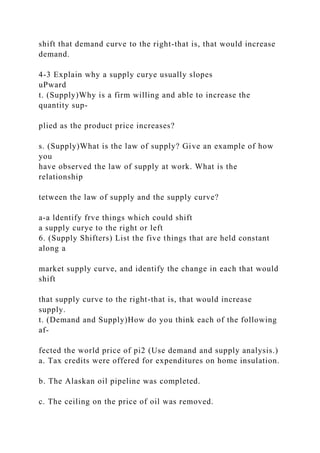
2-3 Outline how economies function
as production systems
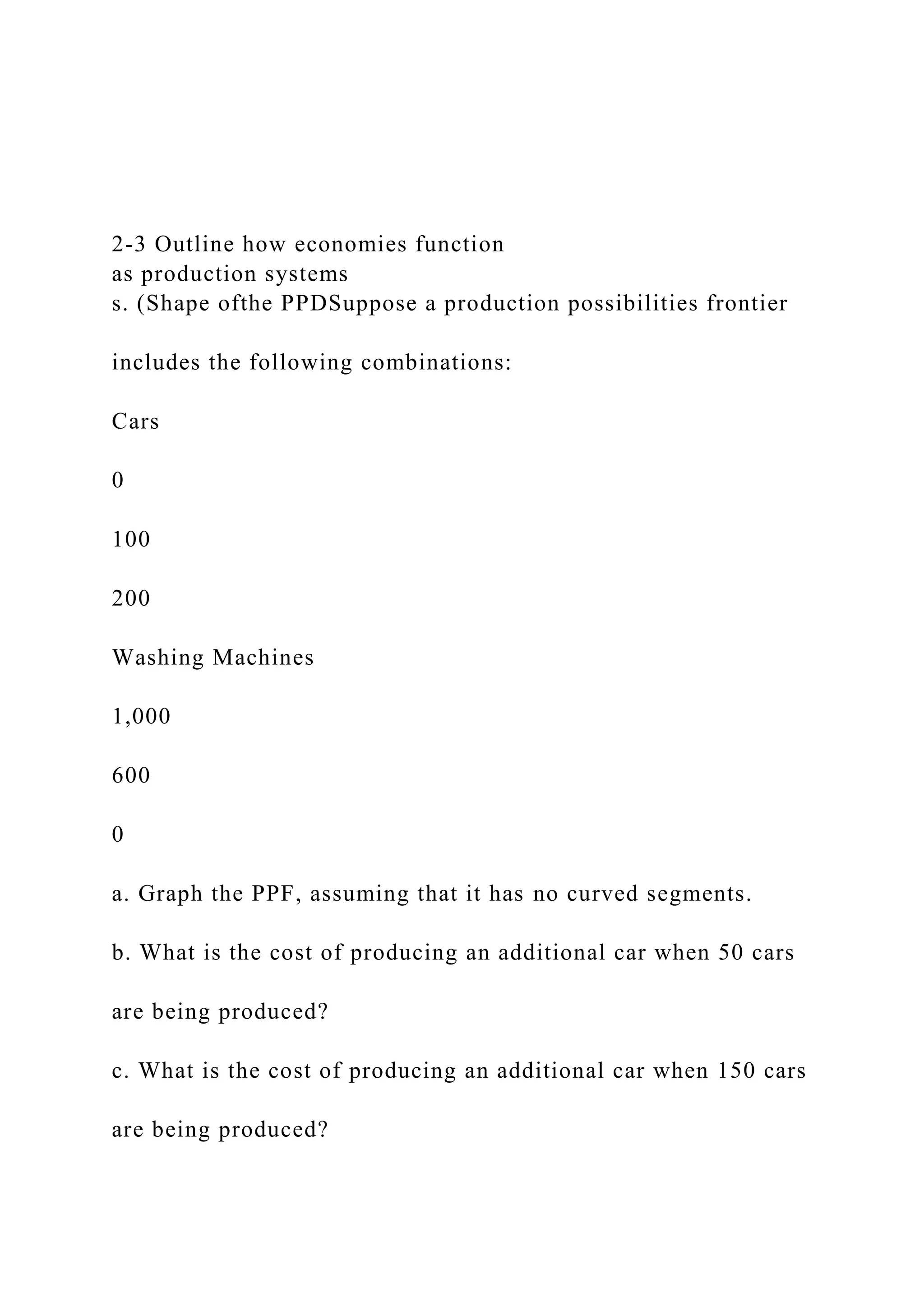
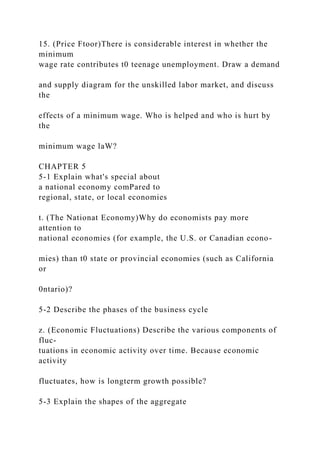
s. (Shape ofthe PPDSuppose a production possibilities frontier
includes the following combinations:
Cars
0
100
200
Washing Machines
1,000
600
0
a. Graph the PPF, assuming that it has no curved segments.
b. What is the cost of producing an additional car when 50 cars
are being produced?
c. What is the cost of producing an additional car when 150 cars
are being produced?
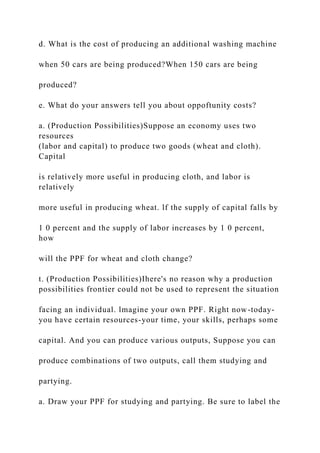
d. What is the cost of producing an additional washing machine
when 50 cars are being produced?When 150 cars are being
produced?
e. What do your answers tell you about oppoftunity costs?
a. (Production Possibilities)Suppose an economy uses two
resources
(labor and capital) to produce two goods (wheat and cloth).
Capital
is relatively more useful in producing cloth, and labor is
relatively
more useful in producing wheat. lf the supply of capital falls by
1 0 percent and the supply of labor increases by 1 0 percent,
how
will the PPF for wheat and cloth change?
t. (Production Possibilities)Ihere's no reason why a production
possibilities frontier could not be used to represent the situation
facing an individual. lmagine your own PPF. Right now-today-
you have certain resources-your time, your skills, perhaps some
capital. And you can produce various outputs, Suppose you can
produce combinations of two outputs, call them studying and
partying.
a. Draw your PPF for studying and partying. Be sure to label the
axes
of the diagram appropriately, Label the points where the PPF
inter-
sects the axes, as well as several other points along the frontier,
b. Explain what it would mean for you to move upward and t0
the
left along your personal PPF. What kinds of adjustments would
you have to make in your life to make such a movement along
the frontier?
c. Under what circumstances would your personal PPF shift
outward? Do you think the shift would be a "parallel" one?
Why,
or why not?
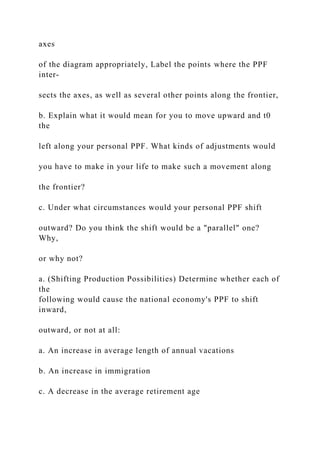
a. (Shifting Production Possibilities) Determine whether each of
the
following would cause the national economy's PPF to shift
inward,
outward, or not at all:
a. An increase in average length of annual vacations
b. An increase in immigration
c. A decrease in the average retirement age
d. The migration of skilled workers to other countries
2-4 Describe different economic systems and
the decision-making rules that define them
s. (Econ1mic Systems)Ihe United States is best described as
having
a mixed economy, What are some elements of command in the
U.S. economy? What are some market elements? What are some
traditional elements?
326 PROBLEMS APPENDIX
GHAPTER 3
3-l Describe *re major sources of income
and expenditures for households
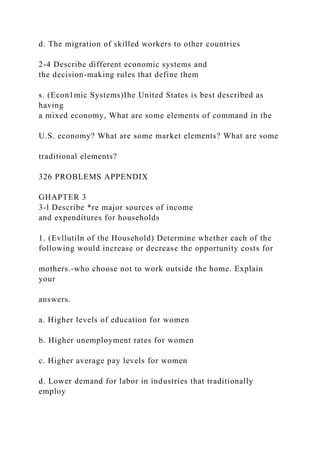
1. (Evllutiln of the Household) Determine whether each of the
following would increase or decrease the opportunity costs for
mothers.-who choose not to work outside the home. Explain
your
answers.
a. Higher levels of education for women
b. Higher unemployment rates for women
c. Higher average pay levels for women
d. Lower demand for labor in industries that traditionally
employ
large numbers of women
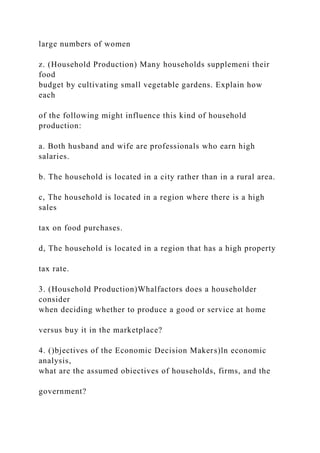
z. (Household Production) Many households supplemeni their
food
budget by cultivating small vegetable gardens. Explain how
each
of the following might influence this kind of household
production:
a. Both husband and wife are professionals who earn high
salaries.
b. The household is located in a city rather than in a rural area.
c, The household is located in a region where there is a high
sales
tax on food purchases.
d, The household is located in a region that has a high property
tax rate.
3. (Household Production)Whalfactors does a householder
consider
when deciding whether to produce a good or service at home
versus buy it in the marketplace?
4. ()bjectives of the Economic Decision Makers)ln economic
analysis,
what are the assumed obiectives of households, firms, and the
government?
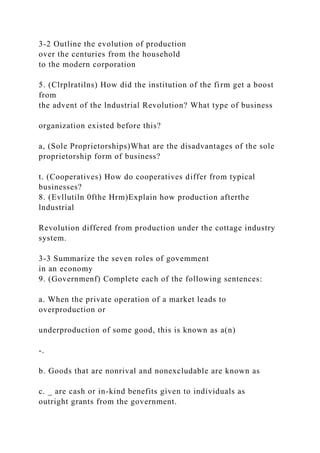
3-2 Outline the evolution of production
over the centuries from the household
to the modern corporation
5. (Clrplratilns) How did the institution of the firm get a boost
from
the advent of the lndustrial Revolution? What type of business
organization existed before this?
a, (Sole Proprietorships)What are the disadvantages of the sole
proprietorship form of business?
t. (Cooperatives) How do cooperatives differ from typical
businesses?
8. (Evllutiln 0fthe Hrm)Explain how production afterthe
lndustrial
Revolution differed from production under the cottage industry
system.
3-3 Summarize the seven roles of govemment
in an economy
9. (Governmenf) Complete each of the following sentences:
a. When the private operation of a market leads to
overproduction or
underproduction of some good, this is known as a(n)
-.
b. Goods that are nonrival and nonexcludable are known as
c. _ are cash or in-kind benefits given to individuals as
outright grants from the government.
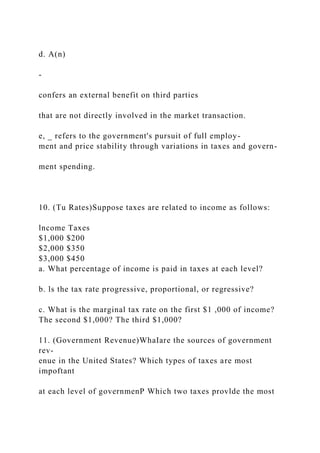
d. A(n)
-
confers an external benefit on third parties
that are not directly involved in the market transaction.
e, _ refers to the government's pursuit of full employ-
ment and price stability through variations in taxes and govern-
ment spending.
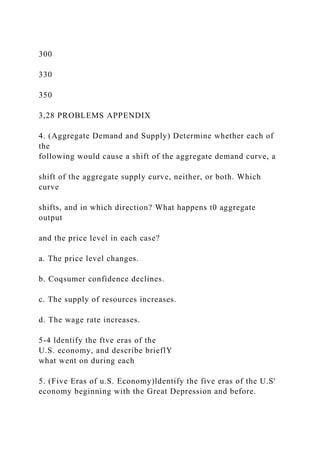
10. (Tu Rates)Suppose taxes are related to income as follows:
lncome Taxes
$1,000 $200
$2,000 $350
$3,000 $450
a. What percentage of income is paid in taxes at each level?
b. ls the tax rate progressive, proportional, or regressive?
c. What is the marginal tax rate on the first $1 ,000 of income?
The second $1,000? The third $1,000?
11. (Government Revenue)WhaIare the sources of government
rev-
enue in the United States? Which types of taxes are most
impoftant
at each level of governmenP Which two taxes provlde the most
revenue to the federal government?
12. (Externalities)Suppose there is an external cost, or negative
exter-
nality, associated with production of a certain 900d. What's
wrong
with letting the market determine how much of this good will be
produced?
3-4 Explain why countries trade with each
other and why they sometimes act to restrict
that trade
13. (nternational Tradel Why does international trade occur?
What does
it mean t0 run a deficit in the merchandise trade balance?
1{. (lnternational Iradel Distinguish between a tariff and a
quota. Who
benefits from and who is harmed by such restrictions on
imports?
GHAPTER 4
4-I Explain why a demand curue slopes
downward
1. (Shifting Demand)Using demand and supply curves, show the
effect of each of the following on the market for cigarettes:
a. A cure for lung cancer is found.
b. The price of cigars increases.
c. Wages increase substantially in states that grow tobacco.
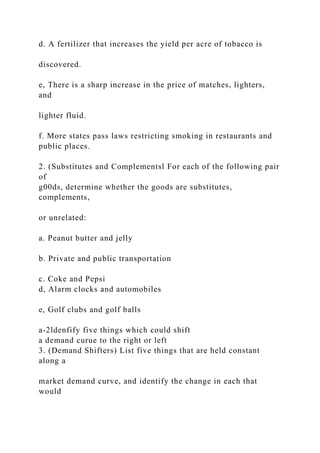
d. A fertilizer that increases the yield per acre of tobacco is
discovered.
e, There is a sharp increase in the price of matches, lighters,
and
lighter fluid.
f. More states pass laws restricting smoking in restaurants and
public places.
2. (Substitutes and Complementsl For each of the following pair
of
g00ds, determine whether the goods are substitutes,
complements,
or unrelated:
a. Peanut butter and jelly
b. Private and public transportation
c. Coke and Pepsi
d, Alarm clocks and automobiles
e, Golf clubs and golf balls
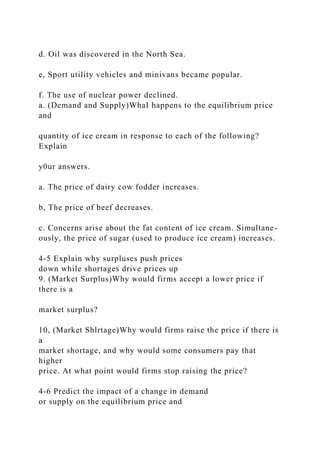
a-2ldenfify five things which could shift
a demand curue to the right or left
3. (Demand Shifters) List five things that are held constant
along a
market demand curve, and identify the change in each that
would
shift that demand curve to the right-that is, that would increase
demand.
4-3 Explain why a supply curye usually slopes
uPward
t. (Supply)Why is a firm willing and able to increase the
quantity sup-
plied as the product price increases?
s. (Supply)What is the law of supply? Give an example of how
you
have observed the law of supply at work. What is the
relationship
tetween the law of supply and the supply curve?
a-a ldentify frve things which could shift
a supply curye to the right or left
6. (Supply Shifters) List the five things that are held constant
along a
market supply curve, and identify the change in each that would
shift
that supply curve to the right-that is, that would increase
supply.
t. (Demand and Supply)How do you think each of the following
af-
fected the world price of pi2 (Use demand and supply analysis.)
a. Tax credits were offered for expenditures on home insulation.
b. The Alaskan oil pipeline was completed.
c. The ceiling on the price of oil was removed.
d. Oil was discovered in the North Sea.
e, Sport utility vehicles and minivans became popular.
f. The use of nuclear power declined.
a. (Demand and Supply)WhaI happens to the equilibrium price
and
quantity of ice cream in response to each of the following?
Explain
y0ur answers.
a. The price of dairy cow fodder increases.
b, The price of beef decreases.
c. Concerns arise about the fat content of ice cream. Simultane-
ously, the price of sugar (used to produce ice cream) increases.
4-5 Explain why surpluses push prices
down while shortages drive prices up
9. (Market Surplus)Why would firms accept a lower price if
there is a
market surplus?
10, (Market Shlrtage)Why would firms raise the price if there is
a
market shortage, and why would some consumers pay that
higher
price. At what point would firms stop raising the price?
4-6 Predict the impact of a change in demand
or supply on the equilibrium price and
quantity
11. (Equilibrium)"lf a price is not an equilibrium price, there is
a ten-
dency for it t0 move to its equilibrium level. Regardless of
whether
the price is too high or too fow to begin with, the adjustment
process will increase the quantity of the good purchased."
Explain,
using a demand and supply diagram.
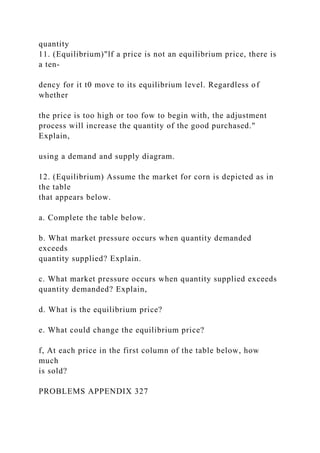
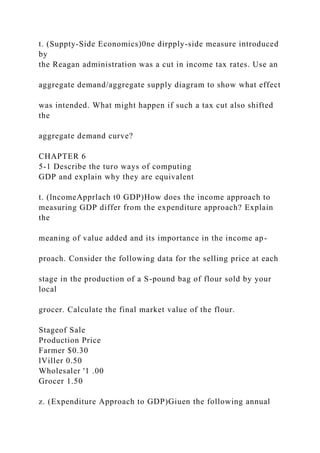
12. (Equilibrium) Assume the market for corn is depicted as in
the table
that appears below.
a. Complete the table below.
b. What market pressure occurs when quantity demanded
exceeds
quantity supplied? Explain.
c. What market pressure occurs when quantity supplied exceeds
quantity demanded? Explain,
d. What is the equilibrium price?
e. What could change the equilibrium price?
f, At each price in the first column of the table below, how
much
is sold?
PROBLEMS APPENDIX 327
Surplus/ WillPrice
Shortage Rise or Fall?
t3. (Market Equilibrium)Determine whether each of he
following state-
ments is true, false, or uncertain. Then briefly explain each
answer.
a. ln equilibrium, all sellers can find buyers.
b. ln equilibrium, there is n0 pressure 0n the market to produce
or
consume more than is being sold.
c. At prices above equilibrium, the quantity exchanged exceeds
the
quantity demanded.
d. At prices below equilibrium, the quantity exchanged is equal
to
the quantity suPPlied
14. (Changes in Equitibrium)Whalare the effects on the
equilibrium
price and quantity of steel if the wages of steelworkers rise and,
simultaneously, the price of aluminum rises?
4-7 Describe the result of a govemment-set
price floor or Price ceiling on a market
15. (Price Ftoor)There is considerable interest in whether the
minimum
wage rate contributes t0 teenage unemployment. Draw a demand
and supply diagram for the unskilled labor market, and discuss
the
effects of a minimum wage. Who is helped and who is hurt by
the
minimum wage laW?
CHAPTER 5
5-1 Explain what's special about
a national economy comPared to
regional, state, or local economies
t. (The Nationat Economy)Why do economists pay more
attention to
national economies (for example, the U.S. or Canadian econo-
mies) than t0 state or provincial economies (such as California
or
0ntario)?
5-2 Describe the phases of the business cycle
z. (Economic Fluctuations) Describe the various components of
fluc-
tuations in economic activity over time. Because economic
activity
fluctuates, how is longterm growth possible?
5-3 Explain the shapes of the aggregate
demand curue and the aggregate supply
curue, and how they interact to determine
real GDP and the price level for a nation
3. (Aggregate Demand and Supply) Review the information on
demand and supply curves in Chapter 4. How do the aggregate
demand and aggregate supply curves presented in this chapter
differ from the market curves of Chapter 4?
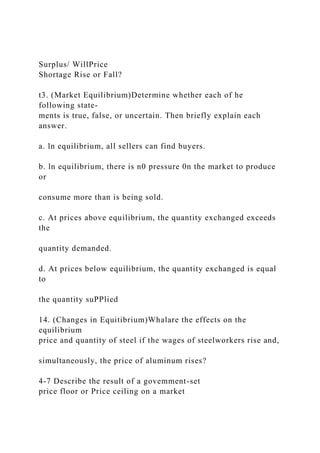
0uantity
Price Demanded
per (millions
Bushel ol bushels)
$1.80 320
2.00 300
2.20 270
2.40 230
2.60 200
2.80 180
0uantitY
Supplied
(millions
of bushels)
200
230
270
300
330
350
3,28 PROBLEMS APPENDIX
4. (Aggregate Demand and Supply) Determine whether each of
the
following would cause a shift of the aggregate demand curve, a
shift of the aggregate supply curve, neither, or both. Which
curve
shifts, and in which direction? What happens t0 aggregate
output
and the price level in each case?
a. The price level changes.
b. Coqsumer confidence declines.
c. The supply of resources increases.
d. The wage rate increases.
5-4 ldentify the ftve eras of the
U.S. economy, and describe brieflY
what went on during each
5. (Five Eras of u.S. Economy)ldentify the five eras of the U.S'
economy beginning with the Great Depression and before.
t. (Suppty-Side Economics)0ne dirpply-side measure introduced
by
the Reagan administration was a cut in income tax rates. Use an
aggregate demand/aggregate supply diagram to show what effect
was intended. What might happen if such a tax cut also shifted
the
aggregate demand curve?
CHAPTER 6
5-1 Describe the turo ways of computing
GDP and explain why they are equivalent
t. (lncomeApprlach t0 GDP)How does the income approach to
measuring GDP differ from the expenditure approach? Explain
the
meaning of value added and its importance in the income ap-
proach. Consider the following data for the selling price at each
stage in the production of a S-pound bag of flour sold by your
local
grocer. Calculate the final market value of the flour.
Stageof Sale
Production Price
Farmer $0.30
lViller 0.50
Wholesaler '1 .00
Grocer 1.50
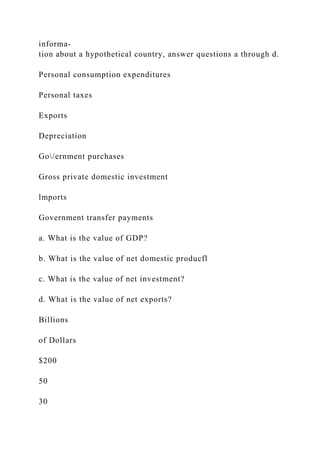
z. (Expenditure Approach to GDP)Giuen the following annual
informa-
tion about a hypothetical country, answer questions a through d.
Personal consumption expenditures
Personal taxes
Exports
Depreciation
Go/ernment purchases
Gross private domestic investment
lmports
Government transfer payments
a. What is the value of GDP?
b. What is the value of net domestic producfl
c. What is the value of net investment?
d. What is the value of net exports?
Billions
of Dollars
$200
50
30
10
50
40
40
,n

2-3 Outline how economies functionas production systemss. .docx

  • 1.
    2-3 Outline howeconomies function as production systems s. (Shape ofthe PPDSuppose a production possibilities frontier includes the following combinations: Cars 0 100 200 Washing Machines 1,000 600 0 a. Graph the PPF, assuming that it has no curved segments. b. What is the cost of producing an additional car when 50 cars are being produced? c. What is the cost of producing an additional car when 150 cars are being produced?
  • 2.
    d. What isthe cost of producing an additional washing machine when 50 cars are being produced?When 150 cars are being produced? e. What do your answers tell you about oppoftunity costs? a. (Production Possibilities)Suppose an economy uses two resources (labor and capital) to produce two goods (wheat and cloth). Capital is relatively more useful in producing cloth, and labor is relatively more useful in producing wheat. lf the supply of capital falls by 1 0 percent and the supply of labor increases by 1 0 percent, how will the PPF for wheat and cloth change? t. (Production Possibilities)Ihere's no reason why a production possibilities frontier could not be used to represent the situation facing an individual. lmagine your own PPF. Right now-today- you have certain resources-your time, your skills, perhaps some capital. And you can produce various outputs, Suppose you can produce combinations of two outputs, call them studying and partying. a. Draw your PPF for studying and partying. Be sure to label the
  • 3.
    axes of the diagramappropriately, Label the points where the PPF inter- sects the axes, as well as several other points along the frontier, b. Explain what it would mean for you to move upward and t0 the left along your personal PPF. What kinds of adjustments would you have to make in your life to make such a movement along the frontier? c. Under what circumstances would your personal PPF shift outward? Do you think the shift would be a "parallel" one? Why, or why not? a. (Shifting Production Possibilities) Determine whether each of the following would cause the national economy's PPF to shift inward, outward, or not at all: a. An increase in average length of annual vacations b. An increase in immigration c. A decrease in the average retirement age
  • 4.
    d. The migrationof skilled workers to other countries 2-4 Describe different economic systems and the decision-making rules that define them s. (Econ1mic Systems)Ihe United States is best described as having a mixed economy, What are some elements of command in the U.S. economy? What are some market elements? What are some traditional elements? 326 PROBLEMS APPENDIX GHAPTER 3 3-l Describe *re major sources of income and expenditures for households 1. (Evllutiln of the Household) Determine whether each of the following would increase or decrease the opportunity costs for mothers.-who choose not to work outside the home. Explain your answers. a. Higher levels of education for women b. Higher unemployment rates for women c. Higher average pay levels for women d. Lower demand for labor in industries that traditionally employ
  • 5.
    large numbers ofwomen z. (Household Production) Many households supplemeni their food budget by cultivating small vegetable gardens. Explain how each of the following might influence this kind of household production: a. Both husband and wife are professionals who earn high salaries. b. The household is located in a city rather than in a rural area. c, The household is located in a region where there is a high sales tax on food purchases. d, The household is located in a region that has a high property tax rate. 3. (Household Production)Whalfactors does a householder consider when deciding whether to produce a good or service at home versus buy it in the marketplace? 4. ()bjectives of the Economic Decision Makers)ln economic analysis, what are the assumed obiectives of households, firms, and the government?
  • 6.
    3-2 Outline theevolution of production over the centuries from the household to the modern corporation 5. (Clrplratilns) How did the institution of the firm get a boost from the advent of the lndustrial Revolution? What type of business organization existed before this? a, (Sole Proprietorships)What are the disadvantages of the sole proprietorship form of business? t. (Cooperatives) How do cooperatives differ from typical businesses? 8. (Evllutiln 0fthe Hrm)Explain how production afterthe lndustrial Revolution differed from production under the cottage industry system. 3-3 Summarize the seven roles of govemment in an economy 9. (Governmenf) Complete each of the following sentences: a. When the private operation of a market leads to overproduction or underproduction of some good, this is known as a(n) -. b. Goods that are nonrival and nonexcludable are known as c. _ are cash or in-kind benefits given to individuals as outright grants from the government.
  • 7.
    d. A(n) - confers anexternal benefit on third parties that are not directly involved in the market transaction. e, _ refers to the government's pursuit of full employ- ment and price stability through variations in taxes and govern- ment spending. 10. (Tu Rates)Suppose taxes are related to income as follows: lncome Taxes $1,000 $200 $2,000 $350 $3,000 $450 a. What percentage of income is paid in taxes at each level? b. ls the tax rate progressive, proportional, or regressive? c. What is the marginal tax rate on the first $1 ,000 of income? The second $1,000? The third $1,000? 11. (Government Revenue)WhaIare the sources of government rev- enue in the United States? Which types of taxes are most impoftant at each level of governmenP Which two taxes provlde the most
  • 8.
    revenue to thefederal government? 12. (Externalities)Suppose there is an external cost, or negative exter- nality, associated with production of a certain 900d. What's wrong with letting the market determine how much of this good will be produced? 3-4 Explain why countries trade with each other and why they sometimes act to restrict that trade 13. (nternational Tradel Why does international trade occur? What does it mean t0 run a deficit in the merchandise trade balance? 1{. (lnternational Iradel Distinguish between a tariff and a quota. Who benefits from and who is harmed by such restrictions on imports? GHAPTER 4 4-I Explain why a demand curue slopes downward 1. (Shifting Demand)Using demand and supply curves, show the effect of each of the following on the market for cigarettes: a. A cure for lung cancer is found. b. The price of cigars increases. c. Wages increase substantially in states that grow tobacco.
  • 9.
    d. A fertilizerthat increases the yield per acre of tobacco is discovered. e, There is a sharp increase in the price of matches, lighters, and lighter fluid. f. More states pass laws restricting smoking in restaurants and public places. 2. (Substitutes and Complementsl For each of the following pair of g00ds, determine whether the goods are substitutes, complements, or unrelated: a. Peanut butter and jelly b. Private and public transportation c. Coke and Pepsi d, Alarm clocks and automobiles e, Golf clubs and golf balls a-2ldenfify five things which could shift a demand curue to the right or left 3. (Demand Shifters) List five things that are held constant along a market demand curve, and identify the change in each that would
  • 10.
    shift that demandcurve to the right-that is, that would increase demand. 4-3 Explain why a supply curye usually slopes uPward t. (Supply)Why is a firm willing and able to increase the quantity sup- plied as the product price increases? s. (Supply)What is the law of supply? Give an example of how you have observed the law of supply at work. What is the relationship tetween the law of supply and the supply curve? a-a ldentify frve things which could shift a supply curye to the right or left 6. (Supply Shifters) List the five things that are held constant along a market supply curve, and identify the change in each that would shift that supply curve to the right-that is, that would increase supply. t. (Demand and Supply)How do you think each of the following af- fected the world price of pi2 (Use demand and supply analysis.) a. Tax credits were offered for expenditures on home insulation. b. The Alaskan oil pipeline was completed. c. The ceiling on the price of oil was removed.
  • 11.
    d. Oil wasdiscovered in the North Sea. e, Sport utility vehicles and minivans became popular. f. The use of nuclear power declined. a. (Demand and Supply)WhaI happens to the equilibrium price and quantity of ice cream in response to each of the following? Explain y0ur answers. a. The price of dairy cow fodder increases. b, The price of beef decreases. c. Concerns arise about the fat content of ice cream. Simultane- ously, the price of sugar (used to produce ice cream) increases. 4-5 Explain why surpluses push prices down while shortages drive prices up 9. (Market Surplus)Why would firms accept a lower price if there is a market surplus? 10, (Market Shlrtage)Why would firms raise the price if there is a market shortage, and why would some consumers pay that higher price. At what point would firms stop raising the price? 4-6 Predict the impact of a change in demand or supply on the equilibrium price and
  • 12.
    quantity 11. (Equilibrium)"lf aprice is not an equilibrium price, there is a ten- dency for it t0 move to its equilibrium level. Regardless of whether the price is too high or too fow to begin with, the adjustment process will increase the quantity of the good purchased." Explain, using a demand and supply diagram. 12. (Equilibrium) Assume the market for corn is depicted as in the table that appears below. a. Complete the table below. b. What market pressure occurs when quantity demanded exceeds quantity supplied? Explain. c. What market pressure occurs when quantity supplied exceeds quantity demanded? Explain, d. What is the equilibrium price? e. What could change the equilibrium price? f, At each price in the first column of the table below, how much is sold? PROBLEMS APPENDIX 327
  • 13.
    Surplus/ WillPrice Shortage Riseor Fall? t3. (Market Equilibrium)Determine whether each of he following state- ments is true, false, or uncertain. Then briefly explain each answer. a. ln equilibrium, all sellers can find buyers. b. ln equilibrium, there is n0 pressure 0n the market to produce or consume more than is being sold. c. At prices above equilibrium, the quantity exchanged exceeds the quantity demanded. d. At prices below equilibrium, the quantity exchanged is equal to the quantity suPPlied 14. (Changes in Equitibrium)Whalare the effects on the equilibrium price and quantity of steel if the wages of steelworkers rise and, simultaneously, the price of aluminum rises? 4-7 Describe the result of a govemment-set price floor or Price ceiling on a market
  • 14.
    15. (Price Ftoor)Thereis considerable interest in whether the minimum wage rate contributes t0 teenage unemployment. Draw a demand and supply diagram for the unskilled labor market, and discuss the effects of a minimum wage. Who is helped and who is hurt by the minimum wage laW? CHAPTER 5 5-1 Explain what's special about a national economy comPared to regional, state, or local economies t. (The Nationat Economy)Why do economists pay more attention to national economies (for example, the U.S. or Canadian econo- mies) than t0 state or provincial economies (such as California or 0ntario)? 5-2 Describe the phases of the business cycle z. (Economic Fluctuations) Describe the various components of fluc- tuations in economic activity over time. Because economic activity fluctuates, how is longterm growth possible? 5-3 Explain the shapes of the aggregate
  • 15.
    demand curue andthe aggregate supply curue, and how they interact to determine real GDP and the price level for a nation 3. (Aggregate Demand and Supply) Review the information on demand and supply curves in Chapter 4. How do the aggregate demand and aggregate supply curves presented in this chapter differ from the market curves of Chapter 4? 0uantity Price Demanded per (millions Bushel ol bushels) $1.80 320 2.00 300 2.20 270 2.40 230 2.60 200 2.80 180 0uantitY Supplied (millions of bushels) 200 230 270
  • 16.
    300 330 350 3,28 PROBLEMS APPENDIX 4.(Aggregate Demand and Supply) Determine whether each of the following would cause a shift of the aggregate demand curve, a shift of the aggregate supply curve, neither, or both. Which curve shifts, and in which direction? What happens t0 aggregate output and the price level in each case? a. The price level changes. b. Coqsumer confidence declines. c. The supply of resources increases. d. The wage rate increases. 5-4 ldentify the ftve eras of the U.S. economy, and describe brieflY what went on during each 5. (Five Eras of u.S. Economy)ldentify the five eras of the U.S' economy beginning with the Great Depression and before.
  • 17.
    t. (Suppty-Side Economics)0nedirpply-side measure introduced by the Reagan administration was a cut in income tax rates. Use an aggregate demand/aggregate supply diagram to show what effect was intended. What might happen if such a tax cut also shifted the aggregate demand curve? CHAPTER 6 5-1 Describe the turo ways of computing GDP and explain why they are equivalent t. (lncomeApprlach t0 GDP)How does the income approach to measuring GDP differ from the expenditure approach? Explain the meaning of value added and its importance in the income ap- proach. Consider the following data for the selling price at each stage in the production of a S-pound bag of flour sold by your local grocer. Calculate the final market value of the flour. Stageof Sale Production Price Farmer $0.30 lViller 0.50 Wholesaler '1 .00 Grocer 1.50 z. (Expenditure Approach to GDP)Giuen the following annual
  • 18.
    informa- tion about ahypothetical country, answer questions a through d. Personal consumption expenditures Personal taxes Exports Depreciation Go/ernment purchases Gross private domestic investment lmports Government transfer payments a. What is the value of GDP? b. What is the value of net domestic producfl c. What is the value of net investment? d. What is the value of net exports? Billions of Dollars $200 50 30
  • 19.