Anypoint Design Center - Components include
What is Anypoint Studio?
Accelerate developer productivity with a single graphical
environment for SOA, SaaS, APIs and data integration, then deploy
your applications with one click to the Mule runtime, on-premises
or in the cloud.
Anypoint Studio || API Designer || Connector DevKit || APIKit || Munit || RAML SDKs
 Design and implement APIs with unified
tooling
 Build, edit, document and debug
integrations graphically or in XML
 Simplify data mapping and
transformation
 Complete support for the entire build-to-
deploy process
 Jumpstart your integrations with pre-
built components
Design APIs for consumption and reuse
API Designer provides a web-based graphical environment for designing,
documenting, and testing APIs.
Complete with a single-click mocking service, API Designer makes it easy to engage
fellow coders, teammates and customers at multiple stages in the design process,
helping teams validate early and deliver value with every new API-led connection.
Anypoint Design Center - Components include
Anypoint Studio || API Designer || Connector DevKit || APIKit || Munit || RAML SDKs
 Collaborate on your API spec with easy-to-write and read RAML or import Swagger
 Auto-generated console provides in-line and interactive documentation
 Design according to best practices with a context-aware shelf
 Validate designs before writing any code with the mocking service
 Push, pull and sync RAML specifications with Anypoint Studio
Anypoint Design Center - Components include
Anypoint Studio || API Designer || Connector DevKit || APIKit || Munit || RAML SDKs
Anypoint Design Center - Components include
Anypoint Studio || API Designer || Connector DevKit || APIKit || Munit || RAML SDKs
Anypoint Design Center - Components include
Anypoint Studio || API Designer || Connector DevKit || APIKit || Munit || RAML SDKs
DevKit is a Maven-based tool, available in Anypoint Studio, that lets you build reusable
components via a wizard-like experience to connect to any endpoint.
These components can then be run as part of a Mule application on-premises or in the
cloud and can be easily configured and consumed from Anypoint Studio.
 Intuitive interface provides easy on-ramp with templates and samples
 Wizard-based tooling ensures fast, high quality output
 Custom connectors can be shared in Anypoint Exchange and reused broadly
Anypoint Design Center - Components include
Anypoint Studio || API Designer || Connector DevKit || APIKit || Munit || RAML SDKs
Anypoint Connector DevKit Features
Authentication Types
 Connection Management
(username and password authentication)
 OAuth V1
 OAuth V2
 Other authentication
schemes: Authentication Methods
API Types
 SOAP APIs
 REST APIs
 Java SDKs
Anypoint Platform
 DataSense
 DataSense Query Language
 Query Pagination
 Batch
 Anypoint Studio Support
Connector Development Lifecycle
 Setting Up a Connector Project
 Writing Connector Code
 Writing Connector Tests
 Documenting a Connector Project
 Packaging a Connector
Anypoint Design Center - Components include
Anypoint Studio || API Designer || Connector DevKit || APIKit || Munit || RAML SDKs
A REST or SOAP project that uses APIkit has the following parts:
 A RAML or WSDL interface, respectively
 A main flow
 Backend flows
Anypoint Design Center - Components include
Anypoint Studio || API Designer || Connector DevKit || APIKit || Munit || RAML SDKs
The Main flow for a RAML-based API manages these functions:
 Exposes the API using HTTP or Jetty.
 Routes requests between the interface and the backend flows based
on the HTTP request.
 References exception strategies that produce HTTP-status-code
responses.
Main Flow Backend Flows
Anypoint Design Center - Components include
Anypoint Studio || API Designer || Connector DevKit || APIKit || Munit || RAML SDKs
Anypoint Design Center - Components include
Anypoint Studio || API Designer || Connector DevKit || APIKit || Munit || RAML SDKs
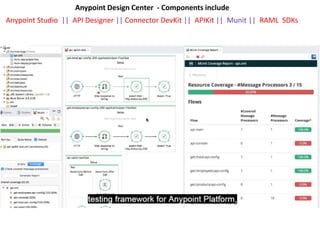
What is MUnit?
Prior to deploying your Mule applications and APIs, conduct unit and functional tests
using MUnit, a native testing framework for Mule. Test in your local environment, or
in your continuous integration and continuous delivery (CI/CD) settings.
 Design and test your Mule apps and APIs, graphically or in XML, all within Studio
 Easily integrate testing into your existing CI/CD process
 Minimize manual work with auto-generated tests and coverage reports
 Leverage local DB/FTP/mail servers to make testing more portable through the CI
process
Status
Code
Exception Message
400 org.mule.module.apikit.exception.BadRequestException Bad request
404 org.mule.module.apikit.exception.NotFoundException Resource not found
405 org.mule.module.apikit.exception.MethodNotAllowedException Method not allowed
406 org.mule.module.apikit.exception.NotAcceptableException Not acceptable
415 org.mule.module.apikit.exception.UnsupportedMediaTypeException Unsupported media type
Anypoint Design Center - Components include
Anypoint Studio || API Designer || Connector DevKit || APIKit || Munit || RAML SDKs
Anypoint Design Center - Components include
Anypoint Studio || API Designer || Connector DevKit || APIKit || Munit || RAML SDKs
RAML™ Version 0.8: RESTful API Modeling Language
RAML™ is a YAML-based language that describes RESTful APIs. Together with
the YAML specification, this specification provides all the information necessary to
describe RESTful APIs; to create API client-code and API server-code generators; and
to create API user documentation from RAML API definitions.
RAML Version 1.0: RESTful API Modeling Language
RAML is a language for the definition of HTTP-based APIs that embody most or all of
the principles of Representational State Transfer (REST). This document constitutes
the RAML specification, an application of the YAML 1.2 specification. The RAML
specification provides mechanisms for defining practically-RESTful APIs, creating
client/server source code, and comprehensively documenting the APIs for users.
YAML – Yet Another Markup Language
Anypoint Design Center - Components include
Anypoint Studio || API Designer || Connector DevKit || APIKit || Munit || RAML SDKs
Anypoint Design Center - Components include
Anypoint Studio || API Designer || Connector DevKit || APIKit || Munit || RAML SDKs

2.1.design center

  • 1.
    Anypoint Design Center- Components include What is Anypoint Studio? Accelerate developer productivity with a single graphical environment for SOA, SaaS, APIs and data integration, then deploy your applications with one click to the Mule runtime, on-premises or in the cloud. Anypoint Studio || API Designer || Connector DevKit || APIKit || Munit || RAML SDKs  Design and implement APIs with unified tooling  Build, edit, document and debug integrations graphically or in XML  Simplify data mapping and transformation  Complete support for the entire build-to- deploy process  Jumpstart your integrations with pre- built components
  • 2.
    Design APIs forconsumption and reuse API Designer provides a web-based graphical environment for designing, documenting, and testing APIs. Complete with a single-click mocking service, API Designer makes it easy to engage fellow coders, teammates and customers at multiple stages in the design process, helping teams validate early and deliver value with every new API-led connection. Anypoint Design Center - Components include Anypoint Studio || API Designer || Connector DevKit || APIKit || Munit || RAML SDKs  Collaborate on your API spec with easy-to-write and read RAML or import Swagger  Auto-generated console provides in-line and interactive documentation  Design according to best practices with a context-aware shelf  Validate designs before writing any code with the mocking service  Push, pull and sync RAML specifications with Anypoint Studio
  • 3.
    Anypoint Design Center- Components include Anypoint Studio || API Designer || Connector DevKit || APIKit || Munit || RAML SDKs
  • 4.
    Anypoint Design Center- Components include Anypoint Studio || API Designer || Connector DevKit || APIKit || Munit || RAML SDKs
  • 5.
    Anypoint Design Center- Components include Anypoint Studio || API Designer || Connector DevKit || APIKit || Munit || RAML SDKs DevKit is a Maven-based tool, available in Anypoint Studio, that lets you build reusable components via a wizard-like experience to connect to any endpoint. These components can then be run as part of a Mule application on-premises or in the cloud and can be easily configured and consumed from Anypoint Studio.  Intuitive interface provides easy on-ramp with templates and samples  Wizard-based tooling ensures fast, high quality output  Custom connectors can be shared in Anypoint Exchange and reused broadly
  • 6.
    Anypoint Design Center- Components include Anypoint Studio || API Designer || Connector DevKit || APIKit || Munit || RAML SDKs Anypoint Connector DevKit Features Authentication Types  Connection Management (username and password authentication)  OAuth V1  OAuth V2  Other authentication schemes: Authentication Methods API Types  SOAP APIs  REST APIs  Java SDKs Anypoint Platform  DataSense  DataSense Query Language  Query Pagination  Batch  Anypoint Studio Support Connector Development Lifecycle  Setting Up a Connector Project  Writing Connector Code  Writing Connector Tests  Documenting a Connector Project  Packaging a Connector
  • 7.
    Anypoint Design Center- Components include Anypoint Studio || API Designer || Connector DevKit || APIKit || Munit || RAML SDKs A REST or SOAP project that uses APIkit has the following parts:  A RAML or WSDL interface, respectively  A main flow  Backend flows
  • 8.
    Anypoint Design Center- Components include Anypoint Studio || API Designer || Connector DevKit || APIKit || Munit || RAML SDKs The Main flow for a RAML-based API manages these functions:  Exposes the API using HTTP or Jetty.  Routes requests between the interface and the backend flows based on the HTTP request.  References exception strategies that produce HTTP-status-code responses. Main Flow Backend Flows
  • 9.
    Anypoint Design Center- Components include Anypoint Studio || API Designer || Connector DevKit || APIKit || Munit || RAML SDKs
  • 10.
    Anypoint Design Center- Components include Anypoint Studio || API Designer || Connector DevKit || APIKit || Munit || RAML SDKs What is MUnit? Prior to deploying your Mule applications and APIs, conduct unit and functional tests using MUnit, a native testing framework for Mule. Test in your local environment, or in your continuous integration and continuous delivery (CI/CD) settings.  Design and test your Mule apps and APIs, graphically or in XML, all within Studio  Easily integrate testing into your existing CI/CD process  Minimize manual work with auto-generated tests and coverage reports  Leverage local DB/FTP/mail servers to make testing more portable through the CI process Status Code Exception Message 400 org.mule.module.apikit.exception.BadRequestException Bad request 404 org.mule.module.apikit.exception.NotFoundException Resource not found 405 org.mule.module.apikit.exception.MethodNotAllowedException Method not allowed 406 org.mule.module.apikit.exception.NotAcceptableException Not acceptable 415 org.mule.module.apikit.exception.UnsupportedMediaTypeException Unsupported media type
  • 11.
    Anypoint Design Center- Components include Anypoint Studio || API Designer || Connector DevKit || APIKit || Munit || RAML SDKs
  • 12.
    Anypoint Design Center- Components include Anypoint Studio || API Designer || Connector DevKit || APIKit || Munit || RAML SDKs RAML™ Version 0.8: RESTful API Modeling Language RAML™ is a YAML-based language that describes RESTful APIs. Together with the YAML specification, this specification provides all the information necessary to describe RESTful APIs; to create API client-code and API server-code generators; and to create API user documentation from RAML API definitions. RAML Version 1.0: RESTful API Modeling Language RAML is a language for the definition of HTTP-based APIs that embody most or all of the principles of Representational State Transfer (REST). This document constitutes the RAML specification, an application of the YAML 1.2 specification. The RAML specification provides mechanisms for defining practically-RESTful APIs, creating client/server source code, and comprehensively documenting the APIs for users. YAML – Yet Another Markup Language
  • 13.
    Anypoint Design Center- Components include Anypoint Studio || API Designer || Connector DevKit || APIKit || Munit || RAML SDKs
  • 14.
    Anypoint Design Center- Components include Anypoint Studio || API Designer || Connector DevKit || APIKit || Munit || RAML SDKs