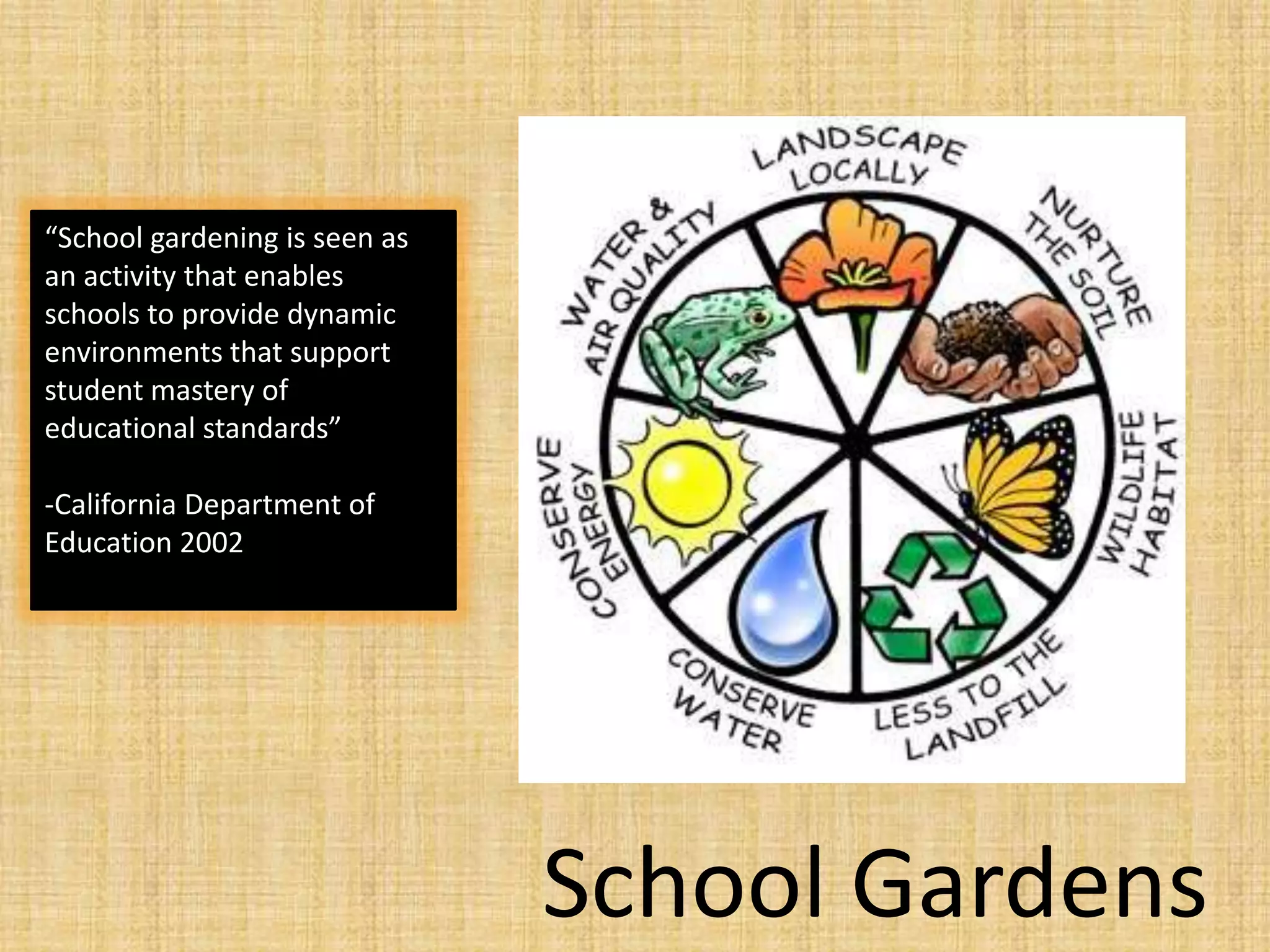
“School gardening is seen as an activity that enables schools to provide dynamic environments that support student mastery of educational standards” California Department of Education 2002School Gardens
LogisticsProcessDesignVisionFunding
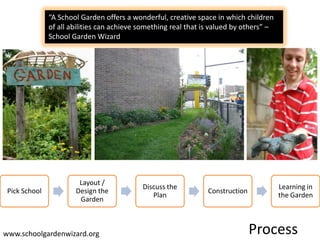
“A School Garden offers a wonderful, creative space in which children of all abilities can achieve something real that is valued by others” – School Garden WizardProcesswww.schoolgardenwizard.org
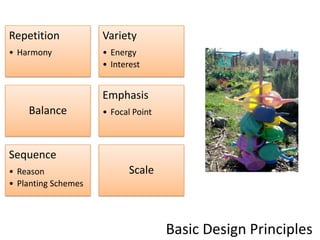
Basic Design Principles
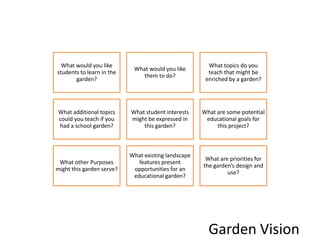
Garden Vision
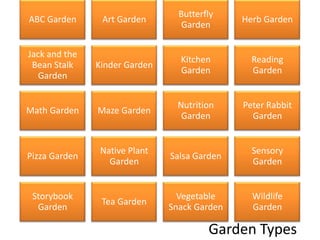
Garden Types
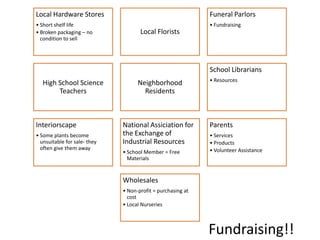
Fundraising!!
SuppliesGardening ToolsKitchen ToolsPlant Suggestions
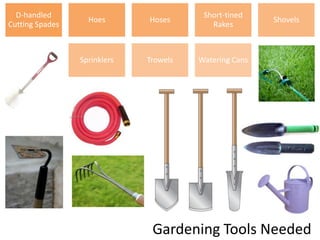
Gardening Tools Needed
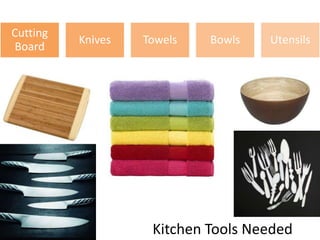
Kitchen Tools Needed
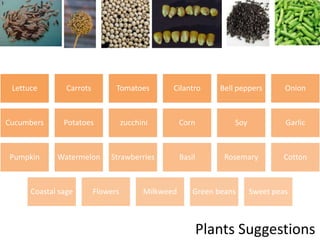
Plants Suggestions
Case Studies School Gardens
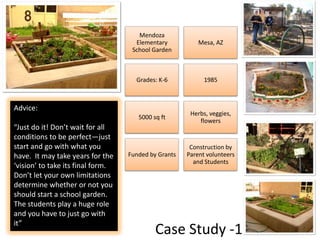
Advice: “Just do it! Don’t wait for all conditions to be perfect—just start and go with what you have.  It may take years for the ‘vision’ to take its final form.  Don’t let your own limitations determine whether or not you should start a school garden.  The students play a huge role and you have to just go with it” Case Study -1
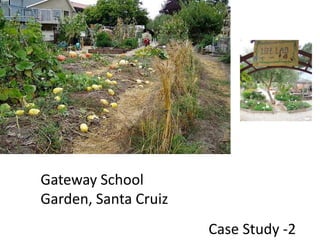
Gateway School Garden, Santa CruizCase Study -2
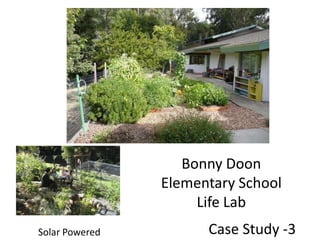
Bonny Doon Elementary School Life LabCase Study -3Solar Powered
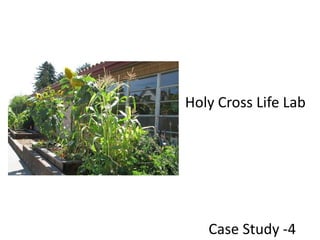
Holy Cross Life LabCase Study -4
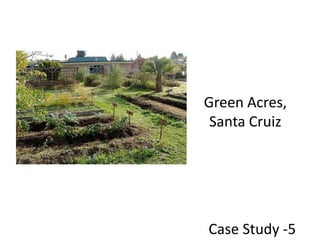
Green Acres, Santa CruizCase Study -5
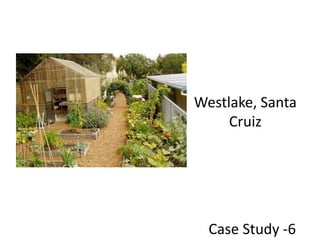
Westlake, Santa CruizCase Study -6
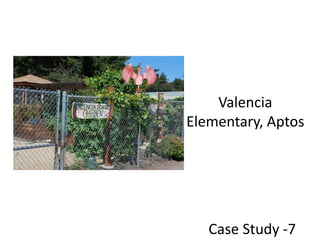
Valencia Elementary, AptosCase Study -7
Case Studies GreenhousesGathering SpacesTool Sheds
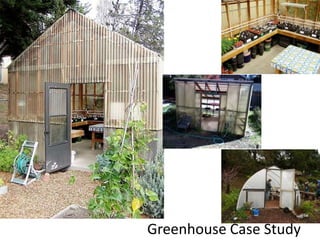
Greenhouse Case Study
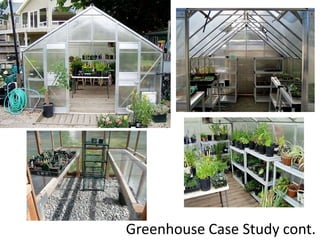
Greenhouse Case Study cont.
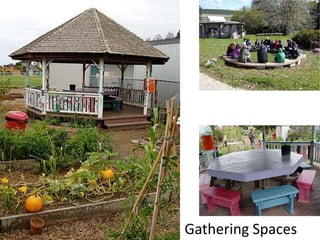
Gathering Spaces
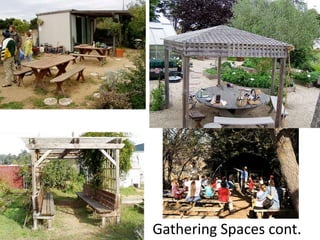
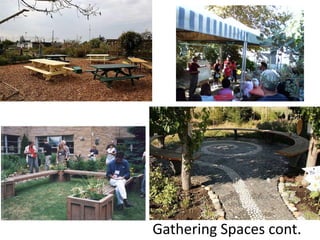
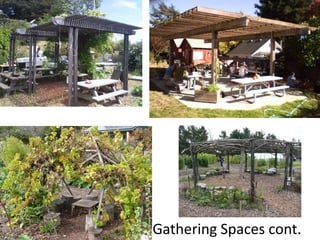
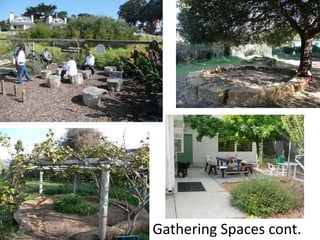
Gathering Spaces cont.
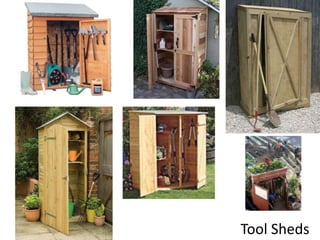
Tool Sheds
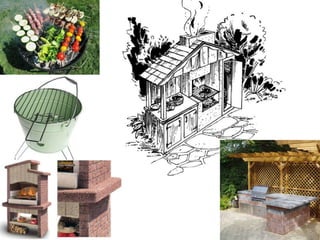
Case StudiesCooking Systems
Case Studies Kitchen and Sink
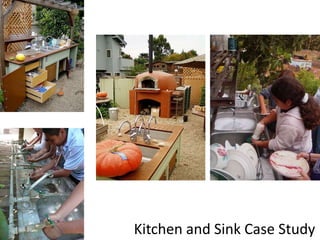
Kitchen and Sink Case Study
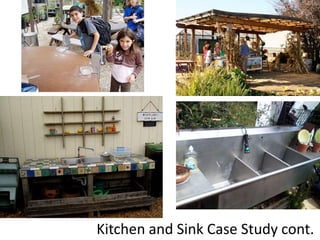
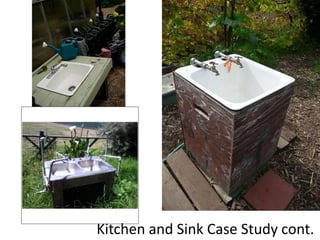
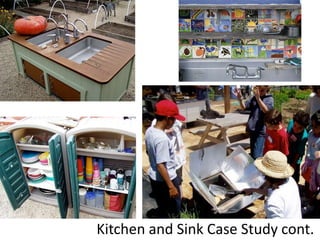
Kitchen and Sink Case Study cont.
Case Studies BedsIrrigation
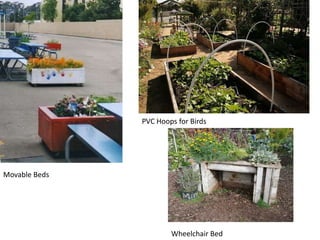
PVC Hoops for BirdsMovable BedsWheelchair Bed
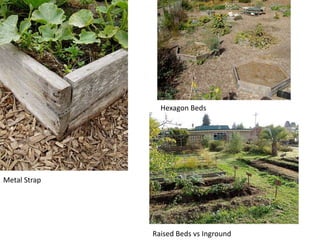
Hexagon Beds Metal StrapRaised Beds vsInground
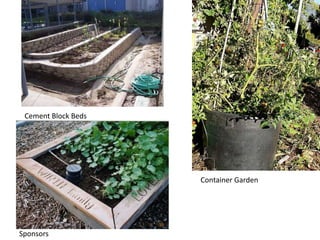
Cement Block BedsContainer GardenSponsors
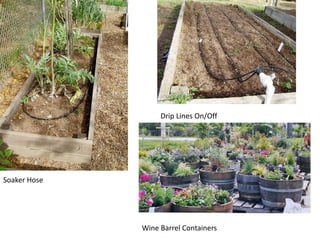
Drip Lines On/OffSoaker HoseWine Barrel Containers
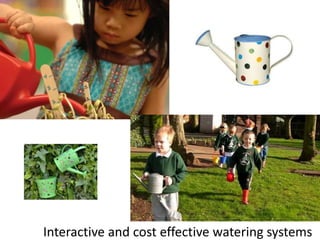
Interactive and cost effective watering systems
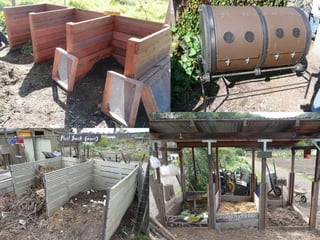
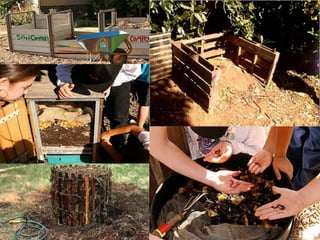
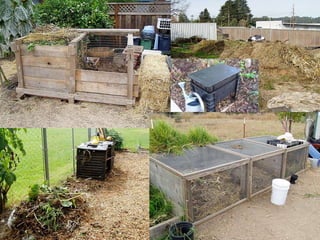
Case StudiesCompost Bins
Class Room Ideas
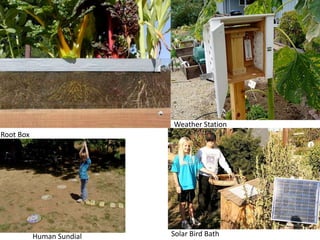
Weather StationRoot BoxSolar Bird BathHuman Sundial
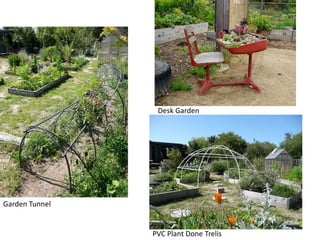
Desk GardenGarden TunnelPVC Plant Done Trelis
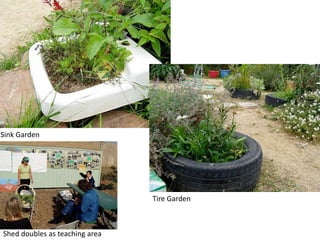
Sink GardenTire GardenShed doubles as teaching area
Resources
Aggie Horticulture Just for Kids!http://aggie-horticulture.tamu.edu/kindergarden/index.htmlCity Farmerhttp://www.cityfarmer.org/schgard15.htmlCornell College of Agriculture and Lifehttp://www.hort.cornell.edu/gardening/Earthways School Gardening Programhttp://www.umaine.edu/ceskl/earthways.htmEcology Center | Berkeley, Californiahttp://www.ecologycenter.org/gardening/gardening.htmlEE Link: Environmental Education Activities - School Gardenshttp://eelink.net/eeactivities-schoolgardens.htmlEssential School Lunch Resourceshttp://www.organicconsumers.org/school/links/htmGarden in Every School Registry of the National Gardening Associationhttp://www.kidsgardening.com/School/register.aspGarden Mosaicshttp://www.gardenmosaics.cornell.edu/Horticultural Therapy - School and Community Gardeninghttp://www.hort.purdue.edu/hort/Hther/kids.htmJourney to Foreverhttp://journeytoforever.org/edu_garden_link.htmlJunior Master Gardenerhttp://jmgkids.comKidsGardens! Garden Resourceshttp://www.kidsgardening.com/teachers2.aspMargaret Beeks Elementary School Gardening Project, Blacksburg, VAhttp://www.hort.vt.edu/faculty/relf/4984/Mbelem.htmlNutrition and Health and School Gardeninghttp://www.wccusd.k12.ca.us/stc/2000les/nutrition.htmPrograms that Work - School Gardening and Horticulture Programshttp://www.urbanext.uiuc.edu/ptw/05schoolgardening.htmlResearch Notes on School Gardeninghttp://www.raringtogrow.com/research.htmSchool Gardenshttp://hort.ifas.ufl.edu/ggk/schgard.htmSchool and Community Gardeninghttp://ag.arizona.edu/gardening/school.htmlSteiner School Gardenshttp://www.samfordschool.com/Gardening.htmSchool Garden Web Links
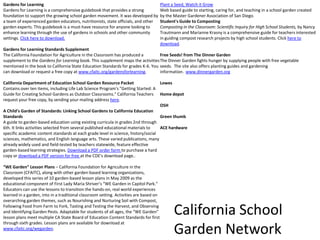
Gardens for LearningGardens for Learning is a comprehensive guidebook that provides a strong foundation to support the growing school garden movement. It was developed by a team of experienced garden educators, nutritionists, state officials, and other garden experts. This guidebook is a must-have resource for anyone looking to enhance learning through the use of gardens in schools and other community settings. Click here to download.Gardens for Learning Standards SupplementThe California Foundation for Agriculture in the Classroom has produced a supplement to the Gardens for Learning book. This supplement maps the activities mentioned in the book to California State Education Standards for grades K-6. You can download or request a free copy at www.cfaitc.org/gardensforlearning. California Department of Education School Garden Resource PacketContains over ten items, including Life Lab Science Program's "Getting Started: A Guide for Creating School Gardens as Outdoor Classrooms." California Teachers request your free copy, by sending your mailing address here.A Child's Garden of Standards: Linking School Gardens to California Education StandardsA guide to garden-based education using existing curricula in grades 2nd through 6th. It links activities selected from several published educational materials to specific academic content standards at each grade level in science, history/social sciences, mathematics, and English language arts. These varied publications, many already widely used and field-tested by teachers statewide, feature effective garden-based learning strategies. Download a PDF order form to purchase a hard copy or download a PDF version for free at the CDE's download page.. “WE Garden” Lesson Plans – California Foundation for Agriculture in the Classroom (CFAITC), along with other garden-based learning organizations, developed this series of 10 garden-based lesson plans in May 2009 as the educational component of First Lady Maria Shriver’s “WE Garden in Capitol Park.” Educators can use the lessons to transition the hands-on, real world experiences learned in a garden, into in a traditional classroom setting. Activities are based on overarching garden themes, such as Nourishing and Nurturing Soil with Compost, Following Food from Farm to Fork, Tasting and Testing the Harvest, and Observing and Identifying Garden Pests. Adaptable for students of all ages, the “WE Garden” lesson plans meet multiple CA State Board of Education Content Standards for first through sixth grades. Lesson plans are available for download at www.cfaitc.org/wegarden.Plant a Seed, Watch it GrowWeb based guide to starting, caring for, and teaching in a school garden created by the Master Gardener Association of San Diego.Student's Guide to CompostingComposting in the Classroom: Scientific Inquiry for High School Students, by Nancy Trautmann and Marianne Krasny is a comprehensive guide for teachers interested in guiding compost research projects by high school students. Click here to download.Free Seeds! from The Dinner GardenThe Dinner Garden fights hunger by supplying people with free vegetable seeds.  The site also offers planting guides and gardening information.  www.dinnergarden.orgLowesHome depotOSHGreen thumbACE hardwareCalifornia School Garden Network
Bountiful Gardens18001 Shafer Ranch Rd.Willits, CA 95490-9626(707) 459-6410fax (707)459-1925http://www.bountifulgardens.org Evergreen Y. H. Enterprises (Asian VegetableSeeds)P.O. Box 17538Anaheim, CA 92817-7538(714) 637-5769fax (714)637-5769http://www.evergreenseeds.com Havasu Hill Herbs20150-A Rough & Ready TrailSonora, CA 95370(209) 536-1420 Heirloom Garden SeedsP.O. Box 138Guerneville, CA 95446 Hudson, J. L. SeedsmanStar Route 2, Box 337La Honda, CA 94020 Kitazawa Seed Co.P.O. Box 13220Oakland, CA 94611-3220(510) 595-1188fax (510) 595-1860http://www.kitazawaseed.com Lockhart SeedsP.O. Box 13613 N. Wilson WayStockton, CA 95201(209) 466-4401 Mountain Valley Growers, Inc.38325 Pepperweed RoadSquaw Valley, CA 93675(209) 338-2775fax (209) 338-0075 Ornamental Edibles3272 Fleur De Lis CourtSan Jose, CA 95132(408) 929-7333fax (408) 929-5775http://www.ornamentaledibles.com Redwood City Seed Co.P.O. Box 361Redwood City, CA 94064(415) 325-SEED San Francisco Herb Company250 14th StreetSan Francisco, CA 94103800-227-4530415-861-7174http://www.sfherb.com Taylor’s Herb Gardens1535 Lone Oak RoadVista, CA 92084(619) 727-3485fax (619) 727-089Seed Resources
America the Beautiful Foundationhttp://www.america-the-beautiful.orgA great resource for all aspects of keeping America beautiful, includingfinancial aid, corporate sponsorship, hands-on community activities,etc. EE Linkhttp://www.eelink.netChock full of professional resources, classroom ideas, grant funding,and job listings for all you wandering souls. The most comprehensive EEsite on the web! IL Green Doorhttp://www.isbe.state.il.us/ilgreendoorThis site is sponsored by the Illinois State Board of Education and featuresEE resources for learners of all ages; includes information on careers,classroom activities, technology strategies, and connections to learningstandards. National Gardening Associationhttp://www.garden.orgA comprehensive resource for all aspects of gardening, includingenvironmental issues, kids’ gardening, planting tips, etc. North American Association for Environmental Educationhttp://www.naaee.orgThe North American Association for Environmental Education promotesa healthy, sustainable environment through education and providessupport for environmental Biodiversity Webhttp://www.biodiversity.nlA technical report for five ecosystems (agro-ecosystems, coastal areas,forests, freshwater systems, and grasslands); provides detailed, completeinformation. Three of the reports are now available to order or viewonline: “Forest,” “Grassland,” and “Freshwater” ecosystems. Chicago Wildernesshttp://www.chiwild.orgEducational resources and information on how to become involved inlocal biodiversity conservation in the Chicagoland area. Economics of Biodiversityhttp://www.biodiversityasia.orgIf you are interested in the topic of biodiversity as it relates to worldtrade issues, this site is for you. The mission of this site is “to influence,encourage, and assist societies throughout the world to conserve theintegrity and diversity of nature and to ensure that any use of naturalresources is equitable and ecologically sustainable”. Great for makingconnections to economics. Planet Palshttp://www.planetpals.com/thinkgreen.htmlClassroom projects from around the world reflect what some studentsare working on to help our universe. You can contribute to Planet Palsby sending a link to your own classroom projects. Value of Biodiversityhttp://www.nhm.ac.uk/science/projects/worldmap/diversity/index.htmlA world map defining areas of high concern for conservation leads to adiscussion of biodiversity in economic terms. Measurement of biodiversityvalues are needed to determine the 'where' of in situ conservationaction rather than the 'how', particularly in deciding which combinationsof available areas could represent and help sustain the most biodiversityvalue for the future. This raises questions such as What is biodiversity?What is the value basis for measuring it? What practical approaches areavailable for measuring this biodiversity value? Fibonacci Numbers and the Golden Ruleshttp://www.ee.surrey.ac.uk/Personal/R.Knott/Fibonacci/fib.htmlA fascinating study of one of nature’s golden rules – patterns repeatthemselves (albeit not without exception). Activities will challengestudents and teachers to contemplate everyday items and encountersthrough a lens of math and art. An excellent classroom resource.Environmental Education Groups

2.17.10 Garden Presentation

  • 1.
    “School gardening isseen as an activity that enables schools to provide dynamic environments that support student mastery of educational standards” California Department of Education 2002School Gardens
  • 2.
  • 3.
    “A School Gardenoffers a wonderful, creative space in which children of all abilities can achieve something real that is valued by others” – School Garden WizardProcesswww.schoolgardenwizard.org
  • 4.
  • 5.
  • 6.
  • 7.
  • 8.
  • 9.
  • 10.
  • 11.
  • 12.
  • 13.
    Advice: “Just doit! Don’t wait for all conditions to be perfect—just start and go with what you have. It may take years for the ‘vision’ to take its final form. Don’t let your own limitations determine whether or not you should start a school garden. The students play a huge role and you have to just go with it” Case Study -1
  • 14.
    Gateway School Garden,Santa CruizCase Study -2
  • 15.
    Bonny Doon ElementarySchool Life LabCase Study -3Solar Powered
  • 16.
    Holy Cross LifeLabCase Study -4
  • 17.
    Green Acres, SantaCruizCase Study -5
  • 18.
  • 19.
  • 20.
  • 21.
  • 22.
  • 23.
  • 24.
  • 25.
  • 26.
  • 27.
  • 28.
  • 29.
  • 31.
  • 32.
  • 33.
    Kitchen and SinkCase Study cont.
  • 34.
    Kitchen and SinkCase Study cont.
  • 35.
    Kitchen and SinkCase Study cont.
  • 36.
  • 37.
    PVC Hoops forBirdsMovable BedsWheelchair Bed
  • 38.
    Hexagon Beds MetalStrapRaised Beds vsInground
  • 39.
  • 40.
    Drip Lines On/OffSoakerHoseWine Barrel Containers
  • 41.
    Interactive and costeffective watering systems
  • 42.
  • 46.
  • 47.
    Weather StationRoot BoxSolarBird BathHuman Sundial
  • 48.
  • 49.
    Sink GardenTire GardenSheddoubles as teaching area
  • 50.
  • 51.
    Aggie Horticulture Justfor Kids!http://aggie-horticulture.tamu.edu/kindergarden/index.htmlCity Farmerhttp://www.cityfarmer.org/schgard15.htmlCornell College of Agriculture and Lifehttp://www.hort.cornell.edu/gardening/Earthways School Gardening Programhttp://www.umaine.edu/ceskl/earthways.htmEcology Center | Berkeley, Californiahttp://www.ecologycenter.org/gardening/gardening.htmlEE Link: Environmental Education Activities - School Gardenshttp://eelink.net/eeactivities-schoolgardens.htmlEssential School Lunch Resourceshttp://www.organicconsumers.org/school/links/htmGarden in Every School Registry of the National Gardening Associationhttp://www.kidsgardening.com/School/register.aspGarden Mosaicshttp://www.gardenmosaics.cornell.edu/Horticultural Therapy - School and Community Gardeninghttp://www.hort.purdue.edu/hort/Hther/kids.htmJourney to Foreverhttp://journeytoforever.org/edu_garden_link.htmlJunior Master Gardenerhttp://jmgkids.comKidsGardens! Garden Resourceshttp://www.kidsgardening.com/teachers2.aspMargaret Beeks Elementary School Gardening Project, Blacksburg, VAhttp://www.hort.vt.edu/faculty/relf/4984/Mbelem.htmlNutrition and Health and School Gardeninghttp://www.wccusd.k12.ca.us/stc/2000les/nutrition.htmPrograms that Work - School Gardening and Horticulture Programshttp://www.urbanext.uiuc.edu/ptw/05schoolgardening.htmlResearch Notes on School Gardeninghttp://www.raringtogrow.com/research.htmSchool Gardenshttp://hort.ifas.ufl.edu/ggk/schgard.htmSchool and Community Gardeninghttp://ag.arizona.edu/gardening/school.htmlSteiner School Gardenshttp://www.samfordschool.com/Gardening.htmSchool Garden Web Links
  • 52.
    Gardens for LearningGardensfor Learning is a comprehensive guidebook that provides a strong foundation to support the growing school garden movement. It was developed by a team of experienced garden educators, nutritionists, state officials, and other garden experts. This guidebook is a must-have resource for anyone looking to enhance learning through the use of gardens in schools and other community settings. Click here to download.Gardens for Learning Standards SupplementThe California Foundation for Agriculture in the Classroom has produced a supplement to the Gardens for Learning book. This supplement maps the activities mentioned in the book to California State Education Standards for grades K-6. You can download or request a free copy at www.cfaitc.org/gardensforlearning. California Department of Education School Garden Resource PacketContains over ten items, including Life Lab Science Program's "Getting Started: A Guide for Creating School Gardens as Outdoor Classrooms." California Teachers request your free copy, by sending your mailing address here.A Child's Garden of Standards: Linking School Gardens to California Education StandardsA guide to garden-based education using existing curricula in grades 2nd through 6th. It links activities selected from several published educational materials to specific academic content standards at each grade level in science, history/social sciences, mathematics, and English language arts. These varied publications, many already widely used and field-tested by teachers statewide, feature effective garden-based learning strategies. Download a PDF order form to purchase a hard copy or download a PDF version for free at the CDE's download page.. “WE Garden” Lesson Plans – California Foundation for Agriculture in the Classroom (CFAITC), along with other garden-based learning organizations, developed this series of 10 garden-based lesson plans in May 2009 as the educational component of First Lady Maria Shriver’s “WE Garden in Capitol Park.” Educators can use the lessons to transition the hands-on, real world experiences learned in a garden, into in a traditional classroom setting. Activities are based on overarching garden themes, such as Nourishing and Nurturing Soil with Compost, Following Food from Farm to Fork, Tasting and Testing the Harvest, and Observing and Identifying Garden Pests. Adaptable for students of all ages, the “WE Garden” lesson plans meet multiple CA State Board of Education Content Standards for first through sixth grades. Lesson plans are available for download at www.cfaitc.org/wegarden.Plant a Seed, Watch it GrowWeb based guide to starting, caring for, and teaching in a school garden created by the Master Gardener Association of San Diego.Student's Guide to CompostingComposting in the Classroom: Scientific Inquiry for High School Students, by Nancy Trautmann and Marianne Krasny is a comprehensive guide for teachers interested in guiding compost research projects by high school students. Click here to download.Free Seeds! from The Dinner GardenThe Dinner Garden fights hunger by supplying people with free vegetable seeds.  The site also offers planting guides and gardening information.  www.dinnergarden.orgLowesHome depotOSHGreen thumbACE hardwareCalifornia School Garden Network
  • 53.
    Bountiful Gardens18001 ShaferRanch Rd.Willits, CA 95490-9626(707) 459-6410fax (707)459-1925http://www.bountifulgardens.org Evergreen Y. H. Enterprises (Asian VegetableSeeds)P.O. Box 17538Anaheim, CA 92817-7538(714) 637-5769fax (714)637-5769http://www.evergreenseeds.com Havasu Hill Herbs20150-A Rough & Ready TrailSonora, CA 95370(209) 536-1420 Heirloom Garden SeedsP.O. Box 138Guerneville, CA 95446 Hudson, J. L. SeedsmanStar Route 2, Box 337La Honda, CA 94020 Kitazawa Seed Co.P.O. Box 13220Oakland, CA 94611-3220(510) 595-1188fax (510) 595-1860http://www.kitazawaseed.com Lockhart SeedsP.O. Box 13613 N. Wilson WayStockton, CA 95201(209) 466-4401 Mountain Valley Growers, Inc.38325 Pepperweed RoadSquaw Valley, CA 93675(209) 338-2775fax (209) 338-0075 Ornamental Edibles3272 Fleur De Lis CourtSan Jose, CA 95132(408) 929-7333fax (408) 929-5775http://www.ornamentaledibles.com Redwood City Seed Co.P.O. Box 361Redwood City, CA 94064(415) 325-SEED San Francisco Herb Company250 14th StreetSan Francisco, CA 94103800-227-4530415-861-7174http://www.sfherb.com Taylor’s Herb Gardens1535 Lone Oak RoadVista, CA 92084(619) 727-3485fax (619) 727-089Seed Resources
  • 54.
    America the BeautifulFoundationhttp://www.america-the-beautiful.orgA great resource for all aspects of keeping America beautiful, includingfinancial aid, corporate sponsorship, hands-on community activities,etc. EE Linkhttp://www.eelink.netChock full of professional resources, classroom ideas, grant funding,and job listings for all you wandering souls. The most comprehensive EEsite on the web! IL Green Doorhttp://www.isbe.state.il.us/ilgreendoorThis site is sponsored by the Illinois State Board of Education and featuresEE resources for learners of all ages; includes information on careers,classroom activities, technology strategies, and connections to learningstandards. National Gardening Associationhttp://www.garden.orgA comprehensive resource for all aspects of gardening, includingenvironmental issues, kids’ gardening, planting tips, etc. North American Association for Environmental Educationhttp://www.naaee.orgThe North American Association for Environmental Education promotesa healthy, sustainable environment through education and providessupport for environmental Biodiversity Webhttp://www.biodiversity.nlA technical report for five ecosystems (agro-ecosystems, coastal areas,forests, freshwater systems, and grasslands); provides detailed, completeinformation. Three of the reports are now available to order or viewonline: “Forest,” “Grassland,” and “Freshwater” ecosystems. Chicago Wildernesshttp://www.chiwild.orgEducational resources and information on how to become involved inlocal biodiversity conservation in the Chicagoland area. Economics of Biodiversityhttp://www.biodiversityasia.orgIf you are interested in the topic of biodiversity as it relates to worldtrade issues, this site is for you. The mission of this site is “to influence,encourage, and assist societies throughout the world to conserve theintegrity and diversity of nature and to ensure that any use of naturalresources is equitable and ecologically sustainable”. Great for makingconnections to economics. Planet Palshttp://www.planetpals.com/thinkgreen.htmlClassroom projects from around the world reflect what some studentsare working on to help our universe. You can contribute to Planet Palsby sending a link to your own classroom projects. Value of Biodiversityhttp://www.nhm.ac.uk/science/projects/worldmap/diversity/index.htmlA world map defining areas of high concern for conservation leads to adiscussion of biodiversity in economic terms. Measurement of biodiversityvalues are needed to determine the 'where' of in situ conservationaction rather than the 'how', particularly in deciding which combinationsof available areas could represent and help sustain the most biodiversityvalue for the future. This raises questions such as What is biodiversity?What is the value basis for measuring it? What practical approaches areavailable for measuring this biodiversity value? Fibonacci Numbers and the Golden Ruleshttp://www.ee.surrey.ac.uk/Personal/R.Knott/Fibonacci/fib.htmlA fascinating study of one of nature’s golden rules – patterns repeatthemselves (albeit not without exception). Activities will challengestudents and teachers to contemplate everyday items and encountersthrough a lens of math and art. An excellent classroom resource.Environmental Education Groups